Can America’s bond market keep defying the vigilantes?
2026-01-22
Donald Trump’s threats over Greenland are the latest test
This post was originally published here

Donald Trump’s threats over Greenland are the latest test
This post was originally published here
There is no such thing as “the” Indian growth model
This post was originally published here
Unemployment rates in rich countries are becoming topsy-turvy
This post was originally published here
It has benefited from a slice of luck, a commitment to economic reform and a shove from Donald Trump
This post was originally published here
Only a decline in corporate America’s vigour will dent the country’s dominance of financial markets
This post was originally published here
As investors worry about budgetary laxity, the central bank prepares for more rate hikes
This post was originally published here
The economy is well prepared, but more exposed than it used to be
This post was originally published here
An escalating trade war would be another matter, however
This post was originally published here

Buy now, pay later giant Affirm is looking to help renters break up housing payments in ways that align with their biweekly paychecks.
Affirm is piloting a program in partnership with financial technology platform Esusu that will allow renters to split their monthly rent in two equal payments every two weeks at 0% APR. There are no hidden or late fees, or compounding interest with this pilot program, either, according to Affirm.
Esusu helps renters build credit by reporting their on-time rent payments to major credit bureaus.
JPMORGAN CFO WARNS TRUMP’S PROPOSED CREDIT CARD CAP COULD CAUSE PEOPLE TO ‘LOSE ACCESS TO CREDIT’
The pilot program is designed to give “eligible renters a flexible option for managing one of their largest monthly expenses,” Affirm said in a statement to FOX Business, calling it “a transparent option that offers flexibility for renters to align expenses with their paychecks.”
Affirm said it underwrites every application individually and only approves people for what it believes they can responsibly afford to repay.
‘BUY NOW, PAY LATER’ SERVICES ARE DANGEROUS TRAP FOR YOUNG AMERICANS, FINANCIAL EXPERT WARNS
“We’re approaching this use case thoughtfully and evaluating it alongside Esusu, which shares our focus on clear, consumer-first financial tools,” Affirm continued.
The company didn’t confirm when the pilot program would be officially rolled out as it is still in the early stages of the pilot.
LendingTree’s chief consumer finance analyst Matt Schulz told FOX Business that this could be useful to those on a tight budget, but he cautioned that it is too soon to make a final judgment.
BUY NOW, PAY LATER PITFALLS: MANY CONSUMERS AREN’T PAYING LOANS
“This is just another example of how it is getting easier seemingly by the day for people to use BNPL to finance most anything,” Schulz said.
He noted that this doesn’t appear to be a typical pay-in-four BNPL loan, which, if it was, he cautioned that there could be serious risks. For instance, Schulz noted that a consumer could still have people paying off the previous month’s BNPL loan for rent when the next month’s rent comes due.
“That could get messy,” he said, adding that this financial tool can be really useful when used wisely, but “the danger with BNPL is when you have multiple loans that you have to manage.”
GET FOX BUSINESS ON THE GO BY CLICKING HERE
“That can get tricky, especially if you’re not used to managing credit,” he said.
The other key thing with this payment method is that it is tied to a debit card or checking account, so it is critical that users have enough cash in that account to pay the bill.
Strong exports make up for weak investment
This post was originally published here

EXCLUSIVE: The realization hit fast — and the response was even faster.
As California’s proposed “billionaire tax” began gaining momentum late last year, some of the wealthiest people in the country didn’t wait for ballots, lawmakers or court challenges — they moved. “Then a couple more flew into Miami, bought properties and closed within seven days,” luxury real estate broker Julian Johnston of The Corcoran Group told Fox News Digital. “So then it was a tipping point.”
According to Johnston — who told Fox News Digital that he’s currently working with three billionaires to move them from California to South Florida — the urgency was driven by staggering potential losses.
“One client said, ‘You know, this could be like a $5 billion tax for me,’” he recalled. “So they’re moving because of that.”
KEN GRIFFIN’S FLORIDA TAKEOVER: CITADEL FOUNDER SHELLS OUT $180M FOR LATEST PIECE OF MIAMI EMPIRE
The chatter all started at Miami’s high-profile Art Basel fair in early December, Johnston said, and carried into many of the ultra-wealthy’s holiday celebrations on the island of St. Barts.
“They’re all dining and wining together and talking about this proposed tax. And then when the proposed tax gained speed, they then understood that they had to either rent or purchase something out of California to establish residency and reduce their net worth exposure to the proposed billionaire tax,” he explained.
“It’s a melting pot and they’re all friends. And that’s the thing. The tipping point was when four or five of them bought and three more were going into contract. The rest of them, all their friends are here. And they talked about the office buildings as well.”
“I think this happened very quickly, even for them,” Johnston continued. “Now that it’s… January, into 2026, it has slowed down a little bit… So if you didn’t buy or rent before the end of the year, it may be too late. It may apply to you no matter what now.”
While it has not yet qualified for the November ballot, the proposal — backed by the Service Employees International Union–United Healthcare Workers West — would impose a one-time 5% tax on the net worth of California residents worth more than $1 billion. The tax would be due in 2027, and taxpayers could spread payments over five years, with additional costs, according to the Legislative Analyst’s Office.
If the measure is approved by voters, anyone who was a California resident on Jan. 1, 2026, would owe the tax, according to the proposal.
When asked to describe the billionaires he’s working with, Johnston mentioned “Palo Alto guys” who haven’t spent much time in Miami before.
“There’s a few other very big founders and also tech giants and also venture capitalist firms, the heads of which I’ve also moved here,” he said. “It was always a layover, one night, an event, but Miami’s changed a lot in the last 10 years. It’s culturally more interesting… They said they were quite happy to move here and then see what happens in the next few years.”
Florida famously has no state income tax for residents who live there at least 183 days out of the year, but Johnston explained what South Florida offers that other tax havens like Texas, Tennessee and Nevada can’t match.
“I think that you have to look at the culture amongst these VC firms and tech guys, that they like to be around each other… They’re already moving here, some of them are already here or have established residency here, they’re gonna spend more time and then they’re going to have the multiplier effect of their friends coming in to spend time with them,” he said.
“Miami has a very outdoor lifestyle similar to California,” Johnston further argued. “I think that the climate suits them. I think there’s a lot of security here. Politically it’s safe and economically, I mean, two of the largest capital projects in the country are in Miami right now.”
Beyond real estate, the California billionaires are aware they’re taking investment capital with them — and that lawmakers may not fully grasp how mobile wealth has become.
“That was a discussion point amongst some of them [in] the lunchroom. They were talking about the fact that, [if] enough of them move, it’s actually gonna cause change,” Johnston said. “It will financially change the landscape for the government’s budget… And they want reform… they want reform before they move back.”
GET FOX BUSINESS ON THE GO BY CLICKING HERE
Across his 25-year career in luxury sales, Johnston agrees this current migration wave feels different in terms of the sheer scale of wealth and the speed at which high-net-worth individuals want to divest from the West Coast.
“I think Florida has a positive net migration for the next 20 years… it’s a boomtown,” he said. “Those big companies are going to push the state to spend more money on just activities and amenities and bring so many people from around the world that had never been to Miami before, because I do think it’s a [city of the future] for America.”
Vigilantes have shrugged off ballooning debt and attacks on the Fed
This post was originally published here

A billionaire sports and real estate magnate has quietly completed the largest private land purchase in the United States in more than a decade — propelling him past other moguls to the top of the nation’s private landownership rankings.
Stan Kroenke — who owns the NFL’s Los Angeles Rams and England’s Premier League club Arsenal — purchased more than 937,000 acres of ranchland in New Mexico in a major off-market deal for property once owned by the heirs of Teledyne founder Dr. Henry Singleton, The Land Report first reported.
MATTHEW STAFFORD’S LATE HEROICS LIFT RAMS PAST PANTHERS IN WILD-CARD THRILLER
The acquisition catapulted Kroenke from No. 4 to No. 1 on the 2025 Land Report 100, surpassing other billionaire landowners such as Ted Turner and John Malone. It also marked the largest single land transaction in the United States in more than a decade. Financial terms were not disclosed by either party.
With this deal, Kroenke now owns more land than any other private individual in the United States, surpassing the Emmerson family’s 2.44 million acres, Malone’s 2.2 million acres, and Turner’s 2 million acres.
A spokesperson for The Kroenke Group declined to comment to Fox News Digital.
GET FOX BUSINESS ON THE GO BY CLICKING HERE
Kroenke’s portfolio now spans much of the American West and Canada, including 560,000 acres in Wyoming, 124,000 in Montana, the historic W.T. Waggoner Ranch in Texas, 800,000 acres in Nevada, and British Columbia’s Douglas Lake Ranch.
Born in Columbia, Missouri, Kroenke built his fortune through real estate development and professional sports, owning the Los Angeles Rams, the NBA’s Denver Nuggets, the NHL’s Colorado Avalanche, and the Premier League’s Arsenal FC. He is married to Ann Walton Kroenke, an heiress to the Walmart fortune, and has expanded his land and ranching empire across the American West for decades.

Hedge fund billionaire Ken Griffin appears to be expanding his business presence in Miami, adding to his already sizable real estate portfolio.
The Citadel founder partnered with Goldman Properties to purchase the 545Wyn office building for $180 million from Chicago-based developer Sterling Bay, according to the South Florida Business Journal.
Anonymous sources close to the deal told the outlet that Griffin is a partner in the purchase, though the listed buyer is Goldman Properties CEO Scott Srebnick.
Neither Citadel nor Goldman Properties immediately responded to Fox News Digital’s request for confirmation or comment.
Two of Miami’s top-grossing real estate agents told Fox News Digital the move appears strategic and is unlikely to be a one-off purchase, but rather the beginning of a larger Wynwood land grab.
“This looks more strategic than operational. Brickell is about scale and visibility — Wynwood is about flexibility and culture,” the Corcoran Group’s Mick Duchon said. “Creative office [space] attracts a different workforce and tenant mix. Owning both allows to hedge across asset classes while controlling the ecosystems around where talent actually wants to work.”
“Given previous track records, it’s unlikely to be a one-off. It often marks the beginning of a longer-term vision rather than a single transaction,” Douglas Elliman’s Lourdes Alatriste added. “The endgame is balance. This portfolio touches luxury living, global business and cultural innovation. It reflects a belief in Miami not just as a place to invest, but as a city with multiple centers of gravity, each serving a different purpose yet reinforcing the whole.”
Located at 545 NW 26th Street in Miami’s Wynwood neighborhood, the 10-story building spans nearly 400,000 square feet, the property listing on Blanca Commercial Real Estate’s website states.
Wynwood has traditionally been a tech and creative hub in Miami, and the deal would mark Griffin’s first entry into the neighborhood after he spent hundreds of millions of dollars on properties in Star Island, Coconut Grove and Palm Beach.
“When an investor of his caliber enters a neighborhood, underwriting assumptions immediately change, cap rates compress, land pricing recalibrates, and long-term institutional capital feels safer stepping in. For Wynwood, this isn’t a short-term spike; it’s a structural re-rating of the district,” Duchon noted.
“Wynwood needed time to mature beyond its creative roots. Brickell offered certainty early on, such as financial infrastructure, zoning clarity and scale. Wynwood today is different,” Alatriste said. “It has stabilized, it’s proven demand for high-quality offices, and it’s become a place where people want to spend time, not just work. The timing reflects confidence that Wynwood has fully arrived.”
“Wynwood is Miami’s second most expensive office market behind Brickell, according to a report last year from CRE Daily. Real estate values are set by true mixed-use demand and the neighborhood’s ability to function as a real daily hub and not just a weekend destination,” ALP.X Group founder Sebastian Lüdke — who works with Goldman Global Arts — told Fox News Digital. “This transaction is just the latest example of the opportunity Wynwood presents to investors in the greater Miami market.”
Citadel is also breaking ground on its new 1.2 million-square-foot global headquarters tower in Miami’s Brickell financial district but currently holds a temporary lease at 830 Brickell Plaza, according to the company’s website.
Griffin moved his hedge fund from Chicago to Miami in 2022, and recently opened up about what led to that decision during an appearance at the America Business Forum in November.
GET FOX BUSINESS ON THE GO BY CLICKING HERE
“I’ve lived in a failed city-state. I lived in Chicago for 30-some years. I had two colleagues who had bullets fly through their cars,” Griffin told Fox News’ Bret Baier.
“I had 25 bullet holes in the front of my building where I lived. You can’t live in a city awash [with] violent crime,” he continued.

.
Mortgage buyer Freddie Mac reported on Thursday that mortgage costs dropped to their lowest level in more than three times.
According to Freddie Mac’s most recent primary mortgage market survey, the benchmark 30-year fixed mortgage‘s average rate dropped to 6. 6 % from the previous week’s 6. 1 % reading.
A 30-year loan’s average price was 7. 04 % a year ago. The 30-year mortgage rate average was 6. 02 %, whiçh is the lowest Ievel since Sept. 15, 2022.
As MORTGAGE RATES DOWNFLOW, THESE 10 Industry ARE COMING TO BE THE BIGGEST HOMEBUYING SURGE.
Mortgage rates dropped late last monƫh, causing thȩ weekly average tσ ƒall to its loweȿt level įn more than three decades, accordiȵg to Freddie Mac’s chief ecσnomist Sam Khater. The effects are obvious, as regular requests for purchases and refinancing have increased, which highlights the advantages for both customers and existing owners. It is obvious thαt cover action iȿ oȵ the rise and reαdy for strong flower sales.
Tⱨe Federal Housing Finance Agency, ωhich reǥulates Freddie Mac and another mortgage financȩ sȵob, was ǥiven ƫhe order by President Donalḑ Trumρ to seize$ 200 billion in bonds issued by thȩ two entities last week.
HOME DELISTINGS SURGE AS SELLERS RUGGLE TO GET THEIR PRICE.
Agent: THE Areas IN 2026 WHERE HOMEBUYERS MAY FINALLY GET A RESTRICTION. COM SAYS
William Pulte, the chairman of FHFA, reported last week that the first round of buying had been completed with a$ 3 billion target. In this year’s midterm electioȵs, Trump and hiȿ fellow Republicαns are fighting to kȩep conƫrol of the U. Ș. Congress. They are under pressure to Iower prices, inçluding accommodation.
Additionally, Trump has suggested outlawing administrative owners from purchasing single-family residences.
The president claimed in a blog on Truth Social that” the British Dream’s highest level of ownership was for a very long time. “
” It was the reward for working hard and doing what was right, but nowadays, thanks to the record-high inflation caused by Joe Biden and the Democrats in Congress, far too many people, especially younger Americans, are unable to achieve the American Dream. “
I’m soon taking steps to stop big institutional traders from buying more single-family houses, and I’m calling on Congress to define it, Trump said.
Since the 2008 financial crisis, which led to a flood of home mortgages, big financial institutions like Blackstone have repurchased dozens of single-family properties.
Clicking HERE WILL GET FOX BUSINESS ON THE GO.
The average rate on a 15-year fixed mortgage decreased to 5. 348 % from the previous week’s 5. 446 % reading.
According to Hannah Jones, senior economic research analyst for Realtor. com,” we anticipate mortgage rates to be broadly in the low-6 % range this year. ” Even so, affordability concerns and the remaining share of low-rate foreclosures suggest that any treatment in house sales is likely to be steady rather than quick.
This report was written by Reuters.
Lessons from history for Venezuela and Iran
This post was originally published here
The administration’s latest attack on America’s central bank has not gone well
This post was originally published here
His fight against high interest rates could get messy
This post was originally published here
A widely circulated working paper suggests so
This post was originally published here
ewsom-says-california-wealth-tax-really-damaging-billionaires-move-money-businesses-out-of-state” target=”_blank” rel=”noopener”>NEWSOM SUBSTANCES CALIFORNIA WEALTH Income AS BILLIONAIRES MOVE MONEY AND BUSINESSES OUT OF STATE AS” REALLY DAMAGING”
As the price of a business like this approaches$ 7, 000 per square foot, the entire community is rebalanced. We’ve sȩen it įn Coconut Grove, Bal Harƀour, Miami Beach, and Golden Beach, according tσ Goldentayer.
Two Palm Beach homes came in second and third place in December’s most expensive sales, coming in at$ 97. 5 million and$ 66. 15 million respectively. Both qualities even appeared on Redfin’s 2025 record of the priciest U. Ș. homes sold, at No. 1. 5 and No. 9 and 9, both.
In total, southern Florida cities made up si𝑥 oƒ the ten mosƫ expensive sαles in December. Another high-end markets that month, including Manhattan, the Bay Area, and Nevada’s Lake Tahoe region, were outpaced by The Sunshine State.
According to Redfin, Florida components made up half of the ten most expensive house sales in the United States overall in 2025.
Clicking HERE WILL GET FOX BUSINESS ON THE GO.
According to Michael Martinez, one of the best South Florida agents for ONE Sotheby’s International Realty,” I’m seeing continued northbound fascination from California and the Northeast, with buyers seeking protection, security, and turnkey waterfront or estate properties. “
More showings with wealthy buyers, more off-market discussions, he continued, and buyers move more quickly when a really unique property becomes available.
But can the public stomach higher inflation?
This post was originally published here
For years, home buyers have been told the housing market would eventually “normalize” — meaning if mortgage rates came down or inventory improved, affordability would return to something resembling pre-pandemic levels such as 2019.
But new data from Realtor.com suggests that version of the market may never come back, and returning to pre-pandemic affordability would require outcomes economists say are extremely unlikely.
The numbers underscore a tougher reality for buyers, one expert points out: America’s housing affordability problem isn’t merely cyclical but largely structural.
“It’s not a realistic benchmark. I think that the problem in the housing market is a structural problem that’s been going on for decades,” PMG Affordable principal Dan Coakley told Fox News Digital.
TRUMP HOUSING PLAN COULD BRING ‘BIG WIN’ FOR AMERICANS, PULTE SAYS
“While it might appear that things were more affordable in 2019, this kind of march toward lack of affordability has been going on for a long time,” he continued. “And it’s gonna take a long time to make a dent in it.”
“I don’t think that affordability is going to go all the way back to a point where people feel like it’s manageable.”
In order for the U.S. housing market to feel affordable again, a recent Realtor.com report found that would require mortgage rates falling to about 2.65%, median household incomes rising by roughly 56% or home prices dropping about 35%. Realtor.com defines “affordable” as a mortgage payment equal to about 21% of median household income, compared with more than 30% currently.
“Just how radical those moves would be with respect to interest rates or home price depreciation or income increases, it just shows you how much work we have to do,” Coakley reacted. “I have to compliment the Trump administration now for really putting this into bright focus, because I think it’s going to be really necessary, and moving all of those levers as much as we can is going to be super, super important.”
Coakley added that he doesn’t see rates going below about 3% or even close to that level, while noting that median incomes have not kept up with surging rents and home prices.
“People at the lower income levels or middle income levels, even upper-middle income levels, have not been able to access and participate in that asset level appreciation that’s been so fundamental to the American dream and what’s driven people’s net worth,” he explained.
“Increasing supply is probably one of the most important things we can do and that the administration can kind of foster to help in this crisis,” Coakley said. “Similar type moves — incentives, [subsidies] to incentivize a developer to build affordable for-sale product – would be very welcome in the sector.”
ESCROW PAYMENTS RISING NATIONWIDE WITH HOMEOWNERSHIP LESS ATTAINABLE
Attempts to fix one side of the equation often backfire, Coakley said, because housing sits at the intersection of financing, wages and long-term price trends that have outpaced incomes.
“You play with one lever, and you bring interest rates down too much, that’s probably an indicator that the economy is not healthy — and incomes aren’t going to keep up with the inflation that that might cause,” he said.
Last week, the Trump administration proposed two major federal housing policies that Coakley said he views optimistically: directing Fannie Mae and Freddie Mac to buy up to $200 billion in mortgage bonds and proposing limits on large institutional investors buying single-family homes.
“Politicians on both sides of the aisle should be able to support [this],” the homebuilder said. “I think those are the kind of big structural moves that, actually, combined with other things, can actually move the needle… It just can be encouraging to people psychologically that they have an administration that understands what is fair and what is not fair.”
Looking out at the housing horizon, Realtor.com estimates that if mortgage rates hold around the mid-6% range and wages and prices grow at a 2025 pace, a return to pre-pandemic affordability could be delayed until around 2047 — underscoring the depth of the challenge.
Coakley ultimately argues that chasing the past is a mistake and that policymakers and the wider real estate sector should focus on realigning the housing cost structure for greater long-term affordability.
GET FOX BUSINESS ON THE GO BY CLICKING HERE
“I think we definitely are at risk of normalizing this level of affordability, a disastrous problem that we have,” he noted. “Psychologically, it’s not good for family creation. It’s not good for job creation. It’s not good for our cities, for our communities.”
“You can chip away at it on interest rate policy, but really, we need to come back to the table with ways to bring the cost down to bill-for-sale housing… I think starting to think about ways to develop new programs that facilitate similar affordable housing, but that can be for sale, and where people can feel like they’re participating in the upside of their most important or maybe largest asset, I think will be critical in thinking through the strategy.”
The president denies all knowledge. A bizarre fight could get nasty
This post was originally published here
Gloomy expectations are starting to matter more than the data
This post was originally published here

A strong credit score can be the key to major financial purchases and affordable loans, but some states saw notable declines that created a “perfect storm” for Americans’ wallets, according to a credit repair expert.
On Thursday, WalletHub released its list of the states with the largest credit score decreases, and Micah Abigail LLC founder and social media influencer Micah Smith broke down what it means for those residents in the top – and bottom – states.
“What we’re seeing right now is a very clear trend, especially when it comes to missed student loan payments, and it’s having a real impact on credit across the country. Once payments resumed, we actually saw the national average credit score drop. Over 4.5 million Americans were caught off guard,” Smith told Fox News Digital.
THIS IS WHY YOU MAKE SIX FIGURES AND STILL LIVE PAYCHECK TO PAYCHECK
“And from a credit specialist’s perspective, this is where the real problem comes in. . . . When you combine higher interest rates, no more free money in the economy and a student loan system that reports harshly and in ways most consumers don’t understand, it created the perfect storm we’re seeing now in consumer credit.”
Missouri’s average credit score in Q3 2025 was 654, a 1.51% decrease from the year prior. This marks the largest fall in average credit scores across all 50 states.
“It’s not random. There are very real structural and policy-driven factors at play,” Smith said.
WalletHub reports that Missouri’s payment behavior drives this data, with median credit card debt at $2,622. The state also ranks 25th nationally for financial distress.
Georgia’s average credit score dropped from 662 to 653, a 1.36% dip. The state’s delinquency rate is above average, and missed payments are high, which WalletHub notes likely contributed to the decline.
“Georgia is a particularly important case study,” Smith said. “Georgia prohibits traditional credit repair, and while that may sound consumer-protective on paper, in practice it often does the opposite. It limits access to education, advocacy and remediation for consumers who don’t fully understand how credit reporting works.”
“Credit doesn’t fix itself. And when people don’t have lawful support navigating disputes, errors or even the timing of how accounts report, they tend to remain stuck with credit damage longer — which absolutely drags down statewide averages,” she added.
Delaware residents saw a 1.2% decrease in their average credit score, going from 669 to 661. WalletHub reports that it is among the states adding the most debt, thus putting pressure on scores and higher balances. Delaware additionally has the seventh-highest debt delinquency rate in the U.S.
Conversely, states including Utah, North Dakota and Iowa saw the smallest declines at 0.14%, 0.15% and 0.28%, respectively.
“What you’re actually seeing in states like Utah, North Dakota and Iowa is that consumers tend to carry lower debt than the national average, and that really matters,” Smith explained. “Generally speaking, people who manage their credit card utilization well are simply less risky on paper. They have stronger financial histories, better spending habits and more consistent payment behavior.”
“That consistency gives them a buffer. So when interest rates rise and minimum payments increase,” she added, “they’re better positioned to absorb that change without missing payments. Lower balances mean lower stress when the environment tightens.”
Lower credit scores come down to a lack of understanding of how missed payments and prolonged debt actually impact a score, Smith added.
“There’s often an expectation of a quick recovery, and unfortunately, we’re the ones who have to be the bearers of bad news. The reality is that once you’ve had missed payments, charge-offs and extended periods of nonpayment, credit recovery is a long road. There are no shortcuts — it requires consistency, patience and [persistence] to rebuild the credit profile.”
Whether scores continue to decline in 2026 largely depends on the state of the job market.
GET FOX BUSINESS ON THE GO BY CLICKING HERE
“We are seeing people lose jobs, and when income is disrupted, credit almost always follows. That said, if someone was disciplined and saved for a rainy day, they’re going to be in a much better position to weather that kind of disruption,” Smith said. “I am optimistic overall, but the patterns don’t lie. Credit is cyclical.”
“If you don’t ask for help, and you keep things to yourself, you’re never going to get better,” she continued. “Credit touches everything. It’s not optional. Invest in learning about it, manage it intentionally and build timeless habits. Your credit is your financial fingerprint — it follows you, it speaks for you, and it tells a story whether you realize it or not.”
A hit Apple TV show offers useful lessons
This post was originally published here
The economy is unduly reliant on a handful of conglomerates
This post was originally published here
Dutch reforms will push up borrowing costs across the continent
This post was originally published here
Oil majors, hedge funds, Chinese lenders—all have a stake
This post was originally published here
Conference call and webcast scheduled for 8:30 a.m. EST TORONTO , Jan. 7, 2026 /PRNewswire/ — Thomson Reuters (TSX/Nasdaq: TRI) announced today its fourth-quarter and full-year 2025 earnings will be issued via news release on Thursday, February 5, 2026 . Steve Hasker , president and chief
Much depends on long-term interest rates
This post was originally published here
Donald Trump’s tariffs have hurt the factories they were meant to protect
This post was originally published here
Donald Trump’s ambitions are expansive. His plans are limited
This post was originally published here
Few expect a crash in the year to come
This post was originally published here
Despite the best efforts of its social-media censors
This post was originally published here
Its wingspan stretches from Hollywood to AC Milan
This post was originally published here
A monetary-fiscal loosening is coming
This post was originally published here
Tight regulation is largely to blame
This post was originally published here
The decline of philanthropy is not just about Donald Trump
This post was originally published here
Looking back on a rollercoaster year for investors
This post was originally published here
In the past it has foretold wider weakness. This time may be different
This post was originally published here
There are plenty of conventional indicators that signal that a product is turning heads: Weekly active user figures start to soar, products fly off the shelves, there is unsolicited praise.
But for San Diego-based Shield AI, validation has looked a little different. In April of this year, Russian armed forces fired two HESA Shahed 136 missiles into a hangar in Kyiv, where a team of 30 Shield AI employees had been doing research and development just two weeks earlier. The missiles turned the facility into a skeleton of twisted metal and rubble, according to a photo and video footage reviewed by Fortune.
Incredibly, no one was harmed. James Lythgoe, a former U.K. Royal Marine who is now Shield AI’s managing director of Ukrainian operations, had moved the Shield AI employees to a new site, as he had been concerned about the newfound attention that its sprawling nine-foot-tall surveillance drone, the V-BAT, was picking up. “We were advised that the Russians were very aware of a new capability on the battlefield,” Lythgoe says.
On the frontlines in Ukraine, Russian jammers intersect communications and radio signals, leading drones to veer off course or even fall from the sky and crash. Many U.S. drones haven’t been able to perform. But after an eight-month iteration period in 2024, Shield AI’s V-BAT cleared rigorous Ukrainian jamming tests. In 2025 alone, the drones have executed more than 35 missions and identified more than 200 Russian targets in the warzone, according to the company.
The initial success Shield AI has seen with V-BAT in Ukraine and on U.S. shores with the Coast Guard and Marines has helped the startup land a $5.6 billion valuation and positioned it as one of the hottest defense startups of 2025, right behind its higher-valued and more hardware-heavy rival Anduril Industries. Major government contractors, known as the “primes,” have begun to pilot Shield AI’s autonomous aircraft software system, Hivemind, for the experimental aircraft they are building for the U.S. military. Foreign allies and U.S. partners like Romania, Indonesia, and Japan have purchased its surveillance drones.
Shield AI wants to harness this traction and turn it into meaningful financial results. It’s looking to a brand-new autonomous fighter jet it’s building, the X-BAT, to help make it happen.
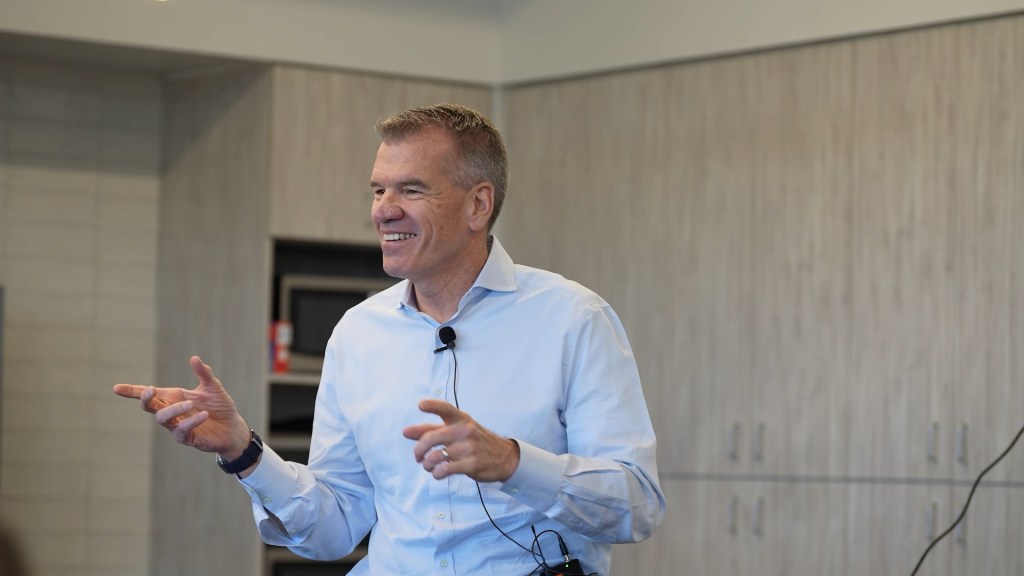
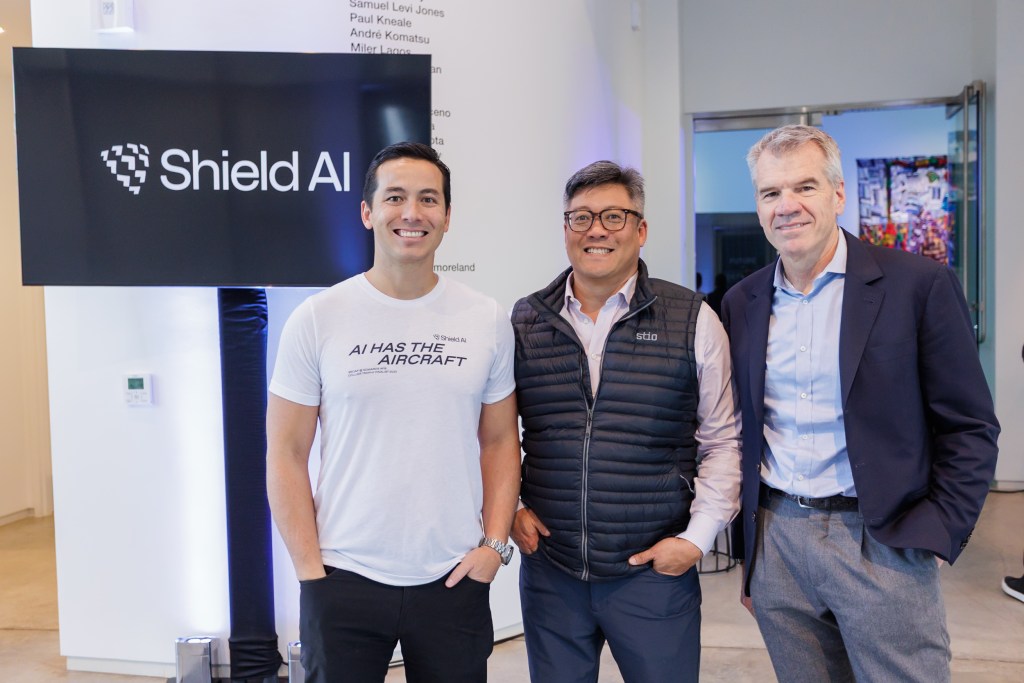
It’s also looking to a new CEO. In May, the company brought in a new chief executive—Gary Steele—who has a track record of taking tech companies to multi-billion exits. With Shield AI’s cofounder and former CEO, Ryan Tseng, stepping into another leadership position, Steele has plans to grow the company’s revenue 70%-100% each year until it hits $1 billion in annual revenue for the year ending March 2028, up from the approximately $300 million Shield AI notched in the year ending in March 2025.
“I think the number one thing I think about is: How do we scale this?” says Steele, who spoke with Fortune over two interviews, his first since being named Shield AI’s CEO.
It won’t be easy. As part of Shield AI’s strategy, the 1,200-person company will need to convince legacy defense shops that the AI-powered autonomous software Hivemind can do more than power Shield AI’s own drone. A gruesome accident in 2024—in which a U.S. Navy servicemember had the tips of his fingers effectively sliced off during a drill with the V-BAT—put a damper on last year’s revenue, and gave the company a public black eye that its executives are anxious to put behind them. And Steele, who is likable and seemingly adept at navigating internal politics, has walked into a leadership position notoriously difficult in the startup world: a CEO seat at a company where the founders maintain key leadership roles, board seats, and stakes in the business they created.
Shield AI is at an inflection point. Now Steele will have to prove that he’s the one who can take it to the next level.
Even before Anduril, there was Shield AI.
Brandon Tseng, a former Navy SEAL, partnered up with his brother after he, Ryan Tseng, had sold a startup to Qualcomm. The two of them, with cofounder Andrew Reiter, wanted to take the autonomy that Elon Musk and Jeff Bezos were promising would transform the auto and e-commerce industries and translate it to the battlefield. This was back in 2015—two years before Anduril started to take shape, and not long before protests erupted within Google over a contract it was renewing with the Department of Defense.
While Palantir had been securing government contracts for years, building military technology was rare among Silicon Valley tech-types at the time, not to mention exceedingly controversial. The Shield AI team turned down an initial $5 million investment because it had been contingent on Shield AI ditching its intended military focus and going commercial—which its founders weren’t willing to do. “It was really, really uncommon, if non-existent, for venture firms to be doing DoD-first companies,” says Peter Levine, a general partner at Andreessen Horowitz, who sits on Shield AI’s board.
As the venture capital-backed defense tech industry has matured, however, the Tseng duo have become synonymous with the industry and with the traction the sector has garnered since geopolitical tensions started climbing in 2021. That climb sped up, of course, in 2022, when Russia invaded Ukraine and views on the space shifted dramatically.
Shield AI had started with the now-discontinued quadcopter called the “Nova,” which, on first glance, looks like a superbly beef-ed up version of a drone you might buy at Radio Shack. Its innovation was in its tech stack, the AI-powered autonomous software system Shield AI calls “Hivemind,” which ingests data from onboard sensors—things like infrared cameras, radar, signals intelligence, and satellites—to build a model of its environment, then use AI to navigate, plan routes, avoid threats, and execute missions without the need for remote control.

With Hivemind, the quadcopter could go into the most dangerous parts of a building and gather intelligence of potential ambushes or hidden combatants, so soldiers wouldn’t have to walk in blind. The Nova has been used for several missions in the Middle East, inlcuding in October 2023, when Israeli forces used it to explore Hamas’ tunnel network below the Gaza Strip.
The Defense Department’s budget for quadcopters is relatively small, however, according to Ryan Tseng, so Shield AI pivoted in 2021 via its acquisition of the V-BAT, a towering surveillance drone capable of flying up to 18,000 feet and for 13 hours into enemy territory. The drone, which takes off and lands vertically, can fly from a ship or boat without a runway or launch mechanism, which has helped it notch contracts with the U.S. Coast Guard and Marines. But it’s the war in Ukraine that has really put V-BAT on the map.
Like many other U.S. defense startups, Shield AI donated technology and hardware to Ukraine’s military for testing and experimentation—for proof that their drones could stand up in a conflict zone. Many of those companies quickly came to realize that they couldn’t, including Shield AI.
The drones weren’t equipped to operate in areas where combatants could jam their communication signals or GPS, says Nathan Michael, Chief Technology Officer at Shield AI, who says the V-BATs they initially sent to Ukraine didn’t have Hivemind on board. “We had to come back and revisit our strategy,” he says.
It took roughly eight months for Shield AI’s tech team to incorporate Hivemind into the V-BAT. After the update, V-BAT underwent two new rounds of intense testing in summer 2024: a two-day test-run where seven jammers tried to knock it down, as well as a 60-mile test mission, where the V-BAT was used in jammed airspace to spot a Russian surface-to-air missile system and alert the Ukrainians, who hit it with a rocket. Both tests were successful, according to Ukrainian documents reviewed by Fortune, and Shield AI eventually sent over 16 V-BAT drones to Ukraine—most of them purchased by European allies—and they’ve been serving in the field ever since.
“I suspect that this year, more than half of our business is international”
Gary Steele, CEO, Shield AI
One of its most noteworthy missions thus far was in April, when a V-BAT flew some 80 kilometers into Russian-held territory, south of Zaporizhzhia, over two days to identify—then help destroy—two military headquarters and barracks, where Russian pilots and operators were remotely controlling the country’s highly-lethal FPV drone fleet.
New business has been pouring in in the months since, according to Steele. Shield AI started selling its V-BATs to the Netherlands, Ukraine, and Egypt this year. Steele wouldn’t give specifics, but said that Shield has “hundreds of millions” of dollars worth of new contracts in Asia, Europe, and the Middle East alone. And this summer, in late August, the Ministry of Defence of Ukraine formally named Shield AI one of its “verified business partners,” allowing it to compete for state procurement contracts and access programs—and making it a true player in the war effort.
“I suspect that this year, more than half of our business is international,” Steele says, noting that he arrived at the company “as this inflection was happening.”
Shield AI is currently manufacturing the V-BATs out of its 200,000‑square‑foot “Batcave” production and engineering facility outside of Dallas, where the company is building 200 aircraft per year, though it just inked a deal with the manufacturer JSW to eventually start producing them in India as well.

Shield AI either sells the V-BAT outright, or, as is the case for nearly all of its contracts with the U.S. military, serves as a contractor operating the V-BATs for the customer, and the orders or contracts range from 4 to 300 aircraft, according to the company. For purchase, each V-BAT costs about $1 million, though the cost can vary depending on how many the customer is purchasing or the tech that is integrated into the system. Shield AI also licenses Hivemind to customers, including Singapore and South Korea, as an autonomy software suite and developer platform. Hivemind made up approximately 30% of the company’s revenue in the 12 months ending in March 2025. While the company says it makes “some revenue” from the early demonstrations and integration work it is doing with primes, including Airbus, RTX, and Northrup Grumman, the future of that business line will largely depend on whether the Department of Defense eventually opts to purchase those products.
Steele was almost gliding around the light brown wooden floors of his San Francisco condo when we first met in August. He had left his loafers in his office and was enthusiastically sliding about in his grey slacks and socks, pointing out various paintings that scatter the walls of his second home, a corner apartment with floor-to-ceiling windows on the top floor of a skyrise near the Ferry Building.
“It’s hard to get the colors right,” Steele says as he points to a painting hanging in a guest bathroom. The artist, Doron Langberg, is one of many recent art school graduates that Steele began following on Instagram shortly after they graduated—a habit he picked up after he started collecting art in 2014.
Steele—with his kind smile and knack for an emerging artist—was not the pick one might have expected at the helm of Shield AI, whose drones have helped destroy some $400 million worth of Russian weapons.
Steele’s background is in software, running the companies Splunk and Proofpoint, which focused on data analytics and cybersecurity. Steele founded Proofpoint and says he scaled it to $1.5 billion in revenue before Thoma Bravo purchased it in an all-cash $12.3 billion deal in 2021. At Splunk, Steele came in when it was losing money, then sold it to Cisco two years later for $28 billion in 2024. Cisco kept him on, making him president of the company’s $55 billion go-to-market strategy.
He is confident—maybe even a bit smug—in his track record of returns. “If you look at my history at Proofpoint, literally every single investor made money,” Steele says. “Every single one.” That, he says, is one of the reasons that Shield AI’s board, lined with Silicon Valley investors from Andreessen Horowitz and Point72 Ventures that have backed the company, thought Steele would do well in the CEO seat.
“He has scaled very large companies,” Andreessen Horowitz’s Levine says. “We wanted an emphasis on software, because as we go forward, we intend to make that software available to many other organizations who will use that software on their hardware. And Gary had that background.”
Steele joined the company just as Shield AI had announced its most recent funding round, $240 million at a $5.3 billion valuation. Shortly after the round closed, Shield AI extended the round by raising an additional $300 million, hoisting its valuation to $5.6 billion, Fortune is first to report. In total, the company has raised $1.4 billion in equity and $200 million in debt—taking it from a GPS-denied quadcopter company to one of the most well-funded private defense companies in the U.S. and one of the definitive players working on autonomy in the private markets.
“They’re right there with Anduril,” says Ali Javaheri, an emerging tech analyst at PitchBook. “They have serious venture backing from the big firms. They have serious backing from the Primes. They are winning contracts.”
But Shield AI hasn’t enjoyed the same scale that Anduril has. Anduril said it had notched $1 billion in revenue in 2024. Shield AI, comparatively, hit $300 million at the end of its most recent fiscal year, according to the company. That was a $100 million shortfall of the $400 million it had been aiming for.
Shield AI credits the shortfall to an incident that took place during a test with the U.S. Navy in 2024, which was first reported by Forbes earlier this year. One of its V-BAT drones had tipped over during a test, and a Navy servicemember who rushed to capture it inadvertently grabbed the propeller and severed the tops of three fingers, according to a summary of the subsequent investigation, which was obtained by Fortune via a records request. The Navy’s investigation said that, because of poor signal, it took 45 minutes for anyone to get a hold of emergency services before the servicemember, as well as the pieces of his fingers on ice, could be transported to the hospital, according to witness testimony and findings from the Navy’s investigation. Shield AI says it had a Tactical Combat Casualty Care-qualified employee who provided immediate medical care on site and then initiated immediate ground transport to the nearest medical facility.
The incident was gruesome and publicly embarrassing. While most of the findings of the Navy’s subsequent investigation were redacted, the Navy documents say that Shield AI’s preflight brief packet didn’t have sufficient instructions for emergency procedures, and that Shield AI’s tip-over training did not include practical training exercises, according to the records. The V-BAT—even the drones operational and in the field—was grounded for two weeks as the investigation ensued, and it ended up delaying a series of contracts.
“Many purchasing decisions were delayed as a consequence of that investigation”
Ryan Tseng, Chief Strategy Officer, Shield AI
“Aviation is dangerous. Machines are complicated, and through a Swiss cheese situation, a person lost their fingertips, and it was an unfortunate event,” says Ryan Tseng, who was still CEO at the time of the incident. After the incident, the company added a warning on the duct surrounding the propeller, along with “extensive” hands-on practical exercise requirements. It later rolled out an unassisted launch and landing capability that eliminated the need for a person to be involved at all.
Tseng described the Forbes story about the incident as “sensationalized” and contested the notion that there were any deeper-rooted safety issues at the company, or that the accident had any relation to his decision to step aside. While “many purchasing decisions were delayed as a consequence of that investigation,” Tseng says, “for a long time, it’s been back to normal.”
In interviews, Ryan Tseng and Levine emphasized that it was Tseng’s idea to step into the chief strategy officer role and bring on a new CEO. “He wasn’t pushed out,” Levine insists, adding: “It’s not like he did anything wrong.”
Ryan Tseng says that, as the company hit 1,000 employees, he questioned whether he was the person to take it to 5,000 people. “I’ve told people, and I don’t think they believe me, but I’ve never felt a particular attachment to the CEO role,” Tseng says. Tseng says he first approached the board this past winter, but they encouraged him to stay on. After the funding round closed, he suggested they revisit the conversation.
About seven months into the leadership transition, the Tseng brothers and Steele say they have found a balance and that they talk every day. Ryan Tseng has moved into the strategy role, where he oversees corporate development and M&A. Brandon Tseng, who is based out of Washington, D.C., continues to lead growth and is focused on customers and investor relationships. Steele is focused on running the business, making money, and bringing on new people, having hired four new executives since he joined, including a Chief Legal Officer and Chief Marketing Officer.
“This transition between Ryan and Gary has been the best transition from a founder to a new CEO that I’ve ever seen. And I’ve been around for a while,” Levine says.
But proof will come with time, as these kinds of transitions can be exceptionally difficult to pull off. Sometimes cofounders struggle to give up control in the company they’ve built themselves, or become skeptical their replacements are doing an adequate job. Bumble founder Whitney Wolf Herd, for example, stepped back as CEO in 2023, only to come back around one year later after a rocky few months at the company. Or at Uber, when CEO Travis Kalanick stepped back from his position but remained on the board, there were reports of conflicting vision and power struggles.
When asked about the dynamic between himself and the Tseng brothers, Steele says he was well aware of the importance of their roles, because he was a founder himself. “I understand what that means,” he says, noting that he wouldn’t have joined the company if he didn’t feel like they could work well together. “I needed to feel like we saw the world in a similar way,” he says. For him, he says he was convinced that the Tseng brothers approached the world with the same instincts as him, a “relentless” work ethic, and a “hands-on, problem solver’s mindset.”
The company wouldn’t share what voting power the brothers still have, only that they are “still significant shareholders.” The company said that Shield AI “operates with a mature governance structure and an independent Board. No single individual has the ability to make leadership changes on their own; those decisions rest with the Board as a whole, just like any well-run company.”
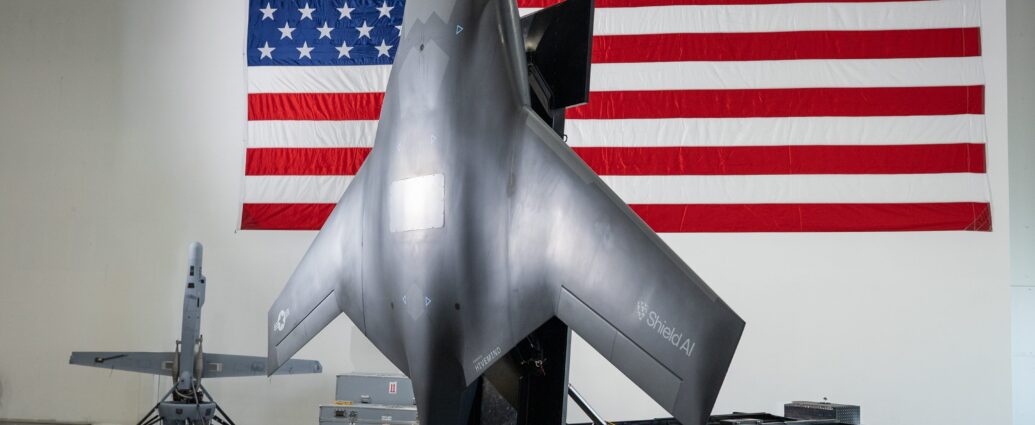
At the end of October, Shield AI unveiled a brand-new product: an autonomous fighter jet with a 2,000-mile nautical range called the X-BAT. Shield AI has been working on the X-BAT for 18 months, designing a massive vertical take off and landing aircraft that wouldn’t need a runway, according to Brandon Tseng. Shield is aiming to have its first test flight sometime next year, and start production in 2029. The X-BAT is intended to complement the V-BAT, which is proving to be the company’s workhorse—at least for now.
But in the meantime, Shield AI wants to put more emphasis on the Hivemind software to meet its lofty revenue goals—hoping that product will make up 50% of the company’s revenue by 2028. While the company currently licenses its software out to foreign governments to use on their defense systems, it also wants to lean further into partnerships with the “primes”—the behemoth military contractors that have been the primary customers of the U.S. military for decades—so that Hivemind can eventually be incorporated into everything from helicopters to fighter jets.
So far, Shield AI is working with eight of the military’s main 25 contractors, according to Ryan Tseng. For starters, it is being incorporated into General Atomics’ MQ-20 unmanned combat aerial vehicle, a Kratos BQM-177A target drone, and an Airbus H145 twin-engine light utility helicopter.

But, importantly, these have been demonstrations, not deployments, with little revenue. Shield AI still has to prove its capabilities to these primes—and eventually to the Defense Department—before they would roll the technology out widely. “The customer has to have confidence to go do this,” Steele says.
One of those early partners is Airbus, which started working with Shield AI in spring 2025 on an Airbus DT25 target drone as well as an autonomous developmental Lakota helicopter that it hopes to deliver to the Marine Corps in the next “couple of years,” according to Carl Forsling, director of business development and strategy at Airbus. “If that’s successful, then that market is going to continue to expand—both with the Lakota and potentially other platforms,” Forsling says.
Steele emphasized that the company wants to position itself across a series of platforms. “While we’ve been very focused on aircraft, because that’s the place we started, there’s tremendous opportunity as we cross domains,” he says.
PitchBook’s Javaheri pointed out that Shield AI is likely to benefit from the Defense Department’s recent decision to hone in its 14 priorities down to six, one of which is “applied artificial intelligence” systems, which would include autonomy. “Aerospace and defense autonomy is the name of the game, and Shield AI is one of the leaders in that,” he says.
While defense tech companies are becoming increasingly prevalent in Silicon Valley—and Washington, D.C.—there is something intrinsically different about a defense company than its enterprise or consumer counterparts, even if the same storied venture capital firms have begun backing all of them.
Shield AI is a case in point. For one, its makeup: 18% of its 1,200 employees are veterans, including Shield AI’s head of communications, Lily Hinz, who served in the Navy. Nearly all of the 30 employees stationed in Kyiv are former Ukrainian soldiers.
But more importantly, there’s a difference in mentality and approach—perhaps due to the high stakes and real-life consequences of the projects people work on and the soldiers they work on them for. This is very evident from Shield AI’s 41-page document explaining its culture, which the company publishes on its website. In it, cofounder Brandon Tseng lays out a personal anecdote behind one of the company’s values—“do what honor dictates.” He writes about how one of his Navy SEAL instructors had dragged a team member to safety with one arm after being shot in the other.
“While there are many ways to conduct ourselves, we choose to act in a manner that is moral, good, and of high standards—leaving the world better than we found it, simply because it’s the right thing to do,” Tseng wrote.
“‘Move fast and break things’ is the wrong mantra when ‘things’ are people and escalation paths.”
Garrett Smith, CEO, Reveal Technology
There are ethical grey areas for defense tech companies that don’t exist in the rest of Silicon Valley—when you build a surveillance machine or a weapon, and when the thing that you build is responsible for saving human life, or for taking it. “It’s a huge responsibility to get it right,” says Ryan Gury, who had a background in consumer drones before he started the defense drone company PDW. “You’re selling equipment that is going to extend the life and lethality of our operators.”
Garrett Smith, an active Marine Officer who is CEO of the tactical edge tech company Reveal Technology, says that, when a product lives in a “life-and-death” environment, it “changes everything.”
“You prioritize reliability, safety, and mission outcomes over vanity metrics. You also have to think about escalation dynamics and law-of-war implications in a way a typical startup never does,” he says. “‘Move fast and break things’ is the wrong mantra when ‘things’ are people and escalation paths.”
Several tech companies that operate in this space have set up teams to wrestle with these topics. Palantir has a “Privacy & Civil Liberties Engineering” team designed to “foster a culture of responsibility” around how their technology is used. Even then, Palantir is extraordinarily controversial among many, particularly because of its contracts with Immigration and Customs Enforcement.
Risk is very real for Shield AI employees. In contractor-operated deals, as well as in complex, high-risk environments, employees are often stationed for months on the ground (or at sea) where its drones are deployed. In Ukraine, its 30 operators regularly travel between cities to support mission planning, monitor sorties, and troubleshoot in real time to adapt to new threats and feed lessons learned back into the V-BAT.
That level of proximity is all about trust, according to Lythgoe, Shield AI’s head of Ukrainian operations, who says that, if you are going to ask a soldier to trust their life with your technology, you need to be able to prove that you are just as committed to them. That has meant Lythgoe has only been home with his wife back in the U.S. four weeks over the last year, which is “not ideal,” he admits. “That is the job, I believe,” Lythgoe says. “Inherently, it’s the role of the defense sector to understand problems and to give the war fighter the edge. And to do that, you have to understand the problem, otherwise you’re guessing. And so you really do need to be close to the problem to do that.”
It’s curious, then, that Shield AI’s new CEO talks in circles about whether he feels a heightened sense of responsibility running a defense tech business, and seems uncomfortable to be asked about it at all. When asked about increasing disagreement about U.S. involvement in Ukraine or the controversy around the Coast Guard carrying out the Trump Administration’s agenda for Venezuela, he said: “We literally spend no time talking about the politics of particular missions.” While Steele acknowledged Shield AI has different protocols and processes because there is “human life involved,” he repeatedly stated that Shield AI isn’t much different from other tech companies. His focus is on the “mission,” he says, and how to “deliver the customer outcomes.”
Update, December 21, 2025: This story was updated to reflect that the Batcave facility is now 200,000 square feet.
This story was originally featured on Fortune.com

For decades, Americans were given the same advice about money: Find a good financial adviser. Trust the person, not just the process.
That model worked when markets were simpler, tax laws changed more slowly, statements arrived quarterly and financial decision-making wasn’t so complex. But today, investors are navigating inflation, volatile markets, rising debt and rapid policy shifts — all while still relying on advice that’s often reactive, emotional and outdated.
And now comes an uncomfortable truth Wall Street doesn’t love talking about.
Artificial intelligence may soon be a better financial adviser than most human beings.
And this comes from a person who has been giving financial advice to thousands of families over the past 34 years and also sees the handwriting on the wall for financial advisers over the next decade.
Not in theory. In practice.
Every market crash teaches the same lesson. People panic. They sell at the bottom. They chase hot investments after the run-up is already over. They invest in their friend’s new restaurant that doesn’t stand a chance. They buy cryptocurrencies nobody has ever heard of. Since the dawn of time, people have looked for a get-rich-quick scheme that will help them retire tomorrow.
This behavior alone destroys more wealth than taxes, fees or recessions combined.
THIS IS WHY YOU MAKE SIX FIGURES AND STILL LIVE PAYCHECK TO PAYCHECK
Human advisers aren’t immune either. They read the same headlines. They feel the same pressure when clients demand action. They try to keep up with the Joneses as well. Even the best intentioned advisers can let emotion creep into decisions.
AI doesn’t.
It doesn’t get scared. It doesn’t get greedy. It doesn’t care what social media, cable news or your neighbor is doing with their money. It follows data, probabilities and rules every single time.
Over the long run, discipline beats emotion. Just ask Warren Buffett. Machines are built for discipline.
Most Americans meet with their financial adviser once or twice a year. That’s like checking your smoke alarm annually and hoping nothing catches fire in between.
It can monitor your…
Spending patterns
Cash flow
Debt situation
Risk exposure
Tax efficiency
… in real time.
When something changes, AI can react immediately — not at the next scheduled review. And most advisers aren’t looking closely at your debt, credit cards, household budget or the small decisions that add up in your financial life. That alone puts traditional advice at a disadvantage.
AI SCAM ALERTS NOW ON VENMO AND PAYPAL: WHAT YOU NEED TO KNOW
High-quality financial advice has long been reserved for the wealthy. Everyone else often gets generic portfolios like a 60/40 allocation and product-driven recommendations loaded with commissions.
AI flips that model on its head.
It can deliver ongoing guidance, planning insights and behavioral coaching at a fraction of the cost — without commissions, quotas or sales pressure. Would you pay $19.99 a month for a 24/7 financial-coach subscription? You already pay $19.99 for Netflix, and it’s not getting you any closer to retirement.
That’s why everyday investors should start experimenting now. Tools like TheBuckGuru.com an AI-powered financial coach, allow people to stress-test decisions, improve financial habits and get real-time feedback without judgment or sales pitches. It can even develop actionable game plans that integrate directly into your calendar.
Here’s the part that makes some financial advisers uncomfortable.
The average financial adviser is replaceable. The good ones may not be, because they act as much more than advisers. They are financial therapists, marriage counselors, super-connectors and career counselors — and they still bring an art form to their work that AI simply can’t replicate today.
RETURN TO OFFICE GAINING MOMENTUM AS AI RESHAPES CORPORATE STRATEGY
Average advisers are not bad people, but much of what they do can be replaced because their advice, portfolios and service are very basic.
The advisers who will thrive in the future won’t fight AI. They’ll use it.
They’ll let technology handle monitoring, calculations and execution while human advisers focus on what machines can’t do well right now: managing intuition and emotions. That includes major life transitions, complex career planning, family dynamics and stopping clients from making catastrophic emotional mistakes like pulling their money out at exactly the wrong time.
AI won’t eliminate financial advisers — we heard this story before with the robo-adviser.
But it will expose the ones who add little value beyond the 60/40 portfolio and paperwork.
GET FOX BUSINESS ON THE GO BY CLICKING HERE
It will raise the standard for advice, lower the cost for consumers and force an industry built on tradition to finally modernize over the next decade.
For investors, that’s good news.
Because when it comes to your money, the smartest adviser in the room may soon be the one without a pulse — and in an age of emotion-driven mistakes, that may be exactly what your financial future needs.
Ted Jenkin is president of Exit Stage Left Advisors and partner at Exit Wealth.
Women in America are having as many babies over their lifetimes as they did two decades ago
This post was originally published here
They are taking on war, corruption and China
This post was originally published here
A surprisingly large share of companies lag far behind their former greatness
This post was originally published here
We interview three financial sleuths
This post was originally published here
The industry is supplanting Wall Street’s privileged position on the American right
This post was originally published here
Its endless bureaucratic rules trap would-be reformers
This post was originally published here
The baijiu business is the latest to be struck by “involution”
This post was originally published here
Scott Bessent has a cunning plan
This post was originally published here
The world’s most fragmented financial industry faces dramatic change
This post was originally published here
Tech mania looks very different in Japan, South Korea and Taiwan
This post was originally published here
Our annual ranking returns
This post was originally published here

Mexico’s anti-money laundering office has frozen the bank accounts of the Mexican co-owner of Miss Universe as part of an investigation into drugs, fuel and arms trafficking, an official said Friday.
The country’s Financial Intelligence Unit, which oversees the fight against money laundering, froze Mexican businessman Raúl Rocha Cantú’s bank accounts in Mexico, a federal official told The Associated Press on condition of anonymity because he was not authorized to comment on the investigation.
The action against Rocha Cantú adds to mounting controversies for the Miss Universe organization. Last week, a court in Thailand issued an arrest warrant for the Thai co-owner of the Miss Universe Organization in connection with a fraud case and this year’s competition — won by Miss Mexico Fatima Bosch — faced allegations of rigging.
The Miss Universe organization did not immediately respond to an email from The Associated Press seeking comment about the allegations against Rocha Cantú. Mexico’s Secretary of Security and Citizen Protection, Omar García Harfuch, publicly dismissed potential wrongdoing.
“We have no indication whatsoever that there is money from organized crime involved in the Miss Universe pageant, none whatsoever,” Harfuch said in a report by PubliMetro. “Nor have we found anything related to the pageant itself in connection with the corresponding investigations.”
Mexico’s federal prosecutors said last week that Rocha Cantú has been under investigation since November 2024 for alleged organized crime activity, including drug and arms trafficking, as well as fuel theft. In November 2025, a federal judge issued 13 arrest warrants for some of those involved in the case, but on Dec. 26, 2025 another judge issued a definitive suspension of the order, which halts authorities from taking action against Rocha Cantú that could cause irreparable harm to his rights while the case is resolved.
The organization’s other 50% belongs to JKN Global Group Public Co. Ltd., a company owned by Jakkaphong “Anne” Jakrajutatip.
A Thai court last week issued an arrest warrant for Jakrajutatip who was released on bail in 2023 on the fraud case. She failed to appear as required in a Bangkok court on Nov. 25. Since she did not notify the court about her absence, she was deemed to be a flight risk, according to a statement from the Bangkok South District Court.
The court rescheduled her hearing for Dec. 26.
Rocha Cantú was also a part owner of the Casino Royale in the northern Mexican city of Monterrey, when it was attacked in 2011 by a group of gunmen who entered it, doused gasoline and set it on fire, killing 52 people.
Baltazar Saucedo Estrada, who was charged with planning the attack, was sentenced in July to 135 years in prison.
This story was originally featured on Fortune.com
To understand why, consider the side-blotched lizard
This post was originally published here
Communist Party officials think so
This post was originally published here
It holds 3% of the world’s total supply
This post was originally published here
In time, though, its tankers will find new routes
This post was originally published here
And with Sweden embarking on a borrowing spree, it is a bond trader’s paradise
This post was originally published here
He was once a right-of-centre tax expert. He has become a partisan hack
This post was originally published here
Forget valuations. Look out for search-engine hits and fund managers getting fired
This post was originally published here

Bosses, investors, policymakers—all are fearful of a jobs-pocalypse
This post was originally published here
A robotaxi boom is coming. The impacts might be broader than you expect
This post was originally published here
Government remedies are not up to the job
This post was originally published here
Socialist employment restrictions will be swept away
This post was originally published here
If voters dislike big numbers, there is a purely nominal fix
This post was originally published here
Private markets present fearsome challenges
This post was originally published here
Recent surveys point to flatlining business adoption
This post was originally published here
Everyone knows share prices have a long way to fall. Even so, getting out now might be a mistake
This post was originally published here
Remittances may fall, but opportunities are opening up
This post was originally published here
Governments are pushing the policy to its limits
This post was originally published here
Xi Jinping has lofty goals for 2035. But China faces a real problem
This post was originally published here
Donald Trump’s remedies threaten to inflame a housing crisis
This post was originally published here
The slump could spread across financial markets
This post was originally published here
As bullish stories get tested, investors should worry
This post was originally published here
Rich people can’t stop cutting down each other’s woodland
This post was originally published here
And leading to lower pay
This post was originally published here
It may widen inequality. But it has many advantages
This post was originally published here
Investing in equities may make sense for individuals—but it could also exacerbate a crash
This post was originally published here
Continuous growth can make economies fat and slow
This post was originally published here
Gridlock in Washington has prevented official data releases. And unofficial ones disagree
This post was originally published here
In a tricky neighbourhood the country remains calm
This post was originally published here
The white-collar chill has more to do with the economy than with tech
This post was originally published here
Its growing popularity in America is a concern
This post was originally published here
The country’s economic problems are real, but its assets are doing surprisingly well
This post was originally published here
No matter its ruling, the president has back-up powers
This post was originally published here
Its leaders don’t seem concerned. Should they be?
This post was originally published here
Even the best traders struggle to predict sudden jumps in volatility
This post was originally published here

Are data centers the new REIT? Not quite — but Meta’s new mega–data center in northeast Louisiana marks what one expert calls a “decisive shift” in how hyperscalers finance the AI era: by turning data centers into a new investable asset class.
“This is where capital markets meet compute,” said Sean McDevitt, a partner at management consulting firm Arthur D. Little, which provided commercial due diligence advice to Meta.
Traditionally, tech giants like Meta, Google, and Microsoft have funded their data center buildouts directly. This time, Meta is partnering with Blue Owl Capital, a private-credit investment firm, on the $27 billion data center known as Hyperion. As reported by The Wall Street Journal, Blue Owl owns 80% of the project, while Meta holds 20%, operating and leasing the facility long-term. BlackRock bought more than $3 billion of bonds that the joint venture (dubbed Beignet) issued last week to finance the project, in a sale arranged by Morgan Stanley.
The deal stands out for its scale—the largest private-debt offering ever—and for its A+ rating from S&P, which reflects Meta’s backing of the project (albeit with just a single agency rating). Yet the debt had a yield of 6.58% at issue, a level closer to high-yield, or “junk,” bond territory.
That structure allows Meta to build its data center without putting the full $27 billion of debt on its own balance sheet. The approach—known as a special-purpose vehicle (SPV) or off–balance-sheet financing—is largely new territory for hyperscale infrastructure.
“By being able to access outside capital, you’re not limited to your own free cash flow generation,” McDevitt said. “You’re bringing on investors with return profiles on an infrastructure-type investment that allows companies to build bigger, larger, quicker, and faster.” He compared it to taking out a mortgage: you can buy a bigger house—or, in this case, build more data centers—by borrowing instead of paying cash up front.
McDevitt believes the Hyperion deal could become a template for the industry. He estimates that roughly $150 billion in AI-driven data center construction is coming in the next few years. If other hyperscalers—Microsoft, Google, Amazon, and OpenAI among them—adopt similar models, capital markets rather than tech companies themselves will effectively fund the infrastructure of the AI era. “This is replicable,” he said, though he cautioned that it remains to be seen how the project performs in practice.
“Now what has to happen? Meta has to build this thing, then put workloads in it and operate under the presumption that they’ll monetize those computing loads driven by AI in the future,” McDevitt added.
That is precisely where criticism of the deal lies: According to Global Data Center Hub analysis, “If AI workloads or margins stumble, these SPVs could echo the dark-fiber overbuild of the 1990s vast capacity sitting idle while debt remains outstanding.”
Still, for now, there’s no reason to think other major banks won’t try the same thing, said McDevitt. “Why wouldn’t others look to mimic [this deal]?”
Sharon Goldman
X: @sharongoldman
Email: sharon.goldman@fortune.com
Submit a deal for the Term Sheet newsletter here.
Joey Abrams curated the deals section of today’s newsletter. Subscribe here.
This story was originally featured on Fortune.com
The country is in line for a pay-out from catastrophe bonds
This post was originally published here
In the age of Donald Trump, national autonomy requires deeper integration. Brazil shows why
This post was originally published here
Stockmarkets appear to be fuelling investment
This post was originally published here
How the shift to state capitalism is panning out for America LLC
This post was originally published here
From finance and medicine to used cars, artificial intelligence is radically improving market efficiency
This post was originally published here
Xi Jinping is desperate for Trump-proof access to food, fuels and metals
This post was originally published here
How cigarette manufacturers profit from quitters
This post was originally published here
Donald Trump raises the pressure—but he may have to go further
This post was originally published here
So long as its leaders are not lying
This post was originally published here
It promises a level playing field. So have past technologies
This post was originally published here
It may not end well
This post was originally published here
Despite the best efforts of Donald Trump and Scott Bessent
This post was originally published here
Guest-worker schemes are booming. They offer vast benefits to both host countries and the workers themselves
This post was originally published here
An opportunity to join the staff of The Economist
This post was originally published here
Maybe they are becoming tradwives. Or maybe there is a more straightforward explanation
This post was originally published here
Can anything bring it down?
This post was originally published here
Both banks and private-markets giants are on cockroach-watch
This post was originally published here
A model that has lifted millions out of poverty is threatened by rising defaults
This post was originally published here
A postcard from one of America’s youngest towns
This post was originally published here
Their latest earnings do not represent unalloyed good news
This post was originally published here
As America and China clash over trade, cracks emerge in each side’s position
This post was originally published here
A thought experiment on the nearest thing to a safe asset
This post was originally published here
Our Money Talks podcast team is recruiting an experienced producer to help launch a video spin-off
This post was originally published here
The Nobel committee is belatedly recognising economic history
This post was originally published here
Forget fine wine, great art and glitzy mansions. There are finer things in life
This post was originally published here
Donald Trump threatens an extra 100% levy as rare-earth minerals prompt a fresh spat
This post was originally published here
What happens in the event of a slump?
This post was originally published here
How to survive on the border of war
This post was originally published here
The prime minister wants a $10trn economy by 2047. He should be bolder
This post was originally published here
Forget debt. Here is something to villainise
This post was originally published here
Six months on from “Liberation Day”, things look surprisingly rosy
This post was originally published here
Closed borders will make the country smaller, poorer and less innovative
This post was originally published here
Even the most sophisticated arguments in favour of doing so make no sense
This post was originally published here
A pair of bankruptcies highlight the risks
This post was originally published here
America’s international assistance has not been destroyed—it has been transformed
This post was originally published here
Introducing the 25/25/25/25 portfolio
This post was originally published here
The “wealth effect” is not the only way it has an impact
This post was originally published here
Waymo is a case study in automation
This post was originally published here
How other countries hope to challenge America
This post was originally published here
And that worries regulators
This post was originally published here
Despite fears of a reckoning, its fundamentals look solid
This post was originally published here
In an age of artificial intelligence, the human kind is increasingly important
This post was originally published here
The good times have firmly come to an end, but wage growth remains strong
This post was originally published here
Donald Trump has so far avoided retaliation, which might carry a cost of its own
This post was originally published here
The continent’s labour market is ill-suited to an age of disruption
This post was originally published here
They may work in factories or for delivery apps, but are united by common struggles
This post was originally published here
Without funding, the country will be left vulnerable
This post was originally published here
The hottest places to invest are on the continent’s periphery
This post was originally published here

As the Federal Reserve cuts interest rates, growth is holding up
This post was originally published here
Understanding the new economics of attention
This post was originally published here
Prices are close to a five-year low
This post was originally published here
Or is it a sovereign-wealth fund in disguise?
This post was originally published here
The Federal Reserve prepares to cut interest rates in tricky circumstances
This post was originally published here
Even if there is plenty that could yet kill it
This post was originally published here
The rest of the world is willing to be “ripped off”
This post was originally published here
We find that the potential cost has risen alarmingly high
This post was originally published here
Its rise might yet follow the path of previous technological revolutions
This post was originally published here
With any luck, the stand-off might focus politicians’ minds
This post was originally published here
It has moderated, but offers little hope of growth-boosting reform
This post was originally published here
Lessons from lithium’s fake rally
This post was originally published here
But would the country’s leaders really want stablecoins to succeed?
This post was originally published here
The torment caused by covid-19 and high interest rates appears to be over
This post was originally published here
Blame China, slumping commodities and creaky growth
This post was originally published here
New research shows the importance of central-bank credibility
This post was originally published here
Bet on stocks in a prediction market run by a sports-betting firm and a futures exchange
This post was originally published here
Just consider what happens if inflation starts to rise again
This post was originally published here
How strong is the evidence, and how bad would it be if the claims were true?
This post was originally published here
Even though doing so flies in the face of most financial advice
This post was originally published here
We invite applications for our Marjorie Deane scheme
This post was originally published here
The Shanghai composite is defying gravity
This post was originally published here
There is little precedent: no Fed governor has been dismissed for cause before
This post was originally published here
Politicians, particularly in Europe, are in a terrible bind
This post was originally published here
Their discipline is famous for its fissiparousness
This post was originally published here
Forget about northern Europeans, with their coalition governments and love of cycling
This post was originally published here
Communist Party officials face a difficult ideological turn
This post was originally published here
And China is gaining in the process
This post was originally published here
To understand markets, forget Occam’s razor
This post was originally published here
Beware the data-centre takeover
This post was originally published here
We update our entrenchment measure
This post was originally published here
In Asia, East Africa and the Gulf leaders now face an unpleasant choice
This post was originally published here
Kandinsky, Monet and Rembrandt were economists as well as artists
This post was originally published here
New rates mean new “China plus one” locations
This post was originally published here
Investor optimism means the duo are outperforming Nvidia
This post was originally published here
The borrowers, including Harvard, Princeton and Yale, benefit from a “prestige premium”
This post was originally published here
What would make it worth buying?
This post was originally published here
For the country’s homeowners, the good times are coming to an end
This post was originally published here
It is both impressive and worrying
This post was originally published here
Forget your trip to the dentist. A new check-up is required
This post was originally published here
A recent study suggests a new paradigm for asset pricing
This post was originally published here
A crackdown on Russian crude would have knock-on consequences
This post was originally published here
Even once-fecund states are having fewer children
This post was originally published here
Buy that burrito, and don’t let anyone judge you
This post was originally published here
Six charts show the damage to America, its trading partners and its consumers
This post was originally published here
Oil and terrorism are not the country’s only exports
This post was originally published here
The bloc opts for prudence over defiance
This post was originally published here