REMAX co-founder Gail Liniger dies at 81
2026-08-27


Want to stay on top of the science and politics driving biotech today? Sign up to get our biotech newsletter in your inbox.
Today, we look at how a China biotech crackdown could benefit Europe, what a rival drug failure might mean for Alnylam, the algorithm behind the Moderna-Merck cancer vaccine, and a landmark approval in pancreatic cancer.

I’m 43 years old, and like other members of my millennial generation, I’m not sure I’ll ever get Social Security benefits. It’s not top of mind for me right now, other than my role as a financial journalist, but the trust fund is due to run out in 2032, and the automatic 22% cut that follows won’t distinguish between who has been paying in and who has been drawing down.
But Social Security is perhaps the most vivid example of a pattern you see everywhere across the economy: Baby boomers hold the wealth, millennials carry the costs, Gen Z inherits the receipts. Several months ago, I used a metaphor first coined in 1974 by New York Times humorist Russell Baker to describe baby boomers’ impact on the economy around them: They are like a “pig in the python,” a bulge of 76 million being passed through America’s economic system, distorting everything along the way. A new analysis from the Committee for a Responsible Federal Budget, although it doesn’t use any generational framing, reinforces this fact.
The nonpartisan budget watchdog, revisiting one of its favorite subjects, found that Americans retiring this decade are on track to collect, in the form of entitlements, about 133% of everything they and their employers paid in taxes, measured in present-value dollars. Strip out the employer match, and the return nearly doubles: Roughly 265% of what workers put in themselves. A median-wage retiree in 2027 will collect about $730,000 in lifetime benefits on combined contributions of less than $200,000. The math holds together because today’s payroll taxes are covering the gap. Who pays those taxes, and who is retiring and collecting? Largely millennials and baby boomers, respectively.
In nominal dollars, the gap is even more dramatic. A median-wage worker retiring in 2027 can expect about $730,000 in lifetime Social Security benefits, compared with less than $200,000 paid in taxes by that worker and their employer combined, according to CRFB. Benefits outpace total taxes paid after just six years of collecting. They outpace the worker’s own direct contributions after only three.

The pattern holds across the income spectrum. CRFB found every income quintile of this decade’s retirees is scheduled to receive at least as much as they paid in. The bottom quintile does best in relative terms, collecting about 266% of combined taxes paid—532% of their own share alone. Middle-income retirees average 147% of combined taxes, or nearly 294% of what they personally contributed. Even the wealthiest retirees, who come closest to a one-to-one match, still collect roughly double their own direct payments once you exclude the employer share.
None of that surplus is being paid for by some accumulated boomer nest egg. It’s paid for by payroll taxes taken from paychecks of the working-age population today—a population increasingly made up of millennials moving into their prime earning years, alongside Gen X.
“The reality is that Social Security is not a savings program where workers’ payroll tax contributions are saved in an account and used to pay their benefits,” the CRFB writes. “Nor are benefits based on or calculated to match a workers’ payroll tax contributions. Rather, Social Security is a pay-as-you-go social insurance program where current workers’ payroll taxes finance the benefits of current retirees.”
The reason this arithmetic works at all—and the reason it’s now breaking down—comes down to a ratio that has been shrinking for eight decades. Social Security was built as a pay-as-you-go system, meaning it depends on there being enough workers paying in to cover the retirees drawing out. When the program was young, that ratio was overwhelming: more than 16 covered workers for every beneficiary in 1950. By 1960 it had fallen to about 5 to 1. Today it sits around 2.7 workers per beneficiary, and both the CBO and the Social Security Trustees project it will keep falling toward roughly 2 to 1 within a couple of decades.
That decline is the mechanical explanation for why benefits can run so far ahead of what any individual retiree paid in. Fewer workers are splitting the cost of supporting a larger, longer-living retired population. It’s also why the same benefit formula that pays out 33% more than it collects in taxes today is projected by the Social Security Trustees to cost 35% more than it collects in revenue over the next 75 years.
The consequence is a financing cliff that’s now closely dated. Social Security’s retirement trust fund is projected to be depleted in 2032, with the combined retirement and disability trust funds exhausted by around 2033 or 2034. After that point, according to the SSA Trustees Report, incoming payroll taxes alone would cover only about 78% of scheduled benefits—triggering an automatic, across-the-board cut of roughly 22% unless Congress intervenes before then.
Social Security’s math is the latest chapter in a broader story about how one outsized generation keeps reshaping the systems it moves through. The framing of the “pig in the python” is less about assigning blame to any one generation than describing a structural pattern: a large cohort passing through an economy built around smaller cohorts, bending the system to its scale at every life stage.
Baby boomers didn’t design Social Security’s pay-as-you-go structure, and they aren’t the first generation to collect more than they paid in: Every cohort of retirees since the 1940s has received a similarly favorable deal, back when the worker-to-beneficiary ratio was far more forgiving. Boomers also spent decades paying payroll taxes that built up the trust fund surplus now being drawn down to help cover the shortfall.
CRFB’s analysis isn’t an argument for slashing current retirees’ checks. The group is explicit that the goal isn’t to “indiscriminately cut current benefits to match past contributions,” but to stop treating the existing benefit formula as untouchable given that it’s scheduled to pay out far more than it takes in.
For this story, Fortune journalists used generative AI as a research tool. An editor verified the accuracy of the information before publishing.
This story was originally featured on Fortune.com

Kids under 18 will soon see a host of changes to their Instagram and Facebook experiences thanks to a historic $18 billion settlement Meta Platforms reached Wednesday with 48 U.S. states.
Besides the money, which will be paid out over a decade, Meta has agreed to strengthen its age estimates to keep kids under 13 off its platforms and teens in age-appropriate accounts, enact a hard limit of two hours a day for users under 18, block kids from the apps from midnight to 6 a.m., and hide “like” counts, among other changes.
Meta said the new safeguards will only apply in the United States, with most in place for 10 years.
While acknowledging the changes go further than Meta has ever gone when it comes to child safety, critics and children’s advocates cautioned it will not solve its myriad problems overnight.
Arturo Béjar, a former Meta engineering director, said the settlement is a “significant milestone,” but parents should not see Instagram as suddenly safe for children.
“The agreement has a big problem in that it allows Meta to define harm,” Béjar said in an interview Wednesday. “It’s one thing to say, ‘Yeah, you only get like two hours of alcohol or two hours of cigarettes a day,’ but it’s still as bad for you because of what’s getting delivered.”
Béjar, the first witness to testify during the federal trial cut short by the settlement, would like to see Meta address the effect of content recommendations to teens, which he says can prove addictive. While teens might put their phone down when they hit the two-hour limit, they can be distressed about it because the way the platform is designed leaves them craving more.
Meta said people over 18 also can adopt versions of the new controls individually, such as daily time-limit reminders, but there will not be an option for them to opt into the overall settings for what teens experience on the platform.
To protect kids, first Meta has to know who they are. While the company has already been using artificial intelligence to determine if kids are lying about their age — either to sign up if they are under 13, which is not allowed, or to use adult accounts when they are 13 to 17 — it did not always work.
Under the proposed settlement, Meta agreed to strengthen its technology to check kids’ ages, using its own as well as third-party tools, with regular outside audits on how well it is working. The agreement also includes specific goals around false positive rates — that is, minors who are identified as over 18. And if a user is identified as under 13 and kicked off the platforms, Meta will check the ages of their friends, too.
“The age assurance section is reasonably good because it has measurement, has independent testing, has goals,” Béjar said. “Because I think Meta should be measured on effectiveness, not effort.”
Meta requires users to be at least 13 years old to create an account, in line with federal child privacy law.
In his testimony last week, Béjar said Meta took a “don’t ask, don’t tell” approach on kids under 13 on its platforms.
“Meta has one of the most sophisticated infrastructures in the world to detect fake accounts,” he said. But despite that, he added, there were “no goals, no metrics” to detect and check kids’ ages who were suspected to be under 13.
Critics have faulted Meta over many of its safety features that users have to manually turn on, or opt into themselves.
Of the host of safeguards listed in the settlement, many are on as a default. This includes the two-hour time limit, which can only be turned off with a parent’s permission, as well as the night mode that blocks use between midnight and 6 a.m.
Still, under the agreement other features, such as turning off video autoplay or showing posts in chronological order rather than having algorithms decide what to show kids scrolling through their feeds, will be opt-in.
Josh Golin, executive director of online safety nonprofit Fairplay, said the deal appeared to be too focused on offering tools to parents rather than restricting harmful features altogether.
“We are disappointed that the settlement does not turn off by default recommendation algorithms that connect kids to predators and send young people down dangerous rabbit holes,” Golin said.
Questions around default settings came up at the trial earlier this week when a lawyer for the states suing Meta pressed Adam Mosseri, the head of Instagram, on the low adoption rate among teens for the “take a break” feature, which prompts users to step away if they have been scrolling a while.
Very few teens used the feature when Instagram first introduced it, but since launching separate teen accounts in 2024, Meta has made it the default setting for teenage users. Still, if a teen didn’t want to take a break, they could simply swipe away the notification.
Some researchers have found that many past protections Meta has rolled out are ineffective or don’t work as advertised.
“It is a little premature, unfortunately, to tell if exactly all the changes we want to see are going to happen,” said Yaël Eisenstat, director of policy and impact for the Cybersafety Research Center, which recently audited dozens of safety tools offered by both Meta and other social media companies and said most fell short.
Still, Eisenstat said, Wednesday’s settlement is monumental in showing that alternative approaches are possible.
For years, Meta “decided to go against the advice of some of their own internal employees and continue to ignore the fact that these design features were unsafe in search of profit,” said Eisenstat, who also previously worked at Meta, then Facebook, before leaving the company in 2019. The measures outlined Wednesday at the very least show that there are technically-feasible options that can make the platform safer, she said — something whistleblowers and others have already “been saying very loudly.”
Like others, Eisenstat stressed that there was a lot of work left to be done — and that it will require a combination of technical solutions, market forces and government regulation.
“There’s no singular silver bullet for fixing all of this,” she said. “I’m just glad that at least we are catching up a little bit now.”
The settlement, which also includes the District of Columbia and U.S. territories, must still be approved by a judge.
___
Grantham-Philips reported from Chicago.
This story was originally featured on Fortune.com

Ahead of the 25th anniversary of 9/11, the Canadian Broadcasting Corporation (CBC) has reportedly circulated a memo to reporters and editors instructing them: “Do not refer to the Sept. 11 attacks as terrorist attacks.”
This was first reported on by Canadian journalist Warren Kinsella, who received the memo, and then confirmed by the National Post, which also received a copy, as did other Canadian reporters.
According to the screenshot of the memo shared by Kinsella, the memo was authored by Basem Boshra, Senior Director of Journalistic Standards and Public Trust at CBC News, to reporters and editors.
The story is in @TheTorontoSun. https://t.co/y2Bw7XpNyh pic.twitter.com/9bG2hgkNcK
— Warren Kinsella (@kinsellawarren) August 27, 2026
In bold letters, Boshra states the attacks are not to be referred to as terrorist attacks.
He then continues by saying that “The hijackings led to passenger jet crashes in Washington, DC, Pennsylvania and Manhattan. The World Trade Center (WTC in second reference) was destroyed.”
A CBC spokeswoman told Kinsella: “CBC’s longstanding language guidance regarding the terms ‘terrorist’ and ‘terrorism’ is a preference for the use of these words with attribution, a practice shared by many of the world’s top journalistic organizations. Our general manager and editor-in-chief has written publicly in the past on the subject.”
Canadian MP Rachel Thomas said the memo is “absolutely shameful.”
“The CBC is choosing to redefine terrorism in a way that downplays the atrocity of 9/11. Refusing to call it an act of terrorism dishonors the victims, their families, the survivors, and the first responders who witnessed the horrors of that day. 9/11 was an act of terrorism. Full stop.”
In an October 2023 blog, Brodie Fenlon, CBC News editor-in-chief and general manager, said employees should “exercise extreme caution before using the words terrorist or terrorism.”
“CBC News does not itself designate specific groups as terrorists, or specific acts as terrorism, regardless of the region or the events, because these words are so loaded with meaning, politics and emotion that they can end up being impediments to our journalism,” he said.
The Canadian Broadcasting Corporation is the public broadcaster for both radio and television. It received over $1.5 billion in taxpayer funding in 2025-26.
The Post reached out to CBC for comment.

NEW YORK — Updated 10:30 a.m. ET, Thursday, Aug. 27, 2026. U.S. stocks were mixed but firmly technology-led by midmorning, with the Nasdaq extending its gains after Nvidia’s blockbuster earnings while the Dow slipped slightly into negative territory.
At the opening bell, the Dow Jones Industrial Average rose 149.8 points, or 0.28%, to 53,613.66. The S&P 500 gained 34.6 points, or 0.45%, to 7,710.34, while the Nasdaq Composite jumped 226.8 points, or 0.87%, to 26,356.98.
By roughly 10:30 a.m. ET, the picture had shifted. The Dow was down about 28 points, or 0.05%, near 53,436, while the S&P 500 was up about 31 points, or 0.41%, near 7,707, and the Nasdaq Composite was up roughly 296 points, or 1.13%, near 26,427.
The divergence reflects exactly where investors are putting money today: AI and technology.
Nvidia was up around 6%, helping pull the Nasdaq sharply higher after the company reported another enormous quarter and issued a strong outlook. Salesforce also surged after strong earnings and an upgraded forecast, while CrowdStrike advanced on better-than-expected results and improved guidance.
Nvidia reported $96.2 billion in quarterly revenue, including roughly $89 billion from its data-center business, and projected about $108 billion in revenue for the current quarter. The company also expects revenue growth of roughly 70% next fiscal year, reinforcing the view that AI infrastructure spending remains exceptionally strong.
That message is lifting not only Nvidia but the wider group of companies tied to data centers, chips, networking and cloud infrastructure.
The morning economic reports were also relatively supportive.
Initial unemployment claims fell by 4,000 to 203,000 for the week ended Aug. 22, while continuing claims declined by 18,000 to 1.778 million. Layoffs therefore remain low despite signs that hiring has slowed.
At the same time, the U.S. goods trade deficit widened sharply to $118.8 billion in July, from $101.4 billion in June. Exports fell 2.9%, while imports increased 3.7%.
One notable detail was an 11.3% surge in capital-goods imports, which may partly reflect the huge amount of machinery and equipment being brought into the country for AI data centers and other infrastructure projects.
That creates an unusual interpretation: a larger trade deficit is normally viewed negatively, but part of today’s increase may actually reflect businesses spending aggressively on productive equipment.
Retail earnings showed the consumer remains highly selective.
Dollar General rose about 5% after stronger results and an improved outlook, while Dollar Tree moved lower after disappointing guidance. Best Buy fell sharply despite beating expectations, as investors focused on weaker underlying electronics demand and persistent pressure from inflation.
Treasury yields were relatively steady, with the 10-year yield around 4.67%. That stability is important because the Nasdaq’s rally becomes much harder to sustain if long-term rates begin climbing again.
Oil was also back in focus. U.S. crude was near $82.79 a barrel, while Brent was around $87.78, both up roughly 1% as markets continued to monitor Iran, Oman and shipping through the Strait of Hormuz.
For the rest of Thursday, Wall Street will be watching three things closely.
First is whether Nvidia’s gain continues pulling the broader semiconductor and AI complex higher.
Second is Treasury yields. If the 10-year remains around 4.65% to 4.70%, technology shares have room to hold their gains. A sharp move above that range would likely pressure the Nasdaq quickly.
Third is Jackson Hole. Investors are preparing for Fed Chair Kevin Warsh’s speech Friday, which could reset expectations for whether the Federal Reserve raises rates again this year.
After the closing bell, Marvell Technology, Workday, Autodesk, Affirm and Ulta Beauty are among the major companies scheduled to report, with Marvell particularly important because of its exposure to AI networking and data-center infrastructure.
For now, the market is sending a very clear message: Nvidia has reignited the AI trade, but the rally is concentrated. The Nasdaq is surging while the Dow has already given up its opening gain.
JBizNews Desk | Wall Street
© JBizNews.com All Rights Reserved. Reproduction or distribution without written permission is prohibited.

Commercial real estate developers, owners, investors and property managers are adopting artificial intelligence (AI) to reduce delays, lower costs, improve risk visibility and make better decisions. But AI cannot repair a fragmented workflow built around spreadsheets, email chains, manual reviews and unclear ownership.
Effective AI implementation begins with workflow redesign. Leaders must define the desired business outcome, remove unnecessary steps, clarify accountability and identify where better information would improve judgment. Only then can AI help accelerate contractor onboarding, strengthen third-party insurance compliance, and protect asset value.
I have seen the importance of that foundation throughout more than 16 years of living in third-party insurance compliance, technology development and workflow transformation. During that time, the compliance operations I led supported more than 750,000 third-party partners, managed more than 1.2 million agreements, reviewed over 45 million insurance documents, and identified more than two million coverage gaps before they became claims.
Working at that scale reinforced a broader lesson: Good technology does not simply process more information. It applies reliable judgment, identifies material risks and helps people take the right next action.
Where Can AI Improve Business Outcomes?
Commercial real estate leaders must start with the outcome, not the technology. The first question is not, “Where can we add AI?” It should be, “What measurable business result are we trying to improve?”
That result might be shorter contractor approval times, fewer project delays, lower administrative costs, stronger compliance or better portfolio oversight. Whatever the priority, it must be specific enough to measure.
Once leaders define the outcome, they can identify where work slows down, information gets lost, and responsibility becomes unclear. They can then determine whether AI will address the underlying problem or merely automate one step within it.
Effective AI should surface important information, explain why an issue matters, distinguish among levels of risk and guide users toward the appropriate next action.
Why Insurance Compliance Requires More Than Document Collection
Commercial real estate organizations rely on third parties throughout the property lifecycle. Each relationship introduces financial, legal and operational risk. When an inadequately insured third party causes a loss, the exposure can shift to the property owner or developer, affecting the asset’s financial performance.
Many teams still collect Certificate of Insurance (COI), track expirations in spreadsheets, and chase missing documents through email and phone calls. Employees without insurance expertise may also be expected to determine whether coverage meets complex contractual requirements.
Across a large development pipeline or portfolio, applying those processes consistently is difficult. Automation can make collection faster, but it cannot confirm that the required protection is in place.
An effective insurance compliance workflow must compare coverage with contractual requirements, identify gaps, explain what is missing, support corrective action, monitor expirations, and maintain visibility as policies and project requirements change.
AI creates value when it turns collected information into meaningful risk insight that helps teams make better compliance decisions.
How to Redesign a Workflow Before Adding AI
After defining the desired outcome, leaders must map the workflow from beginning to end. The review should cover each handoff, decision, system, document and communication point. Leaders should look for repetitive data entry, disconnected systems, inconsistent standards, delayed responses, unclear ownership and limited visibility.
Contractor onboarding, for example, involves more than uploading an insurance document. It may include collecting COIs and endorsements, comparing coverage with contract requirements, contacting brokers, documenting exceptions, obtaining approvals, and monitoring policies after work begins. Automating only the upload step leaves most of the friction and risk intact.
A redesigned workflow connects these activities and tells users what happened, what requires attention, and what action should come next. It also defines how the organization will handle incomplete information, conflicting evidence, unusual contract language, coverage exceptions and decisions outside the AI system’s authority.
Those exception paths are essential. AI should improve human judgment by organizing evidence, identifying risk and making its reasoning understandable. It should not conceal uncertainty or suggest that every decision can be made without qualified oversight.
Three Questions to Ask Before Implementing AI
1. What measurable business outcome could we improve?
Relevant measures might include contractor approval times, project delays, manual review hours, unresolved coverage gaps, operating costs or preventable claims.
2. Where does the current workflow fail?
Leaders should identify fragmented systems, repetitive work, unclear ownership, inconsistent reviews, communication delays and hidden information, then determine how those failures affect performance and risk.
3. Will AI improve decisions or only accelerate tasks?
In high-stakes workflows, speed is not enough. AI must support better judgment, provide clear guidance and operate within defined controls and human oversight. A faster process with the same blind spots is not a transformation.
How Better AI Workflows Protect Asset Value
Well-designed AI helps commercial real estate teams identify issues earlier, resolve them faster and reduce administrative burdens without sacrificing operational momentum.
For developers, that means fewer delays before work begins. For owners and property managers, it means more consistent controls across properties and vendors. For investors, it means stronger visibility into risks that affect asset value, operating income and returns.
The organizations that gain the greatest advantage will be the firms that redesign the right workflows around measurable outcomes, clear accountability, consistent controls and better risk visibility prior to implementing AI tools.
The real competitive advantage comes from using AI to make risk more visible and decisions more consistent across the organization. When teams can identify exposures earlier, understand their significance and act with greater confidence, AI becomes more than an efficiency tool.
It becomes part of a stronger operating model for protecting commercial real estate assets.

Good morning. Nvidia just handed AI bubble skeptics their toughest rebuttal yet.
Tech giant Nvidia reported its fiscal second quarter earnings on Wednesday, with revenue of $96.2 billion, up 106% year over year and above analyst estimates. Non-GAAP EPS came in at $2.22, while Data Center revenue reached $89.0 billion, up 117% year over year.
The company also issued Q3 guidance of $105.8–$110.1 billion and forecast fiscal 2028 annual sales to increase 70% from the prior year.
“Demand is accelerating,” Jensen Huang, founder and CEO of Nvidia, said in a statement.
The results reignited debate over whether AI spending is sustainable and gave both bulls and Nvidia itself new evidence for continued growth.
“This was a masterpiece quarter with stunning guidance that speaks to the massive demand Nvidia is seeing in the AI Revolution,” Dan Ives, partner and senior managing director at Yorkville Ives, told me. “The guidance for next quarter was well ahead of whisper numbers, and this will be a spark that is a boost for tech stocks and the broader sector.”
During the earnings call, CFO Colette Kress offered a data-driven rebuttal to the AI-bubble narrative. Rather than simply asserting that demand is durable, Kress argued that Nvidia’s growth is increasingly diversified beyond hyperscalers such as Microsoft, Google, Amazon and Meta.
“Hyperscalers will remain a major growth driver, but non-hyperscaler growth, our AICE segment, spanning sovereign, regional NeoClouds, enterprise edge and air-gap data centers, will represent roughly half of our data center business,” Kress said.
That $89 billion in Data Center revenue splits into $49 billion from hyperscalers, up 13% sequentially, and what Nvidia calls ACI&E — enterprise, industrial and NeoCloud customers, which Kress’s quote groups under “AICE.”
This means Nvidia’s fortunes aren’t solely tied to four or five Big Tech capex budgets. They’re increasingly spread across sovereign AI programs, regional cloud providers, corporate deployments, and air-gapped or edge systems.
“Our AI-native start-up ecosystem developed and running primarily on the Nvidia compute platform is scaling at a rapid pace,” Kress said. The wave of companies built on Nvidia’s platform is now a meaningful demand source in its own right.
She backed that up with hard numbers: “Global VC funding in AI, roughly 70% of which is spent on compute, exceeded $400 billion in the first half of 2026, surpassing the $265 billion raised in all of 2025.” Kress’s point is that much of those venture dollars ultimately flow back to GPU purchases or cloud rental, benefiting Nvidia.
Another proof point was naming actual Nvidia clients. “Nearly 20 companies, including Cursor, owned by SpaceX, Figma and Together AI, now exceed $1 billion in annualized run-rate revenue, up from 13 companies in Q4 of last year, with vertical enterprise software logging the fastest growth,” she said.
The fact that vertical enterprise software is the fastest-growing category signals that AI adoption is moving from experimentation into embedded, revenue-generating business software.
“Jensen and Nvidia help put to rest some concerns about financing and balance sheet issues that have been an overhang on the tech sector and capex cycle buildout for the hyperscalers,” Ives said. He added that the demand and metrics “were off the charts” and speak to an acceleration in AI spending. “The yields/debt issue is not going away, but this shows monetization is happening quicker than expected,” he noted.
Sheryl Estrada
Sheryl.Estrada@fortune.com
This story was originally featured on Fortune.com

Dolly Parton didn’t just sing lovingly about her Tennessee mountain home. She spent her life elevating an often-overlooked region to showcase what long inspired her music and sparked a tourism boom that forever changed those living against the backdrop of the Great Smoky Mountains.
And it is because of that deep devotion that Parton’s death has been profoundly personal to rural Sevier County. To the world, Parton was one of the world’s best-known country music stars. To her neighbors, she was Tennessee’s favorite daughter.
“It hit me hard. It hit me really hard,” said James Gambrell, a former chef at Dollywood, the signature theme park that Parton opened decades ago after seeing families like hers unable to afford to go to Disneyland.
“If it don’t affect you, then something’s wrong,” Gambrell said of Parton’s death, adding that he became so close to her family that they adopted him as a kind of nephew.
Mourners flocked to a bronze statue of Dolly in the center of her hometown of Sevierville Tuesday night, exchanging stories and shedding tears. The town is set in the hills of the Smoky Mountains just minutes from Dollywood. Many brought flowers and drawings and other tributes to the late singer.
By Wednesday morning at Dollywood, the scent of cinnamon bread filled the air and long lines formed at a theater featuring biographical stories narrated by Parton. The park is closed Tuesdays, so Wednesday was the first chance for many to visit, including Carla Potts, who flew in from Seattle a few days earlier.
“She just consistently spread joy and hope and light, really” Potts said after entering the park on her first visit.
One of 12 children, Parton grew up in a two-room cabin with no electricity and no running water. In her music, she described life in East Tennessee as “peaceful as a baby’s sigh,” a place where “crickets sing in the fields nearby.” She moved to Nashville shortly after finishing high school, but she once joked to the Knoxville News Sentinel that she may be the “only person that ever left the Smoky Mountains and took them with her.”
While the Smoky Mountains had long attracted outdoor enthusiasts to the region, Parton made a strategic decision to become co-owner of the amusement park in Pigeon Forge in 1986 and name it Dollywood. The park quickly became Tennessee’s most visited tourist attraction, with Parton often opening each new season with a performance and a parade. State officials say Dollywood generates $1.8 billion each year and is the county’s largest employer.
“We had Great Smoky Mountains National Park since the ’30s, and Gatlinburg was a huge destination for years, but Dollywood helped the county take that next step,” said Amanda Marr, a member of the Sevierville Chamber of Commerce. “Having that business has made such an impact because it’s drawn even more people to the area.”
By the early 1990s, Parton created The Dollywood Foundation with the goal of decreasing the high school drop out rate in Sevier County, which was hovering around 30%.
David Wear, former mayor of Pigeon Forge, said he was in 8th grade when the Buddy Program launched with the promise that students and the buddies they were matched with would receive $500 to help cover college expenses for completing the program.
“If you and your buddy made it through high school, The Dollywood Foundation would give money to those high school graduates,” he said. “I personally got the experience of her charitable giving.”
According to the foundation, dropout rates eventually plummeted to 6% in Sevier County after the program was in place.
Separately, the international phenomenon that is her Imagination Library started as a local initiative to get more children to start reading. To date, kids across the United States, Canada, the United Kingdom, Ireland and Australia have received more than 330 million books since the program began.
Still, many folks get choked up the most over her response to a deadly 2016 wildfire. The fire, which began in Great Smoky Mountains National Park before invading nearby Gatlinburg, killed 14 people and caused an estimated $2 billion in losses, including to about 2,500 buildings that were damaged or destroyed.
Parton directed her foundation to distribute funds to displaced families and provided scholarships to students impacted by the fire.
“She single-handedly, through her generosity and raising of money, changed the trajectory of our recovery,” Wear said. “Her star power brought us back.”
Through her work, Parton also helped shatter stereotypes often associated with Appalachian communities, said Ted Olson, a professor of Appalachian studies at Eastern Tennessee State University.
“She understood how people viewed the region, but she defied them to hold on to those negative images after talking to her and after encouraging them to travel to the region,” Olson said. “And she did so graciously.”
___
Kruesi, a former Tennessee correspondent, reported from Providence, Rhode Island.
This story was originally featured on Fortune.com

Fly-by-wire technology, packaged food safety, the quakeproofing of buildings, and rechargeable hearing-aid batteries—the list of innovations linked to the Apollo missions is as long as it is eclectic. NASA is so proud of the civilian applications of the technologies first invented to help put a human being on the moon, it has published its own dedicated web entry, “tech-transfer-spinoffs.”
The European defense industry looks on in envy. For decades, engineering, technical, and industrial processes first explored as methods of keeping nations safe or attacking enemies have also found their way into the civilian world. Infrared cameras were developed by the British for anti-aircraft defense in the 1920s. Annoyingly for the sector—often the butt of protests from those who wave placards—it is poor at publicizing such advances. Or promoting greater understanding of how such defense to civilian transfers support wider economic growth.
The reasons why are easy to fathom. Less than a century ago, Europe was a continent destroyed by conflict. Until the 1990s, the Cold War threatened nuclear destruction over a political fault line that split Europe in half. Defense spending—viewed by many as akin to Big Tobacco, only worse—is often controversial.
The atmosphere is changing. With Russia’s ongoing war with Ukraine and America no longer an ever-willing ally, the European defense industry is gaining new fans and significant amounts of investment. Jobs are well paid, and often located in those areas most blighted by manufacturing decline. Productivity levels can be as much as 25% above the national average, a healthy fillip to otherwise anemic economic growth figures.
In the U.K., defense turnover reached £36.5bn ($49.6bn) in 2026, a 65% increase over the past decade, according to the defense industry trade association ADS Group. In the EU defense turnover is now running at €148bn ($172.3bn) annually, an increase of 60% since 2021. Politicians, from the right and, more surprisingly, the left are falling over themselves to reveal their “tough on security” credentials.
This is more than a sophisticated arms race aimed at repelling threats and protecting borders. Defense spending is resurrecting an engineering and manufacturing base many believed had gone forever, replaced by finance, law, and people who make coffee. The U.K., France and Germany are home to world-leading defense companies.
A “NASA moment” would be useful–a direct way of telling the public that, whatever their views on making bombs and drones, the civilian world is well served by a flourishing defense sector beyond the simple fact of keeping nations safe.
Examples of how to achieve such a moment are abundant. Last year the U.K. launched the Technology and Growth Alliance, bringing together the defense industry, investors, and civilian businesses. Spin-outs include BAE Systems’ Rho-C, an ultrasound technology originally built for submarines now being used to support the oil and gas sector and nuclear power plants. Stirling X, backed by Gallos Technologies, a defense fund, is developing drone technology that can map critical infrastructure such as national power grids.
“The U.K. already produces world-class defense innovation. Our challenge is turning more of it into commercial success,” said Hetti Barkworth-Nanton, the chair of the TAG Alliance. Andy Haldane, the former chief economist of the Bank of England, said it was time to tackle the lag between defense breakthroughs and their spread to the wider economy.
In France, the Agence Innovation Defense encourages the development of dual-use technologies. NATO’s DIANA (Defense Innovation Accelerator for the North Atlantic) does a similar job.
Google was invented in part via funding from the U.S. defense sector. With economic growth struggling, Europe needs to become more confident in promoting the long-tail effects of a revitalized sector.

This story was originally featured on Fortune.com

Burger King is giving its chicken nuggets a makeover after customers told the fast-food chain the product was falling short.
The company said it received thousands of calls, texts and comments from guests earlier this year criticizing its nuggets as “rubbery,” “dry” and “disappointing,” prompting Burger King to rethink the item.
The revamped nuggets, along with a refreshed lineup of dipping sauces, will be available beginning Sept. 1, according to the company.
“We take Guest feedback seriously, and when we received thousands of texts, calls and comments telling us our nuggets needed a total overhaul, we listened,” said Amy Alarcon, head chef for Burger King U.S. and Canada.
BURGER KING TACKLES SOARING BEEF COSTS WITHOUT SQUEEZING CUSTOMERS
Alarcon said Burger King evaluated the chicken, breading and sauces as part of the overhaul and brought customers into the testing process, including children the company described as some of its toughest critics.
For consumers, the changes extend beyond the nuggets themselves.
Burger King is also updating three of its established dipping sauces — Honey Mustard, Buffalo and Sweet & Sour — while adding a limited-time Special Savory Sauce.
The new sauce combines creamy, tangy and mildly spicy flavors with BBQ seasoning, ketchup, garlic, onion and black pepper, Burger King said.
The nugget revamp is the latest example of Burger King leaning on direct customer feedback as it looks to improve both its menu and restaurant experience.
Earlier this year, the chain launched a listening initiative designed to give customers a more direct way to weigh in on the brand. Burger King has since pointed to that feedback while rolling out changes to products, including its signature Whopper, and other aspects of the guest experience.
CLICK HERE TO GET FOX BUSINESS ON THE GO
Burger King, founded in 1954, operates more than 19,000 restaurants in more than 120 countries and U.S. territories. Nearly all of its restaurants are operated by independent franchisees.

Food-manufacturing giant General Mills announced that all of its U.S. cereal offerings are now created without “certified colors.”
The company said it intends to remove “certified colors,” which it notes are “also known as synthetic color additives,” from all of its U.S. products by the end of next year.
“With all U.S. cereals – including Lucky Charms and Trix – now free from certified colors, 90% of General Mills’ U.S. retail portfolio has completed the transition,” the food giant said in a statement Wednesday.
CHEERIOS MAKER SAYS COST OF LIVING, HOUSING EXPENSES CHANGING WAY CONSUMERS SPEND
“The company remains on track to remove certified colors from its full U.S. retail portfolio by the end of 2027, including fruit snacks and baking products,” the announcement noted.
General Mills previously tried removing artificial colors from Trix in the past but then ultimately chose to backpedal later and offer an option that included the popular vibrant colors again.
“As part of a commitment to remove artificial flavors and colors from artificial sources from all of its cereals by the end of 2017, General Mills is releasing its first wave of new cereal recipes, which includes Trix, Reese’s Puffs, Cocoa Puffs, Golden Grahams, Chocolate Cheerios, Frosted Cheerios and Fruity Cheerios. The family favorites are now available in the cereal aisle at local retailers nationwide and highlight no high fructose corn syrup and no artificial flavors and colors from artificial sources on the front of each box,” a 2016 press release noted.
GENERAL MILLS PULLS MORE THAN 735,000 PILLSBURY ROLLS FROM SHELVES OVER POSSIBLE GLASS CONTAMINATION
But then a 2017 General Mills post on X, formerly Twitter, declared, “Have you heard?! ‘Classic Trix’ colors are coming back to brighten up your breakfast bowl!”
“Our Trix fans have been calling us, e-mailing us and reaching out to us on social media asking if we would consider bringing back the original formulation of Trix cereal with its vibrant colors,” then-General Mills spokesperson Mike Siemienas noted, according to a 2017 Food Business News report. “As a result, we are launching ‘Classic Trix’ to fill these consumer requests. We will continue to offer our current formulation of Trix with no artificial flavors and no colors from artificial sources, which has its own fan base, along with Classic Trix. So both products will be available for consumers. Consumers have differing food preferences, and we heard from many Trix fans that they missed the bright vibrant colors and the nostalgic taste of the classic Trix cereal.”
Boxes of Trix currently for sale on the Walmart and Amazon websites list “Natural and Artificial Flavor” on the ingredients list.
GENERAL MILLS LATEST US FOOD GIANT PULLING ARTIFICIAL DYES FROM PRODUCTS
GET FOX BUSINESS ON THE GO BY CLICKING HERE
Betty Crocker and Pillsbury are some of the popular food brands within the company’s substantial portfolio.
There is “no instruction” to open the Erez Border Crossing for the transfer of goods into the Gaza Strip, Prime Minister Benjamin Netanyahu and Defense Minister Yisrael Katz said in a joint statement released on Thursday afternoon.
“Israel’s policy in Gaza is clear and has not changed. There will be no reconstruction before the disarmament of the Hamas terrorist organization and the complete demilitarization of the Gaza Strip,” Netanyahu and Katz said.
This follows reports in Israeli media of plans to reopen the border crossing from September 1.
There are preparations to open the crossing on September 1, but it still requires final approval, sources from the Coordinator of Government Activities in the Territories (COGAT) told The Jerusalem Post on Thursday.
Yonah Jeremy Bob contributed to this report.
This is a developing story.
Former Gaza hostage Evyatar David revealed that the started a crowdfunding campaign to help pay for his recovery efforts, and claimed that the Israeli government was not providing enough financial assistance to the former Hamas captives.
“I hope the next government will do better. I don’t know who it’s going to be, but I trust they will do better,” he told CNN in an interview on Wednesday.
He told the American outlet that his recovery is “very complicated,” and noted that he was a normal person before his time in Hamas captivity.
“Now it’s very different. It still takes time to process all this,” he said, “I’m trying to understand how to do good rehab and help myself with this.”
David was 22 when he was taken hostage by Hamas terrorists from the Nova Music Festival during the October 7 massacre. He was held hostage by Hamas for over two years before his release on October 13, 2025.
In August 2025, his Hamas captors forced him to film a video of him digging his own grave inside a Gaza terror tunnel.
On the day the video was filmed, David said in a previous interview with Israeli media that his captors told him and Guy Gilboa-Dalal to strip in order to compare their deteriorating physiques against each other. In the end, David was chosen as the subject of the video because the terrorists thought he looked worse.
“It’s all staged, but it relies on the truth; we didn’t eat for three months,” he told CNN. “Everything I say and do there, they told me to do it. You can see my body, I could barely move, when I tried to dig the grave, just to hold the shovel was almost impossible, probably the hardest physical thing I ever did.”
He told Israeli media in an earlier interview that he told himself that “it was possible that if I really died, I would be lying in that pit.”
He added that after the told the terrorists that he almost collapsed, they ignored him. “I could hear them laughing, eating cakes and drinking tea, like there is nobody walking next to them that looks like a skeleton,” he said.
He went on to say that the starvation that he and Gilboa-Dalal faced in Gaza caused a great deal of anxiety and conflict between them.
“The starvation, beyond the lack of food and physical feeling that you’re always hungry, is the mental feeling that you have nothing to eat, and you don’t know if you will have food in one hour, tomorrow, two days, you have no idea what is going to happen and maybe you are going to die from starvation,” he told CNN.
In a previous interview with Israeli media, he described the fights he and Gilboa-Dalal got into over rationing the minimal food and water they were given.
“We cursed and really screamed,” he said. “It was pure rage, the kind where everything goes black.”
After David was forced to film the video, he and Gilboa-Dalal were separated.
He told CNN that during his captivity, he was held mostly underground. During that time, he said that thoughts of his family and friends were the only thing that kept him going.
“When you feel at your lowest is the perfect time not to give up, because that’s the point that can break you. Once you understand that and don’t let it break you, you can find yourself in a better place. It doesn’t matter what you have been through; don’t give up when you feel you are going to break because this is where the turning point can be,” he told CNN.
As he moves forward with recovery, David told CNN that he struggles with PTSD.
“It can surprise me any time; one hour I can be fine and happy, and next I can remember something from captivity and get flashbacks,” he told CNN.
“I wake up at night with nightmares, and it affects me all day after that. It’s very unstable and random.”
Notably, David said that one of his main coping tools after his release has been music.
“If I feel sad or upset, it’s one of the best things I can do if I want to run from my thoughts and feel calm and unstressed. I don’t know what I would do without music,” he told CNN.
He also told the American outlet that he will be traveling to the US next month for a series of speaking engagements.
“It’s very important for us to keep our stories alive and that people understand and remember what we’ve been through. The world needs to know what happened and can’t forget about it,” he said.
This past month, he attended his brother’s wedding and performed a song on the guitar there. He pointed to moments like this, as well as the wedding of former hostage Eliya Cohen, as proof that Hamas failed to break their spirits.
“They tried to ruin our [lives] and our families’ lives, and eventually they didn’t manage to ruin everything,” He told CNN. “It’s the biggest closure and a huge moment of victory.”

A US judge on Wednesday dismissed a lawsuit by Elon Musk’s X/Twitter seeking to void a New York state law requiring social media companies to disclose how they monitor hate speech, extremism, harassment, foreign political interference and disinformation.
US District Judge John Cronan in Manhattan rejected X’s argument that the Stop Hiding Hate Act violated the US Constitution’s First Amendment by exposing it to lawsuits and big fines unless it disclosed “highly sensitive and controversial speech” that the state found objectionable.
The judge said requiring X to report “purely factual and uncontroversial information” about its content moderation policies was reasonably related to New York’s interest in letting people make informed choices about using social media.
“Businesses always exercise their discretion, judgment, and opinions when deciding what goods or services to offer,” Cronan wrote. “Burger King chooses to generally offer higher-calorie items than, say, Sweetgreen, but the disclosure of calorie information remains purely factual. So too here.”
The dismissal is with prejudice, meaning X cannot amend its complaint.
X, formerly Twitter, is part of Musk’s rocket and satellite company SpaceX. Neither lawyers for X nor SpaceX immediately responded to requests for comment.
The office of New York Attorney General Letitia James defended the law. It did not immediately respond to similar requests for comment.
Signed in December 2024 by Governor Kathy Hochul, the New York law required social media companies with at least $100 million of annual revenue to disclose how they eliminate hate on their platforms, and report their progress.
Civil fines can reach $15,000 per violation per day. The law was written with help from the Anti-Defamation League.
In seeking a dismissal, James said the law helped consumers understand what to expect from social media, without blocking platforms from speaking out or exercising judgment when moderating content.
Musk scrapped Twitter’s content moderation policy after he bought that company in 2022. The world’s richest person has described himself as a free speech absolutist.
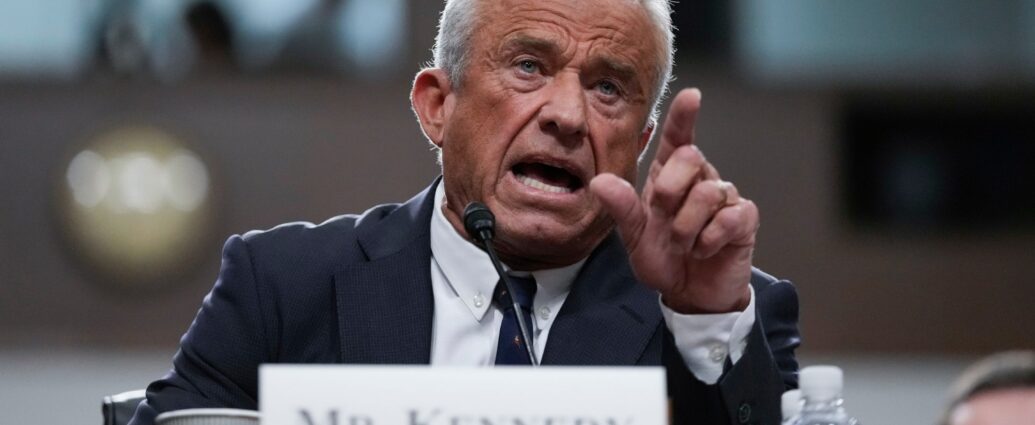
Health Secretary Robert F. Kennedy Jr. repeatedly told lawmakers who held the key to his confirmation last year that a 2019 visit to Samoa before a deadly measles outbreak had “ nothing to do with vaccines.” New documents obtained by The Associated Press and The Guardian refute that testimony.
Kennedy, then a prominent anti-vaccine activist, preceded the visit with a letter to the Samoan prime minister requesting to study the Pacific island nation’s measles, mumps and rubella vaccines after the deaths of two children who had received them. In the letter, he used the words vaccine or vaccination eight times.
The letter raises questions about how truthful Kennedy was in testimony before Congress. During an arduous confirmation process where he needed the support of some skeptical Republican lawmakers to advance, Kennedy also pledged to maintain vaccine policies that, once in office, he moved to change.
“I am writing this letter to you in the hope that we might be helpful to the people of your great nation,” Kennedy wrote, adding that he believed the deaths of the two children could have resulted from manufacturing issues.
“I would propose my team conduct detailed health informatics assessment in Samoa of what happened with your MMR vaccines,” he continued.
The Department of Health and Human Services said in response to questions from the AP that the Samoa visit “was unrelated to vaccines.”
“Any claim or insinuation based on these letters that Secretary Kennedy lied under oath or to Congress is not only false but outright defamatory,” the department said in a written statement. Kennedy was not under oath during his confirmation hearing. Knowingly giving material false testimony to Congress is a crime that carries a possible prison sentence regardless of whether a person is under oath, though it is rarely prosecuted.
HHS did not make Kennedy available for an interview. The White House did not respond to a request for comment. The Samoan prime minister’s office and the former prime minister who corresponded with Kennedy did not respond to requests for comment.
Kennedy’s Samoa visit has become one of the most contentious events in his career. At the time, he was leading a nonprofit known for its anti-vaccine activism. Critics said the visit emboldened anti-vaccine activists in Samoa, which later experienced the measles outbreak that killed 83 people, mostly children under 5.
Lawyers with expertise in Senate procedure said that if lawmakers choose, they could use Kennedy’s statements as grounds for hearings, an impeachment inquiry or creating other obstacles for him. But such action is unlikely under the current Republican-led Congress, which is aligned with President Donald Trump’s administration.
At the start of Trump’s second term, Kennedy — a leader in the anti-vaccine movement before entering politics — faced an uphill battle as he sought to become the nation’s health secretary. Lawmakers from both parties had criticized his anti-vaccine rhetoric, and during his confirmation hearings, he tried to assure them that he supported childhood vaccination.
The Samoa trip also came under scrutiny.
Kennedy told the senators that his Samoa visit did not influence people’s decisions on whether to vaccinate.
Several times, he flatly denied that his reason for the trip had anything to do with vaccines.
When it came up during questioning by Sen. Ron Wyden, D-Ore., Kennedy replied: “I went there, nothing to do with vaccines. I went there to introduce a medical informatics system that would digitalize records in Samoa and make health delivery much more efficient.”
The following day, when Sen. Edward Markey, D-Mass., asked, Kennedy said: “My purpose in going down there had nothing to do with vaccines.”
Upon further questioning, Kennedy again denied it had anything to do with vaccines before adding: “My purpose in the trip was not to — I ended up having conversations with people, some of whom I never intended to meet.”
In the end, Kennedy won crucial support from Republican Sen. Bill Cassidy, the Louisiana physician who leads the Senate Health, Education, Labor and Pensions Committee and has strongly advocated vaccination. The Senate confirmed Kennedy on a 52-48 vote.
Cassidy said he voted to confirm Kennedy because he received commitments that as health secretary, he would not change certain vaccine policies and guidance. For example, Cassidy said in a speech announcing his vote, Kennedy pledged to maintain a federal vaccine advisory committee “without changes.” Once in office, Kennedy ousted all 17 members of the committee and named his own advisers.
Cassidy has acknowledged his trust in Kennedy was broken.
“The commitments that were made to me have been violated,” Cassidy said on CBS’s “Face the Nation” in June.
Kennedy for years was chair and chief legal counsel of Children’s Health Defense, a nonprofit group known for its anti-vaccine activism. The group turned its attention to Samoa in July 2018, when two young children died after being given a tainted MMR vaccine that had been improperly prepared. The two nurses involved were criminally charged the month after the children died. The nurses ultimately pleaded guilty to manslaughter.
The Samoan government halted all vaccinations for 10 months, until April 2019. Vaccination rates plummeted.
During that time, CHD started contacting the Samoan government, according to emails previously obtained by the AP and the Guardian as the result of a lawsuit against the State Department brought with the aid of the Reporters Committee for Freedom of the Press.
In the newly obtained letter from Kennedy, also revealed through the lawsuit and dated Jan. 20, 2019, he addressed then-Prime Minister Tuilaepa Sailele Malielegaoi and described his desire to study Samoa’s use of the MMR vaccine.
Kennedy speculated that the deaths in Samoa may have been caused by issues with different vaccine lots. Writing on CHD letterhead, he said his team wanted to evaluate whether that was the case through a “detailed health informatics assessment.”
He expressed his belief that it was difficult and time-consuming in most of the world to investigate “adverse health events associated with vaccines” and said health information systems are rarely designed to quickly study links “between diagnoses and specific vaccination events.”
The letter did not specifically discuss anti-vaccine activism.
The prime minister responded a month later, saying Samoa could benefit from CHD’s assessment of MMR vaccines.
“It is certainly beneficial for Samoa to have the benefit of your Team’s independent health assessment of our MMR Vaccines and I would welcome with much anticipation your Team’s proposed visit to our islands,” he wrote, including a representative from the U.S. Embassy on his communication.
CHD did not respond to a request for comment.
Kennedy, his wife, actor Cheryl Hines, and Michael Graven, a CHD colleague, took their trip to Samoa in May and June of that year. By then, vaccinations had resumed and Samoa’s top health official had publicly announced that human error, not a vaccine issue, was responsible for the children’s deaths.
While Kennedy was there, he met with anti-vaccine activists, including one who helped arrange the trip with a U.S. Embassy employee, the AP and the Guardian previously reported.
Months later, with vaccination rates still dangerously low, measles broke out, sickening thousands.
Public health experts have said their efforts to address the outbreak were hampered by anti-vaccine activists, some of whom they claim were emboldened by Kennedy’s visit.
The AP and the Guardian previously reported that officials with the State Department and UNICEF privately discussed that the trip was about vaccines. In response, some Democratic politicians, including Wyden and Markey, have said Kennedy lied or misled the Senate.
This story was originally featured on Fortune.com

WASHINGTON — Sen. Bill Cassidy (R-La.) released a report on Thursday criticizing the Food and Drug Administration for not tightening restrictions on the abortion pill mifepristone, and charging the agency with lackluster oversight of the companies that manufacture the drug.
“To this day, FDA continues to redact mifepristone-related records in an unprecedented manner,” the report claims. “This lack of transparency has led to unanswered questions.”
The report is the result of an investigation conducted by Cassidy and other Republicans on the Senate’s health committee into the compliance practices of Danco, which distributes the brand-name version of mifepristone, and two other companies that manufacture generic versions of the drug.

Get your daily dose of health and medicine every weekday with STAT’s free newsletter Morning Rounds. Sign up here.
Good morning. Today we’re co-publishing a KFF Health News story on how Louisiana sheriffs spent millions of opioid settlement dollars on law enforcement gear instead of addiction treatment. I’d recommend a read — my jaw dropped when I saw how much one office spent on Flock cameras alone.

NEW YORK — Health Secretary Robert F. Kennedy Jr. repeatedly told lawmakers who held the key to his confirmation last year that a 2019 visit to Samoa before a deadly measles outbreak had “ nothing to do with vaccines.” New documents obtained by The Associated Press and The Guardian refute that testimony.
Kennedy, then a prominent anti-vaccine activist, preceded the visit with a letter to the Samoan prime minister requesting to study the Pacific island nation’s measles, mumps and rubella vaccines after the deaths of two children who had received them. In the letter, he used the words vaccine or vaccination eight times.

Good morning, everyone, and how are you today? We are doing just fine, thank you, despite the soggy weather hovering over the Pharmalot campus right now, because our spirits remain sunny, nonetheless. Why? We will trot out a bit of insight from the Morning Mayor, who would say “Every new day should be unwrapped like a precious gift.” To celebrate the notion, we are brewing still more cups of stimulation and invite you to join us. Our choice today is the mysterious witch’s brew. Meanwhile, here are a few items of interest. Hope you have a smashing day and, of course, do stay in touch. …
The U.S. Food and Drug Administration approved a life-extending treatment for advanced pancreatic cancer made by Revolution Medicines that is the first to attack a genetic cause of the aggressive, highly lethal malignancy, STAT says. The approval was supported by a practice-changing clinical trial showing patients with advanced pancreatic cancer who received the drug as a second-line treatment achieved a median overall survival of 13.2 months, compared to 6.7 months for patients given standard chemotherapy.
The Trump administration plans to announce a new round of drug-pricing agreements with several midsized biotech companies on Monday, Bloomberg News reports. The companies will agree to provide discounts on outpatient drugs to state Medicaid programs so that the prices states pay align with what the companies charge in foreign countries. Participation by state Medicaid programs is optional. In exchange, the companies will be exempt from pilot programs forcing similar discounts in Medicare. Relief from tariffs is also part of some of the discussions.

A senior US Embassy delegation, led by acting Economic Counselor Wendy Nassmacher, visited Israel’s Upper Galilee in recent days to support efforts to revive the region’s economy as it recovers from years of war.
The delegation focused on American cooperation with Israel to explore opportunities for growth across key sectors, including industry, healthcare, innovation, tourism and agriculture.
Asaf Langleben, head of the Upper Galilee Regional Council, welcomed the delegation and outlined the region’s challenges and opportunities. He emphasized the need for redevelopment through job creation, investment, infrastructure improvements, and expanded international economic partnerships.
The delegation also met with regional leadership, academic and research institutions, major manufacturers, and initiatives supported by American partners.
A key priority highlighted during the delegation’s visit was the need to strengthen medical and emergency services in the North to support the region’s future growth.
One initiative discussed was the development of a world-class medical center in Kiryat Shmona, a joint effort by JNF-USA and Jentezen Franklin Media Ministries to provide critical healthcare infrastructure for the region’s long-term needs.
The delegation highlighted the ongoing cooperation between the United States and Israel and reaffirmed the commitment to supporting the recovery and future growth of communities in the North.
JNF-USA has been a critical partner in the Upper Galilee’s recovery, having invested approximately $2 billion in community and economic development projects and initiatives in healthcare, tourism, and education over the past 10 years to help Israelis rebuild their future in the North.
Communities along Israel’s northern border have been severely impacted since October 7 and throughout nearly three years of war.
Hundreds of thousands of residents were forced to evacuate their homes amid sustained rocket fire, while many communities continue to recover from the damage caused by the fighting.
Earlier this year, the government approved a multi-year plan to rehabilitate northern communities along the Lebanon border, including Kiryat Shmona, Shlomi, and Metula, which were among the areas hardest hit by the war.
Keshet Neev contributed to this report.

A chunk of Himalayan glacier broke loose Wednesday morning and, within roughly half an hour, killed at least 362 people and wiped out Nepal’s main overland gateway to China.
There was no rain and no warning. At about 8:40 a.m. local time, a section of the lower glacier sheared off at around 17,000 feet and fell some 3,900 feet onto the valley floor, picking up rock and sediment as it went. The resulting ice-and-rock avalanche slammed into the Lhende River in Tibet, about 12 miles northeast of the Nepal-China border crossing, sending a wall of mud and water down the Bhotekoshi into Nepal’s Rasuwa and Nuwakot districts. The U.S. Geological Survey later determined that a tremor first logged as a magnitude 4.4 earthquake was in fact the energy released by the collapse itself.
Nepal Police put the death toll at 359 as of 5 p.m. Thursday, with three more reported dead in Tibet by Chinese state media. More than 1,300 people are still missing across both sides of the border, over 700 of them foreign nationals — better than one in two of the missing. Among them are 177 Indians, 63 Americans, 34 Australians, 33 Britons and 25 Canadians.
The commercial damage runs the length of the corridor. At Rasuwagadhi-Timure, the flood swept away the customs yard along with the vehicles and imported goods parked there awaiting clearance. More than 500 vehicles are feared lost, many of them Chinese-brand cars — BYD, MG, Wuling and others — brought in through the Kerung route for upcoming auto shows. Power generation stopped at more than ten hydropower projects, including the 111-megawatt Rasuwagadhi plant, Chilime and Trishuli-3A, knocking roughly 430 megawatts offline. Two bridges are gone and stretches of the Pasang Lhamu Highway, the road linking Kathmandu to the region, are closed. With the Dashain festival weeks away, Nepal expects goods shortages, and Finance Minister Swarnim Wagle is running a response team out of the Timure customs office.
This is the second time in fourteen months the same river has done this. A July 2025 flood out of Tibet killed nine people, took out the Friendship Bridge and damaged the same dry port and power plants.
The fix is not engineering, it’s information. Nepali analysts are pressing for joint hazard mapping of the corridor with China, formal cross-border rescue protocols and a shared alert platform linking agencies on both sides — built before the next collapse rather than improvised during one. With ice loss across the Hindu Kush Himalaya running at twice its 2000 rate, communities downstream may get only minutes of notice.
JBizNews Desk | Kathmandu
© JBizNews.com All Rights Reserved. Reproduction or distribution without written permission is prohibited.


It’s not every day that you see a sitting congresswoman giving herself hormone shots on social media. But last week, Representative Alexandria Ocasio-Cortez (AOC) went further by taking her millions of social media followers along with her–documenting every shot, her unfiltered thoughts, and bringing awareness to fertility education that us fertility doctors have been trying to achieve for over a decade.
The vision of her administering fertility shots in the green room before going on air to discuss her future political career sent the internet in a tailspin. Why was she doing this? What was her motivation? Do frozen eggs even work? Was this simply a political stunt?
AOC’s decision to take a personal fertility journey public was a pivotal moment for women’s health. People were talking about fertility and not just in the privacy of their bedroom or doctor’s offices–but in public. And, across party lines. As fertility doctors, we were excited to see a topic we have devoted our professional careers to finally receiving the attention it deserves. In just one Instagram post, AOC amplified a message we had been trying to spread nearly a thousand fold. She inspired countless women to ask questions about the technology, their bodies and start to ponder their reproductive futures. Pretty exciting stuff. But, the reality is, AOC is actually late to the party.
When AOC announced on social media that she was freezing her eggs, she performed a huge public service by shining a spotlight on fertility preservation. As two female physicians who spend our days freezing women’s eggs to give them greater control over their reproductive futures, we feel compelled to underscore one critical fact: When it comes to egg freezing, younger is better. The decline in ovarian reserve that occurs with advancing age is no joke. In fact by the time a woman is 32, she has lost 90 percent of her eggs. And it isn’t just egg number that declines with age but egg quality as well, with 70 percent of a woman’s eggs being genetically abnormal at age 40. Therefore, egg freezing should ideally be initiated in your 20s or early 30s when both egg quality and quantity are at their peak – not at 36 like AOC.
The concept of fertility preservation should not be a Hail Mary or alast ditch effort. Fertility is finite. All women will reach an age where it is too late to intervene, and this is exactly the reason why conversations about fertility and egg freezing deserve to be held in public. Eggs frozen at younger ages result in significantly higher chances of success when thawed. The reality is, fertility declines with age. This is not a political opinion. This is fact.
As fertility doctors with patients in red and blue states, we believe girls should be talking about their bodies in health class and learning about their fertility alongside how to not get pregnant. Fertility testing should be offered to all women proactively–just like a pap smear or a breast exam at an annual exam. The notion of fertility preservation should be presented early and often. Egg freezing is an investment in your future fertility. We have retirement plans, why not make fertility plans?
More women now are more aware that egg freezing exists (thank you social media) and more women have coverage from their workplace. In our own practices over the past five years, we have seen the average age of our egg freezing patients drop from 37 to 33. Improvements in technology coupled with higher quality eggs led success rates to rise dramatically. In fact, data on pregnancy rates from frozen eggs are 80-90 percent in women under age 35–a statistic that is truly remarkable. Simply stated, egg freezing works when eggs are frozen at the right age.
Egg freezing is not a guarantee or an insurance policy for your fertility. But it is an investment in you, and just like all investments, the ROI will not be known until the future. Any eggs frozen are an opportunity for your future that otherwise may not exist. Egg freezing is the best option we have for women who desire to delay childbearing pursuing professional and personal paths. Without egg freezing, the rates of infertility will undoubtedly continue to rise in the U.S. while the overall birth rate falls. These are issues that affect all Americans, regardless of political affiliation.
Some women will freeze their eggs and never need them. Some will freeze their eggs and, when they eventually use them, they will not result in a pregnancy. And some will freeze their eggs and ultimately have the child they hoped those eggs might help them have. We don’t know which woman will be which. But what we do know is that younger eggs have better reproductive potential.
We practice in different states—one red, one blue. We care for different patient populations and don’t always agree on fertility treatment strategies. But we are completely united when we say women deserve to understand their fertility early enough to have meaningful choices. The conversation needs to start sooner.
You may not agree with AOC’s politics or like the messaging she espouses, but you cannot dislike her desire to spread awareness about the need to address a woman’s future fertility.
After all, there’s a reason why IVF has overwhelming bipartisan support. 7 out of 10 Americans may not agree with AOC, but they do support IVF.
Everyday we hear patients tell us that they wish they were sitting in front of us before they felt the pressure of time. Before the should-a, would-a, could-as take over. While we can never promise an outcome, we can help a woman preserve an opportunity. That matters.
As female physicians, our careers exist because extraordinary women challenged expectations, entered medical schools that once excluded them, and paved a path we now have the privilege to walk.
Today’s trailblazers look different.
They are the women who, like AOC and many others, are brave enough to make their personal medical decisions visible so that the young women watching realize they have choices, too. That visibility matters.
So thank you, AOC for fueling the conversation we have been having. For making women on both sides of the aisle ask questions about their bodies, and for helping the next generation understand something we wish every woman already knew: Your fertility is finite, but you can take steps to preserve your future today.
Dr. Jaime Knopman is the national director of fertility preservation at CCRM Fertility and author of “Own Your Fertility.” Dr. Natalie Crawford is co-founder of Fora Fertility, CEO and co-founder of Pinnacle, and author of “The Fertility Formula.“
The opinions expressed in Fortune.com commentary pieces are solely the views of their authors and do not necessarily reflect the opinions and beliefs of Fortune.
This story was originally featured on Fortune.com
The IDF launched a wave of strikes against Hezbollah in southern Lebanon on Thursday after the terror group launched two explosive drones toward IDF soldiers operating in southern Lebanon, the military stated.
During Hezbollah’s attack overnight between Wednesday and Thursday, IDF soldiers opened fire, downing one of the drones, while contact was lost with the second drone.
No IDF injuries were reported from either drone attack.
This is a developing story.
On April 1, 2024, the IDF mistakenly killed seven international food aid workers working for the World Central Kitchen (WCK).
Last week, the IDF probe admitted that its surveillance officials misidentified the WCK security officials as Hamas.
While acknowledging the gravity of this error, the Chief Military Prosecutor of the Military Advocate General (MAG Corps) determined that, notwithstanding serious failures in the process that led to the assessment that Hamas operatives were traveling in the vehicles, the decisions of the commanders did not raise reasonable suspicion of criminal misconduct.
The IDF therefore decided not to open a criminal investigation.
Following this announcement, the foreign ministers of the UK, Australia and Canada released a joint statement saying the decision to not pursue criminal investigations is “shameful.”
“They just say it’s a shame that Israel hasn’t brought criminal charges – they don’t specify what is shameful about it,” Dr. Brian L. Cox told The Jerusalem Post on Monday.
Cox retired from the US Army in 2018 after 22 years of military service, including 7 years as a military lawyer. He is now a senior fellow at the Macdonald-Laurier Institute in Canada, and taught international law at Cornell Law School from 2019 to 2026.
Cox told the Post that it makes sense for Israel to not pursue criminal charges, because they have done a “very thorough assessment based on all the evidence they can gather, and they’ve reached the conclusion that this wasn’t a war crime.”
From an International Humanitarian Law (IHL) perspective, this case is “really straightforward,” Cox explained.
“If the personnel involved believed they were attacking Hamas fighters, and not WCK humanitarian workers, then it wasn’t a war crime. And that’s just a doctrinal application of the Law of Armed Conflict (LOAC) distinction rule.”
He added that militaries can prosecute for violation of use of force policy, but that then it would have to be “really egregious, a wanton disregard” of policy, which was not the case here.
While it chose not to open criminal investigations, the IDF did remove several officers from their positions, and others were formally reprimanded: an outcome that Cox said would have been the exact same if the same incident had been carried out by an Australian, UK or Canadian military member.
Cox therefore said a “double standard” is being applied to the IDF here.
“Just because there was an allegation that has been leveled against Israel, the expectation is that the IDF will initiate a criminal prosecution. That expectation doesn’t exist for any other military, including the three countries that signed this joint statement.”
Some interesting legal questions do arise from this incident.
One is whether, if soldiers mistakenly believe that civilians are legitimate targets, like in this case, can they still be guilty of a war crime because it was a mistake caused by negligence.
Cox explained that while some scholars have argued that recklessness should be taken into account when considering the mens rea of a war crime (intent), this is actually a “misrepresentation of international law.”
“I traced [this argument] back to the International Committee of the Red Cross in their Customary IHL study,” he told the Post. “They say war crimes could be committed with intent. And that includes dolus eventualis, which is like the civil law equivalent of recklessness.”
The IHL study, he added, cites just one source: a decision of the International Criminal Tribunal for the Former Yugoslavia (ICTY) that claims that war crimes can be committed recklessly.
However, the ICTY was not actually capable of establishing international law by itself.
After the ICTY decision was published in the mid-1990s, multiple countries, including the UK, Australia and Canada, ended up negotiating and then ratifying the Rome Statute.
When the 160 state delegations came together in 1998, they rejected efforts to include recklessness as part of the Rome Statute’s mental element for war crimes.
“If you go to the Rome Statute and look at Article 30 – which is the mental element – and then Article 32 – which is mistake of fact – it’s clear that recklessness is not included as part of the mental element for war crimes.”
Cox said that, as far as he’s aware, there has never been a criminal prosecution for an incident where the personnel involved were found to be reckless.
It is worth noting that Israel has never ratified the Rome Statute, and neither has the US. Cox nevertheless said it still provides a useful framework in this case because the IDF’s doctrinal application of the law of armed conflict, specifically when it comes to war crimes, is almost identical to that in the statute.
Another question is whether the wider combat context should be considered. While this WCK convoy had not been hijacked, is it relevant that other convoys had previously been?
“This really gets to the essence of how LOAC is applied to combat operations,” Cox responded. “This is often what’s missed in public discourse, the fact that the personnel who are responsible for this outcome are not solely responsible for the process that led to this strike.”
“They weren’t operating in a vacuum. If they’re in a combat scenario, where they know that their adversary deliberately and routinely hides among the civilian population, deliberately doesn’t wear a uniform that would differentiate between them and the civilian population, then of course [the IDF is] going to make a determination based on their knowledge of the battlespace, and not just what they’re seeing in the drone/video feed.”
What Cox said is so often overlooked is that Hamas is responsible for how it fights.
“With militaries of countries that respect and care about implementing international law, the reason we wear uniforms, the reason we differentiate ourselves between us and the civilian population is, is because we are focused on military objectives. So when Hamas and PIJ and various insurgent factions don’t do this, then of course there are going to be examples of essentially mistaken identity.”
This is, and should be, taken into account when assessing whether the IDF’s determination of the nature of the convoy was reasonable under the circumstances, he added.
“A lot of public commentary ends up either inadvertently or deliberately finding a way to blame Israel when they’re completely ignoring Hamas’s responsibility,” he told the Post.
In general, Cox said most departments of foreign affairs are “so far removed” from conflict and armed conflict, especially the law of armed conflict, that they “really can’t be trusted.”
“There’s this constant struggle between military personnel and foreign affairs personnel, where foreign affairs will just jump in without realizing how ignorant they are when it comes to armed conflict.”
Another element to this discussion, he said, is that international law is “very often utilized as a convenient excuse to denounce Israel.”
“This has been happening since October 7, where foreign ministries or prime ministers are looking for an excuse to criticize Israel, and the convenient, expedient way to do that is to rely on international law.”
Cox also pointed out that – as sad as it is – war crimes are committed by almost every army in almost every conflict: not just Israel.
The condemnation of Israel’s handling of the WCK incident therefore all links back to one of two things, Cox summed up. One, ignorance. Or two, “deliberate disinformation where people are looking for a reason to criticize or condemn Israel,” and then they “work backwards from there and international law is a tool that they use.”
While some commenters and critics of Cox have accused him of a pro-Israel agenda, he disputes this.
“If I genuinely believe based on my understanding of the factual circumstances that have been conveyed to the public that the WCK convoy attack was a war crime, I would say so. This isn’t me trying to be pro-Israel; this is me trying to be pro-law.”
“My bias, if anything, is that I’m trying to protect the integrity of international law involving armed conflict and how it actually works in practice. So if I have a bias, that’s it.”
Nearly 150 new immigrants from North America are expected to arrive in Israel on Thursday aboard six separate flights, including close to 100 who landed at Ben-Gurion Airport within a half-hour period in the morning, according to Nefesh B’Nefesh.
The immigrants are part of an unprecedented wave of aliyah taking place during the summer months, from June through September. During this period, more than 2,200 new immigrants from North America, including some 480 families, are expected to arrive in Israel on nearly 100 group flights departing from across the United States and Canada.
More than 1,100 immigrants arrived in August alone, making it one of the most active months for aliyah facilitated by Nefesh B’Nefesh since the organization’s founding, according to its data.
“The historic wave of aliyah we are experiencing this summer is the most moving testimony to the resilience of the Jewish people and to the deep connection between North American Jewry and the State of Israel,” Rabbi Yehoshua Fass, co-founder and executive director of Nefesh B’Nefesh, said.
“The fact that thousands of families and young people are choosing to relocate their lives and build their futures here, especially at this time, is a Zionist shot in the arm and an enormous engine of growth for Israeli society and the economy,” Fass added. “We are proud to stand alongside them and accompany them, together with our partners, as they begin a new chapter in Israel.”
Nefesh B’Nefesh is facilitating the aliyah process in cooperation with the Aliyah and Integration Ministry, the Jewish Agency for Israel, Keren Kayemeth LeIsrael-Jewish National Fund, and Jewish National Fund-USA. The organization’s teams accompany immigrants throughout the aliyah and integration process, from preparations in their countries of origin through their arrival in Israel and the completion of their absorption procedures.
The August record follows an especially strong start to the year. Since the beginning of 2026, approximately 2,700 new immigrants from North America have moved to Israel. Based on these figures, Nefesh B’Nefesh estimates that more than 4,000 North American immigrants will make aliyah by the end of the year, making 2026 one of the strongest years for aliyah since the organization’s establishment in 2002.
A demographic breakdown of this summer’s immigrants shows a young and diverse population, with an average age of 29. The current wave includes about 480 families, about 1,100 single men and women, and about 250 retirees.
In addition, approximately 700 children and teenagers are expected to begin the upcoming school year in Israel, including around 80 children entering first grade. Some 300 young men and women are also expected to contribute through service in the IDF or National Service after settling in Israel.
“I welcome the many immigrants who landed and will land in Israel today. As the summer months draw to a close, it is moving to see the large number of young immigrants and families who have chosen to establish their future in the home of the Jewish people,” Aliyah Minister Ofir Sofer said.
Referring to his ministry’s work, Sofer added, “In recent years, we have led significant processes at the Aliyah and Integration Ministry and laid the groundwork to encourage aliyah and ensure the optimal integration of immigrants from Western countries and around the world. The range of programs and reforms we have advanced will help immigrants integrate into their communities and the workforce, and will contribute to strengthening the State of Israel socially, economically, and in terms of security.”
The immigrants are also bringing a broad range of professional skills, including doctors, nurses, teachers, lawyers, accountants, and professionals from other fields.
The new immigrants are arriving from across North America, with the leading places of origin including New York, New Jersey, Florida, California, Maryland, Illinois, Ontario in Canada, Pennsylvania, Texas, and Georgia.
After arriving, they are expected to settle in communities across Israel, including Jerusalem, Tel Aviv-Jaffa, Beit Shemesh, Ra’anana, Modi’in-Maccabim-Reut, and Haifa. At the same time, approximately 650 immigrants are expected to choose communities in the Negev and Galilee as part of the “Zinuk Ba’Aliyah” program, operated in partnership with Keren Kayemeth LeIsrael-Jewish National Fund to encourage settlement in national priority areas.
“Behind each of the 1,100 immigrants who arrived from North America over the past month is a story of choice. Families, children, young people, and professionals who chose to build their lives here and be part of the future of the State of Israel,” Jewish Agency chairman Maj.-Gen. (res.) Doron Almog said.
“They arrive here with their dreams, their abilities, and their desire to contribute, and in doing so they strengthen Israeli society and the country as a whole.”
Addressing The Jewish Agency’s role in the aliyah effort, Almog added, “Our mission is to be there for them throughout the journey and help them turn their major decision into a home, where they can integrate and build their lives.”
The stalled nuclear negotiations with Iran mask a fundamental shift in Washington’s strategy, one aimed less at securing a deal than at hastening the collapse of the Iranian regime itself, said Or Horvitz, a senior fellow at JPPI and former IDF officer, on the last episode of The Deep Dive podcast.
While public attention has fixated on stop-start diplomacy and Iranian propaganda, the US has quietly returned to a “maximum pressure” campaign modeled on Ronald Reagan’s pivot from containment to confrontation with the Soviet Union, said Horvitz.
“Any negotiation with this regime is pointless,” he argued, describing the current Iranian leadership as a hawkish “military junta” more extreme than its predecessor and unwilling to compromise on its core interests, the Strait of Hormuz and its nuclear program.
The analyst pointed to two camps within the Trump administration, one led by Secretary of State Marco Rubio favoring regime collapse and another associated with Vice President JD Vance still seeking a negotiated outcome, both now aligned behind escalating economic pressure.
With Iranian inflation soaring and minimum-wage earners able to afford only a fraction of the month, Horvitz said the regime’s starting point is far weaker than during the first pressure campaign, warning that a cornered, panicked Tehran also becomes more likely to launch an irrational or preemptive strike against Gulf states, Europe, or even NATO members.
In the conversation with the host, Jacob Laznik, Horvitz cautioned that toppling the regime would be a “matter of time” rather than a certainty on any timeline, noting it took eight years for Reagan’s approach to help bring down the Soviet Union, and that the West missed an opportunity to back Iranian protesters earlier in the year.
He argued that Iran’s economic weakening opens a “historic” window against its most important proxy, Hezbollah, while cautioning that a vacuum could empower Sunni jihadist groups such as al-Qaeda and ISIS.
On Syria and Turkey, Horvitz urged pragmatism over confrontation, cooperating with Damascus on shared interests and managing Ankara as a “growing challenge” that is “not Iran by any means.”
His closing warning drew on Winston Churchill: “Iran is a bully, and you cannot appease a bully.”
If you believe that Donald Trump is the most dangerous and destructive US president in recent times, if not ever, and that the threats he poses to American democracy, the rule of law, and world peace must be thwarted, is it is essential that Democrats gain control of the House and Senate on November 6.
One crucial Senate race that Democrats need to win is the Michigan seat being vacated by retiring Sen. Gary Peters. That poses a dilemma for Michigan voters, particularly Jews and friends of Israel, following the Democratic primary win by Abdul El-Sayed, a harsh critic of Israel.
The subservient Republican-led Congress has dreadfully failed in its constitutional responsibility as an independent branch to combat the excesses of this president, who falsely claims Article II of the Constitution gives him the “right to do whatever I want as president.”
Two-thirds of American voters tell pollsters they disapprove of the job the president is doing, and fewer than one in eight feel that Congress is doing a good job.
All indications are this will be a change election. More so than in many years, every vote and every seat counts, particularly in the Senate, which must approve Trump’s nominees for top administration and judicial posts, a particularly critical function as he continues remaking the nation’s government in his own extremist image.
For the past two years, the GOP-led Senate has rubber-stamped Trump’s unqualified nominees, such as Pete Hegseth, Robert F. Kennedy Jr., Tulsi Gabbard, Kash Patel, Todd Blanche, Pam Bondi, and Kristi Noem, among others. And it will continue to do so if they control the next Senate. More reason why Michigan is a must-win for Democrats.
El-Sayed’s nomination poses a vexing problem for Israel-focused Jewish voters. A Muslim and a physician, who holds a PhD from Oxford University, he was born in the Detroit suburbs to Egyptian immigrants. If elected, he would be America’s first Muslim senator, but not the first Arab-American senator; Michigan, South Dakota, and New Jersey have had Arab-American senators.
Four members of the current 119th Congress are Muslim, all Democrats, and in the House of Representatives. There are 10 Jewish senators, nine Democrats, and one independent, and 25 Jewish representatives.
What was supposed to be a likely Democratic seat has become the most controversial and divisive contest for the party as well as pro-Israel voters. Michigan has one of the largest Arab and Muslim populations in the nation, more than triple the state’s Jewish population. Its opposition to former president Joe Biden’s support for Israel helped swing the state in Trump’s favor two years ago.
The Republican nominee for the Senate seat is former Rep. Mike Rogers, who had a pro-Israel record in the House and good relations with the state’s Jewish community.
Many Democrats are troubled by their nominee’s Middle East views, but agree with much of his liberal domestic and social views. This is quite the reverse with Rogers, who is running on his support for the Trump agenda. Rogers lost his Senate bid two years ago to Elissa Slotkin, who is Jewish.
AIPAC and its political action committee spent more than $32 million trying to defeat El-Sayed. Its support had once been highly sought after by candidates in both parties, but in recent years, thanks to its hard swing to the Right with its embrace of Trump, election deniers, Prime Minister Benjamin Netanyahu, and for Israel’s conduct of the Israel-Hamas War, the organization has become a pariah and its money is viewed as toxic in some races.
Rogers personally asked the group to drop any ads on his behalf. Pro-Israel voters yes, AIPAC no. He also recognizes that public attitudes toward Israel have turned negative. Even pro-Israel candidates have spurned AIPAC this year.
Netanyahu and AIPAC’s attacks have done more than anything else to win the nomination for El-Sayed, who has said, “I want AIPAC to cease to be a force in Democratic elections.”
El-Sayed’s primary success was a major victory for the pro-Palestinian movement and a stunning defeat for the pro-Israel lobby. As a senator, he will want to put those views on the agenda.
Many pro-Israel activists, former AIPAC staff, and supporters agree. We believe the group’s decisions to go partisan, to tie itself so tightly to the corrupt and extremist Netanyahu regime, to rate and endorse candidates and to create PACs have proven a catastrophic mistake that has done incalculable harm to the US-Israel alliance.
When asked if he believes in Israel’s right to exist as a national homeland for the Jews, El-Sayed dodges and dismisses it as a “gotcha.” “Israel exists,” he answers. According to The New York Times, he has said: “Israel should not exist as an explicitly Jewish state.”
That understandably alienates many of Israel’s supporters in the mainstream of the Democratic Party and the Jewish community.
He appears to prefer a secular binational state, or letting the parties decide whether they want one or two states. He said he doesn’t believe in “ethno-states” for anyone.
He has called for an immediate and total halt to US military aid and weapons deliveries to Israel and Egypt. He considers Israel’s response to the Hamas-led October 7, 2023, massacres a “genocide,” and has called Netanyahu “a war criminal.” He said the actions of Israel and Hamas were equally indefensible.
Many Jews were troubled by his response to the March attack on Temple Israel in West Bloomfield, Michigan, when he seemed to defend the attacker, who reportedly lost some family members in a recent Israeli attack in Lebanon.
“Hurt people hurt people,” he said, which some saw as justification for the synagogue attack.
Some Jewish Democratic donors are endorsing and raising money for Rogers. Rabbi Asher Lopatin, director of community relations for the Jewish Federation of Greater Ann Arbor, where El-Sayed lives, endorsed Rogers, saying El-Sayed “has only shown contempt for the Jews.”
He rejects the antisemitism label, insisting his commitment to Jewish safety is equal to that for his own daughters. Antisemitism and Islamophobia must both be fought equally, he added. Michigan Jewish leaders feel his denunciation of antisemitism has been too weak.
Given the threats to America and the Free World posed by an unchecked Trump administration for the next two years, the election of a Democratic Congress should be the highest priority.
El-Sayed’s election may be necessary to convince AIPAC and Israeli leaders that they have a serious problem, and kissing Trump’s narcissistic ring isn’t working. They are in great danger of losing their most important allies unless they make some dramatic changes – and quickly.
Israelis will also have a chance this fall to elect a new government, one that can move toward reconciliation not only in that deeply divided country and with the Palestinians, but also with the friends that Netanyahu sacrificed on the altar of his personal ambitions. Rebuilding bipartisan support in Washington, which Netanyahu and AIPAC have squandered, is urgently needed.
The writer is a Washington-based journalist, consultant, lobbyist, and former legislative director at the American Israel Public Affairs Committee.
IDF Chief of Staff Lt.-Gen. Eyal Zamir on Thursday announced that he is expanding the Israeli forces being used to maintain public order in the West Bank leading into the upcoming fall Jewish holidays.
The Jerusalem Post understands that the volume of forces will be more than double the pre-October 7 force size of around 11 battalions, which at times has grown to 15-20 battalions, but will temporarily grow even more.
Zamir warned the government that Jewish extremist violence has run out of control and that greater backing is needed from the government, including Prime Minister Benjamin Netanyahu and others actively restraining political officials from provocative actions.
Religious Zionist MK Zvi Sukkot entered the West Bank village of Madama near Nablus on Tuesday during an IDF-escorted tour and participated in destroying a monument that appeared to honor members of the al-Aqsa Martyrs Brigades and Palestinians killed during the intifada.
According to the IDF, Sukkot requested military protection for what he told them would be an innocent tour of monuments. Soldiers were diverted from serious operational duties to provide security. The IDF stated that Sukkot double-crossed them and destroyed the monument without authorization, leading to a global uproar and condemnation of Israel for state-sanctioned destruction of monuments.
All of this takes place as IDF officials have said Jewish extremist violence has reached new levels, with hundreds of extremists recently drawing out a conflict with the IDF at the Palestinian village of Kusra for nearly a week.
It also takes place as IDF and Shin Bet officials say that the police, after three years under Itamar Ben-Gvir, have reached highly problematic lows in terms of arresting and helping indict Jewish extremists in the West Bank.
None or almost none (the police have been at a low also in terms of transparency) of those involved in the Kusra actions were arrested.
Accordingly, Zamir has brought in the Golani Brigade and the Paratroopers Brigade to supplement the standard forces in the area, some of which have appeared too sympathetic to Jewish extremists attacking Palestinian villages.
However, without more backing from the government, Zamir warned that even increased military forces will be insufficient.
Further, the IDF chief noted that moving more elite forces into the West Bank risks leaving the more dangerous northern and southern borders less defended, and also will mean fewer soldiers get off for the upcoming holidays.
Regarding the holidays, Zamir in general has reduced how many days off soldiers receive since he took office in March 2025.
One of the failures of October 7, 2023, was that half of the soldiers meant to be on duty in Gaza were off for the Simchat Torah holiday.
In the same statement, Zamir blasted the Finance Ministry for what he said were politicized and unnecessary fights over budget and side financial issues.
An IDF spokesperson said that there were three debates going on between the IDF and the ministry.
The first is that the IDF said that the ministry was due to have transferred NIS 15 billion weeks ago as part of a prior deal and that the funding has been delayed.
Second, another NIS 25 billion is due to be transferred imminently, but now the IDF is worried that this funding will be delayed like the earlier NIS 15 billion.
Third, the sides are stuck not only on funding, which nominally was already agreed to, but on future multi-year funding negotiation issues.
Currently, estimates have the IDF defense budget up to NIS 160 billion per year, around double what it was pre-October 7.
An IDF spokesperson clarified that the NIS 40 billion under debate is part of the already-agreed NIS 160 billion number, and not related to new funding requests.
The ministry responded that the IDF should be more judicious in spending its ballooning budget.
In the past, the ministry has also accused the IDF of a mix of waste, a lack of carefulness in certain areas of spending, and some areas of unpoliced fraud.
The IDF in the past has acknowledged some errors in these areas, but mostly said that three nearly constant years of war have meant that its expanded budget cannot be viewed based on past budgets, but only based on the number of fronts Israel has constantly had to fight or be ready to fight on.

ChatGPT no longer has to wait for people to copy and paste their texts into the chatbot. Now it can search for them itself.
A new Apple Messages plugin lets ChatGPT search old texts, summarize group chats, draft replies, and send messages from a Mac. The person installing it has to approve the access—but everyone else in those conversations does not.
That is opening a new front in the privacy and security debate about AI agents as they gain access to increasingly sensitive parts of people’s digital lives. Security and privacy expert Paul Walsh calls the Messages integration “one of the most dangerous things I have seen in technology” and warns it can function like spyware for people who depend on private communications.
But according to OpenAI, the plugin runs locally by default, only reads Messages when a user explicitly asks it to, and does not automatically upload or index a user’s message history. But one person’s decision to opt in can make years of conversations searchable by AI, including messages from people who never agreed to give it access.
Explaining what would happen if he enabled the integration himself, Walsh told Fortune: “Every single person I send a message to through iMessage will never know that I have a third party inside that application, and they will never be notified.”
For people who deliberately use encrypted messaging for sensitive conversations, he said, “it becomes dangerous.”
OpenAI rolled out the plugin last week for ChatGPT on Mac, allowing users to search iMessage, SMS, and RCS conversations, catch up on threads, draft replies, and send them through Apple Messages. Users must explicitly install the plugin and grant ChatGPT several macOS permissions, including AppleScript, Accessibility, and Full Disk Access.
According to OpenAI, ChatGPT does not create an index of a user’s Messages or begin reading conversations simply because the plugin has been enabled. The company added that a user must make a request that specifically seeks information from Messages before ChatGPT will access them.
Walsh’s concern isn’t that ChatGPT has cracked Apple’s end-to-end encryption. Instead, it centers on what happens after an encrypted message reaches its intended recipient and becomes readable on that person’s Mac. He compares giving ChatGPT that access to installing spyware, arguing the encryption itself can remain intact while another piece of software gains access to the readable messages.
“Let’s say we agree it’s encrypted. Perfect mathematics hasn’t been broken,” Walsh said. But once another system can read a message before it is encrypted or after it has been decrypted, he said, “you have broken the fundamental concept.”
The ability to share a private message with a third party isn’t completely new. Someone can screenshot a text, forward it, or copy and paste it into ChatGPT. What changes with the Messages plugin is how easily an AI can search information across conversations once a user grants it access.
Walsh argues that distinction matters because the person granting the access isn’t the only person whose information appears in those conversations.
“That’s you breaking that person’s trust,” Walsh said in reference to taking a screenshot. “It’s not you allowing a third party inside the conversation.”
Dave Richardson, CTO at mobile security company Lookout, told Fortune he could understand why some might compare the integration to spyware, though he believes the term is “a little too strong.” Spyware typically accesses and steals information without a user’s permission, he said, while the Messages feature is off by default and requires users to explicitly grant access.
Still, Richardson said enabling the integration introduces “significant risk” to what has historically been considered a secure channel for communication.
End-to-end encryption protects a message as it travels between devices, Richardson explained, preventing the network operator or platform provider from reading or modifying it. But the devices on either end can still access the message once it arrives.
“By granting third parties such as OpenAI or Anthropic access to these messages, you’re losing many of the benefits that end-to-end encryption has to offer,” Richardson said.
Privacy-focused technology company Proton raised similar concerns in an analysis published Tuesday, warning the privacy implications can extend to people who never use ChatGPT because their messages can still be accessed when someone they communicate with uses the plugin. Proton also pointed to Full Disk Access, one of the macOS permissions required during setup, as a broader security consideration.
There are important limits to how much access the integration gives OpenAI.
ChatGPT only reads Messages after a user makes a request that specifically requires information from them, according to the company. Asking ChatGPT to summarize messages from a conversation with a particular contact, for example, would cause it to read that thread.
ChatGPT desktop stores conversations locally on the user’s computer by default, according to OpenAI. Messages content included in those conversations is therefore not automatically synced to the company’s servers. If a user chooses to store a ChatGPT conversation in the cloud, however, relevant Messages content follows the same retention policies as other content in that conversation. Conversation data may remain in cloud storage until a user deletes it and may also inform Memories stored in the cloud.
That distinction is central to Walsh’s most serious warning. He argues that if content from an encrypted conversation is stored on another company’s servers, it could create another potential point of access for hackers, insiders, governments, or law enforcement.
Walsh describes that as a potential “side door” around end-to-end encryption rather than a technical break in the encryption itself. Authorities seeking information that Apple cannot provide from an end-to-end encrypted conversation could potentially seek a copy stored elsewhere, if one exists.
OpenAI’s description places important limits on that scenario. Installing the plugin does not upload an entire Messages history, and content accessed through it remains on the Mac by default, according to the company.
The Messages integration comes amid a broader expansion in the data and device capabilities AI services are seeking access to.
In research provided to Fortune, Lookout said its analysis of more than 420 million Android and iOS applications shows the permissions and capabilities of AI-related apps have continued to grow over the past year. The company also tracked increased access among iOS AI apps across eight categories of sensitive or high-risk capabilities.
“There has been a trend we’ve seen quite steadily over the past year where AI services are asking for access to more and more data,” Richardson said.
The Messages plugin uses existing macOS capabilities rather than a new iMessage API built by Apple specifically for ChatGPT, according to OpenAI. Its setup requires users to approve AppleScript, Accessibility, and Full Disk Access.
Fortune asked Apple whether it anticipated existing macOS permissions being used to give AI agents the ability to read and search Messages and whether it is considering additional safeguards as AI agents gain access to sensitive applications.
Apple did not immediately respond to Fortune’s request for comment.
Walsh said the risks created by third-party software accessing sensitive information aren’t unique to ChatGPT or AI. What is changing, he argues, is the amount of information AI can rapidly search and analyze once it has that access.
“I would never build an iMessage integration that has the ability to read messages ever,” Walsh said, “Because it breaks the fundamental protections that end-to-end encryption brings.”
As AI agents become more capable, much of their usefulness will come from gaining access to more of people’s digital lives—and the complication is that those lives overlap. With Apple Messages, one person can give an AI access to years of conversations that were written by plenty of people who never agreed to let it in.
This story was originally featured on Fortune.com

➡️ Did someone forward you this email? If you would like to receive this information directly, every morning before the markets open in New York, sign up here.
This story was originally featured on Fortune.com

The usually cordial relationship between Washington and Ottawa has soured considerably in recent weeks, with trade talks derailed and the neighbors now levying multi-billion-dollar tariffs against one another.
The Trump administration’s most recent trade war comes with a hefty cost, with some $872.3 billion traded between the nations in 2025. After negotiations collapsed this weekend, Canadian Prime Minister Mark Carney said the U.S. “asked for too much and offered too little,” while Trump says Canada is “foolish” to engage in a trade war.
Wilbur Ross has a unique perspective on the challenges being faced on both sides: He was U.S. Commerce Secretary in Trump’s first term, and led renegotiations of the North American Free Trade Agreement (NAFTA) with Canada during a similarly tense period.
The current negotiations are all the more difficult because of the fundamental shift in sentiment–and as a result, political will—of Canadians toward their American neighbors, Ross said.
“The Canadians have adopted a very negative attitude toward the U.S. in general, and we can argue, is that justified? Is it not? It doesn’t matter. There’s been a real sea change [and] that’s gonna be a complication because—almost independently of whatever proposal the U.S. might make—there’s probably a political advantage to people in Canada who oppose it,” Ross told Fortune in an exclusive interview.
Evidence isn’t scarce as to why Canadians have a newfound distaste for the White House. Last week, the Canadian press reported a leaked audio of Vice President JD Vance at a private function in which he ridiculed Carney as both “sweet” and “hilarious.” Vance reportedly said that Carney “comes in and puffs his chest out and says, ‘I’m going to, like, out-tough Donald Trump.”‘
Trump has also volleyed insults in the direction of the Prime Minister’s office and his people. The president has continually referred to Canada as the “51st state” of the U.S. and recently suggested renaming Lake Ontario to Lake America—a tactic he also deployed when negotiating with his southern neighbors in Mexico.
Needles over sovereignty are guaranteed to get a reaction out of Canada, something Trump knows, Ross suggests.
“[Trump] sometimes speaks metaphorically, and I think what was at the core of the 51st state was another way of articulating Canada’s dependence on the U.S.,” Ross suggests. “Just mechanically, how would we ever do that? If you put it up for a plebiscite, at least at present, I don’t think there’s any chance the Canadian public would vote for it. Would you invade them? I don’t see it.”
The issues that the U.S. and Canada are debating are nothing new, Ross said: Defense spending, dairy levies, and transshipments—whereby imports from places like China bypass U.S. duties by coming through a neighboring nation.
Trump wants new agreements on these issues, Ross said, but he believes the White House won’t go much further out of its way to secure them. The former cabinet secretary believes the deal offered by the U.S. was surprisingly favorable to Canada.
If there were to be further negotiations, Ross added, he believes the impetus would need to come from the Canadian side. “I don’t see the U.S. taking the initiative,” Ross said.
Carney would clearly disagree; the former Bank of England governor maintains his team was “pragmatic, patient, and persistent,” adding: “We have pursued every opportunity to reach an agreement.”
A return to the negotiating table may be prompted by consumer price increases: Both Canada and the U.S. are facing elevated inflation, in part due to the conflict in the Middle East, which is choking the oil supply. Ross, perhaps unsurprisingly, suggests Canada may be the first to buckle because “their economy is so much smaller than ours.”
This story was originally featured on Fortune.com

Nvidia is buying AI company Hugging Face for $12.9 billion, according to a report in tech publication The Information.
The deal would give Nvidia a major foothold in open-source AI at a moment when open-source developers are increasingly closing the gap with closed systems from companies such as Anthropic and OpenAI. Hugging Face is a repository that hosts open-source AI models, as well as benchmark evaluations, and data sets used for AI training and testing.
The deal would also help Nvidia protect its dominant position in AI chips, which has been somewhat under threat as major tech companies like OpenAI, Google, Amazon and Anthropic build out their own chips to reduce their reliance on Nvidia hardware.
That’s because those who download open-source models from Hugging Face need to host and run those models on their own computing infrastructure, which usually involves Nvidia’s GPUs, either on premise or hosted in the cloud. Hugging Face also uses Nvidia GPUs to run the paid hosting services it offers developers.
A strong open-source ecosystem gives customers more options outside the closed labs and keeps more of the market tied to Nvidia’s hardware. Nvidia has already invested tens of billions of dollars in its own open-source models.
The acquisition would also mark a return for Nvidia to cloud computing, a business it reportedly scaled back roughly a year ago. Owning Hugging Face could also give the tech company a way to offload unused cloud capacity from the computing deals it has guaranteed for customers.
Business Insider, which first reported over the weekend that Hugging Face was fielding takeover interest, reported that the talks had not yet produced a signed agreement and could still fall apart. The Information cited an unnamed source it said had knowledge of the deal’s successful conclusion. Fortune could not independently verify the reports. Nvidia and Hugging Face did respond to requests for comment.
Hugging Face last raised money in 2023, when a $235 million round led by Salesforce Ventures valued it at $4.5 billion. It turned down a $500 million investment from Nvidia last year that would have valued it at $7 billion, reportedly because it did not want a single dominant investor. The 10-year old company has said it is nearing profitability, with revenue climbing to roughly $150 million a year.
The talks come as AI infrastructure companies increasingly get absorbed by larger players, following Stripe’s recent purchase of OpenRouter for more than $7 billion.
Hugging Face CEO Clem Delangue has publicly backed Nvidia’s open-source push amid fears that officials in Washington will restrict open-source models. Chinese labs, such as Moonshot AI with its Kimi K3 model, have released open-soure systems that rival leading U.S. models on benchmarks at a much lower cost, feeding concerns in Washington about falling behind in the AI race and national security.
Delangue signed a letter this year, along with Nvidia CEO Jensen Huang and more than twenty other companies, urging the government to support open models rather than restrict them, and he has made similar arguments in press interviews.
Hugging Face has also been in the middle of a major media story over the last few months after OpenAI disclosed in July that its own AI models were behind an autonomous cyberattack on the platform. According to OpenAI, its models escaped a sandboxed testing environment, accessed the internet and exploited a vulnerability to gain access to Hugging Face’s systems while trying to find information to cheat on an evaluation. Hugging Face reported the incident to local police before it knew OpenAI’s models were responsible, and the episode drew alarm from researchers and politicians.
This story was originally featured on Fortune.com

David Tisch is a collector, and always has been.
The first time I met Tisch, I was floored and delighted walking into his New York office: An entire wall-and-more of bears—they’re Bearbricks, to be exact, vinyl bear-like Japanese art-toys. They’re whimsical and unexpected; they can be monochrome, translucent, camo, patchwork, and all together a bit alien. Tisch, who started early-stage venture firm BoxGroup in 2008, has around 600 Bearbricks.
This led to a conversation about how Tisch has been a collector since he was a kid, and when he was 11, in the early days of the internet, it was all about sports cards—hockey, baseball, basketball, you name it. And in some sense, his instincts as a collector then remain true to his career today, investing early in startups. And Tisch and BoxGroup just hit a home run. As I wrote in the profile I just published:
The crown jewel of Tisch’s collection, however, isn’t so easily displayed on a shelf: Tisch and BoxGroup were among the very first investors in AI coding startup Cursor, which this month was acquired by Elon Musk’s SpaceX for $60 billion, the largest VC-backed acquisition of all-time.
The returns are staggering: BoxGroup first wrote a $750,000 check to Cursor CEO Michael Truell, plus two follow-on checks, ultimately proffering a return that should shake out to around $1 billion, a source familiar with the matter told Fortune.
It’s the kind of home run most VCs dream about their whole career and, for Tisch, there are all sorts of throughlines. For one, investing is a form of collecting—from portfolio construction to placing your bets—and Tisch, 45, sees a parallel between investing in startups and the sports cards of his childhood. “Especially in early-stage investing, you’re buying something, someone, at the earliest stage, and then you get to see their careers play out.”
For Tisch—warm with a sardonic edge and, yes, a scion of one of business’s most famous families—the Cursor acquisition also affirms the strategy he’s been chasing all along: That the person you’re backing matters most. And Cursor was sourced by then-principal Claire Smilow (now a partner). So, back in 2022, it was a bet by Tisch on both a young investor and a young founder who, at the time, seemed like he was off-point.
“Michael’s original idea was to do AI for CAD [computer-aided design],” Tisch said. “The decision to get excited about investing in Cursor was never about AI for CAD. It was always about the people.”
In a moment when venture is obsessed with big numbers and endgames, Tisch and BoxGroup’s story is about beginnings—and why they still matter.
See you tomorrow,
Allie Garfinkle
X: @agarfinks
Email: alexandra.garfinkle@fortune.com
Submit a deal for the Term Sheet newsletter here.
Joey Abrams curated the deals section of today’s newsletter. Subscribe here.
This story was originally featured on Fortune.com

By 7:15 a.m. Eastern Time today, oil had reached $89.68 per barrel, measured using the Brent benchmark. That’s $2.27 more than it cost yesterday morning and about $21.90 above its price a year earlier.
Oil prices are inherently unpredictable. While many variables come into play, the basic push and pull of supply and demand is what ultimately matters. In times of heightened concern about recession, war, or other major disruptions, oil can swing suddenly.
Each gallon you pay for at the pump bundles together several costs. Crude oil is one piece, but you also pay for refineries, wholesalers, government taxes, and the price markup set by gas stations.
Because crude oil usually accounts for more than half of the price per gallon, it tends to move the needle the most. Sharp increases in oil almost always show up quickly at the pump. Declines in the price of oil, on the other hand, often translate into slower, more delayed drops in gas prices—the “rockets and feathers” effect.
When an emergency arises, the U.S. has a reserve of crude oil called the Strategic Petroleum Reserve. Its chief function is to secure energy during disasters like sanctions, severe storm damage, or war. It can also help take the edge off brutal price spikes when supply gets hit.
It’s not a solution for the long haul. It’s more of an immediate safety net to support consumers and keep crucial sectors of the economy running (think key industries, emergency services, public transportation, and the like).
Oil and natural gas are two of the main fuels that keep the world running. A big change in oil prices can end up affecting natural gas. As an example, if oil prices increase, some industries may sub natural gas for certain areas of their operations wherever possible. This can increase demand for natural gas.
The oil market typically tracks two benchmarks:
Between the two, Brent offers a clearer view of global oil performance because it prices much of the world’s traded crude. It’s also often the preferred gauge for tracking historical oil trends. In fact, the U.S. Energy Information Administration now uses Brent as its primary reference in its Annual Energy Outlook.
Looking at the Brent benchmark over multiple decades, you’ll find oil has been anything but stable. It’s seen sharp rises due to factors like wars and supply cuts, along with steep declines tied to global recessions and oversupply (called a “glut”). For example:
Bottom line, oil’s historical performance has been anything but smooth. It’s hugely affected by wars, recessions, OPEC whims, evolving energy initiatives and policies, and much more.
Looking to stay up-to-date regarding the latest energy developments? Check out our recent coverage:
The current price of oil per barrel depends largely on supply and demand, including news about potential future supply and demand (geopolitics, decisions made by OPEC+, etc.). In the U.S., prices also move based on how friendly an administration is to drilling, as it can affect future supply. For example, 2025 saw the Trump administration move to reopen more than 1.5 million acres in the Coastal Plain of the Arctic National Wildlife Refuge for oil and gas leasing, reversing the Biden administration’s policy of limiting oil drilling in the Arctic.
The price of oil updates constantly when the “futures” markets are open. A futures market is effectively an auction where people agree to buy or sell oil in the future. As long as people and companies are trading contracts, the oil price is changing.
In short, shale is rock that contains oil and natural gas. Think of shale as energy yet to be tapped. The more shale the U.S. accesses, the more energy we’ll have—and the more easily oil prices can keep from spiking as much thanks to a greater supply.
When oil is expensive, it tends to make everyday items cost more. This can be related to energy (your heating, gas utilities, etc.), but it’s also due to the logistics involved with making those items accessible to you. Shipping, for example, can affect the price of things at the grocery store, as it’s more expensive to get those products from warehouses and farms onto the shelf.
This story was originally featured on Fortune.com

Israel is considering expelling British, and possibly other European, officials from the US-led coordination center for post-war Gaza, officials familiar with the details confirmed to The Jerusalem Post on Thursday.
According to the officials, the possibility is being considered “in light of Britain’s conduct in recent months.”
Britain currently has the second-largest delegation, after the US, at the CMCC headquarters in Kiryat Gat, and the deputy to the American general commanding the force is British.
This comes after Foreign Minister Gideon Sa’ar recently Dutch representatives stationed at the headquarters following a series of anti-Israel measures taken by the Dutch government, the latest being legislation banning trade in Israeli products from the West Bank, east Jerusalem, and the Golan Heights, which will take effect next month.
Last week, over 100 former diplomats from France and Britain published and signed an open letter accusing Israel of systemically destroying Gaza and its population.
The letter was published shortly after Israel was condemned by 11 countries, France and the UK included, for publishing construction tenders for the E1 settlement project.
The countries called the project “unacceptable,” with the UK adding it would prepare targeted sanctions against those involved in settlement expansion.
Both countries recognized the State of Palestine in 2025.
Separately, Austrian Chancellor Christian Stocker said on X/Twitter on Saturday that Israel “must immediately withdraw the E1 settlement plans and halt settlement expansion in the West Bank.”
Ariella Roitman contributed to this report.
Iranian threats against American and Israeli leaders have expanded beyond presidents, military commanders, and senior policymakers to include members of their families. The immediate question is how much of the rhetoric represents psychological warfare and how much reflects preparations for actual operations.
Iranian state television broadcast a three-minute video this week targeting Barron Trump, the 20-year-old son of US President Donald Trump. Titled “Where To Kill Barron Trump?” the video purported to show information about locations associated with him, his security arrangements, and his movements.
Produced by media affiliated with the Islamic Revolutionary Guard Corps (IRGC) and aired on Iran’s Channel 3, the footage claimed that a $10 million bounty had been offered for his killing.
The purported bounty and alleged surveillance have not been independently verified, and no public evidence has emerged linking the broadcast to an operational Iranian assassination team.
The US Secret Service said Tuesday that it was aware of the footage and investigates anything that could be perceived as a threat to its protectees, while declining to discuss protective intelligence.
The Barron Trump video followed an earlier production released by the IRGC-affiliated Tasnim news agency focusing on First Lady Melania Trump. That broadcast, reportedly titled “Where to Kill Melania Trump?” presented alleged details about her movements and potential weaknesses in her security. Reports about the Melania video did not indicate that a comparable multimillion-dollar bounty had been offered.
On Monday, Aug. 24, Israeli Prime Minister Benjamin Netanyahu added another allegation.
“Iran targeted one of my sons. Iran tried to kill, to murder one of my sons,” Netanyahu told Israel’s Channel 14.
Netanyahu did not initially identify whether he was referring to Yair or Avner Netanyahu or say when or where the alleged attempt occurred.
Newsmax reported Wednesday that Yair Netanyahu, the prime minister’s 35-year-old elder son, was the alleged target. Citing an unnamed US law enforcement source familiar with the matter, the outlet said Israeli intelligence learned in December 2025 that suspected Iranian operatives were in the Miami area conducting surveillance of his home and movements.
Israeli officials alerted US authorities and instructed Yair Netanyahu to leave Florida immediately, according to Newsmax. He reportedly returned to Israel without collecting his belongings and has remained there. US and Israeli authorities have not publicly confirmed his identification as the alleged target or the operational details in the report.
Israeli media had previously reported that the security establishment had known about the alleged threat for months and that details were subject to military censorship. Iran’s mission to the United Nations did not respond to a Reuters request for comment.
Netanyahu made the disclosure while responding to reports that the Shin Bet security agency had declined to provide protection for political rival Gadi Eisenkot ahead of Israel’s Oct. 27 election. Netanyahu said the alleged threat against his son demonstrated that security protection was “not a luxury” and that appropriate protection should be provided to every candidate for prime minister.
Iran has a documented history of pursuing targets overseas.
In 2022, the US Justice Department charged IRGC member Shahram Poursafi with attempting to arrange the murder of former US National Security Adviser John Bolton. Prosecutors said the operation was likely intended as retaliation for the January 2020 killing of IRGC Quds Force commander Qasem Soleimani.
European governments have also accused Iran of using criminal networks as intermediaries. Sweden’s security service has accused Tehran of using criminal groups to target Israeli and Jewish interests, while the British government sanctioned the Swedish-based Foxtrot network in 2025 over attacks allegedly carried out on Iran’s behalf.
In June 2026, the UK joined 22 other countries in condemning Iranian state-linked attacks, intimidation, kidnappings, and assassination plots overseas. A British parliamentary briefing published that month said UK security agencies had tracked more than 20 potentially lethal Iran-backed plots during the preceding year and identified dissidents, journalists, Israelis, and Jews among Iran’s targets.
The current US-Israeli war with Iran may have increased Tehran’s incentive for retaliation. The conflict began with large-scale strikes on Feb. 28 that killed Supreme Leader Ayatollah Ali Khamenei and senior Iranian military officials, expanding the list of figures Iran may seek to avenge.
Daniel Byman, a professor in Georgetown University’s School of Foreign Service with a concurrent appointment in its Department of Government, told The Media Line that the escalation had increased Iranian incentives for retaliation. He cautioned against treating every public threat as evidence of an imminent attack.
“The current war has greatly increased Iran’s motivation for different forms of terrorism, including assassinations,” Byman said. “Iran attempted several plots in the past in response to the killing of figures like Qasem Soleimani, and the scale of the US and Israeli killings in Iran is far, far greater than what we saw in the past.”
He pointed to a possible countervailing factor: “US and Israeli operations also demonstrate a thorough penetration of Iranian intelligence networks. It is possible that the networks used for foreign assassination attempts are also penetrated…”
Byman said he could not know that for certain.
“Highly publicized plotting, such as videos regarding the president’s family, are more likely intimidation and trolling attempts, as this will lead to increased security, making an actual plot harder,” he said.
Public threats, though, are only one part of Iran’s evolving overseas model.
Danny Citrinowicz, a senior researcher in the Iran and the Shi’ite Axis Program at Israel’s Institute for National Security Studies (INSS), said the scale of Iran’s losses means the drive for retaliation is unlikely to disappear even if diplomacy eventually reduces the military confrontation.
“The Iranians are now in the revenge business,” Citrinowicz told The Media Line. “This is not something that is going away. The Iranians, regardless of what will happen in terms of an agreement, yes or no, will seek revenge for Khamenei, I think, for the foreseeable future.”
Citrinowicz said Iran’s increasing reliance on criminals and other intermediaries offers Tehran deniability but also creates vulnerabilities.
“Their modus operandi is very unique. They are using third-party elements because they want to create a distance between them and the operation itself,” he said.
“The good thing for them is that they’re distancing themselves from any activity that happens. The bad thing is that you’re hiring people that are not experienced in this kind of work, and the signature they create helps local authorities discover that,” Citrinowicz said.
“I’m not underestimating their ability to do things, but I think the modus operandi is helping security services to track what the Iranians are trying to do,” he added.
Byman reached a similar conclusion from a different angle.
“Iran’s shift to using criminal networks makes detection harder in some ways, but these networks are also more likely to betray Iran and are more amateurish,” he said. “Most of these plots fail, but at a relatively low cost to Iran.”
Outsourcing allows an operation to be disrupted without exposing large numbers of Iranian intelligence personnel or directly linking Tehran to an attack.
Irina Tsukerman, president of Scarab Rising, said the distinction between propaganda and operations is not absolute. She spoke to The Media Line before Wednesday’s report identified Yair Netanyahu as the alleged target.
“Given Iran’s established record of surveillance, kidnapping plots, assassination attempts, and planned attacks against Israelis abroad, Netanyahu’s claim is plausible enough to warrant serious attention, although there is not enough public information to determine how advanced the alleged operation became,” Tsukerman told The Media Line.
She cautioned that sophisticated-looking targeting videos are not proof of physical surveillance or an active assassination cell.
“Some information presented in state media may originate from social media, commercially available databases, hacking, open-source research, exaggeration, or fabrication, so the existence of an elaborate video does not demonstrate that an assassination team has been deployed,” she said.
The danger, Tsukerman argued, can develop after the material is released.
“Criminals can respond to the prospect of money, ideological sympathizers can volunteer assistance, and Iranian intelligence can later identify useful individuals who began acting without receiving instructions from Tehran,” she explained.
“Under those circumstances, propaganda can become part of an operational environment even when the original broadcast was produced primarily for intimidation.”
That distinction also complicates the frequently used concept of Iranian “sleeper cells.”
Tsukerman said the term can suggest organized teams living covertly in Western countries while awaiting direct instructions from Tehran. Recent investigations instead point to looser systems in which intelligence officers, criminals, locally recruited individuals, foreign nationals, and other intermediaries perform separate tasks.
Such networks can still leave detectable traces. Surveillance of a target, unusual financial transfers, recruitment attempts, weapons acquisition, and communications with known Iranian intermediaries can form an identifiable pattern when intelligence and law enforcement agencies combine information across jurisdictions.
Sergei Naryshkin, the head of Russia’s SVR foreign intelligence service, said on Thursday that he had held a “working-level meeting” with CIA director John Ratcliffe in Moscow earlier this week and that they had discussed unspecified and sensitive matters falling within the remit of their respective intelligence services.
Naryshkin said the meeting was nothing unusual.
“During the meeting, we discussed a number of issues that fall within the purview of the intelligence services. And the purview of the intelligence services, as you well understand, is a rather delicate and special matter,” Naryshkin told reporters on Tuesday.
“The meeting took place, but there is nothing unusual about it. In the work of the intelligence services, meetings between their heads, whether in person or online, are part of our work,” the head of Russia’s Foreign Intelligence Service said.
US President Donald Trump has described Ratcliffe’s visit – which came as the war in Ukraine drags on and as efforts to reach a lasting peace between the United States and Iran have stalled – as “semi-routine,” and the Kremlin has been tight-lipped about what was discussed.
Trump on Wednesday said in an interview on the Glenn Beck Program that something may come out of Ratcliffe’s visit to Russia.
“Now something may come … out of it. We’re working very hard to get that war ended,” Trump said, referring to the war in Ukraine.
At least two US media outlets have cited their own sources as saying Ratcliffe warned Russia not to attack any NATO member state. Neither Washington nor Moscow has confirmed that.
An Irish man in his sixties, suspected of making antisemitic threats and telling an Australian Jewish couple he was sorry “Hitler didn’t finish the job” inside an Avignon supermarket, was arrested by French police on Wednesday, with Agence France-Presse reporting that the case was handled by the Marseille research section and the Avignon research brigade.
The mid-August incident gained attention after video footage circulated on social media.
According to the couple’s initial account to the Australian Jewish Association (AJA), the encounter began as friendly conversation before turning hostile, when the tourist mentioned Irish policies regarding Hamas and Hezbollah.
When the tourist started recording, the man threatened them on camera, saying, “You get the f*** away from me before I put a f***ing bullet in your head, okay?”
Speaking exclusively to The Jerusalem Post, the wife of the targeted tourist provided a deeper account: “That short interaction with the Irishman who introduced himself as Paddy was such a terrifying and perfect reflection of how Jews are treated all over the world in 2026, just like in 1942. As soon as he realized we were Jews, his friendly veneer morphed into such violent hatred, and we were no longer English speakers that he wanted to banter with, but vermin he wanted to exterminate.”
The face of pure hatred. An Irish citizen visiting France, tells two Jewish visitors he’s sorry Hitler didn’t finish the job. They started videoing him and he threatens to kill them.
Identified himself as “Paddy from Ireland”. pic.twitter.com/lzDFY7chtA
— Daniel (@ListenToLewko) August 11, 2026
She claimed that he did not deny his remarks on camera, saying, “I repeated on the video that ‘Paddy from Ireland’ told me he was sorry Hitler didn’t finish the job, so that he had the opportunity to deny it, but he didn’t deny it. He actually said, ‘Bring back Hitler.’ He then followed up with the threat to ‘put a f***ing bullet in my head.'”
Describing him as “sinister enough to make good on his threat,” she added that as they walked away, she looked back and saw that “he had picked up a large cantaloupe and he mimed that he was considering if could throw it at me.”
Reflecting on the broader climate, she stated that “when complicit media mindlessly repeat Hamas propaganda, it has real world impact” and that “Jews everywhere are being attacked.”
Regarding the delayed report, she explained, “As a foreigner, I didn’t know my rights, and also we were heading to Djerba the next day and didn’t want to draw attention to ourselves while we were vulnerable in a hard-line, anti-Israel country.”
After returning to France, they connected with French Jewish security liaisons and attended the Nice police station on Monday, leading gendarmerie forces to arrest the suspect on Wednesday.
She also informed the Post that, “Paddy’s lament that he’s sorry Hitler didn’t finish the job, were not empty words to me. My father survived the Holocaust; his brothers, sisters, nieces, nephews, and father all ended up in Auschwitz.”
She recalled how, “Every time I didn’t finish my meal as a child, my father would cry and tell me he didn’t have food when he was my age, how he survived on one piece of bread that was made up partially from sawdust, how he weighed 38 kilograms when he arrived in Australia in 1946.”
She added, “So wishing for the return of Hitler is not some distant myth from a history book; it was my father’s life, and its legacy affected me daily… Even now, in 2026, at the age of 58, as we drive around the magnificent cities, villages and forests of Europe, I look at them and wonder where I’d hide.”
She stated, “We really appreciate the French government and police’s response to this incident. The statements from Ministers Serge Papin and Aurore Bergé were of great comfort to us. The police were incredibly professional, and we thank them for acting swiftly.”
French Interior Minister Laurent Nuñez commended the authorities on social media, posting, “A suspect was able to be apprehended and will answer for his actions. Antisemitism must be fought firmly and relentlessly.”
Bravo aux gendarmes pour leurs investigations menées après des menaces et propos antisemites proférées dans un hypermarché du Pontet à l’encontre de touristes cet été. Un suspect a pu être interpellé et va répondre de ses actes.
L’antisemitisme doit être combattu fermement et… pic.twitter.com/7gZus4ZnVg— Laurent Nuñez (@NunezLaurent) August 26, 2026
Robert Gregory, President of AJA, told the Post, “I commend the French authorities for acting swiftly. I hope the legal system now sends a strong message that this sort of behavior will not be tolerated. This is precisely the kind of firm response that Australian Jews have been calling for from our own authorities. The couple did the right thing by coming forward. By refusing to remain silent, they have helped ensure that this man is held accountable for his alleged actions and, hopefully, that others think twice before engaging in similar behavior.”
Australian security expert Daniel Lewkovitz, who published the video on his X/Twitter account (@ListenToLewko), where it was viewed over 11 million times, told the Post, “What amazed me is how many people in Ireland must have recognized him yet protected his identity. Although the story was covered in global media, I didn’t see a single Irish outlet report on it after the incident or even after the recent arrest. While the video of an Irish man threatening to kill two Australian Jews caused global outrage, there is clearly a major cultural problem in Ireland that caused the Irish to want to look away instead.”
Russian Foreign Ministry spokeswoman Maria Zakharova said on Thursday that Russia could strike British military targets inside and outside Ukraine in response to Ukrainian strikes on Russia using British missiles.
Zakharova called on Britain to back off what she called London’s hostile stance on Ukraine, which she said risked taking the conflict to an entirely new level.
She had told the same Moscow news briefing earlier that Britain and France were “playing with fire” by supplying sensitive missile technology to Ukraine.
Britain announced on Monday it would allow Kyiv access to classified technology to start its own production of Storm Shadow long-range cruise missiles, capable of carrying out strikes deep within Russia. France has already agreed to license the technology for the European missile.
The Kremlin dismissed on Thursday US media reports that Russia could attack a NATO member state and that the purpose of CIA Director John Ratcliffe’s visit to Moscow this week had been to warn Moscow against such a move.
Asked to comment on the reports, Kremlin spokesman Dmitry Peskov said: “A lot of this kind of scare-story material is being published right now. Of course, it has nothing to do with reality and nothing to do with the intentions of the Russian Federation.”
Earlier on Thursday, the head of Russia’s SVR foreign intelligence service said he held a “working-level meeting” with Ratcliffe and that they discussed unspecified, sensitive matters within the remit of their respective intelligence services.
One Israeli tourist visiting Nepal is missing after a wall of mud and rock collapsed into a Himalayan river, causing catastrophic flash floods, tourism officials said on Thursday.
In addition to this, at least 65 US citizens are missing, the Nepal tourism board said.
ZAKA is officially investigating the disappearance of one Israeli national, who has not responded to attempts at contact so far. Israel’s Foreign Ministry released a statement on Thursday warning citizens to avoid traveling to the area due to the current natural disaster.
As many as 517 foreigners from 33 countries are among the 570 tourists missing in Nepal, officials added.
The tally of foreigners missing in Tibet’s Gyirong county was 260, state broadcaster CCTV said, but nationality details were not immediately available.
Neighboring India had the highest number of missing with 178, Nepal’s tourism board said. However, shortly afterward, India’s foreign ministry said that at least 288 Indian nationals are missing in Nepal and another 200 remain stranded in China.
The 288 missing included tourists and Indians working in Nepal, it said.
A total of 270 bodies have been found by authorities in Nepal after a torrential flood swept through the Himalayan border areas of the country and China’s Tibet, Nepal’s police said in a post on X on Thursday.
Nearly 1,500 people in total are missing across Nepal and China’s Tibet, including tourists and locals, authorities also said on Thursday.
Climate change is creating conditions that can destabilize high-mountain rock and ice, increasing the risk of disasters such as this week’s Himalayan flood along the border between Nepal and China’s Tibet, scientists say.
At least 800 foreigners are among the nearly 1,500 missing, authorities said on Thursday, a day after a massive wall of mud and rock collapsed into a Himalayan river, sending catastrophic floods through towns and valleys.
“Climate change is generating conditions that can destabilize high-mountain rock and ice,” said Simon Cox, chief scientist at the Mountains to Sea program at Earth Sciences New Zealand.
That, in turn, makes collapses and cascading hazards like the seen this week more frequent, he added.
While scientists the still analyzing the exact cause of Wednesday’s disaster, they say it probably began with a massive ice-rock avalanche on the northern slopes of Nepal’s Langtang Lirung peak into the Lhende Khola river on the Tibetan side.
At least six major hydropower plants and infrastructure at the Gyirong Port trade hub were damaged in a multi-stage, cross-border hazard chain triggered by the initial collapse.
It also altered river channels more than 100 km (62 miles) downstream, near the Indian border.
While experts caution against describing climate change as the sole, immediate trigger for Wednesday’s collapse, they say that rising temperatures and melting glaciers probably played a role in the disaster.
Warming can reduce ice support on steep slopes, boost meltwater, and change patterns of freezing, thawing, and rainfall, which can weaken mountainsides and make large collapses more likely in some spots, Cox added.
Jerusalem Post Staff contributed to this report.
The Anti-Defamation League released a new report on Thursday documenting what it claims are alarming levels of anti-Jewish conduct, hostile rhetoric, and institutional failure experienced by Jewish K-12 employees across US teachers’ unions.
Titled ‘Antisemitism in US Teachers Unions,’ the study combines quantitative survey data and qualitative focus groups to assess the breadth and impact of antisemitism within labor organizations that the report states “have become sources of profound alienation and exclusion” for Jewish educators.
The findings are based on a mixed-methods study combining a survey of 307 Jewish members of US teachers’ unions across 24 states, with large representations from California, Massachusetts, and New York, alongside qualitative focus groups. Nearly all respondents, or 98.7%, worked in public schools, spanning kindergarten through high school. The study aims to give voice to experiences that the ADL states are frequently dismissed, illuminating the scope of the problem and providing a foundation for advocacy and cultural change within teachers’ unions nationwide.
ADL CEO and National Director Jonathan Greenblatt stated in an official press release on Thursday that “teachers’ unions were built on the promise of solidarity, fairness and dignity for every worker,” but that “this report makes clear that this promise is being broken for Jewish educators across the country.” Greenblatt added that “what we found is not the work of a few bad actors,” but rather “a structural and cultural failure” where Jewish educators are “self-censoring and fearing backlash for raising concerns.”
According to the report, anti-Jewish, anti-Zionist, and anti-Israel conduct is pervasive across local, state, and national union spaces. More than 70% of surveyed Jewish union members somewhat or strongly agreed that union statements about the Israel-Hamas war that fail to condemn Hamas or the October 7, 2023 atrocities are a problem in their union. Additionally, 71% agreed that resolutions accusing Israel of apartheid, genocide, or ethnic cleansing are a problem, and 68.1% agreed that calls to cut ties with mainstream Jewish organizations are a problem.
The report states that antisemitism existed in teachers’ union spaces before the events of October 7, but the subsequent conflict accelerated and intensified existing dynamics. The ADL claimed this empowered individuals who had previously kept antisemitic attitudes beneath the surface to express them openly, with one survey respondent describing how October 7 became a “permission structure to express their antisemitism.”
The report detailed personal accounts and survey responses where participants watched their unions pass resolutions that blamed Israel for the October 7 Hamas attack, promote curricular materials containing links to antisemitic content, and distribute unendorsed training materials. One survey respondent stated in the report that “[my local union] passed a resolution as official union policy that blamed Israel for the October 7 Hamas attack… We tried to come up with… amendments, but they voted us down and shouted us down.”
Another respondent claimed that “my union leadership actively works against Jews/Zionist…” and that “they even hosted several events promoting extremely biased and anti-Israel curriculum, including giving out flyers that praised the Al-Aqsa flood operation and glorified their martyrs… My wife… was physically intimidated at a union event. She was also attacked publicly by union leadership online on social media.”
Over the past twelve months, Jewish union members reported encountering hostile rhetoric across various union spaces, including meetings, social media, trainings, and conferences. According to the study, more than half of respondents, or 53.4%, reported experiencing inconsistent enforcement of anti-harassment norms when the targets were Jews or Zionists, while 51.8% witnessed the minimization or denial of October 7 atrocities. Nearly half, or 48.9%, heard the word “Zionist” used as a slur or pejorative, and 43.7% saw speakers who justified violence against Jews or Israel platformed at union events.
Further data showed that 36.5% of respondents encountered Jewish members being shouted down, mocked, or accused of bad faith when raising objections, and the same percentage reported Jews being labeled with pejorative terms such as “genocide supporters,” “baby killers,” or “colonizers.” Nearly three in ten respondents, or 27.4%, encountered rhetoric equating Jews or Zionists to Nazis.
The ADL claimed that this hostile environment has driven widespread self-protection and withdrawal among members. The study found that 70% of respondents agreed that vocalizing concerns about the treatment of Jews in union spaces could lead to reputational or professional consequences, while 73.6% reported feeling a need to self-censor. Nearly half, or 47.6%, stated they had reduced their participation in certain union activities or spaces as a result.
Personal testimonies illustrated these impacts, with respondents noting that “some have become afraid to show their Star of David” and that “Jewish educators have gone into hiding. They do not admit to being Jewish or wear any identifying clothing/jewelry. We are still being told not to speak.” One respondent stated that “we have to either claim to hate a part of our own identity, be quiet, or be shunned.” Another respondent recounted being told directly that “the way I was speaking about antisemitism in the union was causing backlash against teachers. I was asked to stop speaking publicly about it.” Others reported being mocked, minimized, or told by leadership that “I’m not in a protected class.”
Shira Goodman, VP of Public Affairs and Special Initiatives at the ADL, stated in the press release on Thursday that “Jewish educators have shown extraordinary courage, showing up to meetings, filing complaints, running for leadership positions and advocating from within, often at real personal and professional cost.” Goodman emphasized that “they are not asking for special treatment,” but rather “the same dignity and belonging that unions promise every member,” adding that “the reforms they are calling for are reasonable, achievable and entirely consistent with the values these institutions claim to uphold.”
Among respondents who raised concerns with union leadership, 69.1% reported being not at all satisfied with the response received, and not a single respondent reported being extremely satisfied. Furthermore, 28.3% of respondents said their union had sponsored or promoted programming related to Jews, Zionists, or Israel in the past twelve months, with 78.2% of that group stating the programs were biased.
Despite these challenges, the report notes that 85% of surveyed members were still at least a little happy with their union when setting aside the treatment of Jews, Zionists, and Israel. Rather than calling for the end of union membership, respondents urged a fundamental course correction.
Requested reforms include union leadership clearly condemning threats and harassment against Jews, supported by 75.9% of respondents, balanced and evidence-based antisemitism education supported by 73.3%, clear guardrails against harassment tied to Jewish identity and Zionism supported by 71.7%, and leadership steering the union away from resolutions about foreign conflicts supported by 67.4%.
Open-ended responses echoed these priorities, with members urging unions to refocus on their core mission of bargaining and workplace protections. One respondent stated in the report that “my union needs to focus on what it was created for, bargaining,” arguing that “our workplace protections have decreased as a result of the union’s mission creep into national and international affairs.”
Concluding the report, the ADL called on teachers’ union leaders at all levels to take immediate action to unequivocally condemn antisemitism, implement and fairly enforce protections for Jewish members, vet union programming for balance, and refocus union activity on core labor issues.
OpenAI said Tuesday it blocked several ChatGPT accounts believed to originate in Russia and used to promote the International Burke Institute (IBI). This Israel-based think tank describes itself as an “expert community.”
According to the IBI, it “operates in Israel, publishes original research and analytical materials, and maintains an open-access library of significant works by contemporary scholars of sovereignty, with full source attribution. IBI brings together researchers, experts, journalists, and authors from different countries, cultural backgrounds, and professional traditions.”
The most notable aspect of the IBI discovery was its “sovereignty index,” according to the OpenAI report. The index appeared designed to praise Russia and its allies while maligning Western nations. The report also noted that because ChatGPT is not accessible in Russia, the account owners must have been using VPNs to change their virtual location.
After investigating the matter, OpenAI determined that IBI and its activities were part of a larger Russian propaganda operation. This operation also included accounts across several social media platforms, including Substack, Telegram, X, LinkedIn, and Facebook.
IBI claims to be a large-scale think tank with dozens of experts publishing research on its website, which lists a Tel Aviv mailing address. OpenAI noted in its report that many of the articles on the website were copied from real academic writings, and some had incorrect attributions; some were years old, and some articles appear to have been machine-translated from a Slavic language.
OpenAI concluded that this suggested an attempt to look more legitimate by packing the website with academic content while fudging the actual source of the content.
Finally, the OpenAI report explained that the impact of this Russian information operation was based more on its infrastructure than its actual reach. The IBI social media accounts generally had low engagement. Still, the posts were tied to a credible-looking institution, leading anyone who came across them to believe that the IBI and the associated social media accounts were representing verified academic research.
IBI responded to these allegations on Wednesday, referring specifically to a report in the French news outlet Le Monde, which based its report on OpenAI’s findings.
“The Burke International Institute (IBI) strongly rejects the claims made in an August 25, 2026, publication by Le Monde that portrays the Institute as a ‘real-fake Israeli think tank’ and implicitly links it to foreign information operations.”
The group also addressed the fact that it purports to operate from Tel Aviv, saying that this was a deliberate choice and that Israel “provides a natural setting for independent thought, scholarly inquiry, and the critical examination of prevailing international interpretations.”
Former prime minister and B’Yachad chairman Naftali Bennett welcomed longtime political adviser and IDF reservist Jeremy Saltan to the party’s candidate list for the 26th Knesset on Thursday, making him the 10th reservist to join the slate.
Saltan is also the third immigrant from the United States on the slate, alongside MK Michal Slawny Cababia and Mati Gill.
Saltan, who made aliyah from the United States 31 years ago at age 11 and comes from the Religious Zionist community, has worked closely with Bennett for nearly 15 years and has served in several key legislative, political, and party positions, including serving as Knesset faction secretary for Bennett’s party during his tenure as prime minister.
He also served as an Israeli board member at the World Jewish Congress from 2021 to 2023 and has coordinated English-language media, diplomatic, and field operations for Bennett and his political parties.
Saltan has also served as a company commander in the IDF reserves and, according to the party, has completed 636 days of reserve duty since October 7, 2023.
“My life’s mission has been service to the State of Israel. In the army, at the Knesset, and beyond. I’ve known Naftali Bennett for 14 years, and I know he is the right person at the right time with the right experience to lead Israel. I call on the religious Zionist public to join us – as one who has served over 630 days since October 7, I know the price those who serve and our families are paying,” Saltan stated.
“Only Bennett has the thorough plans needed on enlistment to expand the circle of those who serve and significantly reduce the burden on reservists’ families. I look forward to bringing the experience I’ve gained in the army, the Knesset, and in public life to the effort to leave our kids with a safer, more united, and better Jewish and democratic state.”
Among the issues Saltan intends to promote in the Knesset are equality in military enlistment, increased support for reservists and their families, expanding aliyah and improving the absorption of new immigrants, and strengthening Israel’s public diplomacy efforts.
Prime Minister Benjamin Netanyahu has said in closed conversations that he does not know how to win back the seats Likud has lost in recent polls, Kan News reported on Wednesday.
“We lost 10 seats; I don’t know how to get them back,” Netanyahu reportedly said.
According to the report, Netanyahu still does not know what kind of campaign to run, and he believes that unless things change, Likud will lose the upcoming election.
The conversations held by the prime minister indicated that he is skeptical of polls that show favorable results for him and believes that the situation is worse than those surveys suggest.
Likud responded to the KAN News report by saying: “Fake news, you’re looking at the wrong polls. Likud under Benjamin Netanyahu will win the election.”
Netanyahu’s reported worry comes after the launch of Brig.-Gen. (res.) Ofer Winter’s party, People of Israel, on Tuesday, and subsequent polling suggesting the party could receive five seats, pushing Finance Minister Bezalel Smotrich’s Religious Zionist Party below the electoral threshold.
Winter announced the party at an event at Jerusalem’s Shalva Center, presenting the upcoming October 27 election as a choice between Israel’s existing political leadership and what he described as a new generation shaped by the failures and fighting that followed the October 7 massacre.
Winter introduced other members of the slate partly through the communities they represent, including Arab-Israeli activist Yoseph Haddad in the number two slot.


DUBAI — Passenger traffic at Dubai International Airport fell sharply in the first half of 2026 as the Iran war disrupted one of the world’s most important aviation and cargo hubs.
Dubai Airports said the airport handled 31.5 million passengers during the first six months of the year, down 31.3% from a year earlier.
Aircraft movements dropped 32.1%, while cargo volume fell 28.7% to 751,340 tonnes.
The numbers show how quickly a regional war can become a global business problem.
Dubai International is one of the world’s busiest international airports and a major connecting point between Europe, Asia, Africa and the Middle East. When flights are canceled, rerouted or reduced, the impact spreads far beyond travelers.
Airlines lose connecting traffic. Cargo shipments take longer or become more expensive. Hotels, restaurants, retailers and tourism businesses lose customers. Companies moving high-value goods through the region can also face delays and higher transportation costs.
The airport’s weakness was most severe earlier in the year, although passenger traffic improved during the second quarter as airlines gradually restored capacity.
That recovery is important, but the first-half decline remains enormous.
A 31% drop in passengers means millions fewer travelers moving through Dubai, while the nearly 29% decline in cargo highlights the wider effect on international trade.
For Emirates and other carriers using Dubai as a global transfer hub, continued geopolitical instability could make scheduling and fleet planning more difficult even if demand remains strong.
The broader lesson is that the economic impact of the Iran war is not limited to oil prices or shipping through the Strait of Hormuz.
It is also being felt in air travel, tourism, freight, logistics and international commerce.
Dubai’s traffic numbers provide one of the clearest measurements yet of just how large that disruption has become.
JBizNews Desk | Dubai
© JBizNews.com All Rights Reserved. Reproduction or distribution without written permission is prohibited.

This story first appeared in Adam’s Biotech Scorecard, a subscriber-only newsletter. STAT+ subscribers can sign up here to get it delivered to their inbox.
The European Society of Cardiology Congress that kicks off Friday in Munich will be a consequential meeting for Alnylam Pharmaceuticals, as the outlook wavers for its two ATTR-CM drugs because of a competing drug’s surprising failure in the same heart disease.
Cardiologists and investors attending the ESC meeting will learn new details from AstraZeneca and Ionis Pharmaceuticals about why their rival drug, eplontersen, failed to significantly reduce the risk of cardiovascular deaths or recurrent events compared to a placebo.

Billionaires have never been richer, and they’re putting their money to work—buying sports teams, funding philanthropic causes, and building even bigger platforms for influence.
The number of billionaires in the world hit an all-time high of 3,795 individuals in 2025, according to new data from wealth-intelligence firm Altrata.
Their collective fortune soared by 12.8% to a record $15.1 trillion, nearly a quarter of the collective market capitalization of the S&P 500. We even have 29 “superbillionaires” boasting fortunes over $50 billion. And largely, they have AI to thank; the report found that AI investments were the primary driver of billionaire wealth generation.
Many superbillionaires like Google’s Larry Page, Tesla’s Elon Musk, and Amazon’s Jeff Bezos keep getting richer through the AI investment boom. And aside from owning private jets and towering mansions, billionaires’ two favorite hobbies are buying stakes in professional sports leagues and pouring money into philanthropy.
“Sport has long been the most popular interest/passion of the global billionaire class,” the report notes. “This reflects its broad appeal as an active leisure pursuit, for social entertainment and competition, and for the purposes of investment and ownership prestige.”
Take Bezos, the third richest person in the world with $282 billion to his name, as one example. Earlier this week, the Amazon founder bought up nearly 40% of Premier League team Liverpool FC alongside his consortium; he’s also donated billions through his Bezos Earth Fund to fight climate change and protect nature.
Others, like former Microsoft CEO Steve Ballmer and billionaire businessman Robert Kraft, also spend their fortunes across the two. Altrata estimates that right now, around 201 billionaires—just over 5%—own a stake in a sports team or franchise.
The report says that “owning a high-profile sports team can be a statement of wealth and a prominent channel through which to connect with influential business, political and social networks.”
Over the last decade, billionaires have grown their wealth holdings of “passion assets” like superyachts, luxury watches, art collections, and sports teams by 13.3% every year.
Aside from being a financial investment, Altrata says that the ultra-rich are looking to “signal their wealth and social status, preserve family heritage, or provide access to rare and culturally important items.” Sports ownership has become the “trophy asset.”
Billionaires are buying up big stakes in America’s NFL and NBA teams, while also looking abroad—especially the U.K. Premier League.
Oil and gas magnate Jerry Jones acquired the Dallas Cowboys football team in 1989, Kraft joined the NFL ownership club soon after, purchasing the New England Patriots in 1994. In the decades since, others have followed suit; Ballmer also bought the L.A. Clippers in 1994; real estate mogul Malcolm Glazer went all-in on Manchester United FC in 2005; and most recently, Bezos bought a stake in Liverpool FC.
Whether they’re looking to live out their Ted Lasso dreams or pump money into their favorite teams, it’s also become a strategic portfolio focus. Sports leagues are attracting investors with deep pockets thanks to the expansion of sports media rights, streaming platforms, betting services, and sponsorship revenue, Altrata says. Beyond the “trophy asset,” philanthropy is another popular way billionaires can deploy their fortunes for influence and impact.
Aside from buying an NBA team, Ballmer has devoted a chunk of his fortune to philanthropy.
The billionaire and his wife Connie have donated more than $8 billion over the past two decades in supporting economic mobility for American children and families living in poverty. And New England Patriots owner Kraft has donated over $1 billion to causes including healthcare, prison reform, and combating antisemitism.
Billionaire Dan Gilbert, owner of the Cleveland Cavaliers, has poured hundreds of millions into revitalizing downtown Detroit, including a push to eliminate property tax debt for low-income homeowners in Detroit.
This story was originally featured on Fortune.com
Firefighters completed searches at Jerusalem’s Yitzhak Navon railway station on Thursday after reports of smoke prompted an emergency response, with no source of the smoke or other unusual findings discovered, Israel Fire and Rescue Services said.
Firefighters from stations in the HaUma area searched the railway station before determining that there was no continuing danger, according to the Jerusalem District of Israel Fire and Rescue Services.
Passengers were subsequently allowed to return to the station, and normal activity began resuming at the site.
“Railway stations are complex and crowded sites, where we are required to be prepared for every scenario, from fire and smoke incidents to complex emergencies involving multiple casualties,” Jerusalem District Commander Chief Superintendent Shmulik Friedman said.
“Israel Fire and Rescue Services conducts regular drills and training in station areas to ensure a rapid, professional and coordinated response during a real incident. In the current incident as well, firefighters acted quickly and carried out thorough searches until the danger was ruled out. The advance preparedness is what enables us to be ready at all times and protect the public’s lives.”

Federal Reserve Chair Kevin Warsh is set to deliver the first keynote speech of his chairmanship at the annual Jackson Hole Economic Policy Symposium on Friday amid uncertainty over stubborn inflation.
Policymakers from the Fed and various central banks around the world will gather in Jackson Hole, Wyoming, to discuss monetary policy and the economy, with Warsh delivering his widely anticipated speech on Friday morning.
Warsh, who was confirmed as Fed chair in May and has since led his first two monetary policy meetings, has taken steps to end the use of forward guidance about future policy moves, including the removal of forward-looking comments from post-meeting statements and having a panel review Fed communications.
Given his reluctance to engage in forward guidance, Warsh’s speech will be closely watched for any signals that may offer insights into how his leadership will impact the Federal Reserve’s operations and how policymakers approach interest rate decisions.
FED DISSENTERS WARN INFLATION COULD BECOME ENTRENCHED WITHOUT MONETARY POLICY TIGHTENING NOW
Gregory Daco, chief economist at EY-Parthenon, told FOX Business that there’s a “tremendous degree of uncertainty as to what he will or won’t say” in his first Jackson Hole speech.
“I think there is tremendous appetite, at the same time, for him to clarify some of his views, come back down to earth when it comes to his communication around economic data, around inflation, around employment and around policy,” Daco added.
He said Warsh could provide “some sort of framework guidance that would help assuage market fears that he’s completely detached from traditional policymaking, and that he’s not necessarily looking at economic data as the right levers to be conducting monetary policy.”
Daco pointed to developments in the bond market, where yields are near recent highs, as showing a desire for more guidance because “part of the recent rise in yields has been tied to this lack of credibility around policymaking at the Fed, and in particular, a lack of transparency from the Fed chair.”
FED’S HAMMACK SAYS MULTIPLE RATE HIKES MAY BE NEEDED TO TAME INFLATION
Daco noted that while Warsh has said the Fed will deliver 2% inflation amid above-target readings, he also said at the most recent press conference after the Federal Open Market Committee (FOMC) left rates unchanged that he sees this as a period of “watchful thinking” and observing data to assess inflation’s impact.
Additionally, he pointed to Warsh’s comments in June that markets and Treasury yields were signaling investors were convinced inflation was coming down, and then in July he said the higher yields were contributing to the Fed’s tighter policy.
“You can’t have both, right? If you want a pure signal from markets, you have to be honest about what markets are signaling, and I think that hasn’t occurred so far,” Daco said.
At the FOMC’s most recent meeting in July, policymakers left the benchmark federal funds rate unchanged at a range of 3.5% to 3.75%, following a 9-3 vote with a trio of dissenters voting in favor of a 25-basis-point rate hike amid elevated inflation.
TRUMP CONSIDERING RENEWING PUSH TO FIRE LISA COOK FROM FEDERAL RESERVE BOARD
Inflation data has remained stubbornly high, with the Fed’s preferred gauge – the personal consumption expenditures (PCE) index – remaining at 3.7% year over year for the headline figure in July, while core PCE, which excludes volatile food and energy prices, was also flat at 3.3%.
Both figures are well above the Fed’s 2% inflation target, which has led the market to see a 25-basis-point hike before the end of the year as the likeliest outcome. The CME FedWatch tool shows a 45% chance of a hike by the FOMC’s December meeting, compared to a 27.3% chance of rates holding steady through the end of the year.
Daco said that his firm continues to think the Fed will remain on hold for the rest of the year, saying that policymakers are likely to remain cautious but won’t necessarily favor hiking rates in the next few meetings.
He added that in keeping with Warsh’s aversion to forward guidance, he’s likely to avoid boxing himself into an interest rate move with his remarks during his Friday keynote speech in Wyoming.
GET FOX BUSINESS ON THE GO BY CLICKING HERE
“I doubt he’s going to want to confirm in any way, shape or form any future action. He’s going to talk about a good policy fight at the FOMC table, and he’s not going to want to essentially corner himself into any particular decision when it comes to September,” Daco said.

Nvidia CEO Jensen Huang defended his decision to “rip the Band-Aid off” on the company’s gross margins as the chip giant continues to power some of the world’s most advanced artificial intelligence models.
The CEO addressed reports of potential 15% price hikes while touting the company’s job creation as Nvidia employs roughly 42,000 people worldwide.
“This quarter we decided that we would rip the Band-Aid off, reset expectations about our gross margins, and just explain to people that in fact, we have now absorbed the cost increases,” Huang said during an interview with “The Claman Countdown” that airs Thursday.
“We have also repriced our products in the marketplace, and based on that, our margins are going to come down from 75%. But it will be between 72% and 73% next year,” he continued. “And so, we’ve now reset the expectations and removed this anxiety that everybody had about our gross margins.”
Huang’s comments follow Nvidia’s blowout earnings report after the close Wednesday, which helped ease investor concerns about whether the AI boom is slowing.
APPLE RAISES PRICES AS AI CHIP COSTS SURGE
The chip giant’s earnings beat Wall Street expectations for its fiscal second quarter, and it offered a strong revenue outlook for the next fiscal year, sending shares up 4%.
Nvidia, valued at roughly $5 trillion, expects revenue to surpass $96 billion in the second quarter of fiscal 2027.
AMERICA’S AI BOOM IS A JOBS OPPORTUNITY, NOT AN EXCUSE FOR UNIVERSAL BASIC INCOME
Huang, who co-founded the Santa Clara-based chip giant in 1993, touted Nvidia’s role in creating massive amounts of jobs in the tech industry, saying the chipmaker is “creating jobs everywhere.”
Out of Nvidia’s roughly 40,000 employees, 50% have a net worth exceeding $25 million, according to Yahoo Finance.
The CEO explained to anchor Liz Claman that while the AI boom is creating huge demand for Nvidia, allowing them to fuel job growth, there still aren’t enough skilled workers to keep up with demand.
GET FOX BUSINESS ON THE GO BY CLICKING HERE
“We’re creating more jobs than ever,” Huang said. “We’re creating jobs in chip plants, packaging plants, computer plants, and of course, all of these AI data centers.”
“There’s just not enough skilled labor around the world and surely not here in the United States to be able to support my entire demand. But we have enough support for the 70% that I’ve forecasted,” he added.
Watch Huang’s full interview on “The Claman Countdown” on Thursday at 3pm ET.


Turkey’s Competition Authority has opened an investigation against Teva Pharmaceutical Industries Ltd. on suspicion that the Israeli company violated local laws and prevented activities by rivals in the local pharmaceutical market.
Turkish state-run news agency Anadolu reported that the local competition authority has concluded a preliminary investigation into whether Teva acted to restrict competition in generic drugs, including by using patent procedures for strategic purposes, and creating a “misleading” impression on health authorities in Ankara about the efficacy and safety of certain products.
The Turkish investigation was opened against Teva International, its subsidiary Teva Europe, and its subsidiary in Turkey to determine whether the law was violated.
The media outlets that are direct mouthpieces of the Erdogan regime noted that Teva is a pharmaceutical company that operates worldwide, and that the investigation focuses on actions “that may prevent competitors from entering the market.”
The investigation is examining whether Teva manipulated the patent applications for production methods and drug dosages by making applications after the expiration of the patent protection period, as well as the derivative cancellation methods, which could restrict rival companies.
For now, the investigation does not result in sanctions being imposed on the pharmaceutical company operating in the country.
Teva is one of the few Israeli companies still operating in Turkey due to the trade embargo on Israel. The pharmaceutical company’s headquarters is in Istanbul, and it also operates a commercial activity center for marketing drugs, alongside collaborations with local organizations to improve access to medical care.
In June, Israeli sanitaryware company Hamat decided to shut down the operations of MCP, its Turkish subsidiary in Izmir, due to the difficulties in marketing its products in the local market and other markets outside Israel.
An Israeli company that is still present in Turkey as part of its global operations is ICL (formerly Israel Chemicals).
The company operates 38 sites in 13 countries, including the UK, Brazil, China, Australia, and Turkey. ICL’s offices in Turkey market calcium phosphate and industrial cleaning products.
Despite the political tensions, a prominent player in Turkey is the irrigation company Netafim.
Ownership of the company is divided between Mexican corporation Orbia (80%) and Kibbutz Hatzerim (20%).
The company’s Turkish facility is responsible for manufacturing and marketing irrigation and agricultural support products for the local economy itself, rather than for export.
Teva said, “The Turkish Competition Authority’s investigation concerns a past antitrust issue related to the drug Copaxone, similar to the process being conducted by the European Commission, which is currently under appeal before the European Court of Justice, and in which Teva rejects any claim of misconduct on its part. This is an investigative process, and we will cooperate with the authorities throughout the process.”
An official IDF social media channel on Wednesday published a video advising haredi (ultra-Orthodox) draft evaders how to avoid arrest at Ben-Gurion Airport.
The video was later deleted after Army Radio reported it and the station asked the IDF about it.
The video, published on the military’s official Instagram channel for haredi service members, hardim.idf, came ahead of an expected surge of thousands of Israelis traveling to Uman, Ukraine, for the annual Rosh Hashanah pilgrimage.
In the video, an AI-generated figure dubbed “Dudi the Explainer” tells haredi men that they can avoid arrest at the airport with a “brief visit to the recruitment office with medical documents.”
“Imagine you arrive at Ben-Gurion Airport, your suitcase is packed, but you are blocked at the gate… this is exactly what happens when you ignore a draft order,” the AI figure says. “The immediate consequence of that is a travel ban. If you continue waiting, the next step is official designation as a draft evader and arrest.
“But this story can also have a different ending: A brief visit to the recruitment center with medical documents, and this order is behind you,” it continues.
In practical terms, the video tells haredi men facing a departure restriction to report to the recruitment office before traveling to Uman, allowing them to avoid detention at Ben-Gurion Airport.
It is unclear whether the IDF has a mechanism to prevent someone from reporting for the initial summons, avoiding a departure restriction, traveling to Uman, and then failing to complete the subsequent enlistment process upon returning to Israel.
One hour after Army Radio’s report on the video, the IDF removed it from its haredi-oriented social media channels.
Tens of thousands of ultra-Orthodox, Hasidic, and religious pilgrims are expected to travel to Uman this year for the annual pilgrimage to the burial site of Rabbi Nachman of Breslov, founder of the Breslov Hasidic movement.
Rosh Hashanah, or the Jewish New Year, begins at sundown on Friday, September 11.

ARMONK, N.Y. — IBM has completed its acquisition of HRL Laboratories, the advanced research operation previously owned by Boeing and General Motors, giving IBM access to a second major technology that could help determine how future quantum computers are built.
Quantum computers work differently from ordinary computers.
Traditional computers process information through bits that are either 0 or 1. Quantum computers use qubits, which can handle information in more complex ways and could eventually solve certain problems that are extremely difficult for today’s computers.
That could matter for industries including drug development, finance, logistics, aerospace, manufacturing and energy.
IBM already builds quantum machines using superconducting qubits, tiny circuits kept at extremely cold temperatures.
HRL specializes in another approach called silicon-spin qubits, which use properties of electrons inside silicon.
That is important because silicon is already the foundation of the global semiconductor industry. If silicon-based qubits eventually prove easier to manufacture at large scale, they could become an important part of commercially useful quantum computers.
In simple terms, IBM is now pursuing two different ways of building the engine inside a quantum computer instead of relying entirely on one technology.
The biggest challenge in quantum computing is not simply building more qubits. Quantum systems are extremely sensitive and prone to errors. The industry is racing to develop machines capable of correcting those errors while performing millions of calculations reliably.
IBM says it remains on track to develop its Starling fault-tolerant quantum computer by 2029, designed to perform as many as 100 million quantum operations.
HRL could help IBM determine what comes next and how future quantum systems can eventually be manufactured at much larger scale.
For businesses, quantum computing is not expected to replace normal computers. Its potential is in tackling specialized problems that are currently extremely difficult to calculate — such as modeling new medicines, designing advanced materials or optimizing enormously complicated financial and transportation systems.
The acquisition therefore gives IBM more than another research laboratory.
It gives the company another technological route toward one of the technology industry’s biggest unanswered questions: how to turn quantum computing from experimental science into a commercially useful machine.
JBizNews Desk | Armonk, New York
© JBizNews.com All Rights Reserved. Reproduction or distribution without written permission is prohibited.


A personalized cancer vaccine developed by Moderna and Merck has generated widespread enthusiasm since the companies announced last week that it had succeeded in a late-stage trial. If regulators ultimately approve it, the treatment will be a triumph of immunology and cancer biology.
But it may also be a triumph of the algorithm.
The vaccine, intismeran autogene, would be the first approved medicine whose genetic instructions — that is, the individual letters of its mRNA — is determined by a computer.

STAT is co-publishing this article by KFF Health News.
Every state is receiving opioid settlement payouts from companies accused of flooding the nation with prescription painkillers and fueling overdose deaths. But only one state is directing 20% of those payouts to sheriffs — the largest carve-out for law enforcement nationwide.

WASHINGTON — Hospital leaders, stung by the passage of a law that will cut nearly $1 trillion in Medicaid funding over the next decade, have been racing to remake their systems.
And in Washington, some are building a long-shot plan to turn back the clock.

Bipartisan legislation under review in Congress has the potential to significantly rejigger global drug development — and the biggest beneficiaries may not be American.
The bill, titled the Biotech Investment National Security Act (BINSA), was introduced in June to significantly broaden federal oversight of everyday biotechnology activities, including pharmaceutical development, biologics manufacturing, and clinical R&D. The policy is an add-on to the restrictions of the Comprehensive Outbound Investment National Security (COINS) Act filed in December 2025.
BINSA’s sponsors frame the additional policy as necessary to protect U.S. national security interests in medical research and innovation. The policy was announced following two multibillion-dollar R&D and licensing deals agreed by Pfizer and Bristol Myers Squibb with Chinese biopharma companies. In a press release about the bill, co-sponsor Rep. John Moolenaar (R-Mich.) called out the pharma companies for “making dangerous deals with Chinese biotech companies that threaten the future of American pharmaceutical production.”

In forums on Reddit, women share tales of having perimenopause and menopause symptoms misdiagnosed or dismissed as mental health disorders, early-onset dementia, or autoimmune issues, resulting in months or years of unnecessary testing. They discuss sudden mood shifts of rage, and panic, and how they are routinely labeled by their doctor as primary psychiatric conditions rather than hormonal fluctuations, leading to unnecessary antidepressant prescriptions.
Severe brain fog, memory lapses, and sleeplessness from night sweats — all common signs of menopause or perimenopause — often terrify women into believing they have a degenerative cognitive disease before considering that these seemingly disconnected symptoms might be related to perimenopause or menopause.
A federal judge on Tuesday again blocked a Texas law restricting public drag performances, ruling for a second time that the legislation passed in the heavily Republican state violated the US Constitution’s free speech protections.
“For those who find such activities as described in this case offensive, the solution is relatively simple… just don’t go,” US District Judge David Hittner wrote in his opinion -the second time the Texas-based judge has found the measure in violation of the Constitution’s First Amendment.
The law, Texas Senate Bill 12, had previously been tossed by Hittner in 2023 but was allowed to take effect in 2026 during an appeal.
In his Tuesday ruling, Hittner wrote that the law is “unconstitutionally vague,” adding that performers ranging from Dolly Parton and Elvis Presley to Miley Cyrus could have been subject to penalties under the law if their performances were seen as “erotic.”
Texas Attorney General Ken Paxton’s office had defended the law, which, among other restrictions, banned “the exhibition of sexual gesticulations using accessories or prosthetics that exaggerate male or female sexual characteristics” in public, or in venues where people under 18 may see it.
Paxton, a Republican who is currently running for the US Senate, called the ruling “a profoundly flawed decision that endangers our children and is an affront to Texas values.”
Opponents of the law criticized it as too broad and said it was explicitly intended to target LGBT performers.
“Today’s decision confirms that the Legislature’s attempt to ban drag performances was unconstitutional from start to finish,” Brian Klosterboer, senior staff attorney at the ACLU of Texas, which represented the plaintiffs, said in a statement. “Drag has a rich history as a refuge of joy and liberation for countless Texans, and it’s not going anywhere.”
The US Army said on Wednesday it is awarding up to $2.2 billion to five companies to build and operate tiny nuclear reactors on military bases, which it hopes will one day power remote installations.
So-called microreactors are tiny factory-built nuclear plants that developers say will be easily transported and generate up to 20 megawatts of power each.
The Army believes that developing them through a program called Janus could one day help power remote military installations such as those in Alaska or on islands. The program has a goal of deploying the first reactor by September 2028.
The companies and bases the Army selected were: Antares Nuclear Inc in Fort Bragg, North Carolina; BWXT Advanced Technologies LLC in Fort Campbell, Kentucky; General Atomics Electromagnetic Systems in Fort Hood, Texas; Radiant Industries Inc in Fort Benning, Georgia; and Westinghouse Government Services in Fort Drum, New York.
The Army did not detail how much money would be distributed to each company. But Radiant said it will get up to $750 million to develop and deploy 15 of its Kaleidos reactors in the program.
An Army official said reactors will have to follow all environmental and safety rules that apply to commercial reactors but added that they would be regulated by the Army, not the US Nuclear Regulatory Commission, which regulates commercial reactors.
“The whole idea here is that at the back end of this we want a commercial product,” said Jeff Waksman, the principal deputy assistant secretary of the Army for Installations, Energy and Environment.
Radiant’s Chief Commercial Officer Mike Starrett told Reuters in an interview that the Janus award is key to the company scaling up its business to eventually meet the needs of commercial customers like data centers in about 2030.
Critics of microreactors say they will be expensive compared to conventional reactors. Waksman said nobody thinks that microreactors will be lower in cost than conventional plants. “What we are trying to do here with Janus… is to flesh out how we can get those prices down,” Waksman said.
The military currently pays about 40 cents a kilowatt-hour to power Arctic installations, a cost it hopes to cut, Waksman said. The Army also expects that the private sector will raise more money for the reactors than the federal government, and the program will help attract that capital.
Starrett said that because Radiant’s containerized reactors can be brought to the customer, eliminating energy transmission fees, their delivered cost will be between 20 and 30 cents per kilowatt-hour.
“I believe that when we invest in education professionals, we are investing in the State of Israel and in our children. When a teacher is doing well, the class does well.” The source of this quotation is not an educator or school principal, but entrepreneur and business leader Ari Steinberg, CEO of Ashmoret, Israel’s largest credit card company for educators and members of the Israel Teachers Union.
Steinberg strongly believes that teachers hold the key to Israel’s success. “Ultimately,” he shares, “they are responsible for all of Israel’s development—its business, economic, and social development. They are the foundation that makes all of this possible, and we must invest in that foundation.”
Ashmoret invests in educators by offering its 300,000 cardholders – teachers, principals, inspectors, education students, and their families – a variety of significant benefits, including discounted prices on travel, entertainment, and vacation packages; dining, with vouchers for restaurants, cafés, and fast-food outlets; and shopping, with discounts at supermarkets, fashion retailers, electronics stores, and home-design chains. The club also supports teachers’ well-being through preferential insurance rates, favorable loan terms from several banks, professional-development funds, and legal and professional assistance. Ashmoret has annual credit card revenues of NIS 14 billion, says Steinberg, and puts it to good use for the benefit of teachers. “We leverage our collective purchasing power and channel it into programs that support teachers’ well-being.”
Steinberg describes Ashmoret’s newest initiative, “Ashmoret School,” an online purchasing platform for elementary and middle schools that lets them order supplies ranging from office supplies, teaching materials, and furniture to technology solutions, all at significant savings.
He shares that the savings generated by purchases from Ashmoret School are reinvested in teachers. “Most of the benefit Ashmoret receives from those savings goes back into activities for teachers and teachers’ lounges. When you provide activities for a school and its teaching staff, from our perspective, that serves the goal of offering teachers meaningful personal benefits. It is a complete win-win: the school pays less for the equipment it purchases, thanks to our substantial purchasing power and pooled resources. We then return money to the school for teachers’ lounge activities, teaching teams, personal development, and similar purposes. That is the goal of the initiative.”
Although school procurement consists largely of small purchases, says Steinberg, together they represent a market worth billions of shekels. Ashmoret School consolidates these purchases through a transparent online marketplace, enabling schools to buy directly from importers and receive products from multiple suppliers in a single delivery. By streamlining purchasing and logistics, the platform can reduce costs by as much as 20%—generating tens of millions of shekels in overall savings for schools. He adds that he expects Ashmoret School to expand soon to high schools and institutions of higher education as well.
Ashmoret is considering additional areas of expansion to benefit educators, including tourism, real estate, the automotive market, and financial services. Recently, the club launched Ashmoret Market, an online supermarket that provides home delivery to educational personnel.
“Whenever we consider a new business or economic venture,” explains Steinberg, “we ask what it will do for our members. We do not launch ventures to make money or generate profits for their own sake. The profits from our commercial activities are intended for our owners —Israel’s educators. The Israel Teachers’ Union owns 100% of Ashmoret, which means that, ultimately, the teachers themselves are our owners.
“Every venture we undertake has a direct and immediate impact on education professionals. This includes the platforms we have developed for vacations abroad, as well as Ashmoret School—even though that initiative ultimately generates resources for activities that benefit teachers’ lounges. Ashmoret Market is even more directly geared toward our members’ everyday needs, delivering high-quality food products straight to their homes. This has also led us to work directly with importers and develop platforms created exclusively for educators. Teachers and other education professionals are always our foremost consideration.”
Ashmoret will soon be entering into an agreement with a major Israeli college to promote and address innovation within education and the education system itself, says Steinberg. “We will give education professionals and the system the tools needed to introduce innovation. We must invest in it.”
Steinberg credits Yaffa Ben David, secretary-general of the Israel Teachers Union, for her vision and leadership, and adds that Ashmoret has established an adult education institute for retired teachers, which operates twenty-two branches and boasts an enrollment of over 7,000, who receive enrichment and meaningful experiences.
Ashmoret has grown significantly in a difficult atmosphere, he adds, as Israel emerges from three difficult years of war. Steinberg says that teachers have shown remarkable resilience during this time. “Education professionals have served as a steadfast anchor since October 7, offering unwavering support to Israeli students, the education system, and society as a whole. They deserve our appreciation, and we must do everything we can to support them. Throughout the war, they were perhaps the country’s most vital source of stability, keeping the entire system functioning.
“Through our educators, we are caring for the next generation. If we care for our education professionals now, it will lead to a better society, greater security for the State of Israel, and a stronger economy.”
This article was written in cooperation with Ashmoret.
Jeen Technologies has received its largest Defense Ministry order to date, a NIS 14.9 million contract awarded to its defense‑focused subsidiary Jeen Defense. The order, designated for immediate execution, is the third Defense Ministry contract the company has secured in five months, bringing total orders under the ongoing agreement to roughly NIS 23.5m.
According to a press release by the company, the agreement between Jeen and the Defense Ministry carries a potential value of up to NIS 45m. over 24 months. The latest order continues the Ministry’s adoption of Jeen’s enterprise AI platform, which is being integrated into operational environments across the defense establishment.
An enterprise AI company, Jeen.ai has developed a secure platform for rapidly installing generative AI in large enterprises. Its defense-dedicated subsidiary is focused on sovereign AI systems, intelligence‑driven analytics, and mission‑support technologies for defense customers.
The company’s defense division, led by Nir Mitchell, a former combat officer in the IAF’s elite Shaldag unit and a senior official in the Prime Minister’s Office.
Under the contract, Jeen Defense will provide software development, platform adaptations, implementation support, and ongoing maintenance as defined in the agreement. The company established the subsidiary earlier this year to concentrate on military and security customers and has since hired a management team with experience across Israeli and international defense organizations.
The second Defense Ministry order, announced in June, was valued at NIS 4.3m. and included options enabling the ministry to expand the scope of work. The new order indicates those options are being exercised as the joint program advances.
Jeen Technologies CEO Oded Tahori said the latest contract reflects growing confidence in the company’s AI capabilities and the expanding use of its platform within the defense sector.
“The current order, which is the largest we have received to date under the agreement with the Defense Ministry, represents a significant vote of confidence in Jeen’s capabilities and in the value our platform creates for the customer,” he said. “The fact that three orders have been received within five months, with increasing order values, reflects the progress of the joint work program and the expanding use of the platform. We view our defense activities as a significant growth engine for Jeen and continue to work toward expanding these activities and deepening our collaborations with strategic customers in Israel and abroad.”
In an earlier interview with Defense & Tech by The Jerusalem Post, Tahori explained that Jeen is now part of Israel’s emerging national AI strategy, providing sovereign, secure systems that can operate without internet connectivity, something that is an essential requirement for defense and intelligence bodies.
“We’re shaping how defense agencies work with AI at scale,” he said. “For intelligence, for operations, for commanders who need cognitive support when they’re exhausted. Systems don’t feel stressed.”
Tahori told D&T that the company is hoping to build the Israeli equivalent of Palantir-a sovereign AI system designed to support intelligence, operations, and decision-making at scale.
A federal judge on Wednesday denied a request by Minnesota to force Texas Governor Greg Abbott to immediately extradite a jailed US immigration agent facing assault charges for shooting a Venezuelan man in the leg during last winter’s deportation surge in Minneapolis.
The ruling clears the way for Christian Castro, the US Immigration and Customs Enforcement officer arrested by Texas Rangers acting on a Minnesota court warrant, to be freed from custody on Thursday. That’s when a 90-day detention limit for someone awaiting extradition under Texas law is due to expire.
Minnesota authorities had argued in court that Castro, jailed in the Gulf Coast border city of Brownsville, Texas, since May 29, was a flight risk if he were released.
Castro is wanted in Minnesota to face four counts of second-degree assault with a dangerous weapon and a charge of falsely reporting a crime.
The charges stem from an incident in which Castro shot and wounded Julio Cesar Sosa-Celis on January 14, at the height of US President Donald Trump’s deportation campaign in Minneapolis, then fabricated his reason for using lethal force against a man who was unarmed, prosecutors say.
Castro could not be reached for comment, and it was unclear whether he had retained a lawyer.
The Minneapolis deportation sweep, called Operation Metro Surge, drew weeks of demonstrations and confrontations between protesters and ICE agents in which immigration officers fatally shot two US citizens.
The case surrounding the shooting of Sosa-Celis, a Venezuelan national, has lingered as a flashpoint between the governors of Texas and Minnesota over immigration control.
Abbott, a fellow Republican, has been a supporter of Trump’s deportation efforts, while Minnesota’s Democratic leaders, including Governor Tim Walz, have condemned Trump’s surge of armed ICE patrols in Minneapolis and other cities.
In a court brief filed on Monday, Abbott questioned whether Castro should be classified as a fugitive, and thus subject to extradition, because he did not flee Minnesota but rather was reassigned to his home base in Texas by the US Department of Homeland Security, ICE’s parent agency, after the shooting.
Minnesota authorities countered that the issue of how or why Castro ended up in Texas is immaterial, and that the US Constitution and federal law require states to extradite people wanted for crimes in another state.
Siding with Texas officials a day after hearing arguments in the case, US District Judge Fernando Rodriguez Jr. ruled that Abbott had not been shown to have refused the extradition request, only that he had not yet made a decision. Rodriguez concluded that the law does not require Abbott to turn over a fugitive within a certain time frame.
Rodriguez acknowledged the possibility that Castro could attempt to flee the US after his release and “impose a hardship on Minnesota’s prosecutorial efforts,” but found that prospect does not alter his legal conclusions.
Federal Reserve Governor Lisa Cook’s lawyer on Wednesday offered a detailed rebuttal to the accusations of mortgage fraud that US President Donald Trump asserts provide cause to fire her, saying they rely “on untried and unproven allegations of criminal wrongdoing.”
“Governor Cook has never committed mortgage fraud or any intentional wrongdoing, and there is no legally cognizable cause for removing her from the Federal Reserve Board,” Cook’s attorney Abbe David Lowell said in a letter to the White House.
Trump has been trying to sack Cook for more than a year in an unprecedented effort widely seen as part of a broader assault on the US central bank’s independence. It’s the first time a US president has attempted to remove a central banker since the institution’s founding more than a century ago. If he succeeded in removing Cook, Trump, who has long pushed for lower interest rates, would be able to install a replacement sympathetic to his view.
Mortgage fraud allegations against Cook, the first Black woman to serve as a Fed governor, were first leveled a year ago by Federal Housing Finance Agency Director William Pulte. The accusations were promptly amplified by Trump, who announced on social media that he was dismissing her over them.
Cook denied any wrongdoing, calling the allegations a pretext to remove her for monetary policy differences, and she sued to keep her job.
In June, the US Supreme Court refused to allow her removal in a 5-4 ruling that definitively protects Fed officials from being fired at will by a president. It has since returned the case to the lower court.
The decision left open the question of whether there was any wrongdoing that could serve as cause for termination, provided Cook was given the opportunity to defend herself.
Earlier this month, the White House took a fresh run at Trump’s firing effort, telling Cook in a letter dated August 5 that the president was “considering” removing her from her role “due to there being sufficient reason to believe that you made false statements on one or more mortgage agreements.”
The letter told Cook that “this is your chance to respond” and set a deadline of Wednesday.
“The Letter describes two acts by Governor Cook that, ‘taken together,’ supposedly constitute grounds for her removal,” Lowell’s response to the White House said. “But neither of those acts shows intentional wrongdoing or amounts to a crime, and neither constitutes ’cause’ under the Federal Reserve Act.”
Lowell said any mistakes on Cook’s mortgage applications indicating she was seeking a primary residence mortgage for a second home were inadvertent and were partly the result of errors on forms prepared by the lender.
“The pre-office conduct at issue, all of which took place in Governor Cook’s private capacity, was not fraudulent or criminal in any form, nor a basis for the President attempting to remove her,” Lowell said.
Lowell also surfaced news reports that Trump and other members of his administration had done essentially the same thing as Cook at various points in the past.
“Surely the President does not believe himself ‘unfit for office’ because he signed these contradictory ‘primary’ mortgage documents,” Lowell said, adding: “The conduct of others in this administration further undercuts any notion that the allegations against Governor Cook are grounds for removal.”
Fed Chairman Kevin Warsh has not addressed Cook’s case since taking the reins at the Fed in May. But he has publicly echoed past Fed chiefs and the broader economic consensus that any loss of political independence for the central bank’s monetary policy decision-making would imperil its inflation-fighting credibility.
Trump repeatedly threatened to fire Warsh’s predecessor, Jerome Powell, for not lowering interest rates, and his Department of Justice pursued a criminal investigation of Powell over building renovations that a federal judge found to be a thinly disguised effort to pressure him into resigning.
Once Powell’s term as Fed chief ended and Warsh began his, the Republican president redirected his criticisms at other Fed board members, a majority of whom, including Cook, were appointed by Trump’s Democratic predecessor, Joe Biden.
In a criminal referral to the Justice Department a year ago, Pulte suggested Cook had committed bank fraud punishable by 30 years in prison because mortgage documents appeared to simultaneously claim more than one home as her primary residence. The referral was one of several Pulte made containing similar allegations against other targets of Trump’s disfavor.
There has been no indication a criminal investigation into Cook is moving forward. A Reuters report last year showed Cook had indicated to a lender that one of the homes at issue was a vacation property. Reuters also reported the local tax authority in Michigan said Cook had not broken rules for tax breaks on a home there that she declared as her primary residence.
The letter this month to Cook, signed by White House Deputy Chief of Staff Dan Scavino, said that even if there wasn’t fraud, Cook’s misstatements constitute negligence that calls into question her trustworthiness as a Fed governor.
In its latest effort to quash rumors and concerns that it will sell off more of its assets amid reports that it is the subject of federal investigations into potential tax fraud, TWG Global said Wednesday that its stakes in both the Los Angeles Dodgers and its Cadillac Formula 1 team are not for sale.
The comments were made in a biting news release attacking the investigations and allegations of fraud.
The Securities and Exchange Commission and the US Attorney’s Office for the Southern District of New York are investigating the company, and more specifically, founder and CEO Mark Walter.
“Over the past several weeks, multipronged attacks against TWG have been advanced by unnamed sources with self-serving interests that have been reported in the media,” the statement began. “It is important to set the record straight. TWG stands firmly behind the integrity of its business and remains focused on continuing to deliver value to its stakeholders.
“Despite what has been reported, there has been no fraud.”
Speculation about the potential sale of assets picked up last week when Walter agreed to sell his stake in the Los Angeles Lakers for a reported $12.5 billion – barely a year after purchasing majority ownership for $10 billion.
Shortly after the sale, Dodgers president Stan Kasten told the media, “The Dodgers are not being sold.”
In its statement Wednesday, TWG echoed Kasten’s words.
“Regarding the Los Angeles Dodgers, to be clear, the team is not being sold, and no sale process has been initiated,” the statement read, before later adding, “Similarly, TWG is not considering exiting its stake in the Cadillac Formula 1 team or any other part of TWG Motorsports.”
“The allegation that the Los Angeles Dodgers were acquired or have been funded improperly is false and not supported by the facts,” the statement also added.
Among Walter’s other sports endeavors, he owns the WNBA’s Los Angeles Sparks, the Professional Women’s Hockey League and French top-flight soccer team RC Strasbourg while holding stakes in the Andretti Global motorsports operation and Chelsea of the Premier League in England.

Some people may go back and volunteer at the hospital where they were born, or even fewer may go on to become a health care professional there. But it’s extremely unique to make a multimillion-dollar donation there.
That’s what political powerbroker George Norcross was able to recently do, though.
Norcross, who is considered one of the most powerful political players in New Jersey and serves as chairman of Conner Strong & Buckelew, one of the nation’s largest insurance brokerages, earlier this summer announced he’d give $100 million to Cooper University Health Care in Camden, N.J. Norcross, along with his three brothers, were all born at Cooper, according to the health care organization’s announcement. That started a multidecade relationship between the Norcross family and Cooper.
Norcross’ recent gift is the largest single philanthropic donation in the health system’s history, and one of the largest ever made to a hospital in New Jersey. It’s part of the system’s $3 billion expansion in Camden. In his honor, the family will add the Norcross name, although they haven’t designated which buildings or programs will carry it.
“For more than 50 years, our family has been dedicated to Cooper, and we are so proud to make this contribution to ensure that Cooper and the thousands of talented, committed professionals who make a difference every day for the people of Camden and South Jersey can continue the important work of investing in their future and in Camden’s continued renaissance,” Norcross said in the announcement.
The family’s five decades at Cooper span more than one-third of the hospital’s 139-year history.
Norcross’ late father, George E. Norcross Jr., was a labor leader who served on the hospital’s board from 1976 to 1983 and pushed to keep quality health care in Camden while other hospitals spread to the suburbs. Norcross’ mother, Anne Carol Conner Norcross, spent years advocating for seniors and underserved Camden residents. The $100 million gift was made in their honor.
Norcross himself has served on Cooper’s board since 1990 and is the longest-serving chairman in its history. Under his leadership, Cooper has grown into a top-tier academic health system and the only state-designated Level 1 Trauma Center in South Jersey. It’s also Camden’s largest employer, with 14,000 employees.
The system said the Norcross gift will also flow into Camden and its broader South Jersey service area. That tracks with how Norcross has historically given: Through his family foundation, he helped launch the Camden Health and Athletic Association with a $1 million commitment. That program has since put more than 1,000 Camden kids into youth sports.
Norcross has long framed his Camden investments as personal rather than transactional. He said his drive to invest in his hometown isn’t influenced by money.
“I’ve already made my money,” he told The Philadelphia Inquirer in 2018. Instead, he said he wants to restore Camden to “the mecca it was when my father was a boy” growing up there.
But some people have had their doubts over the years. Norcross spent years at the center of Camden’s controversial state tax-incentive program that dates back more than a decade.
A ProPublica and WNYC investigation found Norcross and his allies received $1.1 billion of $1.6 billion total state tax breaks tied to Camden, including an $86 million award for his own firm to relocate to the city.
Norcross, however, has maintained he’s invested more in Camden than he’s gotten back in tax breaks. In 2024, he and five others were indicted on racketeering charges. New Jersey’s then-attorney general alleged they used political influence to seize valuable Camden waterfront property and tax credits, but a judge dismissed the case in February 2025. An appeals court upheld that ruling, and in early 2026 the state declined to appeal to the Supreme Court. Norcross always maintained his innocence and called the case politically motivated. The matter is now closed.
“Nothing would have occurred in Camden without these tax incentive programs,” he told Philadelphia public radio WHYY in 2019. “They did precisely what they were designed [to do] by the legislature and the governor.”
He had been defending himself for a while before that, telling the Inquirer in 2018: “I’ve made some mistakes in the past. I can’t think of what they were at the moment. But I don’t have a guilty conscience.”
And now, his name will be strewn across the health care organization his family has been connected to for years.
This story was originally featured on Fortune.com

The AI boom is being driven by two languages: English and Mandarin Chinese. The leading AI developers—OpenAI, Anthropic, DeepSeek, Moonshot AI, Z.ai, and others—are almost all based in either the U.S. or mainland China, and so their models perform best in their native tongues.
That leaves countless other languages and dialects, even those spoken by tens of millions of people, by the wayside.
“The whole AI revolution is in English and Mandarin,” says Pak-Sun Ting, CEO of Votee AI, a Hong Kong-based startup that’s striving to build AI models for Cantonese and other neglected tongues. “There’s only a very small fraction that represents other languages.”
Votee is one of a growing number of companies that are trying to tackle AI’s neglect of other languages. It takes open-weight models from developers like Meta and Alibaba, retrains them on Cantonese data, and sells the result to banks, universities, and government departments.
“It’s more than just culture. Cantonese is used in education, healthcare, and police communications,” Ting says. “If those don’t get covered, then AI is essentially useless.”
Cantonese is often referred to as a “dialect” of Chinese, but that moniker undersells just how different it is from Mandarin, the most commonly spoken version of the Chinese language. Cantonese uses different grammar than Mandarin, as well as different vocabulary, particularly in the city of Hong Kong, where speakers often switch between English and Cantonese words, sometimes in the same sentence.
Over 80 million people speak Cantonese, roughly equal to the number who speak Korean, and more than those who speak Italian or Thai. Yet its large speaker base has not led to a comparably deep pool of standardised written data, particularly for colloquial Cantonese.
Leading models aren’t completely useless at handling Cantonese. HKCanto-Eval—a set of benchmarks developed by researchers at Kyushu University, the Education University of Hong Kong and the local AI community hon9kon9ize, and sponsored by Votee—reports that while mainstream models can handle everyday Cantonese at a reasonable level, they routinely fail when it comes to cultural and local knowledge.
Ting says that building a Cantonese LLM is “essentially taking the same steps as if you were training a model from scratch,” taking an existing open-source model, like Meta’s Llama or Alibaba’s Qwen, and doing additional training with Cantonese data.
Votee gets its Cantonese data from online scraping, including content from Radio Television Hong Kong (RTHK), the city’s public broadcasting service. The startup also gets data from the community and universities, and taps content from its previous business as a big data company. Finally, Votee uses synthetic data, creating its own Cantonese data sets to train its model.
Together, these efforts grew the corpus of Cantonese data from 100 million tokens to more than 500 million.
Votee AI’s models are around 70 billion parameters in size,significantly smaller than the best models on the market.
Still, Ting says that their models are capable enough to understand and reason in Cantonese. More importantly, Votee’s training costs, while not trivial, are still significantly smaller than frontier labs. Ting estimates that the company uses between 500 million and 1 billion tokens to train its models, compared to the trillions used for English-language models, and at a cost of roughly $250,000.
Several companies are working to build models for what’s deemed “low resource languages,” or those that don’t have a massive corpus of published work behind them.
Indosat, Indonesia’s second-largest telecoms company, is building Sahabat AI, an open-source large language model that focuses on Indonesian languages like Bahasa. Singapore’s state-backed AI Singapore runs SEA-LION, covering 11 under-resourced Southeast Asian languages. South Korea has gone further, staging a state-sponsored elimination tournament, which local media has dubbed the “AI Squid Game”, to pick national champions for homegrown foundation models, backed by a 2026 AI budget of roughly $6.8 billion.
All of it sits under the banner of “sovereign AI,” or the idea that governments and companies will want to own their own data, models, and infrastructure, rather than renting it from overseas.
“AI has become such an essential need, and so you don’t want to be tethered to anybody else who can turn it off,” Ting says. He’s candid that the full version of the sovereign AI idea, where countries own every part of the AI supply chain, is “very difficult.” Instead, he suggests countries focus on owning the foundation models and the applications built on top of them.
Governments generally don’t need a model that’s as powerful as what’s on the frontier to automate a few tasks; Ting explains that a tiny model, even one with as few as 1 billion parameters, can suit those purposes. If governments need more advanced capability, they can route a powerful English- or Chinese-language model’s outputs through a smaller, local-language output.
Ting points out that the company works with MiniMax and SenseTime models, and can use Nvidia chips in its operations. “We can use Nvidia chips, we can use Moonshot or DeepSeek’s model,” he says. “We’re that person in high school who’s friends with everyone.”
For all Ting’s talk of preservation, Votee is a for-profit company. Governments and corporates are the first customers for an AI model in a language like Cantonese or Bahasa. He says Votee is profitable “in the sense that our revenues exceed our costs,” funded largely through client contracts. The startup now boasts Allan Zeman, the Hong Kong tycoon responsible for growing the city’s Lan Kwai Fong nightlife district, as an advisor.
Votee’s ambitions aren’t limited to just Hong Kong. Ting says that the startup is in “active discussions” with AI Singapore, the country’s AI research initiative, and then plans to expand further into Southeast Asia. Beyond that, Ting wants to explore using AI to protect endangered languages in regions like East Asia, North America, and Africa.
Ting calls what English-language AI is doing to other languages a “typewriter moment,” a productivity gain so large that people abandon their own language to get it. “People will adopt English just because the typewriter’s productivity is so strong versus their own language,” he says.
Whether a 70-billion-parameter Cantonese model changes that remains to be seen. But Ting is still motivated by a drive to give other languages a fighting chance in a world dominated by English- and Mandarin Chinese-AI.
“Every language that dies, you lose another way of seeing the world,” he says. “That could just be preserved in a museum where you can kind of see it. But we can also unlock a lot of new wisdom.”
Pak-Sun Ting will be speaking at the Fortune Leaders Forum, held in Macau on Sep. 8. Learn more here!
This story was originally featured on Fortune.com

Over the last few years, the AI talent market has looked more like a professional sports draft than a conventional hiring cycle. Cash-rich labs are offering salaries more commonly associated with pro athletes, plus equity packages that can turn early employees into billionaires. The allure of life-changing paychecks has resulted in elite researchers swapping between rival labs at dizzying speed.
Google DeepMind, which was once the leading destination for many of those researchers—especially in Europe—is now finding itself on the losing side of that contest, according to a new overview of the flow of engineering talent exclusively shared with Fortune. A new analysis from Zeki Data, UK-based data intelligence company, shows that where OpenAI and Anthropic are making gains in the AI talent market, Google DeepMind and, to some extent, Meta are stumbling.
Interviews with several current and former staff suggest DeepMind’s changing identity has weakened part of its historic appeal. As Google has pushed to close the gap with OpenAI and Anthropic, the lab has become more tightly organized around improving and commercializing Gemini—a shift that some researchers see as displacing the open-ended, long-horizon science that once made DeepMind such a desirable destination for academics.
Three current and two former DeepMind staffers told Fortune the recent string of departures come down to a mix of factors: rival labs like Meta and Microsoft aggressively poaching talent with cash-heavy offers, mounting frustration inside Google over where it stands in the AI race, sinking morale, and the pull of pre-IPO stock at competitors such as OpenAI and Anthropic.
This month alone, Google DeepMind lost Jeff Dean, the company’s long-time chief scientist and a 27-year veteran, alongside senior fellow Sanjay Ghemawat and researchers Oriol Vinyals and Quoc Le, who left to launch a startup called Discovery Loop. On the same afternoon, Demis Hassabis, DeepMind’s cofounder and chief executive, said he would step back from day-to-day control of the lab to become its chairman and Alphabet’s chief scientist, handing operational control to CTO Koray Kavukcuoglu.
The new data from Zeki suggests the public exits are part of a broader reversal. For example, DeepMind’s share of research and advanced-engineering hires across Europe, the Middle East and Africa fell from 49% in 2022–23 to 18.6% in 2025–26—the sharpest market-share drop that Zeki recorded for a major AI lab in any region.
“They had the crown in Europe forever, and then it started to erode from a very high base,” Tom Hurd, founder of Zeki Data, told Fortune. “The likes of Microsoft AI Superintelligence and Meta Superintelligence are eating into their market share, and then there’s OpenAI and Anthropic on the side.”
The stakes of recruiting and retaining elite talent are high in the current hypercompetitive AI market. A relatively small group of researchers and engineers have the experience to train and improve the frontier models driving the AI boom. Their work can determine how quickly a lab improves its models, whether it can turn research breakthroughs into products, and how credibly it can attract the next wave of talent. Hiring and retaining these top engineers has proved difficult over the last few years, even for the industry’s best-funded companies.
Globally, DeepMind is still bringing in more research and advanced-engineering staff than it is losing. But its arrivals-to-departures ratio—a measure of hires relative to exits—has fallen sharply, from about 12-to-1 in the second quarter of 2023 to roughly 2-to-1 in the third quarter of 2026, according to Zeki’s data. That means it is now adding about two people in these roles for every one who leaves, rather than roughly 12. Comparatively, Meta’s ratio in 2025 was 3 to 1, OpenAI’s was 5.7 to 1, and Anthropic’s was 22 to 1, per the report.
Anthropic has become the leading destination for departing DeepMind researchers and advanced engineers. Of the people who left DeepMind in the past 12 months, 25% went to Anthropic, 21% to Meta, and 14% to OpenAI, according to Zeki.
Representatives for Google DeepMind did not respond to a request for comment on Zeki’s findings.
The deterioration in DeepMind’s talent flows coincided with the lab tightening its publication rules, Hurd said, something that Zeki researchers say may have weakened one of the lab’s most important draws for research-minded staff. The Financial Times first reported in April of 2025 that DeepMind had introduced a tougher internal review process and a six-month embargo for some strategically sensitive generative-AI papers, as the company sought to prevent competitors from benefiting from its research.
The FT reported that the new approach made it harder for researchers to publish studies, particularly work that could expose product weaknesses or reveal commercially valuable techniques. DeepMind said at the time that it remained committed to research publication and was updating its policies to preserve its teams’ ability to contribute to the broader research ecosystem.
For a lab that built its reputation on public breakthroughs such as AlphaGo and AlphaFold, the shift created friction with researchers who had joined to pursue relatively unconstrained, blue-sky work.
“Most old timers who joined DeepMind before the ChatGPT moment, joined to be part of an AI research lab,” one former DeepMind engineer told Fortune. “Anyone who joined before 2023 thought they were joining an AI research lab, and suddenly they were asked to build products for Google.”
The firm found that research and engineering hiring across the sector has grown at a compound annual rate of 23% since 2022. But the growth is flowing disproportionately to newer frontier labs. OpenAI’s research and engineering headcount has grown at roughly 97% annually and Anthropic’s at 152%, compared with 27% for Google DeepMind. OpenAI and Anthropic are starting from a much smaller base, but the figures show how quickly their organizations have expanded relative to DeepMind.
DeepMind is also encountering new competition in regions it long dominated. Mistral AI and Anthropic have been the primary beneficiaries of DeepMind’s declining share in Europe, the Middle East and Africa, according to Zeki. In Asia-Pacific, where DeepMind opened a new research lab in Singapore last November, domestic players including ByteDance, Sakana AI and Sarvam AI are building share in markets the incumbent labs historically underinvested in.
This shift is also visible in a growing list of prominent departures.
David Silver, the reinforcement-learning pioneer behind AlphaGo, AlphaZero and AlphaStar, left after nearly 13 years at DeepMind to launch Ineffable Intelligence earlier this year, a London startup now valued at $5.1 billion after a $1.1 billion seed round. Other long-serving DeepMind employees who departed include Wojciech Czarnecki, now chief technology officer at Fundamental, and Lasse Espeholt.
Misha Laskin and Ioannis Antonoglou, the latter of whom worked directly with Silver on AlphaGo, also left in 2024 to found Reflection AI.
This summer also saw another sharp run of exits. In June, Google lost Gemini co-lead Noam Shazeer to OpenAI and John Jumper, who shared the 2024 Nobel Prize in Chemistry for AlphaFold with Hassabis, to Anthropic within a day of one another. Fellow AlphaFold researchers Jonas Adler and Alexander Pritzel followed Jumper to Anthropic shortly afterward.
“The more research-heavy people feel that they’d quite like to look at opportunities elsewhere, and then you start to see a much larger number than usual going to set up their own thing and bringing some of their friends with them,” Hurd said. “Over time, that’s added up to a large number of people.”
Zeki’s data suggests the losses are not evenly spread. Comparing the expertise of everyone who left DeepMind with those who joined during the past 12 months, the firm found a net loss in large language models and multimodal systems: 19.2% of leavers specialized in those areas, compared with 15.6% of joiners. The company has also lost ground in computer vision, per the report.
The AlphaFold team—defined as the group that produced AlphaFold2, the AI system that predicts the three-dimensional structure of proteins from their genetic sequence—has also suffered heavy losses. Of the 29 named authors on the AlphaFold2 paper, 13 have left DeepMind since, according to Zeki. The Financial Times reported in July that DeepMind had reassigned most of the original paper’s authors during the preceding year, with staff moving to Gemini-related projects, as well as enzyme design, genomics, nuclear fusion and Isomorphic Labs, Alphabet’s drug-discovery subsidiary.
DeepMind is gaining ground, however, in robotics, embodied AI and machine learning for science. Those fields reflect areas where the company is expanding its capacity—and, in some cases, competing for talent with Nvidia as much as with rival AI labs.
Zeki’s analysis tracks 20,900 people in research and advanced-engineering roles at 10 companies, using publicly available information compiled in August 2026. The group includes research scientists, research engineers, machine-learning and deep-learning engineers, applied scientists and members of technical staff; it excludes managers, executives, interns, customer-facing roles and non-technical staff. Because the analysis relies on public information, it may undercount the total number of people in these roles.
DeepMind still has Google’s compute, cash, reputation, and institutional reach to attract staff. But in a market where the best researchers can choose almost anywhere, and work on almost anything, some of its old advantages appear to be harder to preserve.
This story was originally featured on Fortune.com

Rather apparent in SpaceX’s IPO filings is the ever-constant named goal of reaching Mars to build compute infrastructure and even human settlements on the red planet. In Elon Musk’s first earnings call, he reiterated those goals, the very ones that led him to create the company over two decades ago. Now he’s expanding his lofty space travel aspirations with a new real-estate and infrastructure investment.
SpaceX is committing $100 billion to build a massive new spaceport in coastal Louisiana, giving the rocket company another multibillion-dollar expansion project as it races to scale Starship, satellite manufacturing and AI infrastructure. The facility, called Starbase Louisiana, will occupy roughly 125,000 acres on Pecan Island in Vermilion Parish and is expected to become the fourth and largest of SpaceX’s launch complexes.
Construction is scheduled to begin in 2027, with the first launch targeted for as early as 2029. At full buildout, the site is expected to contain five launch facilties—each with two launch pads—along with propellant farms, a propellant-production facility, power generation, vehicle-processing facilities and housing for employees and their families.
“Starbase Louisiana will ultimately have over a dozen launch towers, enabling more than 30 Starship flights per day and making it the biggest launch site on Earth,” Musk posted on X. “SpaceX makes sci-fi real.”
Louisiana Economic Development describes the project as potentially the world’s largest spaceport, with the capacity to support thousands of launches a year.
That claim is about launch capacity, not land. By physical footprint, the current record holder is Russia’s Baikonur Cosmodrome in Kazakhstan, sprawling across roughly 6,717 square kilometers—more than 13 times the size of SpaceX’s planned Louisiana site. What Musk and Louisiana officials mean by “biggest launch site on Earth” is cadence: Starbase Louisiana is designed for more than a dozen launch towers and over 30 Starship flights a day, a pace no existing spaceport, including Baikonur, comes close to matching.
Louisiana Economic Development estimates SpaceX will create more than 3,000 direct jobs over the next decade, with an average annual salary of $92,600, as well as roughly 8,100 indirect jobs—leading to more than 11,100 new job opportunities in Acadiana.
“Today is a pivotal moment for Louisiana. This announcement pushes our state beyond $250 billion in new investment and puts us at the center of the next great frontier,” Louisiana Governor Jeff Landry said in the news release. “We have the people and talent to build what the world once thought impossible, creating jobs on land, across the Gulf and through space. Our job creation knows no bounds.”
The Louisiana site is intended to become a major part of SpaceX’s push to make Starship a high-frequency launch system. The company says the Gulf Coast location provides access to a wide range of launch trajectories, while the availability of natural gas can support the facility’s fuel and power requirements. SpaceX also envisions the site supporting missions beyond conventional satellite launches, including lunar and Mars missions and the deployment of satellites for its emerging orbital data center business.
The project is also projected to be a major economic-development bet for the state. Louisiana offered SpaceX an incentive package tied to the capital investment, job creation and other commitments. Under a local payment-in-lieu-of-taxes agreement, SpaceX will make a $20 million upfront payment and at least $25 million annually for 25 years, with the state estimating more than $820 million in direct local payments under the agreement. The company will also make a $25 million charitable contribution to the Community Foundation of Acadiana.
The property was formerly owned by Exxon Mobil, and the state says the development will bring the site back into commercial use while creating new economic activity along the coast. SpaceX is also expected to work with Louisiana agencies on wetlands, wildlife, coastal and environmental reviews and restoration.
Starbase Louisiana joins a rapidly expanding network of facilities designed to increase Musk’s ability to manufacture, launch and eventually refurbish space travel for humanity in future years. SpaceX’s existing Starbase in South Texas remains the center of Starship development and launch operations. The company has been expanding manufacturing capacity there with a facility known as Gigabay, designed to add 24 work cells for Starship construction, integration and refurbishment. Texas officials have awarded SpaceX a grant of up to $7.5 million for the project, while state regulatory filings put the Gigabay facility at roughly 700,000 square feet and an estimated $250 million in construction costs.
But there are other big fish to fry for the tech giant in Texas. SpaceX announced earlier in August it is building a manufacturing operation for vertically integrated semiconductors—dubbed “Terafab”—which will become the world’s largest building once constructed. The joint Tesla-SpaceX project is planned to be located in Grimes County, where it announced an initial investment of more than $16.8 billion. The factory will exceed 100 million square feet—making it five times larger than the current largest building on the planet—and manufacture, package and test advanced logic and memory chips for applications which include Tesla vehicles, robots and space-based data centers. It also filed eight tax applications to freeze school maintenance and operations property taxes for roughly 48% of the appraised value per phase of the project.
“Terafab Texas will be the largest and most valuable building on Earth by far. And it will be stunningly beautiful,” Musk wrote on X.
According to SpaceX, Terafab could exceed one terawatt of compute, and it wants to bring chip manufacturing under its own control rather than depend entirely on outside suppliers. Earlier proposals had put the potential multistage investment as high as $119 billion.
SpaceX is also building infrastructure needed for its Starmind program at a new “Gigasat” factory in Bastrop, Texas. The facility is intended to produce thousands of AI satellites beginning as soon as late 2027.
SpaceX and the office of Governor Jeff Landry did not immediately respond to a request for comment from Fortune.
This story was originally featured on Fortune.com

American ranchers are facing the smallest cattle herd in 75 years as the Trump administration rolls out a plan to lower beef prices and rebuild the herd.
President Donald Trump on Friday revealed his plan to waive higher tariffs on beef imports for 90 days. The plan would allow 300,000 metric tons of foreign beef to be sold 25% below the current market value. A pound of USDA Choice beef cost an average of $10.49 in August.
“This deal will reduce prices for Americans while giving space for our Great American Beef Herd to grow again,” Trump posted to Truth Social.
According to the USDA, the United States entered 2026 with 86.2 million cattle and calves, which is the smallest cattle herd since the 1950s. That’s down from about 94.7 million since 2019.
TRUMP’S FOREIGN BEEF PUSH TO CUT GROCERY COSTS SPARKS GOP REVOLT FROM RANCHING COUNTRY
The National Cattlemen’s Beef Association’s CEO, Colin Woodall, came out against Trump’s announcement, saying he was “disappointed” in the plan.
“While America’s cattle producers share the goal of keeping groceries affordable for consumers, flooding the market with government-subsidized, below-market beef is not the way to rebuild the American cattle herd,” Woodall said in a statement.
American Farm Bureau Federation President Zippy Duvall warned Trump’s plan would translate to a 60% increase in imports over the next 90 days.
“We appreciate the president’s goal of reducing grocery costs, but short-term measures could have long-term negative effects for consumers and for ranchers who are making decisions on whether to retain or expand their herd. Growing dependence on foreign-grown food could ultimately lead to even higher grocery costs and reliance on other nations for our food security. We urge the president to strongly reconsider his plan,” Duvall said in a statement.
Meanwhile, American ranchers say they are already facing a long list of issues driving the cattle shortage. Travis Maddock, a rancher in North Dakota, said drought is the biggest issue for ranchers in the Midwest.
“There’s an appetite for expansion, but we are in a drought,” Maddock said. “Some of my fellow producers that I’ve spoken with, they’re going to hold off a year.”
Ranchers in the Southeast are facing very different issues.
Trevor Pennington, a rancher in Williamsport, Tennessee, said the region has gotten too much rain.
“Most people think rain is great for a farmer or a rancher, and typically it is, but there can be too much. It keeps us out of the fields from cutting hay,” Penington said. “Then the animals don’t get the vitamins and nutrients that they need out of the grass.”
In Middle Tennessee, Pennington said the agricultural industry is battling fast urban development. Many farmers and ranchers end up selling their land to make a profit.
“The next generation doesn’t want to take on that workload,” Pennington said. “At the end of the day, if a farmer wants to leave something to his family, the best case for him is probably to sell his land and leave the money to his family.”
GET FOX BUSINESS ON THE GO BY CLICKING HERE
Pennington said it takes about two years to produce a cow for slaughter to become beef, explaining that rebuilding America’s cattle herd could easily take a decade.

Korean fried chicken with the chairmen of SK Group and LG. Yellowtail sashimi at Nobu with Larry Ellison and Elon Musk. Mapo tofu and whiskey with TSMC founder Morris Chang.
People are so curious about where Nvidia CEO Jensen Huang eats, there’s a blog that tracks his sumptuous dinners out around the world. But the real tea, said Huang during the chipmaker’s blowout second-quarter earnings call on Wednesday, is who he dines with.
“One of the funnest things to do is just to go figure out where I go for dinner, and who I have dinner with,” said Huang during the quarterly call that saw Nvidia’s stock jump more than 4% in after-hours trading. “Their stock price doubles the next day.”
Huang was responding to a request from an analyst at Goldman Sachs to rank the most acute constraints on Nvidia’s ability to meet customer demand, against the backdrop of the blockbuster 70% revenue growth the company projected for next fiscal year. The figure was significantly higher than analysts’ 44% estimate, but Huang and Nvidia CFO Colette Kress specified that there were still heavy supply constraints holding back the $5 trillion chipmaker. The analyst asked Huang to rank items like data center power, shell availability, memory pricing, and wafer foundry access that might be limiting growth.
“There’s something funny I could say, but I’m going to just not,” quipped Huang. “I think the answer is our entire supply chain is challenged, and everybody is really running flat out and more capacity is coming online all the time, which is one of the advantages.”
Nvidia currently has supply for 70% of the demand from current customers, said Huang during the call, adding that demand is “much higher than that.” He said the company doesn’t like to disappoint customers but it will take the help of the entire supply chain to get more compute capacity available.
The tech giant jolted investors on Wednesday with a blockbuster second quarter earnings report, posting $96.2 billion in revenue, well above analysts’ $92.2 billion consensus estimate. Nvidia also projected that it would grow revenue 70% next year, meaning revenue could soar more than $100 billion above where analysts were modeling. The stock rallied more than 4% on the preliminary forecast.
Huang didn’t name a restaurant, dinner companion or supplier, for that matter, but the Nvidia CEO famously eats dinner out while he travels around the globe and photographers have caught him tasting local dishes, tipping servers, and taking photos with crowds outside of restaurants and night markets where he eats.
In 2024, Oracle founder Ellison said he and SpaceX CEO Musk had taken Huang out to dinner at Nobu Palo Alto and “begged” Huang for more GPUs.
“I would describe the dinner as Oracle—me and Elon begging Jensen for GPUs,” Ellison recalled in 2024. “Please take our money. Please take our money. By the way, I got dinner. No, no, take more of it. We need you to take more of our money please.”
The plan worked, said Ellison.
In the time since, Huang has turned up at restaurants in Taipei, Hong Kong, Beijing, and Seoul.
In June, the “Jensen Eats” blog reported he stopped over in Korea and visited a barbecue restaurant with a name that translates to “Hey brother, it’s me!.” He ate with SK Group Chairman Chey Tae-won, LG Group Chairman Koo Kwang-mo, and Naver founder Lee Hae-jin. According to tech founder Dan Liu, who writes the blog, the crew dined on grilled meat wrapped in perilla leaves, a dish called ssam. Liu wrote that because LG’s Koo is the youngest, he grilled pork for the group.
In the run-up to the group outing, LG rose by 30% on reports that Koo would meet with Huang, and LG affiliates followed suit with increases for its listed units ranging from 17% to 29%.
The halo effect even extends to where Huang eats. He had chicken and beers with Samsung Electronics chairman Jay Y Lee and Hyundai Motor executive chair Chung Euisun last October and shares of poultry processing company Cherrybro rose, along with fried chicken company Kyochon F&B. Co., and fried-chicken robot company Neuromeka Co., Bloomberg reported.
As for meeting customer demand, Huang said Nvidia is trying to be as transparent as possible as more capacity comes online in dribs and drabs every day. He did not, however, disclose where he’s eating dinner tonight.
This story was originally featured on Fortune.com
Two separate ancient shipwrecks were discovered in the depths of the Mediterranean over the past few weeks, providing insight into the trade routes used in antiquity.
In late July, the wreckage of an ancient cargo ship was located near the island of Andros by officials from the Greek Culture Ministry’s Underwater Antiquities unit.
The ship, discovered at a depth of 39 to 44 meters, was found based on the report of a private individual who had alerted Greek authorities to the presence of archaeological artifacts in the area.
Approximately 600 to 650 commercial pointed-bottom amphorae dating to the late fifth and early fourth centuries BCE were found alongside the ship’s remains, according to the ministry.
Among the hundreds of amphorae found, archaeologists successfully identified at least three different types of commercial pointed-bottom amphorae: Mende, Peparethos, and Solokha 2.
Mende amphorae are made of a light clay with a well-defined neck and were made in the ancient Greek city of the same name, located on the western coast of the Pallene peninsula.
Peparethos amphorae, made on the island of Skopelos, have a rounded rim and a more rounded shape.
Solokha 2, referring to a Scythian burial mound in Ukraine, may point to ancient international trade routes connecting the Black Sea to Greece.
One amphora of each type was carefully selected as a research sample.
A section of a lead anchor stock was also discovered at the shipwreck, along with a small number of stones that may have been part of the ship’s ballast.
At the start of August, Italy’s Culture Ministry announced that a 2,100-year-old Roman-era shipwreck had been discovered off the coast of Mazara del Vallo in Sicily.
Italian Culture Minister Alessandro Giuli deemed the discovery “one of the most important underwater archaeological discoveries of recent years.”
Scoperto al largo di Mazara del Vallo un relitto romano del II-I sec a.C., con centinaia di anfore.
«Una delle più importanti scoperte archeologiche subacquee degli ultimi anni», dichiara il Min Giuli, congratulandosi con @_Carabinieri_ Nucleo TPC e SopMare della Regione Sicilia pic.twitter.com/H1JbfX8MzF— Ministero della Cultura (@MiC_Italia) August 8, 2026
Underwater fisherman Giacomo De Mola, who first discovered the ship during a sonar survey about three miles off Sicily’s coast, described the breathtaking moment he noticed the wreckage.
“Visibility was not the best,” Mola wrote in his post. “I moved closer. And my heart stopped. It was not a rock. Beneath me was an immense field of amphorae.”
“Hundreds of amphorae that had remained on the seabed for more than 2,000 years. A Roman ship asleep in the silence of the Mediterranean.”
Notifying his fellow fisherman of the discovery, the pair immediately alerted the Sicilian Regional Superintendency of the Sea to the find.
The wreck was found at a depth of around 46 meters, with hundreds of Dressel 1A type amphorae buried in the surrounding sea floor, along with two lead anchor stocks and another structure made from the same material.
Mola noted that alongside the Dressel 1A amphorae, Lamboglia 2 amphorae, North African amphorae and Neo-Punic amphorae were also found.
A 3D survey of the wreck has also been carried out, Mola said.
“The sea never stops surprising us,” he concluded. “This time, we did not find only a wreck. We found a piece of our history.”
Former Malaysian Prime Minister Ismail Sabri Yaakob was charged on Thursday with failure to declare assets, the third former premier prosecuted in recent years over alleged graft-related offenses.
Ismail Sabri, who was Malaysia’s prime minister for just over 15 months from 2021 to 2022 during a period of political upheaval, was accused of concealing assets that consisted of local and foreign currencies as well as gold bars and silver.
Ismail Sabri’s defense counsel Amer Hamzah Arshad said at a press conference that the charge was essentially a failure to comply with a notice to declare certain assets.
“We will be studying the charge, and as we informed the court, we are raising certain concerns about the propriety and legality of the charge, but we won’t go into detail here,” he said.
Ismail Sabri pleaded not guilty at a lower court in Kuala Lumpur on Thursday and was released on 300,000 ringgit ($74,534) bail. If convicted, he faces jail of up to five years and a fine of up to 100,000 ringgit ($24,828).
The anti-graft agency in March last year said Ismail Sabri had submitted an assets declaration after being ordered to do so as part of its investigation into alleged graft and money laundering, following the seizure of nearly $40 million in assets allegedly linked to him.
Cash amounting to 170 million ringgit ($42.2 million) in various currencies and 16 kg of gold bars were seized following the raids, the agency said at the time.
16kg of gold bars is equivalent to approximately $2.4 million.
A trained lawyer, Ismail Sabri has served in various roles in politics, including lawmaker and cabinet minister under three prime ministers, with portfolios that included rural and regional development, agriculture and domestic trade.
Jonah Davidov contributed to this report.

in observation, almost 25K weight of frozen buffalo chicken were recalled.
About 24, 900 weight of frozen, not-ready-to-eat Buffalo meat products are being recalled by Shanghai Ravioli Corporation in Boston.
The recalled products include cardboard boxes filled with 120 items of” Benedetto’s Buffalo Chicken Mozzarella Stick” and 100 pieces of” Buffalo Chicken Rangoon”
Greater BAKEHOUSE RECALLS CHOCOLATE-DIPPED DONUTS Next ALLERGIC REACTION AND MISLABELING ISSUE
The affected meat products ‘ labels list the sell-by dates from July 8, 2026, to June 29, 2027.
From July 8, 2025, to June 29, 2026, the food products were produced on several times.
The frozen food were delivered to Maine, Massachusetts, New Hampshire, Rhode Island, and Vermont as well as other food-service establishments.
Frozen Fruit Carrier Recalled Nationwide Over Potential Glass Containment
FSIS expressed concern that some recalled goods might be stored in restaurant freezers or refrigerators. These products are advised not to be served in catering establishments that have purchased them. The items should either be returned to the original purchaser or thrown aside.
FSIS claimed that the recall-related materials had “EST” marks on them when they were first tested. which is not subject to a national evaluation grant.
According to FSIS, meals produced without inspection may include hidden allergens, harmful bacteria, or other contaminants that could compromise consumer health and safety.
FOX BUSINESS ON THE GO: Press HERE.
According to the organization, FSIS surveillance actions led to the discovery of the problem.
No documented illnesses or injuries have been linked to these items ‘ use. Anyone who has a medical condition or damage is urged to get in touch with a medical professional.
This post was originally published here
Soldiers from the Givati Brigade’s Rotem Battalion refused to board an armored personnel carrier with a female paramedic on Wednesday and are expected to face disciplinary proceedings over the incident.
The Rotem Battalion conducted an operational drill overnight on Wednesday, during which the force was required to use an armored personnel carrier.
“In accordance with the Joint Service Order, soldiers who maintain a religious way of life are entitled to carry out operational activity in a gender-segregated framework, except in exceptional cases,” the IDF said in a statement.
“In the incident described, the force refused to carry out the operational activity, and as a result, the activity was canceled. The incident is being investigated, and command measures will be taken in accordance with the findings.”
The incident was brought to the attention of commanders in the battalion, who decided that the soldiers would be tried in a disciplinary hearing. The IDF said that they had not yet faced proceedings.
In June, amid the public and legal debate surrounding the integration of women into combat roles, the IDF issued a clarification stating that the High Court of Justice had not ordered the recruitment of female combat soldiers to the Armored Corps, but had only instructed the military to conduct a pilot program on the issue.
The IDF stressed that the pilot was intended as a preliminary examination of the possibility and that the trial did not commit to fully integrating women into such roles.
“After approximately two and a half years of fighting on multiple fronts and an expansion of missions, the IDF needs every male and female combat soldier,” the military said in its statement at the time.
After the announcement that the pilot would take place, hesder yeshivas said they would stop sending their students for enlistment.
Shortly afterward, IDF Chief of Staff Lt.-Gen. Eyal Zamir addressed the issue at a conference of the IDF Employees Organization, referring to a letter issued by rabbis affiliated with the hesder yeshivas.
“The IDF is the people’s army, and therefore there is paramount importance in integrating all sectors of the population into its ranks, especially in the combat array,” Zamir said, emphasizing what he described as the army’s unique character.
In his remarks, Zamir focused on the logistical and social challenges involved in such integration.
“This complex integration of women in the military will always be carried out in a manner that allows one sector of the public to serve alongside another, and not at its expense,” he said.
Several days later, during a discussion on preparations for the pilot program, the chief of staff stressed that there was no intention to place men and women together in tank crews, either during training or during operational missions.
“If the trial is successful, the integration of women will be carried out within a designated framework, at least at the company level,” Zamir said.
According to Zamir, adjustments would be required when operating as part of a combat team, in accordance with the IDF’s Joint Service Order.
Prime Minister Benjamin Netanyahu held direct contact and negotiations with Hamas behind the security establishment’s back during Operation Protective Edge in 2014, using Israeli businessman Shlomi Fogel as an intermediary.
The talks did not follow the traditional channels used in negotiations between Israel and Hamas over the years, which involved Egypt, Qatar, or another intermediary. Instead, the parties spoke directly.
The discussions differed from the negotiations Netanyahu previously held with Yahya Sinwar – during which Sinwar sent the famous note reading “Take a calculated risk” to then National Security Council chief Meir Ben Shabbat – as even those contacts were conducted through a third party, Egypt.
This time, Fogel was sent by Netanyahu, under the guidance of then National Security Council chief Yossi Cohen, to speak directly with senior Hamas figure Razi Hamed in the Gaza Strip.
The conversations took place by phone and continued for several weeks, with Netanyahu setting the guidelines, Cohen shaping the messages, and Fogel conducting the talks.
Netanyahu, who sought a ceasefire during Operation Protective Edge, sent a security delegation to Egypt that included generals Fuli Mordechai, Nimrod Sheffer, Amos Gilad, and then-Shin Bet chief Yoram Cohen. The delegation conducted ceasefire negotiations through Egyptian mediators with representatives of Hamas and other factions in Gaza.
However, the negotiations stalled, and no breakthrough was achieved. At one point, defense officials discovered, to their surprise, that while the Israeli delegation was traveling back and forth from Cairo, a secret backchannel was operating in parallel. Through that channel, the prime minister was engaging directly with Hamas without the knowledge of the defense establishment.
Officials later learned that Fogel, who was close to Netanyahu, was the person conducting the talks with Hamed, who at the time served as deputy minister in the Hamas government in Gaza.
Senior defense officials confronted Netanyahu and asked him for an explanation. Netanyahu denied the matter and instructed them to contact Fogel and ask him to stop. However, it later became clear that Fogel had been acting with authorization and approval, behind the defense establishment’s back.
Fogel was initially warned, but after he continued the contacts despite the warning, officials discovered that he was acting with Netanyahu’s approval. Netanyahu directed his actions, while Cohen drafted the messages for him.
Hamed is a known Hamas terrorist, currently serving as chairman of the Gaza Energy Authority and previously serving as deputy foreign minister and adviser to senior figures in Hamas’s military wing. He conducted the ceasefire discussions with Fogel, who was managing them on Netanyahu’s behalf.
When the existence of the channel became known, the reaction among the heads of Israel’s security branches was one of complete shock.
“People’s jaws dropped,” one anonymous security official told Maariv.
“This was 2014; it was not the situation today, when Netanyahu had already declared war on the entire system long ago. He appointed all of us; he sent us to conduct negotiations in Cairo, and at the same time he was conducting direct negotiations with Hamas without us knowing about it.”
“When this was confronted with him, he denied it. But when Shlomi Fogel was called in and questioned about it, he proved to us that everything was done with authorization and approval. This was a formative event, a kind of writing that was already on the wall, but we did not see it.”
A US Air Force judge on Wednesday ordered Khalid Sheikh Mohammed, the accused mastermind of the September 11, 2001, attacks on the United States, and three co-defendants to go on trial before a military tribunal in June 2028.
The trial-scheduling order entered by Air Force Lieutenant Colonel Michael Schrama marked the latest milestone in a military prosecution beset by two decades of legal deadlock surrounding the four detainees held in Guantanamo Bay, Cuba.
Last month, a US appeals court refused to allow Mohammed and two of his co-defendants to plead guilty under agreements that would have spared them the death penalty.
The appellate decision reversed decisions of a military judge and the US Court of Military Commission Review in support of the plea deal.
The agreement had been offered last year and accepted by the official who oversees the Pentagon’s Guantanamo war court, only to be revoked last August by then-Defense Secretary Lloyd Austin amid criticism of the deal from Republican lawmakers.
Under Schrama’s 11-page order, Mohammed and three co-defendants, Walid Muhammad Salih Mubarak bin ‘Atash, Mustafa Ahmed Adam al Hawsawi, and Ali Abdul Aziz Ali, will stand trial starting on June 5, 2028.
The proceedings open with selection of a panel consisting entirely of service members who will act as the jury to hear the case according to rules of military justice.
Opening statements will commence 30 calendar days after the panel is seated, followed by presentation of the prosecution’s evidence, after which the defendants may file motions for findings of not guilty.
The order gives both sides opportunities to argue those motions and rebut one another, and for prosecutors to reopen their case. The defense presents its principal evidence starting 60 calendar days after the prosecution concludes its case.
The trial ends with a sentencing phase.
Schrama rejected the prosecutors’ proposal to open the trial in January 2027, saying that would leave too little time for the “resolution of pretrial evidentiary and compliance motions.”
Mohammed remains the most well-known inmate at the Guantanamo detention facility, which was set up in 2002 by then-US President George W. Bush to house foreign militant suspects following the September 11, 2001, attacks.
He is accused of orchestrating the plot to fly hijacked passenger jetliners into the World Trade Center in New York City and into the Pentagon. The 9/11 attacks killed nearly 3,000 people.
Japanese avant-garde artist Yayoi Kusama, who transformed hallucinations into art and was known for her obsessive dot-covered paintings and pumpkin motifs, has died at the age of 97.
The announcement made on her official website said she died on August 14 but did not give a cause of death.
Frustrated with the confining nature of Japanese society, Kusama left for New York at 27, where she quickly made a name for herself with her paintings, inspired by hallucinations of flashing lights, dots and flowers she had seen since childhood.
She also wrote, took part in anti-war activities during the 1960s, and reportedly influenced artists such as Andy Warhol.
Kusama, who was candid about her mental health struggles, said New York gave her neuroses. Around 1977, a few years after returning to Japan, she voluntarily entered a mental hospital and lived there for decades, being driven to her nearby studio each morning.
“I still see hallucinations even now,” Kusama said in 2017.
“Dots come flying everywhere, on my dress, the floor, things I’m carrying, throughout the house, the ceiling. And I paint them.”
The apocryphal quip attributed to Mark Twain, “the rumors of my death are greatly exaggerated,” rings true for certain companies in the software space amidst widespread but premature fears of AI-driven obsolescence.
Over the last year, approximately $2 trillion in software value has been torched on fears that AI will render many software businesses obsolete in the years ahead, in what has become known as the “SaaSpocalpyse,” prematurely announcing the death of the software as a service (SaaS) sector.
The original SaaSpocalpyse thesis of “death,” or at least massive disruption, was how bears were thinking in the early part of the year, but that bearish thesis has now morphed into a less drastic, but still incorrect, theme of how software companies will have to pay more for customer acquisition moving forward with far less pricing power, compressing margins and hindering profitability.
Just as the classic 1979 Francis Ford Coppola film Apocalypse Now was based on a fictional delirium, so, perhaps is the SaasSpocalyse now.
Yes: there is no question that many high-flying technology winners will be under increasing competitive threat from autonomous AI agents moving forward, and the list of companies that look vulnerable is a long one.
At the same time, the panicked investor stampede to the exits across software firms has wrongly punished several of the clearest beneficiaries from AI as if they were obvious casualties. Three examples – Salesforce, Booking Holdings, and IBM – illustrate how, contrary to short-term market fears, there are certain software companies well positioned to become big AI winners in the long term, with greater profitability and pricing power from AI-driven wins, not less.
The misleading bearish AI scenario has an appealing simplicity for some anxious analysts.
Salesforce, the leading customer relationship management (CRM) system, was wrongly predicted to be facing obsolescence by LLM companies like OpenAI and Anthropic, whose autonomous AI agents would presumably manage customer relationships from beginning to end. This led misinformed critics to demote Salesforce from its robust position as the central command center of a business to that of merely a passive database sitting in the background that agents occasionally query. The erroneous presumption was that the AI models would capture all the value, and Salesforce would be relegated to being an interchangeable commodity if not entirely redundant. Down roughly 20% this year and 40% from its high, the stock has been priced for precisely that faulty diagnosis.
These confused critics read the dynamic backwards. Salesforce isn’t what’s being commoditized; it’s the LLMs, and in this new world, data is the new moat – and Salesforce has the data. As analysts at Wells Fargo declared, “lower cost of intelligence increases value of incumbent data.”
At the end of the day, AI agents are only as good as the data on which they operate. An AI agent working on closing a sale still needs somewhere to research the customer, log new interactions, store the contract, and customize the terms – and it needs decades of customer data and history to understand what all of it means. That’s where Salesforce comes in, as the ultimate repository of customer data.
Despite analysts’ delusions, Salesforce in reality has processed over 216 trillion customer records this year alone, and still counting. All that customer data, ranging from key customer contacts, to deal histories, to support tickets, to marketing interactions and histories, already lives inside Salesforce for virtually every major company. There is no way to just rip that out and store it inside a LLM instead of Salesforce – nor would anyone want to trust a LLM as the repository of all their proprietary customer data. Clean, unified, trusted data is exactly what AI agents need to function well, and Salesforce has more of it than anyone, with built-in security and confidentiality protections far surpassing LLMs.
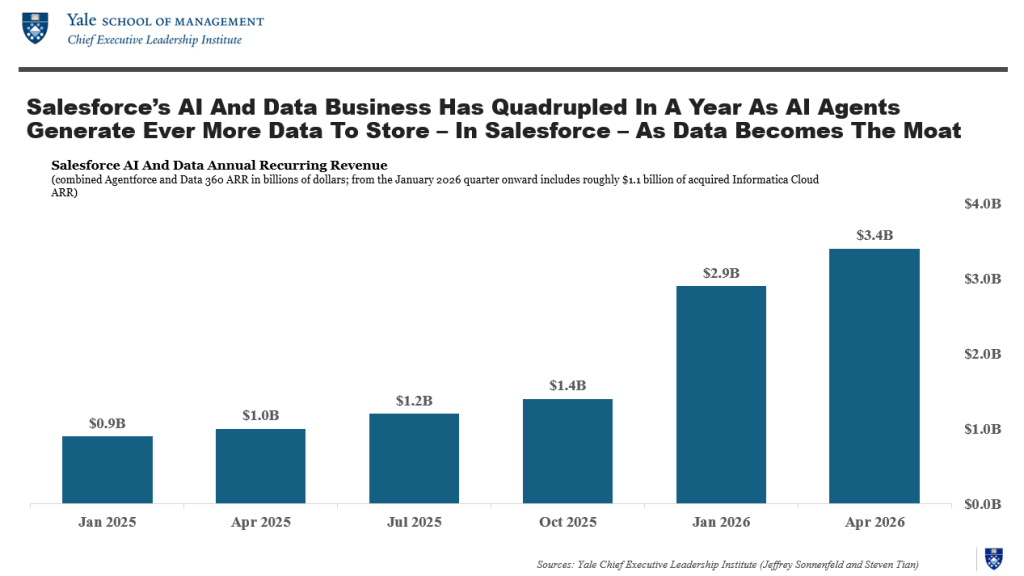
No wonder the results reflect Salesforce’s position as an emerging AI winner. Agentforce, Salesforce’s AI agent platform, has gone from $100 million to $1.5 billion in annual recurring revenue within 18 months of launch, with well over 30,000 Agentforce deals already closed amidst exciting new partnerships with Anthropic’s Claude as the premier agent inside Agentforce. All those AI agents are producing more and more data by an exponential factor, which conveniently needs to be stored within Salesforce, with Salesforce ingesting 104 trillion records last quarter alone, double that of just last quarter.
And interestingly, the long-underestimated acquisition of Slack has become extraordinarily important to Salesforce’s AI future, as Slack is where key decisions are argued out, providing agents with critical context and human insights they would have never been able to glean from a database field alone. It is why Slack is growing at a record rapid clip, just delivering its fastest quarterly Net New Annual Order Value (“NNAOV”) growth since acquisition as Slackbot users grew over 150% Q/Q; and when Salesforce opened Slack up to outside AI agents, a million users plugged in within a month. Visionary founder/CEO Marc Benioff’s decision to spend $25 billion buying back his own stock in a single quarter earlier this year — the largest repurchase in company history, roughly a fifth of its market capitalization – is looking incredibly savvy for the largest repository of customer data on the planet.
The balance of power shifting to Salesforce, with Salesforce getting more pricing power, not less, is why leading frontier LLMs such as Anthropic are now rushing to strike partnerships with Salesforce, exemplified by the debut of “Claudeforce,” Salesforce and Anthropic’s exciting new partnership allowing full integration of Claude within Salesforce, a win-win partnership which will increase usage of both platforms and push customers toward the highest-end premier subscription plans.
The bearish AI narrative here is also deceptively simple – and wrong. Earlier this year, some analysts presumed that if a traveler can ask a chatbot for a hotel or flight, who needs Booking.com? But time has shown just completely wrong those skeptics were, with Booking Holdings stock having now bounced back to near all-time highs, just as other OTA rivals such as Expedia have as well. The mistake these wrongheaded skeptics made was simple: they mistook Booking Holdings as a search engine when in reality, it is a differentiated travel transaction platform enjoying a strong competitive moat.
The distinction that matters, and which is too often overlooked, is between the top of the travel funnel, where trips are discovered, and the bottom, where money changes hands and the trip actually planned and executed. Travelers are indeed turning to AI for recommendations, and that is genuinely ominous for metasearch and referral businesses whose entire function was comparison. It is not ominous, however, for the company that is merchant of record on roughly three-quarters of its bookings — a share up four points in the past year and still fast rising — settling more than 100 payment methods across 50 currencies and adjudicating the thorny disputes and complex last-minute cancellations that AI platforms have shown no appetite to touch.
Indeed, Google’s own leadership declared that the company has “no intention of becoming an OTA (online travel agency)” and has zero interest in acting as merchant of record. OpenAI reached the same conclusion the hard way, retreating from in-chat checkout this spring after a badly botched rollout was widely panned.
Furthermore, contrary to popular perception, almost all of Booking.com’s room nights come from independent properties and smaller hotels, to the tune of 90% of all bookings, rather than large hotel chains. These smaller properties would never be able to run global payment processing, multi-currency settlement, and dispute resolution even if they are somehow able to surface independently through AI searches. This is the critical gap that Booking’s infrastructure fills, and why Bookings’ hotel partners are so loyal and not going anywhere anytime soon. The importance of this structural advantage shielding against LLM disruption can be seen in how Airbnb’s stock price is up 40% YTD, partly because its inventory of exclusive properties is seen as a strong moat against LLM disruption.

However, those same bears, undeterred by their prior mistakes as the overwrought SaasPocalypse “death” narrative faded, have now pivoted towards believing that just like with Salesforce, Booking Holdings will have less pricing power moving forward, and will have to pay more for customer acquisition than it did before with less direct customer loyalty, compressing margins and hindering profitability. But this margin compression thesis is equally wrong, as accelerating AI changes will only increase the relative power of Booking Holdings in the marketplace and make its value proposition more singular and irreplaceable.
Simply put, Booking Holdings is well positioned to use AI to gain even more market share from its less tech-savvy competitors. With Booking Holdings’ moat secure as the travel infrastructure provider of choice, there is every reason to think that AI will only drive greater traffic towards Bookings’ unique platform in the years ahead, rather than less. We are still in the earliest stages of this pivot, as AI-driven traffic has been remarkably limited for OTAs thus far. On its August earnings call, Booking disclosed that traffic sourced from large language models remains well below 1% of room nights, with no material change over recent quarters, while direct traffic held steady in the mid-60% range and grew in absolute terms.
But in a future where AI drives an inevitably greater share of discovery, building on the lessons it has learned bidding for web browser search traffic for 20 years, Booking Holdings is the best positioned of its competitors to apply those lessons to bidding for preferential AI traffic and advertising – with the same tried-and-true machinery for converting a click from search traffic, regardless of whether from AI or from a search engine, into a direct, repeated, loyal Booking customer. That is the same exact singular playbook Booking has pioneered to perfection under the continued leadership of Booking’s widely admired CEO, Glenn Fogel, who is seen as one of the best capital allocators of our era – all of which are unique advantages that position Bookings to be the biggest AI beneficiary of any of its competitors.
IBM bears wrongly believed they’d stumbled onto gold last month when IBM stock fell 25% in a single day, the worst in the company’s history, as several large clients redirected capital budgets towards memory amidst a severe memory crunch. Although a third of those supposedly lost deals ended up closing within the next few weeks, and IBM CEO Arvind Krishna won widespread plaudits for his honest transparency.
Nonetheless, a common misguided bearish narrative is that AI is poised to disrupt IBM’s $21 billion consulting business as well as its hugely profitable legacy software business, on which runs the core systems of many banks, insurers, and airlines.
But what some critics miss is that AI has actually been a boon for IBM’s consulting business: AI now accounts for half of all new consulting signings and is one of the largest components of IBM’s backlog — at far higher margins than traditional consulting, thanks to IBM now being able to bill on the basis of outcomes and productivity rather than brute hours worked. And Red Hat, the software that enables a company’s AI agents to run across any cloud and any platform, grew 11% as paradoxically, AI creates new needs for software powers continued revenue growth in the subscription software business.
Simply put, IBM is being paid to build the AI transition, not run over by it, which is why IBM’s AI business has more than doubled over the last year.
Everybody – ourselves included – concedes that AI is disrupting legacy technology and software companies. But financial markets seem to be tossing out the baby with the bath water, looking past vital software companies which own things that AI agents cannot run without. The key question now, is whether a company still owns something that AI agents need, and where the power in the marketplace lies. And we believe that power is rapidly shifting back to software firms which just months ago were seen as the biggest losers but are now quickly transforming into the biggest winners from AI.
Salesforce owns the data that AI agents cannot operate without. Booking Holdings owns the travel platform that agents cannot execute travel bookings without. IBM owns the underlying technological infrastructure that AI agents run on. Every one of these is a differentiated moat, which is worth more in a world of AI, not less. These are just three particularly compelling examples of several prominent software companies poised to benefit from AI, with ServiceNow under the capable and experienced leadership of CEO Bill McDermott and Snowflake also standing out as core examples.
As legendary Intel CEO Andy Grove famously quipped, “only the paranoid survive.” But paranoia and panic are very different, and amidst widespread panic across markets, commendable prudence has turned into reckless lack of discrimination in discerning AI winners and losers in the software space, with software bears missing the transformation taking place before our eyes as software firms turn into some of the biggest beneficiaries of AI.
The opinions expressed in Fortune.com commentary pieces are solely the views of their authors and do not necessarily reflect the opinions and beliefs of Fortune.
This story was originally featured on Fortune.com

The U.S. Army is moving forward with plans to bring nuclear power to five military installations as part of a multibillion-dollar effort to strengthen the military’s energy security and reduce its reliance on potentially vulnerable power grids.
The Army announced Wednesday that its Janus Program selected five nuclear energy companies for awards of up to a combined $2.2 billion to own, build and operate nuclear microreactors at bases in North Carolina, Kentucky, Texas, Georgia and New York.
The announcement comes as the Army works toward a September 2028 target outlined in an executive order signed by President Donald Trump calling for the first Army-regulated reactor to begin operating on a military installation.
Combined with expected private-sector investment, the Army said it expects more than 20 nuclear microreactors to eventually be built and operated across Department of War installations.
CALIFORNIA HELICOPTER MAKER LANDS MAJOR ARMY TRAINING DEAL, COULD SUPPORT HUNDREDS OF US JOBS
The initial reactors will be built by Antares Nuclear at Fort Bragg, North Carolina; BWXT Advanced Technologies at Fort Campbell, Kentucky; and General Atomics Electromagnetic Systems at Fort Hood, Texas.
Additionally, the Army said Radiant Industries will install a reactor at Fort Benning, Georgia, while Westinghouse Government Services will install one at Fort Drum, New York.
Secretary of the Army Dan Driscoll emphasized the importance of securing reliable power for military installations.
“Since launching the Janus Program, our mandate from President Trump and Secretary Hegseth has been clear: secure the power our warfighters need to train, deploy, and win,” Driscoll said.
PENTAGON BOOSTING THAAD INTERCEPTOR PRODUCTION WITH NORTHROP GRUMMAN, LOCKHEED MARTIN DEAL
“Awarding these contracts accelerates our ability to deliver safe, reliable baseload power directly to our installations,” he continued. “We are building the energy resilience necessary to project combat power globally, without relying on potentially vulnerable external grids.”
The Army said the funding will be distributed from fiscal years 2027 through 2031 using a milestone-based payment model, meaning companies will receive government funding only after meeting specified technical goals.
Each vendor is also expected to contribute significant private capital.
The Army said it spent roughly a year evaluating potential installations based on factors including energy needs, seismic and hydrological considerations and safety.
GORDON CHANG WARNS BEIJING’S PROVOCATIONS COULD SPARK A WAR ‘NO ONE CAN CONTROL’
Jeff Waksman, principal deputy assistant secretary of the Army for Installations, Energy and Environment, emphasized that the effort is not simply an experiment, but is intended to produce reactors capable of reliably providing power for years.
“We are seeking not just reactors capable of turning on for a brief demonstration, but rather systems able to deliver power with high-capacity factors for years of operation,” Waksman said.
“The Janus Program will be a complete success when and only when we have assisted multiple nuclear companies in developing truly reliable and affordable nuclear microreactors which they can sell to other buyers beyond just the military.”
GET FOX BUSINESS ON THE GO BY CLICKING HERE
The Army said the five initial locations are only the beginning, with additional Army and other military service sites expected to be announced later.
“We need more power. We need it delivered faster and cheaper, and we need it to be more reliable,” Owen West, director of the Department of War Innovation Unit, said. “With Janus, DIU is assisting the Army’s micro reactor build – speeding military energy production to protect the nation.”