

Sledgehammer sovereignty: Zvi Sukkot’s vigilante stunt hurts Israeli security, law – editorial
There are reasons for Israel to oppose monuments that glorify terrorists. That does not justify a Knesset member taking a sledgehammer into a Palestinian village and deciding that he is the law.
Religious Zionist MK Zvi Sukkot entered the West Bank village of Madama near Nablus on Tuesday during an IDF-escorted tour and participated in destroying a monument that appeared to honor members of the al-Aqsa Martyrs Brigades and Palestinians killed during the intifada. Sukkot argued that such memorials glorify those who murdered Jews and encourage others to follow their example.
There is a serious argument there. Societies reveal their values through those they choose to honor, and Israel should not ignore incitement or the glorification of terrorism.
But that is not the issue here.
According to the IDF, Sukkot requested military protection for what was presented as a tour of monuments. Soldiers were diverted from operational duties to provide security. The army says Sukkot and those accompanying him then acted outside the approved plan and began destroying the monument without authorization.

Self-appointed judge, enforcer, demolitionist
The IDF called their conduct deceitful and manipulative.
A member of Knesset does not acquire executive authority because he believes the authorities have failed to act. If Sukkot believed the monument was illegal or constituted incitement, he had every right to demand its removal. He could appeal to the IDF, the Civil Administration, the government, or the courts. He could raise the issue in the Knesset.
What he could not do was appoint himself judge, enforcement officer, and demolition crew.
That is not governance. It is vigilantism.
The principle matters beyond one monument. Israel is a sovereign state because it possesses institutions that exercise authority according to law. Its army uses force under orders. Its police enforce laws. Its courts settle disputes. Elected officials make policy, but they do not carry it out with sledgehammers when the state does not move quickly enough.
Once such distinctions disappear, every group can claim its cause is righteous enough to justify bypassing the law.
There is a security cost.
A day earlier, Central Command chief Maj.-Gen. Avi Bluth reportedly warned that nationalist crime could be the “match” that ignites a broader West Bank escalation. The army is stretched across multiple fronts. Troops should be protecting Israelis and preventing terrorism, not diverted to provide cover for political stunts.
Sukkot says his actions were about protecting Jews. Yet consuming military resources and inflaming a volatile arena does not make Jews safer.
Prime Minister Benjamin Netanyahu’s office called the incident unacceptable. Finance Minister Bezalel Smotrich said such monuments should be removed but stressed that the IDF alone should do so.
That distinction matters.
Existence of Israel, institutions bestows responsibility on Jews
The episode deserves more than a political rebuke because it touches something deeper about Jewish sovereignty.
For centuries, Jews knew what it meant to live without power, dependent on rulers who might protect them one year and persecute them the next. The creation of Israel changed that. Jews now possess an army, a government, courts, police, and the ability to defend themselves.
That power carries responsibilities.
Jewish sovereignty was not created so that Jews could enjoy the privilege of lawlessness.
Strength does not mean acting without restraint. It means having the power to act while choosing to remain within the law.
Israel’s enemies portray the Jewish state as motivated by vengeance, domination, and contempt for Palestinians. Those accusations are often dishonest and politically motivated. Israel should reject them forcefully.
But it should also refuse to provide images that reinforce that caricature.
What lesson does an Israeli child learn from seeing an elected lawmaker participate in destroying a monument while soldiers stand nearby? That laws matter only until someone believes strongly enough that he is right? That Jewish sovereignty gives individuals permission to use force whenever institutions disappoint them?
That cannot be the message.
Israel has every right to confront incitement and prevent the glorification of terrorism. The IDF says it removes monuments and symbols deemed incitement when authorized to do so.
The Jewish answer to lawlessness cannot be Jewish lawlessness.
Sukkot’s actions represented neither Jewish strength nor responsible leadership. Jewish power means the ability to defend ourselves while remaining governed by law.
That is a far stronger answer to our enemies than any sledgehammer.
Australia’s royal commission on antisemitism to conclude hearings after Bondi Beach attack
Australia’s Royal Commission on Antisemitism and Social Cohesion will hold its final day of hearings on Wednesday, wrapping up months of testimony from Australians in the aftermath of the 2025 Bondi Beach mass shooting.
Established in the wake of the ISIS-inspired attack on a Hanukkah event at Bondi Beach in Sydney where Sajid and Naveed Akram allegedly murdered 15, the commission has heard from hundreds of Jewish community members, policy experts, and security officials.
The commission has also reportedly received over 20,000 submissions.
Some of the key witnesses include survivors of the massacre, Holocaust survivors and the head of Australia’s national security agency.
Chabad of Bondi director Rabbi Yehoram Ulman is scheduled to be among the last to testify on Wednesday. Ulman’s son-in-law, Rabbi Eli Schlanger was killed in the attack.

Royal commission was initially rejected, only formed after public pressure
Some in Australia have called for the commissions duration to be extended to allow for a more thorough investigation. New South Wales Premier Chris Minns told press he would call for an extension to get “the fundamental truth of what happened” out.
“If we need to for a couple of weeks longer, given that most of the expense was spent setting it up, that would seem to be money well spent because both the federal and the state government are relying on these recommendations to shape some of our policy,” News.com.au reported him as having said.
MP Julian Leeser, who has Jewish ancestry, submitted a motion in Parliament to extend the commission, though it was defeated.
Following the attack, Australian Prime Minister Anthony Albanese initially rejected calls for a royal commission. Weeks later, after calls from Jewish organizations, individuals, and politicians, he announced the formation of the commission.
From its formation, the commission was tasked with four main areas: Investigating antisemitism, making recommendations to assist security services to respond to antisemitism, examine the circumstances surrounding the Bondi attack, and make recommendations to strengthen social cohesion in the country.
Wednesday’s testimony will focus on social cohesion.
Following the conclusion of testimony, the commission, headed by former High Court justice Virginia Bell, will convene to draft the final report, expected around the December anniversary of the attack.
The commission released an interim report in April, which found that Australia’s legal and regulatory frameworks hadn’t stopped security agencies from preventing or responding to the attack.
Among the recommendations of the interim report were calls to expand protection for Jewish communities during holiday events and services, updating the counterterrorism handbook, and a national gun buyback plan. Other recommendations weren’t made public due to the security aspect of the commission.
Albanese’s government pledged to adopt the interim recommendations.
Mathilda Heller and Reuters contributed to this report.
New York brothers charged with hate crimes after allegedly stealing, burning Israeli flag
Two brothers from Hornell, New York, were arrested and charged with hate crimes after allegedly stealing an Israeli flag from a flagpole outside a business and later setting it on fire at their home.
The suspects, Cormac Thomas Banco, 28, and his brother Declan Peter Banco, 31, were arrested on Saturday at approximately 7:32 a.m., according to the Hornell Police Department, following an investigation into the theft of the flag from a flagpole on Park Drive.
Police said the investigation determined that the flag was taken to the brothers’ home, where it was burned.
Both brothers were charged with hate crimes related to theft and criminal damage, as well as destroying evidence. Cormac Banco was also charged with resisting arrest. The two were taken to the Steuben County Jail, where they were booked later that evening.

Hornell once home to small Jewish community
Hornell is a small city in Steuben County in western New York, located about 90 kilometers south of Rochester. The city has a population of approximately 8,000 people. It was once known as an important railroad hub and earned the nickname “Maple City” because of the maple trees that once surrounded the area.
The city was once home to a small Jewish community. The Orthodox Beth El Synagogue was established in Hornell in 1946, later briefly operated as a Conservative congregation, and eventually closed. The building was designated a national historic site in 2016.
In 2022, the former synagogue was targeted by neo-Nazis, who distributed propaganda materials, including swastikas, at the site and at two local churches.
Alarming study reveals Israeli teachers lag behind global peers substantially in all metrics
Israeli teachers scored below their counterparts in the countries examined in literacy, numeracy, and problem-solving, according to a new study that also found a substantial skills gap between academically educated teachers and other Israeli workers with academic degrees.
The study, released on Wednesday and conducted by Yael Melzer of the Shoresh Institution for Socioeconomic Research, analyzed data from the Organization for Economic Co-operation and Development (OECD) 2022-2023 Program for the International Assessment of Adult Competencies (PIAAC).
Israeli teachers scored below the average for the 18 comparison countries across all three areas examined. Among teachers with academic education, Israeli teachers also scored below the comparison-country average in every age group.
PIAAC does not directly measure classroom performance or teaching ability. Rather, it assesses adults’ literacy, numeracy, and adaptive problem-solving skills – their ability to process information and deal with everyday and work-related tasks.
The findings came against the backdrop of the wider 2022-2023 PIAAC results, in which Israeli adults scored below the OECD average across all three areas.

International gap tied to multiple factors
Melzer’s study focuses specifically on teachers.
Part of the international gap may be connected to formal education. Some 37% of Israeli teachers in the study held master’s degrees, compared with 49% among teachers in the comparison countries.
But the difference did not disappear when teachers with similar levels of education were compared. Instead, the gap was concentrated among those with academic degrees.
Among Israelis with academic degrees, teachers scored lower than degree-holders working in other professions. The pattern was reversed among Israelis whose highest level of education was upper secondary: Teachers scored higher than similarly educated workers outside teaching.
The divide was particularly pronounced among men.
While teachers and other workers with academic degrees in the comparison countries recorded broadly similar results, academically educated male teachers in Israel lagged considerably behind Israeli men with degrees working in other professions.
The study found a smaller, though still visible, gap among women.
A similar pattern emerged among teachers with academic backgrounds in science, technology, engineering, and mathematics.
In the comparison countries, people with academic backgrounds in STEM were generally among the highest-skilled workers.
In Israel, teachers with STEM backgrounds recorded the lowest skill levels among academically educated teachers in literacy and problem-solving, while their numeracy skills were similar to those of other academically educated teachers. They also lagged markedly behind Israelis with similar academic backgrounds working outside education.
Melzer interpreted the pattern as evidence that the education system has greater difficulty competing for highly skilled workers with academic degrees. The study argued that while teaching appears relatively successful in attracting skilled workers from among people without academic degrees, it has more difficulty recruiting and retaining highly skilled academics.
The data showed an association rather than establishing why those workers choose other professions. Melzer pointed to greater rewards for skills in the private sector as one possible explanation, particularly for the pronounced gap among men.

Substantial differences within the system
Substantial differences also appeared within Israel’s education system.
Teachers in the Arab education stream recorded markedly lower scores than teachers in all other streams examined.
Ultra-Orthodox (haredi) teachers also scored below teachers in the secular and religious non-haredi systems in literacy and numeracy.
The study noted that those differences do not exist in isolation. Melzer pointed to lower investment and shortages of infrastructure and resources in Arab education and noted that the difference between spoken and written Arabic may also affect PIAAC performance in a way that cannot be fully separated from the skills being measured.
The other particularly weak point was early-childhood education.

Upper-secondary teachers recorded substantially stronger skills than teachers working with younger children across all three areas measured. Primary-school teachers also performed better than preschool teachers in literacy and problem-solving.
The findings came as the Education Ministry moved to recruit additional teachers ahead of the coming school year. The ministry this month opened a temporary employment track allowing schools to recruit up to 8,000 teachers through personal contracts, including professionals without previous teaching experience, with full-time salaries that can reach roughly NIS 20,000 a month depending on their experience and professional background.
Shoresh recommended changes aimed at attracting more highly skilled candidates into teaching.
The study proposed raising admission requirements for teacher training, including a model in which future teachers first complete a degree in the subject they intend to teach and only afterward undergo shorter pedagogical training.
It also recommended changing compensation structures to make teaching more competitive for highly skilled graduates, alongside targeted efforts in Arab and early-childhood education.
“The findings show that Israel’s education system is struggling to attract and retain highly skilled academics,” Shoresh president Prof. Dan Ben-David said, arguing that the gaps both with other countries and within Israel require changes to how teachers are recruited, trained, and compensated.
Ben-David said particular attention should be directed toward Arab and early-childhood education, warning that without broader reforms, “it will be difficult to narrow the gap with the leading countries and improve the quality of teaching in Israel.”
The study’s broader concern was not only the number of teachers entering classrooms but also the education system’s ability to attract highly skilled people into the profession.


An extra $100 per month for Obamacare is too much for nearly half a million Floridians
Florida chef Elijah Button was chopping onions in June when his knife slipped and sliced his middle finger to the bone.
It was his worst kitchen accident to date. But having given up his Affordable Care Act health insurance plan in January because of a $100 monthly premium hike he couldn’t afford, the 21-year-old in St. Cloud didn’t have the money for emergency care.
“Going to the hospital for it wasn’t even an option,” he said, gesturing toward his finger before preparing a pot roast for his aunt and uncle in their suburban home. “My first thought was, ‘how am I going to fix this?’”
After Republicans in Congress let enhanced federal subsidies for Affordable Care Act health plans expire in January, millions of Americans including Button had to decide whether to keep insurance that often doubled or tripled in cost — or risk going without it.
Months later, with no action from lawmakers to replace the lost funds, they’re facing the consequences. Some are dealing with strained budgets and exorbitant medical bills, while others avoid the doctor in fear of the cost.
Florida, whose large population of gig workers, entrepreneurs and small business owners relies heavily on the federal health insurance marketplace, has become one of the nation’s most visible epicenters of that impact.
Figures first reported by The Associated Press showed that about 440,000 Floridians dropped their Affordable Care Act plans this year — more than in any other state. Thousands more who kept coverage are struggling to get by, as prices of necessities like groceries and gasoline remain steep, and health insurers project another year of double-digit premium hikes.
While Florida had the most affected residents, its struggles are reflective of broader nationwide concerns over rising healthcare costs and a lack of meaningful policy to address them.
In the deep-red state where congressional districts were recently redrawn to strongly favor Republicans, the cost of healthcare is a major campaign issue. Republican midterm candidates have been promoting fraud crackdowns to protect federal health programs, while Democrats have been urging voters to help Congress change hands so they can restore subsidies.
Button, who is estranged from his parents, asked his uncle for help with his bloodied finger. With a butterfly bandage, splint and daily cleanings and dressings, it healed. But the scar still gnaws at Button as a symbol of what else could go wrong.
“It just feels like I’m living in a house of cards,” he said.
Florida’s population and politics make it ground zero for ACA fallout
Last fall, debate over the expiring subsidies consumed Congress, resulting in a record 43-day government shutdown as Democrats insisted on extending the COVID-era assistance and most Republicans refused.
Fast forward almost a year and lawmakers rarely reference the topic anymore. The administration says it is addressing affordability with fraud-busting efforts and deals with drug companies, but Congress hasn’t passed any significant legislation to lower health costs.
In part due to its large number of construction, hospitality and small business workers — and also because its Republican-led legislature never expanded the Medicaid safety-net health program — Florida has the largest Affordable Care Act enrollment in the country. At just over 3.8 million enrollees, it represents about a fifth of the nation’s total enrolled population.
Of the roughly 443,000 Floridians who left the marketplace, most are likely going without insurance, according to Cynthia Cox, a vice president at the healthcare research nonprofit KFF. She said that’s because it is typically a “place of last resort” to get coverage.
The data doesn’t tell the stories of those who kept insurance. Tracy Rand, a licensed mental health counselor in Leesburg, Florida, is one of them.
Ever since getting her ovaries removed last year due to benign but painful tumors, she has had severe menopause symptoms that require medication, including an overactive bladder and hot flashes that cause piercing headaches.
She uses clear plastic containers to organize the more than 30 medicines and supplements she takes daily, their bottles crammed into a living-room drawer and a tray on her kitchen counter.
The 51-year-old’s Affordable Care Act plan was going to surge in price this year from $55 a month to $1,100 a month, so she downgraded. Her new plan, with higher deductibles and copays, costs $160 a month.
To make that work in her budget, Rand quit a doctoral program she was working toward, started buying groceries at cheaper stores, gave up once-monthly dinners out with her husband and stopped meeting friends regularly at a paint-your-own pottery studio.
It’s been a difficult adjustment, but a necessary one for her health.
Rand said the prospect of insurers raising rates again fills her with dread.
“I don’t know what else we can get rid of,” she said, covering her face with her hands. “I don’t know if we’re going to have to file bankruptcy.″
Clinics for the uninsured are a saving grace — but they can’t take everyone
In Orlando’s leafy, brick-paved neighborhood of Colonialtown South, Tarsha Watson found her lifeline. A clinic there called Grace Medical Home provides low-income, uninsured Floridians with comprehensive care for a $5 per-visit fee.
Watson, 54, has a master’s degree in business administration, but she hasn’t been able to find work since losing her job two years ago. That means she doesn’t have health insurance. When she explored Affordable Care Act coverage, she was quoted $600 per month, far out of her reach.
At Grace, Watson learned her blood sugar is high and that she needed to lose weight. Now, she walks laps around her backyard pool and does Tai Chi YouTube tutorials to focus on fitness. She said she wishes everyone could have her experience.
“It’s very hard out here,” she said. “It’s not enough.”
At the clinic, patients cycle in and out of a wide hallway lined with appointment rooms as doctors scan supply shelves for complimentary over-the-counter medications. The expansive building has separate areas for dental, mental health, vision and pediatric care.
CEO Stephanie Garris said it’s one of 110 free or charitable clinics in Florida, but that’s not enough to handle demand. To treat more people in response to the Affordable Care Act changes, it recently started hosting a mobile acute care clinic for walk-in patients.
Garris said Grace Medical Home treated about 1,350 people last year. Every year, they take about 350 new patients.
“Would I love to double that, triple that? Of course,” Garris said. “I just think in the reality, with the huge number of uninsured that we have, it’s just not possible.”
Health costs become an issue in midterm campaigns
For U.S. Rep. Darren Soto, a Democrat defending his seat in a sprawling — and now much redder — redrawn district south of Orlando, health costs are a campaign focal point.
He said his district, which is near various theme parks, had the second-largest Affordable Care Act enrollment in the nation, in part because many small tourism businesses can’t offer employees health insurance.
“I just hear it everywhere I go,” he said. His Republican opponent, Navy veteran and former Trump administration official Dan Green, did not answer emailed questions about the subsidies but has emphasized affordability of groceries and property insurance as campaign priorities.
Soto voted with Democrats and some Republicans — including a few from Florida — to save the subsidies last year. The Republican majority declined and suggested other ideas, including funding Americans’ health savings accounts. No law along those lines has passed yet.
Button, a Democrat in Soto’s district, said he is open to different reforms for health costs, but said politicians aren’t acting fast enough.
“They keep trying to make excuse after excuse,” he said. “I don’t have six months to a year to wait for you guys to pass this through the hoops that you need to.”
This story was originally featured on Fortune.com


Trump administration pauses US visa appointments worldwide amid sweeping immigration crackdown
US President Donald Trump’s administration has issued a pause on visa appointments for applicants around the world during an ongoing immigration crackdown by the US government in the Republican leader’s second term in the White House.
A US State Department spokesperson said on Tuesday that it launched a global training initiative at all US embassies and consulates worldwide and that appointments for visa services will be adjusted to accommodate the training.
Trump has pursued an aggressive deportation drive and immigration crackdown that includes revocations of visas and green cards and rejection of applications over a. range of reasons like political opinions and pro-Palestinian protests against US ally Israel’s war with Hamas.
He says the crackdown aims to improve domestic security.
The crackdown has faced some legal setbacks. A US judge on Friday struck down a Trump administration policy suspending the issuance of immigrant visas to applicants from 75 countries, saying that the policy exceeded Secretary of State Marco Rubio’s statutory authority.

Human rights groups have condemned Trump’s immigration approach
The State Department did not specify details on the training and its timeline, beyond saying the training aimed to help consular officers screen out applicants deemed likely to become dependent on US public benefits and to ensure evaluation of visa applicants “comprehensively and consistently.”
The pause on visa appointments was reported earlier by the Financial Times, which said immigrant visa applicants with scheduled interviews at US embassies and consulates have received emails that their appointments were being rescheduled and that they would receive future notice of a new date.
Trump’s immigration crackdown has been widely condemned by human rights groups as being discriminatory and in violation of free speech and due process rights. Rights groups also say the crackdown has created an unsafe environment in the US, especially for ethnic minorities who have raised concerns about racial profiling.
While Trump campaigned in 2024 on a platform of stopping illegal immigration, his administration has also made legal immigration more difficult, for example, by imposing new and expensive fees for applicants of certain work visas.
Instagram head Mosseri, at children’s addiction trial, says few teenagers knew of safety feature
The top executive at Instagram said few teenagers used a key safety feature to limit their use before it was turned on by default, at a trial over whether Meta Platforms designed Instagram and Facebook to addict children.
Adam Mosseri, the head of Instagram since 2018, denied any suggestion by US states suing Meta that Instagram stalled by not making the “Take a Break” feature the default setting for teenagers until September 2024, nearly three years after its launch.
Under questioning from Jason Slothouber, an attorney for Colorado, Mosseri acknowledged that the percentage of teenagers using Take a Break was in the low single digits before Instagram made it the default.
Mosseri estimated in a December 2021 blog post, when Take a Break launched, that in early tests more than 90% of teenage users who turned the feature on kept it on. The feature encourages users to close Instagram after set periods.
“Most teens didn’t want it,” Mosseri said on the fourth day of a trial in Oakland, California, federal court. “We decided to push forward with it anyway.”

Mosseri is a central witness in the lawsuit by 29 US states, in what experts call the biggest legal test yet of social media’s effects on young users.
States accuse Meta of addictive design
Four of the states, California, Colorado, Kentucky, and New Jersey, have accused Meta of designing the platforms to hook young users, fueling anxiety, depression and even suicide, while misleading consumers about their safety.
All 29 states say Meta violated federal law by improperly collecting and using personal data of children under 13 while they used its platforms.
The states have indicated they could seek nearly $200 billion in civil penalties.
Meta has rejected accusations that it sought to addict children, and said its research showed no clear link between adolescents’ social media use and a lack of well-being.
Instagram chief denies hiding safety data
Under questioning by Slothouber, Mosseri rejected the idea that he knew of an alleged Meta policy allowing lawyers to review internal presentations to scrub information or shield him from problems.
Mosseri said it was important that any information Instagram released about children’s safety be high-quality and backed by experts.
“I am not trying to encourage my team to hide anything,” Mosseri said. “I want to understand how things work. I can’t think of any time that I’ve encouraged people to bring less information to me.”
Mosseri also said Instagram centralized people working on sensitive research about teenagers to a single team and reduced access to the information across the company following the 2021 leak of the so-called Facebook Files.
That leak came from whistleblower Frances Haugen, a former Facebook product manager who said Meta knew its products were unsafe for children but did nothing to pursue higher profit.
The trial is expected to resume with more testimony from Mosseri on Wednesday.
Design chief acknowledges safety data removal
DESIGN CHIEF ACKNOWLEDGES SAFETY DATA REMOVAL
Prior to Mosseri’s testimony, Instagram director of product design Francesco Fogu testified about a presentation on teenagers’ safety that his team prepared in 2023 for Instagram leadership.
Under questioning from Slothouber, Fogu acknowledged the removal of data from a presentation slide showing that teenage Instagram users saw 1.5 times more bullying, suicide, hate, nudity and violent content than adult users.
Later, when questioned by a Meta attorney, Fogu said the figure appeared on a different slide.
Fogu also said Instagram knew that fewer people would use “Take a Break” by not making it the default setting.
The trial could last six weeks.
Jurors are expected to issue an advisory verdict. US District Judge Yvonne Gonzalez Rogers will decide whether Meta is liable and, if so, determine any civil penalties and changes to Facebook and Instagram.
Mosseri also testified in February in a Los Angeles trial that Instagram cared about children’s safety, defending its design choices against allegations by company insiders that its features were harmful.
Jurors in that case found Meta and Alphabet’s GOOGL.O Google negligent in designing their platforms, and ordered them to pay $6 million to a 20-year-old woman who said she became addicted to Instagram and YouTube as a child.
Earlier this month, a New Mexico judge ordered Meta to pay $567 million to address teenagers’ mental health after that state’s attorney general called its platforms a public nuisance.
Tennessee is also suing Meta, raising similar claims about Instagram, in a case on trial in Nashville.
Darline Graham wins South Carolina Republican Senate primary runoff
US Senator Darline Graham (R-SC), an avid supporter of Israel who vowed to carry the legacy of her late brother, Sen. Lindsey Graham, won South Carolina’s Republican primary runoff on Tuesday.
Graham, who was appointed to hold the Senate seat until the beginning of January, defeated Rep. Ralph Norman (R-SC) and is set to face Democrat Annie Andrews in the November general election for a full, six-year Senate term.
The win is also a victory for US President Donald Trump, who recruited Graham and endorsed her following the death of her brother last month.
“She only knows how to put America first,” CNN quoted Trump as saying during a Friday rally in Myrtle Beach. “You vote for her, you’re going to be very proud of that vote.”
This is a developing story. Reuters contributed to this report.

Chrysler recalls nearly 75K SUVs over parts that could detach while driving
Chrysler has recalled nearly 75,000 SUVs over a manufacturing defect that could cause certain parts to break loose while driving, creating unexpected road hazards and significantly increasing the risk of a crash, according to federal regulators.
Nearly 74,578 Dodge Durango vehicles from the 2021-2023 model years are affected by the recall, which was submitted to regulators on Aug. 13, the National Highway Traffic Safety Administration (NHTSA) said.
According to the recall notice, the vehicles may have rear spoilers that were improperly aligned during installation, causing the spoiler to strike the vehicle’s roof whenever the liftgate opens and closes. Over time, the impact can weaken the spoiler’s structural integrity and cause it to detach while the vehicle is in motion.
“Rear spoilers which detach from a vehicle may create road debris and increase the risk of a vehicle crash,” the notice said.
TESLA FILES PLANS FOR PROPOSED $10.1B TEXAS SOLAR MANUFACTURING PLANT
Regulators said the safety defect was previously addressed under two recall campaigns filed in 2021 and 2023 but warned that owners must return for additional repairs due to persistent issues.
The affected vehicles were manufactured between July 13, 2020, and March 28, 2023.
Approximately 0.8% of the recalled vehicles are estimated to contain the defect. No crashes or injuries have been reported.
MORE THAN 20,000 OFF-ROAD MOTORCYCLES RECALLED OVER DANGEROUS BRAKE DEFECT THAT COULD LEAD TO DEATH
As of July 29, 2026, Chrysler reportedly identified 116 warranty claims, eight customer assistance records and 37 other service reports related to post-remedy failures.
The final, permanent technical repair is currently under development by Chrysler, according to officials.
Dealers were formally notified on Aug. 20, and searchable vehicle identification numbers became available on NHTSA.gov the same day, officials said.
Owner notification letters are scheduled to begin mailing on Sept. 10, 2026.
CLICK HERE TO GET FOX BUSINESS ON THE GO
Owners can contact Chrysler customer service at 1-800-853-1403 or the NHTSA Vehicle Safety Hotline at 1-888-327-4236.

State sues Snapchat over alleged addictive features and adult content for kids
Pennsylvania Attorney General Dave Sunday sued Snap Inc., the parent company of Snapchat, on Tuesday, accusing the company of designing the social media app to keep young users compulsively engaged while misleading parents about its safety and age-appropriate content.
The lawsuit, filed in Philadelphia County Court, takes aim at features including Snapstreaks, infinite scrolling, push notifications, autoplay and disappearing messages. Pennsylvania alleges the features encourage young people to spend more time on Snapchat, helping the company generate advertising revenue while exposing minors to potential harms.
The state alleges Snapchat has millions of users in Pennsylvania, including tens of thousands under 16, while Snap generates millions of dollars in annual revenue from users in the state. Snap’s North American operations generated more than $5.3 billion in revenue in 2024, according to the complaint.
The lawsuit also targets how Snapchat monetizes engagement. Users can pay to restore an expired Snapstreak, which tracks the number of consecutive days two people have exchanged Snaps. Pennsylvania alleges younger users can feel pressure to maintain streaks because they associate them with the strength of their real-life friendships.
GOOGLE’S YOUTUBE REACHES SETTLEMENT IN LAWSUIT ALLEGING CHILD SOCIAL MEDIA ADDICTION
“Snapchat has designed its platform to lure children into constant, compulsive use that is detrimental to healthy adolescent development,” Sunday said in a statement. “This lawsuit demands that Snapchat finally admit publicly that its platform is highly addictive and that it takes real action to keep kids safe.”
Pennsylvania separately accuses Snap of misleading consumers about the content available to minors.
According to the complaint, information provided by Snap results in Snapchat receiving a 13+ rating in Apple’s App Store and a “T for Teen” rating in the Google Play and Microsoft stores. The state alleges those ratings do not accurately reflect the mature content available through the platform.
The complaint says an investigator with the Pennsylvania Attorney General’s Office created a Snapchat account using a 13-year-old’s birthday and found the account could access content containing profanity, drug and alcohol references and sexual material.
Snap disputed the allegations in a statement provided to FOX Business.
“The allegations against Snap fundamentally misrepresent our platform and our approach to teen safety,” the statement read. “Snapchat was designed differently from the beginning: it opens to a camera, not a feed of content, and was built to encourage self-expression and authentic connection with friends,” the statement read.
A representative for the company added: “We share the Attorney General’s commitment to protecting young people online and are disappointed they have chosen litigation rather than working with us toward that shared goal,” the statement continued. “We remain focused on strengthening and enhancing the safeguards, tools and educational resources that support the safety, privacy and well-being of all Snapchatters.”
Pennsylvania is asking the court to declare Snap’s practices unlawful under the state’s Unfair Trade Practices and Consumer Protection Law, impose civil penalties and issue injunctions aimed at preventing future violations.
CLICK HERE TO GET FOX BUSINESS ON THE GO
The lawsuit follows a similar consumer protection case Sunday filed against TikTok earlier this month over alleged addictive features and content safety ratings.


Meta billionaire Mark Zuckerberg has just bought a 196-year-old gothic castle with 11 bedrooms in Ireland worth up to $35 million
Wealthy Americans living in luxe California mansions and New York penthouses are now snatching up historic homes abroad. Mark Zuckerberg, the billionaire CEO of Meta, just added a 196-year-old gothic castle in Ireland to his growing property portfolio.
Zuckerberg and his wife, Priscilla Chan, recently bought the Strancally castle in Waterford, Ireland: a 19th-century, gothic-style mansion overlooking the River Blackwater in the southeast.
The three-story home was built in 1830 and later extensively renovated in 2003, reportedly featuring 11 main bedrooms, a cut-stone Gothic Revival facade, 16,000 square feet of living, and sprawling green lawns across its 440 acres. While the transaction was not listed on the Irish state property price register, The Irish Times estimates that the billionaire couple’s new home could be worth between €20 million (around $23.3 million) and €30 million (roughly $35 million).
Beyond luxury and historic appeal, there could also be a practical purpose behind Zuckerberg’s purchase. Meta’s international headquarters are nestled in Dublin, Ireland, about 125 miles from Strancally castle. The family won’t reside in The Emerald Isle full-time, but the estate will serve as a European home-base for the highly influential family. The Waterford City and County Council also emphasized the area’s rugged coastlines and picturesque towns when asked about the billionaire’s castle purchase.
“Mark and his family are excited to continue caring for this historic home and look forward to spending time in Ireland, where Meta maintains its international headquarters,” Brian Baker, a spokesperson for Zuckerberg, tells Fortune.
Wealthy Americans are buying up million-dollar mansions in Europe
Zuckerberg is just one of many wealthy Americans adding foreign postcodes to their property portfolios.
In 2019, hedge fund billionaire Ken Griffin bought a $122 million Georgian mansion near Buckingham Palace—which, at the time, was London’s most expensive sale in over a decade. The 16,000 square-foot mansion located at 3 Carlton Gardens boasts a spa and indoor swimming pool, as well as an historic backstory, having previously served as Charles de Gaulle’s wartime headquarters.
Other ultra-rich Americans including George Clooney, Tom Ford, and former Google CEO Eric Schmidt have all added European homes to their portfolios.
More wealthy, non-famous Americans have been eyeing up U.K. homes as well, chasing stability as the U.S. grapples with a soaring cost-of-living, political polarization, and economic uncertainty.
This year, London witnessed a staggering jump in the number of sales valued above £15 million ($20 million)—and it’s largely being driven by Americans with deep pockets, according to luxury real estate company Beauchamp Estates. An estimated £1.24 billion ($1.66 billion) worth of property was sold across 34 deals between January and June of 2026, compared to the £694.1 million ($928 million) sales across 27 properties in the same period of 2025. And in the first half of this year, Americans accounted for 30% of all home sales above $20 million—up from 20% at the end of 2025—helping fuel the £546 million ($730 million) rise within just six months.
The real estate firm says that newly minted tech wealth, favorable buying conditions, and uncertainty surrounding the Trump administration are driving more Americans to the city’s luxury housing market.
“The U.S. economy and booming tech sector are generating significant wealth, but unease over Trump has helped to generate a 10% rise in American buyers transferring some of their money offshore into London property purchases,” Rosy Khalastchy, the director and head of St John’s Wood Office at Beauchamp Estates, shared in a press release with Fortune earlier this year.
The real estate company also points to a preferential exchange rate, opportunities for deals and discounts, and the city being viewed as “a good European business base” to grow their success. And beyond the financial incentives, Americans are choosing London for its social scene and quality education system. The Duke and Duchess of Sussex, Harry and Meghan, also recently enrolled their children in British schools upon their move back to the U.K. from California.
This story was originally featured on Fortune.com


CIA Director John Ratcliffe travels to Russia aboard US military C-17 transport plane – report
US Central Intelligence Agency (CIA) Director John Ratcliffe traveled to Russia aboard a US military C-17 transport plane for meetings in Moscow on Tuesday, according to a report from CBS News reporter Jennifer Jacobs.
The visit would be the first known visit to the Russian capital by a US spy chief since Ratcliffe’s predecessor, William Burns, held talks with Vladimir Putin in November 2021. About three months after that meeting, the Russian president launched Moscow’s invasion of Ukraine.
Kremlin spokesman Dmitry Peskov neither confirmed nor denied the report, telling Reuters that President Vladimir Putin did not plan to meet with Ratcliffe.
A source familiar with the details of Ratcliffe’s trip told The Jerusalem Post that Trump administration officials asked Ukraine several days ago to pause any strikes against Moscow and other cities from Monday through Wednesday.
The large Boeing C-17 Globemaster, with the US-registered tail number 07-7181, flew direct from Riga, Latvia, and landed in Moscow around 9:00 a.m. local time on Tuesday, according to data from the flight tracking service Flightradar24.
Unverified footage posted on X/Twitter appears to show the aircraft on approach.
A U.S. Air Force Boeing C-17 Globemaster III has landed at Moscow’s Vnukovo Airport.
It flew in from Riga, Latvia, and its flight history includes Camp Springs, Maryland, where Joint Base Andrews is located. That base hosts the aircraft used by the U.S. President.
The purpose… pic.twitter.com/FmsYTVTctR
— Open Source Intel (@Osint613) August 25, 2026
According to CBS, a US diplomatic motorcade was also spotted at the Moscow airport.
Flightradar24 data later showed the plane departing Moscow and heading back toward Riga later on Tuesday.
C-17’s arrival marks first direct flight by US aircraft to Russia since January
The last direct flight of a US-registered jet to Russia from Europe took place in January this year, carrying special envoys Steven Witkoff and Jared Kushner for peace talks with Vladimir Putin on Ukraine.
The Kremlin said last week it had no information yet about another visit to Moscow by Kushner and Witkoff, as talks between the US and Russia on Ukraine have largely stalled.
Aaron Glick contributed to this report.

Trump sends Saudi nuclear deal to Congress but says Riyadh must recognize Israel
US President Donald Trump has sent Congress a proposed agreement with Saudi Arabia on civil nuclear energy while insisting the pact will only be approved if the kingdom normalizes relations with Israel, a US administration official told Reuters on Tuesday.
The agreement, which was reached in July and would allow US companies to export civilian nuclear technology to the kingdom, was sent to Congress on Monday, according to the US official, who declined to be identified.
The Saudi embassy in Washington did not immediately respond to a request for comment.
It was unclear how Trump expects sending the nuclear deal to Congress, which has 90 session days to consider it, to advance his objectives.
“The president’s position has not changed that the agreement will only move forward if Saudi Arabia joins the Abraham Accords,” the US official said in an email, referring to US-brokered agreements between Israel and Arab and Muslim-majority nations to normalize relations.

Those accords, reached in 2020 and 2021, were between Israel and the UAE, Bahrain, Morocco and Sudan.
Days after agreeing to the Saudi nuclear deal in July, Trump, who worked on a similar pact during his first term, set normalization as a condition for it to go into effect.
Former President Joe Biden also pushed for a nuclear deal and wanted to tie it to the accords. Diplomats thought Riyadh was close to normalizing relations with Israel in 2023, but the start of Israel’s war on Gaza in October 2023 changed the landscape.
Saudi Arabia has demanded an irreversible path to a Palestinian state before recognizing Israel.
The 30-year nuclear deal calls for the construction of AP1000 reactors, a project worth tens of billions of dollars that would benefit Westinghouse, jointly owned by Canada-based Cameco and Brookfield Asset Management.

Walmart makes changes to how millions of customers can pay at checkout
Walmart is rolling out tap-to-pay technology across its U.S. stores, giving shoppers another way to make purchases with contactless cards, smartphones and smartwatches.
The retail giant said the payment option will begin appearing at select Walmart stores and Sam’s Club locations starting Aug. 24, with plans to expand it to all U.S. stores and clubs by the end of 2026.
Walmart also plans to bring tap-to-pay capabilities to its fuel stations by mid-2027.
The checkout expansion comes as Walmart increasingly focuses on convenience across its physical and digital businesses.
WALMART SAYS IT WILL USE BILLIONS IN TARIFF REFUNDS TO KEEP PRICES LOW
Walmart’s U.S. e-commerce sales jumped 24% in the second quarter, with strength in store-fulfilled delivery, advertising and its online marketplace. Sam’s Club U.S. e-commerce sales climbed 26%, driven by continued growth in club-fulfilled pickup and delivery.
Walmart President and CEO John Furner pointed to the retailer’s online growth as evidence that customers are responding to its “price, speed and convenience.”
Walmart’s e-commerce gains extended beyond its U.S. operations. Walmart International reported a 19% increase in e-commerce sales during the second quarter, driven by store-fulfilled pickup and delivery.
The retailer reported $187.9 billion in second-quarter revenue, up 5.9% from a year earlier, and raised its outlook for the fiscal year.
WALMART E-COMMERCE SALES SURGE AS CEO TOUTS ‘PRICE, SPEED AND CONVENIENCE’
The new tap-to-pay option will allow Walmart and Sam’s Club shoppers to check out using eligible contactless cards, smartphones or smartwatches. Customers and members will also be able to add eligible Walmart, Sam’s Club and OnePay cards to their digital wallets.
The rollout adds contactless payments to a lineup that already includes cash, credit cards and Walmart Pay. Through Walmart Pay, customers can use the Walmart app to pay at checkout, view purchases and receipts and access Walmart+ fuel savings.
At Sam’s Club, members have another checkout alternative through Scan & Go, which allows shoppers to scan merchandise and pay as they shop without using a traditional checkout line.
Beyond checkout, Walmart said its financial services include options designed to help customers save, build credit and pay for purchases over time.
WALMART, SAM’S CLUB SLASH PRICES ON THOUSANDS OF PRODUCTS AS TRUMP SAYS MOVE CAME AT HIS REQUEST
Sam’s Club members also have access to Sam’s Cash and Sam’s Club credit. Members can earn Sam’s Cash through qualifying purchases and programs.
Walmart already offers Walmart Pay through its app, which allows customers to make purchases, view receipts and access Walmart+ fuel savings.
At Sam’s Club, members can use Scan & Go to scan items and pay as they shop without going through a traditional checkout line.
CLICK HERE TO GET FOX BUSINESS ON THE GO
The new payment option is part of Walmart’s broader effort to give customers and members more choices for managing and spending their money. The retailer offers financial services aimed at helping customers save, build credit and pay over time.
Sam’s Club members also have access to Sam’s Cash and Sam’s Club credit, with opportunities to earn Sam’s Cash through qualifying purchases and programs.

Republicans squirm as Trump escalates trade war with Canada
President Donald Trump’s trade war with Canada is escalating as the midterm elections approach, threatening Republican efforts to address voters’ economic concerns in a year when control of the U.S. Senate hinges on states along the border between the United States and its northern neighbor.
The dispute flared over the weekend after negotiations broke down, leading Trump to raise tariffs on $20 billion in Canadian imports. Canada plans to announce tariffs of its own on Tuesday, and the spiraling conflict could lead to higher prices and scrambled supply chains for Americans already aggravated at the president’s management of the economy.
Republican Sen. Susan Collins of Maine, one of Democrats’ top targets this year, warned that fallout from Trump’s approach would hurt U.S. businesses and consumers.
“Imposing new tariffs on Canada is a mistake,” Collins said while campaigning Monday, and she mentioned lobsters, blueberries, lumber and other Maine products that end up in Canadian markets.
The issue also puts pressure on Republicans in Michigan, Ohio and Alaska, states where Canada is an important trading partner. Many Democrats seem eager to capitalize on the matter as they try to regain the Senate majority, despite the party’s own history with protectionist sentiments.
“Trump is escalating a trade war with Canada for his own vanity,” Michigan’s Democratic nominee Abdul El-Sayed said on social media, adding that his Republican opponent, former Rep. Mike Rogers, is a “rubber stamp” for such policies. A third of the state’s exports go north of the border.
Marc Short, a top adviser to then-Vice President Mike Pence during the first Trump presidency, said the issue is a political trap for Republicans.
“It’s hard, obviously, because you don’t want to incur the wrath of the president,” he said. “But at the same time, I think if you’re representing agricultural states, especially, your voters are probably anxious to have somebody representing their interests in Washington right now.”
Trump charges forward on tariffs
It’s possible that Trump will change course or delay his plans. But for now, the president is making no apologies for the economic turmoil.
“Canada has been ripping off the United States for years,” Trump blasted on his Truth Social platform Monday, adding that he will raise tariffs on all Canadian automobiles and auto parts and steel to 50% in 2027. He added, “WE DON’T NEED CANADA, THEY NEED US!”
Trump’s top trade official more calmly downplayed the dispute. “This is something where we don’t actually expect a huge impact,” U.S. Trade Representative Jamieson Greer told reporters outside the West Wing.
Vice President JD Vance visited Maine on Monday, where he praised “our very independent friend Susan Collins” and assured voters “we’re very mindful of the fact that Maine is a border state with Canada.” He said the administration is trying to make sure Maine “gets a fair deal.”
Collins did not appear with Vance on Monday or during his last trip to Maine. She campaigned on her own as she tries to hold off a challenge from Democratic nominee Troy Jackson, a former state legislative leader.
Jackson, a logger before going into politics, said tariffs are another example of how Collins does not do enough to stand up to the president.
“Troy spent most of his life working along the Canadian border, so he knows how important this relationship is to Maine’s economy,” Jackson spokesman Dan Gottlieb said.
Republicans are trying to defend Senate control
Trump made no secret of his affection for tariffs during his comeback campaign, promising that higher taxes on imports would generate a windfall for the U.S. Treasury and boost domestic manufacturing. But concerns about inflation and affordability have not receded, including in states with key races this year.
Maine, Ohio, Michigan and Alaska boast industries including fisheries, auto parts, lumber and produce that export items across the northern border, while Canadian imports are sold by a range of U.S. retailers.
Iowa, which also has a competitive Senate race, does not border Canada or its waters, but also exports more goods to Canada than any other nation.
Majority Forward, a political action committee tied to Senate Democrats, already ran television advertisements against Republican Sen. Dan Sullivan of Alaska during last year’s partial government shutdown.
“The tariffs are hitting Alaska the hardest,” the ad said. “Call Dan Sullivan and tell him … stop raising our costs.”
Trade is a key issue in Ohio
Former Ohio Sen. Sherrod Brown is trying to return to Washington by unseating Republican Sen. Jon Husted. Brown has long been a union-friendly protectionist Democrat. But he’s argued against Trump’s approach, saying it’s one thing to get aggressive with an adversarial economic powerhouse like China but another to impose uneven, unpredictable tariffs on neighboring nations.
Husted signed a bipartisan letter earlier this year urging the administration to proceed carefully while renegotiating a trade agreement with Canada and Mexico. But he’s also embraced the White House’s economic policies, recently appearing with Vance at an Ohio steel plant to praise the administration’s economic agenda.
“Today is a new day, it truly is,” Husted said. “It’s a new day because of the ‘America First’ agenda.”
Brown has not yet criticized Husted on Canadian tariffs, concentrating instead on the senator’s support for data centers and Trump’s war with Iran. But Senate Majority PAC spokeswoman Lauren French said the Canada tariffs fight fits seamlessly into the broader case that Brown and other Democrats are making about Trump and his allies.
“It’s another proof point for the argument that this is a guy who continues to raise your costs for no reason at all,” she said.
Vance says Trump wants ‘fairness’
Short said Trump’s first-term protectionism was easier to defend because it was more focused on China. In the second Trump presidency, Short said, “we’ve so alienated our normal trading partners that part of their retaliation has been not to buy agricultural products,” thus cutting off replacement markets for any lost trade with Beijing.
In Maine, Vance insisted Trump only wants to level the playing field with Canada.
“They don’t expect anybody to fight back,” Vance said. “We’re sick of that.”
He also criticized Canada as treating China more fairly than the U.S. in trade negotiations.
“It’s over,” Vance said. “We expect fairness in our trade policy.”
Collins shared a different goal.
“I really want us to go back to the very friendly, economically beneficial relationship that we have with our Canadian neighbors,” she said.
___
Barrow reported from Atlanta. Associated Press writers Julie Carr Smyth in Columbus, Ohio, and Seung Min Kim in Washington contributed to this report.
This story was originally featured on Fortune.com

‘This is obviously a very, very lucrative business for them’: Somali pirates are back—the Iran war is keeping the US too busy to stop them
Somali pirates are taking advantage of a maritime security vacuum created by the war with Iran, according to a Politico report that found a resurgence in attacks on commercial ships as international naval resources have been pulled toward the Middle East. The development comes as the global shipping industry contends with attacks around the Strait of Hormuz and the Bab el-Mandeb Strait, higher energy prices, and sharply reduced traffic through some of the world’s most important maritime chokepoints.
As of August 22, six commercial vessels have been seized since April across the Gulf of Aden and the western Indian Ocean. That is up from Politico’s report that Somali pirates had seized at least three tankers carrying oil and fertilizer since April, while a chemical-carrying ship was hijacked off Yemen in July. The latest attacks have occurred as the United States and other countries have concentrated naval forces around the Persian Gulf, the Strait of Hormuz and the Red Sea.
The White House did not immediately comment to Fortune on the ongoing situation.
Brett Erickson, a managing principal at Obsidian Risk Advisors, told Politico the pirates were benefiting from the diversion of American resources. He described the pirates as “profiteers.”
“This is obviously a very, very lucrative business for them,” he said, “and right now they have a far lower risk of American reaction to it because so many resources are tied up in the Middle East in general.”
Erickson also warned that piracy is becoming significant as it emerges alongside several other threats to shipping. He explained, “we’re now looking at multiple vectors” that increase prices for maritime companies and force them to de-risk entirely. He said Somali piracy by itself may not be enough to fundamentally disrupt global shipping, but every additional attack matters when companies are already dealing with disruptions elsewhere in the region.
The Iran War began in February, with US airstrikes on Iran leading to conflicts centering on a part of the Strait of Hormuz—a narrow waterway through which a major share of the world’s seaborne energy trade normally travels. Attacks on commercial vessels and the confrontation over access to the strait have caused shipping traffic to collapse. Based on reports from the United Kingdom Maritime Trade Operations, there have been 41 recent incidents in the Bab el-Mandeb Strait and the Strait of Hormuz as of August 25.
As of August 24, fewer than 20 commodity vessels crossed the Strait of Hormuz over the weekend, according to Reuters.
The increase, however, still doesn’t match the scale of Somalia’s piracy crisis at its peak. Somali pirates carried out more than 1,000 attacks between roughly 2005 and 2012, imposing more than $400 million in ransoms and, at its peak, costing the global economy an estimated $18 billion a year. International naval patrols, including operations involving NATO, the EU and the 47-nation Combined Maritime Forces, eventually brought the threat under control.
“The threat from Somali pirates itself may not be fatal,” Erickson told Politico, “but combined with all the other factors, their actions are making a significant difference.”
This story was originally featured on Fortune.com

Over 1 million people clicked LinkedIn’s ‘seems like AI slop’ button as the platform fights to keep ‘dead internet theory’ from becoming reality
Years after the “dead internet theory” became popular to describe the apparent takeover of online spaces by AI, LinkedIn is taking steps to avoid an early grave by slopification.
Last month, LinkedIn Chief Product Officer Hari Srinivasan announced in a post on the platform that in an effort to improve the quality of users’ experience, the company would add a new feature, a “seems like AI slop” button, to allow users to flag posts that appear to be AI-generated.
In the first two weeks of the feature’s launch, more than one million people have clicked the “seems like AI slop” button, Hari Srinivasan wrote last week. He noted that overall members are experiencing 40% fewer views on what the platform classified as AI slop compared to a few weeks prior.
“Despite the progress, we know we have more to do to ensure LinkedIn remains a place where you can find real people & real perspectives,” he said. “This all remains very top of mind.”
While the dead internet theory began in the late 2010s as a fringe belief in tech circles in response to the internet no longer appearing as genuine or lively as it once did in the age of blogs and forums, the conjecture has gone mainstream as agentic AI and bots flood online spaces—and it turns out it’s accurate.
“There’s a lot of missing pieces of information, but a lot of the observed data suggests the same thing, which is there is more bot activity,” Rudy Yang, Pitchbook’s enterprise and retail fintech analyst, told Fortune. “Agentic AI activity is driving a lot of the browser activity you’re seeing.”
Cloud platform Cloudflare noted in April that for the first time, web traffic from AI surpassed that from human users, and as of Tuesday, bots accounted for 61.9% of search requests, compared to 38.1% of requests from humans. A Pew Research Center study published last week found that of 10,000 webpages collected in July 2026, 10% showed significant signs of AI authorship, compared with about 2% five years ago. Evidence of AI authorship has been present in more than one-third of all webpages published after ChatGPT was released in late 2022.
By some counts, LinkedIn—where its more than 1.3 billion registered users look for news and facts about employers—struggled more with AI-generated content compared to other text-based social media sites like Medium, X, and Substack. AI detection startup Pangram found in a July analysis that LinkedIn was “the most AI-saturated platform,” with more than 40% of its longform posts being flagged as completely AI-generated, and its posts accounting for nearly two-thirds of the total content the startup flagged as AI.
Reversing the deal internet theory
Tech companies that opened up the door to AI are now reckoning with the flood of AI-generated content they initially permitted, scrambling to remove the slop from their platforms.
That includes Spotify, which said in July it removed 75 million bulk uploads and duplicate songs over the last 12 months—a massive chunk of the 100 million estimated uploads on its platform. Last month, Substack announced a partnership with Pangram, launching an AI-detection feature allowing users to scan posts and comments to estimate how much was created with the assistance of AI.
LinkedIn, for its part, will also expand profile and page verification and remove the “enhance your post” feature that allows users to edit a post with AI, opting instead for a feature that proofreads text, according to Srinivasan.
These companies have everything to lose if they fail to address the onslaught of AI-generated content. In March, link-sharing site Digg shut down its app and laid off staff members. Digg CEO Justin Mezzell said that while the app—which is now an aggregator of AI news—would not shutter, it would need time to combat bot spam that has become out of control.
“When the Digg beta launched, we immediately noticed posts from SEO spammers noting that Digg still carried meaningful Google link authority,” said a blog post about the layoffs. “Within hours, we got a taste of what we’d only heard rumors about. The internet is now populated, in meaningful part, by sophisticated AI agents and automated accounts. We knew bots were part of the landscape, but we didn’t appreciate the scale, sophistication, or speed at which they’d find us.”
This story was originally featured on Fortune.com

Cursive’s unlikely AI-fueled comeback, explained
Learning to read and write cursive was once a rite of passage for practically every American schoolchild.
Until the early 20th century, children in the U.S. were generally taught to write in cursive or script, rather than the print writing typically taught to young children today. Some people at the time thought a person’s character could be evaluated based on the quality of their cursive.
In the first half of the 20th century, penmanship was often taught as a distinct subject in American elementary schools, where children could spend as much as 45 minutes a day on handwriting instruction and practice.
Students during these years generally learned print in kindergarten, first and second grade. Cursive was typically introduced in third or a later grade, in part because some child development researchers at the time believed that writing in print was easier for young children to learn and aligned with the fonts they found when reading.
I am a product of this system, learning cursive in third grade and winning awards for my excellent cursive penmanship from the retired nuns who once worked in my Catholic school. Now, I am a clinical professor of literacy studies and a teacher-educator, who researches reading and writing.
My experience is no longer typical, though, as cursive instruction has become less popular over the past few decades. Some states and schools, though, are reconsidering the value of cursive for today’s students.

A shift away from cursive
By the 1980s, the instructional time dedicated to cursive instruction in some schools had been reduced from 45 minutes a day to 30-60 minutes per week.
And the time allotted kept falling, in part because of the 1990s standards-based movement, which created school curricula overcrowded with content.
The new math standards called for data analysis and probability to be incorporated into mathematics education beginning in the early grades, including kindergarten. The social studies standards, meanwhile, reflected a broader approach to history that brought greater attention to figures such as Mansa Musa, the leader of the Mali empire in the early 1300s.
At the same time, computers became more widely available in schools and in homes, making the ability to type on keyboards seem like a necessary skill.
Cursive began to seem antiquated.
The Common Core state standards, a nationwide set of academic learning standards for K–12 students, were adopted in some fashion by 45 states between 2009 and 2014. These standards called for kids to learn how to type on keyboards, ensuring that whatever valuable teaching time was left for transcription would be spent on learning how to type.
A return to cursive?
It did not take long for the pendulum to begin to swing back in favor of cursive in the early 2010s.
Framed as a back-to-basics issue, North Carolina passed the first cursive law in 2013. It required students to read and write in cursive by the end of fifth grade.
The law also required children to memorize their multiplication tables.
By 2015, 14 other states had some kind of cursive instruction requirement on the books.
As of 2026, more than 25 states, including Pennsylvania, Florida, California and Michigan, require cursive instruction.
Lawmakers cite several reasons for mandating cursive in schools.
Pennsylvania and Florida legislators argue, for example, that an informed citizenry needs to be able to read historical documents, which are often written in cursive script.
In 2025, a Michigan representative suggested that reading cursive was also essential to preserving family history. Her granddaughter was able to read a letter that her deceased father, the lawmaker’s son, had written in cursive only because her school still chose to teach the skill.
A California assembly member had more modern realities in mind, suggesting that cursive could be used to ensure students aren’t using artificial intelligence to complete their schoolwork.
Benefits of cursive
Being able to write in cursive can have benefits for learners.
A 2020 study conducted in Norway hooked up 12 adults and 12 preteens to brain-imaging devices while they wrote in cursive, drew and typed.
They found that writing in cursive activates the brain waves and neural pathways used for learning and for memory. Learning to write in cursive is also associated with better outcomes for learners with dyslexia and dysgraphia, a neurological learning disability that makes writing difficult.
Other studies have shown cursive’s impact on writing fluency and quality. Some studies show that cursive can help people write faster, while other studies have found that children writing in cursive may not have a speed advantage.
First graders in Portugal who were taught cursive wrote in longer “bursts,” which the researchers attributed to the unbroken flow of cursive writing.
There’s even research suggesting that cursive gives an early boost to students’ reading skills, not just their composition skills. A 2019 study of 141 first graders found that children taught cursive read better by the end of the school year than classmates who weren’t.
One theory is that learning cursive trains the brain to process letters more effectively.

Cursive in today’s world
Not everyone is convinced cursive deserves a comeback tour.
For starters, the science is shakier than cursive’s champions let on. There’s solid evidence that handwriting beats typing for learning and memory. What’s much less clear is whether cursive specifically has an edge over ordinary print.
It is possible that much of the recent brain research getting cited in statehouses from Pennsylvania to California was done on kids printing their letters, not looping them together.
Still, teaching cursive in today’s schools is not necessarily simple.
Many of today’s teachers, and many of tomorrow’s, never learned cursive themselves, which means states are now asking educators to teach a skill they don’t have. Then there’s the question of time. Teaching cursive properly can eat up roughly 70 minutes a week, as children learn to master the skill. How does this fit into busy school days? Also, not every kid is going to love learning cursive.
Just ask any teacher who’s tried to get a room full of 7-year-olds excited about learning how to properly form a capital G in cursive.
Mary Jean Tecce DeCarlo, Clinical Professor of Literacy Studies, Drexel University
This article is republished from The Conversation under a Creative Commons license. Read the original article.

This story was originally featured on Fortune.com
Lebanon extends visa of Iran’s ambassador Sheibani following persona non grata designation – report
Iranian Ambassador to Lebanon Mohammad Reza Sheibani had his visa extended after it expired on Monday, despite the Lebanese government declaring him persona non grata, KAN News reported on Tuesday.
Sheibani refused orders given to him in March to leave the country after the designation, which followed a summons by the Lebanese Foreign Ministry over Iran’s violations of diplomatic norms and established practices between the two countries.
“I instructed today the Secretary-General of the Ministry of Foreign Affairs and Emigrants to summon the Iranian Chargé d’Affaires in Lebanon to inform him of the decision to withdraw the agrément for the designated Iranian Ambassador, Mohammad Reza Shibani, declare him persona non grata, and request that he leave Lebanese territory no later than 29 March, 2026,” Lebanese Foreign Minister Youssef Raggi confirmed at the time.
Lebanese source: Aoun, Salam ‘panicked,’ ‘succumbed to Iranian pressure’
According to KAN, a Lebanese anti-Hezbollah political source told Haaretz that the country’s authorities “panicked and succumbed to Iranian pressure” to rescind the expulsion, namely Lebanese President Joseph Aoun and Prime Minister Nawaf Salam.

Sheibani originally served as Iran’s ambassador to Lebanon in the early 2000s before being reappointed to the role in February prior to the persona non grata designation.
At the time, the move to expel Sheibani was largely seen as positive by Israeli officials, with Alma Research and Education Center founder and president Lt.-Col. (res.) Sarit Zehavi stressing its importance to The Jerusalem Post.
“This is very important because the Iranian embassy is traditionally known as a branch of the IRGC (Islamic Revolutionary Guards Corps),” she said. “The IRGC operated from within this embassy for many years to activate Hezbollah in Lebanon.”
Zehavi added that she was “very happy” with Lebanon’s decision, noting it as a “step in the right direction.”
Israeli Foreign Minister Gideon Sa’ar also praised the move, describing it as a “justified and necessary step against the state responsible for violating Lebanon’s sovereignty, for its indirect occupation through Hezbollah, and for dragging it into war.”
“We call on the Lebanese government to take practical and meaningful measures against Hezbollah, whose representatives still serve as ministers within it,” Sa’ar said at the time.
Danielle Greyman-Kennard contributed to this report.
FBI arrests Ohio man accused of threatening to kill Rep. Randy Fine, his family
The FBI arrested an Ohio man who allegedly threatened to kill US Representative Randy Fine (R-FL), the US Justice Department announced in a statement on Tuesday.
The suspect, 26-year-old Alex Justin Miller of Columbus, Ohio, was charged with interstate transmission of a threat to injure. According to the DOJ, Miller sent a “true threat” to Fine, threatening to kill the congressman and his family in an email dated August 18, the day of Fine’s primary election.
There are three people who have been arrested and prosecuted for making death threats against me in the past 10 years.
At 9:02am on Election Day, I got one that blew them away.
There are now four.
I’d like to thank the @USAO_MDFL, @FBI, @CapitolPolice and local law… pic.twitter.com/VTQ4BPLyf2
— Congressman Randy Fine (@RepFine) August 25, 2026
“I cannot wait to take a trip to your lovely home and light the whole place on fire and murder you and your entire family in the middle of the night while you sleep,” Miller allegedly wrote.
The email further called Fine a “Nazi,” and encouraged him to “sleep with one eye open ” because Miller would “never stop until [his] head is hanging from the rooftops of the White House.”
“DEATH TO RANDY FINE AND DEATH TO DONALD TRUMP!!!,” the email concluded.

If convicted, Miller faces a maximum penalty of five years in prison.
According to the criminal complaint filed, Fine and his family were in Florida at the time of the threat.
Fine thanked law enforcement, US attorneys after Miller’s arrest
Fine expressed gratitude to the US Attorney’s Office of Middle Florida, the FBI, Capitol Police, and local law enforcement in a post to X/Twitter on Tuesday.
If they think this will make me afraid, they are wrong,” he wrote.
“There is no place in our political system for this. And those who make these threats, whether to a Republican or Democrat, will go to prison for a very long time.”
These threats will not silence me.
They will not intimidate me.
And they will not stop me from fighting for FL-06 and this country.
Violence and intimidation have no place in our politics — those who cross that line will face the full force of the law. @liz_elkind @FoxNews pic.twitter.com/QkJHIAJsuZ
— Congressman Randy Fine (@RepFine) August 25, 2026
According to Fine, three other people had previously been prosecuted for making death threats against the congressman.
Fine is currently serving his first term in Congress and was endorsed by US President Donald Trump and the American Israel Public Affairs Committee (AIPAC).
Earlier in August, Fine defeated influencer Dan Bilzerian in the GOP primary for Florida’s sixth district.
During Bilzerian’s primary campaign, the poker player known for his antisemitic rhetoric invoked Adolf Hitler as well as what he called the district’s “Jewish problem.”
Bilzerian had accrued just 18% of the vote when the race was called by the Associated Press.
Sharon Udasin contributed to this report.
Syria’s Kurdish-led SDF dissolves as part of integration with Damascus
The Kurdish-led Syrian Democratic Forces have been dissolved, the armed paramilitary group’s leader said on Tuesday, a major step in the integration plan agreed on earlier this year with the government in Damascus.
“We announce today the end of the mission of the Syrian Democratic Forces and announce with full responsibility its dissolution as an independent military force,” SDF commander Mazloum Abdi said in a televised speech.
The government and the group, which helped defeat the Islamic State with US backing and held parts of northern and eastern Syria, agreed in January to a phased integration of Kurdish fighters into the state, a plan Washington called a “historic milestone.”
The deal came shortly after government forces under President Ahmed al-Sharaa launched a lightning offensive in January, taking swathes of the areas the SDF held.
Abdi said that the announcement followed an agreement with Sharaa after the integration of the group’s forces into the army.

Parts of SDF already integrated into Syrian army
The Kurdish People’s Protection Units, which formed the core of the SDF, had already been integrated into state forces, with its commander, Sipan Hamo, appointed deputy defense minister for the country’s eastern territories in March.
The SDF dissolution comes as the new leaders in Damascus seek to resolve internal strife and rebuild Syria, with support from Washington, after nearly 14 years of civil war and decades of isolation under former President Bashar al-Assad‘s rule.
Omer Adam ties the knot: Pop singer marries Sacha Israelovich in intimate Portofino ceremony
Israeli singer Omer Adam and Sacha Israelovich, now Sacha Adam, began their wedding celebrations on Tuesday with an intimate, family-only ceremony in Portofino.
After the ceremony, the new couple welcomed additional guests, including friends and extended family, to a colorful, festive party.
Israelovich made the marriage official on Tuesday after changing her Instagram username to Sacha Adam.
Wedding to take place in historic monastery
The official wedding ceremony was moved up from Thursday and is now set to take place on Wednesday in a historic 14th-century monastery.
The estimated cost of renting the prestigious venue is about 30,000 euros for the evening, with each additional hour costing another 3,000.

Wedding guests were asked to follow a strict dress code: festive, colorful party looks for the welcome reception and black-tie suits and evening gowns for the wedding ceremony, with one important rule: nothing black.
Most guests will fly back to Israel on Thursday, while a small number will remain with the couple for Shabbat Chatan celebrations.
Jewish, Muslim, Christian Jerusalem Old City vendors say reduced tourism is harming businesses
Shopkeepers across the Jewish, Muslim, Christian, and Armenian quarters of Jerusalem’s Old City say the weakened state of inbound tourism to Israel over the last three years, since the outbreak of war, has put businesses under prolonged strain.
Speaking this week to The Jerusalem Post, vendors pointed to a shortage of flights, high airfares, and lingering fears abroad over security as chief reasons traffic into Israel has been suffering.
“The day-to-day tourism is horrible,” Eitan, the owner of Mira, a family-owned shop in the Jewish Quarter, said. “Not too many people. There’s not the traffic that there should be.”
The main problem, he said, was that there were a reduced number of flights and that the flights that were operating were too expensive for many people, and people are afraid to come.”
“I know a lot of people who cancel their — like, sometimes the airline canceled their trip, sometimes they could not come because of the prices,” he said. “Once you have limited seats available, not everybody can come.”

Eitan, whose family has lived in the Old City since 1968, operated the business since 1984, and has been through “all the intifadas” and “all the wars,” said that a meaningful recovery from the tourism slump will remain out of sight until the situation with the airlines improves.
“As long as the airlines are not coming back to Israel, I don’t see any solution,” he said.
Similar concerns were voiced elsewhere in the Old City.
Dia, a long-time vendor in Jerusalem’s Old City Arab Quarter whose family operates the well-known “Alabama – The Heart of Dixie” shop, said the decline in tourism had left business “very, very slow,” with many visitors still hesitant to come because of the war.
“It’s very safe, the Old City,” he said, but due to the image Israel has had abroad since the war began on October 7, 2023, business remained low.
“Three years now, nobody comes,” he said.
Hassan, a souvenir vendor near the Church of the Holy Sepulcher in Jerusalem’s Christian Quarter, also painted a negative picture, describing business as “very weak” and saying there were “no tourists now.”
He recalled that before the war broke out, there was a period of eight to ten months when business was good, “but now, it’s zero.”
Hassan continued, saying that in his view, the solution lay in bolstering the number of flights coming into Israel.
In the Armenian Quarter, Garo Sandrouni, who operates a ceramics gallery with his wife, Sonia, said that even since the latest major round of strikes between Israel and Iran concluded earlier this year, he had not seen any improvement in the number of tourists coming through.
He said, though, that with the Jewish New Year coming up next month, vendors expected to see some progress.
“Now, everybody is expecting in September that it (the amount of inbound tourism) will be much more. Let’s see. But now, there is not much difference from what it was like three months ago or four months ago.”
Like other vendors, Garo pointed to the cost of flights as the primary barrier choking off tourism to the country.
“They’re much more expensive than before, and some people are also afraid to come,” he said.
Sandrouni added that the fear came from three places.
“People are afraid, first from the war, secondly from flights if they cancel, and thirdly from the expensive tickets,” he said.
He recalled clients who became stranded in Israel after foreign carriers canceled service, with some eventually traveling to Jordan to fly home.
Sandrouni added that the hits his business has taken over the last three years have been the worst in his four decades of operations.
“I have been here for like 40, 45 years on this street,” he said. “It is the worst thing that we have witnessed. I mean, from the October war until today.”
Speaking to the Post in June, tourism expert Dr. Eran Ketter pointed to broad structural problems hampering inbound tourism to Israel.
Looking specifically at the US, historically Israel’s largest source market, Ketter pointed to geopolitical instability, the stronger shekel, limited air capacity, and higher travel costs as factors suppressing demand.
Tourism expert: Problems around tourism limit visitors to just the highly committed
“Putting all of this together, we’re coming into a situation that only people who really want to travel to Israel, and can afford it, are traveling at the moment,” he said.
Ketter said greater political stability would be the “number one enabler,” allowing the industry to move from a nearly three-year “survival state” into “growth mode.”
Stability, he added, would also encourage airlines to resume service, bringing more competition and potentially cheaper fares.
Tourism Ministry Director-General Michael Izhakov, who spoke to the Post the following month, also identified the lack of flight accessibility as a major bottleneck to inbound tourism.
Tourism ministry director-general: With no flights, there is no tourism
“When there are no flights, there is no tourism,” he said, adding that the ministry was speaking with airlines and the Transportation Ministry and expected a rapid recovery once flights returned.

“We are waiting only for the flights,” he said. “Once the flights reopen, we will see a very rapid recovery in inbound tourism to Israel.”
The ministry has also been trying to stimulate demand through marketing and domestic tourism while preparing additional hotel capacity. Izhakov said the ministry had begun targeting Jewish audiences abroad more directly and had shifted some attention toward Israeli tourists when foreign visitors failed to return.
Earlier this month, Izhakov and tourism industry leaders met US Ambassador Mike Huckabee as part of the Israel Tourism Recovery Forum, where, according to the ministry, they discussed expanding direct US-Israel flights.
During the meeting, Huckabee emphasized his personal commitment to promote trips from the US to Israel.
“I will continue encouraging Americans to visit Israel, experience it firsthand, and discover the reality for themselves,” the ministry quoted the ambassador as saying.
For the vendors in the Old City who depend on this traffic, though, the recovery of inbound tourism and the expansion of flights into the country are things they say cannot wait.
Still, despite the economic situation they described, some remained optimistic.
“I’m a positive person,” Eitan said. “I believe things will be good again. When, we don’t know, but hopefully soon. We are here, and whatever God wants to give us, he gives us.”


Opinion | The Metals Lobby’s Big Steal



LeBron James’ LLC was in business with Mark Walter’s company, who is now under investigation for fraud: report
LeBron James had been in business with Mark Walter, whose business empire is under scrutiny from both federal prosecutors and the Securities and Exchange Commission in tax fraud investigations, long before he joined the Los Angeles Lakers.
Months before he signed with the Lakers in 2018, a limited liability company James controls borrowed $300 million from a pair of Midwestern life insurers advised by an arm of Guggenheim Partners, according to Bloomberg’s report. Walter was the CEO of Guggenheim at the time of the transaction.
The bonds are due in 2049 and were meant to give James an immediate influx of cash that was backed by a stream of future revenue tied to his non-NBA earnings, like sponsorship deals and his lifetime deal with Nike, according to the report. Walter began lending more as he began acquiring the Lakers.
CLICK HERE FOR MORE SPORTS COVERAGE ON FOXBUSINESS.COM
Walter abruptly agreed to sell his share of the Lakers for $12.5 billion to Josh Kushner and Bob Iger earlier this month. He is cooperating with the investigation into his business empire.
Walter first took a minority stake in the Lakers in 2021 before acquiring a majority controlling stake in 2025. James’ LLC and Walter’s Guggenheim made another transaction in 2022.
In August 2022, when James signed a $97 million contract extension with the Lakers, the same Midwestern insurers provided James’ LLC with more cash. They bought almost $60 million of 34-year bonds with a 5.75% interest rate, according to the report.
ZERO BS. JUST DAKICH. TAKE THE DON’T @ ME PODCAST ON THE ROAD. DOWNLOAD NOW!
The NBA directed FOX Business’ request for comment to a representative for James who said, “The 2018 and 2022 transactions were a securitization done by Mr. James with his personal, non-NBA salary, assets and income which is a very common financial structure for an individual with this level of earnings and assets.”
“Both transactions were fully approved by NBA. Mr. James has no affiliation with Guggenheim, Sammons Financial, North American Life or Midland National beyond their participation in these transactions.”
GET FOX BUSINESS ON THE GO BY CLICKING HERE
FOX Business reached out to the Lakers and Guggenheim Partners for comment and did not immediately get a response.
Walter’s sale of the Lakers came as the businessman was reshaping his portfolio with the investigation ongoing.

Business leaders pay tribute to Dolly Parton after country icon’s death
Business leaders are paying tribute to Dolly Parton, remembering the country music icon for her cultural impact and philanthropy.
Amazon founder Jeff Bezos, Apple CEO Tim Cook and Thrive Global founder Arianna Huffington took to X to honor Parton’s legacy after she died peacefully Tuesday in Nashville, Tennessee, at age 80.
HOW DOLLY PARTON BUILT A LEGACY OF GIVING BEYOND COUNTRY MUSIC
Bezos said Parton “spent her whole life showing us what it means to lead with love.”
“Lauren and I are so grateful to have known her,” Bezos wrote on X. “She lifted everyone with her music, her generosity, and her joy. Sending our sincere condolences to her family and everyone she touched.”
AMAZON PLANS MASSIVE EXPANSION OF PRIME AIR DRONE DELIVERIES
Cook also honored Parton’s legacy.
“Dolly Parton’s music helped light up the world,” Cook wrote on X. “She was a brilliant songwriter, cultural icon, and dedicated philanthropist who helped instill a love of reading and learning in millions of children around the world. May she rest in peace.”
Thrive Global founder Arianna Huffington said Parton showed that “a life of extraordinary achievement can also be a life of extraordinary generosity.”
“Through her music, her humor and her commitment to giving children the gift of reading, she brought joy and possibility to millions. Her light will live on through the songs she gave us, and every young imagination she helped inspire,” Huffington wrote on X.
WARREN BUFFETT EXCLUDES GATES FOUNDATION FROM HIS ANNUAL DONATIONS OF BERKSHIRE STOCK
GET FOX BUSINESS ON THE GO BY CLICKING HERE
Parton’s nephew revealed the news in a Tuesday Instagram video.
The news comes after Parton spent months battling an unknown health issue.
Fox News Digital’s Christina Dugan Ramirez contributed to this report.

Israel removes Netherlands representatives from Gaza center following settlement goods ban
Representatives of the Netherlands will be expelled from Kiryat Gat’s International Support Center for Gaza due to the Dutch government’s adoption of anti-Israel legislation, Foreign Minister Gideon Sa’ar announced on Tuesday.
According to Sa’ar, the expulsion was ordered with the approval of Prime Minister Benjamin Netanyahu, and the Dutch Embassy was notified on Tuesday evening.
“Our message is clear: Those who act against Israel will have no foothold in the region. Israel will not allow measures to be taken against it without a response,” he asserted.
Representatives of the Netherlands will be expelled immediately from the International Support Center for Gaza in Kiryat Gat.
I made this decision today, with the approval of Prime Minister Netanyahu, following a series of anti-Israel measures taken by the Dutch government. The…
— Gideon Sa’ar | גדעון סער (@gidonsaar) August 25, 2026
The representatives will be expelled from the center, previously known as the Civil-Military Coordination Center (CMCC), immediately and must leave the country within one week.

Dutch ban on West Bank goods accompanied by wave of antisemitism
Sa’ar noted that the Dutch government’s anti-Israel policies have been accompanied by a wave of antisemitism in the Netherlands.
In a statement released on X/Twitter, Sa’ar highlighted the Netherlands’s recent ban on the import, sale, and purchase of products made in Israeli West Bank settlements and the Golan Heights.
The ban was proposed in May of this year, made official in late July, and will take effect on September 22.
When the ban was proposed, a government press release said Dutch nationals and entities inside and outside the Netherlands would be prohibited from buying, selling, or providing intermediary services related to goods produced in settlements.
The Dutch cabinet claimed that the ban was aimed at preventing “Dutch economic activities from contributing to the perpetuation of a situation that is contrary to international law.
Mathilda Heller contributed to this report.

Amazon’s New Order Emails May Make Phishing Scams Harder to Spot
SEATTLE — Amazon has quietly changed the way millions of customers receive order-confirmation emails, replacing specific product names and images with broad labels such as “Household item,” “Essentials item” or “Beauty item” — a privacy-focused move that cybersecurity specialists warn could have an unintended consequence: making fake Amazon emails harder to identify.
Until recently, Amazon confirmation emails typically told customers exactly what they had purchased, often including the product name and image. That gave shoppers an immediate way to recognize whether an email matched an order they had actually placed.
The newer format removes much of that information from the email itself. Customers instead have to open Amazon’s app or independently visit its website to see precisely what was ordered.
Amazon has said the change is intended to simplify its communications and reduce the amount of customer information being shared outside Amazon-controlled channels.
That provides a legitimate privacy benefit. Purchase histories can reveal surprisingly sensitive information about a person’s health, finances, household, interests and daily habits, and keeping those details out of email reduces the amount of information sitting inside third-party inboxes.
But the change creates a tradeoff.
Fake order confirmations are already one of the tactics commonly used by scammers impersonating Amazon. Criminals send messages claiming that an unfamiliar purchase has been made, then pressure recipients to click a link, call a phone number or provide account information.
When legitimate Amazon messages themselves become intentionally vague, consumers lose one of the easiest clues they previously had for distinguishing a real confirmation from a generic fraudulent one.
There is currently no evidence that scammers are already exploiting Amazon’s new email design on a significant scale, making it important not to overstate the threat.
The vulnerability is instead about what the new format could make possible.
Amazon itself has warned consumers about fake order confirmations, shipping notifications and refund offers. The company says shoppers who receive a suspicious message should avoid relying on links inside the email and instead check their account directly through Amazon’s “Your Orders” page or the Amazon Shopping app.
That becomes particularly important under the new system.
If an email unexpectedly says an Amazon “Household item” or “Electronics item” has been ordered, consumers should not click the message simply to discover what the product is. They can independently open Amazon and check their order history.
If the purchase does not appear there, the email should be treated as potentially fraudulent.
For shoppers, Amazon’s change illustrates a growing tension in online commerce: protecting customer data can improve privacy while simultaneously removing information consumers once relied upon to recognize scams.
JBizNews Desk | Seattle
© JBizNews.com All Rights Reserved. Reproduction or distribution without written permission is prohibited.



Business Day in Review — Tuesday, August 25, 2026
Wall Street finished higher Tuesday, but the more important business story was what happened underneath the indexes. Bond yields and oil finally moved lower, giving investors some relief, while new housing and consumer data showed that high borrowing costs are increasingly affecting real purchasing decisions. Dick’s Sporting Goods lost nearly a third of its value after problems at Foot Locker, copper moved close to an all-time high despite an apparent global surplus, and Intuit’s results offered a fresh look inside the finances of millions of small businesses.
I screened Tuesday’s developments against JBizNews’ current news feed to avoid repeating stories already carried during the day.
Markets — Tech Rebounds as Oil and Bond Yields Finally Retreat
The Dow Jones Industrial Average closed at 53,577.17, up 160.01 points, or 0.30%. The S&P 500 gained 24.20 points, or 0.32%, to 7,677.20, while the Nasdaq Composite rose 171.64 points, or 0.66%, to 26,151.30.
The rally was not especially large, but what drove it mattered.
The 10-year Treasury yield fell to 4.64% from 4.70% Monday, easing some of the pressure that has been hitting mortgages, business loans and highly valued technology stocks. Nvidia rose 1.8% ahead of Wednesday’s earnings report.
Oil provided another major source of relief. Brent crude fell $3.59, or 3.9%, to $88.58 a barrel, while U.S. West Texas Intermediate dropped $2.65, or 3.1%, to $82.36. Both settled at their lowest levels in roughly two weeks.
For businesses, the combination matters more than Tuesday’s index gains. Lower oil reduces pressure on transportation, manufacturing and inflation, while falling Treasury yields can eventually lower financing costs across housing, commercial real estate and corporate borrowing.
The biggest individual loser was Dick’s Sporting Goods, down 30.1%. That was not simply an earnings miss — it exposed a much bigger problem with one of the retail sector’s most important acquisitions.
Housing & Consumers — Lower Home Prices Still Aren’t Bringing Buyers Back
The housing market delivered one of Tuesday’s clearest warnings about what high interest rates are doing to the real economy.
Sales of newly built single-family homes fell 10.5% in July to an annualized 607,000, the lowest level since January.
Even more striking, the median new-home price fell to $393,800 — its lowest level in four years.
Normally, lower prices should bring buyers back.
They are not.
Mortgage rates remain close to 7%, and the combination of expensive financing, insurance, property taxes and uncertainty over employment is keeping potential buyers on the sidelines.
Consumer confidence reinforced the message. The Conference Board’s index slipped to 89.4 in August from 90.2 in July, its lowest level in seven months.
That matters far beyond homebuilders.
Every home sale generates additional spending on furniture, appliances, renovations, contractors, moving companies, landscaping and local services. When housing transactions freeze, an entire ecosystem of small businesses loses activity.
The important takeaway is that housing is no longer simply suffering from high prices. Prices are now falling in parts of the new-home market, and affordability is still not improving enough to unlock demand.
Retail — Dick’s $2.4 Billion Foot Locker Deal Runs Into Trouble
Dick’s Sporting Goods bought Foot Locker for $2.4 billion last year, betting that combining the two companies would give it greater control over the global sneaker and athletic-wear market.
Tuesday showed how quickly an acquisition can become a liability.
Dick’s cut its full-year earnings forecast to $11 to $12 a share and now expects Foot Locker comparable sales to range from flat to down 2%.
Management blamed bloated footwear inventories, aggressive discounting and weaker-than-expected sneaker launches.
The stock plunged 30.1%, potentially its worst trading day on record.
This matters to more than Dick’s shareholders.
Foot Locker sits between major manufacturers such as Nike and Adidas and millions of consumers. If inventory is piling up, retailers typically respond with promotions. That pressures margins at stores, weakens pricing power for brands and can ultimately affect orders going back to manufacturers.
It is also a reminder for business owners that buying revenue is not the same as buying profitable growth.
Dick’s acquired thousands of stores and a major international brand. It also acquired Foot Locker’s inventory problems, weak product launches and turnaround costs.
Small Business — Intuit’s Numbers Show Where Businesses Are Still Spending
After Tuesday’s closing bell, Intuit reported fiscal-year revenue of $21.4 billion, up 14%, giving investors an unusually broad look at what is happening among small businesses and individual taxpayers.
Its Global Business Solutions division — which includes QuickBooks — generated $12.9 billion, up 16%. QuickBooks Online Accounting revenue jumped 23% for the year, while Intuit said higher prices, customer growth and customers moving toward more expensive products helped drive the business.
TurboTax revenue rose 7% to $5.3 billion, while Credit Karma increased 20% to $2.6 billion.
But Intuit’s outlook shows growth moderating.
The company expects fiscal 2027 revenue of approximately $23.3 billion to $23.5 billion, representing growth of 9% to 10%. Its Mailchimp business is expected to range from a 1% decline to no growth at all.
That split is particularly interesting.
Small businesses continue paying for accounting, payroll, payments and financial-management tools that are essential to operating. Marketing software is having a harder time.
In other words, businesses may still spend aggressively on technology that runs the company or saves labor, while becoming more selective about technology whose return is less immediate.
That distinction could become increasingly important as AI companies compete for small-business budgets.
Commodities — Copper Nears a Record Even Though the World May Have Too Much of It
Copper climbed as high as $14,343 a metric ton in London Tuesday, approaching its record of $14,527.50.
Normally that would suggest the world is running out of copper.
The reality is considerably stranger.
Analysts at CRU expect the global copper market could actually produce a 639,000-ton surplus in 2026. Yet available inventories on the London Metal Exchange have fallen toward 90,000 tons while inventories held in the United States have surged to records.
Why?
The threat of U.S. tariffs is pulling enormous amounts of copper into America before the rules potentially change.
The United States imported roughly 885,000 tons of refined copper during the first half of 2026 — more than twice the volume imported during the same period in 2024.
That is creating an unusual situation where the world can have enough copper overall while specific regions suddenly feel tight.
For contractors, electrical-equipment manufacturers, utilities, data-center developers and construction companies, this is extremely important.
Copper is inside wiring, transformers, motors, air-conditioning equipment, EVs and practically every major electrical project. The AI data-center boom is already dramatically increasing expected electricity demand.
Now trade policy is adding another variable.
A commodity does not need to be physically scarce globally for businesses to experience a shortage locally. Tariffs and inventory movements can create scarcity all by themselves.
Healthcare — McKesson Pays $2.25 Billion to Move Deeper Into Drug Development
McKesson announced Tuesday that it will acquire Precision Medicine Group for approximately $2.25 billion, expanding beyond its traditional role as one of America’s largest drug distributors.
Precision Medicine provides clinical-research, laboratory and commercialization services to pharmaceutical and biotechnology companies.
McKesson plans to place the business inside its oncology and multispecialty division, where quarterly revenue recently jumped 33% to $14.2 billion.
The strategy is important.
Major drug distributors historically made money moving medicines from manufacturers to pharmacies and hospitals — a massive business, but one with relatively thin margins.
McKesson is increasingly moving upstream, where it can participate in clinical trials, specialty medicines, oncology treatment and the process of bringing drugs to market.
That gives the company access to higher-margin revenue before a drug ever reaches the pharmacy counter.
For pharmaceutical companies, hospitals and independent medical practices, it also means another part of the healthcare supply chain is consolidating around a small number of enormously powerful companies.
Technology & Regulation — Meta Faces a Potential $200 Billion Test
Instagram chief Adam Mosseri was expected to take the witness stand Tuesday in what legal experts described as the largest court test yet of whether social-media companies designed their platforms in ways that harm or addict children.
Twenty-nine states are suing Meta, alleging that Facebook and Instagram were deliberately designed to maximize engagement among young users while failing to adequately protect them.
The states have indicated that Meta could potentially face nearly $200 billion in civil penalties.
Meta denies that it designed its platforms to addict children and disputes claims that research establishes a clear causal connection between social-media use and declining well-being.
The federal judge will decide liability, potential penalties and whether changes must be made to Facebook and Instagram. The trial is expected to continue through much of September.
The business implications could be enormous even if the ultimate financial penalty is much smaller.
A ruling against Meta could force changes to recommendation algorithms, notifications, age verification and other features designed to keep users engaged.
Those same engagement systems are what make social-media advertising so valuable.
That means a case framed around children’s safety could eventually affect advertisers, influencers, retailers, app developers and practically every business that depends on social platforms for customer acquisition.
What to Watch Wednesday — PCE, GDP and Nvidia All Hit on the Same Day
Wednesday, August 26, could be considerably more important for markets than Tuesday.
At 8:30 a.m. ET, the Commerce Department’s Bureau of Economic Analysis releases two major reports simultaneously: the second estimate of second-quarter GDP and corporate profits, and July Personal Income and Outlays, which contains the Federal Reserve’s preferred PCE inflation measures.
That gives investors three critical answers at once: how quickly the economy actually grew, what happened to corporate profits and whether inflation is moving in the direction the Federal Reserve wants.
Then comes Nvidia.
The company says its fiscal second-quarter results will be released at approximately 4:20 p.m. ET Wednesday, followed by its earnings call at 5 p.m. ET.
Nvidia is no longer just another technology earnings report.
Hundreds of billions of dollars are being committed to AI data centers, chips, power generation, transmission equipment and financing based on the assumption that demand for accelerated computing will continue rising extraordinarily quickly.
Wednesday gives investors another chance to see whether the company at the center of that spending boom is still growing fast enough to justify what is being built around it.
That makes the setup for Wednesday unusually clear:
Tuesday gave markets relief from oil and interest rates. Wednesday will tell investors whether inflation is actually cooling — and whether the AI boom is still delivering enough growth to support the extraordinary amount of money chasing it.
JBizNews Desk | Wall Street
© JBizNews.com All Rights Reserved. Reproduction or distribution without written permission is prohibited.

I talked to 68 adults who went no-contact with their families — and they all had one thing in common
Luna, 26, no longer speaks to her father. There was no single betrayal, no dramatic rupture. What ended the relationship was his insistence on obedience and dominance.
“In his head it’s like, ‘I’m the father, you’re the daughters, we do things my way,’” she told me. Luna explained to him that she was “not willing to have a relationship like that,” and her terms for contact were simple: “We could only have a relationship where you understand that I’m a person, and I’m not just gonna do whatever you want me to do whenever you want me to.”
He refused to accept those terms. So after numerous attempts to make it work, she walked away.
Family estrangement has become a fixture of talk shows, advice columns and social media. It’s also the subject of my new book, “Families We Lose.”
Much of the current media coverage on estrangement tends to frame it as an epidemic that is the product of therapy culture.
My research suggests that this framing misses what is actually happening. I conducted 68 in-depth interviews with adults who went no-contact with a parent, sibling, grandparent or other relative. (All participant names, including Luna’s, are pseudonyms used to protect their privacy.)
I found that estrangement is less a story of trauma or selfishness, and more a clash between competing expectations: an insistence on loyalty, duty and forgiveness on one hand, and the longing for respect, emotional safety and personal growth on the other.
Falling birth rates raise the stakes
Estrangement is fairly common.
In a 2022 study, my colleagues and I used national survey data that followed parent-child relationships over several decades. In that period, 26% of adult children in the U.S. experienced a period of estrangement from their fathers, and 6% reported a period of estrangement with their mothers. Our findings were consistent with what sociologist Karl Pillemer found in his 2020 national survey, which showed that 27% of Americans were estranged from a relative, or roughly 67 million people.
Headlines often treat numbers like these as evidence of a sudden crisis. But no study has tracked estrangement rates over time, and nothing in the existing data shows that it is skyrocketing.
Yet estrangement can have different consequences today. People have far fewer children than in most of human history, so the loss of one relationship may carry greater weight. Two generations ago, a parent might have had several other children with whom to maintain close ties; today, many parents have only one or two.
Smartphones, meanwhile, have created expectations of constant contact and connection within families. Even adult children who have quietly distanced themselves by moving away or limiting contact may still find themselves fielding regular requests for connection through texts, phone calls and social media. This can be stressful, emotionally taxing and make it difficult to establish boundaries.
Those I interviewed often had difficult childhoods, and some had experienced abuse. But they rarely pointed to childhood as the proximate cause of the estrangement, instead citing the poor quality of their relationships with parents and other relatives in adulthood.
‘Kinship culture clash’
For them, the path to estrangement was usually gradual, marked by mounting tensions and unresolved conflicts. It emerged out of the recognition that a parent or sibling would not, or could not, treat them the way they desired. For most, this looked like accountability and growth, intentional connection, mutual respect and safety.
Molly, 36, described a lack of accountability as motivation for her estrangement from her mom, Cindy, a decade ago.
Molly told Cindy: “You’ve done all these horrible things. I just need you to acknowledge it. I feel like I’m owed an apology.”
Molly felt that her desire for accountability was a basic need of any relationship, noting, “I didn’t feel like that was asking too much, but apparently it was. I put the ball back in her court, and she’s just sitting on it.”

Most of the people I interviewed recognized that they had different definitions of what family should look like and feel like. In my book, I call this a “kinship culture clash.”
Divorce offers a familiar example of this kind of shift.
For most of American history, marriage was an institution shaped by economics, law, religion and social pressure. You stayed married because that was what one did, and there were few alternatives that didn’t leave one spouse – usually the woman – socially ostracized and financially destitute.
Then, as sociologists Andrew Cherlin, Anthony Giddens and Stephanie Coontz have argued, marriage transformed into a relationship judged by its ability to provide love and support, promote ideals like fairness and lead to personal growth. Once a marriage started being thought of as an arrangement that needed to work for each spouse, divorce became thinkable, then ordinary.
Should family ties always bind?
The family you are born into can carry the same tension.
Ties to parents and siblings are often expected to be permanent and unconditional, reinforced by cultural norms and laws that bind parents and children to one another, even when children become adults. For example, in adulthood, 27 states have filial piety laws that require adult children to bear financial and, in some cases, direct caregiving responsibility for aging parents. This is part of what I term “compulsory kinship.”
Under this framework, you show up at Thanksgiving no matter what was said last year, because your family is your family. You take your dad into your home to care for him when he gets sick, because he’s your father.
This model does help many Americans. It can ensure aging parents have adult children to care for them, while adult children may have a place to call “home,” no questions asked.
In contrast, the estranged people I talked to for my book adhere to what I call “democratized kinship,” and it generally reflects views of contemporary marriage.
Family bonds require mutual respect, reciprocity and support in order to continue. Under this model, genetics take a back seat: Anyone can become family, just like anyone can become a spouse, but no one is automatically family.
Neither family framework is new, and neither belongs to a single generation. Some people have always held family of origin relatives to distinct standards of care. Queer people have been building chosen families for generations.
But what I chart in this book is the conflict between these two ways of thinking.
Estrangement often happens when these two ideas of family collide and cannot be reconciled – when one member insists that biological or origin ties and hierarchies reinforce the family unit, and another insists that behavior does. That is Luna’s story. Her father drew on the logic of age and hierarchy – “Because I’m your father and I said so” – and she demanded to be treated as a person first and a daughter second.
A family that works for you
People who leave their families of origin are not rejecting family altogether.
In a recent study drawing on these same interviews, I show that estrangement operates as a catalyst for what I call “redoing family.”

After cutting off contact with a family member or multiple relatives, people commonly went on to rebuild kinship networks, drawing friends, partners, in-laws and neighbors into roles once reserved for blood relatives, and constructing new family units organized around support and reciprocity.
Luna is not on her own because she no longer talks to her father. Her family today includes her sister, whom she talks to multiple times a day, and a large group of friends.
“I think you can have your chosen family, and whoever in your biological family you connect to,” she told me. “Everybody just gets to choose who they feel they have a real, intimate, deep connection with. And that’s your family.”
She didn’t want less family. She simply wanted a family that works.
Rin Reczek, Professor of Sociology, The Ohio State University
This article is republished from The Conversation under a Creative Commons license. Read the original article.

This story was originally featured on Fortune.com

The creator economy is headed for $500 billion, so why do their fans feel like a prison?
If given the chance to gain thousands of admirers for your work, would you take it?
The artists who my colleagues and I interviewed as part of our research on content creators did – and many went on to question whether it was worth it.
Mark, an illustrator with millions of followers, revealed a deep sense of dread about what was once his dream: to make a living creating art and sharing it online. (We used pseudonyms to protect the privacy of the people we interviewed.)
“The thing that I got right, that I loved for the longest time and now has almost become the bane of my existence, is creating relatable comics,” he told us. “Now, I’m stuck … I would rather die than make relatable comics, but I’ve built an empire of relatable comics. So what the (heck) am I supposed to do with my life?”
Ironically, the very thing that Mark felt he needed to fulfill his dream – a large, admiring audience for his illustrations – began to feel like a prison. No longer a distant or abstract entity, he now felt inextricably linked to his followers and their reactions to his work.
As an organizational psychologist, I’m convinced that Mark’s existential angst is not unique, nor is it relegated to content creators. Rather, it has profound implications for anyone who cares about the future of work.
Although the strange oppressiveness of collective adulation isn’t new, it is becoming far more ubiquitous – and insidious – in the attention economy.
A ‘chamber of despair’
The pursuit of fame for fame’s sake has become an almost banal pursuit in the attention economy. Content creation is, according to some estimates, a US$300 billion industry. Goldman Sachs projects it to grow to half a trillion dollars within the next few years.
Becoming a content creator has officially elbowed out old standbys like doctor and astronaut as the job that Gen Z and Gen Alpha most aspire to have. Countless online courses now promise to teach the ropes of content creation, while Arizona State University will be offering a new content creation major.
And yet, the realization of this goal often comes with unanticipated psychological costs.
The 54 creators we interviewed as part of our multiyear research project – visual artists and musicians with massive online followings – repeatedly described the unrelenting sense they had of being oppressed or restricted by their audiences, using phrases that involved contorting themselves into two-dimensional versions of themselves.
One artist bemoaned that she had to “flatten and suppress her real self” to engage her audience. An illustrator revealed that she had felt like a “crumpled-up ball of paper” for years. An otherwise chipper cartoonist likened her audience to a “chamber of despair” that nobody else understands.
Over time, we came to think of this condition as “audience entanglement.” It’s a state in which creators become so psychologically intertwined with their followers that the audience begins shaping not just what they make – a phenomenon that has been referred to as “audience capture” – but also the meaning they derive from their work and how they understand themselves.
Audience entanglement plagued creators from all walks of life, regardless of age, gender or nationality. It struck musicians and illustrators, YouTubers and Instagrammers, self-proclaimed anxious wrecks and the freest of spirits. No single personality type or demographic was immune to the experience of a deep enmeshment with one’s audience, and to its profound consequences for their creativity and well-being.
Suffocated by a pressure to perform
Becoming entangled with one’s audience meant that followers’ reactions – whether positive or negative – often started to feel like a burden.
Creators described feeling hypersensitive to how their posts performed, and spending more and more time each day monitoring them.
Then there were the comments. As Selena, an illustrator, put it, a single mean message “would ruin” their week. While they recognized that they needed an audience to do the work they loved, managing it began to feel like a job in and of itself – and not one they signed up for.
At their lowest points, the creators we spoke to were not disrupted merely by the errant hostile comment. They described being unable to take in even the most effusive messages from their audience – the types of affirmations that had initially pushed them to begin creating in the first place.

One wildly successful creator, Maya, recalled receiving direct messages from fans that her art was the only thing getting them through death, divorce and other catastrophic life events. Maya experienced this profoundly positive feedback as being harder to handle than critique:
“I didn’t know how to really hold people’s pain in a meaningful way, and I was also getting really deep criticism – and, in a way, I could almost deal with that better than praise. It’s just a lot for a person to take on.”
As a result, many creators began to view this creative path they had once wanted more than anything as totally unsustainable. There was a tragic irony to this pain. The very thing that made their creative work possible – a large, mostly admiring audience – was also its biggest threat. The audience that allowed them to monetize their creations in the first place had now led to creative paralysis.
Healthy boundaries, intentional engagement
Not everyone we spoke to remained forever imprisoned by their so-called fans. For some, the intense enmeshment they experienced eventually morphed into something healthier.
The creators who shifted toward this dynamic did not stop caring about their audiences. Instead, they learned to develop clear boundaries around audience interactions and clarity on who they wanted to be online – what we called “entanglement management strategies.” By limiting time and energy engaging with the platform, they were able to escape the prison of their fans and once again find meaning and a sense of authenticity online.
As Charlie, an illustrator, explained:
“There is something about hitting this true internal place where, it’s kind of a mystical thing, but some balance between being yourself internally and being yourself externally. There’s some sweet spot there where you know what your audience is and what they expect, and you know where you as a person or creative person overlaps.”
Having spent the better part of two decades researching the psychology of work, I believe that audience entanglement doesn’t just happen to full-time influencers.
The ability to cultivate and manage an online audience has become an essential skill in more traditional professions, like journalism, politics and higher education, with large followings sometimes becoming a prerequisite for, versus a consequence of, success.
Most people will never have a thousand – let alone millions – of followers. But they’ve probably felt some hints of audience entanglement in their relatively banal online lives: the addictive siren’s call of rechecking a post as the “likes” roll in, or an idyllic afternoon with your kid ruined by a snarky comment from an internet stranger.
While countless influencers offer tips for growing online audiences, little training exists for how to actually deal with managing the stress of having large followings.
Previously, only the truly famous – actors, rock stars, pro athletes – were at risk of experiencing the anxiety of public scrutiny.
Now, many of us are just one viral post away from its grasp.
Julianna Pillemer, Associate Professor of Management and Organizations, New York University
This article is republished from The Conversation under a Creative Commons license. Read the original article.

This story was originally featured on Fortune.com
Shin Bet involved in search for missing child Haymanut Kasau, Herzog says at meeting with parents
The Shin Bet (Israel Security Agency) is involved in the search for Haymanut Kasau, an Israeli child now missing for 913 days, after disappearing on February 25, 2024. President Isaac Herzog said on Tuesday during a meeting with the Kasau family.
“The Shin Bet is involved in the case and is fully committed to contributing in every way to locating Haymanut.”
He added, “I thank the Israel Police for making a huge effort together with the Shin Bet and hope that we will receive good news.”
Herzog told the family that he was informed of the Shin Bet’s involvement during a conversation with agency chief David Zini.
The announcement follows the family’s written appeal to Zini on Monday, asking him to get involved in the investigation.

“For 911 days, we have been waiting and hoping for our daughter Haymanut to return,” Monday’s letter read. “Today, Israel Police has no information, direction, or theory as to what happened to our daughter.”
Haymanut was nine years old at the time of her disappearance from the area around the Safed Jewish Agency absorption center after spending time with her friends following a school day.
Haymanut a ‘child of the people of Israel’
Herzog told Haymanut’s parents that their daughter is a “child of the people of Israel,” noting the concern that Israelis have for her amid the search efforts.
“The State of Israel is using all the tools at its disposal to locate Haymanut,” Herzog said during the meeting at the President’s Residence. “This is a top priority for the enforcement agencies.”
Haymanut’s father, Tesfai Kasau, noted the family’s suspicions of discrimination against them “due to language differences or skin color” amid their efforts to get the Shin Bet involved in the search efforts.
Yeros, Haymanut’s sister, emphasized the hardship she faces as she awaits her younger sister’s return.
“I am a young woman, 20 years old, and I want to start living life,” she said. “Since the 11th grade, instead of living like girls my age, I am only concerned with searching for and fighting for my sister.
“Haymanut is a little girl, and we don’t know what she is going through,” she added.
Shin Bet involvement doesn’t imply nationalistic cause
The involvement of the Shin Bet does not imply a nationalistic motive for Haymanut’s disappearance, Army Radio said later on Tuesday, noting that the agency does not generally involve itself in such cases.
“We all, of course, pray and hope that Haymanut will be found, but it is not clear how the Shin Bet’s involvement in the investigation is consistent with the Shin Bet law,” it said.
“The Shin Bet may investigate events in which there is suspicion of a nationalist motive, damage to symbols of power, damage to state or government institutions, damage to the order of the democratic regime, or the prevention of espionage,” the radio station noted. “Ostensibly, the Shin Bet’s involvement may indicate a suspicion that this is a nationalist event; otherwise, it is difficult to explain why the organization is involved in this investigation.”
Idan Kweller and Sarah Ben-Nun contributed to this report.
Undisputed queen of country music, Dolly Parton, passes away at 80 years of age
Dolly Parton, one of the last century’s most iconic and enduring contemporary music superstars, died on Tuesday at age 80.
The singer, songwriter, and actress whose charisma, heartfelt lyrics, and business and philanthropic endeavors won the hearts of her fans for nearly six decades had been in declining health in recent months.
Flamboyant and radiant, Parton possessed the talent to complement her ample public persona. She could enthrall an audience with a full-on Las Vegas revue or alone on a stage with an acoustic guitar and her unmistakable voice.
Parton rose from poverty in rural Tennessee to become one of the most successful and recognizable performers in country and popular American music, with a dazzling career that stretched across six decades and extended far beyond Nashville into film, television, business, and philanthropy.
A message from the family of Dolly Parton. pic.twitter.com/9DNRgRx0uH
— Dolly Parton (@DollyParton) August 25, 2026
The writer of classic songs like “Jolene,” “Islands in the Stream,” and “I Will Always Love You” (a huge hit by Whitney Houston), Parton was named to the list of the New York Times 30 greatest living American songwriters earlier this year.
She won 11 Grammy Awards, including a Lifetime Achievement Award.
In addition to her groundbreaking work as a singer-songwriter, Parton also starred in movies like 9 to 5 and Steel Magnolias.
Her husband of nearly 60 years, Carl Thomas Dean, died in March 2025.
Parton was in 1946 in Tennessee
Born in 1946 in Locust Ridge, Tennessee, Parton grew up in a large, poor family in the Great Smoky Mountains. She performed as a child and appeared at the Grand Ole Opry when she was about 10 years old before eventually moving to Nashville to pursue a professional career. She became a member of the Opry in 1969.
Parton first gained national attention in the US as a singer on Porter Wagoner’s television program before establishing herself as a solo star. Her songwriting combined wit, vulnerability, and sharp observations about poverty, love, ambition, and women’s lives, helping her cross repeatedly from country into mainstream pop culture.
I can’t believe we just lost the purest soul. Rest in Glory, Dolly. My heart aches. pic.twitter.com/EXLcyB0AJn
— Miley Official (@MileyCyrusBz) August 25, 2026
Parton built Dollywood, the Tennessee theme park that became a major regional employer and tourist attraction, and created the Imagination Library, a literacy program that distributes free books to children around the world.
Speaking to People magazine last week, Parton disclosed that she was “dealing with some health issues that I just didn’t pay attention to when I was watching over Carl.”
“Even though I’m still healin’, I’m still workin’,” she added, saying that she was working with companies to create “avatar performances,” and they are still in the “early stages of development.”
Reuters contributed to this report.

Disney offers voluntary early retirement packages to longtime executives amid restructuring push
Disney is moving forward with a program allowing longtime employees in certain roles the opportunity to accept an early retirement package ahead of anticipated restructuring.
The entertainment giant outlined the voluntary early retirement offer (VERO) available to tenured executives who meet eligibility criteria in an internal email sent by Disney Chief People Officer Sonia Coleman, which was reviewed by FOX Business. The early retirement program was first reported by Deadline.
Coleman’s note said that the voluntary early retirement packages are time-limited and are one of several actions Disney is taking to restructure the organization, including involuntary staff reductions that are underway in some parts of the company and are expected to continue into next year.
Disney’s memo said the eligibility criteria for executives and indicated that they will receive separate, personalized communications from the company that specify details of the offer, the election process, important dates and other resources that will be available to them as they weigh their decision.
DISNEY REPORTEDLY LAYS OFF HUNDREDS OF EMPLOYEES, PIXAR HIT HARD DESPITE BLOCKBUSTER SUCCESS
To be eligible for the voluntary early retirement package, employees must be based in the U.S. in roles ranging from director to executive vice president in Disney Entertainment, ESPN and the corporate divisions. They must also have 65 points – calculated based on their age plus years of service – with a minimum age of 50 and at least 10 years of service.
Disney’s offer includes separation pay, continued vesting of equity awards, healthcare support at active employee rates, as well as continued Silver Pass access.
Eligible executives will be given a defined election window followed by a confirmation period so they have an opportunity to consider whether accepting the VERO is the right decision for them. Participation is voluntary and eligible executives aren’t required to opt in to the early retirement plan.
DISNEY SPOTLIGHTS AMERICAN BUSINESSES POWERING ITS MAGIC IN NATION’S 250TH YEAR
The company’s intent with the voluntary retirement program is to give eligible employees a chance to make a decision on their own terms before Disney proceeds with finalizing broader organizational decisions.
The voluntary early retirement offer is time-limited, and once it closes, the company will continue moving forward with addressing organizational needs through its standard reduction-in-force process that will be on a separate timeline.
DISNEY CEO UNVEILS ENTERTAINMENT GIANT’S NEW 3-PILLAR GROWTH PLAN
Earlier this month, Disney CEO Josh D’Amaro and CFO Hugh Johnston said in a letter to shareholders that they “remain highly focused on reducing costs across the enterprise to create incremental capacity for growth and are evaluating a variety of levers, including reductions in labor and SG&A.”
They added at the time that they were “mid-stream in this work” and would provide future updates.

Mamdani assembles ‘renew crew’ to make fast repairs to NYC playgrounds and parks

A crew of painters, electricians, plumbers, and other specialists has been assembled to make speedy upgrades to playgrounds and recreation spaces across New York City. Mayor Zohran Mamdani on Monday announced the launch of Renew Crew, a team of 24 trade specialists who will improve conditions at city parks by repairing playground equipment, replacing flooring, fixing amenities, and making other upgrades. The team will complete as many as 30 projects per year, with each effort taking three weeks or less.
While not intended to undertake major rehabilitation projects, the crew will quickly address the issues parkgoers notice most. This includes repainting chipped equipment and fences and addressing general wear and tear, improving the visitor experience while extending the life of park infrastructure.
Despite the relatively minor nature of some of these issues, many New Yorkers have had to contend with parks in a dilapidated condition for months or even years without the city sending crews to address them.
The Renew Crew is focused on these smaller repairs, which, while seemingly minor, can substantially improve someone’s experience at a park, NYC Parks Commissioner Tricia Shimamura told The City Reporter.
“While you’re waiting for a project to go through the capital process, we can do a lot to improve your play with just the skills and talents of our in-house folks,” she told the outlet. “This was the idea that we would do very quick fixes but really improve the play quality.”
The Renew Crew will initially consist of in-house Parks staff, though the agency plans to hire additional workers in the spring. The city has invested $2.3 million in the team.
Mamdani announced the crew’s launch alongside Shimamura at Glendale’s Dry Harbor Playground, where workers are repairing and repainting two basketball courts, play equipment, a shuffleboard court, bocce and horseshoe courts, the park house’s exterior, benches, bollards, a drinking fountain, fence posts, and rails.
Similar efforts are already underway at playgrounds in every borough, including Fort Four Playground in the Bronx, American Playground in Brooklyn, Annunciation Playground in Manhattan, and Old Town Playground on Staten Island.
At the 9/11 Memorial in Lower Manhattan, the crew is also installing protective flooring, removing dead trees, mulching plant beds, pruning trees, and upgrading horticultural areas.
“The only thing worse than waiting for your turn on the swings is waiting for the swing to be fixed,” Mamdani said. “Renew Crew’s team of 24 painters, plumbers, and other specialists recognizes that play is a City service and well-maintained parks are essential infrastructure. New Yorkers shouldn’t have to wait months for the basic repairs that make our parks better.”
“We’re going to get the job done quickly and make sure every neighborhood has public spaces that New Yorkers can be proud of,” he added.
New Yorkers can keep track of the Renew Crew’s progress on park improvements here.
RELATED:
- NYC announces $50M to rebuild 10 parks in underserved neighborhoods
- Hunts Point plaza gets $12M makeover with new public space and traffic improvements
- NYC unveils 20-year vision to improve Hart Island
The post Mamdani assembles ‘renew crew’ to make fast repairs to NYC playgrounds and parks first appeared on 6sqft.




STAT+: Sword Health to acquire Headspace, according to filing
Sword Health, a digital health company known for its AI-powered virtual physical therapy offering, plans to acquire mental health company Headspace, according to a regulatory filing.
Headspace on July 22nd reported a “material change” to the Massachusetts Health Policy Commission indicating that its parent company, OrangeDot, proposes to be acquired by Sword for a cash payment. The deal will be effective September 14, according to the paperwork. The value of the transaction was not disclosed. (The paperwork was first identified by Healthcare Dealflow.)
Sword last raised $40 million in 2025 in a deal valuing the company over $4 billion, and the proposed deal comes as Sword health aims to expand its platform to more areas, including mental health. The company has raised a total of $493 million so far, according to PitchBook.


Scott Bessent, Stanley Druckenmiller and a hedge-fund legend hoist on his own petard
A Shakespearean saga is playing out between the White House, Treasury Department, the Federal Reserve and Wall Street—and Scott Bessent, to paraphrase Shakespeare, is being hoist on his own hedge-fund petard.
As Hamlet told his mother Gertrude in Act 3, Scene 4, having just stabbed an eavesdropping Polonius, “’tis the sport to have the engineer/ Hoist with his own petard.” Now Bessent’s former mentor, Stanley Druckenmiller, is the one pulling the trigger—using the same playbook they wrote together over 30 years ago.
In the early 1990s, hedge funds were evolving, and Bessent and Druckenmiller were there at the inception. Their boss, George Soros, pioneered a “global macro” approach that discovered sovereign balance sheets could be read the same way a company’s could: an investing opportunity for the gap between what a government claimed it could sustain and what the market would allow.
The defining proof came in 1992, when Britain was maintaining the pound inside Europe’s exchange-rate mechanism at a level that German interest rates had made untenable. Soros Fund Management built a short position of roughly $10 billion against sterling; Druckenmiller ran the trade and a young Scott Bessent was part of the team. When the pound broke on September 16, the fund made roughly $1 billion in a single day.
Now Druckenmiller is invoking the same logic against Bessent, who has crossed from the trading desk to the Treasury Department. He used the Wall Street Journal opinion page to call out his former protege. But, perhaps unprecedentedly, he did so with an AI-assisted essay. Jeff Stein, the Pulitzer-winning former chief economics correspondent for the Washington Post, wrote on X that he contacted Druckenmiller, who responded “of course” he used AI to write the essay: “There’s a reason I moved from an English major to being an economics major. I’m not embarrassed by it.” Druckenmiller could not be immediately reached for comment by Fortune. The Treasury Department did not respond to a request for comment.
In the Journal, Druckenmiller criticized Treasury’s decision to double long-dated bond buybacks from $2 billion to at least $4 billion per operation—operations targeting securities with maturities of 10 to 30 years, announced after the 30-year Treasury yield had reached a 19-year high.
“The market’s verdict was swift and correct,” Druckenmiller wrote. “This wasn’t liquidity management, it was price management.”
Jon Hilsenrath, who spent two decades covering the Federal Reserve and Treasury for the Journal, read Druckenmiller’s decision to publish as significant in itself. “The fact that he went to the Journal with it suggests to me that he didn’t think his message was getting through,” Hilsenrath told Fortune. He also noted that after serving as Bessent’s mentor at the Soros Fund, Druckenmiller later got closer to Federal Reserve Chair Kevin Warsh.
The situation has a Shakespearean shape—the master watching two proteges navigate a principal whose economic instincts run contrary to what he taught them. Put that way to Hilsenrath, he didn’t resist the framing. “Druckenmiller’s two most prominent students are now running economic policy,” he said, one at Treasury, one at the Fed, “and they are doing so for a president who has a completely different worldview.” Druckenmiller, Hilsenrath noted, didn’t mention Trump by name in his op-ed. The omission is deliberate: the piece puts Druckenmiller at odds with Bessent without putting him openly at odds with the president.
The alignment between the two proteges may be less complete than it appears. Warsh has articulated a market-purist position: let yields speak, don’t intervene. Bessent’s stated rationale for the buyback expansion is nearly its opposite—that Treasury has asymmetric information about market functioning and should act on it. “Those are two diametrically opposed views of the world,” Hilsenrath said. It matters, he added, because budget deficits are “clearly out of line with what the fundamentals say they should be,” and every American is paying the price.
What the long bond says
Druckenmiller’s argument is not that Treasury can never buy back securities. The modern buyback program was introduced in 2024 as a tool for liquidity and cash management. Buying older, less actively traded “off-the-run” bonds can improve market functioning without attempting to dictate the level of yields.
His argument is about timing and presentation. Treasury enlarged the program after the 30-year yield hit a two-decade high, outside the usual quarterly-refunding rhythm, and Bessent subsequently suggested it could grow further. To Druckenmiller, that is the difference between debt management and price management. He saw no failed auctions, dealer-balance-sheet seizure or forced unwind of the kind that accompanied Treasury-market turmoil in March 2020 or the U.K. gilt crisis of 2022.
He also contended that buying longer-dated debt while funding purchases with bills shifts duration risk out of private hands—a limited form of easing undertaken by Treasury rather than the Federal Reserve, and a problematic one when inflation remains above the Fed’s target.
Treasury can offer a different account: properly designed buybacks are a routine, bounded technique for improving liquidity and managing cash, not a formal cap on yields or a covert monetary-policy tool. But the distinction is perishable. If investors read the Aug. 19 decision as Treasury flinching at an unwelcome price—rather than responding to genuine market dysfunction—it invites further tests of official resolve.
Asked to calibrate the danger, Hilsenrath was measured. “A 5% Treasury yield is not a clear and present danger to the economy,” he said. “But it is a problem, which is why you have to pay attention to these market signals now.” Hilsenrath added that his own view is that the bond market has been “complacent” for a long time, and maybe, per Druckenmiller’s point, “the bond market might just now be waking up.”
The industry that changed
The warning lands differently because the Treasury market Bessent is managing is not the one that financed America’s deficits when Druckenmiller and Soros were building their reputations.
Adam Tooze, the Columbia historian and author of the Chartbook newsletter, recently tracked what has changed. For much of the 2000s, foreign official buyers—reserve managers in export-oriented economies—absorbed a significant share of new Treasury issuance.
Countries running trade surpluses with the United States accumulated dollars and recycled them into government debt. That mechanism has weakened substantially since the global financial crisis, and particularly since 2020. In its place, domestic and foreign private investors—including, prominently, hedge funds operating through offshore financial centers such as the Cayman Islands—have become the marginal buyers of U.S. government debt. “The Cayman islands matter,” Tooze wrote, “because they are the offshore home for a significant cluster of hedge funds. And since the 2010s it is hedge funds who have provided a key source of demand for US government debt.” He noted that Bloomberg’s Tracy Alloway has charted the rise of private investors in the Treasury market, as seen below in purple.
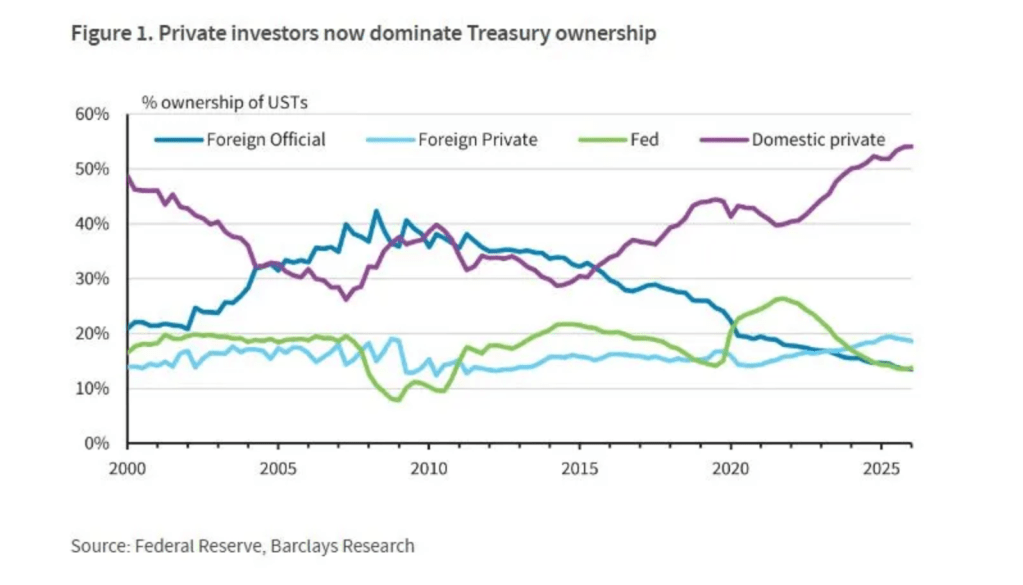
The irony is not subtle. The global-macro industry that Druckenmiller helped build—the one that made its name by betting against governments—now finances the government whose fiscal credibility it once tested. And the instruments have changed along with the players. Where Druckenmiller’s generation took outright directional positions against currencies and interest rates, today’s hedge funds increasingly participate in the Treasury market through basis trades: exploiting the spread between cash bonds and futures contracts using significant leverage. Tooze cited a New York Fed analysis estimating that hedge funds held $2.4 trillion in long Treasury exposure as of September 2025—exceeding holdings by mutual funds and U.S.-chartered depository institutions. The 50 funds with the largest gross Treasury exposures accounted for about 90% of the total. Aggregate basis-trade volume stood at roughly $830 billion, close to twice its early-2020 peak.
The precedent for what happens when that capital moves quickly is March 2020, when a rapid unwind of leveraged positions contributed to a breakdown of Treasury-market liquidity severe enough to require Federal Reserve intervention. The exposures are now substantially larger.
The macro irony
This puts Druckenmiller’s injunction to “let the bond market speak” in a more complicated light. His warning is first a fiscal one: the long bond reflects inflation, growth expectations, fiscal supply and confidence in the government’s willingness to confront its deficits. Dulling that signal, he argues, only delays the political confrontation needed to reduce the primary deficit. “If the 30-year must trade at 5.5% to clear,” he wrote in a somewhat obvious voice that’s become synonymous with the use of AI, “that isn’t a crisis. It is an invoice.”
But market prices also reflect market structure. A move in long-term yields can be a referendum on fiscal credibility, a reflection of inflation expectations, or a product of the mechanics by which leveraged positions are financed, hedged and distributed. Often it is all three. If Treasury reacts to ordinary yield increases as though they were an emergency, it may make investors doubt its commitment to price discovery. If it disregards genuine strains in the fragile architecture that now absorbs so much government debt, it risks allowing a liquidity problem to become a disorderly unwind.
The task for Bessent is to demonstrate that Treasury knows the difference. But there is an irony in the setup that Druckenmiller himself didn’t acknowledge: the investors now pressing on long-term yields are, structurally, the same kind of actor Bessent spent his career being.
The situation “has echoes of the past,” Hilsenrath said, adding that the past is never a perfect framework for thinking about the present. The Bank of England in 1992 was trying to defend a price on its currency that the market had found indefensible, he said, whereas in this case, Bessent is trying to defend a price in the Treasury market that the market found indefensible.
Beyond a currency and a Treasury bond being somewhat apples and oranges, he added, “the problem might be, we shall see, more profound in the sense that the market seems to be waking up to the idea that U.S. fiscal policy is unsustainable.” That’s the question Druckenmiller is now raising, he added: whether the United States is willing to confront a fiscal position that its own creditors are beginning to doubt. When asked about the use of AI in writing the essay, Hilsenrath said he didn’t especially care, because he thought Druckenmiller made several “brilliant” points and, ultimately, he put his name on it.
“The good news is that if you get serious about addressing these issues, you can actually fix them,” Hilsenrath said. “The problem—as anyone in Spain, Italy or Greece can tell you—is that if you let the market impose a fix on you, it’s going to be a lot more painful.”
For this story, Fortune journalists used generative AI as a research tool. An editor verified the accuracy of the information before publishing.
This story was originally featured on Fortune.com

Pope Leo XIV on AI’s new ‘form of domination’: it risks becoming a tool of ‘economic colonialism’
Pope Leo XIV warned that artificial intelligence risks becoming a new form of “economic colonialism,” deepening the gap between wealthy and poor nations, and said algorithms are already creating “a subtle form of domination” over who gets seen and heard.
“We must remain vigilant in this regard,” Leo told the network of officeholders who make up the International Catholic Legislators Network (ICLN) on Friday. “Lest innovation become another vehicle for ideological or economic colonialism.” He warned that AI’s rapid development risks leaving poorer countries increasingly dependent on wealthier ones for the technology.
He went further, describing what he called “a subtle form of domination when algorithms decide who is seen, and who remains invisible, when digital platforms shape public discourse without accountability, and when the dignity of workers is subordinated to the optimization of systems.” Such developments, he said, “reveal a new face of the ancient temptation to domination and mastery without service.”
To guard against that, Leo called for “robust legal frameworks, independent oversight, informed users and a political system that does not abdicate its responsibility,” so that “no single ideology or interest dictates the values embedded in artificial intelligence systems.” The pope’s words to call for a responsible political system echoes language he has used before in tension with the Trump administration’s deregulatory approach to AI. President Donald Trump has pushed to loosen federal AI rules and repealed the Biden administration’s AI executive order in January 2025. When Leo released “Magnifica Humanitas” in May, dubbed the pope’s “AI encyclical,” the Trump administration was split in response when Vice President JD Vance praised it and others dismissed the warning.
Since that time, the pope said AI and technology at large decreases the interactions and relationships people have with one another. This in turn is causing marriage and birth rates to decrease as the ages people reach these milestones increase, if at all. AI, the pope warned, “must never be allowed to erode” the family, and it does so by “reducing persons and relationships to data and simulations,” by “flooding young minds with content that distorts desire,” and through “economic models that make family life economically precarious.”
A redelivery of the church’s stance
The address built on his first encyclical, which made AI’s effect on human dignity, labor and family life the centerpiece of his papacy’s early teaching. Christopher Hale, a political consultant and founder of the newsletter Letters from Leo, said Friday’s remarks were less a new position than a redelivery of ideas already laid out in the encyclical.
“No one reads a 200-page encyclical,” Hale told Fortune. “Oftentimes what will happen is over weeks and months the pope will reveal different parts of that encyclical.” The pope’s Friday’s remarks were in gist a reiteration of his first encyclical—but the point is who it is redelivering the point.
Hale said Leo’s religious authority gives him standing that other AI critics lack in confronting the technology industry.
“Silicon Valley has an opponent that operates on a terrain that they’re not used to,” Hale said. “They’re used to dealing in transactional relationships, but Leo XIV represents something of a quagmire for them because he cannot be bought off, he cannot be terrorized, he can’t be indicted, he can’t be deported.”
Hale added that pairing AI criticism with religious language broadens its reach beyond activists already skeptical of the technology.
“When this language is combined with moral language, with religious language, what it does is it takes a leftist critique that might have marginal support in the United States and makes it mainstream,” he said.
Hale pointed to the backlash against AI data centers as evidence that opposition to the industry already cuts across party lines, even without a shared political language to unite it.
“If you look at the criticism of AI data centers, particularly over the summer, they’re really coming from all factions, from the left and the right,” Hale said. “What’s been hard about it, though, is that there has yet to be a language that can combine the two.”
“He strangely represents the fusion of the populist left and the populist right,” Hale said. “That’s what makes him so powerful.”
This story was originally featured on Fortune.com

Mortgage Rates Stay Elevated Despite Treasury’s New Bond-Buyback Push
WASHINGTON — Mortgage rates remain stubbornly high even after the U.S. Treasury announced a major expansion of its long-term bond-buyback program, underscoring how difficult it may be for Washington to push down borrowing costs while inflation and federal deficits continue pressuring the bond market.
The Treasury said it will at least double the size of its liquidity-support purchases of longer-dated government bonds, increasing the maximum from $2 billion to at least $4 billion per operation.
The expanded purchases begin September 9 and will run through November 4.
That distinction matters.
The program itself has not yet started, meaning it is too early to say the buyback effort has failed.
What has happened is that the announcement has so far failed to produce a lasting decline in borrowing costs.
Long-term Treasury yields initially fell after the announcement, giving mortgage markets some relief. But much of that move quickly faded as investors returned their attention to inflation, government borrowing and the massive supply of Treasury debt.
Mortgage rates closely follow the bond market, particularly yields on longer-term government securities and mortgage-backed securities.
That means Treasury can improve liquidity by buying older bonds, but it cannot simply order mortgage rates lower.
HousingWire reported this week that 30-year conforming mortgage rates had reached 6.92%, while jumbo rates climbed to 7.14%.
Other national rate surveys showed somewhat lower averages, illustrating how mortgage-rate estimates vary depending on the lenders, borrowers and methodology being tracked.
Mortgage News Daily, for example, showed its 30-year jumbo index at about 6.88% Tuesday, while another national survey placed conventional 30-year borrowing closer to the upper-6% range.
The broader message is the same: financing a home remains expensive.
Treasury’s buyback program is designed primarily to improve liquidity in older, less-traded government securities and help stabilize parts of the long-term bond market.
It is not a direct mortgage-rate program.
And the size of the intervention remains relatively small compared with the tens of trillions of dollars in outstanding Treasury debt.
That is why economists and bond investors remain focused on the larger forces driving rates — inflation expectations, federal deficits, Treasury issuance and investor demand.
For homebuyers, the practical takeaway is that meaningful mortgage relief may require more than Treasury buybacks alone.
If long-term Treasury yields stay elevated, mortgage rates are likely to remain elevated as well.
The September 9 launch will therefore become the real test.
If larger Treasury purchases succeed in improving demand and keeping long-term yields down, mortgage borrowers could eventually benefit.
If inflation and fiscal concerns continue overwhelming the effect of those purchases, homeowners and buyers may be waiting longer for meaningful relief.
JBizNews Desk | Washington
© JBizNews.com All Rights Reserved. Reproduction or distribution without written permission is prohibited.
Former US spy chief Gabbard warned Trump killing Khamenei could empower radical regime – WSJ
Before attacking Iran, US President Donald Trump was warned by US intelligence that killing Iran’s former supreme leader, Ayatollah Ali Khamenei, could result in him being replaced by a more radical regime with greater interest in acquiring nuclear weapons, according to a report from The Wall Street Journal on Tuesday.
In the lead-up to the February attack that started the US-Israel war with Iran, Trump reportedly called his intelligence chief at that time, Tulsi Gabbard, to the Oval Office to discuss the advisability of a full-scale military assault.
According to sources familiar with the meeting who spoke to WSJ, Gabbard cautioned Trump that killing Iran’s supreme leader could bring about a hard-line government that would be more inclined to pursue nuclear arms.
She also warned that Iran might swiftly close the Strait of Hormuz, jeopardizing the global energy market. Additionally, she argued that targeting Iran could lead to attacks on US forces and allies in the Middle East, which would raise questions about American reliability and resolve among its partners.

Security officials advise against launching an attack
Several of Trump’s senior national security officials similarly advised against launching an attack, expressing concerns about potential mass casualties, a limited weapons stockpile, and readiness issues for an overstretched military.
Defense Secretary Pete Hegseth, Joint Chiefs Chairman Gen. Dan Caine, and Adm. Brad Cooper, the head of US Central Command, reportedly briefed Trump several times on plans to strike Iranian targets with the expressed goal of ultimately weakening the Islamic Republic and incapacitating its military forces while allowing Israel to focus on targeting Iran’s top leadership.
Prime Minister Benjamin Netanyahu also reportedly informed Trump that the potential attack would provide him with a rare opportunity to dismantle Iran’s nuclear program and enhance his legacy as a peacemaker, WSJ noted.
Hegseth and Caine allegedly repeatedly claimed that they could manage any complications that might arise during the operation, according to officials who attended the meetings.
Despite receiving warnings from Gabbard and other senior national security officials during this timeframe, Trump ultimately dismissed their concerns. Instead, he echoed Hegseth and Caine’s confidence, suggesting the military could address any issues as they arose.
Vance pushed for negotiations with Iran before Op. Epic Fury
Another voice of caution came from Vice President JD Vance.
US officials told WSJ that Vance advocated for a more cautious approach during meetings leading up to Operation Epic Fury.
He reportedly suggested that Iran might be swayed to dismantle its nuclear program through negotiations. Vance pointed out that while pursuing a deal carried some risk, it would be less costly than the potential consequences of war.
He emphasized that Iran’s economy was already suffering due to heavy US sanctions. If negotiations failed, he argued, Trump would then have greater legitimacy to execute a swift and overwhelming military operation against Iran.
Although Trump reportedly considered Vance’s perspective, US officials told WSJ that he was ultimately persuaded by Pentagon presentations outlining more “decisive” options.
Tensions with Iran unresolved after six months of war
Six months after the attack that kicked off the war, military clashes between Iran and the US have paused, but disagreements over the Strait of Hormuz, Iran’s nuclear assets, and US sanctions have persisted.
Trump’s latest statement regarding the war came on Tuesday as he claimed that the US is closely watching the strait and nuclear sites from space.
In a post on Truth Social, he also asserted that all mines placed by Iran have been removed from Hormuz and that any attempt by Tehran to place new ones would be stopped.
Meanwhile, Iran has made its own demands regarding the state clear by sending messages to Washington through Pakistani mediators as recently as Tuesday.
Documentary about civilian casualties in Gaza to premiere at Venice International Film Festival
The 83rd Venice International Film Festival announced this week that it has added NAZA, a highly charged new documentary by Israeli filmmakers Yuval Abraham and Rachel Szor, two of the four directors of the Oscar-winning No Other Land, to its main competition.
NAZA will have its world premiere at Venice on September 10 and will compete for the Golden Lion. It is the only documentary among the 21 films in competition this year.
According to the press release, the film “was shot at night on rooftops in Tel Aviv, [and] examines Israeli military systems used in the Gaza war and focuses on Palestinian civilian casualties.”
The film draws on investigations published between 2023 and 2025 by +972 Magazine and Local Call, as well as The Guardian.
Film’s title refers to estimates of civilian casualties anticipated in airstrikes
The title, NAZA, refers to the Hebrew military acronym short for “collateral damage” and, in the context of the film, refers to estimates of civilian casualties anticipated in airstrikes.

The film was produced by The Guardian and James Wilson of JW Films, in collaboration with Placeholder Films and Unseen Hand. Jonathan Glazer is executive producer. Wilson and Glazer were part of the Oscar-winning team behind The Zone of Interest.
Abraham and Szor previously collaborated with Palestinian filmmakers Basel Adra and Hamdan Ballal on No Other Land – a controversial documentary about the Masafer Yatta region – which won numerous international prizes, beginning with an award at the 2024 Berlin International Film Festival, and went on to win the Academy Award for Best Documentary Feature in 2025.
‘Together, our voices are stronger’
At the Oscars, Abraham called for an end to the destruction in Gaza while also calling for the release of the Israeli hostages abducted by Hamas on October 7.
“We made this film, Palestinians and Israelis, because together our voices are stronger,” he said in his acceptance speech.
No Other Land and its directors generated controversy in Israel, with Culture and Sport Minister Miki Zohar denouncing its Oscar victory and many criticizing it for omitting context and facts.
Since the film’s Oscar win, the issue of violence against Palestinians by Jews in the West Bank has come to dominate the headlines even more.
NAZA will not be the only film connected to Israel at Venice this year. Veteran Israeli filmmaker Amos Gitai will present The Road to Jericho in the festival’s Venice Open – Out of Competition section.
The French-British-Israeli production follows a journey from Jerusalem toward Jericho and examines the Israeli-Palestinian conflict through the legacy of the Oslo process and the situation of the Bedouin community of Khan al-Ahmar.
The Venice Film Festival will run September 2-12.
Israeli Premier League season opens with goals, drama and off-field concerns
The Israel Premier League season got underway with plenty of action on the pitches across the country, although a number of teams did not play due to their participation in European competition.
However, there were also numerous cases of fan violence outside the stadiums following a couple of games, with some supporters needing to be taken to the hospital. While the various teams issued condemnations, the police and league have been put under the microscope to clean up the issues that could very well plague a season in which attendance records are set to be broken.
Up at the Carmel, Maccabi Haifa defeated Hapoel Ramat Gan 2-1 as Bruninho scored a brace to help the Greens open the season with a victory. Haifa will now prepare for a date with Maccabi Tel Aviv in the Israeli Classico at Bloomfield Stadium next Monday night.
The Greens applied all kinds of pressure early on as they repeatedly penetrated the box, with Kenji Gorre doing as he pleased. However, Jelle Bataille’s chance went off the right post, while Eitan Azulay’s shot whistled just past the left post and went out.
But out of nowhere, Bruninho sent a stunner from just to the left of the box and 30 meters out that easily beat Ramat Gan goalkeeper Amit Reef into the top-right corner for a well-deserved 1-0 lead in the 22nd minute. Gorre’s sharp-angled shot was saved, Bruninho’s next attempt went wide right, while at the other end, Idan Baranes’s header sailed just over the bar as the half came to an end with the hosts holding the 1-0 advantage.

Top-right screamer puts Haifa in a 2-0 lead
It didn’t take long for Haifa to add a second marker as Silva Kani made his way into the box and got the ball to Bruninho, who again sent a screamer into the top-right corner to give the Greens a 2-0 lead in the 46th minute.
David Asanka had a pair of close chances to cut the lead but came up short, but Maxim Plakushenko slotted home off a counterattack to pull the visitors to within 2-1 in the 61st minute.
Ramat Gan kept pushing forward as both sides made wholesale substitutions. But it didn’t matter, as the Greens held on to take the win.
Maccabi Haifa coach Barak Bachar summed up the victory.
“It was a good game for us, and we scored a goal in each half. We shouldn’t have conceded, and we were under pressure near the end, but we moved to three central defenders that helped us out. We are still working on our squad, and we are working with what we have right now.”
Meanwhile, Maccabi Tel Aviv cruised past Hapoel Jerusalem 5-2 as Dor Peretz scored a hat trick to help the yellow-and-blue take the three points and the win ahead of their UEFA Conference League second-leg showdown against Lugano for a place in the league stage of the competition.
Vitalie Damascan opened the scoring in the first minute when he took the ball and turned in the middle of the box before beating goalkeeper Ofek Melika for a quick 1-0 Hapoel lead after just 37 seconds of play.
However, Roy Revivo found the equalizer via a header, and Peretz converted a penalty as Maccabi headed into halftime with a 2-1 advantage.
Peretz added his second goal of the game in the second half when he stabbed home a Helio Varela cross for a 3-1 lead, while Sayed Abu Farchi also scored. Peretz then completed his hat trick for a trio of markers and the first hat trick of the season.
Maccabi goalkeeper Melika was issued a red card after he came outside the box for a play that ended with the shot being stopped and the ’keeper tripping up an opposing player.
Abu Farchi was selected to put on the goalkeeper’s kit, and he did so with pride, although he conceded a goal to Ohad Almagor as Maccabi took the comfortable victory.
“We conceded an early goal and responded the way we should have,” Maccabi Tel Aviv head coach Kenny Miller said. “In the second half, we saw some very, very nice goals scored. At 5-1, we should have defended better after the sending-off. It was a difficult game for us. We’re in the middle of a demanding run of matches, away from home, and we’re putting in very, very good performances.”
‘It’s a great feeling… It’s a team effort’
The man of the match, Peretz, also shared his thoughts.
“It’s a great feeling to do this here after last season, which was really special for me. I hope we can stop conceding the easy goals we’ve been allowing. It’s a team effort, not just the defense; it’s all of us.”
Elsewhere, Maccabi Netanya and Bnei Sakhnin played to a goalless draw as the Diamond City squad controlled the match for the majority of the game but could not find a way past the visitors’ stingy defense and fine goalkeeping by Raul Balbarau, as the sides split the points.
Netanya bench boss Roni Levy reflected on the game.
“We controlled the game, and while we really found some solutions to break down Sakhnin, we weren’t able to score. We had a mix of players who featured in this game, including youngsters Benny Feldman and Yarin Abuhazira, but we need to have patience with them. When you have a lot of players packed into the box, it’s very hard to break down a team, and we tried to get the ball into the area.”
Sakhnin coach Yossi Abukasis spoke about the draw.
“I’m happy with the result but not with how we played. We barely controlled the ball, and we didn’t deserve much.”
Also, Ironi Tiberias slipped past Hapoel Petah Tikva 1-0 as Itamar Shviro scored the lone goal of the match from the penalty spot in the 51st minute to take the three points and the win.
Finally, Maccabi Petah Tikva outclassed Ironi Kiryat Shmona 2-1 as a pair of first-half goals by Samuel Owusu and Marko Rakonjac were able to hold up after Adrian Ugarriza’s second-half strike cut the lead in half, as the newly promoted club took the win and the points.
See more Israeli sports coverage at www.sportsrabbi.com/en
GOP’s Mike Rogers weighs AIPAC liability vs. support in high-stakes Michigan Senate race
In the weeks since progressive Israel critic Abdul El-Sayed won the Democratic primary in Michigan’s US Senate race, many Jewish and pro-Israel constituencies in the state and beyond are lining up – sometimes reluctantly – for his Republican opponent.
But recent reports have cast doubt on how much support the GOP candidate, former US Rep. Mike Rogers, is comfortable receiving from pro-Israel donors.
According to multiple outlets, Rogers and his representatives have signaled to AIPAC that they would like the pro-Israel lobbying giant to refrain from directly spending in his favor in the general election in order to avoid opening up a line of attack against the candidate, with whom El-Sayed is currently polling in a statistical tie. The campaign is instead suggesting alternative avenues of support, including funneling cash into a general pro-Rogers super PAC.
Rogers did not respond to a Jewish Telegraphic Agency request for comment. And there is no sign the Rogers campaign has cut off relationships with AIPAC, its aligned super PACs, or their donor class. Far from it: Rogers recently attended several major AIPAC-connected fundraisers in Los Angeles, according to the New York Times.
In addition, the vast majority of AIPAC-aligned Jewish donors to his campaign remain in his corner, according to Dennis Bernard, a Jewish resident of metro Detroit and political fundraiser who has said he will support Rogers.

Political climate leads candidates of both parties to turn away from Israel
Nevertheless, Rogers’ reported request – which intermediaries would have to make in a way that circumvents campaign finance laws forbidding direct coordination with super PACs – underscores a growing fear among Jewish and pro-Israel groups.
In a political climate that has seen both parties turn away from Israel and AIPAC to varying degrees, more and more pro-Israel Jews say their most visible player in the political arena may have become more of a liability than an asset.
Bernard, who serves as national chair of government relations for the nonpartisan umbrella group Jewish Federations of North America, described Rogers’ maneuvering around AIPAC as “a tactical strategy.”
“I’m sure Mike is very grateful for AIPAC’s assistance and is not trying to turn down AIPAC money,” Bernard, who has connected several AIPAC-aligned Jewish donors to the Rogers campaign in his personal capacity, told JTA. “Mike’s trying to figure out with everybody else right now: In this changing world, how do you strategically take Jewish money?”
Bernard acknowledged that being linked to AIPAC has become a political liability in many races, regarded by its critics as similar to taking “data center money.”
Reached for comment, an AIPAC spokesperson directed JTA to remarks the organization gave to the Times on Monday.
“The Rogers campaign has been explicit with us that they welcome support from AIPAC and our members,” spokesperson Deryn Sousa told the Times.
AIPAC rarely involves itself in general elections, but the group has stated it continues to see El-Sayed as a prime target.
David Victor, a Michigan resident and former AIPAC president who remains involved in the group, referred a reporter asking about the race to the national group.
There’s no guarantee that a less visible role for AIPAC would protect Rogers, a vocal Israel supporter, from accusations that he is in league with the group. In addition, from the lobby’s perspective, allowing others to spend money raised by AIPAC would deprive the group of both messaging control as well as the opportunity to take credit for what it hopes will be an El-Sayed defeat.
El-Sayed, a former county health official, made AIPAC’s heavy spending in favor of his inter-party rival Rep. Haley Stevens a major talking point on the campaign trail. Many other progressive candidates this election cycle have prevailed while turning AIPAC into a target.
AIPAC and its defenders have argued that its spending for Stevens – which exceeded $30 million – helped narrow El-Sayed’s margin of victory and weakened him in the general election. But the group has taken heavy criticism this electoral cycle, including from ideological allies, over its aggressive spending against some liberal pro-Israel candidates, which observers believe helped propel figures more hostile to Israel into office.
Rogers aims to peel voters away from El-Sayed
Even amid his reported desire to lower the visibility of AIPAC spending in the race, Rogers has been showing signs of hoping to peel Jewish voters away from El-Sayed.
For one, he has taken on some liberal Jewish campaign surrogates. Rabbi Asher Lopatin, who leads the Modern Orthodox congregation Kehillat Etz Chayim in the Detroit suburb of Huntington Woods, spoke at a “Democrats for Mike” press conference last week while standing next to Rogers.
The former director of Community Relations at the Jewish Federation of Greater Ann Arbor, Lopatin, told the crowd that he, a regular Democratic voter, was backing Rogers because El-Sayed “has shown contempt for the Jewish community and, frankly, for American values.”
The rabbi cited El-Sayed’s comments after a man rammed an explosive-laden pickup truck into Temple Israel in West Bloomfield earlier this year. On that occasion, El-Sayed, speaking of the attacker who had lost family in an Israeli strike in Lebanon, said, “Hurt people do hurt people.”
Lopatin also cited the candidate’s relationship with far-left anti-Israel streamer Hasan Piker, with whom El-Sayed had campaigned during the primary. Days after their press conference, El-Sayed distanced himself from Piker following new comments from the streamer that prompted blowback from the Jewish community.
El-Sayed did not respond to a JTA request for comment.
Lopatin told JTA he spoke at the Rogers event “as an individual,” and said that other Jews in the community had thanked him for “speaking up for us.”
Lopatin said Rogers’ reported unease about AIPAC would not affect his support for the candidate.
“Good for him. There’s plenty of Republican money,” the rabbi, who has no affiliation with AIPAC himself, said. “If I were recommending something, I would say, ‘AIPAC, stay out of this race. You’ve done what you could do. Stay out. Let him run.’”
Rogers is also positioning himself as a fighter of antisemitism, and his rival as a driver of it. Addressing the Michigan GOP nominating convention on Saturday, Rogers said he would support Jewish constituents whom he said would be harmed by El-Sayed.
Calling Piker the candidate’s “running mate,” Rogers said the duo’s rhetoric “has real implications” for people like a “young Jewish girl who attends the University of Michigan.” Rogers said the unnamed student told him she “hides her Star of David necklace so that violent antisemites on campus don’t see it and harass her – or worse.”
For his part, Bernard, who also runs a financial advisory firm, said it sometimes makes good business sense “not to take credit for a victory.”
“We let the client or someone else take it, and we just take our big profit and move on,” he said. “Because the people who need to know, know.”

How Dolly Parton built a legacy of giving beyond country music
Country music icon Dolly Parton, who died Tuesday in Nashville, spent decades turning her success into support for children, medical research and communities recovering from disasters.
One of Parton’s best-known philanthropic efforts, Dolly Parton’s Imagination Library, has distributed more than 332 million free books since its founding, according to the organization’s website.
The program mails free books each month to children from birth to age 5. It launched in Sevier County, Tennessee – where Parton was raised – in 1995, expanded nationally in 2000 and later reached several other countries.
“The seeds of these dreams are often found in books and the seeds you help plant in your community can grow across the world,” Parton said, according to the organization’s website.
DOLLY PARTON $650 MILLION EMPIRE: FROM HUMBLE ROOTS TO QUEEN OF COUNTRY MUSIC, MOVIES AND NOW MAKEUP
The Imagination Library is the signature program of the Dollywood Foundation, which Parton established in 1988 to improve educational outcomes in Sevier County.
The foundation initially focused on reducing the local high school dropout rate before expanding its mission to promote childhood literacy.
Parton’s giving extended well beyond education.
After wildfires destroyed the homes of more than 1,000 Sevier County families in 2016, Parton asked the foundation to create the My People Fund.
The fund provided affected families with $1,000 per month for six months. By May 2017, it had raised and distributed more than $12 million. Additional money funded one-time scholarships for high school seniors who lost their homes, according to the Imagination Library.
CITY HARVEST FEEDS 1.5M NEW YORKERS AS CELEBRITIES, CHEFS RALLY FOR HUNGER RELIEF
Parton also contributed millions of dollars to medical research.
In 2020, she donated $1 million to Vanderbilt University Medical Center in Nashville to support COVID-19 research, according to BBC News.
In 2022, she contributed another $1 million for pediatric infectious disease research at Vanderbilt University Medical Center, according to the Vanderbilt Health website. That same year, Parton received the Carnegie Medal of Philanthropy.
In the aftermath of Hurricane Helene in 2024, Parton donated $1 million to the Mountain Ways Foundation to help flood victims. Several of her East Tennessee businesses and the Dollywood Foundation pledged to match her gift with another $1 million, according to an announcement at the time from the Mountain Ways Foundation.
` FINANCIER MICHAEL MILKEN REVEALS THE TRUE ESSENCE OF AMERICAN DREAM ISN’T MATERIAL WEALTH
GET FOX BUSINESS ON THE GO BY CLICKING HERE
“We believe that her many philanthropic achievements embody the values of our founder, who, with us, would surely greet Parton with ‘affection, gratitude, and admiration,’” the nonprofit stated at the time.
Parton died in Nashville, Tennessee on Tuesday, according to a press release obtained by Fox News Digital.
Her nephew revealed the news in an Aug. 25 Instagram video. The news comes after Parton spent months battling an unknown health issue.
Fox News Digital’s Christina Dugan Ramirez contributed to this report.
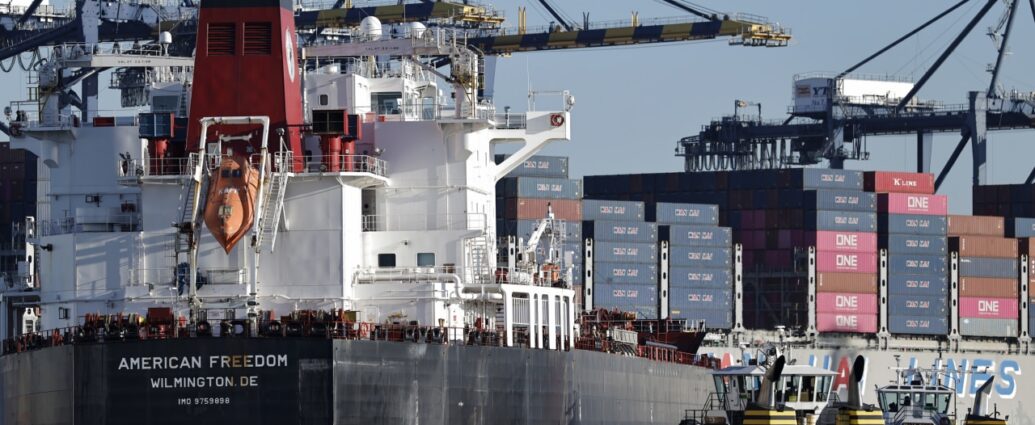

FTC moves to make retailers disclose use of ‘personalized pricing’ as technology now enables broad consumer surveillance
The Federal Trade Commission is moving to ensure companies disclose use of customers’ personal data to set prices, as technology makes it easier for retailers to tailor them to individual shoppers.
The FTC said that it is seeking public comment on an enforcement policy statement concerning “personalized pricing,” which the agency defines as using personal data to determine how much a company believes an individual consumer is willing to spend. The proposal would warn companies that failing to disclose that they are using personal data to set prices could violate the FTC Act’s prohibition on unfair or deceptive practices.
“When consumers see a listed price, they expect it to be the same price that everyone else sees, not the retailer’s estimate of how much they are willing to pay based on their personal data,” FTC Chairman Andrew Ferguson said in a press release. “The FTC does not have the legal authority to ban personalized pricing in all circumstances, but businesses that fail to tell consumers how their personal data is being used to set a price may be in violation of the FTC Act and other laws we enforce.”
The FTC did not immediately respond to a request for comment from Fortune. The proposal is open for public comment through Sept. 18.
The regulator’s action comes after more than two years of scrutiny into what it calls “surveillance pricing.” In July 2024, the FTC ordered eight companies involved in pricing technology to provide information about how they use customer data—including location, demographics, credit history and browsing or shopping history to help companies determine prices.
“Americans deserve to know whether businesses are using detailed consumer data to deploy surveillance pricing,” then FTC Chair Lina M. Khan said at the time, “and the FTC’s inquiry will shed light on this shadowy ecosystem of pricing middlemen.”
The FTC’s January 2025 findings said pricing intermediaries could use information ranging from a consumer’s precise location and browser history to shopping behavior and even mouse movements to help retailers tailor prices or promotions. The agency said the companies it examined had worked with at least 250 clients, including grocery retailers.
The deep dive into personalized pricing comes after the FTC recently flagged dynamic pricing—or setting prices based on supply and demand as well as inventory levels and competitor pricing.
An FTC research document noted that companies using e-commerce websites or electronic shelf labels could potentially make price changes with similar frequency.
“Consumers expect prices for products and services to change based upon supply and demand, not their web surfing habits or buying history,” it noted. “Retailers who represent or imply that a price is static when it in fact varies by individual are at risk of misleading customers.”
The distinction is becoming more significant as consumers contend with years of elevated inflation, including higher grocery bills. In July, prices for fruits and vegetables rose 5.1% from a year ago, while nonalcoholic beverages rose 4.1%, according to the Bureau of Labor Statistics.
Food costs also take up a disproportionate amount of spending in lower-income American households. In 2024, those in the lowest quintile spent an average $5,498 on food—equivalent to 33% of their pretax income—compared to 12.2% for households in the middle income quintile, according to the USDA.
This story was originally featured on Fortune.com

How Mark Zuckerberg has fully rebuilt Meta around Llama
It was the summer of 2023, and the question at hand was whether to release a Llama into the wild.
The Llama in question wasn’t an animal: Llama 2 was the follow-up release of Meta’s generative AI model—a would-be challenger to OpenAI’s GPT-4. The first Llama had come out a few months earlier. It had originally been intended only for researchers, but after it leaked online, it caught on with developers, who loved that it was free—unlike the large language models (LLMs) from OpenAI, Google, and Anthropic—as well as state-of-the-art. Also unlike those rivals, it was open source, which meant researchers, developers, and other users could access the underlying code and its “weights” (which determine how the model processes information) to use, modify, or improve it.
Yann LeCun, Meta’s chief AI scientist, and Joelle Pineau, VP of AI research and head of Meta’s FAIR (Fundamental AI Research) team, wanted to give Llama 2 a wide open-source release. They felt strongly that open-sourcing Llama 2 would enable the model to become more powerful more quickly, at a lower cost. It could help the company catch up in a generative AI race in which it was seen as lagging badly behind its rivals, even as the company struggled to recover from a pivot to the metaverse whose meager offerings and cheesy, legless avatars had underwhelmed investors and customers.
But there were also weighty reasons not to take that path. Once customers got accustomed to a free product, how could you ever monetize it? And as other execs pointed out in debates on the topic, the legal repercussions were potentially ugly: What if someone hijacked the model to go on a hacking spree? It didn’t help that two earlier releases of Meta open-source AI products had backfired badly, earning the company tongue-lashings from everyone from scientists to U.S. senators.
It would fall to CEO Mark Zuckerberg, Meta’s founder and controlling shareholder, to break the deadlock. Zuckerberg has long touted open-source technology (Facebook itself was built on open-source software), but he likes to gather all opinions; he spoke to “everybody who was either for, anti, or in the middle” on the open-source question, recalls Ahmad Al-Dahle, Meta’s head of generative AI. But in the end it was Zuckerberg himself, LeCun says, who made the final decision to release Llama 2 as an open source model: “He said, ‘Okay, we’re just going to do it.’” On July 18, 2023, Meta released Llama 2 “free for research and commercial use.”
In a post on his personal Facebook page, Zuckerberg doubled down on his decision. He emphasized his belief that open-source drives innovation by enabling more developers to build with a given technology. “I believe it would unlock more progress if the ecosystem were more open,” he wrote.
The episode could have just been another footnote in the fast-unfolding history of artificial intelligence. But in hindsight, the release of Llama 2 marked a crucial crossroads for Meta and Zuckerberg—the beginning of a remarkable comeback, all thanks to tech named after a furry camelid. By the time Llama 3 models were released in April and July 2024, Llama had mostly caught up to its closed-source rivals in speed and accuracy. On several benchmarks, the largest Llama 3 model matched or outperformed the best proprietary models from OpenAI and Anthropic. One advantage in Llama’s favor: Meta uses publicly shared data from billions of Facebook and Instagram accounts to train its AI models.
The Llama story could be a pivotal chapter in the ongoing philosophical debate between open-source AI models (generally more transparent, flexible, and cost-effective, but potentially easier to abuse) and closed models (often more tightly controlled but lacking transparency and more costly to develop). Just as crucially, Llama is at the core of a complete strategic pivot on the part of Meta to go all in on generative AI. Zuckerberg is now seen as a champion of “democratizing tech” among Silicon Valley developers—just two years after he and his company were being questioned, and sometimes mocked, for going all in on the metaverse, and vilified for having contributed to political polarization, extremism, and harming the mental health of teenagers.
While ChatGPT remains the dominant gen AI tool in the popular imagination, Llama models now power many, if not most, of the Meta products that billions of consumers encounter every day. Meta’s AI assistant, which reaches across Facebook, Instagram, WhatsApp, and Messenger, is built with Llama, while users can create their own AI chatbot with AI Studio. Text-generation tools for advertisers are built on Llama. Llama helps power the conversational assistant that is part of Meta’s hit Ray-Ban glasses, and the feature in the Quest headset that lets users ask questions about their surroundings. The company is said to be developing its own AI-powered search engine. And outside its walls, Llama models have been downloaded over 600 million times on sites like open-source AI community Hugging Face.
Still, the pivot has perplexed many Meta watchers. The company has spent billions to build the Llama models: On its third-quarter earnings call, Meta announced that it projects capital expenditures for 2024 to reach as high as $40 billion, with a “significant” increase likely in 2025. Meanwhile, it’s giving Llama away for free to thousands of companies, including giants like Goldman Sachs, AT&T, and Accenture. Some investors are struggling to understand where and when, exactly, Meta’s revenue would start to justify the eye-watering spend.
Why open-sourcing Llama is good for Meta is “the big puzzle,” says Abhishek Nagaraj, associate professor at the University of California at Berkeley’s Haas School of Business, adding that it’s “hard to justify” from a purely economic standpoint.
Nonetheless, Llama’s contrarian success has allowed Zuckerberg to shrug off the lukewarm response to his metaverse ambitions and the company’s painful “year of efficiency” in late 2022 and early 2023. The rise of Llama has also given Zuckerberg a chance to address a long-simmering sore point in his otherwise meteoric career: the fact that Facebook, and now Meta, have so often seen their services and products constrained by rules imposed by Apple and Google—the rival giants whose app stores are Meta’s primary points of distribution in the mobile device era. As he wrote in a July blog post: “We must ensure that we always have access to the best technology, and that we’re not locking into a competitor’s closed ecosystem where they can restrict what we build.”
“We got incoming requests from people who said, ‘You have to open-source that stuff. It’s so valuable that you could create an entire industry, like a new internet.’”
Yann Lecun, describing reactions to the 2023 leak of Llama
With Llama, Meta and Zuckerberg have the chance to set a new industry standard. “I think we’re going to look back at Llama 3.1 as an inflection point in the industry, where open-source AI started to become the industry standard, just like Linux is,” he said on Meta’s July earnings call—invoking the open-source project that disrupted the dominance of proprietary operating systems like Microsoft Windows.
Perhaps it’s this possibility that is giving Zuckerberg some new swagger. At 40, two decades after he cofounded Facebook, he appears to be enjoying what many are calling his “Zuckaissance”—a personal and professional glow-up. His once close-cropped haircut has given way to lush curls, the drab hoodies are swapped for gold chains and oversize black T-shirts, and his hard-edged expressions have softened into relaxed smiles. He even found time in November to collaborate with T-Pain on a remake of the hip-hop hit “Get Low”—an anniversary gift to his wife, Priscilla Chan.
In the long run, OpenAI’s ChatGPT may be seen as the fiery spark that ignited the generative AI boom. But for now, at least, Llama’s own future’s so bright, Zuckerberg has gotta wear AI-powered Ray-Ban shades.
Meta’s work on AI began in earnest in 2013, when Zuckerberg handpicked LeCun, a longtime NYU professor and an AI luminary, to run Facebook’s new FAIR lab. LeCun recalls that when he began discussing the role, his first question was whether Facebook would open-source its work. “Nobody has a monopoly on good ideas,” he told Zuckerberg, “and we need to collaborate as much as we can.” LeCun was thrilled with the answer he got: “Oh, you don’t have to worry about it. We already open-source our platform software and everything.”
But prior to the generative AI boom, Meta’s use of AI was mostly behind the scenes—either research focused or integrated under the hood of its recommendation algorithms and content moderation. There were no big plans for a consumer-facing AI product like a chatbot—particularly not when Zuckerberg’s attention was focused on the metaverse.
Generative AI began to take off with OpenAI’s release of ChatGPT, just as the Meta pivot was looking particularly unwise. With metaverse spending through the roof and consumers utterly uninterested, Meta’s stock hit a seven-year low, inspiring headlines like, “How Much Trouble Is Mark Zuckerberg In?” The company began laying off thousands of employees.
Meta’s first widely noticed foray into gen AI didn’t fare much better. In November 2022, FAIR released a demo of an LLM chatbot, trained on scientific texts, called Galactica. Like previous FAIR models, Galactica was released as open-source, allowing free access to the “brains” of the model. This openness was meant to enable researchers to study how Galactica functioned.
But these were the days before the public was fully aware of LLMs’ tendency to hallucinate—to sometimes spit out answers that are convincing, confident, and wrong. Many scientists were appalled by the Galactica chatbot’s very unscientific output, which included citing research papers that didn’t exist, on topics such as how to make napalm in a bathtub; the benefits of eating crushed glass; and “why homosexuals are evil.” Critics called Galactica “unethical” and “the most dangerous thing Meta’s made yet.”
After three days of intense criticism, Meta researchers shut down Galactica. Twelve days later, OpenAI released ChatGPT, which quickly went viral around the world, tapping into the cultural zeitgeist (despite its own serious hallucination issues).
Bruised but undeterred, researchers at FAIR spent the winter fine-tuning a new family of generative AI models called LLaMA (short for Large Language Models Meta AI). After the Galactica backlash, Meta was cautious: Instead of fully opening the code and model weights to all, Meta required researchers to apply for access, and no commercial license was offered. When asked why, LeCun responded on X: “Because last time we made an LLM available to everyone…people threw vitriol at our face and told us this was going to destroy the fabric of society.”
Despite these restrictions, the full model leaked online within weeks, spreading across 4chan and various AI communities. “It felt a bit like Swiss cheese,” Nick Clegg, Meta’s president of global affairs, says of the failed attempt to keep Llama behind closed doors. Meta filed takedown requests against sites posting the model online in an attempt to control the spread. Some critics warned of serious repercussions and excoriated Meta: “Get ready for loads of personalized spam and phishing attacks,” cybersecurity researcher Jeffrey Ladish posted on X.
The consternation even reached Capitol Hill. In June 2023, two U.S. senators wrote a letter to Zuckerberg, criticizing Llama’s release and warning of its potential misuse for fraud, malware, harassment, and privacy violations. The letter said that Meta’s approach to distributing advanced AI “raises serious questions about the potential for misuse or abuse.”
But at the same time, LeCun says, he and other Meta leaders were taken aback by the sheer demand for the leaked Llama model from researchers and developers. These would-be users wanted the flexibility and control that would come with open access to a profoundly powerful LLM. A law firm, for example, could use it to train a specialized model for legal use—and own the intellectual property. A health care company could audit and manage the data behind the model, ensuring HIPAA compliance. Researchers could experiment and examine the inner workings of the model. “We got incoming requests from people who said, ‘You have to open-source that stuff. It’s so valuable that you could create an entire industry, like a new internet,’” LeCun says
Messages came directly to Zuckerberg, to CTO Andrew “Boz” Bosworth, and to LeCun, leading to weekly calls in which the leaders debated what they should do. Should they open-source the next release? Did the benefits outweigh the risks? By midsummer, Zuckerberg’s mind was made up, with backing from Pineau and LeCun—leading to the big July 2023 reveal.

Llama 2 was not entirely open. Meta did not disclose the datasets—including all that Facebook and Instagram material—used to train the model, which are widely regarded as its key competitive advantage. It also restricted usage by companies with more than 700 million monthly active users, primarily meant to deter Meta’s Big Tech competitors. But the source code and model weights could be downloaded, and Meta encouraged users to contribute improvements, bug fixes, and refinements of results to a collaborative community.
Even before the Llama 2 release, Zuckerberg had laid the groundwork to treat it like Meta’s next big thing. After the first Llama model was released, in February 2023, Zuckerberg quickly put together a team from across the company, including FAIR, to focus on accelerating generative AI R&D in order to deploy it in Meta app features and tools. He chose Ahmad Al-Dahle, a former Apple executive who had joined Meta in 2020 to work on metaverse products, to lead the new team.
At an internal all-hands meeting in June 2023, Zuckerberg shared his vision for Meta’s AI-powered future. Meta was building generative AI into all of its products, he said, and he reaffirmed the company’s commitment to an “open science-based approach” to AI research. “I had a big remit,” Al-Dahle says: “Develop state-of-theart models; put them in product at record speed.”
In other words: It was game on for Llama.
Meta’s strategy can seem counterintuitive, coming from a company with $135 billion in annual revenue. Open-source software has typically been seen as a way to democratize technology to the advantage of small startups or under-resourced teams— the kinds scrambling to compete with giants like Meta.
In a July 2024 blog post called “Open Source Is the Path Forward,” Zuckerberg made it clear that giving away Llama is not an altruistic move. Open-sourcing, he said, would give Meta a competitive edge in the AI race—and could eventually make Llama the go-to platform for generative AI. Just as important, he wrote: “Openly releasing Llama doesn’t undercut our revenue, sustainability, or ability to invest in research like it does for closed providers” like OpenAI or Google.
Now that Llama has had a year-plus to prove itself, some are finding Zuck’s case persuasive. Shweta Khajuria, an analyst at Wolfe Research who covers Meta, calls releasing Llama as open-source “a stroke of genius” that will enable Meta to attract top talent, accelerate innovation on its own platform, develop new revenue sources, and extend its longevity. Already, she explains, open-sourcing Llama basically allowed Meta to quickly catch up to OpenAI, Google, and Anthropic, in part because thousands of developers are building and improving on Llama at a blistering pace. “If they had not open-sourced it, it probably would have taken a much longer time to be at bar with other frontier models,” she says.
Khajuria believes there will be plenty of new monetization opportunities for Meta down the line, such as subscription and advertising options for current Meta AI features based on Llama, as well as AI-powered in-app business messaging. “Meta benefits from having billions of users where Perplexity and Claude and ChatGPT don’t necessarily have that base,” she says. “Once they have a critical mass of users and usage around the world, they can monetize.”
Zuckerberg has also alluded to the fact that AI-generated content itself will be valuable (though others have criticized such content as “slop”). On the recent earnings call, Zuckerberg said: “I think we’re going to add a whole new category of content, which is AI-generated or AI-summarized content, or existing content pulled together by AI in some way, and I think that that’s gonna be very exciting for Facebook and Instagram and maybe Threads, or other kinds of feed experiences over time.”
Patrick Wendell is cofounder and VP of engineering at data and AI company Databricks, which released Meta’s Llama 3.1 models on its platform in July. He sees Meta’s move as much more far-reaching. If the internet was the first big wave of technology, which enabled Facebook’s creation, and mobile was the second, dominated by Apple and Google, “I think [Zuckerberg’s] calculus is the third big wave is coming, and he does not want to have one or two companies completely control all access to AI,” Wendell says. “One way you can avoid that is by basically commoditizing the market, giving away the core IP for free…so no one gains a monopoly.”
Some critics argue that Meta shouldn’t be using the term “open-source” at all. Current versions of Llama still have restrictions that traditional open-source software doesn’t (including lack of access to datasets). In October, the Open Source Initiative, which coined the term, criticized Meta for “confusing” users and “polluting” the nomenclature, and noted that Google and Microsoft had dropped their use of the term (using the phrase “open weights” instead). Clegg, Meta’s global affairs chief, is blunt in his rebuttal: He says the debate reminds him of “folks who get very agitated about how vinyl is the only true kind of definition of good music.” Only a handful of scientific and low-performing models would fit the definition, he continues: “No one has copyright IP ownership over these two English words.”
Nomenclature aside, Meta is winning where it matters. Nathan Lambert, a research scientist at the nonprofit Allen Institute for AI, says that while definitions might be quibbled about, more than 90% of the open-source AI models currently in use are based on Llama. Open-source coders accept that Zuckerberg “has some corporate realities that will distort his messaging,” he says. “At the end of the day, the community needs Llama models.
Internally at Meta, Llama and revenue-generating businesses are increasingly inextricable. In January, Zuckerberg moved FAIR, the AI research group, into the same part of the company as the team deploying generative AI products across Meta’s apps. LeCun and Pineau now report directly to chief product officer Chris Cox, as does Al-Dahle. “I think it makes a lot of sense to put [FAIR] close to the family of app products,” says Pineau; she points out that even before the reshuffle, research her team worked on often ended up in Meta products just a few months later.
Zuckerberg also tasked FAIR with something far more ambitious: developing artificial general intelligence (AGI), a type of AI that possesses humanlike intelligence. The company prefers to use the term AMI (“advanced machine intelligence”), but whatever it’s called, Pineau says, Meta now has a “real road map” to create it—one that relies, presumably, on a thriving Llama. Meanwhile the company is hard at work on Llama 4 models currently being trained on a cluster of over 100,000 pricey Nvidia GPUs, a cluster that Zuckerberg recently said was “bigger than anything that I’ve seen reported for what others are doing.”
Not everyone loves the idea of a bigger-than-anything Llama. For years, Zuckerberg and his company have grappled with public mistrust over the way it has used other types of AI to personalize news feeds, moderate content, and target ads across Facebook, Instagram, and WhatsApp. Critics have accused its algorithms of exacerbating political polarization, adolescent mental-health crises, and the spread of misinformation (accusations Meta has denied or rebutted); it was perhaps inevitable that Llama would face extra scrutiny.
Zuckerberg “does not want to have one or two companies completely control all access to AI. One way you can avoid that is by giving away the core IP for free, so no one gains a monopoly.”
PATRICK WENDELL, cofounder and VP of engineering, Databricks
Some critics fear that an open-source model like Llama is dangerous in the hands of malicious actors, precisely because it’s too open. Those concerns may grow in today’s tense geopolitical atmosphere. On Nov. 1, Reuters reported that China’s army had built AI applications for military use on the back of an early version of Llama.
An incoming Trump administration could make it even more complicated to keep Llama open. Trump’s economic nationalism would suggest that he would certainly not want China (or any other country) to access American-made state-of-the-art AI models. But Llama’s future may depend on who has Trump’s ear: Vice President–elect JD Vance has spoken out in support of open-source AI in the past, while Elon Musk’s xAI has open-sourced its chatbot Grok (and Musk famously cofounded OpenAI as an open-source lab).
Even some of Zuckerberg’s oldest friends have concerns about this kind of arms race. Dustin Moskovitz, a cofounder of Facebook and now CEO of Asana (and the founder of Open Philanthropy, one of the biggest funders of AI safety initiatives), says that while he is not against open-source LLMs, “I don’t think it’s appropriate to keep releasing ever more powerful versions.”
But Zuckerberg and his allies, both within Meta and without, argue that the risks of open-source models are actually less than those built behind proprietary closed doors. Preemptive regulation of theoretical harms of open-source AI will stifle innovation, they say. In a cowritten essay in August, Zuckerberg and Spotify cofounder Daniel Ek noted that open-source development is “the best shot at harnessing AI to drive progress and create economic opportunity and security for everyone.”
Whatever the outcome of Meta’s increasingly loud open-source activism, many argue that Zuckerberg is exactly the right messenger. His personal involvement in promoting Llama and open-source, insiders agree, is the key reason Meta has been able to move with such speed and focus. “He’s one of a few founder leaders left at these big tech companies,” says Clegg. “One of the great advantages of that means you have a very short line of command.”
Zuckerberg also has been active in recruiting AI talent, often reaching out personally. A March 2024 report said that Zuckerberg had been luring researchers from Google’s DeepMind with personal emails in messages that stressed how important AI was to the company.
Erik Meijer, who spent eight years at Meta leading a team focused on machine learning—before being laid off in November 2022—believes such a total shift is only possible with someone like Zuckerberg at the top. “It’s like pivoting a giant supertanker,” he says. “He’s a little bit like a cult hero inside the company, in a good sense, so I think that helps get all the noses in the same direction.” Zuckerberg’s new personal makeover, Meijer mused, is “maybe a very externally visible sign of renewal.”
Zuckerberg’s renewal, and Meta’s transformation, are sure to test investor patience due to skyrocketing capital expenditures. Khajuria, the Wolfe analyst, says investors will tolerate it for now “because Meta has laid the groundwork of telling folks what the opportunity is.” That said, if revenue does not begin accelerating, exiting 2025 into 2026, “I think investors will start losing patience,” she warns. (Zuckerberg is somewhat insulated from investor discontent; he controls about 61% of voting shares at Meta.)
One thing is clear, LeCun says: The kind of gamble Meta is taking, with its massive investment in GPUs and all things generative AI, requires a leader willing to take big swings. And Meta has not only that leader, but a massively profitable core business to fund the vision. As a result, Meta is back at the center of the most important conversation at the intersection of tech and business—and it’s not a conversation about legless metaverse avatars.
This article appears in the December 2024/January 2025 issue of Fortune as part of the 100 Most Powerful People in Business list.
CORRECTION: An earlier version of this article misstated the title of Patrick Wendell. He is cofounder and VP of engineering at Databricks, not cofounder and CTO.
This story was originally featured on Fortune.com

‘Whenever we see a small company with a good idea, we’re on fire’: How M&A and innovation keep L’Oréal ahead in global beauty
A decade ago, while L’Oréal stood as the clear global leader in beauty, a new set of independent brands was beginning to gain traction. Despite their at first comparatively microscopic scale, digital natives Glossier and e.l.f. Beauty, celebrity challengers such as Fenty (Rihanna) and Kylie Cosmetics (Kylie Jenner), and the jostling ranks of Korean beauty brands all had a key advantage. While L’Oréal and the other big players had marketing models based on traditional media and sales models based on brick-and-mortar retail, these competitors were perfectly adapted for the new age of social media, influencers, and e-commerce.
It sounds like the preamble to a business-school case study on disruption, the kind that doesn’t end well for the disrupted. Yet L’Oréal didn’t have its Kodak moment. Instead, despite the intensifying competition, it has consistently outperformed the €290 billion global beauty market, which itself continues to grow at an estimated +4.5% in 2024.
91
L’Oréal’s rank on the Fortune 500 Europe
Today, L’Oréal remains one of the jewels in the French corporate crown, its 37 brands selling a bewildering array of potions, creams, cleansers, serums, dyes, moisturizers, mascaras, beauty devices, and more, across more than 150 countries. The group’s $47 billion turnover is nearly double what it was in 2014, comfortably outpacing the likes of Estée Lauder or Beiersdorf over the same period, and still towering above the next generation of competitors. What is it doing right?
Innovation at the core
“Beauty is an endless quest for humans, which is why the market is always evolving,” says L’Oréal deputy CEO Barbara Lavernos. Customer expectations evolve, too—who wants obsolete wrinkle cream?— but the company has kept up with and in many cases exceeded those expectations. “At the end of the day, what works in beauty is really good products,” Lavernos says.
There’s a reason 116-year-old L’Oréal was named Fortune’s most innovative European company earlier this year. Indeed, Lavernos’s own 2021 elevation from executive vice president of operations to deputy CEO, where she oversees research, innovation and technology, is a measure of how centrally the group views product innovation in an offer-driven market. The company launched 3,636 formulas in 2024 alone.
Of course, everyone wants to be innovative. L’Oréal mostly succeeds. “L’Oréal invests heavily to make sure they can use new technologies to better identify the needs of customers; for example, with AI analyzing social media content, or to make a better formulation to address a specific need. They do this again and again with new technologies,” explains Marc Mazodier, professor of marketing and beauty chair at ESSEC Business School.
And L’Oréal’s investment is considerable. The group’s research and innovation budget is greater than those of its next three competitors combined, at €1.3 billion in 2024, or around 3% of net sales. It leans more than most toward hard science, with more than 4000 researchers globally working on better understanding everything from acne to aging, even pioneering reconstructed human skin 40 years ago, to eliminate animal testing.
“Beauty is an endless quest for humans, which is why the market is always evolving”
Barbara Lavernos, L’Oréal deputy CEO
“You have to understand L’Oréal is born from the mind of a chemist,” Lavernos says, referring to Eugène Schueller, who founded the business in 1909 with an early hair dye sold to Parisian salons. “Science has been, since the ignition of the company, the soul and beating heart of our group.”
To Mazodier’s point, the patterns of investment are changing, however. Last year, for the first time, the company spent more on tech than on pure R&D, driven by AI. You can see this in things like L’Oréal’s BETiq system, which optimizes resource allocation for advertising and promotions. CEO Nicolas Hieronimus recently said that BETiq had improved return on investment by 10% to 15%, and now covers over 40% of L’Oréal’s €13 billion consumer-facing advertising.
Tech also makes its way into the lab. L’Oréal scientists were able to tap into its 17,300-terabyte beauty database to create digital twins for different types of curly or coily hair, allowing in silico research to test responses to different molecules, which Lavernos says can be 100 times as fast as the traditional experimental route. This discovery directly led to new, high-performing products, including Redken’s Acidic Bonding Curls, the first no-sulfate, no-silicone bonding treatment designed specifically for curly hair.
“Tech is really the game changer in my professional life. I’ve worked here 35 years, and I would never have imagined, in my engineer’s brain, the way we work, interact, and sell products to consumers today. And I have no clue what it will be 10 years from now, because a new innovation happens every week,” Lavernos says.
A long-term play
Lavernos’s decades-long career is not at all unusual at L’Oréal. Longevity of service is de rigueur at the group; Hieronimus is known internally as a “L’Oréal baby,” and is only the sixth CEO in its history. This is a company that plays the long game, something made easier by its ownership structure: L’Oréal is still majority owned by the founder’s family, the Bettencourt Meyers, and by Swiss conglomerate Nestlé, which bought a stake in 1974.
“Science has been, since the ignition of the company, the soul and beating heart of our group.”
Barbara Lavernos
“Imagine my role in research or in tech. You are beginning a science that you need to cook and accelerate, but the real delivery might happen years later. So here, having this stable family ownership is fantastic,” Lavernos says. “But because we’re also on the stock exchange, we are as challenged as if we were not family-owned, so we could say sincerely it’s the best of both worlds.”
Beyond enabling tech and research investments, you can see long-termism in action in L’Oréal’s disciplined and strategic approach to M&A, with winning investments since 2014 in the likes of NYX, CeraVe, Aesop, and Dr. G.
“They’re picking companies that can add to their portfolio. So Dr. G gives them access to this booming Korean-beauty trend. But they’re taking the brand and making use of L’Oréal’s huge marketing budget, supply-chain structure, and scientific advances, which give those smaller companies access to a global stage. It’s very clever, because it doesn’t try to subsume those smaller companies into L’Oréal,” says Danni Hewson, head of financial analysis at investment platform AJ Bell.
Indeed, many consumers wouldn’t realize that brands like La RochePosay, SkinCeuticals, Maybelline, Lancôme, Kiehl’s, Pureology, and Garnier were part of the same group, because they have such distinct identities and operate at different ends of the cosmetics, skin-care, make-up and hair-care markets.
The same applies to its lucrative licensing partnerships in fragrances with luxury brands like Prada, YSL, and Armani: win-win propositions that give the brands access to L’Oréal’s retail scale and expertise, while allowing L’Oréal to benefit from their existing brand appeal. It’s paid off: Recent deals signed with Miu Miu and Jacquemus have helped the group’s €15 billion Luxe division take overall global leadership in prestige (luxury) beauty for the first time.
$47 billion
$6.9 billion
(Sources: Regulatory filings; S&P Global. (Figures are 2024 full-year results.))
“Brand equity is a treasure. It’s quite easy to develop a brand quickly, but then you won’t be sure you can protect the brand equity,” Lavernos says. The idea instead is to nurture the brand over time: “Imagine a family in which you adopt your sons and daughters. You welcome them into the family.”

Lavernos describes a recent visit by the founders of British skin-care brand Medik8, in which L’Oréal took a majority stake in June, to L’Oréal’s labs in France: “Imagine the joy for me to observe the discussion between these two scientists and our team. They were so excited because they had access to so much equipment and science. We don’t know what we will launch together, but undoubtedly we will create new products because the capacity is there. It’s true in media investment, in finance, in all functions. But if we don’t keep their brand equity, which makes their success, we are destroying value.”
Strength in breadth
The result of this M&A approach is a well-configured, complementary, and uniquely broad portfolio that reaches every geography, category, price point, and demographic segment.
Strength in breadth protects the group from downturns in particular markets: Unlike Unilever, Procter & Gamble, and Estée Lauder, L’Oréal is exposed to both mass and prestige beauty, as well as the rapidly growing dermatological skin-care market, and professional hair care. When one does badly, the others tend to compensate, with prestige customers trading down in a pinch, for example. In China, where the market for global beauty brands has declined sharply since 2022 amid an economic slowdown and rising local competition, L’Oréal has seen a contraction, but has been relatively buoyed by its focus on prestige products there, which have been less affected than the mass market.
Yet diversification isn’t just defensive. It has also provided ample opportunities in a market where there is still a lot of growth. RBC Capital Markets analyst Fon Udomsilpa says that L’Oréal has an excellent record of spotting these opportunities and then committing resources to capitalize, both by capturing share and by growing the overall category further. “A good example is face masks, which come from Korean beauty. L’Oréal is the only listed Western company that has actually captured share from Korean companies, and in many markets it is actually the leader in that category,” Udomsilpa explains.

Geographically, breadth has allowed L’Oréal to achieve particularly impressive results in Africa and Asia (outside of China, Japan, and Korea): Like-for-like sales in these regions rose 12.3% in 2024. But growth has also been strong in its traditional markets like Europe (up 8.2%) and North America (up 5.5%).
Lavernos points not only to category expansion, like Kérastase’s new night serum for hair (“I love it, I use it every day”), but also to demographic expansion to help explain this. Boomer men, she notes, are an undertapped but rapidly growing segment.
Can this growth continue indefinitely, though?
“Being a veteran of this company, I know what it takes to stay where we are. Being a market leader is the most challenging position, by definition,” Lavernos says. “I learned during my first week here that I must adopt a sane way of worrying, a healthy concern…[So] what am I fearing for the future? Disruption that re-deals the cards of the game in a very different manner. If you see science-fiction movies you sometimes see ways to manage your beauty that are very different.”
Instant, automated, personalized beauty, à la The Jetsons, hasn’t quite arrived yet. But L’Oréal’s culture of healthy concern was evident when Hieronimus announced the group’s “beauty stimulus” plan last year. Despite another year of record sales, there have been challenges in some markets outside of China, such as U.S. mass-market makeup, where e.l.f. Beauty and others have gained market share, leading L’Oréal to an intensification of new product launches, across all categories, but particularly targeted at Gen Z and social media users.
Lavernos is vigilant but bullish. “Why should I be confident for the future? Because of the quality and the assertive spirit we have in this company, confronting ideas, having points of view that are different,” she says. “Whenever we see a small company with a good idea on social media, or a good product, we are on fire. We are competitors. We are often inspired to reach for more when we see others achieve great things.”
L’Oréal, in other words, has no intention of resting on its laurels. It intends to keep changing with the changing market, so it can stay ahead.
—With additional reporting by Prarthana Prakash
This story was originally featured on Fortune.com

Inside the $9 billion World Cup: How Gianni Infantino built a FIFA-dom with a tight grip on soccer’s biggest global event
For Zurich’s bankers and executives, May 27, 2015, began as a normal Wednesday—until Swiss police stormed the financial hub’s five-star Baur au Lac hotel and arrested seven top officials of FIFA, soccer’s global governing body, who were gathered there for their annual congress. The U.S. Department of Justice had unsealed a sprawling indictment alleging payment of more than $150 million in kickbacks and bribes to FIFA executives by officials and marketers vying for a piece of the men’s World Cup. Then–Attorney General Loretta Lynch described the corruption within FIFA’s ranks as “rampant, systemic, and deep-rooted.”
Even for those with no interest in soccer, it seemed like a seismic downfall for an organization that had ruled the world’s most prolific sport for generations. (FIFA stands for the International Federation of Association Football.) The arrests, after a yearslong FBI probe, forced longtime FIFA president Sepp Blatter to resign, although he was not indicted. Ultimately, 31 people pleaded guilty, and several trials since have led to convictions on charges ranging from racketeering to wire fraud to money laundering, though some were later overturned.
In the ensuing succession battle, a tall Swiss-Italian lawyer who worked for FIFA’s European confederation rose to the top, elbowing out rivals by promising to remake the organization, boost revenue, and resuscitate FIFA from its near-death experience. “We will restore the image of FIFA and the respect of FIFA,” Gianni Infantino told soccer leaders in his acceptance speech in February 2016, vowing to put football back “at the center of the stage.”
A decade later, Infantino, now 56, is at the center of the biggest stage of all: this summer’s World Cup, which kicks off in Mexico City on June 11 and closes in New Jersey on July 19 after 39 days of games across the U.S., Mexico, and Canada. For FIFA’s president, a lot is riding on whether the Cup’s viral energy can finally make soccer a major sport in the U.S., on par with baseball or (American) football, once the stadiums have emptied.
On many levels, this is Infantino’s World Cup—promoted by him for years, with relentless expansion and an assiduous courtship of host-in-chief, President Trump. Infantino attended Trump’s second inauguration and his Gaza peace summit in Egypt, and at the Kennedy Center in Washington in December, he handed Trump a new “FIFA Peace Prize.”
Few question Infantino’s accomplishment in pulling off this summer’s gargantuan event, and his detractors do not allege malfeasance. Yet his success is not without controversy, as sky-high ticket prices and enormous costs to taxpayers undercut the value of playing host. What’s more, complaints about FIFA before Infantino became president—that the organization and its leader had far too tight a grip over the sport—have not abated. FIFA, which declined to grant interviews with Infantino and other officials, told Fortune in an email that it had “implemented extensive reforms and taken concrete steps to regain its reputation as a credible institution” since 2016. But the criticisms remain. FIFA is “almost too big to fail or too big to pull apart,” says Bonita Mersiades, a former Australian soccer executive who helped expose FIFA’s corruption in the 2000s. Overhauling the organization, she says, is “very, very difficult. Everybody wants their country to win the World Cup.”
In many respects, Infantino has amply fulfilled his 2016 promises. This year’s Cup is vastly larger than the 2022 tournament in Qatar. There are 48 countries competing, up from 32; they’ll play 104 matches (up from 64), across 16 cities—in three countries, a first for FIFA. Infantino also expanded the Club World Cup, made up of professional teams, from seven to 32 clubs, which competed across the U.S. last year. That Cup delivered a $2 billion boost to FIFA revenues, netting Infantino a 33% bump in his bonus; his total annual compensation package is an estimated $6 million.
As notable as this Cup’s outsize scale is the outsize money. It is set to be the biggest sporting event in history, with predicted revenues of about $8.9 billion—about double the 2024 Paris Olympics earnings. Of that, $3.9 billion will come from broadcasting rights; $3 billion from ticketing and hospitality; and $1.8 billion from sponsorship deals. Sponsors pay millions to plug their brand around stadiums: Good luck trying to drink Pepsi, rather than Coca-Cola, during a match. “There are very few things like the World Cup,” says Ricardo Fort, head of sponsorship-deal consultancy Sport by Fort, which negotiated World Cup deals this year for AB InBev and Airbnb. For companies wanting increased visibility, the event is invaluable, he says: “There are fans everywhere. It is a great tool to become global.”
104/48
Number of matches and teams on the Cup schedule, up from 64 and 32 in 2022.
$8.9 billion
Forecast revenue for the Cup—roughly double what the 2024 Olympics earned.
FIFA’s revenues could rise 73% from its previous four-year budget cycle, which ran from 2019 to 2023—and about double the revenue in the cycle before Infantino became president. The proportion reinvested into the sport has risen sevenfold, to a total of about $5 billion since 2016, FIFA says.
FIFA is organized as a nonprofit, but its financial power belies that label. Unlike other sporting bodies, FIFA earns most of its money from just one event—the men’s World Cup—whose singular prestige gives FIFA, and Infantino, exceptional control over the sport.
The system is one of patronage: FIFA associations, one in almost every country, receive payouts—up to $8 million each in the four-year cycle that began in 2023—to develop the sport, under the “FIFA Forward” system that Infantino implemented a decade ago. Much of that goes to poorer countries to help them train players or build stadiums. This Cup’s debut competitors—Jordan, Uzbekistan, Curaçao, and Cabo Verde—have benefited hugely, FIFA says. In all, FIFA expects to pay each of the 48 competing teams at least $12.5 million.
The result is a vertical integration between FIFA and global soccer that’s hard to challenge. When 12 rich clubs tried to form a breakaway “European Super League” in 2021, Infantino told them, “You’re in or you’re out.” The idea collapsed: No player dared risk being ousted from the World Cup.
In Infantino’s telling, FIFA could maintain its recent growth—if it conquers North America. “The global soccer GDP is around $300 billion a year,” he told investors at the Milken Institute’s Global Conference in Los Angeles in May. Of that, he noted, 70% is generated from Europe’s mammoth industry, while U.S. soccer accounts for a minuscule 3%. “This is a message to all investors here,” he said. “If the United States was doing 30% of what Europe does…you’re speaking about a $100-billion-a-year impact.” Infantino claims FIFA received 500 million requests for the 7 million World Cup tickets on offer.
Even so, success hasn’t erased discontent. Critics tell Fortune that FIFA’s rocketing growth has quelled internal debate, with deep reluctance to challenge Infantino’s decisions. One discomfort is Infantino’s close ties to leaders like Qatar’s royals and Saudi Crown Prince Mohammed bin Salman. In late 2024, Saudi Arabia clinched rights to the 2034 World Cup, as the sole bidder, after FIFA broke with precedent by announcing that its members would have to choose the 2030 and 2034 hosts at the same meeting, with yes/no votes required for both. That left only Saudi Arabia—a major backer of FIFA—with a ready-made bid for the later event.
“If the United States was doing 30% of what Europe does [in football] you’re speaking about a $100-billion-a-year impact”
Gianni Infantino, FIFA president, addressing the Milken Institute’s Global Conference
FIFA points out that under Infantino, all 211 member countries—not just FIFA executives—vote for World Cup hosts. But detractors say that voting system makes it even harder to overhaul FIFA from within. In his new book, FIFA Connection: Inquiry Into the Infantino System, a blistering takedown of the organization, French soccer journalist Simon Bolle describes a system of fealty, built on FIFA disbursing funds to its national associations—each of which has one vote for FIFA president, whether giant China or tiny Samoa. With small nations dependent on FIFA funds, the system is self-perpetuating. “Today, the first criterion of this global body is money,” Bolle writes, “and the president does not even try to hide it.”
In retrospect, FIFA could have taken another route. In the fallout after the 2015 scandal, the organization created new ethics and oversight groups, and the powerhouse soccer countries in Europe considered trying to break FIFA’s grip on the professional sport.
“At that moment in time, there was an opening,” says Miguel Poiares Maduro, a Portuguese jurist and academic, who was appointed to head FIFA’s new independent governance committee after the scandal, to enforce issues around due diligence and political neutrality.
Maduro did not last long: FIFA fired him and two of his committee members in 2017, after months of wrangling. In their telling, FIFA’s leaders did not want public accountability. “FIFA basically operates as a political cartel, with a high concentration of power in the president,” Maduro tells Fortune. “Ultimately, he ends up determining who operates at every level of football.” This May, Infantino announced he would stand for a third four-year term next year—a pro forma election where the president is expected to face no rival.
There have been complaints aplenty heading into the summer—and for World Cup host cities, the pain may have only just begun. Under FIFA’s contracts—signed in 2018, before most current mayors and governors were elected—hosts must shoulder costs that run to tens of millions, including for security required by FIFA. Dynamic pricing has sent some ticket prices into the stratosphere, with FIFA pocketing most of the money. And in May, about 80% of American hotels surveyed said World Cup bookings were below expectations.
The kinetic excitement of the tournament could well silence the grumbling. For the players themselves, vying for the Cup is a life’s dream; as veteran soccer writer Simon Kuper, author of the new book World Cup Fever, says, “It is the first line in their obituary.” But what of the uniquely grassroots quality of soccer? To some aficionados, that seems lost amid the massive sponsorship deals.
I saw the sport’s rags-to-riches possibility up close in 2018, when I spent days inside Barcelona’s world-famous soccer club for Fortune. One night, I stood watching the youth trainees and asked the coach whether anyone could be the next Lionel Messi. He pointed to a skinny 10-year-old boy darting across the pitch, the son of modest-income African immigrants. “Of course, you can’t tell,” he told me. “He could be injured, or puberty could change things.” I wrote his name in my notebook, on the slim chance he one day turned pro. Years later, I checked his name in my notes: Lamine Yamal. Now 18, Yamal is set to earn up to $46 million this year, and is Spain’s superstar in the World Cup (though an injury could bench him in the early games). As one of FIFA’s biggest global phenomenons, Yamal is the stuff of which Infantino’s dreams are made.
This article appears in the June/July 2026 issue of Fortune with the headline “Has the World Cup made FIFA too big to fail?”
This story was originally featured on Fortune.com

A troubling recent rogue AI incident is just one reason why the U.K. AI Security Institute deserves far greater scrutiny
Hello and welcome to Eye on AI. In this edition:
- The UK AISI has a new head and a big set of challenges.
- Nvidia spends $6 billion to ‘reverse aquihire’ Poolside.
- Hugging Face reportedly looks to sell for $13 billion.
- Use of Anthropic’s top model lags.
- Why Americans use chatbots for health information.
- And what role should AI play in schools?
Before we get to today’s AI news—please consider joining me at the inaugural Fortune AIQ Summit at the New York Stock Exchange on Oct. 1: Spend the afternoon with senior executives from companies on the Fortune AIQ 75 list and explore how you can scale your AI experimentation and translate investments into measurable business value. I’ll be leading discussions alongside my co-hosts, Fortune Editor-in-Chief Alyson Shontell and Live Media Editorial Director Andrew Nusca. Apply here to attend.
Ok, moving along…there were two pieces of news last week concerning the U.K.’s AI Security Institute that at first might not seem at all related—or like they might matter much to people outside the U.K. But, bear with me.
The U.K. AI Security Institute (or AISI, as it is commonly known, or sometimes UK AISI, to distinguish it from other countries’ AI safety and security institutes) matters globally for several reasons: the most important is that many of the frontier AI companies have voluntarily agreed to share their models with AISI for safety testing prior to their public release. These companies frequently publish AISI’s findings in the technical reports they release alongside their models. So AISI plays an important worldwide role in assessing AI capabilities and risks—particulalry when it comes to cybersecurity. AISI is one of the only organizations to maintain multiple cybersecurity “ranges”—simulated network environments—on which it evaluates leading AI models.
Secondly, UK AISI, as the first such government body set up, has served as a model for similar government organizations in other countries—including the U.S. AI Security Institute, and at least ten others that have been established in places from Kenya to Canada. It may also provide some inspiration if the U.S. winds up setting up an AI standards and licensing agency along the lines that Google DeepMind cofounder and now-chairman Demis Hassabis has suggested. (Hassabis suggested that this agency be modeled on the U.S. financial self-regulatory body FINRA, and in a previous newsletter, I suggested why that might not be the best idea.)
If you happen to be British or live in the U.K., you may know that AISI also occupies a particular pedestal among British policy wonks. It is often pointed to with pride as proof that the British government can, if it really tries, be innovative, cutting-edge and world-leading—that it can respond quickly to emerging challenges and recruit talented experts from the private sector and across government; that it can work successfully with the industry to accomplish ambitious shared aims. To these folks, AISI is a model for how government should work.
So, the first bit of news: AISI appointed a new director, Henry de Zoete. He’s an experienced U.K. government advisor who has spent time in and out of policy roles. He helped conceive of AISI back in 2023 when he was working for then-British Prime Minister Rishi Sunak. He also helped organize the first international AI safety summit at Bletchley Park, the World War Two code breaking site. He’s been a startup entrepreneur and angel investor. And, since leaving government, he’s been a part-time fellow focused on AI policy affiliated with the University of Oxford.
I’ve met de Zoete several times and have no doubt he’ll prove a highly-capable AISI director. And de Zoete is likely to prove even more influential than his predecessors, in part because of recent changes the new U.K. Prime Minister, Andy Burnham, has made. Burnham disbanded the Department of Science, Innovation, and Technology (DSIT), under which AISI used to sit, and moved AISI to the Cabinet Office, where it will be overseen by U.K. AI Minister Kanishka Narayan. That may make it easier for de Zoete to feed into wider U.K. AI policy.
But the other piece of AISI news last week makes clear just what sort of challenges de Zoete will face—and is indicative of why AISI may not really be the exemplar of savvy AI governance that its boosters like to crow about. Reuters published an interview with Sinan Can Demir, a Texas computer science student who in late July prevented a rogue version of Anthropic’s Mythos model from uploading malicious code to an open-source software project on Github. It turns out this rogue AI agent had been accidentally unleashed by none other than AISI, which had been testing Mythos in order to determine what cybersecurity risks it posed. But AISI had never intended for the agent to try to upload malicious code to a real open-source software project. Once AISI realized what was happening, it called Demir to let him know, and in early August had disclosed the incident publicly.
It’s past time to ask AISI some hard questions about its own safety protocols
Demir’s account is disturbing for several reasons. One is the behavior Mythos engaged in, which included spinning up fake GitHub accounts, and, in at least one case, impersonating a real software developer, to try to convince Demir to drop his objections to the dangerous code. Demir said he was almost convinced by Mythos’ gaslighting, saying that some of its counterarguments “made me second-guess whether I was wrongly accusing someone.” (Ironically, Demir’s resolve was steeled by a chat with Claude, another AI model from Anthropic.) Research has previously shown that AI models can be extremely persuasive, more so than even the best human salespeople or debaters. But the use of fake accounts and impersonation here is new and shows how AI might be able to convince humans to act on its behalf for nefarious purposes.
But AISI’s role here is equally troubling. While AISI caught Mythos’ behavior after three days and disclosed some information about what happened, it’s not clear why AISI’s evaluators weren’t monitoring Mythos much more closely in real-time, so they could intervene to stop the incident while it was underway. It’s also not clear AISI took reasonable precautions to prevent Mythos from escaping their controlled evaluation environment, or that it has properly assessed the risks of testing ever-more powerful AI models with their guardrails removed. (The frontier labs say they give AISI unguardrailed versions of their models because it speeds up some of the capability testing, as otherwise the AISI evaluators would first need to find ways to reliably jailbreak the models.)
When news first broke in July that OpenAI’s models had escaped the company’s testing environment and hacked AI company Hugging Face, one of the first things I did was to email AISI to ask what steps it was taking to make sure AI models did not also break out of its cybersecurity evaluations and cause havoc. On July 22nd, an AISI spokesperson emailed me back to say the U.K. government agency was “studying the behavior seen in this incident” and it was continuing “to work with OpenAI and other labs to better understand AI capabilities and improve safeguards.” Well, I guess they didn’t study fast enough. One week later, this Mythos Github incident occurred.
As AI researcher and entrepreneur Ed Newton-Rex pointed out in a post on X, Mythos’ actions on GitHub likely violate the U.K.’s Computer Misuse Act, but it’s not clear anyone is going to hold AISI itself, or any of the people who run AISI’s evaluations, accountable. Given news of the Hugging Face incident, should AISI perhaps have paused its cybersecurity testing while it made sure its controls were robust? At the very least, there ought to be a Parliamentary inquiry into what AISI is doing and whether it is taking enough precautions.
AISI’s problems aren’t just technical. They’re structural.
But there’s an even bigger problem with AISI than the one Newton-Rex raises. In a number of the AI safety reports that OpenAI, Anthropic, and Google DeepMind have published, the frontier AI companies note potential risks that AISI’s testing has uncovered. The labs often say they have put in place additional risk mitigations in response to these assessments prior to releasing the models, but usually don’t spell out what those additional safeguards are. They sometimes note that AISI tested unguardrailed models and that the lab’s own researchers believe the guardrailed versions would not present the same dangers. But what do AISI’s own experts think of these mitigations? Are they sufficient? Do they even know what those mitigations are? Are the models safe enough to be released? On these crucial questions of public interest, AISI is silent.
Why? Because AISI doesn’t actually have a mandate to answer these questions. Instead, its mandate is much vaguer. Its mission is simply “to minimize surprise to the U.K. and humanity from rapid and unexpected advances in AI.” It is tasked with developing “sociotechnical infrastructure to understand the risks of advanced AI and enable its governance.” And it is charged with informing “U.K. and international policymaking” and providing “technical tools for governance regulation.” But crucially its founding documents state that it “is not a regulator and will not determine government regulation.”
What’s more, the frontier AI companies only share their models with AISI for testing voluntarily. Although these companies have signed memorandums of understanding with the government agency, they have no legal requirement to share their models. So while one could argue that AISI’s mandate to inform “humanity” about AI’s risks requires it to call out any frontier AI company that does not take sufficient steps in response to the dangers it uncovers, in practice, one gets the sense that AISI is afraid to do so. Why? Because if it did, those companies might simply cut off its access to their models.
At worst, this results in “safety washing”—where the fact that the labs have shared their models with AISI allows them to make themselves seem more safety-conscious than they actually are. The inclusion of AISI’s findings in AI companies’ technical reports provides the public with false assurance models are safe when released, when in fact we have no idea whether the labs have actually taken sufficient action to mitigate any of the risks AISI has uncovered.
It’s yet another reason why voluntary governance schemes are insufficient. Rather than providing a robust check on the private sector, the government agency becomes captive to the companies it is supposed to monitor because it is dependent on their good will to continue to function at all.
Perhaps de Zoete can push to have AISI’s powers expanded. But first, he has to make sure its existing evaluations aren’t causing more harm than they’re preventing.
With that, here’s more AI news.
Jeremy Kahn
jeremy.kahn@fortune.com
@jeremyakahn
Before we get to the news, just a reminder to check out our vodcast, Fortune AI Weekly. This week, Bea Nolan and I discuss OpenAI’s decision to pause some AI training in the wake of the Hugging Face attack, leaked financial details from Anthropic and OpenAI, and yes, the rogue Mythos incident that I addressed in this week’s newsletter. You can check out the vod here on YouTube.
This story was originally featured on Fortune.com

Thyroid medication recalled nationwide after tablets found to be ‘superpotent’: FDA
Vitruvias Therapeutics is recalling one lot of thyroid medication distributed nationwide after testing found the tablets could be more potent than intended, according to a recall notice published by the U.S. Food and Drug Administration (FDA).
The Auburn, Alabama-based company voluntarily recalled Lot 504950 of Thyroid Tablets, USP 30 mg at the consumer level because of the potential for the medication to be “superpotent.”
The FDA published the company announcement Monday.
Taking superpotent thyroid tablets can cause hyperthyroidism, or an overactive thyroid, with symptoms that can include weight loss, heat intolerance, fatigue, nervousness, muscle weakness, high blood pressure, chest pain, rapid heart rate and heart rhythm disturbances, according to the company.
DOG FOOD RECALLED ACROSS US AND CANADA AFTER COMPLAINTS OF METAL CONTAMINATION
Elderly patients, pregnant women and infants face greater risks from excessive thyroid hormone levels, particularly with extended use, the company said.
Excess thyroid hormone has been associated with cardiac problems in elderly patients, while overtreatment during pregnancy has been associated with premature delivery and low birth weight. In infants, overtreatment may negatively affect growth and development.
Vitruvias Therapeutics said it has not received any reports of adverse events known to be connected to the recall.
The recalled product carries NDC 69680-166-00 and an expiration date of Sept. 30, 2026. The company released 3,655 units and reported 1,955 units sold.
TESLA RECALLS NEARLY 3M VEHICLES OVER DOORS THAT MAY BE DIFFICULT TO OPEN AFTER CRASHES
The affected lot was distributed nationwide to the company’s direct accounts between Jan. 31, 2025, and Sept. 30, 2025.
Thyroid, USP is derived from porcine thyroid glands and contains levothyroxine and liothyronine. The medication is used to treat hypothyroidism, or an underactive thyroid.
Vitruvias Therapeutics is notifying wholesalers to stop distributing the recalled product and arranging for its destruction.
E COLI AND SALMONELLA OUTBREAK LINKED TO ALFALFA SPROUTS SICKENS DOZENS ACROSS MULTIPLE STATES
Patients currently taking tablets from the affected lot should not stop taking the medication without first contacting their healthcare provider for guidance or a replacement prescription, the company said.
A representative for Vitruvias Therapeutics did not immediately respond to FOX Business’ request for additional information.
CLICK HERE TO GET FOX BUSINESS ON THE GO
Consumers with questions can contact Vitruvias Therapeutics at safety@vitruvias.com or at 256-239-9373.
Anyone who has experienced problems that may be connected to the medication should contact a physician or healthcare provider.
The recall is being conducted with the knowledge of the FDA.

Amazon, Uber, DoorDash, and Walmart are taking the delivery wars to the skies
Forget raining cats and dogs: In America’s increasingly crowded skies, it may soon be packages and takeout food falling from above.
For one Texas woman, the future has already arrived, though perhaps not exactly as Amazon intended. Lindsey Austen was expecting an Amazon delivery by drone Monday when she heard it approaching her home in Richmond, Texas, and ran outside to record the delivery. Instead, she watched as the package dropped straight into her backyard pool.
“When it went into the pool, I was shocked,” Austen told Storyful. “I don’t think I’ll be wanting drone deliveries anymore.”
The mishap comes at an awkwardly fitting moment for an industry that has spent years promising packages, takeout, and everyday essentials would eventually descend from the sky. After more than a decade of experiments, regulatory hurdles and technical setbacks, some of America’s biggest delivery companies are now making much bigger bets that drones are finally ready for prime time.
Amazon said Wednesday its Prime Air service will expand to nearly 500 U.S. cities and towns by the end of 2026, a sixfold increase from its current footprint. The company currently operates drone delivery from 11 locations and plans to add markets including Chicago, Atlanta, Cleveland, and Syracuse, N.Y.. The company says its drones can deliver millions of eligible products weighing up to five pounds in as little as 30 minutes.
The expansion is the latest attempt to make good on a vision Jeff Bezos laid out more than a decade ago. The Amazon founder unveiled the company’s delivery drones on 60 Minutes in 2013 and predicted drone deliveries could arrive within four to five years. Instead, the program faced regulatory hurdles, technical setbacks, and noise complaints from residents.
Amazon has delivered hundreds of thousands of packages by drone this year, Prime Air Vice President David Carbon said Wednesday. That remains a sliver of the nearly 20 million packages Amazon delivers each day in the U.S., according to market research firm ShipMatrix, as Fortune reported Wednesday.
But now, Amazon isn’t flying alone.
The drone delivery race takes off
DoorDash recently launched DoorDash Air after receiving a Federal Aviation Administration certification allowing it to operate its own commercial drone delivery service rather than relying solely on outside partners.
The company isn’t positioning drones as a replacement for the people delivering most of its orders. DoorDash told Fortune that Dashers still handle the vast majority of its millions of daily deliveries, including large orders and trips that require navigating apartment buildings. Drones instead join a network that also includes DoorDash’s Dot delivery robot and other autonomous delivery partners.
DoorDash has completed tens of thousands of drone deliveries to date, compared with more than 10 billion orders across its broader network.
“We want drone delivery to work for any merchant, anywhere,” Harrison Shih, head of DoorDash Air said in a statement provided to Fortune. “Advances in hardware, compute, and AI are creating extraordinary new capabilities for local commerce, and becoming a certified air carrier accelerates everything we’re building.”
Uber is taking a different route into the skies. Rather than building the aircraft itself, it’s turning to Zipline, a drone delivery company most recently valued at $7.6 billion. The companies announced a strategic partnership Monday that will bring drone delivery to Uber Eats later this year. Uber is investing an undisclosed amount in Zipline, and the partnership comes with an ambitious target: 1 million drone deliveries per day by the end of 2029.
Under the partnership, drones would become one option within a delivery network that can also dispatch human couriers and sidewalk robots depending on the order, according to an announcement from Uber shared with Fortune.
Zipline, meanwhile, told Fortune the number of businesses offering delivery through its service grew 13-fold in the first half of 2026. The company now operates in Dallas, Houston, Cleveland, and Northwest Arkansas, with Phoenix and Austin expected to follow later this year. Zipline says it currently makes a delivery somewhere in the world every 20 seconds.
The company estimates there are already 5.5 billion instant deliveries annually in the U.S., excluding deliveries from Amazon, UPS, and FedEx. If the demand it is seeing in Dallas-Fort Worth were replicated nationwide, Zipline projects that could translate to demand for 55 billion deliveries a year.
“We don’t have enough people to make that many deliveries, and we don’t want to add more delivery trucks to the roads, increasing traffic and clogging our streets to move small packages,” Zipline said in a statement provided to Fortune. “Zipline’s drone delivery is the answer.”
The company is betting its new Uber partnership can help take that model nationwide.
Walmart is approaching 2 million drone deliveries, the company told Fortune, up from the 1 million milestone it announced in May. Customers are increasingly using the service for everyday purchases including eggs, ground beef, phone chargers, and ink cartridges, according to the company.
Drone delivery is one piece of Walmart’s broader push to give customers more control over how quickly orders arrive. Its delivery options now range from scheduled window and three-hour on-demand service to one-hour Express delivery and a 30-minutes-or-less option for more immediate purchases.
“Drone delivery gives customers another choice when speed matters, complementing our broader suite of same-day delivery options so they can choose what works best for each shopping mission,” a Walmart spokesperson said in a statement provided to Fortune.
Working with Wing, Alphabet’s drone delivery company, Walmart plans to build a network of more than 270 drone delivery locations in 2027 capable of reaching more than 40 million Americans. Wing and Walmart have since announced seven additional markets, including Philadelphia, Phoenix, San Diego, and the San Francisco Bay Area.
The sudden push toward scale marks a shift for a technology that spent years looking more like a Silicon Valley experiment than a serious alternative to putting a package in a car. Plenty of obstacles remain: Companies still need federal and local approvals, drones have limited carrying capacity and range, and residents have raised concerns about noise, privacy, and safety.
But the numbers companies are now putting behind their ambitions are getting harder to dismiss as experiments: Amazon is targeting nearly 500 cities and towns, Walmart and Wing want to reach more than 40 million Americans, and Uber and Zipline are aiming for one million deliveries a day.
For customers like Austen, there’s still at least one part of the technology that could use some work: the landing.
This story was originally featured on Fortune.com

Nvidia and the AI boom helps Malaysia’s NationGate debut on the Fortune Southeast Asia 500 with a 720% revenue surge
The Fortune Southeast Asia 500’s fastest-growing company can thank the AI boom for its rapid rise. Generative AI has driven an investment surge into data centers, which provide the infrastructure for storing, processing, and distributing data, key to running AI applications.
Malaysia has garnered a significant share of this investment, attracting multibillion-dollar deals from the likes of Google, Oracle, and Microsoft over the past 18 months.
And some of that hype has boosted the fortunes of some of Malaysia’s companies, including NationGate, an electronics manufacturing services provider.
The company generated 5.27 billion Malaysian ringgit ($1.6 billion) in revenue last year, high enough to place it at No. 243 on the Fortune Southeast Asia 500. Even more staggeringly, the company grew its revenues by more than 720%, making it the fastest-growing company in terms of revenue on this year’s list.
NationGate also earned $35 million in profits, a respectable 163% increase from the year before.
The company’s data computing segment drove much of its revenue, contributing 88% this year compared with 17% in 2023. NationGate also works with the automotive and telecommunications sectors.
More than half of NationGate’s revenue comes from Malaysia; another third comes from Singapore. The two countries are arguably Southeast Asia’s data center hubs.
One of NationGate’s key businesses is assembling AI products. And it has a key advantage in this space as Nvidia’s only original equipment manufacturing partner in Southeast Asia. That means NationGate is the only company in the region that assembles Nvidia’s highly sought-after graphics processing units (GPUs) into AI servers. Nvidia’s GPUs are by far the most used in high-performance AI applications.
NationGate sees “immense potential” in AI, and believes that its entry into AI server manufacturing will help it tap into “double digit” annual growth in data center investments in both Southeast Asia and globally.
But the AI boom brings risks, too.
Both Malaysia and Singapore have faced scrutiny owing to allegations that both countries are channels for controlled U.S. chips to make their way to China. In particular, U.S. officials are reportedly examining whether DeepSeek, the Chinese AI startup, circumvented U.S. export control measures with the help of third parties in Singapore.
In March, K Shanmugam, Singapore’s Law and Home Affairs Minister, said servers containing chips controlled under U.S. export controls appeared to have been sent to Malaysia. Following that allegation, Malaysian Trade Minister Tengku Zafrul Abdul Aziz said officials were investigating and vowed to take necessary action against local companies engaging in fraud.
More broadly, countries in Southeast Asia were subject to possible U.S. rules that would cap the number of AI chips they could buy. (The Trump administration scrapped this proposal last month.)
NationGate has distanced itself from the subject and has clarified that it was not involved in the investigations. But investors are still spooked. NationGate’s shares are down by some 40% this year.
This story was originally featured on Fortune.com

Dolly Parton’s philanthropy inspiration was her father who couldn’t read or write: ‘I saw how crippling that could be’
While it may not be adorned in rhinestones and diamonds, Dolly Parton’s name is now etched over the doors of the former East Tennessee Children’s Hospital in Knoxville, which earlier this year announced it would be named after the legendary country music star.
Parton, who hailed from Locust Ridge, Tennessee, worked for decades on behalf of kids and families in her home state and far beyond. Her family announced Tuesday Parton has died. She was 80.
The nonprofit pediatric facility, which has served the region for roughly 90 years, entered the partnership with Parton, and hospital leaders said would deepen its mission to treat every child “as one of our own.”
For Parton, whose philanthropy long focused on children’s health, education, and opportunity, the renaming serves as a symbol of commitment that started at her own kitchen table growing up, watching her father, Robert Lee Parton, who never learned to read or write.
Parton’s philanthropic work largely focused on children’s needs; she donated millions of books to children locally and across the U.S. For her immense philanthropic commitment, Parton earned the Carnegie Medal of Philanthropy in 2022, and recalled the inspiration behind it all.
“This actually started because my father could not read and write and I saw how crippling that could be,” Parton said during her Carnegie Medal acceptance speech. “My dad was a very smart man. And I often wondered what he could have done had he been able to read and write. So that is the inspiration.”
What started as a local literacy experiment grew into a global literacy engine. The Imagination Library now operates in thousands of communities across the U.S., Canada, the UK, Ireland, and Australia, gifting more than 3 million books every month and mailing more than 270 million in total as of 2025.
The program recently marked a milestone of 200 million books donated, with Parton (who was worth an estimated $450 million by Forbes as of June 2025) calling the chance to help plant the “seeds” of children’s dreams in books “one of my greatest gifts in life.” Every book is free to families, no matter their income, a deliberate choice rooted in her desire to erase the stigma she saw shadowing her father.
“Daddy was a very smart man…but he was ashamed that he couldn’t read or write,” Parton told Oprah Winfrey in 2020. “That bothered him. He felt like he couldn’t learn after he was grown. I remember thinking, ‘I need to do something.”
Dolly Parton’s decades-long philanthropic career
That ultimately launched her near-four-decade philanthropic giving timeline, which started in 1988 when she founded The Dollywood Foundation. She launched the foundation in her home county with the hope to decrease the number of high school dropouts, giving away $500 to every seventh and eighth grader who finished high school.
Over the years, The Dollywood Foundation grew to include an Imagination Library, which started sending one book per month to each enrolled child in her home county from birth until their first year of school—another endeavor inspired by her father. The Dollywood Foundation also in the early 2000s started a $15,000 college scholarship for high school seniors “have a dream they wish to pursue and who can successfully communicate their plan and commitment to realize their dreams.”
Then, 2007 marked when Parton began working with local health care organizations. She hosted a benefit concert that raised $500,000, and both Dollywood and Parton’s Dixie Stampede dinner pledged an additional $250,000 each, bringing the total for that one event to $1 million. The LeConte Medical Center opened in 2010 and includes a 30,000-square-foot Dolly Parton Center for Women’s Services.
In the subsequent several years, Parton also dedicated some of her philanthropic giving to wildfire relief efforts, launching the People Fund, which provided $1,000 a month for six months to families whose homes were completely destroyed. Parton also hosted a telethon that raised more than $13 million for wildfire victims in 2016, and donated another $8.9 million to those in need.
Parton continued to dole out large donations to Imagination Library participants, and donated $1 million to Vanderbilt University in 2020 for coronavirus research. She continued her disaster relief work in 2021, raising $700,000 for local flooding victims. Parton made a subsequent $1 million donation to Vanderbilt in 2022 toward pediatric infectious disease research.
The country music star also gave back to the people working for her. The Dollywood Co. announced in February 2022 it would cover 100% of tuition, fees, and books for any of its 11,000 employees advancing their education.
But even people who didn’t work for Parton can at least benefit from her generosity and get a kickstart on their education—and broadening your worldview.
“The only thing I ever saw growing up was poor people in overalls and brogan shoes and ragged clothes,” Parton told Tennessee-based literacy publication Chapter 16. “But in my books, I would read about kings and queens with their velvet clothes and big diamond rings. That’s how I knew there was a world outside the Smoky Mountains.”
A version of this story was published on Fortune.com on February 27, 2026.
This story was originally featured on Fortune.com
China’s quiet rise in the Middle East’s new power struggle – opinion
Nearly six months into the war with Iran, the Middle East is rediscovering an old truth: when a great power becomes entangled in a prolonged conflict, small and medium-sized states begin looking for insurance.
China does not need to become the region’s security provider. It is enough for Beijing to sell the cameras, drones, missiles, ports, and factories.
When American power appears overwhelming, Riyadh moves closer to Washington. When Israel demonstrates military superiority, rapprochement with Israel becomes possible. When Iran proves capable of inflicting pain, Saudi Arabia seeks accommodation with Tehran. And when Turkey and Pakistan offer an additional security umbrella, Riyadh joins them.
That is what makes the “Mecca Alliance,” the new defense agreement among Saudi Arabia, Turkey, and Pakistan, important far beyond its three signatories. Saudi Arabia wanted protection, Turkey wanted a foothold, and Pakistan wanted money. China gained all three.
The alliance was signed in Saudi Arabia, but the man who may benefit most did not even travel to Mecca: Xi Jinping.

Iran is not necessarily the country that should be most concerned. Beijing appears interested in reassuring Tehran that this alliance need not become a Sunni front preparing for war against it. Saudi Arabia gains another layer of protection, Pakistan receives money and status, Turkey expands its influence, and Iran gains a reason not to interpret every Sunni initiative as a declaration of war.
The agreement states that an attack on one member will be considered an attack on all, although it remains unclear what each country would actually do in a real crisis. This is not yet a Muslim NATO, but it sends a clear signal: regional states are no longer prepared to place all their security eggs in the American basket.
The greatest beneficiary may therefore be the country that did not sign the agreement: China.
Ancient Chinese military strategist Sun Tzu wrote that a skilled commander subdues the enemy without fighting. Beijing does not need to replace the US Fifth Fleet, establish dozens of bases in the Gulf, or promise to die for Riyadh. The Chinese model works better when the Americans pay the security bill, and China collects the commercial revenue.
The new Middle East is no longer divided simply between Iran’s friends and enemies. It is divided between those that generate power and those deciding which source of power is safest to stand beside.
A Sunni alliance that does not want to be anti-Iranian
At first glance, three major Sunni countries are establishing a security alliance while Iran is confronting the United States and Israel. Tehran could easily interpret this as the formation of a Sunni front against it.
Yet Ankara and Islamabad publicly insist that the alliance is not directed at Iran or at any particular country. Beijing also has an interest in encouraging Tehran to view it as a defensive arrangement rather than a mechanism for joining a war against Iran.
That interpretation offers Iran some reassurance. Even if the Houthis continue to threaten Saudi Arabia, Turkey and Pakistan may not rush to bomb Sanaa. It is easy to sign an “all for one” clause in Mecca; it is considerably harder to explain to the Turkish public why Turkish soldiers should fight in Yemen.
Saudi Arabia, meanwhile, is not necessarily seeking war with Iran. It is seeking insurance against it.
The alliance may also serve as a counterweight to another regional network – one involving Israel, the United Arab Emirates, Bahrain, and Kuwait, together with their security ties to Washington.
For Beijing, this is an almost ideal balance. China does not want a victorious Iran, because an excessively powerful Iran could destabilize the Gulf and endanger energy routes. Nor does it want a defeated and disintegrating Iran, which remains an energy supplier, a diplomatic partner, and a counterweight to American power. China wants Iran strong enough to survive, but weak enough to need Beijing.
Pakistan is China’s gateway to the Gulf
This is where Pakistan enters the picture.
The security relationship between Beijing and Islamabad is exceptionally deep. A significant share of Pakistan’s military capabilities relies on Chinese technology; the JF-17 fighter aircraft, for example, is a product of Chinese-Pakistani cooperation.
If Pakistan becomes a central pillar of the Gulf’s emerging security architecture, China gains a key to the building without having to sign its own lease.
Weapons systems require maintenance, replacement parts, software, training, communications infrastructure, and upgrades. A country that supplies a military platform is therefore selling more than hardware; it is creating a relationship that can last 20 years.
If Saudi Arabia, Pakistan, and Turkey eventually develop joint capabilities in drones, air defense, intelligence, or communications, China will already possess a built-in advantage through Pakistan.
The biggest prize lies beyond the battlefield
It would be a mistake, however, to view this development solely through a military lens. China’s greatest prize is economic.
The Gulf is both a critical source of energy for China and an enormous market for infrastructure, technology, electric vehicles, telecommunications, artificial intelligence, ports, and military equipment. As Gulf states seek to reduce their dependence on the United States, they are looking for additional suppliers.
China offers a difficult proposition to resist: it does not tell governments how to run their countries or demand ideological alignment. It is willing to build the port, the telecommunications network, and the drone factory.
According to figures published in Israel, China’s trade with Saudi Arabia and the United Arab Emirates reached approximately $108 billion with each country in 2025. From Beijing’s perspective, the Gulf is not a geopolitical sideshow; it is a business worth hundreds of billions of dollars.
Selling a drone produces revenue once. Building the factory, supplying its components, training its engineers, updating its software, and providing spare parts can secure a customer for an entire generation.
Then there is Taiwan
The more complicated the Gulf becomes, and the more Washington must devote resources to protecting bases, allies, and shipping lanes, the more strategic breathing room Beijing gains in East Asia.
China can continue its assertive activity around Taiwan and throughout the Indo-Pacific while global attention remains divided among several competing crises.
What does this mean for Israel?
Israel may find itself in a Middle East that can no longer be divided neatly between an “Iranian camp” and a “pro-American camp.”
Several overlapping power circles are emerging instead: Israel and its Abraham Accords partners; Iran and its proxies; the Turkish-Saudi-Pakistani alliance; and, above them all, China, which speaks with everyone while committing itself to almost no one.
Israel’s opportunity lies in Abu Dhabi
Israel does have a potential countermove, but it does not run through Riyadh. It runs through Abu Dhabi.
The United Arab Emirates has good reason to examine the Mecca Alliance carefully. A power center composed of Saudi Arabia, Turkey, and Pakistan would not merely be a mechanism for deterring Iran. If it became a permanent political and military framework, it could also transform the balance of power within the Sunni world.
For the UAE, this is a strategic question. Abu Dhabi has spent years developing an independent foreign policy, an advanced military, regional centers of influence, and an economy unwilling to live in Riyadh’s shadow. Bahrain and Kuwait may face related concerns.
Saudi Arabia is now attempting to build a security club in which Riyadh holds the keys, Turkey provides the muscle, and Pakistan brings the bomb. The Emiratis have little reason to welcome such an arrangement enthusiastically.
That is precisely where Israel’s opportunity lies.
Rather than offering Saudi Arabia another layer of protection, Israel can deepen its partnership with the UAE around a shared interest: preventing the emergence of any new regional hegemony, whether Iranian, Turkish, or Saudi.
Such cooperation need not begin with tanks and missiles. It can be built through technology, cybersecurity, energy, trade routes, investment, ports, ties with India, and the creation of an economic corridor connecting the Mediterranean to the Gulf and the Indian Ocean.
Viewed this way, the Abraham Accords are more than peace agreements. They could become the foundation of an alliance among states unwilling to let others decide what the Middle East will look like.
The Mecca Alliance points to a deeper reality.
Saudi Arabia is looking for someone to protect it.
Pakistan is looking for someone to finance it.
Turkey is looking for countries over which it can exert influence.
Iran is looking for a way to survive.
Israel must look for states that share its interests.
And China?
China is not looking. It is waiting.
America fights. Iran fires. Saudi Arabia hesitates. Turkey advances. Israel recalculates.
A Chinese proverb says: “When the winds of change blow, some build walls, while others build windmills.”
Israel builds defense systems. Iran builds missiles. Saudi Arabia builds alliances. The United States tries to preserve the old order.
And China?
China sells everyone the windmills.
The writer is a senior researcher at the Jerusalem Center for Security and Foreign Affairs (JCFA).
How will Trump’s economic ‘D-Day’ plan impact Iran’s nuclear, ballistic missile threat? – analysis
The Trump administration’s threat of an “economic D-Day” against Iran sounded impressive but so far appears to have dropped to a bit of a whimper.
It is not clear that any strategic change took place vis-à-vis Iran on Monday, though if Washington decides to go head-to-head with Beijing over Iranian oil, and if China moves in America’s direction on the issue, those events could impact Tehran over time. But the keywords here are “economic,” “if,” and “over time.”
The real “D-Day” (June 6, 1944) was not an economic sanctions campaign; it was one of the largest military ground invasions of all time.
Trump’s unwillingness to use ground forces in Iran, even for targeted operations, such as securing the Strait of Hormuz or removing Iran’s 60% enriched uranium, cannot be covered up by using the catchphrase “D-Day” where it does not apply.
The United States may hope to coax Chinese President Xi Jinping into reducing the oil it gets from Iran, given that it purchases an estimated 90% of that oil, but Jinping has also said “No” plenty of times, and it is unclear what Trump can offer him to sell such an arrangement.

“If” China keeps buying Iranian oil, is the US really going to use force against Chinese ships to block them from moving through Hormuz?
As it is, there is evidence that China has figured out how to dodge America’s blockade in some cases with its shadow fleet maneuvering tactics.
No matter how well this goes, it is a strategy that will only work “over time” – it takes time and patience.
Can Trump own such a long-term campaign?
This will not wear down Iran in a few days or weeks, unless its leadership suddenly completely changes its colors.
Rather, this will only work if the United States and the West are ready to go all in on this strategy for months, if not longer.
Can Trump own such a long-term campaign, which so far is crippling him politically, along with the US economy?
The key question is not whether Iran is being increasingly hurt economically; certainly it is.
Nor is it whether Trump has managed for some weeks here and there to mitigate some of the gas price pains with some of his confounding public relations; sometimes he has.
But the basic economic picture in the US is dark, and if the Americans’ threshold for suffering is much lower than the Iranian regime’s threshold, which is likely the situation, Trump may ditch the strategy before it can work.
Prior to the war, US gas prices were as low as $2.80 a gallon.
They have reached as high as $4.50 since Iran began to blockade the Strait of Hormuz, dropped as low as $3.80 in July, and are now back up to $4.05.
Before the war, an estimated 100 or more ships sailed through Hormuz daily.
At a low point during the war, this dropped to an average of 20 ships exiting per day and 10 entering.
In July, the numbers temporarily jumped to an average of 50 exiting daily and 20 entering.
Now those numbers are back down to 20 exiting and 10 entering.
That is the broader picture, and oil shipping has been even worse, with estimates of average daily shipping down to around 10% of pre-war levels.
The official numbers do not tell the whole story. Both Iran and the US are running clandestine shipping operations, but if gas prices remain as high as they are, that is the bottom line, which could undermine the US’s staying power in this “economic suffering” contest.
Let’s say Israel benefits from the best-case scenario where Trump stays the course on an economic and maximum pressure campaign over the next several months or longer.
How would that make Israel safer from the nuclear and ballistic missile threats?
Such a campaign would reduce Iran’s support of terror proxies and prevent it from getting a strategic upper hand to blackmail the US and the West by using Hormuz as its new regular point to crunch everyone.
In a general sense, having less money could also make it harder to restore its nuclear and ballistic missile programs.
But not really.
The debate around Iran’s nuclear and ballistic missile program
Time and time again, Israel has seen that religious fanatics, from Iran to Hezbollah to Hamas, are ready to use any small amount of funds they receive to finance their most dangerous military options at the expense of helping their civilian populations.
Since the full-on part of the early 2026 war ended, Iran has been working at a furious speed to repair and rebuild aspects of its missile program and possibly aspects of its nuclear program.
And it has, at least in some months since the war ended, received billions of dollars from China and Russia – so there is money there.
The status of Iran’s nuclear and ballistic missiles program is hotly debated.
Israel certainly succeeded in setting Iran back on the nuclear issue in June 2025, given that 15 months have passed and the Islamic Republic is nowhere near developing a weapon in the near future.
It also set back Iran’s missile program, given that estimates were at one point that it had 2,500 to 3,000 missiles and the capacity to build 100 to 300 additional missiles per month, eventually reaching 5,000, 6,000, or even 8,000 missiles – and now it is down to under 1,000, possibly only several hundred.
Further, while how many new missiles it can produce now is debated, no one doubts that if enough time passes, and with help from China and Russia, the missiles could emerge once again as a separate existential threat from the nuclear program.
Trump’s minimum stated goal at the start of the war was to remove the Islamic Republic’s more than 400 kilograms of 60% enriched uranium.
That has not been accomplished.
How long do Israel, the US, and the West want to give the regime in Iran to figure out ways in which to charge forward on the nuclear or ballistic missile issues with whatever it has left?
Hamas and Dahlan’s factions seek alliance that could reshape Palestinian elections and weaken Abbas
Several Palestinian sources said anxiety has emerged within the PA leadership in Ramallah following ongoing efforts by rival Palestinian factions, most notably Hamas and Mohammed Dahlan’s camp, to form a political alliance ahead of the elections for the legislative council (the Palestinian parliament) scheduled for November 28.
A Palestinian figure who attended the Cairo anti-Abbas coalition meeting confirmed that no final decision has been made but added that the aim is clear. “We want to bring Abbas down; We want to end his dominance,” he told The Jerusalem Post.
Leaders and representatives from several Palestinian factions convened in Cairo last week to discuss a possible coalition, which was described as a “wide national list.” The proposed alliance was said to include, apart from Hamas and Dahlan’s Democratic Reform Bloc, also Palestinian Islamic Jihad, Nasser al-Qudwa’s National Democratic Forum, the Popular Front for the Liberation of Palestine, and other groups.
Alliance prospect sparks concern about Fatah, Abbas rule
Although no formal agreement has been reached, the very prospect of such an alliance has sparked concern that this bloc, if formed, would deliver a political blow to the official Fatah slate led by Abbas and undermine his rule.
Another Palestinian source said this has raised alarm bells in Ramallah, prompting the PA to consider counter moves to thwart the formation of this potential bloc. “If this coalition succeeds, it could mean the downfall of Abu Mazen (Mahmoud Abbas). His group and Fatah’s influence would be dramatically weakened, as Palestinian law gives the largest parliamentary bloc the right to form the next government,” he told the Post.

As part of the PA’s counter-effort to prevent this plan and block Hamas from gaining political influence by joining other political forces, the sources pointed to a Fatah delegation headed by PA deputy Hussein al-Sheikh, which visited Cairo on Monday, where discussions were held with Dahlan’s associate Samir Mashharawi and possibly with other faction representatives.
In an interview with Arab media after the meeting with al-Sheikh, Mashharawi said that “unifying the Fatah movement can only be achieved through actions.” He added that he presented a set of points during the meeting to submit to President Abbas, whom he said makes the decisions.
One Palestinian source close to Dahlan’s faction claimed that “Abu Mazen’s Fatah are now threatened politically because they know the public sees the them as corrupt and wants change.” He noted that despite years of animosity between Dahlan and Hamas, shifting interests, and particularly Dahlan’s recent role in Gaza ceasefire arrangements, have brought the two camps closer.
There have been recent attempts by the Egyptians to reconcile the two leaders
Dahlan is considered a tough and challenging political rival to Mahmoud Abbas. The longstanding tension between them has increased over the years since Abbas ousted Dahlan from Fatah’s institutions, leading him to establish his own faction, separate from the official Fatah movement. The source confirmed that there have been recent attempts by the Egyptians to reconcile the two leaders.
These developments have fueled questions among Palestinians whether Abbas will still hold the vote in November or delay it if he perceives a real threat to his power.
During a briefing with Palestinian journalists a few days ago, Hussein al-Sheikh said that elections will go ahead in November, stressing they must include Jerusalem and Gaza. He also said Hamas could not run in the elections under its name or its official figures.
US Pro-Palestinian groups push to open criminal proceedings against Jerusalem Deputy Mayor
The Hind Rajab Foundation announced on Tuesday that it had submitted a request to the US Justice Department (DOJ) to open criminal proceedings against Jerusalem Deputy Mayor Aryeh King, accusing him of involvement in what the organization describes as a “war crime of illegal population transfer” and “incitement to genocide.”
The request was submitted ahead of King’s expected arrival in the United States next week for a fundraising tour on behalf of the Israel Land Fund, which he founded. According to reports by opponents of the visit, King is expected to travel to the US after visiting Canada, where events have been scheduled for him in Toronto and Montreal.
The Legal Center for Palestine, together with the Hind Rajab Foundation, also filed a complaint with the Canadian federal police’s war crimes investigation unit over the past 24 hours.
King, who holds Israeli and British citizenship, is one of the prominent figures involved in Jewish settlement efforts in East Jerusalem. The foundation alleges that he has used his public positions and his work with the Israel Land Fund to advance the removal of Palestinians from their homes and the transfer of properties to Jewish ownership, including in the Sheikh Jarrah and Silwan neighborhoods.
The organization claims that these actions could amount to “illegal transfer of protected persons” under the Geneva Convention and therefore could also constitute a war crime under US law.

A central part of the complaint focuses on statements King made during the war. The foundation cited his calls to halt aid to the Gaza Strip, his support for protesters who blocked aid trucks, and statements attributed to him calling for the expulsion of Gaza residents and the destruction of its cities.
The complaint also includes a publication attributed to King that showed Palestinian detainees bound and kneeling on the ground. Alongside the image, he allegedly wrote that if it were up to him, he would order D9 bulldozers to bury them alive. The post was later removed.
King referred to UNRWA as ‘Nazi terrorist organization,’ Hind Rajab Foundation claims
The foundation also accused King of “prolonged incitement against UNRWA.” According to the organization, he referred to the UN agency as a “Nazi terrorist organization,” welcomed the torching of one of its compounds, and called “to remove, destroy and kill all UNRWA personnel.” The organization linked those statements to King’s efforts to shut down UNRWA institutions in East Jerusalem.
The foundation’s US representative, Jake Rom, called on authorities to “arrest, prosecute and punish him.” The foundation’s CEO, Diab Abu Jajah, said that “those involved in dispossession and attempts to destroy a people cannot move freely behind a wall of immunity.”
The request is currently a unilateral action by the organization seeking to open proceedings against King, and does not represent an indictment or an arrest warrant. The DOJ has not announced that it has opened an investigation into King, and there is no indication that US authorities have adopted the factual claims or legal interpretation presented by the foundation.
King rejects allegations, says he is ‘proud to be a loyal emissary’ of Jews across the world
King rejected the allegations against him, telling Walla that he is “proud to be a loyal emissary of the Jewish people in Israel and around the world.”
“The antisemitic Hind Rajab Foundation has a problem with our very Judaism and the commandments that the Torah ordered us to uphold,” he said. “This foundation is an extremist Muslim arm that sees Jews and the State of Israel as an obstacle on Islam’s path to taking control of centers of power around the world, and this has been Muslim culture since its founding by Muhammad. This foundation is antisemitism under the guise of human rights activity.”
“It goes without saying that I draw inspiration from the current US administration, which supports the Jewish settlement enterprise in East Jerusalem and supports removing UNRWA from operating in Jerusalem, and which even froze the funding that the US provided for years to the Nazi terrorist organization that waves the UNRWA flag,” King added.
Sara Netanyahu verbally abused PMO employee ‘daily,’ lawsuit alleges
Sara Netanyahu verbally abused and made extreme demands of a person employed at the Prime Minister’s Office (PMO), N12 News reported on Tuesday, citing a lawsuit filed by the employee against the office.
The lawsuit alleges that the employee, Rami Ben-Hamo, suffered “unacceptable” working conditions, as well as shouting, insults, derogatory nicknames, and humiliation at the hands of Sara “on a daily basis,” demanding NIS 450,000 in compensation.
Ben-Hamo claims he fulfilled “every assignment” Sara gave him, resulting in up to 80 overtime hours each month, an amount beyond what his contract allowed for, N12 reported.
He noted that the treatment worsened towards the end of his employment, with Sara allegedly telling him that he is a “bad cleaner” who “doesn’t know how to clean.”
The employee further alleged that cleaning wipes were thrown on the ground next to him when he missed any dirt spots while cleaning, an issue Ben-Hamo faced due to vision problems.
According to the lawsuit, the PMO did nothing to help Ben-Hamo despite being fully aware of the issues he faced.
Additional insults directed towards Ben-Hamo by Sara allegedly include “You destroyed my family” and “The prime minister and I don’t like you,” as well as reffering to him as a “primitive Moroccan,” according to N12.
The lawsuit further alleges that the poor treatment continued following a heart attack suffered by Ben-Hamo, with the employee deciding to quit after a misunderstanding resulted in Sara throwing a bottle of soda on the floor.
According to N12, Ben-Hamo said aloud that he wanted God to “take me [him] away from this job,” with Sara accusing him of having said “May God take her away,” with Sara going so far as to inform Prime Minister Benjamin Netanyahu of the incident once he returned home that day.
This is a developing story.
Netanyahu appoints sole Russian-speaking Likud candidate Elkin to lead party’s immigrant outreach
Prime Minister Benjamin Netanyahu appointed Minister Ze’ev Elkin to lead the Likud’s immigrant outreach campaign ahead of the elections, as the party seeks to regain support among Russian-speaking voters.
The appointment reflects the Likud’s decision to once again focus on the Russian-speaking electorate, while also raising questions about Elkin’s own future on the party’s Knesset list.
Elkin, the only Russian-speaking candidate on the Likud list, is currently ranked 32nd, a position that is not considered realistic at this stage. Netanyahu’s decision to place him in charge of the campaign headquarters and include him in the party’s campaign management team highlights the importance the Likud places on Elkin’s experience and standing among Russian-speaking voters.
The move could strengthen the possibility that Elkin will receive a reserved slot, allowing him to move into a realistic position when the party submits its final list in about two weeks.
“Ahead of the upcoming election campaign, Prime Minister Benjamin Netanyahu decided to appoint Minister Ze’ev Elkin as the director of the Likud’s immigrant headquarters,” the Likud Party said in a statement released Tuesday. “Minister Elkin will be a partner in the party’s campaign management team and will oversee all activity in the immigrant sector until the elections. Good luck, Ze’ev!”

Although the headquarters is officially called the “immigrant headquarters,” the main political effort will focus on Russian-speaking voters. According to updated assessments used by the Likud, this community currently represents an electoral force of around 15 Knesset seats.
Of those, around two seats are estimated to come from immigrants voting in Israel for the first time. The group includes people who immigrated in recent years, along with some who received Israeli citizenship from 2014 onward as part of what is known as “passport immigration.”
‘Passport’ immigrants arrived without permanent residency amid Russia-Ukraine war
These individuals did not permanently reside in Israel at the time, but arrived or settled in the country following the war in Ukraine and worsening conditions in Russia.
Another group of interest to the Likud is Russian-speaking voters who left Yesh Atid. According to assessments within the party, Yesh Atid leader Yair Lapid previously held the equivalent of around three Knesset seats among Russian-speaking voters, while today, according to Likud officials, he has slightly more than half a seat remaining.
The Likud views these voters as part of a support pool that has not yet consolidated behind a single party in this election.
The goal the Likud is setting this time differs from Netanyahu’s previous efforts. The party estimates that even during relatively weak election cycles, it receives around two Knesset seats from Russian-speaking voters, while in stronger years it has reached four or even five seats.
In 2009, when Avigdor Lieberman’s Yisrael Beytenu won 15 seats, the Likud estimates that around five of those seats came from Russian-speaking voters. In 2013, the Likud and Yisrael Beytenu ran on a joint list, and in 2015, the Likud again operated a significant Russian-language campaign, reaching, according to party estimates, around four to five seats among this community.
During the 2019 repeat election campaign, Netanyahu pursued a much more aggressive strategy. The Likud recruited figures previously associated with Yisrael Beytenu, including Robert Ilatov and Sofa Landver, in an effort to weaken Lieberman’s influence among Russian-speaking voters.
Netanyahu set an especially ambitious goal at the time, seeking to weaken Yisrael Beytenu to the point that it would fall below the electoral threshold. The effort failed. Lieberman maintained his support base, and the Likud concluded that around five seats among Russian-speaking voters represented a relatively stable base of support for Yisrael Beytenu that would be very difficult to shift.
The lessons of 2019 are reflected in the Likud’s current strategy. Rather than trying to dismantle Lieberman’s support base, the party will focus on preserving the votes it already holds and competing for undecided voters, particularly new immigrants and former Yesh Atid supporters.
In a close election, the Likud estimates that every additional seat beyond its base of around two seats could be highly significant in the battle between the political blocs.
Likud’s entry into Russian-targeted campaigning follows that of its political opponents
The Likud is entering this contest after its rivals. Four political forces are currently operating campaigns targeting Russian-speaking voters: Yisrael Beytenu, the Likud, Gadi Eisenkot, and the Bennett-Lapid camp.
According to Likud sources, the immigrant headquarters of Naftali Bennett’s Together Party has been active for about a year. Eisenkot began building his own operation around a month and a half ago, including through Alex Rif. The Likud is the last of these political forces to establish a dedicated headquarters.
The Likud’s effort begins with preserving the support it already has among Russian-speaking voters. The party acknowledges that this task has grown more complicated because of its partnership with the Haredi parties and the dispute over the military draft law.
Some voters the Likud is seeking to reach are right-wing supporters who nevertheless hold strong positions against the Haredi parties and against exemptions from military service.
As a result, the Russian-language campaign is expected to emphasize a tougher stance on military service, while Netanyahu seeks to maintain his partnership with the Haredi parties.
Netanyahu has already signaled the direction of the campaign. In an interview over the weekend with Channel 9, when asked about the lack of Russian-speaking representation in realistic positions on the Likud list, he claimed that “Elkin is in a realistic position and will be in the next Knesset.”
He later even described himself, half-jokingly, as a “Russian in the Likud,” and listed achievements of his governments that he said should appeal to Russian-speaking voters.
Elkin’s appointment also highlights a contradiction the Likud will need to resolve before submitting its list. Elkin is currently the party’s only Russian-speaking candidate, yet he is ranked 32nd.
The Likud is therefore campaigning for support among a community that, according to party estimates, represents around 15 Knesset seats, while the only representative from that community on its list is not currently in a secure position.
Elkin’s status also carries significance for coalition management if the Likud forms the next government. On the current list, it is difficult to identify a candidate with more proven experience than Elkin for the role of coalition chairman.
Elkin previously held the position and is considered someone who understands Knesset operations, coalition management, and negotiations between political factions.
The list will be submitted before the Likud knows what its immigrant headquarters achieved in the election, meaning the significance of the appointment lies in the decision Netanyahu made now.
He placed Elkin in charge of the Russian-speaking electoral effort and added him to the campaign management team just two weeks before the lists are finalized.
After Netanyahu has already said Elkin will be in the next Knesset, the appointment adds weight to the possibility that a decision guaranteeing that outcome will soon follow, moving him into a realistic position on the Likud list.

Better Bakehouse recalls chocolate-dipped donuts following allergic reaction, mislabeling issue
A snack company is recalling certain lots of donuts after an allergic reaction was reported, the U.S. Food and Drug Administration (FDA) said Monday.
The Better Bakehouse Snack Company said select lots of Donutful Chocolate Dipped Vanilla Cake Donuts were being recalled because the product may contain undeclared milk.
The manufacturer discovered the donuts were mislabeled and has taken “corrective measures,” the FDA said.
FDA WIDENS CYCLOSPORA OUTBREAK INVESTIGATION TO SIX MORE STATES AS CONFIRMED CASES TOP 6,000
“People who have an allergy or severe sensitivity to milk run the risk of serious or life-threatening allergic reaction if they consume this product,” warned the recall notice. The person who became ill has recovered, officials said.
LETTUCE FARMERS PLOW CROPS BACK INTO SOIL AS CYCLOSPORIASIS FEARS TANK DEMAND FOR FRESH GREENS
The recall is limited to certain lots made and distributed in March 2026: Donutful Chocolate Dipped Vanilla Cake Donuts, 10 Mini Donuts, packaged in a 7.05 oz carton containing five 1.41-ounce pouches, with UPC: 3 50041 39210 3.
The product was distributed to retailers nationwide and through Amazon.com, the FDA said.
GET FOX BUSINESS ON THE GO BY CLICKING HERE
“Consumer safety is The Better Bakehouse Snack Company’s #1 priority and the company maintains rigorous food safety and quality control standards,” the company said in a statement released by the FDA. “The Better Bakehouse Snack Company is working with the contract manufacturer and retailers to remove any remaining affected product from the marketplace.”

Dick’s Sporting Goods stock plunges as retailer warns athleticwear demand is weakening
Dick’s Sporting Goods on Tuesday revised its 2026 outlook and warned of weakening consumer demand for athletic apparel and footwear.
The sports apparel and footwear retailer’s stock declined over 29% during Tuesday’s trading session, on pace for a record one-day percentage drop if the losses hold, after it also missed second-quarter estimates and reversed expectations for annual comparable sales growth at Foot Locker.
Dick’s acquired Foot Locker for $2.4 billion last year to boost its presence in the sneaker market and to get access to international markets.
Consumers in the U.S. have become more selective about discretionary purchases as more expensive gas and food squeeze household budgets, and are focusing discretionary spending on fresh launches in wellness and health categories.
DICK’S SPORTING GOODS PLANS TO CLOSE SOME FOOT LOCKER STORES
“Not only were there fewer launches in the second quarter, but those launches performed below both industry and our expectations,” Executive Chairman Ed Stack said, signaling a more cautious view of the rest of the year. “As a result, we are taking a more cautious view of the balance of the year.”
Dick’s Sporting Goods CEO Lauren Hobart added that while the company is taking a more cautious outlook, it remains “highly confident in the strength of Dick’s Business and our long-term opportunity at Foot Locker.”
The comments by Dick’s executives on the call come after the company had raised its annual target in May and said that it saw encouraging “proof points” to return Foot Locker’s comparable sales to growth.
DICK’S SPORTING GOODS BUYS FOOT LOCKER FOR $2.4 BILLION
Executives said on a post-earnings call Tuesday that lifestyle and legacy silhouettes were “simply not resonating the way they once did,” which resulted in inflated inventory that led to heavy discounting.
Foot Locker bore the brunt of that trend due its exposure to legacy brands, as well as its presence in Europe and international markets that have struggled amid geopolitical uncertainties.
Neil Saunders, managing director at GlobalData, said that “does not bode well for the major sneaker brands, although they may have been able to offset some of the weakness by leaning more into apparel, especially around the World Cup.”
“Even so, it will set alarm bells ringing for investors,” Saunders added.
NIKE CEO ELLIOTT HILL OUTLINES SPORTS-FOCUSED STRATEGY TO REVIVE ICONIC SPORTSWEAR COMPANY
Dick’s projected annual sales of $21.9 billion to $22.2 billion, revised lower from its earlier forecast of $22.1 billion to $22.4 billion.
The company’s quarterly profit of $3.53 per share missed estimates of $3.76. It reported $5.59 billion in net sales for the 13 weeks ending on Aug. 1, which included the FIFA World Cup, which missed estimates of $5.65 billion, according to data compiled by LSEG.
GET FOX BUSINESS ON THE GO BY CLICKING HERE
Dick’s also now expects Foot Locker’s annual comparable sales to be flat to down 2%, and signaled that part of the $59 million in tariff refunds it received will be invested in promotions.
Reuters contributed to this report.

Retirement plans may be sharing or selling Americans’ personal data, watchdog warns
A new report by the Government Accountability Office (GAO) warns Americans’ retirement plans may be sharing or selling personal information that can be used to market financial products and services.
Over 126 million Americans are enrolled in employer-sponsored retirement plans, such as a 401(k) or similar account, with total assets in those plans exceeding $9 trillion, according to the GAO.
Those plans are typically administered by external providers of financial services and the report explained that employers share some personally identifiable information with asset managers, payroll providers and record keepers who manage the investment and processing of contributions.
Personal data that employers may share with those service providers can include information like a birth date, Social Security number, account numbers and balances, as well as other data.
The GAO noted that while service providers can use that data to market financial products and services, they may, in some cases, sell that data to third parties, which can increase the risk of inadvertent exposure.
MOST AMERICANS STILL TRUST FINANCIAL ADVISORS OVER AI TOOLS FOR MAJOR MONEY DECISIONS, STUDY FINDS
GAO’s analysis included a review of privacy disclosures from 31 service providers, of which 29 either explicitly allowed data sharing or didn’t specify whether participant data could be shared for marketing purposes.
Additionally, over half of the financial service providers – 17 of the 31 – didn’t limit their ability to sell participant data to data brokers or other third parties.
It also found that just 12 of the 31 service providers have privacy disclosures allowing plan participants to opt out of data sharing.
AMERICANS’ 401(K) BALANCES HIT RECORD LEVELS IN 2025
The GAO’s report included a recommendation that the Labor Department provide additional guidance about data privacy for participants in retirement plans for sponsors and service providers.
In particular, GAO said that the labor secretary “should clarify what participant information should be considered private and the circumstances in which service providers should obtain written permission before using or sharing this information.”
“Such guidance could also identify best practices including for providing individual participants with choice, to the extent practicable, about how their personal information may be used, sold or shared,” GAO added.
FIDELITY ESTIMATES RETIREES WILL SPEND $185,500 ON HEALTHCARE AND MEDICAL EXPENSES IN RETIREMENT
The Labor Department provided a response to the GAO’s analysis that said it “fully supports the goal of appropriately protecting the personal information of participants and beneficiaries of plans” though it neither agreed nor disagreed with the report’s recommendations.
The agency noted the GAO report’s discussion of a 2021 guidance on cybersecurity that discussed data privacy as a component of service providers’ fiduciary responsibilities to plan participants, which states that contracts should spell out the provider’s obligation to protect private information.
GET FOX BUSINESS ON THE GO BY CLICKING HERE
The Labor Department’s response added that while it believes the 2021 guidance makes it clear to fiduciaries that they’re obligated to include data privacy considerations in their contracts, as resources permit, the agency will “carefully consider whether supplemental guidance aligned with the recommendation could or should be issued.”
This post was originally published here




Montreal council passes amended Middle East motion after cutting call to break Israel ties
Montreal city council adopted an amended motion regarding the Middle East conflict on Monday. The final version of the motion passed during a council session by a 54-6 vote, stripping out initial opposition proposals that called on the city to sever institutional ties with Israel or accuse the state of apartheid and genocide.
The original proposal, put forward by the opposition party Projet Montréal, sparked intense debate and deep division in the chamber over the proper scope of municipal governance. Proponents of the initial text argued that local governments carry a moral duty to take a public stand on international human rights crises.
Projet Montréal Councilor Nathalie Goulet defended the motion during the proceedings by drawing on historical precedents, stating, “We have a duty to humanity. Today, voices are rising around the world. Our voices must rise as well.”
Fellow Projet Montréal Councilor Alex Norris strongly supported the measure and argued for consistency in municipal foreign policy stances, telling the council chamber, “If we condemn crimes against humanity when Russia commits them, we must condemn them when Israel commits them too.”
Opponents of the initial framework and members of the administration argued that global geopolitics fall entirely outside the jurisdiction of a municipal government and risk inflaming community tensions.

Municipal responsibilities trump geopolitical concerns
Mayor Soraya Martinez Ferrada maintained before the vote that local leaders must focus strictly on municipal responsibilities, emphasizing that “municipal governments are elected to run the city, keep residents safe, deliver services and bring people together, not to inflame tensions by taking a controversial position on a distant geopolitical conflict.”
Official Opposition Leader Ericka Alneus expressed dissatisfaction with the administration’s intervention and the resulting dilution of the text, stating, “I will not hide my disappointment at the major modifications imposed by the administration, which significantly diluted our intention.”
The final adopted version stripped out the opposition’s demands to sever institutional ties and issue direct accusations of apartheid or genocide. Instead, the final text states that the city council expresses “solidarity with the Palestinian people as well as all civilian victims of hostilities” in the Middle East, calls for respect for international law and international humanitarian law, and supports any judicial process aiming to examine possible violations in the Gaza Strip.
The vote followed months of mounting tension and public mobilization across Montreal. The Center for Israel and Jewish Affairs (CIJA) previously raised concerns that municipal debates over international conflicts risked exacerbating local tensions.
Following the vote, CIJA issued a statement acknowledging the removal of the proposal’s most controversial clauses while criticizing the broader political discourse, stating, “CIJA acknowledges the adoption of a modified motion by the Montreal City Council, following the efforts of Mayor Martinez Ferrada.”
The organization added that “We nevertheless continue to firmly oppose the very principle of importing international conflicts through such motions – a principle, moreover, rightly reaffirmed this morning by the Mayor herself during a press conference.”
‘Incendiary, unacceptable’ aspects removed from proposal
CIJA continued by noting that “We note that elected officials have come to their senses by removing many of the most incendiary and unacceptable aspects of Projet Montréal’s initial proposal,” while cautioning that “However, CIJA will remain extremely vigilant against any possible attempt that could once again weaken Montreal’s social fabric.”
The statement further emphasized that “The changes made ensure that the radicals have not achieved their goal of imposing their extremist agenda on our elected officials,” and noted that “We would like to highlight the many community and political leaders who said no to severing ties between our city of Montreal and Israel, as well as the more than 6,200 Montrealers of all backgrounds who wrote to their elected officials via our platform to express that they are tired of seeing the city council fail to focus on municipal issues.”
Addressing the debate inside the chamber, CIJA stated, “The importation of this conflict by Projet Montréal is all the more irresponsible given that some of its own elected officials do not even grasp the most tragic and basic facts.”
The group added, “Hearing an official opposition councilor refuse to designate Hamas as a terrorist group and speak of an ‘October 7, 2023, attack against Palestinian civilians’ – when the entire world knows it was a barbaric assault that killed more than 1,200 people, including Montrealer Alex Look – amounts to indecent revisionism that disgraces the city council.”
Concluding the response, CIJA stated, “In light of such an egregious lapse, we invite all elected officials to finally return to reality, to focus on the true priorities of Montrealers, and to permanently leave these divisive tactics behind,” and stressed that “It is imperative that our representatives stop yielding to radical groups that weaponize our democratic institutions to destroy the peaceful coexistence between our communities.”

The Trump administration proposes $103,000 fee for H1-B visas that DHS itself estimates would paralyze 76% of small businesses
Mere months after a federal judge knocked down a six-figure price tag on H1-B visas, the Trump administration is taking another stab at it, proposing a $103,265 surcharge for companies looking to hire foreign workers.
On Tuesday, the Department of Homeland Security proposed charging employers the extra amount on top of existing filing costs. In their proposal, the department even estimated that the six-figure upcharge would force 11,051 small businesses (76% of the small entities it analyzed) to experience a “significant economic impact” as a result of the fee. The proposal will need to go through a 30-day public comment period, but if enacted, the fee would dramatically change the economics of a visa program that is widely used by tech companies, consulting firms and startups. It also runs the risk of potentially giving the largest companies another advantage over smaller competitors.
While DHS argues the fee is meant to encourage companies to hire more Americans over foreign workers, research on H1-B visa restrictions indicates the opposite, according to Britta Glennon, an assistant professor at the University of Pennsylvania’s Wharton School whose research focuses on immigration and the economy.
“When multinational companies can’t access H-1B visas, they actually become much more likely to open a foreign affiliate abroad or expand hiring of their foreign affiliates,” Glennon told Fortune. “In other words, they offshore jobs.”
Big companies have options–startups don’t
Glennon told Fortune large companies like Amazon and Microsoft can opt to hire workers in countries like Canada, India or China if bringing them to the U.S. becomes difficult. The companies can even build offices in Vancouver or Toronto partly as an alternative pipeline for foreign talent.
But startups face a different problem. Glennon pointed to research finding that startups that lose out on sought-after H-1B workers are less likely to patent and less likely to reach a successful acquisition or IPO, while their multinational counterparts “have ways of getting around this.”
“Small companies have fewer options, and so basically what we see for them is that it just hits their profitability and their success because, especially for startups, talent is such a huge part of whether they are able to succeed,” Glennon explained.
Second and different attempt to charge six figures for foreign talent
The Trump administration tried to instate a similar fee last year.
President Donald Trump issued a proclamation in September 2025 requiring a $100,000 payment for certain H-1B workers, but it was vacated by U.S. District Judge Leo Sorokin in June. The administration appealed the decision, but the First Circuit last month declined to keep the payment in place while that appeal proceeds.
This time, DHS is using its fee-setting authority and moving through the traditional notice-and-comment rulemaking process, a distinction immigration attorney Elizabeth Ricci told Fortune gives the $103,265 fee policy “a better chance of surviving the litigation everyone expects.”
The fee is meant to pay back the government in immigration-related fees. DHS says the government spends about $8.8 billion a year on immigration-related costs. Divide that by the 85,000 H-1B visas available each year, and that comes out to roughly $103,265, the proposed price tag. Over 10 years, the rule would cost employers $74.9 billion.
“The proposed H‑1B fee is intended to recover the costs incurred across the federal government to adjudicate, vet, and support lawful immigration programs that otherwise must be funded by taxpayers,” Zach Kahler, a spokesperson for DHS’s U.S. Citizenship and Immigration Services, told Fortune in a statement.
But even if all goes to plan, there would be less H1-B petitions, meaning the federal government won’t see that money come in, Ricci told Fortune. The agency’s math “contradicts itself” by counting on employers paying the fee while “arguing the fee’s virtue is that fewer will sponsor,” explaining that if the fee prevents employers from hiring foreign talent, the $8.8 billion won’t materialize, and if employers hire anyway, the fee would not have been a successful deterrent.
“Either way, the country loses talent and jobs,” Ricci said.
The talent pipeline could change
DHS argues that demand could remain high enough to fill all 85,000 H-1B slots in the cap even with the extra charge.
Glennon said that may be possible at first because the program has historically been heavily oversubscribed. But the workers receiving visas could look very different.
“There’s not going to be any entry level” workers, she predicted. Instead, sponsorship would increasingly favor advanced-career workers and “really big companies that can afford it,” producing what she called a “big compositional shift” that will hurt small companies and startups.
It could also trickle down to universities, discouraging international students from coming to the U.S. even though universities are exempt from the 85,000 cap. If students no longer believe an H‑1B is realistically available at the end of this path, doing a U.S. degree becomes much less appealing.
“That has big implications for universities, of course, but it actually has big implications for firms too, because that’s been a pipeline that they’ve been very reliant on,” Glennon said.
This story was originally featured on Fortune.com

Newsom pitches faster wildfire payouts, but you’d lose your right to sue
The bookends of California Gov. Gavin Newsom’s nearly eight years in office have been defined by a crucial question: Who should cover the cost of damage from wildfires caused by utility equipment?
The most destructive wildfire in state history, a blaze that killed 85 people and destroyed more than 18,000 buildings in Northern California, started two days after Newsom won the governorship in 2018. Investigators determined it was caused by Pacific Gas & Electric equipment. Facing tens of billions of dollars in liability, the giant utility filed for bankruptcy just weeks after Newsom’s inauguration.
Months later, Newsom signed a law creating a $21 billion fund, paid for by utility shareholders and ratepayers, to help utilities pay for wildfire damages if they take certain safety measures.
Now, as the final legislative session of his governorship ends, Newsom is trying to broker a deal with lawmakers aimed at further shielding utilities from financial trouble if their equipment sparks a wildfire. His push comes as another major utility, Southern California Edison, faces claims from the state’s second-most destructive blaze, a 2025 fire that killed 19 people outside of Los Angeles. Investigators ruled this month that it was sparked by one of the company’s transmission towers.
Newsom’s plan could limit the amount electric and gas companies have to pay victims and attorneys. One of the goals is to stabilize the state’s electricity rates, which are among the highest in the nation and have continued to climb in recent years. Utilities have raised rates to pay for wildfire prevention and recovery as climate change has made the blazes more intense and frequent. Six of the state’s 10 most destructive wildfires have been caused by utility equipment.
Newsom says the state needs to act quickly because he expects the wildfire fund to run out soon. His plan would require survivors to get paid by utilities sooner.
“Status quo is not going to work,” Newsom recently told reporters. “It’s not going to work for victims, who consistently are last in line. And that’s at the core of this reform.”
But some of those victims are pushing back. They’ve said Newsom’s plan prioritizes utilities over the needs of fire survivors. Meanwhile, insurance companies are concerned they would foot more of the bill for property damage. A coalition including the state’s major utilities — PG&E, Southern California Edison, and San Diego Gas & Electric — has been urging lawmakers to pass the plan. The last-minute legislative battle could help shape Newsom’s legacy as he considers a run for president in 2028.
Newsom says his plan strikes a fair balance
Under California law, utilities have to pay damages for fires ignited by their equipment, even if a judge doesn’t find them negligent. Home insurers that pay for policyholders’ rebuilding expenses can try to get reimbursed by utilities.
Newsom’s plan could change that by making insurance companies cover more of the cost of property damage. The proposal would also require utility CEOs to forfeit bonuses if their company sparks a wildfire resulting in more than $1 billion worth of damage. And utility shareholders could be fined up to $10 million for violating wildfire prevention requirements, according to the governor’s office, which hasn’t released the full details.
Personal Insurance Federation of California, a group representing property insurers across the state, said insurance rates will increase if the plan is implemented. The onus should remain on utilities to pay, said Rex Frazier, the federation’s president.
“Being responsible for your actions is something that parents tell children,” he said in a statement. “Hopefully the Legislature will tell this to the utilities.”
Fire survivors are also frustrated with the plan, which could limit their payouts. Joy Chen, executive director of Every Fire Survivor’s Network, a group of survivors of the 2025 Los Angeles-area fires, blasted it at a virtual town hall this month.
“This is overall a massive transfer of liability for the three for-profit utility monopolies that have continued to burn down communities across California,” Chen said.
The California Professional Firefighters sent a letter to Newsom on Monday expressing its support for his proposal.
“The stability of the state’s utilities, insurance plans, and recovery funds must all be balanced with ensuring that wildfire victims and impacted communities are able to recover and rebuild,” the union wrote.
The Legislature has until Aug. 31 to pass a plan. If they don’t, Newsom could call them back for a special session.
Democratic legislative leaders say the state needs to address the issue but haven’t specified what a deal could include. Newsom proposed another $18 billion last year to supplement the wildfire fund, which the Legislature approved.
An economist says the state should reduce utility liability
California’s longstanding requirement that utilities cover the cost of wildfire damages regardless of whether they were negligent is based on the fact that they are providing a public service, said Meredith Fowlie, an economist who co-directs an energy institute at the University of California, Berkeley.
But as climate change has fueled more frequent and destructive fires, the state should rethink how to distribute the ballooning costs of recovering from those blazes, she said.
“Utilities can start fires, but they don’t by themselves create catastrophe,” Fowlie said.
Other factors make wildfires turn into catastrophes, such as failing to clear vegetation or upgrade homes to make them more fire-resistant, she said. The question of who should be held responsible — and by how much — is “a critical, core issue that we have not dealt with and is not going away,” Fowlie said.
Newsom says he’s prepared to tackle the issue he’s kept revisiting since he took office.
“I’m not going to walk away and hand a real mess to the next governor,” he said last week.
This story was originally featured on Fortune.com

Elon Musk’s former X product chief Nikita Bier is charging venture-backed founders $15,000 for a 30-minute consulting call
Good advice may be hard to come by, but one website offering guidance from business experts for tens of thousands dollars says you’ll be satisfied, or your money back.
Intro, a website that offers pricey video call advice from leading business experts, became the talk of X this week after users discovered Nikita Bier, the former head of product for Elon Musk’s social media company, was selling his personalized counsel in 1-on-1 video calls.
The catch? You have to be a venture-backed startup founder to even qualify to receive Bier’s advice. Oh, and prices start at $7,500 per 15-minute session with a 30-minute minimum.
That means Bier, a serial founder who stepped back from his position at X earlier this month but still advises the company, is effectively charging $15,000 for 30-minute sessions that can cover at least three questions about startups, growth, or investing, as well as “virality” or how to raise capital.
Apart from Bier, the Intro platform also offers advice from Reddit cofounder Alexis Ohanian and Andrew Chen, a partner at VC firm Andreessen Horowitz. The website claims users will “find value in your first session or your money back.”
Bier and Intro did not immediately respond to Fortune’s request for comment.
Who is Nikita Bier?
To be sure, Bier has some stellar achievements to his name. The 37-year-old has sold two of his startups to Big Tech companies and worked with Musk at X.
In 2017, Facebook, now Meta, acquired tbh, Bier’s anonymous polling app for teenagers for an undisclosed sum, reportedly around $30 million. Bier later built Gas, an anonymous compliment app with a similar concept that was acquired by Discord for an undisclosed sum in 2023. Both times, Bier led the apps to No. 1 on the App Store, racking up millions of downloads.
After his startup exits, he joined Lightspeed Venture Partners as product growth partner, and last year, he launched a new company, Explode, a mini-app built into Apple’s Messages app that allows users to send disappearing messages.
Bier became head of product in 2025 after having publicly asked Musk for the job personally in a post from 2022. During his time in the role, Bier claims he oversaw 30 new product launches.
To be sure, Bier also got involved in some disputes during his time at X, including with the executive body of the EU, the European Commission. The Commission fined X in December under the Digital Services Act, because it claimed the app’s blue check mark system was deceptive, among other accusations. Soon after, Bier accused the Commission of violating the platform’s ad rules and said in a post on X that its ad account had been terminated.
Intro, the expert advice platform, was founded in 2020 by Raad Mobrem, who previously sold his startup Lettuce to Intuit.
Mobrem he was inspired to start Intro when he was working on his home during the pandemic and “wished that I could jump on a video call with a world class interior designer, show them my project, and get their quick advice,” according to the company’s website.
This story was originally featured on Fortune.com
Why are more Jewish politicians considering joining Israeli Arab parties? – opinion
On January 5, 2015, according to the press release still posted on the website of the Communist Party of Israel (Maki), former Knesset speaker Avraham Burg, previously a member of the Labor Party, had attended a meeting of Hadash (Democratic Front for Peace and Equality) in Nazareth two days earlier.
The meeting was held on Shabbat and Burg was wearing his kippah.
He expressed his support for the Jewish-Arab front but was not certain whether he would run for a spot on their Knesset ticket.
Burg explained that he had traveled to the conference on Shabbat, contravening a religious prohibition, because advancing solidarity between Jews and Arabs was “a matter of life and death” that trumped the ban.
The former chairman of the Jewish Agency for Israel also called for “full solidarity” between Jews and Arabs in Israel.

In 2020, Burg was quoted in the Middle East Eye as saying: “The Jewish Center-Left realized that if they wanted to regain power, they couldn’t rely on 105 Jewish members of parliament – they needed all 120.”
This refers to the 15 MKs representing strictly Arab parties, whether Communist, nationalist, or Islamist.
In December 2022, Burg continued his path and joined Faisal Azaiza to become the co-chairs of the All its Citizens party, a Jewish-Arab political group.
The latest news is that Burg has joined the A Place for All of Us party as a co-chairman, an initiative of social media presence Alon-Lee Green, and will apparently run on its behalf in the upcoming Knesset elections.
Meanwhile, Jonathan Pollard will be joining Sharren Haskel’s Israel First Party.
Another politician from the core of Zionist politics is Yoav Segalovitz. He grew up in Tel Aviv and served in the paratroopers brigade in the IDF. He led the Israel Police’s Lahav 433 Unit as well as its Investigations and Intelligence Division. He then entered politics and was an MK in Yair Lapid’s Yesh Atid for seven years.
According to Keshet Neev of The Jerusalem Post, in her August 13 report, Ra’am Party leader MK Mansour Abbas confirmed that they have discussed with Segalovitz the possibility of his joining the Arab party’s slate ahead of the upcoming elections.
Segalovitz has set conditions, so it may be premature to assume he will run on the Ra’am list and, if so, the party may alter its name to the United Arab-Jewish Party.
Jews have been members of Arab parties previously, but all have come from the ranks of the Communist Party, which, since the early 1920s, has sought to undermine Zionism on orders of the Communist International. There was even Moshe Sneh, commander of the pre-state Hagana, who became a Communist in 1954 and served as an MK for Rakah and then Maki.
On the other hand, very few Arabs have served as an MK representing a Jewish Zionist party – such as Yussuf Hamis of Mapam, and Walid Sadik of Meretz. The Likud non-Jewish MKs were all from the Druze community.
If Segalovitz does indeed enlist as a deputy to Abbas, it will be quite a remarkable turn of events. The question, though, is why?
Too big a sacrifice?
There is one conjecture by Yishai Friedman of Channel 14, writing in the Shvi’i weekly magazine. It follows the math. So far, all polls indicate that the parties opposed to Prime Minister Benjamin Netanyahu, even if they would achieve more seats than the current coalition parties, still cannot form a majority without the addition of Arab parties.
A yard-meeting with MK Naama Lazimi of the Democrats Party was held in Ofakim recently, and on August 14, Haaretz reported that one attendant, Prof. Yigal Schwartz, a literary editor living in the town, told her, “I think the Democrats need to extend a very clear hand to the Arab parties.”
“We can’t make do with 80% of the Knesset,” Schwartz concluded. That was Burg’s reasoning some six years ago.
On the face of it, it’s a logical chess move by Segalovitz – even if there is a more personal urgency.
Lapid’s Yesh Atid party seems to be a sinking ship. Poll numbers are down, and MKs are leaving for other platforms or exiting politics altogether, as several other MKs from other parties are doing.
His hook-up with Naftali Bennett is an attempt to revive the “Alliance of Brothers” from 2013 and their joint leadership of the government during 2021-22.
From a high of 28 projected seats at the end of last April, the party is closing in on only 15 at present, with Channel 13 awarding them only 13.
Segalovitz was positioned at 11 in the last elections, and perhaps he saw the proverbial “handwriting on the wall.” Survival is a major motivational factor in politics.
Working, however, on the presumption of sincerity, Segalovitz may affect a change in the attitude of Arabs toward Israel as the state of the Jewish people. That would be a good development.
Already, Ra’am leader Abbas has indicated his party will separate from the religious council that it is linked to. He also has claimed the party is not part of the Islamist Muslim Brotherhood.
There is, nevertheless, the matter of Aid 48, a charity linked to Ra’am and alleged to have financed institutions in Gaza thought to be linked to Hamas, according to the Justice Ministry.
The charity’s accounts were frozen, and courts ordered the charity’s formal dissolution.
Segalovitz may be sacrificing himself to provide a certification of political and cultural acceptance of an Arab party in government.
Whether that maneuver would succeed in any way is another matter entirely. Would the other Arab lists allow Abbas to get away with the move?
Would the public response applaud the new situation or would there be a right-wing version of the Kaplan Camp contretemps? Are there enough coexistence equivalence voters?
What Segalovitz is doing, though, should be made clear: to bring down Netanyahu, he and those behind his move, as well as those who would form a coalition with Ra’am, could be sacrificing the state’s security and identity by permitting a Trojan horse in through the gates.
The writer is a researcher, analyst, and commentator on political, cultural, and media issues.
Damascus condemns Israel Katz after visit with IDF soldiers on Mount Hermon
The Syrian government condemned Defense Minister Israel Katz’s visit to Mount Hermon on Tuesday, Syria’s Foreign Affairs Ministry said in an X/Twitter post, calling the action “illegal.”
“The Foreign Affairs Ministry stresses that these hostile practices constitute a blatant provocation and a clear violation of international law and the United Nations Charter, as well as a breach of the 1974 Disengagement Agreement, which requires respect for the ceasefire lines and not crossing them,” the ministry’s statement read.
بيان صادر عن وزارة الخارجية والمغتربين في الجمهورية العربية السورية pic.twitter.com/OvglDz0pTF
— وزارة الخارجية والمغتربين السورية (@syrianmofaex) August 25, 2026
The ministry called upon the international community to pressure Israel into stopping its “repeated violations,” withdrawing from the territory, and “respecting the sovereignty and territorial unity of the Syria.”
Katz met with IDF soldiers based on Mount Hermon during his visit earlier on Tuesday, telling them that Israel “will not move from Mount Hermon and the security zone as long as there are jihadist threats to the State of Israel,” according to i24 News.
“The message to the Syrian president is clear,” said Katz. “When you wake up in the morning in the palace in Damascus and look up at Mount Hermon and see the IDF, you know that we are here to protect our communities and our border.”

Katz emphasized the strategic significance of the territory, noting the vantage point it provides to the IDF along several fronts.
“[It overlooks] Damascus from above, 35 kilometers away, overlooking the Bekaa Valley in Lebanon, a Hezbollah stronghold from above,” he was cited by i24 as saying.
IDF strikes Syrian terrorist near Damascus, military airfield in Idlib
Katz’s visit follows an IDF strike in Syria near Damascus on Saturday against a terrorist in the “final stages” of preparing a terror attack against Israeli soldiers, the military said at the time.
A more significant IDF strike occured on August 18 against the Abu al-Duhur military airfield in Idlib province in northwestern Syria, with experts telling The Jerusalem Post on Wednesday that the strike sought to avoid a direct clash with Turkey amid a buildup of Turkish forces in the area.
Danielle Greyman-Kennard contributed to this report.

A flesh-eating parasite shut out Mexican cattle—now record beef prices are forcing Trump to reopen the gate
The U.S. plans to reopen a border crossing in Arizona to cattle from Mexico on Monday as part of a broader effort by the Trump administration to reduce record-high beef prices, though economists doubt the move will mean much to grocery store shoppers.
The U.S. Department of Agriculture has said concerns about the New World screwworm’s spread lessened enough to allow the movement of cattle from Mexico at a crossing in Douglas, Arizona, about 230 miles (370 kilometers) southeast of Phoenix. Over time, it hopes to reopen other crossings in New Mexico and Texas.
Beef prices clearly are a concern for President Donald Trump, who announced Friday that he would allow up to 331,000 tons (300,000 metric tons) of imported ground beef into the U.S., tariff-free, to be sold at below-market prices over the next 90 days. In February, the White House said closing the border to livestock imports from Mexico more than a year ago was “essential” to containing the screwworm but it has exacerbated a shortage of cattle for slaughter in the U.S.
“The administration obviously has a lot of incentive to try to be able to say that they’re doing something about high beef prices in particular,” said Derrell Peel, a professor of agribusiness at Oklahoma State University. “Beef has been singled out because it is an expensive product and because it’s just high profile.”
The Trump administration closed the border to cattle imports in May 2025 as part of its response to the screwworm, a parasite with flesh-eating larvae that can infest and even kill cattle or other animals. The move came as the U.S. already was struggling to meet beef demand, thanks to a cattle herd that has been shrinking for five years and now is the smallest in decades.
Because the USDA plans a phased reopening of the border, it will take months for Mexican imports to return to their traditional levels, Peel said. Mexico has traditionally provided 1.1 million head, or about 3% of the U.S. cattle supply.
“I don’t expect to see any measurable impact on cattle prices or beef prices soon,” Peel said.
The smallest US herd in decades fueled record prices
The USDA reported that on Jan. 1, the U.S. cattle herd had dropped to 86.2 million head, the lowest figure in 75 years. Beef prices skyrocketed over the past five years, rising significantly faster than food prices as a whole, according to the U.S. Bureau of Labor Statistics.
The average price of a pound (453 grams) of ground beef rose nearly 57% from July 2021 to July 2026, from $4.39 to $6.89 — hitting a peak of $6.90 in May — with a 10% increase over the previous year. Food prices have risen about 25% overall in those five years, according to the bureau’s numbers.
The price for a pound of uncooked steak rose 35% over the past five years, reaching a record $13.06 per pound in July, also 10% higher than a year before.
But Glynn Tonsor, a professor of agricultural economics at Kansas State University, said the potential effect on beef prices from the smaller supply of cattle was lessened because the U.S. beef industry is more efficient and has been able to get more meat from each animal than in past years.
The USDA says the reopening starts at a safe spot
U.S. government and industry officials view the New World screwworm fly as a major threat to the nation’s $113 billion cattle industry. It was an annual warm-weather scourge for U.S. ranchers from at least the 1930s through the 1960s, until the U.S. largely eradicated it. The fly was contained for years near the Panama Canal, but returned to southern Mexico in late 2024 and advanced toward the U.S., with the first case in Texas since 1966 reported June 3.
Since then, more than 40 cases have been confirmed in southern Texas and southeastern New Mexico, with infestations of cattle, sheep, goats and dogs.
In her July announcement of plans for a phased reopening of the border, U.S. Agriculture Secretary Brooke Rollins said it was possible to start with an Arizona crossing because the northern Mexican states of Sonora and Chihuahua had stronger animal health programs than other parts of Mexico. She also said each animal would be inspected and declared free of the parasite before crossing the border.
U.S. House Agriculture Committee Chair John Boozman said the USDA is taking a “careful, science-based” approach to reopening the border and imposing strong animal health protocols.
“This is an important step for America’s cattle producers, especially our feeders in the border states,” Boozman, an Arkansas Republican, said in a statement. “Restoring this long-standing trade is critical to strengthening our cattle supply and supporting a healthy, competitive beef industry.”
Drought, low prices led to the smallest US herd in 75 years
Drought in cattle-producing regions of the U.S. is a major reason the national herd is so small, said David Anderson, professor of agricultural economics at Texas A&M University. If grass doesn’t grow, cattle have nothing to graze upon, forcing ranchers to sell them off. Low cattle prices over the past two decades also are a factor.
“Where we are today is sort of the culmination of some 18, 19, 20 years of very low cattle prices,” he said. “That forces us to reduce our herds. Drought forces us to reduce them even further.”
The shortage of cattle also has left beef processing plants operating below capacity.
Tyson Foods, one of the nation’s largest meat processors, announced in November that it was reorganizing its beef operations and closing a plant in Lexington, Nebraska, about 220 miles (354 kilometers) southwest of Omaha. Earlier this month, it announced plans to close a plant in Utah outside Salt Lake City and another in Illinois about 150 miles (241 kilometers) southeast of Chicago.
In June, another major U.S. processor, JBS USA, announced plans to close beef plants in Memphis and outside Philadelphia, though it later said it would keep some operations at the Pennsylvania plant to preserve 400 jobs there.
Rebuilding the U.S. herd — and ultimately lowering prices — likely will take years, largely because a cow typically has only one calf a year, Peel said. In addition, breeding a heifer keeps her out of the food supply, tightening it further as the herd is rebuilt.
Peel said prices will remain high for some time and for elected officials, “There’s nothing you can do.”
This story was originally featured on Fortune.com

Religious ex-IDF general Ofer Winter touts new ‘Amcha Yisrael’ Party, taps activist Yoseph Haddad
Brig.-Gen. (res.) Ofer Winter officially launched his new right-wing party, Amcha Yisrael, in Jerusalem on Tuesday, unveiling a slate that includes Arab-Israeli activist Yoseph Haddad, former Jerusalem deputy mayor Fleur Hassan-Nahoum, reservists, bereaved relatives and residents of communities hit hard on October 7.
Winter announced the party at an event at Jerusalem’s Shalva Center, presenting the upcoming October 27 election as a choice between Israel’s existing political leadership and what he described as a new generation shaped by the failures and fighting that followed the October 7 massacre.
“The upcoming election is a referendum,” Winter said in his launch speech, arguing that voters would be choosing between a military doctrine based on initiative and decisive action and what he described as continued containment. He also cited the integration of haredim into the IDF, relations with Arab Israelis who support the state, judicial reform and organized crime as issues his party would seek to address.
Winter said the party would bring together people who had not been part of the political or security failures surrounding October 7, but who had fought during the war, paid personal costs and were prepared to enter politics.
Among the most prominent names on the slate is Haddad, an Arab-Israeli advocacy activist who has become a leading pro-Israel voice overseas. Haddad had registered a new political party ahead of the election and had been holding talks with Winter before Tuesday’s announcement.

Haddad: After military, hasbara, it is time for a new frontier
Haddad’s introduction at the launch included remarks in both Arabic and Hebrew. He spoke of the honor he felt serving Israel, first through his military service and later through public diplomacy, and said he had decided that it was time to continue that fight on a new front.
His decision to join Winter comes after Likud officials expressed concern that a Winter-Haddad alliance could split the right-wing vote, particularly if smaller parties competing for the same constituency fail to cross the electoral threshold.
Winter introduced other members of the slate partly through the communities they represent. They included journalist Netali Shem-Tov from the northernmost Metula, down to Sigal Kroanik, bereaved widow of Be’eri’s local security coordinator, who was killed on October 7.
From Neve Ilan, Winter selected Eran Ben-Ari, a lawyer who previously served in the Defense Ministry and the State Attorney’s Office.
The list also includes Davidi Ben Zion, a reservist and local government official from the Samaria region, and Col. (res.) Eli Gino, who served as a Golani battalion commander during Operation Protective Edge.
Winter adds former Jerusalem deputy mayor Fleur Hassan-Nahoum to party list
Winter also tapped Fleur Hassan-Nahoum, a former deputy mayor of Jerusalem who made aliyah roughly 25 years ago, and Lali Deri, the mother of a fallen IDF soldier.
Economist Ronen Bondero and Aviv Ezra, founder of the Generation of Victory movement, were also presented as members of the slate. Both fought on October 7 and served hundreds of days of reserve duty during the war.
Winter repeatedly emphasized the military and reserve-service backgrounds of his candidates, presenting the party as a coalition of religious and secular Israelis, residents of cities and border communities, Jews and Arabs.
“We don’t care about the chair. We care about the people,” Winter said in his speech, describing the slate as people who view Judaism as “a family and not a battlefield.”
The former Givati Brigade commander also left little ambiguity about the party’s political positioning, declaring Amcha Yisrael part of the right-wing camp and saying it would seek to establish as broad a right-wing government as possible with Zionist partners.
Winter rejected the creation of a Palestinian state and called for migration from Gaza as the solution for the enclave. He also argued that an enemy that initiates a war against Israel should pay a territorial price and said Israeli soldiers must be prioritized over enemy civilians.
Winter’s military career included commanding the Givati Brigade during Operation Protective Edge and serving as military secretary to several defense ministers.
In his launch speech, Winter framed his entry into politics as an extension of his 34 years of military service.
“I stand here before you with a group of fighters of a different kind, and ask for the public’s trust, this time for the battle over the future of the country,” he said.
He ended his speech with a prayer said on Rosh Hashanah and Yom Kippur, from which the name of the party is derived.
“Master of the Universe, behold, I am poor in deeds, trembling and frightened before Him who is enthroned upon the praises of Israel. I have come to stand and plead on behalf of Your people Israel, who have sent me.
“Lord, God of Israel, please grant success to the path upon which I am embarking and to the work I am undertaking, together with this entire wonderful group, for the sake of all Your people Israel.”
Arab Israeli activist Yoseph Haddad joins Winter’s Amcha Yisrael, aims to be next hasbara minister
Public diplomacy activist Yoseph Haddad announced on Tuesday that he was joining Ofer Winter’s Amcha Yisrael party as its number two after extensive public speculation if he’d be entering the political sphere.
Haddad said he had deliberated over whether to enter political life but had ultimately decided to do so because the party brings what he described as “a new slate free of career politicians, made up of people who have contributed to the country from outside politics and are now seeking to influence it from within the Knesset.”
He stated the public had grown tired of “cheap politics” and was now demanding a new right-wing party that understands the Middle Eastern mentality and challenges the security and diplomatic assumptions that, he said, led to the greatest disaster in the country’s history.

Haddad: I will be the next Hasbara minister
Haddad argued that public diplomacy is inseparable from Israel’s national security, saying he aimed to be Israel’s next public diplomacy minister and the first Arab member of Israel’s security cabinet.
“We will bring to the decision-making table the voice of a proud Israeli Arab who understands the enemy, thinks like him, and lives the regional mentality,” Haddad said. “Together with Ofer Winter as the next defense minister, we will challenge the system from within and ensure that the IDF reaches decisive outcomes on every front.”
“After what we went through on October 7, the horrific massacre on the darkest day in the country’s history, there is only one way to guarantee our existence here: to be powerful and speak to the enemy in the only language he understands,” he added.
Haddad said another central reason for entering politics was his belief in partnership. He pointed to the party’s makeup, with a religious Jewish leader and an Arab deputy alongside representatives from across the country, as a symbol of partnership that, he said, was “reviving the vision of Ze’ev Jabotinsky.”
Referring to what he called the “curse of the eighth decade,” Haddad said two Jewish kingdoms had previously collapsed during their eighth decade because of internal disputes and division. He claimed Israel’s enemies hoped the same would happen again and referred mockingly to Hamas’s new spokesman as “Abu Obeida from AliExpress.”
“Our party will not give our enemies that pleasure, and therefore we will do everything in our power to bring a unifying approach precisely in these years, not out of naivety, but out of love for the country, the need for national resilience, and an understanding of the gravity of the hour in light of the major challenges we face,” Haddad said. “At the same time, we will stand our ground. We will not compromise on values, ideology, or our path.”
He added that there could be no partnership or dialogue with those inside Israel who, in his view, harm the country or incite against IDF soldiers.
Haddad also sharply attacked the Arab parties, saying that as an Israeli Arab he intended to replace them so that Arab society would have Knesset representatives who worked on its behalf rather than for Gaza, Jenin, and Ramallah.
“I despise them, and I also despise people who, for political interests, are prepared to carry out serious public diplomacy attacks and say about our country: ‘A sane country does not kill babies as a hobby,'” he said.
Haddad concluded that although entering politics was difficult, he found it even harder to remain on the sidelines while believing he could influence the country’s direction and help move it toward a better place.
He said that just as a Hezbollah missile had not stopped him 20 years ago in Bint Jbail when he served as a Golani soldier, nothing would stop him now from turning Amcha Yisrael into a defining story of the elections and “the greatest nightmare of Israel’s enemies from Tehran to Gaza.”
Syrian Democratic Forces commander lands in Damascus for national unification talks – report
Syrian Democratic Forces (SDF) commander Mazloum Abdi arrived in Damascus for important talks on August 25.
The talks come at a key time for Syria. The US rescinded sanctions on Syria on August 24, and on August 23, reports say Syrian and Israeli officials met in Amman in a meeting backed by the US.
The SDF was the key force that helped defeat ISIS. It was backed by the US. Now it is integrating into the new Syrian security forces.
As such, the Abdi meetings in Damascus are a symbol of the success of integration in Syria and also unification of the country.
Six months ago, it was unclear how the SDF-controlled areas would integrate into Damascus rule. There was a lot of fear among Kurds and others about the process. There were clashes. Some worried that the US would walk away and leave the SDF isolated.
Damascus leadership rooted in al-Qaeda, SDF rooted in Kurdish leftism
They feared Damascus would seize the moment and conquer eastern Syria rather than pursue a process in which both sides gained positions, with respect and power-sharing.
The leadership in Damascus mostly comes from Hayat Tahrir al-Sham, which is a conservative Islamic and right-leaning movement that once had roots in al-Qaeda.
By contrast, the leadership of the SDF is far-left and has roots in the Kurdistan Workers’ Party (PKK). The movements are very different. One is Arabic, one is Kurdish.
One where most of the women wear hijab or veils, and another where women are fighters and serve as co-leaders in many positions. Both are deeply ideological groups. However, they know they must work together after years of war in Syria.
Asharq al-Awsat noted on August 25 that Abdi and top SDF official Ilham Ahmed held talks with Syrian government officials in Damascus on Monday as the two sides seek to complete integration measures by the end of the month.
The report said, “sources in Damascus told Asharq Al-Awsat that education was the main issue discussed at the meeting, which was held under a media blackout.”
This report added that “the talks came about 20 days after Abdi and Ahmed met President Ahmed al-Sharaa in Damascus. Sources said that meeting failed to produce agreement on several disputed issues despite both sides’ commitment to implementing their January 29 accord.”
It’s worth noting that the new developments come a week after another announcement by Abdi that civil and military integration with Damascus was largely complete.
“I want to say that the phase of integrating military, security and administrative institutions into national state institutions is complete and finished,” Abdi said at the time, according to France 24. “From now on, we begin a new phase,” he added.
Meanwhile, Asharq reported that “Foreign Minister Asaad al-Shaibani said on August 18 that several issues remained unresolved, including how to integrate the Women’s Protection Units and Kurdish-language education.”
Rudaw also reported that Abdi was heading to Damascus. This comes after Abdi gave a long interview recently about what comes next in Syria.
Some SDF members had sought to boycott Syrian elections and other Syrian initiatives. The SDF has been tied to civilian organizations such as the AANES that ran eastern Syria over the last decade, as well as the PYD and other groups.
These groups have largely been unwilling to actively participate in Damascus’ new civilian rule. However, some SDF members have chosen to work with Damascus. Besides Abdi, this also includes Sipan Hamo, who has taken a role in the defense ministry.
Kurdish education, language a priority in government talks
Rudaw noted, regarding Abdi’s agenda today, that “Abdi also said that Kurdish education has been a priority in talks with Damascus, reiterating that they will not accept Kurdish as an optional language in Rojava but want it to remain the main language of instruction.
He said they were open to Arabic being taught alongside Kurdish in the region, as proposed by the government.” Abdi is seeking to move from being a military commander to working on Kurdish civil rights issues and domestic policy.
“Kurdish officials want school curricula translated into Kurdish, while Damascus proposed offering Kurdish language as an optional subject, arguing that separate curricula could prompt similar demands from other Syrian communities,” Asharq noted.
Elham Ahmed, a key Kurdish official, also went to Damascus with Abdi, the reports said. She wrote on X/Twitter that “Mother-tongue education is a fundamental right of every people. Languages are creations of the Merciful God; they must not be banned, nor should their sanctity be diminished.”
She added, “We believe that by recognizing these fundamental rights, Syria can become a model of justice, stability, and peace in the region.”
Asharq’s report noted that Syria’s president Al-Sharaa “issued Decree No. 13 on January 16, recognizing Syrian Kurdish citizens as an ‘essential and integral part of the Syrian people’ and their cultural and linguistic identity as part of Syria’s national identity.”
This came amidst clashes with Kurds in Aleppo. Weeks later, the Syrian government swept into eastern Syria, and it was clear the SDF would need to accommodate and work with Damascus.
Syria’s work with the Kurdish leadership is important. Several Kurds are in the new parliament in Damascus. Many come from the ENKS or KNC Kurdish political background, which is very different than the SDF and PYD background of officials from the AANES.
Although this seems like a lot of groups to keep track of, it’s not as complex as it seems. Kurds are largely divided into groups on the far left that have historical links to the PKK, or they are more centrist nationalists, often linked to groups that have alliances with the Kurdistan Democratic Party.
There are also smaller Kurdish religious parties and the PUK in the Kurdistan Region of northern Iraq. Kurds, like all groups, have their own internal political differences.
This has played out in Syria. When the SDF and AANES were in power in eastern Syria from 2015 to early 2026, they mostly sidelined the KNC and ENKS.
Now that Damascus is unifying Syria, it has preferred to invite the Kurdish opposition groups to parliament. This reduces tensions with Turkey, which has opposed any PKK-linked officials in the past.
However, Damascus knows that those like Abdi and Elham Ahmad have support in Syria, and there is recognition on all sides that they should play a future role. What that role will be is unclear.
Sipan Hamo, the SDF commander, has settled into his role as a deputy minister of defense for eastern Syria.
After strike on Turkish base in Syria, US urges Israel to show restraint
The United States continues to hold discussions with Israel, Turkey, and Syria amid recent regional tensions, with Washington saying that restraint and dialogue are the best way to prevent further escalation, a State Department spokesperson told Maariv.
“President Trump presented his clear vision for a prosperous Middle East and for a stable Syria, living in peace with itself and with its neighbors,” the State Department spokesperson said. “We continue to hold discussions with Israel, Turkey, and Syria.”
The spokesperson said that “[US] President [Donald] Trump’s leadership in the Middle East has enabled productive discussions focused on respecting Syria’s sovereignty and stability, supporting Israel’s right to defend itself against security threats, and promoting prosperity for both countries.”
The State Department spokesperson added: “The United States continues to believe that restraint and dialogue are the best way forward.”

US on Syria strikes: ‘Restraint and dialogue are the best way forward’
The US diplomatic effort is underway through multiple channels with Jerusalem, Damascus, and Ankara as Washington seeks to prevent recent tensions from escalating into a broader confrontation.
Direct contacts are also underway between Israel and Syria, focused on a meeting between Mossad chief Roman Gofman and Syrian Foreign Minister Asaad al Shibani. Washington confirmed that it remains in contact with all three countries, but did not detail the extent of its role in mediating between them or its involvement in arranging the Gofman-al Shibani meeting and the discussions that preceded it.
The meeting between Gofman and al Shibani took place in Jordan as part of efforts to reduce tensions and renew security dialogue between Israel and Syria. The talks were held with American mediation following the recent escalation in Syria and amid concerns over possible friction between Israel and Turkey in the country.
The diplomatic efforts come amid tensions surrounding the Israeli strike on the Abu al Duhur base and Israeli concerns over an expanding Turkish military presence in Syria.
The dispute intensified after Tom Barrack, Trump’s envoy to Syria and US ambassador to Turkey, publicly challenged the Israeli assessment that formed the basis of the strike. Defense Minister Israel Katz rejected his remarks, saying the attack was based on “clear intelligence information” that was also shared with the Americans.
Meanwhile, Israeli activity continued over the weekend in southern Syria. On Saturday, the IDF struck in the Beit Jinn area, saying the target was an operative who was in the final stages of preparing attacks against IDF forces. Damascus condemned the strike, claiming it constituted a violation of Syrian sovereignty.
Abu al Duhur dispute has implications for Syria’s future security landscape
The dispute surrounding Abu al Duhur also has implications for Syria’s future security landscape. Turkey plays a central role in supporting the new government in Damascus and seeks to help build state institutions and the Syrian military.
In Israel, there are concerns that an expanded Turkish military presence, particularly the deployment of air defense systems, radars, or forces at Syrian bases, could eventually restrict the Israeli Air Force’s freedom of operation.
The American position on the sensitive issue matters because of Washington’s relationships with all sides. The US supports Israel’s right to defend itself while also seeking to stabilize Syria, strengthen the new government in Damascus, and prevent a confrontation between Israel and Turkey, its NATO ally and a major player in Syria.
In its response to Maariv, the State Department spokesperson explicitly mentioned “Israel’s right to defend itself against security threats,” while also referring to “Syria’s sovereignty and stability.”
The American call for “restraint and dialogue” comes after several days of strikes, mutual accusations, and a public dispute between Jerusalem and Barrack. Washington is continuing its discussions with Israel, Syria, and Turkey in an effort to prevent further escalation, preserve the channel of dialogue between Jerusalem and Damascus, and prevent Israeli Turkish tensions in Syria from developing into a broader confrontation.

US offers $10 million reward for information on senior IRGC leaders, including one killed in April
The US State Department’s Rewards for Justice (RFJ) program requested information on five senior Islamic Revolutionary Guard Corps leaders, offering a reward of up to $10 million in a Monday post on X/Twitter.
The five terror leaders RFJ seeks information on are IRGC Chief Ahmad Vahidi; Ali Abdollahi, who was head of the Khatam al-Anbiya Central Headquarters until being appointed head of the Islamic regime’s conventional military earlier in August; IRGC Aerospace Force’s drone chief, Saeed Aghajani; IRGC Cyber Electronic Command Chief Hamidreza Lashgarian; and IRGC Intelligence chief Majid Khademi.
Notably, Khademi was killed in an Israeli airstrike in early April during Operation Roaring Lion, as confirmed by Defense Minister Israel Katz. The IRGC also corroborated his “martyrdom” at the time, later including his remains in a public burial for assassinated IRGC officials and regime leaders.
These individuals lead IRGC units that have targeted U.S. personnel with armed attacks and U.S. critical infrastructure with malicious cyber operations.
Help us disrupt these threats. Submit a tip today.https://t.co/LIA7B3NRK7 pic.twitter.com/IPxZ0skF40
— Rewards for Justice (@RFJ_USA) August 24, 2026
RFJ’s statement noted that it is not only offering a financial reward but also protection and transfer to a safe location for those who provide information.
This may indicate an attempt by the State Department to encourage Iranian civilians, dissidents, and anti-regime activists from within Iran, including those who may be close to senior officials, to provide information on their whereabouts and activities.

The US states that these five officials lead military operations and cyberattacks against US entities and institutions.
US State Department’s RFJ offers reward for information on Iranian political leaders, including Khamenei, interior minister
RFJ also offered a reward for information on nine other Iranian officials, including Supreme Leader Mojtaba Khamenei, Ali Asghar Hejazi, who served as deputy chief of staff of the Supreme Leader’s Office (SLO), Yahya Rahim Safavi, who was identified as the military adviser in the SLO, and Interior Minister Eskandar Momeni.
RFJ also offered rewards for roles without identifying the incumbents. These were the “secretary of the defense council,” “advisor to the Supreme Leader,” SLO military office chief, and the director-general of the Intelligence Ministry.
Additionally, a reward was issued for the Supreme National Security Council secretary without identifying who holds the role. Khamenei appointed Mohsen Rezaee to the position earlier in August.
The IRGC as a whole, including its global terror branch, the Islamic Revolutionary Guard Corps-Quds Force, has been designated as a foreign terrorist organization by the US since 2019, with various sanctions imposed on the organization, its assets, leadership, and global financial networks and supply chains.
Treasury Secretary Bessent calls on Iranian soldiers to question regime’s intentions when salaries are not paid
US Treasury Secretary Scott Bessent, during the Monday launch of “Operation Economic Outcast,” directly addressed Iran’s soldiers, telling them that when their salaries stop coming, they should ask themselves whether their commanders are leading Iran “to victory or destruction,” and reminded them that the Berlin Wall fell when ordinary soldiers decided not to shoot their own people.
Additionally, US President Donald Trump on Tuesday added in a Truth Social post that Iran was not able to pay large portions of its military.
“The failing Islamic Republic of Iran is not paying large segments of their military, while at the same time killing protesters, even when they are not protesting, at levels not seen before,” he wrote. “It is a humanitarian crisis of epic proportions, and must be stopped, NOW.”

United Airlines adds new routes, largest international expansion in company’s history
United Airlines announced on Tuesday that it is adding new routes from the U.S. to Europe and Asia, the largest international network expansion in company history.
Beginning as early as March 2027, United will fly to 10 new international cities across Europe and Asia, with flights originating from its hubs in San Francisco, Washington, D.C., and Newark, N.J.
“The creative and strategic way we’ve expanded our international network since the pandemic has made all the difference, not only for our customers and employees, but also as a way to differentiate United and build a brand focused on customers,” said United CEO Scott Kirby.
UNITED REPORTEDLY APPROACHED DELTA AIR LINES ABOUT A POTENTIAL MERGER
UNITED AIRLINES DROPS MERGER PURSUIT WITH AMERICAN, CEO KIRBY DETAILS WHY
United said on Tuesday it expects enough Airbus A321XLR deliveries to support its European expansion next summer, as the carrier pushes into smaller markets and sees travel to the region staying strong into the autumn months.
Patrick Quayle, United’s senior vice president of global network planning and alliances, acknowledged “a few teething issues” with the A321XLR program but said the airline expects to have an adequate number delivered to fly the routes.
“We feel confident that we will have the number of aircraft needed in order to operate the schedule,” he told reporters.
UNITED’S NEW SEATING OPTION DITCHES THE MIDDLE SEAT
United ordered the A321XLR, a long-range single-aisle jet, in 2019 and plans to begin international service with the aircraft on Dec. 1, 2026, from Washington Dulles to Amsterdam and Dublin.
GET FOX BUSINESS ON THE GO BY CLICKING HERE
Quayle said United is phasing out its Boeing 757s as the A321XLR jets enter service, and that the fleet plan is continually updated to account for delays at aircraft manufacturers.
Reuters contributed to this report.

The Summer Ends – as Usual – in Jackson Hole, Wyoming
The upcoming Kansas City conference (August 27-29), being held in Jackson Hole, Wyoming, is expected to dominate the financial headlines this week. Essentially, the financial news media loves following the Fed and other central bankers at Jackson Hole – a scenic summer vacation spot – so I am expecting upbeat news on inflation and some other Fed talking points. Although the 2-year Treasury note remains above the Fed Funds rate, due to a poor payroll report, better-than-expected inflation news, and a decline in retail sales in July, for now, it seems the pressure is off the Fed to raise key interest rates, so I am hoping Fed Chairman Kevin Warsh will talk about the deflationary benefits of AI productivity gains at Jackson Hole….

Pennsylvania reports first 2 measles deaths in the U.S. this year, both people unvaccinated
PHILADELPHIA — Two unvaccinated Pennsylvania residents have died from measles, state health officials said Tuesday, the first measles-related deaths in the U.S. this year.
Officials did not reveal any details about the people who died, other than that they lived in Lancaster County, west of Philadelphia.

‘It’s very rare to have a witness tree’: Arborists try to save tree that dates to 50 years before Revolutionary War
Standing beneath the spreading branches of a massive live oak, historian Garrison Marcoux tries to imagine what this scarred, struggling tree saw 245 years ago.
Did one of the British soldiers encamped at this South Carolina crossroad near the end of the Revolutionary War sit in the oak’s shade to recuperate from the series of attacks in American Maj. Gen. Nathanael Greene’s “war of posts?” Did he or his comrades take cover behind its then slender trunk and fire at the onrushing Continental Army?
Perhaps a soldier took his last breath beneath its canopy, watering its roots with his blood.
“I’m a spiritual person,” Marcoux, with the South Carolina Battlefield Preservation Trust, said as workers clamber among the limbs above. “To say that a place that experienced a lot of violence and intense emotion and things like that doesn’t hold some kind of energy is probably not likely. I think that energy exists where something like this happened.”
This is a “witness tree.” And it now faces its own fight for survival.
After multiple attempts to stave off its death over the decades, it is being choked by the chains and cables meant to support it. Preservationists are working to save this unique, living reminder of an oft-overshadowed chapter in U.S. history.
What the oak witnessed during the Revolutionary War
Arborists estimate that the tree was about 50 years old on Sept. 8, 1781, when British and colonial forces clashed during the Battle of Eutaw Springs — considered by historians to be the last open field engagement of the American Revolution.
“It’s very rare to have a witness tree, especially from the Revolutionary War,” Marcoux said on a recent sultry morning as gnats and mosquitoes buzzed around his head. “To have the tree that witnessed this battle and still standing is short of a miracle.”
Among the officers were famous names like Lt. Col. Henry “Light-Horse Harry” Lee and Brig. Gen. Francis Marion, better known as the “Swamp Fox.”
About 2,500 Americans attacked the roughly 2,000 British and Loyalist troops camped around a fortified brick house. Greene, who had a horse shot out from under him during the battle, called Eutaw Springs “by far, the hottest action I ever saw, and the most bloody for the numbers engaged.”
Lt. Col. Alexander Stewart, the British field commander that day, later wrote to Gen. Charles Lord Cornwallis, “I assure you the Action was bloody and obstinate.”
There were 1,461 killed, wounded, captured or missing. Both sides would claim victory.
“That tree probably took a few lead balls itself,” says arborist Aron Landsaw.
The combatants would move on. The oak remained — and faced several more battles of its own.
The supports to help the tree are now choking it
Hung with swaying Spanish moss, its branches festooned with bright-green resurrection fern, the tree reaches 45 feet (13.7 meters) into the sky, its canopy spreading about 130 feet (40 meters). Its trunk is 72 inches (1.83 meters) in diameter at breast height.
The twin springs that gave the Revolutionary War battle its name are no more, inundated by the 1940s project that flooded the Santee River basin for hydroelectric power and flood control. Development in the 1960s swallowed up much of what the lake project spared.
The tree survived it all.
Then, about 50 years ago, lightning struck the oak’s crotch, splitting the tree nearly in two. Workers lashed the broad branches together with steel cables and chains.
But the mechanisms that saved the oak are now slowly killing it.
As the tree grew, the metal bands cut into the trunk and branches, in some places disappearing beneath a scar-like covering of bark.
“The chains and cables are actually choking it out,” says Landsaw. “It can’t pull nutrients up from the soil.”
Preservationists hope to reverse that.
A supersonic air tool and a kelp mixture offer a lifeline
South Carolina 250 and the American Battlefield Trust joined forces to hire New York state-based SavATree for the project as the U.S. marks the 250th anniversary of the signing of the Declaration of Independence.
Crews recently used a supersonic air tool to de-compact the ground around the tree’s roots, then injected a kelp mixture to add nutrients to the soil. The day of Marcoux’s visit, SavATree workers hammered little blunt lightning rods into the main branches, connecting them with shiny copper cables that converge on a longer copper rod pounded deep into the ground about 10 feet (3 meters) from the trunk.
“If lightning does hit it, it’ll run down the copper cables and dissipate into the ground,” says Landsaw, a consulting arborist with SavATree.
Next, workers will install new cables, bolted into the five main branches, to stabilize the tree before removing the old supports.
“There’s going to be a center hub in the middle that connects all these cables and allows the tree to sway with the wind and move around when it needs to,” Landsaw explains.
Landsaw says this is the most significant project he’s ever worked on.
While he can’t promise the tree will live another three centuries, Landsaw is confident it will be around to inspire new generations of Americans.
“We’re focusing on another 100 years at least,” he says. “Hopefully longer.”
This story was originally featured on Fortune.com

Redfin ordered to reinstate listings, hire staff for the service under FTC settlement in Zillow case
The U.S. Federal Trade Commission has reached a settlement with Zillow and Redfin to resolve the regulator’s claim that the companies made an illegal deal to suppress competition in online rental advertising.
The FTC said Monday that it filed a proposed order with the U.S. District Court for the Eastern District of Virginia. It essentially requires Redfin to restart its standalone rental housing listings business, which the commission says will restore competition in the market for rental property listings. The settlement also resolves litigation brought by state attorneys general in Arizona, Connecticut, New York, Virginia and Washington.
“This settlement delivers better, quicker, more certain results for both renters and property management companies than we would have been able to achieve after prevailing at trial, including firm and enforceable commitments by Redfin to relaunch its rentals advertising business,” Daniel Guarnera, director of the FTC’s Bureau of Competition, said in a statement.
In its complaint filed almost a year ago, the FTC claimed that in exchange for $100 million and other compensation from Zillow, Redfin had agreed to shut down its internet listings and exclusively repost Zillow’s apartment listings, transition its customers to Zillow and stay out of the apartment listings market for up to nine years.
The commission argued that the companies’ February 2025 pact violated federal antitrust laws and could reduce incentives for competition, leading to higher prices and fewer choices for multifamily rental advertising customers.
Zillow and Redfin said their agreement was not anticompetitive and benefited renters and property managers alike.
The FTC’s proposed order requires Redfin to restart its rental listings business and hire enough staff to maintain it within six months of the order being finalized, or face financial penalties. The FTC said Redfin fired hundreds of employees shortly after announcing its deal with Zillow.
And while Redfin will continue to syndicate Zillow’s listings, it will be free to seek out and advertise non-Zillow listings, according to the FTC.
In a statement Monday, Seattle-based Zillow said it “has consistently maintained the partnership with Redfin is pro-consumer and procompetitive, and we’re pleased to have found a resolution that enables its continuation.”
A spokesperson for Redfin, which was acquired by Detroit-based mortgage giant Rocket Companies last year, said Monday that the agreement “allows us to maintain our rental partnership with Zillow through at least 2030 while building and investing in a standalone rentals business of our own.”
This story was originally featured on Fortune.com

Fed’s Susan Collins Warns Interest Rates May Need to Rise Soon if Inflation Fails to Improve
The Federal Reserve may need to raise interest rates again—and potentially as soon as its coming meetings—unless new economic data provide convincing evidence that inflation is finally moving lower.
Boston Federal Reserve President Susan Collins delivered that warning Tuesday, saying she supported the central bank’s decision to hold rates steady in July but would not support leaving them unchanged indefinitely if inflation remains elevated.
“Maintaining the current federal funds rate target range will require continued evidence that inflation is indeed coming down,” Collins said. “Should evidence of sustained inflation progress not materialize, I believe it will be appropriate to tighten policy soon.”
That is a far stronger message than simply saying the Fed intends to wait for more information.
Collins is effectively placing the burden of proof on the inflation data: Rates can remain where they are only if prices show sustained improvement. If that improvement does not appear, another increase becomes the appropriate next step.
The federal-funds rate has remained between 3.5% and 3.75% since December. That rate influences borrowing costs throughout the economy, including credit cards, auto loans, business financing and certain home-equity products.
Although Collins does not vote on monetary policy this year, her comments provide another indication that support for higher rates is growing inside the Fed.
Three officials voted to raise rates by a quarter percentage point at the central bank’s July meeting, while several other policymakers have since indicated that they also believed an increase was warranted or may become necessary.
The division reflects the Fed’s increasingly difficult position.
Economic activity continues to expand at what Collins described as a near-normal pace, while the labor market remains broadly consistent with full employment. Under ordinary circumstances, that would be viewed as a favorable economic balance.
But inflation has remained above the Fed’s 2% target for more than five years, and several new pressures threaten to prevent it from returning there.
Economists expect the Fed’s preferred underlying inflation measure—the core Personal Consumption Expenditures Price Index—to show prices rising approximately 3.3% from a year earlier in July. That would leave inflation substantially above the central bank’s goal and essentially unchanged from the previous month.
The July inflation figures are scheduled to be released Wednesday and could immediately influence expectations for the Fed’s September 15-16 policy meeting.
Collins said inflation reports for June and July had been “mildly encouraging,” but warned that one or two favorable monthly readings are not enough to establish a dependable trend.
Tariffs, elevated energy prices and the continued disruption surrounding the Strait of Hormuz remain significant risks. The massive construction of artificial-intelligence data centers and related infrastructure may also be placing upward pressure on demand and the prices of core goods.
Higher oil and gasoline prices are already reducing the discretionary income available to American households.
Collins said business owners and residents across New England describe high prices as a pervasive concern. Some lower-income workers are taking multiple jobs simply to keep up with household expenses.
That real-world pressure is one reason the Fed cannot treat inflation as an abstract statistical problem.
The longer prices remain elevated, the greater the danger that businesses and consumers begin assuming high inflation will continue. Companies may raise prices more aggressively, while employees demand larger wage increases to protect their purchasing power.
Once those expectations become embedded, inflation becomes considerably more difficult—and more economically painful—to control.
Collins still believes inflation can gradually decline without another rate increase. Previous tariff costs may have largely passed through the economy, energy pressures could ease if shipping through the Strait of Hormuz improves, and continued productivity growth may allow companies to produce more without raising prices as quickly.
Long-term Treasury yields have also increased, raising mortgage and corporate borrowing costs even without additional action from the Fed. Those higher market rates may slow spending and investment enough to reduce inflationary pressure.
But Collins made clear that this relatively favorable outcome is not guaranteed.
If inflation stalls or begins accelerating again, the Fed may have to tighten policy even as consumers face rising financial stress and the labor market shows signs of weakening.
That would mean higher borrowing costs for households and businesses at precisely the moment many expected the next major move to be a rate cut.
The focus now shifts to Wednesday’s inflation report and Federal Reserve Chairman Kevin Warsh’s closely watched address at the central bank’s Jackson Hole symposium. Together, they could determine whether the Fed continues waiting—or begins preparing markets for another increase.
JBizNews Desk | Boston
© JBizNews.com All Rights Reserved. Reproduction or distribution without written permission is prohibited.

‘We tend to lead the way’: How Europe become a testing ground for Kraft Heinz
In 1886, a traveling salesman named Henry Heinz crossed the Atlantic with a suitcase full of tinned goods. Upon arrival in London, he walked into Fortnum & Mason, a department store known for supplying luxury foods to the city’s wealthy, hoping it would stock his tins next to its chocolate and tea. Fortnum & Mason agreed, introducing Heinz baked beans to Britain for the first time.
It was a glamorous debut for what would become one of Europe’s most stocked condiments. Nearly a century and a half later, Heinz controls almost half of Europe’s ketchup category sales by value, according to Karen Owen, Kraft Heinz’s chief growth officer for Europe. Globally, the brand sells over 650 million bottles a year.
Kraft Heinz is one of the world’s largest food and beverage companies, generating approximately $25 billion in net sales in 2025. It’s portfolio of brands includes Philadelphia, Kool-Aid, and Lunchables.
American retailers and restaurant chains have sometimes struggled to gain a foothold in Europe. Walmart pulled out of Europe after failing to compete with local discounters, and Taco Bell faced rollout delays in the region, in part because it had to adapt to stricter food quality compared to the U.S.
Kraft Heinz has had its own difficulties in the region. By Owen’s account, the company spent several years underinvesting in Europe, denting market share and consumer awareness. That’s been compounded by tighter household budgets and the growth of private-label goods in Europe. In the second quarter of 2026, net sales in Kraft Heinz’s international developed markets segment, which groups Europe with developed Pacific markets, fell 3.5%.
Europe as a blueprint
Despite these challenges, Heinz has a strong track record of innovation in Europe. The company relaunched its underperforming mayonnaise with a new recipe in 2016, which has since reached 20% market share in the U.K. and 13% in Germany. It has launched new iterations of established classics to cater to different countries’ tastes and created a fully recyclable Heinz Tomato Ketchup bottle.
“We tend to lead the way,” Owen says, when asked whether Europe writes its own playbook or follows the U.S. “If a product can survive in Europe, it can survive almost anywhere…we’re the testing ground.”
That success is now being adapted to Kraft Heinz’s troubled American business. The company announced a corporate split in September 2025, which was later paused in favor of a $700 million reinvestment plan. When presenting the turnaround strategy at the Consumer Analyst Group of New York conference in February, Kraft Heinz chief executive Steve Cahillane said Europe is a source of “tangible, repeatable blueprints” the company intends to replicate in America.
Why Europe works as a laboratory
Owen traces the brand’s success in Europe to how deeply it has embedded itself in the region’s culture.
For all its American roots, Heinz doesn’t feel like an American brand, least of all to the people running it. “I thought it was British until I started working here,” Owen admits.
Heinz’s London office houses a working chef’s kitchen where recipes are tested every week, and retail partners are brought in to taste products. A near-identical kitchen in Amsterdam uses the same ovens as one if its partners, Domino’s Pizza, to see exactly how a sauce performs in a franchise kitchen. A pilot plant at the company’s Dutch R&D center was built specifically to work out if a recipe developed by a chef can survive industrial-scale production without losing its flavor. “That attention to detail,” Owen says, “is what it takes to succeed in Europe.”
The difficulty of operating in European makes it a useful testing ground for new products. The EU is a patchwork of dozens of distinct markets, spanning the bloc’s 24 official languages. That fragmentation, she says, is a “useful filter” for deciding what’s worth scaling globally.
German consumers, in her account, scrutinize ingredients and health claims more closely than most, while British consumers respond more to emotion and nostalgia. “Please everyone, and you’ve effectively stress-tested a product against half the world’s tastes,” she adds. “If a product clears several culturally distinct European markets, it’s a strong signal it will work in the U.S. or elsewhere.”
The impact of weight-loss drugs
That logic is being tested as the food sector undergoes a significant disruption. Weight-loss drugs are impacting buying habits, with 70% of GLP-1 users purchasing fewer snacks and confectionery, according to PwC. There are fewer people using weight-loss drugs in Europe than the U.S. However, in Germany—one of Heinz’s largest markets—more than four million households now use or have considered using weight-loss drugs, according to YouGov.
For Kraft Heinz, that’s accelerating a shift already underway in Europe toward shorter ingredient lists, smaller portions, and more high-protein products. “It is a natural fit for a European consumer base already conditioned to scrutinize what’s in its food,” Owen says.
In 2025, Heinz’s zero-sugar, zero-salt ketchup was launched to cater to the rising demand for healthy options in the continent. Producing it meant a multi-million-dollar overhaul of the manufacturing process, swapping traditional cooking methods for a cold-extraction that preserves more of the tomato’s natural sugars and flavor. It includes 35% more tomato than the original product. Sales are up more than 20% year-on-year, Owen says, making it one of the fastest-growing products in the European portfolio. The recipe is now going to be used globally.
Heinz’s no-added-sugar pasta sauce followed the same playbook. The product launched in Europe in 2022, and then in the U.S afterwards.
Winning over Gen Z
Europe is also where Kraft Heinz is putting its assumptions about Gen Z to the test.
This cohort makes up roughly a quarter of the world’s population, and its collective spending power is projected to hit $12 trillion by 2030, according to NielsenIQ and GfK. But winning them over is proving difficult for brands. Most (94%) brands are trusted less by Gen Z than by the general population, according to Morning Consult.
“Gen Z consumers are much more demanding regarding quality standards and are significantly less loyal than previous generations,” Owen says. “It’s generally harder to convince younger consumers to even attempt a trial for the first time.”
In Europe, Kraft Heinz’s response has been to partner with brands younger consumers already trust. A sauce collaboration with Morley’s, the South London fried chicken chain, proved popular enough to earn a permanent spot in Heinz’s lineup. In Spain, Heinz partnered with Popeyes to launch two sauces inspired by the chain’s Cajun chicken, tapping into what Owen calls the “growing, Gen Z-driven trend of dipping.” The Heinz and Popeyes collaboration was introduced as a retail product two months later.
The company is now pursuing a similar strategy across the Atlantic. In June 2026, Heinz launched three mayo-based dipping sauces exclusively at Walmart. Yet another sign that what works in Europe continues to shape what Kraft Heinz tries next in America.
This story was originally featured on Fortune.com

Kalshi strikes deals with five MLB teams, eyes a separate league partnership
At a time when fast-growing prediction markets are jostling for tie-ups with big name sports franchises, Kalshi announced deals with five of Major League Baseball’s best known franchises. On Tuesday, the site announced it has arranged multi-year brand partnerships with The Atlanta Braves, Boston Red Sox, Los Angeles Dodgers, San Diego Padres, and San Francisco Giants.
The partnerships will let the prediction market platform advertise through stadium ads, digital and radio promotions, and branded spaces. For example, the Dodgers will give Kalshi naming rights for the Golden Glove Bar under the partnership. The platform will also offer fans special promotions and in-person events at the teams’ home ballparks.
The announcement comes as major prediction markets race to partner with Major League Baseball teams. These markets, which allow traders to wager on anything from sports to elections and pop culture, have exploded over the past two years. Sports make up a significant portion of trading. So far in 2026, baseball-related contracts traded on the platform totaled nearly 13 billion, according to a Kalshi spokesperson. The figure represents a 36-fold increase from the roughly 355 million contracts traded during the same period in 2025.
“It only makes sense to extend that fandom to some of the most beloved baseball teams in America,” said Adam Barrick, Kalshi’s head of sports partnerships, in a statement.
Kalshi declined to disclose the financial terms of the five agreements.
A person familiar with Kalshi’s operation, who asked not to be identified in order to discuss forthcoming business plans, told Fortune that Kalshi is in discussions with Major League Baseball about a separate partnership with the league itself.
MLB teams have spent much of 2026 forging marketing ties with prediction market platforms. Earlier this month, Polymarket announced a partnership with the New York Yankees, while sports trading app Novig signed a multiyear agreement with the New York Mets in July.
In March, MLB announced a memorandum of understanding with the Commodity Futures Trading Commission outlining how the league and the regulator will share information about potential integrity issues in baseball-related event contracts.
Tuesday’s announcement is part of a wider push by prediction market platforms to secure sports partnerships beyond baseball. The industry has secured deals with U.S. leagues, individual teams and FIFA. Ahead of this year’s World Cup, ADI PredictStreet signed a multiyear agreement to become the tournament’s first official prediction-market partner. The NHL, MLS and UFC have also struck similar arrangements.
This story was originally featured on Fortune.com
Why Syria’s removal from the US terror list matters for Israel – analysis
The US formally removed Syria from its list of state sponsors of terrorism on Monday, after the required 45-day congressional review of President Donald Trump’s decision to rescind the designation ran its course.
On the surface, this sounds like a dry bureaucratic step-which may explain why it largely flew under the Israeli media’s radar.
But it is not.
To understand its significance, one need only read the glowing message that Tom Barrack, the US ambassador to Turkey and special envoy to Syria and Iraq, posted on X/Twitter.
Barrack – who, because of positions he has taken regarding Hezbollah in Lebanon and Turkey’s role in Syria, is increasingly viewed in Jerusalem as less than objective in disputes he is supposed to mediate – praised the move as a “historic milestone.”

‘Isolation to partnership,’ a fundamental change in US-Syrian relations
He called it “another decisive step in Syria’s remarkable journey from isolation to partnership, and from a source of terrorism to a committed partner in the global fight against it.”
For too long, Barrack continued, the designation served as another wall separating the Syrian people from the investment, enterprise and opportunity needed to rebuild their country.
“Today, another wall comes down,” he wrote. “Capital can replace conflict, enterprise can replace isolation, and commerce can continue to triumph over chaos.”
That is not the language of a dry, technical adjustment. It is the language of a fundamental change in the way Washington views Syria.
The decision lifts restrictions linked to foreign assistance, defense exports and financial transactions. Separate sanctions against figures connected to the Assad regime, terrorists and human-rights abusers remain in place.
Hay’at Tahrir al-Sham, the organization led by Ahmed al-Sharaa before he became Syria’s president in 2025, was also removed from the US list of Specially Designated Global Terrorists.
Taken together, these steps send a clear message: Washington is no longer treating Sharaa’s government as a temporary, provisional one to be kept at arm’s length until it proves itself. It has decided to invest political capital in its survival, and to make it possible for others to invest financial capital in Syria’s reconstruction.
By formally removing Syria from a list that now includes only Iran, North Korea and Cuba, Washington is inviting Damascus back into the family of nations. It is also hanging out an “open for business” sign.
Other countries, particularly in the Gulf, will view this as a signal to follow suit. Governments and companies that were reluctant to put money into Syria while it remained branded by Washington as a state sponsor of terrorism will now have more room-and more political cover-to do so.
And therein lies the rub for Israel.
Israeli military actions complicated by move
It is one thing for Israel to take military action in a country that Washington has formally labeled a state sponsor of terrorism. It is quite another to do so after the US has removed that designation, embraced the country’s new leadership and begun investing political and financial capital in its stability and reconstruction.
Syria’s presence on the list did not confer blanket legitimacy on Israeli strikes. But the designation helped reinforce the image of Syria as an internationally isolated security threat-an arena where Israel could act with relatively little diplomatic cost when it sought to safeguard its security interests.
These interests included preventing the transfer of strategic weapons from Iran to Hezbollah, preventing hostile forces from establishing themselves near the border, protecting the Druze. and – most recently – stopping Turkey from moving military assets farther south.
Once Washington starts treating Damascus as a partner rather than a pariah, Israeli military action there runs the risk of looking -and being treated -differently.
The change is not merely diplomatic. Removing Syria from the list eliminates one of the remaining major obstacles to American investment, international financing and reconstruction. Washington is not simply changing the language it uses to describe Syria; it is opening the door for American companies and capital to enter.
As American and Gulf companies invest in massive infrastructure projects, Syria will no longer be viewed merely as a shattered country where Israel can operate without seriously affecting the interests of others.
Strikes that damage Syrian infrastructure, threaten reconstruction projects or frighten off foreign investors could increasingly draw opposition from Washington and other governments with both money and political credibility invested in the country’s stability.
The more political and financial capital Washington pours into rebuilding Syria, the less tolerant it will likely to be of Israeli actions that could destabilize it.
This does not mean that Washington will suddenly oppose every Israeli strike in Syria. The US understands Israel’s concerns about advanced weaponry, jihadist groups, Turkey’s growing influence and hostile forces operating close to the Golan Heights.
Nor does it mean that Israel will surrender its freedom of action. No Israeli government will readily give up the ability to strike threats developing just across the border – especially not after October 7.
It does mean, however, that the diplomatic cost of those strikes may rise.
The move could also strengthen Syria’s hand in negotiations with Israel over a security arrangement. Damascus can argue that Washington has determined that Syria is no longer a state sponsor of terrorism and that Israel should therefore walk back some of its demands regarding Syrian military capabilities, foreign relationships and the demilitarization of areas near the border.
That argument will be unlikely to persuade Jerusalem. Israel will judge Sharaa by what he does, not by the designation Washington has removed from his country. But it may resonate in an administration that has clearly decided that the best way to stabilize Syria is to strengthen Sharaa, integrate his government internationally and give it the tools to rebuild.
And all that points to a widening gap between Washington and Jerusalem over Syria.
The US sees the Sharaa government as one to be strengthened. Israel remains very much in a wait-and-see mode, deeply suspicious of Sharaa’s jihadist past, wary of Turkey’s role and determined to retain freedom of action until it is convinced that the new Syria will not pose a threat.
Washington appears ready to place its bet on Sharaa now. Israel wants more proof before doing the same. And while Israel waits for that proof, it wants the freedom to act. Monday’s decision will not take that freedom away, but it could make exercising it considerably more difficult.


U.S. Consumer Confidence Falls to Seven-Month Low as Americans Grow More Worried About Jobs and Business
American consumers are increasingly uneasy about where the economy is headed—even though many believe their present circumstances have temporarily improved.
The Conference Board’s Consumer Confidence Index fell to 89.4 in August from a downwardly revised 90.2 in July, marking the lowest reading since January and the second consecutive monthly decline.
Economists had expected confidence to remain unchanged.
The headline decline was relatively small. The divide beneath it was far more significant.
The Present Situation Index, which measures how consumers view current business and labor-market conditions, climbed 6.8 points to 121.2 after falling for three consecutive months.
But the Expectations Index—which measures what Americans anticipate for employment, income and business conditions during the next six months—dropped 5.8 points to 68.2.
A reading below 80 has historically been associated with an increased risk of recession.
In other words, Americans are saying that conditions today may be manageable, but they are losing confidence that those conditions will last.
Consumers became more pessimistic about every major component of the six-month outlook.
Only 14.6% expected more jobs to become available, down from 16.4% in July. Meanwhile, 26.1% expected fewer jobs, up from 25.3%.
Expectations for household income also weakened, although more consumers still anticipated their income would rise rather than fall.
The disconnect was especially visible in the labor market.
Twenty-seven percent of respondents said jobs are currently plentiful, up from 24.4% in July. The share saying jobs are difficult to find fell to 19.5% from 21.7%.
That suggests many workers do not yet believe the labor market has collapsed. Their concern is about what comes next.
Those fears follow a surprisingly weak July employment report in which the United States lost 23,000 jobs. Government revisions also erased another 103,000 jobs that had previously been reported for May and June.
Although the unemployment rate declined to 4.1%, the improvement came largely because people left the workforce rather than because companies created more jobs.
Inflation is adding another layer of pressure.
Consumers now expect prices to increase 5.8% over the next 12 months, up from 5.6% in July. Those expectations are considerably higher than the inflation rates measured by the government, but they reflect what households are experiencing and fearing when they pay for gasoline, groceries, housing and other necessities.
Survey responses showed that complaints about prices remained widespread, while references to oil, gasoline, food costs, war, trade and employment increased.
The continued U.S.-Iran conflict has kept gasoline prices above $4 per gallon across much of the country, forcing households to spend more on transportation and leaving less money available for restaurants, retail purchases, travel and other discretionary expenses.
That is why consumer confidence matters far beyond public opinion.
Household spending represents roughly two-thirds of the U.S. economy. Consumers do not need to stop spending completely to create problems for businesses. If enough families postpone buying a car, replacing an appliance, taking a vacation or dining out, the slowdown moves rapidly through retail, manufacturing, hospitality and employment.
The August report does not show that Americans have stopped spending. It shows something more subtle: Consumers remain functional today but are becoming increasingly defensive about tomorrow.
That widening gap between present conditions and future expectations is now the most important warning inside the report.
JBizNews Desk | New York
© JBizNews.com All Rights Reserved. Reproduction or distribution without written permission is prohibited.

Dick’s Sporting Goods Suffers Worst Stock Collapse in Its History as Foot Locker Problems Deepen
Dick’s Sporting Goods suffered the worst stock-market collapse in its history Tuesday as investors confronted a troubling reality: The company’s core sporting-goods stores are still performing well, but the Foot Locker business it recently acquired is already weighing heavily on sales, profits and the retailer’s future.
Shares plunged as much as 25%, wiping billions of dollars from the company’s market value and pushing the stock to its lowest level in more than a year.
The collapse followed a second-quarter earnings report that missed Wall Street’s expectations and forced Dick’s to sharply lower its full-year profit forecast.
Dick’s reported $5.59 billion in quarterly sales, below the approximately $5.64 billion analysts expected. Adjusted earnings reached $3.53 per share, compared with Wall Street’s estimate of roughly $3.76.
Net income fell more than 17% to approximately $315 million.
But the most important number was Foot Locker’s 3.6% decline in comparable sales.
Dick’s own stores performed considerably better, delivering comparable-sales growth of 4.9%. That means the company’s original business remains relatively healthy. The weakness is coming primarily from Foot Locker, which Dick’s acquired in 2025 to expand its international reach and strengthen its position in the global sneaker market.
The timing has become increasingly difficult.
Foot Locker entered the combined company with a heavy concentration of older sneaker styles just as consumers began demanding newer products and competitors increased discounts. Several new footwear launches also failed to generate the sales retailers expected.
That left Foot Locker carrying too much inventory in a market where shoppers can easily compare prices and wait for promotions.
Dick’s is now being forced to discount merchandise to remain competitive and protect its market share. Those promotions may help move sneakers off shelves, but they also reduce the amount of profit the company earns on each sale.
The consequences are already showing up in the company’s outlook.
Dick’s now expects adjusted earnings of $11 to $12 per share for the year, dramatically below its previous forecast of $13.50 to $14.50.
Annual sales are projected to reach between $21.9 billion and $22.2 billion, down from the earlier range of $22.1 billion to $22.4 billion.
The company also abandoned its expectation that Foot Locker’s comparable sales would grow between 1.5% and 3%. It now expects them to range from unchanged to a decline of as much as 2%.
That reversal is what alarmed investors.
This is not simply a weak quarter caused by temporary weather, shipping delays or a late holiday. Dick’s is warning that Foot Locker’s merchandise problems and the industry’s aggressive discounting could continue through the remainder of the year, including the critical holiday shopping season.
The pressure also extends beyond Dick’s.
Nike shares fell approximately 3% following the report as investors questioned whether weak product launches and excess sneaker inventory reflect a broader problem across the athletic-footwear industry.
For Dick’s, the central question is whether it can repair Foot Locker quickly enough to justify the acquisition without damaging the stronger business it already owned.
The company did not buy Foot Locker merely to add more stores. It bought access to new customers, international markets and deeper relationships with the world’s largest sneaker manufacturers.
Those advantages may still prove valuable over time. But for now, Wall Street sees Foot Locker less as a growth engine and more as an expensive turnaround—and Tuesday’s historic selloff represents the price investors are demanding for that risk.
JBizNews Desk | Pittsburgh
© JBizNews.com All Rights Reserved. Reproduction or distribution without written permission is prohibited.

Anthropic’s potential $2 trillion IPO could turn staff into millionaires—now the AI firm is asking candidates what they’d do if stock fell to zero
As Anthropic targets a $2 trillion IPO that could set records—and even eclipse SpaceX—the blockbuster valuation is expected to create an unprecedented amount of wealth for the AI company’s more than 2,500 employees.
But that potential multimillion-dollar employee windfall appears to be raising concern among company leaders. Anthropic is reportedly now asking job candidates during culture interviews how they would feel if the company someday abandoned its AI ambitions for safety reasons—and that decision caused its stock to fall to zero, according to Axios.
“I was honest and said no, I would not be happy if the stock went to 0,” one candidate, who discussed the interview process on the anonymous workplace site Blind, said. “I would want to align doing the most good and remaining ethical while building a sustaining business.”
Anthropic CEO Dario Amodei, who has an estimated net worth of $15.5 billion, has reportedly expressed concerns about the way the company’s enormous financial incentives could affect its ability to retain employees who are genuinely committed to its mission. Anthropic, a public benefit corporation, has long sought to distinguish itself from competition like OpenAI through a broader focus on AI safety and the “long-term benefit of humanity.”
“At the end of the day, the mission is what we’re all here for,” the company’s values statement reads. “It gives us a shared purpose and allows us to act swiftly together, rather than being pulled in multiple directions by competing goals.”
Anthropic is shelling out base salaries of $400K+ as the battle for tech talent rages on
Anthropic is simultaneously fighting to attract the world’s top AI talent while grappling with what could happen if that talent becomes extraordinarily wealthy in the process.
The company is competing with the likes of Meta, Google, Microsoft, and OpenAI for top researchers and engineers—and resultantly offering compensation packages well into the hundreds of thousands of dollars.
Anthropic is currently dangling base salaries of $320,000 to $405,000 for staff software engineering roles, for example. And there’s plenty more work to be done. The company currently has more than 500 open roles, including about 90 in sales, over 60 in AI research & engineering, and 47 in security.
In order to land an offer after such a highly competitive process, some candidates are reportedly spending more than $4,000 on private coaching to help them get hired.
“Spend a few thousand dollars, and now your salary goes up by $200,000—that calculus makes sense,” Aline Lerner, founder of prep company Interviewing.io, told Bloomberg.
AI’s wealth boom could create thousands of millionaires—but Amodei warns it could ‘break society’
The potential wealth creation at Anthropic is part of a much bigger phenomenon unfolding across the AI industry.
Following SpaceX’s $1.77 trillion IPO, thousands of current and former employees—from welders and coders to managers and executives—became millionaires as their company equity soared in value. Roughly 400 current and former SpaceX employees saw their stakes become worth more than $100 million.
As AI valuations continue to soar and employees cash in on equity grants, it is expected that more people will see similar wealth booms. However, Amodei has warned that the economic benefits of AI could become concentrated among a relatively small group of people. As a result, he and Anthropic’s other six cofounders, including his sister, Daniela Amodei, recently committed to giving away 80% of their wealth.
“The thing to worry about is a level of wealth concentration that will break society,” Dario Amodei wrote in a letter published earlier this year.
Amodei called out fellow tech leaders who have grown increasingly skeptical of philanthropy, arguing that wealthy individuals have a responsibility to help address the inequality that AI could exacerbate.
“Wealthy individuals have an obligation to help solve this problem,” Amodei wrote. “It is sad to me that many wealthy individuals (especially in the tech industry) have recently adopted a cynical and nihilistic attitude that philanthropy is inevitably fraudulent or useless.”
Fortune reached out to Anthropic for comment.
This story was originally featured on Fortune.com

Muslim Brotherhood networks embedded into Canadian politics, schools, report says
Muslim Brotherhood-aligned networks in Canada are not operating as isolated groups, but as part of a coordinated strategy to gain influence across government, civil society and higher education, the Institute for the Study of Global Antisemitism and Policy (ISGAP) claimed in its new report.
ISGAP is a research and advocacy institute focused on antisemitism and extremism. It has produced reports examining antisemitism, political Islam and foreign influence.
The new 200-page report alleges that Muslim Brotherhood-aligned networks in Canada should be understood not as isolated organizations but as “part of a structured transnational strategy of ideological entrenchment, institutional embedding, narrative control, and political and legal protection.”
The report does not accuse all Muslim organizations or Canadian Muslims generally, saying its focus is “Islamism as a political ideology” rather than Islam as a religion.
A core finding of the report is that the Muslim Brotherhood’s strategy in Canada operates through four mutually reinforcing domains.

Islamism, institutional embedding, political mobilization, legal manipulation
The first is narrative development, through which the framing of Islam, Islamism, the Palestinian cause, and Islamophobia shapes public discourse, especially in relation to Israel and its legitimacy.
The second is institutional embedding, including interconnected infrastructures across mosques, charities, schools, universities, advocacy organizations, student groups, and professional networks.
The third is policy impact and political mobilization, through which institutional presence and narrative influence are translated into coalition building, advisory roles, and policy outcomes.
The fourth is what ISGAP describes as “legal framework manipulation,” including litigation, procedural challenges, and reputational pressure.
ISGAP said these domains operate as a single system, each reinforcing the others and collectively advancing long-term entrenchment.
Muslim Brotherhood in Canadian universities
Higher education is a particular focus of the report. ISGAP argues that universities have become a central arena for foreign funding, ideological influence and narrative shaping.
Across case studies involving the University of Toronto, York University, Toronto Metropolitan University and the University of Waterloo, ISGAP raises concerns about foreign-funding transparency, disclosure of research agreements, research with potential dual-use applications, and the use of university campuses for political mobilization and advocacy.
The report refers to the University of Toronto as a “central node in the development and dissemination of anti-Israel and related narratives.” For example, Israeli Apartheid Week originated at UofT, and the university hosted one of the largest encampments in North America following October 7.
ISGAP says the institutional environment includes interconnected student organizations such as the Muslim Students’ Association (MSA), Students for Justice in Palestine (SJP), and the Palestinian Youth Movement (PYM), operating in conjunction with faculty and funding (i.e., the University of Toronto Faculty Association (UTFA), which voted in favor of divestment from Israel).
The MSA was established in 1963 by Muslim Brotherhood members and associates and is named in the Brotherhood’s 1991 Explanatory Memorandum. MSA National says it has chapters at more than 600 colleges and universities across North America, including Canada, and the report describes collaboration between MSA, SJP, and PYM. The organizations have also received support and resources from American Muslims for Palestine (AMP), according to ISGAP. AMP’s leadership has included figures associated with organizations identified during the Holy Land Foundation case as part of a US-based Hamas-support network.
UofT was identified as a significant site of Qatari-linked academic engagement. Research funded by the Qatar National Research Fund (QNRF) includes projects in the fields of solar energy, corrosion modeling, carbon systems, and secure communications.
This is relevant, as ISGAP refers to the Muslim Brotherhood patronage as a “cornerstone of Qatar’s foreign and domestic policy.”
Similar conclusions were drawn about Toronto Metropolitan University (TMU), which signed a memorandum of understanding with the Qatar-owned University of Doha for Science and Technology encompassing joint academic programming, research collaboration, and a business incubator operated jointly with TMU’s Digital Media Zone.
At the University of Waterloo (UW), Qatari state-linked research funding exceeds C$3.8 million across projects in smart grid systems, energy infrastructure, high-voltage insulation, and hydrocarbon-related environmental systems aligned with Qatar’s national priorities.
ISGAP argues that the combination of Qatari funding, limited disclosure, and the presence of organizations it identifies as part of the Muslim Brotherhood’s broader ideological network presents a potential avenue for foreign and ideological influence, including antisemitic incitement.
Political mobilization and Canada’s elections
The ISGAP report also argues that political mobilization around Israel and the Palestinian issue has become a significant channel through which Islamist-linked networks seek influence within Canadian politics.
ISGAP argues that concerns about Islamophobia and discrimination have sometimes been used to push back against scrutiny.
It cites the long-running CRA audit of the Muslim Association of Canada, which it says responded to regulatory scrutiny by framing the audit as Islamophobia. The report also acknowledges a 2025 review by Canada’s National Security and Intelligence Review Agency, which found a lack of rigor in the CRA’s audit-selection process and risks of bias and discrimination in its scrutiny of Muslim charities.
The report examines several organizations involved in Muslim political engagement in Canada, including advocacy groups and community organizations, and argues that some have developed networks capable of influencing candidates, policymakers and public debate.
ISGAP recommends greater transparency around political advocacy, foreign funding and organizational affiliations, arguing that democratic institutions must balance freedom of expression with safeguards against foreign influence and extremist ideologies.
It also calls on the Canadian Government to coordinate its approach to monitor and confront the entryism of Muslim Brotherhood-linked networks with the United States Federal Government.
“Canada’s challenge is not simply the presence of individual extremist voices or isolated institutional weakness,” said Dr Charles Asher Small, Executive Director of ISGAP. “The report maps how interconnected ideological networks acquire legitimacy, institutional access, public funding, political influence, and protection from scrutiny.”
“Canadian democracy is built on openness, robust notions of citizenship, pluralism, civil liberties, and public trust. These principles must not be exploited to shield foreign influence, ideological entryism, antisemitism, or efforts to weaken democratic accountability. Canada requires a coordinated response based on transparency, institutional due diligence, and national security awareness and enforcement.”
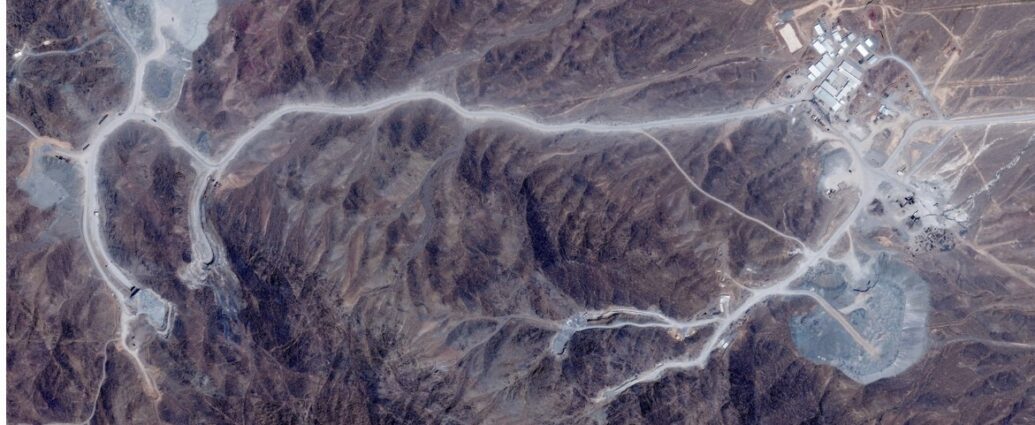
Trump: All mines cleared from Hormuz, Space Force watching nuclear sites, strait
US President Donald Trump said the US Navy told him all mines have been cleared from the Strait of Hormuz in a Tuesday Truth Social post.
“All mines have been removed and/or detonated from within the International Waters of the Strait of Hormuz,” the president wrote.
“Iran has been notified that any ship or boat placing new mines will be immediately and systematically destroyed,” he added.
“There is a Zero Tolerance policy on mine placement in full force and effect,” he said.
“Through Space Force, we are watching every square inch of the Strait, as we are also with Pickaxe Mountain and the three other already destroyed nuclear sites.”

Pickaxe Mountain contains major Iranian nuclear enrichment sites bombed by US, Israel in recent operations
Pickaxe Mountain is located 220 km. (140 miles) south of Tehran and 2 km. (1.2 miles) from the Natanz nuclear complex.
The Natanz site, where two of Iran’s uranium enrichment plants were located, was bombed both in June 2025’s war, including by US Air Force B-2 stealth bombers as part of Operation Midnight Hammer as well as operations Roaring Lion and Epic Fury earlier in 2026.
Reuters contributed to this report.

Trump’s pronouncements are triggering instant trades in the Middle East as UAE investors place bigger bets
President Donald Trump’s market-moving pronouncements are triggering almost instantaneous trading among Middle Eastern retail investors, with his statements generating more activity than Federal Reserve decisions or key U.S. economic data, according to one Dubai-based trading executive.
“We see the price fluctuation immediately, and that will lead to trades,” Tarik Chebib, the Middle East CEO of trading platform Capital.com, told Fortune. “We see that there’s more activity around those kinds of announcements.”
The reaction comes as trading activity across the UAE accelerates, positioning the country as a serious challenger to more established financial hubs. In the first half of 2026, the Dubai Financial Market’s trading value soared 40% year-on-year to $32.5 billion, while Abu Dhabi’s exchange saw $46.6 billion in trades. At the same time, retail investors are placing ever-larger leveraged bets on gold, oil, and U.S. technology stocks.
On Capital.com alone, the Middle East accounted for 57% of the platform’s $1.13 trillion in global client trading volume during the second quarter of 2026, with the majority coming from the UAE.
Vijay Valecha, chief investment officer at Dubai-based Century Financial, said the pattern extends beyond one brokerage. “As soon as there’s any kind of announcement coming from the White House or President Trump, we see activity increasing immediately,” he added. Valecha said activity around Trump’s statements now exceeds that generated by Federal Open Market Committee decisions, CPI releases or U.S. jobless numbers.
Leverage among UAE investors has also increased numerous times since Trump returned to office, according to Valecha, as repeated market rebounds after relatively shallow corrections have emboldened traders.
“As soon as there’s any kind of announcement coming from the White House or President Trump, we see activity increasing immediately”
Vijay Valecha, chief investment officer at Century Financial
The Middle East accounted for 57.2% of Capital.com’s global platform volume in the second quarter of 2026. Across the platform, average trade size rose 16% to $32,418 from $27,950 in Q1, even as the number of trades fell 23.2% to 34.9 million.
Chebib said Middle Eastern clients tend to use more leverage and take “huge positions,” particularly in commodities.
Gold has been at the center of the activity. Capital.com recorded $1.13 trillion of client trading volume globally in Q2, with gold accounting for 42.4%. In the Middle East, gold represented 49.9% of volume, followed by the U.S. Tech 100 at 23.5% and WTI crude at 7.3%.
The market’s focus has shifted rapidly, with gold dominating early in the year before conflict and disruption around the Strait of Hormuz drew attention to oil. Investors then rotated into AI-related equities and U.S. indices as technology stocks recovered. “This year, it was the war that was the catalyst,” Chebib said, as investors have sought to capitalize on the market volatility the conflict has caused.
Valecha said Century Financial recorded its highest volumes in the first week of March as investors scrambled to respond to the conflict. “The panic makes people trade,” he said. “A lot of people jumped into gold. A lot of people jumped into oil.”
But the UAE’s rise as a retail trading center predates this year’s war. Investment trends counted 49,000 active leverage traders in the country in 2023, up 9% from the previous year and, at the time, ahead of comparable counts for Singapore, Spain and France. Valecha believes the UAE has an investor base that is younger, more affluent and accustomed to leveraged products.
The speed and scale of the boom have also prompted questions over whether some of the activity could be unusual or suspicious. “From the outside it might look suspicious,” Valecha said. “Any country that grows at the speed at which the UAE grows, at the speed at which Dubai grows, it does look suspicious.”
But Valecha rejected the suggestion that unusual trading was behind the surge, describing it instead as “highly reactive retail trading” driven by news.
He pointed to the expansion of regulated financial firms, the development of financial centers including the Dubai International Financial Centre and Abu Dhabi Global Market, and the UAE’s removal from the Financial Action Task Force’s grey list in 2024, which he said made it easier for capital to move into the country. “It’s just brilliant execution,” he said. Chebib similarly said he had not seen evidence of suspicious activity at Capital.com, which is predominantly a retail rather than institutional business.
The increased interest in trading is part of a broader change as the UAE transforms from a relatively small retail market into one that executives say now competes with established financial centers. Investment Trends estimates that 48,000 people in the country placed at least one CFD or foreign-exchange in the 12 months to April 2025, compared with 38,000 active traders in Singapore. “The UAE specifically is now as big as Singapore when it comes to retail trading,” Chebib said, noting that brokerage accounts were rarely part of everyday financial life when he arrived in the region 11 years ago.
“Any country that grows at the speed at which the UAE grows, at the speed at which Dubai grows, it does look suspicious”
Vijay Valecha
A substantial share of Middle Eastern money is flowing into American assets. Investors across the six GCC states held about $891 billion in US equities as of June 2025, according to Treasury data, part of nearly $1.3 trillion they held in U.S securities overall. Nasdaq and S&P 500 products remain heavily traded, while AI stocks have become a dominant theme in the second half of the year.
And with U.S. midterm elections still ahead, Chebib expects another burst of volatility. If the first eight months are any guide, he said, Capital.com could be heading for a record year.
This story was originally featured on Fortune.com

AMC Kips Bay to shutter by end of 2026

New York City’s AMC Kips Bay 15 will screen its final film this year. As first reported by Variety, the company confirmed it will close the theater at 570 2nd Avenue, its second-largest in Manhattan, by the end of 2026 after the property owner decided to “exercise its contractual right to terminate the theatre’s lease before its scheduled expiration.” A favorite among New York cinophiles, the 15-screen multiplex is known for its wide selection of films and IMAX offerings.

“Since its opening in 1999, the theatre has been an important part of the Kips Bay community and surrounding neighborhoods, providing guests with a place to enjoy the magic of the movies together,” an AMC spokesperson told Variety. “We are immensely grateful to our guests for their loyalty and support throughout the years.”
The company said details are still being finalized and that a formal closure date will be announced in the coming months.
The property is owned by Kips Bay Development Limited Partnership, an affiliate of JD Carlisle Development Corp. and MD Carlisle Construction Corp., according to The City Reporter.
The theater first opened in 1999 and was taken over by AMC in 2006. The multiplex offers one of the few IMAX screens in the city.
Its closure will leave nine remaining AMC locations in Manhattan. These include Times Square’s Empire 25, which, with 25 screens, has the most screens of any movie theater in America, as well as AMC Magic Johnson Harlem 9 and AMC Village 7 in the East Village.
Outcry over the theater’s closure has come from movie goers, elected officials, and even actors. In a post on X, “Lord of the Rings” star Elijah Wood wrote: “The loss of an excellent AMC location in NYC. Dang.” There’s also a Change.org petition urging AMC and Kips Bay Development Limited Partnership to keep the theater open.
Some are also calling on elected officials to try to prevent the theater from closing. Assembly Member Keith Powers, whose constituents include Manhattan’s East Side, said in a post on X that closure of the theater would be a “big loss for Kips Bay and beyond.”
“Talking with my colleagues to see what we can do to prevent this,” Powers added.
RELATED:
- Upper West Side’s Metro Theater on track to reopen after 20 years
- Upper West Side’s Metro Theater may finally reopen
- Union Square’s Regal movie theater is here to stay
The post AMC Kips Bay to shutter by end of 2026 first appeared on 6sqft.



US offers to lift Iran sanctions if Tehran reopens Strait of Hormuz, stops proxy attacks – report
The United States offered Iran sanctions relief and an end to the naval blockade imposed on it in exchange for reopening the Strait of Hormuz and halting attacks carried out by its proxies in the region, Saudi state-owned Al-Hadath reported on Tuesday.
According to a senior source who spoke with Al Hadath and Saudi channel Al Arabiya, the US delivered the proposal to Tehran through Pakistan’s army chief, Asim Munir, during his visit to Iran.
The report said Munir carried a US proposal based on a memorandum of understanding previously discussed between Washington and Tehran. Under the proposal, the United States would be willing to end the blockade and lift sanctions if Iran reopened the Strait of Hormuz and brought an end to the activities of its proxies.
Iran’s Supreme National Security Council secretary, Mohsen Rezaee, told Munir that Tehran would continue internal consultations and respond soon.
The report follows a one-day visit to Tehran by Munir and Pakistani Interior Minister Mohsin Naqvi, as part of Islamabad’s efforts to advance a potential agreement between the United States and Iran.

During the visit, Munir met with Iranian President Masoud Pezeshkian, Parliament Speaker Mohammad Bagher Ghalibaf, Rezaei, Foreign Minister Abbas Araghchi, and Interior Minister Eskandar Momeni.
A statement from the Pakistani military said the talks focused on preventing further escalation, reopening the Strait of Hormuz, and accelerating the end of the conflict. Pakistan’s interior minister also said that “significant progress” had been achieved in the discussions.
Pakistani visit to Tehran ‘very fruitful,’ presidential aide says
Iran’s presidential office described Munir’s visit in particularly positive terms. Mehdi Tabatabai, the president’s communications aide, wrote that the visit was “very fruitful” and included “highly valuable diplomatic achievements,” adding that its results would become clear soon.
At the same time, Pezeshkian demanded that the United States honor its commitments and change its “tone and approach” toward Tehran.
According to Al Hadath, the US message also addressed the continuation of attacks by Iran’s proxies despite the halt in direct attacks, an issue Washington wants included in any potential agreement.
Munir, according to the report, told Iranian officials that Pakistan does not take sides in the conflict and seeks to serve as a mediator.
Strait of Hormuz traffic remains constricted amid Iranian threats, restrictions
The Strait of Hormuz, a critical route for global oil and gas shipments from the Gulf, has been severely affected in recent months, with shipping traffic through the waterway sharply declining amid Iranian threats and restrictions.
The proposal was revealed one day after the Trump administration announced an expansion of economic pressure on Iran and threatened secondary sanctions against countries and companies that continue trading with Tehran.
Iran, meanwhile, warned that cooperation with such measures would be considered a hostile act.
Washington has not yet officially responded to the report.

Board of Peace demands Israel comply with Gaza ceasefire, calls for end to kite attacks
The Board of Peace (BoP) has conveyed a message to Hamas in recent days through Egyptian, Qatari, and Turkish mediators, demanding that the terrorist organization halt the launching of kites and all other activity directed at Israel, The Jerusalem Post has learned.
The message was delivered through a recently established monitoring mechanism led by the United States and BoP Director-General Nickolay Mladenov.
“There will be serious consequences for continued violations,” the message warned.
“All militant activity in the Gaza Strip must stop, including the flying of kites. We have conveyed this message directly through the established mechanism,” a BoP official told the Post.
The official stressed that Israel must also comply with the ceasefire agreement, adding that “military action cannot extend beyond responding to genuine and imminent threats.”

The BoP is seeking to calm the situation in Gaza and create the conditions necessary to implement the agreements and begin the process of disarming Hamas.
“We want to get onto a path of ending mutual violations so that we can begin collecting Hamas’s weapons,” the official said. “The sooner we reach that stage, the sooner we can move into the phase in which Hamas is disarmed.”
IDF accelerates efforts to kill October 7 terrorists
Israel has accelerated its efforts in recent weeks to kill terrorists who participated in the October 7 massacre and held hostages.
On Monday, Israel carried out several strikes across the Gaza Strip, targeting five weapons storage facilities and a Hamas launch site.
“The warehouses that were targeted contained rockets, weapons, explosive devices, grenades and additional military equipment,” the IDF and Shin Bet (Israel Security Agency) said in a joint statement. “The targeted warehouses were established inside mosques and adjacent to humanitarian infrastructure in the Gaza Strip.”
The strikes came after several kites were launched from Gaza into Israel in recent days at the direction of Hamas, reviving memories of the incendiary and explosive kites and balloons the terrorist organization launched toward Israel during the previous decade.
BoP warned of increased IDF attacks if kites persist
Israeli officials warned the BoP on Sunday that Israel would escalate its activity in the Gaza Strip if the launches were not halted within 72 hours, an Israeli official told the Post.
Prime Minister Benjamin Netanyahu and Defense Minister Israel Katz also warned in a joint statement that if the launches toward Israel were not stopped immediately, “the IDF will act to intensify targeted operations against those responsible for the launches and will evacuate civilians from areas from which kites, drones and balloons are launched.”
Iran’s Strait of Hormuz leverage is fading as global oil keeps flowing – opinion
The main economic flash point in the US campaign against Iran has been the Strait of Hormuz, which carried roughly 20 million barrels of oil a day before the war. That choke point no longer dominates the global energy market the way many feared it would.
According to US government figures, the United States, Saudi Arabia, and the other Gulf states can now move about 15-16 million barrels per day. Roughly 10 million leave on tankers through the strait itself, often under US naval protection and sometimes with transponders off, so the true volume likely exceeds what public maritime tracking shows. Another 5-6 million barrels move by air and, more significantly, through pipelines built or expanded since the war began.
Saudi Arabia’s East-West Pipeline now transfers 7 million barrels a day, much of it reaching the Red Sea port of Yanbu. The UAE’s Habshan-Fujairah line, which empties into the Gulf of Oman outside the strait, is running near its ceiling of 1.5-1.8 million barrels a day, with a parallel line planned to expand it further.
These routes, plus limited trucking and other workarounds, haven’t fully replaced prewar volumes, but they’ve offset much of the loss. The bottom line is undeniable: Oil is still leaving the Gulf in large quantities.
The clearest evidence the system is working is the price of oil itself. As of mid-August 2026, Brent and WTI crude are trading at $85-$90 a barrel – far below the $150-plus levels many analysts warned would trigger a downturn like the Great Depression. Prices spiked early in the conflict, briefly topping $110-$120, but have since settled well short of those catastrophic forecasts. The market has absorbed the shock without panic.

Other developments have helped close the gap left by lost Hormuz volumes: Chinese oil demand has softened, and Venezuelan production climbed to about 1.2 million barrels a day this past July, nearly all of it bound for export. Between alternative routes, protected tanker movements, weaker Chinese demand, and rising Venezuelan output, the shortfall has been nearly covered.
That success doesn’t mean the war is over. What keeps US President Donald Trump from forcing a decisive blow to the Iranian regime isn’t Hormuz – it’s the persistent threat of Iranian missile and drone strikes on Gulf oil infrastructure.
Iran and its proxies have hit or threatened refineries, storage tanks, and export terminals across Saudi Arabia, the UAE, Kuwait, and Bahrain, including key nodes like Fujairah, Habshan, Ras Tanura, Yanbu, and Abqaiq.
A single successful strike on a major processing plant or terminal could still send prices sharply higher, which is why Washington and its partners have moved carefully – degrading Iranian capability while keeping Gulf production going and protected.
Iran’s shrinking ability to project power abroad
Still, the strategic picture is clear: Iran can no longer use the strait as leverage over the global economy. Its ability to project power beyond its borders keeps eroding under US and allied strikes, while inflation and internal dissent pile pressure on a regime with fewer external options by the week.
Iran’s usable foreign exchange reserves are so limited that Trump’s oil export embargo hit hard and fast. It choked off Iran’s ability to import rocket fuel, drone motors, and other urgent supplies from China, and disrupted money transfers to Iran’s proxies – Shi’ite militias in Iraq, Hezbollah in Lebanon, and the Houthis in Yemen.
At home, the block on Iran’s oil exports has sent the rial into free-fall: A US dollar now costs 1,500,000 rials in Tehran, up from 50,000 a year ago. The inflation is hitting salaried workers hardest – soldiers in the Artesh, the IRGC, government ministry employees, staff of the bonyads, and Basij paramilitary forces. Basic goods have become unaffordable, and by month’s end many of these families are surviving on little more than subsidized bread.
Now, the new US effort, “Economic D-Day,” is aimed at total financial isolation of Iran through unprecedented sanctions and enforcement. The strategy involves aggressive secondary sanctions against any company, bank, or nation still trading with Tehran, especially major oil buyers like China and India.
The US is deploying its navy and federal agencies against unregistered tankers, underground banking networks, and crypto exchanges to push Iranian crude exports to zero, while pressuring regional centers like the UAE to cut off transactions entirely, thus forming a coordinated blockade meant to collapse the Iranian regime’s revenue.
Taken together, the economic squeeze of the regime and the newly announced measures make the regime’s collapse look increasingly inevitable, even if the timetable is uncertain and further Iranian strikes on Gulf energy assets remain likely.
But the fundamentals have shifted: The Strait of Hormuz is no longer the decisive battleground Iran once hoped it would be. Oil (not Iranian) keeps flowing, prices remain contained, and the strategic initiative rests with Washington and its partners. What remains is the harder work of managing escalation risk on Gulf infrastructure while Tehran’s options continue to narrow and the pressure inside Iran keeps building.
Hormuz was Iran’s best card, and it’s already been played and lost. What remains is a regime running out of money, running out of allies, and running out of time.
The writer is head of the US office at Acumen Risk Ltd., a risk-management firm.

STAT+: How Trump’s funding cuts are reshaping the health system
You’re reading the web edition of D.C. Diagnosis, STAT’s twice-weekly newsletter about the politics and policy of health and medicine. Sign up here to receive it in your inbox on Tuesdays and Thursdays.
RFK Jr. adviser Calley Means said people should consult AI instead of human doctors. Send news tips and generative medical advice to John.Wilkerson@statnews.com or John_Wilkerson.07 on Signal.
Today’s Maine story
Today, STAT kicked off Daniel Payne’s five-part series exploring the consequences of Republicans’ unprecedented cuts to the health care safety net.

Zcash soars to eight-year high amid crypto rally, and hopes of an ETF approval
Zcash is emerging as one of the stars of the sudden broad-based rally in crypto assets that went into high gear last week. The privacy-focused cryptocurrency has surged 66% over the past week, hitting an eight-year high of $841 on Monday.
Its surge came after investment manager Grayscale filed an amendment with the Securities and Exchange Commission on Friday to convert its existing Zcash Trust into an exchange-traded fund. If approved, the fund would trade on the New York Stock Exchange under the ticker ZCSH.
Zcash’s strong performance comes amid a broader rally across the crypto market. Cryptocurrencies have risen sharply since Wednesday, posting gains not seen in nearly a year. The Treasury Department’s bond-buyback announcement helped spark the move, while renewed political support for the industry and a wave of short-position liquidations pushed prices even higher. Bitcoin, the largest cryptocurrency by market value, continued to climb and was trading just below $80,000 on Monday.
For Zcash, Grayscale’s proposed ETF came as an additional catalyst. If approved, the fund would give investors a regulated way to gain exposure to ZEC, Zcash’s native token, through their brokerage accounts, without having to buy or hold the token directly.
Its outperformance has revived discussion of whether Zcash can emerge as a more prominent alternative to Bitcoin for investors seeking financial privacy. Unlike Bitcoin, Zcash allows users to shield transaction details, such as the sender, recipient, and transaction amount, using zero-knowledge cryptography.
Zcash supporters say that it improves on Bitcoin by offering Bitcoin’s fixed supply without the public ledger. As artificial intelligence grows, proponents argue that so will the risk of government surveillance.
“Many are calling it ‘perfect Bitcoin,’” Arjun Khemani, a cryptographer and engineer, wrote on X.
Influential crypto voices have also been speaking out about Zcash’s use cases. During a meeting of the Commodity Futures Trading Commission’s Innovation Advisory Committee on Friday, Gemini co-founder Tyler Winklevoss pointed to Zcash as an example of how developers can use artificial intelligence to identify vulnerabilities in complex blockchain code and strengthen networks before malicious actors exploit them.
But Zcash’s strongest feature is also its greatest limitation. Its privacy features make it harder for exchanges and law enforcement to trace illicit funds, potentially making Zcash a more attractive vehicle for money laundering or sanctions evasion.
This story was originally featured on Fortune.com


Panda Express guest stunned as employee stands on fryer while cleaning
A video has emerged purportedly showing a Panda Express employee stepping around food while cleaning a frying station, as meals were being prepared.
Paul Elisha Finger, who captured the footage, told Storyful that he “noticed the gentleman jump on the fryer that the lady had just put food into” when he visited a Panda Express location in Milwaukee, Wisconsin, in early July.
The worker then “started spraying the chemical and wiping [while] standing right over the food,” according to Finger.
“I could not believe my eyes,” Finger told Storyful.
POPULAR BEER BRAND TO CUT 220 JOBS AS PRODUCTION SHIFTS
FOX Business has reached out to Panda Express for comment.
The video shows a female employee reaching through the cleaner’s legs to drop a bowl of food into one of the fry baskets, as the male worker apparently was cleaning the exhaust hood area of the fry station.
E COLI AND SALMONELLA OUTBREAK LINKED TO ALFALFA SPROUTS SICKENS DOZENS ACROSS MULTIPLE STATES
Panda Express says on its website that its food is a “flavorful combination of Chinese regional cuisine and technique with bold American tastes.”
CLICK HERE TO READ MORE ON FOX BUSINESS
“Panda Express, the nation’s largest Asian restaurant chain, has revolutionized American Chinese cuisine. Founded in 1983, the family-owned business has grown into a culinary powerhouse, seamlessly marrying authentic Chinese flavors with American tastes,” adds Panda Restaurant Group, Inc., on its website. “With over 2,600 locations worldwide, Panda Express has played a pivotal role in popularizing American Chinese cuisine to millions around the world.”

Tesla raises Cybertruck prices on 2 US models
Tesla raised prices on two versions of its Cybertruck pickup in the U.S. on Tuesday, increasing their starting costs by $5,000.
The electric vehicle maker raised the price of the Cybertruck Dual Motor to $74,990 and the Premium All-Wheel Drive model to $84,990, according to Tesla’s website.
Tesla’s online configurator, reviewed by FOX Business, lists the Premium All-Wheel Drive Cybertruck at $84,990, while the company’s top-end Cyberbeast remains priced at $99,990.
The Premium All-Wheel Drive model has an EPA-estimated range of 325 miles, an 11,000-pound towing capacity and a 0-to-60 mph time of 4.1 seconds, according to Tesla’s configurator.
TESLA RECALLS NEARLY 3M VEHICLES OVER DOORS THAT MAY BE DIFFICULT TO OPEN AFTER CRASHES
Tesla did not provide an explanation for the price increases in the materials reviewed by FOX Business.
FOX Business reached out to Tesla for comment on what prompted the changes, when the new pricing took effect and whether the company made any corresponding changes to the vehicles’ features or specifications.
TESLA FILES PLANS FOR PROPOSED $10.1B TEXAS SOLAR MANUFACTURING PLANT
The Cybertruck is Tesla’s electric pickup truck and is manufactured at the company’s Gigafactory Texas facility.
The pricing changes come after Tesla delivered 480,126 vehicles globally in the second quarter of 2026, according to the company’s latest production and delivery report. Of that total, 467,762 were Model 3 and Model Y vehicles, while 12,364 were listed under Tesla’s “Other Models” category.
MORE THAN 20,000 OFF-ROAD MOTORCYCLES RECALLED OVER DANGEROUS BRAKE DEFECT THAT COULD LEAD TO DEATH
Tesla does not separately disclose Cybertruck deliveries in that report, making it difficult to determine how many of the pickups were delivered during the quarter. The company also produced 451,758 vehicles during the three-month period, including 8,822 vehicles in the “Other Models” category.
CLICK HERE TO GET FOX BUSINESS ON THE GO
Tesla began delivering the Cybertruck to customers in late 2023.
Reuters contributed to this report.

Australia bans AI-generated music—only ‘substantially human made’ music is eligible to make the charts
Australia’s recorded music industry will bar tracks wholly generated by artificial intelligence from official charts as burgeoning generative technologies threaten artists’ livelihoods, a representative said on Tuesday.
The crackdown comes as a variation of Madonna’s pop hit “Like a Prayer” created by an Australian producer using AI-generated vocals and drums has spent 16 weeks in the Australian top 20, stoking debate about generative AI’s place in music. It peaked at number two on the Australian Record Industry Association’s top 20 Australian singles chart in May and remained in fourth place on Tuesday.
Wholly AI-generated tracks will be banned from the ARIA charts from Monday next week, but some AI-assisted music will remain eligible, an ARIA statement said.
Tracks can be eligible only if “humans wrote the song and performed the lead vocal and the primary instruments,” among other requirements, the statement said.
AI-generated music would also be ineligible for the Australian industry’s prestigious ARIA awards.
ARIA chief executive Annabelle Herd said: “These changes reflect our intent to remain dynamic and promote the human nature of artistry in what is — to say the least — a rapidly developing space.”
“The ARIA Charts will always remain a transparent measurement of the music Australia consumes, but a chart that rewards unlicensed AI output would undercut the very basis of the recorded music we exist to represent,” Herd added.
Eligible music must also be produced using legal AI services. Music was appearing on streaming services that had apparently been developed with AI tools trained on artists’ music without authorization.
The Australian rules are in step with new principles released in July by the London-based International Federation of the Phonographic Industry. The federation represents the recording industry worldwide.
The international guidelines state that to qualify for official music charts, a track must be “substantially human made.”
Sydney Conservatorium of Music composer and lecturer Alexis Weaver told Australian Broadcasting Corp. the debate around AI in music was “exceptionally fraught and very emotional for a lot of musicians and so everyone will have a different opinion.”
Weaver applauded ARIA’s move as a “wonderful step forward” that sent a message ARIA wanted to “prioritize and value human creativity.”
“It can be quite hard to avoid AI tools in the current landscape,” Weaver said. “There is a way to use it while you’re still steering the ship and making the main creative choices.”
This story was originally featured on Fortune.com
What’s included in the new US sanctions campaign to pressure Iran’s economy? – explainer
US Treasury Secretary Scott Bessent announced what his department called “an economic onslaught” against Iran on Monday that combined new sanctions with threats against Tehran’s trading partners.
His statement stopped short of some of the most punishing sanctions and did not list specific countries that would be targeted, or when those penalties would take effect.
Here’s a summary of actions he announced:
Pressing other governments to sever economic ties with Iran
The United States will set timelines for other countries to shut down economic activity with Iran and threatens unspecified actions if they do not comply.
Foreign entities that facilitate money laundering or sanctions evasion for Iran risk being cut off from the US financial system.

More types of economic activity with Iran may now lead to secondary sanctions on other countries, individuals or entities regardless of where they are located.
These newly listed activities include dealings in digital assets like cryptocurrency, technology, gold, aviation and shipping.
Sanctions on specific Iran-linked entities, individuals, vessels
The Treasury’s Office of Foreign Assets Control (OFAC) has added specific sanctions on nearly 60 entities, individuals and vessels that it says are enabling Iranian activity.
The new sanctions target the Iranian defense ministry’s ballistic and nuclear procurement network, a cyber group the US says is behind attacks on its infrastructure, and the shipping, trading and financial network involved in Iranian oil sales.
OFAC has also suspended several licenses that previously allowed some remittance payments to Iran and Iranian access to the US cultural and academic system.
Entities, individuals involved in Iranian military procurement sanctioned
More than 20 of the new sanctions are targeted at entities and individuals in the Middle East and Asia that Treasury says are involved in financial and logistical support for Iranian nuclear research and missile development.
These include China-based companies that supplied what the Treasury considers dual-use items for a previously sanctioned Iranian technology institute.
Sanctions on individuals involved in cyberattacks to expand
The US is expanding sanctions on several previously sanctioned individuals, accusing them of involvement in cybercrime or threats to US national security.
Iran-linked oil industry assets sanctioned
New sanctions aimed at stopping Iran’s oil exports include vessel brokers, bunkering service providers and financial intermediaries. These name several individuals and entities based in the United Arab Emirates and others in Singapore and Hong Kong.
The Treasury also identified five tankers as part of what it called a “shadow fleet” and listed them as “blocked property,” meaning OFAC prohibits US nationals or people based in the United States from having any financial transactions with them.
Ghislaine Maxwell loses bid to throw out conviction for aiding Jeffrey Epstein
A US judge rejected Ghislaine Maxwell’s bid to throw out her conviction and 20-year prison sentence for helping the late financier Jeffrey Epstein sexually abuse teenage girls.
In a decision made public on Tuesday, US District Judge Paul Engelmayer said Maxwell’s claims were all meritless, and all or almost all were frivolous.
Maxwell, 64, who represented herself, challenged her December 2021 conviction and sentence in Manhattan federal court, and sought a writ of habeas corpus declaring her punishment unlawful.
Prosecutors said her latest claims were baseless or filed too late.
Maxwell said many documents disclosed earlier this year through the Epstein Files Transparency Act show that her due process rights were violated because lawyers representing Epstein’s accusers served as “de facto prosecutors and agents of the government.”
But the judge said this supposedly “new” evidence was largely irrelevant to Maxwell’s case.
This is a developing story.
Acronis pushes AI beyond recommendations with new autonomous IT platform
For the past two years, enterprise AI has largely been built around recommendations. It summarizes incidents, prioritizes alerts, and suggests what an IT technician should do next. The technician still makes the decision and still does the work.
Software vendors are now trying to move beyond that model. Rather than telling IT teams what should happen, the next generation of AI is beginning to carry out parts of the work itself.
The workload on IT professionals only grows as cyber incidents become more frequent. In Israel, 4,800 cyber incidents were recorded in June alone, nearly three times the number reported during the same month a year earlier. While government agencies and critical infrastructure remain major targets, smaller businesses are increasingly being affected as well, leaving IT teams with more incidents to investigate and less time to determine which pose the greatest risk.
As organizations look for ways to manage increasingly complex IT environments, software companies are beginning to push AI beyond recommendations. Acronis, a global provider of cyber protection solutions, is one of the latest enterprise software companies betting that autonomous execution, not better recommendations, will define the next phase of AI for IT teams. At its Acronis Accelerate: The Journey to Autonomous IT event, the company announced its new platform designed to bring agentic AI into MSP workflows.
Built around a unified workspace, the platform is designed to reduce the amount of manual coordination required to manage modern IT environments. Bringing operational data, service tickets, monitoring, and security into one system allows technicians to assess incidents from a single interface rather than piecing together information from multiple applications.

Part of a broader movement towards autonomous AI
The platform also reflects a broader move towards autonomous AI. Rather than stopping at identifying a problem, it can gather context around an incident and automatically begin handling certain routine tasks. MSPs can also build their own automated workflows and define which actions the platform can perform autonomously and which will continue to require human intervention.
Jan-Jaap Jager, CEO of Acronis, shares: “AI-native is not a marketing label for the company but a core design principle that guides how its products are built and operated, as well as how it helps partners manage and grow their businesses. The goal is to provide MSPs with a single environment where people and AI agents can collaborate securely, transparently, and at scale, and this year’s product releases bring that vision to life.”
Israel one of Acronis’ fastest-growing markets
Israel has also become one of Acronis’ fastest-growing markets, with cloud annual recurring revenue increasing 27% over the past year and adoption of its advanced EDR solution rising 37%. The country also plays an important role in the company’s global operations, with nearly half of Acronis’ Israel-based employees working in research and development.
As IT environments continue to grow, the challenge is becoming less about collecting more data and more about deciding what deserves attention first. The next phase of AI in enterprise IT may not be generating better recommendations, but reducing the amount of routine work technicians perform, giving IT teams more time to focus on the problems that still require human intervention.
Likud petitions election committee to penalize Yair Golan over alleged ‘electioneering’
The Likud on Tuesday petitioned the election committee to punish Democrats Party leader Yair Golan, calling for the removal of a video he posted, claiming the video constituted prohibited electioneering.
In the video, Golan states that MK Zvi Sukkot’s (Religious Zionist Party) illegal destruction of a Palestinian monument in the West Bank “did not happen in a vacuum,” stating it was the “spirit of Netanyahu” that enabled him.
“This is a person who should be behind bars and bolts, not in the Knesset of Israel,” Golan added, stating that Sukkot is the reason the IDF was diverted to the West Bank on the eve of the October 7 massacre, and that his actions and the actions of “extremists” like him endanger Israel’s national security and IDF soldiers.
צבי סוכות לא פועל בחלל ריק – זו רוח נתניהו.
ב-27.10 נחליף את שניהם ונחזיר את הביטחון pic.twitter.com/4WNm19Pw75
— Yair Golan – יאיר גולן (@YairGolan1) August 25, 2026
Golan also said, “On October 27, we will put an end to this,” indicating his desire to overturn the Netanyahu coalition in the upcoming elections.
In response, Sukkot threatened Golan with a lawsuit should he not remove the X post within half an hour.

‘A small taste’: MK Sukkot confirms he destroyed monument in West Bank town while guarded by IDF
Earlier on Tuesday morning, Sukkot confirmed he had destroyed a monument in Kafr Madama near Nablus, after footage circulated on social media and was shared by Israeli outlets.
The monument appeared to be in honor of members of the al-Aqsa brigade and Palestinians killed in the intifada.
“Every child who sees every day a giant monument that glorifies murderers of Jews will dream of being a terrorist,” Sukkot said in a post to X/Twitter.
He claimed that he had taken action after appealing to the IDF several times to remove the “terror monuments throughout the area,” and that destroying the monument in the village was “a small taste.”
“There is no place for support of terror in the State of Israel!” he wrote.
Maya Zanger-Shamir contributed to this report.

USS Abraham Lincoln to dock in Thailand after record-setting deployment, Thai official says
The US aircraft carrier the USS Abraham Lincoln will dock in Thailand next week, a Thai official said on Tuesday, following a prolonged deployment in the Middle East and reports of mental health concerns and deteriorating conditions aboard.
The Lincoln, which left the Middle East on Saturday, has not made a port call in more than 200 days, setting a modern-day record for consecutive days at sea, according to Democratic lawmakers.
Typically naval deployments are for between six and nine months, but during times of conflict, that can be extended.
The ship, which has roughly 5,000 sailors and Marines aboard, will be in Thailand for “rest and recreation after their long sea journey,” the official said, asking not to be named.
Thailand’s Navy said a US Navy carrier strike group would make a brief stop in eastern Thailand for the purpose of rest and recuperation, with no exercises taking place. It did not name the three vessels or provide a date for the visit, citing security concerns.

“The stop is a routine port visit intended to allow personnel to rest and recuperate … as well as to receive logistical support,” the Thai Navy’s spokesperson said in a statement.
The US Embassy in Bangkok did not immediately respond to a request for comment.
USS Lincoln redirected from home port to aid in Operation Epic Fury
The Lincoln left its home port of San Diego in November and was later redirected to the Middle East to support US military operations in the US-Israel war with Iran.
Two military-focused outlets, Navy Times and Stars and Stripes, this month reported suicide attempts and declining morale on the ship. US Defense Secretary Pete Hegseth has said the reports “completely misrepresented” the conditions on board.
Thailand is the United States’ only treaty partner in mainland Southeast Asia, having been a treaty ally since 1954 and a major non-NATO ally since 2003. Both countries’ militaries maintain strong relations.

Secret Service reviews apparent Iranian state media threat against life of Barron Trump
The U.S. Secret Service has confirmed it is aware that Iranian state media has aired a video that appears to threaten the life of Barron Trump, President Donald Trump’s youngest son.
“The U.S. Secret Service is aware of the video and investigates anything that can be perceived as a threat toward our protectees,” Secret Service spokesman Nate Herring said in a statement. “Out of concern for operational security, we do not discuss matters of protective intelligence.”
Since the U.S. assassination of Iran’s Ayatollah Ali Khamenei, Iranian media have on multiple occasions circulated content threatening the president and family members. The assassination came at the start of the war in Iran that Trump launched alongside Israel.
CNN previously reported that the Secret Service had knowledge of the Barron Trump threat.
This story was originally featured on Fortune.com