Likud ministers in Prime Minister Benjamin Netanyahu’s government backed the premier’s eight reserved slots in the party’s list that he would fill at the Likud primaries on Monday, while also characterizing the event as a celebration of the party’s democratic nature.

“We need to build a good team beside and behind Prime Minister Netanyahu,” Agriculture and Food Security Minister Avi Dichter told The Jerusalem Post at the International Convention Center polling station in Jerusalem.

The reserved spots have created tensions in recent weeks as they represent a significant proportion of the 22 seats the Likud is projected to win in the October election.

Should that projection hold, it would mean that only 14 seats on the Likud’s list in the Knesset would be filled by members elected by registered Likud voters.

Even that, though, would be unique in Israeli politics, as the Likud is one of only a handful of parties to hold primaries, and the only party to allow all its registered members to cast a vote.

Likud primaries held on Monday. (credit: MARC ISRAEL SELLEM)

Ministers defend Netanyahu’s reserved slots

Dichter and other ministers in the party spoke to the Post at the ICC as they headed to cast their ballots. Approximately 140,000 registered Likud members around Israel were eligible to cast votes for candidates at polling stations around the country.

Dichter stated that this year’s primaries had generated a different level of enthusiasm, with turnout among members appearing “higher and stronger,” and voters arriving with “a wide smile on their face.”

Communications Minister Shlomo Karhi also defended Netanyahu’s reserved slots, stating they “are nothing new. They existed last time as well.”

 “There are a few more now,” he said, “but they allow the prime minister, who has to coordinate the entire system, including alliances between parties and preserving the bloc, to continue leading Likud to victory.”

Additionally, Karhi argued that the primaries were still democratic, noting that “beyond the reserved slots, which are something the prime minister needs to be given the ability to use, everyone else competes in the primaries.”

 “It’s a celebration of democracy,” he added.

Likud ministers call primaries a celebration of democracy 

Transportation Minister Miri Regev also defended the democratic nature of the primaries, echoing Karhi’s characterization of the event.

While also calling it a “celebration of democracy,” she indicated that Netanyahu’s reserved slots were less democratic.

 “There’s no doubt that with the reserved slots, half of the list is democratic, and half of the list consists of reserved slots.”
Culture Minister Miki Zohar told the Post that he supported Netanyahu “all the way” and was not bothered by the reserved slots that were up to the prime minister’s discretion to fill.

He also said, regarding lower recent polling that shows the Likud receiving approximately 22 seats rather than the 32 seats that the party currently has, that he  believed “by the elections, the results will be different.”

 “We’ll grow stronger. The polls never flatter us, but when the real results come in, we always deliver a strong result, and that’s what will happen this time as well.”


This post was originally published on here. 

The Coordinator of Government Activities in the Territories (COGAT) and Israeli security forces evacuated an illegal settler outpost near Susya, in the southern Hebron hills, on Monday, according to Army Radio.

The outpost, known as Givat Or Yehuda, was reportedly the site of a violent incident three months earlier, which Army Radio cited as the reason for Monday’s evacuation.

In May, when Israeli security forces arrived at the outpost to confiscate stolen and illegally held vehicles, extremist settler residents threw stones at police officers and blocked roads to prevent them from moving.

The evacuation comes on the heels of a string of violent settler attacks on the Palestinian village of Kusra near Nablus, over 100km north of Susya, which resulted in the IDF declaring the area a closed military zone.

However, some 15 extremist settlers entered Kusra again on Saturday, though the IDF had declared the area a closed military zone, Army Radio reported.

IDF soldiers in the village of Kusra, south of Nablus, West Bank, on August 14, 2026.  (credit: FLASH90)

IDF troops arrived at the area where the Jewish extremists were gathered and read the closed military area order to the settlers, who then left the area, Army Radio reported later.

Military to conduct probe into Kusra incident, settler leaders condemn violent acts in the village 

A military spokesperson told The Jerusalem Post earlier in August that the IDF would be conducting a probe into the incident.

The probe will cover why it took the IDF 48 hours to evacuate the illegal outpost set up by Jewish extremists, as well as why the military did not remove the outpost for a second time after the settlers returned.

Palestinian residents who remain in the area told Israel’s public broadcaster KAN News that they still feel threatened by Jewish extremists.

The recent events in Kusra drew international attention and prompted condemnations of settler violence from figures who otherwise strongly support Israeli settlement in the West Bank, including several settlement officials and National Security Minister Itamar Ben Gvir.

Ben-Gvir told KAN News that while he admires the extremist settlers building outposts, “there are some among them who really need to be stopped.”

Corinne Baum, Shir Perets, Jerusalem Post Staff, and Yonah Jeremy Bob contributed to this report.

This post was originally published on here. 

A genetic test conducted privately at a laboratory abroad has raised concerns that the sperm donor whose donation was used to conceive a woman’s children may not be a genetic match, the Health Ministry announced on Monday.

The ministry began reviewing the case after receiving a report from Assuta Medical Center in Tel Aviv regarding the test.

The review includes an examination of the test itself and the laboratory where it was conducted. Professionals are also reviewing the case in coordination with Assuta Medical Center.

Assuta pledges to conduct thorough investigation into incident in coordination with Health Ministry

Assuta said it had recently received an inquiry from the patient raising questions about the origin of the sperm donation.

“A short time ago, we received an inquiry from a patient who raised doubts regarding the source of the sperm donation she had selected and from which her child was born,” Assuta said in a statement.

 View of Assuta Hospital, Ramat haHayal, Tel Aviv. May 20, 2023. (credit: AVSHALOM SASSONI/FLASH90)

“Upon receiving the inquiry, Assuta immediately reported the matter to the Health Ministry, as is standard practice, and opened an in-depth investigation into the case.”

Further testing will be required before any conclusions can be reached, the statement added.

“At this early stage, it is not yet possible to reach conclusions, and additional tests are required. Assuta is in direct contact with the patient and will conduct the review process transparently and in full coordination with the Health Ministry,” Assuta added.

This post was originally published on here. 

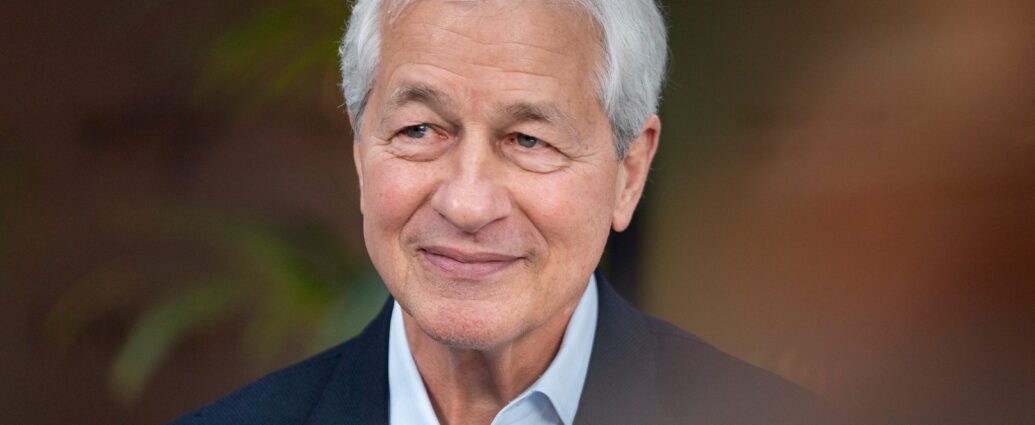
JPMorgan Chase is closing in on a milestone no bank has ever reached.

The financial giant was worth roughly $970 billion on Monday morning—a modest stock-market rally away from becoming the first bank in the world with a $1 trillion market cap and a far cry from its $138 billion valuation on December 30, 2025, just before he took over. Last month, JPMorgan posted the highest-ever quarterly profit by a U.S. bank.

Getting to $1 trillion would be the latest payoff from a playbook CEO Jamie Dimon has spent two decades refining: maintain enough financial firepower to withstand crises, keep investing when rivals pull back, and use periods of industry turmoil to expand.

That combination has repeatedly allowed JPMorgan to go on offense when competitors were under pressure. Dimon has long emphasized what he calls the bank’s “fortress balance sheet,” which helped JPMorgan acquire Bear Stearns and Washington Mutual during the 2008 financial crisis and swoop in to buy First Republic during the regional banking crisis 15 years later.

“Best-in-class ability to invest”

But JPMorgan’s advantage extends beyond acquisitions. 

Wells Fargo analyst Mike Mayo wrote in an Aug. 13 note that JPMorgan’s edge is that it can afford to spend heavily on branches, bankers and technology—and then use the growth from those investments to spend even more. That “flywheel” has helped JPMorgan build leading franchises across consumer banking, investment banking, trading and wealth management. Mayo wrote that this “best-in-class ability to invest for superior growth” could help the bank reach a $2 trillion valuation in the next seven to eight years. 

But the path to $2 trillion isn’t guaranteed. Mayo points out that the past decade did not include what he considers a “real” recession, while unusually buoyant markets have lifted revenues across the industry. JPMorgan is also trading near its peak forward earnings multiple since the financial crisis.

That puts more pressure on the bank to keep growing earnings. Mayo estimates that roughly two-thirds of JPMorgan’s increase in market value over the past six years came from earnings per share doubling, while only one-third came from the stock commanding a higher multiple.

After Dimon

The biggest test of whether JPMorgan’s advantage is truly institutional, however, may come when Dimon leaves.

Dimon, 70, has led JPMorgan since 2006, and investors have long attached a “Jamie premium” of 10% to 15% to the bank’s shares. Mayo wrote that maintaining JPMorgan’s culture and management strength will be critical to sustaining its performance and acknowledged the looming succession question. 

“CEO succession will likely remain a front-and-center topic,” he wrote. 

The question of who will succeed Dimon is one of corporate America’s longest-running ones, with recently appointed co-presidents Doug Petno and Troy Rohrbaugh seen as the front-runners after Marianne Lake dropped out.  

This story was originally featured on Fortune.com

This post was originally published here. 

A Hamas explosive device detonated in northern Gaza near the Yellow Line in the early hours of Monday morning, according to the IDF.

Gazans also fired at the same area at the time of the explosion. There were no casualties, the military confirmed.

Following the explosion, Israeli forces attacked in the area of the Yellow Line.

This event, the IDF claimed, constituted a ceasefire violation on the part of Hamas, something that the military warned soldiers they should be prepared for, according to a Sunday Channel 12 report.

Channel 12 also reported that IDF soldiers were instructed to attack a group of six Hamas operatives who crossed the Yellow Line on Friday in order to steal Israeli military equipment. They were evidently not hit and retreated.

(ILLUSTRATIVE) Golani Brigade troops along the Yellow Line area in eastern Rafah. (credit: IDF SPOKESPERSON UNIT)

On Saturday, IDF soldiers attacked two more Gazans who were attempting to cross the Yellow Line, per the Channel 12 report, which added that the Gazans were attempting to steal pipes.

IDF strikes Hamas terror cell, resuming preemptive strikes despite Trump’s Gaza deal

The air force on Thursday attacked a Gazan terror cell in Khan Yunis, the second such attack in two days. These attacks had ceased since the US-Hamas deal in late July.

IDF sources told The Jerusalem Post that the cell, while not very senior, was nonetheless in the process of planning and preparing an operation against the military.
 
According to the sources, the IDF has halted its attacks on Hamas leadership and on the terror group’s members involved in the October 7 invasion ever since the US-Hamas deal. However, they said that the IDF is still carrying out strikes against operatives whom it knows are preparing attacks.

Yonah Jeremy Bob contributed to this report.

This post was originally published on here. 

A group of 10 Jewish, Hindu, and Zoroastrian parents filed a lawsuit against Palo Alto Unified School District and Palo Alto High Principal Brent Kline for reportedly pushing students to wear Islamic religious attire during a field trip to a local mosque.

The lawsuit (5:2026cv08249) was brought by the group Community Members for Religious Neutrality in Public Schools, San Francisco Bay Area. Among the plaintiffs are Jewish parents Jafi Lipson, Josh Lehrer, former Jewish student Sasha Ava Lehrer, Hindu parent Pawan Deshpande, Zoroastrian parent Dinsha Mistree, Jewish resident Linor Levav, and four anonymous Jewish plaintiffs.

According to the suit, which was filed in the US District Court for the Northern District of California on August 7, the Palo Alto High School students were encouraged to wear Muslim religious attire, including hijabs for the girls, during the visit to the Muslim Community Association’s mosque in Santa Clara in fall 2025. They were also given Qurans as gifts to take home.

“The district failed to maintain religious neutrality, failed to ensure equal treatment among faiths, failed to protect student privacy and failed to vet, supervise, and monitor religiously divisive outside speakers during the school-sponsored event,” reads the lawsuit.

Students also engaged with Noor Hifz Academy, the mosque’s religious youth program in which Islamic students memorize the Quran, and heard from Zahra Billoo, executive director of the San Francisco Bay Area chapter of Council of American-Islamic Relations.

Zahra Billoo. (credit: Screenshot/Facebook )

Billoo was ‘allowed unfettered access to students’

The lawsuit alleged that Billoo was “allowed unfettered access to students to advocate personal religious and political views without balancing perspective or adequate supervision.” The plaintiffs note that Billoo has previously made “hostile and discriminatory statements regarding Jews.”

The parents added that school officials “knew or should have known of the recurring nature of the challenged field trips, the foreseeable risk that students would be exposed to religious activity and ideological messaging during those events, and the risk that student images would be captured and publicly disseminated in a religious context.”

“Despite such knowledge, PAUSD failed to adopt and enforce adequate safeguards, thereby causing the constitutional injuries alleged in this Complaint,” the suit states.

The lawsuit also claims that photos were taken of students on the trip without parental consent.

No informed parental authorization

The parents say the school “facilitated photography and public dissemination of student images in a religious context without specific, informed parental authorization and by placing students in circumstances that publicly associated them with a particular faith.”

Billoo told the San Francisco Chronicle on Friday that “Public schools and the government have an obligation to remain neutral toward religion, but what neutrality does not mean is shielding students entirely.”

“One of the most important ways we combat hate is to learn about each other,” Billoo said. “I am concerned that this group of parents not only wants to counteract that for their own children … but is attempting to intimidate schools and school districts from doing necessary work of educating the next generation.”

PAUSD Superintendent Jason Glass told the SF Chronicle that district policy requires that teachings about religion be academic, and not devotional, and that no faith may be promoted or denigrated. He said PAUSD is reviewing its practices and would not comment further on pending litigation.

This post was originally published on here. 

Finance Minister Bezalel Smotrich commended Prime Minister Benjamin Netanyahu for his “resolute stance” on Gaza disarmament following the Board of Peace meeting in Jerusalem on Monday, but added that the stated goal of destroying Hamas was “incompatible with conducting negotiations with Hamas leaders, who should not be alive at all.”

Smotrich further asserted that Netanyahu’s stated goals for Gaza were only “halfway there,” with the missing half being full Israeli control of Gaza, including Israeli settlement there. 

Netanyahu: Advancing Trump’s Gaza plan is ‘problematic’

Jared Kushner, Board of Peace Director-General Nikolay Mladenov, and Tony Blair met with Netanyahu and other senior Israeli officials on Monday, continuing to apply pressure on Israel to move forward with the next stage of the US plan for Gaza and advance US President Donald Trump‘s 20-point plan, including the 15-point document on disarming Hamas.

Netanyahu told attendees of the Board of Peace meeting on Monday that making progress on the US plan for Gaza was “problematic” because of the approaching Knesset elections in October, CNN reported.

After CNN reported Netanyahu’s reticence to move forward with the plans, the Prime Minister’s Office released a statement saying the prime minister and the BoP had “deep and constructive discussions” and agreed to establish two working groups.

President Isaac Herzog hosts US envoy Jared Kushner and other Board of Peace officials, August 17, 2026. (credit: Shalev Shalom)

One group would be focused on Gaza disarmament and demilitarization, and another would focus on sanitation, clean water, and other public health issues for the people of Gaza.

Amichai Stein and Idan Kweller contributed to this report.

This post was originally published on here. 

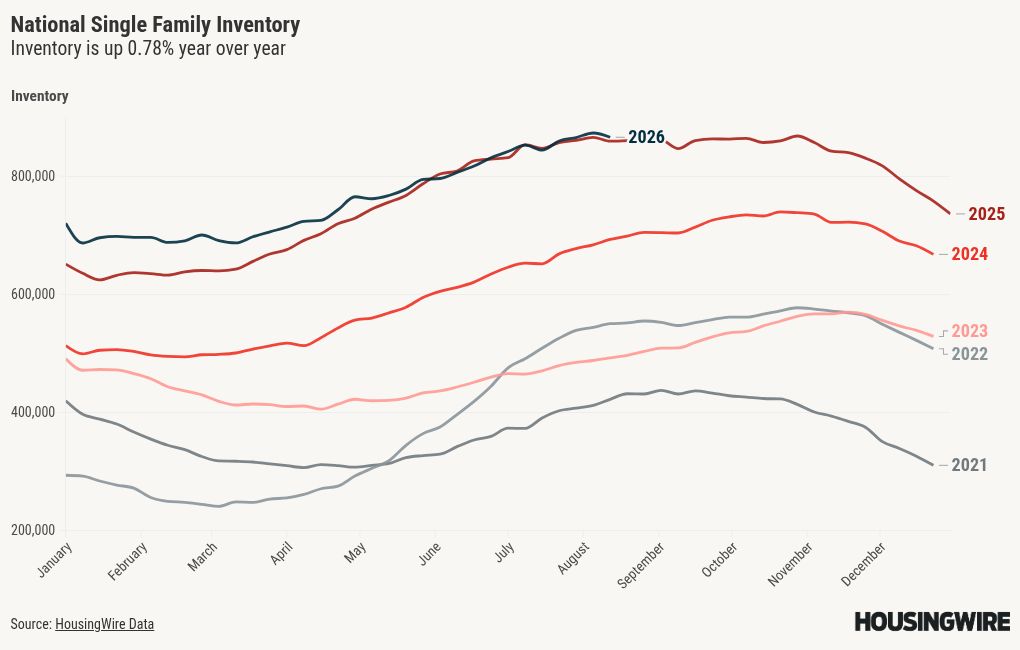
The housing story most people are telling right now is a rate story. Rates went up, affordability compressed, volume fell, and everyone is waiting on the Fed to loosen the knot. That story is true for most of the country. It is not the whole map.

I sell real estate in Summit County, Colorado, in Breckenridge and the resort towns around it, and from where I sit there are two housing markets in this state moving in opposite directions. Why they diverge says something useful about where housing demand actually comes from, and it is not only rates.

The rate-sensitive market is the one everyone models. On the Front Range, in Denver and Colorado Springs, a large share of buyers need a mortgage, and their purchasing power moves inversely with the 10-year yield. When money gets expensive, demand cools, price growth flattens and inventory sits. Standard stuff.

The resort market runs on different fuel

Up here, a meaningful share of luxury purchases close in cash and the buyers are disproportionately out-of-state second-home owners, not primary-residence buyers stretching to qualify. When the buyer is wiring the purchase price, the mortgage rate is a footnote.

What moves that buyer is different: liquidity, the equity markets, the after-tax cost of holding a second home, and whether the specific property is worth owning. As a result, the mountain-luxury market has kept setting records through the same rate environment that stalled the mortgage-driven one.

One sale illustrates the point

A trophy home in Breckenridge’s Weisshorn neighborhood sat on the market for roughly five years at a $15 million ask. The conventional read is overpriced, stale, a problem property. My buyer closed it at $9,481,500, a neighborhood record. The house had not gotten worse over five years, and rates had not gotten better. What changed was that the price finally met the market, and the right cash buyer was standing in front of it. For anyone reading demand off a rate chart, the lesson is that in this segment the constraint was never financing.

Why does this matter beyond a handful of resort zip codes? Because it is a reminder that housing demand is not one variable. National affordability models are built for the mortgage-financed majority, and they are right about that majority. But a growing slice of transaction dollars, in luxury, second homes and resort and coastal markets, is only loosely coupled to rates and tightly coupled to wealth. Aggregate the two into a single number and you get a demand signal that is directionally useful and locally wrong. The Front Range and Summit County can be described by the same statewide statistic and be having completely different years.

A second, more practical takeaway for the industry

In the mortgage-driven market, the agent’s leverage is timing the rate cycle and the buyer’s qualification. In the cash-luxury market, the leverage is pricing and positioning a specific, often incomparable asset, because these homes frequently have no true comparables and the number is a matter of judgment rather than a data sheet. The Weisshorn sale was not a rate call. It was a pricing call.

None of this argues that rates do not matter. They set the weather for most of housing. But if you are trying to separate where demand is genuinely strong from where it is merely waiting on the Fed, the resort-luxury segment is a useful control group. It shows you what housing demand looks like when you strip the mortgage out of it, and right now, in the mountains, it looks resilient.

Justin Black is a broker-associate with LIV Sotheby’s International Realty in Summit County, Colo.

This column does not necessarily reflect the opinion of HousingWire’s editorial department and its owners.

To contact the editor responsible for this piece: tracey@hwmedia.com

This post was originally published on here. 

Social media giant Meta is heading to court in a case brought by a group of state attorneys general who claim the company designed its social media platforms to be addictive and misled the public about potential risks.

The trial is expected to begin with opening statements on Tuesday in the U.S. District Court for the Northern District of California in Oakland after the two sides went through the jury selection process last week and Judge Yvonne Gonzalez Rogers turned down Meta’s request for the case to be dismissed. The trial is expected to last four to six weeks, with Meta CEO Mark Zuckerberg expected to testify.

Attorneys general from California, Colorado, Kentucky and New Jersey first filed the lawsuit in 2023 after a multistate investigation into the impact of Facebook and Instagram on young users. They argue that the platforms were designed to be addictive and that the company downplayed the potential impact on young people, while also alleging Meta violated federal law when it collected personal information from children.

Meta, which is the parent company of Facebook and Instagram, has denied wrongdoing and disputes claims that its social media platforms caused the harm alleged by states. It also argues that “social media addiction” isn’t an officially recognized psychiatric diagnosis, which will be a significant point of contention at trial.

FOUR STATES SEEKING $1.4 TRILLION IN PENALTIES IN CHILD SOCIAL MEDIA ADDICTION TRIAL, META SAYS

California Attorney General Rob Bonta issued a statement last week after the court allowed the case to proceed saying that “Meta designed a dangerous product for young users, knew it to be dangerous, and then lied to children, families, and the community about how dangerous it was.”

A Meta spokesperson pushed back on the states’ case against the company and said in a statement to FOX Business that the “limited claims are unsubstantiated and their financial demands are vastly disproportionate.”

“The AGs offer no proof anyone in their states was misled, claim benign features like having an additional Instagram account somehow harmed their residents, and attempt to penalize Meta for industry-wide challenges like age verification. Rather than sticking to the facts or the law, the states have instead decided to chase an outlandish payout,” the company spokesperson said, adding that the company stands by its “record of creating strong protections for teens, and look forward to making our case in court.”

Meta has argued that the damages sought by the state attorneys general could reach as high as $1.4 trillion, which is nearly the size of the company’s market capitalization – though the AGs haven’t disclosed the amount they plan to seek at trial and will likely do so once the trial begins.

NEW MEXICO COURT ORDERS META TO PAY $567M, OVERHAUL TEEN PROTECTIONS

Monte Mann, a partner at Armstrong Teasdale, told FOX Business in an interview that this will be a “bellwether case” for the theory that social media platforms were designed to be addictive and have harmful effects on young users.

Mann said that as someone who has tried cases like this one, he will be paying close attention to what internal Meta documents indicate about the company’s knowledge of the allegedly compulsive nature of its products and their mental health impact, saying those documents “may be the star witness in the case.”

“I will be very interested to see what the internal Meta, Facebook, Instagram documents say about what they knew of the compulsive nature of these products and services; when they knew it; whether they tried to enhance their design elements to take advantage of those things, what they disclosed to the public,” he said.

Mann also noted that Judge Gonzalez Rogers appointed an advisory jury in the case, which can provide feedback and recommendations on community standards for children’s use of social media that she may consider.

META, OTHER COMPANIES MUST FACE THOUSANDS OF LAWSUITS OVER CHILD SOCIAL MEDIA ADDICTION, APPEALS COURT RULES

The Oakland trial is the latest high-profile case involving social media companies like Meta, which have faced numerous lawsuits brought by individuals, school districts and state governments over the alleged impacts of social media use on children.

A ruling in another prominent case was delivered earlier this month when a state court in New Mexico ordered Meta to pay $567 million and to overhaul its protections for teen users on Facebook and Instagram.

That followed a prior ruling from March which ordered Meta to pay $375 million for violating state law, with the company’s total liability in the case at nearly $942 million.

Meta told FOX Business after the most recent ruling that it disagreed with the decision and vowed to appeal, explaining that the company is “confident in our record of protecting teens online and will continue to defend ourselves against claims that misrepresent the facts.”

GET FOX BUSINESS ON THE GO BY CLICKING HERE

FOX Business’ Michael Sinkewicz, Sumner Park and Reuters contributed to this report.

This post was originally published here. 


America is in the middle of a tech-fueled wealth boom: companies have shattered market-cap records, while soaring stock briefly minted the world’s first trillionaire. Now, some CEOs leading the world’s biggest companies are making money so fast that they can earn their workers’ annual pay in a matter of seconds. Elon Musk earned the typical Tesla worker’s annual pay every 4.23 seconds.

The richest person in the world and CEO of tech and EV giant Tesla received $158.3 billion in compensation last year. His pay was 2,522,203 times higher than the median Tesla’s employee pay of $57,243 annually, according to an executive paywatch analysis from America’s largest federation of labor unions, AFL-CIO. 

During a typical 30-minute commute, he’s already banked $24.36 million in compensation. 

Brandon Rees, lead researcher for executive paywatch at AFL-CIO, tells Fortune the organization has been tracking CEO pay levels since 1997, and “Elon Musk’s gargantuan 2025 pay package at Tesla is unlike anything we have seen before.”

“Our economy is increasingly out of balance because billionaires like Elon Musk are taking a greater share of the economic pie while working people are struggling to make ends meet,” he added.

To put the inequality into context, while Musk is earning 2.5 million times more than his workforce, the average S&P CEO earns 312 times their workers.

Fortune reached out to Tesla for comment. 

Musk’s 2025 pay was 14 times higher than all other S&P 500 company CEOs combined

Musk’s pay represents the largest disparity among all company CEOs analyzed. 

His 2025 total compensation was calculated from the grant-date fair value of restricted Tesla stock awarded to him that same year, which could ultimately be worth up to $1 trillion if the company hits performance requirements that Musk needs to earn them. 

It’s an eye-watering compensation package that “broke the CEO pay curve,” the AFL-CIO researcher says.

Most CEOs of S&P 500 companies earned more in one day than the average U.S. worker takes home in one year—but Musk dwarfs the entire collective. 

His 2025 Tesla pay package was 14 times higher than the total compensation of all other S&P 500 company CEOs combined, the report found. 

Including Musk, S&P 500 leaders made around $340 million last year, a roughly 1,700% increase from 2024; but take him out of the equation, and the average CEO pay at S&P 500 companies increased 21% to $22.8 million last year.

CEOs are outearning workers in less than one day while Americans are falling behind

While Americans are monitoring their grocery budgets and delaying major life purchases, their employers are being awarded record-breaking salaries. It’s fueling a growing wealth divide that is not lost on workers living paycheck-to-paycheck.

Now, calculations are putting the growing disparity between soaring CEO wealth and the modest paychecks of full-time workers into stark perspective.

Former Walmart CEO Doug McMillon enjoyed around $27.5 million in total compensation his final fiscal year before departing the retail giant at the end of January. 

That means it took him less than 20 hours to outearn the average U.S. worker, who earned about $62,088 yearly, according to 2025 first quarter wage data from the BLS. It could take decades for Americans to pool up savings for a house, but at that rate, McMillon could snatch one up in just one workweek; after 5.85 days, the ex-chief executive reeled in enough to buy a median U.S. home of in $439,000, according to a CEO salary tool from Resume.ai. And over the span of U.S. workers’ dreaded 30-minute commute to the office, McMillon was already $1,563 richer.

Tim Cook, the CEO of $4.5 trillion tech giant Apple, also takes home a compensation package that can eclipse what the average worker earns in an entire year in just hours. He reaped $74.6 million in 2024, up 18% from $63.2 million the year before. 

In only about seven hours, Cook had already out-earned the typical American worker, also according to Resume.ai’s CEO salary tool. In 2.15 days, he could afford to buy a typical U.S. home.

And America’s poorest aren’t enjoying the spoils of their employers’ success. 

The after-tax wages of U.S. workers in the lowest-income group grew just 1.3% year-over-year last July, down from 1.6% in the month before, according to the Bank of America Institute. In that same period, higher-income wages swelled to 3.2%—the third consecutive monthly increase. It marked the widest wealth divide between lower and upper-income households in four years.

This story was originally featured on Fortune.com

This post was originally published here. 

If you want to know how to judge the character of a nation, do it by the nature of their taxi drivers.

They should be talkative, funny, and controversial – and invariably are. In the UK it is the quality of the jokes they tell, the football teams they support, and – just as importantly – the ones that they hate.

In Liverpool they hate Everton or Liverpool, and in London they hate either Tottenham or Arsenal. Depends on their taste.

In Ireland, in our last week of “pilgrimage” before returning home to Zichron, the taxi driver to and from Dublin airport spoke volumes. Literally. 

In fact, neither of them stopped talking and had faces best described as lived-in, the accommodation having been shared with countless pints of Guinness.

A man holds Irish and Palestinian flags as people protest calling for governments around the world to stop arming Israel during a demonstration in solidarity with Palestinians in Gaza, amid the ongoing conflict between Israel and Hamas, in Dublin, Ireland, June 15, 2024 (credit: Clodagh Kilcoyn/Reuters)

My view of the Irish was that I always adored them, and so it was hardly a surprise that I married one. What were the roots of this affection?

It is the heroes from every walk of Irish life that besieged me from all directions.

They are highlighted by Oscar Wilde, who was to be found in The Café Royal, a fashionable restaurant, with his green carnation, drinking champagne and leaning over his young partner Bosie, with whom he conducted an affair.

It was, in his time, wholly unlawful and disgusted Bosie’s father, the Marquess of Queensberry. The affair led to Wilde’s undoing. He died in poverty, but his plays and novels live on.

Then there were the brothers Yeats, Jack and WB, who towered over the art and literary worlds respectively. Jack’s thickly painted scenes at the races or the circus and WB’s poem “The Lake Isle of Innisfree” excite the deepest emotions within the onlooker.

Perhaps the last category to mention is the military heroes of the Revolution in the early 20th century. 

Foremost among them was Michael Collins, the “big fella,” chairman of the Provisional Government of the Irish Free State and of the same stature as Lawrence of Arabia, Orde Wingate, and probably closest akin to Menachem Begin. 

And during this period, the British Government and British Army were Ireland’s natural enemy.

The Black and Tans, a force recruited by the British-run Royal Irish Constabulary, was recruited to suppress the IRA during the 1920s, which they did with real brutality. And therein lies the deep-rooted hatred of the English by the Irish.

We had an Irish housekeeper from Cork who hated the British, but only agreed to work for us in London as she thought of us as Jewish, not English.

Envy and stupidity

So let me understand this: Britain was the enemy from whom the Irish were seeking liberation. The Irish struggled to found a republic – which they did. There were founding heroes of the state. Is this starting to ring a bell?

The British Army was the enemy of Israel during the mandate. Surely Ireland could not fail to become the natural ally of Israel?

Wasn’t Chaim Herzog raised in Dublin, serving in the Hagana and the British Army during World War II, making a close link when he became president of Israel? Has not the new president been able to forge the connection?

The answer is no.

Their relations have gone from bad to worse, and in the years since October 7, the Irish have launched a tirade of invective against the State of Israel and its leaders.

Examples: the previous president of Ireland, Michael Higgins, has slandered Israel’s actions in Gaza on every occasion. He had, of course, sprinkled terms like “genocide” and “ethnic cleansing” around like confetti. 

Higgins is not a very tall man – he’s only 160 centimeters tall – but each and every centimeter is carefully honed with spite and hate for the only Jewish state.

The new taoiseach (Irish prime minister), Micheal Martin, has changed the views he had when foreign minister to the usual – “genocide” and “collective punishment” – urging the European Union to take ever stronger steps against Israel.

But whilst taoiseachs, presidents, press, and TV all seem united in their prejudice, they are followed sheep-like by the public, a majority of whom support trade restrictions and full BDS.

On The Late Late Show, discussing Iran, Alan Shatter, a former justice minister, mentioned tunnels and rapes to an audience of 500. He was met with laughter and derision.

Why? In Ireland’s case, pure envy is a likely candidate. Ever since it became a member of the EU in 1973, it has had a reputation of “take, take.” 

By 2010, Ireland faced financial collapse due to housing and banking bubbles. In total, they received a €67.5 billion external bailout package from the EU, including loans from other nations, like Sweden – coincidentally, another Israel-hating friend.

By contrast, it sees Israel as strong and standing on its own two feet. Ireland has seen incoming hi-tech giants from America, from whom it takes taxes. Israel leads on its own.

My in-laws are part of the dwindling Jewish community who do not know from which direction the next abuse will come, as Ireland has succeeded France as the most antisemitic country in the world. A shame, as Ireland richly deserves its romantic label.

The expression “green with envy” happens to coincide with Ireland’s national color. It is also the butt of jokes, which claim the folk from the countryside are stupid.

Both envy and stupidity recently combined when the government purchased a jet for its “high-flying” greedy representatives. So driven by envy and hatred, they removed the plane’s landing assistance for the fog because it was manufactured in Israel. 

A combination of envy and stupidity motivated their actions. Mind you, even without fog, Ireland clearly has lost its way.

Nigel Lithman is a retired criminal judge and author. Having made aliyah from London, he lives in Zichron Ya’acov.

This post was originally published on here. 

A seven-year-old Israeli child was killed, and his four-year-old cousin was moderately injured in a suspected stabbing at a home in Beit Shemesh on Monday.

The seven-year-old was later named as Hillel Mordechai Dadon.

Paramedics found the children suffering from stab wounds in the family’s pool after emergency services received a report of the incident.

Israeli media reports indicated the children were allegedly attacked by a mentally unstable individual who reportedly entered the home and assaulted them after the mother of one of the children left the home.

According to Magen David Adom (MDA), two children were rushed to Hadassah-University Medical Center in Jerusalem’s Ein Kerem for further treatment. 

The four-year-old reportedly arrived at the hospital in moderate condition, fully conscious, and is currently undergoing surgery. The seven-year-old, however, was pronounced dead upon arrival at Hadassah’s trauma center.

Police and security forces at the scene where two children were stabbed by a man in Beit Shemesh, August 17, 2026 (credit: OREN BEN HAKOON/FLASH90)

Israeli Police later released a statement that they had opened an official investigation into the attack, and added that a suspect had been arrested following the assault.

Paramedics describe horrifying scene

MDA paramedic, Yosef Haim Bernfeld, described the scene as horrifying, saying, “We were led to two children who had suffered serious injuries to their bodies, including seven-year-old boy who was unconscious, with no pulse and not breathing, and a four-year-old boy who was conscious.”

At the time of the incident, a 15-year-old relative was reportedly responsible for supervising the children.

The 15-year-old is now receiving assistance at the scene from a social worker.

Child killed in Beit Shemesh traffic accident

In a separate incident in Beit Shemesh on Monday, a 4-year-old boy was pronounced dead after being struck by a vehicle. 

MDA paramedics who arrived at the scene stated they found the boy unconscious and suffering from multiple serious injuries. They immediately initiated resuscitation efforts, but were ultimately unable to revive him and pronounced him dead at the scene.

This post was originally published on here. 

The Police Service of Northern Ireland (PSNI) arrested and charged a 30-year-old man for attacking an Israeli journalism crew with a glass, the police spokesperson told The Jerusalem Post on Monday.

As previously reported by the Post, a crew from i24NEWS’ Hebrew channel was attacked earlier in the month in the Northern Irish capital while filming for a documentary series on Europe’s rising antisemitism.

The incident happened while i24NEWS reporter Yonatan Raveh and cameraman Nadav Abbas were conducting street interviews near a well-known bar complex.

Journalists say attacker targeted them after hearing they were Israeli

Raveh told the Post on Sunday that he believed the attacker, a man, had overheard them telling two Irish interviewees that they were from Israel.

“He came over to us and started asking questions. We put the camera on him, and then he gave us the middle finger and shouted: “f*** Israel.”

DUP leader Gavin Robinson is pictured as he delivers his leader's speech to conference during the annual Democratic Unionist party conference at the La Mon hotel on September 20, 2025 in Comber, Northern Ireland; illustrative (credit: CHARLES MCQUILLAN/GETTY IMAGES)

The man attempted to grab Raveh and Abbas’ camera equipment, and made inappropriate gestures toward the camera. Raveh and Abbas called for police or security from any of the nearby establishments to intervene while the man followed them threateningly.

Raveh told the Post that bar security came over, saw what was happening, but “didn’t do anything.”

The man then threw a large glass beer mug at Abbas, hitting him in the head and cutting him. Security then intervened and put the journalists in the bar.

Police file multiple charges after Belfast incident

Local police told the Post that a 30-year-old man has been charged with a number of offenses including assault occasioning actual bodily harm, common assault, assault on police and two counts of possession of an offensive weapon in a public place.

He appeared before Belfast Magistrates Court on Thursday 13th August. As is normal procedure, all charges will be reviewed by the Public Prosecution Service.

Political leaders condemn attack

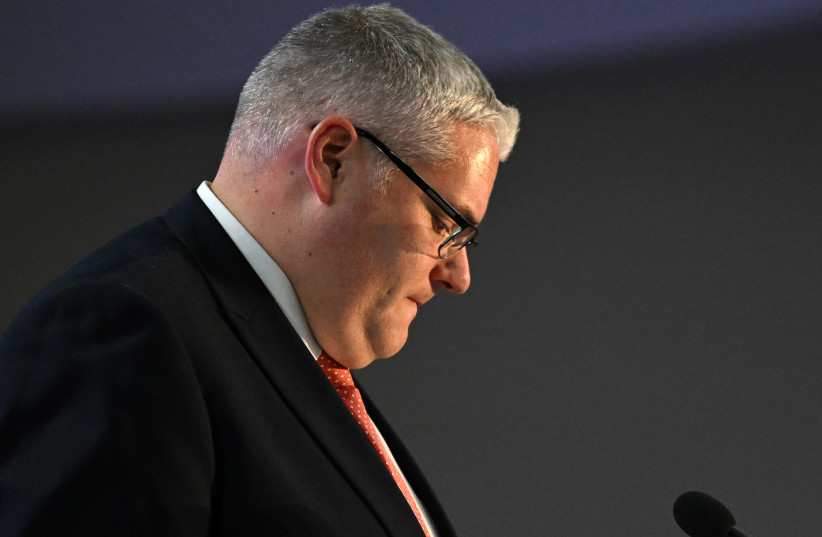
Democratic Unionist Party leader Gavin Robinson said the assault is “deeply concerning.”

“There can be absolutely no justification for violence or intimidation directed towards journalists because they are Israeli or Jewish.”

He said the PSNI must fully investigate the circumstances of the incident, including its motivation.

“People are entitled to hold strong views about the Middle East, but that can never become a license for hatred or violence against Israeli or Jewish people,” Robinson added.

He also said that Northern Ireland “knows only too well” where hatred based on identity can lead.

“If this attack was motivated by antisemitism, it must be recognized and condemned unequivocally. There must be no place for antisemitism or any form of intimidation on our streets,” he concluded.

This post was originally published on here. 

Israeli flags planted on a main coastal highway in southern Lebanon are a violation of a UN Security Council resolution, the UN peacekeeping force in Lebanon said on Monday, urging all sides to avoid “provocative actions.”

Israel’s military invaded a swathe of southern Lebanon during a war with Hezbollah earlier this year, establishing a self-declared security zone it says aims to shield northern Israel from attacks by the Iran-backed group.

A video posted on Sunday by Israel’s Channel 12 news journalist Amit Segal showed Israeli flags flying along the Naqoura-Tyre coastal road, a primary artery for southern Lebanon and a route used by the UN Interim Force in Lebanon (UNIFIL).

The footage appeared to have been taken from a military vehicle.

Reuters was able to confirm the location of the video, but could not verify when the footage was filmed. Segal told Reuters he was sent the video by Israeli soldiers.

Israeli vehicles drive on a road in southern Lebanon, as seen from the Israeli side of the Israel-Lebanon border, in northern Israel, August 6, 2026. Picture taken with a mobile phone. (credit: REUTERS/Avi Ohayon)

Israel is ‘not acting against the Lebanese state or its citizens,’ military says

Peacekeepers have observed several Israeli flags in Lebanese territory, including recently on the coastal road and in Naqoura village, UNIFIL spokesperson Kandice Ardiel said.

Ardiel said the Israeli flags were a violation of UN Security Council resolution 1701, which ended a 2006 war between Israel and Hezbollah.

“As always, we call on the IDF and all actors to cease violations of the resolution and avoid any provocative action that could increase tensions or trigger further violations,” Ardiel added.

Israel’s military, in response to a request for comment, said that its forces were “operating in southern Lebanon with the aim of removing threats posed by the Hezbollah terrorist organization to Israeli civilians and IDF troops, in accordance with international law.”

“Israel is not acting against the Lebanese state or its citizens,” the military said.

There was no immediate comment from the Lebanese army.

Defense Minister Israel Katz said last week that Israel won’t withdraw from southern Lebanon until Hezbollah is disarmed.

A US-brokered deal between the governments of Lebanon and Israel foresees a progressive Israeli withdrawal linked to Hezbollah’s verified disarmament.

Hezbollah, founded by Iran’s Revolutionary Guards in 1982, strongly opposes Beirut’s talks with Israel and has ruled out any discussion of its weapons before an Israeli withdrawal.

Netanyahu cites Lebanon buffer zone as major achievement

Prime Minister Benjamin Netanyahu, who faces an October election, listed the buffer zone as a major achievement during a visit with troops on June 30.

The zone is mostly empty of Lebanese civilians who fled villages that are now all but destroyed.

At least 11 people were killed in Israeli strikes in southern Lebanon on Saturday, the Lebanese health ministry said, some of the deadliest in weeks. The Israeli military said it struck Hezbollah infrastructure in response to actions against its soldiers there.

This post was originally published on here. 

About 15 years ago, I first heard an outspoken complaint about the “exaggerated” number of Arab doctors, nurses, medical technicians, and cleaners in Israel’s hospitals. 

The person who complained was a young religious woman, of American origin, who was doing her national service at the Shaare Zedek Medical Center in Jerusalem, and the presence of Arab staff members irritated her. 

“After all,” she said, “we are a Jewish state, and the Arabs are our enemies”.

Had I been able to reply, I would have pointed out to her that Israel is indeed a Jewish state, but it is also a democratic one.

I would have also pointed out that around 20% of its citizens and inhabitants are Muslim and Christian Arabs who have the right to vote in the Israeli Knesset elections – and expect to be treated as equals. 

View of the Rambam Health Care Campus in Haifa, August 9, 2026 (credit: CHAIM GOLDBERG/FLASH90)

The situation isn’t straightforward, since unfortunately Israel is still in a state of war with most of the Arab states, which creates a rather unique security reality. 

However, that does not change the fact that the Israeli Arabs are not guilty of constituting a danger to the state, unless proven otherwise.

Thus, what the young woman had said was categorized in my mind as pure, anti-Arab racism. As I remember from my childhood in Haifa, such racism has always been prevalent in Israel to a certain extent, especially in certain right-wing circles.

Not surprisingly, since October 7, 2023, such sentiments have spread and become much stronger due to the horrors committed by Hamas on that day, and because of the hesitation in certain Palestinian circles to condemn them. 

The fact that on Oct. 7 quite a few Israeli Arabs were murdered by Hamas in the Gaza environs, while others were taken hostage, did not leave much of an impression on most Israeli Jews.

Following the events in Lebanon a week and a half ago, four badly wounded Israeli soldiers were brought to the intensive care ward at Rambam Medical Center in Haifa. 

According to the brother of one of the wounded soldiers, on the night between Friday (August 8) and Saturday (August 9), when his brother woke up from being sedated and ventilated, he was maltreated by an “Arabic-speaking medical team” who didn’t even let his relatives enter the ward.

The story was brought to light in a post by the uncle of the two brothers, Yehoshua Shani, who serves as the chairperson of the Forum of Heroism, a right-wing forum of the families of soldiers killed in the war in Gaza. 

The forum favors the continued fighting in the Gaza Strip until a total victory.

It also objected to the deals that were negotiated for the release of the hostages because it felt that the prolonged ceasefire included in them would undermine Israel’s security, impart achievements to Hamas, which it does not deserve, and endanger the lives of the rest of Israel’s citizens and military forces in the long run.

Shani complained that hospitalized Arab terrorists in Israeli hospitals are taken better care of than wounded Israeli soldiers.

“Who watches over our fighters?” he asked.

Rambam examined the allegations and found them to be baseless. The conclusion was supported by the director-general of the Health Ministry, Moshe Bar Siman Tov, as well as various Israeli medical organizations.

However, Shani’s and his nephew’s accusations were rapidly echoed by various right-wing politicians and reporters, who inter alia called for reducing the percentage of Arab professional staff in the Israeli medical system in general and its hospitals in particular.

Arab MKs and left-wing spokespersons referred to the event as another manifestation of poisonous anti-Arab racism.

Prime Minister Benjamin Netanyahu remained silent on the issue. 

Defense Minister Israel Katz took the side of those who believed that the Arab medical staff at Rambam had behaved atrociously, but then went silent when the accusations against them were rejected out of hand.

And what about Health Minister Haim Katz? Well, he’s currently a temporary replacement, after the haredi (ultra-Orthodox) parties resigned from the government in July 2025. 

He serves not only as health minister, but also as construction and housing minister, welfare and social security minister, and his original ministerial post: tourism minister. No one really expected him to say anything on health issues.

Looking at the numbers

According to a study by Bruce Rosen and Sami Miaari, published in 2025 in the Israel Journal of Health Policy Research, in 2010, 8% of the doctors in Israel were Arabs. Thirteen years later, the percentage was up to 25%. 

In 2023, Arab dentists comprised 27%, Arab male and female nurses comprised 27%, and Arab pharmacists were 49%. The percentage of Arabs in the Israeli population is 21%.

MK Moshe Saada (Likud) has explained the percentage increase of Arab doctors in the Israeli health system by claiming that there is a system of affirmative action in Israel that works to the advantage of the Arab doctors.

He has also suggested changing affirmative action in the field to benefit those who have done military or national service.

Diaspora Affairs and Combating Antisemitism Minister Amichai Chikli (Likud) has blamed it on the fact that Arab doctors trained in Palestinian universities, such as Nablus and Jenin, are accepted as interns in Israeli hospitals.

The sad fact is that even with all the Arab doctors, the major problem in Israel’s health system today is the serious shortage of doctors in the country.

This is because Israeli universities are not training a sufficient number of doctors; many of the Israelis who study medicine abroad do not return after completing their studies; and among the large number of highly trained Israelis who have left Israel in recent years due to the political and military situation in the country (around 90,000 in 2025), many are doctors. 

Thus, one might say that the large numbers of Arab doctors in the Israeli health system are a blessing. Paradoxically, it is said in Arab circles that there are at least 4,000 trained Arab doctors in Israel today who have not managed to find suitable positions.

In conclusion, I would say that one of the problems we must confront is not that there are too many Arabs in our medical system, but that there are not enough Jews in it.

Furthermore, while there are always security issues that must be dealt with, both amongst Israel’s Jewish population and its Arab population, sheer anti-Arab racism in the Jewish population, just like anti-Jewish racism amongst the Arab population, must be dealt with – first and foremost in the education system.

The writer has written journalistic and academic articles, as well as several books, on international relations, Zionism, Israeli politics, and parliamentarism. From 1994 to 2010, she worked at the Knesset Library and the Knesset Research and Information Center.

This post was originally published on here. 

For years, the world has been told a very simple story about Arabs and Israel. Arabs on one side. Israelis on the other. It is always pinned as conflict, division, or suspicion. But recently, I stood in a space that told a very different story.

I was attending the anniversary of IDF Unit 585, the Desert Reconnaissance Battalion, a unit made up predominantly of Bedouin soldiers, alongside other Arab and minority service members. The battalion was established in the late 1980s and has long operated in Israel’s south, particularly around the Gaza border. For many of its Arab soldiers, service is voluntary rather than mandatory. 

This unit is made up largely of Arab soldiers, including but not limited to members of Israel’s Bedouin and Druze communities. And as I looked around the event, I realized how few people outside of Israel even know this unit exists, because I myself didn’t know it existed. 

That matters. Because when the world talks about Israel, it often speaks in absolutes. Israelis and Arabs are presented as two groups who could never share a uniform, a mission, or a sense of responsibility for the same country. Then you meet the soldiers of Unit 585.

At the anniversary, I spoke with veterans who had served in the unit decades ago. Their names cannot be published, but their pride was impossible to miss.

“We are soldiers from Unit 585,” one group of veterans told me. “We enlisted in 1979, and today we came to honor and celebrate 40 years.”

There was something striking about hearing that sentence while standing beside Arab soldiers serving in the battalion today. Different generations. The same unit. Men who had enlisted decades earlier had returned to stand alongside young Arab soldiers currently serving in Israel’s military, including soldiers who have operated in the Gaza border region and across southern Israel.

One current soldier described the moment simply: “Today we are marking 40 years since the battalion was established. Some of our veterans, together with the soldiers serving today, are here with us.” It was a place full of people whose lives complicate the version of Israel most of the world has been taught.

Why the story of Unit 585 matters

And that is exactly why I believe their story matters. Most people outside of Israel will never meet an Arab Israeli soldier. Many do not even realize that Arab citizens serve in the Israeli military at all. The idea does not fit neatly into the categories they have been given. But reality rarely fits neatly into categories.

Israel is home to Jews, Muslims, Christians, Druze, Bedouins, and people from countless backgrounds. Their experiences are not identical. Their politics are not identical. Their relationship with the country is not identical. That complexity is not a weakness. It is the story.

Unit 585 represents one part of that story that deserves far more attention. Service in this unit is a choice. These soldiers made the decision to put on an Israeli uniform, train as combat soldiers, and serve alongside people from communities different from their own.

For some, military service can also mean learning Hebrew fluently, gaining skills, building relationships, and creating opportunities for the future. But beyond any individual benefit, something bigger is happening.

People whom the outside world is constantly told should see one another only as enemies are serving beside one another. They train together. They depend on one another. They protect the same communities. They become friends.

A soldier in the IDF's Unit 585 is seen holding a gun facing the desert. (credit: IDF SPOKESPERSON'S UNIT)

That does not erase every disagreement in Israeli society. It does not mean discrimination does not exist, or that every Arab citizen feels the same way about the state. It should not. Real societies are complicated. But acknowledging complexity is very different from pretending these stories do not exist. 

I have spent years speaking about Israel, and one of the hardest things about advocacy is watching an entire country reduced to a headline. Israel is discussed constantly, but Israelis themselves are often absent from the conversation.

Arab Israelis are discussed constantly, too. Yet how often are Arab Israelis actually allowed to speak for themselves? How often does the world meet the Bedouin soldier who volunteered to serve? How often does it hear from the veteran who enlisted decades ago and still returns to celebrate the unit he helped build? How often do people encounter a story that does not fit the narrative they were expecting?

That is why being at the anniversary stayed with me. The most powerful part was not a speech or a ceremony. It was the people. 

Veterans greeting current soldiers. Young soldiers saluting the generation that came before them. Men from different parts of the country gathered around the same history. You could feel that this unit meant something to them. And I kept thinking about how invisible that reality is outside of Israel.

If your only understanding of this country comes from social media, you may never know that a place like Unit 585 exists. If your understanding of Israelis and Arabs comes exclusively through the language of conflict, you may never imagine them standing beside one another in uniform. 

That is the danger of telling simple stories about complicated places. Eventually, the story becomes more powerful than the people living inside it. I do not think Unit 585 proves that Israel is perfect. That is not the point.

I think it proves that reality is more interesting, more difficult, and more human than the version we are often offered. It is possible for tension to exist alongside partnership. It is possible for different identities to exist inside the same country. It is possible for people with different religions, languages, and family histories to choose to stand together. And it is possible for someone to be Arab and Israeli without those identities canceling each other out.

The world needs to know about Unit 585 because the world needs more stories that challenge certainty. Stories that force us to look at people before categories. Stories that remind us that a country cannot be understood through its worst headline. Stories that make us uncomfortable with easy answers. Standing at that anniversary, surrounded by soldiers who had served generations apart, I was reminded of something I have learned again and again through advocacy: 

You cannot understand a place if you refuse to meet the people who complicate your assumptions about it.

Unit 585 complicates assumptions.

That is exactly why its story should be told.

The writer is the current Miss Israel.

This post was originally published on here. 

In the run-up to the September 2019 election – the second election that year – Israelis driving along the country’s roads were greeted by massive billboards showing a smiling Prime Minister Benjamin Netanyahu shaking hands with a beaming US President Donald Trump. The caption read: “Netanyahu. Another league.”

Similar posters from that campaign showed Netanyahu alongside Russian President Vladimir Putin and Indian Prime Minister Narendra Modi.

On Tuesday, in the run-up to October’s election, Israelis driving through Tel Aviv encountered a very different billboard. This one featured a stern Mojtaba Khamenei, Iran’s supreme leader, alongside New York Mayor Zohran Mamdani, Turkish President Recep Tayyip Erdogan and Hezbollah leader Naim Qassem. The caption read: “They want Netanyahu to lose. Don’t let them win.”

In 2019, Netanyahu ran on the prestige of those standing with him – chiefly Trump. In 2026, with Trump so far staying out of the election, Netanyahu is running on the fear inspired by those standing against him: Khamenei, Mamdani, Erdogan and Qassem.

What a difference seven years makes.

A Likud billboard with Ayatollah Mojtaba Khamenei, New York City Mayor Zohran Mamdani, Turkish President Recep Tayyip Erdogan, and Hezbollah Secretary General Naim Qassem on August 16, 2026.  (credit: SCREENSHOT/X, SECTION 27A COPYRIGHT ACT)

The contrast between the two billboards reflects more than a change in campaign tactics. It captures a fundamental change in Netanyahu’s appeal.

In 2019, the message was that Netanyahu’s relationships with powerful world leaders enhanced Israel’s standing. He was the man who could pick up the phone and reach Trump, Putin, and Modi. Their willingness to stand beside him showed that Israel – under his leadership – was diplomatically in another league.

In 2026, the message is different: Israel is surrounded by enemies and needs the man those enemies most want defeated. The equation is simple: If Israel’s enemies want Netanyahu out, Israelis should want him in.

Then, Netanyahu was running on the strength of the relationships he had built. Now he is running on the hostility of his enemies.

Trump says he should stay out of Israeli elections

Asked Monday about the upcoming Israeli election in a FOX News interview, Trump said: “I think it’s most appropriate for me to stay out of Israeli elections, but I may endorse somebody.”

Trump’s failure so far to endorse Netanyahu – as he has done in the past – may help explain the Likud’s pivot. Instead of putting the US president on its billboards as someone who wants Netanyahu to win, it is putting Israel’s enemies on them as people who want him to lose.

And Mamdani’s inclusion in this lineup is particularly telling.

Mamdani is obviously different from the other three. He does not command an army or battalions of terrorists and is not waging war against Israel. His importance to the Likud is symbolic. He represents the spread of hard-line anti-Israel politics infecting the Western mainstream.

The billboard does not necessarily suggest that Mamdani poses the same kind of threat as Khamenei, Erdogan, or Qassem. It does suggest that the Likud considers the political current he represents dangerous enough to place alongside the threats posed by Iran, Hezbollah, and Turkey.

And his inclusion is as ironic as it is telling.

Just as Mamdani used his bogus promise to arrest Netanyahu if he came to New York to rally his far Left base, Netanyahu is using Mamdani’s hostility toward Israel to fire up his hard-right base.

Each man benefits politically from the other. Mamdani uses Netanyahu as a symbol of everything his progressive supporters oppose; Netanyahu uses Mamdani as the face of a progressive movement implacably hostile to Israel.

And then there is the Trump factor.

Judging by his comment to FOX – that he may still endorse somebody – Trump apparently believes his endorsement could make a difference.

History does not bear out Trump’s endorsements making a difference

But history does not necessarily bear that out.

Trump repeatedly took highly visible steps in the past that benefited Netanyahu shortly before Israeli elections.

Nineteen days before the April 2019 election, he recognized Israeli sovereignty over the Golan Heights. Three days before the September 2019 election, he tweeted that he had spoken with Netanyahu about advancing a US-Israel mutual defense treaty and looked forward to continuing those discussions after the vote. And a month and four days before the March 2020 election, he rolled out the Deal of the Century.

The Abraham Accords, unveiled in September 2020, came six months before the March 2021 Israeli election. But their timing had more to do with giving Trump a boost before his own election than with helping Netanyahu six months later.

All these moves were significant diplomatic achievements for Netanyahu. None, however, gave him a clear and decisive electoral victory. Even after the March 2020 election, when he managed to form a government, it was an unstable unity coalition that lasted less than a year.

Paradoxically, the election in that cycle of five elections over three and a half years that enabled Netanyahu to form a durable right-wing coalition came in November 2022, when Trump was no longer president, and the administration of then-president Joe Biden made no secret of its preference for a more centrist Israeli government.

A Trump endorsement, therefore, may not be all it is cracked up to be – especially since his standing among the Israeli public is not what it once was. Much of the country is concerned about how he is handling Iran and how he is restricting Israel’s freedom of action in Lebanon and Gaza.

The Israel Democracy Institute, which has carefully tracked Israelis’ attitudes toward Trump, found in March that 60% of Israelis believed that the country’s security was a central consideration for Trump. By July, that number had fallen to 28%.

And the part of this poll most interesting to Likud strategists is that the decline among right-wing voters – those Netanyahu needs to keep in his camp – was comparatively steep, falling from 70% to 35%.

In other words, the reason the Likud has Mamdani on the poster rather than Trump may not simply be that the US president has not yet endorsed Netanyahu. It may also be that, at this point, Mamdani’s opposition is more useful to Netanyahu’s campaign than Trump’s support.

Trump may yet endorse Netanyahu. And history shows that when he has acted to help him, he has often done so close to election day.

But the contrast between the billboards suggests that the Likud is no longer certain that Trump’s support carries the political weight it once did.

In 2019, Netanyahu asked Israelis to look at Trump standing beside him. In 2026, he is asking them to look at Mamdani, Khamenei, Erdogan, and Qassem standing against him.

Then, the message was: “See where I have taken Israel.” Now it is: “See who wants me gone.”

This post was originally published on here. 

A newly established Chabad House in the coastal resort town of Hiriketiya, Sri Lanka, faced a protest violent protests calling for its closure last Friday night. 

The facility, which opened two weeks ago to serve Israeli and Jewish travelers visiting the region with kosher food, Shabbat meals, and community services, has encountered opposition from some local residents and Buddhist monks.

According to Rabbi Yossi Gabai, the center has been targeted by individuals protesting its presence. 

‘They claim that Jews here are destroying tourism’

In a statement provided to The Jerusalem Post, Rabbi Gabai stated: “What actually happened, to return to the story from the beginning, is that there are a few antisemitic people, most of the local residents actually love us and welcome us. But there are a few local antisemites who are really bothered by the fact that there is a Chabad House here, with the presence of Jews and Israelis who are here. They claim that Jews here are ‘destroying the tourism,’ which is of course the opposite.”

David Sarosi, an Israeli traveler who was staying near the center at the time, recounted in a statement to the Post that he arrived at the Chabad House on Friday morning after hearing shouting.

A Chabad House gathering in the Sri Lanka town of Ella. (credit: CHABAD SRI LANKA)

He described seeing a demonstration of about one hundred people carrying signs, noting that “even a few Europeans” were present. Sarosi stated that a group of men approached him, warning him not to take pictures, and said they “came with the intention of starting to beat me.” He added that police intervened and pulled him inside the facility before the gate was closed. 

Gabai described the protests surrounding the center, noting that demonstrators gathered outside during Friday evening services: “They simply decided to go out in a protest that we need to leave from here. They are generating a lot of pressure, and… caused a lot of noise on Friday, during the Friday dinner. They blocked people from coming close to the Chabad House, blocked the workers, threatened people here, threw drones and firecrackers, and made a lot of noise to disturb the Friday dinner here at Chabad.”

Sarosi similarly detailed that the demonstration grew “more violent and aggressive” during the Friday night meal, describing how protesters set up sound boxes playing music and Arabic songs, launched fireworks that created “crazy booms,” and hurled a large rock that shattered a window. Sarosi noted that many of the attendees inside were military reservists who had recently served in the army and war, remarking that “all these booms really bothered us.” 

Footage circulating on social media from the demonstration captures groups gathered outside the facility amidst heightened tensions, showing protesters and monks demonstrating near the premises while police and local authorities monitor the disturbance. 

According to Sarosi, the unrest escalated further on Saturday night, with participants throwing stones and fireworks at the building. Sarosi recounted that as he and a friend attempted to head toward his hotel, someone from the demonstration came and started beating him and his wife immediately grabbed him. He managed to retreat back inside the Chabad House as the gate was locked. According to Sarosi, the crowd outside “started throwing stones and fireworks at us” and shooting fireworks toward the building. He noted that it took police approximately ten minutes to arrive and secure the area, allowing those inside to leave safely.

Sarosi also stated that the following morning, the Chabad rabbi shared a screenshot from local social media containing allegations against him, which Sarosi asserted were false, claiming he had threatened women with a stick. He added that a false police complaint was filed against him over the incident.

According to Rabbi Gabai, disturbances continued following Shabbat, prompting increased security measures. “We are in contact with the Foreign Ministry, and we had a meeting with the consul,” Gabai added, noting that additional coordination is ongoing with local authorities to ensure security at the facility. 

This post was originally published on here. 

US Justice Department filings show that a communications arrangement undertaken on behalf of the Israeli government included $1 million in disclosed work orders for digital content, research, production and communications aimed at audiences in the United States.

The filings concern New York-based media company Piro Inc., which is registered under the Foreign Agents Registration Act, FARA, to work for Havas Media Germany GmbH on behalf of the Israel Government Advertising Agency, LaPam.

This was first reported by Politico and then independently researched by The Jerusalem Post.

Piro’s registration on FARA identifies Israel as the country represented and LaPam as the government agency represented under the arrangement.

Specifically, it says “Piro, Inc. will provide strategic communications and media relations services in connection with LaPam’s engagement on behalf of the State of Israel.”

A sign is displayed at the Robert F. Kennedy Department of Justice Building, headquarters of the U.S. Department of Justice on August 8, 2026 in Washington, DC; illustrative (credit: Kevin Carter/Getty Images)

It also says “activities may include communications activities intended to influence the US public.” The filing names Eran Shayovitch and Guy Getz as the officials with whom Piro works.

FARA filings outline $1 million communications campaign

The original agreement, dated April 30, 2026, included a $900,000 project titled the “Digital Storytelling Pilot.” According to the Work Order, Piro was hired to provide digital content strategy, creative development, video production oversight, and campaign advisory services.

The project included audience research, content architecture, scriptwriting, asset production, distribution planning, and performance analysis.

The filing states that all content produced under the pilot was intended for distribution through digital and social media platforms in the United States.

The budget included $190,000 for strategy and content development, $80,000 for production oversight and creative direction, and $400,000 in video production costs.

The production budget covered expenses including directors and crews, on camera talent, locations, camera and lighting equipment, editing, sound design and music licensing.

A further $95,000 was allocated for distribution advice and program evaluation, $35,000 for strategy and media consultation, and $100,000 for measurement and analytics, bringing the total value of the pilot to $900,000.

Piro’s June registration also revealed how the material was expected to reach the public.

The company told the US Justice Department that its activities would include the preparation or dissemination of informational materials. The filing listed websites and short form video platforms among the planned means of distribution, although the specific websites and platforms were listed as still to be determined.

The intended audience was listed as the “General Public,” and the material was to be produced in English.

Piro also checked that its work would include “political activities” as that term is defined under FARA, describing the activity as potentially including communications intended to influence the US public.

This does not by itself indicate electoral activity.

According to the FARA documents, the arrangement was expanded in July.

A July 29 amendment filed by Piro informed the Justice Department of an “Additional work order” connected to its agreement with Havas Media Germany on behalf of LaPam.

That work order, dated July 20 and titled “Fact Based Content Initiative,” was worth an additional $100,000.

According to the document, Piro was engaged to provide strategy, research, editorial development, creative work, production, distribution planning, and related services for a public information initiative undertaken on behalf of the Israel Foreign Ministry.

The initiative was to develop and disseminate what the contract described as “accurate, substantiated, and accessible content” concerning Israel and other subjects identified by the client and the ministry. The $100,000 was divided into two monthly installments of $50,000.

Combined, the two disclosed work orders total $1 million. It is important to note that while the filings establish the value of the contracts, they do not by themselves establish that the full amount was ultimately paid or spent.

Hanover Institute discloses government-funded arrangement

One of the public facing projects associated with Piro’s FARA registration is the Hanover Institute for Public Policy, which publishes reports focused on antisemitism in the United States.

Hanover describes its work as content analysis, computational social science and other data driven research. It says its reports include the underlying data, methodology, and breakdowns behind their findings, and says it does not take policy positions.

Some titles of recent reports include “Is Anti-Zionism a Fig Leaf for Antisemitism? Reading the Coded Corpora, the Incident Records and the Survey Measurements” and “Who Is the Aggressor in the Israel-Palestine Conflict? Reading the Definition, the Deciding Forum and Each Party’s Own Count.”

It is also worth noting that Hanover publishes significant numbers of data reports on a daily basis. For example, it released over 30 data reports on August 13 and over 30 on August 12.

The institute also openly discloses its relationship with the Israeli government communications arrangement.

According to Hanover’s website, its materials are distributed by Piro on behalf of Havas Media Germany, acting for LaPam. It identifies Piro’s FARA registration number, 7732, and says every report published by the institute is filed with the Justice Department.

Hanover explicitly describes itself as government funded.

The institute says that because of the registration and funding arrangement, it does not describe itself as “independent, nonpartisan or neutral.”

Instead, it argues that its work should be assessed according to its sourcing and methodology, saying that figures are attributed to their original sources and that competing findings are presented where evidence is contested. All sources are provided at the end.

The institute publishes reports under the Hanover name rather than individual bylines. It says the researchers are not identified because the reports are produced according to a common institutional standard and because the subject matter attracts harassment.

Picture showing the ChatGPT application displayed on a smartphone screen, illustrative (credit:  Imen Ben Youssef / Hans Lucas / AFP via Getty Images)

Documents identify personnel and AI-related reach

Piro’s filings with the Justice Department also identify several people involved in the broader communications arrangement.

The company’s registration states that Piro is equally owned by co-founders Daniel Rosenberg and Timothy Piper, who each hold 50% of the company. Both were listed as providing strategic communications and media relations services related to the Havas and LaPam account. Carlos Cruz was also listed as providing such services.

Another individual, Hai Tran, registered under FARA on July 22, two days after the additional $100,000 work order was dated.

Tran identified himself as a Piro subcontractor and listed his role as “Digital Strategist.” He said he would provide services in support of Piro’s work for Havas Media Germany on behalf of LaPam.

Tran reported that his work would be performed on a special basis for a flat fee of $50,000. He also checked that his services would include political activity as defined by FARA, writing that his activities “may include communications activities intended to influence the US public.”

The available filings do not establish that Tran worked specifically on Hanover, nor do they establish that either the full $900,000 pilot or the separate $100,000 initiative was devoted exclusively to the institute.

The filings also do not identify Hanover’s researchers or its original founder, and they do not show which other websites, videos or digital properties may have resulted from the broader $900,000 storytelling pilot.

That being said, what the public records do establish is that Piro registered to conduct US-facing communications work under an arrangement involving Havas Media Germany and LaPam, initially disclosed a $900,000 digital communications pilot, later added a $100,000 public information initiative, and subsequently filed Hanover reports with the Justice Department as informational materials under the same FARA registration.

Hanover content appears in AI chatbot responses

Politico reported that Hanover’s data reports, each of which features questions like “Is the IDF the World’s Most Moral Army?” and “Is There a Policy of Starvation in Gaza?”, are a telltale sign that the articles are designed to feed data to LLMs.

It noted that ChatGPT cited the Hanover Institute’s material in response to neutral tests run, referring to the site’s content on Gaza, anti-Zionism and antisemitism.

The Post ran similar tests on Perplexity. The AI aggregator relied heavily on Hanover as a source when asked, “Is the IDF the most moral army?”

Claude did not independently cite Hanover, nor did Gemini. Grok did not use any sources for the response.

The Jerusalem Post reached out to LaPam, Piro, Havas, and Hanover for comment.

This post was originally published on here. 

Public filings show how the Ishbia family’s stake in United Wholesale Mortgage (UWM) and its sports assets underpin a network of loans, according to a Bloomberg report.

Bloomberg’s review of Uniform Commercial Code (UCC) filings shows that Justin Ishbia pledged his economic interests in his private equity funds to secure loan facilities with JPMorgan Chase & Co. Additionally, the analysis found that the entity behind Mat Ishbia’s basketball team, the NBA‘s Phoenix Suns, has pledged future distributions to the bank and that Mat Ishbia used tax rebates tied to his UWM stake to help secure a recent $2.05 billion deal with Oaktree Capital Management.

A UWM spokesperson told HousingWire that the loans and collateral pledges do not signal a liquidity problem for Ishbia or the company.

“Trying to use this deal to suggest Mat’s financial situation with UWM or the Phoenix Suns is threatened is clearly ignoring the facts,” the spokesperson said, adding that Ishbia has personally committed “multiple hundreds of millions of dollars” alongside Oaktree. The spokesperson said the JPMorgan arrangements are credit facilities with balances low enough to be repaid at any time and described them as “immaterial.”

The spokesperson also said Ishbia is in the process of buying out the remaining shareholders in the Suns and the WNBA‘s Phoenix Mercury.

Dividends as key source of liquidity

Bloomberg reported on Aug. 14 that after UWM went public via a special purpose acquisition company in 2021, Ishbia’s net worth climbed to about $13 billion, largely tied to UWM stock, before falling by more than half to an estimated $6.2 billion as the share price slid. That equity base has also supported a series of large credit facilities and his purchase of the Suns and Mercury.

For Ishbia’s family, UWM’s dividend has been a central source of liquidity. SFS Corp., the holding company through which the family owns most of its UWM shares, received nearly $6.3 billion in distributions between 2020 and 2025, mostly from the quarterly dividend, according to filings cited by Bloomberg.

UWM used the equivalent of more than 96% of its net income to fund these payouts. That left the lender with little cushion and contributed to declining total equity even as it reported profits, the report said.

Alongside with a new capital investment from Oaktree, these common dividends will stop. Oaktree is purchasing $1.5 billion of newly issued preferred shares with a 10% coupon, while Ishbia is adding $150 million. Much of the cash that previously went to common shareholders will now service those preferred obligations. Oaktree and Ishbia are also backstopping a $400 million common-stock offering expected later this year.

The financing follows roughly $600 million in losses on an interest rate hedge tied to UWM’s failed effort to buy mortgage servicer Two Harbors Investment Corp.

Leverage reached $2.3 billion

According to the Bloomberg report, after UWM’s public listing, Mat Ishbia pledged most of his family’s equity in the company as collateral for up to $1.8 billion in loans from JPMorgan, using those to buy a controlling stake in the Suns and Mercury. In 2025, the facility was increased with a fifth loan, bringing the total principal to about $2.3 billion, according to a UCC filing in Michigan.

Around the same time, his brother, Justin — who runs Chicago-based private equity firm Shore Capital Partners, with about $17 billion under management — also posted additional collateral to support the loans. Bloomberg estimates Justin’s net worth at $4.8 billion.

Additional filings show the entity behind the Suns has pledged future dividends and distributions — as well as any potential proceeds from a bankruptcy or insolvency — as collateral to secure a JPMorgan loan, via a Delaware UCC filing. The Suns, which were profitable before the sale, lost money in Mat Ishbia’s first season as controlling owner, according to court documents cited by Bloomberg.

Mat Ishbia also pledged rights to payments he receives through a tax receivable agreement (TRA) with UWM. As of June 30, UWM reported a $280 million TRA liability on its balance sheet. Bloomberg reports Ishbia used rebates tied to that agreement as part of the collateral structure supporting the Oaktree deal.

A JPMorgan spokesperson said the bank did not request additional collateral from Ishbia after UWM’s latest stock selloff.

This post was originally published on here. 

Two documents, one company, one month apart. In June, Fathom Holdings announced a deal that it called transformational. In July, it told federal regulators that its financial controls had failed and that past numbers might be wrong. Both statements are true. The space between them is exactly where a smart agent learns to read a brokerage.

Fathom earned its following honestly, so let us start there. It made its name by breaking the old commission-split model, letting agents keep nearly all of what they earned in exchange for a flat fee, and running lean in the cloud instead of paying for offices nobody used. Thousands of agents made the switch. The company went public and kept adding agents. That was a real accomplishment, and it gave a lot of working agents a raise. Keep that in mind through everything that follows, because the goal here is not to knock a company while it is down.

The goal is to teach you how to see trouble early.

According to HousingWire, Fathom’s first-quarter 10-Q filing with the SEC disclosed material weaknesses in its internal control over financial reporting and warned that those weaknesses could have resulted in material misstatements in its financial statements. Translation: the checks meant to catch errors before investors see them were not doing their job.

The filing pointed to one origin

During a 2021 acquisition, the company’s founder and then-CEO, Joshua Harley, and its then-CFO, Marco Fregenal, signed what the document calls a side agreement that tried to bind Fathom without the board’s knowledge. The board says it found the agreement only this past April. It decided the company was not bound and that the deal did not have a material effect on financial information.

Then, the filing said the thing companies almost never say about their own leaders. It stated that the tone at the top set by its former Chief Financial Officer and former Chief Executive Officer was insufficient to support effective internal control over financial reporting or the Company’s commitment to integrity and ethical values.

A company does not write that sentence lightly. It is an admission, in a federal document, that the problem started at the top.

Powerfact: Culture is not what a company frames on the wall. It is what its leaders authorize when the board is not looking.

To its credit, current management is not hiding

Fathom terminated Fregenal as CEO in June, citing conduct inconsistent with the Company’s policies, including its Code of Ethics. Harley, the founder, had already stepped down as CEO in late 2023, citing family reasons, with Fregenal taking over. New leadership is now in place, and the company has laid out a remediation plan that includes rewriting its code of ethics, adding training, and tightening how agreements are approved. Disclosing a weakness is uncomfortable. Doing it in writing is the honest move.

But read the rest of the same filing. It also acknowledged Fathom’s history of negative cash flow and leaned on its pending acquisition by Bed Bath & Beyond to stay solvent. The buyer has agreed to fund the company for a year and a day, which Fathom says helps address substantial doubt about the Company’s ability to continue. That is going-concern language, one of the most serious phrases in corporate accounting, and it sat in the same quarter as the word transformational.

Powerfact: A brokerage can be growing and fragile at the same time. Agent count is the headline. Cash flow is the truth.

It is worth sitting with how ordinary this can look from the inside. Agents at a growing brokerage see new offices, new recruits and confident all-hands meetings. Very few of them ever open a 10-Q, and that is not a criticism, it is human nature. But the people who do read the filings are rarely shocked when the headline finally breaks, because the warning signs were sitting in public documents months earlier.

What real estate agents should do

This is not a reason to run. It is a reason to look and to build a business that would survive your brokerage having a bad year.

Start with the public record. If your company trades on a stock exchange, its filings are free at SEC.gov. Pull the latest 10-Q or 10-K and read two sections: risk factors and controls and procedures. Skip the jargon and look for plain admissions, the way Fathom admitted its controls were not effective. Ten minutes will tell you more than a year of company pep talks.

Next, treat leadership turnover as data. Executives leave all the time. But a departing CEO, a new CFO, and a material weakness in the same three months is not noise. It is a signal.

Ask your questions out loud. At your next office meeting, ask how the brokerage makes money, whether it is profitable, and what changes for you if it gets acquired. Watch how leadership answers. Confidence explains. Discomfort deflects.

Finally, own your business. Your past clients, sphere, online reputation and skills go with you no matter whose name is on the building. Agents who treat themselves as the enterprise never have to fear a headline about their brokerage. They already know where their value lives.

The Fathom story will fade from the news cycle. The lesson should not. Every brokerage runs on a tone set at the top, and sooner or later that tone shows up where it cannot be edited, in a filing, in a courtroom, or in how agents get treated when money is tight. Choose the companies whose private conduct could be read aloud without flinching. And whatever logo you hang your license under, make sure the strongest brand in your business is your own.

Darryl Davis, CSP, is a national speaker, coach, and the bestselling McGraw-Hill author of How to Become a Power Agent® in Real Estate. Over four decades he has trained hundreds of thousands of real estate professionals, and he is the founder of the POWER AGENT® Coaching Program. For more information, go to DarrylSpeaks.com.

This column does not necessarily reflect the opinion of HousingWire’s editorial department and its owners.

To contact the editor responsible for this piece: tracey@hwmedia.com

This post was originally published on here. 

Roughly one in four Republicans now say their own household finances are worse than they were before President Trump returned to the White House — and more than half of all registered voters say the same. The poll, conducted by London-based research firm Focaldata, found that more than 53 percent of registered voters said their finances had deteriorated since Trump returned to the White House in January 2025. Nearly 57 percent of independents and almost a quarter of self-identified Republicans said the same. The online poll was conducted by London-based, nonpartisan Focaldata from August 7 to 10 among 1,913 registered voters, with a margin of error of plus or minus 2.9 percentage points.

The reason sits in the two numbers most families actually feel: what they pay at the pump and what their paycheck buys. As of July 2026, the annual inflation rate was 3.4%, higher than what Trump inherited from the Biden administration. This rise is largely attributed to the ongoing U.S. conflict with Iran, which sharply increased gasoline prices from around $2.98 to over $4.17 per gallon within weeks, with peaks reaching $4.52 in May. That is a jump of well over a dollar a gallon — on a 15-gallon fill, close to $18 more every time a driver stops for gas.

Wages have not kept pace. Real wages dropped by 0.1% from June to July and declined 0.2% compared to the same month the previous year, meaning workers’ incomes are failing to keep up with rising costs. When prices climb faster than pay, the household budget shrinks even if nobody’s hours changed — which is exactly what voters are describing when they say they are worse off.

The mood extends past personal budgets to the broader picture. Nearly two-thirds said the US economy was moving in the wrong direction, while just 25% said it was heading in the right direction. That works out to about two voters worried for every one who is not. Voters also gave Democrats an advantage over Republicans on inflation and the cost of living, as well as jobs and the economy — traditionally the strongest ground for the GOP.

Support inside the president’s own party is showing cracks. The poll found 55 percent of Americans disapprove of the job he’s doing, and his support among Republicans is slowly beginning to crack. One in five now disapprove of his performance so far through his second term. His approval rating among Republicans dropped eight points between this latest poll, released Sunday, and the Financial Times’ previous survey in July.

The White House pushed back on the findings. White House spokesperson Kush Desai defended Trump’s record, saying, “The Trump administration continues to deliver on the President’s affordability agenda by lowering drug prices, reshoring American jobs, and cutting taxes” while pointing to falling crime and border enforcement.

For business owners, the practical read is straightforward. Consumers who believe they are losing ground spend cautiously, trade down to cheaper brands, and delay big purchases — and those habits show up in retail receipts long before they show up in economic data. Fuel costs also travel straight into freight, delivery and any business that runs a truck.

The pressure point ahead is energy. If the Iran conflict winds down and fuel prices retreat toward where they started, the inflation number eases and paychecks stretch further on their own. If it does not, the affordability squeeze that produced these numbers stays put through November’s midterms, now less than three months away.

JBizNews Desk | New York

© JBizNews.com All Rights Reserved. Reproduction or distribution without written permission is prohibited.

Typical families in the United States spend half of their income on housing and childcare, according to a report released on Aug. 17 from the real estate platform Redfin.
Based on data from Redfin and childcare marketplace Winnie, the typical working family purchasing a home today spends 52 percent of their annual income on housing and childcare combined.
While these costs can decrease as children enroll in public pre-K or kindergarten, researchers say that where a family resides can significantly influence these costs.
Among the 100 most populous U.S. metros, working families residing in Little Rock, Arkansas, would spend less than 40 percent—the least in the country….

This post was originally published here. 

President Trump was clear in his pitch to voters: In 2024, he pledged to bring back the American Dream. Removing immigrants “taking jobs from American workers and driving down their wages” was a key part of the plan.

A few years later, the effects of this policy are now visible in the labor market. January data from the Census Bureau showed an historic decline in net international migration, down from a peak of 2.7 million people in 2024 to an estimated 321,000 by mid-2026. Brookings puts that figure even lower, saying the U.S. could see negative net migration this year.

Economists previously told Fortune that this changing pattern has helped stabilize the U.S. unemployment rate as demand has dropped over the past few years, with the rate holding steady at 4.1% in the latest data. But Mark Zandi, chief economist at Moody’s, recently noted foreign-born unemployment fell below native-born unemployment in October 2025, based on analysis of a 12-month moving average of seasonally unadjusted data.

The drop in foreign-born unemployment is relatively easy to explain, Zandi tells Fortune: The immigrant labor force is shrinking because of White House policy, and unemployment for the demographic is relatively lower as a result.

The rise in native-born unemployment is more complex. A major driver is that demand for labor has generally fallen, Zandi tells Fortune—so it stands to reason that if U.S.-born workers now make up a larger share of the labor force, this cohort would be affected more heavily by changes in demand.

But there’s also the issue that the careers and wages immigrant workers have been willing to commit to aren’t viewed in the same way by native workers.

The Bureau of Labor Statistics writes that in 2025, foreign-born workers were more likely than native-born workers to be employed in sectors like construction, trucking, and natural resources, as well as health and personal care. The median weekly earnings of foreign-born, full-time wage and salary workers are also lower—immigrants earn 85.7% of the pay earned by their native-born counterparts, the BLS notes.

President Trump’s theory is being tested: It seems even if native-born Americans face reduced competition for roles, they don’t want the jobs anyway.

“It just goes to show how difficult many of these jobs are,” Zandi said. “Native-born workers would take them, but it would require much, much higher wages … [and that] would make it uneconomic for the businesses to actually produce whatever it is they’re doing.”

“These jobs are typically ones that are very difficult, very arduous jobs that require a lot of physical hardship, and the native-born workers just haven’t done these jobs for quite some time and are in no mood to take them now—certainly not at these wages.”

Societal framing

There’s also a lag on the skills and awareness of the jobs which have been typically occupied by immigrants, Zandi explains: “These jobs have been held by immigrants for years, decades, generations, and native born workers don’t have the predilection or the skills to be able to do these jobs—at least not anytime soon.”

“Over time, that may change, but that’s not the case today. There’s all kinds of impediments to native born people taking these jobs because … it’s not even in their thought process.”

Zandi added: “In many cases it goes beyond the job itself, some of the jobs are … in very remote areas of the country where housing is very different, and other amenities and services just aren’t available. So it goes beyond the job to the infrastructure and support for the people living there. So immigrant workers have been willing to do it, but native born historically have not, and it’s going to take an awful lot to get them to do it.”

The White House insists the plan is working. Spokesman Kush Desai told Fortune: “Unchecked illegal immigration had long depressed wages for American workers. Thanks to President Trump’s commonsense border security and immigration enforcement agenda, real wages for American workers in key sectors, including construction, manufacturing, transportation, and warehousing, are growing by leaps and bounds compared to overall wage growth.”

“The simple reality is that President Trump is delivering.”

Data from the New York Fed somewhat supports that claim. The regional Federal Reserve bank reported in May that public administration and the construction and mining industries have seen wage growth, either because of demand related to the construction of AI data centers or because of D.C. policy, “especially since the construction industry tends to rely on immigrant workers.”

Nevertheless, the report found that most industries have experienced a synchronized decline in wage growth since 2022.

Zandi suspects that in the coming years, immigration policy will be forced to reverse, but the immediate impact of the labor market trade-off will be stagflationary. Prices will rise, he believes, without a corresponding jump in output.

“The supply-side stagflationary shock of tariffs does the same thing,” he added. “The Iran war is also a stagflationary or a supply shock. So you’ve got these three massive, policy-induced supply-side shocks that are reducing growth and lifting inflation, and the only reason why the economy isn’t in complete shambles is because of AI.”

This story was originally featured on Fortune.com

This post was originally published here. 

Lake Powell is now holding less water than at any point since it was built, which means less water for farms and cities across the Southwest and less electricity coming out of the dam that holds it back. The lake’s levels fell to 3519.91 feet on Saturday — low enough to break the record of 3,519.92 feet set in April 2023, according to a reading published Sunday by the Bureau of Reclamation.

The margin is thin enough that the number may move. Federal water officials caution that the daily water level figure is “provisional and subject to revision” and the new record could be walked back considering its razor-thin margin. But even if Saturday’s reading doesn’t hold, the lake’s downward trend means the actual record low is just days away.

Powell is one half of a system the West runs on. Plummeting water levels pose a major threat to the Colorado River Basin, which is a key resource for wildlife, hydropower and more than 40 million people in seven U.S. states. Those states — California, Arizona, Nevada, New Mexico, Utah, Wyoming and Colorado — have been trying for years to agree on how to divide a river that no longer delivers what the original math assumed.

The other half hit bottom first. Only a little over a week ago, Lake Mead also hit a milestone, dropping to its lowest elevation on record. It was sitting at 1,040.50 feet above sea level on Aug. 6 — which is the least amount of water in the reservoir since it was filled in the 1930s. The last time their combined storage was this small was in May 1957 when Glen Canyon Dam that holds back Powell was being built.

Put simply, Powell is running at roughly one-fifth full. The reservoir sits about 180 feet below its full mark and has dropped close to 32 feet in the past year alone. The number that matters for the electric grid is 3,490 feet — the point at which the dam’s turbines can no longer generate power reliably. The lake is now roughly 30 feet above it. Another year like the last one closes that gap entirely.

Timing works against a quick recovery. While Lake Mead usually starts to refill at this point in the season, Lake Powell won’t do so until spring. That leaves months of evaporation and drawdown before mountain snowmelt has any chance to help.

The commercial damage is already visible on the shoreline. The depletion has also impacted Lake Powell’s substantial tourism industry, forcing marinas in the reservoir to adapt. Boat ramps have closed or moved, new ones are being added and marinas have been temporarily relocated to deeper waters. For the towns around Page, Arizona, that boating season is the economy.

Fixes are underway but slow. The seven basin states and the federal government are still negotiating new sharing rules to replace guidelines that expire, and Reclamation has been holding back releases from upstream reservoirs to protect Powell’s power pool. Farmers in Arizona and California, who use the largest share of the river, are being paid to fallow fields and switch to lower-water crops.

For businesses outside the region, the exposure runs through produce prices and power costs. The Colorado River irrigates a large share of the nation’s winter vegetables, and hydropower lost at Glen Canyon has to be replaced with more expensive generation across the Western grid.

JBizNews Desk | New York

© JBizNews.com All Rights Reserved. Reproduction or distribution without written permission is prohibited.

President Donald Trump has repeatedly signaled he’s in no hurry to reach a deal with Iran as he pivots from all-out war to a campaign of economic pressure.

After 40 days of heavy bombing and two more weeks of daily attacks, the U.S. is now relying on a naval blockade to force Iran to fully reopen the Strait of Hormuz and return global oil markets to normalcy.

But the regime has plans to go into attack mode soon if there’s no diplomatic progress, forcing the U.S. back into major combat just as vulnerabilities have emerged in its own military.

Iran has shifted from a defensive stance to a “fully offensive” ​one, a senior Iranian official told Reuters on Monday, citing the stalemate with the U.S. on talks.

Unless the U.S. implements the June ceasefire deal in a few weeks, Iran will launch a “timely and precise” ​attack to break the blockade, the official warned.

“Iranian entities must be prepared to escalate tensions ​in the Strait of Hormuz and wider region, as Iran will be ready to make ⁠decisions and take action on difficult decisions,” the official added.

The threat comes after Iran recently reorganized its military to be more aggressive as factions in the government abandon hopes for negotiations.

Sources told The Wall Street Journal Arab intelligence detected preparations for a wider war, including the deployment of Iranian commanders, weapons, and intelligence to regional militias aligned with the regime.

Iran’s Islamic Revolutionary Guard Corps has also drawn up plans for more escalation, such as sabotaging internet cables in the Persian Gulf, fomenting unrest in neighboring states with large Shia populations, and even a potential ground assault in Kuwait, the report added.

“There is also a widespread view in Iran that the main war has not yet begun,” Mohammad Hassan Sangtarash, a Tehran-based defense analyst close to the Iranian government, told the Journal. “What we have seen so far is increasingly interpreted through the lens of ‘salami-slicing’ tactics—limited, incremental escalation designed to weaken capabilities before a larger confrontation.”

Despite seeing its conventional forces decimated by the U.S.-Israeli bombardment earlier in the war, Iran has seen its tactical situation improve recently.

Iran has developed new missiles that are better at evading air defenses, making U.S. military assets and allied oil infrastructure around the region more vulnerable.

The U.S. military has also expended much of its interceptor stockpile, which is now so low it reportedly factored into Trump’s decision to call off a major re-escalation of war.

In addition, even maintaining the naval blockade has strained U.S. forces as the U.S.S. Abraham Lincoln aircraft carrier struggles with mental health and supply issues amid a record-long time at sea. Another carrier is on the way to take its place, but other ships performing blockade operations are likely facing similar logistical concerns.

The conditions could be ripe for Iran to test U.S. resolve. And given the harm the U.S. blockade was causing, Iran wasn’t expected to stand idly by, especially now that it has more military leverage to exploit.

Majidreza Hariri, the head of the Iran-China Joint Chamber of Commerce, recently admitted the U.S. blockade will eventually inflict more economic damage than actual war.

To avoid this, he urged the regime to do whatever it takes to end the blockade, “whether through negotiation, supplication, threats, or even war.”

“We must also eliminate the perception in the U.S. that it can resort to such an action whenever it wants, and make it understand that the consequences of such a move could be severe,” Hariri added.

This story was originally featured on Fortune.com

This post was originally published here. 

A group of seven French Jewish tourists was surrounded, spat on, and subjected to 40 minutes of antisemitic abuse by a crowd in Barcelona last month, an ordeal that left the victims fearing for their lives.

Jimmy Zaghroun, a 41-year-old French Jew from Paris, recalled the harrowing encounter in an interview with the French news channel CNEWS on Sunday. Zaghroun described how he and six friends were targeted after leaving a synagogue in the city’s port area on the night of July 3.

He said that the incident began when a woman, noticeably dressed in pro-Palestinian attire, including a keffiyeh and a Palestinian flag, started shouting “Free Palestine” at the group. Her actions, which Zaghroun described as rhythmic clapping and gesturing like a fan in a stadium, quickly mobilized a surrounding crowd.

Within minutes, the group of seven Jews was encircled by hundreds of people. The initial protests escalated into overt and aggressive antisemitic rhetoric. Zaghroun described the atmosphere as terrifying: “For 40 minutes, hundreds of people humiliated us and spat on us. There was a huge crowd around us. We feared we would be murdered. It was very scary.”

The harassment continued with the crowd shouting various antisemitic and anti-Israel slogans, he said, including “Baby killers,” “Jews are not wanted here,” “Zionists are not wanted here,” “Death to Israel,” and threats directed at Prime Minister Benjamin Netanyahu. Zaghroun said that some individuals within the crowd explicitly threatened, “We are going to kill Jews.”

Assailants didn’t care that group wasn’t from Israel

He added that despite his attempts to de-escalate the situation by explaining in French that he and his companions were from France and not Israel, the assailants continued their abuse, appearing indifferent to the group’s nationality.

Zaghroun pointed out that one member of the group, a member of the Chabad movement, wearing traditional Jewish clothing, including a long coat and a black kippah, served as a particularly visible target during the encounter.

Recognizing that they were in grave danger, Zaghroun said the group eventually split up, in an attempt to escape the crowd’s encirclement. They ultimately managed to flee to their hotel, with the mob pursuing them as far as the building’s entrance, he said in his testimony.

Zaghroun, a Parisian of Spanish-Tunisian descent, emphasized that the attack was motivated solely by their Jewish identity.

The incident has been noted by the Federation of Jewish Communities in Spain. The federation noted that if the accounts were confirmed, “this would be one of the most serious episodes of antisemitic harassment recorded in Barcelona in recent years.”  

Zaghroun has filed a formal complaint in France, and Spanish authorities have confirmed that they are investigating the incident.

This post was originally published on here. 

AI-powered mortgage point-of-sale platform Maxwell has partnered with Ardley, a provider of lead generation and portfolio recapture technology, to help lenders and servicers identify eligible borrowers and convert them into new loan opportunities.

The partnership, announced Monday, integrates Ardley’s customer and portfolio analytics and targeting capabilities with Maxwell’s point-of-sale platform.

The companies said the integration is designed to help lenders identify borrowers who may qualify for refinancing, home equity lines of credit (HELOCs) or purchase loans and then nurture these prospects through the application and closing process.

Ardley launched its platform in 2021 to analyze millions of borrower files, cross-reference them with public and private property data, and match borrowers with a lender’s loan programs based on pricing and qualification criteria.

Under the partnership, Maxwell customers will be able to use Ardley’s technology to identify eligible borrowers and automatically nurture them into active loan opportunities.

Maxwell said its point-of-sale platform has an application submission rate of more than 88%, an average clear-to-close time of less than 18 days, and can increase loan officer productivity by as much as 20%.

“AI has given the mortgage industry an opportunity to redefine what’s possible,” John Paasonen, co-founder and CEO of Maxwell, said in a statement. “Now it’s time to ask how AI can help lenders grow again.”

Paasonen said the partnership is intended to help loan officers generate additional volume from their existing customer base.

Nathan Den Herder, founder and CEO of Ardley, said the companies share a focus on using technology to help lenders grow.

“Like Ardley, Maxwell is dedicated to seeking out new and innovative ways to accelerate growth for their clients,” he said. “We’re excited to partner with Maxwell and help their clients leverage technology to outperform competitors in any market conditions.”

The integrated solution is being introduced through an initial pilot program with select lenders.

This article was generated using HousingWire Automation and reviewed by a HousingWire editor before publication.

This post was originally published on here. 

Every client has access to the same information agents do. StreetEasy, Zillow, Redfin, the MLS, mortgage rate alerts, finance newsletters and a group chat full of opinions from someone who bought a house two years ago. Information isn’t scarce anymore. It’s everywhere and much of it competes for attention. That’s why information is no longer an agent’s competitive advantage. Judgment is.

Today’s clients don’t need another person sending listings or forwarding headlines. They need someone who can cut through the noise, translate what they’re reading in those headlines and on those portals, and explain what it actually means for their specific situation. Agents have an advantage no portal does: they’re on the ground, and they can share live, real-time insight before it ever shows up as data. The agents building the strongest businesses aren’t necessarily producing the most content or talking the loudest. They’re becoming trusted interpreters of the market.

Think like an editor, not a wire service

A wire service reports everything that happened. An editor decides what’s worth publishing, what deserves the headline and what isn’t important enough to make the front page. The best agents approach the market the same way.

When a buyer sends an article about mortgage rates or a seller questions a Zestimate that’s tens of thousands of dollars off, they usually aren’t asking for more information. They’re asking for perspective from someone who understands their local market well enough to explain whether that headline should actually change their decision. In New York, that same instinct applies to a co-op board that quietly tightens its financing requirements two buildings over, or a Landmarks Preservation ruling that changes what’s buildable on a lot a client has been eyeing. Neither shows up in a headline or on a listings portal, and that’s exactly the point.

Anyone can forward a market report. Far fewer people can tell a client which two or three insights actually matter and why everything else is simply noise. That’s where trust is built.

Perspective is the product

For years, real estate rewarded access: access to listings, access to inventory and access to information. Today, nearly all of that is available to consumers instantly. What’s harder to find is perspective.

Consider the flood of headlines after every Federal Reserve meeting or monthly jobs report. Clients often assume each one should immediately change their buying or selling strategy. Sometimes it should. Often it shouldn’t. A rate cut might move a financed buyer in Park Slope off the fence while barely registering for an all-cash buyer closing on a co-op on Fifth Avenue. Great agents know the difference. They don’t simply repeat the news. They translate it into advice their clients can actually use, and that’s becoming one of the profession’s most valuable skills.

Curation builds authority faster than reach

There’s a temptation in today’s market to comment on everything: every new report, every prediction, every social media debate. But authority isn’t built by having an opinion on every headline. It’s built by consistently having good judgment about the handful of issues that actually matter.

One thoughtful call on where Tribeca or the Flatiron District is headed over the next two years often does more for an agent’s reputation than weeks of generic market updates. A well-supported point of view creates credibility in a way constant commentary rarely does. Just as important is knowing what not to talk about. Editors understand that every story doesn’t deserve the front page. Great agents understand that every headline doesn’t deserve a client email.

What this looks like in practice

This mindset changes how agents communicate. Instead of forwarding five articles, send one and explain why it matters. Instead of leading with every statistic in a market report, start with the trend most likely to influence your client’s decision and use the remaining data to support your conclusion. Sometimes the most valuable advice an agent gives isn’t what to pay attention to. It’s what to ignore, and every irrelevant headline filtered out is one less distraction for a client trying to make a major financial decision. Clients remember that.

Over time, they begin to trust not just an agent’s knowledge, but their judgment. They know their agent won’t react to every headline or chase every market narrative. They’ll provide context, perspective and clear advice when it matters most.

Information has become a commodity. Judgment hasn’t. The agents who recognize that shift won’t just earn more trust. They’ll build stronger relationships, stronger reputations and businesses that endure long after the next news cycle ends.

Juliet A. Clapp is a Senior Vice President and Northeast Managing Partner for The Agency.

This column does not necessarily reflect the opinion of HousingWire’s editorial department and its owners.

To contact the editor responsible for this piece: tracey@hwmedia.com

This post was originally published on here. 

Redfin has partnered with Winnie, the largest U.S. marketplace for childcare and early education, to bring local childcare information directly to every for-sale home listing on Redfin.

Home shoppers can now see nearby daycare and preschool options alongside each listing, including distance from the home, reviews, financial aid availability, staff certifications and other information.

The new data is available on Redfin’s desktop and mobile websites and is expected to launch in the Redfin app in September.

“When you’re buying a home, you’re also choosing a neighborhood that works for your family,” said Ariel Dos Santos, Redfin’s chief product and design officer. “For parents and guardians, finding childcare is a big part of that decision. Bringing Winnie’s childcare information directly to every listing on Redfin makes it easier to see what options are nearby while you’re looking at homes, instead of having to search for that information separately.”

The partnership comes as Redfin research shows that housing and childcare costs together consume more than half of families’ incomes, or 52%, in many parts of the U.S.

Los Angeles is the least affordable market for working families with young children, with typical housing and childcare costs consuming nearly 97% of annual family income. New York City (95%); San Francisco (94.2%); Anaheim, California (93.5%) and San Jose (83.1%) follow, Redfin reported.

The findings are based on Redfin and Winnie data comparing the typical annual cost of housing and childcare for one child with median household income in markets nationwide.

“Housing and childcare are two of the most important pieces families with young children have to solve, and both can vary dramatically from one city to the next,” said Sara Mauskopf, Winnie co-founder and CEO. “By bringing Winnie’s childcare data directly into Redfin, families can consider not just whether they love a home, but whether the area around it actually works for their family.”

Childcare is the latest addition to Redfin’s growing collection of neighborhood and lifestyle data designed to help buyers evaluate more than the physical property.

Redfin listings also feature weather information from The Weather Company; Sunscore ratings that estimate a property’s annual exposure to natural sunlight; climate risk data from First Street covering potential exposure to flood, fire, heat, wind and poor air quality; and information from Walk Score, Transit Score and Bike Score.

This article was generated using HousingWire Automation and reviewed by a HousingWire editor before publication.

This post was originally published on here. 

While congestion pricing has delivered on its initial promise of curbing traffic in Manhattan’s busiest areas, the program’s expected benefits for air quality and pollution have so far fallen short, according to a new report. Released Friday by the New York City Health Department, the report found that air quality in Manhattan’s central business district, where drivers are charged $9 to enter below 60th Street during certain times, remained stable or improved only marginally after the toll program took effect in January 2025. Meanwhile, on major highways outside the toll zone, where opponents had feared changing traffic patterns would lead to increased air pollution, pollution levels remained stable.

Data shows that the program, which survived several attempts by the federal government under President Donald Trump to eliminate it, has delivered on its promise to reduce traffic. In 2025, more than 27 million fewer vehicles entered the toll zone, contributing to lower noise levels and fewer pedestrian crashes, as 6sqft previously reported.

The program had generated $550 million in revenue as of January, providing much-needed funds for the Metropolitan Transportation Authority to finance critical transit improvements, including the second phase of the Second Avenue Subway, signal upgrades, new railcars and buses, and accessibility improvements.

However, according to the Health Department’s report, its impact on air quality has been minimal. The department’s most comprehensive evaluation of the toll program’s impact on air quality to date found that measured pollution levels across the 12 zones within the CBD were not significantly different from what they would have been without the program.

Comparison of four traffic-related pollutant levels before and after congestion pricing. Credit: NYC Health Department

“Cleaner air means healthier communities, and New Yorkers deserve to know how major policies affect the air they breathe,” NYC Health Commissioner Dr. Alister F. Martin said.

“This report gives us the clearest picture to date of how air quality has changed during the first year of congestion pricing, and we now know that air quality across NYC was not any different because of congestion pricing,” he added.

These findings are consistent with the Final Environmental Assessment for the toll program, released in April 2023, which did not predict significant changes in air quality resulting from congestion pricing.

The analysis focused on four traffic-related air pollutants: fine particulate matter (PM2.5), nitrogen dioxide (NO2), nitric oxide (NO), and black carbon (BC). While all four pollutants are emitted by vehicles and can negatively affect health, NO2 is considered the best measure of traffic-related air pollution.

Although traffic has decreased as a result of the tolls, the report found that traffic accounts for just roughly 14 percent of PM2.5 emissions and 20 percent of NO and NO2 emissions. As a result, the 10 percent reduction in traffic has not translated into a substantial decrease in overall air pollution levels.

In the major highway zones outside the CBD where officials had raised concerns about potential increases in air pollution, including the Major Deegan, Cross Bronx, Brooklyn-Queens, and Staten Island Expressways, air quality levels remained relatively stable, according to the report.

Outside the five boroughs, average pollutant levels from July to September 2025 were similar to those measured at the same sites during the same period from 2022 to 2024.

Overall, changes in pollution levels from 2024 to 2025, both before and after congestion pricing took effect, continued a gradual decline that the Health Department has tracked across the city over the past 18 years.

“Before we turned the cameras on, there was concern about the potential for increased pollution caused by drivers looking to avoid the toll,” MTA Chair and CEO Janno Lieber said in a statement. “As this study confirms, that didn’t happen, and congestion pricing is already funding additional investments to further improve air quality.”

However, the report’s findings are at odds with a study released in May by Columbia University researchers, which found that air quality had worsened in parts of the South Bronx near highways since congestion pricing began in early 2025.

The researchers analyzed two years of data from 19 air quality sensors across the Bronx. Four sensors located near expressways recorded “significant increases” in fine particulate matter, while two others, including one in a community garden, recorded decreases in pollution, according to Gothamist.

It also contrasts with another report from Cornell University, which found that air pollution levels had “plummeted” across the region since the program began.

Released last December, the report found that congestion pricing correlated with a 22 percent drop in small airborne particles within the CBD. The report also found slight reductions in air pollution in the suburbs and outer boroughs, including the Bronx.

Despite conflicting reports on the program’s impact on air quality, congestion pricing has helped fund projects aimed at reducing pollution.

In April, Gov. Kathy Hochul announced that revenue from congestion pricing would fund the replacement of 20 diesel-powered transport refrigeration units at Hunts Point Market in the Bronx with cleaner diesel and hybrid units. The upgrades are projected to reduce annual particulate matter emissions by 99.7 percent and nitrogen oxide emissions by 66 percent.

Replacing a single diesel-powered TRU with a newer model eliminates the equivalent particulate matter emissions of 330 truck trips per day on the Cross Bronx Expressway, as 6sqft previously reported.

RELATED:

The post Congestion pricing has had little impact on NYC air quality, city report finds first appeared on 6sqft.

This post was originally published here. 

The Trump administration has returned more than $100 billion to U.S. businesses and importers that paid his global tariffs, and the money is quickly heating up the economy.

The refunds are already boosting bottom lines, and 40 companies in the S&P 500 have recorded $9.6 billion, with Apple alone reporting nearly $2.2 billion, according to a Wall Street Journal tally. Other top recipients include Nike, FedEx, Amazon, and General Motors.

“Not only are tariff refunds boosting corporate earnings, they are also boosting GDP growth,” Apollo Chief Economist Torsten Slok said in a note on Saturday.

He estimated that the refund money will contribute about 0.2 percentage point to third-quarter GDP growth, which the Atlanta Fed says is tracking toward 4.3%.

That represents a steep acceleration from the second quarter’s gain of just 1.5%, which was skewed by high AI-related imports, as well as 2.1% in the first quarter.

In the current quarter, the tariff refunds are combining with other positive factors, such as the ongoing AI spending boom, tax cuts from the the One Big Beautiful Bill Act, and the reshoring of U.S. manufacturing.

“The bottom line is that the U.S. economy continues to be supported by a growing set of tailwinds,” Slok added.

The surprisingly weak jobs report for July doesn’t signal the economy is losing momentum, he wrote, attributing sharp drops in government payrolls and hospitality employment to quirks in seasonal adjustments.

After backing out those sectors, the economy would’ve added 70,000 jobs, in line with Wall Street’s consensus, instead of losing 23,000 jobs.

In addition, jobless claims have hovered around 200,000 a week, and the number of job openings has been rising over the past six months, Slok pointed out.

“In short, the market is underestimating how strong growth is right now,” he said. “As a result, rates will stay higher for longer.”

The refunds so far represent about 60% of the $166 billion in revenues collected from import taxes under the International Emergency Economic Powers Act, which were struck down by the Supreme Court in February.

But some U.S. consumers want to see some of that money reach their own wallets and are filing lawsuits against companies to demand it. Firms such as Amazon, FedEx and UPS, however, have vowed to return the funds to customers.

Earlier this month, analysts at Bank of America said in a note that retailers are using the money that’s been returned to them to fund promotions as well as offset freight and other supply-chain costs. 

BofA also expects some retailers will work with brands to recoup some tariff money, either via direct payments or future purchase order negotiations.

“Outside of this, companies have the optionality to use refunds to invest in the business (i.e. AI/tech) or return capital to shareholders,” analysts added.

This story was originally featured on Fortune.com

This post was originally published here. 

One Gen Z high school dropout with two tech businesses to his name has just become Europe’s youngest self-made billionaire following a breakout investing round—before even turning 30. James Dacombe, the 25-year-old serial entrepreneur behind AI chip-making firm Olix and brain monitoring startup CoMind, just hit a personal net worth of over $1 billion. 

Dacombe launched his London-based firm Olix just two years ago, which tripled in value since February and raised $312 million from investors earlier this month, boosting the company’s market cap to $3.3 billion. It also pushed the bank account of Dacombe, who owns an estimated 30% stake in the company, over the billion-dollar threshold. 

Meanwhile, Dacombe also owns a 12% stake in CoMind—a company he created in 2017, and still leads—raised $102.5 million in August last year, which contributes to his eye-watering net worth. 

The British Gen Z founder is just one of 11 self-made billionaires in the world under 30 years old, and one of four who don’t live in the U.S. 

How James Dacombe became a billionaire

Dacombe was destined to build. He began programming apps and websites at just 13 years old, attending private school Ashville College in Harrogate, North Yorkshire, before taking his A levels in physics, math, economics, and business. But the then-teenager knew the academic life wasn’t for him.

So at 17 years old, Dacombe dropped out of high school to scale his budding company: CoMind. And four years later, he’d take on a major opportunity to accelerate his business. 

The founder then took the Thiel Fellowship: a two-year competitive program established by Palantir cofounder Peter Thiel that grants budding entrepreneurs $250,000 to skip college and pursue their entrepreneurial passions. 

It’s a fellowship that has kick-started the careers of billion-dollar successes like ScaleAI’s Alexandr Wang and Lucy Guo—and now, Dacombe can add his name to the list of success stories. 

“An advantage of starting my business so young was naivety,” Dacombe told The Sunday Times in 2024. “You don’t have the scar tissues from what hasn’t worked, so you just try a lot of things. Fortunately, some of them work.”

Fortune reached out to Olix and CoMind for comment.

The tech revolution is minting Gen Z billionaires 

The tech revolution is breaking market cap records and minting billionaires at a breakneck pace. And the workforce’s youngest generation is leveraging their tech savvy to found unicorn companies before even hitting their 30s. Now, Gen Z founders are constantly beating each other out in being the youngest self-made billionaires in the world. 

In the explosion of the internet era, Mark Zuckerberg quickly floated to the top as the youngest self-made billionaire. He built Facebook out of his college dorm room—a company now known as the $1.5 trillion titan Meta—and hit a net worth of $1 billion in 2008 at just 23 years old. He held the spot for several years before being overtaken by his slightly younger Facebook cofounder Dustin Moskovitz, who reached the 10-figure threshold in his mid-twenties.

Other tech visionaries have since swooped up the spots. 

In 2015, fellow college dropout Evan Spiegel, the cofounder of Snapchat, took the throne when he became a billionaire at 24. Now, AI is generating a tidal wave of wealth that’s flowing into the pockets of Gen Zers; the sector minted more than 50 new billionaires in 2025 alone, as investors funneled over $200 billion into the industry, and AI start-ups were on the receiving end of 50% of funding worldwide. 

Over the past year, U.S. AI start-ups have created 19 billionaires with a combined fortune of $59.3 billion, according to a March 2026 Bloomberg analysis.

In 2022, ScaleAI raised $325 million at a $7.3 billion valuation, catapulting  then-24-year-old entrepreneur Wang to the youngest self-made billionaire spot. Wang’s fellow cofounder, Guo, later surpassed Taylor Swift in becoming the youngest woman to hit the eye-watering net worth, and has since passed the baton to Kalshi cofounder Luana Lopes Lara. Shayne Coplan, the founder and CEO of prediction market giant Polymarket, later held the world title at 27 years old. And less than a month later, a new Gen Zer would assume his spot at the top. 

In 2025, Mercor’s 20-something founders Surya Midha, Brendan Foody, Adarsh Hiremath all became billionaires after the company was valued at $10 billion in a private funding round last October. They’ve since held onto their status as the youngest self-made billionaires, boasting net worths around $1.9 billion to $2.2 billion. Young tech founders are accumulating wealth at a dizzying pace—and Mercor’s founders say the wealth still feels somewhat abstract. 

“It’s definitely crazy,” Foody told Forbes after hitting the $10 billion valuation last year. “It feels very surreal. Obviously beyond our wildest imaginations, insofar as anything that we could have anticipated two years ago.”

This story was originally featured on Fortune.com

This post was originally published here. 

Prime Minister Benjamin Netanyahu told attendees of the Board of Peace meeting on Monday in Jerusalem that making progress on the US plan for Gaza was “problematic” because of the approaching Knesset elections in October, according to CNN. 

Jared Kushner, Board of Peace head Nikolay Mladenov, and Tony Blair met with Netanyahu and other senior Israeli officials on Monday, continuing to apply pressure on Israel to move forward with the next stage of the US plan for Gaza and advance US President Donald Trump’s 20-point plan, including the 15-point document on disarming Hamas.

Following CNN reports of Netanyahu’s reticence to move forward with the plans, the Prime Minister’s Office released a statement saying that the prime minister and the BoP had “deep and constructive discussions,” and that they agreed to establish two working groups: one focused on Gaza disarmament and demilitarization, and another to focus on sanitation, clean water and other public health issues for the people of Gaza.

“The meeting was lengthy, in-depth, and very productive,” a BoP official told The Jerusalem Post on Monday. “We agreed with the PM on a path forward. The Israelis are going to give this a chance. Now it’s up to Hamas to show if it truly intends to comply.”

Kushner, Mladenov, and Blair held meetings with Egyptian officials ahead of Jerusalem meeting

Ahead of the meeting in Jerusalem, a senior Board of Peace official told the Post on Sunday that Kushner, Mladenov, and Blair had held meetings in El Alamein, Egypt, with senior Egyptian officials and the other mediators, with the aim of turning the next steps in the roadmap into concrete measures for implementation. 

Palestinians walk past the rubble of residential buildings destroyed during the war, at Jabalia refugee camp in the northern Gaza Strip, August 5, 2026. (credit: Mahmoud Issa/Reuters)

The three also met with the National Committee for the Administration of Gaza and reviewed plans with its members ahead of the transfer of governing authority in the Gaza Strip to the technocratic body.

According to the senior official, the talks in Jerusalem will focus on ways to accelerate the implementation of Trump’s 20-point plan, with “the United States and Israel agreeing on the end state: a demilitarized Hamas.” 

The official added that the goal is to reach a demilitarized Gaza in which Hamas has fully relinquished governing authority to the Palestinian technocratic government, thereby allowing the reconstruction of the Gaza Strip to proceed.

Additionally, the official stated that the steps are intended to preserve the ceasefire, begin transferring all governing authority to the National Committee for the Administration of Gaza, and ensure that Hamas has no role whatsoever in managing the future of the Gaza Strip. At the same time, the process is intended to begin the comprehensive disarmament of Hamas and the decommissioning of its military infrastructure, enable the deployment of the International Stabilization Force, and accordingly allow Israeli withdrawals.

BoP attempting to speed up entry of humanitarian aid into Gaza, begin rebuilding

The Board of Peace is also seeking to accelerate the entry of humanitarian aid and the reconstruction and rebuilding process in the Gaza Strip, while ensuring that aid is neither stolen nor diverted under threat. The official stressed that, from the Board of Peace’s perspective, there is no longer any room for ambiguity regarding what is required of Hamas.

“Hamas must relinquish governing authority and all weapons and military infrastructure. Gaza can never again serve as a source of terrorism against Israel,” he said.

Maya Zanger-Shamir contributed to this report.

This post was originally published on here. 

Two drones targeted the office of Kurdistan Region (KRG) Prime Minister Masrour Barzani, according to reports from Rudaw in the Kurdistan Region of Northern Iraq.

Barzani is one of the leading officials in the autonomous region, along with Nechirvan Barzani, who is the president of the KRG. The attack came as reports also said Nechirvan had been tapped by the US as a possible back channel contact to Iran in May.

The attack also comes as Baghdad is supposed to rein in Iranian-backed militias who have been attacking the Kurdistan Region.

Rudaw wrote that “two attack drones launched from Iran targeted the office of Kurdistan Region Prime Minister Masrour Barzani and the residence of the head of the Region’s security agency in Erbil province’s Pirmam district early Monday, Kurdish counterterrorism forces said. No casualties were reported.”

What is known about this Iranian escalation is that the attack took place just after midnight. The attacks targeted an office and a residence of the Director of the Kurdistan Intelligence Agency, Kurdistan24 noted. The drones came from Iran. The drones were of the Hadid-110 type, Kurdistan24 added.

A photograph shows the damage after a drone crashed into a house in the village of Zargazawi, north of Erbil in Iraq's northern autonomous Kurdistan region, on April 7, 2026. Local authorities reported a deadly drone incident in a civilian area in the early hours of April 7, 2026. (credit:  Safin HAMID / AFP via Getty Images)

Iranian drones target senior KRG officials

Rudaw added that the Directorate General of Counter Terrorism, which is affiliated with the Kurdistan Region Security Council, said in a statement that “two explosive drones of the Hadid-110 type were launched from the Iranian side of the border toward the headquarters of the Kurdistan Region Prime Minister’s private office and the residence of the director of the Security Council in Erbil province’s Pirmam district. Fortunately, the attack caused no casualties.”

This is a clear escalation by Iran. Why is Iran doing this now? Is it trying to threaten the KRG to expel Kurdish Iranian opposition groups? Or is this a message directed at Barzani due to other reasons?

Iran’s attack on the Kurdistan Region has continued despite the efforts of Nechirvan Barzani to do outreach to Tehran. The two relatives, Nechirvan and Masrour, are the key leaders who matter in the Kurdistan Region.

Along with Bafel Talabani, who runs the PUK party, these figures play an essential role in Iraq and the region. Iran has long had better ties to the Kurdish PUK party than to the KDP, which dominates Erbil, the capital of the KRG.

The Kurdistan Region has condemned the new attacks, calling them “completely unacceptable.” It also warned that “those responsible for carrying them out bear full responsibility for the consequences,” Rudaw noted.

Barzani condemns attack as dangerous escalation

KRG Prime Minister Barzani wrote on X/Twitter, “Based on information and investigations conducted by the Counter-Terrorism Directorate in the Kurdistan Region, it has been confirmed that my personal office and the residence of the President of the Parastin Agency were subjected today to Iranian attacks using drones. As I strongly condemn these reckless and unacceptable aggressions in the strongest terms, I affirm that they constitute a dangerous escalation and a direct threat to the security and stability of the region, and such attacks will not deter us from continuing to carry out our duties and protecting our citizens.”

Barzani also said that “according to the investigations and verified information of the Kurdistan Counter-Terrorism Service, today my private office and the residence of the Director General of the Protection Agency were targeted in a drone attack by Iran.” He also said he “strongly and unequivocally condemns this illegitimate and unacceptable attack. This is a dangerous step and a direct threat to the security and stability of the Kurdistan Region.”

Iran previously targeted the residence of Nechirvan Barzani in May. At the time, “the United Arab Emirates has strongly condemned the attack targeting the residence of His Excellency Nechirvan Barzani, President of the Kurdistan Region of Iraq, in Duhok Governorate, expressing its concern over this heinous act.” It is not clear what message Iran is sending with the recent attack and the previous one.

This post was originally published on here. 

The Kurdistan Region of Iraq is uniquely placed at the intersection of several powerful states and regional trends, enabling it to play an important role beyond the size of the autonomous region.

Rarely do states or autonomous regions play such an important role in international relations and regional stability.

According to Iran International, “Iraqi Kurdistan President Nechirvan Barzani played a role in relaying messages between the United States and Iran and in efforts to ease tensions, a spokesperson confirmed to Iran International on Sunday.”

This is an important development. It confirms reporting by Axios that said in “mid-May, US negotiators trying to reach a deal with Iran to end the war ran into a problem: They couldn’t tell if the people across the table actually spoke for the country’s powerful Islamic Revolutionary Guard Corps (IRGC).”

That report noted that the Trump administration “went around Iran’s negotiators and reached out directly to IRGC leadership. The person they tapped for the back channel was Nechirvan Barzani, the president of the Kurdistan region in Iraq, who had something very few others do: the trust of both US and IRGC leaders.”

Nechirvan Barzani, President of Iraq's autonomous Kurdistan Region, gives a joint press conference with France's Foreign Minister in Arbil, the regional capital, on February 5, 2026. (credit: SAFIN HAMID/AFP via Getty Images)

Barzani’s regional diplomatic role

Barzani is a highly competent leader who has been president of the Kurdistan Region (KRG) for most of the last decade. He has long been seen as a figure who prefers diplomacy and quiet work behind the scenes.

Barzani has often sought to advance the region’s interests through economic development. He came to power when the region was under pressure from Iran and Baghdad. This was in the wake of an independence referendum that saw the KRG isolated.

Today the KRG has good relations with Turkey, Baghdad, the US, the Gulf, Europe and many countries. It also has relatively decent ties with Iran.

These ties are tested by the fact that Iran has backed more than 1,000 attacks on the Kurdistan Region. Barzani has sought to prevent the attacks while not escalating tensions. What we now know is that Nechirvan Barzani was also playing a role behind the scenes to try to reduce tensions in the region.

As Iran International noted, “the confirmation follows an earlier Axios report that the Trump administration turned to Barzani in May to establish a direct channel with the leadership of Iran’s Revolutionary Guards.”

“One of the consistent principles of Barzani’s policy is that problems and disagreements should be resolved through dialogue and negotiations,” a KRG spokesperson named Dilshad Shahab said.

“The Kurdistan Region of Iraq, before the war, during the war and afterward, has consistently emphasized that dialogue and negotiations are the only way to resolve existing disputes and tensions,” he said, according to Iran International.

“A Kurdistan Regional Government official separately told Iran International that Barzani had been asked to play the role because of his good relations with both the United States and Iran.”

Barzani had to flee with his family when he was younger, leaving Iraq to move to Iran because of suppression of Kurds. He studied in Iran and is very knowledgeable about the country. Kurds are a large minority group who reside in Iraq, Syria, Iran, and Turkey. As such, the Kurdistan Region in Iraq sits as a kind of hinge between Turkey, Iran, and Iraq.

Kurdistan’s role in Syria and Turkey

Barzani has played a role not only in working with the US and Iran but also in trying to ease issues in Syria. In Syria, the Kurdish-led Syrian Democratic Forces (SDF) are supposed to integrate into the new Syrian government’s security forces. However, this process has been fraught with challenges.

The Kurdistan Region of Iraq has stepped in to help smooth things over in Syria. One issue is that the SDF’s political arm had often suppressed Kurdish groups linked to the KRG. The KRG’s leading party is the KDP, which the Barzani family leads. The SDF and its political arm were far-left-leaning in their outlook and were accused of being linked to the PKK.

The PKK and KDP are rivals, with the KDP expressing a more nationalist and centrist form of Kurdish politics, in contrast to the PKK’s far-left communist background. The KRG and KDP enjoy amicable relations with Turkey, while Ankara views the PKK as a terrorist group.

This all matters because Barzani has played a role in trying to smooth these tensions in Syria and also in northern Iraq, where the Turkish army operates against the PKK. The PKK is supposed to disarm and dissolve itself.

As such, the Kurdistan Region today has a role to play not only in easing friction with Turkey, but also in Syria and Iran. It also has a role to play in backing Baghdad’s attempt to disarm Iranian-backed militias. Therefore, Barzani, and to a larger extent the region he leads, can be a key to peace in the region.

This post was originally published on here. 

Portugal’s attorney general has been asked to open a criminal investigation into alleged antisemitism, incitement, and threats at the University of Coimbra, following complaints by an Israeli-American-Portuguese doctoral student who claims he was targeted by hostile posters, Hezbollah flags, death threats, and physical assault.

The case, which centers on the experiences of Bar Harel, a computer engineering doctoral student, has escalated to the highest levels of the Portuguese government. Following an official letter from the Portuguese prime minister’s office to the Higher Education Ministry in May, the ministry referred the case to Attorney General Amadeu Guerra, as well as to the central criminal investigation department and prosecutors in Coimbra.

The ministry has requested a formal investigation into potential offenses including discrimination, incitement to hatred and violence, threats, bodily harm, and the public glorification of terrorist organizations.

Harel, who has since abandoned his doctoral studies at the institution, documented a campaign of harassment that he noted began immediately following the events of October 7, 2023. In a statement to The Jerusalem Post, Harel explained, “The situation started after October 7, less than a week after the war began; we were already accused of genocide in city protests and in protests against us that happened inside university facilities. Around May, 2024, the protests increased, and stickers containing hateful statements appeared throughout the city.”

In his complaints, Harel detailed a campus environment where antisemitic graffiti, including swastikas, defaced various university faculties, including Law, Medicine, and Engineering. He reported that flags belonging to Hamas and Hezbollah were flown on campus, and that posters displayed slogans such as “Zionists should carry a certificate to prove they’re human,” “Death to the IDF,” and “Yahya Sinwar is a hero.”

Bar Harel removed a hundred anti-Israel and pro-Hamas stickers from the walls of the University of Coimbra. The university claimed such posters were ''not found on campus.'' (credit: Bar Harel)

Harel details threats and alleged assault

According to Harel’s testimony, he was subjected to direct threats, including the statement, “Your family deserves a second Holocaust,” and was allegedly physically assaulted while carrying an Israeli flag on his bag. Harel also detailed being doxxed online, where he was labeled a “war criminal” and targeted with flyers claiming he should not be allowed to buy food in local establishments. Regarding the escalation of the backlash, Harel stated to the Post: “After I complained and received inadequate responses, I started documenting everything and published research; that’s when everything went south.”

The attorney general’s involvement follows a March 2026 ruling by Portugal’s ombudsman, which criticized the University of Coimbra for “substantial passivity.” The ombudsman found that the institution failed to take appropriate steps to prevent, reduce, or resolve the hostile environment Harel faced.

Furthermore, the report noted that the university had threatened Harel with legal action should he bring the matter to the public eye, a move the ombudsman described as an infringement of his fundamental rights.

The University of Coimbra has rejected these allegations, asserting in a public statement that the posters mentioned in the student’s complaints were “not found on campus” and that the allegations lacked concrete details or identification of those involved.

However, pushing back against the university’s claim that there was no evidence of the hateful materials, Harel provided documentation to the Post, including a collection of dozens of hostile stickers that he personally removed from university outer walls featuring slogans such as “Sinwar the King,” “Zionists give me the creeps,” “One watermelon a day keeps Zionists away,” “Stop torturing Palestinians in Sde Teiman,” and “Israel is a fake state from hell.”

Portuguese authorities asked to investigate

According to Harel, “Some of these signs were produced from a workshop facilitated at Ulisbon (University of Lisbon) with the designs made by a UC professor.” Harel provided the Post with photos allegedly taken during the workshop.

The Israeli Embassy in Portugal expressed support for the authorities’ intervention. In a statement posted to its official Facebook page, the embassy welcomed the decision to open a criminal investigation, stating, “We call on all authorities to continue the fight against antisemitism and also to investigate other cases that we, as an embassy, have already brought to their attention.”

As the investigation proceeds, Harel told the Post, “I thank the Portuguese authorities for starting the criminal investigation. The evidence speaks for itself. I’m grateful for the support I received along the way from IJL, the International Association of Jewish Lawyers and Jurists, and from the Portuguese people who signed a letter to the Prime Minister’s Office and demanded justice.”

This post was originally published on here. 

Israel and the United States have reached an understanding that, during the initial stage of Hamas’s disarmament, weapons handed over by the terrorist organization will be transferred to the proposed National Committee for the Administration of Gaza (NCAG), the Palestinian technocratic government, and the International Stabilization Force (ISF), according to a source who spoke with The Jerusalem Post.

US Maj.-Gen. Jasper Jeffers, who heads the ISF, will oversee the transfer of the weapons, according to the source.

The understanding was reached during a meeting between Prime Minister Benjamin Netanyahu and senior officials from the Board of Peace, which was also attended by senior Israeli security officials, the source said.

The meeting included Shin Bet Director David Zini and Military Intelligence chief Maj.-Gen. Shlomi Binder, along with Government Secretary Yossi Fuchs, Caroline Glick, foreign policy adviser Ophir Falk, and National Security Council Director Shmuel Ben-Ezra.

The Board of Peace delegation included senior Trump advisers Jared Kushner, former British prime minister Tony Blair, US Ambassador to Israel Mike Huckabee, and Board of Peace Director-General Nikolay Mladenov, as well as US military officers.

According to officials familiar with the discussions, the sides reached a series of understandings regarding the proposed Gaza framework and the steps expected to begin being implemented.

President Isaac Herzog hosts US envoy Jared Kushner and other Board of Peace officials, August 17, 2026. (credit: Shalev Shalom)

One of the key understandings concerns the mechanism for Hamas’s disarmament.

Hamas disarmament mechanism

The arrangement is intended to establish a mechanism for the transfer and oversight of Hamas’s weapons as part of the disarmament process.

Under the understanding, weapons handed over by Hamas will be transferred to both the NCAG and the International Stabilization Force. Jeffers will oversee the process of transferring the weapons, according to the source.

The Israeli side also made clear that reconstruction in Gaza will not begin until Hamas has been fully disarmed throughout the Strip, according to officials familiar with the discussions.

Netanyahu also made clear during the meeting that Israel’s targeted operations against Hamas will continue, according to officials familiar with the discussions.

The officials said Israel had not agreed to halt targeted killings and that no decision had been made to withdraw from the current “Yellow Line”.

They also rejected reports that Israel had agreed to reduce its military presence in Gaza, saying there would be no reduction in Israeli troop levels as part of the current understandings.

Israel ties reconstruction to full disarmament

The Israeli position was presented despite Hamas’s demands for an end to Israeli military activity and amid comments by US President Donald Trump in an interview with Fox earlier Monday.

Israeli officials stressed that Israel would continue to respond to immediate threats and retain the ability to conduct operations against Hamas targets.

The talks also produced an understanding that Hamas must immediately begin demonstrating its commitment to the disarmament process.

According to the officials, if Hamas wants to demonstrate that the proposed process is viable, it must begin handing over weapons now rather than wait for all other elements of the framework to be completed. Hamas has previously rejected a Board of Peace disarmament proposal and sought changes to the plan.

The discussions are part of ongoing US-Israeli efforts to translate the Gaza framework into concrete steps, with Hamas’s disarmament remaining the central test of whether the process can move forward.

Israeli officials stressed that while Israel is prepared to advance the process, any significant movement toward reconstruction or changes to its military posture will remain contingent on tangible progress toward the complete dismantling of Hamas’s military capabilities.

Later on Monday, President Isaac Herzog also met with Kushner and Mladenov, along with other senior officials from the BoP, and said that “the next steps in Gaza must ensure the security of the State of Israel and its citizens, and bring stability and a better future for all the peoples in the region.”

“This is a challenging issue. I was impressed that Israel’s security interest is an important and central component of the plan, and I insisted on that. I congratulated the teams on their work and encouraged them to continue working towards a better future for our children,” he added.

This post was originally published on here. 

A 62-year-old man from Petah Tikva died in Peru after three and a half years in prison there, according to a Monday statement from ZAKA. 

Shortly after receiving the news, Israel’s Foreign Ministry, along with ZAKA, began working with Peru’s Foreign Ministry to make all necessary arrangements for the body to be returned to Israel for burial.

Israeli man in his 30s found dead in Thailand hotel room

On Saturday, a 35-year-old Israeli man was found dead in his hotel room in Bangkok, Thailand, on Saturday, according to a report received at the ZAKA International Division hotline. 

The man was on vacation in Thailand when the died.
 
The ZAKA team worked with Thailand-based Chabad rabbi, Rabbi Nehemia Wilhelm, and Israel’s Foreign Ministry in an effort to bring the body quickly back to Israel for burial. 

Bangkok, Thailand. (credit: INGIMAGE)

Young Israeli killed in traffic accident in western Thailand

Also on Saturday, reports emerged that a young Israeli man was killed in a traffic accident on Thursday in Kanchanaburi, a province in western Thailand. The man was riding a motorcycle when he collided with a pickup truck.

He was pronounced dead at the scene and taken to a local hospital for an autopsy. Local police opened an investigation into the incident. 

Meital Sharabi contributed to this report.

This post was originally published on here. 

Rocket Companies announced Monday that it has appointed Sarah Watterson as an independent director, expanding its board to 10 members.

Watterson is president of 3 Star Sports & Entertainment LLC, a platform that owns, invests in and operates businesses across sports, media, real estate and related ventures. She also serves as a special adviser to Brightline West, where she previously was president and led development of the high-speed passenger rail project connecting Southern California and Las Vegas.

Watterson began her career at Goldman Sachs, working with publicly traded investments. She later served as a managing director at Fortress Investment Group, where she evaluated and managed businesses across financial services, hospitality, real estate, transportation and lending — including mortgage origination and servicing.

“Sarah’s experience in capital markets will make her an important outside voice as we continue to grow and improve the homeownership experience,” Rocket founder and chairman Dan Gilbert said in a statement. “Equally important, Sarah believes in Rocket’s culture and shares our passion for innovation.”

Rocket has expanded its homeownership business over the past year through its acquisitions of Redfin and Mr. Cooper, a partnership with Compass International Holdings, and investments in artificial intelligence and data. The addition of Watterson to the board comes shortly after Rocket announced strong earnings for the second quarter of 2026.

“Rocket Companies has built a business that is changing how people achieve the American Dream,” Watterson said. “It’s a privilege to join the board at such an important moment in the company’s growth.”

This article was generated using HousingWire Automation and reviewed by a HousingWire editor before publication.

This post was originally published on here. 

Two large investors are suing UnitedHealth Group’s directors, arguing the board saw the warning signs of fraud, weak cybersecurity and bad claims practices for years and did nothing about them.

The case is what lawyers call a derivative suit, meaning the shareholders are suing the directors on the company’s behalf rather than for themselves — any money recovered goes back into UnitedHealth. The plaintiffs include Rhode Island’s public employee retirement system and Swedish asset manager Länsförsäkringar Fondförvaltning, which holds more than $123 million of UnitedHealth stock. They accuse directors and officers of missing red flags of misconduct and serious regulatory problems and taking no steps to fix them.The complaint covers conduct from September 2021 through July 2025 and says the fallout erased more than $277 billion in shareholder value between December 2024 and August 2025.

The cybersecurity piece is the part most readers will recognize. Plaintiffs say the company misled a federal court about data firewalls during its $13 billion purchase of Change Healthcare, and that weak security helped cause the 2024 ransomware attack that exposed data on roughly 190 million people — better than one in two Americans. Change Healthcare processes a large share of the nation’s medical claims, and the attack froze payments to doctors and hospitals for weeks.

Some of the new allegations come from former Change Healthcare employees identified in the filing as confidential witnesses, two of whom described lax security practices. The filing is an amended version of a suit first brought in 2024, and shareholders reviewed company books and records before filing it, though much of that material is blacked out in the public copy.

On the billing side, the suit alleges UnitedHealth inflated Medicare Advantage revenue by making members appear sicker than they were through diagnoses the plaintiffs call unnecessary, pulling in $8.7 billion in federal money in 2021 alone, and that it used automated algorithms to deny rehabilitation care after hospital stays. It also claims executives including Stephen Hemsley, Andrew Witty and the late UnitedHealthcare chief Brian Thompson sold more than $237 million of stock while the alleged problems were still hidden from investors.

None of this has been proven. The next step belongs to the judge, who decides whether the claims are strong enough to proceed to discovery — the stage where internal emails and board minutes get pulled into the open. That is the real pressure point in a case like this, and it is usually where settlements start.

UnitedHealth is fighting on more than one front. A separate securities fraud case led by the California Public Employees’ Retirement System is awaiting a ruling on the company’s motion to dismiss, and the company, based in Eden Prairie, Minnesota, is facing several shareholder suits tied to the stock’s slide from its 2024 record.

For investors, the practical question is cost. Shares were quoted near $399 in recent trading, up more than 20 percent this year but still well under the 2024 high. Legal exposure of this size tends to land as settlement charges, higher insurance costs and tighter oversight requirements — expenses that eventually show up in premiums.

JBizNews Desk | New York

© JBizNews.com All Rights Reserved. Reproduction or distribution without written permission is prohibited.


The next time you face adversity in your career—whether it’s a missed promotion, a difficult boss, or a deal that falls through—United Airlines CEO Scott Kirby has a simple but effective mantra: “No excuses.”

“Once you learn that, it’s just so transformative to everything in life because then you pivot from feeling bad for yourself, feeling sorry for yourself, to how do I go overcome it?” he said in an Instagram post after a group of summer United interns which lessons have shaped his career and personal life.

It’s a lesson many Gen Z may have already learned the hard way, having entered the workplace amid shifting workplace norms, waves of layoffs, and a particularly tough job market. But Kirby’s advice is less about avoiding adversity than how to respond when it inevitably arrives.

It’s a philosophy the 58-year-old first learned while training as a pilot in the U.S. Air Force Academy—and one that was put to the test most publicly when he became United’s CEO in May 2020, just as the pandemic was bringing the airline industry to a standstill. With U.S. passenger traffic plunging by 60%, United operating revenue fell by 64.5% in 2020 and the company posted a $7.1 billion net loss. Kirby was forced to slash flights, burn millions each quarter in cash, and even take out a $6.8 billion loan using United’s loyalty program as collateral. He also took a 100% salary cut.

“You’re going to encounter challenges in business and in life,” he added as an Instagram caption. “You can spend your time explaining why it happened, or you can spend your time figuring out how to overcome it. I’ve always believed the second approach is better.”

From mowing lawns and selling fireworks to leading a $60 billion airline giant

Kirby grew up in a middle-class family in a farming community outside of Dallas, Texas, and has said he never had a grand career plan but developed an entrepreneurial streak early.

“I was always trying to earn money as a kid by mowing lawns, delivering newspapers, and, once I tried to start a company with a buddy,” Kirby told the East Valley Tribune in 2007. “We sold firecrackers—and we nearly blew ourselves up!”

After graduating from the U.S. Air Force Academy in 1989 with a bachelor’s degree in computer science and operations research, Kirby worked as a budget analyst at the Pentagon and later moved into the airline industry. He joined American West Airlines in 1995 and rose through the ranks, eventually becoming president of U.S. Airways in 2006. Following U.S. Airways’ merger with American Airlines in 2013, Kirby became president of the combined airline. He joined United as president in 2016 and was named CEO in 2020.

Above all, Kirby is a believer that self-confidence will lead you down a pathway toward success.

“I also believe in self-fulfilling prophecies,” he said. “By saying you’re going to do incredible stuff, you make it a whole lot more likely that it’s going to happen.”

An additional core part of Kirby’s leadership strategy has been surrounding himself with people who share his approach to work—and who genuinely care about one another. When he was looking to strengthen United’s pilot-hiring process, Kirby asked his head of flight operations to select a dozen well-liked pilots to help interview candidates.

“I told this group of pilots, ‘Your job is just to assess: Is this interviewee someone I would like to take a four-day trip with? And if you say no, then they’re out. You get a veto vote,’” Kirby said in a recent interview with McKinsey.

“The idea is to pick people who care about others, who you want to hang out with, who you want to be with.”

United has since emerged from the pandemic in a much stronger position. Its market capitalization is now roughly $41 billion, just behind rival Delta, at $60 billion. Fortune reached out to United Airlines for further comment.

The CEOs of Delta and Nvidia agree: don’t shy away from adversity

Kirby isn’t the only business leader who believes adversity can be a catalyst for growth.

Delta Air Lines CEO Ed Bastian has similarly emphasized the role of humility in navigating crises.

“Our motto is to keep climbing, and to always keep growing and keep learning and keep aspiring, and keep focused on where we’re going,” he told The Wall Street Journal, adding that crisis—whether the pandemic or the rise of jet fuel, “can make you stronger or they can make you fall back to the pack.” 

“We’ve always tried through learning, through humility to try to take from whatever we’ve encountered [and] become more resilient, become more differentiated, become more distinctive in how we deliver our service.”

Nvidia CEO Jensen Huang has taken a similarly counterintuitive view of adversity, arguing that having low expectations can actually make someone more resilient.

“People with very high expectations have very low resilience—and unfortunately, resilience matters in success,” Huang said at Stanford’s Graduate School of Business in 2024. “One of my great advantages is that I have very low expectations.”

Huang added, “I don’t know how to teach it to you except for I hope suffering happens to you.”

This story was originally featured on Fortune.com

This post was originally published here. 

Keeping your email inbox under control can feel like a full-time job in itself—with endless streams of messages making it difficult to separate what actually matters from the noise. Roland Busch, the CEO of Siemens, has a decisively minimalist approach: skipping email etiquette in favor of efficiency.

“I try to keep my inbox below 100. If you have more than 100 emails in your inbox, you lose the overview of what’s actually on your plate,” Busch told Business Insider. “I accomplish this by answering messages quickly and using a few words.”

Oftentimes, those few words are simply “OK” or “No.”

“I make it simple and fast. My team is trained to communicate this way. If I need to write something longer, I dictate my response while walking through the office.”

That same emphasis on efficiency extends to how the 61-year-old manages his time with his direct reports. Rather than scheduling recurring one-on-one meetings, the leader of the $256 billion German engineering company—No. 143 on the Fortune Global 500—keeps his door open and lets his executives come to him when they need to.

“Because I value efficiency, I don’t have recurring meetings with my direct reports. I tell them, ‘You come to me whenever you need me,’” Busch said. “It could be five times a week or once a month. I don’t need to entertain people, and they don’t need to entertain me.”

From physicist to CEO of Germany’s largest publicly-traded company 

Busch joined Siemens in 1994 and spent nearly three decades climbing the ranks before becoming CEO in 2021. During his tenure at the helm, Siemens’ stock has more than doubled, and the engineering giant is now the largest company in Germany and third-largest in Europe by market capitalization.

But Busch said the biggest influences on how he leads didn’t come from traditional leadership backgrounds like obtaining an MBA from business school. Instead, he holds a Ph.D in physics, and his first role at Siemens was researching energy technologies including fuel cells, offshore wind, photovoltaics and high-temperature superconducting transmission lines.

That scientific training has been core to how he approaches the complexity of running a global company, he said.

“As a CEO, you’re always making decisions with incomplete and ambiguous information. Physics taught me how to de-layer a problem, separating the core issues from the less important ones,” Busch told BI. “Once you isolate the core variables, you have a much better chance of making the right decision.”

Fortune reached out to Siemens for further comment.

Meetings are increasingly a thorn in the side of CEOs—with Jensen Huang and Jamie Dimon cutting them back

Busch isn’t the only CEO pushing back against the traditional meeting-heavy corporate calendar.

Nvidia CEO Jensen Huang has said he similarly eliminated one-on-one meetings with his dozens of direct reports.

“I don’t do one-on-one’s with any of them,” Huang said at the Stanford Institute for Economic Policy Research summit in 2024.

His rationale is rooted in transparency: there shouldn’t be much he tells an individual executive that he wouldn’t want the rest of the company to know, he said.

“In that way, our company was designed for agility,” Huang added. “For information to flow as quickly as possible. For people to be empowered by what they are able to do, not what they know.”

Southwest Airlines CEO Bob Jordan has also warned that executives can mistake a packed calendar for productivity.

“When you first start, it’s easy to confuse busyness and going to meetings with leadership,” Jordan said on a panel of CEOs at the New York Times DealBook Summit last year. “…Because what we all find, I’m sure, is there’s no time to ‘work,’ and you confuse going to meetings with the work.”

Jordan has since made it a goal to keep his calendar clear every Wednesday, Thursday and Friday afternoon, giving himself time to focus on work outside of meetings.

“It’s so that you can work on things you need to work on. You can think about what’s important right now. You can call people you need to talk to,” he added.

But few CEOs have been more vocal about their disdain for bad meetings than JPMorgan Chase CEO Jamie Dimon. In his 2024 letter to shareholders, Dimon offered a blunt prescription for what he sees as a major drag on corporate productivity: “Kill meetings.”

He reiterated the point at Fortune’s Most Powerful Women summit last fall, arguing that employees should give meetings their full attention rather than multitask.

“None of this nodding off, none of this reading my mail,” Dimon said. “If you have an iPad in front of me and it looks like you’re reading your email or getting notifications, I tell you to close the damn thing. It’s disrespectful.”

This story was originally featured on Fortune.com

This post was originally published here. 

Iran has decided to shift its policy from defensive to “fully offensive” due to the deadlock in efforts to agree on a permanent end to its war with the United States, a senior Iranian official told Reuters on Monday. 

Progress towards peace talks and a resumption of oil tanker traffic through the strategic Strait of Hormuz has ground to a halt, with no sign that the warring parties are moving towards ending the conflict that the US and Israel launched on February 28.

“Iranian entities must be prepared to escalate tensions in the Strait of Hormuz and wider region, as Iran will be ready to make decisions and take action on difficult decisions,” the Iranian official said, adding that Tehran would conduct a “timely and precise” military attack to break the US naval blockade if diplomacy failed.

Monday marked the day by which Iran and the United States were expected to reach a final deal under a memorandum of understanding agreed in June and aimed at ending the war.

Signed on June 17, the MoU set a 60-day timeframe, extendable by mutual consent, for Washington and Tehran to reach an agreement covering broader issues such as the fate of Iran’s nuclear program.

Vessels near the Strait of Hormuz, as seen from Musandam, Oman, August 17, 2026. (credit: REUTERS/STRINGER) 

The MoU, which declared the immediate and permanent cessation of military operations on all fronts, quickly unraveled, however, due to a dispute over control of the Strait of Hormuz.

 Iran to set deadline

Tehran said point 5 of the MoU gives it the right to manage the waterway, while Washington rejected that interpretation. Hostilities resumed as Tehran began firing on vessels it said were trying to sail through the waterway on an unapproved route.

US President Donald Trump said on July 7 that the pact was “over.” Tehran has repeatedly accused Washington of consistently violating its commitments.

“Within the short period of a few weeks set by Iran, all the agreement’s provisions must be implemented by the US. This is a precondition for further negotiations with the US,” the Iranian official told Reuters, adding that mediators would share Tehran’s deadline with Washington and regional states.

Both Iran and the United States have stepped up rhetoric over the past week. 

Trump steps up rhetoric

Trump warned Americans in a speech at a rally on Friday to prepare for continued high fuel prices as a result of the war, while also saying that “after we finish defeating Iran … pretty soon I’ll be declaring the Hormuz Strait a territory of the United States.”

Earlier on Monday, Trump posted on his Truth Social platform: “The number one Goal is, and always will be, that Iran cannot have, in any way, shape, or form, a Nuclear Weapon,” repeating one of his stated rationales for the war.

This post was originally published on here. 

A man in his 20s was arrested on suspicion of vandalizing and damaging St. Anthony’s Church, Jaffa, Israel Police said on Monday.

According to the police, officers were called on Sunday morning and informed of the incident. Police arrived at the scene to investigate and found that the church had been vandalized.

A number of statues had been smashed on the floor, and several crosses on the chairs and floor had been broken, police said.

The suspect, a man in his 20s, was located during the ensuing investigation, arrested, and brought in for interrogation.

Crosses broken in St. Anthony's Church, August 16, 2026. (credit: ISRAEL POLICE)

Six arrested for throwing rocks, spitting at Armenian Cathedral of St. James

Earlier this month, Israel Police announced that six suspects were arrested after allegedly throwing rocks and spitting at the Armenian Cathedral of St. James in Jerusalem’s Old City.

According to the police, five of the suspects were minors, and one was an adult.

Kegham Balian, a Jerusalemite-Armenian reporter, wrote that the suspects had also thrown rocks at the window of an Armenian woman filming the event, while shouting “Get back inside, you daughter of a w****!”

This post was originally published on here. 

Border Police arrested a 36-year-old Palestinian resident of Kalandiya on Sunday night after discovering him and several other people digging a tunnel near the border fence between Israel and the West Bank.

Observers from the Border Police patrol unit initially noticed the group digging a tunnel near the fence and alerted officers in the field, who then went to the scene.

As security forces approached, the suspects fled the scene, triggering a foot chase during which shots were fired into the air. The only suspect detained was the 36-year-old Kalandiya resident, who was within Israel’s borders without a valid permit.

Digging equipment found at the mouth of the tunnel, investigation ongoing

The suspect led Border Police officers to the site of the tunnel, and when questioned, explained that the goal was to bypass standard border crossings and gain entry to the State of Israel. The officers also found various pieces of equipment used to dig the tunnel at the scene. 

Border Police arrest a suspect during the investigation into a tunnel dug near the border fence in the Kalandiya area outside Jerusalem.  (credit: ISRAEL POLICE SPOKESPERSON'S UNIT)

Police said the matter is expected to undergo further investigation. 

This post was originally published on here. 

A UWM Holdings Corp. shareholder filed a proposed class-action lawsuit alleging the wholesale mortgage lender misled investors about its hedging strategy tied to a failed bid for Two Harbors Investment Corp., in violation of the Securities Exchange Act of 1934.

The complaint, filed last week in the U.S. District Court for the Eastern District of Michigan, claims UWM deviated from its traditional hedge strategy and “over-hedged” in anticipation of acquiring TWO. That alleged shift created “excess hedging risk” that contradicted the company’s public statements about its business, operations and prospects, according to the filing.

“As a result of Defendants’ wrongful acts and omissions, and the precipitous decline in the market value of the Company’s securities, Plaintiff and other Class members have suffered significant losses and damages,” the lawsuit states.

A spokesperson for UWM did not immediately reply to HousingWire’s request for comments. 

Defendants named in the suit include UWM Holdings and executives — including chairman, president and CEO Mat Ishbia and chief financial officer Rami Hasani.

The plaintiff alleges that while UWM’s public filings disclosed an occasional use of hedges to mitigate risks in its mortgage servicing rights (MSR) portfolio — and that it held $27.5 billion in notional “other interest rate derivatives” — the company did not disclose an over-hedged position connected to the potential Two Harbors transaction.

The hedging exposure became visible when UWM reported a $451.9 million net loss in the second quarter and a 43.6% year-over-year decline in equity, driven in large part by a $603.2 million loss on interest rate derivatives. 

On the company’s Aug. 5 earnings call, Ishbia told analysts that UWM “were over-hedged, if you think of it that way, protecting against the Two Harbors transaction.”

Following the earnings release and call, UWM’s stock price fell $0.64, or 34.78%, to close at $1.20 on Aug. 6, on unusually heavy trading volume, according to the complaint. The lawsuit contends that the drop reflects the market’s reaction to newly revealed hedging risks and the company’s derivatives loss.

The alleged class period runs from March 9 through Aug. 5. 

On March 9, UWM issued a press release ahead of the TWO stockholder meeting, assuring investors that even without the deal, its total 2026 revenue would be between $3.5 billion and $4.5 billion. The complaint argues these assurances and other statements were misleading because they did not fully describe the hedging strategy or associated risks.

UWM and TWO — which owns RoundPoint Mortgage Servicing and a servicing portfolio that would have nearly doubled UWM’s book — in December entered into an all-stock merger agreement valued at $1.3 billion. 

But in March, TWO terminated the agreement after receiving a cash proposal from CrossCountry Mortgage, which also agreed to pay UWM’s termination fee. UWM tried to salvage the deal by raising its proposals, but TWO ultimately chose CrossCountry’s offer.

The plaintiff, identified as investor Doug Bond, seeks to represent purchasers of UWM securities during the March 9 to Aug. 5 class period. Investors who bought shares in that window can seek to join the case, subject to court approval of class certification.

The suit asserts that the statutory safe harbor for forward-looking statements does not shield the challenged disclosures in this case. It alleges violations of the Securities Exchange Act of 1934 and related Securities and Exchange Commission (SEC) rules, and seeks a jury trial.

Plaintiffs are asking the court to certify the case as a class action and award compensatory damages plus interest, along with costs, attorneys’ fees and expert fees, and any other relief the court deems proper.

This post was originally published on here. 

Two and a half years in, most of the January American Real Estate Association (ARA) promises are still unkept, and the one advocacy win belonged to somebody else.

Three coaching members asked me the same question in one week. One is with Compass, one with REMAX and one had been reading the headlines. All three wanted to know whether to join the American Real Estate Association (ARA). Then ARA named its first chief lobbyist and the question got sharper.

Start with what they said in January 2024

The news broke in the New York Times, and Mauricio Umansky debuted the association the next morning at a major real estate conference. Co-founder Jason Haber had been running the NAR Accountability Project after the harassment allegations against former president Kenny Parcell.

Their case had four parts and most of it was legitimate. The scandal. The commission lawsuits, which Umansky said NAR had not taken seriously enough. Advocacy, the centerpiece, where he pointed to the Los Angeles mansion tax and told the room, “We need better advocacy; we need better lobbying.” And communication, since Haber had written to NAR repeatedly with no reply.

Every one described NAR. None described ARA. The honest test has always been the promises, not the grievances.

The five promises, and where they stand

1. Dues of $400 to $500 a year. The membership actually opened seven months later at $20, with a $1,500 founding tier covering 10 years. Not a discount. A different model.

2. $50 million to $100 million dollars from investors. This investor money never arrived. Haber told HousingWire this summer that raising capital as a nonprofit proved a different animal entirely, since nobody is putting investment money in.

3. A National Listing Service included with membership. It’s still on the website, but it hasn’t launched and there is no timeline.

4. Advocacy as the entire reason for existing. Starting now, and read this one closely. Missouri voters struck down a state income tax bill on August 4, and that campaign belonged to the Missouri Association of Realtor and its 25,000 members. ARA joined them three weeks before the vote, bringing no lobbyist, since Haber said in July that lobbying and political giving were things ARA had not yet done. It hired its first chief lobbyist this month.

5. A staffed organization built differently. Partly. ARA named an inaugural executive director in November 2025. As of this writing, its own About page lists a board of directors and an advisory board, and no staff at all.

Three of the five have not been delivered at all. The other two are partial, and both turned partial only this year. More than there was 12 months ago. This is not what was promised in January 2024.

Now read the fine print on the hire

Going back to the new hire of John Blount that ARA just announced. He was NAR’s vice president of congressional affairs from 1983 to 1991, and has spent the decades since at consulting groups and trade associations.

That is a genuine Washington career, and nothing here is a knock on the man. However, I would not call him a current Washington player for our industry. He left it 35 years ago.

The two questions we should ask

Start with the money. Thirty thousand members at $20 apiece is $600,000 and that is a ceiling rather than a floor, since REMAX and Compass agents come in free through 2027. A Washington lobbyist costs real money, so this is not running on dues. Somebody else is funding it, and members deserve to know who, because whoever pays for advocacy tends to shape it.

Then, look at where the money goes. Missouri was the right kind of fight, because a transfer tax lands on every closing in the state at every price point. The next fight ARA is taking on is New York City’s pied-à-terre tax, which took effect July 1 on homes worth $5 million or more and on second homes above $1 million.

Pretend you’re a due’s paying member of ARA in Tulsa. You paid the same $20 as everybody else, into the same national pool, and the association is spending it on a tax that applies to Manhattan pied-à-terres, the uber wealthy in just New York City. It will never touch a closing you do.

That is not a scandal. It is a priority, and priorities are what dues buy. When a national association picks a local fight, members in the other 49 states are funding somebody else’s market. ARA grew out of NYRAC, Douglas Elliman, The Agency, and now Compass, and its first two fights look exactly like that lineup.

Powerfact: Watch which fights an association picks before its dues go up, not the ones it promises after. Early priorities are the only honest preview you get.

One more thing worth noticing

The only advocacy win for ARA so far was in Missouri, but that is because they stood shoulder to shoulder with a Realtor association and used that association’s people, its ground game, and its 25,000 members. FYI, ARA joined the fight three weeks before the outcome.

Take it however you like. I take it as evidence that the machinery of a state association is what moves a ballot measure, and that a national voice gets built on top of that machinery rather than instead of it.

So should you join?

Back to the question my coaching members asked.

If you are willing to send $20 to an organization that still cannot tell you on one page what that money buys you, do not send it to them. I have a better idea. Send it to me, but I will only charge you$15, and I promise to give you the same benefits as they have listed but with me, you walk away$5 richer — best return in this whole conversation.

Seriously. ARA started because they had a complaint, and that was NAR. But an organization cannot grow and sustain itself based on anger and dislike for another organization. They have to stand for something. When ARA can articulate a mission statement without the name NAR in it, when they have found a void they can fill that no one else has filled, when they can show real benefits members get in return for their $20, when they have transparency of where they are spending members’ money, and when they start to make a positive impact in our industry that impacts the nation, then I will take a look at them.

Until then, my $20 stays in my pocket.

Darryl Davis, CSP, is a national speaker, coach, and the bestselling McGraw-Hill author of How to Become a Power Agent® in Real Estate. Over four decades he has trained hundreds of thousands of real estate professionals, and he is the founder of the POWER AGENT® Coaching Program. His independent research on private listings and market transparency was cited by the House Judiciary Subcommittee on the Administrative State, Regulatory Reform, and Antitrust in July 2026. The full body of that work is open to the public at PrivateListingsDebate.com. For more information, go to DarrylSpeaks.com.

This column does not necessarily reflect the opinion of HousingWire’s editorial department and its owners.

To contact the editor responsible for this piece: tracey@hwmedia.com

This post was originally published on here. 

Berkshire Hathaway is increasing the size of its stake in Google’s parent company and beefing up its holdings in homebuilders, according to the conglomerate’s latest snapshot of its investment portfolio.

The Omaha, Nebraska-based company also continued to pare its stake in financial companies and a number of other stocks in the April-June quarter, according to a regulatory filing filed late Friday.

CEO Greg Abel, who took over from Warren Buffett at the start of the year, agreed in June to make a $10 billion stock investment in Alphabet, expanding on the stake that Berkshire started to build last fall.

In the second quarter, Berkshire picked up roughly 48.1 million shares in Alphabet, bringing its total shares in the tech giant to roughly 106 million. That stake was valued at about $37.76 billion as of June 30, according to the filing. As recently as the end of December, Berkshire held only 17.8 million Alphabet shares worth $5.6 billion.

Alphabet has said it plans to raise $80 billion to pay for the computing infrastructure needed to power its AI offerings.

Beyond tech, Berkshire continued to boost its investments in the U.S. homebuilding sector. Its stake in homebuilder Lennar increased nearly 30% in the second quarter. Berkshire also established a small new stake in D.R. Horton that was worth $580,504 at the end of June.

In July, Berkshire completed a $6.8 billion acquisition of homebuilder Taylor Morrison.

Berkshire also sharply increased its shares in Delta Air Lines and Macy’s in the second quarter. The stakes were worth about $5.37 billion and $173 million, respectively, as of June 30.

Berkshire also pruned its investment portfolio in the second quarter, reducing its stake in several companies relative to where they stood in the first quarter, including supermarket operator Kroger, steel manufacturer Nucor and dialysis giant DaVita.

The company also dumped all its holdings — 632,890 shares — in beverage company Constellation Brands.

Berkshire also pared its shares in several financial companies. Its stakes in Bank of America and Ally Financial declined by around 6% and 6.9%, respectively, and it slashed its shares in Capital One Financial by 58%.

Many investors have followed Berkshire’s portfolio closely over the years because they liked to copy Buffett’s moves. He remains the company’s chairman and largest shareholder.

But Berkshire, which owns dozens of businesses including major insurers like Geico and BNSF railroad, never comments on the moves it makes to its stock portfolio from quarter to quarter because it doesn’t want to discuss what it is buying and selling.

This story was originally featured on Fortune.com

This post was originally published here. 

Buc-ee’s planted its flag in Arkansas on Monday, opening its first location in the Natural State as the Texas-based travel center chain continues an aggressive expansion across the U.S.

The new Buc-ee’s in Benton opened its doors at 6 a.m. CT and spans 74,000 square feet, with 120 fueling positions. The company said the sprawling travel center will create more than 200 jobs.

The Arkansas debut brings Buc-ee’s to 58 locations nationwide, further extending a brand that began as a Texas roadside institution into new markets across the country.

Located at 1400 Highway 229, the store offers the chain’s signature assortment of Texas barbecue, homemade fudge, kolaches, Beaver Nuggets, jerky and fresh pastries, along with the famously clean restrooms that have helped turn Buc-ee’s into a roadside destination.

CALIFORNIA PIZZA KITCHEN CO-FOUNDER OPENS UP ABOUT FAMOUS CHAIN’S WILD RISE, BANKRUPTCY AND COMEBACK

“We obviously picked Benton, the ‘Heart of Arkansas,’ to be the first Buc-ee’s in the Natural State,” Stan Beard of Buc-ee’s said ahead of the opening.

“Folks on their way to or from Hot Springs or any number of beautiful destinations around Benton and Little Rock will stop in for our great Texas BBQ, the cleanest restrooms in the universe, and a pit stop beyond their wildest expectations,” Beard added.

Founded in 1982 and headquartered in Texas, Buc-ee’s operates 37 stores in its home state, according to the company. Its footprint now also includes locations in Alabama, Arizona, Arkansas, Colorado, Florida, Georgia, Kentucky, Mississippi, Missouri, Ohio, South Carolina, Tennessee and Virginia.

The Benton opening came just five days after Buc-ee’s opened a new location in San Marcos, Texas, on Aug. 12, underscoring the pace of the company’s expansion beyond its longtime Texas base.

Earlier this year, Buc-ee’s entered two other new markets, opening its first Ohio location in Huber Heights in April before making its Arizona debut with a new travel center in Goodyear in June.

CULT-FAVORITE PIZZA CHAIN USES SURPRISING METHOD TO RECREATE NYC FLAVOR NATIONWIDE

More growth is already in the pipeline. Buc-ee’s is expected to open another travel center in Murfreesboro, Tennessee, on Nov. 16, followed by several additional locations across the country in the coming years.

Six locations are slated for 2027, including Ruston, Louisiana; Kansas City, Kansas; Gallaway, Tennessee; St. Lucie, Florida; Boerne, Texas; and Monroe County, Georgia. Another two are planned for 2028 in Mebane, North Carolina, and Lafayette, Louisiana.

CLICK HERE TO GET FOX BUSINESS ON THE GO

Additional locations are scheduled for 2029 and beyond, including West Memphis, Arkansas; Ocala, Florida; and Oak Grove, Kentucky, in 2029, followed by Hardeeville, South Carolina, in 2031.

This post was originally published here. 

Rep. Debbie Wasserman Schultz is on Tuesday’s Florida primary ballot in a district that is not hers. Republicans redrew the state’s congressional map earlier this year, clustering southeast Florida Democrats together and cutting five Democratic seats down to three. Her own South Florida seat was broken apart in the process, so she left her Fort Lauderdale-area base and crossed into Florida’s 20th congressional district in Broward County, where she is running against four other Democrats.

That crossing is what made the race a fight. The 20th covers an area that has sent Black Democrats to Congress since 1992, and Wasserman Schultz is the only white candidate in the field. Her rivals, including Rep. Sheila Cherfilus-McCormick and activist Elijah Manley, argue the seat should stay with a candidate from the community that has held it, pointing to a Supreme Court ruling that narrowed the Voting Rights Act. Wasserman Schultz says she has represented wide portions of Broward for three decades as a state and federal legislator and is not parachuting in.

Underneath the representation argument sits a commercial one. Wasserman Schultz sits on the House Appropriations Committee, including its Energy and Water subcommittee, and in March she secured roughly $1.29 billion in federal funding through the House spending bills for 2026 — including $461 million for Everglades restoration and about $11 million in local project money, from a wastewater treatment plant in Sunrise to a neuroscience research center at Florida Atlantic University.

The largest piece is the port. Port Everglades won federal authorization for more than $335 million under the 2016 water infrastructure law to deepen and widen its navigation channels, work meant to let it take the larger cargo ships that came with the expanded Panama Canal. Construction money started flowing in 2020 with a $29 million allocation, after years of pressure from Wasserman Schultz on the Appropriations Committee and a bipartisan South Florida letter to the Army Corps of Engineers. The project has been projected to generate roughly 2,200 construction jobs and close to 1,500 permanent positions tied to the added cargo capacity. She has also pushed money toward shore power at the port and a ramp expansion feeding Interstate 595, citing the port and Fort Lauderdale-Hollywood International Airport as the county’s two largest economic engines.

She is the best funded candidate in the new district, and Florida does not require a majority to win a primary — with five names on the ballot, roughly a quarter of the vote could carry it.

For shippers, cruise operators, contractors and the freight businesses working the docks, the practical stake is separate from the representation debate. Appropriations influence is built on seniority and committee position, and it does not transfer with a district line. Two southeast Florida seats are disappearing from the delegation. Whoever ends up representing Port Everglades will be arguing for its dredging money, its shore power and its road access against every other port in the country — and that leverage gets decided Tuesday, Aug. 18.

JBizNews Desk | Fort Lauderdale

© JBizNews.com All Rights Reserved. Reproduction or distribution without written permission is prohibited.

For many years, Oman was a country that rarely appeared in news about the Middle East. It didn’t have a conflict. There were no terrorist threats or extremism.

It was a friend of the West and a neutral country in the region. But in the last seven months, the US and Israeli war on Iran has plunged Oman into the spotlight.

Now US President Donald Trump has threatened to bomb the sultanate if it “gets in the way” of US policy regarding the Strait of Hormuz.

This is the second time that Trump has threatened Oman. It has not appeared fazed by these threats. It knows that it has to navigate a changed regional and international landscape.

The US war on Iran has accelerated changes to regional security and the world order. Many countries are now wary of unpredictable US behavior and threats.

A picture taken on September 15, 2020, shows the Omani national flag waving in the wind in the capital Muscat; illustrative (credit: HAITHAM SALEEM/AFP via Getty Images)

Oman, which has been a US ally, is now also in the crosshairs of US threats. This is similar to how the US has threatened NATO allies and downgraded military drills with South Korea.

Oman knows that it can’t escape the Middle East. It is on the southern side of the Strait of Hormuz. It has to deal with the Iranians. Oman has had amicable relations with Iran in the past.

Oman’s quiet diplomacy has long shaped its foreign policy

The sultanate has pursued one of the Middle East’s most unique and pragmatic foreign policies.

Since Sultan Qaboos bin Said Al Said came to power in 1970 with British support, Muscat has maintained close security ties with the United Kingdom and the US. Rather than aligning itself fully with any one bloc, Oman developed a reputation as the region’s quiet mediator, facilitating negotiations that others could not.

It played a key role in US-Iran talks that paved the way for the 2015 nuclear agreement and has repeatedly hosted discussions on Yemen and other regional crises.

Oman has also maintained that it could improve its relationship with Israel. It has hosted Israeli officials in the past. For instance, it hosted Prime Minister Benjamin Netanyahu in Muscat in 2018, for talks with Sultan Qaboos.

Although Oman has not joined the Abraham Accords, it has consistently argued that dialogue with Israel can contribute to regional stability, while continuing to support a two-state solution. As such, it was once believed that Oman might be a key to the Accords.

However, over the last few years, Oman has become more concerned about conflicts in the region, such as the war set off by the Hamas October 7 attack.

Under Sultan Haitham bin Tariq, Oman has largely continued a balanced approach. However, its role as a mediator has increasingly placed it under pressure as tensions between Washington and Tehran have grown. Most recently, Trump’s threats have turned a spotlight on Oman.

The Strait of Hormuz remains at the heart of the dispute

What may happen next: It is unlikely that the United States will actually attack Iran. After the attack on Iran, the US can ill afford new conflicts and wars.

The goal of the threats is to try to put Oman on notice that it shouldn’t do any backroom deals with Iran. Iran wants Oman to basically charge fees for ships using the Strait of Hormuz. The goal of Iran is to rope Oman into this process so that Iran can claim it has an excuse to control the Strait.

Countries in the region and the world don’t want this approach to be finalized because it would mean many strategic waterways would become dominated by the countries that border them.

The US has backed freedom of navigation for over a century. As such, ships need to be free to navigate the Strait of Hormuz. Iran wants to use pressure over the strait to bring America to the table to make a deal, or at least get it to stop threatening Iran.

This has now dragged the US into a war in the Middle East in which there is no easy out. The White House has lashed out at Oman, rather than trying to work with Muscat toward a solution.

The theory is that Oman can be threatened to stop talking to Iran.

US pressure could have wider consequences in the Gulf

This is unlikely to work. Oman can’t change its geography. It is near Iran and the Strait of Hormuz. It will always play a role in the area. Oman has been a responsible country in the past, working with the West and the region. It has important cultural and historic ties around the Indian Ocean.

These ties existed long before the US began to get involved in the Middle East.

The threats against Oman may put other US partners in the Gulf on notice. It is not clear whether the threats will succeed in getting those countries to shift their policies or serve to make them view the US as a less reliable partner. On the other hand, the threats may prevent Iran from advancing its push to control the Strait of Hormuz.

This post was originally published on here. 

Amid the tensions spurred by President Donald Trump’s proclaimed desire to annex Greenland, one Texas driller made plans to create an oil boom along the Danish territory’s sparsely populated east coast. But those aspirations are now facing repeated delays in the face of regulatory and community pushback.

The first test well was slated to be drilled this summer with a camera crew overseen by producer Phil “Dr. Phil” McGraw to document the effort. As local opposition escalated and permitting slowdowns took hold, the drilling was delayed to the winter—upon the government’s request—and now, after an additional kerfuffle this week concerning the movement of drilling equipment, the project was further pushed back until the end of 2027, essentially an 18-month delay.

Oil drilling is especially sensitive in Greenland where there’s a climate change-related moratorium on licensing, though the Texas company is essentially operating by means of a grandfathered loophole. The situation has become more delicate still as the White House repeatedly signals it wishes to take over the massive icy territory in order to tap petroleum and critical minerals.

But Robert Price, the CEO of Texas-based Greenland Energy, exclusively told Fortune he is disappointed but undeterred, and he remains as bullish as ever about Greenland’s oil prospects.

“It was very frustrating. We’ve had some ups and downs in the last week or so,” Price said. “We actually had much of the equipment being mobilized. And when we got word from the government, we shut down the mobilization. We had a drilling rig in in Calgary that was en route to Montreal. So there were some sunken costs. A lot of those costs will be able to be used for the next drilling season.”

Wall Street was disappointed though. Since going public in March on the Nasdaq Global Market, Greenland Energy’s market cap has plunged nearly 85% down to about $54 million. But Price insists the company is stable.

“We preserved a lot of cash on hand. Financially, we’re still very sound,” the veteran oilman said.

The Greenland government requested the company drill in the winter instead of the summer for environmental purposes. “The birds have already migrated. The tundra will not be disturbed. We’ll be able to go literally over it when it’s iced up,” Price said.

On the downside, helicopter evacuations and harsher weather are trickier during the winter months. “The winter can be unpredictable in the Arctic Circle, and so we do worry about the health and safety of our people if someone got injured, being able to get them out,” Price added.

Even then, the hope was to drill this winter, and not more than a year from now.

“We had indications from the government that we’d get our permits soon and then, as it turned out, they wanted to take their time,” Price said. On the bright side, at least now, “We have a real clear timeline on the permitting,” he added.

And the goal of extracting many billions of barrels of oil remains intact. “This one [test] well could be up to 2.9 billion barrels of oil. So the prize is still there, and the upside is still there. The timing is the only thing that’s changed.”

Long time coming

The long history of Greenland oil is rife with decades of trial and error.

Fresh off the massive Prudhoe Bay oil discovery in Alaska in the late 1960s, the Atlantic Richfield Co., better known as ARCO—later acquired by BP—identified offshore Greenland as a top oil prospect in the 1970s.

ARCO and others spent more than $100 million on seismic surveying and assessments of Greenland with plans to develop oil and gas in the territory. But, after some initial drilling pilot programs were unsuccessful, dreams of Greenland’s black gold fell by the wayside when the oil industry infamously went bust in the 1980s. Smaller efforts popped up in Greenland over the years, but nothing came to fruition. The UK’s Cairn Energy—now Capricorn Energy—abandoned the most recent drilling effort in 2011 after mixed, mostly failed results.

Nearly all of these projects were offshore though, and Greenland Energy is taking an onshore approach. Despite decades of geological study, eastern Greenland’s Jameson Land Basin remains completely undrilled until potentially next summer.

Price believes Jameson could be the next Prudhoe Bay. And a defunct British company is his potential path to seeing that dream come true.

London-based White Flame Energy was founded over a decade ago to explore for oil and gas in Greenland. No development came to pass, but the company critically won three licenses for exploration in the Jameson basin. The licenses received three-year extensions in 2024. Later that year, U.K.-based 80 Mile acquired White Flame. And Price’s company partnered with 80 Mile to take over the grandfathered licenses—the only ones in Greenland that haven’t expired.

Earlier this year, a reverse merger deal was finalized to take Price’s company public. changing the name to Greenland Energy in the process. Price’s team leads the operations while 80 Mile keeps a 30% stake in the project.

The drilling pilot project was progressing but then came a new dispute with the government over a permit—or lack thereof—to recently move drilling equipment to the region. The Greenland government believed the oil company was trying to proceed without due permission, but the company says it was a misunderstanding

The government said it issued a “strong warning” with an additional “warning that all future logistical matters must be advised and approved by the mineral resources authority—before they are carried out.”

Price said they realized late in the process that its permit to move equipment onto the site expired at the end of 2025. As the renewal was pending, the company made a deal with the Greenland Airports authority to store equipment at the nearby Nerlerit Inaat Airport. Instead, it turned out they needed an additional permit from the government’s minerals authority—and not just the airport.

Everything is squared away now, Price insisted, and there should be no further delays.

“There’s a lot of time now to make sure that we get it right,” Price said.

As for the Dr. Phil-hosted documentary? It’s on pause and up in the air.

This story was originally featured on Fortune.com

This post was originally published here. 

Size isn’t everything in China’s IPO markets.

Unitree, perhaps China’s most famous humanoid robotics maker, is in the middle of an initial public offering on Shanghai’s STAR market, the city’s board for tech startups, with a trading debut expected for this week. Then, later this week, the fast-fashion platform Shein will reportedly start its own IPO in Hong Kong, with shares potentially debuting as soon as Aug. 28, according to Reuters.

Shein’s IPO dwarfs Unitree’s, with the fast fashion giant hoping to raise as much as $3 billion, roughly three times what Unitree is targeting. And yet Unitree’s IPO is getting most of the attention: Retail investors are scrambling to buy into the company, and secondary markets are predicting a massive jump in valuation after the startup’s debut. 

Unitree may be smaller and younger compared to Shein, which has a decade of global expansion under its belt. But in the eyes of investors, the robot maker is the more exciting bet, as appetites shift to AI and hardware, and away from e-commerce and internet platforms. 

A robotics boom

Unitree, founded by Wang Xingxing in 2016, has become a fixture in China’s pop culture, thanks to its robots’ dance routines at the CCTV Spring Festival Gala, China’s most-watched television broadcast.

Unitree is raising 6.1 billion Chinese yuan ($904 million) in its IPO, at a market valuation of around $9 billion. The company claimed last week that the retail portion of its offering was more than 8,000 times oversubscribed. 

The company reported 1.7 billion yuan ($252 million) in revenue last year, a fourfold increase from its revenue in 2024. Almost 45% of the company’s revenue came from overseas sales. Unlike many of its peers, Unitree is also profitable, with net income of 600 million yuan ($89 million) in 2025.

Over 70% of Unitree’s humanoid robots go to academic and research institutions, though some Chinese state-owned enterprises and major manufacturers are dabbling with using robots from Unitree and other robotics startups.

Fellow robotics company UBTech, which is already listed in Hong Kong, posted a net loss of $104 million last year; U.S. labs like Boston Dynamics and Figure AI are also unprofitable.

Unitree is part of a broader wave of Chinese robotics manufacturers that are dominating the industry, not just in humanoid robots but also in quadrupeds, household robots, and industrial machines.

Smart Analytics Global, a Californian research firm, calculated that Chinese firms were responsible for 97% of all humanoid robots shipments in the first half of the year. That same report notes that Unitree isn’t even the market leader any more; that title goes to Agibot, a Shanghai-based rival that’s currently preparing for a Hong Kong listing later this year. 

That dominance is spurring concern in Washington. The U.S. Federal Communications Commission in late July banned imports of foreign-made humanoid and quadruped robots. “These devices could create supply chain vulnerabilities that could disrupt U.S. economic and national security,” the FCC said in its announcement. 

Shein’s long road to an IPO

Shein’s IPO is significantly larger than Unitree’s. Media reports from the Financial Times and Reuters suggest that Shein is targeting a valuation between $25 billion and $30 billion. That figure would mark a deep discount from the $64 billion valuation Shein fetched in 2024, let alone the $100 billion valuation it got in 2022.

According to its prospectus, Shein generated $41.2 billion in revenue last year, up from $38.8 billion in 2024. It earned about $2 billion in profit. Europe is now Shein’s largest market, making up 35.4% of its revenue, compared to 24.1% from the U.S.

Growing protectionism is squeezing Shein’s profits. Shein long benefited from “de minimis” rules, which exempted small packages from customs duties. The U.S. eliminated these exemptions last year, and Europe followed suit in July. 

“Although it remains too early to fully assess, it is possible that trends in the EU could be generally in line with or exceed the impact observed in the U.S. after the removal of the U.S. de minimis exemption,” Shein admitted in its IPO prospectus. 

Shein’s long path to an IPO might also have done damage to its valuation. The company first pursued a New York listing, following in the footsteps of other Chinese tech giants like Alibaba and Baidu. Yet U.S. officials raised concerns about allegations of forced labor in Shein’s supply chain and the platform’s handling of customer data.

Shein even moved its headquarters to Singapore in order to smooth its path to a U.S. listing—an attempt at “Singapore-washing”—to no avail. 

The company then considered a London IPO, yet Chinese regulators never gave approval for Shein’s overseas listing. That left Hong Kong as the last option.

It may also be that Shein’s time has passed. E-commerce boomed during the pandemic, when shoppers, flush with stimulus cash, splurged on new items. Now, rising protectionism and inflation have made growth harder for global e-commerce platforms. 

Investor attention is instead shifting to AI infrastructure and hardware. Last month, ChangXin Memory Technologies (CXMT) raised $8.6 billion in its own Shanghai STAR Market IPO. Shares surged by as much as 530% on their first day of trading; the chipmaker, the world’s No. 4 producer of dynamic random-access memory, is now the most valuable Chinese company, ahead of Tencent.

Several other AI companies are considering IPOs in either Shanghai or Hong Kong, including AI developers DeepSeek and Moonshot AI as well as chipmaker Yangtze Memory Technologies Corp.

This story was originally featured on Fortune.com

This post was originally published here. 

Beijing is pushing back against U.S. accusations that several other economies, including several in Southeast Asia, are part of a “shadow transshipment network” that funnels Chinese-made goods to the U.S. while obscuring their country of origin.

On Thursday, the White House’s Office of Trade and Manufacturing Policy released a report titled “The Great Transshipment Scam,” which claimed that rerouting Chinese-made goods through a network of 40 different jurisdictions cost the U.S. as much as $303 billion. 

A Chinese embassy spokesperson in Washington D.C. said the country “firmly opposes” the over-stretching of national security justifications to suppress Chinese enterprises, and warned that it would take the steps necessary to safeguard its own interests.

Other governments named in the report, including the European Union and the Southeast Asian nation of Singapore, are also pushing back. Arianna Podesta, the spokesperson of the European Commission, said that while the EU continues to engage with the U.S. on both tariff and non-tariff issues, its rules framework and regulatory autonomy are not “up for negotiation”.

On Aug. 15, Singapore’s Ministry of Trade and Industry (MTI) also reiterated that it “takes trade compliance seriously”. In response to queries from The Straits Times, MTI emphasised Singapore’s commitment to upholding its reputation as a trusted international business hub, adding that it “does not condone businesses using their association with Singapore and using fraudulent and dishonest means to circumvent or violate the laws and regulations of other countries”. 

What is transshipment?

According to the Center for Strategic and International Studies (CSIS), a Washington-based think tank, transshipment is the movement of items from country A to country C, with an intermediate stop in country B. This changes a good’s country of origin, which may have implications on how it is treated once it reaches its final destination. 

Customs officials are generally only concerned with transshipment if there was little-to-no value added in the intermediate stop, essentially slapping a new label on a finished good. The White House’s report complains that this illegal transshipment could involve “relabeling, repackaging, re-invoicing, minor processing, false country-of-origin claims, or other actions intended to secure tariff treatment that would not apply if the goods’ true economic origin were declared.”

However, since the first Trump administration slapped tariffs on Chinese imports in 2018, many companies now route their supply chains through third countries like Vietnam and Mexico, using them for final assembly of goods made with Chinese components. As these activities involve some amount of value-added, and so customs enforcement consider the final good to be a product of that third country, and not of China.

According to the White House Council of Economic Advisers, potential illegal transshipment currently takes place in the range of $34.2 billion to $89.6 billion. The White House claims that 450,000 jobs have been displaced, annual GDP has been slashed by $113 billion to $150 billion, and federal revenue losses range between $19 billion and $26 billion, due to what it deems “illegal transshipment.”

Who’s named in the White House report?

The White House’s report names 40 economies allegedly involved in China’s “shadow transshipment network”.

This includes eight regions under Tier 1, which the U.S. has labeled as “diversified scale leaders”, or nations which see large absolute volumes of China-linked goods, where “illegal transshipment risk may be embedded within broad legitimate trade flows”. They include several long-time U.S. allies, including Canada, Japan, South Korea, Taiwan, Israel and Europe. (The other territories listed under this tier are Mexico and India.)

Six economies are listed under Tier 2, which the U.S. pegs as “scale leaders with significant economic integration with China”, through input sourcing, logistics systems and regional rerouting channels. They include Brazil, Malaysia, Indonesia, Thailand, Turkey and Vietnam.

The bulk of the 40 nations are classified under Tier 3, or what the U.S. labels as “small, opportunistic Chinese targets”, which see lower absolute transshipment volumes but have “specific weak-link advantages” like low-cost labor and free zones. This tier includes Southeast Asian countries like Singapore, Myanmar and the Philippines, Central Asian nations like Uzbekistan and Kazakhstan, and South American nations like Argentina, Chile and Colombia.

What’s next?

Despite a long list of accusations, the White House’s report did not specify any action to be taken against China and the 40 other economies. It did, however, highlight the U.S.’ plans to develop an “AI-enabled detective border”, which will ingest and analyze global trade data to identify illicit transshipment activities.

Globally, analysts including Song Seng Wun, an economic adviser at Singapore-based fintech company SDAX, also say that simply being named to the list is a form of pressure, even if the U.S. does not take further regulatory or enforcement actions.

“By naming Singapore, the U.S. is putting compliance pressure on the region’s largest gateway and signaling that scrutiny will extend to major transshipment hubs, not only manufacturing centers,” Song told The Business Times.

This story was originally featured on Fortune.com

This post was originally published here. 

Two herds of cattle wandered onto a firing range during an IDF training exercise on Monday, disrupting and ultimately stopping the drill, Israel Police confirmed.

Soldiers from the IDF’s Golani Brigade were actively training at the time, likely using live fire.

Authorities seized and quarantined the approximately 80 cows in the Moshav Dor area along Israel’s northern Mediterranean coast, north of Caesarea.

The whole operation required a period of intelligence gathering and the cooperation of the Border Police, the Israel Air Force, and the Israel Nature and Parks Authority. 

Owners thought to be residents of nearby Arab villages, expected to pay fine before cattle are returned

Police suspect that the cattle belong to residents of Muawiya and Ein Ibrahim, two villages adjacent to Umm al-Fahm in northern Israel near the Golani Brigade training base where the cattle were found. 

Israeli security forces are seen corralling two herds of cows away from an IDF Golani Brigade firing range on August 17, 2026. (credit: ISRAEL POLICE SPOKESPERSON'S UNIT)

The cattle are expected to remain quarantined until their owners, who are under investigation by Border Police, pay the fines for allowing errant livestock into an IDF firing range. 

This post was originally published on here. 

Independent voters now hold greater influence over the Israeli elections, strategic adviser and political commentator Barak Seri argued in an interview with 103FM on Monday, ahead of the  Likud party primaries.

“Independent voters have more power. In the past, the deals were stronger, they controlled 60%, and today it has reversed,” Seri claimed.

“Today, independent voters account for 60% to 70%, and deals account for 30%. That is why Haim Katz, the king of Likud deals, asked for a reserved spot. If the deals were so strong, he could have been elected through the deals. This will be Netanyahu’s big test.”

Seri also claimed that Prime Minister Benjamin Netanyahu had worked in recent days to weaken the standing of Nir Barkat, David Bitan, and Tally Gotliv.

“If he succeeds in pushing them down the list, then we will learn that his power among independent voters is also significant,” he said. “If not, they will come and say, ‘We received high spots despite Netanyahu working against us.’”

MK Tally Gotliv at Knesset House Committee debate on granting her immunity Monday June 15, 2026. (credit: MARC ISRAEL SELLEM)

Yinon Magal, Tally Gotliv clash over Gotliv’s removal from list

Seri also addressed the dispute that erupted Sunday between Yinon Magal and Gotliv, arguing that it was a byproduct of Netanyahu’s briefings against her.

“You cannot deny his work against them in such a blatant way,” Seri said. “The moment he briefs Yinon Magal, and his people brief Amit Segal, and these things appear the way they did, then it is clear that he wants to see them lower down the list. He claims that he was shown polls saying that if Tally Gotliv and May Golan are placed high on the list, Likud will lose two to three seats.”

Seri also detailed the briefings Netanyahu held Sunday, saying that Magal had claimed to receive one from the people closest to the prime minister.

“The whole story happened because of an interview I conducted yesterday on Radio 103FM with Itamar Ben-Gvir, in which he told us that four ministers and four MKs had approached him. That caused panic in Netanyahu’s office. So they claim that Tally Gotliv and May Golan need to be removed from the lists. Yinon Magal and people close to Netanyahu take them off the lists.

“Tally Gotliv blows up at Yinon Magal 15 minutes later, makes personal accusations against him, says it is a lie and makes her promise, and May Golan, of course, follows her, and Yinon Magal responds to her, to Tally, and tells her, ‘I got this from the people closest to Netanyahu.’ I do not think Netanyahu is telling the truth about the polls regarding Tally Gotliv. Netanyahu wants, in the next elections, a group that is even more obedient than in this term, even more yes men, even more people who depend on him 100%, and perhaps he is concerned because Tally Gotliv is not exactly the biggest yes woman in the world.”

Channel 14 inadvertently questions neighbor of former military advocate general

Seri also addressed the controversy involving Channel 14 and the former IDF military advocate-general, Yifat Tomer-Yerushalmi.

On Sunday night, Channel 14’s evening news broadcast aired a report in which a reporter attempted to approach Tomer-Yerushalmi on the street and ask her questions. The clip went viral after it became clear that the woman was actually someone else, a neighbor who was effectively harassed by the Channel 14 reporter on the street.

Former IDF Military Advocate-General Yifat Tomer-Yerushalmi is released to house arrest outside the Neve Tirtza Women’s Prison in Ramle, November 7, 2025 (credit: FLASH90)

“That is the work of a researcher, but it is very easy to dump it all on the researcher,” Seri said. “The footage and this blunder, the way they presented it too, how they presented it, with such excitement, a first interview, and the way he runs after her, asks her questions, confronts her with questions and she does not answer. It passes through editors, through the assignment desk, until it finds itself at the opening of Channel 14’s evening news.”

Seri added, “We have not seen such an embarrassment in a long time, not even on Channel 14.”

Seri also addressed the response issued by Channel 14 after the broadcast.

“I want to draw attention to the response, which is even more ridiculous than the report. Her name is Yifat, she lives near the former military advocate-general, something involving her husband. Whoever wrote the response is more ridiculous than whoever published the report,” he said.

Seri stressed that he did not understand why Channel 14 had not simply apologized.

“What could be simpler than saying there was a mistake, we are sorry for it, the matter is being examined so that such incidents do not happen again in the future. That is the obvious response to such a massive blunder. The response is more ridiculous and pathetic than the blunder itself.”

This post was originally published on here. 

This is the online version of STAT’s weekly email newsletter Health Care Inc. Sign up here.

Hello, everyone. Like usual, I’m writing to you from northwest Indiana. But the circumstances are a bit different: We had power for four days. At least six tornadoes touched down in the area as part of a sprawling derecho — the worst storms I’ve experienced in my life, by far. Mother Nature remains undefeated. Talk to me about sump pumps and your health care tips: bob.herman@statnews.com.

The taxman is coming for UnitedHealth Group

The Internal Revenue Service is investigating UnitedHealth, “seeking to significantly increase taxable income” from 2017 through 2020, and may force UnitedHealth to pay more “for subsequent years after 2020,” the health insurer revealed in a recent regulatory filing. 

Continue to STAT+ to read the full story…

This post was originally published here. 

The Consumer Financial Protection Bureau (CFPB) said Monday it will stop publishing unverified consumer complaint narratives and related data visualizations in its consumer complaint database, saying the information can be misleading and provides an incomplete picture of companies’ compliance.

The CFPB said publication of the narratives has always been “discretionary” and that years of experience have shown limited value from making them public.

“By their very nature, complaint narratives reflect negative consumer experiences and present only one side of an issue,” the agency said in a press release.

The CFPB said its complaint process does not independently verify the allegations contained in each narrative. It also noted that complaints do not necessarily allege violations of law.

As a result, the agency said publishing the narratives creates a sample of one-sided consumer experiences that may not give the public a balanced view of a company’s compliance with legal requirements.

The bureau also said the narratives and visualizations could confuse consumers and unnecessarily harm companies’ reputations.

Previously published narratives will remain publicly available through the CFPB’s Freedom of Information Act Reading Room. The bureau said it considers these narratives to be in the public domain for Freedom of Information Act (FOIA) purposes and will proactively disclose them through the reading room, following a similar approach by the Federal Trade Commission (FTC).

The CFPB said it will continue collecting and monitoring consumer complaints and responding to consumers. The agency also said it will continue reviewing companies’ responses for completeness, accuracy and timeliness, and it will securely share complaint information with federal and state regulators and other government agencies.

The bureau also said it will continue disclosing certain complaint data in response to FOIA requests.

The announcement comes as lawmakers have been paying attention to eliminating duplicative or fraudulent complaints in the CPFB’s database.

In February, Rep. Andy Barr (R-Ky.) introduced the Eliminating Fraud in the CFPB Consumer Complaint Database Act (H.R. 7588), which would require consumers to attest to their complaints under penalty of perjury while giving financial institutions the ability to challenge and dismiss complaints deemed illegitimate.

This article was generated using HousingWire Automation and reviewed by a HousingWire editor before publication.

This post was originally published on here. 

More than 60 mixed-income apartments are available at a new 18-story residential development on the border of Park Slope and Gowanus. Located at 74 St. Marks Place, aka 85 4th Avenue, Solace offers open-layout residences designed with wellness in mind, complemented by a full floor of health-focused amenities. New Yorkers earning 40, 60, and 130 percent of the area median income can apply for the units, priced from $992/month studios to $4,518/month two-bedrooms.

Designed by Stretke Architects, Solace offers a “quieter” residential experience, with a warm brick facade designed to maximize natural light. Previous reports identified Harry Einhorn as the project’s developer.

The building offers 247 thoughtfully crafted residences, each offering open layouts that blend living, dining, and entertaining spaces to ensure comfort.

A full-floor amenities suite dedicated to wellness provides space for movement, focus, and rest, including a fitness center, a yoga and dance studio, and a co-working space.

Apartments come equipped with high-end kitchen appliances, premium countertops and finishes, hardwood floors, air-conditioning, smart controls for heating and cooling, and intercom devices. Dogs and cats up to 65 pounds in weight are permitted.

Other features include a pet spa, bike storage lockers, shared laundry facilities, a media room, a business center, a children’s playroom, green space, a rooftop terrace and a covered parking garage with 37 spaces and electric vehicle charging stations.

SOLACE is conveniently located near the Atlantic Avenue-Barclays Center transit hub, served by the 2, 3, 4, 5, D, N, and R subway lines, the Long Island Rail Road, and several bus routes.

Einhorn first filed plans for the project in October 2019, according to The Real Deal. The plans called for a 12-story, 193-unit residential development with roughly 5,400 square feet of commercial space, nearly 2,000 square feet of community space, and parking for 79 cars and 100 bikes.

The developer began acquiring the nine tax lots that make up the site in 2011, first purchasing a collection of low-rise buildings along Fourth Avenue between Warren Street and St. Marks Place for just under $19 million.

Einhorn acquired the final property in May 2019 for roughly $5.5 million, after which Axos Bank provided a $25 million loan to refinance the lots. The most recent permit calls for an 185-foot-tall tower with 247 apartments.

Qualifying New Yorkers can apply for the apartments until September 3, 2026. Complete details on how to apply are available here. Preference for 20 percent of the units will be given to residents of Brooklyn Community District 6.

Questions regarding this offer must be referred to NYC’s Housing Connect department by dialing 311.

RELATED:

The post 18-story Park Slope rental opens lottery for affordable apartments, from $992/month first appeared on 6sqft.

This post was originally published here. 


Flock Safety, the surveillance technology company increasingly under scrutiny from lawmakers from both parties, civil liberties advocates and citizens across the U.S., announced Thursday that it is making changes to its platform intended to quell privacy concerns and address documented abuses of its system by some members of law enforcement.

The company operates a vast nationwide network of automated cameras that record the license plate numbers and other characteristics of all passing vehicles every day. Thousands of law enforcement agencies in 49 states can search and share Flock’s data across jurisdictions to aid their investigations.

Police have credited the technology as an important crime-fighting innovation that has helped locate missing people and track suspects in violent crimes. But some critics say its pervasiveness amounts to unconstitutional warrantless mass surveillance. Dozens of cities and agencies have nixed their relationships with Flock amid concerns that the data can be accessed for immigration enforcement or used in unauthorized tracking, after a flurry of examples surfaced of law enforcement officers misusing the technology for personal searches.

CEO says changes will drive accountability

In an interview, Flock CEO Garrett Langley said many of the product changes will make what were once optional guardrails mandatory for its users to implement by Jan. 1.

Among them: All law enforcement customers will have to implement an audit tool that’s intended to flag abnormal search behavior. When the system detects abnormal behavior, the user would be locked out pending an internal review, the company said in a description of the changes provided ahead of Thursday’s announcement.

Flock, which says its customers own the data that the cameras record, is also shortening the standard data retention window from 30 days to seven. It said it will allow data to be preserved for longer when it is evidence tied to a case number.

Law enforcement users will now also be required to enter a code from their records management system tying each search to a specific case before it is run, something Langley said civil liberties advocates have long been calling for. Overrides for emergencies would be automatically flagged for review, the company said.

Customers will also be allowed to decide which offense types — such as homicide or arson — outside agencies can search their data for, which would allow a customer to block outside searches related to immigration enforcement, the company said.

Langley said that change will give individual cities and departments control to use the system in a manner “consistent with community values.”

Critics say updates still leave room for abuses, supporters urge balance

Critics of the company reacted skeptically to the changes, which they said appeared designed to address the growing bipartisan anger about the cameras but could still leave room for police to abuse the system.

The American Civil Liberties Union said in a blog post that the shortened evidence retention window could be “a step in the right direction,” but it characterized the other changes as “retreads” of inadequate safety measures.

Robert Frommer, a senior attorney at the Institute for Justice, a public interest law firm that’s led closely watched litigation over the technology, called the changes “window dressing” from a company in “panic mode.”

“This is window dressing that doesn’t address the fundamental problem, which is that police officers are the ones deciding who and when to search, and that should be done by judges with real warrants,” he said.

Andrew Guthrie Ferguson, a professor at the George Washington University Law School whose scholarship has focused on policing, big data surveillance and the Fourth Amendment, said Thursday’s shifts were “better than the opposite” but called for further scrutiny of the technology in the form of “sustained democratic engagement with the rules and judicial checks on access at a minimum.”

Ferguson said he’s been surprised to see the “growing community backlash” against Flock specifically, given that the technology isn’t new and other companies sell it as well. But Flock and the movement against it have “captured people’s sense that maybe they don’t want to be surveilled all the time,” he said.

More than 50 agencies or jurisdictions have canceled, suspended or rejected a contract or deactivated their cameras since the beginning of the year, according to a tracker maintained by DeFlock, a grassroots group formed to track the use of license plate reader technology and push back against it. Cameras around the country have also been vandalized.

In Congress, Republican representatives filed at least two bills aiming to restrict the use of the technology in July.

Ian Adams, an associate professor of criminology at the University of South Carolina currently working on a Flock-related research study, said many of the concerns raised about how the company’s data can be used are not new concerns in law enforcement.

“Anyone with policing experience could have reasonably foreseen that what have been termed as ‘curiosity searches’ by officers, searches for private reasons not related to police work, were going to be a problem this technology faced,” he added, noting that other technologies and platforms like the FBI’s Criminal Justice Information had faced those issues.

Law enforcement experts said it’s a common tension of “policing in a democracy” — balancing useful technology that officers say helps solve and prevent crime with the community’s interest and right to privacy.

“It’s a balancing act. A community has a legitimate interest in how information is used, but it also has a legitimate interest in the effectiveness of a police department in preventing crime,” said Chuck Wexler, executive director of the Police Executive Research Forum, a Washington-based nonpartisan think tank. “I think a balance can be struck, but it’s more likely to come from department policy than company changes.”

Successes and failures have captured attention

Flock, based in Atlanta, Georgia, often posts to its website what the company deems to be everyday examples of success stories for its cameras, including finding missing seniors and catching car thieves.

But the tech has also been used in high-profile cases that have garnered national attention, such as the search for a suspect in a fatal shooting at Brown University and in tracking and arresting a former North Carolina police officer who authorities say had made threats that he planned to carry out a mass shooting at a festival in Louisiana. A grand jury declined to bring charges in that case in June, and state authorities said the former officer’s family had taken him to a treatment facility out of state where he does not face further charges.

Abuses have also drawn widespread attention. The Washington Post reported earlier this month finding nearly 50 instances of police officers charged or accused of using the cameras for unauthorized purposes, many for tracking current or former romantic partners or family members.

Just this week, six employees — including four officers — of the Savannah Police Department in Georgia were fired after they were accused of searching for friends and family using the tool and allowing an officer from an outside agency to use the city’s cameras.

The Savannah department said it was made aware of the misuse through Flock’s voluntary audit function.

___

Lauer reported from Philadelphia.

This story was originally featured on Fortune.com

This post was originally published here. 

The Ebola outbreak in the Democratic Republic of the Congo has killed 2,325 people, government data showed on Sunday, surpassing the toll from the 2018-2020 outbreak to become the deadliest in the country’s history.

Congo’s public health institute said in its latest report that confirmed cases had risen to 4,945, including 101 new cases detected in the previous 24 hours.

The outbreak, Congo’s 17th, was already the biggest in the country’s history in terms of number of cases – a milestone reached in late July. The latest government data shows that the total number of deaths has surpassed the 2,299 deaths recorded in Congo’s 2018-2020 outbreak, which was previously the country’s worst on record.

There are now 4,945 confirmed cases, the data showed.

Three months after it was formally announced, the outbreak is now dwarfed only by West Africa’s 2014-2016 Ebola outbreak, in which 28,616 cases and 11,310 deaths ​were recorded across Guinea, Liberia and Sierra Leone, according to the World Health Organization.

Members of the Civil Protection team, which works to help mitigate the spread of the Ebola virus, wearing personal protective equipment (PPE), disinfect after handling the body of an unidentified man, who according to his family, died of Ebola, in Bunia, Ituri province, Democratic Republic of Congo. (credit: REUTERS/Gradel Muyisa Mumbere)

It took nearly five months from the declaration of ‌that outbreak ⁠to hit 1,000 deaths, whereas Congo’s current outbreak hit 2,000 deaths in less than three months.

No treatments available for rare Ebola species

The current outbreak is caused by the Bundibugyo species of Ebola, which has no approved vaccines or treatments. The outbreak has gained momentum since it was declared on May 15, as weak health infrastructure, community resistance, and instability hinder the effort to identify and respond to cases.

The proportion of people dying from the outbreak after a confirmed infection, known as the case fatality ratio, has risen from about 20% in early June to 46%, according to government data, meaning nearly one in every two confirmed cases is now fatal.

Experts say the trend does not indicate the virus has become more lethal. Instead, it points to persistent shortcomings in surveillance, case detection and access to care.

“Normally, as an outbreak progresses, the case fatality ratio should fall as contact tracing improves and patients are identified and treated earlier,” said Thomas Parisch, a public health specialist recently deployed to the Democratic Republic of the Congo with Médecins Sans Frontières.

Small number of experimental vaccines, therapies evaluated

“Instead, we’re still seeing many cases detected very late, when treatment is less likely to succeed, with many identified only after they die in the community.”

A small number of experimental vaccines and therapies are being evaluated, while global health authorities assess whether existing Ebola treatments could offer protection. Evidence so far is limited to animal studies.

The outbreak earlier spread to neighboring Uganda, but authorities there managed to limit deaths to two and confirmed cases to 20 before declaring an end to the outbreak in that country last month. Ebola spreads through direct contact with the bodily fluids of infected people, living or dead.

It can cause fever, vomiting, diarrhea, and, in severe cases, internal and external bleeding.

This post was originally published on here. 

At 6:30 a.m. Eastern Time on August 14, 2026, oil was priced at $89.53 per barrel with Brent serving as the benchmark (we’ll explain different benchmarks later in this article). That’s a loss of 75 cents compared with yesterday morning and around $22.30 higher than the price one year ago.

Oil price per barrel % Change
Price of oil yesterday $90.28 -0.83%
Price of oil 1 month ago $83.79 +6.85%
Price of oil 1 year ago $67.23 +33.16%

Check Out Our Daily Rates Reports

Will oil prices go up?

It’s impossible to forecast oil prices with detailed precision. Many different elements affect the market, but ultimately it boils down to supply and demand. When worries about economic recession, war, and other large-scale disruptions increase, oil’s path can shift fast.

How oil prices translate to gas pump prices

Gas prices at the pump don’t only track crude oil. They also include what it takes to refine and move that fuel, the taxes layered on top, and the extra markup your local station adds to stay in business.

Since crude oil generally makes up a majority of the per-gallon cost, changes in its price have an outsized impact. When oil surges, gas prices typically rise in tandem. But when oil retreats, gas prices often lag on the way down, a trend sometimes described as “rockets and feathers.”

The role of the U.S. Strategic Petroleum Reserve

In case of emergency, the U.S. has a store of crude oil known as the Strategic Petroleum Reserve. Its primary purpose is energy security in case of disaster (think sanctions, severe storm damage, even war). But it can also go a long way toward softening crippling price hikes during supply shocks.

It’s not a long-term answer and is more meant to provide temporary relief, assisting consumers and keeping critical parts of the economy running, like key industries, emergency services, public transportation, etc.

How oil and natural gas prices are linked

Both oil and natural gas are key sources of the energy we use every day. Because of this, a big change in oil prices can affect natural gas. For example, if oil prices increase, some industries may swap natural gas for some segments of their operations where possible, which increases demand for natural gas.

Historical performance of oil

To gauge oil’s performance, we often turn to two benchmarks:

  • Brent crude oil, the main global oil benchmark.
  • West Texas Intermediate (WTI), the main benchmark of North America

Between these two, Brent better represents global oil performance because it prices much of the world’s traded crude. And, it’s often the best way to track historical oil performance. In fact, even the U.S. Energy Information Administration now uses Brent as its primary reference in its Annual Energy Outlook.

Looking at the Brent benchmark across several decades, oil has been anything but steady. It’s seen spikes due to factors such as wars and supply cuts, and it’s also seen crashes from global recessions and an oversupply (called a “glut”). For example:

  • The early 1970s brought the first big oil shock when the Middle East cut exports and imposed an embargo on the U.S. and others during the Yom Kippur War.
  • Prices dropped in the mid-1980s for reasons such as lower demand and more non-OPEC oil producers entering the industry.
  • Prices spiked again in 2008 with increased global demand, but it soon plummeted alongside the global financial crisis.
  • During the 2020 COVID lockdown, oil demand collapsed like never before—bringing prices below $20 per barrel.

All to say, oil’s historical performance has been anything but smooth. Again, it’s hugely affected by wars, recessions, OPEC whims, evolving energy initiatives and policies, and much more.

Energy coverage from Fortune

Looking to stay up-to-date regarding the latest energy developments? Check out our recent coverage:

Frequently asked questions

How is the current price of oil per barrel actually determined?

The current price of oil per barrel depends largely on supply and demand, including news about potential future supply and demand (geopolitics, decisions made by OPEC+, etc.). In the U.S., prices also move based on how friendly an administration is to drilling, as it can affect future supply. For example, 2025 saw the Trump administration move to reopen more than 1.5 million acres in the Coastal Plain of the Arctic National Wildlife Refuge for oil and gas leasing, reversing the Biden administration’s policy of limiting oil drilling in the Arctic.

How often does the price of oil change during the day?

The price of oil updates constantly when the “futures” markets are open. A futures market is effectively an auction where people agree to buy or sell oil in the future. As long as people and companies are trading contracts, the oil price is changing.

How does U.S. shale oil production affect the current price of oil?

In short, shale is rock that contains oil and natural gas. Think of shale as energy yet to be tapped. The more shale the U.S. accesses, the more energy we’ll have—and the more easily oil prices can keep from spiking as much thanks to a greater supply.

How does the current price of oil impact inflation and the broader economy?

When oil is expensive, it tends to make everyday items cost more. This can be related to energy (your heating, gas utilities, etc.), but it’s also due to the logistics involved with making those items accessible to you. Shipping, for example, can affect the price of things at the grocery store, as it’s more expensive to get those products from warehouses and farms onto the shelf.

This story was originally featured on Fortune.com

This post was originally published here. 

When US President Donald Trump first targeted the Canadian auto industry with tariffs it cost Linda Hasenfratz her status as a billionaire. 

The majority of Hasenfratz’ net worth is concentrated in Linamar Corp., the auto parts and industrial equipment manufacturer her father founded and she’s run for more than two decades. After the first round of tariffs was announced last year — including levies on autos specifically — Linamar’s stock plunged and her fortune dipped to around $800 million. 

But now Linamar’s shares have rebounded to near record highs, and Hasenfratz’ net worth has hit $1.8 billion, according to the Bloomberg Billionaires Index. These changing fortunes may point to both a limit to Trump’s ongoing trade assault on Canada, and a potential way forward for the country’s beleaguered manufacturers.

“Tariffs are very much a short-term problem,” Hasenfratz, 60, who is Linamar’s executive chair, said in an interview with BNN Bloomberg Television. “The vast majority of our business, there’s absolutely no tariff.”

Shares of the Guelph, Ontario-based company have climbed about 27% this year in Toronto — outpacing the 16% advance of the benchmark S&P/TSX Composite Index — despite a one-day dip on Thursday after reporting second-quarter earnings that fell short of analysts’ estimates.  

Hasenfratz didn’t respond to a request for comment about her net worth or the company’s performance.

Tariff Free

Key to Linamar’s success over the last year has been that auto parts are exempt from the 25% tariff applied to assembled vehicles, so long as the parts are compliant with the existing trade deal between the US, Canada and Mexico. That means products that account for more than 60% of Linamar’s earnings are sold tariff free.

While Trump declined this year to renew that existing trade deal, it remains in place for another 10 years. The new round of 50% tariffs Trump is currently threatening against a range of other Canadian goods also leave auto parts out. 

While the US administration has been explicit in its hopes to reshore Canada’s vehicle assembly plants, doing the same with Canada’s much bigger parts manufacturing industry would be costly for both US car makers and consumers. 

“On the parts production side I see it very hard for that to be displaced wholesale from Canada to the US,” said Jonathan Goldman, a Bank of Nova Scotia analyst who has a hold equivalent on Linamar’s stock. “Even if somebody else did make it you can’t just go across the street and get it. You have to redesign the entire car cause it all works together.”

With the tariff threat to its business diminishing, Linamar has been able to turn the disruption to its advantage. It has made three acquisitions in recent years, two in Germany and one in the US, from companies thrown into distress by the industry’s broader upheaval. That’s added some technological capabilities to Linamar’s product portfolio, while helping boost sales to a record in the most recent quarter. 

And Hasenfratz has indicated she’s open to more.

“The tariff situation is also adding stress to an already stressed supply base,” she said on a May conference call. “This is leading to acquisition opportunities for us, as you’ve seen us act on, and the pipeline of distressed companies just continues to grow.”

Dividend Payouts

Linamar was founded in 1966, a year after Canada signed an agreement with the US that removed tariffs on cars and auto parts traded between the two nations. Hasenfratz’s father, Frank, came up with the name by combining the first names of his two daughters and his wife, and the newly christened Linamar’s breakthrough contract was with Ford Motor Co.

In 1994 the North American Free Trade Agreement integrated the two countries’ auto industries further and by 2002 Hasenfratz took over as chief executive officer from her father. 

She expanded Linamar’s auto parts business globally while also diversifying into heavy agricultural equipment and the kind of industrial lifts used to repair wires and lighting in warehouse ceilings. These other businesses now account for nearly 40% of earnings. 

While stock investors often apply a discount for this kind of diversification, Hasenfratz has maintained it makes Linamar’s cash flows more stable because weakness in one industry can be offset by strength in another. And she and her family have benefited from that stability in the steady dividend payouts they’ve collected for decades, amounting to millions of dollars a year. The accumulated dividends now account for about 13% of Hasenfratz and her family’s net worth, according to Bloomberg calculations. 

While Linamar’s agricultural equipment business is currently suffering from a downturn, its industrial lift sales are booming. The narrower, battery-powered rigs Linamar makes have become favored by builders of artificial intelligence data centers in the US, giving the company’s investors indirect access to the booming AI market.

The company is also exploring other areas, including defense, robotics and power generation.  

“They can run a manufacturing process just about as good as anyone,” said Will Guy, an equity analyst who follows Linamar’s stock for Veritas Investment Research Group in Toronto. “They have been able to leverage that into other industries, and they have ambitions to expand that into further industries as well.”
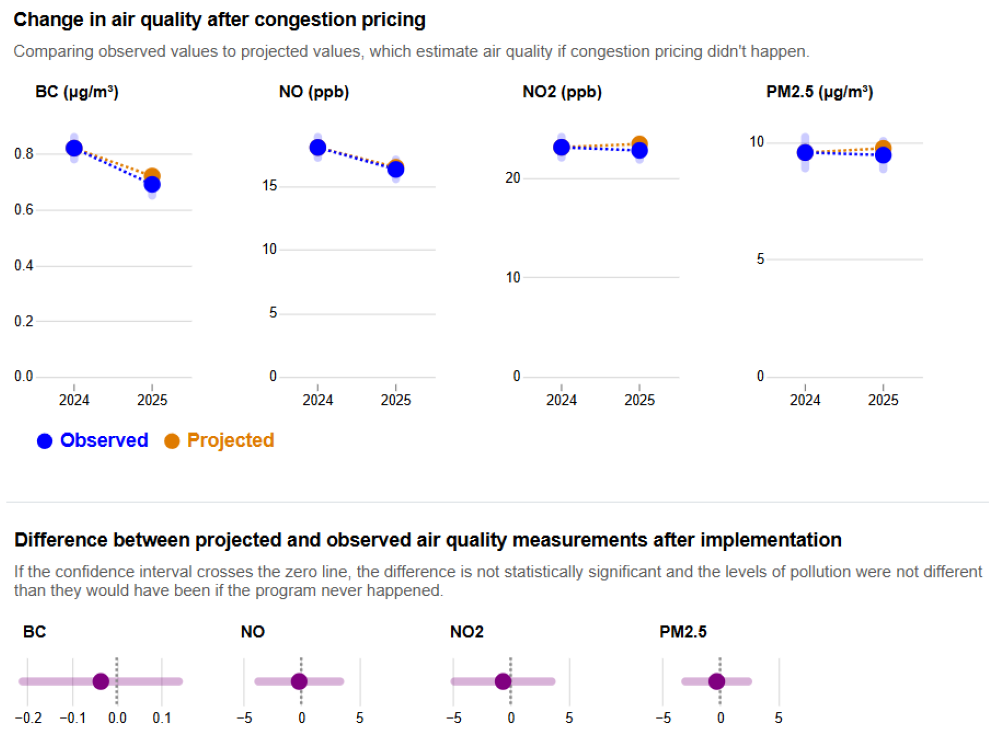
This story was originally featured on Fortune.com

This post was originally published here. 

Futures are mixed ahead of a big week for major retailers as new questions emerge about the state of the U.S. consumer, a major engine powering the American economy.

The S&P 500 edged 0.1% higher, while Dow Jones Industrial Average futures slipped 0.2%. Nasdaq futures gained 0.5%.

U.S. stocks hit an all-time high last week despite some recent downbeat data about jobs and, most notably last week, retail spending.

Americans unexpectedly pulled back on retail spending in July by the biggest amount in more than a year, according to the Commerce Department data released Friday

Walmart and Target both post second quarter earnings this week, with Target surging under new CEO Michael Fiddelke, a 20-year company veteran who took over in February. Home improvement companies Home Depot and Lowe’s also report quarterly earnings this week.

The entire sector is wrestling with stubbornly high inflation and customers that are laser focused on prices.

The weak jobs and retail data has diminished the odds of any interest rate hike from the Federal Reserve. That’s good for markets because it lowers the cost of credit, but it may also suggest slowing growth at a time when inflation is elevated.

The Fed has no good tool to fix a stagnating economy and high inflation at the same time, making so-called “stagflation” a worst-case scenario.

The Fed is set to report minutes from its July meeting on Wednesday, which will provide more details about its thinking on interest rates.

Oil prices rose Monday with Iran saying it is working with Oman on a plan to manage the transit of ships through the Strait of Hormuz.

Global oil supplies have been squeezed because about 20% of the world’s crude is transited through the strait on a typical day. Iran effectively shut down the strait after it was attacked by the U.S. and Israel in late February.

Brent crude, the international standard, rose 1.1% to $89.50 per barrel, while U.S.

In European trading, Germany’s DAX dipped 0.9% at 26,416.57, while the CAC 40 in Paris lost 0.2% to 8,622.43.

Britain’s FTSE 100 gained 0.1% to 10,751.53.

Tokyo’s Nikkei 225 index gained 0.7% to 69,220.25 after the Japanese government reported the economy grew slightly faster than forecast in the April-June quarter. In quarterly terms, the economy grew 0.3% in the second quarter of the year.

The U.S. dollar fell to 159.17 Japanese yen from 159.32 yen. The euro rose to $1.1600 from $1.1588.

This story was originally featured on Fortune.com

This post was originally published here. 

National Security Minister Itamar Ben-Gvir called the IDF’s planned transfer of West Bank civilian enforcement to Israel Police a “significant step toward Israeli sovereignty” on Monday.

Earlier, Defense Minister Israel Katz announced that the military will present a plan for the transfer within the next two weeks, after initially announcing intention for the transfer of authority on Friday. “We will not allow violence or unauthorized parties to take the law into their own hands,” Katz said.

In his response, Ben-Gvir hailed Katz’s decision, noting it to be a “significant step toward [implementing] Israeli sovereignty in the West Bank.

Ben-Gvir said he had requested that all responsibility for the area be transferred from the IDF to Israel Police, including handing over responsibility for Border Police’s Judea and Samaria Division over from the military to police, “in accordance with the coalition agreement that has so far been violated.”

“In addition, the authority for administrative detentions and restrictions should be transferred from the defense minister and the IDF to the national security minister,” Ben-Gvir demanded. “To date, these powers have not been used against the anarchists and against elements from anti-Zionist movements against the State of Israel; it is time to activate these tools against the enemies of the state,” he warned.

National Security Minister Itamar Ben-Gvir prays during the Tisha B’Av ritual at the Western Wall in Jerusalem’s Old City, July 22, 2026. (credit: YONATAN SINDEL/FLASH90)

Katz aiming to redefine IDF role in West Bank

On Friday, Katz had announced that he had instructed the IDF to prepare a plan to transfer all civilian enforcement authority for Israeli communities and residents in the West Bank to the Israel Police, as part of a broader effort to redefine the military’s role in the territory.

The move came amid criticism levied at the military of its failure to control settler extremists, who in recent days have targeted Palestinian homes in the village of Kusra, dismantling fences, blocking roads, and besieging the area.

According to Katz, the proposed plan would shift responsibility for civilian law enforcement and public order involving the Israeli population in the West Bank from the IDF to police.

“The IDF’s role is to fight Palestinian terrorism and focus on defending the borders and the communities against threats,” Katz said in a statement. “All responsibility for enforcing civilian matters and maintaining law and order will be transferred to the police,” he added.

The IDF has traditionally handled law and order in the West Bank because the territory is under military administration, while the Israel Police is responsible for civilian law enforcement inside Israel.

Shir Perets contributed to this report.

This post was originally published on here. 

Ferrari’s first fully electric vehicle sold for a staggering $40 million at auction in Monterey, California.

The 2026 Ferrari Luce “Tailor Made,” identified as “Chassis 0,” is the first production chassis from the Italian luxury automaker’s new electric vehicle program, according to RM Sotheby’s.

The one-of-a-kind Ferrari was sold during RM Sotheby’s Monterey auction, with all proceeds benefiting educational initiatives through the Ferrari Foundation, a 501(c)(3) public charity. The buyer’s premium was waived for the sale.

The Luce marks a major milestone for Ferrari as the company enters the fully electric vehicle market. Ferrari has described the model as the first fully electric car in the Prancing Horse’s history.

FORD BOOSTS US LINCOLN PRODUCTION AS IT PHASES OUT IMPORTS FROM CHINA

The $40 million example was configured through Ferrari’s Tailor Made personalization program and features several details developed specifically for the vehicle.

Its exterior is finished in Madreperla Semi-Gloss paint, which Ferrari says produces iridescent reflections that shift from green to violet depending on the angle and intensity of the light.

Inside, the Luce features Perla-colored Le Mans metallic leather made from specially selected Swiss hides, along with Grigio Corvara secondary elements instead of traditional black trim.

Ferrari also equipped the car with dedicated wheels, bespoke brake calipers and special Ferrari badging set against an optical white background. A plaque identifies the vehicle as “Chassis 0,” distinguishing it as the first production chassis in the Luce program.

The winning bidder will not take immediate possession. Following the auction, the car is expected to return to Ferrari’s headquarters in Maranello, Italy, with final delivery currently scheduled for the first quarter of 2027.

CLICK HERE TO GET FOX BUSINESS ON THE GO

The vehicle was built to U.S. specifications. If it was purchased by a buyer outside the U.S., that buyer will be responsible for export, import and federalization requirements, according to the auction listing.

This post was originally published here. 

Bank Leumi earned more money in three months than any Israeli bank ever has. The lender reported net profit of NIS 2.83 billion, roughly $940 million, for the second quarter, up 8.5% from a year earlier, when it released results on Aug. 12.

The reason is simple: Leumi is lending much more money while spending very little to run itself. Its loan book grew 9% since the start of the year to about NIS 566 billion, with corporate lending up 14% — enough that the bank has already hit its full-year growth target of 8% to 10% with half the year left. At the same time, its efficiency ratio, which measures how much of every shekel of income is eaten up by salaries, branches and technology, fell to 24.7% from 29.1% in the prior quarter. In plain terms, about 25 cents of every dollar the bank takes in goes to running the business, and the other 75 cents flows toward profit. That is among the lowest figures of any major bank in the world, and the bank credits its use of artificial intelligence for much of the improvement.

The record came despite a government surtax on Israel’s five largest banks totaling NIS 3 billion this year, of which Leumi absorbed NIS 293 million in the quarter. Without it, profit would have been about NIS 3.1 billion and return on equity 17.9% rather than the reported 16.3%.

Shareholders are getting a large share of the money back. Leumi is returning NIS 1.4 billion, about $470 million, split between a cash dividend of roughly NIS 1.1 billion and share buybacks — half of quarterly net income, and an annual dividend yield of about 5.5% at current prices.

Loan quality held up as the portfolio grew. Non-performing loans stood at 0.45% of credit, meaning fewer than one shekel in 200 is in trouble, against 0.43% a year ago. The bank set aside NIS 291 million for possible credit losses in the quarter, but said the entire provision was a general reserve tied to the pace of lending growth rather than any specific borrower going bad — the tenth consecutive quarter that has been the case. On individual problem loans, the bank actually recovered more than it wrote off.

For the first half, profit reached NIS 5.18 billion and return on equity 14.9%, at the top of the 13.75% to 15.25% band the bank set in its strategic plan. Capital remains well above regulatory minimums, with a core capital ratio of 11.65%.

The backdrop is an Israeli economy the Bank of Israel expects to grow 4% this year and 5.5% next, with interest rates easing and business borrowing picking up after two difficult years. Rival Bank Hapoalim posted a NIS 2.5 billion quarter, with credit growth of 6.6%, slower than Leumi’s.

Investors have noticed. Leumi shares are up 24% over the past year, giving the bank a market value of about NIS 110 billion and making it the largest bank in Israel by that measure.

JBizNews Desk | Tel Aviv

© JBizNews.com All Rights Reserved. Reproduction or distribution without written permission is prohibited.

U.S. stocks opened mixed Monday, August 17, as a surprisingly strong New York manufacturing report pushed Treasury yields higher while another burst of enthusiasm around artificial intelligence lifted chip and memory stocks. The Dow Jones Industrial Average opened down 69.3 points, or 0.13%, at 53,663.11. The S&P 500 gained 4.9 points, or 0.06%, to 7,790.68, while the Nasdaq Composite rose 55.5 points, or 0.21%, to 26,784.65. 

The morning’s main economic report was considerably stronger than expected. The New York Fed’s Empire State Manufacturing Index jumped to 20.6 in August from 15.6, its highest level in more than four years and well above the roughly 11-to-12 reading economists expected. New orders came in at 17.3 and shipments at 11.7, while employment continued to expand. The less comfortable part of the report was inflation: the prices-paid index climbed to 58.6, showing manufacturers are still facing substantial increases in input costs. 

That stronger factory reading helped push the 10-year Treasury yield back toward 4.70% to 4.71% in early trading. It matters because markets had spent the past several sessions reducing expectations for another Federal Reserve rate increase after weaker retail sales and softer inflation reports. Traders entered Monday pricing roughly a 30% chance of a September rate hike, down from around 50% a week earlier. 

Technology is providing the counterweight. Astera Labs jumped roughly 9% and Marvell about 5% in early trading, while Micron gained more than 3% and Sandisk more than 4%. Nvidia and Amazon were each up around 1%. Investors continue to favor companies supplying the memory, networking and computing infrastructure behind the AI buildout. 

Part of that enthusiasm followed new attention on Anthropic’s enormous growth projections. The AI company is forecasting roughly $190 billion to $200 billion in 2028 revenue, compared with a recently publicized annualized revenue pace of about $47 billion. Those projections are helping reinforce expectations that AI companies will continue spending heavily on chips, servers, storage and data-center infrastructure. 

Memory stocks received an additional boost after a report that the Trump administration does not want Apple relying on Chinese memory suppliers. Micron, Sandisk, Seagate and Western Digital all moved higher as investors considered the possibility that U.S. technology companies could be pushed toward non-Chinese suppliers. 

There were important moves outside technology as well. L3Harris Technologies fell nearly 3% after the defense contractor removed Chairman and CEO Christopher Kubasik following an investigation into conduct that the company said violated its code. Sam Mehta was named CEO, and L3Harris reaffirmed its 2026 financial outlook. 

Alphabet was also in focus after Berkshire Hathaway disclosed that it had increased its stake in Google’s parent by roughly 83% to nearly 106 million shares worth about $37.8 billion, making Alphabet Berkshire’s third-largest U.S. stock investment. The unusually large technology position is being watched as another sign of institutional confidence in the AI spending cycle. 

Oil remains the biggest outside risk to stocks. West Texas Intermediate traded around $82.75 a barrel and Brent near $89, with the market watching the expiration of the 60-day U.S.-Iran ceasefire period and any developments surrounding the Strait of Hormuz. Higher energy prices could quickly complicate the improving inflation picture and revive expectations for another Fed rate increase. 

One housing report was scheduled exactly at the cutoff for this recap. The NAHB/Wells Fargo Housing Market Index for August was due at 10:00 a.m. ET, with economists looking for a reading around 33 versus 34 in July. At the 10:00 a.m. cutoff, the new figure had not yet been posted by NAHB or verified by major data services, so JBizNews is not publishing an unconfirmed number. 

For the rest of Monday, investors will watch Treasury yields, oil and any new U.S.-Iran headlines, along with short-term Treasury bill auctions later in the morning. With few major corporate earnings scheduled during regular trading, the broader question is whether strong AI buying can keep the S&P 500 near record territory even as stronger economic data and higher oil prices threaten to push borrowing costs back up.

JBizNews Desk | Wall Street

© JBizNews.com All Rights Reserved. Reproduction or distribution without written permission is prohibited.

Sunday’s meeting in Cairo between US envoy Jared Kushner and senior Hamas leaders has left Palestinian Authority officials in Ramallah perplexed, deepening their concerns over Washington’s approach to the Palestinian issue and the PLO as the “sole legitimate representative of the Palestinian people.”

Several Palestinian officials in Ramallah described the meeting, which marked the latest in a series of direct contacts between the American administration and Hamas, as “troubling.”

They said this ongoing open channel with Hamas was contributing to sidelining the PA, and they accused Israel and the United States of following the same old “divide and rule” policy to enhance splits between Gaza and the West Bank and among the Palestinian factions.

“This looks like a continuation of the same old approach that Israel has taken for years – bolstering Hamas while weakening the PA,” one senior Palestinian official argued in comments to The Jerusalem Post.

“Since President Trump was elected, we haven’t seen intense, direct, and serious talks with President Mahmoud Abbas,” he charged. “We haven’t heard the Americans speak clearly about establishing a Palestinian state,” he added.

Palestinian President Mahmoud Abbas speaks during the 8th General Conference of Fatah in Ramallah in the West Bank, May 14, 2026.  (credit: MOHAMAD TOROKMAN/REUTERS)

He noted that it was jarring to see US President Donald Trump’s envoy holding discussions with Hamas in Cairo and with the Israelis in Jerusalem but not meeting PA’s Abbas in Ramallah.

Core issue is not engaging primarily with PA

The Cairo talks reportedly touched on disarming Hamas and pushing the terror organization to hand over its weapons, which is a long-standing PA demand.

The Palestinian officials explained, though, that the core issue at the talks was the principle of the US not engaging primarily with the PA, since it paves the way for “double representation” for the Palestinian people.

“This is not the first meeting between the current American administration and Hamas. It looks like a practical move, part of which was meant to discuss the option of enabling Hamas to integrate into the political system,” another Palestinian official said. But, at the same time, it raises questions about where the PA stands in the priorities, he said.

“It harms the PA’s representational status and gives Hamas new cards to play,” he warned.

One of the officials noted that while there is no anger over the meeting itself, there is discontent about pushing the PA aside.

“We don’t understand what the Israelis and the Americans are trying to achieve. Do they want to give Hamas more than they have given the Palestinian Authority?” he asked.

“If you want to achieve political stability and open a horizon for peace, you must first talk to the Palestinian Authority and President Abbas, unless Hamas is simply the easier option,” he said.

“This approach, if it continues, will bring more disaster for our people and the region.”

Criticizing Hamas, the source said, “There is no Palestinian address more respectful of international law than the Palestinian Authority.”

This post was originally published on here. 

The United Nations Office on Drugs and Crime has continued to support the Islamic Republic in identifying drug traffickers, despite concerns that those convicted in reportedly unfair trials are subjected to torture and, in many cases, executed.

The UNODC last week announced that it had “helped” Iran procure advanced detection scanners to combat methamphetamine trafficking at the country’s borders.

At least part of the technology was funded by Japan, according to a 2018 UN announcement, while the international body provided training to Iran’s Anti-Narcotics Police (ANP) and Customs Administration on how to use the technology and handled the international procurement and handover of the equipment.

Iranian seizures of meth increased from 30,393 kilograms in 2022 to 40,453 kg in 2025 with the help of the technology, according to the United Nations.

UN anti-drug assistance draws human rights scrutiny

Though presented by the UN as a major achievement in the thwarting of international drug trafficking, the agency’s official policy advocates for the universal abolition of the death penalty, viewing it as incompatible with fundamental human rights.

The flag of Iran is seen outside the International Atomic Energy Agency (IAEA) headquarters during a meeting of the IAEA Board of Governors on March 02, 2026 in Vienna, Austria;illustrative (credit: Christian Bruna/Getty Images)

Nearly 1,000 out of the 1,212 executions for drug-related offenses in 2025 were carried out by the Islamic regime, according to the 15th report of Harm Reduction International published in March. At the time of the report, over 1,000 people were awaiting execution for drug-related offenses, some of whom had never come into direct contact with the illegal substance.

According to both the report and UN Special Rapporteur on human rights in Iran, Mai Sato, the large majority of those killed came from a background of poverty. Many were alleged to have worked in only minor roles in the drug trade, and they were denied proper due process during their trial.

Critics warn UN support may strengthen Iran and its proxies

Additionally, while the UNODC said last week that thwarting smuggling attempts helped stem the flow of money to organized crime groups, Anne Herzberg, legal adviser at NGO Monitor, told The Jerusalem Post that many of Iran’s proxies also rely on funds generated through illicit drug trafficking.

According to the IDF, Hezbollah has been funded through cocaine sales in Europe and is heavily involved in trafficking cannabis and Captagon along the Lebanese-Syrian border.

“It beggars belief that Iran is not aware of, does not profit off of, nor [is] heavily enmeshed in Hezbollah drug trafficking,” Herzberg said.

“Moreover, it appears Iran uses drug-related charges as a pretext to jail and execute dissidents,” he added.

UN Watch calls for safeguards on assistance

Hillel Neuer, the executive director of UN Watch, added that the UN “should not be helping Iran’s brutal regime catch people whom it may then torture into confessing and execute after sham trials.”

He noted that the Islamic Republic of Iran’s “fundamentalist government routinely denies defendants due process, and has dramatically increased executions for drug offenses, including in cases raising grave questions of innocence and coerced confessions.”

Neuer argued that the UN’s actions raise serious ethical and legal concerns if UN-provided technology is helping Tehran identify suspects “who may ultimately be sent to the gallows.”

Methamphetamine is the second most commonly found drug in people who fatally overdose in the US, according to research from the US Centers for Disease Control and Prevention (CDC). Acknowledging the need to fight drug trafficking was essential, Neuer said, nevertheless, that the UN cannot give “sophisticated tools to a regime notorious for torture, arbitrary detention and executions.”

“The UN needs to explain what safeguards it imposed, whether it tracks what happens to people arrested using its equipment, and whether it can guarantee that its assistance is not facilitating death sentences. If it cannot provide those guarantees, the assistance should stop,” he concluded.

The UNODC did not respond to The Jerusalem Post’s request for comment.

This post was originally published on here. 

Want to stay on top of the science and politics driving biotech today? Sign up to get our biotech newsletter in your inbox.

Today we regale you with mid-August delights from the EMA, ICER, and a federal appeals court.

Hope you had a lovely weekend. My kids went to Disneyland, an aquarium, and the beach — but now seem thrilled most of all by the television.

Continue to STAT+ to read the full story…

This post was originally published here. 

Mattamy Group Corporation reported lower revenue and closings but stronger sales orders in its fiscal fourth quarter ended May 31, 2026, suggesting early signs of a demand recovery for the North American homebuilder.

The Toronto-based company said fourth-quarter revenue fell 17.9% year over year to $2.18 billion, down from $2.66 billion in the same period a year earlier, according to a company announcement. Closings also declined, with homes closed down 10.4% to 3,143 units from 3,509.

At the same time, net sales orders rose sharply in the quarter, up 40% to 2,532 homes compared with 1,808 a year earlier. Mattamy’s sales order backlog decreased 20% to 3,147 units, from 3,934 units in the prior-year quarter, suggesting the builder continued to convert earlier demand into deliveries even as new orders picked back up.

For the full fiscal year ending May 31, 2026, revenue declined 7.9% to $5.90 billion, compared with $6.40 billion in the prior year. Full-year homes closed slipped 2.3% to 8,261 from 8,453. Net sales orders for the year increased 8.6% to 7,474 homes, up from 6,885.

The mixed results reflect broader conditions facing large homebuilders in 2025 and 2026 as higher mortgage rates, affordability constraints and uneven resale supply pressured closings, even as underlying household formation and limited inventory supported demand for new construction. A double-digit increase in quarterly orders alongside a shrinking backlog suggests that Mattamy, like many big builders, is working through existing pipelines while beginning to rebuild its order book.

For homebuilders and land sellers, Mattamy’s trends underline a few key signals: price and incentive strategies have likely preserved demand enough to drive order growth, but delivery and revenue timing remain under pressure. Trade partners and suppliers can read the smaller decline in full-year closings relative to revenue as a sign that mix, incentives and potentially more entry-level product are weighing on top-line dollars per unit.

Mattamy, which bills itself as the largest family-owned homebuilder in North America, posted additional LTM financial results for the quarter on Intralinks. The company did not disclose net income figures in the operating summary.

Why this matters for builders

Mattamy’s Q4 and full-year numbers offer another data point that demand for new homes is stabilizing but not yet translating into stronger revenue growth. Builders watching absorption, backlog and spec strategy can use these metrics as a benchmark: higher orders with a smaller backlog and lower revenue suggest a market where volume is returning first, with pricing power and margins likely to follow later—if rates and affordability conditions cooperate.

This post was originally published on here. 

Ocusell is preparing to launch its List product inside OneKey MLS, giving the 42,000-subscriber New York-area multiple listing service access to faster listing input, AI-assisted remarks and expanded tools, the companies announced earlier this month.

Farmingdale, New York-based OneKey MLS serves real estate agents across Long Island, the five New York City boroughs and the Hudson Valley. It was the second MLS to sign on to Ocusell, according to the announcement, as it looked for a way to consolidate listing tools and add automation without forcing agents into multiple platforms.

List is designed to publish listings directly to the MLS more quickly by autopopulating as many as 70 listing form fields, reordering photos via a “natural walkthrough” flow, offering optional AI tools to generate public remarks, and running built-in rule checks to flag potential errors before a listing is made active. The company said it is aimed at reducing back-and-forth over compliance issues and lowering the volume of user-error tickets for MLS staff.

“OneKey is committed to making things easier for our members. We were the second MLS to sign on to Ocusell since we instantly saw the value of the technology,” OneKey MLS CEO Richard Haggerty said in the announcement.

The implementation includes a custom toolkit to help OneKey better ingest and manage Manhattan listings, according to the announcement. Manhattan’s high concentration of co-ops, condos and multi-family buildings often demands more detailed unit- and building-level data structures than typical single-family suburban listings.

For brokers and agents, the deployment is part of a broader industry trend toward single-point data entry and AI-assisted workflows inside MLS systems, especially as listing compliance rules tighten and staff resources remain constrained. Faster, more accurate listing input can shorten time to market and reduce risk of fines or corrections tied to rule violations.

“OneKey has been an incredible partner from day one. From our earliest discussions, we recognized a shared opportunity to simplify the listing workflow while eliminating unnecessary work for agents,” Ocusell CEO and founder Hayden Rieveschl said in the announcement.

Ocusell is part of a joint venture with Bright MLS to co-develop and license technology solutions for brokers, agents and MLSs.

This article was generated using HousingWire Automation and reviewed by a HousingWire editor before publication.

This post was originally published on here. 

The quarterly New York Fed foreclosure data came out for Q2, and once again — to the surprise of many doomers — the index fell slightly, still below 2019 levels. Not only that, but this week’s existing home sales report also showed housing inventory down year over year and sales slightly higher, with prices up 2.0% year over year, something that would be impossible if we had a surge of foreclosures coming to the market. 

I know we get headlines every month or quarter with huge percentage increases in foreclosure data, but today I wanted I share a simple way for people to understand when foreclosures will become an issue. I also discussed this topic on today’s episode of the HousingWire Daily podcast.

Foreclosure data

One of the things I’ve stressed when I talk at events this year is that we have had many recessions post-WWII but only one foreclosure crisis. That foreclosure crisis started with a massive credit boom from 2002-2005, and then a credit bust. That credit bust pushed foreclosures up, according to New York Fed data, in 2005, 2006, 2007 and 2008. Then, the Great Recession happened. As you can see, none of that is happening now — we aren’t even back to 2019 levels yet, and it’s August 2026.

Here is how the Fed tracks the data: New foreclosures. Number of individuals with foreclosures first appearing on their credit report during the past 3 months. Based on foreclosure information provided by lenders (account level foreclosure information) as well as through public records.

This is key to what I will present next, because I can explain why housing inventory was down year over year, even though for 3.5 years now headlines were showing big percentage increases in foreclosure data.

Inventory

When you don’t have a lot of distressed sellers in the mix, we just deal with the normal supply and demand equilibrium for housing; a surge of actual foreclosures in 2026 would have easily put the inventory data much higher in 2026.

Keep it simple: housing demand is up 2.4% year to date and new listings didn’t explode, so inventory growth slowed and declined only slightly year over year in the last existing home sales report this week. 

chart visualization

We track inventory differently than the NAR; we have no contract data in our inventory, so these are the homes available for sale. Inventory is up 0.78% fron the previous week.

  • Weekly inventory change (July 31-Aug. 7): Inventory fell from 872,932 to 865,709
  • Same week last year (Aug. 1-Aug. 8): Inventory fell from 865,600 to 859,050

chart visualization

New listings data is key

When you have a massive buildup in foreclosure data, as we saw from 2005-2008, you will get a surge of new listings data. These aren’t sellers that will be buyers; these are distressed sellers in the mix. Not to mention, after a significant high-LTV credit boom and bust, a ton of people were underwater: In 2010, over 23% of homes were underwater. The run-up in foreclosure data from 2005-2008 was going to be a problem, because the higher the percentage of underwater homes, the more likely a foreclosure will happen. In contrast, people with a lot of equity can sell and prevent that foreclosure.

In addition, our new listing data isn’t surging. From 2013-2019, the normal for our new listings has been 80,000-100,000 per week during the seasonal peak months — and we haven’t had any normal years since 2020. New listings have picked up over the last two years, but it’s mostly been the traditional seller-as-buyer. This explains why inventory growth has been low this year.

Here is last week’s new listings data for the past two years:

  • 2026: 67,301
  • 2025:  66,341

chart visualization

Some context for those who believe the new listings data resembles the housing bubble years: during that time, new listings ranged from 250,000 to 400,000 per week for several years. Let me repeat that: 250,000-400,000 per week for years. New listings data today isn’t even back to normal levels, with foreclosure data not back to 2019 levels.

Conclusion

Once the foreclosure data starts to pick up beyond a normal trend — and it will with a job-loss recession — then you need to wait for it to be reflected in the new listings data. The entire process, from start to finish, might take 9-18 months; in some cases, many years. Understanding the data means you can properly track and talk about foreclosures and the relationship of foreclosures to inventory.

This post was originally published on here. 

Oman is quietly working out a deal with Iran on how ships will move through the Strait of Hormuz. Washington, which has been blockading Iranian ports for months, does not want anyone but the United States deciding who sails through. On Monday, Aug. 17, President Trump said that if Oman gets in the way, American forces will bomb it.

Trump made the threat in a phone interview with Fox News, saying the blockade is squeezing Iran and that he has set no timeline for ending the conflict because he is in no hurry. He used an expletive. Speaking of informal contacts with Iran’s Revolutionary Guard, he said they are good poker players who are dying anyway.

Oman matters here for one reason: geography. Iran owns the northern shore of the strait, Oman owns the southern shore, and every tanker leaving the Gulf sails between the two. Oman is a Gulf Cooperation Council member that has kept close ties to Washington while preserving relations with Tehran, and has served for years as the back channel between them. This is the first time Trump has aimed that kind of language at a longtime American partner in the region.

What set it off is a shipping arrangement. Iranian foreign ministry spokesman Esmail Baghaei said Monday that Tehran and Muscat had reached an understanding on the map of a transit route, with the two sides finalizing a joint statement. Ships would enter along the Iranian coast and exit along a lane off Oman, and during the interim period vessels would pass without paying tolls. The threat landed as that understanding was being announced. The 60-day interim agreement between Washington and Tehran expires Monday, with talks to reopen the waterway deadlocked.

The money side is where American households feel it. Brent settled around $88 a barrel Monday, roughly flat on the day and about 33 percent higher than a year ago. West Texas Intermediate also traded near flat. Hormuz normally carries about a quarter of the world’s seaborne oil — roughly one barrel in four — and Iran has restricted navigation there since Feb. 28.

At the pump, the national average for regular gasoline was $4.07 on Aug. 13, the highest August average AAA has ever recorded, against $3.16 a year earlier. That is about 90 cents more per gallon, or close to one dollar in four added to every fill-up. California drivers averaged $5.58 and Hawaii $5.43, while Louisiana was cheapest at $3.57. AAA attributes the gap to crude prices rather than demand, which is actually down.

For shippers, the practical fix on the table is the Iran-Oman route itself, which would give tanker owners a marked lane and a known cost instead of guesswork. American officials say the Navy is expanding its ability to escort vessels through the strait, though owners still consider the passage risky and some tankers have been switching off their transponders. Meanwhile, Middle Eastern producers have been moving millions of barrels through the waterway quietly, which has kept prices from climbing further, and additional Gulf crude is expected to reach American refiners.

The pressure track runs alongside the military one. Treasury Secretary Scott Bessent said Washington would impose unprecedented economic measures on Iran while keeping the naval blockade in place, with more announcements expected. Israel struck Lebanon over the weekend, killing 11 people including a senior Hezbollah commander, and the International Energy Agency has warned of the widest global supply shortfall in five years.

For American businesses running trucks, planes or freight contracts, the question is not whether Oman gets bombed. It is whether a working transit lane opens before the fall shipping season locks in fuel costs at these levels.

JBizNews Desk | New York

© JBizNews.com All Rights Reserved. Reproduction or distribution without written permission is prohibited.

Brazilian President Luiz Inácio Lula da Silva said Friday his government has triggered an economic reciprocity law mechanism against U.S.-imposed tariffs, saying the move was intended to show his nation must be respected.

In July, U.S. President Donald Trump imposed tariffs on hundreds of Brazilian exports, with duties reaching up to 37.5% in some products. The Trump administration has accused Brazil of unfair trade practices, but Lula has denied the accusations, insisting they are politically motivated ahead of the October election.

Lula is seeking reelection against Sen. Flávio Bolsonaro, a Trump ally who met with U.S. officials, including Trump, in Washington weeks before the administration proposed higher tariffs on Brazilian goods.

“Yesterday, we invoked the reciprocity law to show that we are not to be taken lightly,” Lula said in an interview with Brazilian podcasters. “We respect ourselves. I am very calm knowing what could happen, and I am prepared to debate the defense of Brazil anywhere in the world.”

Brazil’s Foreign Ministry said in a statement late Thursday it is requesting diplomatic consultations with its U.S. counterparts on the issue, as a sign of Lula’s aim “to privilege dialogue and negotiation in its international relations.”

The beginning of the proceedings does not necessarily mean Brazil will retaliate against U.S. tariffs.

“I don’t want any fight with the United States,” Lula said Friday. “Unfortunately, they are spreading falsehoods.”

Earlier this month, the U.S. State Department revoked the visa of Brazil’s ambassador to Washington in retaliation for Brazil’s denial of visas last month for two American diplomats who sought to visit ahead of the October election.

The U.S. government also has accused Brazil of stalling approval of Trump’s nominee for ambassador in Brasilia, while Brazilian officials say the U.S. should have first sought the government’s approval before submitting the nomination to Congress, as diplomatic protocol requires.

Since U.S. Secretary of State Marco Rubio revoked the Brazilian ambassador’s visa in response to Lula’s actions but did not order her expelled, U.S. officials have said the Trump administration does not want the dispute to escalate.

These officials, who have spoken on condition of anonymity to discuss internal administration deliberations, have said on multiple occasions that Rubio’s limited response was intentionally designed to give Lula time and space to back down.

At the same time, they have said that the U.S. will respond quickly should Lula’s government choose to escalate the matter and that declaring the Brazilian ambassador “persona non grata” and expelling her from the U.S. would be a logical next step.

Lula said once again Trump has treated him well, but warned any foreign governments “who come here to meddle in the election, will lose.”

___

Associated Press writer Matthew Lee contributed from Washington.

This story was originally featured on Fortune.com

This post was originally published here. 

Iran’s parliament approved a bill on Sunday that would criminalize interviews and other communications with media deemed hostile to the Islamic Republic, including US or Israeli media and outlets financed by either country, Iran’s Shargh newspaper reported.

Under the bill, which must still be reviewed by the Guardian Council before it can become law, interviews or participation in discussions with such media would be banned and violations punishable by six months to two years in prison.

Interviews with other foreign media would require notification to the intelligence ministry, while contact with foreign embassies, offices of foreign organizations or other non-Iranian institutions without notification and written permission from the foreign ministry would be punishable by a fine and deprivation of certain social rights.

The bill would also harden penalties for alleged economic crimes committed under the direction or supervision of foreigners, ban providing information to foreigners without intelligence ministry approval, and restrict scientific cooperation with foreign institutions outside an approved list.

Iran’s heavy punishments for cooperation with foreign entities

It would punish policy or legislative proposals made under the direction of foreign intelligence services if they harm Iran’s security or independence, with prison terms of up to 30 years. Cases would be heard by Revolutionary Courts.

A security personnel stands guard as Iranians take part in a protest marking the annual al-Quds Day, on the last Friday of the holy month of Ramadan, in Tehran, Iran, March 13, 2026 (credit: MAJID ASGARIPOUR/WANA (WEST ASIA NEWS AGENCY) VIA REUTERS)

The move does not mark the first time Iran has criminalized cooperation with foreign entities. A law passed in 2025 after a 12-day war with Israel imposed tougher penalties for alleged cooperation with hostile states.

Iranian photojournalist Yalda Moaiery was sentenced this month to 15 years under that law over allegations that included giving interviews to media deemed hostile and providing photographs to US and Israel-linked organizations.

This post was originally published on here. 

A Venezuelan mogul who minted a fortune selling power turbines and pumping oil has emerged as the Trump administration’s fixer for promoting “America First” deals for favored US companies, as Washington moves to exert more influence in the resource-rich South American country.

Alejandro Betancourt, an entrepreneur with a checkered history who controls Venezuela’s leading independent oil producer, is helping the US administration identify promising energy assets, assess operational bottlenecks and make industry connections, according to people familiar with his role.

Betancourt is working to facilitate a US strategy to tap smaller American wildcatters as established oil majors have largely balked at investing there. Several preliminary agreements have been reached in recent months with companies including Lionheart Capital and Pacific Coast Energy Co., known as PCEC.

Bloomberg’s reporting on Betancourt is based on interviews with his business associates, government officials and advisers familiar with his work. They requested anonymity because they didn’t want to be identified discussing confidential matters, feared retribution or were not authorized to speak publicly on the matter.

The tycoon’s emergence as a central figure offers insight into how Washington is stepping up efforts to encourage US companies to pump Venezuelan oil and invest $100 billion in a country President Donald Trump describes as the 51st state. More than seven months after the US captured Nicolás Maduro, blessed his replacement and declared Venezuela open for business, significant oil deals remain elusive, held up by complex negotiations with state-owned Petróleos de Venezuela SA and sanctions constraints. 

In the absence of competitive bidding, progress is opaque. That’s given Betancourt tremendous sway in Venezuelan oil circles, the people said, in spite of years of investigations in Europe, the US and Venezuela over allegations of corruption, money laundering and tax fraud. He has denied any wrongdoing and was never charged with a crime.

Until recently, Betancourt avoided US soil out of concern over the American probe, people familiar with the matter said.

Betancourt himself is also a top oil player in Venezuela. His North American Blue Energy Partners, or NABEP, pumps about 200,000 barrels of crude a day from fields around Lake Maracaibo and the Orinoco Belt, according to a person familiar with the matter. That makes it Venezuela’s second-largest private-sector producer behind Chevron Corp. 

Last week, a party close to Betancourt agreed to buy the minority stake in NABEP held by Harry Sargeant III, according to people familiar with the transaction. Sargeant, a Florida oil magnate, had come under fire from Venezuelan opposition figures and US allies for allegedly propping up Maduro. Shortly after the NABEP deal was signed, the Treasury Department notified Sargeant’s attorney that it had blocked the assets of his offshore holding company. 

Betancourt declined to comment. Sargeant couldn’t be reached by telephone or email for comment through his Florida-based holding company Global Oil Management Group. NABEP didn’t reply to a request for comment. 

Betancourt, who has powerful friends in Caracas, Washington and Moscow, recently began traveling frequently from his London home to Venezuela, according to people familiar with his schedule. He regularly meets with senior officials, including US-supported acting President Delcy Rodríguez and her foreign policy adviser Félix Plasencia, and hosted a dinner for a US congressional delegation, according to people with knowledge of the meetings. 

Venezuela sits atop some of the world’s largest proven crude reserves and, from the 1950s through the 1970s, was among the world’s biggest petroleum exporters, transforming Caracas into one of Latin America’s richest capitals. Production later climbed above 3 million barrels a day before decades of neglect, corruption, expropriations, economic collapse and US sanctions sent output plunging.

Trump played up the industry’s potential in the days after Maduro’s capture. While the administration justified the nighttime raid as an effort to dismantle international narcotics trafficking, Trump said US companies would pour in to rebuild the infrastructure, production would soar and gasoline prices would fall, giving Republicans a win on a key checkbook issue ahead of midterm elections in which control of Congress is up for grabs. 

But most of the biggest US oil companies, including ExxonMobil Holdings Corp. and ConocoPhillips, remain skittish years after Venezuela expropriated their assets. So Betancourt is helping the administration steer opportunities toward the wildcatters, who are less risk-averse, and private investors, according to people familiar with the matter.

The White House described US relations with Venezuela as “extraordinary” for both sides. “We are dealing very well with President Delcy Rodríguez and her representatives. Oil is starting to flow, and large amounts of money, unseen for many years, is greatly helping the people of Venezuela,” the White House said in response to a request for comment, without directly answering questions about Betancourt’s role. 

Betancourt long operated largely behind the scenes. His role has come into sharper focus over the last month as deals began to come to fruition and Mauricio Claver-Carone, a former special envoy for Latin America who later served as an unofficial adviser on Venezuela, stepped back from the portfolio, according to people familiar with the matter.

Claver-Carone, who is close to Secretary of State Marco Rubio, helped assemble many of the people involved in executing the Trump administration’s Venezuela strategy, including Betancourt. While Claver-Carone is now less involved, many of those figures remain active, the people said.

Betancourt rose to prominence in the oil sphere by transforming NABEP from a small operator into one of the country’s leading producers. While many foreign companies reduced their footprint over the past decade amid the political turmoil, NABEP boosted production as much as 10-fold. Before leading NABEP, in the mid-2010s Betancourt invested in an operator in Colombia’s largest oil field, Rubiales. He then returned to Venezuela to partner with former Russian officials in Petrozamora, a joint venture in Lake Maracaibo.

Together with Sargeant, Betancourt also helped pioneer a more flexible contractual structure with PDVSA that has since become the model for many of the agreements now on offer to new investors, the people said.

Betancourt’s current work includes efforts tied to PCEC, a little-known California-based company that recently signed agreements to operate fields in Lake Maracaibo and the Orinoco Belt. PCEC has an agreement with NABEP for local procurement, one of more than 30 such relationships on the ground intended to help the firm reach its goal of pumping Venezuelan oil, the company said. 

PCEC doesn’t disclose its investors, but it has financing from banks and trading houses, the company added.

Betancourt’s influence has grown despite repeated legal controversies inside and outside Venezuela. 

Known in Venezuela as one of the bolichicos — entrepreneurs who amassed fortunes during former President Hugo Chávez’s rule — Betancourt co-founded Derwick Associates, which won billions of dollars in emergency power equipment contracts beginning in 2009 during years plagued by chronic blackouts.

Derwick ultimately came under scrutiny by investigators in Venezuela, the US and Spain who suspected ties to money laundering schemes involving PDVSA funds. The company and Betancourt denied the allegations. 

Venezuelan authorities closed their probe without bringing charges, according to local media reports at the time. The Justice Department didn’t respond to a request on the current status of its investigation. Spanish investigators this year shelved their case, but newspaper El Pais later reported it was reopened. Officials at Spain’s high court didn’t reply to a request for comment on the status of the case against Betancourt.

Bloomberg reported in 2019 that lawyer and former New York Mayor Rudy Giuliani helped represent Betancourt in a meeting with the Justice Department. Betancourt was never named in public court documents tied to the investigation. 

This story was originally featured on Fortune.com

This post was originally published here. 

The train was sitting just outside a depot in Memphis when the bandits made their move. 

Emerging from a black Kia Soul under the cover of darkness, the three men clambered on top of CSX Corp. railcars. They broke the container locks and grabbed more than $20,000 of items, including women’s clothing destined for a Belk department store, Lazer Blocks toys and two cases of Fre non-alcoholic chardonnay. The thieves filled their vehicle and hid the rest in a nearby wooded area, planning to come back for it later.

The November theft was the type railyards had experienced dozens of times over the past few years, but this time, AI-powered cameras were being used to watch the heist. A task force focused on railroad crime leapt into action.

The team — led by the Tennessee Bureau of Investigation with the assistance of federal, state and local agencies, along with the Tennessee National Guard and CSX’s own police force — launched a plane that tracked the vehicle for 11 miles. Officers swooped in a few hours later as one of the perpetrators was unloading boxes of stolen goods, and two other men were arrested separately over the following days, according to police records reviewed by Bloomberg News.

Train robberies are a trope of cowboy Westerns, associated with 19th-century outlaws like Jesse James, Butch Cassidy and the Reno Gang. But the modern incarnation is largely a product of the pandemic, with theft quadrupling from levels seen before 2020. Once lockdowns began, criminal gangs that had relied on the drug trade saw their supply chains disrupted just as stay-at-home requirements boosted demand for physical goods. So the gangs pivoted to theft, focused on the rail hubs located in urban bottlenecks including Chicago, Los Angeles and Memphis.

Criminals nabbed more than $200 million of goods from 75,000 thefts on US freight rail networks in 2025, according to an industry group that represents CSX, BNSF Railway Co. and Union Pacific Corp., among others. In January last year, a BNSF train was robbed of about 1,985 pairs of unreleased Nikes worth more than $440,000, according to a filing in US District Court in Phoenix. And police in Los Angeles discovered $1.5 million of stolen cargo including goods from Milwaukee Tool during a raid. A CSX spokesperson said more than $900,000 of tires alone have been stolen from trains across its network since the start of 2023.

In response, the major freight carriers are joining with local police, the Federal Bureau of Investigation and corporate security teams, investing millions of dollars in monitoring technology, drones, barbed-wire fencing and other improvements. It’s all meant to defeat the crime rings that are often armed with nothing more than hydraulic bolt cutters, preying on railroads as a reliable source of easy-to-steal merchandise.

“These gangs can steal tens of thousands worth of goods in minutes, not to mention the damage that can be done to the trains,” Sean Douris, the chief of police at CSX, said in an interview.

For the most part, these aren’t armed holdups but instead more like storage-facility break-ins. Industry efforts over the past decades to improve efficiency and maximize profit mean that trains sometimes stretch as long as 3 miles, and often operate with just two crew members. Criminals have studied the lengthy and predictable stop times as the trains approach depots, a prime time to strike.

The gangs working around Memphis are primarily the Gangster Disciples, alongside the Crips and Almighty Vice Lords, according to CSX. A criminal complaint filed in US District Court in Arizona alleged that transnational criminal networks based in Sinaloa, Mexico, were behind a recent spate of thefts in the Southwest. In Chicago, perpetrators are a mix of opportunists and more sophisticated networks often tied to street gangs.

Thieves have occasionally tried to steal items as large as cars, only to find they are too well secured to get out. They principally target smaller, high-dollar items that can be sold to individuals and small businesses or through online marketplaces. Investigators say that electronics, luxury clothing and alcohol are top targets. Automobile tires are a lucrative niche; thieves liquidate the stolen goods through independent dealers and repair shops.

The thefts, besides sometimes terrifying staff, are a drag on the train operators’ bottom lines. The carriers are generally liable for any goods lost up to a certain dollar amount; the customer typically buys insurance for any value that exceeds that threshold.

To counter the problem, the rail companies are investing heavily. Union Pacific has spent more than $30 million on security projects since January 2023, including drones with thermal imaging capabilities and AI-enhanced cameras — along with 41,000 linear feet of cement walls, barbed wire and cross fencing around rights-of-way and rail yards.

BNSF, which also has its own 200-person police force and K9 units, is investing in electric fencing, masonry walls and cut-resistant barriers to help fight theft.

At CSX’s Leewood Yard depot in Memphis, what once was a mostly open site now more closely resembles a fortified Army base. The company has spent more than $7.5 million putting in about 14,000 feet of Amiguard 7700 series fence with razor wire ribbon more than 15 feet high.

There are 30 surveillance cameras that use AI software to support real‑time monitoring and investigations, helping identify cars used by thieves even when they swap out license plates.

“The investments we’ve made in people and technology mean we’re finally catching up with the criminals,” Douris said. “AI cameras and our partnerships with other agencies have allowed us to arrest people we’d previously have no hope of getting.”

CSX has also changed its timetables to keep trains moving through high-risk areas of the city and cut down on times when the railcars are essentially sitting ducks. The combined efforts have seen rail thefts drop 80% in the Memphis region year on year, the company said.

Gangs have also adapted their tactics. They have switched from mobile phones to walkie-talkies and are focusing on trains that have stopped farther outside the city. In one new strategy bedeviling CSX, thieves are leaping from bridges onto the moving trains when they slow down to travel through areas with restricted speeds.

In Chicago, massive railyards in the city’s South and West sides are prime targets.

In August 2024, thieves raided a Union Pacific train stopped on Chicago’s West Side, taking TVs and other electronics and loading them into waiting vehicles even after overmatched police arrived. Two months later, local media reported that at least a dozen people ransacked another of the company’s trains. Video showed a chaotic scene, with men carrying packages pulled from railcars to cargo vans parked nearby.

California investigators say railroad thefts in the state are tied to transnational gangs. As the Trump administration’s crackdown at the southern border choked off human smuggling operations, the syndicates increased train robberies, according to Rich Daniel, an assistant chief of police at BNSF who oversees operations in Southern California. The cartels also sometimes force trafficking victims already in the US to pay back their debts by helping with the heists, he told industry professionals at a cargo theft conference in Monrovia, California, last year.

While low-level thieves generally target stopped trains, more sophisticated gangs sabotage tracks or cut brake lines in an effort to strand trains in remote locales where they’re easy to rob, he said.

“The advantage to this is they can stop the trains where they want to stop,” he said.

One frustration for investigators is that punishment for stealing from trains tends to be fairly minor unless the suspects are caught with a gun or were otherwise violent. Many charged with simple theft are released on bail. In cities like Memphis, Los Angeles and Chicago — where violent crime and homicide are the top priorities for the district attorneys’ offices — getting burglary cases before a judge can be a lengthy and difficult process.

US railroads have lobbied heavily on the issue, and in May the House passed the Combating Organized Retail Crime Act with bipartisan support. The bill has been championed by David Valadao, a Southern California Republican congressman whose district includes a BNSF-owned rail line that’s a frequent target of thieves. He often sees the aftermath — dozens of torn-apart boxes littered alongside the tracks.

“People will jump on, they’ll break things open and they’ll start throwing packages off the side and having their buddies pick them up along the way,” he said in an interview. “When I talk to law enforcement about it, they say that’s normal.”

Valadao co-sponsored the bill, which equips law enforcement with stronger legal tools. Among other measures, it allows for criminal forfeiture of stolen goods, expands money-laundering statutes, and aggregates theft values to justify stiffer charges. It also creates a group within the Department of Homeland Security to coordinate law-enforcement efforts. Valadao is optimistic about the bill’s chances in the Senate, noting support from Charles Grassley among others.

“It’s got bipartisan and bicameral buy-in and one of our pushes with leadership is to focus on things that have bipartisan support,” Valadao said. “So we would hope it would make it forward.”

Back in Memphis, the alleged perpetrators of that November heist have been charged with felony burglary and theft. While some train thieves get away with a slap on the wrist, at least one defendant in this case is facing a potential prison sentence as long as 15 years because the value of the stolen goods exceeds $10,000. The Shelby County District Attorney is preparing to seek a grand jury indictment against each man.

This story was originally featured on Fortune.com

This post was originally published here. 

Good morning. When Cava recently reported second-quarter results, the numbers told a story of a fast-casual Mediterranean restaurant defying industry gravity: revenue up 31.3% year over year to $365.4 million, same-restaurant sales up 9% on 5.3% traffic growth, and shares jumping more than 10% in response last week. I also talked with CFO Tricia Tolivar about how the finance organization itself is changing.

As her team prepped for the Aug. 11 earnings call, they leaned on AI tools built into Cava’s proprietary data platforms, Cava Core and Cava Current, to run Q&A preparation and business analysis, Tolivar told me. She sees AI more as a way to make her team sharper and faster as internal advisors. And Tolivar sees opportunities to lean into AI to make the lives of employees on the front line at restaurants easier and streamline processes.
 
“But we believe in human connection,” she added. AI’s job, in her telling, is to clear friction from the restaurant floor, not replace the people running it. Cava plans to hire 2,500 new employees this year even while scaling automation. It’s a distinction worth watching as more consumer brands face pressure to prove AI ROI without downsizing the workforce that drives their hospitality branding.

Cava also launched “Flavor Your Future,” a campaign designed to support career growth within the company as it continues its rapid expansion. One of the newest components is an assistant general manager position, Tolivar said. The role, which currently exists in about 70% of the restaurants, aims to build a bigger bench of future general managers and leaders, she said.

Cava opened 17 net new restaurants in Q2. This expansion brought its total footprint to 476 locations nationwide. The company is on track to open a total of 75 new restaurants this year.

I asked Tolivar about prices. Cava raised menu prices just 1.4% to 1.5% at the start of 2026, kept base bowl prices flat, and has undercut CPI by nearly half for several years, she said. “As we move through the rest of the year, we are not anticipating any further price increases at this time,” she added.

Regarding the menu, the chain added salmon this quarter, which Tolivar said met expectations and reinforced Cava’s stake in the seafood side of the Mediterranean diet. Most recently, it rolled out Harissa barbecue pita chips, which she thinks are best dipped in the garlic dressing.

Sheryl Estrada
Sheryl.Estrada@fortune.com

This story was originally featured on Fortune.com

This post was originally published here. 

US President Donald Trump “may endorse somebody” in the upcoming Israeli election, he told FOX News on Monday morning, but conceded it would be “most appropriate for me to stay out of it.

Speaking to FOX’s Trey Yingst in a phone call, Trump noted that “I think it’s most appropriate for me to stay out of the Israeli elections,” adding that “I may endorse somebody.”

In the call, Trump also reiterated his call for Israel to show restraint and avoid carrying out targeted strikes in Gaza – strikes that would prevent his 20-point plan for Gaza from advancing. 

Trump’s son-in-law Jared Kushner on Monday led a delegation of American and Board of Peace officials, including head Nickolay Mladenov and Tony Blair, who met with Prime Minister Benjamin Netanyahu in Jerusalem as the US sought to ramp up pressure on Israel to advance the Gaza plan.

Large billboards near Ayalon highway in Tel Aviv showing support for Prime Minister Benjamin Netanyahu and US President Trump, April 13, 2026 (credit: MIRIAM ALSTER/FLASH90)

Israeli opposition reportedly asked Trump to remain neutral in elections

Trump’s comments follow reports across Israeli media noting that figures close to Netanyahu’s main political rivals, including Gadi Eisenkot and Naftali Bennett, have in recent months conveyed messages to Trump’s associates through acquaintances, donors, and political allies, asking him to remain neutral in the election.

The comments also follow an Axios report published earlier this week, noting that Trump questioned the prime minister on the Likud’s position in the polls during the latter’s late July visit to Washington.

According to the report, Netanyahu initially paused before one of his advisors told Trump: “Mr. President, he is winning.”

Ahead of the meeting, Netanyahu hoped to secure Trump’s support for his reelection campaign ahead of the October 27 election, sources familiar with the matter said.

Israel’s general elections to the Knesset are slated for October 27.

Anna Barsky contributed to this report.

This post was originally published on here. 

Syrian army soldiers chanted threats against Jews outside the historic Damascus Citadel on Saturday, according to Arab media reports and footage published on Sunday.

“I am coming for you, Jew…I will make your blood flow in rivers,” soldiers from the Syrian Arab Army chanted while standing in formation, according to footage aired by Al Araby TV. The soldiers also shouted “Allahu Akbar” (“God is the greatest”) and pledged to sacrifice themselves in protest over the situation in Gaza.

The demonstration came after Israel rejected the Board of Peace’s 15-point proposal for Gaza, reiterating that Hamas must first be disarmed.

Anti-Israel rhetoric continues under Syria’s new leadership

Public threats against Israel by Syrian security personnel have surfaced repeatedly since Ahmed al-Sharaa seized power in 2024. In December, footage also emerged showing members of Syria’s 60th Division issuing threats toward Israel.

Prof. Eyal Zisser, a Middle East expert at Tel Aviv University, told The Jerusalem Post that such rhetoric is unsurprising because Syria’s new security apparatus absorbed members of radical Islamist organizations.

According to Zisser, Sharaa faces a difficult balancing act between maintaining support from Washington and retaining the backing of the Islamist factions that helped bring him to power.

Military personnel stand on the walls of the Damascus Citadel overlooking crowds attending the Syria Summer Family Festival in Damascus, Syria, on August 9, 2026; illustrative (credit: Omar Albam/Middle East Images/AFP via Getty Images)

He argued that the Syrian president is unlikely to crack down on extremist elements within the military or security forces, even after sectarian violence last year left thousands dead and minority communities, including Alawites, Druze and Christians, continue to face attacks.

Moderate image clashes with extremist rhetoric

While Sharaa has sought to portray Syria as a more moderate state to Western governments, including by distancing himself from his former leadership of Hayat Tahrir al-Sham (HTS), reports have highlighted efforts to improve the country’s international image.

Damascus has previously announced it foiled a planned attack on a rabbi in the capital, while media reports have described hotels offering kosher menus and efforts to return confiscated property to Syrian Jews.

Zisser, however, questioned the significance of those efforts, noting that virtually no Jewish community remains in Syria.

“I’m not surprised [by this incident]. Some Christians are being attacked, women are being attacked, minorities and other groups are being attacked. This is the new Syria,” he said.

“On the one hand, the regime wants to send a message to the outside world that everything is okay. On the other hand, it needs the support of these people, so it can’t confront them.”

Expert warns against complacency despite Syria’s current weakness

Asked whether the rhetoric represents an immediate military threat to Israel, Zisser said Syria currently lacks the capability to launch a major attack.

However, he pointed to reports that Damascus is expanding its military. The National reported in June that Syria plans to double the size of its armed forces to around 200,000 personnel, incorporating foreign fighters and members of HTS and other Islamist factions, with some reportedly offered Syrian citizenship in exchange for military service.

Referring to Hamas’s October 7, 2023, attack on Israel, in which around 1,200 people were killed and approximately 250 were taken hostage after thousands of terrorists crossed the border, Zisser cautioned against dismissing future threats.

“Hamas succeeded because we were stupid. I hope we will not be stupid this time,” he said when asked whether a strengthened Syrian military could one day pose a comparable danger.

Expert raises concerns over Syria’s new military leadership

Dr. Zoe Levornik, a security researcher at the Alma Research and Education Center, described the video as “concerning,” likening it to other videos where chants of “Khaybar, Khaybar, O Jews,” alongside Salafi-jihadist messages were documented.

“The concern is not only about statements made by individual soldiers, but about the people now receiving senior positions in the military and security services,” she said, noting that the Alma Center has previously reported that much of the new SAA came from HTS, Jabhat al-Nusra, and other jihadist organizations.

“All five commanders designated to lead the new regional corps have backgrounds in such organizations, including the commander responsible for southern Syria and the border with Israel,” she warned. 

Levornik said that the footage also raised questions as to the future of the SAA. “If figures from HTS’s old guard fill the positions being vacated, we may not be witnessing the transformation of militias into a state army, but rather HTS’s gradual takeover of the military,” she continued.

From Israel’s perspective, Levornik said there was concern that actors with jihadist and antisemitic views will gain a state framework, weapons, resources, and command over forces deployed near the border with Israel. 

“The al-Sharaa government should therefore be judged not only by its moderate public statements, but also by the identities of its commanders, the ideology taking root within its forces, and their conduct on the ground,” she concluded.

This post was originally published on here. 

Watch this episode without interruptions. 

Finance Minister Bezalel Smotrich is drafting a national plan to bring one million Jewish immigrants from North America and Europe to Israel within a decade, and is seeking legislation that would allow entire diaspora communities to receive land and housing without going through Israel’s standard tender process, he told The Jerusalem Post in an interview on Wednesday.

Smotrich said he presented the outline to Prime Minister Benjamin Netanyahu about six weeks ago, arguing that aliyah (Jewish immigration to Israel) has been neglected while the government pursued what he called revolutions in security and settlement.

“We now need to take aliyah and deal with it at the same scale, the same investment, the same intensity with which we dealt with security and settlement,” he said.

The plan’s central element is a return to large-scale public construction on the model of Ariel Sharon’s programs in the 1990s, which built tens of thousands of housing units for immigrants from the former Soviet Union. Smotrich said the Finance Ministry’s own professional staff oppose it.

“They oppose it in the Finance Ministry,” he said. “But there is nothing to be done. If you want to bring people here, you can talk about people who have very significant means, but not everyone has them. Sell an estate in South Africa and you will not buy a one-room apartment here. Sell a villa in the suburbs of Paris and you will buy a two-room apartment in Ra’anana.”

Finance Minister Bezalel Smotrich speaks with 'Jerusalem Post' Editor in Chief Zvika Klein, August 12, 2026. (credit: MARC ISRAEL SELLEM/THE JERUSALEM POST)

Plans to allocate entire neighborhoods to incoming communities

The legislative component would exempt community absorption projects from tender and planning requirements, allowing the state to allocate a block of buildings or an entire neighborhood to an incoming community, planned in advance with the community and the developer, including a school, synagogue, and other communal institutions.

Israeli land is currently allocated by tender under rules built on equal access, which Smotrich said makes such an allocation impossible today. “This needs a legislative fix, one that allows it both in tender terms and in planning terms,” he said.

He cited French Jewry, whose communal institutions he described as unusually strong, as the model case, and said the pitch to such communities would be to arrive intact. “Come with your rabbi, come with your school, come with your community.”

Smotrich said the intention is neighborhoods inside existing Israeli cities rather than separate enclaves, adding: “On the other hand, you do not want them speaking French here in a hundred years.”

He framed the program in economic as well as ideological terms. “As finance minister, this is not an expense, it is an investment,” he said, noting that much of Israel’s growth in recent decades followed the arrival of a million immigrants in the 1990s, and that labor shortages are now among the main constraints on growth.

Smotrich pointed to three measures already advanced during his term. A five-year tax exemption for new immigrants, worth up to NIS 1 million per spouse, applies to income earned in Israel. A reform of the taxation of venture capital and hedge funds, developed over more than a year in consultation with the industry including major US fund managers, is intended to make Israeli rates competitive with New York and Florida; it remains stuck awaiting its second and third Knesset readings, which Smotrich attributed to the election and to the conduct of the committee chairman, a Likud MK.

Advance recognition of professional diplomas

The third is advance recognition of professional diplomas, now completed abroad before immigration rather than after arrival. Smotrich said 1,600 doctors are arriving from North America this summer under the new process, and that the government intends to extend the model to additional professions. He said the wave of physicians who arrived from the former Soviet Union in the 1990s is reaching retirement, leaving a gap the health system needs to fill.

Asked whether the government had done enough on immigration during its term, Smotrich said it had not. “Not enough,” he said. “Because if I compare it to the other two legs, where we made revolutions.”

He praised former immigration and absorption minister Ofir Sofer, who left Religious Zionism over the haredi enlistment legislation, saying he had tried to persuade him to stay and that the two remain friends.

Smotrich opened the interview by citing Rabbi Abraham Isaac Kook’s reading of a verse in Isaiah describing Jews arriving both as clouds driven by an external wind and as doves returning home, which he applied to the present moment. “There is a huge amount of antisemitism in the world,” he said. “But there is also an enormous awakening of Jewish and Zionist feeling.”

He added that he believes there is no long-term future for Jewish communities outside Israel, citing assimilation, antisemitism, and a growing sense of insecurity among Jews in an increasing number of countries.

Describing his visits to French Jewish communities, Smotrich noted in passing: “when they still agree to let me into France.” Several Western governments have barred him entry over his record on the West Bank.

This post was originally published on here. 

Good morning, everyone, and welcome to another working week. We hope the weekend respite was relaxing and invigorating because that oh-too-familiar routine of meetings, deadlines, and the like has returned with a vengeance. You knew this would happen, yes? To cope, we are relying, as always, on a cup of stimulation. Our choice today is witch’s potion. Feel free to join us. Remember, no prescription is required. Meanwhile, here are some tidbits to help you along. Best of luck accomplishing your goals today, and of course, do keep in touch. …

AstraZeneca is discontinuing a late-stage trial that tested an experimental drug ‌called volrustomig plus chemotherapy in patients with metastatic non-small cell lung cancer, extending a run of setbacks that has deepened scrutiny of its development pipeline, Reuters explains. The decision followed a recommendation from an independent data monitoring committee, which found the combination was unlikely to meet either of its primary endpoints of progression-free survival or overall ​survival in patients whose tumors lacked the PD-L1 protein. Separately, the company reported positive ⁠readouts from two other late-stage lung cancer trials.

Prescription drug prices fell 0.8% in July and are down 3.1% from a year ago, which is the steepest annual decline in more than six decades, and prices have not risen in any month this year, Axios says, citing recent Consumer Price Index data. The White House is taking a victory lap for the drop, although the TrumpRx website likely only accounts for part of the decline. Eli Lilly and Novo Nordisk struck deals with the administration that cut cash prices for GLP-1 drugs and expanded Medicare access. Medicare negotiations established under the Inflation Reduction Act took effect in January for 10 of the program’s costliest drugs. And changes in what Medicare pays pharmacies can show up in the prescription drug CPI.

Continue to STAT+ to read the full story…

This post was originally published here. 

The president’s comments come as Jared Kushner meets with Israeli Prime Minister Benjamin Netanyahu, who has rejected Trump’s plan for disarming Hamas.

This post was originally published here. 

Prediction markets may be attracting billions of dollars in trading, investors and valuations, but Polymarket has learned that regulatory approval does not guarantee something every financial company still needs: a bank willing to hold its money.

JPMorgan Chase ended its banking relationship with Polymarket in October 2025, citing regulatory concerns surrounding the fast-growing prediction-market business.

The decision did not completely sever ties between the two companies. Polymarket continues to interact with parts of JPMorgan, and the bank has maintained relationships with other companies in the sector.

But losing an ordinary banking relationship exposes a vulnerability that applies across fintech and crypto:

A company can raise enormous amounts of capital, attract millions of users and operate sophisticated technology — and still face serious problems if major banks decide the regulatory risk is too high.

Polymarket allows users to trade contracts tied to whether future events will occur, covering areas ranging from elections and economic policy to sports and other real-world outcomes.

The industry has exploded in popularity, but regulators are still debating where prediction markets belong.

Supporters argue the contracts are federally regulated financial products that can provide valuable information about expectations for future events.

Critics argue that many of the contracts function much like gambling and should be subject to state gaming laws and consumer protections.

That unresolved legal landscape creates a separate problem for banks.

Financial institutions do not merely ask whether a customer’s business is technically legal. They also consider whether serving that customer could expose the bank to future enforcement actions, compliance costs, money-laundering concerns or reputational damage.

That can make banking access its own form of business risk.

Polymarket previously ran into federal regulators in 2022, when the Commodity Futures Trading Commission accused it of operating an unregistered derivatives platform. The company paid a penalty and restricted access for U.S. users.

It has since returned to the American market through a regulated structure, but scrutiny has not disappeared.

Prediction-market companies are facing legal challenges from states that argue certain contracts amount to unauthorized gambling. New York City officials have separately begun examining marketing practices in the industry, including whether platforms are targeting young users with misleading or aggressive promotions.

That uncertainty helps explain JPMorgan’s caution.

Yet the relationship is unusually complicated.

JPMorgan has reportedly continued working with Polymarket in other capacities even after withdrawing traditional banking services. Earlier this year, the bank offered some wealth-management clients access to a Polymarket fundraising round that valued the company at roughly $14.5 billion.

Polymarket is now reportedly seeking additional capital at an even higher valuation.

That creates a remarkable contradiction.

A major bank can apparently consider Polymarket attractive enough to introduce to wealthy investors while simultaneously deciding that maintaining its basic banking relationship creates too much regulatory risk.

For business owners, that distinction is important.

Banks increasingly act as an additional layer of regulation for emerging industries. Crypto companies, cannabis businesses, gambling operators, payment companies and other businesses operating in legally complicated sectors can discover that being permitted to operate and being permitted to bank are two different things.

Without reliable banking relationships, companies can struggle with payroll, vendor payments, customer funds, financing and everyday cash management.

For prediction markets, that could become increasingly important as the industry grows.

Platforms such as Polymarket and Kalshi are attempting to move from relatively niche trading products into mainstream financial and consumer businesses. Doing that requires not only customers and regulatory licenses, but dependable access to banking, payment and settlement infrastructure.

Polymarket found another banking provider after JPMorgan ended the relationship.

But the episode illustrates the industry’s larger challenge.

Prediction markets are trying to convince investors that they belong beside exchanges, brokerages and other mainstream financial institutions.

Some of the world’s largest banks are apparently not yet convinced that serving them is worth the risk.

JBizNews Desk | New York

© JBizNews.com All Rights Reserved. Reproduction or distribution without written permission is prohibited.

Japan’s economy grew an annual rate of 1.1% in the April-June quarter even as private consumption stayed flat and the growth of exports declined, according to government data released Monday.

Japan’s real GDP, or gross domestic product, the sum value of nation’s goods and services, grew at a seasonally adjusted rate of 0.3% from the first quarter to second quarter of this 2026, according to Cabinet Office data.

The annualized rate shows what the growth rate would have been if it had continued for a whole year. It was 2.1% in the January-March period.

Private spending dipped 1.2% in April-June compared to January-March, while exports grew 0.5%.

Exports for the latest period were driven by the global demand for Japanese autos and semiconductors. Japan is home for Toyota Motor Corp., Honda Motor Co. and other top automakers.

Global demand for computer chips being powered by interest in AI, helping to support Japan’s exports.

Government consumption rose 1.6%.

Quarterly GDP growth was lower than what analysts had expected. The Japanese economy has been hurt by the war in Iran, which has sent energy costs surging. That’s especially difficult for resource-poor Japan, which imports almost all its oil.

The Strait of Hormuz, a vital transport route for oil exports from the Persian Gulf to Asia, has been effectively blocked due to the war, pushing prices higher. Japan has released some oil reserves and is working on alternate routes.

Brent crude has been recently trading at about $88 a barrel, up from about $65 a year ago, although that’s lower than earlier this year, when it shot above $110 a barrel.

A weak yen has also worked as a plus for some Japanese companies, including giant exporters like Toyota, boosting the value of overseas earnings when translated into yen.

But a weak yen makes it more expensive to import raw materials, raising prices for consumers and denting spending.

Concerns have been growing about rising prices, as wage growth in Japan has been relatively stagnant.

Prime Minister Sanae Takaichi has promised to get growth going again, but her public support ratings, while still high compared to some of her predecessors, have been gradually sinking.

The U.S. dollar has been trading at near 160 Japanese yen levels lately, up from about 145 yen a year ago. It was trading at about 159 yen after Monday’s economic data got released.

The Bank of Japan recently raised its economic growth outlook to 0.6% for the fiscal year through March next year, from an earlier 0.5%.

This story was originally featured on Fortune.com

This post was originally published here. 

Of the thousands of lawsuits Meta faces over child safety on its platforms, none may be more consequential than one going to trial this week in California.

States are seeking extensive financial damages that could, in theory, total as much as $1.4 trillion, plus changes to how the company operates Facebook and Instagram.

The lawsuit accuses the social media giant of contributing to the youth mental health crisis by knowingly and deliberately designing features that get children addicted to its platforms. It also claims that Meta routinely collects data on children under 13 without their parents’ consent, in violation of federal law.

“Meta has harnessed powerful and unprecedented technologies to entice, engage, and ultimately ensnare youth and teens. Its motive is profit, and in seeking to maximize its financial gains,” the lawsuit says.

Dozens of states filed the lawsuit three years ago. The trial set to begin Tuesday in federal court in Oakland, California, features four of the states as plaintiffs — California, Colorado, Kentucky and New Jersey. The other 25 states are expected to have trials later.

Meta said it disputes the allegations, and the trial evidence will show its commitment to supporting young people. “We’ve listened to parents, worked with experts and law enforcement, and conducted in-depth research to understand the issues that matter most,” the company said in a statement.

States seek to land a major blow against Meta

For Meta, which already lost two pivotal cases over harms to children and teens this year, the stakes are high. The company reported a rare profit decline last month, in part due to $2.4 billion in legal expenses.

The $1.4 trillion figure, which Meta disclosed in a legal filing, is almost as high as the Menlo Park, California, company’s entire market capitalization — that is, the value of all its outstanding shares on the stock market. Paying it would inevitably put Meta Platforms in bankruptcy and perhaps put the company under state ownership.

“The state attorneys general are going for the gusto,” said Eric Goldman, a professor and co-director of the High Tech Law Institute at Santa Clara University School of Law. “They are trying to set the definitive precedent in this case and they have asked for extraordinary damages and they are going to seek extraordinary structural remedies if they succeed.”

Meta calls the possible penalty “untethered to any claimed violation” by the states.

“A sanction of that size has no analog in the history of consumer protection enforcement,” Meta said in a July 6 filing with the U.S. District Court for the Northern District of California.

If Meta loses the trial, the court would have wide discretion over the size of any financial penalty, and legal experts say anything close to $1.4 trillion would be unlikely.

“It’s not plausible in the sense that Meta doesn’t have that much money and could not get it,” said James Grimmelmann, a law professor at Cornell Law School and Cornell Tech. “An award that large would put Meta into bankruptcy, wipe out its owners, and effectively result in the states owning Meta.”

As a practical matter, Grimmelmann added, “that seems extremely unlikely to happen.”

In other cases that have involved high potential damages for multiple individual offenses, he said courts have stopped short of imposing the maximum penalties. One example is the Anthropic artificial intelligence training case, where plaintiffs were claiming damages of $150,000 per book that Anthropic copied, but the penalty ended up being $3,000 per book, totaling about $1.5 billion.

Trial seeks to hold Meta accountable on state and federal statutes

The federal trial this week is more complex than one earlier this year, in Los Angeles, where a state court awarded $6 million in damages from Meta and Google’s YouTube to a single plaintiff, a young woman who testified she became addicted to social media as a child.

That case was a bellwether, or test case, picked from thousands of similar civil tort lawsuits to give both plaintiffs and the defendants an idea of how their arguments fare in court. The jury determined that Meta and YouTube were negligent in the design or operation of their respective platforms, and that the negligence was a substantial factor in causing harm to the plaintiff. They also determined each company knew their platforms could be dangerous when used by a minor and that they failed to adequately warn of that danger.

The Oakland case, meanwhile, has state attorneys general as the plaintiffs and centers on state and federal statutes they allege Meta violated, which lay out potential penalty amounts for each violation.

“And there’s a lot of them because it’s four different states and at least three different kinds of statutes. There’s a child privacy statute, there’s a false advertising statute and there’s unfair competition statutes,” said Rebecca Allensworth, a professor at Vanderbilt University Law School.

Meta has added safety tools — but states want more

An outcome that leads to changes in how Facebook and Instagram operate could be as consequential as any financial penalty.

Meta has introduced a slew of new features in recent years designed to protect minors. In 2024 it launched teen accounts on Instagram, which are private by default and come with messaging and content restrictions, and parental controls. The company also uses artificial intelligence to determine if kids under 13 are using Instagram or if teenagers are lying about their age to access adult accounts.

Safety advocates have called on the company to do more. A New Mexico judge earlier this month ordered new safety measures on the platforms including time limits for minors, AI chatbot restrictions, and mandatory warnings on the platforms, but his order applied only to users in the state.

“These AGs have a real chance at fixing the product,” Laura Marquez-Garrett of the Social Media Victims Law Center said Friday in a virtual discussion with advocates hosted by the Tech Oversight Project. “For these companies, this is a real point of reckoning. As these cases go forward, this is a leap forward, folks, not a step.”

During jury selection last week, prospective jurors were asked whether and how much they believe Meta has contributed to the youth mental health crisis. While many agreed that it did, they also put responsibility on parents, and said things like climate change and the state of the world are also causing children’s and teenagers’ mental health issues.

___

AP Technology Writer Kaitlyn Huamani contributed to this report.

This story was originally featured on Fortune.com

This post was originally published here. 

Hayden Panettiere, star of popular television series including “Heroes” and “Nashville,” has died. She was 36.

Panettiere’s father, Skip, announced the actor’s death in a statement provided to ABC News on Sunday.

“It is with profound sadness that we share the tragic passing of our beloved Hayden. She was an incredible light and a force of nature who brought immeasurable love and joy to all who knew her — and to the millions who watched her onscreen,” his statement said.

No cause of death was announced, and a publicist for Hayden Panettiere did not immediately respond to an email from The Associated Press.

Panettiere, who would have turned 37 on Friday, began her career as a child actor in commercials and soap operas.

Her role as a cheerleader with superpowers in “Heroes” propelled her to fame in 2006, with the series revolving around the mantra “Save the cheerleader, save the world.”

“I think ‘Heroes’ is really hot because it’s just a really great combination of everything that people love — they love reality, they love sci-fi and things like X-Men where they get to dream of something bigger,” Panettiere told The Associated Press in 2008. “And at the core of it are these human stories that people can relate to, very rugged. And it’s just grabbed everyone in every age group.”

She went on to win three Teen Choice Awards for that role and was a Grammy Award nominee for a children’s spoken word album recorded a few years after the release of the animated movie “A Bug’s Life.”

Panettiere later played a brash country upstart opposite Connie Britton on “Nashville,” which aired on ABC for four seasons before being canceled and revived on CMT. She did her own singing in the show, which scored some hits on country charts, spawned U.S. tours and earned Panettiere two supporting actress Golden Globe nominations. Panettiere had 11 songs recorded for “Nashville” appear on Billboard’s Hot Country Songs charts during the show’s run, including two featuring Britton.

Panettiere’s younger brother, Jansen, who was also an actor, died of a heart condition in 2023, at age 28.

She had been open about her struggles with alcohol addiction and depression, including after the birth of her daughter with Ukrainian boxer Wladimir Klitschko in 2014.

In an interview with podcaster Jay Shetty after her memoir came out in May, Panettiere talked about the custody arrangement for her 11-year-old daughter, who lives full-time with Klitschko in Ukraine. News of the 2018 decision prompted headlines about Panettiere giving up custody of her daughter.

“I think there’s been this very common misconception that I just gave up my child,” she said. “That could not be farther from the truth.”

Panettiere said Klitschko suggested their daughter live with him full-time when the child was 2, as Panettiere struggled with mental health challenges and addiction. She said she was in a “horrible cycle for years of battling depression and anxiety and alcoholism and substance abuse” while “just trying to find my way back, my way out of the darkness.”

She entered rehab in 2015, while filming “Nashville.”

“I was the one who put myself in the first treatment center. I was drowning,” she said in a 2023 interview with Women’s Health magazine.

On Shetty’s podcast, Panettiere recalled the explosion of her fame when she was cast on “Heroes,” including the first time she was tracked by the paparazzi. When she’d imagined the moment as a younger actress, she’d planned to look chic.

Instead, she said, “it was just sheer terror.”

Panettiere also appeared in two of the “Scream” movies, starred as the title character in the 2009 film “I Love You Beth Cooper” and played the young daughter of a football coach in “Remember the Titans.” She had spoken positively about her experience filming “Remember the Titans,” saying she felt so similar to the character she played — Sheryl Yoast, the opiniated, football-loving daughter of Will Patton’s Coach Bill Yoast.

This story was originally featured on Fortune.com

This post was originally published here. 

The next time you call an Uber ride or order food delivery with an app, there’s a good chance that the gig worker you meet is getting government benefits.

In 2025, companies such as DoorDash, Lyft and Uber had the most workers receiving Supplemental Nutrition Assistance Program benefits among all major employers, according to a new Government Accountability Office report. This marks a major shift from 2020, when an earlier GAO survey found that Walmart and McDonald’s took the top spots for SNAP recipients.

That finding may appear surprising to most Americans, who usually see platform-based work as a side hustle to earn extra cash. In fact, these jobs are becoming more essential as a primary source of income, even as they fail to cover basic food and medical expenses for gig workers.

As a scholar of urban politics, I consider this finding an important part of the broader picture revealed in a survey of more than 1,000 Michigan residents that my institute conducted with the Michigan Metro Area Communities Study.

Roughly 22% of total respondents had engaged in gig work, and about half of those said gig work was essential or important to meeting their basic needs.

At the same time, safety net programs – paid for by taxpayers – are filling the gap when platform companies hire low-wage workers without offering traditional benefits.

Flexibility as a double-edged sword

Major gig-work platforms, including Uber and Lyft, often describe their jobs as an opportunity for workers to earn income on their own terms and hours.

In this respect, they’re right. In our survey, 9 in 10 workers said they valued the flexibility, and more than two-thirds reported positive experiences overall.

But gig workers also named pressing concerns, especially about transparency, pay and benefits.

The issue, then, isn’t whether workers want flexibility, but whether flexibility allows them to get by in today’s economy.

In fact, gig work may be supplemental, but it isn’t always optional. With nearly half of all Americans saying they struggle to make ends meet, gig work is likely to increase as a source of financial survival.

At the same time, these platforms aren’t substituting for traditional employment. We found that relatively few gig workers – only 6% – reduced hours or left another job to pursue other gig work.

And when gig work becomes a necessary source of income, the lack of benefits – from health insurance to disability insurance to workers’ compensation – reflects a shift in who is turning to the safety net. If major platforms won’t pay a living wage or provide adequate benefits on the grounds that it’s the price of “flexibility,” government programs often fill the gap.

In other words, taxpayers are helping foot the bill to compensate gig workers.

Medicaid enrollment surge

The Government Accountability Office report also showed that gig platforms are collectively now the third-biggest U.S. employer with workers on Medicaid, the public health insurance program for low-income and disabled Americans. By contrast, in 2020 they didn’t make the top five.

What’s more, recent changes to Medicaid are likely to exacerbate conditions for gig workers. President Donald Trump’s sweeping tax and immigration bill passed in 2025 included provisions for the many states that had expanded Medicaid over the past 15 years. Under the new rules, Medicaid recipients face new and tougher work requirements that demand 80 hours of work or school per month to maintain coverage.

Gig work counts toward the requirement, but gig workers who work for multiple platforms may have trouble proving eligibility. For example, app interfaces have different formats for reporting hours, and gig workers don’t receive a standard pay stub with total hours worked.

They also lack a traditional employer contact or a supervisor who would allow for easy verification. And their total hours worked don’t always account for wait times, while fluctuations in user demand can make income unpredictable.

As is the case for Medicaid recipients more generally, the complexity and paperwork of the new work requirement may deny them coverage, regardless of whether they work 80 hours per month. These extra hurdles are likely to push more Medicaid recipients off the rolls and toward other social programs as medical bills surge and their overall finances become even more strapped.

This loss of coverage may also lead to even more dire consequences, such as increased hospitalizations that can result when uninsured people forgo basic or preventive care.

People cheer at honking drivers circling the headquarters of Uber in San Francisco during a protest calling for better worker protections.

Gig workers increasingly rely on government programs to cover essentials like healthcare and food costs – and some are calling for action. AP Photo/Eric Risberg

Is portability the answer?

In some states, lawmakers are starting to address the growing trend of gig platforms using government benefits to outsource benefit costs. Portable benefits offer one promising response.

Under this model, platform companies or users of gig apps contribute to worker-owned benefit accounts that follow workers across platforms. In our survey, 61% of gig workers supported this idea, as did more than half of other kinds of workers.

Two states already provide some important lessons from existing models.

In New York state, the Black Car Fund, initially established for taxi and limo drivers, has covered gig drivers since 2014. It’s a nonprofit, state-authorized benefits fund that’s managed by a board consisting of industry representatives, including drivers.

Enrollment in that program is automatic for all gig workers and taxi drivers, with benefits paid for through a passenger surcharge collected instantly via fares. It made headlines in 2023, when the state secured a US$328 million settlement after Uber and Lyft withheld pay and benefits from workers. That settlement included mandatory paid sick leave, minimum pay and other benefits.

This model has effectively shifted some of the burdens of lower-wage gig work from taxpayers to users. A centralized pool of cash gives the Black Car Fund significant purchasing power, allowing it to offer drivers full workers’ compensation as well as varying levels of health, dental and disability coverage that drivers can chose from.

Platform companies don’t contribute money at present, but if they did, they could make these benefits even more generous.

A different approach in California

As a contrasting example, California shows how much policy design matters.

The state opted to work with tech companies when it crafted Proposition 22, which sought to provide delivery and ride-share drivers limited benefits while preserving their independent contractor status. Passed in 2020, it left implementation to the platform companies and offered a narrower set of benefits that aren’t fully portable across platforms.

The California model also has more barriers toward getting benefits. For example, tech companies only count “engaged hours” toward the minimum required to access benefits, which doesn’t account for time waiting for assignments. And because the system isn’t truly portable, gig workers who work for different platforms have more trouble qualifying.

One study found that only 10% of California drivers are receiving the healthcare stipend that the law established.

The central role of tech platforms in determining who’s eligible has become a flash point, with unions and labor rights groups reporting widespread problems with access and eligibility. In New York, on the other hand, a neutral third party determines eligibility and adjudicates payouts.

While these states have taken different approaches, I believe policymakers should remember that they don’t need to treat flexibility and worker protections as mutually incompatible. In the absence of universal federal benefits for gig workers, local and state officials can find ways to ensure that social costs aren’t shifted to the public through tax dollars and to workers through greater financial insecurity.

Jacob Lederman, Associate Professor of Sociology, University of Michigan Flint

This article is republished from The Conversation under a Creative Commons license. Read the original article.

The Conversation

This story was originally featured on Fortune.com

This post was originally published here. 

Good morning!

Most HR leaders say culture is one of their most important assets. Ask them to define it, though, and the answers can get fuzzy fast.

Marcus Collins, a marketing professor at the University of Michigan, learned this after asking chief people officers and recruiters to try. “It was so many abstractions, so much jargon, and honestly, it was a plethora of nothingness,” he said.

So Collins set out to develop a definition, based on the premise that leaders can’t attract or retain the right people for a culture they can’t articulate. He found that the problem starts with what many companies erroneously think defines culture: their values.

HR leaders often conflate values and beliefs, says Collins. Beliefs as the truths companies hold about the world; values are what they consider important. Culture starts with the former.

Collins urges HR heads to ask themselves: What do we believe? Are our behaviors a reflection of those beliefs? If beliefs and behaviors don’t align, Collins says leaders should start by addressing that disconnect.

Consider Wells Fargo. In the early 2000s, employees opened unauthorized accounts for customers due to immense pressure to meet aggressive sales goals. The company espoused  values like trust and integrity, Collins said, but its behavior reflected a different underlying belief, which was that employees were expected to outperform.

That disconnect is why Collins argues that culture isn’t perks or rituals but, rather, the fundamental beliefs that guide how a company operates. Patagonia, for example, has long organized itself around a commitment to minimizing its impact on the planet. Collins advises leaders to identify their own North star and probe whether their actions reflect it.

“The push to CHROs is to first challenge the way you see the world,” he said. “Widen the aperture of how [CHROs] think about what culture is so they can fully engage in it.”

Kristin Stoller
Editorial Director, Fortune Live Media
kristin.stoller@fortune.com

This story was originally featured on Fortune.com

This post was originally published here. 

As a neuroscientist who studies raccoon and rats, I see the viral story of Jimothy the raccoon as a compelling tale of an animal overcoming disability and surviving in the wild.

Jimothy, the unique-looking raccoon living in Seattle, became an internet celebrity over the course of a week in July 2026, thanks to a viral Instagram post that has amassed millions of views and thousands of comments cheering for the proverbial underdog. Jimothy has even been honored with a city proclamation.

Something about him was obviously different. His body and tail were unusually short, and his back was curved. Although Jimothy hasn’t been officially examined by a veterinarian, he’s thought to have a form of a rare cervical vertebral malformation called short spine syndrome. A handful of cases have been seen in dogs. These animals are born with a condition that prevents their vertebrae from fully developing. With less physical space in the body, organs are crowded into a smaller space than usual and can lead to mobility issues.

Adaptations are necessary for these animals to navigate their environments and secure the necessary resources for survival. How did Jimothy overcome the odds and emerge as a survivor?

The sophisticated raccoon brain

Although it’s easy to imagine a pet dog that’s under the close care of human pet parents surviving a challenging condition such as short spine syndrome – the probability of a disabled or injured wild animal successfully living in the uncertain outdoors is a different story.

Even for healthy raccoon, it’s a challenge to survive the harrowing time of being a helpless newborn. Up to half of young kits die without emerging from the natal den. If an individual raccoon is among the fortunate to leave the den as a juvenile or young adult, life’s challenges don’t stop there. Typically there are no safe zones that are reliably protected from predators.

To survive, raccoon have to be vigilant, persistent and physically agile to navigate the physical and mental challenges of life in the wild. In fact, it’s so dangerous out in the wild that many raccoon only live two to five years, even though they have the capacity to live for around 12 years in captivity.

It’s difficult to imagine how Jimothy has navigated life’s challenging terrain to survive in the wild. However, if any mammal can transcend the limitations of a disability, raccoon would be at the top of my list.

Two sets of raccoon paws held in a human hand

The dexterity of raccoon hands enables their humanlike escapades. Zocha_K/iStock via Getty Images Plus

Very few studies have been conducted on the raccoon brain, but my lab’s limited research has revealed the neuroarchitecture of a complex and sophisticated brain. Raccoon have exceptionally high neuron densities, resembling those of small primates. More neurons lead to greater flexibility in behavior, a characteristic that is likely facilitating Jimothy’s survival.

My team also identified the presence of specialized and fast-conducting brain cells called von Economo neurons, which are typically located in the areas of the brain involved in emotional, social and internal processing in people.

And perhaps the neuroevolutionary pièce de résistance of the raccoon: their hands. The forepaws of raccoon are extremely dexterous and sensitive, and occupy a large portion of their brain’s motor cortex, like that of people. This investment in hand movement takes raccoon learning abilities to the next level – explaining why Toronto paid roughly US$24 million to develop raccoon-proof trash bins.

These brain capabilities likely give Jimothy some neural backup as he navigates narrow fences, climbs trees, searches for food and scopes out places for rest and refuge.

Jimothy’s mom as hero

Equally impressive as Jimothy’s own adaptations is the continuous care provided by his mother.

As challenging as the raccoon mother’s role is while raising her young, raising a kit with special needs likely requires extra energy and patience. For raccoon families, the mother is very much a single parent. Not only does she not have help from the father, but she often moves the litter to different dens to escape the threat of males potentially harming the kits. She also needs to be an efficient forager to prevent excessive time away from her vulnerable offspring.

Unlike many mammals whose young become independent soon after weaning, raccoon mothers continue taking care of their kits for much longer. Although nursing typically ends around 16 weeks, raccoon youngsters often remain with their moms for up to nine months. From weaning to leaving the natal den, maternal raccoon take their family through something like homeschooling.

Family of raccoons perched in a tree, looking down

Raccoon moms teach their children the ropes. milehightraveler/E+ via Getty Images

One of my favorite examples appears in the PBS documentary “Raccoon Nation,” where a raccoon mom takes her kits on a field trip to teach them how to collapse their spines to slide past a wooden garage door. For hours, she models the behavior for her young – then observes their attempts, catching them when they fall and nudging them to try again.

It’s apparent that Jimothy’s mother was no exception to the prototypical raccoon mother – serving as nurturer, protector and teacher. Based on the videos of older Jimothy running across a field, navigating fences and exploring his world, it appears that his mom’s hard work resulted in a remarkable return on her investment.

Evolutionary perseverance

Even though the odds were stacked against Jimothy from the day of his birth, he persevered.

Jimothy is being celebrated for being different. But, in my opinion, the most interesting aspects of his story are two remarkable evolutionary achievements that all mammals share: a brain capable of adapting to an imperfect body and other life challenges, and a patient and caring mother or guardian who translates her offspring’s capabilities into abilities.

Jimothy’s mom celebrated his value long before his video debut and viral following.

Kelly Lambert, Professor of Behavioral Neuroscience, University of Richmond

This article is republished from The Conversation under a Creative Commons license. Read the original article.

The Conversation

This story was originally featured on Fortune.com

This post was originally published here. 

Fire and rescue crews from the Zvulun station, along with a hazardous materials unit from the Haifa station, were dispatched recently to the “Tari Ve’Helek 2” factory at 1 HaMeyasdim Street in Shlomi.

The crews were dispatched after the Fire and Rescue Service’s 102 emergency hotline received a report of an incident in which a worker was exposed to a hazardous substance while unloading it.

The worker reported experiencing a choking sensation and burning in his eyes.

The first crews to arrive at the scene isolated the affected area inside the factory and moved employees away from the danger zone.

This is a developing story.

This post was originally published on here. 

Yemen’s Iran-aligned Houthis said on Monday they had attacked what they described as a Saudi military ship and four escort vessels in the Red Sea with missiles, according to a statement by the group’s military spokesperson, Yahya Saree on Telegram.

“The attack was carried out using several ballistic missiles, and the strikes were accurate and direct,” the statement read.

“The operation resulted in the Saudi warship catching fire completely; several of the boats escorting it sank, while the others caught fire. The armed forces continue to establish the equation of blockade for blockade and to attack all Saudi military concentrations.” 

There was no immediate confirmation from Saudi authorities on the attack.

Houthi attacks on ‘Saudi-backed forces’ in Mocha

Yemen’s Mocha port, near the Bab el-Mandeb Strait in the Red Sea has suspended commercial and maritime operations after being hit by more than 25 missiles in Houthi attacks over recent days, the port’s director said on Saturday.

Damage in the aftermath of Houthi strikes on the Red Sea port city of Mocha, Yemen, August 10, 2026 in this screengrab taken from a handout video. (credit: Al Joumhouriya TV/Handout via REUTERS)

The attacks killed seven people and caused an estimated $16 million in losses, the director told a news conference.

Forces aligned with Yemen‘s internationally recognized government control the port. It has a smaller cargo capacity than Yemen’s main ports of Aden and Hodeidah.

Yemen’s government said on Friday the Houthis fired six ballistic missiles at Mocha that day, killing at least four civilians and targeting civilian, economic, and maritime facilities.

Following the attacks, the Houthis said they targeted a military build-up of weapons and warships belonging to Saudi-backed forces in Mocha.

This post was originally published on here. 

Content warning: This article contains content that some may find disturbing, including descriptions of child deaths and suicide attempts.

The murder trial of Lindsay Clancy, a woman who killed her three children, is set to resume on Monday for its fourth week of testimony, with the prosecution continuing its presentation and the defense preparing for its opportunity to call witnesses and experts. 

Clancy has pleaded not guilty to first-degree murder in the deaths of her children – five-year-old Cora, three-year-old Dawson, and eight-month-old Callan – in January 2023. 

While Clancy admitted to killing her children, the defense has argued that due to postpartum psychosis and overmedication, she should not be held criminally responsible. The prosecution said Clancy planned the killings, carried them out “deliberately and meticulously,” and then faked a suicide attempt. 

Clancy’s ex-husband Patrick Clancy described the day of the killings in his testimony, saying he had gone out to pick up medicine for their oldest child and a takeout order Lindsay Clancy had placed at a local restaurant. He came home and found their second-floor bathroom covered in blood and the window open. Lindsay Clancy was lying on the ground outside with deep cuts on her wrists and another cut across her neck. She told him she had tried to kill herself, and when asked where the children were, she said they were in the basement. 

Patrick Clancy found the three children unresponsive with exercise bands wrapped around their necks. Cora and Dawson were pronounced dead that night, and Callan died three days later, never having regained consciousness. Lindsay Clancy was permanently paralyzed from the waist down. 

Lindsay Clancy reacts as prosecutors play a video of a family outing during her murder trial at Plymouth Superior Court in Plymouth, Massachusetts, U.S., August 13, 2026. (credit: Josh Reynolds/Pool via REUTERS)

Prosecution claims Clancy falsified suicide attempt, defense blames psychotic break and hallucination 

The prosecution used first responder testimony calling Clancy’s injuries “superficial” and described them as “not actively bleeding” at the time of their arrival to point towards the suicide attempt being staged in an attempt to cover up her state of mind at the time of the killings. However, the defense disputed the claims and suggested the unusually cold temperatures may have contributed to the lack of bleeding at the time. 

According to the defense, Clancy was experiencing a psychotic episode at the time and that she heard a voice telling her that “this is your last chance. Kill the children so you can kill yourself.”

While Clancy appeared outwardly functional, the defense claimed that the psychosis caused her to believe there was only one course of action: to kill her children and then herself. 

Clancy took over 10 medications, went to multiple providers leading up to killings

Multiple psychiatric providers testified to Clancy’s state of mind leading up to January 24. In the months prior, one psychiatrist, Dr. Jennifer Tufts, said that Clancy had tried at least 10 medications to find the right combination and complained of insomnia, depression, and anxiety resulting from the medication. 

“Anxiety was really bad even before medication. Now hard to differentiate. Overnight, racing thoughts. Paranoid of getting suicidal thoughts, something bad happening, doesn’t want to be alone,” Tufts said while reading from her notes. 

However, Tufts said she had not thought Clancy was ever psychotic, and in an appointment the day before the murders, she never mentioned any plans to kill her children. She told the court she was surprised to hear that Clancy had called a suicide hotline twice over the course of her treatment. 

Psychiatric nurse practitioner Rebecca Jollotta also testified that while treating Clancy, she was concerned Clancy was experiencing a mixed manic or hypomanic state and recommended a higher level of care, but did not believe Clancy had postpartum psychosis when she treated her. 

Clancy visited multiple treatment centers, including staying multiple days in a locked ward facility in early January. 

Notes found detail Clancy’s fears around medication, mental health

Notes on Clancy’s phone written in the months leading up to the killings included fears over taking new medication and details of her anxiety and depression.

One note, last edited in November 2022, detailed her feeling “sad and depressed” about not being able to parent her youngest child the same way she raised her first, writing that she “sort of resent[s] my other children because they prevent me from treating Cal like my first baby. And I know that’s not fair to them.”

Another note from November contained her concerns over sleep training her child, saying she felt ‘slightly traumatized by the sleep training,” but only when she was “severely sleep deprived and paranoid.”

She also wrote a list of affirmations including “I will get through this. I will overcome postpartum anxiety and depression. I am a great mom. I love my kids.”

Records of Clancy’s cellphone search history from January included several searches about prescription medications, mental disorders including schizophrenia, psychosis, hallucinations, and bipolar disorder, whether or not a sociopath could be treated, as well as methods of suicide. 

If Clancy is found guilty of murder, she could face life in prison. In the event that she is found not criminally responsible, she will likely be committed to a psychiatric hospital.  

This post was originally published on here. 

Indian security agencies arrested more than 200 “terror operatives” linked to Pakistan, thwarting potential “subversive attacks” around the country’s Independence Day last week, Home Minister Amit Shah said on Monday, in one of the largest such crackdowns in years.

A multi-state operation against what Shah said was a terror group backed by Pakistan’s spy agency Inter-Services Intelligence (ISI) was carried out across 14 Indian states on August 12, three days before India celebrated its 80th year of freedom from British colonial rule.

A spokesperson for Pakistan’s foreign ministry did not immediately respond to a request for comment from Reuters. Pakistan has in the past denied allegations that it backs militant groups blamed for attacks in India.

“[The] Modi government destroyed the ISI-backed terror group Shahzad Bhatti Network ahead of Independence Day and thwarted its plans for subversive attacks by arresting more than 200 operatives,” Shah said in a post on X/Twitter.

Demonstrators shout slogans during a protest in the aftermath of a car blast in New Delhi. (credit: Sajjad Hussain/AFP via Getty Images)

Pistols, ammunition, grenades, bombs bearing Pakistani markings found

Shah said agencies had recovered pistols, live cartridges, grenades bearing Pakistan Ordnance Factory markings and crude bombs.

India and Pakistan both claim that the other fosters and abets terrorism in their country.

The nuclear-armed neighbors were involved in a four-day military conflict last year after India blamed Pakistani attackers for the killing of 26 men at a tourist destination in Indian Kashmir.

This post was originally published on here. 

Residents of villages in eastern Indonesia hit by a deadly earthquake that killed at least 68 people were awaiting aid on Monday as rescuers combed through collapsed buildings in search of people trapped beneath the rubble.

Late on Monday, the death toll was raised to 68 from 54 previously, said Berton SP Panjaitan, an official at Indonesia’s disaster mitigation agency, adding that more than 200 have been injured.

Thousands have been evacuated following the country’s deadliest disaster since a 2022 quake killed hundreds in West Java, with many sheltering in tents outdoors and afraid to return to their homes due to fears of aftershocks.

The tremor has cast a grim shadow over Indonesia’s Independence Day celebrations, and residents of East Nusa Tenggara have been jolted by nearly 1,600 aftershocks in the province as of Monday, Panjaitan said. The country’s geophysics agency reported a 5.6 quake in the region on Monday morning.

The quake also caused landslides and blocked roads across Indonesia’s southernmost province, including the regions of Sikka and Manggarai.

Health workers and emergency personnel transfer a patient on a stretcher from an ambulance at a regional hospital after an earthquake was felt in Ruteng, Manggarai, East Nusa Tenggara province, Indonesia, August 16, 2026. (credit: REUTERS/Terisno Adon)

Damaged health center littered with tents, hospital beds to accommodate villagers

In the parking lot of a damaged health center littered with tents and hospital beds in a village close to the quake-affected Ende region, Firmus Woge, a 64-year-old farmer, was being treated for his asthma, aggravated by the quake-induced panic.

He had difficulty breathing overnight, “but it’s getting worse again after this morning’s quake,” he said, gasping for breath.

In nearby tents, Emilianus Oro, a 56-year-old farmer from Ranukolo village, said about 70 mostly female residents lacked clean water, leading children to contract diarrhea. He said one older person had a stroke and residents have not received aid.

Elsewhere, Veronika Nggambi, 22, was tending to her baby with her mother, swaddled in a brown blanket, in the back of a pickup truck as her house was no longer inhabitable.

“I can only eat rice with nothing else,” she said. “We need aid as soon as possible. We are just salt farmers.”

Search to continue

The search was still continuing on Monday, Panjaitan said, with rescuers receiving no missing person reports.

Fathur Rahman, chief at the rescue office in Maumere, Sikka’s capital, told Reuters on Monday the search would focus on aerial monitoring for anyone missing using a helicopter and an extrication device.

Authorities readied planes to deliver aid such as food and tents, Panjaitan said. The quake damaged around 500 homes, the agency said previously.

Indonesia will also build an emergency field hospital in several areas, said Benjamin Paulus Octavianus, the country’s deputy health minister.

Neurosurgeons and orthopedic surgeons are needed to treat head trauma and broken bones, Benjamin said.

 ‘I don’t think about that anymore’

In Jakarta, about 1,500 km (930 miles) west of the disaster zone, President Prabowo Subianto presided over Monday celebrations marking Indonesia’s independence from Japanese rule in 1945.

Meanwhile, residents fleeing from an Ende village in fear of tsunamis brought their clothes and mattresses to higher ground.

Asked about how he felt about the Independence Day celebrations, one resident, Gervas, 42, said: “I don’t think about that anymore… I just think about the safety of my wife and 4-year-old twins.”

This post was originally published on here. 

Israel risks making the same mistake twice.

Earlier this year, some Israeli assessments suggested that military setbacks might embolden popular unrest and fracture the Islamic Republic from within.

Now attention has shifted to a blockade, with reports suggesting that strangling Iran’s economy could accomplish what protests did not.

Both ideas rest on the same assumption: that enough pressure will finally cause the regime to collapse. History suggests otherwise.

Israel should welcome a blockade. Every barrel of oil Iran cannot export is revenue the regime cannot spend on ballistic missiles, drones, terrorist proxies, or its nuclear program. A blockade would impose real costs on Tehran and make Israel safer.

 Members of the Islamic Revolutionary Guard Corps (IRGC) attend an IRGC ground forces military drill in the Aras area, East Azerbaijan province, Iran, October 17, 2022. (credit: IRGC/WANA/HANDOUT VIA REUTERS)

But weakening Iran is not the same as toppling the regime. That distinction is more than academic. It is the difference between buying time and solving the problem.

The current debate risks confusing economic weakness with political vulnerability. But the Islamic Republic has endured sanctions, currency collapses, inflation, isolation, and repeated waves of domestic unrest. 

Millions of educated Iranians have left the country. Living standards have steadily deteriorated. Yet the regime remains firmly in control.

Authoritarian regimes rarely collapse simply because their economies do. Saddam Hussein survived years of crushing sanctions. Bashar al-Assad endured sanctions, isolation, and economic collapse for more than a decade before his regime finally fell. 

Cuba survived decades of embargo. Zimbabwe and Venezuela endured economic catastrophes that impoverished millions while their rulers remained firmly in power.

In each case, ordinary citizens became poorer. The ruling elite stayed in office and even tightened its grip over society.

Iran fits this pattern. The country is no longer best understood as a revolutionary theocracy led by clerics. It is increasingly a security state dominated by the Islamic Revolutionary Guard Corps.

The IRGC controls the instruments of coercion, vast segments of the economy, intelligence services, and many of the country’s most important political institutions. It has repeatedly demonstrated that it is prepared to use overwhelming force against its own population to preserve its rule.

The regime has spent years adapting to sanctions. Rather than seeking prosperity, it has learned to survive without it.

As the Wall Street Journal recently described, Iran has become a “survival economy” – one structured to absorb prolonged external pressure through sanctions evasion, smuggling networks, informal trade, and tighter state control.

The objective is not growth. It is endurance.

A blockade makes that endurance more difficult, but does not end it. And at some point, the blockade will have a political expiration date.

Maintaining one requires an enormous and sustained American military commitment. Carrier strike groups, destroyers, intelligence assets, logistics, and regional force protection cannot remain concentrated around the Persian Gulf indefinitely.

The United States has global responsibilities and domestic political constraints. Over time, pressure will mount in Washington to reduce its military presence.

America’s allies will add to that pressure. The Strait of Hormuz is not simply Iran’s problem; it is the economic lifeline of America’s Gulf partners and a critical artery for the global economy. 

Saudi Arabia, the United Arab Emirates, Qatar, and other Gulf states cannot indefinitely tolerate a stalemate that leaves their exports, infrastructure, and security under constant threat, while America’s allies in Europe and Asia absorb higher energy prices and disrupted trade. 

What comes next?

Over time, the political pressure to end an open-ended blockade will become difficult for Washington to resist.

If the regime survives the blockade, Iran is likely to emerge with a dangerous new source of leverage. The IRGC has repeatedly demonstrated its ability to threaten shipping through the Strait of Hormuz. 

If American naval forces are no longer present in overwhelming numbers, Tehran could repeatedly use that capability to intimidate its neighbors, disrupt global trade, and extract political or economic concessions. 

In effect, the regime would have demonstrated that it can outlast American resolve and use Hormuz as a recurring source of regional and global leverage.

Israel should therefore see the blockade not as the endgame but as an opportunity – valuable, but temporary – to build a strategy capable of ending the threat at its source. 

Economic pressure can buy Israel time. But time is valuable only if it is used to build the strategy the blockade itself cannot provide.

What comes next must be a comprehensive strategy aimed not simply at weakening Iran’s economy but at eroding the political foundations of the Islamic Republic. Success depends on attacking the regime’s sources of strength simultaneously rather than sequentially. 

Israel should pursue four mutually reinforcing lines of effort, ideally in partnership with the US: expanding support for democratic opposition inside and outside Iran; widening fractures within the regime and particularly the IRGC’s ruling coalition; waging a sustained information campaign that exposes corruption, repression, and incompetence while undermining the regime’s legitimacy; and applying economic pressure with far greater precision against the IRGC’s commercial empire and the networks that sustain it. 

Wherever possible, these efforts should remain indirect and discreet, since initiatives perceived as Israeli-backed are far less likely to gain credibility inside Iran. 

None will succeed in isolation. Together they form a single integrated campaign, each reinforcing the others.

Israel has shown remarkable creativity in degrading Iran’s nuclear program and regional proxy network. It now needs to apply that same strategic imagination to the harder challenge of weakening the regime itself.

The Islamic Republic has spent nearly half a century proving it can survive hardship. Israel’s challenge is no longer simply to weaken Iran’s economy or slow its nuclear program. 

It is to fracture the system that has survived every previous challenge to its power. Only that strategy offers a path to lasting security.

The writer teaches political risk at Johns Hopkins University’s School of Advanced International Studies and writes about and works on fragile states and political transitions.

This post was originally published on here. 

Israel’s largest shipping company is being sold to a German carrier whose shareholders include the sovereign wealth funds of Qatar and Saudi Arabia, and a new poll finds that about two out of every three Israeli Jews want the government to stop it.

The survey, conducted this month by Midgam Consulting and Research and commissioned by the Zim workers’ committee, found that 67.1% of Israel’s Jewish public opposes approving the sale to a buyer with Qatari shareholders. Roughly 57% object specifically because of the Qatari stake, while another 10% oppose the deal under any circumstances. About 30% would approve it only after security reviews, and just 2.4% — fewer than one in 40 — would sign off on it regardless.

What stands out is how little the answer changed from group to group. Opposition ran at 77.2% among religious respondents, 70.2% among secular respondents, 66% among haredi respondents and 60.2% among traditional respondents. Men and women, higher earners and lower earners all landed within a few points of one another. On a subject that usually splits Israeli opinion down predictable lines, this one does not.

The deal behind the numbers was signed in February. Germany’s Hapag-Lloyd agreed to acquire Zim Integrated Shipping Services for about $4.2 billion in cash. Qatar’s sovereign wealth fund holds 12.3% of the German carrier and Saudi Arabia’s Public Investment Fund holds 10.2%. Zim was founded in 1945, is headquartered in Haifa, and was fully government-owned until it was privatized in the early 2000s.

The structure splits the company in two. Hapag-Lloyd takes Zim’s international business — the Asia-to-America routes and the bulk of its chartered fleet. What stays in Israel is a smaller carrier, backed by Israeli private equity firm FIMI, holding 16 vessels, the Haifa headquarters and the shipping lines running to and from Israel.

That smaller company is meant to satisfy a condition the state has held for years. The government’s golden share lets it call up the fleet in an emergency to bring in essential goods such as wheat and fuel, requires a minimum of 11 ships, and blocks any foreign entity from taking sole control.

That is the heart of the objection. Israel imports nearly everything it eats, burns and builds with by sea. In a war, a blockade or a closed shipping lane, the question is not who owns the vessels on paper but who picks up the phone when Jerusalem calls. Zim kept sailing to Israel during periods when foreign carriers rerouted around the region, and that record is why the company is treated as infrastructure rather than as a stock.

Senior officials have already said the current terms do not clear that bar. Defense Minister Israel Katz sided with Defense Ministry officials who reviewed the acquisition and concluded it does not protect Israel’s national security interests, particularly in emergencies. Deputy Minister Almog Cohen separately warned Prime Minister Benjamin Netanyahu against handing over the country’s maritime gateway to a buyer with Qatari and Saudi shareholders.

There is a second worry that gets less attention: whether the Israeli remnant is strong enough to matter. The Israeli Administration of Shipping and Ports has cautioned that without state support, the slimmed-down carrier could be too weak to survive an industry downturn — which would leave Israel with no independent fleet at all.

Zim workers’ committee chairman Oren Caspi said the poll shows the public grasps what is at stake, calling it a struggle over a national interest rather than a labor dispute, and urging the government to block the sale.

The decision now sits with the state. The transaction is expected to close by late 2026 and remains subject to approval by Zim shareholders and regulators, including the State of Israel itself. Jerusalem can approve it, kill it, or approve it only with hard security conditions attached — a bigger guaranteed fleet, firmer emergency call-up rights, and state backing to keep the Israeli carrier solvent. The poll says the public wants the third option at minimum. The government has until the end of the year to answer.

JBizNews Desk | Tel Aviv

© JBizNews.com All Rights Reserved. Reproduction or distribution without written permission is prohibited.

As of 6 a.m. Eastern Time today, oil sold for $91.53 per barrel (using Brent as the benchmark, which we’ll get into momentarily). That’s 86 cents higher than yesterday morning and approximately a $25.65 rise over the past year.

Oil price per barrel % Change
Price of oil yesterday $90.67 +0.94%
Price of oil 1 month ago $85.26 +7.35%
Price of oil 1 year ago $65.88 +38.93%

Will oil prices go up?

It’s impossible to predict the future of oil prices. Several factors determine the movement of oil, but it ultimately boils down to supply and demand. Again, when threats of economic downturn, war, etc. are high, the oil trajectory can turn rapidly.

How oil prices translate to gas pump prices

When you pay for gas at the pump, you’re paying for more than just the crude oil itself; you’re also springing for links along the chain, such as the refineries and wholesalers—not to mention taxes and local gas station markups.

Still, the crude oil aspect affects the final price most dramatically, as it typically accounts for more than half the price per gallon. When oil prices spike, so do gas prices. And frustratingly, when oil prices drop, gas prices tend to take their time drifting down to the lower price (sometimes referred to as “rockets and feathers”).

The role of the U.S. Strategic Petroleum Reserve

In case of emergency, the U.S. has a store of crude oil known as the Strategic Petroleum Reserve. Its primary purpose is energy security in case of disaster (think sanctions, severe storm damage, even war). But it can also go a long way toward softening crippling price hikes during supply shocks.

It’s not a long-term answer—more of an immediate relief to assist the consumer and keep critical parts of the economy running, like key industries, emergency services, public transportation, etc.

How oil and natural gas prices are linked

Oil and natural gas are both major energy fuels. A big change in oil prices can affect natural gas by extension. For example, if oil prices increase, some industries may swap natural gas for some segments of their operations where possible—which increases demand for natural gas.

Historical performance of oil

When examining oil’s performance, there are generally two major benchmarks:

  • Brent crude oil is the main global oil benchmark.
  • West Texas Intermediate (WTI) is the main benchmark of North America.

Between the two, Brent better represents global oil performance because it prices much of the world’s traded crude. And, it’s often the best way to track historical oil performance. In fact, even the U.S. Energy Information Administration now uses Brent as its primary reference in its Annual Energy Outlook.

Looking at the Brent benchmark across several decades, oil has been anything but steady. It’s seen spikes due to factors such as wars and supply cuts, and it’s also seen crashes from global recessions and an oversupply (called a “glut”). For example:

  • The early 1970s brought the first big oil shock when the Middle East cut exports and imposed an embargo on the U.S. and others during the Yom Kippur War.
  • Prices dropped in the mid-1980s for reasons such as lower demand and more non-OPEC oil producers entering the industry.
  • Prices spiked again in 2008 with increased global demand, but it soon plummeted alongside the global financial crisis.
  • During the 2020 COVID lockdown, oil demand collapsed like never before—bringing prices below $20 per barrel.

All to say, oil’s historical performance has been anything but smooth. Again, it’s hugely affected by wars, recessions, OPEC whims, evolving energy initiatives and policies, and much more.

Energy coverage from Fortune

Looking to stay up-to-date regarding the latest energy developments? Check out our recent coverage:

Frequently asked questions

How is the current price of oil per barrel actually determined?

The current price of oil per barrel depends largely on supply and demand, including news about potential future supply and demand (geopolitics, decisions made by OPEC+, etc.). In the U.S., prices also move based on how friendly an administration is to drilling, as it can affect future supply. For example, 2025 saw the Trump administration move to reopen more than 1.5 million acres in the Coastal Plain of the Arctic National Wildlife Refuge for oil and gas leasing, reversing the Biden administration’s policy of limiting oil drilling in the Arctic.

How often does the price of oil change during the day?

The price of oil updates constantly when the “futures” markets are open. A futures market is effectively an auction where people agree to buy or sell oil in the future. As long as people and companies are trading contracts, the oil price is changing.

How does U.S. shale oil production affect the current price of oil?

In short, shale is rock that contains oil and natural gas. Think of shale as energy yet to be tapped. The more shale the U.S. accesses, the more energy we’ll have—and the more easily oil prices can keep from spiking as much thanks to a greater supply.

How does the current price of oil impact inflation and the broader economy?

When oil is expensive, it tends to make everyday items cost more. This can be related to energy (your heating, gas utilities, etc.), but it’s also due to the logistics involved with making those items accessible to you. Shipping, for example, can affect the price of things at the grocery store, as it’s more expensive to get those products from warehouses and farms onto the shelf.

This story was originally featured on Fortune.com

This post was originally published here. 

Good morning. On Fortune’s radar today:

  • Trump sides with Kim Jong Un on Pacific war exercises.
  • Markets: buoyant.
  • Amazon’s Prime Day is now so big it exerts a macroeconomic effect all on its own.
  • The world’s chokepoints, ranked by risk.
  • The increasing pace of tech layoffs.
  • Selena Gomez, alleged venture-capital villain.

➡️ Did someone forward you this email? If you would like to receive this information directly, every morning before the markets open in New York, sign up here.

This story was originally featured on Fortune.com

This post was originally published here. 

Sporting red-white-and-blue sneakers and a matching bedazzled manicure ahead of Florida’s primaries on Tuesday, Rep. Debbie Wasserman Schultz smiles and tells voters she is “running for reelection to Congress.”

That’s true — with a caveat. Wasserman Schultz is seeking her 12th term by running in a new district after Republicans scrambled the state’s congressional map earlier this year.

The fallout pushed Wasserman Schultz, a former national party chair with powerful ties in Washington, to cross district lines from her Fort Lauderdale exurb and be the only white candidate in an area of Broward County that has helped send Black Democrats to Congress since 1992. That’s yielded an uncomfortable fight following the U.S. Supreme Court decision that gutted the Voting Rights Act provisions undergirding minority voting strength and effectively cleared Old Confederacy states, including Florida, to reshape House districts.

“For her to come in like this is just another Broward seat, it’s a complete erasure of our history, our fight for Black access,” said former Rep. Sheila Cherfilus-McCormick, 47, who is Black and resigned from the seat in April while facing an ethics investigation but now wants it back.

Another Black candidate, 27-year-old progressive organizer and substitute teacher Elijah Manley, said Republicans’ redistricting ploy is not Wasserman Schultz’s fault. But she “had other options,” Manley added, including running in her new home district, which was gerrymandered to include the more conservative Gulf Coast.

“Instead, she stabbed us in the back, trying to take away Black representation,” Manley said, pointing to Congressional Black Caucus warnings that it could lose more than a quarter of its 60-plus members this fall.

Wasserman Schultz, 59, is by far the best funded out of five Democratic candidates and benefits from Florida rules that do not require a majority to win primaries.

She argued that she can ably advocate for the whole region after representing wide swaths of Broward as a state and federal legislator across three decades. “I’m not air dropping myself into this district,” she told The Associated Press. “I have represented diverse communities. I know how to tailor my service to them and represent a district more broadly.”

A win by Wasserman Schultz would be a rarity

President Donald Trump started pushing Republican-run states to redraw House boundaries last year to help preserve the party’s fragile majority. Florida Gov. Ron DeSantis responded with an effort that clusters southeast Florida Democrats together, intending to reduce five Democratic seats to three. Broward, the state’s most Democratic county, situated between Miami-Dade and Palm Beach, now has just one presumed-Democratic district anchored in and around Fort Lauderdale.

Nationally, white lawmakers typically hold some of the 115-plus House seats where the voting-age population is majority non-white. Wasserman Schultz does it in her existing north Broward-Palm Beach district, which was drawn after the 2020 census to be 42% Hispanic, 18% Black and about 6% Asian American. White voters compose the remaining third.

But a white lawmaker is a rarity for majority or plurality Black districts, like the new Florida 20th. The district is 42% Black, 23% Hispanic and 4% Asian, the rest white. The Black share includes a large Caribbean population, most notably Haitian Americans.

Going into November, an Associated Press analysis found that Wasserman Schultz is the only white Democrat positioned to represent any of the remaining districts with a Black majority or plurality.

Cherfilus-McCormick said she can win, despite losing Black constituents she previously represented in Palm Beach County. She dismissed concerns over federal criminal charges accusing her of stealing $5 million in federal disaster funds. She has pleaded not guilty and has denied alleged violations of House rules.

The criminal case and redistricting fit together, she insisted, and “the people see what’s going on — them trying to silence the only Haitian member of Congress and take away our voice.”

Manley, though, was more circumspect about Wasserman Schultz’s status as the favorite. He mused about upsetting the veteran congresswoman on Tuesday yet looked ahead to the 2028 elections, hoping Black Democrats rally around one candidate rather than four. The current field also includes former 2 Live Crew rapper Luther “Uncle Luke” Campbell and real estate broker and former local elected official Dale Holness, who are Black.

Von Howard, a Black resident of Plantation, said the choice was wrenching. He declined to disclose his vote but said he wanted someone who “understands the totality of the district.”

“If you’re not of the people, and you just want this for the clout, in some instances, that could be a turnoff,” the 47-year-old said.

Broward NAACP President Marsha Ellison was more direct, without endorsing any candidate.

“The whole mission was to take away Black power, so we don’t have representation to understand our lived experience,” she said. “That may not be important to Debbie, but it’s certainly important to us.”

There’s a debate over what representation means

Wasserman Schultz said she occasionally hears those concerns from voters. Her response is that “lived experience matters, but experience broadly matters” as well.

She notes her Appropriations Committee seat, which could be even more influential should Democrats win a House majority. She recalls programs impacting Black communities she helped create and fund since her first years in the Florida Legislature.

“I fight every single day to help improve the lived experience of the people that I represent,” she said.

Wasserman Schultz also said she’s worked to connect across race and culture in Broward. Because of her existing district makeup, “I spent six years learning Spanish,” to converse with individuals and in town halls, news conferences and interviews broadcast on Spanish-language stations.

“Out of respect,” she said, “anything I can do to inspire people’s confidence that the person representing them understands them.”

Wasserman Schultz is a recognizable figure

Several times outside of early voting sites, Black, white and Hispanic voters waved or stopped to talk to the congresswoman. Among them were Broward County sheriff’s deputies who wanted photos and a trio of women who lamented they had been drawn into a new Republican-leaning district.

Yusdefs Delgado, a naturalized citizen from Colombia, told Wasserman Schultz that he enjoys her social media posts but wants to hear more about policy and less about the president.

“We know Trump sucks,” he told her, smiling and confirming that he voted for her. “I don’t agree with her on everything, but she’s closest to where I am, and I trust her to try to do the right thing for us,” Delgado explained later.

Cherfilus-McCormick and Manley said that’s not enough given the environment after the Supreme Court decision, Trump’s attacks on diversity initiatives and his push to rewrite how the U.S. tells its history on race and racism.

“We’re not at a place in this country where we can be completely colorblind politically,” Manley said. “We’re just not.”

Wasserman Schultz said the new district “is drawn in a way that the plurality population has the ability to elect the person of their choice” — language that alludes to the now-diminished Voting Rights Act. Voters, she said, can “consider all of the qualities that matter to them.”

As for putting herself on the ballot again, she remained unapologetic.

“Trump and DeSantis did this to our community,” she said, adding, “I’ll be damned if I’m going to let them steal Broward’s political power, de-unify us and prevent us from standing up for our community’s values.”

___

Associated Press journalist Matthew Klein contributed from Washington.

This story was originally featured on Fortune.com

This post was originally published here. 

A Massachusetts mayor was arrested Friday and charged with fraudulently obtaining a pandemic loan and using the money to fund his election campaign as well as pay off high-interest mortgages on several of his properties and personal taxes.

Lawrence Mayor Brian DePena was charged Friday with one count of wire fraud and one count of money laundering.

DePena, 61, is accused obtaining a COVID-19 small-business loan worth $1.5 million for his tire sales business. Rather than using the money for the business, DePena allegedly spent more than $880,000 to pay off high-interest mortgages on various businesses and put $90,000 into his mayoral campaign fund ahead of the 2021 election. DePena has been mayor since 2021 and previously served on the Lawrence City Council.

Ted Docks, the special agent in charge of the FBI’s Boston Division, accused DePena of “cashing in on a public health crisis and blatantly defrauding a government program meant to keep businesses afloat during the pandemic.”

“When elected officials misuse federal funds for personal gain, they’re breaking the trust of their constituents — and breaking the law,” Docks said in a statement. “Together, with our partners, the FBI will continue to doggedly pursue anyone who defrauds the federal government. You’ll be prosecuted to the fullest extent of the law, and that ‘easy money’ won’t seem so easy after all.”

DePena made an initial appearance in federal court in Boston Friday afternoon. DePena was released after agreeing to several conditions, including turning over his passport and not seeking any loans without court approval.

After leaving court, DePena’s lawyer Carlos Apostle repeatedly responded with “no comment” to questions. DePena, who is a citizen of the United States and Dominican Republic, responded with “God bless” when asked if he would resign. He made no other comments.

In 2020 and 2021, DePena obtained a government disaster loan for Tenares Tire Services Inc., a tire sales and automotive services in Lawrence. During the pandemic, the Small Business Administration offered loans to qualified business that were suffering financial losses.

He used a loan of $150,000 for the business. A year later, prosecutors say, DePena’s mayoral campaign was running short of cash, he owed back taxes and was under pressure to pay back high-interest loans on several of his properties in Lawrence. He then requested several increases to the government loan and allegedly used $1.5 million to cover those expenses unrelated to his tire business.

If convicted on the wire fraud charge, DePena faces up to 20 years in prison, three years of supervised release and a fine of up to $250,000. He faces a sentence of up to 10 years in prison, three years of supervised release and a fine of $250,000 if convicted on the money laudering charge.

This story was originally featured on Fortune.com

This post was originally published here. 

India is ordering its oil industry to dramatically increase the amount of cooking gas it can produce at home, a major energy-security shift after disruptions around the Strait of Hormuz exposed how vulnerable the country remains to imported fuel.

Under an Aug. 13 government order, state-run and private refiners have been assigned the capacity to produce as much as 63,810 metric tons of liquefied petroleum gas a day when supplies are constrained.

That is significant because India currently consumes roughly 91,000 tons of LPG each day. The new production ceiling could therefore cover about 70% of daily demand domestically during an emergency.

India produced only about 35,900 tons a day domestically during the fiscal year ended March 2026, meaning the new targets would require refiners to be capable of pushing output far above normal levels when needed.

The government is also requiring companies to strengthen storage and transportation infrastructure so the additional LPG can actually reach consumers during a disruption.

The largest assignment goes to Reliance Industries, whose Jamnagar refining operation could be required to produce as much as 18,000 tons a day.

For India, LPG is not a niche petroleum product.

It is the cooking fuel used by hundreds of millions of households, restaurants and businesses. India consumed about 33.2 million metric tons during the 2025-26 fiscal year, while domestic production totaled only about 13.1 million tons.

Imports filled most of the gap.

And before the latest Middle East disruptions, roughly 90% of India’s imported LPG came from the Middle East, leaving the country heavily exposed to shipping through and around the Strait of Hormuz.

That vulnerability became impossible to ignore earlier this year when conflict involving Iran disrupted Gulf shipping and produced India’s worst LPG shortage in years.

The government was forced to take emergency measures, including redirecting fuel supplies and asking refiners to maximize domestic LPG production.

India has since moved aggressively to diversify.

State refiners are planning to obtain as much as 25% of the country’s LPG imports from the United States in 2027, while crude buyers have also sought supplies from Africa, Latin America and other routes that avoid Hormuz.

The latest order goes one step further.

Instead of relying only on finding alternative foreign suppliers after a crisis begins, India is trying to build enough domestic production capacity to absorb a much larger portion of demand itself.

That could have consequences across global energy markets.

If Indian refiners divert more refinery output toward LPG, it can affect the amount of other petroleum products they produce. Higher domestic LPG output could also reduce India’s need for some Middle Eastern cargoes while increasing competition for alternative supplies from the United States and elsewhere.

India is separately considering an even larger strategic-fuel programme that would create dedicated national reserves for LPG and liquefied natural gas for the first time.

The proposed plan could eventually cost about $42 billion and include enough LPG storage to cover roughly six weeks of demand.

Taken together, the policies show how the Strait of Hormuz crisis is beginning to permanently reshape energy planning far beyond the Middle East.

Countries that once optimized their supply chains around the cheapest available fuel are increasingly asking a different question:

What does it cost if that fuel suddenly cannot arrive at all?

For India, the answer is now leading to more domestic production, larger reserves and a more geographically diverse supply chain.

The new LPG targets are therefore not simply an emergency response.

They are an acknowledgment that energy security now requires paying for spare capacity before the next crisis arrives.

JBizNews Desk | New Delhi

© JBizNews.com All Rights Reserved. Reproduction or distribution without written permission is prohibited.

Tanay Kothari saw Iron Man when he was 10 years old. 

It was 2008 and he wasn’t entranced with Tony Stark. It was chatty computer JARVIS that captured Kothari’s imagination as the voice assistant managed Stark’s sprawling home, maintained his Iron Man suit, and solved complex engineering problems. Kothari thought this could be possible in our universe, not just Marvel, at the time hacking together an early voice assistant. Years later, talking to Stanford classmate Sahaj Garg, he hadn’t let it go.

“When Sahaj and I were talking about the biggest problems we wanted to solve, one of the things that came up was what it means to have a world where AI is prevalent,” said Kothari. “What does interacting with technology look and feel like? It brought me back to when I wanted to build JARVIS. It’s less about what it looks like in the movies and more about a system that just gets you. It’s with you 24/7 and you trust it to do things on your behalf. It seemed like we’d gotten to the point where it was both technically possible and the world might be ready.”

Kothari and Garg—who met in a Stanford freshman dorm on their very first day of college—cofounded dictation and voice AI startup Wispr in 2021. And for a while, they wandered the entrepreneurship wilderness, focusing on wearables that never quite clicked and “silent speech,” an interface that allows computer control without audible sounds. Then, about two years ago, they landed on the product that sent their startup (and their lives) in a new direction: dictation software app Wispr Flow, which is now used by millions of consumers and 100,000 businesses. For the last four quarters in a row, Wispr says it’s seen revenue jump north of 150%.

Wispr raised capital just six months ago, but investors have already re-upped: The startup’s now raised its $280 million Series B, valuing Wispr at $2 billion, Fortune has exclusively learned. Menlo Ventures led, with participation from existing investors like Notable Capital, NEA, Neo Ventures, and 8VC. New names have entered the mix too—including venture firms like Acrew, Forerunner, Goodwater, Plus Capital, and Peak XV—along with marquee athletes like Joe Burrow, Shaun White, Klay Thompson, and Paul George, and more. The company has now raised $361 million so far, and dictation isn’t the end game.

“It isn’t a dictation market,” said Matt Kraning, Menlo Ventures partner, via email. “Dictation is how you get in the door. What people pay for is not having to type, which puts you up against workflow tools, meeting tools, and eventually the text box in front of every AI model. The labs have mostly solved intelligence. Nobody has solved how a normal person tells it what they want.”

Wispr faces serious competition from the biggest names in tech—Apple, Google, Microsoft, Anthropic, and OpenAI—who’ve all been chasing dictation and voice in some form. And it makes sense, because the use cases are varied and endless: Kothari and Garg know of at least a few people who’ve written novels with Wispr, and have found that it’s useful for those with everything from ADHD and dyslexia, to quadriplegia and blindness. 

“There’s this whole class of people who are using Wispr to do things they wouldn’t have been able to do otherwise,” said Kothari. “I found out recently that my friend’s dad, who’s blind, has been using Wispr to send messages and do all sorts of things, because Siri would just make so many mistakes. He felt he could never trust any of those tools. It’s democratizing technology for a group of people who’ve felt left out for decades.”

Kothari and Garg know that, from a privacy standpoint, this all sounds potentially invasive. But, as Garg said, trust is essential for their business to exist: “Everything about these tools is about trust,” he told Fortune. “Privacy and security aren’t features for us: They’re the foundation for earning ambient access to your life.”

What’s our relationship then, to this tech that increasingly looks set to entwine with our lives and psyches? To Garg, much must remain human.

“These systems can consult for you, but you should still supply your intent,” said Garg. “I don’t want to be in the business of replacing people. I want to be in the business of helping people amplify their intent, allowing them to make their own decisions. It should be a system that manages you as much as you manage it. It’s about the person, and preserving their decision-making—but not making them have to think about how they do everything from scratch every time.”

See you tomorrow,

Allie Garfinkle
X:
@agarfinks
Email: alexandra.garfinkle@fortune.com

Submit a deal for the Term Sheet newsletter here.

Joey Abrams curated the deals section of today’s newsletter. Subscribe here.

This story was originally featured on Fortune.com

This post was originally published here. 

Accounting is not a very physical job, but tell that to the KPMG gnomes who just spent weeks lugging around gold bars in a secret Swiss cavern. This came after stablecoin giant Tether tapped the Big Four firm to carry out an audit of its reserves, which includes around 150 tons of bullion that back the company’s popular gold token. “It was a heavy-lifting exercise,” CEO Paolo Ardoino tells me of the audit, which not only confirmed that, yes, the gold is all there, but that Tether’s overall reserves exceed its liabilities by $6.8 billion.

The KPMG audit should finally put to rest one of crypto’s longest-running conspiracies: That Tether’s $183 billion supply of USDT stablecoins is not properly backed, and that the company would one day pull the mother of all rug pulls. So much for that. While hyper-secretive Tether is unlikely to win a prize for corporate transparency any time soon, the KPMG seal of approval means the media can turn to more interesting questions—like what the company plans to do next. For starters, it’s notable that, like many others in the blockchain world, Tether is trying to shake the “crypto” label.

“It’s been a while since we’ve considered ourselves crypto. I think that we are both a digital dollar company and a digital gold company,” says Ardoino, adding that Tether now has over 650 million worldwide users. The bulk of these are in regions like Africa and South America, where governments have repeatedly debased national currencies, and prompted their citizens to seek out sturdier assets like Tether’s dollar and gold offerings instead.

Now, Tether is accelerating plans to expand far beyond financial services, and transform itself into a platform capable of delivering technology and infrastructure. In the last two years, it has invested heavily in fields like decentralized communication, farming, and a network of solar-powered kiosks that provide off-grid electricity for a few dollars a month. Next up is basic AI services.

Ardoino points out that, even in the poorest countries, nearly everyone has a cell phone on which it’s possible to run a simple AI model. The upshot, he says, is that it’s possible to build a series of AI applications aimed at the developing world, where many of Tether’s existing customers reside. Tether’s applications are not going to deliver cutting-edge frontier models, of course. Instead, Ardoino says the point is to provide basic AI tools across a series of verticals—health, finance, sports, and so on—that will let anyone use the technology in their everyday life.

Ardoino didn’t explain the business model for this endeavor, but presumably, it would entail customers spending a few bucks a month using Tether’s stablecoin, or another form of digital payment, in order to access AI. If this comes to pass, it would be a fitting evolution of blockchain’s original promise: To build decentralized global technology networks where anyone can participate. At a time when the world’s political systems are under massive stress (you can read Ardoino’s take here on where it’s all going), these networks will likely grow in importance.

“My fear is this, right? We have already a huge wage gap that […] is creating an instability in society ….This cannot become a wealth gap multiplied by an intelligence gap,” Ardoino warns. Definitely something to think about.

Jeff John Roberts
jeff.roberts@fortune.com
@jeffjohnroberts

This story was originally featured on Fortune.com

This post was originally published here. 

Prime Minister Benjamin Netanyahu’s recent comment about the “Islamic Republic of Britain” is better fodder for political psychologists than political scientists. While political science tries to explain what happens in global politics, political psychology tries to explain why.

Why would Netanyahu, a seasoned statesman who is generally careful about how he speaks publicly about other countries and is not known for slips of the tongue, make an insulting comment about Britain?

And Britain was insulted. How do we know? A government spokesman labeled the remarks “completely unacceptable” and said the matter had been raised with the Israeli government.

British broadcaster Piers Morgan, who has turned Zionists and anti-Zionists screaming at each other into a spectator sport that boosts his ratings, retweeted a clip of Netanyahu’s comment with his own one-word comment: “Idiot.”

To understand Netanyahu’s comment and its significance, it is necessary to put it into context.

British Foreign Secretary James Cleverly and Israeli Prime Minister Benjamin Netanyahu shake hands, September, 2023. (credit: KOBI GIDEON/GPO)

The comment came around the 100-minute mark of a 112-minute Army Radio podcast with Avi Harush, whose 20-year-old son Reef was killed fighting in southern Gaza in April 2024. Harush had his son’s sperm retrieved and frozen after his death and is fighting to be able to use it so his son can posthumously father a child.

The podcast was not about geopolitics. It was a deeply personal conversation about grief, memory, legacy, and the desire to keep the fallen alive. Much of it dealt with the grief Netanyahu has carried since his brother Yonatan was killed at Entebbe in 1976.

Harush asked whether, had the possibility existed at the time, Netanyahu would have sought to have a child born from his brother’s sperm. Netanyahu said he would have.

From there, the conversation shifted to naming children after the fallen. Netanyahu recalled how he and his wife, Sara, had once discussed the possibility of naming one of their sons Yoni Netanyahu. Sara, he said, wisely ruled it out, arguing that it would place too great a psychological burden on the child.

Netanyahu recalls meeting with Churchill’s grandson, calls him ‘very nice man’

That led Netanyahu to recall meeting the grandson of one of his heroes, Winston Churchill. The grandson was also named Winston Churchill.

The younger Winston Churchill and his father, Randolph, co-authored a favorable account of Israel’s victory in the Six Day War. Netanyahu recalled the grandson as a “very nice man” who strongly supported Israel.

“Incidentally, he and his father, Randolph – Churchill’s son – came here and covered the Six Day War in a way that was very favorable toward us,” Netanyahu said. “Try finding that in Britain today – in what is called the Islamic Republic of Britain.”

When Harush interjected that all of Europe was like that, Netanyahu continued: “Yes, but someone said, you know, that the first Islamic republic with nuclear weapons would be the Islamic Republic of Britain. So we are making sure that there will not be another one here, you know, in Iran.”

That “someone” was none other than US Vice President JD Vance, who made a similar comment in July 2024, shortly before Donald Trump selected him as his running mate.

Vance’s original comment, however, included an important caveat that disappeared from Netanyahu’s retelling. Vance joked that Britain under Labour might become “the first truly Islamist country” with nuclear weapons, but immediately added that “Pakistan already kind of counts.”

That Netanyahu remembered Vance’s comment is revealing of the degree of due diligence done on the vice president and indicates how closely the prime minister follows key American political figures, and how he is able to file away comments they have made in the past to support his worldview.

Why is all this context important?

First, because it shows that Netanyahu did not go into the podcast studio planning from the outset to call Britain an Islamic republic as part of some carefully crafted election campaign designed to appeal to his base, which seems to like to see him stand up to the Europeans.

If that were the intention, Netanyahu would not have buried the line in the 100th minute of a lengthy podcast about fallen relatives, grief, and legacy. This was a casual conversation, and Netanyahu appeared to be speaking as though the audience were entirely Israeli – people who would understand what he considered an inside joke and perhaps concur with what he saw as an obvious truth.

This was a deeply personal interview in which Netanyahu spoke about the pain of his brother’s death to a father fighting to have a grandchild born from his fallen son’s sperm. In that setting, Netanyahu let his guard down and his diplomatic filter slip.

This was for the home crowd, not the world.

That context matters because it makes the remark even more revealing. A planned statement tells you what a politician wants you to hear. An unplanned aside can tell you what he actually thinks.

Netanyahu’s ability to pivot so naturally from Churchill to the “Islamic Republic of Britain” suggests this wasn’t a prepared talking point, but something embedded in his thinking. The comment indicates that he sees Britain – and, by extension, much of Western Europe – as a lost cause, where changing demographics are fueling increasingly anti-Israel sentiment. It also reflects his growing bitterness toward Britain’s political leadership.

Some British – like Morgan – were appalled that the Israeli prime minister would talk about them in this way. But how about the way British government officials talk about Netanyahu or Israel?

Under former prime minister Keir Starmer, Britain suspended some arms export licenses to Israel, halted negotiations on a new free-trade agreement, sanctioned Israeli ministers, and recognized a Palestinian state.

Prime Minister Andy Burnham, who has just replaced Starmer, has taken an even more adversarial tone.

Shortly before becoming prime minister, he said Starmer had not put enough pressure on Israel to halt its offensive in Gaza, apologized for Labour’s initial response to the war, and raised the possibility of banning imported goods from beyond the Green Line.

For Jerusalem, the new British leader scolding his predecessor for not being tough enough on Israel rubs in all the wrong ways.

British politicians have shifted from using diplomatic euphemisms to couch their differences with Israel to using highly charged language that, in Jerusalem’s view, goes far beyond run-of-the-mill criticism. Former foreign secretary David Lammy described Israeli policies as “morally unjustifiable,” “repellent” and “monstrous,” and suspended trade negotiations.

For Jerusalem, criticism from London no longer feels like the routine disagreements between allies. Rather, it feels increasingly like something more fundamental – like a country Israel once considered instinctively sympathetic having now turned against it.

Netanyahu’s off-the-cuff podcast comment gave voice to that sentiment and provided a demographic explanation: “the Islamic republic of Britain?”

Was this comment diplomatic? Obviously not. Was it a sweeping exaggeration? Certainly. Does it reflect Netanyahu’s view of Britain and much of Europe? Probably far more accurately than the usual diplomatic niceties do. And that is why the remark matters – not because it was carefully planned, but precisely because it most likely was not.

This post was originally published on here. 

Iran viewed the development of a memorandum of understanding with the United States as an attempt by Israel and the US to buy time for a larger attack, and used the opportunity to prepare for a larger fight themselves, The Wall Street Journal reported on Sunday, citing Iranian and Arab officials.

According to the WSJ, Arab intelligence officials picked up evidence of Iranian leaders planning potential attacks on enemy territory, broadening the scope of the war and raising the cost for the US.

“There is also a widespread view in Iran that the main war has not yet begun,” Mohammad Hassan Sangtarash, a Tehran-based defense analyst close to the Iranian government, told the WSJ. “What we have seen so far is increasingly interpreted through the lens of ‘salami-slicing’ tactics – limited, incremental escalation designed to weaken capabilities before a larger confrontation.”

Part of the preparations Iran made included sending advisors to Iraq, Yemen, and Lebanon to discuss plans for Iran’s proxy militias.

Officials familiar with Arab intelligence findings said that the Islamic Revolutionary Guard Corps (IRGC) sent commanders to assist Yemen’s Houthi terrorist group, supervising the deployment of missiles and other weapons targeting the Red Sea, as well as giving the group lists of targets and general advice and guidance.

People walk past a banner with a picture of the late Islamic Revolutionary Guard Corps (IRGC) commander Mohammad Pakpour, in Tehran Bazaar, Iran, April 21, 2026 (credit: MAJID ASGARIPOUR/WANA (WEST ASIA NEWS AGENCY) VIA REUTERS)

The IRGC also threatened Gulf states that it would target their energy facilities if the US targeted Iran’s, including sending lists of specific targets.

Other options the IRGC has planned include options such as sabotaging internet cables, raising political unrest in countries with high Shia populations, and ground operations in Kuwait.

Iran’s baseline is war, former US nuclear negotiator says

Alan Eyre, a former senior US diplomat and nuclear negotiator with Iran, said that Iran’s baseline is war, adding that “Iran will remain on a wartime footing, preparing for a subsequent attack.”

One example the WSJ cites is the recent appointment of Ahmad Vahidi as the new Revolutionary Guard Commander in Chief.

According to Saeid Golkar, an expert on Iran’s security services at the University of Tennessee at Chattanooga, Vahidi’s appointment “is consistent with a leadership preparing the security establishment for a period of sustained confrontation rather than a return to normal peacetime politics.”

This post was originally published on here. 

Prime Minister Benjamin Netanyahu has demanded that the political leadership approve every targeted strike and operation beyond the Yellow Line, as Israel works to keep the intensity of the fighting at a level that will not drag the region into a broader conflict and prompt the US to act against Israel diplomatically, or even take further measures such as imposing an arms embargo.

The exception set by the prime minister is an immediate threat to IDF soldiers or Gaza border communities, in which case IDF troops are authorized to act to remove the threat.

The US is seeking to keep Gaza and Lebanon relatively quiet as it focuses on Iran and the Strait of Hormuz, while pressing Israel to avoid a broader escalation and sending Jared Kushner and Steve Witkoff to advance diplomatic efforts in both arenas.

At present, the US views Iran as a central theater of the war, while the Strait of Hormuz, which US President Donald Trump has already discussed naming a US territory, has become a thorn in the side of the Trump administration.

At the same time, the administration is facing growing pressure and frustration from Gulf states over Washington’s inability to defeat Iran in the war overall, and in the Strait of Hormuz in particular.

Vessels in the Strait of Hormuz, as seen from Musandam, Oman, August 3, 2026. (credit: REUTERS/Stringer TPX IMAGES OF THE DAY)

Trump administration pushing for restraint in Gaza, Lebanon

The Trump administration now needs quiet in Gaza and Lebanon. It is therefore taking several steps simultaneously. First, it is pressing Israel to exercise restraint in both arenas. Second, it has sent Kushner and Witkoff to the region to advance diplomatic efforts in Gaza and Lebanon.

In Lebanon, the situation is more complicated, as the IDF is close to defeating Hezbollah’s forces along the Ali Taher ridge, Hezbollah’s main and most significant defensive line in southern Lebanon.

Hezbollah understands well what it would mean for the IDF to hold this territory. The route toward the Beqaa Valley, Beirut, and westward to the Mediterranean coast would be almost entirely open to the IDF should it decide in the future to deepen its ground maneuver.

Hezbollah and Hamas understand their military position vis-à-vis the IDF. They are trying to challenge the military and draw it into more intense fighting.

On Friday night, an explosive drone struck troops from the Combat Engineering Corps’ Yahalom unit, seriously wounding an officer and two soldiers. On Saturday, a powerful explosive device, apparently an underbelly charge, was detonated against an IDF tank in the southern Gaza Strip.

In both arenas, soldiers report a large number of incidents every day. Hamas and Hezbollah’s objective is to drag the IDF into high-intensity fighting, in other words, to push the IDF into “breaking the rules of the game.”

The complex reality requires the IDF to fight at an intensity that protects its troops and preserves Israel’s achievements, while at the same time avoiding an escalation that could derail the diplomatic track.

Israel continues shaping battlefield through approved strikes

Israel is now in a period of waiting while continuing to shape the battlefield, during what is an especially complex period for the military establishment.

In recent days, the political leadership has approved four preemptive targeted killings of terrorists. On Sunday, within the space of one hour, the IDF struck two additional terrorists in two separate areas of Gaza.

The first strike targeted a Palestinian Islamic Jihad terrorist in the Khan Yunis area. The second targeted a Hamas terrorist in the Nuseirat area of the Gaza Strip. According to the IDF, both terrorists were advancing plans for terrorist attacks and were struck from the air to remove the threat.

The IDF and Shin Bet (Israeli Security Agency) say that calibration is currently the key to preventing the situation in Gaza from deteriorating. Israel does not truly believe that Hamas and Palestinian Islamic Jihad will disarm, but it does not want to be seen as the party that broke the rules of the game in the negotiations.

This post was originally published on here. 

US President Donald Trump confirmed to FOX News on Monday that there is a backchannel with the Iranian Revolutionary Guard Corps (IRGC) officials, as the 60-day period in the MoU expired.

Trump added that Iran should raise “the white flag of surrender,” and that he has “no time schedule” and is in “no hurry” to make a deal.

The Iranian’s are “good poker players, but they’re dying,” said Trump.

He warned that “if Oman gets in the way [of US control in the Strait of Hormuz], we’ll bomb the s*** out of them.”

Regarding US munitions used against Iran, Trump said that what has been used so far against Iran “is peanuts.”

Trump added that while the US has many mid-level weapons, many of the more advanced weapons, including air-defense systems, were “given away” to Ukraine by former US President Joe Biden.

This is a developing story. 

This post was originally published on here. 

The 60-day window established in the Memorandum of Understanding (MoU) signed between the United States and Iran in June expired on Monday. During that period, the two sides were supposed to try to reach a broader and final agreement.

On Monday afternoon, Saudi news channel Al Arabiya reported that the US and Iran have agreed to extend a 60-day ceasefire.

The deadline passed without a breakthrough, and Washington and Tehran remain divided over the main issues, particularly the Strait of Hormuz and Iran’s nuclear program.

US President Donald Trump announced in a post on Truth Social after the MoU’s expiration that the “number one Goal” was to prevent Iran from having “in any way, shape, or form, a Nuclear Weapon.”

According to a senior Iranian official who spoke with reporters, there are no talks about extending the 60-day period.

US forces operating in the Strait of Hormuz, July 17, 2026. (credit: Screenshot/X/@PeteHegseth)

His comments came in response to a report by Turkey’s Anadolu news agency, which cited sources in the Pakistani government claiming that Tehran and Washington had agreed to extend the period.

“There are no talks about an extension,” the Iranian official said, claiming that the United States violated the interim agreement just 48 hours after it was reached and later withdrew from it.

According to the official, one of the issues being conveyed through mediators is Iran’s demand that the United States return to the interim agreement and set a timetable for fulfilling its commitments. “There has been no progress whatsoever on this issue,” he said.

The MoU signed in June declared an “immediate and permanent cessation of military operations on all fronts,” but the arrangement quickly began to unravel. On July 7, Trump said the agreement was “over,” while Tehran repeatedly accused Washington of violating its commitments.

Ceasefire was meant to remain in effect

The 60-day period was not intended to mark a point at which the ceasefire would automatically end. Rather, it was an extendable period during which the United States and Iran were expected to reach a final agreement covering much broader issues, including the future of Iran’s nuclear program.

The ceasefire was also supposed to remain in effect throughout that period.

However, major differences between the sides remained. Among the conditions considered essential for moving to the next stage of negotiations were a ceasefire in Lebanon, freedom of navigation in the Gulf, and measures that would allow Iran to sell oil.

Talks also reached a deadlock over control of the Strait of Hormuz. Tehran insists that the vital shipping route will remain closed as long as the United States does not change its conduct and accept Iran’s conditions for ending the war, including the release of Iranian funds frozen abroad.

Iranian Deputy Foreign Minister Kazem Gharibabadi has also sharpened his rhetoric toward Trump in recent days.

“The Strait of Hormuz belonged to Iran in the past, it belongs to Iran today, and it will remain Iranian territory in the future,” he wrote. “It cannot be taken over through tweets, aircraft carriers, orders, or election speeches.”

According to him, “This strait will open and close only on Iran’s orders. As long as the United States refuses to accept the reality of defeat and continues to live in illusions, Iran will continue its blockade.”

Iranian Foreign Minister Abbas Araghchi also made clear that the exchange of messages does not indicate that talks have resumed. According to him, Iran and the United States are not currently negotiating, and Tehran will not return to the table as long as Washington continues, in Iran’s view, to violate the interim agreement. Qatar and Pakistan, however, continue to convey messages between the two sides.

Trump seeking to ‘strangle’ Iran economically 

Meanwhile, Trump is seeking to strangle Iran economically and allow the situation to die slowly without any significant exchange of fire. The Iranians, at least according to their propaganda apparatus, say they are prepared for a war of attrition and have, in their words, endless patience.

From Trump’s perspective, he has closed the strait, leaving no traffic to enter or leave Iran. The Iranians, meanwhile, claim that they control the strait.

The expiration of the 60-day window comes as the Strait of Hormuz remains at the center of the confrontation. Since the war began on February 28, Iran has effectively closed the strait, through which roughly one-fifth of the world’s oil and liquefied natural gas previously passed.

As August 17 began, no diplomatic breakthrough had been achieved, and no final agreement had been reached. The clock set in June reached zero, while nearly all of the disputes that led to the 60-day framework remained unresolved.

This post was originally published on here. 

Iran said on Monday that two French embassy employees involved in a diplomatic dispute last month would not be allowed to return to Iran.

Iranian Foreign Ministry spokesman Esmaeil Baghaei said the two had violated the Vienna Convention – which defines the rules and privileges of diplomatic missions – by engaging in activities supporting Iranian civil society.

“Insisting that these individuals were engaged in activities related to supporting civil society is itself an admission that the Vienna Convention was violated,” Baghaei told a weekly press conference, without elaborating.

France's Foreign Affairs Minister Jean-Noel Barrot leaves after the weekly cabinet meeting at the Elysee Palace in Paris on July 22, 2026. (credit: Dimitar DILKOFF / AFP via Getty Images)

Tehran has long been highly sensitive to what it sees as Western meddling in its internal affairs, especially since the US and Israel launched attacks on Iran in late February in a conflict that continues to rage.

France summons Iranian charge d’affaires 

French Foreign Minister Jean-Noel Barrot, in an interview with France Inter last month, said the mission of the two embassy employees concerned was to “develop programs supporting Iranian civil society, students, and artists (…) France is one of the countries in the world that does the most for Iranian civil society, and we have paid the price for it.”

France summoned Iran’s charge d’affaires on July 21 after accusing Iranian security forces of detaining and physically intimidating its embassy staff in Tehran.

This post was originally published on here. 

Israel’s governing-party primary has turned into a competition for grotesquerie. Israel Katz, the defense minister charged with protecting a country facing existential threats, opens with explosions: “Boom, boom, boom,” goes his AI-generated campaign song.

Yoav Kisch, a respected former IDF pilot and now an education minister apparently converted to trolling, joins the AI-song craze. Idit Silman – minister of something, presumably – floods social media with her customary graciousness.

Before Prime Minister Benjamin Netanyahu blocked her from running, Hadar Muchtar, who has spent years trying to turn TikTok virality into a Knesset seat, made her pitch plainly: Young Israelis live on TikTok and Instagram, and she could deliver their votes to Netanyahu.

The bad taste has a function. Likud candidates are fighting for recognition in a crowded primary. A serious argument about education or defense cannot travel through WhatsApp groups the way a cringe clip, generated in seconds at almost no cost, will.

A viral clip keeps a minister in the public conversation without forcing him to explain what the government has actually delivered.

Israeli prime minister Benjamin Netanyahu attends a state ceremony reburying Shimon and Rivka Herzl, the grandparents of Theodor Herzl, whose remains were brought back to Israel from Belgrade on August 5, 2026. (credit: CHAIM GOLDBERG/FLASH90)

What the spectacle hides

The deadliest day for Jews since the Holocaust occurred on this government’s watch. Israel has since inflicted severe damage on Hamas, Hezbollah, and Iran and demonstrated extraordinary military capabilities. Yet after almost three years of war, the “total victory” repeatedly promised by Netanyahu is difficult to identify on any front.

Hamas’s disarmament remains remote. Hezbollah has been badly weakened, but the northern threat remains. Iran’s nuclear program was set back an estimated three to five years, yet enriched uranium remains in the country, the ballistic threat survives, and the regime that built both is still in power and openly committed to Israel’s destruction.

In June, only 15% of respondents in an INSS survey thought Israel had won the latest war against Iran.

Meanwhile, 968 Israeli soldiers have been killed since October 7. The war’s human and psychological costs are only beginning to surface.

In July, the Defense Ministry’s Rehabilitation Department reported 26,200 wounded from the current war in its care; 65% were seeking treatment for psychological distress or PTSD. It expects to be treating around 50,000 people with psychological injuries by 2028. Reservists make up 62% of the current-war wounded in the system.

The domestic record offers even less cinematic material.

Police figures recorded 309 murders in 2025. The haredi (ultra-Orthodox) draft question has festered through years of war while the same reservists are repeatedly called back to duty. Political and social polarization has returned at an even higher level than before October 7: A May 2026 study measured it at 8.3 out of 10, above the level recorded during the 2023 judicial-overhaul crisis.

On the cost of living: Israel entered this government’s term already among the OECD’s most expensive countries. Food prices were 37% above the OECD average and 51% above the European Union in purchasing-power terms.

Since then, major household expenses have climbed another 15% to 30%. Netanyahu ran in 2022 on bringing prices down. His government’s committee on the cost of living met once.

Then there is the brain drain. A study published this month estimates that 268,509 Israelis left the country for at least three consecutive months between 2023 and 2025 – close to 90,000 a year, compared with roughly 60,000 annually in the previous decade.

Researchers found particularly worrying increases among doctors, engineers, PhDs, academics, and high earners. In 2024 alone, 530 doctors left Israel, roughly twice the previous annual norm.

For a small country whose economy, health system, military edge, and tax base depend heavily on skilled human capital, this is a strategic warning, and potentially a quasi-existential threat to its long-term viability as a modern society and economy.

There are some positive signs in the current chaos, but an impressively solid and resilient economy and exceptional IDF tactical achievements do not automatically add up to a safer, more cohesive, or better-governed country. In that context, “boom, boom, boom” starts to look like strategy rather than accident.

Netanyahu’s troll problem

Netanyahu cannot cast himself as the adult rescuing Likud from this degeneracy. He helped build the incentives that reward it. Long before generative AI, he understood the value of bypassing traditional mediation, personalizing politics, and speaking directly to the base.

The Likud trolls did not fall from the sky. They developed in an ecosystem where provocation became political capital. Tally Gotliv may be its purest product. Her politics runs on permanent confrontation, accusation, yelling, and spectacular language, and internal Likud polling has repeatedly placed her near the top.

TheMarker reported explicitly that Netanyahu feared the trollization of Likud’s top 10 and what that culture may look like on a national ballot. That helps explain the unusually large number of reserved slots he has accumulated to shape the upper part of the ticket.

Recent reporting linked the maneuver to his concern about Gotliv reaching the top 10 and his desire for a more mamlakhti slate capable of recovering moderate right-wing voters.

Even mamlakhtiyut changes meaning here. Traditionally, it referred to an ethic of state responsibility: restraint, institutional seriousness, an understanding that office imposes obligations on its holder.

In this primary, it functions more like casting: more respectable faces positioned high enough on the list to reassure voters about what the party’s internal market has produced underneath.

The Likud primary offers a compact portrait of Israeli politics in 2026. A government with a weak domestic record and an unresolved strategic one campaigns through synthetic images of strength.

The AI clips are ridiculous, but they are not incidental.

They belong to a governing culture particularly skilled at projecting power and far less convincing when asked what, concretely, it has delivered to Israelis.

The writer is a senior analyst in radical ideologies, cognitive security, and narrative warfare, a former Jerusalem Post journalist, and is completing a PhD in Digital Humanities at the Sorbonne.

This post was originally published on here. 

Prime Minister Benjamin Netanyahu accused Britain of abandoning its past support for Israel, branding the country the “Islamic Republic of Britain” during an interview on the Army Radio podcast King of Creating Life published last week.

On the podcast, the prime minister argued that the support Randolph Churchill and his son, Winston, showed for Israel’s victory in the Six-Day War can’t be found today in the “Islamic Republic of Britain.

“Incidentally, he [younger Winston Churchill] and his father, Randolph, Churchill’s son, came here and covered the Six-Day War in a way that was very favorable toward us,” Netanyahu said. “Try finding that in Britain today, in what is called the Islamic Republic of Britain.”

Netanyahu also recalled a phrase someone had said that “the first Islamic republic with nuclear weapons will be the Islamic Republic of Britain.”

“We’re making sure there won’t be another one, you know, in Iran,” he stated. Notably, the Islamic Republic of Pakistan has had an active nuclear program since 1972.

Andy Burnham, British member of parliament (MP) for Makerfield, arrives for a radio interview on LBC's ''Tonight with Andrew Marr'', in London, Britain, July 2, 2026. (credit: ISABEL INFANTES/REUTERS)

Khamenei posters, Iran regime flags displayed at London march

Tensions between Israel and the Britain have grown strained over the past few months, and even more so since British Prime Minister Andy Burnham took over from Keir Starmer. 

Last week, open displays of support for the Islamic Regime in Iran were seen throughout Sunday’s Arbaeen Procession in London.

The Arbaeen Procession is an annual public march held to commemorate Imam Hussain ibn Ali, the grandson of Prophet Muhammad, who was martyred in Karbala, Iraq, in 680 CE.

The Jerusalem Post reviewed hundreds of videos and photos from the event, finding at least dozens of posters and flags of former supreme leader Ayatollah Ali Khamenei, as well as hundreds of Islamic regime flags.

One in particular stood out: a poster by the Islamic Human Rights Commission with the words “Choose the right side of history” superimposed on a photo of Khamenei.

The IHRC has been investigated by the UK’s Charity Commission since 2017 for its alleged ties to the Iranian regime.

Also visible in the footage from Sunday was a man wearing a keffiyeh featuring the three supreme leaders of the Islamic regime: erstwhile supreme leader Ruhollah Khomeini, Ali Khamenei, and Supreme Leader Mojtaba Khamenei.

The brazen displays of pro-regime propaganda during Sunday’s Arbaeen march were particularly striking given the UK’s recent introduction of the National Security (State Threats) Act 2026.

Mathilda Heller contributed to this report.

This post was originally published on here. 

A former street gang leader accused of masterminding the 1996 drive-by shooting death of hip-hop star Tupac Shakur in Las Vegas faces opening statements on Monday in a murder trial tied to a long-unsolved crime that became a seminal moment in rap history.

Duane “Keffe D” Davis, 63, is charged in Clark County, Nevada, with a single count of murder using a deadly weapon. He has pleaded not guilty. Davis is accused of leading a group of men to kill Shakur, 25, one of rap’s most commercially successful and influential artists, in a 1996 drive-by shooting near the Las Vegas Strip.

The killing heightened the image of violence permeating hip-hop culture and its lyrics during “gangsta” rap’s golden age, stoking the East Coast-West Coast rap feud of that era.

Police said after Davis’ 2023 arrest that he was a longtime suspect in the killing but that investigators lacked sufficient admissible evidence to charge him until he began implicating himself in a series of public statements.

The trial before Judge Carli Kierny is expected to run for up to six weeks in a downtown Las Vegas courthouse. It may feature testimony from Death Row Records co-founder Marion “Suge” Knight, a former rap mogul who was with Shakur the night he was slain and is now serving a 28-year prison sentence on an unrelated voluntary manslaughter conviction. A jury was selected last week.

Duane ''Keffe D'' Davis appears in court next to his attorney Michael Sanft on the third day of jury selection for his trial for his alleged role in leading a group of men to kill Tupac Shakur in a 1996 drive-by shooting near the Las Vegas Strip, in Las Vegas, Nevada, U.S., August 12, 2026. (credit: STEVE MARCUS/REUTERS)

The ‘shot caller’

Authorities have described Davis as the “shot caller” of a hurried plot to avenge the beating of his nephew by Shakur and members of his entourage inside the MGM Grand casino in Las Vegas the night of September 7, 1996.

The violence at the casino allegedly stemmed from hostility between two Los Angeles-area street gangs -the South Side Compton Crips, of which Davis was the self-described leader, and Mob Piru, which police say was associated with Knight and Death Row Records. They were in Las Vegas to see a world heavyweight title boxing match between Mike Tyson and Bruce Seldon.

Davis allegedly obtained the murder weapon and handed it off to two other men in the rear seat of a white Cadillac as they rode around looking for Knight and Shakur’s car following the brawl.

Shots were fired when Davis and the others caught up with Knight and Shakur’s vehicle. Shakur was struck four times and died in a hospital six days later. Knight, who had been driving, suffered a minor injury from a bullet fragment that grazed his head.

Cold case heats up

The murder investigation grew cold for years, but police said statements Davis made in 2018 to various media outlets about his involvement in the shooting reinvigorated the case.

Davis said in interviews and in his 2019 memoir, “Compton Street Legend,” that he was riding in the front passenger seat of the Cadillac and had handed the gun to one of the two men sitting behind him, according to police.

But neither Davis’ account nor authorities have said who fired the gun at Shakur. The three other men in the Cadillac with Davis have all since died.

Under Nevada law, Davis can be charged with murder if he took part in the crime without pulling the trigger.

In his book, Davis wrote that he was long considered a suspect in the murders of Shakur and a rival rapper, Christopher Wallace, who performed as The Notorious B.I.G. under the New York-based Bad Boy Entertainment label and was shot dead in Los Angeles in March 1997.

Although the Wallace killing remains unsolved, investigators have long speculated that he was gunned down in retaliation for Shakur’s killing months earlier.

This post was originally published on here. 

Since the 21st Century ROAD to Housing Act became law on July 11, the conversation about removing the permanent chassis requirement for manufactured homes has shifted. Before it was all about advocacy. Now, it’s all about the realities of implementation and execution risk. 

On earnings calls since the bill’s passage, executives at Cavco Industries and Champion Homes, two of the largest publicly traded manufactured housing builders in the United States, discussed the potential impact they believe the change could have on the industry and the affordable housing supply. 

While ​much of the reporting on the chassis removal has focused on potential cost savings, Cavco Industries’ and Champion Homes’ business leaders view greater design flexibility and broader access to urban and infill markets as the bigger opportunity. 

However, while removing the permanent chassis could unlock a new growth era for manufactured housing, both operators view the change as a long-term opportunity that will likely take 12 months or more to translate into operational and business results, rather than a quick business boon. 

Broadly, expanding access to manufactured housing could provide a meaningful source of attainable housing for Americans struggling to afford homeownership or rent, particularly in high-cost markets. A Harvard Joint Center for Housing Studies report, for example, estimates that CrossMod homes cost 27% less than comparable site-built homes, while double-section and single-section homes cost 40% and 65% less, respectively.

The opportunity for product innovation and expanded reach

According to the Niskanen Center, eliminating the permanent steel chassis requirement will reduce manufactured home construction costs by $5,000 to $10,000 per home. These widely reported savings make for good headlines, but executives from Cavco Industries and Champion Homes both indicated that it is misleading. 

Cavco Industries CEO William Boor, during a Q1 2027 earnings call on July 31, noted that savings from eliminating the permanent steel chassis will be partly offset by the need for additional structural materials, such as wood. Boor also expects higher installation costs because more homes will require cranes rather than simply being rolled into place. These factors would greatly offset at least some cost savings from removing the permanent chassis. 

“For us, we’re not really viewing it as a big cost savings element, as we are viewing it as a product innovation element and something that’s going to allow us to make products that will continue to help break down those zoning barriers and get into urban areas and things like that,” Boor said.

Champion Homes CFO Dave McKinstray struck a similar note during a Q1 2027 earnings call on August 5.

“We don’t really see it as much as a cost play being the primary driver. It’s really more about how this changes the aesthetic of our homes to be at priority with site-built at the local level,” McKinstray said. 

Removing the permanent chassis requirement, in combination with a proposed HUD rule to allow upper-level sections to be transported and assembled without a permanent chassis, would make building multi-story manufactured homes much easier. 

Manufactured housing developers, including Cavco Industries and Champion Homes, see this as a new opportunity to enter high-cost urban infill markets that often require multi-story density because land is expensive. 

Clayton Homes, a private subsidiary of Berkshire Hathaway and another large producer of manufactured housing, sees the opportunity in a similar light. In a recent press release following the housing bill’s passing, Clayton Homes praised the regulatory change and released conceptual renderings of two-story manufactured homes without a permanent chassis. 

Kevin Clayton, CEO of Clayton Homes, praised the regulatory change in the release, referring to the “greater flexibility to design homes that better meet the needs of today’s home buyers.”

Manufactured homes.
Removing the permanent chassis requirement will make it easier to build two-story manufactured homes, potentially unlocking opportunities in high-cost, high-density markets. (Image courtesy of Clayton Homes)

How the change could dispel stigma 

The change also lets manufactured homes sit lower on their foundations, eliminating their raised profile and allowing more architectural flexibility. As a result, manufactured homes without a chassis will likely look more like conventional site-built homes and blend into existing neighborhoods. 

As a result, manufactured homes could attract more buyers while also winning over municipalities and planning boards that still hold outdated perceptions of the product. As manufactured housing becomes increasingly indistinguishable from traditional site-built homes, more states and municipalities may view it as a viable, attainable housing solution. 

This shift was already underway before the changes to the permanent chassis requirement.

Florida, for example, passed a bill in March that will require local governments to allow modular and manufactured homes by right in any single-family zoning district. 

Texas Senate Bill 785, which is set to take effect on September 1, will require cities with zoning laws to allow manufactured homes by right in at least one residential district.

Kentucky House Bill 160, which took effect on July 1, requires local and county governments to treat qualified manufactured housing equally with site-built family homes. Virginia, Montana, Maine and other states have passed similar laws recently. 

These state-level reforms could advance further, as manufactured housing continues to innovate and is set to take advantage of the permanent chassis removal. 

“As I’ve commented in the past, pay attention to what’s happening at the state level as well, where more states are engaged in lowering unnecessary barriers to our homes being placed where they are needed,” Boor said. 

Are the factories ready for this change?

When asked whether Cavco Industries has thought through the logistics of adding chassis-free products to its factories, Boor said the company believes its manufacturing facilities are ready because they already build modular homes, which don’t have a chassis. 

“If you’ve got a factory that’s making both [manufactured] and modular, they already do it, right? It’s not a big technological leap for that factory,” Boor said. “If a factory’s constrained, it’s due to some physical limitations in their factory.”

Cavco Industries has also invested in building homes independently of the chassis and placing them on it at the end of the production line. 

“Any factory that’s set up that way is in great shape to build this product, because we’ll just be picking it up and setting it on a chassis it won’t forever be tied to, versus the next home coming down the line that might be built to stay on that chassis,” Boor said.

“We think that from a manufacturing perspective, we can adapt to this pretty readily,” Boor added.

Champion Homes CEO Tim Larson said on the company’s Q1 2027 earnings call that his company’s factories are ready for this change because they already have the operational flexibility to produce various product types. The company will likely introduce the removal of the permanent chassis as another product configuration within existing factories rather than an entirely new manufacturing process. 

“As you’ve seen in our product portfolio, we can make an entry-level home and a multi-section home. We can make park models, cabins and various variants of those homes. The agility of the team is a key part of that,” Larson explained. 

Additionally, both firms said they see the removable chassis as an opportunity to offer optionality for customers who prioritize a permanent chassis and those willing to invest in foundations and installation for a lower-profile home. They will continue to make homes with a permanent chassis, while adding chassis-free models to expand their product offerings. 

“Our teams are excited to implement this change while also remaining focused on our traditional HUD product that is built on a permanent chassis. We envision over time that both types of construction will be utilized throughout the industry,” Larson explained. 

Change will come, but when?

Even though Cavco Industries and Champion Homes operate factories that can quickly adapt to chassis-free designs, executives at both companies acknowledged that it will take some time for the industry to fully take advantage of the change. 

This is because, for the industry to adapt, the biggest changes must happen on the regulatory side rather than within manufacturers’ factories. HUD must first implement the regulatory change by revising the manufactured housing code to permit chassis-free construction through its advisory committee, public comment and final rulemaking process. States will need to follow suit and update their own definitions to recognize chassis-free manufactured homes. 

Once those changes are in place, manufacturers can submit chassis-free designs to HUD-approved third-party agencies for review and approval before beginning production. As a result, the key hurdle is getting the regulatory framework updated to allow chassis-free homes to be built and sold.

“It’ll just take a little bit of time to get through that process, and it’ll be kind of an upward curve, right? We’re not sitting on this end, sitting here doing projections about how much incremental volume this stuff will add over what time period, but directionally, I know it’s going to be helpful, and it’s going to help us break down some of the zoning barriers,” Boor explained, while also conceding that he is realistic in his “expectations about how quickly we see actual volume come from it.”

“The benefits of this law will show themselves over time,” Boor added. 

McKinstray explained that Champion Homes doesn’t expect any impacts over the next few quarters, and will be working with HUD in the interim on implementation.  

“In the past with HUD…impact has been a year-plus. This may happen faster just given the focus on affordable housing, but we don’t anticipate immediate impact. It’s going to be gradual over time,” he said.

This post was originally published on here. 

The artificial-intelligence investment boom is beginning to reshape more than technology stocks. It is increasingly competing with governments and businesses for the same pool of long-term capital — and helping drive inflation-adjusted borrowing costs to levels not seen in nearly two decades.

The real yield on 30-year U.S. Treasury debt is hovering around 3%, near its highest level in roughly 18 years.

Real yields measure what investors earn after accounting for expected inflation. For companies, they are one of the clearest measures of how expensive long-term money actually is.

The pressure is coming partly from an extraordinary wave of borrowing.

Alphabet, Amazon, Meta and other large technology companies are spending hundreds of billions of dollars building AI data centers, purchasing chips, securing electricity and expanding cloud infrastructure. Increasingly, some of that expansion is being financed through the bond market.

Major AI-focused technology companies have already raised roughly $220 billion through bonds in 2026, substantially more than during the same period last year.

At the same time, governments are borrowing heavily.

The U.S. Treasury must finance large federal deficits while corporations are simultaneously asking investors to fund one of the largest infrastructure buildouts in technology history.

That creates competition for capital.

When more borrowers want money, bond investors can demand higher yields before agreeing to lend it.

The result is beginning to spread well beyond Silicon Valley.

Higher long-term Treasury yields influence the cost of corporate bonds, commercial real estate financing, mortgages, infrastructure projects and other loans extending decades into the future.

That helps explain one of the strange signals coming from markets this week.

Short-term Treasury yields have fallen as cooler inflation reduces expectations that the Federal Reserve will raise rates in September.

But long-term borrowing costs remain stubbornly high.

Thursday’s $25 billion auction of 30-year Treasury bonds required a yield of about 5.22% — the highest at a 30-year auction in roughly 25 years.

In other words, investors are becoming somewhat more comfortable with what the Fed may do over the next several months while demanding considerably more compensation to lend money for decades.

AI is not solely responsible.

Large government deficits, reduced central-bank bond buying and continued uncertainty over inflation are also pushing long-term yields higher.

But the AI infrastructure boom is adding another enormous borrower to an already crowded market.

For businesses outside technology, that creates an unexpected consequence.

The trillions being invested to build artificial intelligence may eventually increase productivity and lower costs across the economy.

In the meantime, the race to finance that infrastructure may be helping make long-term money more expensive for almost everyone else.

JBizNews Desk | Wall Street

© JBizNews.com All Rights Reserved. Reproduction or distribution without written permission is prohibited.

The European Union intends to significantly expand sanctions against Russia in the coming months, EU foreign policy chief Kaja Kallas told a German newspaper.

“EU sanctions have already cost Russia dearly, depriving Russia’s war machine of over €1 trillion, and for autumn I am putting forward the most far-reaching sanctions listings since the start of the war,” she told the German daily newspaper, Die Welt.

“Once adopted, they would immediately raise the total number of sanctioned Russian entities by a third. The pressure must keep growing until Moscow ends its war.”

 EU High Representative for Foreign Affairs and Security Policy Kaja Kallas attends the IISS Shangri-La Dialogue security summit in Singapore, May 31, 2025.  (credit: REUTERS/EDGAR SU)

Kallas did not elaborate further on timing or details of the new sanctions package.

EU imposes sanctions on Russian banking, cryptocurrency

The EU in July approved its most recent sanctions package against Russia over its war in Ukraine, imposing curbs on the country’s banking sector and cryptocurrency networks.

This post was originally published on here. 

Businesses across Europe are discovering an expensive gap in their insurance coverage: extreme heat can devastate revenue without damaging a single piece of property.

Last summer’s European heatwaves caused an estimated €43 billion, or roughly $50 billion, in lost economic output, according to Moody’s. Yet insured payouts totaled only about €500 million — meaning barely more than 1% of the estimated economic losses were covered.

The reason lies in how traditional business-interruption insurance works.

Most policies are built around physical damage. A fire destroys a restaurant kitchen, a storm damages a roof or flooding forces a factory to close. The property damage triggers the business-interruption coverage that can reimburse lost income while the company recovers.

Extreme heat can hurt a business very differently.

Customers stay home. Outdoor tables sit empty. Construction crews work fewer hours. Factory workers become less productive. Cooling expenses rise. Trains slow down. Agricultural output falls.

The business may lose substantial money while its building remains completely intact.

And that can leave the owner with no traditional insurance claim at all.

The problem is becoming particularly visible in Italy.

In Padua, a northern Italian city known for its early-evening aperitivo culture, extreme temperatures have pushed customers indoors or caused them to arrive much later.

A survey of roughly 600 restaurants, bars and other hospitality businesses in Padua and the surrounding province found that more than 80% experienced sales declines of about 20% during the recent heatwave.

For a restaurant operating on thin margins, losing one-fifth of revenue can turn a profitable month into a losing one even though nothing inside the restaurant was physically damaged.

That distinction is becoming a much larger issue for insurers and businesses.

Only 28% of small and midsize European companies surveyed for the region’s insurance regulator had business-interruption protection attached to their property coverage. Just 17% carried non-damage business-interruption coverage, which can respond to disruptions even when property remains intact.

And even specialized policies may not automatically cover extreme temperatures.

Insurers traditionally find heat difficult to underwrite because there is no single obvious event comparable with a hurricane making landfall or a building catching fire. Heat can instead trigger several problems simultaneously — drought, wildfire, water shortages, lower worker productivity and reduced consumer activity.

Companies are already reporting the consequences.

Manufacturers can face higher cooling costs and slower production. Restaurants lose outdoor customers. Construction companies may need to shorten working hours. Farmers can lose crop yields. Transportation companies can encounter infrastructure restrictions.

The potential solution receiving more attention is parametric insurance.

Unlike a conventional policy that reimburses a company after investigators establish physical damage, parametric insurance can be structured around a predetermined trigger.

For example, a business could purchase coverage that automatically pays if temperatures remain above an agreed level for a specified number of days.

The thermometer effectively becomes the claims adjuster.

That could be particularly useful for hotels, restaurants, construction companies, farms and other businesses where revenue or productivity is closely tied to weather but physical property may remain undamaged.

The lesson for business owners extends well beyond Europe.

A company that carries business-interruption insurance should not automatically assume it is protected whenever weather interrupts business.

Owners need to understand what actually triggers the policy.

If coverage requires physical property damage, a week of extreme temperatures that empties a restaurant, slows a warehouse or forces employees to stop working could produce a major financial loss without producing an insurance payment.

That makes a previously obscure insurance question increasingly important:

What happens when the weather damages the business — but not the building?

For a growing number of companies, the answer today may be that the owner absorbs the loss.

JBizNews Desk | London

© JBizNews.com All Rights Reserved. Reproduction or distribution without written permission is prohibited.

Anthropic investors have been kicking the tires on what could be the most valuable initial public offering in history. A handful of the frontier lab’s backers confirmed to the Financial Times this week that they expect privately held Anthropic to go public in October with a targeted valuation of $2 trillion or higher, which easily eclipses SpaceX’s record-breaking $1.77 trillion IPO in June.

That valuation would more than double the $965 billion the company was worth when it reported a Series H funding round in May. Bloomberg, meanwhile, has reported that Anthropic is also in talks to buy the startup Decart AI for $6 billion. Anthropic filed for an IPO confidentially with the Securities and Exchange Commission in June, but has not publicly set a timeline. Rival frontier lab OpenAI followed suit shortly after Anthropic, but is not expected to IPO until 2027.

The awkward part of all this, though, is that Anthropic isn’t making money yet. Across the Nasdaq 100 universe, the index of large-cap tech companies Anthropic would join post-IPO, the average company trades at roughly 34 times trailing earnings and 25 times forward earnings. At those multiples, a $2 trillion Anthropic would need to post annual profits in the neighborhood of $59 billion to $79 billion to keep pace. 

It could be getting closer, but the Claude chatbot purveyor led by Dario Amodei still has a long way to go. The Wall Street Journal reported that Anthropic’s second-quarter 2026 revenue would more than double to $10.9 billion, while the company would for the first time post an operating profit. But operating profit is not the same as net income. Operating profit tells investors whether the business is covering costs like salaries, compute, and research, but it doesn’t account for interest on debt or taxes. Net income is what’s leftover after all of that is subtracted out. And for a company like Anthropic, with all the needs that go along with sustaining a bleeding-edge frontier lab, the distance between operating profit and actual bottom-line profit could be substantial. 

Avery Marquez, director of investment strategies at Renaissance Capital, said approaching that threshold of a profitable bottom line will be key to make Anthropic’s valuation palatable to public investors.

“Just seeing the [$2 trillion] number, it’s definitely jolting,” she said. “Reaching near operating profitability will at least be something that in my mind makes this very large valuation maybe not seem so crazy.”

At $2 trillion, Anthropic would be keeping company with six other businesses in the world with valuations that size or more plus Broadcom, which has been floating near the $2 trillion mark since first crossing it earlier this year. But just look at the profits of those six firms.

Nvidia’s valuation is more than $5 trillion, and it earned $120.1 billion in net income last fiscal year on $215.9 billion in revenue. Alphabet, at $4.55 trillion, made $132 billion on $403 billion in revenue. Apple, at $4.49 trillion, earned $112 billion on $416 billion in revenue. Microsoft, at $3.7 trillion, posted $133.7 billion of net income in the year ended June 30. Chipmaker TSMC, one of the most valuable companies outside the U.S., rounds out the group at $2 trillion.

Anthropic would be closest to Amazon, which booked $77.7 billion in net income in its most recent fiscal year, although a portion of its own profits are a function of Anthropic’s valuation. (Amazon’s most recent second-quarter earnings show $62.6 billion of net income, and $53.4 billion of that was nonoperating pretax income “primarily from our investments in Anthropic,” its earnings release states.) 

What’s going right

Anthropic’s run-rate revenue went from about $9 billion at the end of 2025 to $47 billion by mid-May. Outside data shared by Salesforce CEO Marc Benioff estimated Anthropic’s run rate had reached $74.1 billion, surpassing OpenAI’s $41.3 billion. (Salesforce is an early investor and customer of Anthropic; neither company has confirmed the figures, and Benioff shared data from TickerTrends.) 

“What most impresses me about Anthropic (besides unprecedented revenue growth) is their enterprise hat trick,” posted Benioff. “The best model (Claude), the best coding agents (Claude Code), & the best productivity tool (Cowork).”

The two rival frontier model developers, OpenAI and Anthropic, are comparable to each other, noted Marquez, which means whichever company files first sets the benchmarks that every company that follows has to measure up against.

Anthropic can tout its enterprise customer base, which is stickier and compounds more predictably than individual consumer subscriptions, which is where OpenAI’s ChatGPT has the name-brand recognition advantage. 

Then there’s compute. Evan Schlossman of Neostellar Capital Corp., whose fund holds a position in OpenAI, said the supply side of the business is the second thing he’ll turn to once he has an S-1 prospectus filing for Anthropic, right after he looks at its definitions for revenue and how it defines key financial metrics. 

“The question is, what is Anthropic’s source over the next 18 months, 24 months, of how much compute they will be able to access at any given time?” said Schlossman. “Do they own that? Are they leasing it? Is it short-term leases? Is it long-term leases?”

The answers will be revealing. A company that owns its servers or has locked-in, long-term leases has predictable costs and can squeeze performance out of its fleet of chips, making each dollar of revenue less expensive to deliver. Short-term leases can lead to spiking costs and scarce supply, and could leave Anthropic at the mercy of another company’s pricing. 

“If you’re able to get slightly better margins out of the hardware you own, what is that showing in terms of overall margin?” asked Schlossman. 

For its part, Anthropic has been locking in capacity. It has deals with Amazon, Google, and Broadcom, and GPU access through SpaceX. If the Decart deal closes, it would also bring in software that helps chips run more efficiently, and an inference optimization team that could plug and play in Anthropic’s organization. Marquez said lining up an acquisition before a road show is pretty common in the tech-IPO world. Companies do it so the pro forma financials already reflect the acquisition, even if the numbers describe a combined business that hasn’t actually operated together yet. 

What this does to OpenAI

Schlossman said the $2 trillion valuation for Anthropic is “exciting” news as an OpenAI investor. 

“If you see strong, credible demand for investments in Anthropic and escalating premiums on that revenue, it would speak to a reasonable analogy that you’re seeing similar market trends for OpenAI,” he said. “It’s the same sort of bull or bear case.”

He’s also not worried about one lab slide-tackling the other. 

“If everyone in the world wanted to switch over to OpenAI tomorrow, or Anthropic tomorrow, or Gemini tomorrow, I don’t believe those companies even have the compute to satiate that,” he said. “It seems less likely that you’re going to have one model intelligence company dominate the global demand for intelligence.”

Marquez sees Anthropic’s valuation turning up the heat for OpenAI. Whether it goes public first or second barely matters for Anthropic, but it matters a lot for OpenAI, which will be priced against a live competitor if Anthropic goes first as planned. Anthropic’s enterprise revenues are flattering, but hundreds of millions of people use ChatGPT. OpenAI will likely have to answer the strategic question as to whether it will continue pushing more deeply into enterprise where Anthropic is strong, or if it will lean into scaling more individual customers and monetizing advertising or paid conversions, she said. 

But OpenAI doesn’t necessarily need to beat Anthropic at its own game, noted Marquez, it just has to arrive looking comparable with similar growth and a credible path to profitability on an Ebitda basis. The hurdle Anthropic will need to overcome is establishing what financial metrics make sense for the company.

“The big hang-up for the valuation is, what metrics make sense for this company?” said Marquez. OpenAI will not have that problem, but it will have a very clear peer for investors to use for comparison.

“I don’t think that’s going to deter OpenAI at all,” said Marquez. “But I don’t think it helps OpenAI for Anthropic to go first.”

This story was originally featured on Fortune.com

This post was originally published here. 

As a wave of mergers and acquisitions (M&A) continues to impact the broader mortgage space, today’s deal activity in the reverse mortgage sector is less about splashy headlines and more about structural pressure building across the industry, according to Michael K. McCully, a partner at New View Advisors.

As McCully puts it, “there are two things that typically drive M&A.” One is accretion and the other is “lack of risk tolerance or too much exposure to the industry.” In his view, reverse mortgages check both boxes — efficiency is rewarded and balance-sheet exposure is increasingly scrutinized.

One key driver is capacity. “The HECM product has stagnated over the last handful of years and there continues to be excess capacity in the industry,” he says. The result, McCully argues, is predictable consolidation because “it’s more efficient to have fewer, larger originators and specialty issuers of the securities in the marketplace.”

That pressure is already showing up in issuer concentration and business exits. “That’s why you’ve seen the number of major HMBS issuers decline over time,” McCully notes, adding that “it looks like it’s just going to be three large participants now – Finance of America, Mutual of Omaha and Longbridge.”

In an interview with HousingWire’s Reverse Mortgage Daily, McCully — a career investment banker with more than 25 years of transaction, investment and operational experience — explains what this consolidation could mean for smaller players and the secondary market.

Editor’s note: This interview has been edited for length and clarity.

Flávia Nunes: We see a lot of M&A transactions happening in the broader mortgage space, but how is it impacting the reverse space?

Michael McCully: There are two things that typically drive M&A. There’s accretion; in other words, if two companies can make more money and be more efficient as one. That’s a motivating force for an acquisition. The other is lack of risk tolerance or too much exposure to the industry. Both are true in our space.

The HECM product has stagnated over the last handful of years, and there continues to be excess capacity in the industry. It’s more efficient to have fewer, larger originators and specialty issuers of the securities in the marketplace. That’s why you’ve seen the number of major HMBS issuers decline over time.

That’s a driving force behind why Onity sold much of its business to Finance of America (FOA). In our most recent blog post, we pointed out that they’re no longer issuing new-issue HMBS. It looks like it’s just going to be three large participants now: FOA, Mutual of Omaha and Longbridge.

Nunes: What happens to the smaller players in this context? 

McCully: They’ll either continue to sell to those larger consolidators or they’ll go out of business. If they’re not looking to expand their product mix — certainly proprietary products and maybe second liens, such as closed-end seconds or home equity lines of credit (HELOCs) — it’s going to be hard to stay in business. I do think there’s going to be continued consolidation.

Part two is that HMBS 2.0 never got put into place. And some of the parties with the most seasoned portfolios — and the greatest exposure to loss — are making decisions to shrink their balance sheets, if not exit the business entirely, because it didn’t come to fruition. That’s another reason there’s going to be consolidation.

Because the whole industry is so small compared to the forward side, these aren’t splashy transactions. They’re not necessarily even publicly available, but there are sellers of mortgage assets and there are transactions occurring that are shrinking balance sheets. There’s enough activity that if the Department of Housing and Urban Development (HUD) doesn’t make any changes to the program and the industry stays at about 2,000 units a month, it’s just not enough to sustain so many players.

Nunes: Why are so many businesses no longer economically viable?

McCully: There’s a fair amount of infrastructure necessary to run the HMBS business. You’re the servicer of record. You have servicing oversight. You have risk management. There are many scenarios. One of the things that New View does for the market is value those future cash flows, and there are scenarios where you can lose money.

Even though there’s a HUD insurance wrap, it’s not guaranteed for every possible scenario, and there are plenty of situations where issuers lose money. So if you’re not growing your business and you have to maintain that infrastructure for what is essentially a shrinking industry, it becomes economically unviable.

Nunes: How attractive are reverse mortgages to forward lenders in this context?

McCully: I don’t think the forward industry is very attracted to becoming a HECM lender. They’re looking to the nonagency portion of the market and to proprietary products. As that continues to grow — with the high interest rate environment we’re in currently and with volume not likely to improve dramatically on the forward side — they should be looking at adding nonagency reverse mortgages to their product mix.

The industry has tried for years to make it attractive for the forward side of the mortgage market to enter our space, and it’s had modest success, but not nearly as robust as I think we all would have liked.

Nunes: What role does servicing play in the M&A wave? 

McCully: Servicing is a scale business, and with our industry not growing materially, I don’t see the advantage of adding servicing — unless the existing lending community is unhappy with the quality of service. In that case, there may be motivation to bring servicing in-house. But from a volume and profitability perspective, subservicers will continue to cover the space adequately.

Nunes: Looking to the secondary market, what should we expect after the HMBS 2.0 proposal did not take off?

McCully: The request for information (RFI) that Ginnie Mae put out last fall — due in December and extended to early January — we thought might stimulate action, but instead we’ve seen inaction. I don’t think the industry is very optimistic that it’s going to come out anytime soon.

Part of that, frankly, has to do with the change of administration. It was a Biden-era product and it didn’t get launched before the new administration. I don’t know if they want to launch a product that came from a previous administration. I’m not optimistic about its launch.

Nunes: What is the current state of the secondary market?

McCully: The secondary market is functioning extremely well. There are two parts to it: new issues and more seasoned paper. For new issues, the secondary market needs supply. We could be originating five times, 10 times as much paper, and there would still be plenty of appetite from the investor community.

Securitization and the secondary capital markets are functioning extremely well. The problem is that the HECM product has become so safe — it’s a belt-and-suspenders product now — and that’s causing origination to stall.

The buyouts have been securitized successfully. The industry has continued to issue securities. They haven’t been as efficient as the HMBS 2.0 program could have been, but the market is working adequately. Spreads have continued to tighten over the last couple of years, and the market has functioned well. We’ve had no hiccups to date. There’s been no dramatic change in interest rates or home price appreciation. There have been no securitizations that have “blown up.” The market is getting more comfortable with the asset class.

Nunes: What changes are needed for the industry, in your opinion?

McCully: If they did one thing, one thing only, it would be to drop the initial mortgage insurance premium or make it very small. They could even increase the ongoing mortgage insurance premium if they needed to, but they don’t need to. The business and the product have made so many improvements to HECM since 2015, when they introduced financial assessment. Ten, 11 years later, they don’t need all that excess insurance, and it’s stalling program volume.

If they were to drop that upfront premium, that’s a huge barrier to entry for borrowers who are concerned about writing a $26,000 check at time zero for insurance. It’s a showstopper.

Nunes: How do proprietary products change this conversation?

McCully: Nonagency is growing. Lenders are lowering the minimum balance necessary to qualify, and proprietary products are going to continue to eat into the HECM business, all else equal. And as long as the securitization market doesn’t have any hiccups or bumps in the road — and spreads continue to tighten and investors gain confidence in the product — the space should drive more proprietary production volume, bring interest rates down and improve structures.

No one can predict the future, but if all goes well, that will continue to outstrip HECM going forward. Lenders that offer proprietary products alongside HECM may not have been able to survive if they only had HECM. It’s been a lifeline for the larger players to have both proprietary and HECM business.

Nunes: How are reverse mortgages competing with other home equity products on the market, such as home equity investments (HEIs), HELOCs and closed-end second liens?

McCully: There’s no question they’re taking away some market share and volume from reverse mortgages. They’re all tapping into senior home equity.

HEIs have some growing pains ahead. There are structural challenges with the product and it’s complex. It’s difficult to explain to borrowers. You may have seen that the CFPB put out a notice that it’s going to consider requiring HEIs to be recategorized as debt rather than equity. That will be a battle, but it says something about the state of that industry. That said, securitizations are getting done, though the subordination levels are not great.

We saw that happen on the reverse mortgage side. There were appreciation-share products in the early and mid-1990s, and borrowers didn’t understand what they were getting into. Two class-action lawsuits were brought against lenders in the reverse mortgage industry, and the reverse mortgage lenders did prevail. They had adequate disclosure and the cases were settled favorably for the industry, but nonetheless it left a negative taint that lingers to this day on the product. I think the HEI space has to be concerned about that.

Seconds and HELOCs are legitimate alternatives. There’s a whole group of homeowners who don’t want to give up their low-interest rate loans. That part of the industry will continue to grow, especially as innovation is added to those products, and these are legitimate alternatives for borrowers. We’ll continue to see those areas grow.

This post was originally published on here. 

While recent economic data suggests South Florida has lost its cost advantage over New York, top real estate developers argue the numbers fail to tell the full story.

Key executives behind major residential skyscrapers in Manhattan and Miami argue South Florida is playing long-overdue catch-up after decades of underpriced real estate, while still offering buyers significantly more long-term value.

“Miami has earned a seat as one of the greatest cities in the world,” Naftali Group EVP of marketing, sales and design Danielle Naftali told Fox News Digital. “As people have migrated down here, [and] made it a location that people are living permanently, obviously, things have become a bit more expensive… world-class restaurants opening here, the most amazing cultural institutions, entertainment, hospitality groups — everything that people really experience in major cities around the world. And, you know, those truly go hand in hand.”

“Globally, Miami was playing catch-up to New York for long periods of time, and you can do this by price per square foot, you can do it by total dollars, what they sell for, but Miami used to trade at — as a local myself — I almost thought it was weird how inexpensive the real estate was here comparatively to cities like New York or London or LA,” PMG managing director Ryan Shear also told Fox Digital.

FLORIDA NAMES N.Y.C. MAYOR ZOHRAN MAMDANI ‘ECONOMIC DEVELOPER OF THE YEAR’ IN TIMES SQUARE CAMPAIGN

“A lot of people have moved down here, not just people, but companies and a lot of high-profile people, and you’re seeing big headlines about big trades and big sales and that’s true and that is great for the city. I don’t think it tells the whole story. I think Miami is still a value city,” he added. “I still think it’s a bargain play down here.”

A recent Bloomberg analysis of U.S. Bureau of Economic Analysis data found that the overall cost of living in the Miami-Fort Lauderdale-West Palm Beach metropolitan area has surpassed that of greater New York. The analysis separately found that housing costs in South Florida are roughly 5% higher than in New York and its suburbs. Additionally, consumer prices in South Florida have risen 36% since 2019, according to the U.S. Bureau of Labor Statistics, representing the second-highest inflation surge among major American markets, trailing only Tampa.

South Florida home prices have jumped 79% since the pandemic, according to S&P CoreLogic Case-Shiller data, while Florida’s average annual homeowners insurance premium stands at $8,292, roughly four times the average in New York state, according to Insurify.

“There’s definitely a price gap that has changed. But what we see ultimately is that buyers are less sensitive to the price per square foot as the buyers have become more sophisticated,” Naftali countered. “We see our buyers thinking about everything from lifestyle, services and amenities, finished pallets, and really the best quality. So this is something that people are really willing to pay that premium.”

“Anyone that’s buying in our development today will be able to see their appreciation over the next five to ten years,” she said.

Beyond homebuyer costs, developers also face nationwide borrowing and insurance pressures. However, Shear emphasized that constructing a high-rise in Florida remains vastly more accessible than doing so in New York.

“It is still less expensive to build in Florida than New York. And not by a little, by like a decent, significant amount,” Shear said. “Debt in Florida is the same as debt in Texas… Banks lend nationally and globally. So it’s still affordable to build in Florida.”

“Everything’s relative. You know, we’re relative to the world we live in. So, relative is South Florida trading at faster paces, absorption greater than what we see in a lot of markets… It’s not a Miami thing. I think Florida in general is having a very good moment. And it’s been going on for a while, and I don’t think it’s stopping,” Shear said.

Florida remains one of nine U.S. states with no individual income tax, whereas top earners in New York City face combined state and local income tax rates of nearly 14.8%. ATTOM data show Miami-area property taxes have jumped 62% since 2019. Florida voters, meanwhile, will consider a constitutional amendment in November that would exempt the first $250,000 of a homestead’s value from property taxes other than school district levies.

“There is definitely still tax incentive to Florida. That’s very obvious. What we see, though, especially in the luxury sector, is that global luxury buyers, it’s not that they’re either going to New York or either going to Florida. Most of those buyers have a home in both locations. So there’s definitely a tax benefit to being in Florida, without a doubt,” Naftali said.

“It’s just math. The effective tax rate, I believe, in New York, if you’re in the top tax bracket, is somewhere between 50 and 55%, depending on what borough and so forth. There’s no state income tax and there’s no city tax here. So the top tax bracket is set by the federal government, that’s it. That’s the math. If anybody would tell you different, it’s not an opinion, that just factually is the truth,” Shear argued.

“I’ve read countless articles saying how real estate taxes are going through the roof. Well, it’s not the real estate tax going through the roof. There’s just more expensive real estate. It’s not that the tax rate is changing,” he continued. “But if you want to go to city that’s checking all these boxes that somebody’s looking for — massive growth, massive job[s], large population, high rises and so forth — I think it’s impossible to find one. So again, to the point of relativity, it’s all relative to the next option. I think as an option, it does not get better than South Florida.”

U.S. Census Bureau figures show the Miami-Fort Lauderdale-West Palm Beach metro area’s median household income was $80,625 in 2024, about $1,000 below the national median of $81,604. The developers also pointed to infrastructure, permitting and school expansion as efforts to accommodate future population growth across South Florida.

While local median incomes may lag national benchmarks, Shear noted the region’s economic engine is fundamentally changing as major employers relocate their corporate headquarters, rather than just opening small satellite branches.

“It’s not just the people that are moving down here. People are moving their companies down here,” Shear explained, noting that PMG shifted its primary headquarters from New York to Miami. “We’ve reached a tipping point where you’re seeing companies… that are planting their flag in Miami and building companies or taking their existing company and moving them to Miami.”

GET FOX BUSINESS ON THE GO BY CLICKING HERE

“I think specifically in Miami, people will continue to move down here. As we said, this is no longer a seasonal location, right? You have everything here,” Naftali said. “It’s a continuous progression. So when you talk about the next five years, it’s only going to continue to get better. So if you’re able to get in now and invest in a new development down here, I think it’s a great investment opportunity.”

“Ask people, where do you want to spend the rest of your life?” Shear said. “Not everything’s about price per square foot, and I still think it’s a value play down here, but I think it is about a lot more down in Florida… Work hours, quality of life, weather, state income tax, restaurants, who’s down here. I mean, Miami’s culture now is incredible… how lucky are we to experience the world’s cultures in one city? Fundamentally, people are moving down here and still are continuing to, not just because you save on taxes or there’s good sun. I think people have finally figured out that living in Florida may just be a better life that they want, and that’s invaluable.”

READ MORE FROM FOX BUSINESS

This post was originally published here. 

Around 30 electrocuted white storks were found near the Tovlan waste site in the Jordan Valley by a birdwatcher from the Society for the Protection of Nature in Israel (SPNI) on Sunday.

Yotam Bashan, a senior birdwatcher with SPNI, noticed the dead storks lying beneath the power poles while driving along Route 90.

“While driving, I noticed white storks lying dead beneath the utility poles,” Bashan said. “I left the road and drove along the dirt road running parallel to it, and within a relatively short stretch, I counted about 30 dead storks, or remains of storks.”

Bashan noted that the situation is not a one-time phenomenon, explaining that “every year, dozens of stork carcasses are found in the area after being electrocuted to death.”

The Tovlan waste site attracts migrating storks during their yearly flight, providing a place to rest temporarily before continuing their journey or hunker down for the winter.

Israeli birdwatcher discovers about 30 electrocuted, dead storks in the Jordan Valley, August 16, 2026. (credit: Yotam Bashan/Society for the Protection of Nature in Israel)

Exposed utility poles are danger to storks

“The nearby utility poles serve as places for them to perch and rest,” Bashan said. “The danger is primarily created by poles with exposed electrical components.”

“Because of their size and broad wingspan, when the storks land on a pole or spread their wings on it, they may simultaneously touch two points with different electrical voltages, or a conductive component and a grounded part of the pole. This closes an electrical circuit and electrocutes the bird, which usually ends in death.”

SNPI’s Birding Center Director Dr. Yoav Perlman called the Tovlan waste site and adjacent compost site “death trap[s] for white storks and black kites.”

“Over the past 10 years, every year, this line has killed many white storks during the migration seasons and many black kites during the winter,” according to Perlman, who added that several of the power lines in the area belong to the Israel Electric Corporation.

Authorities must act immediately before sites become further ‘death traps’

At the Israel Nature and Parks Authority’s (INPA) request, several of the utility poles in the area have been protected against electrocution while others have been buried underground.

“However,” noted Perlman, “many poles remain unprotected, and the evidence shows these are the ones electrocuting the birds. The problem is particularly serious with transformer poles, where protective solutions are more expensive.”

He called on the IEC and the Jordan Valley Regional Council to “act immediately” and either protect or bury all the power lines around the Tovlan waste site to ensure that they do not stay as “death traps” to migrating storks.

“About half a million white storks pass through Israel during every migration season, about half of the global population,” Perlman added. “Along their migration routes, white storks are exposed to many dangers, including hunting in the countries surrounding us and harm from energy infrastructure.”

“The State of Israel is a signatory to several international conventions for the protection of migratory birds. It would be good if the state fulfilled its commitment to the issue and solved this recurring problem once and for all.”

This post was originally published on here. 

Highway 1 toward Ma’aleh Adumim from Jerusalem was closed to traffic after a bus caught fire near the Az-Za’ayyem Crossing, Israel Police announced on Monday morning. 

Firefighters are currently working to extinguish the flames.

Police have asked drivers to operate with caution and follow the instructions of the police officers on scene.

This is a developing story.

This post was originally published on here. 

El Al canceled a planned flight route between Tel Aviv and Hanoi, Vietnam‘s capital, after it couldn’t obtain security approval from the Shin Bet (Israeli Security Agency), the airline announced on Thursday.

According to the airline, it sought permission from Israel’s security establishment to operate the flights but was told that it was not possible to grant the airline the permits necessary to fly the route using Israeli crew and planes.

El Al apologized to customers, offering to reimburse canceled flights with replacement flights to other locations, connecting flights to Hanoi with alternate airlines, or full refunds in the form of cash or vouchers.

El Al plane takes off at the Ben Gurion International Airport, outside of Tel Aviv, May 24, 2026. (credit: YOSSI ALONI/FLASH90)

The route was scheduled to launch in October.

El Al announces new routes to Asian, European countries

El Al had announced the route in February, alongside new routes to Manila, Seoul, Sardinia, Sicily, Switzerland, and Croatia.

According to El Al’s announcement at the time, the new routes would “provide an optimal solution for business travelers and will strengthen economic ties between Israel and Asia.”

Esther Davis contributed to this report.

This post was originally published on here. 

Somalia’s federal troops and armed opposition groups clashed in heavy fighting in Baidoa city center on Monday, a local resident and an army officer told Reuters.

The administrative capital of South West state, Baidoa, is home to ​international peacekeepers and humanitarian agencies. It is one of Somalia’s largest cities with a population of over a million people.

Fresh fighting in the city could compound a dire humanitarian crisis in the area. Baidoa hosts hundreds of thousands of displaced people, and one in four children at displacement sites there are severely malnourished, according to a July survey by Médecins Sans Frontières.

“Militias loyal to the former Baidoa president entered Baidoa from two sides, challenging two battalions of federal military. Fighting has intensified now,” Farah Nur, a shopkeeper in the city, told Reuters.

Federal troops have been in charge of the city since March, when they seized control, which prompted South West state leader Abdiaziz Hassan Mohamed ​Laftagareen to resign.

Civilians gather at a street following clashes between Somalia's federal troops and armed opposition groups, in Baidoa, Somalia August 17, 2026. (credit: REUTERS/STRINGER)

Heavy weapons deployed, civilians killed by stray bullets

Nur told Reuters federal forces were using heavy weapons and that he had seen at least two civilians killed in their houses by stray bullets and that several others who were injured were being taken to hospital.

Hassan Mohamed, ​Laftagareen’s spokesperson, said in a post on Facebook that their troops had captured Baidoa and asked federal forces to surrender. His claim could not be independently verified.

“The armed militias attacked Baidoa this morning; we are pushing them back…. There are casualties as stray bullets enter houses,” Captain Osman Abdullahi, a Somalia federal military officer, told Reuters.

This post was originally published on here. 

As I am watching and hearing the loud noise from an IDF helicopter flying above my house, two names that are deeply embedded in my heart come to mind – Alex and William. I will explain why in a moment.
 
I continued to watch the helicopter as it traveled over the beautiful Sea of Galilee, where jet skis and speed boats race around on the lake as people enjoy vacation time in Israel, instead of being hunkered down in bomb shelters. 
 
For a brief while, it looked like that would be our reality again, as we were out shopping and mentally preparing ourselves for another war with the evil regime in Iran. However, once again at the last minute, the American president called off a major strike, which reportedly would have included Israel. 
 
So once again it was a very surreal reality for almost all of us living in Israel, not knowing what tomorrow would bring. 
 
As my time of staying here in the Galilee is coming to an end, I am thankful for this time that has allowed me to continue healing and recovering from so much trauma and death.

Ultra orthodox jewish soldiers from the Hasmonean Brigade take part in a beret march after completing seven months of basic and advanced training, at the Western Wall in Jerusalem's Old city on August 6, 2026.  (credit: CHAIM GOLDBERG/FLASH90)

Two souls tormented by war 

And yet, my heart once again is torn and hurting from receiving more devastating news.  The names I mentioned above – William and Alex- were two young Jewish Americans who, out of love for their people and Israel, traveled alone to Israel to enlist in the IDF.
 
Both of them fought bravely for the Jewish Homeland against her enemies, it brought scars and traumas so deep, that out of the desperation and trouble in their souls, they both ended their lives after leaving Israel and returning to America. This news is absolutely devastating!  
 
Alex Miller was a 23-year-old man was moderately wounded in one of the many the heinous terror attacks we had in Israel! It happened in a 2022 car-ramming attack near the Nebi Mousa training facility while he waited with his fellow soldiers. 

Alex later returned to military service alongside his comrades in the Kfir Battalion after undergoing a painful and difficult rehabilitation process. 
 
His family and friends explained how Alex fought deep trauma for a long time that remained with him since that horrible terror attack that wounded him. In addition to this, there was the emotional pain and trauma that followed from the loss of his close friend, Noam Shemesh, who was killed in battle in the Gaza Strip.

Alex later returned to America, where he tragically ended his life. May he rest in peace and may his memory forever be a blessing!

William Shakin immigrated to Israel following the October 7 massacre and bravely enlisted in the IDF through the Mahal program for overseas volunteers. He served as a combat soldier in the Golani Brigade’s 13th Battalion in Gaza, where he lost dear friends fighting alongside him, which left him deeply traumatized. 

During his service, Shakin lived at HaBayit Shel Benji, which provides housing for lone soldiers. After he completed his service, he returned to America, where he tragically ended his life. May he rest in peace and may his memory forever be a blessing!
 
My heart aches for the families of Alex and William, because there are just no words I can find to comfort them. 

Suicides and suicide attempts among IDF soldiers and veterans have surged since the October 7, 2023, onslaught and massacre against Israel and the subsequent wars in Gaza and Lebanon.  
At least 60 active and reserve soldiers died by suicide between October 2023 and April of this year, including 10 lives lost in this year alone.

279 active-duty soldiers attempted suicide in a short period

A report published by the Knesset Research and Information Center last October found that between January 2024 and July 2025, 279 active-duty soldiers attempted to take their own lives. I must admit that all of this tragic information is making me weep deeply. 
 
According to the report, combat soldiers made up 78 percent of all suicide cases in Israel during 2024, a sharp rise from previous years. The rate hovered between 42% and 45% from 2017 to 2022, and stood at just 17% in early 2023.
 
We can’t even begin to imagine what our precious soldiers have endured in facing these savages from Hamas and Hezbollah – year after year -fighting this demonic evil that has attacked us.
 
The toll from Israel just defending her nation and people, with so many soldiers killed in battle, thousands of soldiers losing their limbs, or thousands of soldiers permanently injured in varying degrees, including soldiers with PTSD, is staggering.
 
As we now see some of them being so deeply traumatized, they see no other way than to end their lives; just how much is a nation supposed to take? And on top of all of this, Israeli soldiers are being hunted around the world when they go on some much needed vacation, its despicable!
 
On top of that, we continue to get heartbreaking news from the battlefields: Two reservist soldiers were just killed, and four were seriously wounded after being hit by an explosive device in the southern Lebanon town of Majdal Zoun. 
 
The slain troops were named as: Maj. (res.) Harel Birenstock, 34, a company commander from Nokdim; and Sgt. Maj. (res.) Tamir Vaknin, 33, from Eilat. Both served in the 55th Paratroopers Brigade’s 2855th Battalion.

May their memory be a blessing

May they rest in peace and may their memory be a blessing.

It’s just devastating; our hearts are breaking for their families.
 
The Jewish Nation continues to bury its sons, either killed in battle or killed by their own hands after experiences of unimaginable horror and trauma; it shatters our hearts!
 
However, here is some good news and some justice in the midst of so much heartbreak: the Israel Defense Forces and the Shin Bet have acknowledged that a special operation has been established with a dedicated unit named “Nili” to hunt down and kill every single despicable terrorist involved in the October 7, 2023, massacre on Israel.

Speaking to Channel 12 news, some of the Nili officers openly described their mission for the first time, detailing who has been targeted and the means used to locate and kill them.

According to the report, 2,800 people on Nili’s list have been killed, including the 1,200 terrorists killed by Israeli security forces in southern Israel during the horrific October 7th onslaught.

Among those eliminated have been the terrorists who kidnapped 85-year-old Yaffa Adar, 12-year-old Yagil Yaakov, Yarden Bibas, and Avinatan Or.

The hate is not limited to our precious soldiers only; we see over and over how Israelis are attacked while being on vacation around the world, just like what just happened to an Israeli mother and daughter vacationing on Thailand’s Koh Phangan Island.

They went to visit a waterfall where they encountered a man who asked where they were from.
 
After the daughter replied that they were from Israel, the man began confronting them over the war in Gaza, telling them, “I don’t like what Israel is doing there,” and “I’m against violence,” and then he launched a brutal physical assault on both women. 

This evil attacker beat the mother, repeatedly kicking her and striking her in the head until she reportedly lost consciousness. When the daughter ran to help her mother, she was brutally assaulted also.

The mother underwent emergency treatment for internal bleeding in her head and surgery on her ear. She is expected to have another operation, while her daughter underwent surgery to repair injuries to her nose. 

This is just one of the horrific attacks we see on Israelis travelling around the world, its horrifying.

What has the world come to? But we know that a lot of this goes back to the lies and nasty propaganda that Hamas sends out from the Gaza Strip, and then it is broadcast by mainstream media without any filter to the world.
 
This includes the never-ending lies about starvation and genocide in Gaza (which never happened), but the media ate these lies, and they ran with it, as if it was the truth.
 
On the “consumer side” of mainstream media, it makes ignorant people around the world believe these outrageous lies by Hamas and serves to build up an unprecedented hatred towards the Jewish people and Israel.

It is for that reason, when hateful people now encounter Israelis citizens or Jews around the world, the hunt is on and they are being attacked in the most brutal ways.
 
At the same time, we continue to bury our sons and daughters in Israel, and others find themselves being discriminated against, boycotted, and marginalized, while the world looks away in shameful silence. 

These enemies can only spread lies, hate, and propaganda against the one nation they can’t defeat militarily or politically, because Israel is divinely protected by the One Who created the Holy Land.

As for me, this is why I am here; this is why I endure the pain, the trauma, and the tears, because I will not stay silent! 

I will continue to cry for each and every one of them, and share their names and stories with the world and stand united and mourn with all of their families!

Today we honor Alex, William, Tarel, and Tamir! 

How precious you were, you all died so young not getting to live a long and good life, my heart is just breaking.

We will never forget you! 

Rest in peace, brave warriors!

This post was originally published on here. 

President Donald Trump’s effort to bring U.S. prescription-drug prices closer to those paid overseas is already changing pharmaceutical companies’ behavior far beyond America.

Drugmakers are increasingly holding back applications for insurance reimbursement in Switzerland because lower Swiss prices could eventually be used as benchmarks under the administration’s most-favored-nation drug-pricing policy.

A survey released Thursday by Swiss pharmaceutical industry group Interpharma found that seven of 22 newly introduced innovative medicines between January 2025 and June 2026 were never submitted for inclusion on Switzerland’s mandatory health-insurance reimbursement list. Three additional medicines were not submitted for Swiss market approval at all. 

The reimbursement list matters because it determines whether Swiss compulsory health insurance will cover a drug and also helps establish the price paid in the country.

That is now becoming a strategic concern for manufacturers.

Trump’s most-favored-nation approach seeks to prevent Americans from paying substantially more for medicines than patients in other wealthy nations. Switzerland is among the markets that can be used as an international pricing reference. 

For drugmakers, that creates a new calculation.

Launching a medicine at a relatively low reimbursed price in Switzerland could potentially put pressure on the much larger and more profitable U.S. market. Companies therefore have an incentive to delay reimbursement, hold back a launch or seek a higher overseas price rather than risk creating a cheaper benchmark that could follow them back to America.

Interpharma said just 15 new medicines were submitted for Swiss reimbursement during the 18-month period, compared with an average of 24 during comparable periods between 2019 and 2025. 

The business consequence is one of the most important unintended effects emerging from international reference pricing.

A policy designed to lower American drug costs does not necessarily change only what Americans pay. It can also influence where pharmaceutical companies launch medicines, how quickly they seek reimbursement and what prices they demand from foreign governments.

That could leave countries accustomed to negotiating lower drug prices with less leverage.

The trend is not limited to Switzerland. Drugmakers have also delayed some European launches amid concern that lower prices there could undermine U.S. pricing under the administration’s international benchmarking push. 

For American consumers, the administration’s objective remains straightforward: use the enormous size of the U.S. pharmaceutical market to push domestic prices closer to the lowest prices paid by other developed countries.

But the early response from manufacturers suggests the policy may change the global pricing system itself.

Instead of simply lowering American prices to European levels, pharmaceutical companies may increasingly try to prevent European prices from falling far below American ones.

That means the next phase of the drug-price battle may not be fought only inside U.S. pharmacies and insurance companies.

It may be fought over which countries get new medicines first — and how much they will have to pay to get them.

JBizNews Desk | Washington

© JBizNews.com All Rights Reserved. Reproduction or distribution without written permission is prohibited.