
The desert’s ripple effect: The Western Negev is quietly reshaping Israel-Africa ties – opinion
Early summer in Israel’s northern Western Negev announces itself through watermelon fields. Long, low rows of deep green stretch across the flatlands where I live, reliable and unhurried as the heat itself.
On a blazing July noon, I was standing a few kilometers from those fields, inside a different kind of green – the labs and corridors of SouthUp, watching a delegation of senior African diplomats move between start-ups whose founders, less than three years ago, had fled this very ground for their lives.
On July 29, 2026, a high-level strategic delegation from the Democratic Republic of the Congo arrived at SouthUp, the non-profit technology incubator rooted in the Shaar Hanegev region. Leading the delegation was Her Excellency Madame Thérèse Kayikwamba Wagner, DRC Foreign Minister.
The visit was organized through the bridge-building of Ambassador Leo Vinovezky, Israel’s envoy to Angola, the DRC, Mozambique, and São Tomé and Príncipe – and I am grateful to the Israeli Foreign Affairs Ministry for entrusting a delegation of this caliber to our corner of the Negev. They could not have sent it to a more instructive place.

Vinovezky was quick to point out that the connection is anything but coincidental. The Foreign Ministry’s Economics Division has maintained a long-standing partnership with Israel’s kibbutz industry – a sector that has contributed to Israeli exports from the periphery for decades, long before “start-up nation” entered the vocabulary.
Bringing an African delegation to the Western Negev was, in that sense, a return to Israel’s diplomatic roots.
Shahar Belkin, one of the driving forces behind SouthUp, did not open with a pitch deck. He told Kayikwamba Wagner plainly what happened here. “We had 23 companies,” he said, “and 21 of them came back after we could reopen. Now we have 27.”
A major new facility is already rising beside Sderot’s train station. They are calling it OfirTech – named after Ofir Lybshtein, the city’s former mayor, who was among the first victims announced on October 7. It will house 60 more companies.
None of that came from a government rescue package or an outside investor deciding the region was worth saving. It came from founders choosing to return to the same ground they had fled in the dark, and choosing to build something larger than what they had left behind.
Belkin put it in terms that cut through any polished pitch: “Although they’re called hi-tech, we seem to think they are spoiled kids playing with their computers. But they are the same spirit – second generation of the kibbutz founders.”
He was right. The founders who drained swamps and coaxed crops from sand were not driven by ideal conditions. Neither are the entrepreneurs here. In Israel, a start-up that fails is not a scandal – it is data, a credential rather than a disqualification. Vinovezky put it plainly: success rarely arrives before the fifth or 10th attempt.
Kayikwamba Wagner understood immediately why that distinction matters. “If you have to make it right the first time,” she said, “you are too afraid to take the risk of jumping into the water. You can get something good, but maybe nothing extraordinary. You get improvement – you don’t get breakthroughs.”
She said it over a lunch of hummus and falafel prepared for the delegation – a deliberately Israeli welcome, warm and unassuming. I found myself in a seat I will not forget: directly between Vinovezky and the minister herself.
This was not her first visit to Israel. She mentioned it was her third time in the country – but this time she had arrived as a minister, and the difference showed in how she listened. She was not here to absorb a tourism itinerary. She was taking notes.
That exchange, more than any product demonstration, captured why this visit felt significant. Two nations separated by thousands of kilometers found themselves describing the same problem: the gap between potential and delivery, and what it takes to close it.
Relations taking shape
The DRC sits on some of the most fertile land on earth. It has abundant water, a generous tropical climate, and the agricultural capacity to feed a significant portion of the African continent. Yet the country currently cultivates less than 1% of that potential, and the reason is brutally logistical.
Without post-harvest storage infrastructure, produce spoils before it reaches Kinshasa’s 12 million residents. In the absence of cold chain solutions, the country resorts to flying fresh food by air cargo – one of the most expensive supply chains imaginable. The problem is not the land. The problem is everything between the land and the plate.
Three start-ups inside SouthUp are working precisely on those gaps. Led by CEO Pninit Gilboa Tal, CTO Yossi Cohen, and CSO Dr. Yulimar Castro Molina, Biotization uses breakthrough 100% biological technology to protect crops from field to storage.
By combating systemic diseases, the company reduces post-harvest waste from over 30% to under 1%, extending shelf life and improving supply chain profitability.
Fungit BioSolutions has isolated over 100 fungal strains from the high-salinity soils near the Dead Sea, organisms engineered by nature to survive extremes of heat, drought, and disease; reintroduced through standard drip irrigation, they give domestic crops the same resilience.
A third company, BioTip, has built smart sensors and digital traceability tools that monitor perishable products in real time across the full cold chain, preventing spoilage before goods ever reach a shelf. None of these are theoretical. All three are operating commercially, and all three address, with surgical precision, the exact infrastructure gaps the minister described.
Before she left, Kayikwamba Wagner turned to Vinovezky with a candor that stopped the room: “This was really excellent, Ambassador. Congratulations. The program was just amazing.”
Then: “Ambassador, I will come here for a whole week immersion. I don’t want to go. This is wonderful.” He smiled and told her a whole week would not be enough – but they would make it work.
What followed was the visit’s most consequential moment. Leaning toward Vinovezky, she said: “It’s giving me a lot of ideas for the president’s visit. We have to think about how we want to organize it.” She intended to call the president’s chief of staff that week to begin planning.
SouthUp will deliver technical portfolios directly to Congolese investment and diplomatic agencies to establish commercial matching tracks. A presidential visit to the Western Negev – eagerly anticipated by both sides, and awaiting official confirmation – is already taking shape on the horizon.
What Israel has to offer Africa is not charity. It is a method: take the hardest conditions you have, and make them the source of your most useful ideas. The Western Negev has been doing exactly that for generations – and if all goes as both sides intend, the president of the Democratic Republic of the Congo will soon see it for himself.
The writer is the director of Innovation Diplomacy and Strategic Partnerships for Hamitba – The Western Negev Innovation Authority.
Sen. Warren questions Compass, MRED private listing network deal
Massachusetts’ Senator Elizabeth Warren, who is the ranking member of the Senate Committee on Banking, Housing and Urban Affairs, sent a letter to Compass International Holdings CEO and founder Robert Reffkin and Midwest Real Estate Data (MRED) CEO Rebecca Jensen requesting information about the recent partnership between the two companies related to the expansion of MRED’s private listing network nationwide.
“Your partnership threatens to create a two-tiered housing market where insiders pay for exclusive access to housing inventory and market data, while everyone else is shut out. I am concerned that this move will increase industry consolidation and harm consumers by driving up housing costs and worsening inequalities in the housing market,” Sen. Warren wrote in the letter, which was sent on Thursday. “Given these risks, and the fact that Compass has engaged in similar partnerships with other MLSs, I request that you explain any and all steps you have and will take to mitigate the potential harms of your partnership.”
According to the letter, obtained by HousingWire, Sen. Warren fears that the partnership between MRED and Compass will hide listings from the broader market because the private listing network is restricted to only MRED members.
“Private listings also have the potential to obscure key data typically used to negotiate home prices, like the number of days on the market or price change history,” the letter states.
She goes on to argue that hiding data like this could also destabilize the broader housing market, as the mortgage market relies on “complete and accurate housing data (including days on market and price history) to inform appraisals and other aspects of the home purchase process.”
According to the letter, the partnership between Compass and MRED is “especially concerning” due to the size of the two companies, with Compass being the nation’s largest brokerage and MRED being one of the country’s largest MLSs.
“Since announcing its partnership with MRED, Compass has entered into similar agreements with other MLSs, such as Bright MLS, Realtracs and MLS/CLAW. Compass has also tried to expand its market power by leading efforts to influence MLS policies that benefit its business — potentially unfairly expanding the number of listings under its control and that are then hidden from other industry actors and consumers alike at a time when for-sale housing stock is already constrained, unaffordable and out of reach,” Sen. Warren wrote.
Potential harm to buyers and sellers
The letter also argues that this partnership could also increase costs for home buyers and sellers.
“By keeping listings hidden within its own networks, the Compass-MRED partnership blocks non-Compass agents and other brokerages from accessing these listings unless they pay into the PLN, effectively making PLN-based listings invisible to buyers working with unaffiliated industry professionals. When competing agents and consumers cannot see the full range of properties and home values available on the market, it reduces buyers’ ability to make informed purchase decisions,” Sen. Warren wrote.
The letter also cited a Zillow study that found that homes sold off the MLS between 2023 and 2024 typically sold for $4,975 less than those listed on the MLS, representing a $1 billion loss in home equity for home sellers nationwide.
Additionally, the letter noted that if buyers do not have full access to all available inventory, it will reduce their bargaining and buying power.
According to Sen. Warren, while private listing networks pose threats to both buyers and sellers, brokerages who use them stand to profit as they will be able to more easily double end deals.
“These end-to-end transactions pose serious conflicts of interest and reduce negotiation power to the detriment of both buyers and sellers. For example, an end-to-end transaction allows brokerages to draw commissions from both the buyer and seller, increasing their profits at the expense of American consumers,” she wrote.
Fair housing concerns
The letter also argued that the partnership between Compass and MRED could undermine fair housing and civil rights protections. Sen. Warren wrote that the Compass-MRD PLN could create significant fair housing risks by restricting access to listings for first-time buyers, lower-income households and historically underrepresented groups. She also criticized Compass and MRED for rejecting the National Association of Realtors’ (NAR) Clear Cooperation Policy, which is intended to promote transparency, accountability and compliance with fair housing laws, and questions whether MRED’s move away from mandatory NAR membership weakens those safeguards.
Sen. Warren concludes the letter with a list of questions she would like Compass and MRED to answer prior to August 21. The questions include requests for data on the share of Compass’s private listings and MRED’s membership count since announcing the partnership, as well as requests for information about any potentially third-party antitrust analysis of the partnership.
Compass did not wish to comment on the letter, but a spokesperson from MRED told HousingWire that the MLS would be “honored to speak with Senator Warren and explain the important role of the MLS in the real estate marketplace.”
“Issues such as fair housing, data quality, and rules are critical to any MLS. We look forward to discussing MRED’s value with her,” the spokesperson added.
Others with the same questions
The partnership between MRED and Compass is also being probed by the House Judiciary Committee’s Subcommittee on the Administrative State, Regulatory Reform and Antitrust, which informed the MLS and the brokerage via letter that a panel is examining whether certain real estate companies are using PLNs and similar structures “to insulate themselves from competition at the expense of consumers,” undercutting the goals of U.S. antitrust law.
This is not the first time Sen. Warren has taken issue with some of Compass’s recent actions. In December, she sent a letter to antitrust officials at the Department of Justice (DOJ) and Federal Trade Commission (FTC), along with Sen. Ron Wyden (D-Ore.) arguing that Compass’s acquisition of Anywhere Real Estate could harm homebuyers by contributing to higher broker fees and limiting access to property listings.
In addition to these concerns from Sen. Warren, earlier this week Derrick Johnson, the president of the National Association for the Advancement of Colored People (NAACP) wrote an op-ed for Time magazine, in which he argued the growing use of PLNs threatens the transparency of the housing market and could disproportionately disadvantage first-time, lower-income and minority buyers.
He contends that restricting listings to select agents or networks can reduce opportunities for buyers and sellers while creating conditions for discriminatory steering and unequal access to housing. He also applauded states like Washington and Connecticut which enacted laws governing private listing networks, arguing that this issue is ultimately a civil rights and fair housing concern, not merely an industry dispute.

U.S. loses 23K jobs in July, economists detail housing effects
The U.S. labor market lost momentum in July, with employers cutting jobs and federal statisticians sharply revising payroll gains from the previous two months lower — signs of a cooling employment picture that could shape the outlook for housing demand and mortgage activity.
The U.S. Bureau of Labor Statistics reported Friday that total nonfarm payroll employment declined by 23,000 in July, while the unemployment rate held steady at 4.1%.
May and June payroll growth was also revised to include a combined 103,000 fewer jobs — leaving employment gains over those months significantly weaker than previously estimated.
“Consumer price inflation is running faster, so wage gains are wiped out at gas stations and grocery stores,” said National Association of Realtors Chief Economist Lawrence Yun. “The wage gain is still outpacing home price growth, as has been the case for the past 18 months. The bond market is liking the lower wage pressure, and mortgage rates look to take a decimal-point dip.
Despite the decline in payrolls, several broader labor market measures remained relatively stable.
The number of unemployed Americans was little changed at 6.9 million, while the labor force participation rate held at 61.4% and the employment-population ratio remained at 58.9%.
“The July jobs report points to a labor market that is clearly losing momentum, even if seasonal weakness likely exaggerated the headline decline,” said First American Senior Economist Sam Williamson. “For the Fed, softer hiring tilts the balance away from further tightening, which could help keep mortgage rates in check and provide some modest relief for prospective home buyers.”
Payroll declines offset by health care gains
July’s job losses were concentrated in local government education and retail trade, while health care continued to add jobs.
Local government education shed 50,000 positions after little net change over the previous year. Retail trade lost 19,000 jobs — driven primarily by declines at warehouse clubs, supercenters and other general merchandise retailers, which cut 21,000 jobs.
Gas stations and fuel dealers lost another 5,000 positions, although sporting goods, hobby, musical instrument, book and miscellaneous retailers added 10,000 jobs.
“What is concerning is the tight labor market despite the weak job additions,” Yun added. “The unemployment rate is super low at 4.1% and ‘help wanted’ signs abound. With the southern border crossings effectively shut down and legal immigration at near historic lows, more Americans need to step into the job market.
“Yet labor force participation has been falling and has hit a new low in modern times (aside from the few months during the COVID lockdown). Sadly, too many Americans are not even searching for a job.”
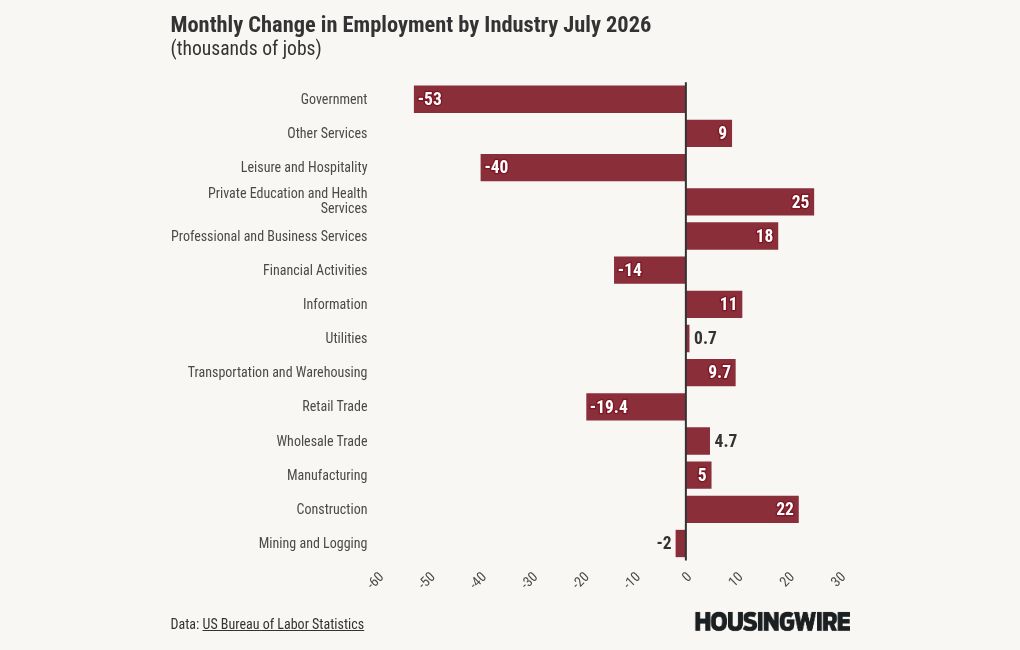
Financial activities also continued to weaken, losing 14,000 jobs during the month. Most of those losses occurred in credit intermediation and related activities, which declined by 9,000 jobs, and insurance carriers and related businesses, which fell by 7,000.
Employment in the financial sector has declined by 121,000 jobs since reaching a recent peak in May 2025.
Health care remained one of the economy’s strongest sources of hiring, adding 22,000 jobs in July.
A majority of that growth came from ambulatory health care services, which added 18,000 positions. While hiring continued, the pace slowed from the industry’s average monthly gain of 36,000 jobs over the previous year.
“A lower risk of additional Fed tightening could help keep a lid on longer-term interest rates and mortgage rates, easing some pressure on affordability,” said Williamson. “Slower hiring can also weigh on job mobility and consumer confidence, so the housing benefit is likely to be modest. Still, a cooler labor market that takes some pressure off borrowing costs would be a better backdrop for buyers than another leg higher in mortgage rates.”

Long-term unemployment drops slightly
The unemployment rates for teenagers and Hispanic workers declined during the month — while rates for adult men, adult women and white, Black and Asian workers were largely unchanged.
The number of workers on temporary layoff increased by 153,000 to 921,000, while the number of permanent job losses held steady at 1.7 million.
“The weaker July employment data might provide a little breathing room for the Federal Reserve as it considers its next policy move, but inflationary pressures are expected to persist through the remainder of 2026 with no clear end in sight for the war in Iran,” said Mortgage Bankers Association Vice President and Chief Economist Joel Kan. “We anticipate that the Federal Reserve will raise the fed funds rate in early 2027, but any additional upside surprises to inflation are likely to bring that timetable forward.”
Long-term unemployment edged lower to 1.8 million people — representing 25.5% of all unemployed workers. Meanwhile, 4.8 million Americans continued working part time for economic reasons because they were unable to find full-time work or had their hours reduced.
This article was written by Jonathan Delozier and generated with the assistance of HousingWire Automation. It was reviewed by a HousingWire editor before publication.

JPMorgan Recruits 40 Companies to Confront AI Infrastructure Risks
Jamie Dimon is personally calling chief executives across banking, energy, water, telecommunications and transportation to enlist them in an industry coalition built around the risks advanced artificial intelligence poses to the systems those companies operate.
The JPMorgan Chase chief executive is urging corporate leaders to join a U.S.-focused group addressing AI risk as American business rapidly adopts the technology, according to two people familiar with the effort. Dimon has reached out directly to CEOs at large and regional banks and at information technology firms, expanding a group JPMorgan helped found called the Alliance for Critical Infrastructure.
The outreach began in July and has reached more than 40 companies spanning financial services, energy, water, utilities, telecommunications, airlines, railroads and other technology-dependent critical infrastructure industries. Calls with prospective members are planned for August, and the alliance has not yet disclosed results from the initial approach.
From Cyber to AI
The alliance is not new — its focus is.
JPMorgan was among the founding members alongside Mastercard and Berkshire Hathaway Energy, and the organization was created to coordinate against cyber, geopolitical and physical threats to critical infrastructure operators. It is now being repositioned with artificial intelligence at the center.
Dimon said in a statement that he is proud to support the work, noting that alliance leadership identified AI as a priority years ago and began convening critical infrastructure companies around the issue.
The initiative aims to build a shared understanding of how AI is being used, what risks it creates and what safeguards are needed, and to work with the Trump administration on those questions. The revamped alliance is expected to be fully operational by the end of the year, according to a person familiar with the plans.
Water Systems Made It Urgent
The catalyst was not theoretical. Recent cyberattacks on water systems in Minnesota and other states have sharpened the need for information sharing across industries, the sources said.
Municipal water utilities are among the softest targets in American infrastructure — thousands of small operators, thin IT budgets, aging control systems, and no equivalent of the regulatory apparatus that forces banks to harden their defenses. When AI tools lower the skill threshold required to find and exploit those weaknesses, the exposure is not limited to the utility that gets hit.
That interconnection is the argument for a cross-sector group rather than a series of industry-specific ones. A compromised grid operator becomes a bank problem. A disrupted rail network becomes an energy problem.
Why It Matters That It’s Dimon
Dimon’s position at the head of the largest U.S. bank places him at the intersection of finance, technology, cybersecurity and government policy, and his voice carries unusual weight in corporate America. He has been among a small group of chief executives publicly warning about the risks of advanced AI systems.
He has spent years discussing AI’s capacity to transform business operations while growing more vocal about what happens when capable systems reach the wrong hands.
The significance of the move is structural. AI safety discussions have largely been conducted by AI developers — model evaluations, red-teaming exercises, voluntary commitments among a handful of labs. What Dimon is assembling is a coalition of the companies that would absorb the damage rather than the ones building the technology.
That shifts the conversation from what models can do in testing to what happens when they are pointed at a water treatment plant, a payment network or a dispatch system.
The Washington Angle
Working with the administration is an explicit goal of the effort. The alliance has also stressed the importance of public-private cooperation, framing the protection of systems Americans depend on as a shared responsibility at a moment of rising cyber threats.
The federal posture on AI has leaned toward acceleration and away from restriction, which leaves operators of critical systems to determine their own standards. A forty-company coalition setting shared expectations for AI deployment in essential infrastructure would function as de facto industry policy — written by the firms that carry the operational risk rather than by regulators or by the labs.
More than 40 companies have been approached since the outreach began. Whether they sign on, and what they agree to, will say a great deal about how seriously corporate America has begun taking the downside of the technology it is racing to adopt.
JBizNews Desk | New York
© JBizNews.com All Rights Reserved. Reproduction or distribution without written permission is prohibited.

Did you know the country’s only floating pool is in the Bronx?

Although it’s technically safe, you may not want to swim in the East River. Swimming on the East River, however, is an entirely different story. The Floating Pool Lady is not just a pool. It’s a floating pool within a retrofitted barge that’s currently docked at Barretto Point Park in the Hunts Point neighborhood of the Bronx. Best of all, it’s the only floating pool in the country.

As 6sqft previously reported, floating pools aren’t new to NYC. Following a growing awareness of public health and hygiene in the early 19th century, the city debuted the first free public floating baths in 1870. These were barge-like structures with a well in the middle, kept afloat by pontoons.
The wells were lined with slats that allowed river water to flow through. By 1911, the city had 15 floating baths, with an estimated yearly attendance of over 1.8 million people. However, the growing pollution of the Hudson and East Rivers made floating baths much less appealing, and by the 1940s, all of the facilities were taken out of commission.
The floating pool experience was entirely gone for nearly 70 years. But in 2007, The Neptune Foundation purchased a cargo barge and renovated it to include a half Olympic-sized pool, changing rooms with lockers, and a sprinkler station. The Floating Pool Lady was initially docked at Brooklyn Bridge Park but moved permanently to Barretto Point Park a year later. Unlike the floating baths of yore, the water in the Floating Pool Lady is chlorine-treated, so there’s no need to worry about polluted water.

Like all of the NYC Parks Department’s outdoor pools, the Floating Pool Lady is completely free and open from 11 a.m. to 7 p.m. Make sure to bring a combination lock, as personal items other than towels aren’t allowed in the pool area and locks aren’t provided.
The Bronx pool remains the only floating pool in the country and in New York City, but that will change soon. Plans to build a self-filtering floating pool in the East River off Pier 35 are at the finish line, but the pool most likely won’t be ready until next year after several delays.
RELATED:
- See the colorful makeovers of five NYC public pools
- Floating pools on the Hudson and East Rivers kept New Yorkers cool as early as 1870
- Roosevelt Island’s Manhattan Park pool transforms into a technicolor dreamscape for the summer
Editor’s note: The original version of this article was published on August 2, 2019 and has since been updated.
The post Did you know the country’s only floating pool is in the Bronx? first appeared on 6sqft.



Florida steakhouse owner, hostess defend monthly naked dinner event where guests fully disrobe
The C.L.A.S.S. Soiree Steakhouse located in Hollywood, Florida, welcomes diners to fully disrobe and eat a meal in the nude on the first Monday of each month.
While guests arrive wearing clothes, they’re free “to drop their clothes” after arriving at the restaurant, Tasheba Hart, who hosts the monthly events, told Fox News Digital during an interview on Wednesday while sitting alongside Chef Maurad Ali, the owner of the establishment.
Hart said she goes “totally nude” at the event, but noted that “if it gets a little chilly” she dons a robe.
FLORIDA STEAKHOUSE OFFERS CLASSY NUDE DINING EXPERIENCE THAT DOES NOT ALLOW ‘TOUCHY-FEELY STUFF’
She noted that only she and the guests are undressed, while the chefs and servers are “fully clothed.”
Ali explained that Hart, who does not work at the steakhouse on regular days, is the “head” of the nude dining events. She sells the tickets and gives the restaurant a cut of the funds, he said.
Hart said the tickets cost $150 for an individual woman, $250 for an individual man, or $300 for two people attending the event together.
She described the event as “a fine-dining experience.”
HIGH BEEF PRICES HITTING CONSUMERS AS MEATPACKING GIANT WARNS OF SUPPLY STRUGGLES
CLICK HERE TO GET FOX BUSINESS ON THE GO
Ali remarked that “this is not your grandpa’s steakhouse.”

Israel’s NY Consulate Drops New York Times
Israel’s consulate in New York will no longer pay for The New York Times. Consul General Ofir Akunis announced Friday that he has ordered the cancellation of every Times subscription held by employees of the Israeli Consulate in Manhattan, ending a standing institutional expense at one of Israel’s most prominent diplomatic posts abroad.
Akunis said the decision followed what he described as a series of false blood libels and sustained incitement against the Jewish state in the newspaper’s pages. He called the Times a paper that “consistently incites against the Jewish state.” Pointing to a recent report, Akunis accused the paper of building its account on unnamed and unreliable figures, and said the sources behind an earlier story were Hamas terrorists.
He did not identify the specific article by name. The Times had not issued a public response as of Friday evening.
What the consulate actually buys
The order covers workplace subscriptions — the digital and print access the consulate purchases for staff as a business expense, the same way law firms, banks and government offices buy news access for employees. Akunis is not directing Israeli citizens or the broader diplomatic corps to cancel anything. The action is confined to what the consulate itself pays for.
The consulate at 800 Second Avenue is Israel’s largest mission in the United States outside Washington and handles public diplomacy, business ties and consular services across the Northeast. Akunis, a former Likud lawmaker and government minister, has held the post since May 2024.
The financial math
For the newspaper’s owner, the dollar impact is close to nothing.
The New York Times Company reported second-quarter revenue of $762.5 million on August 5, up 11.2 percent from a year earlier, with operating profit of $118 million. The company added roughly 280,000 net digital-only subscribers in the quarter, lifting its total base to 13.35 million. Average revenue per digital subscriber came to $9.94 a month.
At that rate, a few dozen canceled workplace subscriptions amount to a few hundred dollars a month against a company generating more than $400 million a quarter in digital subscription revenue alone. The move is a statement, not a financial blow.
What makes the timing notable is that the Times is already under pressure from a direction that has nothing to do with Israel. Shares fell more than 13 percent after the quarterly report, because the 280,000 subscriber additions came in below Wall Street forecasts and below the 310,000 the company added in the prior quarter. Chief Executive Meredith Kopit Levien attributed the softness to a shifting information landscape controlled by a handful of large technology companies that are sending less traffic to publishers. The company also guided third-quarter digital subscription revenue growth down to a range of 12 to 15 percent.
In other words, the subscriber engine that made the Times the benchmark of the paid-news era is slowing for structural reasons — search and AI answering readers’ questions before they ever reach a paywall — and a diplomatic cancellation lands on top of that rather than causing it.
A longer-running dispute
Friction between the Israeli government and the Times is not new. The paper has previously revisited its own reporting on Gaza, including a case in which it said it had obtained new information, among other sources from the hospital that treated a Gazan child featured in its coverage. Israeli officials have repeatedly challenged the paper’s sourcing on Gaza; the Times has defended its reporting practices and its use of confidential sources.
The fight is over credibility rather than cash. Institutional subscriptions carry a signaling function beyond their price: universities, embassies and corporations buying a paper is a form of endorsement, and canceling is a form of withdrawal. Governments that have taken similar steps in the past — declining to renew media contracts, revoking press credentials, pulling advertising — have generally found the symbolic value outweighs the accounting.
What to watch
Two questions follow. The first is whether other Israeli missions in the United States follow the New York consulate’s lead, which would turn a single office’s decision into a government-wide posture. The second is whether consulate staff simply lose access to a newspaper their jobs arguably require them to monitor — a practical cost that falls on the consulate, not the publisher.
For advertisers and media buyers watching the New York market, the episode is a reminder that the institutional segment of news subscriptions, small as it is relative to consumer sign-ups, is exposed to politics in a way the consumer base is not. For the Times, the number that will move the stock next quarter is still the one that has nothing to do with Jerusalem.
JBizNews Desk | New York
© JBizNews.com All Rights Reserved. Reproduction or distribution without written permission is prohibited.


International, Israeli carriers set to expand Tel Aviv routes – report
United Airlines is set to resume flights to Israel on September 8 with two daily routes from Newark to Tel Aviv, according to a Friday N12 report.
The US airline’s return is expected to significantly increase competition on the routes from Israel to the US, which are highly sought out, said the report.
The announcement comes amid a wave of both international and Israeli airlines expanding operations at Ben-Gurion Airport.
KLM has also resumed operations, with a Tel Aviv-Amsterdam route restarting on August 25, according to the report. Sales for the route began on August 6.
The Dutch airline said on Friday that it “continuously adjusts its network based on commercial and operational considerations.”

The flights on this route will operate with a technical stopover in Larnaca, Cyprus, where the flight crew will have an overnight stay.
Lufthansa is also expanding its flights to and from Israel, according to N12, expecting to reach up to 67 flights a week beginning in September.
Israir joins competition
Amid the rise of global carriers, Israir is expected to join the competition soon, the report said. The Israeli carrier received approval from the Civil Aviation Authority of Israel to begin operating flights to the US and is expected to submit an application to the US Federal Aviation Administration for a final green light for flights to New York.

Fed Moves to Map the $1.3 Trillion Private-Credit Market
Two Federal Reserve banks are preparing to survey the private credit industry directly, an attempt to bring visibility to a $1.3 trillion financing market that has grown up almost entirely outside the reach of banking supervision.
The Dallas and New York Federal Reserve banks will launch a pilot survey of the estimated $1.3 trillion private credit market after the third quarter closes, the New York Fed said in a statement Wednesday. The two banks described the effort as exploring lending trends in the U.S. private credit direct lending market.
The New York Fed said the survey will produce insight into credit availability, how credit is being provided, how lending standards are evolving in private credit, and what all of it means for the broader economy and for monetary policy.
Segmenting by Borrower Size
The design of the survey signals what the central bank actually wants to know.
It will divide the market into three tiers based on borrower size: an upper middle market covering companies with more than $100 million in earnings before interest, taxes, depreciation and amortization; a middle market spanning $30 million to $100 million in EBITDA; and a lower middle market below $30 million.
That structure matters because the risk profile is not uniform. Lending to a company generating $150 million in EBITDA is a fundamentally different exercise than lending to one generating $20 million, and until now regulators have had limited ability to distinguish between the two in aggregate data.
Initial findings are expected in early 2027.
Why the Fed Is Looking Now
Private credit is a post-2008 creation. It emerged as a way to finance private equity buyouts when bank lending contracted after the financial crisis, then expanded into a primary source of debt for riskier businesses, pulling in capital from investors hunting yield.
The growth has been extraordinary. The U.S. market went from roughly $500 billion to $1.3 trillion over five years, reaching a scale comparable to the markets for bank loans and corporate bonds. Industry figures put it higher still — an LSTA survey of member firms pegged the U.S. private corporate credit market above $1.5 trillion, surpassing both the broadly syndicated loan market and the high-yield market.
The sector remains small relative to traditional banking, but it has drawn persistent concern over the quality of lending standards and the absence of transparency.
Fed Vice Chair for Supervision Michelle Bowman framed the issue plainly in congressional testimony earlier this year, describing private credit as a small share of bank lending categories but calling it opaque enough that the central bank needs more information from the institutions it regulates.
The Banking Connection
The reason this is a supervisory question rather than an academic one is that banks are not actually on the sidelines.
Credit lines extended by the largest U.S. banks to private credit vehicles rose roughly 145% between 2020 and 2024, reaching about $95 billion. Moody’s has estimated U.S. bank exposure to private credit at roughly $300 billion, part of more than $1.2 trillion in loans to non-depository financial institutions overall.
Banks lost origination share to private lenders and responded by financing them instead. The credit risk moved off bank balance sheets; the counterparty risk did not entirely follow.
Stress Is Already Showing
The timing of the survey is not accidental. Investors have accelerated redemption demands this year from business development companies — the publicly traded funds that hold much of this debt — driven by worries about competition, declining returns, and fears that artificial intelligence will disrupt the software businesses many of these funds have financed.
Some funds have limited withdrawals in response, a dynamic that has drawn comparisons to earlier liquidity episodes in less-transparent corners of finance.
What It Means for Middle-Market Borrowers
For the thousands of mid-sized American companies now financed through direct lending rather than bank credit, the survey has practical stakes.
Private credit became the default option for businesses that were too small for the syndicated loan market and too leveraged for a traditional bank. Speed and flexibility were the selling points — a direct lender can close in weeks with a covenant package negotiated one-on-one.
If the Fed’s findings prompt tighter standards, either through regulation or through banks pulling back their financing lines, the cost and availability of that capital changes for borrowers who now have few alternatives.
Global private credit assets grew from roughly $158 billion in 2010 to nearly $2 trillion by mid-2024, and Moody’s projects the market could double past $3 trillion in assets under management by 2028.
The Fed has decided it can no longer afford to be measuring a market that size from the outside.
JBizNews Desk | New York
© JBizNews.com All Rights Reserved. Reproduction or distribution without written permission is prohibited.
The AI feature race is over. Real estate agents need tools they can trust.
An AI button sits on nearly every real estate platform today. CRMs draft follow-up emails. Virtual staging tools furnish empty rooms in minutes. Video platforms turn listing photos into polished reels while the agent is still finishing another task.
The novelty has worn off.
For agents, teams and brokerages, the question is whether the product—and the company behind it—is dependable when clients, listings and revenue are on the line.
You can see the same shift outside real estate. For its 2026 AI Infrastructure Trends Report, Crusoe engaged MetaLab to survey 332 executives, decision-makers, technical influencers and practitioners involved in evaluating or implementing AI and cloud infrastructure. The survey was conducted in March 2025 across several industries.
Operational efficiency was the leading reason for investing in AI, cited by 69% of respondents. Participants also reported security and compliance concerns, performance problems, difficulty scaling, unpredictable costs and weak customer support. Ninety-seven percent rated ease of integration with existing infrastructure as important.
The study was not conducted specifically among real estate professionals, so its findings should not be presented as real estate industry data. Still, the underlying concerns—cost, reliability, integration and support—are familiar to agents and brokerages.
Time savings must survive the full task
“Faster” is one of the easiest claims a software vendor can make.
A listing-description tool may generate copy in seconds. That sounds efficient until the agent spends another 20 minutes correcting property details, smoothing clumsy phrasing, checking facts, reviewing fair housing concerns, formatting the result and moving it into another system.
The way to measure time savings is to look at the full task. Start the clock before opening the tool. Stop it when the work is ready to use — after editing, fact-checking, formatting and transfer into the MLS, CRM or marketing platform.
Some products remove real work. Others move the labor from creation to cleanup.
A result worth measuring
More content does not necessarily improve the business. More posts do not guarantee more conversations. More leads do not help if the data is poor. A polished listing video has little value if it misrepresents the property. Automated follow-up can do damage when it is badly timed or feels impersonal.
Before buying a tool, define the result you are trying to improve. That may be faster response times, more completed follow-ups, lower production costs, stronger listing presentation, fewer hours spent on repetitive administration or more appointments from existing leads.
That simple step keeps software bloat in check. A tool earns its place by solving a specific problem, not by adding more output to an already crowded system.
The real price tag
The advertised monthly fee is rarely the full cost.
Credits run out. Contact lists outgrow the entry-level plan. Text-message charges add up. Premium integrations and export limits can change the economics quickly. What looked affordable during the demo may look different three months later, once regular use pushes the account into a higher-priced tier.
Overlap matters too. A low-cost subscription is not a bargain if it duplicates something already available in a CRM, brokerage package or marketing platform.
An expensive tool may still offer better value if it replaces several subscriptions and gets used every day. A cheap tool can be wasted money if it becomes another forgotten login.
Fit beats feature count
Most agents already juggle more systems than they want. For an agent, integration means the product connects with the CRM, calendar, listing process and marketing systems already in use — less copying and pasting, fewer duplicate entries, less time hunting for where the work lives.
If a product requires manual handoffs from one tab to another, it is rearranging the workload rather than reducing it.
A long feature list matters less than whether the product fits the way the agent already works.
Support is part of the product
Support is easy to ignore during a trial because nothing important depends on the tool yet.
That changes when a lead stops routing, a campaign sends the wrong message or a listing video is not ready when promised. At that point, vendor support matters as much as the feature set.
During the trial, ask a real question. Note the response time, whether the answer solves the problem and whether a person can be reached when something important breaks.
Once software becomes part of a working real estate business, weak support turns into a real risk. A product should not become essential unless the vendor can support it when the stakes are real.
Oversight doesn’t end with the tool
AI-generated output should not move straight from the tool to the public.
Agents still need to verify property facts, review advertising language, protect client and financial information and follow applicable brokerage policies, MLS rules and disclosure requirements.
The basic safeguard is simple: nothing goes out without a person checking it first. Approval steps, access permissions and records showing what was generated or altered make it easier to trace a questioned photo or line of copy back to the final reviewer.
Human review is part of the agent’s responsibility.
A March 2026 REALTOR® News article published by NAR recommends that brokerages put AI policies in writing, including which tools are approved, how client and financial data is handled and who reviews material before publication.
The article is not formal NAR guidance or law. Its larger point still holds: moving faster does not excuse skipping the check.
The buying decision
AI can help real estate professionals work faster. That matters. But speed alone is no longer enough reason to buy another subscription.
A tool earns its place by doing useful work week after week — saving time, producing a result the agent can see, and staying priced predictably as usage grows. The agent must retain control over what gets published.
Vendors will keep adding AI features. Agents do not have to keep buying them.
Paul Parker has spent over 25 years in sales and sales management. He is the founder of AIandRealtors.com and author of Crypto Confidence.
This column does not necessarily reflect the opinion of HousingWire’s editorial department and its owners.
To contact the editor responsible for this piece: tracey@hwmedia.com
Bryan Ingenito joins Certainty Home Lending as EVP of national operations
Dallas-based mortgage lender Certainty Home Lending, an affiliate of Rate, has hired Bryan Ingenito as executive vice president and national operations executive, the company announced Thursday.
Ingenito brings more than 28 years of experience in mortgage lending and consumer banking operations, according to the announcement. He is based in the Greater Charlotte metro area.
He started his career as a loan officer at a regional independent mortgage bank before moving into operations leadership at one of the country’s largest national depositories, where he spent more than 25 years and rose to senior vice president. Over that span, he held national executive roles across mortgage fulfillment, process design, technology, performance management and small-business credit.
Certainty Home Lending said Ingenito has built and optimized large-scale fulfillment organizations through multiple housing and credit cycles. His work has included leading process and platform design initiatives and improving cycle times, as well as borrower and loan officer satisfaction, by tightening alignment between sales and operations.
“Operations is where the borrower experience is either won or lost, and Bryan has spent his career making sure it’s won,” CEO Franco Terango said in a statement. “His ability to build teams, design processes and drive performance at a national scale is exactly what we need as we continue to grow. We are thrilled to have him leading our operations.”
Ingenito said the chance to help shape a growing platform was a key factor in his move.
“I have spent most of my career inside a very large institution, and there is a lot you learn from that,” Ingenito said. “What drew me to Certainty is the chance to apply that experience in an environment where you can see the entirety of the impact. The team here is serious about building something, and I look forward to being a part of that.”
The hire comes as lenders continue to streamline fulfillment and servicing costs while preparing for a potential increase in origination volume if mortgage rates ease. For lenders operating nationally, consistent operations execution and turn times can be a differentiator with both borrowers and real estate agent partners, particularly in competitive purchase markets.
For housing professionals, Certainty’s move underscores how midsized and national lenders are investing in seasoned operations leadership to manage compliance, technology integration and borrower experience across markets. Centralized operations executives often oversee decisions on workflow design, automation and support for loan officers, all of which can affect how quickly and reliably loans close.
Dallas-based Certainty Home Lending has been in business for more than two decades. The company emphasizes a broad product set, technology and marketing support for originators, and a customer experience focus.
This article was generated using HousingWire Automation and reviewed by a HousingWire editor before publication.

Florida enclave dethroned as Silicon Valley AI boom lifts California ZIP code to No. 1
America’s most expensive ZIP code has officially returned to California, as the artificial intelligence stock surge has catapulted Silicon Valley’s ultra-exclusive Atherton past Miami’s tax-free paradise of Fisher Island.
But while deep-pocketed tech titans are willing to fork over nearly $10 million for modest Northern California properties, real estate experts say the move signals a high-stakes trade-off: Buyers aren’t staying in the Golden State for its tax climate or resort lifestyle — they’re paying a massive premium to remain plugged into the nation’s primary deal-making hub.
“Atherton offers something that cannot easily be recreated elsewhere: immediate access to the relationships and opportunities driving one of the world’s most influential technology economies,” Douglas Elliman’s Jenna Hoyas told Fox News Digital. “For many buyers, their business interests, investment networks, children’s schools and personal relationships are firmly rooted in Silicon Valley. The decision is not always a calculation of which state provides the most house or the lowest tax burden. At this level, time and access are often more valuable than savings.”
“The same $10 million is purchasing two very different interpretations of luxury. In Atherton, buyers are generally looking for a single-family estate with meaningful land, privacy and the ability to create a highly customized compound,” Douglas Elliman colleague Kristina Quesada also told Fox Digital.
CALIFORNIA WEALTH CHARTS A QUIETER PATH TO FLORIDA AS GULF COAST ENTER MULTIBILLION-DOLLAR BOOM
“On Fisher Island, $10 million is more likely to purchase a luxury condominium with water views, security, amenities and immediate access to a private resort environment. Buyers are trading a large private parcel for beachfront living, club access, services and a lock-and-leave lifestyle,” Quesada added. “Atherton offers ownership of the land and proximity to Silicon Valley, while Fisher Island offers a highly serviced lifestyle surrounded by water.”
Recent data from PropertyShark.com and Bloomberg show that Atherton’s ZIP code (94027) overtook Fisher Island (33109) after the Miami enclave spent two consecutive years as America’s most expensive ZIP code. Atherton’s median home price jumped roughly 20% to $9.93 million, while Fisher Island’s median home sale price fell to $8.3 million.
“Living in Atherton is about privacy, land and proximity to the center of Silicon Valley’s wealth ecosystem. It does not offer the highly visible resort lifestyle people associate with Miami,” Hoyas said. “It is intentionally quiet and understated, with large, gated properties, mature landscaping and very little commercial activity.”
“The rankings may continue to move between Atherton and Fisher Island because both markets have relatively few sales and a handful of major transactions can influence the median. I would not interpret one year’s ranking as evidence that California has reversed migration to Florida or that Florida has lost its appeal,” Hoyas said.
With OpenAI having confidentially filed for an IPO, alongside the public debuts of aerospace giant SpaceX and artificial intelligence rival Anthropic, billions of dollars in overnight liquidity could soon be unlocked for executives and middle management alike.
“The recent acceleration is undoubtedly connected to wealth created through AI, technology companies and equity gains, but buyers are not necessarily treating these homes as short-term purchases,” Quesada said. “A liquidity event may provide the capital and urgency to buy, while the long-term strategy is to secure an irreplaceable piece of land in a market with extremely limited inventory.”
“Atherton is also a market where newly created wealth often moves into real estate as both a lifestyle purchase and a way to diversify. The AI boom may be producing the buyers, but the scarcity of large parcels close to Silicon Valley is what supports the long-term value proposition,” Quesada continued.
The California-based agents say the biggest misconception about the wave of Silicon Valley buyers is that they’ve overlooked tax implications or “failed to compare what their money could purchase elsewhere.”
GET FOX BUSINESS ON THE GO BY CLICKING HERE
“They understand the financial differences very clearly. They are making the purchase because the property keeps them close to the companies, capital and relationships responsible for creating their wealth,” Quesada said. “For these buyers, a $30 million home in Atherton is not simply a house. It is a private base inside the ecosystem where they conduct business and build their future.”
“These markets serve different buyers and different priorities. Florida will continue attracting people seeking tax advantages, waterfront living and a resort-oriented lifestyle. California will continue commanding extraordinary prices wherever access to innovation, employment, education and established personal networks outweighs the financial advantages of relocating,” Hoyas said. “Atherton does not need to stop migration to Florida to remain one of the country’s most valuable residential markets.”



American Airlines Cuts the Value of Some Free Elite Upgrades
American Airlines is changing one of its most valuable frequent-flyer perks, with elite AAdvantage members on several premium domestic routes no longer automatically jumping from the Main Cabin directly into Business Class when complimentary upgrades clear.
Starting August 25, eligible travelers booked in Main Cabin on certain aircraft offering Premium Economy will generally be upgraded first into Premium Economy rather than Business Class. The change affects select transcontinental and Hawaii routes where American sells three distinct cabins.
For frequent flyers, that turns what could have been a lie-flat Business Class seat into a much smaller upgrade.
Travelers who purchase Premium Economy can still qualify for complimentary upgrades into Business Class when space is available. That creates a clearer hierarchy: Main Cabin passengers compete for Premium Economy, while travelers already paying for Premium Economy get access to the more valuable Business Class upgrade.
Routes affected include some of American’s highest-value domestic services, including transcontinental flights linking New York with Los Angeles and San Francisco, along with selected service to Hawaii. American has been expanding Premium Economy across more aircraft and routes, giving the airline another cabin it can sell separately rather than treating it simply as a step on the way to Business Class.
The change fits a broader airline strategy of protecting premium seats for paying customers. Business Class cabins can generate substantially more revenue than economy seats, particularly on long transcontinental flights, giving airlines an incentive to sell those seats rather than release them as complimentary upgrades.
American’s own AAdvantage rules continue to provide status members with complimentary upgrades on eligible North American flights when seats are available, but the cabin into which passengers are upgraded increasingly depends on the aircraft and ticket purchased.
For consumers who spend heavily with American or its credit-card partners to earn elite status, the change reduces the potential payoff on some of the airline’s most desirable routes. A complimentary Premium Economy seat still provides additional space and service, but it is far different from the lie-flat seats, premium meals and airport experience offered in Business Class.
The bigger shift is what American is signaling about loyalty: elite status still provides upgrades, but the airline increasingly wants travelers seeking its most expensive seats to pay for a premium cabin first.
JBizNews Desk | Fort Worth, Texas
© JBizNews.com All Rights Reserved. Reproduction or distribution without written permission is prohibited.

REMAX posts Q2 net loss of $4.3 million amid Real acquisition
REMAX Holdings Inc. reported lower revenue and earnings in the second quarter of 2026 as the franchisor prepares to be acquired by The Real Brokerage.
The Denver-based company said in a Securities and Exchange Commission filing on Thursday that total second-quarter revenue fell 5.8% year over year to $68.5 million. Revenue excluding its marketing funds declined 5.1% to $51.7 million, reflecting negative organic revenue growth of 5.1% and flat foreign currency impacts. Additionally, REMAX posted a net loss attributable to the company of $4.3 million. The firm is not holding an earnings call with investors and analysts due to the impending acquisition.
The company’s total agent count edged up 1.5% from a year earlier to 149,267 agents worldwide, according to the filing. But in the U.S. and Canada, where REMAX historically generates most of its system revenue, combined agent count fell 2.2% to 72,968.
According to the SEC filing, the deal with Real is expected to close in the second half of 2026, pending customary conditions and shareholder approval at both companies’ special meetings scheduled for Aug. 14, 2026. This comes after the Department of Justice (DOJ) granted the companies an early termination of their Hart-Scott-Rodino Antitrust Improvements (HSR) Act of 1976 waiting period for the proposed merger in mid-July.
The HSR Act is a federal law that was originally designed to strengthen antitrust enforcement, in part by giving the government advance notice of large mergers and acquisitions so they can be reviewed for competitive harm before they are completed. The act requires parties to notify both the DOJ and the Federal Trade Commission (FTC) about proposed mergers.
The Real Brokerage reported Q2 revenue of $700.6 million, up 30% year-over-year, with a net loss of $8 million, driven by $11.6 million in acquisition-related expenses for the pending REMAX deal.
Dream Finders Beazer deal targets $100 million cost savings
“I wooed thee with my sword. And won thy love doing the injuries. But I will wed thee in another key. With pomp, with triumph, and with reveling.
- Act 1, Scene 1, A Midsummer Night’s Dream, William Shakespeare
Dream Finders Homes and Beazer Homes announced early Friday that they have reached a definitive agreement under which Dream Finders will acquire Beazer for $33.50 per share in cash, valuing the transaction at approximately $2.2 billion in enterprise value.
As for pomp, the deal has been unanimously approved by both boards and, subject to Beazer shareholder and regulatory approvals and other customary conditions, is expected to close during the fourth quarter.
So ends – barring an unexpected intervention – a months-long pursuit that began privately, became hostile, moved into an increasingly public argument over valuation and negotiating terms, and ultimately ended with Dream Finders paying more.
The final $33.50 is $1.50 above Dream Finders’ most recent $32-per-share proposal and $7.75, or about 30%, above the $25.75 offer that turned the contest public in May. It is also $4.50 above the $29 private proposal Dream Finders had made in March.
Dream Finders succeeded in landing its target. Beazer got Dream Finders to pay more for it. With the agreement in hand, analysis turns to whether Dream Finders can make the economics work in a market navigating a slew of uncertainties and a sluggish pace of new-order demand.
And Friday’s announcement provides the first meaningful public look at how Patrick Zalupski and his newly strengthened leadership and board team believe they can do it.
Goldman Sachs & Co. LLC, BofA Securities, Zelman Partners and Vestra Advisors are acting as financial advisors to Dream Finders, Foley & Lardner LLP is acting as legal counsel and Edelman Smithfield is acting as strategic communications advisor.
J. P. Morgan Securities LLC and Moelis & Company LLC are acting as Beazer’s financial advisors. King & Spalding LLP is serving as legal advisor. Collected Strategies is serving as strategic communications advisor.
The transaction is funded through committed financing, including a land banking facility from Kennedy Lewis and Millrose Properties, preserving Dream Finders’ 100% land-light strategy.
The $100 Million Number
The most consequential number in the announcement after the $33.50 purchase price may be $100 million.
Dream Finders says the combination is expected to generate more than $100 million in annual run-rate cost take-out opportunities coming from production efficiencies, purchasing improvements, lower overhead, elimination of duplicate public-company expenses, higher mortgage and title capture rates, and lower insurance costs. DFH also expects the acquisition to be double-digit percentage accretive to earnings per share in year one.
As ambitious as those targets may be, they also begin to flesh out answers to questions that have run through The Builder’s Daily’s analysis of this pursuit from the beginning: What can Dream Finders do with Beazer that Beazer has not been able to do for itself?
Until this moment, Dream Finders could identify Beazer’s underperformance from public information. It could reasonably anticipate public-company cost savings and purchasing efficiencies.
What it could not publicly demonstrate was how much of Beazer’s performance gap reflected fixable operating inefficiencies and how much was embedded in the land base, community positioning, and other decisions that do not simply evaporate when ownership changes.
The company is now betting that scale, procurement, production, overhead reductions and greater penetration of its mortgage and title businesses can produce at least $100 million of recurring annual benefits.
Leverage risk on
Dream Finders says it will fund the acquisition with existing capital resources and committed financing from Goldman Sachs, Bank of America and affiliates of Kennedy Lewis Asset Management. Following closing, Dream Finders says it intends to maintain its “100% land-light strategy” and is committed to returning to, or improving upon, its current leverage metrics within 18 to 24 months.
Within that commitment is public acknowledgment of what we earlier noted as Dream Finders’ side of the risk equation when its bid reached $32: Leverage.
DFH entered this transaction already carrying higher leverage following a period of aggressive expansion. Now it is taking on a $2.2 billion enterprise-value acquisition and promising investors that the resulting balance-sheet impact can be worked back down within two years.
That makes the 18-to-24-month commitment almost as important as the $100 million synergy target. Dream Finders needs to integrate Beazer, extract costs, improve operations, generate cash and reshape the acquired land position while continuing to run its existing business through a housing market that remains challenging.
And then there’s the land
The announcement also gives a particularly interesting answer to another question we have followed throughout the pursuit. Dream Finders says the combined company will continue with a 100% land-light strategy.
Beazer does not arrive as a land-light blank slate. Dream Finders is acquiring an operating company with existing owned and controlled land, communities under development and capital already embedded in those assets. Converting the combined enterprise toward DFH’s model will therefore require more than applying a corporate philosophy to Beazer on closing day. Dream Finders can move land into third-party structures and use land-bank capital to reduce the amount of its own capital tied up in those assets.
As we have noted throughout this process, however, land-light does not mean land-cost free. Land-bank capital has a price. The third-party capital provider requires a return, which ultimately becomes part of the economics of the lots Dream Finders takes down.
The strategic question now becomes measurable over time: Can DFH improve Beazer’s capital efficiency enough to more than offset those costs while simultaneously reducing post-acquisition leverage?
Rick Beckwitt’s arrival looks different today
The timing of Rick Beckwitt’s July appointment as Dream Finders co-chairman also looks more consequential in retrospect. Beckwitt spent decades operating at D.R. Horton and Lennar, two companies whose histories were shaped in important ways by acquisitions, integration and the accumulation of local scale.
When Dream Finders announced his appointment last month, Beckwitt praised its asset-light model, disciplined growth and entrepreneurial culture. Now he is helping oversee the largest strategic step in that growth trajectory.
And Beckwitt appears directly in Friday’s announcement.
“This transaction represents an important milestone for Dream Finders and reflects our Board’s confidence in the strategic and financial merits of combining two leading companies,” he said, adding that Zalupski and his team have developed “a detailed integration plan to maximize synergies that will drive long-term growth and profitability.”
Scale changes overnight
The resulting company will be considerably different from the Dream Finders that entered 2026.
Dream Finders says the combination will create the sixth-largest U.S. homebuilder, based on 2025 revenue, operating across 26 markets and approximately 520 active communities. The combined footprint spans the Southeast, Mid-Atlantic, Texas, West and Midwest, with exposure across 26 of the nation’s 50 largest metropolitan areas.
That goes directly to Zalupski’s stated ambition.
“This combination is the next meaningful step in our journey to become a top 5 national homebuilder,” he said.
It also illustrates why Dream Finders persisted. Acquiring Beazer gives DFH in one transaction what would otherwise require years of organic community additions and multiple private-builder acquisitions: markets, lots, people, operating infrastructure and thousands of annual closings.
Scale, however, is not the goal in itself. Rather, the returns that come along with that scale.
And Dream Finders’ own Q2 results made that distinction particularly relevant. DFH entered this deal while working to improve elements of its own operating performance. The Beazer acquisition now adds a second improvement undertaking – vastly larger and more complex – to that task.
Beazer opts for certainty
The announcement also resolves the other half of the risk equation. For weeks, Beazer faced what we characterized as uncertainty risk.
Its board argued that Dream Finders’ offers undervalued the company. Yet the higher Dream Finders went, the more difficult the standalone burden of proof became. Rejecting $32 would have meant betting that Beazer’s independent strategy or one of the “additional” alternatives its board said it was considering could produce something better.
At $33.50, Beazer chose certainty. CEO Allan Merrill described the agreement as the culmination of a “comprehensive review of opportunities to maximize value” and said it provides shareholders with “a significant and certain cash return in an uncertain market.”
The final deal price still represents an implied purchase-price-to-book multiple of only 0.8 times. For all the debate about Beazer’s book value during the takeover fight, the company ultimately agreed to sell below it.
That is another data point for a homebuilding industry in which book value cannot automatically be assumed to establish the floor beneath a company’s acquisition value.
The drama is over. The experiment begins.
There is one final twist.
Beazer was scheduled to report fiscal third-quarter earnings on Aug. 10 – unusually late compared with its longstanding reporting pattern and on the final day for filing its quarterly 10-Q.
That timing had prompted longtime homebuilding analyst Dan Oppenheim to wonder whether the date was merely a placeholder and whether something else might arrive first. Something did.
Beazer released its results Friday and, because of the pending acquisition, withdrew its previous financial outlook and canceled the Aug. 10 earnings call.
The Summer of ’26 courtship is therefore effectively over.

Trump Says Gas Prices Could Rise If US Strikes Iran Again
Trump made the remarks in an interview with Punchbowl News after being asked about comments he made during an Aug. 5 rally in Las Vegas, where he predicted that easing tensions with Iran would drive down energy costs, while also hinting at the possibility of a short-lived price spike.
“As soon as this situation ends with Iran, oil is going to go down to the floor, gasoline’s going to go down,” Trump told rally-goers….

Saudi Arabia, Turkey, and Pakistan sign major defense pact amid Iran tensions
Turkey, Saudi Arabia and Pakistan signed a joint defence agreement in Mecca on Friday, Pakistan’s foreign ministry said, as the three countries sought to deepen security cooperation amid heightened military tensions and conflicts in the Middle East.
The agreement says that any armed attack on any one of the three countries will be regarded as an attack against them all, the statement from the ministry said.
🔈 PR No. 2️⃣0️⃣4️⃣/2️⃣0️⃣2️⃣6️⃣
Makkah Al-Mukarramah Summit for Joint Defence
🔗⬇️ pic.twitter.com/mIzASADmau
— Ministry of Foreign Affairs – Pakistan (@ForeignOfficePk) August 7, 2026
The move marks a significant step in efforts by the three regional powers to deepen security cooperation amid growing tensions and the ongoing war between the United States and Iran.
A Turkish official told Reuters that the agreement was defensive in nature, was not directed against any specific actor, was open to other regional countries, and did not abrogate or replace any existing bilateral or multilateral arrangements.
A source close to the Saudi government and military, speaking anonymously to Agence France Presse (AFP), said that “the agreement has been under discussion for a long time, but recent developments in the region accelerated the process.” Two additional regional sources with direct knowledge of the matter confirmed the planned timetable to Reuters.
The closely watched summit brought together Saudi Crown Prince Mohammed bin Salman, Turkish President Recep Tayyip Erdogan, and Pakistani Prime Minister Shehbaz Sharif.

Erdogan departed Ankara on Friday morning for a brief working visit, accompanied by senior Turkish officials. Sharif and Pakistan’s army chief, Gen. Asim Munir, arrived in Saudi Arabia a day earlier, landing on Thursday and received at Jeddah airport by the deputy governor of the Mecca region.
Defense agreement goes ‘beyond short-term considerations’
A spokesperson for Pakistan’s Foreign Ministry stressed that, despite tensions in the Gulf, the visit has “significance that goes beyond the immediate crisis and short-term considerations.”
According to a report from Turkiye Today, the agreement was a natural development in the increasingly close ties among the three countries, which are now drawing international attention.
Saudi Arabia and Pakistan signed a joint defense pact last year, a move that attracted considerable attention because of Pakistan’s status as the only Muslim country possessing nuclear weapons. Turkey, meanwhile, has recently played an active diplomatic role in efforts to end the war in Gaza and, in late July, became one of 14 founding members of a Riyadh-led maritime defense coalition.
The closer ties among the three countries come at an especially turbulent time in the Middle East. The war between Washington and Tehran has drawn Gulf states into the conflict and caused severe disruptions to maritime trade routes through the Strait of Hormuz and the Red Sea.
The trilateral defense alliance, combining Saudi Arabia’s economic power, Turkey’s military strength, and Pakistan’s nuclear arsenal, could reshape the regional balance of deterrence and serve as a significant counterweight to Iran on the international stage.

Stocks Rally As US Sheds 23,000 Jobs, Fed Hike Bets Fade
The American economy lost jobs in July for the first time in months, and the stock market went up on the news. That is not a contradiction — it is the entire logic of this market in one morning.
July nonfarm payrolls contracted by 23,000. Wall Street had expected an increase of 83,000. The unemployment rate fell to 4.1% instead of holding at the 4.2% economists forecast, and the labor force participation rate slipped to 61.4% from 61.5% in June. The unemployment rate dropped for the wrong reason: fewer people counted as looking for work, not more people finding it.
The report arrives as a central input for the Federal Reserve, which has been weighing an interest rate hike at its next meeting — a posture driven by inflation and heavy artificial-intelligence capital spending rather than by the labor market. A contracting payroll count makes that hike harder to justify.
Rates, Dollar And The Fed Path
The 10-year Treasury yield fell five basis points to 4.63% and the dollar declined. Money markets still price a Fed hike this year, but no longer before December.
That is a full reversal from the previous session. On Thursday the 10-year yield rose seven basis points as higher oil revived the case for the Fed staying tight, while the dollar posted its biggest gain in two weeks and gold climbed more than 1.4% toward $4,300 an ounce. Two days, two opposite verdicts on the same central bank — one written by crude prices, the other by payrolls.
The Open
The S&P 500 advanced 0.3% after the bell, the Nasdaq Composite climbed 0.8%, and the Dow Jones Industrial Average added 67 points, or 0.1%. The Russell 2000 went the other way, slipping 0.58%. Thursday’s session had closed lower across the board, with the Dow off 0.85%, the S&P 500 down 0.18% and the Nasdaq easing 0.06%.
The week has been a strong one: the S&P 500 is up more than 3% and is heading for a second consecutive weekly gain, while the Nasdaq is tracking its best week since April with a rise above 4%. Semiconductors did the heavy lifting, with the iShares Semiconductor ETF up more than 7% on the week.
One market veteran framed the open question as whether this is a real uptrend or a failed move — noting the problems that drove July’s decline are all still in place, and what changed this week was the mood. Defensively positioned traders were caught out and had to scramble, producing two large trend days, with Hormuz optimism and strong earnings adding to the push.
Market Movers
Doximity more than doubled at one point premarket after its chief executive said the company’s new AI search product earns more than ten times per search what it costs to run.
Twilio rose 17.5% on adjusted earnings of $1.47 a share against a $1.32 consensus, with revenue up 22% to $1.50 billion and organic growth of 17% excluding carrier pass-through fees. Cloudflare gained more than 16.5% on full-year and current-quarter guidance. Atlassian also surged, raising its full-year revenue growth forecast to roughly 20% from 14% to 16% and adding $100 million to its buyback authorization.
Airbnb advanced 8.8% after second-quarter revenue rose 17% to $3.6 billion and GAAP earnings of $1.37 a share landed 9.5% above consensus, helped by travel demand around the FIFA World Cup hosted across North America.
Solar was the policy trade. First Solar advanced more than 7% premarket, SolarEdge rose 1% and the Invesco Solar ETF gained 4% with Sunrun and Enphase also higher after Thursday’s tariff action. First Solar’s thin-film modules do not depend on Chinese crystalline silicon supply chains, so import duties squeeze competitors while leaving its own cost base largely untouched — on top of a second-quarter beat with net income of $423 million, or $3.92 a diluted share, up 23% year over year, and a contracted backlog of 45.1 gigawatts running through 2030.
On the losing side, The Trade Desk fell 27% after adjusted earnings of 34 cents missed the 40-cent estimate and revenue of $715 million came in below the $751 million expected. Wendy’s dropped 2% after global sales fell more than 6%, including an 8.2% decline in the US, and the company withdrew its 2026 outlook. Sezzle also slid. Fiserv remains under pressure after cutting full-year adjusted earnings guidance to $7.20–$7.40 a share from $8.00–$8.30 and guiding organic revenue to flat or down 1%; the stock is off nearly 20% this year after a 68% drop in 2025, with Jana Partners pressing for a strategic review.
Commodities
Oil wavered as traders weighed the Strait of Hormuz negotiations. October Brent traded up 1.25% at $83.52 and September West Texas Intermediate up 1.10% at $78.14 earlier in the session, before slipping to around $82.25 and $77.20 respectively, leaving both benchmarks on course for weekly losses of more than 8%.
That weekly decline traces to Tuesday, when Treasury Secretary Scott Bessent said a Hormuz deal with freedom of movement could come as soon as Wednesday. Thursday reversed part of it, Brent closing up 3.8% at $82.49 after Iranian state media published restrictive draft conditions for the strait. For context, Brent gained 24% in July and WTI 21%, the biggest monthly advance since March.
The World Behind The Tape
President Trump said late Thursday that the Hormuz talks are “moving along,” while Iranian lawmakers spent Friday debating the wording of an agreement with Oman. The published draft would bar American and Israeli vessels from the strait, which carried about a fifth of global oil and liquefied natural gas shipments before the war began in late February.
Supply pressure came from two other directions: Ukraine struck two major Russian refineries overnight, and US imports of Saudi crude fell to zero in July for the first time since 1985. The Houthis attacked Saudi military positions and infrastructure, putting Red Sea routes back in question.
On trade, Trump’s 15% polysilicon duty and minimum import prices — signed Thursday under Section 232 on the advice of Commerce Secretary Howard Lutnick — open another front against China in chips, energy and AI.
What To Watch
Vistra reported second-quarter results this morning and Take-Two posted its fiscal first quarter. Next week brings Barrick and Simon Property on Monday, with Super Micro later in the week. The setup into mid-August is a market betting the Fed stays on hold, a labor market that just weakened, and an oil price that answers to a document being drafted in Tehran.
JBizNews Desk | Wall Street
© JBizNews.com All Rights Reserved. Reproduction or distribution without written permission is prohibited.
Hamas sees demilitarization talks as strategy to ‘trap Israel,’ Zini warns security cabinet
Shin Bet Director David Zini warned Israel’s security cabinet that Hamas views the demilitarization agreement signed with the Board of Peace as a means of constraining Israel’s military freedom of action rather than advancing genuine disarmament, according to sources familiar with the discussion.
Speaking during a security cabinet meeting on Tuesday, Zini said Hamas believes it should have pursued the demilitarization agreement with the Board of Peace in order to “trap Israel” and prevent it from carrying out military operations in the coming months.
According to Zini, Hamas’s strategy is to stall the process while waiting to see what will happen in the next few months and also wait for political developments in Israel.
“They are dragging their feet,” he told ministers, according to the sources. “They are waiting for the elections, and then they will see what happens.”
The assessment was presented as ministers debated the proposed roadmap for Gaza’s demilitarization and post-war arrangements.

Cabinet ministers warn Netanyahu against 14-day preparatory period
According to two Israeli officials in the meeting, the was a consensus among cabinet ministers, who told Prime Minister Benjamin Netanyahu that Israel must avoid taking any steps that could be interpreted as entering the proposed 14-day “preparatory period for demilitarization” – a phase that would require Israel to halt targeted killings of Hamas terrorists.
The discussion also clarified Israel’s current position regarding the Board of Peace initiative.
According to the officials, Israel has neither signed nor formally approved the demilitarization roadmap with Hamas published by the Board of Peace.
In addition, a separate document concerning the deployment of a multinational force into Gaza was also left unsigned after Israeli officials raised numerous objections. Some of those reservations were outlined publicly this week in a joint letter by Finance Minister Bezalel Smotrich and Settlements and National Missions Minister Orit Strock.
As a result, Israel has not officially authorized the entry of the proposed multinational force into Gaza despite cabinet discussions on the issue, the sources said.
Framework falls far short of genuine disarmament, Strock said
Cabinet Minister Strock sharply criticized the proposed demilitarization framework in a conversation with the The Jerusalem Post, arguing that it falls far short of genuine disarmament.
“As long as the Board of Peace believes it is advancing toward the desired goal, it does not understand how much this agreement empties the concept of demilitarization of its real meaning,” she said, according to participants.
“The very fact that weapons remain in Gaza is not demilitarization. The Board of Peace defined the mission as ensuring there would be no weapons in Gaza. After October 7, it is clear that this must mean exactly that – no weapons. This is not about checking a box.”
Strock also warned against transferring Hamas’s weapons or security responsibilities to a future Palestinian police force.
“The goal is to ensure Hamas’s weapons are not simply transferred to a new Palestinian police force operating under Palestinian law,” she said. “When the Palestinian police was established in the West Bank, it operated under legislation that incentivizes the murder of Jews. Is this the legal framework under which the new police force is supposed to operate?”
She also referenced comments previously made by US President Donald Trump after meeting released Israeli hostages.
“Trump asked the hostages, ‘Nobody helped you?’ He was shocked that nobody did,” she said, arguing that the events of October 7 underscore the need for complete disarmament and removing all weapons from Gaza rather than partial security arrangements.
Outrage in Iraq after female detainee allegedly gang-raped by police, prison officials
Disclaimer: This story contains disturbing imagery, including references to sexual assault and violence.
Three police personnel and a duty officer allegedly raped a 26-year-old detainee at Iraq’s Al-Nahda Police Station in Diwaniyah province in late July, according to Arabic media reports and statements made by official ministries.
Investigations into the incident began after senior officials at the station realized that the surveillance cameras had been turned off.
Sundus Al-Mousawi, head of the Women and Children Committee on the Diwaniyah Provincial Council, told Independent Arabia that the young woman had been detained at the station in connection with a legal case under Article 248, which criminalizes actions involving deceit, alteration of evidence and the provision of false information during an investigation.
“On July 28, reports circulated on social media that a 26-year-old woman had been sexually assaulted by a captain, a police commissioner and two police officers. I immediately went to the office of the police commander, Major General Najah Al-Bayati, to ask about the details of the crime,” Mousawi said.
“We were told that one of the officers had called and informed them that the cameras at the station had been switched off. It was 4 a.m. when we went to the station to investigate. There, we questioned the female detainees, who told us that a girl had been taken out for two hours. After questioning, the captain and police officers confessed to the immoral crime that had taken place under the Iraqi flag and under the umbrella of the law.”

The victim was from ‘difficult social circumstances’
Mousawi described the young woman as a “thin, pale” orphan with four children who was the victim of difficult social circumstances.
Human rights researcher and activist Manar Al-Zubaidi told the site that “the woman has no income and needs psychological support.”
“Her dignity cannot be violated in a security institution that is supposed to protect her and represent the sovereignty of the state,” Zubaidi said.
Though the Interior Ministry published a statement saying that “the ministry will not tolerate any violation that harms human dignity or contravenes the law,” human rights activists and lawyers commenting on the case said there were limits to the number of women who would see justice, as social stigma and external pressure often force women into silence, allowing perpetrators to go free.
Mousawi has reportedly since demanded that a prison managed by female staff be established for female prisoners.
Rapists are often allowed to escape justice in Iraq, under Article 398 of the Iraqi Penal Code, which allows them to escape justice so long as they marry their victim. The maximum penalty for rape, without the marriage of the victim, can be life in prison depending on the circumstances surrounding the case.
Victim of child marriage in Iran dies of wounds after self-immolation, human rights groups claim
A young victim of child marriage died earlier this week in Iran, 11 days after she set fire to herself in Piranshahr in Iran’s West Azerbaijan province, according to reports by Iranian media and human rights groups.
Soma Moghaddi, 18, reportedly set herself on fire after years of abuse from her spouse, according to HRANA News Agency, the news agency of the Human Rights Activists in Iran. It is unclear how old she was at the time of her marriage.
The self-immolation left Moghaddi with burns on 90% of her body, and Iranian media reported that she was transferred from the Piranshahr City Medical Center to the Imam Khomeini Hospital in Urmia for treatment, but passed away despite efforts to save her.

Being married as a child ‘inflict[s] irreparable damage’
Multiple Iranian media sites, including khabarfoori and Rokna, have reported that there are rumors that Moghaddi’s husband may have been involved in the incident, though judiciary authorities have not commented on the case.
“The physical and psychological harms resulting from child marriage inflict irreparable damage on the lives of these children,” HRANA said in a statement. “These harms include pregnancies under the age of 18, maternal mortality, depression, suicide attempts, divorce, failure to complete education, and the perpetuation of the cycle of cultural and economic poverty.”
Under Article 1041 of the Iranian Civil Code, girls under 13 and boys under 15 can legally marry with the consent of a paternal legal guardian and court approval, with no absolute minimum age set for marriage.
US weapons shortages could leave America vulnerable to China, historian warns
Dr. Kobi Barda, a historian specializing in American politics, warned on Friday that strains on US military stockpiles could leave Washington vulnerable if another major power, particularly China, were to enter a conflict.
“If I were an American today, I would be very worried if tomorrow morning China decided to enter the conflict,” Barda told 103FM. He added, “There may currently be weakness in the United States.”
Barda pointed to reported shortages in US military stockpiles and the amount of time that could be required to replenish key weapons systems.
“It is possible, it has been done in previous wars, when a large part of production was mobilized for the war effort. At least four years, according to the American media, is the time required to replenish the stockpiles of Tomahawk missiles and all the defensive missiles.”
“In principle, the feeling is that there is indeed some kind of shortage in the stockpiles, especially in light of the war, which is extremely intense in the Ukrainian arena, and this paints a fairly bleak picture of what is supposed to happen as the campaign continues at this time.”

Germany’s abundance of Chinese cars could drown local industry, Barda claims
He also cited Germany as an example of how economic dependence on foreign countries could complicate efforts to expand defense production, particularly as European manufacturers face increasing competition from China.
“An interesting story in Germany reflects the challenge posed by China, where Volkswagen is dealing with Chinese vehicles flooding its market. The company wanted to convert some of its production lines to manufacture heavy trucks intended to carry missiles, but the move was blocked because Qatar holds enough shares in the company, and it is blocking the merger with Israeli technology companies.”
“The question arises as to what it means to be dependent on an Arab country like Qatar, which decides what the factories will produce and what they will not, while the market is flooded with Chinese products.”
Barda also criticized Washington’s approach to Iran, arguing that the US appears determined to avoid further complications at least until after the midterm elections.
“It appears that there is a desire at any cost to try to get through the coming period, at least until after the midterm elections. In this context, there is no other way to put it except ’embarrassing,’ Iran is demanding to negotiate the division of highway robbery in the Strait of Hormuz with Oman alone, without a third party, and the Americans are willing to swallow it.”
25 years after the Sbarro bombing, one family is still fighting to bring Ahlam Tamimi to justice
August 9, 2001, was a sultry summer day. A time for families and teens to take to the streets of Jerusalem to celebrate the weeks before returning to school; a time for meet-ups, for shopping, for stopping at local eateries for fun food and good conversation.
It was the 20th of Av, after the mourning period of Tisha B’Av. The unsuspecting families and friends of 15 people did not yet know that their own mourning period was about to begin.
Israel was already in the throes of the Second Intifada, which followed on the heels of the First Intifada, which followed terror attacks in the wake of the signing of the Oslo Accords, which echoed the terror attacks of the 1970s, and earlier, going back many, many decades, long before Israel was declared a state.
But Israelis are irrepressible, and determined that life will go on.
So August 9 was the day that Malki Roth, 15, and her friend and next-door neighbor, Michal Raziel, 16, left their homes in the Ramot neighborhood of Jerusalem and headed for town. After decorating the bedroom of a friend who was due to return later in the day from a family vacation in the US, the girls decided to stop off for a quick lunch at one of their favorite central Jerusalem places before heading to a pre-camp counselors gathering in another part of town. That’s how they came to be at the popular, bustling Sbarro pizzeria just before 2 p.m.

An inconspicuous young journalism student, a guitar case packed with explosives
Meanwhile, Ahlam Tamimi, a 21-year-old Jordanian journalism student who worked evenings as a news reader for an Arab TV station in Ramallah, left the city in the company of 22-year-old Izzedine Suheil el-Masri. Together they took a taxi to the Kalandiya checkpoint north of Jerusalem, where they got out and walked across into Israel.
They looked like a modern 20-something couple, perhaps tourists. The guitar case slung across his shoulder attracted no interest from the Israeli security personnel manning the checkpoint. And no one guessed that the female was the first woman ever admitted to the ranks of Hamas terrorists.
Another taxi brought them to east Jerusalem’s Damascus Gate from where they walked into the heart of Jerusalem, separating at the crowded crossroads of Jaffa Road and King George Avenue.
At 2 p.m., Masri, standing next to Malki and Michal, activated the guitar case, which was packed with 10 kg. of explosives and a significant quantity of nails to enhance the skin-shredding effect. Malki Roth and Michal Raziel were among the dead. Tamimi later boasted that in scouting for a target-rich site in the capital, she was particularly alert to places that attracted children.
Half of the dead were children. Five members of the Schijveschuurder family – both parents and three children – perished.
In addition to Malki, two other American citizens were killed: Shoshana Yehudit Greenbaum, a young wife pregnant with her first child, herself an only child, died on that day. Chana Tova Chaya Nachenberg was severely injured. She was in a coma for almost 22 years and succumbed to her wounds on June 1, 2023. (This citizenship issue became important later.)
In the minutes after the horrific boom, Jerusalem’s cellular phone network collapsed under the pressure of calls. The Roths and many others frantically did what they could to find their children, contact hospitals, search for loved ones.
The victims’ families eventually received the horrifying news. The Roths received theirs from their two older sons who had been brought to the Abu Kabir Forensic Institute by a social worker. The victims were buried the next day; 15 pre-Shabbat funerals. And then the shiva period began.
Tamimi was tracked down and captured by the Shin Bet (Israel Security Agency) and Israeli security forces, and in 2003, an Israeli court sentenced her to 16 consecutive terms of life imprisonment.
She confessed to all charges, smiling throughout the proceedings. The judges recommended she never be eligible for early parole or a pardon.
Arnold Roth wrote in 2021, as a guest columnist in Bari Weiss’s Substack:
“A video clip of her presenting that night’s news bulletin on Al-Istiqlal TV may be the only instance in the annals of television where an atrocity was reported by the perpetrator. Later, Tamimi spoke of how hard it was to suppress the jubilation that the deaths and injuries of Jews – especially Jewish children – aroused within her.”
A religious-Zionist family
Frimet (Moseson) and Arnold Roth made aliyah from Australia in 1988. Frimet, a native New Yorker, says, “Everything [in this case] revolves around the fact that I’m an American citizen and so was Malki.”
She grew up in Queens and met Arnold when he was at Yeshiva University. “He had to go back to Australia shortly after we met because his father became ill. Phone calls were expensive in those days, so it was an aerogram courtship. We became engaged long distance, and we didn’t see each other again until two weeks before the wedding.” They got married in New York and immediately afterward moved to Australia, where they lived for the next 12 years.
Arnold recalls, “On our very first date, she asked me what my plans were for aliyah.”
Arnold was a lawyer in Melbourne and planned to do the same in Israel. “I gave up practicing law after a few years in Jerusalem and shifted my professional focus to running technology companies.” Frimet qualified as an attorney but, with seven children, she says, “I was a stay-at-home mother.”
Malki, born in Israel, was child number four, the “filling in the sandwich,” a bright student, active in the Ezra youth movement, vivacious, a talented musician, and involved in volunteer work. The Roths’ youngest daughter, Haya, now 31, has severe disabilities. Frimet says, “She’s basically like a baby.” Haya lives at home.
Frimet gives us a window into the world of who her middle child was.
“Malki was very, very devoted to her youngest sister, and she helped me immensely, even though she was just a child herself. She also loved her in a very, very unusual way.
“She was drawn to helping other disabled people, children, and she would volunteer in all kinds of situations, probably because she had a disabled sister… One summer, she volunteered at the home of a young single mother in our neighborhood who had a very disabled child who subsequently passed away from his syndrome. Malki would go there every day and help the mother take care of the child.
“Nobody told her to do it. She just found out about her and did that. Also in school, there was a class for girls with special needs. The other kids their age didn’t really interact with them.
“But Malki, at break time, would always go over to them and spend time with them and talk to them. She was the only one who did that. That’s the kind of person she was. She was amazing. Very unique.”
The Roths have a caregiver in the daytime hours to care for Haya, and Frimet says, “I take care of her right through the rest of the 24-hour cycle. So it’s very, very draining on me. She needs everything done for her, absolutely everything.”
To deal with their overwhelming pain, and to honor Malki and who she was, they created Keren Malki – the Malki Foundation – which has helped thousands of Israeli families with special-needs children, equipping them with medical equipment and therapies not provided by the healthcare system.
Why was the public not warned of the suspected terror attack?
Frimet Roth tells The Magazine, “A few days after the Sbarro bombing, [then-justice minister] Meir Sheetrit appeared on a news program. I watched and wrote about it in at least one article. It still hurts me terribly. [Frimet published an op-ed on this in The Jerusalem Post on August 8, 2023.]
“He said that on the day of the bombing, in the hours preceding, the government was given intelligence information that a terrorist was on his way into the city and intending to commit a terror attack, a bombing. And they were hunting for him. He said, ‘We did not alert the public.’
“And apparently the hospitals were notified in advance to be prepared. But we, the general public, were kept in the dark.
“I would never have allowed Malki to leave if I had known what the police knew. In similar situations when intelligence was obtained about terrorists, they shut the city down. I think it was Haifa they shut down for some hours, the entire center of the city.
“They learned. But that day, not only didn’t they want to shut down the city, they didn’t want to warn us because there would be panic. It eats me up alive when I think back to what they did and what they failed to do. And he had no compunction about appearing and announcing this to us, telling us that this is what those in power did.
“I’m sure that nobody in their own families were walking the streets that day because they knew.
“There are so many levels to this travesty, this outrageous conduct, right down to the fact that one of those involved in that decision had no hesitation in sharing it afterwards.”
Frimet’s memory is corroborated by two sources. One, by an official briefing by justice minister Meir Sheetrit at the National Media Center, Jerusalem, on April 1, 2002, in which he said: “That same morning, we gave [PA head Yasser]Arafat information about a terrorist who we understood was ready to carry out an attack in the Jerusalem area – we did not know where and when the terrorist would strike, but we asked Arafat to stop him.”
In addition, then-Shas MK Nissim Ze’ev asked in the Knesset in 2004:
“In one sentence, I want to say and remind everyone: in the Sbarro restaurant, when [15] men, women, and children were murdered, the then-mayor of Jerusalem, [Ehud] Olmert, said: ‘I waited to hear the expected explosion, because there were ‘hot warnings’ [immediate security threats].”
“The public did not know there were hot warnings, and I didn’t understand then: If the mayor knows, and the police are searching for the terrorist, why doesn’t the public also have the right to search for the terrorist together with the police? So, it is possible there would be some panic among the public, but it is possible that terror attacks such as these could be prevented. Therefore, Mr. Speaker [of the Knesset], it is perhaps appropriate to rank warnings according to the real situation on the ground.” (The 168th Sitting of the Sixteenth Knesset, Wednesday, 28 Tishrei 5765, October 13, 2004)
I could not find a response, in Hebrew or English, from Olmert that contradicted what Nissim Ze’ev said, and the Magazine did not receive a response from him when I reached out to the Government Press Office. However, according to JTA, Olmert said at that time: “We tried to do everything to prevent it. Unfortunately, this time we were not successful.”

The Schalit deal
Shockingly, Tamimi was among the 1,027 convicted terrorists released by Israel in exchange for Gilad Schalit, an Israeli soldier who had been held hostage by Hamas for five years. It was not the first time Israel had reneged on its proclaimed policy to never release terrorists “with blood on their hands.” That past decision – that had led to the courageous Entebbe rescue – was a distant memory.
Ironically, the terrorists’ release was done under the leadership of Benjamin Netanyahu – the younger brother of the heroic commander Yonatan, who was killed in Entebbe – and a prime minister who, Roth noted in his column on Weiss’s platform, “made his international reputation by authoring a bestseller arguing that deals must never be done with terrorists.”
Another terrorist released in the Schalit deal was Nizar Tamimi, who, together with his cousin Said, had perpetrated the murder and then the burning of the body of Chaim Mizrahi in 1993. It was only six weeks after the signing of the Oslo Accords (as Caroline Glick pointed out in her Post column in 2017). They were both sentenced by Israel to life in prison. Nizar, a cousin of Ahlam Tamimi, became her husband after his release. Said was released in 2013.
In October 2020, Nizar was deported by Jordan to Qatar, which does not have an extradition treaty with the US.
Many terrorists released through the years in deals with the devil returned to terror. Among those most monstrous terrorists released in the Schalit deal was Yahya Sinwar, who masterminded the mega-atrocity of Oct. 7.
Abdallah Barghouti was the bomb-maker who constructed the explosives for the Sbarro horror. He was sentenced by an Israeli court to 67 life sentences in 2004 for his role in this and other terror attacks. So far, Israel has resisted releasing him in the various deals made with terrorists.
While Tamimi was serving her sentence in an Israeli prison, the Center for Near East Policy Research produced a 2007 film titled For the Sake of Allah, created by Shawn Bayer alongside Dr. Ronni Shaked, a fellow at the Harry S. Truman Research Institute and a senior commentator for Yediot Aharonot. The film features an interview with Tamimi inside the prison, where she sits in front of attractive bookshelves. In the footage, she wears a calm half-smile and a white hijab – which she did not wear that Aug. 9 night while reading the news, and probably was not wearing that day that she walked through an Israeli roadblock.
The four-part video is eye-opening and bone-chilling. Tamimi describes (in Arabic, translated to English by Shaked) in minute detail how she got the call to implement the operation, meeting her collaborator, Izzedine el-Masri, in Ramallah. “We just acknowledged one another through eye contact, and from here we started the operation. On Jaffa Street, we started to talk. It was the first time I spoke with him. I interpreted it as his real desire to be a martyr and to meet Allah.
“Izzedine el-Masri asked me just one question: ‘Are there religious Jews in the place where we are going to conduct the attack?’ I said yes, there are religious Jews there, and also other people. I had been to the area before; I knew there was a Jewish religious school near there. He asked how many religious Jews would be there.”
Interviewer: “Why did he ask about religious Jews?” Tamimi: “Because the base of the conflict between the Israelis and the Palestinians is a religious struggle.
“When we came to the place, he looked at my eyes, and I told him, ‘There is no God other than the mighty Allah.’ He went on his way, and I went on my way. I felt sorry for him…. I had just walked with a man, and we had a conversation, and in another minute, he disappeared and ascended to the other world. My emotions and thoughts focused only on Izzedine el-Masri,” she says, still smiling, “and his strong personality, and his vision, and his action.”
Interviewer: “Do you feel sorry?”
Tamimi: “No, absolutely not. Why? For what?”
Muhammad Douglas, who helped plan the bombing, was also arrested, and when asked how the people in his village reacted to the attack, he said to the camera, in English, “The people very, very happy [sic].” This is followed by scenes of elation in his village where children are waving candy as they rejoice.
Douglas, sentenced to 15 life sentences, was also released in the Schalit deal, and was reportedly among the more than 40 terrorists who were deported to Syria, Qatar, or Turkey. According to several sources, Douglas ended up in Qatar.
The film visits the restaurant of Masri’s parents in Jenin, and depicts how, after the bombing, the restaurant became a shrine with a life-sized mural of Masri on one wall, “a popular spot for young Palestinians to visit,” says the narrator.
Masri’s mother says in the film, “Praise Allah, praise Allah, that he was successful in his action. He went with a full conviction to do it. He spent all of his time in the mosque praying, and reading the Koran. He was interested in just religion.”
Religion. For Tamimi and for Masri.
It was never – is never – about territory.
Attempts to prevent her release
As the Schalit deal was being discussed, Frimet Roth wrote endless letters to the Pardons Board to not release Tamimi. Arnold says, “Frimet wrote letters every time, right through the 2000s, as every time there was a mention of a prisoner release, Tamimi would always be mentioned. To no avail.”
About Netanyahu, Arnold has little positive to say. “The Schalit deal was a catastrophe. That’s the exact word that Frimet and I both used in dozens of interviews in the week leading up to it. We had dozens of opportunities to speak with the foreign media in those frantic few days. But not the Israeli media; they had no interest in talking with us, or hearing about Tamimi and why she should never have been put on that list. If Netanyahu walked into the room now, I would walk out…
“I’m fully aware of all the arguments that say he’s the greatest strategic leader we could possibly have, and that may even be true. But the bitterness of his double-talk about deals with the terrorists, the irreparable damage he did to my family… there’s nothing I care to hear from him.”
The letters that never arrived
Tamimi’s release, in addition to causing indescribable anguish to the Sbarro victims’ families, highlighted an additional issue, as she was released not to Yesha (Hebrew acronym for Judea, Samaria, and Gaza), but to Jordan, where she received a welcome afforded to heroes and celebrities.
First, she was flown to Egypt, where she was met with great fanfare by Khaled Mashaal, who served as the second chairman of the Hamas political bureau at the time. (Today, he reportedly lives in Qatar.) When she arrived in Jordan, she received a hero’s welcome, including a reception in her honor at the Jordanian Law Courts building. In Jordan, she was given her own television program starting in March 2012 and running for nearly five years, beamed around the world to Arabic-speaking audiences literally everywhere.
Throughout her Jordan years, which continue until today, Tamimi – harbored by Amman and kept safe from US prosecutors – has encouraged terror and admiration for those who do it.
I am surely not the only one who, when confronted with the Tamimi story, wonders, “Where are the men from Munich when we need them?” (Referring to Operation Wrath of God, a covert operation directed by the Mossad to assassinate terrorists involved in the 1972 Munich massacre.)
When I expressed that thought to Arnold Roth, he replied, “With the Eichmann case and other precedents on people’s minds, I’m asked regularly why the Mossad don’t deal with Tamimi’s unjust freedom. But it’s the wrong question. Israel washed its hands of Tamimi the moment she walked free in the 2011 Schalit deal. They’re not interested in the smallest way. They set her free.
“There’s a political price to be paid by Netanyahu, who was the prime minister then and still is now, for doing the deal that led to the freedom of Sinwar and Tamimi and various other savages who went on to do terrible deeds and take lives. He has never communicated with us directly or otherwise, and in our quest for justice, we have zero expectations of him and of those in his circle.
“What we want is to see Tamimi in leg chains being bundled onto a flight from Jordan to the US. [More on that in Part Two of this series.] And, in my opinion, that is Netanyahu’s nightmare.”
On July 15, 2013, the US Department of Justice filed a criminal complaint under seal against Tamimi in the US District Court for the District of Columbia charging her with conspiring to use a weapon of mass destruction against US nationals outside the US, resulting in death. An arrest warrant was also issued under seal. The complaint, affidavit, and warrant were unsealed and made public on March 14, 2017, and at that time, the FBI simultaneously placed her on its Most Wanted Terrorists list. (More on this in Part Two.)
“Netanyahu freed her; he sold the deal to the Israeli public in 2011. I can’t imagine him being willing to pay in political capital terms today for the disasters of 2011 and where they brought us.
“As it happens, Netanyahu was in Melbourne, the city where Malki was born, on the August 2001 day that Malki was murdered, in between his prime ministerships. I was told by friends that he was interviewed there by the Australian media. They asked whether he knew a Melbourne girl was among the dead. He evidently said to the reporters, ‘My heart goes out to the girl’s family,’ meaning us. ‘And when I return to Jerusalem, I will meet with them.’
“Relatives of his wife lived in our neighborhood, and so we were treated over the post-Sbarro years to the sight of Netanyahu turning up in our synagogue, usually on Erev Rosh Hashanah and Erev Pesach. His security people brushed past me. Not that we expected anything different, but he certainly never tried to meet with us. We didn’t hear a word from him then or ever.
“Fast forward to the day in October 2011 that he announced the Schalit deal. In his TV message to the nation, I recall him using that same phrase – that his heart goes out to the families who suffered at the hands of the terrorists he was setting free. ‘And I shall write to all of them,’ he said. He seemed to mean it.
“The Schalit deal went ahead, Tamimi was safely back in the arms and affections of the Jordanians, and Frimet and I noticed, unbelievably, that our letter from the PM hadn’t arrived. We checked with friends who had lost children and loved ones to the terrorists, and their letters had not arrived. We asked. You probably know the answer.
“So, at that point, Frimet started phoning the Prime Minister’s Office.”
Frimet Roth: “And I asked them, ‘Can you tell me where our letter is? Where are the letters?’ A woman in that office told me: ‘Oh, they were sent.’ I said, ‘Well, we didn’t get ours, and nobody we know got theirs.’ In the background, another person, a male voice in English, was whispering: ‘Tell them hundreds of letters were sent. Tell her that.’”
Arnold: “There were several more rounds of phone calls like this. At some point, I got through to the same woman. ‘You’re making this stuff up,’ I said. ‘No,’ she said. ‘We’ve got so many letters to send that we can’t even take them to the post office. The post office is coming to collect them soon.’
“I recall myself saying that she needed to climb down from that tree,” says Arnold. “‘What you’re doing is appalling,’ I said. ‘You need to apologize, to drop the pretense. There were no letters. Why make up silly stories? Think about this and then get back to me with an apology.
“The rest you can guess,” he said to me.
The Magazine reached out to Netanyahu for a response to Arnold Roth’s comments. At the time of this writing, the prime minister had not sent a reply.
Writer’s note: When editor Erica Schachne reached out more than a month ago, asking me to do a story on this topic, neither of us could have imagined the labyrinth of obfuscation, cowardice, and even mental cruelty, with only an occasional glimmer of hope and light, that Arnold and Frimet Roth encountered when dealing with powerful people in Israel, Jordan, and the United States. She has generously agreed that this be a three-part series.
Next week in Part Two – The American saga: As Tamimi was released to Jordan, which has an extradition treaty with the US, her future was now in the hands of America.
Part Three will be about the involvement of American ambassadors to Israel, the American Jewish leadership’s response, and conclusions.
The writer is an award-winning journalist and theater director and the co-founder and editor of WholeFamily.com. Her current theater project is Heroines! Songs & Soliloquies for the Soul with Raise Your Spirits Theatre, about heroic women of Oct. 7.


Trump Says Hormuz Deal Is Close As Iran Draft Bars US Ships
President Trump said late Thursday that negotiations over the Strait of Hormuz are “moving along,” speaking to reporters at the White House and declining to say more when pressed on how close an agreement is. It was his firmest public signal this week that the waterway carrying a fifth of the world’s oil is nearing a reopening.
Iranian lawmakers spent Friday debating the wording of the proposed arrangement with Oman, and state television quoted one member saying the final text will be announced soon. Under the version reported so far, inbound tankers would move through Iranian waters and outbound tankers through Omani waters — a split-lane system that lets Tehran hold the appearance of control while cargo flows again.
The obstacle is what Iran published a day earlier. Its draft plan would bar American and Israeli vessels from the strait and keep other nations Tehran says have harmed it out until compensation is paid, with a penalty of 20% of cargo value on violators and full reopening conditioned on the US lifting its naval blockade. Washington’s stated position is the reverse: open commercial navigation, no Iranian tolls, and no requirement that ships get Tehran’s approval to transit, with a US official telling the Associated Press that any interim arrangement would carry neither approval nor fees.
Traders spent the week pricing the distance between what Trump says and what Iran writes. Brent closed Thursday up 3.8% at $82.49 a barrel and West Texas Intermediate settled 2.8% higher at $77.29. Friday extended it, with October Brent at $83.52 and September WTI at $78.14. Both benchmarks still finish the week down more than 8%, the drop dating to Tuesday, when Treasury Secretary Scott Bessent said on CNBC that a deal restoring free movement could come as soon as Wednesday.
Eight percent came off on the expectation of a deal and part of it went back on when the draft language turned out narrower than the optimism. For anyone hedging fuel, that is the practical state of this market: it is trading on a document that has not been finalized, moving on each statement about it.
The effect reaches past energy. The 10-year Treasury yield rose seven basis points during Thursday’s US session as higher crude revived concern the Federal Reserve will hold rates elevated. The dollar posted its biggest advance in two weeks, and gold gained more than 1.4% toward $4,300 an ounce. Oil feeds the inflation data the Fed watches, and that data sets borrowing costs — which is how a dispute over shipping lanes reaches a mortgage rate in Bergen County.
Before the war began in late February, roughly a fifth of global oil and liquefied natural gas shipments passed through Hormuz, and traffic has not recovered. Brent rose 24% in July and WTI 21%, the strongest month since March. The strait does not have to close to move prices; it only has to look less open than the day before.
Two other supply strains hit the same week. Ukraine struck two major Russian refineries overnight, and American imports of Saudi crude fell to zero in July for the first time since 1985, according to a UOB note. The Houthis attacked Saudi military positions and infrastructure, raising fresh questions about Red Sea routes — the alternative shippers use when the Gulf turns dangerous.
Trump’s optimism and Iran’s draft cannot both survive intact into a signed agreement. If the final text excludes American and Israeli ships, nothing reopens for US carriers, the blockade stays, and the war-risk premiums built into every Gulf voyage stay with it. If it does not, the strait opens on terms Washington set. The text decides which, and it is expected within days.
JBizNews Desk | Wall Street
© JBizNews.com All Rights Reserved. Reproduction or distribution without written permission is prohibited.

Under Armour Says North American Shoppers Are Pulling Back
Under Armour cut its annual sales outlook Friday after North American revenue dropped 9%, offering another sign that consumers are becoming more selective about spending on athletic clothing and footwear as inflation and economic uncertainty pressure household budgets.
North American revenue fell to $609.8 million in the quarter ended June 30. Companywide revenue declined 3% to $1.10 billion, while international sales rose 5%, leaving weakness in Under Armour’s largest market as the central problem facing the brand.
For consumers, the slowdown could mean more competition, promotions and pressure on brands to prove their products are worth the price.
Under Armour now expects full-year revenue to decline by a mid-single-digit percentage, worse than its previous forecast for only a slight decrease. The company said persistent inflation and broader economic uncertainty are making consumers more cautious about discretionary purchases.
Chief Executive Kevin Plank is simultaneously trying to move Under Armour away from competing primarily through discounts. The company has been reducing its product assortment by roughly 25% and concentrating investment on training, running and team sports, with newer footwear aimed partly at younger consumers.
That creates a difficult balancing act. Under Armour wants to rebuild the brand around fewer, more desirable products and protect pricing, but weakening U.S. demand can force retailers and manufacturers to use promotions to move merchandise.
The company’s gross margin nevertheless improved to 54.1%, helped in part by approximately $70 million in tariff refunds incorporated into its outlook. Under Armour maintained its adjusted operating-income forecast despite lowering its revenue expectations.
The consumer signal extends beyond Under Armour. Other apparel companies have also reported softer U.S. discretionary spending as shoppers prioritize necessities and become more demanding about price, quality and value.
For Under Armour, the challenge is especially important because North America remains its largest market. A 9% decline there means the company’s turnaround increasingly depends on convincing cautious shoppers to pay for new products without relying heavily on markdowns.
For consumers, that competition can work in their favor. If athletic brands struggle to generate traffic, shoppers could see more promotions and better deals even as companies try to preserve premium pricing on their newest products.
JBizNews Desk | Baltimore, Maryland
© JBizNews.com All Rights Reserved. Reproduction or distribution without written permission is prohibited.

STAT+: Pharmalittle: We’re reading about Replimune’s melanoma drug, a Medicare policy change, and more
And so, another working week will soon come to a close. Not a moment too soon, yes? This is, you may recall, our treasured signal to daydream about weekend plans. Our agenda is still taking shape, but we plan on promenading with the official mascots, catching up on our reading, escorting Mrs. Pharmalot to a speakeasy and, if time permits, holding another listening party, where the rotation will likely feature this, this, this, this and this. And what about you? Once again, we will remind you that the great outdoors is beckoning. With this in mind, time to grab your beach gear or strap on your hiking boots. If the weather fails to cooperate, you could always stroll around a museum, check out the new arrivals at your local library or curl up in front of the telly. Or maybe this is an opportunity to sit on the phone and reach out to a few special people. Well, whatever you do, have a grand time. But be safe. Enjoy, and see you soon…
The U.S. Food and Drug Administration cleared Replimune’s treatment for advanced melanoma, dealing the biotech a major win after a tumultuous saga of trying to seek approval for the controversial treatment, STAT notes. The decision to grant accelerated approval to the drug, which will be marketed as Tudriqev, came after its FDA advisers last week voted in support of the treatment. Even though FDA staff expressed concerns about the design and conduct of the key trial, advisers ultimately believed there was a large enough signal of efficacy and that patients are in urgent need of new treatments.
A little-noticed policy shift by Medicare caused a seven-year delay in choosing a costly AbbVie medicine for price negotiations, a move likely to hurt taxpayers, STAT writes, citing an analysis by a consumer advocacy group. The change occurred as the Centers for Medicare and Medicaid Services readied a new round of talks with drugmakers over prices the agency would pay for a limited number of drugs. The process was created by the Inflation Reduction Act. But CMS modified criteria for selecting drugs for the negotiations, which transformed the process for determining when certain medicines would become eligible for the talks. And it was done in a way that benefited AbbVie and may help other drugmakers in the future.



Surprisingly, the US market lost jobs in July
.
More information may be added to this story regarding the jobs report from July 2026.
In response to rising inflation and uncertainty over the impact of the Iran war, the U.S. economy quickly lost jobs in July.
According to the Bureau of Labor Statistics, employers statewide eliminated 23, 000 careers in June, according to a report released on Thursday. That figure was significantly below what economics polled by LSEG predicted would add 80 000 work.
The unemployment rate dropped to 4.1 %, which is also below the 4.3 % estimate.
The payment figures for the previous two months were revised, with May’s down by 66, 000 from a obtain of 129, 000 to 63, 000, and June’s down by 37, 000 from 57, 000 to 20 000.
Up, jobs in May and June was significantly lower than originally reported.
In July, personal paychecks added 30, 000 jobs, which is significantly below the 78, 000 measure that economists polled by LSEG predicted. Private payroll growth increased by 30 % from the previous year’s increase of 49, 000 to 30,000.
Authorities payments decreased by 53, 000 jobs in July, with a decrease of 10, 000 work from the firm’s 8, 000 work increase from its previous estimate of 8, 000.
In July, the manufacturing sector added 5, 000 jobs, more than the academics ‘ expectations of 4, 000 work, according to a survey conducted by LSEG. Manufacturing employment data for June increased from 3, 000 to 11, 000 work.
In July, there were 19, 000 jobs lost in retail, with declines of supercenters, general merchandisers, and gas stations (-21, 000 ) outperforming gains made by sports, hobby, music, book, and other retailers ( 10, 000 ). Over the past year, there hasn’t been much shift in financial work.
Due to loss in both insurance companies and credit middlemen (9, 000 ) in July, 14, 000 jobs were lost. The financial industry employs 121, 000 people, down from its top in May 2025.
In July, the healthcare sector added 22, 000 work, a decrease from the 36, 000 job increase on average each month for the previous year. The majority of the monthly increase ( +18 000 ) was attributed to ambulatory healthcare services ‘ employment.
This post was originally published here

Iran Rearms With 300 Missiles From Russia, China
Iran has taken delivery of roughly 300 shoulder-fired anti-aircraft missiles from Russia and China over the past several weeks — weapons light enough for a single soldier to carry and lethal enough to knock down a helicopter, a drone or a low-flying aircraft. The shipments crossed the Caspian Sea in five small consignments, and the Islamic Revolutionary Guard Corps then distributed the launchers to military sites, urban centers and border regions, with some passed along to allied armed groups outside Iran’s borders.
The account comes from Iranian opposition figures — Kurdish and Ahwazi Arab leaders — who described the transfers to the US-funded Arabic-language outlet Alhurra in a report published this week. They say Tehran moved during recent ceasefire periods to rebuild an air defense network badly damaged during the war. The claims have not been independently verified, and Iran has not addressed them.
What makes the delivery significant is not its size but its price. A shoulder-fired launcher costs a fraction of what it can destroy. The Chinese systems reportedly involved — the QW-12 and FN-16 — were covered by a deal valued at roughly $60 million to $70 million for 300 to 400 units, or well under a quarter-million dollars apiece against aircraft that run into the tens of millions. That arithmetic is the reason these weapons keep reappearing in every conflict where a weaker side faces a stronger air force.
The reported deployment map is where the business consequences begin. Sources placed the missiles around Tehran, in Kermanshah and Isfahan, near the Iraqi Kurdistan border, and along the Strait of Hormuz. That last position sits directly over the world’s most important oil chokepoint, through which roughly a fifth of global petroleum passes daily. Naval escort work in the Gulf depends heavily on helicopters and drones flying low over tanker traffic — precisely the targets these systems were built to hit. Tanker owners and their underwriters price that risk into every voyage, and war-risk premiums on Gulf routes have been among the fastest-moving costs in shipping since the conflict began.
The second commercial exposure is civil aviation. The report said additional shoulder-fired missiles were moved over the past two weeks to Iranian-backed militias operating in Iraq. Weapons that leave a state arsenal and enter a militia inventory are no longer tracked, and airlines and their insurers treat that distinction seriously. Commercial carriers have already been detouring around large stretches of Iranian and Iraqi airspace, adding flight hours, fuel burn and crew cost to Europe-Asia routings. Every credible report of loose air-defense missiles under a flight corridor extends those detours and the expense attached to them.
Behind the shipments sits a much larger procurement program. Iran signed an agreement in Moscow in December committing Russia to deliver 500 Verba launch units and 2,500 accompanying missiles over three years, at a cost of about €500 million — roughly $584 million at the time. Deliveries under that contract are scheduled in three batches running from 2027 through 2029, though some units may have arrived ahead of schedule. The Verba entered service in 2014 and is regarded as among the most capable systems of its kind, carrying a three-spectral seeker that makes it harder to defeat with standard aircraft countermeasures.
Getting the hardware into Iran is itself an industry. A procurement network sanctioned by the Treasury Department in May ran through Hong Kong, Belarus and Dubai, while a later reported deal moved through a different Hong Kong company and a route through Pakistan. For freight forwarders, shipping lines and trade-finance banks, that pattern translates into heavier counterparty screening across ordinary container traffic, since the cargo in question travels in small volumes inside otherwise unremarkable shipments.
Beijing has rejected the allegations. When earlier versions of the story surfaced in April, a Chinese embassy spokesperson in Washington said China had not supplied weapons to either side and called the reporting inaccurate, urging Washington toward de-escalation instead.
The rebuilding effort follows months of losses. Iranian short-range air defenses were shredded during five months of American and Israeli strikes that exposed how vulnerable its fixed military installations were. Portable launchers are Tehran’s answer to that vulnerability: they cannot be bombed in place because they do not stay in place. For American and Israeli air operations, the practical effect is that low-altitude flying over Iran becomes more expensive in aircraft, in crews and in the countermeasure systems that will now be in higher demand across the defense supply chain.
For markets, the near-term signal to watch is not the missile count. It is whether Gulf war-risk insurance rates and regional airspace closures widen in response — the two channels through which a weapons transfer in the Caspian ends up in the price of energy and the cost of a flight.
JBizNews Desk | New York
© JBizNews.com All Rights Reserved. Reproduction or distribution without written permission is prohibited.

World Food Prices Hit Highest Level in More Than Three Years
Global food commodity prices climbed to their highest level in more than three years in July, raising fresh concern that households could see another wave of grocery-price pressure later this year.
The United Nations Food and Agriculture Organization said its Food Price Index rose to 131.1 points in July, up 0.6% from June and the highest reading since January 2023. The index tracks international prices for major food commodities before they reach supermarkets and restaurants.
The biggest increases came from cereals, sugar and vegetable oils. Cereal prices rose 3.4% during the month, while sugar jumped 5.6% and vegetable oils increased 2%. Meat and dairy prices declined, partly offsetting those gains.
For consumers, the important point is that these wholesale increases usually take time to reach the checkout line.
FAO Chief Economist Máximo Torero said this week that the transmission from higher commodity prices to final consumer food prices typically takes three to six months. That means increases hitting global wheat, corn, sugar and oil markets now could begin showing up more clearly in grocery bills toward the end of 2026 and into 2027.
Weather is one part of the problem. Heat waves and poor growing conditions have damaged crop prospects in several major producing regions, while concerns about a strengthening El Niño are adding uncertainty for future harvests.
War and transportation disruptions are adding another layer. Problems around the Black Sea have affected grain flows, while the Iran conflict and disruption around the Strait of Hormuz have raised fertilizer, fuel and shipping costs that ultimately feed into agricultural production.
The impact will not be identical across every supermarket aisle. Retail prices also depend on processing, packaging, labor, transportation and how much of a commodity is actually contained in a finished product. But sustained increases in wheat, vegetable oil and sugar can eventually affect bread, cereal, baked goods, cooking oil, snacks and restaurant menus.
The latest reading remains well below the historic peak reached in March 2022, but the direction has turned upward again after several years in which food inflation gradually moderated.
For households, the risk is that groceries begin adding another source of inflation just as consumers are already dealing with elevated fuel, housing and borrowing costs.
JBizNews Desk | Rome, Italy
© JBizNews.com All Rights Reserved. Reproduction or distribution without written permission is prohibited.

Is the biotech capital of the world moving?
Want to stay on top of the science and politics driving biotech today? Sign up to get our biotech newsletter in your inbox.
Boston’s biotech identity is under pressure as founders decamp for California, Alzheimer’s researchers uncover more secrets of tau function, and Replimune finally secures a hard-fought FDA approval.
Gerrer Rebbe, anti-Zionist Satmar billionaire discussed ICJ action against Israel over haredi draft
One of the United Torah Judaism spiritual leaders, Gerrer Admor Rabbi Yaakov Aryeh Alter, met Joel Landau, a millionaire member of the hasidic anti-Zionist group Satmar, Channel 13 reported on Thursday.
According to the report, the meeting between Alter and Landau focused on the issue of the haredi (ultra-Orthodox) draft and possible solutions, with the anti-Zionist participants suggesting issuing complaints against Israel to foreign courts, including the International Court of Justice.
In footage released by Channel 13, another participant in the meeting, Emet LeYaakov chairman Israel Gafner, can be heard comparing Israel to North Korea, accusing the country of not allowing haredim to leave.
“Human dignity and freedom are not relevant when it comes to those who study Torah,” he accused.
חשיפה: האדמו”ר מגור נגד מדינת ישראל. תיעוד בלעדי שכמותו לא נראה מתוך ביתו של האדמו”ר – במפגש שלו עם המיליארדר האנטי ציוני מסאטמר, יואלי לנדא, נחשפת התוכנית למלחמה במדינת ישראל בהאג ובקונגרס: “האם מותר למסור את היהודים לגויים?” – הצצה להקצנה החרדית הדרמטית מתוך החדר הסגור. צפו: pic.twitter.com/9qvw4rZFAE
— יואלי ברים yoeli brim (@yoeli_brim) August 6, 2026
Gafner added that there was a group in the United States whom they were working with to collect reports of police brutality and pass them to US organizations, including to senators.
During their meeting, Landau reportedly offered to commit one million dollars to a fund protecting yeshiva students from prosecution while evading the IDF draft.

Landau has previously praised the Gerrer Rebbe, writing in a 2025 letter that he was “the only one who stood courageously and heroically to leave the government that threatens to draft the yeshiva students of Israel into their impure army.”
He also has harshly criticized other Israeli haredi rabbis, describing them in the same letter as people who “make compromises to defile the yeshiva students of Israel and send their sons to the Zionist Moloch.”
Knesset members condemn haredi extremism
Democrats MK Naama Lazimi reacted to the footage from Channel 13, saying in a post on X/Twitter that “Those who were looking for where the extremism lies – here you go, please.”
She added that it was “madness” for Israel to be funding this “total breakdown.”
MK Vladimir Beliak also reacted to the footage, saying “If you needed any further proof as to why the haredi parties are not legitimate coalition partners after the elections – in no scenario, under no circumstances. The haredi autonomy must be dismantled.”
Saudi Arabia is a ‘paper tiger,’ weaker than it appears, Israeli former national security head says
Saudi Arabia is less powerful than it may seem at first glance, former head of the National Security Council Prof. Jacob Nagel told 103FM in a Friday morning interview addressing the defense agreement between Saudi Arabia, Turkey, and Pakistan.
“You have to understand that Saudi Arabia, despite all its wealth and weapons, is to a large extent a paper tiger. It has a great deal of weaponry and a great deal of money, but militarily, it cannot manage to ‘get through the day,'” Nagel said.
He added, “If we examine the war in which the Saudis tried to fight the Houthis, we see that they failed despite all the advanced capabilities at their disposal. They have a great many assets, but nothing is really liquid, and they have reached a situation in which, economically, they need help.”
“I don’t see the Turks sending their navy to attack the Houthis just because they attacked the Saudis. It simply does not fit my realistic view of the region,” he stressed.
Saudi Arabia looking for alternate alliances
Nagel therefore believes Saudi Arabia is looking for alternatives.

“It understands that it is in serious trouble, both financially and in terms of security. Even before the latest wars, we saw them make a surprising move and sign an agreement with Iran, simply because they are afraid and feel exposed to the tangible Iranian threat, and to its militias across the Middle East.”
He added, “The Saudis’ problem is that they possess the most sophisticated equipment, aircraft, and intelligence, but they simply do not know how to use that power effectively on the ground. Therefore, all the talk about new alliances with Pakistan or Turkey should be taken with a very large grain of salt.”
At the same time, Nagel sought to explain the Saudi interest in the agreement.
“This is more of a diplomatic maneuver intended to put pressure on the American administration,” Prof. Nagel said. “The Saudis are disappointed with the conduct of the United States, especially in light of the shortages in missile and interceptor stockpiles that they identify in the West, and they are trying to signal that they will not remain alone in the campaign against the Shi’ite axis.”
Saudi-Turkish-Pakistani agreement accelerated due to regional developments
Saudi Arabia, Turkey, and Pakistan signed a major joint defense agreement on Friday in the Saudi city of Jeddah. The move marks a significant escalation in efforts by the regional powers to strengthen security cooperation amid growing tensions and the ongoing war between the United States and Iran.
A source close to the Saudi government and military, speaking anonymously to AFP, said, “The agreement has been under discussion for a long time, but recent developments in the region accelerated the process.” Two additional regional sources with direct knowledge of the matter confirmed the planned timetable to Reuters.
The closely watched summit brought together Saudi Crown Prince Mohammed bin Salman, Turkish President Recep Tayyip Erdogan, and Pakistani Prime Minister Shehbaz Sharif.
Erdogan departed Ankara on Friday morning for a brief working visit, accompanied by senior Turkish officials. Sharif and Pakistan’s army chief, Gen. Asim Munir, arrived in Saudi Arabia on Thursday, where they were received at Jeddah airport by the deputy governor of the Mecca region.
A spokesperson for Pakistan’s Foreign Ministry stressed that despite tensions in the Gulf, the visit has “significance that goes beyond the immediate crisis and short-term considerations.”

US Economy Unexpectedly Loses 23,000 Jobs in July
Economists had projected a gain of about 80,000 positions.
July’s unemployment rate fell to 4.1 percent, coming in below expectations.
This is a developing story. Please check back for further updates.
…

A third clinic settles with DOJ over trans care
Get your daily dose of health and medicine every weekday with STAT’s free newsletter Morning Rounds. Sign up here.
It’s so hot that it’s open fire hydrant season in New York City.
PM Benjamin Netanyahu has an insurance policy – it’s called Israel’s opposition – opinion
Prime Minister Benjamin Netanyahu’s greatest political asset is no longer Benjamin Netanyahu. It is the opposition. For years, his rivals have mistaken national exhaustion with Netanyahu for public faith in them. They have changed leaders, renamed parties, assembled coalitions, and returned each time to the same message: I am not Netanyahu. That may be a protest slogan. It is not a governing philosophy, and it is nowhere near enough for the Israel that now exists.
This is not an argument for absolving Netanyahu. October 7 happened on his watch, and the conception that Hamas could be contained, deterred, and managed collapsed in blood. The military and intelligence establishment failed to understand Hamas, interpret the signs it possessed, and defend Israeli communities when the attack began.
No published inquiry has established that Netanyahu received a precise operational warning and simply ignored it. But political responsibility is larger than a document placed on a prime minister’s desk. Netanyahu presided over the doctrine that failed, and he must answer for it.
Accountability, however, is not amnesia. David Ben-Gurion declared the state. But the powerful, technological, globally consequential country the opposition now asks to inherit is, in no small part, Netanyahu’s modern Israel.
Israel is no longer a struggling young nation begging to enter the room.
It is a regional military power, a global technology center, an OECD economy, and a country that built open partnerships with Arab governments once considered unreachable. Netanyahu did not build that Israel alone. No leader could. Yet his economic reforms, strategic focus, campaign against Iran, and the Abraham Accords helped shape the Israel that his rivals now claim they can lead.

Replacing Netanyahu, therefore, requires more than persuading Israelis that they are tired of him. A successor must preserve what he helped build, repair what failed under him, and govern at a higher level.
Israel requires a leader who can maneuver locally and internationally
Winning votes inside Israel is only part of the job. Weapons, trade, diplomatic protection, normalization, and the IDF’s freedom of action are influenced beyond Israel’s borders. A prime minister must understand Washington, Arab capitals, global markets, hostile media, and people who do not think like Israelis. Israel is not searching for a competent mayor with a national title. It requires a statesman.
The founding generation understood this. Israel placed figures such as Golda Meir and Abba Eban before the world because they could translate Jewish sovereignty into the language of the people Israel needed to persuade.
Meir’s American upbringing and Eban’s Cambridge education were not ornaments. They were diplomatic weapons. They understood that an Israeli leader abroad never represents only himself. Every sentence, gesture, photograph, and interview tells the world whether the Jewish state is prepared, disciplined, and in command.
That is why Naftali Bennett’s ill-fitting suit at COP26 was not entirely trivial. Bad tailoring does not disqualify a prime minister. But when the suit becomes the story, the representative has failed to understand the stage. Israeli culture prizes informality and bluntness. The international arena can read the same qualities as provincialism. Stagecraft cannot replace statecraft, but for Israel, it is part of statecraft.
International fluency means nothing without strategic clarity. Too many politicians still repeat “two-state solution” as though the phrase survived October 7 untouched. It did not. A June 2026 INSS survey found that only 25% of Israelis supported a two-state solution.
I do not believe a broad Jewish Israeli coalition capable of replacing Netanyahu can be led by someone who still treats Palestinian statehood as the inevitable destination of Israeli policy. Such a candidate is telling the public that October 7 changed the body count but not the conception.
My position is unambiguous. I do not support the establishment of a Palestinian state, and I do not believe it is realistic under present or foreseeable conditions. Palestinians should not be denied dignity, prosperity, civil government, or a future. But sovereignty is not a humanitarian program. It carries armies, borders, treaties, weapons, international standing, and the ability to invite hostile powers into strategically dominant territory.
Israel removed every Jewish community and its permanent military presence from Gaza in 2005. Hamas turned the territory into a terror fortress and ultimately launched the deadliest attack in Israel’s history. Repeating that experiment from land overlooking Jerusalem, the coastal plain, and Ben-Gurion Airport is national recklessness dressed in diplomatic language.
The claimed Palestinian right of return makes the old formula even more dishonest. The world proposes a Palestinian state beside Israel while preserving a Palestinian national claim inside Israel. That is not two states for two peoples. It is one Palestinian state immediately, followed by a permanent campaign to dismantle the Jewish state demographically. There can be no peace until mass return into sovereign Israel is rejected permanently and the fantasy of reversing Jewish sovereignty is defeated.
Why the two-state notion is dead
A credible alternative government must therefore move beyond the two-state paradigm, not merely beyond Netanyahu.
Palestinians can exercise extensive civil self-government, build local institutions, expand economic opportunity, and administer their communities. Arab governments can assume greater responsibility for investment, education, development, and deradicalization.
Israel must retain overriding security freedom and prevent another sovereign military platform from rising beside its capital, airport, and population centers. Policy must begin with the world that exists, not the world foreign ministries keep pretending exists.
The Abraham Accords showed what realism can accomplish. The governments that normalized with Israel have not all abandoned support for Palestinian statehood. But the accords destroyed the Palestinian veto over Israel’s regional acceptance.
Arab governments proved that they could pursue security, technology, commerce, and strategic cooperation with Israel without waiting for Ramallah’s permission.
Any alternative government worthy of the name should deepen that achievement, not drag Israel backward into formulas buried beneath the ruins of October 7.
This is the standard that Netanyahu’s challengers have not met. They must offer a security doctrine, an economic program, international fluency, cultural confidence, and the stature to represent a powerful Jewish state before allies and enemies alike.
They must correct Netanyahu’s failures without erasing his achievements.
Rejecting Netanyahu is not the same as understanding Israel, and replacing a prime minister is not the same as being qualified to lead the country he leaves behind.
Israelis deserve a contest between governing visions, not a choice between one man and a vacuum. Netanyahu will be replaced when someone proves capable of carrying Israel’s power at home and before the world, while protecting what he built and repairing what he broke. Until then, “not Netanyahu” is not the opposition’s strategy. It is Netanyahu’s insurance policy.
The writer is the founder and CEO of The Israel Innovation Fund, a regular Jerusalem Post opinion writer, and the author of the forthcoming book What Is Zionism? Why Never Again Is Not Enough.
Crossing Israel’s dividing lines: New Arab, haredi alliances can reshape the elections – opinion
Israeli public discourse is caught between what the Left calls the “poison machine” and what the Right calls the “poison channels.” As elections approach and every party seeks to distinguish itself, the country’s social race to the bottom is likely to accelerate. A hot – and dangerous – summer lies ahead.
The Jewish People Policy Institute (JPPI) examines relations among the different sectors of Israeli society through its Emotional Proximity Index, which measures Israelis’ attitudes toward 10 groups. The findings show that the two least-liked groups, to put it mildly, are Arabs and haredim (ultra-Orthodox), with the latter at the very bottom.
Beyond the grave social consequences, the nationwide emotional distance from both groups has political implications.
Each is represented by sectoral parties that many other political actors effectively blacklist: so long as haredi parties defend broad exemption from military service, they are unacceptable partners for a centrist government; so long as Arab parties are not Zionist, they are consigned to the opposition in almost any conceivable coalition.
The stark result is that broad swaths of the public deem roughly one-third of Israel’s citizens illegitimate partners in a future government.

This reality is not inevitable. The coming election campaign may offer an opportunity for some social repair through daring moves that cross sectoral lines.
One emerging development suggests what may be possible: if Mansour Abbas and Yoav Segalovitz can agree on the latter leaving Yesh Atid and joining Ra’am, it would begin to challenge the current threatening image of the “Arab parties” as disloyal to the state and therefore untrustworthy.
If Segalovitz, who is known for his commitment to fighting violent crime, were then appointed national security minister after being elected on a civic platform supported mainly by Arab voters, everyone would stand to gain. The message would be even more powerful if he served in a broad government that also included right-wing parties.
Many ultra-Orthodox Jews deeply dissatisfied with haredi leadership
A similar development could take shape in haredi society. Despite the community’s celebrated unity behind its “great Torah sages,” many haredim are deeply dissatisfied with its current predicament.
Their leadership’s unrestrained rhetoric, its scandalous refusal to shoulder its fair share of the national defense burden, its resistance to employment and educational reform, and the poverty and isolation these policies perpetuate, do not reflect the free choice of thousands of haredim.
Their numbers are difficult to estimate, but it is hardly far-fetched to say that they represent at least two Knesset seats worth of haredi voters.
An organized movement of haredim seeking integration – in employment and military service – already exists. Led by Rabbi David Leibel through the Achvat Torah network, it gives expression to an authentic haredi voice – one that understands that haredi society must respond to changing realities and connect with the broader public sphere.
These haredim seek to realize the ideal of Torah im derech eretz (Torah combined with worldly engagement) without viewing this as either an imposition or a compromise. Conservative in outlook and lifestyle, they nevertheless understand that excessive conservatism breeds stagnation and that its consequences are already clearly visible in parts of haredi society.
Some haredim are plainly dissatisfied with their political representation. Although the community is growing rapidly – doubling every 20 years – its political representation has barely increased. Haredi votes are already drifting to mainstream parties, but only as individuals, quietly breaking ranks, so the message of civic partnership is lost.
A new haredi party, a concrete initiative called The Haredi Public, is already taking shape, but would be unlikely to clear the electoral threshold and would naturally seek to join an existing party. The next Knesset could therefore include one or two haredi lawmakers elected on a mainstream slate and promoting an explicitly integrationist haredi agenda.
On the surface, these would be small shifts – a handful of seats crossing the stark lines between identity groups that divide us. Their true value, however, lies in challenging the automatic labeling of the groups routinely cast as Israel’s ultimate outsiders – haredim and Arabs. If this promising trend continues, it could strengthen the common denominator of Israeli society: citizenship.
The writer is president of JPPI – the Jewish People Policy Institute – and a professor (emeritus) of law at Bar-Ilan University.

Take-Two Logs Higher Sales but Loss Widens

Ralph Lauren Raises Outlook as China Sales Surge More Than 40%
Ralph Lauren raised its annual revenue forecast Thursday after quarterly sales beat Wall Street expectations, with growth in China topping 40% and North American sales also advancing strongly. The stock jumped about 7% after the results.
The company reported quarterly revenue of $1.96 billion, ahead of the roughly $1.87 billion analysts expected. Adjusted earnings reached $4.59 a share, also above forecasts. Asia sales rose 24%, while North America increased 13% and Europe gained 7%.
The bigger story is that Ralph Lauren is outperforming much of the luxury sector by selling aspiration without relying only on the very top end of the market.
The company has spent years moving away from heavy discounting and toward a more premium image, while still offering products across a wide enough price range to attract younger shoppers. That has helped it capture demand from consumers who want luxury branding but are not necessarily shopping at the same price points as traditional European fashion houses.
China has become especially important. Ralph Lauren said growth there exceeded 40%, helped by stronger brand awareness and events such as its first Polo Cup in Beijing. The performance stands out at a time when many global luxury companies have struggled with softer Chinese spending and weaker tourism.
The North American numbers matter just as much. With sales up 13% in its largest market, the company is showing that affluent U.S. consumers are still spending selectively on premium apparel and accessories even as broader discretionary spending remains uneven.
For retailers and consumer brands, the lesson is increasingly clear: pricing power is strongest when it is backed by brand strength rather than constant promotions.
Ralph Lauren’s results suggest that companies able to protect their image, reduce discount dependence and stay relevant with younger customers can still grow even when the wider luxury market is under pressure.
JBizNews Desk | Consumer & Retail
© JBizNews.com All Rights Reserved. Reproduction or distribution without written permission is prohibited.


Dream Finders to Buy Beazer for $915 Million




Protein Coffee Brand Javvy Explores $1 Billion Sale as GLP-1 Boom Reshapes Food
Protein-coffee company Javvy is exploring a sale that could value the business at about $1 billion, according to people familiar with the matter, as demand for high-protein foods and drinks accelerates alongside the rapid adoption of GLP-1 weight-loss drugs.
The South Carolina-based company has hired Houlihan Lokey to run an early-stage sale process. No deal is guaranteed, but the valuation being discussed is striking for a brand founded only in 2020. Javvy is generating nearly $300 million in annual revenue and has expanded into major retailers including Walmart, Target and Sprouts Farmers Market.
What makes the story bigger than coffee is the way weight-loss drugs are beginning to reshape the packaged-food market.
GLP-1 users typically eat less, which initially looked like a threat to food manufacturers and restaurants. But it is also creating demand for products that deliver more protein and nutrition in smaller portions. Javvy’s protein coffee sits directly in that shift, offering caffeine and 10 grams of protein per serving in a format consumers already use daily.
That gives strategic buyers a reason to pay attention. Large beverage and food companies are looking for faster-growing categories while many traditional packaged-food brands struggle with weak volumes and price-sensitive consumers. A company positioned around protein, convenience and weight-management trends can therefore command a premium even without decades of brand history.
The potential $1 billion valuation would equal a little more than three times Javvy’s reported annual revenue, underscoring how aggressively investors are pricing companies tied to health, functional beverages and changing eating habits.
Javvy also illustrates how quickly digital consumer brands can move into mainstream retail. The company says it now reaches roughly one in every 44 U.S. households and sells a product every seven to eight seconds.
The deal process is still preliminary. But if Javvy attracts a buyer near the valuation being discussed, it would offer another sign that the GLP-1 economy is beginning to create winners far beyond pharmaceutical companies.
JBizNews Desk | Consumer & Deals
© JBizNews.com All Rights Reserved. Reproduction or distribution without written permission is prohibited.
Palestinians allegedly smuggle ATVs into Gaza as IDF says it will examine border security
Palestinians managed to smuggle new ATVs into the Gaza Strip under the IDF’s nose before publicly displaying them in Deir al Balah and performing stunts with the vehicles, Walla reported Friday, citing military sources.
IDF officials said no authorization had been given for ATVs to be transferred into Gaza and that the suspected smuggling is now under investigation.
Officials also determined unequivocally that the vehicles did not enter through the Kerem Shalom Crossing but instead passed through gates along the border fence supervised by the IDF and Military Police.
The incident comes amid recent criticism of the Military Police’s conduct in the Gaza Division, particularly at several gates along the Gaza border fence.

Insufficient border checks
The criticism centers on claims that civilian contractors and military personnel entering and leaving through the gates are not being subjected to sufficiently thorough checks. There has also been criticism over a lack of enforcement against reckless driving along roads in the area.
“The Gaza Division needs to increase enforcement together with the Military Police,” a security source said.
“Soldiers are sitting in air-conditioned police vehicles instead of checking every vehicle entering and leaving Gaza. When they are asked what they are doing at the gate, they say they are supposed to prevent looting on the Palestinian side.”
Middle Israel: If Israel’s opposition wants to govern, they should rally behind Eisenkot – opinion
Fielding four aspiring prime ministers, the opposition’s leaders will have to crown Gadi Eisenkot as their joint candidate. Not because he is better equipped to govern, but because he is better equipped to win.
Yes, polls are tricky, but the gap Eisenkot has opened, suggesting he is nearly twice as popular as Naftali Bennett, will become unambiguous if sustained for another month.
Conceding this will not come easily for the other three.
For B’Yachad candidate Naftali Bennett, Eisenkot is a political novice who has not a fraction of the experience he has earned as prime minister and, before that, as minister of defense, education, and economy. The same goes for Yisrael Beytenu’s Avigdor Liberman, who headed six odd ministries, including defense, where he was Eisenkot’s superior.
As for Yair Golan of The Democrats, he brings no such political experience, but to him, Eisenkot is an equal, the fellow infantryman he succeeded as deputy chief of General Staff.

Even so, all three must realize that Eisenkot brings what none of them has – a symbol of the agony this country has endured and of the hope that it craves. Having lost in Gaza a son and two nephews, Eisenkot personifies our suffering. And having risen to the IDF’s command as the son of immigrants from Morocco, he instills pride in many Likud-voters’ hearts.
Bennett, Liberman, and Golan surely know all this. They must therefore think not how to defy Eisenkot’s electoral gravity, but how to join it. And the way to do this is to present with him a shadow cabinet, a team that will display collegiality, consensus, and drive.
Britain’s shadow cabinet monitor ministers, prepare to replace them
IN BRITAIN, the shadow cabinet is a serious thing that sometimes makes headlines. In 1968, for instance, shadow secretary of defense Enoch Powell was fired after delivering a racist speech. And in 1931, Winston Churchill resigned as shadow Chancellor of the Exchequer after the Tories decided to back the Labour government’s plan for self-rule in India.
Monitoring and critiquing a particular minister’s work, the shadow minister enjoys a higher public profile. Should he or she replace the minister they shadow, they will not have to study from scratch their ministry’s resources and tasks.
Despite its utility, Israel never had a shadow cabinet, other than one anecdotal attempt by Tommy Lapid in 2005, which fell apart several weeks after it was announced, when Lapid and his Shinui party were trounced in that year’s elections.
That doesn’t mean it was a bad idea. It’s a good idea any day, but for today’s opposition it is vital, because to win, it must display collective harmony, pragmatism, and purpose. That is how swing voters will be convinced that the opposition means business and can lead this traumatized country to better times.
Who, then, should be shadow minister of what?
THE SHADOW cabinet should only assign six senior ministries’ hopeful ministers. Trying to man the full list, besides being impractical, would imply that the many unnecessary ministries in the current government are necessary.
The shadow ministers’ portfolios should be defense, foreign, finance, education, justice, and internal security. The way these agencies are managed will largely shape our departure from the past three years’ catastrophes.
Liberman’s experience, systemic thinking makes him ideal defense minister
Defense should go to Liberman. Having already served in that position, he knows the defense system well. Moreover, he will work well with Eisenkot, as the two already did last decade.
Moreover, Liberman thinks systemically, a merit he displayed as defense minister, when he argued that the IDF must build from scratch a missile corps, with the kind of resources and independence that existing forces like artillery, engineering, or the armored corps have.
As an idea, it may or may not be right, but raising it shows that as defense minister he will bring the kind of broad, long-range outlook that an Israeli defense minister must possess, and the current defense minister lacks. After nearly three years of continuous fighting, the defense system needs the kind of comprehensive rethinking that Liberman can inspire and oversee.
Foreign affairs should go to Bennett. His awareness of Israel’s image crisis is deep, his understanding of the media is thorough, his English is impeccable, and he has what it takes to reboot the foreign service, which so sorely needs new resources, direction, and esprit de corps.
Finance should go, for the first time in Israel’s history, to a woman. There are two choices, at least. One is economist Karen Turner, a former director-general of the Finance Ministry and the Transportation Ministry. Another is Orit Farkash-Hacohen, a lawyer who headed the Israel Public Utility Authority before turning to politics and serving, successively, as minister of science, tourism, and strategic affairs. Now running with Eisenkot, she may have an edge over Turner, who is running with Bennett and has never been a politician.
The shadow education minister should be Yair Lapid. The revolution that our ossified school system begs may well be delivered by a man who, before turning to politics at age 50, was a successful cultural entrepreneur. He owes this ministry’s Kafkaesque bureaucracy nothing, and will think out of the box.
The national security minister should be Golan. The man who would have headed the IDF, if not for his big mouth, is actually an able manager who can fight the anarchism – Arab, Bedouin, ultra-Orthodox, and ultra-nationalist – that Itamar Ben-Gvir tolerated and inspired.
Lastly, the shadow justice minister should be Matan Kahana. A religious air force colonel who, as the previous government’s minister of religious affairs, rattled that system – he is a right-wing lawyer who can help deliver a constitution by broad consensus.
Introducing such a team now will convince voters that the humble and inexperienced Eisenkot will head an experienced and purposeful team that will collectively fix what its predecessors broke, and heal what they wounded.
www.MiddleIsrael.net
The writer, a Hartman Institute fellow, is the author of the bestseller, The Jewish March of Folly (Yedioth Books 2026), now available in English on Amazon.
Spain struggles to identify 80 migrants killed after mass Ceuta crossing
Police and forensic scientists have drafted in extra staff to try to identify the bodies of 80 migrants found after last week’s mass rush into Spain’s Ceuta enclave, as desperate families wait for news of missing loved ones.
Most will be buried in Ceuta in the coming days, officials said.
For the vast majority who won’t be named before then, staff have taken fingerprints and DNA samples and will keep working to connect the bodies with names, and then with relatives.
The influx and associated fatalities overwhelmed Ceuta’s five-man forensic team, which dealt with just 76 deaths in the whole of last year. Eight extra staff have been drafted in from the mainland, and a bigger morgue has been set up at a former military hospital.
“We have faced such a number of victims that it has overwhelmed our operational capacities,” said team director Manuel Aparcero, who was called to certify the deaths of migrants as they were brought onto the beach on July 30.

As his team kept working a week on, families posted messages on social media, watched news reports and kept close to phones, hoping their relatives would finally get in touch.
Jamal Bahloul, 26, said his 22-year-old brother Mohamed, a construction worker, left his home in Tangier and was last in contact on July 30.
Relatives search for misssing family members in local morgues
“We have heard nothing more,” said Bahloul. “We don’t know whether he is in Ceuta or he died.”
Other relatives are gathering at the Moroccan side of the border to press officials for answers and visit local morgues.
Around 72,000 people illegally entered Ceuta from Morocco in a 24-hour period, according to Spanish estimates.
Autopsies revealed many of the 80 people whose bodies were brought ashore in Spain died from cardiopulmonary arrests – a common feature of drownings, pathologists said.
Just four have been identified through fingerprints already in Spanish databases or through DNA samples, and tests are being run to confirm the identities of another four, according to a statement from a local court issued late on Thursday.
Spanish police have shared the fingerprints of all those who died with the Moroccan authorities, and have opened an office by the border where relatives can file a missing persons report and supply DNA samples.
A total of 19 reports had been filed by Thursday, according to the court statement.
Efforts to identify the migrants are being conducted under a mass accidents protocol that is usually applied to traffic accidents or natural disasters primarily affecting Spaniards, such as the Adamuz rail disaster in January.
Charities have in the past criticized the government’s failure to apply the same measures to incidents involving migrants, such as the 2024 sinking of a migrant boat near the Canary Islands in which 57 people were believed to have died.
All the migrant bodies will be buried in Ceuta in the coming days unless a relative asks for a body already identified to be repatriated, Aparcero said. Bodies can also be later exhumed to be transferred abroad if authorized by a judge.
After the autopsies, forensics teams have been cleaning the bodies in accordance with the Muslim rites, Aparcero added. “We respect their ideology and religion.”
Spain hopes to transfer migrant minors to mainland
Spain’s Youth Minister said on Friday that she hoped to start transferring migrant minors from Spain’s enclave of Ceuta to the mainland within weeks.
Sira Rego said 1,342 minors had been registered so far and more staff would be brought from the mainland to help the effort. “We are prioritizing girls, and boys and girls who are under 13,” she told reporters during a trip to Ceuta.
Ceuta and Melilla: Europe’s most fortified border also serves as a Jewish religious boundary
Every year, Rabbi Aaron Peretz climbs into a Spanish Civil Guard patrol vehicle and spends several hours driving along the 12-kilometer steel fence separating the Spanish city of Melilla from Morocco.
To most people, the barrier is one of Europe’s best-known frontiers, built to prevent illegal migration into the European Union. Reinforced with cameras and anti-climb devices, it has become a symbol of Europe’s struggle to control its southern border.
For Peretz, however, the annual inspection has nothing to do with immigration.
“Few people know this,” he says with a smile after leaving Melilla’s kollel (institute for full-time Torah study), accompanied by several of his children. “The security fence also serves as the city’s eruv [halachic boundary allowing Jews to carry on Shabbat]. We don’t need to build one. Every year we simply check that the enclosure remains intact.”
It is a uniquely Melilla story: Infrastructure built for security has also become part of Jewish religious life.

Only days before our conversation, another fence – 400 kilometers away in the neighboring Spanish city of Ceuta – became the focus of international attention after tens of thousands of Moroccan nationals broke into Spanish territory in the largest border crisis Spain has faced in decades.
The images shocked Europe and prompted Madrid to deploy additional security forces. But for residents of Ceuta and Melilla, the events represented something deeper than another migration emergency. They revived long-standing fears about the vulnerability of Spain’s only two cities on the African continent.
Walking through Melilla’s compact center, it is easy to forget how strategically exposed it is. Catholic churches, mosques, a Hindu temple, and synagogues stand within a few streets of one another, reflecting more than a century of multicultural coexistence.
Melilla remains one of Spain’s most vibrant Jewish centers outside Madrid and Barcelona
Among them rises the elegant Or Zaruah Synagogue, completed in 1925 in the Neo-Mudéjar style by Enrique Nieto, one of Antoni Gaudí’s best-known disciples. It remains one of the architectural jewels of the city and an active center of Jewish life.
Melilla’s modern Jewish community flourished after the Hispano-Moroccan War of 1859-1860, when Jews from northern Morocco settled in the expanding Spanish port. By World War II, the city was home to nearly 7,000 Jews and 26 synagogues – more than the combined number of churches and mosques at the time. Although today the community numbers around 1,000 people, it remains one of Spain’s most vibrant Jewish centers outside Madrid and Barcelona.
Its history is also linked to one of the most painful episodes of Moroccan Jewry.
According to the Mem Guimel Cultural Association, the Egoz – the clandestine vessel that carried Moroccan Jews toward Israel – departed first from Melilla before sailing to Al Hoceima to collect emigrants. The boat sank on the night of January 10-11, 1961, killing 44 people, including 43 Jews seeking to reach Israel. Today, Mem Guimel preserves their memory.
For much of the outside world, Ceuta and Melilla appear in the headlines only when dramatic images show migrants climbing fences or swimming around breakwaters.
Ceuta and Melilla remain integral parts of Spain and the EU despite Morocco’s sovereignty claims
In reality, they are integral parts of Spain and the European Union, even as Morocco continues to dispute their sovereignty. Melilla has belonged to Spain since 1497, while Ceuta’s ties date back to a few decades afterward. Madrid argues that both cities became Spanish centuries before modern Morocco gained independence in 1956.
For decades, thousands of Moroccan workers crossed the frontier every day, and cross-border trade sustained much of the local economy. That balance has gradually eroded as Morocco developed its own infrastructure and tightened commercial restrictions, leaving many residents convinced that Rabat has sought to increase pressure on Madrid.
That fragile balance was shattered last week.
Unlike previous attempts to storm the fences – usually involving migrants from sub-Saharan Africa – the overwhelming majority of those who entered Ceuta were Moroccan nationals. That single fact transformed the crisis.
For the Spanish government, it was primarily a migration emergency exploited by human trafficking networks. For many residents of Ceuta and Melilla, it looked like something very different.
“I don’t think this started on Thursday,” said IL, a young woman from Melilla whom we met near the border fence and who accused King Mohammed of promoting the invasion. Another local resident considered that “whoever organized this wanted to send a political message to Spain. Around here, very few people believe it simply happened on its own.”
Spain stops short of blaming Rabat despite Morocco’s apparent knowledge of Ceuta migration rush
Across both cities, taxi drivers, shopkeepers, business owners, and retired officials repeat the same suspicion: that such a massive movement of people could hardly have taken place without, at the very least, the knowledge of the Moroccan authorities.
The Spanish government has stopped short of directly accusing Rabat of orchestrating the events.
Prime Minister Pedro Sánchez described the mass crossing as “a violation of Spain’s territorial integrity,” while Interior Minister Fernando Grande-Marlaska insisted that “Morocco poses no threat either to Ceuta or to the rest of Spain. It is an absolutely reliable partner, and our cooperation made it possible to reverse the situation within 24 hours.”
Those statements may reassure audiences in Madrid. On Spain’s African frontier, they inspire considerably less confidence.
Whether Morocco actively encouraged the crossing or simply failed to prevent it remains an open question. What is undeniable is that the crisis has fundamentally altered public perception. In Ceuta and Melilla, it is no longer viewed simply as another episode of irregular migration but increasingly as a geopolitical warning.
For many residents, that perception is shaped by history.
In November 1975, as Gen. Francisco Franco lay dying, Morocco launched the Green March, sending some 350,000 civilians into what was then Spanish Sahara. Spain, immersed in a delicate political transition, chose not to confront the marchers and withdrew within weeks.
Nearly half a century later, the memory remains vivid.
“If Morocco ever wanted to overwhelm Ceuta or Melilla, it wouldn’t need tanks,” said Manu Tapia, a retired resident of Melilla. “Last week showed that thousands of civilians could create a crisis without a single shot being fired. Remember the Green March!”
Whether that scenario is realistic is almost beside the point. The events demonstrated how quickly a migration crisis can become a political, diplomatic, and psychological one.
Spain’s membership in NATO and the European Union remains its ultimate security guarantee. Yet the first hours of the Ceuta crisis exposed the limits of responding to a mass civilian incursion. Local police and Civil Guard units were rapidly overwhelmed before military personnel arrived to reinforce surveillance and logistics. By then, the images had already spread around the world.
The humanitarian consequences were equally severe. Over 100 people drowned attempting to reach Spanish territory, while thousands spent nights sleeping in parks, beaches, and public spaces before many were gradually returned to Morocco. Others, particularly unaccompanied minors, entered lengthy legal procedures that make repatriation far more difficult.
The crisis has also reignited Spain’s domestic political debate, with opposition parties accusing Sánchez’s government of weakening border deterrence, while the government insists it acted within European law and preserved essential cooperation with Rabat.
Morocco has largely sidestepped the question of who organized – or allowed – the mass crossing into Ceuta. Officials have avoided directly addressing the allegations, suggesting instead that mafias trafficking with humans and social media helped fuel the events.
For many people in Spain’s African cities, that explanation has done little to dispel the uncertainty.
The greatest misconception about Ceuta and Melilla is that they are defined solely by the fence. They are not.
They are places where Europe and Africa meet not only geographically but culturally and spiritually. Church bells, the call to prayer, and Jewish services have coexisted here for generations. Spanish, Tamazight (a local Arabic dialect), and some Hebrew can all be heard in the same neighborhoods, reflecting a diversity rarely found elsewhere in Europe.
That coexistence has survived wars, diplomatic crises, economic downturns, and repeated migration emergencies. It remains one of the defining characteristics of both cities.

Jewish life in Melilla goes on
Although much smaller than they once were, the Jewish communities continue to occupy a distinctive place in that mosaic. Synagogues remain active, Melilla’s Jewish school continues educating new generations, and community organizations preserve a heritage that stretches back more than 150 years.
Life, despite everything, goes on.
Which brings the story back to Rabbi Aaron Peretz.
Sometime next year, he will once again climb into a Civil Guard vehicle to inspect Melilla’s eruv, just as he has done every year. The same steel fence that dominates headlines across Europe will once again be examined not as a political frontier but as the religious boundary that allows the city’s Jewish community to observe Shabbat.
For visitors, it is a striking paradox, but for Melilla’s Jews, it is simply part of everyday life.
Yet that same barrier has come to symbolize something far greater than a security installation. It embodies the complex reality of two Spanish cities that stand at the intersection of continents, religions, and competing national narratives.
Whether this summer’s unprecedented mass crossing proves to be an isolated episode or the beginning of a new phase in relations between Spain and Morocco remains impossible to know.
What is already clear is that it has altered the psychological landscape of Spain’s southern frontier and reopened questions about the future of Europe’s southern border.
My Word: Crashing waves in Ceuta – opinion
My first thought was: “What was that?” My second was: “It’s too early to tell.”
The images, however, were striking and unforgettable. Last weekend, some 80,000 people – mainly young men – swarmed across the border from Morocco into the Spanish town of Ceuta. Using a word like “swarmed” has probably already marked me in certain circles, and I should issue a trigger warning now that, at the risk of being accused of dehumanizing, I might describe the incident as an “invasion” or “incursion.”
I’m aware that these border-breachers are human beings – the vast majority of them being exploited. Scores lost their lives – and for what? That’s another question: Just who was behind the mass cross-border flow of thousands, and why did it take place?
Then there’s the tricky problem of what to call them – migrants, infiltrators, asylum-seekers, aliens, potential members of jihadist sleeper cells? Take your pick.
Some of the answers depend on where you are on the socio-political map, and others on where you are reading this on the global map.

The pictures of the barefoot adolescents emerging onto the beaches or climbing up rock cliffs and over fences have entered public awareness, like the Syrian refugees trekking across Europe after Angela Merkel opened Germany to migrants in 2015, or the devastating image of the lifeless body of toddler Aylan Kurdi on a Turkish beach after his family tried to cross the waters to Greece.
Whatever they came to do, it wasn’t to have a picnic in the picturesque small town or cash in on Spain’s success in last month’s FIFA World Cup. It was a challenge to Spain’s sovereignty, European conceptions, and the greater global diplomatic order. Someone was testing the waters, less than 20 km. from mainland Europe. And it wasn’t the first time.
Ceuta shows how mass migration can be mobilized and weaponized
Although most of the infiltrators returned – or were returned – to Morocco a few hours after kissing the Spanish enclave’s shore, they left a mark more enduring than their footprints on the sand. Residents of the small town were scared and scarred. And it wasn’t just the citizens in Ceuta who looked on in fear.
Ceuta’s residents physically locked their homes and stores; Europeans and Brits mentally locked down too. The need for tighter border controls was seen in every youth gleefully posting his personal Spanish conquest on social media.
Open borders combined with closed eyes are vulnerable to abuse. The incident tested the EU’s tolerance of migrants. And maybe that was the point: to see how far they could go figuratively and literally. A new term popped up in discussions: “Migration by mobilization.”
This mass crossing was not the work of small smuggling networks, but the result of the digital platforms used to get out the message, “The border is open,” and spread the news that Spanish courts had recently ruled that migrants who managed to reach Ceuta by sea would not be immediately turned back. Spanish Prime Minister Pedro Sanchez, who had previously said Spain would regularize the status of some 1 million refugees in the country, fumed at this assault on Spanish sovereignty (and challenge to his already troubled government).
While last weekend’s incident might not change the global diplomatic map on its own, the precedent, and more importantly the response, will be watched everywhere from the US, Southeast Asia, and Europe. It has been suggested that countries that control migration routes – including Morocco and Turkey – might use the incident to leverage greater diplomatic influence.
Some countries, including Russia and Belarus, might be encouraged to further “weaponize” migrants, using them as pawns to threaten neighboring states, as happened when Belarus apparently permitted an influx of mainly North African and Middle Eastern refugees along the borders with Lithuania, Poland, and Latvia in 2021.
Morocco, an Abraham Accords ally with Israel, is a relatively stable country under the rule of King Mohammed VI. Feeding conspiracy theories, there has been increased tension between both Israel and Sanchez’s Spain (mainly over Gaza), and Morocco and Spain (chiefly over Western Sahara and the status of Ceuta and the neighboring Spanish enclave, Melilla). Spain’s antagonism toward Donald Trump has increased, while Morocco’s relationship with him has grown closer. (Just this week, the Moroccan highway to Western Sahara was renamed after the US president.)
Undoubtedly, the scenes of the mass crashing of a border carry different connotations for Israelis post-October 7, 2023, when thousands of terrorists, followed by waves of “ordinary civilians,” invaded southern Israel, murdering 1,200, abducting 251, raping, pillaging, and burning homes to the ground.
Spiked chief political writer Brendan O’Neill noted the instant hypocrisy and anti-Israel conspiracies. “The speed with which anti-Zionist cranks latched on to the Ceuta crisis was extraordinary,” he wrote. “No sooner had 60,000 men from Morocco swam and kicked their way into the Spanish enclave at the tip of North Africa than both the woke Left and crank Right had spied the hidden hand of the Jewish state… Shorter version: the Jews did it.
“It really is a mania. The Combat Antisemitism Movement found that within the first 72 hours of Ceuta’s storming, more than 100 million people on social media had been exposed to the idea that it was a ‘Jewish plot’…
“It is our own governments’ suicidal abandonment of the ideal of national sovereignty that has caused the migrant crisis, not the hand-rubbing plotting of the Jews of the Holy Land. Like their forebears in the pitchfork Middle Ages, anti-Zionists prefer to live in a house of lies than to confront the truth of their world, and themselves.”
Israel also had mass border breachings before October 7, 2023 – notably one when Palestinians swarmed into the Golan Heights from Syria in May 2011, hailing it as a return to a homeland while conveniently ignoring the fact that the Golan Heights has never had a “Palestinian” presence. There were also intrusive rallies along the Lebanon border.
These incidents already raised the issue of social media creating such “spontaneous” events and who is legally responsible for any harm caused. It’s a strange world when the speed of security incidents depends on the quality of Wi-Fi, and the response needs to take place in the virtual world as well as on the ground.
There is undoubtedly poverty in Morocco; there’s also poverty in New York, London, and throughout the Western world. And these were not “climate migrants,” as some suggested; the weather in Ceuta is the same as just over the border. There is no part of the world that can – or should – accept the bulk of another part’s population.
Ceuta turns mass migration into a global security concern
The answer is developing the techniques and technologies to combat the difficulties, and here, to the dismay of boycotters, Israel is a leading light in every sphere, including agriculture, water, and foodtech.
Europe was definitely spooked. Even though Ceuta and Melilla aren’t included in the Schengen Area that guarantees border crossing from one European member state to another, it was clear that the youths weren’t intending on finding work and living normative lives in sleepy Ceuta.
Italian Prime Minister Giorgia Meloni immediately suspended the Schengen agreement with Spain on security grounds, and convened a meeting of European interior ministers to discuss the situation. The migrant crisis, already on the agenda in several national elections, will continue to polarize politicians and voters.
The Ceuta incident is largely being treated as part of the migrant crisis rather than a terrorist threat. Maybe that’s because it’s more convenient for European governments to continue to relate to a humanitarian crisis, real or otherwise, than to acknowledge the threat of global jihad, even after frequent painful reminders in the form of lethal attacks, including last month’s car-ramming by a suspected Islamic State member at the Berlin Gay Pride parade. Not only migrants deserve human rights; so do the citizens of the receiving countries.
The events last weekend demonstrate just how quickly borders can be breached by overwhelming numbers. Israel doesn’t need the reminder; it will be forever haunted by October 7. That’s why it is making an effort to maintain buffer zones on the northern and southern borders.
Mass migration is morphing from being a mainly humanitarian issue into being a global security concern. It wasn’t just a border that was breached in Ceuta; a red line was also crossed

School Shooter Kills Seven Near Bangkok
Parashat Re’eh: The choice to choose
In the Jewish yearly cycle, the Torah portion Re’eh is generally read at the beginning of Elul – the month of mercy and forgiveness. This month is a time for introspection and accounting for the year that has passed, as well as a time to set goals and objectives for the coming year.
The understanding that we need to pause from time to time and examine our actions is sharpened by reading the opening verses of the parasha: “See, I set before you today a blessing and a curse: the blessing, if you heed the commandments of the Lord your God… and the curse, if you do not heed the commandments of the Lord your God” (Deuteronomy 11:26-28).
In these words, the Torah distills all of life’s struggles and temptations into one simple principle: making the right choice. In the language of the thinkers, this is known as the “point of choice.”
The Torah similarly summarizes the theme of repentance, in the passage read around the time of Rosh Hashanah:
“I call heaven and earth to witness against you this day… I have put before you life and death, blessing and curse. Therefore choose life, that you and your offspring may live” (Deuteronomy 30:19).

What is truth? How does on choose?
What is the truth? What constitutes a proper life? And how does one choose correctly? These are weighty questions with which humanity has grappled for many years. The temptations and desires of the world, painted in dazzling colors, do not make the right choice any easier. They can even distort clarity of thought, drawing a person into them without realizing that they are choosing curse and death.
Every person has areas they have already conquered – places where the likelihood of stumbling is virtually nonexistent. Rabbi Eliyahu Dessler, in his essay on free choice (Michtav Me’Eliyahu, vol. I), notes that for most people who observe the Torah and its commandments, there is no temptation to desecrate Shabbat or to eat something that is clearly not kosher.
Even those who observe Jewish tradition have areas of choice that they have already conquered, while their struggles lie elsewhere, each person according to their own level and circumstances.
A person has an obligation to identify where their own “point of choice” lies – the place where the weight of their personal struggle is greatest – and to choose correctly. One must be courageous enough to examine, through the lens of truth, whether one’s actions belong to life or to death.
The writings of the early sages offer a simple explanation for human behavior that leads people to make mistaken choices: the assumption that the choice has already been made for them. A person who does not believe may reason that their choices have no real significance, since once their life comes to an end, their role is over and their actions have no lasting impact.
Even a person who considers themselves a believer may feel that their fate has already been predetermined and that the path they are walking cannot be changed. This mistaken way of thinking removes responsibility from the individual and causes them to miss the greatest human gift with which humanity has been endowed – the ability to choose.
Maimonides wrote about this error: “If God had decreed that a person would be righteous or wicked, or if there were something in a person’s very nature that compelled them toward a particular belief or action, as fools imagine, how could He have commanded us through the prophets, ‘Do this’ and ‘Do not do this’?… What place would there be for the entire Torah?…
Everything is done according to God’s will, yet our actions are entrusted to us
“Know that everything is done according to His will, and yet our actions are entrusted to us. Just as the Creator desired that fire and wind rise upward, and water and earth descend downward, so too He desired that human beings have free will, with all their actions entrusted to them, without anyone forcing or compelling them.
“Rather, a person acts according to their own understanding and the knowledge that God has given them. Therefore, they are judged according to their actions…” (Mishneh Torah, Laws of Repentance 5:4).
A human being is created in the image of God and has been granted immense power to influence the world through their actions. What happens in their life, to a significant extent, is shaped by their choices. The power of choice granted to a person is so great that one can even choose against the truth.
As we approach the end of a year in which we have made many choices – some better and some less so – we must recognize that the coming year will depend, to a great extent, on the choices we make.
God has given us the framework of observing the commandments and a path for how to live, but He has left it to us to decide what our Shabbat table will look like. How we approach prayer is our choice. What kind of education we give our children and what values we embrace in our homes are our choices.
Perhaps along the way we will sometimes resort to the convenient excuse that everything has already been chosen for us. But anyone who truly desires life will take the power of choice into their own hands – and choose a life of genuine eternal meaning.
The writer is rabbi of the Western Wall and holy sites.
Parashat Re’eh: The tyranny of ‘one’ truth
We live in a post-prophetic age. We trust reason, observation, and empirical evidence. Claims of supernatural knowledge are instinctively met with skepticism.
The biblical world was fundamentally different. God communicated directly with humanity through prophecy. Prophets offered divine guidance on national questions – war, leadership, and the moral direction of society – but often on personal decisions as well.
Thousands of prophets carried heavenly messages; only 48 prophets were recorded in Scripture because their words held enduring significance for future generations.
False prophets
An age of prophecy should have been an age of clarity. If God spoke directly to humanity, the path forward ought to have been unmistakable.

Yet parashat Re’eh reveals that prophecy created its own challenge. The very existence of prophecy made counterfeit prophecy possible. Alongside authentic prophets stood false prophets who also claimed to speak in God’s name.
The Torah therefore warns against individuals whose signs appear genuine and whose words are deeply persuasive.
The final generations of the First Temple were especially vulnerable to this danger. As the nation descended into moral and religious decline, too many false prophets assured the people that they could continue their corrupt behavior while remaining immune to conquest and exile.
Those who proclaimed God’s authentic message, such as Jeremiah, were imprisoned and persecuted, while the comforting voices of the false prophets found a more receptive audience.
Parashat Re’eh issues an explicit warning against these false prophets, instructing us not merely to ignore them but to prosecute them and, when warranted, even impose the death penalty.
The Torah is not speaking about deranged individuals making bizarre predictions or wandering about with delusions of grandeur. Such figures are easily dismissed. The Torah would not need to warn us about them.
Instead, it addresses a far more unsettling scenario. The false prophet has already established genuine prophetic credentials. He has accurately predicted future events and demonstrated access to supernatural knowledge through signs or wonders. His earlier prophecies earned him credibility.
Faced with someone who has repeatedly spoken the truth, people’s natural impulse is to trust everything he says. If he has demonstrated access to divine knowledge, shouldn’t his authority be absolute?
The Torah insists otherwise. The moment a prophet instructs the Jewish people to violate the Torah, he has contradicted the direct word of God revealed at Sinai. Whatever credibility he accumulated through earlier prophecies immediately collapses. His signs may have been genuine, but his present message is false because it conflicts with the foundational words at Sinai.
Beyond its legal ruling, this passage also teaches a broader lesson about how we process truth. A person may possess genuine insight and may speak profound truths. Yet possessing part of the truth does not make everything he says true.
It takes courage to reject someone who has demonstrated extraordinary gifts. It is intimidating to stand up to a figure who appears to possess supernatural knowledge. Yet the Torah demands precisely that. No matter how persuasive a person may be, and no matter how impressive his credentials, no one may elevate a partial truth above the eternal truth revealed at Sinai.
Partial truths
In that light, the saga and tragedy of the false prophet extends far beyond the specific laws governing false prophecy. It illuminates an enduring challenge of religious and moral life.
The greatest threats to truth rarely begin with outright falsehoods. More often, they begin with something that is genuinely true.
A partial truth becomes destructive only when it is elevated into an absolute truth. Every distortion contains an element of truth, but that truth has been detached from its proper context and inflated beyond its rightful place. Partial truths remain partial. They become dangerous only when they are mistaken for the whole truth.
Modern false prophets
Though prophecy has ended, the temptation it exposed has not.
The past four centuries have been shaped by powerful ideologies that began with profound truths but outgrew their proper limits. Much of our cultural confusion stems from mistaking partial truths for complete ones.
After centuries of monarchy, aristocratic privilege, and the suppression of political and religious freedom, the modern era sought a different political order. The Enlightenment championed individual liberty, while modern nationalism insisted that nations should govern themselves rather than be ruled by dynasties or empires.
These were genuine achievements. Yet, like every powerful truth, they became dangerous when elevated into absolutes. National identity is important, but when it eclipses every other loyalty, it becomes an absolutist ideology.
In the 20th century, the nation, and in other places the state itself, became an absolute. Fascist movements in Europe demanded unquestioning loyalty to the nation, while Communist regimes in the Soviet Union subordinated the individual to the state and the party. Both sacrificed personal liberty to all-encompassing ideologies and committed terrible crimes against their own citizens and against humanity.
The horrors of the Second World War produced an understandable reaction and, in some respects, an overreaction. Having witnessed the devastating consequences of states trampling the rights of their own citizens, much of the Western world shifted its emphasis to the individual.
Protecting individual rights, personal autonomy, and freedom of self-expression became the surest safeguard against the abuse of state power. Modern democracies also sought to guarantee civic, political, and economic equality, ensuring that every citizen enjoyed equal protection under the law.
These developments corrected real injustices, but here, too, a partial truth was elevated into a complete truth. Individual autonomy came to eclipse national, religious, and communal identity, while personal choice became the ultimate measure of meaning and morality.
The result has been a culture uncertain of its moral foundations. When every individual defines truth for himself, it becomes difficult to speak of objective moral principles. A society that hesitates to affirm any fixed truths gradually drifts toward moral relativism.
Closer to home
Closer to home, the Jewish world also sometimes mistakes partial truths for complete truths.
Tikkun olam is a central Jewish value. We are charged with improving the world, protecting the vulnerable, and striving for a more just society. Yet for some, tikkun olam has become the defining value of Judaism rather than one value alongside Torah study, prayer, mitzvot, and the Jewish people’s national calling to build a life of Torah in the Land of Israel.
Another example of a partial truth becoming the whole truth concerns Jewish settlement in the Land of Israel. God wants the Jewish people to inhabit their homeland, and we rightly emphasize Jewish settlement there. Yet this, too, is one value within a broader religious vision. At times, religious parties have become identified almost exclusively with the settlement enterprise, while giving less attention to social welfare and moral responsibility toward the most vulnerable members of society.
A third example emerges from the war we are currently fighting.
Israel has been engaged in a just war of survival for nearly three years. Despite the fabricated accusations leveled against us, this remains a moral war, and the IDF has sought to uphold the highest moral standards under extraordinarily difficult circumstances.
Yet the justice of our cause can never become an excuse for acts of violence or abuse against innocent people. Recently, there has been an alarming rise in such incidents. However understandable the anger and frustration may be, such acts violate both the moral standards of the Torah and the values on which the State of Israel was founded.
The false prophet has not disappeared. He reappears whenever a partial truth is mistaken for the whole truth.
The writer is a rabbi and educator at Yeshivat Har Etzion (Gush). Find his latest book, Reclaiming Redemption, Vol. II: Faith, Identity, Peoplehood, and the Storms of War, at mtaraginbooks.com.

FCC Says Chinese Robot Restrictions Are Meant to Push U.S. Manufacturing
The Federal Communications Commission said Thursday that its expanding restrictions on Chinese-made robots, power inverters, drones and routers are intended not only to address national-security risks but also to encourage more of the technology to be produced inside the United States.
FCC Chairman Brendan Carr said the agency is trying to reduce American dependence on equipment that could give foreign adversaries access to communications networks, critical infrastructure or industrial systems. Since December, the FCC has progressively blocked new models of several categories of foreign-produced equipment from receiving the authorizations they need to enter the U.S. market unless they receive a government waiver.
The latest expansion reaches beyond familiar telecom hardware.
Last month, the FCC added certain foreign-produced mobile ground robots — including connected humanoid and quadruped machines — and grid-connected power inverters to its Covered List. Power inverters are the electronic systems that convert electricity from solar panels, batteries and other sources into power usable by the electric grid.
The business significance is that Washington is beginning to treat robotics and energy hardware the way it previously treated strategic telecom equipment: supply-chain origin itself is becoming a competitive factor.
For Chinese manufacturers, the restriction effectively closes the door to introducing many new covered products into the U.S. unless they qualify for an exemption. For American and allied manufacturers, it can remove some of the lowest-cost foreign competition from a market expected to grow rapidly as warehouses, factories, data centers and utilities automate.
The policy could also accelerate investment in U.S. production.
If companies want reliable access to the American market, manufacturing and supply-chain decisions that once centered largely on cost may increasingly be influenced by whether regulators consider the equipment domestically produced or sufficiently insulated from foreign-security concerns.
The tradeoff is higher near-term costs. Chinese manufacturers have become major suppliers of inexpensive robots, electronics and energy equipment, meaning restrictions can reduce purchasing choices for U.S. companies before domestic alternatives reach comparable scale.
Democratic FCC Commissioner Anna Gomez has supported the security objective while criticizing the rollout as insufficiently transparent, warning that poorly defined restrictions risk looking more like industrial policy than narrowly targeted national-security regulation.
The direction, however, is becoming increasingly clear: Washington is using access to the U.S. technology market as leverage to reshape where strategically important hardware is built.
JBizNews Desk | Washington
© JBizNews.com All Rights Reserved. Reproduction or distribution without written permission is prohibited.


Burger chain bucks California trend, doubles down on Golden State despite rising costs
As restaurant chains pull back in California amid rising labor costs and the state’s $20 fast-food minimum wage, Freddy’s Frozen Custard & Steakburgers CEO Chris Dull is betting bigger on the Golden State, arguing it gets a “bad rap” as a place to do business.
“I feel like California gets a bad rap. It’s hard to find markets that offer you the same level of densities that you see in and around the state of California,” Dull told Fox News Digital.
“It’s a state that has historically been a good state for restaurant brands. Volume is there to be had and lots of guests for you to speak to and turn into raving fans,” he added.
The CEO’s comments come as one of Carl’s Jr.’s largest franchisees plans to close 10 locations and sell 49 others — affecting 59 restaurants total — after filing for Chapter 11 bankruptcy protection earlier this year.
Separately, longtime California restaurateur Mike Georgopoulos recently warned that the Golden State’s business dream has become a math problem that no longer adds up, previously telling Fox News Digital that businesses are “working for peanuts.”
“They own a business, they’re in a lease, they have no other place to go. So they’re just in a vicious cycle, and there’s just nothing coming out on the other end in terms of profit,” Georgopoulos said. “It’s sticker shock, it really is.”
Dull, who became CEO in 2021, dismissed concerns about California’s business climate, defending the state and arguing that the challenges facing competitors can create opportunities for expanding brands like Freddy’s.
FUDDRUCKERS BECAME THE ‘BLOCKBUSTER’ OF BURGERS, AND NOW IT’S NEARLY GONE
“Sometimes when you see units that are moving out of markets or shuttering doors, that can actually be a great opportunity for folks like us who are growing. We can go in,” Dull told Fox News Digital.
The Kansas-based burger chain, which operates more than 500 restaurants nationwide, is aggressively recruiting new franchisees and plans to open 60 new locations this year, with a particular emphasis on Northern California.
“California is such a big state. You can focus on regions and still experience pretty tremendous growth, whereas in some of the smaller states, you need the whole state to really make it pan out for you,” Dull said.
Freddy’s already operates a handful of California locations, but the expansion is intended to build “density,” the CEO said, as it looks to win over customers in a state dominated by In-N-Out Burger.
IN-N-OUT PRESIDENT SAYS ‘HEART IS BROKEN’ AFTER EMPLOYEE, CUSTOMERS KILLED IN IDAHO SHOOTING
“We have been making our way further and further west and have restaurants operating in California today. And California offers densities that are hard to find in other parts of the country,” he told Fox News Digital.
Dull explained how Freddy’s adjusts its pricing based on local labor, real estate and operating costs as it expands into new markets.
“Markets where you experience higher real estate costs and higher labor costs, you will also have a higher ticket for your products. It all rolls up,” said the CEO.
Freddy’s is expanding in California, which has a $20 fast-food minimum wage, while also opening locations in Florida, where the statewide minimum wage is $14.
“If a business is being charged more in rent and more in labor, they simply have to charge more for their product, or they will not be profitable,” Dull said.
“It’s about pricing your product at a value where your operator can still generate a profit given the cost structure that they’re looking at in any given market, which means that you will have variation in your pricing across the United States,” he added.

This Fashion IPO’s Growth Story Looks Flimsy





Warner Bros Studio Revenue Drops 39% as Movies and Advertising Weaken
Warner Bros. Discovery reported weaker-than-expected second-quarter revenue Thursday as its film studio and traditional television businesses both deteriorated, underscoring the pressure facing entertainment companies even as streaming continues to grow.
Total revenue fell to $8.72 billion, below the roughly $9.29 billion analysts expected. Studio revenue dropped 39%, while advertising revenue declined 22% as weaker box-office performance and the absence of NBA games weighed on results.
The studio decline was driven in part by a tougher comparison with last year’s slate and disappointing performances from releases including Mortal Kombat II and Supergirl. At the same time, the television business faced heavy competition from the FIFA World Cup for both viewers and advertising dollars.
The contrast inside Warner is becoming sharper: traditional media is shrinking while streaming is doing more of the work.
Streaming revenue rose 10%, helped by HBO Max’s international expansion and original programming. That growth was strong enough to show where the company’s future value increasingly sits, but not yet large enough to offset the decline in studios and legacy television.
Warner still posted a surprise adjusted profit of 6 cents a share, helped by a 23% reduction in operating expenses. That means management is cutting costs fast enough to protect earnings even while top-line pressure remains significant.
The results arrive as Warner moves deeper into a proposed $110 billion merger with Paramount Skydance. Britain cleared the transaction Thursday, leaving U.S. litigation as the major remaining obstacle. Twelve states are seeking to block the deal, with a federal trial scheduled for March 2027.
For investors, that makes Warner increasingly difficult to value as a standalone media company. The operating business is still being dragged down by declining television economics and inconsistent film performance, while the merger offers a separate path toward greater streaming scale and cost savings if regulators ultimately allow it.
JBizNews Desk | New York
© JBizNews.com All Rights Reserved. Reproduction or distribution without written permission is prohibited.

Kraft Heinz Raises Its Outlook, but Consumers Still Buy Less
Kraft Heinz lifted its full-year sales forecast Wednesday after a quarter that beat Wall Street on both lines — and the improvement it is celebrating is that sales are shrinking less than expected rather than growing.
Quarterly net sales came in at $6.26 billion, down 1.4% from a year earlier but ahead of the $6.12 billion consensus, which had implied a 3.6% decline. Adjusted earnings of 56 cents a share fell 18.8% year over year while topping the 53 cents analysts forecast.
The company now expects organic sales to decline between 0.5% and 2.0% for the full year, an improvement over prior guidance of a 1.5% to 3.5% decline, with adjusted earnings per share of $2.03 to $2.09.
Spending Its Way Out
Chief Executive Steve Cahillane said results exceeded expectations across U.S. retail, global away-from-home and emerging markets, and that improving share performance gave the company confidence to raise its sales outlook. He announced an additional $100 million in incremental investment, bringing the 2026 total to roughly $700 million, arguing that the brands respond when the company spends behind them and that accelerating now positions the business better heading into 2027.
That money goes into marketing, sales, research and development, product superiority and pricing initiatives, with marketing spending reaching at least 6% of net sales.
The cost of that strategy is visible immediately. Operating income fell 18.4%, and the company booked a $7.4 billion non-cash impairment charge. Operating margin dropped 350 basis points. Shares slipped roughly 1% in premarket trading to $26.37.
For the third quarter, the company expects organic sales down 1% to 2.5% and adjusted operating income down 23% to 25%.
The Volume Problem
The strategic pivot underneath the numbers is the part worth watching for anyone tracking the packaged food sector.
Management is moving away from defensive pricing toward volume-led growth, using the $700 million to lift consumption rates and market share. The approach to pricing is described as surgical — focused on price-pack architecture and opening price points rather than broad cuts to base prices.
For several years, the entire packaged food industry papered over declining volumes by raising prices. Revenue held up while households bought fewer units. That trade has run out of room. Consumers have traded down to private label, shrunk basket sizes and stopped absorbing increases.
Kraft Heinz appears to have concluded that the only durable fix is getting units back into carts — and that it will cost several hundred million dollars in near-term profit to try.
There is early evidence it is working at the margin. Market share trends have stabilized, with a first-half decline of 30 basis points against losses of 90 basis points in early 2025.
North America Down, Overseas Up
The regional split explains the raised guidance. Improved coffee and ready-to-drink pricing plus 10.4% growth in emerging markets covered a 2.7% sales decline in North America. The Heinz brand grew 12% in emerging markets on distribution and consumption gains.
The full-year outlook assumes inflation running slightly above 4% and includes an expected 100-basis-point headwind tied to changes in federal food assistance benefits.
That last item is a real signal about the domestic consumer. When a company building a turnaround has to carve out a full percentage point of sales for reduced government food assistance, it is describing a customer base operating with less money for groceries.
Costs Ahead
Chief Financial Officer Andre Maciel flagged a specific risk for later this year. The company’s hedges on energy and edible oils extend through most of 2026, but protection on certain resins and metals expires around the middle of the third quarter. As those roll off, he said, the company expects greater exposure to spot prices in the fourth quarter.
Packaging costs, in other words, are about to reprice at whatever the market offers — in a period when energy-linked inputs have been climbing.
Year-to-date free cash flow reached $1.7 billion with 123% conversion, up 27 points from a year ago on favorable working capital changes. Net leverage held at 3.0 times, and the company returned $949 million to shareholders in dividends.
Cahillane, who took over in January, has pushed the portfolio toward protein-heavy foods and electrolyte drinks aimed at shoppers focused on health. He said the company is ahead of plan and focused on returning to volume-led, sustainable and profitable growth.
The word doing the work in that sentence is volume.
JBizNews Desk | New York
© JBizNews.com All Rights Reserved. Reproduction or distribution without written permission is prohibited.
The million-dollar home is becoming surprisingly normal
A $1 million home no longer guarantees luxury in much of the United States, as years of rising prices have pushed millions of properties into seven-figure territory.
The number of owner-occupied U.S. homes worth at least $1 million climbed from about 1.5 million in 2005 to 6.9 million in 2024, according to an analysis from the National Association of Realtors (NAR). Those homes now make up 8% of the market, up from 2% two decades ago.
The shift is most dramatic in high-cost markets. About 40% of owner-occupied homes in Hawaii are valued at $1 million or more, while roughly one-third of homes in California and Washington, D.C., have reached that level, the report noted.
By contrast, million-dollar homes account for about 1% of properties in Mississippi, North Dakota and West Virginia.
CASH-STRAPPED HOAS RAMP UP FORECLOSURES AGAINST DELINQUENT HOMEOWNERS: REPORT
Billy Rose, founder and vice chairman of real estate brokerage The Agency, told FOX Business that the $1 million mark stopped representing true luxury in Los Angeles years ago.
“In L.A., it seems like there’s so much wealth here and there’s so much elevated housing that the million-dollar threshold now is truly entry,” Rose said.
Some first-time buyers in the region begin their searches at around $2.5 million or $3 million, he added.
Buyers are also confronting stubborn prices and limited inventory in many markets. Rose said sellers remain anchored to values reached when borrowing costs were lower, while buyers are waiting for better deals.
“That has put kind of a staring contest between buyers and sellers,” he said.
The $1 million threshold also appears to shape buyer behavior.
Since 2015, about 2.4 times more homes have sold just below $1 million than just above it, according to NAR. Buyers may set searches below the round number, face different mortgage requirements or encounter taxes that begin at $1 million.
New York’s mansion tax is one example. The tax has applied to purchases of $1 million or more since 1989, even though that amount would equal about $2.7 million today after adjusting for inflation, the report noted.
The 1% tax adds $10,000 to the purchase of a $1 million home.
“I think you need to be looking at whether those thresholds need to increase and be more keeping with the times,” Rose said.
The changing definition of luxury is also not limited to the U.S., according to a recent report from The Agency.
INSIDE FLORIDA’S $85M JAMES BOND-INSPIRED MANSION BUILT TO ‘MAKE A BILLIONAIRE’S JAW DROP’
In markets near Toronto, 1 million Canadian dollars, or about $731,000, no longer buys true luxury, Steve Bailey of The Agency noted. Bailey said luxury properties generally begin closer to 1.7 million to 3 million Canadian dollars, or about $1.2 million to $2.2 million.
GET FOX BUSINESS ON THE GO BY CLICKING HERE
The U.S. housing market is moving in two directions, with a recent Zillow report finding that luxury demand is surging while starter-home sales are softening as inventory in that segment grows.
Rose said the trend reflects a broader “K-shaped economy,” in which wealthy buyers have greater financial flexibility while lower-income buyers face more pressure.
“It’s creating a larger divide between, you know, the haves and the have-nots,” he said.
FOX Business’ Eric Revell contributed to this report.

Climbing ropes recalled over risk of death from falling, regulators say
More than 1,000 climbing ropes are being recalled over a fall risk that could potentially lead to injury or death, according to federal regulators.
Wichard Groupe North America issued a recall of about 1,050 Courant Spliced Kalimba Climbing Ropes, the U.S. Consumer Product Safety Commission announced on Thursday.
“The spliced termination ends on the recalled ropes can fail unexpectedly, posing a risk of serious injury or death from fall hazard,” the commission said in its alert.
MORE THAN 1.7M LADDERS RECALLED NATIONWIDE OVER POTENTIALLY DEADLY FALL HAZARD
The recalled climbing ropes include the 45m, 50m and 60m items in lollipop and bubblegum color, as well as any additional spliced Kalimba ropes spliced under Courant splicing protocols before June 15, according to the commission.
The ropes are designed for tree climbing and pruning, and they are commonly used by arborists.
The company has received three reports of splices failing, but no injuries have been reported thus far in connection with the recalled ropes.
The ropes were sold by Vertical Supply Group, Arbsession, RBI Corporation and nationwide retailers from January 2023 through June of this year for between $250 and $350.
Consumers are instructed to stop using the recalled ropes immediately.
RECALL ISSUED FOR DOG AND HORSE MEDICATION AFTER FIBERGLASS FOUND IN VIALS
CLICK HERE TO GET FOX BUSINESS ON THE GO
They can contact Wichard Groupe North America for a free replacement rope, including shipping.
Consumers will be offered one of two free replacement options: one with immediate availability and another with availability beginning in the middle of September.

New Mexico court orders Meta to pay $567M, overhaul teen protections on Facebook and Instagram
A New Mexico court on Thursday ordered Meta to pay $567 million and implement sweeping protections for teen users after finding Facebook and Instagram contributed to the state’s youth mental health crisis.
The judgment comes after a jury in March ordered Meta to pay $375 million for violating the state’s Unfair Practices Act, bringing the company’s total liability in the case to nearly $942 million.
Judge Bryan Biedscheid found Meta had created a public nuisance in New Mexico and ordered the company to implement a series of youth-safety measures over the next five years.
The requirements include monthly limits on teens’ use of Facebook and Instagram, restrictions on notifications, tighter controls on adults contacting minors, safeguards for AI chatbots and enhanced reviews of child sexual abuse reports.
In a statement to FOX Business, Meta said it disagreed with the ruling and vowed to appeal.
“We work hard to keep people safe on our platforms and have been transparent about the challenges of identifying and removing bad actors and harmful content,” a Meta spokesperson said.
“We remain confident in our record of protecting teens online and will continue to defend ourselves against claims that misrepresent the facts,” the spokesperson added.
The court sided with New Mexico Attorney General Raúl Torrez, a Democrat, who accused Meta of designing products that addict young users and failing to adequately protect children from sexual exploitation on its platforms.
ZUCKERBERG SAYS AI SHOULD EMPOWER PEOPLE, NOT REPLACE THEM, IN NEW META VISION
Torrez said the $567 million will fund New Mexico’s abatement plan and comes on top of the $375 million in civil penalties awarded in March.
“For years, Meta knew its platforms were harming New Mexico’s kids, from feeding a youth mental health crisis to connecting predators with children, and it chose engagement and profit over their safety,” Torrez said in a statement.
“Today, Meta is paying for that choice,” he continued. “This judgment holds the company accountable for the damage it caused to our children, our families, and our schools, and it forces real changes to how Meta operates in New Mexico.”
Torrez called the ruling a “blueprint” for other states seeking to pursue similar litigation against social media companies.
TIKTOK SAYS MODERATOR ERROR DELAYED REMOVAL OF PEREZ HILTON’S LIVESTREAM SHOWING ACTS OF SELF-HARM
“For the first time, a court has ruled that a social media giant can be held liable for building products that endanger children and has ordered the structural changes needed to fix it,” he said. “New Mexico led the way in the courtroom. Now other states, and other countries confronting the same crisis, have a roadmap they can follow.”
More than 40 states and over 1,300 school districts have already filed public nuisance lawsuits against social media companies, seeking damages and court orders requiring changes to their products and practices.
The ruling followed three weeks of testimony in the second trial stemming from the lawsuit. Unlike the first trial, the proceeding did not involve a jury and focused on whether Meta’s platforms constituted a “public nuisance” under New Mexico law.
MOST AMERICANS STILL TRUST FINANCIAL ADVISORS OVER AI TOOLS FOR MAJOR MONEY DECISIONS, STUDY FINDS
Biedscheid compared the alleged harms caused by Meta’s platforms to pollution escaping from a factory.
“(J)ust as noxious pollution produced by the factory can harm the common public right to reasonably clean air, the harmful effects of Meta’s platforms on children do not stay contained by its platforms,” Biedscheid wrote in his ruling.
The judge said those effects extend into the real world and create broader burdens for children, families, schools, hospitals and law enforcement.
GET FOX BUSINESS ON THE GO BY CLICKING HERE
New Mexico filed the lawsuit in 2023, alleging Meta had created a “breeding ground” for child predators and misled users about safety protections on Facebook, Instagram and WhatsApp.
FOX Business’ Jasmine Baehr and Reuters contributed to this report.

Opinion: AI won’t enhance physician autonomy. It will further diminish it
Keep your head down. Don’t ask too many questions. Just finish your note and move on.
I heard a version of this command at every level of training and well into my attending practice, from colleagues, seniors, teachers, and administration. Most delivered the advice like it was some sort of hard-won wisdom, though it wasn’t. It was the sound of people who repeated the system’s rules because it felt like control.

Opinion: I was in my office when bullets hit the CDC. A year later, the agency remains under attack
On the afternoon of Aug. 8, 2025, I was in my office at the Centers for Disease Control and Prevention when I heard what sounded like hammering outside. One of my laboratory directors appeared at my door. She shared that her husband, in the 12-story building next door, said his building was shaking. Construction, on a Friday near quitting time? That didn’t fit.
Then she said that people feared it was an active shooter.

STAT+: He grew up near Boston, went to Harvard, and worked at MIT. Why did he found his startup in California?
REDWOOD CITY, Calif. — By all rights, Felix Wong and his company should be in Massachusetts.
Wong, 33, was born in Quincy, graduated from Braintree High School, and spent a decade living in Cambridge, where he earned two degrees from Harvard and worked as a post-doc at MIT. His parents still live in Massachusetts, and he now leads a startup in biotech, an industry Boston has owned for the better part of two decades.
But on a recent Wednesday, Wong was in sunny Silicon Valley, walking in the shade of the jacaranda trees near the hiking trail outside his office and reflecting on the creative spirit of California.

Apollo Wins easyJet in $7.7 Billion Buyout
Apollo Global Management has agreed to buy British budget airline easyJet for £5.7 billion, or about $7.7 billion, ending a takeover fight that began when rival U.S. investment firm Castlelake approached the carrier earlier this year.
Apollo will pay 715 pence a share in cash, and easyJet’s board said it will recommend the transaction to shareholders. Castlelake withdrew from the bidding Thursday rather than improve its competing offer.
The final price reflects a sharp escalation from where the contest began. Castlelake initially approached easyJet with several proposals that the airline rejected as too low. It eventually raised its bid to 690 pence a share, prompting the board to indicate it was prepared to recommend the offer. Apollo then entered with 715 pence and displaced Castlelake. easyJet shares have risen sharply since takeover speculation began.
Apollo is paying not just for aircraft, but for an airline network that would be extremely difficult to recreate from scratch.
easyJet controls valuable takeoff and landing slots at heavily constrained European airports, including London Gatwick, where access is limited by available capacity. The airline also has a growing package-holiday operation that Apollo believes can become a larger source of earnings alongside the core low-cost flying business.
Apollo has said it supports easyJet’s existing strategy, including fleet modernization, expanding ancillary and loyalty revenue and growing easyJet Holidays.
The transaction also has to navigate European airline ownership rules.
Airlines operating under European certificates generally must remain majority-owned and controlled by qualifying European nationals. easyJet operates through certificates covering the U.K., Austria and Switzerland, meaning Apollo cannot simply purchase the company in the same way it could acquire an ordinary industrial business.
The acquisition structure limits Apollo’s economic ownership while preserving the qualifying ownership necessary for easyJet to continue operating its existing network. That arrangement could become increasingly relevant to other U.S. investors looking at European aviation assets.
Founder Stelios Haji-Ioannou and his family remain important to the transaction. The family holds roughly 15% of easyJet, while Haji-Ioannou’s privately controlled easyGroup owns the easyJet brand and licenses it to the airline.
For Apollo, the transaction adds another major transportation investment to a portfolio that has included airline and aviation businesses. But easyJet presents a different challenge: the buyer will have to improve profitability while preserving the low fares and high aircraft utilization that underpin the carrier’s business model.
The timing also matters. Airlines have been dealing with volatile fuel prices, geopolitical disruption and higher operating costs, creating an environment in which valuable aviation assets can trade well below the replacement cost of building comparable networks.
For passengers, little changes immediately. easyJet continues operating normally while the transaction works through shareholder and regulatory approvals.
The larger consequence may be for European aviation itself.
If Apollo succeeds in taking one of Europe’s largest low-cost airlines private while complying with regional ownership restrictions, other carriers, airport assets and aviation businesses could attract closer attention from U.S. private-equity firms looking for similarly scarce infrastructure.
— JBizNews Desk | New York
© JBizNews.com. All Rights Reserved. Reproduction or distribution without written permission is prohibited.
Peace with Lebanon cannot come until Hezbollah is disarmed, diplomatically or otherwise – editorial
Over the past month, it almost felt as though Israel had turned a page. Headlines once dominated by fallen soldiers gave way to election campaigns, peace negotiations with Lebanon, and discussions of pilot zones designed to secure the northern border.
Wednesday was a painful reminder that the page has not yet been turned. Two IDF reservists were killed in a deadly explosion in southern Lebanon – the first Israeli combat deaths on the northern front in more than a month.
During IDF operations in Majdal Zoun, forces from Battalion 2855 entered a booby-trapped building where an explosive device detonated upon their entry, causing part of the structure to collapse and trap soldiers beneath the rubble.
Maj. (res.) Harel Birenstock, 34, and Master Sgt. (res.) Tamir Vaknin, 33, were killed in the incident, the military said on Thursday. Four others were seriously wounded.
The IDF immediately launched an investigation into the incident, while Defense Minister Israel Katz was said to have questioned the commanders’ decision to enter the explosives-laden building rather than destroy it from the outside, in line with his policy of avoiding unnecessary entry into suspected terrorist infrastructure.

The tragedy also highlighted the difficult balancing act Israel now faces.
The IDF’s response to what it called a blatant violation of the ceasefire terms was more controlled and restrained than some expected it to be. Reports from Israel and Lebanon suggested that the military initially sought a broader response to the incident but ultimately opted for a more restrained one, amid ongoing American efforts to keep negotiations with Lebanon on track.
Whether or not every detail of those reports proves accurate, the broader reality that must be reckoned with is that every escalation on the ground now carries immediate diplomatic consequences.
Israel-Lebanon talks in Rome focusing on LAF pilot zones
So what happens next, both in Rome and in the Middle East?
The talks in Rome have focused on expanding pilot zones under Lebanese Armed Forces (LAF) control, establishing verification mechanisms and creating conditions that could eventually lead to a more stable northern border.
Those mechanisms are intended in part to reduce the need for Israeli troops to repeatedly enter areas in Lebanon from which Hezbollah could launch an attack – a goal that Wednesday’s tragedy underscored remains far from guaranteed. But every Hezbollah attack raises the same question: Can any agreement succeed while the terrorist organization remains armed and capable of carrying out deadly attacks?
The more violence escalates along the border, the more difficult it becomes not only to reach an agreement with Beirut but also to implement one.
Every Israeli casualty deepens public skepticism that Lebanon can fulfill its commitments, while every military escalation increases the risk of undermining the diplomatic process itself.
Concurrently, the Majdal Zoun incident should serve as a reminder to everyone sitting around the negotiating table in Rome – especially American and Lebanese officials – that lasting peace cannot be achieved as long as Hezbollah remains armed and able to pose a threat to IDF soldiers and northern Israeli citizens.
Israel is naturally skeptical of promises made by Beirut. Similar commitments to strengthen the authority of the LAF and curb Hezbollah’s military presence have been made before, with little to show for them.
Diplomacy must be given every opportunity to succeed
Yet Israel must also recognize that diplomacy deserves every reasonable opportunity to succeed. Hezbollah will keep attempting to emulate Hamas’s guerrilla tactics in Gaza, and every village can conceal a booby-trapped home, another tunnel, and another carefully prepared ambush. We owe it to the soldiers still operating in southern Lebanon to exhaust every diplomatic option available to avoid the next deadly incident.
In her eulogy at Harel Birenstock’s funeral on Thursday, his mother Yonat recalled a heartbreaking conversation with her son.
“You loved what you did and always said, ‘Mom, in the end everyone dies. So if I’m going to die, at least let it be like this.’ The truth is, you were right,” she said.
As admirable as his sense of duty was, no parent should have to hear their child accept the possibility of dying in combat as inevitable. If the talks in Rome are to mean anything, they must work toward no Israeli parent ever having to hear those words again.
Seven killed, 23 injured in Thailand school shooting, police say
Seven people, including teachers and students, were killed and 23 others injured by a student who opened fire at a school in Thailand on Friday before killing himself, authorities said.
Thai national police spokesperson, Trairong Phiwphan, confirmed the casualties to Reuters, stating that seven were killed included the student shooter, who reportedly turned his weapon on himself after the attack.
The incident took place in the Bang Kruai district of Nonthaburi province north of Bangkok. Police identified the perpetrator as a student.
Police later reported that the student shooter also shot and killed grandparents at their home before opening fire at school.
Police said the shooter, who was 14 years old, fired at least 26 bullets, and was found with 34 additional ammunition rounds. The gun had belonged to his grandfather, police said.

One 18-year-old student told Reuters he initially thought there were firecrackers going off or someone banging an object.
“I didn’t think it was a gun at first,” he said, “There were many shots: bang bang bang. Then it went quiet. Then it started again.”
In photos circulated by emergency workers, students streamed out of the Debsirin Nonthaburi School, on the northwestern outskirts of Bangkok, as ambulances operated.
In one photo, one person is seen lying down on a stretcher outside an ambulance, while another is attended to by a medic.
The shooting represents the worst mass killing in the Southeast Asian nation since 2022.
In the 2025 academic year, the school had an enrollment of around 3,100 students and 147 teachers, according to district authorities.
Second school shooting this year
It is the second school shooting in Thailand this year after a teacher died and a student was injured in the south of the country in February.
Emergency worker Kiatikhun Verapongpradith, 47, described arriving as the shooting was ongoing and his team treated students with injuries in the back, chest and arms. They found a male teacher lying dead on an upper floor of the school, and in another room they found a female teacher with wounds in her chest and arm.
“We gave CPR for about 30 minutes and rushed her to the hospital as we could not get her heart rate up, but we tried our best,” he said.
In the 2025 academic year, the school had an enrollment of around 3,100 students and 147 teachers, according to district authorities.
Deputy Education Minister Akkharanan Kannakittinan said in a statement he was coordinating to provide assistance.
History of shootings in Thailand
Gun ownership and gun violence are not uncommon in Thailand, which has seen a series of deadly shootings in the past six years, with children among the victims.
Thailand’s worst mass killing by a single perpetrator in its recent history took place in 2022, when a former policeman ran amok in a three-hour gun-and-knife attack in the northeast that killed 36 people, including 22 children stabbed as they slept at a daycare center.
A gunman killed five people, including security guards and a vendor at a Bangkok market in July 2025 before turning the gun on himself, while a teacher died in the southern city of Hat Yai in February this year when a shooter opened fire at a school where she worked.
In 2020, a soldier killed 29 people in a shooting rampage in Nakhon Ratchasima. And in 2023, a 14-year-old used a modified handgun to kill two people and wound five others at a luxury Bangkok shopping center.
Nukhba terrorist who participated in Oct. 7 arrested while driving humanitarian aid truck
A Nukhba terrorist who participated in the October 7 Massacre was arrested on his way to the Kerem Shalom border crossing on Thursday after being caught driving a humanitarian aid truck, Israeli media reported on Friday.
According to N12, security forces stated that the terrorist had been collecting aid from the private sector, meaning that a private vendor had purchased the cargo he was transporting.
The terrorist was taken in for questioning by the Shin Bet (Israeli Security Agency).
This is a developing story.
Israeli strikes in Syria are threat to stability, Turkish Foreign Minister Hakan Fidan claims
Israel’s attacks against Syria are one of the greatest destabilizing factors for the country, Turkey’s Foreign Minister Hakan Fidan claimed at a joint news conference with Syrian counterpart Asaad Hassan al-Shaibani on Thursday.
“Israel’s attacks targeting Syria’s sovereignty and territorial integrity are among the greatest threats to the country’s stability,” he said, adding that Syria’s stability was a shared responsibility for all the countries in the region.
Fidan also condemned Israel’s attacks in Gaza, saying that they “have once again shown that Netanyahu does not want peace,” and in the West Bank, calling them “acts of terror.”
“Gazans will continue living in Gaza and building their future there,” he stated about alleged Israeli plans to remove Palestinians from Gaza. “”Netanyahu will not succeed in this policy.”
He also claimed that Israel was “dragging its feet” on transitioning to the second phase of the Gaza peace deal.

Sa’ar accuses Turkey of violating Syrian sovereignty
Foreign Minister Gideon Sa’ar pushed back against Fidan’s statements on Israeli action in Syria, accusing Turkey of spending decades “violating the sovereignty of Syria while cynically lecturing others on international law.”
According to Sa’ar, Turkey occupies 5% of Syria and intends to use the space to undermine Israeli security, while Israel only holds “one-tenth of one percent of Syrian territory” in the form of a buffer zone to protect itself from terror attacks.
Foreign Minister Hakan Fidan accuses Israel of destabilizing Syria for taking the minimum measures necessary to protect Israeli citizens from attacks. These are the same Turkish leaders who have spent decades violating the sovereignty of Syria while cynically lecturing others on…
— Gideon Sa’ar | גדעון סער (@gidonsaar) August 6, 2026
“Under President Erdoğan, Turkey has carried out extensive military campaigns against Kurdish forces across Syria and Iraq, repeatedly threatened neighboring states, maintained its occupation of 36 percent of Cyprus for more than half a century, and drawn widespread international criticism for its human rights record,” Sa’ar stated.
“What Minister Fidan wants is for Israel to stop protecting itself from threats to its security. This will not happen.”
Monte dei Paschi Profit Beats Expectations

How a Sardine Gets From the Ocean to a Can
Eisenkot keeps top, gains support for PM role as uncertainty grows in security, politics – poll
The distribution of Knesset seats remained unchanged this week, against the backdrop of uncertainty on the security, diplomatic, and political fronts, Friday’s Maariv poll revealed.
The poll, conducted by Lazar Research, headed by Dr. Menachem Lazar, in cooperation with Panel4ALL, showed that among the opposition parties, the Democrats have failed to return to double digits after losing two seats last week, falling to nine, below the level recorded before the party’s primaries.
Nevertheless, the overall picture remains unchanged. The coalition retains 49 seats, compared with 57 for the Zionist opposition parties, which could reach a 61-seat majority with the four seats held by the Zionist Home party, led by Chili Tropper and Yoaz Hendel.
The Arab parties remain at 10 seats, while the effect of the contacts between Mansour Abbas and Yoav Segalovitz has yet to be reflected in the polls. Balad, at 1.4%, and Blue and White, at 1.2%, also remain well below the electoral threshold.
The poll also found that most Israelis, 55%, oppose including Ra’am in a future coalition, even if Segalovitz is placed second on the party’s Knesset list. Twenty percent support the move, while 25% have no opinion.

Most Israelis, 54%, also oppose the published road map for an agreement in Gaza. Opposition rises to 72% among voters for coalition parties. Twenty-four percent support the plan, while 22% have no opinion.
The latest poll results mean that the Knesset composition would be as follows:
Yashar: 23
Likud: 22
B’Yachad: 15
Yisrael Beytenu: 10
Democrats: 9
Otzma Yehudit: 8
United Torah Judaism: 8
Shas: 7
Hadash-Ta’al: 5
Ra’am: 5
Religious Zionist Party: 4
Zionist Home: 4
Bennett, Eisenkot still beating Netanyahu in poll for prime minister suitability
This week’s poll also found that the gap between Naftali Bennett, with 43% support, and Benjamin Netanyahu, with 40%, on the question of suitability to serve as prime minister remained unchanged.
The gap in favor of Gadi Eisenkot over Netanyahu also remained unchanged, at 47% compared with 38%, respectively.
Netanyahu continues to lead Avigdor Liberman, with 42% compared with 38%, also showing no significant change from previous weeks.
The poll was conducted before Gilad Erdan and Yuli Edelstein announced the establishment of a new party that will run in the Knesset elections.
The poll was conducted on July 5 and 6. A total of 3,514 people were invited to participate, and 502 respondents, or 14%, completed it. The respondents constituted a representative sample of Israel’s adult population aged 18 and over, including Jews and Arabs. The poll’s maximum sampling error was 4.4%.
Taste, guts and receipts
Log out of ChatGPT. Not forever. Just for the length of this column. You can log back in at the end. I’ll tell you what to do differently.
One of the most-followed executives in mortgage just paid a top LinkedIn voice a few thousand dollars to spend eight weeks teaching him how to have AI produce all of his content.
He couldn’t wait to tell me.
The great averaging of mortgage content
The biggest names in this industry were rarely self-written to begin with. Ghostwriters, coaches, monthly services where a professional writer sits with an executive, pulls the real thinking out of them and shapes it into posts. They built half of the recognizable brands in the mortgage industry, and some of them still run that way.
The rest have quietly swapped the writer for a bot. Tela Mathias runs PhoenixTeam, which built and operates the Mortgage Bankers Association’s AI Mortgage Change Champion program. I asked what’s going wrong. “We call that phenomenon the great averaging. All of the foundation model providers are trained on essentially the same body of knowledge. They will produce, all things being equal, basically the same result.” A lender could build the same website with six different models, she told me, and “the result will look the same.”
Every executive who hands their brand to AI is being averaged against every other one who did the same. I’ve written before about mortgage marketing producing assets instead of outcomes. AI didn’t change that.
The old ghostwriters were paid to extract your real thinking. The bot skips the interview. What it hands back is averaged from everyone else who asked it the same question.
Build a backbone instead. It has three parts: taste, guts and receipts.
Part 1: Taste
Taste is knowing what sounds like you, and having the discipline to throw out everything that doesn’t, including the stuff that’s genuinely well-written. AI will hand you fifty clean drafts in a minute. Every single one will be fine. You have read a thousand fine LinkedIn posts this year, and you could not repeat a single one back to me right now.
I read a lot of content that isn’t mine. Client social, competitor posts, whatever crosses my feed in a given week. And I can tell, almost every time, when AI writes something. Even from people who think they scrubbed it clean. The rhythm goes even. The word choices flatten out. Scroll your feed for ten seconds, you’ll find one.
Here’s one anyway: “Rates just dropped by 25 bps. Here’s what that really means for your buyers. In this market, speed wins. This isn’t just a rate change. It’s an opportunity. Who’s ready?” You’ve posted some version of that yourself this year.
Fine is forgettable. Hold every draft to a harder test: Tomorrow morning, without looking back at it, try to quote one line from the draft you wrote today. If you can’t, kill it before you write the next one.
Part 2: Guts
Guts is harder because the industry spent a decade training it out of us. We watched what happened to the loud voices in 2008 and learned the lesson too well: round yourself down, say the safe thing. I’ve sat in marketing meetings where the entire strategy, unspoken but understood by everyone in the room, was don’t upset anyone. It worked. Nobody was upset. Nobody remembered us either.
Careful is costing you money right now. The recruit you want is reading your LinkedIn the night before her call with you, and it sounds like the four other companies are also recruiting her this month. The Realtor partner you need scrolled past nine identical rate posts this morning and could not tell you who posted a single one of them.
Now she’s asking ChatGPT about you. Your brand used to be what people said when you left the room. Now it’s also what the model says when someone asks it, and if everything you’ve ever published is average, the model has nothing distinct to tell her. You’re invisible at the exact moment she’s doing diligence on you.
Most people think they already have guts. They write “it’s about relationships, not rates” or “people do business with people” and feel brave for a second. Nobody disagrees with those, which is exactly the tell. A real position has a face attached to the disagreement. If you can’t name the specific person who’d push back on your sentence, you wrote a value statement.
Guts is having one sentence you would defend in a room full of people who disagree with it. Mine. I’ve said it in print under my own name: Mortgage marketing is still operating like it’s 2008, frozen by a fear nearly two decades old. AI cannot write you that sentence. It has nothing on the line; you do.
And receipts. The one you can’t fake.
Part 3: Receipts
In a feed full of synthetic content, specificity is how anyone knows you’re a real person: a date, a dollar amount, the deal that blew up at 4 p.m. Publish average content long enough, and you launder yourself out of your own record, and even a great ghostwriter, human or machine, has nothing left to extract from you.
A receipt is a decision and a cost. Missing either, it’s just an opinion. Mine is a policy I’ve never broken: I say no to clients more than I say yes. A draft comes in clean, technically on brand. I still send it back. You can’t publish this; it took one brain cell to write. The cost is real: A faster yes would make the retainer easier and the client happier in the moment. I hold the line anyway. Their name is the one on it.
That’s the test for a receipt: Here’s what I actually held the line on, and what it cost me to hold it. If you can’t point to something you said or did before the room agreed with you, what you’re running is a posting schedule.
Finding the sentence the model couldn’t write
So back to ChatGPT. Log in again. Ask it to write the post every executive in mortgage will publish about today’s news. It will, instantly. That’s your banned list. Now write the sentence it couldn’t. Point the great averaging at itself, then write around it.
Everything else was already average.
The feeds are full of posts that could be about any market in any year, written by anyone with a login. Yours shouldn’t be.
As for the executive who paid a few thousand dollars to skip the only step that was ever worth paying for, I hope he gets his money back.
How to spot AI writing:
- The “not this, but that” line. Sounds smart. Says nothing.
- Matched pairs. “Fostering X and driving Y.” Too tidy to be a real thought.
- Lists of three. Especially three “-ing” words in a row.
- Vague people. “Industry leaders,” “key stakeholders.” Real writing names someone.
- Fake hedging. “It’s not uncommon for…” Just say it.
- Everything wraps up too neatly. Real answers leave something messy.
- Announcing before saying. “Let’s dive in,” “here’s the thing.” Just say the thing.
- Words that are trying too hard. “Game-changing.” “Essential.” Overly ordinary stuff.
- A closer that just repeats the opener, with different words
Bri Lees is a fractional CMO and mortgage marketing thought leader.
This column does not necessarily reflect the opinion of HousingWire’s editorial department and its owners. To contact the editor responsible for this piece: zeb@hwmedia.com.


A wedding, a war and the generation carrying Israel forward – opinion
On the morning of October 7, Atara was home from the army.
It was Shabbat and Simchat Torah, and she was in the middle of her training to become an officer in the IDF Education and Youth Corps.
Hours after the Hamas attack, she was called back to her base. Over the weeks that followed, Atara was sent South to secure communities near the Gaza border, clear out military bases that had been overrun and ransacked by Hamas, and later, organize educational and support programs for evacuees living in hotels across Jerusalem.
Ilan was already in the South.
Just a few days earlier, he had completed a year-long course to become a military paramedic. This is a demanding position that combines advanced medical training with the responsibilities of a combat soldier. Military paramedics serve alongside infantry units and perform lifesaving surgical procedures under fire, often in the most difficult conditions imaginable.

Ilan and several friends from his course had decided to celebrate their graduation by spending the holiday at Kibbutz Sufa, which is located along the Gaza border.
When Hamas invaded that morning, they found themselves locked inside a bomb shelter with local residents. They were rescued later that day, and within days, Ilan was attached to one of the elite IDF units sent into Gaza.
He would spend the next two years in combat, treating wounded soldiers, accompanying troops into battle, and carrying a responsibility that few people his age should ever be asked to bear.
The October 7 generation builds a new future
Atara is my daughter. Ilan, as I write these words, is her fiancé. By Thursday night, they will – please God – have become husband and wife.
Over the past few months, and especially during the weeks leading up to their wedding, I have found myself watching them more closely.
I watched them with their friends at their engagement party, at the henna celebration, and at the other gatherings that accompany the joyful chaos of an Israeli wedding.
And as I watched them, I realized that I was not looking only at a young couple preparing to begin their life together. I was looking at a generation – the soldiers of October 7.
Most of their friends are now out of the regular army, although many continue to serve in the reserves. Some remain in the IDF as officers, some are still commanding soldiers, and some continue to fight. Almost all carry something with them from the war.
All Israelis know someone who the war has scarred. We all know veterans who can’t sleep at night because of the nightmares, the sudden memories, the images that remain seared into their minds and refuse to disappear. We know of the emotional price paid by those who fought in Gaza or arrived at the devastated communities along the border in the days after the massacre.
These burdens are not immediately visible. They don’t look like a missing limb or a scar from shrapnel.
As the father of the bride, perhaps I am more emotional than usual. But that emotion has also pushed me to observe these young people more carefully: Atara and Ilan, of course, but their friends as well.
They have given so much to this country and ask for so little in return.
These young people want to study, travel, and begin careers. They want to rent apartments they can barely afford and eventually build homes of their own. They want to hang out with friends, dance at weddings, complain about their professors and jobs, and live ordinary lives.
Even getting married is not simple. Over the past week, as the possibility of another escalation with Iran appeared to rise and fall by the hour, wedding plans were once again accompanied by the familiar Israeli questions: Will flights be canceled? Will reserve units be called up? Will the celebration be able to proceed?
This is what it means to build a life in Israel. Even the happiest moments exist alongside the possibility of war.
Not long ago, many people worried that this generation would not know how to stand up when the country needed it.
They were dismissed as “The TikTok generation,” “The Instagram children,” “The kids raised on video games, iPhones, and instant gratification.”
They were accused of caring more about themselves than about the collective and of lacking the resilience and sense of national purpose that defined earlier generations.
The “TikTok generation” became Israel’s defenders
Then came October 7.
It was these young people who stood up.
They ran toward the Gaza border when others were paralyzed. They reported to bases without waiting to be called. They fought in Gaza and Lebanon. They evacuated civilians, treated the wounded, organized supplies, volunteered in hotels, buried friends, and then returned to their units.
For nearly three years, they have defended this country. And now, at the same time, they are beginning to build it.
They are getting married, going to university, launching businesses, beginning careers, and planning families. They are trying to reclaim the pieces of their lives that were interrupted on October 7, even as many continue to be called back into uniform.
They are not merely Israel’s future. They are the reason to believe that Israel has a future.
This summer marks another personal milestone for me: 25 years as a journalist and storyteller.
Twenty-five years of covering this crazy little country, with its nonstop news, chaotic politics, and endless wars. Journalism can make a person cynical, and Israeli journalism can do that on steroids.
Our politics often seem all-consuming. We debate the same questions endlessly: Bibi or no Bibi? Can Gadi Eisenkot lead the country? Should this party sit with that one? Should Arab parties be part of a coalition? Was the meeting in the Oval Office a success or a failure?
These questions matter, and policy also matters. The people who make decisions about war and peace, the economy, and the nature of the state have enormous influence over our lives.
But sometimes, in our obsession with politics, we miss the point.
When I watch Atara, Ilan, and their friends dance, celebrate, smile, and jump for joy, I am reminded that the story of Israel is larger than the politicians who temporarily occupy its offices.
Israel’s founding generation established a sovereign Jewish state, and later generations have fought to preserve it
Israel’s founding generation dared to do what people before them only dreamed of doing – they established a sovereign Jewish state in the Land of Israel despite overwhelming odds, a massive military invasion, and enormous sacrifice.
The generations that followed fought to preserve it. They absorbed immigrants, built cities, established industries, developed universities, created one of the world’s most capable militaries, and transformed a small, vulnerable country into a center of technology, medicine, culture, and Jewish life.
Every generation has fought. But the responsibility was never only to fight. It was to fight and build simultaneously. The obligation is to pass on to the next generation a country that is safer, stronger, and better than the one we inherited.
We should worry about Israel’s future. The situation is precarious, and the threats are real. The country’s unity is fragile, our politics can be poisonous, and security can never be taken for granted. The last three years have taught us that catastrophe is possible in the snap of a finger.
But worry cannot be the only emotion that defines us.
We must also appreciate and cherish what is being built here. We need to look beyond the politics and cynicism and see the young people who have carried this country since October 7.
They are dedicated and committed. They understand responsibility and have been willing to pay an extraordinary price for the welfare of the collective. They are traumatized, but they are still capable of joy.
That might be the most remarkable thing of all.
After everything they have witnessed, they still choose to dance, to celebrate new beginnings, and to believe in building homes and families right here.
With young people like these, that future can be bright.
Trump opens investigation over leak of US’ lack of munitions at critical phase of conflict – report
US President Donald Trump has privately expressed frustration that information about shrinking US munitions stockpiles has become public, arguing that the disclosures make the United States appear weak as he threatens further military action to pressure Iran into reaching a deal, CNN reported, citing senior US officials.
Trump raised the issue during a cabinet meeting at Camp David last week, according to sources cited by the report, with the president focused on media coverage describing low US munitions stocks.
CNN also reported that Trump had known for months about possible shortages of key US missiles, with his anger instead centered on the timing of the disclosures and the increasingly public debate over the stockpiles while he sought to project US strength.
“The US has massive amounts of ‘munitions,’ especially of certain types,” Trump wrote on Truth Social shortly after midnight on Thursday. “Additionally, large amounts are being manufactured and shipped to the US as needed. Defense companies are building the largest number of plants and factories in our country’s history.”
Trump nevertheless appeared to confirm that supplies of some weapons were limited. He threatened “long-term jail sentences” for anyone found responsible for releasing the information.

Speaking later in the Oval Office, Trump said certain munitions were in “tighter” supply, while maintaining that the United States had a “virtual unlimited supply” of less advanced weapons.
Trump targets officials responsible for disclosures
White House officials said Trump had not directed his anger at Defense Secretary Pete Hegseth. In a separate Truth Social post on Thursday, the president said he was “extremely happy with the job that Pete Hegseth is doing.”
“He has never blamed Pete. This is all about the leakers,” one official told CNN.
Trump also reportedly instructed the Justice Department to identify individuals inside the administration who disclosed the information, as he described those responsible as “treasonous.”
Long-range missile inventories depleted during Iran war
On Tuesday, several people familiar with the data regarding US missile stockpiles revealed that America had used up much of its stockpile of highly accurate long-range missiles during its five-month war with Iran.
The missiles are principally the Army’s surface-to-surface weapons, known as Army Tactical Missile Systems (ATACMS) and Precision Strike Missiles (PrSM). The US has used “virtually all” of these weapons, according to two of the sources.
The degree to which the military is running out of ATACMS and Precision Strike Missiles has not been previously reported.
The long-range munitions, which cost more than $1 million each, are an important part of the military’s arsenal, allowing accurate strikes from a safe distance. US-supplied ATACMS have played a key role in the war in Ukraine, allowing Ukrainian forces to attack targets inside Russia. The PrSM is a newer, more advanced generation that will replace the ATACMS, which have a shorter range.
The dramatic rundown in precision, long-range missiles means US President Donald Trump may have to rely more on riskier, piloted bombing missions if he relaunches large-scale attacks on Iran.
The sources declined to say how many of each munition the US had left.
Reuters contributed to this report.
Ebola outbreak in Congo tops 4,000 cases in world’s second-largest epidemic
Democratic Republic of Congo’s confirmed Ebola cases have risen above 4,000 for the first time in the current outbreak, government data showed.
The epidemic, the world’s second-largest, has been described as the fastest-spreading on record.
Experts believe infections started circulating months before the outbreak was declared on May 15 and that the true number of cases could be much higher than the official tally.
The Central African country’s public health institute said in its latest report that the total number of infections had reached 4,053, including 1,850 deaths.
Cases have been recorded in five provinces in the country: Ituri, North Kivu, South Kivu, Haut-Uele and Tshopo.

Researchers speculate Congo’s outbreak began earlier than previously thought
A report published in the journal Science last month concluded that Congo‘s outbreak had started in January, or even earlier, in Ituri. Researchers identified more than 500 suspected cases between mid-January and May 15.
Delayed detection, overwhelmed surveillance, military conflict, and a lack of vaccines and treatments for the species of the virus involved have allowed the disease to outrun containment efforts this time.
So far only West Africa’s 2014-16 outbreak has been bigger, with over 28,000 cases recorded across Guinea, Liberia and Sierra Leone.
Leadership has a dress code
I’ve always believed that leadership has a dress code. Not the one about what you wear. This one is about the connections you carry and the circles you run in. You won’t find it in the company handbook or on the values slide during onboarding.
No one admits it exists. But watch long enough, and you’ll see it. And if you happen to inherit it, you wear that uniform every day, knowing a leadership role is coming.
When fitting in was the only option
I learned about dress codes long before corporate America. I learned in a Catholic school classroom, where every morning meant a plaid skirt, a crisp white Oxford shirt and black-and-white saddle shoes. Break the code and you got sent home. As one of the few Black students at my school, I already stood out. So I followed the dress code, every day. The uniform made me feel like I belonged.
When I entered the mortgage industry, the uniform changed but the code didn’t. I was happy to trade the plaid skirt for a business suit. Then I looked around at the leaders and saw my Catholic school days all over again. Tailored suits. Expensive watches. Reserved parking for expensive cars.
They projected constant confidence, never doubt, and I suspect none of them ever questioned how future leaders got chosen. I found them intimidating. I wasn’t sure I belonged in their conversations, so when we passed in the hallway, I said hello and kept walking. Looking back, I had already decided I didn’t fit the dress code. Maybe that’s exactly what it was designed to do.
A mentor who broke the mold — and made room for me
In my early thirties, I took a role in mortgage warehouse at a bank. My direct manager was a woman, and she later gave me my first leadership promotion. That conversation changed my career. She told me she saw leadership qualities in me and asked about my goals. No one had ever asked. She had the corner office, but nothing else about her leadership fit the mold.
She invested in my growth. She brought me into leadership meetings where she was often the only woman in the room and asked me to weigh in, because she wanted other leaders to hear different perspectives before making decisions. For the first time in my career, I felt like what I said mattered. She challenged the dress code and never apologized for it. That’s when I knew what kind of leader I wanted to be.
Her belief in me opened doors. Today, as Chair of the Women’s Committee for my state mortgage bankers association and a leader in my organization, I carry that responsibility with me.
I no longer believe leadership is about fitting in. My career changed because one leader saw potential instead of demanding conformity. She taught me that leadership isn’t about making everyone look, think and sound the same. It’s about finding talent and making room for people and ideas that don’t match the uniform. So now, every time I lead, mentor or promote someone, I ask myself one question: Am I reinforcing the dress code, or redefining it?
Every leader has that same choice.
Nicole Haba is Head of Client Services at Forta Solutions.
This column does not necessarily reflect the opinion of HousingWire’s editorial department and its owners. To contact the editor responsible for this piece: zeb@hwmedia.com.
Editor’s Notes: With elections near, every Israeli must watch this pre-Oct. 7 documentary
“What did he say about us?”
That, the filmmaker Jonathan Jakubowicz told me, was the question Israelis kept asking him in 2023. He heard it everywhere he went with his camera, from the Right and from the Left, in almost the same words.
He would finish interviewing a protest leader and government supporters wanted to know what she had said about them.
He would finish with one of the government’s own and the protesters wanted to know how he had answered. Citizens of the same small country, often the same city, sometimes the same family, had stopped asking each other anything. They asked the Venezuelan.
I heard him tell that story on stage at the Peres Center in Jaffa on Tuesday, at the Israel premiere of Soul of a Nation, his documentary about the year Israel spent tearing itself apart before October 7.
My face went hot in the dark, and it stayed hot, because I could not pretend I was watching the past. Less than three months before the first election Israel has held since the massacre, we are talking about each other again, in exactly the voice this film preserves, as if the worst three years in our history taught us nothing.
Jakubowicz chronicles Israeli politics as an outsider
Jakubowicz is not an obvious chronicler of Israel’s soul, which may be why he managed it.
He is a Venezuelan-born Jewish director who made his name in Hollywood, with Robert De Niro in Hands of Stone and Jesse Eisenberg in Resistance. He grew up watching Venezuela, once among the most stable democracies in Latin America, argue itself into ruin, neighbor against neighbor, until there was nothing left to divide.
In early 2023, his mother, who lives in Tel Aviv, began talking to him about Israeli politics in a tone he recognized from home. That frightened him enough to get on a plane.
For readers who watched 2023 from a distance, here is what he found.
That January, Israel’s government, the most right-wing and religious in its history, introduced a package of laws to curb the power of the Supreme Court. Supporters called it an overdue correction of an unelected judiciary that had seized power no voter gave it. Opponents called it the dismantling of Israeli democracy.
Both sides believed it completely. For nine months, the country convulsed: hundreds of thousands in the streets every Saturday night, air force reservists announcing they would no longer volunteer to fly, generals, rabbis, and Nobel laureates enlisting on either side, families going silent at Shabbat tables. And while we screamed at each other, Hamas rehearsed.
Jakubowicz filmed through the end of September 2023. He flew out roughly a week before October 7, when Hamas crossed the fence and murdered some 1,200 people, the deadliest day for Jews since the Holocaust.
That accident of timing is what makes this film unlike anything else made about Israel since. Every conversation in it happens on the far side of a line nobody on screen can see.
Reservists explain, 77 days before the massacre, why a divided Israel is a vulnerable Israel. They are not prophets; they are people talking on a Tuesday. The film never tells you October 7 is coming. You bring it into the theater with you, and it turns every casual sentence into testimony.
The world has had this film for a year and a half: a Miami premiere in January 2025, an audience award, the Jewish festival circuit, American theaters, streaming. Israel got nothing, until Jaffa.
When I asked Jakubowicz why, he told me: “Israel wasn’t ready for it,” in his reasoning, with the hostages still in Gaza, then the war with Iran. This was the first time in three years it was a good moment. Acknowledge that a foreign director kept our portrait from us for three years because he thought we couldn’t stand to look at it.
A film that refuses to pick a winner
What he built is a film that refuses to pick a winner. Former prime ministers from the Right and the Center: Naftali Bennett and Ehud Olmert; Simcha Rothman, the lawmaker who drafted the judicial overhaul; and Dorit Beinisch, the former Supreme Court president whose institution it targeted.
Two Nobel laureates from opposite camps, and it is one of them, the biochemist Aaron Ciechanover of the anti-overhaul camp, who turns out to be the comedian of the piece (They threw a “falafel party,” he said of the Israeli Right after the announcement of the Judicial Reform); the laughter around me in Jaffa was the laughter of people recognizing themselves.
I was reminded of two scenes.
The founder of one of the biggest women’s organizations in the protest movement, Moran Zer-Katzenstein, gives speeches that I disagree with almost word for word, but she does so with a clarity, heart and head working together that I do not recall hearing from anyone on Israeli television that year.
Additionally, Aida Touma-Suleiman, an Arab lawmaker (Arabs make up one-fifth of Israel’s population), acknowledges that Arab women in Israel have the same legal rights as Jewish women but claims they are paid significantly less.
Jakubowicz responds, “Where else in this region do Arab women hold those rights at all?” The scene is not won by anyone. The point is that. No Israeli channel would have shown a scene in which no one wins in 2023.
Jakubowicz also observes to Fleur Hassan-Nahoum, the Gibraltar-born former deputy mayor of Jerusalem, that everywhere else on Earth, the political Right is coded white.
In Israel, the Right’s base is largely Sephardi, Middle Eastern, and Ethiopian; Jews from Morocco and Iraq and Addis Ababa. If you’ve been reading our politics through American categories, that single observation will change your perspective.
Then the film reaches for the Jewish calendar, and that moment is where it stopped being a documentary for me. Tisha B’Av is the summer fast on which Jews have mourned the destruction of both ancient temples for 2,000 years. In 2005, Israel carried out its withdrawal from Gaza on the eve of that fast, removing some 8,000 of its own citizens from their homes; the religious Right experienced it as a destruction.
In 2023, the Knesset passed the reasonableness law, the first and only major piece of the overhaul to become law, on the sixth of Av, three days short of the fast; the protest camp shared black graphics reading “Shisha B’Av,” the Sixth of Av.
I do not believe Heaven schedules our legislation. I believe something worse: Twenty years apart, each camp chose those days to do the thing the other camp experienced as ruin, and both were certain they were saving the country.
I supported major parts of the judicial reform. I still do. What I could not support was how it was pursued and how it was argued, and I said so less clearly than I should have.
In 2023, you knew what you would hear before you turned anything on: Israel’s three mainstream channels against, the pro-government channel in favor, the newspapers and websites sorted to match. Nowhere, including, if I am honest, in my own work, was there room for a sentence with two halves in it: I support this clause and oppose that one.
The reform was not the death of democracy, and democracy must still be treated as close to holy because it is what sheltered Jews wherever they found it, and because this state was declared Jewish and democratic, and the second word was never decoration.
Did I do enough to keep a space open where that sentence could live? Did I translate 2023 honestly for readers abroad, who were being sold either Israel’s funeral or Israel’s rescue, and nothing in between? No. A film made by an outsider should not have been the first place I heard my own country speaking in complete sentences.
My simple conclusion: Every Israeli should watch this film before October 27.
It will not tell you whom to vote for; scan the cast, and you will find only people you already agreed or argued with. It will let you hear what we sounded like the last time we were certain, and force you to admit that the sound of this campaign, on your channel, in your feed, maybe out of your own mouth, is the same sound.
Haven’t we learned? Three years, a massacre, a war on seven fronts, the hostages, the funerals, the hospital corridors, the endless reserve call-ups, and the argument we are having now, before this election, is recognizably the argument in this footage.
The last time we talked about each other instead of to each other, we were too absorbed to see what was assembling on the other side of the fence. We now know what that costs in a way no generation of Israelis has ever known. We cannot afford to learn it twice, and this time, nobody will be able to say we were not warned.
And if you are reading this outside Israel: Watch it for the opposite reason. You are handed a cartoon of this country, flattering or damning, and asked to defend or condemn it.
This film is the version with the arguing left in, which is the true version and the more persuasive one. Notice, while you watch, that the Israelis who explain this country most fluently to the world, Michael Oren and Fleur Hassan-Nahoum, are both in this film, though almost never permitted to help govern it.
Why that is may be next week’s column.
Suspected arson in Ramat Gan leaves seven people injured, three sites affected, authorities say
Three sites in the Ramat Gan area caught fire in what is suspected to be arson, Israel’s Fire and Rescue Authority announced on Friday morning.
Seven people were treated for smoke inhalation and evacuated for medical attention with light injuries.
The police have opened an investigation into the fires. At this stage, investigators do not have an initial indication of the identity of the arsonists or the motive.
This is a developing story.



Bennett has ‘no strategy, no narrative’ as Eisenkot surges in polls, political adviser says
The contest to lead Israel’s opposition bloc is intensifying.
Former prime minister and leader of the B’Yachad party Naftali Bennett called out Yashar! chairman Gadi Eisenkot in an interview ultra-Orthodox (haredi) news outlet Kikar Hashabbat’s Yishai Cohen.
“His [Eisenkot’s] draft outline is an insane mistake,” Bennett said, adding that “[MK Moshe] Gafni and [MK Aryeh] Deri will once again run circles around the latest politician, and it will end with nothing.”
B’Yachad MK Ram Ben Barak also addressed Eisenkot’s rise during an interview with Anat Davidov and Nissim Mishal on 103FM, pointing to what he described as a key weakness that Eisenkot has yet to overcome.
“I think what Gadi Eisenkot is presenting, and he is also a friend of mine, is 180 degrees [away] from Netanyahu. The public is so fed up with what it is seeing that it wants the exact opposite. We have still not succeeded in convincing people that what matters now is experience.”

He added that “what Eisenkot lacks is experience in government work. This is not the military.”
“Bennett has that experience, and the Yesh Atid MKs have it. I am certain that we will rise in the polls and ultimately form the government as well,” he said. “I think that after seven years in politics, people understand that I am not leaving and that I am not constantly looking for where things are best for me and going there. Eisenkot and I speak, and he knows that this is not relevant.”
Bennett lacks strategical approach, says political adviser
Communications adviser and political strategist Ronen Tzur argued that Bennett’s approach toward Eisenkot reflected strategic uncertainty and an inconsistent campaign message.
“Bennett has found himself in a state of strategic helplessness during this campaign, which has also been reflected in his shifting attitude toward Eisenkot,” Tzur said. “At first he attacked him, then he embraced him, and now he has returned to attacking him.”
“It is evident that in the effort to crack the formula for gaining seats, Bennett is navigating without a map or stars, relying instead on gut feelings.”
Tzur said Bennett should have built a clear narrative around his candidacy and developed a focused campaign to support it, noting that “There are 90 days left until the election, and Bennett still has no strategy, no narrative, and his campaign is erratic.”
Tzur assessed that unless the trend changes, Bennett could come under intense political pressure “to withdraw unless he charts an escape route from the single-digit danger zone.”
Former minister Haim Ramon said the attacks by Bennett and Yair Lapid were unlikely to help them recover lost Knesset seats and could instead benefit Prime Minister Benjamin Netanyahu.
“Their situation is hopeless. They have no ability to stop the erosion, which could very well end with a single-digit result,” Ramon said.
According to him, “Their attacks on Eisenkot are effectively serving Netanyahu. They may hurt Eisenkot, but they will not gain seats.”
Ramon argued that Eisenkot should present the parties in the opposition bloc with an unequivocal demand: that they commit to supporting the leader of the bloc’s largest party as their candidate for prime minister.
“Everyone in the bloc must commit that the leader of the largest party in the bloc will be prime minister,” he said. “Anyone who is unwilling to say that apparently wants to leave other options open, options that do not include Eisenkot.”
Ramon said those options could include a demand for a rotation agreement, particularly from Yisrael Beytenu chairman Avigdor Liberman, or a future attempt to join the Likud if Netanyahu steps down.
“Therefore, anyone who wants to provide certainty for change should prefer voting for Eisenkot, as long as the others refrain from stating the obvious, that whoever leads the bloc should be prime minister.”
B’Yachad lost support in July poll
On Wednesday, Eisenkot responded to Bennett’s declaration that he would formally designate Qatar an enemy state.
Speaking at a press conference at Kibbutz Nir Oz, Eisenkot said, “I hear the discussion and fully accept the role Qatar plays against Israel, in Gaza and in international activity. Israel must examine and make decisions regarding its policy toward Qatar, in consultation with the Mossad, the Shin Bet, and the National Security Council.
“I do not suggest that this be done as the result of a political gimmick, particularly by those who held influential positions as defense ministers and prime ministers and could have made decisions I say this as someone who is closely familiar with the issue from the cabinet,” Eisenjot said. “It should be adopted as a serious decision and not as some kind of election statement. Qatar plays a very negative role against Israel.”
The public confrontation comes amid a shift in the distribution of Knesset seats within the opposition bloc.
A Maariv poll published on July 27 found that B’Yachad was continuing to lose support. However, the encouraging development for the opposition was that its voters were not moving to parties on the other side of Israel’s political divide. Most remained within the bloc, shifting primarily to Eisenkot’s Yashar!.
In the month before B’Yachad was established, Bennett 2026 averaged 24 seats in Maariv polls, while Yesh Atid averaged seven seats and was experiencing a slow but steady decline. Together, the two parties held a combined 31 seats.
At the same time, Eisenkot was experiencing the opposite trend. In the month before Bennett and Lapid joined forces, Yashar! averaged 13 seats. Since then, it has grown almost continuously, reaching a record 23 seats in the latest poll, 10 more than before B’Yachad was established.
At first glance, the numbers suggest an almost perfect exchange, with the 10 seats lost by B’Yachad appearing in Yashar!’s total. In practice, however, the picture is more complicated.
Not all of the seats shifted directly from Bennett and Lapid to Eisenkot. Some voters moved to other parties within the opposition bloc, while B’Yachad also gained support from other sources.
Maariv political commentator Mati Tuchfeld wrote last month that Bennett’s political difficulties were also affecting his partnership with Lapid. According to Tuchfeld, the alliance that had been presented as a “historic agreement” was beginning to become a political liability.
According to the report, signs of unrest are beginning to emerge among Lapid’s associates and within Yesh Atid. Party lawmakers, many of whom see their political futures threatened by the union, understand that if the trend continues, some of them may not return to the next Knesset.
As the threat to their political careers becomes more tangible, Tuchfeld wrote, loyalty to the agreement is also beginning to erode.
According to Tuchfeld, the threat to the partnership is no longer merely a theoretical scenario raised by political commentators, but a genuine concern within Yesh Atid.
He assessed that unless Bennett succeeds in stabilizing the party and developing a clear and consistent message, he may discover that giving up the exclusive fight for the premiership has become a painful political reality, not only for him, but also for Lapid and members of his party.
Eisenkot wants opposition to unite similarly to how the right-wing forms, says Tuchfeld
In an interview with 103FM, Tuchfeld said a growing number of political figures now believe Eisenkot is the candidate most likely to lead the opposition camp.

“In the end, people see the situation and what is happening in the opposition camp,” he said. “They see the trend, and the working assumption among all the pollsters in the political system is that Eisenkot will lead the bloc. He is continuing to rise, while Bennett and Lapid are continuing to fall.”
However, Tuchfeld said Eisenkot’s rise in the polls was also accompanied by concern that his potential partners would not accept his leadership.
“You can see signs of Eisenkot’s pressure over the possibility that his colleagues will not accept the outcome,” he said.
Tuchfeld recalled Eisenkot’s statement that a party receiving eight or nine Knesset seats could not demand the premiership.
According to Tuchfeld, Eisenkot is seeking to establish a principle under which all the parties in the opposition bloc would unite behind its largest party and a single candidate for prime minister, similar to the structure of Israel’s right-wing bloc.
“On the right, [National Security Minister Itamar] Ben-Gvir does not claim the crown, and Goldknopf does not claim it either, because they understand that Netanyahu leads the camp,” he explained.
“Eisenkot would like to create a situation in which it is clear that he leads the bloc and that everyone stands behind him. He is concerned that this has still not happened.”
Bell’s landslide exposes limits of anti-Israel campaign strategy – analysis
At a speed that surprised local broadcasters and political analysts, the Associated Press determined that former Rep. Cori Bush had lost Missouri’s congressional Democratic primary to incumbent Rep. Wesley Bell just an hour after polls closed. In the end, Bell achieved a landslide victory, racking up 59.2% to Bush’s 36.9%.
That’s four times greater than the margin two years ago. In that first face-off Bell topped Bush, then the district’s representative, by just 5.5 percentage points. The pro-Israel Bell’s overwhelming success Tuesday was especially striking due to negative shifts in public perceptions of AIPAC and the Jewish state, which also made for the biggest policy differences between two candidates with similar platforms.
Multiple factors determine the outcomes of political contests, which are always subject to geographic influences, personalities and various other complexities. But pro-Israel advocates who saw the Bell-Bush rematch as a referendum on AIPAC were relieved the lobby got passing marks on Tuesday.
That success indicates that views on Israel even in deep-blue communities are not monolithic or always decisive, and shows the limits of a campaign run almost exclusively on this topic. Demography and the economy ultimately mattered more in St. Louis than a conflict thousands of miles away, according to political analysts.
“The sentiment of the Israeli-Palestinian conflict and AIPAC money — while it was a central campaign theme of Cori Bush, it wasn’t the top of mind issue for voters in the district,” Braxton Payne, a St. Louis-based Democratic strategist unaffiliated with either campaign, told the Jewish Telegraphic Agency.

During Bell’s first contest with Bush, before he had a proven track record on Capitol Hill, the American Israel Public Affairs Committee spent $9 million to support his campaign (compared to $3 million this year), according to Federal Election Commission records. The vast majority of the sum targeted Bush, who has repeatedly accused Israel of genocide in Gaza.
Bush’s promise of revenge
When she lost that race two years ago, Bush promised revenge, threatening to tear down AIPAC’s “kingdom.”
“I do believe that AIPAC and that money was Cori Bush’s whole campaign,” Payne said. “She focused on that and personal grievances versus talking about the issues. And Wesley Bell stuck to the cost of living and Cori Bush’s record in Congress.”
Bell reiterated the importance of domestic issues in a statement published following his victory, noting that “St. Louis is up against a president that is coming after our healthcare, our due process, and the paychecks of working families.”
Bush, in contrast, said in her concession speech that she’s “not just coming for AIPAC,” but also for “the billionaires, the corporations, that think they’re people.”
On paper, Bell and Bush are quite similar. Born in Missouri in the mid-1970s, they are both Black progressive Democrats who entered politics after the 2014 police shooting of Michael Brown in the city of Ferguson. Bush served two consecutive terms in Congress, until she lost her seat to Bell in 2024.
Their political platforms also shared many positions on immigration, reproductive choice and healthcare. But they diverged when it came to the Middle East, with Bush’s campaign pledging to “stand for justice in Palestine” and Bell known for his pro-Israel stance.
In response to Bush’s defeat, the pro-Israel lobby posted on X that Bush has long “demonized AIPAC’s members, attacked Israel and refused to condemn Hamas terrorism — and voters made sure she did not make it back to Congress.”
For his part, Bell mentioned neither Israel nor AIPAC in his victory speech and referred to Jewish constituents only while rattling off a diverse list of St. Louis’s many cultures. Instead, he highlighted local concerns like gun violence and economic struggles.
Of those many cultures, the Black community is one of the city’s largest. Payne pointed out that in most Democratic primaries to date that have involved Democratic Socialists of America candidates, including Bush, Black voters have opted for the more moderate opponent.
“Older Black voters tend to be more religious in general,” he said. “They’re more of what we would generally consider establishment Democrats.”
He described Black women in particular as “the core of the Democratic Party,” noting that “they tend to be more moderate, and so these DSA candidates don’t typically earn their support.”
Theodore Johnson, a scholar of Black electoral politics, discussed this tendency in a Washington Post column on Wednesday and noted that the direction this population sways in primaries often depends on geography as much as on platform.
“To the degree that democratic socialists appeal to Black voters, it is a function of regional politics and culture, dissatisfaction with the Democratic Party, the chance to elect Black legislators at a time when many are exiting Congress, candidate charisma and character, and viability in the general election,” Johnson stated.
Bell, for his part, earned the backing of the Congressional Black Caucus, whose political action committee declared that “the St. Louis area is sending a fighter back to Washington.” And the congressman enjoyed across-the-board endorsements from the Democratic establishment, including from House Minority Leader Hakeem Jeffries, fellow Missouri Rep. Emanuel Cleaver, California Rep. Peter Aguilar and former House Speaker Nancy Pelosi.
Bell also “ran a good campaign,” according to Payne, citing his prioritization of local concerns like affordability and Bush’s performance in Congress.
Bush claims Bell, ‘doesn’t know how to fight for us’
In one of her campaign ads, Bush claimed that Bell, “doesn’t know how to fight for us.”
During her two terms in Congress, however, Bush missed more than 240 roll call votes, equivalent to nearly 11% of votes she could have placed, according to the GovTrack database. The median missed votes for Congress members at the time was 2.2%. Bell has missed 18 votes, or 2.8% of those he could have placed, the records showed.
Pro-Israel advocates saw an additional factor in Bell’s success.
Haile Soifer, CEO of the Washington, D.C.-based Jewish Democratic Council of America, which endorsed Bell, described his win in a statement as a “resounding 22-point victory.” She praised the hard work of volunteers who made thousands of phone calls and mobilized networks of voters to secure the win for Bell.
“This work continues, as we engage voters in key districts and states in support of Democrats who share our values in the lead-up to the critically important midterms in November,” Soifer added.

eBay’s Resale Push Accelerates as Shoppers Hunt for Value
eBay’s marketplace is growing faster as consumers lean into refurbished goods, collectibles, authenticated luxury products and secondhand fashion, giving the company fresh momentum at a time when many households remain selective about discretionary spending.
The company said second-quarter gross merchandise volume rose 15% from a year earlier to $22.4 billion, while revenue increased 15% to $3.13 billion. eBay now expects third-quarter revenue of $3.07 billion to $3.12 billion, above Wall Street expectations.
The biggest driver is what eBay calls its “focus categories” — areas where it offers more specialized services such as authentication, warranties, condition standards or enthusiast-oriented inventory. Those categories include collectibles, motors, fashion and refurbished products.
For consumers, the shift means a larger supply of lower-cost alternatives to buying new.
Chief Executive Jamie Iannone said focus categories, consumer-to-consumer sales and re-commerce each grew about 20% and together now represent roughly 70% of eBay’s merchandise volume. That mix is important because it positions eBay differently from general-purpose retail platforms built primarily around new goods.
The company is also expanding deeper into secondhand fashion through Depop, the resale platform it acquired this year. eBay said Depop is helping bring in younger shoppers and sellers while adding inventory that had not previously been available through the broader marketplace.
That strategy fits a larger consumer shift. When prices for new apparel, electronics and other discretionary products remain elevated, used and refurbished goods can become more attractive. Buyers get access to lower price points, while households can generate cash by reselling items they already own.
The opportunity is especially significant in electronics. eBay’s refurbished program includes products sold with condition standards, warranties and return protections, giving consumers an alternative between buying brand-new merchandise and taking the greater risk of an ordinary used-item transaction.
For sellers, faster marketplace growth also means a potentially larger audience for everything from smartphones and sneakers to watches, handbags and collectibles.
eBay expects third-quarter merchandise volume to grow 10% to 12%, including roughly 2.5 percentage points of contribution from Depop. The company also raised its expected full-year revenue growth rate, including the acquisition.
The broader takeaway for consumers is that resale is moving further into the mainstream. eBay is increasingly betting that shoppers looking to stretch their budgets will consider refurbished, authenticated and pre-owned products not as a fallback, but as a regular part of how they shop.
JBizNews Desk | San Jose, California
© JBizNews.com All Rights Reserved. Reproduction or distribution without written permission is prohibited.

South Korean police crack down on popular Trader Joe’s seasoning after controlled substances detected
Police in South Korea are cracking down on an American pantry favorite: Trader Joe’s Everything but the Bagel seasoning.
Authorities have begun blocking sales of the popular seasoning on an online secondhand marketplace after testing detected “narcotic substances” in the product, according to The Korea Herald.
The Mapo Police Station in Seoul said this week that it identified listings for the seasoning blend on Karrot, a major secondhand marketplace, and worked with the company to block transactions involving the product. Police said travelers are prohibited from bringing the seasoning into South Korea.
Trader Joe’s savory seasoning blend contains sesame seeds, garlic, onion and sea salt flakes, but one ingredient has landed the pantry staple in trouble with South Korean authorities: poppy seeds.
TRADER JOE’S EXPANDS WITH 25 NEW STORES ACROSS 14 STATES IN MASSIVE GROWTH PUSH
According to the report, an analysis by South Korea’s National Forensic Service detected morphine and codeine in the product. Both are controlled narcotic substances under South Korean law.
Police said some sellers brought the seasoning back from overseas trips before listing it for resale. Because the product falls under South Korea’s Narcotics Control Act, both buyers and sellers could face criminal charges for possessing or trading it.
Investigators believe some users attempted to sell or trade the seasoning without realizing it contained prohibited substances.
HIGH BEEF PRICES HITTING CONSUMERS AS MEATPACKING GIANT WARNS OF SUPPLY STRUGGLES
“Even if a product is legally sold overseas, it may be classified as a narcotic substance or a prohibited import in Korea, so particular caution is required,” a police official said, according to The Korea Herald.
“Consumers should check the relevant regulations before selling or purchasing food products brought in from abroad,” police added. “We will respond strictly if products containing narcotic substances are found to be circulating.”
Karrot agreed to restrict transactions involving the seasoning and has removed related listings since July 27.
South Korea began restricting the popular seasoning in 2022 because of concerns surrounding its poppy seeds. While poppy seeds themselves do not contain opium, they can become contaminated with opium alkaloids such as morphine and codeine during harvesting.
While poppy seeds themselves do not contain any opium, the harvesting process could cause the item to be contaminated by the plant’s fluid, which does contain opiates.
GET FOX BUSINESS ON THE GO BY CLICKING HERE
In 2023, the U.S. Department of Defense advised service members to avoid eating foods containing poppy seeds because consuming them could result in a positive urinalysis for codeine.
FOX Business has reached out to Trader Joe’s for comment.

Nintendo Receives $300 Million Tariff Refund
Nintendo received roughly $300 million back from U.S. tariffs during its latest quarter, sharply reducing costs and helping operating profit more than double even as American consumers remain on track to pay more for the Switch 2 beginning next month.
The Japanese gaming company said Thursday that it recorded approximately $300 million as a reduction in cost of sales after receiving refunds of tariffs imposed under the International Emergency Economic Powers Act. Nintendo said the tariffs being refunded had largely been absorbed by the company rather than passed directly to consumers through higher product prices.
Operating profit jumped 150.5% from a year earlier to ¥142.6 billion, or roughly $904 million, during the April-to-June quarter. That was more than double analysts’ average estimate and was also supported by stronger sales of software for both the original Switch and Switch 2.
For consumers, however, Nintendo’s tariff windfall does not mean its upcoming U.S. price increase is being canceled.
The company has already announced that the suggested retail price of the Switch 2 will rise to $499.99 from $449.99 on Sept. 1. Nintendo has said the increase reflects broader changes in its cost environment, including rising component prices, foreign-exchange movements and other pressures expected to persist over the medium to long term.
That distinction is important. Nintendo is recovering money it previously paid to the U.S. government, but the company still expects higher hardware costs going forward. Its current full-year forecast incorporates roughly ¥100 billion in additional costs from more expensive components, particularly memory, together with tariff-related expenses.
Nintendo maintained its forecast to sell 16.5 million Switch 2 consoles during the fiscal year ending March 2027, along with 60 million Switch 2 software units and 105 million games for the original Switch.
The refund gives Nintendo considerably more breathing room on profitability while it navigates rising manufacturing costs. For buyers, though, the immediate equation remains unchanged: the company is getting hundreds of millions of dollars back from Washington while the Switch 2 is still scheduled to become $50 more expensive in the United States next month.
JBizNews Desk | Kyoto, Japan
© JBizNews.com All Rights Reserved. Reproduction or distribution without written permission is prohibited.

Meta ordered to change youth protections in $567 million court ruling
A New Mexico state court ordered Meta on Thursday to pay $567 million and change how its platforms function for young users in the state after finding the company is to blame for harming children’s mental health.
Judge Bryan Biedscheid in Santa Fe ruled the company had created a public nuisance in New Mexico, siding with the state’s Attorney General Raúl Torrez, a Democrat. Torrez had accused the social media company of designing its products to addict young users and failing to protect children from sexual exploitation on its platforms.
Biedscheid ordered the company to impose a range of youth-safety measures, including monthly limits on teens’ use of Facebook and Instagram, restrictions on notifications, tighter controls on adult contact with minors, safeguards for AI chatbots, and enhanced review of child sexual abuse reports, under a $567 million decree that will remain in place for five years.
Meta said it will appeal the ruling and that it has been working to identify and remove harmful content from its platforms.
“We remain confident in our record of protecting teens online and will continue to defend ourselves against claims that misrepresent the facts,” Meta said in a statement.

Case just one of many against Meta and other companies
The ruling came in the second phase of New Mexico’s lawsuit. A jury in March had found Meta violated the state’s consumer protection law by misrepresenting the safety of Facebook and Instagram for young users. It ordered the company to pay $375 million in damages.
Biedscheid heard three weeks of testimony during the second trial over the lawsuit, which did not involve a jury. It focused solely on whether Meta’s platforms created a “public nuisance” under New Mexico law.
The case is being closely watched as states, municipalities and school districts across the country pursue similar claims seeking to force changes at the industry level.
Sohlberg ruling to stop announcing voters’ names ‘restores respect,’ says former deputy A-G
Supreme Court Justice Noam Sohlberg’s ruling to ban observers from announcing the identity of voters restores voters’ privacy and prevents the disclosure of sensitive information and political views, explained former deputy attorney-general Mike Blass in an interview with 103FM on Thursday.
“When the public appeals came up for discussion, several members of the public who wanted to ban the practice of reporting to the party who had already voted in order to encourage those who hadn’t yet, sought to prevent it,” Blass explained.
“A comprehensive hearing was held before [Justice] Sohlberg, with all the relevant parties, the Privacy Protection Authority, and the attorney-general. They all presented their legal positions to him.”
Blass said Sohlberg had carefully examined the relevant legislation.
“He conducted a thorough analysis of Israel’s privacy protection laws and election laws, and reached the conclusion that this constitutes an infringement of a person’s privacy, which I believe is legally difficult to dispute,” Blass said.
Blass described that the reporting process worked and how someone would know what to report.

Information being used for more than its intended purpose
“The voter enters the polling station and states their name, and the observer writes it down,” he said. “An infringement of privacy is defined, for example, as tracking a person in a manner that could harass them.”
He added that the information was being used for more than its intended purpose.
“In addition, it involves using information about a person’s private affairs, or providing that information to someone else, for a purpose other than the one for which it was given,” he said. “What did Justice Sohlberg say? A person arrives at a polling station to vote and provides their details, and then someone takes the details provided for the purpose of voting and uses them to encourage other voters.”
Blass said the ruling also addressed polling stations located in sensitive facilities, where reporting a voter’s presence could reveal additional personal information.
“The justice also explained that there are more sensitive polling locations, such as facilities for people with disabilities, shelters for abused women, or various hospitals, so you would be revealing additional information about that person,” he added. “He [Sohlberg] concluded that reporting that a voter has voted constitutes an infringement of that voter’s privacy.”
Blass also noted that information about who voted could, in some circumstances, reveal a person’s likely political views.
“Solberg referred to the fact that at polling stations, where most voters go to a particular party or bloc or when the number of voters is low, it is possible to draw approximate conclusions about the worldview of a particular voter and his political opinions. The person himself is being followed, and therefore certain people feel a violation of their privacy,” he said.
Ruling ‘restores respect’ to voters
Blass said he believed the ruling restored respect for voters’ right to privacy and clarified the limits of observers’ authority.
“There is a sense that there is no law or order, but when Justice Sohlberg examined and analyzed this issue, his legal analysis led to two conclusions: that there is an infringement of privacy, and that observers are a type of public employee for that day, and therefore have no authority to do what they are doing,” he noted.
Further, Blass recalled that he had previously taken part in the same practice, before Israel’s privacy laws and constitutional protections had changed.
“Decades ago, when I was young, I served as a party observer during elections and reported who had voted,” he said. “That was how we operated at the time, but Israel’s legal framework has since changed. I’m talking about a period when there was no Privacy Protection Law and the Basic Law on Human Dignity and Liberty with a constitutional right to privacy.”

Israel Lawmakers Float New Court Above Supreme Court
A senior Israeli lawmaker says the next government may build an entirely new court and place it above the Supreme Court, handing that new bench the power to decide whether laws passed by the Knesset can stand. The current top court would keep its other work but lose its ability to strike legislation down.
The proposal came from MK Simcha Rothman of the Religious Zionism party, who spoke to The Times of Israel on Wednesday. Rothman chairs the Knesset Constitution, Law and Justice Committee, the panel where the government’s judicial overhaul bills were drafted, and he was one of the principal architects of that agenda. He described the Supreme Court as an institution that “does not obey the law” and said a new judicial tier above it may become necessary if the justices do not pull back on their own.
He framed it as a last resort rather than a plan already in motion. Rothman said he hopes the judges moderate their approach so the step is not needed, but that it may have to be taken if there is no alternative. He did not spell out what powers the new court would hold, including whether it would also review government decisions and not only legislation.
The practical significance is in who would staff it. A newly created court would have its makeup and mandate set by the government that establishes it, potentially reshaping the balance of power between Israel’s elected branches and its judiciary.
Legislation already passed by the current government gave politicians a greater voice in judicial appointments, and the same political battle over the composition of the judiciary would almost certainly extend to any new constitutional court.
Israel has no written constitution. It operates instead under a series of Basic Laws that set out how the institutions of government function, and the Supreme Court has used two of those laws as grounds for voiding legislation on 23 occasions since 1995. In 2024 it struck down a Basic Law itself for the first time, invalidating a central plank of the judicial overhaul.
Recent rulings have sharpened the confrontation. In the past several weeks the court froze parts of a media overhaul law, halted implementation of a law barring the arrest of ultra-Orthodox draft evaders, and blocked budget transfers approved after the Knesset was dissolved. The government has responded by accusing the court of overriding the will of the legislature, and in one case issued an unprecedented statement declaring it would not treat a ruling as binding.
There is a less dramatic route already sitting on the shelf. The coalition passed a bill in its first reading that would let a simple majority of 61 lawmakers override a court decision voiding legislation, while sharply narrowing the court’s ability to strike laws down in the first place. Rothman said a returning coalition could resume that bill where it stopped and move it swiftly through its remaining readings, arguing that in a parliamentary system the legislature should hold the final word.
Rothman is not alone in raising the constitutional court idea. Communications Minister Shlomo Karhi has proposed it, as have Knesset Finance Committee chair MK Hanoch Milwidsky and fellow Likud MK Avichay Buaron, both within the last two days. Whether Prime Minister Benjamin Netanyahu or Justice Minister Yariv Levin would back the move is unclear, particularly given the scale of opposition it could draw.
The opposition rejected the premise outright. MK Karine Elharrar of Yesh Atid said the fault lies not with the court but with a coalition passing anti-democratic legislation, and argued that what the proposal’s backers actually want is a bench of politically aligned judges reflecting their own views. She called the concept detached from reality in a country with no formal constitution, and said her party would move to enact a full constitutional charter grounded in the Declaration of Independence if elected.
The dispute goes well beyond another fight over judges. It is ultimately about which institution gets the final word when Israel’s elected parliament and its highest court disagree over the limits of government power.
Constitutional courts are common across democracies, but nearly all operate alongside a written constitution that defines what the court is measuring legislation against. Hungary under Fidesz and Poland under the Law and Justice party both curbed the reach of their top courts during the 2010s and 2020s, and both saw their democracy ratings cut by international watchdogs amid concerns over judicial independence.
For business, the exposure is legal predictability. Investors, lenders and multinationals operating in Israel price in a judiciary whose authority is settled. Any attempt to establish a new court without broad political agreement would risk reopening the institutional confrontation that fueled mass protests in 2023.
That fight could arrive with an election campaign already under way and the shape of the next coalition still unresolved, turning the authority of Israel’s courts into not only a constitutional question but an economic and political risk investors would have to price.
JBizNews Desk | Jerusalem
© JBizNews.com All Rights Reserved. Reproduction or distribution without written permission is prohibited.


Washington Just Made Betting Against the Yen More Dangerous
The United States Treasury spent its own money last week buying Japanese yen — and in doing so told every trader on the planet that betting against the yen now means betting against two governments instead of one.
That is the change traders are still absorbing. For years the yen has been the world’s cheapest place to borrow. An investor borrows in yen, where interest rates are near nothing, converts the money to dollars, and parks it in U.S. bonds paying far more. The gap is free profit as long as the yen keeps falling. It is called the carry trade, and it has been the most reliable moneymaker in currency markets this year.
The trade worked so well that the yen slid to about 164 per dollar in late July, its weakest since 1986. The Bank of Japan’s policy rate sits at 1 percent, a 31-year high for Japan but a fraction of the Federal Reserve’s 3.50% to 3.75% range. Add a war-driven energy bill Japan pays in dollars and mounting worry about Tokyo’s borrowing, and the currency had nowhere to go but down.
Then Washington stepped in. The New York Fed sold euros out of the Treasury’s Exchange Stabilization Fund and bought yen — the first joint U.S.-Japan operation of its kind since 1998. Bank of Japan figures show Tokyo spent roughly ¥5.33 trillion on Friday’s leg, following a reported record ¥8.45 trillion the day before. Treasury Secretary Scott Bessent and President Trump both confirmed the operation publicly, which is itself unusual — governments normally leave traders guessing.
The public confirmation was the point. Currency intervention by one country tends to fade within days because traders know a single central bank runs out of ammunition. Two balance sheets on the other side of the trade is a different arithmetic.
“It changes the calculus for funding trades specifically,” said Billy Leung, investment strategist at Global X ETFs. Investors who now treat intervention as a live and coordinated threat, he said, will think harder about carrying large short-yen positions and may shift to other currencies to fund their bets.
Cornell University professor Eswar Prasad called the operation more defensive than aggressive, but said it shows how far exchange-rate policy has drifted into geopolitics, with the Trump administration more willing to back the central banks of countries it counts as aligned.
Washington’s motives are not charitable. A cheap yen makes Japanese exports cheaper and widens the American trade deficit, which the administration has spent two years trying to shrink.
There is a bond-market concern as well. Japan holds roughly $1.1 trillion in U.S. Treasurys. Bessent has pushed the Fed to expand its FIMA repo facility, which lets Japan borrow dollars against those Treasurys instead of selling them — a way of keeping a currency defense from turning into a fire sale in the U.S. bond market. State Street’s Masahiko Loo said that signal may matter more than the intervention itself.
The immediate effect was violent. The dollar fell from above 163 yen to the 155 area, wrecking momentum strategies and forcing traders to close short-yen bets.
But the yen has already given back part of it. The dollar traded around 158.14 yen on Thursday, up a quarter of a percent on the session, leaving the yen up about 2.4% over the past month and still down nearly 8% over 12 months.
That drift back is the whole problem with intervention. Nothing about the underlying math has changed. The rate gap that made the carry trade profitable is still there and could widen if the Fed tightens in September. Japan’s fiscal picture is unresolved. UBS strategists Teck Leng Tan and Dominic Schnider wrote that Japan’s policy mix is unlikely to produce lasting yen strength, and that the currency is now held up more by fear of intervention than by anything happening inside Japan’s economy.
Markets have not panicked the way they did in August 2024, when an unwinding carry trade dragged down global stocks in a matter of days. The Bloomberg emerging-market currency carry index has slipped about 1% since the intervention, against a 4% drop during that 2024 episode.
For American businesses, the practical read is narrower and more useful than the headlines suggest. A stronger yen makes Japanese goods and components more expensive to import and makes U.S. exports more competitive in Japan.
And any company hedging Japanese currency exposure now has to price in something that did not exist a month ago: the chance that the U.S. Treasury shows up on the other side of the trade without warning.
JBizNews Desk | Wall Street
© JBizNews.com All Rights Reserved. Reproduction or distribution without written permission is prohibited.

SpaceX Jumps on Unlock Day; Traders Call a Bottom
SpaceX shares closed at $114.92 Thursday, up 6.14%, on the same session that roughly 911.5 million insider-held shares became legally free to sell for the first time. The day was widely expected to crush the stock. It did the opposite.
Here is what the “unlock” actually means. When a company goes public, its employees, founders and early backers agree not to sell their shares for a set stretch of time so the newly listed stock isn’t buried under a wall of selling on day one. That freeze is called a lockup. SpaceX’s first big thaw was scheduled for Thursday, two trading days after its debut quarterly report, and it released about 911.5 million shares — more than the 638.9 million the company sold in its June initial public offering. The freely tradable slice of SpaceX went from roughly 4.9% of all shares outstanding to about 11.8%, more than doubling overnight. JPMorgan had estimated the float could swell by roughly 143%.
More sellers usually means a lower price. That is why the date had been circled on calendars for weeks, and why the stock had been sliding into it.
The setup was ugly. SpaceX reported its first results as a public company Tuesday afternoon, with revenue up 92% to $7.81 billion and a narrower loss, but capital spending on artificial intelligence infrastructure came in far heavier than investors wanted to see. The stock fell hard Wednesday, dropping nearly 14% to close at $108.27 — an all-time low and its second-worst day since listing. Thursday opened weak too, sinking to $105.11 in the morning, within a couple of dollars of its record low, before turning around and running as high as $115.75.
Volume told the story of a real fight. About 252.4 million shares changed hands, roughly 109% above the three-month average of 121 million.
The more telling signal came from the options market, where large investors were making a different kind of bet than they had been making all summer. Until Thursday, the crowd in SpaceX options had been buying cheap upside calls — lottery tickets that pay off if the stock rockets, and expire worthless if it doesn’t. That flow had been a reliable contrarian marker, and the stock kept falling anyway.
Thursday’s biggest trades ran the other way. Of roughly $600 million in options premium traded by midday, $316 million was in puts, with about $166 million tied to selling them rather than buying them, according to SpotGamma data. Selling a put means collecting cash today in exchange for agreeing to buy the stock at a set price if it falls that far. It is a bet that the downside is largely finished, and it is a tactic favored by investors with deep pockets, because the seller has to be willing and able to own the shares.
Two of the day’s largest dollar trades combined that with an upside bet — sell a put well below the current price, use the proceeds to buy a call well above it. One such trade struck shortly after the opening bell effectively wagered that SpaceX will not be another 20% lower ten months from now, while paying off if the stock doubles. A second, smaller version went off in the afternoon: someone sold $3.5 million of puts struck at $75 expiring in January 2028 and bought the same number of calls struck at $185 for the same date, paying about $5 million for the calls — meaning that investor was willing to write a check rather than pocket cash to hold the position.
That combination is what traders on the floor call a risk reversal, and it carries a plain message: the seller believes $75 is a price this stock will not see, and $185 is a price it eventually will.
None of this settles the argument. SpaceX remains the most shorted name on the U.S. market, with bearish positions running above 30% of the tradable float and short interest measured in the tens of billions of dollars — larger in dollar terms than Tesla’s. Some of Thursday’s strength almost certainly came from those bears buying shares back to close out positions, not from fresh conviction. The stock is still about 29% below its $135 IPO price and roughly half of the $225.64 it touched in its first week of trading in June, leaving the company at a market value near $1.5 trillion.
More supply is coming. Thursday’s release was the opening tranche of a staggered schedule that keeps adding shares through December, with a second large wave tied to third-quarter results. Elon Musk’s own block of roughly 6.4 billion shares stays frozen until June 2027.
Elsewhere in the sector Thursday, Rocket Lab rose 1.14% to $75.67 while AST SpaceMobile slipped 1.49% to $67.36.
JBizNews Desk | Wall Street
© JBizNews.com All Rights Reserved. Reproduction or distribution without written permission is prohibited.


Meta Faces $942 Million Tab in Child-Safety Case
A New Mexico judge ruled late Thursday that Meta must pay $567 million into a fund the state will use to treat and protect young people harmed by Facebook and Instagram — money that comes on top of $375 million a jury already ordered the company to pay in March. Added together, the two rulings put Meta on the hook for $942 million, and they mark the first time any American state has taken a social media company all the way through trial and won.
Judge Bryan Biedscheid created the fund after a two-phase trial found that Meta failed to protect young users and violated New Mexico’s consumer protection law. He described the fund as necessary given how widely the harm had spread and how complicated the fix would be. Most of the money — $420 million — goes to treatment services for young people, with the balance directed toward prevention, awareness campaigns, screening and related costs spread over the next five years.
The mechanism here is worth understanding, because it is not an ordinary fine. The state pursued a public nuisance claim, the same legal theory used against lead paint manufacturers and opioid distributors. Under that doctrine, the remedy is not a penalty for past conduct but an abatement order — a court directive requiring the company to clean up the condition it created. That distinction is why the ruling reaches into how the apps actually work.
Meta must keep improving its age-detection tools in New Mexico using artificial intelligence, and it has two years to attempt to build a dedicated model that predicts when a user is under 13. The company must also work with schools or a child safety organization to create a portal where school staff can report accounts that appear to belong to children under 13, and it must delete personal data it has already collected on those users. The judge further ordered Facebook and Instagram to add banners and information screens explaining the safety tools available to users. Meta has to report to the court twice a year on how the work is going.
In his ruling, Biedscheid wrote that while Meta is not the only company involved, its platforms are a significant contributing factor to the youth mental health crisis in New Mexico, and he pointed to expert testimony establishing a causal link between social media use and that crisis.
The jury phase in March had already gone badly for the company. Jurors found that Meta knowingly harmed children’s mental health and concealed what it knew about predators operating on its platforms. They identified thousands of violations of New Mexico’s Unfair Practices Act, each carrying a maximum penalty of $5,000, and the company said it disagreed with the verdict and intended to appeal. Attorney General Raúl Torrez brought the case in 2023 after his office ran an undercover operation using accounts posing as users under 14. Torrez called Thursday’s decision a victory for every parent who has worried about what social media is doing to their child.
For a company Meta’s size, the check itself barely registers. The full $942 million is a small slice of the roughly $60 billion in profit the company booked in 2025. Investors treated it accordingly, sending the stock down less than half a percent in after-hours trading Thursday to $589.44.
The real exposure is what comes next, and it is substantial. More than 40 states have sued Meta over child safety, and New Mexico is the only one whose case has reached trial so far. Later this month, Meta goes to federal court in Oakland to face the first four of 29 states that sued together in 2023, alleging the company knowingly built features that get children hooked. Eight more states filed in their own courts, including Tennessee, where a trial is already underway. Separately, families have brought suits against Meta alongside TikTok, Snap and Google’s YouTube.
That pipeline is what makes a $942 million ruling in a state of two million people matter to shareholders. Laura Edelson, a Northeastern University professor who studies social media, called the New Mexico outcome the first of many dominoes, noting that Congress is not going to ban social media — but that states have now found a workable way to hold companies accountable when product design causes harm.
If other courts follow the same route, the cost to Meta will not be measured in penalties. It will be measured in the engineering, verification and oversight requirements that get bolted onto its products, state by state, each one chipping away at the frictionless sign-up model the business was built on.
JBizNews Desk | Santa Fe
© JBizNews.com All Rights Reserved. Reproduction or distribution without written permission is prohibited.