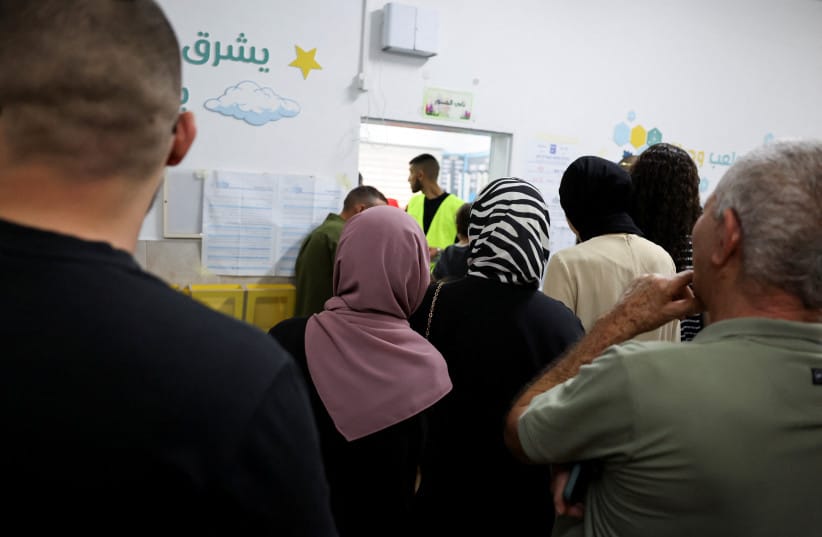
Throughout this campaign and into its final hours, Prime Minister Benjamin Netanyahu sounded the same alarm he has sounded throughout his political career: Arab citizens are flooding the polls and endangering his rule. For once, the outgoing prime minister was telling the truth. Arab Israelis are voting today in numbers not seen in decades, and they may well bring his reign to an end.
The last time this happened was 1999. In one of Israel’s few direct elections for prime minister, Arab voters turned out in large numbers to back Ehud Barak almost unanimously, helping oust Netanyahu for the first time and opening the door of the prime minister’s office to Barak, Israel’s last left-wing prime minister.
Sixteen months later, in October 2000, police under Barak’s government opened fire on Arab demonstrators protesting Ariel Sharon’s visit to the Temple Mount, Al-Aqsa Mosque. Twelve Israeli citizens were shot and killed. The Or Commission of Inquiry later confirmed what every Arab Israeli had already known: There were grave failures in how the police and the state treat Arab citizens. It surprised no one that no police officer was ever charged.
October 2000 became an open wound in Arab Israeli collective memory and a reason to keep a distance from the Israeli mainstream. That memory has kept many Arab citizens home in every election since.
This time is different.
Netanyahu’s coalition has abandoned, betrayed Arab citizens
The memory of October 2000 has not faded, but it has been overtaken by the reality of the past four years, under a government that has done far more than neglect Arab citizens.
Israel’s outgoing coalition, the most radical in the country’s history, not only tried to import the reality of the West Bank across the Green Line and into Israel proper. It also taught Israel’s two million Arab citizens that a bad situation can always get worse if they accept their own political marginalization.
This government left Arab communities at the mercy of criminal gangs, living amid anarchy and state absence, with little urgency from those responsible for public safety. Meanwhile, its mouthpieces in the media spewed relentless incitement against Arab citizens: doctors, journalists, elected officials, bus drivers, ordinary people. Without that, Arab turnout today might well have continued its decades-long decline. Instead, the government that did the most to push Arab citizens out of Israeli politics may be the one that brought them back.
The easy reading of this historic turnout is that Arab citizens rallied behind their parties. That reading is wrong. The Arab Israeli political establishment is widely seen as a closed, exclusionary club: outdated, ineffective, and recycling the same faces and the same speeches. Some Arab citizens voted for Jewish-led parties today. Many who voted for Arab lists did so without enthusiasm.
They came out of a sense of citizenship and shared responsibility, just as they did in October 2023, when they stood shoulder-to-shoulder with Jewish Israelis in the country’s lowest, most painful moment. Then and now, they showed that they belong to this state, that they are willing to carry its burdens and share its fate, and that they will not be written out of it. For a community so often accused of standing apart, and even branded an enemy within, today’s turnout declares the opposite. It is a cry from below, from people who have spent four years under the most far-right government in Israel’s history.
Arab citizens, Israel’s ‘kingmakers’
In 2021, the only government to unseat Netanyahu in over a decade came to power because Ra’am, an Arab party, provided its majority. It was the first Arab party ever to join an Israeli coalition. The opposition took power on that basis and then spent years acting as though it should apologize for it.
In this campaign, its leading figures refused even to say they would govern with an Arab-Israeli partner.
Arab citizens know they are once again the kingmakers. They have put aside their doubts and shown up to defend a democracy that has not always defended them. Voting in such numbers while carrying the memory of October 2000 is an act of extraordinary trust, and trust given twice is not guaranteed a third time.
The opposition need not embrace every Arab politician or every platform. But before coalition talks begin, it must say plainly that at least one Arab party is a legitimate partner in government.
Anything less sends two million citizens a message they have heard before: Your vote counts when it is useful, but your voice has no place in shaping this country.
The hand has been extended. The Jewish-majority opposition can take it, and with it lead Israel toward a different future.
Or it can confirm everything October 2000 taught Israel’s Arab citizens and hand the outgoing coalition the deadlock it desperately needs to stay in power.
The choice is the opposition’s alone. Will Israel be a democracy among the nations, where every vote counts? Or will it keep sliding toward an isolated, undemocratic, and racist ethnocracy?