

China’s Wealthy Scramble to Protect Offshore Fortunes as Beijing Imposes 20% Tax and Tightens Capital Controls
JBIZNEWS | GLOBAL ECONOMY | FRIDAY, OCTOBER 23, 2026
BEIJING — China’s wealthiest entrepreneurs and families are confronting an increasingly aggressive campaign by Beijing to tax overseas fortunes, triggering asset sales, urgent financial restructuring and growing concerns that the government is tightening its control over private wealth at a time of mounting economic pressure.
At the center of the crackdown is a sweeping 20% tax regime covering offshore trusts, investment structures long used by Chinese billionaires and business founders to hold corporate shares, real estate and financial assets outside mainland China.
An October 22 reporting deadline has intensified the pressure, with wealthy individuals rushing to calculate their tax liabilities, raise cash and reconsider how they manage their international fortunes.
The consequences extend well beyond China’s richest households. The crackdown threatens to disrupt capital flows into Hong Kong, Singapore and other international financial centers while increasing uncertainty for foreign investors and Chinese companies seeking overseas capital.
A $1.7 Trillion Offshore Wealth Market Faces Scrutiny
China’s offshore wealth is estimated at approximately $1.7 trillion by Boston Consulting Group, highlighting the enormous pool of assets potentially exposed to tighter tax enforcement.
For years, wealthy Chinese entrepreneurs established offshore trusts in jurisdictions including Singapore, the Cayman Islands and the British Virgin Islands. These arrangements offered investment flexibility, succession planning and opportunities to diversify wealth internationally.
Beijing’s new regulations change the financial calculations.
The rules impose a 20% tax on certain gains associated with transferring assets into offshore trusts and on income generated through those structures. The measures also reach back to specified transactions dating to January 2023.
The deadline for disclosing previously untaxed offshore income and assets has forced some investors to liquidate holdings or seek financing.
According to Reuters, some wealthy families have begun selling shares, unwinding trusts and borrowing against company stock to meet anticipated liabilities. In exceptional cases, individuals have explored changing their citizenship or residency arrangements.
However, advisers caution that changing nationality or moving overseas does not automatically eliminate Chinese tax obligations, particularly when authorities determine that a person’s principal economic interests remain in China.
Why Beijing Is Pursuing Overseas Wealth
The government’s campaign comes as China struggles with the financial consequences of a prolonged property downturn, weak domestic demand and pressure on local government budgets.
For decades, land sales provided substantial revenue to local authorities. The collapse of China’s property market has sharply reduced that funding source, intensifying the search for additional tax revenue.
Offshore wealth presents an increasingly attractive target.
The government has strengthened its ability to track overseas financial holdings through international tax-information exchanges and domestic financial reporting systems.
Tax authorities have also reportedly established specialized teams to examine wealthy individuals, using corporate disclosures, public wealth rankings and other financial records to identify potential liabilities.
The campaign represents more than an effort to collect unpaid taxes. It also gives Beijing greater visibility into how Chinese private wealth moves across international borders.
Financial Markets Face New Selling Pressure
The crackdown could have significant consequences for Hong Kong’s stock market, particularly among businesses whose founders hold shares through offshore trusts.
Investors facing large tax liabilities may be forced to sell publicly traded stocks even when market conditions are unfavorable.
That creates potential selling pressure unrelated to a company’s underlying financial performance.
Chinese technology companies listed in Hong Kong and the United States could be particularly exposed because many founders structured their holdings through offshore vehicles during earlier waves of initial public offerings.
Financial institutions serving wealthy Chinese clients also face uncertainty as families reassess trusts, insurance policies and international investment accounts.
Nevertheless, analysts caution against assuming the new taxes will trigger a widespread market collapse. Much depends on how authorities enforce the rules, whether payment arrangements are offered and how much cash investors must raise.
Singapore and Hong Kong Face a Changing Wealth Landscape
The tightening regulations create a challenge for two of Asia’s leading financial centers.
Singapore has attracted substantial Chinese private wealth through its banking sector, family-office industry and established legal framework.
Hong Kong remains a central gateway for mainland Chinese investment and international capital.
Both financial centers benefit from helping wealthy families manage cross-border assets.
However, stronger Chinese tax enforcement could reduce the advantages of some offshore structures and increase compliance costs for their clients.
The risks are not necessarily limited to existing accounts. Wealthy individuals considering future international investments may hesitate if they fear additional taxation, retroactive assessments or changing restrictions on capital movements.
The Bigger Question: Will China’s Wealthy Continue Investing?
The most consequential effect may be on confidence.
Private entrepreneurs play an important role in financing business expansion, technological development and new investment. Their willingness to commit capital depends partly on predictable regulations and confidence in the protection of their assets.
Beijing argues that taxation and enforcement are necessary to ensure compliance and protect government revenue.
But sudden changes to the treatment of longstanding offshore structures can make financial planning more difficult, particularly when investors face uncertainty about how regulations will be applied.
China must therefore balance two competing economic objectives: increasing tax revenue and maintaining an environment in which entrepreneurs are willing to invest and grow their businesses.
For global investors, the immediate concern is whether the crackdown produces additional stock sales and capital-market volatility. The longer-term question is whether tighter government control over offshore wealth weakens confidence in China’s private sector.
China’s wealthiest families are discovering that holding assets outside the country no longer necessarily places those fortunes beyond Beijing’s financial reach.
JBizNews Desk | New York
© 2026 JBizNews. All Rights Reserved.

Nasdaq Drops as Doubts Grow Over AI Spending


AI Stocks Plunge as Meta’s Spending Plans Spark Wall Street Selloff, Sending Nasdaq Down 694 Points and Chipmakers Tumbling
THURSDAY, OCTOBER 22, 2026 | WALL STREET
Meta’s 7% decline, Nvidia’s weakness and a 6.7% collapse in semiconductor shares expose growing investor anxiety over the enormous cost of building artificial intelligence infrastructure—and when those investments will generate meaningful returns.
NEW YORK — Wall Street’s artificial intelligence trade suffered a sharp reversal Thursday as investors dumped semiconductor manufacturers, data-center operators and some of the technology industry’s largest companies, sending the Nasdaq Composite to its worst daily performance since June.
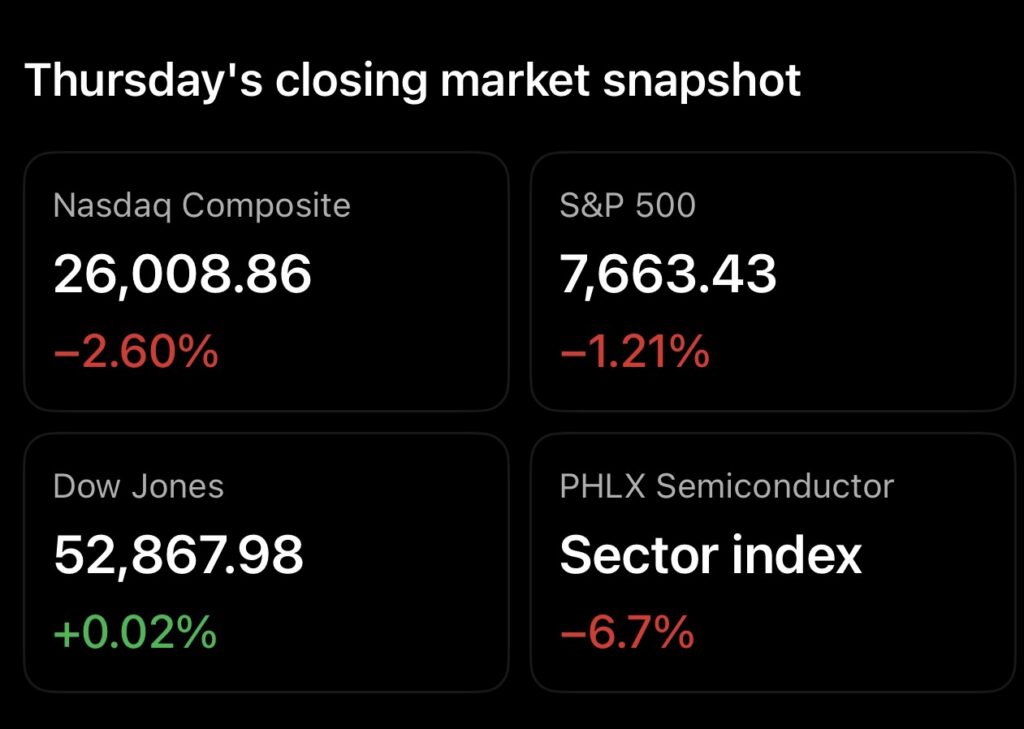
The technology-heavy Nasdaq plunged 2.6%, or approximately 694 points, to 26,008.86, while the S&P 500 declined 1.21% to 7,663.43. The Dow Jones Industrial Average managed a modest 11.89-point gain, closing at 52,867.98.
At the center of the selloff was a question increasingly confronting investors: How much more money will technology companies need to pour into artificial intelligence before the returns justify their extraordinary spending?
Meta triggers a broader reassessment of AI spending
Meta Platforms became the focal point of Thursday’s retreat after reporting quarterly results that exceeded revenue expectations but exposed mounting financial pressure from its artificial intelligence investments.
The parent company of Facebook, Instagram and WhatsApp disclosed its first cash outflow in more than a decade as its aggressive spending on AI infrastructure weighed on its finances.
Investors also reacted negatively to Meta’s plan to issue a new class of nonvoting shares, raising fresh concerns about how the company intends to finance its expanding investments.
Meta shares fell approximately 7% during Thursday’s session.
The issue extended beyond Meta’s individual earnings report. The company is among the technology giants collectively committing vast amounts of capital to specialized processors, cloud-computing capacity, electricity and data centers.
Thursday’s reaction suggested investors are becoming less willing to reward those commitments without clearer evidence of profitability.
Nvidia, chipmakers and AI infrastructure companies come under pressure
Nvidia, the semiconductor giant whose processors underpin much of the global AI industry, fell sharply as investors reduced exposure to companies benefiting from the technology’s expansion.
Its shares were down approximately 4% during the afternoon, while the Philadelphia Semiconductor Index ultimately lost 6.7%.
Advanced Micro Devices, Intel, Marvell Technology and other semiconductor companies also came under pressure.
Lam Research, a major supplier of equipment used to manufacture advanced chips, suffered a double-digit intraday decline following its results, adding to pressure across the semiconductor industry.
The selling spread beyond chip manufacturers. CoreWeave, which provides cloud-computing infrastructure for AI workloads, dropped roughly 10%, while shares of other AI infrastructure businesses declined sharply.
The breadth of the retreat demonstrated how tightly connected the AI investment ecosystem has become. Spending decisions by a handful of technology giants can rapidly affect expectations for semiconductor demand, cloud providers, data-center construction and supporting industries.
Why Thursday’s selloff matters
The downturn represents a growing shift in how Wall Street values artificial intelligence companies.
For much of the AI expansion, investors have rewarded announcements of additional data centers, larger computing clusters and rising capital expenditures as signs of accelerating growth.
Thursday illustrated the opposite reaction: more spending can now raise concerns about cash flow, financing requirements and shareholder returns.
The emerging distinction is between companies receiving revenue from AI infrastructure investments and those funding the infrastructure with the expectation of future profits.
Rising oil prices compound technology-sector weakness
The decline was amplified by geopolitical uncertainty as crude oil prices climbed amid renewed hostilities in the Middle East.
Brent crude rose above $113 per barrel, intensifying concern that higher energy costs could complicate inflation and interest-rate expectations.
At the same time, investors moved toward U.S. Treasury securities, pushing yields lower. The combination of falling technology shares, rising oil prices and stronger demand for bonds underscored a shift toward defensive positioning.
Importantly, Thursday was not a uniform market collapse. Many individual stocks advanced even as the Nasdaq suffered heavy losses, suggesting investors were reducing exposure to richly valued technology companies rather than abandoning equities altogether.
What Wall Street will watch next
The next test for AI stocks will be whether upcoming corporate results provide greater clarity about the financial returns from artificial intelligence.
Investors will be watching whether semiconductor demand remains strong, whether hyperscalers maintain their spending commitments and whether companies can translate AI investments into sustainable free cash flow.
For Nvidia and other chip manufacturers, continued demand for advanced processors remains central to their growth expectations. For Meta and other technology platforms, the challenge is demonstrating that increasingly expensive AI infrastructure will ultimately generate attractive returns.
Thursday’s selloff does not establish that the AI expansion is ending. It does, however, indicate that Wall Street is becoming considerably more demanding about the economics behind it.
The central question has shifted from how much companies can invest in artificial intelligence to how much they can earn from it.
JBizNews Desk | New York
© 2026 JBizNews. All rights reserved.
JetBlue Stock Crashes to $2.65 as Bonds Plunge, Raising Alarm Over Airline’s Financial Survival
JetBlue shares have lost nearly 60% from their August high, while mounting debt pressure, soaring fuel costs and heavy cash losses intensify concerns about the carrier’s future.
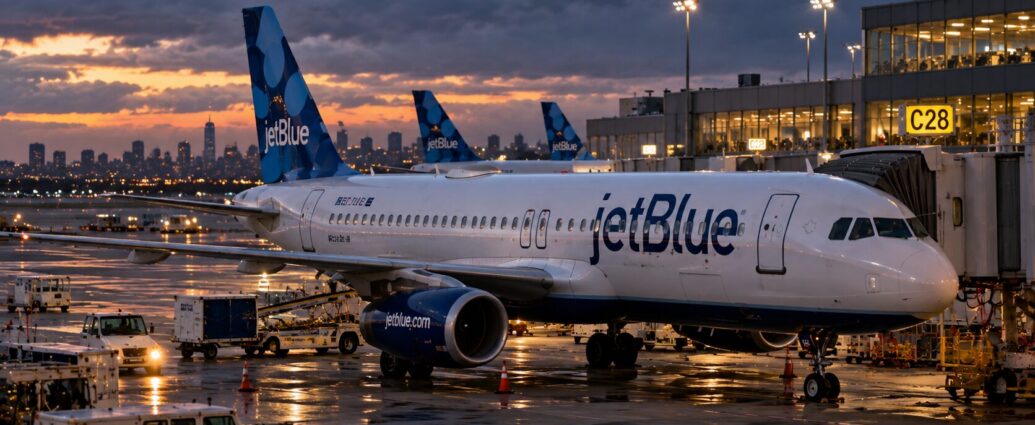
NEW YORK | October 22, 2026 — JetBlue Airways is facing an escalating financial crisis as its stock and bonds plunge, sending increasingly troubling signals about the airline’s ability to withstand mounting operating losses, expensive debt and sharply higher fuel costs.
Shares of JetBlue Airways (NASDAQ: JBLU) plunged 9.56% Thursday to close at $2.65, their weakest level in the past year, as investors increasingly questioned whether the airline can stabilize its finances without major restructuring or additional capital.
The stock has collapsed from its August 4 high of $6.62, wiping out nearly 60% of its value in less than three months.
Trading volume surged to approximately 83.8 million shares, nearly four times its recent daily average, indicating unusually intense selling pressure.
The stock decline comes alongside a deterioration in JetBlue’s bond market, where investors are demanding increasingly high returns to hold the airline’s debt — a warning sign that lenders see a growing risk of financial distress.
Unlike an ordinary stock-market downturn, falling bond prices can directly threaten a company’s ability to obtain financing, refinance obligations and sustain operations.
For JetBlue, the simultaneous weakness in both markets raises an increasingly consequential question: Can the airline recover before its financial flexibility runs out?
JetBlue’s Financial Position at a Glance
October 22 closing stock price
$2.65
−9.56% Thursday
Decline from August high
−60%
From $6.62 on August 4
Unrestricted cash and investments
$2.2B
As of June 30, 2026
Debt and finance leases
$8.5B
As of June 30, excluding operating leases
Bonds Signal Growing Financial Distress
The most serious warning is coming from the debt market.
Earlier this month, JetBlue’s $2 billion bond issue maturing in 2031, secured by assets associated with its TrueBlue loyalty program, had fallen to approximately 72 cents on the dollar.
That represented a steep discount for debt backed by one of the airline’s valuable commercial assets.
Its yield spread over benchmark securities exceeded 1,000 basis points, a threshold commonly associated with financially distressed borrowers.
The latest Bloomberg report highlights a further deterioration in investor confidence across JetBlue’s stock and bond markets.
When investors demand substantially higher yields to lend money to a company, refinancing existing debt becomes more expensive. For a capital-intensive airline that depends on aircraft financing, fuel purchases and continued access to credit, that pressure can become particularly dangerous.
Fuel Costs Are Intensifying the Crisis
JetBlue’s difficulties are unfolding against a worsening financial backdrop for the broader airline industry.
Jet fuel prices have surged amid geopolitical tensions, forcing carriers to increase ticket prices while absorbing costs they cannot fully pass on to passengers.
Even larger airlines with stronger finances are struggling to protect profitability.
JetBlue faces an especially difficult position because it entered this period with persistent operating losses and substantial debt.
Higher fuel costs directly erode margins, while rising fares risk discouraging price-sensitive travelers.
For JetBlue, the combination threatens to accelerate cash consumption at a time when financial markets are becoming increasingly skeptical of its turnaround prospects.
Cash Reserves Provide Time, but Not Unlimited Protection
JetBlue reported approximately $2.2 billion in unrestricted cash and investments at the end of June, along with an undrawn $600 million revolving credit facility.
Those resources provide an important liquidity cushion and mean that a bankruptcy filing is not necessarily imminent.
However, UBS analysts recently estimated that the airline could consume approximately $660 million in cash during the second half of 2026, based on elevated fuel-price assumptions.
UBS upgraded the stock from Sell to Neutral on October 19, while reducing its price target to $3.50 from $4, suggesting that some downside risks were already reflected in the share price.
Nevertheless, the speed of JetBlue’s subsequent decline underscores the uncertainty surrounding its financial outlook.
A Critical Debt-Repayment Challenge Approaches
JetBlue faces significant scheduled debt and finance lease obligations over the next several years.
Its reported repayment schedule includes approximately $236 million for the remainder of 2026, $478 million in 2027, $582 million in 2028 and approximately $1.84 billion in 2029.
That creates a growing financing challenge if operating losses continue and borrowing costs remain elevated.
A prolonged inability to restore profitability could force management to pursue asset sales, additional financing, operational reductions or broader balance-sheet restructuring.
Such measures can protect a business but may also dilute existing shareholders or reduce the value of outstanding investments.
Competitors Are Holding Up Better
Thursday’s trading highlighted the unusually severe pressure on JetBlue.
While its shares fell nearly 10%, several major competitors advanced.
Southwest Airlines gained approximately 5.4%, Delta Air Lines rose 2.1% and United Airlines edged higher by 0.3%.
That divergence demonstrates that investors are not treating all airlines equally.
Companies with stronger balance sheets, more diversified revenue sources and greater pricing power appear better positioned to withstand the industry’s current economic pressures.
JetBlue, by contrast, faces the added burden of convincing investors that its turnaround strategy can generate sustainable profitability before additional financing becomes necessary.
What Happens if JetBlue Cannot Recover?
Financial distress does not automatically mean an airline will stop flying.
Companies facing serious balance-sheet problems can negotiate with lenders, sell assets, obtain new investment or restructure obligations while continuing operations.
However, declining bond values and stock prices can complicate each of those options.
For shareholders, a restructuring could result in significant dilution or, in an extreme scenario, the loss of their investment.
For employees, creditors and passengers, the stakes extend to jobs, existing obligations and the continuity of airline services.
No bankruptcy filing has been established by the reported market declines, and JetBlue continues to operate.
The Bigger Picture: A Race Against Time
JetBlue’s immediate challenge is no longer simply improving ticket revenue or reducing operating expenses.
It must restore investor confidence while navigating higher fuel costs, heavy financial obligations and a weakening stock market valuation.
The airline still possesses valuable assets, an established brand and a meaningful presence in major American travel markets.
But those strengths must ultimately translate into sufficient operating cash flow to sustain the business.
The warning from Wall Street is becoming increasingly difficult to ignore: JetBlue still has time to stabilize its finances, but the market is signaling that its margin for error is shrinking rapidly.
JBizNews Desk | New York
© 2026 JBizNews. All rights reserved.

Elon Musk’s SpaceX Moves to Challenge Verizon, AT&T and T-Mobile With Plans for 80,000 Cell Sites Across America
SpaceX is negotiating access to a massive nationwide network of cell sites, advancing a strategy to combine Starlink satellites with traditional wireless infrastructure and potentially reshape the $300 billion-plus U.S. telecommunications market.
NEW YORK | October 22, 2026 — Elon Musk’s SpaceX is taking a major step toward becoming a full-scale American wireless carrier, entering negotiations to secure access to at least 80,000 cellular sites nationwide in a move that could directly threaten Verizon, AT&T and T-Mobile.
According to an exclusive Bloomberg report published Thursday, SpaceX is in discussions with cellular infrastructure companies to obtain access to the extensive network of sites necessary to support its planned wireless service.

The development moves SpaceX closer to transforming Starlink from a satellite broadband provider into a potential fourth nationwide mobile carrier, combining communications satellites in orbit with terrestrial infrastructure on the ground.
The implications extend beyond traditional telecommunications. A successful launch could alter wireless pricing, network coverage, competition for subscribers and billions of dollars in infrastructure investment.
From Satellites to a Nationwide Wireless Network
SpaceX has spent years developing Starlink into a global satellite communications business, primarily serving homes, businesses, remote locations and areas underserved by traditional broadband infrastructure.
Its latest ambitions are substantially larger.
Rather than limiting Starlink to satellite internet or providing supplemental cellular coverage through existing carriers, SpaceX is seeking the infrastructure necessary to compete directly for American wireless subscribers.
The proposed network would combine two technologies: satellite communications capable of reaching remote or underserved locations, and conventional ground-based cellular infrastructure providing the stronger indoor coverage, capacity and reliability required in populated areas.
Access to 80,000 sites would give SpaceX a substantial infrastructure foundation without requiring the company to independently construct every tower or location.
However, securing site access would not automatically create an operating network. SpaceX would still need to deploy equipment, connect sites, secure regulatory approvals and establish the systems required to serve customers nationwide.
Billions Already Committed to Wireless Expansion
SpaceX’s latest negotiations follow a series of major spectrum acquisitions intended to give the company the radio frequencies needed to operate mobile networks.
During 2025, SpaceX entered agreements to acquire approximately 65 megahertz of wireless spectrum from EchoStar in transactions valued at roughly $19.6 billion.
Those acquisitions provide critical frequencies for expanding Starlink’s mobile capabilities.
Earlier this month, SpaceX also announced an agreement to acquire additional low-band spectrum from investment firm Grain Management.
Low-band frequencies are particularly important because they travel relatively long distances and penetrate buildings more effectively than many higher-frequency signals.
SpaceX President Gwynne Shotwell has previously confirmed the company’s intention to develop terrestrial wireless infrastructure and compete for subscribers currently served by America’s three largest wireless carriers.
The latest cell-site negotiations suggest that strategy is progressing from spectrum acquisition toward physical network development.
Verizon, AT&T and T-Mobile Face a New Competitive Threat
The emergence of SpaceX as a potential nationwide competitor presents a significant challenge to an industry dominated by three major providers.
Verizon has built its business around extensive network coverage and premium wireless services.
AT&T operates one of America’s largest communications networks, combining mobile connectivity, fiber broadband and enterprise telecommunications.
T-Mobile has expanded aggressively through its nationwide 5G network and its acquisition of Sprint.
SpaceX could introduce a different competitive model, combining satellite capabilities with ground-based networks to offer service across both urban areas and locations where conventional cellular coverage remains limited.
That distinction could become particularly important for rural customers, transportation companies, emergency services and businesses operating across large geographic areas.
It could also pressure existing carriers to adjust prices, expand coverage or accelerate infrastructure investment.
However, SpaceX would enter a highly competitive market in which established carriers already possess extensive distribution networks, established customer relationships and substantial technological capabilities.
Wall Street Sees Winners and Losers
Thursday’s report also highlighted the financial implications for publicly traded telecommunications infrastructure companies.
According to Investor’s Business Daily, shares of major cell-tower operators rallied following the news, with Crown Castle advancing approximately 9%, American Tower gaining around 5% and SBA Communications climbing roughly 6.5% in the reported trading period.
The potential for SpaceX to lease thousands of additional sites could create a significant new source of revenue for infrastructure owners.
Meanwhile, Verizon, AT&T and T-Mobile shares reportedly declined between approximately 4% and 5%, reflecting investor concerns about the possibility of a powerful new competitor entering the industry.
Those market reactions illustrate an important distinction: A fourth nationwide wireless carrier could create opportunities for companies that own physical telecommunications infrastructure even as it threatens the profitability of existing wireless service providers.
A Costly Challenge With Significant Risks
Building a nationwide wireless network remains enormously expensive, even for a company with SpaceX’s engineering resources and satellite infrastructure.
The costs extend well beyond acquiring access to towers.
Radio equipment, antennas, network integration, fiber connections, electrical power, maintenance, customer support and retail distribution all require substantial investment.
SpaceX would also need regulatory approval for relevant spectrum transactions and network operations.
The experience of previous challengers underscores the difficulty.
EchoStar’s efforts to establish a competitive national wireless network required billions of dollars in spectrum purchases and infrastructure investment but ultimately encountered severe financial pressures.
SpaceX may have advantages through its existing satellite business and technical resources, but successfully attracting and retaining millions of wireless customers would represent a different challenge from launching rockets and deploying satellites.
What It Means for American Consumers
For consumers, a successful fourth nationwide wireless network could eventually produce greater choice and stronger price competition.
It could also expand connectivity in locations where traditional towers provide inconsistent or nonexistent coverage.
For businesses, a combined satellite-and-terrestrial network could offer greater communications resilience, particularly across transportation, agriculture, logistics and emergency-response operations.
Yet the timetable remains uncertain.
The reported negotiations are ongoing, and no definitive nationwide site-access agreement or commercial launch schedule has been confirmed.
The Bigger Picture
The most significant development is not simply that SpaceX wants to enter the cellular market.
It is that Musk is assembling the underlying components necessary to challenge an industry that has operated for years around three dominant nationwide providers.
Spectrum acquisitions have secured critical wireless frequencies. Starlink supplies a growing satellite communications platform. Access to tens of thousands of cell sites could provide the terrestrial component necessary to compete at scale.
Whether SpaceX can successfully integrate those assets into a commercially viable nationwide carrier remains an open question.
But Thursday’s developments send a clear message to the telecommunications industry: SpaceX is no longer positioning itself merely as a partner to traditional wireless companies. It is preparing to become their competitor.
JBizNews Desk | New York
© 2026 JBizNews. All rights reserved.


Quest Diagnostics confirms patient information accessed in cyberattack, systems temporarily shut down
Quest Diagnostics confirmed that patient health information or personally identifiable information was involved in a cybersecurity breach that prompted the medical testing giant to temporarily suspend access to several systems.
The New Jersey-based company said Thursday that it disabled access to its Quanum Lab Services Manager (LSM) platform after discovering unauthorized access Wednesday. Quest expects to restore full functionality as soon as Friday.
The platform allows certain healthcare providers to order laboratory tests and access results.
Quest said it believes some patient data was accessed but is still investigating the specific information involved and how many people may have been affected.
FOOD LION, STOP & SHOP AND HANNAFORD WEBSITES FACE OUTAGES AFTER CYBERSECURITY ISSUE
The company also temporarily paused access to its Essential Insights and LabHQ systems as a precaution, although it said no data was accessed on those systems.
Despite the temporary restrictions, Quest said its core business operations remain unaffected and its ability to serve patients has not been materially disrupted.
Healthcare providers who normally use Quanum LSM can continue placing orders through paper requisitions or the company’s Quanum eLabs platform. Other electronic ordering systems remain operational.
Quest said it has stopped the unauthorized access and is working to restore the affected system. The company does not expect testing delays for clients who do not use Quanum LSM.
CANADIAN RANSOMWARE NEGOTIATOR ARRESTED ON FEDERAL CHARGES AMID FBI HACKING PROBE
In a Thursday filing with the Securities and Exchange Commission, Quest said it notified federal law enforcement authorities and enlisted outside cybersecurity experts to assist with its investigation and response.
The company said it is working to identify affected patients and healthcare providers and will issue notifications as required by applicable law.
Quest Diagnostics, one of the nation’s major providers of diagnostic testing services, reported approximately $11 billion in revenue in 2025.
The incident follows a previous cybersecurity breach involving a third-party billing provider that potentially exposed personal information belonging to millions of Quest patients.
CLICK HERE TO GET FOX BUSINESS ON THE GO
In 2019, Quest disclosed that American Medical Collection Agency had reported unauthorized access to a system containing information associated with approximately 11.9 million Quest patients. The company said its own information technology systems were not involved in that incident.
Quest has not disclosed whether the latest breach will result in financial consequences, and declined further comment to FOX Business.

Popular kids’ toothpastes among 4M tubes recalled nationwide
Millions of tubes of toothpaste, including products featuring Barbie, Hot Wheels and Crayola branding, are being recalled nationwide.
More than 4 million tubes are included in the recall, which covers more than a dozen products sold under the Brush Buddies, Evo and ARU brands, according to the U.S. Food and Drug Administration (FDA).
The FDA classified the recall as Class II, citing “deviations” from current good manufacturing practice (CGMP) requirements.
A Class II recall means exposure to a product could cause “temporary or medically reversible adverse health consequences,” while the likelihood of serious health consequences is considered remote, according to the FDA’s website.
NEARLY 1.6M POUNDS OF HOT DOGS, BACON AND OTHER MEATS RECALLED NATIONWIDE
The affected toothpaste was distributed by California-based Ashtel Studios Inc. and manufactured by Pritam International Private Limited in India. The recall was initiated Sept. 10 and remains ongoing.
Among the recalled products are Brush Buddies Barbie Bubble Gum Flavor toothpaste and Hot Wheels Strawberry Flavor toothpaste, with 409,800 and 411,600 tubes affected, respectively.
More than 960,000 tubes of three Crayola Silly Scents varieties — bubble gum, watermelon and strawberry — are also included.
GLP-1 INJECTIONS RECALLED NATIONWIDE OVER STERILITY CONCERNS
The largest individual quantity involves nearly 798,000 tubes of Brush Buddies Whitening Anti-Cavity Fluoride Toothpaste with Baking Soda in Cool Mint flavor.
The recall also covers Brush Buddies My Little Pony toothpaste, several ice cream-flavored varieties and other whitening and cavity-protection toothpastes.
HYUNDAI RECALLS MORE THAN 94,000 VEHICLES OVER FIRE RISK
CLICK HERE TO GET FOX BUSINESS ON THE GO
Evo Advanced Whitening and Sensitive toothpastes and ARU Gum Health and Cavity Protection varieties are also affected.
Consumers can find the full list of recalled products on the FDA’s website.
Pritam International Private Limited and the FDA could not immediately be reached by FOX Business for comment.
Kroger CFO: We Are an Agent for the Consumer


Opinion | New Mexico Tries to Censor Meta



Trump Signs Sweeping Executive Order to Cut Mortgage Costs, Expand Title Insurance Waivers and Lower Housing Expenses
JBizNews | October 22, 2026
WASHINGTON — President Donald Trump signed a sweeping executive order Thursday aimed at reducing the cost of homeownership, targeting mortgage insurance premiums, refinancing expenses, title insurance requirements and barriers to affordable housing construction.
The order represents a significant federal intervention in the economics of residential real estate, potentially lowering monthly payments for qualifying homeowners while reshaping parts of the mortgage lending, title insurance and housing construction industries.
Among its most consequential provisions is a directive to make permanent and expand a federal pilot program that allows eligible borrowers to refinance their mortgages without purchasing traditional title insurance. The initiative could reduce closing costs for consumers while putting pressure on a longstanding revenue source for title insurance companies and settlement agencies.
The administration is also directing federal housing officials to identify homeowners who may qualify to eliminate mortgage insurance premiums based on the current market value of their properties, potentially saving qualifying borrowers hundreds or thousands of dollars annually.
Title Insurance Industry Faces Potential Disruption
One of the order’s most closely watched measures directs the Federal Housing Finance Agency to expand its title insurance waiver initiative into a permanent program.
Traditionally, mortgage lenders require title insurance to protect against ownership disputes, undisclosed liens, recording errors and other defects affecting a property’s legal title.
The cost can represent a substantial portion of refinancing expenses, particularly in states where title insurance premiums and associated settlement charges are relatively high.
Under the administration’s approach, certain refinancings could rely on approved alternatives to conventional title insurance, eliminating the requirement for a traditional policy when lenders and federal housing authorities determine that the transaction presents an acceptable level of risk.
For homeowners, the potential benefit is straightforward: lower refinancing expenses and fewer financial obstacles to obtaining a more favorable mortgage.
For title companies, the consequences could be significant.
Refinancing transactions generate revenue through title insurance premiums, searches, settlement services and related closing activities. If a larger percentage of those transactions qualifies for waivers, traditional title insurers and independent settlement agencies could face increased competition and reduced demand for certain services.
The order does not eliminate title insurance requirements across the entire housing market. Home purchases and transactions outside the qualifying refinance programs would continue to operate under applicable lender, insurance and state requirements.
Nevertheless, making the waiver program permanent signals a shift in federal housing policy that could extend beyond the refinancing market over time.
Mortgage Insurance Premiums Could Be Eliminated for More Homeowners
The executive order also targets private mortgage insurance, an expense commonly paid by borrowers who purchase homes with smaller down payments.
The Federal Housing Finance Agency has been directed to establish a pilot program allowing qualifying mortgage insurance premiums to be canceled proactively when borrowers meet applicable equity requirements based on current property valuations.
Under traditional mortgage arrangements, borrowers may continue paying insurance premiums even after rising home values have substantially increased their equity.
The new initiative is intended to address that problem by enabling mortgage servicers to identify borrowers who qualify for cancellation rather than requiring homeowners to navigate potentially costly and cumbersome procedures independently.
For example, a homeowner paying $150 monthly in mortgage insurance could save $1,800 annually if the coverage were eliminated.
The actual savings will depend on the borrower’s loan, insurance premium, equity position and program eligibility.
The directive does not mean that all borrowers will immediately have their mortgage insurance canceled. Federal agencies and mortgage servicers must still establish and implement the required procedures.
USDA and Veterans Affairs Directed to Lower Loan Rates
The order also directs the Department of Agriculture and Department of Veterans Affairs to reduce interest rates on qualifying single-family home loans issued directly through their respective programs.
Those programs serve particular borrower populations, including eligible rural households and veterans.
Even modest interest-rate reductions can substantially change the lifetime cost of a mortgage.
On a $400,000, 30-year fixed-rate loan, for example, reducing the interest rate from 6.5% to 6% would lower the monthly principal-and-interest payment by approximately $131, representing more than $47,000 in savings over 30 years if the loan remained outstanding for its full term.
That calculation illustrates the potential effect of a half-percentage-point reduction; it is not an announced rate cut under the executive order.
The precise savings will depend on the final rates adopted by the agencies, applicable eligibility requirements and loan terms.
Manufactured Housing Becomes Part of Affordability Strategy
Beyond mortgage expenses, the White House is seeking to address the cost of building homes.
The executive order establishes a Task Force on Manufactured Housing Innovation to encourage modern factory-based construction and expand access to federal housing programs for qualifying manufactured homes.
Factory-built housing can reduce some construction expenses by standardizing production, improving material efficiency and shortening building timelines.
However, manufactured housing frequently encounters financing restrictions, local zoning barriers, permitting requirements and other obstacles that limit its availability.
The new task force will examine ways to expand eligible housing options and encourage greater adoption of modern construction methods.
The administration’s broader objective is to increase housing supply while reducing costs for prospective homebuyers.
Implications for New Jersey and the Real Estate Industry
The order could have particular implications for states such as New Jersey, where real estate transactions support extensive networks of title agencies, attorneys, mortgage lenders, appraisers and settlement professionals.
For consumers, the proposed changes could lower the cost of refinancing and help some homeowners qualify for reduced monthly expenses.
For businesses dependent on traditional closing procedures, however, the federal initiative raises questions about future revenue, competition and the continued role of certain services.
Title agencies could face increasing pressure to diversify their offerings, adapt to alternative title-risk products and compete on efficiency as mortgage lenders seek lower-cost transactions.
Mortgage servicers may also face operational changes as they incorporate updated property valuations and identify borrowers who qualify for mortgage insurance cancellation.
The policy’s ultimate commercial impact will depend heavily on federal implementation, lender participation, state insurance regulations and the scope of the expanded waiver program.
An Executive Order, Not an Immediate Across-the-Board Cost Reduction
Although Trump has signed the order, many of its provisions require additional agency action before homeowners see direct financial benefits.
Federal housing authorities must establish procedures, determine eligibility and implement the necessary operational changes.
It also remains unclear how extensively the refinancing waiver program will expand and how quickly borrowers will be able to take advantage of the new policies.
The administration is betting that reducing transaction costs, removing unnecessary insurance expenses and encouraging lower-cost construction will improve affordability without relying exclusively on broader declines in mortgage interest rates.
For homeowners, the potential upside is reduced borrowing and ownership costs.
For title insurance companies and other established real estate service providers, the order introduces a new period of regulatory uncertainty and possible competitive disruption.
The central question is no longer simply whether the government can reduce the cost of obtaining and maintaining a mortgage, but how those savings will be distributed among homeowners, lenders and the businesses that have traditionally supported America’s real estate market.
JBizNews Desk | Washington, D.C.
© 2026 JBizNews. All rights reserved.

LARRY KUDLOW: The end is near for Iran
“As soon as the war ends, you know, we beat the hell out of Iran as soon as the war ends and it’ll end one way or the other very quickly.” President Trump said this Tuesday night at Greenville, North Carolina. And as my friend and former colleague, the former energy secretary, Dan Brouillette, told me last evening, when Mr. Trump “says he’s going to do something, there’s a pretty good doggone chance he’s gonna do it.”
That means we’re going to bomb Iran. Immediately after the election. To me, it’s very clear Mr. Trump has no interest in phony Iranian peace discussions or deals. He is well aware of their bad faith that they lie, cheat, and steal their way through life as radical Islamists work to hold on to their own power aggrandizement.
Put it another way, they basically just want to keep lining their pockets and keep stealing the Iranian people’s monies. Scott Bessent, the Treasury man, best since World War II, has shut down their economy. The naval blockade is working. The Iranian fleet of shadow tankers in Asia and Communist China’s waters has completely run out. That’s all. Go ahead. Dry it up, of course.
Mr. Trump has been meeting with Prime Minister Benjamin Netanyahu, and he issued a sterling endorsement of Bibi’s reelection next Tuesday. That’s the Israeli election. So the stage has been set. Even the New York Times is running a long piece today on how America and Israel are drawing “plans for renewed strikes on Iran after elections.”
Now, to be sure, the plans have been drawn up. That’s not quite the same thing as Mr. Trump actually pulling the trigger. I get that. But I will weigh in with my view that, in fact, he will pull the trigger, along with our Israeli allies.
According to the Times article, the targets likely include Iran’s energy infrastructure, that might well mean Kharg island also, and of course nuclear facilities they’re trying to rebuild and missile and drone arsenals. The Times, to be sure, goes through paragraph after paragraph of hand wringing, finding every military analyst who ever worked for President Biden or President Obama in order to quote them that this military bombing won’t work.
Well, that’s the New York Times for you. Can’t help that. I expect no less. But their reporting of the planning stages is correct. It’s on target. And Iran is even weaker today than it was many months ago because of the Bessent economic embargo and the success of the naval blockade and the fact that their economy is completely crippled.
There’s no trading externally. Inland Pakistan. Afghanistan, places like that, they’re not trading. They can’t pay the troops, they can’t pay the cops, they can’t pay the militias. And the Iranian people are in a very bad mood. Food is not available, the currency is worthless, the economy is crashing.
As far as the odds of a successful bombing, my guess is it’s going to go longer than three days. Probably closer to two weeks. And I’ll just say, as a civilian and a patriot, I have great faith in our military and in our president. And I will say to all my friends, regardless of their voter registration, party affiliation or whatnot, do not go wobbly over this bombing invasion. The end has come for Iran.


Moderna, Merck Fall After Melanoma Data Leak

Bank of America CEO honored at $32M fundraising event against antisemitism
Bank of America CEO Brian Moynihan was honored Wednesday night at a star-studded New York City benefit that raised more than $32 million to combat antisemitism and other forms of hate.
Moynihan received the Leadership in Action Award for his support of the Blue Square Alliance Against Hate and its mission. The organization was founded by New England Patriots owner Robert Kraft in 2019.
The sold-out inaugural benefit at the Waldorf Astoria drew more than 800 attendees and, according to the organization, raised the “largest single-night total” in its history.
BOFA CEO BRIAN MOYNIHAN DISMISSES RECESSION FEARS DESPITE WALL STREET’S MOST HAWKISH FED FORECAST
“Officially, on behalf of my 209,000 teammates at Bank of America, I want to thank the Blue Square Alliance for recognizing me as a Blue Square leader in action,” Moynihan said at the benefit. “It is an absolute privilege to receive the first award at the first-ever gala.”
“This recognition belongs to my teammates who do all the great work that makes our company so good,” he continued.
“It helps make possible our ability to support things like the Blue Square. It helps to make possible all the work we do, and I accept this award on their behalf.”
NYC COMPTROLLER FACES QUESTIONS OVER ISRAEL BONDS REVERSAL AS CEO CHALLENGES FINANCIAL RATIONALE
The event brought together leaders from business, sports and entertainment, with Tom Brady, Jon Bon Jovi, National Women’s Soccer League Commissioner Jessica Berman and Cardinal Timothy Dolan, Archbishop Emeritus of New York, addressing attendees.
Former Secretary of State Condoleezza Rice, who serves on the organization’s advisory board, delivered a video message reflecting on her own experience with hate and the importance of education in building empathy.
The organization said that the more than $32 million raised will support the expansion of its technology and analytics operations, national media and advertising campaigns and other programs aimed at combatting hate.
ISRAELI RESTAURANT CHAIN IN DC HIT BY GAZA PROTESTS PERMANENTLY CLOSES
CLICK HERE TO GET FOX BUSINESS ON THE GO
The Blue Square Alliance described the event as both a “fundraising success” and as a call to action.
“The sold-out event, held at the Waldorf Astoria, brought together influential leaders, changemakers, and community partners, all united by a shared belief: that hate has no place in our society,” the organization said in a press release.

Moderna Crashes After 700% Rally, AT&T Rebounds From Earnings Selloff as Oil Surges Above $110 on Middle East Threats
JBizNews | Markets & Business | October 22, 2026
NEW YORK — Three major market-moving developments are confronting Wall Street Thursday: Moderna’s extraordinary stock-market rally has suffered a dramatic reversal after the premature release of cancer-vaccine trial results; AT&T is recovering from an earnings-driven selloff despite raising its profit forecast; and global oil prices have surged as attacks on Saudi Arabia and escalating tensions with Iran threaten energy supplies.
The developments illustrate three different risks facing investors: biotechnology valuations built around future breakthroughs, telecommunications companies struggling to turn customer growth into stronger shareholder returns, and geopolitical instability capable of pushing inflation higher.
Moderna: A 700% Rally Meets a Brutal Reversal
Moderna shares plunged as much as approximately 25% Thursday, falling toward $181 after closing Wednesday at $245.81, as investors reacted to clinical data concerning the company’s experimental personalized cancer vaccine developed with Merck.
The collapse followed one of the most extraordinary biotechnology rallies of 2026.
Moderna’s stock traded as low as $22.28 in November 2025 before climbing to a 52-week high of $254.48 on October 21. That represented an increase of more than 1,000% from its low. Even after Thursday’s steep decline, the stock remained several times above its depressed levels a year earlier.
The company, once heavily dependent on its COVID-19 vaccine franchise, has been repositioning itself around messenger RNA technology for cancer treatment and other diseases.
The latest turbulence followed the premature disclosure of Phase 3 clinical trial findings involving Moderna’s individualized cancer therapy, intismeran autogene, administered alongside Merck’s Keytruda to patients with high-risk melanoma.
The treatment demonstrated a 42% reduction in the risk of cancer recurrence or death compared with Keytruda alone, based on the study’s reported hazard ratio of 0.58. Another measure suggested a 38% reduction in the risk of distant cancer spread or death.
The results were clinically encouraging, but investors had already priced considerable success into Moderna’s shares.
The European Society for Medical Oncology confirmed that an embargo on the trial data had been breached and released the findings following their circulation online.
The selling intensified as investors questioned whether the results justified Moderna’s substantially higher valuation and how successfully its personalized treatment could be extended to additional cancer types.
The central concern is not necessarily that Moderna’s cancer technology failed. It is that the stock’s enormous advance had created expectations that even positive clinical results struggled to satisfy.
At approximately $190–$193 during the sharp selloff, Moderna had surrendered more than $50 per share from Wednesday’s closing price. The session’s reported trading low near $181 underscored the severity of the reversal.
The stock’s recent high around $254 is now a significant reference point for investors evaluating whether the previous rally can resume. Conversely, Thursday’s lows could become important in determining whether further liquidation develops.
The upside case depends on regulatory progress, additional survival data and evidence that Moderna can translate personalized cancer treatments into a commercially viable business.
The downside involves further valuation compression, disappointing clinical developments, regulatory delays and the potentially substantial costs of bringing individualized therapies to market.
Moderna’s remaining gains underscore how dramatically investor expectations have changed in less than a year. Its collapse demonstrates how quickly those expectations can reverse.
AT&T: Higher Profit Forecast, Yet Investors Initially Sold
AT&T shares rebounded approximately 3% Thursday to trade near $22.63 after suffering a 6.45% decline Wednesday, when the telecommunications company reported stronger earnings and revenue but failed to convince investors that its underlying operating challenges had disappeared.
The stock closed Wednesday at $21.91, down from $23.42 Tuesday, despite management increasing its 2026 adjusted earnings forecast to approximately $2.40 per share from its previous range of $2.25 to $2.35.
AT&T reported third-quarter revenue of $32.3 billion, an increase of 5.3% from a year earlier, exceeding analyst expectations of approximately $31.69 billion. Adjusted earnings of 65 cents per share also topped forecasts of roughly 60 cents.
Customer growth was substantial.
The company added 379,000 postpaid phone subscribers and a record 769,000 advanced internet customers, including 442,000 fiber customers and 327,000 fixed-wireless subscribers.
Approximately 43% of households purchasing AT&T’s advanced home internet services also use its wireless services, providing an important opportunity to improve customer retention and increase revenue per household.
AT&T is attempting to build a more durable business through the combination of fiber-optic broadband and wireless connectivity.
Yet Wall Street’s initial response exposed concerns about competition, higher operating expenses and whether customer additions can translate into sustainable earnings growth.
Operating expenses increased approximately 3.6%, reflecting higher equipment and advertising costs.
The company’s share price has also weakened considerably from its 52-week high of $29.44 in March. At approximately $22.63 Thursday afternoon, the stock remained about 23% below that peak, although it stood roughly 14% above its July low of $19.89.
Unlike Moderna, AT&T has not experienced a doubling or tripling of its share price over the past year. Its investment appeal is centered more on recurring cash flow, dividends, financial discipline and its ability to grow steadily in a mature market.
Management expects free cash flow of at least $18 billion in 2026, rising to more than $21 billion by 2028, while targeting substantial dividend payments and share repurchases.
For investors, a recovery toward the $29.44 yearly high would represent approximately 30% upside from Thursday’s $22.63 trading level. A return to the $19.89 yearly low would imply roughly 12% downside. These are historical reference points, not predictions.
The question for AT&T is whether improving fundamentals can overcome the market’s concerns about costs, competition and capital spending.
Oil: Brent Surpasses $110 as Attacks on Saudi Arabia Raise Regional Supply Risks
Oil markets delivered a third major shock Thursday as escalating attacks on Saudi Arabia and renewed tensions involving Iran pushed global benchmark Brent crude above $110 per barrel.
Brent initially rose to approximately $110.11, while U.S. West Texas Intermediate crude advanced to $98.12. As trading progressed, Brent climbed above $112 and WTI briefly crossed $100.
Reports of Brent reaching approximately $113 marked a five-month high, reflecting mounting concern that the Middle East conflict could further threaten energy production and transportation.
Yemen’s Iran-aligned Houthi militants launched attacks on Saudi targets Wednesday, including a civilian airport in Dammam and an oil field.
The attacks reportedly killed three people and injured several others.
The security situation prompted the United States to order certain diplomatic personnel and family members to leave missions in Saudi Arabia.
Investors are particularly concerned about the possibility of additional attacks on Saudi oil infrastructure and disruptions affecting shipments through the Strait of Hormuz, one of the world’s most strategically important energy corridors.
Iran has also warned about risks to energy transportation in the region, raising the prospect of higher insurance costs, shipping disruptions and a further geopolitical premium in crude prices.
The economic implications reach far beyond energy producers.
Higher crude prices can push gasoline, aviation fuel, transportation and manufacturing costs upward, potentially slowing consumer spending and complicating central-bank efforts to control inflation.
For oil producers, higher prices can boost revenue and earnings, provided operations and shipments remain uninterrupted. Airlines, trucking companies, manufacturers and energy-intensive businesses face the opposite pressure.
The next major question is whether oil can sustain prices above $110 or whether a reduction in regional tensions allows the geopolitical premium to retreat.
A prolonged interruption to Gulf energy supplies could send prices higher. Conversely, a reduction in attacks and evidence that production and shipping remain secure could trigger a sharp pullback.
What Wall Street Is Watching Next
Together, these developments highlight three distinct challenges facing markets entering the final months of 2026.
Moderna represents the risk of extraordinary stock appreciation running ahead of fundamental business results. Its long-term opportunity remains substantial, but its valuation has become highly sensitive to clinical outcomes.
AT&T represents the challenge facing established companies that are delivering improved operating performance without necessarily receiving an immediate reward from shareholders.
Oil represents a much broader economic threat because sustained increases in energy prices affect corporate margins, household budgets, inflation expectations and potentially interest rates.
The three developments are not directly connected, but their combined consequences could influence investor sentiment across biotechnology, telecommunications, transportation and energy.
For now, Moderna investors are assessing how much of the company’s cancer-treatment potential is already reflected in its valuation. AT&T investors are deciding whether the latest earnings report marks a stronger long-term business trajectory. And global markets are watching whether the Middle East conflict threatens to create another sustained energy shock.
The common denominator is the widening gap between expectations and risk. Moderna’s expectations became enormous, AT&T’s remain cautious, and oil’s geopolitical risk is rapidly rising.
How investors price those differences will help determine where capital flows next.
JBizNews Desk | New York
© 2026 JBizNews. All rights reserved.