Shiba Inu (CRYPTO: SHIB) has underperformed Dogecoin (CRYPTO: DOGE) over the past month, with a 3% decline compared to DOGE’s 5% gain over the past 30 days.

Burn Rate Spikes

Shibburn data shows over the past 24 hours the ecosystem reported a spike of 1,034.8% in its burn rate as one single transaction involved the burning of 25.04 million SHIB.

Over the last 30 days, Shibarium removed 198.2 million SHIB although unable to create a supply scarcity …

Full story available on Benzinga.com

This post was originally published here

Strategy Inc (NASDAQ:MSTR) Executive Chairman Michael Saylor is working on a “flywheel” to propel Bitcoin (CRYPTO: BTC) to his $1 million price target, according to prominent industry experts.

Why Traders Think The “Flywheel” Is Strengthening

Prominent Bitcoin advocate Scott Melker argued on the Lark Davis show on May 15 that investors are increasingly front-running expected Bitcoin purchases tied to Strategy’s capital raises and preferred-share programs.

“If STRC remains popular, it becomes a self-fulfilling flywheel,” the analyst said.

Strategy’s STRC preferred shares reportedly moved back above par value, potentially allowing the company to accelerate additional Bitcoin purchases.

Strategy could continue purchasing billions of dollars’ worth of Bitcoin on a …

Full story available on Benzinga.com

This post was originally published here

Bitwise Asset Management has entered the fast-growing market for Hyperliquid-linked investment products with the launch of the Bitwise Asset Management Hyperliquid ETF (NYSE:BHYP). The fund, which begins trading on Friday, is among the first spot Hyperliquid exchange-traded products in the U.S. and the first to incorporate in-house staking through Bitwise Onchain Solutions. The launch comes as issuers race to capitalize on investor demand for exposure to decentralized finance infrastructure beyond Bitcoin and Ethereum.

Key features of the Bitwise Hyperliquid ETF (BHYP):

  • Spot exposure to Hyperliquid’s HYPE token
  • First U.S. Hyperliquid ETF with in-house staking integration
  • Sponsor fee of 0.34%
  • Fee waived to 0% for the first month on the fund’s first $500 million in assets
  • Managed staking through Bitwise Onchain Solutions

Hyperliquid, a Layer …

Full story available on Benzinga.com

This post was originally published here

Cardano (CRYPTO: ADA) whales now control 67% of supply, the highest concentration since July 2020, after accumulating through a 71% crash over nine months.

Whales Stack 25 Billion ADA

Wallets holding at least one million ADA now control 25.09 billion tokens, representing 67.47% of circulating supply. 

The accumulation trend has run uninterrupted since December 2023, with large holders buying on price weakness.

The token has shed 71% of its market cap over the past nine months, suggesting the largest holders have been stacking coins while retail capitulated.

DeFi Activity Collapses 80%

Cardano’s DeFi footprint has gone in the opposite direction. Total value locked sits at $137 million, down from a December 2024 peak of around $686 million, an 80% drop.

Meanwhile, daily DEX volume across the entire chain is $1.95 million. Chain fees over the past 24 hours …

Full story available on Benzinga.com

This post was originally published here

XRP (CRYPTO: XRP) could be preparing for a “macro wave three” breakout if Bitcoin (CRYPTO: BTC) confirms a move above key resistance near the $94,000 region.

Why Bulls Are Watching BTC Closely

In a May 14 podcast, trader Cryptoinsightuk tied his bullish thesis to a combination of macro catalysts, including ongoing crypto regulation efforts, improving U.S.-China relations and shifting Federal Reserve leadership expectations.

He added that Bitcoin remains trapped in a critical decision zone between roughly $84,000 and $94,000. Negative BTC funding rates, low search trends point …

Full story available on Benzinga.com

This post was originally published here

Bitcoin (CRYPTO: BTC) got rejected by the 200-day moving average at $82,400 on Thursday, mirroring the exact pattern from the 2022 bear market when a similar bounce failed at the same technical level.

Same Rejection Pattern As 2022 Bear Market

CryptoQuant Head of Research Julio Moreno pointed out that Bitcoin rallied 37% from $60,000 in February to $82,000 before hitting resistance at the 200-day MA. 

In 2022, Bitcoin posted a 43% rally between March and May before rejecting at the identical technical level.

“We have had a really good rally since the lows of February, but still what I’m telling here is that it’s a bear market rally,” Moreno stated. “We actually hit that resistance which is really a key resistance during bear markets,” he added.

The 200-day moving average at $82,400 has proven to be a critical ceiling. Bitcoin touched it but failed to …

Full story available on Benzinga.com

This post was originally published here

Bitcoin hovers near $80,000 as improving regulatory momentum surrounding the Clarity Act helped strengthen institutional sentiment across crypto markets.

Bitcoin ETFs saw $131.3 million in net inflows on Thursday, while Ethereum ETFs reported $5.7 million in net outflows.    


Cryptocurrency

Ticker

Price
Bitcoin (CRYPTO: BTC) $80,661
Ethereum (CRYPTO: ETH) $2,260
Solana (CRYPTO: SOL) $91.09
XRP (CRYPTO: XRP) $1.46
Dogecoin (CRYPTO: DOGE) $0.1145
Shiba Inu (CRYPTO: SHIB) $0.056264

Meme coin market capitalization is trading 1.1% lower at $38.6 billion over the past 24 hours.

Trader Commentary: 

Trader Jelle warned Bitcoin …

Full story available on Benzinga.com

This post was originally published here

Jordan Jefferson, founder and CEO of DogeOS, says Dogecoin (CRYPTO: DOGE) is evolving far beyond internet memes as developers push to build a full on-chain economy around the token.

DOGE’s Biggest Weakness

Speaking at the Consensus conference, Jefferson argued Dogecoin now represents many of the original peer-to-peer cash ideals that early Bitcoin supporters once rallied around.

An early Bitcoin adopter who entered crypto in 2011, he said DOGE’s biggest weakness today is that most activity still happens on centralized exchanges instead of on chain.

According to him, that prevents holders, builders and developers from capturing the economic value generated around DOGE trading and usage.

“Almost all Dogecoin sits on centralized exchanges,” Jefferson said. “There is no DeFi. There aren’t decentralized venues with any …

Full story available on Benzinga.com

This post was originally published here

Influential cryptocurrency analysts shared their take on Thursday on why stocks are reaching new all-time highs while Bitcoin (CRYPTO: BTC) and the broader cryptocurrency market continue to lag.

The AI-Trade Factor

Widely followed X user The ₿itcoin Therapist shared an image, contrasting the S&P 500 hitting new all-time highs, currently at 7,501, with Bitcoin, which is still down 36% from its October highs.

Willy Woo, a vocal Bitcoin advocate and commentator, framed the market divergence as capital reallocating toward AI.

“Stock indices up-only is tracking money entering big league AI. Take a look at SaaS; they also took a dive. Capital is reallocating into the next big thing,” Woo said.

They may well be right.

This post was originally published here

Binance (CRYPTO: BNB) co-founder Changpeng “CZ” Zhao recounted on Thursday a moment from a recent interview, in which the host surprised him with a moving gesture.

The ‘Lamborghini’ Surprise

CZ appeared on Patrick Bet-David’s podcast earlier this week, where they discussed a wide range of topics, including Bitcoin (CRYPTO: BTC), artificial intelligence, and the rise of Binance.

Recalling the podcast, CZ mentioned never sitting in a Lamborghini before. But to his surprise, Bet-David had one waiting in the driveway for him to experience as he left.

“I sat in it for a bit,” CZ said, adding a laughing emoji.

Full story available on Benzinga.com

This post was originally published here

Cryptocurrency veteran Samson Mow projected on Wednesday that Strategy Inc. (NASDAQ:MSTR) Chair Michael Saylor will overtake Tesla Inc. (NASDAQ:TSLA) CEO Elon Musk as the world’s richest individual if Bitcoin (CRYPTO: BTC) hits roughly $4.2 million apiece.

Mow’s Calculation

Mow pointed to Saylor’s personal stash of 17,732 BTC, based on his last public disclosure, and a 9.9% ownership of Strategy’s shares, as reflected in SEC filings.

As of this writing, Strategy holds 818,869 BTC in its reserves. Mow put Saylor’s indirect exposure at 9.9% of the total holdings, translating to 81,068 BTC. Including Saylor’s personal stash, his total effective exposure equaled 98,800 BTC.

Mow’s math showed a 1:1 valuation requires roughly $8.6 …

Full story available on Benzinga.com

This post was originally published here

Sen. Cynthia Lummis (R-Wyo.) signaled strong bullish conviction on cryptocurrency after the Clarity Act cleared a major vote in the Senate on Thursday.

The GoT Reference

Lummis posted an AI-generated image depicting her in a Game of Thrones-like setting, featuring “laser eyes” and the text, “Clarity Is Coming.”

The “laser eyes” meme, a 2021 Bitcoin community signal of bullish belief, typically shows a person with glowing red eyes in their profile picture to signify “laser focus” on Bitcoin’s (CRYPTO: BTC) price.

Lummis has used the meme several times in the past. In fact, she has also updated her profile picture to one with the “laser eyes.”

Reactions Pour In

The excitement comes as the Clarity Act cleared the Senate Banking Committee vote,  with Democratic Senators Ruben Gallego (D-Ariz.) and Angela Alsobrooks (D-Md.) breaking ranks to vote in favor alongside all Republican committee members.

SEC Chair Paul Atkins congratulated the Senators for advancing the key piece of cryptocurrency legislation and looked forward to President Donald Trump signing it into law.

Full story available on Benzinga.com

This post was originally published here

Leading cryptocurrencies were up in the green on Thursday after the Clarity Act passed the Senate Banking Committee on a bipartisan vote.

Cryptocurrency 24-Hour Gains +/- Price (Recorded at 9:05 p.m. EDT)
Bitcoin (CRYPTO: BTC) +2.46% $81,561.50
Ethereum (CRYPTO: ETH)
               
+1.18% $2,293.12
XRP (CRYPTO: XRP)                          +4.49% $1.49
Solana (CRYPTO: SOL)                          +1.33% $92.42
Dogecoin (CRYPTO: DOGE)              +2.10% $0.1167

Crypto Market Pops

Bitcoin hit $82,000 in the afternoon, then stalled and moved sideways. The trading volume soared 27% in the 24-hour period. Ethereum re-entered the $2,300 region, while XRP and Dogecoin also traded in the green.

Cryptocurrency-related stocks rallied, with Strategy Inc. (NASDAQ:MSTR) and Bitmine Immersion Technologies Inc. (NYSE:BMNR) closing up 5.02% and 3.87%, respectively.

These moves come after the Clarity Act cleared the Senate Banking Committee vote, moving to a full vote on the Senate floor.

Over $250 million was liquidated in the past 24 hours, predominantly in short positions, according to Coinglass data.

Bitcoin’s open interest popped 2.21% over the last 24 hours. However, sentiment in the derivatives market turned negative, with retail and whale traders on Binance positioning for price declines.

Top Gainers (24 Hours) 

Cryptocurrency (Market Cap>$100 M) Gains +/- Price (Recorded at 9:05 p.m. EDT)
Tac Protocol (TAC)       +35.83%     $0.02326
Yooldo (ESPORTS)                    +25.46%     $0.7072
Billions Network (BILL)             +16.74%     $0.2217

The …

Full story available on Benzinga.com

This post was originally published here

(Editor’s note: The future prices of benchmark tracking ETFs, the headline, the lede and the economic were updated in the story.)

U.S. stock futures rose on Thursday following Wednesday’s mixed close. This comes as President Donald Trump is in China addressing key issues such as trade, tariffs, Taiwan, and Iran with Chinese President Xi Jinping.

On Thursday, Xi stressed the significance of the Taiwan issue, terming it as the “most critical matter” in bilateral relations, the South China Morning Post (SCMP) reported, citing state media.

Meanwhile, the U.S. cleared Nvidia Corp.‘s (NASDAQ:NVDA) H200 AI chip sales to Alibaba Group Holding Ltd. ADR (NYSE:BABA), Tencent Holdings ADR (OTC:TCEHY), and 8 other firms, but Beijing has halted the deliveries.

On the economic front, April U.S. retail sales rose by 0.5%, with sales excluding motor vehicles and parts climbing a solid 1.9% for the month. Concurrently, initial jobless claims for the week ending May 9 ticked up by 12,000 to a seasonally adjusted 211,000, while U.S. import prices surged 1.9% in April.

The 10-year Treasury bond yielded 4.46%, and the two-year bond was at 3.97%. The CME Group’s FedWatch tool‘s projections show markets pricing a 98.6% likelihood of the Federal Reserve leaving the current interest rates unchanged during June’s meeting.

Index Performance (+/-)
Dow Jones 0.44%
S&P 500 0.24%
Nasdaq 100 0.35%
Russell 2000 0.03%

The SPDR S&P 500 ETF Trust (NYSE:SPY) and Invesco QQQ Trust ETF (NASDAQ:QQQ), which track the S&P 500 and Nasdaq 100, respectively, were higher in premarket on Thursday. The SPY was up 0.33% at $744.74, while the QQQ was higher by 0.16% to $715.73.

data-variant=”card”
data-news-mode=”manual”

>


Read Also:

Will S&P 500 Open Up Or Down On May 14?

This post was originally published here

Gemini Space Station Inc (NASDAQ:GEMI) shares are trading higher in extended trading Thursday after the company reported first-quarter results and announced an investment from Winklevoss Capital Fund.

Gemini Space Station Q1 Highlights

  • Q1 Revenue: $50.27 million, versus estimates of $49.29 million
  • Q1 Loss: 93 cents, versus estimates of 96 cents

Total revenue was up 42% on a year-over-year basis, driven by strong growth in services and OTC revenue. Gemini Space Station reported 589,000 …

Full story available on Benzinga.com

This post was originally published here

Markets historically deliver their strongest returns under divided government rather than full political sweeps, according to analyst Benjamin Cowen.

He examined the performance of the S&P 500, Bitcoin (CRYPTO: BTC) and gold across different U.S. political power structures — with surprising conclusions.

BTC On Political Party Sweeps

In a podcast published on May 13, Cowen argued Bitcoin historically reacts poorly to full political party “sweeps,” as both Democratic and Republican control correlate with weaker median returns despite strong outlier years like 2017.

He noted Bitcoin’s best median performance has historically come under split governments, suggesting markets …

Full story available on Benzinga.com

This post was originally published here

Anthropic’s Claude helped a user recover 5 Bitcoin (CRYPTO: BTC) worth $395,000 by locating an old wallet backup file on their computer.

Claude Found The File, Not The Password

The owner had been trying for eight weeks to brute-force the password on their current Blockchain.com wallet, testing roughly 3.5 trillion combinations using the btcrecover service on a rented computing chip. 

Total GPU spend on the failed brute-force attempts was around $15.

The recovery happened when the user “dumped my whole college computer into Claude” as a last-ditch effort. 

The AI assistant found an old wallet backup from December 2019 that the user had encrypted with a password already written down in a notebook.

The old password decrypted the old backup, which contained the same …

Full story available on Benzinga.com

This post was originally published here

Bitcoin climbed back above $81,000 after the Senate Banking committee advanced the Clarity Act, helping boost optimism around improving crypto regulation and institutional adoption.

Cryptocurrency Ticker Price
Bitcoin (CRYPTO: BTC) $81,568.11
Ethereum (CRYPTO: ETH) $2,306.27
Solana (CRYPTO: SOL) $92.80
XRP (CRYPTO: XRP) $1.49
Dogecoin (CRYPTO: DOGE) $0.1158
Shiba Inu (CRYPTO: SHIB) $0.056396

Notable Statistics:

  • Coinglass data shows 179,931 traders were liquidated in the past 24 hours for $674.74 million.       
  • SoSoValue data shows net inflows of $440.7 million from spot Bitcoin ETFs on Wednesday. Spot Ethereum ET’Fs …

Full story available on Benzinga.com

This post was originally published here

Coinbase Global Inc. (NASDAQ:COIN) said it is expanding support for USDC on Hyperliquid (CRYPTO: HYPE), becoming the official treasury deployer of USDC as an “Aligned Quote Asset,” or AQA, on the rapidly growing decentralized exchange.

The move strengthens USDC’s position as a core liquidity layer for decentralized trading and broader on chain capital markets.

Why It Matters

In a May 13 blog post, Coinbase said concentrating liquidity around USDC improves market efficiency by reducing the …

Full story available on Benzinga.com

This post was originally published here

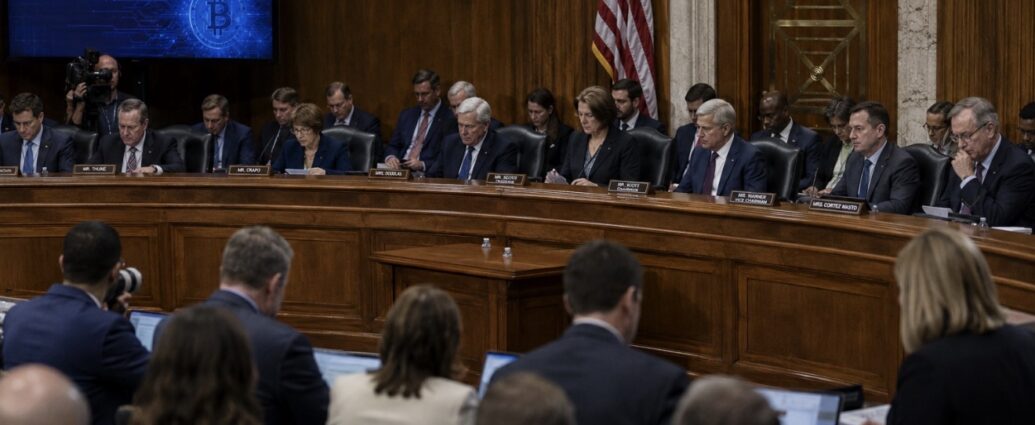
The CLARITY Act cleared the Senate Banking Committee 15-9 Thursday, sending crypto stocks and tokens surging.

Democrats Split On Crypto Bill

The vote received bipartisan support, with Democratic Senators Ruben Gallego (D-AZ) and Angela Alsobrooks (D-MD) breaking ranks to vote in favor alongside all Republican committee members.

Angela Alsobrooks clarified that she would not support the bill on the Senate floor unless lawmakers address the remaining issues.

She emphasized her nine months of negotiations working toward regulating digital assets in a way that protects consumers and reduces deposit flight risk.

“In recognition of that good faith, I have voted yes to advance the bill today,” Alsobrooks stated.

Both Gallego and Alsobrooks had previously indicated they would not support the bill unless language limiting President Donald Trump’s personal crypto ventures was included. No such deal has been reached.

Banking Industry Concerns Dismissed

The vote happened despite Sen. Catherine Cortez Masto (D-NV) attempting to resurrect …

Full story available on Benzinga.com

This post was originally published here

Bitcoin (CRYPTO: BTC) may have already bottomed for this cycle, according to Morgan Creek Capital founder Mark Yusko.

He argues global money printing, weakening fiat purchasing power and excessive leverage in traditional markets continue strengthening the long-term bullish case for crypto.

ETF Outflows Not Main Concern

Speaking in an interview with Scott Melker on May 14, Yusko warned that the real risk for markets now sits inside overleveraged AI and equity speculation rather than Bitcoin itself.

Yusko argued Wednesday’s $630 million Bitcoin ETF outflow day likely reflected institutional arbitrage positioning rather than genuine investor panic.

According to Yusko, many large ETF flows come from hedge funds running basis trades rather than …

Full story available on Benzinga.com

This post was originally published here

21Shares has launched the 21Shares Active Crypto ETF (NASDAQ:TKNS), marking the firm’s first actively managed cryptocurrency ETF in the U.S. The fund began trading on Thursday and is part of a broader shift in the crypto ETF market from passive, single-token strategies toward actively managed digital asset portfolios.

TKNS Unlike passive Bitcoin ETFs that simply track a single token, the strategy dynamically adjusts allocations based on market conditions, valuation signals, derivatives positioning, and blockchain-native indicators.

Key Features of TKNS

  • Active portfolio management designed to shift between defensive and growth positioning depending on crypto market cycles.
  • Diversified exposure across multiple digital assets rather than concentrating solely on Bitcoin.
  • Uses quantitative signals, valuation analysis, and proprietary research to identify emerging opportunities.
  • Incorporates systematic …

Full story available on Benzinga.com

This post was originally published here

A future SpaceX IPO may not behave like a traditional public offering at all. That’s the warning from Tessera PE CEO Chan Ahn, the former Goldman Sachs and JPMorgan executive who believes new Nasdaq rules could fundamentally alter how mega-cap IPOs trade from day one.

In an interview with Benzinga, Ahn argued that SpaceX could face conditions more consistent with a “structural squeeze” than normal price discovery if the company debuts publicly under Nasdaq’s accelerated index-inclusion framework.

“The old guardrails are gone,” Ahn said.

A Tiny Float Meets Massive ETF Demand

Under Nasdaq’s updated “fast entry” rules, companies large enough to qualify for the Nasdaq-100 can become eligible for index inclusion after just 15 trading days.

Ahn believes SpaceX would likely qualify immediately.

The problem, according to him, is supply. …

Full story available on Benzinga.com

This post was originally published here

Ripple CEO Brad Garlinghouse renewed his pitch for XRP (CRYPTO: XRP) at the XRP Las Vegas conference, coinciding with the launch of an XRP trading pair on a Moscow exchange.

Speed, Cost, And Scalability Make XRP Different

Garlinghouse said the earliest inventors of XRP Ledger had been contributors to the core of Bitcoin (CRYPTO: BTC) and saw an opportunity to build something specialized to solve a payments problem.

“What makes XRP so unique is its speed, settling transactions in three to five seconds, its cost, extremely low cost, fractions of a penny per transaction, and its scalability, now having completed over four billion transactions,” Garlinghouse said.

He added the XRP community, which he calls the “XRP family” and sometimes the “XRP army,” combined with the blockchain’s longevity creates …

Full story available on Benzinga.com

This post was originally published here

Crypto markets attract “degenerate investing” behavior, according to real estate legend Grant Cardone, who also argues long-term real estate cash flow paired with Bitcoin (CRYPTO: BTC) creates a more stable investment structure than pure crypto exposure alone.

Cardone’s Strategy – Real Estate + Bitcoin

Speaking at Consensus, Cardone outlined his strategy of combining distressed real estate acquisitions with Bitcoin purchases, describing the model to merge steady cash flow with Bitcoin upside.

Cardone said traditional real estate investors need new ways to outperform institutional giants like Blackstone Inc. (NYSE:BX), Goldman Sachs Group Inc. (NYSE:GS) and JPMorgan Chase & Co. (NYSE:JPM).

His solution is to buy discounted …

Full story available on Benzinga.com

This post was originally published here

Stablecoins, tokenized real-world assets and AI-powered payments are rapidly pushing crypto deeper into mainstream finance, according to industry experts.

Stablecoins Becoming Institutional Infrastructure

Speaking during a panel discussion on the Coindesk podcast, Ripple (CRYPTO: XRP) CEO Brad Garlinghouse, Binance (CRYPTO: BNB) CEO Richard Teng and Solana (CRYPTO: SOL) Foundation President Lily Liu pointed to stablecoins, tokenization and AI infrastructure as major long-term growth drivers for the crypto industry.

Teng said stablecoins are gaining traction because traditional financial systems remain slow, expensive and inefficient for global payments.

Panel moderator Rory Jennings cited Dune Analytics data showing stablecoin transfer volume reached …

Full story available on Benzinga.com

This post was originally published here

Bitcoin trades below $80,000 on Thursday morning as hotter-than-expected U.S. producer inflation data weakened expectations for near-term Federal Reserve rate cuts.

Bitcoin ETFs saw $635.2 million in net outflows on Wednesday, while Ethereum ETFs reported $36.3 million in net outflows.    


Cryptocurrency

Ticker

Price
Bitcoin (CRYPTO: BTC) $79,590.77
Ethereum (CRYPTO: ETH) $2,259.62
Solana (CRYPTO: SOL) $90.93
XRP (CRYPTO: XRP) $1.43
Dogecoin (CRYPTO: DOGE) $0.1134
Shiba Inu (CRYPTO: SHIB) $0.056266

Meme coin market capitalization …

Full story available on Benzinga.com

This post was originally published here

A leading cryptocurrency analyst flagged a major bullish signal early Thursday, potentially fueling Cardano’s (CRYPTO: ADA) next rally.

Will ADA Hit $0.42?

In an X post, Ali Martinez pointed to the SuperTrend indicator—a tool he has found to be the “most accurate” for anticipating ADA long-term movements.

The SuperTrend indicator is widely used for identifying market trends and potential entry and exit points in trading.

The analyst said that the same indicator flashed a “Sell” signal in September, preceding ADA’s 73% price decline

“After months of this heavy correction, the indicator has just flipped. I’m now seeing a fresh buy signal on Cardano’s daily chart,” Martinez stated.

Full story available on Benzinga.com

This post was originally published here

Influential analyst Ali Martinez warned Wednesday of the growing threat artificial intelligence poses to the cryptocurrency industry, citing a surge in AI-driven fraud.

Is Crypto Downplaying AI Threat?

In an X post, Martinez alluded to a January report by on-chain analytics firm Chainalysis, which found AI-enabled scams were 4.5 times more profitable than traditional scams in 2025. AI-related scams also showed greater time-weighed efficiency.

The report noted that scammers were increasingly using deepfake technology and AI-generated content to create “convincing impersonations” in romance and investment scams.

“A lot of people still underestimate how big of a threat AI is becoming to crypto,” Martinez said.

Full story available on Benzinga.com

This post was originally published here

SkyBridge Capital founder Anthony Scaramucci suggested on Wednesday that Bitcoin (CRYPTO: BTC) is tracing an adoption path akin to that of Amazon.com Inc. (NASDAQ:AMZN) and Microsoft Corp. (NASDAQ:MSFT).

Scaramucci Says Bitcoin Can’t Be ‘Devalued’

During an interview with RiskReversal Media, Scaramucci said that traditional fiat money is essentially “worthless,” but it gains value because people trust it.

Bitcoin, he added, is an improved version, which happens to be “an open, transparent, fully decentralized and fully secured” by a network of computers.

“This is a computer program that cannot be devalued,” Scaramucci said.

The natural next question is — why does Bitcoin’s value fall then?

Full story available on Benzinga.com

This post was originally published here

Sen. Bernie Sanders (I-VT) criticized venture capital firm Andreesen Horowitz on Wednesday for reportedly pouring massive funds into politicians in the ongoing election cycle.

Sanders Laments ‘Broken’ Campaign Finance

Sanders took to X to express his concerns about the influence of big money in politics.

He specifically called out Andreesen Horowitz, a Silicon Valley firm with over $100 billion in assets, for spending more than $115 million in the midterm election efforts, according to a New York Times report.

Sanders said Andreessen Horowitz was trying to “buy politicians” who oppose regulating artificial intelligence and the cryptocurrency industry, deeming it a sign of a “broken” campaign finance system.

“End Citizens United, ban Super PACs & get Big Money out of politics-NOW,” the independent lawmaker said.

Andreessen Horowitz didn’t immediately return Benzinga’s request for comment.

Full story available on Benzinga.com

This post was originally published here

President Donald Trump’s nominee Kevin Warsh has been confirmed as the new Federal Reserve Chair, but bettors believe there’s a reasonable chance he could still face public pushback from the POTUS.

Kalshi Bettors See More Than 50% Chance

Prediction market Kalshi estimates a 56% likelihood that Trump will criticize Warsh before the end of the year. The odds of Trump going after Warsh before July remained relatively low at around 20%.

The market resolution depends on Trump making a statement that explicitly “expresses disapproval, negative judgment, or unfavorable assessment” of Warsh.

data-variant=”card”
data-news-mode=”manual”

>


Read Also:

Trump’s Meeting With Xi Jinping Gets Crypto Bettors Wagering On His Vocabulary: Iran, AI Or Tariffs — Here’re The Hottest Bets

This post was originally published here

Leading cryptocurrencies slipped on Wednesday as the Senate Banking Committee gears up to vote on the Clarity Act.

Cryptocurrency 24-Hour Gains +/- Price (Recorded at 9:20 p.m. EDT)
Bitcoin (CRYPTO: BTC) -1.77% $79,580.06
Ethereum (CRYPTO: ETH)
               
-1.16% $2,264.35
XRP (CRYPTO: XRP)                          -1.00% $1.43
Solana (CRYPTO: SOL)                          -4.11% $91.14
Dogecoin (CRYPTO: DOGE)              +2.91% $0.1145

Crypto Market Lags

Bitcoin dipped below $79,000 during early trading but staged a partial recovery by late evening. Ethereum fell to an intraday low of $2,233, but Dogecoin bucked the trend with nearly 3% gains.

Cryptocurrency-related stocks fell, with Strategy Inc. (NASDAQ:MSTR) and Bitmine Immersion Technologies Inc. (NYSE:BMNR) closing down 3.46% and 2.26%, respectively.

These moves come ahead of the much-anticipated markup of the Clarity Act, a comprehensive legislation that would give U.S. cryptocurrency holders clear regulatory rules.

Over $370 million was liquidated in the past 24 hours, with long position traders again bearing the brunt of the losses, according to Coinglass data.

Bitcoin’s open interest rose marginally by 0.28$ over the last 24 hours. Sentiment among derivatives traders on Binance, including retail and whales, remained “Neutral.”

“Fear” sentiment prevailed in the market, according to the Crypto Fear & …

Full story available on Benzinga.com

This post was originally published here

By JBizNews Desk
May 11, 2026

The U.S. Senate Banking Committee is preparing to hold what could become one of the most consequential cryptocurrency votes in modern American financial history, as lawmakers move closer to establishing the first comprehensive federal regulatory framework governing digital assets in the United States.

Committee Chairman Senator Tim Scott of South Carolina announced Friday that the panel will convene an executive session on May 14 at the Dirksen Senate Office Building in Washington to consider the Clarity Act — sweeping legislation designed to finally establish clear legal definitions and regulatory boundaries for cryptocurrencies, stablecoins, and blockchain-based financial products.

For the digital asset industry, the vote represents a pivotal moment after years of legal uncertainty, regulatory conflict, and escalating battles between crypto companies and federal agencies.

The legislation seeks to answer one of the most fundamental unresolved questions in the industry: when a digital token qualifies as a security, when it qualifies as a commodity, and when it may fall into a separate digital asset category altogether.

That ambiguity has defined much of the U.S. crypto market for years.

Without formal congressional guidance, companies have faced overlapping and often contradictory oversight from the Securities and Exchange Commission, the Commodity Futures Trading Commission, and other federal regulators, with enforcement actions frequently becoming the government’s primary mechanism for signaling policy expectations.

The Clarity Act would replace much of that uncertainty with a statutory framework assigning regulatory authority based on the structure and function of specific digital assets.

The House of Representatives passed its version of the bill in July of last year, but the legislation stalled in the Senate amid an intense lobbying battle between the cryptocurrency industry and the traditional banking sector.

Now, with the current congressional session entering a politically sensitive stretch ahead of the November midterm elections, pressure is building on both sides.

The Senate must pass the legislation before the end of 2026 if lawmakers hope to deliver the bill to President Donald Trump for signature before the current Congress expires.

For crypto executives, investors, and venture capital firms, the May 14 committee vote is increasingly viewed as a critical inflection point that could determine whether the United States embraces a formalized digital asset framework — or continues operating under the fragmented regulatory environment that has defined the industry for much of the past decade.

At the center of the remaining dispute is a battle over stablecoins and interest-bearing digital deposits.

A separate stablecoin law passed last year established a framework allowing intermediaries, including crypto exchanges, to offer interest-bearing products tied to stablecoin holdings.

Traditional banks are now pushing aggressively to limit or eliminate that provision inside the Clarity Act.

The banking industry argues that allowing crypto exchanges and non-bank financial platforms to pay interest on stablecoins could trigger a major migration of deposits away from federally regulated banks into uninsured digital wallets and exchanges.

Executives warn that such a shift could weaken the traditional banking system’s deposit base — the foundation supporting lending, credit creation, and broader financial stability throughout the economy.

Banks also argue that stablecoin platforms offering deposit-like returns without complying with FDIC insurance requirements, capital standards, and banking regulations would create an uneven competitive landscape carrying systemic financial risks.

The cryptocurrency industry strongly rejects that argument.

Major firms including Coinbase and Kraken have framed the banking industry’s lobbying campaign as an attempt to use regulation to shield incumbent financial institutions from technological competition.

Crypto executives argue that prohibiting exchanges from offering interest-bearing stablecoin products would effectively protect banks while restricting innovation inside digital financial markets.

For many in the industry, the stablecoin debate has become a broader symbolic fight over whether Washington genuinely intends to allow decentralized financial infrastructure to compete with traditional banking systems on equal footing.

The political stakes surrounding the legislation have grown significantly.

The crypto industry is pushing aggressively to finalize the bill before the November midterm elections, where shifts in congressional control could fundamentally alter the legislation’s trajectory.

A change in House leadership could reopen negotiations, delay implementation, or force major revisions to the framework.

After years of failed legislative attempts and regulatory uncertainty, many industry leaders increasingly view the current political window as narrow — and potentially temporary.

The broader environment surrounding cryptocurrency policy has also shifted sharply since Trump returned to office.

Unlike previous administrations that leaned heavily on enforcement actions and regulatory crackdowns, Trump has signaled substantially greater openness toward cryptocurrency innovation and blockchain-based financial infrastructure.

His administration has repeatedly emphasized the importance of keeping digital asset development inside the United States rather than pushing companies and capital overseas.

That shift has fueled optimism across the crypto sector, where executives increasingly view favorable regulation as one of the largest potential catalysts for broader institutional adoption and mainstream financial integration.

The outcome of the Senate Banking Committee’s May 14 vote may ultimately hinge on whether lawmakers can broker a compromise acceptable to both the banking sector and the crypto industry.

If the committee advances a version of the Clarity Act broadly supported by major crypto firms, the legislation moves materially closer to becoming law.

If last-minute banking-industry amendments significantly restrict stablecoin interest provisions or other core components of the framework, however, the deadlock that has paralyzed crypto regulation in Washington for years could continue indefinitely.

For the digital asset industry, the stakes extend far beyond one piece of legislation.

The vote increasingly represents a broader referendum on whether the United States intends to build a formal regulatory framework capable of integrating cryptocurrency into the traditional financial system — or continue leaving one of the fastest-growing sectors in modern finance operating inside legal uncertainty.

— JBizNews Desk
© JBizNews.com. All rights reserved. This article is original reporting by JBizNews Desk. Unauthorized reproduction or redistribution is strictly prohibited.

GraniteShares has expanded its growing lineup of single-stock income ETFs with the launch of the GraniteShares Autocallable MSTR ETF (NASDAQ:MSR) and GraniteShares Autocallable COIN ETF (NASDAQ:ATC), giving investors a new way to tap volatility in crypto-linked equities through structured income strategies. The new funds began trading on Tuesday and mark the latest additions to the issuer’s autocallable ETF suite.

Key Features of the New ETFs

  • Reference stocks: Strategy Inc. (NASDAQ:MSTR) and Coinbase Global Inc. (NASDAQ:COIN)
  • Strategy focus: Income generation using diversified portfolios of single-stock autocallable options
  • Crypto exposure angle: Targets two of the market’s most closely watched crypto-linked equities
  • ETF structure: Offers daily liquidity and pricing …

Full story available on Benzinga.com

This post was originally published here

ARK Invest CEO Cathie Wood and Robinhood Markets Inc. (NASDAQ:HOOD) CFO Shivaram Rajgopal made the case for opening private markets to retail investors, arguing that everyday investors are increasingly locked out of the biggest wealth-creation opportunities in tech.

Shifting Landscape

In an interview session, on Tuesday the discussion centered around ARK’s venture-focused interval fund and Robinhood’s newly launched closed-end private markets fund.

Both are designed to give retail investors exposure to private companies that traditionally remained accessible only to accredited investors and institutional capital.

Wood said the investing landscape has shifted dramatically as companies stay private far longer than in previous …

Full story available on Benzinga.com

This post was originally published here

Bitcoin slipped below $80,000 on Wednesday as crypto markets turned cautious ahead of Thursday’s highly anticipated U.S. Senate Banking Committee markup meeting on the Clarity Act.

Cryptocurrency Ticker Price
Bitcoin (CRYPTO: BTC) $79,611
Ethereum (CRYPTO: ETH) $2,258.88
Solana (CRYPTO: SOL) $90.92
XRP (CRYPTO: XRP) $1.42
Dogecoin (CRYPTO: DOGE) $0.1132
Shiba Inu (CRYPTO: SHIB) $0.056293

Notable Statistics:

  • Coinglass data shows 120,108 traders were liquidated in the past 24 hours for $374.66 million.       
  • SoSoValue data shows net outflows of $233.3 million from spot Bitcoin ETFs on Tuesday. Spot Ethereum ETFs saw net outflows of $130.6 million.
  • In the past 24 hours, top losers include SKYAI, Toncoin …

Full story available on Benzinga.com

This post was originally published here

Bitcoin (CRYPTO: BTC) remains structurally bullish after reclaiming a key monthly average, according to a prominent technical analyst.

Market Structure Matters Most

In a detailed X post on May 13, pseudonymous analyst Scient said the monthly 50 moving average (MA) holding as support was the first major trigger that flipped his macro-outlook bullish, prompting spot Bitcoin accumulation around $68,000 before turning fully bullish near $72,000.

Bitcoin’s reaction around the monthly 50MA has historically defined broader market structure across cycles:

  • 2018: BTC held the monthly 50MA and continued higher after retesting it during the 2020 crash.
  • 2022: Bitcoin lost the …

Full story available on Benzinga.com

This post was originally published here

Privacy-focused cryptocurrencies are moving back into the ETF spotlight after Grayscale Investments filed with the U.S. Securities and Exchange Commission to convert its existing Zcash Trust into a spot exchange-traded fund.

If approved, the product would trade on the NYSE Arca under the ticker ZCSH, becoming the first U.S.-listed ETF directly tied to a privacy-focused cryptocurrency. The proposed fund would hold ZEC, the native token of Zcash, offering investors direct exposure to the asset instead of relying on futures contracts or crypto-related equities.

• Grayscale Bitcoin Trust (BTC) stock is under selling pressure. What’s pulling GBTC shares down?

Key Features Of The Proposed Zcash ETF

  • The ETF would directly hold ZEC tokens rather than derivatives or futures-based exposure.
  • The proposed fund …

Full story available on Benzinga.com

This post was originally published here

BitMEX co-founder Arthur Hayes says an AI-driven economic shock could become the catalyst that sends Bitcoin (CRYPTO: BTC) and crypto into another major bull cycle, as central banks respond with aggressive liquidity injections.

The “Perpetual Motion Machine“

Speaking on the Unchained podcast, Hayes argued that the current AI boom is creating a dangerous mix of labor disruption, credit stress and speculative excess that could eventually force governments and central banks to print money again.        

Hayes believes the market is underestimating the deflationary shock AI could create in the short term.

Despite the near-term economic risk, Hayes remains structurally bullish on Bitcoin and crypto for one key reason which is liquidity.

He believes …

Full story available on Benzinga.com

This post was originally published here

For years, meme stocks were largely driven by narrative, momentum and internet-fueled speculation. Former Goldman Sachs Group, Inc. (NYSE:GS) and JP Morgan Chase & Co (NYSE:JPM) executive Chan Ahn believes a future tokenized SpaceX market could look very different — and potentially much bigger.

• Goldman Sachs Group stock is trading at elevated levels. Where are GS shares going?

In an exclusive interview with Benzinga, the Tessera PE CEO argued that a tokenized version of Elon Musk‘s SpaceX could combine “meme-stock velocity” with institutional-grade fundamentals, creating a new category of investing altogether.

“Meme stocks are narrative trades detached from fundamentals,” Ahn said. “Tokenized SpaceX is the opposite.”

Ahn pointed to Starlink‘s reported multibillion-dollar …

Full story available on Benzinga.com

This post was originally published here

Yunfeng Financial is leveraging its strong balance sheet and a strategic ether reserve to turn physical assets into a digital financial tool for professional investors in Hong Kong

image credit: Bamboo Works

Key Takeaways:

  • Yunfeng Financial has launched a digital token backed by gold bullion for professional investors in Hong Kong on its Yunfeng Youyu platform
  • The company is leveraging capital reserves from its core insurance business to power a new model aimed at turning gold bullion into a liquid asset

It may be best known for its ties to backer Jack Ma, a legend in China’s e-commerce sector as founder of sector leader Alibaba. But these days, insurer Yunfeng Financial Group Ltd. (0376.HK) is trying to become a leader in its own right with a low-key strategic move that could help it carve out a shiny niche within the vast and rapidly growing world of digital assets.

Last Thursday, the insurer rolled out a digital token backed by gold bullion for use by professional investors in Hong Kong. Each token represents one gram of 99.99% pure bullion that’s safely locked up in high-security Hong Kong vaults, though the company has not yet enabled secondary-market trading for this virtual asset. The project leverages blockchain infrastructure from AlphaToken, a startup led by Jiang Guofei, a former head of the digital technology division at Ant Group, the financial affiliate of Alibaba.

Yunfeng Financial kept the roll-out low-key, forgoing a stock exchange filing or press blitz in the run-up to the launch. Just a quiet addition to the company’s Yunfeng Youyu platform.

For Yunfeng Financial, which has a market capitalization of more than $1 billion and counts Ma among its principal backers, the token is the latest, perhaps most revealing, brick in a rather ambitious wall the company is building. It signals that Yunfeng Financial is attempting to create a full spectrum of products based on tokenization, virtual assets and decentralized web infrastructure, capitalizing on Hong Kong’s growing embrace of digital assets.

The company’s foray into asset tokenization marks the latest move in its evolution from a boutique investment bank and stock brokerage to a technology-oriented financial services firm. Its origin dates back all the way back to the 1980s when it was known as Mansion House Securities. It rebranded to Reorient Group in 2011 after some turbulence and restructuring, and four years …

Full story available on Benzinga.com

This post was originally published here

For years, crypto’s biggest problem in Washington was uncertainty. Now, Brian Armstrong says regulatory “CLARITY” may finally be within reach.

In a post on X, the Coinbase Global, Inc. (NASDAQ:COIN) CEO said the CLARITY Act is “closer than ever,” calling the bill a major step toward making the U.S. financial system “faster, cheaper and more accessible.”

Armstrong also thanked the Senate and the crypto advocacy group Stand With Crypto, which claims more than 3.7 million supporters.

The comments come as Washington appears to be taking a more serious approach toward building a formal framework for digital assets after years of regulatory clashes between crypto firms and agencies like the SEC.

Why The CLARITY Act Matters

At its core, the CLARITY Act is designed to establish clearer rules for how digital assets are regulated in the U.S..

That matters …

Full story available on Benzinga.com

This post was originally published here

Bitcoin (CRYPTO: BTC) is down to $79,000 after the copper-to-gold ratio broke above its 200-day moving average for the first time since September 2020, a signal that has historically preceded major Bitcoin bull runs.

The 2020 Signal Returns

The copper-to-gold ratio currently stands at 0.00142, with copper trading at $6.65 per pound and gold near $4,700 per ounce. 

The ratio has climbed above its 200-day moving average for the first meaningful time since September 2020.

Previous surges in the ratio during 2013, 2017, and 2021 aligned with major gains in Bitcoin prices. 

The ratio has risen 25% from its lows and historically leads Bitcoin by weeks to months, reinforcing the view that the current crypto rally may still be in its early stages.

Correlation Beginning To Strengthen

The correlation coefficient between Bitcoin and the copper-to-gold ratio …

Full story available on Benzinga.com

This post was originally published here

Strategy Inc. (NASDAQ:MSTR) jumped from 4,467 Bitcoin (CRYPTO: BTC) purchases in January to 46,872 BTC in April using STRC preferred stock, creating a mid-month buying pattern that K33 Research says fuels recurring Bitcoin rallies.

STRC Ex-Dividend Date Drives Mid-Month Rallies

Bitcoin posted strong returns during the middle week of March and April. 

K33 Head of Research Vetle Lunde said the pattern could continue this week. STRC pays dividends on the last day of each month, while share ownership gets determined by the ex-dividend date on the 15th.

Strategy issues additional STRC shares via its at-the-market program whenever the stock trades at or above its $100 par value, using the proceeds to buy Bitcoin. 

STRC typically trades near par ahead of the ex-dividend date as investors position for payouts, boosting volumes and allowing …

Full story available on Benzinga.com

This post was originally published here

The Senate Banking Committee votes Thursday on the CLARITY Act, comprehensive crypto legislation that would give 50 million U.S. crypto holders clear regulatory rules after years of uncertainty under the SEC and CFTC.

What The Bill Does

The CLARITY Act establishes clear rules separating which digital assets are securities and which are commodities, ending the jurisdictional confusion between the SEC and CFTC that has plagued the industry. 

The bill requires digital asset exchanges, brokers, and dealers to comply with Bank Secrecy Act regulations, including anti-money laundering programs, suspicious activity reporting, and sanctions compliance.

The legislation protects software developers who publish code without controlling customer funds and preserves Americans’ ability to self-custody their digital assets. 

It also requires registration of Bitcoin (CRYPTO: BTC) ATMs with customer warnings, receipts, holding periods, and withdrawal limits.

Democrats Want Trump Conflict-Of-Interest Provision

Senator Elizabeth Warren (D-Mass.) …

Full story available on Benzinga.com

This post was originally published here

For years, the cryptocurrency industry has operated in the United States without a clear regulatory framework.

That uncertainty has shaped nearly every part of the market.

Crypto companies have spent years navigating overlapping oversight, unpredictable enforcement actions, and constant debates over which agencies should regulate different parts of the industry. Investors, meanwhile, have struggled to understand how future regulations could affect exchanges, stablecoins, tokenized assets, and digital investment products.

That is why the proposed CLARITY Act is drawing so much attention across both the crypto market and Wall Street.

As lawmakers move closer to debating the bill, many investors are beginning to view it as one of the most important crypto-related developments Washington has considered in years.

The Industry Has Been Asking for Regulatory Clarity

The crypto market has survived extreme volatility, major collapses, and repeated skepticism from traditional finance.

But one issue has remained constant throughout nearly every cycle: uncertainty surrounding regulation.

Many crypto firms have argued that unclear rules have made it difficult to operate confidently inside the United States. Questions surrounding oversight, enforcement authority, and asset classification have followed the industry for years, often leaving companies uncertain about how regulators might respond to different products or services.

The CLARITY Act has become significant because it represents a serious effort to create a more structured framework around digital assets.

For much of the industry, that conversation feels long overdue.

Wall Street Is Paying Attention in a Different Way

A few years ago, crypto regulation was viewed by many traditional investors as a niche issue affecting only digital asset traders.

That is no longer the case.

Large financial institutions, payment firms, asset …

Full story available on Benzinga.com

This post was originally published here

XRP (CRYPTO: XRP) whale accumulation continues to climb, even as price action remains below prior cycle highs.

Large XRP Wallets Expanding

In a detailed X post on May 13, Santiment data shows the XRP Ledger now has a record 332,230 wallets holding at least 10,000 XRP.

The milestone extends a steady accumulation trend that has been building since June 2024, suggesting larger holders have continued adding exposure through volatility instead of waiting for momentum confirmation.

Historically, growth in mid-to-large XRP wallets signals rising conviction among longer-term participants rather than short-term speculation.

The trend stands out because XRP has …

Full story available on Benzinga.com

This post was originally published here

Coinbase CEO Brian Armstrong said a major cryptocurrency bill, the Clarity Act, moving through the Senate could reshape how Americans interact with money and financial markets as lawmakers work toward a potential Senate floor vote in the coming months.

Armstrong joined FOX Business’ Maria Bartiromo on “Mornings with Maria” to discuss the legislation, which aims to establish clearer regulatory rules for digital assets. The bill includes new compromises tied to stablecoin rewards and protections for software developers, as lawmakers, banks and crypto firms continue negotiations.

Armstrong described the latest version of the bill as a “true compromise,” saying both the crypto industry and the banking sector have made concessions during negotiations.

“We met the asks of the bank lobby and the Senate,” Armstrong said, adding that rewards on stablecoins would only apply when there was “some sort of material activity on the account.”

The push comes as lawmakers are racing to establish clearer crypto rules in the U.S., while firms including Coinbase expand further into payments, tokenization and prediction markets. Armstrong argued the broader shift could make financial systems faster and cheaper for consumers and businesses.

KEVIN O’LEARY REVEALS THE ONLY TWO CRYPTOCURRENCIES HE SAYS ARE WORTH OWNING

“It’s just going to make everything more efficient in the financial system,” Armstrong said.

Armstrong also pointed to growing institutional interest in crypto, saying banks are increasingly integrating stablecoins and digital asset services as customer demand rises.

Beyond trading, Coinbase has been expanding into products tied to subscription, payment and prediction markets, which Armstrong said reached a roughly $100 million revenue run rate after only two months.

TRUMP PUSH TO MAKE US ‘CRYPTO CAPITAL OF THE WORLD’ GAINS STEAM AS CRYPTO BILL NEARS SENATE MARKUP

“We can just make that more efficient and more global,” Armstrong said of Coinbase’s broader push into financial services.

GET FOX BUSINESS ON THE GO BY CLICKING HERE

This post was originally published here. 

Michael Saylor’s Strategy Inc. (NASDAQ:MSTR) is increasingly relying on STRC to keep buying Bitcoin (CRYPTO: BTC), but the math behind the company’s accumulation engine is becoming more difficult as dilution pressures build.

Strategy’s Centerpiece Is Now STRC

Strategy’s earlier Bitcoin purchases worked because MSTR traded at a massive premium to its underlying BTC holdings. At roughly 1.24x EV-based mNAV, however, that advantage has narrowed significantly.

Research firm Delphi Digital notes that STRC has now become the centerpiece of Strategy’s latest BTC acquisition strategy, shifting the company away from relying purely on common stock issuance and convertible debt.  

It gives Strategy access to a different investor base.

Instead of selling equity upside, the company is …

Full story available on Benzinga.com

This post was originally published here