


Anchorage Digital Looks To Transform Crypto Credit Markets With New Collateral Management Service
Anchorage Digital has expanded its Atlas network to include an institutional-grade collateral management service, designed to offer secure, 24/7 infrastructure for managing digital asset collateral in response to the growing demand for crypto-backed lending.
With nearly 600 participants and transactions totaling billions, the platform supports up to $4 billion in assets under custody through collateral management and triparty activities.
“Institutional credit markets are evolving, and Anchorage Digital is providing the infrastructure to support that transformation,” Nathan McCauley, CEO and co-founder of Anchorage Digital, said in a prepared statement. “By combining 24/7 collateral …


Gemini, Winklevoss Twins Sued By Investors For ‘False’ IPO Claims, Operational Shifts — Crypto Exchange’s Q4 Loss Deepens
Shareholders filed a class action lawsuit against Gemini Space Station, Inc. (NASDAQ:GEMI) and the Winklevoss brothers on Wednesday, alleging that the company misled investors in relation to its Initial Public Offering.
‘False, Misleading Statements’
The lawsuit claimed that Gemini failed to disclose several key issues in the documents supporting its IPO, according to San Diego-based plaintiffs’ law firm Robbins LLP. These include overstating the viability of its core business as a cryptocurrency platform and its international expansion.
The lawsuit also alleged that the company’s post-IPO financial and business prospects were overstated. The plaintiffs stated that the offering documents and public statements made by co-founders, Tyler and Cameron Winklevoss, were “materially false and misleading.”
The shareholders pointed to a blog …

France is experiencing wave of crypto assault. One involved an influencer’s father doused with gasoline
Five people were arrested for allegedly dousing an influencer’s father in gasoline and forcing him into the trunk of a car in exchange for ransom payments in crypto. The attack, whose details first surfaced this week, occurred at the every end of 2024 near the French border with Switzerland.
The arrests put a spotlight on the uptick of physical attacks on crypto holders, often known as “wrench attacks”, in France. Out of the 24 physical Bitcoin attacks this year, about two-thirds of them have occurred in France, according to a list compiled by Bitcoin owner Jameson Lopp.
The target of the 2024 attack was the father of an unnamed Dubai-based influencer and crypto entrepreneur, according to DL News and French media publication France 3. Police did not say whether the influencer made the Bitcoin payments that the attackers demanded.
Investigators made arrests across France, far from the original site of the crime. Among those detained was a 16 year-old at the time of the attack, and the oldest of the five suspects was 42. Prosecutors are planning on charging the alleged attackers with kidnapping, unlawful confinement, extortion, organized crime, and aggravated violence.
Another notable example of a wrench attack in France occurred on January 25, when three men tortured a 74 year-old for 16 hours in order to get $3.5 million in crypto from his son. The alleged criminals abandoned their scheme after discovering that the victim’s son was in fact not a crypto trader.
Every year, the number of physical coercion attacks on crypto holders goes up. There were 72 documented wrench attacks last year, a 75% increase from 2024, according to blockchain security auditor CertiK. Bitcoin owners can access their crypto holdings through a physical or digital key, and once money is transferred out of their accounts, the transaction is often irreversible. This feature of Bitcoin ownership makes people susceptible to physical attacks.
This story was originally featured on Fortune.com
Is Crypto Evolving Beyond Speculation Into A Real Alternative To Traditional Banking?
Crypto is gradually evolving beyond speculation into a viable alternative to traditional banking, according to Jupiter Exchange President Xia Ju.
Stablecoins Lead The Shift
Ju said on the When Shift Happens podcast on Thursday the transition begins with stablecoins, which already function as tokenized dollars for payments and remittances.
The next step is the tokenization of real-world assets, including equities and credit, bringing more financial activity on chain.
Ju outlined three key pillars for the next three to five years:
- Onchain super apps: Platforms that integrate trading, lending and payments into a …

Is Crypto Evolving Beyond Speculation Into A Real Alternative To Traditional Banking?
Crypto is gradually evolving beyond speculation into a viable alternative to traditional banking, according to Jupiter Exchange President Xia Ju.
Stablecoins Lead The Shift
Ju said on the When Shift Happens podcast on Thursday the transition begins with stablecoins, which already function as tokenized dollars for payments and remittances.
The next step is the tokenization of real-world assets, including equities and credit, bringing more financial activity on chain.
Ju outlined three key pillars for the next three to five years:
- Onchain super apps: Platforms that integrate trading, lending and payments into a …

JPMorgan: Non-Crypto Traders Using Hyperliquid For 24/7 Oil Trading During Iran War
Hyperliquid’s (NASDAQ:PURR) oil perpetual futures contract hit $1.7 billion in daily trading volume as non-crypto traders sought 24/7 oil exposure during the Iran war, JPMorgan (NYSE:JPM) analysts said on Thursday.
The Weekend Oil Trading Surge
Trading in Hyperliquid’s West Texas Intermediate crude oil (CL-USDC) contract spiked earlier this month as the Iran war escalated over a weekend when traditional venues like CME were closed. Open interest rose to roughly $300 million.
The contract is margined in USDC and offers leverage of up to 20x, making it accessible to traders seeking exposure.
Daily trading volume reached around $1.7 billion at its peak, surpassing all products except Bitcoin (CRYPTO: BTC) and Ethereum (CRYPTO: ETH).
“This traction is likely to grow over time and extend to other assets beyond commodities as decentralized exchanges exploit …
This post was originally published here
Cryptocurrency firms suffer heavy losses in Illinois primaries after spending big
Cryptocurrency’s biggest Pac spent more than $10m for their candidates, only to be defeated by those who are anti-crypto
The cryptocurrency industry spent big and lost often in this week’s Illinois primaries.
As the industry prepares to make massive donations in the 2026 midterm elections to replicate its success in 2024, the Illinois losses mark an early setback for firms that are trying to establish themselves as power players in American politics.
This post was originally published here

Crypto.com lays off 12% of workforce in latest company to cite AI in job cuts
CEO Kris Marszalek said the layoffs were in “roles that do not adapt in our new world” as the company integrates enterprise-wide AI.
This post was originally published here
Nigel Farage Cameo videos backed cryptocurrencies that collapsed in value
Cameo videos produced by the Reform UK leader were used to drum up interest in obscure memecoins
Nigel Farage has profited by producing Cameo videos that endorsed or provided support to cryptocurrencies which later collapsed in value.
The videos were discovered by the Guardian within a collection of more than 4,000 clips he has created on the Cameo platform, which allows public figures and celebrities to sell personalised recorded messages to members of the public.
This post was originally published here

National Debt To Hit $39 Trillion Next Week: What Does It Mean For Crypto?
U.S. national debt will hit $39 trillion on March 25, 2026, growing at $7.23 billion per day as the Iran war added $12 billion in costs during the first two weeks.
The $39 Trillion Breaking Point
Total gross national debt will reach $39 trillion, equivalent to $113,638 per person or $288,283 per household.
The Congressional Budget Office projects the federal deficit at $1.9 trillion in fiscal 2026, with federal debt rising to 120% of GDP by 2036.
Interest expense reached $520 billion through the first five months of fiscal 2026, up 8.8% from last year.
The Treasury paid out $93.48 billion in interest in February alone, making interest the second-largest spending category behind only Social Security.
The Committee for a Responsible Federal Budget warns that by fiscal 2031, the average interest rate paid on federal debt will exceed the country’s economic growth rate.
The cost of borrowing will grow faster than the economy’s ability to pay for it, creating …
US financial regulator issues long-awaited cryptocurrency guidance
SEC now classifies crypto into five categories, with securities laws only applicable to one: digital securities
The US Securities and Exchange Commission (SEC) on Tuesday issued an interpretation clarifying which types of cryptocurrencies are considered securities and how a “non-security” digital asset could meet certain conditions to become an investment contract.
The SEC’s new interpretation – which the US Commodity Futures Trading Commission also joined – classifies crypto tokens into five categories: digital commodities, digital collectibles, digital tools, stablecoins and digital securities, with the agency specifying that federal securities laws only apply to digital securities.
This post was originally published here
Bitcoin faces pressure after hotter-than-expected inflation data: CNBC Crypto World
On today’s episode of CNBC Crypto World, crypto markets are on pace to outperform Wall Street despite a Wednesday pullback driven by hotter-than-expected wholesale data. Also, the SEC and CFTC issue joint guidance on the regulatory classification of crypto assets. Bam Azizi, CEO of Mesh, discusses what it takes to run a crypto business in a slowdown.
This post was originally published here
AI, crypto industries dump millions into Illinois primaries to mixed results
Illinois’ early primary shows the limits of the AI and cryptocurrency industries’ spending power on shaping Congress.
This post was originally published here

SEC Chair Paul Atkins Announces Crypto Framework Regulating Stablecoins, NFTs
SEC Chair Paul Atkins on Wendesday said the agency will, in coordination with the Commodity Futures Trading Commission (CFTC), introduce an interpretive framework defining which crypto assets are not securities.
A Game-Changer For Crypto Regulation Landscape
The framework classifies digital commodities, digital tools, digital collectibles, including NFTs and meme coins, and stablecoins as generally outside the SEC’s securities jurisdiction, Atkins said in an interview with CNBC.
The move marks a shift from the agency’s prior enforcement-driven approach and aims to reduce uncertainty by offering clearer definitions and practical …
XRP leapfrogs BNB to take fourth most valuable crypto spot
The cryptocurrency XRP supplanted BNB as the fourth largest in market cap, as Ripple, the company most closely linked to XRP, announced that it would be expanding in Brazil. As of Wednesday morning, XRP’s market cap was at about $93 billion, whereas BNB’s market cap was closer to $92 billion.
Ripple, which owns about 40% of the XRP supply, announced in a statement on Tuesday that in Brazil it plans on providing a suite of financial services, including cross-border payments, digital asset custody, prime brokerage, and treasury management. The company also plans to apply for a license with the country’s central bank.
“Latin America has always been a priority market for Ripple — not just because of the scale of the opportunity, but because Brazil has built one of the most advanced and forward-thinking financial ecosystems in the world,” said Monica Long, president at Ripple, in the statement. “We’ve spent more than a decade building the trust, licensing, and technology required to operate in regulated markets.”
The Brazil expansion comes shortly after the company bought back $750 million of its shares to put its valuation at about $50 billion. That buyback program from last week proved that Ripple could grow despite a turbulent period for the crypto sector at large.
The company, run by CEO Brad Garlinghouse, helps financial institutions send money internationally via the XRP ledger. Ripple and XRP have a long history: when the cryptocurrency was created in 2012, the company was given about 80% of its total supply.
While XRP is up to fourth among the largest cryptocurrencies, Bitcoin and Ethereum are still the top two. The former is down about 3% in the last day to its current price of roughly $71,000, and the latter is down about 6% during that time to its current price of roughly $2,180, according to Binance.
This story was originally featured on Fortune.com

AI and Crypto spent nearly $20 million to reshape Illinois’s Democratic primaries. They mostly lost
The artificial intelligence and cryptocurrency industries spent big and lost often in this week’s Illinois primaries, an early setback for technology firms that are trying to reshape the midterm elections and establish themselves as power players in American politics.
The companies flooded the state’s Democratic primaries with millions of dollars to promote candidates they believed would have a light touch when it came to regulating technologies that have begun to upend how people do their jobs and manage their finances.
Using super PACs that are allowed to spend unlimited sums of money, they ran television advertising and distributed campaign fliers that only occasionally alluded to their industries. Instead, the messaging focused on promises to combat President Donald Trump’s administration and support liberal policies, a strategy used by other organizations like the American Israel Public Affairs Committee.
But the coy strategy did not stop the AI and crypto industries’ interventions from becoming a lightning rod in the rowdy primaries in Illinois, where there was a rare glut of open seats that led to competitive races.
The crypto-backed political action committee Fairshake spent more than $10 million against Illinois Lt. Gov. Juliana Stratton, who ultimately won the Democratic nomination to succeed Sen. Dick Durbin, D-Ill.
Fairshake and Protect Progress, which is also tied to the crypto industry, spent millions more to unsuccessfully support Stratton’s main rivals, U.S. Reps. Raja Krishnamoorthi and Robin Kelly, according to filings with the Federal Election Commission.
Neither Fairshake nor Protect Progress responded to requests for comment.
In Illinois’ U.S. House primaries, the tech-backed groups’ campaign spending had mixed results.
State Rep. La Shawn Ford, who had supported state legislation regulating the AI and crypto industries, won the Democratic primary to succeed U.S. Rep. Danny Davis. Fairshake spent nearly $2.5 million opposing Ford’s candidacy in a race that featured at least four other political groups spending against the progressive lawmaker or for his opponents.
Meanwhile, Cook County Commissioner Donna Miller prevailed in the Democratic primary to succeed Kelly after Fairshake spent more than $800,000 against state Rep. Robert Peters, another progressive who supported legislation to regulate the crypto industry.
That race also saw the AI-backed spending at loggerheads.
The AI-backed Think Big PAC invested more than $1 million to boost the candidacy of Jesse Jackson Jr., a former congressman who pleaded guilty in a fraud scandal in 2013. But Jackson also faced about $1 million in negative campaign spending from the Jobs and Democracy PAC, another AI-backed group.
Neither PAC responded to requests for comment.
Think Big is a subsidiary of Leading the Future, a political group that is funded by major Silicon Valley executives, including the venture capitalist Marc Andreessen. Andreessen opposes federal regulations for AI and has been a staunch backer of the Republican president’s AI policies.
Jobs and Democracy PAC, by contrast, is funded by the AI company Anthropic, which favors some safety regulations on AI as the technology develops. Both PACs opposed progressive candidates who called for relatively heavy regulations on the technologies and higher taxes on wealthy Americans.
The late-stage infusions of cash into the Illinois races totaled almost $20 million across races and served as a declaration of both industries’ political ambitions, raising the stakes in primaries that were already hotly contested.
“Corporate money is being used to paint corporate-backed candidates as fearless progressives,” said Adam Green, co-founder of the Progressive Change Campaign Committee, a political group that works to elect anti-corporate progressives.
“The question for the Democratic Party is whether we elect people who actually believe in these positions or will we elect milquetoast candidates who give lip service to these values but don’t back them in actual policy,” Green said.
Campaign finance experts and rank-and-file voters alike are still struggling with what to make of the technology industry’s political influence.
“They’re so new to the game that public opinion isn’t very well formed about them,” said Brian Gaines, a political science professor at the University of Illinois Urbana-Champaign. “You don’t get a clear signal for who is the progressive and who is the moderate on AI and crypto policies.”
“People are wary of the technology,” Gaines said, “but they don’t know what to think yet.”
___
Maya Sweedler contributed to this report.
This story was originally featured on Fortune.com

Exclusive: Polymarket acquires the startup Brahma, in effort to scale its crypto and DeFi infrastructure
Polymarket, one of the two leading prediction market sites, built its platform on blockchain rails—a design that offers efficiency but that can also add a layer of unwanted complexity. On Wednesday, the fast-growing company took a step that will help it tuck those blockchain elements further into the background: Polymarket announced it is acquiring Brahma, a startup that specializes in providing crypto and DeFi infrastructure for businesses and individuals managing digital assets. The financial terms of the deal were not disclosed.
“Building reliable infrastructure across blockchain networks and traditional financial rails is hard—there are no shortcuts,” said Shayne Coplan, founder and CEO of Polymarket, in an email to Fortune. “The Brahma team has shown they can design, operate and scale complex products for sophisticated users.”
While Polymarket expects the acquisition will improve its user experience, the move also signals the company—which has quickly grown to a reported $20 billion valuation—is doubling down on its crypto roots. Polymarket has been using blockchain rails since its inception, whereas its main competitor Kalshi functions largely with fiat currency.
One way that Brahma could help Polymarket is by bringing additional liquidity to smaller wagers. Larger event contracts, like those in sports or politics, easily bring lots of money into the pool. But smaller wagers focused on niche areas such as, for instance, the outcome of a bowling match in Spain, struggle to amass a sizable amount of liquidity. Brahma’s experience in DeFi, a decentralized field of crypto defined by rapid trading and users with a high capacity for risk, could help draw in additional capital to more thinly traded contracts.
Alessandro Tenconi, one of the co-founders of Brahma, said in an interview with Fortune that his startup could remove the friction for Polymarket users when it comes to creating a wallet, depositing and converting shares, and redeeming outcome tokens.
Brahma, started in 2021 by Tenconi and his co-founders Akanshu Jain and Bapi Reddy Karri, has helped both businesses and individuals use DeFi at scale. The startup says that it has processed more than $1 billion in transactions. When it joins Polymarket, Brahma will wind down its projects with other companies and individuals.
This is not the first time that Polymarket has sought to expand by hiring talent through an acquisition. In February, the prediction market platform acquired Dome, a Y Combinator backed startup, to bolster its developer tools. Polymarket also acquired a boutique executive search firm called Lunch in February.
Tenconi says that one night in September, at 1 AM, he got a Telegram message from someone saying that Coplan, the CEO of Polymarket, wanted to talk to him. Ten minutes later, the two were on a call. He says that Coplan was looking for people who could build fast, build quality, and who had the chops. “It was like builders talking to builders,” Tenconi said, about that first phone call. “The rest happened very naturally.”
This story was originally featured on Fortune.com

Coinbase’s Oscars ad says you’re an NPC trapped in someone else’s financial system–and crypto is ‘Your Way Out’
Coinbase’s 60-second spot, “Your Way Out,” drops viewers into a low-resolution video game world where everyone moves in a loop: commuting, working, spending. The protagonist is an NPC, a non-playable character, stuck inside a system he didn’t build and can’t control, until he strains against his preprogrammed slumped over state and breaks free. The environment shifts from pixelated game world to the full color of reality as he gains agency, set to Sammy Davis Jr.’s “I’ve Gotta Be Me.” The ad only reveals itself to be about Coinbase at the end, with a single tagline: “Your way out of their system.”
The ad is extraordinary for what it captures in the culture: an ever-gnawing desperation to escape what’s become known as the “permanent underclass.” The phrase, once niche Silicon Valley gallows humor, has become a genuine cultural fixation. As leaders of AI companies boast that their technology will replace most jobs within the next decade, people are worried they’ll be sorted into a category Karl Marx once called the lumpenproletariat: the lowest stratum of the industrial working class itself.
Only it’s 2026, and the word for it is the permanent underclass, a world with no upward mobility. Online, the term is lobbed at people who aren’t heeding AI’s headwinds, the kinds of FOMO-stoking posts that happen to work very well for selling. Which, of course, is what Coinbase is doing.
“Today, because of the maturity of Coinbase, we have a broader set of products that we think can offer true alternatives to an outdated system,” Catherine Ferdon, Coinbase’s CMO, said in a statement sent to Fortune.
The whole thing was shot using real actors and no CGI, Toby-Treyer Evans, the founder of the advertising agency that produced it, wrote in advertising trade site Muse by Clio. The game-world look was built in-camera, using suits with printed-on fabric details and pixelated set design made to look indistinguishable from a video game. Extras were trained to walk like game characters, Treyer- Evans wrote. It’s a genuine feat of filmmaking, and it isn’t Coinbase’s first. The company has built a reputation for splashy, viral big-event ads, including their memorable Super Bowl ad.
The ad’s central metaphor, the NPC, is a cultural artifact of that same corner of the internet. “Non-playable character” started as a gaming term, then by 2018 became a political meme to describe people who parrot talking points without thinking. Now, it’s Gen-Z’s default insult for anyone who appears to be on autopilot: going through the motions, lacking agency, playing by someone else’s rules. It sounds like the classic complaint the youth have always had about the status quo: “you’re the system, man!”
But this is different. These fears are shared by most Americans, and validated by the very people building the technology everyone’s afraid of. The noise around AI and its potential effects has grown so loud that you don’t need to be a 17-year-old dorm-room philosopher to conclude: a lot of people are about to lose control of their financial lives and not even realize it.
Coinbase’s answer, naturally, is to trade cryptocurrency. The pitch is compelling because it’s true that crypto has created real wealth for people bold enough, and lucky enough, to invest at the right time. The number of crypto millionaires globally hit nearly 242,000 last year, up 40% in twelve months, according to Henley & Partners. An entire subculture has formed around the shared belief that the traditional financial system was never going to let them in anyway. Those “crypto bros” are now perfectly positioned to capitalize on the broader anxiety about AI and displacement.
But for every crypto millionaire minted in the past two years, there are retail investors who lost their savings in the FTX collapse, got liquidated on leveraged bets they didn’t fully understand, or watched memecoins they bought on hype go to zero. FTX itself ran a Super Bowl ad in 2022—the same year as Coinbase’s famous ad—starring Larry David dismissing crypto as a fad. The company turned out to be a multibillion-dollar fraud.
So even if the permanent underclass may or may not be coming, the ads for it are already here.
This story was originally featured on Fortune.com
Revealed: a crypto billionaire’s political base hosting ‘anti-woke’ and rightwing activists in Westminster
Pardoned by Trump after violating US banking law, Ben Delo provides funding, networking, and podcasting space for a range of groups, including those with hardline views on migration and abortion
A British billionaire convicted in the US for failing to implement adequate money-laundering controls on his cryptocurrency business is funding a political base in the heart of Westminster used by “anti-woke” and rightwing activists.
Ben Delo, 42, who was pardoned by Donald Trump last year, has given support in kind to Rupert Lowe, the anti-migration MP challenging Nigel Farage from the right – while also connecting with mainstream figures including the Conservative leader Kemi Badenoch and former cabinet minister Michael Gove.
This post was originally published here

Pippin Tumbles 67% In A Week After Outperforming Crypto Heavyweights: Did You See It Coming?
Solana (CRYPTO: SOL)-based memecoin Pippin (PIPPIN), after defying bear market conditions, has crashed dramatically this week.
This Analyst Saw PIPPIN’s Decline Coming
PIPPIN has plunged over 25% in the past day and 67% over the week. The decline wiped out nearly $290 million from the token’s market capitalization, knocking it out of the top ten memecoins list.
Widely followed cryptocurrency analyst and trader Ali Martinez sarcastically pointed to their late February prediction about the memecoin’s sell-off, stating, “I wish someone had predicted this.”
Full story available on Benzinga.com

Solana Cheers SEC Guidance Saying Most Cryptos Aren’t Securities, But Litecoin Can’t Help Taking A Jab: ‘Some Earn Their Way, Others…’
The Solana (CRYPTO: SOL) ecosystem cheered on Tuesday after the Securities and Exchange Commission issued an interpretation clarifying that most cryptocurrency assets are not securities.
Solana Among Several Cryptos Declared Securities
Solana’s official handle took to X, pointing to the latest guidance that resolved a long-standing uncertainty over the fate of cryptocurrencies.
“After more than a decade of uncertainty, this interpretation will provide market participants with a clear understanding of how the Commission treats crypto assets under federal securities laws,” SEC Chair Paul Atkins said. “It also acknowledges what the former administration refused to recognize – that most crypto assets are not themselves securities.”


Crypto Billionaires Play Dress-Up For Vanity Fair As Industry Fights For Relevance After Trillion-Dollar Wipeout
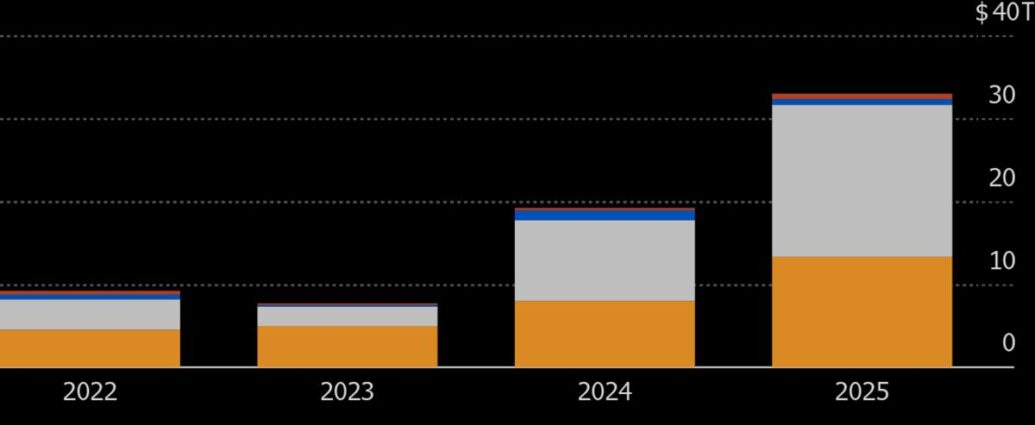
A new Vanity Fair feature published on Tuesday gathered a group of crypto billionaires alongside Polychain Capital’s Olaf Carlson-Wee at a luxury Manhattan hotel.
Michael Novogratz showed up hungover from a 4 a.m. trip to a Burning Man-themed nightclub wearing a full-length silver puffer jacket.
Danny Ryan, who runs a company trying to bring Wall Street onto the blockchain, wore pants with a hole in the crotch and went barefoot.
Meltem Demirors arrived layered a diamond cross, a leopard print coat, and a black sweatsuit with “Believe in Something” bedazzled across her rear.
Cathie Wood, the ARK Invest CEO, sat for her portrait in a dark cardigan, black trousers, and a single gold brooch, in sharp contrast to the others.
They are collectively billions poorer on paper.
The total crypto market cap has shed roughly $1.4 trillion since its December 2024 peak, and Bitcoin (CRYPTO: BTC) is trading near $73,700, about half its all-time high.
Demirors had her own take on the investors who sold: “They’re all p****es.”
The Market Doesn’t Care About Your Valentino

Forget Bitcoin, This Crypto ETF Is Quietly Crushing The Market
A lesser-known crypto ETF is quietly outperforming the broader markets. The T-Rex 2X Long CRCL Daily Target ETF (BATS:CCUP) has risen nearly 300% in the last 30 days.
• T-REX 2X Long CRCL Daily Target ETF stock is charging ahead with explosive momentum. What’s fueling CCUP momentum?
The catalyst for this incredible move is a company called Circle Internet Group Inc (NYSE:CRCL), which has seen its stock more than double in the last 30 days, fueling this incredible move in CCUP.
Stablecoin Engine, Not Speculation
Unlike other crypto ETFs that tend to move due to fluctuations in cryptocurrency asset prices, this move is due to underlying company fundamentals.
Circle Internet, which issues a stablecoin called USDC (CRYPTO: USDC), …






Mastercard to acquire crypto startup BVNK for up to $1.8 billion in largest stablecoin deal to date
Mastercard has finally pulled the trigger on a stablecoin acquisition. The payments giant on Tuesday morning announced a deal to acquire the London-based startup BVNK for up to $1.8 billion, with $300 million locked up in “contingent payments.” The deal is expected to close by year end, Jorn Lambert, Mastercard’s chief product officer, told Fortune. He declined to provide more details about the purchase of BVNK, which uses stablecoins to power customer transactions, cross-border payments, global treasuries, and other use cases.
The acquisition concludes an off-and-on negotiations process that saw the stablecoin firm court multiple buyers, including the U.S. crypto exchange Coinbase and Mastercard. Coinbase came close to buying the startup for around $2 billion before the two called off the deal around November.
Mastercard’s yet-to-be-closed purchase of BVNK eclipses Stripe’s $1.1 billion deal for the startup Bridge in February 2025, making this the largest stablecoin acquisition yet for the crypto industry.
Mastercard’s stock jumped about 2.5% in pre-market trading.
“This is really about getting the right tools to move after new addressable markets,” said Lambert.
Stablecoin rails
Mastercard’s push into stablecoins comes as the payments giant has fended off speculation over the past year that the rise of the digital tokens, or cryptocurrencies pegged to real-world assets like the U.S. dollar, may eat into its margins.
Proponents of stablecoins say their use of blockchain-based payment rails reduces fees and allows users to transact more quickly. Investors have seen some validity to that argument. Mastercard saw its shares initially sag after the U.S. Senate passed in June the Genius Act, legislation that regulates stablecoins. President Donald Trump signed the bill into law one month later.
Mastercard, however, has pushed back on any implications that stablecoins are a threat to its business. “I think most flows will begin and end in fiat,” Raj Seshadri, chief commercial payments officer at Mastercard, said on a July call with analysts.
Still, the incumbent payments network has made moves to keep pace with technological change. In addition to initially courting BVNK, Mastercard was also in talks with the crypto startup Zerohash for a purchase price of between $1.5 billion to $2 billion. That deal reportedly fell through. Lambert, Mastercard’s chief product officer, declined to delve into the payments network’s past ambitions of stablecoin acquisitions.
He also pushed back on the argument that stablecoins threatened Mastercard’s business model. “If you think about our current business, the card business, there’s no problem to be solved,” he said, adding that incorporating stablecoin rails positions Mastercard to more effectively make headway in the remittances market, among other areas.
For BVNK, founded in 2021, the $1.8 billion acquisition price is a large premium over its $750 million valuation in its Series B fundraising round in December 2024. “Needless to say, there’s a big smile on my face,” said BVNK cofounder Chris Harmse, in reference to Mastercard closing the deal to buy his company.
This story was originally featured on Fortune.com

Crypto Prediction Platform Polymarket Blocked In Argentina For Facilitating Unauthorized Betting: Report
An Argentinian court ordered a nationwide block of betting market platform Polymarket on Monday and instructed Alphabet Inc.‘s (NASDAQ:GOOG) (NASDAQ:GOOGL) Google and Apple Inc (NASDAQ:AAPL) to remove access to its mobile applications within the country.
‘Concealed Online Betting System’
The court issued the order in response to an investigation led by a specialized gambling prosecution office, according to a report by Buenos Aires Times.
The investigation …

Has AI Killed Bitcoin? Debate Erupts As Crypto Influencer Says Data Centers Outbid Miners For Power
Cryptocurrency influencer Ran Neuner sparked a debate Sunday by claiming that artificial intelligence has become a major competitor to Bitcoin (CRYPTO: BTC) mining.
Is AI Computing More Profitable Than Bitcoin?
Neuner stated in an X post that AI has “killed Bitcoin forever” by outbidding for electricity.
“Both industries compete for the same thing: electricity. And right now, AI is willing to pay much more for it,” Neuner added.
Neuner cited that while Bitcoin mining revenue per megawatt ranges from $57 to $129, AI data center revenue per megawatt stands between $200 and $500.
“Same electricity. But up to 8x more profitable. That’s why miners are starting to pivot,” they added.

Bitcoin Holds Near $74,000 As Crypto Market Waits For Inflation And Rate Signals
Bitcoin (CRYPTO: BTC) is trading just below the $74,000 level as the broader cryptocurrency market enters a period of relative calm, with traders closely watching upcoming macroeconomic data for the next catalyst.
After several weeks of volatility, the largest cryptocurrency by market value has spent the past two days moving within a narrow range. Market participants say the current pause reflects uncertainty around interest rate expectations, inflation trends, and global liquidity conditions that could shape the next move across risk assets.
Ethereum (CRYPTO: ETH), the second largest digital asset, has also stabilized during the same period, suggesting the broader crypto market is waiting for clearer signals before committing to a stronger directional trend.
Bitcoin Stabilizes Near $73,800
As of the latest trading session, Bitcoin is hovering around $73,786 after briefly testing higher levels earlier in the week. The asset has largely remained between roughly $72,500 and $74,500 during the past 48 hours.
Such consolidation periods are common following strong moves. Bitcoin has experienced multiple sharp rallies over the past year, driven by institutional demand, exchange traded fund inflows, and continued adoption of digital assets within traditional finance.
For now, traders appear reluctant to push the price aggressively higher without fresh catalysts from either macroeconomic developments or institutional flows.
Market analysts often view consolidation near key price levels as a potential setup for the next major breakout. The $75,000 mark in particular has become an important psychological threshold for Bitcoin traders.
A sustained move above that level could trigger renewed momentum buying, while a rejection could lead to another period of sideways movement.
Ethereum Moves In Tandem With Bitcoin
Ethereum is currently trading around $2,256, reflecting a similar period of stability across the digital asset market.
The correlation between Bitcoin and Ethereum remains high, especially during macro driven trading environments when investors treat crypto as part of the broader risk asset landscape alongside equities and technology stocks.
Ethereum’s price action has …


Crypto.com Enters Retirement Market With New Crypto IRA Offering
Crypto platform Crypto.com is making a direct push into the U.S. retirement market with the launch of Crypto.com IRAs, a new investment product that allows investors to hold cryptocurrencies, stocks, and exchange traded funds in a single tax advantaged account.
The launch signals a growing effort by digital asset companies to expand beyond trading platforms and into long term wealth management products. For investors, the move represents another step toward integrating digital assets into traditional financial planning.
As crypto adoption continues to rise among retail investors and institutions alike, retirement products that include digital assets are becoming an increasingly competitive area across the financial industry.
A Hybrid IRA That Combines Crypto And Traditional Assets
Crypto.com IRAs allow investors to hold multiple asset classes within a single retirement account. Through the company’s mobile app, users can invest in cryptocurrencies, equities, and ETFs without needing to move between separate platforms.
The accounts support both Traditional IRA and Roth IRA structures.
Traditional IRAs allow contributions to grow tax deferred until withdrawal, while Roth IRAs allow qualified withdrawals to be tax free in retirement.
In addition to traditional securities, the accounts support major digital assets such as Bitcoin (CRYPTO: BTC) and Ethereum (CRYPTO: ETH) along with hundreds of additional tokens.
The ability to hold both stocks and crypto in a single retirement account reflects a broader trend toward hybrid investment platforms that combine digital assets with traditional financial markets.
For long term investors, the structure may simplify portfolio management while allowing exposure to high growth digital assets alongside more established securities.
Incentives To Attract Early Investors
To encourage adoption, Crypto.com is offering several incentives tied to the new retirement accounts.
According to the company, investors may receive up to a …



The next big thing in crypto will be tokenized stocks: Here are the likely winners and losers
Crypto has no shortage of detractors, but even they would concede the industry has produced massive innovations, including Bitcoin and stablecoin payment rails, that have had a profound effect on global commerce. Now, another crypto invention is on the cusp of introducing disruption on a similar scale: Blockchain-based stock trading, which got a big vote of confidence from both NYSE and NASDAQ this month, and is poised to deliver big changes for both investors and companies.
Robinhood CEO Vlad Tenev memorably described tokenized stocks as an unstoppable “freight train.” The arrival of that train will depend on how fast regulators can supply a legal framework, but Tenev’s basic premise is sound. The more interesting question is which firms will lead this coming wave of disruption, and which will be left out.
According to Sebastian Pedro Bea, a former BlackRock executive who is now CIO at crypto firm ReserveOne, the emerging world of tokenized stocks is being led by offshore players and by U.S.-based “compliant disruptors.” Bea includes in this category the likes of Securitize, Superstate and Figure, which have little in the way of trading volume, but that are laying the groundwork to allow Fortune 500 companies to issue their shares on-chain. Once this happens, a whole range of corporate activities—from paying dividends to proxy votes to settling trades—will become far more efficient.
In a recent chat, Bea also pointed to leading offshore players Kraken and Ondo, which are offering a very different type of blockchain-based stocks. Namely, these firms are using special purpose vehicles to purchase large quantities of stocks like Apple and Tesla, and selling tokens that provide a legal claim to the stock. These offerings are basically derivatives that don’t provide the full advantages of blockchain, but their tokenized wrappers mean trades can be settled instantly.
For now, the market for all this is relatively small—perhaps $2 billion across all platforms. This is likely to change, though, since key figures at the Securities and Exchange Commission are supportive of tokenized equities, and as the country’s most prestigious stock exchanges, NYSE and NASDAQ, recently announced tie-ups with OKX and Kraken, respectively. All of these companies, including Bea’s “compliant disruptors,” and Coinbase and Robinhood, are likely to be key players in the coming tokenization of the stock market. In doing so, they will create a more decentralized type of stock market.
Then there are those on the receiving end of the disruption. This is likely to be the legions of middle-men who oversee the current system of clearing and settling trades, whose roles stand to become obsolete. As Superstate notes in a helpful blog post “What really happens when stocks trade”: “U.S. equity markets still run on architecture designed for a different era … Settlement is delayed by design. Risk is warehoused in intermediaries built for reconciliation, not execution.”
The rise of tokenized stocks means the equity markets of the future will be built around instant execution. At this point, it’s not a question of if but when.
Jeff John Roberts
jeff.roberts@fortune.com
@jeffjohnroberts
This story was originally featured on Fortune.com