
Glass office-building facades (generic image). Photo: Sonny Sixteen/Pexels.
U.S. stocks closed deep in the red Thursday in the worst day for the S&P 500 since April 2025. The Dow Jones Industrial Average ended down 1,833.06 points, or 3.4%, at 51,523.06, the S&P 500 sank 4.4% to 7,353.73 and the Nasdaq Composite tumbled 1,421.52 points, or 5.5%, to 24,315.00. Figures are official closing prices.
The rout more than erased Wednesday’s 1,569-point post-election rally, leaving the Dow below where it sat before the rally began. The Nasdaq Composite ended 11.9% below its record close of 27,599.89 set October 6 – its second correction of the year. The Nasdaq-100 fell 6.4% to 26,629.81, deeper into correction territory.
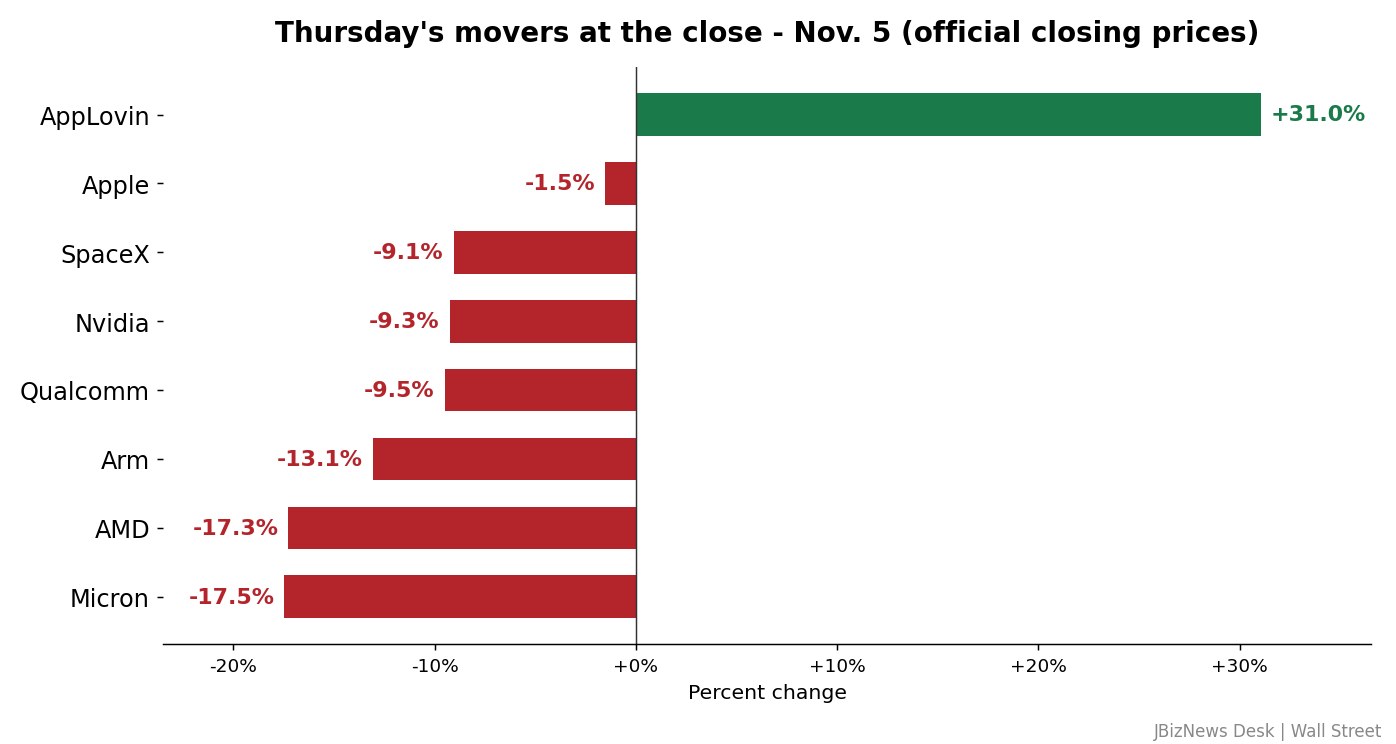
Chip and AI-infrastructure stocks took the worst of it. AMD cratered 17.3%, Micron Technology 17.5% and Arm Holdings 13.1%, while Nvidia lost 9.3% and Qualcomm 9.5% a day after its disappointing forecast. The tech sector fund XLK fell 8%, its steepest one-day drop in months, as investors questioned whether AI spending can justify the sector’s valuations and financing needs.
The selling reached every corner of the market. Industrial stocks fell 4.1%, financials 2.9% and even energy – the day’s most resilient sector – lost 2.9%. SpaceX fell 9.1%, extending a rough two days for Elon Musk’s companies, while Apple held up far better than its megacap peers, down 1.5%. One stock defied the tape all day: AppLovin soared 31% to $356.10 after reporting record third-quarter revenue of $2.18 billion, up 55%, according to the company’s results release.
Investors fled to safety. The 10-year Treasury yield fell about 6 basis points to roughly 4.84%, and December gold futures settled 0.99% higher at $4,113.50 an ounce. Oil bucked the gloom: U.S. crude settled up $2.40, or 2.7%, at $90.52 a barrel and Brent crude settled up $3.67, or 3.9%, at $98.29, while Reuters reported that new tanker attacks fed supply worries. The Brent settlement was confirmed by Dow Jones market data. The economy itself delivered a steady signal: initial jobless claims fell to 189,000 last week, the fewest since mid-July, the Labor Department reported, and the October jobs report lands Friday at 8:30 a.m. from the Bureau of Labor Statistics.
| Market | Level | Change | As of (ET) |
|---|---|---|---|
| Dow Jones | 51,523.06 | -1,833.06 (-3.44%) | close |
| S&P 500 | 7,353.73 | -334.89 (-4.36%) | close |
| Nasdaq Composite | 24,315.00 | -1,421.52 (-5.52%) | close |
| Nasdaq-100 | 26,629.81 | -1,807.36 (-6.36%) | close |
| Tech sector (XLK) | 162.31 | -8.04% | close |
| 10-Year Treasury | ~4.84% | -6 bps | ~3 p.m. |
| WTI crude (settle) | $90.52 | +2.72% | settle |
| Brent crude (settle) | $98.29 | +3.88% | settle |
| Gold (Dec. settle) | $4,113.50 | +0.99% | settle |
Official closing prices and commodity settlements, Thursday, Nov. 5. Movers shown in the chart below.
What it means for you: days like this are painful on paper – about $4.40 of value gone for every $100 in an S&P 500 index fund, and about $8 per $100 in a broad technology fund. For most households, a one-day stock move does not by itself change a paycheck or a bank balance, and payments on existing fixed-rate loans stay the same; falling bond yields, if they hold, could nudge loan rates lower in the weeks ahead. A single ugly day is not a forecast.
JBizNews Desk | Wall Street
© JBizNews.com. All rights reserved. Unauthorized reproduction or redistribution is strictly prohibited.