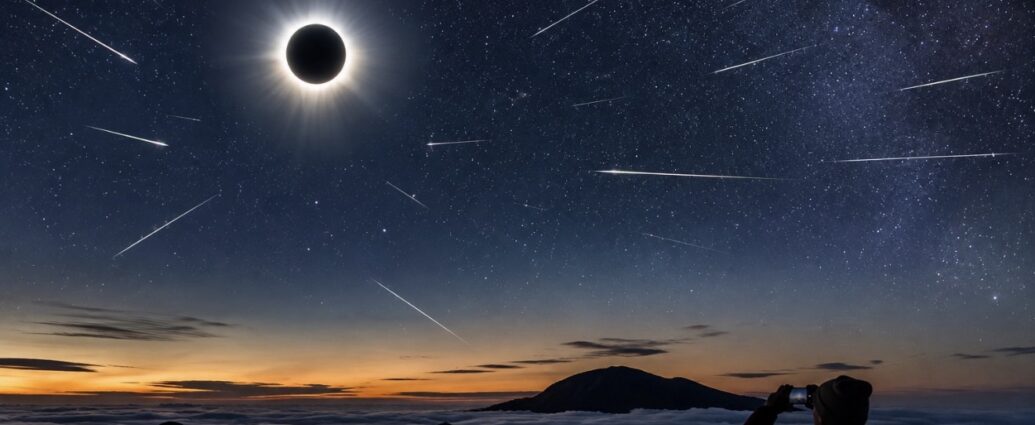
Tomorrow brings a celestial doubleheader that will not happen again anytime soon: a total solar eclipse will race across the Arctic and Europe during the day, and just hours later the Perseid meteor shower will reach its peak under an almost perfectly dark, moonless sky.
For a small slice of the planet, Aug. 12 could deliver one of the most spectacular sky-watching days in years.
And Americans are not completely left out.
The total eclipse misses the United States, but a partial eclipse will be visible across parts of the country. New York will see roughly 9% of the sun covered, Boston about 16%, and portions of Alaska more than 30%.
Then, after darkness falls, the real American show begins.
The Perseids — one of the most popular meteor showers of the year — peak overnight Wednesday into Thursday, with virtually no moonlight to wash out the sky.
That combination is what makes Aug. 12 special.
The eclipse begins over northern Russia before the moon’s shadow sweeps across Greenland, Iceland and the North Atlantic and finally reaches Spain and a small corner of Portugal shortly before sunset.
Inside the narrow path of totality, daylight will briefly disappear.
At maximum, the sun will be completely covered for 2 minutes and 18 seconds. Reykjavik gets roughly a minute of totality, while parts of Spain will watch the sun vanish just before it drops toward the horizon.
For Spain, it is an especially historic event. The country is entering an extraordinary three-year eclipse run: Wednesday’s total eclipse will be followed by another total eclipse on Aug. 2, 2027, and a “ring of fire” annular eclipse on Jan. 26, 2028.
Hotels, tour operators and eclipse watchers have been preparing for months.
But there is one thing nobody can reserve: clear skies.
Much of the early eclipse path crosses regions where clouds can spoil the show. Spain offers some of the better weather prospects along the route, making the final European stretch one of the most closely watched viewing areas.
Anyone watching even a partial eclipse needs proper solar protection. Eclipse glasses or approved solar filters are required whenever any portion of the sun remains visible. Only people standing inside the path of totality may safely remove protection during the brief period when the sun is completely covered.
Then comes Act Two.
As Europe finishes watching the eclipse, Earth will be moving through the debris trail of Comet Swift-Tuttle, producing the annual Perseid meteor shower.
And 2026 offers almost perfect viewing conditions.
The moon is new on Aug. 12, meaning there will be essentially no moonlight competing with the meteors. The American Meteor Society says normal peak rates from dark rural locations are around 30 to 50 Perseids an hour, while the theoretical maximum rate can reach about 100 under ideal conditions.
No telescope is needed.
The best strategy is simple: get away from city lights, find a wide view of the sky, put away the phone and give your eyes about 20 minutes to adjust to the darkness.
Viewing improves later in the night as the Perseid radiant climbs higher, with some of the best conditions arriving in the hours before dawn Thursday.
And for the lucky few watching from the eclipse path, there is an extraordinary possibility.
A bright Perseid could streak across the sky during totality itself — a meteor flashing through a daytime sky suddenly turned dark by the moon.
Most people will never see that combination.
For Americans, the show is more spread out: catch whatever portion of Wednesday’s partial eclipse is visible from your location, then come back outside after dark.
One day.
An eclipse.
A moonless Perseid peak.
And potentially dozens of shooting stars before breakfast.
Wednesday is a good day to look up.
JBizNews Desk | New York
© JBizNews.com All Rights Reserved. Reproduction or distribution without written permission is prohibited.