Yashar party leader Gadi Eisenkot hopes to beat Prime Minister Benjamin Netanyahu’s Likud party and his bloc of political allies to get the first chance to form the next government.
However, due to the size of the Israeli-Arab parties, which are not specifically affiliated with a bloc, Eisenkot is not expected to be able to easily form the next government even if he wins more votes than the Netanyahu right-wing bloc.
Instead, he is expected to need to undertake complex negotiations with his coalition partners, especially Yisrael Beytenu’s Avigdor Liberman, to convince them to form some kind of government or minority-voting bloc arrangement with the Israeli-Arab parties.
Eisenkot’s campaign on Tuesday started early in the morning at Ofakim and Nir Oz in the Gaza Strip corridor, calling attention to the failures of the past government in preventing Hamas’s October 7 invasion.
He then traveled further north to Ashdod, with other stops along the way, before voting in Herzliya at 1:45 p.m. and eventually reaching his election-night headquarters at the National Sports Complex in Tel Aviv.
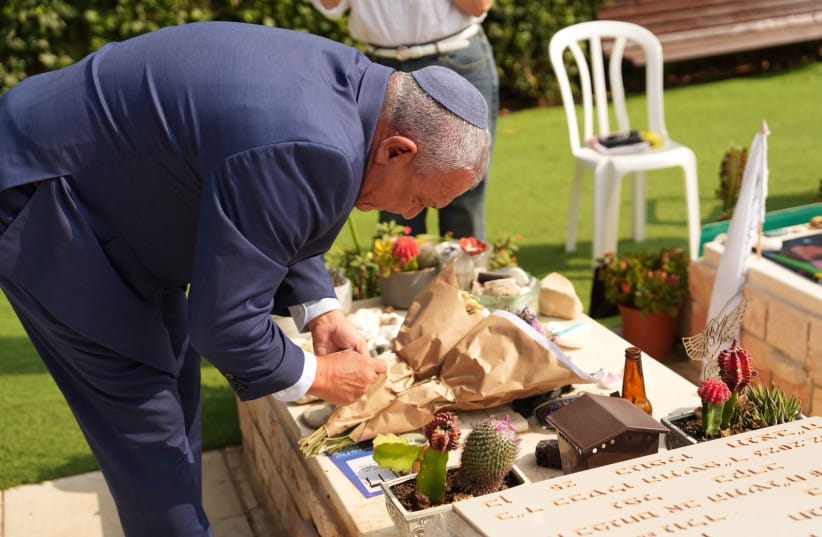
The former IDF chief also went with his wife, Hana, to visit the grave of his son, Gal Eisenkot, who died in Gaza in late 2023.
Already by late morning, Yashar had filed complaints with the Israeli Election Commission complaining of alleged systematic vandalism and destruction of ballots carrying the party’s name at various voting sites.
Eisenkot’s largest support comes from voters who blame Netanyahu for October 7 or who blame him and his bloc for failing to draft the haredi sector into the IDF even after over 1,000 Israeli soldiers died in recent years.
What are his views on other issues?
Iran: Eisenkot less willing to take risk in attacking
There are few major differences between Netanyahu and Eisenkot here, though some nuances remain. Both would oppose a “bad deal” if US President Donald Trump’s administration opts for one.
In that sense, the main difference is how they would address such a bad deal.
Unlike Netanyahu, Eisenkot would likely keep his opposition private in order to try to improve the deal quietly, while viewing American public opinion as something he has less control over.
Both Netanyahu and Eisenkot would be ready to attack Iran in some circumstances, but most would agree that, at this stage, Netanyahu would be willing to take on more risk and might interpret the point of no return as earlier than Eisenkot.
Gaza: Eisenkot has no real plan except Trump’s
Neither Netanyahu nor Eisenkot has a real plan for Gaza. Both have promised to eliminate Hamas’s control of the Strip, Eisenkot within 18 months, and Netanyahu by the end of Trump’s term, but neither has a clear path for doing so.
Eisenkot has no clear plan of his own, but unlike Netanyahu, is willing to push forward with Trump’s ceasefire plan without significant resistance, including empowering Palestinian Authority-linked technocratic leaders and police, and international peacekeepers in Gaza.
He would likely be ready to allow partial rebuilding for partial Hamas disarming, if for no other reason than to pause and maybe even push back the diplomatic tsunami which is already threatening Israeli national security and economic stability.
These differences could have implications over the next year and years, but Eisenkot has made it clear he will not move toward a Palestinian state, certainly not in any first term.
West Bank: Eisenkot harsher on Jewish extremism, settlement expansion
If there are strong commonalities between Netanyahu and Eisenkot on Iran and Gaza and the differences are more in the nuances, they are night and day on the West Bank.
The only thing they both have in common is a strong commitment to fight Palestinian terror as the number one issue.
But on fighting Jewish extremism and on expansion of the Israeli settlements, the number two and three issues, they are far apart.
Eisenkot would immediately reinstitute administrative detention of Jewish extremists, which Defense Minister Israel Katz suspended in January 2025, and which Netanyahu has allowed to remain suspended for nearly two years despite losing control of Jewish extremists.
In addition, Eisenkot will clean house at the police, injecting officers who will come down hard on the Jewish extremists.
He will likely also fire Shin Bet Director David Zini and replace him with a new chief who will crack down more on Jewish extremists.
Regarding the over 100 new “farms” which Netanyahu’s government expanded under Bezalel Smotrich’s authority within the defense ministry, Eisenkot will likely clear most or all of them.
He will certainly freeze new settlement building or limit it to the “natural” expansion of existing settlements.
Collectively, these actions would help pause or even roll back the diplomatic tsunami which has started to engulf Israel’s national security and economic stability.
However, Eisenkot has no vision for how to resolve the standoff with the West Bank Palestinians, which has lasted since 1967. Once again, he opposes a two-state solution in the near and medium term.
Lebanon: Netanyahu, Eisenkot aligned
There seem to be no major differences between Eisenkot and Netanyahu on Lebanon.
Both would maintain a security zone. Both are open to partial withdrawals in exchange for the Lebanese army partially clearing Hezbollah from the security zone, and neither trusts that the Lebanese army will do its job sufficiently.
Under light pressure from Trump (heavier pressure will be on Gaza and likely the West Bank), might Eisenkot agree to partial withdrawals faster than Netanyahu? Maybe.
But Eisenkot has said he would draw a line at eight kilometers so that Hezbollah cannot fire anti-tank missiles into Israel.
The only major nuanced difference might be that Eisenkot will try to return France to a productive role, hoping to score some diplomatic points with them on other fronts, whereas Netanyahu now relishes public conflicts with Paris.
Syria: Eisenkot to keep security zone, has trouble trusting al-Sharaa
Netanyahu and Eisenkot also likely differ little on Syria.
Once again, both want to keep a security zone, and both have dropped hints at times that they might agree to partial withdrawals, but both have strong doubts about trusting Syrian leader Ahmad al-Sharaa because of his al-Qaeda past.
Diplomatic relations: Eisenkot to improve European ties
Eisenkot would heavily improve relations with Europe.
He might reach some new understandings with Middle Eastern countries who once liked, but now loathe, Netanyahu.
All of those diplomatic wins could help on various national security and economic stability issues.
But the most crucial prize is the US.
Despite Trump’s endorsement of Netanyahu, if Eisenkot wins and is more compliant with some of Washington’s demands in Gaza, the West Bank, Lebanon, and Syria, they will likely figure out how to get along.
More importantly, Eisenkot will not give up on the Democratic party, which has turned more against Israel than in any time in decades.
He will try to hit “restart” post-Netanyahu.
The bad news is that he has no clear plan for doing this, and the gulf between Israeli and American expectations about the Middle East really is large, even if Netanyahu exists stage left.
Whether Eisenkot could bridge that gulf would be one of the key challenges and uncertainties of his premiership.