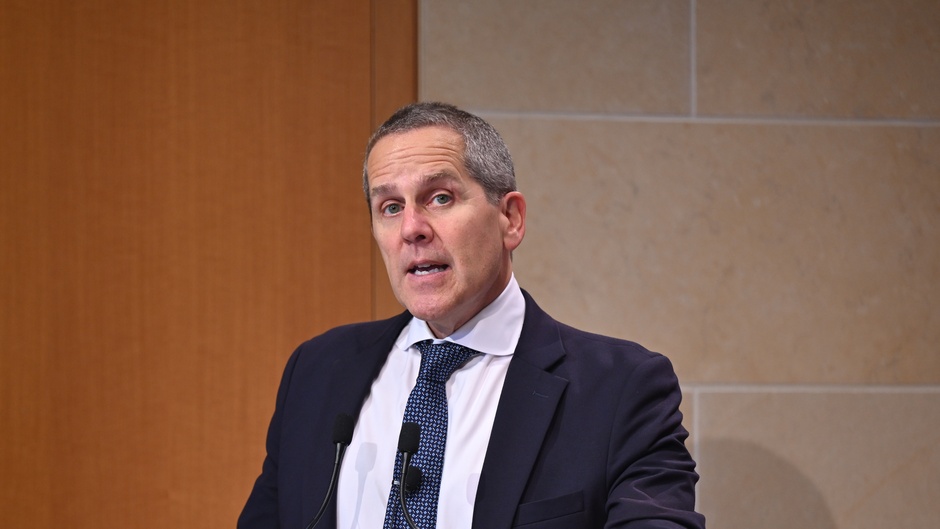
FILE: Federal Reserve Governor Michael S. Barr speaks at the Peterson Institute for International Economics on September 25, 2025. Photo: Federal Reserve Board / Wikimedia Commons, public domain, cropped and resized.
Federal Reserve Governor Michael S. Barr warned that artificial intelligence could concentrate wealth and market power in a small group of companies, leaving smaller businesses and workers with a smaller share of the gains if access to the technology becomes uneven.
In remarks published Thursday by the Federal Reserve for an appearance at Yale University in New Haven, Connecticut, Barr said the outcome is not settled. Competition could make AI inexpensive and widely available, helping small businesses become more productive. But dominance by a handful of companies could push the economy in the opposite direction.
“The extent of the advantage possessed by AI leaders may prove to be unprecedented,” Barr said.
His warning centered on who owns the technology and who can afford to use it. AI development depends on data, computing power and improvements to models, resources that can give large companies an advantage. AI can also help companies develop the next generation of AI, potentially reinforcing the lead of businesses already ahead.
If a small number of companies dominate the market and collect most investment returns, their owners and managers could become much wealthier, Barr said. Large businesses could afford further AI investment and expand, while smaller businesses could lose market share and have less access to improving tools.
That is a risk scenario, not Barr’s description of an outcome that has already arrived. He said competition among AI companies has so far kept access fairly broad. Some businesses may also be able to meet most of their needs with smaller language models rather than the most advanced and expensive systems.
“AI could democratize access to skills and information needed for small businesses to thrive,” he said.
Barr also cautioned against treating every AI investment as evidence that jobs are disappearing. So far, he said, there has been relatively little worker displacement from AI, alongside evidence that the technology is making some workers more productive, increasing demand in some sectors and creating new occupations.
Still, he pointed to signs that AI may be replacing labor in some areas, particularly among younger and less-experienced workers. A fast transition would be harder for workers to absorb than gradual adoption, he said.
The concern comes against an already unequal distribution of wealth. Citing the Fed’s latest Survey of Consumer Finances, Barr said the wealthiest 10% of households hold nearly three-quarters of U.S. wealth, while the bottom half hold about 2%.
For business owners, the distinction is whether AI becomes an affordable tool available across the economy or an advantage concentrated among companies with the largest investment budgets. Barr argued that worker training, new job creation and help connecting people to new work could shape how widely the benefits are shared.
The speech did not announce a Federal Reserve policy action. Barr said his views were his own and did not necessarily reflect those of other Fed governors or the Federal Open Market Committee.
© JBizNews.com. All rights reserved. Unauthorized reproduction or redistribution is strictly prohibited.