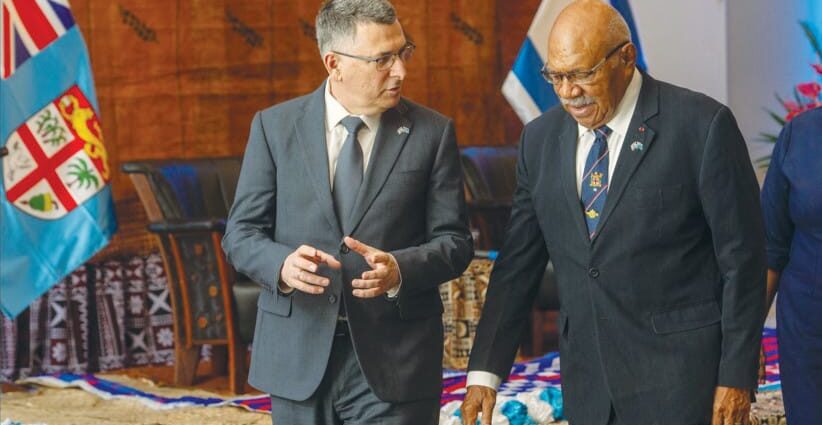
For nearly two years, Foreign Minister Gideon Sa’ar has been pursuing a diplomatic goal that, given the current international climate surrounding Israel, might sound almost unimaginable: persuading foreign governments to move their embassies to Jerusalem.
The campaign is about far more than where diplomats work. It is part of a broader struggle over Israel’s place in the international system – a struggle that Sa’ar increasingly sees as a component of national security alongside the wars being fought on Israel’s borders.
Next month, Colombia is expected to become the 10th country to operate an embassy in Jerusalem. Israel has also reached an understanding with the Democratic Republic of the Congo to open an embassy, although no date has yet been set.
For Sa’ar, the numbers are significant. When he took office less than two years ago, he said, Jerusalem had roughly half the number of foreign embassies it has today.
“I think it is important,” he said. “It is one of the indications that even during this challenging period, we have managed to expand and deepen our diplomatic ties, while at the same time dealing with struggles and blockages in other arenas.”
Progress does not happen on its own
The progress, he stressed, did not happen by itself. Sa’ar made expanding the Foreign Ministry’s diplomatic presence in Jerusalem one of its measurable goals. “I am also working on it. It doesn’t happen by itself.”
For Sa’ar, diplomatic recognition is ultimately a battle over competing narratives – and Israel cannot afford to leave that arena unanswered.
“The struggle for our rights is narrative against narrative,” he said. “Is Jerusalem the ancient capital of the Jewish people, which was never the capital of any other people or state? Or is it something else, which, at best, needs to be divided?”
Moving an embassy to Jerusalem is not an easy decision for a foreign government. Such governments know they may face criticism from the Palestinians, Arab states, and other parts of the international community. That, Sa’ar argued, is why every decision to move an embassy matters.
The conversations, he said, often begin long before a leader takes office. With Colombia, he raised the issue with President-elect Abelardo de la Espriella before the election. He discussed it with Nauru’s vice president during a visit to Fiji and recently raised it with Slovenia’s prime minister.
The circumstances vary from country to country, Sa’ar said, but the principle is the same: Israel has to ask.
“You have to know how to give in places that are important to them, but you also have to know how to demand and put forward the things that are important to you,” he said.
Sa’ar quoted Ze’ev Jabotinsky: “Difficult – that means possible.” “That doesn’t mean it is easy,” he said. “But it is possible in many places.”
Israel-UK relations deteriorate to ‘unprecedented low’
IF JERUSALEM represents Sa’ar’s long-term diplomatic campaign, Britain represents the tougher side of his approach.
Relations between Jerusalem and London have deteriorated significantly under the Labour government, particularly following Britain’s decision to impose sanctions related to Israeli settlements in the West Bank. Sa’ar described the relationship as being at an “unprecedented low.”
Israel responded with its own measures, including the closure of the British Consulate in east Jerusalem, restrictions on the activities of British representatives dealing with issues related to the Palestinian Authority and Gaza, and the declaration of several British figures as persona non grata.
Sa’ar rejected the suggestion that such measures are merely diplomatic theater.
“Anyone who acts against Israel with a unilateral, pro-Palestinian and anti-Israel approach, like the Labour government, will lose its effectiveness and relevance in the region,” he said. “As a country, we are not prepared to allow attacks against us to go unanswered.”
He believes the response can also affect other governments’ calculations.
“If we had not acted in this way,” he said, “I have no doubt that other countries would have taken identical steps.”
But Sa’ar is already looking beyond the current Labour government. He pointed to criticism of Labour’s Israel policy from both the Conservatives and Reform UK.
Reform UK leader Nigel Farage, he said, has indicated that his party would reverse some of the measures if it came to power. For Sa’ar, the episode illustrates a basic reality of diplomacy: governments change.
Iran presents unique challenge to Israeli diplomacy
Iran presents a different challenge. Despite a series of meetings held by Iranian Foreign Minister Abbas Araghchi during the UN General Assembly in New York, including meetings with Western foreign ministers, Sa’ar rejected the argument that Tehran emerged from the latest regional upheaval diplomatically strengthened.
“I don’t think Iran has become stronger diplomatically,” he said. “I think it has become weaker.”
He pointed to the international campaign against the Islamic Revolutionary Guard Corps, noting that numerous countries have designated the organization a terrorist group, as well as steps by some governments to reduce diplomatic relations with Tehran. He also cited Iran’s suppression of protests and its regional activities.
Still, Sa’ar did not claim that Iran has become isolated.
“The world is a cynical world,” he said. “Usually, everyone conducts dialogue with everyone, in one way or another.” International politics, he added, is “also a game of interests.”
That pragmatism is particularly relevant to the question of whether Washington and Tehran will return to negotiations. Sa’ar does not currently see an agreement on the horizon. But he also refused to declare diplomacy dead.
“Reality is dynamic,” he said. “It can also change.”
For Israel, however, one issue remains constant: Iran’s nuclear program.
“Our highest commitment is to prevent Iran from having nuclear weapons,” Sa’ar said. “That has not changed.” If necessary, he added, Israel will act.
The same logic applies to the Houthis, although Sa’ar distinguished between confronting a threat and assuming responsibility for every regional crisis. He described the Houthi threat as serious but rejected the idea that Israel should automatically intervene.
“I don’t think there is any country that has contributed more than the State of Israel to harming the Houthis and weakening the Houthis in recent years,” he said.
Israel, he added, cannot solve every problem in the world. “Not even all the problems in the Middle East.”
Instead, Sa’ar said, Jerusalem will continue to maintain discreet channels of dialogue, while acting in line with its national interests.
Latin America open for diplomatic breakthroughs
AGAINST THE backdrop of mounting international pressure, Sa’ar sees Latin America as one of the areas where Israel can still expand its diplomatic reach. He has declared the current year the “Year of Latin America” at the ministry, arguing that the continent offers significant opportunities for diplomatic breakthroughs.
Colombia is the clearest example. In a relatively short period, Israel moved from a highly strained relationship under former president Gustavo Petro to expanding ties with his successor, including the planned move of Colombia’s embassy to Jerusalem.
For Sa’ar, the lesson is that Israel cannot simply wait for election results. He began cultivating relationships before politicians reached power.
He recalled meeting de la Espriella nearly a year before the election, when the future president was still relatively low in the polls.
“You build relationships,” Sa’ar said. “You cultivate relationships.”
He pointed to Honduras as another example of the long-term value of such engagement. Israel sends medical teams there, including ophthalmologists who perform surgeries, while other projects focus on water, agriculture, and health.
For Sa’ar, diplomacy is not limited to UN votes or presidential statements. It is also about building relationships between people and companies.
There is a strategic dimension to that work as well. The Trump administration has placed renewed emphasis on the western hemisphere, Sa’ar noted, giving Israeli engagement in Latin America added significance for Washington.
Still, he acknowledged that the picture is far from uniform. Mexico remains challenging, he said, while other countries in the region are moving in different political directions.
“Even in countries where we have made progress, we still have many more steps to take forward,” he said.
Sa’ar is also advocating a more open approach toward some of Europe’s right-wing political parties, while stressing that dialogue does not automatically mean normalization.
Last week, he praised a speech by Austrian Freedom Party leader Herbert Kickl, calling it significant in part because of its reference to Austria’s Nazi past, expression of regret toward Jews, and positive references to Israel.
For decades, Israel kept its distance from the party because of concerns surrounding its ideological history. Those concerns, Sa’ar said, have not suddenly disappeared.
But he believes Kickl’s speech provides a basis for opening a dialogue.
“This is a decision to conduct dialogue,” he emphasized. “It is still not a decision on normalization.”
The distinction is deliberate. Israel, Sa’ar said, will listen, ask questions, and examine commitments. It will not automatically turn a speech into political recognition.
“We will enter this dialogue with an open mind,” he said.
Ultimately, Sa’ar returned to the argument that has come to define his approach: Israel cannot afford to treat diplomacy as secondary to military power.
During his tenure, he said, the ministry’s budget has increased, five Israeli diplomatic missions have been established, and greater resources have been allocated to public diplomacy and the battle over Israel’s international image.
The importance of that campaign has become especially clear during the war. Israel is confronting military threats, but also diplomatic pressure, economic measures, legal proceedings, and an international campaign over its legitimacy.
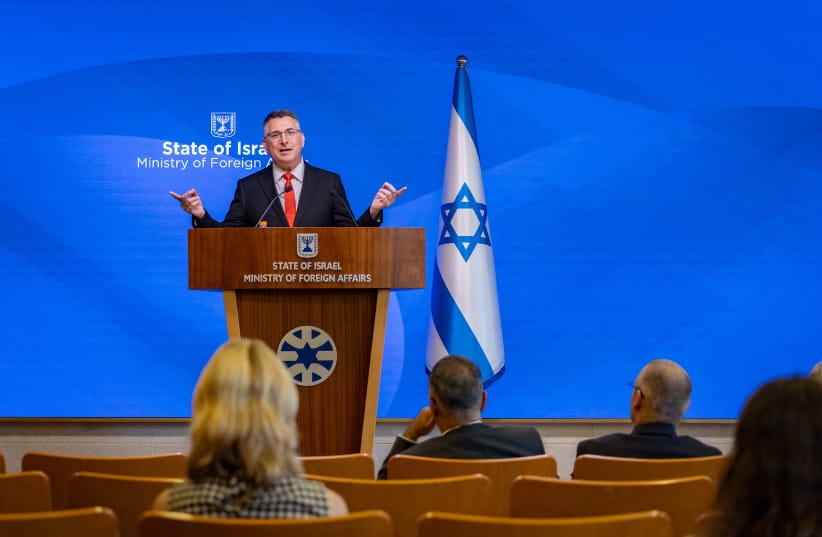
Sa’ar focuses on broad narrative battle against Israel
Sa’ar rejected the argument that Israel is responding too slowly to cultural events that portray the country negatively. Referring to the film NAZA, which was screened at the Venice Film Festival and which he said portrayed Israel as committing genocide while comparing it to Nazi Germany, Sa’ar dismissed the idea that the government could simply have prevented the screening.
“What could we have done?” he asked. “Go into the editing rooms and change it?”
For Sa’ar, focusing on a single film misses the larger battle.
“This is not a single item,” he said. “It is part of a much broader war.”
That may be the central idea behind Sa’ar’s tenure at the Foreign Ministry. The battlefield can determine what happens on the ground. But the diplomatic battlefield, he argued, determines how much room for maneuver Israel will have once the fighting stops.