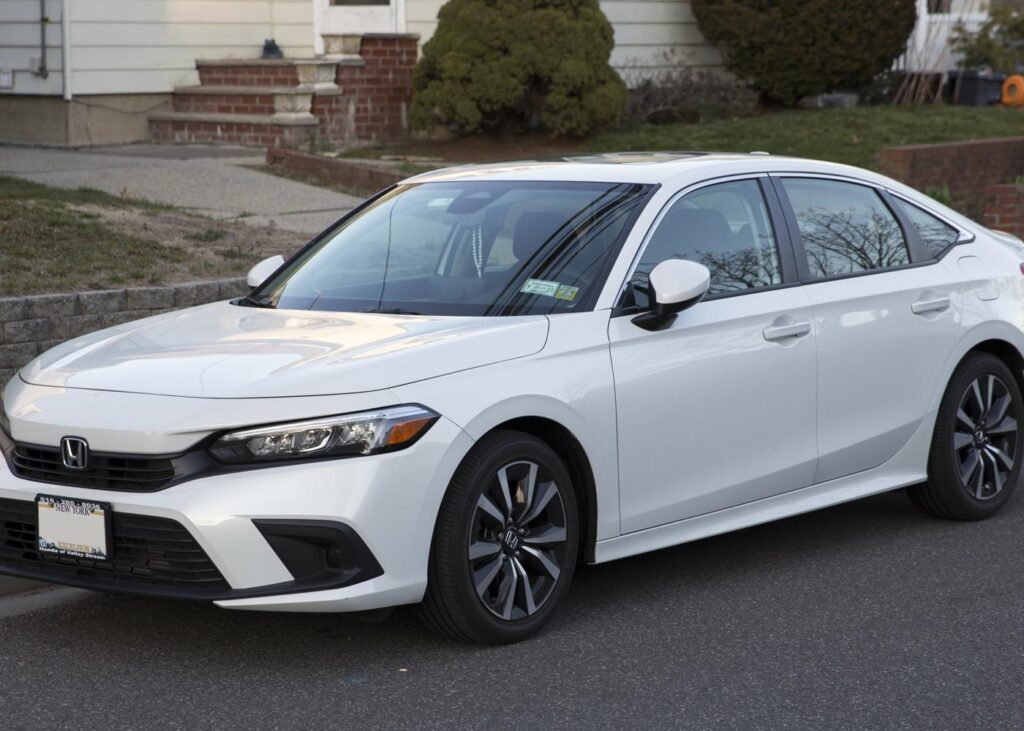
Mr.choppers / Wikimedia Commons (CC BY-SA 3.0; 2023 archive; crop).
Every generation of Americans seems to have a problem with the family car that came before it. Station wagons gave way to minivans, which eventually surrendered American driveways to SUVs. Now it may be Gen Z’s turn to turn up its nose at the family SUV.
Instead, it’s turning to the classic sedan.
A September analysis by insurance-comparison site Compare.com of more than 58 million auto insurance rate quotes found that eight of Gen Z’s 10 most commonly driven models were sedans, led by the Honda Civic, Honda Accord and Toyota Camry. The other two were full-size pickups, the Ford F-Series and Chevrolet Silverado. No SUV made the list.
The younger the generation, the deeper its apparent love affair with sedans, while SUVs steadily slide down the rankings. Six of millennials’ top 10 models were sedans, compared with five for Gen X and just three for baby boomers, whose top 10 included five SUVs.
And it’s not just one study. A February report from automotive research firm Escalent, which surveyed more than 1,000 teenagers ages 14 to 19, found that 51% envisioned driving a sedan in the future, compared with 31% who pictured themselves in an SUV and 14% who chose a truck.
A YouGov study published in May 2025 found a similar pattern among young adults already behind the wheel. Among Americans ages 18 to 29, 37% said their primary vehicle was a sedan, compared with 30% who drove an SUV or crossover.
Why Gen Z is choosing sedans
So what does Gen Z see in the humble sedan?
For one thing, the price tag. According to Kelley Blue Book data from Cox Automotive, a new compact car sold for an average of $27,977 in September, compared with $37,614 for a compact SUV and $50,630 for a midsize SUV. That gap matters for a generation that, as Fortune has reported, says it is struggling to get ahead financially despite starting to build wealth earlier than older generations did.
Younger buyers are also showing signs of keeping their car purchases modest. As Fortune previously reported, 55% of Gen Z respondents in a 2023 Cars.com survey had bought a used car. More recent LendingTree data found that 51.5% of Gen Z borrowers with active auto loans originally borrowed less than $25,000, compared with 36.2% of millennials and 31.4% of Gen Xers. For a generation watching its budget, an affordable sedan may make more financial sense than a larger SUV.
There’s also the question of how much space younger Americans actually need. A Pew Research Center analysis of federal survey data found that Americans ages 20 to 39 had or planned to have an average of 1.8 children in 2023, down from 2.3 in 2012.
SUVs aren’t going anywhere
For all Gen Z’s apparent enthusiasm for sedans, SUVs still dominate American driveways. A November 2025 YouGov analysis found that 41% of U.S. car owners primarily drove an SUV or crossover, compared with 30% who drove sedans. And among SUV owners planning to buy another vehicle within a year, 66% intended to stick with an SUV.
Family needs could also change the equation. A 2024 Mazda survey of 1,776 U.S. parents found that 96% said parenthood had influenced their vehicle choices, with 48% reporting a stronger preference for more seating and 46% for additional cargo space.
“We think this is more of a generational shift, akin to the shift from station wagons to minivans in the ’80s and from minivans to SUVs in the ’90s and 2000s,” K.C. Boyce, vice president of automotive and mobility at Escalent, told Fortune.
Boyce acknowledged that some Gen Z drivers may gravitate toward SUVs as they start families, but he believes the generation’s interest in sedans is strong enough to boost sedan sales among its members.
Sean Tucker, managing editor at Cox Automotive’s Kelley Blue Book, isn’t so sure.
“Affordability is likely the driving force,” Tucker told Fortune. He suspects Gen Z would buy SUVs if more affordable options were available, describing the popularity of taller vehicles as a “height war” in which drivers increasingly want to see over the cars ahead of them.
Detroit’s change of heart
For Detroit, the stakes go well beyond a generational preference.
After years of favoring more profitable SUVs and trucks, Ford ended production of its last U.S.-market sedan, the Fusion, in 2020. GM’s Chevrolet ended production of its last mass-market sedan, the Malibu, in 2024.
“The sedan market is very vibrant,” Ford CEO Jim Farley told Automotive News at the Detroit Auto Show in January. “It’s not that there isn’t a market there. It’s just we couldn’t find a way to compete and be profitable.”
Now Detroit is having second thoughts. Ford and GM are exploring a possible return to sedans as consumers increasingly look for more affordable vehicles, The Wall Street Journal reported in February. GM President Mark Reuss said at a company town hall that he “would kill to have a hybrid-electric sedan.” And Ford told dealers in February that it plans to launch five all-new models priced under $40,000 by 2030 across its lineup of “cars, trucks, SUVs, vans,” according to Automotive News.
Boyce warned that American automakers need to rethink their product strategies now or risk losing the next generation of buyers to Japanese and Korean competitors that still offer sedans.
Tucker, meanwhile, sees a potential solution in electric vehicles. Their flexible platforms can reduce the cost of developing different models, he said, pointing to Ford’s Universal Electric Vehicle Platform, which will underpin the Ford Fathom, a midsize electric pickup with a starting price just under $30,000 that’s slated for pre-orders in early 2027. Ford “could easily develop it into a sedan if the market showed it wanted one,” he said.
The question remains: Will Gen Z still want sedans once kids and bigger paychecks enter the picture?
This story was originally featured on Fortune.com
JBizNews Desk | New York
© JBizNews.com. All rights reserved. Unauthorized reproduction or redistribution is strictly prohibited.