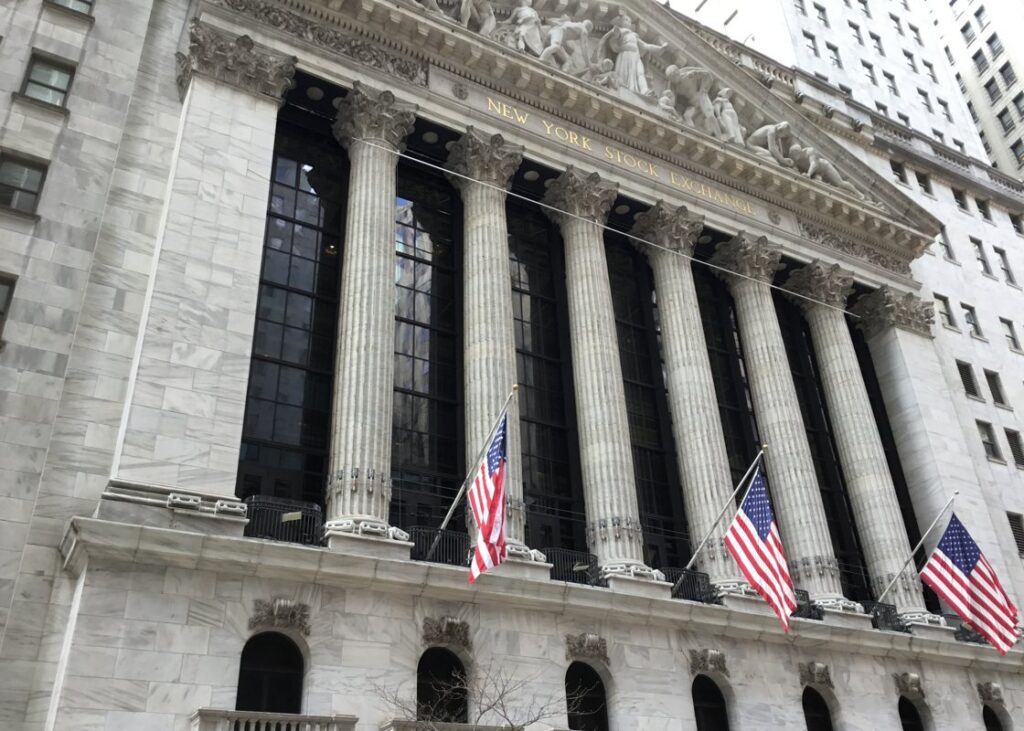
Kidfly182 / Wikimedia Commons (CC BY-SA 4.0; April 2022 archive; crop).
Wall Street enters election week with two questions: which party will control Congress, and whether a clearer political picture will be enough to steady a market also wrestling with corporate earnings, expensive energy and interest rates.
Tuesday’s midterms are the week’s political centerpiece. But the market’s response will depend on more than who wins. Investors will also be watching how quickly control of the House and Senate becomes clear, which industries face a different policy outlook, and whether the economic numbers reinforce the case for keeping borrowing costs high.
The distinction matters for business owners and households. A change in Congress can alter the path of legislation, oversight and spending negotiations. It does not, by itself, lower a mortgage rate, reduce a company’s financing costs or reverse an increase in fuel prices.
What The Options Market Has Been Pricing
A pre-election analysis from Man Group provides a useful starting point, with an important date attached. Using S&P 500 options data as of October 22, the firm calculated that traders were pricing November 4, the day after the vote, at about 1.2 times a typical day’s volatility. That means expected price swings roughly a fifth larger than usual, not a prediction that stocks will rise or fall by 20%.
The calculation was broadly in line with recent midterms and about half the single-day volatility priced around a presidential election. It was a dated snapshot, not a live election-week quote. Man Group’s central warning was that the pricing appeared to assume a reasonably quick result. A count that leaves congressional control unsettled for days or weeks could test that assumption.
The wider market already has reasons for caution unrelated to the ballot. Cboe’s October 30 market review said its VIX volatility index rose 12.91% that Friday and finished just below 20, after approaching 24 during the session. The move came alongside a technology selloff. It should not be read as a clean measure of election anxiety: earnings, interest rates and geopolitical risks were in the same mix.
How Congress Could Change The Trade
The practical question is which policies could change a company’s costs, sales or profits.
If Democrats win either chamber while President Donald Trump remains in office, divided government would make sweeping legislation harder to pass. That could narrow the scope for major changes to taxes and spending, while leaving congressional oversight, executive actions and agency decisions as sources of market-moving headlines. Morgan Stanley’s October 27 investor analysis makes that distinction explicitly: gridlock does not eliminate policy uncertainty.
Industry reactions could differ from the broad market’s response. Man Group’s analysis of investment-bank election baskets found that a Democratic sweep was associated with a more favorable outlook for healthcare services and retail, and a less favorable one for capital-markets businesses such as investment banks and brokers. The Republican-sweep basket was broadly the reverse. These are modeled exposures and policy expectations, not promised winners and losers.
AI infrastructure is another area to watch. Morgan Stanley said opposition to data centers could delay projects and move related shares without necessarily changing the long-term demand picture. Local permitting, power availability and infrastructure agreements can matter alongside the national election result.
For bonds, the election is not a shortcut to lower yields. Inflation, the economy and the amount the government needs to borrow will still matter. Morgan Stanley cautioned that a different Congress alone would not necessarily produce substantially lower interest rates or a lasting bond rally.
The Fed Is Not Meeting This Week
The Federal Reserve held its benchmark target range at 3.75% to 4% on October 28. Its statement said inflation remained elevated, and two officials dissented in favor of a quarter-point increase. That leaves investors with a different backdrop from an election week in which easier monetary policy is already assured.
There is no scheduled Fed rate-setting meeting during November 2-6. The next meeting is December 8-9. Minutes of the October meeting are due November 18, not this week.
There are still Fed events to watch. The Senior Loan Officer Opinion Survey is scheduled for Monday at 2 p.m., offering a look at bank lending standards and demand. Vice Chair for Supervision Michelle Bowman is scheduled to discuss supervision and regulation Friday at 12:15 p.m. Neither event is a scheduled interest-rate decision.
The Week'S Economic Checkpoints
Monday, November 2: ISM’s manufacturing survey and the Census Bureau’s construction-spending report arrive at 10 a.m. The factory survey offers an early look at orders, employment and price pressures.
Tuesday, November 3: Election Day. At 10 a.m., the Bureau of Labor Statistics releases September job openings and labor turnover, while Census releases September factory orders. Job openings, hiring and quits provide a separate view of labor demand from the monthly payroll count.
Wednesday, November 4: ADP’s October private-employment report is scheduled for 8:15 a.m.; the September international trade report follows at 8:30 a.m.; ISM’s services survey arrives at 10 a.m. ADP is a private-sector measure and should not be treated as the government’s Friday jobs number.
Thursday, November 5: Weekly unemployment claims and the preliminary third-quarter productivity and labor-cost report arrive at 8:30 a.m. The combination can help investors assess hiring conditions and the cost of producing goods and services.
Friday, November 6: The October employment report arrives at 8:30 a.m. Payroll growth, unemployment and wage gains will help frame the next rate debate after the election headlines have begun to settle.
Big Tech Shares The Stage
Apple and Palantir have earnings calls scheduled for Monday at 5 p.m., after U.S. markets close. Palantir says its results will be released after the close. AMD follows Tuesday after the close, also with a 5 p.m. call. Those reports give investors fresh evidence on consumer demand, AI spending and the revenue those investments are producing.
The earlier Monday preview laid out the factory-data and Apple schedule. This week’s additional question is how those results interact with the election: a clearer congressional outcome may remove one uncertainty, but it cannot repair a weak earnings outlook or erase inflation pressure.
The test is therefore broader than an election-night rally or selloff. Watch whether the result changes policy expectations, whether that change reaches company profits, and whether the jobs and inflation backdrop leaves the Fed room to respond. Those connections, rather than the party label alone, will determine how durable the market’s reaction is.
JBizNews Desk | New York
© JBizNews.com. All rights reserved. Unauthorized reproduction or redistribution is strictly prohibited.