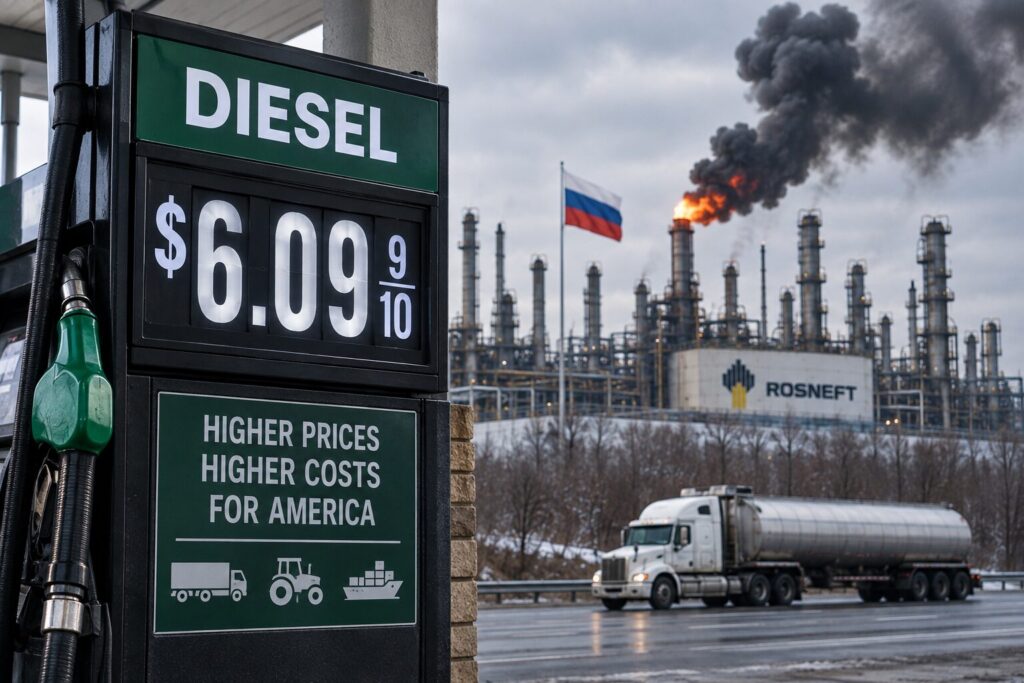
A major disruption to Russia’s diesel industry is adding fresh pressure to global fuel markets, with three of the country’s six biggest diesel-producing refineries either shut down or operating at sharply reduced capacity following drone attacks.
The six facilities together normally account for roughly half of Russia’s diesel production, according to Reuters calculations based on information from fuel-market participants. The outages come as diesel supplies are already tight globally and the U.S. national average has climbed above $6 a gallon for the first time, increasing costs for trucking companies, farmers, railroads and businesses that depend on freight transportation.
Russia’s Kirishi refinery has been completely shut down, while the Volgograd refinery and NORSI are operating at only about one-quarter of their nameplate capacity, sources told Reuters. Diesel production at the affected plants is several times below normal levels.
The six major facilities identified by Reuters are Omsk, Kirishi, TANECO, Volgograd, NORSI and Perm.
Drone Attacks Hit Russian Refining Capacity
The refinery disruptions are part of a broader campaign of Ukrainian attacks against Russian energy infrastructure.
Ukraine says Russian refineries are legitimate military targets because petroleum products and energy revenues support Moscow’s war effort. Russia, meanwhile, has also repeatedly attacked Ukrainian energy infrastructure.
The frequency of the refinery disruptions has become significant. According to the International Energy Agency figures cited by Reuters, a Russian refinery was successfully hit by drones an average of once every three days during the first eight months of 2026.
The latest damage has forced Moscow to restrict exports of gasoline, diesel and jet fuel in an effort to protect supplies for its domestic market. Russia is now also moving to extend diesel export restrictions through the end of October, Reuters reported Wednesday.
That matters far beyond Russia.
Before the restrictions, Russian diesel and lower-quality gasoil exports totaled approximately 3.3 million to 3.4 million metric tons per month during normal refinery operations a year earlier. Turkey and Brazil had been among the largest buyers.
Removing even part of that supply from international markets can intensify competition for diesel produced elsewhere.
U.S. Diesel Breaks $6
American consumers and businesses are already feeling the consequences of an unusually tight global fuel market.
The U.S. national average diesel price surpassed $6 per gallon for the first time on September 10, according to GasBuddy data reported by Reuters.
The Russian refinery outages are not the only reason.
The global diesel market is being squeezed simultaneously by disruptions in the Middle East, crude oil prices above $100, restrictions on Russian fuel exports and damage to refining capacity.
U.S. diesel inventories were also running approximately 13% below their five-year average when prices crossed $6, adding another layer of pressure to the domestic market.
Why Diesel Matters to Almost Everything Americans Buy
Diesel is one of the most important fuels in the U.S. economy.
Heavy trucks use it to move merchandise between ports, warehouses, stores and distribution centers. Trains use diesel to haul agricultural products and other freight across the country. Farmers depend on it to operate tractors, combines and other heavy equipment.
Ships, construction equipment and many industrial operations also rely on diesel.
That means a diesel price increase can travel through the economy even for consumers who never personally buy the fuel.
A grocery store receiving food by truck, for example, may face higher transportation charges. A farmer harvesting corn or soybeans pays more to operate machinery. Distributors transporting merchandise between warehouses and stores can see their freight bills rise.
Those additional expenses can eventually contribute to higher prices for consumers.
Farmers Already Feeling the Squeeze
The timing is particularly difficult for American agriculture as the fall harvest gets underway.
Fuel surcharges on U.S. grain shipments have risen dramatically. The average surcharge reached 48 cents per rail-car mile during the second week of September, up 153% from the weighted average a year earlier, according to USDA data reported by Reuters.
Those fuel surcharges now represent approximately 11% of total rail transportation costs for corn and soybean shipments, compared with 5% a year earlier.
For farmers already facing high input expenses, another increase in transportation and equipment costs can further squeeze margins.
Trucking Costs Could Reach Consumers
The trucking industry faces a similar challenge.
Unlike gasoline, which is primarily associated with household transportation, diesel is deeply connected to commercial activity.
Nearly every physical product purchased by an American household spends at least part of its journey on a truck, train, ship or other diesel-powered equipment.
When fuel becomes substantially more expensive, trucking companies can attempt to pass those expenses along through fuel surcharges and higher freight rates.
That can affect everything from groceries and construction materials to furniture and consumer goods.
Multiple Supply Problems Collide
The global diesel shortage is particularly difficult because several disruptions are happening simultaneously.
Russian refinery capacity has been damaged, Moscow has restricted fuel exports, Middle East conflict has disrupted energy flows and crude oil prices have again moved above $100 a barrel.
Russia’s refinery problems also appear to be continuing.
Reuters reported Wednesday that the Syzran and Saratov refineries had stopped processing following separate drone attacks, further complicating the country’s fuel shortage. Syzran’s main crude-distillation unit was heavily damaged and could require at least a month of repairs, according to industry sources.
The combination leaves global fuel markets with less room to absorb additional disruptions.
What Happens Next
For American consumers and businesses, the key question is whether global diesel supplies can recover quickly enough to bring prices back down.
A restoration of Russian refining capacity, increased production elsewhere or an easing of Middle East energy disruptions could relieve some pressure.
But continued refinery outages and export restrictions could keep international diesel supplies tight.
For trucking companies, farmers and businesses, the consequences are immediate: every additional dollar spent on diesel raises the cost of moving goods through the economy.
And when transportation becomes more expensive, those costs rarely stay confined to the truck, train or tractor.
They eventually have the potential to reach store shelves, construction sites, farms and household budgets across America.
JBizNews Desk | Trenton, N.J.
© JBizNews.com All Rights Reserved. Reproduction or distribution without written permission is prohibited.