The global artificial-intelligence chip race is moving deeper into consumers’ pockets.
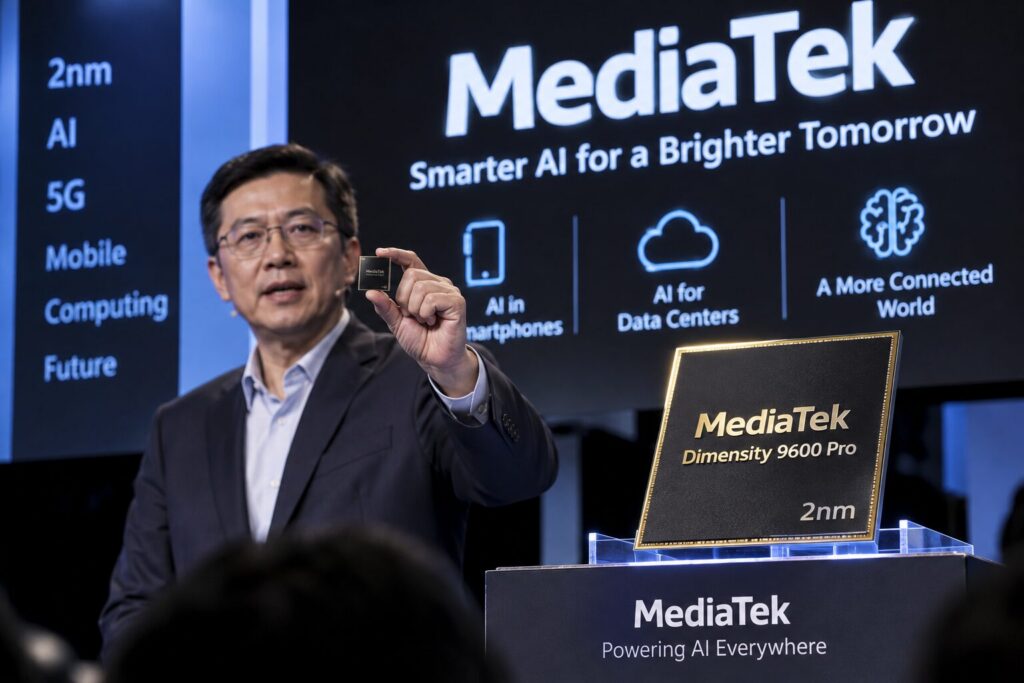
Taiwanese chip designer MediaTek unveiled its new Dimensity 9600 Pro Tuesday, its first smartphone processor manufactured using Taiwan Semiconductor Manufacturing Co.’s cutting-edge 2-nanometer process, as the company pushes to bring more powerful artificial intelligence directly onto smartphones.
The launch represents an important step in MediaTek’s effort to gain ground in the lucrative premium smartphone market, where it competes with U.S. rival Qualcomm and where manufacturers are increasingly using advanced AI capabilities to distinguish their most expensive devices.
But MediaTek’s ambitions now extend far beyond phones.
The company is simultaneously expanding into the booming market for data-center AI chips, with its first AI accelerator designed for a major U.S. cloud-service provider expected to enter mass production during the fourth quarter of 2026.
Together, the moves illustrate how the AI semiconductor race is expanding from massive data centers into everyday consumer devices.
AI Moves From the Cloud to the Phone
For smartphone users, one of the most important features of the Dimensity 9600 Pro is its ability to process increasingly sophisticated AI workloads directly on the device.
The chip contains a dedicated neural processing system designed for generative and so-called agentic AI applications. MediaTek says its NPU 1090 provides 51% faster large-language-model prefill performance than the previous generation while improving the amount of AI processing delivered for each watt of power consumed.
That matters because today’s AI applications often depend heavily on cloud data centers.
When more processing happens locally on a smartphone, certain AI features can potentially respond faster, consume less network bandwidth and keep more information on the device instead of continuously transmitting data to remote servers.
MediaTek envisions phones running AI systems capable of remaining active in the background, understanding context and assisting users across multiple applications.
Why 2 Nanometers Matters
The “2-nanometer” designation refers to a new generation of semiconductor manufacturing technology rather than the literal measurement of every component inside the processor.
The important point is that advanced manufacturing processes allow chipmakers to pack increasingly sophisticated computing capabilities into small, power-constrained devices such as smartphones.
MediaTek says the new processor provides up to 17% higher single-core CPU performance and 15% higher multi-core performance compared with the previous generation. It also claims a 61% reduction in multi-core power consumption under its comparison conditions.
Efficiency is particularly important for AI smartphones.
AI workloads can require substantial computing power, but a smartphone still has to operate on a relatively small battery without becoming excessively hot.
The industry therefore is not simply competing to make AI processors faster. Manufacturers are racing to perform more AI calculations while consuming less electricity.
Flagship Smartphone Battle Intensifies
MediaTek has traditionally held a powerful position across the broader smartphone-chip market, but the premium segment is particularly attractive because higher-priced phones can generate better margins for semiconductor suppliers.
The company said the first smartphones powered by its Dimensity 9600 Pro and newly introduced Dimensity 9600M are expected to launch this quarter. The 9600M uses TSMC’s 3-nanometer process and is intended to bring flagship-level capabilities to a broader group of devices.
MediaTek already supplies chips to major Chinese smartphone manufacturers including Xiaomi, Oppo and Vivo.
The new processor also targets more than AI.
MediaTek says the 9600 Pro supports higher-performance gaming, advanced computational photography, LPDDR6 memory and UFS 5.0 storage. Its graphics processor delivers up to 27% greater peak performance than its predecessor while using less power at peak performance, according to company testing.
MediaTek Wants a Piece of the Data-Center AI Boom
Perhaps more significant for MediaTek’s long-term business is what is happening outside smartphones.
Technology companies are spending enormous amounts building data centers capable of training and running artificial-intelligence models, creating a lucrative market for specialized processors.
MediaTek is expanding into custom data-center chips and AI accelerators to capture part of that demand.
Reuters reported that the company’s first AI accelerator for a major U.S. cloud-service provider is expected to begin mass production in the fourth quarter of 2026.
The customer’s identity was not disclosed in the report.
The expansion places MediaTek in a broader semiconductor race in which companies are increasingly developing specialized processors rather than relying exclusively on general-purpose computing chips.
Billions Flow Into AI Chips
Investor interest in MediaTek’s AI strategy has also been substantial.
Reuters reported that MediaTek raised $3.9 billion through a convertible bond sale last month. Nvidia invested $3.5 billion in the offering, while Alphabet — a longtime MediaTek partner in AI infrastructure — also participated.
The investments underscore how semiconductor companies are positioning themselves for a world in which AI computing takes place across multiple layers of technology.
At one end are enormous data centers containing thousands of specialized accelerators.
At the other are billions of consumer devices — smartphones, computers, automobiles and connected electronics — increasingly capable of performing AI tasks locally.
MediaTek is attempting to participate at both ends.
What It Means for Consumers
For consumers, the biggest change may eventually be that sophisticated AI becomes a standard part of the smartphone itself rather than simply an application connected to a distant server.
Phones could increasingly analyze information, edit photographs and video, run AI assistants and perform generative-AI tasks directly on the device.
That transition will depend not only on better AI models but also on processors capable of running those models without destroying battery life.
The Dimensity 9600 Pro represents another step toward that goal.
And as MediaTek simultaneously prepares a data-center AI accelerator for mass production, the company’s strategy illustrates just how broad the semiconductor battle has become.
The next phase of the AI chip race will not be fought only inside giant server farms.
It will increasingly be fought inside the device consumers carry in their pockets every day.
JBizNews Desk | Trenton, N.J.
© JBizNews.com All Rights Reserved. Reproduction or distribution without written permission is prohibited.