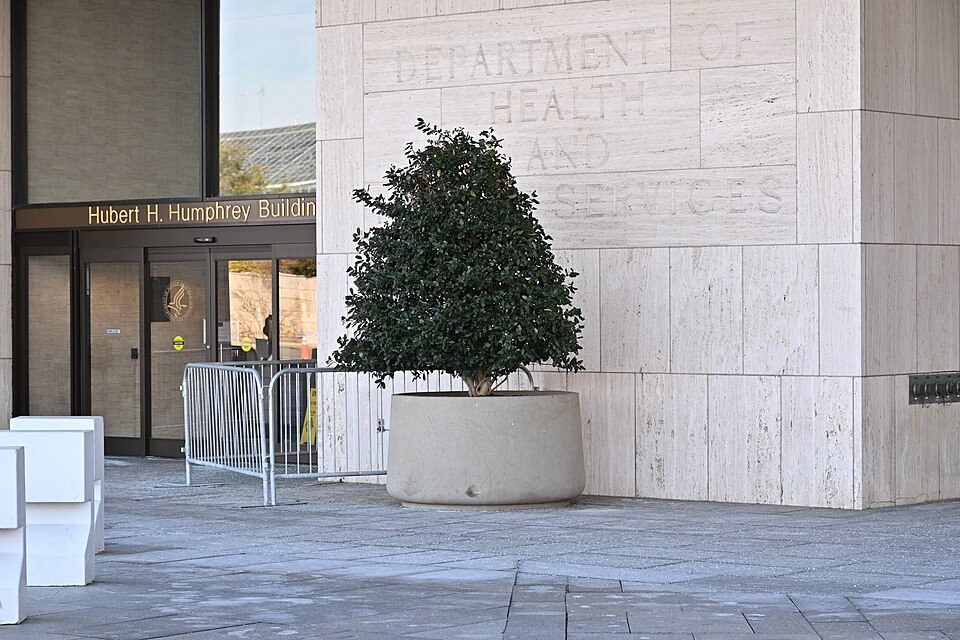
The entrance to U.S. Department of Health and Human Services headquarters in Washington, February 2025. Photo: G. Edward Johnson / Wikimedia Commons / CC BY 4.0. Resized.
The Department of Health and Human Services announced a new breast-cancer screening effort Tuesday that puts a second part of early detection in focus: making sure women receive timely follow-up after a screening test.
The initiative pairs the Office on Women’s Health with the Agency for Healthcare Research and Quality to study national screening and follow-up patterns. A collaborative of more than 40 health systems will work to expand evidence-based practices and address delays in care, HHS said.
For patients, the distinction is practical. A screening program is not finished when an appointment or test is completed. When further evaluation is needed, the next appointment and diagnostic process become part of whether an abnormal finding receives timely attention.
Looking beyond the first test
HHS said the program will examine both breast-cancer screening and diagnostic follow-up, particularly for midlife women. The agency did not announce a dollar amount, a public roster of participating health systems or a timetable for releasing the national analysis in Tuesday’s statement.
The health-system collaborative is intended to move evidence into everyday care. Its stated focus on delays makes the work relevant to hospital and clinic operations as well as patient education: a test can identify a need for more evaluation, but the health system still has to connect the patient with that next step.
HHS described the effort as a coordinated screening and follow-up initiative. It did not announce a new nationwide screening requirement, an insurance coverage mandate or a change in the recommended age for mammograms.
More education about breast density
A separate memorandum of understanding between the Office on Women’s Health and DenseBreast-info.org will expand access to educational resources about breast density, screening and diagnostic follow-up, according to HHS.
The agency said the resources are meant to help women discuss their individual risks and screening options with their health-care providers. AHRQ senior adviser Dr. Tammy Huizenga said women should have clear information about options beyond mammography, particularly when they have dense breasts or other risk factors.
That does not mean every patient needs the same additional test. The announcement frames the education as support for individual decisions with a provider, not as a blanket instruction to replace mammography or obtain a particular extra scan.
What hospitals and patients can watch for
For health-care organizations, the next concrete details are which systems participate, what follow-up practices are tested or expanded, and how progress is measured. The national analysis could help identify where patients wait between screening and further evaluation, but HHS did not publish those findings Tuesday.
For patients, the immediate change is the planned expansion of information and coordination, rather than a newly announced entitlement to a test. Questions about personal risk, test choice and any additional evaluation still belong in a conversation with the patient’s own clinician.
HHS said the programs support the administration’s executive order on women’s health throughout life. Secretary Robert F. Kennedy Jr. described prevention, early detection and timely action as the department’s priorities for the effort.
JBizNews Desk | Washington
© JBizNews.com. All rights reserved. Unauthorized reproduction or redistribution is strictly prohibited.