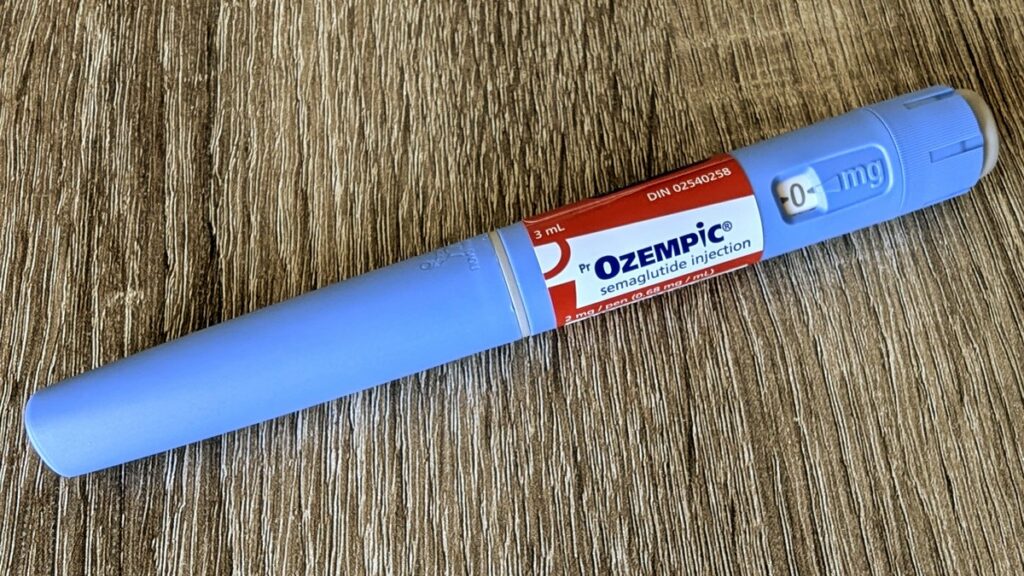
An Ozempic semaglutide injection pen in an August 2024 file photo, not the Vanda medicine tested in the study. Photo: Dennis Sylvester Hurd / Wikimedia Commons / CC0. Resized.
Vanda Pharmaceuticals said Tuesday that its anti-vomiting medicine Nereus reduced vomiting in a late-stage study involving semaglutide, giving the company evidence it plans to take to U.S. regulators for a possible new use alongside GLP-1 medicines.
The result addresses a practical problem for patients and drugmakers: treatments used for diabetes and weight management can cause stomach-related side effects that make them harder to tolerate. But the study used a deliberately demanding dosing approach, not the gradual dose increases patients normally receive, a limit that matters when interpreting the numbers.
Vanda said it intends to discuss the findings with the Food and Drug Administration and plans a supplemental application to expand the use of Nereus, also called tradipitant. The medicine was approved in December 2025 to prevent motion-induced vomiting, according to the company. Tuesday’s results are not an FDA approval for GLP-1-related vomiting.
What the trial found
In the Phase III randomized, placebo-controlled study, 43% of participants receiving Nereus experienced vomiting, compared with 58.5% receiving placebo. That was 61 of 142 people in the treatment group and 96 of 164 in the comparison group.
The difference was 15.5 percentage points. Vanda described it as a 27% relative reduction, and said the main result was statistically significant. The distinction matters: the study did not show that vomiting disappeared. More than four in ten participants receiving Nereus still experienced it under the trial’s dosing conditions.
A key secondary measure combining vomiting with severe nausea occurred in 33.1% of the Nereus group, compared with 50.6% on placebo, the company said. Most vomiting episodes in both groups occurred by the second day.
Why the dose design matters
Participants received a single 1 milligram dose of semaglutide without the gradual dose increases used in clinical practice, Vanda said. The company designed that approach to produce a high rate of vomiting and test whether the medicine could prevent it.
That makes the result a test under those specific conditions, rather than a direct measurement of how much Nereus would help people taking semaglutide on a routine long-term schedule. Vanda said a pooled analysis of its Phase II and Phase III data supported its expectation that the effect could extend to real-world dosing. That remains the company’s interpretation of the evidence.
The company also reported larger relative reductions in frequent and extreme vomiting. Those were post-hoc analyses, meaning they were examined after the main study design was set, and should not be confused with the trial’s prespecified primary result.
A possible add-on, not a change to GLP-1 approval
Tradipitant blocks the NK-1 receptor, part of a signaling pathway involved in vomiting. Vanda is seeking to position the medicine as a way to make GLP-1 treatment easier to tolerate, rather than as a replacement for the underlying diabetes or weight-management medicine.
Vanda said no new safety signals were observed and described the safety profile as consistent with prior studies. The announcement did not provide detailed adverse-event rates, so the efficacy percentages alone do not give a complete comparison of benefits and risks.
The regulatory step is still ahead. Vanda’s forward-looking disclosures identify FDA feedback on a proposed submission during 2027 among the uncertainties. The company did not announce an application acceptance or a decision date Tuesday, and the study does not establish that adding Nereus keeps patients on GLP-1 treatment for longer.
JBizNews Desk | Washington
© JBizNews.com. All rights reserved. Unauthorized reproduction or redistribution is strictly prohibited.