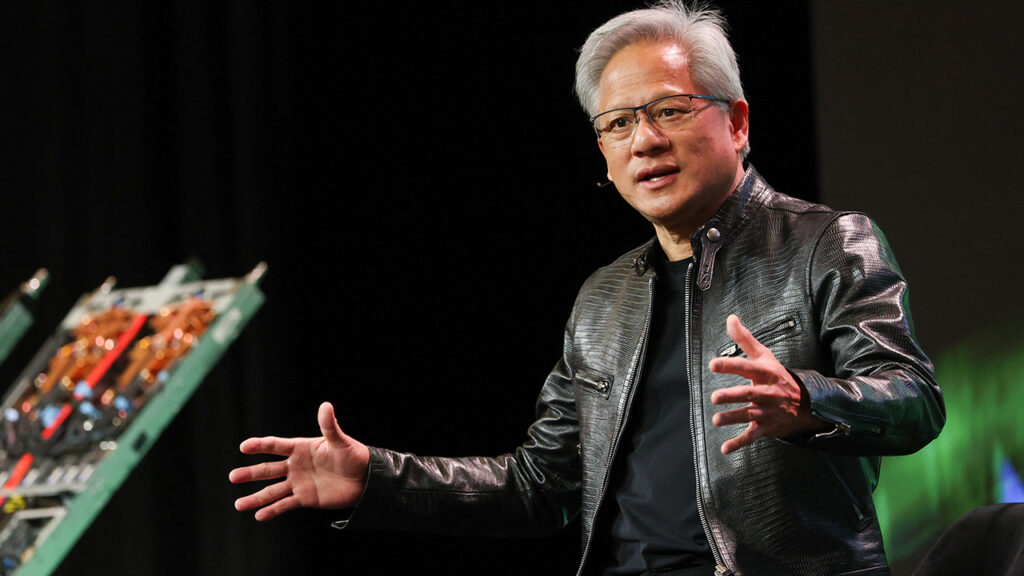
Jensen Huang, the former Nvidia CEO who resigned Thursday amid an internal investigation into his relationship with a suspected Chinese spy and a second extramarital affair, has joined a high-profile list of executives ousted from the companies they founded.
Huang’s exit followed heavy scrutiny over his affair with Alice Huang, an executive at Singapore-based Megaspeed whom U.S. intelligence identified as a Chinese intelligence asset operating under corporate cover.
He was already under the microscope over that relationship when The New York Times reported a second affair with an Nvidia employee who reported to him.
Nvidia was founded in 1993 by Huang, Chris Malachowsky and Curtis Priem, a trio of electrical engineers who hatched their plan at a Denny’s restaurant in California’s Bay Area.
NVIDIA CEO JENSEN HUANG APOLOGIZES AS FIRM PROBES AFFAIR WITH ALLEGED SPY
Huang’s departure from the tech giant is the latest in a long line of embattled founders who were either fired or forced to step down. Here is a look at other notable founders who were pushed out of their own companies:
Jack Dorsey resigned as the CEO of Twitter, now X, in 2021 and stepped down from its board a year later. At the time, he led the social media giant he co-founded in 2006. Dorsey was also serving as the CEO of the financial payments company Square.
Investors and observers had grown concerned that Dorsey’s focus was split between both companies, while the platform also faced regular criticism over perceived bias against conservative voices.
“I’ve decided to leave Twitter because I believe the company is ready to move on from its founders,” Dorsey said at the time of his departure.
Mike Lazaridis, the co-founder of Research In Motion (RIM), the maker of BlackBerry, stepped down alongside co-CEO Jim Balsillie in 2012 as the cellphone pioneer struggled to compete with Apple.
The pair had revolutionized the tech world with the BlackBerry, which became an indispensable business tool for its game-changing features. However, the company quickly lost market share and fell into obscurity following the 2007 release of the iPhone.
Uber co-founder Travis Kalanick was ousted from the rideshare giant in 2017 under mounting investor pressure. He was forced to resign after a string of scandals involving a toxic workplace culture, regulatory battles and allegations of sexual harassment.
“I love Uber more than anything in the world, and at this difficult moment in my personal life I have accepted the investors’ request to step aside so that Uber can go back to building rather than be distracted with another fight,” Kalanick said in an email to employees upon his exit.
JetBlue founder David Neeleman was removed as chief executive of the airline in 2007, just months after a major operational meltdown.
Neeleman, who helped launch the carrier in 1998, was shifted into the role of non-executive chairman. His ouster followed severe service disruptions during a Valentine’s Day ice storm that stranded passengers on tarmac-bound planes for hours and resulted in nearly 1,200 flight cancellations over several days, costing the airline more than $30 million.
In 2014, American Apparel Inc.’s board moved to fire founder and CEO Dov Charney over alleged misconduct. Charney, who founded the company as a wholesale T-shirt business in 1998, famously used provocative imagery to sell his clothing.
However, his personal behavior drew intense scrutiny, including reports that he openly discussed his sex life and occasionally walked around his factory in his underwear. He also faced multiple sexual harassment lawsuits from former employees.
Sandy Lerner, who co-founded Cisco Systems with her then-husband Leonard Bosack, was fired from the networking giant in 1990.
Lerner’s dismissal came amid growing friction with the company’s board and upper management. Following her removal, Bosack resigned in solidarity.
Men’s Wearhouse founder George Zimmer, recognizable to millions of customers for pitching suits in television commercials, was terminated in 2013 amid clashes with board members.
In a statement at the time, Zimmer said he had expressed concerns regarding the company’s strategic direction.
“Instead of fostering the kind of dialogue in the boardroom that has, in part, contributed to our success, the board has inappropriately chosen to silence my concerns by terminating me as an executive officer,” he said.
Yahoo co-founder Jerry Yang stepped down as chief executive in 2008 and severed all remaining ties with the company by resigning from its board in 2012.
His exit appeased shareholders who had criticized him for impeding investment deals that could have transformed the company, particularly his handling of an aborted $44.6 billion buyout offer from Microsoft in 2008, Reuters reported at the time.
The e-commerce marketplace fired co-founder Andrew Mason as CEO in 2013 after he failed to halt the company’s sliding share price.
In a candid departure letter, Mason acknowledged that he was getting in the way of the business and had fallen short as a leader.
“After four and a half intense and wonderful years as CEO of Groupon, I’ve decided that I’d like to spend more time with my family. Just kidding – I was fired today. If you’re wondering why … you haven’t been paying attention,” Mason wrote in a memo to employees.
Steve Jobs was forced out of Apple in 1985 after a boardroom power struggle with upper management.
He was brought back in 1997 to lead the company, orchestrating one of the most historic corporate turnarounds in business history.
OpenAI co-founder Sam Altman was abruptly fired by the company’s board of directors in 2023, only to be reinstated five days later after a near-total revolt by company employees.








This post was originally published here