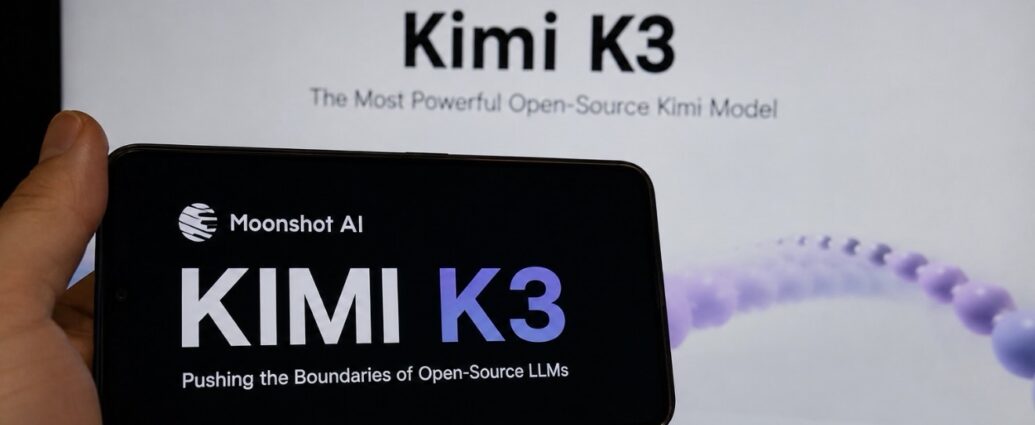
Beijing — Moonshot AI is scheduled to publish the full weights of Kimi K3 on Monday, making a 2.8-trillion-parameter system freely downloadable and marking the point at which openly available models reach the same tier as the leading commercial products from American laboratories.
Moonshot, the Beijing-based startup backed by Alibaba, released K3 on July 16, describing it as the largest open-source AI model in the world. The release was timed ahead of the 2026 World Artificial Intelligence Conference in Shanghai, and represents a recovery for a company whose position had eroded considerably over the preceding 18 months following DeepSeek’s rise. Moonshot has committed to releasing the weights under a modified MIT license by July 27.
The scale is the headline figure, but the architecture is what makes it usable. K3 is a sparse mixture-of-experts model, meaning only a fraction of its parameters activate on any given request, which holds inference costs well below what the raw parameter count implies. It is roughly 2.8 times the size of its predecessor, K2.6, and substantially larger than DeepSeek’s V4 Pro at 1.6 trillion parameters and Zhipu AI’s GLM 5 series at 744 billion. The model activates 16 of its 896 experts per token — about 1.8% of the pool — and includes a one-million-token context window and native vision.
Two architectural changes, Kimi Delta Attention and Attention Residuals, are credited by Moonshot with improving efficiency and reasoning quality. The company says K3 uses 21% fewer output tokens than K2.6 on equivalent tasks. API pricing is set at $3 per million input tokens and $15 per million output tokens — the highest of any Chinese laboratory, but roughly half the per-task cost of Anthropic’s Opus 4.8.
Benchmark placement is mixed but genuinely competitive. On the Arena blind human preference platform, K3 took first place in the Frontend Code category with 1,679 points, ahead of Claude Fable 5 at 1,631, GPT-5.6 Sol at 1,618 and GLM-5.2 at 1,587 — a 17-place jump from K2.6. It ranked first in six of seven frontend domains. On the broader Artificial Analysis Intelligence Index, K3 scores 57 and ranks fourth of 189 models, level with Claude Opus 4.8 and GPT-5.5, behind Claude Fable 5 and GPT-5.6 Sol.
Moonshot itself acknowledges K3 sits behind Fable 5 and Sol on overall performance, while outperforming every other model in its evaluation suite across coding and agentic tasks.
The company is candid about limitations. Moonshot identifies three: agent harnesses that truncate or modify the model’s chain of thought cause significant quality degradation; the model tends to act rather than ask for clarification in ambiguous situations; and despite benchmark parity, conversational polish still trails the leading commercial systems.
Practical deployment carries a real hardware requirement. Quantization-aware training using MXFP4 weights brings the file size down considerably, but running a model of this size still demands substantial multi-GPU capacity, which means most organizations will access it through inference providers rather than self-hosting until the community produces further-compressed versions.
Early reviewers have converged on a routing pattern: keep a cheaper model for routine high-volume work, and send the harder 15% to 20% — long agent sessions, frontend generation, multimodal debugging — to K3, concentrating the cost premium where the capability advantage is largest.
Moonshot, backed by Alibaba, Tencent and Meituan, raised $2 billion at a $20 billion valuation in May and is in discussions for a round valuing the company at $30 billion.
The release continues a broader pattern among Chinese laboratories and represents a bid to position the company at the center of the global open-source developer community. It also arrives despite three years of escalating semiconductor export controls.
For firms weighing AI infrastructure decisions, an openly licensed model at this capability level changes the vendor negotiation. Self-hosting becomes a credible alternative to per-token pricing for organizations with the technical capacity — and a credible bargaining position for those without it.
JBizNews Desk | Beijing
© JBizNews.com All Rights Reserved. Reproduction or distribution without written permission is prohibited.