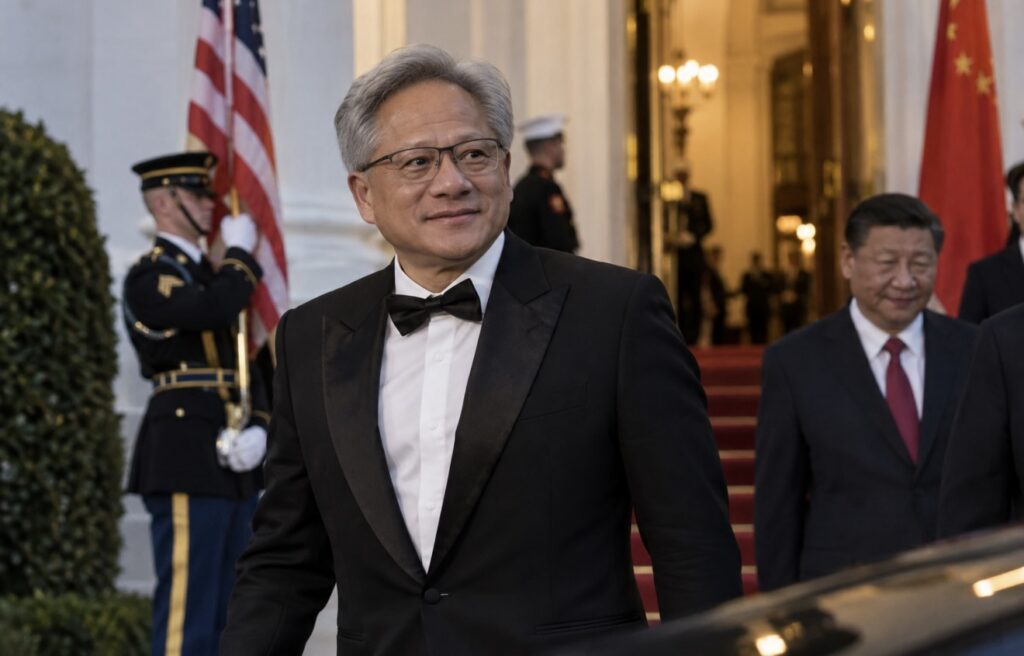
Nvidia CEO Jensen Huang is expected to be among the guests when President Donald Trump hosts Chinese President Xi Jinping for a state dinner in Washington next week, putting the head of the world’s most important AI chip company inside one of the highest-level diplomatic events between the United States and China.
Xi is scheduled to meet Trump in Washington on Sept. 24, with Trump publicly confirming that the visit will include a state dinner. Huang’s invitation has not been formally announced by the White House, but Reuters and Bloomberg reported Tuesday that he is expected to attend, citing people familiar with the plans. Nvidia declined to comment to Bloomberg, while the White House had not publicly released the guest list.
For Nvidia, this is far more than a ceremonial dinner.
The company sits directly in the middle of the economic and technological competition between Washington and Beijing. Nvidia’s advanced processors have become the backbone of the artificial-intelligence boom, powering the massive data centers used to train and operate increasingly sophisticated AI systems.
That makes Huang one of the few business executives whose company is central to both America’s AI ambitions and its negotiations with China.
The Sept. 24 Trump-Xi meeting is expected to take place against a backdrop of unresolved trade and technology disputes. U.S. Treasury Secretary Scott Bessent and U.S. Trade Representative Jamieson Greer are preparing additional talks with Chinese Vice Premier He Lifeng ahead of the summit, with artificial intelligence, rare-earth exports and trade restrictions among the issues dividing the two governments.
There are also efforts underway to reduce tariffs on selected goods considered less sensitive to national security. China has said it hopes the two countries can reach an agreement on reciprocal tariff reductions, while broader trade tensions remain unresolved.
For businesses, that means decisions made around the Trump-Xi meeting could reach far beyond Nvidia.
American technology companies depend on access to semiconductors, rare-earth minerals and global supply chains that stretch through Asia. Manufacturers use many of the same critical materials. Restrictions imposed by either Washington or Beijing can raise costs, delay production or determine which companies are allowed to sell into one of the world’s largest markets.
Nvidia faces those questions more directly than almost any other American company.
Washington has repeatedly restricted the export of advanced AI chips to China on national-security grounds, while Nvidia has sought ways to continue serving the Chinese market within U.S. rules. The underlying concern for American policymakers is straightforward: the same computing power used for commercial AI can also have military and intelligence applications.
For Nvidia, China remains too large a market to ignore, while U.S. policy determines how much of that market the company can legally serve.
Huang has also developed an increasingly visible relationship with Trump.
Just one day before reports of the state-dinner invitation emerged, Trump called Huang while the Nvidia CEO was speaking onstage at the All-In Summit in Los Angeles. The conversation centered on concerns that rapid AI development could create serious risks and whether the United States should slow its development of the technology. Trump rejected calls for a slowdown, while Huang argued that the United States can continue leading in AI while developing the technology safely.
Trump himself has repeatedly framed artificial intelligence as a strategic competition with China. Earlier this month, he said the race is primarily between the United States and China and that the country that leads in AI will hold an enormous advantage.
Huang’s expected appearance at the state dinner also carries some symmetry.
Earlier this year, Huang joined other major American technology executives at a state dinner hosted by Xi for Trump during the president’s trip to China. His expected presence in Washington next week would again place the Nvidia chief at the intersection of technology, business and diplomacy.
The state dinner itself is one of Washington’s most formal diplomatic honors, generally reserved for visiting heads of state and attended by senior government officials, business leaders and other prominent guests.
For Nvidia, Huang’s seat at the table underscores how deeply AI and semiconductors have become intertwined with U.S.-China relations.
What happens during the Sept. 24 summit will be watched not only in Washington and Beijing, but across Silicon Valley, manufacturing plants, financial markets and corporate boardrooms worldwide.
JBizNews Desk | Washington
© JBizNews.com. All rights reserved. This article is original reporting by JBizNews Desk. Unauthorized reproduction or redistribution is strictly prohibited.