
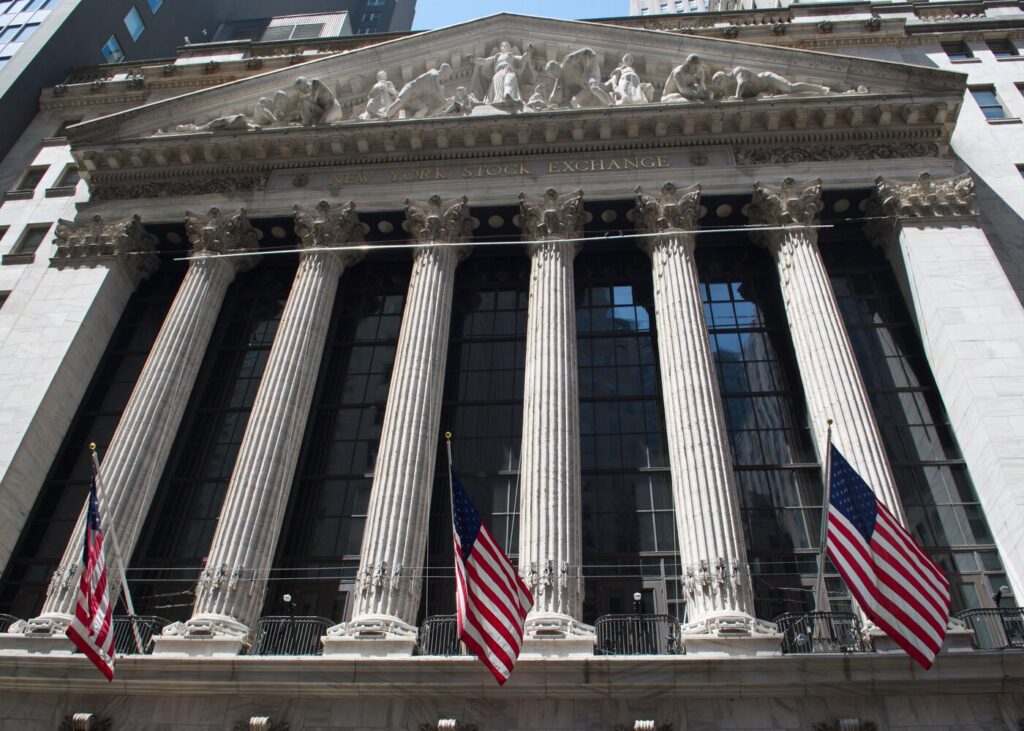
Photo: Jakub Hałun / CC BY 4.0 (archive photo)
The Dow Jones Industrial Average gained more than 1,500 points around midday Wednesday as U.S. stocks extended their post-election rally and crude oil fell below $90 a barrel. The move followed Democrats’ sweep of Congress, with investors weighing divided government alongside lower energy prices.
The Dow stood at 53,298.01, up 1,511.29 points, or 2.92%, in CNBC’s quote stamped 12:00 p.m. Eastern. The S&P 500 rose 138.70 points, or 1.83%, to 7,707.62 at 12:01 p.m., while the Nasdaq Composite gained 526.515 points, or 2.08%, to 25,898.524 in a quote with the same timestamp. These are regular-session index readings, not futures or closing results.
The gains followed President Donald Trump’s reported willingness to accept the election results and work with Democrats, easing one source of political uncertainty, CNBC reported. Divided government can limit major legislation, but it does not remove uncertainty around tariffs, energy costs or the war in Iran. The market’s response also does not mean every industry benefits equally.
Trump claims a record; the major-index data need a distinction
A Trump.fm archive entry attributes a 12:27 p.m. Eastern Truth Social post to President Donald Trump saying the stock market had hit another record high and that Americans’ 401(k)s were “through the roof.” JBizNews has not independently verified the original post on Truth Social.
The broad record claim is not established by the major-index data checked for this update. CNBC’s Dow quote stamped 12:06 p.m. showed a session high of 53,337.27, below its listed 52-week high of 54,744.33. Its S&P 500 quote at 12:29 p.m. showed a session high of 7,713.95 versus a 52-week high of 7,844.52. The Nasdaq Composite quote at 11:53 a.m. showed a session high of 26,048.829 versus 27,722.75. These snapshots do not demonstrate a new record in those three indexes, and the post did not specify an index.
A rising market can increase the value of stock holdings in retirement accounts, but individual 401(k) results depend on investments, contributions, withdrawals and fees. An intraday rally is not a guaranteed return or evidence that every account is at a record.
ADP hiring holds steady at 86,000
Private employers added 86,000 jobs in October, ADP reported, matching September’s revised gain. September was reduced from 90,000. The October reading was above the 75,000 Dow Jones estimate cited by CNBC, but it was not an acceleration from the revised prior month.
All-worker base pay rose 3.2% from a year earlier and gross pay rose 4.7%. Base pay rose 3.0% for job stayers and 4.8% for job changers. ADP measures private-sector employment; this is not the government’s jobs report and supplies no unemployment rate. Our ADP report explains the sector and pay split.
The turn higher follows a sharp overnight selloff as election results pointed toward Democratic control of both chambers. The political result sets up divided government and a harder path for legislation. Investors still have to weigh tariffs, energy prices and developments in the Iran conflict rather than assume gridlock settles every policy risk.
Oil drops below $90
December WTI crude futures fell $7.41, or 7.71%, to $88.68 a barrel in CME Group’s delayed quote stamped 11:51:59 a.m. Eastern, viewed around 12:01 p.m. Data are delayed at least 10 minutes. The prior settlement was $96.09; $88.68 is an intraday futures price, not a new settlement or the price at the pump.
A sustained oil decline can ease costs for transport, delivery and other fuel-heavy businesses. It does not guarantee an immediate matching drop in gasoline prices or customer surcharges, which also reflect refining, distribution, taxes and company pricing decisions.
Earlier morning snapshot: yields and gold
The 10-year Treasury yield stood at 4.921% at 7:23 a.m. Eastern, down 0.029 percentage points, or 2.9 basis points, from its previous close, according to CNBC’s quote. The dollar index was down 0.55% to 101.31 at 7:24 a.m.
In an earlier snapshot, December gold futures rose $106, or 2.69%, to $4,046.40 an ounce. That CME row was stamped 7:14 a.m. Eastern and viewed around 7:24 a.m., with at least a 10-minute delay. It is a futures price, not a spot-metal quote or new settlement.
Bitcoin traded near $78,135 at about 7:24 a.m. Eastern on Coinbase’s snapshot. That is a point-in-time price, not a claim about its return since midnight.
Earlier Europe trading and Asian closes
The Stoxx Europe 600 gained 1.37% to 654.49 in CNBC’s delayed quote stamped 12:09 p.m. GMT, or 7:09 a.m. Eastern. In completed Asian trading, Japan’s Nikkei 225 fell 1.42% to 62,188.63, while Hong Kong’s Hang Seng rose 1.67% to 23,919.50. Those are closing Asian readings, not markets still moving alongside U.S. futures.
AMD and McDonald’s put earnings in focus
AMD reported record third-quarter revenue of $13.4 billion, up 45%, in its earnings release after Tuesday’s close. Data-center revenue rose 97% to $8.5 billion. Chief Executive Lisa Su said the company expects growth to accelerate further in the fourth quarter. AMD shares rose 5.69% to $511.45 in regular trading at 9:47 a.m. Eastern, according to Nasdaq.
McDonald’s earnings beat comes with a warning about the consumer: fewer customers visited its U.S. restaurants, even as bigger checks largely offset that decline. Its adjusted profit beat expectations, but revenue missed. That distinction matters for businesses trying to judge whether customers are buying more or simply paying more per order.
Musk’s political spending faces a Texas setback
Not every part of the post-election market story is a broad rally. Musk spent at least $474 million on the midterms, including $224 million in Texas, according to CNBC’s analysis of campaign-finance records. Republican Senate nominee Ken Paxton and Governor Greg Abbott, whom he backed, lost to Democrats.
The business issue is what changes next in permitting, electricity supply, incentives and federal oversight, not an automatic dollar-for-dollar link between campaign spending and share prices. Texas Governor-elect Gina Hinojosa has called for a moratorium on new data centers, while Republicans’ continued control of the state Legislature limits her ability to rewrite policy. Our Tesla and SpaceX report explains those risks and the earlier share-price reaction.
What to watch next
The morning data calendar included ADP employment, ISM services and weekly oil inventories. Their scheduled release times have passed; the index and crude readings above are time-stamped market snapshots, not a claim that any one report caused the moves.
Uber’s quarterly results showed freight strength offsetting softer-than-expected ride-hailing and delivery sales. Qualcomm reports after the close, with its earnings call at 4:45 p.m.
What it means for your money and business
For retirement savers, the broad rally lifts the value of index-linked holdings during the session, but an intraday gain is not a final return and individual portfolios will move differently. A sharp intraday move is not by itself a reason to abandon a long-term plan. A lower Treasury yield can ease pressure on mortgage and business-loan pricing, but this small move does not promise cheaper loan offers today. Savers should compare the rates their bank actually pays rather than treat the Treasury move as an immediate change in deposit income.
Cheaper crude can help fuel costs if the decline lasts, but pump prices and delivery surcharges do not reset with every futures tick. A weaker dollar makes the same euro-priced hotel room or supplier invoice more expensive in dollars. For a business setting prices or ordering inventory, those currency and energy costs can matter as much as the stock-market headline.
Europe’s inflation reaches 4% as energy costs climb
Across the Atlantic, euro-area annual inflation rose to an estimated 4% in October from 3.8% in September, Eurostat’s flash estimate showed Wednesday. Energy prices were 20.8% higher than a year earlier, compared with an 18.9% annual increase in September. Overall consumer prices rose an estimated 0.4% from September.
For European households and businesses, that means another squeeze on the cost of heating, transport and everyday purchases. The pressure was not uniform: services inflation edged up to 3.3% from 3.2%, while inflation excluding energy, food, alcohol and tobacco held at 2.5%, according to Eurostat. The figures are preliminary; full October data are scheduled for November 18.
The reading keeps borrowing costs in focus. Markets were pricing in a little more than a 72% chance of a European Central Bank rate increase in December after the release, CNBC reported at 5:47 a.m. Eastern. That is a market expectation, not an ECB decision. A further increase would raise policy rates rather than guarantee the same change in every household or business loan.
The euro was up about 0.6% against the dollar Wednesday morning, CNBC reported, while the dollar also faced pressure from the US election results. The inflation report alone does not establish why the currency moved. For Americans paying euro-denominated travel or supplier bills, a stronger euro makes the same bill more expensive in dollars; for US investors in unhedged European assets, currency moves can change dollar returns alongside the assets’ own price moves.
JBizNews Desk | New York
© JBizNews.com. All rights reserved. Unauthorized reproduction or redistribution is strictly prohibited.