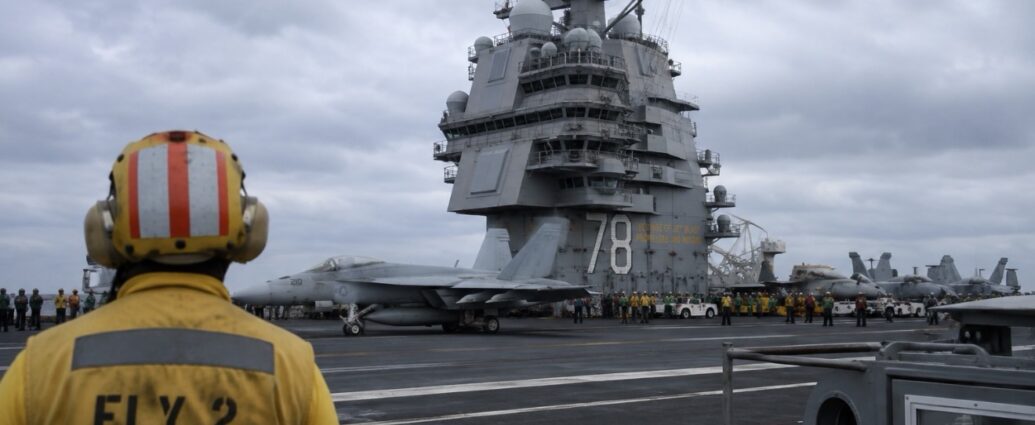
President Trump signed a national security memorandum Thursday ordering the Navy to drop the electromagnetic system it uses to launch fighter jets off aircraft carriers and go back to steam catapults, a change expected to cost billions of dollars. The memo directs that Ford-class carriers still to be built — starting with the Doris Miller, under construction at Huntington Ingalls Industries’ Newport News Shipbuilding yard — use steam-powered catapults and hydraulic elevators, the arrangement carried on the older Nimitz-class ships. The first three ships of the class, the Gerald R. Ford, the John F. Kennedy and the Enterprise, keep the electromagnetic system.
Here is what the argument is actually about.
A carrier deck is roughly 1,100 feet long, which is nowhere near enough runway for a loaded fighter to reach flying speed on its own. So the ship throws the plane. For about seventy years the throwing was done with steam piped off the ship’s reactors into a piston that runs down a track under the deck and drags the aircraft forward by a shuttle. It is loud, hot, wasteful of fresh water, and it works. The Ford class replaced it with the Electromagnetic Aircraft Launch System, built by General Atomics, which uses linear induction motors — essentially a very long electric motor laid flat under the deck — to pull the shuttle instead.
The reason the Navy wanted the electric version is control. Steam gives you a big shove with limited ability to dial it in. An electromagnetic catapult can set launch energy precisely for each aircraft type, which reduces stress on airframes and widens the range of aircraft a carrier can operate — importantly, small drones that a steam shot would tear apart. It also needs fewer sailors and less topside plumbing.
The reason the president wants it gone is that on the first ship it has not performed as promised. In testing from March to June 2022, the system on the Ford averaged 614 launches between mission-affecting failures, against a requirement of 4,166 — roughly one failure per 600 launches instead of one per 4,000, with each unplanned shutdown triggering about an hour of cooldown and restart before flight operations resume. The Advanced Arresting Gear, the electric system that catches planes on landing, ran at 460 cycles between failures in the same window. The weapons elevators that move bombs from the magazines to the deck have had their own trouble, with 109 failures logged across roughly 20,000 dispatches during one weapons load.
Trump has been making the case in blunt terms for years, telling sailors aboard the George Washington in Japan that the electric system costs billions and requires experts from MIT when it breaks, while steam can be fixed with a hammer and a blowtorch. Last month at a defense summit in Pennsylvania, he said the electric catapults cost billions more and are not nearly as good, and are too complex.
The counterargument, and the reason the Navy and its contractors resisted for nine years, is that a Ford-class hull is not a Nimitz hull with a different catapult bolted on. The class introduced more than 23 new technologies at once, including new reactors, a new radar and electric weapons elevators, all drawing on a common power architecture. The ship is designed as a floating power plant, and future weapons — lasers in particular — need that power. Analysts have long warned that a carrier built around steam cannot easily run high-draw directed-energy weapons and a flight deck at the same time, while a ship optimized for electrical output can do both. Pulling steam lines back through a design that removed them is not a swap. It is a redesign.
That redesign is where the billions go, and it is worth being clear about who receives them. Newport News Shipbuilding is the only yard in the country that builds nuclear carriers, so the engineering work, the changed drawings and the schedule slip all run through one contractor with no competitor to bid against. General Atomics loses future catapult work. The Navy pays for both sides of the reversal.
The class already carries a record on that front. The Ford was estimated at $10 billion and came in at about $13 billion for the ship alone, before research and development. The Government Accountability Office attributed roughly half of a $480 million cost increase on the Kennedy to schedule slippage tied to elevator integration. Oversight bodies have repeatedly faulted the decision to install equipment into the ships before land-based testing was finished, which forced expensive retrofits. The lesson usually drawn from that history is to avoid building around immature technology. It is not obvious that the lesson is to rip out mature-by-now technology and reinstall the previous generation, and that is the substance of the dispute now settled by memorandum rather than by study.
The memo carries other provisions that got less attention and may matter more to the industrial base. It establishes a fifth public shipyard dedicated to submarine repair and a new component repair center, both aimed at cutting the backlog that has kept attack submarines tied up waiting for maintenance. That backlog is a genuine constraint on fleet availability, and public yards are a labor problem more than a technology problem.
The Doris Miller was awarded in 2019, is expected to be laid down this year at Newport News and had been planned for commissioning around 2034. Redesigning her propulsion-adjacent systems this late will move that date, though by how much has not been said. The practical question for the Navy is whether a ship ordered in 2019, redesigned in 2026 around 1950s launch technology, and delivered in the mid-2030s is the ship anyone will want in the 2060s, which is when she would still be sailing.
JBizNews Desk | Washington, D.C.
© JBizNews.com All Rights Reserved. Reproduction or distribution without written permission is prohibited.