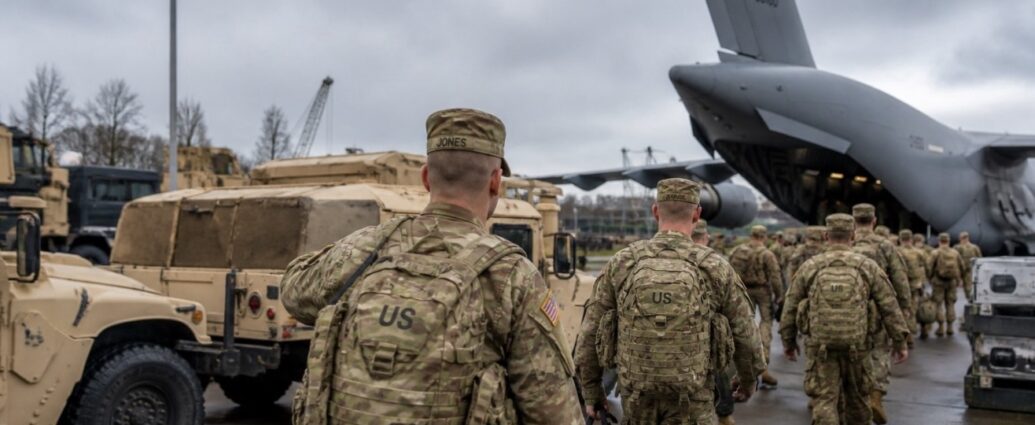
Donald Trump said the U.S. plans to reduce its military presence in Germany by more than the 5,000 troops outlined by the Pentagon, reopening a long-running dispute over burden-sharing inside NATO and raising new questions about Washington’s security posture in Europe. “We’re going to cut way down. And we’re cutting a lot further than 5,000,” Trump told reporters in Florida on Saturday, according to Reuters, in remarks that pointed to a broader retrenchment than the Defense Department publicly described a day earlier.
The initial Pentagon announcement already marked a significant shift. Sean Parnell, the Pentagon spokesperson, said in a Defense Department statement that the 5,000-troop reduction followed a “thorough review of the Department’s force posture in Europe,” adding that the decision reflected “theater requirements and conditions on the ground.” That official explanation, published by the Department of Defense, framed the move as a strategic review rather than a political rebuke, but Trump’s latest comments suggested a more expansive pullback could still emerge.
The stakes extend beyond Germany because the country remains the central hub for U.S. military logistics, command and air operations in Europe. Bloomberg has reported that roughly 36,000 U.S. service members are stationed in Germany, part of a broader American force footprint in Europe that expanded sharply after Russia’s 2022 invasion of Ukraine. David Malpass, a senior fellow at the Atlantic Council, said the “scale of the drawdown matters less than the signal it sends about U.S. commitment to NATO,” a warning that captures why markets, diplomats and defense planners are treating the issue as more than a routine basing adjustment.
German officials moved quickly to contain the political fallout while underscoring Europe’s need to spend more on defense. Boris Pistorius, Germany’s defense minister, told the German news agency dpa that the previously announced reduction fit with Berlin’s expectations and highlighted the need for Europe to assume more responsibility. “The presence of American soldiers in Europe, and especially in Germany, is in our interest and in the interest of the U.S.,” Pistorius said, while also pressing for faster procurement and infrastructure upgrades, according to dpa.
The issue also exposed tension between Trump and German Chancellor Friedrich Merz, whose government has tried to present Germany as a more credible defense partner after years of criticism from Washington. In comments reported by the Associated Press, Merz said Europe must carry more of the burden but also needs dependable allies, adding, “Europe must take on a larger share of the burden, but we also need reliable partners who honor their commitments.” That formulation reflected a broader European concern that abrupt U.S. decisions could weaken deterrence even as allies increase military budgets.
On Capitol Hill, senior Republicans signaled unease that a deeper reduction could undercut the alliance’s message to Moscow. Senator Roger Wicker of Mississippi said, “This decision risks undermining deterrence and sending the wrong signal to Vladimir Putin,” while Representative Mike Rogers of Alabama said any major force-posture change should involve close consultation with congressional oversight committees. Those statements, reported by Reuters, suggested that even within Trump’s party there is concern about how a Germany drawdown could affect U.S. leverage in Europe at a time of continued war in Ukraine.
NATO itself has taken a cautious public line while seeking more detail from Washington. Allison Hart, the alliance’s public affairs chief, said on X that NATO “is working with the U.S. to understand the details of their decision on force posture in Germany,” adding that the move “underscores the need for Europe to continue to invest more in defense and take on a greater share of the responsibility for our shared security.” Her statement, posted publicly by the alliance, aligned with a familiar message from Brussels: Europe needs to spend more, but allied coordination still matters.
Military officials have also warned that the practical effects of a withdrawal may reach beyond the raw troop count. General Christopher Cavoli, commander of U.S. forces in Europe, told the Senate Armed Services Committee that removing a brigade-sized element could have limited impact on immediate combat capability but “significant implications for the credibility of our collective defense guarantee.” In testimony cited by multiple outlets, Cavoli said “the integration of forces across the alliance remains the cornerstone of deterrence,” a reminder that Germany’s role includes command integration, training and rapid reinforcement capacity.
The Pentagon has indicated that implementation details are still in flux. Acting Pentagon press secretary Joel Valdez said the department would brief congressional leaders in the coming days and finalize a phased schedule that could stretch up to 12 months. “We expect to engage with oversight committees promptly to ensure transparency and maintain the integrity of the trans-Atlantic security architecture,” Valdez said in comments distributed to reporters, according to the source material. That timeline means the policy fight may continue well beyond the initial announcement, especially if the final number exceeds the 5,000-troop figure already disclosed.
What happens next matters for more than military planning. A larger U.S. pullback could force Germany and other European allies to accelerate spending decisions, reshape defense procurement and revisit assumptions about U.S. staying power on the continent. With Russia’s war in Ukraine still driving security calculations, investors, policymakers and allied governments will now watch for the Pentagon’s final schedule, the exact units affected and whether Washington pairs the drawdown with other force moves elsewhere in Europe. As Reuters and other outlets have indicated, the next phase of this decision will show whether the U.S. aims simply to rebalance deployments or to redefine its role at the center of Europe’s security order.
JBizNews Asia Desk