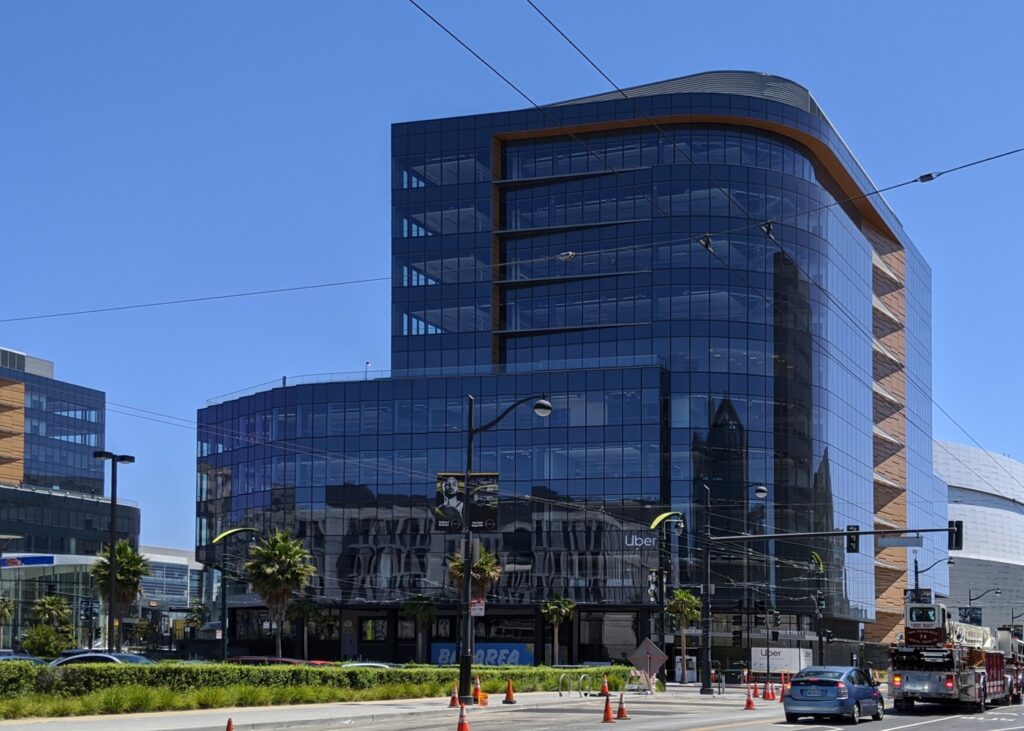
Photo: HaeB / CC BY-SA 4.0 (archive photo)
Uber shares edged higher before the opening bell Wednesday after the company reported a 10% rise in quarterly revenue, with freight strength offsetting weaker-than-expected sales in ride-hailing and delivery. The results point to growing demand across the platform, but also to the cost of keeping enough drivers on the road.
Uber traded at $67.00, up 0.60%, at 8:55 a.m. ET, according to Nasdaq’s quote. That premarket snapshot is not a closing price and can change before regular trading begins.
Third-quarter revenue rose to $14.77 billion from $13.47 billion a year earlier, the company reported. That exceeded the $14.69 billion LSEG consensus cited by CNBC. Gross bookings, the value of transactions through the platform rather than Uber’s own revenue, rose 20% to $59.82 billion, roughly matching expectations.
Ride-hailing sales fall even as bookings grow
Mobility revenue fell 2% to $7.52 billion, below the $7.71 billion StreetAccount forecast cited by CNBC. But mobility bookings rose 18% to $29.51 billion. Those different trends matter: a decline in reported revenue does not mean customers spent less on rides.
Uber said business-model changes reduced total company revenue growth by eight percentage points. Chief Executive Dara Khosrowshahi also said elevated fuel prices and tighter driver availability weighed on supply growth in several international markets. The company is making targeted investments to strengthen driver supply.
Delivery revenue increased 23% to $5.49 billion, just below the $5.51 billion consensus. Freight revenue jumped 34% to $1.76 billion, beating the $1.49 billion estimate and helping lift the company-wide total above forecasts.
The profit comparison needs context
Net income fell 92% to $512 million from $6.63 billion a year earlier. The earlier quarter included a $4.9 billion tax benefit and a $1.5 billion pretax benefit from investment revaluations. This quarter instead included a $476 million pretax investment-revaluation loss. The headline profit drop therefore does not measure the change in the underlying ride and delivery businesses alone.
GAAP earnings were 25 cents per share. On Uber’s separate non-GAAP basis, earnings rose 35% to 88 cents per share. Operating income under GAAP rose 30% to $1.45 billion, and adjusted EBITDA increased 31% to $2.96 billion. Those accounting measures are not interchangeable.
The platform completed 4.06 billion trips, up 16%, and monthly active platform consumers increased 14% to 215 million. Free cash flow rose 14% to $2.54 billion.
Fourth-quarter outlook and driverless plans
Uber forecast fourth-quarter gross bookings of $63.25 billion to $65.25 billion, representing 18% to 22% growth at constant exchange rates. The midpoint is $64.25 billion, roughly in line with the $64.26 billion StreetAccount estimate cited by CNBC. The company forecast non-GAAP earnings of 95 to 99 cents per share and adjusted EBITDA of $3.13 billion to $3.23 billion.
Uber expects about 700 fully driverless vehicles on its platform by the end of 2026 and more than 2,000 in 2027. Those are expansion targets, not the number operating today, and they should not be confused with Uber owning that many vehicles.
What it means for riders, drivers and businesses
For riders and businesses booking employee travel, the near-term issue is driver supply, not just robotaxi plans. Uber’s comments about fuel costs and availability help explain why growing demand does not automatically translate into easier access to rides in every market. The earnings release does not establish a uniform change in fares.
For drivers, Uber’s planned supply investments are worth watching, but the company has not promised a specific pay increase for every driver. Restaurants and merchants face a delivery business that is still expanding quickly; freight customers are also using a growing operation. Investors, meanwhile, have to separate real transaction growth from accounting changes and last year’s unusually large tax benefit.
JBizNews Desk | San Francisco
© JBizNews.com. All rights reserved. Unauthorized reproduction or redistribution is strictly prohibited.