As a journalist who spent years in newsrooms monitoring global geopolitical shifts, I do not doubt that Gideon Sa’ar is one of the most capable, accomplished, and strategically minded foreign ministers in the world today.
From Fiji to Kazakhstan and Colombia, his record reflects a profound understanding of diplomacy.
However, his recent remarks at a Jewish-Kurdish conference in London on September 6-7, 2026, regarding Iran’s Kurds represent a strategic error and a factual miscalculation, indicating that his advisers fail to comprehend the complex internal realities of Iran.
The problem is Israel’s failure to distinguish between the patriotic majority of Iranian Kurds and transnational Kurdish separatist movements.
Kermanshah: Largest Kurdish city and citadel of Iranian patriotism
Kermanshah, the most populous Kurdish city in Iran, is the undisputed citadel of Iranian patriotism, boasting a history filled with pride.
The Bisotun inscription, the masterpiece of Darius the Great and one of Iran’s oldest written historical records, stands proudly near Kermanshah.
This 2,500-year-old monument stands as living testimony that this land has been at the heart of Iran’s national sovereignty and identity since antiquity. Bisotun is a powerful symbol of Iran’s unity and grandeur.
Kermanshah’s centrality to Iranian national identity runs so deep that more than eight centuries after Darius carved Bisotun, the Sasanian monarchs chose Kermanshah to carve Taq-e Bostan.
Located in the heart of the modern city, this masterpiece remains one of the most precious and enduring jewels of Sasanian heritage.
While transnational separatist movements deliberately obscure the reality of major regions like Kermanshah and Ilam to overstate their own influence, the truth remains that the patriotic Kurdish majority across Iran consists of people deeply rooted in Iranian soil with an unbreakable bond of loyalty.
The Iranian-Jewish bond: A strategic asset for Israel
Through my daily work, I am in regular contact with Iranians from diverse regions, socio-economic backgrounds, and walks of life.
Despite not knowing one another, these individuals consistently echo a striking trend: rapidly growing trust in Israel.
Many Iranians now view Israel as the only actor with the determination and strategic clarity to directly confront the core of the regime’s power.
They see Israel’s approach as fundamentally different from powers that can simply pack up and leave the region; it is a strategy focused on confronting threats at their source.
This deep trust is not arbitrary. It is rooted in 2,500 years of shared history between Iran and the Jewish people, stretching back to the era of Cyrus the Great.
This civilizational bond remains strong to this day. A powerful modern testament to this civilizational solidarity occurred in the wake of the October 7 attacks.
As massive antisemitic demonstrations surged across Western cities, the Iranian diaspora stood firmly and courageously alongside Jews and Israelis.
In defiance of the hostile Left-Islamist crowds, the Iranian Lion and Sun flag was proudly raised side-by-side with the Star of David on Western streets, proving that the ancient alliance between these two peoples remains unbroken.
This profound bond is a priceless strategic asset for the State of Israel, one that must be continuously protected, defended, and nurtured against deliberate subversion.
By including Iran’s Kurds in rhetoric that flirts with separatist undertones, Sa’ar is stepping onto a psychological landmine.
This language triggers painful memories of the immediate aftermath of the 1979 revolution, when armed separatist Kurdish factions launched violent clashes in western Iran.
Crucially, this rhetoric causes the greatest outrage among Iran’s patriotic Kurdish majority. It was these patriotic Kurds who fought against the separatists after 1979, sacrificing their lives to preserve Iran’s territorial integrity.
Historically, Iran’s Kurdish population has been a bedrock of Iranian national identity and cultural heritage, consistently rejecting the regime’s attempts to question their loyalty to Iran’s territorial integrity.
To be Kurdish is to embody the most authentic narrative of being Iranian.
Transnational Kurdish separatist movements: PKK, Öcalan, Assad, and the Palestinian cause
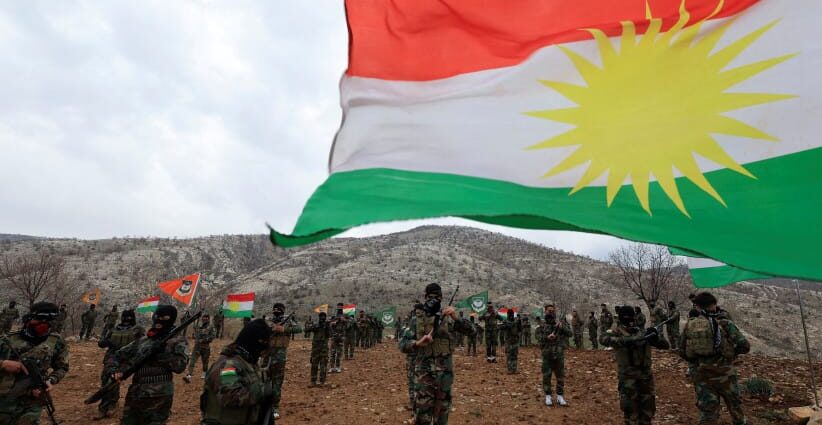
Sa’ar’s advisers must understand that the separatist minority in Iran’s Kurdish regions largely views Abdullah Öcalan as the “Father of the Kurdish Nation.” A segment of these separatists operates as the Iranian branch of the PKK.
Let us look at the history: in the 1980s and 1990s, Hafez al-Assad utilized the PKK as a proxy, hosting Öcalan and establishing the group’s training camps in the Syrian-controlled Bekaa Valley in Lebanon.
During this era, the PKK operated as a Marxist-Leninist movement with direct organizational and training links to Palestinian militant factions. In 1982, PKK fighters deployed to the Bekaa front to fight directly against Israel.
This historical backdrop instilled an enduring anti-Western and anti-Israel paradigm within the movement’s DNA.
Even Öcalan’s recently reported stance in August 2026 has descended into structural antisemitism and conspiracy theories, framing Zionism as the barrier that prevented the formation of an independent Kurdish state following the fall of the Ottoman Empire.
This is historically absurd, given that World War I ended in 1918, while the State of Israel was established three decades later, in 1948.
This deeply rooted anti-Israel history of the PKK and its Syrian affiliate could have been a contributing factor in the Israeli government’s decision not to intervene during the collapse of the Syrian autonomous Kurdish administration in January 2026.
Civilizational continuity of Iran
Iran is not a manufactured twentieth-century state like Iraq or Syria.
As Georg Wilhelm Friedrich Hegel famously observed, Iran is the first historical state in the world. It is a society with a deep institutional memory, a potent national consciousness, and a shared, deep-seated understanding of sovereignty.
The nationwide demonstrations of 2026 cut entirely across religion, language, and regional lines, completely shattering these divisive geopolitical calculations.
What emerged was not fragmentation, but a powerful “re-nationalisation,” a shared political identity centered squarely on the idea of Iran itself. One of the regime’s longest-standing strategies, dividing society through identity politics, has collapsed.
In that very same Kurdish city of Kermanshah, mass protests openly expressed support for Crown Prince Reza Pahlavi, directly contradicting decades of state propaganda claiming that national unity was fragile.
Investing in marginal, discredited separatist factions will not enhance Israel’s security. Instead, it severely jeopardizes Jerusalem’s greatest strategic asset inside Iran: the trust of patriotic Iranians.
It is time for Sa’ar’s advisers to put on the lens of reality.
The writer is the communications director to Prince Reza Pahlavi and an Iranian journalist who previously served as editor-in-chief of news at Manoto TV, a UK-based Persian-language television network.