
T-Account: Definition, Example, Recording, and Benefits
This post was originally published here
Queensland government criticised over ‘absurd’ decision to appoint former police officer to Legal Aid board
Barrister who represented Indigenous Palm Island community says appointing Darren Robinson to the Legal Aid board is a ‘slap in the face to the family of Mulrunji Doomadgee’
-
Get our breaking news email, free app or daily news podcast
A barrister who acted for Mulrunji Doomadgee’s family says it is “unacceptable” for a former police officer criticised for his conduct in investigating the 2004 death in custody to serve on the state’s Legal Aid board.
Andrew Boe represented Doomadgee’s family and the Palm Island community council at an aborted coronial inquest in 2005 and then in subsequent inquests in 2006 and 2010.
This post was originally published here
Australia’s generation Alpha faces $185k bill over lifetime without urgent action on climate crisis, report finds
Global heating consistent with current projections would cost average millennial $130,000 and $165,000 for gen Z, according to Deloitte modelling
-
Get our breaking news email, free app or daily news podcast
The next generation of Australian workers will cop a $185,000 bill over their lifetimes if the country does not act more urgently to address the climate crisis, according to new modelling by a team of young economists at Deloitte.
The new report finds that global heating consistent with the current projections would cost the average millennial approximately $130,000 over the rest of their lives, increasing to $165,000 for gen Z.
This post was originally published here


Trump DOL rekindles joint-employer push
The Labor Department is reexamining its rules for when to hold businesses liable for wage and overtime violations committed by their franchisees or subcontractors, a policy that could have wide-ranging effects for everything from fast-food restaurants to temp agencies and construction firms.
This post was originally published here

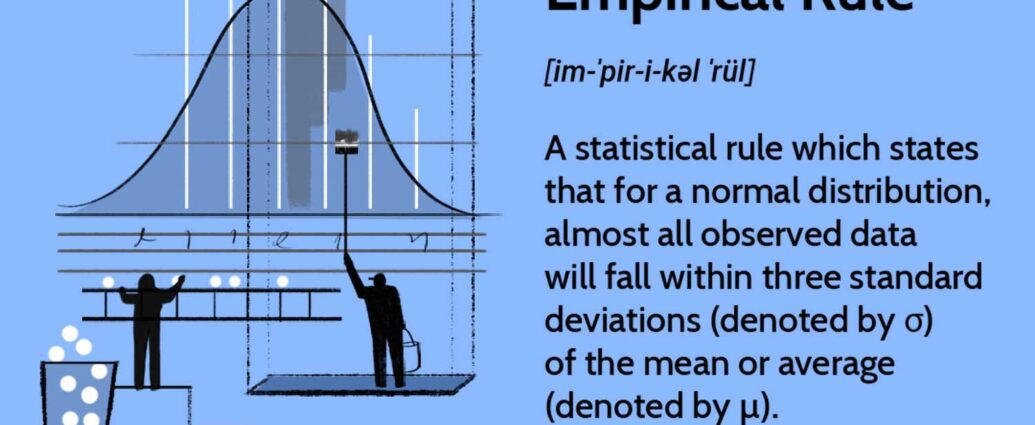

Mastering Management by Objectives: 5 Steps, Benefits & Challenges
This post was originally published here

Dividend Payout Ratio: Definition, Formula, and Calculation
This post was originally published here

Compare Current Mortgage Rates Today – March 23, 2026
This post was originally published here

Chaos on first day of Greece train crash trial as relatives shout ‘shame on you’
Judges adjourn hearing into country’s worst rail disaster after grieving families denounce it as caricature of justice
A long-awaited trial into Greece’s worst train crash has descended into chaos hours after it began, with relatives of the 57 people killed in the disaster screaming “shame on you” at judges who were forced to adjourn the hearing until next month.
More than three years after the disaster, grieving families denounced the proceedings as a caricature of justice amid demands the trial be held elsewhere. The five-member panel of judges called multiple recesses on Monday before announcing the hearing would be postponed until 1 April.
This post was originally published here



Trump’s ‘largest tax refund season of all time’ is getting totally swallowed up by higher gas prices
The U.S. economy was supposed to start the year with a bang, fueled by an unusually large jump in tax refunds from President Donald Trump’s tax cut legislation. Yet spiking gas prices are on track to eat up those refunds, leaving most Americans with little extra to spend.
“Next spring is projected to be the largest tax refund season of all time,” Trump said in a prime-time speech in December that was intended to address voters’ concerns about the economy and stubbornly high prices.
But that was before the Iran war, which began Feb. 28. Oil and gas prices have soared since then, with the nationwide average price of gas reaching $3.94 Sunday, up more than a dollar from just a month earlier.
Gas prices are likely to remain elevated for some time, even if the war ends soon, because shipping and production have been disrupted and will take time to recover. Economists now expect slower growth this spring and for the year as a whole, as dollars that are spent on gas are less likely to be used for restaurant meals, new clothes, or entertainment.
Lower and middle-income households are likely to be hit particularly hard, because they receive lower refunds, while spending a greater proportion of their earnings on gas.
“The energy shock is to going to hit those who have the least cushion,” said Alex Jacquez, chief of policy at the left-leaning Groundwork Collaborative and a former economist in the Biden White House. “And it doesn’t look like those tax refunds are going to be here to save them.”
Neale Mahoney, director of the Stanford Institute for Economic Policy Research, calculates that gas prices could peak in May at $4.36 a gallon, based on oil price forecasts by Goldman Sachs, followed by slow declines for the rest of the year. The notion that gas prices decline much more slowly than they rise is so ingrained among economists that they refer to it as the “rocket and feathers” phenomenon.
In that scenario, the average household would pay $740 more in gas this year, nearly equal to the $748 increase in refunds that the Tax Foundation has estimated the average household will receive.
Through March 6, refunds have risen by much less than that, according to IRS data: They have averaged $3,676, up $352 from $3,324 in 2025. Still, average refunds could rise as more complex returns are filed.
Other estimates show similar impacts. Economists at Oxford Economics, a consulting firm, estimate that if gas prices average $3.70 a gallon all year, it will cost consumers about $70 billion — more than the $60 billion in increased tax refunds.
The gas price spike comes with many consumers already in a precarious position, particularly compared to 2022, when gas prices also soared because of Russia’s invasion of Ukraine. At that time, many households still had fattened bank accounts from pandemic-era stimulus payments and companies were hiring rapidly and sharply lifting pay to attract workers.
Now, hiring is nearly at a standstill and Americans’ saving rate has steadily fallen in the past few years as many households borrow more to sustain their spending.
“When you start looking across the perspective from a consumer side, you’re seeing people who have maxed out their credit cards, are using ‘buy now, pay later’ to purchase their groceries,” said Julie Margetta Morgan, president of The Century Foundation, a think tank. “They’re making it work for now, but that can fall apart quite quickly.”
The impact will likely worsen the “K-shaped” narrativ e around the U.S. economy, analysts said, in which higher income households have fared better than lower-income households. The bottom 10% of earners spend nearly 4% of their incomes on gasoline, Pantheon Macroeconomics estimates, while the top 10% spend just 1.5%.
For now, most analysts still expect the U.S. economy to expand this year, even if more slowly, given the gas price shock. Higher gas prices will likely worsen inflation in the short run, but over time weaker spending will also slow growth.
American consumers and businesses have repeatedly shaken off shocks since the pandemic — soaring inflation, rising interest rates, tariffs — and continued to spend, defying concerns that the economy would tip into recession. Many economists note that the proportion of their incomes that Americans spend on gas and other energy has fallen significantly compared with a decade ago.
Data from the Bank of America Institute, released Friday, showed that spending on gas on the bank’s credit and debit cards shot 14.4% higher in the week ended March 14 compared with a year ago. Before the war, such spending was running 5% below the previous year, a benefit to consumers.
Spending on discretionary items — restaurant meals, electronics, and travel — is still growing, the institute said, evidence of consumer resilience. But there is little sign it is accelerating, as many economists had hoped.
“The longer these gasoline prices persist, the more that will gradually sap consumer discretionary spending,” said David Tinsley, senior economist at the institute.
Other analysts expect growth will slow because of the war. Bernard Yaros and Michael Pearce, economists at Oxford Economics, forecast that the U.S. economy will grow just 1.9% this year, down from an earlier estimate of 2.5%.
“We had anticipated a lift in spending from a bumper tax refund season,” they wrote, “but the rise in gasoline prices, if sustained, would more than offset that boost.”
This story was originally featured on Fortune.com
This post was originally published here

Limited Partnership (LP): What It Is, Pros and Cons, How to Form One
This post was originally published here



The $75 Lunch That Beats Any Exit Interview
Fed’s Goolsbee says he’s worried about inflation in ‘fraught but intense’ climate
In a CNBC interview, the central banker said policymaking is difficult in the current environment.
This post was originally published here


OnlyFans owner Leonid Radvinsky dies at 43
This post was originally published here

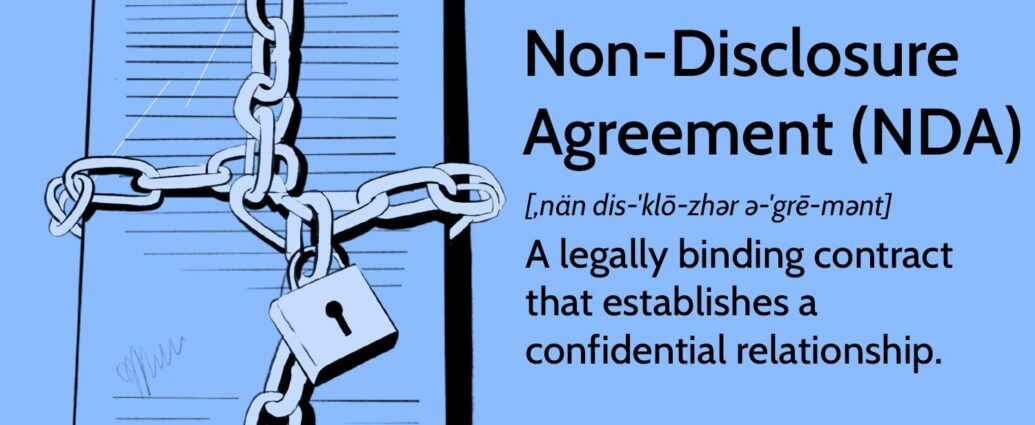
Non-Disclosure Agreement (NDA) Explained, With Pros and Cons
This post was originally published here
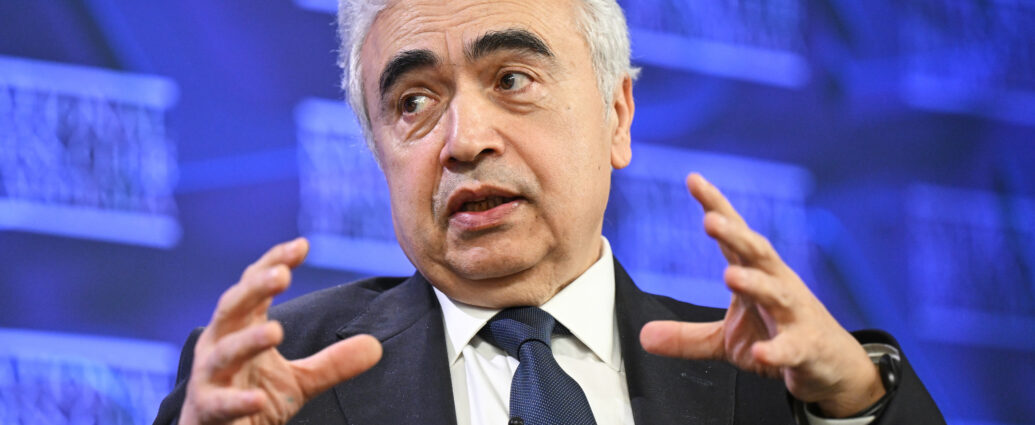
Iran War poses ‘major, major threat’ to global economy, energy chief says
The head of the International Energy Agency said Monday that the global economy faces a “major, major threat” because of the Iran war.
“No country will be immune to the effects of this crisis if it continues to go in this direction,” Fatih Birol said at Australia’s National Press Club in Canberra on Monday.
The crisis in the Middle East, he said, has had a worse impact on oil than the two oil shocks of the 1970s combined, and a worse effect on gas than the Russia-Ukraine war.
Israel launched a new wave of attacks early Monday against Tehran. U.S. President Donald Trump also warned the United States will “obliterate” Iran’s power plants if Tehran doesn’t fully open the Strait of Hormuz within 48 hours. That prompted Iran to say it would respond to any such strike with attacks on U.S. and Israeli energy and infrastructure assets.
Trump is facing increasing pressure at home to secure the strait as oil prices soar.
One major fear is that the war could knock out oil and gas production in the Middle East for a long time, which would mean high prices could last a while and cause inflation to rip higher around the world. The U.S. stock market has a history of bouncing back relatively quickly from past conflicts in the Middle East and elsewhere, as long as oil prices don’t stay too high for too long.
Iran on Monday renewed strikes on its Gulf neighbors and threatened to start hitting their power plants.
“The situation is very severe,” Birol said in Australia.
The oil crises of 1973 and 1979, he said, lost together 10 million barrels per day, causing “major economic problems around the world, the recessions. And today, only as of today, we lost 11 million barrels per day — so more than two major oil shocks put together.”
After Russia’s invasion of Ukraine, he said, the gas markets, especially in Europe, “lost about 75 billion cubic meters, 75BCM. And as of now, as a result of this crisis, we lost about 140BCM, almost twice (as much).”
Birol said 40 energy assets in nine countries across the region were “severely or very severely damaged.”
“Some of the vital arteries of the global economy, such as petrochemical, such as fertilizers, such as sulfur, such as helium — their trade is all interrupted, which would have serious consequences for the global economy,” he said.
He said the International Energy Agency, “in order to comfort the markets,” earlier released 400 million barrels of oil, “which is historic. We have never released so much oil to the markets. … The single most important solution to this problem is opening up the Hormuz Strait as things stand now.”
The official added that he was consulting with governments in Europe, Asia, North America and the Middle East about the prospect of releasing further stockpiled oil.
“We will see, we will look at the markets,” he said. “If it is necessary, of course, we will do it, but we will look at the conditions, we will analyze, assess the market and discuss with our member countries.”
___
AP writer Foster Klug contributed to this report from Tokyo.
This story was originally featured on Fortune.com
This post was originally published here




How Leadership Should Approach Risk
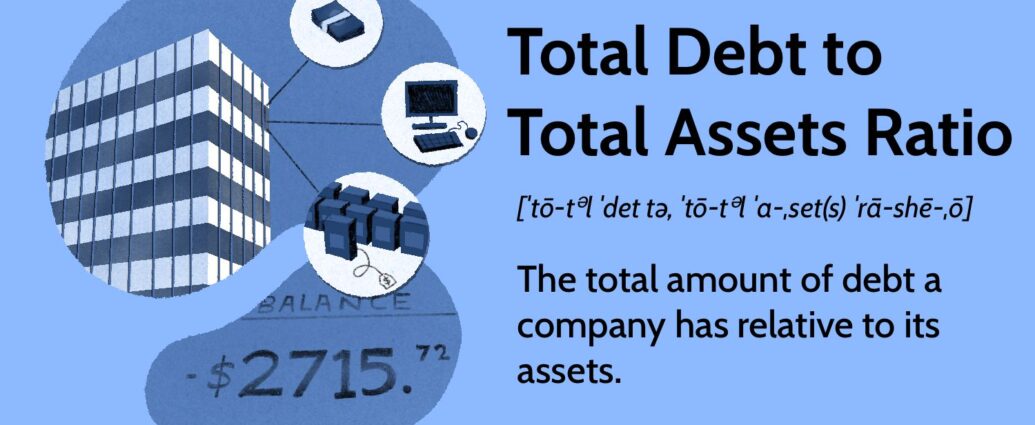
Total Debt-to-Total Assets Ratio: Meaning, Formula, and What’s Good
This post was originally published here



Pfizer to seek FDA approval for Lyme disease vaccine candidate despite trial miss
Lyme disease is an illness caused by bacteria most commonly spread to humans from ticks. It can cause arthritis, muscle weakness and pain.
This post was originally published here
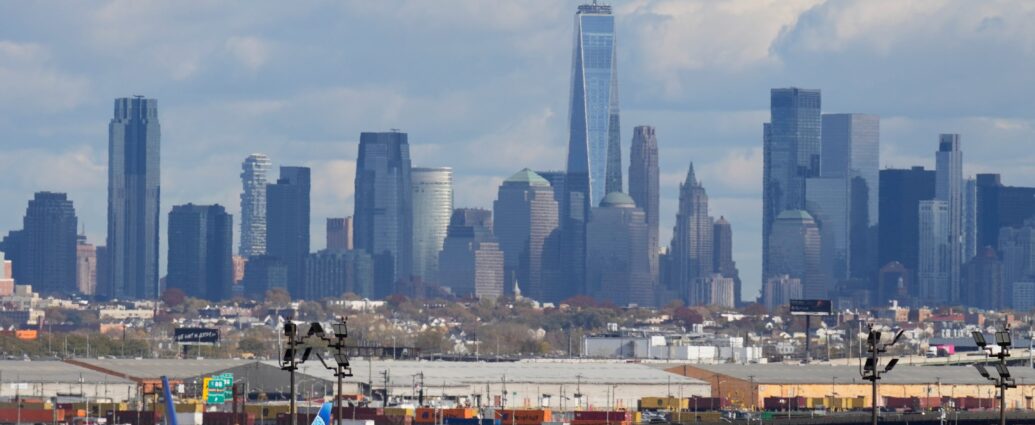
Newark airport shuts down after a burning smell forces an air traffic control tower evacuation
Arrivals and departures were temporarily paused at Newark Liberty International Airport in New Jersey on Monday morning after air traffic controllers evacuated the tower due to a burning smell coming from an elevator, the Federal Aviation Administration said.
It wasn’t immediately clear what caused the issue, and the agency said it was determined that no fire had occurred. The delay lasted less than an hour, and no injuries were reported.
During the pause, FAA staff relocated to a backup tower at the airport, according to the Port Authority of New York and New Jersey, which operates the airport. They later returned to the primary tower.
Earlier this month, four airports serving Washington, D.C., Baltimore and Richmond, Virginia, halted all flights for over an hour because of a strong chemical smell that was impeding air traffic controllers. Federal Transportation Secretary Sean Duffy said the source of the strong odor was traced to a circuit board that overheated and was replaced.
The temporary pause at Newark Liberty was not related to a fatal accident at New York’s LaGuardia Airport on Sunday night. In that episode, two people were killed and several others were seriously injured when an Air Canada regional jet struck a fire truck on a runway while landing, officials said.
This story was originally featured on Fortune.com
This post was originally published here


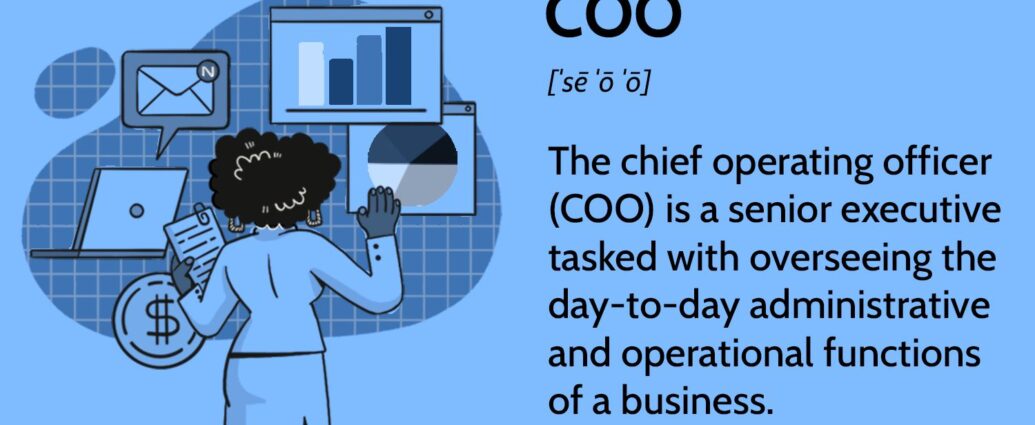
What Does a Chief Operating Officer (COO) Do? Roles and Qualifications
This post was originally published here

The Rise of AI-Driven Robotics
What Is the Asset Turnover Ratio? Calculation and Examples
This post was originally published here

Dogecoin To Get Its Own ‘Windows’? Here’s How DogeOS Could Work
Dogecoin (CRYPTO: DOGE) could gain new utility and yield opportunities through DogeOS, an app-layer project designed to expand its use beyond payments while preserving its meme-driven identity.
Building Utility With DogeOS
In an interview with Crypto India Magazine, DogeOS CEO and co-founder Jordan Jefferson said Dogecoin remains one of the most underutilized assets in crypto despite its large market cap of around $15 billion and cultural reach.
In a recent discussion, Jefferson, a crypto builder since 2011, said Dogecoin has stayed closer to crypto’s original vision of peer-to-peer money, while Bitcoin’s (CRYPTO: BTC) …

Adverse Possession: Legal Definition and Requirements
This post was originally published here





Two people dead after an Air Canada jet struck a firetruck on the LaGuardia Airport runway
Two people were killed and several others badly hurt when an Air Canada regional jet struck a fire truck on a runway while landing at New York’s LaGuardia Airport, officials said.
The pilot and copilot were killed in the late Sunday night collision, which crushed the nose of the aircraft, while around 40 passengers and crew members were taken to area hospitals, some with serious injuries. Most have since been released from treatment, authorities said Monday.
Two Port Authority employees who were traveling in the fire truck also suffered injuries that were not believed to be life-threatening, aid Kathryn Garcia, executive director of the Port Authority of New York and New Jersey, which operates the airport.
In the moments before the crash, an air traffic controller could be heard on a radio transmission giving clearance to a vehicle to cross part of the tarmac, then trying to stop it.
The airport was shut down and air traffic was diverted, and on Monday morning operations also were halted at Newark Liberty International Airport in neighboring New Jersey. Air traffic controllers evacuated the tower because of a burning smell from an elevator, the Federal Aviation Administration said.
The shutdowns happened during long waits for travelers due to the busy spring break travel season and a shortage of Transportation Security Administration officers because of a lack of routine funding for the Department of Homeland Security.
Pilot and copilot were based out of Canada
The pilot and copilot who died were both based out of Canada, Garcia said during a news conference.
The airport will remain closed until at least 2 p.m. Monday to facilitate the investigation, which is being led by the National Transportation Safety Board.
“Two pilots were killed and dozens injured in this tragedy. Our thoughts are with the victims, their families, and everyone affected,” New York Gov. Kathy Hochul posted online.
The fire truck was traveling across the runway to respond to a separate incident aboard a United Airlines flight, whose pilot had reported “an issue with odor,” said Garcia, who deferred additional questions about the sequence of events leading up to the crash to the NTSB.
There were 72 passengers and four crew members aboard the aircraft, a Jazz Aviation flight operating on behalf of Air Canada, according to a statement from the airline. The flight originated at Montreal-Pierre Elliott Trudeau International Airport, the major airport serving Montreal.
Photos and videos from the scene showed severe damage to the front of the aircraft, with cables and debris hanging from a mangled cockpit. Nearby, a damaged emergency vehicle lay on its side.
Stairways used to evacuate passengers from the aircraft were pushed up to the emergency exits on the jet, a Bombardier CRJ. The impact left the jet with its crumpled nose tilted upward.
Air traffic controller tried to stop vehicle after giving clearance
The air traffic controller tried to warn the vehicle.
“Stop, Truck 1. Stop,” the transmission says. The controller can then be heard frantically diverting an incoming aircraft from landing.
Air traffic controllers are not impacted by the partial government shutdown that has caused long delays at airport security checkpoints in recent days. They have been affected by past shutdowns.
As passengers straggled out of the airport into the dark early Monday, some described having arrived at LaGuardia hours before their flight, hoping to beat the lines.
Arturo Davidson said his Miami-bound flight was on the tarmac Sunday night when fellow passengers saw the collision or its aftermath and reactions rippled through the cabin.
The passengers were soon told there had been an accident. About 20 minutes later, they were informed the airport was closing and they must return to the terminal, he said later Monday, gazing at a departure board filled with cancellations.
“I don’t think we’re going at two,” he sighed, referring to the time Monday afternoon that officials gave as the earliest for reopening LaGuardia.
One of the nation’s busiest airports
LaGuardia was 19th busiest in 2024 out of more than 500 U.S. airports, with over 16.7 million passengers boarding there, according to a 2025 FAA database.
The airport, which opened to commercial traffic in 1939, covers 680 acres (275 hectares) and borders Flushing and Bowery bays in Queens. The Port Authority of New York and New Jersey describes it as “one of the nation’s leading domestic gateways for business and leisure travel” in its 2024 Airport Traffic Report.
LaGuardia is one of 35 major airports across the country equipped with an advanced surface surveillance system that uses radar and data from locator systems on planes to alert controllers to potential conflicts on runways, according to the FAA.
There are three different models of Aircraft Rescue and Firefighting trucks, according to a video put out last year about the unit by the Port Authority. One carries 1,500 gallons (5,678 liters) of water and firefighting chemicals. Two others carry 3,000 gallons (11,356 liters) of water. One of those models is also equipped with a turret that can extend 65 feet (20 meters) to penetrate inside an aircraft and discharge firefighting chemicals.
It’s still too early to tell what went wrong, and investigators from the NTSB will now start collecting facts, interviewing people, downloading recordings and reviewing data from flight recorders, aviation safety expert Jeff Guzzetti said.
“It might be easy enough just to say, ‘Oh, the controller made a mistake.’ But there’s got to be deeper questions,” he said.
___
The story has been updated to correct that the Port Authority video on trucks was put out last year, not last month.
This story was originally featured on Fortune.com
This post was originally published here




Jim Cramer’s top 10 things to watch in the stock market Monday
Stocks soar, a crisis at Microsoft and Apple continues to defy expectations.
This post was originally published here



Franklin Templeton Says XRP Will Boom When Companies Actually Start Using It
XRP (CRYPTO: XRP) institutional adoption hinges on companies actually using the network to solve business problems, with Franklin Templeton’s Roger Bayston predicting the tipping point comes when businesses integrate blockchain into operations.
The Usage Thesis
Bayston drew a parallel to Warren Buffett buying Dairy Queen stock because he consumed Dairy Queen products.
“I don’t think yet a lot of institutions understand how they can use these distributed ledger technologies inside of their information-based businesses,” he said on the Paul Barron podcast.
The breakthrough moment arrives when companies start using the XRP network to solve actual business problems—creating efficiencies or new opportunities.
When businesses need to use XRP to append records onto the network and recognize the total addressable market potential, that’s when institutional investment follows.
Franklin Templeton reached this conclusion by trying to use distributed ledger technologies in their own securities business.
Once they unpacked how blockchains work, they realized these systems will be used by lots of information-based businesses over time, making the underlying …
This post was originally published here

Voice of America staffers sue, alleging Kari Lake put on propaganda
Voice of America staffers are suing Trump administration official Kari Lake, alleging she put pro-Trump propaganda on its airwaves. She has lost numerous rulings of late.
(Image credit: Voice of America)

This post was originally published here




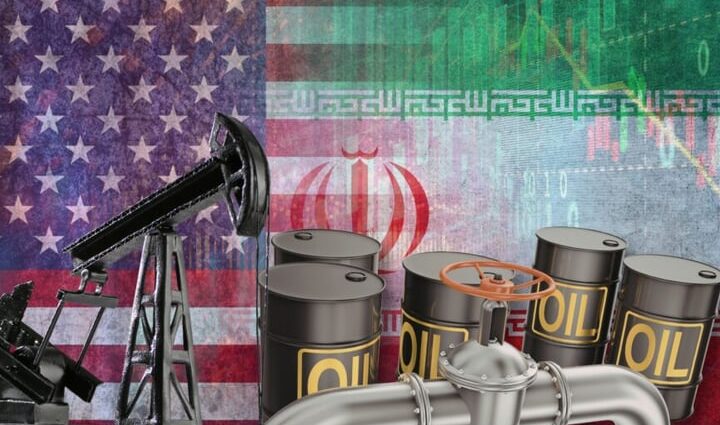
Why Is AleAnna Stock Falling Monday?
AleAnna, Inc. (NASDAQ:ANNA) shares are declining in the premarket session on Monday. The move stems primarily from profit-taking following a massive Friday rally.
Nasdaq futures are up 1.74% while S&P 500 futures have gained 1.86%.
Trump Signals De-Escalation
The pullback follows a shift in geopolitical tensions. President Donald Trump signaled a de-escalation via a Truth Social post.
Trump said he ordered a five-day pause on planned U.S. strikes against Iranian energy infrastructure. He described recent discussions with Iranian officials as “very good and productive.”
On Monday, after Trump’s signal, crude oil and natural gas futures plummeted. Crude oil futures were down 9.25% to $89.14, and natural gas futures …
This post was originally published here




Stop asking AI chatbots about your workplace problems—a close colleague is a better bet, psychologist says
AI isn’t best suited for workplace questions about difficult conversations or social activities, so turn to a close colleague first, says a psychologist.
This post was originally published here


Current price of oil as of March 23, 2026
As of 9 a.m. Eastern Time today, oil sold for $101.44 per barrel (using Brent as the benchmark, which we’ll get into momentarily). That’s $10.64 lower than yesterday—but approximately a $29 rise over the past year.
Will oil prices go up?
It’s impossible to predict the future of oil prices. Several factors determine the movement of oil, but it ultimately boils down to supply and demand. Again, when threats of economic downturn, war, etc. are high, the oil trajectory can turn rapidly.
How oil prices translate to gas pump prices
When you pay for gas at the pump, you’re paying for more than just the crude oil itself; you’re also springing for links along the chain, such as the refineries and wholesalers—not to mention taxes and local gas station markups.
Still, the crude oil aspect affects the final price most dramatically, as it typically accounts for more than half the price per gallon. When oil prices spike, so do gas prices. And frustratingly, when oil prices drop, gas prices tend to take their time drifting down to the lower price (sometimes referred to as “rockets and feathers”).
The role of the U.S. Strategic Petroleum Reserve
In case of emergency, the U.S. has a store of crude oil known as the Strategic Petroleum Reserve. Its primary purpose is energy security in case of disaster (think sanctions, severe storm damage, even war). But it can also go a long way toward softening crippling price hikes during supply shocks.
It’s not a long-term answer—more of an immediate relief to assist the consumer and keep critical parts of the economy running, like key industries, emergency services, public transportation, etc.
How oil and natural gas prices are linked
Oil and natural gas are both major energy fuels. A big change in oil prices can affect natural gas by extension. For example, if oil prices increase, some industries may swap natural gas for some segments of their operations where possible—which increases demand for natural gas.
Historical performance of oil
When examining oil’s performance, there are generally two major benchmarks:
- Brent crude oil is the main global oil benchmark.
- West Texas Intermediate (WTI) is the main benchmark of North America.
Between the two, Brent better represents global oil performance because it prices much of the world’s traded crude. And, it’s often the best way to track historical oil performance. In fact, even the U.S. Energy Information Administration now uses Brent as its primary reference in its Annual Energy Outlook.
Looking at the Brent benchmark across several decades, oil has been anything but steady. It’s seen spikes due to factors such as wars and supply cuts, and it’s also seen crashes from global recessions and an oversupply (called a “glut”). For example:
- The early 1970s brought the first big oil shock when the Middle East cut exports and imposed an embargo on the U.S. and others during the Yom Kippur War.
- Prices dropped in the mid-1980s for reasons such as lower demand and more non-OPEC oil producers entering the industry.
- Prices spiked again in 2008 with increased global demand, but it soon plummeted alongside the global financial crisis.
- During the 2020 COVID lockdown, oil demand collapsed like never before—bringing prices below $20 per barrel.
All to say, oil’s historical performance has been anything but smooth. Again, it’s hugely affected by wars, recessions, OPEC whims, evolving energy initiatives and policies, and much more.
Energy coverage from Fortune
Looking to stay up-to-date regarding the latest energy developments? Check out our recent coverage:
- Natural gas prices in Texas plunge deep into negative territory and producers are burning it off
- ‘Almost exactly offsetting the boost’: Higher gasoline prices this year could wipe out tax refunds
- U.S. allows sale of stranded Iran oil to cap fuel-price rises
Frequently asked questions
How is the current price of oil per barrel actually determined?
The current price of oil per barrel depends largely on supply and demand, including news about potential future supply and demand (geopolitics, decisions made by OPEC+, etc.). In the U.S., prices also move based on how friendly an administration is to drilling, as it can affect future supply. For example, 2025 saw the Trump administration move to reopen more than 1.5 million acres in the Coastal Plain of the Arctic National Wildlife Refuge for oil and gas leasing, reversing the Biden administration’s policy of limiting oil drilling in the Arctic.
How often does the price of oil change during the day?
The price of oil updates constantly when the “futures” markets are open. A futures market is effectively an auction where people agree to buy or sell oil in the future. As long as people and companies are trading contracts, the oil price is changing.
How does U.S. shale oil production affect the current price of oil?
In short, shale is rock that contains oil and natural gas. Think of shale as energy yet to be tapped. The more shale the U.S. accesses, the more energy we’ll have—and the more easily oil prices can keep from spiking as much thanks to a greater supply.
How does the current price of oil impact inflation and the broader economy?
When oil is expensive, it tends to make everyday items cost more. This can be related to energy (your heating, gas utilities, etc.), but it’s also due to the logistics involved with making those items accessible to you. Shipping, for example, can affect the price of things at the grocery store, as it’s more expensive to get those products from warehouses and farms onto the shelf.
This story was originally featured on Fortune.com
This post was originally published here







How To Earn $500 A Month From Worthington Enterprises Stock Ahead Of Q3 Earnings
Analysts expect Worthington Enterprises, Inc. (NYSE:WOR) to report quarterly earnings of 96 cents per share when it releases third-quarter (Q3) results on Tuesday, March 24.
That’s up from 91 cents per share in the year-ago period. The consensus estimate for Worthington’s quarterly revenue is $349.41 million (it reported $304.52 million last year), according to Benzinga Pro.
With the recent buzz around Worthington and its completed acquisition of LSI Group, investors may be eyeing potential dividend gains. As of now, Worthington has an annual dividend yield of 1.60%, with a quarterly dividend of 19 cents per share (76 cents per year). Here’s how investors can exploit the dividend yield to pocket $500 monthly.
To earn $500 per month or $6,000 annually from dividends alone, you would need …
This post was originally published here

Senate Democrats Demand ‘Rigorous’ FCC Probe Into Foreign Funding Behind Paramount Skydance–Warner Bros. Discovery Deal
Senate Democrats have urged FCC Chairman Brendan Carr to investigate the foreign funding involved in the proposed acquisition of Warner Bros. Discovery (NASDAQ:WBD) by Paramount Skydance (NASDAQ: PSKY).
Senate Democrats, including Minority Leader Chuck Schumer (D-N.Y), Minority Whip Dick Durbin (D‑IL), and Senators Cory Booker (D‑NJ), Richard Blumenthal (D‑CT), Mazie Hirono (D‑HI), Sheldon Whitehouse (D‑RI), and Sen. Elizabeth Warren (D-Mass.), have written to Carr and voiced concerns regarding the foreign investment from China and Gulf states in the merger.
“This constellation of foreign investment from China and from Gulf states, with complex and sometimes competing relationships with the United States, demands rigorous, not perfunctory, review,” wrote the Senators.
The senators stressed that the current deal structure limits their ability to influence the governance or management of the merged company. Yet, the significant equity contributions from these foreign investors, along with a report of …
This post was originally published here




















There Are 630,000 More Home Sellers Than Buyers—the Biggest Gap on Record
- When sellers outnumber buyers, the buyers who are in the market have bargaining power. In other words, it’s a buyer’s market.
- The strongest buyer’s markets are in the South, while the strongest seller’s markets are in the Northeast.
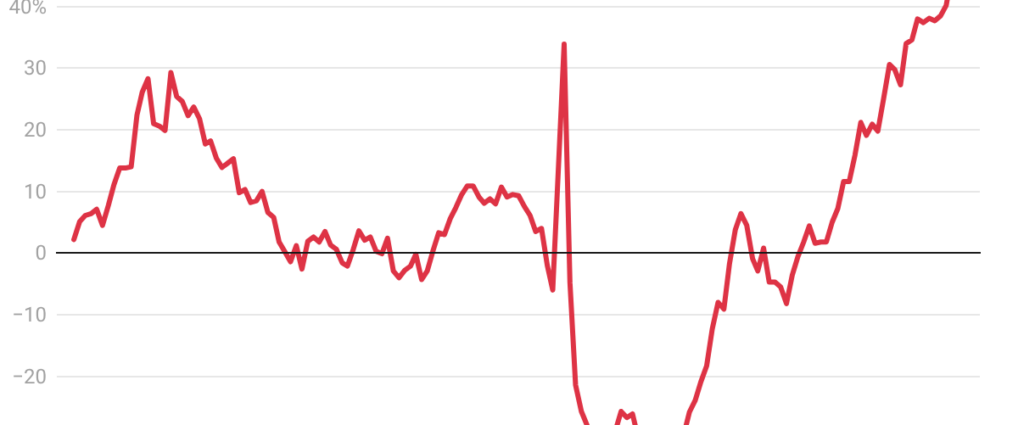
There were an estimated 46.3% more home sellers than buyers in the U.S. housing market in February (or 629,808 more, in numerical terms). That’s the largest gap in records dating back to 2013 and is up from 29.8% (or 449,409) a year earlier.
We define a market where there are over 10% more sellers than buyers as a buyer’s market and a market where there are over 10% fewer sellers than buyers as a seller’s market. A market where the gap is plus or minus 10% is considered a balanced market. By this definition, it has been a buyer’s market since May 2024.
When sellers outnumber buyers, buyers typically hold the negotiating power because they have a lot of options to choose from. That’s why a market with a lot more sellers than buyers is considered a buyer’s market. Of course, it’s only a buyer’s market for those who can afford to buy. High housing costs and economic uncertainty have caused many house hunters to retreat, creating an imbalance of buyers and sellers.
“We’re seeing a lot more inventory on the market compared to the past two years because the mortgage rate lock-in effect is easing and there’s a lot of new construction,” said Justin Gomez, a Redfin Premier real estate agent in Omaha, NE. “This has been great for affordability, especially for the younger crowd. Our median home price is in the low $300,000 range. Two years ago, people were offering $15,000 over the asking price just to get a home, with multiple offers everywhere.”
We estimated the number of buyers using proprietary Redfin data on the typical time from a buyer’s first tour to close of purchase, and MLS data on active listings and pending sales. The estimated number of sellers in the market is simply the number of active listings in the MLS. These estimates, along with median-sale price data in this report, are seasonally adjusted and subject to revision. See a more detailed methodology here and view an interactive dashboard here.
Buyers Are Retreating, Which Is Causing Some Sellers to Retreat
The number of homebuyers in the market fell 2.4% month over month in February to an estimated 1.36 million. The number of sellers posted a smaller decline, falling 0.4% to an estimated 1.99 million.
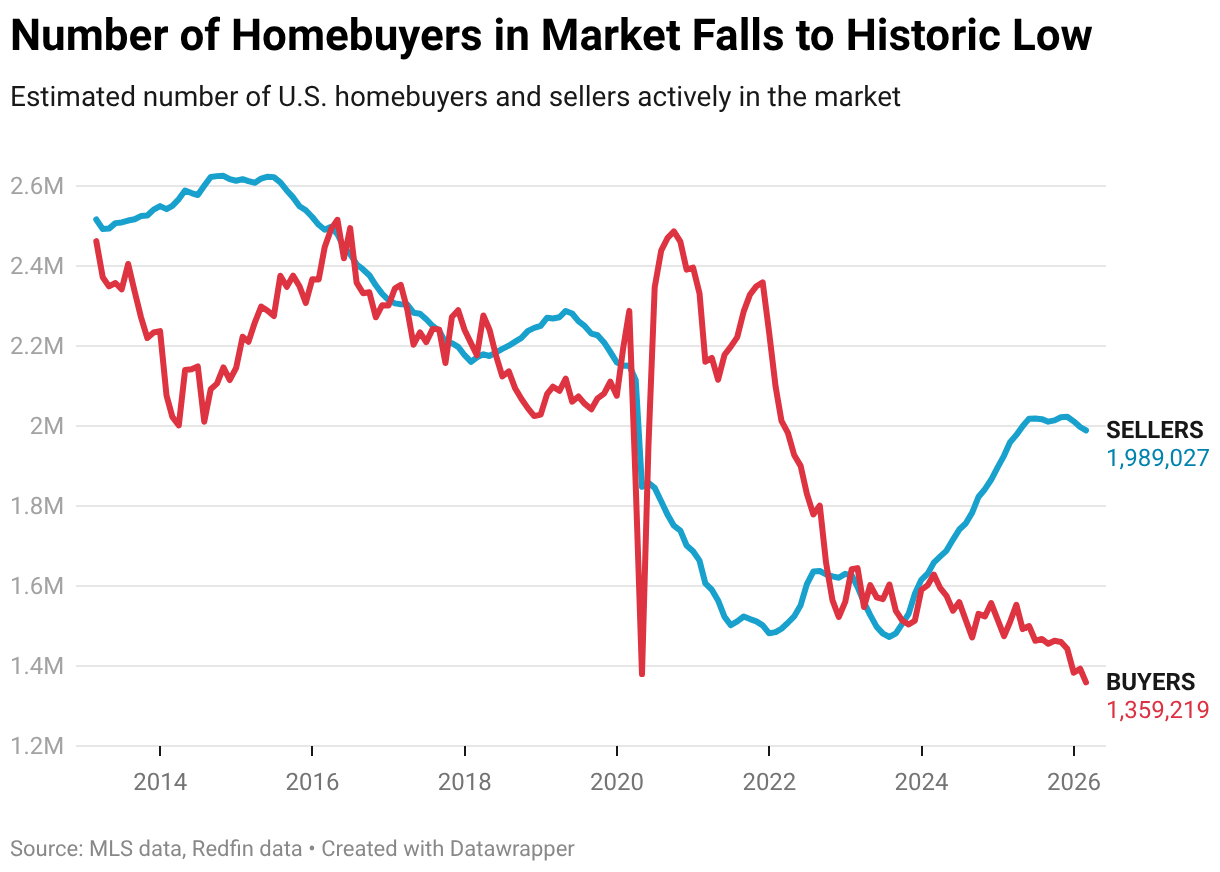
Homebuyers are retreating due to stubbornly high home prices and mortgage rates, layoffs, and mounting economic and political uncertainty. The retreat in buyers has caused some sellers, many of whom are buyers themselves, to retreat. Some sellers are delisting after watching their homes sit on the market, while others are choosing not to list at all after seeing nearby homes sell for below the asking price.
Redfin did report earlier this month that relistings are beginning to rise, which could boost housing supply. New listings are also starting to climb slightly, posting their second straight week of increases after four months of declines.
The Strongest Buyer’s Markets Are In the South
The strongest buyer’s market in February was Miami, which had an estimated 163% more sellers than buyers. Next came Nashville (120%), Austin, TX (112%), West Palm Beach, FL (110%) and San Antonio (104%). Redfin analyzed the 50 most populous U.S. metropolitan areas and included in this analysis the 49 with sufficient data.
The Sun Belt skyrocketed in popularity during the pandemic, when scores of homebuyers moved in from more expensive parts of the country. To meet surging demand, homebuilders ramped up activity, which is one reason there are now a lot more homes for sale than people who want to buy them. The pool of buyers has also shrunk because soaring housing costs in recent years have priced many people out of the market.
New construction can have a significant influence on whether negotiating power lies with buyers or sellers because it impacts the balance of supply and demand. The South and the West have historically issued the most building permits, while the Northeast and the Midwest (where the five seller’s markets are located) have issued the fewest.
Florida and Texas, in particular, build more homes than other states. Florida is also grappling with intensifying natural disasters, soaring insurance premiums and rising condo HOA fees, which has prompted some homeowners to leave. Miami, specifically, frequently shows up as a buyer’s market because it has a lot of housing supply, which could be in part due to the high number of condos.
The Strongest Seller’s Markets Are In the North
The strongest seller’s market in February was Newark, NJ, which had an estimated 31.1% fewer sellers than buyers. The other four seller’s markets were Montgomery County, PA (-29%) Nassau County, NY (-25.8%), Milwaukee (-25.2%) and New Brunswick, NJ (-14.5%).
On average, home prices rose 2.2% year over year across the five seller’s markets in February, compared with a 0.3% increase across the 37 buyer’s markets—an indication that buyer’s markets offer house hunters more leverage.
Metro-Level Summary: 50* Most Populous Metros (February 2026)
| U.S. metro area | Balance of power | Percent by which sellers outnumber buyers | Buyers | Sellers |
|---|---|---|---|---|
| Anaheim, CA | Buyer’s Market | 37.2% | 5,363 | 7,357 |
| Atlanta, GA | Buyer’s Market | 76.6% | 21,337 | 37,680 |
| Austin, TX | Buyer’s Market | 111.7% | 8,396 | 17,776 |
| Baltimore, MD | Balanced Market | -4.0% | 10,619 | 10,197 |
| Boston, MA | Balanced Market | 0.9% | 10,012 | 10,105 |
| Charlotte, NC | Buyer’s Market | 74.3% | 9,461 | 16,493 |
| Chicago, IL | Balanced Market | 2.2% | 25,112 | 25,676 |
| Cincinnati, OH | Buyer’s Market | 39.1% | 5,938 | 8,259 |
| Cleveland, OH | Balanced Market | -4.3% | 7,171 | 6,860 |
| Columbus, OH | Buyer’s Market | 29.3% | 6,626 | 8,570 |
| Dallas, TX | Buyer’s Market | 83.8% | 16,716 | 30,731 |
| Denver, CO | Buyer’s Market | 40.1% | 11,730 | 16,429 |
| Detroit, MI | Buyer’s Market | 44.8% | 5,054 | 7,317 |
| Fort Worth, TX | Buyer’s Market | 76.1% | 7,414 | 13,058 |
| Houston, TX | Buyer’s Market | 102.4% | 22,402 | 45,345 |
| Indianapolis, IN | Buyer’s Market | 22.6% | 7,643 | 9,372 |
| Jacksonville, FL | Buyer’s Market | 70.1% | 7,313 | 12,438 |
| Kansas City, MO | Buyer’s Market | 19.6% | 7,436 | 8,896 |
| Las Vegas, NV | Buyer’s Market | 89.5% | 7,453 | 14,124 |
| Los Angeles, CA | Buyer’s Market | 52.6% | 14,700 | 22,431 |
| Miami, FL | Buyer’s Market | 162.6% | 7,512 | 19,726 |
| Milwaukee, WI | Seller’s Market | -25.2% | 6,900 | 5,163 |
| Minneapolis, MN | Balanced Market | 6.9% | 12,761 | 13,644 |
| Montgomery County, PA | Seller’s Market | -29.0% | 7,111 | 5,047 |
| Nashville, TN | Buyer’s Market | 119.6% | 7,077 | 15,540 |
| Nassau County, NY | Seller’s Market | -25.8% | 9,280 | 6,885 |
| New Brunswick, NJ | Seller’s Market | -14.5% | 10,082 | 8,624 |
| New York, NY | Balanced Market | 3.8% | 26,109 | 27,100 |
| Newark, NJ | Seller’s Market | -31.1% | 8,085 | 5,573 |
| Oakland, CA | Buyer’s Market | 24.4% | 4,701 | 5,850 |
| Orlando, FL | Buyer’s Market | 73.6% | 10,342 | 17,956 |
| Philadelphia, PA | Buyer’s Market | 24.6% | 6,411 | 7,987 |
| Phoenix, AZ | Buyer’s Market | 78.7% | 18,132 | 32,396 |
| Pittsburgh, PA | Buyer’s Market | 63.7% | 5,579 | 9,132 |
| Portland, OR | Buyer’s Market | 49.7% | 7,386 | 11,059 |
| Providence, RI | Buyer’s Market | 13.5% | 3,593 | 4,078 |
| Riverside, CA | Buyer’s Market | 59.8% | 11,880 | 18,980 |
| Sacramento, CA | Buyer’s Market | 41.0% | 5,292 | 7,461 |
| San Antonio, TX | Buyer’s Market | 104.3% | 8,905 | 18,196 |
| San Diego, CA | Buyer’s Market | 18.8% | 6,627 | 7,873 |
| San Francisco, CA | Balanced Market | 2.4% | 2,575 | 2,636 |
| San Jose, CA | Buyer’s Market | 10.5% | 2,788 | 3,080 |
| Seattle, WA | Buyer’s Market | 28.9% | 7,899 | 10,181 |
| St. Louis, MO | Buyer’s Market | 13.2% | 9,087 | 10,285 |
| Tampa, FL | Buyer’s Market | 84.1% | 13,128 | 24,168 |
| Virginia Beach, VA | Buyer’s Market | 22.3% | 6,311 | 7,718 |
| Warren, MI | Buyer’s Market | 25.7% | 7,183 | 9,027 |
| Washington, DC | Buyer’s Market | 18.6% | 15,524 | 18,418 |
| West Palm Beach, FL | Buyer’s Market | 110.1% | 7,394 | 15,531 |
*Fort Lauderdale has been removed due to insufficient data.
The post There Are 630,000 More Home Sellers Than Buyers—the Biggest Gap on Record appeared first on Redfin Real Estate News.

The unspoken rule: is English really the key to success in Europe’s boardrooms?
Around the boardroom table, Carmen-Maja Rex’s colleagues slip easily between French and English. When the Airbus CHRO takes her seat, the discussion naturally settles into English without anyone flagging the switch. For a company founded in France, built partly in Germany, assembling aircraft across Europe and flying them globally, English has quietly become the default working language. The same takes place just a few hundred kilometers away at Sodexo’s headquarters just outside of Paris. CHRO Heather Jacobs is American, and most of her conversations in the boardroom are in English, despite the company having roots in the French city of Marseille.
English is now the most widely spoken language in history, with around 1.5 billion speakers worldwide, and fluency in it has quietly become an unwritten yet essential requirement for many senior roles at multinationals. This expectation can disadvantage those who are not native English speakers, and now sits against a wider political backdrop in which leaders such as Donald Trump have designated English as the U.S.’s official language, promoting warnings from scholars about how easily the ‘speak English’ rhetoric can slide into exclusion.
The OECD examined 11 million online job postings in 2021, across the EU and the U.K., and found that 22% explicitly required English proficiency. German was the next most frequently requested language, appearing in 1.7% of listings, often in tourism-related roles. French was required in only 1.1% of postings, while Italian was required in only 0.4%.
In Europe’s boardrooms, the growing dominance of English isn’t just a matter of habit; it’s also driven by global business demands, with effects that reach into areas such as rules and safety. It also shapes who fits in, who advances, and how companies operate. The question now is whether AI is reinforcing English as a ‘superior’ language of leadership, or simply making it easier for organizations to maintain a common corporate language—and whether businesses could realistically return to a more localised way of functioning.
A language born of power, not policy
Although English is mandated as the common corporate language in many Fortune 500 Europe headquarters across the region, its dominance is, in many ways, a historical “accident”. Nina Bellak, PhD, Senior Lecturer at the University of Vienna, links the power of English in boardrooms to postwar history. “There’s this power dynamic at a national level between the colonizer and colonized, and it’s a very similar dynamic at a corporate level,” she says. Explaining that English became far more prominent post World War as U.S. economic and political power expanded across the continent.
Over the following decades, English gradually displaced local languages such as French and German as the dominant working language. Many Fortune 500 European companies have mandated English for simple operational reasons, ranging from safety standards to international financial reporting. Airbus’s decision to mandate English as its working language goes back to the company’s birth in the 1970s, says Rex. “This was very surprising, especially in those days in France—there were not many French companies [that agreed] on English [becoming] the common language,” she adds. The reasoning was largely practical: aviation safety, where English is the global standard.
Similarly, in the early 2000s, Siemens began using English more consistently after listing on the NYSE, particularly for financial communications, says Nanda Burke, global head of talent and organization at Siemens. In other cases, companies adopted English more organically. For example, at the Swiss electrification and automation company ABB, English became the common corporate language following the merger of Swedish firm ASEA and Swiss company Brown Boveri in 1988. With neither Swedish nor German able to claim precedence, English emerged as neutral ground—less a deliberate strategy than a diplomatic necessity, according to Carolina Granat, ABB’s chief human resources officer.
“This was very surprising, especially in those days in France—there were not many French companies [that agreed] on English [becoming] the common language.”
Carmen-Maja Rex, chief human resources officer, Airbus
Beyond industry factors, the prevalence of English within Fortune 500 companies in Europe also reflects its widespread use across countries. In the Netherlands and countries in Scandinavia for example, English classes are compulsory at schools and so individuals pick up the language at a much younger age, hence often functioning as a natural second language. Kaija Bridger, EVP people & communications at elevator engineering company, KONE, says that, in Finland, where the company is headquartered, the country’s small domestic market has caused people to look outward and so most senior leaders operate comfortably in English. “Finnish wouldn’t be the most dominant language to begin with,” she says, adding that one newly employed executive member recently asked for support in learning Finnish.
Lost in translation
Research suggests this English-first narrative hides a more complex reality. Bellak finds that many multinationals claim to have an official corporate language policy, but day-to-day language choice is messy, hard to regulate and often up to the individual.
Whilst many companies have officialized English as the common corporate language, local languages remain critical on the ground. At Siemens, day-to-day meetings are conducted in English, although local languages are highly present, and “that is a strength,” says Burke, who is not fluent in German but has been learning “not because it was required but because I now live part-time in Munich and genuinely want to understand and speak the local language.”
At KONE, which operates in 70 countries, Bridger describes the company as a “global company with very local operations”. While English is essential for regional and global roles, local languages dominate among technicians in the field. “Let’s say, all of a sudden, the escalator stops working. Someone needs to be pretty close by and [a technician] needs to be able to fix the lift. That’s where we come to the language and proximity of the business…and that’s where local language plays a huge role,” she adds. Similarly, Sodexo’s Jacobs explains that despite English being the corporate language, “local languages naturally dominate in the markets where we operate”, such as India and mainland China. At the company’s headquarters, more than 25 nationalities are present and so “you hear a little bit of everything,” she notes. While many of these firms have formally mandated English, in practice, they rely on a multilingual ecosystem to function.
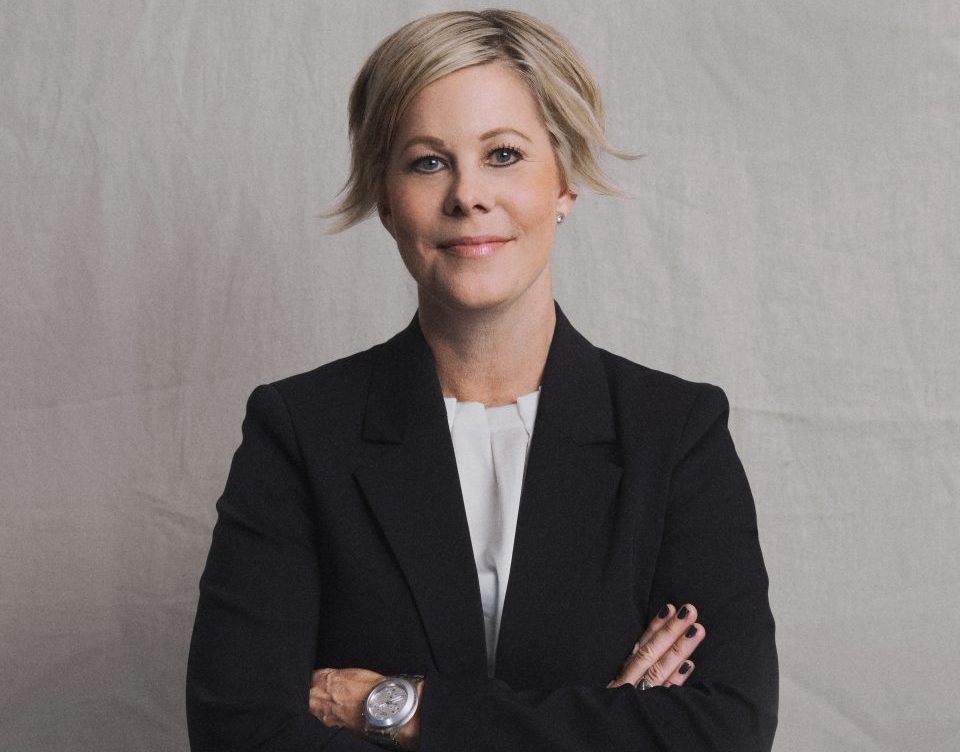
Behind every official language policy, the question arises: whose voices carry furthest when English becomes the default? Whilst most Fortune 500 Europe companies have not officially stated that English is a necessity, it’s almost assumed that at the C-Suite or senior level, individuals can converse in English. “If I think about the C-suite, senior leadership and even middle management roles…If there’s an English language requirement, the idea really is that the person is proficient enough,” says KONE’s Bridger.
Fluency, status and who gets ahead
Nevertheless, companies remain careful not to treat polished English as a proxy for leadership potential. “Talent is about capability, impact, and values-driven leadership, not accent or fluency,” says ABB’s Granat. Where certain language requirements do matter, most companies take responsibility for removing barriers: localizing job postings, adapting assessment processes and providing learning opportunities so that employees can build language confidence, not only in English but also in the local language of the host country when it is required or encouraged. “Within my first month of being with Sodexo, I had a full week outside of the office [in Southwest France], not just [to learn the] language, but it was about cultural adaptation as well,” Jacobs adds.
Although many companies invest in language training for employees—including English courses for staff outside English-speaking countries—employees can still experience a sense of status loss. Associate Professor at BI Norwegian Business School, Guro Refsum Sanden, uses this term to describe how non-native speakers of the common corporate language sometimes feel a subjective drop in their professional esteem, as if their competence is being judged through their language skills rather than their actual expertise. This can leave even highly skilled non-native English speakers feeling inadequate when required to operate in a foreign language. By contrast, native English speakers may gain status simply because they remain fluent in the corporate language, even when they are no more professionally capable than their peers—a form of “unearned status”, Refsum Sanden calls it.
Language isn’t just a communication tool—whether English or the local language of the host country—it is a tool that enables people to integrate and signal whether they ‘belong’ in boardrooms as well as society. Native English speaker Brady Dougan spent eight years as CEO of Credit Suisse and left without ever speaking German; he later called it one of his regrets, and his inability to speak German was criticized in the Swiss media. In 2015, Anshu Jain, the Indian-born British co-CEO of Deutsche Bank opened the bank’s annual meeting in German before switching to English. However, less than three weeks later, Jain resigned as co-CEO after losing investor confidence.
Not speaking the native language didn’t directly cost Dougan and Jain their jobs; however, it drew criticism and made it harder for them to connect with local investors, clients and customers. English can evidently get senior leaders into the boardroom; whether they can retain the role without speaking the local language is less certain.
The translator in the room
That’s also the limit of what AI can currently change. Translation tools, meeting summaries and captions have the ability to smooth over gaps in fluency and assist non-native speakers in writing emails, translating, and functioning more confidently in English-first settings. Airbus’ Rex notes that “AI is supportive in order to build bridges,” and adds that the company has rolled out Gemini globally, resulting in improved translation efficiency. Similarly, Jacobs notes how AI has improved translation processes at Sodexo, making communication faster and more accurate for mandatory learning and employee engagement surveys.
Yet CHROs broadly agree that even the best AI tools require careful handling to preserve the essence of communication and that AI is nowhere near ready to replace human leadership and interaction. Refsum Sanden warns that the more organisations lean on AI to translate and generate text, the greater the risk that it will “converge” the way people communicate, eroding differences and nuances in local languages. If multilingual companies come to depend on those systems, technology will start to dictate what is considered ‘appropriate’ language in the boardroom and even language included in emails and chat—potentially narrowing, rather than enriching, the range of voices and communication styles that make it into the corporate conversation.
Native English speakers may gain status simply because they remain fluent in the corporate language, even when they are no more professionally capable than their peers—a form of “unearned status”
Guro Refsum Sanden, Professor at BI Norwegian Business School
Executives from KONE, Sodexo and ABB all describe English as the practical “common denominator” that enables cross-border collaboration. Global companies will always have to balance the ‘local’ with the ‘global’ and KONE’s Bridger doesn’t see that basic tension changing anytime soon. The local side is driven by the markets companies operate in and the customers served, whereas the global side brings scale, shared platforms and processes so that local teams do not need to reinvent the wheel. This is also dependent on population, country and market size. Bridger notes that Finland is a “small nation and [the language] is one of the hardest languages to learn.” Hence, native Finnish speakers at times are empathetic and remain open-minded towards language as a whole.
It’s hard to imagine multinationals operating without at least one shared language to connect their multicultural and multilingual operations. Whether local languages can retain space in multinational boardrooms? “We’re not really there right now,” says Sodexo’s Jacobs, noting that English has effectively become the universal language at the senior level—and that won’t change unless something else emerges to replace it.
Whilst English has slipped into Europe’s boardrooms as a common bridge over the last few decades, it now carries political and technological weight. President Trump signed the historic executive order designating English as the official language of the United States on March 1st 2025, marking the first time the country has ever had a national language. A symbolic move highlighting how closely language, power and identity are intertwined.
English may remain the boardroom default for the foreseeable future, but it is up to companies to define how tightly they choose to hold onto it—and who that choice leaves out.
This story was originally featured on Fortune.com
This post was originally published here

Airline Stocks Soar As Trump Signals Strike Pause
Airline and cruise stocks caught a massive tailwind Monday morning. WTI crude oil futures collapsed over 10% to approximately $88.50 per barrel.
This sharp decline follows a shift in Middle East geopolitical tensions.
Investors moved back into the travel sector as energy costs retreated. Fuel represents one of the largest overhead expenses for carriers. Lower crude prices directly expand profit margins for the industry.
Trump Signals Five-Day Military Pause
The market reversal began after President Donald Trump signaled a de-escalation via a Truth Social post. Trump said he ordered a five-day pause on planned U.S. strikes against Iranian energy infrastructure.
The President described recent discussions with Iranian officials as “very good …
This post was originally published here
Leaders Feel Their Agency Eroding—and They’re Starting to Withdraw
Years of upheaval and uncertainty have chipped away at their confidence. Here’s how they can get it back.
This post was originally published here


AEO Stock Undervalued? Value Score Jumps As American Eagle’s Record Q4 Earnings Meet 35% YTD Market Sell-Off
The American Eagle Outfitters Inc. (NYSE:AEO) stock is flashing signs of being potentially underpriced as its business performance outpaces its recent stock chart.
The Disconnect Between Price And Fundamentals
Following a record-breaking fourth quarter, AEO’s Benzinga Edge Stock Rankings‘ value score rose week-on-week from 88.87 to 89.71. This upward shift in relative worth comes in stark contrast to the stock’s recent market action, where shares have tumbled 34.70% year-to-date.
The value metric evaluates a stock’s relative worth by comparing its market price to fundamental measures of the company’s assets, earnings, sales, and operating performance. At an 89.71 value score, the underlying math suggests the market’s recent sell-off has made AEO’s fundamentals cheaper relative to its peers.
However, other Benzinga Edge metrics highlight the stock’s current hurdles. AEO holds a low quality score of 5.31, a composite ranking that evaluates a company’s operational efficiency and financial health.
Additionally, its momentum sits …
This post was originally published here

To Scale AI Agents Successfully, Think of Them Like Team Members
Just like your human employees, each AI agent needs a role, a defined scope of authority, approved sources of truth, and clear escalation rules.
This post was originally published here
The uneven cost of tariffs: Why some households will pay more than others
Households experience the financial cost of tariffs differently based on factors such as household size and consumption, economists said.
This post was originally published here

Danone to buy protein shake maker Huel as health nutrition craze drives demand shift
Merging the companies is an opportunity in fast-growing nutrition space, said Danone CEO Antoine de Saint-Affrique.
This post was originally published here

Trump’s 5-Day Iran Pause Crashes Oil Prices – Is TACO Trade Back?
President Donald Trump early Monday announced a 5-day pause on all U.S. strikes against Iranian energy infrastructure after reporting “very good and productive conversations” with Tehran — sending oil futures down more than 8% and Dow futures surging more than 900 points.
The development marks the sharpest de-escalation signal since Operation Epic Fury began Feb. 28.
What Did Trump Say Monday? And What Did He Say Earlier?
President Trump wrote on Truth Social Monday that the U.S. and Iran had held “very good and productive conversations” over the past two days toward “a complete and total resolution” of hostilities in the Middle East.
He said he had instructed the Department of Defense to postpone all military strikes against Iranian power plants and energy infrastructure for a five-day period, “subject to the success of the ongoing meetings and discussions.”
The remarks mark a notable shift in tone after Trump issued a 48-hour ultimatum to Tehran on Saturday, warning that failure to fully reopen the Strait of Hormuz without threats would trigger U.S. strikes on key Iranian energy assets.
“If Iran doesn’t fully open, without threat, the Strait of Hormuz within 48 hours, the United States of America will hit and obliterate their various power plants, starting with the biggest one first.”
However, shortly after Trump’s post, Iran’s Fars News Agency, said Tehran has had no direct contact with the United States, neither directly nor through intermediaries.
Oil Crashes 8% …
This post was originally published here




Tulsa paid workers $10,000 to relocate—and unlocked an $878 million talent boom
Good morning!
Seven years after Tulsa Remote began paying workers $10,000 to move to their Oklahoma city, the experiment has become a case study in how relocation incentives can bolster a local economy and widen the workforce employers can tap. More than 4,000 workers relocated, contributing some $878 million in economic impact.
That success paved the way for Tulsa’s next act: helping employers tap global talent. Since launching in 2022, the Tulsa Visa Network has helped nearly 100 people from 34 countries secure visas, offering a practical model at a moment when costly H-1B visa fees and a more complicated immigration environment are forcing many employers to rethink how they recruit internationally.
Stan Khrapak, who leads the Tulsa Visa Network, says his program has seen steady demand this year from both individuals seeking visa support and small to midsize companies trying to navigate an increasingly complex system. Roughly half of those the program has helped are in STEM, he says, though the network is also supporting hiring in fields like finance and accounting.
Justin Harlan, managing director of parent program Experience Tulsa, says Tulsa Remote has attracted professionals whose remote jobs strengthen the community without displacing local workers—and that the Visa Network is built on the same premise.
“It’s highly skilled folks coming in [for roles] that companies often have a hard time filling at a local level, and it makes it very hard to argue whether this is adding something to the community.”
The bigger lesson for HR leaders is that Tulsa’s strategy is not really about cash incentives alone. It is about designing an employee experience that makes people want to live somewhere, stay, and build a life there, Harlan adds.
The Experience Tulsa program has expanded its offerings well beyond the original $10,000 and visa assistance. Participants now receive a $200 monthly health and wellness stipend, access to a free coworking space, and a remote-work certification course developed in partnership with NYU.
The organization also hosts community building events such as movie nights and dance lessons. That, Harlan says, is where many employers still fall short. Companies, especially those with hybrid or remote workforces or those trying to attract global talent, need to think intentionally about how employees experience life outside the office.
“Oftentimes, HR departments will give that lip service or do the quick and easy things that we’re accustomed to,” Harlan says. “But when companies do go out of their way to go above and beyond, I think it’s noticed and can make a big impact in terms of the quality of life that somebody has.”
Kristin Stoller
Editorial Director, Fortune Live Media
kristin.stoller@fortune.com
This story was originally featured on Fortune.com
This post was originally published here

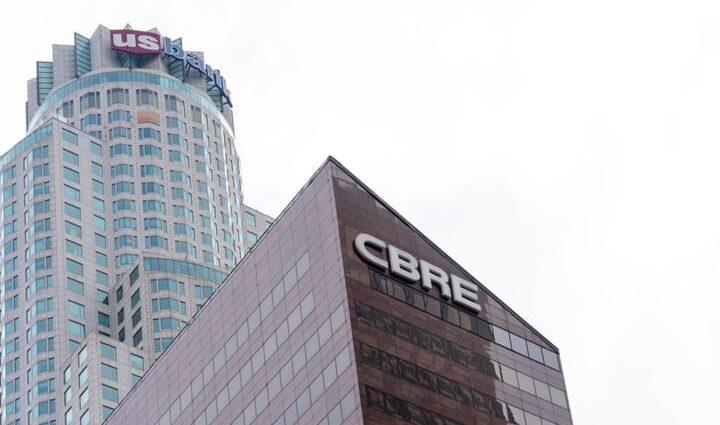
Netflix, CBRE Group And More On CNBC’s ‘Final Trades’
On CNBC’s “Halftime Report Final Trades,” Bryn Talkington, managing partner of Requisite Capital Management, named CBRE Group Inc (NYSE:CBRE) as her final trade.
CBRE will release its first quarter 2026 financial results on Thursday, April 23.
Analysts expect the Dallas-based company to report quarterly earnings at $1.13 per share. That’s up from 86 cents per share in the year-ago period. Analysts also expect CBRE to report quarterly revenue at $10.22 billion, up from $8.91 billion a year ago.
On …
This post was originally published here
Sen. Warren questions DOD about Anthropic blacklist that ‘appears to be retaliation’
Warren sent letters to Pete Hegseth and Sam Altman, asking for additional details of OpenAI’s contract with the defense department and Anthropic’s blacklisting.
This post was originally published here


It took 200 years for national debt to hit $1 trillion. Annual interest alone now exceeds that—a ‘crushing legacy we must reverse,’ says budget chair
The U.S.’s eye-watering debt burden poses an “existential threat to the future of our nation,” the chairman of the House Budget Committee has warned, as the country’s borrowing figure tipped over $39 trillion.
Texan Republican Jodey Arrington highlighted last week that it had taken the U.S. nearly two centuries to build a debt pile worth $1 trillion, whereas a mere matter of decades later, the Treasury is forking out that figure every year merely in service payments on the debt.
For the fiscal year 2025, the Treasury paid $1.22 trillion in interest on the debt, and for FY2026, the government has already paid out $520 billion. By 2036, that figure is expected to hit to $2.1 trillion annually, according to calculations by the Congressional Budget Office.
Indeed, U.S. debt didn’t reach the $1 trillion mark until the early 1980s, hitting $1.1 trillion under President Ronald Reagan.
As Arrington points out: “It took roughly 200 years to accumulate the first $1 trillion. Now we add that in a matter of months. Every child in America today carries a $530,000 share of this debt—a crushing legacy we must reverse. Compounding the problem, we now spend more than $1 trillion a year just on interest to service our debt—more than the entire defense budget and triple the amount when Biden took office.”
Arrington isn’t alone in his concern over the nation’s financial trajectory. Figures on the private side of the economy like Jamie Dimon and Ray Dalio have warned over a reckoning caused by debt, and U.S. Federal Reserve chairman Jerome Powell has also expressed the need for an “adult conversation” about the issue.
There is a range of opinions on which methods should be employed to wrangle borrowing and its associated interest costs. For example, the Committee for a Responsible Federal Budget has advocated for a federal unified budget deficit at or below 3% of GDP, which at the moment sits at around 6%. This idea has been backed by the likes of Representatives Bill Huizenga and Scott Peters, the co-chairs of the Bipartisan Fiscal Forum—indeed, the entire steering committee for the forum has backed the notion and introduced a resolution to that effect.
Arrington has called for a harder-line approach. The resolution for a deficit of 3% of GDP is defined more loosely as a target: Arrington wants to open up a conversation about adding fiscal responsibility to the country’s very constitution.
He said last week: “Here’s the sad, sobering, and stunning truth: despite the urgency of our fiscal crisis, Congress is paralyzed—unable to meet the urgency of the moment. So, if Washington won’t act, then it’s time to look beyond our nation’s capital. The Founders gave us another path in Article V of the Constitution, empowering the states and the American people to step in and demand fiscal discipline.
“I’m calling on Congress to convene an Article V Convention. It’s time to restore sanity in our nation’s capital and reverse the curse looming large over this country.”
An Article Five Convention allows amendments to the Constitution, for example, targeting borrowing and government spending. If two-thirds of state legislatures apply, then Congress must call a convention, with a further three-quarters of states required to back the amendment for it to become a legal requirement.
Other approaches
In recent memory, presidents have attempted to rectify the U.S. fiscal position. President Obama oversaw the creation of the bipartisan National Commission on Fiscal Responsibility and Reform, commonly known as the Simpson-Bowles (or Bowles-Simpson) Commission. The ensuing report made several recommendations: Cutting discretionary spending, reforming tax law, and reshaping healthcare spending.
President Trump has suggested some unusual methods to rebalance the books. For example, he has touted a “Gold Card” plan, a visa policy which would charge rich immigrants $5 million for a green card, plus a route to citizenship.”
“A million cards would be worth $5 trillion, and if you sell 10 million of the cards that’s a total of $50 trillion. Well, we have $35 trillion in debt, so that would be nice,” Trump said last year.
Likewise, tariffs were introduced as a way to offset some of the revenue loss from the likes of the One Big Beautiful Bill Act. Indeed, while Trump’s tariff plans have proved unpopular with foreign governments, economists nonetheless welcome the “peculiar” methods to increase America’s income. As Wharton professor Joao Gomes previously told Fortune: “You can also not deny that [Trump and his administration] bring strange forms of revenue that do change the debt picture.”
This story was originally featured on Fortune.com
This post was originally published here

Bitcoin Taps $70,000, Ethereum, XRP, Dogecoin Unwind Shorts On Trump Strike Delay
Bitcoin tapped $70,000 on Monday morning as President Trump announced a five-day delay on his deadline to strike Iranian energy infrastructure.
Cryptocurrency |
Ticker | Price |
| Bitcoin | (CRYPTO: BTC) | $69,888 |
| Ethereum | (CRYPTO: ETH) | $2,120 |
| Solana | (CRYPTO: SOL) | $88.77 |
| XRP | (CRYPTO: XRP) | $1.40 |
| Dogecoin | (CRYPTO: DOGE) | $0.09317 |
| Shiba Inu | (CRYPTO: SHIB) | $0.055982 |
Meme coin market capitalization gained around 3% over the past 24 hours to $33.4 billion.
Trader Commentary:
Crypto chart analyst Ali Martinez said Bitcoin is trading in …



How Senior Leaders Can Build Their Influence
Getting your peers to act on your ideas requires understanding what they care about and what drives their decisions.
This post was originally published here



Valneva, Venture Global And Other Big Stocks Moving Lower In Monday’s Pre-Market Session
U.S. stock futures were higher this morning, with the Dow futures gaining around 1,000 points on Monday.
Shares of Valneva SE (NASDAQ:VALN) fell sharply in pre-market trading.
Pfizer (NYSE:PFE) and Valneva disclosed topline results from Phase 3 VALOR clinical trial of investigational 6-Valent OspA-based Lyme disease vaccine candidate PF-0730740.
Valneva shares dipped 14% to $8.88 in pre-market trading.
Here are some other stocks moving lower in pre-market trading.
- LiveWire Group Inc (NASDAQ:LVWR) shares dipped 14.6% to $1.04 in pre-market trading after dipping 10% on Friday.
- Anghami …
This post was originally published here
Trump delays strikes on Iran’s power plants for 5 days. And, ICE deploys to airports
Trump says he will deploy ICE agents to U.S. airports to help address delays. And, the president said he would delay strikes on Iranian power plants for five days.
(Image credit: Getty Images)

This post was originally published here



Startup Antithesis turns years of real-world chaos into hours of simulated mayhem—and key trading firms and crypto networks are paying close attention
Will Wilson wants to make sure the software running everything from your bank account to your favorite crypto exchange actually works—and his company Antithesis is rethinking how software has been tested for the last 80 years.
Wilson, the co‑founder and CEO of Antithesis, first made his name at FoundationDB, a company that created special testing systems that let teams safely rehearse years of real‑world problems in a fake environment, to catch bugs before customers ever saw them (FoundationDB was acquired by Apple in 2015). That idea—stress‑testing code inside a simulated universe where everything that can go wrong does—is now the core of Antithesis, a deterministic simulation testing platform that runs fully automated, parallel tests that can compress years of production behavior into hours.
“Software increasingly controls literally everything,” Wilson told Fortune, pointing to financial markets, banking websites, smartphones, and even nuclear power plants. The traditional model of writing code and then trying to think of every possible edge case “is totally broken,” he argued, because failures come from situations engineers did not anticipate. Antithesis runs customer systems in a controlled simulation where hardware failures, network glitches, and bizarre timing issues are constantly injected to see how the software behaves.
That pitch has resonated with some of the most demanding buyers in finance and crypto. Antithesis is already used by organizations whose systems “cannot fail,” including quantitative trading giant Jane Street (also one of its lead investors), the Ethereum network and MongoDB.
In December 2025, the Northern Virginia–based startup announced a $105 million Series A, led by Jane Street—which is both an investor and a user—alongside Amplify Venture Partners, Spark Capital, Tamarack Global, First In Ventures, Teamworthy Ventures, Hyperion Capital and angels including Stripe cofounder Patrick Collison, Dwarkesh Patel and Sholto Douglas.
The capital follows more than five years of R&D funded by a $47 million seed round raised while Antithesis operated largely in stealth, and $30 million in funding in February 2025 led by Amplify Partners. Antithesis, founded in 2018 and publicly unveiled in 2024, also made its debut this year on the Forbes Fintech 50, which reports that the company has landed about 40 clients, including trading firms where software glitches can translate into large financial losses.
Winning over these clients and investors, Wilson added, has required a studied lack of hype. “Don’t be too thirsty and don’t over promise,” he said. When he talks to prospects, he says he is candid about his product’s weaknesses: “Every product sucks at something. I’m just going to tell you what it is.”
While AI code‑generation models race ahead, Wilson sees a less crowded—and ultimately more durable—opportunity in everything that happens after the code is written.
“AI is eating part of the software development life cycle…which was actually never the slow part or the hard part,” he said. “There’s a world in which…we end up being a really, really significant part of how everybody on earth develops and ships software.”
See you tomorrow,
Lily Mae Lazarus
X: @LilyMaeLazarus
Email: lily.lazarus@fortune.com
Submit a deal for the Term Sheet newsletter here.
Joey Abrams curated the deals section of today’s newsletter. Subscribe here.
This story was originally featured on Fortune.com
This post was originally published here

What a cringe photo shoot really tells about the state of the crypto industry
The crypto world feasts on gossip and last week it enjoyed an extra helping in the form of a Vanity Fair article. The piece, titled “Crypto’s True Believers Demand to Be Taken Seriously,” featured lavish photos of prominent industry figures swooning around New York’s Nine Orchard hotel in far-out outfits that cost more than your mortgage payment. The article elicited predictable scorn and contempt from those outside the crypto world. Those inside it, meanwhile, bashed the dastardly media while tweeting some variation of “What the hell were they thinking taking part in this?”
The “what were they thinking?” take is a fair one. When a glossy publication with little history of covering the crypto industry sends a staff reporter, did anyone really expect a celebration of blockchain? Still, this is Vanity Fair, the stomping ground of legendary photographer Annie Leibovitz, and renowned for snapping pics of presidents and A-list celebs. Most people, even those who profess disdain for mainstream media, would be there in a heartbeat.
Despite the snide headline, the story does a decent job telling the 17-year history of crypto, from Satoshi’s white paper to the current era of Big Crypto. The author also gets access to the right people to tell the story, and correctly sizes up their respective contributions to the industry. That includes Olaf Carlson-Wee, the out-there early Bitcoin prophet who became Coinbase’s first employee before quitting to start a crypto venture fund. Also in the group photo is iconoclast ARK Invest founder Cathie Wood, and Meltem Demirors, an early crypto booster and master self-promoter who turned up for the shoot “layered in diamond crosses and wearing a black sweatsuit with her firm’s slogan—’Believe in Something’—bedazzled across the ass.”
Billionaire trader Mike Novogratz also made the cut. Perhaps because he lent his hotel for the shoot, Novo avoided the indignity of being photographed short-sleeved, which would have revealed the giant Terra-Luna scamcoin tattoo on his bicep. Danny Ryan, a longtime contributor to the Ethereum Foundation, didn’t fare as well. The Vanity Fair photo director somehow persuaded Ryan to take off his shoes for the photos, presumably to cast him as some sort of crypto holy fool. The deepest scorn, though, is reserved for Devin Finzer, who took hundreds of millions of VC dollars for a largely failed project and, the piece makes clear, is viewed as a grifty parvenu by longtime crypto builders.
On a broader level, the piece asks where these exotic figures belong now that the crypto industry is chummy with the Oval Office, and is being embraced by Wall Street and Congress. You can make the case, as Vanity Fair implies, that the people in these photos are just a freaky subset of America’s growing aristocracy, who are fixated on image and lifestyle, and totally out of touch with ordinary people struggling with record credit card debt and an unaffordable housing market.
There is something to that. At the same time, the Vanity Fair gathering (minus Finzer) is also a throwback to a time when crypto was populated by larger than life characters who believed in something no one else did. To borrow from early Apple, they are “the crazy ones. The misfits. The rebels. The troublemakers. The round pegs in the square holes… because the people who are crazy enough to think they can change the world, are the ones who do.” As they fade from the scene, we may come to miss them.
Jeff John Roberts
jeff.roberts@fortune.com
@jeffjohnroberts
This story was originally featured on Fortune.com
This post was originally published here




Chartis Research and Metrika Release Paper on Managing Risk in Tokenized Fund Infrastructure
The second in a series of reports on Digital Asset Risk applies Integrated Composability Risk (ICR) to tokenized mutual funds.
NEW YORK, March 23, 2026 /PRNewswire/ — Chartis Research and Metrika today announced the release of ‘Digital Asset Risk: ICR for Tokenized Fund Infrastructure,’ a collaborative industry report that presents a risk management view on tokenized mutual funds (TMFs) as institutional adoption accelerates.
The report extends the Integrated Composability Risk (ICR) framework introduced in the …
This post was originally published here








War Erases Gold And Silver Gains While Contrarians Eye Value
Gold and silver’s dramatic rally has reversed just as quickly, catching investors off guard. From their late-January peaks, gold has now dropped about 25.5%, while silver has plunged nearly 50%, pushing both into technical bear markets alongside copper.
The sharp move has rippled through the mining sector, wiping out much of this year’s earlier gains. Barrick Mining Corp. (NYSE:B) is down 15.74% year-to-date, while Newmont Corp. (NYSE:NEM) has slipped 5.35%. Agnico Eagle Mines Limited (NYSE:AEM) has held up better than peers, still up 6.08% this year, though it too has retreated significantly from its early-March highs.
The pain has been less severe among diversified mining giants, but they have not been immune to the broader selloff. BHP Group Limited (NYSE:BHP) remains up about 5.70% year-to-date, and Rio Tinto …
This post was originally published here
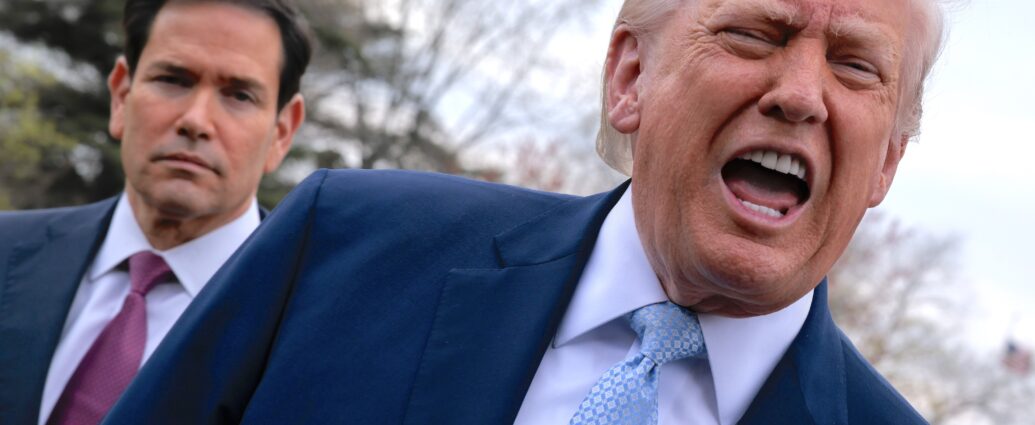
Markets in meltdown after Trump threatens major escalation in the war against Iran
Good morning. In today’s Fortune:
- The war: Oil is at $113 and markets are in meltdown as Trump threatens to escalate the war in Iran tonight if Tehran doesn’t reopen the Strait of Hormuz. In response, Iran has threatened to start taking out its neighbors’ water supplies. The damage to the oil market is greater than that of 1974 and 2022 put together, the IEA says.
- Exclusive: Supermicro’s dark history of smuggling chips to Iran.
- AI isn’t replacing as many jobs as you’d think.
- Tim Cook’s likely successor at Apple.
- Aye, robot! Mark Zuckerberg is building an AI agent for himself.
This story was originally featured on Fortune.com
This post was originally published here

Adobe’s CFO is using AI to answer 300,000 emails, cut contract review in half — and make sure finance never slows the company down
Good morning. Adobe CFO Dan Durn isn’t waiting to see how agentic AI plays out—he’s already running the experiment inside his own finance organization.
Durn, who oversees finance, technology, security, and operations, has turned Adobe’s back office into a live proving ground for autonomous AI agents. The results include contract review time cut in half, more than 300,000 emails auto-responded to in a single year, and finance teams surfacing investor insights in minutes instead of hours.
At Adobe (No. 201 on the Fortune 500), the push is deliberate. If finance doesn’t adopt AI, it risks becoming a “rate limiter of growth”—a back-office bottleneck in a company moving fast on product innovation, Durn told me. Inside finance, he breaks AI deployment into three buckets. For a closer look at how Adobe’s finance chief is rewiring the function, and what it signals for CFOs navigating the same pressure, read more of my interview with Durn here.
The rise of AI is also rapidly reshaping corporate leadership. Even long-tenured leaders face increasing pressure from investors to move aggressively on AI. Recent leadership changes, including the announced retirement of Adobe CEO Shantanu Narayen, highlight how little patience markets now have for perceived hesitation. At the same time, Adobe reported that annualized revenue from its AI-first products more than tripled year over year in its first quarter of fiscal 2026, which ended Feb. 27.
The make-or-break moment for CEOs is contributing to an era of rapid turnover among chief executives, Fortune’s Claire Zillman writes. In 2025, companies in the S&P 1500 named 168 new CEOs, the highest total in more than 15 years, according to Spencer Stuart, a global executive search and leadership advisory firm.
“CEO tenures are getting shorter and fewer incoming chief executives have prior CEO experience, the data shows, making the two-time CEO exceedingly rare,” Zillman writes. “All told, corporate America has turned into a CEO meat-grinder; it’s chewing up and spitting out leaders at a pace not seen in a decade and a half.” You can read more here.
Sheryl Estrada
sheryl.estrada@fortune.com
This story was originally featured on Fortune.com
This post was originally published here
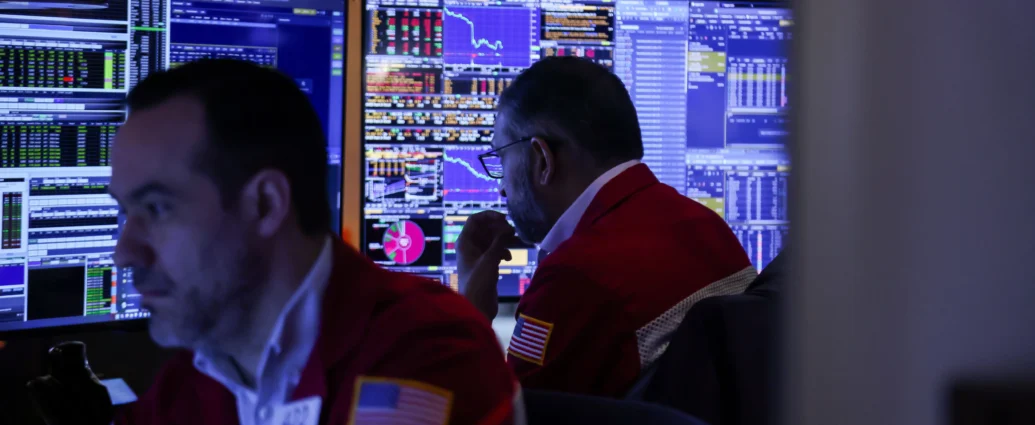


Netanyahu is gambling with Israel’s future
This post was originally published here





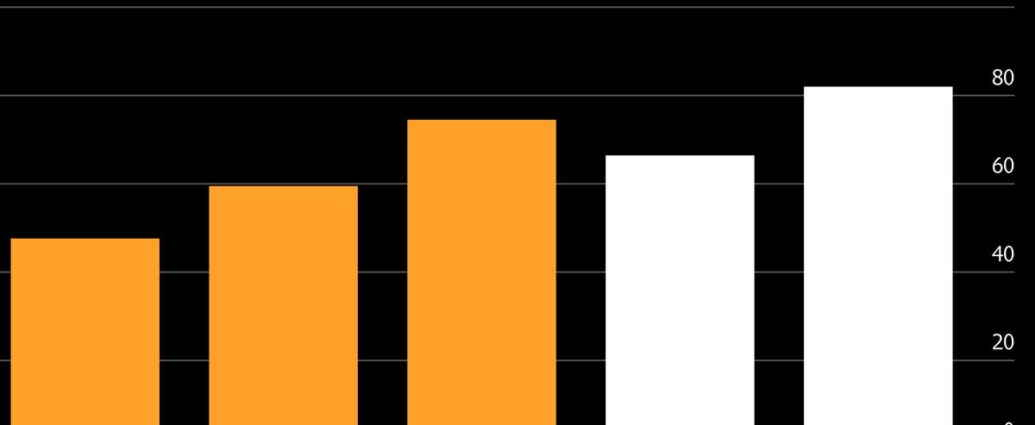
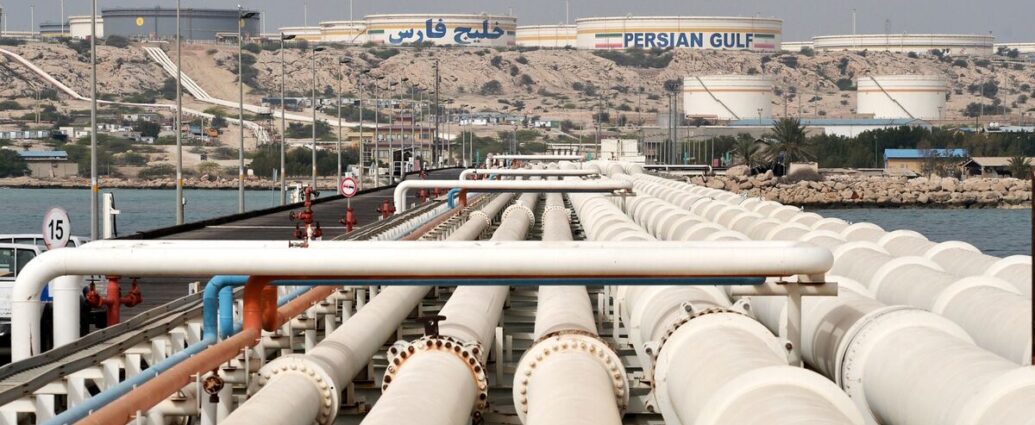



Gold miners’ bull run squeezed as prices plummet and energy costs soar
Gold’s recent move lower has second-order effects for the prospects of the firms that dig the metal out of the ground.
This post was originally published here