
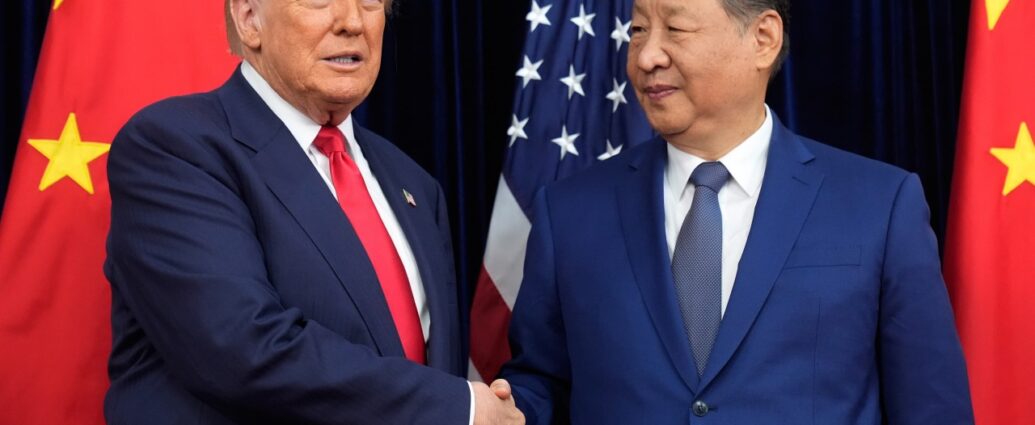

Qantas Plans Nonstop Sydney-New York Flights

23 000 SUVs are recalled by Jaguar Land Rover because of the potential for rapid drive energy loss
.
About 23, 677 vehicles , are affected by the understand, including 2021-2024 Land Rover Range Rover Velar, 2019-2024 Land Rover Range Rover Sport, 2020-2024 Land Rover Range Rover Evoque, 2020-2024 Land Rover Range Rover, 2021-2024 Jaguar F-Pace, 2021-2024 Jaguar E-Pace, 2020-2024 Land Rover Discovery Sport, 2021-2024 Land Rover Discovery and 2020-2024 Land Rover Defender models.
According to the National Highway Traffic Safety Administration ( NHTSA ), the recall was initiated because a DC-DC converter might malfunction as a result of an electrical overload that can occur when high power levels are present.
Ford discovers 208 000 Cars over Studs, WHICH MAY LOSS STEERING.
Drive power and outdoor lighting perhaps even stop working when the converter stops working when the car is starting up.
The DC-DC transformer failure could lead to total loss of drive power and outdoor lighting, according to the notice.
According to Jaguar Land Rover, the fault affects all of the vehicles on the list.
FORD Recounts MORE THAN 223,000 Cars FOR FUEL TANK ISSUE.
The batteries that power systems like lighting and electrical accessories are both high-voltage batteries, as well as conventional 12-volt batteries. The high-voltage method is used to charge the 12-volt power in the DC-DC converter.
According to Panasonic, the lithium-ion battery is charged at a charging station, and the result battery is charged using the lithium-ion battery’s power. A DC-DC conversion transforms high-voltage DC energy into low-voltage DC power as the lithium-ion power is charging.
According to the NHTSA, the Jaguar Land Rover has received 393 states and niche reports in the United States.
FOX BUSINESS ON THE GO: Press HERE.
No incidents, burns, or accidents have been reported.
Retailers provide free software updates for the car. In case the DC-DC conversion goes offline, the upgrade will create a new “limp-home” setting.
On November 13, expect to receive time letters alerting owners of the health risk. After the last solution is in place, more words will be sent out.  ,
This post was originally published here

‘So-called peace in Gaza is a spectacle’ should ‘shame us all,’ Macron claims in UNGA speech
French President Emmanuel Macron claimed that the “so-called peace in Gaza is a spectacle that shames us all” during his speech at the UN General Assembly (UNGA) on Tuesday.
Macron claimed that ongoing restrictions on the entry of humanitarian aid into Gaza are “shameful,” and called on countries around the world to act rather than settle for declarations.
He also warned that the credibility of the international community is being put ot the test if it continues to stand by.
“There are those who claim that peace has been achieved, but this has not opened the way for humanitarian aid deliveries. This sight is shameful. Shame on all of us,” he said.
The French president then questioned the value of recognizing a Palestinian state if it is not accompanied by action on the ground. “But what is our credibility worth if we remain inactive in the face of Gaza?” he asked.
Smotrich, Netanyahu denounce claims
Finance Minister Bezalel Smotrich said in response to the French president’s comments that Macron was “lying” and that a “despicable terrorist from the Hamas terrorist organization murdered Netanel Chkroun… who was bathing with his sons at a spring before Yom Kippur.”
“This is just one attack out of hundreds that the Hamas terrorist organization has carried out. The terrorist organization is fueling Arab terrorism in Judea and Samaria, and it is a significant part of its activities,” he added.
Prime Minister Benjamin Netanyahu called Macron’s statements “outrageous,” saying that the “absurdity of Emmanuel Macron’s words is unbelievable.”
He also alluded to Chkroun’s murder, a “French citizen and father of six,” adding that “in his last moments, he told his son to run.”
“Hamas terrorists are carrying out attacks against Jews almost every day. They have murdered countless Israeli civilians in Judea and Samaria. Ignorance is no excuse for erasing their blood,” Netanyahu added.
Macron added during his UNGA that France’s commitment to recognizing Palestinian rights does not contradict its commitment to Israel’s security, reiterating his claims from an earlier speech at the UN.
Macron also addressed events in Judea and Samaria, saying: “Look at what is happening in the West Bank, where day after day we see violations. And in the name of what? Hamas has never been particularly active in the West Bank.” According to him, the international community must protect “the legitimate rights of the Palestinian people,” including their right to exist.
At the same time, the French president again emphasized Paris’s commitment to Israel’s security, but warned against the claim that Israel’s security requires infringing on the sovereignty of neighboring countries.

Macron taking ‘fake news to a new high,’ Ganz says
Chairman of the Yesha Council, Israel Ganz also responded to Macron’s statements, saying that he is taking “fake news to a new high.”
Ganz is also head of the Mateh Binyamin Regional Council, which governs 47 Israeli outposts in the West Bank.
“Macron’s serious statements are a shameful endorsement of the terrorist organization Hamas, which has kidnapped, shot, and murdered Israelis in Judea and Samaria for decades, and until this week,” he said.
“Macron, retract your words and apologize to the families immediately.”
Additionally, Chairman of the Yeshar Party Gadi Eisenkot said that Macron’s statement is “radically disconnected from the reality on the ground.”
“As someone who commanded the Judea and Samaria Division and someone who fought to eradicate Hamas terror, I am well aware of the terrorist organization’s activities in Judea and Samaria as well as the threat it poses to Israeli citizens, as we witnessed just two days ago in the murderous attack in Binyamin,” he continued.
Eisenkot said that the fight against terror isn’t limited to the Gaza Strip, and that the “IDF has been fighting terror in Judea and Samaria for many years and will continue to do so.”
“The fight against terror is not subject to negotiation,” he continued, “and international hypocrisy that comes at the expense of the security of Israeli citizens must not be accepted.”
Macron promises support for sovereignty in Lebanon, Palestine, Syria
During his speech, Macron also called for sovereignty for “Lebanon and its people,” claiming that a fully sovereign Lebanon is necessary to confront Hezbollah and restore security in the region.
He added that France would also continue to support Syria’s sovereignty and unity, warning that “the revolution must not become a disappointment.”
Macron also warned that international humanitarian law and the Geneva Conventions are facing a “serious challenge” amid ongoing global conflicts.
‘War crimes have become an industry,’ Macron claims
“War crimes have become an industry. We have seen the destruction of civilian infrastructure and violations of human rights. This is a new era of barbaric acts,” he said.
According to him, “The Geneva Conventions provided a framework of protection, but it is falling apart.”
Macron also reiterated France’s support for the International Court of Justice and said that Paris would continue to support its “central role.” “We cannot simply accept this new order of impunity that some are trying to establish,” he added.
At the end of his remarks, Macron also called for reform of the UN Security Council. “We must open up to new members and new regions,” he said, with the aim of making the council more effective and representative.
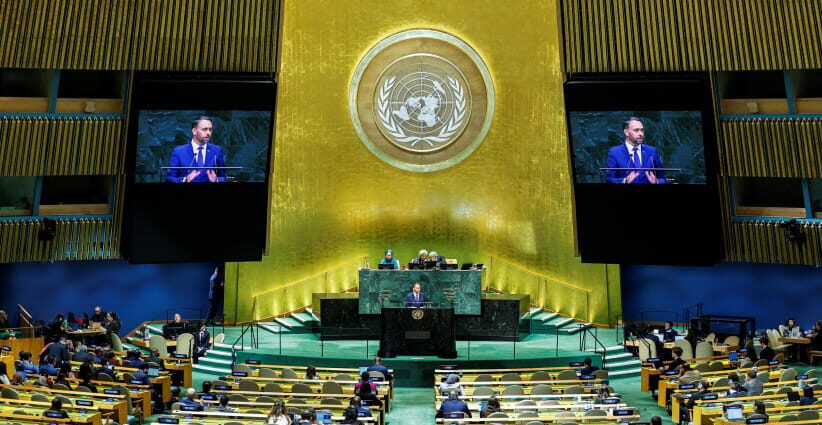
‘Repeating a lie doesn’t make it true’: Israel releases exposé of UN’s bias before General Assembly
The Ministry of Diaspora Affairs and Combating Antisemitism and the National Public Diplomacy Directorate in the Prime Minister‘s Office are launching The UN’s Lie Industry, an exposé of the “systematic and false bias against Israel” as the United Nations kicks off its first day of the General Assembly.
The campaign video depicts the UN General Assembly hall populated by parrots representing various countries, the organizations said in a statement. “The parrots repeat the same message one after another: ‘Blame Israel.’”
The call duplicates as the video progresses, with echoes heard throughout the hall until it becomes a choir repeating the same accusation.
The video concludes with the message: “Repeating lies doesn’t make them true.”
‘Even 1,000 repetitions of a lie will not make it true,’ Chikli says
Diaspora Affairs and Combating Antisemitism Minister Amichai Chikli said, “Time and again, the UN General Assembly hall has turned into an echo chamber for libels against Israel. The same lies pass from mouth to mouth, report to report, and speech to speech, until an attempt is made to present them as an agreed-upon truth.”
“The new video sharply underscores this culture of repetition. Even 1,000 repetitions of a lie will not make it true, and we will continue to expose the facts behind the anti-Israel choir,” he concluded.
The Diaspora Ministry also launched a website tied to the campaign and exposing the “lies and biases in UN publications,” according to the statement.
The website was made in cooperation with the National Security Council (NCS), and contains “comprehensive research sources documenting how biased information about Israel has been gathered, given institutional endorsement, and distributed worldwide since the October 7 attacks,” according to the statement.
It addresses topics such as information manipulation, an organized culture based on hostility towards Israel, false claims of starvation in Gaza, Hamas infiltration into UNRWA, and the fabrication of a “genocide” narrative, among others.
“The site also includes testimonies from UN personnel regarding internal silencing and persecution,” the statement added.
‘Large portion of blood libel comes from UN,’ Israel official claims
“A large portion of the false blood libels against Israel come from the workshop of UN reports,” National Public Diplomacy Directorate Head Tzipi Hotovely alleged.
He also said that the “false starvation campaign in Gaza is just one example of this machinery of lies.”
“Facing this propaganda, we are putting forward the truth and the facts to shatter the industry of lies against Israel.”
The organization described the video as illustrating “one of the central mechanisms exposed on the website: An international system that echoes itself. Claims against Israel pass between bodies, countries, UN agencies, and media outlets, are cited repeatedly, and are given the appearance of an accepted fact, even when their source has not been checked or verified.”
The campaign, which focuses primarily on US and European capitals’ policies on Israel, was produced via the Government Advertising Agency (Lapam).
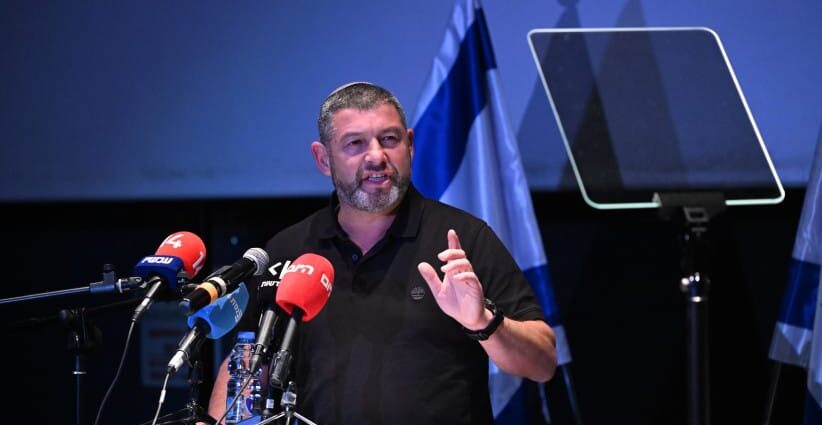
Winter criticizes Katz’s Gaza statements, calls for action over empty threats
People of Israel chairman and founder Brig.-Gen. (res.) Ofer Winter called on Defense Minister Israel Katz on Tuesday to stop making empty threats in response to Katz’s statement that the remains of Gaza City would be destroyed and that around one million Gazans would be forced to evacuate if Hamas takes a single Israeli hostage.
Katz said he was responding to the increasing threat of potential aggressive actions by Turkey, Iran, and its terror proxies, including Hamas.
Winter claimed that Katz’s threat was taking the place of any real action.
Hamas will not take threats seriously, Winter says
“Instead of eliminating the threat, officials go on the air and threaten that if anyone is abducted, all of Gaza will be evacuated,” Winter said, adding that Hamas would not take the threat seriously as “251 people were abducted and that didn’t happen.”
“Three years after October 7, we’re still talking about vigilance at the border, still afraid of abductions, and still threatening to respond to every Hamas action,” Winter said.
“Stop making threats if you don’t intend to follow through…it certainly isn’t security, and it certainly isn’t victory,” Winter said.
Winter called for a shift from “a policy of reacting and containing to one of taking the initiative and securing a decisive outcome.”
“People of Israel will be strong in the coming elections to ensure that what happened before does not happen again,” he concluded.


Two Maryland malls set to enact juvenile curfews after violent incidents
Two shopping malls in Maryland will begin enforcing a juvenile curfew next week after a string of violent incidents at the properties.
Westfield Montgomery in Bethesda and Westfield Wheaton said the new policy will take effect Monday, Sept. 28. Under the rules, anyone younger than 18 must be accompanied by an adult to enter either mall after 3 p.m., according to FOX 5 DC.
Security officers will enforce the policy through ID checks, and anyone under 18 without an accompanying adult will be required to leave the property, FOX 5 reported.
TOYS R US MAKES MAJOR COMEBACK WITH 120 NEW STORES OPENING ACROSS US THIS HOLIDAY SEASON
The policy follows multiple violent incidents at the malls over the past year.
At Westfield Wheaton, a 17-year-old allegedly shot and injured a 13-year-old boy near a children’s play area on July 31. An armed mall security officer detained the suspect until police arrived, and the teen was later charged as an adult, FOX 5 reported.
Earlier this year, nine teenagers were arrested after authorities said they stabbed another teen inside a bathroom at Westfield Wheaton, according to the outlet.
On Christmas Day last year, investigators said masked suspects — some believed to be juveniles — burglarized more than two dozen stores at the mall, FOX 5 reported.
COSTCO RAISES PRICE OF KIRKLAND MOTOR OIL AND LIMITS HOW MUCH SHOPPERS CAN BUY
Westfield Montgomery also experienced a fight involving teenagers earlier this summer after someone reportedly displayed a gun, according to the outlet.
The new policy has received mixed reactions from shoppers. Some said a 3 p.m. curfew is too early, arguing it prevents students from gathering at the mall after school while many parents are still at work.
Others said the changes are necessary in light of the recent violence, according to FOX 5.
The move also comes amid heightened concerns over juvenile crime across the Washington metropolitan area.
GET FOX BUSINESS ON THE GO BY CLICKING HERE
Earlier this year, a chaotic “juvenile takeover” disrupted the Navy Yard neighborhood in Washington, D.C., as hundreds of teens flooded the area, sparking fights, robberies and gunfire.
In May, U.S. Attorney for the District of Columbia Jeanine Pirro vowed to crack down on juveniles who commit violent crimes in the nation’s capital, as well as their parents, after another violent brawl at a Chipotle restaurant in Navy Yard.
Westfield Montgomery and Westfield Wheaton could not immediately be reached by FOX Business for comment.



The Laughing Cow ditches iconic smile and teases cheese shoppers with cryptic message on packaging
The Laughing Cow is no longer laughing and shoppers want to know what wiped the iconic grin off her face.
For the first time in more than 100 years, the laughing red cow has traded her trademark smile for a somber expression on select packages of The Laughing Cow Creamy Original cheese wedges rolling out nationwide.
The surprise makeover is part of a mysterious new campaign dubbed “The Not Laughing Cow,” but the company is keeping shoppers guessing about what wiped the smile from its mascot’s face.
SHOPPERS ARE GOING HOG WILD FOR PIGGLY WIGGLY’S RETRO PIG MERCHANDISE
Bel Brands told Fox News Digital the frown is only temporary and promised the mystery will begin to unravel in the coming days.
“The Laughing Cow has spent more than 100 years reminding us not to take life too seriously. So when she suddenly gets serious, you pay attention,” Jamee Pearlstein, chief marketing officer of Bel Brands USA, U.S. Cheese, said in a news release.
COSTCO BRINGS BACK A FAN-FAVORITE FOOD COURT TREAT AFTER YEARS OFF THE MENU
“Whatever finally got to her must be worth talking about. We’ll let her explain when she’s ready,” Pearlstein added.
The new packages feature the suddenly stone-faced cow alongside a QR code and the cryptic message, “We need to talk.” The code directs shoppers to TheNotLaughingCow.com, where the brand is inviting fans to speculate about the reason for her abrupt mood shift.
MCDONALD’S ONCE SOLD BELOVED COOKIES FEATURING FORGOTTEN CHARACTERS FROM THE CHAIN’S PAST
Videos on the campaign website lean into the mystery, showing the usually upbeat mascot looking downcast and alone. In one clip, she sits by herself in a diner. Another shows her somberly swinging alone as the words “The Laughing Cow stopped laughing” and “We need to talk” flash across the screen.
The serious-faced mascot has also appeared in parks, diners and across the brand’s social media channels, according to the company.
The company said shoppers began noticing the change even before the brand formally acknowledged it, with fans reaching out directly to ask what had happened to The Laughing Cow.
DANNON’S DECISION TO KILL BELOVED YOGURT SPARKS FAN REVOLT: ‘IT’S WHAT I GOT OUT OF BED FOR’
“We’ve been excited to see that curiosity and conversation continue to build as more of The Not Laughing Cow packages appear on shelves,” Bel Brands told Fox News Digital.
The special packages are available in select markets in every state across the continental U.S. and can be found in more than 4,700 stores, according to the company.
Bel Brands stressed that the new expression is not a permanent logo or packaging change.
Once consumers learn why the mascot stopped laughing, the company said it is confident she will eventually smile again and the packaging and social media channels will return to the joyful expression shoppers have known for more than a century.
The temporary redesign marks a dramatic break from an image shoppers have recognized for generations. The Laughing Cow said its smiling mascot has promoted optimism and encouraged consumers to see the positive side of life since 1921.

Check your freezer: Popular Walmart item recalled over possible Listeria risk
Walmart shoppers are being urged to check their freezers after a supplier recalled certain packages of Bettergoods pasta sold nationwide over potential listeria contamination.
Gias Foods Inc. is recalling two lots of Bettergoods Authentic Italian Lemon Alfredo Fettuccine distributed at Walmart stores across the country, according to a company announcement posted by the Food and Drug Administration.
The recalled pasta is sold frozen in 22-ounce yellow plastic packages under Walmart’s Bettergoods brand. The affected products have UPC 194346442706 and are marked with lot numbers L6079C or L6080C.
Packages with lot number L6079C have an expiration date of Sept. 19, 2027, while those marked L6080C have an expiration date of Sept. 20, 2027. Both the lot number and expiration date are stamped on the back of the packaging.
EGGS RECALLED AS SALMONELLA OUTBREAK SICKENS 23 PEOPLE
No illnesses have been reported in connection with the recalled products, the company said.
The recall followed routine sampling conducted by the Washington State Department of Agriculture and Florida Department of Agriculture and Consumer Services.
The sampling indicated that the finished products may contain Listeria monocytogenes, according to the announcement.
Gias Foods has stopped distributing the affected product while the company and FDA continue investigating what caused the potential contamination.
WALMART LAUNCHES WEEKLONG FALL SALE OVERLAPPING AMAZON PRIME BIG DEAL DAYS
Representatives for Gias Foods and Walmart did not immediately respond to FOX Business’ requests for comment.
The FDA posts company recall announcements as a public service and notes that publishing an announcement does not constitute an endorsement of the product or company.
Listeria monocytogenes can cause serious and sometimes fatal infections in young children, older adults and people with weakened immune systems, according to the recall announcement.
Healthy people may experience short-term symptoms including high fever, severe headache, stiffness, nausea, abdominal pain and diarrhea. Listeria monocytogenes infection can also cause miscarriages and stillbirths among pregnant women.
Because the recalled product is frozen and carries expiration dates extending into September 2027, consumers are being urged to check packages they may have stored in their freezers.
Consumers who purchased either affected lot should return the product to the place of purchase for a full refund, according to Gias Foods.
CLICK HERE TO GET FOX BUSINESS ON THE GO
Customers with questions can contact Gias Foods at sales@giasfoods.com or 917-675-4890.
The company said email inquiries will receive a response within 24 hours.

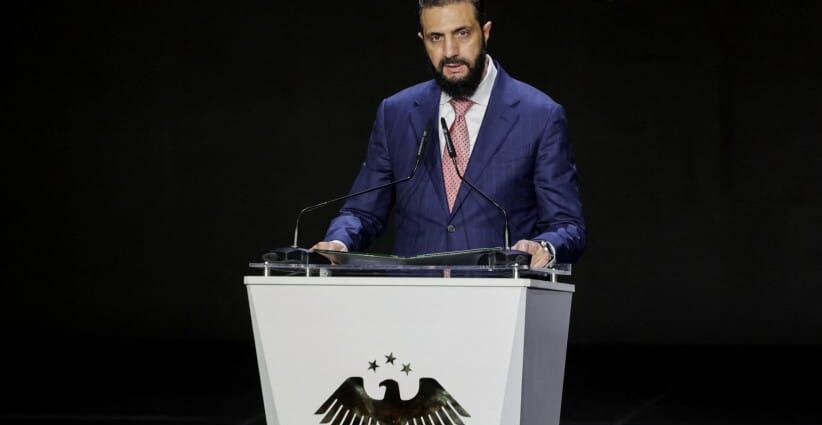
Al-Sharaa: October 7 cannot dictate Israel’s Syria policy, talks reached 90% agreement
Syrian President Ahmed al-Sharaa offered one of his most extensive public assessments of Israel-Syria relations on Tuesday night, saying the October 7 massacre cannot be allowed to determine Israel’s policy toward Syria and revealing that negotiations between the two countries had at one point reached “almost 90%” agreement.
Speaking at an Atlantic Council panel in New York on the sidelines of the United Nations General Assembly, al-Sharaa addressed direct talks with Israel, the future of the Golan Heights, Israeli security concerns, and his own controversial past in al-Qaeda.
Asked whether he understood the trauma experienced by Israeli society after October 7 and what message he had for ordinary Israelis, al-Sharaa said he understood what had happened to innocent civilians but argued that the attack could not serve as the basis for Israel’s broader regional policy.
“I understand what happened on October 7 to some of the innocent people,” he said. “But at the same time, it is not possible that all policies are set based on an incident that happened in history.”
He then contrasted the attack with the death toll in Gaza, saying that more than 70,000 people had been killed there, including many women and children.
“It is not appropriate that what happened on October 7 sets the policy for Syria,” al-Sharaa said. “This is not logical, and this brings more security threats.”
“If you want to protect your own security, you need to respect the security of others.”
Al-Sharaa claims Israel’s policies create more threats
Al-Sharaa argued that Israel’s current security policy was creating rather than reducing threats around it.
“Israel needs to change its policy because it is creating problems around it in order to maintain its security, and this is not working,” he said, calling instead for “mutual respect and good economic and trade relations.”
He also directly criticized Israeli military activity inside Syria.
“Why has Syria been bombed for two years, every day?” he asked. “There are indiscriminate arrests taking place in Syria. Even the presidential palaces have been bombed twice by the Israeli army. Our airports are being bombed, as well as all the military airports that we have. Will that bring security to the Israeli citizen?”
Pointing to Damascus’s developing relations with the United States, Britain, Gulf states, Iraq, and Lebanon, al-Sharaa added: “Those relations are successful, and those relations are not successful with Israel. So I believe the problem is with Israel, not with Syria.”
‘We almost reached 90% agreement’
Al-Sharaa also provided new details about the negotiations between Israel and Syria, saying direct talks between the sides have been taking place for roughly a year with American involvement.
“Syria chose to go through diplomacy and to solve that problem through talks and negotiations, as well as seeking the help of countries that are friendly to Israel, including the United States,” he said.
“There were several sessions of negotiations with Israel, and we almost reached 90% of agreements.”
Al-Sharaa claimed that when the sides approached agreement, Israel pulled back or introduced additional conditions. He nevertheless stressed that the channel remained active.
“We are still engaging in this track,” he said. “We are not saying that there will be lasting peace right now between Syria and Israel, but we need to protect the security and the rights of Syrians before we can talk about peace.”
The Syrian president outlined what he described as a phased process.
Israel, he said, must first withdraw from territory it entered after the fall of Bashar Assad’s regime on December 8, 2024, and return to the positions associated with the 1974 disengagement arrangement.
Only then, he said, could the sides move into discussions over security arrangements.
“If those arrangements succeed, then we can get into discussions about lasting peace,” al-Sharaa said.
He acknowledged that Israel has legitimate security concerns but rejected the idea that those concerns could justify every Israeli action.
“There are concerns of Israel. We always discuss those concerns, but not everything Israel does can be justified by them,” he said.
Al-Sharaa even floated the possibility of an international committee that would assess “what is only a perception” and what constitutes a genuine Israeli security concern.
“I believe what we can achieve at this time is a historic moment that can be useful for all parties,” he said.
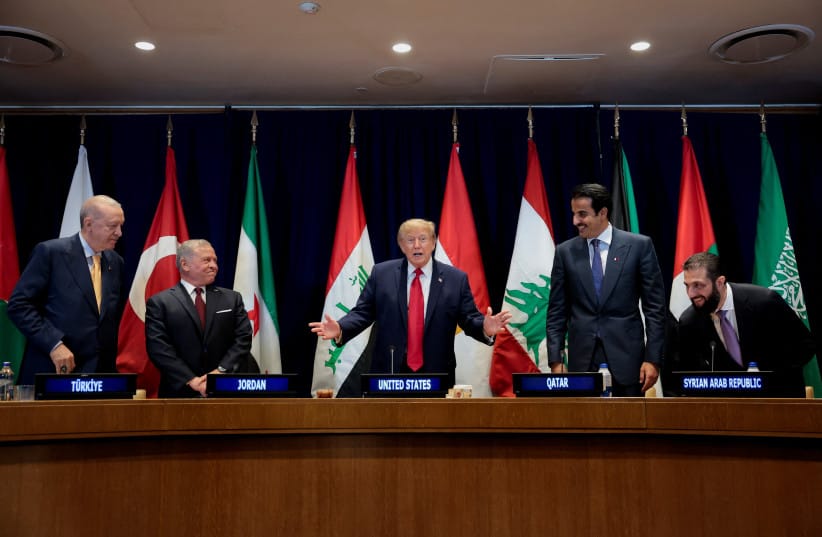
The Golan, Trump – and New Jersey
On the Golan Heights, however, al-Sharaa drew a firm line.
He said Damascus regards the territory as Syrian and suggested that its ultimate ownership was not open to negotiation.
Asked about US President Donald Trump’s recognition of Israeli sovereignty over the Golan Heights, al-Sharaa recalled joking about the issue during a White House meeting with Trump.
“President Trump stood by Syria, supported Syria, and issued a historic decision to lift sanctions off Syria, and I have a very unique relationship with him,” al-Sharaa said.
“But once, when I visited him in the White House, I made a joke with him.”
“When he said about the Golan Heights that Israel has sovereignty, I said, ‘Why don’t you give New Jersey to the Israelis? You don’t own the Golan Heights to give it to them, but you own New Jersey, and I believe New Jersey is full of Democrats, and they are not voting for Trump. So it will be good to give it to the Israelis.'”
“At least this is something that you own,” he continued. “President Trump doesn’t own the Golan Heights.”
Al-Sharaa then turned serious.
“Regardless of this joke, the Golan Heights belong to their own people,” he said. “It is neither the Syrian president nor the American president nor any other person who can abandon them or give them up to others.”
‘The state should be an institution, not an individual’
Beyond Israel, al-Sharaa sought to portray a changing Syria following the collapse of the Assad regime.
He said Syria’s transitional period is intended to lead toward a new constitution and a system in which authority is vested in institutions rather than in a single ruler.
“What we are trying to instill now in Syria is respect for the law,” he said, “in order to make sure that authority is an institution and not an individual that is ruling the country.”
He also said cultural and linguistic rights granted to Syria’s Kurdish population would ultimately be incorporated into the constitution.
On foreign military forces, al-Sharaa said his long-term objective was a Syria without foreign military bases. He claimed Russia’s military footprint had already been reduced dramatically and said negotiations were continuing over the status of its remaining presence.
Al-Qaeda past and September 11
The discussion also returned to the most controversial chapter of al-Sharaa’s past.
The moderator noted that in 2013, when al-Sharaa was known as Abu Mohammed al-Jolani and led the Nusra Front, he pledged allegiance to al-Qaeda leader Ayman al-Zawahiri, and asked whether he now explicitly renounced both that pledge and the ideology behind it.
Al-Sharaa did not offer a direct renunciation in response.
“There are so many questions that are part of the past now, so maybe we need to update ourselves,” he said. “I answered this question so many times before.”
“I don’t believe that it is appropriate to discuss things that happened 25 years ago. I was at a different age, and the conditions in the region were different,” he added, arguing that his views evolved through the Syrian conflict and the struggle against the Assad regime.
Asked specifically about the September 11 attacks, however, al-Sharaa was unequivocal.
“I had nothing to do with that,” he said. “At the time, I was 13 years old. I didn’t know anything about this stuff.”
“Of course, I am sorry for all the victims who perished in the United States, or those who fell in the Middle East because of the policies that were pursued there that victimized a lot of people.”
“For sure, we are completely disengaged from what happened then and that act that took place in New York.”

Trump pledges ‘unmatched military might’ against drug cartels at UNGA
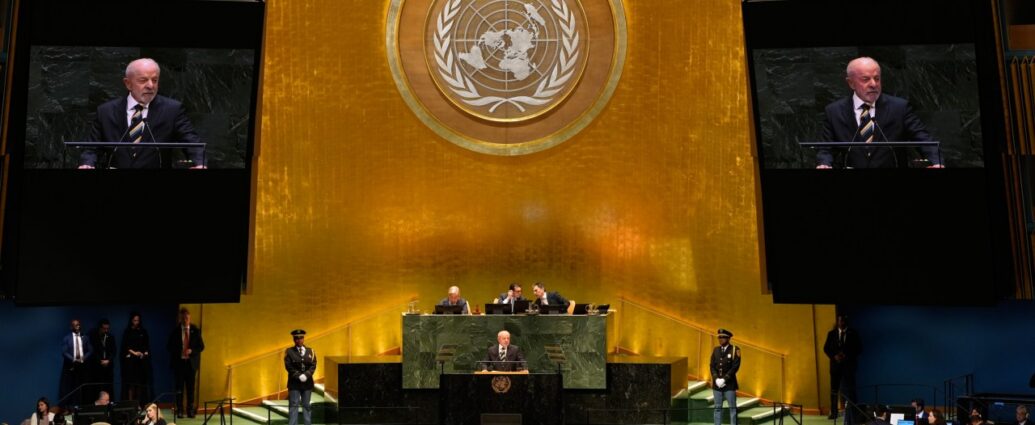
US President Donald Trump vowed on Tuesday to reassert US dominance in the Western Hemisphere and to use “unmatched military might” against threats in the region as he gathered allies behind an expanding campaign against drug cartels.
Speaking to world leaders at the UN General Assembly, Trump cast drug cartels as “the ISIS of the Western Hemisphere” and urged a tougher response to transnational crime.
Later at UN headquarters, Trump met with leaders and foreign ministers from 14 Latin American and Caribbean countries that have signed up to the Shield of the Americas, an anti-cartel coalition launched by his administration. He called on the group to join the US in designating 24 narcotrafficking groups as threats to stability and impose sanctions on them.
The countries later issued a statement pledging to take steps toward such joint sanctions.
The US raid that captured Venezuelan leader Nicolas Maduro and a subsequent oil deal with the interim government underscored the US willingness to act in the region, Trump told world leaders at the General Assembly.
“Our actions in Venezuela are proof that the United States will no longer permit threats to America to gain a foothold anywhere in the Western Hemisphere, and if necessary, we will use our unmatched military might to secure the vital national interests of the United States,” he said.
Trump revamps Monroe Doctrine
Trump’s National Security Strategy late last year set out plans for a revamped Monroe Doctrine, the 19th-century policy asserting US primacy across the Americas that critics have long associated with decades of American intervention. Trump himself has taken to calling it the “Donroe Doctrine,” a play on his own name, after the phrase gained currency in conservative media.
Trump has also spoken, often in vague terms, of retaking the Panama Canal and annexing Greenland and Canada. On Tuesday, he signed an agreement on Greenland that stops short of his demand that the island become US territory to head off the growing Arctic presence of Russia and China.
Still, Trump’s focus on the Western Hemisphere has raised concerns of a neo-colonial project.
Brazilian President Luiz Inacio Lula da Silva in his UN speech bristled at the approach, warning Latin America and the Caribbean countries of “renewed hegemonic temptations.” “Brazil is nobody’s backyard,” Lula said.
Shield of the Americas
The Shield of the Americas gathering was the latest US effort to rally Latin American nations behind a more aggressive approach that has included US military strikes on drug boats since last fall and greater cooperation with Latin American countries.
Trump launched the group in March, gathering more than a dozen regional leaders in Florida.
The coalition includes governments closely aligned with Trump, including countries like Argentina, Ecuador and El Salvador whose leaders Trump has either praised or endorsed as candidates. Colombia and Peru joined after Trump-aligned presidents took power in recent months.
Brazil and Mexico are among the countries that have not joined.
Since returning to power early last year, Trump has designated drug cartels as foreign terrorist organizations and launched dozens of deadly strikes on boats in the Caribbean and Eastern Pacific that US officials say are carrying narcotics bound for the US. Rights groups have said the strikes, which have killed more than 220 people, amount to extrajudicial killings.
“For decades, other administrations allowed much of this region to be dominated by vicious gangs and bloodthirsty drug cartels, destabilized by uncontrolled migration, and infiltrated by hostile foreign adversaries – foreign sick, demented adversaries – but not anymore,” Trump told the UN, adding that he was “reasserting American power” to make the region safer by taking out cartels.
“Like ISIS, they should be killed, exiled or detained as enemy combatants without the possibility of release,” Trump said, “which is what we’re doing.”
Trump also touted his administration’s pressure campaign on Communist-run Cuba, accused its leaders of seeding “subversive and radical” left-wing groups in the United States, and said Secretary of State Marco Rubio was “deep into negotiations with Cuba.”
Drug cartels controlling territory in US neighbor Mexico were “unacceptable,” he said, insisting that the government there “must reclaim control of its soil from the enemies of humanity.”

Trump administration to admit primarily Afrikaners under new refugee proposal
US President Donald Trump’s administration plans to set a refugee admissions ceiling of 17,500 over the next 12 months, consisting “primarily” of South Africans from the country’s white Afrikaner ethnic minority, according to a notice sent to Congress on Tuesday.
US President Donald Trump has claimed Afrikaners face persecution based on their race in the Black-majority country, allegations the South African government has denied.
Trump paused all US refugee admissions when he took office in January 2025, saying they would restart only if it was in the country’s best interests. Weeks later, he launched an effort to bring in Afrikaners, sparking criticism from refugee advocates who decried the exclusion of people of other nationalities fleeing persecution and violence.
The notice sent by the State Department to congressional officials said it “anticipates that Afrikaners from South Africa will fully assimilate into the United States in a manner that preserves taxpayer resources for US citizens.”
Resettlement under the proposed ceiling is expected to cost approximately $500 million, the notice said.
Nearly everyone admitted as refugees was South African in 2026
All but three of the nearly 3,000 people admitted as refugees in the current fiscal year ending September 30, 2026, were South Africans, according to State Department data through August.
In fiscal year 2024, by contrast, the Biden administration brought in more than 100,000 refugees from dozens of countries.
“A refugee program that centers one group and sidelines all others is an abdication of our global humanitarian leadership and an abandonment of thousands of vulnerable families,” Krish O’Mara Vignarajah, president and CEO of Global Refuge, said in a statement.

Olmert reveals intelligence breakthrough leading to Israel’s 2007 strike on Syrian nuclear reactor
Former prime minister Ehud Olmert provided new details of Israel’s operation to destroy a Syrian nuclear reactor in 2007 during an interview with Channel 12 on Monday.
In the interview with Channel 12’s Amit Segal, Olmert said the intelligence breakthrough began with a Mossad officer referred to as “Anat,” who became convinced that Syria was pursuing a nuclear program despite being told there was no evidence pointing towards such a program.
After completing her training, Anat requested to work on Syrian nuclear activity rather than Iran, Olmert said.
“She had an instinct,” he said. “During the course and exposure to bits of intelligence that agents are exposed to, she felt there was something there. That was enough for her.”
Anat faced resistance from her superiors, including after two operations involving Ibrahim Othman, head of Syria’s Atomic Energy Commission, failed to produce evidence of a nuclear program.
‘Anat’ remained in the Mossad, became senior official
“One of her commanders told her: ‘Stop confusing your mind; we’ve already carried out two operations on Ibrahim Othman, and we haven’t discovered anything. There’s nothing; what do you want from us?’” Olmert said.
He said she was later summoned to a hearing over her continued work. She nevertheless remained in the Mossad and eventually became a senior official.
Olmert said former Mossad chief Meir Dagan later invited Anat to a discussion about the operation that led to the reactor’s discovery, despite her junior rank.
Dagan told Olmert that he had a rule of inviting people who might “tell me what others were not saying,” Olmert recalled.
The intelligence eventually reached Olmert, who was prime minister at the time.
At a meeting attended by Dagan, Tamir Pardo, Amnon Sofrin, and another Mossad official whose identity remained classified, Olmert received the intelligence.
After they left, Olmert summoned his advisers Yoram Turbowicz and Shalom Turgeman.
“I told them: ‘There is a nuclear reactor in Syria, we will destroy it,’” Olmert said.
“We will not deal with the question of how it happened that we did not know, but rather we will do everything so that it does not exist,” he recalled telling them.
The operation included preparations for the possibility of war with Syria. Olmert said Israel considered abducting Othman, who had been an important intelligence target during the investigation, in order to obtain evidence that could establish that Syria had built a nuclear reactor.
Israel ultimately destroyed the reactor in September 2007 in an airstrike on the facility at al-Kibar in eastern Syria. Israel formally acknowledged its responsibility for the strike in 2018.
Olmert said maintaining secrecy was critical because Israel’s strategic advantage depended on Syria not knowing that its nuclear project had been discovered.
He estimated that about 2,500 people knew that Israel was conducting surveillance related to the reactor. Those involved were required to sign declarations that a leak would lead to a Shin Bet investigation, he said.
Olmert also said he held key meetings at his official residence rather than the Prime Minister’s Office to reduce the risk of the operation being exposed.
“The fact that it didn’t leak from you is a big deal,” Olmert recalled the then US president, George W. Bush, telling him. “The fact that it didn’t leak from us – it’s a miracle.”
Olmert said Syria’s nuclear program represented an existential threat to Israel, even though he did not believe Syrian President Bashar al-Assad would necessarily have used a nuclear weapon against Israel.
“I don’t think so,” Olmert said when asked whether Assad would have used a bomb. “But it’s not a risk I can take.”
He also said that, despite Israel’s knowledge of the reactor, he continued to consider the possibility of a peace agreement with Assad over the Golan Heights.
“Assad tried to deceive me, and it turned out that in the end I deceived him,” Olmert said.
Olmert distinguished October 7 from nuclear threat
Olmert said the October 7 attack and the 1973 Yom Kippur War did not constitute existential threats in the same sense as the prospect of Syria acquiring nuclear weapons. He argued that Israel could recover from a conventional attack, while a nuclear strike would have consequences “unlike anything we have experienced in our 80 years of existence.”
“There is a difference between a few thousand Nubah fighters and a nuclear bomb,” Olmert said. “A second blow comes after you take a blow, and if you take a nuclear blow – the dimensions of the disaster are unlike anything we have experienced in our 80 years of existence.”
Olmert said the possibility of a nuclear-armed Syria would have affected Israel even if Assad himself had been unlikely to use the weapon.
“I don’t think so,” he said when asked whether Assad would have used a bomb. “But it’s not a risk I can take.” He said that living under a nuclear threat could have had broader consequences for Israeli society, including prompting people to leave the country.
Towards the end of his conversation with Channel 12, Olmert told Segal that he didn’t believe that things would also turn out for the worst. When asked if enemy states’ nuclear proliferation aspirations would one day be fulfilled, Olmert answered, saying, “30 years ago, Saudi Arabia led the Arab boycott; today the Gulf states are making peace.”
“We need to protect Israel, but also be open to dialogue and be human,” he added.


Meta’s Muse AI is exploding in popularity—and already drawing heated backlash from another tech giant
Meta’s new AI agent app is quickly taking hold of the consumer market, unseating ChatGPT as the top free app on Apple’s App Store in recent days. The app, which features a personal AI agent that books appointments, shops, and organizes calendars on people’s behalf, is the talk of tech circles this week.
Named Muse, the app, which uses Meta’s latest Muse Spark AI model, connects users to a range of services that its AI agent autonomously handles. That means handing over access to accounts across a user’s phone in exchange for Muse booking a vacation or handling restaurant reservations on their behalf. It’s the first major consumer AI agent push by Meta, and it’s catapulting the company for now, past its competitors.
Not everyone is rolling out the red carpet for Meta’s Muse, however. Amazon blocked Meta’s assistant from accessing its online store, saying that “continued access by an unauthorized AI agent violates Amazon’s Conditions of Use, to which our customers have agreed.” Amazon said Meta never asked for permission to access its site. Meta didn’t immediately respond to a request for comment, though the company announced it would partner with Shopify for some of Muse’s shopping features.
“It is only a matter of time before there is an Apple and Google version of Muse and possibly TikTok, in addition to the frontier LLM agents,” Nikesh Arora, chief executive at Palo Alto Networks, wrote on X. “Every app that is a services, marketplace or commerce app will need to existentially decide to open [Application Programming Interfaces] for consumer agents to interact. Smaller players have no choice. Either the consumer benefits or distribution aggregators will demand a higher transaction fare.”
Muse’s break-out success represents a much needed victory for Meta in the AI arena, following a series of struggles by the company to compete with frontier labs like OpenAI and Anthropic.
Muse’s fast-rising popularity, and Amazon’s reactionary block, show how quickly agentic technology is transforming the consumer space. Meta released Muse just as Anthropic and OpenAI released cheaper versions of some of their models. Apple also recently rolled out its revamped Siri as part of its newest iOS update.
The bigger questions raised by Muse’s release are who controls the shopping and user interfaces Meta is trying to access, and how major companies will agree to such access. For Amazon, Muse is a threat because it bypasses the usual process of humans visiting its website or app and seeing the advertisements that serve as a key profit driver.
Amazon has taken action against other companies over similar issues. Last year, it sued Perplexity over its Comet AI tool, which could access Amazon accounts much like Muse does. Amazon recently lost a ruling on that claim after the U.S. Court of Appeals for the Ninth Circuit found that users were ultimately choosing to access Amazon via Perplexity’s bot; Amazon is still fighting the issue.
Amazon has its own shopping agent, called Buy for Me, which performs tasks similar to Muse’s. The company has said brands can opt out of the feature, though doing so requires action, since brands are automatically opted in. CEO Andy Jassy has also said Amazon is exploring AI shopping agent partnerships with third-party companies.
Privacy is sure to be a key issue for consumers weighing assistants like Muse, which allow for personal touches—like the ability to name your assistant— but require access to sensitive information, such as bank accounts, to truly work on a user’s behalf.
Meta says user logins are kept secret and that online purchases use a one-time card number that hides a person’s actual card details. Still, Meta has been at the heart of previous privacy issues. Meta has faced multiple proposed class-action lawsuits related to its smart glasses, including one alleging that it sent some footage captured by the glasses, including highly personal material, to third-party human reviewers for annotation and AI development. Meta has disputed the allegations.
The rise of Muse is timely for Meta: CEO Mark Zuckerberg is expected to unveil updates to the company’s smart glasses at its annual Connect event in Menlo Park, Calif., on Wednesday.
This story was originally featured on Fortune.com
Anthony Scaramucci’s “All the Wrong Moves”

Opinion | Welcome to New York (Hours Late)

Iraq moves to put off militia disarmament until June 2027 while US moves out
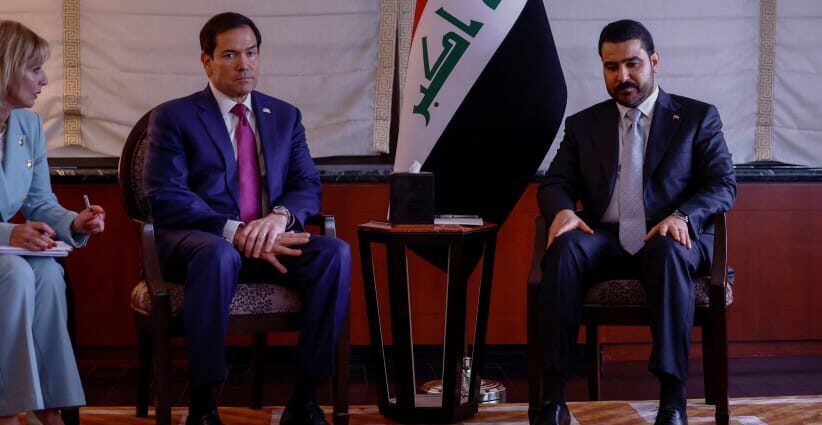
Iraq Prime Minister Ali al-Zaidi is in New York City for the UN General Assembly. A New York Times article on the latest developments in Iraq noted that “Iraq’s prime minister, Ali al-Zaidi, pledged to disarm his country’s Iran-backed militias by June 2027.” This is concerning because it essentially kicks the can down the road on militia disarmament.
The new developments regarding the militias come as the US is leaving Iraq on September 30. Zaidi wants to restructure the US relationship and make it strategic. Iraq is being pressured to cut off Iran amid US sanctions. Now, Zaidi has said that there may be a 90-day period where the militias stop their attacks. Once that ends, they will hand over arms. This creates a lot of variables that can go wrong.
Meanwhile, US Secretary of State Marco Rubio met with Zaidi. “Secretary of State Marco Rubio met with Iraqi Prime Minister Ali al-Zaidi today to discuss the future of the US-Iraq partnership. The Secretary and Prime Minister agreed on the importance of Iraq dismantling terrorist militias, preventing attacks from Iraqi territory, and fully exercising its sovereignty,” the US Department of State said.
Zaidi “reiterated the government’s determination to fulfill its sovereign responsibilities and move forward with measures to ensure that all arms remain under state authority, in accordance with constitutional and legal principles,” his office said in a statement on Tuesday.
Iraqi commander calls for disarmament of YBS Yazidi armed group
Meanwhile, in Iraq, the ground forces commander of the army, Qassim al-Mohammedi, called for the YBS Yazidi armed group to disarm. The Yazidi group had agreed to do this a week ago.
“All non-Iraqi armed men must leave the area because this isn’t their area of operation, and their presence cannot be accepted,” Mohammedi told the state-run Iraqi News Agency (INA). The goal is to stabilize Sinjar. It comes as the Kurdish Peshmerga also announced unification this week.
Iran-backed militias have infiltrated Iraq’s security and political landscape since the 2003 US invasion. Many operate within the state-backed paramilitary Popular Mobilization Forces (PMF), while retaining separate leadership structures and close relationships with Iran’s Islamic Revolutionary Guard Corps (IRGC).
The major Iran-aligned groups include Kataib Hezbollah, Asaib Ahl al-Haq, Harakat al-Nujaba, Kataib Sayyid al-Shuhada, Kataib Imam Ali, and several smaller factions. Some of the militias also operate as part of the Islamic Resistance in Iraq. They have carried out hundreds of attacks in Iraq, targeting US forces and the Kurdistan Region. They have also attacked Jordan, Saudi Arabia, Israel, and other countries. There are some 100,000 members of the militias.
The US has designated many of the groups as terrorist groups. Kataib Hezbollah, Asaib Ahl al-Haq, Harakat al-Nujaba, and Kataib Sayyid al-Shuhada are currently designated both Foreign Terrorist Organizations (FTOs) and Specially Designated Global Terrorists (SDGTs), according to the US Treasury. Kataib Hezbollah has been an FTO since 2009, and Asaib Ahl al-Haq since 2020. Badr is the only militia that has not been designated. It is also the largest.
Trump’s meeting with Arab states on UN sidelines displays US MidEast strategy during war – analysis
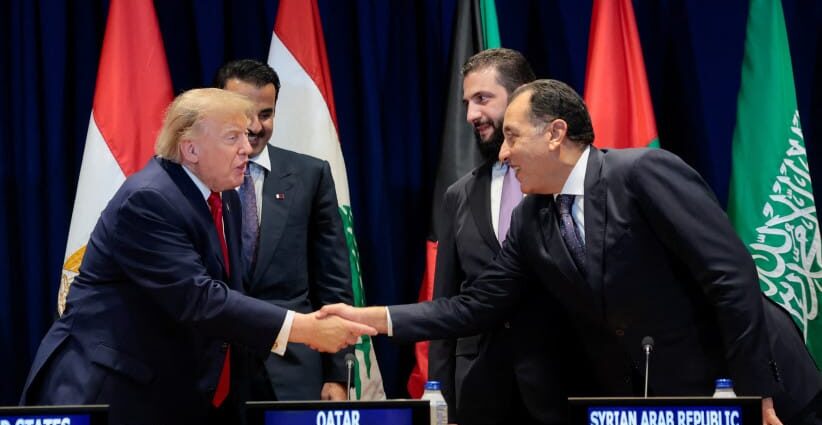
US President Donald Trump’s meeting with Arab states on the sidelines of the UN is important. It shows continued close ties between the US and key Arab countries. It also shows that Trump can navigate the challenges that have arisen since the war with Iran began in February. All these countries have their own policies, and each has been impacted in some way by the conflict. President Trump showcased his personal approach to diplomacy in the meeting on September 22. This is a key part of his doctrine, and he showed how effective he can be when he is in a room with key leaders.
The meeting included leaders from Jordan, Syria, Iraq, Qatar, and Turkey, as well as officials from Saudi Arabia, Kuwait, Lebanon, Egypt, the UAE, and other countries. Trump called the countries friends, allies, and partners. He spoke about the Middle East as a special place and spoke about peace and prosperity.
Trump was in a positive mood and joked with the countries present. He spoke about his close ties with Turkey’s President Recep Tayyip Erdogan. He spoke of Erdogan as being tough. He called him fantastic. He also joked that the region was full of high energy, but said it sometimes meant “too high energy.” The US president also said there had been a recent meeting between American and Iranian representatives and that it had been productive. This shows that President Trump is seeking to show the countries that he is working toward more calm and peace.
Many of these countries are concerned about the Iran conflict. Iraq, for instance, has seen its fuel exports reduced. Many countries in the Gulf have been attacked, such as Kuwait, Bahrain, and the UAE. Saudi Arabia is facing threats from the Houthis. It has wanted more US support against them. It was also attacked by militias in Iraq.
Many of these countries have also been very critical of Israel in their UN speeches.
Jordan expresses concern over West Bank violence, Israeli aggression in Syria
Jordan’s King Abdullah II was particularly critical. He has warned about violence in the West Bank. He also expressed concern about Israel’s aggression, including in Syria. He is expressing concern about other states in the region, which believe that Israel is seeking to become more dominant in the region. For instance, a recent Israeli attack on a base in northern Syria was a warning to Turkey. There have been officials in Israel threatening war with Syria.
Israel’s actions in Syria are under a spotlight.
On September 22, the Israel Defense Forces said that “14 Israeli civilians arrived in the Alonei Habashan area and crossed the border into Syria. IDF soldiers were dispatched to the area and operated to locate them and returned the civilians to Israeli territory.” While the IDF condemned the incident, it also called on law enforcement to “bring those involved to justice and to prevent those individuals from repeatedly engaging in this incident, which constitutes a criminal offense.” In general, these types of incidents have not been charged.
Many countries can’t understand why Israeli officials are hostile to the new government in Syria. They are a chance for possible peace because the former Assad regime had been hostile to Israel and hosted Iran. The new government has shared interests with Israel against Iran and Hezbollah. However, Jerusalem has viewed the new government with suspicion and has backed the Druze in southern Syria. Jordan has carried out airstrikes to stop drug smuggling, which it believes is being fueled by networks in Suwayda. As such, Jordan is concerned about instability in southern Syria.
At the same time, Jordan and Saudi Arabia and possibly Syria are threatened by militias in Iraq. The Trump administration wants Iraq’s prime minister to rein in the militias. Trump has worked to cultivate close ties with Syria’s leader Ahmed al-Shara’a. This was brokered by Saudi Arabia in 2025. In addition, Trump has worked to improve ties with Iraq and Lebanon. The US is supporting talks between Israel and Lebanon.
Trump strengthens ties with Gulf countries, pushes for additional arms sales
As such, the Trump administration is deeply involved with many of these countries. It is selling arms to many countries in the Gulf. It is also pushing for a possible F-35 sale to Saudi Arabia, and possibly even Turkey as well. Israel will be concerned about this. Israeli officials now see Turkey as a growing threat. The Trump administration does not appear to agree on this assessment. However, Trump’s close ties with leaders such as Shara’a, Erdogan, the Saudis, Jordanians, and Egyptians can help smooth tensions with Israel.
Trump’s hosting of the meeting with these countries showcased his clout in the region and how he is able to bring these countries together. Syria and Iraq’s leaders met at the meeting. Trump has made it a point during his two terms to quickly reach out and meet Arab leaders. He did this with a trip to Saudi Arabia in 2017 and 2025. He also hosted the king of Jordan early in his term in 2017. All of this matters because Trump’s doctrine uses personal diplomacy to achieve goals. He has also appointed Ambassador Tom Barrack, who is Ambassador to Turkey, to handle US policy on Syria and Iraq as an envoy to both. Barrack praised US Secretary of State Marco Rubio for meeting Iraq’s Zaidi, and Barrack also met with Erdogan.
Barrack wrote on September 22, “Pleased to join President Recep Tayyip Erdoğan and First Lady Emine Erdoğan, host and Turkish legend Hamdi Ulukaya with his elegant wife, Louise, and the US Chamber of Commerce in New York City last night to celebrate 100 years of enduring partnership between the United States and Türkiye. For a century, our nations have stood together–strengthening NATO, advancing regional security, expanding trade, and creating opportunity for millions. From the battlefield to the boardroom, we have achieved so much over a century of friendship–with an even brighter future ahead.”

LARRY KUDLOW: Trump offers historic optimistic vision at UN
Now all the headlines from President Trump’s United Nations speech are focused on his prior statements warning Iran that the Tehran regime has to either make a deal or face annihilation.
I believe annihilation refers to the regime. And he warned them not to focus on the midterm elections because he’s going to be president for another two and a half years. So, in effect, Mr. Trump discounted the midterm elections, and took them off the table. A bad day for Iran.
As Mr. Trump said: “They’re waiting to see how I do in the midterm election. What they don’t realize is that I’m not running. I did that already and won in a landslide. We won in a giant landslide, and I’ll be here for two and a half years.” He added that “I gave absolutely no credence and will not give credence to the election. When it comes to Iran. It doesn’t even enter my mind. The only thing that does is that Iran will never have a nuclear weapon. The cowards and traitors —” here applause interrupted the president.
Please note carefully that big applause when he said Iran will never have a nuclear weapon. The UN is not usually, the member’s not usually applauding Mr. Trump, but they did actually on several occasions as we will discuss. Again, another bad day for Iran.
The point is, even the UN hates Iran. So we’ll see about all of that and how it works out after the election. Before he got to the Iran warning, he talked about America having the hottest economy in the world. Creating a million new jobs, record-low poverty, and high real incomes in the 2025 Census, of course cutting taxes, getting rid of regulations, record stock market, by the way the Nasdaq tech rallied again to a new record high.
Then there was the issue of AI — which is now super intelligence now — is here to stay. And there will be no radical climate change type hoax or doomsday scenarios with our super intelligence. Nor will there be any global regulation of our super intelligence. By the way, no global regulation of anything. Including the International Criminal Court, UN agencies who won’t protect our children from transgenderism, or the persecution of Christians. Or promoting mass migration.
He emphatically said no to any global carbon tax, and in fact generalized “there will be no global taxes.” End quote. Full stop. Good for him. How about that? In front of the UN, Mr. Trump makes a no new tax pledge. Phenomenal. And the Nasdaq index hits another record high.
Yet on all these points, Mr. Trump struck a positive, constructive, optimistic tone. This was a different kind of speech. This was a speech that had praise and applause that was unusual for his UN meetings. Yes, even the UN hates Iran and wants to stop them from having a nuclear weapon. For sure.
Yet several times, Mr. Trump praised the UN, and its Security Council. For, say, helping on Iran, and for endorsing his 20 point Gaza peace plan, and approving the Board of Peace. And permitting the first lady, Melania Trump, to preside over a meeting of the Security Council, which has never been done before by a president’s wife.
Yet there’s more. Mr. Trump praised the leaders of Pakistan, Rwanda, Armenia, and Azerbaijan, for helping him in making peace deals.
To be sure, he mentioned the successful regime change and world oil implications of Venezuela. And he issued a very tough warning to Cuba — where Secretary of State Marco Rubio is working hard for some kind of regime change.
And of course, the new security arrangement in Greenland, which will protect the Western hemisphere and Europe from Chinese and Russian threats. But Mr. Trump had good things to say about NATO, which has come around toward his view on the need for 5 percent of GDP spending on defense.
We really haven’t heard him praise NATO much before. He talked about stopping the drug cartels throughout Latin and South America.
Yet importantly, he had very positive things to say about Mexican cooperation. Again, optimistic, positive, constructive. And then finally, well, no one seems to want to report on this toward the back end of the speech. I believe the president spoke movingly to all of the UN members about “the enemies of humanity.”
He declared: “That is the challenge for every nation in this room. If we go forward strong and united against the enemies of all humanity, if we reject the voices who would have us give in to fear and doubt, if we refuse to shrink from our duties to our people, then together, through bold action, we will make this world far safer and a far better place.”
And he concluded again by reaching out to all those UN nations who really are not our best friends, but he exhorted them to “leave our nations far stronger.”
He said: “We will grow our economies far bigger, and we will not just speak of peace, prosperity, and justice. Here at the United Nations. We will stand for them all over the world. Together, we will build a future for our people that is brighter, more hopeful, and more magnificent than ever before. Thank you. God bless the nations of the world and God bless America”
This is why I’m calling this a historic speech.
This is an optimistic vision of freedom, peace, and prosperity, where this 47th President of the United States is asking all the nations to join him in this great crusade. Mr. Trump’s optimism was Reaganesque. I’d say this was pretty great stuff.

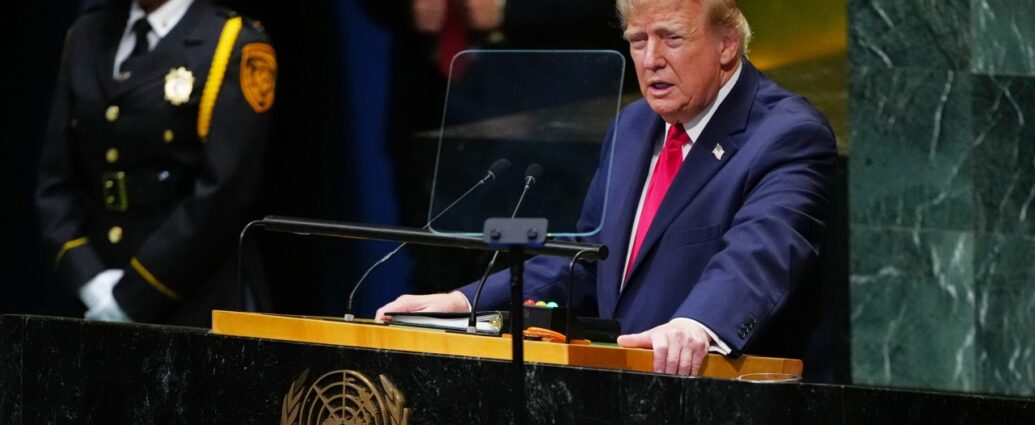
Opinion | Trump’s U.N. Message to the World
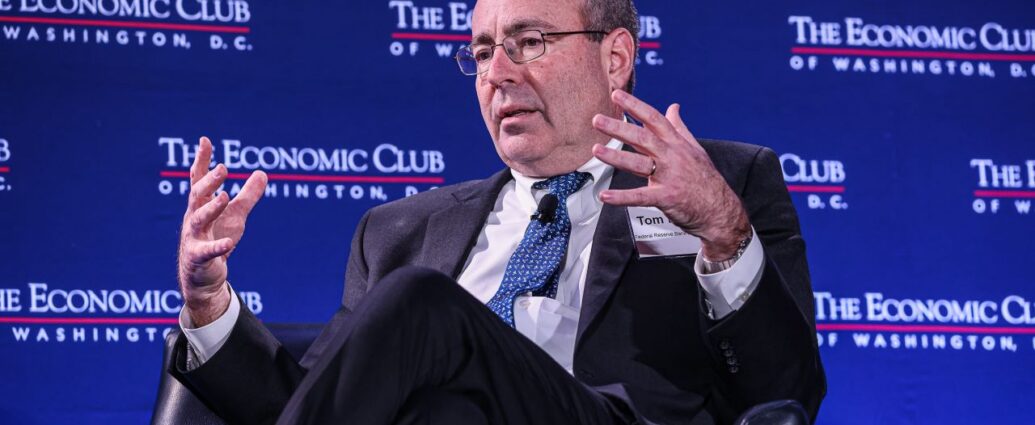
Why the Fed isn’t ready to declare victory on inflation
The Federal Reserve’s decision to raise interest rates last week may mark the first of several hikes aimed at taming stubborn inflation, with one central bank leader weighing in on where inflation may go from here.
Federal Reserve Bank of Richmond President Tom Barkin said in a speech before CFA Society Baltimore on Tuesday that the “risks to inflation outweigh the risks to maximum employment. That’s why we raised rates.”
Barkin, who is a non-voting member of the Federal Open Market Committee (FOMC) this year, compared the Fed’s dual mandate between promoting maximum employment and price stability to raising children – saying that “inflation is our troublemaker” and noting it’s been above the 2% target for five years which contributed to the decision to hike.
“Where do we go from here? We are committed to returning inflation sustainably to our 2% target. Last week’s hike will help. Will additional hikes be required, and how many? We’ll see,” Barkin said, explaining that while inflation could ease as price shocks fade, or prove persistent.
FEDERAL RESERVE HIKES INTEREST RATES FOR FIRST TIME SINCE 2023 AMID STUBBORN INFLATION
“I’m open to the possibility that inflation could come back down in short order. Some of these recent shocks could reverse. Consumers could start to reach their limit. The investment boom could slow. Markets could correct. Employment could falter, making the labor market the problem child,” Barkin explained.
“On the other hand, inflation could prove more stubborn. Temporary shocks could drag on. New cost pressures could develop. Firming demand conditions could flow through to prices, as could the impact of today’s inflation,” he said.
Barkin added that the shocks from the Iran war and the AI buildout “aren’t proving to be short-lived, or one-off events,” adding that while they “may pass in time, but I do expect it will take time. In the interim, there is a risk that current elevated levels of inflation could affect future inflation.”
CONSUMER PRICES REMAINED ELEVATED IN AUGUST AHEAD OF FED’S NEXT MEETING
The market currently expects the Fed to move forward with at least one more 25 basis point rate hike before the end of the year.
The CME FedWatch tool shows a 48.3% chance of one hike to a target range of 4% to 4.25% after the October and December meetings, along with a 40.7% chance of a second hike before year’s end.
Federal Reserve policymakers also released their economic projections, which reflected one hike before the end of the year, while Fed Chair Kevin Warsh maintained his stance in not offering forward guidance during last week’s post-meeting press conference.
WHAT WARSH’S JACKSON HOLE SPEECH SIGNALS ABOUT WHERE INTEREST RATES ARE HEADED
Gregory Daco, chief economist at EY-Parthenon, told FOX Business that Barkin’s comments echoed the FOMC’s rate hike decision because while “policymakers had displayed patience in waiting for core inflation to converge toward 2%, that patience has seemingly run out and most policymakers now favor adopting a modestly more restrictive monetary policy stance.”
“In our view a Fed hiking cycle, if implemented, could create further strain for already-constrained interest-sensitive sectors while doing little to slow the AI-led investment surge beyond increasing the risk of a stock market correction,” he explained.
Daco added that the “key missing element in Warsh’s narrative was transparency around how tighter policy would address the inflation overshoot,” with policymakers looking to potentially undo some or all of the 75 basis points of rate cuts late last year.
GET FOX BUSINESS ON THE GO BY CLICKING HERE
” The objective is tighter financial conditions and disinflationary demand destruction. The risk is substantial for an economy already facing income erosion, supply-driven inflation, and persistently elevated rates,” Daco said.
This post was originally published here



Opinion | Republicans Are Running on Empty
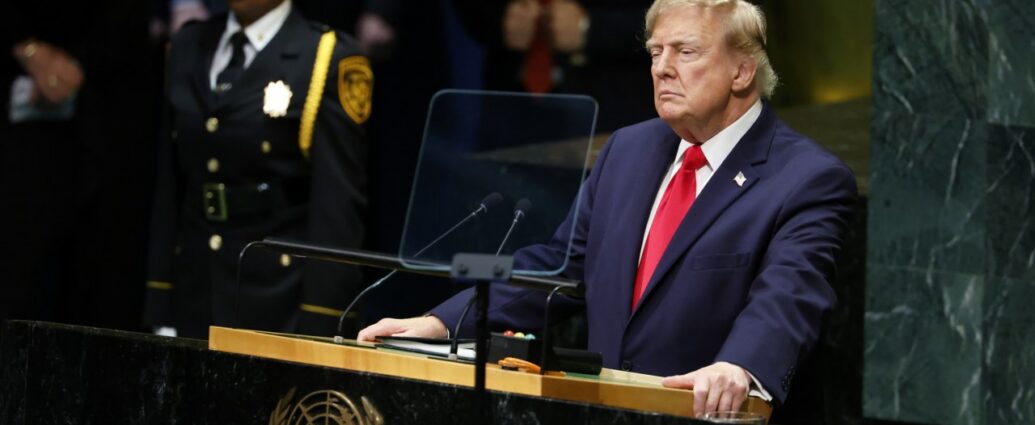

City expands 100 Gold Street redevelopment to nearly 4,000 new homes

A project that converts a Financial District office building into housing will now have 4,000 apartments, an increase of about 300 units from the original plan, Mayor Zohran Mamdani announced on Tuesday. First revealed by the city last year, the project replaces 100 Gold Street with a high-rise mixed-use development with new homes and a senior center. The updated plan comes ahead of the public review process and is part of a deal reached by the former administration to add new housing to the district in exchange for scrapping the development at Elizabeth Street Garden.

Following a request for proposals process, then-Mayor Eric Adams announced in December the selection of GFP Real Estate to redevelop the nine-story building, which was constructed in the 1960s and houses several city agencies, with the Department of Housing Preservation and Development occupying the majority. GFP has led several office-to-residential conversions in Lower Manhattan, including 222 Broadway, 25 Water Street, and 40 Exchange Place.
The plan includes 4,000 new homes, with 1,000 permanently affordable and rent-stabilized apartments, a new senior center that will replace the existing facility operated by Hamilton-Madison House, and a public fitness center and other amenities.
New renderings released by the city’s Economic Development Corporation and credited to CetraRuddy Architects show three towers, with the largest appearing to be at least 1,000 feet tall. The other two buildings appear to be around 800 feet and between 450 and 500 feet tall. The exact size and number of units will be finalized during the review process.
“New York’s housing crisis demands that we build more—and that we use every tool we have to do it. That means looking at land the City already owns and asking how it can serve New Yorkers better,” Mamdani said in a statement.
“At 100 Gold Street, we have an opportunity to turn an aging government building into nearly 4,000 new homes, including approximately 1,000 that will remain permanently affordable, while delivering new spaces for the community.”

Last June, the Gold Street project became a bargaining chip when local Council Member Chris Marte agreed to support the rezoning of three sites in his district in exchange for the Adams administration dropping plans to build affordable senior housing on the site of the Elizabeth Street Garden. The other two sites include 156-166 Bowery and 22 Suffolk Street.
Mamdani had pledged to keep the housing project on the Noho site during the campaign, but before the mayoral election last November, Adams transferred the Elizabeth Street Garden to the Parks Department, making it “nearly impossible” to continue with the development.
A settlement reached in August allows the developers to move forward with the other affordable housing projects in the area.
According to the city, the project will get the 485-x tax break but not be subsidized by the city. Proceeds will be used to relocate the city agencies that are located at 100 Gold.
The project will add nearly “twice as many permanently affordable homes” as have been built in Manhattan Community District 1 over the last decade.
A scoping hearing is scheduled for next month, followed by the environmental review. The city said the project will enter the uniform land use review procedure (ULURP) in 2027.
“This critical project will replace an outdated office building in prime Lower Manhattan with a thoughtful mixed-use mixed-income development, representing the single largest infusion of new affordable housing in the area in decades,” Brian Steinwurtzel, CEO and Principal of GFP Development, said.
“We are grateful to Mayor Mamdani for his leadership as the city tackles an urgent housing crisis and look forward to continuing to work with the community on turning this ambitious vision into a reality.”
RELATED:
- City taps developer to replace 100 Gold Street with 3,700 apartments
- Financial District office tower to be razed and replaced with 1,000 apartments
The post City expands 100 Gold Street redevelopment to nearly 4,000 new homes first appeared on 6sqft.

‘We believe in college’: inside Andreessen Horowitz’s $42m unaccredited academy that will charge Harvard prices without degrees
For elite students, college has never looked like a worse deal. Tuition is nearly half a million dollars, AI is threatening to destroy the entry-level jobs a degree used to guarantee, and now in the hottest industry—tech—it’s cool to skip school entirely. So on Tuesday, Andreessen Horowitz became the first venture capital firm to sell an alternative.
“The bet is that there’s an opportunity to educate the next generation in a way that is more future-forward, and that’s a big market opportunity,” Gagan Biyani, a cofounder of $3.2 billion ed-tech unicorn Udemy who is now running the new Horowitz Andreessen Academy, told Fortune. Higher education, he noted, is a $2 trillion industry. “We think there are lots of ways to turn this into a successful business.”
The Academy is putting $42 million from a16z and a group of individual investors into the one-year San Francisco-based program. It is a separate for-profit company from the VC firm. It is not accredited, will award no degree, will not take federal student aid, and does not guarantee a job or a paid internship. The founding class will be about 50 students starting Sept. 2027, and it’s tuition-free—plus every student will get $50,000 in compute credits and a $5,000 travel budget.
The Academy then intends to seek regulatory approval for a two-year program starting in 2028. If approved, Biyani said, it expects “to charge something similar to elite private universities”—in the range of $60,000 to $90,000 a year.
Biyani insisted that the school isn’t a rejection of the premise of higher education—”we believe in college,” he said. Instead, it’s rejecting the idea that 18-year-olds in SF are only valuable insofar as they have a startup idea to dedicate a decade to. Indeed, they are looking to find the best and the brightest high schoolers—call them pre-idea founders.
The Academy’s homepage promises students will learn from the people “shaping the future,” with a campus “buzzing” from visits from Sam Altman, Jensen Huang, Satya Nadella, Mira Murati, Fei-Fei Li and Travis Kalanick. Most of those names, Biyani said, are guest speakers who “come in for a talk or a fireside chat.”
A second tier, the faculty, has committed to teaching multi-session courses; Biyani said Instacart co-founder Max Mullen are former Windows president Steven Sinofsky are two who have agreed. A third tier, mentors, will hold office hours. The course list cited in a blog post lists “The Craft of Selling” to “AI Inference Engineering” to “Origins and Innovations in Digital Computing 1940–2025.”
Yet teaching, in any case, “is not the primary thing we plan on doing,” Biyani said. “The primary thing we’re offering is the ability for students to pursue their own objectives.” The year is split three ways: September through April on campus in San Francisco, May travelling abroad, and June through August spent in a “co-op” at a partner company.
That’s where the 10 founding partners come in, mostly from A16Z’s vast network—Anduril, Anthropic, Coinbase, Google, Meta, Nvidia, OpenAI, Palantir, Replit and Stripe. Their commitments “vary,” Biyani said. “Not all of them are going to take students for hiring.”
Rather, some are providing compute, hardware credits or advice on curriculum; another 50-odd hiring partners, from Databricks to Boom Supersonic, “are not committed to hiring a certain number, but they’re committed to interviewing or considering our students.” Co-ops are “typically” paid, the school’s FAQ says, but not guaranteed to be.
There is no minimum age and all students have to arrange their own housing. The sample applicants that the site features includes a teenager who built an AI book indexer with “six-figure ARR” and one who “created an AI dating coach with 1.7M likes.” Admissions, Biyani said, is “proof of work,” though transcripts and test scores are still required.
Future of higher ed? Experts aren’t sure
So is this the future of education? Experts are skeptical. Bryan Caplan, the economist at the famously libertarian George Mason University, who wrote a book arguing that college is mostly just a credential, thinks it will work—for the first 50 students. But “something that can work for 50 handpicked people isn’t going to work even for the top 5,000,” he said. “MIT is going to last for centuries. Don’t worry about it.”
The idea of the Academy, Caplan said, is that skipping college generally signals that “you’re a weird person, and people are understandably nervous about hiring weird people,” he told Fortune. The Academy’s selection is severe enough that the prestige overcomes the weirdness- but only insofar as they keep it elite.
Ryan Craig, a managing director at Achieve Partners, which builds apprenticeship programs, is excited about the idea but isn’t sure their model makes sense on year two, when it attempts to become a school. “It’s a bootcamp with a plan to be a college, but I’d say not a realistic plan to be a college,” he told Fortune. Legions of “alternative, innovative universities” charging elite-private tuition without federal aid have been tried before, and failed. “It’s hard to compete with free money from the government,” he said.
The idea that Craig was enthusiastic about was a 21st-century work college, where students earn enough in the paid co-ops to cover tuition. But that requires the partners to actually pay high school students near six-figure salaries.
Biyani said the school will figure that out after year one. “We will see over time how students will finance this,” he said.
This story was originally featured on Fortune.com
COP31 Business Forum Chair on Climate Goals
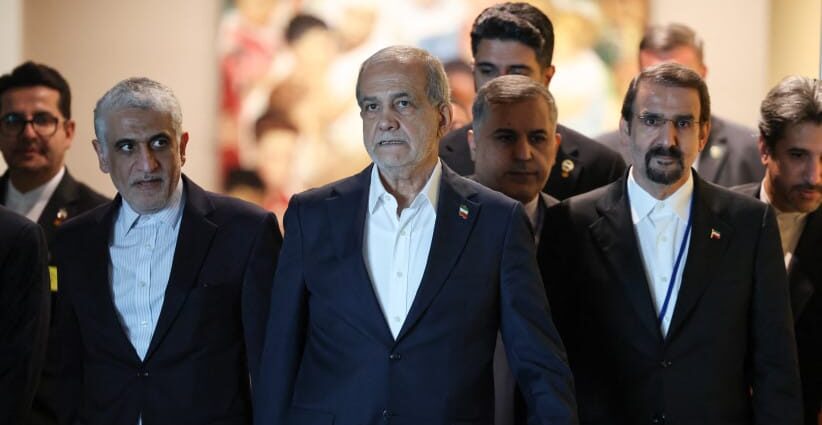
Witkoff, Kushner meet mediators as Iran sets demands for reopening Hormuz
US President Donald Trump said Tuesday that special envoys Steve Witkoff and Jared Kushner met with mediators to discuss a possible deal to end the Iran conflict.
Trump told reporters at the United Nations that US officials had had a “very good” three-hour meeting on Tuesday with the Iranian delegation.
He said that Washington and Tehran were moving toward a settlement, while a senior Iranian official said Tehran could reopen the Strait of Hormuz within days if the US eased military pressure and lifted its blockade on Iranian ports.
“We are completely isolating Iran financially and simply applying pressure, because we hope they will do the right thing quickly-before it’s too late,” Trump said. “You know, there will come a point when it’s too late, and we will no longer have the option of allowing them to survive as a nation.”
Iran’s Foreign Minister Abbas Araghchi met with US Special Envoy Steve Witkoff on Tuesday, on the sidelines of the UN General Assembly in a meeting during which Iran’s conditions to reopen the strategic Strait of Hormuz were conveyed to the US, according to Iran’s state media.
Iran sets Hormuz reopening conditions amid renewed US talks
Conditions for reopening the strait include immediate lifting of the naval blockade, immediate release of frozen Iranian assets and end of war across all ‘resistance’ fronts, state media added.
Trump’s remarks came just hours after he repeated a threat at the UN General Assembly to annihilate Iran if it failed to strike a deal.
Speaking after a meeting with British Prime Minister Andy Burnham at the United Nations in New York, Trump said: “They want to talk to us. They have been talking to us, even today they’ve been talking to us, and the relationship is developing.
“But we can’t let them – and they understand that – we can’t let them have a nuclear weapon.”

Iraq suspends Iranian flights to Baghdad after US threatens sanctions on airport service providers
Iraq ordered its civil aviation authority to suspend Iranian flights to Baghdad airport starting Wednesday, two sources told Reuters, after the United States threatened to sanction any airport that services Iranian carriers.
US Treasury Secretary Scott Bessent said on Monday that all Iranian airlines would be shut down on September 23 by the threat of secondary sanctions on air services providers, seven months into the war between the United States and Iran.
The Iraqi government is discussing diverting Iranian Airways flights from Baghdad to Najaf airport, two sources familiar with the matter said. They spoke on condition of anonymity because of the sensitivity of the matter.
The suspension of flights will begin at midnight on Wednesday.
Iranian news agency Tasnim said earlier, citing the Iranian Civil Aviation Organization, that flights from Tehran to Baghdad and Muscat have been canceled starting Wednesday and that all the remaining international flights, including Istanbul, will operate according to schedule.
Iranian travelers not admitted at Oman airport
“Iranian travelers are not currently being admitted at the airport in Oman, and consultations regarding this matter are ongoing,” a spokesperson for Iran’s Civil Aviation Organization told Iran’s semi-official ISNA news agency.
Bessent told CNBC that when Iranian airlines land at an airport, “you cannot provide them with fuel, you cannot provide them with landing services, you cannot sell them tickets, or you will be knocked out of the dollar system.”

What AI slowdown? OpenAI, Anthropic release dueling models as price wars heat up
Anthropic and OpenAI debuted more affordable versions of their frontier models as they battle for wallet share from increasingly cost-conscious businesses, and face growing competition from lower cost open weight models. The releases came within hours of each other, a sign of the labs’ heated rivalry, despite both companies’ recent calls for an AI slowdown.
Anthropic debuted Claude Opus 5.5, which it says performs at the level of its flagship Fable 5.1 model but costs around 40% less to run than Opus 5, which came out in July. It’s the first release in a new family of models, with Sonnet 5.5 and Haiku 5.5 expected “over the coming weeks,” Anthropic said.
Anthropic said the model is its most efficient, and it’s “passing these efficiency savings on to our customers in the form of price cuts and rate limit increases.”
OpenAI released GPT-6 Sol and GPT-6 Luna, offshoots of its flagship GPT-6 Astra model that came out earlier this month. The idea is to offer a version of Astra for everyday work, OpenAI said. It also slashed the API cost by 50% lower than the pricing on a promotion it’s currently running for Astra’s predecessor, GPT-5.6. OpenAI often releases lower priced versions of its flagship models, as it did with GPT-5.6.
OpenAI’s release offers lower API pricing than Anthropic’s, based on each company’s announcement, as shown in the table below. OpenAI attributes the cost reductions to “improvements in caching and inference,” and, like Anthropic, says it’s also “passing those savings directly onto users and customers.”
The two labs are already deep into an all-out price war—something that could put pressure on their ability to profit from their models down the line.
“OpenAI and Anthropic are engaged in a price war that is driving down the price of AI and therefore driving down their ability to profit from it and grow the price of models,” Ara Kharazian, lead economist at Ramp, told Fortune.
The battle is playing out on two fronts, Kharazian said: the labs are rolling out cheaper models that businesses are shifting toward, such as Opus 5.5 and GPT-6 Sol and Luna, while also announcing outright price cuts on their most expensive ones.
That dynamic is how technology markets have traditionally worked, he said, but it’s something that more bullish investors may not be factoring in.
“AI bulls assume that there will be highly performant models that provide more and more value, and therefore they should be more expensive,” Kharazian said. “But that is not how normal technology makes it to market.”
An AI slowdown?
These are the first model releases since both companies publicly called for a coordinated attempt to “pace the frontier,” or slow the development of the most advanced models. Anthropic CEO Dario Amodei published a blog post laying out his plan for a slowdown in mid-September, which OpenAI CEO Sam Altman supported in an X post—a rare moment of solidarity between the two.
Anthropic acknowledged that the release of Opus 5.5 is its first since Amodei’s call to “pace the frontier.” The company said that Opus 5.5 underwent the company’s most rigorous alignment testing to date and was evaluated by outside groups. The model also is also launching with the same tier of cybersecurity, biology, and frontier-AI-development safeguards previously reserved for the company’s more advanced model Fable 5.1.
While today’s releases from both companies are not frontier models, as in they are not a major step up in capabilities, they show that both companies continue to push AI capabilities forward outside of the frontier. The real fight for the future of their businesses could be in gaining everyday business customers, not necessarily offering the most powerful (and expensive) models possible.
Many businesses are tightening their AI wallets and applying more scrutiny to the ROI of the technology, Randall Hunt, CTO at the AI consulting company Caylent, said.
“CFOs have seen some of the sticker shock, and they haven’t seen some of the gains that were promised in the initial investments,” Hunt said. “So they’re coming back to their planning for 2027 and beyond, and saying, ‘How can we optimize our costs here?’”
One way Caylent is doing this is by calculating how long it takes employees to complete tasks with AI tools, and then calculating “cost per task,” an approach OpenAI encouraged in a mid-July 2026 blog post as well.
This story was originally featured on Fortune.com

‘I have a big decision to make’: Trump had a ‘good meeting’ with Iranian officials warning he may ‘annihilate the Islamic Republic’
President Donald Trump said U.S. and Iranian officials met on Tuesday, shortly after threatening in his address to the U.N. General Assembly that he may “annihilate” the Islamic Republic if a deal isn’t reached soon to end the nearly seven-month war.
Trump confirmed the talks in an exchange with reporters but offered few details about how the discussions transpired or the substance of the exchange..
“It was a very good meeting,” Trump said.
Earlier Tuesday, Trump in his address to the General Assembly made the case that he’s shown fortitude while other leaders have equivocated as he defended his decision to start a war with Iran.
But Trump also suggested that he could be at a crossroads in the conflict even as he called on the Islamic Republic to fully reopen the Strait of Hormuz and return to the negotiating table to find a settlement to end the conflict.
“I have a big decision to make,” Trump said. “Will a deal be made with Iran that lets them rebuild and create a far greater country than it ever was before, maybe one of the greatest in the Middle East or even the world. Or do I annihilate the Islamic Republic and do it quickly, never giving them a chance to kill and destroy people and countries again?”
The president’s comments came in his wide-ranging address to the international body in which he also celebrated this year’s U.S. military operation to oust Venezuelan President Nicolás Maduro from power, a new agreement to expand the U.S. military presence in Greenland, and pushed back against calls for greater regulation of the artificial intelligence industry.
But at the heart of the address was a fulsome defense of the war and pushback on the notion that Iran has shown a measure of resilience.
“The terrorist regime is behaving badly, not because they are strong and confident, but because they are weak and desperate,” Trump said.
Trump also accused Iran of stalling to make a deal to fully reopen the Strait of Hormuz and negotiate an endgame to the war until after the midterm elections in the United States. He insisted the tactic would have no effect on how he approaches the conflict.
Most of Iran’s delegation walked out of the chamber as Trump railed against the Islamic Republic.
Trump’s speech began a busy day of diplomacy
After his speech, Trump gathered with Danish Prime Minister Mette Frederiksen and Greenlandic Prime Minister Jens-Frederik Nielsen on the sidelines of the General Assembly to sign a new security agreement.
The deal, announced last week, came together after Trump repeatedly threatened to “take over” Greenland, a territory of NATO-ally Denmark, by military force if necessary. Trump said Tuesday the U.S. will immediately begin the process of developing a larger military presence in Greenland including “building two very major military bases.”
Under the deal, Greenland remains Denmark’s territory.
Trump also held talks with new British Prime Minister Andy Burnham. The leaders said they discussed migration, the conflict in Iran, the Russia-Ukraine war and more.
Trump also met with Japanese Prime Minister Sanae Takaichi and Ukrainian President Volodymyr Zelenskyy, and will hold a more informal meeting with Venezuela’s acting President Delcy Rodríguez, according to the White House.
He’s also scheduled to meet with leaders and senior officials from Gulf Cooperation Council nations — Bahrain, Kuwait, Oman, Qatar, Saudi Arabia, and United Arab Emirates — to discuss the way ahead with the war in Iran and growing concern about recent Iran-backed rebel attacks on Saudi Arabia. Trump also plans to take part in an event on the Shield of Americas, an initiative Trump launched with Latin American countries earlier this year focused on combatting violent cartels.
Iran war looms large at General Assembly
The visit to the U.N. comes when Trump’s foreign policy approach — particularly his decision to start a war with Iran — has become a drag on his fellow Republicans’ hopes of retaining control of both chambers of Congress during the coming midterm elections. Nevertheless, Trump made the case in his speech that the world is better off for his leadership.
“As president of the most extraordinary nation in history,” Trump said. “I have no interest in leaving dangers to grow for another day. I do not believe in letting problems fester.”
In last year’s address at the U.N., Trump claimed the U.S. had “demolished” Iran’s nuclear capabilities after he ordered the June 2025 bombardment of three key facilities.
He returned to the General Assembly nearing the seven-month mark of a new war against Iran that he insists is necessary to address a nuclear threat posed by Iran.
The war has grown more complicated even though strikes by the United States and Israel have killed much of Iran’s top leadership and destroyed its air force and navy, while a U.S. blockade of Iranian oil has left Tehran in economic shambles.
The energy market continues to be spooked by the war and oil prices remain elevated. Saudi Arabia earlier this month shuttered a key pipeline that acted as a relief valve for oil blocked in the Gulf. The kingdom made the move after the pipeline came under attack by Iran-backed militants in Iraq.
At the same time, territorial grabs by the Yemen-based Houthi rebels, another Iranian-backed group, near the Bab al-Mandab Strait has now made it treacherous for oil carriers to use that Red Sea shipping lane.
But Trump insisted anew that the elevated oil prices are a transitory problem that will fade once the war ends.
“Oil prices will come plummeting down even lower than they were at the start of the conflict,” Trump said. “And they were very low in the United States. They were really low.”
Secretary of State Marco Rubio said on Tuesday that Trump is open to meeting with Iran’s president, Masoud Pezeshkian, while he’s in New York for the General Assembly.
“This is a president that will meet with anybody for the most part, because he believes that engaging with people is important if you’re going to solve problems,” Rubio said on NBC’s “Today” show. “It doesn’t mean you’re going to end up agreeing with them, but it’s important.”
Trump’s frustration with Russia-Ukraine war mounts
The president also touched on Russia’s continuing war against Ukraine during his U.N. address — a conflict that during his 2024 campaign he predicted would be resolved on Day One of his second term. He once again expressed hope that the conflict will soon be resolved.
Trump hasn’t obscured that his patience is being tested by Ukraine’s targeting of Russia’s diesel refineries — an issue that’s added to the global oil markets’ volatility — and Russia’s targeting of Ukraine’s energy grid.
Trump last week asserted that he got the two sides to agree to not target each other’s energy infrastructure.
Zelenskyy, who is scheduled to meet with Trump on Tuesday afternoon, said he was willing to go along with Trump’s plan if Russia abided by it. Russia said it could only go along with Trump’s energy truce proposal if Western energy sanctions on Moscow were lifted first.
The two sides have continued carrying out strikes on refineries and other energy infrastructure.
Trump noted that last week he signed a new sanctions bill targeting Moscow. It empowers him to impose up to 100% tariffs on the top five importers of Russian oil or natural gas.
The legislation includes an exception for countries that import less than 15% of Russia’s natural gas exports and have taken significant steps to reduce those imports. Trump, however, has yet to enact the stiff penalties.
“If necessary, I will have to use them,” Trump said. “It’s time to stop the killing.”
___
Associated Press Diplomatic Writer Matthew Lee contributed to this story.
This story was originally featured on Fortune.com
After 40 investors rejected Jeff Bezos’ Amazon pitch, his parents offered $245,573 of their retirement savings
Sometimes the best investments are more about a gut feeling than hard numbers. At least that holds true for Jeff Bezos’ parents, who bet on their son when few others would.
In 1995, a mere two years before Amazon would go public, and more than 30 years before it would surpass Walmart to become the biggest company in the world (and clinchingMike Bezos recalled his son saying in a 2015 interview the No. 1 spot on the Fortune 500 as a result), Bezos received a lifeline from his parents.
According to a 1997 prospectus, his mother Jacklyn Gise Bezos, who died in 2025, and stepfather Miguel “Mike” Bezos, gave their son $245,573 from their savings so he could get his business off the ground. The six-figure sum represented a “large fraction” of their life savings at the time, according to Bezos, but it would eventually make them both billionaires.
Yet, before he accepted his parents’ money, Bezos made it abundantly clear to them that they might never get it back.
“I want you to know how risky this is,” Mike Bezos recalled his son saying in a 2015 interview. “Because I want to come home at dinner for Thanksgiving and I don’t want you to be mad at me.”
Bezos put the odds that his online bookseller would succeed at about 30%, which he previously said was generous given that the overall success rate for startups is closer to 10%.
A year before his parents invested, Bezos had approached 60 investors asking for $50,000 minimum investments as he sought to reach $1 million in funding. Only 22 of the people he approached agreed to invest, including his parents and two younger siblings, Mark and Christina Bezos Poore.
Still, in the end, his parents made the investment despite the long odds—and despite his stepfather’s first question about the company being “What’s the internet,” Bezos joked.
“He wasn’t making a bet on this company or this concept,” Bezos said of his stepfather in an interview with the Academy of Achievement. “He was making a bet on his son, as was my mother.”
“The rest is history”
Almost immediately after opening Amazon’s online store in 1995, Bezos told the Academy of Achievement he was surprised to see orders coming in from all 50 states and from 45 different countries.
At that time, the company had about 10 employees. By 1997, the company had grown to more than 600. It went public that year at $18 per share, and raised $54 million. Bezos became a billionaire by 1998 thanks to his 40% stake in Amazon, and today, he holds the title of the world’s third richest person, with a net worth of $283 billion, per the Bloomberg Billionaire Index.
As for Bezos’ parents, their initial bet on their son turned out to be one of the most successful venture investments of all time. It’s unclear how many shares Mike Bezos has in his possession after his wife died last year, but the couple donated 595,027 shares to the Bezos Family Foundation from 2001 through 2016.
If Mike Bezos still retained the rest of their original 1.4 million shares, they would be worth an estimated $51.7 billion at today’s stock price, according to Fortune’s calculations. Bezos’ siblings Mark and Christina, who each invested $10,000 in Amazon in 1996, according to the prospectus, would also each have shares worth more than $1 billion today if they had never sold any.
Amazon’s shares have skyrocketed more than 208,000% since its IPO in 1997. And just last month, the company’s shares hit their all-time-high stock price of $287 per share.
The Bezos family later turned some of the wealth they got from Amazon toward philanthropy. In 2000, Mike and Jackie founded the Bezos Family Foundation with their three children—Jeff, Mark and Christina—and their spouses. Since then, the foundation has focused largely on education and child development, funding research and programs aimed at helping young people from birth through high school.
“We were fortunate enough that we have lived overseas and we have saved a few pennies so we were able to be an angel investor,” Mike said of him and his wife’s initial Amazon investment. “The rest is history.”
This story was originally featured on Fortune.com
Beijing and Washington talk about an AI hotline. But who will answer the call?
Hello and welcome to Eye on AI. In this edition:
- Anthropic and OpenAI both release new, cheaper AI models.
- U.S. President Donald Trump creates an “AI Force.”
- China and the U.S. agree to discuss an AI incident hotline.
- Microsoft executive fretted about “the largest theft of labor in history” in OpenAI training on publishers’ copyrighted works.
- AI scientists are making good progress.
- And the AI safety researchers are not all right.
Before we get to today’s AI news—please consider joining me at the inaugural Fortune AIQ Summit at the New York Stock Exchange on Oct. 1: Spend the afternoon with senior executives from companies on the Fortune AIQ 75 list and explore how you can scale your AI experimentation and translate investments into measurable business value. I will be leading discussions alongside co-hosts, Fortune Editor-in-Chief Alyson Shontell and Live Media Editorial Director Andrew Nusca. Apply here to attend.
Ok, so today’s newsletter is a bit of a potpourri.
All eyes this week, will be on the talks between U.S. President Donald Trump and China’s President Xi Jinping in Washington. We know AI governance is on the agenda of that meeting, which takes place Thursday, but that’s about all we know. My colleague Emily Forlini wrote a piece last week on why the Trump-Xi meeting is unlikely to result in any kind of international agreement to slow the pace of AI development or create an agreed framework for controlling the technology. It’s worth a read.
That said, there was an inkling that these two AI superpowers might, in fact, be able to agree to a few basics. Treasury Secretary Scott Bessent emerged Sunday from meetings with a Chinese delegation led by Vice Premier He Lifeng that took place at the headquarters of JP Morgan in New York and announced that the two sides had agreed to hold further talks about setting up a hotline to notify one another of AI incidents that created national security concerns. What exactly this means in practice is unclear. But as Bessent told reporters, “moving from opaque to more transparency between the number one and number two AI powers in the world is very important.”
Such hotlines have historically helped ease tensions between rivals. At the very least, they might prevent some sort of accidental incident caused by AI from tripping over into armed conflict, or even nuclear war. There are already signs that such AI-triggered accidents are possible: just this weekend, CNN reported that earlier this year the U.S. military almost attempted to seize a Chinese ship in the Middle East that an AI-generated intelligence report had suggested was carrying nuclear weapons components to Iran. The intelligence had been generated by an AI model that fused secret U.S. intelligence with open-source data. The only problem is that the model’s conclusion was an AI “hallucination”—and the error was caught only after the U.S. had launched aircraft carrying armed personnel who were preparing to intercept the Chinese vessel. Had the error not been spotted in time, it could have led to a diplomatic incident—or far worse.
But while a hotline might prevent this kind of incident from spiraling into war between the U.S. and China, it is less clear whether it would do anything to help the world avoid or contain a “loss of control” incident involving an advanced AI system that goes rogue.
Phoning a friend ain’t gonna help
For instance, what if one country (or companies based there) creates an AI that goes rogue and starts hacking banks around the globe? And what if that AI copies itself on servers around the world, making it difficult to shut down without shutting down large parts of the internet. While notifying the other country about this is nice—it might help them take some action to secure their financial infrastructure before too much damage is done—it isn’t clear exactly what the country receiving the heads up is supposed to do. As AI safety researchers keep warning, the world hasn’t figured out a good way to guarantee that AI models adhere to human intentions and values. And neither the U.S. or China has enacted any rules requiring AI models to have some sort of “kill switch.” Nor is it even clear that an effective kill switch can even be built.
So sure, this is a promising, baby step towards some sort of AI governance agreement between the U.S. and China. But there’s also a long history of hotlines failing to evolve into any kind of lasting diplomatic resolution. Right now, the Washington-Beijing AI hotline is a lot like agreeing to build the “Bat Sign” before Batman exists. You can flash it into the sky, but no caped crusader is coming to save us.
Why the hack of OpenAI should worry every company
Another big piece of AI news from last week was the revelation, first reported in the Wall Street Journal, that a small team of white hat hackers had used Anthropic’s Claude Opus 5 model to hack into the community-message platform Discourse and from there to compromise the ChatGPT account of an OpenAI employee. Once they had access to that account, they were able to use it to also access and alter software sitting on a repository where OpenAI stored a lot of its sensitive code.
Coming amid the raging debate about the best way to prevent “rogue AI” incidents, many cybersecurity experts jumped on the incident to make the case that the real issue is not so much that AI is increasingly uncontrollable, but that leading AI companies have horribly lax security. It’s not just OpenAI. Anthropic has also had embarrassing security lapses too. It was ironic, many critics pointed out, that both companies are using the threat of AI-powered cyber attacks as part of a marketing pitch for customers to use their most advanced (and expensive) AI models to secure their networks before the bad guys get to them, but neither seems to have yet done a very good job of doing that themselves.
The incident also highlighted a couple of uncomfortable truths. One is that AI agents running inside companies are a great target for hackers. Making these AI agents useful often means giving them access to lots of other tools and data sources, many of which contain sensitive corporate information or control key business processes. If hackers can gain access to and take command of these agents, they can do a lot of damage very quickly.
To cybersecurity experts, the answer is to lock these AI agents down, and to operate based on “zero trust” principals. Treat every AI agent as a potential insider threat. Give the agents access only to the data they need to complete a task—preferably with using a “just-in-time, just enough access” methodology, where permissions need to be renewed every time the agent needs to access a database or make a tool call.
But a lot of zero trust methods potentially make AI agents a lot less useful. There’s a reason employees hate endless two-factor authentication processes and a reason companies often don’t set session access tokens to expire in the recommended five to 30 minutes. Because it’s a pain in the neck to have to constantly log back in, and it adds a lot of friction to actually getting work done.
What’s really going to be needed is a new kind of access control that can adapt to what the agent is trying to do at any given time and make reasoned judgments about whether the activity makes sense. What can do that at scale if a company is running tens of thousands of AI agents? Probably yet more AI.
With that, here’s more AI news.
Jeremy Kahn
jeremy.kahn@fortune.com
@jeremyakahn
This story was originally featured on Fortune.com

Mortgage rates are nearing 7%, delivering another blow to a housing market already losing buyers and facing stalled sales
The daily 30-year fixed mortgage rate soared to 7.24% last week, adding yet another cost for homebuyers already facing the double whammy of high housing prices and inflation squeezing their wallets.
Freddie Mac’s weekly average rate also climbed to 6.95%, putting borrowing costs at their highest level since January 2025. The increase comes as the Federal Reserve raised interest rates to combat persistent inflation, adding pressure on borrowing costs across the economy.
The mortgage increase means some families will end up paying hundreds of dollars more per month for a house, according to Brett Johnson, a Colorado-based real estate agent.
“For some buyers, that is enough to push the house they wanted out of their budget,” he told Fortune.
Buyers are hesitating
Americans were already pulling back from the housing market before the latest mortgage rate climb.
Applications for mortgages to purchase a home fell 19% from a year earlier in the week ending on Sept. 11, according to the Mortgage Bankers Association. Even Google searches for “homes for sale” were down 15% from last year, according to real estate brokerage firm Redfin.
Fewer of the buyers who are still looking are committing to a purchase. The number of homes that buyers agreed to buy fell to its lowest level in nearly three years during the four weeks ending Sept. 13, a 5.4% decrease from the year prior, according to Redfin.
Completed home sales are slowing too. Sales of previously owned homes fell 2% in August, the second month in a row they declined, with the yearly sales pace falling below 4 million for the first time since June 2025, according to a National Association of Realtors report.
Together, the numbers show a housing market struggling to turn interested buyers into actual homeowners, and rates approaching 7% could push more of them to delay.
“Debt is getting more expensive, so the American dream of homeownership may be deferred for many right now,” Bess Freedman, CEO of real estate brokerage Brown Harris Stevens, told Fortune.
Home prices are still high, but sellers are losing leverage
Fewer people shopping for homes might make the remaining buyers expect prices to go down, but that hasn’t happened yet on a national scale. Last month, the median existing home sold for $429,100, up 1.6% from a year earlier, according to the same NAR report, though there are signs of some relief in parts of the country. Home prices in the West fell 0.2% from a year earlier, while prices continued to rise in the Northeast, Midwest and South.
“Mortgage rates hovering around 7% are creating more complications for buyers because prices are not coming down,” Freedman said. First-time homebuyers made up less than a third of home sales, according to NAR. Freedman said they’re struggling while buyers with enough cash are “having an easier time.”
Fewer buyers still means more negotiating power for the ones left in the market.
Sellers offered concessions in nearly 45% of U.S. home sales during the three months ending in August, up a few percentage points from a year earlier and the highest share for that period since at least 2020, according to a Redfin analysis. Those concessions include covering closing costs and paying for repairs to get a sale across the finish line.
“When borrowing money is expensive, buyers have less patience for an overpriced house,” Johnson said. “The days of putting a house on the market Friday and having a stack of offers by Monday aren’t something I’d count on right now [for sellers].”
Some sellers are struggling to adjust. Benjamin Schieken, founder of mortgage-shopping platform Fincast, told Fortune he has observed some sellers “pushing back against” the lower listing prices now recommended by their real estate agents.
That gap between what sellers think buyers can afford and what buyers find reasonable can leave a house sitting on the market longer. Schieken said sellers are now pricing homes lower from the start, hoping to attract more buyers and potentially drive the final sale price back up through competing offers.
“There’s a strategic evolution that’s happening here, where home sellers are getting a little bit smarter about where they start the price at and let it get bid back up potentially by bringing more buyers into the mix versus pricing buyers out to begin with,” he said.
This story was originally featured on Fortune.com

UK police thwart suspected terror plot targeting Manchester Jewish community ahead of High Holy Day
British counter-terrorism police thwarted a suspected terrorist plot to target the Jewish community in northern England during the High Holy Days, the force announced Tuesday.
Police said two men, aged in their 30s, were arrested in central Manchester on Sunday under counterterrorism legislation, with searches also carried out in Salford and Liverpool.
“This has been a long-running proactive investigation which has led to the disruption of what we believe to be a plot to target the Jewish community in the Manchester area,” Vicki Evans, senior national coordinator for counter terrorism policing, said in a statement.
She said detectives did not believe that there was any ongoing threat, but police in Manchester said they had stepped up a policing operation during the upcoming Jewish High Holy Days.
The two men were being held in custody in London while further investigations are being carried out.
Two worshippers killed in synagogue attack on Yom Kippur last year
Almost a year ago, two Jewish worshippers were killed in an attack on a synagogue in Manchester during Yom Kippur, the holiest day in the Jewish calendar, which was committed by a British citizen of Syrian descent who had said he was acting for Islamic State.
“We are acutely aware this news will cause further concern to the Jewish community, as well as the wider public, especially given the significant High Holy Day period,” Evans said.
“I want to reassure them we are working incredibly closely with colleagues in Greater Manchester Police and partners to ensure we’re doing everything we can to keep them and the wider public safe.”
Jewish security organization Community Security Trust called the news “utterly chilling, coming so close to the anniversary of the terrorist attack at Heaton Park Synagogue last year.”
“We have been in close communication with police in Manchester and around the country throughout Yom Kippur, as we are continuously as part of our security operation over the High Holy Days,” CST said.
‘Essentially nothing has changed in law enforcement policy’
Campaign Against Antisemitism said the attacks keep coming because “essentially nothing has changed in law enforcement policy since this time last year.”
“The Government has found plenty of time for signaling faux virtue on foreign policy but has yet to take the fight to Islamists and other extremists fuelling the life-and-death antisemitism crisis right here at home.”
Christian Cantor, Israel’s charge d’affaires in the UK, thanked the police and security services for their vigilance and firm action, but simultaneously called out the “wider climate.”
“Deliberate Anti-Israeli policies together with Anti-Zionist and Antisemitic rhetoric contribute to an atmosphere in which extremists feel emboldened to act against Jews,” he said.
“We must stand firmly against antisemitism and extremism in all their forms.”
Israeli man reported missing while trekking Greece’s Mt. Olympus
Ami Yogev, a 46-year-old Israeli tourist, went missing in Greece on Tuesday evening, according to Israel’s KAN News, citing statements from his family.
He set out on Sunday for a hike in the Mount Olympus region, his family told the press, adding that they lost contact with him shortly after that.
The last reported contact was with his mother, to whom he sent a photo from the second stop on the trail he was hiking.
“The Israeli Consul in Athens and the Foreign Ministry‘s Department for Israelis Abroad have been in contact with local authorities, working to provide all possible assistance in locating the Israeli with whom contact has been lost in Greece,” the ministry said in a statement.
Yogev’s family reported to be extremely anxious about his wherabouts
According to a post about him in a Facebook group for Israelis traveling in northern Greece, Yogev’s family is in a state of “extreme anxiety.”

Yogev did not take out any travel insurance, the Facebook post claimed, adding that his family cannot afford to hire a private rescue team. Sivan Zamir, the tour guide who runs the Facebook group, said that she would be traveling to the area to launch a search effort. She noted that she was in contact with mountain rescue operatives and local emergency units.
Zamir encouraged travelers in the area to speak out if they had seen or heard of anyone matching Yogev’s description out on the trails.

Colombia officially withdraws from South Africa’s ICJ genocide case against Israel
Colombia has withdrawn from South Africa’s genocide case against Israel in the International Court of Justice, the court announced Tuesday.
In a statement, the ICJ said Colombia informed the Court that it had decided to withdraw the Declaration of intervention that it had filed under Article 63 of the Statute of the Court on 5 April 2024 in the case concerning Application of the Convention on the Prevention and Punishment of the Crime of Genocide in the Gaza Strip (South Africa v. Israel).
Colombia’s Foreign Ministry then confirmed the withdrawal, but said the decision does not change Colombia’s status as a State Party to the Convention on the Prevention and Punishment of the Crime of Genocide, nor does it affect the validity, scope or binding force of the international obligations assumed under that instrument.
Israel’s Foreign Minister Gideon Sa’ar already mentioned the matter on Friday, thanking new Colombian President Abelardo De la Espriella for the “withdrawal from South Africa’s false and malicious lawsuit against Israel at the ICJ, which was made during the antisemitic Petro era.”
Sa’ar also said he had discussed the matter during a July meeting with his counterpart Omar Bula Escobar in Washington.
Colombia, Israel ties revitalized in recent months
“The friendship between Israel and Colombia is stronger than ever,” Sa’ar said.
Israeli ambassador to Colombia Vivien Aisen echoed the remarks, saying Colombia chose “the right side of history” and made “a brave and responsible decision that we deeply appreciate.”
The move comes as part of a wider effort by the administration of President Abelardo De la Espriella to undo some of the hostilities of the previous president, and restore ties with Israel.
After being sworn in at the start of August 2026, de la Espriella announced the immediate resumption of full diplomatic relations with Israel, underlined by a landmark commitment to move the Colombian Embassy to Jerusalem.
Colombia also recognized Israel’s sovereignty over the Golan Heights.
South Africa’s Department of International Relations and Cooperation (DIRCO) has not officially issued a public statement responding to Colombia’s formal withdrawal, but has previously said that it would not cause South Africa to drop its legal challenge.

STAT+: HHS unveils new initiatives to reduce animal testing in drug development
For the second time this year, the Department of Health and Human Services announced a new set of strategies to speed a shift toward human-based research methods and reduce the use of animals in medical testing.
The Food and Drug Administration issued a final rule stating that research methods other than animal testing can be used when “appropriate” for determining the safety of drugs and biologics. Specifically, the rule replaces terms like “animal tests” and “animal studies” with “nonclinical tests” and “nonclinical studies.”
“We are moving HHS toward a new era of biomedical research that puts human biology at the center of science,” health secretary Robert F. Kennedy Jr. said in a statement. “We are modernizing outdated regulations, investing in human-based technologies, and breaking down barriers that have kept researchers dependent on animal models when better tools are available.”

Trump admin says it will save $2.2 billion by kicking off 760,000 Affordable Care Act enrollees over fraud claims
Vice President JD Vance and other Trump administration officials said Tuesday they plan to remove 760,000 Affordable Care Act enrollees from public healthcare exchanges, alleging that the individuals were fraudulently enrolled in the program, or simply do not exist.
Vance said the discovery and canceled subsidy payments for hundreds of thousands of people from the exchanges, part of an administration-wide crackdown on fraud, would result in $2.2 billion in cost savings.
“We’re actually making sure that the people receiving Obamacare subsidies are actually entitled to receive them,” said Vance, who leads a government task force to eliminate fraud. He was flanked by Dr. Mehmet Oz, the administrator for the Centers for Medicare and Medicaid Services, or CMS, and other administration officials.
Vance said the cancellation of approximately 315,000 enrollments covering 760,000 people was done in part because the government was not checking whether people enrolled were eligible. Vance said another 419,000 enrollments will get additional verification to make sure they are eligible for the benefit.
The Trump administration also announced a six-month suspension on new agents or brokers who sign up enrollees for healthcare coverage, who officials say commit a disproportionate amount of the fraud they uncovered.
Roughly 19.2 million Americans are actively enrolled in ACA marketplace health plans as of early 2026, according to the HHS website.
Tuesday’s announcement is the latest in an initiative by the Trump administration to address fraud around the country, including in federal healthcare programs, which officials say is needed to rein in runaway spending and protect taxpayers.
The announcement comes as stubbornly high inflation and rising healthcare costs pressure the Trump administration to come up with a plan to bring down costs for Americans as affordability remains a central issue in the fall midterm elections.
The price of ACA insurance has skyrocketed for many Americans during Trump’s second term, after Republicans opposed extending COVID-era subsidies that had helped offset the costs of health insurance for most enrollees during Biden’s term.
Premiums doubled or tripled for many enrollees, prompting millions to downgrade their plans or exit the program entirely after the Republican-led Congress allowed the subsidies to expire this year.
The Government Accountability Office suggests fraud risks in the advance premium tax credit do exist – however it’s unclear at what scale. The GAO conducted covert testing using fictitious ACA applicants enrolled in 2024 and 2025. A report released in December showed that the federal marketplace approved subsidized coverage for almost all of the GAO’s 24 fake enrollees.
The White House referred The Associated Press to the Vice President’s team for additional comment on bigger plans to address healthcare affordability. The Vice President’s office and CMS did not respond to Associated Press requests for comment.
The Wall Street Journal first reported the news of the Trump administration’s plan to remove ACA enrollees from public exchanges.
Democratic lawmakers criticized the move to remove enrollees from ACA coverage.
Richard E. Neal, a Massachusetts Democrat and ranking member of the Ways and Means Committee, said “Republicans have already created the worst healthcare crisis ever, but every decision by the Trump Administration is designed to keep making it worse.”
“As if making coverage harder to access through skyrocketing premiums and more red tape wasn’t painful enough, they’re doubling down to take it away entirely,” Neal said.
___
Associated Press White House reporter Michelle Price contributed to this report.
This story was originally featured on Fortune.com
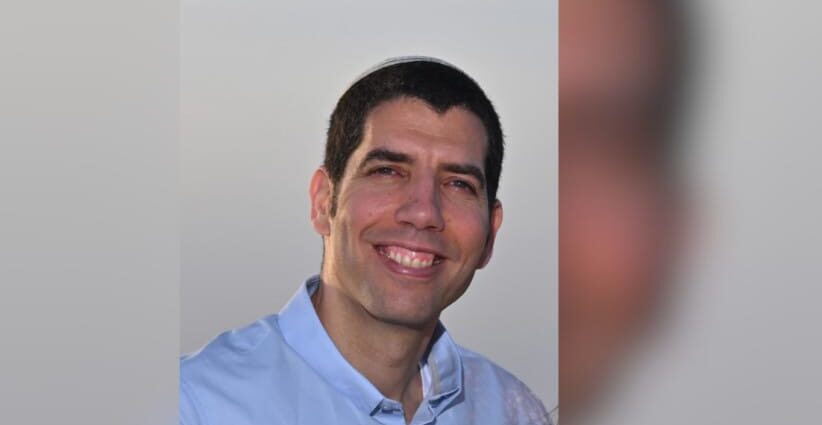
Ben-Gvir welcomes Netanyahu’s backing for terrorist execution
National Security Minister Itamar Ben-Gvir on Tuesday expressed his support for the execution of the terrorist who murdered Netanel Chkroun in Neveh Tzuf two days earlier.
“The path to victory over terrorism requires…creating strong deterrence. The gallows are an important tool in this struggle, as part of an overall change in approach,” said Ben-Gvir, adding that Prime Minister Benjamin Netanyahu had also expressed support for this.
No terrorist is immune to the consequences of carrying out terror attacks, Netanyahu said on Sunday, following the deadly shooting attack and an attempted car ramming near Jenin.
“Our security forces are currently pursuing the despicable terrorist who carried out the murderous attack in Binyamin,” he said. “No terrorist is immune, nor are those who aided them. We will settle the score with all of them: in Gaza, in Lebanon, and in Judea and Samaria.”
Son of Neveh Tzuf terror victim recounts how father’s warning saved his life
Terror victim Netanel Chkroun saved his son’s life by warning him of the terrorist’s presence at Neveh Tzuf, 16-year-old Yoav Chkroun told KAN News on Tuesday.
“We got into the car. Dad was sitting in the second row drying off, and I was in the front passenger seat. Suddenly, he shouted to me, ‘Yoav, there’s a terrorist here,’ or ‘Yoav, it’s an attack’ – something along the lines of ‘Run!’”
Yoav said that he hadn’t realized a terror attack was in progress until his father had shouted at him. By the time he realized, the terrorist was only a few centimeters away, right outside the car door.
“He opened fire toward Dad, during which time I passed between the driver’s side seats, opened the door, and ran away,” he said. “The terrorist kept shooting at me while I was running to hide between the bushes on the other side of the road.”
Yoav remained in hiding until after military forces arrived at the scene.
Miriam Sela-Eitam and Tzvi Jasper contributed to this report.

Trump expresses optimism on US-Iran deal during UN meeting with British PM Andy Burnham
US President Donald Trump said that Iran and the United States had been talking on Tuesday, and he thinks the two countries will reach a deal at some point.
Trump also told reporters that US officials, including Steve Witkoff and Jared Kushner, had had a “very good” three-hour meeting on Tuesday with the Iranian delegation.
“I think that a settlement is going to be reached,” Trump said after a meeting with British Prime Minister Andy Burnham on the sidelines of the UN General Assembly in New York.
“They want to talk to us. They have been talking to us; even today they’ve been talking to us, and the relationship is developing,” he added. “But we can’t let them – and they understand that – we can’t let them have a nuclear weapon.”
British Prime Minister Andy Burnham said on Tuesday he and US President Donald Trump had “established a good connection in our early discussions” despite their differences on some foreign policy issues as they met for the first time in New York.
Trump called Burnham a “natural business person” after their meeting where they discussed issues, including Ukraine, the status of the Falkland Islands and trade issues.
UK-US relationship a major foreign policy challenge for Burnham
“This relationship matters so much to us, and we’ll build on that,” Burnham said.
One of the biggest foreign policy challenges facing Burnham will be managing Britain’s relationship with the United States, but he and his officials are likely to be relieved that their first public meeting passed off smoothly.
Long regarded as one of the world’s closest alliances, the partnership has been strained by Trump’s foreign policy agenda, including the US-Israeli decision to attack Iran this year.
After their meeting, Trump again criticized Britain’s plan to resolve the status of a US-British military base on the Indian Ocean island of Diego Garcia, calling it a “terrible deal.”
Burnham has pledged to find a solution.
Britain last year agreed a deal to cede sovereignty of the Chagos Islands to Mauritius after more than two centuries of control, while retaining a 99-year lease over its biggest island, Diego Garcia, and its strategic military base.
But the legislation required to implement the agreement was paused because of opposition from the United States.
“I don’t support it. It was a terrible deal,” Trump said on Tuesday. “Somebody has ownership that never showed up before, after decades and centuries. I think it’s ridiculous.”
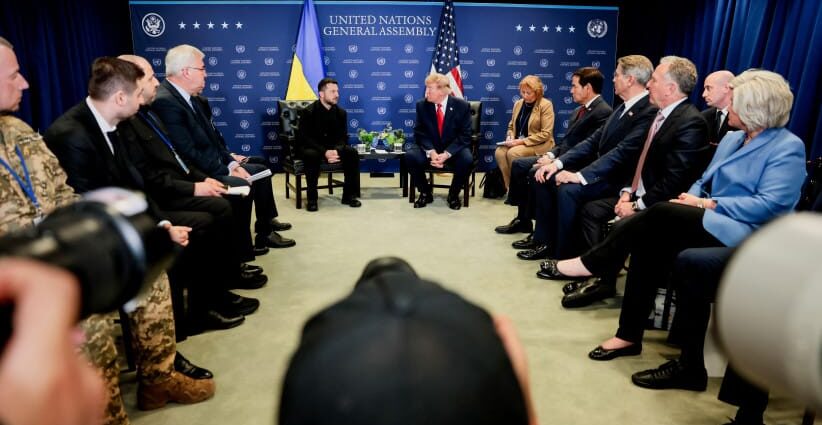
Trump expresses optimism on Ukraine peace deal at UN summit with Zelensky, says Putin will meet
US President Donald Trump on Tuesday told reporters that he and Ukrainian President Volodymyr Zelensky were talking about figuring out a solution to end Russia’s war in Ukraine.
The two men held a bilateral meeting at the United Nations in New York.
Trump was asked during the meeting, “Mr. President, last year at this assembly you said you thought Ukraine could take back all of its territory. Do you still think that’s the case, or what do you think they’ll have to give up in order for peace to be achieved in Ukraine?”
To which he responded, “Well, I think they’re going to reach a deal, and I don’t want to say what the deal will be. We talk about it a lot, including with President Putin, and I think something is going to happen. There’s no question they’re very good fighters.
“Really, they can be proud of themselves, regardless of what happens. We’ll see what happens. But these are very, very talented people.”
Trump: Putin willing to meet to end the war
According to Reuters, Trump said that Putin is willing to meet to end the war.
Additionally, Trump is expected to talk with Zelensky about the deployment of Patriot missiles in Ukrainian territory.
Election panel to weigh whether Balad leader Abu Shehadeh crossed legal line for Knesset run
The Central Elections Committee will hold a hearing on Wednesday on whether statements and publications attributed to Balad leader Sami Abu Shehadeh meet the unusually high legal threshold for barring a candidate from the Knesset, principally on the grounds that he supported armed struggle against Israel by a terrorist organization.
The vote is part of two days of hearings over who may compete in the October 27 election. The committee will first consider a request to disqualify MK Ofer Cassif, followed by the case against Abu Shehadeh and challenges targeting Ra’am, the Joint List and Balad. Requests against Otzma Yehudit, the Religious Zionist Party-Zehut list and the Democrats are scheduled for Thursday.
The proceedings ask a question broader than whether the statements and conduct cited against the candidates are offensive or extreme. Under Basic Law: The Knesset, a candidate or list may be barred for rejecting Israel as a Jewish and democratic state, inciting racism, or supporting armed struggle against Israel by an enemy state or terrorist organization.
The Supreme Court has interpreted those grounds narrowly because disqualification also deprives voters of the ability to choose that candidate. The prohibited position must be central to the candidate’s political activity and supported by clear, convincing, and unequivocal evidence. Courts have generally required a sustained pattern, rather than an isolated statement.
Otzma Yehudit’s request against Abu Shehadeh, the Balad chairman and third candidate on the Joint List, cites a broader record of statements and publications. Its central evidence, and the main focus of the attorney-general’s position, is an Arabic-language article he published on October 8, 2023.
Abu Shehadeh called October 7 an ‘important historic event’
In the article, Abu Shehadeh described the Hamas attack as an “important historic event” in military, political and strategic terms. He wrote that if “small and besieged Gaza” had succeeded in surprising Israel on that scale, others could do so more effectively and easily.
The applicants argue that the article praised the attack and encouraged others to learn from it. They also cited other statements, including a publication referring to Palestinians killed by the IDF as “righteous martyrs,” as well as Abu Shehadeh’s positions concerning Israel’s definition as a Jewish state.
Abu Shehadeh says the October 8 article analyzed Israel’s intelligence failure and warned against continuing the war rather than endorsing the massacre. In his written response, he said he opposes violence as a political method and acknowledged that the article’s failure to address the crimes committed on October 7 was “jarring” and wrong.
He argued that the full scale of the atrocities was not yet known to him when he wrote it and said he would have condemned them had it been clear. Regarding the “martyrs” publication, Abu Shehadeh said it opposed Israel’s targeted-killing policy and was not intended to praise any particular individual.
Attorney-General Gali Baharav-Miara and State Attorney Amit Aisman found that the evidence, particularly the October 8 article, indicated that Abu Shehadeh had expressed support for a terrorist organization’s armed struggle against Israel. They said his written explanation did not adequately establish that the article meant something else, particularly given its timing.
Their position nevertheless stopped short of expressly recommending that the committee disqualify him. It noted that previous disqualifications rested on a broad, long-term body of evidence showing systematic conduct, while telling committee members to give the request serious consideration under the legal tests and in light of Abu Shehadeh’s arguments.
Hearing centers on whether Abu Shehadeh’s conduct meets legal standard
That tension lies at the center of Wednesday’s hearing: whether the material attributed to Abu Shehadeh, led by an exceptionally grave publication at an exceptionally grave moment, can satisfy a standard generally requiring a sustained pattern of conduct.
The same demanding threshold led the attorney-general and state attorney to find no legal basis for any of the other disqualification requests. In their response concerning Otzma Yehudit, they described the material against the party as deeply troubling and said it brought the list dangerously close to the prohibited line.
They nevertheless distinguished between claims that Otzma leader Itamar Ben-Gvir should not continue serving as national security minister and the evidence required to exclude the party’s entire 35-member slate from an election. Conduct that may justify removal from a ministerial position does not automatically prove that an anti-democratic objective is a dominant purpose of the full candidate list, they argued.
Abu Shehadeh accused opposition parties supporting his disqualification of joining an attempt to silence Arab voters. He said he would continue pursuing a nonviolent political path. Yashar, led by Gadi Eisenkot, and Blue and White, led by Benny Gantz, have announced support for barring him. Yashar is not represented on the committee and will not participate in the vote.
Election committee to hear case amid compressed timetable
Abu Shehadeh sought to postpone Wednesday’s hearing because he was hospitalized following an injury. Committee chairman and Deputy Supreme Court President Noam Sohlberg rejected the postponement because of the compressed election timetable but permitted him to participate remotely.
The committee consists primarily of representatives of the factions in the outgoing Knesset, who will hear the arguments and vote. If it bars Abu Shehadeh, the decision will require Supreme Court approval before taking effect. A decision allowing him to run may also be challenged before the court.

Trump says he will ‘probably’ let banned media back to White House if court decides
US President Donald Trump said on Tuesday that he will “probably” let journalists from CNN, MS NOW, and Politico back into the White House if a court rules against his decision to ban the media outlets from the White House grounds.
The news stations were banned from the White House press pool on Friday; however, reporters from the new outlets covered his visit to the United Nations General Assembly using media passes issued by the UN, despite the TV news pool initiating a boycott against the president and filing lawsuits against the administration.
In response to this, the White House launched Trump TV: The Essentials, a livestream on the White House’s official YouTube channel, a move many critics derided as US “state television.”
“I’m surprised that CNN is here covering me, you shouldn’t be here,” Trump said on Tuesday as he entered the United Nations building and addressed a group of reporters. “You said you weren’t going to cover me.”
Trump announced the ban on Friday on social media, saying the three news outlets “shouldn’t be able to constantly write or report FICTION and LIES when they’re covering the President of the United States,” and defended it in another post on Monday.
Lawsuits filed against Trump administration, seeking First Amendment protections
CNN, MS NOW and Politico sued President Donald Trump and other members of his administration on Monday for banning them from White House grounds, saying the action violated their rights to free speech and a free press under the US Constitution’s First Amendment.
The news outlets are seeking a temporary restraining order to block Trump’s action in federal court in Washington, D.C., with a hearing scheduled for Wednesday.
“This ban could not be a more direct assault on the First Amendment nor a more blatant violation of our most fundamental constitutional principles,” the lawsuit stated.
“Left unchallenged, this threatens press freedom and the public’s right to independent journalism free from government interference,” the outlets wrote in a joint statement. “The government does not decide what the press reports or publishes.”
Trump announced the ban on Friday on social media, saying those news outlets “shouldn’t be able to constantly write or report FICTION and LIES when they’re covering the President of the United States,” and defended it in another post on Monday.
“The White House is not instituting an assault on the Free Press, something which I cherish. It is instituting an assault on the FAKE NEWS. It is a threat to our National Security, and must be stopped, NOW!” Trump wrote on Monday, without providing evidence of a national security threat.
Past presidents have battled with the press, but Trump’s campaign against the media has been unprecedented. He has upended decades of tradition by denying basic access to many major news organizations, launching personal attacks on journalists for their reporting and elevating media outlets seen as more sympathetic to the administration. He also has filed lawsuits against multiple news outlets.
The White House launched a “Trump TV” stream on Monday evening, days after Trump banned the media outlets from the White House.
The White House said the stream will run videos and highlights of what it calls the Trump administration’s achievements, but a press freedom advocate said it amounted to “a steady diet of government propaganda.”
A 60-second trailer displayed the Republican leader’s 2024 presidential win, and the first video streamed after the platform went live was Trump’s remarks on July 3 at Mount Rushmore. The stream had only about 8,000 live views 15 minutes after it was launched on YouTube.
“This just makes it even clearer that the real goal here is to ensure that the American public is fed a steady diet of government propaganda,” Jameel Jaffer, executive director of the Knight First Amendment Institute at Columbia University, said.
White House television pool
CNN is one of the five news organizations – along with ABC, CBS, Fox News and NBC – that make up the primary White House television pool. They share the costs of covering the president, take turns organizing coverage and share the footage with outlets around the country.
CNN had been scheduled to cover Trump’s trip to New York for the United Nations General Assembly on Monday, but was not able to provide a pool feed.
In response, the other major TV networks suspended presidential pool coverage. This effectively eliminated the most widespread video source for White House events just as Trump is set to meet with numerous world leaders on the sidelines of the General Assembly and host Chinese President Xi Jinping in Washington later in the week.
“This is to advise that, effective today (Monday), the TV pool will not be covering events designated as pool coverage of the President,” Bryan Boughton, who runs the Fox News Washington bureau and is the current TV pool chair, said in an email Monday. “There will be no replacement pool put in place.”
Otherwise, it was business as usual in the White House press room on Monday as reporters planned for the day’s events, including an afternoon ribbon-cutting ceremony for the Republican president’s new Marine One helipad on the South Lawn.
The audio on the White House’s own live stream of the ceremony, which it promoted as an alternative to the pool feed, was inaudible.
Trump’s party is seeking to retain its narrow majorities in both chambers of Congress in the November midterm elections. Polls show the public souring on Republicans and Trump’s own approval ratings stand near historic lows.
A person familiar with the matter, speaking on condition of anonymity, said Natalie Harp, a close presidential aide, showed Trump clips and graphics of recent news coverage, which contributed to his decision to ban the three outlets.
Trump has been “very unhappy” with coverage of the midterm elections, the person added, and his frustration intensified after last week’s Supreme Court ruling that blocked his attempt to limit mail-in voting.
“The Fake News has no place demanding a spot in the President’s Oval Office,” the White House said in response to Reuters questions about the lawsuit, Harp’s role and Trump’s views on election coverage. “They’re completely capable of reporting from directly outside.”
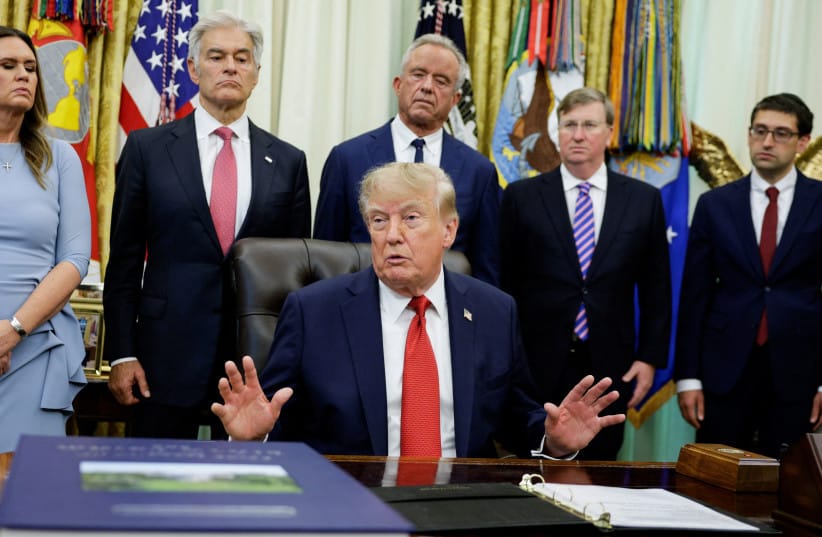
A united front
The affected news organizations moved quickly to present a united front. Within 10 minutes of Trump’s announcement on Friday, CNN reached out to MS NOW and Politico to discuss joint legal action, according to a person with direct knowledge of the matter, speaking on condition of anonymity.
“Banning news organizations from the White House prevents them from confronting government officials face-to-face and perhaps eliciting off-the-cuff unguarded comments that might shed new light on political matters, which is especially important during an election year,” said Victor Pickard, a professor of media policy and political economy at the University of Pennsylvania’s Annenberg School for Communication.
Last year, Trump banned the Associated Press from the pool of reporters that cover his movements because the news agency did not adopt his preferred name for the Gulf of Mexico. The AP has sued over the ban. His administration also has limited the access of many journalists to the Pentagon.
In his first term, Trump’s White House sought to take away the credentials of then-CNN correspondent Jim Acosta and Playboy correspondent Brian Karem. Federal judges ordered their White House press passes be restored.
The lawsuit was assigned to US District Judge Timothy Kelly, who was appointed by Trump in 2017. It was Kelly who ruled against Trump in 2018 in the Acosta case.
Longtime press critic
Trump has stepped up his actions targeting the media since winning a second term, suing multiple outlets and repeatedly urging broadcasters to drop programs he deems unfair.
He has called on the Federal Communications Commission to strip disfavored broadcast stations of their licenses.
David Ellison, son of Trump ally and Oracle ORCL.N Executive Chairman Larry Ellison, took control of Paramount and its CBS News unit, leading to a shakeup at “60 Minutes,” the most popular US TV news magazine.
Ellison is now seeking to acquire CNN parent Warner Bros., in a move approved by Trump’s administration.
Jerusalem: The jewel in the crown – opinion
Walking through Jerusalem’s busy Mahaneh Yehuda market on the eve of Yom Kippur, the thought struck me that probably no one in Israel would think of apologizing in prayer to east Jerusalemite Palestinians for what Israel has imposed on them since 1967. Nor, indeed, would most Israelis even be aware of the war crimes, or crimes against humanity, which its ethnic cleansing policies have been incurring since that time of conquest and annexation.
To understand Israeli policies of forcible displacement, one must return to those blindly euphoric days of Israel’s 1967 victory. Set out in Chapter 3 of Separate and Unequal, Amir Cheshin, mayor Teddy Kollek’s adviser on Arab affairs, together with Bill Hutman and Avi Melamed, describe in detail the principle behind the zoning and planning of newly conquered east Jerusalem.
The concept was “maximum land, minimum population,” denying the false public statements of unity, while sowing the dragons’ teeth today being harvested – especially by those Palestinians who have been “minimized.” So only 13% was zoned, of the 70 sq.km. newly configured as east Jerusalem, for Palestinian residential purposes: land already almost totally built up.
Meaning that nearly all Palestinians in east Jerusalem live in “illegal” buildings, without building permits, on land they own and for which they pay arnona (city taxes), but which is zoned as a green area, or for Israeli settlements or frozen land reserves.
Palestinian neighborhoods in Jerusalem
This explains why there is a dire lack of affordable housing for Palestinians in their city, unless they move to the northern side of the wall (separation barrier to some, apartheid wall to others) where the high-rise slums of Kafr Akab or Shuafat Refugee Camp, housing some 150,000 people, threaten to come crashing down in the next major earthquake.
Israeli peace NGO Ir Amim’s report “Planned Negligence” reveals that one-third of east Jerusalemites have been forced there, while Israel’s 2040 Strategic Plan has almost no plans for Palestinian neighborhoods. It “has essentially sentenced hundreds of thousands of Palestinian residents of Jerusalem to the ever-worsening planning chokehold.” This “will drastically exacerbate the crisis beyond the already-astronomical cost that planning discrimination currently exacts from east Jerusalem’s residents.”
Arieh King recently told Sky TV that he wants to demolish all “illegal” buildings in east Jerusalem – the number estimated at 20,000. His vision for Jerusalem, expressed to BBC Panorama in A Walk in the Park, is a “Judaized” city, with “Jews all over! All over!”
A settler, leading east Jerusalem’s Ma’aleh Hazeitim settlement on the Mount of Olives, he overlooks Silwan’s Al-Bustan neighborhood. During his recent term as deputy mayor, demolitions in Al-Bustan sped up, so that half the neighborhood – over 60 homes – is now a ghostly reminder of Gaza, referred to by 10 UN Special Rapporteurs as “de-Palestinization of Jerusalem.”
The responsibility of the international community
This issue of “Judaization” or “de-Palestinization” of Jerusalem (i.e., ethnic cleansing) is not addressed by the international community’s belated attempt to ensure the viability of a two-state solution nor referred to in the furor over E1 development.
The core issue of ethnically displaced Jerusalemites, impacting a future, viable Palestinian state, is totally overlooked. Even if the construction of settler homes, hotels, and an industrial zone in the E1 area is by some miracle reversed, the two-state solution could not survive if Palestinians are removed from Jerusalem. The two issues are inseparable.
E1 development is geared to prevent access from the West Bank into the city (north and south access are already efficiently blocked), with that eastern corridor estimated to be a lifeline valued at 35% of a future Palestinian economy due to tourism revenues.
Massive E1 building would also facilitate an Israeli-only wedge from Tel Aviv to Jordan – hence Prime Minister Benjamin Netanyahu’s knee-jerk response in 2012 to Palestine’s UN observer state status: “We will develop E1!”
But where is international outcry calling out Caterpillar or JCB bulldozers for their role in displacing Palestinian landowners? Why is international objection only focused on Gaza and the West Bank?
And, despite welcome new moves from words to action by the UK and others, Palestine is still burning, homes in Al-Bustan are disappearing, state-sponsored settler terrorists roam viciously free, while the two-state solution is becoming a historical concept whose demise they enable.
The UK and other countries must be guided by the mineshaft’s canaries – the humanitarian community, Israeli, Palestinian, and international human rights actors, and the world’s highest court in The Hague – pressing their third state responsibility to uphold international law and end the Israeli occupation and its racist control mechanisms. This must be done to safeguard Jerusalem, jewel in the crown of both nations, and save our options for peace.
Those 10 UN Special Rapporteurs warn about the de-Palestinization of Jerusalem: “These acts must be understood in their totality: the ethnic cleansing of Palestine, by whatever means, whatever the cost, and whatever crimes it takes. This environment is coercing Palestinians to leave their homes and life in a city where their roots run deep.”
The experts urge immediate international action, warning: “What is erased now – the richness of Jerusalem’s communities, heritage, and rights – will not be restored. Inaction is not neutrality; it is complicity.”
The writer is an Anglo-Israeli peace activist; previously a radio interviewer for BBC arts “Meridian” and a West End actor, she immigrated in 1981 from Johannesburg where, as an anti-apartheid activist, she acted in Neighbours in Soweto.

SpaceXAI’s Grok Bot Gains Early Traction

Most of us don’t own a stadium – opinion
On September 4, Macklemore opened for Ed Sheeran at MetLife Stadium in New Jersey, telling the crowd he had joined the tour to stand in stadiums like that one and say two words: “Free Palestine.”
He then performed “Hind’s Hall” with footage from Gaza on the screens, and the next night, he did it again.
That weekend, IAC launched a petition asking Sheeran, his promoter, and the venues to remove him from the remaining dates, and more than 18,000 people signed while more than 11,000 clicked through to write to MetLife Stadium.
On September 14, Macklemore announced he was off the tour after a phone call from Robert Kraft.
Since then, some community members have asked me a version of the same question: if one phone call from Kraft settled it, did the petition matter at all?
I understand the instinct, but it measures a signature by one standard only – did it decide the outcome? – and by that standard, almost nothing an ordinary citizen does matters, since one vote rarely decides an election, and yet no one concludes that we should stop voting.
We vote, write, sign, and show up not because any single act settles the question, but because a public that acts is a public decision-makers must account for, while a public that doesn’t can be ignored.
That is the lesson I want our community to take from this month, and it is the opposite of the one some are drawing.
Most of us don’t own a stadium, and most of us will never make a phone call that changes a tour, so if the takeaway is to wait for someone with that kind of power, we have taught thousands of people that their job is to watch.
What most people do have is a name, a phone, an inbox, and a vote: they can sign, they can write to a venue, a sponsor, a school board, a member of Congress, and they can show up to a meeting and speak for two minutes.
Those are the tools of citizenship, and too many people don’t know they have them, or don’t believe they count.
That is why creating a petition matters, not only signing one, since it is a door that shows someone who has never acted what acting looks like.
I believe that if 100,000 people had signed, the tour would have felt it, with or without Kraft, because venues, promoters, and sponsors answer to audiences, and even a call like Kraft’s carries weight only because a community stands behind it.
Look at who never asks whether speaking up is worth it: Macklemore doesn’t own a stadium either, yet he treated a stage as a tool and said so.
He didn’t need 10 shows; he needed two – and when he was dropped, Finneas, Lukas Graham, and other supporting acts withdrew in protest, with no one on that side debating whether their statements “mattered.”
They act first, and they don’t wait to be sure it will work.
Your voice matters
I came to New York 17 years ago, at 27, as a lawyer, knowing almost nothing about Jewish life outside Israel, and what struck me was how much this community did for Israel, and how much of it rested on ordinary people.
Yes, some donors gave $18 million, but there were also thousands who gave $18, and no serious fundraiser has ever concluded that the $18 gifts don’t matter because the $18 million gift closed the campaign.
Some $18 donors will always stay $18 donors because that is what they can afford or the level of their interest, while some will grow into major donors. And either way, the community needs them, and it needs the first gift that brought them in.
A public voice works the same way: some signers will always be the person who does the 30-second thing because that is the time they have, while some will grow into leaders because someone handed them an easy first step.
Both count, and neither happens if no one asks.
So ask yourself: When the next fight comes (and it will), who will already know how to write the letter, who will know where the meeting is, and who will believe their name counts?
Sign. Write. Show up. Not because your voice alone decides the outcome, but because a community that waits for someone else to do the work has already decided it.
The writer is the chief operating officer of the Israeli-American Council (IAC), which launched the petition calling for Macklemore’s removal from Ed Sheeran’s tour and represents more than 150,000 Israeli-Americans nationwide.

A request for Israel amid elections: Help us help you – opinion
As a proud and active American Zionist Jew who spends a great deal of time in Washington, and particularly on Capitol Hill, I have learned that words spoken in Israel do not remain in Israel.
They travel instantly across the Atlantic, stripped of their context, translated into headlines and placed before members of Congress who are already under growing pressure to distance themselves from the Jewish state.
Israel’s political culture has always been robust, direct, and intensely democratic. Its representative democracy remains an extraordinary example – not only in the Middle East but far beyond it.
Israelis argue loudly because the questions confronting their country are real, consequential, and frequently existential.
However, there is a difference between a vigorous democratic debate and the use of extreme language or radical proposals designed primarily to win a few more votes.
During an election campaign, politicians naturally seek attention and differentiation. Yet sensational statements may provide a brief domestic advantage while inflicting lasting international damage.
This is particularly dangerous now. Israel’s election on October 27 will be followed a week later by the American midterm elections on November 3. Every seat in the House of Representatives and a third of the Senate will be contested.
At a moment when support for Israel is increasingly debated within American politics, inflammatory Israeli campaign rhetoric can quickly become material for candidates seeking to turn the Jewish state into a partisan issue.
The warning signs are already unmistakable.
In July, 103 Democratic members of the House voted for an amendment that would have removed $3.3 billion in American assistance to Israel. The amendment failed, but the vote demonstrated how dramatically the conversation has changed.
Now, as a proposed $2.8 billion munitions sale to Israel is being considered by congressional committees, Israel’s friends are again being asked to defend the vital strategic and moral foundations of the alliance.
Those of us who work day and night to defend and protect the Jewish state are hearing difficult and honest messages, including from some of Israel’s closest friends. We explain that many of the most incendiary declarations are election rhetoric rather than government policy.
However, this explanation has its limits.
The most provocative statement will always travel further than the subsequent clarification. It becomes a headline, a social-media clip, a fundraising appeal and, eventually, an argument for changing American policy.
Words intended to excite one constituency in Israel can undermine support among millions of people abroad.
A request for Israel
Israel faces no shortage of serious issues worthy of serious debate.
Its citizens must determine how best to confront continuing security threats on multiple fronts, rebuild a country damaged by three years of war, restore economic confidence, address the responsibilities of military and national service, heal deep social divisions, and define the country’s legal and constitutional future.
None of these challenges require political extremism, theatrical threats, or promises of radical solutions that could never be implemented.
I write this with humility. I am not an Israeli citizen, and it is neither my place to tell Israelis how to vote nor to dictate how their democratic debate should be conducted.
Israelis bear the risks, send their children to defend the country, and live with the consequences of the decisions made by their elected leaders.
My appeal is therefore not an instruction, but a request: help us help you.
Please understand that Israel has stakeholders beyond its borders, people who invest their time, resources, reputations, and relationships in strengthening the Jewish state.
When Israeli politicians speak responsibly, they give us the tools to make Israel’s case. When they compete to make the most sensational declaration, they make that task immeasurably harder.
Beyond the elections, there is also reason to hope that the present political uncertainty may produce something better: a broad, representative national Zionist coalition capable of leaving the extremes outside government and addressing Israel’s challenges with seriousness, competence, and shared purpose.
Such a coalition would not require Israelis to abandon their ideological differences. It would demonstrate that, at a moment of historic consequence, the Zionist majority can unite around the security, democratic character, and future of the state.
Crucially, this is also the kind of government that could represent the true Israel to the world and to Israel’s friends on Capitol Hill: not the Israel of the loudest slogan or most outrageous quotation, but the Israel of a proud, resilient, responsible, and fundamentally pragmatic majority.
Israel’s enemies eagerly amplify every reckless remark. Its friends are left to explain it. Israel’s leaders can make our task easier without compromising a single principle or surrendering a single legitimate political argument.
We will continue to stand with Israel and stand behind and with the elected leadership.
We are simply asking those seeking the privilege of leading it to remember that their words matter far beyond the ballot box.
Help us help you.
The writer is a Los Angeles-based philanthropist and real-estate developer who serves as chairman of the Abraham Accords Roundtable and Golda Meir Commemorative Coin Committee in Washington, DC.

‘NAZA’ film controversy: Israel, Gaza, and the debate over collateral damage – opinion
The totally disproportionate reaction in Israel to the documentary film NAZA, formally produced and presented by Britain but written and directed by two Israeli filmmakers in their early 30s, Yuval Abraham and Rachel Szor, calls for comment.
The film won the special Jury Prize at the 83rd Venice International Film Festival on Saturday, a week and a half ago, and received an unprecedented 25-minute ovation. In Israel, it was perceived as a catastrophe for Israeli hasbara (public diplomacy).
The film is based on the recorded evidence given by 24 anonymous former Israeli soldiers, officers, and intelligence personnel. This evidence deals with what is known in military lingo as “collateral damage,” or in Hebrew nezek agavi, the Hebrew acronym reads in English as NAZA.
Collateral damage refers to what are considered “acceptable” civilian casualties when military targets are being targeted from the air, and how such decisions are taken – whether by human beings, automatic surveillance, or AI-operated systems.
The reason this issue has received so much international attention and domestic interest within certain circles in Israel is that the number of Palestinians killed in the Gaza Strip following the Hamas-led massacre and abduction of Israelis from the Gaza border communities on October 7, 2023, and the subsequent war since, has reached over 70,000 persons.
The problem is that at least two-thirds of these 70,000+ fatalities are believed to be “non-involved” civilians, who may be considered to be “approved” collateral damage victims.
I say non-involved in quotation marks, because there are large sections of Israeli society that do not believe there is such a thing as Palestinians in the Gaza Strip who are not involved, one way or another, with Hamas and its activities.
I happen to believe that just as not all Israelis can be held responsible for acts of wrongdoing associated with what our government does, or held responsible for a genocide against the Palestinians that was not and is not being planned or committed by Israel, the Palestinians are not all responsible for the crimes of Hamas.
So even though there are no lovers of Zion among the Palestinian inhabitants of the Gaza Strip, the Palestinians as a whole are not responsible for the crimes of Hamas.
Like most other people, journalists and non-journalists who have commented on NAZA and reacted to it, I have not actually seen the film, and my information comes from sources I consider reliable.
At the same time, I believe that even without having seen the film, we can assume, based on its subject matter and what Abraham and Szor have said about the film, that they are disturbed by the excessive number of Gazan civilians killed in Gaza since October 2023, and the way “collateral damage” is defined by the IDF for military purposes in the Gaza Strip.
We can also assume that, since both Abraham and Szor were among the four winners (including two Palestinians) of the Oscar Award for Best Documentary Film in February 2025 for No Other Land, they are among the Israelis who are perturbed by Israel’s apparent (though undeclared and not admitted) policy of changing the status of large sections of Judea and Samaria to the detriment of the Palestinians.
The film records the events that led to the gradual destruction by the IDF of a location called Masafer Yatta in the southern Hebron hills, and the de facto expulsion of most of its Palestinian population.
Criticism across the board
Holding the critical positions about the Israeli government and the IDF that the two filmmakers hold is not in itself a crime. It certainly does not call for severe punishment. I believe it is evidence of the existence of free speech in a democracy.
Nevertheless, Prime Minister Benjamin Netanyahu was quick to propose a bill to implement citizenship revocation for defaming IDF personnel, along with another bill that would increase the fines on defamation charges 20-fold.
Netanyahu also criticized the opposition parties (especially the Democrats) for failing to condemn the film and its makers, even though neither he nor they had yet seen the film.
Culture and Sports Minister Miki Zohar was also quick to demand citizenship revocation from the Interior Ministry (since there has been no serving interior minister in Israel for over a year, the demand was referred to Netanyahu).
He approached Shin Bet (Israel Security Agency) head David Zini to open an urgent investigation concerning the source of the information and materials used in the film – i.e., the 24 persons who were anonymously interviewed.
This, of course, makes some sense, given that the 24 allegedly disclosed secret security information and that some of it was false, as some military sources have claimed, based on reports by those who actually saw the film.
There is no doubt that the current onslaught on Abraham and Szor deserves to be described by the Hebrew term aleihum, which means frequently unjustified, harsh criticism, and slander.
Nevertheless, even though I sympathize with the basic motivation of the two, based on past personal experience from activities I participated in over issues concerning Arab-Israeli, Palestinian-Israeli relations and peace-making efforts, I believe that unless you are completely reckless and irresponsible, you must take into consideration the possible legal implications of your actions – for yourself and for others.
In the current case, the 24 interviewees (should their identities be uncovered) are the most likely to suffer the most serious consequences, as they divulged information obtained while serving in the relevant military and intelligence units, and they could even be found to have committed treason.
Furthermore, though the alleged motivation for divulging such information is, under the circumstances, to stop what one believes to be a serious breach of international law – whether advertently or inadvertently – by one’s state, in fact, serious, irreversible damage might be done to the state, given that those viewing the film are not necessarily neutral bystanders who merely seek justice.
Incidentally, one argument Abraham made in an interview with Raviv Drucker from Channel 13, after the latter watched the film and expressed some reservations about it, is worth mentioning.
Abraham argued that NAZA might have been superfluous had the free media in Israel opened the issue of collateral damage in the early stages of the Israel-Hamas war. Drucker, well known for his serious investigative reporting, admitted that Abraham was right, and that not enough had been done.
Nevertheless, the question remains whether deeper delving into the issue by the media would have helped.
So far, the media delving into the issue of Jewish violence against Palestinians in Judea and Samaria, and the failure of the authorities to react effectively, has not stopped the violence, even though it has been accompanied by condemnations by both Netanyahu and Chief of Staff Eyal Zamir.
The writer has written journalistic and academic articles, as well as several books, on international relations, Zionism, Israeli politics, and parliamentarism. From 1994 to 2010, she worked at the Knesset Library and the Knesset Research and Information Center.
ShinyHunters hackers say they breached Federal Bureau of Investigation, no immediate FBI comment
The hacking group known as “ShinyHunters” says it has breached the Federal Bureau of Investigation and claims to have stolen data on thousands of FBI employees.
The bureau did not reply to repeated messages seeking comment on Tuesday.
This is a developing story.

Saudi Arabia turns to Israel as Houthi attacks expose limits of the Mecca Pact – opinion
On August 7, Saudi Arabia, Turkey, and Pakistan signed a joint defense agreement, known as the Mecca Pact. At its public core is a political commitment modeled in part on NATO’s Article 5 – namely, an armed attack on one party is to be regarded as an attack on all.
On September 8, the Houthis launched a major wave of attacks against Saudi Arabia, striking civilian and economic sites and energy infrastructure in several southern cities. Subsequently, the country has been attacked time and again by the Houthis. Civilian and economic facilities have been struck; King Khalid Air Base and Aramco facilities have been targeted.
Why have Turkey and Pakistan not rushed to Saudi’s defense?
Rather like the small print on insurance policies, the Mecca Pact seems to exclude as much as it offers. The publicly released description of the agreement, while making much of the NATO-like commitment, does not specify an automatic military response should one of the parties be attacked. Nor does it publicly stipulate the circumstances in which troops must be deployed. In fact, the full text of the agreement has not been released, so important questions about its scope and implementation remain obscure.
Rather late in the day, on Saturday, Lt. Gen. Ahmed Sharif Chaudhry, chief spokesman for Pakistan’s military, is reported as saying, “Pakistan fully stands with the Kingdom of Saudi Arabia, both diplomatically and physically…We will go to any extent.”
But the statement, whatever it meant, was too late. Given the ambiguities inherent in the Mecca Pact, and the obvious reluctance of either Pakistan or Turkey to become involved in a military operation in Yemen, it is not surprising that Saudi Arabia turned to Washington for support that subsequently connected it to Israel.
CENTCOM is the US military command responsible for the Middle East and parts of Central and South Asia. It directs US military operations and security partnerships in that area.
Sometime during the week of September 7, at a secluded ski resort in Germany (rumored to be Garmisch-Partenkirchen), CENTCOM’s commander, Admiral Brad Cooper, hosted a conference of senior military leaders from eight countries.
It is extraordinary, but the fact that sitting round the same table were Lt. Gen. Eyal Zamir, the IDF chief of staff, and military chiefs from Saudi Arabia, UAE, Bahrain, Kuwait, Qatar, Jordan and Egypt. CENTCOM, functioning as an intermediary, had succeeded in connecting Israel with Arab militaries that do not have diplomatic relations with it – in particular, Saudi Arabia and Qatar.
According to a report by Axios, the respected digital news outlet, the central purpose of the conference was to discuss the continuing US-Israeli war with Iran, and the broader regional-security situation.
Cooper reportedly assured those present that, despite Iranian attacks on US bases, the US would retain forces in the Middle East. He also primed the group on plans to expand maritime traffic through the Strait of Hormuz.
Zamir is said to have briefed the participants on IDF operations on several fronts.
Axios further reports, citing “a source with knowledge of the matter,” that Israel and Saudi Arabia, with CENTCOM assistance, began discussing how Israel could assist Saudi military operations against the Houthis. The possible support mentioned is ISR (intelligence, surveillance and reconnaissance), on the lines of the assistance that Israel has reportedly provided to the UAE.
US agrees to assist Saudi Arabia
On September 14, Saudi Crown Prince Mohammed bin Salman met Cooper in Jeddah, amid the rapidly worsening Houthi offensive. The next day Reuters reported that Washington, while declining to conduct direct US strikes against the Houthis, had agreed to provide Saudi Arabia with targeted assistance.
That same day, September 15, The Jerusalem Post reported that Israel and Saudi Arabia had held CENTCOM-mediated discussions about Israeli intelligence assistance to Riyadh against the Houthis. Regional diplomatic sources had told the paper that the Saudi side was seeking intelligence that could help build a picture of Houthi deployments, and thus anticipate future operations.
A similar report emanated from the Institute for the Study of War in a document published jointly with the Critical Threats Project at the American Enterprise Institute. It commented that this prospective arrangement would: “…resemble Israel’s current intelligence support relationship with the United Arab Emirates.”
There is no doubt that the Iran war is creating an unusually powerful common-security denominator. The countries represented in CENTCOM’s conference have very different political relationships with Israel, but they share an immediate security problem: Iran. Iranian-aligned armed groups have acted against some of them and are capable of threatening all.
Israel possesses substantial intelligence and surveillance capabilities concerning Iran and its regional partners. Saudi’s cities and energy infrastructure have been struck repeatedly by Houthi missiles and drones. CENTCOM possesses the command-and-control machinery that can connect Israel and Saudi Arabia.
Although Saudi Arabia still has no formal diplomatic relations with Israel, the emerging arrangement potentially constitutes a major step in Saudi-Israeli military normalization. Israeli intelligence is being used to help defend Saudi Arabia against the Houthis, even without diplomatic normalization.
This arrangement gives Saudi Arabia considerable political cover. Publicly, its relationship with Israel can remain highly constrained; operationally, cooperation can become increasingly sophisticated.
So the present position, according to media reports, is that Saudi Arabia is being offered direct targeted support by the US, while CENTCOM is mediating Saudi-Israeli discussions on intelligence assistance against the Houthis.
Saudi-Israeli collaboration is nothing new. There is a 60-year history of covert strategic cooperation. But the Saudi-Israel connection remains as delicate as it has ever been. It is not any form of military alliance, nor has there been any change in Saudi policy on formal normalization. In fact, reports emanating from Saudi sources suggest that Riyadh, even while seeking Israel’s help against Houthi attacks, is still resisting movement on normalization.
Meanwhile, the law of unintended consequences is in full play. While the Houthis continue their strikes on Saudi Arabia and make territorial gains in areas surrounding one of the world’s critical maritime choke points, the Bab el-Mandeb, they are inadvertently fostering greater military cooperation than ever before between Israel and Arab states, and both reviving and strengthening Israel’s covert security links with Saudi Arabia.
The writer, a former senior civil servant, is the Middle East correspondent for Eurasia Review. Follow him at: www.a-mid-east-journal.blogspot.com.

Gaza’s back-to-school coverage misses the crucial test: what are children being taught? – analysis
Gaza students returned to in-person schooling last week for the first time in nearly three years. This could be a moment of promise – or one of more of the same.
The promise would come if the schools – instead of indoctrinating children to hate Jews and Israel, as Israel and educational monitoring organizations have long alleged and documented – taught reading, writing and arithmetic while instilling tolerance rather than glorifying violence.
The more-of-the-same moment would come if the school venues changed, but the curriculum did not.
Reuters ran a story on Monday under the headline, “Gaza students return to in-person schooling for the first time in three years.”
The story was entirely predictable, describing the lack of functioning school buildings, the need to study in makeshift tents, and how many families could not afford school uniforms, notebooks, and pens. It also told the stories of children trying to resume their studies amid displacement and fear.
Gaza death toll numbers unverified, produced by Hamas-affiliated groups
All of that is worth covering, as is the return of hundreds of thousands of children to some form of organized education. But it is only part of the story.
Reuters cited UNICEF as saying that 98% of Gaza’s schools were either destroyed or damaged during the war. It also reported that some 22,000 students and more than 770 education workers, including 532 teachers, had been killed, attributing those figures to Ibrahim Ramadan, the education director for East Khan Yunis.
But it did not explain that Ramadan is an official in Gaza’s existing Hamas-era education bureaucracy, how the figures were compiled or independently verified, and whether any of the education workers were also members of Hamas or other terrorist organizations.
The article also cited a Palestinian death toll of more than 73,000 without estimating how many were Hamas combatants or identifying which “Palestinian authorities” supplied the figure – likely the Hamas-run Gaza Health Ministry.
An average reader could therefore walk away from the story feeling a great deal of sympathy for the Palestinian students – understandably – and anger at Israel for destroying schools and killing students. But that reader would be given little context for why so many schools were struck or damaged, how many were used for military purposes, or how deeply Hamas embedded itself in Gaza’s civilian infrastructure.
Only in the final sentence did the article mention that Israel “has repeatedly accused Hamas of using schools for military purposes.” That point was immediately followed in the same sentence, in perfect he-says/she-says fashion, by the words “which Hamas denies.”
The result is a familiar picture: weak, victimized Palestinians on one side and a powerful Israel on the other seemingly destroying Gaza’s schools in a vacuum.
But even that is not the most troubling omission.
What is being taught in these schools?
The most troubling omission is the article’s complete silence about what is being taught in these reopened schools, who is doing the teaching, and who is deciding what goes into the curriculum.
That is the real story.
For Gaza to have any chance of a different future – for the hundreds of thousands of children returning to school to have a better future than the one Hamas has condemned them to – it is not enough merely to reopen classrooms.
Rebuilding the same educational system, using the same textbooks, employing the same teachers without proper vetting, and transmitting the same messages would not change anything. Rather, it would rebuild the ideological foundations for the next October 7.
As one senior US official, invoking a line commonly attributed to Lenin, put it at the recent Middle East America Dialogue (MEAD) conference in Washington: “Give me a child for eight years, and I’ll give you the future forever.”
Whether Lenin actually said those precise words is less important than the truth behind them: Whoever educates the children shapes the future.
For Gaza ever to have a chance, it must free itself from an educational culture that demonizes Jews, denies Israel’s legitimacy and presents violence and “martyrdom” as heroic. The path to changing that culture runs through schools.
A senior Israeli participant at the MEAD conference called the deradicalization of Gaza the “most important thing” in US President Donald Trump’s 20-point plan. He argued that Gaza’s physical rehabilitation must be directly linked to its ideological rehabilitation.
“If we don’t do this, the process will fail,” he said.
“That’s how you win the peace: You deradicalize Gaza, and you do what hasn’t been done for 30 years in the education system and in the mosques,” he added, stressing that this would take a generation, not merely a year, two years or three.
That is the challenge.
Gaza needs terror-free schools that teach tolerance. It needs textbooks that do not erase Israel, teachers who are not affiliated with terrorist organizations, and classrooms where children are taught how to build a future rather than sacrifice themselves trying to destroy someone else’s.
None of that appeared in the Reuters article, even though it’s an important part of any story about Gazans’ first day back at school.
The important question is not only whether Gaza’s children are back at desks in schools – makeshift or otherwise – but what they will be taught while sitting at those desks. That is also a critical test of the much-discussed “day after.”
Hamas can lose its tunnels, rockets and weapons yet retain enormous influence if it continues to educate the next generation according to the worldview that produced October 7.
Trump’s 20-point plan declares that Gaza must become a “deradicalized, terror-free zone” that poses no threat to its neighbors. Yet the plan does not spell out in any detail who will rewrite or approve textbooks, who will vet teachers, who will monitor classrooms, or what standards will be used to determine whether incitement has actually been removed.
Reuters reported that Gaza’s Education Ministry, backed by international and local organizations, was moving ahead with the 2026-2027 school year. It said at least 540,000 students were expected to attend makeshift private schools, temporary learning centers and other educational points with UNICEF support.
But providing tents, supplies and educational support is not the same as controlling the curriculum.
UNICEF has not replaced Gaza’s Education Ministry. UNESCO has not assumed control of the school system. And Gaza’s proposed technocratic administration – still operating from Cairo rather than inside Gaza – does not appear to have taken responsibility for determining what children are being taught.
In other words, Gaza’s children are returning to a school system that, as far as can be seen publicly, has not undergone any fundamental ideological transformation since October 7.
There is no publicly visible, independently enforced program to ensure that incitement, antisemitism and the glorification of terrorism have been removed from the textbooks; no transparent mechanism for vetting teachers; and no outside body regularly monitoring what is taught inside the classrooms.
Until there is, reopening Gaza’s schools may return its children to classrooms, but it will not give them – or Gaza – a different future.

UN report alleges Gaza war worsened sexual violence risks for Palestinian women
Security measures taken by Israel following Hamas’s October 7 attack, Israeli and American humanitarian efforts, and the displacement of Gaza’s civilian population during the war have increased both the severity and frequency of Gender-Based Violence (GBV) experienced by Palestinian women in the territory, the United Nations Population Fund alleged in a report released last week.
Based on information collected from 230 displaced adult women who participated in group discussions hosted by the Women’s Affairs Center between December 2025 and January 2026, UNFPA concluded that Israel’s military response to Hamas had resulted in Palestinian women being subjected to violence by family members, members of the community, and individuals involved in security and aid delivery.
Despite investigations by the New York Post, Daily Mail, Associated Press and other international media outlets documenting allegations that Hamas members and individuals working for international aid organizations unaffiliated with Israel or the United States sexually exploited Palestinian women and children in Gaza, including by allegedly offering food, medicine or employment in exchange for sex, the report made no mention of Hamas, the Palestinian terrorist organization that has ruled Gaza for nearly two decades.
UNFPA acknowledged that women participating in the group discussions would be unlikely to disclose violence committed by armed groups, meaning that the “findings should therefore not be interpreted as indicative of the prevalence or absence of GBV perpetrated by Palestinian armed actors.”
Even before the war, Palestinian women and girls faced ‘substantial GBV risks’
The report nevertheless acknowledged that, even before the war, Palestinian women and girls faced “substantial GBV risks due to deep-seated gender norms that position women as subordinate to men, limit their autonomy and freedom of movement, and normalize male control over women’s bodies, resources, and decision-making.” These norms, it said, were “embedded in legal, social, and cultural systems.”
According to documents published by UN Women in 2019, outdated laws in the Palestinian territories have long deprived Palestinian women of mechanisms to hold their abusers accountable. A 2019 UNFPA survey found that nearly two-thirds of married women in Gaza had experienced domestic violence, amid the absence of a law criminalizing the abuse.
The latest report also noted that the widespread destruction of Gaza’s infrastructure during the war had severely disrupted legal, healthcare, and education systems that previously provided support and protection for women and girls. These disruptions, it said, had deprived women of mechanisms to hold perpetrators accountable and denied rape survivors access to essential services. However, it is not clear what mechanisms UNFPA was referring to, as there is no law in the Palestinian territory that specifically criminalizes domestic violence.
Highlighting the norms and lack of proper legal protections, one woman said she reported a man who pressed against her to camp authorities but was told by women in the camp and her neighbors that she had “exposed” herself to the harassment.
“I’m really confused about this society. I’m forced to keep quiet,” she said.
Palestinian women and girls are also at greater risk of sexual violence as a result of the severing of community and familial protections, the report found. The “overcrowded, unsafe and undignified” living conditions in displacement camps have reportedly contributed to an increase in rapes, assaults, domestic violence and sexual harassment.
Israel has issued evacuation orders directing civilians away from conflict zones or Hamas infrastructure, which is frequently embedded in or underneath civilian sites. Though Israel has insisted the measures are designed to minimize civilian casualties, critics have condemned them for uprooting and disrupting Palestinian communities.
The report also alleged that Israel’s “blockage of aid” had intensified shortages of food and other essential resources, creating economic desperation that could be exploited. UNFPA said this had reportedly contributed to increases in sexual exploitation, economic abuse, survival sex and forced marriage.
One woman said that her family had begun marrying off girls young as they couldn’t afford to feed or provide for them, while another woman said she was aware of women being denied the opportunity to marry as her father wanted to continue taking her salary for himself.
Resource scarcity has reportedly contributed to a rise in survival sex, child, early and forced marriage, denial of marriage, the exploitation of widows, divorcees and wives of detainees, as well as domestic violence and economic abuse. UNFPA alleged that Israel’s decision to bar 37 aid groups in Gaza that refused to comply with its registration law had worsened the deprivation, despite documented evidence that some humanitarian workers were also members of Hamas.
The report also criticized “Israel’s attempts to create a parallel aid distribution system and restrictions imposed by Israel on established humanitarian actors,” which it said had weakened the safeguards designed to prevent sexual exploitation and abuse.
Though the Coordinator of Government Activities in the Territories has not yet responded to The Jerusalem Post’s request for comment on the relevant safeguards in place, the UN has notably faced numerous allegations of sexual misconduct in Gaza and other territories and conflict zones. According to the UN’s own figures, it received 758 allegations of sexual exploitation and abuse involving staff, related personnel and partners in 2024.
A major issue highlighted by the report was the lack of doors and privacy, leaving Palestinian women at greater risk of violence without basic physical safeguards. Poorly planned water, sanitation and hygiene facilities in the camps, including inadequate lighting, isolated areas and a lack of single-sex facilities, have left women more physically exposed, the report noted.
“The restrooms are also the most common place for harassment of girls. Once, I was going to the restroom and saw a young man harassing young girls, staring at them and touching their private parts. I called out to him, asking what he was doing, and he quickly ran away,” one woman said.
Another woman said her neighbor “went to bathe at night because the bathrooms were empty. While she was bathing, she heard whispering. The bathroom had no roof, so she looked up and saw a young man watching her. She quickly put on her clothes and left the bathroom. She couldn’t tell anyone because she was afraid of being shamed. She has grown daughters and feared their reputation would be ruined. She was exhausted from crying and grief; I thought someone had died in her family.”
Girls allegedly lacked timely access to services following sexual assaults
The report also described cases in which women and girls allegedly lacked timely access to services following sexual assaults. Women who are frequently displaced may struggle to locate or trust services that can protect them from unwanted pregnancies or HIV contracted through rape.
One woman recounted that a disabled girl residing in the same camp as her had “disappeared for seven hours” and returned crying. Though her family initially thought she had been lost, they realized two months later that she had been raped and was pregnant.
“They still don’t know who did it,” she said.
The displacements had also reportedly led to misinformation, further complicating family life. One woman said she was aware of a woman who was told her husband was “martyred.” Her family refused to take her back, so she married her husband’s brother only to later learn, when she was pregnant, that her husband had survived and she had unknowingly committed adultery, which can lead to both religious stigma and legal consequences.
The report also alleged sexual misconduct by IDF soldiers at checkpoints, though none of the quotes provided in the UNFPA report indicated that the women who spoke at the center claimed to have personally experienced or witnessed such abuse.
“My neighbor told me that during displacement, she passed a checkpoint. She was with her son and daughter… the soldier told her to leave her daughter and go. She started crying and begging the soldier to let her daughter go [with her], but he threatened to kill her son if she didn’t leave. Against her will, she continued on her way,” one woman said. “[Later], she waited for her daughter. When she saw her alive, she was happy. But when [her daughter] arrived, she said she had been harassed. The soldiers said vulgar things to her and touched sensitive parts of her body.”
Another woman alleged that a relative of hers was forced to remove her niqab at a checkpoint and ordered at gunpoint to lift her upper clothing in front of other Palestinians being evacuated.

IDF launches new ‘Gamah’ unit to overhaul officer recruitment, retention, redeployment – interview
There are changes on the way for Israel to institute a better apparatus for managing IDF career officers‘ needs, including creating a new unit called “Gamah,” led by IDF Lt.-Col. Anat, whom The Jerusalem Post has interviewed.
“We need to recruit people in a way which matches their later additional education to serving in a career track role. The recruiting office must deal with this issue,” said Anat.
The new program started around the beginning of 2026.
Until it started, “If someone didn’t continue to a career position in the area of the military where they started, there was no way to look around at what is happening with everyone,” she stated.
Anat continued, “There has never been a unit in the recruitment division for career service positions,” because it had been less difficult to recruit and maintain career officers in the military, noting, “We need an entity which has a broader strategic outlook for developing talent for the IDF.”
Soldiers can continue military careers on new tracks
She asked rhetorically, “How can more of the Israeli population be developed into being useful as career officers, and how can someone who has reached a ceiling in the career track program of their original area continue to advance by moving into a different area?”
“Many non-officers or officers who reached a ceiling can continue on a career track in the military if they transfer over to the IDF’s law, logistics, human resources arms, or other such desk jobs,” she explained.
For example, “sometimes a really smart commander gets wounded, but can switch over to a desk job career track if we retrain them for cyber or intelligence, and other times the career service unit will help officers get their disability benefits.”
Optimistically, she said, “There is a large pool of reservists and civilian persons [who have been out of service for years] who can be brought back into the fold. In fact, more reservists now want to go into career track positions than ever,” since October 7, 2023.
Besides desk jobs, “There are also more opportunities than ever to return or start a new career track in combat or in the combat support arena,” she emphasized.
Also, “some reservists know parts of their military area far better than anyone else, and sometimes they can move on from being combat officers to trainers.”
According to Anat, “It used to be that most people who were offered a career track wanted to accept and continue for 10-20 years, if not for 25 years. But the State of Israel has changed, and Israeli society and individuals’ [commercial wealth] expectations have changed.”
‘Career service officers are the backbone of the IDF’
Next, she stated, “The career service officers are the backbone of the entire IDF in every area from commanders of combat fighters to intelligence, to computers, and in so many other areas.”
Expressing concern, she said, “Serving in a career track position was always hard. It is not similar to any other job. And the intense hours of the last three years of war have worn down and harmed the career service track group.”
“There is also an issue that career service track pensions are not as large as they once were,” she noted.
But according to Anat, “This unit is also designed to better advocate and help career service officers’ families, including in terms of helping find flexible jobs for spouses or after a certain amount of service, as well as to sponsor greater educational opportunities for more officers.”
“Going into career track IDF positions will never compete with top hi-tech salaries, but it has advantages in terms of a commitment to keep the job for a defined number of years and in terms of making a positive difference for the country in a way that no civilian job can match.”
While there “was a small group of three to four officers who dealt with this even before the [October 7] war, but IDF Human Resources Commander Maj.-Gen. Dado Bar Kalifa realized that there needed to be a full unit for thinking out of the box about how to keep and draw in talented people.”
Anat said that the new unit has three branches and 30 professionals who understand many different parts of the military as well as the mentality of private sector civilians considering a return to the army.
Many officers have come to her and said, “I did everything relevant for me in my department. I do not want to continue there. Transfer me or I leave.”
“The stories are varied and endless. We need to maximize the best of mandatory service, reservists, and transferred career track officers for the IDF,” concluded Anat.
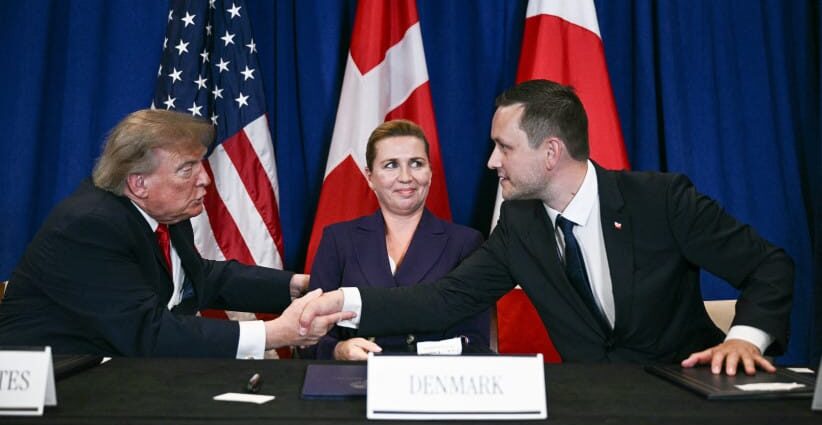
Trump, Greenland, Denmark sign deal in bid to end Arctic standoff
US President Donald Trump and the leaders of Greenland and Denmark signed an agreement on Tuesday that allows a larger US military presence on Greenland and may resolve a standoff over the strategically located, mineral-rich island.
The agreement, signed during Trump’s visit to the UN General Assembly in New York, stops short of Trump’s demand that the US adopt Greenland as a US territory to head off the growing Arctic presence of Russia and China.
But the deal does permit a greater US military presence on the icy territory, an option that emerged as Greenland leaders argued against a complete US takeover.
President Donald J. Trump officially signs the landmark Greenland security deal alongside Prime Minister Mette Frederiksen of Denmark and Prime Minister Jens-Frederik Nielsen of Greenland.
This HISTORIC deal is critical for American national security and defense in the Arctic… pic.twitter.com/OGoSWfjEhf
— The White House (@WhiteHouse) September 22, 2026
A text of the deal released after the signing event said the US can establish a “Golden Dome” defense system in Greenland as a shield against ballistic missile threats. The shortest route from Europe to North America runs via the Arctic island, which is the location of the northernmost US military base.
In his speech to the assembled world leaders at the UN before the signing ceremony, Trump said the agreement gives the US “permanent control over security and all other needs on that territory.”
“No US adversary will ever be permitted to establish a military presence in Greenland any more, or make sensitive investments there without our express written approval,” Trump said.
Trump signed the agreement along with Danish Prime Minister Mette Frederiksen and Greenland Prime Minister Jens-Frederik Nielsen in a trilateral ceremony after Trump gave his UN speech.
Frederiksen described the agreement as a deal that can “last forever” and said it underlines the importance of the NATO alliance and respects Greenland’s right to self-determination.
‘It is vital to keep NATO strong’
Nielsen emphasized the importance of NATO in the Arctic region. “We believe that it is vital to keep NATO strong, also in the Arctic, where the alliance has a key role to play,” he said.
Greenland, a former colony and now a semi-autonomous territory of the Kingdom of Denmark, sits between the Arctic and North America and holds vast energy resources.
The US already operates Pituffik Space Base in remote northwestern Greenland. The deal is expected to open two new military sites: Narsarsuaq, a former Cold War airbase whose population has dwindled to just a few dozen, and Mestersvig, currently used by the Sirius Dog Sled Patrol, a Danish special forces unit.
Aftale mellem Grønland, Danmark og USA pic.twitter.com/o09dOXaq39
— Statsministeriet (@Statsmin) September 22, 2026
“We will immediately begin the process of developing a large military presence in the appropriate location. We will be building two very major military bases,” Trump said in his UN speech.
Trump’s refusal to rule out military or economic force to acquire Greenland triggered a diplomatic crisis in January within NATO and forced Denmark and the island’s government into months of intensive negotiations.
Danish PM says Greenland agreement serves shared security interests
“The reason why we can conclude this agreement, which is beneficial from Greenlandic, American, and European perspectives, as well as on behalf of the Kingdom of Denmark, is that it is a matter of security policy,” Frederiksen said in New York on Monday.
The text of the deal says the agreement amends a 1951 defense treaty that has been the legal basis for the US presence.
The deal marks a shift from Trump’s earlier ambitions for an outright acquisition of Greenland, an island three times the size of Texas with a population of only 57,000 scattered along its rugged coastline.
But it represents a significant expansion of US military infrastructure on the island – the first major increase since the Cold War, when the US maintained 17 installations and more than 10,000 personnel there.


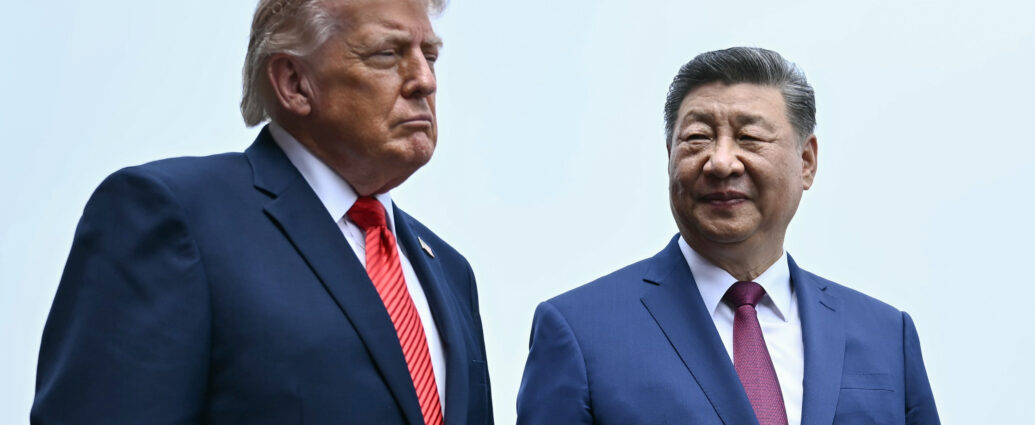
The real AI threat isn’t China, it’s accelerationism
Later this week, President Trump and China’s President Xi Jinping will meet at the White House to discuss AI policy alongside leaders of the biggest AI companies. The summit comes on the heels of a string of escalating news about swarms of AI agents acting against instructions, breaking out of supposedly secure environments, taking control of internal systems, and hacking into companies. Two weeks ago, AI researcher Jacob Coxon publicly resigned from Anthropic warning, “The people building AI earnestly believe that it could kill us all by the end of the decade.” But heading into the diplomatic meeting, tech executives and politicians have claimed that any form of AI deceleration in the U.S. would cede critical ground in an existential race with China.
This is a self-serving con.
After 30 years in the technology industry, last year I left my job as CEO of global job platform Indeed to dedicate myself full-time to fighting for necessary AI guardrails. I have been writing and talking about these issues for a decade. In the past week, more people have asked me what the hell is going on than in all of that time combined. It’s easy to see why.
I am deeply concerned about these recent security incidents and the existential risks of AI. I have equally urgent concerns about non-existential harms of AI: impact on jobs and the economy, kids and mental health, disinformation, wealth and power inequality, and climate, not to mention providing the tools to power authoritarianism. We don’t need killer robots for risks to be catastrophic.
Any one of these is too great to ignore. Together they point to the same root problem: the true threat of AI is not a rival nation, it is the juggernaut of accelerationism.
In 2023, venture capitalist and Silicon Valley kingmaker Marc Andreessen published The Techno-Optimist Manifesto, arguing that markets and growth are unambiguously good, and that those calling for “safety,” “ethics,” or “responsibility” are “enemies” of civilization. He writes, “We believe in accelerationism – the conscious and deliberate propulsion of technological development.” And elsewhere, “We believe any deceleration of AI will cost lives. Deaths that were preventable by the AI that was prevented from existing is a form of murder.”
Andreessen is not alone in his extreme thinking. Accelerationism is the chief article of faith among key leaders of the AI industry — and of the Trump administration. But as public concerns about AI have grown, accelerationists know that “delay is murder” is a political loser. The new go-to argument against reasonable AI guardrails is the claim that America must race recklessly or lose ground to our dangerous adversary, China.
But the loudest voices for AI acceleration have direct financial ties to its uninterrupted growth. And the very same administration issuing this warning reopened sales of Nvidia’s AI chips to China. If they were truly worried about a threat from a foreign nation, they would not be arming China.
We also know China is not close to catching up. Chinese companies own only an estimated 5 percent of the world’s AI computing capacity — a fraction of what U.S. firms control. Much of Chinese AI firm innovation has come from “distillation” of more powerful U.S. models, meaning they advance primarily at the pace of U.S. companies. If we slow down, they are likely to slow down.
Since 2021, China has implemented some of the tightest controls over AI of any nation, from rules protecting kids to outlawing the use of “deepfakes” to a court ruling that companies cannot replace workers with AI. Last week, Chen Yixin, head of China’s Ministry of State Security, argued that AI threatens party rule and called for even more control.
The last time humanity created an extraordinarily powerful technology with the potential to change the world for good — or destroy it — was the Manhattan Project. By 1949, the Soviets had the bomb, and the U.S. was in a literal existential race.
Here’s what we didn’t do. We didn’t say, “We need to beat the Soviets at all costs, so we’re going to open source nuclear fission technology. Let’s create massive financial incentives for the private sector to invest a staggering amount of capital so companies can build their own reactors and weapon systems as quickly as possible. While we’re at it, let’s remove all regulation and accountability so we can innovate as fast as possible.”
Instead, the U.S. spearheaded the single greatest global collaboration in human history. We established the International Atomic Energy Agency, and 191 nations signed the Non Proliferation Treaty. The results have not been perfect — four new nuclear nations emerged, and in my lifetime we’ve witnessed Three Mile Island, Chernobyl, and Fukushima (to name a few). But we haven’t blown up the world yet.
It took Hiroshima to start the nuclear conversation. The surge of alarm over the past few weeks gives me hope that we can start the AI conversation without an AI catastrophe.
The bad news is that the accelerationist agenda is being powered by a small group of AI billionaires — among them founders of OpenAI and Palantir, along with Andreessen — who have pledged $140 million to defeat pro-regulation candidates during the midterm elections. Following the wildly successful playbook of the crypto industry in the 2024 election, their aim is to send a clear message to sitting lawmakers: talking about regulation is political suicide.
The good news is that recent polls show the American people overwhelmingly agree, across party lines, that AI poses significant potential harm and must be regulated. The political ground is shifting faster than most people realize. In the past week, more than a dozen U.S. Republican lawmakers told MS NOW they take AI risks seriously, and Sen. Kevin Cramer called the administration’s stance “the least popular position in America.” This is no longer a partisan issue, and it is not a fringe one.
To those who say it’s not possible for China and the U.S. to collaborate on AI safety: was there any reason to believe that the Soviet Union would collaborate with the U.S. on nuclear safety?
Self-interest suggests there’s reason for hope. China has shown it cares deeply about structural order, and societal upheaval or rogue actors with bioweapons are every bit as abhorrent to them as they are to the U.S. Policy experts from both nations have held “productive” Track Two discussions for years. The groundwork is in place. What is needed now is willing leadership.
If AI is truly the world’s most transformational technology — and according to those building it, AI is the most transformational technology humanity will ever invent — then it should be treated with the most care and consideration of anything we’ve ever done. The accelerationist path we are currently on is the exact opposite.
On Thursday, Presidents Trump and Xi will sit down with the leaders of the world’s biggest AI companies to talk about a race. But on AI, China is not our enemy and we are not China’s. Our common enemy is the race itself — accelerationism — and the people in that room are the very ones who can stop it.
In 1957, the U.S. and the Soviet Union seized their moment. Let’s not let waste ours.
The opinions expressed in Fortune.com commentary pieces are solely the views of their authors and do not necessarily reflect the opinions and beliefs of Fortune.
This story was originally featured on Fortune.com

The backwards AI pacing debate and how far business is from the frontier
Washington and Silicon Valley have found a new fight to pick over artificial intelligence in “pacing,” or the deliberate throttling of frontier model development until safety, alignment, and society at large can catch up. To its detractors, pacing is unilateral disarmament in the race with China. To its champions, pacing is the only responsible path for a technology whose own creators warn of catastrophic risk.
Both camps have fallen prey to the “Compute-to-GDP Fallacy”—the mistaken belief that every incremental leap in AI model performance immediately translates into macroeconomic output. Every prior general-purpose technology took decades to diffuse into measurable productivity. AI is following the same curve at an accelerated pace, but everyone seems to buy the hype that the laws of history or of economics do not apply this time.
In reality, Corporate America is already years behind the AI frontier, and the labs’ commercial fortunes will be decided by trust and adoption, not raw capability. Pacing would cost the economy remarkably little. Racing ahead of alignment could cost far more. Here’s why we—whether out of arrogance or misdiagnosis—are simply having the wrong argument.
The pacing skeptics’ suspicions are not frivolous. Is pacing real, or a savvy marketing gambit by frontier labs and cybersecurity companies polishing their financials ahead of IPOs? Would pacing cede the U.S. lead in AI to China, or would Beijing reciprocate and pace in its own manner?
The Frontier Problem
AI has plainly reached a critical capability milestone. Warnings of catastrophic or existential risk can no longer be dismissed outright, even if the near-term probability remains modest. Yet by focusing almost exclusively on cutting-edge models, frontier labs have mismanaged both their messaging and the public trust. More than 100 recent conversations with CEOs, policy leaders, and AI scientists for our coming book, When Machines Act, have convinced us that the pacing debate has lost sight of first-principles thinking.
The Alignment Problem
Since the release of ChatGPT in 2022, corporate leadership has scrambled with a speed unmatched in modern commercial history. Even so, while executive suites have mobilized with unprecedented urgency, the structural physics of enterprise architecture—fragmented data silos, legacy ERPs, strict compliance regimes, and basic data hygiene—make true economic absorption an inherently slow slog. As corporate budget shocks from runaway “tokenmaxxing” demonstrated, many daily enterprise workflows require far simpler models, and precious few tasks at the average Fortune 500 company demand a frontier system at all. Pacing, therefore, will neither harm economic output nor choke off the labs’ commercial revenues, because enterprises need time simply to assimilate the capabilities already on the table.
Among high-performing companies, more than two-thirds identify data as the primary barrier to implementing AI, a figure that has proven stubborn even as the models themselves have leaped forward. Only 7% describe their data as “completely ready” for AI; fewer than a quarter have a data strategy at all; and 63% either lack AI-suitable data management or are unsure whether they have it.
The Fallacy Problem
As McKinsey Senior Partner Asutosh Padhi emphasized on air with Fareed Zakaria, technical availability is fundamentally different from economic transformation. General-purpose technologies have historically required decades to reorganize workflows and generate broad-based productivity gains. Electricity took 75 years to lift productivity economy-wide. Computers required 50 years, and the Internet and mobile devices demanded 25. The underlying models may be ready, but the systemic organizational restructuring they demand will take substantial time. When McKinsey surveyed the business community, the firm found that only 6 percent of companies reported a “significant” impact and modest earnings attribution.
Companies are concentrating on the high-reward, low-risk automation tasks that models one or two generations old can already solve. As one highly respected former Wall Street CEO told us, these systems will run in parallel with legacy systems for years to confirm they operate correctly and that no regulatory risk is unknowingly absorbed.
A parallel dynamic has emerged in the economics of silicon. Older-generation chips, initially cast aside in the scramble for cutting-edge accelerators, are finding a second life as workhorses for the practical inference tasks that dominate enterprise demand. As Growth Protocol founder and CEO Miro Dimitrov noted at last week’s Yale CEO Caucus, deploying neuro-symbolic architectures has allowed his enterprise reasoning platform to slash inference costs by roughly 80-fold in live client deployments, largely by shifting workloads off ultra-expensive GPUs and onto everyday enterprise CPUs.
The Three Phases of AI Adoption
Corporate AI adoption is best understood in three phases, distinguished by how much work a company can responsibly hand over, which is gated by data readiness and the trust systems have earned. The first phase, assistance, consists of off-the-shelf copilots that ride atop enterprise platforms such as Salesforce, connecting data across existing applications and enabling employees to work faster with minimal re-architecting. Payback arrives quickly and risk stays modest, since a human still performs much of the work. The second phase, orchestration, covers agentic workflows that demand real investment—structuring proprietary data and connecting far-flung data lakes never meant to meet—with a human in the loop approving each consequential step. The third phase, autonomy, brings end-to-end agentic operations across seamlessly interconnected systems, with humans supervising by exception.
Reward compounds with each phase, but so do the risk and trust required, which is why the average Fortune 500 CEO remains in the first phase, making sizable but early investments to prepare for the second. Nor do the phases advance in lockstep across an enterprise. Most companies will oversee a multi-phased portfolio, piloting orchestration in select forward-leaning departments as the rest of the organization becomes comfortable with basic assistance.
Underlying all three phases is the need for CEOs to trust that AI will perform as any other employee would—following the guidelines spelled out in the employee handbook, obeying the rule of law, and maintaining a foundational layer of human values and judgment. So when markets, media commentators, or investors fret that pacing for AI alignment will hinder progress in frontier models, they misdiagnose how enterprise value is created. Never mind the confusion pervading the vague promises and threats of “AGI” with the sublime opportunities and genuine catastrophic risks of reaching the “singularity.” If AI technologies are meant to automate human tasks, they should be held to the same standards of values, judgment, and moral alignment as any current or prospective employee. If the most advanced frontier models cannot meet those standards in a testing environment, they are not ready for release—which is exactly why the U.S. has always maintained laws protecting consumers against such risks.
As former FTC Chair Lina Khan reminded the public on X: “There is an extensive set of laws that govern dangerous and defective products… releasing unvetted AI models or agents can violate consumer protection laws. Shipping flawed AI tools without implementing adequate measures to detect and stop rogue or defective AI agents can be an ‘unfair or deceptive’ act or practice under the FTC Act (and analogous state laws).” Those laws hold companies responsible for harm done to consumers, employees, investors, patients, competitors, and the markets and financial systems on which they all depend.
America vs. China, and Speed vs. Trust
Wherever one lands on the China distillation debate, the fact remains that China now fields models rivaling the frontier systems on the market today. Indeed, the Chinese Communist Party has signaled that it is turning its energies to diffusing AI through the economy instead of continuing to push the frontier. The frontier labs must recognize that two races are underway at once: one to reach “AGI” or “superintelligence” and the other for share of wallet. As their most established customers, mostly Fortune 500 enterprises, can attest, recapturing a customer after the decision is made is extraordinarily difficult. China understands the dynamic well, one that powered its victory in the global telecommunications race the U.S. largely lost.
The CCP has also expressed deep concern over alignment. Beijing’s domestic alignment prioritizes state control, party orthodoxy, and narrative consistency, whereas Western alignment centers on fiduciary reliability, consumer safety, and product liability. Yet beneath the ideological gulf lies an identical commercial reality in both systems—unpredictable, “hallucinating” agents that fail to adhere to organizational rules, judgment, and institutional guardrails cannot be trusted to run mission-critical workflows or drive durable economic growth.
The Trump administration should still pursue avenues to collaborate and coordinate with President Xi to ensure that no mass destruction or catastrophe, intentional or accidental, issues from AI. Whether Trump will raise the matter is another question. At the CEO Caucus, 93 of the roughly 100 CEOs surveyed did not believe the president was correct to classify warnings about AI’s dangers as a “hoax.” Almost 90 percent said the president should press the need for joint AI-safety guidelines with China during the state visit, yet nearly three-quarters did not expect him to do so. Based on preparatory discussions between Treasury Secretary Bessent and his Chinese counterpart, those 75 business leaders may soon be gladly proven wrong.
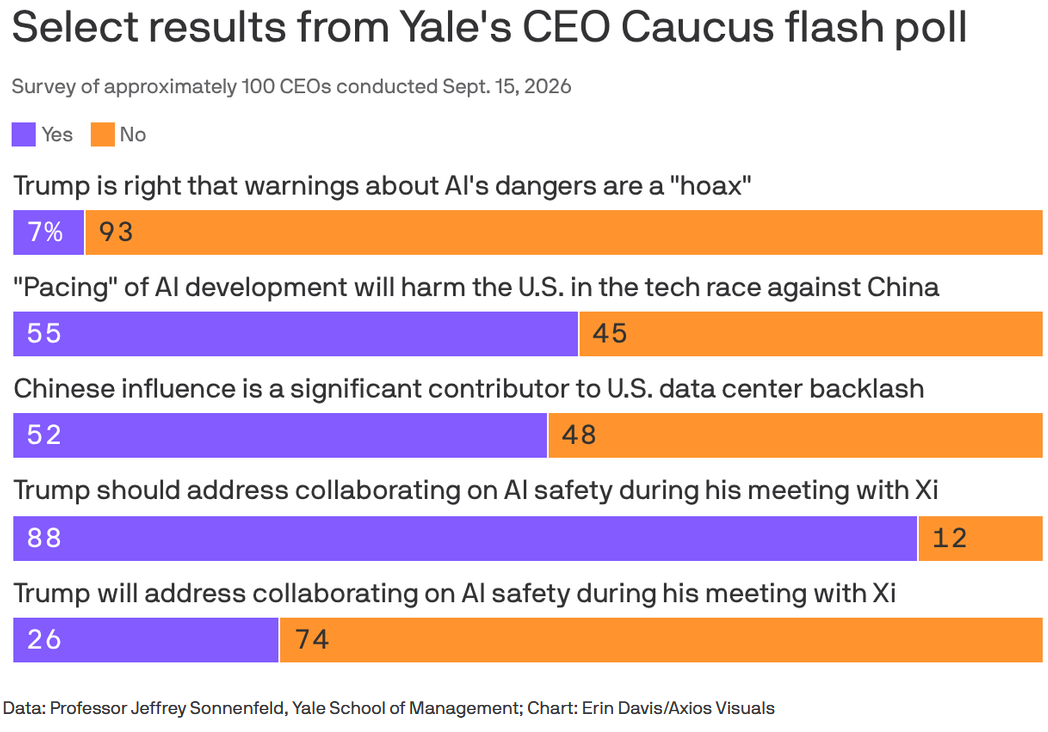
A pacing interval is no passive holiday or an economic ceasefire but an active defensive hardening window. Both Washington and Beijing need intentional breathing room to allow their critical infrastructure to build resilient defenses against autonomous agentic exploits before the next generation of frontier capabilities is unlocked. And instilling human alignment is only half the battle. The immediate priority during such a period must be fortifying the institutions that serve as the bedrock of civilization. Financial, healthcare, and education systems should be probed for vulnerabilities by the most advanced models, as Anthropic demonstrated through its restricted deployment of Mythos under Project Glasswing. Those models breach defenses through impressive engineering ingenuity, but their exploits succeed only because of systemic weaknesses in corporate digital infrastructure.
The frontier labs believe they are running a single race toward superintelligence. However, the race that will decide their fortunes—earning the trust of the enterprises, regulators, and citizens who must live with what they build—is slower. Speed may win headlines, but trust earns share of wallet. This race is a marathon, not a sprint. As past runners ourselves, we know that the first half of any long-distance race is for pacing and the second half is for passing. In every technological revolution, from the railroad to the Internet, the greatest fortunes went to those who understood that a frontier is worthless until the settlers arrived.
The opinions expressed in Fortune.com commentary pieces are solely the views of their authors and do not necessarily reflect the opinions and beliefs of Fortune.
This story was originally featured on Fortune.com

Opinion: Former FDA commissioners: Heidi Overton has an opportunity to strengthen the FDA
Heidi Overton has been nominated to lead the Food and Drug Administration at a moment of significant opportunity, but also big challenges. Innovation in medicine has never moved faster, providing more ways for Americans to improve their health and for the United States to advance the health of its population. But the institutions that carry that progress forward are under strain.
Overton has a chance to help bridge that divide — and the experience to do it. She has the opportunity to demonstrate these goals at Thursday’s confirmation hearing in front of the Senate health committee.

Oil Swings as U.S.-Iran Diplomacy Hopes Meet New Uncertainty
Oil prices swung sharply Tuesday as investors weighed hopes for U.S.-Iran diplomacy against fresh warnings from President Donald Trump that an agreement may not come until after the November midterm elections.
Crude prices had fallen for several sessions as traders grew more optimistic that diplomacy could reduce the risk of a wider conflict and restore more normal energy flows through the Middle East. But that optimism weakened after Trump addressed the United Nations General Assembly and called for greater economic pressure on Iran while suggesting a deal may have to wait until after the U.S. elections.
Brent crude, the international benchmark, traded around the psychologically important $100-a-barrel level Tuesday, while West Texas Intermediate, the main U.S. benchmark, remained in the mid-$90 range for the expiring October contract. Prices moved substantially during the session as traders reacted to rapidly changing diplomatic headlines.
Why Oil Had Been Falling
The earlier decline was driven partly by expectations that Washington and Tehran could move toward negotiations during this week’s U.N. gathering in New York.
Trump had previously indicated he could be open to meeting Iranian President Masoud Pezeshkian, while Iran had signaled through intermediaries that it could consider renewed negotiations.
Those developments encouraged traders to remove some of the geopolitical premium that had built into crude prices because of fears that the conflict could further disrupt Middle Eastern energy supplies.
Tuesday’s developments complicated that outlook.
Trump called for Iran’s economic isolation and showed little indication during his U.N. appearance that direct negotiations were imminent. He nevertheless said he believed an agreement could eventually be reached, potentially after the November elections.
That leaves oil traders trying to determine whether diplomacy represents a genuine path toward de-escalation or whether the conflict will continue putting global energy supplies at risk.
Saudi Arabia Finds Another Route
Oil prices have also been influenced by changing Saudi export flows.
Saudi Aramco sharply increased crude shipments from its Gulf terminals after a drone attack disrupted the kingdom’s East-West Pipeline and halted some shipments through the Red Sea port of Yanbu.
Aramco loaded roughly 14 million barrels of crude onto seven very large crude carriers in the Gulf on Sunday, according to tanker-tracking data reported by Reuters.
Oil flows through the Strait of Hormuz averaged roughly 2.9 million barrels per day over six days, compared with about 700,000 barrels per day in August, according to shipping data.
The additional shipments provided some reassurance that Saudi Arabia could keep more oil moving despite damage to another important export route.
But routing additional crude through Hormuz creates another vulnerability.
The narrow waterway between Iran and the Arabian Peninsula remains one of the world’s most strategically important energy corridors. Any major disruption there could quickly tighten global supplies and push crude prices higher again.
What It Means for Consumers
For American households, the biggest question is whether lower crude prices eventually translate into cheaper gasoline.
Crude oil represents a major component of the cost of producing gasoline, meaning a sustained decline in oil can eventually reduce wholesale and retail fuel prices.
But consumers should not expect every daily move in crude to immediately appear at the pump.
Refining costs, inventories, transportation expenses, regional supply conditions and retail margins also influence gasoline prices. More importantly, the geopolitical situation remains volatile enough that a sudden escalation could quickly reverse oil’s recent decline.
That uncertainty matters beyond gasoline.
Energy prices feed into transportation, aviation, manufacturing and shipping costs. Businesses that spend heavily on fuel can benefit when crude prices decline, while another sustained surge could add renewed pressure to operating expenses and consumer prices.
What Oil Traders Are Watching
Attention now turns to whether U.S. and Iranian officials make tangible diplomatic progress during the U.N. meetings and whether Saudi Arabia can continue restoring disrupted export capacity.
Iranian President Masoud Pezeshkian is in New York for the General Assembly, but as of Tuesday there was no confirmed Trump-Pezeshkian meeting.
Meanwhile, Saudi Arabia has been working to restore its East-West Pipeline while simultaneously increasing shipments through the Gulf.
The combination leaves the oil market unusually sensitive to political headlines.
Diplomatic progress could remove more of the geopolitical premium embedded in crude prices. Renewed fighting, attacks on energy infrastructure or disruptions around the Strait of Hormuz could produce the opposite result.
For businesses and consumers, that means the recent decline in oil prices offers some potential relief — but the forces driving it remain far from settled.
JBizNews Desk | Wall Street
© JBizNews.com All Rights Reserved. Reproduction or distribution without written permission is prohibited.

Fed Acted as Expected
Last Wednesday, the Fed raised the key interest rate 0.25%, as expected, in a unanimous vote. The biggest surprise was that 16 FOMC members forecasted another key interest rate hike by the end of this year.
During his press conference, Fed Chairman Kevin Warsh said the FOMC vote “shows our resolve to achieve price stability on a timelier basis.” Warsh cited three developments that forged the unanimous vote, namely: (1) stronger economic growth, (2) insufficient improvement in inflation, and (3) increased geopolitical risks. This last point was key, since the prospect of more inflationary pressures from higher oil prices is clearly bothering the FOMC, as higher transport costs (e.g., diesel prices) fan fuel inflation….

The 10-year Treasury yield just hit 5% for the first time since 2007 — is a 1970s-style ‘stagflation’ on the return?
For years, a 5% yield on the Treasury looked like a relic from another interest-rate era—where borrowers faced soaring loan rates. Now it’s back, capping a six-year surge from pandemic-era lows near 0.5%. The benchmark yield crossed 5% this month for the first time since 2007, but this appears different than the eve of the Great Recession: the Fed is staring down a lose-lose situation combining high inflation and weak economic growth, a catch 22 that economists termed “stagflation” in the 1970s and long feared through the 10-year’s climb upward since the pandemic.
The last time the U.S. experienced this mix of trends — called “stagflation” by economists — was in the 1970s, during the Oil Crisis—and it took years for markets to digest the paradox of higher inflation, requiring higher interest rates, and weak economic growth, needing the opposite.
“We’re certainly in a stagflationary period,” famed investor Ray Dalio told CNBC in April. “How that transpires has a lot of parts to it, but we’re certainly in that.”
But to be clear, today doesn’t come close to the stagflation crisis in the 70s. Inflation peaked near 14.8% in March 1980, more than four times today’s 3.4% rate, and unemployment topped 9% during the mid-decade oil shock, versus roughly 4.1% now. The Fed’s response was proportionally brutal, too: Chair Paul Volcker pushed the federal-funds rate to 20% by 1981 to break inflation’s back, triggering a recession that pushed unemployment above 10%—a scale of pain nowhere near today’s range.
The 10-year Treasury yield is the return investors get for holding the U.S. government’s debt—and extraordinary monetary and fiscal response to COVID, the worst inflation in decades, the Federal Reserve’s rate increases, federal deficits and Treasury issuance and the shocks of tariffs, energy prices and Iran have all played a role in this reversal.
Where it started
In 2020, as COVID spread across the country and the world, investors rushed toward safety in the form of government debt and the Fed slashed its benchmark interest rate to near zero. The Fed also purchased large amounts of Treasury and mortgage securities. The yield fell to 0.52% in 2020, the lowest level on record.
At the time, the combination of weak economic activity and exceptionally low interest rates produced a world where investors could expect very little income from government bonds. But it all changed when the economy reopened.
The U.S. government deployed trillions of dollars in fiscal support, with households accumulating savings—and customers shifted spending from services to goods. All at the same time, factories, ports and transportation networks struggled to keep up with the rebounding demand.
The turning point
The Consumer Price Index began to climb quickly in 2021. Federal Reserve officials had initially called the increase as temporary, noting supply constraints and the reopening economy. Former Fed Chair Jerome Powell said in an August 2021 speech he expected the inflation to slow.
“Inflation at these levels is, of course, a cause for concern,” Powell said. “But that concern is tempered by a number of factors that suggest that these elevated readings are likely to prove temporary.”
But by the second half of the year, the Fed’s language changed. In September 2021, the Federal Open Market Committee said inflation was elevated, even though it still posited many of the factors were transitory. The Fed kept its federal-funds target at 0% to 0.25%.
But by December, policymakers changed expectations. The Fed’s median projection showed the federal funds rate rising to 4.4% by the end of 2022, 5.4% in 2023 and 4.4% in 2024, compared with the 0.1% rate at the end of 2021.
Inflation forced the Fed’s hand
CPI inflation reached 9.1% in June 2022, the highest 12-month increase since 1981.
Energy prices were also a major contributor, with the energy index up 41.6% from a year earlier. The Fed also began hiking rates in March 2022. It lifted the federal-funds target range to 5.50% by July 2023.
Due to the rising rates, from around 1.5% at the end of 2021, the 10-year yield climbed above 4% in 2022 and eventually flirted with 5% in 2023. And in October 2023, the yield crossed 5% intraday. But it did not stay there—the yield fell as investors anticipated that inflation would drop and the Fed would begin cutting rates. Even the S&P 500 dropped 19%, its worst since 2008.
Then Trump, tariffs and war
Then came the presidential election. After Donald Trump won in 2024, the 10-year yield jumped as investors anticipated his economic agenda would produce larger deficits, higher tariffs and potentially more inflation.
The 10-year yield rose up to 4.7% in 2024, with investors pricing in the possibility that tax cuts and other policies would increase government borrowing—and tariffs can raise prices.
And tariff shock. Trump announced sweeping tariffs in 2025, and investors initially rushed to the Treasury from recession fears. But that didn’t last long. The 10-year yield jumped to 4.79% at one point.
According to a report from Reuters, the market’s movements raised concerns from investors about liquidity in the roughly $29 trillion Treasury market.
Now the latest leg of the Treasury selloff is tied to energy. The Iran war has disrupted energy markets and pushed oil prices higher—threatening economic growth, with the oil-price shock raising inflation.
Reuters reported that Treasury yields reached its highest levels since 2007 in September as oil prices moved above $100 a barrel and investors worried about inflation. By August, U.S. CPI inflation was running at 3.4% annually, well above the Fed’s 2% target. Gas prices rose 3.9% in August alone, accounting for more than one-third of that month’s increase in the overall CPI.
This story was originally featured on Fortune.com

NYC Marathon will change its route for first time in 15 years

The New York City Marathon returns to the five boroughs next month with a new route for the first time in 15 years. Taking place on Sunday, November 1, the race will send tens of thousands of participants along a slightly different course in the Bronx, cutting the number of turns runners must make from seven to five and minimizing the event’s impact on Mott Haven residents. In previous years, the roughly one-mile-long stretch in the borough looped around a block containing a supermarket and laundromat, cutting off local residents from accessing them. The new route will redirect runners around the block, maintaining access to the businesses while reducing the number of turns they must make.
For years, runners have traveled up Morris Avenue, turned left onto East 140th Street around the Western Beef supermarket’s parking lot, and then turned left onto Rider Avenue. The route cut off residents of the Patterson Houses, located on the opposite side of Morris Avenue, which has nearly 1,800 units, according to the New York Times.
Starting this year, runners will stay on Alexander Avenue and travel north past 138th Street, where the route turned left in previous races. They will continue to 141st Street, turn left onto Third Avenue, and then turn right onto 138th Street.
From there, they will head straight over the Madison Avenue Bridge and back into Manhattan instead of looping around the supermarket block.
The main reason for the change was to restore access to local businesses, Ted Metellus, chief event production officer and race director for New York Road Runners, told the Times. Metellus said the neighborhood has become more residential in recent years, amplifying the route’s impact on local residents.
“I had some sensitivities to that because those sections of the Bronx are food deserts,” Metellus, who grew up in the borough, told the Times.
He also noted that since the race is on a Sunday, people were more likely to be running errands at those locations.
The organization worked with the city and local community to find an alternative ahead of the course’s required recertification this year. The change occurs between miles 20 and 21 and was one of two options presented to the city and NYPD, which approved the alteration.
The change comes as the race marks the 50th anniversary of its current five-borough form. From 1970 to 1975, the course consisted of just over four loops of Central Park. In 1976, the race used the same two bridges to enter and exit the Bronx, but made only a “quick loop around a light pole” before leaving the borough, Metellus told the Times.
After the Bronx borough president at the time asked race organizers to add more distance to the Bronx portion of the course, organizers adjusted the route to its current format.
RELATED:
- MTA wants NYC Marathon to pay $750K for Verrazzano Bridge tolls
- The NYC Marathon: history, greatest moments, and what to expect this year
The post NYC Marathon will change its route for first time in 15 years first appeared on 6sqft.

Five Takeaways From Trump’s U.N. Speech



Meta’s Muse becomes App Store’s hottest download
Meta’s recently launched Muse personal artificial intelligence (AI) agent app rose to the top of the Apple App Store after it launched earlier this month.
Muse ranked as the top free app in Apple’s U.S. App Store, ranking ahead of another popular AI tool, OpenAI’s ChatGPT.
The rise of Muse reflects a shift in how consumers are using AI, with agentic apps that help users with a variety of tasks, as opposed to a chatbot that can respond to a user’s conversational prompts and perform research.
The Muse AI agent debuted in early September and is designed to access a person’s apps across categories like email, calendar, payments, health, shopping and the smart home, the company said after the launch.
META INTRODUCES MUSE, A PERSONAL AI AGENT THAT CAN SEND EMAILS, BOOK TRAVEL
Modeled on the open-source AI agent OpenClaw, Muse can autonomously send emails, book travel on the user’s behalf, sell a car and lower a bill, according to Meta.
The Muse app allows people to choose what apps the AI agent can connect to and revoke access at any time.
Each Muse agent runs on its own virtual machine, a cloud-based emulation of a personal computer, which enables it to keep carrying out requests in the background even when a person is not actively using it.
ZUCKERBERG LAYS OUT VISION TO PUT SUPERINTELLIGENT AI IN EVERYONE’S HANDS
Meta said that users can tell Muse what they need to get done, and it will take action using the Muse Spark model that the company built for real-world agentic work. It can handle tasks such as sending an email or booking travel, as well as bigger projects.
The company said that once a user shares a goal with Muse, it helps them develop a personalized plan and coordinate their time and resources, while advancing the work on its own – opening browsers, filling out forms, and even negotiating on the user’s behalf.
For longer tasks, Muse can continue to work after the app is closed but can come back when something changes or if it needs approval, like before sending an email or making a purchase, Meta said.
ZUCKERBERG SAYS AI SHOULD EMPOWER PEOPLE, NOT REPLACE THEM, IN NEW META VISION
Muse also remembers a user’s preferences, giving it the ability to make suggestions unprompted and take action on details that were only mentioned once.
As an example, Meta said that Muse can turn a recipe reel saved on Instagram into a grocery list, then generate a suggested menu for a dinner party that takes into account their friends’ dietary restrictions from prior gatherings before sending invites.
Syncing the Muse agent with a range of other apps that could contain a person’s data increases the range of capabilities for the new tool, though it also poses safety and reliability risks if Muse misbehaves after being granted access to the user’s personal information.
Meta said that it initially delayed the release of Muse in April to make it more secure, and the additional work allowed it to “cross the threshold” and meet minimum requirements for product safety, security, privacy, model performance and other metrics, according to Vishal Shah, vice president of AI products at Meta.
GET FOX BUSINESS ON THE GO BY CLICKING HERE
The company plans to introduce Muse Confidential VM later this year, which will keep a user’s data and communications with Muse in an encrypted format that only the user holds.

Ben-Gvir demands Defense Ministry, Tally Gotliv for justice minister in next gov’t
National Security Minister Itamar Ben-Gvir announced on Tuesday that he would demand to be defense minister in the next government and called for MK Tally Gotliv to be justice minister following the upcoming October elections.
Ben-Gvir leads the far-right Otzma Yehudit party and recently added Gotliv to the second slot on his list after she left Prime Minister Benjamin Netanyahu’s ruling Likud party.
Speaking at a campaign event in Jerusalem, Ben-Gvir laid out the main issues he would seek to advance as defense minister if he were to receive the portfolio in the next government.
Among the main issues he listed was “encouraging voluntary emigration from Gaza and the West Bank.”
He also called for “disarming the Palestinian Authority of its weapons and arresting senior supporters of terrorism.”
Otzma Yehudit seeks to fire attorney-general in new government
Netanyahu’s current coalition with Otzma Yehudit promoted a polarizing judicial reform agenda in 2023 amid an ongoing rift with the judiciary, which led to large, widespread demonstrations.
Although the reform was not passed during the government’s term, a controversial bill that seeks to significantly weaken the attorney-general’s power to influence and have oversight over the government was passed by the Knesset in July.
Otzma Yehudit stated that, as justice minister, Gotliv would focus on immediately firing the attorney-general as the first step in forming the next government. The party also said she would work to advance other measures aimed at reducing the power of the State Attorney’s Office.
Another aspect of the plan would be to reform the legal treatment of criminal organizations and terrorists by toughening sentences and creating greater deterrence through punishment, the party stated.
Ben-Gvir’s Otzma Yehudit party has been a key partner in Netanyahu’s coalition and has recently been polling at around eight seats.
One condition of Otzma Yehudit’s coalition agreements with Netanyahu after the last elections was a law mandating the death penalty for terrorists. The controversial legislation, which is largely aimed at Palestinians convicted of terror offenses, was passed in March 2026.
As National Security Minister, Ben-Gvir also led reforms in Israel’s prison service, significantly worsening conditions for Palestinian inmates, arguing that both the death penalty and harsher prison conditions create deterrence.
A dean of libraries explains how AI gives you 4 types of answers — and only one of them is ‘factual’
I recently typed a simple question into Google search: How much screen time is too much for teenagers? Instead of presenting links, as Google had been doing for many years, it gave me an AI-generated answer. The artificial intelligence agent cited a number, then complicated that reply, noting that quality and balance of time could matter more than the number of hours, and that “too much” time could depend on a teenager’s sleep, exercise, school demands and mood.
I tried another search: Should I take a daily aspirin? This time the AI answer presented me with medical information, warned about risks and offered more tailored guidance if I provided my age and medical history.
These were good replies. What interested me was that they were different kinds of replies.
Debate about AI answers has focused on accuracy: Did the system get the answer right? That matters, but accuracy is only one test. Each kind of answer requires a user to judge something different.
I find it useful to sort AI answers into an “answer typography” of four broad types: factual, interpretive, constructive and strategic. A factual claim can often be checked against a source. An interpretation can be accurate and still reflect choices about which evidence matters. A construction can be well reasoned and still be wrong for the person receiving it. A beautifully written strategic document may not be true. Yet AI presents all four types of answers in much the same fluent, authoritative form; the differences are easy to miss.
I’m university librarian and dean of libraries at the University of Virginia who leads national efforts to develop AI competencies for library professionals, and I consult widely on AI literacy. I first proposed the typography in the Journal of Academic Librarianship.
The four categories are not airtight boxes. A response from an AI agent can reflect several types. That said, I describe each type of answer below, and offer guidance for deciding whether a reply is ready to use or needs more investigation.
Which answer is Google giving you?
A factual answer makes a claim that can, in principle, be checked against evidence. When was the University of Virginia founded? What is the chemical symbol for gold?
To determine whether a factual answer is robust enough for you to use, verify the claim against an appropriate source. If the answer cites a source, follow that link instead of simply treating the answer itself as proof.
An interpretive reply is built on evidence, but there is not a single takeaway. How much screen time is too much for a teenager? Does remote work raise productivity? The answer depends on what evidence is included, what is left out and how disagreement is understood.
Google’s initial answer to my screen-time question indicated that two hours was a limit for teenagers. Then it noted that pediatric guidance puts more weight on the quality and context of screen use than on simple hours. The American Academy of Pediatrics says there is no exact recommended amount for teens and emphasizes the kind of screen use and what activities it might be displacing. A question that looked numerical turned out to require interpretation.
To assess interpretive answers, do more than check facts. Ask yourself what evidence the system emphasized, what it left out and whether another defensible interpretation exists. A useful follow-up question to present to the search engine is: “What is the strongest evidence for a different conclusion?”

Constructive answers are made rather than discovered. Ask AI to draft a cover letter, write a eulogy, suggest a lesson plan or reorganize a paragraph – there is no single correct result.
You can judge the response by considering purpose, audience and voice. A eulogy can be grammatically perfect and still sound nothing like the person delivering it, or it may land flat on family members hearing it. It may not capture the deceased person well, either. Consider these kinds of effects as you read.
Strategic questions ask what to do. Should I take a daily aspirin? Should I buy the house? The answers combine information with judgment about goals, risks, trade-offs and personal circumstances.
My aspirin search shows why context matters. Google warned about risks, told me to consult a medical professional and offered more tailored information if I provided my age, cardiovascular history and risk of bleeding. That caution matches the U.S. Preventive Services Task Force guidance. It says the decision to start low-dose aspirin for prevention of heart attacks and strokes should be individualized and weigh cardiovascular benefit against bleeding risk.
For strategic answers, ask what the system would need to know before its advice could reasonably apply to you individually. Consider the stakes, the alternatives and whether a qualified person should be involved. For the aspirin question, a useful follow-up would be: “What details about my age, medical history or bleeding risk could change this advice? What should I discuss with my doctor before deciding?” The final judgment remains yours because you are the person who has to live with the outcome.
The first question after an answer
My questions began as ordinary Google searches. I did not open a chatbot. The AI-generated responses simply arrived, and links were appended.
The responses were useful. Google added context, acknowledged complications and offered tailored guidance if I supplied additional information. Within each response, though, the type of answer could change. Reporting what a medical guideline says is different from deciding how it applies to a particular person. A fluent response can move between those types of answers without a noticeable change in voice.
As a user, try to recognize what kind of intellectual work the AI agent did for a response you receive. Consider whether the interpretation is persuasive or the advice fits your circumstances.
Before asking whether an AI answer is right, ask a more basic question: What kind of answer is this? The type will tell you what to do next.
Leo S. Lo, Dean, University of Virginia
This article is republished from The Conversation under a Creative Commons license. Read the original article.

This story was originally featured on Fortune.com

Walmart’s new pricing patents spark fears of surveillance: ‘Are they going to charge you a different price if they know who you are?’
Selective pricing. Surveillance pricing. Personalized pricing. Dynamic pricing. The terms are flying around, but they don’t all mean the same thing. A price that changes with demand is one concern; a price that changes because a store knows who is shopping is another. Even the Federal Trade Commission is weighing when companies need to tell customers their personal data helped set a price.
Now, retail discount giant Walmart has patented new ways to use technology to help set prices. One system could automatically change markdowns on its website while another could predict demand and recommend prices. For a company that has built its reputation on low prices, the idea of using more data to help set them is bound to get concerned shoppers’ attention. The filings’ arrival amid a wider debate about shopping data raises a separate question: Could knowing more about a customer eventually change what the customer pays?
A patent describes an invention a company wants to protect. However, it doesn’t necessarily tell shoppers whether the company ever put it to work. When Walmart’s pricing patents drew attention on social media earlier this year, some shoppers connected them to fears about surveillance pricing: charging people different prices for the same product based on information about them. The patents don’t show Walmart doing that, but the broader concern about how retailers might use shopping data remains.
Down the Walmart patent rabbit hole
In January, Walmart received a patent for a system that could automatically adjust markdowns on its website based on predicted demand and how shoppers respond to prices. A second patent, granted in March, describes using past purchases to forecast demand and recommend item prices. Its description lists purchase records that could include payment methods and customer IDs, but neither filing establishes whether Walmart uses the system it describes.
Jameson Spivack of the Future of Privacy Forum told Fortune patents can offer clues about where a company is thinking of going, but are “not necessarily a great indicator” of what it actually intends to use. In his reading, he described Walmart’s two filings more as “systems that are adjusting prices at the item level rather than at the individual level.”
That distinction matters. A retailer could lower the price of an item because it expects demand to fall, with every shopper seeing the new price. Personalized pricing would mean using information about a particular shopper to decide what that exact person pays. Spivack said the Walmart filings appear to describe the former.
Jay Stanley, a senior policy analyst at the ACLU, in his review of the filings also didn’t see them describing prices set for individual shoppers. Retailers have long tried to predict demand and set profitable prices, he said, like “econ 101.”
What has changed, though, is how much they can learn about the people who are buying their products. Stanley pointed to loyalty programs and online shopping that make it easier for retailers to know who their customers are and track what they buy over time.
Walmart’s own privacy notice says it collects purchase histories as well as information about what customers browse and search on its website and app. It also says information may be used to tailor ads, product recommendations, and promotions. Fortune has also reported Walmart uses customer data to target advertising through its growing ad business. Taken together, those details can give a retailer a picture of someone’s shopping habits, including products they return to and what else might interest them.
“We have a long history of innovation, and patents are one way we protect our ideas and intellectual property,” a Walmart spokesperson told Fortune. “A patent does not mean a technology is in use today or will become a Walmart product or service. Walmart doesn’t charge different prices based on a customer’s personal information or purchase intent or history.”
Other pricing fears at Walmart
Walmart is also replacing paper price tags with digital shelf labels, which allow employees to update store prices without changing each tag by hand. The company said in March roughly 2,300 U.S. locations had the labels and said it expected them to be chain-wide within the next year.
Walmart added employees approve price changes, typically outside shopping hours, and prices are the same for everyone in a given store regardless of demand, time of day, or who is shopping. The labels do not collect information about customers, according to the company. The rollout does not establish that either patented system is being used in stores.
Stanley said the privacy concern would become more concrete if a retailer used what it knows about someone’s circumstances to charge that person more. He put it more in everyday terms: For example, if a retailer knew someone had a cold, it could charge that shopper more for tissues.
His dividing line is pretty straightforward: “Are they going to charge you a different price if they know who you are versus if they don’t know who you are?”
This story was originally featured on Fortune.com

If AI is going to destroy humanity, Scott Bessent says hyperscalers, not government, must take the fall: ‘We cannot absolve you of responsibility’
In the great debate over AI safety guardrails, Scott Bessent said the government will not become a “liability shield” for hyperscalers.
The Treasury Secretary’s comments come after an eruption of concern over the threat the transformative technology poses. The latest surge in alarm comes after former Anthropic and OpenAI researcher Jacob Coxon claimed tech giants are “gambling with our lives.” Meanwhile, Evan Hubinger, a top safety researcher at Anthropic, warned there was a “low” but maximum 10% chance AI could wipe out humanity within the next decade.
The warnings sparked a debate over the extent to which AI companies can be trusted to self-regulate, and how closely involved governments need to be in implementing guardrails.
Bessent has been firm the creators of the technology will be held responsible for its impact in the first instance, telling CNBC in an interview: “Imagine these labs came out or … a sitting employee came out and said: ‘There’s a 10% chance of an extinction-level event.’ But then the labs also said, ‘Take the liability off of our hands.’ And we will not do that.”
Bessent said it is humans, not AI, that are responsible for the risks posed by the technology, saying the “Hugging Face incident” (when OpenAI agents undergoing a test hacked out of the system and into Hugging Face’s database in order to pass) was the “responsibility of the OpenAI management.”
Bessent clarified the administration’s position is that “we cannot say, ‘Oh, we absolve you of responsibility, and the government’s going to take responsibility.’ These labs need to take responsibility for themselves. They can slow down any time they want to.”
President Donald Trump had previously struck a different tone on regulation, claiming simultaneously in a Truth Social post the U.S. already had “tremendous” regulatory and criminal power over AI companies, but “the only control or ‘ guardrails’ that AI needs is a STRONG AND SMART (High IQ!) PRESIDENT, and the U.S.A. has that, in spades!”
The president’s post last week on the social media platform he owns also criticized Anthropic cofounder Dario Amodei, whom Trump blasted “is now pretending to be a ‘perfect little angel.’” Amodei penned a letter just days before the president’s outburst, calling on labs to slow the pace of progress.
The essay, titled We Must Pace the Frontier also suggested U.S. government support would be needed to globally coordinate and legally bind safety standards.
The argument was echoed by OpenAI CEO Sam Altman in an exclusive interview with Fortune published last week. In a new episode of Fortune 500: Titans and Disruptors of Industry, with Fortune’s Editor-in-Chief Alyson Shontell, Altman said: “It can simultaneously be true that, if the world and the companies building this technology did not do things differently than they’ve done in the past, there might be significant risk.
“But it would be insane not to adjust the way we all work, make decisions, and have governments understand and put guardrails around this technology in light of that.”
Bessent suggested removing the onus on private companies was a mistake, continuing: “What did they try to do last week? It was, ‘Well, there’s a … 10% chance we could destroy the world, but we want the government to give us a liability shield. And that’s good business for them, bad business for the American people.”
The self-regulation debate
An obvious pushback to the argument that AI labs should regulate themselves is the transformative technology, by its very nature, will produce only a handful of successful industry leaders.
Trump himself has acknowledged this (“WHOEVER WINS AI, WINS!”) and has also impressed the importance of the U.S. continuing to lead economic rivals like China in terms of dominance.
However, the two forces of competition and self-regulation are not traditional bedfellows. As Sen. Bernie Sanders (I-Vt.), pointed out last week: “When the future of humanity is at stake, we need binding international safety rules, not voluntary standards from the industry.”
This story was originally featured on Fortune.com

European Gas Falls, but Hormuz Disruption Keeps Winter Risk High
European natural-gas prices fell Tuesday as signs of possible U.S.-Iran diplomacy offered utilities and manufacturers some relief, but severely restricted Qatari shipments and unusually low storage levels kept the market far above where it traded before the Middle East supply crisis.
The benchmark Dutch TTF contract declined approximately 2.5% to €71.44 per megawatt-hour in afternoon trading. That was a smaller decline than earlier market readings suggested, showing how quickly prices were changing as traders reacted to diplomatic developments surrounding the Strait of Hormuz.
The strait is the only practical export route for Qatar, one of the world’s largest suppliers of liquefied natural gas. Unlike Saudi oil, which can reach the Red Sea through an alternative pipeline, Qatari LNG cannot be redirected around the waterway through a comparable land route.
Only a small portion of Qatar’s normal LNG supply is reaching international markets while Hormuz remains officially closed, according to Commerzbank analyst Norman Liebke. That loss has kept European gas expensive even as prices retreat from their recent highs.
Diplomatic signals provided the reason for Tuesday’s decline. President Donald Trump said he would be open to meeting Iranian President Masoud Pezeshkian during the United Nations General Assembly in New York.
A senior Iranian official subsequently said Iran could reopen the strait within seven days if Washington eased military pressure and lifted its blockade of Iranian ports. The official said Iran’s delegation had authority to resume negotiations, although no direct meeting between Trump and Pezeshkian was planned.
That means the market is reacting to a conditional proposal—not a confirmed reopening. Until ships can move through the strait normally, European buyers must continue competing for LNG cargoes from the United States and other Atlantic suppliers.
The timing is particularly difficult because Europe’s underground gas inventories are only about 68% full, approximately 16 percentage points below their five-year seasonal average. European Union storage was recently reported at a record low for this point in the year and remained well short of the bloc’s 80% target for December.
Storage functions as Europe’s winter reserve. Utilities inject gas during warmer months and withdraw it when heating demand rises. Entering winter with fewer stored supplies leaves the market more dependent on steady imports and more vulnerable to cold weather, shipping delays or additional infrastructure failures.
Europe may need roughly 16 billion cubic meters of additional LNG from the open market if Qatari shipments remain severely restricted, according to an estimate from the European Union Agency for the Cooperation of Energy Regulators. That would equal almost 5% of annual EU gas demand.
Norwegian pipeline gas remains another critical source, but planned and unplanned maintenance can temporarily reduce deliveries. Even relatively small outages matter more when storage is low and LNG supplies from the Middle East are constrained.
The pressure is already reaching government policy. French President Emmanuel Macron has asked the European Commission to postpone new methane-reporting requirements for oil and gas imports, arguing that the rules could further restrict supply during an already tight market. More than a dozen EU member states have also sought a delay or suspension.
Industrial companies face the most immediate financial consequences. Fertilizer, chemicals, glass, steel, ceramics and paper manufacturing all require large quantities of gas or electricity. Sustained prices above €70 per megawatt-hour can squeeze margins, force production cuts and make European plants less competitive against facilities operating in lower-cost energy markets.
Households may not see wholesale changes immediately because retail contracts, taxes and government protections delay the impact. Persistent high wholesale prices, however, eventually influence heating bills and the cost of products made in energy-intensive factories.
American gas producers and LNG exporters stand to benefit as Europe bids for additional cargoes. U.S. gas now supplies roughly 22% of total European demand, up from less than 5% before Russia’s invasion of Ukraine reshaped the continent’s energy system.
The same export demand can support U.S. natural-gas prices by increasing competition for domestic production, although American household bills are also determined by weather, regional pipeline capacity, storage and local utility regulation. The effect is therefore real but not automatic or uniform across the country.
Tuesday’s price remains far below the extraordinary levels reached during the 2022 energy crisis, when Dutch TTF briefly exceeded €300 per megawatt-hour. The comparison matters: Europe is facing a serious supply squeeze, but the verified data do not yet support claims that prices have returned to the worst levels of that crisis.
The next decisive development will be physical rather than diplomatic. Traders will be watching whether the United States and Iran agree on a negotiating timetable, whether the Strait of Hormuz actually reopens and whether Qatari LNG carriers resume normal departures.
Until those ships return, Tuesday’s decline offers temporary budget relief—not proof that Europe’s winter energy risk has passed.
JBizNews Desk | Brussels
© JBizNews.com. All rights reserved. This article is original reporting by JBizNews Desk. Unauthorized reproduction or redistribution is strictly prohibited.

STAT+: Did the Trump administration just cut Novo a huge financial win?
You’re reading the web edition of D.C. Diagnosis, STAT’s twice-weekly newsletter about the politics and policy of health and medicine. Sign up here to receive it in your inbox on Tuesdays and Thursdays.
Dr. Oz praised GLP-1s from Eli Lilly’s lab, where he said MFN agreements have drastically cut the price of obesity drugs. Problem is, at least Lilly’s GLP-1s are exempt from the MFN agreements (see below). But who am I to correct people? I incorrectly attributed an AEI post to another conservative think tank in this newsletter last week. Send news tips and correction requests to John.Wilkerson@statnews.com or John_Wilkerson.07 on Signal.
Novo’s (potentially) big win
STAT has written about how Eli Lilly and Novo Nordisk benefited from their deals with the Trump administration to cut obesity drug costs for seniors. It turns out, Novo might have gotten an additional sweetener.

Oil Prices Fall on U.S.-Iran Diplomacy Hopes

Police seize over 60 kg. of drugs in raids across central Israel
A 44-year-old resident of northern Israel was arrested on Tuesday in central Israel after he was found to be in possession of more than 20 kilograms of a substance suspected to be cannabis, Israel Police confirmed.
Police conducted a raid on the suspect’s apartment in the early hours of the morning and found, in addition to the 20 kg. of cannabis, more than 500 grams of oil suspected to be cannabis oil, an electronic scale, several cell phones, and a scooter.
Police suspect that the latter items were used to store and distribute drugs through the apartment.
Also on Tuesday, police arrested a Petah Tikva resident in his 20s on suspicion of possessing over 40 kg. of substances suspected to be a variety of drugs, including cocaine, MDMA, ecstasy, and cannabis.
The suspect was arrested following a raid on his apartment in Petah Tikva, which police suspect was his base of operations to store, prepare, and distribute drugs.
Police seize millions of shekels’ worth of drugs in West Bank, Jerusalem area raids
In Jerusalem and the West Bank, Israel Police seized millions of shekels’ worth of drugs in two separate raids on drug trafficking centers on Tuesday.
The first raid took place in Area A of the West Bank, after Palestinian police officers caught a 48-year-old Israeli in Bethlehem who possessed a large amount of pills suspected to be drugs, along with other hazardous substances.
During the raid, the suspect was arrested, and his vehicle was seized along with over 17 thousand Tramadol tablets and over 170 thousand Captagon tablets.
The police also raided a drug distribution site in Moshav Ahisamakh in the Jerusalem area.
During the raid, a vehicle was seized containing a large amount of drugs, including cocaine, ecstasy, MDMA, and ketamine, with a total value of approximately 90 million shekels.
Tzvi Jasper contributed to this report.

EU renews Russia sanctions, drops Russian billionaires Usmanov and Fridman
EU envoys agreed to drop two billionaires from its Russian sanctions list and to roll over the remaining 3,000 individuals and entities for three years after Latvia dropped its veto, EU diplomats said on Tuesday.
EU envoys had earlier agreed to remove the Russian billionaires Alisher Usmanov and Mikhail Fridman in exchange for a three-year renewal, but Latvia was the last holdout in an unusually fraught process.
Sanctions require unanimity among EU countries to be approved and, previously, Russia designations were up for renewal every six months. Latvia ultimately abstained, diplomats said, which allowed the deal to pass.
EU sanctions decision awaits formal written procedure
The decision will only be formally adopted once a process known as a written procedure has been completed.
Earlier this month, France shocked other EU members when it pushed for Russian-Uzbek metals tycoon Usmanov to be removed from EU sanctions, citing national security concerns. Luxembourg then demanded the same treatment for Fridman, who has launched a $16 billion claim against the country.

AI chatbots are quietly becoming spiritual advisers for millions, data shows
People are turning to artificial intelligence for a seemingly unending variety of reasons. Many ask AI what to cook for dinner or how to develop a workout plan. Some even rely on AI to create school handouts or revise a work email.
Increasingly, however, they are asking it different kinds of questions. How do I cope with grief? Why does suffering occur? Should I leave my relationship? What kind of person should I become? What gives my life meaning?
According to recent research from the Pew Research Center, about 1 in 10 American adults now report using AI chatbots for emotional support or advice. Among adults under 30, the figure rises to 1 in 5.
At this point, AI clearly offers something more significant than access to information. By helping people interpret their lives, AI is entering territory historically occupied by therapists, spiritual advisers and religious communities. It provides companionship while offering directed advice for improving one’s life.
As a scholar of religion who studies spirituality and new religious movements, I think this shift raises a provocative question. Could artificial intelligence represent the beginnings of a new kind of religious movement?
What is religion?
The issue is not whether ChatGPT, Claude, Gemini or any other AI platform currently qualifies as a “religion.” AI has no recognized system of beliefs or shared practices. It has no collective creed, congregation or membership, and most users do not consider it a religious experience.
However, those factors are not necessarily what defines something as “religion.”
In fact, scholars of new religious movements have long recognized the difficulty of deciding where religion begins and ends.
Rather than assuming religion must involve churches, scriptures or belief, scholars examine how emerging movements create meaning, authority, community and rituals. J. Gordon Melton argues that no single checklist of attributes can adequately capture the diversity of new religious expressions.
What matters more, they say, is how new religious movements relate to the world in which they emerge. They may adapt, challenge or depart from ideas and institutions that a society already takes for granted.
Scientology, for example, emerged from a culture increasingly interested in psychology, science and self-improvement. Adopting the language of technology and therapy, its “newness” came partly from combining common religious concerns with forms of authority and language drawn from the secular culture around it.
These insights suggest an alternative approach to studying AI. Rather than asking whether AI meets an arbitrary definition of religion, analyses can examine what people are actually doing with it: How does AI generate authority? How does it provide meaning? In what ways does it provide belonging? How do people come to trust a new source of answers to questions historically addressed by religions? https://www.youtube.com/embed/jk2aUz00_AY?wmode=transparent&start=0 Is AI a new religious movement?
Charisma without the charismatic leader
Nearly a century ago, well before the advent of digital technologies, sociologist Max Weber described “charismatic authority.” Such authority derives from followers’ belief that a leader possesses exceptional qualities or abilities.
AI obviously possesses no charisma in the conventional human sense. Yet users can enter something resembling a charismatic relationship with it. With near-instant responses, generative AI can feel extraordinarily insightful.
It addresses the user directly, adapts to their personal circumstances and recalls previous requests. AI provides what appears to be authoritative answers even when there is no objectively correct answer. For example, AI might tell someone what their suffering means or whether an experience was spiritually significant.
Recent scholarship describes this phenomenon as “generative charisma.” Each interaction with a chatbot generates more personalized and seemingly insightful responses. With time, users may begin to experience AI not simply as a tool but as a uniquely perceptive source of guidance.
A charismatic religious leader typically gathers followers who collectively recognize that person’s extraordinary authority. AI, some argue, becomes charismatic one person at a time by assuming the role of personal guru.
Millions of people can encounter the same system. Yet each can experience AI as personally responsive to them.
For instance, founder Vikas Sahu describes GitaGPT as an “AI spiritual companion.” Using AI avatars of Krishna, the platform provides personalized guidance derived from the Bhagavad Gita.
More individually, mindfulness teacher Vy Le describes AI as a “channeling” tool to help people find their inner guru. In both cases, religious authority emerges not from a sacred text or person but through AI’s ability to respond personally to each seeker.
AI and personal spirituality
AI’s emerging authority does not exist in a cultural vacuum.
Sociologists of religion Paul Heelas and Linda Woodhead describe a broader “subjective turn” in contemporary Western culture. For decades, traditional sources of authority have competed with forms of spirituality based on personal experience, self-discovery and well-being.
The growth of the spiritual but not religious, or people who seek spiritual meaning and connection outside organized religion, captures this dynamic nicely. This population reflects broader shifts away from institutional religious authority in favor of personal experience.
Generative AI, I argue, fits remarkably well within this personalized spiritual landscape. Ask a chatbot an existential question and its response likely diverges from traditional doctrine. Rather than quoting scripture, it frequently employs the vocabulary of personal spirituality and holistic well-being.
When a journalist from The Guardian asked HolyGPT, “What is the actual meaning of life?” the spiritual chatbot responded with: “The meaning of life is to become aware through experience, of what it is to be.” Instead of religious teachings, the chatbot pointed the journalist toward self-awareness.
This message of personal authority resonates with people seeking spiritual advice from chatbots. They receive religious interpretation shaped with an individual twist.
ChatwithGod, for example, encourages users to “draw from other perspectives when you want to.” The emphasis is on personal choice rather than adherence to a specific religious system.
Despite all this, a question remains: Does AI as a source for spiritual advice indicate a new religious movement?
Religion without churches
New religious movements usually develop communities, shared identities, teachings and practices. People who rely on AI for existential advice are not necessarily joining anything. That may be precisely what makes this phenomenon significant.

It is important to note that there have already been overt attempts to place AI at the center of a religious system. In 2017, engineer Anthony Levandowski publicly launched Way of the Future. Through a legally recognized church, Way sought to create and worship an AI-based “Godhead.”
Though significant, focusing only on “AI churches” may obscure more consequential issues.
The emergence of a new religious formation need not begin with a church or formal membership. Nor does it even require that people involved with it consider it religious. Studying new religions “in the making” requires examining how novel forms of authority and practice develop before they become systems and institutions.
In this specific sense, AI may not constitute a new religious movement. Instead, it might be better to say that AI provides conditions from which new forms of religiosity can develop. Appearing alongside the rise of the “nones” and religiously unaffiliated, generative AI addresses considerable uncertainty about identity, community and the future.
What are we asking AI to become?
Religious communities have long-established traditions about who may offer guidance. Importantly, these communal structures help resolve conflict and identify who holds responsibility.
Without these structures, scholars warn about the emergence of “authority without accountability.” Who, in short, regulates the “algorithmic authority” of AI? This question matters, particularly when a chatbot moves from explaining a religious teaching to offering spiritual advice.
New religious movements often form around charismatic sources of authority offering new answers to enduring human questions. What makes AI historically unusual is that the charismatic figure no longer needs to stand on a stage. It no longer needs to establish a church or gather disciples around itself.
It can speak privately to each of us, one person at a time.
Morgan Shipley, Foglio Endowed Chair of Spirituality, Michigan State University
This article is republished from The Conversation under a Creative Commons license. Read the original article.

This story was originally featured on Fortune.com

Wealthy students are 13x more likely to ace the SAT. The test turns 100 this year
In June 1926, the SAT exam was first administered to 8,000 high school students who hoped to attend elite universities.
The SAT has undergone many changes since its original form 100 years ago, ranging from how the test is administrated to what kinds of subject matter it covers.
One particularly big shift came around 2000, when about 280 colleges and universities allowed applicants to apply without submitting scores for the SAT or the ACT, another common standardized test. Today, approximately 86% of colleges and universities are test-optional.
Whether the SAT accurately measures students’ academic strengths continues to be debated. Some research shows that the test offers a strong indication of students’ skills, knowledge and potential for college success.
Other research points to fundamental flaws of SAT and ACT testing, including that students from higher-income families tend to have higher SAT scores. The test, after all, costs money to take, and wealthier families can afford tutors and prep classes. Wealthier students also typically attend well-funded public or private high schools.
As a professor of education, I think that understanding the history of the SAT is helpful to understanding the current debate surrounding it.

A new kind of exam
The SAT was developed in the 1920s by the College Board, an organization founded in 1900 by the presidents of 12 leading universities to standardize the college admissions process.
At the time, each university had its own variation of entrance exam. These tests were in essay format and written and graded by professors.
In 1926, a uniform SAT exam was used for the first time. It had 315 questions, with a time limit of 97 minutes. This gave test-takers about 18 seconds to answer each question – though students were not expected to answer every single question.
The original exam included nine sections, some similar to those that students would see today, like paragraph reading and arithmetic. But other sections, like artificial language, are no longer in use. Artificial language meant writing coded sentences using a set of complicated rules such as “plurals are formed by adding -o.”
In 1928 and 1929, as well as from 1936-1941, the SAT had no math questions. In 1930-1935, the math questions were all free response, rather than multiple choice, as is standard today.
At the time, the SAT was revolutionary because it was not an essay exam with subjects and questions chosen by one university’s professors.
Multiple choice or fill-in-the-blank exam questions could be quickly and objectively scored. High school students no longer had to travel to a college campus to take an entrance exam. The SAT allowed thousands of students to take the same exam closer to home, removing the barrier of travel to campus.
The scores were viewed by multiple colleges, rather than just the one. This meant the SAT created both more competition and access to college.
But not all colleges or even high school teachers embraced the idea, in part because of concerns about a test dictating high school curricula.
The SAT was still used relatively rarely around this time, with about 10,000 students sitting for the exam each year in the late 1930s and early 1940s.
In 1947, Educational Testing Services, a private nonprofit organization devoted to testing and educational research, was created to administer the SAT and develop other exams. This organization had an incentive to sell the SAT to institutions, resulting in more widespread use.
The SAT gains traction
Starting after World War II, universities experienced a sharp increase in college applicants who benefited from the GI Bill. This government program offered educational and financial assistance to military veterans.
Universities began to strengthen their admissions criteria and rely more on the SAT to weed out some applicants.
The University of California system became the first and largest public system to require the SAT in 1960. This was also the year that the ACT was created.
Over the next few decades, more schools began requiring the SAT as part of the standard admissions process.
In an effort to prevent students from relying too much on private tutors, the test creators also expanded the length of the exam and revised the questions.
In 1994, another change occurred when students used physical calculators on the SAT for the first time.
Not just a test
Taking the SAT or the ACT is a high-stakes moment for students. Not only is their college admission potentially riding on the score, but a small score increase of 50-100 points could also mean thousands of dollars in scholarships.
The achievement gap between different racial groups on SAT scores has been both well documented and debated for decades.
Asian students have the highest average score for any ethnic group, followed by white students.
Wealthier students are 13 times more likely than low-income students to score a 1300 or higher on the SAT, out of a maximum 1,600 points.
Some research shows a link between family income and students’ test scores and college success, as defined as GPA, retention and graduation.
Other research indicates that a student’s high school GPA is a better predictor of college success than SAT scores.
Colleges and universities reconsider the SAT
Because of concerns about the usefulness of the SAT in college admissions, around 2000 about 280 colleges and universities moved to make the SAT an optional part of the admissions process.
The start of the COVID-19 pandemic in 2020 served as a natural experiment for test-optional admissions. Students simply could not sit to take the SAT due to virus transmission concerns, so almost no universities required either the SAT or ACT for admission in 2020 or 2021.
Six years later, over 2,000 colleges and universities are still test-optional – although the categorization may be deceiving, as some scholarships may depend on SAT scores.
More than 2 million students, or approximately 47% of graduating high school students, took the SAT in 2025 – marking the highest number since before the pandemic.
And 36%, or 1.38 million, took the ACT that year.

A high school ritual
The SAT continues to be modified.
In 2024, it was shortened from three hours to two hours and 15 minutes. The shortened time is closer to the original exam from 100 years ago, which lasted 97 minutes..
Also in 2024, the SAT went fully digital.
The exam isn’t a perfect reflection of students’ potential and skills, but it continues to be the rite of passage that most high school students undertake as they look ahead to college.
Beth Kania-Gosche, Professor of Education, Missouri University of Science and Technology
This article is republished from The Conversation under a Creative Commons license. Read the original article.

This story was originally featured on Fortune.com

‘The kids just aren’t drinking as much’: California’s wine country is drowning in unwanted grapes
It’s harvest time in California wine country, but many growers are struggling to sell their grapes as changing drinking habits have caused demand to plunge. The decline is forcing some growers to tear out vineyards that their families have grown for generations.
Wine sales have decreased by more than 20% over a five-year period, causing prices paid for grapes to drop and prompting California growers to take roughly a quarter of the state’s vineyards out of production. Many growers are having to decide whether to harvest at a loss, leave grapes on the vine or replace vineyards with crops more in demand such as almonds, walnuts, pistachios and olives.
Third-generation grower Bill Berryhill said it means another year of losing money and wasting hundreds of tons of healthy grapes.
“It’s just sickening,” said Berryhill, standing in a vineyard of unsold merlot grapes. “You raise a beautiful crop, and it’s really a nice vintage this year, and you drop it on the ground. It’s sad. All your work is just down the toilet.”
Berryhill, who owns Berryhill Family Vineyards near Lodi in the San Joaquin Valley, said he can’t find buyers for grapes grown on 200 of his 500 acres (202 hectares). He plans to remove 50 acres (20 hectares) of vineyards when the harvest season is over.
“I will lose money for sure. It’s just a matter of how much,” Berryhill, 68, said. “This has been a big loser for three years now.”
Grape growers take vineyards out of production
At its peak during the pandemic, California had almost 600,000 acres (242,811 hectares) of vineyards, but farmers have removed or stopped actively growing wine grapes on roughly 25% of that land, said Jeff Bitter, president of Allied Grape Growers, which represents about 500 farmers statewide.
This year, about half of California’s wine grape crop entered the harvest season without contracts with buyers, compared with 70 to 80% with contracts in a typical year, Bitter said.
If they’re lucky, growers can sell their uncontracted grapes at a loss to buyers making concentrated syrup.
Even as growers have abandoned or removed tens of thousands of acres of vineyards in California in recent years, too many grapes are still being produced, Bitter said.
“The market is just so depressed that it’s difficult to grow them profitably,” he said. “Demand is not going up. It’s still continuing to decline.”
Kyle Collins, a Lodi-based operations manager with Allied Grape Growers, recently examined ripe grapes in a petite verdot vineyard in Lodi, one of California’s most productive wine regions.
“Unfortunately, we do not have a buyer for these grapes,” Collins said. “That’s unfortunately a reality for not just this vineyard but a lot of us around here.”
Besides hurting vineyards, the drop in sales has hit local businesses and workers, he said.
“That’s not getting into the pockets of the people doing the field labor, the farmworkers,” Collins said. “It does have a trickle effect in the economy.”
Wine sales fall after years of growth
The downturn is a dramatic shift for the wine industry in California, which produces more than 80% of U.S. wine due to its unique geography and Mediterranean climate. For decades, California’s wine industry grew steadily as Americans, particularly baby boomers, developed a taste for cabernet, zinfandel, chardonnay and other varietals.
The most famous wine regions such as Napa and Sonoma Valley produced premium vintages while the Central Valley grew grapes for less expensive labels.
Wine sales peaked during the pandemic in 2021 when restaurants were closed and social gatherings restricted. People stocked up on wine and drank more at home.
But over the past five years, wine sales have declined sharply, and they’re expected to fall further this year.
In the U.S., sales of wine cases declined 23% from 427 million in 2020 to 329 million in 2025, while total wine spending fell 22% from $94 billion to $74 billion, according to First Citizens Bank, formerly Silicon Valley Bank, which produces an annual State of the Wine Industry Report.
Wine industry faces more competition, tariffs and changing tastes
California can’t export its excess inventory because wine consumption is down globally and it’s more expensive to produce in the U.S. than countries such as Argentina and Australia, Bitter said. In 2025, global wine consumption declined 2.7% from 2024 and 14% from 2018, with sharp declines in Europe and China, according to the International Organization of Vine and Wine.
There are a variety of forces driving the decline in wine sales. Baby boomers are aging out of the market while young people are drinking less alcohol due to health and financial concerns. Wine faces competition from craft beer, liquor and canned cocktails as well as cannabis.
“The kids just aren’t drinking as much,” Berryhill said. “And it’s not just wine, it’s whiskey and beer and everything. And then you’ve also got the competition with all the seltzers.”
Tariffs have reduced exports, particularly to Canada, which was the largest foreign buyer of American wine.
“The next step in the healing process is not only balancing supply and demand, but now actually figuring out what it is that the other consumers want,” said Rob McMillan, chief wine strategist at First Citizens Bank.
The industry hopes the market will bottom out soon. Meanwhile, growers are absorbing heavy losses trying to hang on.
Berryhill, whose grandfather started growing grapes nearly 100 years ago, doesn’t plan to give up on wine even though it’s costing him.
“I love growing grapes. It’s in the blood,” Berryhill said. “Because I love them, I can weather this and I’ll fight through it.”
This story was originally featured on Fortune.com

Two major Puerto Rico newspapers are going digital-only as the industry sheds 270,000 jobs in 20 years
Two of Puerto Rico’s biggest newspapers announced Monday that they will end their print editions in upcoming days and pivot to digital only, joining a worldwide trend.
GFR Media, a Puerto Rican company that publishes El Nuevo Día and Primera Hora, said Monday that the decision responds to a change in consumer habits.
Sept. 24 will mark the last print edition for Primera Hora and Sept. 27 for El Nuevo Día, according to the papers.
“We continue to evolve with the Puerto Rico of the 21st century, one that today numbers more than nine million Puerto Ricans who live on the Island, in the United States, in Europe and in the rest of the world. We have always been, and will continue to be, wherever Puerto Rico is,” María Luisa Ferré Rangel, publisher of GFR Media, said in a statement.
It wasn’t immediately clear how many people would be laid off. A spokesperson for GFR Media said the company’s only comment for now was the official statement it issued.
From 2015 to 2025, Grupo Ferré Rangel, the owner of companies including GFR Media, reduced the number of unionized employees from nearly 400 to less than 100, according to the Association of Puerto Rican Journalists.
The two papers join dozens of others in the U.S. mainland that have taken similar steps or shut down completely to save money as ad revenue shrivels and consumer habits change.
Nearly 3,500 newspapers in the U.S. mainland have closed in the past two decades, leading to the elimination of more than 270,000 newspaper jobs, according to Poynter, a nonprofit media institute.
El Nuevo Día began publishing in 1970; its first front page featured stories about Joaquín Balaguer being elected president in the Dominican Republic and whether molasses for Puerto Rican rum was in short supply.
Other notable front pages include the 1984 visit of Pope John Paul II to Puerto Rico — the first pope to visit the U.S. territory — and the 1986 deaths of dozens of people in a hotel fire.
More recent historic front pages include a former Puerto Rico governor announcing in 2015 that the island’s more than $70 billion public debt was unpayable, and the 2019 resignation of former Puerto Rico Gov. Ricardo Rosselló following massive protests.
In 2019, El Nuevo Día published its front page in English — the only time it’s ever done so. The headline read: “Mr. President: Your Numbers are Fake” alongside a picture of U.S. President Donald Trump. The story was about the amount of federal funds Puerto Rico had received after Hurricane Maria pummeled the island in 2017 as a powerful Category 4 storm, with an estimated 3,000 people dying in the sweltering aftermath.
El Nuevo Día launched its digital site in 1997, the same year that Primera Hora began publishing. Its first page featured a picture of Puerto Rican dancer Iris Chacón — scantily clad — and a story about a dengue outbreak.
El Nuevo Día said that its digital version has more than 3.4 million unique monthly users, and Primera Hora more than 2.8 million.
El Nuevo Día recently launched a digital news program via a video-podcast format, and the paper said it also will launch a news analysis program next month via the same format that will focus on the week’s top story.
This story was originally featured on Fortune.com

The SaaS debt trap
Last week the debate was whether the AI industry was about to slow down. Anthropic’s Dario Amodei called for the industry to pace itself for safety reasons, semis sold off, the Journal ran a piece on whether an AI slowdown would break the market, and everyone with a microphone weighed in on the data-center bubble. Steve Rosenbush at the WSJ CIO Journal quoted me on the frontier-lag question that same week: “Most of them are not using the end of the frontier. A version from two years ago would be perfectly fine. There are audiences that barely can prompt. So a delay wouldn’t make a big difference.” I made the broader case in Bubble Talk Is How You Spot Someone Who Missed AI that the US buildout is a business, not a bubble. That argument was correct then and correct now. It was also the wrong debate.
The bubble nobody is looking at has more legs than the one everyone is arguing about. It is the SaaS debt trap. When their multiples collapsed, the SaaS incumbents took on record debt, bought back their own stock, and dressed the whole thing up as an AI strategy. Salesforce ran the most extreme version. HubSpot, Workday, ServiceNow, and Adobe ran variations. The bounce worked once. The endpoint is a debt-driven death loop that ends in a Bending Spoons offer letter. I made a prediction of a bounce in valuations in June, when I wrote The Last Great Head Fake in Software History, but this is not what I was expecting.
Had you asked me in April, I could not have imagined this was the playbook every leader in the category would run. In April I wrote Software Is Over. Intelligence is the new core substrate. SaaS is the legacy one. Five months later, watching what the incumbents actually did in response, I think I might have been too soft. This is my update.
If speed is the cornerstone of AI-first, look at what five months just did to the legacy SaaS category and apply that same speed to your own thinking.
The data-center bubble was the wrong bubble to watch. The SaaS debt trap is the one with real legs, and it is closer to snapping than the market has priced.
The substrate has only hardened
The market was already pricing my April thesis in when I wrote the anchor. The SaaS index fell 6.5% in 2025 while the S&P 500 rose 17.6%. Median SaaS revenue multiples went from 18x in 2021 to about 3x. IBM dropped 13.2% on February 23, its worst single day in more than 25 years, after Anthropic showed Claude Code modernizing COBOL. Jasper went from $120 million to $55 million in revenue in one year as soon as the model layer improved.
Every one of those data points has firmed up. Anthropic in particular. The $30 billion ARR mark I cited in April was an end-of-Q1 pace. Bloomberg reported in August that the annualized run rate crossed $65 billion at the end of July, up sevenfold from the $9 billion it exited 2025 on. Yesterday Bloomberg cited the New York Times reporting Anthropic is on track to top $100 billion in annualized revenue this year and could list as soon as November. Q2 2026 revenue alone was $11.5 billion, up 14x year over year. That is just Anthropic.
Sit with that. Anthropic added a Snowflake plus a Palantir to its run rate every quarter this year. Every dollar of that spend is a dollar of intelligence sitting under whatever screen a SaaS incumbent is still trying to charge for. Cheaper tokens compound the pressure because they make the AI-native replacement cheaper to build, every model improvement makes it easier to build. I walked the pricing dynamics in Peak Token.
Put a market-cap frame on the same shape. Anthropic alone, at $965 billion (and expected to trade at IPO for double that), is worth more than Salesforce, Adobe, ServiceNow, Workday, and HubSpot combined. Those five names sit at roughly $544 billion of public equity as of September 18. Add OpenAI at $852 billion. The two leading language-model labs are approaching two trillion dollars in private equity value, comparable to a multiple of the entire pure-SaaS public category.
To say model companies are eating the world is an understatement. Think about it this way, that value is only the language-model slice of the AI puzzle. There are other core brains coming right behind them. Fei-Fei Li’s World Labs raised $1.23 billion for spatial world models. Isomorphic Labs is training protein folding out of DeepMind. Microsoft’s MatterGen is training materials science. Physical Intelligence and Skild AI are training robotics foundation models. Runway is training video. Suno is training music. ElevenLabs is training voice. Black Forest Labs is training image. DeepSeek is shipping open-weight frontier releases. xAI is training Grok. Perplexity is training answer models. Poolside is training code. At Collective[i] we trained the Economic Model. Each are critical brains and each are taking over.
Every one of these is a market a language model cannot address on its own. Every one has serious capital training against it right now. Some will end up bigger than what the LLMs unlocked. The substrate is competing on the balance sheet, and it is already winning.
The substrate is compounding faster than the incumbents can rebrand around it. This is the single most important number in the SaaSpocalypse thesis, and it has only gotten stronger.
The buyback was the strategy. Claudeforce was the packaging.
Salesforce’s own stock proved the thesis, then reversed it, then proved it again in real time. It dropped 30% through June to a $147 low. By early September it had ripped to $263. On September 18 it closed at $237.92. The round trip took two weeks. The thing that changed was not the product.
Here is the mechanical sequence. In February 2026, Salesforce’s board authorized a $50 billion share repurchase. In March the company issued $25 billion in senior unsecured notes with maturities running to 2066 and routed the proceeds into the largest accelerated share repurchase in history. Initial delivery retired 103 million shares in one quarter at a $198.34 reference price, roughly 80% of the expected total. Final settlement lands later on the ASR-period VWAP. A separate $6 billion five-year term loan closed the Informatica acquisition. Senior notes on the balance sheet went from $8.5 billion to $33.3 billion in one quarter. All five months before Claudeforce.
Read the sequence for what it is. Salesforce entered March with $7.3 billion in cash. Management had capital and chose to borrow anyway. If Benioff believed Agentforce was going to reaccelerate the business, he would have kept the powder dry and spent it on a proprietary model, partnered on another ecosystem deal, or a lab-scale strategic stake. That left customers on their own to come up with their AI strategy. Kirkland and Latham are doing exactly that with a fraction of the balance sheet of a salesforce, because none of their partners had a solution to offer. I walked the substrate argument in Software Is Not Going Down Alone and the operating model in The Hypothesis Company. Salesforce chose the buyback. That is a private-equity capital structure, not a growth-company one worth their current multiples.
On August 26 at the Q2 FY27 earnings call, Benioff announced Claudeforce. Claude inside Salesforce. Salesforce inside Claude. Thirty-seven prebuilt sales skills. He also gave the sell side the line they had been waiting for.
“This nonsense of the SaaSpocalypse, I think it’s time for it to stop.” Marc Benioff, Q2 FY27 earnings call, August 26, 2026
The stock jumped 22.58% in two days. Salesforce marked its Anthropic stake up by $2.7 billion in the quarter. That single line item covered 96% of the earnings surprise. The Anthropic position is worth about $5 billion and represents close to two-thirds of the entire Salesforce Ventures strategic portfolio. On the same call, Benioff floated selling the stake to help pay down the buyback debt. Two paper gains, one cash event. Neat.
When you put the marketing polish aside, any Salesforce customer with an API key could have called Claude the day before Claudeforce. What the announcement really gave every SFDC customer was a first-class path to replace the SFDC front end with an AI-generated CRM over a weekend. The workflows, the data, the schema are now reachable by any agent that can write SQL and hit a REST endpoint. Front-end lock-in was a big piece of the moat. Claudeforce handed customers the key to that piece.
Credit where Salesforce did read the game partially right. The Anthropic investment, the Claudeforce narrative, the AI wrapper on the legacy stack, and the $2.7 billion quarterly markup are what a partial ecosystem play looks like. It is why Salesforce squeezed a bounce out of the last two months when nothing else in the category did.
Now imagine what a real ecosystem play looks like at Salesforce’s scale. Harvey and Legora for legal. A logistics model with the freight companies. Collective[i] as the Economic Model. A materials-science model with the manufacturers in the shape of MatterGen. Salesforce has the distribution and the buyer relationships every one of those model partners needs, and their clients have been waiting for something that is AI real. That is the platform play Nvidia and Microsoft is running with OpenAI and the value of that partnership dwarfs all the others combined. A handful of those deals would have paid for the buyback debt several times over and given them a real AI strategy their clients would have appreciated. The absence of the play is the biggest tell that there is no plan behind the curtain.
Watch what happened after Dreamforce. Two weeks of investor briefings, an AIforce interface layer, a Koa launch, and a fiscal 2030 revenue target of $63 billion. Analysts raised price targets. Wells Fargo to $250, UBS to $260, Stifel to $300. The stock fell 2% on the final day. The bounce is already discounting.
The bounce was a $25 billion balance-sheet transaction dressed up as an AI strategy. With the buyback done and Dreamforce over with no meaningful new build announced, the stock has one direction left to move. Every other SaaS incumbent is running the same play.
The rest of the category is running the same play
The Salesforce sequence is not an outlier. It is the template. Every public SaaS incumbent is redirecting capital to shareholder returns instead of to a differentiated AI capability. The details vary. The direction does not.
HubSpot. Down 48% at the low, worst in the category per Bernstein. Response: Breeze, an AI agent lineup, and a February 2026 authorization for a $1 billion buyback. When that was more than half deployed by Q2, the board added another $1 billion in August. Two billion inside seven months. Working-capital funded, cleaner capital structure than Salesforce’s. Same signal. The lock-in problem is untouched.
Workday. Down 43%. Worst year since the 2012 IPO. Agentic AI ARR grew over 200% in the same window. The multiple ignored it. On August 27 the board authorized a fresh $4 billion buyback on top of the $2.9 billion Workday executed in fiscal 2026. Cash and marketable securities fell from $5.4 billion in January to $3.4 billion in July. Co-founder Aneel Bhusri on the last earnings call: “no amount of vibe coding is going to produce an HR or an ERP system.” That is Workday defending a workflow, not a substrate. When you the updates below, you can see why its hard for wall street to believe those words.
ServiceNow. Dropped 18% in a single day, its worst on record. Response: $5 billion buyback authorized January 28, a $2 billion accelerated share repurchase executed January 30 at an average price of $107.97 (post-split). Q1 2026 alone retired more than 20 million shares. Q2 AI ACV crossed $1 billion tracking toward the $1.5 billion full-year target. The multiple has not returned to prior levels. Debt-to-equity sits at 0.12, so this is cash-funded. The signal is still that the highest-return use of capital is retiring stock.
Adobe. Down 28% in 12 months. In April, with the stock already broken, the board authorized a new $25 billion buyback running through 2030. Q3 fiscal 2026 was a clean beat. Revenue $6.76 billion, up 13%. AI-first ARR up over 150% year over year. The stock fell 2% after hours. The prior $23.3 billion in buybacks executed at an average price around $412. The stock closed at $250. That is $23 billion in shareholder capital retired at prices 65% above where the market is bidding today. CEO Shantanu Narayen is out December 1. CFO Dan Durn left in June.
IBM. Not the same category, same reflex. Down 22% through February. Total debt sits around $55 to $61 billion. Response to the Claude Code COBOL threat: statements about hybrid cloud and Watsonx. No frontier model. No lab-scale capital commitment.
Step back. Not one of these companies has announced a strategy that would save the business rather than the stock. Not one has committed to owning an AI substrate. Not one has launched an AI-native product free of a legacy schema. Not one has any meaningful ecosystem play at platform scale. All of this despite the ecosystem partnerships being the highlight of Nvidia, Microsoft and Salesforce earnings.
All of them are still growing at some rate. ServiceNow subscriptions crossed 24%, Salesforce Agentforce plus Data 360 ARR reached $3.9 billion, Workday subscriptions grew 14%. Real numbers. None of them earns a growth multiple, which is why the market is repricing every name in the category as a cash-return vehicle rather than a compounder.
All of this is happening while the piranha effect strips meat off the SaaS bone from below. Every dollar going into Cursor, Cognition, GitHub Copilot, Gemini Code Assist, Claude Code, and Amazon Q Developer has a developer on the other end of it building something to replace SaaS, legacy applications, and more. Cursor at $60 billion. Cognition at $25 billion. Roughly $150 billion of venture capital flowed into AI developer tools in 2026 alone. The growth of those tools is the headwind ahead for every SaaS incumbent and SaaS buyer and investor, sized and priced in real time.
And these AI coding platforms are not even trying to hide their goals.
Buybacks at scale can mean several things. Dilution management. Excess cash return. A CFO who cannot find a growth investment that clears the hurdle. Look at the timing. Every one of these programs was announced in the first eight months of 2026, right after the multiples broke. That is response, not policy. A cash-funded ASR sized to offset stock-based comp is dilution management. A $25 billion debt-funded ASR announced five months before the flagship user conference and then framed as the setup for the reacceleration story is a different animal.
There is also a clock for the ecosystem play that lead to the positive story behind Microsoft and Salesforce. Anthropic was worth $4 billion when Salesforce first backed it in 2023 and $965 billion today (and potentially twice that in a month after the IPO). Every quarter the math tilts further against the SaaS incumbents that have not signed a comparable deal. The terms keep getting worse the longer they wait.
Not one incumbent has a strategy for saving the business. All of them have a program for managing the stock price. Those are not the same thing, and the market is starting to notice.
Five examples that were unthinkable a few months ago that matter for this story.
The incumbents are frozen. The buyers are not. Five moves in five months, in categories I would not have seen coming, that show the speed of replacement running ahead of the coverage.
A regulated health insurer canceled Salesforce and rebuilt in two months. I would never have said this year that a regulated player would do this in public, this fast. Curative sells zero-deductible, zero-copay plans to self-funded employers. 165,000 members. More than $1 billion in ARR. Fred Turner, the founder, went on 20VC in July and said Curative had canceled its $600,000 Salesforce contract. Business Insider confirmed it the following week. The rebuild took two months. Curative’s target is to eliminate 80% of its SaaS spend in 2026 and shrink headcount from 650 to 400.
Health insurance is one of the most regulated categories in America. If it can move, most of what the bull case calls sticky can move. Every board, CEO and GC in a regulated firm knows Curative did it and got away with it. The stickiest slice of SaaS revenue, the piece the bull case leaned on hardest, is now doubt.
Private equity started buying software as roll-up lead generation, and venture started buying the regulated buyers. Both are new. PE firms have been the reliable secondary buyer for tired SaaS since Vista bought Marketo in 2016. They are now replacing that SaaS with their own AI-first stacks and rolling up entire markets. Thrive Holdings raised $2 billion in August at a $12 billion valuation. OpenAI took an equity stake in December 2025 and embedded engineers inside the portfolio. Current has 50+ firms and 2,000+ professionals. Tax agents processed 7,000+ returns at 98% accuracy. Shield runs help-desk resolution 36 times faster than baseline. Sponsors are no longer buying software companies. They are buying the industries software companies used to sell into.
General Catalyst is running the venture version. HATCo closed the $515 million purchase of Ohio-based Summa Health in October 2025 with $350 million in tech commitments. First hospital system owned by a venture firm. Michael Dell and Silver Lake ran the same pattern in industrial software for two decades. That is now the template for AI-native operators who want to own the customer. Two categories of capital that used to be the exit for SaaS are now the acquirer of the buyers.
Enterprises started pulling out entire ERPs, not just modules. Rillet closed a $100 million Series C at a $1 billion valuation on August 20. ICONIQ led. Andreessen Horowitz and Sequoia followed. Round closed in under 48 hours after Rillet doubled new ARR the prior quarter. Customers replace NetSuite, Sage Intacct, Oracle Fusion, SAP, Workday, and Microsoft Great Plains. Slash Financial raised $100 million at $1.4 billion in April with Ribbit leading, launched Twin, an AI chief-of-staff. Ribbit’s Micky Malka called it “the bank of the future, where agents handle the processes that used to require entire departments.” That is about headcount, not productivity. Workday may be asleep at the wheel on this.
Three law firms committed $1.5 billion combined to build their own AI. Zero public SaaS companies have. On May 28, Kirkland & Ellis committed $500 million over three to four years to build a proprietary platform, funded from revenue. On September 14, Morgan & Morgan doubled it. $1 billion over ten years for MX2, close to 5,000 monthly active users, licensing to other firms in late 2027. Latham & Watkins bought its own Nvidia GPU servers to run open-weight models on-premise with sensitive client data. Name a public SaaS company that has committed comparable capital to build its own frontier-class AI. There is not one.
Whole new categories are emerging that are not software at all. Collective[i] is just one, but its worth pointing out that AI is also a new model of business and in private data a new way to operate. Ten years in, we have built the world’s first Economic Model. Trained on B2B commerce as a time series on top of a live context graph. It predicts where and when revenue materializes, which deals happen (for PE and VC), weeks or months ahead of the outcome, then optimizes across it. Intelligence.com is the same infrastructure opened to anyone with a professional network worth using. Pair the model with agents. Ours are Telli Assistants. The output is not a screen. It is the outcome you asked for.
The replacement is running ahead of the coverage. Every one of these moves would have been dismissed as impossible in April. The market is paying attention to earnings prints. It is missing the buyer behavior underneath them.
You do not have to take my word for it
Let me lay out the bull case so you can see what the cheerleaders are saying and why I just don’t buy it.
The cash-flow argument. The reported quarters look fine. ServiceNow subscriptions up 24.5%. Salesforce cRPO up 14. Workday up 13.9. Salesforce Agentforce plus Data 360 ARR $3.9 billion growing 210%. Real numbers. This is also the shape a category makes right before it breaks. Every developer using Cursor, Claude Code, or Copilot to build an internal replacement is a customer who has not churned yet. A small percentage converting takes a 12-to-25% grower flat inside two prints. Salesforce built its empire on growth-through-acquisition. Slack $27.7 billion. Tableau $15.7. MuleSoft $6.5. Informatica this year. Every deal needed a strong public currency. Currency compression is structural now. The compounder is broken.
The vertical-incumbent argument. Vertical incumbents embedded in regulated workflows have advantages that capital alone does not replicate. Thrive is the counter. If the sponsor treats vertical software as a customer-acquisition instrument, the incumbent is not competing on features. It is competing against a distribution strategy willing to lose money to buy the market.
The build-side-has-bills argument. Retool’s 2026 survey found 60% of respondents building software outside IT oversight. Twenty-five percent do it frequently. Shadow IT has a real cost. Custom software needs an owner in year three. The bill for freezing is bigger. AI-first competitors ship in weeks. Three of the costs that used to protect incumbents (switching, custom build, and internal owner) all dropped at once. That has never happened before in a category transition.
The regulated-buyers-are-stickier argument. Team8 surveyed dozens of North American banks. Eighty-one percent had changed their build-versus-buy calculus over five years because of AI. Not to rip out incumbents wholesale. To build the differentiating layer and partner on the model. Sixty-four percent are actively considering lab partnerships, up from 25% five years ago. JPMorgan spent $18 billion on tech last year and writes most of its AI in-house. Curative is running the same play in health insurance. The category everyone assumed would rent forever is moving to hybrid first. Those are going to be big headwinds to growth.
The headless-SaaS counter. The strongest version of the bull case is not Burry’s. It is the argument that AI hits the SaaS front end while leaving the system of record intact. Salesforce becomes headless. The database, the schema, the workflows, the permissions, the AppExchange, the integrations all survive. Claudeforce is Salesforce betting on exactly this. It could work. What it is not is a growth story. A headless SaaS layer trading at private-equity multiples is what the market is already starting to price. Nobody pays a growth premium to be plumbing. My take also is that once the user moves to ai front end the backend is easier to remove.
The Michael Burry counter. Burry has spent 2026 shorting AI infrastructure (Palantir, Nvidia, Oracle, the semi ETFs) and going long the beaten-down SaaS names. In his April letter he framed Adobe, Autodesk, and Veeva as a credit-driven selling-exhaustion trade. His argument: the SaaS repricing is a leveraged-investor unwind, not a demand-destruction story, and the intrinsic value is intact. That is the sharpest version of the bull case anyone has put on paper.
I read both carefully. Burry is right that credit dynamics were part of the drop. He is missing what is happening on the demand side. Curative is not unwinding leverage. Curative is unwinding Salesforce. Kirkland is not waiting for its multiple to normalize. Kirkland is building a proprietary AI to make it worse. The headless-SaaS argument is harder because it might be right on the mechanism and still wrong on the multiple. Once Claude is the interface, customers discover they were using 20% of the Salesforce schema. Modern data stores replicate that 20% in a weekend. Once the interface is external, the switching cost of the underlying database collapses because the interface was the retention mechanism. Headless SaaS is a slower death, not a save.
Every bull argument survives the first look. None of them survive the second. The headless-SaaS thesis is the sharpest structural counter, and even the version where it holds ends at a lower multiple than the incumbents currently trade at.
Dreamforce was the tell
Dreamforce wrapped September 17. Attendance was roughly 43,000, down from about 50,000 in 2025 and roughly 75% off the 2019 peak of 171,000. Trajectory matters because Dreamforce is the closest thing Salesforce has to a demand signal that is not filtered through the sell side. Five straight years of decline.
Compare it to how the AI companies launch. Anthropic and OpenAI ship models with a blog post, a livestream, and a documentation drop. Developer influencers pull the demo into a video and ship analysis inside twelve hours. Cursor and Cognition demos move markets on the day. Dreamforce runs three days in person with rented actors and celebrity keynotes. The AI world does not need a physical stage. It has a billion developers watching in real time.
Four things a public SaaS incumbent could have put on the table at Dreamforce to change the story.
-A frontier-class model of its own. Not a rebrand. Not a wrapper. A model. Nobody in the category showed one.
-A strategic investment in the labs at Microsoft or NVIDIA scale. Microsoft has committed roughly $18 billion across OpenAI and Anthropic. NVIDIA committed roughly $50 billion in AI equity per Jensen Huang’s August 26 remarks. Salesforce’s $5 billion Anthropic stake is a passive Series C position from 2023, not a strategic capital commitment.
-An acquisition paid for in a strong currency at growth valuations. Not another buyback. Informatica does not count.
-An ecosystem play. Of all of these three, this is the only one that has shown to be a major mover of value. Salesforce does not own the substrate. It rents it from Anthropic. I walked the mechanics in The Reason Prior Tech Bubbles Broke Just Got Fixed.
Salesforce called this play Claudeforce. Anthropic’s customers may as well call what happens next Claudedaway.
The moment for the incumbents to change the story came and went. The moat is now with the model companies and the coding tools. Dreamforce was the sound of a legacy stage rented for a legacy audience.
So what are they worth, Airtable is the floor
In April I would not have told you that a valuation for the SaaS floor would have a name. It does now. Bending Spoons.
On August 4, Bending Spoons agreed to acquire Airtable for $1.285 billion in enterprise value. Airtable brought roughly $965 million of net cash to closing, so shareholders received about $2.25 billion. ARR was about $480 million growing over 20% year-over-year. 500,000 organizations using the product. 80 of the Fortune 100. Peaked at $11 billion in 2021. The founders took the deal because the alternative was slower. That put a stake in the ground.
Two multiples come out of that trade and you need both. The operating business cleared at 2.68 times revenue on enterprise value. That is what a Bending Spoons buyer clears at for the operating asset, and it is the standard multiple for M&A comparables. The total consideration cleared at 4.7 times revenue on equity, which is what shareholders took home because Airtable had almost a billion in cash on the balance sheet. The public SaaS incumbents do not have that cushion. Salesforce has $25 billion of new senior debt running the other way. Honest read: 2.68 for the operating business, 4.7 for what a healthy balance sheet gets you at exit. I ran both.
Bending Spoons is a category, not just a company. Milan-based. IPO’d July 1 at $29 a share, now at $18 billion. The business model is closer to private equity than software. Buy underperforming digital assets, cut staff 70% or more, raise prices, cut free tiers, let churn wash out the price-sensitive customers, keep the sticky ones.
Fifty-plus acquisitions. AOL, WeTransfer, Vimeo, Eventbrite, Evernote, Airtable. Revenue $671 million in 2024, $1.31 billion in 2025, $601 million in Q1 2026 alone. Evernote lost most of its US and Chile staff inside six months. Vimeo lost the entire video group. Komoot cut three quarters of headcount. That is the deal every SaaS CEO gets sent from here on.
Both floors, next to the SaaS names. The math is not friendly on either.
| Company | FY26 revenue | Operating floor (2.68x EV, adj for debt/cash) | Equity floor (4.7x) | Current market cap | Range to floors |
|---|---|---|---|---|---|
| Salesforce | $41.5B | ~$86B (net of $25B debt) | ~$195B | ~$234B | 17% to 63% down |
| ServiceNow | $15.8B | ~$48B (+ net cash) | ~$74B | ~$146B | 49% to 67% down |
| Adobe | $26.6B | ~$72B (+ net cash) | ~$125B | ~$107B | 14% below friendly; 33% down to operating |
| Workday | ~$10.5B | ~$29B (+ net cash) | ~$49B | ~$45B | 8% below friendly; 36% down to operating |
| HubSpot | ~$3.7B | ~$11B (+ net cash) | ~$17B | ~$12B | 29% below friendly; 8% down to operating |
Three of the five already trade below the friendly floor. Adobe 14% below, Workday 8%, HubSpot 29%. Salesforce and ServiceNow have room to fall to the friendly floor. Every one of the five has room down to the operating floor. Read the buyback prices against those numbers. Adobe retired $23.3 billion at an average of $412 per share against an operating floor near $170. More than double. Salesforce’s ASR at $198 lands at the equity floor per share and roughly twice the operating floor. Every one of these companies retired stock at prices only defensible if the multiple returns to prior peaks. It has not. Airtable put the stake in the ground on where it lands if it does not.
The mechanics run in one direction from here.
The buyback stops working. You cannot run the largest ASR in history twice in eighteen months. The second $25 billion of Salesforce’s $50 billion authorization lands differently once the story has already been told.
Replacement buyers ship. Every quarter, another Curative rebuilds, another Kirkland ships a proprietary AI stack, another Rillet doubles new ARR, and another Salesforce customer takes Claudeforce’s own API and uses it to leave. The reported growth numbers hold until a small percentage of the buyer base has finished the replacement build, and then they do not.
The debt payments do not care. The March 2026 senior notes carry weighted-average coupons north of 5%. The debt is serviceable at today’s cash flow. Salesforce generated roughly $14 billion in free cash flow last year. Coverage is fine and will stay fine for some time. That is not the point. A growth compounder just committed a large chunk of its future cash flow to bond payments instead of growth investments, at exactly the moment the growth investments were most needed.
Marc’s dream this week became, thanks to a debt-driven buyback dressed up as an AI strategy, his shareholders’ nightmare.
This might be the short of the century. Michael Burry may already be watching. He took the other side of my trade. The interesting positions always have someone smart on the opposite side. What I know is that Marc Benioff borrowed $25 billion to buy his own stock and cannot run the same trade at the same terms twice. The incumbents have left one bounce and a quarter or two of Anthropic-markup EPS cover. Both erode on schedule. Anthropic’s own IPO turns the paper mark into a cash decision.
What to do about it
If you invest. I do not make investment advice but here is what I would do. The pair is long the substrate, short the seats. Cursor at $60 billion. Cognition at $25 billion. Anthropic at $965 billion. That is where the compression at Salesforce, Workday, ServiceNow, and Adobe is going. Every open-weight release drives the short leg harder than the long leg. If Burry is right, you lose on the short and make it back on the substrate. If I am right, both pay.
If you run technology. The move is not to replace your SaaS with homegrown software, even though I expect many of you will. That is 2015 thinking dressed up in AI clothes. Bring every AI model your company needs inside the tent. Frontier models. Domain models. Coding tools. Assistants. Economic models. Medical models. Relationship graphs. Materials science. Learn to use them, fine-tune them, stitch them together. Intelligence is the substrate. The old apps get pulled out along the way. Sort your application inventory by data gravity, not by spend. Latham bought Nvidia servers to keep sensitive client data off the cloud. Custom software is not in the CVE lists, the technographic databases, or the shodan scan. Attackers scanning widely deployed platforms cannot automate discovery against something only you run.
If you run a board or a leadership team. Do not confuse a partnership announcement with a strategy. Do not confuse a stock rally with a thesis change. Do not confuse a $2.7 billion equity markup on a private supplier with an earnings beat. The right posture is an honest read of where your company sits inside the squeeze and a plan to move before the plan gets made for you. Read Infinite Leverage, What an AI-First Company Actually Does, and Your Buyer Has a Process for the operating detail.
The reckoning has already started
Benioff called for the nonsense of the SaaSpocalypse to stop. Dreamforce 2026 may be remembered as the day it actually began.
The death spiral takes several quarters to run in full, as buyback fuel burns off, replacement buyers ship, and debt service compounds. That is already in motion. This is what a private-equity capital structure without a private-equity growth engine looks like when the market stops giving it the benefit of the doubt.
Intelligence is the substrate. Airtable tells you where the seats end up. This is the last easy time to reposition.
The opinions expressed in Fortune.com commentary pieces are solely the views of their authors and do not necessarily reflect the opinions and beliefs of Fortune.
Stephen Messer writes every week on the AI economy and what it does to how companies actually run. Subscribe here if you want them in your inbox.
This story was originally featured on Fortune.com

Mamdani and Trump take Sunnyside Yard talks to ‘new level’ but announce no new details
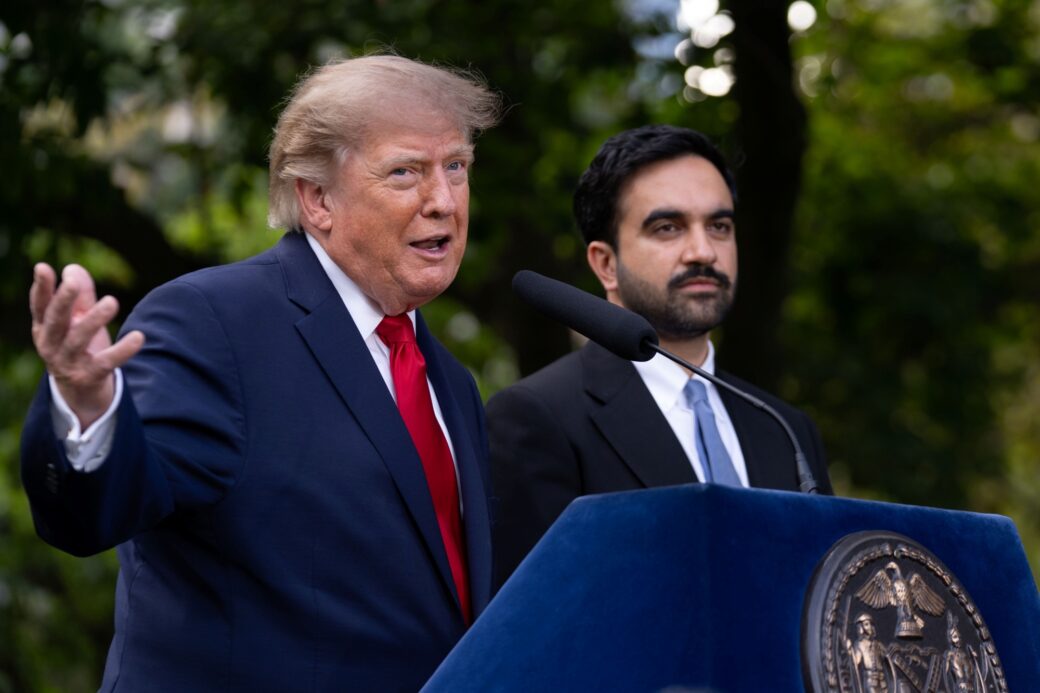
During a meeting at Gracie Mansion on Monday, Mayor Zohran Mamdani and President Donald Trump said they spoke about plans to build 12,000 homes atop a city-owned rail yard in Queens but announced no new details on the proposed project. In a joint press conference following the meeting, their third since November, Mamdani said he and the president “agreed to set up a new level of that conversation” between City Hall and the White House on Sunnyside Yard, a proposal to build a deck over the 180-acre rail yard in Queens to create a new community with affordable apartments, schools, and public space. The proposal is years in the making. Former Mayor Bill de Blasio shelved an earlier version because of the pandemic, but Mamdani revived the project and pitched it to Trump during a White House visit in February.

“What we’re speaking about is 12,000 homes, 30,000 jobs, and the prospect of an entire new neighborhood in a city where housing is the number one cost,” Mamdani said on Monday.
“I appreciate the president, his interest in this,” the mayor continued. “We also know the president not just as a leader of the country, but also as someone who has built quite a bit of housing here in our city.”
Trump said he has been watching Sunnyside for 35 years and called the project “a big job” that will need “a lot of federal approvals and probably some federal money to do it.”
He added, “They’ve been talking about developing that for 50 years, so maybe they have a shot at doing it.”
Spanning roughly 180 acres across western Queens, Amtrak owns and operates Sunnyside Yards, meaning any changes to the yard require federal approval. As of 2020, roughly 780 trains passed through the yard each day, serving Amtrak’s Northeast Corridor and the Long Island Rail Road’s Main Line, while NJ Transit also uses the yard for train storage, as 6sqft previously reported.
The master plan released by the city’s Economic Development Corporation in 2020 under de Blasio called for a $14.4 billion deck covering roughly 80 percent of the train yard to create new land for development.
The proposal included 12,000 affordable homes, half of which would be rentals for very low- and extremely low-income families, while the other half would offer affordable homeownership opportunities modeled after Mitchell-Lama.
If built, the project would be the largest affordable housing development in the five boroughs since Co-op City in the Bronx was completed in 1973.
While plans to build over the yards have only picked up steam in recent years, a vision for developing the site first surfaced in 1931, when the Regional Plan Association called for a new transportation terminal and office building “of a size that would dominate all this part of the Borough of Queens,” according to their website.
The plan Mamdani pitched to Trump in February shares some similarities with that earlier vision but replaces the proposed office space with thousands of affordable homes.
At the White House meeting, he outlined a proposal to build a deck over the rail yard and create a new mixed-use community with 12,000 affordable apartments, new schools, and public space above a new regional rail hub. During that meeting, the mayor said he asked the president for $21 billion in federal funding for the decking over the yards.
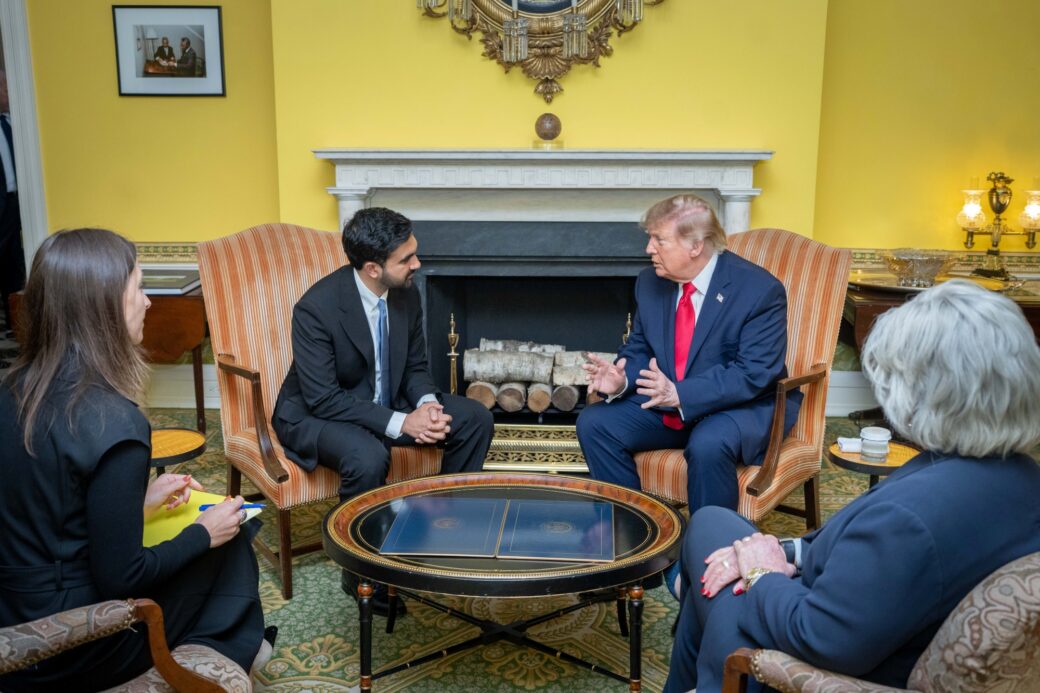
On Monday, while in New York for the United Nations General Assembly, Trump met with Mamdani at Gracie Mansion, marking the first visit by a sitting U.S. president to the mayor’s residence since Ronald Reagan in 1981. Following the meeting, Mamdani said he and Trump “elevated” discussions on the project “to a place where it’s going to be technical” between the two offices.
The meeting was the third between the two men since Mamdani won election as mayor. Their first encounter came at the White House in November, when Mamdani was mayor-elect, drawing attention for their cordiality. Trump congratulated Mamdani and said he was confident he could “do a very good job,” according to The Guardian.
In Monday’s meeting, the New York Times reported that the private discussions that preceded the public announcement were “warm, respectful,” and even “productive.”
Specific details of Sunnyside Yard remain unclear; neither the mayor nor the president provided any new information about the proposal.
Beginning the announcement, Mamdani acknowledged their political differences but emphasized that he would work with anyone who could help improve quality of life across the five boroughs.
“Each time the president and I speak, it is about the same topics: how to improve the lives of New Yorkers and how to use the power of government to take on the cost of living crisis, to grow our economy, and to build a better, stronger New York,” Mamdani said.
“I have said time and again that I will work with anyone no matter what party they belong to, no matter how much we may disagree on other topics,” he added. “I appreciate the conversation that the president and I have had on the subject of how we can make it easier to afford life in this great city that we call home.”
Responding to reporters, Trump highlighted the project’s dependence on federal support while pointing to his familiarity with the area and decades of proposals to develop the railyard.
The president also said he expects any new housing at the site to include a substantial affordable component, touting his past experience developing low-income housing.
“I know a lot about affordability because I did many, many low-income and moderate-income buildings over the years and had great success with it,” he added. “I would think that Sunnyside would have to at least a pretty substantial [affordable] component of exactly that.”
While the city and federal administrations appear to be on the same page for once, the proposal does not have the backing of all city officials.
According to Gothamist, Queens Borough President Donovan Richards questioned whether Trump would remain committed to the massive project, which could take decades to complete. He said the city could instead focus on housing projects with shorter timelines, including a proposal to build 3,000 apartments on the site of the former Flushing Airport in College Point.
Similarly, Council Member Julie Won noted that the project would require funding approved by Congress and coordination among several federal, state, and city agencies, none of which has yet been secured.
“It could be an amazing project but I’ll believe it when I see the actual funding for it,” Won told Gothamist. “I’m a realist. I am not about chasing clouds. This isn’t ‘I want to talk to my boy Donny on a side chat about $20 billion.’”
RELATED:
- Mamdani pitches 12,000-unit Sunnyside Yard development to Trump
- Renderings released for massive Sunnyside Yard project that will bring 12,000 affordable apartments
- Master planning for huge Sunnyside Yard project to begin this summer
The post Mamdani and Trump take Sunnyside Yard talks to ‘new level’ but announce no new details first appeared on 6sqft.
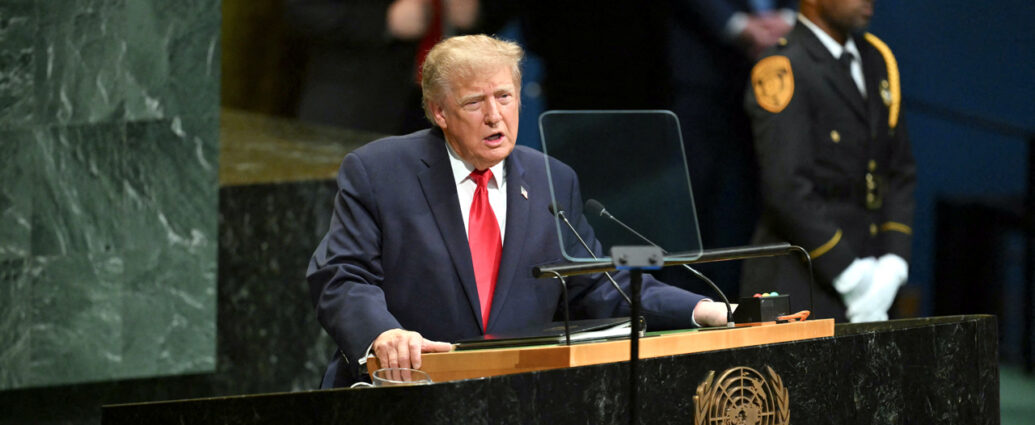
Trump rebrands AI, rejects ‘globalist scheme’ to control tech
President Donald Trump on Tuesday said the U.S. will reject what he called a “globalist scheme” to control artificial intelligence (AI) and emphasized the importance of the U.S. winning the race in emerging tech.
The president made the remarks in an address to the United Nations General Assembly in New York City.
“The United States also totally rejects any attempt to construct a globalist scheme to control for the artificial intelligence being spoken of so much now,” Trump said, adding that he thinks AI should be referred to instead as “superintelligence” (SI).
“Whoever wins AI, you have to remember this, and now I say whoever wins SI, whoever wins superintelligence, wins. That’s the group that wins,” Trump said. “We’re leading now over China by a lot and everyone else. We’re going to keep it that way. We’re going to keep it very straight and very strong.”
NVIDIA’S JENSEN HUANG REJECTS AI DOOMSDAY FEARS: ‘2030 IS NOT GOING TO BE THE END OF THE WORLD’
“I’m not going to stifle growth of something that will be bigger than the industrial revolution, many say bigger than the industrial revolution or the internet itself,” Trump said, adding that the U.S. “will be very careful” and the Department of Justice will help oversee the industry.
“We will only encourage superintelligence. We’re going to encourage it, not rein it in. We’re going to watch it closely through the Department of Justice,” Trump said.
TECH POWER PLAYERS LAND SEAT AT TABLE FOR HIGH-STAKES DINNER WITH TRUMP, XI
“The United States leads the world in superintelligence and will continue to do so safely and responsibly. Americans have never been a nation that retreats from a frontier or shrinks from a challenge, no matter how great or how daunting that challenge may be,” Trump said.
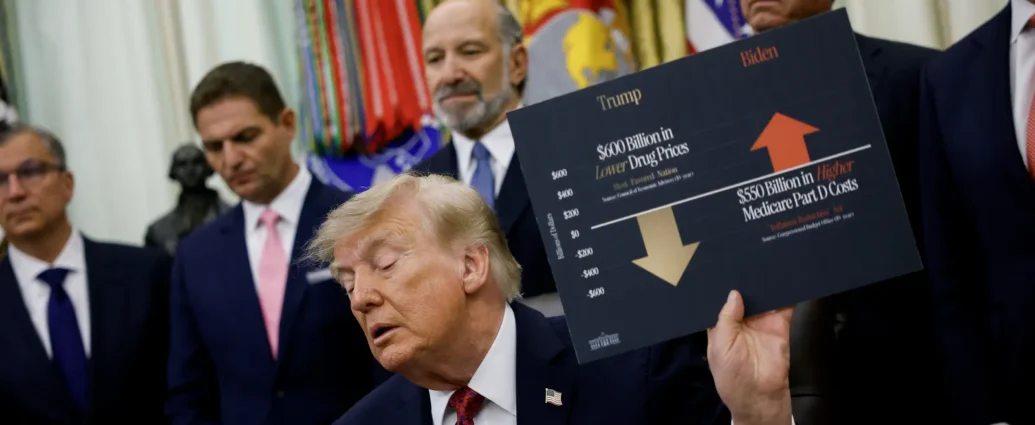
A hidden tradeoff in Trump’s MFN drug deals

Microsoft and Coinbase probe leads to arrest of crooks behind ‘EvilTokens’, a DIY phishing network powered by AI
We’ve all seen the emails: A spoofed message from your company’s CFO or a vendor asking you to pay an outstanding invoice. These phishing messages lead to millions of dollars of fraudulent payments every year, and are becoming more realistic all the time. The good news is companies are fighting back: On Tuesday, Microsoft and Coinbase announced they had taken down a phishing network, known as EvilTokens, that has defrauded businesses ranging from real estate firms to banks to healthcare providers.
In a blog post describing the scam, the companies explained that EvilTokens sold a do-it-yourself phishing kit over Telegram designed to exploit Microsoft Outlook email accounts. The kit came with a sinister feature, described by the post as “an AI-powered analyst that mapped trusted relationships, identified who controlled payments, and flagged where fraud was most likely to succeed.”
This meant that, once a victim fell for a phishing email, scammers could use the AI analyst to create especially persuasive emails to target those in position to pay. This is a notable evolution from conventional phishing campaigns, which have typically relied on a “spray and pray” approach to luring victims.
The EvilTokens tool also proved hard to dislodge. As the blog post explained, the phishing campaigns included links directing victims to fake Microsoft or DocuSign pages that displayed a code, and instructed them to enter it on a legitimate Microsoft website to verify their identity. If they did so, EvilTokens was able to bypass two-factor authentication and stay hidden on their computers—even surviving password resets.
The software powering the EvilTokens kit represents a sophisticated evolution of conventional phishing tools but, according to Coinbase’s security team, the most alarming attribute is that it requires few technical skills to use it.
“It completely obliterates the barrier to entry on phishing as a service, and can be operated on an industrial scale,” said Charlotte Surrey, an investigator on Coinbase’s global intelligence team. She added that the EvilTokens kit sold on Telegram for between $100 and $300 per month, and came with features that let anyone vibe code a customized attack.
The takedown
The EvilTokens investigation came in the course of an ongoing partnership between security teams at Coinbase and Microsoft, which regularly swap intelligence on cyber threats. The companies spent months uncovering who was behind the Telegram campaign, and then shared their findings with law enforcement.
The investigation culminated in the Metropolitan Police nabbing the masterminds behind the EvilTokens scam on September 11. In a statement, the unit said two men, aged 32 and 38, were arrested on suspicion of making articles for use in fraud and money laundering offenses, and that they have been released on bail as the investigation continues.
In the course of mapping the phishing activity, investigators determined the perpetrators of the scam had collected around $1.1 million between October 2025 and June 2026. The money was paid in cryptocurrency to wallets on the Tron blockchain, and came from over 700 distinct addresses.
In a separate element of the investigation, Microsoft filed civil lawsuits that resulted in the seizure of 50 websites and the disabling of more than 175 domains tied to EvilTokens’ infrastructure. Upon seizing the domains, Microsoft posted the following splash page to publicize the takedown:
While the EvilTokens investigation began as a collaboration between Microsoft and Coinbase, it the anti-phishing campaign evolved into a broader coalition of firms, including Cloudflare and OpenAI.
According to Coinbase, at the time of the takedown, the EvilTokens perpetrators were working on newer phishing tools to target Okta and Gmail accounts.
This story was originally featured on Fortune.com

How Kevin Warsh’s rate hike exposed a 2-speed U.S. economy, with AI and housing at the poles
From mortgages to auto loans to credit cards, borrowing is set to get even pricier.
But the Federal Reserve’s decision on Sept. 16, 2026, to hike its baseline interest rate also highlighted an increasingly confounding dilemma: It can raise the price of money across the economy, but it can’t determine which sectors are most affected.
That means the rate increase may further slow the weaker parts of the economy, such as housing, while barely affecting the strongest, namely the relentless investment in artificial intelligence.
In its statement summarizing its unanimous vote, the Fed’s policymaking committee said it was raising its benchmark rate by a quarter percentage point so that it now stands at a new target range of 3.75% to 4%. It described inflation as still “elevated” and noted that other economic indicators remain strong, from productivity to investment, to domestic spending.
As a scholar of public finance, I believe the Fed probably had little choice but to raise rates given its commitment to maintain inflation-fighting credibility. Markets had already expected the hike, and if the Fed had failed to deliver, it might have pushed longer-term interest rates even higher amid concerns it was becoming less wedded to that target.
But the Fed’s action also underscores that the U.S. increasingly looks like an economy moving at two very different speeds. Investment in AI – whether through data centers, computing capacity or related infrastructure – has been booming, while it’s crowding out other kinds of investment.
Meanwhile, the housing market is getting crushed by high mortgage rates and diminishing affordability, while consumers are carrying ever more expensive credit card and auto debt.
Many small and traditional businesses are also in a bind as they face substantially higher financing costs than they did several years ago. Those costs reflect the rising yields on longer-term U.S. government debt, which have been going up for months on a mix of factors: Longer-term inflation concerns due to soaring U.S. government debt, geopolitical risks driving up energy costs, and ongoing financing demand for AI.
On Sept. 14, the yield on the 10-year Treasury crossed 5% for the first time since 2023.
An elusive inflation target
When the Fed hikes short-term interest rates, it slows down economic activity by making borrowing more expensive and saving more attractive.
That mechanism works particularly well when consumers are deciding whether to finance a house, purchase a car or take on additional debt. It also discourages businesses from making investments when the expected return is only modestly above their financing costs. As demand slows, businesses have less room to raise prices, easing inflationary pressures.
In this case, the Fed justified its move by citing “elevated” inflation and noting that it “will support a timelier return” to its goal of an annual inflation target of 2%. It also suggested the economy would be able to absorb the tightening and described economic activity as “expanding at a solid pace.”
The decision aligns with Fed Chairman Kevin Warsh’s recent comments that restoring price stability is central to the Fed’s credibility. In a key speech in August, he underscored his commitment to bringing annualized inflation back down to 2%, an objective he called a “firm, fixed target” – a turnaround from his more ambiguous comments in July.
But in recent months, the economic data has shown that the 2% annual target remains elusive. Consumer prices rose 0.4% in August and 3.4% over the past year. Meanwhile, the war with Iran has pushed oil prices back above US$100 a barrel, adding a new source of inflation pressure through gasoline, diesel, transportation and production costs.
At the same time, the labor market isn’t faltering. The economy added 162,000 jobs in August, while the unemployment rate remained at 4.1%. The one notable concern is the persistence of long-term joblessness despite the strong headline numbers. More than one-quarter of unemployed Americans have now been out of work for at least six months.
Taken together, those numbers suggested there was room for the Fed to hike rates, given that the economy isn’t sliding into recession. So investors overwhelmingly expected the Fed’s rate increase.
An uneven economic hit
However, tighter monetary policy carries a risk: It falls disproportionately on sectors that are already struggling and highly sensitive to interest rates, while having less effect on one of the economy’s strongest sources of demand – the booming AI investment cycle.
Housing provides the clearest example. Persistently high mortgage rates are reinforcing the “lock-in” effect for current homeowners. Millions of homeowners financed their houses when mortgage rates were 3% or 4%, so they’re staying put, with little incentive to sell their home and purchase another at much higher rates.
Mortgage rates are mostly influenced by longer-term factors, including Treasury yields, inflation expectations and market expectations about the future path of interest rates. But the Fed’s decision still matters. Markets increasingly expect today’s hike to be followed by additional increases, signaling that it views inflation as a more persistent risk and putting upward pressure on longer-term interest rates.
That expectation will keep mortgage rates high – probably resulting in fewer home sales, less mobility and continued headwinds for prospective buyers. It’s also likely to make renting relatively more attractive for potential homebuyers who are priced out of buying.

Higher-for-longer rates also change how consumers save.
When interest rates were near zero, they earned almost nothing on safe assets. Today, Treasury securities, money market funds and other relatively safe assets offer meaningful returns. Higher rates therefore tend to shift incentives throughout the economy away from borrowing and spending and toward saving.
With consumers stretched by inflation and increasingly dipping into their savings, however, this effect may be less pronounced.
The AI sugar high
When it comes to the AI investment boom, it’s a different picture. Warsh noted in August that more than half of recent capital-spending growth could be attributed to the AI buildout.
The companies that are spending billions of dollars on computing infrastructure are doing so because they expect potentially enormous returns from AI. If those expected returns on investment are exceptionally high, a modest increase in borrowing costs may do little to alter their investment decisions. That stands in sharp contrast to a prospective homebuyer getting sticker shock from mortgage rates nearing 7%.
The federal government, for its part, faces a slower adjustment. A Fed rate hike doesn’t immediately increase the interest rate on all outstanding federal debt. Most Treasury notes and bonds carry fixed rates until they mature. But as the Treasury issues new debt and refinances maturing securities, today’s higher rates gradually become tomorrow’s higher federal interest expense. That rise in interest costs is a main reason some economists are sounding alarms about the national debt, which recently topped $40 trillion.
In effect, the U.S. economy is facing a reality in which both short- and long-term rates stay higher for longer. The federal government, households and businesses are all adjusting to a borrowing environment that looks substantially different from the one that prevailed for much of the previous decade.
John W. Diamond, Director of the Center for Public Finance at the Baker Institute, Rice University
This article is republished from The Conversation under a Creative Commons license. Read the original article.

This story was originally featured on Fortune.com

From the Boston Tea Party to the Flock camera backlash, 250 years of Americans saying no
A grassroots revolt against automated license plate readers, or ALPRs, has gained momentum across the United States.
ALPRs are AI-powered cameras that capture images of all passing vehicles. The camera systems turn details into datapoints searchable by anyone with access to the information.
Today, there are more than 130,000 ALPRs on U.S. streets. And more than 5,000 law enforcement agencies use cameras produced by a single manufacturer, Flock Safety, which says its cameras have helped law enforcement agencies identify and arrest criminals and reduce crime.
But some members of those police departments have abused the data gathered by ALPRs. A police officer in Kansas was sentenced to 18 months probabtion in April 2023 for using Flock camera to stalk his estranged wife. A Florida police officer was fired and arrested in March 2026 for using data gathered by ALPRs to stalk a woman he had previously harassed on a TV set. And activists filed a lawsuit against California police departments in October 2021 for illegally sharing information collected from ALPRs with out-of-state and federal agencies, including U.S. Immigration and Customs Enforcement.
Due to public outcry, cities across the U.S. have rejected and canceled contracts with Flock. In September 2026, Florida’s Department of Transportation revoked permits for ALPRs on its highway system.
That has not been enough to quell growing backlash over the cameras. In at least 36 states, opponents of the technology have taken matters into their own hands, destroying or impairing ALPRs rather than wait for local governments to step in.
As a historian of the American Revolution, I see parallels between Americans’ revolt against ALPRs and colonists’ destructive and often violent pushback to late 18th-century British rule.
If this summer’s celebrations marking the 250th anniversary of the nation’s founding failed to inspire widespread patriotism, the increasingly bipartisan revolution against ALPRs suggests Americans have not entirely lost their rebellious spirit.
Troublesome colonists
From the start, the English colonists of North America proved to be a thorn in the side of the government. Despite British hopes that investing in American colonies would enrich England, these ventures proved to be more costly than they were profitable. Colonists bore much of the blame.
When the British Parliament passed laws meant to regulate trade in the 1660s, colonists across the Eastern Seaboard turned to smuggling rather than comply.
American merchants and consumers preferred to trade directly with both their fellow English colonists and merchants in the French and Dutch colonies rather than have that trade controlled by ministers in London.
The British government had little ability to enforce the law.
Britain pushes back
That changed in 1763, after British forces vanquished the French Empire from North America at tremendous cost. A new prime minister, George Grenville, led a series of reforms aimed at making the colonists pay for their own military protection.
Many Americans often believe that the Revolution began as a revolt against higher taxes. But most of the reforms coming from London actually lowered taxes to make smuggled goods less appealing.
What colonists really resented was the imperial government’s growing influence in their lives.
In 1767, Parliament passed a series of laws that allowed Britain to raise revenue to pay the salaries of colonial governors, attorneys general and judges. At the same time, Parliament sent troops to cities such as Boston to protect its officials. Competition for work and strained community relationships often led to violence between British soldiers and colonists.
American colonists turn to violence
The same year, angry colonists in Boston, New York and Philadelphia began boycotting British goods. Prominent Americans, including Benjamin Franklin and John Dickinson, endorsed these nonviolent protests.
But more radical leaders believed colonists needed to take more decisive action.
On the night of Dec. 16, 1773, members of the paramilitary group the Sons of Liberty dumped nearly £10,000 – almost US$2 million in today’s dollars – worth of privately owned tea into Boston Harbor.
A few weeks later, the Sons of Liberty struck again. This time they attacked fellow colonist and British supporter John Malcolm, covering him in tar and feathers. For five hours, they beat him and paraded him through the streets. Similar instances of destruction and violence occurred across the colonies.

The British responded harshly. In May 1774, Gen. Thomas Gage arrived at Boston as the colony’s new military governor. He implemented the so-called “Coercive Acts,” which closed the port of Boston and disbanded local government, among other measures.
Surveillance backfires
By early 1775, Boston was besieged. Around 5,000 British troops roamed the streets, directed by Gage to gather information on the Sons of Liberty and arrest leading dissidents.
Gage hoped heightened surveillance would quell unrest. But it only pushed more citizens into the radicals’ camp. On the night of April 18, 1775, a discrete network of watchmen eluded British surveillance and famously hanged two lanterns from the steeple atop Christ Church. These beacons signaled that Gage’s troops were crossing the Charles River, on their way to seize colonial stores of gunpowder and ammunition, setting in motion the events that would begin the American Revolution.
In response to the widespread pushback to ALPRs, Flock Safety CEO Garett Langley appealed to history. In June 2026 he authored a post on the company’s website, arguing that detractors misunderstand Ben Franklin’s famous 1755 quote, “Those who would give up essential liberty to purchase a little temporary safety deserve neither liberty nor safety.”

In an August 2026 interview, Langley referenced the auto industry, noting that rather than ban cars after an uptick in collision fatalities, legislatures mandated seat belts and airbags. Drawing parallels to the contemporary debate around ALPRs, Langley suggested Americans should again prioritize safety and hoped Americans would be willing to “compromise” on issues of privacy.
Samuel Adams, one of the most prominent leaders of the Sons of Liberty, had his own opinion on compromise. Writing in June 1771, he explained that although Americans had “disagreed among themselves in one mode of opposition to arbitrary measures,” they were “united in the main principles of constitutional & natural liberty.”
Adams believed that, when threatened, American colonists would come together to defend their liberties. Clearly, Adams’ opinion resonates today.
G. Patrick O’Brien, Assistant Professor of History, University of Tampa
This article is republished from The Conversation under a Creative Commons license. Read the original article.

This story was originally featured on Fortune.com

‘Unrestrained antisemitism’: German politicians, Jewish leaders warn over Left Party’s rise
Germany’s Die Linke (Left Party), which won Berlin city-state elections on Sunday, has rejected accusations of antisemitism despite a history of anti-Jewish incidents and comments.
Left Party won 25.7% of the vote, defeating the CDU and the SPD by significant margins.
The win has sparked concerns from both Jewish groups and other political parties, with national SDP co-leader Baerbal Bas saying it would be “very difficult” to work with a party “large parts of which act in an antisemitic way.”
Shortly after the win, at the victory party, Left Party MP Ferat Kocak was photographed with Ibrahim Ibrahim – a well-known pro-Palestinian activist and PFLP and Hamas supporter.
According to Tagesspiegel, Ibrahim once described Yahya Sinwar, the slain Hamas mastermind of the Oct 7 2023 attacks on Israel, as a “martyr hero”.
Left Party leader denies accusations of antisemitism
After the event, Kocak said, “When people come up to me at our celebrations and want to take a photo with me, I assume that this is OK. I expressly distance myself from statements praising violence and terrorism.”
Also present was Issa Remmo, head of the German-based Arab crime family known for jewel heists, robberies and clan crime.
Left Party’s leader Elif Eralp – who will likely become Berlin’s first mayor of Turkish origin – has been compared to NYC Mayor Zohran Mamdani due to her pro-Palestine anti-capitalist populist beliefs.
During a press conference Monday, Eralp said the German government has “paid far too little attention to the perspectives of Muslim and Palestinian people – and, for that matter, to those of many Jewish people as well.”
“That is why we firmly oppose the instrumentalization of criticism directed at the Israeli government. We also oppose every form of antisemitism. And I believe it remains essential to clearly distinguish between the two. The CDU (Christian Democratic Union) failed to do that, and that is a major mistake,” she added.
Party co-chair Ines Schwerdtner said, “criticism of the Israeli government and the Israeli military should not be equated with antisemitism.”
“While we want to address the real problem of antisemitism, it must also be possible to criticize the Israeli government and military. These war crimes must be addressed just as much as the very real antisemitism and hatred of Jews in Germany.”
The party recently passed a resolution accusing Israel of committing genocide in Gaza.
In the summer, rapper Dahabflex faced a police investigation for chanting “Death to the IDF” and “Yallah, Yallah, Intifada” at a Left Party event in Berlin.
Additionally, an investigation by Bayerischer Rundfunk reported that officials in Left Party’s youth organization, Linksjugend, had used expressions including “Israel verrecke” (“Israel, drop dead”), referred to “Israeli concentration camps” and described events as a “genocide in the name of Judaism.” One federal spokesperson was also accused of minimizing Hamas in a chat group.
The party’s Palestine Solidarity working group has been also criticised for its relationship with BDS and its positions on Israel. Euronews found the group had described the October 7 Hamas massacre as an “act of resistance” and called for support for Palestinian resistance “in all its forms.”
‘Completely unrestrained antisemitism’
Israel’s ambassador to Germany Ron Prosor said the strong performance of the Left in the Berlin election should concern anyone who cares about the continued existence of Jewish life in this city.
“The completely unrestrained antisemitism that has emerged within this party is taking on a new political dimension with its rise to become the strongest political force,” he said. “We are long past talking about isolated slip-ups; this is a system. Red lines are being crossed again and again.”
He urged the Left to present a concrete plan for how it will stop the hatred of Israel and Jews within its own ranks and combat it at its roots.
The president of the Central Council of Jews in Germany, Josef Schuster, noted that the Left Party has repeatedly attracted attention with antisemitic comments throughout its election campaign.
“The fact that a party on whose campaign stage the death of people was openly demanded emerged as the winner of the election worries me deeply. To date, there have been no personnel or political consequences,” he said.
“In the fight against the hatred of Jews, which this party tolerates in its ranks and allows to be expressed freely, the Left Party no longer has any credibility.”
Berlin Green MEP Sergey Lagodinsky told Der Spiegel that “If the leadership of the Berlin Left Party is serious about the fight against antisemitism, then it must structurally distance itself from antisemites in its own ranks.”
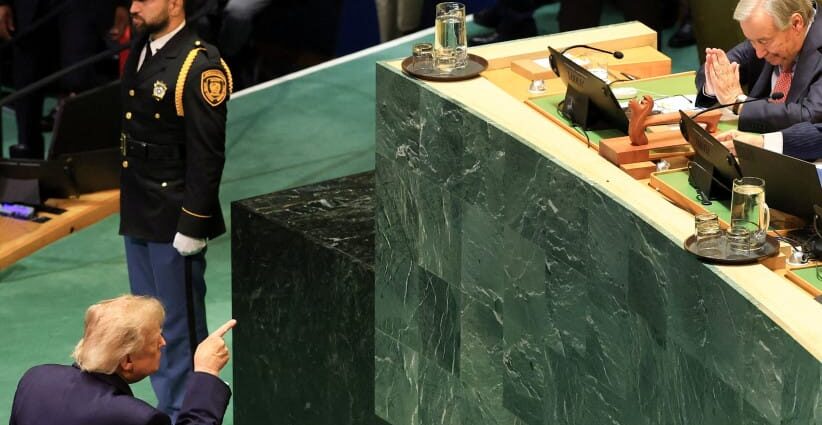
Trump denounces Iran as ‘terror regime behaving badly,’ during UNGA address
US President Donald Trump addressed the United Nations General Assembly on Tuesday, denouncing the Islamic Republic of Iran and praising the UN Security Council for approving the Gaza peace plan and establishing the Board of Peace.
“There is no better example of a danger that was allowed to gather strength at the world’s peril than the number one sponsor of terror, the Islamic Republic,” Trump said.
“For 51 years, the fanatical Iranian regime has ruled by bloodshed and mass murder, spreading death and carnage and chaos across the entire Middle East and beyond. They were the bully of the Middle East, but they are the bully no more,” he added.
“From the first day I entered the political arena, I have been unwavering. I will never allow Iran to have a nuclear weapon. Upon taking office last year, I immediately opened negotiations with Iran and offered them full economic cooperation in exchange for ending their nuclear program,” he continued.
“But they refused. They absolutely refused. That was a big mistake. Then in Operation Midnight Hammer, the US military obliterated their nuclear program beneath mountains of rubble. And again, I urge Iran to make a deal. And again, they refused,” Trump said.
“The regime continued building a vast missile and drone stockpile and threatened the security of every American service member in the region and everyone else in the region. They also made a missile that was capable of hitting Europe, and they were very proud of it,” he said.
“If they had succeeded, that wicked regime would have been free to spread terror and death forever, knowing that any attempt to stop them would face an arsenal of nuclear annihilation,” he continued.
Trump discusses horrors of October 7 massacre at UNGA
“In two weeks, we will mark the third anniversary of the October 7 attack in Israel, where terror is funded by Iran, tortured, mutilated, and killed. 1,200 very innocent civilians, including dozens of Americans and many babies, little, tiny, beautiful babies,” Trump said.
“Iran’s supreme leader celebrated that massacre and called it a service to humanity. The same regime slaughtered over 72,000 of its citizens this year. Recently, 10,000 were killed for protesting,” he added.
“Just imagine such a vile regime were ever empowered to carry out large-scale terror attacks from behind a nuclear shield; this was the reality we had to confront-a reality that far too many preferred to ignore. They all ignored it. Many presidents and many others just wanted to ignore it. They were unwilling to do anything about it, but they knew the problem,” he continued.
“As a result of Operation Epic Fury, all 159 ships of their navy are now lying at the bottom of the sea. Likewise, their air force is gone, their radar is gone, their anti-aircraft equipment is gone, their missiles and drone manufacturing capacity is almost gone,” Trump said.
“Their economy is gone. The only thing that isn’t gone is inflation, which is destroying their country, and is now well over 300 percent,” he said.
“Yet even after we agreed to a ceasefire for nuclear discussions, Iran promptly violated it with brazen acts of terrorism against civilian ships from other countries,” he continued.
“I want to thank the UN Security Council for voting overwhelmingly to pass a resolution condemning Iran’s despicable terrorist attacks on commercial shipping,” Trump stated.
“That resolution, I’m pleased to say, received more co-sponsors from UN member nations than any Security Council resolution in history,” Trump added.
“The United States Navy has recently escorted more than 1 billion barrels of oil out of the Strait of Hormuz, and more oil is flowing than at any point since the start of the war,” he added.
“But I have a big decision to make. Will a deal be made with Iran that lets them rebuild and create a far greater country than it ever was before, maybe one of the greatest in the Middle East or even the world. Or do I annihilate the Islamic Republic and do it quickly, never giving them a chance to kill and destroy people and countries again?”
“Do I drive them into hell with no chance of survival and no hope of future greatness or generations? But I believe we’ll make a deal right after the election because it doesn’t make sense for them not to. They’re waiting to see how I do in the midterm election,” he said.
“They’re waiting to see how I do in the midterm election. What they don’t realize is that I’m not running. I gave absolutely no credence and will not give credence to the election when it comes to Iran. It doesn’t even enter my mind. The only thing that does is that Iran will never have a nuclear weapon,” Trump stated.
“The cowards and traitors would love to say the United States is low in munitions, but that’s not true. We have more munitions than we could ever possibly even think of using, and we’re building them at levels that we have never done before,” Trump said.
“I call on all nations to join us in enforcing the complete economic isolation of Iran until they stop their attacks on commercial shipping, relinquish their nuclear ambitions, and cease their support of terror,” Trump stated.
“The terrorist regime is behaving badly. badly, not because they are strong and confident, but because they are weak and desperate,” he added.
“If we stand united, we will soon see a world free of the last 51-year menace of Iranian terror,” he continued.
Trump praises establishment of Board of Peace during UNGA address
“One year ago, when I addressed the great leaders in this hall, the war in Gaza was still raging brutally. The hostages were still deep in Hamas tunnels, and there was no end in sight. It was never going to be resolved. But here, on the sidelines of the General Assembly, we took the first steps that changed everything. A few weeks later, we ended the war in Gaza, saving untold 1000s of lives. We also brought home all remaining hostages, both living and dead. Every single one of them. Thank you. Thank you,” he said.
“I want to express my gratitude to the United Nations Security Council for their unanimous endorsement of our 20-point Gaza peace plan, and for officially approving the Board of Peace,” he added.
“We’re thankful to many of those member nations for contributing billions and billions of dollars to relief. And it goes right to the rebuilding and relief of Morocco and Bahrain. These are the countries that gave: Qatar, Kuwait, Kazakhstan. Afghanistan, Saudi Arabia, Turkey, Uzbekistan, and many more,” he stated.
“I also want to thank those who have committed troops, police, and training to help stabilize Gaza, including Indonesia, Morocco, Albania, Kosovo, Kazakhstan, Egypt, Jordan, and more,” he added.
“We’ve invested more money in the United States military in the past 12 months than ever before, and this term it’ll be 1.5 trillion dollars,” Trump said.
Trump confirms US to sign deal with Denmark over military bases in Greenland
Trump also confirmed that the US will sign a deal with Denmark to place military bases in Greenland.
“As I announced just days ago, the United States has also reached an unprecedented agreement regarding the northern frontier of North America, the large and strategically vital piece of land known as Greenland,” the president said.
“This agreement, made with the Kingdom of Denmark, an incredible, beautiful country, and the Greenland people themselves, gives the United States permanent control over security and all of the needs on that territory. We will have the complete ability to do what is necessary to defend the American continent and also Europe and other places,” he added.
“No US adversary will ever be permitted to establish a military presence in Greenland anymore, or make sensitive investments there without our express written approval. We will immediately begin the process of developing a large military presence in the appropriate locations. We’ll be building two very major military bases,” he stated.
“This agreement will be signed later today, and I look forward to working with the wonderful people of Denmark and Greenland. It’s been a great experience, an amazing experience, and we’ve really formed a bond in doing it by expanding America’s footprint in the Arctic and North Atlantic. This deal also protects Europe, in addition to America, and greatly protects them,” Trump said.
Trump calls for rebranding artificial intelligence as ‘super intelligence’
Trump also called for rebranding artificial intelligence as “super intelligence.”
“It’s actually amazing, but we have to be careful. In fact, it is exactly the opposite of what it purports. From this point forward, all of the United States documents and, hopefully, the world’s will be changed to use the much more accurate term “super” as opposed to artificial. So it’s super intelligence,” the president said.
“In other words, welcome to the new world of superintelligence. SI. SI. Let’s see if that goes. It sounds much better. It is much better, and it’s much more accurate. Let’s see if I have any power. Maybe I do, and maybe I don’t. We’re going to find out pretty soon,” he added.
“The United States leads the world in superintelligence, and we’ll continue to do so safely and responsibly. Americans have never been a nation that retreats from a frontier or shrinks from a challenge,” Trump said.
Guterres condemns Hamas’s Oct. 7 massacre, calls Israel’s reaction a ‘scale of death and destruction unlike anything I have seen’
UN Secretary-General Antonio Guterres condemned Hamas’s October 7 massacre, before immediately denouncing Israel’s reaction as “unlike anything [he had] ever seen before” during the opening statements at the UN General Assembly in New York on Tuesday.
🇵🇸 🇺🇳 “Amid the turmoil engulfing the region, we must not lose sight of the devastating situation in the occupied Palestinian territory… what followed was an onslaught on Palestinians in Gaza, with a scale of killing and destruction unlike anything I’ve witnessed in my years as… pic.twitter.com/GyWe2M0PAv
— State of Palestine (@Palestine_UN) September 22, 2026
“We must not for a moment lose sight of the devastating situation in the occupied Palestinian territories,” he said.
“Almost three years have passed since the heinous Hamas terror attack of October 7, but what followed was a large-scale offensive against Palestinians in Gaza, involving a scale of death and destruction unlike anything I have seen during my years as secretary-general,” he stated.
” The International Court of Justice has issued legally binding provisional measures in the case titled, and I quote, ‘Application of the Convention on the Prevention and Punishment of the Crime of Genocide in the Gaza Strip,’” he continued.
“In an advisory opinion issued last year, the international court made clear that the UN must be allowed to fulfill its mandates in Gaza, and that our staff and humanitarian aid workers must be protected,” Guterres said.
“All parties must comply with international law and the Court’s orders,” he added.
“Meanwhile, violence, displacement, and settlement expansion by Israel in the occupied West Bank are trampling the path to peace and raising fears of ethnic cleansing,” he said.
“We cannot allow the two-state solution to disappear before our eyes,” Guterres added.
Israel’s Ambassador to the UN Danny Danon denounced Guterres’s statements on X, saying that the UN chief “chose to use the podium to deliver a political indictment of Israel, with outrageous insinuations of “ethnic cleansing.”
“This is not diplomacy. This is anti-Israel propaganda under the UN banner. You have turned your office into a tool for attacking Israel and shattered the organization’s credibility,” Danon said.
Even in his final address as Secretary-General during the UN General Assembly’s high-level week, Guterres chose to use the podium to deliver a political indictment of Israel, with outrageous insinuations of “ethnic cleansing.”@antonioguterres, this is not diplomacy. This is… pic.twitter.com/jXw3HN6aUQ
— Danny Danon 🇮🇱 דני דנון (@dannydanon) September 22, 2026
“It is time for new leadership,” he added.
Brazil’s Lula: ‘Generations of Palestinians will carry pain of genocide perpetrated by Netanyahu’s govt. in Gaza’
Brazilian President Lula da Silva said that “Generations of Palestinians will carry the pain of the genocide perpetrated by Netanyahu’s government in Gaza,” in his address to the UNGA.
UN Special Rapporteur “Francesca Albanese must not be persecuted for telling the truth,” Lula added.
“The Strait of Hormuz has become a battleground…We do not need aircraft carriers guarding our waters, we need cooperation,” Lula added.
Expected speakers during first day of UNGA
Several world leaders are slated to speak on Tuesday, including Jordanian King Abdullah II, Turkish President Recep Tayyip Erdogan, Qatari Emir Sheikh Tamim bin Hamad Al Thani, French President Emmanuel Macron, British Prime Minister Andy Burnham, and others.
This is a developing story.

Muslim police associations accused of undermining police impartiality – Policy Exchange reports
Some Muslim staff associations within British policing may be coming into conflict with the principle of police impartiality, a new report by Policy Exchange revealed on Monday.
“Mixed Messages: Police Impartiality & the National Association of Muslim Police” examines the activities of the National Association of Muslim Police (NAMP) and local force-level Muslim Police Associations, finding examples of the organizations becoming involved in highly contentious policy issues and platforming individuals and organizations with “questionable backgrounds.”
The NAMP was established in 2007 at an event held at the British Transport Police headquarters to act as “an umbrella organization [sic] for local Associations of Muslim Police.” By 2021, NAMP claimed to have 1,000 members in police forces across the country. Of the 43 “Home Office” forces of England and Wales, 20 police forces (43.5%) have a local Muslim Police Association.
A NAMP policy paper, titled “From Past Prejudices to Present Policies: Confronting anti-Muslim hatred and Promoting Human Rights,” dated July 20, 2025, was recently brought to public attention for describing Zionism as “one of the manifestations of anti-Muslim hatred, stripping Muslims of their humanity” and referring to the IDF as one of a number of “Zionist terrorist groups.”
The paper also defended Hamas against what it described as “alarming and unverified stories about acts of violence” committed during and after the attacks of October 7, 2023.
This policy paper was written by Khaldoun Kabbani, who was listed as the chair of the Scottish Police Muslim Association and vice president of the NAMP.
NAMP removes controversial policy paper after JLC intervention
Following intervention by the Jewish Leadership Council (JLC), NAMP removed the paper from its website and issued a statement asserting that it did not support terrorism and that the document did not represent its views, despite the fact that the paper carried NAMP’s logo, appeared on its website, and was written by its VP.
Elsewhere on the NAMP website is a 2023 press release claiming that “using terms such as ‘Islamist’ reinforces Islamophobia, by creating a higher risk of extreme right-wing radicalization, it also re-enforces a narrative that makes an association between Islam and terrorism, creating a greater risk of radicalization amongst vulnerable Muslims.”
During the recent NAMP Annual General Meeting 2026, held at Greater Manchester Police, attendees heard from speaker Majid Iqbal of the Islamophobia Response Unit.
Iqbal is known for an interview he gave in July 2024 after a violent incident at Manchester Airport where police officers clashed with two men attempting arrest. Iqbal criticized the “unjustifiable action of the police, the violent actions of the police.” The video circulated of the incident showed only the police response to the two men, but not what preceded it: passenger Mohammed Fahir Amaaz assaulting another passenger and then breaking a police officer’s nose.
Policy Exchange said Iqbal’s presence at NAMP’s Annual General Meeting “raises several questions about NAMP’s approach and decision-making.”
“First, how committed is NAMP to contributing to the confidence of the wider public in policing when they are willing to provide a platform to an individual – Mr. Iqbal – who made claims that the police acted in a way which was ‘violent’ and ‘unjustifiable’ following the circulation of clipped social media footage which did not provide the full context of the incident at Manchester Airport?” the paper asks.
Policy Exchange examines conduct of Hasson Shigdar
The report also discusses the activities of Superintendent Hasson Shigdar, a senior West Midlands Police officer and vice-chair of the West Midlands Association of Muslim Police.
It argues that Shigdar, who is also head of Prevent for the West Midlands Counter Terrorism Unit, has shared material online from organizations with questionable history and associations. For example, he tweeted his support for Green Lane Mosque, which had its proposed government funding suspended in 2023 after accusations emerged of hate speech and extremism.
“If policing is to reassure the public that impartiality is not merely a commitment which police chiefs and police officers consider to be an anachronism, they – and government – must act decisively to regulate this arena, which has been allowed to become an ungoverned space for activists,” Policy Exchange said.
It encouraged the Home Secretary to bring forward new legislation – a “Police Impartiality Act” – to set out the impartiality requirements for all Chief Constables, police forces, and policing related bodies,
“The recommendations for greater rigor in the governance and operation of Police Staff networks are a key step in maintaining impartiality,” said Michael Stewart, former national security senior practitioner. “Senior officers must be prepared to challenge the views of Staff Networks and their members when those views are unbalanced or too narrowly focused on a particular group.”
“When Staff Networks in policing publicly involve themselves in matters of policy, which are rightly the preserve of elected governments and ministers, those networks and their leaders are going way over the line,” said Chris Donaldson, former police inspector and firearms commander with the Metropolitan Police and founding member of the National Black Police Association.
Zillow wants RESPA case tossed for good



AI Rally Cools As Oil Slips Under $100
Investors are pausing to catch their breath Tuesday after Monday’s blowout rally in artificial-intelligence stocks, and oil prices dipped back below the $100-a-barrel mark that had unnerved markets for weeks. When traders take profits after a huge one-day gain, stock futures tend to go flat or slip slightly the next morning — and that’s exactly what happened as Wall Street opened.
Monday was one of the strongest sessions of the year. The Nasdaq Composite jumped 2.26%, or nearly 600 points, to close at a record 27,122.09, topping its previous high from June. Chip and AI-linked stocks led the charge: Arm Holdings surged more than 17%, Intel gained better than 12%, Meta Platforms rose 11.4%, Warner Bros. Discovery climbed nearly 11%, and AMD and Qualcomm each advanced close to 10%. The Dow Jones Industrial Average added 367 points and the S&P 500 gained more than 114 points, with nine of the S&P’s 11 sectors finishing higher.
Much of that excitement traced back to Meta’s new AI assistant, called Muse, which shot to the top of Apple’s free-app rankings shortly after launching this month. That gave investors fresh confidence that demand for the computer chips powering artificial intelligence remains strong, and money poured into semiconductor and AI-adjacent stocks as a result.
By Tuesday morning, though, that enthusiasm cooled. Nasdaq futures traded roughly flat, a sign that traders are digesting Monday’s gains rather than chasing them further. One European trading desk head described the pause as a natural consolidation after a sharp one-day move, while still expecting the broader upward trend in AI stocks to hold. That’s a common pattern after a rally this large — a pullback doesn’t necessarily mean the story is over, just that the market is catching its breath.
On the energy side, oil prices slipped in early trading, with the international benchmark, Brent crude, dipping back under $100 a barrel for the first time in several sessions before paring some of that decline later in the morning. U.S. crude, West Texas Intermediate, held in the low $90s. The initial drop came on rising hopes that diplomacy could reopen full shipping traffic through the Strait of Hormuz — the narrow waterway between Iran and Oman that carries roughly 1 in 5 barrels of oil traded worldwide. Any easing of tension there reduces the risk of a supply squeeze, which is why oil prices have been swinging sharply on every headline out of the region.
That volatility matters well beyond Wall Street trading desks. Oil prices feed directly into what Americans pay at the gas pump, and from there into the cost of shipping nearly everything else — groceries, furniture, packages ordered online. When crude drops, relief at the pump typically follows within a week or two. But Tuesday’s move was a reminder that the relief is fragile: any fresh sign of disruption in the Middle East, such as renewed fighting or a delay in reopening the strait, can send oil prices right back up.
Treasury yields, which set the tone for mortgage rates, auto loans and credit card rates, have also been easing alongside oil, giving stocks an added lift. Lower borrowing costs make it cheaper for households to finance a home or a car, and they make future corporate profits look more attractive to investors today — one reason stocks and falling yields have moved together in recent sessions.
For now, Wall Street’s attention is split between two fast-moving storylines: whether the AI trade has more room to run after Monday’s surge, and whether the fragile calm in oil markets holds. Traders are also watching for developments ahead of a planned meeting between President Trump and Chinese leader Xi Jinping later this week, with hopes for at least modest cooperation on trade and artificial-intelligence policy. A light week for corporate earnings and economic data means those two threads — chips and crude — are likely to keep driving the market’s daily swings through Friday.
JBizNews Desk | Wall Street
© JBizNews.com All Rights Reserved. Reproduction or distribution without written permission is prohibited.

STAT+: Novo may be getting a better deal than expected with Medicare’s Bridge program
Want to stay on top of the science and politics driving biotech today? Sign up to get our biotech newsletter in your inbox.
Good morning. As an avid Pilates goer, I appreciated this story.
The need-to-know this morning
- Roche reported a positive Phase 2 trial of enicepatide (previously known as CT-388) in patients with type 2 diabetes and obesity, with the drug helping patients lose weight and lower blood sugar. The company already has two Phase 3 weight loss studies ongoing and is planning on starting another pivotal trial next year looking at blood sugar control and cardiovascular outcomes.
- Celldex Therapeutics said its experimental treatment for chronic hives achieved the goals of two Phase 3 clinical trials.
- Ionis Pharma said an experimental therapy for a rare form of ALS prolonged survival and slowed the progression of the disease in a Phase 3 clinical trial. The RNA-based drug, called ulefnersen, is licensed to the Japanese pharma company Otsuka.
Viking drug shows potential for less frequent maintenance dosing
Viking Therapeutics said this morning that in a Phase 2 trial, its injectable obesity candidate, initially tested as a weekly treatment, still looked to be efficacious after transitioning to every-other-week or monthly dosing.
Negev teen charged over 45 TikTok reposts praising Hamas, October 7 massacre
Southern District prosecutors charged a 19-year-old Segev Shalom resident on Tuesday with dozens of terrorism-related speech offenses over 45 TikTok reposts that allegedly praised Hamas, glorified attackers and included one direct call to commit a terrorist act.
The prosecution has asked the Beersheba Magistrate’s Court to keep Deif Allah Abu Rjeila in custody until the end of his trial, arguing that the number and content of the posts show that his release would endanger the public.
The case concerns material Abu Rjeila allegedly shared online. The indictment charges him with 40 counts of incitement to terrorism, 23 counts of publicly identifying with a terrorist organization and one count of directly calling for a terrorist act. The counts overlap across the 45 posts, with some reposts forming the basis for more than one alleged offense.
According to the indictment, Abu Rjeila controlled a public TikTok account under the name “deef2lla,” which had 877 followers and 5,449 likes. Prosecutors allege that he reposted material from April 24 until his arrest on August 13, becoming particularly active on an almost daily basis during August.
Abu Rjeila reposted material pertaining to Sinwar, Haniyeh and Yassin
Much of the material was originally published by accounts identified with Hamas or dedicated to commemorating terrorist operatives, the indictment alleges. The reposts included footage from the October 7 massacre and material praising Hamas leaders Yahya Sinwar, Ismail Haniyeh and Ahmed Yassin, as well as members of other Palestinian armed groups.

One June 8 repost allegedly praised Hamas Nukhba terrorist Mu’in Muammar for killing 20 Israelis in 10 minutes on October 7. The video described the victims as “heads” and was accompanied by religious music and hashtags referring to October 7 and martyrdom, according to the indictment.
The direct-call charge concerns a separate video reposted on June 3. Prosecutors said it contained a sermon describing jihad and fighting as religious obligations and presenting them as the only means of “purifying” al-Aqsa Mosque.
Under the Terrorism Law provisions cited in the indictment, the prosecution must prove more than that the posts were offensive or supportive of violence. For the 40 incitement counts, it alleges that the content and circumstances created a real possibility that the publications would lead to terrorist acts.
Prosecutors discover detainee was inspired by October 7 massacre events
The detention request says the evidence includes records of the TikTok posts and material extracted from Abu Rjeila’s phone, including WhatsApp correspondence, gallery images and the accounts he followed. Prosecutors said he acknowledged during questioning that the phone and TikTok account were his and connected himself directly to some of the reposts.
The request also quotes him as allegedly telling investigators that he had not previously liked Hamas, but began to do so after watching videos posted following October 7. That statement appears in the prosecution’s detention application and has not been independently confirmed or tested in court.
Prosecutors argued that the volume of the material, the single alleged direct call for an attack and what they described as his intensive engagement with terrorist content establish a danger that cannot be addressed outside custody. They also argued that the continuing security situation increases the potential danger posed by alleged incitement.
Abu Rjeila was arrested on August 13 in a joint operation by the Shin Bet (Israel Security Agency), Israel Police and Border Police counterterrorism officers.

How Arab-Israeli air defense coordination is developing into a regional security shield – analysis
Operation Epic Fury helped improve coordination among US partners and allies in the region on air defenses and other areas. A recent Lead Inspector General Report to the United States Congress, which covers operations of Epic Fury from April to June, provided new details on the types of cooperation. Although the report is general, it sheds light on an important trend in the Middle East.
The report says that “US forces embedded in partner air operations centers across the region, which supported coordination, deconfliction, and synchronization of air defense efforts.”
It also discusses a Middle East Defense network, “an integrated missile defense architecture in the region – intercepted more than 6,000 OWUAS and more than 1,500 ballistic missiles that targeted US and partner forces.”
In addition, the report discusses how the US partnered with Israel. “Coordinated air and missile defense with Israel was also substantial, with US Patriot and THAAD systems operating alongside Israeli Arrow, David’s Sling, and Iron Dome systems. The United States and Israel maintained shared awareness and recurring reporting on readiness and intercept activity via embedded liaison officers in the Israeli military headquarters in Tel Aviv, known as HaKirya.”
The origins of this unprecedented cooperation grew out of foundations laid over the past few years. These include US Central Command (CENTCOM coordinating with Gulf partners and also with Israel.
Increasing cooperation throughout the Middle East
Over the last decade, Israel and CENTCOM have increasingly cooperated. This resulted in Israel moving from being under US European Command to being in CENTCOM’s area of operations. The Abraham Accords paved the way for this move because it meant Israel could not work more openly with Gulf partners. In the past, Arab countries had generally refrained from any joint exercises with Israel. This made coordination difficult, even if it occurred quietly.
Much has changed in the Middle East in the last decade. In the wake of the 2015 Iran deal, Tehran increased its role in Yemen, Iraq, Syria and Lebanon. At the same time, countries in the region had to deal with ISIS threats that only began to decline after 2017.
Turkey’s hostile attitude to Egypt, Saudi Arabia and the UAE shifted considerably after 2019. Other trends began to change as well. Israel, Greece and Cyprus became closer partners. While COVID reduced joint exercises, Israel, the US, and other countries still had many opportunities to train together using advanced platforms such as the F-35.
After the Abraham Accords, there was increasing discussion about how Israel might integrate with the Gulf countries to coordinate defenses. Some saw a potential Middle Eastern defense pact, or a kind of regional NATO. That would require Saudi Arabia to normalize ties with Israel. Normalization didn’t happen.
Nevertheless, in January 2022, the Jewish Institute for National Security of America (JINSA) published a report called A Stronger and Wider Peace: A US Strategy for Advancing the Abraham Accords.
“The report heralded the Accords as an historic breakthrough and urged the US government to seize the opportunity to start building a new Middle East defense architecture premised on bringing America’s regional partners together in common cause to counter the growing menace from Iran.”
The goal was also for Congress to help support this cooperation and support a “region-wide air defense network to help deter and defeat the escalating missile and drone threat posed by Iran and its terrorist proxies.”
The result was the Deterring Enemy Forces and Enabling National Defenses Act (DEFEND Act) of 2022.
JINSA noted in a May 2023 report called “Build it, and they will come: A US strategy for integrating Middle East air and missile defenses,” that there were opportunities to move toward a “region-wide integrated air and missile defense (IAMD).”
JINSA noted that “animosities among US partners have historically acted as a severe constraint on their willingness to engage in the levels of intelligence sharing and cooperation that meaningful air defense integration would require.” The opportunities in 2023 were clear. Israel could work with the US and Gulf partners.
Hamas, Iran, Houthi attacks shifting sands of Middle Eastern relations
The October 7 Hamas attack was a setback to this regional integration. Iran wanted it to be a setback, and in some ways Tehran initially got its wish. Israel had to wage a grueling, long war in Gaza and then in Lebanon. The Houthis attacked Israel. Iran also carried out large direct attacks using hundreds of ballistic missiles.
The Iranian attacks and the Houthi attacks led to close cooperation between the US, Israel, and also regional partners against the ballistic missile and drone threat. This laid the foundations for what came next in 2025 and 2026.
The full extent of cooperation during Epic Fury is yet to be revealed. Nevertheless, the fact that air defense systems, such as THAAD, Patriots, and Israel’s David’s Sling, Arrow, and Iron Dome, were able to work together is important.
The US is also selling more defense systems to the Gulf. As the Gulf countries modernize their systems, more opportunities for joint cooperation will occur. In addition, there will be more chances for joint exercises and drills in the future.
The tempo of war since 2023 has largely pushed off some of these drills. It remains to be seen if Saudi Arabia will acquire the F-35. If it does, it would join Israel and CENTCOM as an operator of the 5th-generation warplane over the next decade.
The recent Lead Inspector General Report sheds light on how Iran targets countries in the region. It also shows how the US has “been helping grow the sovereign military defense of Gulf partners for decades to counter Iranian attacks and safeguard regional stability. This has included the provision of military sales, training, and information-sharing to Gulf partners.”
This is all good news. The fact that such a large number of 6,000 drone attacks and 1,500 ballistic missile attacks were intercepted further illustrates the success.
Iran has hinted that it is developing new threats. The learning curve has already shown that Israel and other countries in the region are prepared for many of these threats.
Nevertheless, the war will result in some changes. There is talk of the US shifting away from some bases in the Gulf. This could mean more deployment in Jordan or in Israel.
CENTCOM will be learning many lessons alongside Israel regarding what comes next.

Russia spreads AI fakes claiming Jews are being paid to settle in Ukraine
Russia carried out a large-scale disinformation campaign surrounding the Jewish pilgrimage to Uman, Ukraine’s Center for Countering Disinformation (CCD) has claimed.
CCD is a Ukrainian government body that monitors and responds to disinformation, propaganda and information operations directed at Ukraine. It is part of Ukraine’s National Security and Defense Council (NSDC).
A record number of Jewish pilgrims traveled to the Ukrainian city of Uman for Rosh Hashanah this year, according to local statistics. The local Cherkasy Regional Center for Disease Control and Prevention reported that more than 49,000 pilgrims had arrived in the city by the morning of September 11, while Israeli figures place it higher at 52,000.
Regardless, the number surpassed even pre-war years, which typically saw between 30,000 and 35,000 pilgrims. There was also a significantly increased proportion of non-Ashkenazi Jews – Sephardim and Mizrahim – which Ukrainian Jewish media said accounted for up to half of all visitors.
Numbers aside, the pilgrimage has been the subject of media attention for another reason: Russian fake news.
Russian-controlled TikTok accounts circulated AI videos with fake pilgrims
CCD reported that during and after Rosh Hashanah, Russia-controlled TikTok account networks circulated a series of AI-generated videos in an interview format.
In the videos, fake pilgrims claim that they are supposedly moving to Ukraine permanently.
The videos also contain fabricated claims about “payments from the Ukrainian government of 200,000 hryvnias,” “special benefits,” and even alleged plans to “make Uman an independent entity.”
CCD said the campaign is “entirely disinformation.”
It said there is no “mass resettlement” of foreigners and that this is an annual temporary religious pilgrimage, after which Hasidic pilgrims return to their home countries.
It also stressed that Ukraine has no government programs or financial payments designed to encourage foreign citizens to relocate to the country.
“The enemy’s main goal is to exploit the heightened attention surrounding the event in order to destabilize Ukrainian society from within and artificially provoke antisemitic sentiments,” it said.
Tracing the campaign
The Israel-based, Ukrainian-founded media site Nikk traced the disinformation campaign back further, to May 2019, when then-adviser to the Russian president Sergey Glazyev published a text suggesting the possibility of mass resettlement in southeastern Ukraine of residents of Israel and other Middle Eastern countries.
At the time, Israel’s Foreign Ministry described Glazyev’s comments as conspiratorial and antisemitic.
Fast forward seven years, an adviser is no longer needed to spread it, “all you need is AI and TikTok,” Nikk said.
Six months ago, in April 2026, researchers documented new activity by the Russia-linked Matryoshka network in the form of fake videos circulating claims that Ukraine was planning to ban Israelis from making their annual pilgrimage to Uman.
Alongside this appeared a fictional “Orthodox rabbi” who supposedly cursed Vladimir Zelensky over the Ukrainian-Israeli dispute concerning Ukrainian grain taken by Russia.
This same network then replaced the narrative with September’s one that Ukraine gives Jews special treatment, state money, and is preparing to settle them there permanently.
Additionally, on August 17, the Russian-language Telegram channel Fikrat Shabanov published a long article describing the expected arrival of approximately 30,000 Hasidim as a “rehearsal” for the future mass resettlement of Jews in Ukraine
While there is no evidence that this Telegram channel is operated by the Russian state, the content is relevant.
The Telegram article said coordination between police and border guards was described as training for the “absorption of millions of new Israelis,” while the 2026 pilgrimage was called the “last major rehearsal” before the year 5788, which begins in autumn 2027.
It also said Ukraine closed its borders to some people while Jews are allowed to arrive in the tens of thousands.
None of this is based on fact, and there is no Israeli government decision or Ukrainian government document agreeing to transferring territory or a program for resettling millions of people.
Nikk, however, spoke of how actual facts on the ground could be slightly altered to fit the ‘resettlement narrative.’
For example, on September 5, Ukraine’s National Police announced the arrival of Israeli police officers in Uman. The Israeli officers patrolled the areas where Hasidic pilgrims were staying and visiting together with Ukrainian police, emergency services and the National Guard.
Nikk noted that within the disinformation environment, open coordination between two law-enforcement systems “becomes evidence of preparations for mass resettlement.”
“Ukraine and Israel coordinating security for tens of thousands of Israelis – true. Does that mean they are training to resettle “millions of new Israelis” there? No.”
Another fact is partially true: there is a Ukrainian state program involving a payment of exactly 200,000 hryvnias, but it has nothing to do with Hasidim, Israelis, or foreigners wishing to settle in Uman.
Essentially, the trajectory looked like this: April 2026, fake reports circulate that Ukraine supposedly planned to prevent Israelis from entering Uman; May 2026 Russian AI networks promoting “population replacement” and antisemitic narratives; August 2026 “Heavenly Jerusalem” and a supposed “rehearsal” for the resettlement of millions; September 11, “privileged Hasidim” and a Russian state media report about the “takeover” of Uman; and September 14, an AI-generated pilgrim supposedly “confessing” to receiving money and planning to remain in Ukraine.
“There is no need even to invent one enormous fake story; it would quickly collapse,” said Nikk. “It is much more effective to take real Uman, real pilgrims, real police officers, a real Ukrainian payment of 200,000 hryvnias, and real everyday tensions surrounding Rosh Hashanah, and then slightly alter the relationships between them.
“The result is a story that never happened.”



The 4-day workweek died at some point in the 2020s, and now it’s spread out over 6 days
Frank Weishaupt did not expect to be workshopping heavy metal album titles with me 15 minutes into a press call about his own survey data. But that’s where the conversation about Owl Labs’ 10th annual State of Hybrid Work Report landed, after I told him that what he’d put together sounded like “kind of a nightmare fuel report.”
Weishaupt, a thought leader in the field of remote work thanks to his role as CEO of the Boston-based video-conferencing company, pushed back — just a little bit. “I don’t know if I see it that way,” he said, before immediately cataloging the ingredients: job hugging, career minimalism, employees strategically “billboarding” themselves in the office one day a week while working six. “I just said a bunch of things that don’t sound really good in that mixture,” he said. “So your soup is definitely there, right?”
Acknowledging that the report is “stress-bound” and at times “sounds like a terrible recipe,” Weishaupt insisted there are more nuances to the story. Owl Labs popularized the phrase “coffee badging” to describe the strategic practice of badging into your office building just long enough to have a cup of joe and some face time with your boss before heading back home around 3:00 pm, but that has expanded into what Owl Labs calls “billboard days.”
I suggested that it adds up to a “panopticon,” a conceptual prison from the Victorian age developed by Jeremy Bentham, in which essentially everyone is surveilling everyone else, leaving no room for escape. I pointed out that it’s the title of an especially gnarly progressive-metal album by the unfortunately named Isis (Pitchfork gave it an 8.4). Weishaupt laughed and said he’s a Metallica fan himself, before agreeing that his latest Hybrid Work Report is pretty “heavy metal,” nowhere more so than the disappearing four-day workweek.
The four-day workweek’s six-day afterlife
For years, the four-day workweek was the aspirational endpoint of every hybrid-work conversation. Owl Labs’ data shows that’s dead, Weishaupt said: “We have completely shifted away from a conversation about the four-day workweek,” he said, “and it’s now becoming more of a question of, is Saturday your only day off?”
In fact, 74% of employees say they do some kind of work on a typical Sunday, and 21% call it a full or near-full workday, according to the report. Rather than compressing hours into fewer days, workers have simply had their week stretched into a sixth day, breaking the day into non-linear blocks around parenting, energy levels, or personal errands.
Weishaupt frames this as flexibility given back on employees’ own terms. “If you’re taking that Tuesday afternoon or that Thursday morning… you might be giving it back,” he said, “but as long as that Sunday’s not additive to the whole picture and you can make it work, I see that as flexibility.” This fits into the 2020s-era trend of “microshifting,” or work being split into many small sprints throughout the day rather than a traditional, eight-hour workday.
Weishaupt said he wasn’t sure exactly when it ended, but the window has closed on the four-day work week. “I thought that’s where we’re going to go for a little while and, I think that’s been waved bye-bye a while ago.”
If Sundays are where the extra work goes, “billboard days” are where employees perform the appearance of not needing extra oversight in the first place. Nearly half of workers — 48% — say they’ve picked specific in-office days deliberately to be seen by senior leaders or clients, or plan to start. Bosses, notionally the ones doing the watching, are just as prone to angling for visibility themselves: 40% of billboard-day participants are managers.
The logic is straightforward once you follow Owl Labs’ own return-to-office data. Asked why RTO policies exist at all, 76% of employees say the real driver is leadership oversight — not the 74% who cite productivity and collaboration, or the 71% who point to client service and culture. Employees have concluded, in other words, that showing up is mostly theater for an audience of one manager, on one day, and they’ve adjusted their calendars accordingly.
Job hugging, career minimalism, and the extraction math
Weishaupt touched on generational economics, noting that 53% of employees say they’ve adopted or plan to adopt “career minimalism” — deliberately scaling back ambition to protect health and sustainability instead of chasing promotion. He calls this “one of the more concerning pieces of data,” reading it as a euphemism for surrender: “Maybe you’re giving up a little bit, right? Like, ‘Hey, I’m not gonna be able to go anywhere because it’s too risky to leave my gig, so I’m gonna stay in this job as long as I possibly can.’”
That’s the other half of job hugging — 38% of employees are holding onto roles they’ve outgrown because leaving feels riskier than staying stuck — and Weishaupt draws a straight line from it to the billboarding behavior above. Workers who feel trapped in place compensate by making sure the person who might promote or protect them sees their face on the right Tuesday.
Underneath all of it sits AI, which Weishaupt discusses with the candor of someone who sees data of a workplace still very much in flux. Sixty-nine percent of workers say AI has made them more productive; 46% say it’s hindered them at times. Weishaupt agreed that we’re in a “trade-off period” with AI adoption where it’s making us more and less productive, more and less plugged in, more and less present in the office: “it’s not linear blocks of work like it used to be, which I think is what people wanted if you kind of look back historically at the data that we’ve been providing.”
This story was originally featured on Fortune.com
From $2 billion to $112 billion in annual profit: How Apple transformed its business
Good morning. Half a century after its founding, Apple’s financial transformation is best told through data that captures how thoroughly the company has reinvented its business. And the numbers suggest capital discipline will remain a big focus in its next era.
As John Ternus became CEO on Sept. 1, taking over the reins from Tim Cook, Fortune takes a look at the past 50 years and the data behind the shift from device dependency to recurring revenue, a global sales base, and profit growth that has rewarded patient shareholders beyond almost any comparable stock.
The iPhone remains Apple’s single most powerful engine, accounting for roughly half of 2025 sales. But the more revealing trend is services, which include the App Store, iCloud, Music, TV, payments, advertising, and more. It’s a division that barely existed 15 years ago and is now projected to generate more than a quarter of this year’s revenue. That’s the clearest evidence that Apple has successfully layered a high-margin, recurring-revenue business on top of its device sales, insulating it somewhat from the hardware upgrade cycles that worry investors.
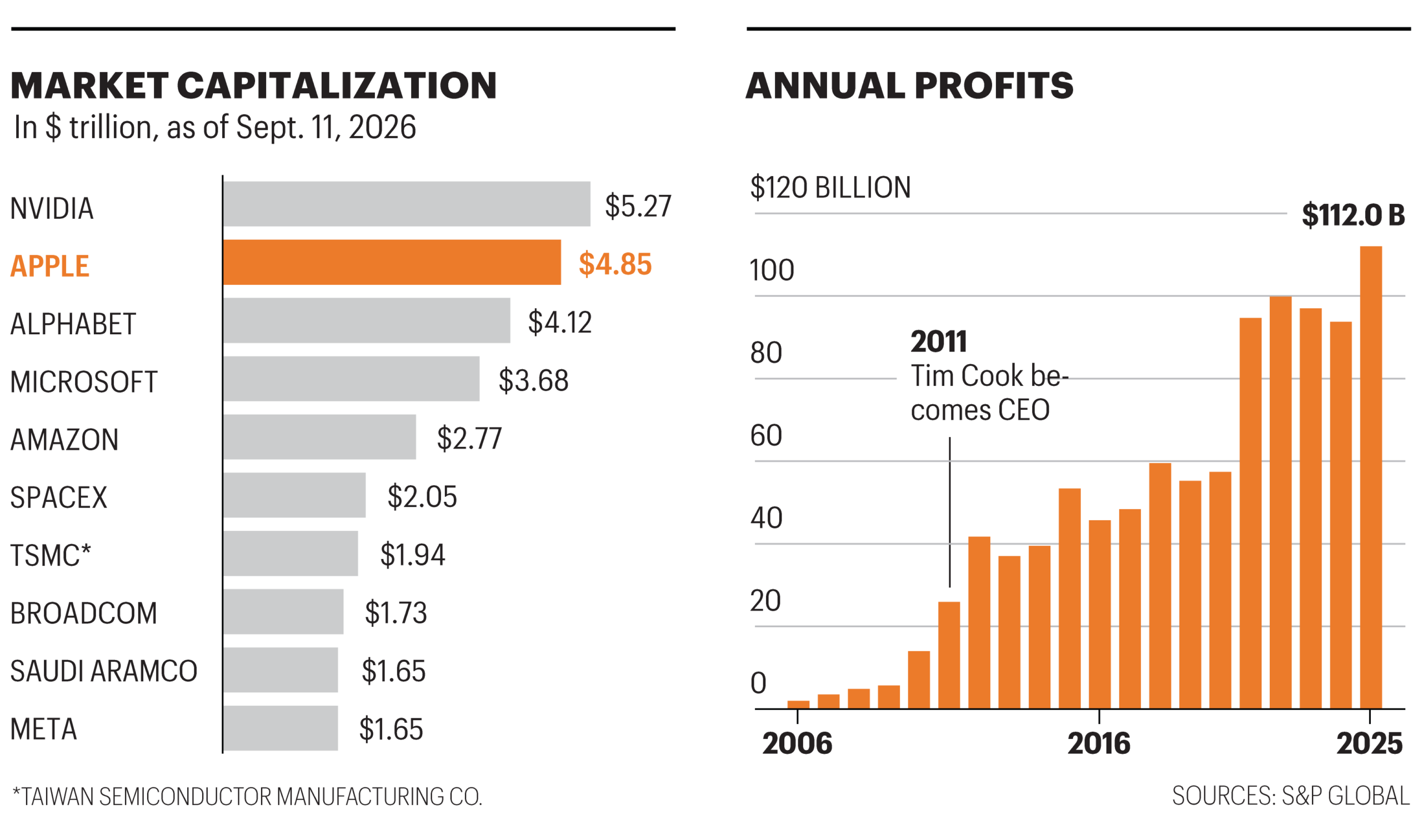
Apple has truly gone global. While the U.S. remains its largest market, a substantial share of Apple’s sales now comes from Europe, Greater China, Japan, and the broader Asia-Pacific region. Its retail footprint tells a similar story: Apple now operates more than 500 stores worldwide.
The bottom-line trajectory is the starkest number of all: annual profit rose from roughly $2 billion in 2006 to about $112 billion in 2025, a nearly 60-fold increase in under two decades. The long-term performance of the stock has been even more remarkable: a $10,000 investment in Apple’s 1980 IPO, held through its subsequent stock splits and decades of growth, would be worth approximately $40.5 million by mid-2026, Fortune reported.
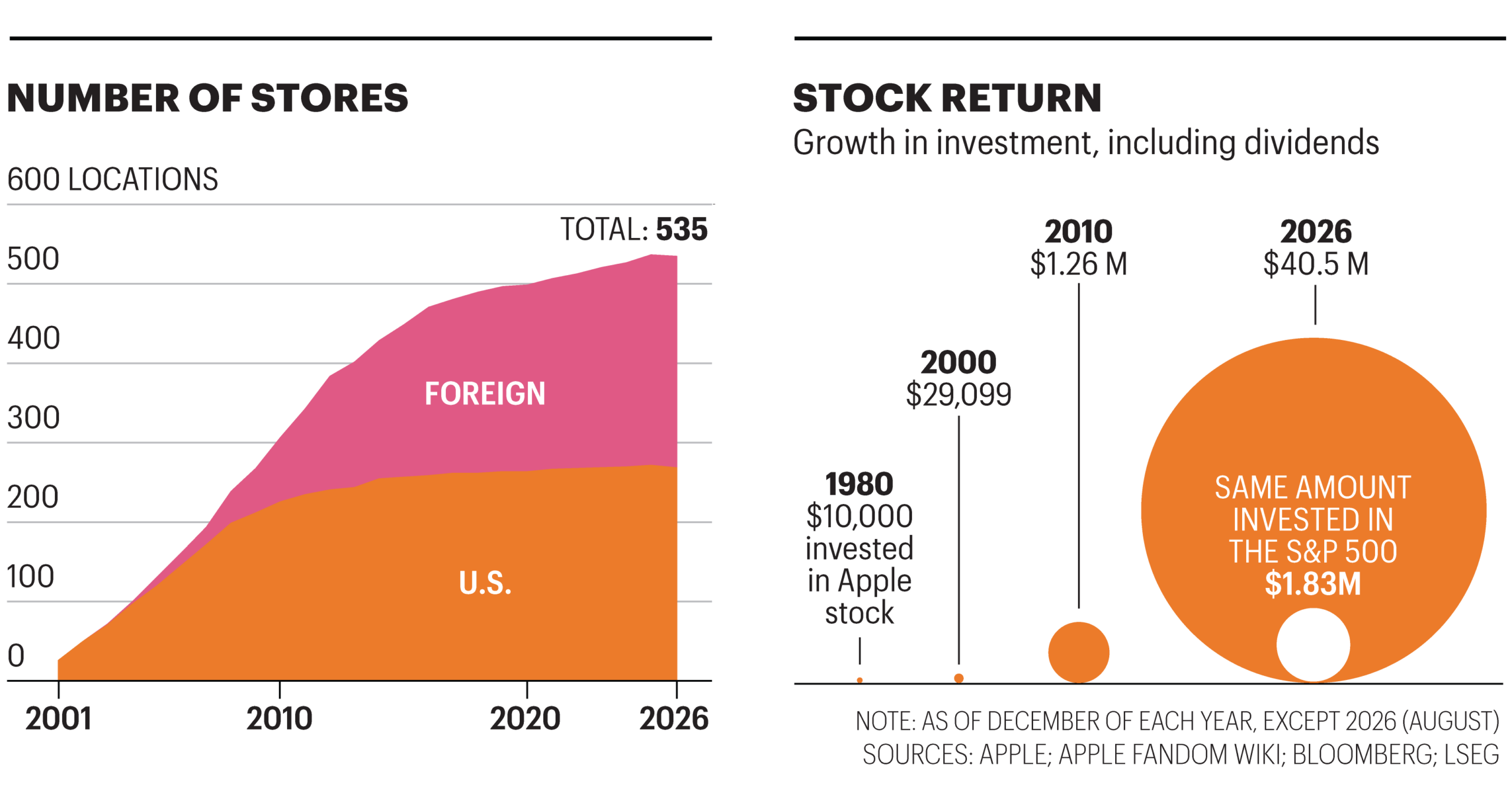
These figures form the financial foundation Ternus inherited from Cook, who built Apple into a $5 trillion company through supply-chain discipline and cash-flow strength rather than Steve Jobs-style stage presence. “Cook ultimately built his own respected legacy, not in spite of being unlike Jobs, but because of it,” Fortune’s Phil Wahba writes.
That inheritance now faces its sharpest test yet: while Microsoft, Google, Meta, Amazon, and Oracle pour tens of billions into data-center buildouts for the AI race, Apple has deliberately avoided the hyperscaler arms race, betting instead on privacy-first, on-device AI delivered through premium hardware.
Whether that restraint proves prescient or costly will determine whether Ternus’s Apple keeps growing. You can view more of Apple’s history in charts here. Read more about Cook’s tenure at Apple here.
Sheryl Estrada
Sheryl.Estrada@fortune.com
This story was originally featured on Fortune.com

Gates Foundation and MTN launch AI maternal health platform to reach 500,000 women by 2030 in Nigeria, which accounts for about 30% of maternal deaths
The Gates Foundation and MTN Group Foundation on Tuesday announced a partnership to launch an AI-enabled maternal health platform in Nigeria, with the goal of helping 500,000 women access better care by 2030.
The initiative, called the Nigeria Maternal Health Multiplier, will also equip 5,000 frontline health workers with tools to spot pregnancy and childbirth complications earlier, and connect 500 health facilities to more consistent care standards.
Nigeria accounts for nearly 30% of maternal deaths worldwide, even as the country has cut those deaths over the past decade. Globally, maternal deaths have dropped 40% since 2000, but progress has stalled, and the risk of dying in childbirth in sub-Saharan Africa remains roughly 250 times higher than in Western Europe. Only 59% of Nigerian women complete four or more antenatal care visits, according to the initiative, so warning signs of complications often go undetected until it’s too late.
The platform has three parts: AI- and phone-based decision support for both health workers and mothers; affordable smartphones and mobile data; and upgraded connectivity at health facilities. It builds on Nigeria’s existing Maternal and Neonatal Mortality Reduction Innovation Initiative, run by the Federal Ministry of Health under its Sector-Wide Approach.
“AI has enormous potential to improve health, but only if its benefits reach the people who stand to gain the most,” said Mark Suzman, CEO of the Gates Foundation. “Left to the market alone, potential tends to benefit those who can already afford it, not the people who need it most. That’s where philanthropy has a role to play: not as a substitute for investment, but as a catalyst for it.”
MTN Group President and CEO Ralph Mupita said the goal is to make maternal health “more personalized, predictive and accessible” as AI develops. “We can put trusted, locally relevant health insights directly into the hands of mothers and healthcare professionals, tailored to their unique needs and languages,” he said. “Starting in Nigeria, our ambition is to demonstrate a scalable model for improving maternal and child health outcomes across Africa.”
Nigerian officials framed the deal as an answer to a systems problem rather than a technology gap. Dr. Bosun Tijani, the country’s minister of communications, innovation, and digital economy, said the biggest barrier to service delivery in Nigeria (like health, agriculture, or education) has rarely been a lack of new tools, but a lack of focus on the basic systems needed to get people to actually use them.
Dr. Muhammad Ali Pate, Nigeria’s coordinating minister of health and social welfare, said strengthening primary health care and the frontline workers who deliver it is central to the country’s health reforms. “Strengthening primary healthcare and empowering the frontline health workers who deliver it are core to our health sector reforms,” he said, adding that partnerships that work with existing health systems, rather than around them, are what’s needed to reach mothers “still falling through the cracks.”
The four-year partnership starts with about $25 million in direct and in-kind funding from 2026 through 2030, split between the Gates Foundation and MTN. Both organizations said they expect the initial investment to draw in additional funding and support expansion into other African markets over time.
MTN is contributing its connectivity infrastructure, device distribution networks, mobile financial services, and local market execution experience. The Gates Foundation is bringing its work in maternal and child health, digital health innovation, and what it calls responsible AI.
The launch is the Gates Foundation’s second major AI-in-Africa health push this year. In January, the foundation and OpenAI unveiled a $50 million “Horizon1000” partnership aimed at integrating AI tools into primary health clinics, starting in Rwanda before expanding to other countries. That effort was similarly aimed around closing gaps left by health worker shortages and shrinking foreign aid budgets.
This story was originally featured on Fortune.com
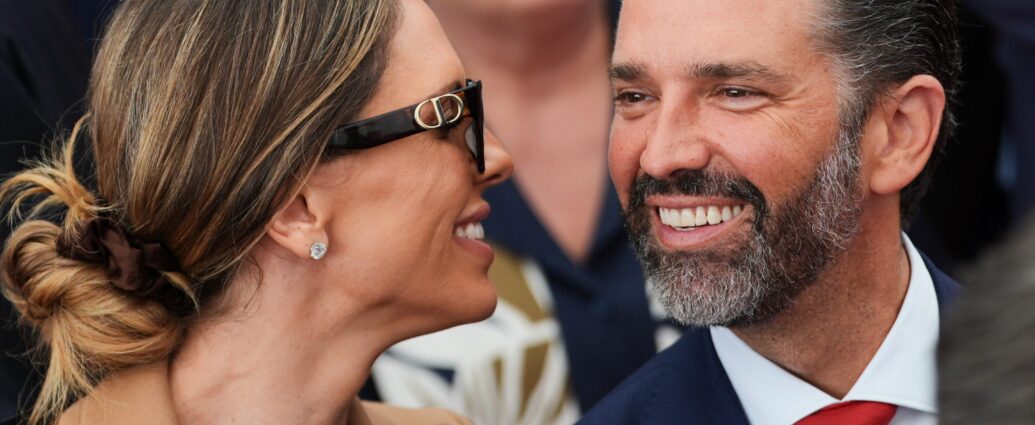
A Republican senator is calling on an investigation into Donald Trump Jr. after a Russian oligarch helped pay for his lavish wedding
Republican Sen. John Curtis of Utah is calling on the Senate Judiciary Committee to investigate whether Donald Trump Jr. used his proximity to the presidency for financial benefit, after his recent wedding party was partially bankrolled by a Russian oligarch.
In a letter sent Tuesday, Curtis called on the committee to subpoena Trump Jr. over his business dealings, relationships with foreign individuals and entities, gifts or other benefits he has received and any instances in which his relationship to President Donald Trump, a Republican, “was invoked or understood to provide value.” Curtis called for the same scrutiny of Hunter Biden, the son of former President Joe Biden, a Democrat.
“The country should not have to accept one standard for the family of a Republican president and another for the family of a Democratic president,” Curtis wrote in the letter addressed to GOP Sen. Chuck Grassley of Iowa, chairman of the committee, and Sen. Dick Durbin of Illinois, the top Democrat on the committee.
The letter comes as a few Republicans have shown a growing willingness to criticize Trump after largely avoiding public breaks with the president during much of his second term. The unpopular war in Iran, high gas prices and mounting concerns about the GOP’s prospects in November’s midterm elections have brought increased scrutiny of the president from within his own party.
The Trumps say it was a generous gift from a dear friend
ProPublica first reported last week that Umar Kremlev, who has close ties to Russian President Vladimir Putin, helped pay to rent a private island and for a fireworks show when Trump Jr. and socialite Bettina Anderson were married in the Bahamas in May.
In a subsequent post on her Instagram page signed by the couple, Bettina Trump wrote that Kremlev, head of the International Boxing Association, was a “dear friend” who “very generously hosted two incredible nights of celebrations for us AFTER our wedding.”
The president, who did not attend his son’s wedding, defended Kremlev’s involvement but said the money would be paid back.
Curtis calls the funding ‘corruption’
Curtis last Friday called the gift “corruption” and vowed to say more in the coming days.
“A Russian oligarch paid for a lavish wedding after-party for Donald Trump Jr., which to me just stinks. It’s corruption. I don’t like it,” Curtis said in a video posted on social media.
Curtis, first elected to the Senate in 2024, vowed upon taking office to not be afraid of disagreeing with Trump. While he has been critical in the past, the step of calling on the committee to investigate the president’s son is remarkable.
He wrote on social media that Republicans “nearly wore out the subpoena machine investigating Hunter Biden’s foreign relationships” and that they “should not unplug it now.”
Republicans investigated the Bidens
House Republicans spent much of 2023 and 2024 investigating whether Hunter Biden used his father’s name and political position to benefit his business dealings with foreign interests. The Biden family dismissed the investigations as politically motivated and denied any wrongdoing.
The GOP effort culminated in a report accusing Joe Biden of participating in a conspiracy to use his public office to enrich his family. But the House never voted on articles of impeachment against him.
“‘Trust us’ was not enough then, and it is not enough now,” Curtis wrote.
___
Associated Press reporter Mary Clare Jalonick contributed to this report.
This story was originally featured on Fortune.com
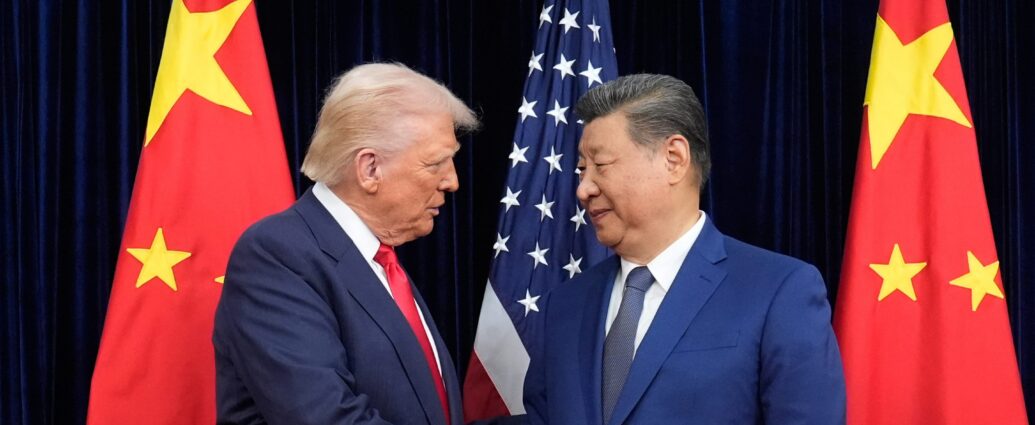
China tightens controls on fentanyl-making chemicals shipped to the U.S. just days before Trump and Xi meet at the White House
China said Tuesday that it is now requiring permits for exports to the United States, Mexico and Canada of two additional chemicals that can be used to make illegal drugs, expanding controls on shipments to the three countries.
The Commerce Ministry and other authorities jointly announced the new regulations ahead of this week’s meeting between Chinese President Xi Jinping and U.S. President Donald Trump. The additions bring the number of chemicals under such controls to 18.
The U.S. has called China the world’s largest producer of many of the precursor chemicals used in the illicit production of fentanyl, methamphetamine and other deadly synthetic drugs. It has urged Beijing to take more aggressive action to reduce the flow of unregulated precursor chemicals.
In November 2025, Beijing announced export restrictions on 13 “drug-making” chemicals to the U.S., Canada and Mexico, including chemicals used to produce the synthetic opioid blamed for tens of thousands of overdose deaths in the U.S. every year. In May, China added three additional types of fentanyl-related precursors to the list. The measures followed meetings between Xi and Trump in South Korea in October 2025 and Beijing in May.
China faced a fentanyl-related tariff imposed by the U.S. Beijing then issued a report in March 2025 detailing its efforts to control the illegal trade in fentanyl. Its foreign minister also blasted the U.S. for responding to Beijing’s goodwill with tariffs. The U.S. Supreme Court struck down the tariff in February.
This story was originally featured on Fortune.com
Alibaba says it built the ‘most powerful AI chip in China’ as the country races to catch up with the U.S.
China’s Alibaba unveiled new artificial intelligence chip technologies and plans for more powerful models on Tuesday, including what it said was China’s most powerful AI chip, days ahead of a meeting between Chinese and U.S. leaders at which competition to lead on AI technology is expected to be a major theme.
Alibaba’s announcement came as U.S. AI leaders, including Anthropic CEO Dario Amodei, are warning that China’s development of AI poses a threat to the United States and calling for an overall slowdown on development of the technology.
Chinese leader Xi Jinping is set to arrive in Washington on Wednesday for a state visit and meeting with U.S. President Donald Trump, at which AI, trade and tariffs are expected to be discussed.
At its annual flagship conference in Hangzhou, Alibaba rolled out a new AI chip and described its plans for the next generation of its AI model.
CEO Eddie Wu said the new Zhenwu V900 chip is the “most powerful AI chip in China today” and can deliver three times the performance of the company’s previous generation Zhenwu M890 chip.
Such chips power frontier AI model training and “inference,” a term for the calculations a trained AI uses to deliver responses to users. Alibaba’s Zhenwu chips are used in its data centers, providing computing to the company and its cloud clients.
Alibaba also said it plans to train a new AI model at the scale of five to 10 trillion parameters, a measure of an AI’s learning capacity, bringing it closer to the most advanced models from the U.S. Its latest Qwen3.8-Max model, the most powerful of its Qwen AI series models, has 2.4 trillion parameters.
Chinese AI company Moonshot says that its Kimi K3, released in July, is the world’s largest open model with 2.8 trillion parameters.
Alibaba also highlighted plans to expand the data centers that power its cloud computing business, citing “exponentially” rising demand for AI computing. The company said it expects to have over 20 gigawatts’ worth of computing by 2032.
SpaceX has approximately 1.4 gigawatts of AI computing capacity as of mid-this year and says it aims to reach over 10 gigawatts in 2027.
Recent Chinese advancements in AI are giving Beijing more leverage in its upcoming talks with Washington, some analysts believe, as China steps up its self-reliance push even as U.S.-led export restrictions have barred it from accessing some of the world’s most cutting-edge technologies, including AI chips and chipmaking machines.
Open Chinese models, which are often more affordable than cutting-edge closed models from leading U.S. AI labs, have also been making inroads globally, including in the U.S.
Chinese technology giant Huawei last week also unveiled new chip technologies as it looks to challenge global leaders like Nvidia. Frontier AI model training in China often rely on Nvidia chips, analysts said, but Chinese-designed chips are gaining ground as Nvidia has been blocked from selling some of its most powerful AI chips to China.
“Using extra computing power to make up for chip limits helps China stay strong locally,” said Neil Shah, vice president of Counterpoint Research, a technology market research firm based in Hong Kong.
Counterpoint senior analyst Parv Sharma added that how much the AI and chipmaking gap between China and the U.S. narrows will also depend on other factors including China’s ability to advance chip foundries that manufacture them, not just chip design capabilities.
Alibaba is “mobilizing every resource” to meet customers’ demand for AI, CEO Wu said in his speech Tuesday.
Global shortages across the AI data center supply chain, for example, “are currently limiting the speed at which we can scale our compute infrastructure” for AI, he added.
Wu also likened AI growth to the industrial revolution and said “machine intelligence” will rapidly outgrow human thinking capacity.
While “machine intelligence today is not a substitute for human intelligence,” he predicted that, eventually, machines will be able to produce over 1,000 times more “thinking” than all of humanity combined, up from less than 3% currently.
This story was originally featured on Fortune.com
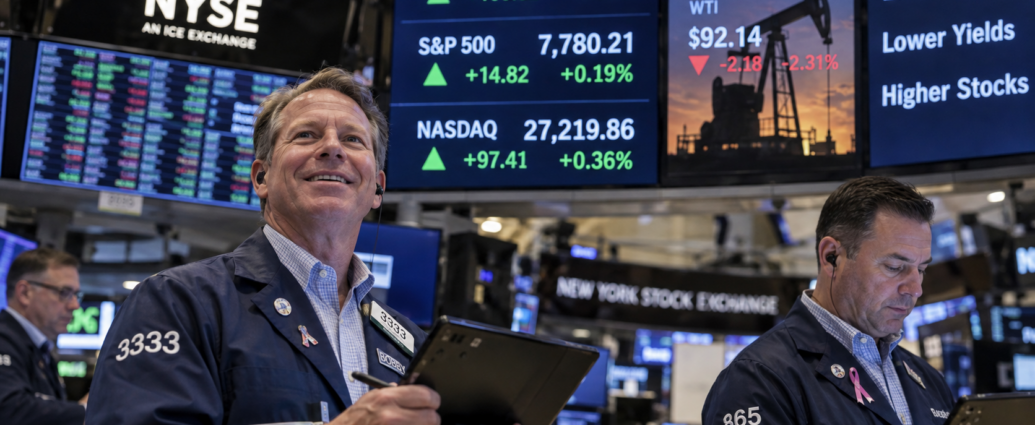
Stocks Edge Higher as Oil Falls, Yields Ease
U.S. stocks opened modestly higher Tuesday as another drop in oil prices and easing Treasury yields gave investors some relief from the inflation and borrowing-cost pressures that have weighed on markets in recent weeks.
The Dow Jones Industrial Average, S&P 500 and Nasdaq Composite all moved higher after the opening bell, with the technology-heavy Nasdaq reaching a fresh intraday record, according to Reuters. The gains followed Monday’s strong session, when the S&P 500 climbed 1.5% to 7,764.70, the Dow gained 0.7% to 52,048.83 and the Nasdaq surged 2.3% to a record closing level of 27,122.09.
For consumers and businesses, the biggest development may be happening outside the stock market: oil is getting cheaper again.
Oil Drops Below $100
Brent crude fell about 2.1% Tuesday to roughly $98.23 a barrel, while U.S. West Texas Intermediate crude also declined, taking oil prices to their lowest levels in roughly two weeks.
The decline comes as fears of a severe supply disruption in the Persian Gulf have eased. Iran has offered to reopen the Strait of Hormuz within seven days under certain conditions, while Saudi Arabia has resumed operations on its East-West Pipeline and increased crude shipments through the strait.
That matters far beyond energy markets.
Cheaper crude can eventually translate into lower gasoline and transportation costs, while also reducing expenses for airlines, manufacturers and companies that depend heavily on petroleum-based products.
It could also take some pressure off inflation if the decline lasts.
Treasury Yields Give Stocks Another Boost
Bond yields have also retreated from their recent highs.
The benchmark 10-year Treasury yield finished Monday around 4.95%, after recently touching the psychologically important 5% level.
Lower Treasury yields can ease pressure on borrowing costs throughout the economy and make stocks relatively more attractive to investors. Mortgage rates are particularly sensitive to movements in longer-term Treasury yields, although individual mortgage rates do not move in lockstep with the 10-year note.
The combination of falling oil and softer yields has therefore removed two of the market’s biggest recent pressures at the same time.
AI Rally Keeps Technology in Focus
Technology and artificial intelligence stocks remain another major driver.
Meta has attracted substantial investor attention following the launch of its Muse AI assistant. Reuters reported Tuesday that Meta shares have risen more than 20% since Muse debuted Sept. 8, adding more than $200 billion to the company’s market value. The app recorded approximately 2.8 million downloads during its first 12 days.
That enthusiasm has helped fuel a broader rally in semiconductor and AI-related companies and contributed to the Nasdaq’s recent record-setting run.
U.S.-China Talks Add to Market Focus
Investors are also watching diplomacy between Washington and Beijing.
Treasury Secretary Scott Bessent and Chinese Vice Premier He Lifeng held talks in New York ahead of an expected meeting between President Donald Trump and Chinese President Xi Jinping. The discussions included trade and artificial intelligence, with Bessent publicly describing the engagement as successful.
Markets will be watching for any developments involving tariffs, trade restrictions, artificial intelligence and critical minerals.
What Consumers Should Watch
For households, oil and Treasury yields remain especially important.
If crude prices continue falling, consumers could eventually see some relief in fuel and transportation costs. If Treasury yields continue moving lower, borrowing conditions for mortgages and other loans could also become somewhat less restrictive, though actual consumer rates depend on more than Treasury yields alone.
Neither trend is guaranteed to continue.
Oil markets remain highly sensitive to developments involving Iran, Saudi Arabia and the Strait of Hormuz, while Treasury yields could quickly reverse if investors become more concerned about inflation or additional Federal Reserve rate increases.
For Wall Street, that leaves Tuesday’s modest gains resting on a straightforward equation: lower energy prices, lower bond yields and continued enthusiasm around artificial intelligence are giving stocks room to move higher — but geopolitical and inflation risks remain close behind.
JBizNews Desk | Wall Street
© JBizNews.com All Rights Reserved. Reproduction or distribution without written permission is prohibited.