

Economic warfare: Bankrupting Iran will be more effective than bombing – opinion
The US and Israel have demonstrated what military power can do to Iran. Bombs can destroy missile factories, military installations, drone warehouses, and command centers.
But there is another weapon that may ultimately prove even more decisive than another bombing campaign.
The Iranian regime can rebuild a destroyed factory if it has the money to do so. It can replace missiles, drones, and military equipment if it has access to foreign currency, international markets, and the financial networks necessary to acquire the materials it needs.
That is why the next phase of this war should not be measured only by how many bombs America drops on Iran. It should also be measured by how effectively the United States can cut Tehran off from the money it needs to rebuild its military, fund terrorism, and maintain its grip on power.

Iran is already breaking
The numbers coming out of Iran are staggering. The war has caused approximately $270 billion in damage, equivalent to roughly 57% of Iran’s GDP. The scale of that destruction suggests that Iran’s recovery will take years, perhaps decades.
Even more alarming for Tehran is the compounding effect of the war. Each additional month of conflict could set the Iranian economy back by more than five years because of the destruction of capital stock, infrastructure, and productivity.
History shows how quickly economic damage can spread once the foundations of an economy begin to weaken. As businesses lose capital, productivity declines, investment disappears, and confidence collapses, the damage can move far beyond the original crisis and become increasingly difficult to reverse.
Iran entered this war economically weakened by decades of sanctions, corruption, mismanagement, inflation, currency collapse, and international isolation. Now the regime faces the enormous cost of rebuilding while its economy continues to deteriorate.
Meanwhile, ordinary Iranians are already suffering under rising prices, declining purchasing power, and a weakening currency. This is not simply an economic statistic. It is the daily reality of families struggling to afford basic necessities.
But we must make an important distinction. The Persian people are not our enemy. The mullahs are. The tragedy is that Iran is a nation with extraordinary natural resources, an educated population, and one of the world’s great civilizations. Yet the Islamic Republic has squandered its wealth on missiles, terrorism, and foreign wars while millions of Iranians struggle at home.
Trump’s ‘Economic D-Day’
With peace negotiations deadlocked and the war continuing, President Trump has now escalated the economic pressure under the banner of Operation Economic Fury.
Trump called it an “Economic D-Day” and warned that the United States would impose severe secondary sanctions against any nation’s financial institutions, businesses, airports, or governments that facilitate Iranian trade.
The message is unmistakable: nations and institutions will have to choose. They can do business with the United States, or they can help keep the Iranian regime alive.
For years, Tehran has survived sanctions by constructing an underground financial network comprising front companies, shadow banking systems, exchange houses, oil-smuggling operations, and intermediaries. These networks allow the regime to move money and sell its products despite international restrictions.
America must systematically dismantle them. If a bank knowingly helps Tehran move money, it should face consequences. If a company launders Iranian oil revenue, it should lose access to the American financial system. If a shipping network disguises Iranian petroleum, it should be exposed and sanctioned.
Access to the American financial system is not a right. No institution should be allowed to finance the world’s leading state sponsor of terrorism while continuing to benefit from the American economy.
Destroy the ability to rebuild
This is the strategic difference between bombing Iran and bankrupting the regime. Bombs destroy what Iran has today. Economic warfare can destroy Iran’s ability to rebuild tomorrow. That should be America’s objective.
The Iranian regime needs money to pay the Islamic Revolutionary Guard Corps, manufacture missiles and drones, maintain its military infrastructure, and finance Hezbollah, Hamas, the Houthis, and other terrorist proxies.
Follow the money, and you find the regime’s power. Cut off that money, and the Islamic Republic faces a far greater threat than the destruction of another military installation. A regime can survive a destroyed building, but it faces a much more serious problem when it cannot pay its security forces, finance its proxies, replace its weapons, or maintain the patronage networks that keep it in power.
Do not give Tehran a financial lifeline
This is where Washington must not blink. There will always be pressure to release frozen Iranian assets, ease sanctions, restore trade, and provide Tehran with billions of dollars in exchange for promises. America has seen that movie before and should not repeat the mistake of giving Tehran economic relief in exchange for vague assurances that cannot be trusted.
The Iranian regime should not receive another dollar in economic relief without concrete, verifiable, and irreversible concessions. There can be no return to business as usual while Tehran retains the ability to rebuild its military machine and finance terrorist organizations throughout the Middle East.
Any relief must follow genuine compliance, not empty promises. Iran must demonstrate that it is prepared to abandon the policies that have destabilized the region for decades. Otherwise, America risks financing the very regime it is trying to defeat.
Bankrupt the regime, not the people
The Persian people deserve better. They deserve an Iran where national wealth is invested in families, education, businesses, infrastructure, and opportunity rather than missiles, militias, and the Islamic Revolutionary Guard Corps.
America has already demonstrated that it can inflict devastating military damage on Iran. The next challenge is to ensure that the regime does not have the financial resources to restore the military and terrorist infrastructure it has lost. That means closing financial loopholes and dismantling the international networks that allow Tehran to sell oil, move money, and evade sanctions.
President Trump has now put economic warfare at the center of the conflict through Operation Economic Fury. If America follows through with precision and determination, this strategy could prove more consequential than another round of bombing.
Cut off the money that funds terrorism, and the regime loses its ability to project terror. Break the financial backbone of the Islamic Republic, and the Persian people may finally have an opportunity to break free from the regime that has oppressed them for nearly half a century.
The objective is not to destroy Iran. It is to bankrupt the regime that has stolen Iran’s future, financed terror across the Middle East, and kept its own people in chains.
The war may not ultimately be decided by the last missile fired.
It may be decided by the last dollar Tehran can spend.
Dr. Mike Evans has written 120 books, is a #1 New York Times bestselling author, and is a Nobel Peace Prize nominee. He is the founder of the Friends of Zion Museum in Jerusalem, the Ten Boom Museum in Holland, and Churches United with Israel, one of the largest Christian Zionist networks in America.



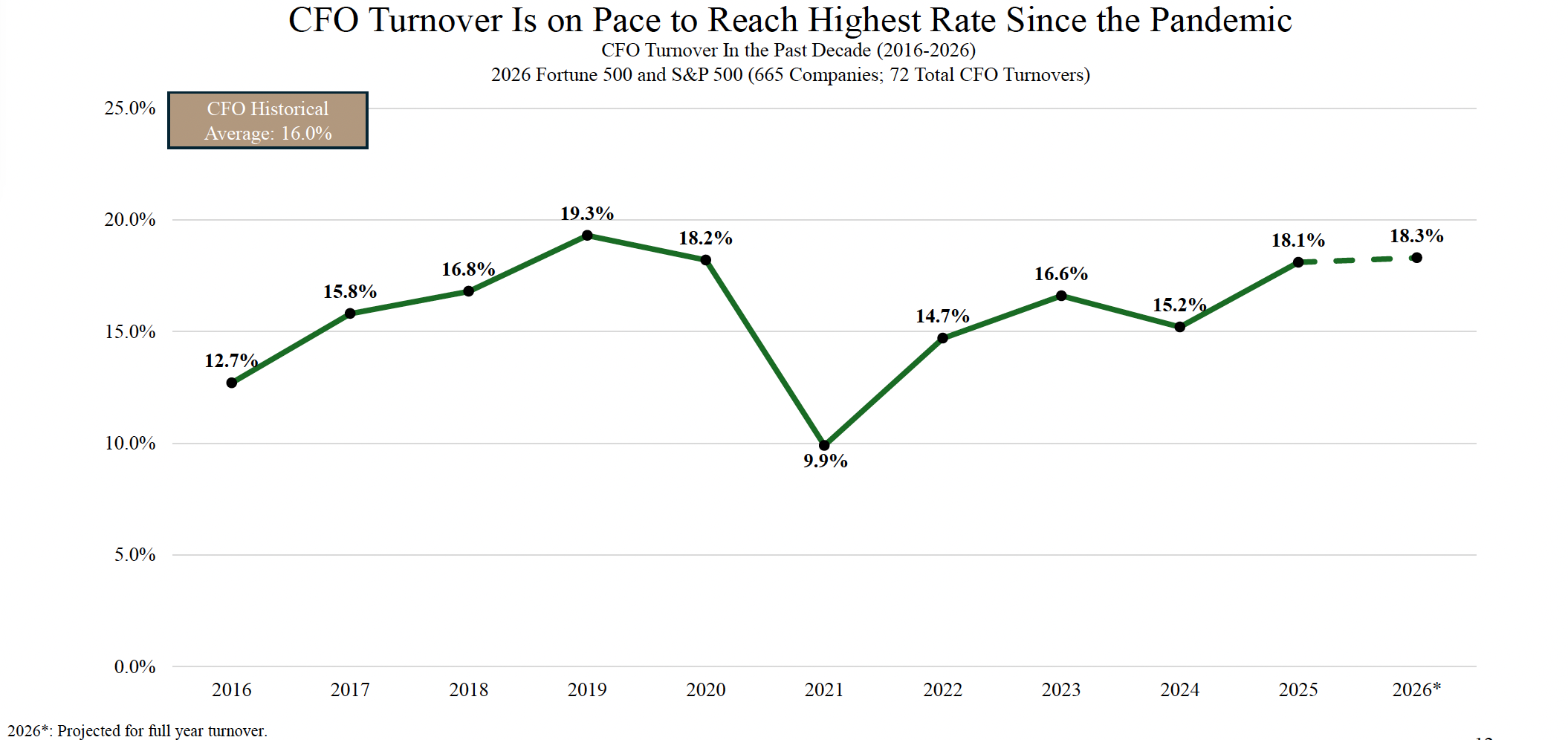
CFO turnover at America’s largest companies is on pace to hit 18.3%—the highest since the pandemic
Good morning. CFO turnover is accelerating at the nation’s largest public companies, according to newly released data in Crist Kolder Associates’ mid-year 2026 Volatility Report, shared with CFO Daily.
The executive search firm’s report studied corporate leadership at Fortune 500 and S&P 500 companies, a total of 665 companies. CFO turnover for the full year of 2026 is projected to reach 18.3%, compared to 18.2% in 2020 and 19.3% in 2019. The historical average for CFO turnover over the past 10 years is 16%.
“The demands of the job keep expanding, so it’s no surprise the churn continues,” Scott W. Simmons, co-managing partner at Crist Kolder, told me.
Some CFOs have decided to retire while other finance chiefs are being tapped to steer turnarounds or AI initiatives, for example.
Several CFO moves in the Fortune 500 stand out from the first half of this year:
AT&T: Pascal Desroches, CFO since 2021, announced he’ll retire effective Dec. 31. Jennifer Biry—a 20-year AT&T finance veteran who most recently was CFO and COO of McAfee—was named deputy CFO effective July 6 and will officially succeed him Jan. 1, 2027.
Caterpillar: CFO Andrew Bonfield elected to retire effective Oct. 1, after eight years. Company veteran Kyle Epley, previously SVP of global finance services, took over as CFO, effective May 1, with Bonfield staying on in an advisory capacity through the transition.
Oracle: Hilary Maxson, former group finance chief at Schneider Electric with infrastructure and energy experience, began her tenure as CFO in April—a hire tied directly to Oracle’s buildout of AI and cloud infrastructure.
Nike: David Denton, a Pfizer finance executive, joined the sneaker and apparel giant as CFO on Aug. 17 as it works through a turnaround.
Pfizer: After David Denton stepped down and left the company on Aug. 15, Cecile Guegan, SVP of finance for the global biopharma business, took over as interim CFO Aug. 16 while Pfizer runs a full internal and external search.
(You can find more Fortune 500 moves here.)
Another finding from the mid-year 2026 Volatility Report, which is based on data through July 31, is that newly appointed CFOs are getting younger. The average age for a CFO in 2026 is projected to be 48, compared to an average of 52 in 2025.
Simmons explained that the average tenure of a sitting CFO is 4.5 years, and newly appointed CFOs only come from another sitting CFO position roughly 25% of the time.
“Those two data points taken together suggest the need to tap into talent that may be younger and less experienced,” he said.
Have a good weekend.
Sheryl Estrada
Sheryl.Estrada@fortune.com
This story was originally featured on Fortune.com



Zohran Mamdani Is Turning His Fire on Amazon
Andy Burnham, European leaders plan US trip to seek Patriot missiles for Ukraine – report
British Prime Minister Andy Burnham said he and other European leaders plan to travel to the United States in September to lobby US President Donald Trump to let Ukraine access some of its Patriot air defense missile stocks ahead of the winter, Bloomberg News reported on Monday, citing an interview.
“I’m looking forward to going to New York in September,” Burnham told Bloomberg.
“I’ve not fully confirmed the details yet but it’s likely I will go, particularly after today’s discussion,” Bloomberg quoted him as saying.

Ukraine independence celebrations marked by world leaders in Kyiv
The leaders of Britain and France pledged to provide Ukraine with stronger military support, including access to classified technology and faster deliveries of air defense missiles, at a meeting of allies to mark Kyiv’s independence day celebrations.
Burnham, in Kyiv on his first foreign visit since taking office last month, urged the gathering of the “Coalition of the Willing” to “do everything we can” to bolster Ukraine’s defenses against Russian air strikes.
Ukrainian President Volodymyr Zelensky had earlier praised the resilience of the Ukrainian people during more than four years of war.
At the United Nations in New York, dozens of countries issued a joint statement reaffirming support for Ukraine’s sovereignty and territorial integrity and urging Russia to accept an immediate, full and unconditional ceasefire.
Ukraine acquires tech to make Storm Shadow missiles
“Ukraine absolutely wants peace, but it is not ready to simply surrender,” Zelensky said, adding that Russia would not halt its aggression even if Ukraine ceded to its demands for more territory in the country’s east.
Wearing a traditional Ukrainian embroidered shirt, Zelensky thanked foreign leaders for traveling to Kyiv to show their support on the 35th anniversary of Ukraine’s break from the Soviet Union.
Standing alongside Zelensky and European Council President Antonio Costa, Burnham said his choice of Kyiv for his first foreign visit showed the importance he attached to assisting in Ukraine’s defense.
“We are with you in this struggle all the way, heart and soul,” Burnham said, vowing to continue that support “despite Russia’s outrageous threats to my country.”
“This is the moment to keep up the pressure on Russia. The moment to squeeze their ability to fund this illegal war,” Burnham said, calling for further economic sanctions.
Britain announced on Monday it would allow Kyiv access to classified technology to start its own production of Storm Shadow long-range cruise missiles, capable of carrying out strikes deep within Russia. France has already given its assent to license the technology for the European missile.
In response, the Kremlin said the use of classified British technology would “add fuel to the fire” of their worsening relations, after it warned London last week there would be “consequences” for supplying drones to Kyiv.
With Russia escalating its ballistic missile attacks on Ukrainian cities, Kyiv is suffering an acute shortage of the US-made Patriot air defense interceptors, the only weapon in its arsenal capable of downing such missiles.
Zelensky said Ukraine needed at least 300 interceptors to make it through the winter, and he appealed to allies to deliver an air defense package before Russia renews its strikes on his country’s energy infrastructure.
French President Emmanuel Macron, co-chairing the coalition meeting via video link, said that a string of deadly attacks on Ukrainian cities in recent weeks had shown that allies needed to step up the deliveries of interceptors and France would do its part.
“I think it’s very important that all of us accelerate in terms of delivery,” Macron told the meeting, urging countries not to back down in the face of Russian intimidation. “The bottom line is, for me, very clear: keep calm and carry on.”
Zelensky told the meeting that Ukraine’s war effort was complicated by a $27-billion defense funding gap this year and appealed for additional financial support. He suggested that Russia’s frozen overseas assets could be used to finance the deficit.
Paying tribute to Ukrainian people and soldiers defending Ukraine in the war, Zelensky called on allies to give it “everything” needed to stop the war.
“We are not asking you to fight for us,” he said.
In a joint statement, more than 50 countries at the UN called on Russia to accept an unconditional ceasefire. “This senseless war and the immense human suffering could end immediately,” the statement said.
“Russia simply needs to accept the unconditional ceasefire that Ukraine and the international community has been calling for for over a year and a half now.”
Russia’s UN ambassador, Vassily Nebenzia, accused Western countries of using Ukraine as a tool for exerting pressure on Moscow while falsely portraying themselves as peace advocates.
Drone demonstration marked celebrations
Hundreds of thousands of people have been killed, and swathes of Ukrainian territory have been laid waste, since Russia launched its full-scale invasion on February 24, 2022.

US-led peace talks to bring a lasting end to the war fell apart earlier this year as Ukraine refused Russian demands to cede more territory. Fighting continues along a 750-mile (1,200-km) front line and Ukraine has succeeded in bringing Russian advances overall to a virtual halt this year.
Hovering in the sky above Kyiv, a squadron of aerial drones carried out a demonstration of Ukrainian military technology, which has helped to keep Russian forces in check.
Naval drones swept along the Dnipro river, while unmanned ground vehicles, some equipped with heavy machine guns, trundled in formation along one of the city’s main historical avenues.
Ukraine has increased its long-range attacks on Russian refineries and logistics infrastructure, aimed at undermining Moscow’s war effort.
It hit four logistics hubs owned by Russia’s second-largest online retailer Ozon in southern Russia in drone strikes on Monday, the company said.
In a somber moment, the Ukrainian leader rewarded fallen soldiers with state awards, which he presented to their mothers and family members.
He also announced the return of 10 Ukrainian servicemen, who were previously listed as missing in action, as part of a special prisoner exchange with Russia.
“We remember each and every one who remains in captivity,” Zelensky said, promising to do everything possible to bring them home.

Trump readies a new tariff to punish China for its flood of cheap exports—without endangering his trade truce or his summit with Xi Jinping
President Donald Trump is moving toward levying a new tariff on China that would penalize the world’s second-largest economy for flooding the global market with underpriced goods, according to three people familiar with the matter.
Two of the people, who spoke on condition of anonymity to discuss internal deliberations still being finalized, said Trump is considering setting the new tariff at 7.5%. It’s a level administration officials believe would not endanger the one-year trade truce between Washington and Beijing or a planned White House meeting between Trump and Chinese President Xi Jinping expected to take place in late September.
The move, if finalized, appears to be a calibrated effort by the White House to work around a Supreme Court decision earlier this year that struck down Trump’s plan to implement a sweeping, high-tariff scheme not seen since the 1930s.
After that decision, the Trump administration announced in March it was launching formal investigations targeting excess industrial capacity and forced-labor regulations in China and other nations.
It isn’t clear if the U.S. administration is also nearing its decision in its probes of the other economies that it announced it was investigating for unfair trade practices, including the European Union, Singapore, Switzerland, Norway, Indonesia, Malaysia, Cambodia, Thailand, South Korea, Vietnam, Taiwan, Bangladesh, Mexico, Japan and India.
The White House and the U.S. Trade Representative’s office did not respond to requests for comment on the tariff deliberations, which Bloomberg News reported earlier Monday. The Chinese embassy in Washington also did not immediately respond to a request for comment.
The excess industrial capacity probe of China was initiated under Section 301 of the Trade Act of 1974, which allows the president to levy tariffs against nations that discriminate against U.S. companies or commerce.
The new tariff would come on top of existing tariffs on China
The people familiar with the deliberations stressed that Trump could still change his mind on the new tariff on China.
It would come on top of tariffs of 10% to 12.5% announced last month for 60 economies around the globe that the Trump administration accused of failing to effectively enforce a ban on goods produced with forced labor.
Many countries, including China, protested that move, which took effect just as the clock ran out on temporary tariffs Trump had turned to after the Supreme Court in February struck down sweeping “reciprocal” tariffshe levied on nearly every U.S. trade partner.
China last month pushed back against claims of overcapacity, anticipating that the U.S. would soon release results of its probe and impose new tariffs.
Massive capacity in a slew of Chinese industries, from autos to solar panels, cement and steel manufacturing, has drawn increased attention from Beijing’s trading partners in recent years.
Although China’s own leaders have prioritized rebalancing the economy, slowing domestic demand has prompted companies to expand into overseas markets. Surging exports pushed China’s trade surplus to a record of nearly $1.2 trillion last year.
China has never sought a large trade surplus, the Ministry of Commerce said in a recently published report titled “China’s Position on the So-called Excess Capacity Issue.”
The deliberations come as the Treasury Department on Monday warned countries doing trade with Iran that new secondary sanctions are in the pipeline aimed at ostracizing nations that continue to do business with Tehran. China is Iran’s biggest trade partner.
Washington has promised the new sanctions would put even more pressure on an Iranian economy already battered by previous sanctions and a U.S. naval blockade as the U.S. and Israeli war against Iran nears the six-month mark.
Treasury Secretary Scott Bessent’s announcement Monday provided little detail and did not name which countries could face secondary sanctions.
This story was originally featured on Fortune.com

Buc-ee’s CEO signals expansion shift away from blue states that ‘don’t appreciate’ chain
Buc-ee’s CEO suggested recently that the Texas-based travel center chain may be done looking into blue districts, saying some communities do not appreciate what the company brings while conservative states offer business-friendly and family-oriented values.
Arch “Beaver” Aplin III, the company’s president and co-founder, made the comments during the grand opening of Buc-ee’s newest location in Benton, Arkansas on August 17. The chain is known for its expansive gas stations, famously clean restrooms and in-house food offerings.
“We have a lot of opportunities. We’re growing. We’re building in a lot of places. But when you find a conservative business-friendly state with a phenomenal workforce, it makes a difference,” Aplin said.
Aplin criticized states that he said do not appreciate what Buc-ee’s brings to their communities, suggesting the company would rather focus its expansion efforts elsewhere.
BUC-EE’S OPENS FIRST ARKANSAS LOCATION AS CHAIN EXPANDS ACROSS US
“I’m starting to realize life’s too short to try to build in places that people don’t appreciate what you’re bringing, versus a place like this where people do appreciate what you are building,” he said.
Conservative states typically promote business-friendly and family-oriented policies that align with Buc-ee’s values, Aplin said.
“That leadership, that concept, that idea of conservative, business-friendly, family-oriented concept works so much better if it trickles down from the very leadership from the top at the governor’s office, at the congressman, at senator, at the mayor, the representatives,” he said.
Aplin pointed to Benton as an example of the approach, saying the city’s business-friendly environment helped pave the way for Buc-ee’s newest location.
“What we found when we got here into Benton was a business-friendly town,” he said.
CALIFORNIA PIZZA KITCHEN CO-FOUNDER OPENS UP ABOUT FAMOUS CHAIN’S WILD RISE, BANKRUPTCY AND COMEBACK
Founded in 1982, Buc-ee’s operates sprawling travel centers that typically feature 74,000 square feet of space and 120 fueling positions. The locations often create more than 200 jobs, according to the company.
Buc-ee’s currently has 58 locations, including 37 in Texas, according to the company’s website.
The chain has expanded to 13 other states, including Alabama, Georgia, Florida, Kentucky, Tennessee, Arkansas, Arizona, Colorado, Mississippi, Missouri, Ohio, South Carolina and Virginia.
Nearly all the cities where Buc-ee’s operates are located in areas that generally lean conservative, with a few exceptions where local political dynamics are more mixed.
Auburn, Alabama, for example, is a college town located in a predominantly Republican county, giving it a more politically mixed environment than some surrounding communities.
Brunswick, Georgia, has a Democratic-leaning municipal base despite being located in Glynn County, which has generally leaned Republican.
Goodyear, Arizona, has become a competitive suburban area in recent election cycles and is located in the West Valley of Maricopa County, a region that has historically leaned Republican but has become increasingly politically competitive.
CLICK HERE TO GET FOX BUSINESS ON THE GO
More Buc-ee’s locations are slated to open in the coming years, including a travel center in Murfreesboro, Tennessee, on Nov. 16.
Six locations are also expected to open in 2027, including sites in Ruston, Louisiana; Kansas City, Kansas; Gallaway, Tennessee; St. Lucie, Florida; Boerne, Texas; and Monroe County, Georgia.
Two additional locations are planned for 2028 in Mebane, North Carolina, and Lafayette, Louisiana.

Bessent says Treasury auctions will continue as usual despite expanded buyback program
Treasury Secretary Scott Bessent said on Monday that the regularly scheduled Treasury auctions of U.S. debt are expected to continue per usual after his agency announced an increase in the size of buybacks of longer-dated securities.
Bessent spoke Monday at a press conference to discuss a new plan for the “economic asphyxiation” of the Iranian regime through the implementation of secondary sanctions on Iran’s trading partners.
During the press conference, the Treasury secretary was asked about whether the agency may reduce the size of auctions for longer-term debt going forward or if there are other actions from the department’s toolkit that may be used to help lower yields.
“We are going to continue with our regular program of auctions. So you will be hearing from us again at the beginning of next quarter,” Bessent said. He added in response to a follow-up question that, “We haven’t bought a single bond yet.”
TREASURY YIELDS HIT MULTI-DECADE HIGHS AMID SURGING NATIONAL DEBT
Bessent noted that the next auctions of longer-dated Treasurys, such as the 10-year note and the 20- and 30-year bonds, aren’t scheduled until mid-September which is the earliest the new buyback structure could come into play after the change takes effect on Sept. 9.
Under the change, which was announced on Aug. 19, the Treasury’s maximum buyback authority rises from $2 billion per operation to at least $4 billion per operation, which will serve as a floor rather than a cap to allow the size of buybacks to respond to market conditions.
The change is expected to remain in effect through the rest of the quarter, or through Nov. 4, after which the Treasury will provide more information about future buyback sizes.
Treasury said in its announcement that the “increase in buyback operations reflects Treasury’s desire to provide greater liquidity support in longer-dated nominal sectors where there is consistent strong sponsorship from market participants, as evidenced by the significant volume of high-quality offers Treasury routinely receives in longer-dated buyback operations.”
US NATIONAL DEBT HITS $40 TRILLION MILESTONE FOR FIRST TIME EVER
Last week’s announcement lowered yields on the 10-year Treasury note and on 20- and 30-year bonds for a short period of time, though they largely retraced those declines by the end of the week. Yields were down modestly on Monday.
Bessent said last week that the higher buybacks aim to support liquidity in a more thinly traded portion of the market, particularly in the 30-year sector, while the longer-dated Treasurys are also competing with heavy issuance of corporate bonds at higher yields amid the artificial intelligence (AI) buildout.
Higher yields on Treasurys can cause fiscal pressure for the federal government, which is forced to pay more interest to service the national debt. The move comes as the U.S. gross national debt topped $40 trillion for the first time ever last week.
BESSENT LAYS OUT 5 PRINCIPLES GUIDING TRUMP ADMIN’S APPROACH TO ECONOMIC STATECRAFT
The Treasury Department’s announcement didn’t indicate the funding source for the Treasury buybacks. A Reuters report noted that the Treasury General Account (TGA) at the Federal Reserve could serve as a source because it would negate the need to issue new, shorter-dated Treasurys – though it would eat into the nation’s cash reserves.
The TGA effectively functions as the federal government’s checking account, as it’s used to pay for daily government operations ranging from federal worker salaries, contracts and Treasury’s interest and principal obligations.
As of last Wednesday, the TGA stood at about $940 billion in funding. Treasury has beefed up the TGA this year in part to help pay for some of the $166 billion in tariff refunds owed to importers in the wake of a Supreme Court ruling that struck down a key portion of President Donald Trump’s tariff regime.
GET FOX BUSINESS ON THE GO BY CLICKING HERE
In the past year, the TGA has had an average balance of around $840 billion, which was the highest ever outside its rapid run-up during the COVID-19 pandemic.
Reuters contributed to this report.
Jersey Mike’s alums look to ‘run it back’ with fast-casual chain Dog Haus targeting 300 locations
Several former Jersey Mike’s executives and franchisees are reuniting at Dog Haus, betting the lessons they learned helping build the submarine sandwich giant can turn the fast-casual restaurant chain into a national powerhouse.
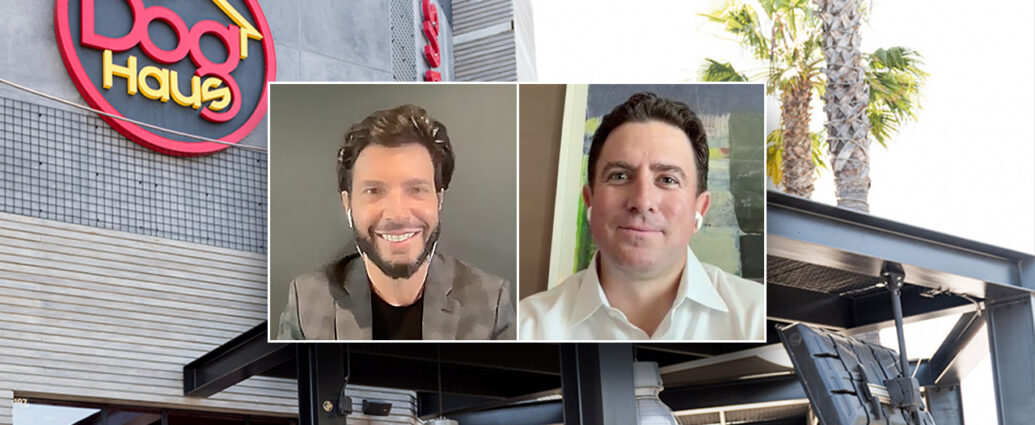
Dog Haus recently named former Jersey Mike’s chief innovation officer James Field as chief marketing officer. He joins President and Chief Development Officer Chris Rigassio and Chief Operating Officer Garen Khodaverdian, both former Jersey Mike’s franchisees.
The reunion follows Blackstone’s January 2025 acquisition of a majority stake in Jersey Mike’s in a deal valued at roughly $8 billion, according to SEC filings.
Field told FOX Business that the group could have pursued separate opportunities following the sale, but saw a chance to stay together and help scale Dog Haus, which currently operates roughly 60 locations.
POPULAR BEER BRAND TO CUT 220 JOBS AS PRODUCTION SHIFTS
“We all could have gone off and done different things individually after the sale of Jersey Mike’s,” Field said. “… I think we just thought if we stay together, it’s a one plus one equals three scenarios.”
Field added: “When you’ve been in the trenches with people through that type of brand growth that you saw at Jersey Mike’s, you say, ‘My gosh, let’s run it back.'”
Dog Haus CEO Michael Montagano said the company is “laser focused” on growing from roughly 60 restaurants to 300, with a $1 billion valuation serving as its “North Star.”
“One major step in that success is building a team that is capable of executing to this level of scale,” Montagano told FOX Business.
He said Jersey Mike’s grew systematically while maintaining strong relationships with franchisees and delivering a consistent customer experience — a model Dog Haus hopes to follow as it enters new markets.
“Ultimately, that was done very responsibly and yielded a fantastic result,” Montagano said.
PIZZA HUT MAKES SURPRISING CHANGE TO ICONIC NAME AHEAD OF NFL SEASON
Founded in Pasadena, California, in 2010, Dog Haus serves hot dogs, sausages, burgers, chicken and breakfast burritos. The chain opened its first permanent international restaurant in Mérida, Mexico, in June.
Field said Dog Haus’ founders, food and early investments in delivery and digital ordering helped convince the former Jersey Mike’s leaders that the brand was ready for a larger growth push.
“When you look at the assets that it has, it’s primed for success,” Field said. “… When you look at what Dog Haus has been through over the last 15 years — different economic cycles, different crazes and fads and trends in the industry — not only has it survived, but it’s thrived.”
The company is now building the infrastructure it believes it will need before accelerating expansion.
Dog Haus plans to divide the country into 15 regions overseen by area directors responsible for maintaining quality and guiding local growth. The company is also building its corporate infrastructure before accelerating expansion.
PIZZA HUT MAKES SURPRISING CHANGE TO ICONIC NAME AHEAD OF NFL SEASON
“We’re thinking ahead and making sure that we have the right pieces in place in order to meet that demand that we’re already seeing at scale,” he said.
CLICK HERE TO GET FOX BUSINESS ON THE GO
Montagano said having executives who understand both the corporate and franchisee sides of the business gives Dog Haus an advantage as it pursues its expansion target.
“We believe that going 60 to 300 over the next few years is really a layup,” Montagano said. “It’s really about what we can do beyond that.”
Border Police discover Second Temple-period burial cave during operations in eastern Jerusalem
An ancient burial cave was discovered beneath a building by Border Police officers operating in the Silwan neighborhood of eastern Jerusalem, Israel Police announced on Monday.
Police called the find into the Israel Antiquities Authority (IAA), which sent over personnel to properly survey the site.
Preliminary investigations by the IAA indicate that the burials date back to the Second Temple period, between 516 BCE to 70 CE. Other archaeological artifacts were also found within the cave.
Israel and Border Police are securing the area in coordination with the IAA, in order to continue studying the findings as required.
The discovery came as part of police’s ongoing investigations into the violent clash between two feuding families in Silwan that occurred over the weekend and led to the deaths of three people.

One person was killed in the incident, while two others were shot by police after posing as “active threats” to the responding officers.
According to police, the two were wielding blunt instruments, blades, and Molotov cocktails.
‘Bodies piling up at police station’
National Security Minister Itamar Ben-Gvir on Sunday said that when he told the media that the public was quick to count those shot during police activity as deaths that occurred as part of Arab sector violence in Israel, “the media was quick to shout: Fake!”
“So here it is: All night long the left-wing media reported on ‘three murdered,’ cried about ‘bodies piling up at the police station,’ and asked, ‘Where are the police?’ And the truth? Two of them threw stones and Molotov cocktails and were shot by our heroic police officers during the incident! This is exactly the mind games I was talking about,” he said.
Eisenkot edges Netanyahu for PM suitability, Yashar bigger than Likud – poll
Channel 12’s mandate poll, published Monday evening, shows Yashar party leader Gadi Eisenkot leading Prime Minister Benjamin Netanyahu in a head-to-head matchup over who is more suitable to serve as prime minister. The poll also shows Yashar ranking as the largest party in the Knesset, with 24 seats.
According to the poll, Yashar, led by Eisenkot, would receive 24 seats if elections were held today. Netanyahu’s Likud would receive 22 seats, Naftali Bennett’s B’Yachad party would receive 15 seats, and Yair Golan’s Democrats would receive 11 seats.
Avigdor Liberman’s Yisrael Beytenu and Itamar Ben-Gvir’s Otzma Yehudit would each receive 9 seats, according to the poll. United Torah Judaism would receive 8 seats, the Joint List would receive 7 seats, Shas would receive 7 seats, Bezalel Smotrich’s Religious Zionist Party would receive 4 seats, and Mansour Abbas’s Ra’am would receive 4 seats.
Three parties would fail to pass Israel’s electoral threshold, according to the poll: Benny Gantz’s Blue and White, Gilad Erdan and Yuli Edelstein’s Unity party, and the party led by Chili Tropper and Yoaz Hendel.
The bloc breakdown based on the results shows the coalition bloc with 50 seats, the opposition with 59 seats, and Arab parties with 11 seats.

Eisenkot beats Netanyahu in PM favorability metric, Arab parties remain at 11 seats
The poll also examined a scenario in which Brig. Gen. (res.) Ofer Winter, who is expected to announce the formation of a new party on Tuesday, runs in the election. In this scenario, Likud loses one seat, Bennett’s B’Yachad gains one seat, and Smotrich’s Religious Zionist Party falls below the electoral threshold, similar to a Kan News mandate poll published Sunday.
Under that scenario, the bloc distribution would shift, with the coalition falling to 49 seats, the opposition rising to 60 seats, and Arab parties remaining with 11 seats.
Eisenkot also holds an advantage over Netanyahu when respondents were asked who is better suited to serve as prime minister. In a direct matchup between the two, 44% of respondents said Eisenkot was more suitable for the position, compared to 34% who chose Netanyahu.
In a matchup against Naftali Bennett, Netanyahu received 37% support as the more suitable candidate for prime minister, compared to 39% for Bennett. Against Avigdor Liberman, Netanyahu received 35% support, compared to 28% for Lieberman.
In the remaining scenarios, respondents answered either “don’t know” or “neither.”
US plans to revoke tourism and business visas of up to 200,000 foreigners – report
US President Donald Trump’s administration is preparing to revoke the business and tourism visas of up to 200,000 foreigners who have applied for or are currently seeking asylum status in the United States, the Associated Press reported on Monday.
The report cited State Department documents obtained by AP and two US officials.
Earlier on Monday, Deputy Secretary of State Christopher Landau alleged on X/Twitter that the American immigration system “has long been swamped by frivolous asylum claims.”
People in the US and all over the world are fed up with bogus asylum claims. Asylum isn’t supposed to be a loophole to circumvent immigration laws; rather, it’s supposed to provide a narrow safe harbor for persons persecuted because of their “race, religion, nationality,… pic.twitter.com/fNHbj1SsIX
— Christopher Landau (@DeputySecState) August 24, 2026
If the move materialized, it would be the largest single mass revocation of visas in US history, according to AP.
The State Department is expected to announce in the coming weeks the revocation of so-called B1 and B2 visas issued between 2016 and 2026 whose holders have sought asylum or are now seeking asylum, the report added, saying the action will be coordinated with the Department of Homeland Security.

Those with pending cases could be re-categorized
The B1 and B2 visas are issued for business and tourism travel.
The visa revocations would not necessarily result in immediate deportation, the AP report said, citing officials.
Most of those with asylum cases currently pending would be re-categorized but would lose their status as business or tourism travelers, the report said.
The DHS referred questions to the State Department, which did not immediately respond to a request for comment.
The State Department said earlier this month it has revoked more than 175,000 visas from foreign nationals under the Trump administration.
Trump has pursued an aggressive immigration crackdown that he says is aimed at improving domestic security.
Rights groups say the crackdown has violated free speech and due process rights and created an unsafe environment, particularly for ethnic minorities, who have raised concerns about racial profiling.

US can still strike Hormuz targets, Hegseth warns as ‘Economic D-Day’ takes aim at Iran’s economy
US Defense Secretary Pete Hegseth said on Monday that US President Donald Trump’s administration was not ruling out using military force against Iran, even as Washington unveiled an “economic D-Day” against Tehran.
“By no means are we foreclosing using kinetic strikes anywhere in the Strait of Hormuz or around Iran,” Hegseth told reporters, adding that Iran could not handle the economic pressure being put on it.
Iran won’t have nuclear weapon, State Dept. spox. maintains
Trump is still set on preventing Iran from attaining a nuclear bomb, US State Department spokesperson Tommy Pigott said in a Newsmax interview on Monday afternoon.
“The president has been clear that he is going to see the Iranian nuclear weapons threat come to an end,” he said, adding that “He will see that objective be completed one way or another.”
“Past presidents have simply identified the threat.”
“President Trump is taking action to prevent that threat from becoming a reality, the untenable threat of the Iranian regime having a nuclear weapon.”
This is a developing story.

Mark Cuban wants to solve wealth inequality by making employers choose between paying higher taxes or giving every member of staff company stock
For a man reportedly worth more than $10 billion, entrepreneur Mark Cuban spends a lot of time talking about wealth inequality—and how to distribute it more evenly.
The ‘Shark Tank’ star has long shared suggestions—and has enacted his plans—to better balance income throughout the U.S. economy. One of Cuban’s ideas was to give employees company stock: he told a recent episode of the ‘What It Takes’ podcast that he awarded 330 employees at his media company, Broadcast.com, stock ahead of Yahoo’s $5.7 billion acquisition of the company in 1999. Three hundred of those employees became millionaires as a result, he said.
Cuban also awarded equity and cash bonuses to employees of his first IT consulting company, MicroSolutions.
But the famed investor has now taken the suggestion a step further: If founders and CEOs don’t seek to share the wealth generated by their companies with their employees, they should be forced to give back to society by paying higher corporate taxes.
Writing on X, the cofounder of online pharmacy Cost Plus Drugs, was asked what his plan would be to reduce wealth inequality across the country. He responded: “Increase the taxes of any company that doesn’t offer equity to every employee on a pro rata basis to non-founder executives. If they get rich from the market, so do they.
“It’s exactly what I have done for employees in companies I have started. Most wealthy people get that way from selling their companies or taking them public.”
While Cuban proposes increased taxes as a motivator to get business leaders to share equity more broadly, a criticism of higher taxes (and tariffs, as consumers have learned the hard way) is that increases to company costs are often passed back to customers and ultimately the public. This represents a further stretch on budgets of consumers already dealing with above-target inflation, and without the boon of company stock to fall back on.
But Cuban disagrees, sharing his thinking on the social media platform owned by Tesla CEO Elon Musk: “Each entrepreneur decides what margins, gross or net, they are willing to accept. For competitive or any other reason.”
“Some of us realize that even though we might not enjoy paying taxes, and know that maybe 40% of the taxes paid actually get to people who need it, that’s still a value for the community, which can help your business. As far as equity. Every founder worth a damn knows that the greatest success, economic and personal, comes from aligning the goals and interests of as many stakeholders as possible. Everyone will benefit more, when everyone benefits more.”
Wealth imbalance is tipping
Wealth distribution has shifted toward the top end of the income ladder in recent years, and is expected to do so courtesy of the wealth effects generated by artificial intelligence.
According to Federal Reserve data, in Q1 of 2016, the bottom 50% of the wealth distribution owned $1.02 trillion in assets. The top 0.1% owned $10.75 trillion.
Compared to Q1 of 2026, the bottom 50% now own $4.27 trillion, a more than 300% increase over the past decade. However, the top 0.1% own $25.07 trillion in assets—a smaller percentage increase but a much higher leap in value.
Cuban’s suggestion can also be observed in the Fed data another way: At the time of writing, the top 90% to 99% of the wealth percentile own $20.5 trillion in corporate equities and mutual funds, while the bottom 50% own a little under $0.6 trillion.
Cuban isn’t the only entrepreneur thinking about wealth inequality, particularly when the AI stock boom is powering wealth creation in the U.S. at present. Jensen Huang, whose wealth has rocketed courtesy of his chipmaking company Nvidia, has been joined in billionaire rankings by members of his leadership team. Per calculations by the Bloomberg Billionaires Index, Nvidia’s CFO Colette Kress and its executive vice president of worldwide field operations, Jay Puri, are now both worth more than a billion dollars courtesy of their stock holdings.
Tech companies may be forced to grapple with the effects of rewarding their staff so well: After all, how do you keep teams motivated if they’re worth 10 figures?
Huang reasoned it out on a panel hosted by venture capitalists running the All-In podcast last year, saying: “I review everybody’s compensation up to this day. I sort through all 42,000 employees, and 100% of the time, I increase the company’s spend on [operating expenses]. And the reason for that is because you take care of people, everything else takes care of itself.”
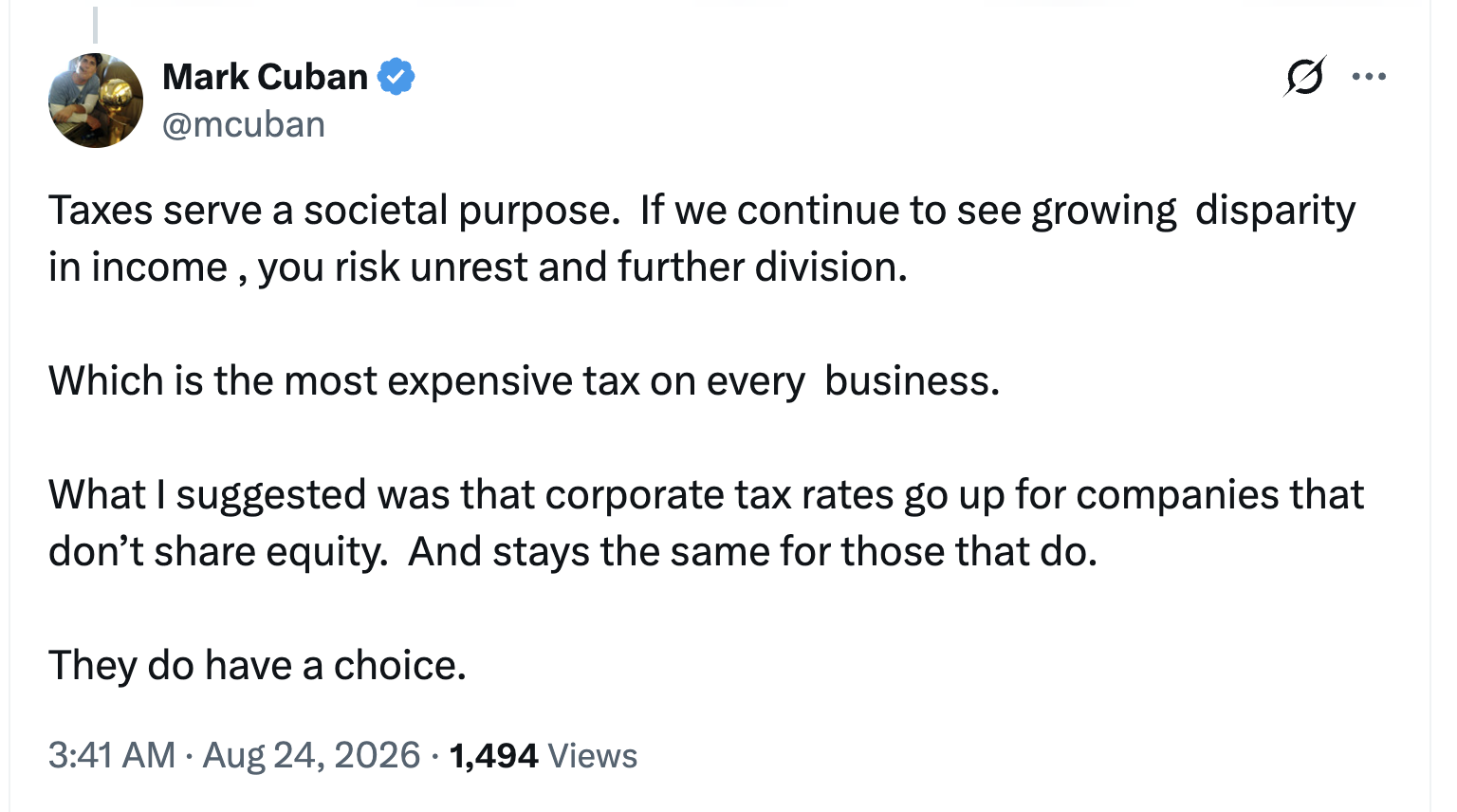
Cuban is inclined to agree, writing on X overnight: “If we continue to see growing disparity in income, you risk unrest and further division, which is the most expensive tax on every business.”
This story was originally featured on Fortune.com


Raiders announce $25M grant to help build Nevada’s first stand-alone children’s hospital
The Raiders continue to impact the Las Vegas community, as they announced their largest philanthropic commitment in the franchise’s history on Monday.
The Raiders and Intermountain Health announced a $25 million gift to help build Nevada’s first-ever stand-alone children’s hospital.
The gift by the Raiders was led by owners Mark Davis, Egon Durban, and Michael Meldman, who each contributed $5 million toward the hospital’s development. The Raiders committed an additional $10 million for this game-changing gift.
CLICK HERE FOR MORE SPORTS COVERAGE ON FOXBUSINESS.COM
“We want this gift to remind children and families that they have our team backing them and that the support of the entire Raider Nation is in their corner,” Davis said in a statement about the philanthropic achievement.
Mitch Cloward, Intermountain Health’s region president, added: “The Raiders are committed to excellence, and this gift is a generational investment that will keep families closer, strengthen our community, and give every kid every chance to thrive.
The hospital, which will be located at the UNLV Harry Reid Research and Technology Park, will be the first of its kind in Nevada, “anchoring a new future for kids and families across the state and delivering comprehensive, high-acuity pediatric care.”
The building will be 828,000 square feet and will rest on a 33-acre campus with 180 patient beds, with the design allowing room to grow.
The hospital will provide advanced emergency services designed specifically for children and a full-spectrum outpatient center alongside with inpatient and specialty care.
And as a result of the $25 million gift, Intermountain Health Nevada Children’s Hospital’s physical therapy and rehabilitation space, as well as its bistro, will be named in the Raiders’ honor.
It will be the Las Vegas Raiders Bistro, which will sit adjacent to the hospital’s main lobby. The press release noted this as “a space where caregivers and parents navigating the complexities of having a child in the hospital can pause,” providing “a quiet meal, or seeking a moment of normalcy” where families can find support.
“Sports reminds us that we do our best when we have the right team around us,” Meldman said in a statement. “Families deserve to feel supported every step of the way. In addition to the experts at Intermountain Health, the Raiders family stands with our community’s kids.”
The Las Vegas Raiders Inpatient Rehab Gym will also play a vital role in helping children “heal, grow stronger, and regain confidence through movement and play.” The space will provide advanced therapeutic equipment alongside some playful design elements to make therapy feel more empowering and fun.
GET FOX BUSINESS ON THE GO BY CLICKING HERE
“When we invest in children, we invest in everything that comes next – their education, their opportunities, and their future,” Sandra Douglass Morgan, president of the Raiders, said in a statement. “We want Nevada’s kids to know that their home team is cheering them on.”
Construction on the landmark hospital is expected to start in coming months, with an anticipated opening date coming for 2030.

Jeff Bezos wants the bottom half of earners to pay zero income tax—he says nurses making just $75K should save $12K a year
For roughly 76 million American households, federal income taxes could eventually disappear—if a proposal by billionaire Amazon founder Jeff Bezos ever becomes reality.
The Blue Origin owner argued the bottom half of U.S. earners should pay no income tax, saying working Americans shouldn’t be placed under increased financial pressure, considering they contribute a relatively small share of total tax revenue anyway.
“The bottom half of income earners in this country pay only 3% of the taxes,” Bezos told CNBC. “I think it should be zero.”
To make his case, Bezos used a hypothetical health care worker as an example: “Why is a nurse in Queens who makes $75,000 a year paying more than $1,000 a month in taxes?”
Bezos added: “To me, it’s kind of absurd that we’re doing this. We shouldn’t be asking this nurse in Queens to send money to Washington. They should be sending her an apology. It really makes no sense.”
While Bezos did not elaborate on his exact calculations, but workers in the U.S. are generally required to pay federal income, Social Security, Medicare—and in most states, state income—taxes. Combined, it can stretch into the thousands of dollars.
Because the U.S. tax system is progressive, higher earners generally pay a larger share of their income in federal taxes. In 2023, the bottom half of taxpayers (those making roughly under $54,000) accounted for roughly 12% of total adjusted gross income—but they paid just 3% of all federal income taxes, according to IRS data analyzed by the Tax Foundation. The average household in that group paid about $913 a year in federal income tax. However, when refundable tax credits are factored in, the bottom 40% of taxpayers already pay effectively no federal income tax on average, CNBC reported.
Bezos, who has maintained a warm relationship with President Donald Trump, said he plans to advocate for the idea with political leaders, arguing exempting lower earners from federal income taxes would represent only “a small amount of money for the government.”
“It is part of our job as citizens and as business leaders to share our ideas,” Bezos said. “And this one would actually help people.”
Bezos—with a net worth of $280 billion—says even if his tax bill was doubled, it wouldn’t help
Bezos’s concern for affordability may come as a surprise considering his estimated net worth north of $280 billion—among the top five of any person in the world. And while he said he personally pays “billions of dollars” in taxes, his tax history has long drawn scrutiny.
A ProPublica investigation released in 2021 found that Bezos—like several of America’s wealthiest billionaires—used tax strategies that have dramatically reduced his tax burden in certain years. In 2007 and 2011, for example, he paid no federal income tax at all, in part because investment losses outweighed reported income. Analyzing Bezos’s wealth growth alongside his reported income and taxes paid between 2014 and 2018, ProPublica calculated his so-called true tax rate at 0.98%.
Still, Bezos said he is open to a policy debate about what constitutes a fair tax burden for the wealthy. The top 1% of taxpayers accounted for nearly 21% of total adjusted gross income in 2023, but paid roughly 38% of all federal income taxes that year.
“We can argue about what the fair share is. That’s a policy debate, that’s okay,” Bezos said. “But the vilification is the thing that’s just the distraction.”
But even fixing tax loopholes or increasing taxes on the wealthy would not address what Bezos sees as a larger government spending problem. He pointed to inefficiencies in New York City’s public school system as an example.
“If we ran Amazon the way New York City runs their school system, your packages would take six weeks to arrive. We’d have to charge you a $100 delivery fee. And then when the package did finally arrive, it’d have the wrong item in it anyway.
“You could double the taxes I pay, and it’s not gonna help that teacher in Queens. I promise you,” he added.
New York City Mayor Zohran Mamdani pushed back on X, writing: “I know a few teachers in Queens who would beg to differ.”
Bezos plans to give away ‘most of his wealth’ in his lifetime—but his ex-wife MacKenzie Scott already has a head start
While Bezos has not signed the Giving Pledge—the philanthropic initiative created by Warren Buffett, Bill Gates, and Melinda French Gates encouraging billionaires to give away a majority of their fortunes in their lifetime or wills—the Amazon founder said he’s committed to giving away most of his wealth in his lifetime.
At the same time, he acknowledged the challenge of doing philanthropy effectively, echoing comments from billionaires including Buffett and Elon Musk, who have said giving away massive sums of money well is often harder than it appears.
But Bezos’s ex-wife, MacKenzie Scott, already has a sizable head start. Since 2020, she has donated more than $26 billion to organizations focused on DEI, education, and disaster recovery. Meanwhile, Forbes estimates Bezos and his current wife, Lauren Sánchez Bezos, have donated roughly $4.7 billion over their lifetimes.
Bezos argued to CNBC the long-term societal impact of companies like Amazon and Blue Origin may ultimately prove even more valuable than philanthropy alone. Creating products and services that improve people’s lives, he said, is the kind of impact aspiring entrepreneurs should prioritize.
“Everybody out there who’s a potential entrepreneur make sure you focus on that,” Bezos said. “You will be creating value for society if you’re successful at pleasing your customers.”
A version of this story originally published on Fortune.com on May 21, 2026.
More on wealth inequality:
- With a $15 billion net worth, Palantir CEO Alex Karp predicts he will get 20x richer from AI—but that middle-class workers will get just modest raises
- 1 in 5 Americans thinks it’s ‘morally wrong’ to be a billionaire—Gen Z in particular finds it distasteful
- Justin Trudeau warns AI boom could create hundreds of trillionaires—and it will mean there’s something ‘fundamentally wrong with the world’
This story was originally featured on Fortune.com


IBM continuing to enhance fan experience with new AI-powered features for US Open, including Serve Quality
The U.S. Open is back in Queens this week, as the final Grand Slam of the year brings millions of fans together at the USTA Billie Jean King National Tennis Center to witness some of the best men’s and women’s players in the world competing for glory.
As fans gear up to soak in hundreds of matches over the next couple of weeks, IBM and the United States Tennis Association announced new and enhanced AI-powered fan features within the popular U.S. Open app and USOpen.org for this year’s tournament.
For decades now, IBM has been working with the U.S. Open to truly evolve the fan experience, especially in recent years with AI-powered innovations that are designed to cut through all the noise and allow fans to personalize their tennis experience at their fingertips.
CLICK HERE FOR MORE SPORTS COVERAGE ON FOXBUSINESS.COM
That experience has evolved into one in which the fans demand AI-powered features because accuracy, not speed, has been shaping the digital sports realm for those consumers. According to new global research commissioned by IBM and conducted by Morning Consult, sports fans’ digital expectations are evolving as platform choices multiply, with 46% of more than 20,000 sports fans across 12 countries saying their expectations for digital sports experiences have increased in just the past one to two years. Also, 72% of surveyed fans say they use sports apps as their central hub for fandom, while 40% said having their information in one place is their leading motivation to follow along.
As a result, IBM continues to transform that experience in a way fans can enjoy one of the best tournaments in all of sports this week.
“I think we have such an incredible reputation in tennis through our two [Grand] Slam partnerships, as well as The Masters, where there’s this anticipation for the event, but also to see how we’re going to keep them connected,” Kameryn Stanhouse, vice president of sports and entertainment partnerships at IBM, told Fox Business in a recent interview.
“That’s one of the things that I love about what we do in sports is that we actually leverage technology as a way to foster conversations and connection. You can talk to people whether they’re able to go to tennis matches [or not]. We’ve got 1 million people that are going to go to the [UTSA] Billie Jean Tennis Center across the two weeks, and then 14 million people are going to be engaged at home on their couch, but able to feel like they’re courtside and engage on that second-screen experience.”
TOP-RANKED JANNIK SINNER WITHDRAWS FROM US OPEN WITH RIGHT KNEE INJURY: ‘SAD AND DISAPPOINTED’
What will that second-screen experience look like for the 2026 U.S. Open? First, an all-new Live Updates homepage will provide fans with a smarter and more personalized way to follow the action they care about the most. Stanhouse emphasized fans being able to choose their favorite players and quickly zero in on those matches, while getting insight and stories they care about in the process.
Another new feature Stanhouse is very excited to see in real time is the Serve Quality metric, which is a “first-to-market feature” that provides a whole new context to one of the most important aspects of tennis.
Last year, American women’s star Coco Gauff came into the U.S. Open with a new coach specifically to help with her serves. Service can be the difference between winning and losing, and those generally with superior serves win matches.
This new feature from IBM will be available across all 254 singles matches, where the AI-powered tool will use advanced limb-tracking technology developed with IBM Bob to help analyze the precise mechanics of every serve. And the continuous stream of this live data will be managed by IBM Confluent.
“We basically trained this model to look at all the historic white papers, all the research about serves. Then, we’re looking at 21 specific joint points on the body – everything from the elbow to the big toe that looks at momentum,” Stanhouse explained. “The position of a serve on the court, where it lands. We have six different coordinates we’re looking at all the way to the racket positioning. Synthesizing all of that, it’s doing snapshots 50 times per second – lots of data points in this one. But overall, 1.2 billion data points that’s going to be analyzed over the tournament to give you a Serve Quality number.”
Also, the new “Key Moments” feature within the app takes the popular “Likelihood to Win” feature to the next level to help fans understand why someone is winning – not just who is up in the match. The “Likelihood to Win” feature became a hit as it calculated each player’s probability of victory using an AI-powered analysis of current and historical statistics, expert opinion and match momentum.
Now, “Key Moments” will provide additional, more rich information, to summarize those momentum shifts in matches.
“We’re looking at that structured and unstructured data, taking AI to make an analysis, and then make a pre-match projection that takes into consideration not only how they’ve been playing, but what’s the media saying? What’s been said on social media? What are the broadcasters saying? Did someone get a new tennis coach? Do they have a lingering injury? So, we take all that into consideration and provide a pre-match projection,” Stanhouse added.
Finally, as fans have become more accustomed to an AI experience over the years, IBM’s enhanced “Match Chat” will act as an interactive companion to help provide whatever insight is needed to help guide the user through the tournament. Everything from analysis to finding out Serve Quality, to simply figuring out how to pronounce someone’s name properly, Match Chat, powered by watsonx Orchestrate, is a collection of AI agents and fit-for-purpose models trained to give fast, accurate responses that keeps fans informed whenever they need it.
GET FOX BUSINESS ON THE GO BY CLICKING HERE
For Stanhouse and her team, the U.S. Open is simply another opportunity to showcase what IBM can do for not just the sports world, but drive the conversation for other companies to utilize the fun, engaging technology they’ve developed for themselves.
“Everybody says my team has the best job at IBM. There’s many, many great jobs, but I think what we do is so exciting because there’s a tangible output that people actually see and people are waiting for. Each tournament that we go to is not only a learning opportunity because we’re constantly thinking about how we’re going to evolve things for the next year, but it’s such a pay-off to see everything come to life. Because what we do is not just serve the fan experience, but we’re so creating unique conversation pieces for our clients. They see how IBM technology makes all of this possible and inspire what you could do with us.”

Here’s how much the $40 trillion national debt is costing you — whether you have student loans, a mortgage or Social Security
The U.S. national debt crossed $40 trillion on Aug. 18, a record high and a milestone that sounds abstract until you convert it into something more familiar: your loan payments.
New economic modeling from The CEO Center, the public policy arm of The Conference Board, puts a dollar figure on what rising federal borrowing actually costs ordinary Americans — a student paying off loans, a family saving for a house, a small business owner expanding, and a retiree counting on Social Security.
The answer, in short: the gap between a responsible deficit path and a reckless one is worth tens of thousands of dollars over a decade, and jumps to six figures in a true fiscal crisis.
The mechanism is simple, even if the debt figures aren’t
Divide $40 trillion by the U.S. population and every American is on the hook for roughly $117,000. But that number doesn’t explain why it matters to someone who will never personally owe the Treasury a cent.
Here’s the actual chain of cause and effect: when the federal government runs a bigger deficit, it sells more bonds to cover the gap. Investors, wary of a less creditworthy borrower, demand higher interest rates on those bonds. Because student loans, mortgages, and small-business loans are all priced off the same benchmark — the 10-year Treasury yield — those higher government borrowing costs flow directly into the interest rate on everyone else’s debt too.
The Conference Board modeled five versions of the next decade: a baseline matching current Congressional Budget Office projections (deficits of 6%–7% of GDP), a “good case” where Washington cuts the deficit to 3% of GDP, a “bad case” where it balloons to 9%, a scenario simulating a one-week government default in 2029, and an extreme shock in which interest rates double to 1980s levels.
Under the current baseline, debt as a share of GDP climbs to 154% by 2036. If lawmakers get serious about cutting deficits, it settles at 126%. More reckless spending, however, puts it at 180%.
The student: an extra $20,000 by graduation
Take a high schooler heading to a four-year university in 2028, borrowing $45,000 for undergrad and another $30,000 for a two-year graduate program in 2032. Federal loan rates are pegged to the 10-year Treasury yield plus a fixed margin — 2.05 percentage points for undergraduate loans, 3.6 points for graduate loans — locked in whenever the loan originates.
Under the baseline scenario, that student repays $103,645 over a standard 10-year term. If Congress gets deficits under control, the bill drops to $102,776, saving roughly $870. If deficits worsen instead, it rises to $104,648. A one-week government default in 2029 would push it to $106,495.
But the real gut punch would be the extreme rate-shock scenario, driving total repayment to $123,736 — nearly $20,000 more than the baseline.
The family of four: waiting to buy a house gets more expensive, not less
A family targeting a $600,000 home with a 20% down payment and a 30-year fixed mortgage faces a similar squeeze — and it compounds the longer they wait. Buying in 2031, the gap between the good-case and bad-case scenarios is about $25,000 on total mortgage payments.
Push the purchase to 2036, and rising deficits widen the gap further: the family pays $24,000 more than baseline in the bad-case scenario, and a staggering $200,000 more — a 19.2% premium — if an extreme rate shock hits. The one-week default scenario alone tacks on $45,000 by 2036.
That’s money competing directly against costs already squeezing this household. For example, center-based childcare now averages $15,570 a year, rising 1.5 times faster than inflation, while long-term care for an aging parent can run anywhere from $75,000 a year for a home health aide to over $128,000 for a private nursing home room.
The small-business owner: financing growth costs more when Washington borrows more
A small-business owner planning two expansion loans — $100,000 in 2031, $150,000 in 2036, each priced at the 10-year Treasury yield plus a 2% bank premium — pays $334,747 in total under the baseline.
Deficit reduction saves about $6,300; a bad-case deficit path costs about $6,500 more. A government default adds $20,000. The extreme rate shock is the worst outcome across any case study in the report: $65,000 more than baseline, a 19.5% increase, at a moment when small-business profitability is already falling and gas costs for small businesses are up 31% year over year.
The retiree: no interest rate, just a shrinking check
The fourth case study works differently because there’s no loan to reprice. Instead, it’s about Social Security’s Trust Fund, which the CBO projects will run out of reserves in 2032. By law, once that happens, benefits automatically drop to whatever payroll tax revenue can cover, unless Congress intervenes. A retiree scheduled to receive $2,466 a month in 2032 would instead get $2,293 — a $173 cut — and by 2036 the shortfall widens to $754 a month.
Congress could avoid the cuts by transferring roughly $2.7 trillion from the general fund between 2032 and 2036. But doing so would add directly to the deficit, pushing the country further toward the “bad case” scenario and, by extension, higher costs for the student, the family, and the small-business owner in the other three case studies. There’s no version of this where the bill simply disappears; it just moves to a different balance sheet.
The bottom line
Three of the four Americans in this analysis pay more in interest, because Washington is borrowing more. The fourth pays through a smaller retirement check, because the money to keep it whole would have to come from more of the same borrowing.
The report’s authors argue that reframing the debt this way — not as a distant trillion-dollar abstraction, but as a line item on a 22-year-old’s student loan bill or a 67-year-old’s Social Security deposit — is what’s been missing from the political conversation.
The CEO Center is pushing Congress to establish a bipartisan fiscal commission, overhaul Social Security financing, modernize Medicare payment models, and reform the federal budget process. Whether lawmakers act may determine which of the report’s five debt scenarios — and which version of these four Americans’ bills — actually plays out.
For this story, Fortune journalists used generative AI as a research tool. An editor verified the accuracy of the information before publishing.
This story was originally featured on Fortune.com



Opinion | Make American Magnesium Again

Opinion | Trump to Ford Motor: Drop Dead

Trump’s Family Seeking National Bank Charter

Phonak Launches New AI Hearing-Aid Platform in the U.S.
Hearing aids are moving deeper into artificial intelligence, and Phonak is betting that the biggest consumer benefit will not be louder sound. It will be making speech easier to understand when the room is noisy.
Phonak launched its new EON hearing-aid platform in the United States on Monday, introducing a new generation of devices built around real-time AI sound processing, automatic scene recognition and broader wireless connectivity.
The flagship model, Audéo EON Sphere, is designed to separate speech from surrounding noise in real time so conversations stand out more clearly in restaurants, family gatherings, public transportation and other environments where hearing-aid users often struggle most.
That problem has long been one of the industry’s hardest to solve.
Traditional hearing aids can amplify sound effectively, but amplification alone does not necessarily help when multiple voices, dishes, music and background noise are competing at the same time. Phonak’s approach is to use AI processing to identify speech and suppress distractions continuously rather than forcing the user to manually change programs.
The new platform is powered by Sonova’s HYPERSONIC chip and also includes AutoSense OS AI 8.0, which automatically adjusts the hearing aid as the wearer moves between different environments.
The EON lineup includes Audéo EON Sphere, Audéo EON R and CROS EON R, the latter designed for people with hearing loss primarily on one side.
Connectivity is also becoming a larger part of the product.
The devices support standard Bluetooth as well as Auracast, a newer broadcast-audio technology that can allow hearing aids to receive audio directly in places such as theaters, airports, conference rooms, gyms and other public spaces as Auracast adoption expands.
For consumers, that pushes hearing aids closer to the functionality people already expect from wireless earbuds while preserving the medical-grade processing designed for hearing loss.
Phonak says the new models are also smaller and lighter than previous generations, addressing another persistent complaint among users who wear the devices for most of the day.
The launch comes as hearing technology becomes increasingly competitive. Prescription hearing-aid manufacturers are adding AI processing, while consumer-electronics companies are introducing hearing-related features into earbuds and other devices.
That competition is changing expectations.
Consumers increasingly want hearing aids that do more than amplify sound. They expect automatic adjustment, phone connectivity, streaming, rechargeable batteries and better performance in noisy environments without constantly manipulating settings.
The United States is the first major launch market for EON, with additional European markets and Australia expected to follow in September.
The broader shift is easy to see.
For decades, hearing aids were essentially specialized amplifiers.
The next generation is becoming something closer to an AI-powered audio computer worn behind the ear.
JBizNews Desk | Stäfa, Switzerland
© JBizNews.com All Rights Reserved. Reproduction or distribution without written permission is prohibited.
:::

Google plans to move all Pixel manufacturing out of China by 2027: report
Google is reportedly moving forward with shifting all manufacturing of its Pixel devices outside of China starting in 2027.
The tech giant has previously made its Pixel phones, watches and earbuds in China – though that’s set to change next year, with Google informing suppliers that the production of those devices will move out of the country into Vietnam and India, according to a report from last week by Nikkei Asia.
The report cited a source who told the outlet that Google will be better-positioned to move production out of China than tech rival Apple because Pixel devices aren’t sold directly in the Chinese market, while it’s also a relatively small base of smartphone users.
Nikkei Asia previously reported in January that Google was planning to develop and manufacture Pixel 11 devices in Vietnam exclusively, with the process requiring investment in testing equipment as well as tooling machines. According to the latest report, the success of that process prompted Google to expand production for other Pixel devices in Vietnam.
Google also reportedly told suppliers that it intends to increase shipments of Pixel phones by 8% to 10% this year after the company shipped 12 million Pixel phones a year ago.
The production boost comes against the backdrop of Google’s push to promote consumer usage of its Gemini artificial intelligence (AI) tools.
If Google proceeds with the move, it would follow Samsung in moving smartphone production out of China. Samsung’s production shifted out of China in a process that took over a year and concluded in 2019 with most of its manufacturing moving to Vietnam and India.
The ongoing shortage of memory chips caused by the AI buildout of data centers and cloud services is affecting companies across the tech sector.
Google has reportedly looked to address that issue by combining orders for phone memory chips with those for its AI and cloud businesses.
MODERNA CEO WARNS CHINA IS INVESTING HEAVILY IN MRNA AS BEIJING CHALLENGES US IN BIOTECHNOLOGY
By doing so, the company is able to enhance its negotiating position with major suppliers of memory chips, potentially leading to improved terms for its memory chip purchases across its business lines.
FOX Business reached out to Google for comment.

Alumni Network of South Korean President, KDB Chairman and Hyundai Hospital Chief Opens New U.S. Trade Channel
Chung-Ang University partnership with the Orthodox Jewish Chamber of Commerce connects businesses across South Korea, the United States and Israel
A university alumni association may not immediately sound like a force in international commerce.
But Chung-Ang University’s alumni network includes South Korean President Lee Jae Myung, Korea Development Bank Chairman and CEO Park Sang-jin, Hyundai Hospital President Boo-Seop Kim and corporate leaders across banking, pharmaceuticals, semiconductors, healthcare, manufacturing and technology.
Now that network is establishing a new channel into the American business community through an agreement with the Orthodox Jewish Chamber of Commerce.
The partnership could give businesses access to something that is often difficult and expensive to obtain: trusted introductions to executives, investors, government relationships and potential commercial partners in South Korea, the United States and Israel.
The memorandum of understanding was signed Aug. 7 during the Korea-U.S. Economic and Trade Cooperation MOU Signing Ceremony at the DoubleTree by Hilton Fort Lee–George Washington Bridge in New Jersey.
The agreement creates a framework for trade, investment, entrepreneurship, innovation, professional exchange and assistance for companies seeking to enter new markets.
For a Korean manufacturer, that could mean help identifying an American distributor, investor, lender or professional adviser. For an American business, it could provide a path to Korean customers, suppliers, executives or strategic partners that would otherwise be difficult to reach.
The Orthodox Jewish Chamber’s relationships in Israel add another market to the partnership, creating potential connections in technology, healthcare, finance, infrastructure, manufacturing and innovation.
Chung-Ang University is one of South Korea’s prominent private universities, with programs spanning business, law, medicine, pharmacy, engineering, technology and the arts. Its alumni association has cited a global network of approximately 280,000 graduates.
The university previously reported that 40 Chung-Ang alumni were serving as CEOs among Korea’s 1,000 largest publicly listed companies by sales.
Its prominent alumni include Lee, who graduated from Chung-Ang’s College of Law, and Park, the first Korea Development Bank chairman to rise from within the government-owned lender’s own ranks.
The business community also includes semiconductor entrepreneur and GEO Element Chairman Shin Hyun-kook and the late Auh June-sun, who led Ahngook Pharmaceutical and previously served as president of the Korea Pharmaceutical Manufacturers Association.
Chung-Ang’s global cultural reach includes Emmy Award-winning “Squid Game” actor Lee Jung-jae, actor Hyun Bin and actress Park Shin-hye.
That combination of government, corporate and cultural influence is what makes the agreement potentially valuable beyond the signing ceremony itself.
“Commerce is one of the most powerful ways to build lasting bridges between countries, CEOs and community leadership,” said Duvi Honig, founder and CEO of the Orthodox Jewish Chamber of Commerce. “This partnership gives our members a platform to reach business leaders and opportunities that they would not ordinarily be able to access on their own.”
Honig said the Chamber’s role is to connect networks and then help turn those relationships into practical opportunities.
“The value we bring to our members is broader reach and trusted access,” Honig said. “We bring countries, companies, CEOs and leadership together and use commerce as the bridge. That is what ‘Uniting the World Via Commerce’ means in practice—giving businesses an opportunity to reach markets and decision-makers that may otherwise remain beyond their reach.”
“This agreement turns our shared relationships into a working platform for business,” said James Sungjin Kim, Korea Affairs Chair of the Orthodox Jewish Chamber of Commerce. “By connecting Chung-Ang University’s influential alumni network with the Chamber’s members and international relationships, we can help companies identify partners, enter new markets and develop opportunities across South Korea, the United States and Israel.”
The agreement could be especially useful to small and midsized companies.
Large corporations can hire consultants, investment bankers and international development teams to enter foreign markets. Smaller businesses often have strong products and services but lack the relationships needed to identify a reliable distributor, approach a major customer or navigate an unfamiliar country.
A chamber-backed network can reduce that disadvantage by offering a credible starting point and access to organizations already operating in those markets.
An American healthcare company, for example, could use the relationship to seek introductions to Korean hospital or pharmaceutical leaders. A Korean technology company could look for an American distributor or Israeli innovation partner. A Chamber member providing legal, accounting, banking, insurance, logistics or commercial real-estate services could assist Korean companies establishing U.S. operations.
The agreement was signed during a U.S. visit by senior Chung-Ang alumni leaders.
Boo-Seop Kim, president of the Chung-Ang University Alumni Association and president of Hyundai Hospital, and Wonchul Choi, president of the North America Chung-Ang University Alumni Association, represented the Korean alumni organizations.
Honig participated live by Zoom. James Sungjin Kim, Korea affairs chair of the Orthodox Jewish Chamber of Commerce, attended in person and signed on the Chamber’s behalf.
Chung-Ang’s alumni leadership signed two additional agreements during the program, one with the Greater New York Chamber of Commerce and another with the Korean American Chamber of Commerce of the Northeast.
Mark Jaffe, president and CEO of the Greater New York Chamber, participated remotely. On-site participants included James Sungjin Kim and Amit Shah, co-chairs of international affairs for the Greater New York Chamber, and Kwang Suk Kim, chairman of the Korean American Chamber of Commerce of the Northeast.
The program also included a discussion of Empire State Development and potential future cooperation between Korean businesses and New York State.
The agreements do not guarantee that investments, contracts or jobs will follow. Their value will depend on whether the participating organizations identify companies ready to expand, organize targeted delegations and convert introductions into business.
The foundation, however, is now in place.
For an individual business owner, the most important result may be finding one international partner, reaching one decision-maker or entering one market that was previously inaccessible.
That is the tangible value behind the new network: trusted relationships and broader reach that many businesses could not build alone.
Disclosure: Duvi Honig is the publisher of JBizNews and the founder and CEO of the Orthodox Jewish Chamber of Commerce, one of the organizations participating in the agreement.
JBizNews Desk | Fort Lee, New Jersey
© JBizNews.com All Rights Reserved. Reproduction or distribution without written permission is prohibited.


Business Day in Review — Monday, August 24, 2026
Wall Street ended Monday split, with banks keeping the Dow positive while a sharp semiconductor selloff dragged the Nasdaq lower. But some of the day’s more consequential business developments happened away from the major indexes: a $13.7 billion AI-computing contract came with a major financing question, Tesla quietly ended one of Elon Musk’s best-known solar products, Shein returned to public markets at a fraction of its former valuation, and an EPA decision wiped out a large chunk of the value of ethanol credits.
Markets — Tech Slides While the Dow Holds On
The Dow Jones Industrial Average closed at 53,418.68, up 141.67 points, or 0.27%. The S&P 500 fell 21.37 points, or 0.28%, to 7,653.00, while the Nasdaq Composite dropped 200.80 points, or 0.77%, to 25,979.66.
Technology was the clear weak spot. The Philadelphia Semiconductor Index fell about 2.6%, with Micron down 5.6%, Nvidia down 2.3% and Broadcom down 2.1% as investors reduced exposure ahead of Nvidia’s earnings Wednesday. Financial stocks moved higher, with JPMorgan Chase and Visa helping keep the Dow in positive territory. The 30-year Treasury yield remained above 5%, keeping pressure on expensive growth stocks and borrowing-sensitive businesses.
One of Monday’s biggest individual losers was Applied Optoelectronics, which sank roughly 12% after disclosing a new program that could sell as much as $600 million of stock into the market. The optical-networking company has benefited heavily from demand for AI data-center equipment, but the reaction shows investors are increasingly paying attention not just to AI growth, but to how companies are financing that growth.
AI Infrastructure — A $13.7 Billion Contract With a Catch
RUM Group announced one of the largest AI infrastructure contracts of the day: a six-year agreement worth approximately $13.7 billion to provide GPU computing services to an unnamed U.S. cloud customer from a data-center site under development in Maysville, Georgia.
The size of the contract is extraordinary. But so is what RUM may have to spend to fulfill it.
The customer is receiving warrants allowing it to purchase as many as 50.8 million RUM shares for one cent each, with the shares vesting as portions of the agreement are completed. The facility itself is still being developed, meaning RUM will need significant capital to build the computing capacity required to deliver the service. Shares initially jumped about 10% on the announcement.
That is becoming one of the defining questions of the AI boom. Winning billions of dollars of future business sounds spectacular, but GPUs, electricity, buildings, cooling systems and grid connections have to be paid for before that revenue arrives. Investors are beginning to distinguish between companies benefiting from AI demand and companies that may have to issue enormous amounts of debt or stock to serve it.
Retail — Shein’s $100 Billion Dream Becomes a $27 Billion IPO
Shein launched its Hong Kong IPO Monday at a valuation of as much as $27 billion, a remarkable fall for a company that private investors valued at $98.2 billion in 2022.
The fast-fashion company is seeking to raise as much as $1.77 billion by selling 280 million shares.
The roughly 70% collapse in valuation tells a larger story about global e-commerce. Shein built its model around shipping extremely inexpensive packages directly to consumers. That became far less attractive after the U.S. eliminated duty-free treatment for many low-value packages and governments began imposing additional tariffs, fees and regulatory requirements. Competition from Temu and Amazon has also intensified.
For retailers, this is important because one of the competitive advantages that allowed Chinese direct-to-consumer platforms to dramatically undercut American stores is weakening. For consumers, it can ultimately mean higher prices on extremely low-cost imported merchandise.
Shein is still a huge company. But public investors are effectively saying it is worth less than one-third of what private investors believed four years ago.
Temu — Sales Keep Growing, but the Cheap-Shopping Model Is Getting More Expensive
The same pressure showed up Monday at PDD Holdings, owner of Temu.
Second-quarter revenue rose 8% to 112.36 billion yuan, or about $15.7 billion, but missed Wall Street expectations. Net income fell 12% to 27.2 billion yuan.
At home, PDD is fighting Alibaba, JD.com and ByteDance in an aggressive Chinese price war. Overseas, Temu faces tariffs, the loss of duty-free treatment for low-value U.S. packages and a new European Union fee on small imported parcels. PDD executives warned that the changes are increasing costs and slowing fulfillment.
The takeaway is bigger than one quarterly earnings report.
Temu’s explosive rise was based partly on making the distance between a Chinese factory and an American consumer almost irrelevant. Governments are now putting costs back into that distance. If that continues, the economics of ultra-cheap cross-border shopping begin moving closer to those faced by traditional retailers that import inventory, warehouse it domestically and pay tariffs before making a sale.
Clean Energy — Tesla Gives Up on the Solar Roof
Tesla has stopped selling its premium Solar Roof, nearly a decade after Musk unveiled the product as a way to turn the roof itself into a power-generating system rather than mounting conventional solar panels on top of it.
The Solar Roof page now redirects customers to Tesla’s traditional solar-panel business.
Tesla once targeted 1,000 Solar Roof installations per week, but industry estimates indicated actual installations remained far below that goal. The company is now focusing on conventional solar panels manufactured in Buffalo, New York.
This does not mean Tesla is abandoning solar. In fact, the company filed plans this month for a $10.1 billion solar-cell factory outside Houston that it says could create 9,712 permanent jobs.
What changed is the product strategy. Tesla appears to be moving away from an attractive but complicated customized roofing product and toward something easier to manufacture and install at scale.
For contractors and business owners, there is a familiar lesson: a product can be innovative and still fail if installation, labor and customization make it too difficult to scale profitably.
Energy & Agriculture — EPA Decision Knocks Down Ethanol Credits
A single regulatory announcement caused a dramatic move in an obscure market that ultimately affects refiners, farmers and fuel producers.
The price of conventional ethanol blending credits, known as D6 RINs, fell to $1.75 Monday, down 34 cents in one day and well below the $2.50 level reached in July.
The EPA extended a September 1 compliance deadline and said it plans to decide 34 pending requests from small refineries seeking exemptions from federal biofuel requirements. Market participants estimate those exemptions could free up between 1.2 billion and 1.8 billion RIN credits.
For refiners, cheaper RINs can substantially reduce the cost of complying with federal blending rules.
For ethanol producers — and indirectly corn growers — the effect can run the other way. If refiners receive more exemptions or can satisfy mandates with cheaper credits, the economic incentive to blend additional renewable fuel can weaken.
It is a good example of how a regulatory decision in Washington can move hundreds of millions of dollars through the energy and agricultural economy without most consumers ever seeing the mechanism behind it.
Media — California Raises the Stakes on Paramount’s $110 Billion Warner Bros. Deal
California Attorney General Rob Bonta canceled settlement talks Monday over Paramount Skydance’s proposed $110 billion acquisition of Warner Bros. Discovery, accusing Paramount of acting in bad faith by leaking details of earlier discussions. Paramount denied being responsible for the leaks.
California and 11 other states sued in July seeking to block the acquisition, arguing that the combination could reduce competition and give the enlarged company greater power to raise prices in film and television.
A trial is scheduled for March, and California has indicated that any settlement could require structural changes — potentially including the sale of assets — rather than simply promises about future behavior.
That matters financially because time itself is becoming expensive for Paramount. The longer the acquisition remains unresolved, the greater the financing, legal and contractual costs of keeping a $110 billion transaction alive.
For consumers, the eventual structure could determine which company controls a massive collection of studios, cable networks and streaming assets.
Robotics — $900 Million Says Investors Think AI Is Leaving the Screen
Chinese automaker XPeng’s robotics division raised more than $900 million Monday at a valuation exceeding $6.3 billion, the largest single private financing yet in China’s embodied-AI sector.
Tencent and Alibaba participated alongside investment firms including IDG Capital. XPeng says the money will fund hardware, software, AI models and mass-production facilities.
The company is targeting production of 1,000 IRON humanoid robots per month by the end of 2026, initially using them in retail stores and industrial campuses before broader commercial sales in 2027.
For businesses, this is the next stage of the AI investment cycle worth watching.
The first wave was software that could write, analyze and generate information. Increasing amounts of capital are now moving toward “physical AI” — machines intended eventually to work in warehouses, factories, stores and other environments where human labor is currently required.
What to Watch Tuesday
Tuesday, August 25, brings a useful test of both the American consumer and the housing market.
The U.S. Census Bureau will release July new-home sales at 10 a.m. ET. Housing has become particularly sensitive to elevated long-term interest rates, so the report will offer a fresh look at whether buyers are continuing to absorb expensive mortgage financing.
The Conference Board is also scheduled to release its August Consumer Confidence Index, while regional manufacturing data will provide another read on business activity. These reports matter because markets are trying to determine whether the economy can continue growing while inflation, energy costs and interest rates remain elevated.
On the corporate side, Dick’s Sporting Goods reports before the opening bell, providing another indication of discretionary consumer spending. Intuit, Zoom, HEICO and Box are among the companies scheduled after the close. Intuit will be particularly useful for small-business watchers because its QuickBooks and tax businesses give it exposure to millions of businesses and consumers.
And technology investors will be trading Tuesday with one eye on Wednesday: Nvidia reports earnings August 26. After Monday’s semiconductor selloff, the results are becoming more than another earnings report. They will help determine whether investors still believe the extraordinary amount of money being poured into AI infrastructure can continue producing growth fast enough to justify current valuations.
Monday’s biggest message was not that AI is slowing or that consumers have stopped spending. It was that the cost of growth is becoming harder to ignore. AI companies need enormous amounts of capital. Cheap global e-commerce is running into tariffs. An innovative Tesla product could not reach scale. And government decisions are moving billions of dollars through energy and media markets.
That is where Tuesday begins.
JBizNews Desk | Wall Street
© JBizNews.com All Rights Reserved. Reproduction or distribution without written permission is prohibited.
NHL Team Futures ETFs Filed, Draw Attention
Who Is Buying America’s Debt These Days?

Target, Starbucks and Nike are writing the 2026 turnaround playbook. Here are the key lessons
What did Target, Starbucks, and Nike have in common barely a year ago? All three consumer icons had freshly announced new CEOs, which were wrongly greeted with hasty skepticism from analysts. Target’s Michael Fiddelke was scoffed at as an uninspired insider; Nike’s Elliott Hill was underestimated as a nostalgia hire, unable to stem Nike’s loss of market share, while questions abounded over whether Brian Niccol could actually turn around Starbucks amidst pervasive in-store service struggles, despite his sterling record at Chipotle.
We saw it differently. At the time of their appointments, we vocally and presciently touted all three new CEOs as the right person for the job at the right time, while other analysts rolled their eyes. Unlike the frequent, sometime successful model of the messianic hiring of industry outsiders as turnaround tians, these new CEOs hit the ground running as each had decades of experience in their sectors with glowing track records, priceless relationships, and balanced expertise across marketing, finance, strategy, and operations,.
Furthermore, we were the first to confidently predict the certainty of their success, even knowing that it would take some time to reposition their enterprises and for their new leadership to gain traction. Now the receipts are in, showing striking progress in all three cases, with each already well on their way to cementing their reputations as the architects of some of the most remarkable corporate turnarounds of our era.
Target – Michael Fiddelke’s stunning results despite widespread initial skepticism
When Michael Fiddelke, a Target lifer who had risen up the ranks from a lowly intern over two decades ago, was named CEO, cynics sneered that the board had chosen entrenched groupthink over fresh blood. We argued precisely the opposite—that the data overwhelmingly shows internal candidates outperform splashy external saviors, with insider CEOs appointed over the prior year delivering roughly 15% annualized shareholder returns while external hires averaged negative 9%. New brooms sweep clean, but the old broom knows the corners. Furthermore, we argued that Fiddelke was uniquely positioned to build on the many successes of his widely admired predecessor, Brian Cornell, despite simultaneous urgent challenges.
This week brought resounding vindication. Target’s second-quarter sales jumped 5.3%, digital sales grew nearly 9%, Target raised its full-year outlook for the second consecutive quarter, and the stock soared nearly 5%. Indeed, on a year to date basis, Target stock has soared nearly 60%.
A year too late, Wall Street seems to be catching on to what we said first: Bank of America declared it a “impressive improvement in sales under new leadership” while remaining somewhat wary; Morgan Stanley credited Fiddelke with “pursuing the right initiatives” as “initial newness and innovation is gaining traction,” which Telsey sees as “a strong signal that the turnaround is working.”
Behind the numbers is the simple fact that Tar-zhay is getting its verve back, as it is becoming newly cool and trendy again, ranging from buzzy partnerships from Pokémon to LoveShackFancy to Olivia Rodrigo, Isaac Mizrahi as creative director at large. We see this not only through the data, but anecdotally. Even our fashion-forward Assistant Director, Isabella Giansanti, tells us she is now back to shopping at Target and once again an avid fan, after having been disappointed by the brand for years – which we find more compelling as a barometer of where the puck is going in fashion than any data point!

That turnaround has been the product of savvy decisions from Fiddelke and his impressive leadership team. Not only did Fiddelke have the courage to launch a $2 billion investment program to refresh Target’s stores, boost service quality and improve the in-store experience for customers; Fiddelke also leaned in on building out Target’s underleveraged digital platform, driving record sales growth there alongside high-margin digital advertising revenue growth, with a newly appointed chief AI officer well positioned to continue to build on that progress, including by harnessing partnerships with Google and OpenAI.
Starbucks – astounding results from Brian Niccol’s investment in frontline workers and stores
Brian Niccol entered the company at a time when so much of its prior turnaround efforts had fallen short and new item launches fell flat. Previous CEO Howard Schultz was vocal that the chain had lost its way, publicly stating that “The stores require a maniacal focus on the customer experience, through the eyes of a merchant. The answer does not lie in data, but in the stores…focus on being experiential, not transactional”.
That is exactly the focus Niccol has adopted, as we touted he would at the time he was appointed, but now he is taking it to an even higher level. Relentlessly focused on frontline employees, Niccol unveiled an unprecedently generous incentive compensation program offering industry-leading pay and benefits, re-motivating a highly committed workforce passionate about improving the in-store experience for customers. Indeed, baristas and shift supervisors are now able to earn up to an additional $1,200 a year based on coffeehouse performance, with extended tipping options increasing what hourly partners receive by up to 8%, on top of pay packages valued at more than $30/hr on average plus comprehensive healthcare, stock awards, a paid college degree and flexible leave. Niccol has also committed to fill 90% of leadership roles from within the ranks, providing tangible pathways of career progression for the best frontline employees.
The results of Niccol’s sustained investments and commitment to his employees have been nothing short of astonishing, bearing out in financial results which have defied Wall Street consensus by miles. Global and U.S. same-store sales surged nearly 8% last quarter, powered by genuine transaction growth of over 4%, not price hikes; operating margins expanded a stunning 430 basis points, and management has raised guidance two quarters in a row and counting. More than 1,000 coffeehouse “uplifts” are complete and ahead of schedule, peak service times have fallen below four minutes, and brand affinity has reached five-year highs—led, remarkably, by Gen Z.

Morgan Stanley called these results “impressive in any industry backdrop”; and indeed, Niccol declared in January that “Starbucks is back”, with Wall Street analysts now rushing to upgrade the company, declaring how “impressed” they are with “management’s turnaround efforts that appear to have successfully repositioned Starbucks for sustainable multi-year growth” with the stock up 25% year to date, and counting.
Nike – green shoots of progress under Elliott Hill
Of these three remarkable turnarounds, Nike is in the earliest chapter. Critics point out that the stock is down 45% in the last 12 months and 78% from its 2021 peak, hitting a 12-year low, but what they miss are that the green shoots of progress are already visible. A closer look is warranted at what is happening underneath the surface at Nike, despite widespread cynicism and skepticism.
Elliott Hill, the 32-year Nike veteran who came out of retirement to turn around the company, inherited an unenviable hand, after the unforced errors of his predecessors in cutting off vital wholesale distribution partners in a botched direct-to-consumer pivot, whose failures led to massive discounting, lack of innovation, and a self-reinforcing negative feedback cycle as Nike bled market share to upstart rivals like On and Hoka.
Rather than hiding from the toughest challenges, Hill confronted them head-on despite knowingly taking on some short-term pain and cost. Hill started by rebuilding damaged wholesale partnerships, resulting in wholesale revenues in North America jumping 10% this quarter with the most important wholesale partners posting positive growth for the first time in four years. Similarly, Hill launched a program of deliberate strategic surgery after excessive discounting, initiating some store closures, a significant scaling back of certain lifestyle products, in particular three specific massive sportswear franchises across AF1, Dunks, and Air Jordan’s which were previously over-relined on, and a painful but important China reset, prioritizing brand & margin integrity over volume.

And most important of all, Hill’s return as CEO marked a return to Nike’s cultural core in celebrating elite performance across sports and running, with the core running category posting double-digit growth for every quarter under Hill’s watch, adding roughly $1 billion in revenue and 5% of global market share, and soccer momentum surging on the heels of successful World Cup partnerships. Indeed, Nike’s World Cup campaign drew 1.5 billion views in its first week, national-team kit sales more than doubled, and the Mercurial became the fastest-selling boot launch in Nike Direct history. No wonder that Wall Street analysts are now back to declaring that the question on Nike’s turn is no longer “if,” but “when.”
The emerging turnaround playbook for CEOs in 2026
The common threads across these three revivals carry lessons that transcend the consumer sector alone.
First, boards chose CEOs who know the business cold with loads of front-line and operational expertise —Elliott Hill at Nike and Michael Fiddelke at Target are decades-long insiders who practically grew up in their companies; while Brian Niccol is a proven brand-builder with a track record of prioritizing the customer experience—rather than celebrity saviors armed with slide decks detached from frontline experience. All three CEOs are personally lowkey and would rather shine a spotlight on their employees and their customers rather than themselves.
Second, each of these three CEOs has prioritized investing in the core customer experience—whether boosting barista pay at Starbucks to unprecedented levels; making Target cool again by investing $2 billion in stores; or returning Nike to its elite sports and running performance roots. All three CEOs understood implicitly that prior alienation of primary points of customer contact are more destructive than any mere marketing campaign can fix.
Third, each of these CEOs has focused on fixing operations rather than reaching for the tired but easier playbook of financial engineering, buybacks, and cost-cutting into oblivion. There were no shortcuts here: all three CEOs have committed to genuinely turning around the operational performance of their companies, investing for the long-term while understanding that stock multiples and re-ratings will follow if they get operations fixed first.
And fourth, each moved fast, front-loading the painful medicine of store closures, marketplace cleanups, and resetting Wall Street expectations immediately upon taking over, rather than kicking the can down the road, letting problems fester.
A century of business history—from IBM under Gerstner to Apple under Jobs to Microsoft under Nadella—teaches that iconic institutions can be reborn when leaders restore pride, purpose, and product; and Target’s Michael Fiddelke, Starbucks’ Brian Niccol, and Nike’s Elliott Hill are now writing the newest entries in the canon of successful turnarounds of iconic American brands, as all three are already well on their way to cementing their reputations as the architects of some of the most remarkable corporate turnarounds of our era.
The old adage that “new brooms sweep clean” wrong seems to favor outsider newcomers but, in fact the second verse of this Rastafarian proverb is that “But old brooms know the corners.” The success unfolding at Target, Starbucks, and Nike shows that wisdom, humility, hard work, and imagination can payoff when the boards are patient.
The opinions expressed in Fortune.com commentary pieces are solely the views of their authors and do not necessarily reflect the opinions and beliefs of Fortune.
This story was originally featured on Fortune.com

Parents cough up thousands decorating their kids’ dorms even as total college costs hit six figures a year
College move-in used to mean twin XL sheets, a shower caddy and maybe a few posters taped to a cinder-block wall. For some families, that’s no longer going to cut it.
Parents are shelling out thousands of dollars to turn their kids’ temporary dorm rooms into carefully designed spaces, complete with custom headboards, wallpaper, matching bedding and professionally installed decor. The trend has spawned an entire dorm-design industry and a steady stream of elaborate room reveals on TikTok and Instagram.
And it’s happening as the price of simply getting through college gates reaches a striking new threshold, with the annual sticker price at dozens of U.S. colleges and universities now nearing or exceeding $100,000 a year, according to a CNBC analysis. That includes tuition, fees, room and board, books, transportation and other expenses.
The extra spending isn’t limited to the families hiring interior designers. College students and their families are expected to spend a record $103.5 billion, or $1,437.79 per shopper, getting ready for school this year, according to the National Retail Federation and Prosper Insights & Analytics, up from $88.8 billion last year.
A record $14 billion of that is expected to go toward dorm and apartment furnishings alone, up from $12.8 billion last year. The average family plans to spend $194 on the category, but increasingly elaborate dorm decor can push that bill into the thousands.
The price tags may raise eyebrows, but students are the ones living with the results. “No matter how people think how absurd spending all this money on your dorm room is, your kid’s gonna be here for the next nine months,” incoming James Madison University freshman Henley Bedwell told Axios. “Why would you not rather them be comfortable?”
Mary Margaret Designs founder Shelly Gates knows the ritual firsthand. The Mississippi mom of three started the business after decorating her own daughter’s dorm room at Mississippi State in 2020 and posting photos on Facebook.
What began as a summer side hustle eventually became her full-time job, designing dorm rooms across the South. Her own dorm at Louisiana State University was “essentially a prison cell,” she told Axios. But the rooms she designs today can include custom desk canopies, remote-controlled chandeliers and commissioned artwork.
Gates is handling about 35 dorm rooms this year, according to Axios, and some of her previous projects have reached $20,000, which she pitches as a four-year investment. “I want the art to be a memory of college,” she said. “I don’t want it to be something they outgrow.”
The $100,000 college experience
Of course, a $100,000 sticker price doesn’t mean every student attending those schools actually pays $100,000 a year.
Still, crossing six figures is a symbolic milestone for an industry already grappling with questions about affordability and whether a college degree is worth getting.
But families spending thousands on dorm decor aren’t necessarily the same ones paying six figures for college. Sara Harberson, author of the college admissions guide Soundbite, said the designer-dorm trend is particularly common at large public universities in the South, where even the cost for out-of-state students can be considerably lower than attending some private universities.
That can leave families with more room for discretionary spending once the tuition is paid.
“Then comes the ‘fun part,’ in the student’s eyes,” Harberson, who is also the founder and CEO of Application Nation, a network of private Facebook groups for parents navigating the college admissions process, told Fortune. “Many families view dorm room decor as a necessary expense. However, there are big error bars on either side of the actual cost of making a room look like a 5-star hotel. This allows families to spend what they want on it.”
Merit aid can widen that gap, Harberson said. Large public Southern universities can offer substantial merit scholarships, including to out-of-state students, while such awards can be much harder to come by at some elite private universities.
For some families, choosing the less expensive school can free up money for everything from dorm decorations to savings.
“In the end, families are making it clear where and what they want to spend their money on, when it comes to college,” Harberson said.
This story was originally featured on Fortune.com

Exxon Wants Robots Running Half Its Permian Drilling Rigs by 2028
Exxon Mobil is accelerating automation across its Permian Basin operations, with plans to have robots running about half of its drilling rigs by 2028 as the oil giant looks to increase production while reducing the number of workers exposed to some of the most dangerous jobs on a rig floor.
The company currently has two automated rigs operating among more than 30 in the Permian, according to Reuters. Those rigs use robotic systems to move heavy pipe, make connections and handle other repetitive tasks that traditionally required crews working directly around large machinery.
The technology is already showing productivity gains.
Exxon says its first automated rig drilled a roughly two-mile horizontal section in just over six days, demonstrating how robotics can speed up a process that is both physically demanding and operationally expensive.
The company’s broader goal is substantial.
Exxon is targeting nearly 40% growth in Permian production to 2.5 million barrels of oil equivalent per day by 2030, and automation is becoming one of the tools it is using to get there.
The Permian Basin, which stretches across West Texas and southeastern New Mexico, is already the most important oil-producing region in the United States. Any technology that allows operators to drill faster, more safely and with fewer interruptions can have an outsized impact on U.S. energy output.
That is what makes this more than a story about robots replacing manual tasks.
On a conventional rig, workers may need to handle sections of steel pipe weighing around 2,000 pounds while operating near rotating equipment, high-pressure systems and elevated platforms. Those jobs carry obvious safety risks.
Robotic systems can move that pipe without putting workers directly in harm’s way.
For Exxon, that means fewer injuries, lower downtime and more consistent operations.
For the workforce, the shift is more complicated.
Automation does not necessarily eliminate the need for rig crews, but it changes the skills that are valuable. Fewer workers may be needed for some manual tasks, while demand grows for technicians, engineers, software specialists and operators who can monitor and maintain automated systems.
That transition is already playing out across manufacturing, warehouses and logistics.
Now it is moving deeper into the oil field.
The economics are also important.
Drilling rigs are extraordinarily expensive to operate, and every hour saved during a well’s construction can reduce costs. If automated rigs can consistently drill faster while also lowering safety-related disruptions, the savings can compound across hundreds of wells.
That can help producers remain profitable even when oil prices fall.
The move also reflects a broader strategy across the energy industry: use automation and artificial intelligence not simply to reduce headcount, but to extract more production from existing assets with fewer delays and less risk.
Exxon has been investing heavily in the Permian since its acquisition of Pioneer Natural Resources, and the company is under pressure to prove that it can generate more output and better returns from that enlarged footprint.
Robotic drilling is becoming part of that answer.
The first stage is limited.
Two automated rigs out of more than 30 is still a small share of the fleet.
But if Exxon reaches its goal of automating half of those rigs by 2028, one of America’s most labor-intensive industries will have crossed an important threshold.
The oil field will still be powered by drilling equipment, steel and crews.
But increasingly, some of the hardest physical work may be done by machines.
JBizNews Desk | Houston
© JBizNews.com All Rights Reserved. Reproduction or distribution without written permission is prohibited.
Goldman M&A, NHL Futures | ETF IQ 8/24/2026
Netanyahu, Ben-Gvir clash over credit after Altalena discovery
Prime Minister Benjamin Netanyahu and National Security Minister Itamar Ben-Gvir delivered separate statements on Monday evening after the discovery of the Altalena, the ship sunk off Israel’s coast during the War of Independence, with the event overshadowed by a dispute between the two coalition partners over credit for the discovery.
After Ben-Gvir issued a statement about the discovery without crediting Netanyahu, the prime minister avoided a joint appearance and photo with the minister, instead delivering his remarks alone outside the museum.
According to Maariv, the two had been expected to make a joint statement, and decided at the last minute to separate.
Associates of Ben-Gvir said that “the prime minister’s conduct shows his intention to go with [Gadi] Eisenkot. Ben-Gvir was good for him for four years, and now, of all times, to return to boycotts and avoid even taking a picture with him?! This is exactly what they did to Menachem Begin, and it is regrettable that the prime minister is behaving this way toward a coalition partner.”
Netanyahu’s press conference was held at the Etzel Museum following the discovery of the shipwreck. The prime minister said he intends to raise the Altalena from the depths of the sea and turn it into “a tangible symbol” for current and future generations, centered on the message: “Civil war, never again!”
“Civil war, never! That was the heartfelt call of Etzel commander Menachem Begin,” Netanyahu continued. “He stood here on the shore, not far from here, and he said these words following David Ben-Gurion’s tragic decision to open fire on the rescue ship ‘Altalena.’”

The prime minister said that “the ship brought significant weapons for our soldiers during the War of Independence. But instead of unloading these vital weapons, the ‘Haganah’ members on the shore opened a barrage of fire on the ‘Altalena’ that claimed the lives of 16 Etzel fighters and three IDF soldiers.”
Netanyahu said that every year since then, Altalena supporters have gathered for a memorial ceremony honoring those who fell and their comrades who later died in the War of Independence.
“They were not bitter; they did not say, ‘They opened fire on us, we will not fight.’ They went and fought together with their comrades in the ‘Haganah’ in the ranks of the IDF during the War of Independence.”
He added: “From the ranks of the IDF during the War of Independence, I come to this ceremony and salute them,” saying that “in recent years, something absurd has happened. During the ceremony, I hear calls of incitement against us by political rivals standing outside the ceremony and simply desecrating it. Have they not learned the lesson? We are brothers, political rivals, but we are brothers, sons of one nation with one future and one destiny.”
The prime minister also said that in recent years he had asked education ministers to include the Altalena story in the curriculum.
‘Today, finally, after 78 years, we have located the ship’
Netanyahu added that he had also worked to preserve Israel’s historical heritage, saying he established the Heritage Directorate in the Prime Minister’s Office in 2009 and later set as a goal the search for the Altalena. He said an initial search effort was carried out in 2011 together with the Begin Center, but failed to locate the ship, before the search was renewed in 2019 with a dedicated budget and based on the diary of the ship’s captain, Emanuel Fein.
“Today, finally, after 78 years, we have located the ship after it sank into the depths,” Netanyahu said.
“I congratulate Heritage Minister Amichai Eliyahu and all the people who took part in this operation. This is a moving moment, a warming moment. Off the coast of Tel Aviv, the Altalena went up in flames. This is the great lesson of the Altalena: division is weakness and unity is strength. The unity among us is broader than it appears. Therefore, we must establish a broad national government.”
Netanyahu described the discovery as a historic moment, saying: “Off the coast of Tel Aviv, the Altalena went up in flames; off the coast of Tel Aviv, brothers fell by the hands of brothers. But precisely out of the infernal fire, burst forth the immortal cry of the commander of the Etzel, Menachem Begin of blessed memory, to stop the firing that was taking place, to stop the entire course of the battle, because we will not go to a civil war.”
‘Against our enemies, we do not hesitate’
Ben-Gvir later gave his own statement to the media.
“The Altalena is not just a ship. It is a symbol of the national camp that for years they tried to boycott, silence, and remove from legitimacy. Menachem Begin knew what persecution by brothers meant, what a boycott meant, and what it feels like when they try to disqualify you and the camp you represent. And yet, precisely at the most difficult moment, he established one principle above all: We are brothers. There will be no civil war,” he said.
Ben-Gvir further said that for decades, “they tried to bury the story of the Altalena, remove it from the pages of history, and erase the legacy of the heroes who fought and fell. The search for the ship’s remains is not only an operation to locate remains in the depths of the sea. For us, this is a moral and values-based obligation. Sixteen heroic Etzel fighters fell aboard it, and the remains that were discovered are part of their memorial and their legacy.”
The minister added that the discovery also represented a personal closing of a circle for him.
“My mother, Shoshana, may she rest in peace, was a proud Etzel fighter. In the home where I grew up, I absorbed stories of heroism, but also stories of persecution and discrimination,” he said.
“The lesson of the Altalena is true today as well: Against our enemies, we do not hesitate, we do not show mercy, and we are not confused, but strike them with all our might. But within our own people, even when there are deep disagreements, the testament of Begin is clear: Jews, in all their forms, are brothers. There will be no civil war.”
Zionists ‘rape, kill, eat children’: Toronto pro-Palestine protester invokes antisemitic tropes
A protest speaker said that Zionists rape, kill, and eat children, and he invoked other conspiracy theories at a demonstration in the Jewish neighborhood of Bathurst Street and Sheppard Avenue West in Toronto yesterday.
Video footage of the speech was shared on social media by the X/Twitter account Leviathan, identifying it as taking place at a pro-Palestine protest that took place yesterday.
University instructor “Dr.” Abbas Hamze decided to take time from his busy schedule to make a speech at the Jewish neighborhood of Bathurst & Sheppard where he talked about Jews being kicked out of every country, their “black magic”, and how they rape, kill & eat children under… https://t.co/kePjuWZdr0 pic.twitter.com/AhcazwhI3T
— Leviathan (@l3v1at4an) August 23, 2026
Leviathan is an X account dedicated, in its words, to naming “Jihadists, Antisemites, Anarchists & other threats. Using OSINT [open-source intelligence] to notify for Public Interest” in Canada.
According to the account, the speaker is a Toronto-based university instructor and faculty lecturer named Abbas Hamze.
Speaker invokes antisemitic conspiracy theories at Toronto protest
The video captures a speaker telling an audience, “The British colonizers have planted this cancerous, this cancerous, false Zionist state of Israel. It’s Falasteen [Palestine].”

He asserted, “These Zionists have never had a country of their own because of their mischief; they are the most kicked-out people in the world for making black magic and horrible things.”
He further said, “We can see the corruption crystal clear in the Epstein Island where they have seduced leaders from all around the world, including Trump. They have raped and killed and eaten children at the same time. They have done the unimaginable to blackmail them and control them.”
In a separate post on X from May, Leviathan wrote, “Hamze is a Master Sessional & Master of Data Analytics Instructor with University of Niagara Falls, a Faculty Lecturer at Georgian College, and a College Lecturer for Conestoga College.”
“Dr.” Abbas Hamze is a Master Sessional & Master of Data Analytics Instructor with University of Niagara Falls @unfcan, a Faculty Lecturer at @georgiancollege, and a College Lecturer for @ConestogaC.
When not teaching impressionable minds at universities, Abbas Hamze can be seen… pic.twitter.com/clFJIvFwbo
— Leviathan (@l3v1at4an) May 25, 2026
It added, “Abbas Hamze also calls for the kidnapping of Israeli hostages, stating that ‘Hamas has the right to take hostages on October 7th 2023,’ while also claiming ‘Hezbollah has the right to assist Hamas on October 8th,’” Leviathan wrote, citing alleged social media posts by Hamze.
Leviathan said that the Toronto Police Service had provided Hamze with “an armed escort” as he “protests at Jewish neighborhoods, schools, and synagogues” and that he “came to Canada from France in August of 2022 & is not believed to be a Canadian citizen.”
Referring to accompanying screenshots alleged to be from Hamze’s social media posts, Leviathan added, “Abbas Hamze has also been pictured holding up flags of the Islamic Republic of Iran in this Jewish neighborhood while also writing, ‘We will continue the path of Imam Khamenei, no matter how many sacrifices are made, and his pure blood will bear the inevitable victory.’”
B’nai Brith calls on Toronto Police to investigate
Richard Robertson, B’nai Brith Canada’s director of Research and Advocacy, said in a statement to The Jerusalem Post, “The ongoing anti-Israel protests at Bathurst and Sheppard continue to be a source of hate and incitement.
“Incidents such as those which occurred this weekend are the result of the permissive environment that has been created at the intersection since October 7, 2023. Antisemitism is becoming normalized on Toronto’s streets.”
He added, “When classical antisemitic tropes, such as that Jews use ‘black magic’ and eat children, are broadcast in public using a megaphone, there is no ambiguity. It is the wilful promotion and public incitement of hate.
“Toronto Police must investigate the incident as such and hold those responsible accountable. They must also reexamine their approach to protests at Bathurst and Sheppard; there must be a zero tolerance for turning our streets into platforms from which to incite and promote hatred.”
Recurring Toronto protests draw scrutiny amid antisemitism concerns
The demonstration took place amid heightened tensions surrounding recurring protests at the Bathurst Street and Sheppard Avenue West intersection.
These regular rallies in the heavily Jewish residential neighborhood have drawn intense community concern and scrutiny, leading to multiple police interventions and the recent arrest of activists, including two individuals detained by the Toronto Police Service on charges of the willful promotion of hatred and public incitement of hatred.
Ongoing hate propaganda investigations stem from demonstrations earlier in the year when suspects allegedly retrieved antisemitic signs from a storage locker before marching toward counter-protesters while shouting derogatory slurs.
In recent months, there has been a broader national surge in antisemitic attacks targeting Jewish and Israeli institutions across Canada.
According to reports and tracking data released by advocacy groups such as B’nai Brith Canada and the Centre for Israel and Jewish Affairs (CIJA), violent offenses have risen sharply, marked by high-profile episodes such as targeted shootings and vandalism at Jewish-owned commercial establishments like branches of Toronto’s Kiva’s Bagel Bar, gunfire incidents directed at Jewish schools, and a suspected arson attack targeting the kosher establishment Nöam restaurant in Montreal.

California Cancels Paramount–Warner Bros Settlement Talks as $110 Billion Merger Fight Deepens
California Attorney General Rob Bonta canceled a planned settlement meeting Monday with Paramount Skydance over its proposed $110 billion acquisition of Warner Bros. Discovery, sharply escalating one of the biggest antitrust battles in the media industry.
The meeting had been expected to explore whether Paramount could resolve California’s lawsuit through concessions rather than proceed to a federal trial.
Instead, Bonta pulled out after accusing Paramount of leaking and misrepresenting confidential settlement discussions.
Paramount denied responsibility for the alleged leaks and said it remains willing to negotiate in good faith.
The breakdown matters because California is leading a coalition of 12 state attorneys general challenging the merger, which would combine two of Hollywood’s five major film distributors and two of the five largest owners of basic cable networks.
The states argue that the deal could reduce competition, raise prices, weaken bargaining power for workers and theaters, and give the combined company too much control over film and television distribution.
Paramount argues the opposite.
The company says the merger would create a stronger competitor to Netflix, Disney and other global entertainment companies and has pledged to increase theatrical output to roughly 30 films a year, with a 45-day exclusive theatrical window for releases.
California officials have been skeptical that operating promises alone are enough.
Bonta has signaled that any acceptable settlement may require structural remedies — meaning the sale or separation of actual businesses rather than promises about future behavior.
Among the remedies reportedly under consideration are the sale of certain cable channels and keeping Paramount’s movie studio operationally separate from Warner Bros.
That is where the business stakes become enormous.
Selling cable assets could reduce the value Paramount expects to capture from the transaction. Keeping the two studios separate could also limit cost savings and strategic integration that helped justify the $110 billion price in the first place.
The legal clock is already expensive.
Paramount has said delays beyond the merger agreement’s September 30 deadline trigger $7 million in daily ticking fees. The company has estimated those costs could reach roughly $1.3 billion by April if the transaction remains stalled.
Paramount has even asked a federal judge to require the states challenging the merger to post a $1.88 billion bond, arguing that the lawsuit could cause billions of dollars in delay-related costs.
The states oppose that request and say Paramount voluntarily accepted the financial risks built into its merger agreement.
The deal is already blocked from closing until at least June 1, 2027, or until the court rules, under an agreement California secured last month.
A federal antitrust trial is currently scheduled for March 2027.
That means Monday’s canceled meeting was more important than a routine negotiating session.
A settlement could have provided a path toward resolving the states’ challenge months before trial.
Instead, the relationship between Paramount and California has become more hostile just as both sides need to decide how far they are willing to compromise.
The merger has already received regulatory approval in dozens of countries, including China, making the U.S. state lawsuit one of the biggest remaining obstacles.
For Paramount, every month of delay adds financing costs, contractual penalties and uncertainty over what assets it may ultimately be allowed to keep.
For California, the case has become a test of whether state governments can force structural changes in a media deal of historic size even after much of the rest of the world has cleared it.
And for Hollywood, the outcome could determine whether two of the industry’s most recognizable companies are ultimately allowed to become one.
Monday did not kill the possibility of a settlement.
But canceling the meeting removed what had been the clearest near-term path toward one — and pushed the $110 billion merger one step closer to a full courtroom fight.
JBizNews Desk | Los Angeles
© JBizNews.com All Rights Reserved. Reproduction or distribution without written permission is prohibited.

The top cities in America where renting beats buying by $1,000
Homebuyers and renters around the country are facing a challenging landscape in terms of affordability, and a recent report identified seven markets where conditions make renting a significantly more affordable option than buying.
An analysis by Apartments.com identified the cities of Austin, Texas; Sacramento, California; Denver, Colorado; Portland, Oregon; Baltimore, Maryland; Salt Lake City, Utah; and Orlando, Florida, as metro areas where the average monthly rent is noticeably lower than the median monthly mortgage payment.
The two markets that top the list, Austin and Sacramento, shared the distinction of having average rents that are more than $1,000 lower than the median monthly mortgage payments.
Austin’s median monthly mortgage payment is $2,475, while the average monthly rent was $1,421, leading to a difference of $1,054. In Sacramento, the median monthly mortgage payment is $2,621 compared to an average rent of $1,579 per month, giving renters a $1,042 edge in affordability.
DALLAS EMERGES AS MAGNET FOR WEALTHY BUYERS AS HIGH TAXES WEIGH ON LUXURY MARKETS, BROKER SAYS
Dillar Schwartz, an eXp real estate agent based in Austin, told FOX Business in an interview that the housing market in central Texas remains very active for both homebuyers and renters.
“We have seen an uptick in rental leads and rental inquiries, and right now, they’re across the board. They’re relocating, they’re wanting to try different subdivisions. They’re moving here for work, and there’s not one big industry that’s moving people here,” Schwartz said.
“In terms of buyers and sellers, I’m seeing more first-time homeowners come through. We’re seeing a lot of the renters who inquired, and we helped find homes about two years ago, they’re now working on getting into homeownership,” she explained, noting that there’s a “really nice mix of sellers” with listings across price points.
“There’s a nice blend. However, I feel like this blend didn’t happen until about four or five months ago – there were a lot of people just on the sidelines,” she added.
SLOWING LABOR MARKET CREATES NEW HURDLE FOR FIRST-TIME HOMEBUYERS FACING AFFORDABILITY SQUEEZE
For prospective homebuyers and renters looking to move to the Austin area, Schwartz said that one of the first questions her practice likes to address is the cash reserves the home shoppers have available given the costs.
“Right now, due to Texas insurance, property taxes and the rates being high, the cost right out the gate to get in a home without even discussing a down payment is fairly high, and that trickles into the monthly payments,” Schwartz said.
She said that while prices in Austin have fallen, those costs are “really starting to shock buyers once they have that conversation with a lender,” adding that while rental rates are also lower, they can face a financial hurdle in getting into an apartment.
Schwartz said that for an apartment renting at about $2,000 a month, the prospective renter would need to be able to cover not only that first month’s rent but also a deposit of around $2,000, plus application fees and background checks that may run around $100 per person.
“When you add all of those costs, the average renter is going to need about $5,000 cash as well to make that move,” she said, noting that can jam consumers in certain situations.
THESE ARE AMERICA’S HOTTEST HOUSING MARKETS – SEE WHICH AREAS MADE THE LIST
Schwartz said that in most of the area in central Texas that her practice covers, she believes that “we can find you a place that’s a little bit more affordable to rent than to purchase right now.”
The Austin real estate market has solid levels of housing inventory available for both would-be homebuyers and renters, with the region having taken steps to ease regulatory barriers to increasing the supply of housing in recent years.
Schwartz said that the city recently added a new position to its permitting department that aims to expedite the process faced by homebuilders and people flipping homes, as well as allowing more infill development on lots to increase the number of homes.
“In Austin right now, if you truly do need to buy a home and want to invest in yourself and start building that wealth, all it takes is time and patience by working with a true professional – there are deals out there,” Schwartz said.
GET FOX BUSINESS ON THE GO BY CLICKING HERE
The same holds true for renting, she added, noting that demand remains strong and that renters are still going to need cash available to get into a property.
“The opportunity is there. The Austin market just takes a little bit more time and patience to navigate,” she said.

Trump Administration Moves to Make $103,265 H-1B Visa Fee Permanent
The Trump administration is moving to make a $103,265 fee for certain new H-1B visa petitions permanent, potentially turning what was once a several-thousand-dollar immigration expense into a six-figure hiring decision for employers seeking highly skilled foreign workers.
The Department of Homeland Security published the proposal Monday, targeting certain new H-1B petitions subject to the annual cap. The fee would not apply to renewals or to some applicants already in the United States, including certain students changing status.
The H-1B program allows U.S. employers to hire foreign workers in specialty occupations including technology, engineering, science, finance and medicine. Congress currently allows 85,000 new cap-subject H-1B visas each year, including 20,000 reserved for applicants with advanced U.S. degrees.
The proposed fee is extraordinary because it would radically change the economics of using the program.
Employers historically paid several thousand dollars in government and legal fees for many H-1B petitions. Under the new proposal, some companies would have to decide whether a particular foreign hire is valuable enough to justify an additional cost exceeding $100,000 before salary, benefits and relocation expenses are even considered.
That could have very different effects depending on the employer.
A large technology company hiring an engineer with unusually valuable artificial-intelligence expertise may decide the fee is manageable.
A smaller software company, laboratory, hospital, university-affiliated employer or startup competing for the same talent may not.
That difference is why the proposal could reshape more than immigration policy.
It could influence which companies are able to compete for specialized workers in the first place.
Supporters of the higher fee argue that the H-1B program has been used by some employers to bring in lower-cost foreign labor instead of hiring Americans and that making sponsorship more expensive would encourage companies to reserve the program for genuinely hard-to-fill, high-value positions.
Critics argue that the policy could instead make it harder for American companies to recruit scientists, engineers and other specialized workers who help build businesses and create jobs in the United States.
The proposal also arrives with significant legal history.
The administration previously imposed a temporary version of the six-figure charge, but a federal judge blocked it in June, finding that the government had exceeded its legal authority.
DHS is now attempting to establish the fee through the formal regulatory process before the temporary policy expires, potentially giving the administration a stronger legal foundation for defending it in court.
That distinction matters.
Monday’s action does not mean every new H-1B petition suddenly costs $103,265.
This is a proposed rule. It must move through the regulatory process before becoming final, and additional lawsuits are likely if the administration adopts it.
But employers now have to prepare for the possibility that the economics of skilled-worker sponsorship could change dramatically.
For companies that rely heavily on H-1B workers, even a modest number of hires could become expensive very quickly.
Ten qualifying employees could mean more than $1 million in additional government fees.
Fifty could exceed $5 million.
For a company sponsoring 100 qualifying workers, the added cost could top $10.3 million before paying any of those employees.
That is what makes this more than an immigration story.
It is a labor-cost story, a competitiveness story and potentially a major change in how American companies decide where to locate highly skilled work.
If finalized, the administration would effectively be telling employers that access to the H-1B program remains available — but only at a price high enough to force companies to decide which foreign hires they truly cannot operate without.
JBizNews Desk | Washington
© JBizNews.com All Rights Reserved. Reproduction or distribution without written permission is prohibited.


YouTube Changes What Counts as a View Starting Today
A YouTube video no longer needs to hold someone’s attention for even a few seconds before the platform calls it a view.
Beginning Monday, Aug. 24, YouTube is standardizing its public view count across Shorts, long-form videos, podcasts and livestreams so that a view is recorded from the first frame a video begins playing.
That means a Short appearing in someone’s feed, a long-form video autoplaying on the home page or a livestream beginning to play can all register a public view immediately.
The old measurement is not disappearing. YouTube is renaming it “engaged views.” That metric will show how many people actually continued watching beyond the initial start or deliberately clicked to watch.
The distinction is important because public view counts are likely to rise faster under the new system.
A creator who previously saw 100,000 views may now accumulate a larger headline number simply because more starts are being counted. That does not necessarily mean 100,000 people meaningfully watched the content.
YouTube says the change is designed to eliminate confusion created by different counting methods across its various formats. Shorts had already moved toward first-frame counting, while longer videos were measured differently.
For creators, advertisers and sponsors, that makes the headline “views” number less useful on its own.
The more meaningful question becomes how many of those views turned into engaged views, watch time and actual audience retention.
YouTube is keeping those deeper metrics inside Analytics, and monetization is not being loosened alongside the public count. Creator earnings will continue to depend on engaged Shorts views and engaged watch hours, while eligibility for the YouTube Partner Program will continue to rely on qualified views and watch hours.
In other words, creators may wake up to faster-growing view counts without automatically earning more money.
That matters well beyond YouTube influencers.
Businesses increasingly use YouTube numbers to judge advertising campaigns, sponsorships, podcasts, product launches and the reach of branded content. A company comparing this month’s campaign with one from earlier in the year will need to understand that the underlying definition of a “view” has changed.
The same applies to media outlets and creators selling sponsorships based on audience size. A video with 500,000 public views under the new system may not represent the same level of attention as 500,000 views under the old one.
YouTube says a thumbnail merely appearing on a page still does not count. The video itself has to begin playing.
The change therefore measures exposure more broadly, while engaged views remain the better signal of whether anyone stayed.
For anyone using YouTube numbers to measure success, the headline view count just became easier to earn.
The harder number — and probably the more valuable one — is now the number of people who actually kept watching.
JBizNews Desk | San Bruno, California
© JBizNews.com All Rights Reserved. Reproduction or distribution without written permission is prohibited.
German prosecutors identify likely suspect in deadly 1970 Munich Jewish center arson
The Munich Chief Public Prosecutor’s Office has closed the case involving an until-now-unsolved antisemitic arson attack on a Jewish community center after 56 years.
This was confirmed to The Jerusalem Post by the Munich Chief Public Prosecutor’s Office and the Munich Police Headquarters on Monday.
On the evening of 13 February 1970, the building of the Jewish Community of Munich at 27 Reichenbachstraße in Munich, which was also a retirement home, was set alight using a petrol mixture.
Seven Jewish residents, survivors of the Holocaust, died as a result of the arson attack. A further 15 people were injured, four of them seriously.
Following a new tip-off from the public, the Munich Public Prosecutor’s Office reopened the investigation in April 2025, after the Federal Public Prosecutor had previously closed the case in 2017.

A witness provided the prosecutor with credible information about the suspect. According to this information, the suspect had been in close contact with one of her relatives in the 1970s. The suspect then died in 2020.
Shortly after this relative’s death, the informant revealed what she knew about the matter.
In order to verify the suspicion, investigators from the Munich Chief Public Prosecutor’s Office and the State Security Division of the Munich Police Headquarters examined the archived files of the Munich I Public Prosecutor’s Office and the Federal Public Prosecutor’s Office, and interviewed witnesses from the suspect’s circle.
According to the findings of the new investigations, the prosecutor said there are compelling grounds for believing that the (deceased) suspect was the perpetrator.
Investigators link deceased suspect to far-right circles
At the time, the suspect was a 25-year-old German man. On the evening of 13 February 1970, he is said to have remarked, in the immediate vicinity of the crime scene and with a view of the Jewish retirement home, that ‘the Jews have everything’ and that he wanted to ‘set them on fire’.
About 15 minutes later, the building was engulfed in flames. This information is based on the credible statement of the informant, who in turn was repeating the remarks made by her deceased relative. Other family members confirm these remarks.
The prosecutor subsequently found that the suspect was linked to far-right circles. Witnesses described him as an antisemite with a ‘Hitler obsession’. In his youth, he is said to have listened to Hitler’s speeches on records and practiced shooting in the former ‘Führer’s restricted area at Obersalzberg’.
A former schoolmate described the suspect’s hostility towards Jews as a defining characteristic.
A headteacher highlighted what they said was “a coldly calculating, attention-seeking manner” and reported a physical altercation during which the suspect is alleged to have used a dagger given to him by his father, which had belonged to the Hitler Youth.
Furthermore, the offender profile drawn up by the Bavarian Operational Case Analysis Unit on behalf of the Chief Public Prosecutor’s Office matches the deceased suspect. Overall, the prosecutor said the new investigations strongly suggest that the suspect was responsible.
Death of suspect leaves case without prosecution
However, it is not possible to reach a definitive legal conclusion, because prosecution is not legally possible in Germany against defendants who have already died.
Nevertheless, the investigation has not revealed any reliable evidence of the involvement of other individuals, and as such the Munich Chief Public Prosecutor’s Office has closed the investigation.
US removes Syria’s designation as State Sponsor of Terrorism
The US State Department on Monday removed Syria from its list of State Sponsors of Terrorism, according to a notification from the US Treasury Department, in a move that was first announced earlier this year, pending a review by Congress.
The designation as a state sponsor of terrorism carries restrictions on US foreign assistance, defense exports and certain financial transactions.
Monday’s announcement also removed the designation of the Nusrah Front as a Specially Designated Global Terrorist organization.
This is a developing story.
Teachers Union chief urges reforms as Israel faces growing educator shortage
Teachers Union Secretary-General Yaffa Ben-David spoke on 103FM ahead of the start of the school year on Sunday, discussing the state of Israel’s education system and the growing shortage of teachers.
“According to our estimates, the system is currently short by nearly 5,000 teachers,” Ben-David noted. “If we do not develop a strategic plan and continue to rely on slogans, we will see more people leaving the profession.”
She questioned, “Where will we find new teachers? First and foremost, we need to transform the education system into a place where people want to work.”
Ben-David noted that the teacher shortage reflects a broader global trend but urged that urgent attention is needed for Israel’s education system.
Loss of ‘a sense of mission’ in teachers
“In the past, people joined the teaching profession out of a sense of mission and trained to be educators. Today, however, it’s different, and this issue is widespread. You can see it in almost every country. It’s not just in teaching, but across various workplaces. Education is the heart of the State of Israel, and we need to direct our best and most qualified individuals to it.”

“If we do not address the deep-rooted problems, the situation will only worsen,” Ben-David warned.
Ben-David also stressed the need to tackle issues such as violence, the special education law, and the support, trust, and authority granted to principals and teaching teams in the system.
“Inclusion is a valuable, important, and moral objective, but the key is how we implement it.” She said.
She also addressed the issue of special education, stating, “The solution is not simply to legislate a law, and this is the biggest mistake we have warned against. Whoever introduced the law only considered the immediate small issue, which cannot address something so substantial and important, and it caused the system to collapse.”
The issue of ‘parental interference’
Ben-David also discussed the issue of ‘parental interference’ in education circles. “We issued a new, historic director-general’s circular regarding the conduct between parents and education staff. Parents need to understand one thing: if you want quality educators to stay, you must give them the respect and treatment they deserve. They know what is best for the children.”
“The lack of training, where untrained individuals were brought in to fill the shortage, is problematic in itself.” She said, turning back to the issue of staff shortages.
“However, there are many excellent principals, kindergarten teachers, and educators who are trained and part of the system but receive disrespectful treatment from parents. Staff members’ time is valuable, and just as every person has working hours and private time, so should teachers.”

Regarding overcrowded classrooms and the burden placed on educators, she remarked, “This situation is not normal, and it has persisted because we have been warning about it for decades. We said there would be issues within the system in kindergartens and schools, and many dismissed our concerns.”
“It is important to understand that salary is crucial, but on its own it will not resolve the teacher shortage. We need to provide fair salaries, status, and working conditions. Compared to OECD countries, we have many teaching hours in crowded classrooms and kindergartens. How can we expect better results? Teachers are not magicians,” according to Ben-David.
“I have to ask, where are the parents? Where is their leadership? All day, your leadership only responds to what I say. Why don’t you, as the parents’ leadership, take a stand and advocate for reducing the number of students in kindergartens?” she criticized.
‘The Finance Ministry has no understanding of education’
Regarding the need for a council to coordinate efforts within the education system, she stated, “I can identify the real and pressing issues in the education system, including the central problem that there is no strategic plan. I support establishing a national public council for the education system, which would include professors from academia, field professionals, and representatives from teachers’ organizations, to prepare a strategic plan that will not depend on one minister or another.”
“I am committed to fighting for this cause, and it is essential to keep the public education system under state control. There are several systems that should remain with the state, and the education system is at the top of that list. We cannot shift responsibility onto someone else and replace one authority with another,” she added.
“Since when has the Finance Ministry been the one determining education policy?” Ben-David questioned. “ Where have we ended up? Let them focus on the real problems facing the country. They have no understanding of education; it is a paradox.”
“Since 2022, there has been an agreement, and personal contracts are not the solution to the teacher shortage. We need to address the real issues deeply, not seek cosmetic solutions,” she said.
In closing, Ben-David encouraged education teams and students excited to start the school year to welcome everyone with love and dedication.
Movement for Quality Government demands answers over Channel 14’s Jerusalem relocation deadline
The Movement for Quality Government in Israel on Sunday demanded that the Second Authority Council, which regulates Israel’s commercial television and radio, clarify what steps it plans to take when an extension granted to Channel 14 to relocate its news operations to Jerusalem expires at the end of August.
The request was sent to the chairman of the Second Authority Council, the authority’s acting director-general and its legal adviser, seeking clarification on the authority’s planned response after the extension period ends.
At the center of the dispute is a provision in the Second Authority Law requiring that the headquarters of a news operation be located in Jerusalem. Under the law, a holder of a small-scale broadcasting license was granted a three-year exemption from this requirement. In Channel 14’s case, the exemption period ended in February 2026.
Despite this, the Second Authority Council decided on July 7 to delay enforcement of the requirement until either the passage of the new Communications (Broadcasting) Law or the end of August 2026, whichever comes first.
The Movement for Quality Government argued that the decision effectively granted an additional extension after the statutory exemption had already expired, and said it was unclear what legal authority allowed such a move.

Dispute over enforcement of Jerusalem requirement
The Second Authority justified its decision, among other reasons, by citing progress in legislation of the new communications law, as well as the costs and complexity involved in relocating the news operation to Jerusalem. The movement, however, argued that provisions in the proposed law that could change the current situation have not yet taken effect, after their implementation was frozen as part of petitions currently being heard by the High Court of Justice.
According to the movement, as long as the existing provisions of the Second Authority Law remain in force, a future arrangement that has not yet taken effect cannot justify avoiding enforcement of the current requirements. The organization said Channel 14 continues to broadcast from Modi’in and, to the best of its knowledge, has not taken steps to move its news operation to Jerusalem.
The request follows a series of previous appeals by the Movement for Quality Government regarding the Second Authority’s conduct toward Channel 14. Among other issues, the movement previously claimed that the channel had not yet submitted its 2025 revenue data, which it said was necessary to complete an examination of whether the channel remains eligible to be considered a “small-scale license holder” and continue receiving the benefits associated with that status.
The movement is now demanding that the Second Authority explain how it intends to act after the current extension ends at the end of the month. If the authority considers granting the channel another extension, the movement requested details of the legal basis for such a decision and the considerations behind it.
Movement threatens further legal action
The movement requested a unified response to all of its inquiries by August 31, 2026, and said that if no response is received by that date, it will consider further legal action, including an appeal to the relevant courts.
Attorney Yaniv Goldberg, head of the economic department at the Movement for Quality Government, said: “The law established a clear and time-limited exemption period, and it ended already in February. As long as the provisions of the existing law remain in force, the authority is obligated to enforce them.”
“When this is combined with the failure to provide the revenue data required to examine Channel 14’s status, there is a serious concern that the provisions of the law are not being enforced against the channel as required. The Second Authority is a regulatory body, and its role is to enforce the law equally, consistently, and in accordance with the powers granted to it by law,” he added.
Israeli youths being inducted into criminal organizations at increasing rate – report
Minors in Israel are being lured into criminal activities, recruited into gangs, and arrested or detained by police at an increasing rate, N12 News reported on Thursday.
“For an expensive night at a club and a hotel stay with all the luxuries, there are boys today who will be willing to cooperate and do whatever is required of them,” one figure close to criminal organizations told N12.
“There are teenagers who are really excited to be close to well-known figures in criminal organizations. They want to be there. For them, being part of a criminal organization gives you a feeling that you belong to something, that you have their back, that you are no longer just a kid from the neighborhood.”
According to N12, detention of minors has risen by approximately 23% each year, while indictments have risen by around 27%.
Police officers speaking to N12 said that, in many cases, adult gang members intentionally take advantage of minors’ willingness to commit crimes for relatively little reward.
“Restaurants, a few thousand shekels, entertainment, vacation. There are those who would be willing to kill for a vacation in Eilat.”
The advantage of taking on young gang members
This is extremely beneficial for the adult gang members, an investigator said. Younger gang members are less likely to be recognized by police, and can more easily carry out gang activity without attracting attention. If the operation goes south, the children are the ones who get caught most often, while the adults are left in the background, relatively free of police hassle.
Investigators told N12 how minors have become more aware of interrogation procedures and more difficult to get answers from.
“There used to be a perception that you would stop a child, separate him from his friends, and he would panic and tell everything,” they described. “Today you can find yourself with several 14- or 15-year-old boys who know exactly what happened, and they all remain silent or tell you almost the same thing: ‘I don’t know, I didn’t see, I didn’t hear.'”
‘Sophistication, silence, and lack of cooperation’
“You see a middle school student in front of you, but sometimes it feels like you are sitting in front of the head of a criminal organization,” a senior investigator told N12. “The level of sophistication, the silence, the lack of cooperation. He knows what not to say; he knows not to bring his friends into the incident. He knows when to shut up. Sometimes you talk to him about a shocking act, and there is no mercy, no conscience. He doesn’t even seem to understand what he did or why you are shocked by him.”
Police noted that they came up against these issues while investigating the murder of 19-year-old Benayahu Razi, who was stabbed to death in a Jerusalem Airbnb in July. As a result of the investigation, two young adults and four minors aged approximately 15 to 17 were charged with murder and aggravated assault.
Maya Zanger-Shamir contributed to this report.
Netanyahu warns against small right-wing parties, says they could hand election to ‘fascist Left’
Prime Minister Benjamin Netanyahu on Monday called on voters not to support emerging small parties on the Right, warning that splitting the right-wing vote could cost his camp the election and allow the opposition bloc to form the next government.
Netanyahu’s statement came a day ahead of the reported launch of a new right-wing party led by Brig.-Gen. (res.) Ofir Winter, which polling suggests could take votes from parties in Netanyahu’s current coalition.
The prime minister’s statement also came as Arab-Israeli activist Yoseph Haddad officially registered a new right-wing party under the name “Brave Israel” on Monday.
Netanyahu warns small parties will ‘burn’ right-wing votes
“We must not establish these splinter parties that will only burn our votes,” Netanyahu said.
“It’s like taking your votes… and throwing them in the trash. In the trash. You burned them,” he added.

Netanyahu also claimed that voters choosing the small right-wing parties would cause the Left to come to power.
“Then [Yashar party leader Gadi] Eisenkot’s party will rise, together with [Democrats party leader] Yair Golan, together with [Ra’am party leader] Mansour Abbas, and with [Yisrael Beytenu party leader Avigdor] Liberman, who always goes along with them.”
“And what they will do here immediately, immediately, is buy, sell, and carry out a fire sale of the country.”
Netanyahu accused opposition party leaders of planning to “impose a fascist regime” in the country.
“You won’t be able to speak, you won’t be able to go to concerts; everyone will have to be the same. They’ll shut down the internet, shut down Channel 14,” he said.
“And that will be a disaster, a diplomatic disaster, an internal disaster, and a disaster for true democracy.”
“And this can be prevented. The only way to prevent it is, first of all, to say: ‘Don’t vote for these small parties.’ We cannot allow these splinter parties to remain.”
“You are wasting your vote. It simply guarantees the rise of the Left, and that would be a disaster for Israel,” he added.
New right-wing parties seek dissatisfied voters
Amid tensions over the haredi (ultra-Orthodox) draft issue that rose during the current government’s term, new small right-wing parties have recently emerged, voicing dissatisfaction with the existing right-wing parties in Netanyahu’s coalition: Hili Tropper and Yoaz Hendel’s Zionist Home-The Reservists and Gilad Erdan’s Unity Party.
The two parties, both hovering near the electoral threshold, have been informally called the Third Bloc and say they aim to provide a “political home” for right-wing voters who feel no existing party reflects their beliefs.
An additional party in the Third Bloc includes the Israel First party, led by MK Sharren Haskel, which recently incorporated Jonathan Pollard, a former US Navy intelligence analyst who was jailed for spying for Israel.
Reports have also emerged of potential mergers and alliances among the Third Bloc parties.
Poll shows potential Winter alliance winning five seats
Ahead of Winter’s expected party launch on Tuesday, a Sunday KAN News poll found that a party led by Winter could cross the electoral threshold if he were to form an alliance with Haddad and other prominent figures.
According to the poll, such an alliance could win five seats, largely at the expense of Finance Minister Bezalel Smotrich’s Religious Zionist Party, which would fall beneath the electoral threshold.

US aims for ‘economic asphyxiation’ of Iranian regime with new wave of secondary sanctions
The U.S. Treasury Department announced a new round of secondary sanctions Monday aimed at countries that continue to do business with Iran, a move by the Trump administration to exact “economic asphyxiation” on Tehran.
Treasury Secretary Scott Bessent announced the launch of Operation Economic Outcast, an effort to sever the financial lifeline that sustains Iran’s regime, which the United States has accused of using illicit revenues to fund global terrorism.
“Iran now faces a very clear choice, with only two paths before them: complete global isolation and a subsistence economy, or a path back to normalcy with an opportunity to rejoin the global economy,” Bessent said during a news conference.
TRUMP’S IRAN CRACKDOWN ‘SUFFOCATING’ REGIME AS OIL WELLS COULD SHUT WITHIN DAYS, BESSENT SAYS
The aggressive strategy, labeled as an “Economic D-Day,” targets critical industries such as Iran’s digital assets, technology, gold, aviation and shipping in an effort to eliminate the revenue streams that fund international terrorism, Bessent said. The Trump administration will implement secondary sanctions to pressure nations into severing ties with Tehran, while simultaneously blacklisting nearly 60 people, businesses and vessels involved in illicit trade.
President Donald Trump was speaking with several world leaders, asking them for unspecified assistance in helping to tighten the economic rope around Iran, Bessent said.
“We are following his calls up with visits and calls from the State Department and from the U.S. Treasury, telling the leaders, the countries and the entities exactly what we expect and the timelines,” he said. “I would expect that very quickly. If they do not respond, then you will see the ramifications of their actions.”
The secondary sanctions will not be implemented right away, Bessent said, describing his announcement as a “warning shot” to nations thinking of doing business with Iran.
“We are giving everyone the opportunity to remedy bad behavior,” he said. “Why would I want to blow up the global financial system? We believe that it is important to level set and give people a cure, period. But they should know that that will move very quickly and that we are serious.”
“Treasury has mapped every node, every facilitator and every network that Iran has used to smuggle oil and evade sanctions. Beginning today, the actions of Treasury and other agencies will tighten the noose and block every potential source of revenue that funds the IRGC and the evil Iranian regime,” he added.
TRUMP CLAIMS IRAN ‘STARVING FOR CASH,’ ‘COLLAPSING FINANCIALLY’ AFTER EXTENDING CEASEFIRE
Iran has faced U.S. sanctions for decades, which have been aimed at curtailing a range of sectors in Tehran’s economy, including its oil revenues, as well as its ability to acquire weapons and other military equipment and cutting off funding for business enterprises controlled by the Islamic Revolutionary Guard Corps, Reuters previously reported.
In May, Bessent announced that the U.S. had seized roughly $1 billion in Iranian cryptocurrency assets.
Last week, Trump threatened “unprecedented” economic consequences for any nation assisting Iran, which he likened to an “economic D-Day.”
“I am also announcing that ANY country that allows its financial institutions, businesses, airports, or government entities to provide any type of lifeline to Iran will itself face TREMENDOUS Economic Consequences,” he wrote on Truth Social at the time.
“Oil smuggling, swap lines, cash transfers, exchange houses, ship registries, front companies — It all needs to stop NOW,” he continued. “You know who you are. This will be an ECONOMIC D-DAY, and we need all of our Allies to stand with the United States of America to isolate, and defeat, the Iran threat. These maniacs are on the ropes, and these HISTORIC MEASURES will cripple them and their ability to project terror worldwide.”
GET FOX BUSINESS ON THE GO BY CLICKING HERE
Bessent warned nations doing business with Tehran, noting that no one is above the reach of U.S. sanctions.
“No nation should expect to enjoy the rewards of our system while helping those who seek to destroy it,” he said. “It is now a time for world leaders to make a decision between prosperity and isolation, peace and terror. America and Iran, the campaign we begin today will gather force with every day that follows, and it will not end until this regime stands alone.”

US Treasury announces ‘Operation Economic Outcast’ on Iran following warning of ‘economic D-Day’
US Treasury Secretary Scott Bessent announced the start of “Operation Economic Outcast” on Iran in remarks at a press conference on Monday following earlier threats of an “economic D-Day” against the regime.
“Our objective is to sever every economic lifeline that sustains this tyrannical regime until Tehran stands alone,” said Bessent.
U.S. Secretary of the Treasury Scott Bessent Holds Press Conference on Economic D-Day https://t.co/SilSgXpRsi
— Treasury Department (@USTreasury) August 24, 2026
Bessent described the operation as “a sustained campaign to collapse every last option for Iran,” saying that those involved in “any” economic cooperation with Tehran would expose themselves to “the full reach of American power.”
He noted the kinetic and prior economic actions of US President Donald Trump against the Islamic regime, which Bessent said signaled a different approach to Tehran than previous administrations.
“We are no longer managing the Iranian threat,” he emphasized. “We are ending it.”

He added that Iran faces a “very clear choice,” saying the regime can either accept “complete global isolation” or a path to normalcy.
Bessent described the operation’s methods as actions that will “tighten the noose” around Iran’s funding sources, leaving it “no breathing space.”
He further stressed that the “grey areas” some countries use to evade sanctions on Iran would “no longer” be acceptable.
“Countries cannot claim they are blind to enabling this activity,” he added. “The president is making phone calls to world leaders with specific requests to cease their interactions with the regime.”
He noted that countries that choose to continue cooperating with Tehran’s “withering” regime would face economic consequences, describing those who do as “foolish.”
Bessent listed five Iranian “vital lifelines” that the operation would initially target: digital assets, technology, gold, aviation, and shipping.
“Any entity that facilitates money laundering on behalf of Iran will be removed from the US Dollar system,” he emphasized. “the clock just started ticking.”
He further warned against any nation “testing” the resolve of the US government.
“It is now a time for world leaders to make a decision between prosperity and isolation, peace and terror, America and Iran,” he declared.
Bessent concluded his remarks by noting that Operation Economic Outcast would continue until Iran “stands alone.”
Trump: Iran ‘completely collapsing’
The operation’s announcement comes after claims by Trump in a Truth Social post earlier on Monday that Iran is completely collapsing.
The post came as the US Treasury is expected to broaden the scope of secondary sanctions it can impose on entities and countries that maintain business ties with Iran, as the Trump administration seeks to increase economic pressure on Tehran, a source familiar with the plans told Reuters.
— Rapid Response 47 (@RapidResponse47) August 24, 2026
The action is aimed at giving a final warning to countries to sever their business ties with Iran in an effort to force an end to the nearly six-month conflict that has bottled up the Strait of Hormuz and Gulf energy exports, said the source, who spoke on condition of anonymity due to not authorized to speak publicly about the matter.
The source said that US Treasury Secretary Scott Bessent also intended to provide a broader overview of an economic pressure campaign against Iran that he and Trump have described as an “economic D-Day,” and would make it clear to countries that they must side with the US or risk having key companies and entities cut off from the dollar-based financial system.
Bessent last week billed the action against Iran as the “toughest sanctions in history,” saying that along with the US naval blockade of Iranian ports, they would reduce the need for new “kinetic” military operations against Iran.
The US has maintained sanctions against Iran for decades, most of which have been aimed at curtailing the country’s oil revenues, aviation sector, cryptocurrency, procurement of weapons components and other military hardware, and cutting off funding for business enterprises controlled by the Islamic Revolutionary Guard Corps, a dominant force in the Iranian economy.
The sanctions bar designated entities from the dollar-based financial system, but Iran has been successful in quickly standing up new front companies, other entities and vessel registrations to evade the sanctions.
Bessent plan to include additional categories of sanctioned conduct
The source familiar with Bessent’s plans said the action is likely to reveal additional categories of Iran-related conduct that would be subject to secondary sanctions in the future, making it easier to take action against those facilitating the transactions on behalf of the Iranian government.
The source did not specify the activities that could be subject to sanctions, but said that for certain Iranian sectors, any activity, even in a third country, could be subject to secondary sanctions.
The Treasury currently approves licenses for transactions in a number of sectors in Iran, including for medicine and medical devices, cultural and arts exchanges and agricultural transactions.
A senior administration official said Bessent is expected to warn that any remaining financial lifelines, including through banks and third countries that have tolerated certain activity, must be shut down.
The official, who also spoke on condition of anonymity, said the Treasury has “mapped Iran’s oil-smuggling and sanctions-evasion network” and will present this information to countries helping Iran evade the sanctions as a warning.

$25 billion CEO says one-hour interviews are a waste of time—he puts candidates through six hours of tests and wants them to order wine at lunch
Most job interviews last around 45 minutes. Bupa CEO Iñaki Ereño thinks that’s nowhere near enough time to know if someone is actually worth hiring—so he puts candidates through six hours of tests across three separate meetings instead, including a restaurant sit-down where he’s watching whether you’ll order wine.
“I tend not to like people that don’t have any initiative,” Ereño told Fortune. “Imagine if my drink is a glass of water. I’m very happy with someone who says, ‘Do you mind if I have a glass of wine?’”
In fact, the Fortune 500 Europe boss said he’d prefer for a candidate walking into the lunch interview, seeing his glass of water and ordering the same.
“I don’t like followers, ‘oh I will have a glass of water as well, I don’t want wine.’ These sorts of things are very important,” Ereño said, adding he is specifically testing how confident you are. That kind of energy is exactly what separates leaders from the crowd.
“Be more proactive, less passive. Take some risks, take initiatives,” is Ereño’s advice on making it to the top. And ordering wine even when the boss hasn’t is exactly that—showing bold initiative.
It’s just one part of his ‘secret weapon’ test: three meetings, two hours each
Ereño runs one of Europe’s largest healthcare companies: Bupa, which reported £18.2 billion ($24.5 billion) in revenue in 2025, a giant spanning 190 countries and employing over 100,000 people. Getting a senior hire wrong at that scale is expensive—something he’s learned the hard way. Now, watching your drinks order is just one of his tests.
“When I was doing an interview of just one hour, that was not enough,” he said. “I reduced my level of mistakes when hiring people by setting up a system that is based on three meetings, two hours each. That’s my secret weapon.”
The first is a classic two-hour deep dive into the CV. The second moves to a restaurant for breakfast or lunch—and that’s where the real assessment begins. And it’s not just your drink order he’s looking at.
“How you treat the waiter, for me, is an obsession,” Ereño said. “I want to see how nice you are. You need to be respectful.” He’s watching body language, confidence, how you hold yourself when the formal setting drops.
The third meeting is back in the office, where the questions get more personal.
“And then there is another two hours after that,” he added. “Asking about your life: What do you like? What do you see in our company? What are you expecting from Bupa? All of those questions.”
From Steve Jobs to Steven Bartlett, he’s not the only CEO with an unusual test up his sleeve
Ereño is far from the only CEO who thinks the restaurant table reveals more about a future hire than a cold interview room.
$31 billion Twilio CEO Khozema Shipchandler interviews senior candidates specifically for 45-minute dinners—he’s watching how they carry themselves off the clock while also listening for one word in particular. Say “I” too much and it signals you’re not a team player.
Khozema also sets aside around 20 minutes for the interviewee to ask questions. If they have nothing up their sleeve? “That’s a pretty big red flag.”
One CEO won’t hire anyone who salts their food before tasting it. Another secretly asks the server to mess up the candidate’s order mid-meal just to see how they react.
Apple’s Steve Jobs had a “beer test.” But instead of actually doing the interview in a restaurant or bar, he’d take candidates on an informal walk-and-talk to find out what they’re like off-duty. He’d then ask himself: “Would I have a beer with this person? Would I talk to him or her in a relaxed way while taking a walk?” If the answer was no, they weren’t hired.
And even if you’re not meeting a potential boss in a restaurant surrounded by waiters, it still pays to be nice to the staff you meet on your way to your interview—wherever it is.
Diary of a CEO founder Steven Bartlett hired someone with “zero” experience because she thanked the security guard by name on her way into the building. Six months later, he called her one of the best hires he’d ever made.
Are you a CEO with an unusual hiring test? Fortune wants to hear from you: Orianna.Royle@fortune.com
A version of this story originally published on Fortune.com on July 3, 2026
Read more on acing the job interview from Fortune’s Orianna Rosa Royle:
- Red flag test: former CEO explains why he rejects job candidates who say they can start right away
- For every 10 jobs, there are 2,539 applicants. A top hiring platform’s CEO has a solution to the job hunt hell: ‘Don’t just apply to OpenAI’
- Bridgewater Associates ex-recruitment boss reveals the secret ‘unpopularity’ interview test he used on hundreds of candidates at the hedge fund
- $5 billion CEO calls the managers that candidates didn’t list as references—and he’ll even ask coworkers they clashed with what they really think
- Steve Jobs used a ‘beer test’ for interviews at Apple—if he didn’t want to drink with you, you didn’t get the job
This story was originally featured on Fortune.com

Treasury Secretary Scott Bessent becomes the tip of the spear in the war on Iran and the bond vigilantes as the U.S. readies more financial firepower
Facing an increasingly aggressive Iran and a slumping bond market, the Trump administration is betting that Treasury Secretary Scott Bessent can use the financial weapons in the government’s arsenal to achieve victory on both fronts.
The idea is to kill two birds with one stone: getting Iran to fully reopen the Strait of Hormuz would lower oil prices and take pressure off the bond market as investors lower inflation expectations. Still, Bessent faces a tall order in trying to coerce an Iranian government that’s committed to holding on to the strait.
On Monday, Bessent is expected to detail the “economic D-Day” the U.S. will level against Iran, focusing on countries that do business with the regime.
“And any nation that serves as a financial artery of a withering regime should expect to share in its isolation,” Bessent wrote in a Financial Times op-ed. “To become a sanctuary for terror is to become, in the eyes of the United States, a global pariah.”
Sources told Reuters that the Treasury Department will expand its use of secondary sanctions against entities and countries that engage with Iran, threatening to cut off violators from the dollar-based financial system.
Iran has long used front companies to evade U.S. sanctions, and the new measures are expected to add categories of Iran-related conduct, even in a third country, that would be subject to secondary sanctions, Reuters reported.
The sanctions could put a big target on Chinese companies, which buy Iranian oil and handle Iran-linked financial transactions.
That would complicate President Donald Trump’s planned summit with Chinese President Xi Jinping in Washington in late September as both sides work to avoid any escalation in their bilateral trade tension.
Meanwhile, the United Arab Emirates—which has historically offered Iran vital access to global markets—has already declared an embargo on trade and transactions with the Islamic Republic.
Iran’s economy is under extreme pressure from the U.S. naval blockade, which has slashed oil exports that drive the country’s revenue as well as critical imports.
Top Iranian officials have been sounding the alarm on the economic the damage being inflicted, with parliamentary speaker Mohammad Bagher Ghalibaf pushing back against hardliners who reject negotiations with the U.S. and prefer to remain at war.
“No matter how strong we are militarily, if the people are hungry and we do not have financial circulation, economic growth and domestic production, we will not endure,” he said on Friday. “As someone who has experienced war, we understand the true value of peace.”
Bond market war
As Bessent takes the lead in the U.S. war on Iran, he has also intervened heavily in financial markets to battle the “bond vigilantes” who are pushing up the cost of debt financing.
The term was coined by Wall Street veteran Ed Yardeni in the 1980s, referring to traders who protested huge deficits by selling off bonds to push yields higher.
Today, the deficit is on track to hit $2 trillion this fiscal year despite strong economic growth and low unemployment, and the bond market has finally lost patience as lawmakers show no signs of reining it in.
Higher yields make it more costly to service the $40 trillion U.S. debt, with interest costs at $1 trillion a year, while also raising borrowing costs for consumers.
Last week, Bessent surprised Wall Street with a plan to increase buybacks of long-term bonds, after the 30-year yield hit the highest level in nearly 20 years.
Yields briefly dipped but went back up a day later as the $4 billion size of the buybacks is minuscule compared to the $32 trillion Treasury market.
But Bessent will have much more firepower to battle bond vigilantes. Sources told CNBC that he could use the Treasury Department’s general account to increase the size of the buybacks.
The general account is funded with tax revenue and has been built up to $950 billion under Bessent, compared to $550 billion-$600 billion during the Biden administration, according to the report.
The Treasury Department’s more activist role is raising concerns that it’s engaging in financial repression, or policies that enable a government to keep interest rates artificially low by influencing markets.
In addition to the bond buyback scheme, Bessent’s intervention in currency markets with Japan last month was also done in a way that took pressure off bond yields. That included the U.S. selling euros instead of dollars to prop up the yen and Tokyo’s use of the Foreign and International Monetary Authorities Repo Facility (FIMA).
According to George Saravelos, head of FX research at Deutsche Bank, “we see both the buyback and encouragement to use the FIMA facility for FX reserves as soft-form financial repression policies aimed at containing the long-end of the US yield curve.”
This story was originally featured on Fortune.com



The Treasury’s recent moves in the bond and currency markets add up to ‘soft-form financial repression’ to lower debt costs, economist warns
With U.S. debt hitting $40 trillion, markets are turning more attention to that burden and whether policymakers will address the root causes or just the symptoms.
The Treasury Department’s interventions in the bond and currency markets in recent weeks point to the latter.
Treasury Secretary Scott Bessent surprised Wall Street on Wednesday with a plan to increase buybacks of long-term bonds, after the 30-year yield hit the highest level in nearly 20 years.
That came just a few weeks after the U.S. and Japan took such joint action to boost the yen for the first time in three decades. But to make it happen, the U.S. sold euros instead of dollar-denominated assets, avoiding a sale of Treasury securities that would put more upward pressure on yields.
Japan also refrained from selling Treasuries and instead tapped an obscure Federal Reserve tool called the Foreign and International Monetary Authorities Repo Facility (FIMA). This mechanism allowed Japan, which is the world’s largest holder of U.S. debt, to borrow dollars against its Treasury stockpile, obtaining a limited form of liquidity.
According to George Saravelos, head of FX research at Deutsche Bank, “we see both the buyback and encouragement to use the FIMA facility for FX reserves as soft-form financial repression policies aimed at containing the long-end of the US yield curve.”
Financial repression generally refers to policies that enable a government to keep interest rates artificially low by influencing financial markets.
Countries throughout history have practiced it, especially during times of high indebtedness. In fact, the U.S. and other developed economies used financial repression to slash their debt-to-GDP ratios after World War II.
Indeed, conflict and calamities are major factors in financial repression. A recent survey of 300 years of U.S. and U.K. history found that wars are “always disaster times” for holders of government debt because of inflation and financial repression.
It’s not good for currencies either. Saravelos warned that suppressing U.S. Treasury yields will merely shift the impact to the dollar.
“If the market price of USTs is not ‘allowed’ to adjust down, the foreign exchange price of UST owned by foreign investors has to adjust via a weakening in the dollar,” he explained.
Markets will next scrutinize how the Federal Reserve responds, Saravelos predicted, pointing out that Bessent’s moves to effectively loosen financial conditions would typically prompt the Fed to offset that with tightening measures.
That’s as the Fed has been especially wary of inflation, which has exceeded its 2% target for more than five years, with several central bankers ready to hike rates. But Chairman Kevin Warsh has refrained from so-called forward guidance, leaving Wall Street guessing on his stance.
“If Chair Warsh does not recognize the buyback as a factor driving an easing of financial conditions, we would take it as an additional dollar negative driver,” Saravelos added. “In all, the market is likely to be increasingly attentive to further measures intended to support the US Treasury market going forward. The more these are perceived as distortionary to market pricing, the more the dollar is likely to weaken.”
Since the debt buyback was unveiled, markets have ramped up bets on the “debasement trade,” with prices for gold and bitcoin surging on expectations of further dollar devaluation.
That’s because the root causes of the recent jump in bond yields—especially massive debt and deficits—are not priorities among most lawmakers.
The federal budget deficit is on track to hit $2 trillion this fiscal year, and debt interest costs alone are already $1 trillion annually, taking up a bigger and bigger share of spending. But there’s no sign Washington is serious about slashing the budget or raising taxes.
Absent such moves, the solution to higher borrowing costs is likely more repression. A research paper last month from the International Monetary Fund said the world is ripe for another wave.
“With the conditions historically associated with elevated repression present today, our evidence suggests that financial repression may see increased use going forward,” it said.
This story was originally featured on Fortune.com


Trump Administration Launches Worldwide Iran Sanctions, China Not Spared
Do business with Iran and you lose the dollar.
That was the ultimatum Treasury Secretary Scott Bessent delivered Monday afternoon, and it was aimed at everyone — not at Tehran. Countries that keep trading with Iran will be pushed out of the dollar-based financial system, he said, giving them a short window to cut those ties. “If people do not want to meet our expectations than we expect, and they should expect that they will leave the dollar system,” Bessent said at the news conference.
The United States cannot arrest a bank in Shanghai or seize a tanker under a Turkish flag. It can cut them off from dollars, and since most of world trade is settled in dollars, that amounts to the same thing.
Bessent announced a wave of new sanctions targeting international companies that help move Iranian shipping, oil, cryptocurrency, gold and aviation business, and said President Donald Trump is personally calling world leaders with specific requests to stop trading with Tehran. He declined to name which countries would be hit, though China, Turkey and the United Arab Emirates are Iran’s biggest trading partners. “Let there be no ambiguity as to the position of the United States,” he said. “An economic engagement of any kind with this murderous regime will expose those responsible to the full reach of American power.” Operating in what he called the gray spaces is no longer acceptable.
China is the test. It has bought as much as 90% of Iran’s oil exports, making it Tehran’s largest trading partner, and analysts say any serious campaign has to reach Chinese banks to work. The administration has been reluctant to go there, wary of damaging relations with President Xi Jinping ahead of an expected state visit next month. Washington has sanctioned a large independent Chinese refinery, four Hong Kong firms and six shipping lines, while leaving Chinese financial institutions untouched. Beijing has told blacklisted refiners to ignore the penalties.
The pressure is landing in Iran. The rial opened Monday at a record 2.02 million to the dollar. Rice is up roughly 60% since the war began and beef has more than doubled, with the International Monetary Fund projecting the economy will shrink more than 5%.
Americans are paying too. Gasoline is running close to a dollar a gallon higher than a year ago as the Strait of Hormuz stays largely closed. For U.S. importers, banks and shipping firms, the practical effect is a fresh round of compliance work: verifying that no counterparty, vessel or correspondent bank anywhere in the chain touches Iranian cargo.
Notably, Treasury threatened the penalties Monday without actually imposing major new ones. The clock Bessent started is the real news — a short grace period, then a choice between Iranian business and the dollar.
JBizNews Desk | Washington, D.C.
© JBizNews.com All Rights Reserved. Reproduction or distribution without written permission is prohibited.
Bennett: Next gov’t will declare national education emergency, address teacher shortage
Former prime minister Naftali Bennett, who leads the B’Yachad Party, said on Monday that a government he leads would declare a national state of emergency in the country’s education system and take action to address a shortage of more than 30,000 teachers.
Bennett is one of the leading figures in the opposition bloc seeking to replace Prime Minister Benjamin Netanyahu in elections scheduled for October 27.
He made the remarks at TheMarker’s education conference, stating that the current government that “abandoned security also abandoned Israel’s children.”
“If I were prime minister, I would declare a national state of emergency in the education system and address the shortage of more than 30,000 teachers,” he said.
He pledged that in the country’s next government his party will “establish one state education system for all of Israel’s children.”

“All Israeli children will study a common core of Hebrew, English, mathematics, civics, Bible studies, and Zionism.”
“Anyone who does not study the common Israeli core curriculum will not receive a single shekel from the state. If it’s not Zionist, it won’t be on my dime.”
“There will be one education system for one people,” he added.
Bennett’s push for shared national foundation through new education system
Bennett has previously outlined education plans that he said aim to create a shared national foundation, rather than continuing with the current system.
Under his past proposal, all students would be required to spend 60% of their studies on a core curriculum that includes Hebrew, English, mathematics, civics, Torah studies, and Zionist heritage.
Individual communities and schools would determine the remaining 40% of studies.
Bennett has said that a government led by him would cut state funding to haredi (ultra-Orthodox) educational institutions that do not teach core curriculum studies and halt funding to haredim who evade service.
The B’Yachad Party leader has also said that one of his first priorities in the next government would be establishing a state commission of inquiry into the failures surrounding the October 7 Hamas massacre.
In April, Bennett formed a political alliance with opposition leader Yair Lapid’s Yesh Atid Party.
Israel must repair its strategic triangle with the US and American Jewry – opinion
At the heart of the national security equation of Israel and the Jewish people lies a strategic triangle of immense value. One side is the relationship between Israel and the United States; the second, the relationship between American Jewry and the US administration; the third, the relationship between Israel and American Jewry.
For years, Israeli governments understood the dynamics among these three sides and what those dynamics required, including preserving bipartisan support for Israel and nurturing solidarity with American Jewry in all its diversity.
After many years in which this strategic triangle proved to be a vital force multiplier, troubling cracks are now appearing and deepening.
Every Israeli government must keep one fact firmly in mind: Israel has no great-power ally other than the United States.
Our great advantage is that the United States is home to a remarkable, prosperous and influential Jewish community.

Its influence is far greater than its small share of the American population would suggest. American Jews play prominent roles in government, academia, business, the media, law and culture. They are well organized and leave a significant imprint on policy, public narratives and social norms.
In today’s polarized America, preserving bipartisan support has become increasingly difficult. Yet Netanyahu, rather than navigating sensitively between the two political camps, chose to align himself with the Republican camp, helping turn Israel from a consensual issue into a partisan one, while alienating the majority of American Jews, who hold liberal views.
Three illusions weakening Israel’s strategic relationships
To rebuild the triangle, we must first rid ourselves of three illusions.
The illusion of Hasbara (Public Diplomacy). Campaigns portraying Israel as a “strategic asset”, a “front-line outpost against radical Islam”, or the “Start-Up Nation” are searching for the coin under the streetlamp.
The coin, however, was lost elsewhere, at the substantive points of friction. Israel’s government is increasingly perceived as undermining democratic norms, offering no political horizon on the Palestinian issue, and widening the values gap with liberal and younger Americans, Jewish and non-Jewish alike.
The illusion of symmetry. There is no symmetry in the Israel-US relationship. We are the ones existentially dependent on the United States for weapons, diplomatic vetoes, legal backing, and economic support.
Arrogant conduct, bypassing the administration, and publicly confronting American presidents are perceived in Washington as impudence, and they accelerate the erosion of support for Israel.
The illusion that “nobody understands America like Bibi”. While bipartisan support for Israel has collapsed, one need look no further than the test of recent events: Kushner, the son-in-law of Bibi’s loyal friend Donald Trump, was sent to Cairo to negotiate with… Hamas. So much for “understanding America”.
The next government must rebuild the triangle
If the coming elections produce a responsible government that is not hostage to the political blackmail of the far right and the ultra-Orthodox parties, a historic window of opportunity will open to rescue the strategic triangle.
Netanyahu’s departure alone would remove much of the personal baggage that has weakened it, but that would not be enough. The next government must take substantive initiatives.
First, it must demonstrate a willingness to chart a path toward resolving the Palestinian issue. The absence of any route toward ending the occupation is turning support for Israel into a political and moral burden, even for some of our closest friends.
Second, it must embrace the values of Israel’s Declaration of Independence: protection of the rule of law, separation of powers, judicial independence, individual and minority rights, and a constitution anchoring the rules of the democratic game.
Third, it must recognize Jewish pluralism as a component of national security, by implementing the Western Wall compromise and recognizing conversion and personal-status arrangements conducted by all streams of Judaism.
Beyond the intrinsic importance of these measures, why should we assume they would also strengthen support for Israel? Few organizations are as attuned to the American political pulse as AIPAC.
On its website, the lobby itself emphasizes precisely these attributes of Israel: democracy, equality before the law, human rights, pluralism, and even… the pursuit of a two-state solution. (Here is another example of why hasbara is doomed to fail: how can hasbara persuade when policy itself moves in the opposite direction?)
Repair requires policy change, not better PR
The next government must make repairing the triangle a top priority. It must recognize that this cannot be achieved through public relations or the supposed magic of more sophisticated hasbara. Repair does not depend on packaging but on substance – on a change of direction in Israel’s domestic and foreign policy.
If Israel changes in substance, not merely in its PR image, its standing will change as well, and the strategic triangle’s resilience will be restored.
The writer is a former director-general of the Foreign Ministry. His latest book, The Leviathan Option: A Deep State Story, is available on Amazon
What are Iran’s options to escalate further in face of US economic threats? – explainer
US threats to impose “the toughest sanctions in history” to force Iran to buckle to its demands after nearly six months of war have raised the prospect of a new round of escalation in the Gulf.
How could Iran respond to the economic pressure?
Can Iran stop more oil from leaving the Middle East?
Mohsen Rezaei, the former Revolutionary Guards chief and secretary of Iran’s Supreme National Security Council, has already threatened to shut down oil exports — one of Tehran’s main strategic approaches since the war began on February 28.
“If the economic war continues, not a single drop of oil will be exported, neither through the Strait of Hormuz nor from anywhere in the Persian Gulf,” he said.
Iranian attacks and threats to shipping have already stopped most traffic through the Strait of Hormuz, largely shutting down a waterway that carried around a fifth of global energy before the conflict.

Although some oil tankers have been moving through the strait in recent weeks, volumes remain very low and on Sunday Iran blacklisted 45 tankers it says failed to comply with the rules it wants to impose on Hormuz shipping.
Missile, drone or speedboat attacks on tankers trying to leave the Gulf have repeatedly pushed up oil prices during the six months of the conflict.
Meanwhile, Tehran’s Houthi allies have restricted Red Sea shipping with attacks and threats to blockade all Saudi Arabian shipping, which carries crude to Asia through the Bab el-Mandeb strait past the group’s Yemeni stronghold.
While the attacks initially stopped only some vessels, with more than half still getting through in mid-August, the situation is difficult for shippers, and Chinese shipping companies are now rerouting away from Bab el-Mandeb, according to industry sources.
Further attacks, such as the one that targeted a vessel off the main Saudi Red Sea oil terminal at Yanbu on Monday or a drone strike near the Suez Canal in early August, could raise oil market anxiety levels and crude oil prices.
Are Gulf states still at risk of an Iranian attack?
Iran has threatened to retaliate against any neighbors who take part in US efforts to strangle the country’s economy with “earthquake” force.
It has targeted Gulf states and Jordan repeatedly during the war, mostly focusing on US bases but also hitting energy infrastructure and other targets.
Any intensified attacks on upstream oil or gas facilities could further drive up energy prices in ways that inflict political damage on the Trump administration and may be harder to reverse than attacks on shipping.
Targeting power and water desalination plants in the hot, parched region would also pose a major risk to US-aligned Gulf monarchies that function as significant financial hubs for the global economy.
Can Iran attack Western countries directly?
While Western countries are beyond the range of Iran’s main munitions, the Revolutionary Guards have historically been willing to find alternative ways of attack.
On Monday, Britain said Iran-linked hackers had shut down a small electricity station, while US officials have said Tehran was likely behind cyberattacks on water plants in Minnesota. Iran has not commented on those allegations.
Western security services have also accused Iran of recruiting local people to stage attacks or attempt assassinations in the West. Iran has denied that.

UK energy chiefs briefed after Iran-linked cyber attack forces British power generator offline
Britain on Monday briefed energy company chiefs on steps to protect their assets after media reports said Iran-linked hackers had shut down a small energy facility, saying there was no threat to the wider electricity system.
The Telegraph and Financial Times reported that a cyberattack, which the newspapers said took place in July and was attributed to Iran-linked hackers, forced a small British generator offline for four days.
While not commenting on who was behind the incident or when and where it happened, Michael Shanks, the minister for energy, said the government and industry had taken the incident seriously and were working with regulators and the National Cyber Security Center to assess threats and strengthen protections.

No risk to the wider system, ‘highly resilient’ energy network
“To be clear: there was no threat to the wider grid, and nobody lost power,” Shanks wrote in a post on X/Twitter. “The generator in question is tiny, especially compared to what most of us would class as a ‘power plant/station’.”
A spokesperson for Britain’s energy department said there was no risk to the wider system, adding that the country had a “highly resilient” energy network.
The Iranian embassy in London did not immediately respond to a request for comment.

The American Express CEO defied haters who said he’d never have the top job—winning with millennials and Gen Z and trouncing the competition
Stephen Squeri appeared to check all the boxes as the next CEO of American Express. By 2016 he had spent three decades at the credit card colossus, reshaped tech operations, headed the corporate and merchant franchises, and orchestrated a spectacularly successful restructuring. But the Queens, N.Y., native had a giant liability in his quest to succeed the crisply tailored, cuff-link-sporting Ken Chenault: He didn’t dress like a Wall Street CEO.
A year or two earlier, Squeri had appeared at a board meeting, held during a New York Jets playoff game, wearing his lucky Curtis Martin jersey under a suit jacket as a “go get ’em” shout-out to his prized team. “Some directors were a bit put off,” he told Fortune. “People judged a book by its cover, and my cover wasn’t all that good.” Coworkers took notice as well. Years earlier, recalls Squeri, “one fellow manager asked me, ‘Where did you get that suit?’ and I said, ‘I’ve got five more just like it I bought for a couple hundred dollars, total.’” The colleague’s rejoinder: “Therein lies the problem.”
As the board pondered Squeri’s qualifications, the head of HR advised him, “You need to dress like a CEO,” and proposed a solution: A clothing expert from a fancy store in Connecticut would come to Squeri’s New Jersey home on a Friday afternoon to orchestrate a sartorial reengineering. “The guy drives three hours in heavy traffic, and goes through my entire closet,” says Squeri. “And I say, ‘How much of this is going to work?’ and he says, ‘None of it.’” Squeri relates that the pair then spent hours picking out fabrics for shirts, suits, sports jackets, and overcoats, and selecting elegant shoes, socks, and belts. Before the haberdasher headed home, Squeri put a king’s ransom for the new wardrobe on his Amex card.
The makeover helped get him the top job—and presaged the corporate makeover he has spent the past near decade enacting. Squeri has forged one of the top growth engines in financial services by luring lovers of luxe as never before, and trending exclusive and young in a big way. The success of Squeri’s highly original, against-the-tide strategy is something of a revelation. Though he heads the eighth largest U.S. player in financial services by market cap ($200 billion), and a fabled institution that ranks as Warren Buffett’s second largest holding at Berkshire Hathaway behind Apple, the Amex chief is little known to the public and keeps a far lower profile than, say, JPMorgan Chase’s Jamie Dimon or Goldman Sachs’ David Solomon.
Yet surprisingly, since Squeri took the helm in early 2018, Amex boasts the highest returns among the largest U.S. commercial banks and payment providers. In that eight-year span, its stock has generated total yearly returns of 16.6%, a record that beats all its major peers and the benchmarks (save for Goldman Sachs which barely edges it out over that timeframe).
Squeri’s innovation: shifting sharply away from the “start folks cheap then upgrade them” policy that Amex and its competitors had long followed. He saw that affluent young people would happily pay up for premium cards, as long as the perks were right. “The reality is,” intones Squeri, uncorking one of his favorite phrases, “these Gen Z and millennials love premium, they love getting something that’s luxe. I viewed them as educated consumers who love luxury. They also love value. I said, ‘Wait a minute, these kids are smart.’”
Says Howard Grosfield, chief of U.S. consumer services at Amex: “Steve was determined to sharpen our focus on segments where we could truly differentiate and win. He doubled down not just on premium, but on attracting millennial and Gen Z customers who could deliver 20 more years of lifetime value.”
Read more from this special digital edition:
- Inside Anduril: Meet the quiet engineer-CEO building America’s $31 billion weapons startup
- A Michigan farm town voted down plans for a giant OpenAI-Oracle data center. Weeks later, construction began
- Salesforce CEO Marc Benioff turned his earnings call into a vodcast. Why other Fortune 500 CEOs might follow
Amex’s Platinum Card “refresh” in September raised the fee from $695 to $895, but added sweeteners Squeri says are worth an extra $1,500 a year (including credits for Resy, Uber One, and hotel stays). The relaunch proved the most successful in Amex history, the company says. To wit: In the three weeks following the refresh, new account acquisitions on U.S. Platinum doubled, and retention rates have stayed high since, despite the fee increase.
Squeri has more than proved he can crack the upper echelons—both as a CEO and diviner of what high-earners want. Now, he just has to do what’s arguably even harder: keep those millions of millennials and Gen Zers happy and charging against the backdrop of an economy where everything is highly uncertain.
It’s 9 a.m. on a brisk day in mid-March, and the six-two Squeri appears in his top-floor Manhattan office, fresh from a workout in the building’s gym. Today he’s attired in a gray hoodie over a white T-shirt. The nod to his now elevated taste can be seen in the Brunello Cucinelli logo embossing the sweatshirt and the Zegna shoes that he describes as “triple-stitch”—“I have 12 pairs of them”—as well as his Breitling watch. “We’ve partnered by providing offers on Breitling watches,” he declares, “I’ve got a few of those.” The office itself leans toward old-school classicism, its conference and sitting rooms decorated with museum-quality Hudson River School paintings and 19th-century antiques.
Lounging on a sofa and framed by floor-to-ceiling windows overlooking lower Manhattan, Squeri relates that he rides a stationary bike for a half-hour and lifts weights around 20 minutes five days a week, and has just breakfasted on oatmeal and tea. He eschews coffee, he says, not because he doesn’t like the taste—“I’ve never had a cup”—but because he detests the aroma. Squeri doesn’t need caffeine. Pumping iron, and apparently the exhilaration of combat, has got this 67-year-old plenty revved up.
Squeri comes across as a big personality. He’s a nonstop raconteur, and the conversation careens from accounts of teeing off with Scottie Scheffler (“The great part of playing with the pros is that maybe, one time, you can actually hit a better shot than they do!”) to how their modest backgrounds forged a bond with Delta CEO Ed Bastian (“I was 22 before I got on my first airplane; he was 25”) to recalling lunches in Omaha with Warren Buffett (“He orders in Big Macs and fries, and I insist he chuck the china plates—that we eat everything out of the box”).
It’s a matter of pride that some of his best ideas come not from surveys or focus groups but especially from surveying what his own kids and their friends are doing. How did he glean that the youthful and affluent would flock to Platinum? “I just looked at my own household,” he says. “I have four daughters. When they talk, I listen. They make me listen. They’re very value-conscious—it’s always about a deal. When my oldest graduated from college, she got a Platinum Card. She was traveling all over the country visiting friends and going to weddings. She told me she liked the lounge access, that she liked the Uber credits; she liked the early check-in and 4 p.m. checkout at the hotels. She went for the luxury stuff, not points, and it was the same for her friends.”
Squeri relates that his grandfather Giuseppe Squeri immigrated from Parma, Italy, through Ellis Island a century ago. “He couldn’t read or speak English but went on to work as a porter then in a speakeasy during Prohibition, and finally running his own bar,” says the CEO. Squeri and his three brothers shared a two-bedroom apartment with their parents in the blue-collar Queens neighborhood of Astoria. At nearby Monsignor McClancy Memorial High School, he formed a lifelong friendship with Nick Melito, who’s been McClancy’s president for six years. “We played on the basketball team together,” Melito told Fortune. “He’d come off the bench as an outstanding rebounder. But he was big and awkward, and he was shy. I’d try to bring him out a little bit. At school dances, he didn’t want to dance, and I’d say, ‘Come on!’”

“My father always worked two full-time jobs, and one was as a floor manager at Bloomingdale’s,” recalls Squeri. While at Manhattan University, a Catholic institution in the Bronx, Squeri labored full-time at the elegant department store as “a stock guy” and in the rug department. “If you were just a stock guy, you were looked down upon by the Ivy League people in the training program,” he says. Today, Squeri avows, “My best friends are from kindergarten and high school. People are authentic in Queens.” He serves on the boards of both McClancy and Manhattan University. He stepped away from the public boards he was on when he became CEO and hasn’t joined others since.
After a stint at consultancy Accenture, Squeri joined American Express in 1985 as a manager in the Travelers Cheque Group. Over the next 30 years, Squeri moved upward to bigger and bigger jobs, chiefly in tech operations and commercial cards. But at every level, he heard the same refrain: You’ve topped out. “When I got promoted to senior VP, one of the top 150 jobs in the company, my boss told me, ‘You are never going any higher at American Express. The only reason you’re getting this job is that I have no one else to put in this job.’” But as Squeri tells it, after three months he merited a revised view that always sprouted after the new boss saw how well he worked: “You may be a little rough around the edges, but you could be president of this division.”
Squeri turned all the negativity into a quest to prove the naysayers wrong. “I guess you could say I had a chip on my shoulder,” he allowed in a 2024 podcast. “It’s served me well.”
Still, Squeri partly credited moving up at all to strenuous effort to burnish his homespun persona. Long before refilling his closets, “I was told, early in my career, ‘English is your second language,’” he declares. “I grew up speaking English, but I didn’t speak the ‘goodly’ English. I didn’t use all the letters in the alphabet all the time, I spoke the way I spoke growing up.” So Squeri “voluntarily” took training in elocution. “There’s a video of me somewhere reading from The Cat in the Hat, saying the King’s English, ‘More green eggs than ham.’ I still consider myself a work in progress overall, but I can riff into my Queens speak, and I can riff into something you’d expect of a corporate executive.”
Squeri then recounts what must rank as one of the most surprising CEO succession dramas ever. The clear front-runner as Chenault’s successor was president Ed Gilligan, one of Squeri’s best friends and an executive whom he’d worked alongside in three different jobs. “I was planning on retiring at age 60 in 2018,” says Squeri. “Ken already told me he didn’t think I was going to be CEO, which was fine, because I had no aspirations to be CEO.” In May of 2015, Amex’s road map for leadership suddenly got shredded: On a corporate jet flying back from Tokyo, Gilligan suffered a fatal heart attack.
“We’d gone through the Global Financial Crisis, but we were still in recovery mode,” says Squeri. Then Amex’s largest partnership—the Costco card, which accounted for 8% of worldwide business—suddenly fell apart. Costco wanted Amex to accept an extremely low rate on the money folks spent at its stores, a shift that would have made that business uneconomical. Costco went with Citi instead, and they remain partners to this day. Suddenly, Amex needed a mammoth restructuring initiative, in part to offset all the lost sales.
To make matters worse, the introduction of the Chase Sapphire Reserve card in mid-2016 posed a big threat to the supremacy of the Platinum Card, then sorely in need of a refresh. Chenault assigned the crisis management role to Squeri.
“Ken told me we were going to take out a billion dollars in operating expenses, and we ended up exceeding that target and putting that back into new products,” Squeri relates. His success in leading the restructuring greatly impressed his boss. “Ken asked me to take a lot more of a leadership position. And as time went on, it became clearer to Ken that, A, I could do the CEO job, and B, I was really serious about doing the CEO job.” While the pair golfed at the Hamptons’ historic Shinnecock Hills club, Chenault told Squeri he would be the next chief. “It was hot,” recalls Squeri. “My reaction to Ken’s declaration was, ‘Do you have heatstroke?’”
Chenault, renowned for his understated demeanor, then suggested that despite his strong endorsement, Squeri could face significant pushback. “Ken said, ‘We have some work to do with the board,’” Squeri recounts, and perhaps recalling the incident involving the Jets jersey asked his boss, “How many directors are there?” Chenault said, “Fifteen.” Asked how many Squeri had to convince, Chenault responded, “Fourteen.”
“The board saw this inside guy who was focused on cost reduction,” says Squeri. “They didn’t really see me as someone who could shape strategy or be good externally with partners.” Squeri entered what he calls a “speed dating” process with directors. “Some it took two times, some it took three times, and one it took four times,” he notes.
Squeri won the job and embarked on his daring road map: Doubling down on premium and courting the young and affluent. He also pledged a “revenue first” enterprise that made top-line expansion the leading priority. Taking charge in February of 2018, the new CEO immensely ramped up the marketing budget for everything from Google Search banner ads to introductory offers for resort stays, all aimed at his target demographic. Platinum cardholders got their first Uber benefit, and Centurion Lounge expansion hit high gear. In part inspired by his kids’ and their friends’ love of dining out, Squeri oversaw the purchase of Resy, a reservation platform for 25,000 eateries that sets aside tables and includes credits for Platinum and Gold Card customers.
But though the audience changed, Amex’s main product remained the same: a wide menu of travel benefits, chiefly for hotels and airlines. Then, COVID struck. “We had a Platinum product that was rich in travel-focused benefits that literally overnight became irrelevant,” says Squeri. “People couldn’t get on a plane, they couldn’t book a hotel, they couldn’t use an airport lounge. It was a dark time.” Amex faced a dire scenario in which people could dump their premium cards en masse because they’d get little or no value for the fees. And the crunch on businesses and rising joblessness promised a surge in defaults on customer loans.
Top management debated a hunkered-down, cost-flattening campaign to counter the expected dive in revenues—including widespread layoffs. But Squeri went on offense. “If we played defense, I figured we could keep losses to $2 a share,” he says. “But I decided to play offense, to invest in our customers by introducing benefits they could use in the COVID economy.” He added limited-time digital credits for such streaming services as Netflix, Hulu, and Disney+, and cell phone benefits on T-Mobile, Sprint and other services.
He also refused to lay anyone off. “And we had around 9,000 people in places like the Philippines, India, and South Florida that had no internet access and couldn’t work at all,” he says. “It wasn’t just for helping them and their families. I figured a year later, I’d have to hire loads of new people, train them, and they wouldn’t be as good or as loyal.” The rub: His plan could generate an immense loss of up to $5 a share. It had earned $8 in 2019. So Squeri ran his thesis past his biggest shareholder.
Over the phone in April of 2020, Squeri told Warren Buffett: “I want to invest in our customers and our colleagues.” According to Squeri, Buffett asked for his reassurance that Amex had plenty of capital to weather the hurricane. “Then Warren said, ‘I’m with you. What’s important is that during these times, you take care of your customers and you take care of your brand. If you lose customers and the aura of your brand, it’s hard to get them back.’”
As it turned out, the federal government’s Paycheck Protection Program for businesses helped prevent the feared surge in defaults and fee-payer defections, and the new suite of stay-at-home benefits aided as well. When the crisis lifted, Squeri kept the perks added in the stay-at-home interlude, and has since added many more to boost Amex’s lifestyle appeal, including Walmart+ and Equinox credits in 2021, and in last year’s refresh, benefits for Lululemon and Oura purchases, enhanced credits for streaming that added YouTube TV and Paramount+, plus $400 towards dining at Resy restaurants.
The new mix, shall we say, “went Platinum.” By fiscal year 2023, Amex’s revenues had already jumped 40% over 2019. Dining in particular proved the biggest winner. Squeri believed so strongly in the category’s future that during COVID, he paid for restaurants on Resy to open “yurts,” those outdoor, street-side igloos, so they could stay open. Restaurants reigned as Amex’s single biggest travel and entertainment spending category coming out of COVID, rising from a distant third two years before, and eclipsing the traditional leaders, hotels and airfare.
Squeri also led a pivotal shift in the way Amex made its decisions on where to steer investments and how to pay executives. Under the previous system, management awarded the company as a whole a ranking for its yearly performance that set the total size of the bonus pool for business units. Then, the sectors all got individual rankings that determined their share of the pool and how much its leader earned. In general, the faster a business head could grow their area, the bigger the bonus they’d receive.
At the beginning of the year, executives would fight for the maximum allocation of investment dollars so they could grow their businesses faster than their peers. “The system at times caused a lot of tension, and didn’t always result in maximizing results for the company as a whole,” says Raymond Joabar, president of commercial services and a 34-year Amex vet.
Squeri totally junked the practice. “I basically said, ‘We’re all going to sink or swim together, and I hope it’s swim.’ Now, all the bonuses are based on how the overall company did that year,” he says. “The units aren’t rated independently.” At the beginning of the year, the board sets targets for incentive compensation based on such metrics as earnings per share, revenue expansion, and total return to shareholders—tied entirely to Amex’s performance as a combined enterprise. If Amex as a corporation exceeds the goals, the payout ratio will be higher, and everyone across all business units will get the same bonus boost. “So when we sit in a room together, it’s all about where’s the right place for the money to be spent to give the best result not for themselves, but American Express,” says Squeri.
Squeri’s next sojourn as CEO after visiting Buffett in Omaha was huddling with Delta’s Bastian in Atlanta. “I fed Steve a tomahawk at the Kevin Rathbun steak house,” Bastian recalls. The conversation topic? How to “stop fighting over slices and grow the pie together,” recalls Bastian. “We came to a solution where we have one P&L, we get our percentage, and they get their percentage,” says Squeri. “And everybody’s happy.” By 2019, Squeri and Bastian achieved such comfort that they extended their partnership to the end of 2029, and the co-brand revenues have rocketed. Bastian relates that Delta collected $9 billion, more than four times the number in 2014, and though Amex doesn’t break out its revenues from the co-brand, the Delta experience suggests it’s scored a moonshot.
In fact, Squeri and Bastian clicked so well that they are now buddies in pursuing both profit and fun. They share a great deal—including their height, at well over six feet, and golf handicaps each estimates at around 12, though Squeri jests, “If he tells you he can beat me, I’ll sue!” Their big families, Catholic education, and backgrounds that were far from flush helped build the kinship. “Ed’s a guy from Poughkeepsie who went to St. Bonaventure. I’m a guy from Astoria who went to Manhattan University,” says Squeri. “He comes from a family of nine kids; I was one of four. Ed tells me about how he’d take all the clothes he could fit in a pillowcase and drive to Florida in a station wagon for spring break. I told him, ‘At least you got to go to Florida, we just got to go upstate!’” Says Bastain of Squeri, “We think a lot alike because of where we started, and part of it is having a style that isn’t hierarchical, where your people can approach you and tell you the truth.”
That comment is revealing, since Bastian is a former accountant whose extremely personable style might lead you to miss that he’s a rigorous numbers man. Squeri differs from Bastian in that he makes far fewer public appearances, but he embodies the same blend of magnetic personality and extreme rigor on the stats.
Anna Marrs, who leads the merchant and network services group, says that Squeri is “a challenging guy to work for, because you have to be in the details. For example, he’ll know every ratio and how it’s changing and make sure you know, too.” If you don’t know the numbers in a meeting, she says, he’ll bluntly express his displeasure. But he’ll also expect the person to come see him for a “recovery meeting” showing they have mastered the issue. Adds CFO Christophe Le Caillec, “Steve’s a numbers guy. The first thing you notice about him is his intensity, and on the numbers, he can use that intensity to grill you medium rare.”
Talk to industry watchers and they attest that Squeri has pulled off something of a miracle. “If you’d asked me 10 years ago if people would pay an almost $900 fee and be fine, I’d have given it a 5% chance,” says Brian Foran, an analyst at Truist Securities. Squeri has hiked revenues at an 11% paceannually on average since fiscal year 2022, and by holding overall expenses in single digits, achieved “operating leverage” that has driven earnings per share at a 16% clip. That’s in line with his highly ambitious pledge to grow sales at or above 10% and EPS in the mid-teens going forward.
That said, Squeri faces sundry challenges. The premium space just got more crowded via the arrival of the Citi Strata Elite card in July, and Amex already gets tough competition from the Chase Sapphire and Capital One Venture X. On the high-end travel side, Amex offers 32 lounges worldwide, by far the largest number of any issuer. “But they’ve also seen a lot of overcrowding, and that cheapens the experience,” observes Brian Kelly, chief of the Points Guy travel site. And internationally, it still lags far behind the Visa and Mastercard offerings for acceptance in smaller stores and nations. Notes David Feierstein, a former top executive at Kraft Heinz and several other large enterprises who is cofounder of private equity firm Ronin Equity Partners: “At Kraft Heinz, we dumped Amex and went with Citi. We did the exact same thing at NCR and Diversey.”
Then there’s the worsening macro picture. The affluent consumer, its core constituency, is thriving. But the labor market is softening, and growing joblessness would reverse what’s been a highly favorable credit cycle and trigger increased charge-offs, hitting profits. If AI wipes out wide swaths of white-collar jobs, the collateral damage will be squarely in Amex’s customer base. In its $224 billion loan book, Amex has plenty of exposure to small and medium-size businesses, and that sector has turned sluggish, owing to tariffs and inflation. In that sector, Amex also faces tough competition from newcomers such as Brex, which caters to the hottest, VC-backed parts of the market. The recent selloff in financial services stocks pounded Amex, too; its shares are down 18% from the all-time high reached in December.
Squeri notes that despite the stock’s decline and the questionable macro backdrop, Amex is thriving, having just finished a blowout Q1 where revenue and EPS grew at 11% and 18%, respectively.
As our interviews drew to a close, I asked the hoodie-sporting Squeri if he expected to retire anytime soon. “I just turned 67,” he says. “I love my job, I’m growing every day, and I think I’m impacting people positively. I have no plans to retire.” On the other hand, he points to the dangers of a CEO staying on too long. “Ken had all the energy in the world when he left. It wasn’t about energy, it was all about not wanting another generation of leaders to pass you by.” One thing’s for sure. In evaluating his successor, Squeri will look for substance first and foremost—but in case of emergency he’s got the number of a guy who can help with the style part.
This article is part of the May 6 2026, Special Digital Issue of Fortune.
This story was originally featured on Fortune.com

How GE CEO Larry Culp pulled off the turnaround of the century
When Larry Culp first saw Plant One in Lynn, Mass., back in 2018, it was, in short, a mess. The burly, six-two Culp, now 63, proudly points to a hulking yellow machine about the size of a TSA baggage scanner that mills the teeth on turbine disks. “The machine was such a disaster when I first saw it,” says Culp. It continually turned out faulty parts that the turbine blades couldn’t fit into. “A lot of people said we should close it,” he recalls of the cavernous complex, nearly three football fields long, that makes engine parts for Black Hawk helicopters and F-16 fighter jets. “It was like something from another age. They said it was old, dirty, that the union was too tough. But it had great bones.”
At the time, the same could be said of GE. When Culp took the helm in 2018, the colossal conglomerate that Jack Welch built into the most valuable and admired enterprise in America teetered on the brink of collapse. The sprawling business model that competitors once envied had become a liability—unwieldy, capital-intensive, and increasingly unable to compete in focused, fast-moving markets. Culp first shrank a crushing debt load and radically retooled operations to remake GE as a durable profit-spinner, then orchestrated a split into three publicly traded players that started via the spinoff of GE HealthCare in early 2023, and culminated in the separation of power franchise GE Vernova and GE Aerospace in April 2024. Culp went from running the whole show to piloting GE’s longtime crown jewel, the jet-engine maker.
On Culp’s first day as CEO, GE’s market cap measured just $96 billion, down over 80% from its peak in September 2000. Today, the valuations of the three enterprises total $689 billion. Combined, they’d rank as one of the top industrial companies in the U.S. by market value, second only to Tesla ($1.5 trillion), and 16th overall, edging the likes of Visa, J&J, and ExxonMobil. Since Culp arrived, the trio has garnered annualized returns of roughly 30%, twice the record for the S&P 500. The performances of GE Vernova and GE Aerospace stocks are particularly notable in their just over two years as independents. The former has jumped over 600%, while the latter has risen more than 160%. (GE HealthCare, the smallest by far of the three, gained only 16% as a standalone, but is strongly profitable.)
According to a number of CEOs and investors Fortune interviewed, Culp’s achievement likely towers as the top comeback in modern business history. “I don’t know of any turnaround that matches it,” says Kevin Sharer, the former Amgen chief who taught at Harvard alongside Culp. Nelson Peltz, CEO of activist firm Trian, took a big position in GE, and Peltz’s then-partner Ed Garden served as an influential dissident director pushing for the regime change that helped put Culp in the CEO seat. Says Peltz: “I was sure GE was going to file for Chapter 11. Then Larry arrived and performed the most amazing rescue I’ve ever read about or borne witness to.”
How did Culp pull off this remarkable turnaround? By deploying a playbook he runs from the factory floor, not the boardroom—one he first learned decades ago, at the foot of an exacting team of sensei in Tokyo, screaming at him in Japanese.
As a kid, Culp witnessed firsthand what it took to run a business. His mom and dad employed about a dozen people at the welding and machine shop that his grandfather founded in 1938 in Silver Spring, Md. “I still have my grandfather’s payroll register to remind me of the importance those modest amounts meant to families,” he says. Upon graduating from Harvard Business School in 1990, the hottest destinations for newly minted MBAs were consulting and investment banking. But Culp saw a big future in the out-of-vogue field of manufacturing. He joined Danaher of Washington, D.C., a midsize maker of hand tools for mechanics.
In just three years, Culp secured his first P&L running Veeder-Root, a manufacturer of gauges for gas station tanks, and proved so successful heading a series of other bigger and bigger Danaher units that in 2001, he rose to CEO at age 38. Over the next 13 years, he constructed a conglomerate resembling a mini-GE, taking Danaher’s revenues from $3.9 billion to $20 billion; multiplying its market cap almost sevenfold to $54 billion; and delivering shareholders five times the returns of the S&P 500.
“I was sure GE was going to file for Chapter 11. Then Larry arrived and performed the most amazing rescue I’ve ever read about or borne witness to.”
—Nelson Peltz, Trian Fund Management
In his first year at Danaher, Culp had a revelatory experience that would forever forge his approach to leadership: He spent a week learning the Toyota Production System from the original TPS masters at an air-conditioning plant in Tokyo. “If you’ve never been yelled at in Japanese while building air conditioners, you haven’t lived,” he quips. Under Culp, Danaher became a watchword in top-tier production as the first U.S. company to deploy TPS or “lean” production. At the heart of this method are “kaizen” sessions, where trained practitioners lead a structured gathering with employees across departments to identify a bottleneck and rapidly prototype solutions together.
Vicente Reynal, now CEO of industrial equipment maker Ingersoll Rand (market cap: $31 billion), got to watch Culp up close as a young plant manager at Danaher, and marveled at how the boss blended extreme toughness with a caring touch.
In 2012 Reynal had a weak quarter while managing a dental equipment facility in California, and in a meeting, Culp sharply criticized the results. “I was feeling really bad about it,” recounts Reynal. “Then Larry says he’s coming to California and wants to have dinner and says he’ll pick me up at my house. I arrive, and there’s this big guy playing with my 4-year-old. It showed he believed in my potential and wanted to build a strong relationship, despite the bad results that one quarter.” Reynal notes that Culp was particularly attentive after a kaizen session. Culp would show up unannounced at the plant, and head straight for the shop floor to ensure the progress got sustained. “It was his way of finding out if [we were] talking BS about all these improvements, or if they really had legs,” says Reynal.
Culp showed great respect for frontline workers but wouldn’t take guff, even from powerful customers. “We were at a meeting in New York with a health care company that was our biggest client,” Reynal recalls. “The CEO was considered the godfather of the industry, and he was also known for being late. The meeting is supposed to start at nine, and we’re on time and waiting, and the CEO’s late again. At 9:20, Larry gets up and says, ‘We’re leaving,’ and walks right past the ‘godfather’ who’s walking in. Larry showed that he wasn’t going to ‘kiss the ring,’ and that the relationship goes both ways.”
In April 2018, following four years of travel and teaching at HBS after retiring from Danaher at age 51, Culp joined the board of GE, then based near his new home in Boston. In the months that followed, the descent of the fabled, Thomas Edison–founded institution that produced the first long-lasting light bulbs, home TVs, and American jet engines was rapidly accelerating. By that fall, the directors had determined that John Flannery, a GE vet they’d named just over a year earlier, had to go. The board offered Culp the top job three times before he finally agreed to, as he puts it, “suit up again, something I never thought would happen.”
The Global Financial Crisis had saddled GE Capital, long its biggest profitmaker, with mountainous debt. Previous leadership had bet on returning GE to its industrial roots via equipment for gas, steam, and other forms of power generation, but the pivot backfired as energy demand fell short and wind and solar grabbed share. GE couldn’t generate enough cash to pay down debt that totaled a ruinous $150 billion when Culp took charge.
The chance of rescuing the legend whose equipment provides around a quarter of the world’s electricity and whose engines power about three-quarters of commercial flights worldwide clearly stirred the ultra-competitive Culp to action. But also Culp knew from what he saw as a director that he could do the job.
30%
Since Culp took over in 2018, GE Aerospace, GE Vernova, and GE HealthCare have together returned an average of 30% on an annualized basis to shareholders, double the S&P 500 over that time.
The awakening struck during a meeting of the GE power brass in Atlanta that Culp attended as a board member in the summer of 2018. “It was a windowless room like this one,” Culp told me as we spoke in a nondescript conference area at Lynn. “It was a war room situation. The finance team was putting up charts that looked sharp, crisp clean, on metrics such as trends in inventory levels. But it wasn’t clear that any of it was tied to the underlying operations of the businesses. Plus, the numbers weren’t business by business, but different areas lumped together. And I’m thinking, if we could just get to discrete P&Ls, as in my Danaher experience, we could really see the problems, and grasp the opportunities.”
As CEO, Culp broke the power complex into around eight units led by executives granted broad freedom to manage their own financials, and spread that super-decentralized model across GE. He also unleashed the “lean” credo everywhere. His assorted “sensei” from Japan, including his favorite wingman from his Danaher days, Yukio Katahira, led kaizen sessions at GE plants around the globe. But just as the power numbers started improving, the COVID outbreak struck—and hammered profits at what Culp calls “the engine carrying the corporation,” the aerospace franchise.

GE harbored huge central staffs then estimated at 26,000. Culp says he doesn’t remember the exact number but that he eliminated about three-quarters of excess positions, including many in the business segments that each had their own headquarters and big bureaucracies. Many of the people in those jobs left the company. He also shuttered the 60-acre executive training campus in Crotonville, N.Y., that once symbolized GE’s power as a single entity.
Most of all, Culp engineered a cultural reboot that’s enriching all three freestanding players to this day. “The businesses would come to reviews and only talk about things that were going well. Larry called it ‘success theater,’” says Cathie Lesjak, former CFO of HP, who joined the board in the dark days of 2019. Culp reversed that dynamic by encouraging managers to above all spotlight what was failing. “In the old GE, messengers got shot. I wanted to create a market for problems,” says Culp.
Culp has a nonthreatening style that’s highly Socratic. He uses “questions and not directives,” says Scott Strazik, CEO of GE Vernova, whom Culp identified as a young star in the power unit and anointed to head the spinoff. “He didn’t say, ‘Do a, b, or c.’ He coached us to determine our own KPIs.” Adds Peter Arduini, president and CEO of GE HealthCare, “Larry made airing problems not something to be feared, but a goal. He called it ‘Embracing red.’”
The economic winds also turned in GE’s favor as air travel rebounded fast post-COVID, and starting around 2023, the boom in AI data centers ignited a liftoff in sales of power-generation gear that continues to make GE Vernova such an extraordinary success story.
With all three franchises on a strong footing, setting them free was a natural extension of Culp’s drive to unbundle GE. “GE was pursuing the benefits of synergies, of using the full weight of GE, and it was expensive and not working,” he says. “The best route was the opposite, allowing each business to operate on its own so it can best serve different sets of customers. Focus beats synergies every time.”
On the factory floor of the Lynn plant, Culp is showing off what the concepts of kaizen and “lean” look like in practice. The CEO pauses at the dojo (Japanese for martial arts training hall) post, where employees study the sequential steps in kaizen problem-solving; then we walk over to the obeya (workspace for collaboration) room, which displays pie charts for every workstation, each divided into five color-coded slices tracking KPIs. “Green” for delivery means the cell is right on time; “red” for inventory means stocks are too high and need a fix. Every morning at 8:30, Culp explains, two dozen managers huddle at the obeya, striving to turn red to green—for example, getting a station the extra parts it needs that very day to raise its output of spare tail rotors to what the customer needs.
Culp’s shop is immensely profitable and growing fast—it already stands among the leading beneficiaries of one of this century’s greatest industries, global air travel. It’s not a matter of whether GE will continue to be successful, but how big a success it will be. Business is so strong that the faster Culp can raise production, the bigger his profits.
His biggest logjam? GE’s sprawling base of over 500 direct suppliers is straining to ship the volumes of parts, at the right times, that the engine maker needs to satisfy the giant backlogs and new orders. Now, as Culp is making GE Aerospace more efficient (from here on referred to as GE), he’s also coaching a galaxy of contractors to raise their lagging output.
The business operates on a “razor and blade” model: The razors are the new engines. GE commands a 55% share of all those freshly installed under-wing, with its LEAP—a 50-year-old joint venture with Safran of France—the sole engine on the Boeing 737 Max and sharing the A320neo family with Airbus, garnering 61% of those orders. GE is also the largest manufacturer of wide-body engines; the GEnx has a 70% win rate on the Boeing 787 Dreamliner, and the GE90 is the sole source in powering the Boeing 777.
The “blades” part makes up the aftermarket side and divides into two parts: overhauls or servicing of fleets in use, and sales of spare parts. Think of taking your car for a checkup every 10,000 miles. Regulations require that the airlines get their engines overhauled after a set number of hours in the air. That translates into maintenance sessions at five- to eight-year intervals. In most cases, the engines travel to GE’s giant maintenance centers for servicing—two of the largest are in Brazil and Wales—while some airlines do the work in-house but buy custom parts from GE.
GE is now sitting on an immense $211 billion backlog, equivalent to around four years of sales. The $10.6 billion defense side is prospering as well via such big programs as the CH-53K Lockheed Martin helicopter, and lots of service work on the equipment deployed in the Gulf war.
Last year, the “blades” accounted for 70% of GE’s total revenues—and expanded by 21% in 2025. Measured in units, commercial engine sales leaped 25%. For the year, GE grew revenue 19% to $45.9 billion and profits 33% to $8.7 billion, and booked rich operating margins of 21.4%.
Says Scott Mikus, analyst at Melius Research: “The business is all up and to the right, but it all comes down to how much the supply chain can meet demand. That capacity doesn’t come online fast. Factories need to be built, tooling needs to be put in place.”
The steps to maximizing that potential mirror the template Culp learned at the AC plant in Tokyo: identifying the most efficient series of steps in making or inspecting each part, and turning that sequence into an unvarying chain. The guiding concept is the heart of the kaizen gospel, the constant quest for new heights. “The idea is that today is the best we’ve ever done, and the worst we’ll ever do,” says Mohamed Ali, chief of commercial engines and services at GE Aerospace.
33%
With Culp’s relentless focus on lean production and accountability, revenue rose 19% to $45.9 billion, and profits jumped 33% to $8.7 billion last year at the aerospace powerhouse.
Ali says kaizen sessions, many lasting a full week, are happening virtually every week at a GE plant. “It’s not McKinsey or BCG laying out 100 pages of PowerPoint or other superficial forms of management,” Culp avows. “It’s all about getting to the plant floor and finding the screw that needs a quarter turn.” He says that AI is aiding all parts of GE’s operations. But Culp also cautions, “Will the next generation of AI algorithms obsolete the respect for people who do the work? I don’t think so.”
In practice, that means finding improvements by rearranging machines, charting new workflows, and adding automation—not pushing workers to rush. Site leader John McCarron says Lynn has sharply increased production in recent years without adding buildings, raising its workforce only modestly, to around 1,700.
Perhaps Culp’s biggest bet is RISE, a program that encompasses a revolutionary “open fan” engine architecture that eliminates the nacelle or cone surrounding the blades. That enables far larger fans that reduce drag and provide a major advance in fuel efficiency. The airlines, says Culp, are disappointed that some of the newer engines aren’t any more durable, and in some cases have shorter lives on-wing, than the older models. But the RISE open design of the future will use less fuel and will outlast current engines, Culp says. Uncorking one of his favorite expressions, he adds, “It’s ‘the genius of the and.’”
According to Jason Adams of T. Rowe Price, the test for Culp will be convincing the airlines that RISE represents a historic advance, thereby putting pressure on the airframers to adopt it faster. Of course, at 63 Culp will no longer be CEO when and if RISE takes flight a decade or so hence. But its success would be a notable addition to his résumé.
For now he is relishing every chance to make the supply chain a little tighter, the production a little leaner, the process a little more efficient. A few weeks before I met Culp at the Lynn factory, he hosted a kaizen session featuring Yukio Katahira, the celebrated 80-year-old whom he met on his maiden trip to Tokyo all those years ago and shadowed through countless lean workouts. He took his mentor to a Boston Red Sox game at Fenway Park, where they were especially excited to watch Masataka Yoshida, the DH from Japan: “I got Katahira-san, that joyous soul, and his interpreter ‘Yoshida’ jerseys. The faithful at Fenway are taking pictures of Katahira-san—they think I’m escorting Yoshida’s father!” In the seventh, Yoshida got a single, and the crowd went wild, cheering toward the trio. Says Culp: “It was so beautiful.”
It was the best day Culp had had in quite some time. But taking a cue from his factory floor mantra, one suspects he has a plan to do even better tomorrow, and even better the day after that.
GE gets split into three
GE Aerospace: The aviation-focused company spinoff was completed in 2024.
Makes commercial and military jet engines; an installed base of 50,000 commercial and 30,000 military engines drives aftermarket services, which account for 70% of revenue. It powers 75% of global commercial flights and two-thirds of U.S. military combat and helicopter fleets.
GE HealthCare: Spun off in early 2023.
A provider of advanced medical technology, pharmaceutical diagnostics, and AI, cloud, and software products, with an installed base of approximately 5 million devices serving more than 1 billion patients annually. Its customers include health systems, hospitals, and health care providers.
GE Vernova: Spun off in April 2024.
Makes power-generation equipment, including gas, nuclear, hydro, and steam equipment; wind turbines; and grid infrastructure such as transformers, switchgear, and HVDC systems. About 25% of the world’s electricity is generated using its installed base of technologies.
This article appears in the August/September 2026 issue of Fortune with the headline “The CEO who saved GE.”
This story was originally featured on Fortune.com
‘Iran tried to assassinate one of my sons,’ Netanyahu reveals
Iran tried to assassinate the son of Prime Minister Benjamin Netanyahu, the PM said during a phone call with Channel 14’s military correspondent Noam Amir, broadcast on Monday.
“This is an unbelievable case. Iran targeted one of my sons. Iran tried to murder him, tried to murder one of my sons,” the PM stated.
“Is this part of the intelligence provided to you?” Amir asked.
“Iran tried to murder one of my sons. And this is why this promise [I am making] is more than a luxury – without it, they could succeed [in killing my son.] People need to show some restraint, especially during an election campaign,” Netanyahu replied.
“I spoke with the Shin Bet (Israel Security Agency) chief [David Zini] and asked him to provide appropriate security to any prime ministerial candidate,” Netanyahu also said.

Shin Bet extends personal protection to Netanyahu family
In July, The Ministerial Committee for Shin Bet (Israel Security Agency) Affairs approved the granting of extended personal protection to Netanyahu’s wife, Sara, and their sons, Yair and Avner.
Netanyahu did not appear to say whether Yair or Avner was the target of Iran’s assassination attempt.
Israel’s Syria strike may have jolted diplomacy back to life – analysis
Israel’s attack on the Abu al-Duhur airbase in northern Syria last week did not end Israeli-Syrian diplomacy, as some initially feared. In fact, it may have accelerated it.
That does not mean the attack was without risk. Striking an airbase shortly after a Turkish delegation reportedly visited the site could have triggered a direct clash with Turkey on Syrian soil.
But the strike also concentrated minds. On Sunday, five days later, Mossad head Roman Gofman and Syrian Foreign Minister Asaad al-Shaibani met in Jordan for US-mediated talks aimed at lowering tensions and preventing another such incident.
The meeting was significant not only because of who attended, but because it marked the resumption of a diplomatic process suspended since the outbreak of the Iran war at the end of February.
According to reports, the talks dealt with reviving Israeli-Syrian security negotiations and preventing mounting Israeli-Turkish tensions from spilling over into Syrian territory.

The sides also reportedly discussed establishing a special operations or coordination room in Jordan under US supervision. Its purpose would be to provide a channel through which Israel, Syria and possibly Turkey could communicate and prevent misunderstandings from escalating into military confrontations.
That Turkey is now a central part of the Israeli-Syrian agenda is itself one consequence of the Abu al-Duhur attack, and something Jerusalem welcomes.
IDF strike placed Turkish involvement in Syria at international forefront
Before the strike, Ankara’s growing military involvement in Syria was largely treated as an issue between Turkey and Syria. Israel’s action placed it at the forefront of the international agenda. It served notice that Jerusalem views a Turkish military presence in Syria not as an internal Syrian issue, but as a potential threat to Israeli security.
Regardless of whether one accepts Israel’s intelligence assessment that Turkey was going to move weapons systems ad personnel into the airbase or Syria’s insistence that no Turkish base was planned, the danger is now impossible to ignore. Turkey is heavily invested in rebuilding and training Syria’s army, while Israel has now made clear that there are limits to the Turkish military presence it is willing to tolerate.
The choice of Jordan as the venue for the talks-and as the possible home of a deconfliction mechanism-is also telling.
Earlier rounds of Israeli-Syrian talks were held in places such as Paris and Baku, far from the region. Jordan, by contrast, borders both Israel and Syria and has a vested interest in preventing a possible war on its doorstep.
Jordan also offers an instructive reminder.
Diplomatic relations between Jerusalem and Amman are cold and frequently confrontational, despite the peace treaty between the two countries. The two governments disagree sharply and publicly over the Palestinians, Gaza, and Jerusalem. Yet beneath that political hostility, they maintain extensive security coordination because it benefits them both.
Israel and Syria are obviously in a different position: They remain formally at war and have no diplomatic relations. But Jordan demonstrates that political warmth is not a prerequisite for practical security coordination. That may be what Washington is seeking for Israel and Syria at this stage- not warm relations, certainly not a peace treaty, but a mechanism to prevent their disputes from repeatedly threatening to erupt into war.
Which is essentially what is currently on the table.
Damascus wants Israel to withdraw to the positions it held before the fall of Bashar Assad’s regime in December 2024 and to restore the 1974 disengagement framework. It also rejects Israeli demands placing limits on the weapons systems it can introduce and the degree of military assistance it can accept from Turkey.
Israel, meanwhile, reportedly wants southern Syria to remain demilitarized, restrictions placed on Syrian weaponry, guarantees for the Druze, and an end to Turkish military activity in Syria.
Those positions remain far apart. Damascus sees Israeli demands as an infringement on its sovereignty, while Israel views Syria’s insistence on rebuilding its military with Turkish assistance as providing an open door for a very hostile regional power to establish itself on Israel’s northern border.
The talks in Jordan will not quickly bridge that gap. But they may help establish rules for managing it.
Diplomatic fallout from strike includes gains despite criticism
Israel may therefore have gained something diplomatically from the Abu al-Duhur strike, despite the fierce criticism it generated. Turkey’s military presence in Syria is now the subject of a US-mediated process, not merely an Israeli concern that Ankara and Damascus can easily dismiss.
But Israel must be careful not to overplay its hand.
A demand that there be no Turkish military activity anywhere in Syria is much more than either Damascus or Ankara is likely to accept. Syria regards Turkey as a critical partner in rebuilding the state after more than a decade of civil war. Ankara, meanwhile, has invested too much political, military, and economic capital in the new Syrian order to allow Israel an effective veto over its role there.
The more realistic objective would be clearly defined restrictions. This could mean no Turkish bases or state-of-the-art air defense systems in areas Israel considers vital to its national security; advance notice of significant deployments; and a dependable communications mechanism to prevent either side from misreading the other’s intentions.
The Abu al-Duhur strike did not resolve the problem. It did, however, make clear what is at stake and force the danger of an Israeli-Turkish collision directly onto the diplomatic agenda.
The bombs dropped on Abu al-Duhur’s runways, as Prime Minister Benjamin Netanyahu said afterward, delivered a message that was not heeded via the established diplomatic channels. The Jordan talks will determine whether that message – so dramatically delivered – can now actually produce a workable arrangement.

‘Everything we own is gone’: Over 90,000 people in Reno evacuated amidst ‘human-caused’ wildfire
An out-of-control wildfire that jumped over fire trucks and made it difficult for crews to reach hot spots destroyed homes in northwest Reno, Nevada, on Sunday. Shifting winds challenged firefighters trying to bring it under control, and authorities urged some 90,000 people to evacuate.
At least six people — three first responders and three civilians — were injured. Officials said the fire was “human-caused” but did not provide details on how they reached that conclusion, or whether it was intentionally set or accidental.
The Hawk Fire began Saturday and grew to more than 23 square miles (60 sq. km.) as it spread Sunday across the Peavine Peak area of the Humboldt–Toiyabe National Forest, where rugged foothills are ringed by homes and businesses near the California state line. There was zero containment.
Some 42,000 residents have been ordered evacuated as the “GO NOW” zone expanded, reaching the edge of the University of Nevada. An additional 45,000 people were in the adjacent evacuation warning zone. Authorities urged people to be prepared to stay away for several days, because shifting and strengthening winds were expected to make the fire even more unpredictable.
“Please get out if you can right now,” Washoe County Sheriff Darin Balaam said.
A Sunday evening update said crews observed “extreme fire behavior” as gusts pushed flames through dry brush.
“Over the next 12 hours, the fire is expected to continue to make moderate to high intensity runs in pockets of dense fuels,” the statement said.
A family raced to grab possessions but lost their home
It wasn’t known how many homes were destroyed. Cari Kieffer said a video posted on social media showed her house entirely burned down, with only a scorched basketball hoop still standing.
“I woke up this morning and just started crying — all my kids, they lost everything,” Kieffer said Sunday. “We lost all our stuff. Everything we own is gone.”
Kieffer had been watching her son’s football game Saturday when she learned that their home on the outskirts of Reno was in the evacuation zone. An app the family used to track the fire’s progress had been lagging significantly behind its actual location, she said, so they thought firefighters had kept the blaze from their neighborhood.
Instead, Kieffer, her husband and their four children ages 3 to 16 raced to save their dogs and whatever possessions they could retrieve. Ash rained down, and the wind blew like an oven blast from a wall of flames advancing down the hillside toward their neighborhood, she said.
“I kept looking outside and the flames just kept getting closer and closer every time I looked,” Kieffer said. “I was like, we gotta go like now.”
Eyes watering and throat burning, Kieffer grabbed a handful of clothes, a Bible, her wedding photos and her mother’s ashes. In the frenzy, as firefighters yelled at her family to leave immediately, she said she forgot her family’s birth certificates and was unable to salvage her childhood photos.
The family drove to a friend’s home but had to evacuate again. They learned later Saturday evening that their own home was gone.
Governor declares state of emergency and mobilizes National Guard
Nevada Gov. Joe Lombardo declared a state of emergency in Washoe County and mobilized the Nevada National Guard to support aerial firefighting with two helicopter crews as well as 60 troops to help police safeguard evacuated neighborhoods. Also responding were 800 fire personnel.
Nearly 10,000 customers were without power in Washoe County on Sunday, down from 60,000 on Saturday. Portions of U.S. Route 395, a major north-south highway, were closed due to the fire. Reno, with more than 280,000 residents, is the largest city in Nevada outside of metro Las Vegas.
Washoe County emergency officials opened the Reno-Sparks Convention Center to evacuees, but said they couldn’t bring their pets — small animals and large animals were to be left at two other locations. Casinos in Reno offered discounts on hotel rooms to evacuees.
The fire turned destructive fast
The fire was so small Saturday morning that it wasn’t even a concern, said Tyler Duvall, who went camping over the weekend. By the next day, his house was in the evacuation zone.
“The wind really blew it up,” Duvall said.
On Saturday alone, 15 new fires popped up across Nevada. Months of dry weather and a record lack of snow this past winter across the American West have created prime fire conditions. Earlier this month, wildfires in eastern Washington state forced the evacuation of 60,000 people in the Spokane area, while three wildfires north of Reno forced more than 13,000 residents from their homes.
A mountaintop home goes up in flames
Jaida Hargrove’s grandfather, Rick Arrate, lived alone on Peavine Mountain, which overlooks Reno and Sparks. Firefighters used a bulldozer, cut down trees and applied fire retardant in their attempt to contain the flames, Hargrove said.
“They all thought it would be OK,” she said. “And then, in about 30 minutes, the winds just changed and it came way too fast.”
Arrate and the firefighters were quickly forced off the mountain. “All he was able to take with him was his two golden retrievers,” Hargrove said.
Arrate spent Saturday night with Hargrove’s parents, his next steps unknown.
Separate GoFundMe crowdfunding campaigns were set up to assist Arrate and the Kieffer family.
A Nevada transplant gets a rude welcome to Reno
Retired police officer and firefighter Ted Melden has seen his share of Mother Nature’s fury since moving to Reno with his wife earlier this month from Chapin, South Carolina. So far, he has experienced a hailstorm with flash flooding, two different power outages and, now, the second wildfire incident in the region in two weeks.
“Just another natural disaster,” Melden said.
In the two years he lived in South Carolina, Melden said Hurricane Helene knocked over trees in his yard, while a tornado did some damage in his neighborhood.
For now, Melden hasn’t been ordered to leave his home, but he has his bags packed just in case.
“You just have to roll with the flow and be ready,” he said.
David Barb returned from a weekend hunting trip to find the fire had leveled his taxidermy shop, but his house nearby appeared to have been spared thanks to workers with a landscaping company who cut a fire break, he said. His wife was home when the fire started on the other side of the mountain and later evacuated to a friend’s house.
“I’m kind of devastated, but thank God everyone’s safe,” he said Sunday.
Residents just outside the evacuation zone are keeping watch
The University of Nevada, where many of the 20,000 undergraduates moved into their housing this weekend, was just outside the evacuation zone Sunday.
Two hospitals evacuated patients and the sheriff said his office was keeping a close watch on whether to evacuate the county jail.
The fire moved exceptionally fast Saturday night, jumping over fire trucks and making it difficult for responders to get to hot spots while residents were trying to get out, the sheriff said.
“It was extremely confusing,” Balaam said, describing how changing winds sent the flames in different directions.
___
Raby reported from Charleston, West Virginia, Brook from New Orleans and Seewer from Toledo, Ohio.
This story was originally featured on Fortune.com

NYC announces $4B plan to fix city-owned portion of BQE

New York City will move forward with repairs to the decrepit, city-owned section of the Brooklyn-Queens Expressway following decades of delays. Mayor Zohran Mamdani and Department of Transportation Commissioner Mike Flynn on Monday announced plans to fix the aging corridor between Atlantic Avenue and Sands Street by installing temporary bypass structures that will allow the DOT to repair the structure while ensuring minimal disruption to traffic flow. The move marks the first major action to rehabilitate the 70-year-old triple-cantilevered portion of the BQE, where each year of inaction adds an estimated $160 million to the cost of rehabilitation.

Opened in 1957 with a 50-year design life, the BQE is a critical corridor for freight and mobility, serving more than 150,000 vehicles daily and playing a crucial role in transporting people and goods across the tri-state area, according to the New York Times.
However, the corridor was designed to handle substantially less traffic than it currently sees. For decades, advocates and city officials across multiple mayoral administrations have warned of the devastating consequences of an eventual shutdown.
Despite this, the project’s complexities slowed efforts to address the issue over the years, allowing the BQE to further deteriorate and costing the city an additional $160 million for each year it has remained in disrepair.
The city owns the 1.5-mile, triple-cantilevered section of the roadway. The portion, which the administration calls “BQE Central,” accounts for roughly 12 percent of the BQE, while the state owns the rest.
Designed by Robert Moses, its unique stacked structure and location through the center of several dense neighborhoods mean that, if it were to close, local streets would likely become clogged with rerouted car and truck traffic.
While the city has taken small steps in recent years, including reducing traffic to two lanes, implementing a program to limit overweight vehicles on the BQE, and carrying out several rounds of repairs through the DOT, those projects addressed the roadway’s immediate needs while the city worked to develop a long-term solution.
In 2016, the city said it needed to completely overhaul the triple-cantilevered section. While the structure remained safe for drivers, the city said it needed to take immediate action to maintain its safety, according to the Times.
A major sticking point of previous proposals was that they would have required the closure of the Brooklyn Heights Promenade; opponents called the plan an “unacceptable encroachment” on public space.
The Mamdani administration’s proposal, which fulfills a pledge made last year before he took office to find a “permanent solution” for the city-owned sections of the BQE, seeks to carry out the necessary repairs while minimizing disruptions to traffic.
DOT will build a temporary, two-level highway bypass on top of Furman Street, below the Brooklyn Heights Promenade, running from Atlantic Avenue to Columbia Heights. No higher than the existing Queens-bound highway, the bypass would maintain views of the promenade while allowing traffic to continue as work crews reinforce the expressway.
The agency also plans to install a second temporary, elevated highway bypass running from Columbia Heights over the Brooklyn Bridge approach to the Manhattan Bridge.
According to the administration, the plan represents the most immediate rehabilitation needed to keep the structure safe while giving the city time to work with the state on a long-term vision for the entire highway.
DOT intends to begin the City Environmental Quality Review process this fall and will engage the community through informational sessions and public scoping. The agency anticipates completing an environmental impact statement in summer 2028.
The $4 billion project is expected to take a decade, with construction beginning in 2030, and will extend the section’s life by another 40 years.
“For decades, prior administrations have failed to deliver urgent long-term repairs to BQE Central—but we can no longer afford to wait for the perfect solution,” Mamdani said. “We’re going to fix the aging concrete, repair the deteriorating triple cantilever and build temporary roads that keep the highway operable during construction to avoid sending tens of thousands of cars and trucks onto local streets.”
“This plan allows us to safely fix the BQE without slowing our city down or wasting decades more on magical thinking,” he added. “The cost of inaction is too high, and the risks to New Yorkers are too important to delay any longer.”
As the city prepares for the massive project, work continues on proposals to transform dreary spaces beneath the BQE into vibrant public spaces and reconnect neighborhoods that were separated when the expressway opened in the 1950s.
Launched in Fall 2022, the BQE Corridor Vision initiative has engaged communities along the 12.1-mile section of the corridor to inform future design choices.
In the summary report for BQE Central, the 1.5-mile city-owned portion released in December 2024, respondents expressed a desire for new public spaces, preservation of the Brooklyn Heights Promenade, improved bike and pedestrian connections to Brooklyn Bridge Park, and more.
In an official joint statement following the plan’s unveiling, State Sen. Andrew Gounardes, Assembly Member Jo Anne Simon, and Council Member Lincoln Restler welcomed the project while expressing concerns about potential disruptions to adjacent neighborhoods.
“We are encouraged that the Mamdani Administration has listened to our community’s call to rehab, rather than replace, the BQE Triple Cantilever while maintaining only two lanes of traffic in each direction and the existing footprint of the structure,” they said. “This approach opens the possibility for future transformational change that communities up and down the BQE corridor have long advocated for.”
“This announcement is the beginning of a multi-year approval process, and we have many questions,” they added. “We are concerned about such an invasive and disruptive construction approach and are worried about the damaging impact of temporary highways in our dense neighborhood.”
RELATED:
- NYC unveils proposals to turn dreary areas under the BQE into vibrant public spaces
- New engineering study reconsiders tearing the BQE down and building a tunnel
- BQE panel releases anticipated report, says the highway will be unsafe for drivers in five years
The post NYC announces $4B plan to fix city-owned portion of BQE first appeared on 6sqft.

AI is becoming a financial engineering business
What happens when large language models become commodities? Competitive advantage moves from the model itself to the balance sheet behind it. AI is now reversing 20 years of technology economics, turning what was once a software business into a capital-intensive industry.
For much of the past two decades, investors rewarded asset-light software companies that needed little capital and generated fat margins. Today, however, those same companies are spending at a scale the tech sector has never seen.
Since the AI boom began in 2023, Amazon, Microsoft, Alphabet and Meta have together poured $1.1 trillion into AI infrastructure. The four “hyperscalers” plan to invest another $745 billion this year alone. Capital intensity is, clearly, no longer something Big Tech can avoid. It has in fact become the cost of competing in the AI race.
But there is a far bigger shift under way: as AI models become increasingly interchangeable, competitive advantage will depend less on the models themselves than on who can finance, build and run the infrastructure behind them the most cheaply.
Which also helps to explain why Microsoft boss Satya Nadella said recently that “every model is substitutable” and Amazon chief Andy Jassy predicted that there will soon be “at least half a dozen” comparably good AI models.
That changes the basis of competition itself. Rather than betting the house on a single winning model, the hyperscalers are building more of the infrastructure capable of supporting many of them. And as that happens, financing and scale begin to matter more than owning the frontier model itself.
Yet one question still hangs over the investment cycle: whether the models themselves ultimately generate enough value to justify the trillions still being committed. The answer remains uncertain. Both OpenAI and Anthropic remain lossmaking today. Yet the flow of capital has anything but slowed.
Chipmaker Nvidia for instance, is now working with Apollo, Blackstone, Goldman Sachs and other Wall Street giants to mobilize more than $500 billion of additional capital for AI infrastructure.
And Google has gone even further. Rather than simply writing cheques, it has assembled a $200 billion financing structure with Broadcom, Apollo, Blackstone and Morgan Stanley to fund Anthropic’s chips and data centers. Which just underlines how the locus of competition has expanded into finance itself.
The tech giants already hold the strongest hand. Microsoft, Amazon and Google have the balance sheets, the cheapest capital and are generating huge revenues from the same data centers they use to train AI models. Those advantages should endure even if AI models themselves become interchangeable.
Big Tech is unlikely to have the field to itself, however. SpaceX could emerge as a serious competitor, while sovereign wealth funds such as Saudi Arabia’s PIF and Abu Dhabi’s MGX combine cheap capital, abundant power and the flexibility to work with both western and Chinese AI companies.
Regardless of who ultimately wins, the money is already moving. Cloud providers are capturing the first commercial returns, with chipmakers selling the picks and shovels and Wall Street financing the build-out. Not everyone benefits, of course. Enterprise software companies are no longer just competing with one another, but with AI infrastructure for the same corporate budgets.
IBM’s second-quarter results brought that shift into sharp relief. Customers postponed software purchases as they rushed to secure AI infrastructure ahead of expected price hikes. The result: a 25% one-day collapse in IBM’s share price in mid-July.
That shift has understandably unsettled investors. For much of the past year, Big Tech shares have been whipsawed by a key question: will the AI spending boom ever generate a decent return? The sheer scale of that splurge has already weighed heavily on free cash flow. Alphabet’s spending has pushed free cash flow into negative territory for the first time since its IPO. Meta’s free cash flow also fell sharply in the latest quarter.
However, the latest Big Tech earnings showed the investment cycle is now delivering a return in cloud computing, even as capital spending continues to soar. Overcapacity in AI infrastructure may eventually appear, but the results season shows that moment is still a long way off.
Indeed, Microsoft’s cloud business grew 32% to $39.3 billion in the latest quarter, helping drive an 18% increase in revenues. Amazon Web Services grew 37% to $42.2 billion, its fastest growth in more than four years. And Google’s cloud business surged 82% to $24.8 billion. Investors duly rewarded Microsoft’s results by adding a record $450 billion to its market value in a single day.
Yet the market has not reached a verdict, and Apple is the exception that proves the rule. While its rivals have poured hundreds of billions into AI infrastructure, it held back, and investors briefly rewarded that restraint with a $5 trillion valuation last month. The iPhone maker has therefore become the market’s control group.
Investors are now placing two very different bets: one backs companies willing to spend whatever it takes to build AI infrastructure; the other backs those that refuse to sacrifice financial discipline in the process. One side will be proved right, and one wrong.
But whichever side wins, the rules of competition have already changed. As AI models converge in capability, the companies with the strongest balance sheets, the cheapest capital and the highest utilization of their infrastructure will have the edge. AI is, in effect, becoming a financial engineering business.
The opinions expressed in Fortune.com commentary pieces are solely the views of their authors and do not necessarily reflect the opinions and beliefs of Fortune.
This story was originally featured on Fortune.com

India’s Iran exports set to fall further due to Dubai halt, US sanctions
Planned new US sanctions on Iran and the United Arab Emirates‘s (UAE) halt on trade with Tehran could severely disrupt Indian exports of rice, tea and pharmaceuticals to Iran, which have been largely routed through Dubai’s port in recent years, Indian exporters said on Monday.
India has been among Iran‘s five largest trading partners, though bilateral trade has fallen by more than 90% from its 2018/19 highs of $17 billion, with exports now limited mostly to goods exempted on humanitarian grounds.
Indian exporters fear US President Donald Trump‘s proposed “economic D-Day” plan, likely to be unveiled later on Monday, could further squeeze trade weakened by sanctions, banking caution and shipping constraints.
The UAE last week suspended all trade activities, exchanges and financial transactions with Iran until further notice.
“We are already seeing indications that transactions and payment mechanisms traditionally routed through the UAE are exploring alternative jurisdictions,” said Dev Garg, vice president of the Indian Rice Exporters Federation, suggesting Turkey as an alternative.

Exporters could face higher freight, other costs
In the first half of 2026, India exported $383.11 million of rice to Iran – the second-largest overseas market for premium rice, including long-grained basmati.
“Any prolonged disruption in this corridor will have a much greater bearing on the basmati industry, especially on millers and exporters in northern India than on India’s overall non-basmati rice trade,” Garg said.
Until recently, Indian exporters typically received payment through an Indian authorized-dealer bank from a UAE trader’s account – in dirhams, dollars or another permitted currency -while the trader separately collected payment from its Iranian customer through legally compliant banking channels.
Indian tea exports to Iran totaled $14.34 million in the first half of 2026. Prabhat Bezboruah, a senior tea planter and former chairman of the state-run Tea Board, said sales to Iran will be affected as a lot of that goes through the UAE.
There was no immediate comment from India’s trade and foreign ministries.
A New Delhi-based exporter said direct shipments could rise, but payment problems may worsen.
Ajay Srivastava of the Global Trade Research Initiative said India’s Iran trade has already fallen sharply since the previous sanctions.
“We hope food and pharmaceutical products may receive exemptions, although exporters could still face higher freight, insurance and payment costs,” he said.
Iran’s exports to India were dominated by crude oil, valued at about $707 million, with far smaller shipments of liquefied petroleum gas, apples, dates, almonds and kiwi fruit in the first six months of 2026. Officials have said crude oil imports from Iran were largely enabled by a US exemption granted earlier this year, and may be difficult to sustain.

Saudi vessel attacked in Red Sea, national shipping company confirms following Houthi claims
The Saudi Amzan ship was attacked in the Red Sea on Monday, Saudi Arabia’s national shipping company Bahri confirmed in a statement, noting that all crew members were safe and no injuries had been reported.
The confirmation comes following claims by Yemen’s Iran-aligned Houthis earlier on Monday that they attacked a vessel off Saudi Arabia’s port city of Yanbu, in comments by the group’s military spokesperson Yahya Saree in a televised speech.
Earlier in the day, the United Kingdom Maritime Trade Operations (UKMTO) agency said a tanker was struck by an unknown projectile 63 nautical miles west of Yanbu.
The UKMTO said all crew were safe and accounted for with no reported environmental impact.
Yanbu is Saudi Arabia’s main Red Sea oil port, where millions of barrels a day are loaded, and has become the main route for Saudi oil skirting the Strait of Hormuz, which Iran has blockaded.

Red Sea blockade declared by Houthis against Saudi ships
Shipping from Yanbu has itself faced disruption since the Houthis declared a blockade on Saudi-linked vessels in the Red Sea last month.
The Houthis have carried out attacks on Saudi oil facilities and shipping in the Red Sea in recent weeks, and they claimed to have targeted Saudi oil giant Aramco facilities in Yanbu in July.
IDF helps Colombians find sufficiently safe homes, delegation deputy head tells ‘Post’ – exclusive
The IDF has assisted many thousands of Colombians to return to hospitals, schools, and hundreds of other structures partially damaged by the August 10 earthquake that Israeli experts have judged as sufficiently safe, Colombian delegation deputy chief IDF Col. Ehud Moyal told The Jerusalem Post in an exclusive interview on Sunday.
Many thousands of Colombians resided in some hundreds of buildings which initial evaluations by the combined Israeli-Colombian engineering teams have already established are stable, out of a much larger number of structures whose stability still needs to be reviewed, Moyal explained to the Post.
Moyal said that the Israeli delegation would return home in the coming days.
Speaking to the Post from Colombia, Moyal noted that the IDF has already handed over its artificial intelligence and other hi-tech systems to Colombia in recent days regarding the high volume of additional structures still needing to be checked.
The systems the IDF has provided will facilitate mapping out those structures which might be usable, as well as those that need to be demolished – along with how best to carry out demolition processes – and estimates on how long it could take for replacement structures to be built.

Many aspects of the systems are similar to the work carried out by the IDF in Venezuela in July, Moyal said.
The difference is that the Venezuela team consisted of some 35 staffers and engineers, whereas the Colombia team was larger, including over 80 staffers and engineers, with nearly half the team being dedicated to physical rescue attempts.
Venezuela did not request assistance despite larger disaster than Colombia
While the disaster in Venezuela was even larger than the one in Colombia, the government in Caracas did not request a rescue team from Israel, though Colombia did.
According to the IDF Colombia delegation deputy chief, part of the system Israel has provided to Colombia categorizes the structures and then defines them to be treated on different tracks based on the severity of the damage they have suffered.
IDF officials explained to the Post that the disaster management and evaluation systems are designed for intake, tracking, and analysis of harmed structures, especially in Cali, a city of over 2.3 million people.
Most IDF efforts were focused in Cali for over 10 days since shortly after August 13, when the Israeli and Colombian governments authorized deploying the Israeli disaster assistance team, Moyal noted.
In the initial stage, he said, the rescue teams went into action to try to extract any living or deceased persons from disaster areas where the Colombians told them that they had heard voices, breathing, or other sounds indicating possible survivors.
At the second stage, Israeli engineers were deployed to evaluate the sturdiness and stability of the damaged buildings, he stated.
At the third stage, Moyal explained, Israeli engineers carried out a more systematic and technology-guided search for remaining missing persons, including the unrecovered remains of deceased persons.
At certain points, the Israeli team also strategically used drones to aid in their mission.
Moyal said that the decision that the delegation could soon leave came after Israel helped Colombia locate the last remaining missing person. This entailed Israel’s delegation staying on longer than most other delegations.
The IDF deputy chief said that he had met with and received high compliments from Cali Mayor Alejandro Eder and that IDF delegation chief Brig.-Gen. (res.) Yossi Pinto had met with top Colombian national defense officials.
Moyal noted that “Israeli engineers went into a damaged hospital; it was empty because the staff were afraid to go in. They had been told previously that the ceilings and walls were dangerous. They looked at us like we were crazy to go in.”
“But we have the best people, and after 90 minutes, we knew the hospital was fine, with some small reinforcement measures to a pillar here or there. Our engineers provided a great service,” he said.
Further, he recalled, after he told the hospital chief that it could reopen for business, she tracked him down in his car before he pulled away and asked him to come back to speak to her staff.
The entire hospital staff of 60 to 70 employees were standing, waiting to hear from him, and until he explained to them directly why the building was technically safe, they were not ready to return.
Moyal: I received ‘many hugs,’ attended ‘very emotional ceremony’
After his explanation, he “received many hugs and there was an emotional outpouring of gratitude,” he said.
Moyal also noted that he and other IDF team members visited a Cali Jewish synagogue last week where hundreds of families attended “a very emotional ceremony.”
He said that there were “many tears as they sang the prayer for the welfare of IDF soldiers and the Hatikvah national anthem.”
Moreover, he complimented the Foreign Ministry, the Defense Ministry, and others on their intensive cooperation with the IDF rescue and home front teams.
Kenya arrests four in probe into 18 elephant deaths in Amboseli
Police have arrested four suspects in an investigation into the deaths of 18 elephants in Kenya’s Amboseli ecosystem, where authorities also seized assorted substances including chemicals, the Kenyan Tourism and Wildlife Ministry said.
A Kenya Wildlife Service (KWS) spokesperson told Reuters on Monday that the four have since been released on bail.
Preliminary laboratory results point to the probable involvement of a toxic substance, the ministry said in a statement released on Saturday, with earlier indications suggesting cyanide poisoning due to the ingestion of pesticide-contaminated tomatoes from farms bordering Amboseli National Park.
Some wildlife experts have expressed doubt that farm pesticide was responsible for the deaths, citing the absence of reported deaths among other animals in the area.
The ministry said investigators were also pursuing a fifth individual believed to have information relevant to the case. A search in Tikondo in Loitokitok sub-county, about 220 km southeast of Nairobi, led to the discovery of assorted substances, including chemicals believed to have come from a neighboring country, the statement said.

Investigation still ongoing, no criminal convictions yet established
The ministry said the arrests and recovered substances did not in themselves establish criminal culpability and added that investigations were ongoing.
The ministry said the first 15 elephant deaths were recorded between June 24 and July 24. In July, KWS said the deaths occurred in Amboseli National Park, Kimana Sanctuary and the Kuku Ranch area, and that the animals showed symptoms including partial paralysis before dying within one or two days.
The broader Amboseli ecosystem spans the national park and surrounding community land in southern Kenya near the Tanzanian border, providing habitat and movement routes for elephants and other wildlife beneath Mount Kilimanjaro.
The area has a history of human-wildlife conflict, with elephants roaming beyond protected areas into community and agricultural land, trampling crops and angering farmers.
Organ harvesting, dog rape: How an anti-Israel report turns allegations into ‘systemic’ abuse
A new report by the Palestinian Feminist Collective (PFC), supported by Progressive International (PI), argues that Israel has a documented history of systematic sexualized and gendered violence against Palestinians “across detention centers, homes, military operations, and systems of surveillance, from the Nakba of 1948 to the present.”
Among other things, the 187-page report, “A Predatory State: Israeli Systemic Sexualized and Gendered Violence Against Palestinians,” advances as fact the claim that Israel trains dogs to rape Palestinians. It adds that this is “an essential indicator of Israel’s operationalized intent to dominate and destroy Palestinian life and the Palestinian right and will to resist.”
The dog rape claim was published in a May 2026 New York Times opinion column by Nicholas Kristof and sparked global condemnation, accusations of modern-day blood libel from groups such as the American Jewish Committee (AJC), and a threatened lawsuit from Prime Minister Benjamin Netanyahu.
“Sexualized violence, including rape and sexual enslavement, has been used by Zionist militias during the 1948 Nakba and later by the Israeli state as a method of displacement and domination over Palestinians. After 1967, such violence intensified against prisoners and detainees, laying the groundwork for the systematic sexual torture documented since October 2023,” the PFC report says.
It also pays particular attention to Israel’s purported “preponderance of attacks targeting Palestinian men, particularly their sexual and reproductive organs.”

CODEPINK’s Feminists: Stand with Palestine campaign has subsequently called on the Center for Reproductive Rights to share the reports in its networks and “uplift the findings regarding maternity health and sexual violence as it affects Palestinian women and families.”
The PFC is a US-based anti-Israel collective of Palestinian and Arab feminists that describes its work as advancing Palestinian social and political liberation through an anti-colonial and feminist framework.
On October 7, 2023, PFC posted on X/Twitter: “We affirm the right to resist settler-colonial dispossession, militarization, and occupation.”
PI is an international anti-Israel political network that seeks to organize progressive movements around a vision it describes as democratic, decolonized, egalitarian, anti-capitalist, and anti-imperialist. CODEPINK is a US-based, women-led grassroots anti-war and anti-Israel organization that supports Palestinian rights.
Report based on alleged testimonies framed as fact
The report is based on alleged testimonies that purportedly serve as evidence that sexualized violence took place at distinct times over the last two years, across multiple sites. The assaults were allegedly enacted by the “Israel Occupying Forces,” affiliated with multiple agencies, including soldiers, prison guards, police, and intelligence officers.
“Patterns of the documented sexualized violence include, but are not limited to the following: sexual slurs, forced nudity, forced stripping, forced witnessing of sexual acts, threats of sexual assault, sexualized comments or touch meant to degrade; physical torture that is sexualized in character or targets sexual or reproductive organs, including groping, squeezing, punching, and applying pressure to the genitals, forced oral sex, or being sexually abused while in stress positions; and cases of rape, including simulated rape, rape by IOF personnel, rape with a range of objects such as batons, phones, metal rods, sticks, or other objects, and rape by trained dogs.”
The patterns and methods used in the assaults reveal, “beyond a reasonable doubt, that sexualized violence is a systemic Israeli practice, which has accelerated in frequency and degree of brutality alongside the acceleration of genocide since 2023,” the report adds.
This alleged sexualized and gendered violence is framed throughout the report as a “colonial mechanism” deployed to destroy the “indigenous” Palestinian people.
It is also presented as an indisputable fact that “sexualized violence, rape, and sexual enslavement were methods purposefully used by Zionist extra-state forces during the 1948 Nakba and by the Israeli state following the Nakba to expedite the displacement of Palestinians from their land.”
The language used in the report, especially in Part 2 [“Israel’s Systemic Gendered Violence”] is highly polemical and pseudo-academic in its framing. While presented as fact, it is mostly activist language rooted in settler-colonial and feminist theory.
For example, one part reads, “The womb is an intimate site where past, present, and future converge in the gendered body. To theorize the Palestinian womb as a site of futurity is to recognize that Israel’s settler-colonial project against Palestinians is fundamentally a war against time: against the possibility that Palestinians will persist, continuing to create life, transmitting identity, memory, and relationship to land across generations.”
The report also persistently venerates “Palestinian martyrs.”
Report perpetuates conspiracy theories about organ harvesting
In “Case Study 2: Desecration of Martyred Bodies,” the report says, “The martyr, in this framework, is not released from political life at the moment of death; rather, it enters a new phase of state custody and juridical negotiation that affects martyrs’ bodies based on their gender, especially against Palestinian men.”
This interprets documented practices of holding on to the bodies of terrorists as a systematic form of Israeli necropower, further claiming that this power is gendered, without including any discussion of the reason for such a practice.
It also ventures into blood libel territory in this case study, when it discusses “organ stealing” as a practice it says Israel has carried out since the First Intifada in 1987. For this claim, it cites Palestinian Dr. Hatem Abu Ghazaleh who “noticed martyrs’ bodies, after being returned, were missing eyes and kidneys.”
“Abusing martyrs’ bodies in this fashion, by stealing their body parts and then desecrating their bodies to hide the theft, demonstrates how the Palestinian martyr is gendered in a way to deny their dignity, especially of young men resistance fighters.”
The problematic description of terrorists as “resistance fighters” aside, there has been no evidence of Israeli authorities systematically stealing organs from Palestinian bodies.
This is a misquotation of the quote Abu Ghazaleh provided to a 1990 article by Mary Barrett in the Washington Report on Middle East Affairs magazine. Barrett asked Abu Ghazaleh about widespread anxiety in Gaza and the West Bank concerning alleged organ theft after the Intifada began, to which he replied that there were “indications that for one reason or another, organs, especially eyes and kidneys, were removed from the bodies during the first year or year and a half.”
These indications were based on reports from what he defined as “credible people.” He did not examine the alleged corpses himself.
A 2001 report by Israeli journalist Ronen Bergman on practices at the Abu Kabir Institute of Forensic Medicine (Israel’s only facility authorized to conduct autopsies in case of unnatural death) uncovered a medical malpractice scandal: During 1988-2000, tissue and body parts, including skin and corneas, were removed from deceased Israeli soldiers, Israeli civilians, both Jewish and Arab, and Palestinians without relatives’ permission.
Discussion of organ harvesting as a broader and systemic practice is not based in documented fact and appears more connected to longer-term established antisemitic conspiracy theories.
Later on, in Case Study 6, the report claims that Israel’s use of artificial intelligence to decide which Palestinian buildings to target is a form of gendered violence, as it prevents Palestinian couples from having sexual intimacy.
“By assaulting the intimate, gendered spaces where bodily integrity, reproductive capacity, family and society building, and nurturing happen, militarized tracking through AI extends the reach and force of the predatory state by targeting the heart of reproductive and intimate life: the home. By displacing or killing as many Palestinians in a home as possible, AI-generated programs disrupt the conditions and spaces for pleasure, sexual intimacy, caregiving, and generational continuity.”
Once more, theoretical arguments are presented as empirical evidence.
Perhaps the most heinous part of the report is the final section, “Colonial Constructions of Palestinian Men.”
This argues that Israel fabricated all claims of sexual violence against Jews and Israelis on and after October 7 as a means of demonizing and racializing Palestinian and Arab men.
The report says that “racialized constructions of Palestinian, Arab, and Muslim men as other, violent, aggressive, and sexually deviant mirror the colonial histories and patterns across colonial projects where Indigenous and Black men have been imagined as threats, primarily to white women.”
It calls the graphic accounts of the rape of Israeli women on October 7, 2023, “fabricated” and intended to “construct Palestinians as barbaric and depraved.”
“For decades, the international community and Israel have remained silent about the rape of Palestinian women. Yet, after October 7, Israeli settler women have been positioned as the ultimate victims.”
It then goes on to say that “allegations that Hamas engaged in systematic rape on October 7 are rooted in the long-standing racialized colonial demonization of Palestinian, Arab, and Muslim men” and that there is “no credible forensic evidence, nor victim testimony, corroborating the October 7 mass rape allegations.”
“When Israel uses falsified allegations of sexualized violence supposedly perpetrated by Palestinians to establish moral justification for genocide, it is reversing the realities of power, repositioning Israeli settlers as victims and Indigenous Palestinians as perpetrators,” it concludes.
Sources cited in report largely disputed
It is worth noting that the majority of the sources on which the paper relies are controversial or have been the subject of controversy.
The report relies heavily on [anti-Israel New Historian] Ilan Pappé, [Palestinian writer and activist] Susan Abulhawa, [former convicted terrorist] Rasmea Yousef Odeh, B’Tselem, the Palestinian Centre for Human Rights, [US-sanctioned] Francesca Albanese, [Australian Muslim sociologist and lawyer] Randa Abdel-Fattah, and Al Jazeera [media blocked by the US, Israel, Pakistan, and at times by the PA].
Abulhawa, for example, described the October 7 attacks as a “spectacular moment that shocked the world,” called the Israel-Hamas War a “Jewish supremacist slaughter,” and said that “these sons of Satan will taste what they meted [out] to us.”
Yousef Odeh was a member of the Popular Front for the Liberation of Palestine (PFLP) convicted by Israeli military courts for involvement in a 1969 Jerusalem supermarket bombing, that killed two young civilians.
Maine Jewish summer camp seeks protection order against neighbor after shooting incident
Camp Modin has filed for an emergency protection order against a neighboring property owner in the wake of a shooting incident that sent the Maine Jewish summer camp into lockdown in early August.
The August 7 incident began with an angry verbal confrontation over a damaged tractor and quickly escalated into gunfire, forcing hundreds of children and staff members to shelter while roughly 20 rounds from a semi-automatic rifle were discharged in various directions, including toward a basketball court at the back of the camp.
According to local reporting from Central Maine reviewing court documents, the emergency protection order would temporarily block 36-year-old Nathan R. Hewett of Belgrade, Maine, from camp premises and from having any contact with camp personnel.
In his request for the order, camp owner and executive director Pascal Cohen stated that Hewett deliberately disrupts the grounds by shining vehicle high beams and launching late-night fireworks, alongside a pattern of discharging firearms nearby that causes distress to campers.
Camp security guards detail escalating confrontation
The court records detail an initial confrontation on the evening of August 7, when Hewett and his father, Raymond, walked up to the property to demand an interaction with a staff member.

According to statements submitted by Joshua Ewing, an armed security guard and former law enforcement officer, the younger Hewett blamed the camp for wrecking his tractor lawn mower after hitting an obstacle.
Ewing recounted that while Raymond engaged calmly and privately expressed concern that his son posed a danger, Nathan Hewett lost his temper, hurling insults and profanities while acting entirely irrational.
Additional testimony in the filings from security guard Timothy Black claimed that tensions had been simmering for weeks, pointing to a July complaint from Hewett regarding the volume of the campers, accompanied by veiled threats about the noise levels.
Black further alleged in the court paperwork that the neighbor regularly crossed to the boundary line to hurl abuse, a behavior exacerbated whenever he drank alcohol.
Minutes after Hewett walked away from the initial verbal clash, both guards reported hearing rounds fired from a powerful rifle, prompting them to immediately lock down the facility.
Deputies seize 23 firearms after shooting
According to the Kennebec County Sheriff’s Office and deputy affidavits, responding deputies found the camp under lockdown while Hewett discharged approximately 20 rounds from a .22-caliber semi-automatic rifle, with shell casings suggesting bullets may have been directed at a basketball court near the back of the camp.
Deputy Tyler Johnson stated in his probable cause affidavit that Hewett was suspected of using alcohol and harboring an antisemitic bias during the incident. Law enforcement officers subsequently seized 23 firearms from Hewett’s property, many of which were semi-automatic.
Hewett faces multiple felony counts – including reckless conduct with a dangerous weapon, criminal threatening with a dangerous weapon, and terrorizing.
While Hewett was initially held on $50,000 bail following his arrest, local court tracking reported by Central Maine confirms he has since been released.
Camp seeks protection order as criminal case continues
The hearing on the camp’s request for a protection order is scheduled for 8:30 a.m. next Monday at the Capital Judicial Center, while Hewett’s next court date on the criminal charges is set for November 10.
Netanyahu meets with senior security officials to discuss West Bank violence, Israeli settlement
Prime Minister Benjamin Netanyahu held a situational assessment in the West Bank on Monday, following recent outbreaks of violence in the area.
Defense Minister Israel Katz, IDF Chief of Staff Lt. Gen. Eyal Zamir, National Security Council head Shmuel Ben Ezra, Central Command head Maj.-Gen. Avi Bluth, Military Intelligence Chief, Maj.-Gen. Shlomi Binder, IDF Operations Division head, Brig.-Gen. A, Judea and Samaria Division commander, Brig.-Gen. Kobi Heller, and other senior officials attended.
The meeting covered a general assessment of security threats in the region, with a particular focus on terror, as well as the “dramatic increase” in Israeli settlement in the West Bank, Katz said afterward. He also praised the IDF soldiers and other service members who enforce Israel’s policies in Judea and Samaria, “including the order we gave to evacuate refugee camps in northern Samaria and destroy terror infrastructure there.”
The West Bank has been the site of several violent outbreaks in recent weeks at several flashpoints, including Kusra and Gilad Farm near Nablus, as well as Yatta and Sa’ir near Hebron.
Paratroopers to join Israeli security forces in West Bank following three-month Gaza tour
Also on Monday, the IDF announced that members of the Paratroopers Brigade would be transferring to the West Bank following the completion of their previous posting in the Gaza Strip.

Stationed in Gaza since June under the command of the 143rd Gaza Division and the 99th Division, the troops dismantled a total of 13 km of underground tunnels, including part of the tunnel where Lt. Hadar Goldin was held for over a decade.
‘This is Beirut’: Lebanese ready for peace with Israel, drinks in Tel Aviv, analyst tells ‘Post’
“A lot of Lebanese people tell me all the time that they want to visit Israel and that we’re welcome there,” independent journalist and political analyst Selena Ryan told The Jerusalem Post on Monday, a day after her latest collaboration with This Is Beirut went viral.
Ryan, who is serving in the IDF and describes her political outlook as right-wing, invited Lebanese civilians to join Israelis for beers in Tel Aviv and arak, an anise-flavored alcoholic drink popular across the Levant, in Jaffa in a video that has amassed tens of thousands of views on X/Twitter alone.
The video notably featured Deputy Mayor Guy Avner, who said it was “only a matter of time before peace comes between the people of Israel and the people of Lebanon.
“Come to Tel Aviv, have a beer, enjoy the nightlife, enjoy the sea, enjoy the weather…We’re going to be happy to host you,” Avner said.
Private messages reveal support for Israel-Lebanon peace, Ryan says
Though Lebanon has borne the burden of Hezbollah’s war against Israel, Ryan said fewer Lebanese civilians than one might expect hold Israel responsible for the devastation.

“I would say there are many more positive comments than negative ones, but not all of them are public. Those who hate us have no problem expressing that publicly, while those who want peace are often afraid to say so publicly,” she said, explaining that online comments and inflamed rhetoric coming out of Lebanon do not necessarily reflect the reality on the ground.
The response, particularly the messages she receives privately, suggests that the public conversation online may not fully capture Lebanese civilians’ attitudes toward Israel and the possibility of peace, she said.
“[I’m] right-wing, but that doesn’t mean I don’t want peace,” Ryan explained to the Post, noting that there is a certain idea of what her beliefs are based on that fact alone that is not representative of reality. “I believe in peace through strength.”
Lebanese Shiites seek alternatives to Hezbollah
Contrary to polls and statements from public officials, Ryan said she has received many messages from Shia Muslims, in addition to messages from other sects, in Lebanon expressing a desire for peace.
“There are a lot of people in Lebanon, Shia, who are working against Hezbollah, and they’re trying to create an alternative for the Shi’as to look up to. For now, the leadership of the Shia community in Lebanon is largely seen as being Hezbollah, so they’re trying to create an alternative,” she said.
“They’re also working toward the next elections to win seats, so they can start working to change the whole view of the Shia population, not necessarily about Israel, but about Lebanon itself.”
Political groups like Tayyar al-Taghyeer Fi al-Janoub, or the Change Movement in the South, have focused on building a Lebanese Shia identity away from Hezbollah and sectarian divisions, with an emphasis on issues such as Lebanese sovereignty and economic change.
Research from the Meir Amit Intelligence and Terrorism Information Center has also suggested that Hezbollah’s hold over Lebanon’s Shias has diminished as the cumulative damage of wars launched by the group has increasingly been borne by civilians.
“[They] understand that Hezbollah does not represent Lebanon; it represents Iran’s interests against Israel from Lebanese territory. So yeah, there [are] a lot of Shias that are for peace,” Ryan said.
Nasrallah assassination marked turning point, Ryan says
Though Ryan has long received messages expressing a desire for peace, she said the sentiment became more widely held and openly expressed after Israel assassinated Hezbollah chief Hassan Nasrallah in September 2024.
“People realized that Hezbollah was not there to protect the Lebanese, but was there just to fulfill Iran’s agenda against Israel, and nothing more than that. It had nothing to do with Lebanon’s security. I think that’s when people switched, and I think there are people who are still learning about this and changing their opinions every day,” she said.
“I think more and more people realize that peace is the only solution because they see what’s happening now in their country, and they understand that it’s not their war and that it’s a war that is not related to Lebanon.”

Trump Media CEO Defends Selling Faster Access to President’s Posts as More Firms Sign Up
President Donald Trump’s social-media company is charging financial firms as much as $100,000 a month for faster, machine-readable access to his Truth Social posts—a potentially valuable advantage when a presidential message can move stocks, currencies or commodities within seconds.
Trump Media & Technology Group’s interim chief executive, Kevin McGurn, defended the service Monday, saying it provides only slightly faster access to information that is already publicly available and operates like the premium data feeds routinely sold by stock exchanges, news organizations and other technology platforms.
More than 10 customers have already signed up, according to the company. They reportedly include high-frequency trading firms willing to pay between $60,000 and $100,000 a month for the service, known as Truth API.
The company is also holding discussions with news organizations, major technology companies and artificial-intelligence developers.
The controversy centers on the difference between seeing a social-media post and receiving it in a format that a computer can immediately process.
Ordinary Truth Social users can still view Trump’s posts publicly. Paying customers, however, receive a direct stream of data designed to reach automated systems faster than standard app notifications or manually refreshing the website.
For most people, a difference measured in fractions of a second would be meaningless.
For an algorithmic trading firm, it can be worth millions.
A computer receiving a Trump post about tariffs, interest rates, sanctions, military action or a specific company can instantly scan the language, determine which assets may be affected and place trades before an ordinary investor has finished reading the first sentence.
Truth API provides continuous access to posts from 10 influential Truth Social accounts, including Trump’s, along with historical material dating to 2022. Trump Media says the product also offers companies a legal alternative to scraping information from its platform without permission.
McGurn characterized the service as a commercial data-licensing business rather than the private sale of government information. His argument is that the underlying posts are public and the company is charging customers for speed, organization and reliable technical delivery—not for exclusive access to the president’s decisions.
That distinction is now being tested in federal court.
The Intercept and the Freedom of the Press Foundation filed a lawsuit in Manhattan seeking to block the arrangement. The plaintiffs argue that official presidential communications concerning government policy should be distributed equally rather than through a system that gives wealthy financial firms a technological advantage.
The lawsuit also challenges restrictions governing how paying customers can redistribute information obtained through the feed. Critics say those conditions could allow sophisticated subscribers to act on presidential statements before news organizations and the broader public can circulate them as widely.
Trump Media rejects those claims and says paid, tiered access to public information is common throughout the financial-data industry.
Stock exchanges, for example, sell premium market feeds that deliver prices and trading information directly to financial institutions. News organizations license real-time reporting to trading platforms and data terminals. Technology companies charge developers for high-volume access to their platforms through application programming interfaces.
The difference is that Truth API includes communications from a sitting president whose words can immediately affect national policy and global markets—and whose family retains a major financial interest in the company selling the feed.
That creates an unusual collision between public office, private business and the speed of modern financial trading.
Trump’s social-media posts have repeatedly demonstrated their ability to move markets. A surprise message about tariffs can alter expectations for retailers and manufacturers. A statement about military action can send oil or gold prices higher. Comments about the Federal Reserve can move Treasury yields and the dollar.
In April 2025, a Trump post encouraging investors to buy stocks arrived shortly before he announced a pause in some tariffs, contributing to a powerful market rally. Episodes like that illustrate why financial firms would pay heavily to receive his messages as quickly as technically possible.
Even a one-second advantage can matter when automated systems are competing to buy or sell the same securities.
For Trump Media, the service also offers something the company urgently needs: a potentially lucrative source of recurring revenue.
If 10 customers each paid the maximum rate of $100,000 a month, the product could generate as much as $12 million annually before expenses. That would be significant for a company whose core social-media and streaming operations have produced limited revenue compared with its market valuation and operating costs.
Trump Media reported approximately $1.7 million in second-quarter revenue while posting a net loss of about $238 million. Much of that loss reflected changes in the value of its cryptocurrency holdings, but its underlying expenses continued to greatly exceed the income generated by its operating businesses.
The company’s shares fell approximately 8% following the results, leaving Trump Media valued at roughly $2.5 billion. Trump retains an economic interest of about 41% through a trust controlled by his family.
Truth API therefore represents more than a technical service. It is an effort to turn the president’s enormous political influence and online following into a high-margin financial-data business.
The company says it may eventually broaden access to retail investors, though it has not explained whether an individual product would offer the same speed or data quality provided to institutional customers.
That could become important to Trump Media’s legal and public defense. A service available only to firms capable of paying up to $1.2 million a year will inevitably raise questions about whether wealthy traders are receiving an advantage unavailable to ordinary investors.
The legal case will likely turn on several complicated questions: whether Trump’s Truth Social posts constitute official government communications, whether the administration may choose a privately owned platform to distribute them and whether charging for faster technical access violates constitutional protections for the press or the public.
There is also a broader question the courts may not resolve.
Presidents have always influenced markets through speeches, press conferences and policy announcements. What is new is the ability of a company financially connected to a sitting president to package those statements into a premium data product built specifically for traders racing to act before everyone else.
Trump Media argues that it is simply selling speed.
Its critics argue that when the information comes directly from the president of the United States, speed itself becomes privileged access.
JBizNews Desk | Palm Beach, Florida
© JBizNews.com All Rights Reserved. Reproduction or distribution without written permission is prohibited.

Who is Dali Rajic, OpenAI’s new chief revenue officer?
In mid-August, OpenAI announced a new chief revenue officer—its fifth C-suite shakeup in the past year, but arguably its most important as the company sprints toward what could be an historic IPO, likely in 2027.
The company said that Dali Rajic, the president and COO at Google-owned cybersecurity company Wiz, would replace Denise Dresser as CRO. Dresser held the role for less than a year, leaving many to wonder what happened, and why OpenAI chose Rajic.
Rajic, 53, has earned a reputation as one of the most disciplined, successful enterprise sales leaders in tech. OpenAI being able to recruit him was a “coup,” one source with ties to OpenAI rival Anthropic tells Fortune. OpenAI now has more revenue from enterprises than consumers, a milestone it hit earlier than planned, CNBC reports. The team is working aggressively to capture market share from Anthropic, which is reportedly planning to IPO as soon as September, meaning it will likely beat OpenAI to the public markets.
“If OpenAI is behind on enterprise, he is definitely the guy,” says Jyoti Bansal, who hired Rajic in 2012 to lead sales for AppDynamics, the application performance management platform Bansal cofounded and ran. Rajic then worked his way up to become CRO, and was a key part of the team pitching AppDynamics to investors for a possible IPO. The company almost went public in March 2017 before Cisco swooped in the day before the planned market debut and purchased it for $3.7 billion.
The Cisco deal required Rajic to stay for two years, and then in 2019 he joined enterprise cloud security company Zscaler as the president of go-to-market and CRO. In 2024, he moved to another enterprise cybersecurity company, Wiz, which Google acquired in 2026 for a whopping $32 billion, its largest acquisition to date.
Rajic’s cybersecurity background is of particular interest to OpenAI. The company is looking to significantly grow its revenue in this area, pitching businesses on using its models to prevent hacks and breaches. OpenAI calls its flagship cybersecurity program Daybreak, and it expanded into multiple access tiers on August 10.
Intense, well-dressed, and a fan of Starbucks hard-boiled eggs
Rajic is disciplined, blunt, and intellectual, according to four people who have worked with him previously, two of whom requested anonymity to speak freely about the increasingly influential Silicon Valley figure. Rajic declined to comment for this piece, but confirmed the accuracy of the details included here.
Rajic was born in Yugoslavia, in an area which is now Croatia, and moved to Germany when he was one year old. Growing up, he always dreamed of coming to America, and moved to the U.S. at age 16 for his last years of high school, he said on a 2022 episode of the Grit podcast. He then attended California State Polytechnic University, Pomona for undergrad, followed by an MBA from Northwestern University’s Kellogg School of Management.
“He is one of the most intense people you will ever meet,” one former friend and colleague of Rajic’s tells Fortune. “We would call him the Croatian Sensation. I remember we would get breakfast, and his version of breakfast was on our way to a meeting would grab two hard-boiled eggs at Starbucks, stuff them in his mouth, and be like, ‘That’s breakfast. Let’s go.’”
At a party, he is more often in a quiet place engaging in deep discussion with one or two people—not working the room, those who know him say. He “doesn’t like to talk about himself,” one friend said. Though he’s well-dressed and disciplined with his health, he’s not quick to get in front of a crowd and accept public speaking gigs. Unlike many prominent executives who take to social media these days to espouse their hot takes, Rajic doesn’t have an X account at all.
OpenAI’s salesforce buffeted by change, leadership turnover
Rajic’s predecessor, Dresser, also approached her work with notable intensity. One former employee who worked under her said she pushed hard for organizational change, such as trying to set up reliable, granular reporting. She worked around the clock, sometimes calling a colleague late at night on weekends for a long chat. Dresser herself was “always on the road,” a source said, meeting with prospective clients “almost like the most senior salesperson” within the roughly 1,200-person commercial organization she oversaw. Rajic will also be on the road frequently, as travel is a key part of the job, OpenAI said.
Current and former employees within the organization Rajic is taking on say they have experienced constant change over the past few years, and it is exhausting to keep up with.
Dresser’s departure has led to more turnover. Kaylin Voss, OpenAI’s VP of Americas, is leaving to return to Salesforce, The Information reports, where she previously worked with Dresser. She joined OpenAI five months ago. Voss spoke with Fortune a month ago, where she explained her team’s strategy of segmenting businesses into groups, such as telecommunications, retail, consumer goods, and manufacturing. Cybersecurity was a big focus, as well as driving adoption and clarifying ROI.
OpenAI acknowledges the high number of leadership changes, and says it’s similar to other fast-growing companies. In Rajic’s case, he was selected to lead the next phase of growth for the revenue organization, and the company is confident in its strong bench of senior leaders across the organization, an OpenAI spokesperson said.
Dresser did not respond to requests to comment for this story. OpenAI investor Josh Kushner introduced Rajic to OpenAI, CNBC reports. OpenAI co-founder and president Greg Brockman then decided to hire him, according to a source familiar with the decision. Brockman took over the revenue organization in early July after CEO of Applications Fidji Simo departed to focus on her health.
A fresh sales philosophy, but how long will Radic last?
Rajic approaches sales as primarily a science, not an art, his former colleagues say. He’s a disciple of the MEDDPICC philosophy for enterprise sales, created in 1996 at the Boston-based company PTC by Dick Dunkel, Jack Napoli, and John McMahon. Rajic is the “protege of John McMahon, the godfather of enterprise sales,” a source says. Rajic worked with McMahon at BMC Software in the early 2010s.
MEDDPICC is a sales framework and training program. The acronym stands for: Metrics, Economic Buyer, Decision Criteria, Decision Process, Paper Process, Identify Pain, Champion, Competition. These eight parts of the sales process aim to help organizations evaluate the viability of prospective deals and forecast revenue.
“I’m sure you’ve heard of the PayPal mafia,” said Shardul Shah, a partner at Index Ventures who has known Rajic for years. “In the world of go-to-market, the equivalent is the PTC Mafia.” Multiple top tech executives come from this sales tradition, such as Dev Ittycheria, the CEO of MongoDB, Cedric Pesh, MongoDB’s CRO, Dan Fougere, the CRO of Datadog—and Dali Rajic.
Another key part of the philosophy is using “leading indicators” to predict which sales people will be successful within just a few months of them starting the role. This includes tracking how many first meetings someone has set up, and how many customer demos they’ve done, among other metrics.
For those that aren’t making the cut, “you don’t hesitate, you move them out of the business,” one of Rajic’s former colleagues tells Fortune. The end goal is creating a “very disciplined, highly predictable, scalable go-to-market machine,” the person said.
This type of predictable revenue is exactly what investors will be looking for leading up to OpenAI’s IPO, the source said.
Rajic starts this week, and plans to spend a significant amount of time traveling to clients and in San Francisco, possibly living there part time, his friends say. He currently lives in Austin, Texas, with his wife and three kids. He is excited and eager to get going, according to his friends. But how long will he last?
“It’ll be interesting to see if Dali is there in 12 or 18 months, or if he will burn out like so many other people do at OpenAI,” one source tells Fortune. “That’s the open question.”
This story was originally featured on Fortune.com

Justice Department’s New National Fraud Enforcement Division Takes Effect
The Justice Department has formally launched a new national division dedicated to fraud, creating a roughly 500-person operation designed to consolidate major federal cases involving healthcare, taxes, trade, government programs and other large-scale financial schemes.
The National Fraud Enforcement Division officially takes effect Monday, giving the department a single structure for investigations that previously could be spread across multiple offices and jurisdictions.
The new division will handle major criminal fraud matters involving federal healthcare programs, tax schemes, customs and trade fraud, misuse of government funds and other cases where losses can reach into the millions or billions of dollars.
The change is largely about scale and coordination.
Fraud investigations often involve enormous amounts of financial data, multiple agencies and defendants operating across state lines. By placing more attorneys and staff under one national operation, DOJ is trying to identify patterns faster, share intelligence across cases and pursue organizations rather than treat each incident as an isolated prosecution.
The division is also expected to rely heavily on data analytics, including claims data, tax information, financial records and other government databases that can reveal suspicious patterns long before a whistleblower or victim comes forward.
That could be especially important in healthcare fraud.
Medicare and Medicaid fraud cases can involve false billing, unnecessary procedures, kickback arrangements or claims for services that were never provided. Individual transactions may look small, but repeated across thousands of patients they can generate enormous losses.
Tax and trade fraud are another major focus.
The division will be able to pursue schemes involving false tax filings, customs duties, tariff evasion and fraudulent claims tied to federal programs, while also seeking restitution, forfeiture and other financial penalties.
For consumers, the connection is indirect but significant.
Fraud against Medicare, Medicaid and other federal programs ultimately raises costs for taxpayers and can expose patients to unnecessary treatments or compromised personal information. Large tax and government-benefit schemes similarly drain money from programs funded by the public.
The creation of the division does not introduce a new crime or change the burden prosecutors must meet in court. It changes how the government organizes the people investigating and prosecuting those crimes.
DOJ says the operation will include approximately 500 attorneys and staff, making it one of the department’s largest concentrated anti-fraud efforts.
The practical test will be whether the new structure produces faster cases, larger recoveries and more coordinated prosecutions.
Fraud itself has become more sophisticated, increasingly moving through shell companies, digital payments, stolen identities and cross-border networks.
The Justice Department’s answer is to build an enforcement operation designed to operate at the same scale.
JBizNews Desk | Washington
© JBizNews.com All Rights Reserved. Reproduction or distribution without written permission is prohibited.

Popular beer brand to cut 220 jobs as production shifts
Sapporo USA reportedly plans to lay off 220 workers at three Stone Brewing locations in Escondido, California, as production of the craft beer brand shifts to facilities elsewhere in California and Missouri.
The layoffs will begin with 58 workers on Oct. 19, according to Worker Adjustment and Retraining Notification letters filed by Sapporo with the state.
FOX Business has reached out to Sapporo USA for comment and confirmation of the total number of employees expected to be affected.
The workforce cuts follow Sapporo’s sale of the Stone Brewing brand and select hospitality locations to Firestone Walker Brewing Company and Duvel Moortgat USA. The transaction was announced in April and closed May 15.
STARBUCKS LAYS OFF OVER 200 CORPORATE WORKERS AS TURNAROUND STRATEGY MOVES FORWARD
Under the deal, Stone beer production is transitioning from Escondido to Firestone Walker’s brewery in Paso Robles, California, and Duvel USA’s Boulevard brewery in Kansas City, Missouri.
The acquisition included Stone Brewing World Bistro & Gardens at Liberty Station in San Diego, along with taprooms in Little Italy, Oceanside and Pasadena. Stone’s Escondido brewery and bistro were not included in the transaction.
COCA-COLA SHUTTING DOWN CALIFORNIA FACILITY AFTER MORE THAN A CENTURY
When the deal was announced, Sapporo said it would continue producing Stone beer at its Escondido and Richmond, Virginia, breweries during a transition period. It also said it would continue operating the Escondido bistro while evaluating “long-term strategic options” for the site.
Sapporo USA CEO Zach Keeling told the Los Angeles Times that the company is now winding down the Escondido brewery in phases after failing to find a “viable long-term solution” for the property.
“This is an understandably difficult time for our Escondido employees and community, and we’re committed to supporting them through this transition,” Keeling said in a statement reported by the newspaper.
THE SOBER SHIFT: GEN Z TURNING AWAY FROM ALCOHOL
Firestone Walker and Duvel said in April that they expected to offer jobs to a significant number of Stone employees in hospitality, sales and marketing, while production roles would be evaluated as brewing shifted to the companies’ other facilities.
Stone Brewing was founded in Southern California in 1996 and became one of the best-known brands associated with the West Coast craft beer movement. Sapporo acquired the brewer in 2022 before selling the Stone brand this year as it moves to concentrate its U.S. resources on its namesake beer.
CLICK HERE TO GET FOX BUSINESS ON THE GO
The Stone brand will continue under Firestone Walker and Duvel USA, while the Liberty Station location will remain both a hospitality venue and an active brewery, according to the companies’ acquisition announcement.



STAT+: Lady Gaga and her fiancé launch a biotech startup
Want to stay on top of the science and politics driving biotech today? Sign up to get our biotech newsletter in your inbox.
This morning, we take an inside look at how Moderna and Merck’s cancer vaccine gamble finally paid off, the FTC takes aim at Amgen’s Enbrel patent strategy, and there’s new proto-FDA guidance for generative AI devices.
Soundtrack for this Readout: Inferno, by Boards of Canada. Yes, it’s weird.

Greg Abbott turned from data center ‘epicenter’ booster to skeptic—and Trump is calling it an economic ‘mistake’
The political data-center backlash is gathering steam — and turning bipartisan, as Texas Gov. Greg Abbott delivered his sharpest rebuke yet of the artificial-intelligence data center industry on Sunday.
“They basically dug their own grave for the problem that’s been caused for them, and that’s why they got the backlash they deserve,” Abbott said in an interview on ABC News’ This Week. The Republican governor argued that companies rushed facilities into communities with little advance notice or engagement, fueling anger over electricity demand, water consumption and neighborhood disruption.
The rhetorical shift has been accompanied by concrete regulatory action. Earlier this month, Abbott directed the Public Utility Commission of Texas (PUCT) and the Electric Reliability Council of Texas (ERCOT) to halt new grid-connection approvals for data centers until regulators complete a “comprehensive verification and audit” of pending projects, according to the Governor’s office and Houston Public Media.
The comments mark a striking reversal for a governor who spent years courting the data center industry as the cornerstone of his effort to brand Texas the “epicenter” of AI investment. They also land amid an unusual public rift with President Donald Trump, who has called Abbott’s crackdown an economic “mistake” — and at a moment when Texas’ dominance of the industry’s pipeline is larger than Wall Street analysts had previously appreciated.
The rhetorical shift has been accompanied by concrete regulatory action. Earlier this month, Abbott directed the Public Utility Commission of Texas (PUCT) and the Electric Reliability Council of Texas (ERCOT) to halt new grid-connection approvals for data centers until regulators complete a “comprehensive verification and audit” of pending projects.
A Texas-sized bet
The scale of the buildout Abbott shows up in independent market research. An August 16 analysis by Apollo Global Management’s chief economist, Torsten Sløk, found that Texas alone accounts for roughly 100 gigawatts of planned data center capacity, citing data from Cleanview — more than the next two largest states, Virginia and Utah, combined. Slok wrote simply that “the data center boom is a Texas story.”

That dominance is almost entirely prospective, however. Virginia still leads the nation on capacity that is actually up and running, at 17 GW, versus Texas’s much larger pipeline of proposed projects, meaning that Texas isn’t yet the country’s biggest data center market in operation — it’s on track to become the biggest by a wide margin if even a fraction of that planned capacity gets built. That gap between what’s proposed and what’s actually constructed is the bottleneck Abbott’s new audit is designed to address.
From booster to skeptic
Abbott’s tone has shifted markedly since data center proposals began drawing organized resistance in towns from Abilene to Sulphur Springs. Residents have packed local planning meetings, filed petitions, staged protests and pursued legal challenges against projects they say will strain power grids, drain water supplies and generate constant noise.
The governor now attributes much of that backlash to the industry’s own conduct. “Gaining the support of people in local communities is essential,” Abbott said, framing local buy-in as a prerequisite for future approvals. “If you’re a data center and you want to operate in Texas, you have to first get the approval of those in local communities.”
Public polling backs up the scale of the resistance Abbott described. A Gallup survey this year found seven in 10 Americans oppose data centers being built in their local area, with nearly half “strongly opposed.” A July Emerson College poll put opposition at 63%, up 21 percentage points from December 2025, while a Reuters/Ipsos survey in June found only 14% of Americans said they’d be comfortable living near one.
The grid numbers driving the pause
The rhetorical shift has been accompanied by concrete regulatory action. Earlier this month, Abbott directed the Public Utility Commission of Texas (PUCT) and the Electric Reliability Council of Texas (ERCOT) to halt new grid-connection approvals for data centers until regulators complete a “comprehensive verification and audit” of pending projects, according to the Governor’s office and Houston Public Media.
After Abbott’s call for an audit, roughly 1,800 data center projects are now stalled, tied to interconnection requests totaling approximately 474 gigawatts — more than 5x ERCOT’s all-time peak electricity demand, and by Abbott’s account, driven roughly 90% by data centers, according to Utility Dive and Yahoo Finance. That interconnection-queue figure measures something related to, but not identical with, Apollo’s 100 GW “planned capacity” estimate — ERCOT’s number reflects raw grid-connection requests, many of which will never be built, while Cleanview’s figure is meant to capture projects further along in planning. Abbott’s office says the audit is necessary in part because fewer than 10% of data centers have been complying with existing state reporting requirements on power and water usage, according to press secretary Andrew Mahaleris, per Newsweek.
Some developers have already moved to fall in line. Abbott announced last week that Power House Data Centers, CoreWeave and Emergent Data Centers had agreed to comply with the new standards, while at least one prospective project chose to abandon construction plans rather than meet the requirements, according to the Governor’s office. Abbott has separately pointed to a Meta-linked facility near El Paso — which sits outside the main ERCOT grid — as a model project that intends to comply voluntarily, per Newsweek.
Abbott’s rift with Trump
Abbott’s turn against the industry he once championed is part of a much broader political phenomenon. In races from Ohio to Wisconsin to Pennsylvania, candidates in both parties are scrambling to distance themselves from data center projects their own leaders spent years courting.
In Ohio, former Democratic Sen. Sherrod Brown has spent millions branding Republican Sen. Jon Husted “the face of data centers,” prompting the National Republican Senatorial Committee to privately warn AI companies that a Husted loss could chill industry support nationwide. In Pennsylvania, Democratic Gov. Josh Shapiro — who spent years courting data-center investment from Amazon, Microsoft and Google — signed an executive order this month requiring local community approval before granting building permits, after Republican challenger Stacy Garrity accused him of “rolling out the red carpet” for developers. In Wisconsin, GOP gubernatorial nominee Tom Tiffany is attacking his Democratic opponent as “data center David Crowley,” while in Michigan, Democratic Senate nominee Abdul El-Sayed called for state and federal moratoriums days before winning his primary, and Republican Mike Rogers has since embraced a one-year moratorium of his own.
More than 200 data centers are under construction or planned in competitive House districts, and 40 of the 69 most competitive districts nationwide have a data center either planned or under construction, according to a Data Center Map analysis cited by Politico and Business Insider. Eight states have enacted legislation this year rolling back data center tax subsidies, with 17 more considering similar measures, according to the Center on Budget and Policy Priorities, cited by Politico. Even Virginia, the nation’s largest data center market by operating capacity, imposed a new consumption tax on data centers’ energy usage this year to help close a budget gap.
Industry insiders describe the moment in stark terms. “Some are viewing it as an ‘oh s—‘ moment,” one AI industry advocate told Politico. If even Texas is turning against you, you’ve got a mounting problem.
For this story, Fortune journalists used generative AI as a research tool. An editor verified the accuracy of the information before publishing.
This story was originally featured on Fortune.com

A climate novel imagined a heat wave killing 20 million people—scientists say an ‘extreme of extremes’ is no longer fiction
In the opening scene of American writer Kim Stanley Robinson’s “The Ministry for the Future,” a heat wave combined with a breakdown of the electrical grid in India kills 20 million people. The devastation causes the world’s nations to unite to combat climate change.
Scientists have long warned that the world will experience more intense extreme weather events like heat waves, storms, floods and droughts. But what once seemed like the realm of fiction is now discussed as a possibility, even an inevitability.
Warning about an “extreme of extremes” or the “Other Big One,” a play off the California reference of a big future earthquake, can be fraught. After all, nobody can say for sure when a weather catastrophe may happen. But in the last few years, the planetary ingredients needed for a massive disturbance have been building. And alarm is growing.
“The risk is that people just think you are exaggerating,” said Daniel Swain, a climate scientist with the California Institute for Water Resources. “It’s the ‘Boy Who Cried Wolf’ problem. Sometimes wolves are real. If it’s outside the door, wouldn’t you want to know?”
The risks have been known, and building, for over 150 years
In the 1850s, while living in Seneca Falls, New York, amateur scientist Eunice Newton Foote did a series of experiments that put different substances, including carbon dioxide and moist air, inside glass cylinders and left them in the sun. What she found was extraordinary: cylinders with carbon dioxide, a greenhouse gas that is released when coal, gas or oil is burned, heated up faster and took longer to cool after the sun went down.
Fast-forward: Today, Earth is being heated by massive amounts of greenhouse gases being pumped into the atmosphere, leading to a gradual rise in average global temperature. That increase, 1.44 degrees Celsius (2.59 degrees Fahrenheit) warmer in 2025 compared to the early 1800s, leads to more frequent, and more intense, extreme weather events.
The country that has released the most greenhouse gas, and thus contributed most to climate change, is the United States. But don’t expect recognition of that, much less major government-led efforts to combat it, as the country marks its 250th birthday. President Donald Trump has called climate change “the greatest con job ever,” referred to climate policies as a “Green New Scam” and said U.N. climate predictions were made by “stupid people.”
At any given time there are numerous extreme weather events happening around the globe. Indeed, some have already been so big that we have arguably entered an age of extremes.
Consider Australia’s “Black Summer” of wildfires in 2019 and 2020, when 19 million hectares (over 46 million acres) were scorched. Or Pakistan in 2022, when flooding left a third of the country under water. Or Hurricanes Milton and Helene in 2024, which ravaged parts of the southern United States. That is to say nothing of periodic smaller disasters, such as last year’s Texas floods that engulfed young campers; the Los Angeles wildfires that chewed through entire neighborhoods; and Typhoon Kalmaegi, which walloped Vietnam and the Philippines.
Sarah Perkins-Kirkpatrick, a climate scientist at Australian National University, says she had a “come to Jesus moment” when she realized that constant extreme weather events wouldn’t stop even if the world could immediately reach net zero, the point when as much greenhouse gas is taken out of the atmosphere as released into it. Many countries and major companies have net-zero targets for 2050 or beyond.
Because carbon dioxide can remain in the atmosphere for hundreds of years, and so much has already built up, the damage could take centuries to reverse. And we keep adding more.
“It’s the issue of the frog in the boiling water,” said Perkins-Kirkpatrick. “If we get used to bracing ourselves, are we going to notice?”
What’s clear is that no country is truly prepared for a major climate disaster, and the risks are changing.
Robinson, whose book was published in 2020, says if he were writing today he would include a chapter on wildfires, which have become larger and more destructive. And while the potential heat disaster he writes about in India would arguably be less likely today, thanks to less reliance on the grid and use of solar power, Robinson believes the risks of catastrophe have increased.
The book, he says, “still has a purpose.”
People have a natural aversion to contemplating worst case scenarios
It’s basic psychology to avoid talking about uncomfortable things. Climate change, depressing and overwhelming, falls into that category.
Instead of taking action by radically reducing greenhouse gas emissions, or updating our infrastructure to live in a world altered by extreme weather events, a common response, from governments to individuals has largely been to ignore it. Part of the challenge is the care scientists must take when discussing extreme events.
It’s impossible to say, for example, that a disaster will happen in a certain year or even decade. But modeling improves every year, and the amount of time between extreme events is shrinking.
Sonia Seneviratne is a Swiss climatologist who vice chairs a working group of the Intergovernmental Panel on Climate Change, the top U.N. body of climate scientists. Seneviratne likens the risk to smoking and lung cancer. People who smoke won’t necessarily get lung cancer, but the chances are higher and doctors should say that. Similarly, the risk of massive extreme events rises with every tenth of a degree.
“If such an event happened, I could already see the criticism of people saying, ‘Climate scientists didn’t tell us,’” Seneviratne said. “But we did.”
While earthquakes are not connected to climate change, the way many cities in earthquake-prone California have prepared for a potential Big One is as an example of what’s possible. Central to that effort has been Lucy Jones, a seismologist and author of “The Big Ones: How Natural Disasters Have Shaped Us (and What We Can Do About Them).”
In 2014, Jones, then with the U.S. Geological Survey, worked with Los Angeles Mayor Eric Garcetti’s administration in developing an initiative that produced widespread retrofitting and earthquake preparedness in LA, and then later in other California cities. Two years later, she formed a nonprofit that advises on preparing for earthquakes and other disasters.
Jones says people will make changes if they believe risks are real and solutions are possible. Without that belief, the response will likely be to ignore the issue.
“Climate denial is one way of coping,” said Jones. She said people rationalize by thinking, ‘I won’t believe it’s true, so I’ll feel safer.’”
In the movies, the final resolution is often extreme — and not helpful
Over the last quarter century, many movies have focused on extreme weather events, which provide action and danger to any plot. The cinematic portrayals usually have one of two endings: everything will be okay or we are doomed.
Consider two popular climate movies that came out 15 years apart. In the 2004 “The Day After Tomorrow,” Jack Hall, played by Dennis Quaid, is a climate scientist who, speaking at a U.N. climate conference in Delhi, urges a major reduction in greenhouse gas emissions, warning that a failure to do so will lead to major extreme weather events.
“The climate is fragile,” says Hall.
“The economy is fragile,” responds the U.S. vice president.
Shortly after, the disaster that Hall warns about happens. Melting polar ice halts the North Atlantic Current, which moves warm ocean currents northeast across the Atlantic. There are giant cyclones, massive hailstones, heavy flooding and tornadoes before a big freeze takes over — so cold that anybody outside dies.
Eventually the vice president, who has become president, apologizes to the nation for exploiting nature.
“We were wrong,” he says.
In the 2021 satire “Don’t Look Up,” two astronomers played by Leonardo DiCaprio and Jennifer Lawrence discover a giant comet heading toward Earth. They try to spur action to avoid annihilation. The U.S. president, played by Meryl Streep, isn’t interested.
“At this exact moment, I think we sit tight and assess,” Streep says after learning the comet is heading straight toward Earth.
“How big is this thing? Can it destroy my ex-wife’s house?” jokes a television news host.
At the end, almost everybody dies, a scenario that even the worst predictions of climate impacts don’t envision.
Science tells us catastrophe is not a question of if, but when
As powerful as extreme weather events have already gotten, much worse is likely to come. It’s basic physics.
More than half all greenhouse gases produced by humans throughout history have been released into the atmosphere over 50 years. Those gases create heat, which scrambles weather patterns and ecosystems.
The when of a major climatic event, or more likely several in different parts of the world, can’t be known with certainty. A catastrophic event in any given area could be in 50 years, or 10 years, or sooner.
People who deny climate change is real will point out that scientists get projections wrong, and it’s true that not every climate model has been correct. But over the last decades, if anything, climate scientists have been too conservative. Climate impacts are happening much faster than predicted.
One of many examples: in January 2022, the U.K. Climate Risk Assessment said there was a 0.02% chance of 40C (104F) or above heat before 2040. That summer, parts of the U.K. topped 40C.
We have also reached a moment when “tipping points” — when deterioration of a given planetary system has crossed a threshold from which it can’t recover — are no longer positioned as theoretical or futuristic.
The most commonly cited is corals. According to the National Oceanic and Atmospheric Administration, between 2023 and 2025, 84% of the world’s corals suffered the expelling of microscopic algae in response to heat stress, which often leads to dying. Even if temperatures were to sharply drop, the recovery of most corals is doubtful.
The Amazon rainforest, which stores massive amounts of carbon dioxide and helps regulate the climate, is also at risk of a tipping point. Persistent drought, large wildfires and deforestation to make way for cattle have degraded swaths of forest in recent decades. The debate today is when, not if, the Amazon will release more carbon dioxide than it holds.
This year’s El Niño, a natural and periodic warming cycle, is expected to be the strongest ever recorded, which could push temperatures even higher, breaking records and leaving damage along the way.
Overall, the Earth is on a dangerous path.
“We need to be talking about some of the worst things that can happen,” said Tim Lenton, climate science professor at the University of Exeter. “It’s natural to think that some bigger shocks are on the way.”
___
AP’s climate and environmental coverage receives financial support from multiple private foundations. AP is solely responsible for all content. Find AP’s standards for working with philanthropies, a list of supporters and funded coverage areas at AP.org.
This story was originally featured on Fortune.com

US State Dept. approves $4.5 billion tanker deal with Qatar, despite Israeli embargo
The US State Department has approved a possible $4.5 billion sale of four Boeing KC-46A aerial refueling aircraft and related equipment to Qatar, according to a State Department notification to Congress.
The deal comes despite the Israeli defense establishment’s strict embargo on defense exports to to the oil-rich Gulf state.
The total cost of the deal reflects a comprehensive package that includes spare parts, maintenance, and long-term training support. The approval represents a preliminary stage ahead of a formal contract, and no firm delivery schedule has been set.
Given existing production backlogs and heavy global demand, Qatar is unlikely to receive the aircraft before 2030. To date, Qatar has lacked a dedicated tanker fleet.
The acquisition will, for the first time, allow its air force, which operates F-15s, Typhoons, and Rafales, to conduct long-range strike missions far beyond its borders, marking a dramatic shift in its operational reach.

KC-46A deal hands Doha long-range capabilities against Iran – and Israel
Recent conflicts involving Iran have underscored the vital strategic role of aerial tankers, which extend the range and loiter time of fighter jets, transport planes, and intelligence platforms.
In a sign of their operational importance, roughly 70 US tankers are currently deployed in the region, while the Israeli Air Force took delivery of its second KC-46 last week – part of a six-aircraft order placed by the Defense Ministry.
Although Qatar faced Iranian attacks during the war, suggesting the procurement may serve as a deterrent against Tehran, the deal simultaneously hands Doha a long-range force-projection capability toward Israel that it previously did not possess.
The United States remains the primary operator of the KC-46, with roughly 105 in service and plans to procure 283 in total, while Japan operates six and has approval for nine more.
Central Bankers Don’t Work for Presidents

Moderna CEO warns China is investing heavily in mRNA as Beijing challenges US in biotechnology
Moderna’s stock is riding high after news of a personalized cancer treatment, but CEO Stéphane Bancel is warning about a bigger threat: China’s state-backed push to challenge the U.S. in biotechnology.
In an interview on “Mornings with Maria” Monday, Bancel said that while Washington pulls back on mRNA funding, Beijing is pouring state money into biotechnology to challenge the U.S. Bancel said keeping drug manufacturing on American soil, including at Moderna’s facilities in Massachusetts, helps protect both U.S. patients and America’s lead in healthcare.
“I think the government has an active role to play in taking risk for really innovative medicine,” Bancel told FOX Business’ Cheryl Casone, “and indeed, if you think about what’s happening around the world, we know for example that in China there’s a lot of mRNA investments.”
“The technology has already proven itself during COVID with the vaccine, now with cancer, as I said, very soon in rare genetic disease, and I think that we want to make sure that there is investment because those investments in the long term help American patients,” he continued.
HOW GLP-1 WIGHT-LOSS DRUGS ARE RESHAPING THE HEALTHCARE INDUSTRY
The Chinese Communist Party has designated biotechnology as a “strategic emerging industry” and provided state financing and subsidies to support domestic firms as China seeks to dominate key parts of the biotechnology industry, according to the National Security Commission on Emerging Biotechnology.
Meanwhile, the U.S. Department of Health and Human Services (HHS) announced last August that it would wind down nearly $500 million worth of mRNA vaccine development projects through the Biomedical Advanced Research and Development Authority (BARDA).
HHS did not immediately respond to Fox News Digital’s request for comment.
Instead of relying on foreign supply chains for pharmaceutical supplies and ingredients, Bancel said Moderna has countered this threat by expanding its manufacturing operations in Massachusetts, ensuring that advanced personalized medicines are engineered and produced on American soil.
“The team has done an amazing job to shrink the manufacturing process, the machines, because it’s the same technology that will make millions of doses in one reactor,” Bancel said. “It’s actually happening in America, in Massachusetts, in a factory that we built and that is ready to go.”
“In terms of cost, because it’s not using human material, like CAR-T cell therapy is a very expensive price because it’s a very expensive manufacturing process. In our case, it’s all used with enzyme[s], it’s in water, it is a very different thing. As we get the data and we get closer to discussing pricing, but we don’t have the very high cost of goods that the self-therapy products have.”
GET FOX BUSINESS ON THE GO BY CLICKING HERE
Moderna’s shares surged 177% on Aug. 19 after the company and Merck announced that their personalized mRNA treatment, combined with Merck’s Keytruda, met key endpoints in a Phase 3 melanoma trial, giving investors new evidence of mRNA’s potential beyond infectious-disease vaccines.
“If you look at the company since day one, we try to use our technology across many therapeutic areas: Infectious disease, vaccine of course, cancer,” Bancel noted. “So last week was a big step forward. We became an oncology company, but I think by the end of the year, we should also become a rare genetic disease company.”

Food stamp enrollment plunges as Trump’s demand for more paperwork pushes poor people off the rolls
Enrollment in the biggest federally funded food aid program in the U.S. dropped by more than 13% in a 12-month span — a decline far steeper than the government estimated as work requirements and other provisions of President Donald Trump’s “big beautiful bill” take hold.
Those losing coverage in the Supplemental Nutrition Assistance Program, or SNAP, include people who don’t meet the tightening requirements to participate, and, advocates say, some who qualify for the help but are rejected because they miss deadlines or don’t have the needed documentation handy. It’s too early to tell exactly how many fall into each group.
It’s also unclear how many have lost coverage because some state agencies that run the programs are overwhelmed trying to keep up with changes. That was the case in Arizona, which saw the nation’s largest enrollment drop.
Tia Fields, who analyzes social safety net policies at the advocacy group Invest in Louisiana, said the main reason she’s seeing people lose coverage is not failure to meet work requirements. “A lot of it is administrative paperwork,” she said.
Proponents of welfare reform hope the roll reductions are driven by people earning too much to keep qualifying — a sign that policy changes are behaving as intended for a program they assert is riddled with fraud.
“If there are people that are leaving the welfare rolls because they’re working and they’re moving forward,” said Rachel Sheffield, a research fellow at the conservative Heritage Foundation, which pushed for stricter requirements for SNAP, “that would be a step forward.”
Arizona has had the steepest decline so far, with a 12-month drop of more than 50%, according to data compiled by the U.S. Department of Agriculture, which runs SNAP. The decline was more than 20% in Georgia, Louisiana and Nevada — and in Florida, where the Department of Children and Families said in a statement that the decreasing number “is reflective of the state’s strong focus on advancing opportunities for Floridians and their families to achieve economic self-sufficiency.”
Eligibility requirements are tightening
SNAP helps more than 1 in 10 people in the U.S. buy food. Most of the beneficiaries have incomes below the poverty line. The monthly benefit, which is delivered on debit cards that can be used only for groceries, is $344 per household on average.
Newly released federal data found SNAP enrollment fell from 42.2 million in May 2025 to 36.6 million in May, a drop of more than 13% in a year. The May data are preliminary and could be revised.
Since 2010, the average number of monthly beneficiaries has been below 40 million for only two years — 2019 and 2020. The rolls started dropping after a recent peak of 43.3 million in October 2024. They’ve fallen much faster since implementation began last year for Trump’s “one big beautiful bill,” which cut taxes and overhauled social safety net programs.
The expanded SNAP work requirement has now kicked in for most of the country, but it won’t begin in some places until next year.
Many adults 54 and younger without minor children have long been required to work to get SNAP benefits. The new law requires most people who previously had been exempt from requirements to either work, volunteer or go to school to get benefits. It now includes those ages 55 to 64, and those with children ages 14 to 17. Those 65 and older or with children younger than 14 remain exempt, as do those with health limitations. Some other groups that had been exempted from the requirement — including homeless people — no longer are.
In February, the Congressional Budget Office projected that the new requirements and other factors would push SNAP enrollment down over the next decade, falling below 34 million by 2036. But the nonpartisan office did not expect the drop to be as fast as it’s been. By May, the number of people receiving the benefits was about as low as it was forecast to go in 2030.
Experts expect another impact when states are required to pay part of the cost of benefits if their rate of payment errors — when recipients receive more or less than they should — is above 6%. Advocates for recipients say states may deny benefits to some people entirely rather than risk errors.
The cost-sharing is scheduled to start in October 2027, though Congress has considered a delay.
Changes have been hard to implement in Arizona
In Arizona, enrollment plummeted by 55% from April 2025 to April 2026 — the biggest drop in the country, with more than 400,000 fewer people getting benefits now.
The state said the drop was driven largely by the state’s own struggles putting new federal requirements in place.
“Implementing the federally mandated changes triggered unprecedented call volumes and administrative hurdles, including additional verification requirements, creating real barriers for applicants,” said Brett Bezio, a spokesman for the Arizona Department of Economic Security.
Bezio said that hiring more staff members and introducing ways for people to submit their documents online have stemmed the enrollment drop in recent months as the state has reduced the chance for people who qualify to lose benefits.
In Phoenix, LaDiamond Lopez lost her benefits in January, with officials telling her she needed more documentation about her income and household — something that’s needed for officials to determine whether enrollees meet work requirements.
She’s been skipping meals and some bill payments to ensure her children have enough to eat.
In her quest to be reinstated, she had previous employers sign forms confirming she no longer worked for them and added her children — ages 3 and 9 — to her apartment lease. She expected payments to resume in August, but she doesn’t know if they’ll last.
“I was approved at the end of May, but now they’re asking me for more documents,” she said. “It’s a panic.”
Other factors could be driving down enrollment
The Heritage Foundation’s Sheffield says that some of the drop in SNAP use is likely a natural decline after peaks in the coronavirus pandemic era.
Paco Velez, the president and CEO of Feeding South Florida, said the 22% one-year enrollment drop in Florida is driven partly by immigrants who are in the U.S. legally but fear being targeted by Trump’s immigration crackdown if they’re seeking government benefits.
Invest in Louisiana’s Fields said SNAP enrollment declines have broader consequences. For instance, children in households that receive the benefit can be automatically enrolled in free school lunch programs or in the SNAP for Women, Infants and Children program for low-income mothers, young children and expectant parents if they meet the other criteria.
“What happens when that child can’t pay for lunch?” she asked.
Some food banks have ramped up donations to try to meet a demand that they say has risen as SNAP rolls have declined. But that isn’t expected to bridge the gap fully.
“We’re very worried about it because we know that no other organization or program can replicate the scale and success of SNAP,” said Carolyn Vega, a policy analyst at the advocacy group Share Our Strength. “We know that schools can’t fill this gap. We know that food banks can’t fill this gap.”
___
Schuettler is a corps member for The Associated Press/Report for America Statehouse News Initiative. Report for America is a nonprofit national service program that places journalists in local newsrooms to report on undercovered issues.
___
Mulvihill reported from Haddonfield, New Jersey.
This story was originally featured on Fortune.com

Trump ripped Obama for flying long distances to play golf. Now he’s flying to the Irish Open
President Donald Trump plans to visit Ireland next month to attend the Irish Open golf tournament at his golf course in Doonbeg in County Clare on the country’s Atlantic coast, according to a White House official.
The trip is the most recent example of how the president blurs the line between official business and travel in ways that can benefit his family business. His sons have taken over day-to-day control of the Trump Organization, but the September trip once again lays bare how Trump has leveraged his second term to pad his family’s profits in a variety of ways.
Trump is scheduled to be in Ireland on Sept. 12 and 13 and will join an event with U.S. embassy workers and business officials before attending the golf tournament at Trump International Golf Links Ireland in Doonbeg, according to the White House official, who was not authorized to speak publicly and spoke on condition of anonymity.
Trump’s course in Bedminster, New Jersey, hosted a LIV golf tournament in August. Another Trump course at Doral in South Florida is scheduled to host a PGA event, the Cadillac Championship, in March 2028, and Trump has talked about his course in Turnberry, Scotland, hosting the British Open, which it last did in 2009, before Trump bought the resort. A return of the British Open to that property continues to face major logistical hurdles.
Last summer, Trump went to Scotland for five days to golf at Turnberry and later inaugurated a new Trump golf course in Balmedie, Aberdeenshire. The White House refused to call that midsummer jaunt a vacation, but insisted it was a working trip — and Trump found time between games to talk about trade with then-British Prime Minister Keir Starmer and European Commission President Ursula von der Leyen.
Trump frequently travels to golf courses he owns in Florida and New Jersey, as well as a course in Virginia, just outside Washington, D.C. But he is not known to take lengthy holidays.
“Don’t take vacations. What’s the point?” he wrote in his 2004 book, “Think Like a Billionaire.”
Trump’s trip to Ireland will have him leaving the country right after he tries to rally support for Republicans in the November elections as the GOP holds its first-ever national convention ahead of the midterm elections. The unusual event, scheduled in Dallas on Sept. 9-10, was Trump’s idea to try to galvanize support by staging something similar to the conventions both parties normally have before presidential elections.
As recently as last summer, Trump derided Barack Obama for flying long distances for golf as president — something Trump himself is now doing.
“They talked about the carbon footprint and then Obama hops onto a 747, Air Force One, and flies to Hawaii to play a round of golf and comes back,” Trump said last year.
Aside from the Scotland getaway, the longest stretch of downtime Trump took last year was when he went to his Mar-a-Lago club in Florida in early December and stayed past Christmas — though even that trip featured visits by Ukrainian President Volodymyr Zelenskyy and Israeli Prime Minister Benjamin Netanyahu.
The trip was first confirmed by the New York Post.
___
Associated Press writer Michelle L. Price contributed to this report.
This story was originally featured on Fortune.com
Haredi protesters block major Israeli highway after draft dodger’s arrest
Dozens of haredi (ultra-Orthodox) protesters from the Jerusalem Faction (Peleg Yerushalmi) blocked Highway 4 near Bnei Brak on Monday afternoon to protest the arrest of a haredi draft dodger, according to Israeli media.
The protest began just before 5:00 p.m.
Ahead of the protest, police said Highway 4 will be blocked between the Aluf Sade Interchange in Ramat Gan and the Em Hamoshavot Interchange in Petah Tikva.
The protest is a response to the arrest of Israel Gohfi, a haredi yeshiva student and IDF draft dodger. According to “Am Kadosh,” an organization that provides legal assistance to haredi draft dodgers, Gohfi was arrested on his way to his yeshiva in northern Israel after his bus pass malfunctioned and authorities were alerted that he had failed to respond to his draft summons.
Protests by the haredi community against the military draft and the arrest of draft dodgers have spurred numerous demonstrations throughout the year, resulting in the shutdown of multiple public transportation routes and key highways.

A-G calls for renewed arrests
Earlier this week, Attorney-General Gali Baharav-Miara called for renewed arrests and stricter economic sanctions against military draft evaders. She warned that weak enforcement against ultra-Orthodox men is undermining the draft process, ultimately leaving potential recruits out of the army and leading to unequal enforcement compared to the rest of the population.
The Attorney-General’s Office released these findings in a summary of an August 3 meeting chaired by Baharav-Miara that reviewed the enforcement of draft obligations for the 2025 draft year.
Military officials said the gap is closely tied to who is actually arrested.
Criminal proceedings typically begin when enforcement authorities detain a draft evader or when the evader voluntarily reports to a military facility. Fewer arrests result in fewer prosecutions.
Baharav-Miara concluded that the current level of criminal enforcement does not satisfy the requirements of the state. According to the summary, military officials warned that this gap harms effective draft enforcement, leaving recruitment potential unrealized and resulting in unequal enforcement against different sectors of the population.
Despite these issues, the review noted that Haredi enlistment has increased significantly over the past year.
Hodaya Ran contributed to this report.
Reform synagogue vandalized in Ramat Hasharon as religious tensions rise nationwide
A Reform synagogue in Ramat Hasharon was vandalized on Sunday night, according to local reports.
The reports were confirmed by Ramat Hasharon Mayor Itzik Rochberger, who shared an image on Facebook of a smashed window at the “Darchei Noam” synagogue on Yavne Street, along with a condemnation of the attack. He called on police and local authorities to investigate the incident.
“Ramat Hasharon is a city of freedom, tolerance, pluralism, and coexistence of religious and secular people,” Rochberger wrote on Facebook. “We will not allow extremists to damage property, instill fear, and sabotage the fabric of our shared life.”
Gilad Kariv, a Reform rabbi and lawmaker from the Democrats party who previously headed the Israel Movement for Reform and Progressive Judaism, also condemned the attack in a Twitter/X post on Monday.
“In the face of Judaism of ‘ways of hate,’ we will continue to promote ‘ways of joy,'” Kariv wrote, referencing the synagogue’s name “Darchei Noam,” which can be translated as “ways of joy.”

“In the face of nonstop incitement, we will continue to promote nonstop hope,” Kariv added. “They smash and break; we will repair and rebuild.”
This comes one week after Tel Aviv-Jaffa District Court, sitting as an Administrative Affairs Court deleted a petition seeking to force Ramat Hasharon to enforce its Shabbat business-closure bylaw at BIG Fashion Glilot after the city and Rochberger said they would do so.
Nearby Herzliya businesses reportedly vandalized for being open on Shabbat
Local news outlet Sharon Online noted that the synagogue lies a few hundred meters from the Neve Israel neighborhood of Herzliya, where a restaurant was recently vandalized on July 30, reportedly for being open on Shabbat.
Herzliya Mayor Yariv Fisher addressed the attack on social media, saying he was working with local businesses to boost weekend foot traffic and support those open seven days a week. He did not confirm that the attack itself was religiously motivated.
Jerusalem synagogue and cafe face similar treatment from ultra-Orthodox residents
Sunday night’s vandalism attack follows a similar instance in Jerusalem earlier in the month. Vandals broke into Reform synagogue Kol HaNeshamah in Jerusalem’s Baka neighborhood, damaging the building and artwork and tearing down Pride flags displayed by the congregation.
In addition, Jerusalem’s Basimta Cafe, which is open on Shabbat, has faced repeated protests and attacks in recent weeks by members of the haredi (ultra-Orthodox) community.

Sarah Ben-Nun and Deborah Dahan/JTA contributed to this report.

Ben-Gurion Airport train station faces delays due to ‘localized fault,’ Israel Railways says
The Ben-Gurion Airport train station is experiencing significant delays following a “localized fault,” Israel Railways announced on Monday.
The railway added that the delays are further affecting service to and from stations in Jerusalem and Modi’in.
The station’s Platform 2 was temporarily closed after the malfunction, Ynet News reported earlier on Monday, and the railway’s website showed a train from Ben-Gurion Airport to Jerusalem’s Yitzhak Navon Station delayed by more than 20 minutes, with smaller delays continuing down the line.
A senior railway official described the incident to Ynet as an “apparent miracle,” emphasizing that such a malfunction will eventually cause a “disaster” if not addressed.
The report cited a passenger on a train from Jerusalem to Herzliya who claimed the train returned to Jerusalem after the malfunction, while another passenger said he continued his journey by bus after his train was evacuated along with station passengers.

Israel Railways denies airport station was evacuated
An additional passenger told Ynet that the station platform was evacuated after “three explosions,” a claim Israel Railways denied.
“The Ben-Gurion Airport train station has not been evacuated and continues to operate as usual,” the railway said.
Ben-Gurion Airport Station, as well as the surrounding area, has experienced multiple recent electrical faults, according to Walla.
The incident comes as the airport continues to face flight delays caused by a strike led by Israel Airports Authority (IAA) workers’ union on Thursday.
According to the IAA website, the airport is facing both arrival and departure delays, some stretching over five hours, with union chairman Pinchas Idan rejecting claims that he was responsible for the strike in an interview with KAN News on Saturday.
Aaron Glick contributed to this report.
Kite launched from Gaza found in Nahal Oz, in seventh security breach in less than a month
Another kite, presumably launched from Gaza, was found on Monday stuck in a tree near Nahal Oz, one of the Gaza border communities.
“The Prime Minister on probation, another kite in Nahal Oz. We expect an immediate IDF response to the kite terrorism. Hamas is testing the limits of a containment that should have ended after October 7,” said the Gaza border communities forum.
According to Uri Epstein, head of the Sha’ar HaNegev Regional Council, “the additional kite discovered in Nahal Oz reinforces the understanding that this is not a one-time incident.”
“While Hamas is regaining its composure, Israel is returning to a policy of containment and reactivity instead of initiative,” he warned.
“Every object that crosses from the Gaza Strip into Israeli territory must be identified and dealt with in real time, not just after it lands in our localities,” Epstein demanded.
Netanyahu, Katz warn that any object that crosses will be dealt with
Prime Minister Benjamin Netanyahu and Defense Minister Israel Katz directly warned Hamas on Sunday that if the launch of kites across the Gaza border into Israeli territory does not stop immediately, the IDF will increase strikes on the Gaza Strip.
In a joint statement released after a situational assessment regarding the threat of drones, balloons, and kites, Netanyahu and Katz stated that the strikes would target those responsible for the launches.
They also warned that populations in the areas where the kites, drones, and balloons are launched may be evacuated if the launches are not stopped.
Amir Bohbot contributed to this report.

STAT+: Public-sector purgatory, and a union-hospital fight
This is the online version of STAT’s weekly email newsletter Health Care Inc. Sign up here.
Aon, the big consulting and brokerage house, confirms 2027 is going to be brutal for job-based health care premiums. Aon’s chief actuary said in the news release: “Employers will need better data and deeper insights to understand where costs are rising.” Quite the advice from a company that has blocked companies from getting their data. You know where to find me: bob.herman@statnews.com.
The vise crunching public-sector health plans
There is an unwritten social contract for those who decide to work in government: The pay may be low, but the benefits will be good.

Israir receives FAA operational approval, expects to start selling tickets to US ‘soon’
Israir announced on Monday that it had received approval to start operating flights from and to the United States from the Federal Aviation Administration (FAA).
“Receiving the FAA approval is the final and decisive step in the regulatory process and joins the previous approvals the company received from aviation authorities in Israel and the US,” the company said in a statement.
The airline said that it had now completed all the requirements and flight permits required to operate flights to North America, noting that it expected to start selling flight tickets soon.
“This is an international expression of trust from the American aviation authority in the quality, safety and operational reliability of the company,” the statement added.
“We are excited to expand our map of destinations to North America, to increase competition in the market, and to provide our customers with quality service at competitive prices.”

Israir aims for October debut of US flights
Last week, the company announced that it had received approval to sell tickets from the US Department of Transportation, with the airline aiming to have the first flights on October 19.
Israir “is in continuous contact with the FAA and is working in full cooperation with the relevant authorities, with the expectation that the approval process will be completed as soon as possible,” the airline said.
The main flight would be from Tel Aviv to New York, according to the company, with no other routes announced yet.
Israir’s other destinations include only two locations outside Europe and the Caucasus, namely Zanzibar, Tanzania, and Marrakesh, Morocco.
James Genn contributed to this report.

ChatGPT Ads Switch On Across 31 European Countries Today
ChatGPT’s advertising business just made its biggest international move yet.
Beginning Monday, Aug. 24, OpenAI is rolling out ads across 31 European markets, including Germany, France, Spain, Italy, Sweden, Norway, Denmark, the Netherlands and Austria.
The expansion comes six months after OpenAI began testing advertising in the United States and follows earlier launches in the United Kingdom, Mexico, Brazil, Japan and South Korea.
For users, the most important distinction is simple: ads will appear only on ChatGPT Free and Go plans. Plus, Pro and Enterprise remain ad-free.
The ads are also designed to remain separate from ChatGPT’s answers. OpenAI says advertising does not influence the responses ChatGPT gives, conversations remain private from advertisers and customer data is not sold.
That matters because advertising inside an AI assistant is fundamentally different from advertising beside a search engine.
People do not only type short keywords into ChatGPT. They explain what they are trying to do.
Someone may ask for help choosing accounting software, planning a vacation, furnishing a home, comparing business services or deciding which product best fits a particular budget. That gives advertisers access to consumers much closer to the moment when a decision is actually being made.
OpenAI is building the business around that distinction.
Advertisers will initially access European ChatGPT inventory through OpenAI’s Ads Solutions team, agency partners and technology partners. A self-service Ads Manager is expected later this quarter.
The company has also expanded the advertising system beyond simple impressions and clicks. OpenAI now offers conversion optimization, geographic targeting, custom audiences and measurement tools designed to show whether an ad eventually leads to a purchase or other business action.
For businesses, that creates a potentially significant new advertising channel.
Google built one of the world’s largest businesses by placing ads beside search intent. Meta monetized social attention. ChatGPT is trying to monetize something slightly different: the decision-making process itself.
The consumer tradeoff is equally clear.
Advertising helps OpenAI keep a powerful version of ChatGPT available free or at relatively low cost, but users on those plans will increasingly encounter commercial messages while asking for advice, comparisons and recommendations.
That makes transparency especially important.
OpenAI says sponsored content will always be labeled and visually separated from answers, and users can control ad personalization. People who do not want advertising can move to one of the paid ad-free plans.
The European rollout is also a test of whether that model can work under some of the world’s strictest privacy and consumer-protection rules.
For OpenAI, 31 new markets represent another major step toward turning ChatGPT from a subscription-and-software business into a global advertising platform.
For users, the change is more immediate.
Starting today across much of Europe, using ChatGPT for free increasingly comes with the same tradeoff familiar across the rest of the internet:
the service costs less because advertisers are paying to be there.
JBizNews Desk | San Francisco
© JBizNews.com All Rights Reserved. Reproduction or distribution without written permission is prohibited.


Trump says 50% tariffs on Canadian vehicle, steel imports to hit Jan 1
President Donald Trump threatened Monday to impose 50% tariffs on Canadian-made vehicles, auto parts and steel beginning in January 2027, accusing Canada of “ripping off” the United States for years.
Trump issued the warning in a Truth Social post, writing, “WE DON’T NEED CANADA, THEY NEED US!”
“Canada has been ripping off the United States of America for years. Their ridiculously high tariffs on our Farmers and farm products has made life impossible for these great American Patriots, and has long created a 60 Billion Dollar Deficit between our two Countries. Not sustainable, and NOT ANYMORE!” the president’s post read.
Trump said the 50% rate would apply to “all” Canadian cars and trucks, both “large and small,” as well as automotive parts and steel, beginning Jan. 1, 2027.
“Build in the U.S. and there are ZERO TARIFFS,” Trump wrote. “Canada will be treated like a State no longer!”
“On Trade, and in other ways, also, they are among the worst Nations in the World to deal with. They feel entitled, and yet, WE DON’T NEED CANADA, THEY NEED US!” Trump continued. “They do 95% of their business with the U.S., with us, the exact opposite!”
Trump’s new tariff threat follows the collapse of trade talks between Washington and Ottawa after Canadian Prime Minister Mark Carney suspended negotiations with the U.S. and ordered Canada’s trade team back to Ottawa.
Carney’s move came as a separate round of 50% U.S. tariffs on roughly $20 billion worth of Canadian imports took effect early Saturday.
The prime minister on Saturday accused Washington of making a last-minute “power play,” saying the U.S. sought to restrict Canada’s ability to negotiate trade agreements with other countries.
According to Carney, trade talks broke down after the U.S. introduced new demands involving Canada’s other trading relationships, its auto sector and protections for Canadian culture and the French language.
“In short, they asked too much, and they offered too little,” Carney said.
GET FOX BUSINESS ON THE GO BY CLICKING HERE
Carney previously said Ottawa plans to match the U.S. tariffs “dollar for dollar,” with the levies targeting multiple sectors, including steel, dairy, appliances, agricultural equipment, pulp and paper and electronics. The duties are set to take effect the Tuesday after Labor Day, Sept. 8.
Fox News Digital’s Michael Sinkewicz and Fox Business’ Brittany Miller contributed to this report.

Nasdaq Drops as Chip Stocks Sink Ahead of Nvidia Earnings and Iran Sanctions
Wall Street opened Monday under pressure as investors sold semiconductor and other high-growth technology stocks ahead of Nvidia’s earnings, while a fresh U.S. sanctions offensive against Iran and stubbornly high Treasury yields added another layer of risk.
By 9:45 a.m. ET, the Nasdaq Composite was down 164.5 points, or 0.63%, at 26,015.94. The S&P 500 fell 20.8 points, or 0.27%, to 7,653.60, while the Dow Jones Industrial Average bucked the weakness and rose 112 points, or 0.21%, to 53,389.19.
The split tells the story.
This is not a broad market panic. It is a concentrated selloff in the part of the market that has carried much of Wall Street’s gains: AI, semiconductors and other expensive growth stocks.
Nvidia fell 2.44% early Monday. Marvell Technology and Micron Technology each dropped more than 6%, while Sandisk plunged 10.62%. The S&P 500 technology sector fell 1.11%, making it the weakest major sector in early trading.
At the same time, advancing stocks actually outnumbered decliners on the New York Stock Exchange by roughly 1.15 to 1.
That is important.
The Dow is rising because money is not simply leaving the market. Investors are rotating away from the most expensive technology names and into other sectors while they wait to see whether Nvidia can justify the expectations already built into AI valuations.
Nvidia reports Wednesday.
Analysts are looking for quarterly revenue of roughly $92 billion — nearly double the level from a year earlier. That would normally be an extraordinary number.
The problem for Nvidia is that extraordinary has become expected.
The stock has become the most important single barometer of the AI investment boom, and its earnings now influence everything from semiconductor manufacturers to data-center operators, utilities, networking companies and the broader Nasdaq.
A strong quarter may therefore not be enough. Investors will be looking for evidence that orders remain strong enough to support the hundreds of billions of dollars being committed to AI infrastructure worldwide.
That concern is already spreading beyond Nvidia.
Alibaba’s U.S.-listed shares fell about 1.2% after the Chinese technology giant announced a $10.2 billion share sale specifically to finance additional AI investment. The financing reinforces a question increasingly hanging over the sector: how much capital will companies need to spend before investors see sufficient returns?
The second pressure on Monday’s market is coming from Washington.
Treasury Secretary Scott Bessent is scheduled to detail what he has called an “economic D-Day” against Iran, with the administration threatening sanctions not only against Iranian entities but potentially against companies and countries that continue trading with Tehran.
That raises the stakes considerably.
China remains the largest buyer of Iranian oil, meaning aggressive secondary sanctions could affect energy flows, shipping, international trade and relations between Washington and Beijing.
Oil prices were actually falling roughly 2% Monday morning, as traders took profits after last week’s sharp increase. But that decline could reverse quickly depending on what Washington announces and how Iran responds.
The third problem is the bond market.
The 30-year Treasury yield remained above 5% Monday, despite Treasury’s decision last week to expand purchases of older long-dated bonds.
That matters because high Treasury yields directly compete with stocks for investor money.
When investors can earn more than 5% lending to the U.S. government for decades, companies trading at extremely high valuations must offer an even stronger earnings argument to justify the additional risk.
That pressure is particularly severe for technology stocks, whose valuations depend heavily on profits expected years into the future.
Monday’s opening therefore is not simply about one bad morning for Nvidia.
It is a test of whether the market can continue supporting enormous AI valuations while long-term interest rates remain above 5%, companies borrow and raise billions more to fund AI expansion, and geopolitical risk threatens to push energy prices higher again.
There is also important economic data coming Wednesday.
The government will release the Personal Consumption Expenditures inflation index, the Federal Reserve’s preferred inflation measure, on the same day Nvidia reports earnings.
Markets have now fully priced in at least one quarter-point Federal Reserve rate increase before the end of 2026, although expectations for an immediate September move have eased.
That makes Wednesday unusually important.
If inflation comes in hot while Nvidia disappoints, Wall Street could face pressure simultaneously from higher interest-rate expectations and weaker confidence in the AI trade.
If inflation cools and Nvidia delivers another exceptional quarter, Monday’s chip selloff could instead become another buying opportunity.
For now, the message from the opening bell is clear: investors are not abandoning stocks — they are demanding a much higher burden of proof from the companies that have become the most expensive and important part of the market.
JBizNews Desk | Wall Street
© JBizNews.com All Rights Reserved. Reproduction or distribution without written permission is prohibited.

Israel plans development of space weapons capable of striking targets on Earth
Israel is set to develop offensive space capabilities as part of the Defense Ministry’s multiyear budget plan for the space sector, including systems designed to defend Israeli satellites from hostile spacecraft and weapons capable of striking targets on Earth from space.
The plan includes upgrades to existing capabilities, including expanded intelligence collection from space and improved communications systems. A dedicated budget will be allocated for offensive space activity as part of a broader effort to strengthen Israel’s position in the space domain.
The Defense Ministry’s multiyear plan focuses on several areas.
The first is the expansion of IDF intelligence collection capabilities from space through multiple layers, allowing operations around the clock, in all weather conditions and across multiple locations simultaneously.
The second area involves establishing broad, resilient, and continuous communications capabilities for the defense establishment.

In addition, a dedicated budget will support offensive space operations focused on two main areas: weapons designed to protect Israeli satellites from hostile satellites, and weapons capable of striking targets on Earth from space, both to defend the Israeli home front and to strike hostile actors.
To advance these efforts, the Directorate of Defense Research and Development (MAFAT), the IDF, and Israel’s defense industries are engaged in a planning and development process.
Operation Roaring Lion
One factor accelerating the process is Operation Roaring Lion, during which the Defense Ministry and the IDF expanded their use of satellites to gather precise intelligence from space. This strengthened their ability to build target banks during the war.
Defense Minister Israel Katz has argued in closed forums that the space domain requires a major, rapid upgrade to create an advantage over enemy states and position Israel among the world’s five leading countries in the field.
According to Katz, space-based capabilities will provide the IDF with a clear advantage in future conflicts, rather than relying solely on Military Intelligence and the Air Force.
“The space dimension allows us to photograph both day and night, penetrate clouds, and create additional high-resolution imaging capabilities,” Katz said regarding the Ofek 19 satellite.
‘Security superiority’ from space
“Operation Roaring Lion represented a very significant leap forward for us in the field of space,” said Avi Berger, head of the Defense Ministry’s Space Directorate, in an exclusive interview with Walla.
Berger received the Israel Defense Prize for technological projects in the space sector.
“We received the award for the launch of Ofek 13 and Ofek 19,” Berger said.
He explained that the two satellites are SAR satellites, meaning radar satellites, whose technology differs from standard electro-optical imaging satellites. Traditional imaging satellites rely on sunlight reflecting off the ground, returning to the satellite’s optics and creating an image.
“With a SAR satellite, the satellite itself creates the image: it transmits electromagnetic radiation toward the ground, and through special technology, everything that returns from the ground from that energy creates a synthetic image that allows us to produce intelligence,” Berger said.
Berger explained that “this allows us to photograph both day and night, penetrate clouds, and create additional high-resolution imaging capabilities in other contexts that cannot be discussed.”
Alongside further discussion of satellites and additional capabilities of the Space Directorate, Berger emphasized that “the State of Israel must, must, create security superiority in space, so that we can create freedom of action for the IDF and the defense establishment.”
According to Berger, “Based on this, we will be able to create additional effects against various geographic areas.”

Pakistani army chief Munir spoke to Trump before visit for negotiations to Tehran
Pakistan’s army chief Asim Munir spoke with US President Donald Trump last week, according to three Pakistani sources, days before Munir was expected to hold talks in the Iranian capital Tehran on Monday.
The call, which has not been previously reported, came as the US threatened to roll out major economic sanctions targeting Iran and its trade partners.
The White House Office of the Press Secretary did not immediately respond to a request for comment. It was unclear what Munir and Trump discussed.
Pakistan’s military confirmed the visit on Monday, saying it was “part of Pakistan’s efforts to promote regional peace and stability.” Iranian officials had confirmed the visit on Sunday, saying it was focused on security and peace.
Trump last week warned of economic consequences against any country that provided “any type of lifeline to Iran” as he seeks to isolate the Islamic Republic. Iran in turn vowed to shut down all oil exports from the Gulf.

Pakistan plays mediating role between US, Iran
Pakistan, which has played a key mediating role between the US and Iran this year, has remained a trading partner of Iran throughout the recent fighting.
Munir was expected to meet with people close to Iran’s Supreme Leader Ayatollah Mojtaba Khamenei on Monday, one Pakistani source said.
Another Pakistani government source said that while US-Iran tensions were a focus of the visit, Munir was also expected to discuss recent attacks by Iran-aligned Houthi fighters on Pakistan’s ally Saudi Arabia as well as the recently signed mutual defense agreement between Pakistan, Turkey and Saudi Arabia.
Pakistan’s earlier mediation efforts between the US and Iran resulted in an interim peace agreement signed in June. But the Islamabad Memorandum quickly faltered, amid new fighting between Iran and the US that has threatened to spiral into a wider regional conflict in recent weeks.
“There is a trust deficit on both sides,” a third Pakistani source said about the US and Iran, adding that Munir’s aim was to mitigate the lack of mutual trust on Monday.


Apple Prepares iPhone Price Hike as Memory Costs Surge Ahead of September Launch
Apple is preparing to raise iPhone prices as the same memory shortage that already pushed up the cost of Macs and iPads reaches the company’s most important consumer product.
The exact increase has not been announced, but Apple has been watching competitors Samsung and Google, both of which raised flagship-phone prices by about $100. A similar increase would push the expected iPhone 18 Pro from $1,099 to about $1,199, roughly a 9% jump.
The pressure is coming from inside the phone.
Memory chips have become dramatically more expensive as artificial-intelligence data centers consume enormous quantities of advanced memory and manufacturers struggle to expand supply quickly enough. Apple has already acknowledged that its component costs are rising sharply.
Chief Executive Tim Cook recently described the situation as a “100-year flood” in memory pricing, saying Apple had reluctantly raised prices across other product categories because the increases had become too large to absorb.
Mac and iPad prices rose earlier this summer, while the current iPhone lineup was largely spared.
That protection now appears unlikely to last.
Apple is expected to introduce its next premium iPhones in September, including the iPhone 18 Pro and Pro Max, along with its first foldable iPhone. The new devices are also expected to use more expensive processors and camera components, adding another layer of cost beyond memory.
For consumers, a $100 increase matters beyond the sticker price.
Many buyers finance phones through carriers over 24 or 36 months, which can make a price increase appear small on a monthly bill. But households purchasing several devices can still end up paying hundreds of dollars more during an upgrade cycle, particularly once storage upgrades, AppleCare and accessories are added.
Apple also has an incentive not to push prices too far.
The company already raised prices sharply elsewhere in its product lineup, and an aggressive iPhone increase risks slowing upgrades at a time when consumers are keeping smartphones longer. A roughly $100 increase would keep Apple broadly aligned with competing premium phones rather than creating a substantially new pricing tier.
There is one important distinction for buyers: Apple has not announced the final prices yet.
The current expectation is based on rising component costs and reporting about Apple’s preparations, not an official price list. The final numbers are likely to arrive with Apple’s September product launch.
But the larger trend is increasingly difficult to avoid.
Artificial intelligence is not only making data centers more expensive to build. By consuming enormous amounts of memory and semiconductor capacity, the AI boom is beginning to raise the cost of everyday electronics as well.
The next place consumers may see that bill is in their pocket.
JBizNews Desk | Cupertino, California
© JBizNews.com All Rights Reserved. Reproduction or distribution without written permission is prohibited.

Museum heists have turned more violent, with thieves hired on social media, Europol says
Art thieves in Europe are committing more violent robberies focusing on gold and jewels, and specialist gangs have been replaced by ad-hoc opportunists recruited through social media, Europol said on Monday.
The heist at the Louvre Museum in Paris in October last year was a prime example of these shifts, Europol said, as the thieves threatened guards and visitors and stole €88 million worth of jewels such as Empress Eugenie’s tiara.
Over the last two years, art thieves have shifted their attention to precious metals, jewels, and cultural artifacts that offer greater profits, the EU’s law enforcement agency said in a report.
The price of gold has surged 85% over the past two years, as investors and central banks turn to the metal as a safe haven. The London Bullion Market Association, which oversees London’s over-the-counter gold trading hub, has warned that “as gold prices rise to historic levels, illicit flows and market distortions are also increasing.”
Traditional art theft gangs utilized niche expertise in heists
Europol said: “offenders are breaching premises and display cases using tools such as sledgehammers, axes, crowbars and, in some instances, explosives.”

Where traditional gangs used “deception and stealth” and had a central leader and niche expertise, recent thefts were carried out by a decentralized ad-hoc group of profit-seeking opportunists, recruited through social media on a “crime-as-a-service” basis, it said.
Europol added that thieves were increasingly targeting gold items, from nuggets and coins to jewels.
“Precious metals can be easily melted down, leaving no trace for law enforcement, and facilitating illicit sales during the fencing process. Precious stones in jewelry, on the other hand, can be easily removed and sold further,” the report said.
In January last year, thieves used explosives to steal a 2,500-year-old Dacian golden helmet and three ancient gold bracelets from a museum in the Netherlands. The artifacts were later recovered and returned to Romania, although one bracelet is still missing.
Europol also noted an increase in thefts of ancient Chinese porcelain artifacts such as Ming Dynasty vases due to high demand.
‘Father-daughter duo’: Arkia announces first female captain in airline’s history
Arkia announced on Monday that Adar Madutzky was appointed as the first female captain in the airline’s history, in a ceremony where Idan Bahbut was also unveiled as a new captain.
Madutzky joins her father, Tal, as captain, and with the appointment, the duo becomes the first father-daughter pair to fly simultaneously for Arkia.
Tal has been flying with Arkia for the last 15 years and currently works in the airline’s Embraer fleet, the company said.
A family connected with Arkia through generations
“This is an exciting day for Arkia,” said Captain Yotam Galaon, Arkia’s vice president of operations.
“Becoming a captain is a significant milestone in every pilot’s professional career, and I congratulate Idan and Adar on their long journey, dedication, and achievement,” he said
“Adar’s story is particularly moving: a father and daughter serving as captains at the same airline, and a family story connected to generations of Israeli enterprise,” he added.

Galaon also pointed out that the Madutzky family is the “exact combination we value at Arkia: people, family, Israeli spirit and professionalism.”
Adar and Bahbut will be joining the team of captains operating Arkia’s Airbus A320/321 fleet, the company added in a statement.
IDF’s pre-Oct. 7 containment ‘conceptzia’ mentality still ingrained, October Council warns
The IDF’s pre-October 7 conceptzia (military mentality of containment) is still prevalent across the military, the October Council warned in a report released on Monday.
The group, which represents hundreds of families affected by the October 7 massacre, argued that the conceptzia has rather “changed shape” since the attacks rather than disappearing.
ההתרעות החמורות של ההורים השכולים שהקימו את מועצת אוקטובר, לעניין ההפקרות והמחדלים של הממשלה, גם היום, שלוש שנים אחרי המחדל שגבה את חייהם של היקרים להם, צריכות לפלח את חומת האדישות הכללית.
הממשלה הזו ברחה מאחריותה למחדל, שיקרה לציבור לגבי הסכנות האורבות לכולנו והרחיקה מעצמה כל… pic.twitter.com/NxaOVPgBdl
— Efrat Rayten אפרת רייטן (@Efratrayten1) August 24, 2026
“Before October 7, Israel’s policy relied heavily on the assumption that Hamas was deterred and that the threat could be managed through force, deterrence, easing measures, and quiet,” the report, titled “Strategic Warning: Default 2026,” read.
“Today… the threat is once again being managed through agreements, the Yellow Line, future demilitarization, international forces, and diplomatic mechanisms that have yet to prove they can actually dismantle it,” it added.
The report cited warnings from anonymous IDF soldiers tasked with surveying the Gaza Strip, with audio published earlier in August noting the soldiers’ concern stemming from Hamas actions “testing” the military, including through the multitudes of terrorists who have recently crossed the Yellow Line in Gaza.

“[Prime Minister Benjamin] Netanyahu received more than ten warnings, but it did not move him,” a senior security official shared. “He claimed we were exaggerating. I am telling you from personal knowledge that some of the warnings Netanyahu received focused on the Tishrei holidays, and the question must be asked: what did the cabinet do about it?”
The October Council further noted the IDF’s manpower crisis and pressured defense systems amid an enemy that was “hit, but not defeated,” despite nearly three years of fighting.
“The decision to focus on the Iranian arena wasted billions on projects that were fantasies, while Hamas grew stronger in Gaza and did not receive the attention it deserved,” another senior security official said. “Even if the prime minister’s decision was legitimate, the minimum is to explain and justify it before a state commission of inquiry, in order to know whether the decision-making considerations are still correct today.”
IDF soldiers still fearful of alerting commanders to danger, October Council says
In addition, the council emphasized that many IDF soldiers still fear raising these dangers with their commander, as they did before October 7, 2023, worried they might be seen as a “nuisance.”
The mother of an IDF soldier described her daughter’s situation, saying that she still faces “threats and silencing” when reporting signs of danger in Gaza.
“How is it possible that commanders who are supposed to protect her and listen to her are the ones frightening her?” She said. “History is simply repeating itself before my eyes, and this time it is her who is there.”
Several additional anonymously sourced audio clips were published by the group, which monitors an active WhatsApp number where IDF soldiers, reservists, families, and border residents can report “what is really happening.”
Tropper discusses danger of IDF ‘evading’ security responsibilities
Zionist Home-The Reservists Party chairman Chili Tropper reacted to the October Council’s report later on Monday, noting the “price in human lives” of the IDF “evading” its responsibilities.
Tropper cited one of the IDF reservists who spoke anonymously to the organization, warning that his unit was “in a minimal reserve, looking for people to come and fill in the gaps.”
“They explained to us that if an incident happens, we are in trouble, and if there is an incident in two communities, one of them will have to manage alone at least for a certain period of time,” the soldier said.
The party chairman told the government ministers to “remember the soldier who said there are not enough soldiers to protect the communities” the next time they discuss “nationalism, Zionism and security.”
Sarah Ben-Nun contributed to this report.

STAT+: Pharmalittle: We’re reading about Medicaid obesity-drug coverage, a Regenxbio gene therapy, and more
Good morning, everyone, and welcome to another working week. We hope the weekend respite was relaxing and invigorating because that oh-too-familiar routine of meetings, deadlines, and the like has returned with a vengeance. You knew this would happen, yes? To cope, we are relying, as always, on cups of stimulation. Our choice today is tiramisu. Feel free to join us. Remember, no prescription is required. Meanwhile, here are some tidbits to help you along. Best of luck accomplishing your goals today and, of course, do keep in touch. …
President Trump’s pledge to make pricey weight loss drugs widely available for low-income Americans is not panning out as planned, Politico explains. Last year, Trump promised Medicaid would provide access to GLP-1 drugs if states signed on with his administration to negotiate prices directly with manufacturers. But only Indiana has publicly done so. Some states stopped covering the drugs for Medicaid patients who need them for weight loss. Others are considering ending coverage. States opting out of coverage cited budget constraints and concerns about the long-term financial sustainability of Trump’s model.
The Trump administration plans to use a new approach to deny Medicaid coverage of drugs for gender-affirming care, STAT tells us. The precedent it sets could also be used to avoid paying for other drugs, upending an expectation that Medicaid covers the vast majority of prescription medicines. The Centers for Medicare and Medicaid Services issued a final rule this month barring use of federal Medicaid and CHIP funding to pay for pediatric gender-affirming medications and surgery. The rule, set to go into effect Oct. 13, attracted attention because it is the latest development in the administration’s campaign to halt transgender health care for young people.



Iran calls U.S. sanctions support ‘act of war’ as its currency crumbles
Iran warned that U.S. sanctions set to be announced Monday would not bring peace to the region. Meanwhile, Israeli and Syrian officials met less than a week after Israeli strikes in Syria. And Israel said it killed a Hamas commander in Gaza.
Here’s a look at the latest developments in the Iran war and the wider Middle East on Monday. Full coverage can be found here.
Iran threatens response ahead of US sanctions announcement
Iran’s Foreign Ministry spokesperson warned that Tehran would respond harshly to expanded U.S. sanctions, including measures against countries it sees as cooperating with Washington.
“Any escalation of this situation will undoubtedly bring about consequences,” Esmail Baghaei said. “Our hands are not tied.” The new head of Iran’s top security body warned Sunday that Tehran will see any country’s support for the sanctions as an “act of war.”
The expanded sanctions come after weeks of impasse. The United States has not dislodged Iran’s grip on the Strait of Hormuz, through which a fifth of the world’s traded oil passed before the war started nearly six months ago.
Iran’s demands for reopening the strait include lifting the U.S. naval blockade, withdrawing U.S. forces from the region and reparations for damages sustained in the war. It has held separate talks with Oman, on the other side of the strait, on jointly managing the waterway regardless of whether a new deal is brokered with the U.S.
Sanctions have historically raised prices of basic goods in Iran, but after decades of withstanding them, Iran’s economy has adapted through finding new trading partners and building domestic industries.
Ahead of the expected U.S. announcement, the country’s currency hit a record low on Monday.
Israeli and Syrian officials meet following an Israeli airstrike
Syrian Foreign Minister Asaad al-Shibani met over the weekend with a high-level Israeli delegation in Jordan to try to defuse tensions after Israel last week struck an air base in northern Syria, Syrian state news agency SANA reported.
The U.S.-mediated discussions on Sunday focused on restarting negotiations for a future security agreement, SANA said.
Israel struck the Abu Duhur air base in Idlib province, saying it aimed to stop Turkey — which has supported the new Syrian government’s efforts to rebuild its armed forces after 14 years of civil war — from establishing a presence there.
Syrian officials during the talks asserted the right to develop an army and freely forge alliances with any country, SANA said.
They also called for the withdrawal of Israeli forces from a buffer zone in southern Syria they have occupied since December 2024, and reiterated Syria’s stance that the Golan Heights — which Israel captured in the 1967 Mideast war and later annexed — is Syrian territory.
Israeli officials didn’t immediately comment on the meeting.
Israel says it killed another Hamas militant
Israel’s military said it killed a militant affiliated with Hamas’ special forces unit in an overnight airstrike, the latest targeted killing announced since U.S. officials met with Prime Minister Benjamin Netanyahu last week hoping to push last year’s ceasefire deal forward.
Israel says it targets and kills Palestinian militants it says participated in the Oct. 7, 2023, attack that sparked the war.
Israel has announced targeted strikes on six of the seven days since U.S. negotiator Jared Kushner’s meeting with Netanyahu.
At least 1,288 Palestinians have been killed since the ceasefire took effect last October, according to Gaza’s health ministry, part of the Hamas-run government. Its numbers are generally considered reliable by the international community.
Palestinian American says he can’t freely leave West Bank home
The Palestinian American homeowner whose residence was besieged this month by Israeli settlers said he remained unable to move freely in the village of Qusra in the occupied West Bank. Loui Ridi traveled from Ohio to join his relatives defending his home a week ago.
The Israeli military declared the area a closed zone to restore order in Qusra. Ridi said settlers returned throughout the week to the hill above his house.
Since Israeli settlers surrounded the house more than two weeks ago, preventing occupants from leaving, Israeli soldiers have encouraged them to leave but Israel’s police have not announced arrests.
The siege and Israel’s response have sparked condemnation from Israeli rights groups and foreign officials, including U.S. Ambassador to Israel Mike Huckabee, who called the violence terrorism.
Palestinians consider the West Bank, home to some 3 million Palestinians and 560,000 Israeli settlers, the heart of any future state and have condemned Israel’s expansion there. This year has seen a dramatic spike in violence carried out by Israeli settlers against Palestinians.
This story was originally featured on Fortune.com

U.S. strikes another boat in Eastern Pacific as death toll tops 210 in anti-cartel war
U.S. forces have struck another vessel in the eastern Pacific, killing two people the Pentagon says were trafficking drugs.
The U.S. Southern Command announced the strike in a social media post early Monday. The death toll from the Trump administration’s campaign of bombing boats off Latin America’s Caribbean coast and in the eastern Pacific now exceeds 210 after more than 60 strikes.
The Joint Task Force Western Hemisphere “executed a lethal kinetic strike on a low-profile vessel operating along established narco-trafficking routes in the Eastern Pacific.” Intelligence confirmed the vessel was carrying illegal drugs, the statement said.
“We are committed to imposing total systemic friction on narco-terrorists — disrupting their operations, dismantling their leadership, and eliminating cartel terror across the region,” said Gen. Francis Donovan, who leads U.S. Southern Command.
The latest strike comes days after Defense Secretary Pete Hegseth announced that the U.S. would extend its offensive to land across multiple Latin American countries. The secretary said during a visit to Panama that Colombia, Guatemala and Honduras had agreed to allow the U.S. to carry out joint military operations against criminal groups on their soil. Guatemala denied reaching such an agreement.
Ecuador launched similar missions with the U.S. in March.
This story was originally featured on Fortune.com

At the year’s buzziest blockchain conference, a new crypto powerhouse emerges
The spectacular Wyoming village of Jackson Hole is marked by gorgeous mountain peaks, plentiful wildlife, and, for a few days every August, a gathering of the most powerful people in crypto. They come to take part in Anthony Scaramucci’s SALT conference, which has become the industry’s most high-signal event. I tagged along this year, and sat down with the likes of Binance’s CZ and former New York Governor Andrew Cuomo, who has a new gig repping crypto exchange OKX. The person who made the biggest impression on me, though, was Hyperliquid Strategies CEO David Schamis. He is not well known in crypto circles—but that’s likely to change due to his company’s recent rocketship trajectory.
Schamis is an old-school Wall Street guy who spent his early career at Salomon Brothers, the trading shop immortalized in Michael Lewis’s Liar’s Poker. His current act involves running a publicly traded firm that’s built a business amassing Hyperliquid’s HYPE token. It’s a digital asset treasury, or DAT, in other words. Most DATs these days are a dumpster fire, but Hyperliquid Strategies, which started trading in December under the meme-inspired ticker symbol PURR, has been killing it with a soaring share price and a DAT stash that grows ever more valuable.
This success is partly due, no doubt, to Schamis’s sound management. But the biggest reason that Hyperliquid Strategies hasn’t flamed out like so many other DATs is because it is tied to a money printing machine. That machine is the Hyperliquid DeFi platform, which is dominating the perpetual futures trade and using its fee income to burn HYPE tokens. The situation is even sweeter for Hyperliquid because its customers are not just degens, but commodities traders using perps to swing oil contracts and other traditional assets 24/7.
So far, all of this action has been taking place overseas. Since the project’s 2023 launch, its hard-charging CEO Jeff Yan (check out Fortune’s profile of the Harvard grad and physics whiz here) has been content to use an offshore cowboy model to grow Hyperliquid. But that’s about to change as Schamis’s team ramps up a push to create a regulated U.S.-based operation.
Other offshore firms have made plays for the U.S. market but mostly struck out, learning the hard way that it’s not easy to dislodge longtime incumbents like Coinbase, Kraken, and Robinhood. Hyperliquid, though, is likely to fare better since Yan is American-born, and because it has some very influential people advocating for its platform, including President Trump and the Chairman of the CFTC, who is a fan of perpetual futures.
On the corporate side—Hyperliquid Strategies or PURR or whatever you want to call it—there is a powerful team. That includes Schamis, who brings decades of TradFi credibility, and Jake Chervinsky, a highly influential crypto lawyer who is determined to create a legal regime for DeFi in the U.S.
All of this suggests Hyperliquid could suddenly become a major competitive threat to the crypto industry’s big dogs—much as Binance emerged out of nowhere in 2017 to become the biggest exchange in the world. Indeed, the company was on the lips of many of those gathered in Wyoming last week. Incumbents take note.
Jeff John Roberts
jeff.roberts@fortune.com
@jeffjohnroberts
This story was originally featured on Fortune.com

‘Adding insult to injury’: Flight attendants accuse Google of creepy deal to access ‘confidential’ data for AI in Spirit Airlines transaction
Google’s $10 million purchase of a vast archive of Spirit Airlines’ internal data—which includes employee emails—has run into opposition from flight attendants, who argue that the privacy protections attached to the deal do not adequately cover sensitive information. The Association of Flight Attendants-CWA, which represents flight attendants nationwide, filed an objection in US Bankruptcy Court for the Southern District of New York challenging the proposed sale of the airline’s digital records to Google.
“The privacy architecture of this transaction is consumer-facing; its payload is disproportionately employee-facing,” the filing states. “Hence, the employee data is far more confidential than the customer data, yet receives far less protection than the customer data.”
Spirit Airlines has been one of America’s best-known low-cost airlines, building business off of affordable flights and charging separately for services. But its collapse has led investors and stakeholders to sell off the company’s remaining assets, which include physical and digital property.
The dispute creates a wrinkle in Google’s effort to turn the remains of the bankrupt airline into fuel for its AI ambitions. The tech giant won a bankruptcy auction for $10 million, beating AI recruiting company Mercor who offered $7.5 million. The transaction includes roughly 100 million emails and 500 million Microsoft Teams messages—along with spreadsheets, calendars, software code and other internal business records.
Google has disputed the data risk and told Fortune it is currently reviewing the objection filed by the union. The company posits there will be no personal identifying information that is of concern by the AFA-CWA included in the data obtained by Google.
“We acquired part of an enterprise dataset from Spirit Airlines, which can be helpful in improving our products and AI models,” A Google spokesperson told Fortune. “We will not receive any personal information from this dataset.”
The company also said any data that is received through the sale will be de-identified by an unnamed third party before being obtained by the tech corporation.
According to Google’s sale filing, the data protections applied to the auction include consumer data—but doesn’t specifically state employee confidentiality.
“Assets shall not include information that relates to, describes, or is reasonably capable of being associated with a consumer or is otherwise considered ‘personal data’, ‘personal information’, ‘nonpublic personal information’ or other similar term under applicable data protection laws,” the filing read.
Google says it has “no interest” in receiving employee or any individual personal identifying information.
However, the Association of Flight Attendants says Google’s safeguards aren’t enough. In a note published this week, the union said the auction filing “does not address whether the contents of the record are confidential.”
The union also wrote that they have concerns that the Sale Agreement’s “deidentification” might still preserve “referential integrity across the data set”—meaning the transmission of the data could possibly allow the confidential records to be followed.
The organization has also sent challenges to the failed airline itself, arguing the company did not adequately notify employees before shutting down.
“Spirit Flight Attendants still haven’t been paid their accrued vacation and sick leave, along with other compensation they are due,” AFA-CWA President Sara Nelson told Fortune. “Attempting to now sell their data is adding insult to injury.”
But this doesn’t mean the union is committed to shutting down the sale—or the data transfer. According to its filing, AFA-CWA “does not seek to disrupt the Debtors’ sale process, to unwind the Auction, or to prevent the estates from monetizing data assets.” Instead, it only looks to remove all identifying information that can be traced back to individuals and employees related to the airline.
“The flight attendants’ interest is in confidentiality,” the filing states.
This story was originally featured on Fortune.com

Current price of oil as of August 24, 2026
As of 9 a.m. Eastern Time today, oil sold for $94.12 per barrel (using Brent as the benchmark, which we’ll get into momentarily). That’s 54 cents lower than yesterday morning and approximately a $26.21 rise over the past year.
Will oil prices go up?
It’s impossible to predict the future of oil prices. Several factors determine the movement of oil, but it ultimately boils down to supply and demand. Again, when threats of economic downturn, war, etc. are high, the oil trajectory can turn rapidly.
How oil prices translate to gas pump prices
When you pay for gas at the pump, you’re paying for more than just the crude oil itself; you’re also springing for links along the chain, such as the refineries and wholesalers—not to mention taxes and local gas station markups.
Still, the crude oil aspect affects the final price most dramatically, as it typically accounts for more than half the price per gallon. When oil prices spike, so do gas prices. And frustratingly, when oil prices drop, gas prices tend to take their time drifting down to the lower price (sometimes referred to as “rockets and feathers”).
The role of the U.S. Strategic Petroleum Reserve
In case of emergency, the U.S. has a store of crude oil known as the Strategic Petroleum Reserve. Its primary purpose is energy security in case of disaster (think sanctions, severe storm damage, even war). But it can also go a long way toward softening crippling price hikes during supply shocks.
It’s not a long-term answer—more of an immediate relief to assist the consumer and keep critical parts of the economy running, like key industries, emergency services, public transportation, etc.
How oil and natural gas prices are linked
Oil and natural gas are both major energy fuels. A big change in oil prices can affect natural gas by extension. For example, if oil prices increase, some industries may swap natural gas for some segments of their operations where possible—which increases demand for natural gas.
Historical performance of oil
When examining oil’s performance, there are generally two major benchmarks:
- Brent crude oil is the main global oil benchmark.
- West Texas Intermediate (WTI) is the main benchmark of North America.
Between the two, Brent better represents global oil performance because it prices much of the world’s traded crude. And, it’s often the best way to track historical oil performance. In fact, even the U.S. Energy Information Administration now uses Brent as its primary reference in its Annual Energy Outlook.
Looking at the Brent benchmark across several decades, oil has been anything but steady. It’s seen spikes due to factors such as wars and supply cuts, and it’s also seen crashes from global recessions and an oversupply (called a “glut”). For example:
- The early 1970s brought the first big oil shock when the Middle East cut exports and imposed an embargo on the U.S. and others during the Yom Kippur War.
- Prices dropped in the mid-1980s for reasons such as lower demand and more non-OPEC oil producers entering the industry.
- Prices spiked again in 2008 with increased global demand, but it soon plummeted alongside the global financial crisis.
- During the 2020 COVID lockdown, oil demand collapsed like never before—bringing prices below $20 per barrel.
All to say, oil’s historical performance has been anything but smooth. Again, it’s hugely affected by wars, recessions, OPEC whims, evolving energy initiatives and policies, and much more.
Energy coverage from Fortune
Looking to stay up-to-date regarding the latest energy developments? Check out our recent coverage:
- Strait of Hormuz isn’t that closed, allowing more oil to leak out—major escalation is likely
- SpaceX is hiring in natural gas trading for energy needs
- Trump says oil companies are ‘making too much money.’
Frequently asked questions
How is the current price of oil per barrel actually determined?
The current price of oil per barrel depends largely on supply and demand, including news about potential future supply and demand (geopolitics, decisions made by OPEC+, etc.). In the U.S., prices also move based on how friendly an administration is to drilling, as it can affect future supply. For example, 2025 saw the Trump administration move to reopen more than 1.5 million acres in the Coastal Plain of the Arctic National Wildlife Refuge for oil and gas leasing, reversing the Biden administration’s policy of limiting oil drilling in the Arctic.
How often does the price of oil change during the day?
The price of oil updates constantly when the “futures” markets are open. A futures market is effectively an auction where people agree to buy or sell oil in the future. As long as people and companies are trading contracts, the oil price is changing.
How does U.S. shale oil production affect the current price of oil?
In short, shale is rock that contains oil and natural gas. Think of shale as energy yet to be tapped. The more shale the U.S. accesses, the more energy we’ll have—and the more easily oil prices can keep from spiking as much thanks to a greater supply.
How does the current price of oil impact inflation and the broader economy?
When oil is expensive, it tends to make everyday items cost more. This can be related to energy (your heating, gas utilities, etc.), but it’s also due to the logistics involved with making those items accessible to you. Shipping, for example, can affect the price of things at the grocery store, as it’s more expensive to get those products from warehouses and farms onto the shelf.
This story was originally featured on Fortune.com
UVision wins US Army follow-on suicide drone order
Israeli missile and suicide drone company UVision Air and US defense technology company Mistral have won another contract from the US Army to supply Hero 120 suicide drones. The order is worth $50 million. The Hero 120 has a maximum range of about 40 to 60 kilometers and its duration of operation is about an hour. The loitering munition (LM) can be equipped with various types of warheads, including those designed to hit armored vehicles and personnel.
This is a follow-up deal to a huge, multi-year contract that was signed in October 2025, for the supply of suicide drones for $982 million. UVision has its own US subsidiary, but the advantage of Mistral, which is based in Maryland, is its specialization in the integration of security systems and technologies in the US.
UVision has a range of collaborations with various companies, and is very well-known in its field on an international level. Among other things, the company is collaborating with German firm Rheinmetall, and has developed a model for launching suicide drones from a container. The innovative launch platform is important news for the field for several reasons. First and foremost, it allows the use of loitering munitions as part of swarm attacks, in which a large number of drones are used simultaneously. Additional advantages of launching from a container are the possibility of using different platforms and the ability to camouflage the launch system.
The Hero family of LMs are specifically designed to provide front-line forces (including Special Forces) with long-range independent fire capability. With advanced datalink and real-time intelligence for situational awareness, the remote operator is able to maintain ‘eyes’ on the target even at far distances, allowing for accurate strike capabilities in complex operational environments. The operator can maneuver the drone or abort the mission if necessary.

The system can carry out missions from start to finish or be transferred to ground forces to increase the efficiency of the troops.
UVision has various models in the Hero family, including the Hero 30 for infantry operations, and the Hero 120 for precision strikes on armored targets or fixed targets.
The HERO 120 offers tactical units a lightweight, high-precision loitering munition capable of engaging targets in complex environments. It is designed to deliver real-time intelligence, surveillance, and reconnaissance (ISR) capabilities alongside lethal strike options. Its modular payload, jam-resistant navigation, and low acoustic signature make it ideal for both conventional and asymmetric warfare.
The company also has the Hero 400 for medium-to-long range strikes on fortified positions. The Hero 1250 carries a 50 kilogram warhead, has a range of more than 200 kilometers and an operation duration of up to 10 hours.
Inside Syria, night raids and farm permits mark Israel’s expanding reach
DAMASCUS – An Israeli drone struck a car near Beit Jinn on August 22, injuring a Syrian man identified in local reports as Ammar Saeed Hamada, as Israel pressed military operations in southern Syria that it says are needed to stop attacks on its territory.
The Israeli military described Hamada as a terrorist in the advanced stages of preparing an attack who posed an immediate threat to its soldiers, but did not publicly provide evidence supporting that characterization.
A local security source quoted by the Syrian news organization Enab Baladi said Hamada was conducting private business rather than carrying out a military mission. Syrian media reported that the strike severely injured his hand.
The Foreign Ministry in Damascus condemned the attack as a violation of Syrian sovereignty. The conflicting accounts could not be independently reconciled.
Hamada is a cousin of Muhammad Hamada and Ali Qasim Hamada, two men detained during an Israeli operation in Beit Jinn in November. Ali was later released, while Muhammad remains in custody.

Clashes leave dozens dead and wounded
During that operation, Israeli forces sought men the military identified as members of Jamaa al-Islamiyya, a Sunni Islamist organization. Syrian state media said 13 Syrians were killed after gunfire erupted. The Israeli military reported that six of its soldiers were wounded.
Syrian security sources have described the Hamadas as former affiliates of the Fourth Division, which was commanded by Maher Assad, the younger brother of ousted Syrian President Bashar Assad.
The August 22 strike followed two reported village raids in three days. Shortly after midnight on August 19, about 100 Israeli soldiers entered Jubata al-Khashab in Quneitra province and searched the homes of three brothers, according to residents interviewed by The Media Line.
The force left roughly two hours later with two of the men’s sons. Qutaiba Suliman, 26, was released that morning, while Moath Suliman, approximately 32, remains in custody.
Hassan Ahmed, 42, a farmer in the village, said soldiers arrived in about a dozen vehicles, ransacked the homes and beat one of the detainees. He also alleged that Israeli forces had confiscated approximately 150 mobile phones from residents without returning them. The Media Line could not independently verify those allegations.
“I cannot access my land because the Israeli army had previously bulldozed it completely,” Ahmed said.
The Syrian Arab News Agency (SANA) reported that the detainees were taken to an Israeli position outside the village. The Israeli military did not respond to questions from The Media Line about the raid, the detainees, or construction in the area.
Syrian state broadcaster Alikhbaria reported that an Israeli shell and flares started a fire in fields south of Jubata al-Khashab on August 20. The fire reportedly burned between the ceasefire line and Sofa 53, the local name for a military road Israel has been building through Quneitra since 2022 alongside a berm and trench.
The military operations are unfolding alongside renewed efforts to revive stalled diplomacy. The governments of Prime Minister Benjamin Netanyahu and Syrian President Ahmed al-Sharaa have been engaged in US-mediated talks intended to establish new security arrangements, but neither side has announced an agreement.
Axios reported that Syrian Foreign Minister Asaad al-Shaibani and Mossad Director Roman Gofman met on August 23 following Israel’s August 18 attack on the Abu al-Duhur airbase, which, according to Syrian state media, damaged the runway and storage facilities. Axios cited three sources with knowledge of the meeting, two of whom said it took place in Jordan.
Syria later confirmed that a delegation led by al-Shaibani, including the heads of General Intelligence and Military Intelligence, had met a high-level Israeli delegation in Jordan under US mediation. SANA said the talks addressed ways to halt Israeli attacks, arrests and targeted operations and revive negotiations over a security agreement. The Israeli Prime Minister’s Office declined to comment, and Israel has not officially confirmed Gofman’s participation.
Al-Shaibani told Reuters on August 23 that negotiations, which stalled during the recent Iran war, could resume soon under US pressure. He said the sides had previously agreed on central elements of a possible arrangement, including demilitarized zones with a United Nations presence, but accused Israel of lacking the political will to carry it out.
Damascus is seeking an Israeli withdrawal from Syrian territory and an end to Israeli attacks as confidence-building measures. Israel says any agreement must prevent hostile armed groups and foreign forces from establishing positions near its border.
The Israeli Prime Minister’s Office said Syria had been close to violating a security understanding by permitting Turkish troops to deploy at the base. Netanyahu said Israel had warned both Damascus and Ankara against such a deployment.
Al-Shaibani acknowledged that Turkish officers had visited the base as part of military training and cooperation, but denied that Damascus planned to establish a permanent Turkish base or station Turkish troops there. Turkey’s Defense Ministry separately denied that a Turkish military delegation had visited the site before or during the Israeli attack.
US special envoy for Syria Tom Barrack called the strike an “unnecessary escalation.” Washington is working to create a deconfliction and information-sharing mechanism among Israel, Syria and Turkey to reduce the danger of an accidental confrontation.
Ahmad Al-Kinani, a political and security analyst in Damascus, said the raids demonstrated that Israel was exercising direct control in the south rather than relying on the proposed US-backed mechanism.
“Israel is now exercising direct security control over the southern region, carrying out direct assassinations and field executions without any coordination or reference to the joint contact point,” he said.
“Israel is operating according to a security agenda tailored specifically to the south, targeting anyone suspected of being prepared to execute military activities against it,” Al-Kinani added.
His description of “field executions” could not be independently substantiated. The Israeli military says its operations in southern Syria are intended to stop immediate threats, locate weapons and prevent armed groups from establishing themselves in the region. In an August 24, 2025, statement, the military said its forces had arrested suspects, found weapons and acted “to thwart attempts of terrorists to establish themselves in the region, in order to ensure the safety of Israeli civilians.”
Abdullah Hamad, a Syrian security analyst, said the incursions could give Israel leverage in negotiations while complicating Damascus’ attempt to strengthen relations with Arab governments and major powers.
Netanyahu has said any agreement would require the demilitarization of Syrian territory from Damascus south to the existing buffer area, including the approaches to Mount Hermon. Such a zone could extend approximately 30 miles and reach close to the Syrian capital, substantially farther east than the area of separation established in 1974.
Israel says its forces must remain in southern Syria to prevent armed groups from approaching its border and describes their presence as a forward defense for Israeli communities.
Netanyahu ordered Israeli troops into the buffer zone on December 8, 2024, saying the 1974 disengagement agreement had collapsed after Syrian forces abandoned their positions during the fall of Assad’s government.
That agreement established a demilitarized area of separation between Israeli and Syrian forces, monitored by the United Nations Disengagement Observer Force (UNDOF), along with adjoining areas where military deployments are restricted. Israel has established positions inside and beyond that area since Assad’s fall.
Israel captured the Golan Heights from Syria in 1967 and applied Israeli law there in 1981, a step widely treated internationally as annexation. Most countries do not recognize Israeli sovereignty over the territory, although the US did so in 2019.
Residents say Israeli engineering work is changing how they move through the region. Crews reopened an old track north of Wadi al-Raqad on July 22 and extended it toward al-Qulla, a former observation post opposite Ma’ariya, according to residents. The track was resurfaced on August 3 and now reaches the watercourse.
Residents believe the military plans to connect it with roads on the other side, but Israeli authorities have not announced their intentions for the site.
Villagers also said bulldozers destroyed another road on August 8, severing al-Samdaniyah al-Gharbiyah’s route to Khan Arnabeh.
Peacekeepers document construction, pass observations to UN
A Syrian liaison who works with UNDOF and whose name is being withheld for safety reasons told The Media Line that peacekeepers had documented the construction and passed their observations through mission headquarters to the UN in New York.
The liaison also said UNDOF had recorded detentions in Abidin and Jubata al-Khashab and sought the detainees’ release. Israeli authorities largely rejected a request to put detainees in contact with their families, he said.
The liaison spoke in a personal capacity. UNDOF did not respond to The Media Line’s request for official confirmation.
The contest over roads has become a contest over movement. Residents in the Yarmouk Basin blocked routes with stones after Israeli vehicles entered Abidin in late June. SANA reported that Israeli artillery and helicopters fired toward the area after the vehicles withdrew.
Families fled temporarily and returned within days, according to Muwaffaq Mahmoud, who heads the Abidin and Ma’ariya municipality. Anadolu Agency later reported that the Israeli military dropped leaflets telling residents to stop blocking the roads.
Ismail al-Hassan, a 60-year-old farmer in Abidin, said UNDOF representatives met village elders and the mukhtar around August 1. He said the representatives asked residents to remove the stones and promised to help reduce friction with Israeli troops.
The number of incursions initially declined, al-Hassan said. At dawn on August 17, approximately 100 Israeli soldiers in 12 vehicles entered Abidin and detained four men, according to his account. He alleged that troops also uprooted olive trees.
Two stonecutters were later released. Kamal Youssef al-Qasim, 41, a member of the Syrian Defense Ministry’s 40th Division, and motorcycle mechanic Ruslan Adel al-Hassan, 40, remained in custody.
Al-Hassan said al-Qasim was detained at home and denied that armed men were operating in the village. The 1974 agreement prohibits Syrian military forces inside the area of separation.
Sijil, a Syrian organization that documents Israeli activity and shares information with government bodies, counted 65 incursions into Quneitra during July and another 52 in the first 18 days of August. Manager Hamza Ghadban told The Media Line that the organization had documented 147 detentions since January 1, with 49 people still held.
The Media Line could not independently confirm those figures.
SANA reported that Israeli forces detained another Syrian near al-Rafid on August 23. The Israeli military did not immediately issue a public response to that account, which The Media Line could not independently verify.
Restrictions on movement have also affected medical treatment and farming. Quneitra Health Director Omar al-Ahmad dispatched mobile clinics to al-Hamidiyah and al-Samdaniyah al-Gharbiyah in May, saying Israeli restrictions had made the villages difficult to reach. UNDOF announced a mechanism with the Syrian Arab Red Crescent in July to facilitate mobile medical services.
Israeli forces operate a prefabricated medical point at Hader, a Druze village near Mount Hermon. Ahmed said it primarily serves Hader residents, while people from neighboring Sunni villages tend to avoid it because of Israeli patrols and strained relations with the Druze community.
Friend Ships, a Christian relief organization based in Lake Charles, Louisiana, operates another clinic behind the mosque in al-Hamidiyah. Its website says a doctor and three nurses treat 25 to 30 patients daily and provide medicine without charge. The group also operates a clothing tent and children’s playground with support from Israeli organizations.
Residents said foreign staff reach the clinic through the Israeli barrier. Hassan Ahmed, the Jubata al-Khashab farmer, said he received treatment and free medicine there last year.
For farmers working near Israeli positions, access increasingly depends on temporary UN identification cards intended to prevent confrontations with patrols.
Khaled Abdul Rahman al-Hassan, who has farmed outside al-Rafid for 15 years, said Israeli troops had previously interrogated and beaten him and fired nearby during planting and harvesting seasons. This spring, he received a card bearing UNDOF’s name through the village mukhtar.
When an Israeli patrol later stopped him, a soldier requested proof of ownership, checked the card against military records and returned it, al-Hassan said.
“They simply told me not to stay out past sunset, and the patrol left right away,” he said.
The card permits him to work between 6 a.m. and 5 p.m. through the end of the harvest. The Syrian liaison said approximately 20 to 25 farmers hold similar documents and are permitted to work only on their own land.
Israeli security researchers argue that the raids are intended to prevent Hezbollah, Iran-linked networks and Sunni armed groups from establishing infrastructure near the border. The Alma Research and Education Center has published research alleging that Hezbollah and Iran’s Islamic Revolutionary Guard Corps recruited among Shiite families in Quneitra.
Alma founder Lt.-Col. (res.) Sarit Zehavi told The Media Line that Israeli forces carry out arrests and weapons seizures against Sunni and Shiite groups because Damascus has not made dismantling such networks a sufficient priority.
The Israeli military has previously announced several arrests and weapons seizures in southern Syria, including the detention of an alleged Iran-operated cell in July 2025 and operations involving suspected weapons traffickers the following month. It did not tell The Media Line what, if anything, its forces had found during the latest raids described by residents.
Syrian authorities announced an operation against a Quneitra cell allegedly linked to Hezbollah in April and another against an Islamic State cell in Khan Arnabeh in August. Six of the nine suspects arrested in the latter operation were released days later.
“It is choosing between a bad option and a bad option,” Zehavi said. “The alternative is not to be there and taking the chance that terrorist attacks will happen and will be executed against our communities on the Israeli side of the border.”
Zehavi said Israel could consider withdrawing if it regarded the government in Damascus as both sovereign and nonhostile – conditions she believes have not yet been met.
Nir Boms, chair of the Syria Research Forum at Tel Aviv University’s Moshe Dayan Center, said Israel should make greater use of diplomacy.
“I would rather see an attempt to create a security mechanism with the Syrians, and some more de-escalation – because all of this kinetics in the north and in the south further alienates elements in Syria that then go directly against us,” Boms said.
For villagers, the struggle over borders and security is encountered on roads and farmland.
“I have never seen gunmen in al-Rafid,” said al-Hassan, the farmer carrying one of the temporary UN cards, “other than Israeli army patrols entering the town.”
Wirtschafter reported from Istanbul.
Iran’s Strait of Hormuz strategy exposes the limits of destruction – opinion
The Strait of Hormuz has exposed an uncomfortable truth about modern warfare: a military can destroy much of an adversary’s force, achieve overwhelming air superiority and strike thousands of targets, yet still fail to control the geography that gives the adversary strategic leverage.
Since the war with Iran began in late February, the United States and Israel have applied extraordinary military power. According to US government figures, Operation Epic Fury involved more than 10,000 sorties and strikes on more than 13,000 targets, including command-and-control nodes, air defenses, missile forces, drone infrastructure and naval assets. Washington later claimed that roughly 150 Iranian vessels had been destroyed. Even allowing for uncertainty in those assessments, the scale of the kinetic achievement is clear.
Yet by mid-August, months after the opening strikes, one of the war’s most important strategic questions remained unresolved: who actually controls the Strait of Hormuz? Last Friday, only two commercial vessels were observed transiting the strait during the day, compared with more than 130 a day before the war. Commercial vessels were still being attacked, and the United States remained compelled to maintain substantial naval and air power in the area. Airpower did not fail; it largely did what it was designed to do. The problem was that what remained after the strikes was a different kind of military problem.
Hormuz connects the Persian Gulf to the Gulf of Oman and the Indian Ocean. At its narrowest point, it is roughly 21 miles, or 34 kilometers, wide, but the effective maneuver space for large commercial vessels is much smaller: two shipping lanes approximately two miles wide. Before the war, roughly 20 million barrels of oil passed through the strait every day, alongside a major share of global LNG trade. Yet its military importance comes from its geometry. Iran controls the northern coastline, while Bandar Abbas, Qeshm, Larak, Hormuz Island and the Tunbs form a network of observation points, launch sites, concealed bases and staging areas overlooking a compressed maritime environment. For Tehran, Hormuz is not merely a waterway. It is a geographic weapon system.

Iran spent decades building a force designed to exploit that geography. It never tried to match the United States carrier for carrier or destroyer for destroyer. Instead, it built a system for sea denial. Sea control means being able to use an area while preventing an adversary from using it; sea denial requires much less. It is enough to make an opponent’s use dangerous, expensive and unpredictable. Iran does not need to sink an American aircraft carrier to succeed. It does not even need to physically close Hormuz. It only needs to make tanker owners, insurers and captains ask whether the risk is worth it.
Its force structure follows from that logic: naval mines, fast attack craft, mobile coastal anti-ship missiles, one-way attack drones, surveillance networks, small submarines and unmanned systems operating above, on and beneath the surface. None is decisive alone. The difficulty emerges when all of them exist simultaneously, dispersed across coastline, islands, tunnels and mobile positions. The adversary does not need to be everywhere; it needs to make you believe it could be anywhere.
A single mine not found can affect commercial traffic more than dozens already destroyed. One mobile launcher whose position is unknown can turn large areas of coastline into potential firing zones. This is asymmetric warfare at its most effective: turning inexpensive, distributed and difficult-to-find systems into an enduring problem for a technologically superior force.
Here lies the central paradox of the campaign. The United States and Israel proved they could destroy ships, missile batteries, radars, command centers and production sites at scale. But Hormuz exposed the boundary between destroying military capability and controlling operational space. After the initial campaign, the United States still had to launch a separate effort to restore freedom of navigation. Mine-clearance operations began in April, and in early May Project Freedom was launched to maintain safe passage for commercial shipping. More than 15,000 US service members were reportedly involved, supported by destroyers, helicopters and more than 100 manned and unmanned aircraft providing round-the-clock coverage. Meanwhile, more than 1,500 commercial vessels were waiting inside the Gulf, unable or unwilling to leave.
After one of the region’s most intensive air campaigns, more than 15,000 personnel and hundreds of platforms were still needed to secure passage through a relatively narrow body of water. Not because the United States lacked power, but because the mission had changed. Destruction is episodic. Control is persistent. A strike happens at a moment in time; control must exist every moment.
It is tempting to conclude that the West simply underestimated Iran. That is only partly true. The United States knew about these threats; they had appeared for years in intelligence assessments, war games, and CENTCOM planning. The deeper problem is conceptual: Western force design remains far better optimized for finding and destroying targets than for persistently understanding and controlling complex terrain. Modern militaries excel at the kill chain – detect, classify, decide, strike. Hormuz requires something broader: sense, understand, predict, persist, act, verify and repeat, thousands of times, every hour, for weeks or months.
Iran’s objective was never necessarily to survive as a conventional navy. It was to survive as a network. Networks regenerate, relocate and hide. A launcher on an island can be destroyed, but another can appear tomorrow. A shipping lane can be cleared of mines, but new mines can be laid at night. The question therefore eventually becomes not only how to destroy another launcher, but who controls the terrain that allows it to return. The United States has understandably avoided seizing strategic islands or parts of the Iranian coast because such operations carry major risks and escalation. But the cost of occupying terrain does not make the military problem created by that terrain disappear.
Geography still matters.
The answer is not a return to mass armies. Hormuz points toward a different force architecture. In environments that demand continuous presence across dangerous and contested spaces, humans should no longer perform every surveillance, patrol, detection and response mission. The persistent layer of the battlefield should increasingly be held by distributed networks of unmanned systems in the air, on the surface, underwater and on land.
But adding unmanned platforms is not enough. Hundreds of drones streaming more video into a command center merely move the bottleneck from the battlefield to the operator. The real challenge is to build systems capable of understanding the terrain they observe: connecting sensors, identifying abnormal behavior, detecting change, distinguishing civilian activity from emerging threats, reacquiring mobile launchers and operating when communications are degraded or denied.
This is the difference between automation, autonomy and cognition. In such an architecture, unmanned systems should increasingly own persistence – the continuous, dangerous and exhausting layer of military operations. Humans should be preserved for missions where human presence remains indispensable: strategic decisions, judgment under ambiguity, interaction with populations, seizure of critical infrastructure and, when necessary, physical control of terrain. Machines should own the persistence; humans should own the consequence.
Hormuz is an almost perfect laboratory for this model. A cognitive unmanned network could persistently monitor islands, coastlines, shipping lanes and the subsurface domain, detect and isolate threats as they emerge, and create the operational envelope within which manned forces enter only when a mission requires physical seizure or control of a critical point. Large-scale autonomy and manned ground forces are not alternatives. They are complementary: the first creates persistence; the second creates physical control.

The lesson of Hormuz is not that airpower failed. It is that airpower can succeed spectacularly and the strategic problem can still survive. Iran demonstrated how a conventionally weaker state can combine geography, inexpensive systems, and persistent uncertainty to generate global leverage. Future campaigns will therefore require militaries to move beyond a force architecture optimized mainly to destroy faster and toward one capable of understanding and holding continuously.
A military can destroy a navy, strike thousands of targets, and achieve overwhelming superiority in the air. But after the smoke clears, the most important strategic question may still be remarkably simple: who holds the ground? Hormuz is not an exception to the wars of the future. It may be their preview.
Ryan Gity authored Israel’s National Artificial Intelligence Strategy and served as a member of the team appointed by the Prime Minister to formulate Israel’s new defense force-building concept and future IDF budget framework. He is the CEO of G2, a deep-tech AI company focused on cognitive systems and physical AI.
Israel strikes laying groundwork for broad military campaign, Lebanese officials believe – report
Lebanese security officials believe that the extensive Israeli strikes in southern Lebanon in recent days are not merely localized operations but are intended to lay the groundwork for a broader military campaign, Asharq al-Awsat reported on Monday.
According to the report, the IDF has focused its strikes on strategic ridgelines overlooking villages and towns in the area, as well as on a transportation route leading deeper into Lebanese territory. The reported aim is to isolate key areas and prevent the movement of personnel between them.
Sources in Beirut said that strikes on homes, infrastructure, and roads in these areas were intended to create a buffer zone and separate Hezbollah strongholds from their surroundings, as part of preparations for the possibility that the fighting could expand.
Alongside reports about Israeli activity on the ground, Lebanese news outlet Elnashra reported growing concern in Beirut over the possibility of a significant security escalation.
According to an analysis published by the outlet, Lebanese officials believe the military developments are also being influenced by Israel’s approaching election campaign. In their assessment, Prime Minister Benjamin Netanyahu could adopt a tougher stance and use more forceful military measures to demonstrate security achievements to the Israeli public.

Israel politics focused on external threats, including Iran, Hezbollah, Turkey
Lebanese reports said the political campaign in Israel is focusing heavily on highlighting external threats from Iran, Hezbollah, and Turkey. Lebanese commentators argue that this reduces Israel’s willingness to reach compromises.
Political and security officials in Beirut believe this approach is also reflected in Israel taking a harder line in diplomatic contacts and applying increasing military pressure to improve its negotiating position.
At the same time, Lebanese reports point to a continuing stalemate in negotiating channels between the two countries. Lebanese sources claim that Israel is in no hurry to achieve a diplomatic breakthrough and instead prefers to maintain military pressure.
US involvement in the talks, meanwhile, is focused primarily on preventing a complete collapse of communication channels and trying to stop the situation from deteriorating into a full-scale confrontation, according to the Lebanese reports.
The assessments from Beirut therefore link developments along the Israel-Lebanon front with the diplomatic impasse, arguing that the strikes are part of a broader effort to reshape conditions on the ground while maintaining pressure in negotiations. Lebanese officials and commentators cited in the reports have expressed concern that the combination of military activity, hardened negotiating positions, and domestic political considerations in Israel could increase the risk of further escalation.

FDA plans to regulate generative AI
Get your daily dose of health and medicine every weekday with STAT’s free newsletter Morning Rounds. Sign up here.
Good morning. Here’s a story you don’t want to miss: Inside Moderna and Merck’s cancer vaccine triumph.