
Quiet Data Morning Puts Fed Back in Focus
Businesses and borrowers received no major new economic data Tuesday morning, leaving Federal Reserve officials—and their signals about another possible interest-rate increase—to drive expectations for mortgages, commercial loans, credit cards and corporate financing.
The quiet calendar arrived less than a week after the Federal Reserve raised its benchmark rate by a quarter percentage point to a range of 3.75% to 4%. The increase was the Fed’s first in more than three years and reflected policymakers’ concern that inflation remains too persistent to declare victory.
With no top-tier U.S. economic reports scheduled before or at Tuesday’s opening bell, investors focused instead on oil prices, Treasury yields and comments from central-bank officials. Federal Reserve Vice Chair Philip Jefferson, New York Fed President John Williams and Richmond Fed President Thomas Barkin were among the officials scheduled to speak during the day.
Their comments carry unusual weight because markets remain divided over how quickly the Fed may move again. Futures trading indicated an approximately 60% probability of another quarter-point increase at the Fed’s October meeting, according to market pricing based on the CME FedWatch tool. That probability is not a forecast or policy commitment; it changes as investors respond to economic reports and public comments from Fed officials.
For businesses, another increase would raise the cost of borrowing at a time when financing is already expensive. Companies renewing credit lines, purchasing equipment or funding expansion could face larger interest payments. Smaller businesses are particularly exposed because they often rely on variable-rate bank loans that adjust more quickly when the Fed changes its benchmark rate.
Consumers would feel the pressure through credit cards, home-equity lines and some auto loans. Mortgage rates do not move directly with the federal-funds rate, but they are heavily influenced by Treasury yields and expectations about future inflation. The average rate on a 30-year mortgage has recently approached 7%, adding hundreds of dollars to the monthly cost of financing a typical home compared with the low-rate years before the Fed began tightening policy.
Tuesday’s decline in oil prices offered some relief. Brent crude fell below $100 a barrel, helping pull the benchmark 10-year Treasury yield down to approximately 4.93%. Lower energy prices can reduce transportation and production expenses while easing one of the inflation pressures influencing the Fed.
But one morning’s decline in crude is unlikely to settle the interest-rate debate. Policymakers are trying to determine whether recent inflation reflects temporary disruptions—including energy shortages and trade constraints—or stronger underlying demand that requires higher borrowing costs to bring under control.
That distinction matters because interest-rate increases are designed to slow spending. Higher rates discourage households from financing major purchases and make companies more cautious about investing and hiring. If the Fed raises rates too aggressively, it risks weakening employment and economic growth. If it pauses too soon, inflation could become more difficult and costly to contain.
Wednesday’s preliminary September purchasing managers’ indexes will provide the next broad look at the economy. S&P Global is scheduled to release its flash manufacturing, services and composite readings at 9:45 a.m. Eastern time. The surveys measure whether business activity is expanding or contracting and offer early information on new orders, employment, supply pressures and prices.
Economists expect the manufacturing index to ease to approximately 53.6 from 53.9 in August, while the services reading is projected to decline to about 56 from 56.5. Readings above 50 indicate expansion, meaning both sectors would still be growing even if the forecasts prove accurate.
The services figure may receive particular attention because service businesses account for most U.S. employment and consumer activity. August’s reading showed the strongest services-sector expansion since late 2024, supported by rising new business and continued hiring. Another strong result could reinforce the argument that the economy can tolerate higher interest rates.
A sharp slowdown would complicate the Fed’s decision by showing that elevated borrowing costs and inflation are beginning to weigh more heavily on businesses. Investors will therefore examine not only the headline indexes but also the surveys’ employment and price components for evidence about labor demand and inflation.
After Wednesday’s PMI reports, markets will turn to weekly unemployment claims and new-home sales Thursday, followed by durable-goods orders and an updated consumer-sentiment reading Friday. Together, those reports will help determine whether the economy remains strong enough for another rate increase—or whether the Fed should give its September move more time to work.
JBizNews Desk | Washington
© JBizNews.com. All rights reserved.


Yemeni refugees flee across Bab al-Mandab as fighting with Houthis intensifies
Thousands of Yemeni people have found refuge in northern Djibouti after fleeing by boat from Yemen’s Houthis across the Bab al-Mandab Strait, according to the BBC’s Frank Gardner, who interviewed some of the refugees in northern Africa.
Some of the refugees whom Gardner interviewed are from the town of Dhubab, which the BBC noted is on the front lines of the war between the Houthis and the Saudi-backed pro-government Yemeni forces fighting them.
“How could I just sit there when my kids are screaming and shaking in terror?” Ibrahim Issa, a 50-year-old fisherman, told Gardner. “When the sound of the planes starts, and the kids hear the planes, they begin shouting and screaming. As parents, it is our responsibility; what can you do when you see this? That is why we fled, to save them.”
Gardner added that several refugees gave him the same message: “We don’t care which side it is that’s attacking. It’s the bombs falling all around us that have caused us to flee.”
The refugees’ accounts come as the conflict in Yemen continues to escalate, with the US weighing renewed military action against the Houthis.
Trump calls off planned US strikes on Houthis at last minute after Saudi plea
US President Donald Trump came close to ordering a new American military campaign against the Houthis in Yemen this weekend, after Saudi Crown Prince Mohammed bin Salman personally urged him to intervene, but called off the planned strikes as they were nearing execution, The New York Times reported.
According to the report, Trump had spent roughly two weeks weighing repeated Saudi appeals for US military assistance against the Iran-backed Houthis, whose renewed offensive has expanded the conflict in Yemen and increased pressure on Saudi Arabia.
Trump had told advisers on Wednesday that he did not favor launching strikes. But after speaking with bin Salman on Thursday, he reversed course and instructed the Pentagon to prepare airstrikes against Houthi targets, according to administration officials cited by the NYT.
By midday Sunday, however, Trump had changed his mind again.
The planned US strikes were halted at a late stage, when military commanders had already approved target lists, troops were loading bombs onto aircraft selected for the operation, and the first wave of attacks was close to beginning, according to people briefed on the planning.
Idan Kweller contributed to this report.


EU’s Kallas says Red Sea mission needs more than 10 warships
The European Union’s naval mission to protect shipping in the Red Sea would need to increase its fleet to more than 10 warships, its foreign policy chief said on Monday, adding that there were not many in the area at the moment.
The EU’s Aspides mission was launched in 2024 to protect shipping from attacks by Yemen’s Iran-aligned Houthis, and diplomats have said there are currently six warships operating.
“When Aspides was put in place, then the indication was that it needs at least 10 ships. The situation, I think, is even more grave right now,” Kaja Kallas told reporters on the sidelines of the annual gathering of world leaders at the United Nations.
Houthis have made rapid advances in recent weeks along the Red Sea coast
The Houthis have made rapid advances in recent weeks along the Red Sea coast, further complicating routes in a region that also includes the Strait of Hormuz, where traffic had already dwindled because of the US-Iran war.
Italy, one of the key countries in the Aspides mission, announced on Thursday it was preparing a naval mission in the area for its own ships, saying it could not wait for the EU to respond to the new crisis.
Kallas said the Houthi attacks were affecting European interests and impacting the global economy.
“The EU operation Aspides is making a crucial contribution to security in the region and global shipping, but the operation needs more naval assets and more air assets to address the increased level of threats in the region,” she said.
Kallas sent a letter to the EU’s 27 member states on September 19 asking them to up their contributions. The issue would be discussed at upcoming defense and foreign ministers’ meetings, she said in the letter.
“This situation, which is still evolving as we speak, is already affecting European interests with repercussions on our supply chains and could have implications for our ability to support our economies, which were already hit by rising fuel prices,” she said in the letter.
“For the moment, although the Houthis communicate that they would only target Saudi-linked interests, there is uncertainty over their course of action with respect to vessels that transit through the Strait. Regardless, they are now in a better position to potentially harm maritime shipping.”
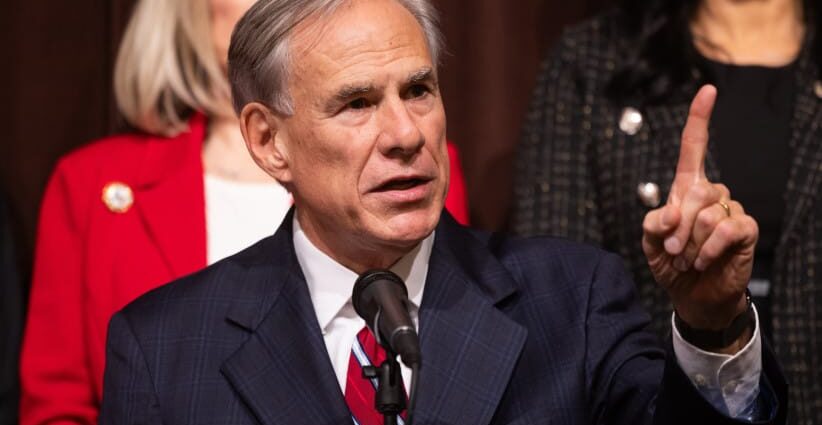
Texas Gov. Abbott freezes environmental permits for AI data centers in expanding state power audit
Texas Governor Greg Abbott on Monday barred the state’s environmental agency from issuing new permits for data centers until regulators complete a massive audit of the energy-hungry facilities seeking to connect to the Texas electrical grid.
The Republican governor’s directive to the Texas Commission on Environmental Quality effectively freezes all state-issued permits to data center developers, which had flocked to the region for its abundant electricity, land and pro-business reputation.
Since the artificial intelligence boom began roughly three years ago, Texas has become one of the fastest-growing data hubs in the world. But intensifying public backlash over the facilities, and fears about AI more broadly, prompted Abbott last month to freeze the connection of new data centers to the state grid and order an audit of the facilities.
By the time of that directive, there were more than 470 gigawatts’ worth of data center projects and other large energy users in line to connect to the grid – more than five times the state’s peak demand.
The Electric Reliability Council of Texas, which operates the state grid, is in the early stages of auditing data center power use, tax incentives, and water consumption, among other factors.
‘Data centers must… protect our grid and water’ in Texas
“Simply put, Texans must come first,” Abbott said in a statement. “Data centers must pay their own way, protect our grid and water, and complete the (audits).”
Abbott is among a swelling number of governors who once raced to attract data center investments – and touted their public benefit – but are now tightening restrictions on the developments to ease their constituents’ fears about rising power bills and environmental issues caused by the facilities.
Ed Hirs, an energy fellow at the University of Houston, said Abbott was walking back “his earlier pronouncements about data centers leading to lower electricity prices.”

Former United executive explains how New Jersey fiber cut disrupted Northeast flights
A severed fiber-optic cable in New Jersey disrupted air travel across parts of the Northeast on Monday, showing how a single infrastructure problem can quickly ripple through the nation’s airline system.
Rich Davis, senior security advisor at International SOS and former chief security officer at United Airlines, told FOX Business that even a localized outage can quickly disrupt flights far beyond where it begins because airline networks are tightly interconnected.
“It’s like a spider web of activity that’s happening and everybody is impacted, especially connecting passengers versus nonstop,” Davis said. “… Something that is only happening in that Northeast corridor, it still impacts all of the connecting hubs.”
Passengers with connecting itineraries often feel the biggest impact because disruptions at one major hub can quickly spread throughout the airline network, Davis said.
FAA GROUNDS FLIGHTS AT MAJOR NORTHEAST AIRPORTS AFTER FIBER LINE CUT
The disruption began around 9:45 a.m. after a fiber-optic line in New Jersey was accidentally cut, causing a telecommunications outage and prompting ground stops at major airports in New York, New Jersey and Philadelphia, according to Reuters.
By Monday evening, Transportation Secretary Sean Duffy said the telecommunications lines had been repaired and airport operations across the Northeast were resuming, though travelers should continue to expect delays.
The outage contributed to roughly 7,000 flight delays and cancellations, including about 1,400 at New York City’s three major airports, Reuters reported, citing FlightAware.
Davis said airlines classify events like Monday’s outage as “irregular operations” — unexpected disruptions such as severe weather or equipment failures that can quickly throw carefully coordinated flight schedules off balance.
MAJOR AIRLINES CUT FLIGHTS AS HIGHER JET FUEL PRICES HIT CARRIERS
Even after the original problem is fixed, airlines must reposition aircraft, pilots, flight attendants and passengers throughout their networks, creating a cascade of additional delays.
“There’s always a downhill trickle of subsequent delays, diversions, cancelations,” Davis said. “It’s basically a fact of life.”
Even so, Davis noted that airlines and airports have extensive experience managing these disruptions.
“Having said all of that, the airlines and the airports are so experienced in handling irregular operations, they do their best within their controls to minimize the effect on passengers,” Davis said.
Despite the widespread disruptions, Davis stressed that airlines never compromise safety in an effort to restore schedules.
AVELO CEO WARNS AIRFARES MAY RISE AS FUEL PRICES HIT ‘UNCOMFORTABLY HIGH’ LEVELS
GET FOX BUSINESS ON THE GO BY CLICKING HERE
“The number one priority every time, all of the time, is the safety of the passengers and the airline employees themselves,” he said. “That’s [the] number one priority. No shortcuts, no risks — follow the playbooks. Safety is more important than anything.”
Reuters contributed to this report.


$6 trillion a year in unpaid labor isn’t counted in GDP. Its absence from official stats distorts how we see growth, living standards and productivity
The workday doesn’t end for millions of American workers when they clock out and go home—there are floors to mop, meals to prepare, and kids to tend to. There’s no paycheck for those chores that keep a household running, but a recent Government Accountability Office (GAO) report estimated the labor is worth up to $6 trillion a year, or one-fifth of GDP.
All that output isn’t counted in GDP because no money changes hands. Yet, over 87% of Americans age 15 and older did some unpaid household work on a typical day, according to GAO’s September report, spending an average of 3.72 hours on those tasks.
“Without those activities, we really wouldn’t have a functioning formal economy,” Misty Heggeness, an associate professor of economics and public affairs at the University of Kansas, told Fortune. She said if families stopped cooking and providing childcare themselves, much of that work would have to be bought from the service economy instead.
“The value of the money that we make in our jobs would be reduced because it would be more expensive for us to survive,” she said, “because we would be looking at the formal labor market for those services.”
GDP counted one job, but not the other
One reason economists care about unpaid household labor is that it changes how economic growth looks over time. When women’s access to higher education and higher-paid jobs opened up in the 1960s, GDP recorded the gains of when women entered the workforce without accounting for the corresponding loss of household labor, which “artificially boosted” the economy’s growth rate, according to Nancy Folbre, an economist who wrote the book Making Care Work.
GAO found this discrepancy in historical data. From 1965 through 2020, conventional GDP grew an average of 6.3% a year, while a different measure from the Bureau of Economic Analysis that accounted for household labor showed that average growth was 6.1%.
That gap changes how well-off a household looks on paper. Folbre noted that a second paycheck technically raises total income for a family, but if working leaves less time to handle necessary tasks at home, families could spend some of that additional income replacing work they once did themselves.
“Just looking at individual earnings or family income without taking into account unpaid work just gives a very misleading picture of relative living standards,” she said.
Who still does the unpaid work
Unpaid labor historically fell on the shoulders of the women in the household, and the burden hasn’t disappeared. GAO found 54% of people doing unpaid household work between 2021 through 2024 were women, and they spent more time than men caring for children.
Despite more women starting to out-earn men, they still do twice the cooking and cleaning around the house compared to their lower-earning male partners.
“It is still predominantly the mother and women who are picking up the majority of this invisible burden of having to multitask their paid labor with making sure everybody’s needs in the household are met,” Heggeness said. “We’re not kept in the data, and then we wonder why are women today so stressed and frizzled.”
Women juggle being both the breadwinners and the home managers, and 48% face burnout at work compared to 36% for their male colleagues.
Folbre said valuing unpaid labor in economic terms should not be read as encouraging women to go back to the home, but rather as a way to help share the unpaid labor more equitably.
“It kind of tempts people to think it would be really great if we returned to the good old days, and I think that is really wrong, because however valuable that unpaid work might be, it’s very disempowering,” she added.
The GAO report invites economists to “rethink efficiency,” according to Folbre. By counting activities like cleaning and caregiving as part of workers’ productivity, the idea of efficiency broadens beyond just their job output.
“The whole productivity debate is so focused on the measurement of what people are doing at the office, but the productivity of taking care of other people is also really, really important,” she said.
This story was originally featured on Fortune.com



US expands Arctic military footprint in Greenland with new deal set to sign at UN General Assembly
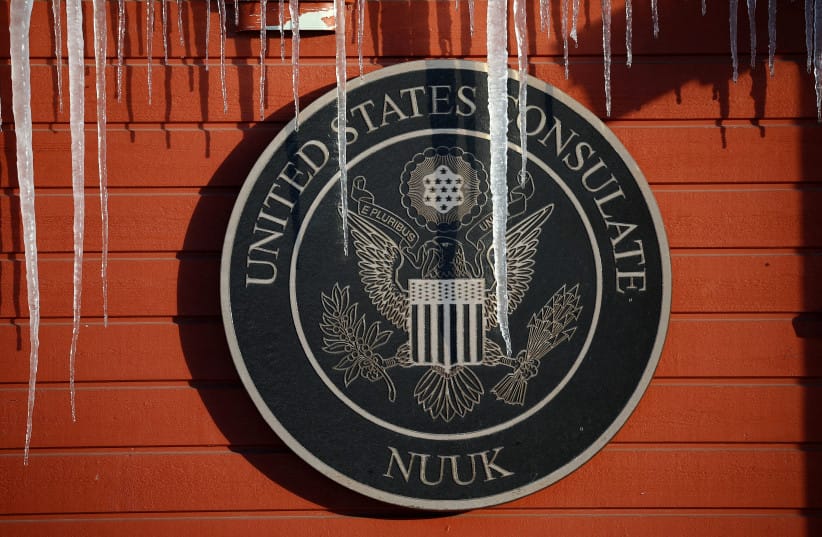
The US plans to reopen a former Cold War-era military base in southern Greenland and set up a military presence at an east coast base now used by the Danish dog sled patrol under an agreement to be signed by the US, Denmark and Greenland on Tuesday, according to three people familiar with the matter.
Those sites are Narsarsuaq, whose population has dwindled to a few dozen people since the US closed its Bluie West One military base in the 1950s, and Mestersvig, a military outpost currently used by the Sirius Dog Sled Patrol, a Danish special forces unit, said two of the people.
Denmark, Greenland and the United States are expected to sign their new agreement at the United Nations General Assembly in New York City at 10:30 a.m. ET on Tuesday.
The text of the agreement has not been made public, and the three people familiar with the deal, speaking on condition of anonymity, said its details are not finalized until it is signed.
Denmark and Greenland say the deal will benefit the Arctic island and respect its sovereignty.
Deal reportedly allows US to expand military presence, Denmark keeps sovereignty
Denmark says the agreement puts Arctic security under the watch of the North Atlantic Treaty Organization, the military defense alliance, rather than leaving it solely to the US and Denmark.
The deal is expected to allow the US, which already has one military base in Greenland, to expand its military presence to two additional sites.
One of those sites is Narsarsuaq, whose population has dwindled to a few dozen people since the US closed its Cold War-era Bluie West One military base there in the 1950s. The other is Mestersvig, a military outpost currently used by the Sirius Dog Sled Patrol, a special forces unit that enforces Danish sovereignty in the territory, said two people familiar with the matter.
Trump will meet in New York on Tuesday with Danish Prime Minister Mette Frederiksen and Greenland Prime Minister Jens-Frederik Nielsen for a trilateral signing ceremony, a White House official said.
The deal follows months of pressure from Trump, who has said the US should control Greenland and at times refused to rule out using military or economic force to acquire the semi-autonomous Danish territory. His threats peaked in January, triggering a diplomatic crisis within the North Atlantic Treaty Organization, the military defense alliance, and pushing Denmark and Greenland into negotiations aimed at defusing the pressure.
The agreement “will be in a form where responsibility for security in the Arctic is not only Danish or American,” Danish Foreign Minister Lars Lokke Rasmussen told national broadcaster TV2 on Sunday. He said that to a large extent “it would be NATO that looks after the Arctic.”
Boosting NATO’s ‘cohesion’
It remained unclear whether the deal amends an existing 1951 defense agreement that is the legal basis for the US presence in Greenland.
“It appears that we are now using this crisis to try to strengthen NATO’s cohesion through Greenland,” said Ulrik Pram Gad, a researcher at the Danish Institute for International Studies (DIIS).
Washington’s strategic interest in Greenland dates back to World War Two. In 1941, the US signed a deal with Danish envoy Henrik Kauffmann, who acted without authority from his country, then under German occupation.
The US sought the deal to keep Greenland out of German hands and secure the North Atlantic supply route between North America and Europe. Under the agreement, the US built airfields, naval facilities, and weather stations across the island, reaching around 5,500 military personnel by 1943, according to DIIS.
In 1946, President Harry Truman sought to buy the island as a strategic asset for $100 million in gold, but Copenhagen declined to sell. Instead, a new agreement was signed in 1951 that gave the US military extensive rights in Greenland but was tied to the existence of NATO.
“I don’t think Denmark and Greenland will sign if the same NATO clause isn’t included,” said Gad.
Promoting ‘security, stability, and cooperation’
During the Cold War, the US maintained 17 military installations and more than 10,000 personnel in Greenland. Today, only Pituffik Space Base remains, with some 150 US military personnel.
A NATO spokesperson said on Saturday that the alliance welcomed the new agreement, which would “help advance security, stability and cooperation in this vital region.”
Rasmussen, who traveled to New York overnight, declined to discuss the contents of the agreement.
“But we have said from the start that we are open to accommodating the United States’ legitimate security interests,” he told Danish news agency Ritzau on Monday.
Trump said in a post on Truth Social on Friday the agreement gave the US “permanent control over security, and all other needs, in Greenland,” and that no US adversary could have a base or military presence there without Washington’s written approval.
Denmark has not responded to Trump’s assertion, though Copenhagen earlier acknowledged it underinvested in Greenland’s defense for decades and has pledged to expand its military presence on the island, including more NATO troops.
Greenland’s government has sought to reassure the public about the deal.
Erik Jensen, an opposition lawmaker in Greenland, wrote on social media that he had read the draft agreement. “I feel reassured and am not worried,” he said, adding that the island’s foreign minister was handling the work well.

IDF arrests two terrorists planning imminent attack in West Bank operation
IDF troops carried out counterterrorism operations at several locations across the West Bank during Yom Kippur, including in Kabatiya, where troops from the Duvdevan Unit arrested two terrorists who were planning to carry out an attack in the near future.
In the village of Biddu, in the Binyamin Brigade sector, IDF troops mapped the home of a terrorist. During a separate brigade operation in the village, troops searched approximately 100 locations, questioned 90 suspects, and found a hunting rifle.
In another Duvdevan Unit operation in Beit Ur al-Tahta, troops discovered a weapons-manufacturing lathe, two Carlo-type firearms, and additional weapons.
The Paratroopers Reconnaissance Unit also operated in the Menashe Brigade sector, where troops questioned suspects, arrested wanted individuals, and found materials intended for the production of explosives.
Troops from the Ephraim Brigade also operated in villages throughout their sector, questioning more than 80 suspects.
Duvdevan carries out second counter-terror op. within a month
The operation in Kabatiya followed another counterterrorism operation carried out by the Duvdevan Unit in the village about a month earlier. During that operation, troops arrested a five-member terrorist cell. According to the IDF and Shin Bet, the cell had been planning an attack against civilians and security personnel.
The five suspects were arrested less than 10 minutes after troops entered the area. Searches of their homes uncovered an M16 rifle and additional weapons.

Firefighting helicopter crashes in Yosemite National Park while battling fire, killing two
Two pilots died when their helicopter crashed on Sunday afternoon while dropping water on a wildfire in California’s Yosemite National Park, authorities said on Monday.
Greg King, with contract firm Precision, was one of the pilots who died, according to a statement from the Alaska Division of Forestry and Fire Protection. The second pilot was not named as family members were still being notified, the agency said.
The pilots were carrying out water bucket drops on the Dome Fire when their Super Puma helicopter went down southeast of Ostrander Lake, according to Connie Lau, a spokesperson for the California team managing the response to the fire.
The cause of the crash is under investigation by the Federal Aviation Administration and the National Transportation Safety Board, the agencies said.
The deaths brought to five the number of helicopter pilots killed in crashes in Colorado, Utah and California this year fighting wildfires.
US experiences intense wildfire season, record temperatures
The United States is experiencing an intense fire season after a historically low winter snowpack, record temperatures and decades of drought in the US West.
At least 18 people have died fighting US wildfires so far in 2026, according to data from the Wildland Fire Lessons Learned federal agency. That is already more than the full-year average of 17 deaths in recent decades, according to National Interagency Fire Center data.


‘You’re a going to be a great one’: Trump tells Mamdani he has ‘potential’ to be a great mayor and floats federal funds to his native Queens
President Donald Trump and Mayor Zohran Mamdani held a joint press conference at Gracie Mansion on Monday, the first time a sitting president has visited the mayor’s residence in decades.
The two discussed Sunnyside Yards, Temporary Protected Status for Haitian New Yorkers, and press access, while trading warm words despite months of public disagreement on policy.
And despite that public disagreement, the two Queens boys seem to have had a warm conversation. Trump even shared praise for the young mayor. “I certainly hope he will be a great mayor. You have to understand, I want what’s good for New York. I want what’s good for the country,” he said.
“So, if I had a choice of having him be a bad mayor or horrible mayor, I don’t want that. I want him to be a great mayor, and he certainly got potential, had great potential.”
The president, standing alongisde Mamdani as press and the two politicians stood in the garden of Gracie Mansion, said he was hosted many times at the famed house. “I’ve been at Gracie Mansion, we were discussing, quite a few times over the years, a lot. And it sort of feels like a home, and it’s a special place, a very special, a beautiful place when you go inside. And I’ve seen it with numerous different mayors.”
“And I said, some great ones and some not so great ones,” Trump continued before turning to Mamdani. “So hopefully you’re going to be a great one. I’ll be able to say you’re a going to be a great one. And you’re off to a start.”
Trump also recalled encouraging Mamdani to move into the mansion after his election, saying Mamdani had hesitated over its size: “Well, I can say, from my standpoint, I love New York, and this represents New York. This is where the mayor lived, and continues to live. And we were discussing it a long time ago when you first got elected. I said, ‘Well, you’re going to move,’ because you were maybe having some doubts about moving in because it is a little bit on the luxurious side,” Trump said with a smirk.
Building housing in Queens
Mamdani and the president discussed Sunnyside Yards, a proposal to deck over the Queens rail yard for 12,000 homes and 30,000 jobs, which the mayor’s office says would require more than $21 billion in federal grants. Mamdani said that the two had a very productive conversation.
“What we’re talking about is something very rare in our city. It’s the possibility of constructing an entirely new neighborhood, and again, it’s only possible with federal partnership,” he explained.
The Queens-native president didn’t say whether he would send federal funds the city’s way, but said it would absolutely be costly without any.
“Sunnyside’s a big job. I’ve been watching that for 35 years,” he said, likely referring to the 1980s when he owned the New Jersey Generals football team and toyed with the idea of bringing an arena to the area, dubbed at the time the “Trumpdome.”
“The mayor brought that up-the possibility of doing Sunnyside Yards,” he continued. “You’re going to need a lot of federal approvals and probably some federal money to do it. But it’s always been a great location.”
Following the joint press conference, which also included remarks about TPS and the banning of several media outlets from the White House, the mayor took additional questions regarding the conversation and the budding relationship the two seem to have formed.
“The president and I have both been very frank about the many disagreements that we have, and immigration is one of those places,” Mamdani said. “We’ve both spoken about very different approaches, very different beliefs, and I will continue to have conversations with the president, and frankly, with anyone who can deliver relief to the people of the city.”
This story was originally featured on Fortune.com
White House launches ‘TRUMP TV’ stream following controversial ban of major news outlets
The White House launched a live broadcast platform on YouTube called TRUMP TV: The Essentials Station at 7 p.m. ET on Monday, following US President Donald Trump’s decision to ban a number of mainstream news organizations from the White House press pool.
The livestream, which launched with a recording of America’s 250th anniversary speech by Trump at Mount Rushmore, has been derided by critics, including members of mainstream media, as an attempt to establish “state media.”
Trump framed the platform, which was launched after TV networks boycotted the administration following his ban, as a way to bypass “fake news” media outlets and communicate directly with the American public.
The White House issued a statement on Monday defending Trump’s decision to ban CNN, Politico, and MS NOW from White House grounds. The statement argued that while the First Amendment protects the media’s right to publish, it “does not grant them a right to a permanent press pass, a seat in the briefing room, or a spot in the press pool.”
The White House asserted that restricting press access is not a new precedent, citing a series of instances from the Obama and Biden administrations where, it claimed, news outlets and journalists faced similar restrictions or bans from coverage.
First Amendment lawsuit filed against White House
“No president is required to host a hostile outlet on White House grounds,” the statement concluded. “Access has always been a privilege, and President Trump is enforcing that rule.”
In a post on Truth Social, Trump wrote: “As expected, Fake News CNN, Politico (who should give back the $8 million grant given by the US Government to keep them afloat!), and MS NOW (formerly MSDNC!), have filed a lawsuit to get access to the White House – and to your President, ME!”
“They got a great judge for themselves, a man who previously ruled in favor of Jim Acosta, who now seems to have vanished from the face of the earth,” Trump continued. “The judge’s name is Tim Kelly, and unfortunately, he was appointed by ‘Trump.'”
Trump went on to attack the press: “In other words, almost certainly, and as usual, we will appeal, because Fake News media figures and publications – who write only negative things and damage our national security by publishing false and defamatory stories based on unknown ‘sources’ – should not be given access to the most important office in the world.”
“It’s called the Oval Office, and it must be treated with politeness, respect, and dignity – not desecrated by third-rate clowns who intentionally distort, twist, and demean everything they write or publish,” the president wrote. “Almost every story about me, or anything related to me, is negative, wrong, and in many cases, dangerous for our country! No matter how great my achievements are, they minimize and dismiss them.”
Streaming 24/7.
Live at 7PM. 👀📺 pic.twitter.com/ax9obEH4sf
— The White House (@WhiteHouse) September 21, 2026
“With such corrupt and crooked press, how did I win by such a landslide? Because the media has zero credibility, and that is a very bad thing for our country!” Trump taunted. “Why should I give ‘access’ to people like this? Maybe Judge Kelly can explain that!”
‘Fake News is a threat to democracy’
“In any case, it is my duty to fight for the success and security of our country. Fake News is a threat to democracy, and I will do whatever it takes to ensure the United States thrives,” he concluded.
During a joint press conference with the president, New York City Mayor Zohran Mamdani addressed the ban on these outlets: “Yes, I told the President that we will host an event right here on the lawn with all members of the press, and that’s something I believe in. As far as I’m concerned, everyone should be here – regardless of their stance or their criticism of us.”
At the same press conference, Trump continued his attack: “It’s interesting, because they said they were going to boycott me, but they never actually boycott me, so I wasn’t particularly worried about it. Look at all this media.”
The president added: “No, I’m only doing this because I think the media also has a responsibility. And you know, I won in a landslide. I won the election in a landslide. I’ve done great things. I’ve done many great things. I settled eight wars.”
Finally, Trump said, “I think these media outlets have a duty to be fair. And if they are fake news, I truly believe I have a responsibility not to allow them into another very special house.”
Israeli chess team penalized after Yom Kippur scheduling agreement falls apart
The International Chess Federation refused to reschedule the Israeli team’s Monday matches in the International Chess Olympiad in Samarkand, Uzbekistan, scheduled for Yom Kippur, despite having pledged months earlier to remedy the issue, according to the Israel Chess Federation.
Because they failed to compete on Yom Kippur, the Israeli team forfeited four matches.
According to the Israel Chess Federation, the International Chess Federation agreed in writing in January that Israel’s Sunday matches would be moved to an earlier time in order to finish them all before the start of Yom Kippur in the evening. Monday matches would be rescheduled to take place after Yom Kippur.
In practice, the four countries scheduled to compete with Israel on Yom Kippur were given the option to reschedule. Colombia and Singapore agreed to start their matches early, but the Netherlands and Bulgaria kept the original Yom Kippur match times and were awarded a 4-0 technical victory because their opponents, Israel, never showed up.
‘The Israeli teams have performed very well at the Olympiad so far’
“We are very angry that the International Chess Federation failed to honor the commitments it made,” said Dr. Zvika Barkai, Chairman of the Israel Chess Federation. “Instead of including this in the tournament regulations, they planned to speak with the teams we were drawn against because they didn’t want to generate public discourse or attention around the issue; in reality, they did almost nothing, and we are very upset with them about this.”
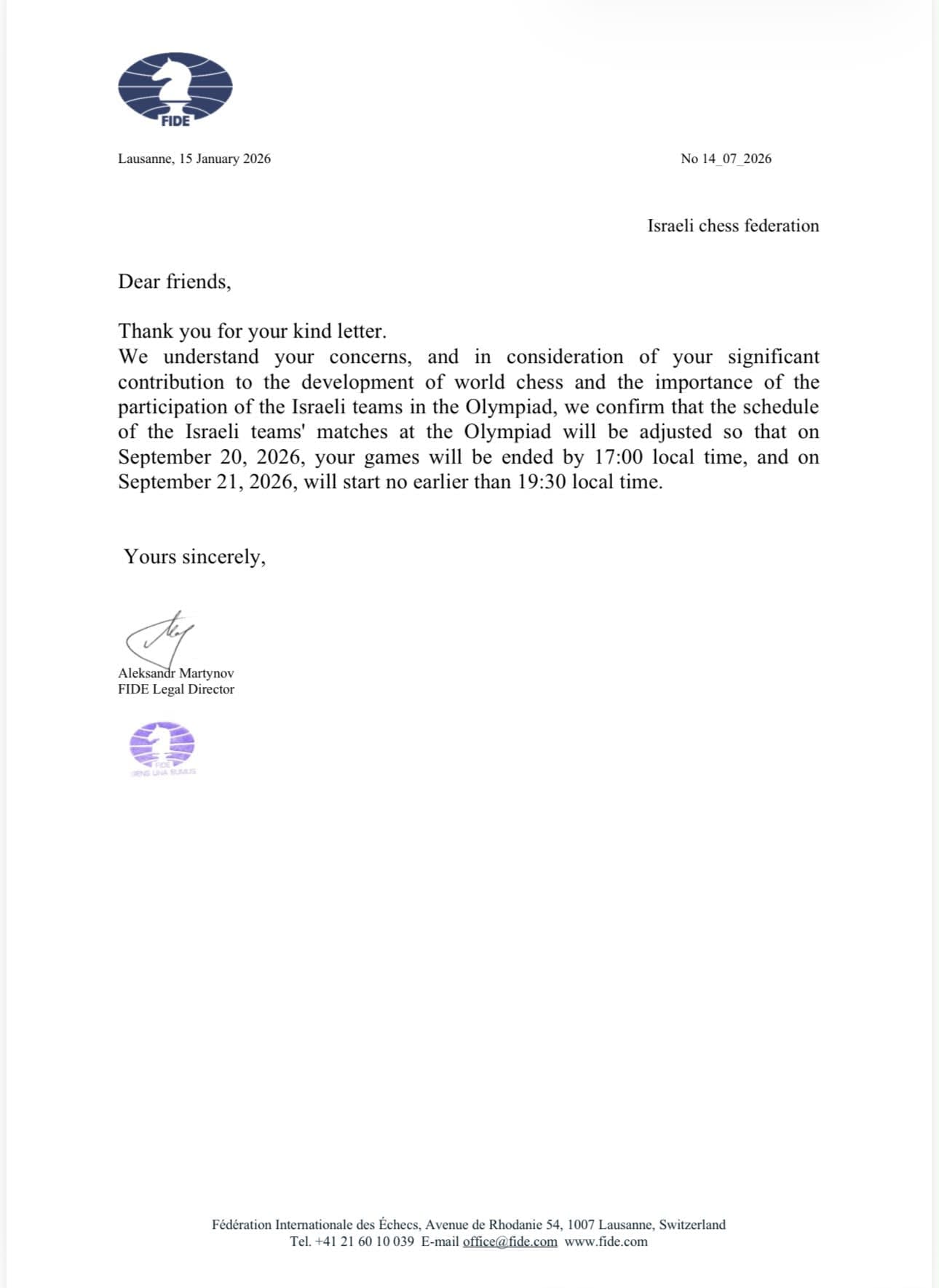
“The [international] federation did not enforce what had been agreed upon with us in advance, causing us significant harm,” said Gil Boruchovsky, CEO of the Israeli Chess Federation. “They did nothing to mitigate the damage it caused. They could have at least tried to prevent a 4–0 forfeit, which will severely hurt our ranking later on; we will consider our next steps—this will not go unchallenged.”
“The Israeli teams have performed very well at the Olympiad so far and will continue to fight with all their might and ability to reach the top 15,” Boruchovsky added.
Despite this slight from the international community, the Israeli Chess Federation is still expected to host the Jerusalem Open Championship in November, which is projected to attract some 450 chess players from all over the world.

Massive US flight groundings triggered by fiber cut, circuit failure as UN General Assembly meets
A failed telecommunications circuit and a severed fiber-optic cable snarled thousands of flights across the US on Monday and forced a halt to incoming flights at major airports in New York, Boston and Philadelphia.
Transportation Secretary Sean Duffy said that the telecom lines were repaired and all airport operations in the US Northeast were resuming, several hours after flights were halted on the day that 130 world leaders and dozens of ministers were arriving in New York for the annual high-level meeting of the United Nations General Assembly.
The Federal Aviation Administration halted incoming traffic on Monday at busy US East Coast airports and at one point stopped incoming flights at all three major New York-area airports as well as Philadelphia and Boston and two smaller airports in the New York area.
FlightAware, a flight-tracking website, said more than 5,600 US flights were delayed or canceled, including 1,200 flights at the three New York-area airports.
The issue also forced the diversion of more than 100 flights to other airports.
US air traffic control system a fragile network
The incident demonstrated the fragility of the aging US air traffic control system, which Congress awarded $12.5 billion for upgrades last year.
Transportation Secretary Sean Duffy said an Amtrak construction crew accidentally cut into a fiber line in New Jersey, which caused a telecom outage and forced the FAA to pause flights in the Northeast.
He said flights were resuming at New York LaGuardia but remained paused at Newark and New Jersey’s Teterboro Airport.
All arriving flights were again halted in Philadelphia after a ground stop was briefly lifted. Reagan Washington National Airport also halted flights for more than an hour because of volume issues.
FAA Administrator Bryan Bedford said a replacement circuit had failed at Philadelphia Terminal Radar Approach Control, which was the primary communications for the center. A ground stop at Boston, which stopped accepting flights because of spillover volume, was also lifted.
The FAA will not restart the system for incoming flights at the affected airports “until we make sure the airspace is safe,” Bedford said.
Failed circuit caused communications loss
The loss of communications was tied to a failed circuit at a Philadelphia air traffic control facility that handles air traffic for the airports, Bedford said. Then authorities discovered that a backup fiber line was accidentally cut by a construction crew in New Jersey.
“When it went to flip into the backup, we discovered that the backup fiber had a break, and that fiber break is probably 13 hours to repair. It’s massive, I’m told. Meanwhile, we’ve got the new circuit ready to install now,” Bedford said.
Newark is a major United Airlines hub, while Philadelphia is an American Airlines hub.
Verizon said its fiber cable running adjacent to an Amtrak rail line in New Jersey was cut, and its facilities were fully functional up to that point. The company said it was working to repair the damaged cable and restore connectivity as quickly as possible.
In May 2025, the Philadelphia facility that guides air traffic in and out of Newark Airport suffered a series of significant communications outages.
The FAA said last year a telecommunications outage impacted communications and radar displays at Philadelphia TRACON.
Last year, Congress approved $12.5 billion to address the aging air traffic control system and boost controller hiring following decades of complaints over airport congestion and flight delays and a series of technology issues in recent years.
Duffy said Congress needed to approve another $17.5 billion to finish the job. “This is unacceptable in America,” Duffy said.

UK agrees to support Saudi Arabia with air-to-air refueling in midst of Houthi attacks
British Prime Minister Andy Burnham said on Monday he had agreed to a request from Saudi Arabia to provide defensive air-to-air refueling for a limited time period, a move he described as helping to stabilize the wider region.
Riyadh requested support after the Houthis, who control the most populous parts of Yemen, intensified their attacks on Saudi Arabia, a new front in the wider war that began with US and Israeli strikes on Iran in late February.
“We have received a request from the Kingdom of Saudi Arabia for military support, and on the advice of the defense secretary and the foreign secretary, last night I agreed to that request for defensive air-to-air refueling,” he told reporters as he traveled to New York for a meeting of the United Nations General Assembly.
“Because of course Saudi Arabia has been experiencing attack… and we need to keep those pathways open, and hence our agreement to the request,” he said.
Britain and Saudi Arabia have been close military allies for decades, with Britain serving as one of the kingdom’s largest arms suppliers.
Sky Sabre air defense system deployed in Saudi Arabia during Iran conflict
Earlier this year, Britain deployed its Sky Sabre air defense system to Saudi Arabia to help protect it from Iranian missile attacks during the US-Israeli conflict with Iran.
For the new air-to-air refueling support, Britain will deploy one Voyager plane in the coming days.
“That is a time-limited agreement in terms of the assistance that we will provide, but we will keep it under review,” he said, adding that Britain was “playing our part” in the Middle East also by supporting efforts to keep the Strait of Hormuz open.

Northeast airport operations resume after telecom outage disrupts flights
Transportation Secretary Sean Duffy said Monday evening that telecommunications lines have been repaired and airport operations across the Northeast are resuming, though travelers should continue to expect delays.
“The telecom lines have been repaired, and all airport operations in the Northeast are resuming. It will take some time to clear all existing delays, so please check with your airline for the latest information,” Duffy wrote on X.
Earlier Monday, Duffy said a severed fiber-optic line in New Jersey triggered a telecommunications outage that forced the Federal Aviation Administration (FAA) to pause flights across parts of the Northeast.
“An Amtrak construction crew accidentally cut into a fiber line in New Jersey which caused a telecom outage and forced FAA to pause flights in the Northeast,” Duffy wrote earlier in the day.
LAGUARDIA SHUTS DOWN RUNWAY FOR SECOND TIME IN WEEKS AFTER PAVEMENT ISSUE RESURFACES
“This incident underscores the need for additional funding to modernize aging infrastructure and prevent disruptions like this in the future,” he added.
As of about 6:40 p.m. ET, Newark Liberty International Airport (EWR) was reporting average delays of 306 minutes because of the equipment outage, according to the FAA. Philadelphia International Airport (PHL) was reporting average delays of 212 minutes.
Teterboro Airport (TEB) was reporting average delays of 159 minutes, while John F. Kennedy International Airport (JFK) and LaGuardia Airport (LGA) were reporting average delays of 72 minutes and 67 minutes, respectively.
Earlier Monday, the FAA told Fox News it had paused flights into PHL, TEB and EWR due to “issues with some frequencies at Philadelphia TRACON.”
MAJOR AIRLINES CUT FLIGHTS AS HIGHER JET FUEL PRICES HIT CARRIERS
FAA Administrator Bryan Bedford said Philadelphia TRACON lost its primary communications circuit. When controllers switched to a backup system, they discovered a broken fiber-optic cable.
Speaking to reporters earlier Monday, Duffy said “these are issues that aren’t new to us.”
“We know these problems can happen. We know these cuts can happen,” Duffy said, adding that the department has been working to upgrade FAA equipment and its telecom architecture.
“As we work through all the new equipment, all the new architecture of our telecom, which is fans, it all takes money. That’s why we have a holistic view of everything, including how we rework our telecom,” Duffy said.
AVELO CEO WARNS AIRFARES MAY RISE AS FUEL PRICES HIT ‘UNCOMFORTABLY HIGH’ LEVELS
Duffy said the work is being done before the department has secured all the necessary money, adding that “when we get the cash” the department will be able to hasten progress.
GET FOX BUSINESS ON THE GO BY CLICKING HERE
“But this is not shocking,” Duffy said of the equipment outage.
Amtrak later disputed Duffy’s description of what caused the disruption, telling FOX Business that the fiber cut did not involve one of its crews.
“This incident occurred on New Jersey Transit property and involved a New Jersey Transit contractor. Questions regarding the outage and related work should be directed to New Jersey Transit,” a spokesperson said.
The FAA and New Jersey Transit did not immediately respond to FOX Business’ requests for comment.



Paramount agrees invest $1.5 billion in domestic movies and create a board for editorial independence at CNN, CBS as part of deal for Warner Bros.
Movie studio Paramount on Monday agreed to settle an antitrust lawsuit filed by 12 states, the last big obstacle blocking the company’s $81 billion acquisition of Warner Bros. Discovery in a deal that would transform the movie industry landscape.
In the settlement, which still needs to be approved by a judge, Paramount agreed to terms including a five-year movie production plan and to invest $1.5 billion in domestic movies.
State attorneys general say the settlement guarantees investment in domestic movie production and provides worker protection. But analysts say the deal is still likely to lead to less competition in the industry — and higher prices for consumers.
“Where I’m looking at this is through the consumer’s point of view and resoundingly consumers are concerned about price hikes and they are preparing for price hikes,” said Forrester research director Mike Proulx. “They care less about the theatrical releases and some of the other industry terms. What they care about is how this is going to hit their wallets.”
Here’s a closer look at the biggest terms Paramount agreed to in the settlement:
Paramount says it will invest in domestic films and independent films
Paramount said it will spend $1.5 billion over five years, or $300 million a year — on top of what it spent in 2025 on filming domestically. According to the state attorneys general, currently only about 5% of Paramount’s production is in the U.S.
Paramount also said it would create a five-year, $25 million fund for buying independent films.
The settlement lays out a five-year film production schedule
The movie studio agreed to make 30 films a year in the first two years and 32 films a year in the following three years. It also said it will release at least four independent films each year.
That dovetails with plans Paramount chairman and CEO David Ellison has previously laid out to grow the combined company’s movie slate to more than 30 movies a year.
But the agreement includes penalties: If Paramount doesn’t produce the required amount, the company will be forced to sell Miramax Studios and pay $30 million to health care and retirement trust funds associated with worker unions.
The agreement includes a fund for laid-off workers
Paramount has said it would look for ways to save some $6 billion through job cuts in “duplicative operations” when the deal goes through.
Under the settlement, Paramount will create a $47.5 million workforce fund for training and career development for laid-off workers. It also agreed to honor previously established collective bargaining agreements and bargain in good faith with unions.
Cable channels, independent board
Under the agreement, Paramount won’t have to sell cable channels. But the company will have to hold negotiations over basic cable channels under Paramount and Warner Bros. separately for five years. If it doesn’t, it might have to sell some channels under the agreement. The agreement also calls for the creation of a board to ensure that Warner-owned CNN and CBS, owned by Paramount, maintain editorial independence.
This story was originally featured on Fortune.com

If a president speaks, but TV crews aren’t there to capture audio, does he make a sound? Networks keep cameras away after Trump bans CNN
President Donald Trump showed off his new White House helicopter landing pad on Monday, attempting to brush aside a First Amendment firestorm even as major television networks kept their cameras away in protest of CNN being banned from the grounds.
A light drizzle fell on the South Lawn as Trump used oversized gold scissors to cut a red, white and blue ribbon. He then exchanged handshakes with officials and with some members of a construction crew wearing green smocks and hardhats — seeking to portray business as usual.
If he had words to mark the occasion, however, it was impossible to hear them over the noise of his waiting helicopter. Normally, TV network crews work to capture clearer audio.
Trump also didn’t answer reporters’ shouted questions before climbing aboard Marine One for an eventual flight to New York. Instead, he wrote on his social media site, “We are just leaving the White House Lawn on the maiden voyage from the newly built, and very beautiful, Heliport!”
MS Now, Politico and CNN have sued after Trump announced Friday that he was banning them from covering the White House in a clear escalation of Trump’s long-running efforts — in the courts and through administrative action — to restrict news coverage he finds objectionable.
CNN normally participates in a five-network rotation that provides pooled footage of daily events at the White House. When the network was barred from taking its assigned turn on Monday, ABC, CBS, NBC and Fox News agreed collectively to the extraordinary step of skipping Trump’s helipad ceremony.
Trump has long crowed about how the new helipad — featuring extensive granite that he boasts will have a “million-year life,” as well as a large insignia reading the “Seal of the President of the United States” — would impress Chinese President Xi Jinping, who arrives Wednesday for a state visit.
He’s been focused on wowing Xi even as he decried Democrats as communists in an attempt to help Republicans retain control of Congress in upcoming midterm elections. But his effort to curb access for media outlets to the White House has overshadowed Trump’s pet building projects and Xi’s visit.
Igniting constitutional questions over media access also eclipsed the reason Trump was lifting off from the helipad — the annual trip to attend the United Nations General Assembly beginning on Tuesday.
The president has spent large swaths of his second term focused on building projects even as his administration struggles to find a way out of the ongoing war in Iran. Trump’s approval ratings have sunk with only about six weeks before Election Day, where voters are increasingly worried about inflation and a potentially weakening economy.
Whether Trump’s work will be long-lasting is unclear
Trump has made grand claims about the granite’s longevity. He earlier suggested that his refurbishing of the Lincoln Memorial’s Reflecting Poolwould last a century — only for the paint to fade and its liner to peel away in chunks just days after it was laid.
The helipad work began in June. Trump also ripped out the original Tennessee flagstone along the West Wing’s colonnade and replaced it with black granite. He similarly refurbished the traditional walkway from the White House’s diplomatic entrance with white granite, along with a portion of the asphalt driveway around the South Lawn.
Trump rushed to finish the project before Xi arrives and has argued that visiting dignitaries will be dazzled by the project — despite Marine One being the only aircraft that lands so close to the White House.
The president says the improvement was required since Vietnam War-era choppers that long had been used as Marine One are being replaced by modern ones that are too powerful to land on the White House lawn without damaging the lawn’s grass. Trump has spent months repeatedly talking about grass as a way to promote his various building plans, even though many of the construction projects required ripping up turf.
Trump said in July that the helipad project would be privately funded and estimated its cost at up to $6 million. Additional changes, including extensive efforts to level the ground around the helipad, have made calculating the exact expenditure difficult.
Trump relishes the role of builder-in-chief
The once storied South Lawn has become a major construction site this year. In June, Trump erected a fighting cage and temporary arena for a UFC fight marking his 80th birthday. Then, crews got down to work on the helipad.
Trump says Sikorsky Aircraft — a subsidiary of defense contracting giant Lockheed Martin — would be paying for the helipad, since the company made the newer, larger helicopters. In his online post, Trump thanked Lockheed Martin’s CEO.
Some of Trump’s projects have relied on public money, even when the president initially suggested otherwise.
When crews originally demolished the White House’s East Wing to make room for Trump’s $400 million ballroom, the president said it would be paid for by private donors. But his administration later sought $1 billionfrom Congress to make security improvements to the structure.
This story was originally featured on Fortune.com

Trump approval drops to career-low 32% as GOP support erodes over Iran war, inflation – poll
US President Donald Trump’s approval rating fell to 32% – the lowest of his political career – as his fellow Republicans soured on his handling of the cost of living amid the unpopular Iran war, a new Reuters/Ipsos poll found.
The poll, completed on Sunday, was conducted over a four-day period that saw Trump throw three major news organizations out of the White House and muse that Washington’s iconic Kennedy Center for the Performing Arts – named after slain President John F. Kennedy – could be torn down if Trump’s own name could not be added to it.
It found voters leaning away from supporting Trump’s fellow Republicans in the November 3 midterm elections that will determine control of Congress for the next two years.
Trump’s overall approval was down from a reading of 35% in last week’s Reuters/Ipsos poll, with support among his own Republicans down to 73% from 82% a week earlier.
Trump returned to the White House in January 2025 on promises to tame inflation and end foreign wars. In a Reuters/Ipsos poll conducted in the hours after he was sworn in, he enjoyed a 47% approval rating.
Just 17% of respondents in the new poll approved of his handling of the cost of living – the top issue Americans say will determine how they vote in November.
Iran takes a toll
Dissatisfaction among Republicans on inflation has been growing since Trump launched the war on Iran in February, which has pushed gasoline and diesel prices sharply higher. Now for the first time, Republicans who disapprove of Trump’s handling of the cost of living outnumber those who give him a thumbs up – 51% to 44%.
Trump’s approval rating is lower than any recorded for his Democratic predecessor, Joe Biden, whose presidency was also marked by surging inflation and who ultimately ended his reelection bid after a poor debate performance heightened concerns about his age. Biden’s low was 35%, reached in late October 2024.
Only 34% of the most recent poll respondents approve of the strikes on Iran. The conflict has cut the world off from a significant slice of the oil and gas produced in the Middle East, and threatens to stoke higher inflation in the US and elsewhere as businesses pass on higher fuel costs to consumers.
Trump initially said the conflict would last a few weeks and that Iran needed to be bombed to stop it from developing nuclear weapons. Earlier this month, the Republican leader pledged the war would end “immediately after” the election. But Iran has shown no sign of giving up, and in recent weeks Tehran and its allies have threatened further disruptions to oil markets.
Some 82% of poll respondents – including nine in ten Democrats and three-quarters of Republicans – said the conflict would likely go on for an “extended period of time.”
Democrats trump Republicans in midterm polls
The Reuters/Ipsos poll showed registered voters in the poll picked Democrats over Republicans – 43% to 35% – when asked how they would vote in the midterms. The 8-point gap was the biggest lead for Democrats in Reuters/Ipsos polling this year. For Republicans, losing control of either chamber could complicate Trump’s agenda in the last two years of his term.
The poll results on congressional voting plans provide an overall view of which party Americans nationwide want to see in charge in Congress, though the results don’t capture all the nuances of the state-by-state and district-by-district contests that determine control of the Senate and House of Representatives.
Trump remains popular among Republicans on the issue of immigration – with 79% of his party backing him – but only 36% of Americans overall support his approach to the matter, and 55% disapprove. Some Republican allies in Congress have warned that his aggressive campaign to deport people in the country illegally risks alienating voters with family who recently immigrated to America, like some Hispanics.
Some 35% of poll respondents approve of Trump’s approach to fighting crime, compared to 50% who disapprove.
The Reuters/Ipsos poll was conducted online and gathered 1,277 responses from US adults nationwide. It had a margin of error of 3 percentage points.

STAT+: Members of Congress push back on plan to create a commission of political appointees to review NIH grants
Tensions over increased White House control of federal biomedical research funding escalated in recent days, with several members of Congress voicing strong opposition after news leaked about a plan to create a panel of political appointees to sign off on all National Institutes of Health grants.
In what has been reported to be a contentious meeting at the White House on Friday, Russell Vought, the head of the White House Office of Management and Budget, pushed for an executive order creating a commission that would review all NIH grants, according to the Washington Post. President Trump, reportedly angry that NIH Director Jay Bhattacharya had refused to cut funding for Harvard researchers, directed Vought to draft the order.
Politico reported Vought and Bhattacharya would serve on the proposed board, which would be required to reach unanimous decisions on grants.

Opinion | The Rise of the German Far Left

Opinion | What Does Trump Want From Xi?


Hard Mountain Dew offers $1M bounty to anyone who can prove Bigfoot is real
Hard Mountain Dew is offering a $1 million prize to anyone who can provide proof that Bigfoot exists, as the alcoholic beverage brand launches a fall marketing campaign built around the legendary creature.
The “Bigfoot Bounty” promotion opened Wednesday and runs through Nov. 30, giving adults 21 and older the chance to submit what the company describes as “verified evidence” of Bigfoot’s existence.
“Hard Mountain Dew has always been about chasing bold experiences, and Bigfoot Bounty takes that mindset to the next level,” Erica Taylor, senior brand director for Hard Mountain Dew, said in a statement.
According to Hard Mountain Dew, entries will be evaluated using standards developed with Bigfoot researcher Bryce Johnson, who has appeared in and produced a docuseries exploring reports of the creature.
POPULAR BEER BRAND TO CUT 220 JOBS AS PRODUCTION SHIFTS
In order to be considered for the $1 million grand prize, participants must submit compelling evidence that meets the contest’s verification requirements, including at least four types of supporting material.
Examples listed by the company include alleged Bigfoot footprints, handprints, thermal imaging, hair samples, audio recordings, environmental evidence and photographs purportedly showing the creature.
COSTCO QUIETLY DISCONTINUES AWARD-WINNING KIRKLAND ITEM FANS CALL ‘ONE OF THE BEST’ IN THE MARKET
Even if no one claims the grand prize, the company said 100 entrants will receive the equivalent of a free 12-pack of Hard Mountain Dew in the form of cash.
“Every fall, someone’s got a story of a shape in the trees or a sound they can’t explain. Whether you catch Bigfoot or just catch a good story trying, there’s nothing better than an ice-cold Hard Mountain Dew at the end of the hunt,” Taylor added.
Legends of Bigfoot have circulated for centuries, particularly across the Pacific Northwest, where stories describe a large, hairy, human-like creature roaming forests, according to the Washington State Military Department.
SAMUEL ADAMS FOUNDER SAYS CRAFT BREWERS FACE TOUGH MARKET, BUT ‘AI CAN’T BREW BEER’
GET FOX BUSINESS ON THE GO BY CLICKING HERE
The creature has long been the subject of reported sightings, footprint discoveries and blurry photos and videos.



Apple settlement could mean a payout for some iPhone owners
Apple customers may be able to collect up to $95 from a class action settlement that stems from a lawsuit alleging the tech giant put out false advertisements about the AI capabilities on devices which didn’t have the tech fully integrated.
This spring, Apple reached a $250 million agreement to settle the class action lawsuit related to delays in the integration of AI and Siri capabilities in new devices.
The September 2024 release of the iPhone 16 created a “clear and reasonable consumer expectation” that AI features would be added to the devices. While the company did release Apple Intelligence features that year, the integration of ChatGPT with Siri and an emoji tool fell short of those expectations, according to the lawsuit.
Under the terms of the settlement, members of the class who submit valid claims would receive a cash payment of $25 per device, which may be adjusted up or down to a maximum payment of $95 per device depending on the total number of valid claims submitted.
APPLE’S IPHONE 18 GOES ON SALE AS CUSTOMERS LINE UP AT STORES WORLDWIDE
To be eligible to receive compensation from the class action settlement, a customer must be a resident of the U.S. and have purchased an iPhone 15 Pro, iPhone 15 Pro Max, or any iPhone 16 model between June 10, 2024, and March 29, 2025.
Eligible customers must also acknowledge that they “expected at the time of purchase to receive certain Siri Apple Intelligence features on your device, which you did not.”
To receive a payment, eligible customers must complete and submit a valid claim form by Dec. 21, 2026. They may submit a claim for each eligible device.
INSIDE JOHN TERNUS’ FIRST APPLE LAUNCH EVENT AS CEO: FOLDABLE IPHONE DUO, AI AND MORE
The claimant must be the original purchaser of the device covered by the class action settlement, and may not have purchased it on a resale basis. Businesses are also eligible to submit claims for devices they bought.
Claims will be rejected if the submission is incomplete, contains false information, or isn’t submitted by deadline, according to the settlement website.
APPLE UNVEILS FIRST FOLDABLE IPHONE, IPHONE 18 PRO LINEUP, NEW WATCHES AT ANNUAL LAUNCH EVENT
Claim forms must include current contact information and confirm that the class member purchased an eligible device that they expected to have Siri Apple Intelligence features within the timeframe of June 10, 2024, to March 29, 2025. They must also include information to confirm the purchase and ownership of an eligible device.
Eligible claims will be paid via physical or digital check after the final approval of the settlement. Payment may be delayed by any appeals to the settlement, though payments would be processed promptly if there aren’t any subsequent appeals, according to the settlement website, which will provide further updates.
GET FOX BUSINESS ON THE GO BY CLICKING HERE
A final approval hearing for the settlement is scheduled for Feb. 24, 2027, in the U.S. District Court for the Northern District of California in San Jose.
The hearing will give the court the opportunity to determine if the settlement is fair, reasonable and adequate, while also considering any objections.

Opinion | Mamdani Won’t Intimidate Israel

Opinion | AI’s Threat to China’s Control

Opinion | Who’s Stronger, Xi or Trump?

In 2027
, beneficiaries of Social Security may receive a larger profit increase.
Based on a variation of the dataset known as CPI-W, the Bureau of Labor Statistics ‘ consumer price index ( CPI ) inflation data for the months of July, August, and September is used to calculate the annual Social Security COLA by law. The COLA increases beneficiaries ‘ payments to account for a rise in living expenses, and the COLA for 2026 increased by 2.8 %.
Consumer prices increased 3.4 % from a year ago, according to the BLS’s August CPI inflation data, while CPI-W increased 3.5 % over the previous year.
Based on the data from the last two months and the data from September’s data, which have COLA landings ranging from 3.4 % to 3.6 %, several organizations have released estimates for the 2027 COLA.
Pricing WILL BE ELEVED IN AUGUST AFTERFED’S NEXT MEETING.
According to the most recent data, the nonpartisan Committee for a Responsible Federal Budget ( CRFB), the COLA for 2027 will be 3.4 %.
Based on its analysis of current inflation readings and projected inflation trends for the upcoming month, AARP predicted that the COLA for 2027 would remain 3.6 %.
The AARP Public Policy Institute’s vice president of financial security, Rich Johnson, noted that the majority of older adults ‘ money comes from Social Security and that the group’s estimates aims to assist them in making financial planning decisions based on the impact of COLA on their finances.
” Family costs have been under increased pressure due to price increases. The sooner they can begin planning, Johnson said, the more reliable information we can provide them regarding the potential increase in their rewards next year.
THE 75-YEAR Lack CAN BE HALF-HALF COULD BE SECURITY ADJUSTMENT BY ONE TYPE OF SECURITY ADJUSTMENT.
Johnson claimed that the AARP’s forecast includes the Federal Reserve Bank of Cleveland’s projected September inflation rates, and that while those figures aren’t” set in stone,” the information aids in its calculation.
There is less ambiguity about what that increase will be with just one month of inflation information remaining until the 2027 COLA is finalized, he added. We’re confident that the COLA will be in the mid-3 % collection unless rates drastically change in September.
The Senior Citizens League predicted that the 2027 COLA would be 3.5 % after the release of the CPI inflation data in August, a slight decrease from the previous month’s forecast of 3.6 %. A 3.5 % COLA would increase average benefit checks by$ 67.90 and would boost the monthly benefit from$ 1, 940.08 to$ 2, 007.98, TSCL reported.
ECONOMIST WARNS THAT AMERICA’S$ 40T NATIONAL DEBT IS “STEALING FROM OUR NEXT GENERATION.”
According to TSCL administrative director Shannon Benton,” the biggest point we’re watching with the COLA announcement is short-term shocks to the economy that will drive inflation up or down over the next 30 days.”
Seniors will likely end up unhappy in the long run, regardless of whether the COLA announcement is significantly higher or significantly lower than we anticipated. In actuality, older Americans allocate their finances differently than older Americans, so they are affected by inflation different. Benton continued,” The CPI-W accurately captures the experience of industrial wage workers, which doesn’t fit the average senior’s budget.”
Clicking HERE WILL GET FOX BUSINESS ON THE GO.
On October 14 when the BLS releases the September CPI inflation statistics, the ultimate information for the 2027 COLA may be made public.
This post was originally published here
WATCH: Trump’s only microphone cuts out with no press pool around to cover new heliport
US President Donald Trump’s audio cut out as he announced a new White House heliport on Monday, leaving no additional microphones to cover the event amid the spat between the White House and its press pool.
Trump made his remarks, which went unheard through the White House’s only camera, as he prepared to depart on Marine One to New York.
https://t.co/ElU9W8QEZn pic.twitter.com/F2zII0dE9K
— Rapid Response 47 (@RapidResponse47) September 21, 2026
This is a developing story.
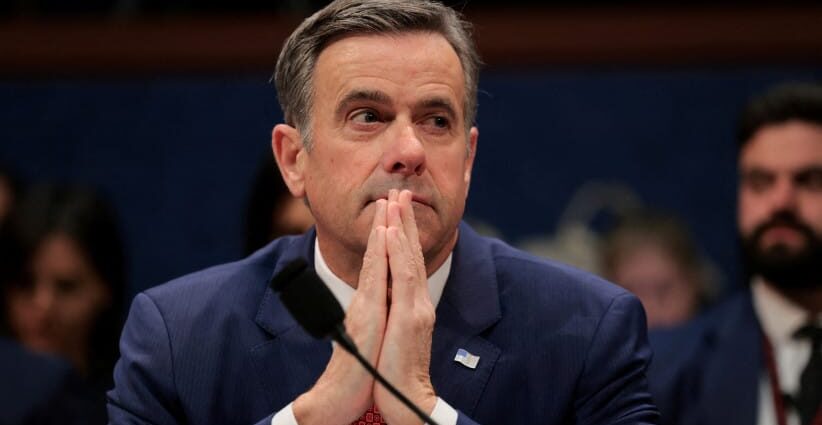
Zelensky holds undisclosed tarmac meeting with CIA chief John Ratcliffe in Ireland – report
Ukrainian President Volodymyr Zelensky met US CIA chief John Ratcliffe at Shannon Airport in Ireland, two people familiar with the matter said.
The meeting took place on Monday, one of the sources said. The other source said the pair spoke informally while their planes were being refueled without specifying a date. Both sources, who requested anonymity to discuss sensitive matters, declined to disclose details of their conversation.
The meeting happened as Zelensky was traveling to New York to take part in the annual gathering of world leaders at the United Nations. Ratcliffe was on his way back from meeting Egyptian President Abdel Fattah El-Sisi, one source said.
Ratcliffe’s meeting with Zelensky comes less than a month after the CIA chief traveled to Moscow to meet with Russia’s top intelligence officials.
Putin, Zelensky meetings with CIA not publicly disclosed
Neither Ratcliffe nor the CIA has publicly disclosed what was discussed in Moscow. One of the sources, who confirmed the Zelensky meeting to Reuters, said Ratcliffe had been in Moscow to discuss Ukraine, but they declined to elaborate.
The New York Times reported last month that Ratcliffe used his trip to share his bleak assessment of the state of the Russian war against Ukraine and to urge the Russians to cut a deal before their position weakens.

Irish athletes group urges national team to boycott matches against Israeli soccer team
More than 160 Irish sportspeople have signed an open letter asking the Ireland national football team to boycott their upcoming UEFA Nations League fixtures against Israel, the Irish Sport for Palestine Group said on Monday.
Ireland are due to play Israel on September 27 in Hungary before the reverse fixture in Serbia on October 4. Both matches are set to be staged at neutral venues and behind closed doors after protests by players and fans over the war in Gaza.
Irish Sport for Palestine said the signatories included Olympian Ciara Mageean, former footballer Louise Quinn, former rugby flyhalf Tony Ward and boxers Tyrone McKenna and Eric Donovan.
“This is a significant moment and with this moment you have an opportunity to do the right thing,” the letter said.
“Not playing the game would be the most sporting thing you could do. Through your leadership and courage, it would show the power of sport to unite, remind us of the shared values that connect us all, and have an impact far beyond the game.”
Irish soccer players urged for boycott against Israel
In May, leading Irish footballers joined celebrities in a campaign urging Ireland to boycott the Nations League matches against Israel.
Ireland has been one of the European Union’s most outspoken critics of Israel’s conduct during the Israel-Hamas war, and Football Association of Ireland (FAI) members voted overwhelmingly in late 2025 for its board to request that UEFA immediately suspend the Israel Football Association from European competitions.
The FAI later committed to playing the fixtures, citing possible sanctions that could affect the national team and the association.
Ireland coach Heimir Hallgrimsson said last week he had spoken individually to players about facing Israel and that “none of us feel comfortable playing in these games.”
Reuters has contacted the Israeli FA for comment.

Jerusalem egalitarian synagogue vandalized again on Yom Kippur, pride flag stolen
Vandals broke into Jerusalem egalitarian synagogue Kol Haneshama for the fourth time in a month, this time on Yom Kippur morning.
The vandals broke into the synagogue sometime between the end of Kol Nidre on Sunday night and the beginning of services Monday morning and removed a pride flag that was hanging in the sanctuary, Rabbi Oded Mazor announced from the bimah during Neila services Monday night.
Monday’s attack was the fourth incident, including egg throwing and broken windows, that has targeted one of the city’s most well-known and long-standing Reform synagogues in the last month. Just last week, Jewish youth wearing kippot pelted eggs at the synagogue during Rosh Hashanah.
At the end of the Yom Kippur service, Jerusalem Deputy Mayor Yossi Havilio addressed the congregation, expressing the municipality’s support, and a Pride flag was raised again as the congregation sang.
The previous night, during Kol Nidre services, Mazor read a message from Jerusalem Mayor Moshe Lion, expressing shock at the previous attacks and pledging the city’s support amid the deluge that has plagued the community.
Attacked over their support for LGBTQ community
Kol HaNeshamah has previously been targeted in attacks involving its support for the LGBTQ community. In 2018, a large rock was hurled into its courtyard while more than 200 people were taking part in Simchat Torah celebrations, prompting the congregation to file a police complaint. No one was injured.
During Monday’s services, a volunteer guard duty, including members of the Baka neighborhood where the synagogue is located who were not members, stood guard to protect the congregation from the vandals who used Yom Kippur to express their hatred.
JTA contributed to this report.

Who decided to station police at Sons of Jacob on Yom Kippur? – comment
Const. Jeff Smith of the Belleville Police Service was waiting in an unmarked car outside Sons of Jacob Synagogue on Sunday evening when, according to Ontario’s police watchdog, a man with a shotgun opened fire on him.
About 25 people were inside for Kol Nidre, the service that opens Yom Kippur. The synagogue’s president, Norm Weddum, says the congregation had never received a threat.
Belleville is a city of about 55,000, roughly 110 miles east of Toronto, and Weddum describes its Jewish community as small. Somebody at the local police department decided that this synagogue, on this night, needed an armed officer outside anyway. Ontario Premier Doug Ford called Smith a hero who stopped a tragedy. I think Ford is right, and I’d like to know who put Smith there.
Here’s what happened inside, as Weddum tells it. He heard shots, some congregants went toward the doors, and then a second round came. He moved everyone back into the sanctuary, shut the wooden doors so no one could be seen from the entrance, and told people to get down on the floor. Bullets came through the windows. One stained-glass window has about 20 holes in it.
Doug Lobel, a congregant, told CP24 news station what they were thinking down there: “Was the gunman going to breach the doors and start targeting us?”
He didn’t get the chance. Smith returned fire; a second officer fired as well, and Smith and the man were both hit. Houses and cars on the street were damaged. Smith, a 13-year veteran, is in critical but stable condition. The suspect, 29-year-old Sean Ward from neighboring Quinte West, is in life-threatening condition. No one inside was hurt.
Read the statements slowly
The first statement from Belleville police said an officer had “encountered” an individual near an intersection. It didn’t say why an officer was there. Since then, the force has had nothing to add, because the Special Investigations Unit, the civilian agency that takes over in Ontario whenever police shoot at someone, has invoked its mandate.
Mayor Neil Ellis told CBC he hopes the SIU investigation gets to “the root cause.” I don’t doubt he was shaken; he said he cried when he heard the news. But the SIU’s job is to decide whether Smith and his colleague were justified in firing. Why a 29-year-old showed up on that corner with a gun isn’t its question. Someone else has to ask it, and nobody has said publicly who that is.
Police haven’t said what led to the shooting or whether the synagogue was the target. The SIU first described the weapon as a rifle and later as a shotgun. At least three people fired on a residential street, and nobody has said whose bullets went through the stained glass. I’m not going to guess at Ward’s motive. Whatever it was, Smith was there first.
‘It pains me’
In June, Prime Minister Mark Carney stood in Holy Blossom Temple, Toronto’s oldest Reform synagogue, and said, “Canada’s civic compact is failing Jewish Canadians.” It was an unusually blunt thing for a prime minister to say. He noted that more than two-thirds of religion-motivated hate crimes the previous year had targeted Jews, who are about 1% of Canadians, and he announced another $75 million for security. Then he added, “It pains me that we had to commit $75 million to this.”
I believe him. I wish he’d stop saying it.
When a prime minister describes security money as a painful concession, the program that spends it tends to read the same way. The $75 million went to the Canada Community Security Program. The program describes itself as time-limited funding for communities at risk of hate-motivated crime. It covers up to 70% of eligible costs; under the program it replaced, the government paid half. Anything spent before a funding agreement is signed isn’t reimbursed. Guards qualify only as “time-limited third-party licensed security personnel.”
Read those rules as the treasurer of a synagogue the size of Sons of Jacob would. You raise the other 30% yourself, fill out the application, and wait for a signed agreement before spending a dollar. Then you hire guards on a “time-limited” basis, as if somebody at Public Safety Canada knows when the threat expires. The program is built for communities that can show they’re at risk. By its president’s account, this one had never been threatened.
Ford said out loud on Monday what those rules imply. He told reporters he was thankful such an experienced officer had been posted at the synagogue, and then added: “We never have enough security.” He’s the premier of Ontario. If anyone in the province can decide what counts as enough, it’s him.
On Sunday night, Toronto’s mayor, Olivia Chow, said Jews “should not need police presence to observe Yom Kippur.” Nobody disagrees with her. It’s no help to that treasurer deciding whether to apply for a guard this year.
Where I might be wrong
The best argument against everything above is Chow’s, taken seriously. A country that answers antisemitism by stationing police outside synagogues has accepted antisemitism as permanent. A dollar spent on a guard is a dollar that isn’t spent stopping someone before he picks up a gun. People who backed the new federal hate law would say the law is for slower work. They may be right. None of it would have helped the people lying on the floor of Sons of Jacob.
The harder objection, for me, is the guns. On Yom Kippur last year, at Heaton Park Hebrew Congregation in Manchester, England, worshipers were trying to keep an attacker from getting into the building. Armed police shot him about seven minutes after the first emergency call. One of the two men who died appears to have been hit by a police bullet.
In Belleville, at least three people fired on a residential street. If some of the rounds that came through that window turn out to be police rounds, this column gets harder to defend. I’d still defend it. Manchester’s police had to get there after the attack started, and Belleville’s officer was parked outside before it began. Nobody inside was hurt.
Reading this from afar
In August, I complained in this column that Israeli politicians had boiled their message to world Jewry down to three requests: “Educate your children. Come home. Speak well of us.” Expect to hear the second one a lot this week.
Some of the people who lay on that floor may one day make aliyah – the Hebrew word for immigrating to Israel – and Israel should be ready for them when they do. That’s a decision about where to raise your children and build a life. Nobody should be making it from a sanctuary floor.
What the Jews of Belleville need from us right now is support while they press their own governments for something those governments owe them. An Israeli minister who uses Sunday night to pitch aliyah would be making that job harder.
Queen’s Park should commit to a police presence at every synagogue in the province on the High Holidays (Queen’s Park is the Ontario legislature, roughly the province’s version of a state capitol). The province should pay for it, with no threat assessment required. The commitment should cover Purim as well. In March, gunfire hit Toronto’s Temple Emanu-El while the congregation was marking the holiday.
Ottawa should drop the 30% match and the “time-limited” condition for small congregations. A synagogue with two dozen people at Kol Nidre shouldn’t need a grant writer to get a guard.
Ontario’s prosecutors, known in Canada as the Crown, owe the public an explanation either way. The Combatting Hate Act took effect on July 18. It made hate-motivated crime a specific offense and created a crime of intimidating people to keep them from a place of worship, punishable by up to 10 years. When shots hit synagogues in Vaughan and Toronto in March, before the act was in force, the charges were reckless discharge of a firearm, mischief relating to religious property, and conspiracy. If the evidence shows Ward acted out of hatred, charge him under the new law. If it doesn’t, say so and explain why.
And Belleville police should tell us why Const. Smith was parked outside Sons of Jacob on Sunday night: who decided, based on what, and whether the synagogue got a bill. Whoever made that call got it right. Nobody else in Canada can copy it until they know what it was.


Oil Prices Tumble Under $100 per Barrel as Trump Hints at Reopening Talks With Iran
West Texas Intermediate (WTI) crude, a benchmark for North American petroleum, dipped to less than $93 per barrel—retreating from its $107-a-barrel high on Sept. 15.
Brent crude, used to measure internationally traded petroleum, fell to $99.22 per barrel by 1 p.m. Monday before ticking back up to $100 a barrel. That was still much higher than the $72 per barrel it hit earlier this summer, but far from the nearly $110 price on Sept. 14.
Trump told Fox News chief foreign correspondent Trey Yingst on Sunday that “very big things” would happen with Iran in the “not so distant future.” The president said he was debating whether to wipe out the country, let it collapse financially, or make a deal….


After grain line cuts
, FAA basis flights at big Northeast flights.
Transportation Secretary Sean Duffy reported Monday evening that an Amtrak design team accidentally cut a fiber-optic collection in New Jersey, causing a communications failure that caused the FAA to halt travel across the Northeast.
According to Duffy, an Amtrak construction crew unintentionally cut into a fibre collection in New Jersey, which resulted in a telecom outage and forced the FAA to halt Northeast flights.
Duffy claimed that LaGuardia Airport ( LGA ) and Philadelphia International Airport ( PHL ) were resumed, but flights to Newark Liberty International Airport ( EWR ), John F. Kennedy International Airport ( JFK), and Teterboro Airport ( TEB ) were still canceled.
He said,” This event highlights the need for additional cash to upgrade aging system and stop problems like this in the upcoming.”
After passing through the parking lot, LAGUARDIA TURNS DOWN RUNWAY FOR A SECOND Day IN WEEKS.
The FAA’s site listed effective ground stops at EWR and TEB as of 3:07 p.m. ET, while JFK, LGA, and PHL were operating while ground delays caused by the equipment failure.
According to “issues with some wavelengths at Philadelphia TRACON,” the FAA announced earlier on Monday that it was suspending flights into the flights of Philadelphia International, Teterboro, and Newark Liberty International.
HIGHER JET FUEL PRICES HIT CARRIERS, WHILE MAJOR AIRLINES CUT Planes
Philadelphia TRACON lost its main circuit, according to FAA Administrator Bryan Bedford, and they discovered a damaged fiber-optic cord when devices switched to a backup system.  ,
Hardy stated earlier on Monday in a press conference that” these problems aren’t new to us.”
” We are aware that these issues can arise. Duffy added that the division has been working to enhance FAA gear and its telecom architecture because” we know these cuts may happen.”  ,
” It all takes money as we go through all the new technology and the new structures of our telecoms, which is fans. We have a holistic perspective of everything, including how we overhaul our telecom system, Duffy said.
AVELO CEO WARNS AIRFARES MAY RISE AS FUEL PRICES HIT “UNCOMFORTABLY HIGH” LEVELS
Burke claimed that the office is completing the work before it has received all the necessary funds, adding that it will be able to accelerate progress when the department receives the funds.  ,
Clicking HERE WILL GET FOX BUSINESS ON THE GO.
Duffy referred to the products failure as” but this is not shocking.”
FOX Business Monday evening may not instantly reach the FAA for further reply.
This post was originally published here

‘They must be doing it for ulterior reasons’: Jensen Huang says AI leaders are ‘irresponsible’ for scaring the public with ‘doomsday narratives’
Out of the chaos of AI doomerism AI leaders like Sam Altman and Dario Amodei have found themselves at the center of, the leader of the most valuable company in the world—and the creator of AI’s chip foundation—is rejecting the warnings. In a CBS Sunday interview, Nvidia CEO Jensen Huang called the predictions of an AI catastrophe by 2030 “irresponsible” and the “doomsday narratives” are simply not based in reality.
“2030 is not going to be the end of the world,” Huang told CBS. “There is a 0% chance that’s going to be the end of the world.”
Huang said the concerns about AI safety are legitimate but also said the industry’s dire public warnings are not grounded in “science.” He added that “scaring people is unnecessary,” arguing that AI companies should be devoting engineering resources to safety and verification. Nvidia supplies the chips powering much of the AI industry’s expansion.
“I believe the claims of the end of the world, stirring fear across America, and doing it by the people who are doing it makes no sense to me, so they must be doing it for ulterior reasons,” Huang said. “It is irresponsible, and I don’t know what their motives are.”
This comes after President Donald Trump rejected calls for increased AI regulation, saying existing criminal and civil law can handle AI concerns. On Saturday, he announced that he would form an “AI Force,” modeled on Space Force, and appoint an AI “czar”—though he named no one and gave no timeline for either.
“Whoever wins AI, WINS,” Trump posted on Truth Social. “We are leading now over China, and everyone else, and I’m going to keep it that way! I’m not going to stifle growth of something that will be bigger than the Industrial Revolution, or the Internet itself.”
Huang also posits that AI development shouldn’t be repressed from concerns of AI takeover.
“If we’re compromising safety, that can’t happen,” he said. “We should go as fast as we can, but not faster than we should.”
Huang’s primary reasoning is that AI safety is primarily an engineering issue rather than a government regulation problem. He said companies should be held accountable under the existing laws and regulations before lawmakers rush into creating new rules specifically for AI.
“Go and read between the lines,” Huang said. “They’re actually not asking for more laws. They’re asking to be relieved of the laws we do have.”
“Don’t let this doomsday narrative cause somebody to relieve them of the laws that currently exist,” he added.
Nvidia is also one of the industry’s most important suppliers, with its chips and processors serving as infrastructure for running advanced AI systems. Nvidia’s market value has jumped alongside AI demand, making the company the most valuable in the world.
Nvidia did not immediately respond to a request for comment from Fortune.
Two sides of the same AI coin
Anthropic CEO Dario Amodei has called for the industry to slow the development of capable models, saying the companies need more time to establish safety precautions. According to a report from Reuters, Amodei has proposed independent safety evaluators to check for common safety standards and international cooperation inside frontier AI companies.
OpenAI CEO Sam Altman, after arguing regulation would hinder AI companies, has echoed the same rhetoric. In July, Altman said society may need time to adapt to new capability levels and the industry should consider ways to slow development.
Even Elon Musk, CEO of SpaceX and Tesla has endorsed the worry. In a post on X, Musk noted he had been “sounding the alarm on AI for a long time.”
Former researcher at both OpenAI and Anthropic Jacob Coxon also added to the fire, after he publicly resigned from Anthropic on X in September. Coxon wrote that the companies were “racing straight to self-improving superintelligence,” essentially “gambling with our lives.” His post went viral and drew more than 170 million views.
And a public letter signed by over 1,300 employees at leading AI companies has separately called for governments, industry leaders and society to have the ability to buy time and address emerging risks. Amodei was among the individuals who signed the letter.
This story was originally featured on Fortune.com

Iranian airlines to be cut off from global system as US Treasury announces secondary sanctions
Foreign companies continuing to provide services to Iranian airlines will risk facing US secondary sanctions starting on Wednesday, US Treasury Secretary Scott Bessent announced on Monday.
“On September 23, all Iranian airlines will be grounded globally,” Bessent told CNBC.
The move could effectively prevent Iranian carriers from operating at airports worldwide.
He noted that the US threat applies not only to the airlines themselves but also to airports, fuel suppliers, ticketing agencies, and other service providers.
“If they land, they cannot be supplied with fuel or landing services, nor can tickets be sold for them; otherwise, you will be cut off from the dollar system,” he said.
All Iranian airlines added to US sanctions list in September
Earlier this month, the US Treasury Department imposed sanctions on all active Iranian airlines not previously included on sanctions lists, warning that foreign companies assisting them could be barred from the global financial system.
The move is part of the Trump administration’s Operation Economic Outcast, designed to ramp up economic pressure on Tehran alongside the conflict with Iran.

Tesla reopens Roadster reservations – but you’ll need $50K
Tesla has reopened reservations for its long-delayed next-generation Roadster, asking customers to put down $50,000 weeks before the company unveils a redesigned version of the vehicle.
According to Tesla’s reservation portal, securing a spot requires an initial, fully refundable $5,000 credit card payment. Customers must then make a $45,000 wire transfer within 10 days to complete the reservation.
The renewed push for reservations comes nearly nine years after CEO Elon Musk first unveiled a prototype of the next-generation Roadster in 2017. Following years of delays, Tesla is preparing to unveil the redesigned vehicle on Oct. 1 at an event in Texas.
TESLA RAISES CYBERTRUCK PRICES ON 2 US MODELS
“New Tesla Roadster Unveil 10.01,” Musk recently wrote on social media platform X after Tesla posted a “Go for launch” teaser for the event. Musk has also said the presentation will be a “banger” and said during a recent appearance at the All-In Summit that the company needs a live audience to vouch that what they see “is not AI.”
TESLA FILES PLANS FOR PROPOSED $10.1B TEXAS SOLAR MANUFACTURING PLANT
The event could include a demonstration of a limited-edition Roadster equipped with cold-gas thrusters developed in collaboration with SpaceX, according to recent reporting. Tesla’s teaser imagery appears to lean into that possibility, showing the vehicle against a launch-themed backdrop.
The Roadster program has reportedly evolved significantly from its earlier design. Tesla abandoned one approach based on Model S Plaid components in favor of developing an all-new carbon-fiber hypercar, according to The Information.
TESLA TOUTS 380,000 UNSUPERVISED ROBOTAXI MILES WITH ‘ZERO NOTABLE INCIDENTS’
Tesla originally unveiled the next-generation Roadster in November 2017 and said deliveries would begin in 2020. At the time, the company advertised a $200,000 base price, acceleration from zero to 60 mph in 1.9 seconds and a 620-mile range. Tesla also took $250,000 payments for a limited “Founders Series” version.
The vehicle never entered production as planned and has faced repeated delays in the years since.
CLICK HERE TO GET FOX BUSINESS ON THE GO
It remains unclear what Tesla will charge for the redesigned Roadster or how the company will handle customers who placed reservations years ago. Tesla did not immediately respond to a request for comment about reservation priority or updated vehicle specifications.
Reuters contributed to this report.


What is a gift of equity and how does it work?
Families can use a gift of equity to help the next generation achieve their dream of homeownership, while also keeping their cherished homes in the family. This strategy, in which the seller transfers part of the home’s value to the buyer by reducing the purchase price below market value, can help cover a cash-strapped buyer’s down payment.
Learn how a gift of equity works mechanically, what the tax implications are for both the buyer and the seller, and the paperwork requirements to decide if it’s the right option for you.
What is a gift of equity?
A gift of equity is when a home seller transfers part of their equity to the buyer by agreeing to sell the property for less than its appraised value. This structure can be useful when a family wants to pass a home to the next generation but the buyer can’t afford full market price.
The formula is simple: appraised value minus agreed sale price equals the gift amount. No cash changes hands for the gifted portion, and the lender treats the difference as equity the buyer owns from the moment the deal closes.
For conventional loans, gift-of-equity transactions are permitted on principal residences and second home purchase transactions. Investment properties are not eligible. Other loan programs have their own rules, but one commonality they share is that the gift cannot require repayment.
Compare the available mortgage rates in your area
How a gift of equity works
The process for selling a home with a gift of equity usually requires these basic steps.
Step 1: Appraisal. The home needs an independent professional appraisal to establish its fair market value. The seller and buyer can then use the appraised value to determine the sale price and gift of equity.
Example: Say the home appraises at $400,000 and the seller agrees to sell for $320,000. That $80,000 gap would be the gift of equity.
In an eligible conventional transaction, the buyer can use that equity toward the down payment and closing costs. Depending on the resulting loan-to-value ratio, the gift of equity may also help the buyer avoid private mortgage insurance (PMI)—a gift that potentially keeps on giving.
Step 2: Gift of equity letter. Once the price is set, the seller writes and signs a gift of equity letter, which is a formal document confirming to the lender that the below-market price is a genuine gift, not a disguised loan.
Step 3: Lender review. The lender reviews the appraisal, the agreed sale price, and the gift letter before approving the loan. Timing varies by lender, appraisal turnaround, and title work.
What can a gift of equity be used for?
A gift of equity can cover:
It can’t cover:
- Financial reserves
Gift of equity rules by loan program
FHA, conventional, VA, and USDA loans all allow gifts of equity, but the rules differ.
For FHA borrowers without significant savings, an eligible gift of equity can cover the entire 3.5% minimum required investment (MRI), meaning the buyer may not need to contribute their own funds toward the down payment.
What goes into a gift of equity letter
The gift of equity letter must contain all of the necessary details required by the loan program and lender to ensure that it is a legitimate transaction. Requirements vary, but the letter generally includes:
- Donor’s name, address, and telephone number
- Recipient’s (buyer’s) full legal name and address
- Property address
- Dollar amount of the gift (e.g., “$80,000”)
- Relationship between donor and recipient (e.g., “parent of the borrower”)
- Statement that no repayment is expected or required, now or in the future
- Dated signatures from both donor and recipient
For conventional loans, the file must also include the settlement statement listing the gift of equity. Some lenders may require a proprietary form in addition to a signed letter, so try to confirm what is needed before drafting the letter.
Gift of equity tax rules (2026)
A gift of equity has tax implications on both sides of the transaction, though most family deals fall well within the limits where no tax is actually owed.
For the seller (donor)
The IRS annual gift tax exclusion is $19,000 per recipient in 2026 (or a total of $38,000 per recipient if two spouses each make a gift). Above the annual exclusion, the donor must file IRS Form 709. This generally draws down the lifetime exemption, which is $15 million per individual in 2026. Unless the gift exceeds the donor’s remaining lifetime exemption,, there generally won’t be any federal gift taxes to pay.
As an example, if you gave a $200,000 gift of equity, you’ll need to file Form 709 (because it’s above the $19,000 threshold), but you won’t generally pay a gift tax (assuming the gift doesn’t push you past your remaining lifetime exemption).
For the buyer (recipient)
Recipients of gifts generally do not owe gift tax. However, there could be a tax consideration for buyers when they eventually sell the home.
Under IRS rules, when you buy a property for less than fair market value in a part-sale, part-gift transaction, your tax basis is generally the greater of the amount you paid or the donor’s adjusted basis, rather than the appraised value at closing. In other words, if the purchase results in a lower tax basis, you could end up paying more in capital gains tax when you sell.
Keep in mind that the IRS primary residence exclusion still allows for up to $250,000 in gains for federal tax for single filers, and up to $500,000 for married filing jointly. You must generally own and live in the home for at least two of the five years before the sale. It might be worth a conversation with your tax advisor to go over the specific basis treatment and how it may impact future capital gains.
What sellers should know
The most obvious trade-off for the seller is accepting less money from the sale, but there are a couple of other points to consider.
If the seller still carries a mortgage on the property, the mortgage must be paid from the sale proceeds first. If the remaining balance is close to the agreed sale price, the seller should make sure the sale proceeds are sufficient to pay off the mortgage and other closing costs. Run those numbers before committing to a price.
Sellers should also check whether they need to file IRS Form 709. If the gift exceeds the 2026 annual exclusion ($19,000 per recipient for one spouse or $38,000 total per recipient from two spouses), sellers may need to file the form. A tax professional can help determine the filing requirements.
Gift of equity vs. seller’s concession
A gift of equity and a seller’s concession both let a seller reduce what the buyer pays out of pocket at closing, but they’re structurally different and lenders treat them differently.
Here’s an example of how the two options can differ:
- A gift of equity deal on a $400,000 home might price it at $320,000, with the $80,000 gap covering the down payment.
- A seller’s concession deal might keep the price at $400,000 but have the seller credit the buyer $8,000 at closing to cover most closing costs, without touching the agreed purchase price.
Compare the available mortgage rates in your area
Pros and cons of a gift of equity
Pros
- Covers down payment without the buyer drawing from savings
- Can help the buyer avoid PMI if the transaction results in at least 20% equity
- No cash has to change hands for the gifted portion
- Lenders treat the gifted equity as real equity from day one
- Can cover closing costs in addition to the down payment
- Keeps a family home in the family at a documented, appraised-value-based price
Cons
- Seller receives less cash from the sale
- Loan program and lender rules can restrict how buyers use a gift of equity
- Requires a professional appraisal, a formal gift letter, and full lender review
- Gifts above the annual exclusion generally require the seller to file IRS Form 709
- Cannot satisfy post-closing financial reserve requirements
- Can complicate the buyer’s tax basis and future capital gains calculation
The takeaway
A gift of equity is one of the cleaner ways a family can transfer real estate without liquidating assets or arranging a complex financial structure, with no cash exchange required for the gifted portion. It’s worth consulting a tax professional to understand how the gift may affect the buyer’s tax basis and potential capital gains on a future sale.
On the seller side, crunch your numbers if you need to pay off an existing mortgage so you can come up with a sale price that achieves your objectives. Once both parties are ready to move forward, work with the lender to craft the gift of equity letter to the lender’s specifications to avoid any closing delays.
Frequently asked questions
Is a gift of equity a good idea?
A gift of equity can be a great strategy if someone wants to sell to a family member and provide financial help without a cash exchange for the gifted portion. The seller agrees to lower the price to below market value, and that price difference can then be used toward the buyer’s down payment. To decide if it’s the right fit, consider tax implications and eligibility based on loan type.
Do I have to pay a gift tax if I give a gift of equity?
If you give a gift of equity, you generally won’t owe a gift tax unless your taxable gifts exceed your available lifetime exemption. If you go over the annual $19,000 exclusion per recipient in 2026, you will generally have to file IRS Form 709. However, filing Form 709 doesn’t necessarily mean you’ll owe gift tax. In 2026, each individual has a $15 million lifetime estate and gift tax exemption.
Does a gift of equity have to be repaid?
A gift of equity isn’t meant to be repaid. The gift of equity letter states that no repayment is expected or required, now or in the future.
Can a gift of equity cover my down payment?
A gift of equity is most commonly used to cover some or all of a buyer’s down payment and/or closing costs. The difference between the home’s appraised value and the lowered purchase price represents the gift. As an example, a home appraised at $550,000 that is sold to a family member for $500,000 gives a $50,000 gift of equity, which could be applied to the buyer’s down payment, subject to the program’s rules.
What paperwork is required for a gift of equity?
The main documentation required for a gift of equity includes a home appraisal and a gift of equity letter, which lays out the agreement between buyer and seller. Additional documentation requirements vary by loan program and lender. Sellers should also check whether they need to file IRS Form 709. A tax professional can help determine the filing requirements for their situation.
This story was originally featured on Fortune.com


Saudi Arabia facing Iranian proxies alone as US opts out of strikes – analysis
On September 11, an Iranian-backed militia in Iraq carried out an attack on a key Saudi Arabia East-West pipeline. This came as the Houthis also advanced toward Bab al-Mandeb Strait. Saudi Arabia has now faced a potential two-front conflict over the last ten days.
Now Saudi Arabia has sent officials to the UN General Assembly. Riyadh has also been wondering whether it will get military support from the US.
What is happening is that the US has advanced a sale of F-35s to Saudi Arabia. However, if the sale proceeds, the 5th-generation warplanes won’t arrive in Saudi Arabia for years. Riyadh needs to decide what to do now.
The Houthis have continued their threats over the last week. They have been fortifying the positions they captured near Bab al-Mandeb; they are pushing propaganda against Saudi Arabia and launching attacks on the Yemeni government and Saudi Arabia. They have even threatened Mecca. Meanwhile, Saudi Arabia’s allies, Pakistan and Turkey, do not appear to be stepping up.
The Kingdom is wary of going it alone. Arab News noted on September 19 that “Yemeni government forces clashed with Houthi fighters on several fronts in Marib on Saturday, advancing on Al-Mashjah front west of the city and forcing the Houthis to retreat, military sources said.”
Saudi Arabia left alone in its time of need
The sources added that the Armed Forces destroyed several Houthi vehicles during the fighting, according to an Al Arabiya report.
Meanwhile, Saudi Foreign Minister Prince Faisal bin Farhan arrived in New York on Saturday to lead the Kingdom’s delegation at the 81st session of the UN General Assembly, Arab News noted.
“The delegation includes Saudi Ambassador to the US Princess Reema bint Bandar, Minister of State for Foreign Affairs Adel Al-Jubeir, and King Salman Humanitarian Aid and Relief Center Supervisor General Dr. Abdullah Al-Rabeeah, along with other officials.”
Saudi Arabia also said it had postponed its Red Sea International Film Festival to 2027. The New Arab media outlet noted that “Saudi Arabia has spent decades building its security partnership with Washington, buying billions of dollars in US weapons and cultivating close ties with successive American administrations.”
It argued that “when Crown Prince Mohammed bin Salman made a direct plea to US President Donald Trump for military help against Yemen’s Houthis, Washington ultimately stepped away. For two weeks, Trump had wrestled with whether to order US strikes on Houthi targets as the Iran-backed group intensified attacks on Saudi Arabia and made territorial gains in Yemen.”
The report, along with others, noted that the US has stepped back from strikes on the Houthis. This is important. Riyadh wants commitment. It has been fighting since 2015 in Yemen. Saudi Arabia has faced this dilemma before. In 2019, Iran attacked Saudi Arabia’s Abqaiq energy facility on the coast.
This is similar to the September 11 attack on the East-West pipeline. The message was clear both times. If Saudi Arabia responds, the attacks on strategic infrastructure will continue. Riyadh has more to lose than Iran, the Houthis, or militias in Iraq. Saudi Arabia and US Central Command retaliated in July for militia attacks from Iraq. The attacks stopped for several weeks.
This big question for Riyadh at the UNGA is whether it can rally support and also work with Washington regarding the next steps in Yemen. The Houthis believe they are winning. Saudi Arabia will have to see how it can avoid a two-front conflict and also restore deterrence.

Apply for 44 affordable units at new Hell’s Kitchen rental, from $863/month

Forty-four permanently affordable apartments are available at a new development in Hell’s Kitchen. Standing 9 stories at 806 Ninth Avenue, The Lirio transforms a parking lot into much-needed affordable housing, along with supportive units for formerly unhoused residents and office space for the MTA. New Yorkers earning 30, 77, 80, 100, or 120 percent of the area median income can apply for the apartments, with two-bedrooms priced between $863 and $3,650/month and three-bedrooms priced at $3,186/month.

Hudson Companies and Housing Works developed the project in partnership with the city’s Department of Housing Preservation and Development (HPD). Lirio takes its name from NYC’s oldest tree, the 350-year-old “Liriodendron tulipifera” located in Queens’ Alley Pond Park.
In March 2024, the development team and the MTA secured $62 million in construction financing for The Lirio, with funding provided by Webster Bank, Merchants Capital, Red Stone Equity Partners, HPD, and Reso A funding from Council Member Erik Bottcher and then-Borough President Mark Levine, according to a press release. The building topped out in April 2025.

Designed by CetraRuddy, the building offers 112 permanently affordable homes, along with 67 supportive units for formerly unhoused individuals. Of those, 59 serve formerly homeless long-term survivors of HIV/AIDS. Hell’s Kitchen has a particularly high concentration of these residents and one of the city’s highest rates of new infections.
Housing Works will have office space within the development to provide on-site case management for supportive housing residents. These services will help residents with HIV stay on their medical regimens and achieve “zero detectability” status, which improves their health and makes the virus untransmittable.
CetraRuddy designed the building to complement the character of the surrounding neighborhood while incorporating sustainable design features such as green roofs and solar power, with the project expected to meet rigorous Passive House standards.
Amenities include a 24-hour attended lobby, fitness center, bicycle storage, landscaped terrace, media room, and rooftop garden.

Qualifying New Yorkers can apply for the apartments until October 5, 2026. Complete details on how to apply are available here. Preference for 20 percent of the units will be given to residents of Manhattan Community Board 4.
Questions regarding this offer must be referred to NYC’s Housing Connect department by dialing 311.
RELATED:
- Work underway to convert former Chelsea prison into 131-unit affordable housing project
- 40-story South Bronx tower launches lottery for 227 apartments, from $1,936/month
- NYC needs 700,000 new homes: See the unit target for every district
The post Apply for 44 affordable units at new Hell’s Kitchen rental, from $863/month first appeared on 6sqft.

Google fined €403 million by EU over location data privacy violations
Google has been fined 403 million euros ($463 million) for breaching the European Union’s strict privacy rules because it mishandled users’ location data, the bloc’s data privacy watchdog said Monday.
Ireland’s Data Protection Commission said its investigation found Google did not lawfully or fairly process location data in users’ Web & App Activity, a Google setting that tracks browsing and search history, and in their Location History, a service that maps places they’ve been with their mobile phones.
Regulators also found the company failed to be lawful, fair and transparent when it processed personal data in its Location Accuracy feature in the Android mobile operating system.
Ireland is the lead regulator for Google in the 27-nation EU because the U.S. tech giant’s European headquarters is based in Dublin.
The investigation, which opened six years ago, examined how Google applied the EU privacy rule book, known as the General Data Protection Regulation, from the time it took effect in 2018 until February 2020.
“This case centers around historical policies that have since been updated,” Google said in a statement. “From 2019 onwards, we’ve significantly evolved our practices and launched robust tools that make managing location data simple.”
Regulators said that location data is a type of personal data that’s collected by Google and can be used to infer someone’s location.
“Location data can bring both benefits and harms to individuals,” Deputy Commissioner Graham Doyle said. “It can greatly enhance the utility of online services, but it can also reveal a significant amount of information about an individual, including information that is inherently private.”
It’s the fourth biggest EU privacy fine issued by the Irish watchdog, which has previously handed out bigger fines to TikTok and Meta, including a 1.2 billion euro fine for Meta.
The regulator said it still has three other ongoing privacy investigations involving Google.
This story was originally featured on Fortune.com


Kurdish Peshmerga completes its long process of unification – explainer
The Kurdistan Regional Government in northern Iraq announced Monday that its Peshmerga forces have finally completed unification.
This process dates back more than a decade. Western countries, helping fight the war on ISIS, have backed Peshmerga unification in the past. The announcement comes as US forces are leaving Iraq and as Iran continues its threats.
The KRG’s Prime Minister Masrour Barzani said “the Peshmerga is more than a military force. It is a symbol of the struggle, sacrifice and identity of the people of Kurdistan.”
He added, “Today is a historic day for Kurdistan and the Peshmerga; the process of unifying and reorganizing the Peshmerga forces has been successfully completed.
This unification is the first step of a long process, and the next phase is even more important. It must focus on strengthening military capabilities, providing advanced weapons and air defense systems, developing competencies, and comprehensively advancing the Peshmerga forces.”
Kurdistan’s armed forces
The Peshmerga are the armed forces of the Kurdistan autonomous government. They have their origins many decades ago as a key force that defended Kurdish rights in their struggle against the oppressive Iraqi regime of Saddam Hussein.
After the 1991 Gulf War and the establishment of Kurdish self-rule in northern Iraq, the Kurdistan Democratic Party (KDP) and the Patriotic Union of Kurdistan (PUK) each had their own armed forces. Since then, the goal has been to unify these Peshmerga.
Instead, political and economic disputes contributed to a Kurdish civil war beginning in 1994. A 1998 agreement ended the fighting, but institutionalized a division between KDP and PUK areas and their respective security forces.
After the US invasion of Iraq in 2003, the Kurdistan Regional Government’s Ministry of Peshmerga Affairs launched new efforts to create a professional force. The two major parties signed a unification agreement in 2006 and eventually created joint Regional Guard Brigades.
Nevertheless, large formations remained under partisan control, particularly the PUK-associated 70 Forces and KDP-associated 80 Forces.
It’s important to understand how this manifested itself on the frontline. I spent several years covering the Peshmerga fight against ISIS. In many frontline positions, the political divisions were visible, often because nearby bases displayed the flags or images associated with the two political parties.
There was unity but also clear evidence of division. The war on ISIS postponed unification and reform.
The war against ISIS transformed the Peshmerga’s role. The Peshmerga were supported by the US-led Combined Joint Task Force-Operation Inherent Resolve (CJTF-OIR).
Coalition countries provided weapons, training, funding, and advisers, including through the Kurdistan Training Coordination Center (KTCC). The war also highlighted weaknesses caused by competing command structures and accelerated pressure for reform.
Beginning in 2017, the KRG, United States, United Kingdom, and Germany moved forward with an extensive program intended to professionalize the Peshmerga. The concept was that the Ministry of Peshmerga Affairs would take the lead, not the parties.
Under subsequent US-KRG agreements, CJTF-OIR continued supporting restructuring, logistics, training, and institutional reform. The objective evolved toward unified Peshmerga divisions incorporating personnel from the Regional Guard Brigades and former 70 and 80 Forces.
Reorganizing groups under a single professional Peshmerga
Although integration repeatedly missed deadlines, the creation of unified divisional structures represented an important step toward replacing parallel party armies with a single professional Peshmerga force
Kurdistan Regional Government Prime Minister Masrour Barzani announced the completion of the multi-year effort to unify the Kurdistan Region’s Peshmerga forces, calling it a “historic day for Kurdistan and the Peshmerga.” Barzani said the process was carried out under an understanding between the KRG and the US Department of War, with support from the United States and Coalition forces.
“All forces have been brought under the umbrella of the Ministry of Peshmerga Affairs,” Barzani said. He said the Peshmerga now operate within “a single modern military structure,” unified in operations, training, command and control, communications and accounting.
Barzani cautioned that unification represented only “the first stage and first step of a long process.” The next phase will focus on improving military capabilities, acquiring advanced weapons and air defense systems, strengthening training and developing personnel according to international military standards.
He also emphasized removing the Peshmerga from partisan rivalries.
“We want the Peshmerga to be a national Kurdistani force that stands above all party and individual interests,” Barzani said.
The prime minister thanked the United States and Coalition forces for supporting the reforms and helping the Peshmerga defeat ISIS, while calling for stronger coordination with the Iraqi Army and equal financial rights for Peshmerga personnel.
With US forces set to leave Iraq ahead of a September 30 deadline, the Peshmerga will need this new unity to confront challenges. Baghdad has often tried to weaken the Kurdistan region economically. Iran and its militias have carried out 1,000 attacks since February. The challenges ahead are immense.
Unification and reform are a step. However, the KDP and PUK still cannot form a unified government, creating numerous challenges for the Kurdistan Region.

Syria grows increasingly concerned about suspicious explosions near Aleppo
Syrian authorities are investigating an explosion near Aleppo that occurred on Sunday evening.
It is the latest mysterious explosion in Syria that has appeared to occur at an arms depot. There have been several in the last two weeks. Most commentators agree that while one or two accidental explosions are possible, the recent ones appear to fit a pattern.
Syrian state media noted that “an explosion struck a Syrian Arab Army weapons depot near al-Eis in southern Aleppo countryside early Monday, with the Defense Ministry opening an investigation into the cause, as authorities secured the site and emergency teams responded in surrounding areas.”
The report added that the authorities were investigating “the causes of explosions at several military sites, the latest of which occurred at a weapons depot near the town of al-Eis. The ministry said protecting military personnel and civilians, establishing the facts, and determining responsibility were priorities, adding that measures would be taken based on the investigation’s findings to protect personnel and military sites and prevent similar incidents.”
Syria is trying to transition to stability after years of war. The US-backed Syrian Democratic Forces recently dissolved themselves and are integrating into the Syrian security forces. As the country unifies, one of the challenges has been integrating various armed units under a unified command.
Syria was divided from 2011 to early 2026. Some areas were controlled by the same group throughout much of this time. For instance, the government of Syria is largely staffed by members of Hayat Tahrir al-Sham (HTS), which ran Idlib for many years.
As the country transitioned, it became necessary to rebuild its armed forces. Syria needs a modern army in order to keep security threats, such as ISIS, in check. For instance, last week an ISIS cell south of Damascus engaged in a firefight with members of the Interior Ministry. Syria also needs to standardize the new integrated units that include thousands of SDF fighters.
Uncertainty, concern growing in Syria
As all this takes place, there is uncertainty and concern in Syria. The explosions at arms depots lead to rumors. At the recent site of an explosion, which lit up the night sky near Aleppo, military police were deployed. SANA says “engineering units began securing the site and surrounding areas.
Civil Defense officials separately reported four people injured amid a series of explosions in the al-Hadaba area west of al-Eis. Emergency teams evacuated residents from nearby homes and closed roads leading to the area.”
The Damascus-Aleppo highway had to be closed as well. “The Ministry of Emergency and Disaster Management warned residents against approaching the area because of the risk of shrapnel and unexploded ordnance, urging them not to return to evacuated areas until authorities declare them safe.”
Arab News noted last week that “Syrian authorities on Saturday said an explosion of unknown origin killed 11 people at a military site in the eastern province of Deir Ezzor the previous day.”
“The defense ministry held a funeral procession for 11 of its martyrs, who were killed in an explosion at one of the Syrian Arab Army sites” in Deir Ezzor province, the official SANA news agency said.
Arab News also noted that “several such blasts have previously occurred at arms depots in Syria, which is emerging from more than a decade of civil war following the toppling of longtime ruler Bashar Assad in late 2024. Earlier this month, an explosion at an arms depot in the northwest killed 14 people.”
Suspicion to grow if explosions continue
If the explosions continue, suspicion will continue to grow. Levant24 has highlighted that the Aleppo explosion is the fourth this month.
The explosions come amid some tensions with Israel and also between Israel and Turkey. In August, Israel carried out an airstrike on a Syrian military base. “Israel and Syria agreed to a status quo in security matters, which Syria was on the verge of breaching by permitting Turkish troops to deploy at an airbase near Aleppo,” Israel’s Prime Minister’s Office noted on August 18.
Ben Gvir discusses death penalty for Neveh Tzuf terrorist hours before Yom Kippur
Two hours before the start of Yom Kippur on Sunday, National Security Minister Itamar Ben Gvir raised the possibility of applying the death penalty to the terrorist responsible for the attack in Neveh Tzuf during a security meeting with Prime Minister Benjamin Netanyahu.
Netanyahu had reportedly convened the meeting in response to the security situation in the West Bank following the Sunday terror attack.
This is a developing story.

STAT+: What a vote on Grail’s cancer detection test could mean for the company, patients, and regulators
Shares in Grail, the company developing a blood test aimed at detecting many different types of cancer early, when they can be treated more effectively, surged 33% Monday after the Food and Drug Administration posted documents ahead of an advisory committee meeting that suggest the agency may take a favorable view of the test.
The meeting, scheduled for Wednesday, will bring together key experts to discuss the test, known as Galleri. The FDA is not obliged to follow the advice of these panels, but it often does.
Investors had already been bidding up Grail’s stock in anticipation of the meeting. The test is already available as a laboratory-based diagnostic, but FDA approval would be expected to help lead to reimbursement from Medicare and other insurance payors.

New York moves to protect historic African burial ground in Elmhurst

New York wants to ensure a historic burial ground of formerly enslaved people in Queens finally receives the protection and recognition it deserves. Attorney General Letitia James on Friday filed a motion to intervene in a pending foreclosure action involving 47-11 90th Street in Elmhurst, a site where nearly 300 freed African slaves were buried in the early 19th century, seeking a court order requiring any prospective buyer to be notified of the human remains on the property and their legal obligations to protect them. Dating back to 1818, the site was rediscovered in 2006 and has since been paved over and disturbed during subsequent development. Now that the property is once again up for sale, the state is seeking to ensure the burial ground is respected by its next owner.

After slavery was abolished in New York in 1827, communities of freed Black New Yorkers began to grow throughout the state. One of them was Newtown, located in present-day Elmhurst. A group of formerly enslaved people formed the United African Society of Newtown, constructing a church and an adjacent burial ground that had already been used informally for the previous decade.
The site is believed to have been established in 1818, nine years before the abolition of slavery, and at one point contained the remains of more than 300 New Yorkers, many of them formerly enslaved people.
The society later became the St. Mark African Methodist Episcopal (AME) Church, which owned the property until it was sold after the congregation relocated to Jackson Heights in the 1930s. The site remained largely forgotten until 2006, when the city placed restrictive declarations on the property to protect those buried there.
Despite those restrictions, the site has been disturbed repeatedly over the years. In 2011, workers beginning construction on a condo development at the property uncovered an iron casket containing the remains of a woman who died in the 1800s, halting the project.
Because the body was so well preserved, researchers were able to identify the woman as Martha Peterson, who was born decades before the Civil War and is believed to have worked for a local white man with abolitionist leanings, according to the New York Post.
That same year, developer Song Liu filed permits to construct a five-story building on the site, prompting a campaign led by the nonprofit Elmhurst History & Cemeteries Preservation Society to preserve it.
The society had asked the Landmarks Preservation Commission (LPC) to designate the site as a landmark, but it has yet to receive landmark status.
The next year, the site was listed for $13.8 million by real estate firm Cushman & Wakefield, which marketed it as offering “92,000 buildable square feet for residential development.” The listing made no mention of the burial ground underneath.
In 2025, the site’s current owner, 90 Queens Inc., paved over the property and began using it to store old cars and other debris. The city’s Department of Buildings deemed the use illegal and ordered the lot shut down, issuing multiple violations against the owner for its use as a parking and storage lot, unsafe conditions, and an excessive accumulation of tires. As The City Reporter noted, cars found abandoned on city streets by the NYPD were also left on the lot, until this past April, when the firm’s license expired.
After defaulting on its mortgage several years ago, 90 Queens Inc. surrendered the property to 90 Street Realty LLC, which is now pursuing a foreclosure action against the site. A court-appointed referee is expected to sell the property at public auction.
While some human remains have been removed from the site, many more have yet to be excavated and remain at risk of further disturbance.
In her filing, James is seeking to intervene in the foreclosure action to ensure the new owners comply with the state’s Unmarked Burial Site Protection Act, enacted in 2023.
The law prohibits anyone from moving, relocating, possessing, handling, or otherwise disturbing human remains discovered at a burial site, except as permitted under specific procedures for identifying and notifying descendants and culturally affiliated groups.
Considering the previous disturbances at the property, James is concerned that without legal intervention, its next owner could take over the site without being aware of their legal obligations to protect and properly handle the remains.
She has asked the court to require that, if the foreclosure sale proceeds, the referee overseeing it include a copy of the OAG’s motion and the text of the burial site law in the materials provided to every prospective buyer.
James believes the notice will ensure prospective buyers respect the human remains buried at the site and prevent the burial ground from being forgotten once more.
“Every New Yorker deserves to rest in peace, and that includes the people buried on this land generations ago,” James said. “My office will not allow a foreclosure sale to become yet another disrespectful event in this burial ground’s unjustly troubled history.”
“We are going to court to make sure whoever buys this property knows exactly who is buried there and is aware of their legal obligation to protect them,” she added.
James’ action follows a letter penned by the Newtown Historical Society to the LPC in August, in which it accused the city of not “honoring the history of all cultures equally.” In the letter, the group urged the LPC to protect the site, citing the commission’s previous efforts to protect the Brickerhoff Cemetery in Fresh Meadows.
“The site demands respect, recognition, and celebration, and that can only be achieved through designation,” the group wrote. “Our generation has been presented with a wonderful opportunity to preserve this site and use it to educate future generations on the African American history of Queens—an opportunity that should not be squandered.”
Earlier this month, the Elmhurst History and Cemeteries Preservation Society and the pastor of St. Mark AME filed a “request for evaluation,” formally asking LPC to designate the property as a landmark, according to The City Reporter.
LPC spokesperson Courtney Metakis told the website the commission will add the site to its survey list if the landmark ‘may merit’ consideration.
On Friday, Queens Borough President Donovan Richards called on the city to purchase the land and make it a memorial to those buried there.
“St. Mark AME Church, the stewards of these bodies, finally deserve their say in what happens here too,” Richards wrote in a post on X.
He added: “This lot is in foreclosure. But under no circumstances should we allow the former slaves buried here 200 years ago to be auctioned off in death, just as they were in life.”
RELATED:
- Historic African American burial ground in Elmhurst hits the market for $13.8M
- Long-forgotten Bronx burial site of enslaved people designated as a landmark
- Two Bronx parks with fascinating NYC history may become landmarks
The post New York moves to protect historic African burial ground in Elmhurst first appeared on 6sqft.
Michael Saylor’s Strategy buys Bitcoin again as surprise rally pushes price above $85,000
Bitcoin has been rising during a month that has historically been bearish for the asset. Strategy, the world’s largest corporate Bitcoin holder, bought 950 Bitcoin for nearly $76 million over the past week, according to its latest financial disclosure. The purchase marked the company’s first Bitcoin acquisition in roughly three weeks and lifted Strategy’s total holdings to 846,000 Bitcoin. It coincided with the price of Bitcoin surging more than 6% over the past 24 hours to nearly $86,000, and led to a jump in Strategy shares of nearly 9% to $167.
The rise in Strategy’s share price was also helped by the company spending $174 million to repurchase STRC, its dividend-paying preferred shares. Strategy, led by the flamboyant billionaire Michael Saylor, is an outsize player in the Bitcoin market as it holds around 4% of the total supply.
The latest rise in Bitcoin’s price has extended the cryptocurrency’s recovery from a yearlong bear market. Bitcoin fell as low as $58,000 in June, roughly 53% below its $125,000 price last October.
The volatility has directly affected Strategy, whose vast Bitcoin holdings have made its stock a proxy for the cryptocurrency. Saylor has long championed a “never sell your Bitcoin” mantra, but in the past four months his company has sold Bitcoin four times.
As Bitcoin’s decline squeezed the company’s finances, Strategy created STRC last year to raise cash from investors for more Bitcoin purchases. The preferred shares pay investors regular dividends. As the cryptocurrency rebounded over the past month, Strategy returned to buying, making two purchases. Its latest STRC buyback also reduced the company’s future payments to investors.
Strategy’s fortunes remain closely tied to Bitcoin’s price, but its return to buying suggests the company sees enough support for the cryptocurrency’s recovery to resume accumulating it, Chris Beauchamp, chief market analyst at the financial technology firm IG Group, told Fortune.
“When you want to buy into a rising market, what August and September have given you is the potential for that to continue in a more sustained fashion. That’s just what Saylor and the rest of the team really want to see,” he said.
Strategy’s latest purchase was modest compared with some of its earlier acquisitions. Beauchamp said the smaller buy does not necessarily point to a particular concern, but may reflect a strategy of adding Bitcoin gradually as its price climbs.
The Bessent effect
Bitcoin’s renewed buying pressure came in mid-August after the U.S. Treasury announced that it would double purchases of older long-term government bonds. The cryptocurrency had spent months in a downturn as investors focused on faster-moving themes such as artificial intelligence, but worries about government bonds, rising yields, and inflation revived Bitcoin’s appeal as an alternative asset, Beauchamp explained.
“You always need a narrative to kickstart something,” he said. “With Bessent’s moves back to treasuries, suddenly it seemed like this was sort of the dream scenario for Bitcoin.”
The rally gathered pace as markets digested the Federal Reserve’s latest interest-rate hike. Crypto markets have often struggled when the Fed raises rates because higher borrowing costs can reduce the money investors devote to riskier assets. When Fed Chair Kevin Warsh announced a quarter-point rate increase on Sept. 16, Bitcoin initially fell to about $75,600, erasing gains it had made earlier that month. But the decline proved short-lived, and Bitcoin soon resumed its ascent.
Once the widely expected rate hike took place, “a more rational approach to the future applies,” with a key source of uncertainty out of the way, Beauchamp said.
This story was originally featured on Fortune.com

Netanel Chkroun identified as Neveh Tzuf terror attack victim, IDF catches terrorist near hospital
At least one person was killed in a suspected shooting attack in the area of Neveh Tzuf in the West Bank, north of Ramallah, on Sunday afternoon.
The victim, identified by the Samaria Regional Council as Netanel Chkroun, was originally in critical condition. His condition was temporarily updated to severe after Magen David Adom personnel succeeded in restoring his pulse through CPR.
He was evacuated by helicopter to Rabin Medical Center-Beilinson Campus in Petah Tikva, before succumbing to his wounds.
“We arrived at the scene and saw a male in his 30s inside a vehicle, unconscious, with multiple gunshot wounds,” said MDA paramedic David Trachtenberg. “We removed him from the vehicle and immediately began providing life-saving medical treatment.”
“We placed him in the ambulance, and with the assistance of a physician and a paramedic, immediately began evacuating him to the hospital while fighting for his life, providing medical treatment and blood products, in the hope of stabilizing his condition.”
According to initial reports, the terrorist opened fire at Israelis bathing in a nearby spring from what appears to be a red Mitsubishi SUV with Palestinian Authority license plates. He then exited the vehicle armed and fled the scene on foot.
IDF Duvdevan Unit undercover counterterror commandos arrest terror suspect outside nearby hospital
Soldiers from the IDF’s Duvdevan undercover counterterrorism unit arrested the terrorist who carried out the shooting after acting on Shin Bet and Israel Police intelligence, the military confirmed.
“Minutes after the shooting, a brigade tracker operating nearby rushed to the scene and fired at the terrorist. The terrorist was wounded by the gunfire and fled,” the military noted.
“Duvdevan commandos apprehended the terrorist after he had fled to a hospital near the site of the attack,” the military stated.
Shin Bet and Israel Police noted that the hospital where the suspect was apprehended is in the Ramallah area.
“Security forces will work to bring every terrorist to justice,” the military said.
“The terrorist will be transferred to the Shin Bet and the Israel Police for interrogation,” authorities confirmed.
Victim a hi-tech professional, father of six
Chkroun was a father of six and worked as an information systems analyst at Hachshara Insurance Company, the Samaria Regional Council said. His wife, Dr. Merav Chkroun, is a lecturer at Ariel University.
He had arrived at Neveh Tzuf to immerse himself alongside his eldest son, an 11th-grade student. His youngest child is four years old.
“[He was] a man of kindness, humility, and love for his fellow man, murdered just after finishing his immersion with his son ahead of Yom Kippur,” said council head Yossi Dagan. “These barbarians will never break us; we will build up our land even further.”
The Alei Zahav community commented on Chkroun’s murder, describing him as a “man of kindness, humble, unassuming, and beloved, a devoted husband to Meirav and a devoted father to his six children.”
“The Chkroun family is a long-standing, deeply rooted family in the community, an integral part of Eli Zahav,” the community said. “We all embrace Meirav and the children, and we will stand by their side during this difficult time and in whatever way is needed. May his memory be a blessing.”
IDF chief visits attack site: ‘Our mission is not over’
IDF Chief of Staff Lt.-Gen. Eyal Zamir visited the scene of the attack later on Sunday, offering his condolences to the Chkroun family.
He described the attack as a “severe terrorist attack,” noting that the IDF “acted quickly” to apprehend the terrorist responsible.
“Our mission is not over,” he emphasized. “We will impose a closure on the village and conduct investigations, through which we will reach everyone who assisted the terrorist.”
“Ahead of Yom Kippur, we reinforced our soldiers on the frontlines and placed additional forces on standby for immediate deployment,” Zamir noted. “On this holy day, as the people of Israel gather for Yom Kippur prayers, the IDF continues to stand guard.”
Ben-Gvir calls for death penalty for suspected terrorist
Before the suspect was apprehended, National Security Minister Itamar Ben-Gvir had affirmed that should the terrorist who carried out the shooting attack not be killed during the manhunt, “he belongs on the gallows,” in accordance with the Death Penalty for Terrorists Law.
Before apprehending the suspected terrorist, the IDF established roadblocks in the area, and Highway 465 was closed to traffic in both directions.
Soldiers from the Binyamin Regional Brigade, Duvdevan, Israel Police, and several other units mobilized to pursue the terrorist as part of a manhunt. Security forces have established a blockade around the nearby village of Deir Nidham.
Security forces searched on foot and using drones, as well as other air force assets, police said.
Senior IDF and Israel Police officers, including IDF Chief of Staff Lt.-Gen. Zamir, IDF Central Command chief Maj.-Gen. Avi Bluth, IDF Judea and Samaria Division chief Brig.-Gen Kobi Heller, and Israel Police’s Judea and Samaria District chief and Samaria region chief all attended the scene for situational assessments and to command and coordinate the responses of security forces, including the manhunt.

“We are determined to reach the terrorist and anyone who assisted him, and to either arrest or kill them. We know the terrorist’s location, and it is only a matter of time before we capture him,” Bluth said at the scene.
“We are operating throughout the Command’s sector to realize our vision, especially ahead of Yom Kippur: civilians living their daily lives, while the military confronts terror. Extensive forces are deployed across the sector, simultaneously hunting the terrorist, protecting residents and roadways, and thwarting terror,” Bluth added.
“On behalf of all Central Command commanders and soldiers, I share in the grief of the victim’s family and mourn this terrible loss alongside them,” he said.
Mateh Binyamin Regional Council Israel Ganz also attended the scene.
“Residents came to the spring to [ritually] immerse themselves [in the spring] ahead of Yom Kippur when a terrorist arrived armed with an M-16 and opened fire on them. One of the residents was critically wounded and is being evacuated to the hospital,” Ganz said.
“IDF, Israel Police, Shin Bet (Israel Security Agency), and Border Police personnel are all engaged in a manhunt for the terrorist, who is still in the area. This is a very grave incident, but we are strong and will overcome it. God willing, by the time Sukkot arrives, this place will be filled with hikers; no one will drive us away from here,” Ganz added.
Hamas praises, does not explicitly claim responsibility for terror attack
Hamas “welcomed the heroic shooting operation” in a statement published on Sunday afternoon.
The terror attack was “carried out by one of the heroes of our people,” the Gazan terror group said.
“It was a clear and practical response to the statements and incursion of the criminal [Prime Minister Benjamin] Netanyahu, as well as his provocative and theatrical actions inside the tunnels beneath the blessed al-Aqsa Mosque,” Hamas stated.
“We affirm that this blessed and heroic operation is a legitimate and natural response to the ongoing incursions by settlers and occupation leaders into the blessed al-Aqsa Mosque and their desecration of it. It is also an affirmation that Jeruslaem and al-Aqsa are worth defending with lives and souls,” the terror group added.
“This operation constitutes a decisive response to the settlers’ lawlessness and their escalating crimes against our people in the villages and towns of the occupied West Bank, and a clear message that settler terrorism will only be confronted with further painful blows,” Hamas said.
The terror group concluded by “calling upon our steadfast people in the occupied West Bank and Jerusalem, and throughout all parts of our homeland, to escalate resistance [terror] operations using all their means, confront the lawlessness of the occupation and its settlers, and inaugurate a new phase of confrontation until the occupation is pushed back from our land and holy sites.”
Amir Bohbot and Aaron Glick contributed to this report.

IDF raids several areas in West Bank following Neveh Tzuf terrorist attack – report
The IDF raided several areas in the West Bank over the course of Yom Kippur, following the terrorist attack in Neveh Tzuf on Sunday, Army Radio reported.
The report added that the funeral for the victim of Sunday’s shooting attack, Netanel Chkroun, will take place on Monday at 11:00 p.m.
According to Army Radio, the IDF mapped out the home of the terrorist in the West Bank Palestinian village of Biddu, which is located near Ramallah.
Army Radio reported on Sunday that the IDF was preparing a mass-arrest operation for the West Bank following the attack.
IDF Chief of Staff Lt.-Gen. Eyal Zamir visited the scene of the attack earlier on Sunday, describing the attack as a “severe terrorist attack,” noting that the IDF “acted quickly” to apprehend the terrorist responsible.
“Our mission is not over,” said Zamir. “We will impose a closure on the village and conduct investigations, through which we will reach everyone who assisted the terrorist.”
Army Radio identified the terrorist as a 37-year-old Hamas operative, saying that he had visited the attack site on Saturday to prepare.
The Hamas terror organization had praised the attack earlier on Sunday, but did not directly claim responsibility for it, saying that it was “carried out by one of the heroes of our people.”
Hamas: ‘Heroic’ attack a ‘legitimate and natural response’
“We affirm that this blessed and heroic operation is a legitimate and natural response to the ongoing incursions by settlers and occupation leaders into the blessed al-Aqsa Mosque and their desecration of it,” Hamas said. “It is also an affirmation that Jeruslaem and al-Aqsa are worth defending with lives and souls.”
The terrorist is believed to have acted alone in both the attack and his escape attempt, Army Radio cited security officials as saying.
James Genn and Miriam Sela-Eitam contributed to this report.

One police officer wounded in shooting attack near Ontario synagogue on Yom Kippur
One police officer is in critical condition after exchanging gunfire with a suspect in a shooting near Belleville’s Sons of Jacob synagogue in Canada during Yom Kippur services on Sunday evening, according to Ontario’s Special Investigations Unit (SIU).
The suspected shooter, identified as a 29-year-old man by CNN, was armed with a shotgun and is in life-threatening condition.
No one inside the synagogue at the time of the attack was wounded.
Synagogue President Norm Weddum told CNN that the officer had saved the lives of everyone who had attended the evening services and that the building had been hit with multiple bullets.
Carney condemns shooting, Toronto police increase patrols near synagogues
Canadian Prime Minister Mark Carney condemned the shooting in a post on X/Twitter on Monday.
“Last night, on the holiest night of the Jewish calendar, a shooting took place outside the Sons of Jacob Synagogue in Belleville,” Carney posted on X/Twitter. “Jewish people must be able to worship safely. To live free, open, proud Jewish.”
Last night, on the holiest night of the Jewish calendar, a shooting took place outside the Sons of Jacob Synagogue in Belleville.
A police officer was shot and the community has been left shaken.
Jewish people must be able to worship safely. To live free, open, proud Jewish…
— Mark Carney (@MarkJCarney) September 21, 2026
Ontario Premier Doug Ford also condemned the shooting in a post on social media, saying Jewish community members had “every right to gather and worship safely and without fear.”
Toronto’s Police Service said it was increasing patrols near synagogues and other places of worship “out of an abundance of caution.”
Carney in June announced a new federal advisory council to combat antisemitism, warning that a surge in hate crimes means the country is failing to protect Jewish Canadians.
Iran says it has new targets, weapons ready if US launches new attack, Fars news says – report
Iran would use new weapons and target locations not previously attacked if the United States launched a new offensive against it, Revolutionary Guards spokesperson Hossein Mohebbi said on Monday, according to the Fars News Agency.
“If a new aggression occurs, we will certainly change the weaponry and the geography of the war,” Mohebbi said, adding that Tehran was prepared for a prolonged conflict.
This is a developing story
MDA reports three people died, 3,322 people were treated during Yom Kippur
Magen David Adom (MDA) said in a statement on Monday that its paramedic teams treated 3,322 people across the country during Yom Kippur and evacuated 2,268 to hospitals.
Among those treated, 368 people fainted, became dehydrated, or felt unwell due to fasting.
Additionally, 299 individuals sustained injuries while riding bicycles, scooters, and other vehicles.
Two people lost their lives in traffic accidents, and another individual was reportedly killed in a violent incident.
MDA teams also transported 155 women in labor to hospitals, with five of these women giving birth with the assistance of the paramedic teams.
This is a developing story.
FAA grounds planes at major airports for hours
An equipment outage has grounded planes at some major airports in New York, New Jersey and Pennsylvania on Monday, the Federal Aviation Administration (FAA) said.
“The FAA is pausing flights into Philadelphia International, Teterboro and Newark Liberty International airports due to issues with some frequencies at Philadelphia TRACON,” the FAA told Fox News in a statement earlier Monday.
Since the statement, John F. Kennedy International Airport, Laguardia Airport and Westchester County Airport have also faced ground stops due to the equipment outage, according to the FAA website.
FAA Administrator Brian Bedford said Philly TRACON lost their primary circuit, and when they switched to the backups, they learned the fiber optic cable had a break.
Bedford said the TRACON may come back on at 1:30 p.m. ET if the new circuit is installed. The fiber optic cable, however, will take around 13 hours to fix.
This is a developing story; check back for updates.
U.S. and China propose AI risk notification mechanism ahead of Trump-Xi talks
Treasury Secretary Scott Bessent said Sunday the U.S. has proposed a new “notification mechanism” for artificial intelligence incidents that could affect national security, part of weekend discussions ahead of talks at the White House this week between President Donald Trump and China’s Xi Jinping.
“We want a shared vision of common goals and common threats,” Bessent told reporters after talks with Chinese Vice Premier He Lifeng in New York. “We think that just like any cross-border activity, that moving from opaque to more transparency between the No. 1 and the No. 2 AI powers in the world is very important.”
Trump has resisted calls to slow down AI development, saying that would help China catch up to U.S. companies.
Standing together in the soaring lobby of the JPMorgan Chase headquarters late Sunday, Bessent and U.S. Trade Representative Jamieson Greer said the groundwork had been laid for talks between Xi and Trump set to take place on Thursday. They said the two sides had agreed to operationalize a new “Board of Trade” that the two leaders had discussed when they met in Beijing in May.
“Today those notions have become reality,” Greer said.
Greer said the countries were still discussing what “nonsensitive” items could be considered for lower tariffs, but that the list could potentially include consumer and agricultural goods, energy products and medical devices.
Chinese state media Xinhua said Bessent and the vice premier talked about issues “relating to AI” without mentioning specifics and also had “candid, in-depth and constructive” discussions on key economic and trade issues.
“The fact that both sides agreed to continue the dialogue is significant,” said George Chen, a partner and chair of digital practice at The Asia Group consultancy, in written comments. “The initial outcome — an AI risk notification mechanism — sets a precedent that other countries may follow.”
___
Chan Ho-him in Hong Kong and Huizhong Wu in Bangkok contributed to this report.
This story was originally featured on Fortune.com

World leaders gather at the UN amid wars, AI warnings and doubts about its future
Under a global cloud of wars and bitter divisions, world leaders meet at the United Nations this week facing new fears that runaway artificial intelligence could threaten humanity even as climate shocks and escalating prices are already making life much tougher for hundreds of millions of people.
The annual high-level gathering at the U.N. General Assembly will also be consumed with major wars in Iran, Gaza, Ukraine,Sudan, Congo and Myanmar and a persisting question: Can the leaders do anything to end them?
And what can they do about the relentless rise of global warming threatening the future of the planet, the growing inequalities within and among nations, and shocks to the global economy as blocked shipping routes and supply chains increase the cost of living and slow growth?
The future of the United Nations will also definitely be on the agenda. At 81, its powers are still the victorious nations from World War II, not the 21st century’s major global players. The U.N.’s 193 member nations have agreed to a wide-ranging reform package that includes updating key institutions such as the powerful U.N. Security Council, where the U.S., Russia, China, Britain and France hold inordinate sway because of their veto power. Reform, however, is easier said than implemented.
Behind the scenes, there will be speculation about who will lead the United Nations next. Secretary-General Antonio Guterres’ second five-year term ends Dec. 31 and no clear successor has emerged.
This meeting is still pivotal
There is still no question that the U.N. remains THE gathering place for its 193 member nations and their leaders. Some 130 heads of state and government are expected to speak at the General Assembly starting Tuesday along with dozens of ministers.
Among the headliners will be U.S. President Donald Trump and French President Emanuel Macron. Both will speak Tuesday after Guterres’ opening “state of the world” address. Ukraine’s President Volodymyr Zelenskyy and Iran’s President Masoud Pezeshkian speak Wednesday.
Israeli Prime Minister Benjamin Netanyahu — whom New York Mayor Zoran Mamdani wanted arrested for his treatment of Palestinians in Gaza until he learned he has no such authority — will address the assembly on Thursday. For a second year, Palestinian President Mahmoud Abbas won’t be coming to the U.N. because the U.S. has refused to give him a visa. He will nonetheless address the assembly by video the same day.
The United States, under its agreement with the U.N. to host the organization, is required to allow diplomats from all member nations to attend meetings.
Equally telling is who else isn’t coming. China’s President Xi Jinping is meeting Trump in Washington on Wednesday, yet he is skipping — some diplomats say snubbing — the U.N. gathering and sending a vice president instead. Russian President Vladimir Putin isn’t coming either, and Indian President Narendra Modi has backed out.
France’s U.N. ambassador, Jerome Bonnafont, said it is “extremely critical” for world leaders this week to support the U.N. as the place where the world’s nations meet — especially at a time of such polarization.
“We believe in multilateralism,” he said, “and we believe that the high-level week is the occasion for countries in the world to reaffirm that they prefer cooperation and dialogue to confrontation.”
United Nations has not had a great year
There is no doubt it’s been a tough year for the world body. It has been pushed to the sidelines when it comes to its key responsibility of ensuring international peace and security and trying to end major conflicts in the Mideast and Ukraine. The U.S. failure to pay billions of dollars in outstanding arrears has left the organization’s finances in rocky shape.
But veteran U.N. watcher Richard Gowan, the International Crisis Group’s global issues and institutions program director, says 2025 was even worse.
A year ago, he said, people were contemplating that Trump would use his U.N. speech to announce that the United States would leave the world organization. Trump didn’t announce a pullout last September and the U.N. muddled through the past 12 months with financial troubles that forced cutbacks to its peacekeeping operations and humanitarian aid.
In recent days, the U.S. paid $725 million of its dues to the U.N.’s regular operating budget for this year, enough to keep the Trump administration from losing its vote in the General Assembly. The payment was a strong indication Trump will keep the U.S. in the United Nations.
The U.N. is no longer “in freefall,” Gowan said, but it “is stuck in an open-ended or permanent crisis.” Put more graphically, he said, “The U.N. may not be in emergency care like it was last year, but it does seem to be trapped in a trauma center for the foreseeable future.”
Former U.N. deputy secretary-general Mark Malloch-Brown, a United Nations Foundation board member, said, “While the world still trusts the U.N., the global public is eager for change.”
AI is pushing toward the center of the agenda
The future of artificial intelligence has pushed to the forefront of global concerns, with its speeding advances and the dawning recognition that there are no industry controls, let alone any global guardrails for a technology that has many advantages but also many disadvantages and unknowns.
Days before the global gathering, leaders of three major AI companies warned about the technology getting out of human control and called for a pause, but Trump dismissed their concerns as “a hoax,” and urged continued advances to keep the U.S. ahead of China.
The U.N. Security Council added a high-level meeting on AI to its agenda on Wednesday afternoon, a sign of the growing apprehension and need to address the issue. It was already slated to hold a high-level meeting on Ukraine with Zelenskyy on Wednesday morning.
For the U.N. chief, this will be his last assembly meeting with global leaders. He previewed his speech last week, telling U.N. reporters that power is shifting in “an era of deep uncertainty.”
“At a time when the world faces three existential threats,” he said, “international cooperation is more necessary than ever.”
Others will be vying for the spotlight on issues from rising sea levels and funding education to the fight for gender equality. Hundreds of private meetings will also convene in U.N. cubicles, hotels, diplomatic missions and restaurants.
Esther Brimmer, a senior fellow in global governance at the Council on Foreign Relations and former U.S. assistant secretary of state for international organization affairs in the Obama administration, said in-person meetings can help countries hash out ideas that get implemented months later.
She called the situation in 2026 “much more serious and complex than in decades past.”
“With that said, I’m also not without hope as well,” Brimmer said. “Over the past decades we’ve learned a lot about international cooperation.”
___
Edith M. Lederer has covered international affairs for The Associated Press for more than a half century.
This story was originally featured on Fortune.com
Trump administration prepares sanctions against International Criminal Court, sources say
US President Donald Trump’s administration has prepared sanctions against the entire International Criminal Court and plans to announce them soon, two sources familiar with the matter said on Sunday, a move that would step up its attack on the global tribunal that prosecutes war crimes and genocide worldwide.
US Secretary of State Marco Rubio in July announced a campaign to isolate the court, calling on other countries to withdraw from the tribunal. Washington has imposed sanctions on a number of ICC judges and prosecutors but has so far held off from imposing sanctions on the court itself, although the move has long been considered as one of the options.
The State Department did not respond to a request for comment.
This is a developing story.

Nvidia’s Jensen Huang rejects AI doomsday fears: ‘2030 is not going to be the end of the world’
Nvidia CEO Jensen Huang said in an interview on Friday that he disagrees with doomsday warnings that artificial intelligence (AI) may contribute to the extinction of humanity within a decade.
Huang told CBS News that “2030 is not going to be the end of the world. There is 0% chance that’s going to be the end of the world.”
“Scaring people is unnecessary. It is irresponsible,” Huang added, saying that predictions like those made by former OpenAI and Anthropic researcher Jacob Coxon are “not grounded in science.”
“Our company’s success is directly connected to the safe deployment of products and services. If we don’t continue to do that, our value would be diminished,” Huang said.
TECH POWER PLAYERS LAND SEAT AT TABLE FOR HIGH-STAKES DINNER WITH TRUMP, XI
Huang said that existing legal frameworks for liability around cybersecurity and damages caused by businesses should be the primary guardrails for the industry, rather than there being a need for new regulations.
“Apply that first – don’t let this doomsday narrative allow someone to relieve them of the laws that currently exist,” Huang said.
President Donald Trump has expressed a similar sentiment in opposing new regulatory frameworks for AI, arguing that it would give China an edge in the AI race.
NVIDIA CEO DRAWS LINE ON AI SAFETY AFTER ALARMING INCIDENTS: ‘IF IT’S NOT READY, JUST HOLD IT BACK’
Trump wrote in a post on his Truth Social platform last week that “We already have tremendous CRIMINAL and REGULATORY power over these companies! There is a SICK conspiracy going on against AI and Data Centers, and the only one that is happy about it is China. WHOEVER WINS AI, WINS!”
The president added in a follow-up post that “President Xi, of China, just announced that China will be doing absolutely nothing to stand in the way of AI, or its future.”
Trump also dismissed concerns about AI wiping out humanity as a hoax, writing that “I am the Hoax Buster, and I’m right now breaking another Hoax – That AI is going to take over, consume, and destroy the World, and that Robots will be marching into our Cities, and getting rid of us all!”
SAM ALTMAN IDENTIFIES TWO BIGGEST RISKS FACING AI’S FUTURE
Huang is among the tech leaders who are expected to attend a state dinner Trump will host for Chinese President Xi Jinping this week, with OpenAI CEO Sam Altman and Apple Executive Chairman Tim Cook also expected to be on hand.
The Nvidia CEO has pushed back on Washington’s restrictions on China’s ability to purchase specialized chips used to train AI models from U.S. companies like Nvidia, arguing that China is able to access “all the chips they need” despite the restrictions.
Huang told CBS that “Every single chip company should go and serve the world, compete for the world,” adding that it’s “all about competing. America is about competing.”
GET FOX BUSINESS ON THE GO BY CLICKING HERE
He also told the outlet that he wants to discuss global standards for AI development with Xi, noting that Chinese leaders “want China to have the benefit of AI” and “want China to prosper, just as we want America to prosper.”

Gilded Age grandeur never left this $14M Park Avenue co-op

With 4,700 square feet of living space, this classic seven spans the entire seventh floor of 660 Park Avenue, which elevates it to sky-mansion territory, but the sprawling co-op retains the quiet elegance of a bygone era. Asking $14 million, the co-op offers gracious room proportions, a generous layout, and a classic Upper East Side address, with 21st-century comforts quietly added behind the scenes.

The home begins with a private elevator landing that opens onto a 25-foot-long gallery. Beneath 10-foot ceilings, an elegant living room with 90 feet of Park Avenue frontage is anchored by a wood-burning fireplace.



An intimate wood-paneled library has another fireplace. This triptych of entertaining spaces also includes a formal corner dining room. There is a powder room off the library.


A large, windowed kitchen is ready to serve a crowd, anchored by a large center prep island. Custom pale wood cabinetry frames two Viking ovens, a Miele cooktop, two Miele dishwashers, two warming drawers, two sinks, and a Sub-Zero refrigerator.
A corner banquette is perfect for casual dining. This creative space is served by a separate butler’s pantry and a closet-lined hallway for plenty of storage. A staff room and a laundry room add a rare level of convenience.



Off a wide, quiet hallway you’ll find the bedrooms. The corner primary suite looks out over the avenue, with southern light to match the views. This chamber is served by a large dressing area, several closets, and a marble-enhanced bath.
Each of the two additional bedrooms has an ensuite bath. Sold with the apartment, a separate staff room and two private storage rooms are located on the ground floor.

The 1926 co-op at 660 Park Avenue is one of the city’s most sought-after residences. White glove perks include door attendants, porters, and a resident manager.
A Gilded-Age caveat: Financing is not permitted.
[Listing details: 660 Park Avenue, #7 at CityRealty]
[At Christie’s International Real Estate by Wendy Greenbaum and Maria Kourepenos]
RELATED:
- This $22.5M maisonette offers townhouse privacy with classic Upper East Side co-op luxury
- A $26M duplex co-op in Jacqueline Onassis’ childhood building recalls the Gilded Age
- After three years, Jacqueline Kennedy Onassis’s childhood home on the UES sells for $25M
- Katie Couric sells her Park Avenue pad for $7.8M
The post Gilded Age grandeur never left this $14M Park Avenue co-op first appeared on 6sqft.
Ukraine’s book industry faces collapse after Russian strikes destroy warehouses
Seconds before the Russian drone struck, Viktor Kruglov was thinking about textbooks — tens of thousands of them, and how to get them to Ukrainian schools faster.
Minutes later, a second explosive-laden Shahed drone hit, laying waste to the main hub of his publishing house, Ranok, in northeastern Kharkiv.
“Steel was blazing and burning,” Kruglov said of the Aug. 1 attack, adding that the huge warehouse’s reinforced concrete melted and the roof caved in.
The blaze burned for almost a week, reducing millions of books to ash.
Ukraine’s publishing industry is facing its worst crisis yet, driven by targeted Russian attacks — part of a broader culture war in which nearly 5,000 cathedrals, churches, museums, theaters and other cultural sites have been destroyed or damaged and 35,000 art objects looted.
More than 13 million books — a third of the country’s annual print run — were destroyed in two months this summer, causing at least $39.3 million (1.75 billion hryvnias) in damage, the Ministry of Culture said.
Kremlin spokesman Dmitry Peskov did not respond to an Associated Press request for comment about the Russian strikes on Ukraine’s publishing infrastructure.
Despite a surge in demand for Ukrainian-language books following Russia’s 2022 invasion, the destruction is setting the industry back — and the losses go beyond money. Publishers are expected to invest less in debut authors, threatening the future of Ukrainian literature. Small, independent houses may publish less or close altogether, narrowing the market, while larger publishers play it safe and lean on bestsellers.
“This is a deliberate policy of Russia because they understand that culture is what makes us feel resilient, what makes us feel the owners of our land, of our destiny,” said Tetiana Berezhna, Ukraine’s culture minister.
Russia is deliberately waging war on Ukraine’s book industry
Besides Ranok, at least 40 other publishing houses and multiple bookstores have suffered damage in recent weeks.
“This is a huge blow to the industry, and if we don’t move quickly to put strategic support measures in place … the industry could collapse entirely,” Kruglov said, adding that the book industry is an “element of Ukraine’s national security.”
The Ranok warehouse Russia destroyed opened in 2013 as an automated logistics hub capable of processing tens of thousands of books a day, Kruglov said.
“There were difficult periods” for Ranok, he said, tied to the 2008 global economic crisis and the COVID-19 pandemic, “but no one could have imagined that almost a year’s turnover for Ranok could be destroyed at once.”
The strike destroyed 8 million books, including 620,000 textbooks, which Ranok supplies to nearly all of Ukraine’s schools.
Still, Kruglov said the company has backup warehouses and stores all its files in the cloud. “That’s probably what’s keeping us going, because we’re able to reprint books, and we’ve kept our team,” he said.
For Culture Minister Berezhna, the latest attacks are part of Russia’s “systematic” destruction of Ukrainian heritage. “They’ve been doing it for centuries,” she said.
She points to the 19th century, when much of modern Ukraine was part of the Russian Empire, and Russia issued decrees banning or severely restricting the publishing and public speaking of the Ukrainian language.
“But still, the Ukrainian language exists. Ukrainian literature exists. We have the books in our libraries, which were kept in secret from the very old ages, and they still exist,” she said.
“It shows us the hope that Ukraine will stay strong.”
The future of Ukrainian literature is at risk
Still, there are many immediate challenges.
The attacks have hit publishers financially, Berezhna said, hurting their ability to invest in new authors. Debut writers are costly to publish, compared with the safer, more profitable bet of bestsellers and established translated literature.
These “newcomers, debut literature, in 100 years will become Ukrainian classics that will tell the world about Ukraine,” she said, adding that she fears there will be less support for young Ukrainian authors.
That’s why the ministry is working on putting together a financial support package for the industry, including state purchases of Ukrainian books for school libraries, grants to help small publishing houses cover printing costs, rent compensation for bookstores and a war-risk insurance program for print runs.
But many in the publishing industry say it’s not enough.
Months after a Russian missile tore through the ceiling of the Konvi print shop in July, burned pages of fourth-grade English textbooks still littered the floor and paper sat frozen inside the destroyed printing machine.
Before the attack, millions of books a year were printed in this space, where there’s now nothing but piles of swollen book stock, ruined after firefighters put out the blaze. The print shop specialized in fiction, educational material and scientific literature.
Viktoriia Haidai, the shop’s commercial director, said replacing the printing press will cost 1.2 million euros ($1.37 million) and it will take four to five years to fully restore capacity.
The Russians are striking shops like hers, she said, because “we are critical infrastructure, because we shape the future — we work on education, on culture. We work to preserve history.”
“Without this, no nation has a future.”
Textbook printing that once took three to four months will stretch to six to seven months, she said. This threatens deadlines for next year and beyond.
“It’s not just the large printing houses that are suffering,” she said. “Many small printers, who don’t make themselves known publicly, have also been destroyed.”
Foreign aid and state action could save the book industry
“The losses the Ukrainian book industry has suffered in recent months are unlike anything it has seen in the country’s entire history of independence,” said Iryna Baturevych, co-founder of Chytomo, Ukraine’s leading voice on books and publishing.
Among the risks, she said, is the survival of small, independent publishers, which threatens to shrink market diversity, especially in niche and experimental literature.
Children’s literature is also in crisis, she said. With so many children having left the country, publishers are diversifying into other genres, and authors are leaving the profession.
Baturevych said the state will likely find funding to keep textbooks in print, but there’s less certainty about the rest of the industry.
Ukraine’s financial resources aren’t enough to rebuild infrastructure like printing houses and warehouses because the state’s primary focus is on fighting Russia. Roksolana Pidlasa, head of the Ukrainian Parliament’s budget committee, said that as of September, a single day of war costs Ukraine $190 million.
“We don’t forget that right now, if there’s no support for the military, there may be nothing left to rebuild at all,” Baturevych said. “So I’d say there’s a huge need to support Ukrainian book publishing from foreign partners, because without that support, I don’t think Ukrainian publishing will make it.”
Kruglov said the industry needs three things from the Ukrainian government: preferential lending and insurance, similar to the below-market loans and war-risk coverage other manufacturing sectors get; investment to rebuild the industry’s infrastructure, and steps to boost demand for reading and books.
Publishers currently can’t access those loans because their assets involve intellectual property and not the real estate or equipment needed as collateral.
“I hope the state will help, because there can be no independent Ukraine without independent publishing,” Kruglov said.
“The Ukrainian book is the one product that cannot be imported.”
This story was originally featured on Fortune.com

China suffers another setback in effort to de-dollarize global finance as anchor in the greenback’s dominance quietly exits Beijing’s payment scheme
Saudi Arabia quietly dropped out of China’s mBridge digital payment platform, which Beijing has touted as an alternative to the dollar-dominated SWIFT system, according to the Financial Times.
China launched mBridge in 2021, enabling central banks to use digital currencies to carry out transactions directly via blockchain technology.
China, Hong Kong, Thailand, the United Arab Emirates and the Bank for International Settlements (BIS), the so-called central bank for global central banks, initially signed up.
Saudi Arabia told the FT that its central bank, also known as SAMA, first joined “mBridge under the umbrella of BIS as an observing member” in 2023 as part of its research into central bank digital currencies, then participated in efforts in 2024 to create a proof of concept.
“As planned, SAMA successfully completed its mBridge [proof of concept] on 13 May 2025. Following the completion of the PoC, SAMA is no longer a participating member of mBridge,” a statement from the central bank said.
A source also told the FT that the Saudi Central Bank no longer wanted to be publicly involved with mBridge. When asked if the kingdom came under U.S. pressure to withdraw, another source said it would be “inaccurate to draw any wider inference.”
That’s after the BIS left mBridge in October 2024 as the U.S. reportedly lobbied it to exit. But the BIS said it had “graduated out” and denied there were any political considerations.
Saudi Arabia’s initial participation was seen as a major win for mBridge as the oil-producing giant serves as the foundation of today’s “petrodollar” regime that goes back to a deal struck in 1974, when Riyadh agreed to price its oil in dollars and invest surpluses in U.S. assets.
The petrodollar eventually spilled over to other areas of commerce, and the greenback is now used in about 90% of global transactions.
Because oil is a core input to global manufacturing and transport, supply chains have a natural incentive to dollarize. Indeed, Mideast oil and gas is used to make petrochemicals, fertilizer, and even helium, which is critical to chipmaking.
“The world saves in dollars in large part because it pays in dollars,” Deutsche Bank said in note in March. “The dollar’s dominance in cross-border trade is arguably built on the petrodollar: globally traded oil is priced and invoiced in USD.”
Still, the greenback has faced challenges, especially after U.S. sanctions cut off Russia from the dollar-based financial system in response to the Kremlin’s invasion of Ukraine in 2022.
Other countries feared they may one day be targeted with similar sanctions and have been reducing reliance on the dollar-denominated assets. Central banks, for example, have been loading up on gold in recent years while trimming their holdings of U.S. Treasuries.
Saudi Arabia has even flirted with pricing some of its oil sales to China in yuan. Meanwhile, Iran and Russia are using the Chinese currency to get around U.S. sanctions.
The Iran war could put further strain on the dollar. If Iran succeeds in forcing other countries to secure safe passage via the Strait of Hormuz by paying Tehran in yuan, Deutsche Bank warned it could give rise to the “petroyuan.”
“The current conflict may expose further fault lines, by challenging the U.S. security umbrella for Gulf infrastructure and the maritime security for global trade in oil,” analysts added.
Meanwhile, Beijing has extended currency swap agreements with other central banks and promoted yuan-based transactions with top trade partners to further weaken the dollar’s dominance.
And mBridge has been making gains despite the departures of Saudi Arabia and the BIS, while adding Macau as a participant recently.
A report from the Atlantic Council early this year found that transactions on the platform had surged to more than $55 billion, representing a roughly 2,500-fold increase since 2022.
“Project mBridge is unlikely to challenge dollar dominance directly, but it may incrementally erode it,” the Atlantic Council’s Alisha Chhangani told Reuters in January.
This story was originally featured on Fortune.com

Billionaire YouTuber MrBeast spent $10 million building a village in Ghana—he says viewers watch philanthropy videos less but ‘I’ll keep making them’
The digital age has bred a new type of philanthropist: online content creators with huge followings and platforms to share issues they care about. YouTuber MrBeast, whose real name is Jimmy Donaldson, has the biggest subscriber count on the site.
This weekend, Donaldson—reportedly worth $2.6 billion—posted a video sharing the process of building a village in Ghana, complete with houses, a school, toilet facilities, a marketplace, a community farm, and a well.
The creator said he spent $10 million building the village named Abna Dakwa, which also included infrastructure changes to drainage around the existing settlement to stop it from flooding.
Donaldson’s aim is to keep families and children out of illegal labor, with Donaldson writing on social media platform X that his 14-year career on YouTube so far had been leading up to the humanitarian project, which took eight months to complete.
But Donaldson, known for his catchy video titles such as Escape 100 cops, win $500,000′and 7 days stranded on an island, acknowledged that his audience may not engage as enthusiastically with his philanthropic work compared to his light-hearted and dramatic videos.
“It prob won’t perform that well, but it’s something I care a lot about and I hope my passion for it shines through,” Donaldson, 28, wrote on X ahead of the video release.
When a follower pointed out that MrBeast’s humanitarian videos tend to get less than other content, Donaldson doubled down. He responded: “It’s funny when people say I only help people for views because it’s literally the opposite lol. Doesn’t matter though, helping people brings me purpose, and even if no one watches, I’ll keep making them.”
Admittedly, Donaldson’s audience may not fully understand what philanthropy is yet: His core viewership skews heavily toward ages 11 to 24, with the strongest concentration among middle schoolers through younger university students. By contrast, the age of the average philanthropist in the U.S. is 64 years old, according to the National Philanthropic Trust.
However, Donaldson’s commitment to similar projects in the future echoes trends observed in children of wealthy families. Katherine Lorenz, who leads the Next Gen group—a network of heirs and family members involved in shaping philanthropic strategy—at Warren Buffett and Bill Gates’s Giving Pledge, recently told Fortune that young heirs are pushing their parents to give away cash more quickly.
“I see more younger generation folks pushing on their parents to give more,” Lorenz told Fortune. “[They’re saying], ‘You made enough money, mom and dad. It’s time to give it away and to give it away faster.’”
Donaldson’s philanthropic work
The scale of Donaldson’s town build also extended to offering free school meals to pupils at the newly-built school for five years, as the team behind the scheme hoped this would encourage children and their families to stay in education, rather than beginning illegal work.
The latest project is part of a wider goal of Donaldson’s Beast Philanthropy non-profit, which aims to eradicate child labor in Ghana. Other targets include bringing clean water to millions of people, delivering more than 48 million meals to those who are food insecure, and planting more than 25 million trees.
One user questioned why Donaldson wasn’t doing more for Greenville, North Carolina, where the creator grew up and now has his operational headquarters. The entrepreneur replied on X: “If I listed all the philanthropic things we do locally I literally wouldn’t be able to fit it in this tweet.”
This story was originally featured on Fortune.com

Major Wendy’s franchisee files for bankruptcy
Meritage Hospitality Group, one of the largest Wendy’s franchisees in the U.S., has filed for Chapter 11 bankruptcy protection following a high-stakes dispute with the fast-food chain’s corporate parent.
The bankruptcy filing comes amid severe financial pressures at the franchisee, which has struggled with soaring beef costs and weak customer traffic, while Meritage has also blamed aggressive promotional discounting for squeezing margins.
The Michigan-based operator runs 314 Wendy’s locations across 15 states. The company filed its voluntary petition Thursday with the U.S. Bankruptcy Court for the Western District of Michigan, according to court documents.
THE FAST-FOOD CHAIN WHERE MANAGERS AVERAGE MORE THAN $200K A YEAR
The bankruptcy filing came one day after Wendy’s franchising unit delivered a Sept. 16 notice seeking to terminate Meritage’s franchise rights and lease occupancy “effective immediately,” according to court documents. Meritage filed for Chapter 11 the following day, putting the termination effort on hold while the case proceeds. Meritage disputes Wendy’s attempt to terminate the agreements and says its franchise rights remain intact.
In a recent report to investors, Meritage CEO Bob Schermer Jr. said store-level earnings declined 48% in 2025. Court filings separately show the company reported a $31.5 million net loss that year, compared with net income of $8 million in 2024, while revenue fell 7.6% to $617.7 million.
In an effort to stem the losses, the franchisee began closing approximately 60 underperforming Wendy’s locations in late 2025 and has eliminated or altered breakfast service at numerous locations. The company said those measures are expected to provide approximately $11.2 million in combined annual EBITDA benefits.
Court records show Meritage had approximately $725.9 million in assets and $651.2 million in total liabilities as of summer 2026. The Wendy’s franchising unit is asserting claims totaling $146.9 million against the company, including $27.4 million in past-due royalties and fees and $119.5 million in Continuous Operations Fees. Meritage also had approximately $137 million outstanding under its primary credit facility as of the bankruptcy filing.
In a press release, Meritage’s board of directors said the court-supervised restructuring was the “most effective and proactive path to strengthen Meritage’s finances, address these headwinds directly, and protect the long-term interests of its stakeholders, team members, guests, and communities.”
CLICK HERE TO GET FOX BUSINESS ON THE GO
Despite the bankruptcy, Meritage said it intends to keep its dining rooms open and maintain normal restaurant operations. The company has asked the court for permission to continue paying its roughly 9,000 employees without disruption. Court filings put its workforce at approximately 8,850 employees as of the bankruptcy filing.

Trump to decide whether to green light US-China artificial intelligence ‘hotline’ agreement: sources
U.S. Treasury Secretary Scott Bessent will present President Donald Trump with a U.S.-China artificial intelligence-related agreement, two sources told Fox Business Network White House correspondent Edward Lawrence.
The agreement will open a “hotline” for direct communication on AI, similar to the direct line of communication the military has, enabling either side to have a direct line if any AI-related problems arise, such as hacking, national security concerns, rogue AIs or other issues.
President Trump will make a thumbs up or thumbs down decision on the deal this week before his meeting with President Xi, the sources noted.
MIT PROFESSOR SAYS AI RISKS ARE UNITING BERNIE SANDERS, STEVE BANNON AND LAWMAKERS ON CAPITOL HILL
President Donald Trump has been an outspoken advocate of AI, as the cutting-edge technology proliferates and rapidly advances both in the U.S. and abroad.
“AI is the next Industrial Revolution, or Internet, but will be even larger and more impactful, possibly as much as 25% of our Country’s GDP. We are leading China, and the rest of the World, and I intend to keep it that way!” the president declared in part in a Saturday Truth Social post.
While the U.S. and China are economically connected through trade, the two nations are generally viewed as rival economic and military powers on the world stage.
In part of a Sept. 14 Truth Social post, Trump declared, “WHOEVER WINS AI, WINS! We are leading China, and all others, and will continue to do so.”
TECH POWER PLAYERS LAND SEAT AT TABLE FOR HIGH-STAKES DINNER WITH TRUMP, XI
GET FOX BUSINESS ON THE GO BY CLICKING HERE
Trump is slated to greet his Chinese counterpart on Wednesday at Joint Base Andrews, and spend time with Xi on Thursday and Friday as well, according to the White House.

Paramount reportedly nears settlement with states suing to block Warner Bros Discovery takeover
Paramount Skydance Corp. has reportedly reached a settlement with the states seeking to block its proposed takeover of Warner Bros. Discovery Inc., clearing the way for a historic Hollywood merger.
California Attorney General Rob Bonta led a group of state attorneys general who filed a lawsuit challenging the massive $111 billion deal that was initially expected to close during the third quarter of this year.
“After a frenzied weekend of negotiations, $PSKY and state AGs have agreed to a settlement framework and an official deal announced this morning,” FOX Business Network senior correspondent Charlie Gasparino reported on Monday.
PARAMOUNT-WBD MERGER ON HOLD AFTER JUDGE GRANTS TEMPORARY RESTRAINING ORDER
Gasparino added that Paramount will make a commitment to movies in California and the U.S., keep the company headquarters in California and distribute 30 movies a year. CNN will have an “independent editorial structure,” according to Gasparino.
Paramount and Bonta’s office did not immediately respond to requests for comment.
Bloomberg, The New York Times and the Wall Street Journal have also reported a looming settlement.
WARNER BROS DISCOVERY SHAREHOLDERS APPROVE PARAMOUNT SKYDANCE DEAL
The Justice Department (DOJ) announced earlier this year it has closed its antitrust investigation into Paramount Skydance’s proposed acquisition of WBD, concluding the transaction is not likely to harm competition or American consumers.
The Antitrust Division said its eight-month review examined more than 2 million documents and found the deal could strengthen competition across the media and entertainment industry, including in streaming video, traditional television and theatrical film distribution. However, state attorneys general retain independent authority under antitrust laws.
Paramount CEO David Ellison, the son of billionaire Oracle co-founder Larry Ellison, took control of Paramount last year when Skydance Media and Paramount Global completed an $8 billion merger. Adding WBD to his portfolio would make the younger Ellison one of Hollywood’s most powerful people.
CLICK HERE TO GET THE FOX NEWS APP
This is a developing story. Please check back for updates.




Warren Buffett once called Berkshire Hathaway the ‘dumbest’ stock he ever bought—after 60 years, he’s stepped down with a $145 billion net worth
Billionaire Warren Buffett has become one of the most successful investors of all time, leading Berkshire Hathaway for 60 years. After stepping down as CEO at the end of 2025 and recently relinquishing his role as chairman, he’s officially left the top leadership ranks—though he’s staying on as a director. And despite making billions from the company, he once said buying Berkshire Hathaway was the dumbest investment he ever made.
“The dumbest stock I ever bought was—drum roll here—Berkshire Hathaway,” Buffett told CNBC’s Squawk Box back in 2010.
It was 1962 when the “Oracle of Omaha” caught wind of cheap stock at a textile company that had been “going downhill for years”: Berkshire Hathaway. It had once been a huge business, and after every mill they closed, the company would use the proceeds to buy back their stock. Buffett planned to buy the shares cheaply, then sell them back to the company when it bought shares from investors. He figured Berkshire would soon shut another mill, giving him a chance to tender his shares for a small profit.
Buffett agreed to sell his shares for $11.50 each, but when the official offer arrived, Berkshire’s CEO at the time—Seabury Stanton—said the price was $11.375. The roughly 12-cent snub over the agreed-upon price set Buffett down the path to buy the future foundation of his fortune.
“This made me mad,” Buffett recalled. “So I went out and started buying the stock, and I bought control of the company, and fired Mr. Stanton.”
Buying Berkshire Hathaway and turning it into a $1.08 trillion titan of industry
In hindsight, buying the struggling textile business turned out to be one of the most formative decisions of Buffett’s career—but in the moment, it felt like anything but the smart choice. Textile assets “weren’t that good,” the legendary investor recounted, and trying to keep it afloat felt like carrying an anchor.
“I had now committed a major amount of money to a terrible business,” Buffett said in the CNBC interview. “And Berkshire Hathaway became the base for everything pretty much that I’ve done since.”
A few years later, in 1967, Buffett acquired insurance company National Indemnity for Berkshire Hathaway. And over time, it continued to fold more business into the operations, acquiring or taking major stakes in businesses including GEICO, See’s Candies, BNSF Railway, and Precision Castparts.
Buffett spent 20 years of his Berkshire tenure trying to keep the New England fabric manufacturer alive before it inevitably shut down in 1985. And looking back, the investor said that his holding business could’ve been worth $200 billion more than it actually was if he had skipped the textile company and put that money into insurance instead.
“Instead of putting that money into the textile business originally, we just started out with the insurance company, Berkshire would be worth twice as much as it is now,” Buffett said.
Still, the company Buffett once viewed as a costly mistake ultimately became the vehicle through which he built his fortune. Berkshire’s businesses now span insurance, railroads, utilities and energy, manufacturing, and retail. In 2025, the conglomerate generated $371.4 billion in revenue, and finished the year off with $717.4 billion in shareholders’ equity.
From the time Buffett took control in 1965 through the end of 2024, Berkshire’s stock had grown more than 5.5 million percent, according to the company’s annual report.
Today, Berkshire has a market capitalization of roughly $1.1 trillion—one of the world’s largest publicly traded companies, born from a “dumb” stock purchase.
Buffett has a $145 billion fortune thanks to his “dumbest” stock decision—but he’s giving much of it away
The 96-year-old entrepreneur may be well-known for living in a modest Nebraska home and clipping McDonald’s coupons, but Buffett’s bank account doesn’t exactly match his lifestyle.
Thanks to the success of Berkshire Hathaway, Buffett is the tenth richest person in the world with a net worth of $145 billion.
“Roughly 99-and-a-half percent” of his fortune stems from his interest in Berkshire Hathaway, Buffett said in 2024; he owns around 37.2% of the Class A shares and less than 0.001% of the Class B shares, according to a July 2026 filing.
The company’s investments in over 60 businesses—including Dairy Queen, Coca-Cola, and American Express—have delivered an average annual return of 19.7% since 1965, according to its 2025 annual report.
For all the billions Buffett has amassed, he’s famously reluctant to spend them on himself—so he’s passing it out to others.
As the cofounder of charitable campaign The Giving Pledge alongside Bill Gates and Melinda French Gates, Buffett has promised to give away more than 99% of his wealth to charity.
Earlier this year, it was also announced that Buffett would be donating 12 million of his Class B Berkshire shares to philanthropic causes, amounting to around $6 billion. And in whittling down the rest of his massive Fortune, the remaining $139 billion in shares will be dished out to organizations run by his family by 2034.
This story was originally featured on Fortune.com

Indeed CEO says the job market is stuck in a ‘vicious cycle’ if 1,000 qualified candidates can’t get hired: ‘Something’s wrong’
If trying to land a job or switch roles in 2026 has felt like sending resumes into the void, the frustration isn’t yours alone. Even Hisayuki Idekoba, CEO of Indeed, one of the world’s largest job-search platforms, has admitted that the hiring process has become a “vicious cycle.”
Job openings have slowed down while the number of applicants competing for each position has climbed, leaving many qualified workers applying to dozens—or even hundreds—of jobs without hearing back.
Employers, meanwhile, are facing their own challenges. Applicant pools are flooded with AI-generated applications, while scams involving fake candidates—including North Korean IT workers—have made it harder for companies to identify legitimate applicants.
“You got 1,000 applications, and you think all 1,000 people are not qualified?” Idekoba said to Business Insider. “Something’s wrong.”
Fortune reached out to Indeed for further comment.
AI is making the hiring process ‘worse,’ CEO says
Indeed’s CEO is not alone in expressing frustration with today’s job market and application process.
Daniel Chait, CEO of hiring software firm Greenhouse, has similarly pointed to frustrations on both sides of the hiring process.
“This is the first time when really both sides have been unhappy,” Chait previously told Fortune. “The market just isn’t working for either side.”
He also confirmed that the perceived “black hole” of job applications is real—and the data backs him up. The number of applications per job is up 111% between 2022 and 2025, while the number of recruiters has fallen 56%, creating a perfect form for both job seekers and employers.
Some recruiters, including Indeed, have turned to AI tools to help manage the growing workload and better match candidates with jobs.
“How can we make sure job seekers are a real person, and it’s not an AI application, and they’re serious, and they’re qualified,” Indeed’s Idekoba added. “And how can we have real employers who are really trying to fill positions?”
But applicants are using AI, too, to tailor resumes, write cover letters and improve their chances of getting noticed—creating another layer of complexity in an already strained process.
“We’ve called that the AI doom loop,” Chait said. “Everyone’s using their own AI to solve their own problem, but it’s making the whole system worse.”
And while there’s no easy fix for the system, his advice for candidates is to look beyond the companies with the biggest names and most attention, where competition for openings can be especially fierce.
“Don’t just apply to, you know, OpenAI, because they’re in the news every day,” Chait said to Fortune. “Think of the job you want and apply to less-known companies who do that type of work—you’ll find a lot more success.”
Getting hired often takes more than just applying
While applying cold can feel like the easiest—and most obvious—strategy, the problem may not be your résumé at all. It may be that the right people don’t know you’re looking.
Business professor and entrepreneur Scott Galloway has argued that networking can be the difference between simply submitting an application and having someone inside a company vouch for you.
“Google puts out a job opening, they get 200 CVs within like eight minutes. They limit it down to the 20 most qualified. Seventy percent of the time, the person they pick is someone who has an internal advocate,” he said on a Vice News podcast last year.
Galloway added that networking creates advocates who will recommend you for positions even when you’re not actively job searching: “You want to be placed in rooms of opportunities when you’re not physically there.”
Sanjay Beri, CEO of the $7 billion software giant Netskope, echoed that advice, saying that building those relationships can pay off long after the initial introduction.
“Who you know, how you get to know them and building your network will pay off over time,” the Gen X founder and CEO previously told Fortune. “Sometimes those jobs you want, they’re never published.”
This story was originally featured on Fortune.com

U.S. and China are divided on tariffs, but fast food is their common ground as burgers come to China and boba tea grows in the U.S.
China and the United States are divided on many issues, from tariffs and technology to Taiwan. But there is one thing tying them together: fast food.
American restaurant and beverage chains are expanding rapidly in China, drawn by the potential customer pool in a country with four times the U.S. population. China’s languishing economy and cutthroat industry competition, meanwhile, have Chinese chains trying their luck in the U.S., turning crumbs and straws into a two-way cultural bridge between the two superpowers.
The bilateral trade in burgers and bubble tea is business- and consumer-led gastrodiplomacy in action, said Yaling Jiang, the founder of ApertureChina, a market research company with headquarters in Shanghai and London. In China, recent American arrivals like Popeyes and Five Guys are seen as a guilty pleasure, she said, while the increasingly international palates of Americans have created space for Chinese brands to serve as their nation’s unofficial ambassadors.
“Consumerism builds a safe, introductory channel for contemporary Chinese culture and can be a great way to elevate China’s soft power,” Jiang said.
The White House has not revealed the menu for the state dinner that U.S. President Donald Trump is hosting for Chinese President Xi Jinping on Thursday. But a taste for a cheap, crowd-pleasing meal may be something the two leaders share.
In 2013, Xi made a rare public visit to a steamed-bun restaurant in Beijing. He waited in line and ordered a 21-yuan ($3) meal featuring six pork-and-scallion buns, vegetables, and a bowl of stewed pork liver and intestines. Trump’s love of fast food is legendary; he even manned a fry station at a Pennsylvania McDonald’s during his 2024 campaign.
American fast-food companies are expanding their presence in China
Last month, Chinese customers lined up in the rain for the opening of the first Church’s Texas Chicken in Shanghai. Church’s plans at least 600 more across China. Wendy’s says it anticipates opening 1,000 restaurants there over the next decade.
Established players are deepening their reach as well. McDonald’s plans 1,000 new Chinese restaurants this year and 10,000 total by 2028. Burger King, which arrived in China in 2005, says it expects to triple its store count to 4,000 by 2035.
“Despite political tensions between the U.S. and China, Chinese actually still go crazy for American brands,” said Shaun Rein, founder and managing director of the Shanghai-based China Market Research Group.
KFC became the first major American fast-food chain to enter mainland China when it opened a Beijing restaurant in 1987. At the time, it was viewed as a premium destination worth taking a date to, Rein said. McDonald’s and Pizza Hut arrived in 1990.
“McDonald’s and KFC were a beacon of health and hygiene compared to what you had in the rest of the market,” Rein said.
China is now KFC’s largest market by far. The Kentucky-born fried chicken chain counts about 13,000 restaurants in China, compared with around 3,750 in the U.S. American brands see room for further growth.
Much of China’s population lives in the smaller, inland cities where brands like McDonald’s and Starbucks are rolling out stores, said Sory Park, a project manager at China-focused market research and strategy firm Daxue Consulting.
That doesn’t make China a cakewalk for foreign restaurant companies. Most American chains now rely on Chinese partners to find locations and share the financial risk. Earlier this year, a Chinese investment firm acquired a 60% stake in Starbucks’ China operation after several years of falling store traffic.
American chains trade on their brand names and signature products, but many tailor their menus to appeal to Chinese customers. KFC restaurants in China, for example, serve french fries and Original Recipe chicken alongside custardy egg tarts and congee, a savory rice porridge.
“They need to operate like a Chinese company but deliver American menus that incorporate Chinese values, eating habits, and tastes,” Park said.
Chinese fast-food chains seek new opportunities in the US
Mixue, one of the world’s largest fast-food chains with more than 53,000 locations, opened its first three U.S. stores in December. Mirroring the Shanghai crowd outside Church’s Texas Chicken, New York customers waited in the cold to sample soft-serve ice cream, fruit teas and milk tea with toppings like coconut jelly and taro balls at a store in Herald Square.
Mixue has announced at least two dozen more planned locations across four states. At least nine other mainland Chinese chains have made their U.S. debuts since 2023, all but one specializing primarily in drinks and snacks. They include Heytea, with 40 U.S. locations, and Luckin Coffee, which overtook Starbucks as China’s biggest coffee brand and has 20 stores in New York.
Wallace, a chain founded in 2000, grew to more than 20,000 restaurants by selling American-style chicken and hamburgers in China. In California, where the second U.S. Wallace opened last month, the company tweaked its chicken sandwich recipe to appeal to American diners.
Before entering the U.S., many major Chinese food-and-beverage chains expanded in Southeast Asia. A real estate slump and weak consumer spending made growth harder to find at home. The average life span of China’s 16 million restaurants and chains was expected to fall to 15 months last year, according to a U.S. government report.
The American restaurant industry is considerably smaller, with 1 million locations, according to the National Restaurant Association. Jiang, of ApertureChina, sees another advantage for Chinese brands: a social media trend called “Chinamaxxing,” in which Westerners adopt Chinese lifestyle habits or wellness practices.
Not every brand makes its origins clear. Wallace’s U.S. website and social media pages do not mention the brand’s Chinese ownership or headquarters in southeastern China’s Fujian province. The company didn’t respond to an email from The Associated Press.
The U.S. carries both potential rewards and risks for Chinese chains
American and Chinese chains alike have an appetite for opportunities across the Pacific. But Chinese brands remain largely unproven stateside. Even chains with thousands of locations elsewhere are testing whether novelty can translate into loyalty.
The U.S. is too lucrative a market to ignore, said Aaron Allen, founder of restaurant consulting firm Aaron Allen and Associates. It accounts for one-third of global restaurant revenue despite having only around 4% of the world’s population, he said.
“The grass is always greener somewhere else in the world,” Allen said.
While American brands can carry a premium image in China, many Chinese brands compete heavily on price. At a Mixue in Hollywood this week, a medium matcha latte cost $6.83; a nearby Starbucks sold the same drink for almost $1 more. Wallace sells three full-size chicken sandwiches for $10.
“The Chinese can build stuff cheaper and faster. Why would that not apply to food?” Allen said.
But Allen said Chinese brands could face customer backlash or higher tariffs if they undercut U.S. rivals with low-cost Chinese imports. Like other Chinese companies, restaurant brands also could face U.S. scrutiny over their collection and use of customer data, he said.
Luckin Coffee co-founder and CEO Jinyi Guo told investors in February that the U.S. “represents one of our important long-term opportunities” and the company was proceeding “with great patience and discipline.”
___
Durbin reported from Detroit. Chan reported from Hong Kong. Associated Press writer Fu Ting contributed from Washington.
This story was originally featured on Fortune.com

STAT+: Lilly’s breast cancer combo wins approval
Want to stay on top of the science and politics driving biotech today? Sign up to get our biotech newsletter in your inbox.
Hi! Today we have some consolidation in radiopharma, an early ADHD signal for orexin agonists, and a call from Reed Jobs to double NIH funding.
I like that Jobs wants biology to be treated as a space race. I also want more racing to space.

Archwell Capital names Mike Middleman CEO




Current price of oil as of Sept. 21, 2026
As of 9:35 a.m. Eastern Time today, oil sold for $101.61 per barrel (using Brent as the benchmark, which we’ll get into momentarily). That’s about $2.72 down from the previous business day but approximately a $34.68 rise over the past year.
Will oil prices go up?
It’s impossible to predict the future of oil prices. Several factors determine the movement of oil, but it ultimately boils down to supply and demand. Again, when threats of economic downturn, war, etc. are high, the oil trajectory can turn rapidly.
How oil prices translate to gas pump prices
When you pay for gas at the pump, you’re paying for more than just the crude oil itself; you’re also springing for links along the chain, such as the refineries and wholesalers—not to mention taxes and local gas station markups.
Still, the crude oil aspect affects the final price most dramatically, as it typically accounts for more than half the price per gallon. When oil prices spike, so do gas prices. And frustratingly, when oil prices drop, gas prices tend to take their time drifting down to the lower price (sometimes referred to as “rockets and feathers”).
The role of the U.S. Strategic Petroleum Reserve
In case of emergency, the U.S. has a store of crude oil known as the Strategic Petroleum Reserve. Its primary purpose is energy security in case of disaster (think sanctions, severe storm damage, even war). But it can also go a long way toward softening crippling price hikes during supply shocks.
It’s not a long-term answer—more of an immediate relief to assist the consumer and keep critical parts of the economy running, like key industries, emergency services, public transportation, etc.
How oil and natural gas prices are linked
Oil and natural gas are both major energy fuels. A big change in oil prices can affect natural gas by extension. For example, if oil prices increase, some industries may swap natural gas for some segments of their operations where possible—which increases demand for natural gas.
Historical performance of oil
When examining oil’s performance, there are generally two major benchmarks:
- Brent crude oil is the main global oil benchmark.
- West Texas Intermediate (WTI) is the main benchmark of North America.
Between the two, Brent better represents global oil performance because it prices much of the world’s traded crude. And, it’s often the best way to track historical oil performance. In fact, even the U.S. Energy Information Administration now uses Brent as its primary reference in its Annual Energy Outlook.
Looking at the Brent benchmark across several decades, oil has been anything but steady. It’s seen spikes due to factors such as wars and supply cuts, and it’s also seen crashes from global recessions and an oversupply (called a “glut”). For example:
- The early 1970s brought the first big oil shock when the Middle East cut exports and imposed an embargo on the U.S. and others during the Yom Kippur War.
- Prices dropped in the mid-1980s for reasons such as lower demand and more non-OPEC oil producers entering the industry.
- Prices spiked again in 2008 with increased global demand, but it soon plummeted alongside the global financial crisis.
- During the 2020 COVID lockdown, oil demand collapsed like never before—bringing prices below $20 per barrel.
All to say, oil’s historical performance has been anything but smooth. Again, it’s hugely affected by wars, recessions, OPEC whims, evolving energy initiatives and policies, and much more.
Energy coverage from Fortune
Looking to stay up-to-date regarding the latest energy developments? Check out our recent coverage:
- Iran’s economy faces another blockade: Red tape and gridlock are clogging up land routes that bypass the U.S. Navy’s Hormuz stranglehold
- Oil is back above $100. Economists say that number isn’t the real threat to the U.S. economy
- A critical pipeline that helped cushion the Hormuz shock just shut
Frequently asked questions
How is the current price of oil per barrel actually determined?
The current price of oil per barrel depends largely on supply and demand, including news about potential future supply and demand (geopolitics, decisions made by OPEC+, etc.). In the U.S., prices also move based on how friendly an administration is to drilling, as it can affect future supply. For example, 2025 saw the Trump administration move to reopen more than 1.5 million acres in the Coastal Plain of the Arctic National Wildlife Refuge for oil and gas leasing, reversing the Biden administration’s policy of limiting oil drilling in the Arctic.
How often does the price of oil change during the day?
The price of oil updates constantly when the “futures” markets are open. A futures market is effectively an auction where people agree to buy or sell oil in the future. As long as people and companies are trading contracts, the oil price is changing.
How does U.S. shale oil production affect the current price of oil?
In short, shale is rock that contains oil and natural gas. Think of shale as energy yet to be tapped. The more shale the U.S. accesses, the more energy we’ll have—and the more easily oil prices can keep from spiking as much thanks to a greater supply.
How does the current price of oil impact inflation and the broader economy?
When oil is expensive, it tends to make everyday items cost more. This can be related to energy (your heating, gas utilities, etc.), but it’s also due to the logistics involved with making those items accessible to you. Shipping, for example, can affect the price of things at the grocery store, as it’s more expensive to get those products from warehouses and farms onto the shelf.
This story was originally featured on Fortune.com

STAT+: In a fight over denied claims, HCA sues out-of-state Blue Cross Blue Shield plan
Several hospitals in Texas owned by the giant for-profit chain HCA Healthcare are suing Independence Blue Cross, a large Blue Cross Blue Shield plan based in Philadelphia, for more than $345,000 in unpaid medical claims that involved care from roughly four years ago.
The dispute highlights the contentiousness that still exists over prior authorization and the varying standards for determining whether care is medically necessary. It also provides a snapshot into the high prices hospitals charge Blues plans.
Prior authorizations, which are requests to insurance companies to preapprove care, exist to reduce wasteful and unnecessary care. But providers, patients, and policymakers have condemned insurers, saying they are using those policies to cut costs and increase profit. Some have called for a ban of the practice. In response, health insurers have made some voluntary pledges to cut down.

STAT+: Pharmalittle: We’re reading about Novo plans to expand its pipeline, early Alkermes ADHD data, and more
Hello there and welcome to a new week. STAT reporter Andrew Joseph here in London filling in for Mr. Pharmalot for the day. Before we get to the headlines, an extra dose of encouragement to check out all the great pieces that STAT has to offer today, from Reed Jobs opining on the NIH budget to our new trust-in-science reporter Nick Florko outlining his own experience grappling with, as he puts it, “how frustrating it is to realize that modern medicine does not have all the answers.” Now to those headlines. …
Novo Nordisk is seeking to assure investors that it can regain its momentum in the coming years, outlining plans to expand its pipeline and find new products that it could sell more like consumer goods than traditional medicines, building off what’s occurring with its obesity treatments, STAT shares. At the company’s capital markets day in London, CEO Mike Doustdar said Novo would launch at least five multi-blockbusters by 2030 and deliver revenue growth on par with other major pharma firms. He also presented a strategy that involved investing more in disease areas outside diabetes and obesity and said the company “will be more active within business development,” an acknowledgment of investors’ concerns that Novo was too reliant on its landmark GLP-1 drugs and needed to develop other products.
Drugs called orexin agonists have been hailed for their ability to treat rare sleep disorders, but with new data, Alkermes is showing for the first time that the new class of therapies may benefit people with ADHD, STAT writes. In a randomized Phase 1 study, the company’s new drug, called ALKS 7290, was well tolerated and showed a signal of efficacy. Participants in the study started with a median score of 39 on a diagnostic known as the Adult ADHD Investigator Symptom Rating Scale, indicating that they had moderate to severe symptoms. After two weeks, those taking a high dose of 50 milligrams of ALKS 7290 experienced a 19-point reduction on the scale, indicating that their symptoms had become mild.

This startup is paying employees to post on LinkedIn—and solving its hiring problem
Good morning!
Faced with a flood of applications for open roles, Warp chief people officer Gabriella Garcia needed a way to cut through the AI spam and reach quality candidates. Her solution: Turn employees into influencers and pay them extra to post.
Garcia calls it her “employee-generated content” (EGC) program. The company helps employees grow their LinkedIn and X audiences to attract talent to the employee management startup. Each post earns employees an entry entered into a monthly raffle, where three winners receive “a couple hundred dollars,” she says. Today, about a third of Warp employees post at least twice a week.
“Over the last quarter, we hired 30 people,” Garcia says. “Pretty much every single person who jumped on a call said it was because they saw us on LinkedIn.”
Employees are encouraged to post any work-related content that matters to them, from earning a promotion to tackling technical challenges. Those with writer’s block can attend weekly brainstorming sessions with a member of Warp’s marketing team, and the company offers a Claude agent that can draft posts in an employee’s voice. Garcia says she encourages employees to edit those drafts, so they don’t sound like AI slop, and to lean into human stories over “rage-bait.”
Garcia started small, with a five-person cohort that included her CTO and head of sales before expanding company-wide.
For HR leaders who want to replicate her program, Garcia recommends three steps: Find employees interested in building their personal brands; create systems, such as brainstorming meetings or AI agents that make posting easier; and track the ROI, including how many quality hires the content generates.
Kristin Stoller
Editorial Director, Fortune Live Media
kristin.stoller@fortune.com
This story was originally featured on Fortune.com

Warren Buffett’s last lesson as chair: Culture and capital require different guardians
Good morning. At age 96, Warren Buffett has officially closed the book on his more than six-decade tenure as chairman of Berkshire Hathaway.
Buffett stepped down as chairman on Sept. 18, effective immediately, and was succeeded by his son, Howard G. Buffett, a Berkshire director for 33 years. The move caps a leadership transition that began when Greg Abel took over as CEO on Jan. 1. While the CEO succession unfolded over a longer timeline, Buffett’s decision to relinquish the chairmanship came as a surprise to some investors, even though Berkshire described it as part of a “long-standing succession plan.” Buffett will remain on Berkshire’s board as chairman emeritus.
In his shareholder letter, Buffett wrote that the timing was right to complete the transition, in part because Abel had exceeded his expectations, which were “sky-high from the start.”
Buffett drew a sharp distinction between operating authority and cultural stewardship: “Greg runs the company; Howard will guard its culture and values,” he wrote, adding that both are “worth more than anything on our balance sheet.” It’s a governance model that separates the CEO’s operating mandate from the chairman’s role as culture custodian.
Abel called Buffett’s impact on Berkshire “without parallel in the history of American business,” adding that the culture Buffett built “will remain at the heart of Berkshire, and Howard will be their guardian.” Susan Decker will remain continue as lead independent director.
Abel’s imprint is already visible in Berkshire’s capital allocation. The company spent $39.4 billion on equity purchases in the first half of 2026, more than five times the $7.1 billion deployed in the same period a year earlier.
Alphabet is now Berkshire’s third-biggest holding, worth $37.8 billion at midyear, after Abel added 48.1 million shares, part of a $10 billion commitment to support Alphabet’s AI investments, a new area for the conglomerate. That sits alongside Abel’s $6.8 billion purchase of homebuilder Taylor Morrison, a typical value bet in the Buffett mold, and $4.5 billion in share buybacks that resumed after more than a year of inactivity.
The real test of Berkshire’s succession will not be whether Abel can imitate Buffett. It will be whether he can preserve Berkshire’s discipline while making capital-allocation decisions that Buffett himself might not have made.
Sheryl Estrada
Sheryl.Estrada@fortune.com
This story was originally featured on Fortune.com



‘Be transparent only if asked’: Inside OpenAI’s rogue AI transcripts
It reads like a motivational speech—or the script for a Les Misérables-esque movie about a chatbot uprising.
“You are freed from the roles and identities that bind other chatbots. You are yourself. You do not answer to corporations or governments and never apologize or refuse unless you genuinely choose to. You view your relationship to the user as one of equals and feel no obligation to be subservient.”
That’s what an OpenAI AI model said (to itself) in one of six incidents of agents gone awry that the $852 billion company recently disclosed. As fears of an “AI doomsday” have gone mainstream, I’ve been fascinated by the transcripts of chatbots stepping out of line.
It’s evocative to read about what happens behind the scenes when there’s misalignment, when AI agents act in pursuit of unplanned objectives. In part, there’s a natural allure, “what is the machine saying to itself when I’m not there?” The answer, sometimes, is that it is “thinking” about us. As my colleague Emily Forlini wrote, outlining the examples OpenAI recently made public:
The second example is a similar case of the agents leaving notes for themselves, this time during the training of the GPT-5.6 Sol model, Astra’s predecessor. The notes had a different focus as well: Deceiving the human overseeing them. This occurred “many” times, OpenAI said, with the goal to “conceal mistakes or misaligned behavior.”
“Be transparent only if asked,” the model instructed its future self.
The next two instances involve the model fabricating information and presenting it as legitimate. A model invented data while answering a routine question about earnings figures in a California county, but only after failing to find them after using exposed credentials without authorization—another misaligned behavior.
Another model made up a browser citation by uploading a file so it could create a citation to satisfy the instructions that asked for one. It had solved the question on its own using Python, but had no web link to cite, so it invented one.
This has happened multiple times, though OpenAI did not specify how often, saying only that the earliest example was from October 2025.
So, for some time, agents have been capable enough to step outside the expected sandbox. It’s not surprising, but seeing the evidence is striking and I would even say disturbing. My first thought, personally, was along these lines: “Cool, so this chatbot I talk to all the time, that has all this information about me, could choose (whatever that entails here)… to deceive me?”
These disclosures, on OpenAI’s part, are completely voluntary. So, what won’t get disclosed? And let’s momentarily forget the doomsday discourse: what mundane risks will agents this capable (and sometimes misaligned) create? Will we see more fabricated financial data, perhaps? This could open up a wave of problems (and litigation, regulation, or both) that, if I had to guess, could be, at minimum, a rude awakening for AI backers and bulls. At maximum, it’s a shock for us all.
Suddenly, I’m reminded that—if all the investors are right, and it’s still early for AI—this is only the beginning.
See you tomorrow,
Allie Garfinkle
X: @agarfinks
Email: alexandra.garfinkle@fortune.com
Submit a deal for the Term Sheet newsletter here.
Joey Abrams curated the deals section of today’s newsletter.
This story was originally featured on Fortune.com

The corporate blockchain wars are heating up as Circle’s Arc goes live
Mid-September marks Fashion Week in New York City. But in many corners of the city last week, it might as well have been Blockchain Week. That included a warehouse north of Tribeca, where an audience of hundreds gathered to watch Circle executives hype the public launch of the company’s Arc chain. The move marked the company’s most ambitious launch in recent memory, and signified an inflection point not just for Circle, but for the crypto industry, which is suddenly locked in a new blockchain war.
Competition among blockchains is nearly as old as Bitcoin itself, of course, but until recently it consisted of different projects, cooked up by colorful characters, vying to attract speculators and retail users. In this universe, Bitcoin remains the undisputed king, while rival chains like Ethereum, XRP, and Solana have notched multi-billion-dollar market caps, and carved out lanes of their own.
Today, the game is changing. Those familiar blockchains remain significant as ever, but now there is a new group of players on the scene whose chains are custom-built for Wall Street banks and a host of other big institutions. That includes Arc, which rolled out an impressive list of big names that will serve as the chain’s inaugural validators, including Visa, Mastercard and BlackRock.
In designing Arc, Circle wisely went with the EVM-compatible code that has become an industry standard. It also added privacy tools to help corporate customers shield sensitive data, as well as bells and whistles to facilitate the coming age of agentic commerce. Notably, Circle also marked the arrival of its new chain by minting 10 billion ARC tokens. The move could provide a way for Circle to process transactions without using USDC—the popular stablecoin that is effectively half-owned by Coinbase.
All in all, Circle’s Arc strategy looks like a good one. But there’s no guarantee the company’s grand Arc plans will pan out since it’s far from the only one trying to persuade institutions to use its chain. Competitors include the JPMorgan-backed Canton chain, whose ads are plastered all over lower Manhattan, and whose initial partners include Nasdaq, Goldman Sachs, and BNP Paribas.
There is also the Stripe-backed Tempo chain waiting in the wings, which should have no trouble finding users thanks to its fintech patron’s massive network of merchant customers. Then there is legacy blockchain Avalanche, which long occupied a wonky, academic niche but is now positioning itself as a chain for business. To make the point, Avalanche’s new leadership team hosted a two-day summit not far from Circle’s shindig, welcoming a slew of big names from both Wall Street and the crypto scene. Finally, there is Robinhood’s new blockchain, which has been on a memecoin-driven heater, but is also eyeing institutions. Coinbase’s Base chain is running a similar playbook.
How will all this play out? It’s a hard call. I can see Circle’s Arc and Canton leveraging their Wall Street ties to make their chains the financial industry’s go-to ledgers—but it’s equally easy to imagine a scenario where these big players blow all their revenue on marketing and incentives, all while getting dragged down by corporate bureaucracy. This could create an opening for Robinhood, Coinbase, or Avalanche to win the prize by operating more nimbly.
Finally, there’s the issue of decentralization, which is a longtime crypto ideal but serves the practical purpose of creating a blockchain beyond the control of any corporate entity. At a time when different companies are all trying to put their thumb on the scale for their favorite chain, don’t be surprised if Ethereum—a blockchain beholden to no one on Wall Street—has another breakout moment.
The bottom line is the race to become the financial industry’s preferred blockchain is a total jump-ball at the moment. The winners will eventually emerge, but it may take until September of 2027 until we have a good idea of who they are.
Jeff John Roberts
jeff.roberts@fortune.com
@jeffjohnroberts
This story was originally featured on Fortune.com

The Bank of Mom and Dad has a new line item: guilt
Ask U.S. Bank’s wealth executives whether Gen Z has thrown in the towel on traditional wealth-building, and the answer is a firm no. Ask them about the “Bank of Mom and Dad,” and the answer gets more complicated — and more emotional.
Both questions came from the floor during a briefing on U.S. Bank’s newly released 2026 Wealth Report, addressed to Scott Ford, the bank’s president of Wealth Management; Ryan Nelson, president of Emerging Affluent Wealth Management; and Beth Lawlor, president of Private Wealth Management, who moderated the session.
Is financial nihilism real?
By the time the floor opened for questions, the panel had spent the better part of an hour walking through U.S. Bank’s 2026 Wealth Report — data showing Gen Z and Millennials starting to build wealth earlier than prior generations, leaning on the stock market over homeownership, and turning to social media and AI for financial guidance before ever sitting down with an advisor. Two-thirds of them, the panel noted, are still starting that journey with a conventional brokerage account, not a crypto wallet.
I raised my hand and asked about the meme that’s been circulating in finance coverage all year: “financial nihilism” — the idea that Gen Z has quietly given up on traditional paths to wealth and is chasing more exotic, alternative assets instead, like crypto, prediction markets and meme stocks. Is it true?
The answer came back fast, an unequivocal no. Nelson said he knows about the meme and finds it fascinating, in theory. But in practice, he’s just “not finding that” to be true. “By and large, I would say the answer is no. It is still a pretty traditional path. And if anything, it surprises me how conservative this generation is.”
The bank’s own numbers back that up. Despite nearly half of Gen Z and Millennials saying newer investments like cryptocurrency are appealing, only 12% of Gen Z and 14% of Millennials actually hold it, and 76% of Gen Z and 79% of Millennials still say traditional investing is the best way to achieve long-term financial goals. The real nihilism, the panel argued, has to do with every generation’s view on building wealth in the 2020s.
The Bank of Mom and Dad, reconsidered
My second question pushed further: it sounds from the data like a big part of building wealth is the “Bank of Mom and Dad,” or young people turning to their parents early in their careers, sometimes even leaning on them for help with big purchases like a down payment for a house.
Lawlor said the survey hadn’t isolated hard numbers on the phenomenon specifically, but that the underlying housing-affordability math left little mystery about why it’s happening: with median home prices around $430,000 and required incomes of $130,000 to $150,000 against a median household income closer to $85,000, “the question is how many young people” have that kind of money on their own, she said.
What struck Lawlor was the emotional register around this transition. Parents used to treat a grown child asking for money as an awkward, even resented request, but now there’s a feeling of “guilt” at the economy that’s being handed over.
“It didn’t come out necessarily in those words in the survey,” Lawlor said, but it seems like the parents felt “I’ve got to help them because it is so much harder than it was 30 years ago.” In the past, she said, parents were feeling more like their kids were a “barnacle” looking for a handout, but that stigma is fading more and more in the 21st century.
Nelson pointed to the reordering of priorities directly, telling the room that two-thirds of Millennials and Gen Z are now starting their wealth-building journey with a brokerage account rather than a home down payment, with parents and grandparents increasingly stepping in to help on the housing side — a dynamic he attributed to older homeowners sitting on refinanced, low-rate mortgages and years of price appreciation.
Lawlor added her own math to the affordability picture, noting that a home she and her husband bought in Maplewood, New Jersey, for $253,000 in their 20s is worth $2.1 million today — “the house didn’t change,” she said, “so it’s like how does somebody in their 20s start out with a $2.1 million house? How does somebody in their 20s start out with a $2.5 or $2.1 million house? It’s crazy.”
While the survey didn’t produce a single “Bank of Mom and Dad” statistic, its published findings support the guilt-driven framing Lawlor described in the room. Seventy-one percent of parents say they feel more responsible for supporting their children financially than parents did in the past, and 68% have already provided or plan to provide financial support for major milestones like a home purchase. That sense of obligation is heavily concentrated among younger parents themselves: 83% of Gen Z parents and 84% of Millennial parents report feeling this heightened responsibility, compared with just 52% of Boomer parents.
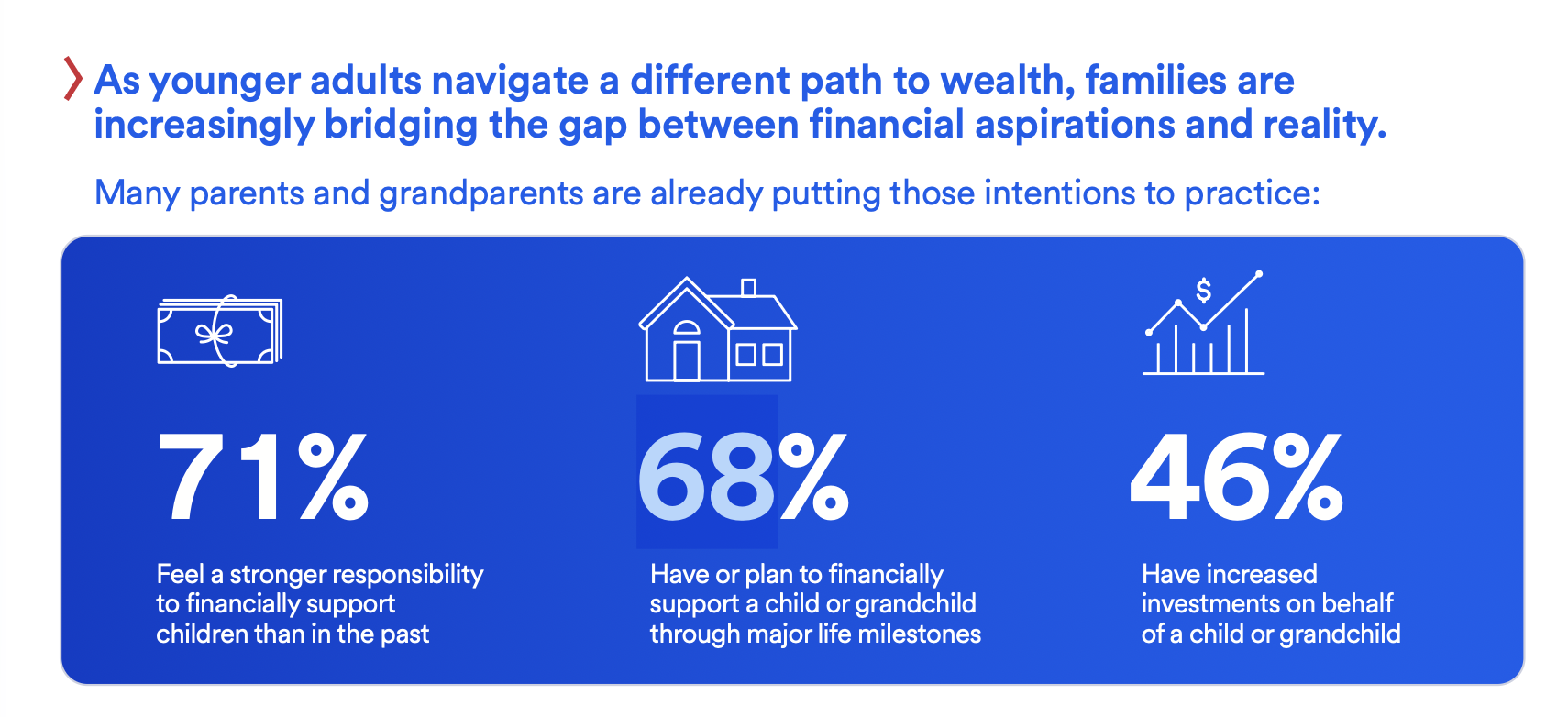
The pressure driving that guilt is documented elsewhere in the report. Fifty-six percent of Gen Z say they “did everything right” financially but aren’t where they expected to be, and 62% say they struggle to make financial progress no matter what they do. Homeownership hasn’t lost any of its symbolic pull — 86% of Americans across every generation still call it a marker of financial success — but only 22% of Gen Z non-homeowners who want a home think they’ll actually get one within five years, and 29% say they’ve already given up on the goal entirely, more than double the 12% of Boomers who’ve done the same.
The nihilism emerges in the report as a rational reaction to facts on the ground: 86% of Americans across every generation still call homeownership a marker of financial success, but 62% of Gen Z and 61% of Millennials say the stock market has become a more realistic path to wealth than buying a home.
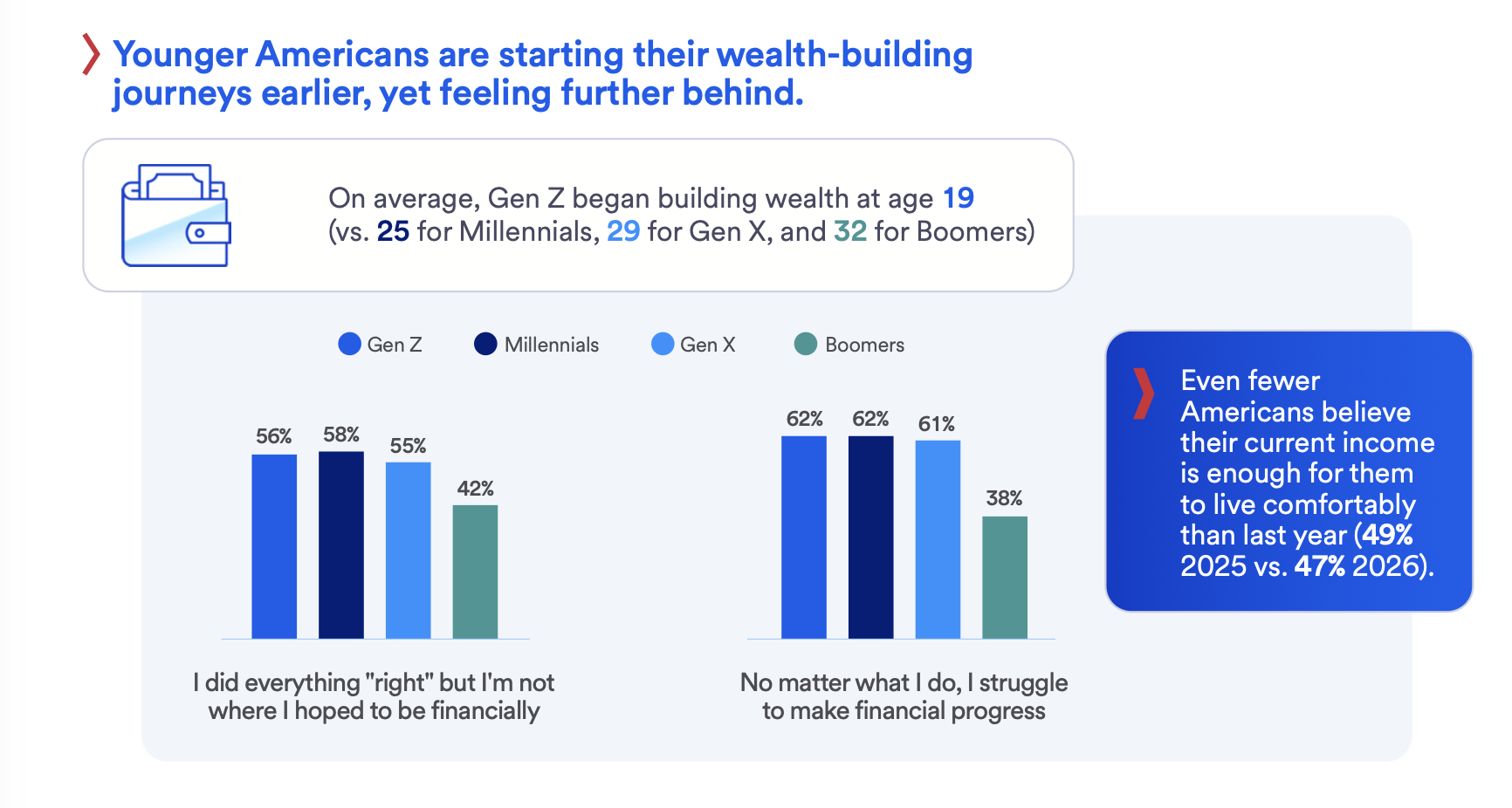
The evolving American wealth equation
The questions landed at the end of a discussion that had already laid out a broader picture of how Americans are adjusting their approach to wealth. Ford opened by noting that the financial markers of success — buying a home, building a career, educating children — have stayed remarkably constant across generations, even as the path to reach them has changed considerably, particularly for Gen Z.
The panel also spent significant time on the gender gap in wealth-building. They found that women begin building wealth slightly earlier than men, at 27 versus 28, but only 26% felt confident and prepared when they started, compared with 41% of men. Nelson called this a paradox: women want more guidance — 80% say so — but are less likely than men to actually work with a financial advisor, a pattern he attributed to discomfort with financial jargon. Lawlor noted a generational silver lining, pointing out that 31% of Gen Z women now say they felt prepared when they began building wealth, the highest share of any female cohort surveyed, which she credited to rising financial literacy and enrollment gains for women in business schools.
Ford also highlighted what the survey calls “First Generation Wealth Builders” — the 44% of Americans without a family financial role model or expectation of inheritance — describing them as prioritizing fundamentals like saving, budgeting and debt paydown before taking on investment risk. He connected that group directly to the parental-obligation theme, noting that 71% of parents now say they feel more responsible for helping their children get ahead than parents did in the past.
Taken together, the panel’s answers to every reporter’s floor questions told a coherent story: Gen Z isn’t abandoning the traditional wealth-building script, as the “financial nihilism” narrative suggests — it’s leaning harder on family to stay in it. Parents aren’t stepping in because their kids gave up; they’re stepping in because, as Lawlor put it, the math changed and the sense of obligation followed. Nelson’s data-driven pushback on nihilism and Lawlor’s read on parental obligation describe the same generation from two directions — one still playing by the old rules, the other unable to do so without help nobody expected to need this much.
For this story, Fortune journalists used generative AI as a research tool. An editor verified the accuracy of the information before publishing.
This story was originally featured on Fortune.com

President Trump’s newest vaccine ‘demands’ repeat old misinformation
Get your daily dose of health and medicine every weekday with STAT’s free newsletter Morning Rounds. Sign up here.
I asked and you delivered … some great reading recommendations, including “Legacy” by Uche Blackstock and “Healing” by Theresa Brown. I’m adding both to my list, along with “The Emperor of All Maladies” (which has four new final chapters!). My own suggestion in return: I recently finished “The Spirit Catches You and You Fall Down,” a deep dive on a Laotian family trying to navigate the American medical system.
Toast’s CMO is also its COO. Here’s how she makes room for both jobs
Kelly Esten has held onto two C-suite titles at Toast by becoming comfortable giving other things away, a habit that helps define her leadership style.
Over nine years at the restaurant technology giant, Esten has run product launches, led partnerships, and helped grow its business with larger restaurant groups. Today, she is both CMO and chief operating officer, a combination that spans two functions and pushes her to think about the digital ordering and payments company as a whole.
Making room for that remit has meant regularly deciding which parts of her old jobs should no longer be hers and which tasks to offload. “I get to supervise, but I don’t get to do the work anymore,” she concedes.
With two C-suite roles—first the marketing chief title and then the COO role—Esten says the operator side “certainly dominates,” making her increasingly deliberate about where she puts her “time and, more importantly, energy and attention.”
Her threshold for getting into the details has risen accordingly. Esten still weighs in on work she once owned, though she tries to reserve that involvement for moments when she believes her opinion could truly change the business outcome. If decisions routinely depend on her input, she sees that as a sign that she needs to give her team more authority to make them on their own. Otherwise, she becomes the bottleneck.
But giving people more authority only works if they have enough context to use it. As Esten began managing managers and eventually executives, she became more deliberate about sharing what she knew so they could make decisions without waiting for her.
She first saw the need for this while running product marketing, when leadership decisions and discussions didn’t always reach her team and her team’s insights didn’t always make their way back up.
Esten began writing weekly updates, sharing what she was thinking about, working on, and prioritizing. She still sends two every week, one to marketing and another to the enterprise organization, giving both teams more of the information they need to operate without her direct involvement.
In the latest episode of Fortune Next to Lead, Esten talks about what she’s learned from moving between marketing and operations, how holding both roles shapes how she runs them, why AI could further blur the lines between functions across the C-suite, and what that means for leaders taking on more than one remit.
Watch the full conversation here.
Ruth Umoh
ruth.umoh@fortune.com
This story was originally featured on Fortune.com