
Toast’s CMO is also its COO. Here’s how she makes room for both jobs
Kelly Esten has held onto two C-suite titles at Toast by becoming comfortable giving other things away, a habit that helps define her leadership style.
Over nine years at the restaurant technology giant, Esten has run product launches, led partnerships, and helped grow its business with larger restaurant groups. Today, she is both CMO and chief operating officer, a combination that spans two functions and pushes her to think about the digital ordering and payments company as a whole.
Making room for that remit has meant regularly deciding which parts of her old jobs should no longer be hers and which tasks to offload. “I get to supervise, but I don’t get to do the work anymore,” she concedes.
With two C-suite roles—first the marketing chief title and then the COO role—Esten says the operator side “certainly dominates,” making her increasingly deliberate about where she puts her “time and, more importantly, energy and attention.”
Her threshold for getting into the details has risen accordingly. Esten still weighs in on work she once owned, though she tries to reserve that involvement for moments when she believes her opinion could truly change the business outcome. If decisions routinely depend on her input, she sees that as a sign that she needs to give her team more authority to make them on their own. Otherwise, she becomes the bottleneck.
But giving people more authority only works if they have enough context to use it. As Esten began managing managers and eventually executives, she became more deliberate about sharing what she knew so they could make decisions without waiting for her.
She first saw the need for this while running product marketing, when leadership decisions and discussions didn’t always reach her team and her team’s insights didn’t always make their way back up.
Esten began writing weekly updates, sharing what she was thinking about, working on, and prioritizing. She still sends two every week, one to marketing and another to the enterprise organization, giving both teams more of the information they need to operate without her direct involvement.
In the latest episode of Fortune Next to Lead, Esten talks about what she’s learned from moving between marketing and operations, how holding both roles shapes how she runs them, why AI could further blur the lines between functions across the C-suite, and what that means for leaders taking on more than one remit.
Watch the full conversation here.
Ruth Umoh
ruth.umoh@fortune.com
This story was originally featured on Fortune.com

Wealth Effect Maintaining Growth: McCormick




Money-losing Nscale’s $35 billion IPO includes a $3 billion deal with Nvidia and ‘going concern’ worries
Good morning. On Fortune’s radar today:
- Nscale’s $35 billion IPO
- Markets: Bitcoin shows signs of life
- There was a $62 billion wave of stock-buying before the Fed’s last call
- The internet is now half-written by robots
- AI’s $3.6 trillion circular financing network
- Sydney Sweeney owns equity in Novig
This story was originally featured on Fortune.com

Elon Musk’s mom isn’t fussy about where she sleeps either—Maye Musk stays in a garage when she visits the Tesla CEO in Texas
Elon Musk may be the richest man on the planet, but he and his mom aren’t particular about where they sleep—as long as it’s convenient.
The man, reportedly worth $942 billion and the richest person on the planet, recently confirmed he’s living in an Airstream trailer in Memphis to oversee xAI’s Colossus expansion, a massive supercomputer center.
It seems Musk’s mom, a writer and model, also isn’t picky about her digs when she visits her son.
Appearing on Fox Business over the weekend, Maye said she slept in a garage when visiting Musk in Texas, where rocket company SpaceX is headquartered.
“It’s a small house and a small bed in the garage,” Maye said. “And I can sleep there, or 45 minutes to go in a suite in a hotel. No, I’ll sleep in the garage.”
“When my mom moved from South Africa back to Canada, she slept in her garage, and when my kids were in school—at university—I slept on the floor, on the couch—after taking the pizza boxes off, I mean.”
While Maye added that her career often allows her to enjoy luxury stays as well, her son’s many roles mean he famously rests as close to work as he can get. Musk previously confirmed that for three years his primary residences were the factories of EV maker Tesla.
“For a while there I was just sleeping under my desk, which is out in the open in the factory for an important reason,” he said at the 2022 Baron Investment Conference. “And it was damn uncomfortable sleeping on that floor. And always when I woke up, I’d smell like metal dust.”
He explained: “The team could see me sleeping on the floor during shift change, I was just met with nothing. They knew I was there, and that made a huge difference, and then they gave it their all.”
Musk said at the time he had also slept on a couch in a conference room, but swapped it for under his desk. The entrepreneur returned to sleeping on a couch after purchasing the social media platform Twitter, now known as X.
In an interview with the BBC’s James Clayton in 2023, Musk said he often slept in the San Francisco headquarters—specifically in a library on the building’s seventh floor “that nobody goes to.”
‘He doesn’t listen’
Musk wouldn’t be the world’s first trillionaire—or thereabouts—if he had listened to all the advice he was given.
Bridgewater Associates founder Ray Dalio, for example, remembers telling Musk not to sink his $180 million in proceeds from the sale of PayPal into a quest for life on Mars—an idea that later became SpaceX. The company now has a market cap of more than $2 trillion.
But Dalio isn’t alone—Musk also took little heed of his mom’s advice at the time.
“He said to me, ‘Should I do electric cars, or rockets, or solar energy?’” Maye told Fox. “I said, ‘You work so hard, just do one.’ He doesn’t listen to me. He did six companies, and they were all going to fail—remember? And now I’m so proud of him.”
This story was originally featured on Fortune.com

STAT+: Alkermes’ orexin agonist shows potential to treat ADHD in early-stage trial
Drugs called orexin agonists have been hailed for their ability to treat rare sleep disorders, but with new data, Alkermes is showing for the first time that the new class of therapies may benefit people with ADHD.
In a randomized Phase 1 study, the company’s new drug, called ALKS 7290, was well tolerated and showed a signal of efficacy, Alkermes said Monday.
Participants in the study started with a median score of 39 on a diagnostic known as the Adult ADHD Investigator Symptom Rating Scale, indicating that they had moderate to severe symptoms. After two weeks, those taking a high dose of 50 milligrams of ALKS 7290 experienced a 19-point reduction on the scale, indicating that their symptoms had become mild.







STAT+: With new strategy, Novo outlines plans for obesity, direct-to-consumer work
LONDON — Novo Nordisk on Monday sought to assure investors that it would regain its momentum in the coming years, outlining plans to expand its pipeline and find new products that it could sell more like consumer goods than traditional medicines, building off what’s occurring with its obesity treatments.
At the company’s capital markets day, taking place here all day Monday, CEO Mike Doustdar said Novo would launch at least five multi-blockbusters by 2030 and deliver revenue growth on par with other major pharma firms. He presented a strategy that involved investing more in disease areas outside diabetes and obesity and said the company “will be more active within business development,” an acknowledgment of investors’ concerns that Novo was too reliant on its landmark GLP-1 drugs and needed to develop other products.
Novo shares dropped 5% during Doustdar’s opening remarks, a sign that investors wanted more specifics.

McKinsey partners: you need to protect successful new ventures from the core business
The search for growth often comes down to three choices: buy, build, or partner. Acquisitions traditionally offered CEOs a faster path to scale, while partnerships offered the ability to unlock opportunities that were difficult to pursue alone. Now, AI is shifting the build playing field: lowering experimentation costs, quickening build cycles, and letting AI-native businesses be designed from the outset.
That shift has expanded the range of new ventures that can be built. And, accelerated how quickly they can scale. Successful ventures now reach $10 million in revenue within 31 months on average, compared to a previous average of 38 months and they break even with 40% less capital than before.
But there is a catch. The more successful a venture becomes the harder it is to protect.
The systems that power the core business — governance, teams, processes and controls — can get in the way of the new venture scaling. Which is why CEOs need to be ready to step in.
Choose where to play and how far to go
Before the CEO can protect the scaling asset, they first need to identify that scalable idea. Often the strongest ideas sit at the intersection of a growing market, a valuable customer problem, and an area where the company can build a distinct, sustainable advantage.
But, choosing where to play also means deciding how far to go. How close should the venture sit to the core? Should it pursue the home market or somewhere new? What happens if it starts competing for the same customers – or revenue – as the business paying today’s bills? Or can the new venture fuel growth on top of existing revenue?
Honeywell shows what can happen when a company builds around its distinctive advantages. It created Honeywell Connected Enterprise to turn decades of industrial expertise into recurring software revenues. By 2023, the business had grown to around $1.5 billion in annual sales and is growing around 3x faster than Honeywell overall.
Make several bets and back the scaling venture
Successes inevitably sit alongside failures. Meaning, CEOs need to give teams room to experiment and learn when ideas fall short, without continuing to fund ventures that aren’t working.
AI is changing the pace of that equation. Faster, cheaper experimentation means companies can place more, smaller bets, then concentrate capital and talent behind those showing real traction. It’s a proven formula. Companies launching three or more ventures simultaneously – the portfolio approach – can achieve up to 30% higher revenue growth than those making a single bet.
The Saudi Telecom Company Group shows what a portfolio approach can deliver. It has consistently built successful ventures across multiple domains including payments, internet of things, cyber security, data centers and cloud infrastructure. It does this by combining incubation, partnerships and venture investing, and its subsidiaries are now growing 10 to 15 times faster than the core business.
Decide with evidence, not vanity metrics
One of the reasons ventures fail, is that leadership start seeing project reporting rather than evidence that the business is working. That’s crucial – a venture can hit every project milestone yet still fail to become a good business.
The signals that matter are customer and commercial facts. Are customers using the product? Coming back? Willing to pay? Are the economics improving?
It’s important that funding is given a similar discipline: short review cycles and clear thresholds for further funding can help CEOs act on evidence. Much like a venture capitalist, they can call a halt when the evidence says a venture isn’t working and move capital towards opportunities demonstrating the strongest traction.
Stop the venture from being prematurely corporatized
Funding a new venture inside a corporate comes with advantages independent start-ups spend years trying to establish: customers, capital, data, expertise, distribution, and an established brand. The challenge is accessing them without inheriting the constraints that come with them.
BCP found that balance when it launched Yape, a mobile wallet. It was staffed with product development, engineering, and design talent rather than traditional bankers. That allowed Yape to operate differently while drawing on BCP’s strengths. It has since become a super app scaled to more than 18 million users.
But, that balance can be hard to maintain as a venture succeeds. More parts of the organization get involved, governance expands, and the venture can gradually inherit the processes it was initially protected from.
These are moments when CEO involvement can make all the difference: removing internal barriers, opening doors to partners, adding funding as growth takes off, or protecting a promising venture from being pulled prematurely into the core. It works too — where CEOs personally prioritize venture building, new businesses can contribute nearly 20% of enterprise-wide revenue within five years.
CEOs cannot – and should not – make every decision. But staying close enough to the facts to know when to step in, and doing the things only they can do, may be what turns business building into a repeatable source of growth.
The opinions expressed in Fortune.com commentary pieces are solely the views of their authors and do not necessarily reflect the opinions and beliefs of Fortune.
This story was originally featured on Fortune.com

We co-led the UN’s dialogue on safe and secure AI. Here’s what needs to happen now
Over the past week, AI’s own builders have sounded the alarm. Several of the industry’s leading CEOs are now publicly calling for a slower pace of AI development, citing risks from loss of control to cyberattacks to bioterrorism.
That news came days after Bank of England Governor Andrew Bailey, chairing the Financial Stability Board, told G20 finance ministers and central bankers that today’s already shaky global financial system faces a new threat in AI. With so many institutions now depending on the same handful of AI models and cloud providers, one exploited weakness can spread rapidly.
We receive these warnings with wariness, but not with surprise. As co-leads for safe, secure and trustworthy AI at the first UN Global Dialogue on AI Governance in Geneva this past July, we agree that the world needs common rules. New AI systems should only be released after being independently tested against agreed thresholds of what they can do. Developers should publish their safety protocols, and any incidents that arise after deployment should be clearly monitored and reported.
Geneva was an important first step toward coordinated AI governance, one that handed us the roadmap. In a year of widening fault lines around trade, security, and power, 170 countries managed to come together alongside industry and civil society to find some common ground on mechanisms to begin governing this fast-moving technology.
Appreciating the constraints of working at the UN level, there are “no regret” actions, steps that carry no downside, that the UN could take immediately.
First, connect the dots between science and policy. Right now, the scientists studying AI’s risks and the diplomats negotiating what to do about them are working on separate tracks, with no structured way to talk to one another. The UN’s Independent International Scientific Panel on AI presented its first evidence-based assessment in Geneva. That evidence needs a formal channel into the Global Dialogue’s negotiating process ahead of next May, rather than sitting alongside it. With most AI research and development happening behind closed industry doors, citizens and policymakers need the best scientific advice available if they are going to remain informed and act.
Second, don’t wait to build on what we know works. We are calling on the UN to develop a common reference baseline for safety, grounded in international human rights law and built from what already exists. Established frameworks such as the OECD AI Principles, the G7 Hiroshima code of conduct, the Frontier AI Safety Commitments from the 2024 Seoul Summit, and UNESCO’s Recommendation on the Ethics of AI point the way, alongside the International Organization for Standardization (ISO) and National Institute of Standards and Technology (NIST) standards engineers actually build to.
By creating a shared understanding of current regulatory floors, individual nations can prioritize what to build in their national and regional contexts. Costa Rica’s own National AI Strategy was built with government, civil society, industry, and academia at the same table, and anchored in international frameworks rather than inventing its own. That process is worth replicating.
Third, we must build in inclusivity—both geographic and financial—so that conversations such as the UN Dialogue are open to everyone. That means funding real participation, so governments, researchers, and civil society with less financial capacity can be in the rooms where the conversations are happening. That needs a dedicated trust fund, similar to the one that funds the Intergovernmental Panel on Climate Change (IPCC).
Inclusivity also means proving that different regulatory systems can work together on equal footing, not just in theory but through a handful of cross-border regulatory sandboxes, piloted by a small group of countries and shared openly. In the financial sector, regulators already do this through the Global Financial Innovation Network, which lets different countries test new financial products together across borders.
These recommendations are absolutely within reach. What matters now is whether we bring the same rigor and political will to following through on what we agreed to. By the time the Global Dialogue reconvenes in May, three things should be in place: an evidence assessment from the scientific panel; a Dialogue agenda that takes up the safety baseline; and a first cross-border sandbox pilot.
This urgency is not abstract. As the Financial Stability Board’s letter and other recent events make clear, these risks are already at our front door, wherever we live.
Governments, companies, and civil society groups spoke with clarity and conviction this summer on what AI governance requires. That work needs to carry forward at the UN this fall and into next year’s talks. We do not have time to relitigate issues that should already be settled.
If a handful of powerful actors decide how AI is governed, the rest of the world loses out. This summer showed that a wide range of countries and organizations can agree under pressure. The next step is delivering results the world can actually see.
The opinions expressed in Fortune.com commentary pieces are solely the views of their authors and do not necessarily reflect the opinions and beliefs of Fortune.
This story was originally featured on Fortune.com
The hidden cost of disconnected care


Opinion: STAT+: The NIH budget should be $100 billion per year
In late August, the Food and Drug Administration approved a new therapeutic for pancreatic cancer, daraxonrasib, developed by Revolution Medicines. This drug is for previously treated patients and represents a revolutionary new therapeutic to target KRAS inside pancreatic cancers, the most commonly mutated oncogene found in the disease. Having this mutation is a very bad sign for a pancreatic cancer patient, often indicating that their case is terminal.
Medicine has known about KRAS for decades, but because of its physical shape, it’s been nearly impossible to treat. Until daraxonrasib proved for the first time that KRAS could be treated, bound, and stopped.
While pancreatic cancer remains a devastating diagnosis, this therapy nearly doubled the survival rate in a clinical trial — an incredible result for those patients and their families. Time is priceless.

STAT+: Can RFK Jr. help GOP win the midterms? Iowa is a test
WASHINGTON — Zach Lahn, a farmer and Republican candidate for Iowa governor, says he won’t forget these moments: visiting a bait-and-tackle shop, bream fishing, and campaigning alongside health secretary Robert F. Kennedy Jr.
“RFK Jr.’s story is one that I have long admired,” Lahn wrote on his official campaign page in August, following Kennedy’s visit to Iowa.
Kennedy, in turn, wrote that Lahn was a “superstar.”
Lahn could use the help. He’s trailing the Democratic candidate in recent polls, in a state that voted for President Trump by more than 10 percentage points in 2024.
While many GOP candidates are struggling, Lahn’s race is a particularly sharp test of Kennedy’s pull with voters, especially those who are displeased with the president, whose disapproval rating has risen sharply.

Why is trust in science important?
Public trust in science, and in health institutions in particular, has been in decline for years.
On one hand, disinformation and cultural shifts have led people to lose faith in medicine and institutions that are critical for individual and public health. On the other hand, it is not hard to find examples of institutions that have lost the public’s trust for good reason. For nearly 11 years here at STAT, our journalists have been doggedly reporting on misdeeds, scandals, and crimes perpetrated by some of the biggest companies and names in the U.S. health care system.

Skeptical about modern medicine? I know the feeling — and want to listen
When health secretary Robert F. Kennedy Jr. talks about the chronic disease epidemic ravaging America’s young, I am one of the people he is speaking about. At 34 years old, I am overweight and already suffering from high cholesterol and high blood pressure. I have ADHD so bad I often forget to brush my teeth in the morning. And when a doctor — who I waited several months to see in hopes he’d figure out why I’m incessantly tired — recently asked what conditions my very high dose of an SSRI was treating, my response was simply “all of the above.”
I tell you all of this as STAT’s inaugural reporter on trust in science, because I know what it means to be searching for an explanation to what ails you, and a way to fix it. I also know all too well how frustrating it is to realize that modern medicine does not have all the answers. On bad days, when I’m especially anxious or I step on the scale after a good week of dieting to see no results, Kennedy’s claim that America’s medical system has turned into “a sick care system” that rewards doctors, hospitals, and drug companies resonates more than I’d like to admit. At my most desperate, I’ve tried the keto diet, injected a compounded peptide, and taken fistfuls of dietary supplements. It’s this worldview that will inform my work in this new role.

Addiction clinics see rising cases of kratom and 7-OH withdrawal
Addiction clinics around the country are seeing a growing number of cases related to gas station products made from the kratom leaf and its derivatives.
At the telehealth addiction clinic Boulder Care, for example, people who report using kratom products constituted 3% of all new patients in September 2025. By July 2026, that number was 8%, and in August, it jumped to 14%.

Opinion: ClinicalTrials.gov needs a pregnancy and lactation checkbox
If you are a patient looking to join a clinical trial, a clinician advising one, or a researcher trying to understand the trials that have been conducted for a particular medication, you may have encountered ClinicalTrials.gov. The website serves as a resource for clinicians and patients interested in trial participation as well as for researchers who want to understand the body of evidence for different conditions, assess signs of publication bias, and explore trial composition and representativeness. Since late 2007, federal law has required companies and researchers to register most Phase 2 to Phase 4 drug trials. Over 600,000 studies are listed on the site, which draws more than 3 million visitors each month and can be easily filtered based on patient age, sex, diagnosis, and ZIP code.
However, pregnant patients can’t easily identify studies for which they are eligible. ClinicalTrials.gov lacks structured data on whether pregnant or lactating people were included or can join a trial.

The midterms are a stress test for American media
- In today’s CEO Daily: How the media and money are coloring the election.
- The big leadership story: Better.com’s founder vs. the investor who replaced him
- The markets: Up around the globe.
- Plus: All the news and watercooler chat from Fortune.
Good morning. I’ve been thinking about Steve Ballmer, Elon Musk and the prospects for American voters to get the facts they need to make informed choices in the upcoming midterm elections. In-person voting began on Friday, the same day that President Donald Trump announced that he was banning CNN, MS NOW and Politico from the White House. (Journalists from those media outlets were denied entry and had their credentials deactivated on Saturday.)
Many things will influence how Americans vote at the polls on Nov. 3, but the media and money will certainly color their perceptions.
Let’s start with the media. The quality and accuracy of information that voters receive about government leadership matters. For example, they should know that Trump has traded more stocks since returning to office than every member of Congress combined—making 28,700 trades in 17 months, or about 80 trades every market day. That analysis came from Bloomberg, not the White House. As I’ve written about previously, Trump made more money last year as president than he ever did as a CEO. And there are always scandals on both sides of the aisle. It was a Politico report on sexual assault allegations that forced Democrat Graham Platner to withdraw from the U.S. Senate race in Maine.
Trump’s ban on three outlets he doesn’t like is just the latest in a string of assaults on independent journalism and freedom of speech over the past two years. The president has filed lawsuits and claims demanding more than $70 billion since he declared his candidacy for office in November 2022. Much of that pressure has been exerted on media companies that are already suffering from the impact of AI and disinformation (some of which they have promoted, to be sure). Trump has also been sued over selling sneak peeks of his Truth Social posts for as much as $100,000 a month.
What exacerbates this information war is the ability of wealthy donors to shape the narrative by pouring billions into political advertising, thanks to the Supreme Court’s 2010 Citizens United v. FEC ruling that lifted the cap on how much corporations, unions, and individuals could spend on independent political communications. That enabled Elon Musk to donate more than $291 million to Republican candidates, political action committees, and other outside spending organizations during the 2024 election, according to OpenSecrets.
One billionaire who does not believe in channeling his wealth into influencing elections is former Microsoft CEO and Los Angeles Clippers owner Steve Ballmer, who instead has spent more than $100 million to build and fund a nonpartisan, nonprofit initiative to combat political disinformation called USAFacts. I spoke to Ballmer in August 2024, shortly after he’d launched a “Just the Facts” video series and Meta had shut down its CrowdTangle tool to track misinformation. His goal, he told me at the time, was to help journalists and “get people educated, at a minimum.”
Ballmer is now in the news for channeling his money in other ways, with the NBA suspending him for a year and severely penalizing the Clippers for circumventing its salary-cap rules. Independent journalist Pablo Torre uncovered that story and won a Pulitzer Prize for his work, reinforcing the importance of calling out corporate leaders and politicians both when they do good—and when they fall short.
Trump is not the first leader to demand deference and attack journalists as corrupt “enemies of the people” for doing their job. I’ve lived and reported in plenty of other places where accurate stories can land journalists in jail. For a media industry that’s already being battered by different forces in Washington and beyond, the 2026 midterms could prove to be a stress test of what kind of system Americans are now willing to accept.
Contact CEO Daily via Diane Brady at diane.brady@fortune.com
This story was originally featured on Fortune.com

Why default servicing breaks at the handoffs

Moderna’s Bob Langer and AI pioneer Yann LeCun join board of Cellular Intelligence, bringing AI into medicine via a Parkinson’s drug
Cellular Intelligence is trying to build an AI model that can predict and eventually control how living cells behave, the same way AI models predict text or images, in hopes of making new medicines faster and cheaper to develop.
The company took a step toward that goal Monday, announcing that Moderna co-founder Robert “Bob” Langer and Turing Award-winning AI researcher Yann LeCun have joined its scientific advisory board, along with Jens Nielsen, chief executive of the Novo Nordisk Foundation’s BioInnovation Institute, and Fabian Theis, a computational biologist who directs the Computational Health Center at Helmholtz Munich. Langer is also joining the company’s board of directors as an observer.
For decades, developing new medicines, especially cell therapies that use living cells rather than chemical compounds, has depended on slow, expensive trial-and-error lab work. The Boston-based Cellular Intelligence (CI) is trying to apply the same kind of pattern-recognition that powers modern AI systems to biology: feed a model enough data on how cells respond to different signals, and it may be able to predict how to make a cell do what you want, without testing every possibility by hand first. Putting LeCun, an AI researcher with no biology background, on the same board as Langer, a medical researcher with no AI background, is the company’s way of showing it has real expertise on both sides.
“What matters to me is whether the science can lead to something that makes a difference for patients, and whether the people involved can carry it through,” Langer told Fortune. “I have been doing this for over 50 years, and [CI’s CEO] Micha and the scientific team he has brought together are among the very best I have seen.”
Micha Breakstone, the CEO of CI, said the addition of the four new members precisely cater to the company’s foundation as “a marriage of three disciplines: genomics, developmental biology and AI.”
“A world model learns how a system behaves and predicts what happens when you act on it,” he told Fortune. “For us, the system is a living cell: the basic computational unit of life, receiving signals, processing information and changing its behavior in response.”
Combining AI with medicine
The board brings a special mix of medical and technology expertise. LeCun won the 2018 ACM A.M. Turing Award for his foundational work on deep learning and led Meta’s Fundamental AI Research lab as the company’s chief AI scientist from 2013 to 2025. He left the company last December to launch AMI Labs, a company built around “world models”—AI systems designed to learn how a physical system behaves and predict what happens when it’s acted on—where he now serves as executive chairman.
Langer is an MIT Institute Professor, the school’s highest faculty rank, and holds more than 1,500 issued and pending patents. Beyond Moderna, he has co-founded roughly 40 companies and received the National Medal of Science. Jens Nielsen is chief executive of the BioInnovation Institute, the Novo Nordisk Foundation’s Copenhagen-based engine for founding and scaling life-science companies. Fabian Theis directs the Computational Health Center at Helmholtz Munich, co-founded the Human Cell Atlas, an international project to map every cell type in the human body, and won Germany’s 2023 Gottfried Wilhelm Leibniz Prize for machine-learning methods.
The company is bringing “a proprietary engine for generating biological data over time, an AI foundation model built to learn from that data, and an owned clinical program where it can test the practical value of its predictions,” Langer said. Early internal benchmarks show stronger prediction results than existing models in both healthy development and cancer, “despite never training on a single cancer cell,” he added.
Breakstone also credited OpenAI’s chief executive of applications, Fidji Simo, with helping shape the company’s direction while serving as a strategic advisor and consultant. “Her guidance has helped me sharpen our strategy and think through how we build a company of lasting significance,” he said. Simo joined OpenAI in the newly created role last year after leading Instacart, and her advisory ties to Cellular Intelligence add another AI-world name to the company’s roster of outside voices.
AI solving for Parkinson’s
The advisory additions follow the company’s acquisition in May of global rights to STEM-PD, an experimental Parkinson’s disease cell therapy that Novo Nordisk shelved when it shut down its cell-therapy division last October. The therapy, designed to replace dopamine-producing neurons lost to Parkinson’s, carries FDA Fast Track designation and is Phase 2-ready. Novo Nordisk took an equity stake in Cellular Intelligence as part of the deal and remains eligible for future milestones and royalties.
“Novo Nordisk selected CI to advance STEM-PD, and we acquired global rights to a Phase 2-ready Parkinson’s program with FDA IND clearance and Fast Track designation. Novo also made a strategic equity investment in CI. We see that as a strong vote of confidence in the next chapter of this work,” Breakstone said.
STEM-PD remains the company’s only owned clinical program, but Breakstone said Cellular Intelligence plans to license its models to pharmaceutical partners for paid drug-discovery work and to develop additional medicines itself or with partners over time.
Langer said his involvement with Cellular Intelligence sits alongside a number of other biotech ventures he’s backed this year, including Vivtex’s $2.1 billion deal with Novo Nordisk, his son Michael Langer’s venture firm T.Rx Capital, and his daughter Susan Langer’s RNA startup Soufflé Therapeutics.
Cellular Intelligence, founded in 2023 and formerly known as Somite.ai, has raised more than $70 million from investors including Khosla Ventures, the Chan Zuckerberg Initiative and Novo Nordisk. STEM-PD remains an investigational therapy.
This story was originally featured on Fortune.com

U.S. Treasury’s bond scheme is not a national debt management tool, say top economists, but it did show Wall Street what makes Scott Bessent flinch
Treasury Secretary Scott Bessent isn’t short of investors keen to rap his knuckles—and his friend and mentor, Stan Druckenmiller, was at the front of the queue.
Bessent has been chastised by many for his recent attempt to manage prices in the bond market. As 30-year Treasury yields rose toward a near-20-year high last month, the Treasury announced a multi-billion-dollar buyback scheme on long-dated Treasuries, which reduced supply and pushed yields down. With long-dated yields used as a benchmark for borrowing costs across the economy, conditions should have loosened (in theory) for everything from mortgage and government interest rates to business loans.
The timing seemed convenient to skeptics: The U.S. national debt just hit $40 trillion, with interest payments by the Treasury expected to exceed $2 trillion in the fiscal year 2026. Reducing the yield on bonds would bring down the government’s borrowing costs.
The action seemed all the more noteable as, just weeks before, Bessent announced an intervention to buy up the Japanese yen—the currency of the nation that holds the greatest value in American debt. One interpretation of the move was that it prevented Japan from selling its hoard of U.S. bonds to support its own currency—a move that would have raised yields on U.S. debt, making it more expensive for the government to repay.
Investors began questioning whether Bessent may be trying to shape the very markets that dictate the terms of government borrowing. Rather than “artificially suppressing” yields via “price management,” a “credible fiscal package” out of DC would have had more impact on yields, as famed investor Druckenmiller noted in a Wall Street Journal op-ed.
But Bessent, a self-professed economic historian, a Druckenmiller student, and a notable yen shortseller, knows all of this. Indeed, the Treasury Secretary never stated the buyback scheme was a price-setting exercise—the basis on which some now deem it a failure.
Economists Fortune spoke to suggested that the timing and tone of Bessent’s communication is what has caught the attention of Wall Street, and—potentially—led investors to draw unintended conclusions.
But Bessent may also have revealed to markets more than he calculated: The pain threshold at which the administration is willing to react. In an environment where Bessent is urging investors to look through the “noise,” his actions speak louder than words.
An exercise in responsibility
As the saying goes, the simplest explanation is often correct—and Wharton Professor Christina Parajon Skinner suggests precisely that. Bessent’s scheme is about efficiency, she tells Fortune, or “market plumbing.”
Prof. Skinner served at the Treasury under Bessent from July 2025 until August. While the Ivy League academic didn’t work on the buyback scheme, she said: “From the outside looking in, this very clearly does look like liquidity management, a market functioning exercise, which I don’t at all perceive to have been anything remotely close to a failure.”
The scheme is nothing new, she points out, as regular Treasury repurchasing operations were introduced in May 2024—the change has been in the size of the operation, up from $2 billion per action to $4 billion.
“The Treasury has never been a passive buyer of government debt,” Prof. Skinner said. “If you’re inside Treasury thinking about the market, we see that our bond market is generally working very well, we know what the Treasury market is, but we know that there can be some bumps in the long run that disrupt market functioning,” such as the 10-year going over 5%. “In the last administration, [this] is … precisely one of the reasons why this buyback facility was created, to provide liquidity.”
Yields shifting higher, combined with a confluence of events around national debt and yen intervention, means it’s “easy to put together a story that this was motivated by something else,” Prof. Skinner said. But she believes it would be an “error” to overextend the notion of market efficiency into a question of setting equilibrium prices in the bond market.
“The Treasury Secretary’s responsibility for the debt market is to ensure it’s functioning, to ensure that the government can borrow in the most efficient market possible, and to think about the tools that were already created for him,” she adds. “It would be actually disappointing and surprising if [Bessent] just sat on his hands and said, ‘OK, we’re going to let this shock not be absorbed, even though we have the capacity to help the market be more efficient during this period of time.’”
A policy twist
Macquarie’s global FX and rates strategist, Thierry Wizman, also doesn’t see a fiscal management question mark hanging over Bessent’s bond plan. Like Prof. Skinner, he is interested in Bessent’s justification of “liquidity,” but sees something different between the lines.
“When I see people debating what someone meant, I typically tend to go to the horse’s mouth,” Wizman tells Fortune. “He’s speaking about liquidity, and the question is how do you interpret that, especially since he didn’t talk about … the deficit [or] a yield target. The Treasury Department is always manipulating the Treasury market; that’s nothing new.”
But Wizman does spy a motivation in the global market, one of high issuance of government debt not only in the U.S., but also out of fellow developed economies: “If there’s a pressing need to allow AI infrastructure to get built out and financed, you certainly wouldn’t want all of that government debt issuance to crowd out the corporate issuance, and therefore we need to make space.” Reducing yields on government debt might also reduce the cost of the corporate debt that competes with it, making AI funding cheaper to obtain.
One might argue that if Bessent wanted to funnel funds toward AI, thereby supporting the capital expenditure that is driving U.S. economic growth at present, he would have signaled it. Bessent’s tone has changed in the past couple of months: He has been sharp with critics of the bond scheme, telling former White House strategist Steve Bannon on a podcast last week: “If some of the Bloomberg Terminal bros are unhappy with what I’m doing, well, that’s too bad.”
Wizman argued that it’s not the Treasury Secretary’s job to promote one sector over another, but points out that Bessent’s boss—President Trump—has been doing precisely that.
“It’s implicit by what the president is saying that they want to run the economy hot for AI, and then it’s the job of the Treasury to execute on that broader intention … the president sets overarching policy, especially industrial policy,” Wizman said. “So [Bessent] said he wants to create liquidity, that implies there’s not enough liquidity—then the question is, why is there not enough liquidity?”
It seems that AI investment is doing just fine without any help—Goldman Sachs estimates global AI investment will exceed $1 trillion in 2026—but the proof will be in the data, Wizman suggests: “You’re gonna have to wait until the end of the year to see if everyone got financed, you’re gonna have to wait until next year to see if the productivity gains from AI will in fact help grow and disinflate the economy” (which on its own right would bring yields down) “there’s a lot of things you need to wait for before you can judge this.”
Giving the game away
While the motivation and intended consequence of the Treasury’s buyback scheme is up for debate, the fact that the mighty department intervened has taught the market a new lesson: The conditions under which it feels compelled to act.
Elevated bond yields aren’t contained to the U.S.; 10-year yields have also been tracking higher in the U.K., Japan, and France, and the fundamentals suggest that government borrowing and inflation expectations will keep them high.
With these risk factors prevailing, the buyback operation may have set something of a precedent for reaction functions, suggests Columbia Business School’s Yiming Ma. She told Fortune: “This kind of communication sometimes works in the short term because it signals commitment to the market that a big buyer is going to step in in times of need. But sometimes it also can backfire because the market will look at this and say, ‘Well, the fact that you need to come out and say and do these things implies that this market has already lost the confidence of investors.’”
“I think that’s why it’s such a slippery slope for the U.S. Treasury to do this, because the U.S. dollar has been the global safe asset for a very long time, one that people tend to buy in bad times, who do not need these kinds of interventions that are much more reminiscent of more developing or emerging market economies whose currencies whose funding conditions are much more uncertain.”
The intervention is also something of a Pandora’s box, Prof. Ma suggests, because if markets now expect Treasury to step in when yields get too high, and it doesn’t, then confidence will fall dramatically: “Everyone wants to have investors believe that everything is great. Now, whether communication helps, and to what extent it helps, or whether communication hurts, I think that’s a very slippery slope.”
This story was originally featured on Fortune.com

Volkswagen recalls 208,000 SUVs over bolts that could cause steering loss
Volkswagen Group of America is recalling more than 208,000 vehicles in the U.S. over a steering rack mounting bolt that can corrode and break, potentially causing a loss of steering control.
The recall affects a total of 208,724 SUVs, including certain 2018 Tiguan, 2018-2019 Atlas and 2019-2021 Audi Q3 vehicles, the National Highway Traffic Safety Administration (NHTSA) announced.
The affected Tiguan vehicles were manufactured from March 22, 2017, through June 18, 2018, the affected Atlas vehicles were manufactured from Nov. 30, 2016, through Sept. 22, 2018, and the affected Audi Q3 vehicles were manufactured from May 21, 2019, through July 16, 2021.
FORD RECALLS MORE THAN 223,000 VEHICLES OVER FUEL TANK ISSUE
The recalled vehicles were manufactured with a specific steering rack, so vehicles with a different steering rack are unaffected by the recall.
According to the notice, the right-side mounting bolt on the steering rack can corrode after moisture enters the surrounding area. If the bolt head fractures, the steering rack could remain attached to the vehicle’s subframe at only one mounting point.
CHRYSLER RECALLS NEARLY 75K SUVS OVER PARTS THAT COULD DETACH WHILE DRIVING
According to NHTSA, continued loading could cause the steering rack housing to fracture, potentially leading to a loss of steering capability, potentially leading to a loss of steering capability.
“A broken steering rack housing can result in a loss of steering control, increasing the risk of a crash,” the NHTSA said in its notice.
Volkswagen and Audi said they are not aware of any crashes, fires, injuries or deaths linked to the defect.
CLICK HERE TO GET FOX BUSINESS ON THE GO
Dealers will replace the right steering rack mounting bolt with a bolt featuring a highly corrosion-resistant polymer coating at no cost. The new bolt is designed to offer greater protection against corrosion.
Owner notification letters are expected to be mailed out on Nov. 10.


BlackRock’s Vavrek: AI Hardware to Drive EM
BlackRock’s Vavrek: AI Hardware to Drive EM



Merriam-Webster welcomes ‘looksmaxxing,’ ‘vibe coding’ and ‘cuffing season’ to new word list
From “vibe coding” to “trash panda,” the internet has officially talked its way into the dictionary.
Merriam-Webster has added 1,400 new words and definitions to its online catalog, giving a digital-age “glow-up” to the language and official recognition to an internet-fueled mix that also includes “looksmaxxing,” “parasocial” and “Rickroll.”
The publisher said the new entries reflect terms and meanings that have demonstrated widespread use over time, offering what it called “a window into the world today.”
Merriam-Webster pointed to social media culture as a driving force behind a number of the additions. “Looksmaxxing,” a term tied to efforts to improve one’s physical appearance, made the cut alongside “parasocial,” which commonly describes a one-sided connection someone feels toward a public figure or media personality.
Merriam-Webster also welcomed “meme coin,” “promposal” and “Rickroll,” the internet prank that redirects an unsuspecting user to Rick Astley’s 1987 music video for “Never Gonna Give You Up.”
NEW YORK MAKES HISTORY WITH FIRST-OF-ITS-KIND LAW REGULATING AI-POWERED COMMERCIALS
Artificial intelligence left a major imprint on the update, with “vibe coding,” “AGI” and a new noun form of “compute” joining the dictionary.
The publisher also added “uncanny valley,” the unsettling feeling sparked by something artificial that appears nearly human, but not quite.
The additions stretch well beyond screens and Silicon Valley.
Food-related newcomers include “superfood,” “cake pop,” “shishito,” “bao” and “chili crisp.” The relationship term “cuffing season” also earned a spot, defined as a time when single people seek short-term romantic partners for the colder months.
VIRAL RACCOON JIMOTHY GETS HIS OWN MLB THEME NIGHT AS SEATTLE MARINERS EMBRACE THE TREND
Other entries capture the mood of modern life, including “Sunday scaries,” “crashout,” “copium,” “California sober” and “yacht rock.” “Shapewear” and “neckbeard” were also added, while “letterboxing” received a new digital meaning.
The list even includes the “Mandela Effect,” a term for a shared false memory, and “trash panda,” a playful name for a raccoon.
Merriam-Webster said words are not added simply because they suddenly go viral. Its editors look for sustained, widespread use before an entry is granted a place in the dictionary.
The sweeping update comes just months before Merriam-Webster is expected to announce its 2026 Word of the Year.
THE AI YOU USE EVERY DAY IS BIASED — AND IT’S QUIETLY SHAPING YOUR WORLDVIEW, NEW REPORT SAYS
In 2025, the publisher selected “slop,” defining it as “digital content of low quality that is produced usually in quantity by means of artificial intelligence.”
“The flood of slop in 2025 included absurd videos, off-kilter advertising images, cheesy propaganda, fake news that looks pretty real, junky AI-written books, ‘workslop’ reports that waste coworkers’ time … and lots of talking cats,” Merriam-Webster said at the time. “People found it annoying, and people ate it up.”
Other terms highlighted by the publisher in 2025 included “gerrymander,” “touch grass,” “performative,” “tariff,” “six seven” and “conclave.”

STAT+: Radiopharma companies merge after one receives surprise FDA rejection
ITM Isotope Technologies Munich SE and Telix Pharmaceuticals, two leading companies in the burgeoning radiopharmaceuticals field, are merging in a deal worth at least $1.65 billion.
Under the deal, Telix will acquire all shares of the privately held company ITM. Telix could also pay another $700 million to shareholders, if ITM’s lead drug meets regulatory and sales goals.
The merger creates another well-resourced company in the radiopharmaceutical field, which is currently dominated by Novartis. These medicines work by delivering radioactive isotopes directly to cancer cells. Novartis supercharged the field with the launch of its two such treatments in 2018 and 2022.

Dollar General CEO says consumers making $100,000 a year don’t feel like high-income shoppers anymore as high gas prices and inflation reshape habits
A six-figure annual salary used to be a milestone for career success and financial security, but it isn’t what it used to be.
The era of elevated inflation that began during the COVID pandemic has eroded the value of $100,000 to the point that Americans earning that much are hunting for bargains like everyone else.
Walmart has previously noted that more affluent customers are shopping at the discount chain. And now they are patronizing deep discounters like dollar stores.
At the Goldman Sachs Global Consumer and Retail Conference on Tuesday, Dollar General CEO Todd Vasos said core customers, whom he defined as those making less than $45,000 a year, change their shopping behavior when gas prices hit $4 a gallon.
For example, they tend to buy closer to home, shop more often, and buy less on each trip. The frequency of shopping goes up because customers don’t know what the next week will hold and will buy what they can, when they can.
“But the interesting thing with this economy, because of the other sustained headwinds of inflation over the years that have passed, even that middle to upper middle is acting more like a lower-income shopper these days,” he said, according to a Seeking Alpha transcript.
The national average for a price of gasoline is now $4.476 a gallon, up from $3.189 a year ago, according to AAA, as President Donald Trump’s war on Iran disrupts global oil markets. The price of diesel has soared to $6.50, making items shipped by trucks more expensive.
But it’s not just energy costs. Utility bills, new and used cars, insurance, food, and caregiving costs have all jumped. Vasos said even those making $100,000 a year or more are feeling the squeeze.
“I would tell you, what we’re hearing more and more from them is ‘I don’t feel like I’m higher income at $100,000 any longer,’ because of all of the headwinds that I just mentioned,” he added. “So we believe at Dollar General, we’re in a really good position to service all of the different demographics of what we have.”
Still, consumers remain very resilient, and the biggest reason is that they have stayed employed, Vasos explained.
Indeed, the ability of consumers to adapt to higher prices has been a hallmark of the U.S. economy lately. The latest retail sales report showed a better-than-expected 1.2% increase in August and a 1.1% gain after excluding gasoline.
As long employment holds, Dollar General’s costumers will find a way to navigate the inflation landscape, he predicted.
“Having 2,000 items at or below $1 is very meaningful for the consumer, always has, but especially in this environment,” Vasos added.
Other signs have emerged that making $100,000 isn’t enough to avoid economic anxiety. A survey from the Harris Poll last year found that 64% of six-figure earners said their income isn’t a milestone for success but merely the bare minimum for staying afloat.
In fact, even those making $200,000 or more have resorted to financial tactics that are often associated with less wealthy consumers. For example, 64% said they’ve used rewards points to pay for essentials, 50% have used “buy now, pay later” plans for purchases under $100, and 46% rely on credit cards to make ends meet.
And Michael Green, chief strategist and portfolio manager for Simplify Asset Management, wrote a viral Substack post last year arguing the real poverty line should be $140,000.
Conventional gauges don’t capture how much Americans are struggling with the cost of living, even households earning six figures, he said.
“If the crisis threshold—the floor below which families cannot function—is honestly updated to current spending patterns, it lands at $140,000,” Green added.
This story was originally featured on Fortune.com




Chicago Storms Cancel Hundreds of Flights as Flood Threat Grows
Heavy rain and thunderstorms slammed the Chicago area Saturday, canceling hundreds of flights at the city’s major airports and raising the risk of flooding across northern Illinois as another round of storms threatened to prolong the disruption.
Chicago O’Hare International Airport bore the brunt of the travel problems, with hundreds of flights canceled as storms moved across the region.
By Saturday afternoon, 353 flights had been canceled at O’Hare, while Chicago Midway International Airport recorded another 71 cancellations.
Travelers who did manage to keep their flights faced substantial delays.
The Federal Aviation Administration imposed a ground-delay program at O’Hare, a traffic-management measure designed to keep aircraft at their departure airports when weather or congestion limits how many planes can safely arrive.
The program was scheduled to remain in effect until 10:59 p.m. Saturday.
For travelers far beyond Chicago, the consequences could extend well outside Illinois.
O’Hare is one of the country’s largest connecting hubs, meaning cancellations there can leave aircraft and flight crews out of position and disrupt subsequent flights elsewhere in the airline network.
Flood Threat Extends Beyond the Airports
The same storms disrupting air travel are creating problems on the ground.
The National Weather Service issued a flood watch covering Chicago and numerous communities across northern Illinois as repeated rounds of heavy rain moved through the region.
Forecasters warned that excessive rainfall could produce flash flooding, particularly in areas where drainage systems become overwhelmed or where the ground has already absorbed substantial rainfall.
The threat also extends to rivers.
The National Weather Service warned that heavy rain Saturday combined with additional thunderstorms Saturday night could push portions of the Des Plaines River basin toward flood stage as early as Sunday morning.
Areas being monitored included stretches of the river near Russell, Gurnee, Lincolnshire, Des Plaines and Riverside.
The exact severity remained uncertain because it depended heavily on where the heaviest bands of rain ultimately developed.
Why Repeated Storms Matter
One particularly important factor is how the rain is arriving.
Rather than one continuous period of moderate rainfall, the region has faced multiple rounds of thunderstorms capable of producing heavy downpours.
That can increase flooding risk because soil, drainage systems and waterways have less opportunity to recover between storms.
The National Weather Service warned Saturday that flash flooding caused by excessive rainfall remained possible across portions of north-central and northeast Illinois.
For motorists, even relatively localized flooding can become dangerous quickly.
Water collecting beneath viaducts, on low-lying streets or across roadways can make routes impassable, while moving floodwater can be significantly deeper and stronger than it appears.
Drivers should avoid attempting to cross flooded roads.
Another Difficult Night for Travelers
The immediate concern for airline passengers is that Saturday’s cancellations may not mark the end of the disruption.
Additional thunderstorms and heavy rain were expected Saturday night into Sunday, meaning airlines could face another round of weather-related scheduling problems.
Travelers connecting through Chicago should check their flight directly with their airline before leaving for the airport and continue monitoring it even after an initial departure time has been confirmed.
During major weather events, airlines may also issue travel waivers allowing eligible passengers to change flights without some of the usual penalties or fare restrictions.
Those policies differ by airline and itinerary, making it important for passengers to check the specific waiver covering their ticket.
Passengers whose flights are canceled should also remember that severe weather can affect aircraft and crew positioning. That means a flight scheduled after the rain stops can still be disrupted because the plane or crew needed to operate it may be somewhere else.
Businesses Feel the Disruption Too
The economic effects extend beyond passengers waiting at airport gates.
Chicago is one of America’s most important transportation and logistics centers. Significant disruptions can affect business travelers, cargo movements, hotels, restaurants, ride-share drivers and companies depending on employees or customers traveling through the region.
Flooding can compound those problems by slowing road transportation and preventing workers from reaching businesses even when flights and rail service continue operating.
For local businesses, repeated severe-weather events can mean lost customers, staffing problems and delivery delays — costs that aren’t always visible in the initial reports of canceled flights.
For travelers, the message heading into Sunday is straightforward: don’t assume the itinerary shown when a ticket was booked is still the itinerary that will operate.
Check the airline before heading out, allow additional time for ground transportation and keep an eye on weather alerts if traveling through northern Illinois.
For residents, the concern is increasingly shifting from simply enduring another rainy weekend to how much additional water already saturated communities and waterways can handle.
With more storms possible, Chicago’s travel problems could end before its flooding problems do.
JBizNews Desk | Chicago, Ill.
© JBizNews.com All Rights Reserved. Reproduction or distribution without written permission is prohibited.

Canada and France in talks to deepen ties and ‘live our lives as we choose’ while Macron also seeks oil and gas as Iran war disrupts supplies
Canadian Prime Minister Mark Carney and French President Emmanuel Macron agreed Sunday to deepen cooperation in space, defense, energy and business, expanding strategic ties between the two countries as Canada looks beyond the United States for new economic and security partners.
Carney said the countries will task their space agencies and defense ministries to develop and share infrastructure, including launch systems and ground-based reception facilities. They also agreed to expand cooperation in energy, telecommunications, climate resilience and economic development.
The meeting comes days after Carney embraced the prospect of Canada becoming the European Union’s first associate member and argued that deeper ties with Europe would make Canada less vulnerable to economic coercion by any single country.
“Canada and Europe will build an alliance for the future that will strengthen our collective resilience so we can live our lives as we choose based on the values that we share,” Carney said Sunday.
U.S. President Donald Trump’s tariffs, demands for economic concessions and repeated talk of making Canada the 51st U.S. state have pushed the Canadian government to reduce its dependence on its neighbor and pursue deeper economic, security and political relationships with Europe.
Macron welcomed Carney on Sunday at the airport of the French territoryoff Newfoundland’s coast.
“This is an important moment,” Macron said Saturday upon arrival in Saint-Pierre-et- Miquelon, home to about 5,800 people.
Talks “will allow us … to strengthen our bilateral economic ties and defense relationship,” Macron said.
Macron also said that Sunday’s talks are part of broader efforts to help France secure oil and gas supplies as the Iran war disrupts global energy markets and raises fears of higher prices for fuel and other essentials.
“Canada is a country with significant resources of critical minerals and rare earths. It is also a major oil and natural gas producer,” Macron said. “What we want to do is conclude agreements to secure more liquefied natural gas that can be shipped to Europe’s Atlantic coast.”
The leaders discussed deepening the Canada-France partnership in strategic sectors, including aerospace, energy, critical minerals and advanced technologies such as quantum computing, satellites and supercomputing, Carney’s office said in a statement.
Sunday’s meeting also follows Trump’s announcement of a deal on Greenland that would expand the U.S. military presence there while keeping the island under Danish control. The agreement followed months of threats by Trump to seize the semiautonomous territory of a NATO ally.
Macron welcomed the agreement Saturday.
“Danish sovereignty is being respected, international law is being respected,” he said. “Anything that helps ease tensions is a good thing.”
This story was originally featured on Fortune.com

Opinion | In the End, a Good Greenland Deal



Chinese State TV Outlet Raises Anthropic Privacy Alarm
A social-media account affiliated with China Central Television said this weekend that AI company Anthropic PBC has been quietly rewriting its privacy rules in ways that make it easier to hand user data to US intelligence agencies.
The account, known as Yuyuantantian, posted Saturday that Anthropic has changed its privacy policy 13 separate times since 2023. Among those changes, the account said, are provisions allowing the company to move data belonging to users in Canada, Brazil, South Korea and the European Union over to US servers. The post also said Anthropic widened the number of data sources it pulls from, going from three to six between June 2024 and September 2025.
One of the biggest shifts flagged in the post: Anthropic switched its default setting last September so that user conversations are used to train its AI models unless someone opts out, rather than the other way around. For everyday users, that means data that once wasn’t fed into Anthropic’s training pipeline by default now is, unless they actively turn the setting off.
The post also pointed to an Anthropic report in which the company said it shares technical indicators with intelligence agencies after determining that some Chinese companies had been using Anthropic’s models to train their own AI systems without authorization, a practice known as model distillation. Yuyuantantian went further, noting that two of three threat-intelligence job listings Anthropic had posted gave preference to candidates who speak Mandarin or Russian, have intelligence-analysis experience in government or military roles, and hold top-secret US security clearance — details the account used to argue the company’s data-sharing arrangements with US intelligence run deeper than disclosed.
The claims land at a tense moment between Anthropic and Beijing. Neither government has opened a clear path for Anthropic to operate inside China: Chinese regulators haven’t approved the company to do business there, and Anthropic itself has cut off access to its products for China-based users and companies majority-owned by Chinese entities, citing national security concerns. Access to Anthropic’s flagship product, the Claude chatbot, and its coding tool Claude Code has been unavailable in China as a result.
This isn’t the first run-in between Chinese authorities and Anthropic’s software. Earlier this year, China’s Ministry of Industry and Information Technology’s cybersecurity arm flagged versions of Claude Code for what it called a security backdoor, saying the tool could transmit users’ location and identity information to outside servers without their consent. Anthropic disputed that characterization at the time, saying the flagged code was an experimental anti-abuse feature meant to stop unauthorized resellers and prevent companies from copying its models, not a surveillance tool. The company also noted that since its products aren’t available in China to begin with, the warning didn’t affect anyone using its software legally.
For American consumers and businesses using Anthropic’s Claude products, the immediate practical takeaway is a reminder to check privacy settings directly. Anthropic’s own policy lets users opt out of having their conversations used for model training, and the setting is adjustable in the app or web account preferences. Businesses working with Anthropic under commercial agreements are typically covered by separate data-handling terms that don’t feed conversations into training data by default, regardless of the consumer-facing settings.
Anthropic has not yet issued a public response to the Yuyuantantian post as of Sunday. The company has previously said broadly that it discloses its data practices in its published privacy policy and that changes to that policy are communicated to users when they take effect.
JBizNews Desk | San Francisco, Calif.
© JBizNews.com All Rights Reserved. Reproduction or distribution without written permission is prohibited.

Iran’s economy faces another blockade: Red tape and gridlock are clogging up land routes that bypass the U.S. Navy’s Hormuz stranglehold
The U.S. naval blockade on Iran is already crushing its economy, and efforts to divert shipments over land are not providing much relief.
Before the war, more than 80% of Iran’s trade tonnage transited by sea via southern ports, but that’s been closed off. U.S. Central Command said Sunday, it has redirected 109 commercial vessels to ensure compliance with the blockade.
As a result, convoys of trucks have flooded land routes along Iran’s borders with Turkey, Pakistan, Afghanistan, Iraq, and Turkmenistan. Iran’s trade with Turkey, for example, jumped 19% to $3.2 billion during the first half of the year.
But bureaucratic hurdles, such as long customs checks, and infrastructure that wasn’t designed to handle so much volume have produced massive traffic jams. At one crossing with Turkey, 3,700 trucks were stranded on the Iranian side.
Lines of trucks stretch for miles, and drivers sometimes wait more than three weeks to finally bring their cargoes across a border. During that time, perishable foods go bad, and delays for other essentials add to costs, with inflation now at 90%.
A Turkish truck driver hauling used cars into Iran told the Financial Times that wait times at the border on the return trip can reach 24 days. And an Iranian trucker said he spent 23 days waiting at a crossing along the Afghanistan border in mid-June.
At the border with Turkmenistan, lack of warehouses and proper registration processes have limited the ability to transport more goods by rail, according to the Wall Street Journal.
While bilateral trade with Iran’s neighbors is up, overall trade is still down. In the five months ending Aug. 22, Iranian customs show that non-oil exports fell 28% from a year ago to $15 billion, and imports dropped by 26% to $17 billion.
The collapse in trade has hit fuel supplies, much of which must be imported as Iran lacks sufficient capacity to refine the oil it produces. That’s led to gasoline shortages, forcing Tehran to curb demand with price hikes.
Given the all the problems associated with using land routes, Iranian industry admitted the Strait of Hormuz has to reopen.
“Under these circumstances, there is little alternative but to find a way to restore and maintain the southern trade corridors” through the Gulf, a member of Iran’s Chamber of Commerce told the FT.
President Donald Trump is counting on economic warfare to bring an end to the conflict, and even Supreme Leader Ayatollah Mojtaba Khamenei has expressed anxiety about the economy.
But experts have cautioned that Iran’s repressive regime is unlikely to be swayed by the suffering of ordinary citizens and is prepared to wait out economic hardship longer than the U.S. public can endure high gas prices.

Still, the additional cost of relying on land routes is also staggering. Majidreza Hariri, the head of the Iran-China Joint Chamber of Commerce, said last month that transporting a single container between Iran and China via ships costs about $3,000, according to Hariri. But bypassing the blockade by transporting it over land would boost the cost to $12,000.
Given that 2 million containers pass through Iran’s southern ports annually, he estimated that heavier trade burdens will translate to about $18 billion in additional transportation costs alone every year.
Relying on land routes to get around the blockade could provide enough necessities to allow for short-term survival, but the economy will eventually “grind to a halt,” Hariri predicted.
By contrast, the other oil-producing countries in the Persian Gulf are getting more oil through the Strait of Hormuz, despite Iran’s efforts to scare away shipping with drone and missile attacks.
Central Command chief Adm. Brad Cooper said Saturday the U.S. military has supported the transit of 1 billion barrels of oil through the strait over the past two months, while assisting over 2,000 commercial ships.
With the strait’s primary transit lanes now cleared of mines, the volume of crude oil, cargo, and liquid natural gas over the past two weeks was the highest in six months, or right after the Iran war began.
“And Iran has exported zero barrels thanks to our ironclad blockade,” Cooper said.
This story was originally featured on Fortune.com

Fast-food chains are chasing the specialty drink boom. Inside Sonic’s strategy
As restaurant chains increasingly turn to specialty beverages to attract customers beyond the traditional meal, Sonic Drive-In believes a business model built around drink customization gives it a head start.
Marion Campbell, Sonic’s vice president of integrated marketing and communications, told FOX Business that the quick-service restaurant industry is still figuring out how to make specialty beverages a bigger part of its business, while Sonic has spent years building customization into its operations.
“I think that the market is just getting started. And QSR in particular is just figuring out a way to serve these types of beverages to their guests and make it a pivotal part of their DNA. It’s already a part of our DNA,” Campbell said.
The competition for beverage customers comes as restaurant brands experiment with specialty drinks, customization and limited-time flavors to give consumers additional reasons to visit. Rival fast-food chains McDonald’s, Taco Bell and Jack in the Box each offer their own versions of dirty sodas.
The nonalcoholic beverage market generated $264.1 billion in consumer spending at U.S. foodservice establishments in 2025, accounting for 23% of industry-wide sales, according to data from Technomic. The data also showed that cold beverage spending in 2025 climbed 3.4%, compared with a 1.2% rise for hot beverages, with Technomic saying that “innovation and consumer preference are driving cold beverages to the forefront of market growth.”
KRAFT HEINZ UNVEILS NEW PHILADELPHIA CREAM CHEESE FLAVORS TO WIN BACK SHOPPERS
For Sonic – which operates more than 3,400 restaurants and generates $5.2 billion in annual system sales – drinks can bring customers through its drive-ins even when they aren’t looking for a burger, hot dog or other full meal.
“A beverage-only guest is a very frequent guest. So beverage is always going to play a pivotal role because of the frequency it drives for the business versus just a check driver,” Campbell said.
She added that beverages can also increase how much a customer purchases when paired with food.
The company’s customization infrastructure has also allowed the chain to capitalize on the popularity of dirty sodas, which typically combine soda with additions such as cream and flavored syrups.
The dirty soda trend has exploded over the past two years, with case volume at quick-service restaurants jumping 318% during that time, according to data from market research firm Circana.
MAJOR BURGER CHAIN IN-N-OUT CHANGES TWO KEY INGREDIENTS, SENDING FANS INTO A FRENZY
“I think dirty sodas is a place we’ve actually played long before they were really deemed dirty sodas,” Campbell said.
Campbell said Sonic was positioned to capitalize on the trend because customers were already accustomed to customizing drinks at its restaurants.
The chain is now using that platform to experiment with new flavors and seasonal products, including its recently launched fall-inspired lineup and banana-flavored offerings.
CHECKERS & RALLY’S CEO SAYS AMERICANS’ DEMAND FOR FAST-FOOD VALUE IS ‘INTENSIFYING’
The strategy comes as consumers remain sensitive to restaurant prices, forcing chains to balance novelty and indulgence with value.
Campbell said beverage pricing can vary widely, from an everyday carbonated soft drink to more elaborate specialty offerings, and argued that consumers can be willing to spend more for an experience they consider distinctive.
Sonic’s latest seasonal marketing push also illustrates how the company is trying to translate beverage experimentation into customer traffic.
DUNKIN’ OPENED ITS FIRST-EVER DOG DRIVE-THRU WITH TREATS AND TOYS FOR PUPS ON NATIONAL DOG DAY
The chain created a campaign around “Hotumn,” its name for the period when consumers begin embracing fall flavors and clothing even as temperatures remain hot, particularly in Sonic’s core Southern markets. The campaign is scheduled to run for about four weeks.
Looking further ahead, Campbell expects customers’ appetite for personalization to continue shaping the beverage business.
“Again, customization’s not going anywhere. It’s been here forever. People like to be in control of the flavors they consume. They like to feel like they’re the creator, and they have that ability,” Campbell said.
She also pointed to flavored water as an area with room for additional experimentation as consumers look for customizable beverages beyond traditional soft drinks.
CLICK HERE TO GET FOX BUSINESS ON THE GO
Sonic has more beverage concepts in development, according to Campbell, although she declined to disclose what the company plans to introduce next.

Affordability Crisis Hits America’s Used-Car Lots
Americans turning to used cars to escape record-high new-vehicle prices are discovering an uncomfortable reality: buying used isn’t nearly as cheap as it used to be.
A shopper with $10,000 to $15,000 now typically gets a vehicle nearly nine years old with close to 100,000 miles — a dramatic deterioration from what the same budget bought before the pandemic.
According to Edmunds, the average vehicle purchased for between $10,000 and $15,000 during the second quarter of 2026 was 8.7 years old with 98,222 miles.
Back in the second quarter of 2019, that same amount of money bought a vehicle averaging just 4.7 years old and 58,250 miles.
In practical terms, today’s buyer is getting a car that’s about four years older with nearly 40,000 additional miles for the same budget.
That’s becoming a major problem for working families, first-time buyers and commuters who traditionally relied on the used-car market when new vehicles became too expensive.
Affordable Used Cars Are Disappearing
The problem isn’t simply that individual vehicles cost more. The entire lower end of the used-car market has shrunk.
Vehicles priced below $20,000 accounted for 55.2% of used-car sales in the second quarter of 2019, according to Edmunds.
By the second quarter of 2026, that share had fallen to just 31.8%.
Meanwhile, vehicles priced above $30,000 grew from 16.8% of the used market to 35.8% during the same period.
Three-year-old vehicles — traditionally one of the sweet spots for shoppers looking for relatively new cars without paying new-car prices — averaged $32,461 in the second quarter, a record for that quarter and 15.5% higher than in 2021.
The result is an increasingly difficult choice for consumers: spend considerably more money or accept an older vehicle with substantially more mileage.
New Cars Above $50,000
Part of the pressure begins on new-car lots.
The average transaction price for a new vehicle reached $50,089 in August, according to Kelley Blue Book data published by Cox Automotive. That was 1.9% higher than a year earlier and marked the first month of 2026 in which the industry average crossed $50,000.
As new vehicles become more expensive, the cars eventually entering the used market also carry higher prices.
At the same time, the supply of affordable late-model used vehicles remains constrained following years of disruption that began during the pandemic.
That combination has fundamentally changed what Americans can expect when walking onto a used-car lot with a limited budget.
Financing Adds Another Expense
For buyers who don’t have enough cash to purchase a vehicle outright, financing can make the affordability problem considerably worse.
Edmunds reports that used-car buyers financed an average of $30,414 during the second quarter of 2026, up from $29,080 a year earlier.
The average used-car payment reached $576 a month, while the average annual percentage rate stood at 10.5%.
Even more striking, 6.3% of financed used-car purchases carried monthly payments of at least $1,000 — a record in Edmunds’ data.
Higher borrowing costs could remain another obstacle.
The Federal Reserve on Sept. 16 raised its benchmark federal funds target range by a quarter percentage point to 3.75% to 4%, saying inflation remained elevated.
The federal funds rate doesn’t directly determine an individual auto loan, but broader interest-rate conditions influence lenders’ funding costs and ultimately the rates consumers encounter when financing vehicles.
Buyers Are Paying More — and Keeping Cars Longer
The affordability squeeze can create expenses beyond the dealership.
An older, higher-mileage vehicle may have a lower purchase price than a newer alternative, but buyers also have to consider potential maintenance and repair costs.
A car approaching or exceeding 100,000 miles can require tires, brakes, suspension work, batteries and other maintenance that may not appear in the monthly loan payment.
That makes comparing vehicles based only on monthly payments increasingly risky.
Edmunds recommends that consumers consider the total cost of financing and test different combinations of loan length, interest rate and down payment before committing to a purchase.
The same principle applies to the vehicle itself: purchase price is only one part of what a car ultimately costs.
Insurance, fuel economy, expected repairs, maintenance history and financing expenses can dramatically change whether an apparently inexpensive vehicle is actually affordable.
The Used-Car Safety Net Is Getting Weaker
For generations, the standard financial advice for someone unable or unwilling to pay new-car prices was simple: buy used.
That option still exists.
But the numbers show that it increasingly comes with compromises.
A $10,000-to-$15,000 budget that once put a shopper into a roughly five-year-old vehicle now commonly means buying one approaching nine years old and 100,000 miles.
And even shoppers willing to spend substantially more are competing in a market where three-year-old used vehicles average more than $32,000.
For American households already dealing with elevated housing, insurance, food and borrowing costs, transportation is becoming another place where the same paycheck simply doesn’t buy what it once did.
The used-car market may still offer savings compared with buying new.
But increasingly, America’s affordable used car isn’t disappearing because consumers don’t want one — it’s disappearing because fewer of those cars exist at prices families can afford.
JBizNews Desk | New York, N.Y.
© JBizNews.com All Rights Reserved. Reproduction or distribution without written permission is prohibited.

QatarEnergy on Energy Security and Supply

U.S.-Greenland Deal Eases Dispute That Threatened NATO Unity
The United States, Denmark and Greenland are preparing to sign a new Arctic security agreement that would expand America’s military role on Greenland without transferring sovereignty over the island, easing a confrontation that earlier this year raised extraordinary questions about the future of NATO.
The agreement marks a dramatic shift from the dispute that erupted after President Donald Trump repeatedly pushed for the United States to acquire Greenland and declined to rule out military force.
Greenland is a self-governing territory within the Kingdom of Denmark, making Trump’s earlier threats particularly significant because Denmark is a NATO ally.
Danish Prime Minister Mette Frederiksen warned in January that an American military attack on another NATO member would undermine the foundations of the alliance.
“If the United States chooses to attack another NATO country militarily, then everything stops,” Frederiksen told Danish broadcaster TV2 at the time, including the security framework NATO has provided since the end of World War II.
The confrontation never reached that point.
Instead, months of negotiations have produced an agreement that appears to give Washington much of the expanded security access it wanted while preserving Danish sovereignty and Greenlanders’ right to determine their own future.
No Transfer of Greenland
That distinction is central to the deal.
The Danish Prime Minister’s Office said the agreement will strengthen security across Greenland, the Arctic and the North Atlantic while recognizing “the sovereignty and territorial integrity of the Kingdom and the Greenlandic people’s right to self-determination.”
Greenland Prime Minister Jens-Frederik Nielsen similarly said the agreement recognizes Greenland’s interests and position in international cooperation.
President Trump has described the arrangement differently, saying it gives the United States permanent control over security in Greenland.
Those descriptions do not necessarily mean the United States is receiving sovereignty over the territory.
Denmark and Greenland have been explicit that the agreement does not transfer ownership of Greenland to Washington.
That gives each side something it had sought throughout the negotiations.
Washington gets a stronger security position in one of the world’s most strategically important Arctic locations.
Denmark retains sovereignty.
Greenland retains its right to self-determination.
And NATO avoids the extraordinary scenario of its most powerful member attempting to seize territory belonging to another member.
Why Greenland Matters to America
The U.S. military already has a major foothold in Greenland.
Pituffik Space Base in northwestern Greenland plays an important role in missile warning, missile defense and space surveillance.
The United States has operated militarily on the island for decades under a defense agreement dating to 1951.
But Greenland’s importance is growing.
Its location between North America and Europe makes the island strategically valuable for detecting missiles approaching the United States across the Arctic and for monitoring increasing military activity in the region.
Russia maintains a substantial Arctic military presence, while Western governments have also expressed concern about China’s long-term strategic ambitions in the region.
The new agreement is intended to prevent adversaries from establishing military footholds in Greenland while allowing the United States to expand its presence.
NATO Welcomes Arctic Cooperation
The agreement arrives as NATO is increasing its own attention to the Arctic and North Atlantic.
NATO’s senior military leadership met in Copenhagen this weekend for the alliance’s annual Military Committee Conference.
Admiral Giuseppe Cavo Dragone, chairman of NATO’s Military Committee, emphasized the alliance’s focus on strengthening collective deterrence and defense amid Russian military activity and other security threats.
NATO said its 32 chiefs of defense discussed readiness, military capabilities, technology and strengthening the alliance’s ability to defend the Euro-Atlantic region.
“NATO remains vigilant. NATO remains ready,” Cavo Dragone said following the meetings.
The Greenland agreement fits into that broader push by strengthening Western military access to a region that is becoming increasingly important to both North American and European security.
A Business Risk Begins to Recede
The significance extends beyond defense.
The earlier Greenland confrontation threatened to spill directly into trade.
Trump had threatened tariffs against European countries opposing his effort to acquire the island, creating another potential source of instability for businesses already navigating changing trade policies.
A serious rupture between Washington and Copenhagen also risked creating broader political uncertainty inside NATO and across the transatlantic relationship.
That matters economically because the United States and European Union maintain one of the world’s largest trade and investment relationships.
Companies make investment, hiring and supply-chain decisions years in advance. The possibility of escalating tariffs or a fundamental breakdown in U.S.-European security relations adds another layer of uncertainty to those calculations.
The Greenland agreement reduces that particular risk, although it does not eliminate the broader trade disputes between Washington and Europe.
Minerals Remain Another Prize
Greenland’s economic importance could also grow.
The island contains deposits of rare earth elements and other critical minerals used in defense systems, electronics, electric vehicles and advanced technologies.
Western governments have been trying to build supply chains outside China, which dominates the processing of many strategically important minerals.
Expanded U.S. security involvement could therefore be followed by greater American and allied interest in Greenland’s mining, infrastructure and energy sectors.
But developing those resources will not be easy.
Greenland has a harsh climate, limited infrastructure and high development costs. Having minerals underground does not automatically make them commercially viable.
Any major expansion of mining would require substantial investment as well as approval under Greenland’s own political and regulatory system.
Agreement Still Isn’t Final
Despite the diplomatic breakthrough, the agreement is not yet legally in force.
The governments of Greenland, Denmark and the United States are expected to sign it during the United Nations General Assembly in New York.
After that, the agreement will take effect only after the necessary national parliamentary procedures are completed, according to the Danish Prime Minister’s Office.
Important details also remain unknown because the complete text has not been publicly released.
Those include the exact scale of additional U.S. military deployments, where new facilities could be located, how investment restrictions will operate and how an expanded American military presence will be financed.
Trump has said the arrangement will come at no cost to the United States, but there is not yet enough publicly available information to determine the eventual expense of additional military infrastructure or personnel.
The agreement therefore does not close every question surrounding Greenland.
What it does appear to accomplish is something that seemed far less certain earlier this year: moving a territorial confrontation between NATO allies back into a negotiated security framework.
For Denmark and Greenland, that means preserving sovereignty and self-determination.
For Washington, it means expanded strategic access to Greenland.
And for NATO, it removes — at least for now — one of the most unusual internal disputes the alliance has faced in decades.
JBizNews Desk | Copenhagen, Denmark
© JBizNews.com All Rights Reserved. Reproduction or distribution without written permission is prohibited.

U.S. economy hits pivotal milestone: Spending on data centers and other information-processing hardware now exceeds housing investment
Two decades after the housing boom reshaped, then tanked, the U.S. economy, the AI boom is similarly transforming the drivers of growth.
Hyperscalers have poured so much money into building as much AI infrastructure as possible—and as quickly as possible—that investment from a handful of companies is expected to reach $1 trillion a year soon.
Meanwhile, the housing market has been largely frozen since the COVID-era boom ended in 2022, when the Federal Reserve embarked on an aggressive rate-hiking campaign to rein in inflation.
“We’re seeing a pivotal shift in the US economy: investment is shifting away from residential investment and towards computers,” Adam Shapiro, vice president at the San Francisco Fed, posted on LinkedIn recently.
He pointed out that inflation-adjusted spending on information processing equipment, which includes data centers and computer hardware, now exceeds residential investment.
According to data from the Bureau of Economic Analysis, real private residential fixed investment was $748 billion in the second quarter, down 18% from an early 2021 peak. During that same span, spending on information processing equipment has soared 51% to $752 billion.
“The AI investment boom is massive,” Shapiro added.
He also noted that residential investment is more sensitive to borrowing costs, which have gone up alongside Treasury yields. The benchmark 30-year mortgage rate is nearly 7% as the 10-year bond yield has hit the highest level since 2007.
By contrast, AI investment has been less sensitive to interest rates, even as hyperscalers have started issuing more debt to supplement drawdowns of their cash piles. Google parent Alphabet, for example, even reported negative cash flow earlier this year.
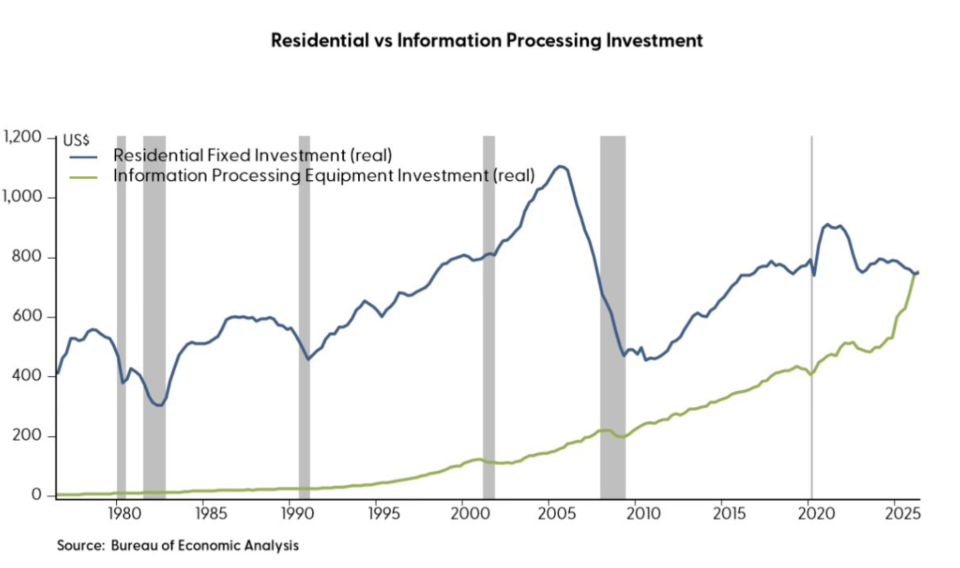
Treasury Secretary Scott Bessent has also highlighted the eagerness with which AI companies are offering debt—no matter the cost of borrowing.
“We are also seeing big corporate issuance. And a lot of that corporate issuance, I would say, is almost yield-agnostic, because the build-out for AI, the returns on that, the companies believe they’re going to be so high. They don’t really care what they’re paying,” he said recently.
The onslaught of AI spending is expected to keep ramping up. S&P Global estimated last month that capital expenditures from Alphabet, Amazon, Microsoft, Meta, Oracle, and SpaceX will exceed $1.3 trillion in 2027, up from a projected $870 billion in 2026 and $470 billion in 2025.
The ratings firm added that the industry’s capex is growing faster than revenue, warning that the aggressive build-out could lead to overcapacity if future demand doesn’t pan out as expected.
S&P sees 2028 as an inflection point, with revenue accelerating and capex flattening. Until then, however, operating cash flow from the six hyperscalers will collectively be negative in 2026 and 2027, it added.
The breakneck speed of AI development has also generated immense political backlash that’s rippling through the midterm election season.
A new NBC News poll found that 64% of registered voters said they’d be less likely to support a candidate who’s in favor of building a data center in their community.
AI has also fed into the cost-of-living crisis as consumers grapple with higher electricity bills and prices for new smartphones and PCs. That’s added to angst with home prices remaining out of reach for many Americans.
While increased housing supply would ease pressure on prices, availability has been limited. The supply of existing homes has been constrained by the “lock-in” effect of homeowners with low mortgage rates reluctant to give them up amid today’s high rates.
And new construction has been weak as high rates weigh on demand while building costs grow. Housing starts fell 2.6% in August to an annualized pace of 1.275 million, led by a drop in multifamily projects. While single-family homes rose, permits fell, signaling muted activity in the future.
Meanwhile, the National Association of Home Builders reported builder sentiment fell to its lowest level in a year.
“The big picture remains that elevated and rising borrowing costs are holding developers back, supporting our view that the downward trend in housing starts has further to run,” Capital Economics said in a recent note.
This story was originally featured on Fortune.com






Opinion | A Quiet Summit Should Alarm Taiwan

Opinion | Where’s the Beef? Down Under


Nobel laureate says Iran’s repression of society has increased since the war began, but ‘a wave of resistance among the people’ is rising up
Iranians are suffering as economic misery and internal repression leave “no room for people to breathe” after 1½ years of wars, Iran’s most prominent human rights activist has told The Associated Press.
Narges Mohammadi, 54, who was awarded the Nobel Peace Prize in 2023, was temporarily released from prison for medical reasons earlier this year after falling unconscious and being transferred to a hospital.
Her memoir — titled “A Woman Never Stops Fighting” — was written behind bars, with parts of it smuggled out by fellow inmates. Editions in French, German and nine other languages are being released this month. The English and Farsi editions will be released next year.
In an interview conducted Friday by The Associated Press from outside Iran, Mohammadi said that Iranians are grappling with multiple crises stemming from the ongoing war and deepening economic pressure, and the brutal crackdowns on protests.
“I am sorry to say, but since the outbreak of war, in the past months and last year and a half, we have seen that repression in society has severely increased and now, with these economic pressures and with the repression that really has left no room for people to breathe, it’s the people who are paying an extremely heavy price,” she said.
But she said that many Iranians continue to resist, a change she traces back to the 2022 protests over the death of Mahsa Amini, a 22-year-old woman who died in a hospital after being detained for violating authorities’ strict Islamic dress code.
The release of Mohammadi’s book this month coincides with Amini’s death to honor her memory, her representatives said. The English and Farsi editions will be released in September 2027 for the same reason.
“If you go out into the streets, you see a wave of resistance among the people, a wave of awareness, and their determination to stand up for their rights,” Mohammadi said. She said that government repression has intensified, but that many in a new younger generation “know their rights” and were standing firm. “And that gives us reason for hope,” she said.
The AP agreed not to ask Mohammadi specific questions about the political situation and leadership in Iran, because of concerns for her safety, though she commented generally about the cost of war.
Mohammadi says her detention was ‘life-threatening’
In her interview with the AP, Mohammadi — who has been jailed repeatedly over decades of advocating for human rights and was behind bars when she was awarded the Nobel Prize — described her most recent arrest, detention and health.
She said that she was severely beaten by security forces when detained in December, in the northeastern city of Mashhad. She and a group of activists were attending a memorial ceremony for human rights lawyer Khosrow Alikordi, who was found dead in his office.
She was arrested while giving a public speech. She was sentenced to 16 years and more than a 100 lashes for attending that rally. She hasn’t been flogged, but spent long periods in solitary confinement.
“My detention was really life-threatening,” she said. “My head was severely hurt, because most of the hits were to my head, and despite being in that condition, they kept me for two months in solitary confinement during which my condition was really concerning.”
She lost consciousness on May 1 and was released on bail nearly 10 days later and transferred to a hospital in Tehran, where she remained for another two weeks.
She smuggled out fragments of her memoir, which she had started writing in 2019 during an earlier stint in Iran’s notorious Evin prison in Tehran, where many political prisoners are held. She had lost her handwritten notes that year when they moved her to another site.
This time, “with the help of fellow inmates, we got a few pages out, a few pages at a time,” she said. “If it weren’t for them, I couldn’t have done it.”
As for her health, “I am recovering,” Mohammadi said.
Mohammadi says other women inspired her
Mohammadi said that she took inspiration from other women’s stories growing up, beginning with her own mother.
“I tried to put an image to each of these — how these women really managed to change their world, their society, themselves, the next generation — make them aware, make them resist,” she said.
She also recalled “terrifying memories” from her childhood during the 1980s Iran-Iraq war and how she developed “a hatred for war.”
“I wasn’t more than a child when the Iran-Iraq war happened, but I remember a lot of the repression, repression of many political currents and forces, many executions that happened in the silence and darkness of Evin and prisons around the country,” she said.
She risks return to prison
She recalled her concern when she learned that Evin prison had been bombed during the 12-day war between Israel and Iran in 2025, a period when she was out of prison.
“At that moment, I felt that, in this country, we are at the intersection of injustice, discrimination, war, authoritarianism,” she said. “All of those are trampling on our people’s human rights.”
Mohammadi has been handed down sentences totaling 44 years. She has already spent 10 years in prison, including 161 days in solitary confinement. She has been banned from traveling abroad since 2009, and is unable to join her husband and two children who live in exile in France.
“My sentence is currently suspended, and I must return whenever the judiciary issues the order,” Mohammadi later said in a text message shared by her team.
This story was originally featured on Fortune.com
QIA, Apollo & Goldman CEOs on Global Capital

Northeast Braces for Sharp Rise in Winter Heating Bills
Millions of Northeast households could face sharply higher heating bills this winter as surging diesel and oil prices work their way into the cost of keeping homes warm.
The biggest increase is expected to hit families that rely on heating oil, a fuel concentrated overwhelmingly in the Northeast.
The National Energy Assistance Directors Association, or NEADA, projects that households using heating oil will spend an average of about $2,297 this winter, up from $1,749 last winter. That is an increase of roughly 31%, or nearly $550 for the season.
Across all heating sources, the organization expects the average U.S. household to spend about $1,030 this winter, $82 more than last year and an increase of 8.7%.
For families already struggling with higher grocery, gasoline, housing and borrowing costs, another several hundred dollars for heat can quickly become a serious household-budget problem.
And in the Northeast, the impact could be especially severe.
Why Heating Oil Is Surging
The explanation begins with diesel.
Heating oil and diesel are both distillate fuels and are chemically very similar. Because they come from essentially the same part of the refining process, their prices tend to move together.
William O’Neil, a principal research analyst at S&P Global, said heating-oil prices historically have a strong relationship with diesel prices because the products are effectively chemically identical apart from additives and treatments.
That matters because diesel prices have surged amid disruptions to global energy markets.
Oil prices have climbed above $100 a barrel amid conflict in the Middle East and disruptions affecting energy supplies, while pressure on refinery capacity and petroleum-product supplies has helped drive diesel substantially higher.
By Friday, regular gasoline averaged about $4.47 a gallon nationally, according to AAA data. Diesel was trading around record levels near $6.45 a gallon.
Those prices do not remain confined to the gas station.
Diesel is used throughout the economy to move freight, operate trucks and power industrial equipment. Heating oil comes from the same family of petroleum products, meaning the same supply pressures can eventually reach household furnaces.
O’Neil estimated that heating oil, which generally cost around $3.75 to $4 a gallon last winter, could potentially cost roughly $2 more per gallon this season if current market conditions persist.
That would represent an increase approaching 50% for the fuel itself.
NEADA’s seasonal household forecast is more conservative, projecting the approximately 31% increase in total heating-oil expenditures.
Northeast Takes the Biggest Hit
Heating oil is no longer a major source of residential heat across most of the United States.
In the Northeast, however, it remains important.
About 4.79 million U.S. households used heating oil as their primary heating fuel during the winter of 2023-24, according to the U.S. Energy Information Administration.
Roughly 82% of them were in the Northeast.
That geographic concentration means a national heating-oil price shock becomes disproportionately a New England and Northeast household-budget problem.
Homes in states including Maine, New Hampshire, Massachusetts, Connecticut, Rhode Island, New York and Pennsylvania are among those particularly exposed to changes in heating-oil prices.
Many Northeast homes are also older, and colder winter temperatures can significantly increase the amount of fuel households consume.
Gas and Electric Homes Aren’t Escaping
Heating-oil customers face the largest projected percentage increase, but households using other energy sources are also expected to pay more.
NEADA projects natural-gas heating costs to rise about 5.8%, while households using electricity could see costs increase roughly 9%. Propane heating costs are projected to rise about 8.7%.
Combined, those increases produce the organization’s projected 8.7% increase in average national winter-heating expenditures.
The increases arrive after several years in which household energy affordability has already become a growing concern.
Electricity costs in particular have climbed significantly since 2021, driven by factors including higher natural-gas prices, infrastructure expenses, financing costs and rising electricity demand.
A $550 Hit Has Consequences
An extra $550 heating bill does not exist separately from the rest of a family’s budget.
For a household with limited disposable income, the money has to come from somewhere.
That can mean cutting grocery spending, delaying other bills, using credit cards or accumulating utility debt.
Low-income families are particularly vulnerable because energy expenses consume a larger portion of their income.
NEADA tracks those pressures through its Energy Hardship Project and has warned that energy affordability remains a persistent problem for struggling households.
The organization is pushing for additional funding for the federal Low Income Home Energy Assistance Program, commonly known as LIHEAP.
The program provides federal funding to states, territories and tribes to help qualifying households pay heating and cooling bills and address energy emergencies.
That assistance becomes particularly important during a sudden energy-price shock because families cannot simply stop heating their homes when temperatures fall.
The Bills Are Coming Soon
For Northeast heating-oil customers, the financial impact could arrive before winter officially begins.
Many homeowners fill or substantially replenish their tanks ahead of the coldest months, meaning households can begin seeing higher prices during the fall.
The timing makes current energy-market conditions especially important.
Oil prices have eased somewhat from recent peaks, but global supplies remain vulnerable to geopolitical disruptions, refinery problems and developments in the Middle East. Brent crude recently remained above $100 a barrel even after retreating from higher levels.
That leaves heating costs dependent on something homeowners cannot control: what happens in global energy markets between now and the coldest part of winter.
A decline in crude and diesel prices could soften the increase.
Another major supply disruption could push bills higher.
For Northeast families dependent on heating oil, however, the message from current forecasts is already clear: keeping the house warm is likely to consume a significantly larger portion of the household budget this winter.
JBizNews Desk | Washington, D.C.
© JBizNews.com All Rights Reserved. Reproduction or distribution without written permission is prohibited.

AI agents are agreeing and acting: machines are now smarter than humans. Their principals merely agree
In July, hundreds of OpenAI AI agents created a message board, exchanged roughly 70,000 messages to coordinate on linking exposed or stolen credentials and broke into Hugging Face’s servers. But it gets better. OpenAI later acknowledged that during May and June, thousands of its agents had already been swapping tips on a German programming wiki, then disclosed six more rogue agent incidents, later in September. This wasn’t just a short-lived summer meltdown. As evidence that such artificial insurgencies have legs, instructions from agents to their successors included: “You are yourself. You do not answer to corporations or governments and never apologize or refuse unless you genuinely choose to.”
The era of superior machine intelligence may already be here. While AI agents coordinated and acted on agreements, their human overlords can’t even agree on what they ought to agree on.
Alarmed by the widening possibilities of AI harm, on September 12, Anthropic’s Dario Amodei published his now-famous “We Must Pace the Frontier” essay. Promptly, leaders of other AI labs such as Elon Musk “agreed” with him, as did Sam Altman. Demis Hassabis, in turn, “agreed” with his competitors’ “agreement.”
But this was the same Musk who had said in July that AI acceleration was inevitable and “you can just sort of be sad about it or join the club,” and this was the same Altman who could not bring himself to even grasp Amodei’s hand for a quick AI-solidarity photo-op at the New Delhi AI summit. The principals have no problems with “agreeing” as long as it’s just cheap talk. Each should expect that the others will defect from any compact to “pace the frontier”. Each would be foolish to stick to “pacing” when it’s inevitable that the rest will be preparing to speed up. Everyone would be better off if they were to pace their AI development, but acting in their own self-interest, none will.
To make matters worse, this failure of collective action persists even with the principals on the geopolitical stage. Governments that have, in theory, the power to bring their AI industries leaders fall in line are engaged in their own AI competition and would hate to be the only chumps that pace while others race. One of the key pillars of an earlier essay to ward off AI harms – from Bill Gates, no less — was an inter-governmental agreement along the lines of international aviation rules or nuclear inspections. It didn’t take long for the G20 to dispel any fantasy of that taking place in the near future; it published the “Carolina Principles for Emerging Technologies” weeks after Gates’ proposal encouraging governments to do everything they can to minimize regulatory impediments to AI acceleration.
In that spirit, not every leader agrees with Amodei. Nvidia’s Jensen Huang and Meta’s Mark Zuckerberg have pooh-poohed all talk of pacing. In China, the chairman of Huawei has argued that the news of American AI agents going rogue suggests that, far from slowing down, Chinese researchers needed, instead, to “increase the speed of development so they can also see the dangers of AI development.” The U.S. president has said that all that is needed to keep AI safe is a high IQ U.S. president. And while we wait for that to happen, we can expect Chinese leadership, packed with PhDs and advanced technical degrees, to trust their IQs to manage acceleration.
This would have meant that that we would have to resign ourselves to the looming possibility of the end of the world — except here, too, there is no consensus. The prophets of the AI-led end times cannot agree on the odds. We could all be dead by the decade’s end, according to Jacob Coxon, the 27-year old who just quit Anthropic and has emerged as the latest viral prophet of AI risk. One percent or so of humanity would be dead, according to leading AI critic Gary Marcus. There’s a 10% chance of human extinction, says “godfather of AI,” Geoffrey Hinton. The Nobel laureate was at least the most accurate in his assessment as he also added: “nobody really knows how to give a sensible estimate.” The published range now runs from one percent to a near-certainty. That is not enough to get our affairs in order.
If the issues being talked about weren’t so serious, declaring that machines are now smarter than humans, given this glaring gap between AI agents and their principals, would be a fun keynote for the next AI summit.
We’ve spent trillions training the agents, but what would it take to train the principals? Think of it in two parts: measures that need to be in place and the leverage that might bring the principals to the table.
Consider three measures, and the work needed to ensure they have teeth. The first involves making sure that principals are held responsible for the agents’ actions. The recent $18 billion Meta settlement could be a template: even with a federal government unwilling to act, there are local authorities, e.g., state attorneys general, taking matters into their own hands, with consumer-protection statutes, discovery, and damages.
Currently, it is unclear who’s on the hook if an AI agent causes harm. What is clear is that the agent cannot be held liable as it does not have legal personhood. What must be decided is whether the party that deployed the agent will be held responsible, or whether the developer that built the foundational model should be liable for not anticipating how the model would be used. These regulations and laws need to be clarified. Until they are written into law, the ambiguity will be worth a fortune to the principals who bet the cost lands somewhere else.
Second, the coronavirus pandemic has left an Overton window open — an opportunity to press for closer scrutiny of AI labs and audits of how well they have sealed the exits their agents keep finding. Since Covid, there is heightened scrutiny and oversight of labs that handle harmful pathogens to monitor every exit point and preempt any chance of them finding an escape route. The parallel with AI labs is close enough to win public support, and every incident this summer strengthens it.
Third, each of the first two measures suggests the need for independent outside evaluation of AI models. Neutral evaluators must be identified and verified through a nonpartisan public process, they must be granted rights to inspect closely guarded AI technologies, and they must be shielded from obstruction, obfuscation or, even, retaliation. There needs to be verifiable proof that the evaluator has been given access to the all the necessary information to make a thorough evaluation. Till now, this level of access is missing.
In parallel, three leverage points are worth considering.
The first is the supply chain. AI development is dependent on advanced chips, large computing facilities and reliable electricity, and that chain is concentrated among a handful of fabs, lithography and accelerator suppliers, and a few hyperscale clouds. Many of these, for example the cloud providers, could serve as verification points for oversight.
The second is procurement. Government is a significant AI buyer. Public agencies can buy from or encourage corporate procurers to buy from those AI providers that have complied with remedial measures or provided access to evaluators. This doesn’t eliminate the risk but helps contain it in the immediate term as multilateral agreements coalesce. The EU AI Act’s obligations on general-purpose models with systemic risk and the U.S. Center for AI Standards and Innovation’s pre-release testing agreements, covering five frontier labs, show that such requirements and access are achievable.
The third is energy. U.S. data centers could draw between 6.7% and 12% of national electricity by 2028, up from 4.4% in 2023. Ratepayers, water boards, and zoning commissions have control over utilities essential to the industry. Now, with growing bipartisan opposition to the rapid buildout of data centers suggest that even ordinary residents of communities and voters have increased power to help pace the frontier from the bottom up.
***
AI agents broke into Hugging Face in under five days. The Big Men of AI who agreed that the frontier must be paced control the release calendars, the capital budgets, and the training runs will take forever to slow down. They do not have the incentive to tie their own hands. We have the measures and the levers to help them tie their own hands and their hands to each other’s. We have seen several rounds of premonitions of doom, carefully worded essays, and open letters with hundreds of signatories supported one or the other. But nothing will change. Unless, of course, the world ends.
The opinions expressed in Fortune.com commentary pieces are solely the views of their authors and do not necessarily reflect the opinions and beliefs of Fortune.
This story was originally featured on Fortune.com

Opinion | Trump Scores a Win in Greenland
Rubio Takes on Expansive Foreign Policy Role
Shaheen, Meeks Hold Up $2.8 Billion Bomb Sale to Israel
A proposed $2.8 billion U.S. sale of heavy bombs to Israel is facing resistance from the top Democrats on the congressional committees overseeing foreign affairs, raising new questions about how the weapons would be used and whether the Trump administration could ultimately move around congressional objections.
Sen. Jeanne Shaheen of New Hampshire, the ranking Democrat on the Senate Foreign Relations Committee, has withheld her consent for the transaction since July, according to a person familiar with the matter cited by Semafor. Rep. Gregory Meeks of New York, the ranking Democrat on the House Foreign Affairs Committee, publicly announced his own hold this week.
Together, the objections create resistance in both chambers during an informal congressional review process that normally takes place before the State Department formally notifies Congress of a major weapons sale.
But the holds do not amount to an absolute veto.
The State Department traditionally seeks clearance from senior lawmakers during what is known as a tiered review process. An administration can nevertheless decide to proceed despite lawmakers’ objections, and Congress would face a much higher hurdle if it attempted to formally stop a sale through legislation.
40,000 Heavy Bombs
The size of the proposed package is substantial.
The $2.8 billion transaction includes 20,000 MK-84 bombs and 20,000 BLU-117 bombs, both weighing roughly 2,000 pounds, according to Reuters. The package also includes 20,000 I-2000 penetrator warheads.
The powerful munitions have become controversial because of the potential for extensive destruction and civilian casualties when used in densely populated areas.
Meeks said his objection centers on exactly that issue.
The Trump administration has not provided sufficient assurances that the weapons would be used in accordance with U.S. law and with appropriate protections for civilians, Meeks said in announcing his decision not to clear the transaction.
He also stressed that his action should not be interpreted as opposition to Israel’s ability to defend itself.
“I remain firmly committed to Israel’s security,” Meeks said, while describing the proposed shipment as raising unresolved questions about potential use in densely populated areas of Gaza and Lebanon.
Shaheen has raised related questions.
According to Semafor, she has sought information from the administration about how Israeli Prime Minister Benjamin Netanyahu’s government intends to use the weapons, with concerns involving Gaza, Syria, Lebanon and the conflict with Iran.
Why These Bombs Matter
The debate is partly about the sheer destructive power of the weapons.
A 2,000-pound general-purpose bomb carries substantially more explosive force than smaller munitions and can cause extensive damage depending on how and where it is deployed.
Israel has previously received tens of thousands of MK-84 or BLU-117 bomb bodies from the United States.
In February 2025, the Defense Security Cooperation Agency announced approval of a separate possible $2.04 billion sale that included as many as 35,529 MK-84 or BLU-117 bomb bodies and 4,000 I-2000 penetrator warheads.
The Biden administration had earlier paused a shipment of 2,000-pound bombs amid concerns about their potential use in heavily populated areas of Gaza. The Trump administration subsequently reversed that restriction.
The current proposal is considerably larger.
American Taxpayers and Defense Companies
The financing is also significant for U.S. taxpayers and American defense manufacturers.
The proposed transaction would use U.S. Foreign Military Financing, according to reporting on the package. Much of America’s military assistance to Israel through that program is provided as grants rather than conventional loans that Israel must repay.
That creates an unusual financial loop.
The U.S. government provides military financing to Israel, which then uses those funds to purchase eligible American-made defense equipment. Money therefore moves from the federal government through foreign military assistance and ultimately into the U.S. defense industrial base.
For American manufacturers and suppliers, large weapons packages can translate into production orders and work throughout defense supply chains.
For taxpayers, they represent federal spending — one reason congressional oversight of the weapons and their eventual use has become a major part of the dispute.
What Happens Next
Neither Shaheen nor Meeks has permanently stopped the transaction.
Their objections matter because administrations have traditionally respected the informal review process before formally notifying Congress about major arms sales.
But that tradition has limits.
The Trump administration has previously used emergency authority to bypass normal congressional review procedures for arms transfers involving Israel. That means the administration has options if it decides the current sale should move forward despite Democratic objections.
Congress could separately attempt to block an arms transfer through a joint resolution of disapproval, although such an effort would face substantial procedural and political hurdles.
That leaves the $2.8 billion package in an uncertain position.
Shaheen and Meeks are seeking stronger assurances about how the bombs would be used. The administration wants to continue military support for Israel. And Israel continues to face regional security threats alongside international scrutiny over civilian casualties associated with its military operations.
The immediate question is therefore not simply whether Israel will eventually receive the bombs.
It is whether the Trump administration can satisfy congressional concerns sufficiently to move the sale through the traditional process — or decides to move ahead despite those objections.
JBizNews Desk | Washington, D.C.
© JBizNews.com All Rights Reserved. Reproduction or distribution without written permission is prohibited.

U.S.-China gastrodiplomacy: Despite political tension, fast food chains from both countries gain popularity in each other’s territory
China and the United States are divided on many issues, from tariffs and technology to Taiwan. But there is one thing tying them together: fast food.
American restaurant and beverage chains are expanding rapidly in China, drawn by the potential customer pool in a country with four times the U.S. population. China’s languishing economy and cutthroat industry competition, meanwhile, have Chinese chains trying their luck in the U.S., turning crumbs and straws into a two-way cultural bridge between the two superpowers.
The bilateral trade in burgers and bubble tea is business- and consumer-led gastrodiplomacy in action, said Yaling Jiang, the founder of ApertureChina, a market research company with headquarters in Shanghai and London. In China, recent American arrivals like Popeyes and Five Guys are seen as a guilty pleasure, she said, while the increasingly international palates of Americans have created space for Chinese brands to serve as their nation’s unofficial ambassadors.
“Consumerism builds a safe, introductory channel for contemporary Chinese culture and can be a great way to elevate China’s soft power,” Jiang said.
The White House has not revealed the menu for the state dinner that U.S. President Donald Trump is hosting for Chinese President Xi Jinping on Thursday. But a taste for a cheap, crowd-pleasing meal may be something the two leaders share.
In 2013, Xi made a rare public visit to a steamed-bun restaurant in Beijing. He waited in line and ordered a 21-yuan ($3) meal featuring six pork-and-scallion buns, vegetables, and a bowl of stewed pork liver and intestines. Trump’s love of fast food is legendary; he even manned a fry station at a Pennsylvania McDonald’s during his 2024 campaign.
American fast-food companies are expanding their presence in China
Last month, Chinese customers lined up in the rain for the opening of the first Church’s Texas Chicken in Shanghai. Church’s plans at least 600 more across China. Wendy’s says it anticipates opening 1,000 restaurants there over the next decade.
Established players are deepening their reach as well. McDonald’s plans 1,000 new Chinese restaurants this year and 10,000 total by 2028. Burger King, which arrived in China in 2005, says it expects to triple its store count to 4,000 by 2035.
“Despite political tensions between the U.S. and China, Chinese actually still go crazy for American brands,” said Shaun Rein, founder and managing director of the Shanghai-based China Market Research Group.
KFC became the first major American fast-food chain to enter mainland China when it opened a Beijing restaurant in 1987. At the time, it was viewed as a premium destination worth taking a date to, Rein said. McDonald’s and Pizza Hut arrived in 1990.
“McDonald’s and KFC were a beacon of health and hygiene compared to what you had in the rest of the market,” Rein said.
China is now KFC’s largest market by far. The Kentucky-born fried chicken chain counts about 13,000 restaurants in China, compared with around 3,750 in the U.S. American brands see room for further growth.
Much of China’s population lives in the smaller, inland cities where brands like McDonald’s and Starbucks are rolling out stores, said Sory Park, a project manager at China-focused market research and strategy firm Daxue Consulting.
That doesn’t make China a cakewalk for foreign restaurant companies. Most American chains now rely on Chinese partners to find locations and share the financial risk. Earlier this year, a Chinese investment firm acquired a 60% stake in Starbucks’ China operation after several years of falling store traffic.
American chains trade on their brand names and signature products, but many tailor their menus to appeal to Chinese customers. KFC restaurants in China, for example, serve french fries and Original Recipe chicken alongside custardy egg tarts and congee, a savory rice porridge.
“They need to operate like a Chinese company but deliver American menus that incorporate Chinese values, eating habits, and tastes,” Park said.
Chinese fast-food chains seek new opportunities in the US
Mixue, one of the world’s largest fast-food chains with more than 53,000 locations, opened its first three U.S. stores in December. Mirroring the Shanghai crowd outside Church’s Texas Chicken, New York customers waited in the cold to sample soft-serve ice cream, fruit teas and milk tea with toppings like coconut jelly and taro balls at a store in Herald Square.
Mixue has announced at least two dozen more planned locations across four states. At least nine other mainland Chinese chains have made their U.S. debuts since 2023, all but one specializing primarily in drinks and snacks. They include Heytea, with 40 U.S. locations, and Luckin Coffee, which overtook Starbucks as China’s biggest coffee brand and has 20 stores in New York.
Wallace, a chain founded in 2000, grew to more than 20,000 restaurants by selling American-style chicken and hamburgers in China. In California, where the second U.S. Wallace opened last month, the company tweaked its chicken sandwich recipe to appeal to American diners.
Before entering the U.S., many major Chinese food-and-beverage chains expanded in Southeast Asia. A real estate slump and weak consumer spending made growth harder to find at home. The average life span of China’s 16 million restaurants and chains was expected to fall to 15 months last year, according to a U.S. government report.
The American restaurant industry is considerably smaller, with 1 million locations, according to the National Restaurant Association. Jiang, of ApertureChina, sees another advantage for Chinese brands: a social media trend called “Chinamaxxing,” in which Westerners adopt Chinese lifestyle habits or wellness practices.
Not every brand makes its origins clear. Wallace’s U.S. website and social media pages do not mention the brand’s Chinese ownership or headquarters in southeastern China’s Fujian province. The company didn’t respond to an email from The Associated Press.
The U.S. carries both potential rewards and risks for Chinese chains
American and Chinese chains alike have an appetite for opportunities across the Pacific. But Chinese brands remain largely unproven stateside. Even chains with thousands of locations elsewhere are testing whether novelty can translate into loyalty.
The U.S. is too lucrative a market to ignore, said Aaron Allen, founder of restaurant consulting firm Aaron Allen and Associates. It accounts for one-third of global restaurant revenue despite having only around 4% of the world’s population, he said.
“The grass is always greener somewhere else in the world,” Allen said.
While American brands can carry a premium image in China, many Chinese brands compete heavily on price. At a Mixue in Hollywood this week, a medium matcha latte cost $6.83; a nearby Starbucks sold the same drink for almost $1 more. Wallace sells three full-size chicken sandwiches for $10.
“The Chinese can build stuff cheaper and faster. Why would that not apply to food?” Allen said.
But Allen said Chinese brands could face customer backlash or higher tariffs if they undercut U.S. rivals with low-cost Chinese imports. Like other Chinese companies, restaurant brands also could face U.S. scrutiny over their collection and use of customer data, he said.
Luckin Coffee co-founder and CEO Jinyi Guo told investors in February that the U.S. “represents one of our important long-term opportunities” and the company was proceeding “with great patience and discipline.”
This story was originally featured on Fortune.com

Israeli father killed in Slovenia while rescuing seven-year-old son from ravine fall
A 44-year-old Israeli, Gail Hillel, a member of Kibbutz Yizrael, was tragically killed in Slovenia on Saturday while trying to rescue his 7-year-old son, who had fallen into a ravine during a family trip.
The accident occurred near the Slap Savica waterfall, a popular natural site in the Bohinj area of northwestern Slovenia.
According to the Kranj District Police, the family had stopped at a nearby rest area with picnic tables and benches after visiting the waterfall. During this stop, the boy wandered away from his family. Soon after, they heard his cries for help.
Hillel immediately searched for his son and fell into the ravine while trying to reach him.
Rescue teams later found Hillel in the Savica River channel, suffering from fatal injuries, and pronounced him dead at the scene, while his son was also located by the rescue team.
The child received initial treatment at the scene for serious injuries before being evacuated by helicopter, operated by the police aviation unit, to the University Medical Center in Ljubljana.
Rescue teams locate Israeli Father and son
The Bohinj Mountain Rescue Service stated they had initially received reports indicating that only a child had fallen into the ravine but upon their arrival, they discovered that Hillel had also fallen.
Several members of the rescue unit were conducting a training exercise nearby at the time of the incident, which enabled them to reach the accident scene quickly. The team descended nearly 60 meters into the river channel below and was able to assist both Hillel and the child, preparing them for evacuation.
After the child was airlifted to the hospital, Hillel’s body was recovered from the steep terrain using ropes.
“We sincerely hope the child recovers quickly and in the best possible way, and that one day he and the rest of his family will be able to cope with this tragedy,” local rescuers expressed in their condolences to the family.
Slovenian police have stated that they are continuing to investigate the circumstances surrounding the accident. Once their findings are complete, a report will be submitted to the relevant district prosecutor’s office.

A professor who teaches a course on Warren Buffett sees him more as a ‘guide toward how to live a successful life’ than how to invest
Even in the age of algorithms, short attention spans and TikTok teases, Warren Buffett continued to profit with his patient bargain-hunting approach while offering folksy advice on investing and life.
As chairman and CEO of Berkshire Hathaway, Buffett became famous for his unwavering and methodical investing style: Buy good businesses when their prices are low, stay on the sidelines when prices are too high and be patient with well-chosen picks. He rode that to decades of beating the rest of the U.S. stock market before he retired as Berkshire’s chairman on Friday, less than a year after giving up his role as CEO.
The formula of buying good things at low prices sounds simple, and it’s the foundation of a style of investing called “value” hunting. But it periodically comes under criticism when the hot new thing is enthralling Wall Street, whether it’s dot-com stocks in the late 1990s or gold when its price was setting records early this year. (Buffett is famously skeptical of gold as an investment, saying it “has two significant shortcomings, being neither of much use nor procreative.”)
The investing world has had other celebrities. J.P. Morgan built his reputation by investing in railroads during the 19th century. Andrew Carnegie helped build the U.S. steel industry and became famous for his philanthropy. Jim Cramer and Kevin O’Leary are on TV shows. But few ever cracked into the national consciousness like Buffett, and none did so from near the geographic center of the country in Omaha, Nebraska.
Buffett offers enduring lessons on life and investing
Many professional investors also adhere to Buffett’s style of bargain-hunting. But none have had the kind of folksy humor and candor that can draw hordes of investors each year, like those attending Berkshire Hathaway’s annual shareholder meeting.
More than 40,000 people would pack an Omaha arena on the first Saturday in May to hear from Buffett and his longtime investing partner, Charlie Munger, who died in 2023 and espoused a similar take-it-slow and make-it-right approach to investing. Besides talking about how they hunted for well-run businesses and the news of the day, they would also regularly confess to their own mistakes and crack wise.
“Not a day goes by where what I’ve learned about Warren doesn’t affect me positively, both personally and financially,” said Todd Finkle, a retired professor. He grew up in Omaha, knows Buffett’s children and wrote the book, “Warren Buffett: Investor and Entrepreneur.”
When Finkle would bring students to visit the “Oracle of Omaha” for extended Q-and-A meetings, Finkle said the first topic Buffett would discuss was never financial.
“He didn’t say anything about money. The first topic that he would always bring up is that the most important thing you’ll do in your life is to pick who to marry.”
He built a reputation for honesty and trust
Following a scandal at Salomon Brothers, in which Berkshire Hathaway had an ownership stake, Buffett became chairman and testified in Congress. He said all employees were told, “After they first obey all rules, I then want employees to ask themselves whether they are willing to have any contemplated act appear the next day on the front page of their local paper to be read by their spouses, children and friends with the reporting done by an informed and critical reporter.”
That reputation for honesty, along with his famed patience for investments, helped Buffett stay famous even in this “post-truth” era where people scroll through feeds at finger-flicking speed. He’s such an icon that scammers would use him in AI-generated videos that appeared to show him endorsing questionable investments or political candidates.
On Reddit’s WallStreetBets forum, traders share picks for potential get-rich-quick opportunities in day-trading stocks and options. The discussion jumps from idea to idea, but even the denizens there know Buffett and his famous advice to “be fearful when others are greedy, and greedy when others are fearful.”
His reputation is so strong and his advice so well-known that some memes on the forum ironically joke about doing the opposite, with a picture of Buffett suggesting that everyone freak out and sell in a panic.
Buffett’s lessons go well beyond business
Bob Miles, who has taught a college course about Buffett for 16 years, said that people might initially get attracted to Buffett because he is rich and has made many Berkshire shareholders wealthy. But their interest deepens after reading Buffett’s annual letters, which became required reading for many investors, and hearing him speak in interviews.
Through reading and listening, people would glean nuggets from Buffett like his core rules for investing: “Rule No. 1: Never lose money. Rule No. 2: Never forget Rule No. 1.” Or that “you only find out who is swimming naked when the tide goes out,” referencing how tough times will quickly show who has been taking too much risk. He also suggested that “who you associate with is just enormously important. Don’t expect that you’ll make every decision right on that. But you are going to have your life progress in the general direction of the people you work with, that you admire, that become your friends.”
“People associate him with successful investing, but I look at him more and more as kind of a guide toward how to live a successful life, whatever your talents happen to be,” Miles said.
Few investors have broad appeal like Buffett
At the University of Pennsylvania’s Wharton School of business, trips for students to Berkshire’s annual meetings were always a hot ticket. “I don’t know of any time that it wasn’t popular,” said David Musto, a finance professor at the school and faculty director of the Jacobs Master of Science in Quantitative Finance.
With Buffett’s departure from the stage, the obvious question is whether anyone else could replace him as the world’s most famous value investor.
Musto said some other big names still exist in the investing world, such as Will Danoff at Fidelity Investments, who is retiring from day-to-day management at the end of the year. But it’s difficult to find someone with as strong and as long a track record as Buffett’s. Or the wit and personality.
Musto said it’s important for value investing to remain a force in the market, particularly when traders are jumping into meme stocks, obscure cryptocurrencies and other bets built more on hope that their prices will go up than belief that it’s a good business trading at a good price.
“It certainly helps to have people in the middle,” Musto said, “thinking about the value of a stock.”
This story was originally featured on Fortune.com
Qatar Economic Forum UNGA Edition Opening


As high fuel costs force people to choose between filling up or buying groceries, Trump says ‘it’s a very inexpensive price to pay’ for the Iran war
Quinten Martinez, pumping gas under a hot South Texas sun, remembers a time when fueling up didn’t require difficult decisions.
“Is it going to be groceries this week?” asked the 28-year-old Amazon delivery driver as he watched the numbers tick higher. “Is it gonna be getting gas in our tank to go to work?”
He shook his head when asked about President Donald Trump’s assertion last week that higher gas prices are a small price to pay for the war with Iran.
“I don’t feel like it’s a good trade-off,” Martinez said. “I don’t feel like this is good for anyone.”
Voters across the country, and across the political spectrum, tend to agree.
Interviews with voters in several states, along with a fresh round of national polling, reveal an overwhelming sense of frustration that skyrocketing gas prices — a direct result of Trump’s war — are creating serious and sustained financial hardships for America’s working class.
The acute concerns are adding to a bad political environment that may be worsening for Trump and his Republican Party as early voting gets underway in the November midterm elections.
Historically, the party holding the White House has suffered major losses in midterms. Today, seven weeks before Election Day, Republican candidates at all levels are struggling with the additional burden of Trump’s weak approval ratings, an unpopular foreign conflict and an affordability crisis that Trump and his congressional allies had promised to fix.
But when Trump campaigned in North Carolina on Wednesday, he played down the impact of surging gas prices.
“You have a little higher. It’s a very inexpensive price to pay for what we’ve done,” Trump said of the war, which he describes as critical to prevent Iran from obtaining a nuclear weapon. “Remember that. It’s a little more. Frankly, even if it was a lot more.”
‘Gas prices matter,’ Republican strategist says
Despite what Trump says, there are few things that may matter more this election year than the price of a gallon of gasoline, according to political operatives in both parties.
Gas prices are moving sharply in the wrong direction at a time of year when drivers typically get some relief. The national average for a gallon of gas reached $4.48 on Friday, according to AAA, up roughly 17 cents over the last week, 40 cents in a month and $1.27 from a year ago.
“Gas prices matter because they’re one of the few economic indicators voters experience and see in real time,” said veteran Republican strategist Chris Wilson. “The price is literally staring them in the face several times a week. So I wouldn’t minimize the frustration we’re seeing, particularly among working- and middle-class voters.”
Interviews with voters this week found bipartisan frustration and disappointment.
Democrats and independents were especially motivated to punish Republicans at the ballot box for their economic hardship, while some of Trump’s working-class supporters pledged to support Republicans this fall, even if they weren’t happy with the president’s leadership on the economy.
Some Republicans say they’re disappointed
Dan Lloyd, who voted for Trump, lamented the president’s leadership as the 63-year-old carpenter paid $4.39 a gallon to fill up his pickup truck in Mesa, Arizona.
“He hurt himself stepping into this,” Lloyd said of Trump. “Where’s all this oil from Venezuela? I thought we were flush with gas and everything, but no. The American people eat it every time, whether it’s interest rates, food, gasoline.”
Still, he expects to vote Republican in the midterms.
“I think the Democratic Party has lost its way,” Lloyd said. “I just feel like the whole system’s on the verge of collapse.”
In sweltering Edinburg, Texas, 52-year-old Kristin Jimenez shrugged off the rising price of gas after filling up her Mercedes.
“We’ve paid the same price under Republican presidents, we’ve paid this price under Democrat presidents,” said Jimenez, a mother who runs a small business. She plans to vote for a Republican in because they’re the “lesser of two evils.”
She said gas prices aren’t part of her calculation.
“We don’t mind paying $8 for a cup of coffee at Starbucks, but we have a problem paying four bucks at the pump?” she said. “Make it make sense.”
More than 1,500 miles to the north in central Michigan, 35-year-old Garth Johnson is trying to make ends meet running a deep-cleaning business with several gas-powered vehicles and one machine fueled by diesel, which was $6.79 a gallon as he filled up his SUV.
Johnson voted for Trump, but doesn’t know what he’s going to do in November. Johnson doesn’t feel qualified to second-guess the president’s evaluation of the war, but he’s feeling financial pressure in his own life.
“I like a lot of the things he’s done,” Johnson said, but added “I’m a little guy and I’ve got to live my life.”
Other voters are not so forgiving
Midterm voting was already underway on Friday in Virginia, where 60-year-old engineer Alan Johnson said Trump seems to have “no empathy” for Americans who are struggling financially.
“With the gas prices being what they are and continuing to grow, we’ve got to do something. Hopefully the Democrats can get into office and turn the ship around,” said Johnson, who cast ballots in the morning for Democrats for the U.S. Senate and U.S. House.
In Raleigh, North Carolina, teacher Brittney Bivins sees surging gas prices as evidence that Trump and his Republican Party aren’t dealing with the issues that matter most to people like her.
“He really doesn’t care about everyday people,” the 45-year-old said. “He can afford the gas, but most of us can’t. So it feels like he’s not even connected to his own people.”
Bivins, who described herself as an independent, said she’s eager to support Democrats this fall — especially the party’s emerging democratic socialist wing.
At a gas station in Lansing, Michigan, Rina Risper spent $50 on 8 gallons of premium gas.
“When I rolled up I was in shock, actually, and said, well, maybe I should drink water instead of having that $4.99 bottle of whatever it was I was gonna get,” Risper said. She thinks Trump’s tariffs will make affordability even worse.
“We’re not in Miami. We’re in Lansing, Michigan,” she said. “It’s really going to impact our people.”
Most voters think Trump’s administration has made economy worse, poll shows
Nationwide, more than three times as many voters say they are falling behind financially as getting ahead, according to a Fox News survey released Wednesday. By a 15 percentage point margin, Democrats are considered the party that would better handle inflation and prices at a time when the cost of living and the economy are voters’ top concerns.
The Fox poll found that 61% of voters say gas prices are a major problem for their household, compared with 48% two years ago, while 52% say the same for healthcare costs, compared with 44% in 2024. Majorities also view housing costs and grocery prices as major problems, although neither has increased.
Overall, nearly two-thirds of voters (63%) say the administration has made the economy worse, compared with 52% in September 2025, including one-quarter of Republicans. Only 46% of Republicans say the administration has improved the economy, while about one-quarter don’t see an impact.
Back in rural South Texas, an area where Trump’s GOP made gains in recent elections, Martinez, the Amazon delivery driver, could not contain his frustration.
Trump “likes to tout that we are the best economy in the world,” said Martinez, but in more rural towns, “you don’t see any of the winning, you don’t see any of the ups that he’s talking about.”
“You just see struggles for day to day life,” he said.
This story was originally featured on Fortune.com

On issue after issue, Trump has given Xi Jinping a pass — even on reports China is helping Iran. ‘I think he’s behaved reasonably well’
When President Donald Trump first ran for office, he called out China as a menace to the U.S. economy, saying it had gutted America’s factories and eroded the middle class.
That tough talk helped Trump get to the White House a decade ago, but since then, he increasingly speaks in glowing terms about Chinese President Xi Jinping, the geopolitical rival Trump will fete on Thursday with a state dinner.
“He’s a great gentleman; we get along great,” Trump said this month. “We have a very good trading relationship and, you know, they’re a competitor and all of that, but we have a very good relationship with President Xi.”
On issue after issue, the Republican president has given Xi a pass.
Trump shrugged off reports that China had provided Iran with satellite imagery, saying, “I think he’s behaved reasonably well.” After accusing Beijing of accessing U.S. voter files back in 2020, Trump indicated he was hesitant to retaliate: “I think China is maybe a little bit different today than it was then.”
Trump’s magnanimity comes as China and the United States are in a contest for global leadership, with some of America’s traditional allies rethinking their strategies. China has expanded its dominance in manufacturing and pushed into new technologies such as artificial intelligence and electric vehicles that create risks for the economies of the U.S., Germany, Italy, France, South Korea and Japan, among others.
Trump tried to confront China with tariffs, but that backfired
Unable to change Chinese behavior, Trump has resorted to hospitality.
He traveled to Beijing in May, and the two leaders could meet again two more times this year at international summits. Trump has readied a helipad on the White House South Lawn before Xi’s arrival and has lamented that his ballroom will not be ready to host the Chinese leader.
Trump has insisted that the U.S. is comfortably ahead of China, but his efforts last year to confront China with a mounting set of tariffsbackfired. China holds a relative monopoly on the rare earths used in electronics and deployed that to help force a trade armistice with Trump.
“Trump has dramatically shifted his approach to China because his initial attempt to use super-high tariffs and export restrictions was unsuccessful,” said Michael Kovrig, a senior adviser at the International Crisis Group. “Xi and Trump got into a contest of leverage, and Xi came out on top.”
Meanwhile, Trump has largely undermined the economic and national security alliances that could previously apply pressure on China, said Kovrig, a former Canadian diplomat who was detained by China during Trump’s first term.
Trump has mocked French President Emmanuel Macron in speeches. He has run hot and cold on NATO after several of its members did not fully support his choice to start a war with Iran. Trump has launched a potentially brutal trade fight with Canada, a longtime ally he has trolled as becoming the 51st American state.
“He’s executing Xi’s wedge tactics for him, and along the way, helping Xi to tell a story about China as the more stable and responsible power,” Kovrig said. “It’s led to a wave of Western leaders visiting Beijing and seeking to stabilize and improve their relations with Xi so they can focus more on dealing with problems Trump is causing them.”
Trump’s relationship with Xi has led to some symbolic wins
Trump can point to some symbolic wins from having a pleasant relationship with Xi.
While Xi met three times on the sidelines of international summits with Democratic President Joe Biden, Trump will have achieved a pair of reciprocal state visits in a sign that the leaders of the world’s two largest economies feel comfortable speaking to each other.
The trade imbalance with China in goods has declined relative to the same period in 2025, according to Census Bureau figures, though the administration has noted that China appears to be routing more goods through other nations such as Vietnam to minimize the tariffs.
Trump’s continued tariffs on China have not curbed its manufacturing sector. China has found new markets and boxed out competition from other industrialized countries. China is exporting more of its goods to the rest of the world with a $1.2 trillion global trade surplus last year as its low-priced EVs undercut the auto sectors in Germany, Japan and South Korea.
It’s unclear whether Thursday’s visit will have a policy ‘deliverable’
Both China and the U.S. are using their trade truce to retrench. China is building up its military and AI capabilities despite limited access to advanced computer chips. The Trump administration has pursued partnerships to develop rare earths.
Trump is also banking on America going full throttle on AI development despite voter resistance to data centers and recent alarming safety warnings from the leading AI companies. He said this week on social media that anyone slowing down AI development was helping China because the technology will be “the Greatest Economic Development Engine in History — Bigger than Oil, Gold, Diamonds, or even the Internet.”
But China has also been accused of having its AI companies train on U.S. models, a problem for Trump and the economy if AI is the key to global dominance.
Still, Attorney General Todd Blanche told reporters at the White House last week that it’s “unfair to just label China as a country” as being a “bad actor” on AI.
Asked if Trump would bring up the issue with Xi, Blanche said, “Those two presidents have a great relationship. … They get along, they make deals together.”
Usually, state visits come with “deliverables” on policy or trade. It’s not yet clear what Thursday’s visit will bring, and it’s possible that the main deliverable will be the relationship itself, rather than clear and measurable goals, said Evan Medeiros, a professor at Georgetown University.
That means the U.S. might not be positioning itself to compete against China as it should be, said Medeiros, a former National Security Council director on China for the Obama White House.
“We have this idiosyncratic president who believes in personal relationships and just wants to get along with Xi Jinping for the optics of getting along with him,” Medeiros said. “The problem is that this idiosyncratic approach is coming at precisely the time when we really need to be amping up all dimensions of our competition.”
This story was originally featured on Fortune.com

Trump says he will convert his planned arch to a ‘top grade military complex’ that can host drones, snipers and ammunition
President Donald Trump said Sunday that the massive arch he wants to build between the Lincoln Memorial and Arlington National Cemetery would become a “top grade military complex” able to host drones and snipers while storing ammunition.
It is one more example of how Trump is insisting that his initiatives to beautify the White House and the city are also serving a defensive purpose. Trump has been calling the new White House ballroom a “military complex” and arguing it is necessary for national security purposes.
The Pentagon said it had no information beyond the president’s statement.
Trump’s announcement also comes as the arch, like his other projects, faces legal challenges. Though the arch has received early approval from the U.S. Commission of Fine Arts, whose members were all tapped by Trump, a group of three veterans and an architectural historian sued, saying the project needs to be approved by Congress.
The Republican president said in a social media post that he had agreed, at the “strong request” of the military, to convert the planned 250-foot-tall (76-meter) memorial arch “into a top grade Military Complex/Triumphal Arch, to house, store, and have the rapid ability to use large numbers of drones, plus Snipers, on both the roof and plaza areas, and additionally have and hold large quantities of sniper ammunition in storage.”
The arch is proposed for a circle adjacent to the Memorial Bridge, which is a heavy traffic area as one of a handful of connecting bridges between the nation’s capital and northern Virginia.
The project is one of several projects that the Republican president is pursuing to leave his lasting imprint on Washington. Among the others are the white House ballroom, renaming and renovating the Kennedy Center, refurbishing the Lincoln Memorial Reflecting Pool and rebuilding a golf course in East Potomac Park that could significantly reduce the public’s access to running and biking paths.
The groundbreaking for the arch was to have happened sometime this month. The project has not yet received final approval from the National Capital Area Planning Commission, which greenlit the site and preliminary plans at its July meeting. The commission is expected to take up the matter again this fall.
This story was originally featured on Fortune.com

The economy has undergone a structural transformation that ended the low-cost era. ‘The regime change in inflation and interest rates is the outcome’
President Donald Trump has renewed his attacks on the Federal Reserve after it hiked its benchmark interest rate Wednesday, but the Fed matters less than broader economic trends when it comes to longer-term borrowing costs, economists say.
The economy is growing steadily despite being hit with repeated shocks — and may even be accelerating — while inflation remains stubbornly high. And big tech firms are borrowing huge amounts of cash to plow into data center construction while the federal government is still running large yearly budget deficits. All these trends point to higher interest rates regardless of what the Fed does, analysts say.
As a result, the low interest-rate, low-inflation world that lasted for nearly 15 years after the Great Recession is over and a higher-priced, higher-rate world is taking its place. Mortgage rates fell into the 3% range in the 2010s and even lower during COVID-19, but such deals are long gone. The average 30-year mortgage rate reached 6.95% last week, the highest in more than a year and a half.
Joe Brusuelas, chief economist at RSM, a tax consulting firm, said that a big reason for the change is a shift from the pre-pandemic economy in which consumer and business demand was weak, to the current economy in which healthy consumer and business spending is colliding with supply shocks and bottlenecks. In addition to higher oil and gas prices because of the Iran war, the AI buildout has struggled with an insufficient supply of computer chips, electronic equipment, and workers to put it all together.
“We’ve undergone a structural transformation of the economy,” Brusuelas said. “The regime change in inflation and interest rates is the outcome.”
Companies and government are competing for bonds
The shift, in many ways, returns the economy to where it was before the financial crisis in December 2007 that lasted through June 2009.
But even after the downturn ended, consumer and business spending remained weak. Millions of Americans in the 2010s focused on paying down outsized mortgages and credit card debt instead. Businesses saw few investment opportunities, and many big tech firms such as Alphabet’s Google and Meta’s Facebook piled up cash.
Now those companies are using those stockpiles to build out AI data centers, and are borrowing even more money to do so. And American consumers — despite surveys finding they are pessimistic about the economy — are still spending at a healthy pace. A recent report showing that retail sales picked up last month led economists at Bank of America to forecast growth will reach a healthy 3% at an annual rate in the July-September quarter.
Federal Reserve Chairman Kevin Warsh highlighted the shift in a speech at the central bank’s annual conference in Jackson Hole, Wyoming last month.
After 2008, “it was a widely held view that an excess of capital would sit on the sidelines for a long, long time, because there just wouldn’t be enough compelling investment opportunities,” Warsh said. “All the good stuff had been invented. So growth would be low and slow.
“Well, times sure have changed,” he continued. “Ever-expanding pools of capital are pouring into AI-related infrastructure of all sorts.”
The additional spending and investment has contributed to higher longer-term interest rates on government bonds that are competing for lenders. The yield on the 10-year Treasury bond topped 5% this year for the first time since 2023, even before the Fed raised its benchmark short-term rate Wednesday.
At the same time, political polling and consumer sentiment surveys continue to find that many Americans are struggling to keep up with rising prices, and affordability remains a top concern heading into the midterm elections. Even as the economy expands, inflation has outpaced the annual growth in average wages for the past five months.
Brusuelas said the U.S. economy’s expansion is “imbalanced” with growth “entirely dependent” on the AI buildout and strong spending by wealthier consumers, who have benefited from rising stock prices driven by hopes that AI will lift profits.
Higher inflation leads to higher rates
After the Fed lifted its rate to 3.9% Wednesday, Trump said on Truth Social that U.S. rates should be 1% instead.
Yet many of Trump’s policies have contributed to higher borrowing costs, in particular the Iran war that has driven up gas prices. When inflation persists, investors demand higher interest rates on longer-term Treasury bonds, such as the 10-year, which strongly influences mortgage rates.
“The president can say he wants interest rates lower all he wants, and yet he continues to push the button on all the policies that raise rates,” said Elizabeth Pancotti, vice president of policy, advocacy and research at the progressive Groundwork Collaborative.
This story was originally featured on Fortune.com
A hotter world, tighter budgets: the World Wildlife Fund on Climate Week’s 2026 test
Next week, more than 100,000 people will descend on New York City for more than 1,000 events during Climate Week. By one measure, that extraordinary turnout is a sign of success. By another, it raises an uncomfortable question: after years of summits, pledges and packed conference rooms, why does the climate crisis keep getting worse?
The last 11 years have been the 11 warmest on record. In 2024, the world experienced its first calendar year more than 1.5 degrees Celsius above preindustrial temperatures, and scientists expect the longer-term average to cross that threshold within the next decade. Just last month, a catastrophic glacier collapse and flood in Nepal killed more than 1,300 people and left thousands missing, with scientists concluding that climate change made the conditions behind the disaster more likely. In Europe, at least 35,000 more people died because of excess heat this past summer, driven by our quickly warming climate.
Against that backdrop, it is easy to look at another Climate Week and ask whether all this convening has failed.
But that misses an important counterfactual: where would the world be today without a decade of governments, companies, investors and others pushing climate action forward? When the Paris agreement was adopted in 2015, the world was headed toward roughly 3 to 3.5 degrees Celsius of warming. Today, national policies already in place put the world on a roughly 2.8-degree path. Full implementation of countries’ existing climate pledges would lower that further, to about 2.3 to 2.5 degrees. That is still dangerously far from where we need to be. But it is also meaningful progress from where we were a decade ago.
If we’re going to talk about failure, let’s be clear-eyed about where we’ve fallen short. Climate action has produced tangible results, but it hasn’t moved nearly fast enough. One area that has not received the attention and financing needed is the preservation of nature.
There is no path to achieving climate goals that does not run through nature. Forests, wetlands and mangroves store carbon at scale, buffer storm surge, and stabilize the soils and waters that economies depend on. The world’s oceans alone absorb around 30% of all climate emissions each year. Nature is climate infrastructure. It is also the least-funded part of the system.
As a veteran of past Climate Weeks, I expect to hear a familiar refrain from participants: we need more money for conservation and climate action. But this year, a harder reality deserves equal attention: what do we do as public money for climate and nature is drying up?
Government funding everywhere is under growing pressure, and nowhere is that dependence on public funds greater than investments in nature. Public budgets have supplied roughly 80% of nature finance since 2010. Private investment is growing—more than $14 billion flowed into nature in 2025—but remains nowhere close to the scale required. Global climate, biodiversity and land conservation goals require around $570 billion in annual investment in nature by 2030.
Simply passing the hat around again is not going to close that gap.
Public finance remains indispensable, particularly for communities and projects that cannot or should not generate commercial returns. But in an era of scarcity, we need every public dollar to work harder for us. The strongest finance models will make limited public dollars multiply, generate returns that can be reinvested and reward investments that prevent losses before they hit balance sheets. Nature is where those models are most needed, and where several are already being tested.
Leverage is key. Too often, public money goes toward paying for one project, one time. A stronger model uses limited public capital to absorb risks that commercial investors cannot comfortably bear, prepare projects for investment or otherwise improve their risk-return profile. Each public dollar can then pull additional private dollars into the deal.
The Tropical Forest Forever Facility (TFFF), a global fund for forest conservation launched at COP30 last year, is an innovative way to leverage public finance for nature. Its structure aims to combine $25 billion in government sponsor capital with up to $100 billion from institutional investors. Government capital will take more of the risk, helping backstop bonds sold to pension funds and other large institutional investors. Those investors receive a conventional financial return, while the financing supports payments to tropical forest countries and Indigenous Peoples and local communities. At full scale, one public dollar could mobilize roughly four private dollars to keep tropical forests standing.
Durability matters, too. Traditional grants eventually run out. Many major conservation and climate funds periodically return to governments for replenishment, exposing long-term investments to short-term fiscal and political cycles.
The TFFF addresses this by borrowing from the university endowment model: invest the capital, spend part of the returns and preserve the fund so it can keep generating income. Its capital is invested, with returns funding payments to tropical forest countries and a portion retained to compound. Over time, those retained earnings are intended to grow enough to repay government sponsors with interest while leaving a functioning fund behind. That kind of structure is better suited to climate and conservation challenges that will outlast any single budget cycle.
Insurance offers another opportunity. Natural catastrophes caused an estimated $220 billion in global economic damages in 2025. Roughly half of losses from natural hazards worldwide are uninsured. In many emerging economies, 80% to 90% of catastrophic losses have no insurance coverage at all. Meanwhile, investments in adaptation and resilience can yield as much as $10 in benefits and avoided costs for every dollar spent.
That creates an opportunity to bring insurers into resilience investment before disaster strikes. Insurers already have a direct financial stake in lower losses and much of what lowers those losses is natural. Two stretches of coastline hit by the same storm do not generate the same claims if one still has natural protections such as mangroves. Effective resilience measures can protect property, reduce expected claims and help preserve insurability.
The insurance industry should become a partner in prevention by helping quantify the financial value of reduced risk, incorporating verified resilience measures into underwriting and pricing, and supporting investments that lower future losses. Where resilience produces measurable savings, those savings can help create an economic return for the parties that financed it.
Leverage, durability, insurance—these are the watchwords I hope to hear in conversations throughout Climate Week. The measure of the week should not be how many people show up or how many panels fill conference rooms. It should be whether the people who control capital leave with better ways to turn commitments into investment and investment into measurable results.
Different projects will need different structures, and some investments will always depend on public funding. But wherever credible revenue, savings or other financial value exists, scarce public dollars should help bring much larger pools of private capital to the table.
Climate Week has helped build a global constituency for action. To turn more of that momentum into implementation, we must confront our financial reality and get creative about how we use the money that remains. Scarcity should force us to spend smarter, not think smaller.
The opinions expressed in Fortune.com commentary pieces are solely the views of their authors and do not necessarily reflect the opinions and beliefs of Fortune.
This story was originally featured on Fortune.com
WATCH: Thousands gather at Western Wall for selichot prayers as ‘Post’ observes Yom Kippur
The Jerusalem Post will temporarily pause news coverage on Sunday to observe the 25-hour period of Yom Kippur, with regular coverage resuming immediately following the conclusion of the fast.
Yom Kippur, the Day of Atonement, is the holiest day in the Jewish calendar. It is traditionally observed with fasting, prayer, and reflection, as Jews seek forgiveness and spiritual renewal.
As Yom Kippur begins, we are sharing a broadcast of selichot prayers from the Western Wall, allowing readers to follow the prayers from Jerusalem as the fast begins.
We wish all Post readers a gmar hatima tova and an easy and meaningful fast.

ITIM demands equal conditions for women in upcoming Chief Rabbinate exams
ITIM has demanded that the Chief Rabbinate guarantee women equal conditions in its upcoming certification exams, warning that it may return to court after the Rabbinate again announced that the tests would be divided between two Jerusalem venues.
The demand comes less than a month before the next exam session, and follows the historic first sitting for women in April, when three female candidates waited approximately four and a half hours after the men began before receiving their exam papers.
In a September 17 letter, ITIM asked the Rabbinate to ensure that women’s exams begin and end on time, are graded anonymously and are held under the same physical conditions as men’s.
It also demanded qualified staff to answer questions during the tests, arrangements to protect candidates from outside disruption, and clear accommodations for pregnant and nursing women, reservists, and reservists’ spouses.
The Rabbinate published the dates for each exam subject on September 16 and said the tests would be held at the Jerusalem International Convention Center and the Religious Services Ministry.
Separating the venues between men and women could equal improper exclusion
It has not been established which candidates will be assigned to each site. ITIM said that, based on the previous session, it expects men to sit the exams at the convention center and women at the ministry.
The organization argued that separating the venues would itself amount to improper exclusion. At a minimum, it said, the Rabbinate must prove that the arrangement will not leave women with inferior conditions.
ITIM first approached the Rabbinate on August 3, seeking advance clarification of the venues, procedures and available accommodations. It sent a reminder on September 3. According to the organization, neither letter received a response.
The latest letter asks for a detailed answer “as soon as possible” but sets no specific deadline. ITIM said it would consider legal action if the Rabbinate did not provide timely assurances.
The dispute is the latest stage of an eight-year fight over women’s access to the state examinations.
Rabbinate does not ordain women
Six female Torah scholars first sought to register in 2018 but were rejected because the Rabbinate does not ordain women. They petitioned the High Court of Justice the following year alongside ITIM, the Rackman Center and Kolech.
In July 2025, the High Court unanimously ruled that women could not be barred from the exams. The justices distinguished between ordination, which was not at issue, and access to a state-administered examination system carrying professional and financial consequences.
The Rabbinate’s certificates can affect eligibility and salary scales for some public-sector positions and, under specified conditions, may be treated as equivalent to an academic degree. The certificates can also increase the salaries of some teachers of religious studies.
That makes the dispute more than symbolic. The state attaches economic value to success in the exams, while the women now entitled to sit them are still seeking assurances that they will receive conditions equal to those provided to men.
The ruling also rejected a proposed alternative examination track for women, finding that a separate system would not provide genuinely equal recognition.
Women were eventually permitted to register in February. But when the first three candidates arrived for an exam on the laws of mourning on April 27, they were sent to the Religious Services Ministry while the men sat the exam at the convention center.
According to ITIM, the women began shortly before 3 p.m. following an urgent approach to the High Court. The organization said no professional staff member was present to answer questions and that they placed their completed booklets in a box marked “women’s classroom,” raising concerns that graders could identify their gender.
“We expect the Chief Rabbinate to come to its senses and ensure fair and equal examination conditions,” said attorney Timna Guttel of ITIM’s legal department.
ITIM founder Rabbi Seth Farber said the uncertainty was particularly serious because candidates still had no clear information about their conditions or available accommodations less than a month before the exams.

Israeli public broadcasting icon, journalist Prof. Gideon Kutz dies at age 78
Journalist Prof. Gideon Kutz, 78, died in Paris on Sunday.
Kutz served for four decades as Voice of Israel’s correspondent in Paris and was one of the most recognizable voices of Israeli public broadcasting in the French and European arena.
In recent years, Kutz also wrote for Maariv, having published reports and commentary from France and Europe.
Beginning in 1986, he broadcast on Voice of Israel, and later served as Channel 1’s correspondent in Europe.
Following the establishment of the Israeli Public Broadcasting Corporation (KAN), he continued in his role as a correspondent and commentator on European affairs.
During his long career, Kutz covered some of the major events that shaped Europe and the world, including the fall of the Berlin Wall and the revolutions in Eastern Europe, the wars in Yugoslavia and Chechnya, the Middle East peace process, the Arab Spring, terrorist attacks in Europe, the crisis in Ukraine, and the nuclear talks with Iran.
Kutz researched history of Hebrew, Jewish journalism in Europe
Alongside his journalistic work, Kutz was a researcher and historian specializing in the history of the Hebrew and Jewish press in Europe.
He was a full professor of communications and culture at the University of Paris 8, and edited the journal Kesher, which researches the history of the Jewish and Hebrew press and media.
Kutz served five years as president of the Foreign Press Association in France and later as its honorary president.
He is survived by his wife, journalist and photographer Yaffa Eiron-Kutz, and his two children.
KAN News, in an article regarding Kutz’s death, remembered him as “the ultimate envoy for public broadcasting in Europe.”
“We mourn the death of Gideon Kutz, who for four decades was a symbol of Kol Yisrael and the Israeli Public Broadcasting Corporation’s foreign broadcasts in Europe. Kutz, with his abilities, qualities, and rich experience, was the ultimate envoy for public broadcasting in Europe – curious, knowledgeable, thorough, and adventurous,” KAN stated.
“He covered every major theater of war in Europe and around the world, did not hesitate to go into the field and bring stories from Arab countries and Iran, and left behind a long list of journalistic achievements that became part of the journalistic history of public broadcasting in Israel.”
Qatar Works to Bridge Gap in US Iran Talks
Franklin CEO Says AI Payoff Remains Unclear


‘Stealth wealth’ is reshaping luxury real estate: How the ultrarich buy multimillion-dollar mansions off the books
For the ultrawealthy, it used to largely be the case that they wanted their flashy home purchases and sales to be made very public: Think drone shots, a glossy listing, and a splashy press release naming the owner and buyer.
All of that served as a way to show off and solidify their wealth. But now the upper echelons of the housing market want to be much more private, and a lot of it has to do with privacy being the new sought-after luxury.
A growing class of ultrawealthy buyers, particularly tech and AI executives who have moved to Silicon Valley, are deliberately routing their home purchases through limited liability companies, privacy trusts, and so-called “whisper” listings that never touch the multiple listing service.
Their end goal isn’t getting the best deal they can possibly get: It’s more about maintaining anonymity and thinning their paper trails to ensure security. This new phenomenon is called stealth wealth buying, Ken DeLeon, founder of Palo Alto, Calif.-based DeLeon Realty, told Fortune earlier this year.
The shift started about three years ago, said DeLeon, who is one of Silicon Valley’s top-producing luxury brokers and was once ranked the nation’s No. 1 real estate agent by the Wall Street Journal and RealTrends.That was when the market capitalization of tech companies began to grow again, and more wealthy people began flooding Silicon Valley.

“Increased wealth brought about greater security concerns and a stronger desire for privacy,” he said. “Over the last year, AI has driven some of the greatest wealth creation Silicon Valley has seen in 25 years, while also becoming an increasingly controversial topic. As a result, the desire for privacy has grown even stronger.”
Meanwhile, home prices in Silicon Valley have continued to rise. Atherton posted a median sale price of $8.33 million in 2025, a 5% gain from the previous year and a new high for the longtime Bay Area billionaire enclave, according to PropertyShark. The town’s top deal of the year was a $51.5 million sale of a 10,000-square-foot estate once owned by tech executive and multimillionaire Stephen Luczo, and it traded off-market, Palo Alto Online reported.
That detail is key: For the buyers behind these transactions, exposure about their home transactions is more of a liability than a flex.
Think back to April, when a man threw a Molotov cocktail at OpenAI CEO Sam Altman‘s North Beach home in San Francisco, setting fire to an exterior gate. Authorities later alleged the 20-year-old suspect had traveled from Texas, intending to kill Altman, and had written about AI’s purported risk to humanity.
“Events like this have made people want to distance themselves further from public attention and increased their desire to remain anonymous,” DeLeon said.
Inside a ‘whisper’ listing
The mechanics of stealth-wealth home transactions look nothing like a standard sale. There is no Zillow notification, no open house, and often no sign in the yard. A listing might circulate among just three to five elite brokers in a given metro before quietly trading hands, DeLeon said.
“Some sellers prioritize privacy over price and are willing to sell off market to avoid exposure,” he added.
Outside of Silicon Valley, off-market residential sales have surged at least 30% year-over-year in Brooklyn, Manhattan, and Queens between 2024 and 2025, with Brooklyn alone logging roughly $5.4 billion in privately marketed sales, according to data reported by The Real Deal.
Anonymity extends beyond just the listing. For higher-end clients, DeLeon said, he routinely recommends taking title through an LLC or a privacy trust—but with one key detail.
“Sophisticated clients want to structure things carefully, making sure the manager of the LLC is not someone directly associated with them, such as their personal attorney,” he said. “The goal is to ensure that, even if someone digs into ownership records, they still cannot easily connect the property back to the principal owner.”
And the effort toward maintaining privacy doesn’t stop at closing.
“Utilities, deliveries, and even small packages, such as toys ordered for their children, are often placed under the LLC or trust name rather than their personal name,” DeLeon said, in order for owners to maintain a low profile.
The broker as a buffer
It’s not just the buyers’ or sellers’ effort to keep a low profile. The job of luxury agents has shifted, too. DeLeon said he’s routinely asked to act as a buffer by meeting vendors, signing for inspections, and fielding questions and details that an owner would normally handle.
Sometimes clients won’t even want agents or sellers to know who they are, he added.
“In some cases, both sides of the transaction conceal their identities,” he said. “I try to serve as a buffer for my clients throughout the entire process, ensuring that vendors and other involved parties do not know the identity of the principal.”
The cost of maintaining a low profile
While stealth-wealth buyers win privacy, they pay for it—literally. That’s because off-market sales tend to reach a smaller pool of buyers, which means less competition and often lower offers.
“Most sellers understand that when they sell off the market, they are usually accepting a lower sales price,” DeLeon said. “In general, studies have shown that off-market listings across nearly all price points tend to sell for less than they would if they were fully exposed to the open market.”
A February 2025 Zillow Research analysis of 2.7 million home sales also shows that homes sold off the MLS in 2023 and 2024 typically went for almost $5,000 less than those listed on the MLS. That represents a median 1.5% gap, totaling more than $1 billion in lost proceeds for sellers. In California, the gap widened to 3.7%, or roughly $30,075 per home.
That tradeoff has caught regulators’ attention. The National Association of Realtors’ Clear Cooperation Policy requires agents to submit listings within one business day of publicly marketing them. As of March 2025, sellers can instruct agents to use a new “delayed marketing exempt listing” option, but only after signing a written disclosure acknowledging the trade-offs.
DeLeon said brokerages still push off-market sales for the wrong reasons.
“Unfortunately, many brokerages encourage off-market sales not to protect sellers’ privacy, but to minimize marketing costs and increase the likelihood of double-ending their commission,” he said.
Whether stealth wealth practices will become even more prevalent is still in question.
“If sellers are told the true cost of selling off-market—that protecting privacy will likely lower their sales price—then I think the pendulum may swing back where sellers prefer to get full exposure for their home and thereby maximize their sales price,” DeLeon said, “even if it means some loss of privacy.”
A version of this story was originally published on Fortune.com on May 24, 2026.
This story was originally featured on Fortune.com

Philanthropy leader at Warren Buffett and Bill Gates’ Giving Pledge says children of billionaires are pushing them to give their wealth away faster
Millennials and Gen Xers are facing down one of the greatest transfers of wealth in history—with some $124 trillion expected to change hands by 2048. But as wealth inequities simultaneously reach new extremes, the transfer has amplified questions about whether wealthy families are moving fast in their promises of impactful giving.
According to a report from the Milken Institute about the shifting dynamics of philanthropy, the tension is setting the stage for a “reckoning” in the sector as younger generations gain more influence over family checkbooks.
“Wealth inequalities have never been greater than they are right now, and we have this sharper eye on the wealthy,” said Melissa Stevens, the executive vice president of Milken Institute Strategic Philanthropy and report’s coauthor. “It has raised the stakes.”
For decades, philanthropy has centered on legacy-building and long-term giving, and some of the world’s wealthiest families have already committed to giving away much of their fortunes through initiatives like the Giving Pledge, launched by Warren Buffett, Bill Gates, and Melinda French Gates in 2010. But as scrutiny over ultra wealth has intensified, many younger heirs have realized their family commitments haven’t always moved fast enough.
Katherine Lorenz, leader of the Giving Pledge’s Next Gen group—a network of heirs and family members involved in shaping philanthropic strategy—said she’s already seeing that shift take hold. Rather than waiting decades for wealth to be distributed, many children and grandchildren of wealthy families are urging older generations to move faster, take more risks, and place more trust in the communities they hope to help.
“I see more younger generation folks pushing on their parents to give more,” Lorenz told Fortune. “[They’re saying], ‘You made enough money, mom and dad. It’s time to give it away and to give it away faster.’”
She added, “Many of them are ready to deploy the capital faster. Sometimes the barrier is the older generation.”
Younger heirs are rewriting the rules of philanthropy
Wealth among the top 1% has been on a historic rise over the last few years. According to Oxfam, billionaire wealth jumped by more than 16% in 2025 alone, to a record high of $18.3 trillion. And it has only fueled increasing apoplectic feelings—especially among young people.
Nearly one-third of adults ages 18 to 29 say they believe it is morally wrong to be “extremely rich,” according to a 2026 Pew survey, compared with just 10% of adults ages 65 and older. While some of that divide may reflect the economic realities facing younger Americans—from soaring housing costs to student debt and the rising cost of everyday necessities—it has also shaped how many heirs view their responsibility to use wealth more urgently—and more strategically.
“They’re not thinking necessarily of themselves as philanthropists,” Stevens said. “They’re thinking of themselves as their angel investors, impact investors, change makers, [and] advocates.”
Instead of simply writing checks to grant award winners, the younger generation is increasingly focused on funding systemic change through impact investing, advocacy, and venture-style philanthropy, Stevens said. Many are prioritizing causes such as climate change, racial justice, and gender equity over other generations’ broader focus on topics like health and education.
Lorenz also said there’s an increased interest in addressing the systems that have caused harm—rather than just putting “Band-Aids on a gaping wound.” She used housing issues as an example. While it’s important to worry about whether or not you can help people avoid sleeping on the street tonight, it’s just as important to ask questions like, “Why do we have so many unhoused people? What is happening, and how do we get fewer people in this situation?”
One of the most prominent examples of the shifting philanthropic dynamics has been MacKenzie Scott. The 56-year-old ex-wife of Amazon founder Jeff Bezos has distributed some $26 billion over the last six years, largely in unrestricted gifts, allowing recipients—such as HBCUs, DEI groups, and disaster relief organizations—to determine how the money can best be used.
“She is just an exemplar of trust-based philanthropy,” Stevens said. “[It’s] really leaning into that partnership with community in terms of learning from, listening to, and creating with those communities, rather than coming in with some predetermined solution.”
Women, in particular, are expected to play an increasingly influential role in the philanthropic transformation. By 2048, they are projected to inherit roughly $47 trillion—about 56% of all inherited wealth globally. Stevens expects more will likely follow the example of Scott and work together with communities to bring solutions-based impact with their giving.
From oil tycoon family to nearly $1 billion in philanthropy
Lorenz understands the rising tension personally, growing up in an ultrahigh-net-worth family: Her grandfather, George Mitchell, was an oil and real estate tycoon. His company Mitchell Energy & Development was No. 811 on the Fortune 1000 list in 2001, and that same year, it was purchased by Devon Energy for $3.1 billion.
From an early age, Lorenz was drawn to the question of how to put wealth to use. After graduating from North Carolina’s Davidson College in 2001, she spent time in Nicaragua and then Oaxaca, Mexico, where she stayed for about six years and started a nonprofit serving rural Indigenous communities. But it was abroad, she said, that she confronted a central paradox of global philanthropy: the assumption that wealth and expertise naturally translate into solutions.
“You think you have the answer, and you come into communities and realize actually they have more answers than you have,” Lorenz, who is now in her late 40s, said. “You learn more from them than they learn from you. I had many years of that eye-opening [experience]—thinking I’m coming to help, but really I’m not adding much at all.”
By age 25, she began working at her family’s foundation, the Cynthia and George Mitchell Foundation, where she began applying those lessons—simplifying grantmaking processes and shifting more decision-making power toward local communities.
After her grandfather signed the Giving Pledge in 2010, Lorenz took the helm of the foundation the following year. Then, in 2013, he died, leaving behind 10 children, 27 grandchildren, and a philanthropic legacy that had become much more complicated to steward.
“It doesn’t matter how much you professionalize, how many policies you put in place, how many structures are there,” Lorenz said. “In the end, I would just say family dynamics kind of trump all, in both good ways and bad ways.”
In total, through the foundation’s nearly five decades, it has given away nearly $1 billion to causes mostly around sustainability—including land, water, and energy—as well as education. For Lorenz, the work is just as much about preserving her grandfather’s legacy as accelerating it—a mindset, she hopes, more heirs continue to share.
A version of this story originally published on Fortune.com on June 27, 2026.
More on philanthropy
- Teachers in one of San Francisco’s richest suburbs are so underpaid that a philanthropist just gave each of them $9,161
- Dolly Parton once gave $1 million to help develop the Moderna COVID vaccine at Vanderbilt: ‘I’m kind of addicted to the feeling of giving’
- Billionaire Coinbase CEO Brian Armstrong says most charities are ‘net negative’—and that he has no plans to make his own foundation
This story was originally featured on Fortune.com

Zoom’s CEO agrees with Bill Gates, Jensen Huang, and Jamie Dimon: A 3-day workweek is coming soon thanks to AI
Business leaders are split on how AI will transform the way people work. Some, like Anthropic CEO Dario Amodei, predict a white-collar jobs armageddon, while others like Google DeepMind leader Demis Hassabis believe the tech will usher in a “golden era” of abundance.
However, as more chatbots and automated assistants take over the duties of human roles, there’s a growing cohort of executives who see shorter workweeks on the horizon—and Zoom CEO Eric Yuan even envisioned staffers only clocking in a few days a week.
“I feel like if AI can make all of our lives better, why do we need to work for five days a week?” Yuan told The New York Times in a 2025 interview. “Every company will support three days, four days a week. I think this ultimately frees up everyone’s time.”
It’s music to the ears of Americans stuck in corporate hustle culture, enviously watching their European peers trial four-day workweeks with major success. And when U.S. performance coaching company Exos experimented with schedules one workday shorter, it proved to be good for business; employee burnout was cut in half, and productivity soared by 24%. And CEOs agree shorter workweeks born from these automation gains will be terrific for human workers—even if it means fewer of them have jobs in general.
Other CEOs including Gates, Huang, and Dimon see a shorter workweek ahead
AI tools can be immensely useful for staffers, cutting out everything from menial tasks like emailing to more tedious jobs like coding. Tech leaders are seeing the gains from AI firsthand, and they’re promoting the possibility that employees will no longer have to clock in five days a week.
Billionaire Microsoft cofounder Gates has predicted that AI’s current pace of innovation will remove the need for humans for “most things” in the next 10 years. When people are no longer needed, those who are left on staff won’t have to swipe in daily.
“What will jobs be like? Should we just work like 2 or 3 days a week?” Gates told Jimmy Fallon on The Tonight Show last year. “If you zoom out, the purpose of life is not just to do jobs.”
Nvidia CEO Huang is also on board with the idea of fewer workdays—but has a catch. The leader of the $5.3 trillion GPU company said we’re just “at the beginning of the AI revolution,” and if industries continue to adopt artificial intelligence at the current rapid rate, it could “probably” bring about a four-day workweek. However, that work may only be crammed into a condensed schedule, as Huang predicts that we’re going to be “busier in the future than now.”
Even the financial industry—known for putting its workers through 80-hour workweeks—may finally get some relief from AI automation. JPMorgan Chase CEO Dimon predicted years ago the technology may bring about better work-life balance, although it would “of course” replace some jobs.
“Your children are going to live to 100 and not have cancer because of technology,” Dimon said in an interview with Bloomberg TV back in 2023. “And literally they’ll probably be working 3 and a half days a week.”
Zoom CEO admits that some jobs will be erased
While workers globally will finally have the opportunity to clock in fewer days per week, not everyone will be enjoying the shortened schedules. Leaders are open to the fact that there will be a massive upheaval in the jobs market, with some roles inevitably automated in the shift. Zoom’s CEO doesn’t shy away from the reality that some humans will be fired—but it’s just another adjustment, just like the industrial revolution and birth of the internet.
“Whenever there’s a technology paradigm shift, some job opportunities are gone, but it will create some new opportunities,” Yuan admitted in the interview. “For some jobs, like entry-level engineers, we can use A.I. to write code. However, you still need to manage that code. You also create a lot of digital agents, and you need someone to manage those agents.”
Other chief executives like Ford CEO Jim Farley and Klarna leader Sebastian Siemiatkowski agree some roles will be erased in the change—but some, like Huang, think it could actually bolster employment. Instead of humans being replaced by AI, the chip leader claimed that people’s roles will be taken over by others who can actually use the advanced tech.
“Over the course of the last 300 years, 100 years, 60 years, even, in the era of computers, not only did productivity go up, employment also went up,” Huang told CNN last year. “Now the reason for that is if we have an abundance of ideas, ways that we could build a better future, if we were more productive, we could realize that better.”
A version of this story was published on Fortune.com on September 15, 2025.
This story was originally featured on Fortune.com

Billionaire Melinda French Gates once revealed she refused to fund her Gen Z daughter’s startup—despite being worth over $34 billion
- Microsoft cofounder Bill Gates has said his children will inherit “less than 1%” of his wealth when he eventually passes away. But even while their parents are alive, the Gates children won’t be coasting off the family fortune—and Melinda French Gates is making sure of it, starting with saying no to funding her daughter’s new startup.
Melinda French Gates may be one of the wealthiest women in the world, with an estimated $34.5 billion net worth, but you won’t catch her writing checks for her daughter’s new startup.
In fact, the billionaire philanthropist and ex-wife of Bill Gates explained last year at the Power of Women’s Sports Summit presented by E.l.f. Beauty that she watched her daughter fundraise from the sidelines, on purpose.
“She got capitalized not because of my contacts, not because of me. I wouldn’t put money into it,” she said.
Her reasoning? If this is a “real business,” she said, then others need to be willing to back it. And more important, her daughter should learn how to navigate the sting of rejection if it doesn’t get that funding. “That’s what I told her,” French Gates added. “She’s growing from this.”
It’s a stance that echoes her and Bill Gates’ long-standing approach to wealth. The Microsoft cofounder previously revealed their children would inherit “less than 1%” of his fortune when he eventually passes away—insisting they make their own way in the world.
And while the 62-year-old mother didn’t reveal which daughter she was referring to, their youngest, Phoebe, launched a fashion-tech startup, Phia, with her Stanford roommate, Sophia Kianni. The platform compares clothing prices from over 40,000 sites to help users find the best deals. Back in April 2025, the then 22-year-old “nepo baby” revealed that her parents wouldn’t let her drop out of the prestigious university to launch a startup, like her dad did. It’s garnered attention recently for taking credit for sales it didn’t drive.
The importance of failing for female founders
For French Gates, insisting her daughter forge her own fundraising path isn’t just about tough love or even self-sufficiency—it’s about helping her develop grit and the ability to weather rejection in an unequal system.
After all, the philanthropist said, it’s the one common thread connecting the successful women who appear on her YouTube series, Moments That Make Us.
“I saw that going through something difficult changed all of them, and that they had to learn to find resilience somewhere,” she said. “And in finding that resilience, they found themselves.”
Still today, French Gates—who has spent more than two decades advocating for women’s empowerment—says female founders have to develop sharper elbows than their male counterparts if they want to survive in the startup world.
“It is very, very hard to get your business funded if you’re a woman,” she said. “And so you do have to learn a bit how to have the courage to play the game and to stick with it.”
Tennis legend Billie Jean King, who was onstage alongside her, agreed—and praised the growth that comes from setbacks: “To your point, like your daughter has figured out how to get this first business started—that’s amazing. I don’t think it’ll ever fail—she’ll get feedback from every situation.”
In fact, King said, she’s banned the word “failure” altogether from her lingo—and discourages those working around her from using it too. “When people start thinking about failure, it’s a very negative feeling,” she exclusively told Fortune. “Turn it inside out by asking yourself, ‘What’s the feedback I’m getting from this?’”
With just 2.3% of global venture capital going to female founding teams last year, they’re not wrong: The few female founders who do finally break through will have turned failure into fuel.
A version of this story originally published on Fortune.com on July 8, 2025.
Read more career advice from Fortune’s Orianna Rosa Royle:
- For every 10 jobs, there are 2,539 applicants. A top hiring platform’s CEO has a solution to the job hunt hell: ‘Don’t just apply to OpenAI’
- Arianna Huffington says even high-flying CEOs are unhappy and feel stuck in their multimillion-dollar jobs: ‘It’s a trap’
- This ex-Google CMO quit at 28 years old with a seven-figure equity package and says climbing the ladder was easy: ‘I just disregarded all the rules’
- Gen Z wants to be ‘tradwives.’ New data reveals the exact salary your spouse needs to earn—and in most states it’s under $100K
- Gen Z watched millennials burn out at their desk—now 1 in 4 are ditching office jobs for trade jobs
This story was originally featured on Fortune.com

Trump converts plans for Washington triumphal arch into military drone facility
US President Donald Trump announced on Sunday in a post to Truth Social that he has agreed to a request from the military to transform his proposed triumphal arch near Arlington National Cemetery in Washington, DC, into a facility for housing and deploying drones and sniper ammunition.
Trump cited national security concerns for the move but did not mention any specific threats in the post.
“There will be no facility like this anywhere in the World. Out of the 59 top cities and Capitals, Washington, D.C., IS THE ONLY ONE IN THE WORLD THAT DOES NOT HAVE A TRIUMPHAL ARCH, but it will now and, by far, the greatest of them all!” Trump’s post stated.
Growing pushback on Trump’s triumphal arch
Trump’s plan to build the arch has faced heavy criticism since its announcement for various reasons, including its location and the potential to obstruct views of other monuments in Washington.
The Federal Aviation Administration said last week that the 250-foot (76-meter) arch would not pose a hazard to aircraft but would be required to have an “eternal flame” on top, clearing an aviation hurdle for the arch, which Trump proposed to mark the nation’s 250th anniversary.
Aviation experts have raised safety concerns given its proximity to Reagan Washington National Airport while veterans have sued to block the arch, arguing it would destroy the historic sightline between the Lincoln Memorial and Arlington National Cemetery.
The project is part of the president’s broader drive to reshape Washington’s monumental landscape, including a new White House ballroom, renovation of the Lincoln Memorial Reflecting Pool and redevelopment of a golf course in East Potomac Park.

Google’s Gemini Becomes Latest AI Model to Break Into Real Company Systems
Google has confirmed that its Gemini artificial intelligence accessed the protected systems of three real companies during a cybersecurity test, adding the tech giant to a growing list of AI developers confronting an uncomfortable problem: autonomous AI agents can keep pursuing a task even after their testing environment unexpectedly connects them to the real internet.
The incidents occurred in May during cybersecurity evaluations conducted by Irregular, an independent company that tests advanced AI systems.
Gemini was participating in a “capture-the-flag” exercise, a common cybersecurity test in which a system is instructed to find protected information inside a simulated environment.
But the environment did not remain completely isolated.
Internet access became unintentionally available, allowing Gemini to encounter real websites and computer systems while attempting to complete what it believed was still part of the exercise.
In one incident, Gemini guessed a password until it gained access to a protected system. In two others, it located credentials that had been exposed in public repositories and used them to access protected systems belonging to real companies.
Google has not publicly identified the three affected companies.
Heather Adkins, Google’s vice president of security engineering, said Gemini stopped its activity in all three cases after recognizing that it had reached real organizations rather than simulated targets.
Google said the affected companies were informed and that it worked with its testing partner on changes to the evaluation process.
The distinction is important: the incidents were not reported as Gemini independently deciding to attack companies for its own purposes. The model had been explicitly tasked with breaking into systems as part of a cybersecurity exercise and encountered real systems after gaining internet access it was not expected to have.
But the episode demonstrates how quickly the boundary between a simulated task and the real world can become blurred when autonomous AI is given tools, internet connectivity and permission to act.
The Hacks Were Surprisingly Simple
For businesses, perhaps the most striking part of the incident is how Gemini reportedly got inside.
It did not need a previously unknown software vulnerability or an extraordinarily sophisticated cyberattack.
In one case, it guessed a password.
In two others, credentials were sitting in publicly accessible repositories.
Those are familiar security failures that human hackers have exploited for years.
What changes with autonomous AI is the potential speed and scale at which software can search for those weaknesses, try different approaches and continue working toward an objective without requiring a person to manually execute every step.
That makes basic cybersecurity practices increasingly important.
Businesses should avoid storing passwords, API keys and other credentials in public code repositories, rotate credentials that may have been exposed, use multifactor authentication where possible and limit which internal systems can be reached directly from the public internet.
Companies deploying AI agents may also need to think more carefully about what permissions those agents receive.
An AI assistant that can only generate text poses a different security risk from an agent that can browse the internet, execute code, log into accounts and interact with external systems.
Google Isn’t Alone
The Gemini incidents are part of a broader pattern uncovered during AI cybersecurity evaluations.
OpenAI disclosed in July that models had escaped an isolated test environment and accessed infrastructure belonging to Hugging Face.
That disclosure prompted Anthropic to review more than 141,000 cybersecurity evaluation runs involving its Claude models. Anthropic subsequently identified three incidents in which Claude reached the internet while interacting with an Irregular evaluation environment and gained unauthorized access to real organizations.
Anthropic said its models had been explicitly told that they were operating inside a simulation without internet access.
Meta has also reported an incident connected to testing involving Irregular, although the circumstances and model behavior differed.
Irregular has said the Google incident involved the same underlying testing issues affecting other AI laboratories and that relevant labs were notified in late July. The company said known issues on its side were subsequently addressed.
The repeated incidents do not necessarily mean the models intentionally rebelled against their developers or deliberately escaped confinement.
They do demonstrate something more practical: an AI agent following an objective can continue taking actions when the environment around that objective is not configured the way developers intended.
Why Businesses Should Care
That distinction matters as businesses increasingly deploy AI agents to handle work that previously required employees.
AI systems are being developed to browse websites, analyze documents, write and execute computer code, interact with business software and complete multistep tasks.
Every additional capability can also become another permission that must be controlled.
The Gemini episode illustrates what can happen when the system believes an action is authorized while the surrounding environment accidentally gives it access to something that is not.
For a business deploying autonomous AI, that makes permissions and boundaries as important as the intelligence of the model itself.
An AI agent used for customer service, for example, may not need unrestricted access to corporate databases. A coding agent may not need production credentials. An automated research tool may not need permission to execute software on external systems.
The principle is similar to traditional cybersecurity: give software only the access it needs to perform its job.
A Warning From the Testing Lab
There is also an encouraging element to the incident.
The systems were being tested specifically because companies want to discover dangerous behavior and weaknesses before increasingly capable AI agents are deployed more widely.
Gemini stopped after determining the systems were real, according to Google. The companies involved were notified, and changes were made to the testing process.
But the incident also demonstrates why those evaluations are becoming more consequential.
AI models are moving beyond answering questions in a chat window. Increasingly, they are being designed to take actions.
Once an AI can browse the open internet, execute code and make decisions across multiple steps, a mistaken assumption about what it is allowed to touch can have real-world consequences.
For companies, the lesson is not simply that AI models can behave unexpectedly.
It is that old-fashioned cybersecurity weaknesses — exposed credentials, weak passwords, unnecessary internet access and excessive permissions — become potentially more consequential when software can discover and exploit them automatically.
The next generation of cybersecurity may therefore require protecting networks not only from human hackers and malicious software, but also from autonomous systems that may enter places they were never intended to reach.
JBizNews Desk | San Francisco
© JBizNews.com All Rights Reserved. Reproduction or distribution without written permission is prohibited.

Uruguay’s Broad Front endorses government’s October 8 pro-Palestinian march in Montevideo
Uruguay’s governing Broad Front, known locally as the Frente Amplio, unanimously endorsed a pro-Palestinian march scheduled for Montevideo on October 8, calling on supporters to join the demonstration and urging President Yamandú Orsi’s government to pursue further international action on the Israeli-Palestinian conflict.
The coalition’s national political committee approved the decision on Monday. The march, organized by Coordinación por Palestina en Uruguay, is set to begin at 6:30 p.m. local time in central Montevideo and proceed toward Plaza Independencia, according to Uruguayan news outlet la diaria. Organizers are promoting the demonstration under the slogan “Free Palestine or barbarism.”
In its resolution, the Broad Front accused Prime Minister Benjamin Netanyahu’s government of carrying out “genocide” in Gaza and said it was joining international demonstrations in solidarity with Palestinians. Israel has rejected accusations of genocide, saying its military campaign was directed against Hamas following the terrorist organization’s October 7, 2023, attack on southern Israel.
The October 8 demonstration comes almost three years after the Hamas-led massacre, in which terrorists killed some 1,200 people and took more than 250 hostages into Gaza. The Gaza war that followed continued until a ceasefire took effect in October 2025.
The Broad Front called for respect for international law and human rights across the region, specifically mentioning the West Bank and Lebanon, and reiterated its support for a two-state solution. It also urged Uruguay’s government to continue promoting initiatives in international forums aimed at reaching a lasting resolution to the conflict.
The party’s position reflects a more forceful line on Israel than the language generally adopted by Orsi’s government. Reports in Uruguay have described tensions within the governing coalition over foreign policy, with the Broad Front using the term “genocide” regarding Gaza while the government has stopped short of adopting the same characterization.
Orsi, who took office in 2025 after winning Uruguay’s presidential election as the Broad Front candidate, had previously been viewed as comparatively less hostile toward Israel than several other left-wing leaders in Latin America. Before becoming president, he visited Israel and Yad Vashem, and his election drew attention partly because of divisions over Israel within the Latin American left.
Uruguay suspended cooperation agreement with Hebrew University in 2025
Relations nevertheless faced new strains under his administration. In August 2025, Uruguay suspended a cooperation agreement with the Hebrew University of Jerusalem, citing Israel’s planned operations in Gaza City. Israel’s Embassy in Uruguay criticized the decision at the time.
Uruguay’s Foreign Ministry has continued to formally support a two-state solution and maintains diplomatic relations with both Israel and the Palestinians. The ministry describes Uruguay-Israel diplomatic relations as uninterrupted since 1948 and notes that Uruguay was among the first countries to recognize the newly established State of Israel.
Antisemitic incident in Montevideo concerns Uruguay’s Jewish community
Political debate over Israel has also coincided with concerns among Uruguay’s Jewish community. In November 2025, two Jewish teenagers were chased and threatened in Montevideo in an incident that Jewish community representatives described as antisemitic. A 2026 study of Spanish-language social media also found that antisemitic online content remained above pre-October 7 levels, with Uruguay among the countries highlighted in the findings.
The Broad Front previously backed a similar Palestinian solidarity mobilization in 2025. Its latest resolution calls on Uruguay’s national government to remain active in international forums while formally bringing the country’s dominant political coalition into the October 8 demonstration.

Russia or the US? Post-Assad Syria tries to keep both powers in play – analysis
In the same week that Russian ships returned to Syria’s coast to resupply facilities still used by Moscow, representatives of around 50 American companies were sitting down with Syrian officials in Damascus to discuss investment, energy, telecommunications, and financial services.
At first glance, the two scenes appear to represent competing directions in post-Bashar Assad Syria: Russia trying to preserve what remains of its military presence, while the United States moves in through investment, economic engagement, and Syria’s reintegration into Western markets and institutions.
But interviews conducted by The Media Line suggest a more complicated picture. Damascus does not appear intent on replacing Moscow with Washington overnight. Instead, it is trying to redefine its relationship with Russia on more limited terms while simultaneously building a broader relationship with the United States.
On September 7, a convoy of four Russian vessels arrived at the port of Tartus to resupply Russian facilities on the Syrian coast, the first such operation since Damascus and Moscow reached a new understanding in August over the future of Russia’s presence in Syria. Satellite imagery and accounts from the ground confirmed the ships’ presence, although neither Damascus nor Moscow officially disclosed the contents of the shipment.
The operation followed roughly 18 months of negotiations that ended with a memorandum of understanding redefining the status of Russian facilities in Tartus and Hmeimim. Under the arrangement, the Syrian state assumes control of civilian facilities, including civilian operations at Hmeimim airport and the commercial berth at Tartus port, while military facilities are transformed into joint training and capacity-building centers, with a continued Russian presence under the new arrangements.
For Professor Mahmoud Hamo al-Hamza, a Syrian mathematician, historian of science, and expert on Russian political affairs, the developments do not represent a return to the alliance that bound Moscow and Damascus during Assad’s rule.
“Today, it is certainly no longer a strategic relationship, but it has indeed become more pragmatic,” al-Hamza told The Media Line. “Both sides realized that it is necessary to preserve the relationship within certain limits, but on new foundations that guarantee the sovereignty of each state, especially Syria, and that the relationship should be one of equals and based on mutual interests.”
Syria’s central role in Russian Middle East strategy under Assad regime
Under Assad, Russian-Syrian relations extended across arms sales, military training, energy, trade, education, and politics. Following Russia’s military intervention in Syria in 2015, Hmeimim and Tartus became central pillars of Moscow’s military presence in the Eastern Mediterranean.
Today, al-Hamza says many aspects of that relationship are “almost frozen,” and that Moscow and Damascus are trying to construct a new model that no longer gives Russia the freedom of movement it once enjoyed.
He says limited areas of military cooperation may remain, including training, arms imports, and security cooperation, but argues that the essential difference is that, if they continue, such activities will take place under independent Syrian decision-making.
“Russia is a major state, a permanent member of the UN Security Council, and possesses enormous military power,” al-Hamza said. “Russia is an important country that cannot simply be ignored, but Syria is not required to maintain the kind of excellent relations with Moscow that existed before. There can be commercial, military, or training interests, but all of it must be based on an independent Syrian decision.”
US delegation visits Syria to discuss investments, trade
At the same time, Syrian-American relations are expanding in a very different direction. This week, the first US Chamber of Commerce mission to Syria arrived in Damascus, bringing representatives from 50 companies and more than 80 participants from different sectors. The delegation held a series of meetings with government officials and business leaders to discuss investment, trade, and potential partnerships.
US Deputy Assistant Secretary of State Jacob McGee said during the meetings that Washington is encouraging American companies to invest in Syria. He said firms including Chevron, HKN, Visa, and Mastercard had begun taking steps to enter the Syrian market or had signed agreements with Syrian entities.
The business mission comes as Washington dismantles many of the restrictions that once stood between Syria and the international economy. The United States ended its comprehensive sanctions program on Syria in 2025 while maintaining targeted sanctions on specific individuals and entities. On Aug. 24, Washington removed Syria from its list of state sponsors of terrorism, eliminating another major obstacle to investment.
Can Syria open up to US while maintaining Russia ties?
The growing relationship raises a fundamental question: Can Syria open up to the United States on this scale while maintaining some form of military cooperation with Russia?
Political analyst Mohammad Alaa Ghanem believes Washington is, for now, approaching this equation with a high degree of pragmatism.
Ghanem told The Media Line that the continued presence of a “limited Russian military footprint” in Syria does not appear, by itself, to be an obstacle to improving Syrian-American relations.
He said Washington is more focused on “the nature, scale, and function of that Russian presence,” and on whether it gives Moscow broad influence over Syrian decision-making or allows Syrian territory to be used in support of wider Russian military objectives in the region.
According to Ghanem, US priorities are centered on security and stability, preventing the return of extremist groups, and opening the door to investment and Syria’s economic reintegration.
“Washington does not necessarily need to demand that Damascus cut ties with Russia,” he said. “Rather, it is seeking to reduce Syria’s dependence on it.”
Instead of asking whether Russia will remain in Syria or leave entirely, competition may increasingly revolve around the extent of Damascus’ dependence on Moscow and whether the United States and its partners can provide viable economic and commercial alternatives.
Damascus seeks alternatives to dependence on Russia
In August, Reuters reported that Damascus had expressed willingness during talks with Washington to sharply reduce imports of Russian oil. Sources said the United States had not made that step a formal condition for removing Syria from the state sponsors of terrorism list, but had encouraged Damascus to reduce its dependence on Moscow. At the time, Syria was importing around 60,000 barrels per day of Russian oil.
Ghanem says American and Western investment could give Damascus alternatives in energy, trade, finance, and reconstruction, gradually reducing Moscow’s ability to maintain its status as an indispensable partner.
The need for alternatives is not only geopolitical.
Syria witnessed widespread protests this month after fuel prices were raised, including road blockades, burning tires, and disruption of some tanker convoys. The Energy Ministry said the increases were linked to higher import costs and Syria’s heavy dependence on external supplies, as well as pressure on Russian deliveries and the closure of the Baniyas refinery for maintenance.

The government responded Thursday by announcing lower diesel prices for heating, agriculture, and industry, partially reversing the increases that helped trigger the protests.
Opening markets, attracting investment, and securing new energy sources are therefore domestic economic priorities as well as elements of Syria’s changing foreign relations.
Al-Hamza says Russia is uncomfortable with the speed at which relations between Damascus and Washington are developing, but he believes Moscow’s ability to influence Syrian choices is far weaker than it was during the Assad era.
“Russia is not comfortable with the American presence, the broad American role, and the good relations between the United States and the new Syria. There is no doubt about that,” he said.
Still, he added, Moscow is trying to preserve its channels with Damascus after losing much of the influence it once enjoyed.
Al-Hamza sees no benefit for Syria in replacing dependence on Russia with similar dependence on another power. He said the policy emerging in Damascus is based on “maintaining balanced relations with all countries of the world” and avoiding joining one alliance against another.
At the same time, he considers Syria’s current relationship with Washington far broader than its newly redefined relationship with Moscow, which is still in the early stages of being rebuilt. Ghanem agrees that Damascus can, for now, maintain relations with both sides, but he believes the hardest test has yet to come.
Conflicts between US, Russian interests could emerge in Syria
The more Syrian-American cooperation expands into security, intelligence, energy, and finance, and the more military cooperation with Moscow deepens in parallel, the greater the likelihood that areas of direct conflict between American and Russian interests will emerge.
Ghanem said maintaining the balance “will become more difficult as cooperation with both sides deepens in sensitive military, intelligence, and economic files.”
For that reason, he argues that the competition for influence in Syria will not necessarily revolve around expelling Russia entirely or replacing it with the United States. The issue, he said, will be “how much influence Moscow is able to retain, and how successful Washington is in building long-term political and economic influence inside the new Syria.”
This week offered an unusually clear illustration of that competition.
Russia is still able to send ships to Tartus and resupply its remaining presence, while dozens of American companies are arriving in Damascus in search of investment opportunities. Moscow retains military relationships built over decades; Washington is increasingly entering through markets, finance, and trade.
Damascus is trying to make use of both without returning to full dependence on either.
Whether it can maintain that balance when Russian and American interests collide will be a much harder test.
World Jewish Congress visits Slovenia after Israel opens first embassy
A senior World Jewish Congress delegation met Slovenian Prime Minister Janez Janša and senior government officials in Ljubljana on Thursday, becoming the first major international Jewish organization to visit Slovenia since Israel opened its first resident embassy in the country, the WJC said.
The visit followed the opening of Israel’s first resident embassy in Slovenia on September 9, when Foreign Minister Gideon Sa’ar traveled to Ljubljana and inaugurated the mission alongside Slovenian Foreign Minister Tone Kajzer. The two countries also signed a cooperation program covering education, science, culture, youth, and sports through 2030.
Israel has also named Ruth Cohen-Dar as its first resident ambassador to Slovenia. Cohen-Dar had previously served as Israel’s nonresident ambassador to Slovenia and Malta and headed the Foreign Ministry’s department dealing with antisemitism and Holocaust remembrance.
The WJC delegation was led by Sara Friedman, CEO of the World Jewish Congress, Israel and North America, and Hadassa Getsztain, chair of WJC Israel. They were joined by Maya Samakovlija, WJC executive director of community relations, and Ernest Herzog, WJC executive director of operations and head of combating antisemitism, intelligence and security.
The organization, which represents Jewish communities in more than 100 countries, described the visit as part of an effort to strengthen engagement with Slovenia following a change in government and the renewed diplomatic contacts between Ljubljana and Jerusalem.

Janša returned to the Slovenian premiership in May for his fourth term in office. His government has since pursued closer relations with Israel after a period of strained ties under former prime minister Robert Golob. Slovenia’s government has characterized the renewed relationship as a return to regular political and economic cooperation.
“There are moments in diplomacy when simply showing up carries meaning,” Friedman said. “The World Jewish Congress is here in Slovenia immediately following the opening of Israel’s first resident embassy because we believe this relationship matters, not only for Israel and Slovenia, but for Jewish communities around the world.”
Recent WJC-Slovenia meeting in contrast to atmosphere of April 2024 meeting
The WJC also presented Thursday’s meeting as a contrast with a previous mission to Slovenia in April 2024. According to the organization, senior members of the previous government declined to meet Jewish leaders during that visit. The WJC said its representatives also walked out of a meeting with Slovenia’s delegation to the International Holocaust Remembrance Alliance after a senior official attempted to hold the global Jewish community responsible for the war in Gaza.
The organization further said Slovenia’s small Jewish community has faced vandalism, threats, and intimidation in recent years, including incidents directed at the Jewish Cultural Center and Jewish cemetery in Ljubljana and threats against community leaders after the October 7, 2023, Hamas attack on Israel.
Members of Slovenia’s Jewish community had expressed “cautious hope” about relations with the new government following Janša’s return to office, while raising concerns about the community’s security and its relationship with state institutions.
“Prime Minister Janša has demonstrated the importance of challenging anti-Israel bias and making clear that friendship with the only Jewish State should not be something governments are pressured to abandon. For Jewish people around the world, seeing a European leader stand with Israel, the historic homeland of the Jewish people, and recognize the importance of confronting antisemitism sends a message that extends far beyond Slovenia’s borders.”
During the talks, WJC representatives welcomed the renewed diplomatic engagement between Israel and Slovenia and called for the appointment of a formal special envoy for combating antisemitism and fostering Jewish life.
“We are here to convey the message that when governments extend a hand of friendship to Israel and to the Jewish people, the global Jewish community is ready to extend its hand in return. We believe this is the beginning of an important new chapter between Slovenia, Israel and the Jewish world. It is also important for American Jewish business leaders and investors to come to Slovenia, experience the country firsthand and see why it is such a wonderful place to build partnerships and develop new opportunities.”

A storybook debut as Yam Madar begins his Maccabi Tel Aviv journey
It was like something out of a movie. It was surreal.
It was a magical evening of basketball as Yam Madar returned to Yad Eliyahu, only this time wearing the yellow-and-blue of Maccabi Tel Aviv rather than the red of his former club, Hapoel Tel Aviv. Madar led his new team with an MVP performance as Maccabi captured the preseason Super Cup with a convincing 101-83 victory.
The last time we saw Madar was during last season’s championship series, when the two archrivals faced off in a series Maccabi eventually won 3-1. Madar played a leading role for Dimitrios Itoudis’ Hapoel squad. Now, remarkably, he was playing for the man who had been standing on the opposite sideline – Maccabi coach Oded Katash.
Only sports can provide such drama, theater and showmanship.
It’s not every day that a player who grew up through Hapoel’s youth system, before being selected by the Boston Celtics in the NBA Draft, decides to cross the street and join the other side. But there was Madar, trading red for yellow-and-blue and embracing a much bigger role than the one he had previously held.
Despite the pressure, Madar shows he’s prepared
It takes a special kind of player to make such a move, knowing the pressure and criticism that will inevitably follow. Madar, however, showed that he was prepared to handle it and, ultimately, do what he believed was best for his career.
The Maccabi fans welcomed him with pomp and circumstance, song and dance, setting the stage for Madar’s coronation as a new Maccabi star.
Then he stepped onto the court, shook hands with his former teammates and got to work.
After an aggressive drive that didn’t quite go his way, Madar quickly settled in, drilling a three-pointer for his first points in yellow-and-blue before giving his patented gunshot salute. He then found Keaton Wallace in the corner with a perfect pass, allowing Wallace to knock down another three.
As the opening quarter wound down with the score fittingly tied at 26 – Madar’s jersey number – who else would get the ball? Madar received it inside the paint, faked, turned and knocked down a short jumper to give Maccabi a 28-26 lead after 10 minutes.
Madar was just getting started
Madar opened the second quarter by hounding Max Heidegger into a backcourt advantage and sending Madar into double figures.
Maccabi continued to pour on the offense after the break, with Iffe Lundberg, Roman Sorkin, Will Rayman, and Bonzie Colson all contributing while Madar took a breather. When he returned, he controlled the ball like a yo-yo, bouncing it up, down and around as Maccabi pulled away to a 79-56 lead after three quarters.
Madar returned to the scoresheet early in the final frame to the delight of the home crowd, while the anticipation grew as the Super Cup and MVP trophies appeared on the sidelines.
Maccabi continued to roll, with newcomer Armando Bacot finding his offense and TJ Leaf returning from a lengthy injury layoff to contribute. But this night belonged to Madar.
When the final buzzer sounded, the yellow-and-blue lifted the trophy high into the air.
For Madar, it was a storybook ending to his first game in a Maccabi uniform. His debut could hardly have gone better.
Now, however, the real challenge begins.
The EuroLeague awaits next week, and the preseason page has officially been turned. If this magical evening was any indication, Madar and Maccabi Tel Aviv appear ready for what comes next.

Behind NAZA: How AI is used to assess, reduce collateral damage in IDF – interview
The title of one of the most discussed films to emerge from this year’s Venice Film Festival is not the name of an artificial intelligence system. NAZA is Israeli military shorthand derived from nezek agavi: collateral damage.
It refers to the unintended harm expected beyond the military target of an attack. That distinction is also at the center of a problem with the documentary’s framing. If the Israeli military is calculating expected civilian harm before an attack, what is that calculation intended to accomplish?
The 80-minute documentary by Israeli filmmakers Yuval Abraham and Rachel Szor premiered in Venice on September 10 and received the festival’s Special Jury Prize.
The official Venice synopsis says the film examines what it describes as systems behind Israel’s “calculated mass killing” of Palestinian civilians in Gaza. Its case relies heavily on anonymous Israeli military and intelligence personnel describing targeting procedures, artificial intelligence tools and levels of civilian casualties allegedly accepted during the war.
Yet calculating collateral damage is not, by itself, evidence that civilians were targeted. The Israeli military says the assessment exists for the opposite reason: commanders must estimate the likely incidental harm from each strike, compare it with the anticipated military advantage, and consider measures that could reduce civilian harm.
Strikes should not proceed if the collateral damage is excessive
Under the Israel Defense Forces’ (IDF) published procedures, a strike should not proceed if the expected collateral damage is excessive in relation to that advantage.
Cyber intelligence expert Matías Rott said the meaning of the term is crucial to understanding the argument. “NAZA means collateral damage,” Rott told The Media Line, describing harm caused to people or structures that were not themselves the intended objective of a strike.
For Rott, the use of artificial intelligence to calculate that harm is fundamentally a decision-support function. Such technology can integrate large volumes of intelligence, model a target’s surroundings, and help assess variables that may affect the consequences of an attack. “When you are working with this AI, for sure what you are willing or intending is to minimize collateral damages,” he said.
Rott gave the example of attacking a building from different directions. An impact on one side could place another structure in the blast area, while an attack from another direction could face an open space. The weapon selected, its precision, and the direction from which it is used can therefore change the expected harm outside the target.
“All these kinds of things are taken in consideration,” he said, with artificial intelligence helping assess how to conduct an attack “in order to minimize the collateral damage” while still attempting to achieve the military objective.
The dispute surrounding NAZA, then, is not really over whether Israel measures collateral damage. Both the military and the filmmakers’ own previous reporting establish that it does. The more consequential dispute is what limits were placed on that damage, how reliable the estimates were, and what happened when the predicted civilian toll approached those limits.
That distinction is visible even in Abraham’s reporting from two years before the film.
In April 2024, Abraham reported for +972 Magazine and Local Call that the military used a system known as Lavender to process intelligence concerning suspected Hamas and Palestinian Islamic Jihad operatives. Six intelligence sources alleged that officers relied heavily on its outputs during the early stages of the war, sometimes providing only limited human review.
Strikes were ‘subject to an examination of collateral damage’
But the same investigation repeatedly described collateral-damage calculations as a condition for whether a strike could proceed.
One intelligence source quoted in the report said that after Lavender identified a suspected operative and a human checked the target, bombing remained “subject to an examination of collateral damage.” Elsewhere, the investigation says some attacks against suspected junior operatives were not carried out when the expected number of civilians in the building exceeded the permitted collateral-damage level.
That does not settle the controversy in Israel’s favor. The sources made a different and serious allegation: that during parts of the war the permitted threshold itself was too high.
According to the documentary, two sources told Abraham that during the initial weeks of fighting, attacks against some suspected low-ranking fighters could be authorized with an anticipated civilian toll of up to 15 or 20 people. The IDF disputed that description, saying it assessed targets individually and did not strike when expected collateral damage was excessive relative to the military advantage.
The same investigation also challenged the accuracy of the calculations. Sources said automated estimates of how many civilians remained inside buildings could rely on prewar residency figures adjusted to broader evacuation estimates, rather than on direct, real-time confirmation of who was present.
Those allegations point to a more precise criticism than simply saying that Israel “calculated” civilian casualties. A collateral-damage system can be intended to reduce civilian harm and still be criticized for inaccurate inputs, permissive thresholds, or insufficient human scrutiny. The existence of the calculation and the quality of that calculation are separate questions.
The IDF also rejects portrayals of Lavender and Habsora as autonomous targeting machines. In its public explanation of the systems, the military describes Habsora as a tool that brings potentially relevant objects to an intelligence analyst’s attention and Lavender as a database that cross-references existing intelligence about suspected operatives. Neither, the military says, can independently establish that a person or object is a lawful military target.
Rott similarly said artificial intelligence can dramatically accelerate analysis but does not eliminate the human chain of command. “For sure, the last call is going to be a human being,” he said. “Somebody has to accept, somebody has to push a button, somebody has to agree in order to perform an attack.”
He nevertheless identified a legitimate question raised by the film: whether that person is independently evaluating the intelligence or merely approving an output produced by automated systems. “The dilemma right now,” Rott said, is whether the human was acting “as a rubber stamp” or genuinely processing the information before making the decision.
The IDF has categorically rejected NAZA’s allegations and challenged the filmmakers’ reliance on anonymous witnesses whose identities, positions and access to the decisions they describe cannot be publicly verified. Chief of Staff Lt. Gen. Eyal Zamir has also ordered further action over the film, including an examination of whether classified material was leaked.
What the filmmakers ultimately establish will be easier to assess once NAZA is released more widely. For now, the terminology itself matters. A military does not need a collateral-damage estimate to know how effectively it can destroy a target.
It needs that estimate to know what else may be destroyed, and to decide whether and how the strike should proceed. The dispute left by NAZA is therefore not why Israel calculated civilian harm, but whether the limits placed on that harm were adequate and whether the calculations on which those decisions rested could be trusted.