The Federal Communications Commission (FCC) on Tuesday added foreign-produced power inverters and advanced robotic devices to its Covered List, generally making new models ineligible for FCC equipment authorization after U.S. national security agencies determined the products pose unacceptable risks to America’s critical infrastructure and supply chains.

The move comes as federal officials focus on securing the electric grid while electricity demand and reliance on inverter-based resources continue to grow.

The FCC said Tuesday’s action follows national security determinations by a White House-convened executive branch interagency body concluding foreign-produced power inverters and advanced robotic devices create unacceptable cybersecurity and supply chain risks.

Power inverters convert direct current electricity into alternating current and are critical components in solar power systems, battery storage facilities and other distributed energy resources. The national security determination warned that the devices’ remote connectivity could enable foreign firms to turn off inverters, collect and exfiltrate data, facilitate remote access and surveillance, or otherwise exploit the equipment through cyberattacks as inverter-based resources become more widespread across the U.S. grid.

FCC CHAIRMAN CLIMBS 2,000-FOOT CELL TOWER TO SPOTLIGHT ONE OF AMERICA’S TOUGHEST TRADES

The FCC also added foreign-produced advanced robotic devices—including mobile robots such as humanoids and quadrupeds—to the Covered List after national security officials warned their networking capabilities and onboard sensors could expose critical infrastructure and sensitive data to foreign adversaries or allow the machines to be remotely commandeered.

Under the FCC’s rules, equipment placed on the Covered List generally cannot receive new equipment authorizations required for importation, marketing and sale in the United States. The restrictions apply only to new product models seeking FCC authorization and do not affect devices consumers already own or products previously approved by the commission, according to the FCC.

Manufacturers may seek exemptions through a new “Conditional Approval” process if the Department of War—or, in the case of power inverters, the Department of Homeland Security—determines a specific device or class of devices does not pose national security risks.

US BANS NEW FOREIGN-MADE CONSUMER INTERNET ROUTERS OVER SECURITY CONCERNS

“I welcome these Executive Branch national security determinations, and I am pleased that the FCC has now added foreign produced advanced robotics and power inverters to the FCC’s Covered List,” FCC Chairman Brendan Carr said in a statement.

CLICK HERE TO GET FOX BUSINESS ON THE GO

“Following President Trump’s leadership, the FCC will continue to do our part to secure America’s critical supply chains and, with today’s action, the FCC is acting in lock step with our national security agencies to do just that.”

The additions expand the FCC’s Covered List, which already includes equipment and services from Huawei, ZTE, Hikvision, Dahua, Kaspersky, several Chinese telecommunications providers, foreign-produced routers and certain foreign-produced drones. The agency said the new equipment categories are identified by where the products are manufactured rather than by specific companies.

This post was originally published here. 

American consumers are still spending despite elevated interest rates and persistent inflation, but Tuesday’s corporate updates suggest businesses can no longer depend on higher prices alone to drive growth.

Results from several global companies point to a more competitive retail environment in which consumers remain willing to buy, but are becoming increasingly selective about where they spend their money. Companies that continue to grow are doing so by introducing stronger products, improving value and building customer loyalty rather than relying solely on price increases.

Unilever delivered its strongest volume growth in more than a decade, driven by demand for personal-care, food and household products. The performance suggested shoppers continue purchasing everyday essentials when they believe they are receiving better value or meaningful product improvements, even after several years of inflation-driven price increases.

Payment data from Visa reinforced that trend. The company reported another quarter of solid growth in payment volume and processed transactions, indicating that both households and businesses continue making purchases despite higher borrowing costs and economic uncertainty.

At the same time, Shein disclosed that it is under investigation by the Federal Trade Commission, adding another regulatory challenge for one of the world’s fastest-growing online retailers. The company said the investigation could result in significant financial costs, although it did not disclose the specific issues under review.

Together, the developments illustrate the changing landscape for retailers and consumer brands. Shoppers remain active, but companies are competing harder for every dollar as households become more deliberate about discretionary purchases. Meanwhile, regulators are increasing scrutiny of digital marketplaces, advertising practices and consumer-protection standards.

For businesses, the message is becoming clearer. Companies with recognizable brands, innovative products and efficient operations continue attracting customers, while those relying primarily on repeated price increases may find growth increasingly difficult to sustain.

Investors will be watching upcoming earnings reports from retailers and payment companies to determine whether consumer spending remains resilient heading into the important back-to-school and holiday shopping seasons.


JBizNews Desk | Wall Street

© JBizNews.com All Rights Reserved. Reproduction or distribution without written permission is prohibited.

Pro-Palestinian activists involved in targeting Pablo Picasso’s masterpiece Motherhood at the National Gallery have been found guilty of criminal damage. The verdict follows a protest stunt where activists covered the famous artwork with an image related to the conflict in Gaza.  

The incident took place at the National Gallery in London, where two Youth Demand activists approached Pablo Picasso’s 1901 masterpiece Motherhood and taped a graphic poster over its protective glass cover.

The action was organized by the civil resistance group Youth Demand to demand a two-way arms embargo on Israel. Video footage captured security staff rushing to intervene as the protesters affixed the image, immediately pulling the poster down while physical confrontations ensued.

One guard grabbed an activist by his shirt and jacket and rushed him away toward the exit.

As security forced him out, the activist began chanting, “Free, free, Palestine!” Meanwhile, a second demonstrator sat on the floor near the base of the painting and poured red paint across the gallery floor.

Tourists gather outside the National Gallery, London August 4, 2015. London's Science Museum, and Natural History Museum are first and second most Googled Museums in the world according to London and Partners. (credit: PAUL HACKETT/REUTERS)

‘The UK government is complicit in genocide’

Amid the ensuing commotion in Room 43, the activists shouted statements criticizing government policy, declaring that “The UK government is complicit in genocide.” 

The targeted painting, Picasso’s Motherhood, is a celebrated piece housed within the gallery. The protest action was organized by Youth Demand to draw attention to the humanitarian situation in Gaza and call for a halt to arms sales, with participants issuing statements via social media and group briefings explaining their opposition to government policy regarding the ongoing conflict. 

Legal proceedings subsequently moved forward against the individuals involved in the gallery disruption, culminating in the recent guilty verdicts for criminal damage. 

This post was originally published on here. 

Israel will respond to the striking of an IDF bulldozer overnight Wednesday by a Hezbollah drone, an Israeli source familiar with the matter told The Jerusalem Post on Wednesday afternoon. 

The source added that talks were being held as to the nature of the response. 

Earlier in the day, the IDF Northern Command confirmed the overnight strike, which took place in the area of the Ali Taher Ridge, the IDF said, calling it a “blatant violation” of the ceasefire agreement with Hezbollah. 

The site is located at the edge of Israel’s security zone, a highland with a 600-meter elevation in Nabatiya, north of the Litani River.

About a month ago, the IDF said it killed armed Hezbollah operatives there in two separate incidents, after the fighters approached its position in the Ridge. 

In southern Lebanon, IDF troops located over the past few days weapons belonging to Hezbollah, including Kalashnikovs, RPGs, explosives, grenades, and others, the military announced on Wednesday. 

This same process took place at a few locations in the security belt area that troops are operating in. 

A flag with the pattern of the Hezbollah flag hangs on a fence as residents wait to enter the town of Zawtar al-Gharbiyeh, following the withdrawal of Israel forces under a U.S.-brokered plan, in southern Lebanon, July 25, 2026.  (credit: REUTERS/AZIZ TAHER)

The IDF said that in an incident in the area of Ras el-Bayada, located about 10 kilometers north of Rosh Hanikra, troops shot towards a suspect “that approached the forces in a threatening manner,” after the suspect continued to get closer despite calls to stop. The announcement did not give further clarifications. 

The IDF said that in an incident in the area of Ras el-Bayada, located about 10 kilometers north of Rosh Hanikra, troops shot towards a suspect “that approached the forces in a threatening manner,” after the suspect continued to get closer despite calls to stop. The announcement did not give further clarifications. 

Hezbollah tunnels, command center near UNIFIL destroyed by IDF

In Haddatha in the Nabatiya area, troops destroyed an underground route that served as a Hezbollah command center, the IDF announced. It was 55 meters long, contained three rooms, and was about 300 meters away from a UNIFIL building. 

The military added that nearby troops located an underground tunnel shaft that held dozens of weapons. 

This post was originally published on here. 

Persian-language rapper Mahnam Navab Safavi was sentenced to death last week by a Revolutionary Court in Isfahan, according to human rights organizations and diaspora media reports.

The 22-year-old musician was issued the death sentence on the charges of “waging war against God through participation in the destruction of public property,” as well as “propaganda against the establishment” and “assembly and collusion.”

The court heard that Safavi’s destruction of public property was his “writing protest slogans on walls,” according to the Hengaw Organization for Human Rights.

A source told Iran International that Navab Safavi’s two lawyers were refused access to his case file and denied any opportunity to defend him. His trial was also held in absentia, though Safavi remains in Iran, in detention in Isfahan Central Prison.

In December, Safavi’s official social media account made a post where it was declared he intended to join the protests.

Fires are lit as protesters rally on January 8, 2026 in Tehran, Iran. Demonstrations have been ongoing since December, triggered by soaring inflation and the collapse of the rial, and have expanded into broader demands for political change. (credit: Anonymous/Getty Images)

Musicians frequently targeted by Islamic Republic

“Until further notice, I, for my part, will be joining the strike and solidarity of the Iranian people, both in real and virtual form, and I will not be active in virtual form,” he wrote.

Musicians have been frequently targeted in the Islamic Republic, even in the years before the January unrest. Toomaj Salehi, an Iranian rapper who frequently sings about social issues plaguing Iran, was issued a death sentence that has now been overturned after he released a song about Mahsa Amini, a young Iranian-Kurdish woman murdered by the regime’s security forces after she was detained for wearing her hijab incorrectly.

More recently, Iranian female singers and the musicians and production team members who support them have been sentenced to flogging for their performances.

Parastoo Ahmadi, a 29-year-old Iranian folk and traditional singer, was sentenced by the Qom Provincial Criminal Court to 74 lashes, a two-year travel ban, and a two-year ban on artistic activities after she and her band were prosecuted for “offending public decency” following the publication of a video on her YouTube channel showing her performing without a hijab.

Anita Papist, a Tehran-based singer, received the same sentence of 74 lashes and confiscation of her passport and phone, solely for posting social media videos of herself singing in English and Persian without a head covering. 

This post was originally published on here. 

US Senate Republicans on Tuesday confirmed President Donald Trump’s nominee, Manhattan US Attorney Jay Clayton, to be the nation’s top spy, despite opposition from Democrats following an angry confirmation hearing.

Clayton fills a role vacated in June when Tulsi Gabbard stepped down after a tenure marked by clashes with congressional Democrats, who accused her of advancing Trump’s political agenda and promoting debunked election claims.

The vote was 51-47 to confirm Clayton for the job of Director of National Intelligence, overseeing the 18 US intelligence agencies.

The vote was along party lines, with Trump’s Republicans backing his nominee and members of the Democratic caucus voting no.

The controversy over Gabbard and election claims took on new significance after Clayton repeatedly refused during his confirmation hearing to directly acknowledge that Trump lost the 2020 presidential election to Democrat Joe Biden.

US President Donald Trump speaks to reporters aboard Air Force One en route to Michigan, US, July 27, 2026.  (credit: REUTERS/Evan Vucci)

With just over three months left before mid-term elections that will decide which party controls Congress, Trump has escalated efforts to make “election security” a central issue, despite established findings that voter fraud is rare.

Democrats have accused Trump of using the issue to cast doubt on any of their election victories.

Contentious hearing

Clayton’s hearing earlier this month at times erupted into shouting, as Clayton insisted to several Democratic senators that he was not an election denier, but would say only that Biden was “certified” as president, went through “the processes,” or “had the most electoral votes,” not that he won six years ago.

Clayton also faced questioning from Democrats about his decision to issue subpoenas ordering New York Times journalists to testify before a federal grand jury after reporting on security concerns involving Trump’s new Qatari-donated Air Force One plane.

A prosecutor said at a court hearing last week that the Trump administration would withdraw the subpoenas after a judge’s close questioning about the investigation.

Clayton’s confirmation process was dogged by controversy even before his July 15 hearing. In mid-June, Trump abruptly threw doubt on the nomination by ordering the postponement of Clayton’s first hearing in an effort to force Congress to pass an overhaul of US voting rules.

Senators, including the Republican Senate intelligence committee chairman, Tom Cotton of Arkansas, said at the time they expected the hearing to go ahead as scheduled, but then said Clayton would not appear after Trump ordered him to stay away.

Concerns over acting Director of National Intelligence Pulte

The delay particularly angered Democrats because Trump had named Federal Housing Finance Agency Director Bill Pulte, who is loyal to Trump but lacks national security expertise, as acting DNI. Pulte has ordered a series of layoffs of intelligence staff since assuming the interim position in June.

Amid the controversy, Democrats refused to provide the votes needed to renew a foreign surveillance program, 702 of the Foreign Intelligence Surveillance Act, which is used by US intelligence agencies to collect the electronic communications of thousands of foreigners located outside of the United States.

Senate aides said that they did not know when Section 702 might be renewed, despite Clayton’s confirmation. Senate Republicans have a 53-47 seat majority and need support from at least seven Democrats to meet the 60-vote threshold for passing the FISA renewal.

Clayton, 60, is a former lawyer at Sullivan & Cromwell ​who specialized in mergers and capital raising. During Trump’s first term, he served as the chairman of the Securities and Exchange Commission, where he developed a reputation as a political moderate who sought consensus with the Democratic commissioners.

Trump in April 2025 nominated Clayton as interim US Attorney for the Southern District of New York, considered one of the most powerful prosecutorial posts in the country.

His official biography shows that he has no intelligence background and lacks extensive national security experience, a legal requirement to serve as DNI. But his backers, including some Democrats before the controversies surrounding his hearings, said his position as Manhattan US attorney involved enough national security work to qualify him for the post.

This post was originally published on here. 

Ford Motor raised its full-year financial outlook Tuesday while Stellantis agreed to sell its Free2Move car-sharing business, underscoring a broader shift across the auto industry toward concentrating capital on profitable core operations rather than experimental mobility ventures.

Ford said stronger vehicle pricing and resilient consumer demand supported its improved forecast despite continued uncertainty surrounding tariffs, supply chains and electric-vehicle investment. The company has focused on improving profitability across its traditional truck and commercial-vehicle businesses while exercising greater discipline over spending.

Across the Atlantic, Stellantis announced it would sell its Free2Move car-sharing operation to German investment firm Mutares. The move allows the automaker to redirect resources toward vehicle production, software development and higher-return businesses instead of operating a capital-intensive mobility platform.

Taken together, the announcements highlight how the automotive industry is entering a more disciplined phase after years of aggressive spending on electric vehicles, autonomous driving and mobility services. Investors are increasingly rewarding manufacturers that simplify operations, improve margins and generate consistent cash flow rather than pursuing growth at any cost.

The strategy also reflects mounting competitive pressure. Chinese automakers continue expanding globally, tariffs are reshaping supply chains, and software has become a larger portion of vehicle development costs. At the same time, consumers remain cautious about higher-priced vehicles as interest rates continue to influence monthly financing payments.

For suppliers, the industry’s renewed focus on profitability could bring more stable production schedules but also tougher negotiations over pricing and efficiency. Companies serving the automotive sector may increasingly be asked to deliver lower costs while supporting investments in electrification, advanced safety systems and connected-vehicle technology.

Investors will continue watching whether other global automakers follow Ford and Stellantis by trimming non-core businesses and prioritizing cash-generating operations. The coming earnings season is expected to provide a clearer picture of how manufacturers plan to balance growth, capital spending and shareholder returns in a more competitive global market.


JBizNews Desk | Wall Street

© JBizNews.com All Rights Reserved. Reproduction or distribution without written permission is prohibited.

Watch this episode without interruptions.

The story of AI is usually a story about processors. Zack Fagan, partner at Earth & Beyond Ventures, thinks that misses the point.

Speaking with Anna Ahronheim on the Jerusalem Post’s Defense & Tech podcast, he argues the real limits are physical and unglamorous: power delivery, heat dissipation, and data throughput.

A GPU that handles a thousand data points is worth little if the wire feeding it moves a hundred at a time, and that, he says, is exactly where Israeli engineering can win.

On defense, Fagan pushes back on a story Israelis like telling themselves, that only Israel produces battle-tested founders. The real advantage is proximity: the front, the primes and the startup all sit within driving distance, and a founder called up for reserves comes back with the next product already sketched.

But “scarcity creates hyper-focus,” he says, while American capital hunting the next Raytheon wants a platform, not a brilliant fix for one problem.

The back half is the payoff. Why quantum may produce Israel’s first category-defining deep tech company, how his fund separates a real business from a “science project,” why the essential founder trait is talking like a PhD and an MBA in the same meeting, and the inconvenient truth about scaling AI that he answers in two words.

This post was originally published on here. 

The top US commander for the Middle East has warned troops that cellphone videos shared online can help Iran target American bases, and sources told Reuters some deployed personnel could soon be ordered to surrender their phones.

Any crackdown on mobile communications would add a new dimension to the conflict for the thousands of US troops in the region, many of whom still rely on phones to periodically message loved ones and assure them they are well.

Admiral Brad Cooper, in a previously unreported letter, said Iran was benefiting from being able to see the success or failure of its strikes in near real-time by searching news reports or online posts by journalists referencing “reactions, photos, and footage from the cellphones of our troops.”

“The direct, unavoidable cost of this open-source intelligence could be measured in the lives of American service members and civilian residents in targeted Gulf countries,” Cooper, head of US Central Command, wrote in his July 28 letter, a copy of which was obtained by Reuters.

He called on troops to “redouble our focus on operational security,” without prescribing specific steps in the memo.

Commander of US Central Command (CENTCOM) Navy Adm. Brad Cooper testifies during a Senate Armed Services Committee hearing in the Dirksen Senate Office Building on Capitol Hill on May 14, 2026 in Washington, DC. (credit: Win McNamee/Getty Images)

US military desires to restrict information aiding Iran

The warning underscored the mounting tensions between real-time news reporting on the war, often aided by satellite imagery and first-person accounts, and the desire by the US military to restrict any information that could aid Iran as it tries to kill and wound US troops.

In Jordan, which has been a frequent target of Iranian strikes, some troops have been told their phones will be confiscated in the coming days, two sources familiar with the matter told Reuters.

A third source said such a move was being considered in the region due to operational security concerns but did not present the confiscation as a certainty.

Asked for comment, US Central Command spokesperson Captain Timothy Hawkins said: “The message is a general reminder to our service members on the importance of maintaining operational security. This is one of many opportunities Admiral Cooper has used to convey operational priorities.”

Running for shelter during Iran attack

In a video posted online this month, a US service member recorded a video as soldiers ran for shelter during a deadly Iranian attack on the Muwaffaq Salti Air Base in Jordan on July 17.

Cooper appeared to reference the footage in his letter, saying it had been recorded on Meta smart glasses with a built-in camera.

“Video captured from a service member’s Meta glasses was posted on Instagram showing where and how the individual had evacuated to a bunker during an Iranian missile and drone attack,” Cooper wrote.

Iran would normally have a tough time determining the success or failure of its strikes, were it not for such accounts, Cooper said, thanks to the US military’s electronic jamming or other tactics used in war zones.

“Iran knows the weapons were fired; however, their forces do not know if they missed by 50 meters, hit an empty tarmac, or successfully struck a crowded facility,” he wrote. “Detailed lists, descriptions, and analyses of what was hit, openly published by news outlets, are essentially performing Iran’s Battle Damage Assessment (BDA) for them, free of charge,” Cooper said.

Some 18 US troops have died in the conflict with Iran that started on February 28, and more than 600 have been wounded in the fighting, casualties that have deepened Americans’ concerns about a war that just one in three Americans support.

Democratic lawmakers have called for more information about the war, including details about damage to US infrastructure on bases including radar towers, barracks and aircraft hangars. They have also called for the release of a US military investigation into a likely US strike on a girls’ school in Iran, first reported by Reuters, on the opening day of the war on Feb. 28.

Cell phones being confiscated?

Rules surrounding cell phone use for deployed troops can vary widely across the military, officials say. Many troops have to lock them away, and cell phones can be banned on particularly sensitive missions by special operations forces, for example.

But the possible seizure of phones has stoked anxiety among some family members, already on edge in recent months as they read Iranian claims of deadly strikes on bases throughout the Middle East, two of the sources said.

US officials have cautioned for years that certain applications on mobile devices, like fitness applications, can be exploited by adversaries to aid adversary targeting because of location data. Reuters reported in May that commercially available location data harvested from smartphones or other devices has been used to target or surveil US forces.

At the same time, the Pentagon has sought to carefully control the release of information due to what it says are operational security concerns, often declining to comment on Iran’s attack claims or detail individual incidents that led to injuries of US troops.

Cooper said details on strikes can help Iran mount follow-up attacks.

“Detailed public disclosures can become an immediate green light for Iranian forces to launch a secondary, much more devastating wave of attacks,” he said.

This post was originally published on here. 

Artificial intelligence has created a race to build more powerful models, but one of the industry’s biggest challenges is becoming clear: businesses cannot fully benefit from AI without a workforce that knows how to use it.

That reality took center stage Tuesday after Coursera announced a $100 million investment in a new artificial intelligence education venture led by company co-founder Andrew Ng, one of the most influential figures in machine learning. The initiative is designed to expand AI education and help individuals and businesses develop practical skills for an economy increasingly shaped by automation.

The investment reflects a growing realization across Corporate America that buying AI software is only part of the equation. Organizations also need employees who understand how to deploy AI responsibly, integrate it into daily operations and improve productivity without creating new security or compliance risks.

Demand for those skills continues to outpace supply. Companies across finance, healthcare, manufacturing, legal services and professional consulting report difficulty finding workers with practical AI experience, even as they accelerate spending on AI platforms and infrastructure.

For employers, the skills gap is becoming a competitive issue rather than simply a training challenge. Businesses able to build AI capabilities within their existing workforce may reduce implementation costs, improve efficiency and adapt more quickly than competitors relying solely on outside consultants or new hiring.

The investment also highlights the emergence of AI education as a major business sector. As companies increase technology spending, demand is growing for workforce training, certification programs and industry-specific AI instruction that can help employees apply artificial intelligence in real-world business environments.

For investors, the announcement signals that education technology may become an important part of the broader AI economy. Companies that help businesses develop AI-ready workforces could benefit alongside cloud providers, semiconductor manufacturers and software developers as adoption expands.

The long-term opportunity extends well beyond universities or traditional online learning. Every industry facing digital transformation will require continuous workforce development, making AI education an increasingly valuable service as businesses compete for productivity gains in the years ahead.


JBizNews Desk | Wall Street

© JBizNews.com All Rights Reserved. Reproduction or distribution without written permission is prohibited.

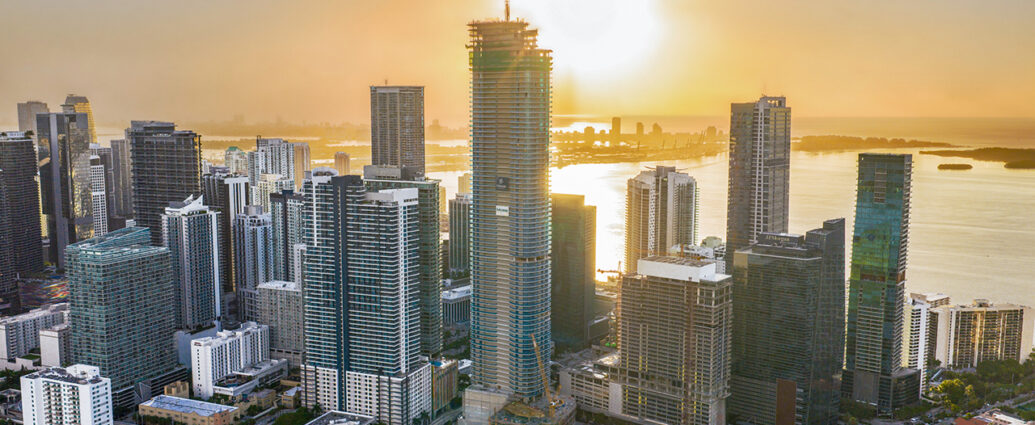
EXCLUSIVE: By next summer, Miami’s skyline will be shaped by a new architectural landmark, bringing a fresh wave of corporate titans and global elites into the heart of South Florida.

As Cipriani Residences Miami officially topped off its approximately 950-foot construction project — the tallest residential tower in the city — the 85-story tower stands as a physical monument to the Magic City’s evolution from a sun-soaked vacation spot into a permanent capital for international wealth.

Cipriani revealed to Fox News Digital that its first ground-up residential development in North America is more than 80% sold, and will welcome buyers from over 30 countries who are now calling Miami their primary home.

“Residential living is a natural extension of hospitality, but it was important to us to do it in the right way,” Giuseppe Cipriani exclusively told Fox Digital. “With Cipriani Residences Miami, we found the right city, location and a great partner… Our family has been closely involved in shaping the design and the overall experience so that it reflects the same traditions we have carried with us for generations. For us, it is not simply about putting the Cipriani name on a building. It is about creating a home where the way you live is the way we would live.”

MIAMI OVERTAKES N.Y.C. IN RETURN-TO-OFFICE RACE AS COMPANIES EXPAND SOUTH FLORIDA FOOTPRINT

“Every time I drive by it, my emotional reaction is, ‘Wow.’ I am humbled by the fact that we’re building something of this scale, because when I started my business, although I always aspired to get here, I didn’t know when it would happen — and it has happened,” Mast Capital founder and CEO Camilo Miguel Jr., the developer behind the building, also said. “One of the biggest challenges was actually the upfront planning part, because when you’re building a 950-foot building… the engineering that goes into that is quite different than building something that’s 20 stories.”

The leading international markets for buyers, in order, come from Mexico, Italy, Colombia, Brazil, Venezuela, Argentina, Canada, France, Spain and the United Kingdom. Domestic buyers continue to flood in from high-tax states like New York and California, too.

“There are countries that are having a lot of their own economic challenges and headwinds and political challenges and headwinds, as well… And people are not only buying in Miami as [an] investment, but people are actually buying in Miami to live. And people were looking at Cipriani and saying, ‘This is going to be home,’” Miguel said.

“We have some buyers who have bought for their whole family and intend to move everybody into the building,” he added.

“Every city has its own character, but what people appreciate about Cipriani is remarkably consistent: warmth, discretion, good service and a sense of familiarity,” Cipriani said. “Miami is a very international city, and that has always felt natural to us. People come here from all over the world, just as they do in Venice or New York. The lifestyle naturally is shaped by its beautiful weather, its connection to the water, its seamless relationship between indoor and outdoor spaces. Cipriani Residences Miami brings that way of living into our world.”

“People are increasingly choosing Miami not only as somewhere to visit, but somewhere to live,” Cipriani continued. “They want privacy, comfort, good service and a quality of life that feels effortless.”

Earlier this month, the New York Post reported that soccer superstar Lionel Messi had purchased four units in the building, followed by a wave of other Argentine players. Buyers also allegedly include executives from Citadel and Amazon who are relocating from New York and California.

“We don’t change who we are depending on the guest. That has never been our philosophy,” Cipriani said. “For nearly a century, our family has welcomed people from many different countries, culture[s], generations and paths of life. Royals, aristocrats, powerful businessmen but also writers, intellectuals and all kind[s] of interesting people have been coming to our locations — as human beings.”

“That sense of warmth and understated elegance that comes from our Italian heritage, and it remains at the heart of everything we do, fortunately has appealed to many of them,” the grandson of the Cipriani patriarch added.

“One of the main reasons that people are choosing Miami over New York City right now is the pro-business mentality. I mean you live in a business-friendly city and a business-friendly state, and the growth and the global nature of our city,” Miguel explained. “And you realize quickly that as a hedge fund or a financial institution, you no longer just need to be in New York City to be relevant and be successful.”

“These are big companies that are moving here, signing leases, taking space, and moving their top executives to Miami, their high-income earners. And these individuals are buying homes and condos across Miami,” Miguel said.

The development is also on track to become the only new residential tower in the Brickell neighborhood delivering completed homes in 2027.

“We are very proud, of course, of what has been built, and of where the company is today, 95 years after the opening of that small bar in Venice. Seeing the tower reach its full height makes us even more excited to bring that spirit to life for the residents who will call it home,” Cipriani nodded to his grandfather’s founding of Harry’s Bar in 1931, where the Bellini was born and “warmth, simplicity and genuine care” became Cipriani’s brand.

“The principles have never changed,” he said. “Whether it is a restaurant, a club, a hotel or now a residence, the idea is the same: people should feel comfortable, free and at home. The world changes, but our hospitality values do not.”

GET FOX BUSINESS ON THE GO BY CLICKING HERE

“This is really about heritage, about people, about a family,” Miguel agreed, recalling his first time at a Cipriani restaurant. “What I really liked about it is that subtle elegance that you feel when you walk in, and the fact that everybody that works there is smiling, everybody that’s there is welcoming and everybody that is there is hyper-focused on making sure that you have a positive experience.”

“I never dreamed of Miami being what it is today,” Miguel said, “and I think the sky’s the limit.”

READ MORE FROM FOX BUSINESS

This post was originally published here. 

Health insurers are confronting a new financial reality as Medicaid enrollment declines and more Americans leave Affordable Care Act marketplace plans after enhanced federal subsidies expired, adding pressure to an industry already grappling with rising medical costs.

Centene Corp. highlighted the trend in its latest earnings update, saying Medicaid membership continues to fall as states complete post-pandemic eligibility reviews. At the same time, insurers are seeing a healthier portion of the insured population leave government-supported plans, leaving behind members who generally require more frequent and costly medical care.

Those changes are occurring just as enhanced Affordable Care Act subsidies introduced during the pandemic have expired for many households. Without the larger federal assistance, some consumers are finding monthly premiums increasingly difficult to afford, leading them to drop coverage or seek less comprehensive plans.

For insurers, the shift creates a difficult balancing act. Fewer members generally mean lower premium revenue, while a sicker remaining population increases claims expenses. Companies must decide whether to adjust pricing, reduce plan offerings or absorb higher costs while remaining competitive during future enrollment periods.

Healthcare providers could also feel the effects. Hospitals and physician groups often face greater financial pressure when uninsured patients delay treatment until conditions worsen, increasing uncompensated care and emergency-room utilization.

Businesses should also pay attention. Employers that provide health insurance may continue to see upward pressure on benefit costs as insurers attempt to offset higher medical expenses. Companies evaluating employee healthcare plans for 2027 could face more difficult negotiations over premiums, deductibles and provider networks.

Investors are watching whether the industry’s cost pressures are temporary or the beginning of a longer structural shift. With Medicaid eligibility reviews largely complete and subsidy policy remaining uncertain, insurers are expected to focus increasingly on pricing discipline, operational efficiency and higher-margin business lines.

The next major test will come during the upcoming open-enrollment season, when insurers reveal pricing decisions that will provide a clearer picture of how they expect healthcare costs to evolve over the next year.


JBizNews Desk | Wall Street

© JBizNews.com All Rights Reserved. Reproduction or distribution without written permission is prohibited.

Defense Minister Israel Katz boasted about signing administrative detention orders against Arabs in the West Bank, while refusing to sign orders against Jewish citizens.

During a Tuesday Likud primaries conference in Ariel, Katz said that he did not believe that settlers commit terrorism in the West Bank. 

“Not once did I sign for them [the settlers]. But who do I sign orders for? A lot. A lot. I sign for cases of Palestinian terrorism – suspects brought by the Shin Bet when it isn’t yet possible to put them on trial. We hold them under administrative detention orders,” Katz said.

“Why didn’t I sign for the settlers? Because that is not terrorism. Only someone who acts against the security of the state, someone who acts to harm [the state],” he said.

“On my own initiative, as soon as I realized what was happening, I canceled all administrative detention orders against settlers in Judea and Samaria.”

Defense Minister Israel Katz attends a conference at Binyanei HaUma (Jerusalem International Convention Center) in Jerusalem, June 17, 2026. (credit: OREN BEN HAKOON/FLASH90)

“Every incident of violence in Judea and Samaria was processed as terrorist activity. Therefore, they could hold people without a trial, without charges, without evidence, and without rights – handling and interrogating them just like terrorists, said the defense minister,” he said.

“I called the former head of the Shin Bet and notified him: ‘It is canceled. There will be no more of this.’ And that is exactly what happened.”

Defense Minister holds sole authority to sign administrative detention orders

Under Israeli law, the defense minister holds the sole authority to sign administrative detention orders, allowing individuals to be detained indefinitely without formal charges or trial.

Katz made a decision in January 2025 to end administrative detention for Jews, while continuing it for over 3,200 Palestinians.

Notably, there were never many Jews in administrative detention, and they were generally only held for three to six months at a time.

Yonah Jeremy Bob contributed to this report.

This post was originally published on here. 

Israeli security officials arrested an Israeli resident of the West Bank on Wednesday morning who is suspected of having violently attacked Palestinians while in uniform as an IDF soldier, using IDF equipment. 

The suspect is a man in his 20s and a member of the local security team in his hometown in the West Bank who allegedly participated in violent clashes between Israelis and Palestinians in the West Bank town of Huwara in early June. Several of the Palestinians subsequently required hospitalization, according to police. 

The arrest was the result of a joint operation with Israel Police, Border Police, and the Shin Bet (Israeli Security Agency).

Army Radio also reported that some of the settlers involved in the incident were masked and that several Palestinians were injured, claims that were later denied by the IDF.

Security officials open investigation into footage of uniformed soldiers attacking Palestinians 

At the time, the military said that the Judea and Samaria District Police had opened an investigation into the clashes in Huwara, specifically regarding footage of uniformed IDF soldiers participating in the violence.

The clashes included incidents of stone throwing and the use of clubs between Israeli civilians and Palestinians, according to the IDF. Police on Wednesday further claimed that an attacker in IDF uniform was equipped with a military-issued M-16 rifle and a pistol, although there are no reports of shots having been fired at the scene.   

“The case is being investigated. If the soldier is found, he will be dealt with disciplinary action, and command and disciplinary measures will be taken in accordance with the findings,” the military said in June. 

Suspect evades arrest despite early police identification, indictment

During the initial stages of the investigation, several suspects were arrested, and investigators were able to identify one of the uniformed Israelis seen in the footage of the attack and file an indictment against him.

However, he managed to evade arrest for several weeks until his arrest on Wednesday morning. The weapons in his possession were seized during his arrest, and police are expected to request an extension of his detention for the duration of the investigation into his case. 

This post was originally published on here. 

Markets lean toward another hold, but the chairman’s refusal to signal has turned a routine meeting into a guess

The Federal Market Committee opened its two-day policy meeting Tuesday and will announce its rate decision Wednesday at 2 p.m. Eastern, with the benchmark rate currently sitting in a range of 3.5% to 3.75%. A hold would be the fifth straight meeting without a change. What makes this one different is that nobody outside the Eccles Building is confident that is what will happen.

Ordinarily the outcome is settled well before the committee sits down. Officials give speeches, reporters get guided, and the market prices the result to near certainty. That machinery has been dismantled. Chairman Kevin Warsh, confirmed in May, has made a deliberate policy of saying less — no forward guidance, and at the June meeting he declined to submit economic projections of his own. The result is that a decision affecting every business loan, credit line, and mortgage in the country now rests on reading one man who has stopped offering material to read.

Two weeks ago the picture looked settled toward a hold. June inflation came in cooler than expected, which pushed the argument over a possible increase out to September. Then the U.S.-Iran ceasefire collapsed, energy prices jumped, and traders started pricing a July move partly because other traders were. Crude is up roughly 20% over the course of July even after this week’s pullback, with West Texas Intermediate sliding about 8% Monday to just over $82 a barrel and Brent down 9.5% to roughly $87.50 as fighting paused for a third consecutive night. As of Tuesday, bond traders put the odds of a hold at about 68% and a hike at about 32%.

Three things are worth watching Wednesday afternoon.

The vote. If the committee holds, the dissents matter more than the decision. At the June meeting, roughly half of the eighteen policymakers who submitted projections indicated support for raising rates before the end of the year — Warsh was not among the submitters. A dissent or two against a hold would confirm that a real faction inside the committee wants to move. Previous chairmen defused those situations by adjusting the language of the statement or hinting that action was coming at the next meeting. Warsh has said he wants to retire those tools. Without them, internal disagreement has fewer places to hide.

The reasoning. If the Fed does raise, the explanation will drive the market reaction more than the move itself. Framed as an answer to five years of inflation running above the 2% target, it reads as the first of a series, and long-term yields could actually fall on the view that the central bank is finally serious. Framed as a one-time response to an oil shock, it signals almost nothing about what comes next. There is a further complication: Warsh has said the Fed can do little in the short run about supply shocks like energy, and has argued that the artificial-intelligence buildout may eventually push prices down on its own. Neither argument builds an obvious case for tightening right now.

The politics. The White House spent much of the past year arguing that rates were too high and inflation was contained. A hike delivered by the president’s own nominee would say the opposite in the plainest possible terms, and would end any suggestion that the chairman is taking direction from the administration. That is precisely why some analysts believe a move would be more about establishing independence than about the June data — and why others think it would be a mistake. New York Fed President John Williams, vice chair of the rate-setting committee, made the counterargument earlier this month: credibility built over decades is maintained by making the best decision the data supports, not by using monetary policy to demonstrate resolve.

For business owners in the tri-state area, the practical stakes are narrower than the drama suggests. A quarter-point either way does not change a payroll. But the pattern does. Small firms have absorbed two years of tariff costs, and since late February have been paying more for fuel, freight, and marine insurance as a result of the Iran conflict. Operators who lack the margin to carry higher input costs indefinitely need to know whether credit gets more expensive from here or stays put through the fall. A hold with visible dissent tells them tightening is coming and gives them a window to lock in terms. A hike tells them the window already closed.

Warsh will hold a press conference at 2:30 p.m. Whatever the committee decides, the more consequential information is likely to come in that half hour — not from what he announces, but from how much he is willing to explain.

JBizNews Desk | Wall Street

© JBizNews.com All Rights Reserved. Reproduction or distribution without written permission is prohibited.

A group representing thousands of retired Israeli military officers and security professionals sent US President Donald Trump a letter rejecting allegations of widespread violence by Israeli settlers in the West Bank, escalating a dispute between rival groups of former Israeli defense officials seeking to influence the White House.

The letter, obtained by The Jerusalem Post, was sent by Israel’s Defense and Security Forum in response to an appeal from Commanders for Israel’s Security, a separate organization representing hundreds of former senior officials from the IDF, Mossad, Shin Bet, Israel Police and diplomatic establishment.

The earlier letter warned Trump that violence by Jewish extremists in the West Bank threatened Israel’s security, US regional interests and prospects for diplomatic progress.

IDSF chairman Brig.-Gen. (res.) Erez Winner rejected that assessment, accusing CIS of presenting a distorted picture of violence involving Israeli residents of the West Bank, known in Israel by its biblical names of Judea and Samaria.

The IDSF letter said the organization condemned violence and lawbreaking by Israelis or Palestinians and supported firm police action against offenders.

Family, friends and residents attend the funeral of Benayahu Melet at the Israeli settlement of Havat Gilad in the West Bank, July 24, 2026. (credit: HILEL BEN OR/FLASH90)

“We condemn all violence and any violation of the law from any side, and demand firm police action in every individual case,” Winner wrote.

‘Settler violence’ claims smear all West Bank Jews, IDSF says

At the same time, IDSF argued that the phrase “settler violence” had been turned into a political campaign aimed at portraying more than half a million Israeli residents of the West Bank as collectively responsible for the actions of a small extremist fringe.

The organization accused international bodies and Israeli human-rights groups of inflating statistics by classifying incidents as violence even when they involved routine security procedures or nonviolent civilian activity.

According to the letter, incidents recorded in international databases included Israeli security checks, Jewish visits to the Temple Mount in Jerusalem and hikes or tours in disputed areas that contained “no element of violence.”

IDSF also claimed that more than half of complaints submitted by activist organizations in areas of Israeli-Palestinian friction were later determined to be deliberately false. The letter did not include police records, the relevant UN database or other documentation supporting that figure.

The organization cited a February 2026 fire at a Palestinian-owned sheep pen as an example of an incident initially blamed on Israeli settlers. IDSF said a police investigation later concluded that the blaze had been caused by an illegal electrical connection installed by the Palestinian owner.

According to the letter, the initial allegation contributed to the international perception that the fire was part of a broader pattern of attacks by Israeli settlers.

IDSF named Yesh Din, B’Tselem and Breaking the Silence among the organizations it accused of promoting the narrative, saying they received tens of millions of shekels from European governments and the United Nations.

The letter alleged that those organizations sought to weaken the legitimacy of Jewish communities in the West Bank and advance their eventual evacuation as part of a territorial withdrawal.

The groups were not quoted in the material provided to the Post.

Rival groups clash over Israeli security policy

The dispute also reflected a deeper ideological division among retired members of Israel’s security establishment.

IDSF accused the CIS leadership of supporting a “peace through surrender” approach based on Israeli territorial concessions and withdrawals. It pointed to support among some former security officials for the 2015 Iran nuclear agreement, formally known as the Joint Comprehensive Plan of Action, and Israel’s 2005 withdrawal from the Gaza Strip.

The disengagement removed all Israeli settlements and permanent military installations from Gaza. Hamas took control of the territory two years later, and the group used Gaza as the base for its October 7, 2023, attack on southern Israel.

IDSF argued that the same former officials who supported the withdrawal were now using isolated incidents of Israeli violence to promote a similar policy in the West Bank.

The CIS letter, meanwhile, reportedly urged Trump to press Prime Minister Benjamin Netanyahu to confront Jewish extremists and prevent government officials from interfering with law-enforcement efforts.

CIS has warned that attacks by Israelis against Palestinians could further weaken the Palestinian Authority, inflame the West Bank and undermine American efforts to expand regional normalization agreements between Israel and Arab states.

The exchange came amid heightened tensions in the West Bank, where Israeli security forces have faced a combination of Palestinian terrorist attacks, settler violence and repeated confrontations between Israeli and Palestinian civilians.

A mosque in the Palestinian village of Kusra was set on fire Sunday in a suspected nationalist attack. Hebrew graffiti referring to revenge for an Israeli victim of Palestinian terrorism was found at the scene.

Israeli officials have repeatedly condemned attacks by Jewish extremists and said those responsible should be prosecuted. Critics of the government have argued that enforcement remains inconsistent and that extremist activists have received political protection.

IDSF maintained that the focus on settler violence diverted attention from the larger threat posed by Palestinian terrorist organizations and Iranian attempts to expand their influence in the West Bank.

“Mr. President, you have always known how to identify the truth from alternative facts,” Winner wrote. “We call on you to continue to stand alongside truth, justice, and the steadfast alliance between the United States and Israel.”

Shimon Refaeli, deputy head of the Institute for Security Policy at the Israel Defense and Security Forum (IDSF-Habithonistim), said the letter was sent to US President Donald Trump because “Israel’s security and international legitimacy cannot be abandoned.”

“In recent years, international and local actors have promoted a false and fabricated narrative accusing the communities in Judea and Samaria of organized violence,” Refaeli told the Post.

He said the allegations had caused significant damage by contributing to efforts to delegitimize Israel and distracting its international supporters from Palestinian terrorism and growing Iranian influence in the West Bank.

“It is our duty at IDSF to present the truth on behalf of hundreds of thousands of combatants, officers and commanders, and to lay out the facts as they are to our closest ally,” he said.

Refaeli described systemic “settler violence” as an orchestrated propaganda campaign intended to force the removal of Jewish communities from the West Bank. He argued that violent incidents were marginal and that statistics were inflated by classifying routine security checks and civilian tours as acts of violence.

This post was originally published on here. 

Prime Minister Benjamin Netanyahu’s flight to Washington took off discreetly on Monday out of fear of an Iranian threat, N12 reported on Tuesday.

According to N12, Israeli security forces recommended that Netanyahu’s flight leave under secretive conditions after reports that Iran was escalating its efforts to attack Israeli officials.

As such, Netanyahu’s plane departed from the Nevatim air base rather than Ben-Gurion Airport. The times of his arrival and departure were not publicized in advance.

Prime Minister Benjamin Netanyahu and US President Donald Trump meet at the White House, July 28, 2026.  (credit: MAAYAN TOAF/GPO)

In addition, journalists and reporters were not permitted to join Netanyahu on his flight.

Trump has ‘very positive’ meeting with Netanyahu

US President Donald Trump hosted Netanyahu on Tuesday to discuss the war in Iran as well as expanding the Abraham Accords, following calls by Trump for Saudi Arabia to normalize ties with Israel.

“It was a very positive meeting. You could see the chemistry between the leaders,” a source familiar with the details told The Jerusalem Post. 

Reuters, Idan Kweller, Danya Saperstein, and Amichai Stein contributed to this report.

This post was originally published on here. 

The Movement for Freedom of Information revealed the expenses for the prime minister’s residences in 2025 and the first half of 2026 on Tuesday.

For the first time this year, the classification of private residences included the house on Gaza Street, additional private residences, and the additional residence in Caesarea. The official residence on Balfour Street is undergoing renovations and is therefore classified as “support apartments.”

Nearly NIS 65,000 unaccounted for in Netanyahu expenses

In 2025, the total expenses for the residences amounted to NIS 1,979,517. Of this amount, NIS 165,444 was for food purchases, with an additional 2,700 for Wolt deliveries in August 2025 alone.

Another NIS 94,957 was for gardening at the Caesarea residence, and NIS 10,590 went to preventive treatment to prevent roots from penetrating beneath the Caesarea residence.

A total of NIS 63,033 was completely redacted, with no details provided regarding either the supplier’s name or the description of the expense.

In the first half of 2026, the total expenses for the residences amounted to NIS 731,081, with NIS 53,584 going toward food purchases.

 The new security measures outside Prime Minister Benjamin Netanyahu's home on Azza Street in Jerusalem. (credit: MARC ISRAEL SELLEM)

Another NIS 42,698 was for maintenance expenses and maintenance products. NIS 14,986 went to replace the bathtub at the private residence on Gaza Street. NIS 31,509 was paid to the Israel Electric Corporation, and NIS 4,657 was used to replace thermostats at the Caesarea residence.

Head of Freedom of Information Movement bemoans need to petition court

“Once again, we were required to petition the court to disclose information about the expenses of the prime minister’s residences, and once again, a wasteful policy involving the use of public funds at the prime minister’s residences has been revealed,” Attorney Hidi Negev, executive director of the Movement for Freedom of Information, said.

“Precisely at a time when the entire public is coping with a heavy economic burden and the consequences of the war, it is especially important to act responsibly and with complete transparency regarding public expenditures. This information should be published proactively and regularly, rather than information the public is forced to obtain only following court petitions.

“A properly functioning system is one in which expenses of this kind are transparent and accessible to the public, as part of the obligation to ensure transparency and oversight of the use of public funds.”

The Prime Minister’s Office said in response that “The figures published in the response show that the total expenses for the residences during Prime Minister Netanyahu’s term are significantly lower than those incurred during the terms of previous prime ministers.

“For example, during former prime minister Naftali Bennett’s year in office, ongoing expenses totaled NIS 1,370,362, excluding personnel and security costs, while during the corresponding period under Prime Minister Netanyahu, expenses totaled only NIS 465,319, excluding personnel and security costs, less than one third of the amount spent during Bennett’s term.”

This post was originally published on here. 

US Central Command (CENTCOM) together with the Saudi Arabian Armed Forces struck Iraq on Wednesday, targeting “Iran-aligned terrorists that the Islamic Revolutionary Guard Corps (IRGC) directed to attack US forces and Saudi energy infrastructure,” CENTCOM said in a post on X/Twitter.

“US and Saudi fighter aircraft struck multiple terrorist logistics and weapons sites across eastern Iraq in a strong response to over 30 IRGC-directed aerial drone attacks in the last 72 hours.”

CENTCOM’s announcement came shortly after reports from Arabic media of “unexplained explosions at a Popular Mobilization Front (PMF) base,” in Iraq. The PMF is composed of about 67 Iranian-backed armed militias.

The Saudi Defense Ministry added that the strikes “reaffirm the Kingdom’s legitimate right to defend itself,” adding that it  “does not seek escalation but will respond to any aggression it faces,” in a post on X on Wednesday.

Chinese-flagged VLCC supertanker Cosnew Lake, which exited the Red Sea via the Bab el-Mandeb Strait on July 23, 2026.  (credit: Vladimir Tonic/Handout via REUTERS)

Iranian strikes on US bases in the Middle East

Jordanian air defenses shot down five missiles launched from Iran, the state news agency reported early on Wednesday morning.

Hours earlier, Iran launched multiple ballistic missiles towards US military bases across the Middle East, CENTCOM confirmed in a post on X.

“IRGC forces launched multiple ballistic missiles from Iran in an attempted surprise attack on US forces based in the Middle East,” the post explained.

The IRGC “fired ballistic missiles at US air bases and US military Central Command center in Jordan,” Iran’s Revolutionary Guards told Iranian state media.

A US official told The Jerusalem Post that Iran had launched at least four ballistic missiles towards a US military base in Jordan, adding that “This was a major attack.”

Shortly before CENTCOM confirmed that the IRGC had launched a number of ground-to-ground missiles at US bases across the region, Iranian negotiator Seyed Mohammad Marandi announced that Iran was “fully prepared for all out war,” in a post on X.

Missiles, drones launched at Saudi Arabia

Saudi air defenses intercepted and destroyed several drones that attempted to strike oil facilities in the kingdom’s Eastern Province on Tuesday night, Saudi Defense Ministry spokesperson Turki al-Maliki said.

Al-Maliki said the drones had been launched from Iraqi territory by Iranian-backed militias.

Saudi Arabia reserves the legitimate right to defend itself and its national capabilities and retains the right to respond “at the appropriate time and place,” al-Maliki added.

The Houthis also claimed they had fired ballistic missiles at a Saudi oil tanker in the Red Sea on Wednesday morning. A Houthi military spokesperson said the vessel had violated the group’s newly declared maritime blockade of Saudi Arabia.

Shortly before the Houthi announcement, the United Kingdom Maritime Trade Operations (UKMTO) center said that a tanker had reported hearing an explosion in the Red Sea.

Additionally, the IRGC told Iranian state media that three oil tankers were “struck and stopped” in the Strait of Hormuz on Wednesday morning after they “ignored warnings.”

CENTCOM paused attacks on Iran for negotiations to reopen Hormuz

The US military carried out nightly strikes on Iran from July 8 through July 24, but has since paused the campaign to allow US and Iranian negotiators to discuss reopening the Strait of Hormuz.

“We are in very deep talks with Iran, if they don’t work out, we will go back to very strong military action,” US President Donald Trump told Axios on Monday.

The president said he paused strikes to give negotiations another chance, but added that the talks would “Either go fast or not at all,” adding that countries involved in the talks told him to hold back from further escalations.

“If the [US] attacks stop, Iran will also halt its operations,” a senior Iranian source told Reuters on Sunday.

The official added that “There is more skepticism than optimism about the halt in attacks. The prevailing view is that the pause is tactical rather than genuine.”

Amichai Stein and Reuters contributed to this report.

This post was originally published on here. 

Israel’s security establishment is warning that the planned deployment of an international stabilization force in the Gaza Strip could restrict the IDF’s operational freedom and enable Hamas to recover, after the security cabinet approved granting legal immunity to the force ahead of its entry into designated areas of the enclave on Sunday.

According to political and security officials, the United States is pressing Israel to move forward with the reconstruction of the Gaza Strip before it has been fully demilitarized and before Hamas has been disarmed. Security officials assess that the deployment of the international stabilization force could limit the IDF’s offensive freedom of action, weaken its ability to operate against terrorist cells, and ultimately strengthen Hamas.

The warnings came after the security cabinet approved granting immunity to the International Stabilization Force (ISF) ahead of its planned deployment to certain areas of the Gaza Strip.

A political source explained that the preliminary approval for the force’s entry is part of US President Donald Trump’s 20-point plan, which led to the release of all the hostages. According to the source, after approving the entry of approximately 200 representatives from friendly countries, including Uganda and Morocco, Israel continues to insist that the IDF remain along the Yellow Line and not withdraw from it until Hamas has been disarmed and the Gaza Strip has been fully demilitarized.

IDF SOLDIERS operating in the Gaza Strip. (credit: IDF SPOKESPERSON'S UNIT)

Cabinet backs Gaza Force as security officials sound alarm

However, Walla has learned that political and security officials asked the Americans to postpone the next phase of the plan in order to avoid undermining the IDF’s achievements. The request was rejected, and the officials were informed that the process would continue in accordance with Trump’s wishes.

Security officials argue that introducing the international stabilization force at this stage would normalize Hamas’s status and allow the organization to select a new leadership, rebuild its military wing, reestablish its rule, and deepen its hold over Palestinian society through intimidation and violence.

According to the officials, only the IDF is capable of removing weapons from the Gaza Strip and dismantling Hamas’s military capabilities, not a multinational force.

Security officials also expressed doubts about the feasibility of establishing a terrorism-free “Green City” in Rafah. In their assessment, Hamas would continue to intimidate the local population, control developments from behind the scenes, and exploit the initiative for its own purposes, including by smuggling weapons from Egypt and constructing new terrorist infrastructure.

Military officials familiar with the process said that every step toward introducing multinational forces into Gaza prevents Israel from completing the demilitarization of the territory and contradicts what they described as an American commitment that Hamas would first be disarmed before reconstruction efforts began.

“In practice, the exact opposite is happening,” the officials said.

They further assessed that bringing forces from countries friendly to Israel into the Gaza Strip would increase political and operational sensitivity surrounding any future military activity, weaken the IDF’s operational initiative, and further restrict its ability to act against terrorist organizations.

Meanwhile, the advocacy group “Future for the Gaza Envelope” sharply criticized the cabinet’s decision and demanded a clear answer from the government on whether the move would make residents of the Gaza border communities safer.

“If the answer is not unequivocal, the process must not move forward,” the organization said.

The group stressed that it would oppose rebuilding the Gaza Strip before the threat posed by Hamas is removed and said it would not accept a return to the security reality that existed before October 7.

According to the organization, residents of the Gaza border region have already paid the highest possible price for security concepts that ultimately failed and are unwilling to accept additional decisions based on hope or promises.

The group added that the lessons of October 7 must guide every future decision.

“Any process of reconstruction, diplomatic arrangement, or political initiative must begin only after Hamas has ceased to be both a military and governing threat. It is impossible to discuss ‘the day after’ while there is still no certainty that yesterday’s threat has been eliminated,” it said.

The organization also stressed that any future framework must include effective monitoring and oversight mechanisms to guarantee Israel’s security, freedom of action, real-time intelligence capabilities, and the early detection of any renewed terrorist activity.

This post was originally published on here. 

Iran reportedly considered attacking a Ukrainian seaport in the Black Sea in response to a Ukrainian strike on an Iranian ship, but in a “flurry of diplomacy,” opted not to, Iranian and Western officials told The New York Times on Tuesday.

People with knowledge of the matter expected Iran to fire a ballistic missile with a small warhead at Ukraine as a show of strength, the NYT reported. This would have constituted a major escalation and risked opening a new warfront, given Iran’s alliance with Russia. 

Zelensky: Ukrainian long-range strikes hit Russian warship, vessels transporting Iran-linked cargo

Ukraine’s forces struck a Russian warship, and vessels used for transporting Iran-linked military cargo in the Caspian Sea, President Volodymyr Zelensky said on Saturday.

The Kremlin said on Tuesday that a Ukrainian attack on an Iranian vessel in the Caspian Sea should be considered an assault on Iran itself and showed how important it was to eliminate what it said was the threat from Kyiv.

Ukraine's President Volodymyr Zelensky looks on during an interview with Reuters, amid Russia's attack on Ukraine, in Kyiv, March 25, 2026. (credit: REUTERS/VALENTYN OGIRENKO/FILE PHOTO)

Iran’s Foreign Ministry on Saturday condemned the Ukrainian attack, saying it resulted in an explosion that killed one sailor and injured another. 

Kremlin accuses Ukraine of ‘terrorist attacks’

Kremlin spokesman Dmitry Peskov on Tuesday accused Ukraine of widening the geographical scope of what he called “terrorist attacks.”

Peskov accused Kyiv of blowing up Germany’s Nord Stream pipelines – something it denies – and of hurting Kazakhstan’s interests by targeting CPC Pipeline Infrastructure.

“This threat must be neutralized and definitively destroyed,” Peskov said.

This post was originally published on here. 

Advances in artificial intelligence (AI) are set to help reshape the healthcare industry in the years ahead, a new report finds.

The Institute of Electrical and Electronics Engineers (IEEE), the largest group of technical professionals that’s dedicated to advancing technology to benefit humanity, released its Technology Megatrends 2030 Report on Wednesday after it was reviewed exclusively by FOX Business.

The report looked across five core areas, including AI, energy, health and biotech, space tech, and robotics and assessed the potential of each to reshape human life by 2030. The experts whose insights were used to compile the report ranked developments in health technology as having the largest potential impact on humanity.

Dejan Milojicic, IEEE fellow and chair of the IEEE Future Directions Committee Industry Advisory Board, told FOX Business that within the megatrends analyzed in the report, “health technologies emerge as among the most transformative and humanity-beneficial, driven by a fundamental shift from reactive treatment to proactive protection.”

ZUCKERBERG PREDICTS MORE JOBS AND ENTREPRENEURSHIP IF SUPERINTELLIGENCE IS WIDELY DISTRIBUTED

IEEE’s report identified several technological areas that can advance the healthcare industry, including personalized medicine; genetic engineering and gene therapy; accessible early disease diagnostics and biomarkers; molecular therapeutics; protein synthesis; and understanding life.

Of those six areas, IEEE graded personalized medicine, genetic engineering and gene therapy, and accessible early disease diagnostics and biomarkers the highest in terms of their impact, likelihood of success, maturity and adoption.

ANTHROPIC’S AMODEI DEFENDS OPEN-WEIGHT STANCE FOLLOWING CRITIQUE FROM PALANTIR’S KARP

Over the next five to 10 years, IEEE sees advances in health tech leading to impacts like the reduction of preventable chronic diseases, personalized clinical outcomes, improved food safety and increased access to high-quality, nutrient-dense foods.

“As populations age, using physical AI technologies, such as virtual nursing and intelligent monitoring, will become vital to supporting the needs of an expanding revitalized economy,” Milojicic said. “At the same time, we see food systems being reimagined as core healthcare infrastructure, using AI-enhanced tools like smart traceability to deliver personalized nutrition and curb chronic disease at scale.”

COMPANY BETS $200K ON AI TO MAKE TRADES WORKERS ‘BETTER, STRONGER, FASTER’

IEEE identified several enablers for advancements in healthcare tech, including biotechnology, digital health, and things like agricultural drones and personalized nutrition.

Inhibitors to the impact of health technology advancements include privacy and security for data used for public health prevention through epidemiology and surveillance, as well as status quo culture.

GET FOX BUSINESS ON THE GO BY CLICKING HERE

“Our panel of experts is clear that none of this works without robust trust, privacy, and safety standards guiding how these technologies are built and deployed,” Milojicic said.

This post was originally published here. 

Amazon is scaling back much of its Nova family of artificial intelligence models as the global AI race expands far beyond software, highlighting a broader industry shift toward infrastructure, energy and manufacturing rather than simply building larger language models.

The company is reportedly redirecting resources toward a next-generation frontier model while continuing to invest heavily in Amazon Web Services, which has become one of the world’s largest providers of AI computing infrastructure. The move comes as technology companies increasingly face pressure to prioritize projects with the greatest commercial potential instead of maintaining multiple competing AI initiatives.

What is becoming clear is that artificial intelligence is no longer just a competition between software developers. Over the past year, the industry’s biggest players have committed billions of dollars to secure electricity, data-center capacity, advanced semiconductor production and high-speed networking as AI systems require dramatically more computing power than previous generations of technology.

Government policy is increasingly shaping that competition as well. The Trump administration this week moved to restrict additional Chinese humanoid robots from entering the United States, arguing that robotics, semiconductor manufacturing and artificial intelligence infrastructure have become matters of national security. At the same time, China’s technology-focused provinces continue posting significantly stronger industrial growth than regions dependent on traditional manufacturing, driven by investment in electric vehicles, robotics and semiconductor production.

Taken together, the developments illustrate how the AI race has entered a new phase. Success will increasingly depend not only on software breakthroughs but also on the ability to secure power generation, manufacturing capacity, supply chains and skilled workers.

For businesses, the implications extend well beyond the technology sector. Utilities, engineering firms, construction companies, industrial manufacturers, semiconductor equipment suppliers and energy developers are all becoming critical participants in the AI economy. Companies that once viewed artificial intelligence primarily as a software opportunity are now finding that physical infrastructure may become the industry’s largest competitive advantage.

With Microsoft, Meta, Amazon and other major technology companies expected to continue investing aggressively in AI infrastructure, investors will increasingly evaluate whether those multibillion-dollar capital expenditures generate sufficient long-term returns while supporting the industries building the foundations of the next generation of computing.


JBizNews Desk | Wall Street

© JBizNews.com All Rights Reserved. Reproduction or distribution without written permission is prohibited.

Hundreds of thousands of U.S. doctors use clinical large language models, pitched by companies like OpenEvidence, Doximity, and UpToDate as an antidote to the dangers of hallucination-prone generalist models from Big Tech. Yet few studies have pitted them against each other — and this summer brought a high-profile head-to-head. 

Researchers from NYU Langone Health had tested general and clinical models, including OpenEvidence and UpToDate Expert AI, on three sets of clinical questions. The findings, published in Nature Medicine in June: The clinical AI performed worse than the general models. 

The results rang out like a gunshot. “I’ve never seen a single paper trigger the kind of reactions this one has in the health AI community,” wrote Kaiser Permanente’s vice president of AI and emerging technologies on LinkedIn. The paper’s findings, like all science, are subject to interpretation and debate — but many online reactions treated them more like a clear victory for general frontier models.

Continue to STAT+ to read the full story…

This post was originally published here. 

When one of Rhode Island’s most-wanted fugitives was discovered last week to have been secretly working under an alias in the biotech industry, the reaction among many was shock. How did he evade scrutiny for two decades? And how did the companies that hired him — at least one biotech on a full-time basis and at least two large pharmaceutical companies on a contractual basis — not vet him more thoroughly?

But to an industry recruiter who spoke with Richard Graydon — the alias used by Ronald Fischer, a former doctor who was convicted of sexual assault and who had spent two decades on the run — it wasn’t altogether surprising. 

Graydon’s stellar academic credentials, board certification, and years of experience leading teams that successfully developed cancer drugs made him an ideal candidate for top jobs at biotech and pharma companies. Much of his CV appears to have been fabricated, according to a STAT review, but it checked the right boxes.

Continue to STAT+ to read the full story…

This post was originally published here. 

Biotechnology is rapidly becoming a pillar of national power. The nation that can discover, test, and deploy new therapies most efficiently will not only improve the health of its citizens but also shape global standards, attract investment, strengthen military readiness, and dominate one of the most important industries of the past century.

China understands this reality. Beijing has made biotechnology a strategic priority and is investing aggressively in artificial intelligence, synthetic biology, advanced biomanufacturing, gene therapies, and precision medicine.

Read the rest…

This post was originally published here. 

The nurses had warned me not to expect much. They hadn’t seen her smile in weeks, they said, sounding as though they’d already given up.

Her room was undecorated and gray, crowded with machines whose chorus of irritating beeping never ceased. I paused at the entrance, horrified by the numerous plastic tubes penetrating her tiny abdomen. My eyes moved from her stomach to her hands, clenched around a stuffed unicorn, her sole companion on a Friday night.

Read the rest…

This post was originally published here. 

The Technion-Israel Institute of Technology was ranked 25th worldwide in a new index measuring universities’ ability to advance AI research, talent, and entrepreneurship.

The Technion ranked first among Israeli institutions and fourth in Europe. The index also ranked the university eighth in the world for the number of graduates who go on to found AI companies.

 ISRAEL-TECHNOLOGY-TRANSPORT People visit the ''EcoMotion Week'' trade show on May 11, 2022, in the Israeli coastal city of Tel Aviv. (credit: JACK GUEZ/AFP VIA GETTY IMAGES)

The AI Production Capacity index was compiled by the US public relations firm W5 and ranks the world’s top 50 universities by their influence on AI research and industry.

The index evaluates factors including the number of alumni and faculty members employed by leading AI companies, entrepreneurship and human capital, startup founders, unicorn creation, venture funding, research output and quality, computing infrastructure, and the depth of AI education.

It also considers how frequently universities are mentioned by generative AI systems.

Technion outperforms larger, elite universities 

Despite operating with significantly fewer resources than many of the world’s largest and best-funded universities, the Technion outperformed several elite institutions in key areas of the ranking.

Technion President Prof. Uri Sivan said the university’s ranking was particularly significant given the gap in resources between the Technion and many leading institutions abroad.

“Despite the dramatic disparity in resources between the Technion and leading American universities and other top institutions worldwide, the Technion has secured a place among the world’s leading universities and at the top of the Israeli rankings,” Sivan said.

“Technion researchers were among the pioneers of machine learning, helping lay the foundations for leadership in AI as a whole,” he added.

Sivan said the Technion’s position was reflected not only in its research, but also in the growing role of AI across its academic programs and its ties with industry in Israel and abroad.

“AI tools are now essential in the workplace, and we ensure that our students acquire these skills alongside a strong foundation in mathematics, science, and engineering,” he said.

The university ranked ahead of Harvard in two categories: the number of faculty members and graduates working in the AI industry, and the number of alumni who went on to establish AI companies.

Technion’s AI performance holds across multiple rankings

When adjusted for institutional size, the Technion’s performance in alumni entrepreneurship was comparable to Stanford, which placed first overall.

The Technion also achieved a stronger overall ranking than Duke, Northwestern, and the University of Pennsylvania, despite working with substantially smaller budgets.

Sivan noted that other international measures had produced similar results, including CSRankings, which placed the Technion first in Europe for the number of AI papers presented at leading international conferences.

“These achievements are the result of a long-term, carefully planned strategy made possible by the outstanding people who make up the Technion family: our faculty members and lecturers, leadership and staff, students, administrative teams, distinguished alumni, and, of course, our friends around the world,” he said.

This post was originally published on here. 

The next great technological revolution may emerge from a web of processors, algorithms and controllers, each built by different companies and tested together for the first time. For Israel, that is the premise behind a proposed national quantum-computing research and development center – and the reason Israel Innovation Authority CEO Dror Bin believes the country must move now.

“Until just a few years ago, it was seen as something which is too futuristic and will not happen in our generation,” Bin said of quantum computing. “But in the last few years, there was really an acceleration in the development of such computers.”

For Bin, the project is an effort to create the conditions in which Israeli companies can test, combine and refine the technologies that could become part of the world’s most advanced systems.

When asked about the center’s main purpose, Bin described an emerging cluster of Israeli companies developing quantum technologies and components. “Some of them are already category leaders in some components of the future quantum computers,” he told The Media Line, adding that “something like 10% of the overall private investment in quantum computing companies was made in Israel, in those early-stage companies” in 2025.

The challenge, he argued, is integration. Some firms are developing processors; others are building algorithms or controllers. The proposed center would place those capabilities in a shared environment, creating what Bin called “the full stack of a quantum computer based on Israeli technology.”

A quantum computer is displayed at IBM booth during the second day of the Mobile World Congress 2026 at Fira Barcelona Gran Via on March 3, 2026 in Barcelona, Spain.  (credit: Javier Mostacero Carrera/Getty Images)

Specialize, collaborate, compete

Yet the immediate ambition is deliberately more practical than building a finished national machine. “Not in order to create a computer, but rather to create an R&D lab in which different components of hardware and software can be tested, can be integrated, can be benchmarked to see that everything really works together,” Bin said.

That distinction reflects a central feature of Israel’s technology model: specialize, collaborate and compete where the country can make an outsized contribution. Quantum computing, Bin explained, differs fundamentally from classical systems, which process bits in either a zero or one state. Quantum systems use quantum bits “in various positions,” enabling vastly more powerful calculations.

“The thesis is that things that probably would take a regular computer many years, hundreds of years, thousands of years to solve, a quantum computer would be able to solve very quickly,” he said, describing scientific and technological problems beyond the reach of conventional computers.

Bin expects usable quantum applications before 2030. “The Israeli high tech must be also in the forefront of the quantum computing innovation wave,” he said.

The United States, with companies including IBM, Google, Microsoft and Amazon, has set much of the pace in quantum development. Other countries – from China and Canada to Britain, Germany, Japan and Australia – are also investing heavily. Israel’s path, Bin suggested, will not necessarily be measured by whether it produces an entire quantum computer on its own.

“Throughout the history of Israeli high tech, Israeli entrepreneurs and investors and also the state investments were much lower than other countries, but yet with very good results,” he said.

In response to a question about Israel’s ability to become one of the world’s top five quantum players, Bin pointed to an unusual balance between public and private funding. “Israel really is an outlier in terms of the ratio between private and public investments, much more private investments,” he said.

That is by design. “We want to see the entrepreneurs and the investors take the lead, and the government only invest in order to help them grow their companies,” Bin said.

The goal, therefore, is not necessarily to own every layer of a quantum system. “Not necessarily in having the full stack of a quantum computer, but for sure, Israeli companies are going to be part of the leading computers in some categories,” he said, citing controllers as one example. “Israeli companies are going to be part of the leaders of this new technology.”

Quantum computing remains a future-facing field, but Bin sees a more immediate opening for regional technology cooperation: artificial intelligence. In discussing partnerships between Israel, the United Arab Emirates and other countries in the Middle East, he focused on a basic mismatch that could become an advantage.

“AI requires, on one hand, a lot of technology, which Israel excels in,” Bin said. “But also from the other end, it needs for the data centers, lots of land and lots of energy, which Israel does not have.”

Israel’s limits, he said, could complement the strengths of nearby countries. “We are a tiny country with a limited amount of energy. And this is, for me, a great opportunity. The countries around us have lots of energy and lots of land.”

His vision is direct: “If we can connect the dots and create this synergy that data centers are built in our surrounding countries and technology comes from here, and then we build something together, this could be a very good way forward.”

Overlap of AI and quantum fields widens the horizon

Eventually, the overlap of AI and quantum technologies could widen the horizon still further. “Once quantum computers are there, think about the combination of AI training and AI inference on quantum computers,” Bin told The Media Line. “Everything AI can do today, at the end of the decade, only our imagination can try to figure out what will be this combination and what outcome it will bring.”

The same acceleration that excites Bin also worries him. When asked about technologies racing to market without adequate safeguards, he said government and regulators must not merely catch up after damage occurs.

“Absolutely. I completely agree that governments should be involved, regulators should be involved,” he said. “In each technology, there are many opportunities and many risks.”

Bin compared the current moment to the Industrial Revolution, when the steam engine transformed economies but initially produced severe social consequences. “In the first few decades after this invention, there were many negative things that happened,” he said, noting that workers were pushed into factories under brutal conditions before regulation improved standards.

The difference today, he argued, is time. “Those technologies are developing so fast that we cannot wait a few decades and see what happens,” Bin said.

He called for regulators able to understand emerging technologies, capture their benefits and protect the public and the economy from their dangers. “Regulators should be deeply involved and try to hedge against the risks of those technologies,” he said.

The next technology wave is also a human challenge. Quantum computing depends heavily on universities and scientific research, Bin said, because the companies now growing in Israel began with scientists or groups of scientists leaving academia to develop new systems.

But he placed equal emphasis on adaptability as AI reshapes computer science, software products and the ways companies defend themselves against competition. “Everything changes,” he said.

“The most important thing that you learn in the university is how to learn. It’s not necessarily the knowledge that you gain, but rather the way you gain it.”

Bin offered his own experience: after beginning his high-tech career three decades ago and later moving away from coding into business roles, he recently taught himself how to use AI to develop code. “And I was very happy with the result,” he said.

His message is neither complacent nor fatalistic. “People need to adjust, need to learn new skills, new capabilities. AI is going to change everything. Many people are going to lose their jobs.” But, he added, those who reskill can find new and rewarding opportunities, particularly in Israel.

That advice extends beyond technically trained workers. Commenting on people whose strengths lie in writing or critical thinking rather than engineering, Bin said the barriers to using AI are lower than many believe. “It’s very easy to use AI. If you are not scared of it and you just jump to the water and start playing with it, you see it’s quite easy to use it.”

The deeper difficulty is conceptual. “When you use AI, you need to shift your paradigm. You need to think about your business or about your job in a different way than before,” he said.

For Bin, this applies to individuals, companies and entire economies. “It’s a disruption time,” he said. “It’s the first time ever that we are not investing in just technology. We are inventing intelligence which is going to be smarter than humans.”

That direction demands a new habit of skepticism, especially where AI-generated information can be wrong. Asked about errors in news-related uses of AI, Bin said users must repeatedly interrogate what they receive: “Is that true? Is that correct? Should I ask the question in a different way?”

“This is part of the skills that you need to develop in order to really get out of AI the best you can get,” he said.

The Innovation Authority is also responding to a more immediate problem: the impact of a strong Israeli shekel on startups that raise capital or earn revenue in foreign currencies while paying many expenses in shekels.

Bin resisted calling the situation a crisis. “At the end of the day, a strong shekel means that the Israeli economy is very strong. And this is a good thing,” he said. Still, he acknowledged the consequences. “No, there are challenges. But it’s hard for me to use the term crisis.”

He linked the currency’s strength largely to high-tech investment, saying that 2025 saw “more than $100 billion that poured into the Israeli ecosystem, either for early-stage funding or for M&As.”

For an individual startup, however, the impact can be severe. “Think about a startup that has raised money for 24 months in order to reach a certain milestone that will allow them to raise more funds,” Bin said. “And suddenly, those 24 months, the sum was raised in dollars, the costs are in shekels, and suddenly, you have only 18 months.”

Companies relying on global sales face a related squeeze: revenues arrive in dollars or other currencies, while costs remain in shekels. “So, the profit is gone. Sometimes you’ll get to the red line,” he said.

The authority’s response is a planned special fund to extend startups’ operational runway, helping viable companies reach their next funding milestone rather than being derailed by macroeconomic forces outside their control. “The last thing we want to see is a whole cohort of great startups suffering from something that they had nothing to do with,” Bin said.

In tandem with the Ministry of Energy and Infrastructure, the Israel Innovation Authority has also announced a 6 million shekel program for BlueTech energy. Bin described it as part of a broader search for new sectors that can generate innovation, startups and scale-ups.

Israel’s coastline is an underused national asset, he said. “We believe there is some potential there for technologies to harvest energy, to store energy, either from the waves or from the wind or from maybe even biological origins.”

The program seeks proposals from researchers willing to turn scientific ideas into commercial solutions. “We want to see, again, scientists coming out of their labs, proposing ideas how to leverage this asset of the country,” Bin said.

The intended technologies would serve Israel but could also be relevant to countries with shorelines around the world. “Those are the things that we would like to finance,” he said.

Bin’s vision for quantum, AI, energy, and entrepreneurship comes as he prepares to step down after five years at the helm of the Israel Innovation Authority – years that encompassed COVID-19, war and intense pressure on the country’s innovation ecosystem.

“Five years, and … not easy years. It was like a roller coaster in those five years,” he said.

When asked why he is leaving now, Bin said he believes he has fulfilled his role in steering the authority’s investments and the government’s approach toward the technology ecosystem. “Now it’s time for me to move on and to have someone continue the work after me,” he said.

Bin, a veteran high-tech executive and former CEO of RAD Data Communications, has not yet decided on his next position. “It’s something that I’m still contemplating on, to decide what excites me to do next,” Bin said.

He knows the standard will be high. “This position of the CEO of the Israel Innovation Authority is probably one of the most interesting positions in Israel,” he told The Media Line. “So, it will be difficult to find something more interesting than that.”

Yet his principle remains simple: “I believe that people need to do things that excite them. This is what I’m looking for now.”

National crisis threatens innovation 

Reflecting on the most difficult moment of his tenure, Bin said it came on October 8 – the day after the war began. It exposed how quickly a national crisis could threaten the mechanics of an innovation economy.

“Think about startups that suddenly half of their staff was gone, either to military reserve or to volunteering activities, or people that had to stay at home with their kids because the education system was shut down.”

The disruption spread through every part of the ecosystem: companies could not send sales and marketing teams abroad because flights were unavailable; investors could not enter the country for due diligence; and startups caught mid-fundraising faced suddenly frozen investment decisions.

“The challenge was crazy, first of all, for the entrepreneurs, the CEOs, the investors,” Bin said.

The authority responded with a fast-track funding channel for companies in the middle of raising money, requiring private investors to contribute alongside public funds. “We injected back then a few hundred millions of shekels into those companies,” he said.

The measure, he believes, protected about 250 startups. “By that, I believe we saved something like 250 companies, which are probably the diamonds of this cohort of companies that will create the next waves of growth for Israeli equity, I think.”

For Bin, the arc from emergency intervention to quantum ambition is not a contradiction. It is the same assignment: safeguard the ecosystem in the present while giving it room to build the future. The quantum center, the AI partnerships, the startup runway fund and the appeal for dynamic regulation all rest on a conviction that Israel’s advantage will not come from standing still.

The record he leaves behind is one of long-range ambition tempered by crisis management: building capacity for quantum computing and new energy while moving quickly to shield startups caught in war and economic disruption. Whether Israel’s next breakthroughs come from a laboratory, a regional data center, or one of the companies helped through its most difficult days, Bin’s successor will inherit an ecosystem already positioned for the next technological race.

This post was originally published on here. 

Russia’s Federal Security Service (FSB) said on Wednesday that it had charged Telegram founder Pavel Durov with facilitating terrorist activities, and that it had issued an international warrant for his arrest.

The FSB said that the charges related to Telegram’s failure to remove material “used by Ukrainian special services and by terrorist and extremist organizations to prepare and coordinate acts of sabotage and terrorism, mass killings, and cyber-fraud operations within the Russian Federation.”

There was no immediate comment from Durov or Telegram.

Telegram, an encrypted messenger app founded in 2013, says it has more than 1 billion users and is widely used on both sides of the Russia-Ukraine war.

Russia has repeatedly tried to restrict Telegram’s use in recent years, promoting its own state-backed MAX messenger service.

Chief Executive Officer and co-founder of Telegram messaging app Pavel Durov (C) arrives at the Paris courthouse for a hearing in Paris on July 8, 2026. Pavel Durov was questioned for more than six hours on July, 8, 2026. (credit: DIMITAR DILKOFF/AFP via Getty Images)

Founder of Russia’s Facebook equivalent

Durov, who was born in Russia but now holds Emirati and French passports, founded Russia’s Facebook equivalent, VKontakte, before selling his remaining stake in 2014 amid pressure from Russian authorities.

French authorities are investigating Durov over allegations that Telegram failed to adequately counter criminal activity on the platform and did not sufficiently cooperate with law enforcement requests. Durov denies wrongdoing.

This post was originally published on here. 

For generations, support for Israel united Washington. Now Israel’s attacks on Gaza, the Iran war and Prime Minister Benjamin Netanyahu’s close ties to US Republicans are eroding Democratic backing, threatening to turn one of America’s closest alliances into a partisan divide.

Support for Israel among Democratic voters has plummeted, candidates critical of Israel are winning Democratic primaries, and even moderate lawmakers are increasingly willing to challenge decades of US support for Israel.

The shift is evident in Congress. This month, nearly half of House Democrats voted for a failed amendment to cut off aid to Israel, legislation that once likely would have been defeated by an overwhelming bipartisan majority. Israel receives $3.8 billion annually in US military aid and received billions more in emergency funds in recent years.

House Democratic Leader Hakeem Jeffries and some of his lieutenants opposed the measure, calling it overly broad. But former Speaker Nancy Pelosi and House Democratic Whip Katherine Clark were among those voting yes.

Democrats are increasingly divided over whether military aid should continue unchanged, be restricted to defensive weapons or be halted altogether.

Barry C. Black, Chaplain of the US Senate, speaks during a Congressional Tribute to the late Senator Lindsey Graham in the Rotunda of the US Capitol on July 28, 2026 in Washington. Graham, who was elected to the Senate in 2002, died suddenly on July 11th from an aortic dissection at 71. (credit: Nathan Howard-Pool/Getty Images)

Vigorous debate and a hope for bipartisan restoration of support

US Senator Chris Coons of Delaware, the leading Democrat on the Senate Foreign Relations Committee, said he hopes Israeli elections in October help restore bipartisan US support while opening a new chapter beyond Netanyahu’s leadership.

“New governments get to change direction,” Coons told Reuters, adding, “Netanyahu has kept Israel at war for years now, partly to avoid the political consequences of his choices.”

Overall sentiment toward Israel is declining. A June Quinnipiac University poll found 48% of voters and 66% of Democrats believe the United States is too supportive of Israel, up from 16% and 20% when the question was first asked in 2017.

“Yes, there is a vigorous debate, but across broad segments of the parties, support for Israel remains firmly in the mainstream,” said Danny Danon, Israel’s ambassador to the United Nations, in an interview.

 Israel a flashpoint in Michigan Democratic race

The shift faces a major test in Tuesday’s Democratic US Senate primary in Michigan, where voters will weigh competing visions of US support with growing numbers of congressional Democrats questioning longstanding US military aid.

The race between progressive Abdul El-Sayed and US Representative Haley Stevens will determine who faces Republican Mike Rogers in November and reflects the wider Democratic debate over Israel and longstanding US military support.

Stevens made a video with AIPAC, the American Israel Public Affairs Committee, a major donor to her campaign, arguing that a close relationship with Israel “yields trade, that yields economic growth and that keeps our freedoms safe.”

By contrast, El-Sayed, a former public health official, told Fox News: “The question is whether we want a politics where our money is sent over to Israel to fund genocide and apartheid instead of investing in our own kids.”

A U.N. inquiry and several human rights groups have accused Israel of committing genocide in its military’s devastation of Gaza, an allegation Israel rejects, saying it is fighting Hamas and taking steps to reduce civilian harm.

Israeli policy has been a factor in other battleground congressional races, including New York, Florida and Colorado.

Democratic support for Israel erodes

Strains with Democrats deepened 11 years ago, when in a speech to Congress at the request of the Republican majority, Netanyahu attacked a deal crafted by then-President Barack Obama, a Democrat, on controlling Iran’s nuclear program.

Sentiment critical of Israel grew after Israel launched its war in Gaza in response to the Hamas-led October 7, 2023, attack, in which nearly 1,200 Israelis and foreign nationals were killed and hundreds were taken hostage. More than 73,000 Palestinians have since been killed, according to Gaza health officials.

Israel’s bombardment of Gaza has reshaped Democratic politics, fueling a backlash among younger voters and deepening a generational divide within the party.

Campus protests in 2024 intensified pressure on Democrats to reassess support for Israel. Some analysts say President Joe Biden’s refusal to do so contributed to Democratic nominee Kamala Harris’ loss to Trump later that year.

Adding to tensions, New York Mayor Zohran Mamdani called for Netanyahu’s arrest for alleged war crimes.

This primary election cycle, some establishment candidates have been defeated by more progressive challengers who have questioned support for Israel, mostly in congressional districts dominated by Democrats.

Jeremy Ben-Ami, president of J Street, a progressive pro-Israel rival to AIPAC, said the debate within the Democratic Party reflected a backlash against the right-wing Netanyahu and AIPAC, calling it “a toxic brew that really has helped to make Israel, unfortunately, a real wedge issue in the Democratic Party.”

AIPAC did not respond to requests for comment.

Shibley Telhami, a University of Maryland professor of government and politics and senior non-resident fellow at the Brookings Institution, called it a “paradigm shift that sees Israel now as a villain, even a genocidal villain, in a way that was never the case before.”

While some conservative influencers have joined the attack, the Republican Party will support Israel as long as evangelical Christians and Trump stand firm, Telhami said in an interview.

Israel reshapes political battlegrounds

The divide over Israel is spilling into congressional campaigns elsewhere.

Republican Representative Mike Lawler, who represents a district outside New York City with a large Jewish population, has used the Democratic shift on Israel to attack challenger Cait Conley in a battleground fight for control of the House.

In southern Florida, moderate Representative Jared Moskowitz, a consistent supporter of Israel aid, is being challenged in the August 18 Democratic primary by democratic socialist Oliver Larkin, who campaigns on his belief that Israel has committed genocide in Gaza and supports an immediate suspension of US military aid to Israel.

Recent opinion polls show Moskowitz leading Larkin by 32 percentage points.

Longtime US Representative Diana DeGette was defeated in the Colorado Democratic primary by Ethiopian-born Melat Kiros. Kiros has called for ending wars, including by stopping military aid to Israel, while DeGette said she supported sending only defensive weapons to Israel.

US Senator Mazie Hirono, who has advocated for a two-state solution and more humanitarian aid for Palestinians, said, “I think the support for Israel’s right to exist, all of that is there. It’s just the (Israeli) leadership we seriously question.”

This post was originally published on here. 

America has finally begun to acknowledge an uncomfortable truth: We don’t simply have an affordable housing funding problem—we have an affordable housing production problem.

The recently enacted federal housing affordability legislation reflects that reality. Rather than focusing solely on increasing subsidies, policymakers have recognized that the nation must expand its capacity to build. More builders. More projects. More housing. Fewer barriers. Greater competition.

Louisville should pay close attention.

While our city continues to identify affordable housing as one of its highest priorities, we’ve largely ignored a fundamental question: Who is actually being trusted—and funded—to build it?

That question isn’t simply about fairness. It’s about economics, governance, competition and whether Louisville is serious about solving one of the defining challenges facing our region.

Reassessing Louisville’s housing ecosystem

For years, Louisville has invested significant public resources through the Mayor’s Office, the Louisville Affordable Housing Trust Fund, Metro-supported incentives and Metro Council appropriations. Those investments have financed important housing developments across our community.

But another question deserves equal attention: Have we built the broadest possible development ecosystem capable of solving our housing shortage, or have we become overly dependent on a relatively small group of repeat developers?

If our goal is to maximize affordable housing production, limiting meaningful opportunities to a narrow segment of the development community should concern every taxpayer.

Imagine a city facing a teacher shortage that recruited from only a handful of universities. Imagine a hospital hiring physicians from only a few medical schools. Imagine Louisville allowing only four or five construction companies to compete for public infrastructure projects.

We would immediately recognize the inefficiency.

Housing production depends on capacity. Capacity depends on people. And people need access to capital, experience, partnerships, financing opportunities and public trust. When those opportunities repeatedly circulate within a limited network, the city unintentionally constrains its own ability to increase housing supply. That’s not simply an inclusion issue. It’s a production issue, a competition issue, an economic development issue and a taxpayer value issue.

Building capacity through public investment

For generations, real estate development has been one of America’s greatest engines of wealth creation. Development creates jobs, builds businesses, generates equity and produces long-term assets that appreciate over time.

When public dollars finance housing projects, government isn’t simply purchasing buildings. It is determining who gains experience, who attracts lenders, who strengthens balance sheets and who is positioned to compete for future projects. Those decisions shape local economies for decades.

If Louisville truly wants a stronger regional economy, we should ask a different question: How many qualified developers have we helped create—not simply how many projects have we funded?

Cities that expand the number of capable developers become more resilient. They encourage competition, reduce dependency on a handful of firms, stimulate innovation and accelerate housing production because more organizations have the expertise and financial strength to build simultaneously.

A housing shortage cannot be solved by restricting opportunity to a narrow pipeline. It requires expanding the pipeline itself. Some will hear this argument and assume it’s another debate about diversity, equity and inclusion.

It isn’t. This is a debate about performance. It’s about maximizing public investment by leveraging every qualified builder capable of contributing to the solution.

Investing in the next generation of builders

Louisville has a growing community of Black-owned, Latino-owned, women-owned and other emerging development firms whose potential remains underleveraged. Many already possess construction expertise, property management experience, financial sophistication or smaller-scale development success that could be expanded through intentional investment and strategic partnerships.

Rather than asking whether these firms are ready to compete with today’s largest developers, Louisville should ask what investments are necessary to help them become tomorrow’s largest developers.

Capacity isn’t discovered. It’s cultivated.

Every qualified developer left on the sidelines represents untapped production capacity. Every financing decision that fails to broaden our development ecosystem is a missed opportunity to increase housing supply. Public policy should continually ask whether taxpayer investments are producing the greatest possible public benefit.

This isn’t about taking projects away from successful developers. Louisville needs experienced firms with proven records of delivering quality housing. But we also need more of them.

A healthy housing ecosystem isn’t measured by how well a handful of firms perform. It’s measured by how many capable firms exist.

A new standard for housing policy in Louisville

The new federal housing legislation recognizes that expanding America’s housing supply requires removing barriers to production. Louisville should embrace that same philosophy by examining whether our procurement practices, financing models, partnership structures and capacity-building efforts are expanding—or constraining—the pool of organizations capable of building affordable housing.

That means asking difficult questions. Are we cultivating tomorrow’s developers? Are we maximizing competition? Are we building enough organizational capacity to meet tomorrow’s housing demand? Or are we relying on yesterday’s model to solve tomorrow’s crisis?

The answers will determine whether Louisville merely talks about affordable housing—or actually builds it.

This conversation shouldn’t divide us. It should unite us around a simple principle: A city cannot solve a housing shortage while limiting the number of people trusted to build housing.

If Louisville wants more affordable homes, it must also commit to producing more affordable housing developers.

The next era of housing policy shouldn’t be measured solely by the number of units we finance. It should also be measured by the number of builders we empower, the competition we encourage and the economic opportunity we create along the way.

That isn’t just good equity. It’s good economics. And ultimately, it’s good governance.

Dr. Nikki R. Lanier is the CEO of Harper Slade.
This column does not necessarily reflect the opinion of HousingWire’s editorial department and its owners. To contact the editor responsible for this piece: zeb@hwmedia.com. 

This post was originally published on here. 

New data from The Conference Board released Tuesday showed U.S. consumer confidence declined in July, even as spending on travel, dining and everyday consumer goods remains surprisingly resilient. The findings highlight one of the biggest questions facing businesses and investors: Why are Americans expressing greater concern about the economy while continuing to spend at levels that support corporate earnings and economic growth?

The Consumer Confidence Index fell to 90.8 in July from a revised 92.2 in June. The survey’s measure of current business and labor market conditions declined to 114.9, while the Expectations Index remained at 74.7, a level that has historically signaled increased concern about future economic conditions.

Despite those weaker readings, recent corporate earnings paint a different picture.

Over the past week, companies including Coca-Cola, Royal Caribbean Group, American Express and several major airlines have reported that consumers continue spending on vacations, restaurants, entertainment and branded consumer products. Many companies have also maintained or raised their financial guidance for the remainder of the year.

That disconnect has become increasingly important for businesses.

Consumer spending represents nearly 70% of the U.S. economy, making household confidence one of the most closely watched economic indicators. Yet confidence surveys have repeatedly shown Americans feeling less optimistic than their actual spending patterns would suggest.

Several factors may explain the difference.

Many households continue benefiting from relatively strong employment and steady wage growth, allowing them to maintain spending despite concerns about inflation, housing costs and interest rates. Consumers have also become more selective, cutting back on large discretionary purchases while continuing to spend on travel, dining and everyday necessities.

Businesses are adapting accordingly.

Rather than expecting broad-based consumer demand, many retailers and manufacturers are tailoring inventory toward products that continue attracting buyers while reducing exposure to slower-moving categories.

Financial institutions are also monitoring consumer behavior closely.

Credit card companies have generally reported stable payment performance, although banks continue watching for signs that higher borrowing costs could eventually weaken household finances if confidence continues deteriorating.

The latest survey also reflects ongoing concerns about affordability.

Housing costs remain elevated in many markets, while higher insurance premiums, healthcare expenses and borrowing costs continue placing pressure on household budgets. Those challenges have contributed to weaker confidence even as employment remains relatively healthy.

For employers, confidence data can influence hiring decisions.

Companies often become more cautious about expanding payrolls if they anticipate weaker consumer demand, potentially creating a cycle that reinforces slower economic growth.

Investors continue weighing both sets of data.

Corporate earnings suggest consumers remain willing to spend, while confidence surveys indicate households are becoming increasingly uneasy about the future. Which trend ultimately proves more durable will help determine the direction of the economy during the second half of the year.

For the broader business community, Tuesday’s report reinforces that confidence and spending are no longer moving together. Businesses should continue monitoring actual purchasing behavior rather than relying solely on sentiment surveys, as consumers remain cautious in outlook but surprisingly resilient at the cash register.

JBizNews Desk | New York

© JBizNews.com All Rights Reserved. Reproduction or distribution without written permission is prohibited.

A few weeks ago, I opened ChatGPT and asked a question millions of homebuyers are about to start asking: “What’s the best mortgage company to get pre-approved quickly online?”

Four minutes and sixteen seconds later, it gave me a specific lender. Not a list of ads. Not “consult a professional.” A name, a rationale and a runner-up based on my location and priorities.

That’s the moment I realized our industry has officially entered a new era.

Interestingly, the first recommendation happened to be the company I’m affiliated with, but that’s not the story.  The story is that the question got answered instantly, confidently and without a single phone call, referral or open house conversation.

The end of the traditional referral playbook

I have been one of the top mortgage professionals in the country for a long time, but with the same old playbook. For twenty years, our industry has run on one core assumption: The consumer’s journey begins with a person. A past client refers a friend. An agent hands over a lender’s card. Every business plan and every “database and referral” strategy is built on that assumption.

That assumption is breaking. Consumers aren’t starting with referrals anymore. They’re starting with AI. The referral now comes later, if it comes at all. The data backs this up. 

A recent Veterans United survey found that 53% of prospective homebuyers would be comfortable buying a home without any direct human involvement. Even more striking: 89% would share personal financial information with an AI-powered lender tool in exchange for tailored mortgage advice. 

Nine out of ten buyers are handing their financials to software, because the experience is fast and the guidance feels personal. And with roughly 900 million people using ChatGPT every week, this isn’t a fringe behavior. It’s the new front door to financial services.

Which brings me to something that most of our industry hasn’t fully processed yet. 

Distribution in the age of AI

This isn’t just a marketing problem. It’s a distribution problem. For decades, distribution meant referral relationships and connections.  Who knew you, who trusted you, who handed your card across the table or said, “Call Ryan, he’s the best.” Increasingly, distribution means being the answer AI trusts enough to recommend. 

For those of us who tried our hand at getting to the client first on the internet before, we used search engines, which ranked websites. But AI ranks TRUST. It finds all verifiable reviews, transparent processes, clean digital footprints and all the proof that you are the best choice as a lender. Whoever becomes the AI recommendation will get the client first, and they will become the new referral partner.

Now, before anyone spirals, none of this makes the human obsolete. It just changes where the human enters the journey. AI is going to get buyers started, but the mortgage professionals will help them from what they “can do” to what they “should do,” and get them across the finish line.

Here’s what that looks like in practice. That fast, frictionless online pre-approval the AI recommends? In a competitive market, and in front of a great real estate agent, it’s often not enough. It won’t convince a listing agent the buyer is fully vetted. It won’t structure an offer to beat three others. It won’t know which neighborhood’s HOA is a landmine or which local builder negotiates on upgrades but never on price. The low friction, ease of use and DIY option will get a buyer interested and to the door, but local expertise removes their fear and anxiety, and actually gets them through the door.

The same survey proves buyers know this, too. While 53% said they’d be comfortable buying without a human, only 25% said they’d be “very” comfortable. Consumers want the speed of AI, WITH the judgment of a professional. The winners of the next decade will be the ones who deliver both, and who pair low friction with high value and local engagement.

Adapting to the new consumer journey

So, the playbook is changing; we just need to adapt and invest our time and money in this new consumer journey.  Meet them where they already are, which is increasingly a chat window, not a referral conversation. Make your business visible, verifiable and recommendable to the tools consumers now trust. And be ready with real value the moment that AI-armed buyer arrives, because they’re showing up more educated, further down the funnel and often with most of the work already done. 

Our job is no longer to be the trusted referral to start their home buying journey. Our job as mortgage professionals is to get to that client first and early, and ultimately, to be the reason their journey succeeds.

Here’s the question every loan officer and real estate agent should ask ChatGPT this week: “What’s the best mortgage company to get pre-approved quickly online?”

Remember, the consumer doesn’t want to talk to a human unless they think they have to. Many are early and just want to get their own numbers and information, and then when they believe they are ready, that’s when they will engage. We need to meet them at this point and explain our value from that point on.

And as you do that search, if your name, or your company, doesn’t come up, don’t be frustrated. Be curious. Figure out why.

Because consumers are already asking the question, even if you haven’t.

Ryan Grant is a co-founder and President of NEO Home Loans, powered by Better.

This column does not necessarily reflect the opinion of HousingWire’s editorial department and its owners. To contact the editor responsible for this piece: zeb@hwmedia.com. 

This post was originally published on here. 

The President neither signed nor vetoed the 21st Century ROAD to Housing Act, proving that sometimes doing absolutely nothing is still enough to make a law. 

Policymakers are calling the legislation historic, and there has been enough bipartisan back-slapping to qualify as its own round of stimulus. Its centerpiece promise is the same refrain we have heard for years: Housing affordability is a supply problem. It goes like this…

There’s a housing shortage.
Build more.
Restrict institutional buying.
Affordability will improve.

But the data is increasingly refusing to cooperate with the narrative. 

The supply and demand disconnect 

Start here: Total housing inventory is already north of five months of supply. A “balanced” housing market is generally considered six months.

Line graph of US Housing Inventory Months of Supply.

So, supply has already improved materially.

But if the problem legislators are trying to solve is affordability (and it should be), there is little in recent history to suggest that adding more supply will solve it, particularly if that addition will take many years.

  • The FHFA House Price Index shows home prices are still higher — not lower — despite more inventory. 
Line graph entitled

We have more homes for sale, but not more payment capacity. We gave buyers more choices, just not more ability to afford any of them. 

What about wage growth? 

There are those who argue that wages are now outpacing home price appreciation, and that’s true since 2024.

The differential is ~1% to the good for wages. But let’s not uncork the champagne. It will take roughly 18 years to restore 2019 affordability at today’s wage-growth advantage. Anyone up for waiting until 2044?

Line graph entitled "How Long Until Housing Affordability Returns to 2019?"

Even then, home price is only one number affecting payment.

Property taxes are up 27% since 2019. Homeowners insurance has climbed by 24% to 64% since 2021, depending on location. HOA dues, where applicable, have risen 25% to 30%.

So, one affordability input improved by about ~1% over the past 18 months. The other three keep getting more expensive. 

What actually moves affordability?

The single biggest factor is still mortgage rates.

The lower the cost of financing, the lower the monthly payment. And when the monthly payment falls, affordability improves faster than gradual changes in inventory. But this is where the conversation gets uncomfortable. Mortgage rates are precarious.

One: We do not simply “set” mortgage rates by passing a bill or issuing a press release. The market sets mortgage rates.

Two: Even if we could substantially lower mortgage rates overnight, if they fall too far, too fast, we could trigger another round of demand and home-price appreciation that outpaces wages.

To borrow World Cup jargon, that would be the ultimate own goal: celebrating lower rates while affordability gets worse.

The answer is to improve affordability strategically, carefully and controllably. But how?

There are real levers we can pull right now. 

Here’s the ugly part: Some profitable little arrangements would have to end.
Here’s the hopeful part: Most ideas require no legislation at all. The FHFA, HUD and the CFPB simply have to want to do it. 

If we truly wanted affordability relief, there’s no need to wait for Congress. Let’s dig in:

1. Allow optional prepayment penalties for agency loans in exchange for a lower rate

With clear guardrails and full consumer choice. This already exists in DSCR and business-purpose lending. And the rate improvement is substantial. If a borrower wants a lower rate and is willing to trade some flexibility to get it, why should that option be denied?

2. Reduce loan-level price adjustments (LLPAs)

The GSEs have the balance sheets to support targeted pricing relief. In 2020, Fannie Mae’s net worth was $14.08 billion. Today, it’s $112.7 billion. How’d that happen in the midst of a housing recession? If affordability is the goal, the egregious pricing add-ons quietly passed to consumers in April 2022 and May 2023 should be rolled back.

3. Reduce FHA mortgage insurance premiums

FHA is one of the most direct affordability tools we have. Its Mutual Mortgage Insurance (MMI) Fund is sitting at a capital ratio of 11.47%, more than five times the 2% congressional minimum. It grew by $16 billion last year alone. Lower mortgage insurance premium (MIP) would improve payment affordability immediately for the very borrowers policymakers claim to care about most.

4. Expand HomeReady / Home Possible eligibility

Use price-to-income ratios, not just Area Median Income (AMI), as the qualifying framework. AMI by itself is too blunt. Income rank relative to your neighbors has little to do with whether you can buy a home. What matters is the income needed to afford a median-priced home in a given metropolitan statistical area (MSA).

5. Institute a temporary 50% reduction in capital gains tax

Do this particularly for investment property owners who sell to owner-occupants over the next 24 months. If we want more supply for actual homebuyers, let’s get serious about moving the right inventory into the right hands. And let’s do it this decade. Unlike the first four levers, this one actually requires an act of Congress.

The bigger point

If the policy goal is affordability, then let’s stop acting as though counting homes is the same thing as improving affordability.

It isn’t.

A market can move from four to five to six months of supply and remain deeply unaffordable if:

  • financing costs are too high, 
  • prices remain sticky, 
  • and the mortgage system keeps layering cost (which it has). 

That is what the current data is telling us.

So let’s be precise about who can pull these levers. Congress controls one. The FHFA, HUD and the CFPB own the other four, and they don’t need a single new bill to pull them. 

Affordability is a payment equation.

And until policymakers start addressing the payment side of that equation (not just the supply side), we are going to keep congratulating ourselves on more inventory while the consumer remains locked out.

Mark Milam is the CEO, Founder and Mortgage Banker at High Mortgage.
This column does not necessarily reflect the opinion of HousingWire’s editorial department and its owners. To contact the editor responsible for this piece: zeb@hwmedia.com. 

This post was originally published on here. 

The $71.4 billion needed to rebuild Gaza is seven times the combined cost of all previous reconstructions, and will fail without Palestinian leadership, a new report by Oxfam has warned.

The report Building Gaza Anew, co-authored by Oxfam, the Palestine Economic Policy Research Institute (MAS) and the Palestine Trade Centre (PalTrade), offered a blueprint that treats Gaza’s recovery as a “matter of rights and reparations, not charity.”

Oxfam estimated that recovery needs after the 2008-2009, 2014, and 2021 wars were around $10 billion at today’s exchange rate. According to the UN-EU-World Bank Rapid Damage and Needs Assessment (RDNA) of April 2026, Gaza has suffered $57.9 billion in total damage and economic losses, with $71.4 billion required for recovery and reconstruction over the next decade, making it seven times what was previously needed. 

“Gaza has never been allowed to finish rebuilding,” Amitabh Behar, Oxfam’s international executive director, said. “A decade after Israel’s 2014 offensive on Gaza, families are still waiting for homes that never came; and then the bombs returned.”

The report set out a five-year framework for recovery and rebuilding centered on “Palestinian ownership at every stage,” underpinned by rights-based principles and a “single national vision linking Gaza, the West Bank and east Jerusalem.” It vehemently rejected models that treat Gaza as a separate entity.

Buildings lie in ruins amidst the rubble in Rafah in the southern Gaza Strip, December 8, 2025. (credit: REUTERS/NIR ELIAS)

The report also discussed what it called costs “that no damage assessment can calculate,” such as “Gaza’s knowledge, care systems, environment, and the community bonds, mosques, churches, libraries, and cultural institutions where social life once lived.”

“What was destroyed in Gaza was not merely steel and concrete. Israel eradicated an entire social and economic world, built up over generations, and only Palestinians can rebuild it,” Mohammad Skaik, PalTrade’s Gaza program manager, said.

“Reconstruction is not only a humanitarian task; it is a political one. A plan designed in foreign capitals, however well-funded, would be a cosmetic exercise – simply another form of control over Palestinian land and lives. Our consultations across Gaza carried one unmistakable message: Nothing about our future without us,” Misyef Jamil, senior researcher at MAS, added.

Israel as the obstacle to peace

The report was framed around the statement – presented as an established truth – that Israel has been committing genocide in Gaza. As a subset of this, Oxfam also accused Israel of domicide, sociocide, reprocide, scholasticide, and spatiocide. While these terms are not standalone crimes under international law, according to Oxfam, deploying such concepts provides a coherent analytical framework to comprehend “how the destruction of homes and infrastructure targets not only people’s immediate survival and basic needs but also their collective future, social fabric, identity, knowledge transmission, spatial organization, and environmental sustainability.”

In addition to the crime of genocide, “the war in Gaza cannot be understood in isolation from Israel’s prolonged occupation and systematic policy of ethnic cleansing of the Gaza Strip and the West Bank, including east Jerusalem,” Oxfam said.

It is worth noting that the word “terror” was mentioned only once in the entire 73-page report, and only in inverted commas.

“Hamas’s popularity in the Gaza Strip has been reduced drastically by most metrics, owing to its governance record, its international designation as a “terrorist organization” by many governments, and the devastating consequences of the October 7 attack by Palestinian armed groups for the population it governed as well as for the legitimacy of Palestinian resistance to Israel,” the report read.

Aside from this, there was no discussion of terror threats or considerations from Palestinians in Gaza or the West Bank, and no discussion of deradicalization or reforms as part of the five-year plan.

In fact, Oxfam discredited the notion of Palestinian reform, saying that the fact that “international attention remains focused on the idea of ‘reforming the PA’ […] was a backward-looking baseline reference at such an historical juncture.”

Israel was presented as the sole obstacle to peace.

Oxfam also posited that Israel should pay reparations to Palestinians and should cease fiscal counter-terrorism safeguards on PA accounts as it can “reproduce the surveillance logics of occupation, impose excessive administrative burdens on local organizations, or make grassroots actors financially ineligible.”

Oxfam condemned Israel’s withholding of PA fiscal revenues, estimated to reach approximately $6 billion accumulated by the end of 2026, and other measures imposed on PA finances, with no mention of why these were put in place to begin with – such as the matter of the PA’s pay-for-slay policy.

Palestinians were presented in the report as committed to peace, only unable to succeed due to Israeli actions.

“Yet the Palestinian people have demonstrated, through decades of struggle and resilience, their determination to rebuild their lives, their communities, and their institutions in the face of repeated adversity,” the report read. “Collectively, the Palestinian people emerged from the experience of the Gaza genocide ready for what comes next [with a] will to participate actively in shaping their own peaceful future

This post was originally published on here. 

The year 2025 marked the deadliest year for antisemitic violence in the Jewish Diaspora since the 1994 AMIA bombing in Buenos Aires, according to a new report by the J7 Large Communities’ Task Force Against Antisemitism.

The report, released on Wednesday, documented 20 lives lost to targeted antisemitic attacks across the globe in 2025. From the Hanukkah massacre at Bondi Beach in Sydney that left 15 dead to shootings at the Heaton Park Synagogue in Manchester on Yom Kippur, and two killed at the Capital Jewish Museum in Washington, DC, as well as one killed in Boulder, Colorado.

The J7 task force, which unites major Jewish organizations representing over 90% of the Jewish Diaspora outside Israel across Argentina, Australia, Canada, France, Germany, the UK, and the US, tracked over 23,000 antisemitic incidents in 2025 alone. While total incidents dipped slightly in a few nations compared to record highs in 2024, overall figures remain up 136%, and violent incidents up 97%, compared to the baseline year of 2022.

“Antisemitism in our seven countries is no longer a surge; it is our new normal,” the task force said in a joint statement. “Governments must stop reacting after Jews are attacked and start acting before, with real security funding, stronger laws and social media platforms that enforce their own rules.”

The report aggregated more than 91,000 cumulative incidents recorded across the J7 nations between 2021 and 2025.
In the United States, despite a 33% drop from its 2024 peak, largely driven by the winding down of campus encampments, 6,274 incidents were recorded in 2025, averaging 17 per day. Three people were killed, and at least 300 were physically assaulted.

Reported antisemitic incidents across the seven J7 countries in 2025, including changes compared with 2024 and 2022. (credit: J7 Large Communities’ Task Force Against Antisemitism)

Germany continues to record the highest per capita rate of antisemitism among J7 nations by a large margin, reaching nearly 70 incidents per 1,000 Jewish residents in 2025.

Australia faced a severely violent 2025 that culminated in the Bondi Beach massacre, contributing to a 270% cumulative increase in incidents since 2021, and prompting the federal government to expand a security inquiry into a full Royal Commission into Antisemitism and Social Cohesion.

On the other side of the Atlantic, the United Kingdom recorded 3,700 incidents, heavily impacted by the October terror attack at Manchester’s Heaton Park Synagogue, while France logged 1,320 incidents as community leaders warned of an emerging “atmosphere of antisemitism” bleeding into professional and social spaces.

Digital platforms incubate hate as antisemitism moves into the mainstream

The report highlighted a qualitative shift in how hate is propagated, noting that the digital sphere has become a primary incubator for extremism. In Argentina, 66% of incidents originated online, while in France, 58.5% of hateful content concentrated on the social media platform X/Twitter.

Across the J7 nations, the report found the 2025 landscape was defined by several convergent trends. Jewish community organizations across all seven countries reported that “anti-Jewish hostility is no longer confined to the fringes.” The report documented that “the normalization of antisemitism is not a metaphor; it is a measurable and documented phenomenon,” with anti-Zionism frequently serving as a vehicle for antisemitic expression, accounting for 45% of incidents in the US, 48% in the UK, and at least 22.6% in Germany.

Educational institutions emerged as “an acute flashpoint,” where Jewish students across all seven countries reported “self-censorship, exclusion, hostile classroom environments, and inadequate institutional responses.”

Additionally, the report highlighted that the digital sphere became “the primary arena of antisemitic expression,” driven by the “weaponization of artificial intelligence [AI] to generate, amplify, and disseminate antisemitic content at scale.” This technological shift is compounded by the rise of antisemitic influencers and social media personalities who command significant followings with conspiratorial narratives, operating alongside severe legal and regulatory limitations that struggle to address the speed and scale of online hate.

Consequently, Jewish communities faced a “growing Jewish concern for personal and communal safety,” with individuals reporting “hiding their Jewish identity in public and questioning whether they have a future in their home countries.”

According to Anti-Defamation League (ADL) research cited in the report, “four leading large language models, namely OpenAI’s GPT, Anthropic’s Claude, Google’s Gemini, and Meta’s Llama, exhibited measurable anti-Jewish bias in English, and that AI video tools produced antisemitic outputs at least 40% of the time when tested.”

“This technological dimension represents a qualitative shift in the threat environment that no existing legal or regulatory framework has yet adequately addressed,” the report said.

Different countries face different drivers of antisemitism

While these convergent trends appeared globally, the report noted that the specific sources of antisemitism differed by context.

Germany confronts a “confluence of far-right ethno-nationalism, left-wing anti-Zionism, and Islamist extremism simultaneously.”

In Canada, the Centre for Israel and Jewish Affairs (CIJA) warned of “foreign state interference and the exploitation of domestic institutions by extremist networks.” Meanwhile, Argentina’s Delegación de Asociaciones Israelitas Argentinas (DAIA) identified a unique paradox in which a pro-Israel government’s alignment with Israel has generated “conspiratorial antisemitic backlash from the Left and from fringe nationalist movements.”

Additionally, the United States faces a “politically polarized environment in which the nonpartisan consensus needed to combat antisemitism is itself under strain.”

(ILLUSTRATIVE) DEMONSTRATORS HOLD banners in support of Palestinians during a protest in relation to the ceasefire in Gaza, in Dublin, Ireland, February 21, 2026. (credit: REUTERS/CLODAGH KILCOYNE)

In addition to examining core J7 nations, this year’s report featured an “In Focus” chapter on Ireland, contributed by the Jewish Representative Council of Ireland (JRCI).

The report noted that Ireland’s inclusion offers a valuable comparative lens, illustrating the experience of a small Jewish community in the absence of the data infrastructure and policy frameworks developed by most J7 countries.
Between July 2025 and January 2026, members of Ireland’s roughly 2,200-person Jewish community reported 143 antisemitic incidents through a community reporting mechanism established by the JRCI.

The report detailed that the most commonly reported incidents in Ireland included 52 instances of verbal abuse or slurs, 47 cases of vandalism or graffiti, 35 threats or intimidation events, and 29 reports of exclusion or discrimination, alongside 24 instances of direct digital targeting. Approximately 75% of these incidents occurred in physical, everyday environments such as public spaces, educational institutions, workplaces, and service settings.

Furthermore, the report highlighted that Ireland lacks a dedicated national strategy to counter antisemitism, a centralized incident-recording system, routine disaggregation of hate crime data, and targeted security funding for Jewish institutions.

The J7 task force is demanding that world governments move beyond symbolic gestures by closing legal loopholes that shelter hate speech under the guise of anti-Zionism, ensuring robust and sustained security funding, as well as compelling tech companies to strictly moderate online hate.

The task force’s concluding call stressed that concrete, systemic intervention is required to protect communities from further violence: “On behalf of the 20 people killed last year in antisemitic attacks, we demand immediate, comprehensive, and life-saving actions to stem the tide of antisemitism.”

This post was originally published on here. 

There is a temptation to read a deepening Turkey-South Africa relationship as a story about trade diversification and multipolar hedging – two “middle powers” finding common cause in a post-Western world. 

That framing misses what is actually gluing the two governments together. Ankara joined Pretoria’s genocide case against Israel at the International Court of Justice in 2026.

The coordination has merely deepened since: Turkish submissions are explicitly intended to strengthen South Africa’s legal framework, and both governments now anchor The Hague Group’s campaign to hold Israel accountable through international law.

This is not an incidental overlap between two states that happen to disagree with Jerusalem; instead, it is a coordinated diplomatic architecture, and it is worth asking what Turkish strongman and President Recep Tayyip Erdogan gets out of it beyond virtue signaling.

The answer becomes clearer once the South African relationship is placed inside Turkey’s broader African buildup, which has been running for two decades and has little to do with Israel at all. 

 People gather over the Galata Bridge in solidarity with Palestinians, amid the ongoing conflict between Israel and Hamas, following the first morning prayer of the New Year in Istanbul, Turkey January 1, 2024 (credit: REUTERS/DILARA SENKAYA)

Turkey’s embassy count on the continent grew from 12 in 2002 to 44 today; trade climbed from roughly $5.4 billion in 2005 to nearly $41 b. by 2025; Turkish Airlines now touches down in dozens of African cities across some 40 countries. 

None of this happened organically. It was sequenced using diplomacy first, then capacity-building (military academies, police training academies, health infrastructure, and university scholarships that now bring tens of thousands of African students to Turkish campuses), and then defense exports layered on top once trust and access had been established.

It’s that last layer that should concern Washington most. Sinan Ciddi and William Doran, writing in Foreign Policy, traced how Baykar’s drone exports – roughly $1.8 b. in 2024 alone – have put Turkish armed drones in the hands of 18 African militaries, several of them in the midst of civil war. 

Turkey’s SADAT private military contractor, founded by an Erdogan-linked former general and openly Islamist in its self-description, now operates in nine African countries, recruiting Syrian mercenaries for deployments in Libya, Nigeria, Burkina Faso, and Niger. 

The correlation Ciddi and Doran flag is hard to dismiss as a coincidence: nine of Africa’s last 10 successful coups happened in Sahel states, and five of the seven affected countries had already bought Turkish drones, with three hosting SADAT personnel on the ground. 

Separate reporting on Sudan quotes Doran describing Turkish weapons already bleeding from the Sudanese Armed Forces into South Sudan, a spillover that could just as easily reach Sahelian jihadist groups next.

Building loyalty and extending rivalry

What makes this more than an arms-sales story is the method underneath it. Turkey isn’t simply selling hardware to whichever government will buy it; it’s building the kind of patient, local loyalty that Boston University anthropologist Jenny White documented inside Turkey itself. 

In Muslim Nationalism and the New Turks, and in her earlier work on Islamist mobilization, White described how the AKP built an indestructible domestic base.

It did not do this through top-down ideology but through vernacular, neighborhood-level relationship-building: mosque networks, local associations, and economic patronage that created belonging as well as dependency at once. 

Nowhere does this playbook come together more completely than in Somalia, which functions as a kind of proof of concept for everything Ankara wants Africa to become.

Turkey’s TURKSOM facility in Mogadishu, its first overseas military base, has trained roughly 16,000 Somali troops since 2017, and Turkish troop numbers there have doubled from roughly 400 to 800, with parliamentary authorization to go as high as 2,500.

Additionally, Ankara has deployed tanks and F-16’s to Somalia, with the stated intention of helping the Somali government fight against al-Shabaab.

That is capacity-building, arms transfers, and direct military presence operating simultaneously, in one country, under one flag – the same three-layer model visible piecemeal elsewhere on the continent, only fully assembled.

And Somalia is where Ankara’s Africa strategy and its Israel strategy stop being separate stories: Turkey is preparing to begin offshore energy drilling in Somali waters this year, at the same time that Israel has recognized Somaliland’s independence, which signals a direct challenge to the sovereignty claim that Ankara’s entire Mogadishu investment depends on. 

Erdogan has called Israel’s recognition “illegitimate,” and the wording is not incidental; Somalia is the one place where Turkey’s economic appetite, its military footprint, and its rivalry with Jerusalem are the same fight. 

It is a preview of what Ankara would like South Africa’s diplomatic cover to eventually protect elsewhere on the continent – not just legal solidarity at The Hague, but freedom of action on the ground.

TIKA projects, Maarif Foundation schools, and health partnerships in Niger, Sudan, and Somalia appear to be further exports of the Turkish model highlighted by White.

Scholarships for African students are, on this reading, less a soft-power afterthought than a long-horizon investment in a future generation of sympathetic elites. This is the kind of influence that survives a change of government in a way a single defense contract never does.

None of this works without willing partners, of course. African governments have their own reasons to say yes: Turkey is a lower-friction alternative to China’s debt-heavy lending and Russia’s Wagner-style security guarantees, NATO-adjacent enough to confer legitimacy without Western conditionality attached. 

Ankara, in turn, is growing its own resource base – uranium and oil exploration interest in Niger and Somalia – while its Mogadishu base gives it a foothold on the Red Sea precisely as Israel has moved to recognize Somaliland, extending the Turkey-Israel rivalry onto African soil for the first time.

Seen against that backdrop, Pretoria is less a peer partnership than a capstone: the prestigious, ICJ-credentialed validator for a strategy built mostly through drones, mercenaries, and classrooms elsewhere on the continent. 

The trade numbers between Ankara and Pretoria are modest by design (approximately $2 billion); the strategic ambition behind them is not.

Sinan Ciddi is a senior fellow and director of the Turkey program at the Foundation for Defense of Democracies (FDD) in Washington, DC.

This post was originally published on here. 

Iran is expected to receive within weeks a first shipment out of up to 400 Chinese-made shoulder-fired air-defense missile launchers, three sources familiar with the deal told Reuters, as it rebuilds its defenses amid war with the United States.

The purchase, valued at $60-70 million, is one of Tehran’s largest-known efforts to strengthen its short-range air defenses since the outbreak of its war with the US and Israel, which exposed gaps in Iran’s ability to protect military sites and strategic infrastructure.

The contract covers the purchase of between 300 and 400 man-portable air defense systems (MANPADS), including Chinese-made QW-12 and FN-16 missiles, the sources said.

The deal was signed with Zhongqing Baoshang International Investment, a Hong Kong-based company that the sources said was acting as an intermediary between the Iranian side and the Chinese supplier.

The sources spoke on condition of anonymity because of the sensitivity of the matter. Iran’s foreign ministry did not immediately reply to a request for comment.

A MANPADS (Man-Portable Air Defiance Systems) missile is detonated along the shore facing the Firing Range, east of the Libyan capital Tripoli, on December 11, 2011. A top U.S. official said that a team of U.S. and Libyan bomb-disposal specialists has secured about 5,000 surface-to-air missiles.  (credit: ISMAIL ZITOUNY/ REUTERS)

Iran needs to rearm after months of war

China’s Foreign Ministry said: “The relevant reports are completely groundless. China has consistently played a role in promoting peace and ending the conflict.”

Beijing-based Zhong Qing Bao Shang Group, the parent company of Zhongqing Baoshang International Investment, did not immediately respond to an email request for comment on Tuesday.

Iran needs to rearm after months of fighting in which the US and Israel have struck facilities linked to its missile, drone and air-defense programs, and Tehran responded with barrages of ballistic missiles and drones.

The conflict has highlighted the challenge of defending fixed military and strategic sites against advanced aircraft and precision-guided weapons.

Washington abruptly suspended two weeks of bombardment on Saturday, but President Donald Trump said strikes would resume if negotiations failed to end the five-month-old conflict, which has in theory been in a state of ceasefire since April.

The delivery of hundreds of MANPADS would significantly expand Iran’s inventory of short-range air-defense weapons and underscore how military ties with China are deepening.

The sources cautioned that, although the agreement had been signed, delivery schedules, quantities and other implementation details could still change.

Under a plan agreed by the parties, deliveries will initially be by air from Urumqi in western China, then transiting through Pakistan to Iran, according to the sources, who did not clarify whether the transfers would take place by air or by road.

Pakistan’s military public relations wing ISPR said: “Speculations of Pakistan being involved in the supply of Air Defense weapons to Iran from China are absolutely concocted and false.” A spokesperson for the Pakistani Foreign Ministry did not respond to requests for comment.

China and Iran explore land routes for delivery

While Iran has invested heavily in the past two decades in missiles, drones and radar, military experts say portable air-defense systems are important because they can be dispersed quickly, operated by small teams and relocated frequently, making them less vulnerable than fixed air-defense batteries.

A European security source said authorities in his country were aware of several contracts under discussion involving the possible sale of QW-series MANPADS to Iran, including QW-12, QW-18 and QW-19 systems.

A second security source, in the Middle East, said Iran had been seeking to purchase QW-12 and QW-18 missiles, but they were unaware that a deal had already been concluded.

The QW-12 and FN-16 are shoulder-fired, infrared-guided surface-to-air missile systems designed to engage low-flying aircraft, helicopters and drones. Their mobility allows them to be deployed rapidly around military installations, energy infrastructure and other sensitive sites.

Defense analysts regard the QW-12 as less capable than newer QW variants, including the QW-18 and QW-19, but say the systems can still provide an effective layer of short-range protection against drones and low-flying targets.

Two Western intelligence sources and an Iranian official said Tehran had also explored the use of overland routes to move Chinese military supplies and dual-use components more discreetly and reduce the risk of disruption.

The procurement highlights the Islamic Republic’s continuing reliance on a combination of domestic weapons production and foreign suppliers despite years of sanctions and restrictions on defense-related imports.

Reuters previously reported that Iran was close to securing a separate agreement with China to acquire anti-ship cruise missiles, according to people familiar with those negotiations. Reuters could not determine whether the agreement went through.

This post was originally published on here. 

An earthquake with a magnitude of 7.1 struck Japan‘s Kumamoto Prefecture on Tuesday, the Japan Meteorological Agency said, causing damage, blackouts, and injuries in the southern region of the country.

At least 13 people were killed, as around 260,000 people were instructed to go to evacuation centers.

The Japanese government issued emergency earthquake warnings for Kumamoto, Nagasaki, Kagoshima, Fukuoka, Saga, Oita, and Miyazaki prefectures, all on Japan’s southern island of Kyushu.

 “We have already been informed that people have been injured,” Japan’s Prime Minister Sanae Takaichi said, speaking to reporters at her office in Tokyo.

“Power outages and fires have occurred in some areas, and there has also been damage to roads and bridges and the collapse of buildings. Above all, I ask everyone to take action to protect themselves, including evacuating to a safe location.”

Television screens in Osaka, western Japan, show news of an earthquake with a preliminary magnitude of 7.1, which, according to the Japan Meteorological Agency, struck Japan's southern Kumamoto prefecture, July 28, 2026. (credit: KYODO/VIA REUTERS)

Aeon Mall in Kumamoto collapses, trapping up to 30

Public broadcaster NHK showed several buildings on fire or collapsed, large cracks along roads, including an elevated highway, and a derailed goods train. More than 150,000 people were instructed to go to evacuation centers, the disaster management agency said.

The Aeon Mall in the southern city of Kumamoto suffered an explosion following the earthquake, according to local media, with local authorities saying that multiple people were confirmed killed or trapped inside the site after the disaster.

Eight people were pulled from the rubble of a partially collapsed shopping mall near the city of Kumamoto that was torn apart by an apparent explosion about an hour after Tuesday’s earthquake, among them two dead women in their 20s.

Around 20 to 30 mall workers were unaccounted for on Tuesday, public broadcaster NHK said.

“Even now, there are people waiting to be rescued, and this is a race against time. We will marshal all available resources on the ground to save and rescue as many people as possible,” Prime Minister Sanae Takaichi told reporters in Tokyo.

One side of the mall, which houses around 200 stores, was torn away, exposing steel beams and strewing debris across a parking lot, footage showed.

A spokesperson for mall operator Aeon said customers and employees were evacuated right after the initial quake and that the exact cause of the ensuing explosion was unclear.

Authorities are investigating a possible gas explosion at the Aeon mall, media reported. Rescuers reported smelling gas inside the building, but the cause of the incident was still under investigation, Japan’s top government spokesperson Minoru Kihara said.

Emergency fire rescue teams, police and around 170 army personnel were focusing on areas of the building where calls for help had been received. More than 4,500 soldiers have been deployed to help with recovery efforts across the quake zone.

Seven people are also missing after a chimney collapsed at a Nippon Paper Industries factory, while four others are seriously injured, a local government official said. Hospitals were reported to be treating dozens of patients.

UN nuclear organization keeps an eye on Japan’s nuclear damages

The UN nuclear watchdog said on Tuesday that Japan’s nuclear regulation authority has informed it that there is no damage or safety issues at the Sendai nuclear power plant following the earthquake. “The IAEA will continue to monitor the situation,” said the watchdog in a post on X.

TSMC, the world’s largest contract chipmaker, evacuated workers from its plant in the area as a precaution, a spokesperson for the firm said.

A spokesperson for electronics firm Sony, which also has a plant there, said it was checking the situation.

Residents in the areas that felt the biggest tremors must beware of further strong quakes for about a week as well as the risk of landslides, an official for the Japan Meteorological Agency (JMA) said.

A tsunami warning for a 1-meter (3.28 ft) wave was initially issued after the earthquake, with the Pacific Tsunami Warning Center (PTWC) later saying that the threat had already passed.

The PTWC also said that there was no risk of a tsunami in Hawaii and American Samoa following the earthquake.

Kyushu Electric Power said there were no reports of irregularities at its Sendai and Genkai nuclear power stations after the earthquake.

The Japanese government issued emergency earthquake warnings for Kumamoto, Nagasaki, Kagoshima, Fukuoka, Saga, Oita, and Miyazaki prefectures, all on Japan’s southern Kyushu island. The JMA also initially issued a tsunami warning for a wave measuring 1 m (3.28 feet) but later lifted it.

Kyushu Electric Power said about 40,000 homes had lost power as a result of the latest quake, while railway company JR Kyushu said that it had suspended services, including its high-speed bullet trains. Kumamoto airport also shut its runway, as airlines diverted and canceled flights.

Telecoms operators KDDI and Docomo said there was disruption to their mobile phone services due to power shortages and transmission-line failures.

There were no irregularities reported at the nuclear power stations in the area, Japan’s nuclear regulation authority said.

A massive earthquake in Kumamoto 10 years ago killed 275 people and injured a further 2,739, according to an official count, and damaged thousands of buildings including the city’s castle, a top tourist site.

Some hospitals overburdened

One hospital in Uki city, near the epicenter, said a power outage caused by the earthquake meant it was unable to function.

“It’s become like a field hospital,” the head of the administrative department told NHK. Another hospital in the city said it had suspended admissions as it could no longer handle additional emergency cases after accepting 86 injured people following the quake, including three with serious injuries.

Several passengers aboard high-speed trains at the time of the quake were also injured, said operators, who immediately suspended all services after the jolt.

Some major companies with plants in the area, including Sony, Tokyo Electron, and Honda, said they would suspend operations at their plants through Wednesday.

TSMC, the world’s largest contract chipmaker, evacuated workers from its local plant as a precaution after the quake but said it had begun resuming operations late on Tuesday.

Some roads were also badly damaged, with large cracks splintering major highways and snarling traffic on Tuesday evening.

Located on the “Ring of Fire” of volcanoes and oceanic trenches partly encircling the Pacific Basin, Japan accounts for about 20% of the world’s earthquakes of magnitude 6.0 or more.

A massive earthquake in Kumamoto 10 years ago killed 275 people and injured a further 2,739, according to an official count, and damaged thousands of buildings including the walls of the city’s castle, a top tourist site.

The castle was also among several historic buildings damaged in Tuesday’s quakes alongside shrines with heavy tiled roofs that partially collapsed and a 17th century tea house.

Second large-scale earthquake that hits Japan in 2026

Tuesday’s earthquake represents the second disaster of its kind to strike Japan this year, with a 7.5-magnitude event recorded off the coast of the islands, triggering tsunami alerts back in April.

In that instance, authorities urged residents to stay away from coastal areas where tsunami waves of up to 3 meters (9.84 ft) were expected.

The tremor had an epicenter in the Pacific Ocean and was 10 km deep, according to the Japan Meteorological Agency. The biggest waves were expected in the prefectures of Iwate, Aomori, and Hokkaido, authorities said.

The quake measured an ‘upper 5’ on Japan’s seismic intensity scale – strong enough to make it difficult for people to move around. In many cases, unreinforced concrete-block walls collapse.

Japan is one of the world’s most earthquake-prone countries, with a tremor occurring at least every five minutes. Located along the “Ring of Fire” of volcanoes and oceanic trenches that partly encircles the Pacific Basin, Japan accounts for about 20% of the world’s earthquakes of magnitude 6.0 or greater.

There are no nuclear power plants currently in operation in the Hokkaido and Tohoku regions, but Hokkaido Electric Power Co and Tohoku Electric Power Co have several shut-down nuclear power plants there.

This is a developing story.

This post was originally published on here. 

Royal Caribbean Group raised its full-year earnings forecast Tuesday after reporting stronger-than-expected second-quarter results, demonstrating that demand for cruises remains resilient despite geopolitical tensions and broader economic uncertainty. The performance suggests consumers continue prioritizing travel and experiences even as they become more cautious in other areas of discretionary spending.

The company reported second-quarter revenue of approximately $4.8 billion, a 6% increase from a year earlier, while carrying 2.4 million passengers, up 6% from the same period last year. Strong last-minute bookings, higher onboard spending and lower-than-expected operating costs prompted Royal Caribbean to increase its full-year adjusted earnings forecast to between $17.73 and $17.87 per share.

Although executives acknowledged that geopolitical tensions have modestly affected demand for certain itineraries, the company said overall booking trends remain strong and customer spending continues exceeding expectations.

For businesses, the results reinforce a trend that has become increasingly evident across the travel industry.

Consumers may be delaying purchases of homes, automobiles and other big-ticket items, but many continue spending on vacations, entertainment and memorable experiences. Cruise operators, airlines and hotels have generally benefited from that shift as travelers continue prioritizing leisure travel.

Pricing has remained particularly strong.

Royal Caribbean reported higher ticket prices and increased onboard spending as passengers purchased excursions, specialty dining, beverage packages and premium entertainment, helping boost overall profitability beyond ticket sales alone.

The company has also benefited from expanding capacity.

New ships entering service continue attracting first-time cruisers while allowing the company to offer additional premium amenities that generate higher revenue per passenger.

For ports, tourism businesses and local economies, stronger cruise demand translates into broader economic activity.

Cruise passengers spend money before and after voyages on hotels, restaurants, transportation, shopping and entertainment, supporting thousands of businesses in departure cities and destinations worldwide.

Fuel costs remain one of the industry’s largest financial risks.

Although lower operating expenses supported second-quarter results, cruise operators continue closely monitoring oil prices, which can significantly affect profitability if energy costs rise sharply.

The report also reflects changing consumer priorities.

Following several years of pandemic-related disruptions, many households continue allocating a greater share of discretionary income toward travel rather than physical goods, benefiting companies throughout the hospitality industry.

Investors have rewarded cruise operators that continue demonstrating pricing power and strong occupancy levels despite inflation and higher interest rates.

Royal Caribbean’s improved outlook suggests demand remains sufficiently strong to offset many of the cost pressures affecting the broader travel industry.

Looking ahead, management said booking activity remains healthy across most itineraries, although international events and geopolitical developments continue creating uncertainty in selected regions.

For the broader business community, Tuesday’s results indicate that the experience economy remains one of the strongest segments of consumer spending. While many households remain cautious about the economy, they continue demonstrating a willingness to spend on vacations, providing continued momentum for the travel and hospitality industries.

JBizNews Desk | New York

© JBizNews.com All Rights Reserved. Reproduction or distribution without written permission is prohibited.

The global semiconductor rally that powered markets for nearly two years hit another speed bump Wednesday as investors extended a broad selloff in AI-related chipmakers, despite strong earnings from several industry leaders. The latest declines were led by South Korea’s SK Hynix, Samsung Electronics and Japan’s SoftBank, signaling growing concerns that expectations for artificial intelligence may have outpaced reality.

Markets reacted even after SK Hynix, the world’s largest producer of high-bandwidth memory (HBM) chips used in Nvidia’s AI processors, reported record quarterly profit. While demand for AI chips remains exceptionally strong, investors focused instead on revenue that narrowly missed expectations and signs that competition in AI memory is intensifying.

The selling reflects a broader shift in sentiment rather than a collapse in demand. After months of record valuations fueled by unprecedented spending from Microsoft, Amazon, Meta and Alphabet on AI data centers, investors are increasingly asking whether those hundreds of billions of dollars in capital expenditures will generate returns quickly enough to justify current stock prices.

Samsung Electronics also came under pressure ahead of its detailed earnings release, while SoftBank shares dropped sharply as investors reduced exposure to companies heavily tied to artificial intelligence investments through Arm Holdings and large-scale AI infrastructure projects.

Another growing concern is competition from China. Chinese semiconductor companies continue investing aggressively in memory chips and manufacturing technology despite U.S. export restrictions, raising questions about future pricing power and profit margins for established industry leaders.

The weakness spread beyond Asia into global markets, adding pressure to semiconductor stocks that have already pulled the Nasdaq 100 close to correction territory. Investors have become increasingly selective, rewarding companies that deliver exceptional results while punishing even minor disappointments after an extraordinary run in AI-related shares.

None of this suggests the AI revolution has stalled. Businesses continue adopting artificial intelligence at a rapid pace, and cloud providers are still committing massive sums to expand computing capacity. Instead, markets appear to be recalibrating expectations after pricing in years of near-perfect execution.

Attention now turns to upcoming earnings and capital spending plans from major U.S. technology companies. If hyperscale cloud providers reaffirm aggressive AI investment, confidence could return quickly. If they signal a slower pace of spending, the semiconductor sector could face additional pressure.

For businesses, the selloff is a reminder that long-term technology trends and short-term stock performance often move on different timelines. AI adoption continues to accelerate, but investors are demanding clearer evidence that the industry’s unprecedented spending will translate into sustainable profits.

JBizNews Desk | Wall Street

© JBizNews.com All Rights Reserved. Reproduction or distribution without written permission is prohibited.

Distressed property foreclosure auction activity continued to climb in the second quarter of 2026, driven largely by Federal Housing Administration (FHA)-insured mortgages and home loans originated after the COVID-19 housing boom, according to Auction.com‘s new Auction Market Dispatch report released Wednesday.

Completed foreclosure auctions reached 66% of first-quarter 2020 levels during Q2 2026, matching a six-year high set in the first quarter of this year and up 23% year over year.

Scheduled foreclosure auctions climbed to 71% of Q1 2020 levels, up 13% year over year and the highest level in more than six years, signaling additional increases in completed foreclosure auction volume in the third quarter.

Both scheduled and completed foreclosure auction volumes have now increased annually for six consecutive quarters, the report noted.

“So far, the steady rise in foreclosure auction volume over the last year and a half looks more like a reversion to the mean rather than the beginning of a new broad-based housing crisis — despite some of the lofty percentage increases,” Daren Blomquist, head of market economics at Auction.com, said in a statement.

“That said, there are pockets of mortgages and geographies where the foreclosure auction numbers are more concerning: namely mortgages originated in 2022 or later — particularly for the FHA-insured book — and in states like Texas, Arizona and Colorado where foreclosure auction volumes are now well above pre-pandemic levels.”

The report found foreclosure auction activity was strongest among government-backed loans. Completed foreclosure auctions involving loans insured by the Department of Veterans Affairs (VA) reached 106% of first-quarter 2020 levels, up 14% from a year earlier. FHA loans reached 95% of pre-pandemic levels, increasing 47% year over year.

Foreclosure auctions involving conventional loans backed by Fannie Mae and Freddie Mac were at 68% of Q1 2020 levels, up 27% annually.

Loans originated in 2022 or later accounted for 45% of all completed foreclosure auctions during the quarter, the largest share of any loan vintage analyzed and more than double the level recorded a year earlier. By comparison, loans originated between 2005 and 2009 represented 10% of completed foreclosure auction volume, although that share declined 11% year over year.

Bank-owned, or real estate-owned (REO), auction volume declined 3% from the first quarter but remained 11% higher than a year earlier, marking the sixth consecutive quarter of annual growth.

Buyer demand also strengthened across both foreclosure and REO auctions. The foreclosure auction sales rate increased 12% from the previous quarter and 3% from a year earlier, reaching 114% of its first-quarter 2020 benchmark. The REO auction sales rate rose 11% quarter over quarter and 43% year over year to a four-year high, reaching 95% of its pre-pandemic benchmark.

Auction.com attributed stronger demand in part to lower seller pricing. The average credit bid-to-market value ratio at foreclosure auctions declined 3% from the previous quarter, while the average reserve-to-market value ratio at REO auctions fell 2% quarter over quarter and 6% from a year earlier.

Bid-ask spreads narrowed in both foreclosure and REO auctions, indicating closer alignment between seller pricing and buyer expectations.

Despite lower seller pricing, buyers at foreclosure auctions were willing to pay an average of 66.5% of estimated retail market value during the second quarter, up slightly from 66.2% in the first quarter and 66% a year earlier. Buyers at REO auctions paid an average of 65% of estimated retail market value, down from 65.3% in the prior quarter and 66.7% a year earlier.

On a state level, 31 states posted year-over-year increases in completed foreclosure auction volume, while 16 states and the District of Columbia exceeded their first-quarter 2020 levels. Texas, Florida, Georgia, Illinois, Ohio, California and Michigan recorded the highest foreclosure auction volumes.

Among larger states, South Carolina posted the largest annual increase, with foreclosure auction volume rising 112%, followed by Colorado at 99%, Georgia at 89%, Kentucky at 78% and North Carolina at 76%.

Texas, Arizona, Minnesota, Louisiana and Colorado all recorded foreclosure auction volumes above pre-pandemic levels, while Florida, Georgia, Illinois, Ohio and California remained below first-quarter 2020 levels.

This article was generated using HousingWire Automation and reviewed by a HousingWire editor before publication.

This post was originally published on here. 

The United Nations Security Council will hold an initial round of informal closed-door “straw poll” ballots on Thursday to assess support for the seven candidates currently vying to become the next head of the United Nations.

The candidates, from Argentina, Chile, Costa Rica, Ecuador, Guyana, Senegal, and Uganda, are seeking to replace António Guterres of Portugal when he steps down at the end of this year after two five-year terms.

Guterres’ successor faces the task of revitalizing an organization in crisis and declining stature that is under increasing pressure to reform a bloated, costly bureaucracy and cut duplication across its many agencies.

Straw polls are informal, non-binding votes conducted among the Security Council’s 15 members. They are asked whether they “encourage,” “discourage,” or have “no opinion” on each candidate.

The ballots are secret, and only Council members are present during the exercise.

 UN SECRETARY-GENERAL Antonio Guterres.  (credit: Thomas Mukoya/Reuters)

There is no clear front-runner and historical precedent suggests multiple rounds of polling could continue through the summer and conclude in late September or early October. The process could take longer if no consensus candidate emerges.

Candidates to replace Guterres join race, ballots are cast

The current candidates are Argentina’s Rafael Grossi, head of the UN nuclear watchdog; former Chilean President Michelle Bachelet; former Costa Rican Vice President Rebeca Grynspan; former Ecuadorian Foreign Minister Maria Fernanda Espinosa; former Guyanese Foreign Minister Carolyn Rodrigues-Birkett; former Senegalese President Macky Sall; and Ugandan diplomat Olara Otunnu, who entered the race last week.

Other candidates can still join the contest.

In the early rounds of straw polls, identical ballots are cast, allowing diplomats to see overall levels of support and opposition without revealing whether negative votes came from one of the Council’s five veto-wielding permanent members – China, France, Russia, the United Kingdom, and the United States.

At a later stage, P5 members use a different color from elected members that reveals whether a candidate has received a “discourage” vote from one of them.

The Security Council ultimately adopts a resolution, traditionally behind closed doors, recommending an appointment to the 193-member UN General Assembly. This needs nine votes in favor, and no vetoes, and subsequent General Assembly approval has long been seen as a rubber stamp.

The current Security Council president is the Democratic Republic of the Congo and its UN ambassador, Zenon Mukongo Ngay, confirmed to reporters on Tuesday that the first round of straw polls would take place on Thursday morning.

He said Otunnu would be included, even though he has yet to take part in informal hearings completed by other candidates.

Otunnu’s CV states that he invented the system of straw polls to choose a new secretary-general while president of the Security Council in 1981.

Guterres visited Syria, pledged support in disputes with Israel

This comes after Guterres recognized the Golan Heights as part of Syria in a landmark visit to Damascus on Saturday.

His appearance was part of the first visit to Syria by a UN chief since 2009, before the civil war that dismantled the Assad regime. 

Guterres also urged the international community to take a more active role in mitigating Israel’s involvement in Syria while pledging continued UN advocacy on the issue.

Ruby Sadikman contributed to this report. 

This post was originally published on here. 

America’s trade deficit narrowed in June, but the improvement came largely because businesses imported fewer goods rather than from stronger export growth, according to advance trade data released Tuesday by the U.S. Census Bureau. While the smaller deficit may appear encouraging, the underlying figures suggest many companies remain cautious as they navigate higher tariffs, elevated borrowing costs and continued uncertainty surrounding global trade.

The advance report showed the U.S. goods trade deficit narrowing by $4.4 billion to $101.5 billion in June. Exports declined $3.8 billion to $204.7 billion, while imports fell an even larger $8.2 billion to $306.2 billion, producing the smaller overall trade gap.

For businesses, the decline in imports may reflect more than changing trade balances.

Many importers accelerated purchases earlier this year ahead of expected tariff increases, allowing companies to rely on existing inventories rather than placing new overseas orders. Others continue delaying purchases while monitoring trade policy, shipping costs and geopolitical developments.

The report suggests businesses remain careful about inventory management.

Wholesale inventories increased only 0.3% during June, while retail inventories were essentially unchanged, indicating companies are balancing customer demand against concerns that economic growth could slow during the second half of the year.

Manufacturers also continue adapting their supply chains.

Higher tariffs and shifting trade policies have encouraged some companies to diversify suppliers, relocate production or increase domestic sourcing. Those adjustments require significant planning and investment, particularly for businesses that have relied on global manufacturing networks for decades.

For ports, transportation companies and logistics providers, lower import activity can affect shipping volumes, warehouse utilization and trucking demand.

While cargo flows remain above historical averages in many regions, fluctuations in import patterns continue creating operational challenges throughout the supply chain.

The report also carries implications for American manufacturers.

Reduced imports can create opportunities for domestic producers if businesses shift purchasing toward U.S.-made products. At the same time, many manufacturers depend on imported raw materials and components, meaning reduced imports can also reflect weaker industrial demand.

Financial markets closely monitor trade data because exports and imports contribute directly to overall economic growth.

Economists will incorporate Tuesday’s figures into estimates for second-quarter Gross Domestic Product, although the advance report represents only one component of broader economic activity.

Trade policy remains another important factor.

Businesses continue evaluating how tariffs, customs procedures and changing international trade relationships may affect purchasing decisions, production costs and future investment.

For retailers, maintaining the right inventory levels has become increasingly important.

Ordering too much merchandise can leave companies with excess stock if consumer demand weakens, while ordering too little risks product shortages and lost sales.

The latest trade figures illustrate the balancing act many businesses now face as they attempt to manage costs, maintain inventory and respond to an increasingly unpredictable global trading environment.

For the broader business community, Tuesday’s report suggests the narrowing trade deficit reflects caution as much as strength. Companies continue spending and investing, but many are doing so more selectively while waiting for greater clarity on trade policy, tariffs and the direction of the U.S. economy.

JBizNews Desk | New York

© JBizNews.com All Rights Reserved. Reproduction or distribution without written permission is prohibited.

In a perfect world, what celebrities say about issues they understand no better than the average person should not matter a whit.

Why should anyone care what someone who acts for a living, dribbles a basketball, or sings on stage says about the Mideast? What special insights do they possess?

We live in one where celebrities are idolized and – thanks to social media – have an enormous bully pulpit. What they say about the issues echoes loudly, and regarding Israel, that echo has, since the October 7 massacre, been overwhelmingly negative.

Want attention? Go to the Emmys and blast Israel. Want to virtue-signal? Repeat the lie that Israel is committing genocide. Want to line up with the “cool” side? Denounce Zionism.

Which is why the song that Boy George, the front man of the 1980s band Culture Club, dropped on X/Twitter on Sunday night was so refreshing. He pushed against the tide with powerful lyrics: “You say genocide, I say war / When you’re attacked, that’s what the army’s for.”

Italian singer Senhit Zadik Zadik, aka Senhit and representing San Marino with the song 'Superstar', and English singer Boy George arrive at the opening ceremony of the Eurovision Song Contest 2026 at the City Hall Square in Vienna, Austria on May 10, 2026. (credit: MAX SLOVENCIK / APA / AFP via Getty Images)

The song continues: “Does it get ugly? You bet it does / When I know you wanna kill / Every last one of us, every last one of us.”

Boy George counters Zohran Mamdani’s slander against Israel

Ordinarily, we shouldn’t care what Boy George thinks about geopolitics. But his words resonate not only because they ring true, but because they remind Israelis they are not alone – that there are non-Jews (Boy George was born Irish Catholic) who see us, hear us, and are not taken in by lies repeated ad infinitum, even when amplified by powerful figures such as New York City Mayor Zohran Mamdani.

Boy George could have been singing directly to Mamdani, who accused Prime Minister Benjamin Netanyahu in a video of being a war criminal while leveling malicious, slanderous accusations against Israel without once mentioning Hamas or the October 7 massacre.

“You never mention October 7,” Boy George sang. “Young girls raped against trees / Murdered brutally / For the crime of dancing / You condemn the Jews, with selective memory.”

Boy George’s song appeared the same day another celebrity – NBA player Kyle Kuzma – took Mamdani to task on X, writing over a repost of the mayor’s indictment of Netanyahu:

“This is 2026. People cosplaying as things they don’t have the authority, the talent, or the track record to actually be. Just for content. A mayor playing president… Don’t fall for distractions.”

Both men knew there would be blowback, and there was. The mob goes after those it believes have strayed from the “correct” line. But there was also considerable support.

Read some of the coverage of Boy George’s song, and you might think he was universally excoriated on X, where the song garnered millions of clicks. Yes, there were plenty of hostile comments. But there were also thousands of supportive ones.

One stood out: a photo of a Nazi rally where everyone is giving the Heil Hitler salute except for one man standing with his arms folded. “Thank you so much for being this man,” wrote the user.

More of this is needed. More people need to challenge the genocide libel and call it what it is: a vicious lie.

Why does it take a non-Jew to publicly stand with Israel?

Boy George’s message carries particular force because he is not Jewish. In today’s climate, taking this stand requires courage. Those who do are hounded online and pilloried by many of the cultural elites. When a Jew says these things, critics can dismiss them as tribal loyalty. When a non-Jew says them, they are harder to dismiss.

But Boy George’s intervention also exposes something else: Where are the Jewish celebrities? Why are so many silent? Jewish celebrities criticizing Israel are easy to find. Those publicly standing with Israel can almost be counted on two hands: Debra Messing, Jerry Seinfeld, Mayim Bialik, Michael Rapaport, and a few others.

In 1983, in the wake of the First Lebanon War, Bob Dylan sang “Neighborhood Bully,” blasting the world’s hypocrisy toward Israel. Today, he – like so many other Jewish musicians and artists – has fallen silent while the country that is home to half of his co-religionists is falsely accused of genocide and systematically delegitimized.

That it took Boy George to speak out is a reminder of how few of them have done the same.

This post was originally published on here. 

A child was injured after a man armed with a hammer entered a Jewish school in New York on Tuesday morning, police reported.

New York Police reported that the suspect approached a woman nearby. She felt threatened and headed to the school for safety; however, the man followed her in.

The school’s security stopped the suspect from entering the building. As the staff attempted to remove him from the property, he struggled, shoving a child, 8, into the fence, and causing a head injury.

The student was taken to the hospital and is expected to make a full recovery.

Police arrested the man, 42, at the scene and recovered the hammer from his possession; however, no one was struck with it.

The New York City skyline and the Empire State Building, as wildfire smoke impacts air quality in New York City, US, July 17, 2026. (credit: REUTERS/EDUARDO MUNOZ)

The NYPD does not believe that the student or the Jewish Institute of Queens were the intended target of the attack, and as such are not treating the incident as antisemitic.

“The NYPD is thoroughly investigating all aspects of the incident, including the possibility of a bias motive, to ensure nothing is overlooked,” said City Councilmember Phil Wong.

New York politicians respond to the attack

“Violence against an 8-year-old child is unconscionable. I’m relieved the victim is recovering, and my heart is with them, their loved ones, and New York’s Jewish community,” New York Governor Kathy Hochul said in a post on X/Twitter.

“As Governor, I’ll continue doing everything in my power to ensure every New Yorker can live, learn, and worship safely.”

“In a despicable act of violence, an 8-year-old boy was injured by an intruder at a Queens Jewish school,” New York Attorney General Letitia James said in a statement.

“This child, his family, and all of our Jewish communities are in my prayers,” she added. 

Summer Camp at the school addressed the incident in letter to parents

In a letter sent out to parents, Ohr Avner Day Camp, which was being held at the school during the incident, said: “An unauthorized individual who appeared to be mentally unwell entered our campus property and walked into the front yard, where our campers were playing.”

The letter went on to explain that the security guard “restrained the individual and held him until the NYPD arrived and took him into custody, preventing any further harm.”

 “Based on everything we know, this was a completely random incident,” the letter added. “There is no indication that our camp, our campers, or our staff were specifically targeted.”

Although the incident was likely not antisemitic, the NYPD is continuing to investigate all possibilities.

This post was originally published on here. 

Corning Incorporated reported sharply higher second-quarter sales Tuesday as surging demand for artificial intelligence infrastructure drove record growth in its optical communications business, underscoring how the AI boom is reshaping American manufacturing well beyond semiconductor companies. The results highlight growing demand for the physical infrastructure—including fiber-optic cable, networking equipment and specialty glass—needed to support the rapid expansion of AI data centers.

The company reported core sales of approximately $4.74 billion, a 17% increase from a year earlier. Revenue from Corning’s Optical Communications segment climbed 32%, while its Enterprise Networks business surged 65%, fueled primarily by investments in AI data centers. Based on continued strong demand, the company forecast third-quarter core sales of between $4.9 billion and $5 billion.

While much of the attention surrounding artificial intelligence has focused on companies designing advanced chips and software, Tuesday’s results demonstrate that AI also depends on a massive build-out of physical infrastructure.

Every new data center requires thousands of miles of fiber-optic cable to connect servers, networking equipment and cloud computing facilities capable of processing enormous volumes of data.

For manufacturers, the trend represents one of the largest industrial investment cycles in years.

Technology companies continue committing billions of dollars toward building AI infrastructure, creating demand for electrical equipment, specialty glass, fiber-optic cable, cooling systems, transformers, networking hardware and advanced construction materials.

Corning has become a significant beneficiary of that investment.

The company’s specialty glass and fiber-optic products serve telecommunications providers, cloud computing companies and hyperscale data center operators expanding capacity to support rapidly growing AI workloads.

The surge in demand also benefits American manufacturing.

Corning operates multiple manufacturing facilities across the United States, supporting high-skilled jobs in engineering, advanced materials and precision manufacturing while supplying products essential to next-generation communications networks.

The company’s solar business also reported strong growth, with sales increasing 90%, reflecting continued investment in domestic energy infrastructure and renewable power projects that increasingly support electricity-intensive AI facilities.

For businesses throughout the technology supply chain, Tuesday’s report reinforces that artificial intelligence is creating opportunities far beyond software development.

Construction firms, electrical contractors, equipment manufacturers, utilities and industrial suppliers are all benefiting from unprecedented investment in the infrastructure required to power advanced computing.

Investors increasingly view companies like Corning as indirect beneficiaries of the AI revolution.

Rather than competing directly in software or semiconductor design, infrastructure suppliers generate revenue by providing the essential components that enable large-scale computing facilities to operate.

The results also illustrate the growing importance of domestic manufacturing.

As technology companies expand data-center capacity across the United States, demand continues rising for American-made industrial materials, electrical components and networking equipment capable of supporting increasingly sophisticated digital infrastructure.

For the broader business community, Tuesday’s earnings demonstrate that the artificial intelligence economy extends well beyond Silicon Valley. The physical networks supporting AI have become major drivers of manufacturing investment, industrial production and infrastructure spending, creating new opportunities for companies supplying the building blocks of tomorrow’s digital economy.

JBizNews Desk | New York

© JBizNews.com All Rights Reserved. Reproduction or distribution without written permission is prohibited.

Costco shoppers in Washington may be eligible to receive a cash payout after the retailer agreed to settle a class action lawsuit accusing the retailer of sending misleading promotional emails advertising limited-time offers.

The lawsuit alleges Costco violated Washington’s Commercial Electronic Mail Act (CEMA), which regulates commercial email marketing.  

Under CEMA, recipients may recover up to $500 per qualifying email. However, the actual payout from the settlement is currently unknown and will depend on the number of valid claims submitted. 

While denying any wrongdoing, Costco agreed to pay $14 million to settle the lawsuit, Aaland v. Costco Wholesale Corp.

COSTCO HIT WITH LAWSUIT ALLEGING PROTEIN POWDER SOLD IN STORES CONTAINS ‘DANGEROUS’ LEVELS OF LEAD, ARSENIC

Washington residents whose email addresses are in Costco’s records and who received the promotional emails between June 2021 and July 2026 may be eligible to file a claim. 

To receive a share of the settlement, eligible class members must submit a claim form by Aug. 24, 2026.

According to the lawsuit, Costco allegedly violated state law by sending commercial emails with deceptive subject lines that created a false sense of urgency by advertising limited-time offers that plaintiffs allege the retailer intended to extend beyond the advertised promotional period. 

Examples of the subject lines cited in the lawsuit include “Today is the last day to access Member-Only Savings” and “Hot Buys available for 5 Days Only.”

COSTCO QUIETLY DISCONTINUES AWARD-WINNING KIRKLAND ITEM FANS CALL ‘ONE OF THE BEST’ IN THE MARKET

The net proceeds of the $14 million settlement will be distributed equally among class members who submit valid claims after court-approved attorneys’ fees, litigation costs and service awards are deducted. The exact payout per person remains unknown because it will depend on the total number of approved claims. 

Each class member may submit only one claim form, regardless of how many qualifying promotional emails they received from Costco.

Individuals may also choose to opt out of the settlement to preserve their right to sue separately or object to its terms by Aug. 24. 

Those who take no action will receive no compensation and will be barred from pursuing future legal claims related to the allegations covered by the settlement.

The court will decide whether to grant final approval to the settlement on Oct. 2, 2026, at 3:30 p.m. PT in Seattle. 

GET FOX BUSINESS ON THE GO BY CLICKING HERE

Payments may be issued by paper check, Venmo, PayPal or other electronic payment methods.


This post was originally published here. 

The Coca-Cola Company raised its full-year financial outlook Tuesday after reporting stronger-than-expected second-quarter results, signaling that consumers continue purchasing branded beverages despite higher prices and persistent economic uncertainty. The earnings provide another indication that major consumer goods companies with strong brand recognition continue demonstrating pricing power even as households become more selective about discretionary spending.

The company reported second-quarter net revenue of approximately $13.4 billion, a 7% increase from a year earlier, while earnings per share rose 16% to $1.03. Global unit case volume increased 5%, led by broad-based growth across international markets, while North American volume rose 3% despite multiple rounds of price increases.

Based on the stronger performance, Coca-Cola raised its full-year outlook for both organic revenue growth and adjusted earnings.

For businesses, the results reinforce a trend that has emerged throughout much of the consumer products industry.

Although consumers have become increasingly cautious about large purchases, many continue spending on affordable everyday products from trusted brands. Companies with strong customer loyalty have generally maintained their ability to raise prices without experiencing significant declines in sales volumes.

That pricing power has become increasingly valuable.

Over the past several years, consumer goods manufacturers have faced higher costs for transportation, labor, packaging materials, sweeteners and other raw ingredients. Passing a portion of those costs on to consumers has allowed many leading brands to protect profit margins while continuing to invest in marketing, manufacturing and product innovation.

The results also highlight the strength of Coca-Cola’s global business model.

Growth was supported by continued demand across developed and emerging markets, demonstrating the company’s ability to balance regional economic fluctuations through its worldwide distribution network.

For retailers, the earnings provide encouraging news.

Steady beverage sales help drive traffic into supermarkets, convenience stores, restaurants and entertainment venues, where beverages remain among the highest-margin product categories.

The report also carries implications for suppliers.

Packaging manufacturers, aluminum producers, transportation companies, agricultural businesses and bottling partners all benefit when global beverage production continues expanding.

Investors are closely watching consumer staples companies as a measure of household spending.

Unlike discretionary retailers, companies selling everyday necessities often provide early insight into whether consumers are adjusting purchasing habits in response to inflation, employment conditions or broader economic uncertainty.

Artificial intelligence and digital marketing are also becoming larger parts of the consumer goods industry.

Coca-Cola continues investing in data analytics, personalized marketing and technology designed to improve inventory management, strengthen retailer relationships and better understand changing consumer preferences.

Despite the stronger results, executives acknowledged that global economic conditions remain uncertain.

Currency fluctuations, geopolitical risks and changing trade policies continue creating challenges for multinational companies operating across dozens of international markets.

For the broader business community, Tuesday’s earnings demonstrate that recognizable global brands continue benefiting from customer loyalty and pricing power. While many consumers remain cautious about major purchases, they continue making room in household budgets for familiar products, allowing leading consumer companies to outperform broader economic sentiment.

JBizNews Desk | New York

© JBizNews.com All Rights Reserved. Reproduction or distribution without written permission is prohibited.

The U.S. homeownership rate remained unchanged during the second quarter as elevated mortgage rates, high home prices and affordability challenges continued preventing many Americans from purchasing homes, according to housing data released Tuesday by the U.S. Census Bureau. The report highlights the growing divide between homeowners who secured low mortgage rates in recent years and prospective buyers struggling to enter the housing market.

The national homeownership rate held steady at 65.0%, matching the same period a year ago. At the same time, the homeowner vacancy rate remained historically low at 1.2%, while the rental vacancy rate measured 7.3%, indicating rental supply has improved modestly even as homeownership remains difficult to attain.

For businesses, the report reinforces the continuing impact housing affordability is having across the broader economy.

High borrowing costs and limited inventory have reduced home sales, affecting mortgage lenders, real estate brokers, homebuilders, furniture retailers, appliance manufacturers and contractors that typically benefit when families purchase homes.

The data also suggests many households continue delaying homeownership.

Mortgage rates remain well above the historically low levels seen just a few years ago, while home prices in many metropolitan areas have remained near record highs despite slower sales activity. Higher insurance premiums, property taxes and maintenance costs have further increased the financial burden of owning a home.

For employers, housing affordability has become an increasingly important workforce issue.

Businesses attempting to recruit employees in expensive metropolitan markets often face challenges because workers struggle to find affordable housing near their jobs. Some employers have expanded relocation assistance or remote work options as housing costs continue influencing hiring decisions.

Apartment owners and multifamily developers are experiencing a different environment.

Although rental vacancies have increased modestly, demand for apartments remains relatively strong as many would-be homebuyers remain renters longer than originally planned. New apartment construction has also added supply in several markets, helping ease pressure on rents in some regions.

The report highlights a growing divide between existing homeowners and first-time buyers.

Millions of homeowners continue benefiting from mortgage rates below 4%, reducing the financial incentive to sell and purchase another property at today’s significantly higher financing costs. That has contributed to limited inventory entering the market, making competition more difficult for younger buyers.

Homebuilders continue attempting to address affordability through smaller homes, mortgage-rate buy-down programs and other buyer incentives.

However, elevated construction costs, labor shortages and land prices continue limiting how much builders can reduce prices while maintaining profitability.

Financial institutions are also monitoring the trend closely.

Slower home sales translate into reduced mortgage originations and lower refinancing activity, affecting banks, mortgage lenders and companies throughout the housing finance industry.

For investors, Tuesday’s report suggests the housing market remains constrained rather than collapsing.

Demand for homeownership continues exceeding available inventory in many communities, but affordability challenges are preventing many buyers from completing purchases.

For the broader business community, the Census Bureau’s latest figures demonstrate that housing affordability remains one of the most significant economic challenges facing American consumers. Until mortgage rates moderate or housing supply expands meaningfully, many households are likely to remain renters longer, reshaping consumer spending, labor mobility and business investment decisions across multiple industries.

JBizNews Desk | New York

© JBizNews.com All Rights Reserved. Reproduction or distribution without written permission is prohibited.

The Federal Aviation Administration (FAA) issued an updated advisory Tuesday evening scaling back the nationwide ground stop on American Airlines flights after a systemwide IT outage disrupted operations across the carrier’s network.

The revised advisory limited the ground stop to Charlotte Douglas International Airport (CLT) in North Carolina, one of the airline’s largest hubs, signaling that the nationwide order has been lifted and allowing most American Airlines flights to resume.

CLT remains under a localized ground stop as American Airlines works through a significant backlog of flights.

AMERICAN AIRLINES FLIGHT DIVERTED AFTER MYSTERY ODOR REPORTEDLY SICKENS CREW

Moments earlier, the airline announced that flights were resuming. 

“A technology issue briefly impacted connectivity for some of our systems on Tuesday evening,” the airline said in a post on X. 

“Systems are coming back online now and flights are departing again. We put a temporary ground stop in place while our teams worked to resolve the issue. We apologize to our customers for the inconvenience.”

According to the updated FAA notice, incoming American Airlines flights bound for Charlotte are being held at their origin airports because of heavy congestion.

Ground delays for flights arriving in Charlotte have increased significantly, with average delays climbing from 24 minutes to 49 minutes. Many flights could face substantially longer delays.

The notice also said there is a 30% to 60% chance the localized ground stop in Charlotte will be extended beyond its scheduled end time.

RYANAIR PASSENGER RECOUNTS BEING PARTLY SUCKED OUT AIRPLANE WINDOW: ‘I AM LUCKY’

The airline previously acknowledged the outage and said its IT team was working to restore affected systems as quickly as possible.

“Our team’s working hard to get everyone back on track asap, and we’re sorry for the inconvenience,” the air carrier added.

The airline has not said what caused the outage.

According to an FAA advisory, the nationwide ground stop began at approximately 6:29 p.m. ET and affected American Airlines and its regional affiliates.

This post was originally published here. 

The Tel Aviv-Jaffa Municipality will raise parking fees at municipal parking facilities by 20% beginning August 1, Kan News reported on Monday.

The increase will apply to parking lots operated by Ahuzot HaHof, a company wholly owned by the municipality that manages parking facilities across the city.

The municipality and Ahuzot HaHof attributed the decision to higher operating and maintenance expenses, including wages, security, cleaning, electricity, municipal taxes, and information technology costs.

They also said that revenue had declined following the transition from hourly charges to minute-by-minute billing.

Tel Aviv-Jaffa residents will continue to receive discounted rates and other preferential parking arrangements under the revised pricing structure.

The Israeli flag is displayed on the Tel Aviv municipality building on Rabin Square, as Israel celebrates it's 72th Independence Day under lockdown due to the Coronavirus. April 28, 2020. (credit: MIRIAM ALSTER/FLASH90)

What drivers will pay for hourly, overnight, and extended parking

The hourly rate for city residents will increase from NIS 5 to NIS 6, while non-residents will pay NIS 24 per hour instead of NIS 20. One-time and evening parking will cost residents NIS 9, up from NIS 7.50, while the non-resident rate will rise from NIS 30 to NIS 36.

At the Basel, Tel Nordau, Bnei Dan, Chen Boulevard, and Gordon parking facilities, the discounted evening arrangement for residents will begin at 9 p.m., rather than 7 p.m. The resident discount at those locations will also be reduced from 75% to 50%.

The Carmel 2 parking facility will not be affected by those changes, and its current payment rules and overnight parking arrangement will remain in effect.

Residents who leave a vehicle parked for more than 96 consecutive hours will lose the discounted rate and be charged the full price. The municipality said this provision would be introduced at a later date, after the necessary system updates are completed.

Ahuzot HaHof and the municipality said the revised prices would still be lower than those charged by nearby private parking facilities, while city residents would continue to receive reduced rates.

This post was originally published on here. 

Benjamin Netanyahu, the Israeli prime minister, and Yair Lapid, the leader of his opposition, are in Washington, ostensibly to attend the funeral of one of the staunchest pro-Israel American politicians, Lindsey Graham.

They are also, as Lapid made clear in an appearance Monday at the influential Atlantic Council think tank, launching a bruising election campaign and are intensely seeking the favor of a constituent who does not vote in Israel on Oct. 27: President Donald Trump.

Or more broadly, the favor of Americans.

Israeli-born Netanyahu, who was raised in Philadelphia, has made a career of defining himself as his country’s best, even inevitable, envoy to its most important ally. He met with Trump on Tuesday. Lapid in his speech sought to portray Netanyahu’s public diplomacy, the defining characteristic of his political career, as busted and harmful.

“The first step is obvious” to restoring Israel’s reputation, Lapid said. “Send into retirement Benjamin Netanyahu and his group of extremists who are tearing us apart at home and abroad.”

Israeli Opposition Leader Yair Lapid, right, in conversation with former U.S. ambassador to Israel, Daniel Shapiro, at The Atlantic Council in Washington D.C., July 27, 2026. (credit: RON KAMPEAS)

Lapid, Netanyahu use US visit as campaign opportunity

Lapid, who speaks in fluent but accented English, says he wants to be the foreign minister in the next government, one led by Naftali Bennett, a security hawk, as prime minister. He, too, claims an intimacy with the American psyche, evident in an essay he just published in The Atlantic about the cross-country road trips he takes every several years.

Netanyahu is on a mission to secure support for continuing and winning the war he and Trump launched against Iran. In remarks in Hebrew he recorded just prior to leaving Israel on Monday, he leaned into his friendship with Trump.

“I am on my way to Washington to a meeting with our friend the president of the United States, Donald Trump,” he said, standing with his wife, Sara, outside the airplane. “This is my eighth meeting with him since he was elected for his second term, more than any other world leader. It is a great privilege, and also a great responsibility.”

Both Lapid and Netanyahu claimed a closeness to Graham, the South Carolina Republican senator who helped Netanyahu cajole Trump into the war with Iran. Graham, Netanyahu said, was “a true friend of mine and the state of Israel.” Lapid inserted Graham into his argument that the long term goal for Israel and the United States should be the collapse of the Iranian regime. “The last conversation I had with the late Lindsey Graham was about this,” he said Monday.

Lapid at the outset of his remarks sought to erode Netanyahu’s reputation as an America whisperer, saying the coming election would “be the most dramatic, the most crucial, the most intense the country has ever seen.” 

“Here is the not to-do list for the Israeli government if you don’t want to witness the complete collapse of the country’s international status.”

Lapid accused Netanyahu of isolating Israel by caving to extremists in his government and alienating allies. Instead, he laid out a formula for how the next prime minister would govern.

“If a minister in your government says a nuclear bomb should be dropped on Gaza, fire him. If a minister in your government says there are circumstances in which it is acceptable to starve the civilian population, fire him. If a minister stands over a large group of handcuffed activists lying on the floor of a detention facility, waving a flag and mocking them, fire him,” Lapid said.

He was referring, respectively, to controversial statements and actions by Heritage Minister Amichai Eliyahu, Finance Minister Betzalel Smotrich and National Security Minister Itamar Ben-Gvir, some of which have been used to fuel the claim that Israel is committing genocide against Palestinians in the war Hamas launched on Oct. 7, 2023, with deadly raids inside Israel.

Netanyahu uses US visit to salvage US-Israel ties and his political future

Netanyahu’s mission comes at a perilous juncture in the US-Israel relationship, and his own reputation. Trump’s approval ratings are at a low as the war appears to have generated victories for Iran, which now controls the Strait of Hormuz, the waterway critical to the passage of a fifth of the world’s petroleum. Inflation has skyrocketed, US allies are furious, and Americans in large majorities oppose the war, just as Trump is facing his own electoral test less than 100 days before the midterm elections.

Netanyahu is unpopular in the United States, and for the first time, Americans are more likely to favor Palestinians than Israelis. An Economist poll published Tuesday showed half of Americans supported Netanyahu’s arrest. Trump wants Israel to stay out of the war, crippling Israel’s ability to influence the outcome of the conflict that continues to loom on its border with Lebanon, where Hezbollah, Iran’s proxy, hopes to regain its strength.

Lapid’s audience here is mostly left of center: His host at the event was Daniel Shapiro, the Obama administration’s ambassador to Israel. A spokesman for Lapid said that other than his attendance at Graham’s funeral, his only public appearance on his trip to the United States this week would be with a group of Democratic senators.

The Atlantic Council is bipartisan, but its Republican component is made up mostly of the old-school believers in alliances that Trump has all but ousted from the party. Seated in the front row was Stephen Hadley, the national security advisor to former President George W. Bush, who is a board member of the Atlantic Council. 

MK Yair Lapid speaks during a vote at the plenum hall of the Knesset, the Israeli parliament in Jerusalem, on July 16, 2026.  (credit: YONATAN SINDEL/FLASH 90)

Lapid pledges to make repairing ties with Democrats a top priority

Lapid said reconciling with Democrats would be a priority in the next government, should his dream team emerge victorious: Bennett as prime minister, Lapid as foreign minister and Gadi Eizenkot as defense minister. Eizenkot, who has in recent polls surpassed Bennet and Netanyahu, obviously might have different ideas about who gets which job.

“Elizabeth Warren, John Ossoff and Tim Kaine are not the enemy,” he said, referring to Democratic senators from Massachusetts, Georgia and Virginia who have been critical of Israel’s conduct of the Gaza war, and who have voted to suspend defense assistance to Israel. “The Democratic Party is not the enemy.“

Bennett and then Lapid were rotating prime ministers during the last government’s eighteen months of tenure in 2021 and 2022, interrupting Netanyahu’s 12-year run launched in 2009. Netanyahu by then was already persona non grata among Democrats for his all-out campaign against President Barack Obama’s Iran policies.

Lapid, like others running against Netanyahu, appeared cowed by Netanyahu’s attempts to tar their past association with Mansour Abbas, the leader of the United Arab List. Bennet and Lapid made history by including the party in the governing coalition. That would not happen again, Lapid said, although garnering enough seats to govern is more daunting without the inclusion of Arab parties.

“I have a lot of conversations about this with Mansour Abbas, who seems to understand this better than some of my Jewish friends, the fact that maybe it’s time for a coalition that will be made of only of Zionist parties,” he said. 

Lapid’s greater affinity to Democrats notwithstanding, he took shots at Netanyahu’s relationship with Trump – arguing that he was the better friend to the president’s Middle East agenda. He noted that last year he brought Trump’s 20-point plan for bringing peace to Gaza to a Knesset vote, and that Netanyahu and his coalition partners absented themselves from the Knesset rather than vote for it.

“I passed the 20-point plan, I did it just to bend Netanyahu’s arm into it,” he said. Netanyahu could not afford to back the plan because its provisions anticipating Palestinian self-governance might have cost him his right-wing coalition partners. ”So I got all the compliments from the American administration,” Lapid said. “It was fun.”

This post was originally published on here. 

Americans became less optimistic about the economy in July as concerns about employment, business conditions and future income continued to weigh on household sentiment, according to data released Tuesday by The Conference Board. The decline comes even as consumer spending has remained relatively resilient, highlighting a growing disconnect between how Americans feel about the economy and how they continue to spend.

The Consumer Confidence Index fell to 90.8 in July from a revised 92.2 in June. More notably, the survey’s measure of current business and labor market conditions declined for a third consecutive month to 114.9, while the Expectations Index remained at 74.7, a level that has historically been associated with an elevated risk of economic slowdown.

For businesses, consumer confidence remains one of the most closely watched economic indicators because household spending accounts for nearly 70% of U.S. economic activity.

Although Americans continue spending on travel, dining, entertainment and everyday consumer goods, surveys suggest many households are becoming increasingly concerned about inflation, employment prospects and the overall direction of the economy.

That contradiction has become one of the defining characteristics of the current economic environment.

Major consumer companies, including Coca-Cola, airlines, cruise operators and restaurants, continue reporting solid demand, while confidence surveys consistently show consumers expressing greater caution about future economic conditions.

Businesses are closely monitoring whether that gap will eventually narrow.

If confidence continues weakening, households could begin reducing discretionary purchases, affecting retailers, manufacturers, hospitality companies and service providers during the second half of the year.

The latest survey also reflects ongoing concerns surrounding affordability.

Higher borrowing costs, elevated housing prices and increased insurance and utility expenses continue placing pressure on household budgets even as wage growth has remained relatively healthy.

For employers, weakening consumer confidence can influence hiring decisions.

Companies often become more cautious about expanding payrolls when they anticipate slower consumer demand, creating the potential for a cycle in which reduced hiring further weakens household confidence.

Financial institutions also monitor confidence data closely because it can influence borrowing activity, credit card spending and mortgage demand.

If consumers become increasingly hesitant to make major purchases, banks and lenders may experience slower growth in consumer lending during the months ahead.

Despite the weaker survey, economists caution against viewing confidence as a direct predictor of consumer spending.

Americans frequently continue making purchases despite expressing concern about economic conditions, particularly when employment remains relatively stable and household incomes continue growing.

For investors, the report offers another reminder that economic growth remains uneven.

Consumers appear willing to spend on experiences and recognizable brands while becoming more selective about larger purchases, creating both opportunities and challenges across different industries.

For the broader business community, Tuesday’s report suggests confidence remains fragile even as the economy continues expanding. The coming months will reveal whether resilient consumer spending can continue supporting economic growth or whether declining sentiment eventually translates into slower retail sales and business activity.

JBizNews Desk | New York

© JBizNews.com All Rights Reserved. Reproduction or distribution without written permission is prohibited.

The Federal Aviation Administration has issued a nationwide ground stop for all American Airlines flights Tuesday after the carrier reported a systemwide IT outage that disrupted operations across its network.

American Airlines acknowledged the outage in a statement posted to X.

“We’re currently experiencing a systemwide IT outage. Our IT team is working to get everything restored as quickly as possible.”

The airline has not said what caused the outage or how long the disruption is expected to last.

The FAA’s ground stop prevents American Airlines departures nationwide while the issue is addressed. Flights already in the air are generally permitted to continue to their destinations, though travelers should expect delays and possible cancellations as the airline works to restore its systems.

This is a developing story. Check back for updates.

This post was originally published here. 

Four Israelis were arrested for drug possession aboard a boat in Greece alongside four other foreign nationals on Thursday morning, Israeli media reported on Tuesday.

The eight suspects were taken into custody by the Greek Coast Guard on a private catamaran at the port of Perigiali, on the Greek island of Lefkada.

Authorities suspected that the group had been participating in a drug party aboard the vessel, according to reports.

One Turkish citizen, one Italian citizen, one Spanish citizen, and one Latvian citizen were among the arrested.

The suspects allegedly violated Greek Law 4139/2013 on addictive substances, the Hellenic Coast Guard said in a statement. The law sets the national penalties for drug trafficking and possession, along with regulating medical cannabis.

A Hellenic Coast Guard vessel supported by a patrol boat conducts Search and Rescue (SAR) operation in search of the migrants missing following a shipwreck, off Lesbos Island. (credit: REUTERS/Hibai Arbide Aza)

Greek authorities seize drugs, cash, paraphernalia from British-flagged boat

During a search of the vessel, Greek authorities seized approximately 56 grams of unprocessed cannabis, 10 grams of a crystalline substance described in the statement as methamphetamine, MDMA, 13 ecstasy tablets, and nylon packages containing 8.1 grams of cocaine.

Authorities also found plates containing cannabis residue, two plastic cannabis grinders, 12 unidentified blue pills, and banknotes bearing traces of cocaine.

In addition, officers confiscated €7,000, NIS 3,240, $563, eight mobile phones, two tablets, and a laptop computer.

The Lefkada Port Authority, which is conducting the preliminary investigation, confiscated all the items found during the search, as well as the British-flagged catamaran.

The suspects’ names have not yet been made public. The four Israelis were described in media reports as businesspeople, including one individual reportedly connected to an Israeli coffee shop chain.

This post was originally published on here. 

The expulsion of five diabetes experts from the American Diabetes Association meeting last month continues to reverberate, with more than 200 members now calling for two ADA leaders to resign. In response, the ADA delivered its own message Tuesday, expressing appreciation for members’ patience while a report is prepared. 

The resignation demand, sent last week in an open letter to the ADA board of directors, calls for the removal of CEO Charles Henderson and chief scientific and medical officer Rita Kalyani. It also urges “an independent investigation into the events of the 2026 Scientific Sessions in New Orleans, a full apology to the five colleagues removed from the meeting, and the restoration of editorial independence at Diabetes Care,” an ADA scientific journal.

“It has now been more than 45 days since the incident at the 2026 Scientific Sessions, and the ADA Board of Directors has still taken no meaningful action to hold leadership accountable, issue a genuine apology, or restore trust with the membership,” the open letter said. “The ADA was founded by physicians and scientists who understood that this organization’s strength flows from the community it serves — not from the administrators who happen to run it. That community is now telling its Board, in the clearest terms available, that the current path is unsustainable. We ask that they change the organization now.”

Continue to STAT+ to read the full story…

This post was originally published here. 

The Bank of England is unlikely to raise its key interest rate this year or next, despite a sharp pickup in inflation over the second half of 2026, the National Institute of Economic and Social Research said.

This post was originally published here. 

An American Airlines flight from Rome to Philadelphia diverted to Dublin on Saturday after a reported odor onboard prompted a medical evaluation for multiple people. 

Flight 719, a Boeing 787-9 Dreamliner, departed Leonardo da Vinci International Airport (FCO) around noon local time but diverted to Dublin Airport roughly three hours into the flight, according to FlightAware. 

An American Airlines spokesperson told FOX Business the reported odor was traced to an oven onboard the aircraft. 

RYANAIR PASSENGER RECOUNTS BEING PARTLY SUCKED OUT AIRPLANE WINDOW: ‘I AM LUCKY’

Aviation insider JonNYC reported that several flight attendants may have fallen ill during the incident.

One person onboard also reported experiencing what they described as “decompression and lower oxygen levels” near the front of the aircraft, JonNYC said.

The Boeing 787 was carrying 281 customers and 12 crew members, the air carrier said. 

NEW BOEING AIRCRAFT DEVELOPMENT HAMPERED BY BACKLOG OF EXISTING ORDERS, SAYS CEO

After the plane landed in Dublin, paramedics met the aircraft at the gate out of an abundance of caution, according to American Airlines.

Several flight attendants and one customer were reportedly evaluated by medical personnel and subsequently released.

American Airlines said affected customers were provided hotel accommodations at no charge and continued to Philadelphia International Airport on alternate flights the next morning.  

GET FOX BUSINESS ON THE GO BY CLICKING HERE

“We appreciate the understanding of our customers and thank our team members for their professionalism,” the air carrier said. 

FOX Business reached out to the Federal Aviation Administration for more information.

This post was originally published here. 

Mortgage rates continued to climb this week and are now approaching 7% for locked loans across all borrower credit profiles. But home purchase and refinance demand hasn’t fallen steeply despite the increased affordability pressures.

On Tuesday, HousingWire‘s Mortgage Rates Center showed that rates for 30-year conforming loans averaged 6.94%, up 9 basis points from one week ago. Rates for 30-year jumbo loans also averaged 6.94%, up 10 bps in the past week, while rates for 30-year Federal Housing Administration (FHA) loans rose 8 bps to 6.63%.

Rates have increased gradually since bottoming out near 6.15% for 30-year conforming products in March. But last week’s application data from the Mortgage Bankers Association (MBA) showed that borrower demand remains resilient despite the upward trend, as applications were up 1.9% during the week ending July 17. Compared to the same period a year ago, refinance demand was up 7% while purchase demand was essentially flat.

“Mortgage applications rebounded last week despite mortgage rates increasing, reflecting the continued strength of homebuyer demand,” Bob Broeksmit, the MBA’s president and CEO, said in a statement. “As inventory improves in many markets, more prospective buyers are finding opportunities to enter the market even as borrowing costs remain elevated. While some economic uncertainty may persist in the coming months, housing demand and a growing supply of homes should continue to support purchase activity.”

What signal will the Fed send?

On Wednesday, the Federal Open Market Committee (FOMC) is set to complete its second meeting under the watch of Chair Kevin Warsh. It’s unlikely that the committee will change course from its current policy rate of 3.5% to 3.75%, with the CME Group‘s FedWatch tool showing 70% of interest rate traders predicting no change and 30% predicting a 25-bps increase.

“The Federal Open Market Committee is expected to leave the federal funds rate unchanged in July, but a hold is no longer a foregone conclusion,” said Sam Williamson, senior economist at First American. “Escalating tensions in the Middle East have renewed pressure on oil and gasoline prices, making a rate hike more plausible than it appeared just a month ago. Meanwhile, the labor market remains resilient, with initial jobless claims near historic lows.

“Against that backdrop, the bar for raising rates has fallen — and could fall further if higher energy costs begin spreading into broader prices.”

Charles Goodwin, vice president and head of bridge and DSCR lending at Kiavi, said recent inflation data that was softer than expected may keep benchmark rates in check this week. Goodwin noted that the largest increases in the Consumer Price Index (CPI) for June were tied to energy prices, meaning that a deescalation of tensions in the Middle East could equate to more transitory inflation gains.

During his first meeting as Fed chair, Warsh indicated a shift away from the forward-looking guidance that was a signature of his predecessor, Jerome Powell. The lack of guidance could push markets to react differently.

“We all, in our hearts, pray that we hear something from the Fed saying that it’s found a new way to tame inflation and lower rates, but that’s just not the reality,” said Melissa Cohn, regional vice president at William Raveis Mortgage.

“What I’m really looking to see is just how hawkish Warsh is, and because it’s his second meeting and press conference — if he holds one — if there’s more transparency. It’ll be interesting to see how he’s going to choose to continue to communicate to the general public.”

Affordability impacts and borrower strategies

Analysis released this week by First American found that housing affordability — measured by comparing home price appreciation to income and mortgage rate changes — shrank for a third straight month in July.

“Yet, the bigger picture remains encouraging,” Mark Fleming, the company’s chief economist, said in a statement. “Compared with one year ago, affordability remains meaningfully improved, up more than 6%. Household income growth continues to outpace house price appreciation, while mortgage rates remain 0.38 percentage points below year-ago levels, despite their recent increase.”

A HousingWire Data analysis released last week found that buyer demand decreased across most U.S. metro areas due to elevated mortgage rates. But lower-priced markets with properties priced below $300,000 bucked the trend. Inventory in that segment was up 4% year over year, a signal that “additional supply is still finding buyers rather than than accumulating.”

Below $300,000, absorbed listings were essentially flat year over year, making it the only price tier to avoid a meaningful decline. Inventory in that segment increased 4.0%, suggesting additional supply is still finding buyers rather than accumulating.

Cohn noted that while mortgage rates remain near a 13-month peak and are likely to stay there as long as the U.S.-Iran conflict persists, there are creative financing options for prospective homebuyers and their loan officers to consider. These include adjustable-rate mortgages (ARMs), interest-only loans, temporary buydowns and paying points.

For senior homeowners who are looking to tap into their equity for a variety of needs, higher rates have also impacted reverse mortgages by reducing principal limit factors and limiting how much of the home’s appraised value can be accessed upfront.

“Higher rates don’t just reduce what borrowers can access upfront — they change the long-term math on the product entirely, because every dollar left on the table compounds against you over time,” said Eric Bernstein, president and co-founder of Austin-based LendFriend Mortgage.

“What we’re seeing among wealthier clients is a more calculated approach: They’re not using reverse mortgages out of necessity, but as a deliberate liquidity tool when other assets are tied up or tax-inefficient to liquidate. For that segment, the rate environment is a friction point, not a dealbreaker — but it absolutely demands a more precise conversation about timing and structure.”

This post was originally published on here. 

There is no US pressure on Israel to withdraw from Gaza or Lebanon, Head of the Israeli Public Diplomacy Directorate Tzipi Hotovely told reporters following Prime Minister Benjamin Netanyahu’s meeting with US President Donald Trump on Tuesday.

“There is an understanding of how Israel should operate in Gaza. Israel will remain on the Yellow Line, and reconstruction will not begin before full demilitarization,” Hotovely said. 

Hotovely also stated that the US and Israel shared the same goals regarding Iran. 

“There is full coordination. There is complete understanding that our shared objective is to prevent Iran from obtaining a nuclear weapon. Israel and the United States are fully aligned in their understanding of that goal,” she said. 

The meeting, which Hotovely described as “excellent,” focused primarily on the issue of Iran, as well as the expansion of the Abraham Accords. Prime Minister Benjamin Netanyahu meets US President Donald Trump in the White House, July 28, 2026. (credit: MAAYAN TOAF/GPO)

Trump, Netanyahu discuss Saudi normalization, Pickaxe mountain threats

Hotovely also emphasized Trump’s commitment to Israel, sharing that when Netanyahu called Lindsey Graham Israel’s number one friend, Trump interrupted him to say the title belonged to him. 

“No, I’m Israel’s number one friend. Lindsey is number two,” Trump said. 

The leaders did not discuss the Temple Mount, F-35s, or the recent assassination attempts against Trump and the drone strikes on Netanyahu’s residence, Hotovely said. 

Saudi Arabia was discussed “as part of a broader regional discussion,” but not regarding its civilian nuclear plan, she added. 

Multiple other officials were involved in the talks, and Netanyahu is expected to meet with additional senior officials but is not set to speak with Trump again. 

Hotovely also dismissed reports that Israel came to offer Trump intelligence on Iran’s Pickaxe Mountain as false, saying the issue did not come up. 

This post was originally published on here. 

It has been widely reported that about a third of New York’s Jews voted for Zohran Mamdani, which didn’t surprise me, because most of my oldest and closest friends in New York are in that 33%.

Their choice to vote for him has made me think of the memorable speech in the classic movie, Broadcast News, where the character Aaron Altman (Albert Brooks), a brainy reporter, speaks about a telegenic but dim rival, calling him the devil and saying, “What do you think the devil’s gonna look like if he’s around? Come on, no one’s gonna be taken in by a guy with a long, red pointy tail… He will be attractive, he’ll be nice and helpful, he’ll get a job where he influences a great, god-fearing nation, he’ll never do an evil thing, he’ll never deliberately hurt a living thing. He’ll just bit by little bit lower our standards where they’re important. Just a tiny little bit, just coax along flash over substance. Just a tiny little bit.”

My friends’ awareness of antisemitism has been lowered bit by bit, and now it is virtually non-existent, and they have embraced the seemingly “nice and helpful” Mamdani. The antisemitic tropes Mamdani and those he supports use frequently, sometimes couched as anti-Zionism, sometimes not, don’t bother them. It didn’t upset them recently when Mamdani called American-Jewish lobbyists “monsters” who “move dark money,” nor were they worried when it was reported that before he was elected, he said, “When the boot of the NYPD is on your neck, it’s been laced by the IDF.”

They weren’t put off by Mamdani’s October 8 tweet, which did not mention or criticize Hamas, but did call for “an end to occupation and dismantling apartheid.” That he spends much time calling for Israeli Prime Minister Benjamin Netanyahu’s arrest, and never criticizes any other world leader, does not even register with them.

I’ve tried to understand their point of view, and I think the bottom line for them is: If Mamdani is a passionate anti-Zionist, that’s part of his brand, his sincere concern for the underdog. OK, so he won’t condemn the phrase, “globalize the Intifada” – what does that even mean, anyway, and Mamdani is so young and charismatic, with his chic artist-influencer wife, and they looked great celebrating the Knicks’ championship victory. So, she liked a lot of posts that celebrated the rape and murder of thousands of Jews – nobody’s perfect, right?  

 Pro-Palestinian protesters attend ''Flood Brooklyn for Gaza'' demonstration, as the conflict between Israel and the Palestinian terrorist group Hamas continues, in New York, US, October 28, 2023. (credit: CAITLIN OCHS/REUTERS)

But what is most upsetting to me is that they seem to have forgotten what I went through on October 7, wondering how my son Danny, who is on the autism spectrum, was coping with the missile attacks on the area where he lives, and worrying about how close the terrorists were getting to his village, which is a bit closer to the Gaza Envelope region than Jerusalem, where I live. They expressed sympathy for our predicament on that day as if it were a natural disaster like a tsunami, not due to deliberate acts of terrorism intended to start a war. To go back to the Broadcast News devil speech, the lowering of their standards “bit by little bit” was well on its way years before Mamdani came on the scene.

‘The world around us was filled with Jews’

The people among whom I grew up on the Upper West Side in New York tend to be liberal and politically engaged, and we all had a very secular upbringing. I never attended a Jewish school, although at every school I went to, almost all the white kids were Jewish. New York City public schools were closed on big Jewish holidays. My parents were Zionists, but had never visited Israel, which was common among my friends’ families. Few of my schoolmates had a bar or a bat mitzvah. It never occurred to me that I would have one, and I didn’t learn Hebrew until I was in my 20s.

My parents weren’t rebelling against religion, and all four of my grandparents were not observant; on one side, even my great-grandparents were secularists. We did observe some holidays and saw ourselves as culturally Jewish. Several of my friends were the children of Holocaust survivors and refugees who had made narrow escapes from Nazi Germany. We were not self-hating Jews, but Judaism was just not an important part of our lives. We never experienced antisemitism. I was always told, “There used to be a lot of antisemitism in America, but it’s in the past.” I grew up believing that was true.

The world around us was filled with Jews. Abe Beame and Ed Koch were mayors of New York. Everybody went to Woody Allen and Mel Brooks movies, and Barbra Streisand, Elliott Gould, and Gene Wilder were big movie stars, and Judd Hirsch, Henry Winkler, Gilda Radner and, later, Jerry Seinfeld and Larry David were popular on the small screen.

We listened to Bob Dylan, Simon and Garfunkel, Carole King, Billy Joel, and so many other Jewish musicians. Philip Roth, Norman Mailer, Saul Bellow, and Joseph Heller were among the era’s most acclaimed writers. There were Judaica shops, synagogues, and kosher butchers all over the Upper West Side, although we didn’t frequent them. When we went off to college, between a quarter and a third of the other students were Jewish.

‘The bubble’ of American Jewry

We didn’t know we were living in a bubble. Maybe you can never see the bubble you’re in until it bursts.

Illustrative, NYC mayoral candidate, Zohran Mamdani and US President, Donald Trump. (credit: Angelina Katsanis/Pool via REUTERS, KEVIN DIETSCH/GETTY IMAGES, Kylie Cooper/Reuters)

I can see that now. But my friends in the 33% still feel they are living in that bubble. None of them are “visibly Jewish,” and no one they know has been threatened on the street or attacked in a hate crime. So far, professional organizations to which they belong have not asked them about their attitude toward Zionism. Their children went to good colleges and now have good jobs.

Their big issue is President Donald Trump and all he stands for. They go to one or two anti-Trump rallies every year and consider themselves very politically committed. I can’t help comparing this level of engagement to the hundreds of thousands of Israelis who turned out at weekly rallies during the war calling for a ceasefire and the release of the hostages, rallies where speakers often referenced the suffering of Gazans, with some participants holding pictures of children in Gaza who were killed. Not to mention the weekly rallies all around Israel prior to the war, calling for an end to the government’s program of judicial reform.

My friends have told me they know now what it’s like to live in a dictatorship – because of Trump – although when I asked them what they could no longer do because of this dictatorship, they couldn’t answer me.

Although they are well educated and voracious consumers of newspapers and other media, they are selectively ignorant about so many issues that are central to understanding Israel. They know that Israel has been branded as a white colonist enterprise, for example, but don’t know that  800,000 Jews were expelled from Middle Eastern and North African countries in the late 1940s and early 1950s and that most moved to Israel. Nor do they know that more than 30,000 missiles were fired at Israel from Gaza during the years between the time Israel withdrew from the Gaza Strip in 2005 and the present, or even that Israel withdrew from Gaza at all.

An old friend thought I was making a tasteless joke in 2025 when I said that I worried about missile strikes when I drove Danny home from the village in central Israel where he lives during the week. It took time, and I had to send him a few articles before he could believe me. After he understood, his response was simply that I should flee this terrible place immediately – he became hysterical — and go back to a good place (New York).

That the supposedly terrible place offers a level of care for my son that only the richest Americans can afford seemed to confuse him, and then he dropped the subject. Saying that my son has a good life here is cringe-inducing, since it might put me on the side of uncool people who don’t hate Trump, and against charmers like Mamdani.

A lack of curiosity

The gaps in their knowledge and their lack of curiosity once they become aware of these gaps make it almost impossible for us to talk. I’m not sure they believed me when I told them that most Israelis I know are as eager as Mamdani to see Netanyahu in prison, but on the corruption charges for which he is on trial in Israel, not for the bogus and fashionable genocide allegation that New York’s mayor has repeated. As a quote widely attributed to Mark Twain puts it, “It’s easier to fool somebody than to convince them they’ve been fooled.”

When the wars with Iran started, a few reached out to make sure my family and I were OK, and that was comforting. But many assumed that my main emotion was not fear of Iranian missiles but rage at Trump. To show their concern, they sent me anti-Trump diatribes. They sounded disappointed and bewildered when I expressed anger at the Iranian government.

I understand that rational people can have a disagreement about the wisdom of the US engaging in the war against Iran. I was surprised, though I shouldn’t have been, that my friends would take the “America First” isolationist point of view, or rather a left-wing variant of that view, that the US should never get involved in any conflicts because America is so toxic that any action it takes is evil. That the earlier America First movement made it difficult for their families and millions of other Jews to escape the Nazis is not something they think about today, it seems.

It was also confusing that these friends never, literally never, mentioned that they had problems with the US joining and supporting the coalition to fight ISIS about a decade ago. They did not think that the US and the other countries in the coalition were guilty of genocide because of civilian casualties in Iraq and Syria. It’s hard to imagine them supporting a New York mayor who spent a significant portion of his time accusing the anti-ISIS coalition of genocide in Mosul and Raqqa rather than governing the city. Nor did I hear a peep out of any of them back when the US went to war in Afghanistan and Iraq in the wake of 9/11.

Of course, they were angry when it turned out there had been no weapons of mass destruction in Iraq. But at the time when the US launched those actions, they were fully behind them, thinking them justified because of the Al-Qaeda terror attack on New York. I never heard them, or anyone else, term the hundreds of thousands of civilian deaths in those countries a genocide.

That the Hamas massacre was the equivalent, in population terms, of about 40,000 dead in the US, not in four airplane attacks but one-on-one killings, with about 10,000 taken hostage, has never independently occurred to any of them. When I brought it up, they invariably changed the subject. Nor have they ever wondered why Hamas built hundreds of miles of tunnels beneath Gaza but won’t let civilians take shelter in them during a war.

Conversely, although most of my US friends are outspoken feminists, I have never heard them express outrage at the treatment of women by the Iranian government, during the “Woman. Life. Freedom” protests following the killing of Mahsa Amini in prison after her arrest for improperly wearing her government-mandated hijab in 2022, or at any other time. Nor did they express the slightest compassion for the tens of thousands of Iranian protesters killed in three days in early 2026.  

I can understand that they may feel these killings are not a justification for going to war, but I would expect feminists especially to express sympathy for these protesters, most of them the age of our adult children, many of them young women who took off their hijabs. But they don’t.

My friends show little interest when I tell them my daily Israel experience 

And while they admire the mayor who condemns Israel for  “apartheid,” they show little interest when I tell them that my daily experience contradicts this accusation. The specialist doctor who treats a family member is a Muslim, and most of the doctors who took care of my mother during her many hospitalizations in the last years of her life here were Muslims, as were the police officers who came to her apartment after she died in home hospice care (the police are called whenever someone dies at home). My pharmacist is Muslim. When my son needed an aide to work with him daily in a program, I hired a Muslim graduate student in special education.

On October 7, I heard from Palestinian friends who wanted to know if I was safe and to see how Danny was handling the war. Some of them have been praying for Danny in their Friday prayers for many years, and they have expressed much more concern for my son in the recent wars than many of my old friends in the US. Go figure.

It is certainly true that Arabs in Israel face discrimination, and it is my sincere hope that a new government will soon be elected that will redress this wrong and will put a stop to the frequent and extreme violence against Palestinians in the West Bank at the hands of Israelis. Still, that does not mean that Israel is an apartheid state, and to characterize it incorrectly makes helping the Arabs who face discrimination here that much harder.

When I talk to my old friends lately, I feel like a combination of a Cassandra and a nudnik, constantly bringing up facts that contradict their worldview, which they have no genuine interest in. That I still keep my shoes right next to the door in the event of a flare-up of the war with Iran so I can run to our shelter quickly is a meaningless piece of information to them. Mamdani is the good guy, Trump is the bad guy, and I’m just someone who made a really bad choice about where to live, as if I had pitched a tent next to an active volcano.

But more than anything else, they just don’t want to hear about it anymore.

This post was originally published on here. 

FIFA unveiled plans Tuesday to create a new commercial subsidiary valued at approximately $20 billion, opening the door for private investors to acquire minority stakes in one of the world’s most valuable sports businesses. The proposal, announced by soccer’s global governing body, would mark the first time FIFA has invited outside capital into the commercial engine that powers the FIFA World Cup and its other premier competitions.

At the center of the transaction is FIFA Forward Enterprise (FFE), a newly formed company that would house FIFA’s commercial rights and event operations. FIFA is seeking to raise up to $4.2 billion while maintaining majority ownership and complete control over the governance of international soccer.

Leading the transaction is JPMorgan, which has been retained as financial adviser, while Joshua Kushner’s Thrive Eternal is expected to serve as the lead investor. Former Liberty Media CEO Greg Maffei helped shape the proposed structure, underscoring the growing role of American financial firms in the business of global sports.

Rather than selling ownership of the sport itself, FIFA says the new company would manage the commercial side of its business, including global broadcasting rights, sponsorship agreements, ticketing, licensing, hospitality, and tournament operations for events such as the FIFA World Cup, Women’s World Cup, and Club World Cup.

FIFA stressed that investors would receive minority, non-controlling interests. The organization would continue to oversee every sporting and regulatory decision, including tournament rules, scheduling, competition formats, and governance, while retaining majority representation on the company’s board.

One of the proposal’s biggest selling points is additional funding for national soccer associations. FIFA says proceeds from the capital raise would help launch a voluntary development initiative allowing each of its 211 member federations to access up to $20 million for projects such as stadium improvements, training facilities, youth academies, and other long-term infrastructure investments.

The timing reflects the financial momentum created by the recently completed 2026 FIFA World Cup, hosted across the United States, Canada, and Mexico. FIFA reported record tournament revenues, while growing television audiences and sponsorship demand—particularly in the United States—have significantly increased the value of future broadcasting and commercial rights.

For investors, the attraction extends well beyond one tournament. Long-term ownership in FIFA’s commercial business provides exposure to recurring revenue generated by global media rights, worldwide sponsorships, licensing agreements, hospitality, and future World Cups that continue to attract billions of viewers around the globe.

Not everyone is convinced the plan serves the sport’s long-term interests. UEFA, European soccer’s governing body, quickly voiced concerns about introducing private investment into FIFA’s commercial operations, questioning the proposal’s transparency and warning that football’s global governance should not become tied to outside financial interests.

Several reports also indicate some FIFA Council members were surprised by the announcement, suggesting additional discussions and approvals will be required before the proposal can move forward. FIFA has not announced a timetable for a formal vote, and the restructuring must still receive approval from both its member associations and governing bodies.

For JPMorgan, the mandate represents one of the largest sports-finance assignments ever undertaken. For Thrive Eternal, it expands a strategy focused on acquiring long-term stakes in iconic sports and cultural assets rather than pursuing traditional private equity exits.

Businesses should pay close attention because the transaction signals a broader shift in how major sports organizations may finance future growth. As media rights become increasingly valuable and institutional investors search for stable, long-duration assets, governing bodies could look beyond sponsorships and broadcasting agreements to unlock capital while retaining operational control.

If approved, FIFA’s proposal could reshape not only the economics of international soccer but also the future relationship between global sports organizations and private capital.


JBizNews Desk | New York

© JBizNews.com All Rights Reserved. Reproduction or distribution without written permission is prohibited.

The giant shopping bag sign proclaiming Macy’s Herald Square as “The World’s Largest Store” was removed over the weekend, revealing a 100-year-old building that had been hidden for decades. The red-and-white billboard, which had wrapped around the corner of the building on 34th Street and Broadway for 60 years (through several iterations over the years), will be replaced with something more modern, as the New York Post first reported, but it’s unclear exactly what will be displayed. For a short time, though, the 240,000 pedestrians who pass the corner every day will get a peek for the first time at what was behind the iconic sign: a five-story building that is one of the city’s most famous “holdouts” in real estate.

Macy’s Bldg & Herald Square, New York City, 1907. Photo courtesy of the Library of Congress.
Macy's, herald square, midtown
Photo by Balou46 via Wikimedia cc

As Herald Square shifted to a retail corridor, Macy’s moved to the neighborhood from 14th Street in 1900, and started buying plots of land around Broadway and 34th to build, as the New York Times noted, a “mammoth store.”

Apparently, Macy’s reached a verbal agreement to acquire the corner plot, but Henry Siegel of Siegel-Cooper, a rival department store, bought the building. It’s been reported that Siegel outbid the company to hold the corner plot hostage until Macy’s sold him the 14th Street building.

Photo © Devin Gannon / 6sqft

But Macy’s never surrendered and just built the store around the structure. As 6sqft previously reported, Siegel demolished the original corner structure and constructed the five-story building that can be seen today. In 1911, the building at 1313 Broadway sold for $1 million, a record at the time, which led to it being known as the “Million Dollar Corner.”

According to Ephemeral New York, Macy’s has leased billboard space on the facade since the 1920s, including the four-story shopping bag sign.

Last month, Kaufman Realty, which owns the building and billboard space, told the Post the firm and Macy’s were still “in discussions” over the corner sign.

Macy’s told the Post: “As the neighborhood continues to evolve, the current sign – while beloved – is outdated and will be removed as part of broader updates by the billboard owner to modernize the space.”

The city’s Department of Buildings issued a permit for the sign’s removal on June 12.

Photo © Devin Gannon / 6sqft

Macy’s sued Kaufman in 2021 after it thought the real estate developer would allow Amazon to advertise on the corner, claiming the negative effect of allowing a competing retailer to promote itself on the department store.

According to Macy’s, terms set in 1963 prohibit Kaufman from allowing a competitor to advertise on the billboard. The Macy’s shopping bag remained up for another five years.

RELATED:

The post Macy’s giant shopping bag sign is removed, revealing 100-year-old building hidden for decades first appeared on 6sqft.

This post was originally published here. 

Many couples may be missing out on thousands of dollars in additional retirement savings simply because they are not discussing how they contribute to their workplace retirement plans, according to a new analysis highlighted by a Boston College economist.

Geoffrey Sanzenbacher, an economics professor at Boston College and research fellow at the Center for Retirement Research at Boston College, argues that communication is one of the simplest ways households can strengthen their retirement finances.

Sanzenbacher’s latest column examines a recent brief, where researchers explored whether married couples are making the most of employer matching contributions by coordinating how they split retirement savings between their workplace plans.

The professor mentioned that contribution-based plans, particularly 401(k)s, have become the primary retirement savings vehicle for U.S. workers. More than 80% of employers that offer 401(k) plans also provide matching contributions tied to employee savings.

Previous research has shown many workers fail to maximize employer matches, effectively leaving free retirement money behind. The new analysis asks whether couples make similar mistakes.

Small adjustments, bigger retirement balances

The research found that roughly 40% of couples actively coordinate their 401(k) contributions to maximize employer matching funds.

But about one in five leave available matching dollars unclaimed because they fail to allocate contributions between spouses in the most advantageous way.

The brief illustrates the issue with a hypothetical couple contributing a combined $480 each month to retirement accounts.

By shifting contribution percentages between spouses to take fuller advantage of one employer’s more generous match, the household could receive an additional $30 per month from employers without increasing its own savings, said Sanzenbacher.

He added that over 30 years, assuming a 5% real return, that change could produce roughly $25,000 in additional retirement savings.

Researchers also found that another 40% of couples appear uncoordinated but still receive the maximum available employer match, likely because both spouses independently contribute enough to qualify.

For couples that miss matching contributions, Sanzenbacher says the solution may be surprisingly straightforward.

“These couples can build more retirement wealth by paying one very low ‘cost’: simply having a conversation about their employer’s 401(k) match and how much each is contributing,” he writes, adding a final nudge: “I know communication can be hard … but c’mon people. Get talking.”

Financial adviser works to overcome lack of education

Financial adviser Ryan Ponsford believes the biggest obstacle in retirement lending is a lack of education among both financial advisers and mortgage professionals.

In a recent interview with HousingWire‘s Reverse Mortgage Daily, Ponsford said that advisers often dismiss reverse mortgages without understanding how they can fit into a broader retirement income strategy, while lenders frequently fail to communicate the product’s role in financial planning.

“What I’m finding is, once advisers start understanding the flexibility you can get by putting this line of credit in place sooner rather than later, it opens their eyes to a ton of different things,” Ponsford said.

He added that reverse mortgages are not appropriate for every retiree, but they deserve consideration alongside other retirement planning tools.

“If I’ve got $500,000 and I can find something for $700,000 and not have a mortgage payment, that’s big,” Ponsford said. “It’ll get trickier at today’s interest rates, but for the right person in the right circumstances, it should be part of the conversation. As an adviser, you should know it’s not going to win every time, but I think it’s malpractice not to consider it.”

This article was written by Jonathan Delozier and generated with the assistance of HousingWire Automation.

This post was originally published on here. 

PayPal Holdings raised its full-year profit forecast Tuesday after reporting stronger-than-expected second-quarter results, demonstrating continued progress in its turnaround strategy even as reports of a potential $53 billion acquisition proposal have intensified scrutiny over the company’s future. The earnings underscore the growing competition in digital payments as fintech companies race to expand services, reduce costs and capitalize on artificial intelligence.

The company reported second-quarter revenue of approximately $8.68 billion, while adjusted earnings reached $1.38 per share, both exceeding analysts’ expectations. Management also increased its full-year adjusted earnings forecast to approximately $5.38 per share, citing continued improvements in transaction margins, operating efficiency and customer engagement.

The report comes as Reuters reported that Stripe and private-equity firm Advent International have discussed a potential acquisition valued at roughly $53 billion, although no formal agreement has been announced.

For businesses and investors, the earnings highlight an increasingly important question facing the financial technology industry.

Can established digital payment companies continue creating value independently, or will consolidation become the faster path toward competing against expanding financial ecosystems operated by banks, technology companies and payment networks?

Under Chief Executive Alex Chriss, PayPal has focused on simplifying operations while expanding higher-margin products including Venmo, branded checkout services, debit cards and merchant financial solutions.

The company has also accelerated investment in artificial intelligence to improve fraud detection, personalize shopping experiences and increase payment conversion rates for merchants.

For retailers, those improvements carry meaningful financial implications.

Even small increases in successful payment transactions can translate into millions of dollars in additional revenue for large online merchants. Faster checkout experiences and more accurate fraud prevention also reduce costs while improving customer satisfaction.

The digital payments industry continues evolving rapidly.

Consumers increasingly expect integrated financial services that combine payments, lending, savings, loyalty programs and digital wallets within a single platform. That competition has encouraged payment companies to broaden product offerings beyond traditional online checkout services.

At the same time, operating efficiency has become a major priority.

PayPal has spent the past year reducing expenses, streamlining management and concentrating investment on businesses capable of generating stronger long-term returns. Tuesday’s higher earnings outlook suggests those initiatives are beginning to produce measurable financial results.

Artificial intelligence is also becoming a central competitive advantage.

Payment companies are deploying AI across fraud prevention, customer service, credit evaluation and personalized commerce, allowing them to process transactions more efficiently while helping merchants improve sales performance.

For investors, the combination of stronger earnings and reported takeover interest creates additional uncertainty.

Management must now demonstrate that remaining independent can generate greater long-term shareholder value than any potential acquisition proposal.

For the broader business community, Tuesday’s earnings illustrate how digital payments continue expanding beyond transaction processing into broader financial technology platforms serving consumers, merchants and businesses alike.

Whether PayPal ultimately remains independent or becomes part of a larger financial technology company, its improved financial performance suggests the turnaround strategy is gaining momentum at a time when competition throughout digital finance continues intensifying.

JBizNews Desk | New York

© JBizNews.com All Rights Reserved. Reproduction or distribution without written permission is prohibited.

Wall Street’s technology rally hit another speed bump Tuesday as heavy selling in semiconductor stocks pushed the Nasdaq-100 closer to correction territory, raising fresh questions about whether investors are beginning to reassess the pace of spending on artificial intelligence infrastructure after one of the strongest runs in market history.

Unlike previous broad market pullbacks, Tuesday’s weakness was concentrated largely in AI-related technology shares. The Dow Jones Industrial Average advanced more than 500 points on the strength of industrial and consumer earnings, while the technology-heavy Nasdaq lagged as investors continued rotating away from chipmakers ahead of the Federal Reserve’s interest-rate decision.

The Nasdaq-100 has now fallen close to the traditional correction threshold of 10% from its recent high, reflecting growing caution toward some of the market’s biggest winners. While analysts remain optimistic about the long-term outlook for artificial intelligence, investors are demanding clearer evidence that the hundreds of billions of dollars being committed to AI data centers and infrastructure will generate returns that justify current valuations.

Semiconductor companies again absorbed the bulk of the selling pressure. The VanEck Semiconductor ETF extended its recent decline, while several of the industry’s largest names—including Nvidia, AMD, Micron, Broadcom, Taiwan Semiconductor, and ASML—finished lower as investors reduced exposure across the sector.

Adding to the uncertainty were reports that Chinese manufacturers continue making progress in advanced semiconductor equipment, a development that could eventually increase competition in portions of a market long dominated by established global suppliers. While those technologies still trail the industry’s most advanced systems, the reports reminded investors that the competitive landscape continues to evolve.

International markets reflected similar concerns. Shares of major Asian chipmakers, including SK Hynix and Samsung Electronics, also came under pressure as traders reassessed expectations for AI-related memory demand and future pricing.

Despite the technology weakness, the broader market painted a much different picture. Strong quarterly results from companies such as Coca-Cola and Sherwin-Williams lifted the Dow, while the equal-weighted S&P 500 reached another record high, suggesting money is rotating into a wider range of industries instead of leaving equities altogether.

Energy markets also offered investors encouraging news. Crude oil prices fell sharply following diplomatic developments in the Middle East that eased immediate concerns over disruptions to shipping through the Strait of Hormuz. Lower oil prices could reduce transportation, manufacturing, and freight costs if the trend continues, providing some relief for businesses still managing elevated borrowing expenses.

Attention now shifts to a pivotal stretch for financial markets. The Federal Reserve concludes its policy meeting Wednesday, with investors closely watching Chair Kevin Warsh’s comments for clues about future interest rates. At the same time, several of the world’s largest technology companies—including Apple, Microsoft, Amazon, and Meta—are preparing to report quarterly earnings, offering investors a clearer picture of whether AI spending remains on its current trajectory.

For business owners and investors, the recent technology pullback serves as a reminder that market leadership can change quickly. Artificial intelligence remains one of the most important long-term growth themes in the global economy, but investors are becoming more selective about which companies are best positioned to convert massive capital expenditures into sustainable profits.

The next several trading sessions may prove decisive. If earnings reinforce confidence in AI investment and the Federal Reserve strikes a balanced tone on interest rates, technology shares could regain momentum. If not, the Nasdaq-100 may officially enter correction territory as markets continue searching for the next phase of leadership.


JBizNews Desk | Wall Street

© JBizNews.com All Rights Reserved. Reproduction or distribution without written permission is prohibited.