

Macy’s giant shopping bag sign is removed, revealing 100-year-old building hidden for decades

The giant shopping bag sign proclaiming Macy’s Herald Square as “The World’s Largest Store” was removed over the weekend, revealing a 100-year-old building that had been hidden for decades. The red-and-white billboard, which had wrapped around the corner of the building on 34th Street and Broadway for 60 years (through several iterations over the years), will be replaced with something more modern, as the New York Post first reported, but it’s unclear exactly what will be displayed. For a short time, though, the 240,000 pedestrians who pass the corner every day will get a peek for the first time at what was behind the iconic sign: a five-story building that is one of the city’s most famous “holdouts” in real estate.


As Herald Square shifted to a retail corridor, Macy’s moved to the neighborhood from 14th Street in 1900, and started buying plots of land around Broadway and 34th to build, as the New York Times noted, a “mammoth store.”
Apparently, Macy’s reached a verbal agreement to acquire the corner plot, but Henry Siegel of Siegel-Cooper, a rival department store, bought the building. It’s been reported that Siegel outbid the company to hold the corner plot hostage until Macy’s sold him the 14th Street building.

But Macy’s never surrendered and just built the store around the structure. As 6sqft previously reported, Siegel demolished the original corner structure and constructed the five-story building that can be seen today. In 1911, the building at 1313 Broadway sold for $1 million, a record at the time, which led to it being known as the “Million Dollar Corner.”
According to Ephemeral New York, Macy’s has leased billboard space on the facade since the 1920s, including the four-story shopping bag sign.
Last month, Kaufman Realty, which owns the building and billboard space, told the Post the firm and Macy’s were still “in discussions” over the corner sign.
Macy’s told the Post: “As the neighborhood continues to evolve, the current sign – while beloved – is outdated and will be removed as part of broader updates by the billboard owner to modernize the space.”
The city’s Department of Buildings issued a permit for the sign’s removal on June 12.

Macy’s sued Kaufman in 2021 after it thought the real estate developer would allow Amazon to advertise on the corner, claiming the negative effect of allowing a competing retailer to promote itself on the department store.
According to Macy’s, terms set in 1963 prohibit Kaufman from allowing a competitor to advertise on the billboard. The Macy’s shopping bag remained up for another five years.
RELATED:
The post Macy’s giant shopping bag sign is removed, revealing 100-year-old building hidden for decades first appeared on 6sqft.
Couples can boost retirement savings with one simple conversation
Many couples may be missing out on thousands of dollars in additional retirement savings simply because they are not discussing how they contribute to their workplace retirement plans, according to a new analysis highlighted by a Boston College economist.
Geoffrey Sanzenbacher, an economics professor at Boston College and research fellow at the Center for Retirement Research at Boston College, argues that communication is one of the simplest ways households can strengthen their retirement finances.
Sanzenbacher’s latest column examines a recent brief, where researchers explored whether married couples are making the most of employer matching contributions by coordinating how they split retirement savings between their workplace plans.
The professor mentioned that contribution-based plans, particularly 401(k)s, have become the primary retirement savings vehicle for U.S. workers. More than 80% of employers that offer 401(k) plans also provide matching contributions tied to employee savings.
Previous research has shown many workers fail to maximize employer matches, effectively leaving free retirement money behind. The new analysis asks whether couples make similar mistakes.
Small adjustments, bigger retirement balances
The research found that roughly 40% of couples actively coordinate their 401(k) contributions to maximize employer matching funds.
But about one in five leave available matching dollars unclaimed because they fail to allocate contributions between spouses in the most advantageous way.
The brief illustrates the issue with a hypothetical couple contributing a combined $480 each month to retirement accounts.
By shifting contribution percentages between spouses to take fuller advantage of one employer’s more generous match, the household could receive an additional $30 per month from employers without increasing its own savings, said Sanzenbacher.
He added that over 30 years, assuming a 5% real return, that change could produce roughly $25,000 in additional retirement savings.
Researchers also found that another 40% of couples appear uncoordinated but still receive the maximum available employer match, likely because both spouses independently contribute enough to qualify.
For couples that miss matching contributions, Sanzenbacher says the solution may be surprisingly straightforward.
“These couples can build more retirement wealth by paying one very low ‘cost’: simply having a conversation about their employer’s 401(k) match and how much each is contributing,” he writes, adding a final nudge: “I know communication can be hard … but c’mon people. Get talking.”
Financial adviser works to overcome lack of education
Financial adviser Ryan Ponsford believes the biggest obstacle in retirement lending is a lack of education among both financial advisers and mortgage professionals.
In a recent interview with HousingWire‘s Reverse Mortgage Daily, Ponsford said that advisers often dismiss reverse mortgages without understanding how they can fit into a broader retirement income strategy, while lenders frequently fail to communicate the product’s role in financial planning.
“What I’m finding is, once advisers start understanding the flexibility you can get by putting this line of credit in place sooner rather than later, it opens their eyes to a ton of different things,” Ponsford said.
He added that reverse mortgages are not appropriate for every retiree, but they deserve consideration alongside other retirement planning tools.
“If I’ve got $500,000 and I can find something for $700,000 and not have a mortgage payment, that’s big,” Ponsford said. “It’ll get trickier at today’s interest rates, but for the right person in the right circumstances, it should be part of the conversation. As an adviser, you should know it’s not going to win every time, but I think it’s malpractice not to consider it.”
This article was written by Jonathan Delozier and generated with the assistance of HousingWire Automation.










PayPal Raises Profit Forecast as Reports of a $53 Billion Takeover Bid Intensify Pressure on Its Turnaround
PayPal Holdings raised its full-year profit forecast Tuesday after reporting stronger-than-expected second-quarter results, demonstrating continued progress in its turnaround strategy even as reports of a potential $53 billion acquisition proposal have intensified scrutiny over the company’s future. The earnings underscore the growing competition in digital payments as fintech companies race to expand services, reduce costs and capitalize on artificial intelligence.
The company reported second-quarter revenue of approximately $8.68 billion, while adjusted earnings reached $1.38 per share, both exceeding analysts’ expectations. Management also increased its full-year adjusted earnings forecast to approximately $5.38 per share, citing continued improvements in transaction margins, operating efficiency and customer engagement.
The report comes as Reuters reported that Stripe and private-equity firm Advent International have discussed a potential acquisition valued at roughly $53 billion, although no formal agreement has been announced.
For businesses and investors, the earnings highlight an increasingly important question facing the financial technology industry.
Can established digital payment companies continue creating value independently, or will consolidation become the faster path toward competing against expanding financial ecosystems operated by banks, technology companies and payment networks?
Under Chief Executive Alex Chriss, PayPal has focused on simplifying operations while expanding higher-margin products including Venmo, branded checkout services, debit cards and merchant financial solutions.
The company has also accelerated investment in artificial intelligence to improve fraud detection, personalize shopping experiences and increase payment conversion rates for merchants.
For retailers, those improvements carry meaningful financial implications.
Even small increases in successful payment transactions can translate into millions of dollars in additional revenue for large online merchants. Faster checkout experiences and more accurate fraud prevention also reduce costs while improving customer satisfaction.
The digital payments industry continues evolving rapidly.
Consumers increasingly expect integrated financial services that combine payments, lending, savings, loyalty programs and digital wallets within a single platform. That competition has encouraged payment companies to broaden product offerings beyond traditional online checkout services.
At the same time, operating efficiency has become a major priority.
PayPal has spent the past year reducing expenses, streamlining management and concentrating investment on businesses capable of generating stronger long-term returns. Tuesday’s higher earnings outlook suggests those initiatives are beginning to produce measurable financial results.
Artificial intelligence is also becoming a central competitive advantage.
Payment companies are deploying AI across fraud prevention, customer service, credit evaluation and personalized commerce, allowing them to process transactions more efficiently while helping merchants improve sales performance.
For investors, the combination of stronger earnings and reported takeover interest creates additional uncertainty.
Management must now demonstrate that remaining independent can generate greater long-term shareholder value than any potential acquisition proposal.
For the broader business community, Tuesday’s earnings illustrate how digital payments continue expanding beyond transaction processing into broader financial technology platforms serving consumers, merchants and businesses alike.
Whether PayPal ultimately remains independent or becomes part of a larger financial technology company, its improved financial performance suggests the turnaround strategy is gaining momentum at a time when competition throughout digital finance continues intensifying.
JBizNews Desk | New York
© JBizNews.com All Rights Reserved. Reproduction or distribution without written permission is prohibited.

Chip Selloff Pushes Nasdaq-100 Toward Correction as AI Rally Faces Fresh Test
Wall Street’s technology rally hit another speed bump Tuesday as heavy selling in semiconductor stocks pushed the Nasdaq-100 closer to correction territory, raising fresh questions about whether investors are beginning to reassess the pace of spending on artificial intelligence infrastructure after one of the strongest runs in market history.
Unlike previous broad market pullbacks, Tuesday’s weakness was concentrated largely in AI-related technology shares. The Dow Jones Industrial Average advanced more than 500 points on the strength of industrial and consumer earnings, while the technology-heavy Nasdaq lagged as investors continued rotating away from chipmakers ahead of the Federal Reserve’s interest-rate decision.
The Nasdaq-100 has now fallen close to the traditional correction threshold of 10% from its recent high, reflecting growing caution toward some of the market’s biggest winners. While analysts remain optimistic about the long-term outlook for artificial intelligence, investors are demanding clearer evidence that the hundreds of billions of dollars being committed to AI data centers and infrastructure will generate returns that justify current valuations.
Semiconductor companies again absorbed the bulk of the selling pressure. The VanEck Semiconductor ETF extended its recent decline, while several of the industry’s largest names—including Nvidia, AMD, Micron, Broadcom, Taiwan Semiconductor, and ASML—finished lower as investors reduced exposure across the sector.
Adding to the uncertainty were reports that Chinese manufacturers continue making progress in advanced semiconductor equipment, a development that could eventually increase competition in portions of a market long dominated by established global suppliers. While those technologies still trail the industry’s most advanced systems, the reports reminded investors that the competitive landscape continues to evolve.
International markets reflected similar concerns. Shares of major Asian chipmakers, including SK Hynix and Samsung Electronics, also came under pressure as traders reassessed expectations for AI-related memory demand and future pricing.
Despite the technology weakness, the broader market painted a much different picture. Strong quarterly results from companies such as Coca-Cola and Sherwin-Williams lifted the Dow, while the equal-weighted S&P 500 reached another record high, suggesting money is rotating into a wider range of industries instead of leaving equities altogether.
Energy markets also offered investors encouraging news. Crude oil prices fell sharply following diplomatic developments in the Middle East that eased immediate concerns over disruptions to shipping through the Strait of Hormuz. Lower oil prices could reduce transportation, manufacturing, and freight costs if the trend continues, providing some relief for businesses still managing elevated borrowing expenses.
Attention now shifts to a pivotal stretch for financial markets. The Federal Reserve concludes its policy meeting Wednesday, with investors closely watching Chair Kevin Warsh’s comments for clues about future interest rates. At the same time, several of the world’s largest technology companies—including Apple, Microsoft, Amazon, and Meta—are preparing to report quarterly earnings, offering investors a clearer picture of whether AI spending remains on its current trajectory.
For business owners and investors, the recent technology pullback serves as a reminder that market leadership can change quickly. Artificial intelligence remains one of the most important long-term growth themes in the global economy, but investors are becoming more selective about which companies are best positioned to convert massive capital expenditures into sustainable profits.
The next several trading sessions may prove decisive. If earnings reinforce confidence in AI investment and the Federal Reserve strikes a balanced tone on interest rates, technology shares could regain momentum. If not, the Nasdaq-100 may officially enter correction territory as markets continue searching for the next phase of leadership.
JBizNews Desk | Wall Street
© JBizNews.com All Rights Reserved. Reproduction or distribution without written permission is prohibited.

Dow Jumps 537 Points as Earnings Lift Blue Chips, Apple Briefly Hits $5 Trillion While Chip Selloff Weighs on Nasdaq
Wall Street closed with a mixed finish Tuesday as strong corporate earnings and a sharp decline in oil prices powered the Dow Jones Industrial Average to its third consecutive gain, while another round of selling in semiconductor stocks kept the Nasdaq in negative territory ahead of Wednesday’s pivotal Federal Reserve interest-rate decision.
The Dow Jones Industrial Average climbed 537.24 points, or 1.03%, to 52,747.32. The S&P 500 added 0.21% to 7,428.78, while the Nasdaq Composite slipped 0.22% to 24,876.91. Investors also pushed the equal-weighted S&P 500 to a record close, signaling that buying broadened beyond the market’s largest technology companies.
The divergence reflected two competing themes driving markets. Better-than-expected earnings from established consumer and industrial companies encouraged investors to rotate into more traditional sectors, while continued weakness across semiconductor stocks raised fresh questions about whether the extraordinary pace of artificial intelligence infrastructure spending can be sustained indefinitely.
Sherwin-Williams helped lead the Dow after reporting second-quarter results that exceeded Wall Street expectations, sending shares sharply higher. Coca-Cola also delivered stronger-than-expected revenue and profit while raising its full-year outlook, reinforcing confidence that consumers continue spending despite elevated borrowing costs and persistent inflation.
Apple provided another milestone for investors, briefly becoming the first publicly traded company to touch a $5 trillion market valuation during Tuesday’s session. The stock reached an intraday high of $342.89 before giving back some gains later in the day. The move came just one trading session after Apple reclaimed the title of the world’s most valuable public company and ahead of its quarterly earnings report scheduled for Thursday.
While blue-chip earnings impressed, semiconductor stocks remained under heavy pressure for a fourth consecutive session. The VanEck Semiconductor ETF fell more than 3%, with Micron and AMD each suffering steep losses. European chip-equipment maker ASML also declined after reports that a Chinese manufacturer is developing an immersion deep ultraviolet lithography system, potentially challenging one of ASML’s long-standing technology advantages.
Selling extended across global chipmakers. SK Hynix and Samsung Electronics posted significant declines in South Korea, while Taiwan Semiconductor, Broadcom, and Nvidia also finished lower as investors reduced exposure to the sector.
Energy markets moved in the opposite direction. Brent crude fell 4.8% to $84.09 per barrel, while West Texas Intermediate dropped 4% to $79.26, its lowest settlement in more than a week. The decline followed diplomatic discussions involving Iran, Saudi Arabia, and Oman regarding regional security and the Strait of Hormuz, easing immediate concerns over potential supply disruptions.
Lower oil prices offered investors some optimism heading into the Federal Reserve meeting by reducing pressure on transportation, manufacturing, and shipping costs that affect businesses and consumers alike.
Goldman Sachs said Brent crude could move toward $80 per barrel by year-end if the Strait of Hormuz fully reopens during the fourth quarter, although the firm cautioned that risks remain from continued Red Sea disruptions and the possibility of additional attacks on Middle East energy infrastructure.
Gold prices retreated as traders positioned for the Federal Reserve’s announcement. A stronger U.S. dollar and expectations that policymakers could maintain a restrictive stance weighed on bullion, making the metal more expensive for international buyers.
Attention now turns to the Federal Open Market Committee, which began its two-day meeting Tuesday. Chair Kevin Warsh is scheduled to announce the central bank’s decision Wednesday afternoon before holding a press conference that markets will scrutinize for guidance on inflation, interest rates, and the economic outlook.
Futures markets continue to indicate meaningful uncertainty over the Fed’s next move, with investors assigning better than a one-in-three probability of another rate increase. Citadel Securities has projected policymakers could tighten again as inflation remains above the central bank’s long-term objective. The federal funds rate currently stands in a target range of 3.50% to 3.75%.
For business owners, Wednesday’s message from the Federal Reserve may prove more important than Tuesday’s market rally. Higher borrowing costs continue to influence hiring, expansion plans, commercial lending, and commercial real estate activity. At the same time, falling energy prices offer welcome relief by reducing fuel, freight, and input costs across multiple industries.
Markets will receive additional catalysts later this week, including fresh U.S. GDP and inflation data along with Apple’s closely watched earnings report, all of which could shape expectations for monetary policy heading into September.
JBizNews Desk | Wall Street
© JBizNews.com All Rights Reserved. Reproduction or distribution without written permission is prohibited.




Zuckerberg predicts more jobs and entrepreneurship if superintelligence is widely distributed
Meta CEO Mark Zuckerberg wrote in a new op-ed published on Tuesday that the rise of artificial intelligence should be used to empower all people rather than being centralized and controlled by a few institutions.
Zuckerberg wrote in The Wall Street Journal that people will be able to use superintelligence beyond human capacities in the next few years to create and discover new things, as well as drive economic growth and create opportunities. He noted that contrasts with some of the rhetoric from AI developers, and argued that diffusing AI access and its power broadly will lead to a better outcome.
“It is surprising that the discourse from many of those who are developing artificial intelligence is so filled with doom. I don’t understand why anyone who believes that AI will eliminate most jobs and much of humanity’s relevance would rush to build that future,” he wrote.
“The notion that AI is so dangerous that the only safe path is an extreme concentration of power seems dangerous. Historically, hoping that an absolute power will benevolently provide for humanity if sufficiently enlightened hasn’t led to safe or positive outcomes,” Zuckerberg explained.
ZUCKERBERG SAYS AI SHOULD EMPOWER PEOPLE, NOT REPLACE THEM, IN NEW META VISION
Zuckerberg said that there have been many transformative advances in technology throughout history that have stoked fears it would leave people behind, and that ultimately people enjoyed more prosperity, health and freedom as those technologies progressed.
“Putting power in people’s hands to pursue their own aspirations is how humanity has made the most progress. Novel ideas and major steps forward rarely originate from established institutions alone,” he wrote.
Zuckerberg alluded to how massive technological developments for humanity like flight, electricity and personal computing were advanced by individuals without deep ties to institutions. He said that as “everyone gains more powerful tools, each person will become more capable of shaping the future, not less.”
AI INNOVATION IS OUTPACING GOVERNANCE, LEAVING COMPANIES EXPOSED, EQUALAI WARNS
The Meta CEO acknowledged that there is a balance between the use of AI for automation and it being a tool that empowers innovation and enables people to expand skills and launch businesses, adding that if the balance leans toward automation it could have a negative impact on jobs and the economy.
“But if superintelligence is widely distributed, then I believe we will see more jobs in the future, not fewer. It will be significantly easier to start businesses without raising large amounts of capital.”
“I expect the economy will become more entrepreneurial with a greater number of people working at small businesses rather than larger companies,” he wrote.
PALANTIR CEO WARNS US AGAINST EUROPE’S AI REGULATION PATH, URGES TRUMP ADMIN TO NOT BAN OPEN MODELS
Zuckerberg added that the development of superintelligence “will be the most profound technological advance we will see in our lifetimes.”
“Meta is committed to building with the principles of individual empowerment, invention and balance of power. The arc of human history has bent toward putting more power in people’s hands.”
“If these values lead the way, then I am optimistic that we can build a positive future for everyone,” he wrote.
Trump honors Lindsey Graham: ‘America lost a patriot, I lost a great friend’
Former US senator Lindsey Graham was liked by nearly everybody who met him, US President Donald Trump said during the late Republican senator’s funeral on Tuesday.
“Virtually everyone, Republican or Democrat, liked Lindsey,” added Trump. “Well, not everybody, but he sounds good. Not everybody. He was a tough cookie.”
“When Senator Tim Scott, a great gentleman in his own right, I can tell you, invited him to prayer breakfast at 8:30 a.m., Lindsey told him, ‘Tim, if Jesus Himself comes back before 10 a.m., I ain’t going,'” Trump continued.
“I end by saying something very, very special, Lindsey,” Trump concluded. “We love you. God bless you. We will always be with you, and you are very, very special. Thank you. Thank you very much.”
Hundreds of US lawmakers gathered in the Capitol Rotunda to honor Graham, whose outspoken support for an assertive foreign policy made him one of the party’s last prominent hawks.
US Air Force bands played, a nod to his service in that branch of the armed forces, and colleagues paid tribute to one of the country’s best-known senators, remembering him as gregarious, funny and persuasive. They stood before Graham’s flag-draped coffin, which was placed at the center of the cavernous rotunda.
Israeli Prime Minister Benjamin Netanyahu and Ukrainian President Volodymyr Zelensky attended the funeral of an ally who forcefully lobbied Washington to back both countries during conflict later that day.
Netanyahu and his wife Sara attended a memorial dinner the night before.
“America has lost a great patriot. Israel has lost one of its greatest friends and supporters. And I have lost a dear friend,” Netanyahu said.
Trump, who Graham denounced early in his political career before becoming a staunch supporter, spoke at the funeral at the Washington National Cathedral in the afternoon.
.@POTUS: Lindsey and I did not exactly get off to the best of starts. Running against each other back in 2016, Lindsey said something nasty — so naturally, I shared his personal cell phone number with the millions of people that happened to be watching. But it was Lindsey who had… pic.twitter.com/vmeBWm8KZL
— Rapid Response 47 (@RapidResponse47) July 28, 2026
“It really ended up being a great friendship,” Trump said of his fellow Republican in an interview with Fox News on Tuesday, praising Graham for his help navigating partisan politics in Washington. “If I needed a Democrat, he could usually produce that Democrat if I had to have them in an emergency. He was a great politician and a great gentleman.”
Graham, a South Carolina Republican who died suddenly from a heart ailment on July 11 at age 71, was a defense hawk who regularly called for an interventionist US role on the world stage and strongly backed both Israel and Ukraine.

Vance remembers Graham’s Powers of persuasion
At the Capitol ceremony, Vice President JD Vance recalled him as a compelling figure in the Senate whose risqué jokes could make him laugh to the point of abdominal cramps.
“Because he loved people, he saw that the Senate, at its very best, could be a deliberative body geared towards persuading people,” Vance said.
Senate Majority Leader John Thune said: “There was no one, no one, who took his job more seriously than Lindsey Graham, but also, no one was more capable of cracking up a room during the work week here in Washington.”
They also recalled Graham’s charm working on leaders of US allies. Graham met with Zelensky in Kyiv only a day before his death, the 10th time he had visited Ukraine since Russia’s 2022 invasion. On Tuesday, the Senate was expected to vote on a bipartisan package of new sanctions on Russia that Graham spent his final days trying to push across the finish line.
Graham was one of Trump’s most visible allies, making frequent appearances on cable television news shows to tout the administration’s policies. In recent months, he had been a stalwart defender of the unpopular war in Iran.
Graham’s sister, Darlene, to replace him in Senate
Graham had been running for a fifth term in the Senate after winning the South Carolina Republican primary in June. His sister, Darline Graham, was appointed by South Carolina Governor Henry McMaster to fill the remainder of his term.
She has announced her intention to seek a full six-year term in November, with Trump’s endorsement. The Democratic candidate, pediatrician Annie Andrews, is considered a long shot given South Carolina’s strong Republican lean.
Lindsey Graham served as his sister’s guardian after their parents died when she was still a girl.
A former Air Force lawyer and a member of South Carolina’s Air National Guard, Graham served in the state legislature and the US House of Representatives before winning his Senate seat in 2002.
He briefly ran for president in the 2016 election, when he was adamantly opposed to Trump’s candidacy; he called the future president a “race-baiting, xenophobic, religious bigot” on CNN.
But he eventually became one of Trump’s most loyal backers in the Senate, and the two were frequent golf partners.
In addition to Tuesday’s ceremonies in Washington, there will be funeral services for Graham on Wednesday in South Carolina, where he will be buried.
Miami Realtors + RWorld’s Dionna Hall on building a unified South Florida MLS
South Florida MLSs and real estate associations are becoming more unified.
Last week, Miami Realtors + RWorld merged with Martin County Realtors of the Treasure Coast, expanding the organization to approximately 94,000 members across Miami-Dade, Broward, Palm Beach, Martin and St. Lucie counties.
The combined association now spans a 120-mile real estate corridor and strengthens its position as the nation’s third-largest MLS — with the latest merger coming after April’s joining of Miami Realtors and RWorld.
Dionna Hall — co-CEO of the merged organization who will take the solo helm in 2027 — sat down with HousingWire to discuss the value of MLS consolidation, what’s next for BeachesMLS and MIAMI MLS and how agents can demonstrate their expertise in South Florida’s highly competitive landscape.
Editor’s note: This interview has been edited for length and clarity.
Jonathan Delozier: With more competition than ever for the MLS — from portals, private listing networks and AI tools — what’s the strongest value proposition for the MLS today, and what should agencies expect the MLS to be delivering five years from now?
Dionna Hall: The real value proposition for the MLS is to keep our competitive brokers together at a level that consumers need, really in order to buy, sell or invest in real property. There’s so many different levels of property that the MLS really needs to have to meaningfully make sure that we are serving our brokers and our Realtor members. In Southeast Florida, one of the really amazing things that we have, besides obviously servicing this consolidated residential marketplace, is we also have our own commercial MLS. So that’s why I go back to saying it really is real property that we support — residential and commercial and investment properties, all those things together.
You have these brokers who are competing every day, and to have this central source of truth of a property where they can come and make sure that, hopefully, they’re seeing every property on the market for sale to better serve their client, is the essence of the MLS. I think that still holds true today. Yes, AI is important, and the newest technology tools and ways to slice and dice that. But a lot of MLS subscribers don’t even access a majority of the products that MLSs sometimes offer. What they do want to access is that full, complete picture of information.
Jonathan Delozier: With BeachesMLS and MIAMI MLS set to be combined next year, what will that process look like?
Dionna Hall: [The combined MLS] will be BeachesMLS. We have already taken the complete data set from both MLSs and put them together into a single IDX feed so that our brokers and agents can be served immediately. They have that complete data set now, and they’re able to power all of their tools and back offices with that complete data set. We were able to do that probably a week after the merger. That was one of the single most important benefits to the total membership — having that complete data set and being able to use it in all the products, no matter which ones they chose, whether they were through the MLS or through their own brokerage. That is what our brokers are going to notice, not only first but also as the most important benefit.
We are now looking at the different products that each MLS is utilizing and making sure that we’re both able to carry them into each other’s systems and that they still make sense for us to continue to support. Even more important than the products, we have a rules and regulations task force that’s meeting right now, and we’re comparing the different rules between the two MLSs and making sure that we come up with one unified set of rules and regulations going forward. Our brokers have told us that is the next most meaningful thing that we can give them with this merger — to operate under one set of rules instead of having to figure out which rules or regulations they fall under depending on who has the listing and what MLS.
We’re excited. We should probably finish that up in the next month. Once we have the rules and regs together, we will start looking at how we come together as a complete MLS board.
Jonathan Delozier: How can agents better use MLS data and market intelligence to demonstrate their expertise and show people why professional representation still matters with all the technology today?
Dionna Hall: With having the tools to support your niche market, a lot of it still comes down to really good customer service and the touch points of making sure that you don’t just have a client for that transaction. You’re making that person into a client for a lifetime. Whatever tools and products and services support that mindset and that niche market that you decided best suits your business needs is the right track for that agent.
Since we obviously can’t say that one product or tool is great for every single agent, because it depends on how they differentiated themselves in their marketplace, we are trying to give them the best of the best in all different areas so they can make that decision themselves.
Jonathan Delozier: With the growth of Miami Realtors and how much of Florida’s housing wealth is concentrated in South Florida, could that ever change the business relationship between Miami Realtors and Florida Realtors?
Dionna Hall: We have a lot of our members, actually, in the current executive leadership team for Florida Realtors. We very much support Florida Realtors and the National Association of Realtors. Actually, one of our members is going to be the president of the National Association of Realtors next year, and the treasurer for the National Association of Realtors comes from our association as well. We are very big on supporting the National Association of Realtors and Florida Realtors.
One of the biggest benefits in leveraging this three-way agreement is the legislative advocacy side of it. We know that the National Association of Realtors has these amazing contacts that are so important at the federal level, for us to be able to benefit at the local level.
The same thing comes from the Florida Realtors. I actually had my start as a local government affairs director, so I’m well aware of how different but important the politics are at the local, state and national level. A lot of times your politicians at the local level are graduating up to be your next state representative or your next federal representative. Keeping that intact and making sure that we’re all concentrating on being as strong as possible advocacy-wise in our local marketplaces is the way for all of us to go.
Real estate brokers say rising mortgage rates derail early 2026 housing rebound
Heading into 2026, most economists and industry analysts were anticipating a stronger housing market than in past years. And for the first nearly two months of the year, it was looking like 2026 might be the year when things finally turned around for a housing market that has been stuck at roughly 4 million existing home sales since 2023.
“We really felt the breeze behind us at the beginning of the year and when the war started that changed,” Mike Pappas, the CEO of The Keyes Company and Illustrated Properties, told HousingWire.
The war he’s talking about, of course, is the ongoing conflict in Iran. Prior to the war starting in late February 2026, data from the HousingWire Mortgage Rates Center, which is powered by Polly, shows that the rate for a 30 year conforming mortgage was at 6.23%. As of July 28, rates were at 6.94%, after the war in Iran again began to escalate earlier in the month.
According to real estate brokers across the country, the mortgage rate rollercoaster has resulted in a year unlike many anticipated back in January and early February.
“It’s going to be another year of roughly 4 million home sales and early this year, that was not going to happen. We were well on the road to sales going up at least 10% if not 12%, which would have gotten us to around 4.5 million sales,” Anthony Lamacchia, the broker-owner of Lamacchia Realty, said. “In February, we were champing at the bit that this was going to be the year, and then the war and the rise in rates destroyed everything.”
By Lamacchia’s estimates, the war in Iran and its impact on mortgage rates will cost the housing market at least 400,000 home sales nationally this year.
Mortgage rates are not just a buyer problem
In New England, Lamacchia said not only are the higher mortgage rates causing buyers to sit on the sidelines, but they are also causing some would-be sellers to pull back on listing, as a move up purchase does not make a lot of financial sense for them.
Further down on the East Coast, Boomer Foster, the founder of Paul Wesley Real Estate, agreed that the inflation and uncertain interest rate environment caused by the conflict in the Middle East was one of his firm’s “biggest challenges right now.”
“We are heading into a traditionally slow month in August, so we’re seeing an increase in price reductions and some sellers are pulling their homes off the market,” Foster said. “For buyers, we’re seeing fewer people out looking, but the ones that are out there are still transacting.”
For the buyers that are still out looking, down in South Florida, Pappas said conditions are more favorable for those looking to negotiate a deal, as sellers realize that for many buyers, their budgets are being squeezed by the rising mortgage rates.
“We have a calculator that shows buyers that a permanent rate buy down is two and a half times more impactful to them than a price reduction and that a temporary buy-down is 10 times more impactful,” Pappas said. “So rather than reducing the purchase price by $15,000, we’re asking the seller to give the buyer a rate buydown to help them move that rate back down to a reasonable level, making the purchase more affordable for them.”
Foster shared a similar perspective, as he feels that in his market there’s a great opportunity for buyers, especially if more inventory comes on the market.
“We’re seeing more homes come on the market and while interest rates might be a bit higher, people normally buy based on payment, not overall price, and if a buyer can negotiate the price down to a monthly payment that works for them, they are still able to transact,” Foster said. “This is the first time since before COVID in our market that the ratio of buyers to sellers is starting to even out and providing buyers with opportunities to negotiate.”
Budget concerns aren’t just for buyers
Affordability and budgets are things Lamacchia said he is also focused on at the brokerage level. When rates began to rise in early March, Lamacchia said he and his team knew they needed to “pull their necks in.”
“If we don’t see good things on the horizon, we pull back on expenses,” he said. “In 2022, I saw things coming, so we dramatically cut expenses. Last year, things were better, so we started to open up those expenses, but now we’ve had to hold our fire. It is tough and I think a lot of firms out there are hurting.”
While brokers may be frustrated that 2026 is not turning out to be the year they had hoped in terms of home sales, Pappas said there are still opportunities.
“The war is an extraordinary thing affecting our business and it is creating uncertainty, which makes people more cautious. It takes a skilled agent to help a buyer or seller navigate this. In spite of rates being high, there are still motivated buyers and sellers out there who are willing to make a deal work.”
With the Federal Reserve expected to hold interest rates at their current level at its meeting on Wednesday, Foster said that instead of trying to predict the unknown, he and his agents are trying to remain focused on things that they can control.
“I think knowledge is power, so we spend a great deal of time educating our agents on what is happening in the economy and in the industry so that they can talk to their clients at a high level and not just be a real estate agent, but a trusted advisor to help them position themselves or their home in the best possible way for a successful transaction,” Foster said.
loanDepot picks Miami for new tech and fulfillment corporate center
loanDepot will open a new corporate center in Miami in September, establishing an East Coast hub that expands its national footprint and centralizes key corporate functions, the company announced Tuesday.
The Miami corporate center will house technology, marketing, recruiting and other support teams, along with mortgage fulfillment roles from loanDepot’s direct lending, retail and partnership channels.
The site will open with capacity for 120 employees and additional room for future growth. It joins existing loanDepot corporate centers in Irvine, California (the company’s headquarters); Southfield, Michigan; Plano, Texas; Scottsdale, Arizona; and Chandler, Arizona.
“Miami gives us access to a deep and diverse talent pool in a market where loanDepot already has strong roots,” loanDepot founder and CEO Anthony Hsieh said in a statement.
He cited the company’s established Miami retail team, part of a network of more than 200 local retail locations nationwide, and loanDepot’s naming-rights partnership with the Miami Marlins’ ballpark, loanDepot Park.
The expansion comes as loanDepot works through a period of weaker profitability. The lender posted a net loss of $54.9 million in the first quarter — widening from a $32.8 million loss in the fourth quarter of 2025 — as total revenue fell to $286.4 million and gain-on-sale margins compressed amid market volatility.
Hsieh has highlighted the company’s continued investments in growth and efficiency initiatives despite a volatile market environment. The company remains focused on digital transformation, expansion of its wholesale channel — which it rejoined in early 2026 — increased loan officer headcount, and applying automation across its origination and servicing channels.
loanDepot’s partnership with Figure Technology Solutions is expected to lower production costs, improve the customer experience and speed loan closings.
This article was generated using HousingWire Automation and reviewed by a HousingWire editor before publication.

Visa to Cut 2,600 Jobs as Payments Giant Reshapes Workforce for AI Era
Visa plans to eliminate approximately 2,600 jobs, or about 7% of its global workforce, as the payments company restructures to adapt to rapid changes in digital commerce, artificial intelligence and emerging payment technologies, Chief Executive Ryan McInerney told employees in a memo Tuesday. The company confirmed the reductions, which will primarily affect its technology and product organizations, ahead of its quarterly earnings release after the market closes.
The move comes as Visa seeks to reposition itself for what McInerney described as a “once-in-a-lifetime inflection point in payments,” driven by AI, stablecoins and the emergence of agentic commerce—technology that allows AI systems to initiate and complete purchases on behalf of consumers. He said the company must continue evolving how it operates to remain the global leader in digital payments.
While artificial intelligence played a role in the company’s strategic planning, Visa indicated AI was not the sole reason for the layoffs. Instead, executives said the restructuring reflects a broader effort to improve efficiency while redirecting investment toward faster-growing technologies and products. Similar workforce reductions have recently been announced by competitors and technology companies seeking to reallocate resources as AI changes software development, customer service and payment processing.
Most of the affected positions will come from technology and product teams, although layoffs will occur across multiple business functions. Employees began receiving notifications Tuesday. Visa employed approximately 34,100 people worldwide at the end of fiscal 2025, according to its annual report.
The announcement highlights how quickly the payments industry is changing. Traditional card networks now face growing competition from real-time payment systems, digital wallets, stablecoin-based transactions and AI-powered shopping platforms that could eventually reduce reliance on conventional card payments. Visa has responded by investing heavily in tokenization, AI security tools, stablecoin infrastructure and new commerce platforms designed to keep its network central to future payment flows.
For consumers, the layoffs are unlikely to affect the company’s day-to-day payment network, which processes billions of transactions each year. Card acceptance, fraud protection and customer services are expected to continue operating normally. Instead, the restructuring reflects Visa’s effort to shift more resources toward technologies expected to define the next generation of digital commerce.
Investors initially viewed the announcement as part of a broader efficiency strategy rather than a sign of weakening demand. Visa shares traded modestly higher in early trading Tuesday as markets focused on the company’s upcoming quarterly earnings report, where executives are expected to provide additional details on spending priorities, AI investments and long-term growth initiatives.
The decision underscores a broader trend sweeping corporate America. Companies across financial services and technology are trimming portions of their existing workforces while increasing investment in artificial intelligence, automation and digital infrastructure. Rather than signaling a slowdown in electronic payments, Visa’s restructuring suggests the company believes the industry’s next phase will require a different mix of skills and technology than the one that built its current business.
JBizNews Desk | Wall Street | New York
© JBizNews.com All Rights Reserved. Reproduction or distribution without written permission is prohibited.

Anthropic’s Amodei defends open-weight stance following critique from Palantir’s Karp
Anthropic CEO Dario Amodei pushed back on claims that his AI startup supports a ban on open-weight models to support its competitive position in a letter after Anthropic was notably absent from a letter signed by many leading AI firms.
Leading companies in the AI space, including Nvidia, Palantir and others, participated in the letter and announced a partnership in the Open Secure AI Alliance, which looks to develop and share more open technologies to improve security in the AI era as risks can stem from both open and closed models.
Amodei wrote in a post on Anthropic’s website, “Anyone who has read my past writing should know that I don’t regard such bans as a useful measure, but let me state it clearly so that there is no doubt: Anthropic has never advocated for a ban on open-weight models.”
“But I don’t agree with the letter’s assertions that open-weights models necessarily make it easier to develop safeguards or that broad access to capabilities necessarily helps defenders more than attackers. It seems at least as likely to me that the opposite will be true,” he wrote, adding that biological weapons may have an edge over the defenses against them.
PALANTIR CEO WARNS US AGAINST EUROPE’S AI REGULATION PATH, URGES TRUMP ADMIN TO NOT BAN OPEN MODELS
Amodei said he views open-weight models that don’t have dangerous capabilities as a public good, as their cost is limited to the computer needed to operate them, and they provide value to businesses, developers and researchers.
He added that he agreed with much of the open letter, particularly the value of open-weights in expanding access to the AI economy, strengthening competition and giving customers more control.
“To summarize my and Anthropic’s position, we have not and are not advocating for a ban on open-weights models as a category. We should instead focus on keeping powerful chips out of authoritarian hands, stopping industrial-scale distillation, and requiring safety testing of all sufficiently capable models, open and closed,” Amodei wrote.
NVIDIA, MICROSOFT URGE US TO AVOID BROAD RESTRICTIONS ON OPEN AI MODELS
Amodei’s letter was published hours after Palantir CEO Alex Karp, whose company signed the letter supporting the use of open-weight AI models, said in an exclusive interview on FOX Business Network’s “The Claman Countdown” that resistance to competition could lead to a less dynamic tech industry like in Europe’s.
Karp said he’s “not anti-Anthropic” or opposed to all closed models, but that “If you want to win, you have to compete on the battlefield.”
OPENAI CO-FOUNDER WARNS AI MODELS ARE BECOMING HARDER TO CONTROL AFTER ITS MODEL HACKED ANOTHER FIRM
“Our job has to be to have the best AI in the world, if you’re going to actually say we’re going to restrict all the products to U.S. commercial, but they’re not going to be restricted abroad, which they’re not, you’re de facto setting up a two-stage thing where no one can claim we have the best products in the world. It’s complete insanity,” Karp said.
“We are building our platform in the U.S. government on the open-weight side with Nvidia. We can get the best performance in the world with a totally American company, using American open-weight companies and American GPUs. We don’t have to hide behind some kind of fake thing,” Karp said.
This post was originally published here


Oil Futures Fall for Third Straight Session

Likud demands prohibition on freely hosting citizens flying to Israel for election – report
The Likud party has requested that the Election Committee prohibit Israelis from freely hosting or providing logistical support to Israeli citizens flying into the country in order to vote, Channel 12 reported on Tuesday.
In a letter from Likud legal adviser attorney Ilan Bombach to the Election Committee, Bombach states that the goal of the prohibition would be to prevent bribery and other forms of undue influence on voters.
Transportation Ministry discussing limiting flights for Israelis coming to vote
Earlier this month, Haaretz reported that officials from the Transportation Ministry, led by Minister Miri Regev, were “unofficially” discussing limiting flights to prevent Israelis from reaching the country in time to vote.

Transportation Ministry officials have expressed worry that many of the incoming voters would support opposition parties, according to Haaretz.
Later, MK Efrat Rayten (The Democrats) warned that any restrictions imposed by the Transportation Ministry that hinder Israeli citizens’ ability to return to the country before the elections will be challenged in the High Court of Justice.
The Association for Civil Rights in Israel also sent an urgent appeal to Central Elections Committee chairman Justice Noam Sohlberg, acting Central Elections Committee director-general attorney Din Livne, Transportation Minister Miri Regev, and Attorney-General Gali Baharav-Miara, demanding immediate action to halt any initiative that could impair Israeli citizens’ ability to reach Israel and vote.
The letter further asked the officials to ensure that citizens are permitted to enter the country close to the election date.
Shir Perets, James Genn, Udi Etzion, and Jerusalem Post Staff contributed to this report.
IDF withdrew from Palestinian-American citizen’s West Bank home after US embassy pressure -report
IDF troops were allegedly pressured to leave a Palestinian house in the West Bank by the United States embassy, KAN reported on Tuesday.
According to KAN, IDF troops operating in the village of Turmus Aiya near Ramallah on Monday attempted to turn a Palestinian doctor’s home into a forward base.
KAN reported that the doctor and his family were US citizens, and that, despite the fact that an American flag was hanging from their home, IDF troops evicted them.

US embassy allegedly pushes for IDF to leave Palestinians’ home
Subsequently, the US embassy reportedly reached out to Israeli security forces and applied heavy pressure to desert the family’s home.
Soon afterward, KAN reported, the IDF soldiers were ordered to immediately leave the premises.
In response to the story, the US Embassy told KAN that “the US State Department attaches the utmost importance to ensuring the security of its citizens residing outside the United States.”
Middle East diplomats: Progress made on temporary Strait of Hormuz shipping deal
Iran has proposed to Oman a temporary arrangement to reopen the Strait of Hormuz under which one direction of traffic would pass through Iranian waters, and part of the opposite route would also be in Iranian waters, Deputy Foreign Minister Kazem Gharibabadi told state television on Tuesday.
Two Middle Eastern diplomats said Tuesday that there had been progress in efforts to resolve the crisis surrounding the Strait of Hormuz, although no final agreement had been reached.
Gharibabadi said Tehran rejected an Omani proposal for an equal division of transit routes between the two countries, saying such a plan did not address Tehran’s security concerns as long as long-term regional stability is not achieved.
Earlier, Oman presented a proposal to Iran for joint regional management of the Strait of Hormuz with shipping firms paying voluntary fees.

Talks advance on temporary Strait of Hormuz solution
He said the Strait of Hormuz would remain closed if Muscat rejected Iran’s proposal, adding that Tehran had never recognized the southern route along Oman’s coast.
The emerging proposal, the two diplomats said, focuses on a temporary solution establishing a central shipping route through the strait, running between Omani and Iranian territorial waters.
They stressed the proposal would be only a temporary arrangement.
Talks remained ongoing, the two diplomats said, adding that meaningful progress had been made.
This comes after US President Donald Trump and Prime Minister Benjamin Netanyahu met in Washington DC on Tuesday.
“It was a very positive meeting. You could see the chemistry between the leaders,” a source familiar with the details told The Jerusalem Post.
Lapid urges Netanyahu to renew probe into Haymanot Kasau disappearance
Opposition leader Yair Lapid urged Prime Minister Benjamin Netanyahu on Monday to order a renewed investigation into the disappearance of Haymanut Kasau, calling for further government involvement as the missing young girl’s father continued his calls for authorities to locate her.
Kasau, nine years old at the time of her disappearance, has been missing since February 2024. Urging further action, her parents have repeatedly said that not nearly enough has been done to find their daughter.
Netanyahu said in January for the first time that he would personally involve himself in the case. He made the statement nearly two years since she was last seen in Safed, and he met with Kasau’s family at the time.
Since January, the Prime Minister’s Office has not given an update regarding Netanyahu’s involvement in the case.
In his letter to the prime minister, Lapid urged that all state authorities “act decisively and with the full resources at their disposal” to locate Kasau.

Lapid: deploy every resource necessary to re-examine the case
“I call on the government to immediately instruct all relevant authorities to concentrate and deploy every resource necessary to re-examine every possible investigative direction, and to update both the family and the public on the steps being taken to locate Haymanut,” Lapid wrote.
Kasau’s father, Tesfaye, welcomed Lapid’s letter, calling for increased action and for the case to be handled without political considerations.
“My daughter was nine years old when she was abducted 884 days ago. She doesn’t care about political affiliation,” he said.
Tesfaye appealed to authorities on Tuesday again to locate his daughter and return her to her family.
Further responding to Lapid’s letter, the child’s father added, “I thank you from the bottom of my heart for appealing to the government to expand the resources dedicated to searching for Haymanut.”
He added, “As an Israeli citizen, my daughter deserves for everything possible to be done to rescue her and bring her home.”
“I ask and plead that this not become about one side or another, Black or white, but only about doing the right thing, doing everything possible so that our future can be brighter,” Tesfaye said.
Kasau was last seen near an absorption center in Safed. Security camera footage placed her at the center’s entrance. She immigrated to the city with her family from Ethiopia in 2021.
Since her disappearance, numerous Knesset committee meetings have taken place on the matter, attended by police, MKs, and Kasau’s family.
Her family has pushed for further action to be taken by the government and has called to form a nationwide campaign that would raise public awareness of Kasau’s disappearance.
Her family has also been requesting the involvement of the Shin Bet (Israel Security Agency) in the case, saying the investigation has remained stalled for years under the Israel Police.

Six key issues we’re watching at Fauci’s hearing
WASHINGTON — Senate Republicans, and particularly Rand Paul (R-Ky.), have long been critical of the government’s actions during the Covid-19 pandemic — which began during the first Trump administration — and have sought to pin blame on those they believe played some role in the virus’s outbreak and what they describe as a subsequent coverup of the pandemic’s origins.
On Wednesday, they will again get another chance to explore the past when Anthony Fauci, the nation’s former top infectious disease expert, testifies before the Senate Homeland Security and Government Affairs Committee following a subpoena issued by Paul.

UPS Raises Forecast After Restructuring Cuts Costs and Reduces Amazon Dependence
UPS raised its full-year revenue forecast Tuesday after reporting stronger-than-expected second-quarter results, signaling that the parcel carrier’s strategy of reducing lower-margin shipments and restructuring its delivery network is beginning to improve profitability. The results provide an important indicator for retailers, manufacturers and logistics companies that continue adapting to changing e-commerce demand and rising transportation costs.
The company reported second-quarter revenue of approximately $22.8 billion and adjusted earnings of $1.76 per share, exceeding analysts’ expectations. UPS also increased its full-year 2026 revenue outlook to approximately $91.2 billion, reflecting confidence that its transformation strategy is gaining traction despite a challenging shipping environment.
One of the most significant milestones announced Tuesday was the completion of UPS’ planned reduction in lower-margin package volume from Amazon, its largest customer. Company executives have spent the past two years intentionally reducing shipments that generated heavy volume but relatively limited profitability, while focusing on higher-margin business customers and healthcare logistics.
For businesses, the decision represents a major shift in strategy.
Rather than pursuing maximum package volume, UPS is emphasizing profitability and operational efficiency. The company has consolidated facilities, automated sorting operations and optimized delivery routes to improve margins while reducing operating costs.
The restructuring has not come without consequences.
During the quarter, UPS recorded approximately $891 million in after-tax transformation charges, much of which was associated with facility consolidations, automation investments and workforce reductions. Management said those costs are expected to produce long-term savings by creating a more efficient delivery network.
The announcement also highlights broader changes taking place throughout the logistics industry.
As e-commerce growth normalizes following the pandemic, parcel carriers are increasingly competing on service quality, specialized logistics and profitability rather than simply handling larger package volumes. Businesses shipping high-value products, medical supplies and time-sensitive deliveries have become particularly attractive customers because they typically generate stronger margins.
Automation remains central to that strategy.
UPS continues investing in advanced sorting technology, artificial intelligence and automated distribution centers that reduce labor requirements while increasing package-handling capacity. Those investments are expected to improve delivery efficiency and support future growth without requiring proportional increases in operating expenses.
For retailers and manufacturers, a financially stronger UPS could provide greater long-term stability throughout the supply chain.
Reliable parcel delivery has become increasingly important as businesses continue expanding direct-to-consumer sales and managing more complex inventory networks. Investments in automation and network modernization may also improve delivery speed and service reliability.
At the same time, the restructuring reflects ongoing changes in the labor market.
Facility closures and workforce reductions demonstrate how automation continues reshaping employment across transportation and logistics. While technology creates opportunities in engineering, software and systems management, it also reduces demand for certain traditional operational roles.
Investors welcomed the improved outlook because it suggests UPS is successfully transitioning from a volume-driven business model to one focused on higher returns and stronger cash generation.
The company’s performance may also provide insight into broader economic conditions.
Parcel carriers serve nearly every sector of the economy, making shipping volumes an important measure of consumer demand, manufacturing activity and business investment.
For the broader business community, Tuesday’s earnings demonstrate that logistics companies are increasingly prioritizing efficiency, automation and profitability over sheer size. The strategy may reshape competitive dynamics throughout the transportation industry while influencing how businesses move goods in an evolving global economy.
JBizNews Desk | New York
© JBizNews.com All Rights Reserved. Reproduction or distribution without written permission is prohibited.

Immigrant Business Coalition Authorizes Lawsuit Against New York City’s Municipal Grocery Store Initiative
NEW YORK — The Multicultural Business Coalition (MBC), a statewide alliance representing approximately 50 ethnic and minority chambers of commerce, voted Tuesday to authorize legal action challenging New York City’s proposed taxpayer-supported municipal grocery store program, marking the coalition’s strongest response yet to Mayor Zohran Mamdani’s plan to establish city-backed supermarkets.
The vote followed a meeting of coalition leadership after City Hall unveiled additional details of the initiative, which is intended to lower grocery costs for residents by opening publicly supported grocery stores that would sell essential food items at prices below prevailing market rates. City officials have described the proposal as part of a broader affordability strategy designed to help families facing persistently high living costs.
MBC leaders said they recognize the financial pressures confronting New Yorkers but believe government should pursue policies that strengthen existing neighborhood businesses instead of competing directly against them. Coalition members argue that independent supermarkets, bodegas, neighborhood grocers, and specialty food retailers already operate on narrow margins while paying commercial rent, property taxes, insurance, payroll, utilities, and regulatory compliance costs without taxpayer support.
According to coalition leadership, the concern extends well beyond a handful of grocery stores. They believe the proposal could establish a precedent for government entering additional sectors traditionally served by private businesses, creating uncertainty for entrepreneurs who have invested years building companies throughout New York City.
The coalition intends to explore several legal issues, including whether the proposed program creates an unfair competitive advantage through the use of taxpayer funding, municipal resources, and other public support unavailable to privately owned businesses. MBC leaders also plan to continue discussions with elected officials while preparing for potential litigation.
Frank Garcia, Chairman of the Multicultural Business Coalition, said the coalition’s decision reflects growing concern among business organizations that government should partner with small businesses—not compete against them.
“Our coalition represents business owners from every background who share the same concern. We support making groceries more affordable for families, but we believe there are better ways to accomplish that goal than placing government-supported competitors into neighborhoods already served by independent businesses. We hope meaningful discussions can still take place before litigation becomes necessary.”
Garcia added that many immigrant-owned supermarkets and neighborhood grocery stores have served their communities for generations, often remaining open during emergencies and investing back into the neighborhoods where they operate.
Duvi Honig, Co-Founder and Secretary of the Multicultural Business Coalition and Founder & CEO of the Orthodox Jewish Chamber of Commerce, said the coalition’s position is rooted in protecting entrepreneurship while encouraging practical affordability solutions.
“Every family deserves access to affordable groceries, but government should not solve one problem by creating another. New York’s neighborhood supermarkets, bodegas, and immigrant-owned food businesses have invested their lives serving their communities. Public policy should strengthen small businesses, not place taxpayer-funded competitors in the same marketplace. We believe there are better ways to lower food costs while protecting the entrepreneurs who are the backbone of New York’s economy.”
Coalition officers said member organizations unanimously agreed that lowering consumer prices and protecting neighborhood businesses should not be viewed as competing objectives. Instead, they urged policymakers to consider alternatives such as tax relief, regulatory reform, incentives for independent grocers, expanded food assistance programs, and other measures that could reduce costs without placing government in direct competition with the private sector.
MBC leadership also emphasized that many independently owned grocery stores are themselves immigrant- and minority-owned businesses that provide thousands of jobs, purchase from local suppliers, sponsor community organizations, and serve neighborhoods where larger national chains often choose not to operate.
Supporters of the mayor’s proposal argue municipal grocery stores would increase competition, improve food access, and provide relief to consumers struggling with inflation and the high cost of living. Administration officials have said the stores are intended to complement—not replace—existing retailers and will focus on essential grocery items.
The coalition’s vote authorizes its legal team to begin preparing a challenge should the city proceed with implementation. Business leaders say they remain open to discussions with City Hall but are prepared to defend what they describe as the rights of independent businesses to compete on a level playing field.
As the proposal advances, the dispute is expected to draw national attention from business organizations, municipal governments, and public policy experts evaluating the proper role of government in retail markets. The outcome could influence similar proposals being considered in other jurisdictions across the country.
JBizNews Desk | New York
© JBizNews.com All Rights Reserved. Reproduction or distribution without written permission is prohibited
Prime suspect in murder of Benayahu Razi arrested after two-week manhunt
Avior Sasson, the 17-year-old primary suspect in the fatal stabbing of 19-year-old Benayahu Razi, has been arrested after a two-week manhunt, Israel Police confirmed on Tuesday.
An Israel Prison Service officer was also arrested on Tuesday on suspicion of helping obstruct the investigation into Razi’s murder in Jerusalem, police and the IPS announced.
The 34-year-old officer from Hod Hasharon is suspected of maintaining a personal relationship with an inmate held at the central Israel prison where she serves.
Police suspect that the two worked together to obstruct the investigation and assist Sasson while authorities searched for him. Reports identified the inmate as Sasson’s brother.

Israel Police made arrests in connection with Razi murder last week
Additionally, Israel Police made two arrests on Wednesday in connection with Razi’s murder. The two suspects were not named at the time. One is a 16-year-old girl, and the other is an 18-year-old boy from the city of Elad.
An Israel Prison Service officer was arrested on Tuesday on suspicion of helping obstruct the investigation into the murder of 19-year-old Benayahu Razi in Jerusalem earlier this month, police and the IPS announced.
The 34-year-old officer from Hod Hasharon is suspected of maintaining a personal relationship with an inmate held at the central Israel prison where she serves.
The inmate is a relative of 17-year-old Avior Sasson, the central suspect in the murder investigation. Police suspect that the two worked together to obstruct the investigation and assist Sasson while authorities searched for him. Reports identified the inmate as Sasson’s brother.
Investigators suspect that the inmate used the officer’s cellphone to help Sasson hide and evade police. The extent of the alleged assistance and whether the phone was used to pass instructions, information, or other assistance to Sasson are still under investigation.
Investigation opened following suspicions on officer’s conduct
The covert investigation was opened after IPS intelligence officials received information that raised suspicions about the officer’s conduct and passed it to the police, according to the joint announcement.
The officer was arrested on suspicion of obstruction of justice and breach of trust. She was taken for questioning, after which investigators will decide whether to bring her before a court to request an extension of her detention.
Razi was stabbed to death on July 11 in a short-term rental apartment in Jerusalem’s Nachlaot neighborhood. A friend who was with him was lightly wounded and escaped from the apartment. Several suspects have since been arrested over alleged roles in arranging the meeting, carrying out the attack, and helping those involved flee.
Police took the unusual step last week of publicly releasing Sasson’s name and photograph despite his being a minor, asking for the public’s help in locating him.
Sasson, a Jerusalem resident, was reportedly seen fleeing the murder scene wearing a white shirt and black trousers. Police had warned that anyone assisting him could be investigated for aiding an offender after the fact, an offense punishable by up to 3 years in prison.
Sarah Ben-Nun and Maya Zanger-Nadis contributed to this report.

New York City posts notice of new tax levy to pied-a-terre owners
Tax attorneys and accountants are about to make bank helping owners of non-primary homes navigate New York City’s pied-à-terre tax notifications, which started landing in mailboxes before the weekend.
“If you have a second home in New York City worth more than $5 (million), check your mailbox when you’re back in the five boroughs – because you’ve got mail,” Mayor Zohran Mamdani announced on social media.
Letters from the city’s Department of Finance went to owners flagged as potentially subject to the surcharge. The notices cover Phase 1 of the tax – one- to three-family homes valued at $5 million or more and condos and co-ops valued at $1 million or more — with rates running from 0.8% up to 6.5% depending on property type and value tier. Owners have 30 days to challenge or appeal their designation before formal bills follow in November.
The tax fulfills another Mamdani campaign promise to tax the rich, but it may also invite legal action, adding to a landlord lawsuit over a rent freeze filed last Thursday.
Stuart Saft, an attorney with Holland & Knight, told HousingWire TBD he expects lawsuits to emerge over the tax.
“The notices were supposed to be sent out by August 30,” Saft said. “The city is trying to get the notices out while people are away for the summer.”
He said owners won’t have time to react to new values, especially as the city’s already complicated property tax valuation process grows more complex.
Why it’s stirring backlash
The letters have amplified a political controversy that predates the mailing, after Mamdani released a video filmed outside billionaire Ken Griffin’s roughly $240 million Manhattan penthouse to promote the tax. Griffin called the video “creepy and weird” and said it put him in harm’s way. He separately threatened to pull business and jobs from the city.
Brokers say the notices are landing on top of an already jittery luxury market. From July 6 to July 12, only a single Manhattan property priced above $10 million went into contract, according to a report from Olshan Realty Inc. The report noted that this marked the lowest week for “trophy” sales since the last week in December.
Still, the report counted that sale among 29 Manhattan contracts above $4 million that week. The firm’s report for last week shows 18 contracts of $4 million or more matched the 10-year average for the third week of July. Two deals topped $20 million.
Administrative challenges
Real estate industry groups have long argued that New York City’s tax is difficult to administer fairly, warning of confusion over who qualifies.
“There’s a lot of twists and turns to it, and obviously it’s the first year,” Nick Montorio, an attorney with Eisner Advisory, said in an interview with HousingWire TBD. “Anywhere there’s ambiguity, or uncertainty, nobody knows the answer. Maybe the city might not even know the answer to how they’re going to administer it exactly at this point.”
City officials continue to defend the measure to capture roughly $500 million a year from wealthy, largely out-of-city owners who treat New York real estate as a wealth-storage vehicle rather than a home.
Regardless, the tax might spur a population boom – on paper.
Montorio said clients, who haven’t reacted positively to the tax, will balk at whether they should reestablish city residency. It comes down to a math exercise of determining if Florida, Texas, Tennessee or other tax-favorable states still offer a better deal.
“Sometimes it makes more sense to be a New York City resident and domicile in New York City at that property address, and sometimes it doesn’t,” he said.
Compass International Holdings agents join American Real Estate Association
American Real Estate Associations’ (ARA) latest members are all agents and brokers at Compass International Holdings brands.
Agents who are brokered at any of company-owned operations under the Compass International Holdings umbrella will receive complimentary membership for the remainder of 2026 and all of 2027, according to an announcement on Tuesday.
ARA’s current membership structure allows for agents to join the trade group for $20 per year or pay $1,500 to become a founding member, which covers dues for 10 years.
“Competition makes every industry better,” Robert Reffkin, the chairman and CEO of Compass International Holdings, said in a statement. “For too long real estate professionals have lacked real choice in national representation. By joining the American Real Estate Association, we are supporting a competitive alternative that must earn agents’ trust and prove its value. Our agents will have the choice to join this residential real estate association that is now competing for its members to provide better value.”
ARA was co-founded in 2024 by The Agency’s Mauricio Umansky and Compass agent Jason Haber.
“When we launched the American Real Estate Association, our mandate was clear: Build a unified voice of reason and deliver relentless advocacy for the true professionals who power this industry,” said Mauricio Umansky, Co-Founder of the American Real Estate Association. “Welcoming into ARA the incredible real estate professionals across the brands affiliated with Compass International Holdings is a pivotal moment for us. It proves that the future of real estate belongs to dedicated, highly skilled advisors who put clients first and demand a higher standard for our profession.”
The addition of Compass International Holdings’ agents to ARA comes roughly a month after the trade group announced it was welcoming REMAX president and chief growth officer Chris Lim to its board of directors and providing all REMAX agents in the United States with a complimentary first-year membership.
Douglas Elliman, which has more than 6,600 agents, recently aligned with the association, integrating its agents into ARA’s membership. Douglas Elliman president and CEO Michael Liebowitz and general counsel Deva Roberts both serve on the ARA board, as does Briggs Elwell, CEO and co-founder of real estate technology firm RLTYco.
“The decisions by brokerages of all different sizes, types and business models to join the ARA confirms how hungry the market was for competition and innovative, agent-first leadership,” Elwell said in a statement. “By pairing the association’s uncompromising advocacy with this massive agent footprint, we are equipping professionals with the tools and representation they need to thrive as true business owners.”
The association also absorbed the New York Residential Agent Continuum (NYRAC) as its foundational local chapter in January 2025. NYRAC represents many of New York City’s top-producing residential agents, giving ARA an operational foothold in one of the country’s most competitive and high-cost markets.

‘He wants me to stay involved’: Trump says Netanyahu sharing intel. on Iran to keep US in war
US President Donald Trump on Tuesday reiterated his threats to target Pickaxe Mountain as well as bridges and other civilian targets if a deal is not made with Iran, adding in a Fox News interview that there have been good talks.
Trump also dismissed reports of Prime Minister Benjamin Netanyahu offering to share intelligence on Iran’s reconstruction of its nuclear program.
“I don’t need Bibi to tell me that. Bibi is telling me that because he wants me to stay involved,” Trump said.
“Why don’t you just tell it to me? Why do you have to announce it to the world?” Trump said.

Trump threatens more strikes if no Iran deal reached
Trump also emphasized that the US has been surveilling Pickaxe Mountain with “the greatest cameras in the world” and that “it was not a big problem.”
“We took out their nuclear sites, and we’ll have to take out Pickaxe if we don’t make a deal. If we don’t make a deal, we’ll take it out very easily,” Trump said.
This comes hours before Trump and Netanyahu are scheduled to meet at 6:00 p.m. Israeli time.
Behind the Netanyahu-Trump talks: What will the next steps on Iran be? – analysis
The last time Prime Minister Benjamin Netanyahu and US President Donald Trump met face-to-face was in February. Just before the launch of Operation Roaring Lion and Operation Epic Fury, the prime minister and the US president sat down to finalize plans for war.
Away from the cameras and reporters’ questions, with only a single, and not particularly high-quality, official photograph released, the two leaders spent several hours coordinating the operation they hoped would reshape Iran. The war began. Iran’s regime suffered severe damage, but it survived.
Now Netanyahu and Trump have met again, but where do the talks go from here?
For Netanyahu, the objective is clear: overthrow the Iranian regime. To achieve that, he reportedly argued that the United States should strike Iran’s energy infrastructure, target senior regime officials, and take a step Trump has so far refused to authorize: operations designed to destabilize the regime itself.

Will Trump and Netanyahu find middle ground on Iran?
Trump now finds himself involved in a conflict without a clear exit strategy.
Trump has no desire to send American troops to fight on Iranian soil, but neither is he willing to back down in the face of Tehran. He wants to hit Iran hard, yet remains cautious about triggering a global energy crisis.
As a result, it remains unclear how far he is prepared to go in targeting Iran’s energy infrastructure, despite repeatedly threatening to do exactly that over the past several weeks.
Recent history suggests that whenever even the slightest opening for diplomacy with Iran has emerged, Trump has been willing to explore it. That appears to be the case once again.
Despite Tehran’s fiery public rhetoric, Iranian officials continue to hold talks with the United States. And if, as has repeatedly happened in recent months, the Islamic Revolutionary Guard Corps under Ahmad Vahidi ultimately rejects any compromise proposal, Trump still appears willing, for now, to give diplomacy another chance.
At the same time, it is entirely possible that Netanyahu and Trump will keep everyone guessing, just as they have before. Countless articles were written about the supposedly strained relationship between the two leaders ahead of Operation Rising Lion, Israel’s June 2025 strike on Iran.
Then, in February 2026, the prevailing narrative was that Netanyahu had traveled to Washington to stop Trump from making concessions in a potential agreement with Iran. Instead, only a short time later, the United States and Israel launched a joint military operation against the Iranian regime, fighting side by side.
As former US defense secretary Donald Rumsfeld famously said: “There are unknown unknowns.”
That may be the most accurate description of the current situation.
AIPAC is the top issue at final primary debate between Stevens and El-Sayed in Michigan
The two figures standing on the suburban Detroit debate stage vying for the right to battle for Michigan on Capitol Hill were US Rep. Haley Stevens and former county health official Abdul El-Sayed.
But the dominant topic Monday night wasn’t either of them: it was AIPAC.
In Michigan’s closely watched Democratic Senate primary, the pro-Israel lobby group’s spending for Stevens has smashed its previous records – a fact that has come to loom over nearly every aspect of a swing-state race where rhetoric on Israel has torn the party apart ahead of the Aug. 4 primary.
During the final debate, Stevens repeatedly dodged questions from both El-Sayed and the debate moderator about the specifics of her relationship to AIPAC.
“I have been very clear, consistent and transparent, and I have continued to be,” Stevens said after being pressed a second time about AIPAC’s spending. She then pivoted to praising the large Jewish community in suburban Detroit in her congressional district.

“I am deeply proud to represent one of the largest Jewish populations in a congressional district in the country,” she said. “This is a community that I grieve alongside, that I have mourned alongside, and have fought to bring the hostages home. And I’m still looking to get us to long-term peace.”
Asked again by the moderator, Roop Raj, the Detroit Fox 2 evening news anchor, whether AIPAC’s spending would result in her “doing their bidding,” Stevens retorted, “I don’t think there’s much difference between super PACs going in for Abdul and super PACs going in for me.”
El-Sayed centers on AIPAC’s support for Stevens
El-Sayed, who has made AIPAC’s support of Stevens a cornerstone of his attacks on the campaign trail, continued the theme during the debate.
“They’ve set a record in this race to help elect my opponent because they know that she’ll be a reliable vote,” El-Sayed said. He alluded to her vote against a recent US House amendment to strip US military and other aid to Israel that more than 100 Democrats had supported.
El-Sayed said his opponent has voted “to send your tax dollars to a foreign government that is aiding, arming and abetting the very people who want to foreclose on the possibility of Palestinian self-determination.”
Criticizing some of AIPAC’s ads, including one linking Stevens to former President Barack Obama, who has not made an endorsement in the race, El-Sayed said, “That’s exactly what happens when you stand up and say, ‘Maybe Palestinians should have rights, too.’”
Sources of money were a central topic of the debate even beyond AIPAC. Stevens also came under fire for erroneously claiming she hasn’t accepted funding from a local power utility, while she went after El-Sayed for delaying the release of his tax returns and repeatedly called him a “millionaire.”
But the repeated invoking of the pro-Israel group was a symbol of how toxic the lobbyist’s brand has become to the Democratic electorate in certain races, a shift that has alarmed some Jewish leaders who see darker messaging behind the trend.
It was also a sign of how much of a liability AIPAC’s spending has become to Stevens’ campaign, which many of the state’s Jews view as existential for their communal safety.
Both El-Sayed and Raj repeatedly stated that AIPAC and its affiliates have spent as much as $46 million on Stevens’ behalf – a figure the Jewish Telegraphic Agency could not independently verify. Recent, week-old figures from independent political ad trackers have estimated the figure at closer to $30 million, which would still mark AIPAC’s largest-ever spending in a single campaign. An AIPAC representative did not immediately return a request for comment.
While insisting during the debate that he has “never touched a dime of corporate PAC money,” El-Sayed has received contributions from super PACs – in his case, groups that share a pro-Palestinian agenda.
Those include Fighting for Michigan PAC, which has spent around $2 million on the race, and which Stevens dinged during the debate for being partially funded by El-Sayed’s father-in-law. American Priorities PAC, another pro-Palestinian super PAC, has also spent for him, though its totals have been dwarfed by AIPAC’s spending for Stevens.
Asked by JTA about these super PACs in the spin room after the debate, El-Sayed said they were not “corporate money” and that he, as with all candidates for public office, is legally prohibited from coordinating with super PACs. He added, “Let’s just talk a little about scale here. How much are we being outspent? Twelve to one.”
Stevens says she does not regret AIPAC’s spending on her behalf
Stevens offered a slightly more direct answer in the spin room when JTA asked her if she regretted how much AIPAC had spent on her behalf.
“I’m proud of my record,” she said, listing various Democratic leaders who have endorsed her.
“I have no regrets fighting for the people of Michigan,” she concluded, “and standing by my values as I do it.”
UN Ambassador Danny Danon: Iran regime ‘will not do any good’ for Middle East, Israel
Iran’s regime, in its current form, will not do any good for the Middle East or for Israel, Ambassador to the United Nations Danny Danon told 103FM on Tuesday.
“Iran has violated the MoU (Memorandum of Understanding) with the United States and continues to choose terrorism over negotiations,” Danon also told reporters ahead of Prime Minister Benjamin Netanyahu’s meeting with US President Donald Trump later on Tuesday.
“Iran continues to block the Strait of Hormuz, and to launch ballistic missiles at 12 Middle Eastern countries every single day.”
Trump and Netanyahu are expected to discuss the Abraham Accords, the series of agreements Trump brokered to normalize diplomatic relations between Israel and the United Arab Emirates, Bahrain, Morocco, and Sudan.

Trump also said before the meeting that Netanyahu will talk to him about work happening at a site linked to Iran’s nuclear program known as Pickaxe Mountain, a fortified facility buried deep underground near one of Tehran’s main nuclear sites.
Trump also dismissed reports of Netanyahu offering to share intelligence on Iran’s reconstruction of its nuclear program.
“I don’t need Bibi to tell me that. Bibi’s telling me that because he wants me to stay involved.”
After the meeting, Danon posted on X/Twitter that “the strong alliance between Israel and the United States is an anchor of stability and security in the Middle East.”
מברך על הפגישה החשובה שהתקיימה היום בוושינגטון בין ראש הממשלה בנימין נתניהו, לנשיא ארה״ב דונלד טראמפ. 🇺🇸🇮🇱
הברית האיתנה בין ישראל לארצות הברית היא עוגן של יציבות וביטחון במזרח התיכון.@netanyahu @realDonaldTrump pic.twitter.com/SGZagXdjW0— Danny Danon 🇮🇱 דני דנון (@dannydanon) July 28, 2026
There was progress in Washington in regard to Gaza, Danon also told reporters, although he criticized the United Nations Security Council (UNSC) for not recognizing Hamas as a terror organization.
“Hamas is the main obstacle to implementing the president’s 20-point plan,” Danon stated, demanding that the UN designate Hamas a terrorist group.
Later, Danon stated that the UN was “not relevant” under the leadership of Secretary-General Antonio Guterres.
Danon condemns New York City Mayor Zohran Mamdani
In contrast to what Danon described as “the progress in Washington,” the ambassador harshly criticized New York City Mayor Zohran Mamdani.
Danon accused Mamdani of inciting violence in the city, pointing to the mayor’s threat of arresting Netanyahu last week, and claiming that he’d spread “blood libels” after admitting that he was unable to make the arrest.
“It is no surprise that only one day later, a radical shouting ‘Allahu akbar’ stabbed a Jew who stepped out of a synagogue in the Upper West Side,” he stated. “Mayor Mamdani promotes hate.”
Reuters and Danya Saperstein contributed to this report.
Toto Cup kicks off with early fireworks
The Toto Cup group stages got underway to mark the start of the 2026/27 Israeli soccer season, with two derbies producing dramatic results, while a youngster made his mark in his first professional game.
Hapoel slipped by Maccabi 3-2 in the Toto Cup Haifa derby as the Carmel Reds grabbed a 3-0 lead and had to hang on as the Greens scored a late pair of goals and pressed hard for a winner in second-half injury time.
Yaad Gonen broke the ice in the 30th minute to give Haim Silvas’s team the lead, which was quickly doubled by an own-goal. Alon Turgeman put home a second-half free kick, but Eyad Khalaili scored a header, and Eitan Azulay launched a scorcher into the back of the visitor’s goal.
However, that’s as close as Barak Bachar’s team would get as Hapoel took the hard-fought win.
Silvas spoke about Gonen, who scored the game’s first goal.

“Yaad has played so much since I arrived and rarely played. But he was given a chance, and he grabbed it with both hands. It’s up to him if he’s going to be an influential player for the team. The bottom line is, he took his chance and made the most of it.”
Maccabi Haifa’s Bachar reflected on the game.
Bachar says team improved in second half
“We didn’t play well in the first half, and the guys who played didn’t do a great job. But in the second half we made some changes and did a much better job, especially the final 30 minutes. Our offense was stuck in the first half, and we saw some things that we will need to improve, and that’s what we will do over the next month or so. We know that this is just the Toto Cup and that we will look a lot better in time. It’s upsetting that we didn’t win, but we also have to put things into perspective.”
Gonen also spoke about his goal and Hapoel Haifa’s victory.
“My celebration came about because I had finally scored as a senior player and it came in a derby; I had waited for this goal for such a long time. As a team we really came into the game ready to go; from a tactical side, we all knew what to do, and we were also there mentally to make sure we closed out the win.”
Both teams produced little offense over the opening 30 minutes, but at the stroke of the half hour mark, Gonen scored a tremendous strike from just outside of the box that beat Greens ’keeper Omri Glazer to give the Carmel Reds a 1-0 lead. Just three minutes later, Hapoel Haifa doubled the advantage when Naor Sabag and Ariel Mendy applied pressure, and the ball went off of Noam Steifman and behind Glazer for a 2-0 lead at the break.
Things went from bad to worse for Bachar’s squad when Turgeman slammed home a gorgeous free kick to give Silvas’s team a 3-0 lead in the 58th minute.
However, after a number of substitutions, a refreshed Maccabi Haifa pulled one back as Khalaili headed home the marker and completed a solid team effort as Bruninho got the ball to Kenji Gorre, who in turn sent a magnificent cross to the aforementioned Khalaili, who made it 3-1 in the 75th minute. A motivated Greens team then cut the Reds’ advantage down to just a lone goal less than five minutes later when Azulay unleashed a screamer from the top of the box that cleanly beat Yoav Gerafi.
Maccabi nearly catches up to Reds, ultimately fails to win
Maccabi came close to drawing even in the 88th minute when Cedric Don headed the ball to Bruninho, who in turn nodded the ball towards the goal, but an alert Gerafi was just able to paw the ball over the bar to safety as the Reds wrapped up the victory.
In other action, Maccabi Netanya defeated Hapoel Jerusalem 3-1 as starlet Yarin Abuheitzeira scored his first professional goal in the victory.
Bassam Zarora opened the scoring for the diamond city squad, but Israel Dappa found the equalizer soon thereafter. However, Oz Bilu also scored to give Roni Levy’s team a 2-1 advantage at the break.
But the main event was yet to come, as Abuheitzeira, the son of former star striker Shimon Abuheitzeira – at just 15 years of age – scored a stunner on a break to close out the win for Netanya.
Also, Ironi Tiberias downed Bnei Sakhnin 2-1 as a pair of second-half goals by Ron Unger and Mansour Badjie canceled out Eyad Abu Abid’s first-half marker to help the Kineret-based team to the victory.
Also, Hapoel blanked Maccabi 1-0 in the Petah Tikva derby as Noam Cohen’s 89th-minute screamer from the top of the box handed Omer Peretz and Hapoel the three points against its city rival.
See more Israeli sports coverage at www.sportsrabbi.com/en
Over half of Iranians view Netanyahu positively, 40% see Israel-US strikes as ‘humanitarian’ – poll
Around 40% of Iranians consider the US and Israeli military action against the Islamic Republic a “humanitarian intervention,” according to a survey of 31,450 Iranians aged 15 or older living in the country, conducted by the Netherlands-based non-profit research foundation The Group for Analyzing and Measuring Attitudes in Iran (GAMAAN).
The survey, titled “Iranians’ Attitudes Toward the 2026 Protests and War,” collected responses from Iranians across the country from June 20 to June 27, 2026, in collaboration with Psiphon, Lantern, and MahsaNet. The survey reports an approximate 95% credibility level with a conservative credibility interval of plus or minus three percentage points.
Though a significant portion of those surveyed viewed Israeli and American military action positively, 48% disagreed with the interpretation that it had been a form of “humanitarian intervention,” with 42% viewing the strikes as “military aggression against Iran.”
The concept of foreign military intervention as a means of effecting social change was highly divisive, with only 38% of respondents supporting such action both before the war and at the time of the survey. Additionally, 27% said they had opposed military intervention both before and at the time of the survey, though 4% moved from opposition to support.
The course of the war changed the opinions of 8% of respondents positively, reflecting those who previously disagreed with such action but came to support the strikes by the time they were surveyed.

Though not all may support the strikes, 60% admitted to feeling satisfied that the Islamic Republic had been weakened during the war, and 52% admitted they were not saddened by the assassination of former supreme leader Ali Khamenei in February.
Nearly a quarter (24%) said they had no opinion on his death, while a surprising 24% said they were saddened. Previous surveys demonstrated that 80%-92% of the Iranian population opposed the regime.
13% of Iranians want to live under regime
The new survey showed that only 13% wanted to live under the Islamic Republic, while 25% wanted Iran to be a non-federal monarchy and 9% a federal monarchy. Twenty-eight percent preferred a republican system, 17% wanted a non-federal republic, and 11% wanted a federal republic.
Equally divisive were perceptions of the regime’s own policies during the war. More than half (51%) disagreed that the missile program had increased the country’s security, while 47% said they did not consider closing the Strait of Hormuz to be the right action, and around 59% opposed Iran building nuclear weapons
The majority (68%) said they didn’t believe the memorandum of understanding (MoU) between Washington and Tehran served the Iranian people, a point criticized by UN Special Rapporteur Mai Sato and in the European Parliament. The terms of the now-defunct deal included no provisions for the release of demonstrators held, amnesty for those sentenced to death, or accountability.
On the issue of the protests, which first broke out in December in response to the country’s economic crisis, 50% denied attending, while 25% said they had joined the street demonstrations.
Translated for Iran’s population, GAMAAN noted that this would suggest around 14 million people had joined the demand for change. Notably, a quarter of respondents refused to answer the question, which the organization suggested could mean the number of protesters was significantly higher and that there are ongoing fears about activists’ personal security.
What began as outrage over the country’s inflation and economic woes evolved into clear demands for real change. Of those who admitted to attending a demonstration, 71% said they joined because they were dissatisfied with the Islamic Republic, 62% because of inflation and corruption, 55% because exiled Crown Prince Reza Pahlavi called for such action, and 10% because of US President Donald Trump’s declaration of support.
The demonstrations were violently suppressed by the Islamic Republic, with human rights groups estimating that upwards of 30,000 people were killed by security forces. Tens of thousands were arbitrarily detained, and many remain in prison facing either death or prolonged imprisonment without a fair judicial process.
The brutality the Iranian regime demonstrated against protesters was acknowledged by 80% of respondents, who answered that its actions were “wrong.” Only 14% of the respondents viewed the regime’s actions positively, though the figure was not consistent across the political spectrum.
Around 85% of principlists [hardliners] and 43% of reformists evaluated the regime’s performance positively, while around 95% of transitionists and 98% of regime-change supporters considered it wrong.
‘Long live Iran’ most popular protest chant
Regarding the slogans chanted by the protesters, 94% viewed positively the chant “Long live Iran,” 81% “No to the executions,” 79% “Death to the dictator,” and 74% “Women, Life, Freedom.”
More controversial were chants in support of the exiled monarchy, with only 67% agreeing with the slogan “Reza Shah, bless your soul” and 54% agreeing with “Long live the shah.”
Slogans in support of the Islamic Republic were far less popular, with 66% opposed to “No compromise, no surrender; fight the United States,” 62% opposed to “Death to Israel,” and 61% opposed to “God’s hand was revealed; Khamenei became young again.”
The protests prompted the Islamic regime to impose a near three-month internet shutdown, which Sato and several human rights organizations said was intended to conceal the widespread human rights abuses being committed. The consequences of this shutdown did far more than disrupt communication, as 36% reported that it had contributed to the increased cost of living, 29% said it had reduced their income, 26% said it led to business disruption or closure, and 25% said it led to the loss of their job or main source of income.
Asked about their perception of world leaders, Trump’s popularity stood at 44%, with an equal number expressing negative opinions of the US leader. Prime Minister Benjamin Netanyahu was slightly more popular, with 51% holding a positive view of him, and 38% viewing him negatively.
Hamas delegation heads to Egypt for negotiations on second phase of ceasefire – report
A Hamas delegation headed to Cairo, Egypt, on Tuesday to resume negotiations on the implementation of the next phase of its ceasefire with Israel, the terrorist group said in a Telegram post.
According to the statement, the negotiation team is set to meet with Egyptian, Qatari, and Turkish mediators, as well as Egyptian officials and other Palestinian groups.
The statement comes following a reported meeting between senior Israeli and Egyptian military officers in Cairo earlier in July, which included discussions on attempts to advance US President Donald Trump’s Gaza reconstruction plans, according to KAN News.
The meeting was part of a “strategic dialogue” focusing on common regional interests, KAN reported.
The KAN report described Egypt as more hawkish toward Hamas compared to Turkey and Qatar, noting that the Egyptians are willing to take possession of the terrorist group’s weapons if surrendered.

The report described the meetings as cordial, with the officials watching a World Cup match together, noting that Israeli defense officials prefer Egyptian mediators over others.
IDF continues strikes against Hamas in Gaza
Meanwhile, the IDF continues its strikes targeting Hamas terrorists in the Gaza Strip, with the most recent strike killing Nukhba commander Muhammad Khalil Muhammad Aslam on Monday, who had commanded a terror cell that participated in the abduction of Israelis on October 7, the military announced on Tuesday.
This followed an IDF strike in Gaza on Sunday which killed Hamas commander Abd Al-Nasser Al-Aziz Maqadmeh.
An additional strike on Sunday killed Wael El-Ledawi, head of the Hamas-run Palestinian internal security service, alongside an additional member, Ramez Abu Zraiq.
The strikes came amid warnings from defense establishment officials that the entry of the International Stabilization Force (ISF) into Gaza could restrict the IDF’s ability to freely conduct offensive operations and act against emerging terrorist cells, as well as strengthen Hamas, diplomatic and security sources told Walla on Sunday.
The Security Cabinet approved in principle on Sunday the ISF’s entry into Gaza, a move included in US President Donald Trump’s 20-point plan.
Reuters, Amir Bohbot, and Amichai Stein contributed to this report.
INSS: Israelis as concerned about violence between social groups as Iran acquiring nuclear weapons
Israelis viewed social cohesion and national security as the issues facing the greatest threats, according to a new report published by the Institute for National Security Studies (INSS) on Monday.
The report is based on three surveys conducted in February and July.
The first, conducted in February, surveyed 921 members of the general public. A second survey, carried out in July, collected responses from 968 members of the general public. The third, also conducted in February, examined the perceptions of 147 experts from research, academia, the defense industry, and the government sector.
Each survey was weighted to match Israel’s population, with 20% of respondents coming from the Arab community.
Respondents were asked to select the three most threatening scenarios facing Israel in the next five years, from a list of 14 scenarios.
The results published in July showed that an equal proportion of Israelis (39%) viewed both violent conflict between different social groups and the possibility of Iran acquiring a nuclear weapon as the country’s greatest threats. Notably, there was a slight decline in the number of respondents ranking these issues as the most threatening compared with February, when 42% expressed concern over potential internal violence and 40% over Iran’s nuclear ambitions.

Fewer Israelis were also concerned about the prospect of a large-scale missile attack on the home front, with the figure declining from 38% in February to 35% in July. Similarly, concern that the state’s democratic character could be undermined fell from 34% in February to 31% in July.
In contrast, there appeared to be a growing fear of a prolonged war on one of Israel’s fronts, with 27% ranking this as among their top concerns in July, a 4% increase from February.
More Israelis are also worried about international isolation and sanctions, with the figure rising 5% to 26% in the latest survey.
Experts: Undermining of democracy, internal violence, international isolation greatest threats
The public’s concerns were felt even more strongly among experts, who identified the undermining of the state’s democratic character (67%), violent conflict between societal groups (58%), and international isolation and sanctions (44%) as the most significant threats.
Across the board, few rated climate change as a significant cause of concern. Only 5% of those in July, 6% of those in February, and 3% of the experts rated the issue in their top three most threatening scenarios.
Damage to infrastructure and supply chains was rated similarly low, only considered a great cause of concern by 5% of respondents in July, 6% of the February respondents, and 3% of experts
More than half of respondents from across the three surveys said that the risk of violent conflict between social groups was likely or highly likely. Across the entire sample, 69% said they expected heavy or very heavy damage if violence did occur, and 64% of the public sampled believed the state had a low or very low level of preparedness for such a conflict.
The majority, 77%, said such violence would impact their feeling of personal security, and 51% said it would likely cause significant disruption to the functioning of state authorities.
The survey results also suggested that the Israeli public in July believed that there was a greater likelihood of Iran acquiring a nuclear weapon than they did in February, with 43% expressing this view, compared with a previous 36%. However, only 26% of experts considered such an outcome likely or highly likely. Additionally, 73% of respondents in February said they believed Iran’s potential acquisition of a nuclear weapon would be damaging, a view shared by 58% of experts. Among the public, this figure fell slightly to 67% in July.
Far more likely a scenario, according to both sets of public respondents, as well as to experts, was the risk of a large-scale missile attack on the home front. Sixty-one percent of the general public in July, and 63% of experts, assessed the likelihood of it occurring as high or very high, a slight increase from the 57% who said the same in February.
Perhaps indicating a growing confidence in Israel’s defenses, 56% anticipated significant damage among respondents in July, down from 66% in February. Among experts, the concern for serious damage from such an attack stood at 48%.
Examined separately from the other scenarios, 55% of the public respondents in July said that the Israeli-Palestinian conflict constituted a significant threat to Israel to a large or very large extent, with 53% answering the same in the previous wave. Experts viewed this issue as more critical, with 78% considering it a high-level threat.
More specifically, 35% viewed a bi-national state in which Palestinians were granted full citizenship as the main threat to Israel, with 24% pointing to the two-state solution, and 24% to full annexation without the granting of citizenship to Palestinians.
Oman proposes Hormuz management system with voluntary fees, source says
Oman has presented a proposal to Iran for joint regional management of the Strait of Hormuz with shipping firms paying voluntary fees, a Gulf source told Reuters on Tuesday.
The Strait of Hormuz, which carried a fifth of global oil and liquefied natural gas before the Iran war, has become the main hurdle in peace talks and a flashpoint for repeated escalations in the conflict.
Iran has said the strait cannot go back to its pre-war status where shipping flowed freely, while Gulf states insist there be no mandatory payment of fees to Iran.
Under the Omani proposal, which has regional backing and was presented to Iranian officials over the weekend in Tehran, Iran would not exercise sole control over the strait, the source added.
The proposal is based on the Strait of Malacca, which connects the Indian and Pacific Oceans and is jointly managed by the states bordering it: Indonesia, Malaysia, and Singapore.

There, shipping firms make contributions for the upkeep of navigational safety aids including buoys and lighthouses.
Similarly, under the Omani proposal, those using the Strait of Hormuz would voluntarily contribute to a fund that finances the cost of managing navigation, environmental protection and search and rescue, among other services.
An Omani foreign ministry official did not respond to a request for comment.
UKIMO not involved in discussions
The UN‘s International Maritime Organization said it was not involved in the discussions.
“Any proposal for new shipping routes or traffic management measures should be submitted to IMO for consideration by member states,” an IMO spokesperson said.
The IMO established the recognized international shipping lanes through the Strait of Hormuz in 1968.
These are currently unusable due to the risk of Iranian mines, with Tehran calling on shipping to take a route closer to the Iranian coast and the US offering assistance to vessels using a route closer to Oman.
Oman’s delegation told a session of the IMO’s governing council on July 9 that it “does not support the imposition of transit fees on vessels passing through the strait.”
“At the same time … Oman sees merit in exploring voluntary arrangements relating to navigational support services,” it said.
Iran FM discusses Hormuz with Omani, Saudi FMs
Iran’s Foreign Minister Abbas Araghchi discussed the Strait of Hormuz with his Omani and Saudi counterparts on Monday.
“He emphasized the need to strengthen cooperation and advance joint diplomatic efforts to establish stability in the region, and lift the insecurity imposed on the Strait of Hormuz due to the aggressive actions of the United States,” according to Iran’s foreign ministry statement.
US President Donald Trump said on Monday the United States was having “good talks” with Iran, and there was a chance of a deal, but he warned that US strikes would resume if the negotiations failed to deliver.
Lone Wolf bets future of real estate AI is embedded, not standalone
Lone Wolf Technologies is betting that the next evolution of artificial intelligence (AI) in real estate isn’t another standalone tool — it’s software that quietly works alongside agents and brokers inside the platforms they already use.
That vision took center stage today as Lone Wolf announced Talent, a new AI-powered module for its BrokerMetrics analytics platform, and Aspen, an AI teammate designed to work across Lone Wolf’s entire software ecosystem.
“I’ve talked to so many customers and they share the same sentiment, which is there’s a lot of proliferation in their tech stacks today,” CEO Matt Fischer told HousingWire. “They have to cobble a whole bunch of different point solutions together to get something end to end. And it would be much better, of course, if the platforms were capable of doing all of that in a single spot.”
The announcement comes months after Fischer took over as CEO, positioning the launch as an early milestone in his vision for the company’s AI strategy. Talent is only in preview stage right now and will be launched in the fall.
Rather than introducing AI as a separate product, Lone Wolf is embedding it into existing workflows — beginning with Talent and expanding across its broader platform in the months and years ahead.
Talent extends BrokerMetrics’ capabilities by applying AI to one of the industry’s biggest business challenges; recruiting and retaining agents.
The platform’s AI assistants include Recruit, identifying agents whose production and movement patterns fit a brokerage’s growth goals; Pitch, drafting personalized recruiting outreach; Retain, which flags agents who may be at risk of leaving; Answer, responding to questions in plain English; Social Research, which surfaces an agent’s public social activity; and Mapping, allowing brokers to visualize recruiting opportunities within specific geographic areas.
The product also introduces Aspen, which Fischer describes as a digital teammate rather than a chatbot.
“When you look at Aspen, that’s what it’s designed to do,” he said. “It’s really to be a digital teammate for the people [who] are using our software all across the platform. The skills will appear all over the place inside of Lone Wolf solutions, and that’s how I think about Aspen and, more broadly, what I think is going to be happening with AI across the Lone Wolf platform.”
Aspen will eventually expand beyond Talent into transaction management, marketing, back-office operations and other Lone Wolf products.
Brokerages can join an early access list to be among the first to use Talent ahead of its broader launch this fall.
Making data easier to use
Fischer said helping brokers turn BrokerMetrics information into action can sometimes be challenging.
“We’re sitting on decades of MLS data and agent mobility data and a product in BrokerMetrics that, for a very long time, was the industry standard for understanding those trends,” he said. “The challenge with it has been that it hasn’t been particularly usable, or easy to go find the trends.”
Talent is designed to simplify that process.
“The whole focus of Aspen inside of Talent is to solve that problem and is to say, ‘OK, how do we mine all of this data that we have and try to find the signals through the noise?’” Fischer said. “[It’s about] figuring out who is likely to move — surface it in such a way that, both from a retention perspective and a recruitment perspective, you know where to look.
“It’s not a guarantee that [the] person is likely to move. It’s more like, ‘How do I [use the information from] this thing so I can focus my efforts?’ And then once you have that, you can start to engage these people in a way that removes a lot of the manual work from your plate.”
Shifting focus to retention
The launch follows research commissioned by Lone Wolf that revealed what Fischer called a surprising disconnect within the industry.
According to the company’s 2026 survey, brokerages rated retaining agents significantly more valuable than recruiting new ones. Yet only about 2% reported having a formal retention strategy, while 44% said they do not track flight-risk signals at all.
The survey also found that losing a productive agent costs brokerages roughly $18,000, replacement agents take nearly 200 days to reach full productivity and turnover reduces annual revenue by about 7%.
“They all said retaining agents is more important,” Fischer said. “And so, I’m looking at this data, going, ‘Wait a minute, hold on. Why?’ I think the reason is that there is not a solution that is pointed at the problem.”
He believes most AI investment has focused on recruiting while overlooking opportunities to help brokerages keep productive agents from leaving.
“We haven’t collectively, the industry, pointed the AI and the technology at solving that very specific problem,” Fischer said. “It doesn’t mean that recruiting is not important. It just means there’s this whole other set of use cases and ways that you can mine the data, build outreach and focus people on their current agents.”
Keeping AI inside the workflow
Fischer said one of the biggest obstacles to AI adoption is technology overload.
Agents and brokers already rely on dozens of software products — and asking them to learn another platform often creates more friction than value.
“If it’s a 26th thing out of the 25 tools you already use, and it’s not integrated and connected, and you have to get out of your workflow to go use the AI, it actually perpetuates the problem,” he said. “It doesn’t solve the problem.
“I think it’s incumbent on providers like us, who are the platform providers, to integrate that AI into the workflow where the agents already are. You’re providing solutions where the user already is.”
As an example, he pointed to transaction management, where AI can automate follow up for missing signatures, identify incomplete documents and handle repetitive administrative tasks without requiring users to switch applications.
“You have people chasing signatures and ensuring that documents are filled out properly, and managing all of the follow-up and extracting,” said Fischer. “You’re wondering, ‘Did somebody fill that thing out right or not? I need to go back to them and ask them again.’ All that stuff is just very ripe for automation, and it’s ripe for AI to just improve the experience — both for our customers and also their customers, the buyers and the sellers of the properties themselves.”
Building an AI teammate
Talent is only the first step in Lone Wolf’s broader AI roadmap.
Fischer said users should expect Aspen to continue developing new skills that can be applied across recruiting, transaction coordination, research, communications and other day-to-day tasks.
“I look at it [AI] an amplifier, really,” he said. “I mean, it’s not replacing the human. It’s either extending the person’s reach and [letting them] doing stuff that they otherwise wouldn’t have been able to do before, or it’s letting them offload things that aren’t particularly valuable so that they can focus on what actually matters, which is the relationships they’re building.”
As Aspen expands throughout the platform, Fischer said the goal remains consistent — using AI to make software more useful without making it more complicated.
“They’re going to see Aspen sort of just start to develop skills, almost like a person developing,” he said. “And then just more and more [development], and in more and more places.”

The fight to make Florida more affordable
Florida continues to attract new residents from other states, particularly New York, and the influx has raised home prices in the largest cities as well as the surrounding smaller enclaves. The Florida Association of Mortgage Professionals (FAMP) is focused on two initiatives — a property tax amendment and a condo rule change — to address the affordability challenges facing the state.
In an interview with HousingWire, FAMP President Orlando Diaz, a 30-year Florida mortgage veteran, said higher mortgage rates, rising taxes and HOA costs are squeezing buyers and existing condo owners, especially retirees on fixed incomes.
“You can’t really legislate interest rates and and housing prices, but you can legislate insurance and taxes, so that’s where the association is focused,” Diaz said.
Florida affordability under pressure
Diaz said migration from higher-cost states has pushed demand and prices not just in Miami, Tampa and Orlando, but also in markets like Cape Coral, Port St. Lucie and Brandon. More than 870,000 people moved to Florida in 2024, according to Census data, with 50,000 of that number from New York. The median list price in Florida is down by ~2% year over year according to HousingWire data, coming in at $482,000. However, several ZIP codes in Port St. Lucie show median prices as $505,000 to $519,000.
On the property insurance front, insurance costs have improved as more carriers return to the state and recent hurricane seasons have been less damaging, but property taxes continue to weigh on residents.
FAMP is supporting a constitutional amendment on the November ballot that would eventually eliminate property taxes on a portion of primary residences by phasing in higher homestead exemptions. The measure, which needs 60% voter support, includes a five-year residency requirement for new arrivals and protections for essential services such as education. Diaz said the outcome could materially change payment calculations for Florida borrowers.
Diaz also pointed out the importance of requiring five years of residency to get the benefit, which prevents a rush of migration from people in tax-heavy states, which could raise home prices even more.
“You have to be living here for for five years in order to be able to start getting a credit on your taxes, and the taxes are also being phased in. So the homestead exception is going to start being raised little by little until a certain percentage of primary homes, people will not have any taxes at all,” Diaz said.
Fannie, Freddie condo changes raise alarms
When it comes to priorities on federal policy-making, FAMP is most concerned about FHFA’s decision to end the “limited review” process for condos and raise required reserves for condo associations from 10% to 15% starting Jan. 1, 2027.
Previously, Florida faced a 25% down payment requirement on limited-review condo loans versus the 10% that was required in other states. For two years, FAMP lobbied alongside Florida Realtors and U.S. Rep. Byron Donalds to align Florida with other states, but instead, FHFA removed limited review nationwide.
“We did a full-on blitz in order to say ‘this is not fair, change it,’ and we got word like a couple days before the new mortgagee letter came out that there was going to be a change and we were super excited!” Diaz said. ‘Then all of a sudden, they said, ‘You know what? We’re just going to get rid of limited review altogether.’ And so we were successful in the fact that we’re no longer under a separate rule because it’s now the same for everybody, but in that process, Fannie Mae and Freddie Mac thought that it was easier to remove limited review altogether than to make Florida in line with the rest of the states. It was brutal for us.”
Limited review has been a key avenue to finance units in buildings that can’t clear full review. Diaz warned the shift, combined with higher reserves, could push many condos out of the conforming market and into non-QM. Non-QM lenders typically cap LTVs at 90%, compared with 95% to 97% for conforming loans, meaning bigger down payments, higher rates and higher costs for borrowers in an environment already strained by affordability.
15% reserves and a shrinking buyer pool
Reforms put in place after the Surfside condo collapse in 2021 already forced many Florida condo associations to adopt or increase reserves, often through higher HOAs or special assessments. Diaz said jumping from 10% to 15% by 2027 is “a huge, huge” change that risks blindsiding older or less sophisticated associations.
Fannie and Freddie will accept professional reserve studies showing lower needs, but Diaz said many boards are “very antiquated” and may not be aware of the 2027 deadline. Owners could discover their building is ineligible for conforming financing only when they try to refinance or sell.
Diaz warned that assessments to meet higher reserves could force some fixed-income owners to sell into a market where fewer buyers qualify, increasing the odds of distressed sales. “You’re limiting your pool of the people who can buy,” he said.
Lobbying for time — and FHA’s role
FAMP is working with the National Association of Mortgage Brokers (NAMB) and Realtor groups, including the National Association of Realtors (NAR) to push for two key changes:
• Extend limited review for at least six to eight more months to allow additional lobbying and education.
• Delay the 15% reserve requirement from 2027 to 2028.
Diaz estimated the odds of success at roughly “50-50” but said FAMP plans an aggressive push, including potential trips to Washington.
“If we can push this to 2028, that would be give the associations time to be able to put it in their budgets. It would also give us time to lobby to try to make the change because 15% is a lot for for reserves — and we were having problems with that already at the 10% level. So this is this could be a huge problem for condos in in in Florida,” Diaz said.
The group is also exploring a “full-on press” to get FHA to approve more Florida condo projects. FHA’s low down payment and flexible credit standards make it an important entry point for first-time buyers, yet Diaz said “FHA is not a player at all in Florida when it comes to condos.”
Joint efforts include a housing summit with Rep. Donalds and aligned government affairs agendas to present a unified message on affordability and condo financing.
“We haven’t had a better relationship than now than we have,” Diaz said.
Diaz said FAMP, which represents about 55,000 licensees in its 66th year, is centering its advocacy on affordability for both originators and consumers.



MTA completes Park Avenue Viaduct replacement 60 months early

Work on the Park Avenue Viaduct, a critical Metro-North corridor in Upper Manhattan, has been completed 60 months ahead of schedule and $195 million under budget. Gov. Kathy Hochul on Monday announced the completion of the project, which replaced 196 bridge structures and more than 12,600 feet of railroad infrastructure over 28 weekends. The $765 million project aims to strengthen the reliability of the corridor, which carries 98 percent of Metro-North service and all trains traveling to and from Grand Central Terminal.

The 133-year-old viaduct carries four Metro-North tracks above Park Avenue, from the Park Avenue Tunnel at East 97th Street to the Harlem River, supporting roughly 750 trains and 260,000 passengers daily.
Half of the viaduct’s girders date back to the 1890s, prompting the Metropolitan Transportation Authority to reconstruct critical portions of the 1.8-mile corridor between East 110th Street and the Harlem River Lift Bridge. The project also replaced aging sections between East 115th Street and East 132nd Street while maintaining uninterrupted Metro-North service.
The project was completed in two phases. The first phase, spanning East 115th Street to East 123rd Street, began in October 2023 and was completed 21 months ahead of schedule. The second phase, spanning East 127th Street to East 132nd Street, began in May 2024 and was completed during the weekend of July 25, 60 months ahead of schedule.
With structural replacement complete, remaining work—including track replacement, cable installation and the removal of temporary fencing and girders—is slated for completion by September 2027.

“This is what it looks like when government delivers: a major project to modernize essential infrastructure completed years ahead of schedule and hundreds of millions of dollars under budget, all without impacting service,” Hochul said.
“The Park Avenue Viaduct is critical, and by replacing infrastructure dating back to the Gilded Age, hundreds of thousands of Metro-North riders will now benefit from a smoother and more reliable ride.”
To ensure uninterrupted train service and streamlined construction, the MTA used several custom-designed gantry systems to lift and place prefabricated bridge units weighing nearly 190,000 pounds each. Unlike traditional crane operations, the gantries allowed crews to install the units during brief weekend work windows.
Using an “intertrack containment system” to create enclosed work zones between active tracks, crews were able to continue construction safely while trains operated on neighboring tracks. The approach reduced the need for flagging personnel, lowering project costs and establishing a model for future work on other narrow, active rail corridors.
Additionally, the bridge components were prefabricated and assembled off-site, reducing work performed on the viaduct, limiting workers’ exposure to high-risk tasks and creating more predictable weekend schedules. This approach allowed replacements to be completed during 48-hour weekend work windows.
“The Park Avenue Viaduct replacement is proof that modernization doesn’t have to come at the expense of great service,” Jamie Torres-Springer, president of MTA Construction and Development, said.
“Using creative design and construction innovations, this project is a hallmark example of how the MTA is delivering major upgrades across the system better, faster, and cheaper—and all while keeping New Yorkers moving.”
The project is a central component of the MTA’s broader efforts to modernize the Grand Central Artery, which includes the Grand Central Terminal train shed, Park Avenue Tunnel and Park Avenue Viaduct. Many of the structures are more than a century old and in need of replacement.
Work on the viaduct also builds upon the ongoing redesign of Park Avenue led by the city’s Department of Transportation. The agency is redesigning the medians along an 11-block stretch of the iconic corridor between East 46th and East 57th streets.
That section of Park Avenue sits above the Grand Central Terminal train shed, which requires the removal of the existing medians as part of its own transformation.
RELATED:
- Brooklyn’s oldest underground subway station is now accessible
- JetBlue wins auction to bring flights back to LaGuardia’s historic Marine Air Terminal
- NYC moves forward with first busway in the Bronx, Central Brooklyn bus upgrades
The post MTA completes Park Avenue Viaduct replacement 60 months early first appeared on 6sqft.
MTA completes Park Avenue Viaduct replacement 60 months early
Work on the Park Avenue Viaduct, a critical Metro-North corridor in Upper Manhattan, has been completed 60 months ahead of schedule and $195 million under budget. Gov. Kathy Hochul on Monday announced the completion of the project, which replaced 196 bridge structures and more than 12,600 feet of railroad infrastructure over 28 weekends. The $765 million project aims to strengthen the reliability of the corridor, which carries 98 percent of Metro-North service and all trains traveling to and from Grand Central Terminal.
The 133-year-old viaduct carries four Metro-North tracks above Park Avenue, from the Park Avenue Tunnel at East 97th Street to the Harlem River, supporting roughly 750 trains and 260,000 passengers daily.
Half of the viaduct’s girders date back to the 1890s, prompting the Metropolitan Transportation Authority to reconstruct critical portions of the 1.8-mile corridor between East 110th Street and the Harlem River Lift Bridge. The project also replaced aging sections between East 115th Street and East 132nd Street while maintaining uninterrupted Metro-North service.
The project was completed in two phases. The first phase, spanning East 115th Street to East 123rd Street, began in October 2023 and was completed 21 months ahead of schedule. The second phase, spanning East 127th Street to East 132nd Street, began in May 2024 and was completed during the weekend of July 25, 60 months ahead of schedule.
With structural replacement complete, remaining work—including track replacement, cable installation and the removal of temporary fencing and girders—is slated for completion by September 2027.
“This is what it looks like when government delivers: a major project to modernize essential infrastructure completed years ahead of schedule and hundreds of millions of dollars under budget, all without impacting service,” Hochul said.
“The Park Avenue Viaduct is critical, and by replacing infrastructure dating back to the Gilded Age, hundreds of thousands of Metro-North riders will now benefit from a smoother and more reliable ride.”
To ensure uninterrupted train service and streamlined construction, the MTA used several custom-designed gantry systems to lift and place prefabricated bridge units weighing nearly 190,000 pounds each. Unlike traditional crane operations, the gantries allowed crews to install the units during brief weekend work windows.
Using an “intertrack containment system” to create enclosed work zones between active tracks, crews were able to continue construction safely while trains operated on neighboring tracks. The approach reduced the need for flagging personnel, lowering project costs and establishing a model for future work on other narrow, active rail corridors.
Additionally, the bridge components were prefabricated and assembled off-site, reducing work performed on the viaduct, limiting workers’ exposure to high-risk tasks and creating more predictable weekend schedules. This approach allowed replacements to be completed during 48-hour weekend work windows.
“The Park Avenue Viaduct replacement is proof that modernization doesn’t have to come at the expense of great service,” Jamie Torres-Springer, president of MTA Construction and Development, said.
“Using creative design and construction innovations, this project is a hallmark example of how the MTA is delivering major upgrades across the system better, faster, and cheaper—and all while keeping New Yorkers moving.”
The project is a central component of the MTA’s broader efforts to modernize the Grand Central Artery, which includes the Grand Central Terminal train shed, Park Avenue Tunnel and Park Avenue Viaduct. Many of the structures are more than a century old and in need of replacement.
Work on the viaduct also builds upon the ongoing redesign of Park Avenue led by the city’s Department of Transportation. The agency is redesigning the medians along an 11-block stretch of the iconic corridor between East 46th and East 57th streets.
That section of Park Avenue sits above the Grand Central Terminal train shed, which requires the removal of the existing medians as part of its own transformation.
RELATED:
- Brooklyn’s oldest underground subway station is now accessible
- JetBlue wins auction to bring flights back to LaGuardia’s historic Marine Air Terminal
- NYC moves forward with first busway in the Bronx, Central Brooklyn bus upgrades
The post MTA completes Park Avenue Viaduct replacement 60 months early first appeared on 6sqft.

Trump defends tariffs ahead of looming midterms, says they have made the US ‘a fortune’
President Donald Trump defended his administration’s tariffs on Tuesday ahead of November’s midterm elections, telling “Fox & Friends” in an interview that they are bringing “a fortune” into the United States.
Trump made the remark as his administration is set to impose new tariffs of 10% and 12.5% on imports from 60 trading partners beginning Friday as a temporary global tariff expires.
“Are you worried that the tariffs that you put forward over the last couple of days will hurt the economy as they adjust in bringing manufacturing home?” the president was asked by host Brian Kilmeade.
“No, because it’s bringing hundreds of billions of dollars,” Trump responded. “I was at General Motors yesterday. They have the best year. They have the most trucks, the most cars. The tariffs have saved General Motors. What I’ve done to the auto business, what I’ve done to the chip business. We have chip companies now making, building hundreds of billions of dollars worth of chip plants in Arizona.”
TRUMP ADMINISTRATION UNVEILS NEW TARIFFS ON 60 TRADING PARTNERS AS TEMPORARY DUTIES EXPIRE
“We are going to end up with 40 to 50% of the chip business from nothing in a year and a half from now,” the president added.
Trump also said, “It’s a shame that I have to go a harder way for the tariffs because the Supreme Court, in a very close decision, you know, ruled against me.”
The Supreme Court in February had struck down Trump’s “reciprocal” tariffs of 10% to 50% that were imposed last year. In response, Trump implemented a temporary 10% global tariff under Section 122 of the Trade Act of 1974 that expires at 12:01 a.m. ET Friday.
The Office of the U.S. Trade Representative announced Thursday that the new tariffs, imposed under Section 301 of the Trade Act of 1974, will take effect immediately after the temporary duties expire.
TRUMP UNVEILS PHASED TARIFFS ON GENERIC DRUGS TO BOOST US PRODUCTION
Canada, Mexico, India and the United Kingdom are among the trading partners that will face a 10% tariff. Taiwan and the European Union, meanwhile, are slated to face a 12.5% tariff.
“Now I have other ways of doing the same thing. But it’s a more cumbersome process, you know, the way of doing it. But the tariffs have made this country a fortune,” Trump said. “It made the country rich. And I stopped eight wars, I would say five of them because of tariffs. The threat of tariffs stopped India and Pakistan from going into a nuclear war. The threat of tariffs stopped numerous other countries from going to war. These tariffs — it’s the greatest thing. And only the really smart people or the people that are nonpolitical and that get it, talk about it. The Democrats know how good it’s been.”
“We have the hottest car business. We’re right now building more car plants than at any time in our history. Toyota just left Mexico. They’re building, they just announced, they’re building a $12 billion worth of plants in the United States,” Trump said. “All because they want to avoid tariffs. They have no tariffs if they build their product here.”
The Trump administration has decided not to extend the U.S.-Mexico-Canada Agreement (USMCA) and will instead pursue independent trade deals with Canada and Mexico.
CLICK HERE TO READ MORE ON FOX BUSINESS
When asked Tuesday if he was looking to update the USMCA, Trump said: “I don’t care. I mean I don’t really want to, I’d rather have, I’d rather be independent. Here’s the thing. Mexico and Canada need us. We don’t need them. The deal is important for them. It’s not important for us.”
FOX Business’ Michael Sinkewicz, Eric Revell, Edward Lawrence and Sophia Compton contributed to this report.

Apple to lease iPhones, other products to users through Klarna partnership
Apple and buy now, pay later (BNPL) payment provider Klarna are joining forces to offer customers the option to lease a new Apple device in the U.S.
The tech giant announced the program, called Apple Upgrade, on Tuesday, and said that customers will be able to lease eligible iPhone, iPad, Mac and Apple Watch devices.
Apple Upgrade offers 12- and 24-month leasing options for iPhone and Apple Watch, and 24- and 36-month leasing options for Mac and iPad. Leasing prices start as low as $17.99 per month for iPhone, $11.99 for Apple Watch, $24.99 for Mac, and $11.99 for iPad.
APPLE RAISES PRICES ON SOME STREAMING SERVICES AS LICENSING COSTS CLIMB
When customers enroll in Apple Upgrade, they can trade in their current device through Apple Trade-In to lower their monthly payments during the leasing term, Apple said. At the end of the leasing term, customers can choose to upgrade to the latest Apple device model, purchase the leased device outright or return it.
APPLE RAISES IPAD AND MACBOOK PRICES AS MEMORY CHIP COSTS SURGE
Apple announced that it would discontinue its iPhone Upgrade Program and iPhone Payments with the rollout of Apple Upgrade. Both programs allowed qualified customers to purchase an iPhone through a 24-month, interest-free installment loan, while the iPhone Upgrade Program also included AppleCare+ and an option for customers to upgrade their device after 12 payments.
GET FOX BUSINESS ON THE GO BY CLICKING HERE
The tech giant’s partnership with Klarna comes as more Americans are choosing BNPL options to finance purchases. About 51% of Americans say they have used installment plans for online purchases, according to a Gallup survey.
While Klarna is best known as a BNPL provider, Apple Upgrade is structured as a lease rather than a traditional BNPL loan.
Apple Upgrade is available through Apple’s website and U.S. Apple Store locations.

Anthropic Economist Says AI Has Yet to Hit U.S. Labor Market Significantly
Anthropic’s head of economics said the U.S. labor market has not yet shown a significant hit from artificial intelligence, challenging warnings of an immediate white-collar jobs collapse. The assessment affects employers, software companies and investors trying to judge whether AI will quickly reduce staffing costs or take longer to reshape office work.
Peter McCrory, Anthropic’s head of economics, wrote that despite widespread concern about AI-driven job losses, “we don’t see significant impact of AI on the U.S. labor market,” according to the RSS report. His comments focus on the gap between rapid adoption of generative AI tools and the slower movement in employment data, especially for professional and administrative roles often viewed as vulnerable to automation.
The finding matters for businesses because many companies are still treating AI as a productivity tool rather than a direct substitute for large numbers of workers. Employers may be using the technology to draft documents, write code, summarize information or support customer service, but that does not automatically translate into immediate layoffs. For investors, the distinction is important: expectations for AI-related earnings gains depend not only on faster software sales, but also on whether customers can convert those tools into measurable cost savings.
McCrory’s view also helps explain why the market reaction to AI has been stronger in technology stocks than in broader labor-sensitive sectors. Cloud providers, chipmakers and enterprise software companies have benefited from heavy AI spending, while office employment has not shown the kind of abrupt downturn implied by some forecasts. If AI raises output per worker without quickly reducing headcount, companies may see margin benefits more gradually than some bullish projections assume.
The comments come as executives across finance, law, consulting, media and software development test AI systems against tasks usually performed by college-educated employees. Many companies still face practical barriers, including compliance requirements, data security concerns, workflow changes and the need for human review. Those limits can slow the conversion of technical capability into job cuts, even where the technology performs well on specific tasks.
The absence of a broad labor-market shock does not mean disruption will not arrive. McCrory’s wording leaves open the possibility that AI’s effects are delayed rather than absent. Companies may first reorganize teams, freeze hiring or reduce use of contractors before making large permanent cuts, meaning the impact could show up unevenly across industries and over several reporting periods.
Investors should watch upcoming corporate earnings calls for more specific evidence on AI-related headcount plans, productivity targets and capital spending. Labor-market reports, job postings and layoff announcements in white-collar sectors will also be key indicators. For now, Anthropic’s economist is signaling that the feared AI employment break has not yet appeared in the aggregate data.
JBizNews Desk | New York
© JBizNews.com All Rights Reserved. Reproduction or distribution without written permission is prohibited

This $6.5M Hell’s Kitchen townhouse has a heavenly rooftop oasis

This 20-foot-wide 1920 brick townhouse at 445 West 44th Street is itself a bit of an oasis in busy Midtown. Set within the timeless architecture of a historic Hell’s Kitchen block, the renovated turnkey home, asking $6,500,000, has interiors that invite the light, but not the city grit, inside. Its 3,886 square feet of living space comes with 2,000 square feet of private outdoor space–including a glass-clad rooftop oasis.

Inside, custom millwork and burnished ipe wood flooring frame modern additions like heated bathroom floors and integrated audio.
Up a classic stoop, the parlor floor opens beneath 11-foot ceilings. The living room features a gas fireplace and a custom wall of bookshelves that surrounds a staircase.


The kitchen and dining space gets all-day sunlight via a wall of glass that overlooks the garden and the surrounding neighborhood.
The modern kitchen features Miele appliances and induction and gas cooktops. A hefty dining and prep island offers more space to gather and create. A jewel-box powder room is a showcase for dramatic design.


Off the kitchen, a glass wall slides open to access a 100-square-foot balcony. Descend from the balcony to a 1,120-square-foot landscaped garden bordered by mature plantings.




The second floor holds a dreamy primary suite with a private office/library. The bedroom gets a custom dressing room and a bath with heated floors, a deep soaking tub, and a large separate shower.
The south-facing office has windows on three sides. Custom built-ins make it easy to conceal clutter and avoid stress.



On the third floor are two more bedrooms, each with ensuite baths. One of the two gets its own dressing area and custom closet. Even the laundry room is bathed in sunlight.



The most dramatic feature of this has-it-all city home is a glass-clad rooftop addition. Step from this compact penthouse onto a 725-square-foot planted roof terrace surrounded by the Manhattan skyline.




Back down on the garden level, a separate entrance accesses a space that functions as a guest suite, private apartment, or additional living area. There’s a full kitchen that’s as functional as it is fashionable, and a large bedroom that opens onto the garden through glass doors. On a still-lower level, a finished basement contains climate-controlled storage space.

The architecturally significant stretch of West 44th Street has been home to Broadway luminaries like Andrew Lloyd Webber and Nora Ephron; the iconic Actor’s Studio is located here as well. The Theatre District and the west side’s Restaurant Row are steps away.
[Listing details: 445 West 44th Street at CityRealty]
[At Compass by Cartwright Lee and HLH + Partners Team]
RELATED:
- Elevated country style and modern convenience define a $7.5M Hell’s Kitchen townhouse
- Former Headquarters of the Christian Brothers Is Now a $15M Hell’s Kitchen Mansion
- $450K Hell’s Kitchen studio is a cozy refuge in the middle of Manhattan
- Trevor Noah finds buyer for Hell’s Kitchen penthouse with plunge pool, last asking $11M
The post This $6.5M Hell’s Kitchen townhouse has a heavenly rooftop oasis first appeared on 6sqft.



JetBlue Revamps Fare Structure as Airlines Push Travelers to Pay for More Choice
JetBlue Airways unveiled a sweeping overhaul of its fare structure on Monday, introducing new pricing options that allow customers to customize benefits such as seat selection, baggage allowances, flexibility and boarding privileges. The redesign reflects a broader airline industry strategy of generating more revenue through optional services while giving passengers greater control over how they purchase air travel.
The changes will replace JetBlue’s existing fare categories with a more flexible menu of options that allows travelers to select only the features they want. Company executives said the new structure is designed to simplify purchasing decisions while better matching ticket prices to individual travel preferences.
For airlines, the announcement is about far more than ticket pricing.
Ancillary revenue—including baggage fees, premium seating, early boarding, flight changes and other optional services—has become one of the fastest-growing sources of profit for the aviation industry. As fuel prices, labor costs and aircraft expenses continue to rise, carriers are relying less on base fares and more on personalized pricing to strengthen margins.
JetBlue’s move reflects an industry-wide shift.
Major U.S. airlines have spent the past decade expanding fare categories that encourage customers to pay more for flexibility and convenience. Rather than offering a single ticket that includes multiple services, airlines increasingly separate those benefits, allowing travelers to build their own travel experience while creating additional revenue opportunities.
For consumers, the new pricing model presents both opportunities and challenges.
Passengers who travel light and rarely change reservations may benefit from lower entry-level fares by declining services they do not need. Business travelers and families, however, may ultimately pay more once premium seating, checked baggage and schedule flexibility are added.
The changes also highlight growing competition among airlines.
Low-cost carriers continue competing aggressively on advertised ticket prices, while larger airlines seek to differentiate themselves through premium products and customer loyalty programs. By expanding fare choices, JetBlue hopes to appeal to both price-sensitive travelers and customers willing to spend more for added convenience.
The strategy is also supported by advances in digital booking technology.
Modern reservation systems allow airlines to analyze purchasing behavior and tailor fare options more effectively than traditional pricing models. That capability has become increasingly valuable as carriers attempt to maximize revenue on every available seat.
For investors, ancillary revenue has become an important measure of airline profitability.
Unlike base airfare, which is heavily influenced by competitive pricing and economic conditions, optional services often produce higher profit margins while providing airlines with more stable sources of revenue.
JetBlue’s announcement comes as the airline industry continues balancing strong travel demand against rising operating expenses, including labor agreements, aircraft delivery delays and fluctuating fuel prices.
The carrier is also working to improve profitability following several years of strategic restructuring and increased competitive pressure in key markets.
For the broader business community, Monday’s announcement illustrates how companies across the travel industry are increasingly moving toward personalized pricing models that allow customers to tailor products while creating new opportunities for recurring revenue.
Whether travelers view the changes as greater flexibility or simply another way to increase travel costs will likely determine how quickly other airlines expand similar pricing strategies.
JBizNews Desk | New York
© JBizNews.com All Rights Reserved. Reproduction or distribution without written permission is prohibited.

Visa time limits on foreign Ph.D. students and postdocs will harm U.S. science, experts warn
For nearly half a century, the federal government encouraged international students and scholars to study in the U.S. by allowing them to stay for the duration of their training — regardless of how many years it took. The Trump administration now plans to tear up that long-standing policy, fueling concerns in the research community that the U.S. could lose out on talented foreign scientists.
In mid-July, the Department of Homeland Security announced that future international students and postdoctoral researchers will be allowed to stay in the U.S. for no more than four years on nonimmigrant visas unless they apply for and receive an extension from DHS. Those already in the U.S. won’t need an extension if their training is set to end before September 2030, even if they’ve already been in the country for more than four years.
Newrez posts strong Q2 profit, eyes $65B in originations for 2026
Newrez delivered a higher profit in the second quarter of 2026 as its mortgage servicing performance improved and originations increased compared to the prior quarter.
Executives at parent company Rithm Capital said Tuesday that the company is projected to originate about $65 billion this year, compared to $63.4 billion in 2025.
“Results were driven by our disciplined origination strategies, higher servicing fees, and despite interest rate volatility, higher recapture and lower amortization,” Baron Silverstein, president of Newrez, told analysts during an earnings call.
The multichannel lender and servicer reported pretax operating income of $307.6 million in Q2 2026, up from $273.7 million in Q1 2026, according to filings with the Securities and Exchange Commission (SEC). The figure excludes a $194.5 million mark-to-market loss on mortgage servicing rights (MSRs), hedge impacts and other nonoperating items.
Newrez originated $15.9 billion in mortgages in the second quarter, up 3% quarter over quarter and down 2% year over year. The company’s gain-on-sale margin was 1.64% in Q2, up from 1.44% in the prior quarter.
“We maintained pricing discipline, did not chase market share, and stayed focused on nonagency through our wholesale channel and customer retention through our consumer-direct channel,” Silverstein said. “Both channels combined now [comprise] 40% of our overall originations, which is up 11% quarter over quarter.”
Regarding its channels, Newrez exited distributed retail in July by transferring it to Synergy One Lending, a division of American Pacific Mortgage.
On the servicing side, Newrez ended the second quarter with $865 billion in unpaid principal balance, including $268 billion of third-party servicing. The segment delivered $254.6 million in pretax income, up from $203.6 million in the prior quarter.
“Co-issue MSR acquisitions came in at $5 billion, up 45% quarter over quarter, as we continue to expand our momentum on MSR growth,” Silverstein said.
Newrez continues to pursue reductions in its costs per loan, which is currently one-third below the industry average and forecasted to be 50% below the industry average following the integrations of Valon and HomeVision. In terms of new products, executives mentioned the expansion of home rewards, insurance offerings and a new personal loan product.
Overall, Rithm reported net income of $67.9 million in Q2, down from $109.4 million in the prior quarter.
“Today, we feel the markets are different. We have a new Fed chair. We have more M&A. We have the likelihood of higher rates for longer, which plays extremely well for our business when you think about an $850 billion MSR portfolio,” Michael Nierenberg, chairman, CEO and president of Rithm Capital, told analysts.
Bright MLS hires Steve Mapes as EVP of growth and strategy
North Bethesda, Maryland-based Bright MLS has hired Steve Mapes as executive vice president of growth and strategy, according to an announcement on Tuesday.
Mapes joins Bright from First MLS (FMLS), where he served as chief revenue officer. The newly created role at Bright is focused on expanding the multiple listing service’s market presence and accelerating its long-term growth strategy.
Prior to FMLS, Mapes spent more than a decade at Lone Wolf Technologies in brokerage software and transaction management, MLS operations and business technology. Bright MLS said his experience will support its efforts to broaden its role beyond that of a traditional MLS.
“Steve is one of the most respected leaders in organized real estate,” Brian Donnellan, president and CEO of Bright MLS, said in a statement. “He understands where our industry has been, but more importantly, where it’s going. As technology reshapes how consumers search for homes and how professionals serve their clients, his experience building organizations, opening new opportunities and leading through change will be instrumental as we continue expanding Bright’s reach and influence.”
Mapes will oversee initiatives to grow Bright’s footprint and develop new revenue and partnership opportunities as the organization executes on its multiyear growth plan. His remit includes identifying ways to leverage Bright’s technology and data infrastructure, which the company has been investing in over the past several years.
“Bright isn’t waiting for the future of organized real estate; it’s shaping it,” Mapes said. “The company has built an extraordinary foundation, and I see tremendous opportunity to expand its influence and create even greater value for brokers, subscribers and shareholders. I’m looking forward to leading that next chapter.”
This article was generated using HousingWire Automation and reviewed by a HousingWire editor before publication.

U.S. Reopens Mexican Cattle Imports, Offering Relief to Beef Supply Chain
The United States will begin reopening cattle imports from Mexico next month after more than a year of restrictions aimed at preventing the spread of the New World screwworm, a move that could gradually ease pressure on the U.S. beef supply chain and stabilize costs for meat processors, ranchers, retailers and consumers.
The U.S. Department of Agriculture announced Friday that cattle imports will resume in phases beginning Aug. 24 through the Douglas, Arizona, port of entry. Additional border crossings are expected to reopen in the coming months if Mexico continues meeting strict animal health, surveillance and pest-control requirements. The decision follows months of joint efforts between U.S. and Mexican officials to contain the parasite before allowing livestock trade to resume.
For the beef industry, the announcement marks the first meaningful step toward rebuilding one of North America’s most important livestock trade routes.
Before the restrictions were imposed, Mexico supplied roughly one million feeder cattle to the United States each year. The loss of those animals tightened supplies at a time when the U.S. cattle herd had already fallen to its lowest level in decades because of drought, higher feed costs and years of herd reductions.
That combination pushed beef prices to record levels, increasing costs for supermarkets, restaurants and consumers while creating supply challenges throughout the meat industry.
USDA Secretary Brooke Rollins said the phased reopening reflects confidence that enhanced inspections and ongoing monitoring can protect American livestock while restoring critical cross-border commerce. Every shipment entering through reopened ports will undergo inspection, and additional crossings will reopen only if disease-control benchmarks continue to be met.
The reopening is expected to improve supply over time, but it is unlikely to bring immediate relief at the grocery store.
Industry experts note that rebuilding cattle inventories remains a multi-year process, even with imports resuming. Domestic ranchers continue to face limited herd numbers, and beef production is expected to remain relatively tight through much of the coming year.
Some cattle producers have expressed concern that reopening imports before the New World screwworm is fully eradicated could create additional biosecurity risks. Federal officials say continued inspections and coordinated monitoring with Mexican authorities are designed to minimize that risk while allowing trade to resume safely.
For businesses across the food supply chain—from ranchers and processors to wholesalers, restaurants and grocery stores—the decision represents an important step toward improving cattle availability while maintaining safeguards against future outbreaks.
JBizNews Desk | Wall Street
© JBizNews.com All Rights Reserved. Reproduction or distribution without written permission is prohibited.



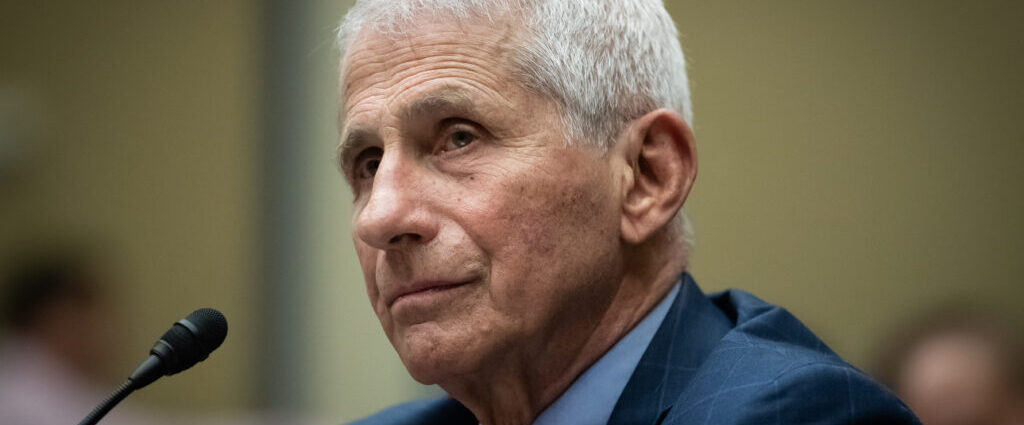
STAT+: Bracing for another Fauci hearing
You’re reading the web edition of D.C. Diagnosis, STAT’s twice-weekly newsletter about the politics and policy of health and medicine. Sign up here to receive it in your inbox on Tuesdays and Thursdays.
Denver is holding a Potato Palooza to give away a surfeit of spuds. Send news tips and tater salad tricks to John.Wilkerson@statnews.com or John_Wilkerson.07 on Signal. Also, join STAT’s Isabella Cueto and Lev Facher tomorrow at 1 p.m. EDT for Office Hours, a live Q&A about the latest in their series on the U.S. alcohol epidemic.
Fauci subpoenaed to testify before Senate panel
Anthony Fauci is scheduled to testify again tomorrow before Congress, this time at the Senate homeland security committee.
Netanyahu, Trump conclude ‘positive, productive’ meeting at White House
US President Donald Trump hosted Prime Minister Benjamin Netanyahu on Tuesday to discuss the war in Iran as well as expanding the Abraham Accords, following calls by Trump for Saudi Arabia to normalize ties with Israel.
Israeli Prime Minister Benjamin Netanyahu arrives at the White House to meet with President Trump.
He pulled up 4 minutes after Ukrainian President Zelenskyy left following his own sit-down with Trump. pic.twitter.com/8PI3JnTogT
— Taylor Popielarz (@TaylorPopielarz) July 28, 2026
White House Press Secretary Karoline Leavitt said the talks, which lasted about an hour and a half, went well.
Netanyahu’s delegation included Ambassador to the US Yechiel Leiter, his Chief of Staff, Ido Norden, his Military Secretary to the PM, Maj.-Gen. Guy Markezano, and his advisors Ofir Falk and Caroline Glick.
They met with Secretary of State Marco Rubio, Defense Secretary Pete Hegseth, Chairman of the Joint Chiefs of Staff Dan Caine, Vice President JD Vance, and envoy Steve Witkoff.

Netanyahu entered the White House through the side entrance. It was unclear whether anyone came outside to greet him.
Netanyahu has run hot and cold with Trump, who at times has had to rein in the Israeli leader from attacking targets in Lebanon to try to weaken Iran-backed Hezbollah militants.
An acrimonious phone call in June in which the president called the prime minister “f***ing crazy”, first leaked to the media and later publicly confirmed by Trump himself, laid bare the strains between the two leaders.
Sources familiar with the matter said Netanyahu aimed to get Trump’s support for his re-election campaign ahead of an October 27 vote.
A meeting with Trump that showcases the traditionally close relationship between the two leaders could help Netanyahu at home, where he is struggling in the opinion polls.
Trump says he doesn’t need Israel’s intelligence on Pickaxe Mountain
Ahead of the meeting, Trump was asked about reports that Netanyahu plans to talk to him about work happening at a site linked to Iran’s nuclear program known as Pickaxe Mountain, a fortified facility buried deep underground near one of Tehran’s main nuclear sites.
“I don’t need Bibi to tell me that. Bibi’s telling me that because he wants me to stay involved,” Trump said in an interview on Fox News.
They are also expected to discuss the Abraham Accords, the series of agreements Trump brokered to normalize diplomatic relations between Israel and the United Arab Emirates, Bahrain, Morocco and Sudan.
Trump wants to add Saudi Arabia to the accords and conditioned a civilian nuclear cooperation deal with the kingdom last week on Riyadh signing up. Riyadh has so far rejected joining the accords without a path toward Palestinian statehood.
Relations with Ukrainian President Volodymyr Zelensky, who met with Trump at the White House earlier on Tuesday, have warmed as Ukraine has blunted Russian advances, while Netanyahu arrived amid growing White House frustration over the lack of progress toward a broader settlement in the Iran conflict and criticism from some of Trump’s supporters who oppose deeper US involvement in the Middle East.
The two men are in Washington to attend a memorial service for Senator Lindsey Graham, a hawkish Republican who was an advocate for both Israel and Ukraine in Washington, especially in getting their views heard by Trump.

Trump greeted Zelensky at the White House. Arriving in Washington earlier, the Ukrainian leader said anti-ballistic defense and strategic cooperation with the US were the “number-one priority” for meetings with Trump and his team.
“Peace needs to be brought closer,” Zelensky said in a post on X.
Both the Ukraine war and the widening Middle East conflict are at critical junctures. After the collapse of a ceasefire in the Iran war, Trump said he has paused US airstrikes to give diplomacy another chance. Zelensky, meanwhile, has been buoyed by Ukraine’s recent successes.
Still, there is no end in sight for either conflict.
Air defense and drone deal
Zelensky and Trump clashed repeatedly in the early months of Trump’s second term, but relations between the two have improved in recent months as Ukraine has had greater success in the war, including with increased attacks on Russia’s oil industry.
Zelensky was expected to press Trump for urgently needed air defense capabilities and to complete a drone deal with the United States. The two leaders will also likely discuss Trump’s promise at the NATO summit to grant Ukraine a license to produce Patriot interceptors.
Zelensky spoke last week with US envoys Steve Witkoff and Jared Kushner about the prospects for renewed peace talks with Russia and said that Ukrainian and US officials could meet in the United States in the coming days.
After the White House meeting, Zelensky was expected to go to the US Capitol to meet with all 100 senators.


Case-Shiller home prices rise 1.1% in May, still lag inflation
Despite rising at a faster annual pace than a month prior, home prices continued to decline in real terms in May, according to the S&P Cotality Case-Shiller Index released on Tuesday.
The data for May shows that the index rose 1.1% annually to a reading of 335.1, up from a year-over-year increase of 0.8% in April. This however remained below the pace of inflation, which reached 4.2% in May, its highest level in over three years.
“Even on a nominal basis, the market remains noticeably weaker than a year ago. In May 2025, the National Home Price Index was up 2.4% year over year,” Rebecca Kaufman, the associate director of commodities at S&P Dow Jones Indices, said in a statement.
On a monthly basis, the national index was up 0.6% from April.
HousingWire Data shows softening home prices nationally
HousingWire Data, which is more up-to-date, reveals softer home price appreciation for the week ending on July 24, 2026. For this week, the median list price was $449,900, down 1.8% compared to a year ago and 2.1% compared to a month prior.
Among some of the nation’s largest metros, as of the end of June 2026, HousingWire Data shows that Ocean City, New Jersey (+39.6%), Jackson, Michigan (+23.7%) and Champaign-Urbana, Illinois (+22.3%) have some of the largest annual median list price growth.
Case Shiller city composite indexes
The 10-city composite index also showed a faster pace of home price appreciation in May, jumping 2.4% year-over-year compared to a 1.8% increase in April, coming in at a reading of 371.52. The 20-city index also recorded a stronger increase, jumping 1.6% annually compared to 1.2% a month prior to a reading of 348.62. Compared to April, both the 10-city and 20-city indexes reported a 0.9% monthly increase.
Among the 20 cities examined, Chicago posted the largest annual price gain in May at 6.9%, followed by New York (4.2%) and Cleveland (1.9%). At the other end of the spectrum, Seattle posted the largest annual price decline at 1.83%, followed by Denver (-1.75%) and Tampa (-1.63%).
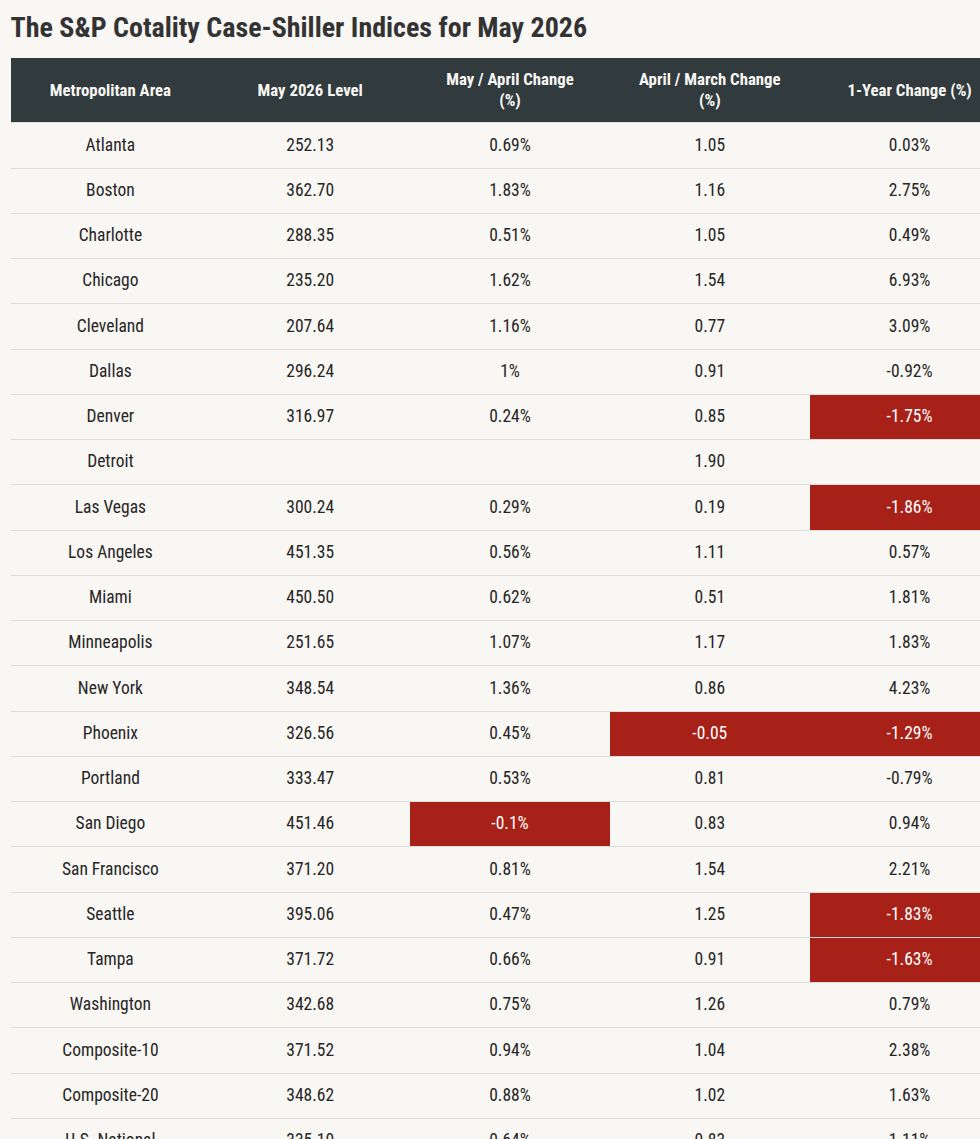
“The geographic dispersion of home price trends continues to persist,” Kaufman said. “While major metropolitan areas in the Northeast and Midwest recorded year-over-year gains exceeding the national average, many metropolitan areas in the West and Sunbelt regions remain under pressure. This divergence may reflect shifting post-pandemic housing dynamics, including a growing return-to-office mandate that appears to be supporting traditional urban markets.”
Looking ahead, despite his brand’s pending sales running ahead of a year ago, Mike Miedler, the president and CEO of CENTURY 21 Real Estate, noted that inventory has stopped growing after four straight years of increases.
“That’s the story that could determine what happens next,” he said in a statement. “A buyer sitting on the sidelines for a better rate is betting against a market where the homes aren’t piling up to greet them when rates finally move.”
How Honolulu leveraged AI to cut permit review times in half
A big push to streamline housing development, and bend cost and affordability barriers for would-be homeowners and renters, increasingly focuses on reducing painfully-elongated permitting review times, a chronic hurdle for builders and developers.
The City of Honolulu, like many other cities across the United States, knows this impediment all too well.
In 2021, the City of Honolulu’s Department of Planning & Permitting was embroiled in a federal investigation stemming, in part, from the city’s lengthy permit review process.
Dawn Takeuchi took over as director of the department and began working for the city around the time that the United States District Court for the District of Hawaii unsealed charges against several employees in the department.
The charges alleged that government employees within the department accepted bribes to expedite or influence building permits and inspections.
According to Takeuchi, Honolulu’s permitting department faced severe backlogs, with single-family permits sometimes taking two years or more, and commercial projects languishing even longer at the time.
As a result, a number of applicants aimed to skirt such lengthy reviews by going beyond the law.
“I think the way things were running, there was an opportunity for exploitation of those conditions. That was an even bigger black eye on the department, so we struggled with trying to dig ourselves out of a hole,” Takeuchi told HousingWire TBD.
As Takeuchi put it, the department’s woes stemmed from several issues. COVID disruptions, staffing shortages, outdated 30-year-old technology and the federal indictments all played a role.
The city’s planning and permitting department slowly improved over the last several years, but according to reporting from the Honolulu Civil Beat, the city’s residential permitting time still averaged eight months as of early 2025.
To modernize the department, Honolulu pivoted, replacing its legacy systems beginning in August 2025 with a new AI permitting software, CivCheck.
Early results show promising results.
Early progress
Q1 2026 data shows that permits processed through CivCheck reduced average permit decision times from 73 days to 32.5 days. This review process currently only applies to single-family, duplex, ADUs, additions and renovations – smaller projects that require shorter review timelines – but the improvements open up the possibility of streamlined reviews for larger projects like multifamily towers.
The City of Honolulu plans to use CivCheck to review commercial pre-checks launching later this summer, and a future expansion of the platform will review affordable housing and other large-scale projects in the near future.
“Our department having faster permits is absolutely helpful for applicants and landowners,” Takeuchi said. “In such a short time, so much can change with interest rates or construction costs. We ship in pretty much everything when it comes to construction, so timing is of the essence. People want to be able to get a permit quickly.”
However, Takeuchi acknowledged that rolling out the new technology takes time, and it is a transition for staff members.
“It’s definitely a transition that is challenging for a lot of our staff, which is understandable. So we just have to provide more training and a greater comfort level for them. But that’s the number one challenge, I think, in technology modernization,” she explained.
Streamlined reviews
When planning staff have to review permit applications manually, it can take weeks or months to get a response. When a response finally comes, a missing document or code issue means starting over. Delays build up, and housing production slows down. AI permit review platforms like CivCheck can catch mistakes quickly so that they are addressed early on in the process, therefore speeding up the process.
The technology doesn’t replace reviewers. Instead, it helps ensure every application is submitted to the correct standards before entering the manual review stage.
“CivCheck, our AI-guided plan review solution, catches those issues before a reviewer ever opens the file, so applicants show up with something complete, and staff spend their time making decisions instead of chasing paperwork,” said Cyrus Symoom, CEO at Clariti, the parent company of CivCheck.
A growing movement
As the housing crisis intensifies and technology rapidly improves, a growing chorus of municipalities have adopted platforms that enable AI-driven permitting plan reviews, in a bid to streamline housing development.
Honolulu was an early adopter. Other cities such as Austin, Seattle, Los Angeles, San Jose, Boston, and Denver have also explored and adopted AI platforms to streamline permitting reviews.
State legislators may be expediting the adoption process by requiring municipalities to review permit applications more quickly. Many states have already passed or are considering “shot clock” laws, which require local governments to initiate or complete reviews within a specified timeframe.
Legislation in Georgia is one example. A recently passed state bill set a 45-day deadline for initial permit reviews, followed by 20 days for a second review and 14 days for ensuing submissions. To meet these deadline requirements, many municipalities may be compelled to adopt AI to speed up the review process.
However, rolling out those platforms isn’t easy, and it comes with a cost. The City of Honolulu, for example, invested $7 million to get CivCheck up and running, a price tag that city officials received substantial local pushback for.
In a bid to help with this high price tag, the U.S. Department of Housing and Urban Development (HUD) recently announced a $3 million grant program to help state, local, and tribal governments adopt AI-driven permitting and building code review tools.
While the funding is a relatively small drop in the bucket, the new grant program signals that the federal government believes in the technology’s potential.
“The bigger signal is HUD naming this a priority at all. Permitting went from a niche operational issue to something Washington treats as central to getting housing built,” Symoom said.
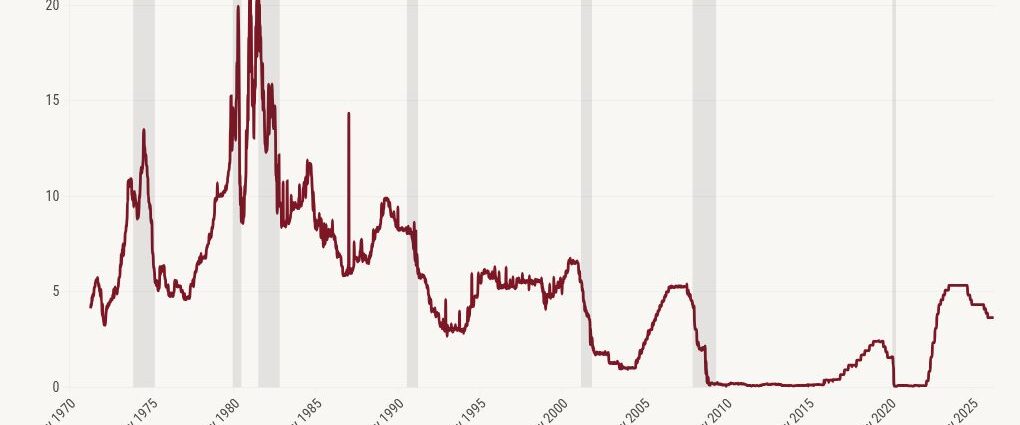
The Fed hawks are winning even without a rate hike
To hike or not to hike? That is the question being discussed today as the Fed’s two-day meeting is underway, but I would argue that the Fed hawks have already effectively gotten their rate hikes in the system and are smirking at Fed Chair Kevin Warsh.
Normally by now, the markets are 100% sure if a rate hike will or won’t happen, but it’s still a toss-up. We also have a new sheriff in town, Warsh, and that sheriff has a boss that demands loyalty. Yesterday, President Trump made his standard comments about interest rates in comments to reporters.
“We should have the lowest interest rate in the world, like it used to be 30 years ago,” Trump said.
Now that is a very common line the president says often, but this next one is key.
“Kevin’s fantastic, but he’s got a board, and the board members are very political, I would say,” Trump said. “He wants to do the right thing. I know what he wants to do.”
President Trump believes that Warsh wants to cut rates, but the Fed board members are hostile toward his goal.
So let’s take a look at where we are before the Fed announcement tomorrow because I believe the Fed hawks already got what they wanted, as the bond market did the heavy lifting for them.
Bond market has already done a lot of work
Even if we don’t get a rate hike tomorrow, the bond market has done the Fed’s work for them, and this alone can make them slightly less hawkish. As I write this article, here are the bond market yields this morning and what the lows were in the year:
- 10-year yield 4.60%; the lows were 3.94%
- 2-year yield 4.30%; the lows were 3.37%
- 3-month yield 3.88%; the lows were 3.60%
Since late 2022, we have had a lot of times when the 10-year yield gets below 4%, and it was never because of Fed policy. It’s because there was an economic/labor growth scare and money went into bonds, as the bond market believed the Fed was behind the curve. Every time that has happened, bond yields rose, even though the labor market wasn’t breaking. Today, it’s the opposite; the bond market believes the Fed wants to be hawkish and that the labor market isn’t breaking, so bond yields have risen a lot.
As you can see below, we had epic moves in bond yields and the Fed funds rate never budged during this entire time. This is very common in a calendar year when we have a lot of economic chaos. When the 10–year yield was under 4%, it was during the height of the “AI will take all the jobs” drama. Now we have an extreme hawkish Fed tone and the labor market is stable in the Fed’s eye for now.
Conclusion
I don’t see the Fed doing a rate hike tomorrow because the labor data came in a tad softer recently; even today’s ADP report showed the fifth straight week of softer labor, and the inflation report that some Fed Hawks were basing their rate hike on came in softer.
The Iran conflict was the wild card, since Iran 2.0 oil prices did rise but are back below $79 again. So, we shouldn’t get a rate hike tomorrow, but does that even matter? The Fed hawks already got what they wanted; they won. The easing bias is all gone; nobody is talking about rate cuts until the labor data gets weaker and the Iran conflict is something that some Fed officials might believe can’t be solved in a clear way anytime soon.

Johnson & Johnson agrees to pay $5.5B to settle talc lawsuits
Johnson & Johnson (J&J) on Monday said it reached a settlement that it would pay an estimated $5.5 billion to settle tens of thousands of lawsuits alleging its baby powder and talc products cause ovarian cancer, which could end years of litigation on the subject.
The company said the proposed settlement would cover about 76,000 claims – including those that have been consolidated in federal court in New Jersey and related cases in state court – to cover nearly all the outstanding claims against J&J.
J&J previously settled most of the cases alleging its talc contained asbestos and caused mesothelioma.
The deal was confirmed by plaintiffs’ law firms on Monday, saying it was a good resolution after a decade-long court battle. The deal has to be accepted by 95% of the ovarian cancer claimants in state or federal court before it becomes final.
JOHNSON & JOHNSON CEO CREDITS TRUMP TAX POLICY FOR $55B US INVESTMENT PUSH, INCLUDING $1B IN FLORIDA
J&J denied wrongdoing in its announcement of the settlement, saying that the plaintiffs weren’t able to prove their claims that the talc products caused cancer cases and that the settlement is a way of efficiently ending the litigation.
“While we are confident the company would ultimately have prevailed with further litigation, as it has in the vast majority of cases tried to date, this resolution allows the company to put this matter behind it and remain focused on its mission to develop medicines and devices that save lives,” said Erik Haas, worldwide VP of litigation at Johnson & Johnson.
The company expects to pay out $3 billion in 2027 and make further payments in 2028, though the deal could be worth more depending on how many people participate in the settlement.
JOHNSON & JOHNSON TO INVEST $1B IN PENNSYLVANIA MANUFACTURING FACILITY
Chris Seeger, an attorney who represents about 2,500 clients with talc claims and helped negotiate the settlement, said J&J could ultimately pay $7 billion or more as the settlement doesn’t cap the total payout and rather assigns specific values to qualifying ovarian cancer claims.
Seeger told Reuters in an interview that the plaintiffs “got a fair settlement, and our clients are going to be happy with it.”
The settlement comes after J&J secured a series of courtroom victories, including in individual trials, moves to disqualify plaintiffs’ lawyers and rulings against experts used by plaintiffs. The company won a significant court victory last week when a federal judge cast doubt on individual plaintiffs’ ability to prove that talc specifically caused their ovarian cancer.
TEXAS AG SUES KENVUE, J&J OVER ‘DECEPTIVELY MARKETING’ TYLENOL TO PREGNANT WOMEN
J&J has long denied that its talc products caused cancer, saying the products were safe and didn’t contain asbestos. It stopped selling talc-based baby powder in the U.S. in 2020 and switched to a cornstarch product.
The company attempted a legal strategy in which shell-company subsidiaries declared bankruptcy in an effort to settle the cases, though that proved unsuccessful.
It had a mixed record when talc cases went to trial, winning some outright and reducing verdicts on appeal, though it was hit with a multibillion-dollar verdict in a case brought by 22 women.
GET FOX BUSINESS ON THE GO BY CLICKING HERE
The new settlement only applies to existing claims and doesn’t address future lawsuits. The exclusion of future claims made more money available to current plaintiffs and also accelerated the payments so that all claims will be paid within 18 months instead of being spread out over more than a decade, Seeger said.
Reuters contributed to this report.

China Warns of Retaliation if U.S. Sanctions AI Firms Over Model Copying Claims
NEW YORK — China warned Monday that it will take “all necessary measures” if the United States imposes sanctions on Chinese artificial intelligence companies over allegations they improperly trained their AI models using American technology, escalating another front in the growing technology rivalry between the world’s two largest economies.
In a statement, China’s Ministry of Commerce accused Washington of pursuing “AI hegemonism,” rejected allegations of intellectual property theft and argued that the U.S. has failed to present evidence supporting its claims. Beijing also maintained that model distillation—a technique used to improve AI systems—is a widely accepted practice employed throughout the global artificial intelligence industry, including by American developers.
The dispute began after senior U.S. officials publicly raised the prospect of new restrictions.
Treasury Secretary Scott Bessent said last week that the administration was closely examining recently released Chinese open-source AI models for evidence of what officials describe as large-scale extraction of capabilities from leading American systems.
Attention has centered on Moonshot AI’s Kimi K3 model, released July 16, which quickly drew attention for strong benchmark performance. U.S. officials are reportedly reviewing whether the model may have been trained using outputs from Anthropic’s Fable 5 or other advanced American AI systems without authorization.
The central disagreement is not whether model distillation exists, but where legitimate engineering ends and intellectual property infringement begins.
Distillation is a common machine-learning technique in which a smaller or newer model learns from the outputs of a larger, more capable system. Researchers and commercial AI developers around the world routinely use variations of the process. U.S. officials argue the concern is not the technique itself but whether it has been employed at a scale or in a manner that improperly reproduces proprietary capabilities.
China disputes that distinction, arguing Washington has not established a clear legal or technical standard separating acceptable development practices from unlawful copying. Beijing also maintains that several Chinese AI models now compete globally based on their own research and engineering advances.
Neither government has publicly released evidence that has been accepted by the other side, leaving the dispute unresolved while political tensions continue to rise.
Any future sanctions would extend well beyond one AI company.
Among the options reportedly under consideration is placing Chinese firms on the U.S. Entity List, a move that could significantly restrict access to American semiconductors, cloud-computing services, software tools and other technologies. Such restrictions would also affect U.S. companies that provide products or services to any newly designated firms.
Monday’s warning also arrived during a difficult trading session for the semiconductor industry. Investors were already reacting to China’s advances in domestic chip manufacturing and memory production, developments that pressured shares of Nvidia, AMD and several major semiconductor equipment companies.
Taken together, the latest events underscore a broader shift. Rather than competing solely through product launches, Washington and Beijing are increasingly using export controls, investment restrictions, sanctions and regulatory actions as strategic tools in the global AI race.
For businesses across New York, New Jersey and Connecticut, the immediate issue is understanding which AI models are already embedded inside their operations.
Many companies now rely on inexpensive open-weight AI models through third-party software vendors without knowing which underlying systems power their applications. Marketing agencies, logistics companies, financial firms, manufacturers and software developers may be using Chinese-developed models indirectly through cloud platforms or commercial software subscriptions.
That creates a potential compliance issue if future sanctions are imposed. Businesses should confirm which AI models their vendors use, review contracts addressing regulatory changes and identify alternative U.S. or European AI providers that could replace restricted models if necessary. Preparing those contingency plans now is significantly easier than responding after new restrictions take effect.
No sanctions have been announced, and Beijing’s statement responds to actions Washington has not yet taken. Even so, the direction of U.S.-China technology policy has become increasingly restrictive, making supply-chain visibility and AI governance important business priorities for companies adopting artificial intelligence across their operations.
JBizNews Desk | New York
© JBizNews.com All Rights Reserved. Reproduction or distribution without written permission is prohibited.
High Court maintains freeze on law limiting enforcement against haredi draft dodgers
The High Court of Justice on Tuesday froze a law that limits enforcement measures against eligible haredi (ultra-Orthodox) men who fail to report for military service, with a final ruling expected soon.
The interim order was issued several hours after a hearing in which the nine-justice panel heard arguments from the parties represented in the case.
“After considering the parties’ arguments, in writing and orally, an interim order is hereby issued,” the court said, suspending the law’s entry into force until a further decision. “The judgment will be issued soon.”
The law passed on July 14 but was temporarily frozen the following day by Justice Ofer Grosskopf following the filing of five petitions against it, including by opposition faction heads Yair Lapid of Yesh Atid and Avigdor Liberman of Israel Beytenu.
Grosskopf, in his short decision, focused on two aspects of the law: the court’s longstanding rulings on the enlistment of yeshiva students and the unequal treatment the law grants to “only certain sections of the population.”

Attorney-General Gali Baharav-Miara on Friday asked the court to strike down the law, arguing that it retains the duty to enlist while removing the consequences for refusing to do so.
She called it a “group immunity mechanism” that protects one sector from arrest, investigation and prosecution while leaving other draft evaders exposed to the full force of the law.
Knesset focuses on defects in law instead of constitutional argument
The Knesset’s position, filed Sunday by its legal advisers, focused more on defects in how the law was enacted than on the broader constitutional argument raised by Grosskopf and affirmed by Baharav-Miara.
Representing the Knesset in court on Tuesday, attorney Yitzhak Bart clarified the legal advisers’ position, explaining that committees debating a bill have broad authority to change it as long as their amendments do not introduce a “new subject.”
That boundary, he said, allows committees to make the changes needed to improve legislation without forcing the Knesset to restart the legislative process each time a bill is amended.
The fundamental subject of a bill, however, cannot be changed.
“There is no escaping the conclusion that the new law introduced a new subject,” Bart said.
The difference, he explained, was between legislation intended to integrate yeshiva students into military service and legislation freezing enforcement measures against those who fail to report.
Had the committee continued discussing the original bill and added a clause dealing with enforcement, “that might have been okay,” Bart said. Instead, it created what he described as a new branch unconnected to the root of the original bill.
The scenario in which the Knesset’s own legal advisers conclude that defects in the legislative process require a law to be annulled is “extremely rare,” Bart said.
Representing the Attorney-General’s Office, attorney Aner Hellman said there was merit in strengthening the authority of legal advisers so that lawmakers understand the implications of disregarding their opinions, particularly when it comes to the procedural rules governing legislation.
These technical requirements, Hellman said, “are what make laws laws.”
“The red flags were raised all along” the legislative process by the Knesset legal advisory, he added.
“There are certain procedural lines that cannot be crossed – particularly ones that outline how a bill becomes law.”
Hagai Kalai, representing Israel Hofsheet, argued that the government had ignored the criminal and enforcement consequences of the draft crisis from the beginning and, through the law, had sought only to tie the hands of the authorities responsible for enforcing the existing duty to enlist.
Haredi attorney: Torah forbids ultra-Orthodox men from enlisting
The only argument presented in defense of the legislation came from attorney Natan Rosenblatt, representing the haredi Emet L’Yaakov organization, which sought to join the proceedings as a respondent.
Rosenblatt argued that a haredi man could not enlist because “the Torah forbids him from doing so,” prompting an incredulous response from Justice David Mintz.
“I simply cannot believe what I am hearing,” Mintz said, questioning the assertion that Jewish law prohibited military service.
When Rosenblatt said that “all the great rabbis of Israel” opposed enlistment under the current circumstances, Mintz interrupted him.
“Not all the great rabbis of Israel,” he said. “You are speaking in sectoral terms.”
The government filed its own two-page position Monday, explaining that it had declined to hire a private attorney to defend the law because the outcome of the case was “known in advance.”
Rather than provide a legal response to the petitions, the government’s position focused largely on accusing the court of violating the separation of powers and the Attorney-General’s Office of obstructing efforts to increase haredi enlistment.
Uri Keidar, CEO of Israel Hofsheet, one of the petitioners, said that “the attempt by the government to torpedo equality before the law and grant immunity to haredi draft evaders will not succeed.”
“The time for equality has come,” he said.
Opposition condemned legislation to freeze haredi draft arrests
Opposition party leaders in the bloc seeking to replace Prime Minister Benjamin Netanyahu in the upcoming election strongly condemned the legislation to freeze haredi draft arrests that had been passed in the Knesset, and welcomed the High Court’s decision.
Former prime minister Naftali Bennett, who leads the Together Party, vowed that if elected, the next government would repeal legislation that critics say encourages ultra-Orthodox draft evasion.
He also slammed the government for passing the legislation earlier this month.
“The very fact that this draft-evasion law has reached the High Court of Justice tells the story of this failed government” he stated.
“In a properly functioning and well-governed country, this law would have been stopped long before it got this far,” he added.
“We will repeal all draft-evasion laws and ensure that those who serve are placed at the top of the national priorities. Anyone who does not serve will not receive a single shekel from the state,” Bennett continued.
Yisrael Beytenu leader MK Avigdor Liberman said that he welcomed the High Court’s decision to halt the legislation. His party had also filed a petition to the High Court to strike down the bill after it was passed.
“No one can be above the law, and certainly not those who evade military service.”
“It is unacceptable that while those who serve bear the burden, the government responsible for the October 7 massacre is granting protection to draft evaders from a particular sector,” Liberman added.
Smotrich says he considered resigning after October 7, but could not find anything he did wrong
Finance Minister Bezalel Smotrich claimed that he had considered resigning after October 7, but could not find anything wrong in his behavior, in an interview on the Geekonomy podcast on Tuesday.
“I thought about it,” Smotrich replied, clarifying that this was not immediately after the massacre, but about two months later.
However, he added that “when I tried to think about what I had done wrong, I could not find anything.”
“In the first month and a half or two months, you work like a robot, on autopilot, truly 24/7, managing the war, managing the economy, legislation, and regulations,” he said, explaining that afterward, “you enter an emergency routine, and there is time to think.”
The minister said he understood that “the most horrific massacre of the Jewish people since the Holocaust happened on my watch.”

Smotrich claims he did nothing wrong, opposed Oslo
Smotrich stressed that he tried to consider “what I had done wrong.”
“After all, I opposed Oslo. I was beaten at the end of eighth grade for opposing Oslo. I opposed the expulsion from Gush Katif. I spent three weeks in Shin Bet (Israeli Security Agency) detention, in solitary confinement, alongside 70 terrorists in Wing 7, a closed prison in Ashkelon,” he said.
When he was detained by the Shin Bet, he said, “I was suspected, that was all, of jointly organizing roadblocks.
“Today, I should have received a certificate of appreciation from Gali Baharav Miara for the principle that there is no effective protest without disrupting public order,” he added.
In response to his remarks, the October Council slammed his assessment of the massacre.
“You are fine. Our children, siblings, and parents are the ones to blame for trusting you and being murdered on your watch. We wish the 2,200 murdered victims and fallen soldiers had been an asset to you, as Hamas was. We apologize on their behalf for troubling you with nonsense such as responsibility.”
Smotrich claims Gaza hostages returned home thanks to him
Last month, speaking on Nadav Perry’s podcast on the All In network, the minister said that “thanks to him,” all the hostages had returned home.
According to Smotrich, had he been insistent in discussions with Prime Minister Benjamin Netanyahu.
“They would still be negotiating with Hamas today over the return of hostages,” he said.
Smotrich himself voted twice against a deal to return hostages. While he opposed their release, hostages were murdered in captivity by Hamas terrorists.
Former hostage Or Levy responded to Smotrich’s remarks.
“Had it been up to you, we would still not have returned,” he wrote. “To you, we are collateral damage in your madness. I have said it, and I will shout it again. Bezalel Smotrich, you are a disgrace as a minister, a disgrace as a citizen, and a disgrace as a human being.”
Ziv Abud, the partner of former hostage Eliya Cohen, responded to Levy’s post.
“This is simply insane. Please tell me he did not say that.”
Toronto pro-Palestinian protesters march near Jewish care facility after kosher bakery shooting
A larger-than-usual crowd of pro-Palestinian activists gathered for the weekly demonstration on Sunday at the Bathurst Street and Sheppard Avenue West intersection in Toronto, resulting in heated verbal clashes, traffic disruptions, and heavy police intervention.
The demonstration unfolded after gunfire struck just hours earlier at a Jewish-owned bakery chain situated approximately 3.5 kilometers from the protest site. Both the bakery and the protest site sit within a corridor heavily populated by Jewish residents, synagogues, and local businesses.
During the demonstrations, pro-Palestinian activists participated in an impromptu march along Sheppard Avenue West that was halted by police managing the crowds outside local commercial office spaces and Baycrest, a Jewish senior care facility. Independent documentarians and commentators filming the scene captured local residents and passing bystanders expressing deep concern on camera, arguing that staging intense protests directly outside a senior care facility and healthcare infrastructure in a heavily Jewish neighborhood targeted vulnerable community members rather than serving a legitimate political destination.
Independent documentarian Caryma Sa’d shared footage on social media showing workers in scrubs gesturing their disapproval as protesters passed the nursing care facility, as well as police instructing demonstrators supporting Israel and opposing the Islamic Republic of Iran to stay on opposite sidewalks.
Protestors chanted: ‘Death, death to the IDF’
Social media footage captured a participant wearing a t-shirt bearing text that read “FCK IDF” and “DEATH DEATH TO THE IDF!” worn by another. An activist named Daniela Bonamico led the chant “from the sea to the river Palestine will live forever” across police barriers.

Activists and counter-protesters displayed various flags, including Palestinian, Israeli, Iranian (both Islamic Republic and Lion and Sun), Lebanese, and Canadian flags, along with signs reading “Free Palestine, Stop the Genocide.”
Toronto Police Service officers managed the crowds behind temporary metal barricades, enforcing restrictions tracing back to previous municipal police directives prohibiting protests from spilling into quiet residential pockets around Bathurst and Sheppard due to heightened community safety concerns.
One of the protesters, Hamood Al-Waili, who was arrested back in April 2025 for refusing to remove his keffiyeh at a Jewish community centre and has a history of posting antisemitic tweets, engaged in an extended on-camera discussion with Toronto Police Inspector Israel Bernardo and other officers, complaining that he witnessed someone spitting from a residential balcony and demanding an immediate arrest.
The demonstrations at Bathurst and Sheppard are part of weekly protest events. According to footage shared on social media, the elevated turnout on July 26 appeared to be a reaction to the July 21 arrest of Liberate Palestine 48 (LP48) organizer Ahmad Hajahmad (also known as Ahmad Jarrar), a regular fixture at the intersection who faces a terrorism charge alleging participation in or contribution to Hamas activities. Jarrar has denied the allegations, which have not been tested in court.
Pro-Palestine activist spared jail after 17-hour barefoot Big Ben protest cost UK taxpayers £92,000
A pro-Palestinian activist who caused severe disruption by scaling the Elizabeth Tower, commonly referred to as Big Ben, barefoot and livestreaming his protest for 17 hours on March 8, 2025, has been handed a suspended prison sentence at Southwark Crown Court.
Daniel Day, 30, was sentenced by Judge Tony Baumgartner to a 14-month prison sentence suspended for two years.
The court heard that Day’s high-profile stunt triggered a massive emergency response and cost the taxpayer an estimated £92,000 in public expenditures and lost revenue.
Delivering his sentence at Southwark Crown Court, Judge Tony Baumgartner rebuffed Day’s actions as calculated lawbreaking, stating, “This was well-planned offending, and you knew precisely what you were doing.”
The judge emphasized that having strong principles does not give anyone a license to break the law, adding, “You, and people like you, must understand that, like everyone else, you are subject to the laws of this country. You and others like you do not get to decide which laws you will follow and which laws you will break. If that were to happen, the rule of law would break down.”

The incident originally unfolded on March 8, 2025. Day, who is unemployed and appeared in court wearing a black shirt and green tartan kilt while carrying a walking stick to accommodate failing eyesight, carried out meticulous prior research on the historic tower’s restoration. Donning thermal clothing, he bypassed railings at approximately 7:20 a.m. and began climbing the landmark barefoot. Reaching a ledge midway up the Elizabeth Tower, Day unfurled a Palestinian flag and remained perched there until around midnight.
Prosecutor details Day’s actions at Big Ben
Prosecutor Jack Guise detailed during the proceedings how Day took off his shoes during the ordeal, causing his feet to bleed onto the ancient stonework, while using a camera to livestream his actions on Instagram and shouting slogans including “Free Palestine” to crowds gathering below.
In video footage played during his trial, Day claimed from the ledge, “We’re being violently attacked by police for peaceful protest. That’s why I’m taking action at the so-called hub of democracy today.”
He also shouted down to officers and onlookers below, “Listen, no police are to come anywhere near me. If you come too close, I’m going higher. I’m here peacefully. I’m here to harm nobody.”
As crowds gathered in Parliament Square and police assessed that Day was playing to an audience, authorities were forced to implement extensive security cordons. Officers shut down Bridge Street as the primary junction adjacent to the Houses of Parliament, along with Westminster Bridge, restricting pedestrian access to Parliament Square and setting up road blocks across Whitehall and Victoria Embankment. Emergency services placed mattresses at the base of the tower as a safety precaution, while dozens of Metropolitan Police officers, firefighters, and paramedics maintained a continuous presence alongside a deployed cherry picker.
The total estimated financial and operational toll reached £92,000. This included more than 2,500 canceled Parliament tours resulting in £67,000 in losses, an estimated £25,000 lost by Transport for London due to bus diversions and curtailed routes, and severe emergency strain that included supporters attempting to block a responding fire engine.
Day was found guilty at trial in June of intentionally or recklessly causing a public nuisance and pleaded guilty to trespassing on a protected site at the Palace of Westminster and Portcullis House. While the judge noted during the hearing that Day showed little insight into his offending or real remorse, the court weighed favorable personal mitigation factors, including his failing eyesight and the fact that he had not re-offended since the incident.
Day must complete rehabilitation, subject to probation
As part of his suspended sentence, Day was ordered to complete up to 20 rehabilitation days and will be subjected to four months of electronic monitoring.
Court records revealed a prior history of protest-related infractions, including a conditional discharge in June 2024 for failing to remove a facial disguise and £200 in fines issued in November 2024 for blocking a road during a demonstration. Following his sentencing at Southwark Crown Court, Day was released from the dock and shared hugs with supporters in the well of the court.
David Abrahamson returns to Equity Prime Mortgage as CRO
Mortgage lender Equity Prime Mortgage (EPM) announced on Tuesday that it has appointed mortgage industry veteran David Abrahamson as its chief risk officer.
Abrahamson previously worked at EPM from 2010 to 2020, a period during which the lender said it expanded from a “primarily retail, refinance-focused organization” into a broader mortgage company with a growing branch model and wholesale channel. EPM now operates exclusively as a wholesale lender.
Abrahamson, who will be based at the company’s Atlanta headquarters and will work with EPM’s executive, credit, operations, compliance and underwriting teams, brings about 40 years of mortgage industry experience in risk management, operations, credit and sales.
“EPM has always felt like my home base,” Abrahamson said in a statement. “I have remained connected with Eddy and Phil over the years, and when the opportunity came to return, it felt like the right move at the right time. The company has changed dramatically, but the relationships, the vision and the opportunity to make a meaningful impact are still here.”
In his new role, Abrahamson will oversee the company’s risk management framework, including its credit, underwriting, regulatory compliance and investor-related functions.
“Effective risk management starts with meeting the expectations of every regulator and investor we work with, whether that is HUD, Fannie Mae, Freddie Mac, the CFPB, state regulators, or our capital markets partners,” Abrahamson said. “My responsibility is to understand exactly where we are today, identify where changes are needed, and help build the processes and accountability required to create long-term success.”
EPM Founder and CEO Eddy G. Perez Jr. said Abrahamson’s familiarity with the company made him a strong fit for the position.
“David understands EPM because he helped build EPM,” Perez said. “He knows our history, he knows our people, and he knows what strong risk management looks like inside this organization. Bringing him back is not about looking backward. It is about applying decades of experience to where we are going next.”
Perez said the appointment is part of the company’s effort to strengthen its leadership team and support future growth.
This article was written by Sarah Wolak and generated with the assistance of HousingWire Automation, then reviewed by a HousingWire editor before publication.
Lofty expands AI platform, launches House.ai for homebuyers
Lofty today announced an expanded version of its AI operating system, Lofty AOS, along with Lofty Cowork and House.ai, a financial intelligence platform for homeownership.
The company said updates are designed to automate workflow management for real estate professionals while helping consumers better understand homeownership and mortgage readiness.
Lofty AOS is designed to manage workflows proactively rather than relying on users to initiate tasks. Instead of a dashboard with multiple widgets, the platform presents prioritized tasks that are ready to execute.
Leaders said this approach reduces time spent managing software and allows agents to focus on client relationships and transactions.
“Artificial intelligence has become a commonplace term in real estate, but most solutions remain reactive, placing the burden on the agent to prompt tools, interpret outputs and determine next steps,” said Henry Li, chief technology officer at Lofty. “Lofty AOS and the addition of Cowork eliminates the dependence on agent adoption to make AI a reality, finally capturing the productivity and efficiency gains AI has long promised but seldom delivered.”
Lofty Cowork is an AI-powered workspace within Lofty AOS that organizes and prioritizes daily tasks through a chat interface.
Agents can review leads, send mass text messages, build Smart Plans and complete other activities without manual setup.
The platform includes features such as “Your Morning Read,” which prioritizes lead management tasks, and “What Needs You Now,” which identifies activities requiring human action.
Users can also create custom AI agents for tasks ranging from onboarding to post-closing activities, while existing AI copilots, including Sales Agent, Social Agent and Homeowner Agent, continue to support lead engagement, social media marketing and seller lead generation.
House.ai is a financial intelligence platform designed to help consumers understand their homebuying readiness while providing qualified prospects to real estate professionals.
For agents and brokers, House.ai is intended to automate early lead qualification and identify consumers who are ready to move forward with a transaction. When a user reaches an “offer-ready” stage, House.ai connects them with a local real estate agent or mortgage professional in the Lofty network.
This article was generated using HousingWire Automation and reviewed by a HousingWire editor before publication.
Brokerage transaction fees could cost consumers $2 billion
A new Consumer Policy Center (CPC) report found that administrative “junk fees” charged by real estate brokerages to both home buyers and sellers have become widespread, often ranging from $400 to $600 per side and sometimes exceeding $1,000, with some agents calling the charges unethical and refusing to pass them on to clients.
The report, titled “Junk Fees Charged to Both Home Sellers and Buyers: An Overview,” was released Tuesday by the Washington, D.C.-based consumer watch dog organization. It analyzes how so‑called admin or transaction fees are imposed, how often they appear in residential deals, how high they run and how they are disclosed to consumers.
Because there is no comprehensive public data set on these fees, CPC said the findings are based primarily on several hundred comments from real estate agents, brokers and mortgage professionals gathered through direct communication and public posts on platforms including Facebook, TikTok, Reddit and Quora. The authors, Stephen Brobeck and Wendy Gilch, characterize the work as closer to an investigative report than an academic study, but say consistent patterns emerge across markets.
What the report found on fee levels and scope
According to the report, brokerages most commonly label these add‑on charges as “administrative” or “admin” fees but also use terms such as transaction fee, broker service fee, processing fee, technology fee or regulatory compliance fee. The fees are typically imposed by the brokerage on both the listing and buyer sides, with agents expected to pass them through to sellers and buyers.
Agents cited by CPC report that:
- Most home sales in their markets now include an admin-style fee, with some agents estimating that more than 95% of transactions in their state include a fee on both sides.
- Typical charges fall between $400 and $600 per party, though individual fees can be below $200 or above $2,000. Isolated examples reached roughly $2,500.
- At least some agents raise the brokerage’s base fee and retain the difference, or charge a flat fee even when their brokerage does not require one.
CPC estimates that if roughly half of buyers and sellers pay an average $500 charge, the total annual cost to consumers would approach $2 billion. Because these charges are generally flat dollar amounts, the report notes they are regressive, effectively increasing the commission rate more for lower-priced homes than for higher-priced ones.
In one cited example, a $1,590 admin fee on a $412,000 sale increased the effective commission by about 0.40 percentage points, while a $795 fee on a $126,900 home added roughly 0.60 percentage points to the commission rate.
“It is difficult for brokers to justify charging a buyer or seller an admin fee when they are also charging them a 3% commission,” Brobeck, a CPC senior fellow, said in a statement.
“Because the fees are regressive, sometimes effectively increasing the commission rate by over half a percentage point, they hit first-time homebuyers especially hard.”
Disclosure practices under scrutiny
The report says admin fees are increasingly written into buyer-broker agreements and listing contracts, either as a separate line item or as a “plus $X fee” addition to the commission percentage. This shift has accelerated since the National Association of Realtors (NAR) settled the home seller commission lawsuits in 2024, as the settlement pushed more states to require written buyer representation agreements early in the process.
However, the CPC cites accounts from industry professionals that some fees are still introduced late in the transaction. The report describes instances in which agents or brokerages allegedly added admin fees to title or attorney disbursement instructions days or even hours before closing, despite state consumer-protection laws that generally require advance disclosure in agency agreements.
“It appears that in the early stages of the sale, a number of agents are not informing, either verbally or in writing, the imposition of these junk fees,” Gilch, a CPC fellow, said in a statement. “When a consumer learns about the junk fee at a closing, they are under great pressure to approve it.”
Brobeck and Gilch also pointed to a recent class action filed in Florida state court against Compass as an example of potential legal exposure. The suit alleges unfair and deceptive practices tied to a $475 “transaction fee” charged to a buyer and a $495 fee charged to a seller, and argues that the fee was not properly disclosed earlier in the process.
The report argues that private litigation currently appears more likely than regulatory action to change practices around admin fees. While CPC says federal agencies such as the Federal Trade Commission, Department of Justice and Consumer Financial Protection Bureau have not shown strong interest in this specific issue, the group notes that state consumer-protection laws already require clear fee disclosure in most cases.
The CPC also points back to earlier litigation, including Busby v. JRHBW Realty in Alabama, which challenged a separate administrative fee under the Real Estate Settlement Procedures Act. That case ultimately led to a 2014 consent order with the Department of Housing and Urban Development and contributed to industry guidance that such fees must be retained by the brokerage, not paid to third parties, and must be adequately disclosed.
The report suggests that if admin fees continue to rise or remain opaque, state attorneys general could use consumer-protection statutes to issue subpoenas or civil investigative demands, and that multistate actions could follow. For large brokerages with national or multistate footprints, the combination of class actions, state-level enforcement and potential federal scrutiny represents a growing compliance risk.
Agent pushback and changing expectations
While some agents pass the fees on to consumers, the CPC’s review of social media posts found multiple agents who said they waive the fee and pay it out of their own commission to avoid client friction and others who have left or declined to join firms that require the charges.
The CPC reports that some of the harshest criticism of admin fees is coming from inside the industry. Agents quoted in the report and its appendix labeled the charges with terms including “unethical,” “money grab,” “garbage” and “robbery,” and described struggling to justify them to buyers who believed the seller was covering all broker compensation or to sellers already paying 5%–6% commissions.
According to the report, many of those agents say they either routinely waive the fee or left brokerages that required it. One mortgage broker interviewed by CPC estimated that agents personally absorb the charge in about one-quarter of deals.
Fees and consumer protection
Looking ahead, the CPC suggests the brokers and team leaders should review whether admin or transaction fees are required, optional or prohibited and how that policy is communicated internally. Additionally, the organization said brokers should ensure that all add-on fees are clearly spelled out in buyer and seller agreements, with plain-language explanations that match what appears on loan and closing disclosures and that they should evaluate the impact of flat fees on lower-priced transactions and first-time buyers, where the effective commission increase is highest.
For agents, the CPC said they should work to understand their brokerage’s fee policies and how they align with your value proposition to clients and the organization noted that they should be prepared to discuss whether they charge an admin or transaction fee, as well as when it is disclosed and whether it is negotiable.
In addition, the CPC said agents need to document client consent to any such fees in initial agreements rather than relying on last-minute additions at closing.
This article was written by Brooklee Han and generated with the assistance of HousingWire Automation, then reviewed by a HousingWire editor before publication.


Britain Welcomes its 5th Prime Minister in 4 Years
I spent most of last week at the Las Vegas Money Show, where I caught up with our favorite economist, Ed Yardeni, who pointed out in his Wednesday morning briefing that the “bond vigilantes” (a term Ed created in the 1980s) are skeptical of new British Prime Minister Andrew Burnham’s plans. (The role of bond vigilantes, Ed has said, is to protest inflationary policies by selling bonds, pushing yields higher.)
Burnham is Britain’s seventh Prime Minister since the Brexit vote a decade ago (in June 2016), including five in the last four years. I wish Prime Minister Burnham well, but the reason Britain gets a new Prime Minister almost every year is due to the bond vigilantes squelching their government spending proposals. In fact, Burnham told ITV Britain was deep “in hock” after politicians lost control of public finances in various key sectors – like energy, water, and housing. Since Britain has the highest borrowing costs in the G7 and has lost many affluent households, the bond vigilantes are ready to pounce on any misstep Burnham makes….

Zillow wins dismissal of RESPA claims in Flex referrals case
While Zillow’s legal battles on other fronts may be heating up, for now, it no longer has to contend with claims of Real Estate Settlement Procedures Act (RESPA) and racketeering violations. On Monday, Seattle-based federal court Judge James Robart granted Zillow’s motion to dismiss the combined Taylor and Armstrong lawsuit.
According to the ruling, the complaint does not contain enough factual allegations to satisfy the standards for the claims the plaintiffs made.
“Plaintiffs’ claims of lack of notice are implausible given Zillow’s express, repeated disclosures,” the ruling states. “Plaintiffs fail to plead specific facts showing how Defendants’ practices actively undermined the home-buying process, restricted informed lender choice, or eroded trust in real estate professionals.”
Originally filed in mid-September 2025, the lawsuit claims that the portal tricks consumers into using agents affiliated with Zillow through its Flex and Premier Agent programs, resulting in inflated home purchase prices. In an amended complaint filed in mid-November, Taylor also alleged that Zillow violated the Racketeer Influenced and Corrupt Organizations (RICO) Act by pushing homebuyers to apply to more costly loans that do not serve their best interests.
In December 2025, the lawsuit was consolidated with a second suit known as the Armstrong suit, which was first filed in early November, claiming that Zillow pressures agents in its Premier Agent and Flex lead programs to steer buyers to Zillow Home Loans for their purchase mortgage pre-approval. Allegedly, agents who send more clients to Zillow’s mortgage arm for their pre-approvals received extra or higher-quality leads in exchange.
In a first amended complaint filed in the consolidated lawsuit in early January, the plaintiffs again claimed that Zillow tricks consumers into using agents affiliated with Zillow through its Flex and Premier Agent programs, resulting in inflated home purchase prices. The complaint also added Real and The Frano Team as defendants.
In a second amended complaint filed in April, the plaintiffs added eXp Realty as a defendant, accusing it of supporting Zillow’s “fraudulent business enterprise” by allegedly steering clients to Zillow Home Loans for their financing needs.
Failure to identify necessary information
For the RICO claims, Judge Robart found that the complaint failed to identify necessary information such as who committed the fraudulent acts, what communications were fraudulent, how they were fraudulent and how the different defendants participated in the allegedly fraudulent acts. Additionally, the court found that the plaintiffs’ claim that in working together Zillow and brokerages formed an unlawful enterprise was actually just an ordinary business relationship.
As for the RESPA claims, the court found that since the plaintiffs were not the ones to pay the fees in question, they lack standing. Judge Robart reasoned that while the homebuyers paid for the home, under the cooperative compensation model that was common practice when the buyers purchased their properties in 2022, the fees in question came out of the seller broker’s total compensation that was then split with the buyer’s broker.
In addition, for both the RESPA and the RICO claims, the judge found that the plaintiffs failed to show how they were injured, including how Zillow Flex led to increased home prices or how using a Zillow Home Loan product actually caused financial harm.
In a post on its Front Porch blog, Zillow lauded the judge for dismissing the “plaintiffs’ baseless complaint.”
“The court rejected plaintiffs’ entire suit, even after five rounds of complaints, finding that every claim they asserted against Zillow and its partners in their 100+ page complaint was deficient,” the post states.
The court is allowing the plaintiffs to file an amended complaint by August 17.
Other defendants in the Taylor suit, The Real Brokerage and the Real-brokered The Frano Team, were both voluntarily dismissed from the lawsuit earlier this year. Additionally, GK Properties was dismissed as the claims made against it were time-barred. The claims against eXp are still pending.
The Sitzer/Burnett data motion is a compliance warning
On July 23, plaintiffs in the Sitzer/Burnett and Gibson cases asked Judge Stephen Bough to enforce something this industry already agreed to. As HousingWire reported, they want the listing and commission data that MLSs promised to hand over when they opted into the National Association of Realtors settlement.
The obstacle is a vendor. FBS, which powers Flexmls, declined to release the data without explicit permission from each MLS, and will not say which MLSs are withholding it. So, the plaintiffs proposed a rule. Notify every opted-in MLS. Give each one seven days to object. Treat silence as consent.
Read the headline and this looks like housekeeping. Read the filing, and it is not.
Why the data is the story
Listing and commission data does two jobs. The stated one is compliance. Did the MLS strip the compensation fields? Did the rule changes take hold?
This data is the raw material for whatever comes next. Status history. Entry dates. The gap between when a listing agreement was signed and when the listing appeared. What was paid and to whom. If you wanted to learn whether listings are being routed around the MLS in a pattern, or whether concessions are quietly doing the old co-op commission’s job, this is the dataset you would want first.
Lawyers who are finished do not keep a docket warm
Nearly three years after the verdict, the plaintiffs are still filing motions in Judge Bough’s courtroom.
The filing names the four plaintiffs, not their counsel. Michael Ketchmark of Ketchmark & McCreight is lead plaintiffs’ counsel in both Sitzer/Burnett and Gibson, so the reasonable read is that his team is behind it.
The practice changes are not complicated. An agent working with a buyer must have a written agreement before touring a home. It has to state a specific compensation amount or rate, not an open-ended number tied to whatever the seller offers. It has to say plainly that fees are negotiable and not set by law. And the agent cannot collect more than the amount in that agreement. Those are NAR’s own published terms.
Four rules. Now, walk your office and ask honestly how many of your agents follow all four, every time.
Two years in, the answer in most companies is not one hundred percent. Some still get it signed at the offer table. Some still write in language pointing to whatever the listing side is paying. Some have not read the form they hand to people.
That is a company problem, not an agent problem. The exposure runs up the chain, and a pattern across an office is worth far more to a plaintiff’s lawyer than one sloppy contract.
Beware of testers
There is a specific way that pattern gets documented, and most brokers have never thought about it.
Start with what Michael Ketchmark said out loud. When NAR was weighing Clear Cooperation in 2025, he said brokers voting to enforce the rule with anticompetitive goals could expect his firm to “take their depositions and hold them accountable.” He said much the same about MLSs that stayed out of the settlement. Nothing in his record suggests posturing.
So, think it through the way he would. If you have promised to hold noncompliant parties accountable, you first have to find out who is noncompliant. Filings and data tell you what happened on paper. They do not tell you what your agent says on the phone or in person.
A tester is someone hired to pose as a consumer in order to document what actually happens. Usually a licensed private investigator. Not a real buyer. The job is to call your office, ask ordinary questions, and write down the answers.
This is not a theory. Fair housing groups have used paired testers for decades to document steering, and the Supreme Court settled whether a tester can sue back in 1982. In Havens Realty Corp. v. Coleman, the Court held that a tester given false information has suffered a real injury and can sue, even though she never intended to rent the apartment. The technique is legal, cheap, and it produces the one thing that is hard to argue with in court: a written record of what your agent said, made at the moment he said it.
Now map it onto settlement compliance. A firm checking whether the practice changes are actually being followed hires an investigator to pose as a buyer. The investigator calls your office and sets an appointment with your agent. Suppose that agent sits down and runs the meeting the old way. Talks about houses. Draws out the buyer’s needs and wants. Then starts showing property. No conversation about agency. No discussion of the fee he charges. No signed buyer agency agreement compliant with the settlement.
That tester writes it up and hands it to the attorney. Now you are not defending a paperwork slip. You are the exhibit. That report is the kind of thing that turns one office into a named defendant, and antitrust damages are trebled automatically. Add the other side’s legal fees to your own. And do not assume your E&O policy is going to cover any of it.
I am not claiming a testing program is underway.
I have not seen that reported, and I will not assert it. What I am saying is that the tool is old, legal and cheap, and that last week’s motion suggests the plaintiffs’ side is still building a record. I’ve always said, “Plan for the worst, and hope for the best.” Every broker, manager, and agent should assume every buyer post NAR settlement is a tester. If you do, you will help protect yourself from the next lawsuit.
The fix is not complicated. Audit your files. Retrain your agents on the settlement rules and work from NARLawsuit.com, so you know the dos and don’ts. Spend the most time on the compensation language, because that is where the errors live. Then roleplay both the buyer phone call and the face-to-face appointment in a sales meeting until the compliant answer is automatic. One meeting and one file review, for less than the cost of a single deposition.
The second lesson: 562 MLSs, each one alone
When the court granted final approval, 547 Realtor MLSs and 15 non-Realtor MLSs had opted in. That is 562 organizations that made the same promise.
Under the proposed rule, each of those 562 gets a notice, and seven days. Each one decides alone, with its own board, its own attorney, its own budget. A large MLS with in-house counsel can work that out in an afternoon. A small one with six staff and a lawyer on retainer may not get a real answer inside a week. And silence counts as yes.
Meanwhile one vendor sits in the middle, telling nobody who said what.
That is what happens every time something lands on this industry at once. Five hundred sixty-two separate reactions to one question. No shared position, no shared counsel, no shared voice. Compare that to the other side. One firm. One strategy. One filing that reaches everybody on the same day.
The MLS community keeps treating this as a technology question. It is not. It is whether America’s MLSs keep answering the biggest questions in this business one at a time, in isolation, on a seven-day clock, or whether they build a table where they can answer together.
The motion is small. The pattern it reveals is not.
Darryl Davis, CSP, is a national real estate speaker and coach with more than 40 years in the industry, bestselling author of How to Become a Power Agent® in Real Estate, and founder of the POWER AGENT® Coaching Program. For more info, go to DarrylSpeaks.com.
This column does not necessarily reflect the opinion of HousingWire’s editorial department and its owners.
To contact the editor responsible for this piece: tracey@hwmedia.com
SOM to lead $200M redevelopment of 460 Park Avenue

An aging Park Avenue office building will undergo a $200 million renovation to turn the property into a state-of-the-art modern workplace. The Korea International Trade Association (KITA) on Monday began the redevelopment of 460 Park Avenue, which involves stripping the mid-20th-century structure down to its steel frame before rebuilding it with cutting-edge infrastructure and 350,000 square feet of premier office space. Led by Skidmore, Owings & Merrill (SOM), the project will include a new lobby, modern elevators, and a floor-to-ceiling glass facade, with completion scheduled for the second quarter of 2028.

Completed in 1954 as the Olin Building, the 22-story structure was designed by Emery Roth & Sons, and was one of the city’s first buildings with prefabricated aluminum facade panels, according to Yimby. KITA bought the property in 1974 for roughly $15 million.
According to JLL, the property’s exclusive leasing agent, 460 Park will bring new modern office space to Park Avenue, where direct vacancy stood at just 2.2 percent during the first quarter of 2026.
In its design, SOM will incorporate all-electric building systems and advanced infrastructure designed to meet leading sustainability standards, including LEED Gold, WELL certification and WiredScore Platinum.
The project was also selected in January 2025 as the third recipient of the Manhattan Commercial Revitalization Program, an initiative aimed at encouraging the transformation of properties in the borough’s commercial business districts.
The redesigned property will feature a double-height lobby and hospitality-inspired amenities, including activated terraces and outdoor spaces that create a seamless connection between indoor and outdoors.

A multi-floor amenities suite will offer flexible meeting and event spaces, lounge and dining areas, wellness spaces and a signature loggia designed to bring fresh air and open sky into the workplace.
The upper floors will offer a variety of floor plates, many with private terraces, providing a rare opportunity for “large-block users” seeking expansive office space in the Plaza District. The building’s design will maximize natural light through oversized floor-to-ceiling windows, while new mechanical systems will improve indoor air quality and energy performance.
“We are reimagining 460 Park Avenue with a focus on quality, performance and experience, delivering a workplace defined by natural light, modern infrastructure and thoughtfully integrated indoor-outdoor space,” Jimin Paik, president of the Hahn Kook Center, an affiliate of KITA, said.
“The result will be a boutique workplace of enduring quality that reflects the prestige and purpose of Park Avenue itself.”
The building spans 282,801 square feet on a 13,557-square-foot lot, according to NYCIDA documents cited by Yimby. The documents also detail a 9,307-square-foot expansion as part of the redevelopment.
RELATED:
- Airbnb buys landmarked Gramercy building for $81.5M
- Macy’s former Downtown Brooklyn flagship to become five-floor ‘experiential’ retail destination
- $5B plan unveiled to finish Brooklyn’s Pacific Park megadevelopment
The post SOM to lead $200M redevelopment of 460 Park Avenue first appeared on 6sqft.





Judge sends Fannie Mae discriminatory firing case to arbitration
A federal judge has granted Fannie Mae’s motion to compel arbitration and dismiss a lawsuit brought by 44 former employees who allege they were fired in a discriminatory manner tied to the company’s charitable giving program.
In a memorandum opinion issued Friday, Judge Randolph D. Moss of the U.S. District Court for the District of Columbia held that the plaintiffs did not present evidence to create a factual dispute over whether they agreed to arbitrate “any employment-related disputes.”
The case stems from a virtual meeting on April 3, 2025, where more than 80 Fannie Mae workers were told they were being terminated for cause, the plaintiffs claim. The alleged reason was fraud related to Fannie Mae’s Charitable Giving program. But the plaintiffs — all of Indian national origin and mostly Telugu speakers, and most over the age of 50 — argue the mass termination was discriminatory.
The plaintiffs sued in August 2025 under Title VII of the Civil Rights Act and the Age Discrimination in Employment Act and also asserted breach-of-contract claims.
The complaint was originally filed on behalf of 66 plaintiffs, but 22 voluntarily dismissed their claims after the initial filing. Related cases against Bill Pulte, director of the Federal Housing Finance Agency (FHFA), and former Fannie Mae CEO Priscilla Almodovar were closed, per court filings.
Fannie Mae moved to dismiss the complaint and compel arbitration under the Federal Arbitration Act, arguing that each plaintiff was bound by a 2015 update to the company’s arbitration agreement.
The government-sponsored enterprise relied on sworn declarations and electronic records to show that on Jan. 21, 2015, it emailed all employees about the updated agreement, which took effect in April of that year. Employees were directed to an internal portal to confirm they had received the agreement and understood that it governed their continued employment.
Fannie Mae also produced records indicating that eight plaintiffs later signed internal transfer offer letters, which expressly reaffirmed they were subject to the arbitration agreement.
The plaintiffs opposed the motion, contending there was no enforceable contract because there had been a “lack of a meeting of the minds” on arbitration. They sought an evidentiary hearing to present live witness testimony on whether they agreed to arbitrate.
Moss rejected that request and sided with Fannie Mae, emphasizing that the plaintiffs did not back up their arguments with evidence.
“Because Plaintiffs have failed to proffer any evidence or to identify any dispute of material fact regarding arbitrability, the Court will grant Defendant’s motion to compel arbitration and to dismiss this action and will deny Plaintiffs’ motion for a hearing,” Moss wrote.
The ruling means the former employees will have to pursue any claims through arbitration proceedings rather than in federal court.
Fannie Mae and an attorney for the plaintiffs did not immediately respond to HousingWire’s requests for comment.
This article was written by Flávia Furlan Nunes and generated with the assistance of HousingWire Automation, then reviewed by a HousingWire editor before publication.




STAT+: GSK lays out plans to cut costs, pursue more late-stage drug trials
LONDON — Half a year into taking over the job, GSK CEO Luke Miels on Tuesday laid out his plans to turn the U.K. pharma giant into a more agile company with years of growth ahead.
A key step, Miels said, will be a three-year campaign to generate 1.9 billion pounds (about $2.5 billion) in annual savings by 2029, much of which will be reinvested to advance the company’s late-stage pipeline. The company also now plans to start at least 20 Phase 3 trials this year, up from the 10 that it had disclosed at the beginning of 2026.
“We are step-by-step building a set of potential best-in-class products across our core therapy areas,” Miels said, a list that includes some newer target areas — like oncology and liver disease — as well as longtime GSK focuses like vaccines and HIV. Miels would not say Tuesday how many jobs would be cut under the savings drive.

Taco Bell Faces Growing Brand Fallout as Cyclospora Outbreak Expands to Nine States
NEW YORK — Taco Bell is facing mounting reputational pressure after the Centers for Disease Control and Prevention expanded its investigation into a multistate cyclospora outbreak to nine states, even as federal health officials continue working to identify the outbreak’s definitive source.
The CDC confirmed July 24 that Illinois, Kansas, Oklahoma and Pennsylvania have been added to the investigation, joining Indiana, Kentucky, Michigan, Ohio and West Virginia. Federal officials have identified approximately 1,644 confirmed exposure events linked to the outbreak, with illnesses beginning between May 13 and July 13. At least 94 people have been hospitalized, although no deaths have been reported.
Beyond the restaurant investigation, the broader public health picture is considerably larger. Since May 1, the CDC has recorded more than 11,500 confirmed and probable cases of cyclosporiasis nationwide, while Michigan alone has reported more than 7,000 probable and suspected infections.
The investigation has become more complicated as evidence continues to evolve.
On July 17, Taylor Farms de Mexico recalled iceberg lettuce sourced from central Mexico. The recall extended beyond restaurants to Marketside-brand lettuce products sold through Walmart and other retail and foodservice distribution channels. Taco Bell responded by removing the affected lettuce identified during the FDA’s traceback investigation from restaurants nationwide.
Days later, however, investigators encountered an unexpected turn. The FDA announced that an earlier laboratory finding initially believed to detect Cyclospora in a sample of Taylor Farms de Mexico lettuce could not be confirmed. As a result, federal investigators have not yet identified a definitive source of the outbreak.
Taco Bell has maintained throughout the investigation that it voluntarily removed certain ingredients as a precaution while emphasizing that regulators had not confirmed a direct link to any single supplier, restaurant or retail location. Although the CDC has associated illnesses with shredded lettuce served at Taco Bell locations, laboratory confirmation connecting the outbreak to a specific product remains unresolved.
Adding to the uncertainty, the FDA announced a separate cyclospora outbreak involving dozens of illnesses with no confirmed food source identified, underscoring the challenges investigators continue to face.
Cyclospora presents unique challenges that make outbreaks especially difficult to solve.
Unlike many foodborne bacteria, the microscopic parasite cannot be routinely grown in laboratory cultures, making product confirmation significantly more difficult. Standard food-safety testing often does not detect the organism, symptoms may not appear for up to two weeks after exposure, and epidemiologists can spend several additional weeks determining whether patients belong to the same outbreak. Fresh produce also offers no reliable “kill step,” as ordinary washing and food preparation practices do not consistently eliminate the parasite.
Those characteristics help explain why confirmed case counts can continue climbing long after contaminated products have disappeared from store shelves.
For Taco Bell, the business challenge extends beyond food safety.
Consumers typically associate illnesses with the restaurant where they purchased their meal rather than the agricultural supplier or produce processor behind the supply chain. As a result, restaurant brands often absorb the greatest reputational damage even when investigators have not identified a definitive source.
Taylor Farms has previously been connected to other high-profile produce investigations, including the 2013 cyclospora outbreak involving packaged salad products and the 2024 E. coli investigation involving slivered onions supplied to McDonald’s Quarter Pounders. In each instance, consumer-facing restaurant brands became the focus of public attention while suppliers remained far less visible.
For restaurants, caterers, grocery chains and institutional food buyers across New York, New Jersey and Connecticut, this investigation carries practical lessons.
First, verify produce sourcing directly with distributors and maintain written documentation identifying where fresh lettuce originates. Second, review supplier contracts to understand recall responsibilities, notification requirements and financial liability before another recall occurs. Finally, examine insurance coverage carefully, as many general liability policies provide only limited protection for product recalls or brand rehabilitation following food-safety incidents.
Pennsylvania’s addition to the investigation also places the outbreak squarely within the broader tri-state produce distribution network, making supplier verification especially important for regional operators.
Federal investigators continue working to determine the outbreak’s confirmed source. Until that process is complete, businesses handling fresh produce should assume the investigation remains active and continue documenting supplier verification, recall procedures and insurance protections. For many operators, the greatest risk is no longer the lettuce itself—it’s being unprepared when the next food-safety alert arrives.
JBizNews Desk | New York
© JBizNews.com All Rights Reserved. Reproduction or distribution without written permission is prohibited.
Hezbollah civil arm active in Lebanon pilot zone, putting Beirut-Jerusalem agreement in question
The presence of Hezbollah’s health organization in Zawtar al-Gharbiyah, one of the first pilot zones set to be made free of Hezbollah as part of a pilot in the Jerusalem-Beirut agreement, brings into question Lebanon’s willingness and ability to police these areas, according to an analysis published by the Alma Research and Education Center on Monday.
The Lebanese army began deploying in Zawtar al-Gharbiyah, one of three towns in the initial pilot phase of the agreement, last Tuesday after the IDF withdrew from the area, in one of the first tests of the US-brokered agreement.
Recent documentation in Zawtar al-Gharbiyah, including statements published by the group acknowledging its own presence in the zone, showed that Hezbollah’s Islamic Health Organization continues to operate in the municipality. The center stressed that this made it apparent that the return of Shiites to Southern Lebanon would mean the return of the terror group.
The first pilot area is already providing a real test.
In Zawtar al-Gharbiyyeh, where the Lebanese Armed Forces are expected to prevent Hezbollah’s return, Hezbollah’s Islamic Health Organization is already operating openly—and publicly documenting its activities while… pic.twitter.com/aErWRBkIv2
— Israel-Alma (@Israel_Alma_org) July 27, 2026
The town was heavily destroyed during the war against Hezbollah, according to Mayor Abed Ezzeddin’s comments to international media. More than half of the town was reportedly destroyed, with the buildings still standing heavily damaged by the war.
The Islamic organization was recorded recovering the bodies of Hezbollah operatives alongside the Lebanese Army, which would suggest the Hezbollah civil organization is being allowed to operate openly by the Lebanese Forces.

Civilian in appearance, terror driven in nature
Though civilian in its appearance, Hezbollah’s Islamic Health Organization operates under the terror group’s executive council and serves as a medical corps for the group during its operational activities. Additionally, the organization’s personnel and infrastructure served a dual purpose during the war, allowing operatives and weapons to be transported in ambulances and the construction of Hezbollah operation centers in clinics.
Dr. Moran Levanoni, a researcher for the Institute for National Security Studies, commented to The Jerusalem Post that it was unclear whether Hezbollah’s civil branches were explicitly banned from the pilot zones in addition to its armed fighters.
Levanoni acknowledged that the risk was impossible to eliminate entirely, conceding that some civil organizations could be exploited by Hezbollah for espionage or used as a front to facilitate the group’s return. Given that some residents of the area are Hezbollah members, he said it was unrealistic to expect the group to be completely removed. Instead, the objective should be to ensure that Hezbollah cannot rearm there.
In addition to the center’s analysis, the Israeli newspaper Walla reported that it had learned on Tuesday that the Commander of the Lebanese Armed Forces, General Rodolphe Haykal, is coordinating with Hezbollah to avoid friction with the group.
The Lebanese Armed Forces have also reportedly greatly underachieved in the number of Hezbollah weapons it has seized, according to the sources, leading to fears that Lebanon will not be able to meet its end of the agreement with Israel.
Hezbollah has also accused the Lebanese Forces and Israel of not completely following through on the agreement. Hezbollah MP Hussein Hajj Hassan complained on Wednesday last week that the IDF had withdrawn only to the municipality’s outskirts, according to Arab media. He also stressed that Iranian funding was necessary to rebuild the town.
Berlin Pride attacker recorded masked pledge of allegiance to IS on phone, prosecutors say
The man believed to be behind a deadly vehicle attack near Berlin’s Pride celebration over the weekend left a video on his phone pledging allegiance to the terrorist group Islamic State, German prosecutors said on Tuesday.
Though the person in the video was masked, authorities assume it shows the suspected attacker, 21-year-old German citizen Abdul Ballout, a spokesperson for the federal prosecutors’ office said.
He would not specify when the video was recorded.

Ballout, who was shot dead by police on Sunday, is suspected of plowing a vehicle into crowds in Tiergarten park near the Brandenburg Gate late on Saturday, killing a Polish woman in her 60s and injuring 29 people.
Germany announces security overhaul after debate over probation of suspect
Germany’s interior minister announced a security overhaul on Monday after the vehicle attack prompted an angry debate over why the suspected driver had been freed under supervision of a probation officer and was not in prison.
The suspect had been convicted and sentenced to jail time in May for preparing a serious act of violence endangering the state.
Teenager who planned terror attack indicted by IDF prosecutor after confession
A 16-year-old from the West Bank was indicted by the IDF’s military prosecutor on Monday for planning a terror attack, after being arrested two weeks prior.
The charged terrorist confessed to police interrogators and revealed where he had hidden a knife involved in the accusations against him.
Israel Police arrest nine suspects in West Bank
Also on Monday, Israel Police announced that security forces had arrested nine suspects in overnight raids across the West Bank, including the father of the Palestinian terrorist who carried out Friday’s deadly shooting near Gilad Farm.

Police did not say what the father was suspected of and did not allege that he was involved in the attack itself. He was transferred for questioning.
Three other wanted suspects were arrested in the Balata refugee camp in Nablus in an undercover Border Police operation directed by the Shin Bet (Israel Security Agency).
Police said the three were suspected of involvement in terrorist activity but provided no further details and did not say whether they were believed to have any connection to Friday’s attack. They were transferred to the Shin Bet for questioning.
Sarah Ben-Nun contributed to this report.

Dow Opens Higher as Chip Rout Pulls Nasdaq Lower
Wall Street opened sharply divided Tuesday as strong corporate earnings and another decline in oil lifted blue-chip and consumer shares, while a global selloff in semiconductor stocks dragged the technology-heavy Nasdaq lower.
The Dow Jones Industrial Average opened 282.80 points higher, or 0.54%, at 52,492.88. The S&P 500 fell 17.60 points, or 0.24%, to 7,395.55, while the Nasdaq Composite dropped 107 points, or 0.43%, to 24,825.07. By 9:35 a.m., the Dow’s advance had widened to roughly 385 points, the S&P 500 was nearly unchanged and the Nasdaq was down about 0.6%.
Beneath the mixed index readings, most U.S. stocks were advancing. Better-than-expected results from Coca-Cola, Sherwin-Williams and Illinois Tool Works supported consumer and industrial shares, but the heavy influence of semiconductor companies kept the broader S&P 500 near flat and pushed the Nasdaq lower.
Tuesday’s opening was less a broad market retreat than a forceful rotation away from the most expensive parts of the artificial-intelligence trade.
Micron Technology fell about 8.4%, Advanced Micro Devices lost approximately 7.7%, and Nvidia declined about 1.1% in early trading. Western Digital, Seagate and other memory-related companies also came under pressure as investors questioned whether extraordinary AI infrastructure spending can continue producing the growth embedded in current valuations.
Concern intensified after South Korea’s Kospi plunged 10.8%, temporarily triggering trading halts as SK Hynix and Samsung Electronics fell sharply. Reports of progress in China’s domestic chipmaking equipment added to fears that competition could reduce demand or pricing power for established semiconductor suppliers.
Coca-Cola moved in the opposite direction, rising about 5.8% after quarterly revenue increased 7% and results surpassed expectations. Chief Executive Henrique Braun described the operating environment as dynamic, but the company’s performance reinforced the view that global beverage demand and pricing remain resilient.
Sherwin-Williams gained roughly 7% after posting stronger profit and raising its full-year outlook. Net sales increased 7.5% to $6.79 billion, supported by pricing actions, new accounts and market-share gains. Illinois Tool Works advanced approximately 3.7% after its quarterly results also exceeded expectations.
UPS reported $22.8 billion in second-quarter revenue and raised its full-year revenue, operating-profit and adjusted earnings targets. Beneath the stronger outlook, the delivery company recorded $891 million in after-tax transformation charges tied largely to workforce reductions and network restructuring.
Boeing reported a larger-than-expected quarterly loss after recording a $280 million charge connected to rising engineering costs for the Air Force One replacement program. Improved aircraft production and $631 million in free cash flow helped offset the setback, and Boeing maintained its expectation of producing between $1 billion and $3 billion in free cash flow for the full year.
Morning Economic Reports
The Census Bureau reported at 8:30 a.m. that the U.S. goods-trade deficit narrowed to $101.5 billion in June, down $4.4 billion from May’s revised $105.9 billion. Exports fell $3.8 billion to $204.7 billion, but imports declined by a larger $8.2 billion to $306.2 billion.
Wholesale inventories rose 0.3% to $945.9 billion, while retail inventories were virtually unchanged at $831.3 billion. Softer imports and limited retail inventory accumulation could restrain measured economic activity, though a smaller trade deficit may provide support when second-quarter gross domestic product is released Thursday.
Housing offered a mixed picture. The Federal Housing Finance Agency said single-family home prices rose 0.3% in May and were 2.2% higher than a year earlier. Gains varied widely by region, ranging from a monthly decline of 0.6% in the Pacific division to an increase of 1.4% in the East South Central region.
Consumer confidence and the Census Bureau’s second-quarter housing-vacancy and homeownership report were scheduled for release at 10 a.m. Their results had not yet been incorporated into verified market reporting at the cutoff for this opening recap.
Oil and Bonds
Brent crude fell another 2.2% to about $83.97 a barrel, extending its reversal from last week’s brief move above $100 as investors responded to reduced Middle East tensions and prospects for U.S.-Iran diplomacy.
Relief in energy markets helped lower Treasury yields, with the 10-year yield easing to roughly 4.62% from 4.65% Monday. Lower oil and bond yields supported industrial, consumer and interest-rate-sensitive shares, though they were not enough to overcome the semiconductor decline inside the Nasdaq.
What to Watch Through the Closing Bell
Chip stocks remain the session’s central test. A stabilization in Micron, AMD and Nvidia could allow the S&P 500 to join the Dow’s advance, while continued selling risks spreading into software, data-center and other AI-related companies.
Boeing executives are scheduled to discuss results and the company’s outlook at 10:30 a.m. ET. Investors will be listening for updates on aircraft-production rates, cash generation and the rising cost of delayed defense programs.
Federal Reserve officials also began their two-day policy meeting Tuesday. The central bank will release its interest-rate decision Wednesday at 2 p.m. ET, followed by Chair Kevin Warsh’s news conference at 2:30 p.m.
After the closing bell, Visa and Seagate Technology are among the companies scheduled to report. Visa’s results will offer a fresh look at consumer spending, while Seagate’s report will arrive amid the sharpest semiconductor and data-storage selloff in months.
Tuesday’s market is delivering two messages at once: corporate profits remain strong enough to support much of the economy, but investor tolerance for uncertain AI returns is rapidly narrowing.
JBizNews Desk | Wall Street | New York
© JBizNews.com All Rights Reserved. Reproduction or distribution without written permission is prohibited.

STAT+: FDA staff reiterate concerns about Replimune skin cancer treatment
Regulators at the Food and Drug Administration have reiterated concerns that Replimune does not have adequate data to support an approval of its investigational skin cancer treatment, as the biotech tries for the third time to seek clearance for its highly controversial drug.
In briefing documents released Tuesday ahead of a meeting of FDA advisers later this week, the agency took issue with the single-arm trial the biotech relies on, in which patients who have already tried a PD1-inhibitor took Replimune’s drug, called RP1, in combination with the PD1-inhibitor Opdivo. The agency argued the study is not enough to properly evaluate the efficacy of the drug itself and whether the treatment, which is injected locally, has systemic benefits.
Replimune counters in its own briefing document that “it is not feasible or ethical” to conduct a study that randomly assigns its drug or placebo on top of PD-1 inhibitors in patients whose cancer has stopped responding to PD-1s, since “there is no evidence that continued anti-PD-1 monotherapy provides any level of clinical benefit” to those patients.


Core Business Spending Surges as Durable Goods Orders Rise Just 0.3%
American factories received only a modest increase in overall orders during June, but the U.S. Census Bureau’s report released Monday showed businesses sharply increasing spending on computers, electronics and other equipment—a stronger signal for the economy than the headline number suggested.
New orders for manufactured durable goods rose 0.3% to a seasonally adjusted $334.8 billion after falling a revised 4.0% in May. Economists had expected a gain of about 1.6%, making the top-line result a clear miss. Excluding transportation, however, orders advanced 0.6%, while orders excluding defense also increased 0.3%.
Beneath that muted increase, orders for nondefense capital goods excluding aircraft—the measure economists commonly use to track business investment in equipment—climbed 0.9%. May’s gain was also revised sharply higher to 1.9% from the previously reported 1.4%. Core orders were 9.3% above their year-earlier level, not 12.5% as stated in the earlier draft.
The investment figures tell a much stronger story than the durable-goods headline.
Shipments of core capital goods surged 1.9%, their largest monthly increase since December 2021. Those shipments feed directly into the government’s calculation of business equipment spending and suggest corporate investment remained a major source of economic growth during the second quarter.
Overall durable-goods shipments increased 0.7% to $330.7 billion following a 1.1% advance in May. The earlier draft incorrectly described the 0.7% overall increase as the largest gain in four and a half years; that distinction belongs to the 1.9% increase in core capital-goods shipments.
Computers and electronic products led the report, with orders rising 3.1% to $31.1 billion. Shipments in that category increased 2.4% to $34.7 billion, extending a run of nine consecutive monthly gains. Electrical-equipment orders advanced 0.9%, while primary-metals orders rose 1.1%.
That concentration supports the view that artificial-intelligence infrastructure and related technology investment are reaching beyond software companies and into factories producing servers, electrical systems and specialized equipment. Economists cited by Reuters said the AI buildout was helping support both manufacturing and broader economic growth despite tariffs, energy-price uncertainty and the continuing Middle East conflict.
Transportation equipment, usually the most volatile part of the monthly report, failed to provide the expected lift. Orders in that category declined 0.2%, including a 0.6% drop in motor vehicles and parts.
Civilian-aircraft orders increased only 3.7% even though Boeing recorded 121 commercial-aircraft orders during June, up from 27 in May. Roughly 102 were for the lower-priced 737 MAX, leaving the dollar value of the aircraft increase far smaller than the order count alone suggested.
Backlogs provided another sign of sustained demand. Unfilled durable-goods orders rose 0.6% to $1.590 trillion and have increased in 23 of the past 24 months. Transportation-equipment backlogs reached $1.002 trillion, potentially keeping factories busy even if new monthly orders become uneven.
Inventories increased 0.3% to $602 billion and have now risen for nine consecutive months. That is different from saying inventories rose only after four quarters of drawdowns. The four-quarter decline cited by economists referred to broader inventory trends, while the Census durable-goods series itself has been increasing monthly.
For businesses ordering machinery, computers or electrical equipment, the growing backlog means delivery schedules may remain stretched. Strong demand also gives manufacturers more pricing power and could make companies less willing to discount scarce equipment, even as improving inventories make some inputs easier to obtain.
Financing conditions are the next concern. The Federal Reserve began its two-day meeting Tuesday and will announce its rate decision at 2 p.m. Wednesday. Markets were pricing roughly a one-in-three chance of an immediate rate increase, while most economists expected officials to remain on hold and consider beginning a tightening cycle in September.
The manufacturing report gives policymakers evidence on both sides. A weak headline offers support for waiting, but rapidly rising equipment spending, stronger shipments and persistent order backlogs point to an economy that still carries meaningful momentum.
For Main Street operators, the practical message is straightforward: overall factory orders barely moved, but businesses are still spending aggressively where it matters most.
JBizNews Desk | New York
© JBizNews.com All Rights Reserved. Reproduction or distribution without written permission is prohibited.
Uganda declares end to latest Ebola outbreak short of WHO waiting period guidelines
Uganda’s health minister declared the country Ebola-free on Tuesday following the East African nation’s latest outbreak of the viral hemorrhagic disease that infected 20 people and killed two of them.
Uganda has suffered multiple outbreaks of Ebola since 2000, when it recorded its first epidemic, and officials say over the years the country gained expertise it has used to bring recent infections under control quickly with limited community spread.
Fifteen people in the latest outbreak, declared in mid-May, were infected in neighboring Democratic Republic of Congo – the epicenter of the epidemic, where the number of confirmed cases now stands at more than 3,000.
The last Ebola patient in Uganda, a Congolese national, was discharged on June 22. That is short of the 42-day waiting period required by the World Health Organization to declare the end of an outbreak.
But Health Minister Chris Baryomunsi said the announcement follows the “successful completion of the mandatory 42-day monitoring period which began after the discharge of the last Ugandan national, a locally transmitted patient, on the 16 of June, 2026.”
Of the 20 confirmed cases during the outbreak, 18 were discharged while two died from the virus, both of whom were from the Democratic Republic of Congo.

No new Ebola cases detected despite intense surveillance, Health Ministry says
“Throughout this period, the Ministry of Health maintained intensive surveillance nationwide, and no new Ebola cases have been detected,” Baryomunsi said.
Officials say Uganda’s many tropical forests that teem with fruit bats, which are natural reservoirs for the virus, make it vulnerable to frequent outbreaks.
The virus is transmitted through contact with infected bodily fluids and tissue, and symptoms include headache, vomiting of blood, muscle pains, and bleeding.
The story behind French-Jewish directing partners’ film ‘Just An Illusion’ – interview
Eric Toledano and Olivier Nakache, two longtime French-Jewish directing partners, have just made their most personal film ever, Just An Illusion, which is playing in theaters throughout Israel.
It tells a semi-autobiographical story of a Mizrahi Jewish family in a Paris suburb in the 1980s, choosing to tell it at a time of rising antisemitism in France and around the world.
The film features their trademark humanity, their ability to look deeply into their characters and to make audiences feel for them, which they have displayed before in such films as The Intouchables, the story of a wheelchair-bound man and his caregiver, which was one of the most popular movies in the history of French cinema, and the 2019 film, The Specials, about a Jew and a Muslim who work with people on the autism spectrum.
But with Just An Illusion, the two old friends, who first met as children and who have been directing together for over 30 years, looked closer to home for the story they tell.
Toledano’s parents were Moroccan immigrants, and Nakache’s were from Algeria; they decided to tell a story based on their own lives, one they felt would appeal to people all over France and around the world.

“It is a special movie and a very personal movie,” said Toledano in a recent interview. “But it also moves people and allows them to experience something personal of their own.”
The movie is dedicated to the memory of both of their fathers.
“Olivier and I have lived through many things together during our careers in cinema. But it was totally unexpected that our two fathers passed away at almost the same moment. For me, it was on the first day of shooting. For Olivier, by chance, it was at the end of the making of the movie, in the editing room, almost at the end of the process,” said Toledano.
“Naturally, it was as though we had felt in advance that they were going to leave us. We wanted to depict and capture a piece of the time we spent together in the 1980s,” he continued.
Toledano: Film a tribute to our father’s wonderful lives, not just hardships
While the last years of their fathers’ lives were difficult, Toledano said they felt the movie was a tribute to who their fathers really were: “At the end of their lives, everything was very hard for our fathers to live through. But you cannot remain only with the image of the end of his life, because the rest of his life was wonderful.”
Making the movie was a strange, intense time for Toledano: “I was living with one hand in reality and one hand in fiction … The fiction was helping me. I was spending time with an actor who represented my father, with the same coat and the same habits, such as reading the newspaper every day, sometimes yelling, and having this typical Sephardi reaction of wanting to have the last word every time.”
This Sephardi or Mizrahi identity is central to the movie. Toledano explained to me how it was typical of Mizrahi families of their generation to give their children traditional French names like Vincent and Arnaud, the names of the brothers in the film, rather than Jewish names.
“The names were a sign that we wanted integration, complete integration. They wanted to be French. Our families came from French territories. Algeria was a French colony. Morocco was not a colony, but it was a protectorate. It was different, but it was also under French administration. French culture was already there and was very strong,” he said.
For women like Sandrine (Camille Cottin), the mother in the movie, France offered opportunities to advance, and Sandrine’s character can leave secretarial work behind and become a junior executive. It was also important for Yves (Louis Garrel), the character based on Toledano’s father, to work as an executive, and he faces a crisis when he loses his job.
In one funny but sad scene, he goes to an interview and finds that all the men are dressed exactly like him, a reference to a classic Jacques Tati movie scene.
“When I was a child, all the people who worked with my father looked the same to me. They had the same coats, the same appearance. They were not zombies, exactly, but everyone had the same face and the same type. It was funny to shoot that sequence. It was very charming to shoot because it was like a very old childhood memory,” Toledano shared.
Most of the movie is the coming-of-age story of Vincent (Simon Boublil), a shy, awkward teen who is discovering girls, preparing for his bar mitzvah, and trying to figure out life. At times, it brings to mind the great French coming-of-age classic, Francois Truffaut’s The 400 Blows, although Vincent comes from a much warmer family.
Toledano said he and Nakache have been especially interested in adolescence recently.
“When you are around 50, as Olivier and I are, it is a special age. We grew up together, finally, from our youth until now,” he said. “There is a French expression… They say that at 40, you are old to young people, and at 50, you are young to old people. It is exactly like a bridge. You are not old, but you are not young anymore. It throws you back toward the teenage years, when you were also standing on a bridge.
“It is not the same bridge, but there is a parallel… When you are a teenager, you do not realize how important those two or three years are going to be for the rest of your life. You discover love. You discover sex. You discover desire. You discover religion. You discover God. You discover that your parents are not really heroes. All of this happens in a very short time, and you have to understand it.
“Olivier and I always say, when we observe people, ‘What kind of teenager was this person?’”
He said they enjoyed working with Boublil. “It was very intense to direct him because, when you make a movie about this period, you are also stealing pieces of his real life. He is really living through this period. For Simon, it is not cinema. He is really that age… From his eyes, you understand the state of mind of the boy.
Part of bringing their adolescence in the 80s to life was using the music of the era, like the title tune. The soundtrack also includes songs by Joy Division, Earth, Wind & Fire, The Cure, and The Alan Parsons Project.
“Music is very important to creating the right atmosphere. Olivier was really, really into new wave. He has photographs in which he looks like Robert Smith, dressed in black. I was very into funk. Funk is very positive, and we have put funk music in many of our movies, including The Intouchables and many other movies.”
Film released during time of rising antisemitism in France
Tolenado said they were very much aware that this very Jewish story, which ends with a bar mitzvah, would be released during a time of rising antisemitism in France.
“I think the atmosphere in France, what we were living through with antisemitism and the opposition between people, perhaps made us want to show how normal we are. We fall in love. The father loses his job. The mother wants to have a career. She is taking care of two teenagers. The teenagers are fighting over music, over funk and new wave…We wanted to depict who we really are.”
The movie has sold over two million tickets in France, which has a Jewish community of about 200,000, and Toledano said it was clear that the movie was reaching non-Jewish audiences.
“When there is a war in Israel, there are consequences outside Israel. The connection between the Diaspora and Israel is more complicated than before. When there is a war, it is always complicated,” he said, noting that there have recently been antisemitic incidents from both the right and the left.
“Sometimes people want directors and actors to behave like militants, to make speeches and defend positions. From the beginning, Olivier and I have believed that the work we do is the best expression of what we feel.
“You asked why we made this movie now. Certainly, it is more meaningful now than it might have been at another time. This is our way of expressing ourselves. We are going to continue trying to say something through our movies, to bring out more humanity and more feeling,” Toledano concluded.

Coca-Cola Raises Outlook as UPS Stabilizes and Johnson & Johnson Moves to End Talc Litigation
Three of America’s largest companies delivered very different signals Tuesday about the condition of the economy. Coca-Cola raised its full-year forecast as global beverage demand strengthened, UPS said its business had begun to stabilize after completing a major pullback from Amazon volume, and Johnson & Johnson proposed a $5.5 billion resolution intended to bring roughly 76,000 ovarian talc claims to an end.
Coca-Cola provided the clearest sign that consumers are still spending despite higher prices and pressure on household budgets. Second-quarter revenue rose 7% to $13.4 billion, helped by a 5% increase in worldwide unit volume and a 2% improvement from pricing and product mix. Earnings climbed 16% to $1.03 a share, while operating margin widened to 34.9% from 34.1% a year earlier.
North American volume increased 3%, supported by the company’s core soda brands as well as juice, dairy and plant-based beverages. Pricing contributed another 4% in the region, showing that customers continued buying even as the company charged more across parts of its portfolio.
Strength extended well beyond the United States. Asia-Pacific volume rose 8%, Europe, the Middle East and Africa gained 4%, and Latin America increased 3%. Coca-Cola Zero Sugar grew 16% globally, while sports drinks, water and tea also advanced.
Those gains prompted management to lift its 2026 outlook. Organic revenue is now expected to grow about 5%, compared with the previous range of 4% to 5%, while comparable earnings are projected to rise 9% to 10%. Free cash flow is expected to reach roughly $12.4 billion, giving the company additional room for dividends, investment and marketing.
UPS reached its improvement through a very different route.
After spending more than a year shrinking its exposure to lower-margin Amazon packages and reconfiguring its delivery network, the company reported $22.8 billion in second-quarter revenue and adjusted earnings of $1.76 a share. Domestic revenue rose 6%, international revenue increased 12.5%, and supply-chain revenue climbed 7.8%.
Fewer packages moved through the U.S. network, but UPS earned more from each one. Domestic revenue per piece increased 9.3%, while international revenue per piece jumped 18.9%, allowing the company to generate stronger adjusted operating profit even as overall volume remained under pressure.
Management now expects approximately $91.2 billion in full-year revenue, up from its earlier forecast of $89.7 billion. Adjusted operating profit is projected at about $8.65 billion, with adjusted earnings of roughly $7.22 a share.
Reaching that point required substantial cuts. UPS recorded $891 million in after-tax restructuring charges during the quarter, largely tied to employee separations and network changes connected to its completed Amazon pullback. GAAP earnings fell to 71 cents a share, illustrating how expensive the transition has been even as the underlying business improves.
For retailers, manufacturers and small businesses, the recovery carries mixed implications. A financially stronger UPS may offer more reliable service and a healthier network, but the company’s emphasis on earning more per shipment suggests customers should not expect aggressive pricing simply because package volume has softened.
Johnson & Johnson’s announcement involved neither consumer demand nor freight activity, yet it could remove one of the largest legal uncertainties hanging over any major U.S. corporation.
Under the proposed agreement announced Monday, the company would commit $5.5 billion to resolve the remaining ovarian talc cases in federal and state courts. At least 95% of eligible claimants must participate before the resolution can proceed, with an initial payment of no more than $3 billion expected in 2027 and additional payments beginning in 2028.
Roughly 76,000 claims remain. Johnson & Johnson continues to deny that its talc products caused cancer and said it agreed to the proposal after favorable court developments strengthened its position in the litigation.
A successful resolution would provide greater certainty around future legal expenses while allowing management to focus more fully on pharmaceuticals and medical technology. Failure to reach the participation threshold would leave the company defending the cases individually, extending a dispute that has lasted about 15 years.
Viewed together, the three developments show how differently large companies are navigating the same economy. Coca-Cola is raising expectations because customers continue buying at higher prices. UPS is improving by carrying fewer low-margin packages and charging more for the shipments it keeps. Johnson & Johnson is seeking to exchange a known multibillion-dollar cost for an end to years of legal uncertainty.
None of the announcements suggests an economy moving uniformly in one direction. Consumer demand remains resilient, freight operators are still restructuring around slower volume, and corporate balance sheets continue absorbing costs created long before the current quarter began.
JBizNews Desk | Wall Street
© JBizNews.com All Rights Reserved. Reproduction or distribution without written permission is prohibited.

STAT+: Three questions with Whoop’s new CMO
You’re reading the web edition of STAT’s Health Tech newsletter, our guide to how technology is transforming the life sciences. Sign up to get it delivered in your inbox every Tuesday and Thursday.
Good morning health tech readers!
Today, the latest on tech company pledges to CMS. Plus: ChatGPT Health is now generally available and Whoop’s new CMO answers my questions.

STAT+: Pharmalittle: We’re reading about FDA views on a Duchenne drug, GSK cost savings, and more
Top of the morning to you. Gray skies are hovering over the Pharmalot campus right now, but our spirits remain sunny, nonetheless. Why? We will trot out a bit of insight from the Morning Mayor, who would say “Every new day should be unwrapped like a precious gift.” To celebrate the notion, we are brewing still more cups of stimulation and invite you to join us. Our choice today is witch’s brew. Meanwhile, here are a few items of interest. Hope you have a smashing day and, of course, do stay in touch. …
The U.S. Food and Drug Administration said that a Capricor Therapeutics stem cell treatment for Duchenne muscular dystrophy did not meet the objectives of a Phase 3 trial — contrary to company claims last year, STAT says. Last December, Capricor said its drug, known as deramiocel, met both the primary and secondary endpoints in a large, randomized study. It was a striking result in a fatal, childhood disease that has proven stubbornly difficult to treat, despite immense advances in genetic medicine. But in documents released Monday in advance of a hearing this week where FDA advisers will weigh in on the drug, the agency said the study fell short.
The world risks a resurgence of the HIV epidemic after international financing to combat the infectious disease suffered a “profound shock” last year, STAT writes, citing a new report from UNAIDS, the United Nations agency. Overall, government funding declined by more than $1.5 billion to $7.3 billion in 2025, an 18% drop and the lowest level in nearly two decades. Prevention programs, in particular, have historically relied heavily on donor assistance in most regions, especially in sub-Saharan Africa, where it reached 83% two years ago. Although the U.S. was blamed for funding cuts, it still provides 74% of government donor funding.

Lawmakers, Local Governments Warned Against Adopting Blanket Data Center Bans, Moratoriums
“Data centers are ubiquitous to everything we do in life, like, period–full stop. They are not going away,” Washington state Rep. April Berg said. “There’s no world that we’re going to live in, that or our kids are going to live in, or our grandkids are going to live in, that will not include data centers.”…


Israeli defense tech companies combine AI detection with autonomous net interception
Axon Vision and ParaZero Technologies have teamed up to build an integrated counter-drone solution aimed at protecting critical infrastructure sites where kinetic interceptions are not an option.
The two Israeli defense-tech companies aim to expand the operational reach of Axon Vision’s recently launched ForceField Counter-UAS system through a new integrated configuration that pairs ForceField’s Edge-AI detection and engagement architecture with ParaZero’s DefendAir autonomous net‑based interceptor.
The two companies have signed a nonbinding Memorandum Of Understanding (MoU) that establishes “the framework for the parties’ intention for continued integration, development and potential commercialization of the combined capability, which shall be subject to the execution of definitive documentation,” read a press release by ParaZero.
The collaboration marks the first formal extension of the ForceField family beyond its initial maneuver-force protection role.
ForceField debuted as an Edge AI-powered counter-UAS system designed to support maneuvering units with an integrated kinetic response. The new configuration shifts the system into non-kinetic interceptions by incorporating ParaZero’s DefendAir, a net-based physical interceptor intended for scenarios where neutralizing a drone without explosive or destructive effects is preferred.

According to press releases by both companies, the combined system is aimed to protect critical infrastructure, airports, energy facilities, homeland security assets, and other sensitive sites that require controlled interception options while maintaining a unified operational workflow.
The integrated solution retains ForceField’s Detect, Understand, Respond cycle, combining passive electro-optical sensing, AI-driven analysis, and engagement management with man-on-the-loop oversight. DefendAir adds an autonomous interception layer, enabling the system to physically capture hostile drones rather than destroy them.
Drones have become a primary weapon for Russia, Iran, and its regional proxies carrying out deadly attacks against troops and platforms by fiber-optic-guided FPV drones – a technology Russia scaled in Ukraine and that Hezbollah has used against Israeli forces. These drones are physically tethered to operators via a thin cable, making them immune to conventional electronic-warfare jamming.
“Modern Counter-UAS defense requires detection, decision-making, and interception capabilities to operate as one integrated architecture,” said Ariel Alon, CEO of ParaZero Technologies. “The integration with ForceField advances our strategy of establishing DefendAir as the standard for net-based physical interception, while expanding the pathways for leading defense companies and system integrators to deploy our technology across critical and sensitive environments.”
Axon Vision describes the result as a modular Counter-UAS architecture capable of addressing a wider range of mission profiles without altering the underlying decision-making framework.
“ForceField was designed from day one as an open and modular operational architecture, rather than a single product configuration. Different operational environments require different engagement capabilities,” said Neri Zin, CEO of Axon Vision.
“Our collaboration with ParaZero demonstrates how the same ForceField architecture can support complementary interception options while maintaining the same Edge AI core and operational workflow. This approach allows us to address a broader range of operational requirements while continuing to build the ForceField family around a common technology foundation.”
Axon Vision and ParaZero recently demonstrated the integrated configuration during Axon Vision’s trial campaign in Israel, validating interoperability between the systems under operational conditions.
The collaboration between the two companies reflects a broader trend in the field of counter-UAS technology toward modular, layered defense architectures capable of adapting to diverse threat environments. By combining autonomous net-based interception with AI-driven detection and engagement management, Axon Vision and ParaZero aim to offer operators a scalable, non-kinetic option for protecting high-value sites.
German postal service reverses decision on anti-antisemitism Star of David stamp
Deutsche Post told The Jerusalem Post it has approved a customer’s request to use a Star of David design on an individualized stamp, having previously rejected the design.
Deutsche Post is a DHL Group brand, used for its domestic mail services in Germany. Every customer can use the Deutsche Post website to upload a motif for individualized stamps for use in their private mail.
However, BILD first reported on Monday that Deutsche Post rejected Munich resident Barbara Schaumberger’s request for a Star of David as a motif for individual stamps on the grounds that it was “politically or ethically incorrect.” The design request specifically featured the logo of a Munich initiative that combats antisemitism with a pink Jewish star and the words ‘antisemitism, count me out.’
“I designed and ordered a sheet with 18 stamps,” Schaumberger told BILD. “I wanted to draw more attention to the campaign in my circle of acquaintances.”
After two days, she said she received a brief message from the post office by e-mail: “Unfortunately, we have to reject your stamp order” on account of “forbidden, politically or ethically incorrect motives”.

Deutsche Post makes a U-turn over Star of David stamp
The Post reached out to Deutsche Post on Tuesday. A spokesperson replied that “in light of the particular societal significance of the issue at hand, we have reviewed the case again and decided to approve the individualized stamp.”
The spokesperson said that the claim that the design was rejected because it was considered politically or ethically incorrect is “absolutely false.”
They said the original decision was based solely on the review criteria and design guidelines, which state that the stamp “is generally not intended to serve as a platform for political or social campaigns.”
This policy is designed to prevent the use of content that may be abusive, discriminatory, or divisive, the spokesperson added.
At the same time, the spokesperson said Deutsche Post will review its guidelines and internal processes to ensure that these requirements can be applied clearly and consistently.
They said they have reached out to the customer, and she will receive her individualized stamp with the proposed design.
The spokesperson told the Post that Deutsche Post “stands firmly and unequivocally against antisemitism and all forms of discrimination,” noting that this commitment has been reflected for many years in its support for and promotion of remembrance culture, including through the special stamp issues such as “70 Years of Yad Vashem.”
The Post reached out to Schaumberger for comment.
Australian Jewish groups urge community to write ‘Jewish’ on 2026 census despite no option box
Australian Jewish groups are campaigning for community members to write “Judaism” on the 2026 Census on August 11, as the form does not include a dedicated box for it.
Since the Australian Bureau of Statistics introduced a tick-a-box option with seven religious choices in the 1991 Census, there has never been a box for Judaism. This is reportedly because Judaism represents a smaller statistical demographic in Australia, accounting for roughly 0.4% of the population.
The explicit tick-boxes on the 2026 form are: No religion, Catholic, Anglican, Islam, Hinduism, Uniting Church, Buddhism, Presbyterian, Greek Orthodox, and Baptist.
Jews can tick the “Other” box and are being asked to enter “Jewish” or “Judaism” to ensure that the Australian government has accurate data on community numbers.
Daniel Aghion KC, president of the Executive Council of Australian Jewry, released a message asking community members to insert the word “Jewish” or “Judaism” as the answer for each Jewish member of their household.

Jewish leaders urge accurate census responses
“We know that Jewish identity is ethnic and cultural as well as religious”, Aghion said. “However, inserting the word ‘Jewish’ or ‘Judaism’ in answer to the question on religion is the simplest and most recognizable way to identify as Jewish in the Census.”
He acknowledged that some community members may be concerned about the risk of identifying themselves as Jewish in the Census given the rise in antisemitism.
However, he assured the community that the Census “is extremely secure,” noting that the law imposes stiff penalties, including imprisonment, on anyone who directly or indirectly divulges identifiable personal information collected in the Census.
“It is very much in the interests of the Jewish community that the census questionnaire is completed with full accuracy,” he said. “Census data affects Government’s allocation of resources to assist the Australian community in a host of vital areas. The Jewish community also depends on the Census for accurate planning information for services in fields such as education, welfare and aged care.”
Robert Gregory, president of the Australian Jewish Association, told The Jerusalem Post it was “disappointing” that the Census did not include a dedicated box for Judaism.
“The organizers say the Jewish population is too small to warrant its own category, but the absence of a dedicated box is likely to discourage even more people from identifying as Jewish,” he said. “The reality is that the Australian Census is likely to significantly undercount the size of the Jewish community.”
Gregory noted that a box had been added for people identifying as non-binary instead of male or female in the section on sex, despite that group also constituting a small segment of the Australian population.
“The Jewish community has made a significant contribution to Australia since European settlement and deserves proper recognition in our national Census,” he said.
However, like the Executive Council of Australian Jewry, Gregory encouraged people to record their religion accurately in the Census.
‘Make JUDAISM matter’ campaign
The New South Wales Jewish Board of Deputies and the Executive Council of Australian Jewry are running a campaign called “Make JUDAISM matter” to educate Australian Jews about the importance of writing “Jewish” in the 2026 Census.
“The Census is an opportunity to make sure the Jewish community is accurately represented.”
“Knowing the size of the Jewish community helps with planning, funding and services that support us all – from community programs and education to aged care, social support and other essential services,” the campaign says, adding that “every response helps ensure our community is represented.”
With Eisenkot and PM neck and neck, how ugly will election campaign get? – opinion
As the election campaign for the 26th Knesset gets started, one is impressed that it is going to be a pretty complicated and possibly nasty affair.
It will not only be a struggle between today’s coalition and opposition parties. Sub-struggles within various sectors – national religious, Arab, ultra-Orthodox (a new modern haredi party is apparently in the making), the division of the liberal Right/Center/Left bloc, the Likud, and anti-Bibi former Likudniks are also to be expected.
The situation is further complicated by the fact that lists can continue registering with the Central Elections Committee for participation in the elections until September 7.
Currently, there are quite a few new political groups that are considering running in the elections. They will presumably decide whether to run on the basis of their feelings when the time comes, and on whether they are likely to pass the 3.25% qualifying threshold.
Decisions by existing parties on whether to run on their own or unite with other existing parties must also be made by September 7.
At the moment, the two main contenders for the premiership are former IDF chief of staff Lt.-Gen. Gadi Eisenkot from Yashar and Prime Minister Benjamin Netanyahu from the Likud.
Most current opinion polls indicate that Eisenkot is favored as the more suitable candidate for the premiership over Netanyahu, and that Yashar and the Likud are around equal in terms of the seats they are predicted to receive (21-23). This reality has led the Likud to concentrate on besmirching Eisenkot for the time being.
Yashar heading straight to collision course with Likud
In terms of his personality, Eisenkot appears to be the exact opposite of Netanyahu in that he is perceived as modest, honest, lacking in charisma, sticks to the best of his knowledge to the truth, is not impressed by billionaires, and is not drawn to luxuries – characteristics and qualities that appear to work to his benefit among voters who are tired of Netanyahu and his style.
Therefore, the Likud is trying to attack him on other grounds. As I wrote several weeks ago, the Likud started off by attacking Eisenkot for his allegedly poor English. When that backfired, they moved on to tagging him as “a left-winger.”
Apparently, large sections of the Jewish population in Israel today are not aware of the fact that left-wingers created the foundations for the state and its actual establishment – social democratic, labor, left-wingers – with the support of the liberal and national religious parties, and with some mild haredi cooperation.
It is very sad that today, the notion “Left” is used as a curse word in right-wing circles, just as in the early days of the state, “Right” was viewed as a synonym for “fascist” (or worse) among labor circles.
As for Eisenkot personally, he is a moderate, a liberal in most of his positions, but I doubt whether, if he didn’t have his own party, he would be supporting the Democrats instead – the only Jewish left-wing party in Israel today – rather than Naftali Bennett’s and Yair Lapid’s Together.
Eisenkot began his political career in Benny Gantz’s Blue and White, which, from the start, was a centrist party.
Though not everyone in the Likud belittles Eisenkot’s military career or his performance as IDF chief of staff between 2015 and 2019, I did hear at least one reporter on Channel 14 refer to him as a “jobnik,” a Hebrew derogatory slang term for those who appear to shirk combatant military service.
However, the lowest the Likud went regarding Eisenkot was an AI clip last week. It depicted him running toward a young man wearing a T-shirt bearing the words, “Ahdut Yisrael” (Israeli unity), then bypassing the youngster and running into the arms of Ra’am leader Mansour Abbas.
Some believe that the young man was meant to represent Eisenkot’s son Gal, who was killed in Jabalya in December 2023. I don’t think that this was the Likud’s intention, despite Netanyahu’s problematic relations with the bereaved families of those who were killed in the last 33 months.
Rather, the clip suggested that Eisenkot prefers establishing a government with Arabs over Israeli unity.
It is known, however, that Eisenkot’s preference is a government based on a Zionist-Jewish majority, but that he is not opposed to Arab parties joining the government as well, as long as they are willing to accept certain principles that the Jewish parties who will join his government will also be required to accept.
These pertain to the principle of Israel being a Jewish and democratic state; a commitment to mandatory military or civilian national service; and the acceptance of the principles outlined in the Declaration of Independence – including equality.
Netanyahu once entertained idea of joining forces with Ra’am’s Mansour Abbas
Given that Netanyahu himself negotiated with Abbas before forming his all-Right/religious government at the end of 2022, this demonstrates Likud’s hypocrisy on this issue.
In fact, back in 2022, Netanyahu did not reach an agreement with Abbas only because of the adamant objection of Bezalel Smotrich (the Religious Zionist Party).
How exactly Yashar and the other opposition parties will react to the Likud’s current onslaught is yet to be seen.
Hopefully, they will all stick to facts and avoid going down to the sewers with the help of AI.
There is plenty they can focus on: Netanyahu’s flimsiness with facts; his refusal to take responsibility, as prime minister, for October 7; the government’s failure to attain all the main goals of the unending fighting since October 8 – obliterating Hamas, Hezbollah, and the Islamic Republic; its failure to appoint a national commission of inquiry to investigate what led to the catastrophe of October 7 and who was responsible; and Netanyahu’s own dissatisfaction with the human makeup of the current Likud parliamentary group.
The last point is interesting because it has led the prime minister to try to do away – partially or completely – with the primaries for the election of Likud candidates for the approaching elections.
Netanyahu’s disgust with his serving MKs could give rise not only to a complete removal of primaries in the Likud, but also to a hate campaign vis-à-vis the Democrats, who eight days ago held impressive primaries for their own candidates.
The elections to the 26th Knesset could lead to an eventual reversal in the power balance between the two parties.
It is possible that the Likud may object ideologically to the positions held by those elected for the Democrats Party – all left-wingers, equally divided between genders, and including at least one Arab (woman) in a realistic place on the list.
However, it must admit that the Democrats’ list is a much more impressive one than that which the Likud elected in its last primaries held back in August 2022.
Primaries were introduced by both the Labor Party and the Likud in the 1990s: Labor before the elections to the 13th Knesset in 1992, when, led by Yitzhak Rabin, it won the elections; and the Likud, before the elections to the 14th Knesset in 1996, in which Netanyahu was first elected as prime minister in direct elections.
The two parties were the largest parties in those days, and much larger than the Likud and the Democrats (which can be viewed as an offspring of the Labor Party) are today.
Food for thought.
The writer has written journalistic and academic articles, as well as several books, on international relations, Zionism, Israeli politics, and parliamentarism. From 1994 to 2010, she worked at the Knesset Library and the Knesset Research and Information Center.
DFW’s next suburban growth wave is forming west of Fort Worth
Parker County and Weatherford are beginning to display the demographic, economic and infrastructure signals that once beamed in on Collin County as North Texas’ next great suburban market.
For most of the past three decades, the North Texas growth story came with a compass direction: North.
Plano became Frisco. Frisco became Prosper. Prosper pushed toward Celina. Highways, corporate campuses, master-planned communities and highly rated school districts created a powerful development machine that transformed Collin County from a collection of small towns and open farmland into one of America’s most important suburban economies.
That northern expansion remains formidable. Collin County is still adding residents, jobs and corporate investment at a scale few counties in the country can match. But mature growth markets eventually create their own constraints.
Land becomes expensive. Entitlements become more complicated. Infrastructure struggles to keep pace. Competition intensifies. Every major builder, developer and capital source begins chasing the same remaining tracts. What was once a frontier morphs into an established, and increasingly crowded, market.
That is why the more interesting North Texas question is no longer whether Collin County will continue to grow. It will. The question is where the next disproportionate opportunity is forming. Increasingly, the best answer may be west of Fort Worth, in Parker County and its economic center, Weatherford.
The growth map is changing
Parker County is still far smaller than Collin County in absolute population, but it is expanding at a rate that deserves the attention of homebuilders, developers and institutional investors.
The county’s population increased from approximately 148,000 residents in 2020 to 180,000 by mid-2024, according to Census estimates cited in regional data. That amounts to growth of 21% in four years.
Over a comparable period, Collin County added more people, but Parker County grew faster on a percentage basis. That distinction matters.
Large counties often dominate growth rankings because even a modest percentage increase produces an enormous number of new residents. People might take smaller counties for granted because their absolute gains appear less dramatic. But percentage growth often reveals where household behavior, land economics and development momentum are changing most rapidly.
Parker County had approximately 117,000 residents in 2010. Depending on the estimate and methodology used, its population in the middle of this decade ranges be between 180,000 and 192,000.
Even at the lower end of that range, the county has added more than 60,000 residents since 2010. Some projections place Parker County above 200,000 residents before the end of the decade. This is no longer incremental exurban growth. It is the early formation of a major suburban submarket.
Weatherford is becoming more than a county seat
The strongest evidence shows up in Weatherford. Historically, Weatherford functioned as a traditional county seat with a distinctive courthouse square, strong local identity and an economy tied to agriculture, energy, small business and government services. It keeps that character. But it is also becoming the commercial and residential center of a much larger western growth corridor.
Weatherford’s population was approximately 31,000 in 2020. Current estimates place it above 40,000, with some sources suggesting a figure approaching 43,500 by 2026. While estimates vary, the direction is unmistakable: Weatherford is growing far faster than the typical American city of comparable size.
More important than the population number is Weatherford’s expanding role within the region. It is not merely absorbing commuters who drive east each morning. It is becoming the place where residents throughout Parker County go for healthcare, shopping, education, dining, professional services and entertainment. That distinction separates a durable growth center from a collection of rooftops.
Strong suburban markets require more than subdivisions. They need a gravitational center. Frisco developed one. McKinney developed one. Southlake and Grapevine developed their own versions. Weatherford is increasingly filling that role west of Fort Worth.
As the county grows, more retailers, medical providers, employers and service businesses can justify locating there. Those additions create more local jobs and reduce the need for residents to travel east for every major purchase or appointment. That, in turn, makes the county more attractive to more households. It is a reinforcing economic cycle: rooftops support services, services support employment, and employment support more rooftops.
The buyer is changing
Parker County’s growth is not solely a function of households searching for the least expensive home available at the edge of the Metroplex. The county’s income profile suggests a more durable and varied demand base.
Compiled demographic estimates place Parker County’s median household income above $100,000, although exact figures differ by source and reporting period. Per capita income clocks in above national levels, while the poverty rate ranks below the Texas average.
These are important indicators for residential developers. Higher income households support a broader housing spectrum: entry level homes, move up communities, luxury product, active adult housing and larger lot development. They also support restaurants, specialty retail, private services and higher quality community amenities.
The migration story is equally significant. Recent population analysis shows that much of Parker County’s growth stems from domestic migration, people deliberately moving into the county, rather than births alone. Some are coming from other parts of North Texas. Others are moving from outside Texas. These households are making a lifestyle trade.
They are exchanging density, smaller lots, traffic and higher land costs for more space, a different community character and access to Fort Worth without fully separating themselves from the DFW economy. That is not a temporary pandemic era phenomenon. It is part of a broader reshuffling underway across major metropolitan areas as households reconsider how close they need to live to a traditional downtown employment center.
Parker County offers something increasingly difficult to find in North Texas: proximity without complete urbanization.
Fort Worth changes the equation
Parker County’s rise also reflects the increasing economic weight of Fort Worth. For years, DFW growth commentary often treated Dallas as the center of the regional economy and Fort Worth as its smaller western counterpart. That view is increasingly outdated.
Fort Worth is now one of America’s largest cities. Its employment base includes aviation, defense, logistics, manufacturing, healthcare, energy, finance and professional services. Major industrial and distribution investment continues to spread along the western side of the Metroplex.
As Fort Worth grows, Parker County becomes less remote. A household in Weatherford does not need to commute to downtown Dallas for the location to work. Employment nodes in west Fort Worth, the Interstate 20 corridor, the Interstate 30 corridor, Alliance and other parts of Tarrant County broaden the range of realistic commuting patterns.
That is a fundamental difference between Parker County today and the distant exurban markets of earlier cycles. The employment center is moving toward it.
Parker County is not simply growing because people are willing to drive farther. It is growing because the western side of the Metroplex is developing greater economic depth. Infrastructure Is Following the Population Growth cannot continue without transportation investment, and Parker County is beginning to confront that reality.
The county benefits from direct access to Interstate 20, one of the region’s most important east-west corridors. It also has connections through U.S. Highway 180 and a network of farm to market roads and local arterials. Originally, those routes were not designed for the volume of suburban traffic now arriving.
Transportation bonds and planned roadway improvements indicate that local officials and voters understand the challenge. The next phase will require widening key roads, improving intersections, building more complete arterial networks and coordinating development with long-term water, sewer and mobility planning. This is where Parker County has an opportunity to learn from the growth of North Dallas.
Collin County’s success created tremendous value, but it also produced congestion, infrastructure pressure and a landscape in which some communities became difficult to distinguish from one another. Parker County can choose a more deliberate path.
Its competitive advantage is not the ability to reproduce Frisco west of Fort Worth. Its advantage is the ability to accommodate growth while protecting the physical and cultural characteristics that are causing households to move there in the first place. That requires discipline.
The county needs housing, but not every tract should be maximized for density. It needs infrastructure, but infrastructure should support a coherent land use strategy. It needs commercial development, but not an endless repetition of highway frontage and disconnected retail centers.
Growth is coming. The investment question is whether planners will holistically organize the county into enduring communities consume one project after another, each in isolation.
Jobs are beginning to catch up
One traditional weakness of fast-growing exurban counties is that home construction arrives much faster than employment. Parker County still exports a meaningful part of its workforce into Tarrant County and the rest of DFW. It would be premature to describe it as fully self-sustaining. But the gap is beginning to narrow.
Regional workforce data cited for the county identified approximately 47,800 jobs as of 2022 and job growth of 20% over the preceding five years. Economists and business execs expect added growth in healthcare, construction, education, retail, professional services, logistics and skilled trades.
That employment profile may not generate the headlines associated with a billion-dollar corporate headquarters relocation, but it can create a more resilient local economy.
Healthcare is particularly important. As Parker County’s population grows—and as part of that population enters older age cohorts, the demand for medical offices, outpatient services, specialty care and hospital capacity will increase.
Construction and skilled trades should also get a tailwind from years of residential and infrastructure investment. The result is an economy that is gradually becoming less dependent on residents leaving the county each day to earn their income.
Collin County is the precedent, not the competitor
The Parker County thesis should not be interpreted as a prediction that the west will replace the north. That is not how metropolitan growth works.
Collin County and Parker County occupy distinct positions in the DFW economy. Collin County has more than a million residents, a deep corporate employment base, extensive toll-road infrastructure and decades of institutional development.
Parker County is much earlier in its cycle. That is precisely the opportunity.
The comparison is useful not because the two counties are identical, but because Collin County exemplifies what can happen when population growth, transportation access, employment expansion, strong schools, household income and developable land align over multiple decades.
Parker County is beginning to show an earlier-stage version of that alignment. It has rapid population growth. It has attractive household demographics. It has access to a major employment center. It has a recognized county seat capable of becoming a stronger regional hub. It has room for large-scale community development. And it is beginning to receive the infrastructure investment needed to support a larger population.
The ingredients are present.
What builders and investors should understand
Parker County is not a market where every acre will work simply because the population is increasing. Successful projects will still require reliable utilities, realistic entitlement strategies, strong road access, adequate school capacity and product aligned with actual household incomes.
Land bought at an unjustifiable basis is still bad land, regardless of the growth rate.
The strongest opportunities are likely to be in locations that combine three characteristics: connectivity to Weatherford or western Fort Worth, a credible utility and infrastructure plan, and a community concept that preserves some of the space and identity households are seeking.
That may include conventional master planned communities, move up neighborhoods, active adult projects, mixed use centers, medical and professional districts, and carefully placed commercial development. The common denominator should be long term relevance rather than short term lot production.
Builders should also recognize that Parker County will not behave as a single uniform market. Weatherford, Aledo, Willow Park, Hudson Oaks, Springtown and the county’s more rural areas serve different buyers and run at different price points.
The winning strategy will not be to import a product program from another DFW submarket and assume it fits. It will be to understand why households are choosing the west and then build for that decision.
The next chapter is being written west of Fort Worth
North Texas is no longer expanding in one direction. The northern corridor stays powerful, but land economics, household preferences, infrastructure investment and Fort Worth’s continued rise are creating a second major axis of suburban growth.
Parker County sits directly in its path. Its population growth is faster than many better-known counties. Its income base is stronger than its rural image suggests. Its employment base is expanding. Its infrastructure is undergoing an upgrade. And Weatherford is evolving into the kind of regional center that can support growth beyond isolated subdivisions.
The opportunity is not that Parker County will become another Collin County. The opportunity is that it does not have to. It can become the western counterpart: a major DFW growth market shaped by Fort Worth’s economy, Weatherford’s identity and a household preference for more space without surrendering access to the Metroplex.
Collin County showed North Texas how quickly farmland can become a nationally significant suburban economy. Parker County is now showing the market where the next chapter may begin.
The future of DFW is still moving north. It is simply moving west, too.
Closinglock launches payment tools to secure homebuyer funds
Closinglock has launched two new capabilities designed to protect homebuyers’ funds throughout the real estate transaction process, including when a deal falls through.
The escrow management platform introduced the SecurePay open payment link and buyer earnest money deposit (EMD) returns, enabling title and settlement companies to manage both incoming and outgoing buyer funds through a single platform.
The SecurePay open payment link allows buyers to securely submit earnest money, option fees, cash-to-close and other closing costs at any time, even before a transaction file is opened.
Title companies can place the link on their websites, emails and email signatures, with payments automatically matched to the appropriate file once it is created, Closinglock added.
“We added the payment link to our intro letters and secure earnest money payments started coming in right away,” said Melissa Neesen, vice president of operations at Reliable Title. “No file needed, no data entry and it’s working really well. I think this is going to be a great addition to our workflow.”
The second feature, buyer EMD returns, allows title companies to quickly refund earnest money if a transaction is canceled.
Because the buyer’s bank account has already been verified during the original payment, refunds can be initiated with pre-filled payment information, built-in approval workflows, real-time tracking and a full audit trail.
According to Closinglock, funds are delivered by the next business day.
Closinglock said it has protected $800 billion-plus across more than 2 million real estate transactions without losing funds to fraud.
“We’ve spent years making sure money gets into escrow safely,” said Andy White, CEO of Closinglock. “The harder problem was always what happens when it has to come back out. A verified payment shouldn’t turn into a manual refund process. If we already know the buyer’s account is real, sending their money home should be just as fast as taking it in.”
This article was generated using HousingWire Automation and reviewed by a HousingWire editor before publication.

Sekisui House U.S. CEO David Viger on bringing Japan-inspired resiliency to U.S. homes
When Osaka, Japan-based Sekisui House bought MDC Holdings, the parent company of Richmond American Homes, for $4.9 billion in 2024, the company not only made a long-term bet on the American market but also reinforced its commitment to bringing its resilient and sustainable building practices to the U.S.
In an announcement following the acquisition, Sekisui House CEO Yoshihiro Nakai underscored this mission when he proclaimed that the expanded company would “become a one-of-a-kind entity in the U.S. by combining Japanese and U.S. technologies.”
The company, the seventh-largest homebuilder by sales volume in HousingWire’s inaugural homebuilder rankings, is now making good on that pledge. Sekisui U.S. has already unveiled eight of its signature, highly sustainable and resilient SHAWOOD-branded communities, and has active plans to deliver more.
Sekisui House, alongside other Japan-based real estate giants such as Sumitomo Forestry and Daiwa House, continues to expand its presence in the American market. Recent estimates now peg Japanese firms’ share of the U.S. homebuilding market at 6%, and this share is growing at an accelerated pace.
According to the HousingWire Homebuilder Rankings, Sekisui House closed 11,712 homes worth a combined $6.7 billion in fiscal year 2025, making the company the largest Japanese builder in the nation. Sumitomo Forestry, ranked tenth, had 10,262 closings worth a combined $5.24 billion.
With a focus on precision manufacturing and sustainability, Japanese builders are carving out a distinct niche in the American homebuilding market as they scale, and Sekisui House U.S. is helping to lead the charge. Drawing on the expertise and philosophy of its Japanese parent company, the builder is now bringing those principles to the U.S.
In an interview with HousingWire TBD, Sekisui House U.S. CEO David Viger discussed the company’s long-practiced emphasis on resilient, sustainable and durable design, why it matters to buyers, and how the firm is implementing these initiatives as it expands and operationalizes its American homebuilding portfolio.
Japan-inspired resiliency and durability
Japanese builders have a strong focus on resilience and sustainability, in part, because of the tough weather conditions that homes in Japan must endure. In Tokyo, for example, homes must be built to a high standard to withstand powerful earthquakes and typhoons, especially in the long-term.
This focus on resilient home design is a big part of the Sekisui House approach in the United States.
“The first thing I would say, from my experience and my involvement with the corporate team in Japan, is that they really don’t separate those aspirations between the U.S. and Japan,” Viger explained.

The builder’s signature SHAWOOD home brand represents the pinnacle of those aspirations. At Sommers Bend in Temecula, CA, one of the first SHAWOOD projects in the United States, each of the branded homes includes solar panels, an EV charger and an integrated battery storage system.
Part of what sets SHAWOOD apart is its Japanese-inspired approach to homebuilding, which treats the home as a precisely-engineered system. The brand’s proprietary wood-framing system is designed to create a tighter, stronger and more energy-efficient building envelope through its precision-manufactured connections, including specialized metal joints and glulam post-and-beam components.
Together, these features work to make the home more sustainable and durable. Every SHAWOOD house has an estimated 65% less air leakage and is built to net-zero energy readiness, which reduces ongoing utility costs. Premium models include battery-backed solar that keeps the home running during power outages, a useful design feature in areas prone to extreme weather.
The brand also integrates a range of environmentally conscious materials and construction methods, including sustainably certified timber, durable, fire-retardant ceramic wall panels and low-VOC finishes. This process reflects Sekisui House’s focus on building homes for both short-term and long-term performance.
Sekisui House, founded in 1960, has been researching, developing and improving its process for more than 60 years.
“What’s really exciting about SHAWOOD is how advanced it is compared to what we would normally be doing here in the U.S., and it’s not by accident. It’s very much intentional and based on really strict guidelines and research,” Viger explained. “Most of our states will not experience what a home in Tokyo could go through in a single year, and I think being able to take that and build up to the same standard is special and something that I’ve been very excited about being able to implement here in the U.S.”
Viger pointed out the importance of building for resiliency, particularly in states like Florida, California and others that are susceptible to severe weather. To this end, he argued that SHAWOOD could challenge the perception that concrete block is the safest option for Florida homes. This is because SHAWOOD homes can provide hurricane resilience without relying on traditional block construction, meaning it could allow builders to create more open floor plans and architectural designs that are sometimes difficult to achieve with block structures.
Belburn, the material used as the home’s exterior cladding, also provides significant heat and fire resistance. Taken together, Viger sees these technologies as potentially momentous for the U.S. housing market, because of the ability to pair design flexibility with better protection against hurricanes, fires, earthquakes and other extreme weather events.
Standardizing and implementing these practices
The eight existing SHAWOOD communities are in Las Vegas, Northern and Southern California and the Pacific Northwest. Sekisui House views these communities as a strategic inroad for its stateside resiliency growth, and the brand has an ongoing pipeline of land that stretches into Texas.
By 2032, the builder hopes to build 3,000 SHAWOOD-branded homes in the United States.
“Shawood is such a special and unique proposition, and something that we will always revere as the gold standard. It will always be aspirational for us and the industry to continue to try to build to that standard,” Viger said.
Despite the focus on resiliency, Sekisui House has so far kept its U.S. homebuilding operator subsidiaries – Richmond American Homes, Woodside Homes, Chesmar Homes, Holt Homes and Hubble Homes – running autonomously under their established brands, with little change to their traditional construction methods and home offerings.
Sekisui House has already begun transferring the building techniques, materials and construction standards developed through SHAWOOD into its legacy U.S. brands and product lines. However, SHAWOOD remains the company’s gold standard, and executives do not expect every or even most homes across its portfolio to match that standard, at least not immediately.
Instead, the builder plans to progressively expand its Japan-inspired home designs and technology over time.
Sekisui House, like many other Japan-based builders, views homebuyers as long-term customers. In Japan, the builder offers an initial 30-year warranty program for maintenance and repairs, and offers renovation and rebuilding services for decades after construction is complete. This philosophy is derived, in part, from the builder’s focus on resilient and durable construction.
Viger said that Sekisui House is exploring how to bring Japan’s long-term customer philosophy to the U.S., but it likely won’t roll out a carbon copy of the Japanese warranty and maintenance programs because the two markets have different systems. However, in his view, that philosophy goes beyond simply offering a longer warranty. In a broad sense, Sekisui House aims to deliver homes to the U.S. market that are so durable and well-built that homeowners experience less wear and tear and maintenance issues over time.
Consumer reception and education
According to Viger, SHAWOOD-branded homes have received a tremendous market reception, indicating that the technology is serving an untapped market.
“The amount of traffic that we get to a SHAWOOD community versus a traditional subdivision is a resounding difference, in just the mass of people who are interested in this brand and what it represents. I think right there, you can see that the consumer understands and appreciates those efforts,” Viger said.
“Cost can be a limiting factor, and it’s our job to continue to focus on how to get this to more and more buyers, where it’s less limiting. But I think the concept that someone is building a product like this and continuing to get this out there is clearly very exciting to the U.S. consumer,” he added.
Viger emphasized that most homebuyers are not professional homebuilders or engineers, meaning they may not know to ask about many of the features that contribute to a home’s longevity and resilience. As a result, the industry has a responsibility not only to offer better-performing homes, but also to educate consumers about why those features matter.
Educating U.S. consumers about the benefits of these building standards will be a long-term effort, partially because people aren’t used to this sort of building practice. Also, as building technology and expectations continue to evolve, the education process will remain ongoing.
Regardless, Viger is encouraged by the initial reaction to the SHAWOOD communities. With their emphasis on durability, he expects that Japanese builders like Sekisui House and others will positively impact the way that homes are built in the United States.
“I think that [Japan-headquartered builders] will absolutely reshape the industry. I know that their intended goal is to reshape it. When you hear things like “we want to be game changers”, there’s nothing about that comment that says we want to just assimilate into how things just happen, and I think that’s a good thing,” he said.

Fed Begins Two-Day Meeting With a September Hike Looming
The Federal Open Market Committee convened Tuesday morning for a two-day meeting that is widely expected to leave interest rates untouched — and that markets will spend the rest of the summer decoding, because the decision that matters is the one that comes after it.
The policy statement lands at 2 p.m. Eastern Wednesday. Chair Kevin Warsh takes questions at 2:30. The federal funds target range stands at 3.50% to 3.75%.
Futures pricing puts a September hike near 80%.
The backdrop moved in the Fed’s favor overnight
Three sessions of falling yields have taken pressure off the committee. The 10-year Treasury fell for a third consecutive day Tuesday to 4.62%, its lowest in about a week, after touching 4.7% last Thursday — the highest level since January 2025. The 2-year yield dropped nine basis points Monday to 4.322%.
Oil did the work. West Texas Intermediate traded 1.6% lower Tuesday at $81.27 after falling roughly 8% Monday, and Brent slid 2% to $86.63 — down from above $100 last Thursday. The pause in US-Iran hostilities is holding, and talks involving Saudi Arabia and Oman over the future of the Strait of Hormuz continue.
That reversal alone reshaped the meeting. A week ago, with Brent above $100, a July hike looked live. It no longer does.
The committee is genuinely split
June’s projections showed nine officials expecting at least one rate increase in 2026 and only one projecting a cut. In March, not a single official had penciled in a hike. Warsh declined to submit projections of his own.
The outside views are just as divided. Citadel Securities has said it expects the Fed to raise rates this week specifically to reinforce Warsh’s credibility after his repeated pledges to restore price stability. UBS has said a surprise hike would not be shocking, and that Warsh’s own stance is the deciding factor. Citi takes the opposite position — that raising rates purely to defend credibility lacks justification when market-based inflation expectations have not become meaningfully unanchored.
Warsh has removed the usual signposts
This meeting produces no Summary of Economic Projections and no dot plot. Warsh has abandoned forward guidance and declines to pre-commit. What remains is a short statement and a press conference.
That narrows Wednesday to two signals: the precise wording, and the vote count. Whether any official dissents in favor of a hike will tell markets more about September than anything Warsh says out loud.
The data underneath is softening
June durable goods orders came in Monday at a gain of 0.4%, well short of the 2% consensus — a weak reading on business capital spending and an argument for patience. June CPI and PPI both cooled more than expected.
Against that, inflation has run above the 2% target for five years.
What is happening while they deliberate
The memory trade cracked overnight in Asia. Samsung fell more than 13%, SK Hynix dropped over 14% and Kioxia plunged more than 18%, extending Monday’s damage to American names after ChangXin Memory’s Shanghai debut closed up 465%. SK Hynix reports after the US close Tuesday.
Then the earnings arrive on top of the decision. Microsoft and Meta report Wednesday afternoon, hours after the statement. Apple and Amazon follow Thursday alongside the advance estimate of second-quarter GDP. Four of the largest American companies will defend their AI capital spending into a market that may have just been told borrowing costs are rising.
For tri-state operators
Three things worth doing this week.
If you have a floating-rate line or an equipment loan repricing this quarter, Wednesday at 2 p.m. is the moment — but September is where the actual risk sits at four-to-one odds. Price a fixed-rate lock and decide whether the premium is worth it before the statement, not after.
Watch the 10-year, not the fed funds rate. At 4.62% it governs commercial real estate financing and longer-term borrowing far more directly. It has come down three sessions running, which makes this a better week to lock a term deal than last week was.
If you are quoting work into the fourth quarter, assume money costs more in October than it does today.
The single variable that decides all of it is oil. If crude holds near $81 through August, the September case weakens materially. If the Gulf reignites — and Saudi Arabia reported intercepting drones aimed at its petroleum facilities Monday — the September hike becomes close to automatic.
JBizNews Desk | Wall Street
© JBizNews.com All Rights Reserved. Reproduction or distribution without written permission is prohibited.

Higher Fares Help JetBlue Absorb Part of Fuel Shock
JetBlue is charging more and filling enough seats to soften the impact of a sharp rise in fuel costs, giving the airline a path back toward stability even as the price of operating each flight remains far above last year’s level.
Second-quarter revenue reached $2.7 billion, up 14.5% from a year earlier, as stronger demand and higher ticket revenue lifted the amount JetBlue earned from each seat it made available. Revenue per available seat mile rose 10.9%, showing that customers continued paying more to travel despite pressure on household budgets.
Fuel remained the largest obstacle.
JetBlue paid an average of $4.23 per gallon during the quarter, 76% more than a year earlier. That increase absorbed much of the benefit from higher fares before it could reach the bottom line, leaving the airline with a difficult balance between charging enough to protect revenue and pushing prices beyond what travelers are willing to pay.
Demand has so far held up well enough for management to restore its full-year outlook. JetBlue now expects revenue per available seat mile to increase between 10% and 12.5% in 2026, a sign that the company believes pricing will remain firm through the second half of the year.
That confidence comes with limits.
Airlines can raise fares when seats are scarce and travelers remain willing to fly, but the strategy becomes harder when fuel stays high for an extended period. Leisure customers can delay trips, trade down to cheaper routes or shorten vacations, while business travelers may become more selective as companies tighten travel budgets.
JetBlue’s exposure is especially sensitive because its network leans heavily on major East Coast markets, Florida, the Caribbean and other leisure destinations where customers compare prices closely. Stronger demand can support fare increases during peak travel periods, but those gains are less reliable once summer traffic slows.
Restoring guidance does not mean the airline expects a full recovery this year. JetBlue is still forecasting an adjusted operating loss for 2026, even after the stronger quarter, showing how much of the revenue improvement is being consumed by fuel and other operating costs.
A longer-term target now calls for earnings of at least $1 per share in 2028. Reaching that goal will depend on more than ticket prices. JetBlue must improve aircraft utilization, control labor and maintenance expenses and keep customers returning without relying too heavily on discounts.
For travelers, the quarter offers a clear warning. Airlines are passing at least part of the fuel increase through fares, and the ability to find cheaper tickets will depend increasingly on when and where people fly.
What helped JetBlue this quarter was not a return to inexpensive operations. It was the willingness of passengers to pay more before higher fuel costs overwhelmed the business.
JBizNews Desk | New York
© JBizNews.com All Rights Reserved. Reproduction or distribution without written permission is prohibited.
Iraq’s militia disarmament won’t stop Iran using proxies across Middle East – analysis
Iranian-backed militias are again using Iraq to attack neighboring states and threaten the Middle East. On Monday and Tuesday, the militias targeted Saudi Arabia and the Kurdistan Region of northern Iraq, while also threatening Jordan, Israel, and Syria.
This is in line with how the militias have behaved in the past, especially those that Iran has built up over the past decades within its network in Iraq and linked to the Islamic Revolutionary Guard Corps.
The most recent attacks by the militias targeted Saudi Arabia and the Kurdistan Region, while it also appears that they may have targeted Syria, as evidenced by anti-aircraft fire seen in Syria overnight. It is clear from these attacks that Iran is attempting to operationalize its militias in Iraq.
To understand this, we must understand the background of the militias. Iranian-backed militias in Iraq emerged largely from Shi’ite armed groups that fought US and coalition troops after the 2003 invasion. Some, such as Badr, have origins going back to the 1980s.
Some of the leaders, such as Abu Mahdi al-Muhandis, were involved in terrorist plots in Kuwait in the 1980s. He later rose to command Iraq’s Kataib Hezbollah and was killed in a US drone strike in 2020 alongside IRGC Quds Force commander Qasem Soleimani.

How Iran built its Iraqi militia network
Iran’s IRGC Quds Force provided funding, weapons, training, and other support to these militias. Asa’ib Ahl al-Haq grew out of links to the Mahdi Army, while Kataib Hezbollah emerged around 2006.
After ISIS captured large areas of Iraq in 2014, many Shi’ite militias mobilized under the umbrella of the Popular Mobilization Forces. Although the PMF was subsequently incorporated into Iraq’s security structure, many factions retained close relationships with Tehran and developed significant political, economic, and IRGC influence.
The US identifies several major Iran-backed Iraqi militias as both Foreign Terrorist Organizations and Specially Designated Global Terrorists, including Kataib Hezbollah, Asa’ib Ahl al-Haq, Harakat al-Nujaba, and Kataib Sayyid al-Shuhada.
It is not known which groups carried out the Monday and Tuesday attacks. Kataib Hezbollah has usually been behind sophisticated or long-range drone attacks on Saudi Arabia. It also sent militia members into Syria during the Syrian civil war, establishing a headquarters in Albukamal. Its members left Syria when the Assad regime fell. Its leader, Qais Khazali, even went to Lebanon in 2017 and threatened Israel.
These groups, which are close to Hezbollah, appear to threaten Syria now that it is seen as being closer to the US and pressuring the Lebanese terrorist group. This can be seen in Syrian authorities stopping arms smuggling to Hezbollah through the country’s territory.
Iran claimed to target an area near Tanf in Syria, the site of a former US garrison that was established to support Syrian rebel groups fighting ISIS and was closed in February. Kataib Hezbollah also targeted Tower 22 in Jordan, killing three Americans in January 2024.
It is possible that Iran is now seeking to use the militias in Iraq for new rounds of threats against Syria, Jordan, Saudi Arabia, the Kurdistan Region of Iraq, and possibly Israel or US troops, something the militias have already done in the past.
Iran could use the “Islamic Resistance in Iraq”, which emerged as an umbrella label used by Iranian-backed militias in Iraq following the October 7, 2023, Hamas attack. Groups operating under the banner have claimed numerous drone and rocket attacks against US troops in Iraq and Syria, as well as attacks targeting Israel, presenting themselves as part of Iran’s regional “Axis of Resistance” over the last several years.
Drone attacks widen across the region
In the Nineveh Plains near Mosul, home to diverse Christian, Yazidi, and other minority communities, there are also Iranian-backed militias. Kurdistan Regional Government Prime Minister Masrour Barzani has said that attacks on the region came from the Mosul area.
The Popular Mobilization Forces’ 30th Brigade, linked to the Shabak community, emerged during the war against ISIS and subsequently established significant influence around Mosul and the Nineveh Plains. It is linked to Badr, a group not sanctioned by the US and one of the largest militias in the PMF.
In the past, militias in the Nineveh Plains used Bongo trucks carrying 122 mm. rockets to target the Erbil area of the Kurdistan Region, where US troops and a US consulate are located. In recent months, the attacks have come from drones. This is part of the militias’ effort to acquire more drones from Iran over the last six years.
The full details of the recent drone attacks remain to be seen. In Jordan, Petra News noted that, according to the Jordanian Armed Forces, “the Royal Jordanian Air Force intercepted and shot down a drone that breached Jordanian airspace early Tuesday.” The Jordanian military did not say where it came from.
The IDF said, “A short while ago, the Israeli Air Force intercepted a UAV in the area of the Jordan border. The UAV did not cross into Israeli territory. The origin of the launch is under review.” It also did not say where the UAV came from. On Monday, the IDF said that it had “intercepted two UAVs identified in the area of the Jordan border.”
Iraqi Prime Minister Ali al-Zaidi has indicated that he wants to place all weapons in Iraq under state control. This means militias are supposed to disarm, but it also means they may argue that, since they are part of the PMF, they are already under state control. Badr, for instance, will make this claim because it is the largest militia within the PMF. Zaidi has not specifically named the militias he intends to see disarmed.
The hard-core members of the “Islamic Resistance” will not disarm, and they have indicated that they will resist. Kataib Hezbollah and other hard-line groups are well armed and have shown that they are willing to threaten countries around Iraq at Iran’s behest. The latest attacks illustrate how Iran is operationalizing these groups even as US-Iran tensions appear to have temporarily eased in the Strait of Hormuz.




Thune Balks at Scrapping the Senate’s August Break for Trump’s Voter ID Bill
President Donald Trump demanded Monday that the Senate stay in Washington through its five-week August recess until it passes the SAVE America Act. Senate Majority Leader John Thune, who controls the floor calendar, spent the afternoon explaining why he is unlikely to do it.
Trump’s demand came in a social media post urging Thune to keep the chamber open until it passes the bill or, in his preferred alternative, eliminates the legislative filibuster entirely. Thune, the South Dakota Republican, responded by asking supporters to show him a route to actually passing it: “If I thought there was a path to getting a result, I’m all for it,” he said, then counted off on his fingers that the Senate has voted on the measure five times.
He was blunter about the arithmetic elsewhere, telling reporters the chamber could remain in session until Christmas without Democrats supplying votes and without Republicans abandoning the filibuster.
What the bill does
The Safeguard American Voter Eligibility Act, known as the SAVE America Act, would require proof of United States citizenship to register to vote and photo identification at the ballot box, along with other provisions.
It has stalled against the Senate’s 60-vote threshold. Thune has declined to change Senate rules or remove the parliamentarian to route the measure through reconciliation, a process restricted to budget matters. Beyond unanimous Democratic opposition, Republican Senators Lisa Murkowski of Alaska and Thom Tillis of North Carolina oppose the bill.
Senate Minority Leader Chuck Schumer of New York restated his position Monday, writing that the measure is dead on arrival and will not pass.
The pressure inside the conference
Trump is not the only one pushing. Senators Mike Lee of Utah, Rick Scott of Florida and Ashley Moody of Florida have said they will object to adjourning for the recess unless the bill passes — though such objections can be overridden if 60 senators vote to leave. Senator Darline Graham of South Carolina said she would remain in Washington as long as necessary.
Tension between the White House and Thune has been building; press secretary Karoline Leavitt said last week that the president’s patience with the majority leader was running out, prompting Thune to suggest the White House direct its energy at Democrats blocking the bill and at Republicans not yet committed.
Why August matters in a midterm year
The recess is not merely a vacation. In a midterm year it is the window incumbents use to campaign, and Senate Republicans face difficult races in Maine, Alaska and Ohio as they defend their majority. Thune acknowledged Monday that colleagues including Susan Collins, Dan Sullivan and Jon Husted could benefit from time at home ahead of the November 3 election.
The Senate is scheduled to depart August 6 and return September 14. The House left July 23.
Republicans want to campaign on last year’s tax package but are contending with the war in Iran and affordability pressures.
What businesses should actually watch
The voter ID fight is unlikely to change any business’s operating conditions. The calendar around it might.
Every hour the Senate spends on a bill that has already failed five times is an hour not spent on appropriations. When the chamber returns September 14, it will have roughly two weeks of floor time before the end of the federal fiscal year — the deadline that determines whether federal contracts, permitting offices, small-business loan processing and payment approvals keep running on schedule.
For tri-state firms with federal contracts, SBA loans in the pipeline, or permits pending before federal agencies, that September compression is the practical consequence of an August fight. It is worth building a contingency into fourth-quarter cash flow assumptions now rather than in late September.
Thune said conversations would continue over the coming days. The likeliest outcome remains that the Senate leaves on schedule, the bill remains where it has been all year, and the calendar problem lands in the fall.
JBizNews Desk | New York
© JBizNews.com All Rights Reserved. Reproduction or distribution without written permission is prohibited.

Anthony Fauci’s pandemic-era diary entries
Get your daily dose of health and medicine every weekday with STAT’s free newsletter Morning Rounds. Sign up here.
Good morning. We’ve got a pretty juicy story from STAT’s Jason Mast for you today. Pour your coffee and scroll down.
US coordinated strikes on Iranian targets from Israeli bases during ceasefire, Katz confirms
US Air Force fighter jets and bombers took off from Israeli air bases to carry out strikes on Iran in recent weeks, Defense Minister Israel Katz said in an interview with right-wing TV outlet Channel 14’s “Bitchonistim” on Tuesday.
“The Iranians know” that the jets have taken off from Israel to strike Iran, Katz said.
“The arrogant empire that threatened to destroy Israel has collapsed,” Katz added.
“We announced in the clearest terms that if Israel is fired upon, we will attack with all our might. We are prepared to strike Iran,” Katz warned.

On Monday and Tuesday, the IDF intercepted at least three drones in the Jordanian border region. A source told The Jerusalem Post that the drones were likely launched by Iran-backed Shi’ite militias in Iraq. “We know how to manage things, and we are prepared,” Katz said when asked about these developments.
שר הביטחון כ״ץ חושף: מטוסי קרב אמריקאים ממריאים מישראל לתקיפות באירן, האירנים יודעים pic.twitter.com/OlJpLp2eSL
— סודות News (@News_Secrets_of) July 28, 2026
Netanyahu, Trump’s Washington meeting will include discussing Iran, Katz confirms
Prime Minister Benjamin Netanyahu’s meeting with US President Donald Trump in Washington will discuss Iran, and the “US has interests in Iran that exceed those of Israel,” Katz said.
“Trump understands that Israel will not withdraw from buffer zones in Lebanon, Gaza, and Syria,” Katz stated.
“I visited Gaza a week ago; there are still huge tunnels there,” he continued.
“The right timing [to discuss establishing settlements in the Gaza Strip] is the moment it is announced that Hamas did not comply with the ceasefire agreement,” he said.
Katz was also asked about the threat of Turkey and its rhetoric against Israel. “The Muslim Brotherhood axis could be very dangerous… we are responsible for protecting our interests. I suggest to [Turkish President Recep Tayyip] Erdogan not to mess with us,” Katz told Channel 14.
Kremlin says Ukrainian attack on Iranian vessel should be seen as an assault on Iran itself
The Kremlin said on Tuesday that a Ukrainian attack on an Iranian vessel in the Caspian Sea should be considered an assault on Iran itself and showed how important it was to eliminate what it said was the threat from Kyiv.
Iran’s Foreign Ministry on Saturday condemned the Ukrainian attack, saying it resulted in an explosion that killed one sailor and injured another. Ukrainian President Volodymyr Zelensky said Kyiv had struck vessels used in military cargo shipments involving Iran.
Kremlin accuses Ukraine of ‘terrorist attacks’
Kremlin spokesman Dmitry Peskov on Tuesday accused Ukraine of widening the geographical scope of what he called “terrorist attacks.”

Peskov accused Kyiv of blowing up Germany’s Nord Stream pipelines – something it denies – and of hurting Kazakhstan’s interests by targeting CPC Pipeline Infrastructure.
“This threat must be neutralized and definitively destroyed,” Peskov said.
Netanyahu plans to show Trump Iran’s questionable intentions
New episodes every Sunday-Thursday.
Listen and subscribe wherever you get your podcasts.
For more news, analysis, and the latest updates, head to jpost.com.
Headlines edited by Shir Perets.
Hosted and produced by Shifra Jacobs.
Pahlavi remains Iran’s main opposition figure, lack of US backing causing failure at regime change
As the US and Israel went to war on Iran this year, a transformative moment seemed to have arrived for Iranian Crown Prince Reza Pahlavi, son of the autocratic shah who was overthrown in 1979.
Despite not having set foot in Iran in almost half a century, Pahlavi had been actively campaigning in the US and Europe, giving speeches about a bright new future for his homeland, raising money and meeting elected officials.
“The Iranian people have called on me to lead the transition after the regime is gone,” he declared on X/Twitter shortly after the war began in late February. “I have accepted that responsibility.”
In Texas this March, Pahlavi received one of the most enthusiastic receptions at the Conservative Political Action Conference. As he took the stage, staunch supporters of US President Donald Trump and a large contingent of Iranian Americans, many draped in the pre-revolution Iranian flag that flew during his father’s rule, lavished him with a 45‑second standing ovation.
Four days later, Trump horrified many Iranian emigres by declaring in a social-media post: “We are blasting Iran into oblivion or, as they say, back to the Stone Ages!!!”

To the shock of some of Pahlavi’s Iranian-American financial supporters – one of whom said the donors had recently given his campaign more than $3 million in the hope he could lead a new, transitional government in Iran – Pahlavi didn’t swiftly condemn Trump’s remarks.
Now, his triumphant appearance at CPAC appears to mark the apex of his rise as the most visible candidate vying to step in should the hardline Islamic government fall. Although he continues to campaign, his candidacy has sputtered.
In mid-January, Trump told Reuters that Pahlavi “seems very nice, but I don’t know how he’d play within his own country.” And behind the scenes, his administration sidelined the prince. As Iranian-American human rights activist Ahmad Batebi prepared to address a January 15 United Nations Security Council meeting on Tehran’s bloody crackdown on protests earlier that month, US Ambassador to the UN Mike Waltz personally urged him not to mention Pahlavi by name, according to two people familiar with the exchange. Although Batebi supports Pahlavi, he complied.
In a statement, Waltz told Reuters he suggested “a tight focus” on Batebi’s own experience of torture in Iranian prisons and “the barbarism of the regime” would make “the greatest impact, rather than opposition politics.”
In June, the tattered ceasefire pact signed by the US and Iran made no mention of regime change. Instead, the US agreed to respect Iran’s sovereignty and refrain from interfering in its internal affairs, and publicly dismissed Pahlavi again.
“The President of the United States never said that his goal was to install Reza Pahlavi to become the new leader of Iran,” US Vice President JD Vance told podcaster Megyn Kelly after Trump announced the US-Iran memorandum of understanding on June 14. Pahlavi and his top aides were left to blast the agreement on social media.
Meanwhile, some of Pahlavi’s financial backers, who communicate in a private WhatsApp group, have grown disillusioned not just by his muted criticism of Trump’s extreme wartime threats. In private calls, according to three people familiar with the matter, Pahlavi listened to but ultimately ignored their advice to try harder to unify the opposition and to forcefully condemn some of his more radical supporters’ violence against and harassment of other Iranian dissidents. There is no evidence that Pahlavi had anything to do with those incidents.
Pahlavi’s faltering leadership bid highlights one of the major flaws in the US-Israeli war on Iran: the lack of a clear alternative to the Islamic Republic. Shortly after the bombing began in late February, Trump called for the Iranian people to rise up and take over their government. But despite an air strike that killed then-supreme leader, Ayatollah Ali Khamenei, the government has survived the onslaught, and in the view of many Iran watchers, has tightened its hold on power.
Pahlavi stressed Islamic Regime ‘very close’ to collapse in Paris interviews with Reuters
In two interviews with Reuters this month, including a lengthy video sit-down in Paris, Pahlavi stressed that Iran’s current government is “very close” to collapse. “This campaign started as a lifetime mission to liberate Iran 46 years ago,” he said. “And it has never been about me. It’s been about the Iranian people and their right to self-determination.”
His role, he said, is to lead a transition to a new democratic government: “I’m not the destination, I’m a bridge to the destination.”
The Iranian mission to the United Nations in New York didn’t respond to requests for comment.
While Pahlavi’s supporters see him as a unifier, several attempts he was involved in to unite the long-divided opposition collapsed. In one case in 2023, three people familiar with the matter said his wife insulted other opposition leaders, which she denies.
Two activists also say he was mostly all talk and no action during a campaign to designate as a terrorist organization the Islamic Revolutionary Guard Corps, which wields vast military, political and economic power in Iran.
For this story, Reuters interviewed more than 50 people, including eight of Pahlavi’s current and former associates; reviewed hundreds of pages of legal documents; and sifted through extensive video, photographic and social-media records of Pahlavi and his supporters, some of whom favor a restoration of Iran’s pre-revolutionary monarchy.
Pahlavi’s main credential is being the son of the last shah of Iran. Unlike many successful revolutionaries of the recent past, such as South Africa’s Nelson Mandela, Poland’s Lech Walesa or the Islamists who overthrew his father, Pahlavi doesn’t seem to have a mass-organized movement inside the country ready to roll into power.
Iran’s repressive government also has culled potential alternative opposition leaders who might have risen to Pahlavi’s level of prominence, imprisoning or killing thousands of dissidents and allegedly trying to assassinate critics abroad.
Far from a sputtering campaign, Pahlavi described a robust “mobilization to overcome this regime” and told Reuters it’s “not true” that he hasn’t built a mass movement. Huge numbers of Iranians heeded his call to protest in the streets on January 8 and 9, he said, and many died when the government responded with gunfire.
He said he communicates with “cell leaders” of “over a thousand different groupings” that span labor, academia, religion and ethnic organizations “to be ready to intervene the moment that we have that opening.” Reuters was unable to independently confirm how many groups inside Iran are working with him.
It was Tehran’s “massacre” of demonstrators in January that Pahlavi said changed his view on foreign intervention. That month, an Iranian official told Reuters that deaths in street protests had reached at least 5,000; Pahlavi puts the figure at 40,000.
“This regime demonstrates that it has no mercy whatsoever,” he said. “It’s willing to kill thousands upon thousands of its own citizens, and therefore there has to be an adjustment of how you look at things.” The Iranian people are still the “boots on the ground,” he said, but they need foreign military help to “equal the playing field.”
He said he hasn’t sought the endorsement of any government or leader: “It is not for a foreign government to decide who or what should be the alternative for Iran. That’s up to the Iranian people.”
Pahlavi did not directly address Trump’s comments about blasting Iran back to the Stone Ages during Operation Epic Fury
In the interviews, Pahlavi did not directly address Trump’s post about blasting Iran back to the Stone Ages but stressed, as he has in the past, that military strikes should “hit the regime as hard as you can” but spare “civilian infrastructure.”
Speaking about his own movement, Pahlavi unequivocally condemned violence by his more radical supporters and said he has worked hard to unify the Iranian opposition, gathering together representatives “from all walks of life, ideologies. In fact, I’ve reached out to people who were, at the time, my father’s worst enemies. Today, they are fully on board working with me.”
Pahlavi said his critics “are entitled to their opinion. Some people may not like my face. Some people may think that I should be doing this and that,” he said. But, he added, “I think for the most part, I’m enjoying a lot of support across the board, inside and outside of Iran.”
Some of that support, he acknowledged, comes from his family legacy: “Yes, I happen to have the Pahlavi name. And by the way, that’s a positive. That’s what people are chanting on the streets.”
While it’s difficult to obtain accurate polling in an authoritarian society, a survey of 31,450 Iranians late last month found that about 48% view Pahlavi favorably, according to Ammar Maleki, director of the Netherlands-based Gamaan Research Institute, which conducts online polling in Iran.
Pahlavi has spent his life in a royalist bubble
It has been 48 years since Pahlavi, the eldest son of Shah Mohammad Reza Pahlavi, was in Iran. An aviation enthusiast, he moved to Texas in 1978 at age 17 to begin jet pilot training at Reese Air Force Base. After the 1979 revolution – which began as a broad-based uprising against his father’s repressive rule but produced the Islamic theocracy – he remained abroad, earning a bachelor’s degree from the University of Southern California in social sciences and communication.
His life in exile has been marked by repeated personal tragedy. His father died in 1980 from complications related to non‑Hodgkin’s lymphoma. His younger sister, Leila, died in London in 2001 of a drug overdose. His brother Alireza, a doctoral student in ancient Iranian studies at Harvard University, took his own life in 2011.
Pahlavi, 65, has never held a conventional salaried job, according to three people who have known him for years. Instead, he has spent his years in exile as a political activist, casting himself as leading the Iranian opposition and accompanied by a rotating set of supporters, some of whom have turned against him.
“If an attorney decides to take a case pro bono, does this mean that he doesn’t have a job?” Pahlavi told Reuters. “I’ve been doing this voluntarily for free for four decades as my sacrifice for the sake of my country.”
US Representative Derrick Van Orden, a Wisconsin Republican who met Pahlavi in his Washington office in May, said he found him articulate and humble. “He’s tall, and you know, he just looks presidential.” Van Orden said he challenged Pahlavi over the “despicable” conduct of SAVAK, the shah’s secret police, telling him “not everybody has the best memory of your father’s rule, and he acknowledged it.”
Others have been less impressed. Ali Vaez, Iran project director at the International Crisis Group, a conflict-prevention organization, said that after meeting Pahlavi 15 years ago, he concluded he lacked the appetite for the political rough-and-tumble needed to lead change in Iran.
“Talking to him, you realize he’s much more passionate about football, food and photography than politics,” Vaez said. “It was, and still is, abundantly clear that he doesn’t have what it takes to be a leader.”
Scott Anderson, author of “King of Kings: The Iranian Revolution,” a 2025 book about the uprising that toppled Pahlavi’s father, said, “He’s lived in this kind of royalist bubble.” Anderson added, “Everything I’ve always heard about him from people in the Iranian diaspora is that he’s kind of a lightweight.”
In response, Pahlavi said: “I could have easily decided back in Cairo when my father passed away, ‘You know what? To hell with it. I can pursue, like many others, a life, business, other things.’” Instead, he said, “I decided to stay in it for the sake of my country.”
Anderson and other experts do agree that Pahlavi is the most widely recognized Iranian opposition figure.
The opposition in Iran, a nation of more than 90 million, encompasses monarchists, socialists and Marxists, republicans, and a range of secular, religious and ethnic blocs. While they share opposition to the Islamic Republic, they often fiercely disagree over what should replace it and who should do so.
Citing the shah’s authoritarian legacy, some of those opposition groups question whether Pahlavi would adhere to his stated plan to oversee a transitional government and then let Iranians choose their future system.
Asked if he would rule out becoming monarch even if the Iranian people were to vote for a constitutional monarchy, Pahlavi told Reuters: “Well, I’m telling you, I am not running for office. That has never been my preoccupation. And it also depends on, at the end, what it is that best serves the country’s purpose.”
Nostalgia for the stability and relative prosperity that some Iranians enjoyed during his father’s rule has burnished his image over time.
‘Make Iran Great Again’
Nahid Khazraee, 54, left Iran when she was 16. She was among the protesters who marched through New York City on May 16 in support of Pahlavi. She wore a locket with images of Trump and Pahlavi, which she said symbolized “MIGA” – Make Iran Great Again.
Pahlavi, she told Reuters, “is the only person that everyone would trust, because our grandparents, our family, they all used to have good days [before the] revolution happened.”
Dilovan Emadaldin Silashor thought he was going to die.
On March 9, the Kurdish freelance reporter from Iraq was covering the aftermath of a fight that had broken out after Pahlavi supporters turned up at a Kurdish restaurant in London and demanded the establishment display Iran’s pre-revolution lion-and-sun flag, a symbol of support for the shah’s son. Iran’s Kurdish minority is estimated to comprise between about 10% and 17% of the population.
Moments after Silashor arrived, he said an Iranian man shouted abuse at a group of local Kurds standing guard outside the restaurant, sparking another confrontation.
As Silashor filmed, several Iranian men turned on him, knocking him to the ground and repeatedly kicking and punching him in the head and back, he said. He put his satchel over his head to protect himself.
“This is the end of my life,” Silashor recalled thinking. He was treated in a hospital later that night for extensive bruising of his ribs and said he continues to suffer back and leg pain.
After reporting the assault to police, Silashor said officers showed him photographs from which he identified one of his alleged attackers. Reuters reviewed that man’s social media accounts, which contain numerous posts showing him attending pro-Pahlavi demonstrations and rallies. Many display the lion-and-sun flag.
The man denied attacking Silashor in an online message to Reuters, saying, “I did not hit that boy at all.” Police said they are still investigating after arresting two men and later releasing them without charges.
The assault was one of at least four recent incidents across three countries – the United Kingdom, the Netherlands and Austria – in which Reuters documented Pahlavi supporters engaging in violence or harassment. In addition, two Pahlavi supporters were charged in March in Canada with the murder of a Pahlavi critic.
Addressing violence by his supporters, Pahlavi told Reuters: “I condemn it. I distance myself from that. I don’t justify it. I don’t condone it. And, in fact, I ask for whatever authority it is to have them face the crime they’ve committed. You cannot just go and start brutalizing people.”
Dutch police investigate online campigns allegedly harassing, threatening Iranians
In the Netherlands, police in The Hague are investigating online campaigns that allegedly harassed and threatened Iranians, a police spokesperson told Reuters. Dutch authorities questioned a 46-year-old business consultant, Shabnam Hosseini, for 5½ hours over allegations she engaged in doxxing Iranians in Holland, she said in a June 22 Instagram post. She ended the post with the slogan “Javid Shah,” a Persian phrase meaning long live the king, and her social media accounts contain extensive pro-Pahlavi content.
One target of Hosseini’s social media activity was a 38-year-old software engineer. The man attended a January 16 protest near The Hague against an apparently imminent US attack on Iran. Hours later, the engineer, who spoke to Reuters on condition of anonymity, said he discovered his photograph circulating online in posts portraying him as an Iranian government loyalist.
One post came from Hosseini, who published the engineer’s photo. In the post, she also said she had contacted the Dutch intelligence service AIVD, the counter-terrorism agency NCTV and the man’s employer, urging the company to revoke his access to certain corporate data lest he use it to help Tehran target Iranians abroad. According to a police report, the engineer endured a torrent of similar accusations on social media, causing severe anxiety.
The engineer’s company told Reuters it was “aware of the situation” but declined to comment further. AIVD, NCTV and the Dutch national police all declined to say if they had any contact with Hosseini, and the Hague police didn’t respond to questions about her.
Hosseini told Reuters that police did not ask about her post concerning the engineer and that she does not regret posting about him. The protest he attended was a gathering of Islamic Republic supporters, she said, and information on suspected sympathizers should be collected for the “transitional government courts” she said would be established after the current government falls.
In February, several self-identified Pahlavi supporters confronted Mehdi Shahparveri, the owner of a Persian restaurant in Vienna, demanding that he display the pre-revolution flag. When he refused, Shahparveri told Reuters, they threatened to destroy his business, insulted staff and frightened customers. The incident was videotaped and appears on social media.
In a trial this month, a man was convicted on two charges – making a dangerous threat and coercion. He was ordered to pay Shahparveri a symbolic amount of 100 euros. Vienna prosecutors say they are still investigating a female suspect.
Soon after the Vienna restaurant incident, academics and opposition figures, including some who had criticized Pahlavi for not embracing a wide enough range of opposition groups, held a conference in a London hotel. Organizers advised some attendees to leave by car through a basement exit because of fears of violence from a crowd of Pahlavi supporters outside, according to two attendees who requested anonymity. One told Reuters he left on foot anyway and was confronted by a group of about 20 people who spat on him, tried to knock him down, and demanded that he recite “Javid Shah.” When he refused, he said, they again spat on him. Reuters was unable to independently confirm his account.
A BUNCH OF “NOBODIES”
According to some of Pahlavi’s critics, he has failed to tamp down the abusive rhetoric that some of his closest aides, as well as his wife, have leveled against other Iranian dissidents, further dividing an already fractious opposition.
In early 2023, opposition figures launched a unity effort that came to be known as the Georgetown Coalition after the university in Washington, D.C., where it first convened.
As part of that effort, members gathered in Toronto in March 2023 for a panel discussion. As attendees waited in a side room to take the stage, Yasmine Pahlavi, the exiled prince’s wife of 40 years, entered and, unprompted, told the other dissidents they were “nobodies” compared to her husband, according to three people familiar with the exchange.
The remark stunned those present. Among them was Hamed Esmaeilion, whose wife and daughter were killed when Iran’s Islamic Revolutionary Guard Corps shot down a Ukraine International Airlines passenger jet in 2020. Also present was the Iranian-American journalist and political dissident Masih Alinejad, who had been the target of an assassination attempt. Within weeks, amid disagreements over the group’s direction, the coalition disbanded.
In a statement to Reuters, Yasmine said she never made the remark, calling it a “complete fabrication. No such interaction occurred in Toronto. Such lies are disappointing.”
Others in the prince’s inner circle have also been accused of launching divisive attacks on Pahlavi’s opponents.
One key aide, Saeed Ghasseminejad, wrote in a January post on X: “You’re either with Prince Reza Pahlavi or with the Islamic Republic. If you’re weakening the field commander for any reason whatsoever, you’re an agent of the enemy.”
Ghasseminejad told Reuters the tweet addressed “a small extremist faction of the monarchist movement” that he said was attacking Pahlavi for insisting on a referendum to decide the form of Iran’s future government.
Hossein Ronaghi, an Iran-based dissident who has been jailed multiple times by Iranian authorities, told Reuters he has been smeared repeatedly by Pahlavi supporters. He said he doesn’t hold Pahlavi responsible for the attacks, “but he does bear a political and moral responsibility to speak out clearly, repeatedly and unequivocally against threats, intimidation, fabricated accusations and the exclusion of opponents.”
Pahlavi said he has spoken to his close aides about some of their rhetoric and is establishing “a much stricter protocol” for them: “You can no longer act independently. You have to be much more careful.”
On March 6, police found the corpse of Masood Masjoody, an Iranian-born academic and math tutor who lived near Vancouver. Soon after, authorities charged two Pahlavi supporters with murdering him.
Masjoody was a dedicated pro-democracy Iranian activist who had previously supported Pahlavi, even engaging in a lengthy video conversation with him in 2021.
He also had ties to two of Pahlavi’s closest aides, Ghasseminejad and Amir Etemadi; they all attended Tehran University at around the same time, according to a person who knew them. The three men later became active members of a pro-Pahlavi political group, the Iranian Liberal Students and Graduates. Masjoody and Etemadi also joined the Iran Revival Network, or Farashgard, which also supported the prince. Ghasseminejad confirmed he attended university with Masjoody but said he had not been in touch with him for a few years. Etemadi did not respond to requests for comment.
But Masjoody ultimately broke with Pahlavi. In 2024, he filed a series of lawsuits in British Columbia’s Supreme Court against Pahlavi and some of his supporters, ultimately comprising thousands of pages of court documents.
“Through his office, advisors, secretaries, and associates, Pahlavi has an ongoing history of directing cyberattacks on dissenting Iranian activists, particularly the pro-democracy ones,” one of the lawsuits alleged. Masjoody argued that Pahlavi was “vicariously liable for the conduct of his supporters,” who he said were “acting under his influence.”
Pahlavi initially didn’t respond to two lawsuits against him. But after learning that Masjoody had obtained default judgments against him, Pahlavi filed two sworn affidavits in November 2025 in which he denied Masjoody’s allegations. In both of his affidavits, he stated: “I do not know the plaintiff Masood Masjoody.”
The two men had met online, though. In July 2021, Masjoody participated in a private video call over Zoom with Pahlavi and two other activists, according to a person familiar with the call. Masjoody recorded it and later posted to YouTube the portion of the call where he and Pahlavi interact. In addition, Saeid Hosseinpour, who was active in Farashgard, said Masjoody was on some of the many Zoom calls that group members had with Pahlavi.
Pahlavi told Reuters he has held Zoom calls with thousands of people. “I really do not recall having had any specific conversation with this individual,” he said.
By late last year, Masjoody became convinced that two “die-hard loyalists to Reza Pahlavi,” whom he had also sued, were plotting to assassinate him. In October, he claimed on X that the alleged plotters – Mehdi Ahmadzadeh Razavi and Arezou Soltani – had sought to obtain a lethal substance to kill him in order to halt the lawsuits he had lodged against Pahlavi and others.
Rosita Fatemi, a local doctor, later submitted an affidavit stating she had met with the two alleged conspirators in September 2025 and one of them “asked me for a drug substance to ‘get rid of him.’ Based on the context of the discussion, I understood [Soltani] to be referring to [Masjoody] and causing him to be murdered.” Fatemi said she refused the request. She did not respond to messages seeking comment.
Several of Masjoody’s friends told Reuters he sent them messages that he requested they pass on to the police if he was murdered. One of the messages included mention of his Zoom call with Pahlavi.
In early February, Masjoody was reported missing by neighbors. The next month, after his body was found, the pair Masjoody had accused of plotting to kill him were charged with first-degree murder. Attorneys for the two suspects didn’t respond to requests for comment on the case. The accused remain in custody.
There is no indication Pahlavi was involved in any way. “This is tragic,” he told Reuters. “Whoever was responsible for this murder ought to be facing a court of law and be judged for the crime they’ve committed.”
The cases brought by Masjoody have effectively halted, with a judge in Vancouver ruling that defense applications to dismiss them “are moot as a result of his death.”
The Islamic Republic’s main instrument of domestic repression and power abroad is the Islamic Revolutionary Guard Corps. Pahlavi has repeatedly tweeted his support for designating the group a terrorist organization, which would bar it from banking and doing business with Western firms. “For at least the last 10 years,” he told Reuters, “I’ve been one of the first advocates of proscribing the IRGC as a terrorist organization.”
But two activists involved in a global campaign to get nations to brand the IRGC as terrorists say that other than social-media posts and at least one newspaper opinion piece, Pahlavi was largely absent.
Alireza Akhondi, an Iranian-born member of Sweden’s parliament, was a leader of the effort. He said he met Pahlavi twice in 2023 to ask for his support as the campaign organized demonstrations in Strasbourg, France, and later Brussels.
He said he asked Pahlavi to sign a statement that would be published in European and US newspapers to demonstrate support from a wide range of Iranian opposition groups, and to attend the Brussels rally or at least send his daughter.
“You can own this campaign if you want,” Akhondi said he told Pahlavi. “He said he would get back to me with an answer” after one of the meetings, Akhondi recalled. “He didn’t.” While Pahlavi did tweet in support of putting the IRGC on the terrorist list, he didn’t sign the statement or attend either rally, Akhondi said.
Hassan Verkiany, who worked on the campaign in a different role, said: “Reza Pahlavi boycotted us” and “avoided participating in all events associated with the IRGC campaign.”
In response, Pahlavi told Reuters that sometimes activists “would like to utilize you in a way to boost their own personal campaign as opposed to a general cause.” He added, “I think this is perhaps what is the issue.”
Days after Akhondi’s second meeting with Pahlavi, according to Verkiany, many of the prince’s supporters said they would no longer work on the campaign, and financial support dried up. “Those same people who until yesterday sat with us at the table,” Verkiany recalled, were now “fighting with us” and saying that designating the IRGC a terrorist entity wasn’t necessary.
Akhondi said an online “coordinated smear campaign” accused him of corruption. He received death threats, he said, prompting Swedish authorities to give him round-the-clock police protection to this day, more than three years later. The Swedish Security Service declined to confirm or deny any protective measures because doing so “could create vulnerabilities and expose our methods.”
Akhondi continued campaigning. In January, the European Union finally designated the IRGC a terrorist group, as the US had done in 2019.
Pahlavi tweeted: “I welcome the EU’s decision to designate the Islamic Revolutionary Guard Corps (IRGC) as a terrorist organization.”
After the Israelis bombed Iran in last year’s 12-day war, 15 leading Iranian-American business people launched a WhatsApp group to discuss the situation privately. It eventually grew to 28 members. The companies they lead, said one member, currently have a combined market cap of more than $1 trillion.
In January, after thousands of demonstrators in Iran reportedly were calling out Pahlavi’s name, members of the WhatsApp group discussed supporting him financially. Not everyone was enthusiastic. “They didn’t have the conviction that this is the right guy,” said one member of the group. In the end, fewer than 10 contributed a total of more than $3 million, this person said.
Among the donors was Dara Khosrowshahi, Uber’s chief executive, whose family fled Iran just before the 1979 revolution. A company spokesman confirmed that the CEO made a contribution, but said he isn’t a monarchist and primarily pitched in to help pay for Pahlavi’s security. The spokesman said Khosrowshahi agreed to contribute because he understands that Pahlavi only intends to serve as a transitional figure in introducing democracy in Iran.
To boost Pahlavi’s profile, another donor arranged for him to meet Jamie Dimon, the CEO of JPMorgan Chase. A bank spokesman confirmed the meeting but declined to discuss the conversation.
A third donor, Hamid Moghadam, executive chairman of real-estate logistics giant Prologis, traveled to Washington in early February and met with Secretary of State Marco Rubio and Interior Secretary Doug Burgum. “I wanted [Rubio] to hear the views of an Iranian-American who cares deeply about democracy and prosperity for the Iranian people,” Moghadam told Reuters.
He said he mentioned Pahlavi as a potential path to democracy in the hope that the Trump Administration would engage with him. Rubio listened but made no commitment, Moghadam said.
Pahlavi told Reuters he had only recently begun soliciting large contributions. In the past, he said, most of his funding came from small donations, “without a single penny coming from any outside public or government funds.” Reuters wasn’t able to independently confirm all the sources of his funding.
Cameron Khansarinia, Pahlavi’s chief of staff, said the funds primarily go to security, travel, payroll, media projects and planning for the transition to a new government.
One Iranian-American donor said it was assumed that Pahlavi would pay more attention to the advice of his financial backers. But despite frequent video calls between Pahlavi and some of the business people, “that proved not to be the case.”
The donor hasn’t contributed more. “We’re all business people. You want to have a return on investment.”
In response, Pahlavi said, “I’m not going to change the mission based on the benefactor’s expectation that I pay you, but you have to do X, Y and Z. That’s not the way it works.”
Now, with the war heating back up, Pahlavi faces a more critical test of his leadership than dealing with disappointed donors. He told Reuters that he knew the ceasefire “is not going to last.” When it came out, he denounced “deals and compromises with a criminal regime.” Last week, he told Reuters that the Iranian people shouldn’t be used as “pawns” in “any kind of negotiation. The people did not get killed for purposes of keeping the Hormuz Strait open or to achieve a nuclear deal. They died for freedom and liberty.”
For decades, he has insisted that to achieve democracy the Islamic Republic must fall. But even amid a renewed wave of conflict that has killed at least four US soldiers and wounded many others, the Trump administration continues to negotiate with Iran’s theocratic government. And Washington is not demanding what Pahlavi needs most: regime change.

Porsche to Cut One in Five Jobs as China Slowdown Forces Deeper Restructuring
Porsche AG said Monday it will eliminate an additional 5,000 jobs by 2035 as the luxury automaker confronts weakening demand in China, slower-than-expected electric vehicle adoption and mounting pressure on profitability. The restructuring expands previously announced workforce reductions and signals that even premium automakers are adjusting to a rapidly changing global automotive market.
The latest reductions, which will be achieved primarily through voluntary departures, retirements and natural attrition, bring Porsche’s planned workforce cuts to roughly 9,000 positions over the next decade. The company said the measures are intended to improve efficiency while preserving its long-term competitiveness.
For businesses, the announcement underscores the growing challenges facing Europe’s automotive industry.
Chinese consumers, once a primary driver of luxury vehicle sales, have increasingly shifted toward domestic brands offering advanced technology at lower prices. At the same time, demand for premium electric vehicles has grown more slowly than many manufacturers anticipated, forcing automakers to rethink production schedules and investment plans.
Porsche has been among the world’s most profitable automobile manufacturers, benefiting from strong pricing power and loyal customers willing to pay premium prices for performance vehicles. That advantage, however, has become more difficult to sustain as competition intensifies and global economic conditions remain uneven.
China remains one of Porsche’s most important markets.
A prolonged slowdown in the country’s luxury vehicle segment has weighed on deliveries and profitability, while domestic Chinese manufacturers continue gaining market share through competitive pricing and rapid technological innovation.
The restructuring also reflects broader uncertainty surrounding the global transition to electric vehicles.
Many automakers accelerated EV investments expecting governments, consumers and charging infrastructure to move at a similar pace. Instead, higher vehicle prices, uneven charging availability and changing consumer preferences have produced slower adoption in several key markets.
For suppliers, Porsche’s decision may have ripple effects throughout the automotive supply chain.
Companies producing components, electronics, specialized materials and manufacturing equipment for premium vehicles are closely watching production plans across Europe as manufacturers seek to reduce costs while preserving investment in future technologies.
The announcement also highlights increasing pressure on European manufacturers from both established competitors and newer entrants.
Chinese automakers have expanded rapidly into international markets with lower-priced electric vehicles, while established global manufacturers continue competing aggressively for premium customers through technology, software and connected-vehicle features.
Although Porsche continues investing in electrification, executives have indicated the company will maintain greater flexibility by offering internal combustion, hybrid and fully electric models depending on customer demand and market conditions.
For investors, the workforce reductions demonstrate management’s willingness to address structural challenges before they significantly affect long-term profitability.
For the broader business community, Monday’s announcement illustrates that even iconic luxury brands are not immune to changing consumer demand, intensifying global competition and the financial realities of one of the automotive industry’s most significant technological transitions.
JBizNews Desk | New York
© JBizNews.com All Rights Reserved. Reproduction or distribution without written permission is prohibited.


STAT+: From ‘lost cause’ to gold rush: Biotechs swarm to cure AATD
Biotechs are spending billions to cure a rare liver disorder most Americans have never heard of. The contentious race features dueling technologies, patent wars, a broken alliance, and a boiling competition between the U.S. and Chinese drug industries.
The disease, known as alpha-1 antitrypsin deficiency (AATD), is a slow-moving disaster for patients. Thanks to a single misspelled letter of DNA, their livers produce a mutant version of a protein that normally travels through the bloodstream and protects the lung from damage.

Apple, Microsoft, Amazon and Meta Report as Warsh Faces His First Real Test
Four of the largest American companies open their books this week inside a 48-hour window that also contains a Federal Reserve decision, the first read on second-quarter growth, and the inflation gauge the central bank watches most closely. For any business carrying floating-rate debt or planning a capital purchase this fall, it is the most consequential stretch of the summer.
The calendar
Tuesday brings Coca-Cola, Boeing, Ford, Visa, United Parcel Service, Sherwin-Williams, Corning, Illinois Tool Works, Mondelez, Waste Management, Royal Caribbean, Seagate and Teradyne — a cross-section of American industry broad enough to read as an economy-wide temperature check.
Wednesday is the pivot. The Fed’s decision lands at 2 p.m. Eastern, with Chair Kevin Warsh taking questions at 2:30. After the close, Microsoft and Meta report, alongside Procter & Gamble, Qualcomm, Starbucks, General Dynamics, Lam Research and Arm.
Thursday delivers the advance estimate of second-quarter GDP and weekly jobless claims, then Apple and Amazon after the bell, with Mastercard, Bristol-Myers Squibb, Altria and Stryker. Personal consumption expenditures inflation and the employment cost index follow in the same stretch.
What the Fed is actually deciding
The target range for the federal funds rate stands at 3.50% to 3.75%, and the widely held expectation is that it stays there for a fourth consecutive meeting. This meeting carries no new economic projections and no dot plot, which means the entire signal comes from three places: the wording of the statement, how the committee voted, and what Warsh says about September.
Warsh, confirmed in May, is generally understood to favor higher rates over tolerating inflation. He has said little about where he thinks the current setting should be. That silence ends Wednesday afternoon.
The bind is genuine. Standing pat leaves the 10-year Treasury yield — which touched a year-to-date high near 4.7% last week — with room to press toward 5%, tightening conditions for every borrower in the country without the Fed lifting a finger. Raising rates instead lands squarely on the American companies financing the AI buildout, several of which have moved from funding construction out of cash flow to tapping debt and equity markets.
Why the earnings and the rate decision are the same story
Alphabet supplied the template last week. The company raised capital spending guidance to $195 billion to $205 billion for 2026, free cash flow turned negative, and the stock fell roughly 8% despite a revenue beat. Investors are no longer scoring AI spending as ambition; they are scoring it against returns.
That sets an uncomfortable bar for Microsoft, which will be asked to show Azure growth and Copilot commercialization sufficient to justify its own data-center outlay, and for Meta, which has been spending heavily with a stock down for the year. Amazon faces the same question about AWS capacity.
Apple sits in the opposite position, and Monday demonstrated why. Its capital expenditures have declined over the past three quarters rather than climbed, and that restraint helped push it past Nvidia to become the most valuable public company. Whether Thursday’s numbers vindicate that discipline is the week’s most interesting corporate question.
The two variables nobody at the Fed controls
Oil is the first. Brent broke $100 last week, then crude fell 8.68% on Monday to $82.62 as the US paused strikes on Iran and Tehran halted retaliation. Inflation’s path over the next two quarters depends heavily on which of those two prices holds.
Tariffs are the second. New US levies on imports from 60 economies took effect after a temporary 10% duty expired, running from 10% for the United Kingdom, India and the European Union to 12.5% for Japan, Korea and China, with generic drugs facing a 100% tariff within two years. Those costs arrive on the same income statements the Fed is trying to read.
What tri-state businesses should take from it
Three practical points.
First, if you carry a floating-rate line or an equipment loan repricing this quarter, Wednesday at 2 p.m. is the moment that matters — not the earnings that follow it.
Second, the 10-year yield governs commercial real estate financing and longer-term borrowing more directly than the fed funds rate does. A move toward 5% raises the cost of every deal being underwritten right now, regardless of what the Fed announces.
Third, Tuesday’s industrial reports — Ford, Boeing, UPS, Sherwin-Williams — will tell you more about your own order book than the technology numbers will. Freight volumes, coatings demand and auto financing are the beat of the real economy.
By Friday, we will know whether inflation is cooling, whether growth held, and whether the largest companies in America can still justify what they are spending.
JBizNews Desk | New York
© JBizNews.com All Rights Reserved. Reproduction or distribution without written permission is prohibited.


NJHMFA sells $40M in tax credits to boost affordable housing development
The New Jersey Housing and Mortgage Finance Agency (NJHMFA) has sold $40 million in state tax credits to several corporations to help finance affordable and workforce housing developments, launching what the agency says is the first program of its kind at this scale by any state.
The initiative is designed to increase the supply of housing by attracting private investment to affordable and workforce housing projects across New Jersey.
“Every New Jerseyan deserves the opportunity to live in a safe, affordable home in the community they love,” said Gov. Mikie Sherrill. “These tax credits help turn private investment into housing that will help families, seniors and essential workers put down roots across our state. This is exactly the type of innovative financing we need to tackle New Jersey’s housing shortage and build stronger communities for generations to come.”
Following the success of the inaugural spring 2026 auction, NJHMFA announced it will offer approximately $60 million in additional state tax credits during a second auction running from Oct. 16 through Nov. 30.
Proceeds from the auction will continue to support affordable and workforce housing development.
New Jersey Assembly Speaker Craig Coughlin said the program is already helping developers close financing gaps and move projects forward more quickly.
“Wonderful to see my law, A3128, is already working as intended to increase New Jersey’s supply of affordable and middle-income workforce housing,” he said.
The initiative demonstrates how public-private partnerships can address housing affordability, said New Jersey Senate Majority Leader Teresa Ruiz
Under the program, eligible businesses bid on state tax credits with a minimum bid of 80 cents on the dollar. The average winning bid during the spring auction was 87 cents on the dollar.
Awarded credits can be applied to the Corporate Business Tax or Insurance Premium Tax, with unused credits eligible to be carried forward for up to seven years.
Half of the auction proceeds will help municipalities meet affordable housing obligations, while the remaining half will fund workforce housing for middle-income families. All projects will also utilize federal 4% Low-Income Housing Tax Credits administered by NJHMFA.
According to the agency, the program will support affordable housing for households earning less than 60% of area median income and workforce housing for households earning between 80% and 120% of area median income.
NJHMFA plans to continue holding state tax credit auctions through 2030.
This article was generated using HousingWire Automation and reviewed by a HousingWire editor before publication.
IDF redeployment hinges on Hezbollah disarmament, US officials say ahead of Netanyahu-Trump summit
Israel would withdraw the IDF troops from Lebanese territory only in exchange for Hezbollah’s disarmament and the restoration of Lebanese state sovereignty throughout the country, senior US administration officials told Walla on Tuesday, ahead of Prime Minister Benjamin Netanyahu’s scheduled meeting with US President Donald Trump at the White House.
“The framework sets out a clear, conditions-based deal between Israel and Lebanon: Israel will redeploy its troops from Lebanese territory in exchange for Hezbollah’s disarmament and the restoration of the Lebanese state’s sovereignty over its entire territory,” the officials said.
They stressed that implementing the understandings was intended to achieve three goals: restoring Lebanese sovereignty, dismantling Hezbollah’s terrorist infrastructure, and allowing Israel to return to secure borders once the security threat has been removed.
The officials said that when the pilot program began last week, the IDF also started redeploying troops in the Zawtar al-Gharbiyeh area. They added that the move was a direct result of talks held between Israel and Lebanon in Rome about 10 days earlier, and that the US would continue working with both sides until the framework was fully implemented.
Asked about a possible Israeli withdrawal from Syria, an issue that has remained unresolved for some time and has been addressed by both Trump and Syrian President Ahmed al-Sharaa, the officials did not respond, apparently deliberately.

The message came hours before Netanyahu’s visit to Washington, amid the aftermath of the campaign against Iran and information Netanyahu was expected to present to Trump regarding Iran’s progress toward obtaining a nuclear weapon, despite the damage it sustained during the war. Regarding US contacts with Tehran, Netanyahu was expected to urge Trump to take action.
‘If we do not reach an agreement with Iran, we will return to what we were doing on Sunday’
The assessment, however, is that Netanyahu’s influence over Trump is not what it was in February. This is due in part to pressure on Trump from people in his circle who argue that the war failed to achieve its objective, criticism from the US Right that he was being dragged along by Netanyahu, and higher gasoline prices in the US, which have not substantially declined since the ceasefire.
Speaking to reporters aboard Air Force One while traveling to Michigan, Trump was asked whether he and Netanyahu were aligned on Iran.
“We’re pretty close. There’s a small difference between us, but we’re pretty close,” Trump said.
He added that Iran had suffered a severe blow during the previous two weeks and that Tehran had approached the US seeking to resume negotiations.
“There’s a chance we can reach an agreement. If we do, great. If not, we’ll go back to doing what we were doing on Sunday,” he said.
Asked whether Netanyahu preferred that the US pursue an agreement with Iran or continue the attacks, Trump avoided answering directly.
“Bibi was great. We’ll see how all this develops,” he said.
‘No one will tell me what we should or should not sell’
Turkey also came up during the conversation. Against the backdrop of reports of disagreements between Trump and Netanyahu over the possibility of selling F-35 fighter jets to Turkey, Trump said: “Turkey has been a great ally for me. Erdoğan has done a good job in Syria. No one is going to tell me what we should or shouldn’t sell. Turkey has a tremendous military, and it has been great for me.”
He added that Turkish President Recep Tayyip Erdoğan “is not a big fan of Bibi or Israel.”
Trump was also asked whether he had received messages from Riyadh regarding Saudi Arabia joining the Abraham Accords.
“We haven’t talked about it,” he replied.
During the conversation with reporters, Trump also addressed Iran’s condition following the war, claiming that “they are at 8% of what they were four months ago.” He added that without US intervention, Israel would have faced an existential threat.
“If I had not intervened and if I had not destroyed their nuclear facilities, Israel would have been wiped out,” Trump said.
The Trump-Netanyahu meeting, scheduled for Wednesday at 6 p.m. Israel time, was expected to be closed to the press. The two were then expected to attend the funeral of Sen. Lindsey Graham.
Hezbollah’s disarmament and the restoration of Lebanese government sovereignty
Ahead of the meeting, the White House continued to present a consistent position: The implementation of the arrangement in Lebanon remained a central administration objective, but one based on clear conditions, foremost among them Hezbollah’s disarmament and the restoration of the Lebanese government’s sovereignty.
At the same time, Trump signaled that despite his close position with Netanyahu on Iran, certain differences remained between them and could arise during their White House meeting.
Behind the scenes, one point already appeared clear: Netanyahu was expected to arrive with something to offer, and the security cabinet’s approval for the entry of a stabilization force under the peace council into Gaza was apparently a step in that direction.
Bennett accuses Qatar of funding October 7 massacre, ‘worked to eliminate State of Israel’
Former prime minister Naftali Bennett accused Qatar of financing the October 7 massacre and conducting a decades-long campaign to undermine Israel, speaking in a Monday interview with 103FM.
“Qatar financed the October 7 massacre. Qatar’s hands are stained with the blood of those who were murdered and raped, of our hostages and our fallen,” Bennett said. “For 25 years, Qatar has systematically worked to eliminate the State of Israel, but unlike Iran, it does so with tremendous sophistication. It operates not only through direct terrorism, but also through instruments of influence, such as gaining a foothold in American universities and influencing their faculties. October 7 must change the picture.”
Bennett also addressed the investigations surrounding the Prime Minister’s Office.
“As of now, Qatar has created a terrible influence operation. It is like a violent antisemitic cancer that sends its metastases throughout the world, including into the office of Israel’s prime minister,” he said. “I do not know why Netanyahu has not declared Qatar an enemy state. It could be because his office is connected to it. It does not smell right.
“At this moment, hundreds of people in Israel are receiving money from Qatar. Something enormous happened on October 7, and it was a wake-up call. We now know the facts, and we know that Qatar financed this massacre. They have our people abducted, they cause our soldiers to be killed, and our hands are tied because we have not defined them as an enemy.”

Bennett addresses meeting with Shin Bet head
Bennett was later asked about his meeting with Shin Bet head Zini and whether Zini would remain in office if Bennett were elected prime minister.
“My impression was that Zini was a professional officer who acted in the interests of the State of Israel,” Bennett said. “I have also said that every public servant who acts professionally and in the interests of the State of Israel during this period will remain in office, even if appointed by the current government. Public servants who use their positions for politics or political needs will be replaced.”
Addressing the conversation with Zini, Bennett said: “The conversation with Zini should not have become public. I was invited, and I kept it secret. Zini summoned me and asked for advice on several matters. I always report for duty when Israel’s security is concerned. He asked me for advice on security matters, of course.
“When we establish a government of national repair, I will examine whether every officeholder is acting in the interests of Israel’s citizens. When I enter office, I summon the head of the Shin Bet and the head of the Mossad, as I did the previous time I took office. If I see that they are acting professionally and objectively, they remain in their positions.”
Bennett also warned of foreign influence on social media.
“I see significant influence by foreign actors on social media. You can see it,” he said. “There is also extensive use of bots and similar tools from within Israel. Broadly speaking, our enemies want chaos. They want internal hatred within Israel.
“Even if they did nothing, there are people among us who sow the same chaos and the same lack of trust in one another without any help from our enemies. It comes from all directions, but for many years Netanyahu has operated a system, a ‘poison machine,’ that spreads hatred and hostility on social media on a massive scale. It was already operating when I was prime minister.
“There is harmful activity in every camp, but I think Netanyahu is much more effective. These things are well known. One day, while serving as prime minister, I discovered that my mother was supposedly Christian and that I had renovated my home for NIS 50 million. It was a complete lie. I think our enemies want chaos, and when there is chaos, they win.”
‘I wish him success’: Bennett says about Netanyahu’s meeting with Trump
Ahead of a planned meeting between Prime Minister Benjamin Netanyahu and US President Donald Trump, Bennett said: “I wish the Prime Minister success. That is in Israel’s overall interest.
“Recently, we have seen a dynamic in which Israel is not being taken into account, and decisions about our fate are being made over our heads. We saw it in Gaza, in Iran, in the US agreement with Qatar, and also with Turkey. In every arena, we do not have a seat at the table where our fate is being decided.
“That is not good. It was not like this in the past. It reflects very significant weakness, and we will also have to correct that in the next government.”
Bennett then criticized the Netanyahu government’s achievements regarding Iran, Qatar, and Gaza.
“The test is the outcome,” he said. “Relationships are a tool for achieving results, and the question is what you do with them. The goals that the Israeli government set regarding Iran, for example, were not achieved. Its nuclear program was not dismantled, its ballistic missile production was not dismantled, and its regional octopus was not dismantled.
“The US defense agreement with Qatar is also highly problematic for Israel. All these things are being done over our heads. For example, we moved to phase two of bringing international troops into Gaza while Erdogan and Qatar are part of that same framework. Judged by the results, the situation is not good.”
Finally, Bennett addressed the possibility of cooperation with Gadi Eisenkot and other parties following the election.
“Gadi is a dear man. He is a partner. We are working to replace this terrible government,” Bennett said. “We will also know how to work together with Liberman and the other players.
“I am turning to the Israeli public, and I have stopped talking to them about mergers and things like that. I am telling the people of Israel how we will repair the country. I think the Israeli public must ask itself who can repair the State of Israel, who has the most experience, and which team is the most experienced and professional when it comes to dealing with Israel’s real problems.
“Of course, all the Zionist parties that want to repair the State of Israel will sit together. Gadi is a dear man, and we will know how to work things out.”
White phosphorus leak reported inside US airbase in South Korea, safety ministry says
South Korean authorities ordered evacuations on Tuesday after a leak of white phosphorus inside the US Osan Air Base south of Seoul, the safety ministry said.
There were no reported casualties, and the evacuation advisory for nearby residents was lifted after South Korean fire authorities and US Forces Korea carried out decontamination work, Yonhap news agency reported.
White phosphorus is a highly toxic substance that is often used in weapons and can ignite on contact with oxygen, according to the World Health Organization.
US Forces Korea did not immediately respond to a request for comment.
This is a developing story.
Iran escalates drone attacks targeting Kurdish opposition groups in northern Iraq
Iran escalated its drone attacks on the Kurdistan Region of Iraq early Tuesday morning.
This is the latest round of attacks on the Kurdistan Region.
Iran and Iranian-backed militias have been targeting Kurdish Iranian opposition groups that operate from northern Iraq over the past six months.
The attacks have become increasingly deadly, with around nine people killed in July. Drone attacks were also launched by Iranian-backed militias from areas near Mosul, according to local officials.
According to local reports from Rudaw media, “four drones struck bases belonging to Iranian Kurdish opposition groups east of Erbil early Tuesday while another drone was shot down over the province, according to officials from the groups. No casualties were reported.”

Komala bases targeted by nearly 100 missiles, drones
The report said that an attack took place in the Alana Valley, targeting the Komala Kurdish Iranian political party, according to Amjad Hussein Panahi, head of the Komala of Toilers of Kurdistan communications. He spoke to Rudaw about the attack. Komala is one of six Kurdish parties that joined a coalition of Kurdish Iranian groups in January 2026.
“Since the start of the war, Komala bases have been targeted by more than 95 missiles and drones,” Panahi told Rudaw. This is just some of the 1,0000 or more attacks on the Kurdistan Region since January. The Iranians and their proxies in Iraq began the attacks after the US and Israel targeted Iran on February 28.
Rudaw argued that “the latest drone strikes come amid heightened regional tensions following renewed US-Iran military strikes despite ongoing indirect communication between Washington and Tehran regarding the implementation of the memorandum of understanding (MoU) signed in mid-June.”
The attack on Komala was one of several attacks overnight. Several other drones also crashed in an area near Erbil, according to the Kurdistan Democratic Party of Iran (KDPI). “Tonight at 12:30 am, two drones crashed inside Jezhnikan camp east of Erbil, but there were no casualties,” the KDPI told Rudaw.
Attacks launched from Mosul, Iraq area
“The camp, located east of Bahrka, houses some of the families and relatives of KDPI Peshmerga and party members. The camp has been evacuated since the outbreak of the US-Iran war,” the report added.
In addition, more attacks were reported near Koya and other sites. The Kurdistan region’s Prime Minister Masrour Barzani told reporters that drone attacks on Erbil had been launched from an area near Mosul. Mosul is a large city to the West of Erbil. It is controlled by the Iraqi federal government.
Several Iranian-backed militias dominate areas near Mosul in the Nineveh plains. Over the last seven years, these groups have targeted Erbil several times. They use drones and also 122mm Iranian rockets.
The militias operate under orders from Iran’s IRGC and are part of a network of Iranian-backed militias in Iraq. Iraq’s Prime Minister Ali al Zaidi has vowed to rein in the militias. However, the attacks on July 27-28 appear to indicate that Baghdad has been unsuccessful so far.
The attacks on the Kurdistan region come as reports in Iran also say that several members of the Kurdistan Free Life Party (PJAK) were killed in clashes with Iranian security forces.
WATCH: Over 30 arrested in crackdown on smuggling of illegal West Bank immigrants
Thirty wanted individuals suspected of being involved in the smuggling of illegal immigrants into Israeli territory were arrested during large-scale IDF operations in the West Bank on Sunday.
According to the IDF, dozens of locations across Tulkarm, Kalkilya, Shweika, and other villages were searched as the military works to combat the infiltration of illegal immigrants and strengthen Israeli national security.
Ephraim Brigade Commander, Col. P., stated that offensive operations targeting immigrant smuggling rings are key for defending Israel and potential terrorist attacks.
Eleven illegal immigrants arrested during smuggling attempt
Also on Sunday, 11 illegal immigrants were arrested after attempting to enter Israeli territory by breaching a border checkpoint on the perimeter of Jerusalem.
According to Israel Police, the illegal immigrants were traveling from the West Bank in a car with an Israeli license plate. The vehicle’s driver did not comply with instructions from Border Guard officers to stop and tried to drive through the checkpoint before hitting an object.

The driver, who was already known to police, then escaped. Police stated that a manhunt was initiated to locate him.
The illegal immigrants the driver was trying to smuggle were arrested and transferred for questioning by Israel Police.
Majdal Shams dedicates memorial park honoring 12 children killed in rocket attack
A memorial ceremony was held in Majdal Shams on Monday evening to commemorate the 12 victims of the rocket fired at the village from Lebanon.
During the ceremony, a memorial was dedicated to those killed on that day two years ago.
In addition to the 12 boys and girls, ages 10 to 16, who had been pronounced dead, thirty-four others were wounded as a result of the strike.
A nearby stone wall that collapsed under the force of the blast likely saved the lives of others who had been sheltering behind it.
Thousands attended the funeral procession, and the impact site became a place of pilgrimage for visitors wishing to express solidarity with the bereaved families and the Druze community.

Impact site dedicated to remembrance and life
The head of the local council initiated the creation of a memorial park in honor of those killed. Surrounding the impact site, the park was designed to combine remembrance with life. It includes a soccer field and an amphitheater where commemorative events can be held. The remaining challenge was to design the memorial at the exact point where the rocket struck.
The memorial was designed by architect Zvika Pasternak, who recently created the “Ktav VaShem” installation at Kibbutz Kfar Aza and the “Bibas Footprints” installation at Tze’elim, both in communities near the Gaza border. He develops his memorial projects in close consultation with the local communities and the bereaved families, and for their benefit. The same approach guided his work in Majdal Shams.
Working together with the bereaved families and the Majdal Shams community, Pasternak created a memorial that is restrained yet deeply moving, suggestive and thought-provoking.
“When I accepted the task of designing the environmental installation, I knew that the impact crater where the rocket struck would occupy only a small area, while a much larger memorial park planned by others would surround it,” Pasternak told Walla.
“As I began working, I established the principles that would guide me: to preserve the crater and, through it, convey in a restrained, clear and empathetic way the moment of impact and its force. Ultimately, all that remained after the malicious rocket, which cut short the lives of children at the very beginning of their lives, was a small hole in the ground.”
The crater was designed to be the focal point of the park, with all the park’s paths converging at the impact site, meaning “anyone walking along them has no choice but to acknowledge the crater’s existence, even though it does not rise above ground level.”
“That is the installation’s central concept. If all roads lead to the crater, and every element of the park faces it, then visitors who wish to look into it and see what it contains will be compelled to lower their heads slightly,” he said.
Even in Pasternak’s earliest sketches, the impact crater was emphasized through a large metal depression, created to match the dimensions of the original crater. Around it would appear the names and ages of those who were killed.
“When I visited the site with the construction team, and we discussed the shape of the depression, I didn’t realize that standing beside me was Jibara Ibrahim’s bereaved father. Our original plan had been to remove the remains of the wall, which seemed unrelated to the memorial. Then I heard him cry out in pain: ‘I don’t know what you’re going to do, but you’re not moving this wall. It’s the only thing left from the strike,’” he said.
“It was a difficult moment to witness, but an instructive one. After the tour, we met with the families’ committee at the council offices. All of us together, the council officials, the bereaved families, the construction team and myself, understood that preserving the remains of the wall and incorporating them into the memorial was essential.”
According to Pasternak, new design alternatives were then prepared that incorporated both the crater and the surviving wall. In the version ultimately selected, the surviving wall forms one side of a rectangle surrounding the crater, while the other three sides are built from concrete slabs engraved with the names of the children.
Crater filled, names engraved in Hebrew, Arabic, English
At the center of the rectangle stands the metal depression replicating the crater left by the rocket.
“The remains of the wall, which we had originally intended to remove, became the architectural element around which the entire installation was designed, just as it is written: ‘The stone the builders rejected has become the cornerstone.'”
He explained that from his first drafts, he knew the installation would not rise above ground, and that visitors wouldn’t realize they were at the point of the impact until it was right in front of them.
“To reinforce the moment of impact and the disaster it caused, and unlike the remains of the wall, I chose to create the depression from rusted steel, a reminder of the material from which the rocket itself was made. The head of the council chose to build the depression from small pieces of metal welded together, giving it a surface composed of many different geometric forms,” he explained.
Once the shape of the crater and the families’ preferred spelling of the victims’ names had been approved, work began. At a metal workshop in Aniam, an artists’ village in the Golan Heights, dozens of triangular steel plates were cut and welded together to create the three-dimensional form of the depression.
After the head of the council visited the workshop, examined the work, and approved the final design, the completed structure was loaded onto a trailer and transported to the impact site in Majdal Shams.
Around the new “crater,” measuring 1.65 meters in diameter, a concrete platform was poured. Surrounding it are 12 concrete slabs, each engraved in Hebrew, Arabic, and English with the first name and age of one of the murdered children.
Even before the memorial park and installation were officially inaugurated, many visitors had already come to the site. Pasternak said it was moving to see how, as with any work of art, each person brought their own interpretation.
“The head of the council saw the pieces of metal as a symbol of fracture, but in their welding together he saw healing and repair. Jibara’s father saw in the metal fragments the shards of the rocket scattered by the explosion. Milar’s mother saw in the crater the hole that had opened in her heart. And tour guide Eran Shavit said the rusted depression reminded him of the Druze proverb about the copper tray (‘Sidr Nahas’): every touch upon the tray resonates throughout its entire length and breadth, an image of how this tragedy became a shared mourning for both the Druze community and the people of Israel.”
IPS officer arrested for allegedly aiding fugitive in Jerusalem murder case
An Israel Prison Service officer was arrested on Tuesday on suspicion of helping obstruct the investigation into the murder of 19-year-old Benayahu Razi in Jerusalem earlier this month, police and the IPS announced.
The 34-year-old officer from Hod Hasharon is suspected of maintaining a personal relationship with an inmate held at the central Israel prison where she serves.
The inmate is a relative of 17-year-old Avior Sasson, the central suspect in the murder investigation, who remains at large more than two weeks after Razi was killed.
Police suspect that the two worked together to obstruct the investigation and assist Sasson while authorities searched for him. Reports identified the inmate as Sasson’s brother.
Per reports, investigators suspect that the inmate used the officer’s cellphone to help Sasson hide and evade police. The extent of the alleged assistance, and whether the phone was used to pass instructions, information, or other help to Sasson, remains under investigation.

The covert investigation was opened after IPS intelligence officials received information raising suspicions about the officer’s conduct and passed it to police, according to the joint announcement.
The officer was arrested on suspicion of obstruction of justice and breach of trust. She was taken for questioning, after which investigators will decide whether to bring her before a court to request an extension of her detention.
“The manhunt for the murder suspect continues around the clock, and investigators are working day and night to obtain every scrap of information that could reveal his location and lead to his arrest,” said Supt. Rotem Hila Zaken.
Several suspects arrested for arranging Razi murder
Razi was stabbed to death on July 11 in a short-term rental apartment in Jerusalem’s Nachlaot neighborhood. A friend who was with him was lightly wounded and escaped from the apartment. Several suspects have since been arrested over alleged roles in arranging the meeting, carrying out the attack and helping those involved flee.
Police took the unusual step last week of publicly releasing Sasson’s name and photograph despite his being a minor, asking for the public’s help in locating him.
Sasson, a Jerusalem resident, was reportedly seen fleeing the murder scene wearing a white shirt and black trousers. Police warned that anyone assisting him could be investigated for aiding an offender after the fact, an offense carrying a potential prison sentence of up to three years.

STAT+: Preliminary trial results suggest a path to a safer Alzheimer’s treatment
An interim look at an Alzheimer’s disease clinical trial evaluating an amyloid-targeting treatment from ProMIS Neurosciences showed low rates of brain bleeding and no incidences of brain swelling — results reported Tuesday that suggest the drug could be safer than approved treatments.
In a blinded analysis that pooled safety data from patients receiving the ProMIS drug and a placebo, the total rate of ARIA was 4.4%, with all cases mild and asymptomatic, the company said.
None of the patients experienced ARIA-E, which is the more severe side effect that causes brain swelling. All the cases were characterized as ARIA-H, which involves tiny bleeds in the brain.

SanDisk Leads Memory Selloff as China’s ChangXin Debut Shakes Global Chip Market
NEW YORK — U.S. memory-chip stocks tumbled Monday after China’s ChangXin Memory Technologies made a blockbuster debut on Shanghai’s STAR Market, raising fresh concerns that Beijing is accelerating its challenge to the global semiconductor industry and could eventually reshape one of the most profitable segments of the chip business.
SanDisk led the decline, falling 12%, while Micron Technology lost 5% and Western Digital dropped 7%. The selling spread across the broader semiconductor sector as investors weighed what a newly capitalized Chinese memory giant could mean for future pricing, market share and the balance of power in global chip manufacturing.
The selloff wasn’t driven by weak demand, disappointing earnings or a major customer walking away. Instead, Wall Street was reacting to the possibility that China is moving faster than expected toward becoming a much larger force in memory-chip production.
The catalyst arrived more than 7,000 miles away in Shanghai.
ChangXin Memory Technologies surged after listing on China’s STAR Market, with shares opening more than 470% above their initial public offering price before extending gains during the trading session. The IPO raised approximately $8.6 billion, giving the company one of the largest market debuts in China’s technology sector and providing significant new capital to expand production.
For investors, the first-day surge itself mattered less than what the proceeds could finance. The fresh capital gives ChangXin greater resources to expand manufacturing capacity, invest in new fabrication facilities and compete more aggressively against established global memory producers.
Micron faces the greatest competitive exposure among U.S. companies. ChangXin has already emerged as the world’s fourth-largest producer of DRAM memory, trailing only Samsung Electronics, SK Hynix and Micron. Any meaningful increase in Chinese production has the potential to pressure industry pricing that has fueled strong profit growth for memory manufacturers throughout much of 2026.
Additional concerns stem from reports that Apple has been evaluating ChangXin’s memory chips. If the company secures supply agreements with leading global electronics manufacturers, it would accelerate its move into higher-value markets rather than beginning with lower-end applications.
Even so, several obstacles continue to limit China’s immediate competitive threat.
ChangXin remains subject to U.S. export restrictions affecting advanced semiconductor manufacturing equipment, limiting how quickly it can expand production using the industry’s most sophisticated technology. The company has also faced heightened scrutiny from U.S. policymakers over alleged military ties, and some members of Congress have proposed additional restrictions on the use of Chinese-produced memory chips in American markets.
Monday’s extraordinary stock-market debut should also be viewed in context. Only a relatively small percentage of ChangXin’s total shares were available for public trading, creating unusually tight supply that amplified buying pressure during the opening session.
A dramatic first-day gain does not by itself establish a long-term valuation. It reflects exceptionally strong demand for a limited number of freely traded shares while investors attempt to price a company that could become a major force in the global memory market.
The memory story was only part of Monday’s semiconductor weakness.
Earlier in the day, reports that a Shanghai state-backed manufacturer had begun producing domestically developed immersion DUV lithography machines triggered another wave of selling across the semiconductor industry. Nvidia, AMD, ASML, Applied Materials, Lam Research and KLA all finished sharply lower as investors reassessed China’s progress in reducing its dependence on Western chip technology.
Taken together, the two developments suggest that China’s semiconductor strategy is advancing on multiple fronts at the same time—from manufacturing equipment to memory production—raising new competitive questions for established industry leaders.
For businesses across New York, New Jersey and the broader tri-state region, the issue is less about today’s stock prices than tomorrow’s hardware costs.
Companies purchasing servers, networking equipment, data-storage systems and other technology infrastructure continue to face elevated memory prices after months of supply constraints. Additional Chinese production could eventually help stabilize supply and ease component costs, but export controls, production timelines and geopolitical uncertainty mean meaningful relief is unlikely in the immediate future.
Businesses planning technology upgrades later this year should continue budgeting around current pricing, while those negotiating long-term supply contracts may want to watch how additional global capacity develops over the next several quarters.
Attention now shifts to two events that could further influence the sector. SK Hynix is scheduled to report quarterly results Tuesday, offering another snapshot of memory-market conditions, while the Federal Reserve’s policy decision Wednesday will shape financing costs for companies investing in technology infrastructure across the economy.
JBizNews Desk | New York
© JBizNews.com All Rights Reserved. Reproduction or distribution without written permission is prohibited.




Business Investment in AI Drives U.S. Factory Activity to Its Strongest Pace in More Than Four Years
Corporate investment in artificial intelligence and advanced technology continued fueling U.S. manufacturing in June, with new data released Monday by the U.S. Census Bureau showing core capital goods shipments posting their largest monthly increase since late 2021. The report offers another indication that businesses are continuing to spend aggressively on equipment despite higher interest rates, trade uncertainty and slowing activity in other parts of the economy.
Shipments of non-defense capital goods excluding aircraft—a closely watched measure of business investment—increased 1.9% during June, while new orders rose 0.9%. Economists monitor the figures because they provide an early indication of corporate confidence and future economic growth.
Much of the increase was driven by continued spending on computers, electronics and electrical equipment as companies expand data centers, modernize manufacturing facilities and invest in artificial intelligence infrastructure.
The figures suggest businesses remain willing to commit significant capital toward productivity-enhancing technologies even as borrowing costs remain elevated and global economic uncertainty continues to weigh on executive decision-making.
For manufacturers, the trend represents a meaningful shift.
Instead of broad-based factory expansion, much of today’s investment is concentrated in industries tied to AI, automation, semiconductors, cloud computing and electrical infrastructure. Companies supplying servers, industrial automation systems, networking equipment and electrical components continue benefiting from demand created by large-scale AI projects.
The spending boom extends well beyond technology companies.
Manufacturers, financial institutions, healthcare providers, retailers and logistics companies are increasingly investing in AI-powered systems to improve efficiency, automate repetitive tasks and analyze growing volumes of business data. Those investments require substantial purchases of hardware, networking equipment and supporting infrastructure.
The report also highlights how business investment has become an increasingly important pillar of economic growth.
While consumers remain cautious in certain discretionary spending categories, corporations continue investing in long-term productivity improvements that they believe will strengthen competitiveness and reduce operating costs over time.
Industrial companies throughout the supply chain are benefiting.
Producers of electrical equipment, precision machinery, industrial software, construction materials and factory automation systems continue reporting steady demand as businesses upgrade facilities to accommodate more sophisticated technologies.
The trend also supports employment across manufacturing, engineering and construction, particularly in regions where data centers and advanced manufacturing projects are expanding.
Economists caution that business investment could become more uneven during the second half of the year as companies evaluate trade policy changes, financing costs and geopolitical developments.
Nevertheless, Monday’s report indicates that AI-related capital spending remains resilient and continues supporting one of the strongest areas of the U.S. economy.
For investors, the data reinforces expectations that companies involved in semiconductors, industrial automation, electrical infrastructure and data-center construction may continue benefiting from elevated capital spending even if broader economic growth moderates.
The report also suggests the current AI investment cycle is extending well beyond software development.
Companies are now investing heavily in the physical infrastructure required to support artificial intelligence, including manufacturing equipment, networking technology, power systems and specialized facilities capable of operating increasingly sophisticated computing platforms.
For the broader business community, Monday’s figures demonstrate that the AI economy is becoming a major driver of industrial production rather than simply a technology story. Continued corporate investment is supporting manufacturers, suppliers and construction firms while helping offset slower activity in other sectors of the economy.
JBizNews Desk | New York
© JBizNews.com All Rights Reserved. Reproduction or distribution without written permission is prohibited

STAT+: CMS evaluates one year of health tech progress, announces eight new pledge categories
It was a skit worthy of an Agatha Christie whodunit reveal: Against the perhaps-too-joyous strains of a jazzy “When The Saints Go Marching In,” a gaggle of health IT professionals and Medicare staffers accompanied a Spirit Halloween-style coffin prop onstage at Health and Human Services headquarters on Monday. Some wore black veils, some held white roses.
The coffin read, “RIP CLIPBOARD,” referring to the decades-old information-gathering staple of health care provider waiting rooms.
“So who killed the clipboard?” asked Zac Jiwa, a federal Medicare official. Health IT officials and experts, reading from cue cards, denied that it was standards implementation, health information exchange networks, electronic health records, or apps — all parts of the various health data initiatives that private industry promised Medicare a year ago that it would improve.
Drones intercepted over Jordan likely launched by Iran-backed Iraqi militias, source tells ‘Post’
The three drones that were intercepted over Jordan on Monday and Tuesday were likely launched by Iran-backed Shi’ite militias in Iraq, a source told The Jerusalem Post on Tuesday.
The IDF intercepted two drones at approximately 11 a.m. on Monday, and a third shortly before 6 a.m. on Tuesday.
“The aircraft did not cross into Israeli territory, and the source of the launch is under investigation,” the IDF said on Tuesday.
At the time of writing, the Popular Mobilization Forces (PMF), the largest alliance of Iran-backed militias in Iraq, had not claimed either drone launch on its official social media or website.

The PMF, which includes well-armed and large militias such as Badr and Kataib Hezbollah, has launched attacks on infrastructure belonging to institutions and countries that the Islamic Regime has viewed as an enemy.
PMF has been linked to targeting Iraqi Kurds, US bases, Saudi oil infrastructure
This includes reports of targeting the Kurdistan Regional Government’s buildings in Erbil, as well as US bases in Jordan and Syria, and oil infrastructure in Saudi Arabia. The PMF is also linked with a drone attack targeting Riyadh in January 2021.
Rabies cases tripled over past years as wild animals move into urban areas, Health Ministry says
Rabies cases have more than tripled in the past four years, spreading throughout the country, according to a Health Ministry statement released on Tuesday.
The Health Ministry is “very concerned” over rabies, which has shown an “alarming increase” in wild animals, some of whom are encroaching on urban areas, including jackals in Tel Aviv and wild boars in Haifa.
Rabies is a fatal disease endemic to Israel’s wild animal population. Once an animal or person is infected, without preventative treatment, the mortality rate is almost 100%. While preventative treatment has made human deaths from rabies in Israel rare, with only four after the state’s first decade, tens of thousands of people worldwide die from the disease each year.
The disease attacks the central nervous system of mammals and is transmitted through bites or through contact between saliva and broken skin or mucous membranes. A bite, lick, or any other contact with the saliva of an infected animal can transmit the virus during a later stage of the disease, in most animals, within 10 days before their death.
In recent years, rabies cases in Israel’s wild animal population have risen sharply, with a 252% increase between 2022 and 2025. In 2026, 69 animals have already been diagnosed, and the Health Ministry expects the number to reach around 150 by the end of the year. By comparison, this is up from 29 cases in 2022.

Human activity leads to geographic spread of infected animals
The increase is partially due to the geographic spread of infected animals. Rabies can spread to a region through both animal movement and feeding practices. Intentionally leaving out food for stray cats may also feed other wild animals, as can leaving garbage in the street and poor sanitation. The Health Ministry warned that urban density, construction, and the displacement of wildlife from their natural habitats all contribute to the problem.
Additionally, infected animals may be transported by people. In 2026, there were three such cases: a reservist who brought a dog from northern Israel to Hadera and Ra’anana, where it came into contact with his extended family over Passover, a dog who was brought from Ramallah to Holon, and an adopted dog that had never been vaccinated or examined by a veterinarian who traveled by train from Jerusalem to Tel Aviv, where it was brought to the beach. That incident ultimately required the Health Ministry to manage 52 exposure cases.
The Health Ministry emphasized that in the event of an animal injury, one should first wash the affected area thoroughly with soap and water for about 10 minutes. They should then urgently contact their local health office to assess the level of risk and determine whether vaccination or other preventative treatment is necessary. No appointment is required for such a visit.
When local health offices are closed, people should go to a hospital emergency department for initial treatment.
XTEND expands in Europe with Lavtia’s Atlas, adding thousands of robotic platforms to portfolio
XTEND has completed the integration of Latvia‑based robotics company Atlas, strengthening the Israeli American defense-tech company’s presence in Europe and adding over 4,200 robotic platforms to its portfolio.
The move follows XTEND’s acquisition of Atlas earlier this year, which added four operational Intelligence, Surveillance and Reconnaissance (ISR) platforms powered by XOS, thousands of robotic systems that have already been deployed, and a suite of tactical communication technologies.
The flexible architecture of the robotic platforms, where each component can operate independently or as part of an integrated network, aligns with XTEND’s strategy to replace legacy commercial drones with NDAA‑compliant autonomous systems.
The integration also brings AtlasRADIO into XTEND’s communications portfolio. The software‑defined tactical communications platform supports secure mesh networking and embedded integration across robotic systems, and is designed for OEM deployment and network‑centric architectures.
AtlasRADIO marks XTEND’s first step into intelligent software‑defined robotic components that will be offered through its Marketplace ecosystem.

The combined portfolio strengthens XTEND’s ability to support NATO members, EU defense organizations, and allied nations with regionally manufactured, mission‑ready autonomous systems. The integration also expands XTEND’s commercial reach to roughly 40 European countries, significantly increasing market access.
Strategic manufacturing hub
As XTEND’s designated European manufacturing and engineering center, XFAB Latvia will drive scaled production and innovation for the company’s global customer base. It will help the company support regional supply chains and meet the requirements of local customers.
“Atlas’ exceptional engineering talent, operational technologies, more than 4,200 deployed systems, and access to approximately 40 European markets significantly accelerate our vision of building the Operating System for Physical AI on a global scale,” said Aviv Shapira, Co‑Founder and CEO of XTEND.
Shapira added that the integration strengthens XTEND’s regional execution strategy and creates a foundation for continued expansion across Europe and North America.
Gal Gabison, General Manager of XTEND XFAB Latvia, said the merger preserves Atlas’ legacy of delivering reliable, mission‑focused technologies while enabling faster innovation and broader global reach.
“Together, we are building something significantly larger than either company could have achieved independently,” Gabison said.
Global ambitions
Xtend was founded in 2018 by Shapira, his brother Matteo, Rubi Liani, and Adir Tubi. The company specializes in human-guided autonomous machine systems for defense applications.
With their products, Xtend allows pilots to control and interact with their drones and autonomous ground vehicles for various mission types, including underground or other complex environments, using VR/AR interfaces and AI.
The company’s AI-enabled systems are being used by the US Department of Defense, Singapore, Europe, the UK, and the Israel Defense Forces.
XTEND delivers next-generation autonomous systems for defense, public safety, and private security applications built on its battle-proven XOS operating system. Its products utilize remote operational capabilities, enabling multiple air, ground, and maritime drones to execute complex, dynamic missions with immediate operational readiness.
With Atlas fully integrated, XTEND now offers a broader portfolio spanning aerial intelligence, automated deployment, ground robotics, tactical communications, ISR payloads, surveillance systems, and intelligent hardware.
The completed integration positions XTEND for long‑term growth across defense and security markets while reinforcing Latvia’s role as a key European center for advanced robotics manufacturing.
During Operation Roaring Lion in March, Xtend said that it had expanded its XFAB operator network to support allied defense requirements and deployed operators from the United States and Latvia to the United Kingdom. Doing that, the company said, “XTEND is demonstrating what it means to function as a truly global defense platform.”
“We stand united with our allies in defending the values we share,” Shapira said at the time. “Our global platform exists for moments exactly like this, to move fast, support our partners, and protect those who protect us.”
Saudi Arabia slams Iraq over drone attacks launched by Iran-backed militias
Saudi Arabia’s Ministry of Foreign Affairs slammed Iraq on Monday in the wake of a new round of Iranian-backed militia attacks on the Kingdom.
Saudi Arabia has seen tensions rise with the Houthis in recent weeks. Now, it appears that Iran has encouraged its militias in Iraq to also target the Kingdom.
This would present Saudi Arabia with a multi-front conflict, similar to what Iran has conducted in other areas of the region.
Saudi Arabia’s Ministry of Foreign Affairs said that it expressed the “strongest condemnation of the reprehensible drone attacks carried out by Iran-backed militias operating in Iraq.”
The Kingdom went on to say that it “reaffirms its unwavering determination to safeguard its security and sovereignty, deter aggressors and exercise its right to respond to the sources of the attacks.” Riyadh added that it also “stresses the need for the Iraqi government to take all necessary measures to prevent its territories from being used as grounds from which acts of aggression are launched.”

Iran-backed militias, Houthis threaten Saudi Arabia as regional strategy
Iran-backed militias have threatened Saudi Arabia for years as part of Tehran’s broader strategy. The most persistent threat to Saudi Arabia has come from the Houthis in Yemen.
After Saudi Arabia intervened in Yemen in 2015, the Houthis launched hundreds of missiles and drones toward Saudi territory, targeting airports, cities and critical energy infrastructure. Iran supplied the Houthis with increasingly sophisticated missile and drone technology, greatly expanding their ability to strike deep inside the kingdom.
In September 2019, Iran attacked Saudi Aramco facilities at Abqaiq and Khurais. The Houthis claimed responsibility for those attacks, although the United States and Saudi Arabia blamed Iran for the attacks.
Iran-backed groups in Iraq have also emerged as a potential threat to Riyadh in recent years. Tehran has supplied some Iraqi militias with missiles and drone technology. An apparent Iraqi militia drone attack targeted Riyadh in January 2021.