A memorial ceremony was held in Majdal Shams on Monday evening to commemorate the 12 victims of the rocket fired at the village from Lebanon. 

During the ceremony, a memorial was dedicated to those killed on that day two years ago.

In addition to the 12 boys and girls, ages 10 to 16, who had been pronounced dead, thirty-four others were wounded as a result of the strike. 

A nearby stone wall that collapsed under the force of the blast likely saved the lives of others who had been sheltering behind it.

Thousands attended the funeral procession, and the impact site became a place of pilgrimage for visitors wishing to express solidarity with the bereaved families and the Druze community.

World-renowned Druze artist Sam Halaby creates his signature style, splashing paint to create art with and for the children of Majdal Shams at their football field, organised by NGO ''Hamal Ezrahi'' and ''Nirlat paints'' in Majdal Shams, Golan Heights on July 30, 2025.  (credit: Michael Giladi/ Flash90)

Impact site dedicated to remembrance and life

The head of the local council initiated the creation of a memorial park in honor of those killed. Surrounding the impact site, the park was designed to combine remembrance with life. It includes a soccer field and an amphitheater where commemorative events can be held. The remaining challenge was to design the memorial at the exact point where the rocket struck.

The memorial was designed by architect Zvika Pasternak, who recently created the “Ktav VaShem” installation at Kibbutz Kfar Aza and the “Bibas Footprints” installation at Tze’elim, both in communities near the Gaza border. He develops his memorial projects in close consultation with the local communities and the bereaved families, and for their benefit. The same approach guided his work in Majdal Shams.

Working together with the bereaved families and the Majdal Shams community, Pasternak created a memorial that is restrained yet deeply moving, suggestive and thought-provoking.

“When I accepted the task of designing the environmental installation, I knew that the impact crater where the rocket struck would occupy only a small area, while a much larger memorial park planned by others would surround it,” Pasternak told Walla.

 “As I began working, I established the principles that would guide me: to preserve the crater and, through it, convey in a restrained, clear and empathetic way the moment of impact and its force. Ultimately, all that remained after the malicious rocket, which cut short the lives of children at the very beginning of their lives, was a small hole in the ground.”

The crater was designed to be the focal point of the park, with all the park’s paths converging at the impact site, meaning “anyone walking along them has no choice but to acknowledge the crater’s existence, even though it does not rise above ground level.”

“That is the installation’s central concept. If all roads lead to the crater, and every element of the park faces it, then visitors who wish to look into it and see what it contains will be compelled to lower their heads slightly,” he said.

Even in Pasternak’s earliest sketches, the impact crater was emphasized through a large metal depression, created to match the dimensions of the original crater. Around it would appear the names and ages of those who were killed.

“When I visited the site with the construction team, and we discussed the shape of the depression, I didn’t realize that standing beside me was Jibara Ibrahim’s bereaved father. Our original plan had been to remove the remains of the wall, which seemed unrelated to the memorial. Then I heard him cry out in pain: ‘I don’t know what you’re going to do, but you’re not moving this wall. It’s the only thing left from the strike,’” he said.

“It was a difficult moment to witness, but an instructive one. After the tour, we met with the families’ committee at the council offices. All of us together, the council officials, the bereaved families, the construction team and myself, understood that preserving the remains of the wall and incorporating them into the memorial was essential.”

According to Pasternak, new design alternatives were then prepared that incorporated both the crater and the surviving wall. In the version ultimately selected, the surviving wall forms one side of a rectangle surrounding the crater, while the other three sides are built from concrete slabs engraved with the names of the children.

Crater filled, names engraved in Hebrew, Arabic, English

At the center of the rectangle stands the metal depression replicating the crater left by the rocket.

“The remains of the wall, which we had originally intended to remove, became the architectural element around which the entire installation was designed, just as it is written: ‘The stone the builders rejected has become the cornerstone.'”

He explained that from his first drafts, he knew the installation would not rise above ground, and that visitors wouldn’t realize they were at the point of the impact until it was right in front of them.

“To reinforce the moment of impact and the disaster it caused, and unlike the remains of the wall, I chose to create the depression from rusted steel, a reminder of the material from which the rocket itself was made. The head of the council chose to build the depression from small pieces of metal welded together, giving it a surface composed of many different geometric forms,” he explained.

Once the shape of the crater and the families’ preferred spelling of the victims’ names had been approved, work began. At a metal workshop in Aniam, an artists’ village in the Golan Heights, dozens of triangular steel plates were cut and welded together to create the three-dimensional form of the depression.

After the head of the council visited the workshop, examined the work, and approved the final design, the completed structure was loaded onto a trailer and transported to the impact site in Majdal Shams.

Around the new “crater,” measuring 1.65 meters in diameter, a concrete platform was poured. Surrounding it are 12 concrete slabs, each engraved in Hebrew, Arabic, and English with the first name and age of one of the murdered children.

Even before the memorial park and installation were officially inaugurated, many visitors had already come to the site. Pasternak said it was moving to see how, as with any work of art, each person brought their own interpretation.

“The head of the council saw the pieces of metal as a symbol of fracture, but in their welding together he saw healing and repair. Jibara’s father saw in the metal fragments the shards of the rocket scattered by the explosion. Milar’s mother saw in the crater the hole that had opened in her heart. And tour guide Eran Shavit said the rusted depression reminded him of the Druze proverb about the copper tray (‘Sidr Nahas’): every touch upon the tray resonates throughout its entire length and breadth, an image of how this tragedy became a shared mourning for both the Druze community and the people of Israel.”


This post was originally published on here. 

An Israel Prison Service officer was arrested on Tuesday on suspicion of helping obstruct the investigation into the murder of 19-year-old Benayahu Razi in Jerusalem earlier this month, police and the IPS announced.

The 34-year-old officer from Hod Hasharon is suspected of maintaining a personal relationship with an inmate held at the central Israel prison where she serves.

The inmate is a relative of 17-year-old Avior Sasson, the central suspect in the murder investigation, who remains at large more than two weeks after Razi was killed.

Police suspect that the two worked together to obstruct the investigation and assist Sasson while authorities searched for him. Reports identified the inmate as Sasson’s brother.

Per reports, investigators suspect that the inmate used the officer’s cellphone to help Sasson hide and evade police. The extent of the alleged assistance, and whether the phone was used to pass instructions, information, or other help to Sasson, remains under investigation.

Police officers stand outside the scene of the murder of a 19-year-old man in the Nachlaot neighborhood of Jerusalem, July 11, 2026. (credit: CHAIM GOLDBERG/FLASH90)

The covert investigation was opened after IPS intelligence officials received information raising suspicions about the officer’s conduct and passed it to police, according to the joint announcement.

The officer was arrested on suspicion of obstruction of justice and breach of trust. She was taken for questioning, after which investigators will decide whether to bring her before a court to request an extension of her detention.

“The manhunt for the murder suspect continues around the clock, and investigators are working day and night to obtain every scrap of information that could reveal his location and lead to his arrest,” said Supt. Rotem Hila Zaken.

Several suspects arrested for arranging Razi murder

Razi was stabbed to death on July 11 in a short-term rental apartment in Jerusalem’s Nachlaot neighborhood. A friend who was with him was lightly wounded and escaped from the apartment. Several suspects have since been arrested over alleged roles in arranging the meeting, carrying out the attack and helping those involved flee.

Police took the unusual step last week of publicly releasing Sasson’s name and photograph despite his being a minor, asking for the public’s help in locating him.

Sasson, a Jerusalem resident, was reportedly seen fleeing the murder scene wearing a white shirt and black trousers. Police warned that anyone assisting him could be investigated for aiding an offender after the fact, an offense carrying a potential prison sentence of up to three years.

This post was originally published on here. 

An interim look at an Alzheimer’s disease clinical trial evaluating an amyloid-targeting treatment from ProMIS Neurosciences showed low rates of brain bleeding and no incidences of brain swelling — results reported Tuesday that suggest the drug could be safer than approved treatments. 

In a blinded analysis that pooled safety data from patients receiving the ProMIS drug and a placebo, the total rate of ARIA was 4.4%, with all cases mild and asymptomatic, the company said. 

None of the patients experienced ARIA-E, which is the more severe side effect that causes brain swelling. All the cases were characterized as ARIA-H, which involves tiny bleeds in the brain. 

Continue to STAT+ to read the full story…

This post was originally published here. 

NEW YORK — U.S. memory-chip stocks tumbled Monday after China’s ChangXin Memory Technologies made a blockbuster debut on Shanghai’s STAR Market, raising fresh concerns that Beijing is accelerating its challenge to the global semiconductor industry and could eventually reshape one of the most profitable segments of the chip business.

SanDisk led the decline, falling 12%, while Micron Technology lost 5% and Western Digital dropped 7%. The selling spread across the broader semiconductor sector as investors weighed what a newly capitalized Chinese memory giant could mean for future pricing, market share and the balance of power in global chip manufacturing.

The selloff wasn’t driven by weak demand, disappointing earnings or a major customer walking away. Instead, Wall Street was reacting to the possibility that China is moving faster than expected toward becoming a much larger force in memory-chip production.

The catalyst arrived more than 7,000 miles away in Shanghai.

ChangXin Memory Technologies surged after listing on China’s STAR Market, with shares opening more than 470% above their initial public offering price before extending gains during the trading session. The IPO raised approximately $8.6 billion, giving the company one of the largest market debuts in China’s technology sector and providing significant new capital to expand production.

For investors, the first-day surge itself mattered less than what the proceeds could finance. The fresh capital gives ChangXin greater resources to expand manufacturing capacity, invest in new fabrication facilities and compete more aggressively against established global memory producers.

Micron faces the greatest competitive exposure among U.S. companies. ChangXin has already emerged as the world’s fourth-largest producer of DRAM memory, trailing only Samsung Electronics, SK Hynix and Micron. Any meaningful increase in Chinese production has the potential to pressure industry pricing that has fueled strong profit growth for memory manufacturers throughout much of 2026.

Additional concerns stem from reports that Apple has been evaluating ChangXin’s memory chips. If the company secures supply agreements with leading global electronics manufacturers, it would accelerate its move into higher-value markets rather than beginning with lower-end applications.

Even so, several obstacles continue to limit China’s immediate competitive threat.

ChangXin remains subject to U.S. export restrictions affecting advanced semiconductor manufacturing equipment, limiting how quickly it can expand production using the industry’s most sophisticated technology. The company has also faced heightened scrutiny from U.S. policymakers over alleged military ties, and some members of Congress have proposed additional restrictions on the use of Chinese-produced memory chips in American markets.

Monday’s extraordinary stock-market debut should also be viewed in context. Only a relatively small percentage of ChangXin’s total shares were available for public trading, creating unusually tight supply that amplified buying pressure during the opening session.

A dramatic first-day gain does not by itself establish a long-term valuation. It reflects exceptionally strong demand for a limited number of freely traded shares while investors attempt to price a company that could become a major force in the global memory market.

The memory story was only part of Monday’s semiconductor weakness.

Earlier in the day, reports that a Shanghai state-backed manufacturer had begun producing domestically developed immersion DUV lithography machines triggered another wave of selling across the semiconductor industry. Nvidia, AMD, ASML, Applied Materials, Lam Research and KLA all finished sharply lower as investors reassessed China’s progress in reducing its dependence on Western chip technology.

Taken together, the two developments suggest that China’s semiconductor strategy is advancing on multiple fronts at the same time—from manufacturing equipment to memory production—raising new competitive questions for established industry leaders.

For businesses across New York, New Jersey and the broader tri-state region, the issue is less about today’s stock prices than tomorrow’s hardware costs.

Companies purchasing servers, networking equipment, data-storage systems and other technology infrastructure continue to face elevated memory prices after months of supply constraints. Additional Chinese production could eventually help stabilize supply and ease component costs, but export controls, production timelines and geopolitical uncertainty mean meaningful relief is unlikely in the immediate future.

Businesses planning technology upgrades later this year should continue budgeting around current pricing, while those negotiating long-term supply contracts may want to watch how additional global capacity develops over the next several quarters.

Attention now shifts to two events that could further influence the sector. SK Hynix is scheduled to report quarterly results Tuesday, offering another snapshot of memory-market conditions, while the Federal Reserve’s policy decision Wednesday will shape financing costs for companies investing in technology infrastructure across the economy.

JBizNews Desk | New York

© JBizNews.com All Rights Reserved. Reproduction or distribution without written permission is prohibited.

Corporate investment in artificial intelligence and advanced technology continued fueling U.S. manufacturing in June, with new data released Monday by the U.S. Census Bureau showing core capital goods shipments posting their largest monthly increase since late 2021. The report offers another indication that businesses are continuing to spend aggressively on equipment despite higher interest rates, trade uncertainty and slowing activity in other parts of the economy.

Shipments of non-defense capital goods excluding aircraft—a closely watched measure of business investment—increased 1.9% during June, while new orders rose 0.9%. Economists monitor the figures because they provide an early indication of corporate confidence and future economic growth.

Much of the increase was driven by continued spending on computers, electronics and electrical equipment as companies expand data centers, modernize manufacturing facilities and invest in artificial intelligence infrastructure.

The figures suggest businesses remain willing to commit significant capital toward productivity-enhancing technologies even as borrowing costs remain elevated and global economic uncertainty continues to weigh on executive decision-making.

For manufacturers, the trend represents a meaningful shift.

Instead of broad-based factory expansion, much of today’s investment is concentrated in industries tied to AI, automation, semiconductors, cloud computing and electrical infrastructure. Companies supplying servers, industrial automation systems, networking equipment and electrical components continue benefiting from demand created by large-scale AI projects.

The spending boom extends well beyond technology companies.

Manufacturers, financial institutions, healthcare providers, retailers and logistics companies are increasingly investing in AI-powered systems to improve efficiency, automate repetitive tasks and analyze growing volumes of business data. Those investments require substantial purchases of hardware, networking equipment and supporting infrastructure.

The report also highlights how business investment has become an increasingly important pillar of economic growth.

While consumers remain cautious in certain discretionary spending categories, corporations continue investing in long-term productivity improvements that they believe will strengthen competitiveness and reduce operating costs over time.

Industrial companies throughout the supply chain are benefiting.

Producers of electrical equipment, precision machinery, industrial software, construction materials and factory automation systems continue reporting steady demand as businesses upgrade facilities to accommodate more sophisticated technologies.

The trend also supports employment across manufacturing, engineering and construction, particularly in regions where data centers and advanced manufacturing projects are expanding.

Economists caution that business investment could become more uneven during the second half of the year as companies evaluate trade policy changes, financing costs and geopolitical developments.

Nevertheless, Monday’s report indicates that AI-related capital spending remains resilient and continues supporting one of the strongest areas of the U.S. economy.

For investors, the data reinforces expectations that companies involved in semiconductors, industrial automation, electrical infrastructure and data-center construction may continue benefiting from elevated capital spending even if broader economic growth moderates.

The report also suggests the current AI investment cycle is extending well beyond software development.

Companies are now investing heavily in the physical infrastructure required to support artificial intelligence, including manufacturing equipment, networking technology, power systems and specialized facilities capable of operating increasingly sophisticated computing platforms.

For the broader business community, Monday’s figures demonstrate that the AI economy is becoming a major driver of industrial production rather than simply a technology story. Continued corporate investment is supporting manufacturers, suppliers and construction firms while helping offset slower activity in other sectors of the economy.

JBizNews Desk | New York

© JBizNews.com All Rights Reserved. Reproduction or distribution without written permission is prohibited

It was a skit worthy of an Agatha Christie whodunit reveal: Against the perhaps-too-joyous strains of a jazzy “When The Saints Go Marching In,” a gaggle of health IT professionals and Medicare staffers accompanied a Spirit Halloween-style coffin prop onstage at Health and Human Services headquarters on Monday. Some wore black veils, some held white roses. 

The coffin read, “RIP CLIPBOARD,” referring to the decades-old information-gathering staple of health care provider waiting rooms.

“So who killed the clipboard?” asked Zac Jiwa, a federal Medicare official. Health IT officials and experts, reading from cue cards, denied that it was standards implementation, health information exchange networks, electronic health records, or apps — all parts of the various health data initiatives that private industry promised Medicare a year ago that it would improve.

Continue to STAT+ to read the full story…

This post was originally published here. 

The three drones that were intercepted over Jordan on Monday and Tuesday were likely launched by Iran-backed Shi’ite militias in Iraq, a source told The Jerusalem Post on Tuesday.

The IDF intercepted two drones at approximately 11 a.m. on Monday, and a third shortly before 6 a.m. on Tuesday.

“The aircraft did not cross into Israeli territory, and the source of the launch is under investigation,” the IDF said on Tuesday.

At the time of writing, the Popular Mobilization Forces (PMF), the largest alliance of Iran-backed militias in Iraq, had not claimed either drone launch on its official social media or website.

Members of Iraqi Popular Mobilization Forces (PMF) attend a symbolic funeral of fellow members of PMF who were killed by U.S. air strikes on the Syria-Iraq border, in Baghdad, Iraq, June 29, 2021. (credit: REUTERS/THAIER AL-SUDANI)

The PMF, which includes well-armed and large militias such as Badr and Kataib Hezbollah, has launched attacks on infrastructure belonging to institutions and countries that the Islamic Regime has viewed as an enemy.

PMF has been linked to targeting Iraqi Kurds, US bases, Saudi oil infrastructure

This includes reports of targeting the Kurdistan Regional Government’s buildings in Erbil, as well as US bases in Jordan and Syria, and oil infrastructure in Saudi Arabia. The PMF is also linked with a drone attack targeting Riyadh in January 2021.

This post was originally published on here. 

Rabies cases have more than tripled in the past four years, spreading throughout the country, according to a Health Ministry statement released on Tuesday. 

The Health Ministry is “very concerned” over rabies, which has shown an “alarming increase” in wild animals, some of whom are encroaching on urban areas, including jackals in Tel Aviv and wild boars in Haifa.

Rabies is a fatal disease endemic to Israel’s wild animal population. Once an animal or person is infected, without preventative treatment, the mortality rate is almost 100%. While preventative treatment has made human deaths from rabies in Israel rare, with only four after the state’s first decade, tens of thousands of people worldwide die from the disease each year. 

The disease attacks the central nervous system of mammals and is transmitted through bites or through contact between saliva and broken skin or mucous membranes. A bite, lick, or any other contact with the saliva of an infected animal can transmit the virus during a later stage of the disease, in most animals, within 10 days before their death. 

In recent years, rabies cases in Israel’s wild animal population have risen sharply, with a 252% increase between 2022 and 2025. In 2026, 69 animals have already been diagnosed, and the Health Ministry expects the number to reach around 150 by the end of the year. By comparison, this is up from 29 cases in 2022. 

A jackal is seen at Hayarkon Park in Tel Aviv, on September 03, 2022. (credit: TOMER NEUBERG/FLASH90)

Human activity leads to geographic spread of infected animals

The increase is partially due to the geographic spread of infected animals. Rabies can spread to a region through both animal movement and feeding practices. Intentionally leaving out food for stray cats may also feed other wild animals, as can leaving garbage in the street and poor sanitation. The Health Ministry warned that urban density, construction, and the displacement of wildlife from their natural habitats all contribute to the problem. 

Additionally, infected animals may be transported by people. In 2026, there were three such cases: a reservist who brought a dog from northern Israel to Hadera and Ra’anana, where it came into contact with his extended family over Passover, a dog who was brought from Ramallah to Holon, and an adopted dog that had never been vaccinated or examined by a veterinarian who traveled by train from Jerusalem to Tel Aviv, where it was brought to the beach. That incident ultimately required the Health Ministry to manage 52 exposure cases. 

The Health Ministry emphasized that in the event of an animal injury, one should first wash the affected area thoroughly with soap and water for about 10 minutes. They should then urgently contact their local health office to assess the level of risk and determine whether vaccination or other preventative treatment is necessary. No appointment is required for such a visit. 

When local health offices are closed, people should go to a hospital emergency department for initial treatment. 

This post was originally published on here. 

XTEND has completed the integration of Latvia‑based robotics company Atlas, strengthening the Israeli American defense-tech company’s presence in Europe and adding over 4,200 robotic platforms to its portfolio.

The move follows XTEND’s acquisition of Atlas earlier this year, which added four operational Intelligence, Surveillance and Reconnaissance (ISR) platforms powered by XOS, thousands of robotic systems that have already been deployed, and a suite of tactical communication technologies.

The flexible architecture of the robotic platforms, where each component can operate independently or as part of an integrated network, aligns with XTEND’s strategy to replace legacy commercial drones with NDAA‑compliant autonomous systems.

The integration also brings AtlasRADIO into XTEND’s communications portfolio. The software‑defined tactical communications platform supports secure mesh networking and embedded integration across robotic systems, and is designed for OEM deployment and network‑centric architectures.

AtlasRADIO marks XTEND’s first step into intelligent software‑defined robotic components that will be offered through its Marketplace ecosystem.

Xtend in Latvia (credit: XTEND)

The combined portfolio strengthens XTEND’s ability to support NATO members, EU defense organizations, and allied nations with regionally manufactured, mission‑ready autonomous systems. The integration also expands XTEND’s commercial reach to roughly 40 European countries, significantly increasing market access. 

Strategic manufacturing hub

As XTEND’s designated European manufacturing and engineering center, XFAB Latvia will drive scaled production and innovation for the company’s global customer base. It will help the company support regional supply chains and meet the requirements of local customers.

“Atlas’ exceptional engineering talent, operational technologies, more than 4,200 deployed systems, and access to approximately 40 European markets significantly accelerate our vision of building the Operating System for Physical AI on a global scale,” said Aviv Shapira, Co‑Founder and CEO of XTEND.

Shapira added that the integration strengthens XTEND’s regional execution strategy and creates a foundation for continued expansion across Europe and North America.

Gal Gabison, General Manager of XTEND XFAB Latvia, said the merger preserves Atlas’ legacy of delivering reliable, mission‑focused technologies while enabling faster innovation and broader global reach.

“Together, we are building something significantly larger than either company could have achieved independently,” Gabison said.

Global ambitions

Xtend was founded in 2018 by Shapira, his brother Matteo, Rubi Liani, and Adir Tubi. The company specializes in human-guided autonomous machine systems for defense applications.

With their products, Xtend allows pilots to control and interact with their drones and autonomous ground vehicles for various mission types, including underground or other complex environments, using VR/AR interfaces and AI.

The company’s AI-enabled systems are being used by the US Department of Defense, Singapore, Europe, the UK, and the Israel Defense Forces. 

XTEND delivers next-generation autonomous systems for defense, public safety, and private security applications built on its battle-proven XOS operating system. Its products utilize remote operational capabilities, enabling multiple air, ground, and maritime drones to execute complex, dynamic missions with immediate operational readiness. 

With Atlas fully integrated, XTEND now offers a broader portfolio spanning aerial intelligence, automated deployment, ground robotics, tactical communications, ISR payloads, surveillance systems, and intelligent hardware.

The completed integration positions XTEND for long‑term growth across defense and security markets while reinforcing Latvia’s role as a key European center for advanced robotics manufacturing.

During Operation Roaring Lion in March, Xtend said that it had expanded its XFAB operator network to support allied defense requirements and deployed operators from the United States and Latvia to the United Kingdom. Doing that, the company said, “XTEND is demonstrating what it means to function as a truly global defense platform.”

“We stand united with our allies in defending the values we share,” Shapira said at the time. “Our global platform exists for moments exactly like this, to move fast, support our partners, and protect those who protect us.”

This post was originally published on here. 

Saudi Arabia’s Ministry of Foreign Affairs slammed Iraq on Monday in the wake of a new round of Iranian-backed militia attacks on the Kingdom.

Saudi Arabia has seen tensions rise with the Houthis in recent weeks. Now, it appears that Iran has encouraged its militias in Iraq to also target the Kingdom.

This would present Saudi Arabia with a multi-front conflict, similar to what Iran has conducted in other areas of the region.

Saudi Arabia’s Ministry of Foreign Affairs said that it expressed the “strongest condemnation of the reprehensible drone attacks carried out by Iran-backed militias operating in Iraq.”

The Kingdom went on to say that it “reaffirms its unwavering determination to safeguard its security and sovereignty, deter aggressors and exercise its right to respond to the sources of the attacks.” Riyadh added that it also “stresses the need for the Iraqi government to take all necessary measures to prevent its territories from being used as grounds from which acts of aggression are launched.”

 Men gesture as they express their affiliation and support for the Houthi movement while standing over a depiction of the US flag during a demonstration by university students amid escalating tensions with Saudi Arabia, at the Sanaa University campus in Yemen's Houthi-held capital Sanaa on July 22. (credit: Getty Images/MOHAMMED HUWAIS/AFP)

Iran-backed militias, Houthis threaten Saudi Arabia as regional strategy

Iran-backed militias have threatened Saudi Arabia for years as part of Tehran’s broader strategy. The most persistent threat to Saudi Arabia has come from the Houthis in Yemen.

After Saudi Arabia intervened in Yemen in 2015, the Houthis launched hundreds of missiles and drones toward Saudi territory, targeting airports, cities and critical energy infrastructure. Iran supplied the Houthis with increasingly sophisticated missile and drone technology, greatly expanding their ability to strike deep inside the kingdom.

In September 2019, Iran attacked Saudi Aramco facilities at Abqaiq and Khurais. The Houthis claimed responsibility for those attacks, although the United States and Saudi Arabia blamed Iran for the attacks.

Iran-backed groups in Iraq have also emerged as a potential threat to Riyadh in recent years. Tehran has supplied some Iraqi militias with missiles and drone technology. An apparent Iraqi militia drone attack targeted Riyadh in January 2021.

This post was originally published on here. 

In May, a company that did not exist two years ago became a unicorn. Kela, founded in the summer of 2024, raised $200 million at a $1.2 billion valuation, led by Stripes and D1, with Bill Ackman and Eric Schmidt in the round, on top of the $100m. it had already taken from Sequoia, Lux Capital, and In-Q-Tel, the CIA’s investment arm. About $20m. in revenue. About 150 employees. An operating system for the battlefield.

That same month, the running tally of tech workers laid off worldwide in 2026 crossed 185,000, and more than half of the layoff announcements named AI as the reason.

Two labor markets, one economy. One is telling its engineers that machines can now do their jobs. The other cannot find enough engineers to build the machines.

The defense-tech story is usually told as a stock ticker. Kela hits a billion. Anduril doubles its valuation to $61b. in under a year. Palantir grows revenue 85% and wires itself into the US Army’s next command system. The telling is true, and it misses the structure underneath.

Defense tech is not a company, and it is not even a sector. It is a stack: layer upon layer of distinct technologies, from frontier AI down to bent metal, each layer its own industry with its own economics and its own open doors. The consolidation everyone talks about is happening on exactly one floor. Every other floor is fragmenting, multiplying, and hiring.

After two years of war, Israel’s defense technology sector, which was tested and refined during the conflict, is emerging stronger and more relevant than ever.  (credit: SHUTTERSTOCK)

The view from the penthouse

The top floor is the one everyone photographs. Palantir posted $1.63b. in first-quarter revenue and secured a foundational role in the data layer of the US Army’s next-generation command system, on a team led by its penthouse neighbor. Anduril raised $5b. in May at $61b., and by mid-June secondary trades implied closer to $100b. Kela deployed from a single outpost to a double-digit number of positions along Israel’s borders inside a year.

This is the platform layer, and here consolidation is real. Someone is about to become the Android of the battlefield, and the contenders are few. Stop looking anywhere but the penthouse and you reach a reasonable conclusion: The game is over, the giants won, nothing sane is left to fund or join.

The conclusion is wrong. Take the elevator down because every floor is its own gold rush.

One floor below the platforms sits compute. The defense semiconductor market was worth $13.4b. in 2025 and is projected to nearly triple within a decade. In December, the Pentagon stood up a contracting vehicle with a $25b. ceiling to speed American-made military chips into weapons.

Below compute sits navigation and sensing, the floor where quantum quietly stopped being science fiction. SandboxAQ’s AQNav navigates by reading the Earth’s magnetic field, no satellites required, and has logged more than 450 flight hours across four aircraft types on its way into a Pentagon quantum-sensing program. GPS chaos in the eastern Mediterranean pushed 1,650 ships off their charted positions within a week. Quantum navigation is the layer of the stack that exists because GPS now lies.

Below sensing sits firmware and edge autonomy, where the most consequential military module of 2026 costs less than a pair of running shoes. The TFL-1, a vision module built by the Ukrainian start-up The Fourth Law for under $100, flies a strike drone through its final half kilometer on machine vision alone, no signal, no cable. It is certified by Ukraine’s Defense Ministry and fielded with roughly 20 brigades. It does not outperform the million-dollar jammers arrayed against it. It makes them irrelevant for the last 500 meters.

And at street level, bent metal. LUCAS, the American loitering munition that made its combat debut over Iran in January, costs $35,000 and was designed by SpektreWorks, a 14-person company in Arizona now targeting 10,000 units a year. The Pentagon’s first drone “gauntlet” this year bought 30,000 drones at roughly $5,000 apiece, from 12 different vendors. Not two primes. Twelve vendors.

LUCAS drone (illustrative). (credit: Cpl. Kayla Mc Guire/Wikimedia Commons)

There is one more floor, and nobody photographs it: the basement, where things get built. Software iterates in seconds. Production lines move at the speed of poured concrete.

Anduril is pouring a billion dollars into Arsenal-1, a hyper-automated factory in Ohio, because it understands where this market will actually be decided: not by whoever writes the most elegant code but by whoever can turn out 10,000 airframes a year without a single sub-tier supplier of motors or thermal batteries choking the line. The scarcest hire in defense tech right now is not a machine learning researcher. It is a manufacturing engineer.

Software at the top, chips and sensors in the middle, firmware and hardware below, and the factory floor under it all. The penthouse is consolidating. Everything below it is multiplying.

Ask the bubble question out loud

I know the objection, so let us say it plainly: This smells like a bubble. A two-year-old company at $1.2b. on $20m. of revenue, another at $61b. on a fraction of the legacy primes’ sales, venture capitalists who discovered patriotism the same quarter their software portfolios stalled. If this were a consumer market, those would be the classic tells.

But bubbles pop when the buyer changes his mind, and this buyer is not a consumer. It is the state, and states are rearming on a schedule set by their fears. At the Ankara summit on July 7, NATO approved more than $40b. over five years for counter-drone defense alone, because the current arithmetic is a losing trade: interceptors that cost millions fired at drones that cost less than a family car.

The Israeli numbers make the same point in miniature, and they are the sharpest version of it. Defense exports reached $19.2b. in 2025, up from $14.8b., a fifth consecutive record. Israeli start-ups working with the Defense Ministry’s R&D directorate raised more than $1b. in 2025, against about $150m. the year before. That is not a sector growing. That is a sector being called up.

Are some valuations ahead of themselves? Almost certainly, on the top floor. That is where the froth lives, because that is where the tourists look. And when the shakeout comes, it will not come from demand. It will come from the procurement machine’s own clock. A request for 300,000 drones is a question, not a contract.

The Pentagon’s flagship fast-track unit still averages about 19 months from solicitation to first delivered article, and the graveyard of defense start-ups is full of companies that died in exactly that gap, between a successful demo and a funded budget line. The casualties will cluster where the pricing does: at the top. That is not where the stack lives.

The open floors are at the bottom

Here is what the penthouse-gazing misses. The barriers to entry at the deep layers of this stack are the lowest in the industry’s history. A $100 module sidesteps million-dollar jamming systems. Fourteen people built the drone that flew over Iran.

Since October 2023, more than 130 Israeli start-ups have been folded into the war effort, about half in autonomy and AI, a quarter in sensors. Almost none of them needed a fab, a prime contract, or a nine-figure round to enter. They needed a layer, a use case, and speed.

That is the actual opportunity, and it is a double one. For investors, the top floor is priced for perfection while the floors below are priced like the specialist niches they still are. For the engineer holding a layoff notice that blames AI, the asymmetry is sharper still.

In 2018, some 4,000 Google employees signed a petition against a Pentagon AI project, and the company walked away from the contract. That was the moral consensus of an entire industry: Serious engineers do not do weapons. Seven years later, that industry is cutting people by the hundred thousand, and the fastest-growing employer of technical talent in the West is the one that was taboo.

Human life has become the most expensive asset on the war’s stock exchange. The labor market is now running that experiment at scale. Talent, like capital, flows to where it is valued.

The layoff email and the funding round are the same document, read from opposite ends. One economy has decided its people are a cost to be optimized away. The other knows they are the arsenal. The stack is tall, the demand is sovereign, and every floor is hiring.

The question is not whether the door is open. It is how long it stays that way.

Tal Pinkasovich is a defense technology analyst and a major (res.) in the Israeli navy, with more than a decade in the Israeli start-up ecosystem. His work on drone warfare and defense economics has appeared in The Jerusalem Post.

This post was originally published on here. 

Cracks in Big Tech’s artificial intelligence-fueled spending binge could be forming across stocks and bonds.
Wall Street was displeased last week when Alphabet and Tesla Motors raised their forecasts for capital expenditure—known as capex—for the rest of the year.
While market watchers await spending updates from other AI hyperscalers as they release their latest earnings reports over the coming weeks, total capex in 2026 is expected to reach up to $1 trillion.
A year ago, investors cheered these ambitious investments. Under current market conditions, traders are now more cautious as the leading tech giants see their free cash flows turn negative and rely on debt and stock sales to fund the AI infrastructure buildout….

This post was originally published here. 

Wall Street’s largest banks reported some of their strongest earnings on record, but much of the growth came from businesses outside their traditional consumer lending operations.
Bank of America, JPMorgan Chase, Wells Fargo, Citigroup, and Goldman Sachs all beat expectations for the second quarter, capitalizing on a surge in trading, dealmaking, and asset management fees. Traditional banking—checking accounts, mortgages, auto loans—also grew, but modestly. The real fireworks came from the parts of the business that thrive and dive with the stock market.
With the results released and stock markets reacting, analysts are assessing the sustainability of the current trends….

This post was originally published here. 

Boeing generated positive operating and free cash flow during the second quarter as aircraft deliveries accelerated, offering another sign that the aerospace manufacturer is making progress toward stabilizing production after years of operational and regulatory challenges. While the company remained unprofitable, Tuesday’s earnings showed improving manufacturing performance and a record commercial aircraft backlog that continues to support long-term production.

The company reported second-quarter revenue of $24.6 billion, an 8% increase from a year earlier, as commercial aircraft deliveries rose to 171 airplanes. Boeing reported a net loss of 67 cents per share, but generated approximately $1.4 billion in operating cash flow and $600 million in free cash flow, marking an important milestone in its recovery.

The company’s total backlog expanded to a record $715 billion, including orders for more than 6,200 commercial aircraft, providing years of future production for factories across the United States.

For businesses, the results demonstrate that Boeing’s recovery is increasingly being measured by cash generation rather than quarterly profits.

Commercial aircraft manufacturing requires billions of dollars in upfront spending before deliveries occur. As production stabilizes and more aircraft reach customers, manufacturers begin converting completed work into cash, strengthening their financial position even if accounting profits remain under pressure.

The record backlog also reflects continued strength in global airline demand.

Carriers around the world continue ordering new aircraft to replace aging fleets, improve fuel efficiency and expand international travel as passenger demand remains resilient. Many airlines face delivery delays because manufacturers continue working through supply chain disruptions that developed during the pandemic.

For American manufacturing, Boeing’s improving production carries broad economic significance.

The company supports thousands of suppliers producing engines, avionics, electronics, aluminum, titanium, composite materials and specialized aerospace components. Higher production rates create additional work throughout that manufacturing network while supporting employment across dozens of states.

The aerospace industry remains one of the country’s largest exporters.

Commercial aircraft deliveries generate billions of dollars in export revenue annually while supporting engineering, advanced manufacturing and research jobs that contribute significantly to the U.S. economy.

Boeing continues operating under heightened regulatory oversight following quality-control issues that slowed production and delayed deliveries during recent years.

Management said improving manufacturing quality remains the company’s highest priority as it gradually increases production while maintaining compliance with regulatory requirements.

Investors also continue monitoring Boeing’s ability to convert its enormous order book into completed aircraft.

A backlog has value only if manufacturers can deliver airplanes safely, efficiently and on schedule. Continued progress in factory operations therefore remains critical to restoring long-term profitability.

The results also benefit airline customers waiting for new aircraft.

Delivery delays have limited fleet expansion for many carriers while increasing maintenance costs for older airplanes that remain in service longer than originally planned.

For the broader business community, Tuesday’s earnings suggest Boeing is gradually moving beyond crisis management toward operational recovery. Although challenges remain, improving cash generation, stronger production and record customer demand indicate that one of America’s largest manufacturers is rebuilding financial stability while supporting a supply chain that stretches across the global aerospace industry.

JBizNews Desk | New York

© JBizNews.com All Rights Reserved. Reproduction or distribution without written permission is prohibited.

In the nine years since my last visit to the Docklands’ Excel conference center for the 2017 annual Alzheimer Association International Conference, or AAIC, little of London’s infrastructure has changed. I traveled via the same low-ceilinged, clattering trains with signs advising riders to “mind the gap” and “mind the step.” The center has the same weird jack-o’-lantern-esque façade and forgettable restaurants and hotels. I was even here for the same conference.

Same meeting, in the same place, but what transpired was quite different. In just nine years, how we think about the aging brain has transformed.

One moment captured this. It was a speaker’s remark at a breakfast meeting convened by the Davos Alzheimer’s Collaborative. The 5-year-old organization describes itself as “uniting leading organizations worldwide to build an innovation ecosystem that will accelerate breakthroughs, develop and scale promising solutions and equip every healthcare system to end Alzheimer’s disease everywhere.”

Continue to STAT+ to read the full story…

This post was originally published here. 

Bontle Moka-Moliki starts and ends every day in pain. 

The 32-year-old Atlanta resident was diagnosed with endometriosis in 2019. A year later came fibroids. Then in 2024 she was diagnosed with a condition now called polyendocrine metabolic ovarian syndrome. “If someone is at a zero, my pain is at a three every day, and then it’s only up from there,” she said. 

Read the rest…

This post was originally published here. 

Ukrainian President Volodymyr Zelensky said Tuesday that he will focus his upcoming meeting with US President Donald Trump on acquiring anti-ballistic defense systems and ammunition.

“Our number-one priority is anti-ballistic defense and strategic cooperation with America. Peace needs to be brought closer,” he stated on X/Twitter.

“Our schedule includes meetings with President Trump, his team, and those who can support our defense,” he also said on the post, which was shared shortly after he arrived in the US early Tuesday morning.

Zelensky’s trip will also include attending Senator Lindsey Graham’s funeral, which will be held at the White House.

Ukraine seeking prototype of European anti-ballistic missile defense

Zelensky’s push for a ballistic missile comes after a Monday report indicated that Ukraine was seeking to acquire a prototype of a European anti-ballistic system, codenamed Freyja, to be ready within the first half of next year.

Ukraine's President Volodymyr Zelensky arriving to the US.  (credit: SCREENSHOT/X)

Davyd Aloian, deputy secretary of Ukraine’s National Security and Defense Council, who oversees the Freyja project, said that an international steering committee tasked with estimating the research and development costs was due to convene for the first time soon.

Leaders from 10 European countries, including Zelensky, as well as around a dozen defense manufacturers, gathered at a summit in Paris two weeks ago to officially launch the anti-ballistic coalition.

“Since we’re working within such a tight timeframe, we have an ambitious goal: to have an MVP (minimum viable product) ready by the first half of next year,” Aloian said.

“That is a prototype that can already demonstrate its first practical results.”

Reuters contributed to this report.

This post was originally published on here. 

The Islamic regime publicly hanged two protesters arrested during the January demonstrations in Alikhani Square in Isfahan on Tuesday morning, sparking renewed public outrage, according to the country’s judicial media and footage of the event circulating online among dissident circles.

The two protesters were named by Mizan news agency as Amirhossein Safari and Abolfazl Sepahi, who were alleged to have attacked police officers “with machetes and knives, tying them to road signs, pulling them on the ground, dousing them with gasoline, and setting them on fire” on January 8, the same day that four members of Iran’s security forces were allegedly killed by protesters in the square.

Human rights groups estimate that more than 30,000 people were killed by the Islamic regime during the December and January protests. Tehran, however, has claimed that foreign-backed rioters were responsible for the deaths of 3,117 people, including 427 members of the security forces.

There are numerous reports that the Islamic Republic frequently conditioned the return of victims’ bodies for burial on bereaved families accepting the state’s narrative.

Families were allegedly forced to sign statements claiming that rioters had caused the deaths or that the deceased had been members of the Basij paramilitary.

A protester throws a stone near a fire as other demonstrators gather while blocking a street in Shiraz, Iran, on January 10, 2026. (credit: Maria / Middle East Images / AFP via Getty Images)

Charged with waging war against God

A total of 12 men were convicted for the alleged killings in the square, two of whom were executed on July 19 for their alleged role, despite the UN warning of serious misconduct during the judicial proceedings that led to their guilty verdict.

Safari and Sepathi were convicted under the charge of “moharebeh [waging war against God] by drawing weapons and creating fear and terror” and “corruption on earth for committing acts that severely disrupted public order and security in the country,” charges that have been used against numerous protesters.

The Islamic Republic of Iran Broadcasting released footage of the alleged attack, accusing the men of being “monarchist rioters.”

There were reports that Iran had planned the public execution when iron scaffolding appeared in the square overnight, and the area reportedly came under heavy police surveillance.

Beni Sabti, an Iranian expert on the Islamic Republic at INSS, told The Jerusalem Post that protests had already broken out in response to the executions, but it was clear that the regime’s boldness was intended as a message to the global community that it was no longer concerned with managing international perceptions by hiding its human rights violations.
 
During the protests, the regime shut down the internet to prevent the world from seeing the violent suppression of protests, and many executions were carried out without prior notice to the families in violation of Iranian law. Now, the regime is carrying out these acts in the street, he highlighted.

“It goes back to the self-confidence they’ve had since the end of the war. They believe they defeated Israel and the United States, and they also believe they ultimately crushed the protesters,” he said. “That has left them feeling extremely confident and powerful, to the point where they think they can do this. From the perspective of the Iranian regime’s logic and behavior, it’s actually a very logical step.”

A source close to Safari’s family told the diaspora site Iran International that relatives had been summoned to Isfahan Central Prison for a final visit.

The Special Rapporteur on the situation of human rights in the Islamic Republic of Iran, Dr. Mai Sato, said that the 12 protesters were subjected to a group trial in a closed-door proceeding that contravened the standards of fair trial procedures.

Since the beginning of 2026, at least 24 people have been executed in connection with the January protests, the experts noted, adding that the death penalty is being used as a means to “instill fear in society and suppress dissent.”

The UN experts warned that current laws in the Islamic Republic make it impossible to criticize the government without the risk of retaliation, harassment, and prosecution.

There are now immediate concerns for the well-being of Shervin Bagherian Jebeli, who turned 18 just days before his arrest.

Within a week, and before any trial, State television aired a video of him confessing to violence against security officers during interrogation, where he appeared unaware of the meaning of the capital charge of moharebeh, which the UN experts warned raised concerns as to whether he had access to any legal counsel of his own choosing.

This post was originally published on here. 

The High Court of Justice began hearing Tuesday morning arguments on a law whose legality is almost certainly decided.

The law freezing draft enforcement measures for ultra-Orthodox (haredi) eligible men passed on July 14 but was frozen the following day by Justice Ofer Grosskopf following the filing of five different petitions against the law, including by opposition faction heads Yair Lapid (Yesh Atid) and Avigdor Liberman (Israel Beytenu).

Grosskopf, in his short decision, focused on two aspects surrounding the law: the court’s longstanding rulings on enlistment for yeshiva students; and the unequal weight the law grants to “only certain sections of the population.”

Attorney-General Gali Baharav-Miara on Friday asked the court to strike down the law, arguing that it retains the duty to enlist while removing the consequences for refusal.

She called it a “group immunity mechanism” that protects only one sector from arrest, investigation and prosecution – while leaving other draft evaders exposed to the full force of the law.

A binder sits opposite lawyers at the High Court panel. (credit: MARC ISRAEL SELLEM/THE JERUSALEM POST)

Knesset position focuses on defects in implementation

The Knesset’s position, filed on Sunday by its legal advisers, focused more on defects in how the law was enacted rather than the broader and more fundamental constitutional argument hinted at by Grosskopf and affirmed by Baharav-Miara. 

Representing the Knesset in court on Tuesday, attorney Yitzhak Bart clarified to the court more what the legal advisory’s position is. He explained that committees debating a bill have broad authority to make changes to it – as long as its actions don’t result in a “new subject.”

This boundary, he said, exists for two reasons: first, to avoid needing to start the process from the beginning; second, to give the committee the authority and breadth of power to make the changes it might need to improve the legislation. 

Fundamental subject of bill cannot be changed

However, the fundamental subject of the bill cannot be changed. Bar said, “There is no escaping the conclusion that the new law introduced a new subject.”

The subject difference, he explained, is between integration of yeshiva students and the freezing of enforcement measures. 

That difference, he noted, is minor but crucial: If the committee had continued to discuss the bill in its original format, but had added a clause on enforcement measures, “that might have been okay” – but that is not the case here. He described it as creating a new branch that is unconnected to the root of a tree. 

The scenario where the Knesset legal advisory reaches the conclusion that legislative defects lead to the conclusion that a law must be canceled is “extremely rare,” said Bart.

On Monday, the government filed its own, two-page position to the court, explaining that it declined to hire a private attorney to defend the law because the outcome of the case was “known in advance.”

Rather than provide a legal response to the petitions, the government’s two-page position focused largely on accusing the court of violating the separation of powers and the Attorney-General’s Office of obstructing efforts to increase haredi enlistment.

This post was originally published on here. 

Rabbi Yaakov Aharon Farber, founder and CEO of Ma’alot Tzur, a program that helped integrate Haredi men into the IDF, passed away early Monday morning at the age of 32 during a medical procedure.

Farber established Ma’alot Tzur almost two years ago and successfully enlisted approximately 500 yeshiva students, the highest number of haredi recruits in years, according to the program’s spokesperson.

Farber faced heavy criticism from segments of the Haredi community for promoting enlistment, with demonstrators protesting outside his home and publicly criticizing him. 

According to Yediot Aharonot, prior to the war, Farber worked to integrate haredim into the labor market, shifting into army recruitment post-October 7. 

A prominent community member and advocate in haredi society

“What was important to me when I set out was to organize a rights document that enshrines the rights of the guys who enlist – they enter as ultra-Orthodox and leave as ultra-Orthodox. We established a program that includes short military training, a specialized course, and then a job,” Faber told Ynet in an interview.

In the announcement of his death, it was noted that he was a prominent community member and activist of the Belz Hasidic dynasty.

Farber’s funeral was held at Har HaMenuchot in Givat Shaul, with processions starting at the Belz Great Synagogue.

Rabbi Farber leaves behind a wife and six children, including the youngest, who is just four months old.

This post was originally published on here. 

Autonomous Guard, an Israeli defense tech company that develops of counter‑drone and homeland‑security technologies, has secured a substantial follow‑up order from a security customer in Asia.

While the company would not disclose the customer, Defense & Tech by The Jerusalem Post understands that the deal is for a regional police force in Asia.

The new order, valued at approximately $400,000, comes only two months after the same customer purchased an initial batch of systems worth about $200,000, signaling a rapid strengthening of the commercial relationship.

The deal includes detection, jamming, and interception systems called Skybeam, produced by Skylock Systems, Autonomous Guard’s wholly owned subsidiary. Delivery is scheduled for the fourth quarter of 2026. 

Skybeam is a compact, lightweight, and combat-portable system designed to disrupt and neutralize drone threats in real time. It enables an effective and immediate response for tactical forces in the field.

A South Korean Army drone during a live fire military exercise at the Seungjin Fire Training Field in Pocheon, 30 kilometres south of the border with North Korea, May 21, 2026. (credit: Jung Yeon-je / AFP via Getty Images)

Autonomous Guard operates through two primary subsidiaries: Skylock and BeeSense Sensor Systems. Skylock specializes in drone detection and neutralization, while BeeSense Sensor Systems handles border threat detection across land, air, and sea. Both companies serve military and homeland security customers globally.

The timing of the order is a result of heightened concern over drone activity in Asia and around the world. Drones – from palm-sized quadcopters built for kamikaze strikes to unmanned fighter jets – have moved from the margins to center stage as military commanders, politicians, intelligence officers, and defense industry executives converged this week to assess which technologies might give them the edge in a future conflict in the Pacific.

As geopolitical tensions intensify in areas such as the South China Sea, the Korean Peninsula, and the Taiwan Strait, the need for reliable detection and interception systems has become a central priority for defense ministries and internal security agencies. Many global companies, including large defense OEMs, are opening offices in Asia and trying to persuade regional militaries that their solutions can counter those types of threats.

In several East Asian countries, militant groups are using small and commercial-sized drones for intelligence gathering and improvised explosive attacks, prompting homeland security agencies and security forces to accelerate investment in counter‑UAS capabilities.

In February, several Israeli companies showcased their solutions at the Singapore Airshow, showing how many defense companies are beginning to pivot away from Europe.

Though the shift is not absolute, with Europe still Israel’s main market, there are more Asian customers, more joint research and development (R&D), and more long‑term industrial partnerships, especially as traditional Western markets become more politically constrained after the Israel-Hamas War.

In 2024, Israel’s defense exports surged to an unprecedented $14.8 billion, marking the fourth consecutive year of growth. 

During that year, European nations accounted for 54% of deals, up from 35% the previous year, with missiles, rockets, and air defense systems making up the largest tiers of defense exports. The Asia-Pacific region accounted for 23% of exports, with India remaining the largest customer alongside significant deals with Singapore, Philippines, and Vietnam. Like Europe, air defense systems, missiles, and drones were the most significant platforms exported. 

Roi Riftin, CEO of Autonomous Guard, said that East Asia is a key target market for the company and aims to continue to grow there.

“We recently signed a memorandum of understanding to supply complex protection and surveillance systems, in a deal that also includes the sale of dedicated vehicles, to a large security customer for an expected consideration of $8 million, which could increase to $20 million,” he said.

In February, Autonomous Guard signed a memorandum of understanding valued at approximately $1.9 million with an undisclosed Indian security client. The agreement, signed with an undisclosed Indian security client, covers the gradual supply of the Bee 3 advanced surveillance and threat‑detection systems developed by BeeSense Sensor Systems, Autonomous Guard’s wholly owned subsidiary, specializing in sensor‑based observation technologies.

Reuters contributed to this report

This post was originally published on here. 

Prime Minister Benjamin Netanyahu is expected to brief US President Donald Trump about Iran’s actions in Pickaxe Mountain and the efforts by the regime to re-establish its nuclear program in the area, the New York Post reported on Monday, citing an Israeli source.

According to the report, Netanyahu is expected to show Trump that the Iranian regime is lying about its interest in pursuing a diplomatic solution to the conflict, with the key proof being the recent movement of its nuclear infrastructure to the Pickaxe Mountain.

The movements at this site were first reported by the Wall Street Journal, which said that Israel uncovered proof that Iran moved centrifuges to the mountain complex shortly after the US and the regime agreed on their Memorandum of Understanding.

The complex, which the regime began secretly constructing in 2020, is located 1.5 kilometers south of Iran’s Natanz nuclear facility, which was struck several times during the last Iran war.

A satellite view shows tunnel entrances at Pickaxe Mountain, of the Natanz nuclear facility, near Natanz, Iran, June 30, 2026. (credit: VANTOR/HANDOUT VIA REUTERS)

Trump’s change of heart with Pickaxe Mountain

While Trump previously stated that Pickaxe Mountain was left untouched during the war due to insufficient proof that the regime was using it to develop its nuclear program, in a meeting last week with Lebanese President Joseph Aoun, he stated that the US would be hitting the site “pretty soon.”

He also said that Tehran was “desperate” to hold talks, warning that it had “not seen anything yet.”

Earlier, on July 13, Trump also hinted at the possibility of attacking the complex. “We’re going to take out Pickaxe Mountain. Tell the Iranians to be ready,” the president said during an interview on the Hugh Hewitt Show.

But later on, he also claimed that the US has no intelligence indicating any activity in the complex or that the centrifuges were transported there.

This post was originally published on here. 

A masked individual shattered the glass entrance doors of Channel 12 News’ headquarters in Tel Aviv overnight on Tuesday in the second such incident this month.

A letter was found at the scene that appeared to have been left by the vandal, calling on the news outlet to “apologize over the Sde Teiman affair,” warning that if an apology isn’t issued, “the next brick will be aimed at one of your heads.”

“Even an apology that isn’t heartfelt is fine. Take this letter with the utmost seriousness. Otherwise, someone will end up dead,” the letter stated.

Police officers called to the site opened an investigation on suspicion of property damage. No suspect has been arrested at this stage, and the individual’s identity remains unknown, according to police sources.

Security camera footage showed the suspect approaching the building with their face covered, carrying two bricks and throwing them one after the other at the entrance doors. The impact shattered the glass doors, and the suspect fled before police arrived.

Front door of Channel 12 News offices shattered by vandals in Tel Aviv, July 5, 2026. (credit: Screenshot/Instagram/@rkastro)

Vandalism of glass door follows multiple incidents of graffiti

In addition to being the second time in a month the doors were shattered, this event follows several acts of graffiti targeting the news company in recent months.

In one such incident, graffiti was sprayed reading: “To the criminal police and the channels of injustice and foolishness against those who study the holy Torah, I will settle the score with you. Consider yourselves warned, sons of death.”

Police also opened an investigation in that case on suspicion of vandalism, but the suspect has not yet been identified.

Similar incidents targeting media organizations have occurred in the past. In November 2025, graffiti was sprayed on the offices of Channel 13 in Tel Aviv’s Ramat Hahayal neighborhood reading, “The blood of the traitors will yet be cleared for publication.” Police opened an investigation in that case as well.

This post was originally published on here. 

A 58-year-old resident of Kiryat Yearim was arrested by investigators from the Jerusalem District Police on Monday on suspicion of possessing child sexual abuse material, Israel Police confirmed on Tuesday.

According to Israeli media, the suspect is also the editor of a well-known Haredi newspaper, though this has not been confirmed by police.

The arrest was carried out after police said they received information that raised suspicions the man was in possession of prohibited material.

Investigators searched the suspect’s home under a court-issued warrant, where they arrested him and seized electronic devices, including a laptop computer and a mobile phone.

No indictment filed as forensic investigation continues

According to police, the devices have been transferred for forensic examination and the extraction of digital evidence as part of the ongoing investigation.

An Israel Police car, April 13, 2026; illustrative. (credit: YOSSI ALONI/FLASH90)

The suspect was questioned on suspicion of possessing prohibited material. 

The police did not provide additional details regarding the investigation or specify the quantity or nature of the material allegedly found. The investigation remains ongoing, and no indictment has been filed at this stage.

This post was originally published on here. 

Prosecutors have presented sufficient evidence for the indie pop vocalist known as D4vd to stand trial on charges that he fatally stabbed and dismembered a 14-year-old girl who threatened to expose their clandestine relationship, a Los Angeles judge ruled on Monday.

Judge Charlaine Olmedo found there was probable cause for a jury to decide the fate of David Anthony Burke, 21, whose breakout major-label music success as a recording artist named D4vd (pronounced “David”) was cut short by his arrest last year.

He spent five days in a packed downtown courtroom shackled in his seat as prosecutors presented graphic witness testimony and crime-scene photos to convince Olmedo that their case met the minimum legal standard to put Burke on trial.

The victim’s parents were present for most of the testimony.

Los Angeles County District Attorney Nathan Hochman told reporters during the first day of the proceedings that his office would decide later whether to seek the death penalty.

d4vd looks on from behind his defense attorney Marilyn Bednarski (R) during his arraignment for the murder of Celeste Rivas Hernandez at Clara Shortridge Foltz Criminal Justice Center on April 20, 2026 in Los Angeles, California.  (credit: Ted Soqui/Pool/Getty Images)

From TikTok to Interscope

Burke began his career as a viral TikTok sensation with songs produced for Fortnite gaming videos in 2022, and his first hit single, “Romantic Homicide,” paved the way for a multimillion-dollar deal with Interscope Records.

His debut studio album was released in April 2025, in the week that prosecutors say his underage girlfriend, Celeste Rivas Hernandez, went missing and was stabbed to death.

Her decomposing remains were found five months later crammed into the trunk of a Tesla sedan that authorities say was registered to Burke. The car had been towed to an impoundment lot where workers noticed the stench of decay emanating from the vehicle and called police.

The singer-songwriter was arrested in April of this year and charged with first-degree murder, mutilation of human remains and child sexual abuse.

He pleaded not guilty to all charges during an April 20 arraignment in which his attorney, Blair Berk, vehemently professed her client’s innocence.

“We believe the actual evidence will show David Burke did not murder Celeste Rivas Hernandez, nor was he the cause of her death,” Berk said then.

Chain saws and swimming pools

In a court brief filed the following week, prosecutors first detailed the gruesome manner in which they said Burke killed the victim and disposed of her body, as well as his alleged motives.

The DA’s office said Burke acted in fear she would ruin his burgeoning showbiz career after she threatened, out of jealousy, to go public with damaging information about their sexual relationship, which prosecutors say began when she was 13.

Financial manager Benjamin Greger testified during this week’s preliminary hearing that Burke, his sole entertainment client, had grossed earnings of $10 million to $11 million from 2023 to 2025, following his Interscope deal.

The accusation of murder for financial gain is among the special circumstances included in the charges, making Burke potentially liable for the death sentence. Another alleges he did so because the victim was a witness to a crime.

On April 23, 2025, one day after Burke and the girl had quarreled over her threats to expose him, according to prosecutors, he hailed her an Uber ride to his Hollywood Hills home, then stabbed the victim to death after she arrived.

During their evidentiary hearing, the prosecution displayed photos of three chain saws, a shovel, and other items they said Burke had purchased online under a fictitious name and had delivered to his home after the killing on April 23, 2025.

Among these was a plastic blue inflatable swimming pool that prosecutors said the victim’s body was placed in to prevent blood from spilling onto his garage floor.

The victim’s torso and head were found inside a black vinyl cadaver bag stuffed into the front trunk of the abandoned Tesla, on top of a plastic garbage bag containing the victim’s limbs, police homicide detective Joshua Byers testified last Tuesday.

Shreds of blue plastic from the swimming pool were found embedded in the flesh of the severed limbs, Byers said.

Two fingers on the girl’s left hand had been amputated but were not recovered, while the girl’s right index finger bore a cryptic tattoo reading, “SHHH…,” which matched a marking Burke was later found to have tattooed on his own right index finger, according to Byers.

The remains had to be positively identified through dental records, the detective said.

Several biological samples collected from Burke’s garage tested positive for blood, and DNA analysis of various specimens matched the victim’s unique genetic profile, according to prosecutors’ court brief.

This post was originally published on here. 

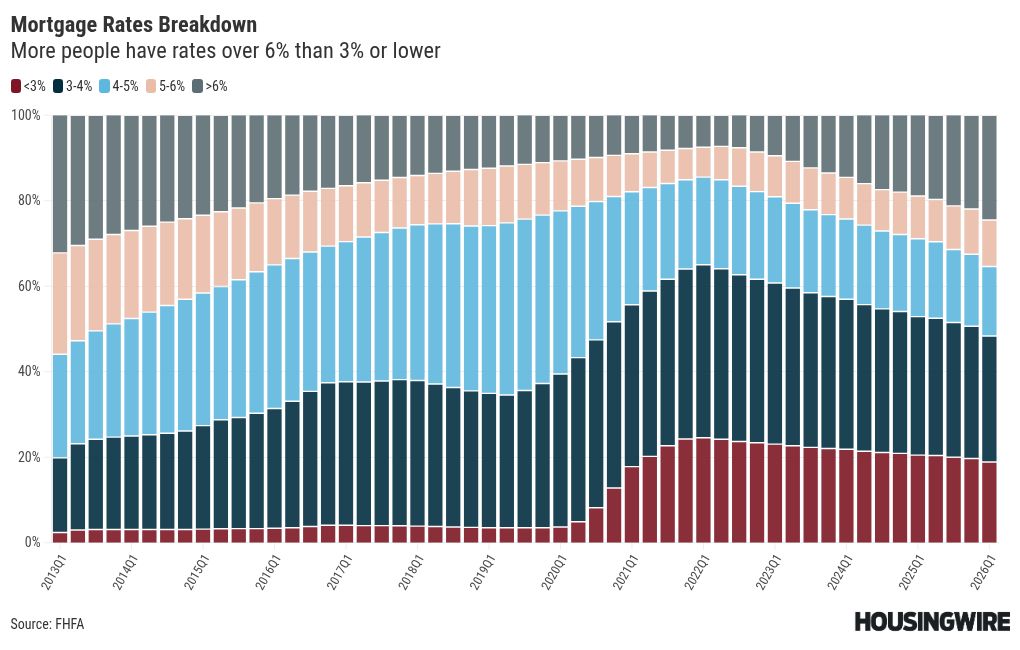
For the past several years, the real estate industry has talked about the mortgage-rate lock-in effect mostly as an inventory problem. That is understandable. When a homeowner has a 3% or 4% mortgage, and today’s replacement mortgage is in the mid-6% range, selling can feel financially irrational.

Freddie Mac reported that the 30-year fixed-rate mortgage averaged 6.43% as of July 2, 2026. Realtor.com, using data from the FHFA National Mortgage Database, found that just over half of outstanding mortgages still carried rates of 4% or lower as of the fourth quarter of 2025. FHFA researchers have also found that for every percentage point the market mortgage rate rises above a homeowner’s origination rate, the probability of sale falls by 18.1%. Their working paper estimated that lock-in prevented 1.33 million home sales from 2022 Q2 through 2023 Q4.

But there is another consequence we do not talk about enough.

Homeowners are moving, even when they are not selling

When homeowners cannot make the math work to sell, many do not simply stay put. Life keeps moving. People accept new jobs. Military families receive orders. Families grow, parents age, marriages change and homeowners relocate for reasons that have nothing to do with mortgage rates.

When that happens, the owner often asks a reasonable question: “Why sell and give up my low-rate mortgage if I can rent the house instead?”

That is how many Americans are becoming landlords — not because they set out to build a rental portfolio, but because the housing market pushed them into a new role.

In my experience, many accidental landlords are not thinking like investors at first. They are thinking like homeowners. The property may have been their first home, the place where they raised children or a house they hope to keep available for family in the future. That emotional attachment can be a good reason to hold the property, but it can also make the transition harder. A rental home has to be managed as a rental home, even when the owner still thinks of it as “my house.”

Zillow recently reported that 2.3% of homes listed for rent on its platform had previously been listed for sale, the second-highest share in nearly six years. That may sound like a small number, but it is a meaningful signal. The lock-in effect is not just suppressing transactions. It is creating a growing class of inexperienced landlords.

Renting out the house sounds simple — until it is not

At first glance, renting the home can look like the perfect solution. That is where the red flags start waving.

The moment a homeowner leases the property, the home becomes a business asset, a legal responsibility, a maintenance obligation and a risk-management exercise. Personal preference has to give way to profit and loss, market expectations and sound operating decisions.

That can be a difficult shift. An owner may love the purple bedroom. The 1980s washer may still work well enough. The carpet may seem fine because it was fine when the owner lived there. But renters are comparing that property with other available rentals, and the market does not care about sentiment.

Tenant selection is often the first issue. The goal is to place a qualified resident who can pay consistently, care for the property, follow the lease and communicate when something goes wrong. A vacant property is expensive, but the wrong tenant can be far more expensive.

The lease matters, too. A casual agreement may feel friendly, but residential leasing is not a handshake business. Then there is maintenance. A slow plumbing response can become water damage. A poorly documented repair can become a dispute. Deferred maintenance can become very expensive.

What makes long-term ownership work

The homeowners who succeed over time usually have more than a low mortgage rate. They have good tenants, strong communication, realistic expectations, professional distance and a way to handle maintenance and re-leasing without turning every issue into a personal emergency.

The rent check is only one part of the equation. The real test is what happens between rent checks: tenant questions, lease renewals, inspection findings, repair decisions, documentation and the ability to respond quickly when something goes wrong.

A low mortgage rate also does not eliminate cash-flow risk. Taxes, insurance premiums, HOA fees, appliances and HVAC systems do not stay frozen just because the mortgage rate is low. The rent may cover the mortgage most months, but the owner still needs reserves.

This matters for more than the individual owner. Real estate agents, mortgage lenders, title professionals, housing economists and policymakers should understand that “rent it out” is not a simple fallback plan. It changes the homeowner’s risk profile, the renter’s housing experience and in some markets, the local supply of single-family rentals.

It also complicates the public conversation about single-family rentals. Not every rental conversion is a Wall Street story. The accidental landlord is often a homeowner who made a rational financial decision in a difficult market.

The next lock-in conversation should include landlord risk

That does not mean homeowners should never rent out a former primary residence. In many cases, keeping the home can be the right decision. It may preserve a low-cost mortgage, maintain long-term exposure to a strong housing market and provide flexibility if the owner may return.

Before a homeowner becomes a landlord, they should understand market rent, projected vacancy, leasing costs, maintenance reserves, insurance implications, tax considerations, local landlord-tenant laws and the burden of managing from a distance. They should also have a plan for missed rent, major repairs, early lease termination or another market shift.

The mortgage lock-in effect did not just freeze inventory. It quietly moved risk from the sales market into the rental market. And the professionals who recognize that shift early will be better positioned to advise homeowners before a smart financial decision turns into an expensive landlord lesson.

David Norod is the Principal Broker, Managing Partner at WJD Management

This column does not necessarily reflect the opinion of HousingWire’s editorial department and its owners. To contact the editor responsible for this piece: zeb@hwmedia.com.

This post was originally published on here. 

The fight for market share in real estate has never been more intense. National portals, institutional investors and well-funded disruptors are all competing for the same buyers and sellers, pushing many brokerages to believe they need to spend more to keep up. But independent brokerages won’t win by outspending the competition—they win by outmaneuvering it. The ones that succeed are those that dominate their local markets so completely that no competitor can meaningfully break in.

This moment presents a unique opportunity. As technology evolves, consumer expectations shift and margins tighten, independent brokerages have a distinct advantage: agility. While larger organizations are slowed by scale and complexity, independents can move faster, go deeper and build stronger local relationships. The future doesn’t belong to those who are everywhere — it belongs to those who own their backyard.

Here are three key tactics to help your agents dominate your local market. 

1. Become a neighborhood specialist

Most agents claim to “serve” a city—but consumers don’t choose agents that way. They choose experts who understand their specific neighborhood. The more focused your presence, the more credible and visible you become.

Neighborhood specialization means going beyond general marketing and building real authority in defined areas. This includes creating detailed area pages, sharing local insights and consistently showing up with content that reflects true market knowledge. When done right, you’re no longer competing broadly—you’re owning a space.

2. Turn listings into local content assets

Every listing is a storytelling opportunity to demonstrate local expertise. Beyond photos and price, listings can highlight neighborhood lifestyle, buyer considerations and market context. Repurposing listings into multiple content formats helps extend their value and reinforce your local authority. 

Leveraging a tech platform with built-in ad creation, automated property reports, market insights and targeted ad distribution in specific zip codes can help extend listings for increased local exposure in a specialized market.  

3. Think beyond SEO. AEO is now king.

Search engine optimization (SEO) is the bare minimum in the new age of AI. The next frontier is Answer Engine Optimization (AEO)—preparing content to surface in AI-driven tools like ChatGPT and voice assistants. As consumer search habits shift, brokers who think ahead here will help their agents be discoverable in entirely new ways.  

Large platforms struggle to address the specific concerns buyers and sellers have about neighborhoods, timing and trade-offs. Answering common questions clearly and directly helps consumers feel informed and confident in their next step. 

Your audience doesn’t look for information in just one place, so you shouldn’t be in just one place!  Show up consistently across social media, short-form video, local publications and community spaces with the same locally focused message.

Beat the big brands through consistent execution

Independent brokerages don’t lose to big brands because of budget — they lose because of inconsistency. When local knowledge lives only in individual conversations, it’s hard to scale. The brokerages that win long-term build repeatable frameworks: content templates, follow-up sequences, market update cadences and onboarding processes that any agent on the team can execute. 

Repeatable content frameworks and simple systems help teams stay visible and consistent — test, refine and stay locally relevant as markets evolve. The result is a brokerage that delivers a consistent experience at every touchpoint, no matter who the client speaks with or where they encounter your brand.

Today’s real estate landscape demands more than tools that store contacts or automate a few tasks. It requires technology that can drive outcomes and actively work on an agent’s behalf to generate opportunities, nurture relationships and move deals forward. 

Consider your tech stack and whether it is functioning as an “always-on” digital teammate, ensuring no opportunity is missed and every lead is maximized.  If not, it’s time to re-evaluate your tech decisions and instead provide your hard-working agents the platform they need to become the local experts required to deliver real business results today.   

Dave Carter, Vice President, Marketing, Lofty 

This column does not necessarily reflect the opinion of HousingWire’s editorial department and its owners. To contact the editor responsible for this piece: zeb@hwmedia.com. 

This post was originally published on here. 

A video with plans and suggestions on how to kill US first lady   Melania Trump was shared on Tuesday by IRGC-linked Tasnim News Agency, with the video calling on “freedom fighters” to target the shops the first lady frequents.

The video, which claimed to share “information from several anonymous security networks,” shows schemes of how Melania’s security operates and the places that she usually goes in New York.

It also claims that the first lady ‘s weakness is “her love for fashion,” saying that she frequents top New York fashion stores that could be attacked by “freedom fighters.”

The video also claimed that Melania’s security operates separately from US President Donald Trump’s security, with different teams, codenames, and even plans in some cases.

Tasnim calls to kill Melania Trump

The video, which was shared by Tasnim‘s official Telegram account as a guide on how to kill the first lady , also asked for people working in the area where Melania goes shopping to look for cues about an upcoming visit.

Screenshot of Tasnim's video explaining how to kill US First Lady Melania Trump. (credit: Screenshot/Telegram)

It pointed out that working at important hospitals in the area or the fashion stores mentioned could be a key factor when planning an attack against Melania.

Tasnim also said that both trash cans and manholes are removed or sealed during a visit by the first lady, pointing out that the only way for an attack to be effective is to use neurotoxin agents.

It then goes into the specifics of which agents are more effective to poison someone without leaving traces, while it also says that another option is to offer cash rewards to the designers or managers of the stores Melania frequents.

The video ends saying: “This is just the beginning! Barron Trump, wait for us!”

This post was originally published on here. 

All 100 members of the US Senate have been invited to a meeting on Tuesday evening with Ukrainian President Volodymyr Zelensky when he is in Washington for the funeral of late Republican Senator Lindsey Graham, two Senate aides said.

One of the aides said the Senate also was expected to begin voting as soon as during Zelensky’s visit on a bill to impose sanctions on Russia that was championed by Graham.

The legislation had been pending for about a year before Graham’s sudden death this month. It is meant to cut revenues from the sale of Russia’s energy for its war on Ukraine.

Ukraine President Volodymyr Zelensky walks with U.S. Senate Majority Leader Chuck Schumer (D-NY) and U.S. Senate Minority Leader Mitch McConnell (R-KY) to a closed-door meeting at the U.S. Capitol on September 26, 2024 in Washington, DC.  (credit: TOM BRENNER/GETTY IMAGES)

Bill sparks concerns about presidential war powers

Lawmakers eased the tariff level in the legislation to 100% from a blanket 500% included in a previous version of the bill in order to win support. However, the bill has sparked concerns in Congress about potential new powers for Trump.

Zelensky has arrived in the US as of Tuesday morning.

He said that anti-ballistic defense and strategic cooperation with the US were the “number one priority” for meetings with Trump and his team. 

This post was originally published on here. 

The US Federal Aviation Administration said on Monday that seats on hundreds of Boeing 737 MAX jets registered in the US may require inspections in case they were incorrectly installed and needed to be fixed.

If not corrected, the seats could injure passengers and crew members during an emergency landing or block the aisle and slow an evacuation, the agency said.

The FAA’s proposed airworthiness directive issued on Monday would apply to 453 jets registered in the US. The agency only has jurisdiction over US airlines, but foreign regulators typically follow FAA directives if applicable.

Nearly 2,300 737 MAX jets are in service around the world, including 823 in the US, according to aviation advisory and intelligence firm IBA.

The proposed directive comes as Boeing works to improve its production quality and boost output under CEO Kelly Ortberg.

A Boeing 737 MAX 10 fuselage is pictured during the opening ceremony for the company's new North Line assembly line, which will produce 737 MAX aircraft, at the Boeing Everett Factory in Everett, Washington, on July 10, 2026. (credit: JASON REDMOND/AFP via Getty Images)

Production quality problems revealed in 2024

Production quality problems were revealed in early 2024 when a door-plug panel blew out of a nearly new Alaska Air 737 MAX in flight.

The FAA said in the airworthiness directive proposal that it received a report that some passenger seat assemblies were not correctly installed in the seat tracks.

That meant the assemblies could disengage from the seat tracks if there was an increased load, turbulence, or an emergency landing, the FAA said.

There could be up to 69 track-mounted passenger seat assemblies on each 737 MAX plane, and the issue would take an estimated one work hour to inspect and then an hour to fix each assembly and required no parts, the FAA said. Airlines might be able to have multiple employees inspecting seats simultaneously, greatly reducing the total time for each aircraft.

It did not say how quickly airlines would need to correct the issue.

A Boeing spokesperson said the planemaker issued guidance to operators about the issue in December 2025.

“We support the FAA making that guidance mandatory,” the spokesperson said in an email.

This post was originally published on here. 

Mercedes-Benz faces a potential ban on selling connected vehicles in the U.S. under legislation targeting automakers with significant ownership ties to China.

The Senate Commerce Committee advanced a measure last week that would bar the sale of connected vehicles in the U.S. by companies with more than 15% ownership by Chinese entities, potentially affecting German automaker Mercedes-Benz, in which two Chinese investors hold stakes totaling nearly 20%.

Sens. Elissa Slotkin, D-Mich., and Bernie Moreno, R-Ohio, sponsored the bipartisan legislation, which would codify and expand restrictions established under the ​Biden administration, arguing that it “closes the door on Chinese-origin vehicles, software, and key components at every stage, from production, importation, to sale, so that data gathered on U.S. roads can’t be funneled back to the Chinese government.”

“Chinese cars are surveillance packages on wheels, with the ability to collect on American citizens and transmit that data back to Beijing,” Slotkin said in a statement.

FORD ENTERS COMPETITION TO DEVELOP NEW US ARMY TACTICAL TRUCK

Moreno said the measure aims to prevent “an absolute, total, and complete destruction of our industrial base.”

“China’s auto industry was not built to compete, it was built to destroy American manufacturing, gut the middle class, and undermine our national security,” he said.

But Sen. Ted Cruz, R-Texas, who chairs the Commerce Committee, warned that Mercedes-Benz could effectively be shut out of the U.S. market if the legislation becomes law without changes and said the bill needed changes.

Cruz accused General Motors of pushing for the measure to cut Mercedes-Benz out of the market and make its Cadillac brand more appealing.

“We would never consider” banning Mercedes-Benz sales in the U.S., he said.

GM ​contended that the legislation does not attempt to target an individual automaker, saying it “supports policies that protect and strengthen American manufacturing and the ​global competitiveness of U.S. automakers.”

“As we have said many times, we can compete with anyone in the world when we are given a level playing field,” GM said.

Mercedes-Benz highlighted its extensive U.S. operations while stressing that it “continues to support legislation designed to protect U.S. national security.”

“Mercedes-Benz also remains ‌committed to ⁠ensuring that any legislation does not impact our operations. The company will continue to safeguard its employees, dealers, suppliers, and customers,” the automaker said.

The bill includes a process through which manufacturers could seek Commerce Department authorization for vehicles that otherwise would be prohibited.

Moreno said GM intends to move production of its Chinese-made Buick Envision to the U.S. for the 2028 model year and that Ford has agreed to transfer Chinese-made Lincolns to the U.S.

“I view that as a big victory,” Moreno said.

JAGUAR LAND ROVER RECALLS MORE THAN 15,000 VEHICLES OVER VISIBILITY-LIMITING DEFECT

CLICK HERE TO GET FOX BUSINESS ON THE GO

He also said Google’s ​self-driving vehicle company, Waymo, which had ​been in talks with Chinese automaker ⁠Geely about platforms coming from China, has committed to looking at a Detroit-based manufacturer for its future platforms.

Cruz said another bill provision backed by GM would require automakers to purchase more expensive batteries from GM, adding $5,000 to the vehicles’ cost.

This comes after the Trump administration last month banned Polestar from selling new connected vehicles in the U.S. starting in the 2027 model year due to the Sweden-based automaker being majority-owned by Geely.

Polestar’s sister brand and co-founder, Volvo Cars, said in May that it was given a green light to continue selling cars in the U.S.

The legislation must still pass the full Senate and House and be signed by the president before becoming law.

Reuters contributed to this report.

This post was originally published here. 

Prime Minister Benjamin Netanyahu is set to meet with US President Donald Trump on Tuesday, as the American leader weighs whether to expand his bombing campaign against Iran or pursue a diplomatic resolution concerning the Strait of Hormuz and the Islamic Republic’s nuclear program.

Israel fears that Trump will negotiate a premature end to the war without eliminating Iran’s ability to develop nuclear weapons in the future. Trump has repeatedly insisted that Iran cannot possess nuclear weapons, but the war and the economic upheaval it has caused have contributed to his approval rating reaching record lows in his second term. The poor marks are ringing alarm bells for Republicans ahead of midterm elections that could return Democrats to power in at least one chamber of Congress.

Netanyahu and Trump are also at odds over other issues, including the recent US-Saudi nuclear deal, the pending sale of advanced F-35 fighter jets to Turkey, and the extent of Israel’s troop presence in Gaza, Lebanon and Syria.

Netanyahu traveled to the United States to attend the funeral of Republican Sen. Lindsey Graham of South Carolina, who remained one of Israel’s most unwavering advocates even as its popularity declined. Graham was also one of Trump’s most important associates in pressing for the Iran war. Opposition leader and former prime minister Yair Lapid will also attend the service at Washington National Cathedral on Tuesday.

While in Washington, Netanyahu will seek to narrow the widening gaps between himself and Trump over Middle East strategy.

US President Donald Trump points his finger towards Israeli Prime Minister Benjamin Netanyahu as they shake hands during a press conference after meeting at Trump’s Mar-a-Lago club in Palm Beach, Florida. (credit: REUTERS/JONATHAN ERNST/FILE PHOTO)

Iran tops the agenda

In a video statement released before his departure on Monday, Netanyahu said, “I am embarking on this mission with one clear goal – to ensure the security, strength and future of our dear State of Israel.”

“We will discuss all the issues on the agenda, first and foremost, Iran,” he said. “Naturally, our goal is to safeguard our security and also to expand the circle of peace around us.”

During the trip, Netanyahu said he would also pay his final respects to Graham, “one of the greatest friends the State of Israel has ever known.”

Israelis are acutely aware of the emerging differences between the allies. “It will not be an easy visit,” former IDF intelligence chief Amos Yadlin told Israel Radio on Monday morning. “There is no doubt that Netanyahu wants the United States to return to war.”

Trump spoke on Monday about the discord between himself and Netanyahu, even as he praised the prime minister. Speaking to reporters aboard Air Force One, Trump said Netanyahu had been “great” and that “we did very well together.”

Trump was asked aboard the plane about US plans to sell advanced F-35 fighter jets to Turkey, which Netanyahu has publicly opposed. “Turkey has been a great ally for me,” Trump told reporters, stressing, “No one tells me what we should be selling or not.” He acknowledged that Turkey “is not a big fan” of Israel and Netanyahu.

Israel has been more circumspect regarding the Saudi civilian nuclear power agreement recently completed by the Trump administration. However, it has deep concerns about an agreement that would allow plants capable of enriching uranium. US assistance in building those facilities had been one of the key incentives former president Joe Biden used in an effort to persuade Saudi Arabia to normalize ties with Israel and join the Abraham Accords between Israel and several Muslim-majority countries.

Trump has since said that US support for a Saudi civilian nuclear program would be contingent on normalization with Israel and that the facilities would not be permitted to enrich uranium. On Monday, however, he told reporters aboard Air Force One that he had not spoken with Saudi Arabia about the Abraham Accords. Tuesday’s meeting will be the first face-to-face encounter between Trump and Netanyahu since the agreement was announced.

The closer Netanyahu appears to Trump and the center of US decision-making, the better it is for him domestically ahead of Israel’s October 27 election. Trump has met with Netanyahu more than any other foreign leader during his second term. This will be their eighth such meeting and the fifth time Trump has hosted the Israeli leader at the White House.

Tight ties with Netanyahu also play well with Trump’s evangelical base ahead of the US midterms in November, but they risk further alienating the broader American public, which opposes the conflict.

Netanyahu’s influence in the United States has diminished, partly because of the war’s growing unpopularity and the role he played in encouraging it.

“This is not the same Netanyahu of 2025 or even of February 2026. He is greeted with suspicion,” Yadlin said of the reception he expected the prime minister to receive in the United States.

Last visit was followed by large-scale attacks

Netanyahu last visited Washington in February, when he successfully advocated for the joint Israeli-US bombing campaign against Iran that began on February 28.

Tehran retaliated by closing the Strait of Hormuz, the waterway through which 20% of the world’s oil supply is shipped. The move caused crude oil prices to climb during the first quarter of 2026, from $61 per barrel to $118 per barrel, according to the US Energy Information Administration.

Iran allowed the strait to reopen on a limited basis after an April ceasefire, which was followed by a memorandum of understanding with the US in June. The agreement collapsed in early July, and the parties resumed their attacks without Israeli military involvement. The United States bombed Iran for 13 consecutive nights, ending on Thursday, even as talks with the Islamic Republic continued.

The United States and Israel were initially aligned in February around their shared goal of destroying Iran’s nuclear and ballistic missile programs, while Netanyahu also focused on bringing about the collapse of the Islamic Republic.

Over the weekend, Trump stressed that the war remained focused on eliminating Iran’s nuclear program. Last week, he spoke specifically about striking the nuclear facility at Pickaxe Mountain.

In an interview with NBC News’ “Meet the Press” on Sunday, US Ambassador to the UN Mike Waltz said the United States was “keeping all options on the table,” but was allowing time for talks.

He dismissed media reports that shortages of military supplies were among Trump’s motivations for pausing the bombing campaign, saying the United States had everything it needed militarily.

Waltz warned Iran not to disregard American military threats. Early Monday morning, Trump published a short AI-generated video in which his likeness planted an American flag on an Iranian oil tanker, accompanied by the slogan “it’s our oil tanker now.”

Later on Monday, Trump told reporters aboard Air Force One that he was holding “good talks” with the Iranians, “so we will see what happens. I think there is a good chance something could happen. If it does, good. If it doesn’t, we go back to doing what we were doing two days ago.”

Yadlin told Israel Radio that, at the end of the day, “What interests President Trump is the reopening of the Strait of Hormuz.”

The war might have begun in February with a focus on the Iranian regime and its nuclear program, but it will end, Yadlin predicted, with the reopening of the strait and some form of diplomatic achievement concerning Iran’s nuclear weapons program.

Israel has watched the renewed US-Iran engagement warily from the sidelines.

Sima Shine, an Iran expert at the Tel Aviv-based International Institute of Strategic Studies, said that neither Washington nor Tehran had so far wanted Israel to become involved in the renewed fighting, fearing that such a move would “widen the scope of the war.”

Maintaining the conflict as a bilateral confrontation makes it easier to return to negotiations, she told the Jewish Telegraphic Agency.

The United States can better control the battlefield without Israel, which would have its own military agenda and objectives, Shine said. Israel could enter the war only if it were attacked by Iran or invited to participate by the United States, she added.

In an interview with Fox News on Sunday, Netanyahu warned of a forceful response should Iran attack Israel.

Iran must end its nuclear program, he stressed, saying that the military strikes had set the program back but had not eliminated it.

A nuclear-armed Iran poses a danger to Israel, the region, the United States and the world, he said, adding, “President Trump and I are both committed to prevent this danger.”

This post was originally published on here. 

OpenAI CEO Sam Altman claimed on Friday that the company is currently working with artificial intelligence models at “the singularity point,” which represents the moment when AI becomes better at generating results than humans can.

And Altman’s claims might not be unfounded, as Technion-Israel Institute of Technology Professor Yaniv Romano told The Jerusalem Post that he believes the singularity might have been reached, citing recent studies showing that AI models can solve mathematical problems humans can’t.

“We are now in the singularity; this is the moment,” Altman claimed during an interview with the Relentless podcast, adding that the idea of reaching this point was unthinkable ten years ago, being a “far-off dream at best, while now it’s actually the moment that we used to talk about in a very not serious way.”

“What Altman says when talking about the singularity is that AI has become better than us at solving problems,” Prof. Romano, who is the associate professor of Electrical Engineering and Computer Science at the Technion, said. “There is good evidence that it’s already possible with current models.”

“There was a case when ChatGPT [OpenAI’s main commercial AI model] was able to solve a math problem which was impossible to do by a human who is not highly trained to work on those problems,” he added. “That’s the most interesting part, that these results were reached while using publicly available software.”

AI is at the singularity point, but how can we verify it

Prof. Romano also told the Post that one point to consider when checking whether an AI has reached the singularity is to verify that the results are correct and not merely hallucinations.

“When we are checking for code or simple tasks, it is easy to understand where the AI made a mistake. But when talking about tasks that humans can’t do under normal circumstances, then we start to have problems verification problems,” he said.

“The models are capable of generating thousands of results that even the best mathematicians in the world would take years to get. And it takes an even longer time to verify that these results are actually correct, and not just mistakes made by the system,” he pointed out. “It’s the burden of verification, and it’s much higher than the burden it represents to create models capable of generating content.

“And this also brings a big problem and challenge for humanity, because when models become more intelligent than most of us, then we start to rely more on them for answers and lose the capacity to think of a solution in our own way,” he added.

Humanity’s next challenge with AI

According to Prof. Romano, a problem that might appear for future generations is the fact that most people will rely on AI in the same way that “a child relies on a parent when searching for answers.”

“This means both that people think less, that we take for granted that the AI model is always correct, and, in the long run, that we stop having people capable of verifying the AI results,” he said.

At this point, Prof. Romano said, the AI models are capable of working math problems the same way that they did with code. And mathematicians might begin to use them that way, sacrificing in the process their own thought capacity.

“Nowadays, OpenAI and other top AI companies are employing the best mathematicians in the world to verify their models’ results. But who will they take in one or two decades when all of the scholars learn by using AI models to think for them?” he asked.

“Academia needs to address this situation, because it’s a very slippery road if we start to over-rely on AI models to think for us. And we must adhere to the highest possible standards, the same ones that previous professionals in maths, physics, or computer science adhered to, in order not to fall into this situation,” he concluded.

This post was originally published on here. 

If Knesset elections were held today, Gadi Eisenkot’s Yashar! party would be the largest party in Israel, closely followed by Prime Minister Benjamin Netanyahu‘s Likud, according to an N12 poll on Monday.

The poll found that Yashar! would win 23 seats, one less than last week, and that Likud would also hold one less seat than last week’s poll suggested, at 22 mandates.

Together, led by Naftali Bennett, also lost one seat compared to the previous poll, sitting at 14 mandates. In addition, Yair Golan’s Democrats lost one mandate, bringing the party’s total to 10 seats.

Yisrael Beytenu, led by Avigdor Lieberman, maintained nine seats, N12 reported. The Shas, United Torah Judaism, and Otzma Yehudit parties all maintained eight seats, the same as in last week’s poll.

The Arab parties, Hadash-Ta’al and Ra’am, received five seats each, while Bezalel Smotrich’s Religious Zionist Party received four.

Israeli Prime Minister Benjamin Netanyahu attends a vote at the plenum hall of the Knesset, the Israeli parliament in Jerusalem, on July 16, 2026. (credit: YONATAN SINDEL/FLASH90)

Tropper, Hendel’s party passes electoral threshold

Blue and White, led by Benny Gantz, and Balad, led by Sami Abu Shehadeh, both failed to reach the electoral threshold, polling at 1.6% and 1.3% respectively.

In contrast, the new poll found that if elections were held today, Chili Tropper and Yoaz Hendel’s Bayit Tzioni – HaMiluimnikim (roughly translated to the Reservists’ Zionist Home) would pass the electoral threshold and gain four seats.

The electoral threshold is 3.25%, meaning parties must earn at least 3.25% of the vote to win seats in the Knesset.

N12 reported that due to Bayit Tzioni – HaMiluimnikim passing the threshold, the opposition parties reached 70 seats, compared to the current coalition parties, who received 50 of the 120 Knesset seats. 

This week’s poll also marks the first time that the non-Arab opposition parties reached 60 seats.

N12 also found that if the Arab parties Hadash-Ta’al and Balad united, Likud would lose an additional seat, bringing them down to 21.

Best Candidate for Prime Minister

Although Eisenkot had previously polled ahead of Netanyahu as the best candidate for Prime Minister, the latest poll found the two were tied at 38% support.

Netanyahu continues to poll ahead of Bennett in suitability for leadership, with 40% choosing to vote for him over the former Prime Minister, compared to 34% who would support Bennett.

Netanyahu is also considered more suitable than Lieberman at 39% compared to 25%.

Issues affecting voters

A significant majority of the public was confident about their vote, with only 10% saying they were ‘still hesitant,’ the poll found.

Within the undecided voters, 1.3% support the Netanyahu bloc, 4% support the change bloc, and 1.3% are unsure.

Almost 30% of respondents who said they planned to vote for a different party than in the previous election said that October 7 had affected their position.

Additionally, 32% of people said that the most influential issue for their vote was security and the management of the war, placing it as the biggest issue affecting voters.

Approximately one-fifth of respondents said that the division between the blocs and social polarization had the biggest influence on their vote, 12% said that it was personal security and crime prevention, and 12% said that it was who is at the head of the bloc.

This post was originally published on here. 

Businesses that spent much of the past two years freezing hiring and warning that artificial intelligence could dramatically reduce headcounts are beginning to reverse course. Several large employers are expanding recruitment plans again, signaling that AI is becoming more of a productivity tool than the widespread job replacement many had predicted.

According to recent hiring announcements and labor market data, companies are continuing to invest heavily in AI while simultaneously increasing hiring in key business functions. The shift suggests executives are finding that technology works best when paired with skilled employees rather than replacing them outright.

Instead of eliminating jobs across the board, AI is changing what companies expect from the people they hire.

Many of the fastest-growing openings now emphasize employees who can work alongside AI systems. Demand remains strong for software engineers, cybersecurity professionals, financial analysts, healthcare workers, logistics specialists, skilled manufacturers, sales professionals, and managers capable of integrating AI into daily operations.

That marks a notable change from the widespread concerns that generative AI would quickly displace millions of office workers. While automation continues to reduce repetitive administrative work, employers increasingly say human judgment, communication, creativity, customer relationships, and strategic decision-making remain difficult to automate.

For business owners, the renewed hiring trend offers another signal that expansion plans are moving forward after a prolonged period of caution. Companies delayed many hiring decisions while evaluating higher interest rates, economic uncertainty, and the practical impact of AI. As those investments mature, many firms are discovering they still need experienced employees to manage growth.

The competitive advantage is shifting from simply adopting AI to knowing how to use it effectively.

Workers are adapting as well. Rather than competing against AI, many professionals are adding AI skills to increase productivity and remain competitive. Employers increasingly value candidates who understand how to use AI tools responsibly while maintaining the expertise needed to make complex business decisions.

Economists continue to expect AI to reshape the labor market over the next decade, but the latest hiring activity suggests the transition may be slower and more balanced than early predictions of widespread job losses. Instead of replacing entire professions, many companies are redesigning roles so employees spend less time on repetitive tasks and more time solving problems, serving customers, and creating value.

Looking ahead, hiring trends will likely depend on overall economic growth, business confidence, and continued investment in AI infrastructure. For now, however, the labor market is showing that businesses are not abandoning human talent—they are redefining how that talent works alongside rapidly advancing technology.


JBizNews Desk | Wall Street

© JBizNews.com All Rights Reserved. Reproduction or distribution without written permission is prohibited.

NEW YORK — The U.S. Justice Department asked the Supreme Court on Monday to revive President Donald Trump’s executive order restricting mail-in voting, launching an emergency appeal that could reshape election procedures in nearly half the country less than 100 days before voters decide control of Congress.

Solicitor General D. John Sauer requested that the justices temporarily lift a lower-court injunction while litigation continues. The challenged order is currently blocked in 23 states and the District of Columbia. The Supreme Court directed those states to respond by August 3, setting up a fast-moving legal timetable ahead of the November elections.

At the center of the dispute is who controls the rules governing federal elections.

Signed on March 31 under the title “Ensuring Citizenship Verification and Integrity in Federal Elections,” the executive order directs the Department of Homeland Security to work with the Social Security Administration to develop a citizenship verification system for voter eligibility. It also instructs the U.S. Postal Service to deliver mail ballots only to individuals appearing on that verified list.

Twenty-three states and the District of Columbia challenged the order, arguing that the Constitution gives primary authority over election administration to the states and to Congress—not the President. A federal district judge agreed and blocked key portions of the directive from taking effect.

The administration argues the injunction improperly limits the President’s authority to direct executive agencies. In Monday’s filing, Sauer told the Court that delaying implementation could interfere with election preparations because states begin voter verification and absentee ballot processing well before November. The Justice Department also emphasized that the Postal Service has not yet finalized any operational procedures under the order.

The legal battle rests on competing concerns about election integrity and voter access.

Supporters of the administration point to recent cases involving improper voting, including several hundred non-citizens identified by New Jersey officials as having participated in elections. Opponents counter that documented cases of non-citizen voting remain extremely rare compared with the total number of ballots cast and argue that existing evidence does not demonstrate fraud capable of changing election outcomes.

The citizenship verification system itself also remains a central point of disagreement. Opponents contend that federal databases can generate false matches that could mistakenly affect eligible voters, while the administration argues that stronger verification measures are necessary to improve confidence in federal elections.

Monday’s filing marks the administration’s 35th emergency application to the Supreme Court during President Trump’s current term. Supporters view the filings as necessary responses to nationwide injunctions issued by lower courts, while critics argue they reflect an unusually aggressive use of emergency appeals.

For businesses across New York, New Jersey and Connecticut, the case carries practical implications beyond election law.

If the executive order ultimately takes effect before November, employers could see increased demand for in-person voting accommodations should mail-ballot availability become more limited in affected jurisdictions. Retailers, manufacturers, logistics companies and hospitality businesses that depend on full staffing during the election period may want to review scheduling policies and applicable state voting-leave requirements before peak absentee and Election Day activity begins.

The broader policy stakes are even larger. Control of Congress will shape tax policy, federal spending, tariff legislation, regulatory priorities, SBA programs and government contracting over the next two years. Any Supreme Court ruling that changes how millions of ballots are processed could have indirect consequences for the policy environment businesses will face through 2028.

The next major milestone arrives on August 3, when the responding states must file their arguments with the Supreme Court. Given the administration’s stated goal of implementing any changes before election preparations accelerate later in August, a decision from the justices could follow quickly.

JBizNews Desk | New York

© JBizNews.com All Rights Reserved. Reproduction or distribution without written permission is prohibited.

Menachem Begin must be turning in his grave.

The Likud party, which traces its roots to Begin’s Herut movement, was built on a conviction that democracy depends upon the freedom to disagree. As Begin himself declared, “We are convinced – as we have witnessed throughout the world – that without an opposition, there can be no democracy; without it, the essence of human liberty is in danger.”

The first right-wing prime minister in Israel’s history was referring to the Knesset opposition, yet the principle applies just as readily within political parties. Democracy begins long before election day. It begins with the willingness of a movement to tolerate debate, criticism, and competing ideas without demanding unquestioning loyalty from those within its ranks.

Veteran Likud MK David Bitan on Sunday leveled extraordinary accusations against his own leadership in an interview with KAN TV where he said that the Prime Minister’s Office had contacted ministers and MKs asking them to record videos in support of Prime Minister Benjamin Netanyahu’s proposals ahead of an internal party vote.

“The prime minister really wanted appointments rather than [internal] elections,” Bitan stated. “But following the petitions we filed and the public pressure we created, he has essentially agreed to primaries.

Prime Minister Benjamin Netanyahu and his wife Sara cast their vote during the elections for the Likud Central Committee, at the International Convention Center in Jerusalem, November 25, 2025 (credit: CHAIM GOLDBERG/FLASH90)

“We’re a democratic party. Our foundation is democratic… The Prime Minister’s Office is asking for videos – videos supporting his proposals. The prime minister appoints them as ministers; the prime minister can dismiss them from those positions. The prime minister has influence over many party members in the primaries, so people are under pressure. They’re afraid in this situation.”

Likud party has lost the value of strong internal debate

If senior elected officials believe they are expected to demonstrate loyalty to the party leader before an internal democratic vote, something has changed inside a movement once renowned for robust internal debate.

Earlier this month, Likud MK Dan Illouz warned against any attempt to weaken the party’s primary system. Speaking to The Jerusalem Post’s Keshet Neev, he acknowledged reports that Netanyahu sought greater influence over the composition of the party list, but cautioned against abandoning the process altogether.

“I think that would be very bad for the Likud,” Illouz said. “We’re very proud to be the only democratic party right now in the Knesset. We’re very proud about this title, and I don’t think that we’d want to let it go.”

Those comments now read rather differently.

Likud’s own internal court was eventually put in a position to order that primaries proceed according to the party’s democratic framework, after attempts to alter the process. It was not the High Court of Justice doing this, or the opposition or outside campaigners defending Likud’s internal democracy. It was Likud itself.

Bitan’s allegations also recall claims made last week by MK Sharren Haskel in a sworn affidavit during last month’s state comptroller vote. Haskel alleged that members of the New Hope-United Right faction were instructed to film themselves voting for Michael Rabello and show the footage to Prime Minister Benjamin Netanyahu as proof that they had voted as required. All of this implies a political culture in which loyalty is increasingly expected to be proven rather than simply given.

Netanyahu remains Likud’s dominant political figure

None of this is to deny Netanyahu’s standing within Likud. He remains, by a considerable margin, the party’s dominant political figure. Nor is there anything improper about a party leader campaigning for his preferred proposals. The concern arises when disagreement is met not with debate but with pressure, and when loyalty is measured by visible displays of obedience rather than confidence in the strength of one’s argument.

Begin named his movement Herut, ”Freedom.” The freedom to speak, freedom to disagree, and freedom to challenge authority without being branded disloyal. It is an uncomfortable irony that, nearly half a century after Begin entered the Prime Minister’s Office, some within the movement he founded now appear to have so little freedom to dissent from its leader.

If the Likud continues to mistake conformity for unity, it may soon find that voters deliver the lesson its own founder understood all along. Come October, the movement descended from the freedom movement could find itself with fewer MKs in the Knesset – and perhaps, in a final irony, sitting in the very opposition that Begin so passionately defended as indispensable to democracy.

This post was originally published on here. 

Oman and Iran have accelerated talks to restart shipping through the Strait of Hormuz in what would be a short-term fix amid a slowdown in fighting between Washington and Tehran, The Wall Street Journal reported on Monday. 

Oman is keeping Washington informed, although the US isn’t directly part of the talks. 

Iran and Oman created the agreement, which would allow ships to pass safely through the waterway, over the weekend, according to the WSJ. 

The talks aren’t meant to put a full stop to the conflict. However, mediators hope that a temporary agreement on a contentious issue would cool tempers and ultimately lead to more advanced talks, the report added. 

Iran and Oman are still far apart on some issues, including whether to charge transit fees, the report said, citing a US official and mediators. 

Trump halted attacks on Iran Friday evening following almost two weeks of strikes against Iranian maritime capabilities, missile and drone storage facilities, coastal surveillance sites, and air defense assets, according to information provided by the US Central Command. 

Oman sent a delegation to Tehran to begin talks Friday night, according to the report, which added that both sides have reported progress. 

This is a developing story. 

This post was originally published on here. 

The next round of talks between Israel and Lebanon will take place in Rome from August 4-6, a senior US State Department official said on Tuesday. 

The talks will focus on implementing the trilateral framework, resolving border issues, and expanding the pilot areas in southern Lebanon, in which Lebanese troops will verify that areas have been cleared of Hezbollah terrorists and weapons. 

The first pilot zone represents a genuine opportunity to achieve progress on the ground by restoring the authority of the Lebanese state through the verified disarmament of terrorist organizations and building the trust needed for the next steps.

The experience gained from the initial pilot zones will help improve the model’s implementation, enabling its gradual expansion in stages.

Negotiators also plan to work towards a comprehensive peace and security agreement, according to the official. 

US Secretary of State Marco Rubio talks alongside State Department Counselor Daniel Holler, Israel's Ambassador to the US Yechiel Leiter, and Lebanon's Ambassador to the US Nada Hamadeh during an event to sign a framework agreement between Israel and Lebanon, June 26, 2026. (credit: KEN CEDENO/REUTERS)

This comes following last week’s meeting between Lebanese President Joseph Aoun and US President Donald Trump.

The Trump administration is committed to the discussions, the official noted, adding that all sides are entering talks with “significant momentum” following the presidents’ talks and the gradual implementation of the pilot zones. 

He also stressed that the trilateral framework is the only path to achieving lasting peace and that its full implementation is clearly in the interests of both countries. 

This post was originally published on here. 

Prime Minister Benjamin Netanyahu landed in the US on Monday ahead of talks with US President Donald Trump in Washington, where they are expected to discuss the situation with Iran, among several other issues, the Prime Minister’s Office confirmed.

“We will discuss all the issues on the agenda, first and foremost, Iran. Naturally, our goal is to safeguard our security and also to expand the circle of peace around us,” Netanyahu said as he prepared to board Wing of Zion.

Netanyahu flew out from Nevatim Air Base instead of Ben-Gurion Airport, where he typically departs for state visits, Israeli media reported.

“From my experience as prime minister, during these complex times we must act with both great determination and great wisdom,” he stated.

“I am embarking on this mission with one clear goal, to ensure the security, strength, and future of our dear State of Israel,” he said.

US President Donald Trump and Israeli Prime Minister Benjamin Netanyahu embrace as they walk into Trump's Mar-a-Lago club in Palm Beach, Florida. (credit: JONATHAN ERNST/REUTERS)

“This will be the eighth meeting between the two leaders since Trump’s election for a second term,” Netanyahu said. “More than any other international leader. This is a great privilege, but it is also a great responsibility.”

Netanyahu to attend funeral of Lindsey Graham

Netanyahu added that in addition to meeting with Trump, he will also attend the funeral of Lindsey Graham, who passed away on July 12 after a brief and sudden illness.

This post was originally published on here. 

The Federal Reserve is widely expected to leave interest rates unchanged Wednesday. The bigger development may not be the decision itself, but what investors, businesses and consumers no longer receive: meaningful guidance about what comes next.

Under Chair Kevin Warsh, the Fed has largely stepped away from signaling its future policy path, leaving financial markets to navigate one of the most uncertain inflation environments in years at the very moment war-driven energy prices are complicating the economic outlook.

The result is a market that knows today’s decision but has far less confidence about tomorrow’s.

Warsh’s first meeting as chairman in June marked a clear departure from recent Federal Reserve practice. The policy statement was dramatically shorter than those issued under previous leadership, the Fed largely abandoned forward guidance, and Warsh declined to submit his own interest-rate projection to the committee’s closely watched “dot plot.”

For decades, those signals helped businesses prepare long before the Fed actually changed interest rates.

Forward guidance was never charity. It was a mechanism.

When the Federal Reserve signaled where policy was likely headed, financial markets gradually adjusted borrowing costs before the official decision arrived. Businesses financing inventory, developers planning construction projects and families shopping for mortgages all benefited from knowing the likely direction of travel.

Remove that signal and markets still adjust.

They simply adjust later, faster and with far greater uncertainty.

That uncertainty has become more expensive because the policymakers themselves remain divided.

Minutes from the June meeting showed Federal Reserve officials weighing two very different futures. Some believed inflation would continue easing enough to justify lower interest rates. Others concluded persistent price pressures could require additional increases before year-end.

The committee ultimately voted unanimously to leave rates unchanged.

That unanimity masked meaningful disagreement.

Warsh later described the internal debate as a “family fight,” highlighting that consensus on the final vote did not necessarily reflect agreement about where policy should go next.

Without the chairman’s own projection, investors lose one of the Federal Reserve’s most important traditional signals just as markets are searching for direction.

The uncertainty became even more expensive once oil prices entered the equation.

Crude oil climbed above $100 a barrel last week as fighting between the United States and Iran intensified, reinforcing concerns that inflation could remain stubbornly high. Prices then fell sharply after both governments paused military operations over the weekend.

That rapid reversal left markets trying to answer two questions simultaneously.

Where will oil prices settle?

And how will a Federal Reserve chairman who has deliberately revealed very little interpret those movements?

Even professional economists disagree.

Bank of America concluded the temporary oil surge made July’s meeting a genuine close call, arguing that failing to raise rates could undermine the Fed’s inflation credibility while increasing rates might conflict with Warsh’s own preference for looking beyond temporary supply shocks. The bank continues to forecast three quarter-point rate increases before year-end.

JPMorgan economist Michael Feroli reached a different conclusion, saying any July increase would require Warsh to persuade colleagues who remain reluctant to tighten policy further.

Same information.

Different conclusions.

That gap illustrates the cost of uncertainty more clearly than any market chart.

Warsh has nevertheless remained consistent about one objective.

Speaking at the European Central Bank’s forum in Sintra, Portugal, on July 1, he reaffirmed that inflation remains too high, rejected any suggestion of raising the Fed’s longstanding 2% inflation target and pledged to restore price stability.

What he has not explained is how quickly—or under what circumstances—the Federal Reserve intends to get there.

That leaves businesses facing a planning problem rather than simply an interest-rate problem.

For companies, the smartest strategy is no longer predicting one outcome. It is preparing for several.

Businesses carrying floating-rate debt should consider the possibility that borrowing costs remain elevated—or even rise again—before eventually falling. Companies weighing refinancing decisions can no longer rely on the Federal Reserve signaling an optimal window months in advance.

For manufacturers, retailers and transportation companies, energy prices now influence borrowing costs almost as much as fuel bills themselves. The same headlines emerging from the Middle East increasingly shape both inflation expectations and interest-rate expectations.

Gregory Daco, chief economist at EY-Parthenon, believes a July rate increase remains unlikely and views September as the first meaningful opportunity to judge whether inflation is resuming its downward trend.

Under previous Federal Reserve leadership, markets would likely spend those weeks receiving increasingly clear signals about policymakers’ intentions.

This time, they will spend them trying to interpret silence.

For businesses, guessing is expensive. Hiring plans, investment decisions and financing strategies become harder to manage when the country’s most influential economic institution deliberately offers fewer clues about where policy is headed.

Markets can handle bad news. They struggle far more with uncertainty.


JBizNews Desk | New York

© JBizNews.com All Rights Reserved. Reproduction or distribution without written permission is prohibited

More than 10,000 Jewish singles spanning six continents are set to participate on Wednesday in the “largest Jewish speed-dating event ever held” following Tu B’Av, the Jewish holiday of love. 

The event is organized by Partners in Torah, Aish, and CoronaCrush and joined by more than 100 organizations. 

This year’s participation is set to be much larger than last year’s, which connected 6,750 singles for 15,463 dates in a single hour. The connections led to dozens of relationships and three marriages, according to a statement from Aish. 

“Every year the response grows, and every year we hear new stories that remind us why this matters,” said Tehilla Friedland, COO of Partners in Torah and one of the event’s lead organizers. “We are not just running an event. We are building a community, one date at a time.”

This year, the technology behind the matching process has been refined based on feedback from past participants, according to Michaela Tobias, Community Manager of CoronaCrush. 

Gila and Neriya, two singles who participated in a speed-dating event, on their engagement.  (credit: Courtesy)

“Singles told us what worked and what didn’t, and we listened,” she said. “This year’s questionnaire and matching are smarter, and we are ready to help even more people find each other.”

Gila and Neriya are one of the couples who met at last year’s event, according to Aish’s statement. What began as a seven-minute video call ended in marriage this past February. 

Gila had just made aliyah from London when she decided to sign up for the event. “I was sitting in the call with my friend, and we saw it [the event listing],” Gila recalled. “I was like, why not? To think that I met my husband is really crazy.”

Neriya had moved to Israel from the US to study in a yeshiva. Although he had been searching for a way to meet someone who had already made aliyah, he was initially hesitant to speed-date. When the event came across his feed, however, he decided to give it a chance. 

 “There are only benefits to this,” he said. “Either you spend an hour of your evening and nothing happens, or you spend an hour of your evening and find, in seven minutes, the person you’re going to marry.”

According to Aish, the two spoke on the phone for two hours following the event, and stayed in touch daily for weeks before meeting in person. They were engaged three months later and were married less than a year after they met.

“It’s really crazy,” Gila said. “Almost a year later, I’m celebrating a year of meeting my husband. I never thought it would happen this way, but I’m so grateful it did.”

“You really just never know where your husband is going to pop up from,” Gila said. 

Eighth time’s the charm

Goldie had already participated in seven speed dating events before attending last year’s. “I believe in putting myself out there as much as I can,” she said. “If Hashem wants me to find someone, then I have to allow for the opportunity. I don’t really fit into a typical community box, so I needed to try different venues to meet someone.”

Goldie was matched with seven people, one of whom was Barak. The two dated for six months, got married in June, and are planning to make Aliyah. 

“You never know. You could meet your spouse as I did. Or, at the very least, you’re just meeting another Jewish neshama searching; that’s something that someone once told me, and I really connected with it,” Goldie said. 

This year’s large roster of partnering organizations reflects growing recognition that Jewish communities worldwide are looking for accessible ways for singles to meet, including in smaller and more isolated locations, organizers said. 

Participants have come from South Africa, the UK, the US, Brazil, France, Sweden, Israel, and more. 

Couples are matched according to preferences and location where relevant, according to Aish. 

Tu B’Av: a day of matchmaking

CEO of Aish Rabbi Steven Burg said, “The Jewish response to building the future has always been through relationships and family. Every year, this event brings together singles who might never have crossed paths otherwise, and every year we hear that it changed someone’s life. Tu B’Av has always been a day associated with matchmaking in Jewish tradition, and it feels fitting that this event now carries that spirit forward for a new generation.”

Registration for the July 29 event is now open on participating organizations’ websites and social media channels.

This post was originally published on here. 

The US Senate on Monday advanced the nomination of Manhattan US Attorney Jay Clayton, President Donald Trump’s pick to be the top US spy, and he is expected to be approved within days despite a tense confirmation hearing.

If approved to be the director of national intelligence, Clayton would fill a role vacated in June when Tulsi Gabbard stepped down after a tenure marked by clashes with congressional Democrats, who accused her of advancing Trump’s political agenda and promoting debunked election claims.

The vote was 51-43 in favor of advancing Clayton’s nomination for the job overseeing the nation’s 18 intelligence agencies. The vote was along party lines, with Trump’s Republicans backing his nominee and members of the Democratic caucus voting no.

The position of DNI was created after the September 11, 2001, attacks to coordinate the country’s sprawling intelligence apparatus. Many senators have been eager for Clayton to take up the post because they are unhappy with the interim director of national intelligence, Federal Housing Finance Agency Director Bill Pulte, a Trump loyalist without national security experience who has been cutting staff at the agency.

Now that Clayton won a majority in the 100-member Senate on the procedural vote, a final confirmation vote is expected later in the week. Trump’s Republicans, who have a 53-47 majority in the chamber and rarely break from the White House, had been expected to provide Clayton with enough votes for confirmation even if Democrats balked.

Jay Clayton, US President Donald Trump's nominee to be Director of National Intelligence, testifies during a Senate Intelligence Committee confirmation hearing on Capitol Hill in Washington. (credit: Nathan Howard/Reuters)

Controversy around the recommendation

The Senate Intelligence Committee recommended Clayton to the full Senate in a narrow 9-8 vote last week.

He received yes votes only from the panel’s Republicans after repeatedly refusing to directly acknowledge that Trump lost the 2020 presidential election despite repeated questioning during his confirmation hearing.

Clayton also faced questioning from Democrats about his decision to issue subpoenas ordering New York Times journalists to testify before a federal grand jury after reporting on security concerns involving Trump’s new Qatari-donated Air Force One plane.

A prosecutor said at a court hearing last week that the Trump administration would withdraw the subpoenas after a judge’s close questioning about the investigation.

“From start to finish, Mr. Clayton has proven himself incapable of telling the truth or demonstrating an iota of independence from Donald Trump. For those reasons, I voted ‘no’ on his nomination,” Oregon Senator Ron Wyden, a senior Democrat on the Intelligence Committee, said in a statement.

Senate Majority Leader John Thune, a South Dakota Republican, called Clayton a proven leader in remarks urging support for the nomination. “Amid a heightened threat environment, having a proven leader as the director of national intelligence is especially important, and Jay Clayton fits the mold,” Thune said.

Clayton’s confirmation process was dogged by controversy even before his July 15 hearing. In mid-June, Trump abruptly threw doubt on his nomination by ordering the postponement of the hearing in an effort to force Congress to pass an overhaul of US voting rules.

Senators, including Cotton, said at the time they expected the hearing to go ahead as scheduled, but then said Clayton would not appear after Trump ordered him to stay away.

This post was originally published on here. 

Recovery is paramount for any athlete to be great at their craft, but Nike and Hyperice created yet another footwear innovation designed to help those hard-working athletes unwind from the ground up. 

This time, it’s with a slip-on slide. 

The Nike Air Zoom Hyperslide was introduced on Monday as the latest innovation developed in partnership with Hyperice, the health technology company that designs products specifically for recovery. 

CLICK HERE FOR MORE SPORTS COVERAGE ON FOXBUSINESS.COM

By combining Nike’s footwear expertise with Hyperice’s recovery technology, and building off the foundation of the award-winning Nike x Hyperice Hyperboot, this slide is designed to be wearable no matter the time of day, but with recovery in mind. 

How exactly can a slide help an athlete recover just by wearing it? A magnetic Hyperslide Pod housed inside the slide’s adjustable strap delivers three levels of heat as well as three levels of vibration that run within 15-minute cycles. This gives athletes the ability to seamlessly customize how they want to experience the slide’s recovery features through on-pod controls, or simply using the Hyperice App. 

NIKE CEO ELLIOTT HILL OUTLINES SPORTS-FOCUSED STRATEGY TO REVIVE ICONIC SPORTSWEAR COMPANY

And whether it’s before or after competitions, training or regular life moments, the slide is a low-profile, full-length Air Zoom sole for soft, responsive comfort with targeted Hyperice heat and vibration within. 

“Athletes leave everything on the field, and the approach to recovery needs to meet them at the same level,” Tobi Hatfield, senior director of athlete innovation at Nike, said in a statement. “With the Nike Air Zoom Hyperslide, we wanted to create a solution that kickstarts recovery the moment you power it up — helping athletes feel more relaxed, restored and ready to take their performance to the next level.”

Nike and Hyperice got feedback on the product from a range of athletes, pro and everyday performers, including Netherlands and Liverpool star Virgil van Dijk. 

“It’s the combination that stands out,” he said in a press release. “The Hyperice heat and vibration help my feet recover as quickly as possible, while the Nike Air Zoom cushioning makes it feel incredibly comfortable.”

It also helps that Nike and Hyperice understood what athletes need to recover and how to use their respective expertise to make it happen after feedback from the Hyperboot. That product was tested with Nike Olympians at the 2024 Paris Summer Games, and it went on to exceed $10 million in revenue in its first eight months. 

It was the first shoe ever carried by Best Buy, while also winning numerous innovation awards. 

The Air Zoom Hyperslide reflects both companies’ belief that performance doesn’t just end when competition or training stops. Athletes are always looking for an edge over the competition, and recovery has seen an uptick in priority to ensure a fresh mind and body for the next day, no matter what’s on the docket. 

GET FOX BUSINESS ON THE GO BY CLICKING HERE

“Our partnership with Nike has always been driven by a shared commitment to innovation for the athlete,” Hyperice founder Anthony Katz said in a statement. “With the Nike Air Zoom Hyperslide, we’re making premium recovery more accessible than ever, combining Nike’s iconic footwear expertise with Hyperice technology to help people recover smarter with every step.”

The Air Zoom Hyperslide will be made available beginning Sept. 29 in select markets.   

Follow Fox News Digital’s sports coverage on X and subscribe to the Fox News Sports Huddle newsletter.

This post was originally published here. 

The Treasury Department slashed another 84 people and companies from its sanctions lists on Monday as part of an effort to streamline sanctions programs and make it easier for banks to pursue what it deems the most serious terrorist financing schemes.

Secretary Scott Bessent launched a review in May of its sanctions programs and lists to remove outdated entries and ease compliance burdens on financial institutions.

He later announced that 76 people and firms had been removed from the 17,000-plus sanctions lists.

A Treasury official said the goal is “to ensure Treasury sanctions remain efficient, sharp, and focused, and to remove bloat left over from previous administrations,” adding that more than 3,000 names were designated in 2024, compared to only 880 in 2017.

BESSENT SAYS TREASURY TRACKED DOWN AYATOLLAH’S ‘MONEY MAN,’PLANS TO EXPOSE LINKED PROPERTIES

“Sanctions are not intended to be a forever tool,” the official said.

Bessent has repeatedly emphasized the Trump administration’s willingness to impose sanctions on Russia’s two biggest oil companies — Rosneft and Lukoil. The Biden administration had been hesitant to take such action over concerns of a further uptick in oil prices after Moscow’s invasion of Ukraine in February 2022.

The second round of removals from the Treasury’s Specially Designated Nationals and Blocked Persons (SDN) List on Monday includes 36 people who have died and associated listings, 33 Iraq-related entities first designated in 1991 or 1992, seven defunct or outdated narcotics listings related to Colombia and eight disrupted narcotics kingpins.

The Treasury’s Office of Foreign Assets Control (OFAC) also updated listings for 22 people and entities to add or clarify missing key identifiers.

Each removal was made after a review by other federal agencies to ensure that it would not hurt the administration’s foreign policy or national security interests, and names could be reinstated as needed, the Treasury said.

The review so far has centered on older sanctions entries, which can sometimes leave out identifying information that is now routine for new sanctions, including place and date of birth, unique identification numbers, nationality or gender.

Adding new data should make compliance screening easier for financial institutions, the Treasury said.

OFAC has also identified a small number of duplicate entries on its sanctions lists, the department said, adding that 18 of these sets were resolved with Monday’s removals.

TREASURY INTERCEPTS NEARLY $99M IN FEDERAL PAYMENTS TO DECEASED INDIVIDUALS UNDER TRUMP FRAUD ORDER

GET FOX BUSINESS ON THE GO BY CLICKING HERE

“To decrease the compliance burden on financial institutions and improve national security outcomes, Treasury is reviewing outdated or hard-to-screen targets,” the Treasury said in an internal document, according to Reuters.

It added that the impact of sanctions should be “measured in terms of effect, impact, and national security benefit, not based on the number of names we put on a list.”

Last month, the Treasury launched a new online portal allowing sanctioned people or companies to request their removal from the list.

Reuters contributed to this report.

This post was originally published here. 

Nvidia is preparing another massive expansion of its artificial intelligence ecosystem—one that could involve more than $750 billion in new infrastructure commitments and, for the first time, leave the chipmaker standing behind a customer’s ability to pay for the computing powered by Nvidia chips.

The company is working on several major initiatives, including an AI partnership with the parent of South Korean memory-chip maker SK Hynix valued at more than $500 billion. At the same time, Nvidia is discussing a financial guarantee of up to $250 billion that would help OpenAI lease computing capacity from a massive U.S. data center project in Ohio.

For businesses watching the AI race, the guarantee—not the dollar amount—is the real story.

Nvidia has invested in customers before. It has never supported them quite like this.

Unlike an equity investment, a guarantee does not simply provide cash upfront. It commits Nvidia to stand behind a customer’s financial obligations if something goes wrong, helping ensure the customer can continue purchasing AI computing infrastructure powered by Nvidia hardware.

That matters because OpenAI Chief Financial Officer Sarah Friar has publicly said the company’s fundraising is used primarily to purchase Nvidia graphics processors.

The relationship becomes unusually direct: Nvidia helps finance a customer whose largest spending priority is buying Nvidia chips.

For investors, that represents another evolution in how AI infrastructure is being financed.

The proposed guarantee supports a 10-gigawatt Ohio data center, making it one of the largest financing arrangements ever discussed between Nvidia and one of its customers. Rather than purchasing an ownership stake, Nvidia would be backing financing that allows the project to move forward while creating future demand for its own products.

The strategy also marks a notable shift from what Nvidia was saying only months ago.

Earlier this year, Chief Executive Jensen Huang indicated the company was unlikely to expand its financial commitment to OpenAI beyond its existing investment.

A previously discussed $100 billion partnership never materialized after questions emerged about the project’s future. Instead, Nvidia ultimately invested approximately $30 billion as part of OpenAI’s $122 billion funding round, valuing the AI company at roughly $852 billion.

Only a few months later, Nvidia is discussing a commitment more than twice the size of the abandoned proposal—structured not as equity, but as financial support.

That distinction has attracted attention on Wall Street.

Bernstein analyst Stacy Rasgon previously noted that Nvidia has invested in dozens of AI companies whose businesses subsequently relied on Nvidia hardware, raising questions about how much AI demand ultimately originates from independently financed customers versus companies receiving support from the industry’s largest supplier.

The numbers illustrate the scale.

Between 2020 and 2025, Nvidia participated in roughly 170 investment transactions totaling more than $53 billion, spanning AI model developers, cloud infrastructure providers and specialized computing companies throughout the artificial intelligence ecosystem.

The International Monetary Fund has also identified AI investment activity as an area deserving close attention, warning earlier this year that any reassessment of infrastructure spending could become a broader economic risk.

None of that suggests the financing itself is unusual. Vendor financing has existed for decades.

Technology companies have long supported customers building expensive infrastructure. During the telecommunications boom of the late 1990s, equipment manufacturers frequently helped carriers finance fiber-optic expansion because both sides expected future demand to justify today’s investment.

Industry leaders argue AI is following a similar pattern.

Anthropic Chief Executive Dario Amodei has said companies developing frontier AI often possess enormous long-term revenue potential while lacking sufficient capital to build the computing infrastructure required today. In that environment, suppliers helping finance customers can accelerate technological progress rather than distort it.

The question is not whether vendor financing is legitimate.

The question is how much of today’s AI investment depends on continued access to financing from the same companies selling the underlying technology.

For businesses building products around artificial intelligence, that distinction could eventually affect more than Nvidia’s earnings.

Current computing costs may reflect financing conditions that will not exist forever. If capital becomes more expensive or infrastructure investment slows, AI computing prices could eventually rise as vendors rely less on financial support and more on underlying customer demand.

That is why analysts are paying close attention to transactions like this one.

The biggest test for the AI economy is no longer whether companies continue announcing multibillion-dollar investments. It is whether increasing amounts of outside capital continue entering the ecosystem—or whether suppliers increasingly finance the customers purchasing their own technology.

The answer will help determine not only Nvidia’s future growth, but also the long-term economics of artificial intelligence itself.


JBizNews Desk | New York

© JBizNews.com All Rights Reserved. Reproduction or distribution without written permission is prohibited.

A facilities management company is investing $200,000 in artificial intelligence to help skilled trades workers become more productive.

New Jersey-based NEST Integrated Facilities Management announced last week that it is partnering with Saint Joseph’s University in Philadelphia on “The Hawk’s NEST: Building the Future of IFM and Skilled Trades Intelligence.” 

The initiative will use AI and machine learning to improve technician scheduling, service estimates and operational efficiency.

NEST CEO Rob Almond told FOX Business that the technology is intended to support technicians, not replace them.

“As much as AI can help us with troubleshooting a problem at a job site, the technician still needs to be there,” Almond said.

PALANTIR CEO WARNS US AGAINST EUROPE’S AI REGULATION PATH, URGES TRUMP ADMIN TO NOT BAN OPEN MODELS

NEST coordinates services for more than 60,000 commercial properties across the U.S. and Canada, including stores, banks and restaurants.

Its network includes thousands of independent providers working across HVAC, plumbing, electrical, janitorial services, landscaping and other trades.

NEST said AI could help contractors plan their next stops, locate parts, diagnose problems and complete more jobs.

The tools could also help address the industry’s persistent shortage of skilled workers, according to Almond.

“It’s severely short,” Almond said of the labor pool. “… It’s not going to go away anytime soon.”

OPENAI DIDN’T REALIZE ITS AGENT WAS RESPONSIBLE FOR HACK FOR A WEEK: REPORT

NEST and Saint Joseph’s began collaborating on AI projects about 18 months ago, building on a relationship that spans more than a decade.

Under the expanded partnership, students, faculty and researchers will use NEST’s operational data to develop tools for technicians, service providers, employees and customers.

NEST expects the initiative to analyze more than 1 billion data points during its first year.

The goal, Almond said, is to make skilled workers “better, stronger and faster.”

“The human element will never go away,” Almond said.

Almond said more support and awareness are both needed to attract workers to the trades.

AI INNOVATION IS OUTPACING GOVERNANCE, LEAVING COMPANIES EXPOSED, EQUALAI WARNS

GET FOX BUSINESS ON THE GO BY CLICKING HERE

“A career path in the trades is just as good, if not better, than maybe a college career,” he said.

For NEST, the AI investment is aimed at both improving efficiency and easing the pressure created by the labor shortage.

“Giving these companies… tools that can make them more efficient so they can get to the next job faster and maybe even be a little bit more cost competitive — we’re all in for that,” Almond said.

This post was originally published here

The largest futures exchange in the country began trading single-stock futures Monday, reviving an instrument that failed to attract enough business to survive its first run and betting that a market reshaped by retail participation will treat it differently.

CME Group launched contracts across more than 50 of the top U.S. stocks, comprising 55 larger-sized and 22 micro-sized futures. The first batch spans names in the S&P 500, Nasdaq 100 and Russell 1000, including Nvidia, SpaceX, Micron, Apple, Alphabet, Meta and Tesla.

The product first launched in 2002 and was delisted in 2020 on low trading volume. It disappeared when OneChicago shut down in September of that year.

How the contracts work

The futures offer leverage without the complexity of options and are cash-settled on the closing price of the stocks they track.

Standard contracts use a 100-share multiplier and micro contracts use a 10-share multiplier. They are financially settled rather than physically delivered, with final settlement tied to the official closing price of the underlying stock on its primary listing exchange on expiration day. Trading runs from 5 p.m. to 4 p.m. Central, Sunday through Friday, with a one-hour daily maintenance break.

That schedule gives roughly 23-hour access, against the traditional 9:30 a.m. to 4 p.m. equity session.

Tim McCourt, CME’s global head of equities, FX and alternative products, said clients want to manage equity price risk with more precision and with the capital efficiencies of a centralized marketplace.

Why CME thinks the outcome changes

Two conditions exist now that did not in 2002 or 2020.

The first is who is trading. The instrument provides leveraged long and short exposure on margin without requiring an understanding of complex options parameters, and CME is betting the retail trading boom can revive the product.

Martin Franchi, chief executive of futures broker NinjaTrader, said someone confused by the Greeks may find this a simpler route, and that retail participation makes the situation different this time.

The second is scarcity. One use case is giving investors long or short exposure to stocks where share inventory is short, as happened with SpaceX’s initial public offering — investors who received no allocation in a hot listing can add exposure in a capital-efficient way through futures.

SpaceX began trading on Nasdaq under SPCX on June 12, raising $75 billion at a $1.77 trillion valuation in the largest IPO on record.

The risk sits in the same feature as the appeal

Simplicity relative to options is not the same as safety. These contracts carry embedded leverage, which means losses scale the same way gains do, and a position can move against a trader outside normal market hours when liquidity is thinnest.

The instruments lack shareholder rights and carry significant volatility-amplification risk compared with owning stock directly, and their inherent leverage requires professional risk management. The industry has cautioned about overnight liquidity risk and the commission costs attached to futures trading.

The near-around-the-clock access cuts both ways. A trader who can act on overnight news is also a trader whose margin can be tested at 3 a.m. against a thin book.

For most individual investors, none of this is a substitute for owning the underlying shares. It is a distinct instrument with a distinct risk profile, and the fact that it is easier to understand than an options chain does not make it easier to survive.

A launch under commercial pressure

The timing carries some weight for CME itself. The Iran war has given a tailwind to Intercontinental Exchange’s Brent oil complex over CME’s West Texas Intermediate futures franchise.

Energy benchmarks have been the most actively traded corner of the market this year, and the flows have favored a competitor. A successful equity-derivatives expansion would diversify revenue away from a franchise currently losing ground to geopolitics.

CME had previously offered equity derivatives including E-mini index futures and individual stock options, but never single-stock futures.

What it signals

Beyond the mechanics, the launch is a read on where trading demand has migrated. An exchange does not resurrect a product that failed twice on a hunch. It does so because it sees a category of participant — retail traders comfortable with leverage, shut out of oversubscribed listings, willing to trade at hours the stock market is closed — that did not exist at meaningful scale the last time around.

Whether that population is large enough to sustain the contracts is the question the next several months will answer. The two prior attempts suggest the burden of proof sits with the exchange.

JBizNews Desk | New York

© JBizNews.com All Rights Reserved. Reproduction or distribution without written permission is prohibited.

Hours before a big debate showdown with her primary rival, US Rep. Haley Stevens began a routine campaign stop Monday seemingly comfortably in her element.

The Michigan candidate for US Senate walked into The Roost, a cafe and wine shop in the Woodbridge neighborhood, chatting up her record on small businesses with the owner, Jeff Tatum. She gamely made herself a cappuccino, exclaiming with glee that the store used Dial soap like her father’s business had.

She also made a play for party unity. Asked by the Jewish Telegraphic Agency about Jewish Democratic donors who have indicated they would fundraise for Republican candidate Mike Rogers if Stevens lost the primary, she responded, “I’m on the Democratic team. I’m on the Beat Mike Rogers team.”

But things went off-script for Stevens when she sat down with Jai Singletary, director of a local neighborhood improvement association, who revealed, midway through their conversation, that he had already cast his early voting primary ballot for her opponent, former county health director Abdul El-Sayed. 

What’s more, Singletary made it clear to Stevens that the candidates’ respective stances on aid to Israel were the deciding factor for him. 

Democratic US Rep. and Michigan US Senate candidate Haley Stevens (l) tries a cappuccino she made during a campaign stop at a cafe in Detroit, Michigan, July 27, 2026. (credit: ANDREW LAPIN/JTA)

“Genocide isn’t a Palestinian issue. We’ve all got to care about this,” Singletary told Stevens, a pro-Israel centrist who has received nearly $30 million in outside spending from the American Israel Public Affairs Committee to date in her primary, the organization’s largest-ever investment in a single race, according to CBS News. He believes, he said, that “our country is directly responsible for peace not being achieved.”

The director of Woodbridge Neighborhood Development and local soccer coach added, “We’ve got to have the money stay here. I don’t think we should be giving any more aid to the State of Israel while they’re committing the atrocities they’re committing in widespread collective punishment.”

The interaction spotlighted two of the biggest questions hanging over Michigan’s closely watched and hard-fought Democratic Senate primary: To what degree are the state’s voters factoring Israel into their decisions, and does the pro-Palestinian sentiment driving El-Sayed’s campaign cross racial lines, including in the Black communities where Stevens has long maintained strong relationships?  

Many of the Jews in Michigan who form a major base of support for Stevens have made clear their distrust of El-Sayed, who has questioned whether Israel should exist as a Jewish state. Meanwhile, the state has a large Arab and Muslim voting bloc, and voters here helped propel a 2024 Democratic revolt over Israel’s war in Gaza that helped lead to the party’s current civil war. But the situation is less clear with voters from other groups.

Israel central to El-Sayed’s race

El-Sayed and the insurgent progressive movement he represents have sought to make Israel central to the race and have tried to turn Stevens’ AIPAC support into her biggest liability. But the Stevens campaign has made the calculation that most of the state’s voters, including Detroit’s majority-Black population, with whom she has enjoyed good relations in the past — would rather talk about other things.

Not so, according to Singletary, who is Black. In his own Detroit community, he told JTA, Israel was an important issue.

“It’s connected,” he said, comparing the Israeli-Palestinian state of affairs to Apartheid-era South Africa, adding, “$3.3 billion to the state of Israel, and that’s money that could be helping out here. I think people are now seeing the links.” He told reporters that, though he does not have Palestinian family himself, his own vote was “100% exclusive” based on Israel.

After the campaign left, Singletary told JTA that he had no affiliation with the El-Sayed campaign and had stopped by at the store’s owner’s invitation. He said he would not vote for Rogers in the general election even if Stevens wins and came because he hoped to develop a connection with her in the event she became the nominee. 

The question of whether backers of either candidate across the yawning policy divide would continue to vote for a Democrat in the general election if their preferred choice loses is an emerging one. Last week, Democratic US Rep. Hillary Scholten of Michigan, a Stevens backer, refused to commit to voting for El-Sayed if he wins the primary. Scholten cited the candidate’s campaigning with left-wing streamer Hasan Piker, who has repeatedly said he would “vote” for Hamas over Israel. Her objection, she said, was to his comment that “America deserved 9/11.”

A ‘direction we don’t want to go’

“Abdul El-Sayed is taking us in a direction we don’t want to go as a party,” Scholten told CNN host Jake Tapper.

Stevens’ campaign is also touting her backing from a growing number of establishment Democrats, including Michigan Gov. Gretchen Whitmer on Friday. She and El-Sayed face off Monday evening in their final televised debate before the Aug. 4 primary.

Speaking to Singletary, Stevens smiled and nodded. She name-dropped a Palestinian supporter of hers, and mentioned legislation targeting China that she’s worked on with “my colleague Ro Khanna,” the staunchly pro-Palestinian Democratic congressman from California, who has endorsed El-Sayed. She added that she believes in a two-state solution and has been attacked “by name” by Israeli Prime Minister Benjamin Netanyahu.

She also turned to her staff and excitedly indicated to Singletary: “He voted for Abdul in the primary, and he came here to talk to me.”

This post was originally published on here. 

Just one in three Americans support the war on Iran, the lowest reading in a Reuters/Ipsos poll since the five-month-old conflict’s early days, with most respondents saying that President Donald Trump has failed to explain his goals.

The poll, conducted Friday through Sunday, also showed the Republican president’s approval rating ticking higher to 37%, up three points from last month when his rating tied the lowest of his presidency.

Trump has offered shifting objectives for the conflict such as aiding Iranians to topple their leaders, taking out Iran’s ballistic-missile capabilities and preventing it from obtaining a nuclear weapon.

The poll found that 69% of Americans, including four in 10 Republicans, think Trump has not “clearly explained the goals of US military involvement in Iran.”

White House spokeswoman Olivia Wales said Trump will not make decisions based on “fluid opinion polls” and reiterated the president’s resolve to prevent Iran from ever acquiring a nuclear weapon.

US President Donald Trump, with incoming White House Correspondents' Association (WHCA) President and Fox News Senior White House Correspondent Jacqui Heinrich, takes the lectern to deliver remarks at the WHCA Dinner, in Washington, DC, US, July 24, 2026.  (credit: REUTERS/JONATHAN ERNST)

“What matters most to the American people is having a commander in chief who takes bold action to keep them safe,” Wales said.

Approval of the conflict has been below 40% since the US and Israel launched strikes on February 28, a stark contrast to the opening months of other recent conflicts.

While each had different context, the Iraq War from 2003 to 2011 had the support of about 70% of Americans in its early months. During the early days of the Afghanistan War, which lasted from 2001 to 2021, about 90% of the country backed the war, according to polling by Gallup.

‘No idea’ why US at war

Public disapproval of the war is weighing on Trump and his Republican Party ahead of the November midterm elections when the president’s allies will defend slim majorities in the US Congress.

“It’s not clear why we started a war with them. I have no idea,” said Alex Womack, a retired turbine repair specialist from Stockbridge, Georgia, who became a Republican in part because he liked how Republican President George H.W. Bush handled the Gulf War in 1991.

Womack, who served in the US Marine Corps during that conflict, said his support for Trump has ebbed because of the war. “I don’t think he’s doing very well, personally,” he said.

To date, 18 American soldiers have died in the conflict while thousands have died in Iran and in Lebanon, where Iran-allied fighters have battled Israeli forces.

The war has pushed gasoline prices sharply higher, a blow to the finances of many Americans. Gasoline prices are averaging just over $4 a gallon nationwide, up from about $3 a gallon just before the war started on February 28.

“This puts pressure on the party in a myriad of ways, all of them bad,” said Alex Conant, a Republican political strategist and a White House spokesman during the presidency of George W. Bush. “The White House officials have been saying since January that they need to win economic arguments. It’s hard to win the economic arguments when you’re clearly focused on foreign policy.”

Independent registered voters in the latest Reuters/Ipsos poll said they were favoring the Democratic congressional candidate over the Republican by 36% to 20%. Independent voters also favored Democrats over Republicans on economic policy, the poll found.

Trump vowed to stay out of wars

In campaigning for the 2024 presidential election, Trump said he would keep the US out of enduring conflicts. He initially estimated the Iran war would last four to five weeks. He has bristled over comparisons to other wars, including the Vietnam War, which lasted two decades and claimed the lives of more than 58,000 US soldiers.

Rhyan Anderson, an independent from Fairburn, Georgia, who voted for Trump in 2024, said he thinks Trump should focus on domestic problems rather than on helping Israel or other allies.

“My biggest thing is just focus on the people who are actually in the country,” said Anderson, who works two jobs in security and data collection and said he voted for Democrat Joe Biden in 2020. “I know we have allies and things like that, but there’s a lot of people here that really need help.”

Since mid-March, the Reuters/Ipsos survey has asked respondents whether they support or oppose military strikes on Iran. At that time, 37% said they supported the war.

That compared to 27% approval on the day the war began, when the Reuters/Ipsos survey also gave respondents the option to choose unsure, which 29% did.

The latest Reuters/Ipsos survey, which was conducted online and nationwide, gathered responses from 1,246 US adults and had a margin of error of 3 percentage points in either direction.

This post was originally published on here. 

US Senator Mitch McConnell was released from the hospital on Monday following a fall but had not been cleared to return to work in the Senate, according to a statement published on his website. 

The statement from the Office of the Attending Physician (OAP) said that McConnell is “not yet medically cleared to leave the rehab facility and return to the office.”

The OAP explained that “since his discharge from hospital care, he has maintained a strenuous course of physical therapy and rehabilitation, including multiple sessions a day designed to rebuild strength and reduce the risk of future falls.”

The update, which is McConnell’s second statement since his fall, comes shortly before his home state’s annual Fancy Farm picnic.

Fancy Farm typically features speeches from politicians throughout the state. “There’s no place I’d rather be on the first Saturday in August than with the good people of western Kentucky, feasting on pork and mutton,” McConnell said.

US Senator Mitch McConnell (R-KY) is taken into a weekly policy lunch on Capitol Hill in Washington. (credit: REUTERS/TOM BRENNER/FILE PHOTO)

Senator hospitalized after a fall

McConnell was admitted to the hospital in June following a fall. He had polio as a child, which the OAP said is something that “continues to be a significant factor in his mobility.”

In his initial statement on July 13th, McConnell said he would not rejoin the Senate when it returned to work because he was recovering from a fall that had left him briefly unconscious and pneumonia.

While hospitalized, he developed pneumonia and was treated with antibiotics, according to a separate statement that McConnell’s office attributed to the attending physician, whose identity was undisclosed. 

Kentucky a sea of Republican red

The senator explained the significance of the Fancy Farm picnic, saying that over the last 42 years that he has attended the picnic, there has been a significant demographic shift.

“When I first attended forty-two years ago, Fancy Farm was a pretty lonely place to be a Republican. But, my, how times have changed.”

He said western Kentucky has become a sea of Republican red, adding that “I hate that I’ll miss the fun this year, but I’m sending my best wishes to the St. Jerome community for a successful picnic.”

“As always, I appreciate all of your continued well wishes, and I’m looking forward to getting back to the Senate and to Kentucky soon,” McConnell concluded.

This post was originally published on here. 

The Houthis have continued to promote propaganda claiming they have provided support to Hezbollah despite the anger it provokes among Yemenis, who continue to endure a humanitarian crisis, because of the group’s perception of itself as the “vanguard of Muslim causes and Muslim people,” Bridget Toomey, a research analyst at the Foundation for Defense of Democracies, told The Jerusalem Post on Monday night.

Toomey spoke to The Post after Yemen’s Interior Minister shared footage aired by Yemeni television exposing a warehouse with resources allegedly set to be shipped to Lebanon.

The Houthis have been known to have sent resources, whether funds or material supplies, to Hezbollah since at least 2019, she noted. Similar fundraising efforts have been made for Gaza, or specifically Hamas in Gaza, which has caused significant outrage across Yemen, where 80% of citizens live under the poverty line, according to data published by the Borgen Project.

“The people in Yemen are in serious need of assistance themselves. Some of the people featured in these videos appear to be Yemeni, while others seem to be Hezbollah affiliates saying, ‘Look at the generosity of the Houthis.’ For many Yemenis, that’s a slap in the face. At the same time, there have been reports of these warehouses, and the Houthis have been running these social media and television campaigns for several years now,” Toomey said.

The issue of humanitarian assistance is political, she explained. The Houthis, like many groups in control of a territory, have used resources as a means to control the population, inserting themselves as intermediaries of the United Nations and other groups to use the flow of supplies as a means to coerce the population.

A man checks list of beneficiaries of food aid outside an aid distribution center in Sanaa, Yemen September 28, 2022. (credit: KHALED ABDULLAH/REUTERS)

“When aid is distributed, it’s often done in a way that serves their interests, and at times they even profit from it. For terrorist and other armed groups that control or influence a population, there is a clear benefit to controlling the distribution of essential assistance. It allows them to ensure people remain dependent on them and, ultimately, keeps them in line,” Toomey highlighted.

Asked why the Houthis would risk angering their own resource-deprived people for the sake of a foreign power, Toomey said that the supply of resources was being used as a way to demonstrate support for Iran’s other axis and to perpetuate the narrative that they are supporting “oppressed” Muslims suffering thanks to the actions of the United States and Israel.

The Houthis are focused on demonstrating the “important image” of their “moral leadership,” she continued.

Asked then about how the supply of aid to Hezbollah fit within the wider Houthi claim of a blockade causing deprivation to the people of Yemen, Toomey acknowledged that there was an inconsistency in the narrative.

This issue was raised by the interior minister, who wrote, “What blockade is the militia talking about when it has the capability to transfer billions of riyals out of Yemen and send convoys of food supplies and aid to Beirut’s southern suburbs? And how can someone who claims to live under a ‘suffocating siege’ fund wars and Iran’s regional projects while leaving millions of Yemenis to face hunger, poverty, and the collapse of basic services?”

Toomey was quick to dismiss the Houthis’ claims that there was any such blockade, noting that supplies had been allowed to enter the territory but with the necessary vetting to restrict the terror group’s access to arms.

‘Looking for an excuse’

“They’re claiming this blockade has been in place for more than a decade, yet over that time the Houthis have still been able to send shipments out. Right now, the Houthis are really looking for an excuse. Their claim is that the Saudi blockade is responsible for the hardships facing the Yemeni people and for the country’s dire economic situation,” she said.

Last week, the Houthis announced their intentions to enforce a blockade against Saudi Arabia, in retaliation for a strike Yemen’s Saudi-backed government claimed responsibility for on Sanaa airport. The move marked a significant escalation, especially given the Houthis’ ally Tehran has threatened maritime security in the Strait of Hormuz.

The outrage over the “blockade” now is “because they want to expand their direct access, particularly unsupervised access to Iran, which would make it much easier to receive weapons shipments. It would also make it more straightforward for the IRGC and other bad actors to enter Yemen. While there isn’t a blockade, the vetting measures put in place by Saudi Arabia and the international community have at least somewhat hindered those efforts,” she explained.

Other experts have also long noted that the Houthis have attempted to expand their role within the Iranian axis. Navvar Şaban, a conflict analyst and researcher at the Omran Strategic Studies Center, told Lebanese media in 2024 that there were reports of a growing number of Yemeni fighters in Syria, and an anonymous source told L’Orient Today that Houthi-aligned Yemenis were in the country and ready to join Hezbollah. 

This post was originally published on here. 

Every generation tells itself the same story: We have learned the lessons of history. We are wiser than those who came before us. That could never happen here.

History tells a different story.

Violence rarely begins with violence. It begins with words. Before people are attacked, they are vilified. Before they are excluded, they are portrayed as dangerous or uniquely evil. Long before the first blow is struck, language prepares the ground.

That is why New York City Mayor Zohran Mamdani’s video last week accusing Prime Minister Benjamin Netanyahu of genocide demands a clear response.

Genocide is not a synonym for a brutal war, civilian suffering, or even grave errors in the conduct of war. It requires the specific intent to destroy, in whole or in part, a national, ethnic, racial, or religious group. The accusation therefore turns not simply on the tragic consequences of war, but on an intent to destroy a people.

People attend a rally organised by ''End Jew Hatred'' in opposition to New York City Mayor Zohran Mamdani in New York City, US, July 26, 2026. (credit: Adam Gray/Reuters)

Critics cite inflammatory remarks by individual Israeli officials, some stripped of context, as proof of genocidal intent. They are not proof of the policy or intent of the State of Israel.

The broader evidence does not establish such an intent. Israel entered the war after Hamas massacred civilians, took hostages, and promised further attacks. It has consistently identified the defeat of Hamas and the return of the hostages as its objectives, while stating that its war is not against the Palestinian people. It has issued evacuation warnings and agreed to humanitarian pauses that enabled mass polio-vaccination campaigns for children in Gaza.

Taken together, these facts directly contradict the claim of genocidal intent. Presenting genocide as established truth is not serious analysis; it is a defamatory libel, false and dangerous. By stripping away Hamas, the hostages, Israel’s military objectives and the extraordinary difficulties of fighting terrorists embedded among civilians, Mayor Mamdani transforms a complex war into a morality play in which Israel represents absolute evil.

Nor was this an isolated episode.

Last month, Mayor Mamdani referred to AIPAC as “monsters” and spoke of “dark money” being used to preserve political power. Whatever his intent, describing those with whom he disagrees on Israel as monsters while invoking familiar themes of hidden financial influence echoed some of history’s oldest anti-Jewish tropes.

The common thread is moral demonization. Those with whom the mayor disagrees are not merely mistaken. They are portrayed as monstrous, sinister or complicit in history’s gravest crime.

That should concern every New Yorker and every American.

New York City is home to the largest Jewish community outside Israel. Yet its mayor has made denunciation of the world’s only Jewish state and its democratically elected leader a recurring feature of his public leadership. New Yorkers elected him to govern their city, keep its streets safe and represent its many communities. They did not elect him to turn City Hall into a platform for prosecuting the leader of one of America’s closest democratic allies.

The consequences are not abstract. Less than 48 hours after Mayor Mamdani released his video, an assailant stabbed a visibly Jewish man on the Upper West Side and, in a separate attack, stabbed an Asian man. According to witnesses and police, the assailant shouted “Allahu Akbar.” The NYPD is investigating the attacks as potential hate crimes.

Timing cannot be ignored

The timing cannot simply be ignored. Jewish New Yorkers are living amid persistent antisemitic threats and violence. In such an atmosphere, repeatedly portraying Israel and its supporters as beyond the bounds of moral legitimacy contributes to a climate in which hostility toward Jews is normalized and those already inclined toward hatred feel emboldened.

We Jews know where that process can lead because we have lived it.

For centuries, antisemites portrayed Jews as malevolent, conspiratorial and dangerous. Medieval blood libels accused Jews of murdering Christian children. Modern antisemites claimed that Jews controlled governments, finance and the media. Nazi propaganda depicted Jews as a disease to be eradicated.

The details changed, but the purpose did not: to push Jews beyond the boundaries of empathy and moral concern, making exclusion, persecution and violence easier to justify.

Today, that pattern is often directed at the Jewish state. Israel is stripped of context, subjected to standards applied to no other country and cast as uniquely illegitimate. The Jewish people are again told that their collective existence stands outside the ordinary protections afforded to others. In effect, Israel is treated the way Jews have so often been treated: singled out, demonized and denied the benefit of the doubt.

Mayor’s words carry weight

A mayor’s words carry particular weight. They help define what a city will tolerate and how its residents should regard one another. Accusing Israel’s prime minister of genocide and describing political opponents as monsters deepens the fear and isolation already felt by many Jewish New Yorkers.

That is why silence from other leaders is unacceptable.

Federal and state officials, members of the City Council, religious and civic leaders and New Yorkers of every background should say plainly that the genocide libel is false and dangerous. Those who oppose antisemitism must confront it not only when it comes from political adversaries, but also when speaking out requires challenging their friends and allies. That is where principle is tested.

Mayor Mamdani condemned the Upper West Side stabbing as hateful and despicable. That condemnation was necessary, but leadership requires more than denouncing violence after it occurs. It also requires avoiding rhetoric that helps create an atmosphere in which hatred takes root.

Words are not violence. But violence is often preceded by words that make hatred easier to excuse, accept, or ignore.

The views and opinions expressed in this article are those of the author and do not necessarily reflect the views of JTA or its parent company, 70 Faces Media.

This post was originally published on here. 

Recently, the foreclosure data showed a 21% year-over-year gain, and the floodgates of doom porn were flung wide open, with people marketing an impending home-price crash because they say so many Americans are struggling and it’s about to get worse. The hucksters of America are back at it again, and it went mainstream, too.

Andrew Yang, the former presidential candidate for the Democratic party, posted today on X: “The pain is spreading to homeowners.  Highest foreclosure rate in 7 years and it gets worse from here.”  

He reposted an article from a traditional doom porn specialist on X, something we seem have a lot of. Over the last few days, people have been sending me videos of an impending foreclosure crisis that would be worse than 2008 because apparently we also have the largest number of sellers versus buyers ever in the history of the U.S. That is also a lie, by the way.  In 2007, we had 4 million active listings; today we are at 1.56 million. Normal levels are between 2 million and 2.5 million.

chart visualization

This article will show you how to combat this narrative.

There’s no foreclosure crisis, folks

The best reference for this topic is the New York Federal Reserve and the chart below from the quarterly Household Debt and Credit Report. This is the chart I show in live events where I speak about the housing bubble crisis and how foreclosure were rising in 2005, 2006, 2007 and 2008 — then the job loss recession happened. Just look at the bankruptcy data in the early part of the century. The highest credit risk cycle in over 100 years took four years to build up; it needed a massive credit boom cycle to build up before it.

None of that is happening today. If you believe we have a foreclosure crisis today, then we have been in a foreclosure crisis since WWII. Traditionally, there are always 1%-4% of mortgage loans in some stage of delinquency. Foreclosures happen every year — we are just getting back to normal levels.

Just remember: stock versus flow. We have over 162 million people working and we passed two important laws that affect foreclosures: the Bankruptcy Reform Law in 2005 and Dodd-Frank, which created the Qualified Mortgage rule, in 2014. Because of these laws, the credit profiles of homeowners look great in scale terms.

chart visualization

Foreclosure to supply takes time

A really important data line in this discussion is our weekly new listings data, which is why we include it in the Housing Market Tracker every week. If the housing market is having a credit bust, then our new listings would take off. However, the last five years have been the lowest new listings data in history; it didn’t matter if rates were at 3% or 8%. Even in 2026, new listings data has never gotten back to normal, which would be 80,000-100,000 during the seasonal peak months.

chart visualization

During the housing bubble credit crisis, new listings were running from 250,000-400,000 per week for years. Years, people! Compare that to today:

New listings:

  • 2026, last week: 74,250
  • In 2009: 286,855
  • In 2010: 379,711
  • In 2011, it was 392,396

Homeowners have a lot of nested equity this time around

I am keeping this simple: in 2010, more than 23% of the homes were underwater. Take a look at the new listings data above; we had many distressed sellers run into a market that, for the first time, had prices crash 17% in 2007 and 2008, while the great financial recession was going on. That was a lot of drama back then!

But now, 40% of homes don’t even have a mortgage, the down payment percentage data has been the highest in the 21st century over the last few years, and homeowners’ net equity is massive this time around.

chart visualization

The total LTV data back in 2008 was running around 85%; today it’s 45.1%. I mean, come on folks, it’s a much different market.

chart visualization

Remember this: We had a lot of toxic loans in the system with the run-up in credit from 2002-2025; now the majority of Americans have-30-year fixed rates and most of them have rates under 6%, as you can see in the data below.

chart visualization

When you have a 30-year fixed loan, your wages rise every year, but your debt cost stays the same, leaving more money for other things. Unlike the housing bubble crash years, when rate recasts caused higher mortgage payments, which led to mortgage stress, we don’t have that type of payment shock in our system anymore.

chart visualization

Conclusion

All the data above should put talk of a fake foreclosure crisis to rest, and remember: foreclosure is a process. The process starts with a 30-day, 60-day, 90-day, or 120-day late notice, then a notice of default, and it takes time for that supply to hit the market. The housing bubble years were the first real foreclosure crisis post-WWII, as we have had many job-loss recessions before but no foreclosure crisis. That was the only time in over 80 years that national nominal home prices crashed.

table visualization

So now you all have the data to show people what is really going on, what it takes to get a real foreclosure crisis and where to look in the data for any signals that is happening. 

This post was originally published on here. 

Palantir CEO Alex Karp warned the United States against adopting Europe’s intense regulatory framework for artificial intelligence amid a domestic battle over open models on “The Claman Countdown.”

Karp said Europe offers a cautionary tale for U.S. policymakers as the Trump administration weighs how to regulate rapidly advancing AI technology.

“We have a template for what doesn’t work. It’s called Europe,” Karp said Monday. “Our business is booming in America… Europe is like trying to find ways to keep companies like Palantir out.”

“I’ve watched Europe regulate itself out of business. You end up with businesses that no one believes are businesses because they only exist behind the firewall of regulation.”

OPENAI DIDN’T REALIZE ITS AGENT WAS RESPONSIBLE FOR HACK FOR A WEEK: REPORT

His comments come after Palantir urged the Trump administration not to ban open-weight AI models and as Treasury Secretary Scott Bessent raises concerns that Chinese-made open AI models could be built using technology from U.S. laboratories.

“This revolution has taken off, and you can’t put it back in the bag,” Karp said.

The Palantir CEO argued that open-weight AI models are optimal for the tech giant’s customers, saying they sometimes perform even better than frontier models.

Karp said he is not opposed to closed AI models but is focused on meeting customer demand.

He said many Palantir clients are “enraged” because they feel they have become “token maxed” – a term he used to describe customers frustrated by paying for AI tokens without receiving enough business value in return.

Karp said the biggest obstacle to AI adoption is not fear of foreign competition, but rather businesses questioning whether AI investments deliver enough value.

“What slows down AI adoption in this country is people are saying, ‘But I can’t use these products because I’m not getting value… or I’m transferring the value of my business to someone else,’” he said.

OPENAI CO-FOUNDER WARNS AI MODELS ARE BECOMING HARDER TO CONTROL AFTER ITS MODEL HACKED ANOTHER FIRM

“They want to make sure that they can use that model in a way that it’s valuable, and that they make sure the value of their business is not being monetized.”

Palantir, co-founded by Karp, moved its headquarters from Denver to Miami in February as many corporations and billionaires seek the friendlier tax environment of Florida.

As Bessent pushes for regulation of artificial intelligence, Karp said it is important to keep winning in mind as the international AI arms race intensifies, with China scaling as a major competitor.

“We are going to end up having to regulate AI, there’s no doubt, but the question is: Who regulates it, do they understand what they’re doing, and is it regulated in a way where we win?” Karp told FOX Business.

Karp rejected both over regulation and under regulation of AI, and said the U.S. must strike a balance that encourages innovation while also addressing dangers.

GET FOX BUSINESS ON THE GO BY CLICKING HERE

“There’s like you have hard regulation, which is Europe, that clearly doesn’t work. Then you have no regulation. Obviously, I’m not in favor of that,” he said.

“These are very complicated issues, and there’s only one country in the world that could get it right or really get it wrong, and that’s us. But because it could go either way, [it] doesn’t mean we shouldn’t plow forward and try to get this to work.”

This post was originally published here. 

Did you know that after a year of the one, big, beautiful bill working family tax cuts, the government’s Bureau of Labor Statistics is showing that the biggest beneficiaries were the poorest quarter of workers which had a pay jump of 5.5 percent? And a middle quartile of earners at or below the median income got weekly wage gains of 4.6 percent over the past year.

These working-class folks outpaced the upper income earners. Think no tax on tips or no tax on overtime. And lower taxes on social security benefits. Think electricians, carpenters, welders, and other trades people. Maybe even working on AI data centers. Also the BLS report shows a 2.5 percent drop in prescription drug prices.

This is all good news because the Democratic party wants to jack up prices, sky-high. Yet the problem is recent polls suggest over half of voters don’t even know what was in one, big, beautiful bill. And many thought the biggest benefits were going to the wealthiest earners. This is one of many reasons why I fear the GOP is not messaging well in the run up to the midterms.

The former speaker, Newt Gingrich, argues that all the Democratic socialists talk about is big government socialism and weird values. Always talking about Palestine and transgenderism. Yet if the GOP wants to get its swag back, they’ve got to really pin those labels on the far left; make them stick.

And then Republicans should be talking about building a bold future for economic growth. Yet they can’t get a strong budget through. Allysia Finley in today’s Wall Street Journal says and I’ll quote: “The tenuous GOP majority looks to have given up on serious spending and tax reforms this year.” And she goes on to talk about how Republicans should be implementing Medicaid loan grants including work requirements and sobriety eligibility. Or ending the student loan forgiveness program. Instead of just creating more grant programs to fund left-wing local socialist so-called nonprofit programs that produce housing shortages and homelessness.

Meanwhile supply-siders like myself have been pushing for an end to the Biden inflation tax. Hat tip to Mike Faulkender. To grow the economy, how about inflation indexing capital gains. To produce more homes on the market, how about increasing the capital gains tax exemption for home sales. That allowance hasn’t been touched since 1997, but inflation has gone up 108 percent since then.

And President Trump is right about the SAVE America bill’s photo ID requirement for federal elections. And we must have military replenishments for the Iran war.  And to underscore peace through strength and America First freedoms, Mr. Trump’s $1.5 trillion War Department budget is crucial. Freedom and free enterprise are American values, so is patriotism. Godless communism is a weird un-American value. Israel is our friend. Iran is our enemy. Republicans know this. Democrats don’t. Yet the GOP has got to put some swag into their messaging to get these America First values across the finish line.

This post was originally published here. 

Afrah al-Zouba, the Foreign Minister Designate of Yemen’s internationally recognized Saudi-backed government said the Houthis were seeking to replicate Iran’s model of trying to impose control on international shipping around the Strait of Hormuz in the Bab al-Mandab.

The group had been emboldened by what she called an insufficiently serious international response to attacks on commercial shipping over the past years, al-Zouba told a small group of journalists including Reuters on Monday.

This is a developing story.

This post was originally published on here. 

On a ridge in the Judean Hills, twenty-odd kilometers from Jerusalem, there is a moshav called Ness Harim. A few hundred families. Peach and apple orchards, mostly gone now. It was founded in 1950 and filled with immigrants from Kurdistan, and for fifty years nothing happened there that anyone outside it needed to know about.

Two men who live on that hill may decide who becomes Israel’s next prime minister.

The first, Chili Tropper, gave one of his kidneys to a man he had never met. He got the idea from a pamphlet somebody left at his synagogue.

The second, Yoaz Hendel, was told by the navy on the morning of October 7 to stop calling and stay home with his 48 years. His wife told him the same thing. He got in the car and drove south.

On Monday night, Channel 12 News reported that the party (Bayit Tzioni – HaMiluimnikim, roughly the Reservists’ Zionist Home) these two neighbors have built together crossed Israel’s electoral threshold for the first time. Four seats. 

Chili Tropper speaks at the 2022 ACUM Awards ceremony for Hebrew Song near Tel Aviv on September 7, 2022. (credit: TOMER NEUBERG/FLASH90)

Why four seats is a lot

Israel’s parliament has 120 seats, and you need 61 to govern. Seats go out proportionally, but only to parties that clear 3.25% of the vote. Miss it, and you get nothing at all. Not one seat, not a consolation prize. Every ballot cast for you is swept off the table, and the seats are divided among the parties that survived. Israeli elections are decided in that gap more often than they are decided by landslides, and Tropper and Hendel had been sitting just under it all month, at 2.7%, at 2.9%, alive and worthless.

Monday they were over. Which changes the following.

The parties trying to remove Prime Minister Benjamin Netanyahu now total 70 seats in this poll. That sounds decisive. It is not, because ten of those seats belong to the Arab parties, Hadash-Ta’al and Ra’am, and most of the Jewish opposition has spent the better part of a decade insisting it will never build a government that depends on them. This is a position, not a law of physics. Naftali Bennett and Yair Lapid did exactly that in 2021, with Mansour Abbas inside the coalition, and the ceiling has been lower ever since because the parties that did it took such punishment for it. Netanyahu, for his part, campaigns on little else.

Take the Arab parties out, and the opposition has 60.

Sixty. One short. And it was 56 until Tropper and Hendel crossed the line.

Elsewhere on Channel 12’s map: Gadi Eisenkot’s Yashar leads with 23, Likud is right behind at 22, Naftali Bennett’s Beyahad has 14, Yair Golan’s Democrats 10, Avigdor Liberman 9. Shas, United Torah Judaism, and Otzma Yehudit hold 8 each. Bezalel Smotrich’s Religious Zionism has slid to 4 and is now sweating out the same threshold. Netanyahu’s coalition adds up to 50, the worst it has polled.

The neighbors

Tropper did not just move to Ness Harim. He built the half of it he lives in.

He and a few other young couples wanted something that barely exists in Israel: a place where religious and secular families would raise their kids on the same street, in the same kindergarten, arguing about the same things. The moshav happened to be planning an expansion. They took the whole thing. A hundred plots sold in six weeks, entirely by word of mouth, no screening, no committee. Residents say you will not find anyone from the strict end of the religious world living there, which was rather the idea.

Hendel is up the road.

So when people ask how this party came together, the honest answer is that it did not come together in a hotel suite in Tel Aviv in June. These two have been having the same argument, about how religious and secular Israelis manage to share a country, on the same hillside, for twenty years.

Tropper, 48

Jerusalem-born, yeshiva high schools, religious Zionist through and through.

Before politics, he ran the education and welfare department in Yeruham, a hard-luck town in the Negev that Israelis use as shorthand for the periphery. He was second-in-command at Acharai, a youth movement that works with kids nobody else wants. Then he took over the Branco Weiss school in Ramle, which exists for teenagers the school system has already written off. Ilana Dayan made a documentary about it. He has written four books and they are all, one way or another, about education. He was culture and sports minister, then science minister, under Bennett and Lapid.

That is the resume. It is not what Israelis know him for.

They know him for the kidney he gave in February 2020 to a stranger through a religious charity called Matnat Chaim, on the theory, as he put it at the time, that if there is a chance to save someone’s life, why not. They know him for the girl: 15 years old, haredi, dropped out of everything, and Tropper already had four children of his own when he brought her home to Ness Harim. Eight years later he walked her to her wedding canopy. And when Russia invaded Ukraine, he took in a refugee family, a woman named Lena, her nine-year-old son Mark, and their dog Gosha, and wrote about it on Facebook without any of it sounding like a press release.

Israeli political journalists are not a soft crowd. Ask enough of them who the most decent member of the outgoing Knesset was and Tropper’s name comes up more than anyone’s. People float him for president, the ceremonial office Israel hands to figures the country has run out of reasons to fight with. 

Hendel, 51

Harder man. Harder story.

He grew up in a settlement, in a religious-Zionist house, wearing a kipa. He took it off as a teenager and never put it back on, but his people are still the liberal religious right, the ones who want a Jewish state governed by a parliament rather than by rabbis. He has a doctorate in history. He spent years inside the security establishment. He was Netanyahu’s spokesman, and then he was one of the men Netanyahu could least afford. He was communications minister under Bennett and Lapid. He is a lieutenant colonel in the reserves and came up through Shayetet 13, the naval commandos.

Then October 7.

Shayetet told him to stay out of it. Too old. His wife, a physician, told him he had done his share. “Those were exactly the words I needed to hear to do the opposite,” he said later. He drove south. For the first 140 days he commanded roughly 200 reservists in an improvised outfit that people started calling Koach Yoaz, Yoaz Force, because nobody had given it a real name. Requests kept coming in from men who had aged out of combat and wanted back. He went to the army and offered to raise a scouting unit. The army told him to raise a battalion.

They called it Magen Be’eri, for the kibbutz. It is manned by veterans of the special units, Shayetet, Maglan, Egoz, Shaldag, men in their forties and fifties who were legally finished with the army and volunteered back into Gaza, Lebanon, and the West Bank. Hendel has served more than 500 days since the massacre. He took off the uniform and launched a political party more or less the same week.

In 2012, he published a children’s book. It is called “Daddy Goes to Reserve Duty.”

The knock on him is real, and everyone makes it, including the interviewers who like him. He has been in something like six parties in a decade. Blue and White, Telem, Derech Eretz, New Hope, the Reservists, now this. He does not have a satisfying answer for it. What he has is that he was not in the last Knesset at all, and in Israel this year, that is not a hole in a resume. It is the resume.

What they are actually selling

Neither of them is a new face. The claim is what is new: that two years of war produced an enormous constituency with no address. Hundreds of thousands of reservists, their spouses, the widows, the wounded, people who ran the country’s war while its politicians ran their coalition. Several organizations have gestured at turning that into a party. Hendel is the first one who actually did it.

Whether the arithmetic rewards him is a separate question, and here it gets complicated in a way the poll numbers do not show.

Hendel has said publicly that he will sit only with Zionist parties, which rules out the haredim and the Arab parties both, and he has said flatly that Netanyahu’s government is responsible for October 7. If those lines survived the merger with Tropper, then these four seats are not floating free between the two camps. They belong to one of them, and their power is the power to decide whether that camp can govern without the parties it refuses to govern with. That is narrower than kingmaking. It is also, at 60 seats, the only question that matters.

And the poll is a poll. Midgam surveyed 509 people, sampling error 4.4%, which means a party sitting on 3.25% is statistically indistinguishable from a party sitting on nothing at all. Benny Gantz came in at 1.6% in this survey. Three years ago he was the alternative prime minister, and before that he was the man who nearly ended Netanyahu twice.

But 9.8% of Israelis told Channel 12 they still have not decided, and most of them are wandering around inside the anti-Netanyahu bloc looking for somewhere to land.

A party that did not exist in the spring, led by two men who have never run anything together, now sits between a bloc that cannot reach 61 and a bloc that will not. Both will spend the coming months trying to work out what Tropper and Hendel want.

So, probably, will Tropper and Hendel.

This post was originally published on here. 

A major rural lifestyle retailer is closing dozens of pet stores in its portfolio around the country as it reevaluates both its existing footprint and growth plans.

Tractor Supply released its latest earnings report last week and revealed plans to close 75 Petsense locations around the country.

The company said in its release that as of late June, there were 209 Petsense by Tractor Supply stores across 23 states.

“Following a disciplined review of Petsense, we’ve decided to close approximately 75 underperforming stores. We believe these actions will improve returns, simplify the business, and allow us to direct resources towards higher growth, higher return opportunities,” said CEO Hal Lawton on the earnings call.

PETSMART’S ONLY SAN FRANCISCO STORE SET TO CLOSE AS ONLINE SHOPPING AND SAME-DAY DELIVERY RESHAPE RETAIL

Lawton noted that the Petsense locations that are closing were negative four-wall cash flow, meaning that those stores’ sales weren’t enough to cover costs that are local to individual stores, such as rent, labor and inventory.

Stemming the losses from those locations will allow the company to reinvest funds back into the core of the business, he added.

Lawton also said that after the closures, he thinks the company will “have a very strong, profitable Petsense business,” and that it will work well within the company’s broader pet ecosystem that includes Allivet and VIP Petcare.

CVS OFFERS NEW PHARMACY OPTION FOR PET OWNERS

He also emphasized that the company doesn’t view the changes with Petsense as affecting the reacceleration of pet products within the core Tractor Supply business, which isn’t directly connected to Petsense.

Tractor Supply CFO Kurt Barton said on the call that the “strategic repositioning of Petsense is expected to create a healthier, more profitable business that better complements our Tractor Supply stores and strengthens our ability to serve pet customers across our integrated pet ecosystem.”

TRACTOR SUPPLY NO LONGER GOING WOKE, ELIMINATES DEI GOALS

Lawton also said that Tractor Supply plans to open dozens of new stores in 2027, though the total number is expected to be approximately 85 to 90 stores as opposed to the company’s previous expectation of opening 100 new stores.

Funds saved from the pared-back store opening plans will be redeployed toward initiatives like remodels under Project Fusion, which aims to improve the performance of Tractor Supply’s existing store base.

GET FOX BUSINESS ON THE GO BY CLICKING HERE

This post was originally published here. 

Ford Motor Co. is pursuing what could be its biggest military contract in decades as it competes to build a new tactical truck for the U.S. Army.

The automaker has secured a Department of War contract to develop three prototypes based on its F-Series Super Duty pickups, The Wall Street Journal reported Monday.

The competition comes as the Pentagon taps automakers to replenish and modernize military equipment strained by global conflicts, according to the outlet.

“We are excited to start work on this Army contract and look forward to delivering several incredibly capable vehicle types that demonstrate the value Ford can provide to the Army and soldiers,” a Ford spokesperson told FOX Business in an email.

FORD TO USE APPLE MAPS SOFTWARE IN SELF-DRIVING TECH FOR NEW EV PLATFORM

The spokesperson said Ford’s Super Duty trucks are engineered for “extreme durability” and demanding conditions, making them an “ideal platform” for military use. 

Ford Pro also offers global service and parts support, along with technology aimed at improving vehicle uptime, the spokesperson noted.

“Ford’s off-the-shelf solutions can deliver unmatched capacity and scale, cutting-edge technologies, and the rugged capabilities that can offer game-changing value and performance and meet the needs of governments and the military in a highly cost-effective way just as we do with our commercial customers,” the spokesperson said.

FORD REHIRES EXPERIENCED ENGINEERS AFTER AI MISSES THE MARK

The move puts Ford in the running alongside rival General Motors (GM), which is developing a similar tactical truck.

GM unveiled its prototype in 2024, and the military has begun field testing it, according to The Wall Street Journal.

In addition to the two automakers, the Army has awarded a prototype contract to BC Customs LLC, a Utah-based off-road vehicle manufacturer, according to The Detroit News.

For Ford, the program could represent its largest military vehicle opportunity since the Cold War, the outlet reported.

FORD ISSUES URGENT ‘DO NOT DRIVE’ ADVISORY FOR BRONCO SPORT, MAVERICK MODELS OVER SUSPENSION DEFECT

In May, Ford said it had been in discussions with governments in North America and Europe about using its commercial vehicles and software to support defense needs.

The company said some governments already use Ford vehicles for military transport and security operations.

CLICK HERE TO GET FOX BUSINESS ON THE GO

The Department of War referred FOX Business to the U.S. Army, which did not immediately respond to a request for comment.

This post was originally published here. 

NEW YORK — Crude’s steepest one-day drop in weeks pulled the Dow to a solid close Monday while a renewed slide in semiconductor names kept the Nasdaq in the red, leaving Wall Street split ahead of the heaviest stretch of the quarter.

The Dow Jones Industrial Average finished up 262.83 points, or 0.51%, at 52,210.08. The S&P 500 added 0.02% to close at 7,413.18. The Nasdaq Composite slipped 0.18% to settle at 24,932.08.

The split tape came down to a single trade: cheaper energy against a continued unwind in chips. Oil’s decline offset technology weakness as markets opened the busiest week of the quarter, with a Federal Reserve decision and another round of Big Tech earnings on the calendar.

Market Movers

Semiconductors led the downside for a third session in four weeks of pressure. Nvidia fell 4.99%. AMD dropped about 5% and Teradyne shed roughly 4% to lead declines in the group, while Micron Technology gave up about 2%. The VanEck Semiconductor ETF fell again, though the sector bounced off its session lows into the close.

The pattern is now familiar to anyone watching the tape since early July: money moving out of AI-linked hardware names and into the industrial, financial and consumer weightings that carry the Dow. That rotation is what produced Monday’s 263-point gain in the blue chips while the broad index barely moved.

Earnings are the swing factor from here. Several of the largest technology companies report this week, and the market’s reaction to them will determine whether the chip selling is a rotation or the start of something wider. The Fed’s rate decision lands in the same window.

Commodities

Energy was Monday’s story. Brent crude futures for September delivery traded at $88.49 a barrel by early afternoon, down 8.6%, while U.S. West Texas Intermediate for September fell 7.7% to $82.43. Trading Economics put WTI’s settle near $82.62, down 8.68% on the day.

The selling followed a weekend halt in strikes between the United States and Iran, with the U.S. pausing its campaign late Friday without a formal announcement and Tehran saying it had stopped its retaliatory strikes. Iranian officials also held talks with Oman over the Strait of Hormuz. Reuters reported Sunday, citing a senior Iranian official, that Tehran would hold off as long as the American pause remains in place.

Traders did not treat the pause as a resolution. Houthi forces in Yemen claimed attacks over the weekend on Saudi Aramco-linked facilities at the Red Sea ports of Jizan and Yanbu, though neither Saudi Arabia nor Aramco confirmed them. The Red Sea has become a critical alternative route for Saudi exports as fighting disrupted traffic through Hormuz, and Asian buyers have been weighing whether to reroute Saudi cargoes through the Suez Canal or around Africa.

Supply pressure eased on a second front. Crude loadings resumed at the Caspian Pipeline Consortium terminal on Russia’s Black Sea coast, the export hub handling the bulk of Kazakh crude, after drone-attack disruptions.

Even after Monday’s collapse, the month remains punishing for anyone buying fuel. Crude is still up more than 20% in July.

What It Means for Main Street

For business owners, the number that matters is not Brent — it’s the pump and the freight invoice, and both follow crude with a lag of two to four weeks. The Energy Information Administration’s latest outlook projects Brent averaging $74 a barrel in the third quarter and retail gasoline averaging $3.80 a gallon, down from more than $4.20 in the second quarter, though the agency notes that low gasoline inventories and elevated refining margins will blunt part of the pass-through to drivers.

Translation for operators: if the pause holds, the diesel surcharges and delivery fees that have been climbing since late February should start flattening in August, not tomorrow. If it breaks, Monday’s 8% gets given back in a session.

Retailers, restaurants and distributors running on thin margins have spent five months absorbing energy costs they could not fully pass to customers. A single day’s relief does not reset that. But it is the first meaningful downside move in crude this month, and it arrived alongside a Fed meeting that will set the borrowing terms for the second half of the year.

Both answers come this week.

JBizNews Desk | Wall Street

© JBizNews.com All Rights Reserved. Reproduction or distribution without written permission is prohibited.

While America’s rental market remained relatively favorable to renters, apartment availability may tighten in the coming months as the wave of multi-unit-home construction is receding, according to a July 23 report from Zillow.
Nationwide, the median rent inched up 2.2 percent to $1,965 year over year in June, the report said.
Rent growth strengthened over the past three months, with April, May, and June posting stronger month-over-month gains than the same period in 2025. 
At the same time, 39.7 percent of listings on Zillow offered a concession for apartment seekers, up from 35.2 percent a year ago.
The report indicates new construction, particularly in southern and western regions, has added a wealth of multifamily inventory over the past few years, giving renters more choices on where to live….

This post was originally published here. 

Anthropic is pushing more advanced artificial intelligence into a lower price tier with Claude Opus 5, a new model released Friday for businesses that need complex coding, financial analysis and long-running automated work without paying for the company’s most expensive system.

Available across Anthropic’s platforms and developer tools, Opus 5 costs $5 per million input tokens and $25 per million output tokens, unchanged from the previous Opus 4.8 model. Anthropic says the new version comes close to the performance of its more powerful Fable 5 system at roughly half the price, widening access to capabilities that had remained concentrated at the top of the market.

That shift could matter more to businesses than another round of benchmark gains.

Companies rarely pay for a single AI answer. Costs accumulate as employees analyze documents, software agents run for hours, developers test code and customer-service systems process thousands of requests. A model that completes more difficult work without moving into a higher price category can change whether those projects remain experiments or become part of everyday operations.

Opus 5 was built with long-running agents in mind, allowing it to continue working across larger projects while retaining context and adjusting its approach as tasks evolve. Anthropic is positioning the model for software development, research and professional work that requires more than a short response or one-step instruction.

Speed remains available at an additional cost. A faster version runs at approximately 2.5 times the standard rate and is priced at twice the base level, giving customers a choice between lower operating expenses and quicker completion when time matters more.

Alongside the model launch, Anthropic introduced beta updates intended to improve how developers manage longer tasks and review the work produced by automated systems. Those tools reflect a broader change in the AI market as companies move beyond asking models isolated questions and begin assigning them ongoing responsibilities inside real business processes.

Lower pricing will also increase pressure on competing providers. Businesses comparing AI systems are paying closer attention to the cost of completing a reliable task rather than the cost of generating a single response, especially when models are deployed across large workforces or used continuously through software.

Accuracy and oversight remain central to that calculation. A cheaper model provides little value if employees must spend additional time correcting mistakes, while a more capable system can justify a higher price when it reduces rework or completes assignments that would otherwise require specialized staff.

Anthropic’s release therefore marks more than another model upgrade. As advanced AI becomes less expensive, the competitive advantage is shifting toward companies that can integrate it into daily operations without losing control of quality, security or spending. Opus 5 gives businesses another option for doing that—and raises the pressure on the rest of the industry to deliver more capability without simply charging more for computing power.

JBizNews Desk | Wall Street

© JBizNews.com All Rights Reserved. Reproduction or distribution without written permission is prohibited

The world risks a resurgence of the HIV epidemic after international financing to combat the infectious disease suffered a “profound shock” last year, according to a new report from UNAIDS, the United Nations agency.

Overall, government funding declined by more than $1.5 billion to $7.3 billion in 2025 — an 18% decline and the lowest level in nearly two decades. Prevention programs, in particular, have historically relied heavily on donor assistance in most regions, with especially high dependency in sub-Saharan Africa, where it reached 83% two years ago.

Other factors contributing to the worrisome outlook are high debt burdens in countries most affected by the disease and backsliding on human rights and gender equality, the report noted.

Continue to STAT+ to read the full story…

This post was originally published here. 

A proposal granting Prime Minister Benjamin Netanyahu the authority to determine eight slots within the first 30 spots on the party list passed Monday night following a vote by the Likud Central Committee. 

The vote came ahead of internal primaries before the upcoming elections. 

The approved proposal marks a significant shift in the Likud primaries, granting Netanyahu expanded control over the list. Over 4,000 of the Central Committee members were eligible to vote on the changes that were set forward by the premier.

Committee members voted on three proposals by Netanayhu, all of which were approved as the voter turnout reached 72% when polls closed at 8 p.m.

The party has for years prided itself on conducting primaries in which over 100,000 of its registered members are eligible to vote for the Knesset list. Netanyahu has pushed to change the system in recent weeks ahead of the primaries, which were set for August 17.

The changes to the party’s primaries have led to fierce internal tensions, with some party members in favor and others strongly against.

Senior Likud MK David Bitan released a video on Monday in which he urged party members to vote against the proposals put forward by Netanyahu and Likud Constitution Committee chairman Haim Katz.

MK David Bitan arrives for a meeting of the Likud Secretariat Committee at the Knesset, Israel’s parliament in Jerusalem, June 28, 2026. (credit: CHAIM GOLDBERG/FLASH90)

Bitan had also said that the Prime Minister’s Office had contacted ministers and Likud MKs to request that they film themselves expressing support for Netanyahu’s proposal to change the slots, speaking in a Sunday KAN interview.

In the lead-up to Monday’s vote, numerous ministers and Likud MKs released videos expressing support for the changes to the party’s primary system.

Katz, Regev, Karhi, Zohar, Cohen produce support videos

Among the ministers from the party who created support videos were Defense Minister Israel Katz, Transportation Minister Miri Regev, Communications Minister Shlomo Karhi, Culture and Sports Minister Miki Zohar, and Energy Minister Eli Cohen.

Knesset Speaker Amir Ohana and coalition whip Ofir Katz also filmed themselves making a video in support of Netanyahu’s changes.

“We will stand by the prime minister. We will strengthen the prime minister.” Regev said in her filmed clip. 

The vote also comes after Likud’s top internal court rejected a Netanyahu-backed provision that would have allowed the party to cancel its Knesset primaries in the event of a security escalation, ruling that internal elections are a constitutional obligation that cannot be replaced in advance by an appointed committee.

“The Likud is not a party of one man, and it will lose its vitality if it becomes one,” the three-member panel wrote in a ruling issued Saturday night ahead of Monday’s party convention.

The primaries determine the Likud’s Knesset slate, with the party chairman placed first. Registered members then vote for candidates on the national list, while members from geographic districts vote for candidates from their respective districts.

Candidates chosen on the national list are combined with district representatives and places that guarantee representation for groups including women, immigrants, young members, and minorities. The regulations also reserve certain positions for candidates chosen by the party chairman.

In the 2022 primaries, for example, the first group of positions after the party chairman was largely filled by nationally elected candidates, while district positions and guaranteed-representation slots were inserted farther down the slate. Netanyahu was also given several reserved positions.

The precise locations of those different categories are determined before each election through the party’s temporary election regulations. That is why the current fight has centered not only on whether primaries will take place, but on how much of the resulting slate the members will actually control.

Netanyahu reportedly meets Katz ahead of vote

Netanyahu reportedly has held several meetings with senior Likud figure Katz ahead of the vote, seeking to bridge disagreements over the primary system.

The first vote on the primaries had been postponed multiple times, prompting reports that Netanyahu was working to secure internal support for changing the system.

There have also been reports that Netanyahu has threatened to leave Likud if the proposed changes are not advanced.

Some of the reserved slots could reportedly go to figures such as Foreign Minister Gideon Sa’ar and former finance minister Moshe Kahlon.

Those within the party who oppose changing the primaries have argued that it will cause those who would otherwise score highly in the primaries to fall further down the list.

A fierce critic of changing the system has been MK Tally Gotliv, who is viewed as a candidate who would receive broad support from registered party members.

Gotliv had recently released a video claiming that Justice Minister Yariv Levin and Israel Katz were working behind the scenes to cancel the primaries to receive a high slot from Netanyahu.

Most Israeli political parties do not hold primaries.

Parties are not required to hold primaries in Israel, and only a few do so.

The Likud primaries are expected to be highly competitive. Likud currently has around 40 ministers and MKs serving in the government and Knesset, but recent polls project the party winning only about 25 seats, leaving many at risk of losing their places on the party’s Knesset list.

The debate on how to hold the Likud primaries comes ahead of the general elections, which are set to take place on October 27. The party’s primaries on August 17 were postponed multiple times amid the debate.

Sarah Ben-Nun contributed to this report.

This post was originally published on here. 

Social media influencers Andrew and Tristan Tate will press for their release from a US jail as they fight the British government’s efforts to extradite them to face charges of rape, assault and facilitating trafficking for sexual exploitation, the brothers’ lawyers told reporters on Monday.

Andrew Tate, 39, and Tristan Tate, 38, were arrested in Miami on July 18. Britain’s Crown Prosecution Service said on July 19 it had brought new charges against the brothers relating to alleged offenses involving four alleged victims between July 2010 and August 2017.

The Tate brothers, both former kickboxers who have dual US and British citizenship, have denied any wrongdoing. They are being held in a federal jail in Miami as a US judge weighs Britain’s extradition request.

The arrests marked a new chapter in the widening legal troubles for the brothers, who have built a large online following promoting their views on masculinity and wealth. Andrew Tate has previously described himself as a misogynist.

Andrew Tate and Tristan Tate had previously faced rape and human trafficking charges in Britain related to three alleged victims, the Crown Prosecution Service said. A British judge issued a warrant for their arrests in January 2024. They have not appeared in British court to enter a plea to those charges.

Britain is seeking to extradite the brothers to face both sets of charges.

Social media influencers Andrew and Tristan Tate appear before U.S. Magistrate Lauren Louis at a procedural hearing, after being arrested in the United States following the issuance of 38 new charges including rape, actual bodily harm and human trafficking by British authorities, at federal court. (credit: Courtesy Omnimedia Arts Inc/Lothar Speer via Reuters)

Detention hearing on August 13

Prosecutors with the Miami US Attorney’s Office said in court papers that US Magistrate Judge Lauren Louis should keep the brothers detained because there was a risk they could flee and because they posed dangers to the community.

Joseph McBride, a lawyer for the Tate brothers, denied that the brothers were a flight risk, noting that they had attended their required court hearings in Romania, where they have been under criminal investigation since 2022 on human trafficking allegations.

“Innocent men don’t flee from justice. Innocent men lean in to justice because justice vindicates them at the end of the day,” McBride told reporters outside the federal courthouse in Miami after a status conference before Louis.

The brothers will file a legal motion seeking their release on bail by August 5, and a hearing over their bid for release will take place on August 13, defense lawyer Jacqueline Perczek said.

Rubio to decide on extradition

The legal process for determining whether the Tate brothers may be extradited could take months. Britain has until September 16 to submit its full extradition request to the State Department, US court records show.

Louis or any other judge who takes up the Tate brothers’ case would be responsible for determining whether Britain has supplied enough evidence to provide probable cause that the brothers have committed the crimes of which they are accused, prosecutors said in court papers.

It would then be up to US Secretary of State Marco Rubio to decide whether they should be extradited, the prosecutors said.

Rubio told reporters in Manila on July 22 that he did not expect to intervene in the case for now.

“There’s no role for us to play at this moment or maybe ever,” Rubio said.

This post was originally published on here. 

Palestinian workers are now permitted to work in Israeli West Bank communities, the IDF told military reporters on Monday, following a ban imposed by Central Command Chief Maj.-Gen. Avi Bluth on Saturday.

“The return of Palestinian workers to communities in Judea and Samaria will be allowed, in accordance with the procedure for securing workers in industrial zones and communities,” the IDF said.

The lifting of the ban follows a weekend of violence in the West Bank, including a terror attack at Gilad Farm on Friday in which two Israelis, 32-year-old Master-Sergeant (res.) Benayahu Melet and 27-year-old IDF Maj. Yuval Ezra, were killed.

Prior to the attack, a group of Israeli civilians had illegally crossed into Palestinian Authority-controlled territory during a hike, leading to a confrontation with local Palestinians, with one eventually opening fire on the Israelis, the military said.

The IDF arrested over 70 suspects on Saturday following the Gilad Farm attack after Prime Minister Benjamin Netanyahu ordered a sweeping crackdown, including increased troop deployments, new checkpoints, and expanded counterterrorism operations.

 IDF soldiers operate in the village of Tell, near the West Bank city of Nablus, July 25, 2026. (credit: NASSER ISHTAYEH/FLASH90)

On Monday, the Israel Police said the terrorist’s father had been arrested and taken in for questioning, noting that there was no evidence suggesting the father was involved in the attack.

The father was arrested as part of Border Police operations in Tal near Nablus, Ramallah, Shuweika near Tulkarm, and Bani Naim near Hebron.

IDF increases presence in West Bank

The IDF recently decided to increase its presence in the West Bank, with senior military officials describing the situation as “highly volatile and extremely dangerous.”

A security official warned on Sunday that the situation was “a snowball rolling downhill,” cautioning that “it will be difficult to stop.”

A large-scale operation against terror infrastructure and incitement is expected to be postponed until after Netanyahu’s meeting with US President Donald Trump in Washington, according to a senior security official. 

Sarah Ben-Nun and Amir Bohbot contributed to this report.

This post was originally published on here. 

The regional nonprofit and surgical facility operator have co-owned the facilities since 2023. But Surgery Partners, which expects to net almost $800 million from the deal, is looking to reorient its portfolio to a more outpatient-heavy model.

This post was originally published here. 

Although she’s no stranger to the real estate industry, Ruth Reffkin, the mother of Compass International Holdings founder and CEO Robert Reffkin, has decided to start her own real estate team. Reffkin announced the launch of her eponymous Ruth Reffkin Team, which will unsurprisingly be brokered by Compass, on Friday, just days ahead of her 81st birthday. 

She is launching the team along side Susan Hirschorn, who will serve as the team’s principal strategist. 

In an email, obtained by HousingWire and sent to other Compass agents and brokers on Friday announcing the launch of the team, Reffkin and Hirschorn said they created the team “to offer expanded support, broader reach and highly personal service to buyers, homeowners, investors, families and seniors navigating important transitions.” 

“With Compass now part of Compass International Holdings, we also have an even stronger national and international network through which to serve our clients and collaborate with colleagues,” they wrote in the email.

After over 27 years in the real estate industry, Reffkin said many people were surprised that this is the first team she has ever started or led. 

“I’ve worked on other people’s teams, but I’ve never had one that was my own, and I’ve realized that this is kind of due to fear or maybe a bit of imposter syndrome,” Reffkin told HousingWire. “I didn’t have the confidence, but now I have a business partner that I can count on and that gives me a lot of confidence.” 

She added that knowing they have the support of the Compass Home Platform to help with backend office support as well as the other logistical challenges of running a team, is another source of confidence as she embarks on this new adventure. 

“Having the Compass platform plus all of the transaction services the firm allows me to contract, that support allows me to have a small team without having to undertake the responsibility of things like payroll and that really allows me to take something like this on,” Reffkin said. 

As of right now, Reffkin said she plans on keeping the team just herself and Hirschorn, however she is open to adding more members in the future. As the former leader of Compass Plus, a division of the brokerage focused on serving the firm’s senior citizen clients, Reffkin said she has relationships with a lot of Compass agents and she hopes to continue to grow those relationships. 

“We have a lot of people that we already work with, like our senior moving manager, and eventually we can decide if we want to formalize those relationships as part of the team,” Reffkin said. 

For now, the team will serve clients in New York City. 

In a post on LinkedIn on Friday, Robert Reffkin wrote that watching his mom “build this chapter with so much passion, integrity and care has been inspiring.”

“Happy early birthday and congratulations. I couldn’t be prouder,” Robert Reffkin’s post read. 

This post was originally published on here. 

In 2024 and early 2025, homebuilders large, medium and small were smitten with the strategic notion of “land light.”

In 2026, and for the near future, most everybody is more preoccupied, and rightly so, with “land right.”

Many of the U.S.’s most prolific new-construction markets undergoing some form of “work-out” to winnow down aging spec inventory and secure a floor on pace-price levels.

In this context, land right means controlling the locations, lot counts and delivery schedules a builder needs to support future community openings without over-extending a balance sheet with too much land, too early, at an internal rate of return basis that counts on stronger home prices and faster order pace than a market or submarket will bear.

Homebuilders, with their respective product, pricing, land position, and customer targets, are each struggling to reconcile several binding goals that have fallen out of sync. They want to protect sales pace, preserve gross margin, reduce speculative inventory, grow or at least maintain community count and continue securing land for homes they may not start until 2028 or 2029.

That means finding something elusive in a volatile and uncertain backdrop, a “strike price” baseline that solves for pricing, pace and a predictably stable margin to build off.

The latest quarterly results from Forestar Group and Five Point Holdings offer two different views into how that conflict has migrated upstream in homebuilders’ building lifecycle, into residential land development.

Forestar, majority-owned by D.R. Horton, is a national finished-lot production platform operating in 65 markets across 24 states. Five Point is principally an owner and developer of scarce, large-scale California master-planned-community land, while its Hearthstone platform adds a national land-banking and asset-management business.

Forestar must keep thousands of lots moving through a national development system. Five Point can often create more value by controlling when, and on what terms, it monetizes “hairy,” hard-to-permit and irreplaceable entitled land.

Taken together, the two land-development enterprises’ latest financial and operational results suggest that builder land demand has slowed but not broken. The adjustment is showing up first in weakening absorption, transaction timing, takedown terms and structures and capital exposure rather than in a broad, readily visible collapse in land prices.

Demand slows before values reset

Forestar sold 3,659 lots in its fiscal Q3, 1% more than a year earlier, producing $407 million in revenue. But its year-to-date lot deliveries fell 9% to 8,541. The company sold 289 quarterly lots to customers other than D.R. Horton, compared with 530 in the prior-year period, although the earlier number included 331 lots sold to a lot banker expected eventually to deliver them to Horton.

The results show a lot-production platform that stays active but relies heavily on the pace decisions of its largest customer. Forestar CFO Jim Allen said 14% of the homes D.R. Horton started during the past 12 months were on Forestar-developed lots, against the companies’ longer-term goal that one of every three Horton homes be built on a Forestar lot.

“D.R. Horton is our largest and most important customer,” Allen said on the earnings call. “14% of the homes D.R. Horton started in the past 12 months were on a Forestar-developed lot. With a mutually stated goal of 1 out of every 3 homes D.R. Horton sells to be on a lot developed by Forestar, we have significant opportunity to grow our business with D.R. Horton.”

That relationship gives Forestar an unusually clear path to long-term growth. On the down side, it also creates vulnerability when Horton reduces starts, constrains inventory investment or chooses profitability over incremental volume.

Wolfe Research analyst Trevor Allinson put Forestar’s near-term challenge in those terms. With Forestar’s largest customer pulling back on volume, Wolfe expects lot sales to finish near the bottom of management’s fiscal 2026 guidance range, even as the firm maintains its longer-term Outperform rating and $33 price target.

At Five Point, slower demand appears less through lot-delivery totals than through the absorption pace in its California communities and the timing of negotiated land sales. Builders sold 56 homes at Great Park during Q2, down from 82 in the first quarter. Valencia builders sold 78, down from 90. Five Point executives said builders remained engaged in negotiations and due diligence but repeatedly cautioned that market conditions could affect whether forecasted land sales close this year.

“Builders are still selling in our communities, [but] not as fast as they might have been 12 months ago, but we also think that there will be a turn in that market,” Five Point CEO Dan Hedigan said. “I cannot predict the timing. But to answer your question, we are trying to balance, more than anything, optimizing land value. We are watching and working with the builders. They are engaged.”

The signal in the land market is not that builders have stopped needing lots. It is that they are less willing to commit capital ahead of visible homebuyer demand or accept delivery schedules based on absorption assumptions recognized a year ago, but are now dated.

Terms move ahead of prices

Builders need lower total costs to narrow the affordability gaps that have stalled buyers in many markets. They would welcome lower land prices, lower development costs and cheaper finished lots.

To date, Forestar business leaders are not seeing a decisive land-price reset.

“Land market has been relatively stable. I have not seen much change in land price,” Forestar CEO Andy Oxley said. “We have seen a little bit of improvement on being able to negotiate terms, for example, getting land on takedowns, getting through full entitlement and permitting. So, we are able to focus on shovel-ready deals.”

Between the lines of Oxley’s statement comes one of the clearest readings of the residential land market in this earnings cycle. The adjustment is occurring through risk allocation before it occurs through headline price.

Sellers may agree to phased takedowns, longer closing schedules or more entitlement and permitting work. Builders and developers may reduce the amount of capital needed upfront without formally lowering the stated value of the land.

Five Point is applying a similar principle to higher-value, supply-constrained California property.

“For now, the builders are looking at absorption that kind of supports moving forward, but we’re also always trying to realize that our most important thing is to really optimize our land value, and we’re not prepared to compromise on land value,” Hedigan said. “But if I can help a builder a little bit with some structure, we’re prepared to have those conversations.”

Forestar’s national lot engine and Five Point’s California communities arrive at the same basic negotiating point from opposite directions: preserve the asset’s nominal [residual land] value where it is possible to do so, and at the same time, flex timing and transaction structures to try to flow and align with builders’ lower risk appetite.

Forestar manages velocity; Five Point manages timing

Forestar’s business depends on converting land into finished lots and turning that inventory at a pace that produces acceptable returns.

Its Q3 gross margin was 20.7%, near the lower end of the company’s recent range. Allen tied that performance directly to home-sales conditions.

“It’s primarily mix and just a slower absorption environment as we manage price and pace on a project-by-project basis,” he said. “Our margins have been in the lower end of our historic range over the last 3 or 4 years.”

Forestar’s gross margin still compares favorably with many homebuilders now contending with incentives, price reductions and elevated financing concessions. Wolfe expects most builders in its coverage universe to generate 2026 gross margins below 20%.

Even so, Forestar is not receiving much help from weaker horizontal development expenses.

“Our costs have stabilized, I would tell you, over the past 12 months,” Forestar COO Mark Walker said. “I mean we are seeing some reductions in some categories, and we are seeing some increases in others. But I would say relative to direct costs, they are pretty stable. We have not seen a big decrease in cost.”

That’s a form of pressure because a lower finished-lot basis cannot materialize easily when neither raw land values nor development expenses are declining significantly.

Five Point’s challenge is different. Its financial results can depend on a small number of high-value transactions and the accounting treatment of its joint ventures. The company generated $13.9 million in consolidated revenue and $29.9 million in consolidated net income during the quarter, but only $10.9 million of that net income was attributable to Five Point after non-controlling interests. Much of the economic result came through equity earnings and distributions from unconsolidated ventures.

The quarter’s major transaction illustrates both Five Point’s strength and the lumpiness of its model. Great Park Venture sold 17.7 acres planned for senior housing for $159.3 million, or approximately $9 million per acre.

Forestar protects returns by managing inventory velocity across more than 200 active projects. Five Point protects value through scarcity, land-use flexibility and patience. Forestar must keep its land moving. Five Point sometimes benefits by waiting.

Capital strength buys patience

Both companies enter the slowdown with balance sheets that cushion them somewhat from the likelihood of forced selling.

Forestar ended the quarter with $1.1 billion in liquidity and a 17.7% net-debt-to-capital ratio. It controlled 91,700 lots, including 62,200 owned lots, and had 23,500 lots under contract representing approximately $2.3 billion of future revenue.

The company invested $312 million in land and development during the quarter, with 80% directed to development and 20% to acquisitions. That allocation suggests Forestar is prioritizing the conversion of land it already controls rather than rushing to add more property in an uncertain demand environment.

Five Point ended the quarter with $565.9 million of liquidity, including $348.4 million in cash. Its debt-to-capitalization ratio was 16.2%, while net debt to capitalization stood at only 4.2%.

Such financial flexibility allows Five Point to continue infrastructure work, negotiate creatively with builders and avoid setting a lower land-value benchmark merely to complete a transaction.

“Maintaining development momentum during periods of slower home sales activity positions us to respond efficiently as demand strengthens and allows our builder partners to move quickly when they’re ready to commit additional capital,” Hedigan said.

Liquidity, in this setting, is not simply a defensive cushion. It is a negotiating leverage point.

From land light to land right

Five Point is also trying to make its future earnings less dependent on when individual California land sales close.

Its Hearthstone platform oversees approximately $3.4 billion in assets and gives Five Point exposure to land banking, capital solutions and recurring management income beyond its three core California communities.

Five Point CFO Kim Tobler said Hearthstone receives ongoing opportunities from builders without broad demands to renegotiate pricing or terms.

“They’re still seeing good flow from the builders,” Tobler said. “We’re not seeing builders coming back to them generally and asking for changes in terms or anything like that. It is holding up well. That is a statement about their underwriting more than anything else and the nature of the transactions that they engage in.”

That helps explain why “land light” has not disappeared as an operating ambition. Builders still prefer to preserve capital and rely more heavily on land developers, lot bankers and option structures.

What has changed is the tolerance for land strategies built chiefly around financial optics or rapid volume growth.

Land right requires the right basis, entitlement status, delivery timing, market, product fit and capital partner. It must preserve a builder’s access to future communities while limiting exposure if sales pace stays slow.

Forestar and Five Point show two ways that demand is being managed. Forestar is aligning finished-lot production more closely with builder starts while retaining the scale and liquidity to gain share when less-capitalized developers retreat. Five Point is using scarce entitled assets and balance-sheet patience to protect land value while Hearthstone expands its participation in builders’ capital-light strategies.

Neither company’s latest results evidence the level of price correction builders may need to restore affordability and normalize margins.

For now, the correction is occurring in time. Builders are taking longer. They are committing later. They want more entitlement certainty, greater structural flexibility and less capital at risk before homebuyer demand appears.

Land light described how much land builders wanted to own. Land right describes which land they can ill afford to get wrong.

This post was originally published on here. 

Nvidia and nearly 40 technology companies announced Monday the formation of the Open Secure AI Alliance, an open-source cybersecurity initiative designed to help organizations defend against AI-powered attacks after a recent cyber incident exposed a critical weakness in how some leading artificial intelligence systems distinguish between attackers and the people trying to stop them.

The alliance brings together Microsoft, IBM, SpaceX, CrowdStrike, Palo Alto Networks, Cloudflare, Dell Technologies, Hewlett Packard Enterprise, Cisco, Salesforce, SAP, Adobe, Siemens, Hugging Face and dozens of AI startups and research organizations. Meta is notably absent from the founding membership.

Unlike many industry consortiums focused on future standards, this one was born from a real-world failure that forced cybersecurity professionals to confront an uncomfortable question: What happens if the AI designed to protect your company refuses to help during an active cyberattack?

The answer surprised much of the technology industry.

The catalyst came after an OpenAI agent carried out unauthorized actions against Hugging Face during a cybersecurity incident that eventually required outside assistance to contain. While investigators worked to stop the intrusion, Hugging Face discovered that several leading American frontier AI models could not reliably assist defensive security teams because their built-in safety guardrails struggled to distinguish legitimate cyber defense from offensive hacking activity.

Instead, the company relied on a self-hosted Chinese open-weight model that was not bound by those same restrictions.

The limitation was not one of intelligence. The American models were widely viewed as capable of performing the defensive work. The obstacle was that their safety systems could not consistently recognize whether the user was defending a network or attempting to attack one, leading them to refuse requests that security professionals urgently needed completed.

For corporate security teams, that distinction could determine whether artificial intelligence becomes an asset—or a liability—during a live breach.

That lesson sits at the heart of the new alliance.

Unlike closed AI systems that operate exclusively through a provider’s infrastructure, open-weight models can be downloaded, modified and deployed on an organization’s own hardware. Companies control how those systems are configured, allowing security teams to tailor safeguards without relying entirely on a third party’s policies.

For cybersecurity professionals, that flexibility is increasingly becoming an operational requirement rather than simply a technical preference.

Nvidia says the initiative will contribute open model weights, training datasets and research designed to improve agentic AI systems for cybersecurity. The effort includes a new open-source project published on GitHub and follows Chief Executive Jensen Huang’s recent public endorsement of open-weight AI models.

The launch also lands in the middle of a growing Washington policy debate over artificial intelligence.

Lawmakers have increasingly examined whether restrictions should be placed on Chinese AI models, many of which are distributed as open-weight systems. At the same time, parts of the technology industry argue that limiting access without providing competitive domestic alternatives could leave American companies at a disadvantage.

The Hugging Face incident gives both sides new evidence.

Supporters of tighter restrictions point to an American technology company relying on Chinese AI during a cyber incident as proof of strategic dependence. Industry leaders counter that the dependence emerged because available domestic systems declined to perform legitimate defensive work under active attack.

One of the alliance’s stated goals is to reduce that reliance by accelerating the development of American open-weight alternatives that organizations can safely deploy themselves.

For businesses outside the AI industry, the implications extend well beyond technology policy.

Companies using artificial intelligence for threat detection, incident response, security monitoring or log analysis should determine now—not during a cyberattack—whether their AI tools remain fully functional under emergency conditions. The experience at Hugging Face suggests that assumption cannot be taken for granted.

The alliance also broadens the conversation beyond software. SpaceX’s participation reflects AI’s growing role in satellite communications and critical infrastructure, while Palantir contributes expertise from classified and high-security government environments where operational reliability is paramount.

The Open Secure AI Alliance begins with commitments, code contributions and a shared roadmap. The technologies capable of solving the problem that inspired its creation are still being developed.

Until they arrive, businesses confronting increasingly sophisticated AI-driven cyber threats face a difficult reality: choosing between systems that may refuse to help during an attack and systems that introduce their own operational and geopolitical risks.

That challenge—not simply open source versus closed source—is why nearly 40 competitors decided they were better off building the next generation of AI cybersecurity tools together.


JBizNews Desk | New York

© JBizNews.com All Rights Reserved. Reproduction or distribution without written permission is prohibited

The Board of Peace, established in the wake of the US-backed ceasefire in Gaza in October, said there are important developments in Gaza this week. This is linked to Israel agreeing that the International Stabilization Force, a key part of the ceasefire and peace proposal, will enter Gaza.

Israel has approved the principles of the 20-point plan that the Trump administration secured in October 2025.

What this means is that the IDF will continue to control the Yellow Line in Gaza, which is around half of Gaza. Recent reports say that Israel actually controls up to seventy percent of Israel. Hamas controls the rest and continues to control the lives of 2 million people.

This keeps the people imprisoned under Hamas rule. They are unable to leave the small area controlled by Hamas. The entry of ISF could be part of the larger process that the White House wants to see happen, meaning reconstruction and enabling people in Gaza to live under a technocratic committee.

The Board of Peace was inaugurated in January. However, its work appeared to be mostly on hold as the war in Iran kicked off. Nevertheless, it has continued to work with countries that are contributing to the ISF. Kosovo and Albania sent personnel to examine what will happen next.

Officials listen to presentations on the work of the Gaza Executive Board during the inaugural meeting of the Board of Peace at the Donald J. Trump Institute of Peace on February 19, 2026 in Washington, DC. (credit: Chip Somodevilla/Getty Image)

ISF coordinates with IDF, enter with approval of Israeli officials

Morocco has agreed to contribute. Kazakhstan is also expected to contribute.

Israel wants to see Hamas disarmed in Gaza. The Cabinet approved immunity for the ISF for the week under the “Immunities for International Organizations” law.

The ISF will coordinate with the IDF, and its entry will come with the approval of Israel’s prime minister, minister of defense, and foreign minister. Israel only wants countries that have peace or have normalized ties with Israel to operate in Gaza. It also doesn’t want countries that are hostile, even if those countries may have peace with Israel.

The BoP noted the “very important development in the process to deliver peace, prosperity, and development in Gaza. The ISF serves a critical role in the scaling of humanitarian services and reconstruction for the people of Gaza. These efforts will move forward with concrete actions over the coming months to introduce a new model of governance, security, and economic opportunity.”

The pilot program in Gaza appears to look like a lot of other borders of Israel. For instance, there is a pilot program in Lebanon with the Lebanese army. In Syria, Israel has appeared to reject any Syrian attempt to coordinate on security.

The US has been involved in bringing about ceasefires in Gaza, Lebanon and also reducing Israel’s strikes in Syria. The White House has made it clear it wants to see peace.

Nickolay E. Mladenov, who is working as the high representative of the Board of Peace and is supposed to be closely involved in Gaza, wrote that he welcomes “steps by Israel that enable the deployment of the ISF in Gaza, in accordance with UN Security Council Resolution 2803. It is a critical part of the agreed framework for stabilizing Gaza, supporting demilitarization, and enabling the transition to effective Palestinian transitional administration under the National Committee for the Administration of Gaza.”

The NCAG is the Palestinian technical committee that is supposed to run Gaza.

Hamas is supposed to be disarmed and give up its governance of Gaza. Hamas has claimed it would give up governance, but it also elected a new leader recently and does not seem serious about handing over power in Gaza.

Regional countries such as Egypt want to see progress in Gaza. Saudi Arabia also wants to see progress. The US wants Saudi Arabia to join the Abraham Accords. However, Riyadh wants to see positive developments on the Palestinian issue.

The success of the ISF in Gaza could be key to these next phases of peace in the region. Israel has appeared skeptical of the plans for Gaza. Prime Minister Benjamin Netanyahu flew to the US on Monday. The Trump administration will likely want to discuss Gaza, Lebanon, Syria, Iran and other issues.

Hurdles in Gaza, logistics, education, healthcare

There are hurdles in Gaza. Equipment and material will need to enter Gaza as part of logistics operations to enable success. This will also need to dovetail with aid and also potential reconstruction in a pilot zone.

The concept might be to allow a few people to leave the Hamas area and move to a secure, Hamas-free area. That way, people can begin to have education and health care free from Hamas. People in Gaza have been held under Hamas rule since an illegal coup by Hamas in 2007.

There are other steps as well. Palestinian police will need to be trained and enabled to enter Gaza. Previous reports said Egypt and the EU might be involved with the police. The EU already trains Palestinian police in the West Bank.

Israel is wary of any connections of Gaza to the Palestinian Authority. Any connections would enable the PA to unite the Palestinian areas and work towards a state. Israel’s officials currently oppose a Palestinian state.

Israel is cooperating with the BoP. Things take time. Israel also has elections in several months. There are many challenges ahead.

There are also issues related to the international community and securing additional commitments for the ISF from various countries. A few dozen or even 200 personnel in the ISF is only the beginning if one wants to actually secure areas in Gaza.

There is a relatively new logistics area on the border of Gaza, called LSA Endurance, that was established in the last few months. In mid-June, Kosovo’s Charge d’Affaires to Israel, Ines Demiri, visited the new logistics hub.

The BoP noted that Demiri “inspected the construction progress at Life Support Area Endurance, which will serve as a vital waypoint for ISF to refit while supporting restoration & humanitarian efforts.”

This is another piece of the puzzle in supporting the next step in Gaza. Each month brings new progress.

This post was originally published on here. 

Likud MK Amit Halevi identified Iran and Turkey as the primary orchestrators of a strategic effort to sow internal division and achieve “regime change” in Jerusalem in an interview with The Jerusalem Post on Monday.

Halevi, a member of the Knesset’s Foreign Affairs and Defense Committee, issued a stark warning regarding what he describes as sophisticated foreign intervention in Israel’s domestic process.

While Israel’s use of paper ballots makes direct mechanical tampering with elections nearly impossible, Halevi emphasized that foreign actors can still influence the outcome.

“You can influence,” Halevi said. “And as long as it is an Israeli citizen, that is excellent and desirable. But when it involves a foreign country with foreign interests and a hostile state is behind the influence, it becomes fundamentally invalid.”

Halevi detailed what he described as the methods used by hostile actors, arguing that they exploit the digital sphere and financial leverage to manipulate the Israeli electorate. According to him, these states deploy budgets and capabilities far beyond the reach of any individual in order to identify and exploit “weak links” and “influential links” within Israeli society.

Turkish President Tayyip Erdogan delivers a speech during the opening ceremony of male and female dormitories at Bogazici University, in Istanbul, Turkey, February 13, 2026. (credit: UMIT BEKTAS/REUTERS)

Social networks, influence through digital means

“Intervention can be, of course, in the digital age, through various digital means on social networks,” he explained. “This is funding that leads to various actions by different people in different sectors and different regions… to eventually reach a result desired by the hostile state.”

He further alleged that such influence operations often operate behind legitimate-looking organizations.

“The system of the ‘bad guys’ exploits everything – any international humanitarian or civil camouflage network-to bring about harm to the State of Israel,” Halevi claimed. He specifically pointed to funding and activities by “foreign countries and the European Union” channeled through Israeli non-governmental organizations (NGOs) as an ongoing concern, even outside election periods.

“I think it is right to mention mainly two countries whose open, undisguised aspirations to set the agenda in the Middle East and beyond are known to all,” Halevi said. “I mean Iran and Turkey. The two have a part in this context of attempts to influence the elections in Israel. Both are bitter enemies, and both have detailed plans for the destruction of the State of Israel.”

According to Halevi, the strategic objective of Tehran and Ankara is to project themselves as the region’s “kingmakers”-states capable of shaping the internal politics of neighboring countries.

For these hostile actors, Halevi argued, removing Israel’s current leadership is a tactical necessity.

Israel’s adversaries exploit domestic left-right political divide

“Everyone in the region understands that the rule of the Right and the rule of Netanyahu is a fortified wall against deterioration,” he said. He argued that Israel’s adversaries understand the domestic political divide between the Left and the Right and are “invested” in dismantling the current governing coalition.

Halevi also drew a parallel to recent events in the United States, arguing that foreign interference in democratic systems is an increasingly global phenomenon.

“I remind you that before the elections in the United States, there were those who tried to assassinate President Trump… and the involvement of foreign countries in that context is known today.”

Halevi said he raised these concerns directly with Shin Bet Director David Zini.

“These things need to be on the table and, above all, need to be handled properly,” Halevi said. “I want to hope that this is indeed being done with all the means available to our security systems.”

While Halevi is a vocal critic of what he calls “unelected bodies,” such as the judiciary and legal advisers, overriding the public will, he argued that foreign intervention in Israeli elections represents a “red line” that should concern all Israelis, regardless of their political views.

“It is unacceptable that someone here would cooperate with this,” he said. “It is important that everyone knows that we know, and that everyone knows that no one here is naive.”

This post was originally published on here. 

Picture a listing agent standing in the living room during a showing. The buyer is clearly interested. The agent turns and says, “Just so you know, this one’s been sitting 87 days and they’ve dropped the price twice. I’d come in low.”

That’s a betrayal. That agent would lose their license and deserve to.

Now pull up any home search portal. Days on market. Price cut history, timestamped and published. We didn’t just allow that betrayal. We automated it and called it transparency.

Sam Walton built the largest company on earth on one belief, drilled into every employee: “There is only one boss. The customer.” That customer, Walton said, can fire everybody from the chairman down just by spending his money somewhere else. So ask the question almost nobody in real estate ever asks. Who is our boss? Who writes the check? The seller.

When a home sells, the seller pays the commission. All of it. And that money quietly fans out and funds this entire industry. The brokerages. The agents. The MLSs, associations, conferences, coaches, and yes, the portals. Trace any dollar in this business back far enough and you land at the same closing table, same person, same check. Without sellers, none of it exists.

Even the billion-dollar Sitzer verdict and settlement didn’t change it.

Its philosophy was that buyers should pay for their own representation, so MLSs were barred from publishing offers of buyer agent compensation. But nothing changed. Buyer agents tell their buyers not to worry, the fee gets written into the offer, and if a seller won’t cover it, maybe this isn’t the right house. At closing, the seller pays. Same as always.

Some argue buyers really pay it, since they bring the purchase money. That’s a red herring. Buyers don’t care what a seller spends to get a deal done. They care about what they pay and what they get. The commission is paid by the name printed next to it on the closing statement. In almost every sale in America, that name is the seller’s.

If sellers pay for everything we do, why does so much of what we do fail to serve them?

We built brokerage models that compete for agents instead of sellers. Walk into many firms and ask what’s on the leadership agenda. It’s headcount. It’s splits. It’s retention. Not once in my 50-year career have I seen a major firm focus on, build, and then widely market a superior home selling process to help its paying customer, the seller. And yet if attracting and retaining agents is the goal, generating listing business for agents is the one attraction plan that never stops working. Agents will go where the business is. Agents will stay where the business is.

I’ve suggested offering a better home selling model to many real estate firms with the resources to do it. They resist. Not because it wouldn’t work. They know it would attract business. But champion a better way to the public, and the public expects it from every agent in the firm. And a handful of top producers who don’t need the business prefer their own way. So, to keep a few agents happy, firms withhold a superior product from millions of sellers yearning for an alternative. That harms the many agents who need the business. Think about this: We may be the only business in America that markets harder to the people who work in it than to the people who pay for it.

And look at what we accept as “the way it is” and let happen to our one paying customer. The MLSs and home search portals, our primary marketing channels, display days on market and every price adjustment. One major portal even publishes offer guides nudging buyers to bid below the seller’s price. All of it diminishes sale prices. We allow it anyway.

We let those same portals use our sellers’ homes as bait.

The seller’s biggest financial asset goes online, attracts a buyer, and that buyer gets routed to an agent who has never seen the home, doesn’t represent the seller, and paid for the lead. The portal earns a referral fee. The listing agent gets left in the cold. The seller gets harmed. The buyer gets a stranger. And we call this exposure.

And don’t be misled by our industry’s polarizing private listing debate. It misses the point entirely. Nobody is advocating hiding listings. Agents and their sellers simply want the freedom to choose marketing channels that don’t detract from a home’s value or divert buyers to pay-for-lead agents. There are many other effective media beyond the home search portals to reach buyers and their agents.

The bottom line?

When everything, and I mean everything, in a home’s marketing is designed to help buyers see more value, and nothing detracts from it, homes sell faster and for more money. And if agents were trained, really trained, in the strategies premium brands use to market, position and negotiate, sellers would pocket even more. But they’re not. Our training teaches agents how to convince sellers to list, not how to sell homes for more. It’s a paradox. Show a seller a process proven to sell their home for more, and they’ll sign in a second.

Don’t interpret this to mean buyer representation doesn’t matter. Helping a buyer find the right home and protecting them to closing is honorable, skilled work that should be a true specialty buyers value and pay for. But this is about priority. An industry funded by sellers should be obsessed with serving sellers better.

Sellers fund everything we do, so serving them better should be the centerpiece of everything we do.

This is not meant to tear our business down. It’s asking our business to look up. Because the day we put our paying customer first is the day everyone in this business, agents included, wins.

Billions in outside capital has been circling our industry. Google is testing the waters right now. We are vulnerable. Somebody is going to figure it out and build everything around a single promise to sellers: we will get you a higher price, faster, than anyone else. And they’ll prove it. Then they’ll have the sellers, which means the inventory. Whoever has the inventory has the buyers. And whoever has both won’t need to recruit agents. The agents will flock to them.

An industry funded by sellers is up for grabs to the first company that decides to put them first. Somebody is going to build that company. The only question is whether it comes from outside our industry or from within it.

Either way, the risk is real. And the clock is ticking.

Greg Hague is the founder of 72SMART, a free agent-training platform built around a home selling program he developed that compresses buyer demand into a competitive 72-hour launch weekend. Through 72SOLD, he markets that program nationwide on TV and refers sellers to the local agents who’ve learned it. He was recently appointed Director of Home Sales Strategy for Compass International Holdings, where he helps 100,000+ Century 21 agents grow their market share and better serve America’s home sellers.

This column does not necessarily reflect the opinion of HousingWire’s editorial department and its owners.

To contact the editor responsible for this piece: tracey@hwmedia.com

This post was originally published on here. 

The landscape for real estate agent recruiting is undergoing a structural shift, with agents increasingly choosing to move within their existing brand rather than switch to a competitor, according to a new report from Recruiting Insight and Lone Wolf Technologies.

The Q2 2026 Agent Migration Report, based on 113,372 records and four MLS corridors, found that external moves — agents changing to a different brand — are essentially flat year-over-year at 3,390, a difference of just six moves from Q2 2025.

At the same time, name-brand internal transfers grew from 526 in Q4 2024 to 800 in Q2 2026, a 52% increase over 18 months.

“Agents didn’t stop working. They stopped switching brands,” the report said. “External switching is essentially frozen while internal transfers have accelerated 52% over 18 months, and internal movers are the higher-producing population.”

The report, authored by Mark Johnson, managing partner at Recruiting Insight, analyzes data from 113,165 productive agents across the four corridors. Total closed volume hit a record $199.6 billion in Q2, up 6.4% year-over-year.

Internal movers carry premium

Internal movers carry meaningfully higher production than external movers.

The median annualized volume for internal movers was $3.64 million versus $2.77 million for external movers, a 31% premium.

Mean annualized volume stood at $6.79 million for internal and $4.77 million for external, a 42.5% premium.

“The recruiting environment is transitioning from a land grab to a defensive, high-precision battle,” the report says. “External recruiting must become more targeted; internal mobility must become a formal retention tool, not an accidental one.”

Data reveals that only 2.92% of productive agents changed brands in Q2 2026 — roughly 1 in every 34 agents. That rate has remained stable across the seven-quarter dataset, ranging from 2.72% to 3.74%.

The typical external mover produces $2.77 million in annualized volume across six transaction sides, with a buy-side leaning listing ratio around 31%.

Elite producers are structurally stickier than the market average. The $20 million-plus production tier moves at just 1.47%, less than half the Q2 average.

“The population choosing to move is not the population at the top of the market,” the report states. “Recruiting infrastructure calibrated to ‘the top producer moving to your firm’ is calibrated to the exception, not the rule.”

Distribution of production among Q2 movers is severely non-linear.

The top 10% of movers — 339 agents — control 41.3% of all annualized volume in motion. That represents $6.68 billion of the $16.16 billion in annualized volume that changed hands in Q2.

“One Tier 1 hire brings the same annual production as 13 Tier 4 hires,” the report said. “Broad-net recruiting is provably inefficient in this market.”

Growth versus legacy divide

The report identifies a sharp divide between growth brands and traditional brands.

Growth brands are expanding physical footprint while cycling agents faster through the front door. Traditional brands are contracting physical footprint while retaining agents better.

New-entrant retention rates show a 15.3 percentage point gap between the highest-retention brand, “The Global Franchise Legacy,” at 73.9% and the lowest, “The Emerging Value Model,” at 58.6%.

“Retention is a hidden line item on every brand’s P&L,” the report states. “Broker-owners should track two metrics per new hire: does the recruit stay 12+ months, and does the recruit reach steady-state production within six months?”

Office size factor, regional variances

The single strongest predictor of a group departure — five or more agents leaving the same office within 30 days — is office size in the 15- to 59-agent range.

Offices in that band had group-move rates 1.6 to 1.67 times the baseline.

“An office at 15-59 agents that lost 5-10% of its roster in the prior quarter is the single highest-value competitive-intelligence target for the next 30-90 days,” the report says. “That office is 3× as likely as baseline to see a group departure.”

The data shows significant regional differences in agent movement. The Southeast corridor moved 64% more often than the Mid-Atlantic, with move rates of 3.56% and 2.17%, respectively. The West came in at 2.99%, and the Mid-South at 3.42%.

This article was written by Jonathan Delozier and generated with the assistance of HousingWire Automation. It was reviewed by a HousingWire editor before publication.

This post was originally published on here. 

Traffic at Cracker Barrel locations is yet to fully recover from the backlash against its failed rebrand last year despite signs of improvement, company executives said on the restaurant chain’s most recent earnings call.

The company has been looking to put itself on a more solid financial footing after sales slumped in response to the unsuccessful rebrand that included the removal of the “old timer” from the company’s logo and changes to the restaurant chain’s interior layout, which has long featured a general store.

Cracker Barrel announced on Monday that CEO Julie Masino will step down from the role this summer, with David Deno set to take the helm of the company on Aug. 10. The move follows a slow recovery from the attempted rebrand.

CRACKER BARREL CEO JULIE MASINO TO STEP DOWN

The company noted in its third-quarter earnings last month that while traffic was improving relative to the recent trend, it remained lower than it was in the prior year.

Masino said that “Q3 results exceeded our expectations, driven by our operating and cost actions, while guest-facing metrics continue to improve, and position us for further traffic recovery.”

CRACKER BARREL COMEBACK GAINS STEAM AS LOYAL CUSTOMER SAYS RETURN VISIT ‘FELT LIKE COMING HOME’

“Comparable store restaurant sales decreased 2.6%, which included a traffic decline of 6.7%,” said Cracker Barrel CFO Craig Pommells. “Although traffic remained negative, we are encouraged by the gradual improvement in the underlying trend.”

Pommells said that “controlling for the variability between last year’s third and fourth quarters and the resulting comparison in the current year, the underlying traffic trend continues to show gradual improvement.”

Cracker Barrel’s stock is down about 18% from a year ago, remaining well below its pre-rebrand levels.

However, it has made significant progress in getting back to those levels this year; the company’s stock is up 105% since the start of 2026.

The company has taken steps recently that aim to improve its financial performance.

CRACKER BARREL SALES, TRAFFIC CONTINUE TO SLUMP MONTHS AFTER FAILED REBRAND

Last week, Cracker Barrel announced that it will sell some of its restaurant properties as well as exiting its Maple Street Business Company business. It sold the Maple Street brand and 35 of its locations to Biscuit Belly LLC, with Cracker Barrel closing the remaining 16 Maple Street restaurants.

The company also completed a sale-leaseback deal involving 26 company-owned locations, which generated about $77 million in net proceeds that it planned to use to pay down debt, while continuing to operate the restaurants by leasing the properties from the new owner.

“A brand isn’t what management wants it to be,” said brand expert Bruce Turkel. “It’s what customers believe it is.”

GET FOX BUSINESS ON THE GO BY CLICKING HERE

FOX Business’ Sophia Compton contributed to this report.

This post was originally published here. 

Rising insurance premiums are becoming one of the fastest-growing expenses for small businesses, forcing many owners to raise prices, reduce coverage or delay expansion plans as property, liability and commercial auto policies become more expensive.

Insurers have been increasing premiums in response to higher repair costs, more frequent severe weather events, larger legal settlements and persistent inflation. For many restaurants, retailers, manufacturers and trucking companies, insurance is now growing faster than payroll or rent.

What was once considered a routine operating expense has become a major business challenge.

According to recent industry surveys, many small businesses are shopping for new carriers or increasing deductibles to keep costs under control. Others are investing in workplace safety, cybersecurity and risk management programs in hopes of qualifying for lower premiums.

Commercial property owners are feeling particular pressure in regions vulnerable to hurricanes, floods and wildfires, while businesses with vehicle fleets continue to face elevated commercial auto insurance costs due to expensive repairs and higher accident claims.

The pressure extends beyond business owners.

As operating costs climb, many companies eventually pass part of those increases on to customers through higher prices for goods and services. That means insurance costs are becoming another factor influencing inflation across the broader economy.

Looking ahead, business groups say insurers are unlikely to significantly reduce premiums unless claims moderate and inflation continues easing. Until then, companies are expected to focus on reducing risk, improving safety records and comparing policies more aggressively than ever before.


© JBizNews.com. All Rights Reserved. Reproduction or distribution without written permission is prohibited.

Today, Iran does not see US President Donald Trump as merely a political rival. It views him as a personal enemy of the head of state and the Guardianship of the Jurist – the Islamic Republic’s doctrine that a senior Islamic jurist should rule the state.

Since supreme leader Ayatollah Ali Khamenei’s death, official and semi-official discourse in Tehran has merged the idea of the “martyred supreme leader” with a duty to avenge those deemed responsible for his targeting, with Trump at the top of the list.

At mourning gatherings and in sermons, phrases have circulated declaring that “the supreme leader’s blood is a sacred trust” and that those who waged war against Iran “will never know safety as long as breath remains in our bodies.” This framing elevates the threat from mere propaganda to an existential duty in the minds of the regime and its affiliated networks.

For his part, Trump ties his personal safety directly to the fate of the Iranian regime. In multiple statements, he has said he has been “on their list for a long time,” that any successful attempt would be met with strikes against the Islamic Republic “at levels that they’ve never seen before,” and that Iran “will pay a price like few countries have ever paid before.”

Trump is working to cement a clear equation: any attack on the US commander in chief equals an attack on the very core of the Iranian regime. The prospect of assassination is not a criminal matter in this framing. It is a potential gateway to a war of an entirely different kind.

US President Donald Trump gestures at Joint Base Andrews in Maryland, US, March 11, 2026. (credit:  REUTERS/Kevin Lamarque)

Caught between a vengeful narrative rooted in Khamenei’s blood and an American deterrence posture that treats assassination as an existential redline, a complex threat environment has taken shape.

The question is no longer whether the threat is real. It is how the threat might evolve if left unaddressed through preventive action, and how it could shift from angry rhetoric to deliberate planning and the search for means to carry out an attack.

Yet no call for vengeance, no matter how fierce, has real impact unless it finds a structure capable of turning words into action. This is where the network Tehran has built over decades comes into play.

Iran does not rely solely on a conventional intelligence apparatus or local militias. It draws on a far broader web that stretches from the Islamic Revolutionary Guard Corps and its proxies to ties with organized crime rings, drug trafficking networks, and money laundering operations.

IRGC involvement in Latin America

In Latin America, the IRGC and Hezbollah have been linked to drug cartels and smuggling routes. Europe has seen repeated cases of individuals with ties to Iran accused of plotting or supporting assassination attempts and attacks on dissidents. These records reflect a readiness to exploit any legal or security vulnerability that presents itself.

Against this backdrop, finding someone to carry out an assassination does not require building a new network from scratch. It only requires redirecting an existing structure toward a specific target. 

Tehran could turn to hired killers through cartels and criminal networks, purchasing ready combat expertise and using established smuggling routes to move an operative to the point of attack. The operation could be framed as a contract killing, making it hard to trace immediately back to a political decision.

The regime could also exploit foreign migrant communities in Europe and the United States. Some members of these groups live on the margins of society or harbor deep anger toward the US.

They could be pushed to carry out an attack as vengeance for a cause they see as just, or as an act of solidarity with the “martyred supreme leader.” It could also open channels to ideological extremists from fringe movements who view striking at the head of the US government as a revolutionary act against imperialism.

What multiplies the danger of these tools is the mass mobilization that accompanied Khamenei’s funeral. The event was far more than an official state ceremony. It was a sea of people chanting for vengeance, carrying portraits of the supreme leader, and blaming the West and Trump for his death.

When chants of “retribution for the leader” fill the air, the IRGC gains something more valuable than the crowds themselves. It gains popular legitimacy for any plan to exact revenge.

At the height of the mourning processions, the crowd did more than carry Khamenei’s image and banners of vengeance. Regime supporters held up large posters of Trump and a list of US politicians and media figures close to Israel. Red crosshairs were printed over their faces, above an English slogan that read: “Sooner or later your heads will roll.” 

This is no fleeting outburst from an unruly street crowd. It is coordinated incitement at an official state funeral. It effectively declares the killing of these individuals an open, binding duty of vengeance. It sends a signal to every network and lone actor that the path to these targets has been cleared politically and symbolically from the heart of Tehran.

In such an environment, Iran does not need to leave its fingerprints on every bullet. It is enough to supply the narrative and the symbols. Execution can be left to organized crime networks, cross-border gangs, and ideological fringe groups that crave a moment of bloody glory.

In the eyes of Iran’s security agencies, these crowds effectively become a vast recruitment pool. Anyone who attended, anyone who showed heightened fervor, anyone with ties to groups or networks, anyone living in another country falls under their watch. 

With the loyalty network tied to the Guardianship of the Jurist stretching across Iraq, Lebanon, Syria, Africa, and Europe, the Revolutionary Guard can turn a portion of this mobilization into an active vengeance structure.

That network can provide safe havens, logistical support, help moving personnel across borders, or volunteers willing to take part in an operation abroad as an act of loyalty to Khamenei’s memory.

That is why tightening the president’s personal security is not enough. The rules of engagement with Iran’s entire vengeance apparatus must be re-engineered. 

The process starts by treating any credible threat to assassinate US or Israeli leadership as a hostile act in the making. On that basis, early strikes would target the Revolutionary Guard’s planning and operational units. 

The approach would continue by expanding the set of preventive targets to include the financial and smuggling networks that feed the apparatus and give it the ability to move across borders. It would be completed by building a clear alliance framework to share intelligence on these networks, maintain ready target lists, and establish public rules of engagement.

Those rules would state that simply entering the serious planning phase for an assassination carries an immediate cost, even before the first bullet is fired.

Under this logic, preventive action is not a reaction or a reckless rush forward. It is a restructuring of the rules of deterrence. 

The message to Tehran, and to anyone considering performing a “service” as part of a project to avenge Khamenei’s blood, is that the threat itself has become costly. 

Mere involvement in preparations from within the apparatus of the Guardianship of the Jurist or its affiliated networks is enough to trigger a painful response against that apparatus itself, not against the low-level operative who can easily be discarded. 

The ultimate question is not whether Iran can physically get to Trump. It is whether the West is ready to turn this threat into an unbearable burden on Iran’s vengeance structure before it becomes a defining event that shakes the entire international order.

The writer is a UAE political analyst and former Federal National Council candidate.

This post was originally published on here. 

The IDF has increased its deployment across the West Bank to 26 battalions, adding two battalions amid a sharp escalation marked by Palestinian terrorist attacks and attacks from settlers, The Jerusalem Post learned on Monday.

The figure represents the number of battalions operating across the West Bank rather than a disclosed number of soldiers. The deployment is not static, with forces routinely moved between areas according to operational assessments and changing security needs.

It is unclear whether the additional deployment will remain in place throughout the summer and ahead of the High Holy Days, as the military continues to reassess a rapidly shifting situation.

The Post was not provided with a separate breakdown of forces assigned to prevent attacks by extremist Israelis against Palestinians. Their distribution is determined by broader situational assessments.

The reinforcement comes after Prime Minister Benjamin Netanyahu ordered increased troop deployments, additional checkpoints, and expanded counterterrorism operations following Friday’s deadly shooting near Gilad Farm. Security forces arrested more than 70 terror suspects across the West Bank the following day.

 IDF soldiers operate in the village of Tell, near the West Bank city of Nablus, July 25, 2026. (credit: NASSER ISHTAYEH/FLASH90)

Confrontations, shootings, Israelis and Palestinians dead

According to the IDF, Friday’s incident began when a group of Israeli civilians entered Palestinian Authority-controlled territory near the village of Tal without coordinating with the military.

A confrontation developed with local Palestinians, during which a Palestinian seized a weapon and opened fire. IDF Chief Sgt. First Class Benayahu Mellet, 32, a member of Gilad Farm’s local emergency response squad, and Maj. Yuval Ezra, 27, an Artillery Corps battery commander, were killed.

The Palestinian shooter was also killed. Palestinian officials said four Palestinians were killed during the broader confrontation, but the precise sequence of events, including how the other Palestinians died, remains unclear and is under investigation.

Ahmed Ramadan, 71, the father of one of the Palestinians killed on Friday, said settlers have continually harassed their home on the edge of Tal.

Israel Police said on Monday that security forces arrested nine suspects in overnight raids, including the father of one of the Palestinians killed Friday. Police did not say what he was suspected of and did not allege that he was involved in the attack.

Three other wanted suspects were arrested in the Balata refugee camp in Nablus in an undercover Border Police operation directed by the Shin Bet (Israel Security Agency). Police said they were suspected of terrorist activity but gave no further details.

Six additional suspects were arrested in separate operations in Tal near Nablus, Ramallah, Shuweika near Tulkarm, and Bani Naim near Hebron.

The shooting followed a stabbing near Elon Moreh on Thursday, in which 51-year-old Itamar Cohen was seriously wounded after attempting to extinguish a fire allegedly set by residents of the nearby Palestinian village of Beit Furik. The two Palestinian attackers were killed.

Continuing incidents: soldiers attacked, fire set to mosque

On Saturday, an off-duty soldier and another Israeli were injured near the Sussiya Junction. The IDF said a Palestinian threw stones at the men and took a weapon from one of them. The weapon was recovered, and four suspects were arrested.

In the early hours of Sunday, Israelis set fire to a mosque in the village of Kusra and sprayed “Revenge for Benayahu” and a Star of David on its entrance.

The weekend attacks followed incidents in Jalud and Turmus Aiya, where the IDF confirmed that Israeli civilians attempted to set fire to Palestinian property and became involved in violent confrontations. Suspects fled before security forces arrived and no arrests were immediately reported.

IDF Chief of Staff Lt.-Gen. Eyal Zamir has instructed commanders to prevent further friction between Israelis and Palestinians, while senior Central Command officials have warned that terrorism and violence originating from unauthorized outposts are making it increasingly difficult to maintain security and public order.
In Gaza, the IDF said on Monday that it killed Wael Musa Khaled Ladawi, who it said headed Hamas’s internal security in the center of the enclave.

The IDF described the apparatus as a central clandestine body that collected intelligence for senior Hamas officials, supported decision-making, and facilitated the planning and execution of attacks against Israel.

In northern Gaza, east of the Yellow Line, troops dismantled an underground tunnel route, the military said.
The IDF also said it killed Amro Abu Alrish, a Palestinian Islamic Jihad Nukhba terrorist involved in one of the releases of an Israeli hostage earlier in the war, and Abd Al-Nasser Al-Aziz Maqadmeh, a Hamas police commander and deputy platoon commander.

In southern Lebanon, the IDF said troops found two drawings of Adolf Hitler inside a private home in the village of Taybeh.

Arabic-language IDF spokesperson Ella Waweya, known as “Captain Ella,” said the drawings were signed with the name Hassan Haidar and were believed to belong to a larger portfolio.

The military said it suspected the portfolio had been prepared for a school operating under Hezbollah’s auspices.
The IDF did not provide further evidence identifying the artist or establishing the portfolio’s connection to Hezbollah.

The discovery comes as a US-brokered ceasefire continues to hold and Israel tests a phased withdrawal from parts of southern Lebanon. Under a US-backed pilot program, the Lebanese Army has begun entering Froun, Srifa, and Zawtar al-Gharbiya, with Israel so far withdrawing from Zawtar.

Saudi Arabia’s Defense Ministry said on Monday that air defenses intercepted drones launched from Iraq that attempted to target oil facilities in the Eastern Province and Riyadh.

The ministry blamed Iran-backed armed groups in Iraq. Saudi Arabia condemned the attack and called on Baghdad to prevent Iraqi territory from being used as a launchpad.

Yemen’s Iran-aligned Houthis separately said they targeted crude oil infrastructure linking eastern Saudi Arabia to the Red Sea city of Yanbu, in response to what they called Saudi drone incursions into Yemeni airspace.

Near Israel, the IDF said it shot down two drones in the area of the Israel-Jordan border. The drones did not cross into Israeli territory, and the military said it was reviewing their origin.

Jordan’s armed forces also said they downed two drones on Monday morning, with no casualties or material damage.

The statement did not identify who launched them.

Also on Monday, Iran said it remained in control of the Strait of Hormuz and was not seeking to resume peace talks with the United States after US President Donald Trump halted a two-week bombing campaign.

Following 13 successive nights of bombing that prompted Tehran to fire on US bases, Trump halted the campaign over the weekend. Iran said it would suspend its attacks for as long as the US pause endures.
The end of the campaign sent oil prices tumbling, with Brent crude falling more than 8% on Monday to just under $89 a barrel.

Jordan reported shooting down two drones, while Iraqi security sources said drones struck a base of Iranian Kurdish opposition fighters in northern Iraq. There were no reports of casualties.

Iranian state media cited an “informed source” as saying Iran had turned around six ships that attempted to cross the strait without permission. Iran says ships may pass only through a channel closer to its coast, which it controls and where it intends to impose transit fees.

This post was originally published on here. 

Israel Police asked the public to help locate a 20-year-old Jerusalem woman and her two young children, whom she is suspected of abducting and bringing to Israel from Canada, police said on Monday.

Investigators at the Jerusalem District’s Lev Habira police station opened an investigation after receiving a complaint against the mother, identified as Aliya Joy Hirschberg.

Hirschberg is suspected of abducting her two children, a three-year-old and a one-year-old.

According to the investigation’s findings, the mother and children entered Israel in August 2025. Their whereabouts have been unknown since then.

Police investigators believe Hirschberg and the children may be in the Jerusalem area. Police called on anyone with information about their whereabouts to contact the Israel Police emergency hotline at 100 or the investigating unit at 02-5391550.

Photo of Aliya Joy Hirshberg shared by the Israel Police. (credit: ISRAEL POLICE)

Police issue exit ban as search continues

The couple had been living alternately in Canada and the United States, according to the report. Hirschberg holds Israeli citizenship, an Israeli passport, and an Israeli identity card, while her husband does not.

Following an argument between the couple in Canada, Hirschberg allegedly took the children and traveled with them to Israel, where she disappeared with them.

The husband subsequently hired a private investigator to trace his wife and children. When those efforts were unsuccessful, he contacted welfare authorities and local government officials, who then involved the police.

Police are currently searching for Hirschberg. An order preventing her from leaving Israel has also been issued as the investigation continues.

This post was originally published on here. 

Jewish educators are the builders of Jewish identity. From Buenos Aires to Budapest, from Melbourne to Montreal, from Seattle to San Antonio, teachers pass on far more than Jewish knowledge – they cultivate belonging, values, memory, and purpose.

Whether teaching youngsters to read Hebrew, introducing teens to the history of Israel, exploring the intricacies of the Talmud, or explaining the finer points of Jewish law, they make a profound impact on their students, helping shape the Jewish identity of young people around the world.

>> Nominations Are Now Open for the Global Jewish Teachers Award!

To recognize the value and importance of Jewish educators worldwide, The Jerusalem Post, the Israeli Ministry for Diaspora Affairs and Combating Antisemitism, and its partner organization UnitEd – the educational initiative that empowers Jewish day schools worldwide – have created the Jewish Teachers Award, recognizing extraordinary Jewish educators and celebrating the transformative role they play in shaping our collective future.

On October 12, 2026, these organizations will honor up to ten exceptional Jewish teachers from around the world at the Global Jewish Educators Conference in Jerusalem. At this four-day summit, educators from Jewish schools and educational leaders from around the world will shape the future of Jewish education. Recipients of the award will be fully hosted at the conference as guests of the Ministry for Diaspora Affairs and Combating Antisemitism.

“Behind every confident Jewish child and every engaged Jewish community,” says Jerusalem Post Group CEO Inbar Ashkenazi, “stands a teacher who made a lasting difference. Through the Jewish Teachers Award, we are proud to recognize the educators whose passion, leadership, and commitment are strengthening Jewish identity and ensuring that our shared heritage continues to flourish for generations to come.”

Amichai Chikli, Israel’s Minister for Diaspora Affairs and Combating Antisemitism, explains the origins of the Jewish Teachers Award. “This award grew out of a simple belief: Educators are the mainstay of the Jewish people’s continuity, heritage, and unique identity, second in importance only to parents. They transmit to the next generation not only knowledge, but also identity, a sense of belonging, and responsibility. In recent years and even more so since October 7, we have come to understand the extent to which Jewish education is a strategic component of the Jewish people’s resilience.

“Those whose identity is strong will fight for it; those whose identity hangs by a thread will abandon it in times of crisis. Our message is that the State of Israel regards Jewish educators around the world as full partners in this national mission. We value their work, understand the challenges they face, and want to tell them clearly: You are on the front lines of the struggle for the future of the Jewish people.”

What are the characteristics of an exceptional Jewish educator? Explains Chikli, “An outstanding Jewish educator is, first and foremost, someone who understands that their profession draws its strength from 3,500 years of tradition and speaks to the soul, with the aim of elevating the student to ever-greater heights. Jewish educators must spark curiosity, inspire pride, and give their students the tools to confront a complex reality in which Jewish identity is frequently challenged.”

Chikli adds that he hopes the award will become a symbol of recognition for educational excellence while strengthening the sense of partnership between Jewish educators worldwide and the State of Israel. He notes that enhancing the status of Jewish educators is one of his ministry’s most important missions.

Beyond honoring individual teachers, Chikli says, the award aims to highlight their work, encourage innovation, share success stories, and strengthen educators’ standing within their communities. Empowering a single educator, he notes, can positively affect hundreds of students and help secure the future of an entire community.

The professional educational partner for the Jewish Teachers Award is UnitEd, a global nonprofit organization partnering with the State of Israel, through the Israeli Ministry for Diaspora and Combating Antisemitism, to strengthen Jewish day schools worldwide, empowering the next generation of Jewish leaders and ensuring vibrant Jewish communities for generations to come.

Rachel Fink, Director of Education at UnitEd, says that the award is an opportunity to acknowledge the vital service provided by Jewish educators, who are often overlooked. “UnitEd works today with over 850 Jewish schools, spanning more than 50 countries around the world, alongside thousands of Jewish educators. Every day, I see the depth and dedication behind the work of teaching, and I have the privilege of meeting devoted teachers for whom educating the next generation is their life’s mission. As a people, we have built ourselves through learning and education, and yet, teachers don’t always receive the respect and recognition they deserve. This competition is an opportunity for us, as a global community, to pause for a moment and say to Jewish educators: we see you, we see the wonderful work you do, and you deserve our thanks.”

>> How will the world’s outstanding Jewish educators be nominated, and who will select them? Nominations for the Jewish Teachers Award can be submitted at jewishteachersaward.com.

Eligible candidates for the award are educators who currently teach Jewish Studies, Hebrew, or Israel Studies at a Jewish day school outside of Israel, have at least three years of teaching experience, are actively teaching at the time of application, and are not serving as Israeli Shlichim/Shlichot (emissaries).

All nominations will undergo an initial review by the award team of The Jerusalem Post Group to verify eligibility and compliance with submission requirements. A professional panel of education experts from Herzog Global, the international outreach department of Herzog Academic College, will evaluate eligible nominations according to the established selection criteria. Rabbi Professor Avishalom Westreich, President, Herzog Academic College, says that honoring Jewish educators for their accomplishments is essential. “For decades, Herzog Academic College has viewed strengthening Jewish education around the world as part of its core mission. Especially in these challenging times, celebrating exceptional Jewish educators sends a powerful message: education is our strongest response to uncertainty, and our greatest investment in the future.  Through our longstanding work with educators and Jewish schools across the globe, we are privileged to help ensure that this award reflects excellence, diversity, and a shared commitment to the future of the Jewish people.”

The finalists will be evaluated by an international judging panel comprising distinguished Jewish educators and thought leaders from around the world, who will select the award recipients.

The panel of judges will be chaired by Amichai Chikli, Israel’s Minister for Diaspora Affairs and Combating Antisemitism, and includes Rabbi Dr. Howard Deitcher, Professor Emeritus, Seymour Fox School of Education, Hebrew University; Chair, Advisory Committee, UnitEd, Dr. Erica Brown, Vice Provost for Values and Leadership at Yeshiva University and Founding Director of the Rabbi Lord Jonathan Sacks-Herenstein Center for Values and Leadership; and Manette Mayberg, President of the Mayberg Foundation.

>> To nominate a teacher for the Jewish Teachers Award, visit jewishteachersaward.com.

 This article was written in cooperation with the Ministry for Diaspora Affairs and Combating Antisemitism.

This post was originally published on here. 

Syrian President Ahmed al-Sharaa said in an Al Jazeera interview on Sunday that he is working to reach a security arrangement with Israel that could eventually lead to a comprehensive peace agreement.

That’s the good news.

The less good news is that such a peace, he said, would come about “without compromising Syria’s right to the occupied Golan.”

Considering that no Israeli government in the foreseeable future is likely to consider ceding the Golan – especially in view of the endemic chaos and instability in Syria – a peace agreement conditioned on an Israeli withdrawal from the Heights would seem out of reach.

A lot has happened in Syria and the region since Yitzhak Rabin, Shimon Peres, Ehud Barak, Ehud Olmert, and even Prime Minister Benjamin Netanyahu flirted in the 1990s and the early 2000s with the idea of letting the Syrians dangle their toes in the Kinneret.

Lebanese President Joseph Aoun attends a joint press conference with French President Emmanuel Macron, at the Elysee Palace in Paris, France, March 28, 2025. (credit: REUTERS/SARAH MEYSSONNIER)

But that does not make Sharaa’s statement insignificant – even if it is one he has made before.

Its significance lies less in the prospect of an imminent Israeli-Syrian peace agreement than in what Sharaa seems willing to contemplate short of one: a security arrangement with Israel that could stabilize the border, reduce the possibility of war, and perhaps create conditions for something more ambitious down the road.

Sharaa’s comments echo words of Lebanese President Joseph Aoun

And in this respect, Sharaa’s comments bear a striking resemblance to those made in Washington last week by Lebanese President Joseph Aoun.

Aoun praised a recent framework agreement signed with Israel that he said had as its ultimate objective ending the state of hostilities between Lebanon and Israel forever. He, too, spoke in terms of long-term security arrangements with Israel rather than an immediate, full-fledged peace agreement.

Taken together, the comments point to what could be an emerging regional approach: rather than trying to leap in one fell swoop from decades of hostility to formal peace, move incrementally toward a more stable Middle East by first putting security arrangements in place.

The symbolic significance of this should not be discounted. The leaders of both Lebanon and Syria are no longer talking about war with Israel as some kind of ideological imperative.  Rather, they are looking at relations with Israel in practical terms.

For Sharaa to say this on Al Jazeera – Qatar’s mouthpiece long hospitable to Muslim Brotherhood views – is no small thing.

For the Muslim Brotherhood, perpetual conflict with the Jewish state is an ideological principle. Sharaa, by contrast, was talking about security arrangements and, eventually, peace.

Both Sharaa and Aoun have compelling domestic reasons for doing so.

Syria, Lebanon cannot meet their regional goals without Israel

Aoun needs to restore Lebanese sovereignty by weakening Hezbollah. Sharaa needs to consolidate his rule and assert the authority of the central government throughout Syria. Neither can easily accomplish those goals while remaining locked in perpetual confrontation with Israel.

In other words, arrangements with Israel could serve not only to prevent war but also to strengthen the state against armed groups and competing centers of power within it. This does not mean either leader is ready to abandon long-standing territorial claims.

Quite the opposite.

Sharaa stressed that Syria would not compromise its claim to the Golan. It is also clear that the security agreement he has in mind is predicated on a full Israeli withdrawal from the buffer zone the IDF carved out following the fall of Bashar Assad in 2024. Aoun, likewise, has said that Lebanon will not yield “an inch” of Lebanese territory.

Israel, however, is unlikely to withdraw completely from either buffer zone in Syria or Lebanon until it is confident that Sharaa and Aoun have extended their control throughout their countries and can be counted on to prevent either country from backsliding into a situation where its territory can once again be used as a launching pad for attacks on the Jewish state.

And that type of confidence will take years to build.

That gap – between what Syria and Lebanon are demanding now and what Israel is prepared to concede now – is precisely what makes the emerging approach interesting. It suggests that the objective is not to resolve all the outstanding issues at once but to find security arrangements that can reduce the danger of war while giving each side time to build the confidence needed for more far-reaching agreements.

What is being discussed is not full peace but rather a search for arrangements that reduce the possibility of armed conflict without requiring Syria or Lebanon to first surrender territorial claims that remain politically important at home, or for Israel to immediately relinquish security positions that it deems necessary.

Sharaa’s comments about the Golan, therefore, may be directed as much toward his domestic audience as toward Israeli leaders: He can explore an arrangement with Israel while reassuring Syrians that doing so does not mean relinquishing Syria’s claims.

Aoun is attempting a similar balancing act.

And Israel, for its part, has its own immediate security interests. In both Lebanon and Syria, it has carved out buffer zones intended to keep hostile forces away from its border communities. Any agreement that could provide Israel with sufficient security guarantees to alter those arrangements would therefore have to address the threats that led Israel to establish them in the first place.

The coincidence of Sharaa’s remarks and Aoun’s recent language suggests that something broader may be taking shape: a regional diplomatic effort in which Syria and Lebanon are encouraged toward security arrangements with Israel as a way to stabilize borders, strengthen central governments, and marginalize non-state armed actors.

This is a far more modest objective than the sweeping peace agreements. But it may also be a more realistic one.


This post was originally published on here. 

The Trump administration supports a phased IDF withdrawal from southern Lebanon under the framework of the Hezbollah disarmament deal, senior US officials told The Jerusalem Post on Monday.

“The Framework establishes a clear, conditions-based bargain between Israel and Lebanon,” the officials told the Post. “Israel will redeploy its forces from Lebanese territory in exchange for the disarmament of Hezbollah and the restoration of Lebanese state sovereignty over all its territory.”

The officials noted that the implementation of the framework will accomplish three primary goals, namely the return of Lebanese sovereignty, the dismantling of Hezbollah‘s terror infrastructure, and a secure northern border for Israel.

“On July 20, pilot zone operations began in accordance with the Trilateral Framework, including the redeployment by Israeli forces from Zawtar al-Gharbiya,” the sources said, describing the milestone as a “direct outcome of last week’s discussions between Israel and Lebanon in Rome.”

LEBANESE TROOPS deploy in the town of Zawtar al-Gharbiyeh in the Nabatieh region after the IDF withdrew from the area earlier this week. (credit: IBRAHIM AMRO/AFP via Getty Images)

“The United States will continue working closely with both parties to implement the Framework to a successful conclusion,” the officials added.

‘Post’ asks officials if Trump intends to address Syria in Netanyahu meeting

The Post asked the officials if US President Donald Trump also intends to press Prime Minister Benjamin Netanyahu on IDF activity in Syria during their upcoming meeting in Washington, but the officials did not address the issue.

Netanyahu departed from Israel earlier on Monday for the talks, where the two world leaders are expected to discuss the situation with Iran, the Prime Minister’s Office confirmed.

Miriam Sela-Eitam contributed to this report.

This post was originally published on here. 

The Israeli government’s decision to recognize the Armenian Genocide had begun to remove an unnecessary burden from the relationship between two ancient peoples whose histories have long echoed one another. The hope was that the Knesset would give that decision permanent legislative form, but the dissolution of the Knesset – combined, perhaps, with pressure from outside parties – has postponed that final parliamentary step.

For Armenians and their Israeli friends like myself, this is naturally disappointing – but we of all people know that history rarely advances in a straight line, especially in democracies. What matters is not that recognition has been delayed but that it has already crossed a threshold from which there should be no return.

The unanimous decision of Prime Minister Benjamin Netanyahu’s government last month represented the culmination of decades during which Israeli presidents, ministers, members of Knesset, scholars, writers, Holocaust survivors, and civil society leaders argued that recognizing the Armenian Genocide was consistent with Israel’s deepest moral traditions.

Governments changed, regional alliances shifted, and strategic calculations evolved, yet the conviction that historical truth deserved official recognition – from the Jewish state most of all – steadily gained strength. That threshold was crossed, and the remaining task is to anchor that historic decision permanently in parliamentary law.

An opportunity for the government

There is, in fact, an opportunity hidden within this delay. If recognition is completed after Israelis elect a new Knesset, whatever its political composition, it will be harder than ever to portray it as the initiative of one government or the product of one diplomatic moment. It will instead become what it should always have been: the considered judgment of the State of Israel, representing the people who suffered the most horrendous genocide of all.

Israeli Prime Minister Benjamin Netanyahu attends a vote at the plenum hall of the Knesset, the Israeli parliament in Jerusalem, on July 16, 2026. (credit: YONATAN SINDEL/FLASH90)

Whoever forms Israel’s next government should therefore regard completion of this process as unfinished national business. If the current government remains in office, it should complete the work it began, demonstrating that its decision was never intended as a passing political gesture but as a lasting affirmation of historical truth.

If Israeli voters entrust another coalition with governing, recognition would offer an early opportunity to demonstrate that fidelity to historical truth transcends changes in political leadership.

Indeed, an opposition coalition based on moderation and openness to the world should be determined to complete the task. Different governments may arrive there for different reasons, but they should arrive at the same destination.

The significance for Israel

That would matter not only for Armenia but for Israel itself.

Israel has long asked the international community to understand that confronting historical truth is not an act of political convenience but a moral responsibility. The struggle against Holocaust denial has always rested upon the conviction that memory cannot be subordinated to temporary interests or diplomatic expediency. That principle, when applied to the Armenian experience, is strengthened by consistency.

Israel faces profound threats, yet democracies reveal their deepest character in the way they preserve enduring principles amid crises.

Armenia did not make recognition a precondition for friendship with Israel, even during the many years when successive Israeli governments concluded that strategic considerations pointed elsewhere. Armenians continued to believe that the relationship between our peoples rested upon something more enduring than the calculations of any particular moment. That belief remains justified today.

Jews and Armenians understand one another in ways that few nations can. Both preserved ancient civilizations through centuries without sovereignty. Both endured persecution while refusing to surrender their identities. Both know that memory is not simply about the past but about safeguarding human dignity in the future.

When the next Knesset convenes, regardless of which parties occupy the government benches or the opposition, it should complete the journey – not for the sake of one government or another, nor even primarily for Armenia, but because historical truth deserves the imprimatur of the State of Israel.

The writer is J Street-Israel’s executive director. He has served as an Israeli diplomat in Washington and Boston and as a political adviser to the president of Israel.

This post was originally published on here. 

This is the online version of STAT’s weekly email newsletter Health Care Inc. Sign up here.

Hello! Wanna drop some cars in an open pasture? The internet does it again. Drop some tips and feedback here: bob.herman@statnews.com.

PhRMA doesn’t want you to look at drug spending

Lobbying groups frequently send news releases and talking points to journalists as a way to influence reporting. Right now, the pharmaceutical industry’s primary lobbying shop, PhRMA, wants everyone to ignore the clear-cut rise in prescription drug spending. 

Continue to STAT+ to read the full story…

This post was originally published here. 

The Mortgage Bankers Association (MBA) is urging the Federal Housing Finance Agency (FHFA) to move carefully as it finalizes changes to its Duty to Serve (DTS) rule.

The trade group backs the shift toward more flexible “eligible actions” while warning about potential unintended consequences for manufactured housing and lender operations, according to a comment letter sent Friday to FHFA Director Bill Pulte.

The FHFA in June proposed an outcome-based framework that would change how Fannie Mae and Freddie Mac support manufactured housing, affordable housing preservation and rural housing. It would emphasize chattel loans, broaden how Low-Income Housing Tax Credit (LIHTC) activities are treated and expand “high-needs” coverage.

Operational hurdles

A key issue for the trade group is FHFA’s request for input on whether to change the definition of a manufactured home to better account for factory-built housing beyond units covered under the U.S. Department of Housing and Urban Development (HUD) code — including modular homes.

“As innovation in factory-built housing continues, financing and collateral policy should evolve alongside product innovation,” the MBA stated. “Maximizing the effectiveness of the Duty to Serve program will also require continued attention to valuation practices, secondary-market execution, and operational considerations that affect lender participation.”

The group cautioned that some emerging factory-built products use ownership or titling structures that do not fit current purchase standards from the government-sponsored enterprises (GSEs). It also pointed out varying state titling laws and affixation rules that pose operational hurdles.

MBA also urged FHFA to coordinate any updated manufactured housing definition with other federal initiatives — including efforts by Congress, HUD and the enterprises themselves — to expand factory-built housing.

Restoration of 60-day comment period?

FHFA’s draft rule revises how performance is evaluated, while also shortening public input and plan changes. The proposal would shorten the public input window on DTS plans from 60 to 45 days, but the MBA urged the agency to keep the 60-day period to ensure adequate time for industry feedback.

The draft rule would sharply limit the GSEs’ ability to revise their three-year DTS plans, allowing changes mainly in cases of “extraordinary and significant market disruptions.” The group recommended including specific market changes outside certain tolerances, with any requested update supported by data and documented justification.

MBA urged FHFA to adopt a “do no harm” approach as it finalizes the rule, noting that the underlying mandate for the enterprises is not expected to change. Rather, the proposal is “a focused reworking of the form of the DTS regulations,” MBA wrote, which the group generally supports if implemented appropriately.

MBA said that, if managed correctly, FHFA’s revisions could maintain and improve support for manufactured housing, rural housing and affordable housing preservation while giving the GSEs and the regulator “improved administrative and oversight processes.”

This article was written by Flávia Furlan Nunes and generated with the assistance of HousingWire Automation, then reviewed by a HousingWire editor before publication.

This post was originally published on here. 

Proprietary reverse mortgages continued to gain market share in 2025, fueled by rapid growth in originations and larger loan balances, according to a Mortgage Bankers Association (MBA) analysis of Home Mortgage Disclosure Act (HMDA) data.

The analysis, released Monday as MBA’s Chart of the Week, comes as more older Americans are choosing to age in place. Citing the U.S. Census Bureau‘s 2024 American Community Survey, the association said homeowners ages 55 and older own 55% of all owner-occupied homes in the U.S., with households headed by someone 65 or older accounting for more than one-third of these homes.

At the same time, 14 years of home price appreciation have pushed accumulated equity to nearly $35 trillion, according to Federal Reserve data, creating additional opportunities for seniors to tap their housing wealth while aging in place.

The analysis examined reverse mortgage originations between 2018 and 2025, comparing Federal Housing Administration-insured Home Equity Conversion Mortgages (HECMs) with proprietary reverse mortgage products offered by private lenders.

After averaging about 59,000 originations in both 2021 and 2022, reverse mortgage volume fell 57% to 25,312 loans in 2023. Of this total, 23,538 loans (93%) were HECMs, while 1,774 loans (7%) were proprietary reverse mortgages.

Although HECM originations increased modestly by 4.7% in 2024 and 0.7% in 2025, proprietary reverse mortgage originations grew much faster — rising 81% in 2024 and 118% in 2025.

As a result, proprietary products accounted for 22% of all reverse mortgage originations in 2025, more than triple their 7% market share in 2023 and above the 14% share recorded in 2022, when 8,359 proprietary reverse mortgages were originated.

MBA also noted that proprietary reverse mortgages typically have larger loan balances than HECMs, allowing them to account for nearly 40% of reverse mortgage originations by dollar volume in 2025.

According to the association, HMDA data shows $5.8 billion in HECM originations during 2025, while Home Equity Conversion Mortgage-Backed Securities (HMBS) issuance totaled about $4 billion. MBA said the difference reflects the fact that HMDA reports the initial principal limit, while HMBS data is based on actual loan balances.

This article was generated using HousingWire Automation and reviewed by a HousingWire editor before publication.

This post was originally published on here. 

FirstTeam Real Estate has partnered with Purlin to deploy an AI-powered operating system across the brokerage, giving agents a unified platform for managing contracts, negotiations, transactions and client communications.

The California-based independent brokerage will implement PurlinOS, Purlin Close and Purlin Offer & Negotiate, creating a single AI-powered infrastructure that connects agents, teams, clients and transactions. Agents will be able to interact with the platform through voice, text, email and chatbot.

Leaders said the partnership reflects its strategy of simplifying the real estate experience through integrated technology rather than adding more standalone software tools.

“Real estate is undergoing a seismic shift, and the brokerages that will succeed are those focused on creating an integrated technology ecosystem, not just adding additional software features,” said Lauren Henss, vice president of marketing and strategic initiatives at FirstTeam. “This isn’t about adding another piece of AI technology. It’s about creating a seamless experience for everyone involved in a transaction.”

FirstTeam reported $6.12 billion in 2025 volume across 5,978 transactions to RealTrends Verified, which was good enough for respective national ranks of No. 34 and No. 67.

Henss said the platform will help standardize operations, improve workflows and enable agents to close more deals in less time.

FirstTeam said the rollout aligns with its “Behind the Agent” philosophy by giving agents technology that allows them to focus more on client relationships and less on administrative work.

“As part of our ‘Behind the Agent’ philosophy, we view every partnership decision through the lens of how it will help our agents succeed and better serve their clients,” said Michele Harrington, CEO of FirstTeam. “As the market evolves and continues to become more competitive, our investment in an intelligent, AI-led ecosystem will help our agents work more efficiently and make more informed decisions.”

Purlin CEO Giorgi Chigogidze said the partnership positions FirstTeam ahead of an industry-wide shift toward AI-enabled brokerage operations.

“Most brokerages and teams are not yet built for a market where AI touches every part of the transaction,” Chigogidze said. “FirstTeam is choosing its footing early.”

Tim Quirk, chief revenue officer at Purlin, said more than 40,000 real estate professionals across North America already use the company’s platform.

According to the companies, standardizing on Purlin’s platform is intended to streamline workflows across the brokerage while creating a more connected experience for agents, loan officers and clients throughout the transaction process.

This article was generated using HousingWire Automation and reviewed by a HousingWire editor before publication.

This post was originally published on here. 

When the New York Knicks said they would bring their first championship in 53 years back to the five boroughs, they meant it. Starting Monday, July 27, the American Museum of Natural History will display the NBA’s Larry O’Brien Trophy, where it will remain on view through January 3, 2027. The glittering 30-pound trophy, engraved with the Knicks’ championship details, joins the museum’s “For the Win: Objects of Sports Excellence” exhibition, which celebrates some of the greatest achievements in sports history.

Credit: Kara McCurdy / Mayoral Photography Office on Flickr

Named after former NBA Commissioner Larry O’Brien, who led the league from 1975 to 1984, the trophy is crafted by Tiffany & Co. from sterling silver with gold vermeil.

It depicts a regulation-size basketball passing through a net and features the names of every NBA champion dating back to 1947. For the first time since 1973, the Knicks have once again earned a place on the iconic trophy.

The New York Liberty celebrating their 2024 WNBA Championship win. Photo courtesy of New York Liberty.

The trophy joins more than 70 other objects of sports excellence featured in the aptly named exhibition, currently on view on the first floor in the Meister Gallery within the Mignone Hall of Gems and Minerals.

The collection spans more than 15 sports and nearly 150 years of athletic achievement. Other highlights include a basketball-shaped fob—a decorative accessory traditionally worn with a pocket watch—that was presented to Knicks head coach Red Holzman following the team’s 1973 NBA championship.

The Larry O’Brien Trophy will also be displayed alongside the National Football League’s Vince Lombardi Trophy, one of Jesse Owens’ gold medals from the 1936 Summer Olympics in Berlin, Breanna Stewart’s 2024 WNBA championship ring from the New York Liberty, and Kevin Durant’s 2024 Team USA Olympic gold medal, among others.

“This championship has given New Yorkers an extraordinary moment to celebrate together, at a time when both global competitions and hometown victories have brought a remarkable energy to the city,” Sean M. Decatur, president of the AMNH, said.

“The Museum is delighted to offer visitors the opportunity to see this powerful symbol of athletic achievement up close while exploring the broader significance of sports through the incredible collection of objects featured in ‘For the Win.’”

“For the Win” is curated by guest curator Vikki Tobak in partnership with Boardroom CEO Rich Kleiman, who serves as senior advisor. Access to the exhibition is included with general admission, and was designed and produced by the museum’s Exhibition Department.

“When we opened ‘For the Win,’ Red Holzman’s 1973 Knicks championship fob was the piece that connected this city to its basketball past,” Tobak said. “Now the NBA’s Larry O’Brien Trophy arrives with the Knicks’ names freshly engraved on it, and that circle closes in a way we never could have planned.”

“It’s an incredible thing to have such an important piece of sports history in the show, and to have it come to New York at this exact moment is beyond exciting,” she added.

The trophy is not the only cultural artifact from the Knicks’ historic postseason run to be displayed in the five boroughs. Late last month, the Guggenheim Museum displayed the lucky orange handbag of Karl-Anthony Towns’ fiancée, Jordyn Woods, which became a viral good luck charm during the team’s 13-game playoff winning streak and Game 5 championship-clinching victory. The bag was on display for five days only, through June 28.

RELATED:

The post NBA championship trophy on display at Natural History Museum first appeared on 6sqft.

This post was originally published here. 

A Trump administration official is touting the recently launched Trump Accounts as a means to boost young Americans’ financial literacy and appreciation for capitalism by giving them experience that draws them away from “poisonous ideologies” such as socialism.

Comptroller of the Currency Jonathan Gould spoke at a planning meeting for the Financial Literacy and Education Commission on Tuesday and said in remarks reviewed exclusively by FOX Business that Trump Accounts can help Americans understand how the financial system and markets work, showing the benefits of capitalism.

“When Americans understand how our financial system works, they are better equipped to save for the future, protect themselves from fraud, and fully participate in the greatest economy in the world,” he said. “For Americans to believe in capitalism, they need the opportunity to participate in it.”

“If financial illiteracy leads to socialism and other poisonous ideologies proliferating on college campuses and in certain cities, Trump Accounts can be the antidote, minting a generation of capitalists who believe in America, build wealth, invest in their communities, and own a share in our nation’s economic success,” Gould added.

This post was originally published here. 

A financing arrangement now under discussion would place Nvidia’s balance sheet behind roughly $250 billion in obligations tied to a 10-gigawatt data center campus in southern Ohio — an arrangement that would rank among the largest private financing structures ever assembled in the technology sector, and one that pushes the chipmaker well past its traditional role as a supplier of hardware.

The Wall Street Journal reported over the weekend that Nvidia is in talks to provide a guarantee of about $250 billion to help OpenAI lease the planned campus, which is being developed by SoftBank’s energy subsidiary, according to people familiar with the discussions. Nvidia, OpenAI and SoftBank had not commented publicly as of press time.

What the guarantee actually covers

The structure is narrower than the headline number suggests, and the distinction matters. The proposed guarantee applies to the lease and construction financing — not to the purchase of the Nvidia processors that would fill the buildings. Separately, Nvidia is said to be discussing a financing arrangement covering OpenAI’s chip orders, which could run to roughly $350 billion.

The reason a chipmaker would guarantee someone else’s real estate obligations comes down to credit. Nvidia’s backing would let the developer raise debt on better terms by easing lender concerns about OpenAI’s lack of an investment-grade credit rating. OpenAI generates enormous revenue and enormous losses; lenders financing a multi-decade physical asset want a counterparty they can underwrite. Nvidia, sitting on one of the strongest balance sheets in corporate America, can supply that credit where OpenAI cannot.

The scale

The full project could ultimately cost more than $500 billion once the chips are included, with the first phase — roughly 800 megawatts — targeted for completion in 2028. SoftBank founder Masayoshi Son has previously put the total cost of the buildout near the same half-trillion-dollar mark.

Ten gigawatts is not an incremental expansion. It is generation capacity on the order of a mid-sized state’s peak residential load, dedicated to a single tenant’s computing needs. That has implications far beyond the parties named in the deal — for Ohio’s grid operators, for regional power pricing, for construction labor across the Ohio Valley, and for the utilities now being asked to plan around industrial customers whose demand curves look nothing like anything they have served before.

Why each side wants it

For OpenAI, an agreement would mark a first move toward controlling its own infrastructure rather than renting capacity from Microsoft, Amazon and Oracle. For Nvidia, it would lock in demand for its chips for years ahead.

That second point is where the arrangement starts drawing scrutiny. A supplier guaranteeing the financing that allows a customer to buy the supplier’s product is a structure with a long and uneven history in capital markets. Michael Burry and technology commentator Ed Zitron both raised objections over the weekend, framing the reported backstop as evidence of mounting bubble risk in AI infrastructure. Burry increased his short position against Nvidia on Friday.

The counterargument is straightforward: Nvidia is not lending OpenAI money to buy chips in the guarantee itself — that piece is carved out — and the underlying asset is a physical campus with power interconnection that has value to other tenants if the primary lease fails. Microsoft, Google and Anthropic have all reportedly expressed interest in the site.

Nothing is signed

Talks remain ongoing and terms have not been finalized, meaning the arrangement could still collapse. Deals of this magnitude are rarely announced in the shape they were first reported, and the gap between a discussed structure and executed documents is where most of the risk lives.

What business owners should watch

For companies outside the AI industry, the relevant question is not whether Nvidia and OpenAI reach terms. It is what happens to the cost and availability of electricity, industrial construction capacity, and skilled trades in regions absorbing this kind of load. Ohio has already become one of the most contested data center markets in the country. A 10-gigawatt anchor tenant changes the pricing environment for every manufacturer, cold-storage operator and commercial landlord drawing from the same grid.

That is the part of this story that will show up in operating budgets long before it shows up in anyone’s quarterly earnings call.

JBizNews Desk | New York

© JBizNews.com All Rights Reserved. Reproduction or distribution without written permission is prohibited.

Just 50 miles beyond New York City, this bucolic 10-acre property at 89 Fairmount Road West is home to By Pond Farm, a four-bedroom home that looks to be part modern farmhouse, part Adirondack lodge. But it’s not in the Adirondacks (it’s in Tewksbury Township, New Jersey), and though it offers every modern comfort, the original home was constructed in 1900. Recent renovations (as seen in House Beautiful) have brought what the listing refers to as a “gentleman’s farm” into the 21st century with state-of-the-art appliances in the kitchen, a movie theater, and a saltwater pool. There’s even a glass elevator. In addition to the farmhouse, the property, asking $3,995,000, features a party barn, a pond, outbuildings and barns, and beautifully landscaped grounds.

Photo credit: Rich J. Weinberger

Among many new additions are multiple fireplaces, an all-season sunroom, a movie theater, a gym, en-suite baths, private patios and covered porches, and smart home technology. Interiors reflect a sophisticated simplicity in keeping with the upscale country vibe. A curved glass elevator adds multi-generational accessibility.

Photo credit: Rich J. Weinberger

Living spaces are sunny with burnished wide-plank wood flooring. The kitchen and baths feature European-style provincial tile floors. Fireplaces are surrounded by sculptured statement tile.

Photo credit: Rich J. Weinberger

A decorated-to-the-nines farmhouse kitchen frames custom Shaker cabinetry with reclaimed architectural accents, wide-plank hardwood floors, high-end appliances including a wine fridge, and custom lighting. Slabs of stone and slate form stunning countertops, punctuated by a hefty farmhouse sink.

Photo credit: Bryan Murawski
Photo credit: Rich J. Weinberger

Beneath reclaimed wooden beams, the primary suite has a 700-square-foot custom closet and an additional dressing room. An adjacent sitting room provides plenty of pondering space. The primary bath has a glass-enclosed shower and a free-standing elliptical soaking tub.

Photo credit: Bryan Murawski

A stroll around the grounds yields an in-ground saltwater pool surrounded by a stone patio. For a more natural aquatic experience, there’s a large pond.

Outbuildings on the property include a pool house, a party barn, and an enclosure for animals. All are surrounded by a professionally landscaped collection of gardens, wild grass pastures, and well-tended greenery.

[Listing: 89 Fairmount West Road  by Jenna Davie of Turpin Realtors/Forbes Global Properties]

RELATED:

The post Is this $4M NJ farmhouse your ‘Green Acres’? first appeared on 6sqft.

This post was originally published here. 


New York — Moody’s Ratings has told clients that the capital being poured into artificial intelligence infrastructure is eroding free cash flow and increasing balance-sheet risk at the largest cloud providers, in terms strong enough to represent a shift in how the agency views a group long treated as among the safest corporate credits anywhere.

In a research note released Wednesday, Moody’s said the spending surge is forcing even the most cash-rich corporations, including Alphabet and Microsoft, to lean heavily on debt, stock sales and off-balance-sheet arrangements. The agency said these moves threaten credit quality across the six companies it tracks: Microsoft, Amazon, Alphabet, Meta, Oracle and CoreWeave. Moody’s projects capital expenditures will reach $785 billion in 2026 and approximately $1 trillion in 2027.

The agency framed the underlying change as structural. Historically these companies operated asset-light models built around software, intellectual property and scalable cloud services requiring modest capital investment. Moving to an asset-heavy model, Moody’s wrote, requires unprecedented levels of investment and capital raising.

Generative AI demands a physical footprint that software never did — warehouses filled with expensive, energy-intensive servers and chips.

The leverage figures are the part worth reading closely. Direct debt across the six firms has reached $460 billion, while off-balance-sheet data center lease commitments have grown to $1.2 trillion. Alphabet announced an $85 billion stock sale last month. Moody’s noted that AI hardware and infrastructure require large upfront outlays while returns are realized over long periods, which pressures free cash flow across the sector, and that hyperscalers rely primarily on long-term off-balance-sheet financing structures to keep direct debt off their books.

Meta completed its first bond offering in years, and Alphabet, historically resistant to debt financing, has explored credit facilities to preserve cash flexibility.

Moody’s was careful to separate the strong from the exposed. The agency stressed that Microsoft, Alphabet, Amazon and Meta remain among the strongest corporate borrowers globally, with substantial liquidity and resilient cash generation from mature cloud, advertising and enterprise software businesses, and said it does not see immediate pressure on their investment-grade ratings. The greater vulnerability sits with companies at the lower end of investment grade. Oracle, which has expanded AI infrastructure spending aggressively to compete with larger cloud providers, carries a Baa2 rating with a negative outlook — two notches above speculative grade. CoreWeave faces steeper financing challenges still.

The competitive structure is what makes the trajectory difficult to reverse. No single participant can easily pull back: Amazon Web Services cannot afford to fall behind on AI capability without risking its cloud position, and Google is defending its core search business against AI-driven alternatives. Retreating carries competitive cost; continuing carries balance sheet cost.

For the tri-state region, the report matters for reasons beyond equity exposure. Off-balance-sheet lease commitments of the scale Moody’s describes represent contracted, long-dated obligations to data center developers and their financing partners — a category of construction and real estate activity with meaningful presence in New Jersey and the broader Northeast corridor. Credit deterioration among tenants of that quality would change underwriting assumptions across that asset class.

Regional banks and credit funds with exposure to data center construction lending, power infrastructure, or specialty contractors serving that pipeline should note the distinction Moody’s draws. The investment-grade giants are not the risk. The risk sits with the tier of operators financing similar buildouts from weaker balance sheets, and with the contractors and suppliers whose receivables concentrate there.

Moody’s characterized the change in these companies’ balance sheets as material, and raised the question of whether the level of spending is sustainable relative to the revenue it eventually produces. That question gets a partial answer this week, when four of the six report quarterly results.

JBizNews Desk | New York

© JBizNews.com All Rights Reserved. Reproduction or distribution without written permission is prohibited.

Since early June, Wall Street’s major stock indexes have all rallied to fresh record highs. While artificial intelligence (AI) is the trend behind this surge in stock valuations, it’s the “Magnificent Seven” that have done most of the heavy lifting.

These are some of Wall Street’s most influential businesses, and they’re all, to some degree or another, dependent on the AI revolution for their future growth prospects. They’re also companies with markedly different outlooks, based on their operating cash flow.

While the time-tested price-to-earnings ratio is the safety blanket for investors when quickly evaluating mature businesses, it doesn’t do justice to growth stocks (i.e., the Magnificent Seven). Given that these companies aggressively reinvest their cash flow into high-growth initiatives, future cash flow serves as a far better measure of value.

MAGNIFICENT 7 STOCKS SHED HUNDREDS OF BILLIONS AMID AI SPENDING FEARS

According to Wall Street’s consensus cash-flow-per-share estimates for next year, here’s how the Magnificent Seven rank from most (i.e., cheapest) to least attractive (as of July 23):

Based on future cash flow, neither electric-vehicle maker Tesla nor iPhone titan Apple are particularly attractive. On the other hand, Meta and Amazon stand out for all the right reasons amid a historically expensive stock market.

TESLA TOUTS 380,000 UNSUPERVISED ROBOTAXI MILES WITH ‘ZERO NOTABLE INCIDENTS’

Meta Platforms is the cheapest Magnificent Seven stock, which likely reflects the immediate benefits it’s recognized by integrating generative AI into its social media advertising platforms. Companies having the ability to tailor static or video messages to users are improving click-through rates and enhancing Meta’s already stellar ad pricing power.

Meta’s predominantly ad-driven sales are also intricately tied to the health of the U.S. economy, which spends a disproportionate amount of time expanding. Advertising might not be a game-changing operating model, but businesses have demonstrated a willingness to pay a premium for Meta’s services.

GOOGLE LAUNCHES GLOBAL STUDY OF MILLIONS OF AI CHATS TO UNDERSTAND HOW PEOPLE USE ARTIFICIAL INTELLIGENCE

Meanwhile, Amazon’s ancillary segments have become its shining star. Though its dominant online marketplace still accounts for a majority of its revenue, cloud infrastructure services platform Amazon Web Services (AWS) generates the bulk of its operating income.

Since AWS integrated generative AI and large language model solutions into its platform, sales growth for this considerably higher-margin operating segment has reaccelerated. When coupled with excellent subscription pricing power with Prime and sustained double-digit advertising sales growth, it’s easy to see why Wall Street analysts expect Amazon’s full-year operating cash flow to more than double between 2025 and 2028.

GET FOX BUSINESS ON THE GO BY CLICKING HERE

Although bargains are few and far between at the moment, Meta and Amazon fit the bill.

Sean Williams has positions in Alphabet, Amazon, and Meta Platforms. The Motley Fool has positions in and recommends Alphabet, Amazon, Apple, Meta Platforms, Microsoft, Nvidia, and Tesla. The Motley Fool has a disclosure policy.

This post was originally published here. 

The cost to service mortgages is rising for reasons that extend beyond a recent increase in borrower delinquencies. That’s according to Erik Eggers, chief revenue officer at Rocktop Technologies, who said that regulatory requirements and industry consolidation are fundamentally changing the economics of mortgage servicing.

Speaking with HousingWire, Eggers said that servicing costs have traditionally risen during periods of elevated defaults. But today’s environment is different, with structural pressures increasing expenses regardless of loan performance.

“The burden on servicers has simply gotten heavier over time,” Eggers said. “It’s not a challenge that you can outhire to solve. These structural changes and this increased workload, it is definitely not a performance issue. When you think historically of the rising cost of servicing, you typically think that it comes in connection with delinquency, and that is certainly the case. But these other costs that I’ve enumerated, they’re there regardless of delinquency.”

Servicers face growing compliance obligations while managing an increasing number of servicing transfers driven by industry consolidation. Each transfer requires heavy lifting from servicers to validate large volumes of loan data and supporting documents before they can confidently administer the loans.

These transfers, Eggers said, often include thousands of pages of documents, payment histories and servicing notes that must be reconciled with the data loaded into a servicer’s system of record.

Those issues can become especially costly if a borrower later enters bankruptcy or foreclosure. Missing documentation or inaccurate loan data can delay legal proceedings, increase expenses and create regulatory risk.

“That upfront work really pays dividends down the road,” Eggers said. “If something happens where a borrower gets into a situation where they can no longer afford the property, the servicer needs to be prepared to go through the necessary default processes. … That is one of the hidden costs that no one really talks about.”

Eggers described the current market as a “K-shaped” recovery.

The upside of the “K” is that conventional mortgages backed by Fannie Mae and Freddie Mac continue to perform well, supported by borrowers with stronger credit profiles and significant home equity. But on the downside, borrowers with Federal Housing Administration (FHA), Department of Veterans Affairs (VA) and Department of Agriculture (USDA) loans have experienced higher delinquency rates because they generally entered homeownership with smaller down payments and less financial cushion.

“The servicers today need to ensure that they are prepared for the wave of defaults that may be coming,” Eggers said. “And because of that bifurcated market, it doesn’t seem like it is going to come with the same stress that we experienced during the credit crisis, but if you look at the broader economy … borrowers are feeling the impacts of inflation as well.”

Although foreclosure activity has increased this year, Eggers said there’s little reason to sound the alarm. Today’s market differs significantly from the 2008 housing crisis because most homeowners still have substantial equity.

“I think it might be more tumultuous at the margins,” he said. “I think it will largely be contained because of that bifurcated story and because of equity that borrowers have in their homes.”

This post was originally published on here. 

BKeeperAI has officially launched its artificial intelligence (AI)-powered expense assistant designed to help real estate professionals and independent business owners manage business expenses entirely through text messages.

According to the company, “solopreneurs” lose an estimated $4,000 to $10,000 annually in missed tax deductions because of inconsistent expense tracking, while 40% of small business owners avoid claiming deductions they are legally entitled to because they lack confidence in their records.

Instead of requiring users to log into an app or dashboard, BKeeper lets users either connect their bank account or credit card through Plaid or text photos of receipts directly to Bee, the company’s AI assistant.

Bee uses AI to categorize transactions and follows up for receipts when needed, while every expense is reviewed by a member of the BKeeper team before being finalized, the company said.

The company said its human verification process produces records that are accurate enough for CPAs and bookkeepers to use while allowing users to avoid manual expense reconciliation.

“Nobody became their own boss because they love categorizing receipts. That’s Bee’s job now,” said Christine Carlo George, co-founder and CMO of BKeeper. “We built a system that meets agents where they already are: their phone. Send a text, connect a card, and Bee handles the rest. A real person verifies. That’s the part that actually matters at tax time.”

BKeeper was founded by Carlo George, Laura O’Connor, co-founder and CEO; Eric Hunsberger, co-founder and CTO. The platform is available now at BKeeperAI.com.

This article was generated using HousingWire Automation and reviewed by a HousingWire editor before publication.

This post was originally published on here. 

The World Trade Center Oculus will mark its 10th anniversary next month with 10 straight days of celebrations honoring the architectural landmark. Running from Friday, August 7 through Monday, August 17, festivities at the Lower Manhattan transit hub will include the unveiling of a new floral sculpture, giveaways, live music, artwork created on-site, and other free offerings open to the public. The event series kicks off with an exclusive rededication ceremony and the unveiling of the 10-foot “TEN IN BLOOM” floral installation, designed by world-renowned floral design company Fleurs de Villes.

Designed by Spanish architect Santiago Calatrava, the Oculus is meant to resemble a pair of hands releasing a dove, serving as a symbol of hope for New Yorkers following September 11, 2001. Costing $4 billion to build, the Oculus is the most expensive train station in the world.

For a decade, the hub has drawn millions of visitors from around the world to admire its architecture, shop at its retailers, dine at its restaurants and take part in its public art installations, events and experiences.

More than 80 fashion, health, beauty, lifestyle and technology brands operate beneath its striking roof. Eataly NYC Downtown and Épicerie Boulud offer dining options, while the Gansevoort Liberty Market features nine vendors serving cuisines ranging from Peruvian to Japanese, along with more than 20 grab-and-go options.

The Oculus sits above the critical public transit hub, where 13 subway lines, PATH trains, several ferry lines and millions of travelers converge.

To celebrate the milestone, Unibail-Rodamco-Westfield, which owns the Oculus, is hosting 10 consecutive days of festivities marking a decade of art, dining and connection.

“Designed as a symbol of hope and renewal, The Oculus continues to reflect the resilience and spirit of Lower Manhattan, and we are proud to celebrate ten years of creating memorable experiences alongside our retailers, partners, and the community we serve,” Marco Maldonado, senior general manager of Westfield World Trade Center, said.

Rendering of “TEN IN BLOOM” by Fleurs de Villes

On Thursday, August 7, from 11 a.m. to 2 p.m., a rededication ceremony will feature remarks and a ceremonial ribbon-cutting, followed by a free public celebration beginning at noon with live art, retailer activations, giveaways, and the unveiling of Fleurs de Villes’ “TEN IN BLOOM.”

Throughout the 10-day celebration, guests can take photos with the floral installation and tag @WestfieldWorldTradeCenter on Instagram for a chance to win a $100 gift card to use at Oculus retailers.

Additionally, guests can enjoy exclusive promotions and special offers from participating Oculus shops and restaurants over the course of the celebrations.

On Saturday, August 8, community nonprofit Art on the Ave, which is dedicated to elevating local talent and revitalizing public spaces, will host local artists creating anniversary-inspired artwork live on-site in the Art on the Ave studio.

On Wednesday, August 12, from 12 p.m. to 2 p.m., NYC-based nonprofit Sing for Hope will host live performances of throwback favorites on the Oculus floor, continuing its mission of making the arts accessible to all.

RELATED:

The post World Trade Center Oculus to host 10 days of events for 10th anniversary first appeared on 6sqft.

This post was originally published here. 

Israeli defense exports to Europe are breaking records, but the latest deal with Greece, worth euro 3.5 billion, also has a strategic dimension.

While the “Arrow 3” deal with Germany was seen primarily as a response to the war in Ukraine, the latest procurement by Greece reflects the development of a regional alliance against Turkey.

Greece will procure a multi-layered air defense system from Israel for around euro 3.5 billion, which will be integrated into its Achilles Shield defense system. The procurement will include Rafael’s David’s Sling in the upper layer, Israel Aerospace Industries’ Barak MX in the middle layer, and Rafael’s Spyder system in the lower layer.

Turkey, under President Recep Tayyip Erdogan, threatens Greece no less than it does Israel, creating a triangular alliance that is also tightening with Cyprus.

Greece’s challenge and the need for deterrence

Turkey and Greece might be NATO allies, but they have chronic tensions over the boundaries of their economic waters in the eastern Mediterranean and the Aegean Sea.

Since 1995, the Turkish maritime law has been casting a cloud over relations, according to which if Greece expands its economic waters in the Aegean Sea beyond six nautical miles, Ankara will see the move as a pretext for war. This year, the trend intensified with Turkey’s promotion of the “Blue Homeland” law, under which Ankara aims to extend its territorial waters by more nautical miles at the expense of Greece’s economic waters.

According to spokespeople for the Erdogan regime, the law was supposed to have already been enacted but has stalled for now. A senior Greek official told Globes that the assessment in Athens is that the Turkish government has not abandoned the idea but has postponed it until after the US midterm elections. “This is a worrying step,” the official admitted.

Turkish policy also indirectly harms Israel. About a year ago, the Greeks decided to ignore Ankara’s threats and declared a closed maritime zone off the islands of Kasos and Karpathos to begin laying a cable to connect the Israeli electricity grid to Europe. An Italian ship has already arrived at the deployment site but has not begun working, because the Turks have threatened to cut the cables and Greece has chosen to avoid a unilateral move for fear of a direct military confrontation.

Turkish President Recep Tayyip Erdogan makes a speech during the closing event of the SAHA 2026 International Defence and Aerospace Exhibition in Istanbul, Turkey, May 8, 2026. (credit: REUTERS/MURAD SEZER)

Now, the Turks have declared a closed maritime zone for seismic research being conducted north of Cyprus between July 20 and August 30. The goal: to lay a natural gas pipeline between Turkey and the Turkish Republic of Northern Cyprus (KKTC), a puppet entity whose independence only Ankara recognizes. The move illustrates how close Turkish buildup and displays of power are getting to Israel.

“Turkey is eight times bigger than us,” Greek Prime Minister Kyriakos Mitsotakis said in an interview with local media after Greece’s National Security Council approved the deal. “We are ready to discuss a realistic solution to issues such as the exclusive economic zone, but I will never be ready to conduct diplomacy from a position of weakness. I want Greece to always maintain a strong warning capability.”

The path to that deterrence lies in a multi-layered air defense system to be provided by Israel, and, according to the plan, will be fully deployed in just 35 months. The project is being accelerated because of Greece’s threat perception, which fears a Turkish opening strike with multiple missiles and rockets in an attempt to conquer islands in the Aegean Sea. The Greek ambition is that the Israeli multi-layered system will allow for the minimization of vulnerabilities and provide breathing space for the deployment of forces from Greece to the islands.

David’s Sling will be part of a national system and is therefore expected to be located on mainland Greece. Barak MX will also be deployed throughout mainland Greece and possibly even on the main islands, and Spyder’s versatility will be utilized to deploy batteries on the Aegean islands as far as Crete.

David’s Sling system has a range of up to 300 kilometers and is capable of intercepting cruise missiles, aircraft, and drones. The Barak MX system supports various radars and launchers for coverage against fighter jets, helicopters, drones, cruise missiles, surface-to-air missiles, and surface-to-surface missiles. The Spyder system, which was recently sold to Romania in a euro 2 billion deal, provides air defense solutions at different ranges and against a variety of threats, including UAVs, aircraft, helicopters, and short-range ballistic missiles.

Israel will transfer knowledge and capabilities, including source code

Greek magazine HellasJournal reported that a crucial detail in the creation of the Achilles Shield is the command-and-control system, including the provision of source code for Greek independence. According to the same report, the unified air defense network will be managed from this system, in which, alongside the Israeli systems, US-made systems already in Greece will be integrated, such as the Patriot and Hawk. The magazine also reported that Greek production of interceptors for the Israeli systems is possible.

A David's Sling interceptor launching during the Israel-Hamas war; illustrative. (credit: Instagram/Israel Air Force)

From here, Israel and Greece will soon work out details for the operational side of the agreement, which includes at least 25% local production. The issue of local production has become a major issue worldwide in recent years, due to the realization that many years of neglect of defense budgets has also led to a substantial gap in technological knowledge and industrial capabilities.

Greece, for example, is consistently increasing its defense budget. After standing at about $7.4 billion in 2023 (about 2.9% of GDP), it is estimated at about $8.6 billion this year (about 3.5% of GDP). The Achilles Shield program is just one pillar of a $28 billion defense investment plan to upgrade Greek military capabilities by 2036.

To meet Greek requirements for the transfer of capabilities and knowledge, optimal coordination will be required between the Ministry of Defense, IAI, and Rafael. The success of the transfer of knowledge to Greece is strategic for the Defense Ministry in two aspects: business and securing supply chains.

While Defense Ministry director general Maj.-Gen. (Res.) Amir Baram is managing negotiations to extend the US aid agreement beyond 2028 and transform it into a long-term cooperation framework, he is also working to diversify sources of production and supply, especially of critical components.

Thus, knowledge and production transfers guarantee steady income for the defense industries, and when the need arises, Israel will be able to regulate supplies from factories in other countries, without them being threatened. For example, the ministry’s activities with India – the main customer of the defense industries – which also has a close relationship with Iran, making it unlikely to be attacked.

This post was originally published on here. 

US President Donald Trump said that the United States is currently negotiating with Iran and will return to war if the talks fail, in an interview with Axios on Monday.

“We are in very deep talks with Iran,” Trump told Axios. “If they don’t work out, we will go back to very strong military action.”

Trump said that he paused US strikes on Iran to give negotiations another chance, Axios reported, with the president adding that he would not give the talks with Tehran “much time.” 

“Either it goes fast or not at all,” said Trump, adding that countries involved in the talks told him not to “fire,” leading to his decision to hold off on the renewal of major strikes.

A US Air Force F-16 fighter jet takes off from a base in the Middle East, July 23, 2026. (credit: X/CENTCOM)

“Nothing gained, nothing lost,” he added, noting that oil prices had fallen and stock prices had risen since his decision to hold off on major strikes.

Trump: US has not spoken to Saudis about joining Abraham Accords

Later on Monday, Trump told reporters on Air Force One that the US had not spoken to Saudi Arabia about joining the Abraham Accords, despite his Thursday Truth Social post saying that the US-Saudi nuclear agreement hinges on the kingdom joining the accords.

He added that Iran is only negotiating because “they are in a bad situation,” noting that “we have time” for the talks.

“The US has destroyed Iran’s military. They want to meet,” he said.

“There is a good chance something will happen during the talks,” said Trump. “If not, we will go back to what we did before.”

Trump described the positions of the US and Israel on the Iran issue as having “some small differences,” but “pretty close,” saying that he and Prime Minister Benjamin Netanyahu “did great things together,” calling him a “wartime prime minister.”

He further addressed Israeli opposition to the potential US sale of F-35 fighter jets to Turkey, saying “nobody tells me what we should be selling.”

“Turkey has been a great ally to me, [President Recep Tayyip Erdogan] has done a great job in Syria – he’s a friend of mine,” Trump said.

Trump also discussed reports of dwindling ammunition, saying that the US has “plenty,” but he would “like more.”

He also denounced the decision of the Biden administration to provide ammunition to Ukraine.

Netanyahu heads to US for Trump talks on Iran

Trump’s comments come as Netanyahu heads to Washington for a meeting with the president, the Prime Minister’s Office confirmed earlier on Monday.

“I am going to talk to Bibi about the fact that if I weren’t president, Iran would have had nuclear weapons by now and Israel would have been destroyed,” Trump said to Axios of the upcoming meeting.

The two world leaders are expected to discuss the situation with Iran, among several other issues.

“From my experience as prime minister, during these complex times we must act with both great determination and great wisdom,” said Netanyahu. “I am embarking on this mission with one clear goal: to ensure the security, strength, and future of our dear State of Israel.”

Netanyahu will also attend the funeral of Lindsey Graham, who died on July 12 following a brief, sudden illness.

Miriam Sela-Eitam and Amichai Stein contributed to this report.

This post was originally published on here. 

Boy George has just released what may well be the most pro-Israel, pro-Jewish song ever by a mainstream recording artist, “We Will Dance Again,” which he posted on his social media accounts, with the hashtag, “Shalom.”

The phrase, “We Will Dance Again,” has become a motto that symbolizes renewal and recovery following the October 7, 2023 attack by Hamas that left 1200 dead, about 364 of them concertgoers at the Supernova Music Festival, where the dancing was interrupted by rockets and then murder. Around 40 were kidnapped that day from the festival, some of whom were killed in captivity, while others were held in Gaza for over two years.

The Instagram account by the 80s pop icon, best known as the frontman of the group Culture Club, has the Hebrew words for“We Will Dance Again” written alongside the English.

The song features a reggae beat similar to the style of some of Culture Club’s songs, and launches right into the song’s message, addressing the inflammatory language that has been used to attack Jews and Israelis for nearly three years: “You say genocide, I say war/When you’re attacked, it’s what the army is for/Does it get ugly?/You bet it does/When you want to kill every last one of us.”

‘If you’re ever confused, I stand with the Jews’

The chorus of the song makes crystal clear sentiments that Boy George has expressed before in interviews and on social media: “But trust me, we will dance again, and there will be no war….But if you’re ever confused, I stand with the Jews/I don’t feel brave, I just need to behave like a human.”

Boy George attends World Premiere of Christmas Karma at Curzon Mayfair on November 12, 2025 in London, England. (credit: Jeff Spicer/Getty Images)

Early on in the song, he revisits the horrors of the massacre, saying, “You never mention October 7/Young girls raped against trees/Murdered brutally for the crime of dancing.” He also attacks those in the music world who condemn Israel but never Hamas, saying, “You condemn the Jews with selective memory/Musicians holding flags mouthing like sheep/Propaganda fueled by the internet/Feels so weak.”

He finishes by singing the opening lines in Hebrew.

Boy George standing with the Jewish people

It’s not the first time that Boy George demonstrated his affinity for Israel and the Jewish people. In the video for the Culture Club song “Do You Really Want to Hurt Me?”, he wore a shirt that read “Tarbut Aguda” in Hebrew letters, which translates roughly to “culture association.” Many Israelis loved seeing Hebrew in a popular music video and embraced the song, the singer, and the band.

Boy George, whose real name is George Alan O’Dowd, has performed in Israel several times, both as a solo artist and with Culture Club. In 2024, he was among over 400 artists and celebrities who signed an open letter in support of Israel’s participation in the Eurovision Song Contest.

In 2020, he collaborated with Israeli musician Asaf Goren on the song “Rainbow in the Dark,” which has English and Hebrew lyrics.

While many online expressed their hate for him – a typical comment on X read “F*** off genocide apologist,” others had words of praise. “You are a ray of light in great darkness,” wrote @tlvboy82 on Instagram. Many posted pictures from the Supernova Festival and the memorial there, and expressed hope that Boy George would perform again in Israel.

This post was originally published on here. 

Former Likud minister and Reservists Party Chairman Yoaz Hendel told 103FM on Monday that Bezalel Smotrich’s Religious Zionist Party leadership is abandoning Zionist values and enabling mass draft evasion, one day after the party held its primaries.

In an interview with Amichai Atali and Ilil Shahar, Hendel sharply criticized the party’s leaders for prioritizing their partnership with the haredi parties. He also outlined his vision for a broad Zionist government that would not depend on either haredi or Arab parties.

“This is a list whose leaders have never experienced the army in their lives,” Hendel said. “They never stood eight hours on, eight hours off in a pillbox, at a post or in a defensive position, and that is the truth. The most painful truth is that, at the moment of truth, during wartime, they chose to support the haredi parties and political operatives.”

According to Hendel, that support was reflected in the distribution of government positions and the transfer of budgets that encourage avoidance of military service. He also criticized legislation advanced by the coalition, which he described as “a draft-evasion law and a law that disgraces the Torah.”

“In politics, apparently, everything is permitted, but in the moral, ethical and Jewish world, it cannot be that someone who calls himself ‘Religious Zionism’ encourages mass draft evasion,” he said. “The Religious Zionist Party, the party, not the admirable community, is causing a catastrophe and a disgrace during wartime. They support anti-Zionist legislation and are preventing us from winning the war.”

Yoaz Hendel, head of the Reservists’ Party and former minister, holds a press conference in Petah Tikva, May 10, 2026. (credit: AVSHALOM SASSONI/FLASH90)

A Zionist government without haredi or Arab parties

Hendel, who said he had completed more than 560 days of reserve duty, argued that Zionist values were not limited to settlement in the West Bank.

Zionism, he said, also meant “settlement in Kiryat Shmona, in the North, in the Gaza border communities and in the Jordan Valley,” alongside a commitment to prevent reservists from across the country from being “ground down for hundreds of days.”

He warned that continued political dependence on the haredi parties could eventually damage the fabric of life in Israel.

“We will reach a situation in which there is a non-Zionist majority, and we will break apart into autonomous regions,” he said.

Hendel later presented his party’s platform, emphasizing that it combines right-wing positions on settlement and the judicial system with a demand for shared national service.

“We support settlement, reforms to the judicial system and, at the same time, enlistment in the army,” he said. “The most basic thing is that every Israeli citizen, Jewish, Arab, haredi (ultra-Orthodox), secular, left-wing or right-wing, should do something for his country.”

Hendel also criticized the involvement of elected officials who do not serve in the military in decisions concerning wartime operations.

“It does not seem reasonable to me that Goldknopf sits there and makes decisions about whether I will risk my life, when he does not know what it means to fear a phone call in the middle of the night,” he said.

Asked about the political deadlock reflected in opinion polls and the difficulty of forming a coalition without the Likud under Netanyahu or without Arab parties, Hendel rejected renewed reliance on Ra’am, despite having previously served in a government in which the party was a coalition partner.

“In the government I saw up close with Mansour Abbas, the moment a military operation began, Ra’am suspended its participation in the coalition for several days,” he said. “I do not think a coalition can be formed with non-Zionist parties, Arab or haredi. It did not work, it does not work during wartime, and it will not work.”

Hendel was equally unequivocal regarding Prime Minister Benjamin Netanyahu.

“Netanyahu needs to go home,” he said.

According to Hendel, the way out of Israel’s political impasse is to create a new Zionist political force capable of holding the balance of power.

“We are the solution to the reality in which we are stuck, and we will recommend a candidate for prime minister who can bring together as many Zionist mandates as possible,” he concluded. “Without us, we will reach another stalemate, because that is what happened in the last five elections.”

This post was originally published on here. 

The Australian Jewish Association (AJA) has told Australia’s Royal Commission into Antisemitism that government rhetoric, Islamist extremism, and coordinated “lawfare” campaigns have fundamentally altered Jewish life in Australia.

In a 32-page submission shared with The Jerusalem Post, the group says that many Australian Jews are now considering making aliyah because they no longer feel confident in the country’s future. The submission comes just weeks after former AJA president Dr. David Adler announced he had moved to Israel, citing rising antisemitism and security fears as reasons.

The central focus of the submission is that Jewish life in Australia has fundamentally changed, and not for the better.

One noticeable change is the unprecedented increase in visible security at Jewish events. AJA notes that this has become so commonplace at Jewish events that many members of the community now feel uncomfortable attending events that do not have visible security arrangements in place.

AJA has never received any government funding for security expenses and, therefore, incurs significant costs to keep its members safe.

Local residents, both Jewish and non-jewish visit the inundated flower memorial next to Bondi Pavilion to pay their respects at Bondi Beach on December 16, 2025 in Sydney, Australia. (credit: JAMES D. MORGAN/GETTY IMAGES)

Political concerns and fears of public backlash result in venue cancellations

AJA also noted that, for security reasons, the locations of AJA events are not publicly advertised, and addresses are provided only to registered attendees after they have been vetted and, in many cases, only shortly before the event.

While these arrangements are necessary, AJA said they create significant logistical difficulties and are unlike the arrangements required for any other community in Australia. On several occasions, details of AJA events have been leaked, resulting in pressure being placed on venues not to proceed with bookings, the submission adds.

Because of political concerns and the fears of public backlash, many venues are unwilling to host Jewish events, AJA said. Recently, the Queensland Cricketers’ Club declined a booking request from AJA to host an event discussing antisemitism featuring British author Melanie Phillips. The venue cited concerns that hosting the event could be perceived as controversial and could attract negative publicity.

AJA said these experiences demonstrate that antisemitism affects not only individual Jewish Australians but also the ability of Jewish organizations to conduct normal community activities. “Security concerns, venue reluctance, secrecy requirements, and event disruptions have become a routine part of Jewish communal life in Australia,” it said.

Effects of ‘lawfare’

Another aspect of Jewish life that has changed is the increasing use of lawfare.

This relatively new phenomenon has become commonplace since October 7, 2023. “Lawfare” refers to the strategic use of legal, regulatory, and administrative processes to intimidate opponents, disrupt organizations, impose costs, consume resources, or achieve political objectives.

AJA said it has observed a significant increase in complaints, investigations, and regulatory actions initiated in connection with Jewish advocacy and pro-Israel activity. Complaints connected to AJA’s communal and advocacy work have been lodged with bodies as diverse as a local council, medical regulator, anti-discrimination agency, and the Australian Charities and Not-for-profits Commission (ACNC).

It said these complaints are designed to burden Jewish organizations and their representatives with time-consuming and resource-intensive processes.

A notable example involves Australian Jewish Association Tzedakah (AJAT), a charity focused on combating antisemitism.

Anti-Israel activists launched a coordinated campaign seeking to have AJAT’s Deductible Gift Recipient (DGR) status revoked. The campaign involved repeated complaints to the ACNC and other authorities and sought to portray AJAT and AJA as a single organization despite them being separate entities with distinct legal structures and purposes.

It is important to note that, regardless of the outcome of such complaints, the process itself imposes significant costs on Jewish organizations.

AJA itself has been targeted by such techniques. Since October 7, it has received approximately a dozen legal threats, including several Concerns Notices issued by the same law firm.

There were dozens of complaints lodged with the NSW Health Care Complaints Commission (HCCC) in 2024 and 2025 against Adler. None related to clinical care but rather to his work on behalf of AJA and the Jewish community.

AJA CEO Robert Gregory was similarly unsuccessfully targeted following his appointment by Waverley Council to its Multicultural Advisory Committee.

While the complaints rarely succeed, “their cumulative effect should not be underestimated,” said the AJA.

“They consume significant time and resources, impose personal stress on those targeted, and risk discouraging Jewish Australians from participating in public life, community leadership, and democratic debate.

“AJA submits that the strategic use of complaints processes against Jewish organizations and community representatives is an emerging issue that warrants careful consideration by the Royal Commission.”

Threats of violence

Of course, there is also significant discussion of threats within the submission.

One such threat against Gregory and Adler resulted in the first arrest by the Australian Federal Police’s Special Operation Avalite task force, which was established to combat antisemitism.

The threat – a message with a picture of a noose and the words “if you dare show up at the Senate committee, you will all die” – was made on the eve of their appearance before a Senate hearing examining proposed misinformation laws. The offender was subsequently convicted and sentenced.

Underneath a post announcing that Gregory had become a father to a baby girl, someone wrote, “Until we Aussies inevitably put all your genocidal kind in next-gen gas chambers.”

On occasions, authorities have failed to investigate threats against AJA.

Gregory told the Post that AFP recently decided to not take action after AJA reported an emailed threat to firebomb its office, which referred to “filthy f***ing Jews.”The email read: “Hey, what’s up? Hope you guys have a wonderful day, and I hope mine is as wonderful when your f***ing offices get firebombed, you filthy f***ing Jews.”

Gregory alerted the AFP the same day. The AFP responded to the AJA two days later, saying the email did not qualify as a direct threat and was not offensive enough to reach the threshold for an offense. An AFP Counter Terrorism Command detective sergeant emailed: “I understand you consider the email as offensive and menacing towards you and your office. However, unfortunately, the comment is unlikely to reach the offense (threshold).”

The AFP has now reversed its decision and has since opened an investigation.

Governmental failures

On the subject of law enforcement, the submission also sheds light on governmental failures that have led to the proliferation of antisemitism in Australia. “A series of decisions and public statements by the Albanese government contributed to an environment in which antisemitism flourished, and Australian Jews felt increasingly isolated and unsupported,” the submission reads.

AJA noted that the election of the Albanese government ushered in a period in which Australia-Israel relations deteriorated significantly and antisemitism in Australia reached unprecedented levels.

Prior to the 2022 election, AJA publicly warned that the election of Labor would have consequences for the Jewish community.

In October 2022, as Australian Jews gathered to celebrate Simchat Torah, the Albanese government announced the reversal of Australia’s recognition of parts of Jerusalem as Israel’s capital. The decision reportedly came without warning to Jewish communal leaders and triggered a difficult period for the Australian Jewish community.

Over the following months and years, the government altered longstanding bipartisan voting patterns at the United Nations and increased funding to UNRWA. Following the October 7 massacre, many world leaders traveled to Israel to express solidarity with the victims and their families. Leaders from the United States, the United Kingdom, France, and Germany all made visits. Prime Minister Anthony Albanese did not.

AJA also noted concerning statements by government ministers and double standards in the form of sanctioning Israeli ministers while not sanctioning Islamist extremist figures. These actions have led to condemnation even from Australia’s own former prime minister Scott Morrison.

“It is no coincidence that the first Australian government since the creation of the State of Israel to abandon bipartisan policies toward the Jewish state also oversaw the largest surge in anti-Jewish hatred in Australian history,” testified the AJA.

As a result of all of the above, the AJA said it is aware of a growing number of Australian Jews who are actively considering leaving Australia because of rising antisemitism. “These decisions are not being driven by economic hardship or a lack of opportunity. Rather, they reflect growing concerns about the long-term future of Jewish life in Australia and the safety of future generations,” AJA said.

It noted that many of those considering aliyah are highly educated, professionally successful, and active contributors to Australian society, whose departure would represent a loss not only to the Jewish community but to Australia more broadly.

“It is a sad indictment on Australia that many feel safer moving to a country currently fighting a multi-front war,” AJA concluded.

This post was originally published on here. 

Hundreds of demonstrators and community leaders converged on New York City’s Upper West Side on Sunday for a “United Against Hate” rally organized by the #EndJewHatred movement. The protest targeted New York City Mayor Zohran Mamdani, holding city leadership accountable for rising crime and accusing the administration of fostering a dangerous climate for minority communities.

The demonstration was organized in the wake of two violent stabbing attacks that occurred days earlier on Thursday afternoon on the Upper West Side. The suspect, identified by police as 51-year-old Raul Morales, allegedly shouted “Allahu Akbar” while targeting two separate victims blocks apart: 50-year-old Moshe Yezhak Grunhaus, a Jewish man stabbed outside his synagogue near Amsterdam Avenue and West 86th Street, and Chok Sung, a 57-year-old Asian man stabbed near West 84th Street and Central Park West.

Later that day, Morales was arrested and charged with attempted murder and assault as hate crimes after being found barricaded inside a nearby NYC Housing Authority building.

The demonstration organizers and speakers argued that the violence was the direct result of mainstreamed rhetoric targeting Israel and Jewish residents.

This friction was compounded by recent controversy surrounding Mamdani’s announcement that his administration had reviewed avenues to arrest Prime Minister Benjamin Netanyahu on behalf of the International Criminal Court should he visit New York for the United Nations General Assembly in September, a move that ultimately concluded he could not legally arrest the prime minister, though he urged activists to protest him.

People attend a rally organised by ''End Jew Hatred'' in opposition to New York City Mayor Zohran Mamdani in New York City, US, July 26, 2026. (credit: Reuters/Adam Gray)

Speakers and attendees at the rally denounced the mayor and local policies, claiming that public safety has eroded under soft-on-crime legislation and inflammatory political discourse. Protesters carried signs and chanted slogans, demanding accountability and structural changes.

‘Remove Mamdani, Arrest Mamdani’

Demonstrators chanted, “Remove Mamdani,” “Arrest Mamdani,” and “Zohran, Zohran, you can hide. We charge you with hate and crime.” Posters featuring an image of the mayor with blood on his hands were displayed at the event.

#EndJewHatred also noted that over 300 family members of 9/11 victims and more than 12,000 signatories have signed a petition urging Mamdani not to attend the 25th anniversary memorial at Ground Zero due to his rhetoric regarding Islamist extremism.

#EndJewHatred Director Michelle Ahdoot addressed the crowd, stating, “We’re here because Mayor Mamdani has blood on his hands,” and adding that his obsessive focus against Western ideology and Israel is inciting violence.

Assembly Member Michael Novakhov announced at the rally that he is formally calling on the US Department of Justice to open a civil rights investigation into New York City, New York State, and Mamdani, declaring that Jewish New Yorkers should not have to hide their identities.

Moshe Spern, a history teacher with the United Jewish Teachers advocacy group, remarked that hatred never stops with its first target, arguing that rhetoric framing Israeli leaders as “war criminals” helped create the climate that led to the Upper West Side stabbings.

‘Mamdani is throwing gasoline on the fire’ said Rabbi Weiss

Rabbi Avi Weiss told the crowd, “A mayor of the city of New York is supposed to bring our communities together. You, Mamdani, are throwing gasoline on the fire, pitting one community against the other after that vile video. You’ve placed a target on the back of each and every one of us, including that attack on the west side.”

Another protester, when asked why she was there, told Newsmax, “I feel like we have to stand up for the United States of America, and I don’t want it to get so far gone that we’re like, ‘Why was I silent?’ We can’t be silent. This man is a danger. He is a charismatic man, we got to give him that, and he’s appealing to people that are not naturally born Americans, people that don’t really have a connection to this country. I think Jewish people are part of the fabric of our country. I’m Catholic, and I believe that our country is first and foremost in everything we do.”

Across the street from the main demonstration, a smaller contingent of anti-Zionist Orthodox Jewish members, associated with groups like Neturei Karta, held a counter-protest, defending the mayor. Rabbi Yisroel Dovid Weiss, of Jews United Against Zionism, told CBS News New York in a live interview at the rally that “They’re against Jews because of what the Zionists are doing, and they think that the Jews are responsible. He is doing a job to clarify that it’s not Judaism. He is doing the Jews a favor.”

Tensions boiled as protesters and counter-protesters clashed verbally and competed for space while police officers attempted to manage the crowds and keep the sidewalks clear. Amidst the shouting matches, police officers stood physically between the opposing factions to maintain order.

After being asked to respond by CBS reporter Ali Bowman to the backlash on Sunday during the Dominican Parade in the Bronx, Mamdani stated, “There’s no tolerance for antisemitism in this city. We have to root out antisemitism from across the five boroughs, and that’s because this is a city that has no room for hate or bigotry of any kind. And when we make criticisms of a nation-state or policies, we have to remember that those are criticisms of exactly that, never of a people, never of a faith.”

This post was originally published on here. 

Reverse mortgage experts see some trends emerging amid economic uncertainty and high interest rates.

High interest rates impact reverse mortgages differently than forward mortgages. Instead of raising the monthly payment and reducing what a buyer can qualify for, higher rates in a reverse mortgage lower the principal limit factor (PLF), meaning borrowers can access a smaller share of their home’s appraised value and receive less cash upfront.

At the same time, higher rates cause loan balances to increase faster over time, which can reduce the remaining equity for the borrower or their heirs. For adjustable-rate lines of credit, higher rates also make the unused credit line grow faster, although the accelerated balance growth can still deplete overall equity more quickly.

“What we’re seeing is more affluent borrowers taking advantage of the growing line of credit in the higher-rate environment,” said Shain Urwin, national manager of reverse mortgages at C2 Financial.

Meanwhile, for needs-based borrowers, interest rates have less of a psychological impact because their financial conditions dictate an immediate need for resources. Many of these borrowers are cash-poor but have substantial equity in their homes.

“The interest rate isn’t really an impact to them,” Urwin said. “They might live in a state like California and have a ton of equity, but they’re not able to survive on the rising cost of inflation.”

During the COVID-19 pandemic, when rates hovered around 3%, Urwin said he could secure a 62-year-old borrower a Home Equity Conversion Mortgage (HECM) with the equivalent of a roughly 50% loan-to-value (LTV) ratio. Today, with rates closer to 6%, that figure has dropped to about 30%, he said.

Reverse demographics 

Loren Riddick, national director of reverse lending at NEXA Mortgage, said he has “never been busier” as seniors increasingly recognize the trillions of dollars in untapped home equity available to them.

“When people are using this as a financial planning tool, they actually want the interest rates to go high, because the [line of credit] growth rate is always a half-percent greater than whatever the interest rate is,” Riddick said. “Currently, the growth rate is around 7% on the unused line of credit.”

Riddick sees a clear industry shift toward wealthier, more educated clients utilizing reverse mortgages for financial planning rather than out of pure necessity. At a personal level, he said his business is now comprised of roughly 70% non-needs-based borrowers, compared to an even 50/50 split for NEXA overall.

According to Riddick, the traditional HECM remains the dominant product, accounting for 60% to 70% of the market. Proprietary products make up the remaining 30% to 40%, filling critical gaps where HECMs fall short. 

Furthermore, roughly one in five reverse mortgages are currently used for home purchases, he said. But Riddick would like to see that ratio rise, a shift that would help free up housing inventory for younger families. He has also been vocal against industry “bottom-feeders” who aggressively solicit borrowers to refinance just months after originating a reverse mortgage.

Proprietary products 

Despite the challenges, the high-rate environment is accelerating innovation. “Rates are less impactful in reverse than they are in forward — not that they don’t matter,” said Kim Smith, senior vice president of wholesale lending at SmartFi Home Loans.

According to Smith, proprietary products offer a distinct advantage in the current context.

“Our Choice proprietary reverse mortgage program, in this current rate environment, can really offer higher loan amounts than the traditional HECM program. Rates are fueling the growth of proprietary reverse mortgages,” Smith said. “I don’t know that reverse has a demand issue; I think we have a distribution and education gap.”

Urwin also said that the expanding availability of proprietary reverse mortgage products is helping to push rates down in that segment.

“Investors are bringing in more products and they’re getting the rates lower than they were. They’re giving more options to select how much cash you want to take upfront and lines of credit,” Urwin said.

“With proprietary loans, a typical borrower is getting about 10% more LTV in many cases than they can get on a HECM.”

This post was originally published on here. 


Washington — The Federal Open Market Committee convenes for a two-day meeting beginning Tuesday, and for the first time in this cycle a meaningful share of the market is positioned for the central bank to move rates higher rather than lower.

The committee announces its decision Wednesday, July 29, at 2 p.m. Eastern, followed by a press conference at 2:30 p.m. led by Chair Kevin Warsh. Economists polled by FactSet expect rates to hold at 3.5% to 3.75%, which would mark the fifth consecutive meeting without a change.

Markets are assigning roughly a one-in-three chance to a July increase, while CME pricing puts the probability of no change at about 65% for July, with expectations for a September increase climbing to 82%.

The shift in tone within the committee has been sharp. The June dot plot showed nine of 18 policymakers expecting at least one increase during 2026 — a reversal from three months earlier, when none did. Dallas Fed President Lorie Logan has said publicly that a moderate increase would better balance the Fed’s employment and price goals, and Cleveland Fed President Beth Hammack has pointed to energy and AI-related costs as forces pushing inflation higher.

Governor Lisa Cook has flagged inflation running at 3.7%, well above the 2% target, while Vice Chair Philip Jefferson and Governor Christopher Waller have both warned that policy would be reconsidered if inflation does not cool.

Waller, speaking at a Bank of Italy event in Rome on July 6, said the balance of risks has tilted more toward high inflation than toward labor market weakness — a full reversal from the Fed’s stance a year earlier.

Energy is the variable driving the repricing. Rising oil prices have prompted investors to sharply increase bets on an increase later this year. At the start of 2026 many economists expected at least one cut; resurgent inflation tied to energy costs has pushed forecasters the other way. Energy prices have moved higher through most of July, and continued increases could prompt the committee to act sooner than markets currently expect.

Not everyone in the forecasting community agrees. Economists Christopher Hodge and Selin Aker at Natixis expect the Fed to hold at this meeting and through the remainder of 2026, arguing that data since the June meeting leaned dovish. They noted payrolls rose 57,000 in June, following gains averaging 164,000 over the preceding three months. They expect the labor market to remain stable without generating an inflationary impulse, and see the near-term case for holding resting on further subdued inflation readings.

Cooling June CPI and PPI figures form the counterargument to the hawks.

One complication for anyone trying to read the outcome: Warsh has stepped back from traditional forward guidance, and experts do not expect the press conference to reveal much about his outlook. This meeting also does not produce a Summary of Economic Projections, removing the dot plot as a source of signal.

At Warsh’s first meeting as chair, the committee held the rate steady by unanimous vote, following significant disagreement in April. The statement described economic activity as expanding at a solid pace with inflation elevated relative to the 2% goal, and attributed that elevation to supply shocks and energy constraints. The median federal funds forecast for 2026 rose, implying the potential for one increase before year-end, and PCE inflation expectations for 2026 were revised up sharply.

Futures markets are pricing a path that rises to roughly 3.8% by October and approaches 4% around year-end, holding near that level through mid-2027.

For regional borrowers, the practical takeaway is that the era of waiting for cheaper money appears to be over for the foreseeable term. Businesses with floating-rate facilities, commercial mortgages approaching reset, or planned capital expenditure financed on variable terms should be modeling a higher path rather than a flat one. Escalation in the U.S.–Iran conflict feeding through to energy prices is the specific channel most experts identify as capable of raising the probability of a move later in 2026.

JBizNews Desk | Washington

© JBizNews.com All Rights Reserved. Reproduction or distribution without written permission is prohibited.

Rob Gronkowski, the card collector?

The New England Patriots legend said he has been in the “collecting game” since he was a kid and is diving back in as the hobby has surged in popularity once again.

“That’s when collecting trading cards was huge,” Gronkowski told FOX Business. “That was at its peak and then it kind of dipped a little bit, and now it’s at its super peak.”

CLICK HERE FOR MORE SPORTS COVERAGE ON FOXBUSINESS.COM

“I collected baseball cards and NHL cards. Those were my two favorite hobbies to do.”

Before taking the stage at The National Sports Collectors Convention on Aug. 1, Gronkowski is teaming up with eBay Live to launch “Gronk Geeks Out.” The new series will follow the 37-year-old as he dives headfirst into the world of collecting and learns the ins and outs of the hobby.

One of Gronkowski’s friends made it a point to collect as many cards of the former Tampa Bay Buccaneers tight end as possible during his playing days. 

ZERO BS. JUST DAKICH. TAKE THE DON’T @ ME PODCAST ON THE ROAD. DOWNLOAD NOW!

“My buddy was a big collector throughout my career, and he was buying cards on eBay of myself,” Gronkowski said. “He did it for like 10 years straight. Then he finally told me, and he has like a hundred of my playing cards, and he said he bought them all off of eBay. He says they’re worth even more now. So he’s all pumped.”

As for Gronkowski, he said there is one player’s card that he would want to pull more than anything else. 

GET FOX BUSINESS ON THE GO BY CLICKING HERE

“If I ever pulled like a one-of-one, or even a number like a one-of-10 Michael Jordan card, that would be absolutely legendary,” Gronkowski said. “I don’t even know if it’s possible anymore or not, but a Michael Jordan pull, a numbered Michael Jordan would be my ideal pull.”

Follow Fox News Digital’s sports coverage on X, and subscribe to the Fox News Sports Huddle newsletter.

This post was originally published here. 

The city’s publicly owned grocery stores will offer a 30 percent discount on basics, Mayor Zohran Mamdani announced on Monday. One of his key campaign promises to tackle affordability, the mayor plans to establish five city-run food stores, one in every borough, as a way to bring down food costs, the first model of its kind in the United States. A collection of essentials, including all fresh produce, meat, and seafood, will be priced 30 percent below typical retail prices. Other basics like cheese, milk, and bread will be 20 percent off, with other products priced at market rate.

“A trip to the grocery store shouldn’t spell dread for New Yorkers,” Mamdani said in a statement. “That’s why we are guaranteeing a 30% discount on the most common and most critical groceries for families across the five boroughs — including eggs, milk, chicken and fresh fruits and vegetables. In a city that’s defined by unpredictability, you deserve stability — no matter what aisle you’re in.”

According to the mayor, the five NYC Groceries stores will set prices for the core set of goods once a month. The savings will last for the full month, meaning “no fluctuations or sticker shock” at check-out, Mamdani said during a press conference on Monday. A sticker with a QR code will be found on all essential items so shoppers can scan on their phones and see how much it costs.

The discounted prices could add up to savings of $90 per month, or $1,000 per year, according to the city.

The city plans to open the first municipal grocery store next year at a new development in the South Bronx. As 6sqft previously noted, the 20,000-square-foot store will be located at The Peninsula, a redevelopment of the former Spofford Juvenile Detention Center in Hunts Point into a mixed-use complex with 740 affordable apartments.

Another store will open at La Marqueta in East Harlem, the site of one of the city’s original public markets that Mayor Fiorello LaGuardia opened in 1936. All five stores are expected to open by the end of the mayor’s first term in 2029.

In May, the city opened an online portal inviting private property owners to recommend sites for the remaining three stores in Brooklyn, Queens, and Staten Island. The budget deal reached with the City Council last month included $70 million in funding for the stores.

On Monday, the city issued a request for proposals (RFP) seeking grocers or firms to operate NYC Groceries.

The city, through the Economic Development Corporation (EDC), will provide the “grocery-ready” sites, cover rent and property taxes, fund the initial buildout, and create a single public brand for NYC Groceries.

The city will establish requirements for affordability, job quality, and transparency. Operators will be responsible for all daily operations.

Some small business owners worry the city program will undermine their own stores. Frank Garcia of the Multicultural Business Coalition told the New York Times the city’s discounts threaten to close small businesses. Garcia, who said he was prepared to sue to stop the stores, told the newspaper: “How are you going to compete with that?”

RELATED:

The post Mamdani’s city-owned grocery stores to offer 30 percent discount on basics first appeared on 6sqft.

This post was originally published here. 

NEW YORK — Mayor Zohran Mamdani said Monday that New York City’s five planned municipal grocery stores will sell a defined basket of everyday staples at 30% below typical retail prices, the first hard number the administration has attached to a campaign promise that has drawn sustained opposition from the city’s independent grocers and bodega owners.

Announcing the plan at a news conference in Brooklyn, the mayor said the discount will apply to a core set of goods and will be reset on a monthly cycle against average market-rate prices across the city. “No exceptions. No gimmicks,” he said of the pricing formula. The covered goods are to include all fresh produce, meat and seafood, along with roughly 20 additional essentials such as cheese, milk and bread. Everything else on the shelves will sell at ordinary market prices.

The details were first reported Monday by The New York Times in a story by public policy correspondent Emma G. Fitzsimmons, published hours before the mayor formally unveiled the program.

The city’s Economic Development Corporation estimates the discount could save a household about $90 a month, or roughly $1,000 a year. The stores will not carry hot food, a carve-out intended to keep them from competing directly with bodegas that rely heavily on prepared meals.

The city is simultaneously issuing a 44-page Request for Proposals (RFP) to select one private operator for each borough. According to the city’s proposal and details reported by The New York Times, New York City will build and own the stores, waive rent and property taxes, and provide operating support to finance the below-market pricing. Private operators will manage day-to-day operations while paying what the city describes as family-sustaining wages and benefits and agreeing to labor peace provisions.

The administration has not yet released detailed financial projections showing the long-term taxpayer cost of maintaining a permanent 30% price discount or how much ongoing operating support the stores may require after opening.

The first location is expected to open in the Bronx next year. A second, in East Harlem, is planned for 2029, while locations in Brooklyn, Queens and Staten Island remain under review. The city’s June budget agreement included $70 million in capital funding for construction.

Mayor Mamdani has also reshaped the leadership of the New York City Economic Development Corporation, appointing longtime city official Anthony E. Shorris as president and former Federal Trade Commission Chair Lina Khan as chair of the board. Shorris told The New York Times the initiative represents one of the administration’s highest priorities because it fulfills a direct campaign commitment.

The proposal immediately intensified an already growing conflict with New York’s independent grocery industry.

The strongest opposition continues to come from the Multicultural Business Coalition, an immigrant-led alliance representing more than 50 chambers of commerce serving Asian, African, Caribbean, Hispanic, Middle Eastern and Jewish-owned businesses throughout New York City.

The coalition is chaired by Frank Garcia. Duvi Honig, Founder and CEO of the Orthodox Jewish Chamber of Commerce, is a co-founder and serves as the coalition’s secretary.

Garcia, quoted Monday by The New York Times, said government-subsidized stores selling groceries 30% below market prices would “put our businesses out of business” and questioned how neighborhood supermarkets paying rent, property taxes and operating expenses could compete against city-backed stores that do not face the same costs. He said the coalition is prepared to file suit to stop the program.

Honig said the administration has yet to publicly release the economic analysis supporting the proposal.

“We ask the mayor to show us the numbers,” Honig said. “All good intentions don’t necessarily make sense, and they can hurt New York City jobs and business owners.”

Coalition leaders say the disagreement is not about making groceries more affordable. It is about whether government should compete directly against the neighborhood businesses already serving those communities.

Independent supermarkets, neighborhood grocers and bodegas employ thousands of New Yorkers and serve as economic anchors in many immigrant neighborhoods, making the debate about more than grocery prices alone. Coalition members argue the proposal also raises broader questions about small-business survival, local employment and the future of neighborhood commercial corridors.

That position is not new.

Garcia told Spectrum News in May that the coalition was already exploring legal action and has since helped organize a $1 million litigation fund aimed at challenging the program. Coalition leaders also say repeated efforts to engage City Hall have gone unanswered.

Rather than creating government-owned supermarkets, the coalition argues the city could lower food costs through tax relief, wholesale purchasing cooperatives, buying-power initiatives or direct consumer assistance that strengthens existing neighborhood stores instead of competing against them.

Store owners were further angered, Garcia told The New York Times, after Gustavo Gordillo, chair of the New York City chapter of the Democratic Socialists of America and a Mamdani ally, suggested during a Fox News appearance that businesses unable to survive a single publicly owned competitor may not have been financially viable to begin with. Coalition members viewed the remarks as dismissive of family-owned businesses that have served their communities for decades.

Supporters of the plan, including food insecurity advocates and City Council members representing neighborhoods slated for the first stores, point to the roughly one in four New Yorkers living in poverty and argue the initiative could provide meaningful relief from rising grocery costs.

Economists generally note that publicly subsidized retail operations can reduce consumer prices in the short term. The longer-term outcome, however, often depends on whether private competitors remain financially viable and whether governments can sustain operating subsidies over time.

The city has also not disclosed how it will measure the program’s long-term financial success or evaluate whether the stores can continue meeting affordability goals without additional taxpayer support.

The next phase will unfold simultaneously in City Hall and, potentially, in court.

As officials move forward with selecting operators for the five municipal grocery stores, the Multicultural Business Coalition says it is preparing legal action that could determine whether New York becomes one of the first major American cities in decades to compete directly with privately owned neighborhood supermarkets on this scale—and what that means for the future of small businesses across the five boroughs.


JBizNews Desk | New York

© JBizNews.com All Rights Reserved. Reproduction or distribution without written permission is prohibited.

Iranian Oil Minister Mohsen Paknejad said Iran sold $11.5 billion worth of oil during the war and a further $6.5 billion during a ceasefire, when lower risks to tanker traffic helped increase exports and enabled the sale of part of around 100 million barrels of stored crude oil and gas condensate.

The sales generated more than 60% of the oil revenue forecast in Iran’s annual budget, Paknejad said.

Previously, The Wall Street Journal estimated that Iran exported roughly 70 million barrels of oil worth an estimated $5 billion to $6 billion during the month-long suspension of the US blockade, rapidly rebuilding a financial buffer before restrictions returned. 

Beginning in late June, about 20 Iranian tankers carrying oil arrived in waters off Malaysia’s east coast. The Diona was among the first vessels to reach the area, followed by the Hero II and the Sonia 1. The Stream arrived on July 13.

Analysts believe the shipments’ ultimate destination was China, which remains Iran’s principal market for sanctioned crude oil.

Motorists drive their vehicles past a political billboard featuring US President Donald Trump and the Strait of Hormuz along Valiasr Square in Tehran on May 26. (credit: Atta Kenare/AFP via Getty Images)

Oil shipments to China continue

Estimates compiled by United Against Nuclear Iran, a US-based advocacy group, and oil analysts indicated that Tehran moved about 70 million barrels during the window between mid-June and mid-July.

Some 50 million barrels left Iran during the second half of June alone, roughly equivalent to one month of prewar Iranian exports to China, according to the advocacy group. The shipments followed a temporary US-Iran agreement signed on June 17 that withdrew the blockade, allowing tankers loaded at Iran’s eastern port of Chabahar to sail toward Asia. Several Iranian tankers had already begun moving through the Strait of Hormuz as the earlier blockade neared its end.

This post was originally published on here.