
Can We Trust Election Prediction Markets?






Saab Lands $1 Billion GlobalEye Order as Defense Manufacturing Boom Broadens Beyond Ammunition
Saab has secured one of its largest surveillance-aircraft contracts in years, winning a 10 billion Swedish kronor (about $1.04 billion) order for two GlobalEye airborne early-warning aircraft from an unidentified Middle Eastern customer.
The award arrives as defense manufacturers worldwide struggle with a challenge few faced before the war in Ukraine: demand is growing faster than factories can produce sophisticated military equipment.
Unlike fighter jets or missiles, the GlobalEye is designed to serve as an airborne command center. Built on Bombardier’s Global 6000 business jet, it combines long-range radar, maritime surveillance and intelligence-gathering systems capable of tracking threats hundreds of miles away while coordinating military operations across air, land and sea.
For Saab, the contract strengthens one of its fastest-growing businesses at a time when governments are shifting procurement priorities from replacing aging equipment to expanding operational capabilities. Surveillance platforms, drones, electronic warfare systems and missile-defense networks are becoming just as important as traditional combat aircraft.
The ripple effects extend well beyond one manufacturer. Delivering aircraft like the GlobalEye requires thousands of specialized components supplied by aerospace companies across Europe and North America, supporting work in avionics, radar systems, precision electronics, composite materials and advanced manufacturing.
That industrial expansion is unfolding across much of the defense sector. Governments are signing larger, longer-term contracts to give manufacturers confidence to expand production capacity after years of operating with lean inventories and just-in-time supply chains. Companies are responding by investing in new factories, hiring skilled workers and rebuilding supplier networks that had shrunk following decades of lower defense spending.
For businesses outside the defense industry, the trend is creating opportunities for precision manufacturers, engineering firms, software developers and industrial suppliers that increasingly find themselves serving military programs alongside commercial customers.
The latest order reinforces a broader shift taking place across global manufacturing. Defense spending is no longer being driven solely by replacement cycles. Governments are investing to expand industrial capacity itself, creating demand that could support aerospace and advanced manufacturing companies well beyond the current geopolitical environment.
JBizNews Desk | Wall Street
© JBizNews.com All Rights Reserved. Reproduction or distribution without written permission is prohibited.

Visa slashes thousands of jobs in efficiency push
Visa on Tuesday announced plans to cut 7% of its workforce, or about 2,600 jobs, as the payment processor moves forward with a push to operate more efficiently.
The job cuts are expected to primarily affect technology and product teams.
“I have deep conviction that we are doing what is right for Visa, our clients and our partners as we continue to focus on driving efficiency across the company in order to reinvest in our highest potential opportunities,” Visa CEO Ryan McInerney wrote in a staff memo.
McInerney said Visa needs to keep evolving in how it operates to seize growth opportunities and stay ahead of industry changes, with the emergence of AI playing a key role in the shift.
VISA, MASTERCARD REACH SWIPE-FEE SETTLEMENT: HOW IT’LL AFFECT YOUR WALLET
The layoffs underscore how companies are translating investments in artificial intelligence (AI) into workforce changes, raising concerns about how the technology will impact jobs while driving productivity and profitability.
While AI has helped cut repetitive tasks and speed up product development, it wasn’t the sole factor for Visa’s job cuts, according to Bloomberg News, which first reported the layoffs, citing a person familiar with the company’s rationale.
According to the company’s annual report for 2025, Visa had around 34,100 employees during its 2025 fiscal year, which was an increase of about 8% year over year.
‘GETTING FILTERED OUT’: YOUNG AMERICANS STRUGGLE TO LAND JOBS IN THE NEW HIRING LANDSCAPE
“We don’t view this as a material event, as it is just one of the best-run companies in the world tweaking headcount and costs and reallocating money and resources into areas of higher growth and returns,” Evercore ISI analysts said in a note.
Visa’s job cuts come about six months after its closest peer made a similar move to scale back its workforce.
Earlier this year, payments industry rival Mastercard announced plans to lay off 4% of its global workforce, as it cited a need to refocus corporate investments in different areas. Fintech firm Block also said in February it would cut nearly half of its workforce, or about 4,000 jobs.
ZUCKERBERG PREDICTS MORE JOBS AND ENTREPRENEURSHIP IF SUPERINTELLIGENCE IS WIDELY DISTRIBUTED
Visa operates a digital payments network across over 200 countries and territories and is used by billions for everyday transactions, giving it protection from potential economic downturns.
The business model is insulated because it relies on transaction volumes rather than credit risk, allowing strength at the upper end of the income spectrum to offset softness at the bottom end.
“As a result of the choices we have made over the past few years, we are entering a new era in commerce with a business that has real momentum,” McInerney said in the memo.
GET FOX BUSINESS ON THE GO BY CLICKING HERE
Reuters contributed to this report.
Hawks Lorie Logan and Beth Hammack run the Fed for now
Today the Federal Reserve decided not to hike rates, but the hawks have moved their chess pieces: three Fed members wanted to hike rates at this meeting, which means September is in play for the first rate hike after the cut cycle ended. However, the long end of the bond market has already done the early heavy lifting for the Fed as hawks Beth Hammack and Lorie Logan won today and Fed Chair Kevin Warsh did a lot of gibberish talking.
Now, with where the 10-year yield and 30 year yield are today, we know two things. First, we have to wait for the conflict to end in order to focus more on economic data, jobs and inflation. Second, if the conflict is over and jobs and inflation get softer, we might get a hold on a rate hike in September.
From the FOMC statement:
“The Federal Open Market Committee approved the following statement for release by a 9 – 3 vote:
“The Committee decided to maintain the target range for the federal funds rate at 3-1/2 to 3-3/4 percent, in support of the Federal Reserve’s dual mandate. The Committee is continuing its policy of maintaining ample reserves in the banking system.
“Economic activity is expanding at a solid pace despite elevated uncertainty that owes, in part, to the conflict in the Middle East. Productivity growth and capital investment are strong. Job gains have kept pace with the workforce, and the unemployment rate has changed little.
“Inflation remains elevated relative to the Committee’s 2 percent goal, in part reflecting supply shocks that have driven price increases in certain sectors, including energy. The Committee will deliver price stability.
“Voting against the monetary policy action were Beth M. Hammack, Neel Kashkari, and Lorie K. Logan, who preferred to raise the target range for the federal funds rate by 1/4 percentage point at this meeting.”
What Warsh said
Warsh stressed what I have been talking about: real yields and nominal yields have gone up recently, and that has done the heavy lifting for the Fed for now. Even though there wasn’t a rate hike today, I look at today as a victory for Logan and Hammack; the hawks got what they wanted and Warsh didn’t push back. With Warsh, all I saw was a man buying time and trying to convince the Fed not to hike because bond yields did their thing.
Fed hawks got the triple crown before August came. Even with a softer inflation print and jobs missing estimates, they got three victories today:
1. They wanted the easing bias gone.
2. They want nominal and real yields higher.
3. They wanted rate hikes on the table.
This is Lorie Logan’s and Beth Hammack’s Fed for now, and the market went with them over the past two months, especially as the Iran conflict continues.
Conclusion
Today was a victory for the hawks: the 10-year yield and 30-year yield went up, but the 3-month yield went down for now as the rate hike didn’t happen today.
For now, the long end of the bond market does the heavy lifting. I imagine Warsh is hoping for the conflict in Iran to end before the next Fed meeting in September and that the next CPI inflation comes in light again. If that happens, then the long end of the market can head lower, but first things first: this conflict in Iran has to find a resolution and can’t reaccelerate.


Electronics company ESC BAZ presents border protection, defense technology to IDF officials
Electronics manufacturer ESC BAZ recently presented what it described as a series of groundbreaking capabilities for border protection and the defense of strategic facilities to senior IDF officers and top officials in Israel’s defense establishment.
The systems and technological innovations were developed based on the lessons of October 7 and conclusions drawn from three years of fighting.
The first system, called “Achiza Namuch” (“Low Grip”), was demonstrated in the field. It was developed jointly by ESC BAZ and the Defense Ministry’s Directorate of Defense Research and Development (DDR&D), under the leadership of Danny Gold, who dedicated significant resources to strengthening Israel’s border defenses.
The system has already been deployed along Israel’s borders and is in operational service with the IDF’s regional commands. It “holds” extensive areas under continuous surveillance by combining artificial intelligence with automated detection and tracking capabilities.
ESC BAZ’s system, which incorporates an electro-optical radar, effectively “turns night into day,” producing exceptionally sharp imagery even in darkness.

A defense official emphasized that the system represents a global technological breakthrough, particularly because of the image clarity it maintains during nighttime operations.
ESC BAZ countering ‘disappearing enemy’ with new system
The Guard Sense system combines SIGINT (signals intelligence) capabilities, enabling it to detect radiation-emitting devices such as cellular phones, smartwatches, radios, and other electronic equipment, with surveillance capabilities covering an exceptionally wide operational area.
The system is designed to counter what has been defined as the “disappearing enemy,” operating in dense vegetation or built-up areas. It can identify suspicious movements and recurring patterns even during routine activity, classify them using multiple layers of information, and track suspicious individuals or vehicles.
The system will provide operators in both fixed and mobile observation command centers, the latter demonstrated publicly for the first time at a site near one of Israel’s borders, with intelligence layers that have not previously been available in a conventional observation center.
Another ESC BAZ system, which has already been installed on Namer armored personnel carriers and Merkava tanks, and is expected to be integrated into future protected IDF vehicles, will allow soldiers to remain inside their vehicles while maintaining a full 360-degree view of their surroundings, including the detection of aerial threats such as drones.
Using artificial intelligence, the system can also warn troops of terrorists approaching the vehicle with the intent of attacking the force, including through the use of explosive devices.
Aviv-SR system allows observation of targets several km. away
The fourth system, “Aviv-SR,” was presented on Tuesday to the commander of the IDF‘s 96th Division, Brig.-Gen. Oren Simha, and Southern Command Chief of Staff Brig.-Gen. Erez Elkabetz, the former commander of the Border Defense School.
The system combines advanced radar with a long-range observation system capable of monitoring targets several kilometers away.
It can be mounted on a tripod at selected field positions or installed on both armored and light vehicles positioned opposite potential infiltration routes.

Dow Sheds 1,153 Points as Fed Stands Pat and Long-Bond Yields Break Out
Wall Street took its heaviest beating in more than a year Wednesday after the Federal Reserve left interest rates unchanged and the bond market responded by pushing long-term borrowing costs to levels not seen since before the financial crisis.
The Dow Jones Industrial Average closed down 1,153.18 points, or 2.19%, at 51,594.14 — its worst single-session decline since April 2025. The S&P 500 fell 1.52% to 7,316.15, and the Nasdaq Composite dropped 1.74% to 24,442.94. The selloff wiped out the Dow’s three-day winning streak, which had carried the blue-chip index to 52,747.32 at Tuesday’s close.
The decision itself was not the surprise. The split behind it was. The central bank voted to hold rates steady, with three members dissenting in favor of a hike — an unusually wide fracture for a committee that has kept its benchmark in a 3.50%–3.75% range while inflation pressure from the war has built through the summer. Chairman Kevin Warsh has spent recent weeks signaling that the Fed wants more evidence on how sustained energy costs feed into consumer prices before it moves.
Bond traders read the hold as the Fed falling behind. The 10-year Treasury yield jumped seven basis points to above 4.67%, while the 30-year yield surged 10 basis points past 5.2%, its highest level since 2007. That matters well beyond trading desks: the long end of the curve sets the tone for mortgage rates, commercial real estate financing and the cost of rolling over corporate debt. For small and mid-sized businesses already squeezed on freight and energy, a 30-year yield above 5.2% means credit gets more expensive regardless of what the Fed does at its September meeting.
Market Movers
The semiconductor rout that has defined the past week deepened again. South Korea’s Kospi triggered a circuit breaker for the second consecutive day after plunging 8%, halting trading for 20 minutes. SK Hynix slid nearly 13% and Samsung Electronics fell about 8% — SK Hynix dropping more than 10% after missing analyst estimates despite posting record quarterly profit and revenue. The message investors took from a record quarter that still disappointed: memory demand may be peaking just as capacity comes online.
Detroit provided the day’s clearest bright spot. Ford Motor reported second-quarter adjusted earnings of 42 cents per share against expectations of 35 cents, with core profit climbing nearly 20% to $2.5 billion as strong U.S. demand absorbed tariff costs. The automaker raised its 2026 operating profit outlook to $10 billion–$11 billion from a prior range of $8.5 billion–$10.5 billion. Shares climbed 5.6% in premarket trading on the news. A domestic manufacturer raising guidance in this environment is a genuine data point on the health of the American consumer.
Mondelez International also beat, posting adjusted earnings of 73 cents per share versus 68 cents expected on revenue of $9.36 billion, and now expects organic net revenue growth of at least 2%.
The week’s real test is still ahead. Microsoft, Meta Platforms, Amazon and Apple all report in the next 48 hours, and every one of them will be pressed on AI capital spending. Apple briefly crossed a $5 trillion market capitalization Tuesday for the first time, a day after overtaking Nvidia as the most valuable public company.
Commodities
Energy reversed hard. West Texas Intermediate rose 6.20% to $84.18 a barrel, up 21.12% over the past month. Brent climbed more than 4% to near $88, clawing back part of a 16% three-session collapse that ranked as its steepest such decline since 2020.
The trigger was military, not economic. The U.S. military said it intercepted a surprise Iranian attack targeting American troops stationed across the Middle East, while Iran-backed militias in Iraq launched drones at oil facilities in Saudi Arabia’s Eastern Province for a second straight day, with damage still being assessed. American Petroleum Institute data showing crude inventories down 3.3 million barrels last week added to the tightness.
Gold barely budged despite the escalation. The metal edged up 0.37% to $4,043.25 an ounce, leaving it up 23.47% from a year ago. Safe-haven buying was offset by the prospect of higher rates, which raise the cost of holding an asset that pays nothing.
Traders now put roughly 80% odds on a rate hike in September. If oil holds above $84 into August, that probability hardens — and the long bond has already started pricing it in.
JBizNews Desk | Wall Street
© JBizNews.com All Rights Reserved. Reproduction or distribution without written permission is prohibited.

As Iran and Ukraine wars converge, Israel and Ukraine may come together – analysis
The Iran conflict and the Russian war against Ukraine appear to be converging more in recent weeks. Ukrainian President Volodymyr Zelensky was in Washington on July 28 alongside Israel’s Prime Minister Benjamin Netanyahu. They held separate meetings with US President Donald Trump.
They also met briefly because they were both in the city for the funeral of US Senator Lindsey Graham. The short meeting, in public with many people around them, was not conducive to conducting real diplomacy. However, it might lead to an opening.
Iran has long backed Russia via exporting Shahed drones to Moscow. Moscow has also backed Iran in the past, helping it with nuclear technology and also supporting it diplomatically. While the Iran-Russia partnership was always clear, the countries that suffer their aggression have not always gotten along. Israel and Ukraine have not been working closely in the past.
It is not clear why Jerusalem has had a cold shoulder for Ukraine over the years. One reason in the past was claims that Israel needed deconfliction with Russia in Syria. Russia backed the Syrian Assad regime. Russia intervened in Syria in 2015 and sent more troops and warplanes. Israel was carrying out airstrikes on Iranian entrenchment during the Assad era, an operation called the Campaign Between the Wars.
Once the Russian invasion of Ukraine began in 2022, it was clear that Ukraine and Israel had many things in common. However, Jerusalem was cautious about angering Moscow. In those years, the Biden administration was in charge, and Jerusalem also had skepticism about US policy. As such, Israel was hedging. Other countries that are US friends and partners also hedged, such as Saudi Arabia and India.

After October 7, it became less clear why Israel was being so skeptical. Hamas has been hosted in Moscow. Iran backs Russia, and Russia is friends with Iran. Russia and Iran backed the Assad regime. During the Assad era, Hezbollah became massively more powerful. Therefore, there was every reason for Israel and Ukraine to see that they have common foes. However, even in 2023, 2024, and after, there was no real warming in relations.
In fact, relations remained cold. As recently as April 2026, there was controversy about a ship allegedly carrying stolen Ukrainian grain heading for Israel. Ukraine asked Israel to seize the vessel.
Gideon Sa’ar speaks to Ukraine’s foreign minister
Now things may be changing. Israel’s Foreign Minister Gideon Sa’ar posted about a call with his Ukrainian counterpart. “I spoke today with my Ukrainian counterpart, Foreign Minister Andrii Sybiha,” the Israeli minister noted. “We discussed the challenges facing our nations, including the threat posed by Iran. I expressed my deep sorrow over the heavy losses suffered by the Ukrainian people in the war and wished a full recovery to all those injured and suffering.”
“I invited Minister Sybiha to visit Israel as we mark 35 years of diplomatic relations between our countries. Israel and Ukraine are friends, and I look forward to further deepening our cooperation, including through the establishment of new education centers in Ukrainian hospitals.” Sa’ar added. “I look forward to continuing our close dialogue and strengthening the friendship between our countries.”
Sybiha replied, thanking Sa’ar and saying “invitation accepted.”
“During our call, I informed about Russia’s escalation of terror against civilian vessels and freedom of navigation in the Black Sea and their implications for global food security, including for Israel as an importer,” Sybiha noted. “I also updated my counterpart about the preparations for commemorative events dedicated to the 85th tragic anniversary of the Babyn Yar massacre.”
Volodymyr Zelensky was born in 1978 and rose to prominence in Ukraine as an actor and comedian before entering politics. Zelensky entered politics and eventually ran for president in 2019 on an anti-corruption and reform platform. He defeated incumbent Petro Poroshenko with more than 70 percent of the vote.
Zelensky initially sought dialogue with Russia and a resolution to the conflict in eastern Ukraine, where Russian-backed separatists had been fighting Ukrainian forces since 2014. Russia had also annexed Crimea. However, tensions with Moscow continued. Russia massed forces near Ukraine’s border in 2021 and early 2022 launched an invasion.
While some Western powers evacuated staff from Kyiv in expectation that the capital would fall, Zelensky remained in Kyiv as Russian forces advanced toward the capital. Soon Zelensky was seen as a hero in the West, standing firm against the Russians. Over the last years, the front has stabilized, and Ukraine has become an innovator in defense technology.
Israel, Ukraine share expertise in defense technology
Like Israel, which is also a powerful defense technology country, Ukraine is now helping the West learn lessons about the future of modern war. Western countries are hungry for Israeli and Ukrainian technology.
While many Israeli defense companies and officials have looked to Ukraine for lessons. The official line in Jerusalem has remained cold toward Ukraine. There have been no defense ties or any clear public work on learning from the two wars. However, the wars are increasingly linked. Ukraine struck a ship in the Caspian Sea recently that was apparently transporting military items to Russia. Iran has slammed Ukraine and threatened Kyiv.
Over the years, there was a quiet anti-Ukraine agenda in some Western circles. This tended to be an agenda that flirted with the far-right and far-left. It tapped into social media and influencers. However, things have also changed on this front. An ecosystem in social media that may have once pushed anti-Ukraine messaging and sought to divide Israel and Ukraine has shifted.
The anti-Ukraine agenda that one once saw in some Israeli circles, where Ukraine was accused of being anti-Israel in its UN votes, appears to have diminished. No longer are there voices that seem to think Israel should be working with Moscow or China. Some of this shift has likely occurred also as a result of the fall of Hungary’s Viktor Orban, who was sympathetic to Russia and who also posed as pro-Israel.
What may happen next? If Israel and Ukraine can grow closer, this will help the US and Western allies. The US increasingly sees Ukraine as a winner. The Trump administration appears increasingly supportive of Ukraine because Kyiv has shown it can fight alone and win against the Russians, carrying out deep strikes inside Russia. Ukraine doesn’t need America to fight for it, and this meshes well with President Trump’s doctrine and agenda.
There is a likelihood that lessons from Ukraine will be felt in the US defense industry and that Ukrainian defense technology will influence US and European defense investment decisions. Israel doesn’t want to get left behind or seen as the odd-man-out in this scenario. Israeli defense companies already have close ties with US defense companies. As such, with Ukraine part of the story, there could be momentum towards cooperation on different levels.
It remains to be seen what may happen. Zelensky’s ability to navigate Ukraine through the last several years has been impressive. Israel has also faced a difficult multi-front war. Both countries have seen civilians attacked by Iranian drones. Both Russia and the Iranian-backed axis of proxies have attacked civilians.
After years of war, these two wars that now symbolize the early 21st century may be trending together, with the West seeing them as linked in the struggle for the world order.
Actor Jared Leto denies multiple sexual assault allegations after BBC report
Oscar-winning American actor Jared Leto on Wednesday denied sexual misconduct claims made by four women who told the BBC that the Hollywood star assaulted them when they were teenagers.
“I have never sexually assaulted anyone in my entire life. These claims are absolutely and categorically false,” Leto said in a statement.
In a documentary called “Jared Leto: Hollywood’s Dark Secret,” four women described encounters that took place between 2002 and 2016 when the actor was in his 30s or 40s. He is now 54.
In the documentary, one of the women said she was sexually assaulted in a motel bathroom when she was 17. Another said the Hollywood star threatened her with sexual assault when she was 19.
A third said she had underage sex with the star in California when she was 17, which would be classified as statutory rape. A fourth said Leto made sexually explicit phone calls to her when she was 16.

Four others described “strange and often very sexual phone calls from Leto,” the BBC said.
BBC corroborated accusations with pictures, messages
The outlet said it had corroborated a number of the women’s accounts with friends and family who were told about the encounters with Leto at the time. “In some cases, we have also seen pictures and messages that support the women’s accounts,” the BBC said.
In 2025, nine women accused Leto of sexual impropriety in a piece by US outlet Air Mail.
Leto won an Academy Award for best supporting actor for his role as an HIV-positive transgender woman in the 2013 film “Dallas Buyers Club.” He also appeared in “House of Gucci,” “Suicide Squad,” and “Morbius.”
Outside of acting, Leto is the lead singer for the alternative rock band Thirty Seconds to Mars.
US weighs delaying France’s Washington ambassador pick over human rights spat
The United States is considering delaying, or even blocking, French President Emmanuel Macron’s choice for France‘s next ambassador to Washington following public French criticism of the country’s human rights record, according to four sources.
While the sources said no decision has yet been taken, two said France’s criticism – delivered in a social media post by France’s mission to the United Nations in Geneva – had sparked genuine anger among some senior officials in US President Donald Trump’s administration. Two other sources said officials were hoping to de-escalate tensions with France.
“The United States is very disappointed in the irresponsible and disrespectful rhetoric from the French,” a State Department official said. “We are responding appropriately to their comments.”
A US move to delay or reject Macron’s nominee would be highly unusual and could widen the fissure between the allies, who have recently clashed over tariffs and the Iran war.
Macron has filed the relevant paperwork for Aurelien Lechevallier, a former Elysee aide who is currently Foreign Minister Jean-Noël Barrot’s chief of staff, to become France’s next ambassador to Washington. France had hoped to have him installed by September, one of the sources said.

But the process has run into difficulties since a post on X/Twitter by France’s mission to the United Nations in Geneva.
In the post on Saturday, the mission criticized Washington for joining Russia, North Korea and seven other countries in voting against a proposal to extend the mandate of Volker Turk, the UN human rights chief, for another four years.
“The US used to be a beacon of human rights. Not anymore,” the French mission wrote. “The world no longer listens to it.”
One of the sources said the post had been reviewed and approved through official channels, dismissing suggestions that it was the work of a junior staffer acting independently.
Tensions flared further on Monday when the US delegation walked out as France addressed a United Nations Security Council meeting on Ukraine, accusing its ally of “disingenuous grandstanding.”
France’s support for the renewal of Turk’s mandate “does not preclude close dialogue with the United States,” a French diplomatic official said.
“Differences of opinion regarding a vote do not call into question the quality of our relationship or our ability to work together,” the official added.
US-France relationship souring under Trump, Macron
France has been a longstanding US ally, but relations have soured during Trump’s second term. While Trump and Macron speak regularly, that hasn’t stopped the US president from targeting France with tariffs, accusing European governments of suppressing right-wing voices, and threatening NATO allies over defense spending and Greenland.
Even before the latest spat, Washington had been riled by Barrot’s public comments about the US government, one of the sources said.
Earlier this month, Barrot posted on X/Twitter about a State Department program that offered funding of up to $3 million to groups promoting “civilizational self-confidence” in Europe.
The funding was offered by the State Department’s Bureau of Democracy, Human Rights, and Labor (DRL), whose officials offered to support far-right leader Marine Le Pen last year during her embezzlement trial.
“France and the Europeans will not tolerate any attempt at foreign interference in their electoral processes, regardless of where it comes from,” Barrot wrote.
French officials have also been irked by US Ambassador to Paris Charles Kushner, who is emblematic of a brash new breed of America-first diplomats causing consternation across Europe. Kushner, whose son Jared is married to Trump’s daughter Ivanka, has twice failed to appear to summonses in Paris following diplomatic incidents.
Critics allege Macron plans to install loyalists
The process of installing an ambassador in Washington is carefully prescribed. Before a foreign government can appoint its envoy, it must first secure the confidential consent of the US government.
Washington rarely slow-walks or rejects nominees publicly, diplomatic sources said, with concerns typically resolved privately before a formal decision is made.
Critics allege that a wave of recent Macron nominations and appointments to key jobs is part of an effort to install loyalists who can ensure his legacy and hedge against a potential victory by the far-right in next year’s election.
Macron, whose approval ratings remain low, cannot run again in 2027.
In recent months, he has appointed his former chief of staff, Emmanuel Moulin, as head of France’s central bank, while Richard Ferrand was chosen to lead the Constitutional Council and Amélie de Montchalin to head the Cour des Comptes, which certifies the public accounts. All are key Macron allies.
The Elysee had no immediate comment on that criticism.
Homes.com helps drive CoStar to first profitable residential quarter
CoStar Group reported an 18% year-over-year revenue increase for the second quarter ended June 30 — reaching $925 million compared to $781 million in the same period last year.
Leaders said growth was driven by major technological expansions, increased platform engagement and significant operational efficiency across residential and commercial and real estate marketplaces.
The real estate technology company logged $69 million in net new bookings during the quarter, a 3% gain over the first quarter of 2026.
Net income reached $55 million, while adjusted EBITDA rose 116% year-over-year to $184 million.
Operating cost growth was held to 2%, contributing to the company’s 61st consecutive quarter of double-digit revenue growth, CoStar CEO and founder Andy Florance said during CoStar’s Q2 earnings call.
“What we’ll do is continue to optimize the go-to-market, and I feel very good about being able to go out there and bring out the depth advertising for the first time,” he said. “I think we have a strong offering. Our clients are seeing a very strong [return on investment] that is demonstrable and that shows up in really good renewal rates and very low cancellation rates now.
“We’re achieving a lot of our goals, and I feel very good about where we are and getting very good feedback from clients.”
Residential segment reaches profitability milestone
For the first time, CoStar’s residential portfolio turned adjusted EBITDA positive, generating $12 million in profit and marking a $41 million improvement over the first quarter of 2026.
The positive trajectory follows new artificial intelligence (AI) product developments designed to boost property exposure and agent workflow.
Following the launch of Homes.com Ai earlier in the year, CoStar introduced Apartments.com Ai in June.
Within weeks of release, users logged more than 500,000 AI sessions on Apartments.com. Users averaged 20 minutes per session — roughly 2.8 times longer than non-AI users — and viewed twice as many listings, leaders said.
“What that demonstrates is obviously a strong continued interest and desire to be part of the Apartments.com network [and to] use the capability,” said CoStar Chief Financial Officer Chris Lown. “We face a competitive environment. We’ve shrunk down to basically two primary competitors. Even in light of that, we saw one of the best sales months in the company’s history. It gives us a lot of confidence in the road ahead.”
Additionally, usage of 3D digital twin tours jumped 224%, and traffic-to-lead conversion rates increased 256%.
Florance said these AI capabilities will be expanded across core platforms, including commercial portal LoopNet and international operations.
Residential revenue was $444 million in Q2, up 33% year-over-year, while Homes.com revenue grew 66% year-over-year to $28.5 million.
Commercial gains momentum
CoStar’s commercial portfolio generated $481 million of revenue in Q2, up 8% year-over-year.
The company’s platform revenue was $337 million, up 9% year-over-year, with total platform subscribers expanding 19% to 327,000.
Commercial renewal rates held strong at 93%.
The quarter brought four significant feature updates to the flagship CoStar platform. Among them was the release of CoStar Rent Benchmark, a feature built using AI to abstract key data points from 4 million actual lease agreements.
Additionally, CoStar Debt Solutions logged a record quarter with over $4 million in net new monthly bookings, bringing together data from 300 lender clients across $1.2 trillion in active debt.
The company also expanded its geographic reach during the quarter by launching core CoStar services in France — covering Paris, Lyon, Marseille, and over 290,000 properties.
Outlook for remainder of 2026
Company leaders emphasized that active expense management and operational discipline helped accelerate earnings ahead of targets.
“The outperformance in adjusted EBITDA overall was driven by actions to reduce personnel costs and continued operating efficiencies,” said Lown. “We are particularly pleased that we delivered a 20% adjusted EBITDA margin, a full quarter ahead of our expectations. Proactive expense management from the first half of the year has established a new baseline for expenses that will continue to benefit us moving forward.”
Looking ahead, CoStar Group revised its full-year 2026 revenue guidance to a range of $3.715 billion to $3.755 billion — representing an expected annual growth rate of 15% at the midpoint.
“Our revised revenue outlook reflects a series of recent operating decisions designed to drive profitable growth over the long term,” Lown added. “Taken together, these actions moderated near-term revenue growth, but we believe they position our businesses to generate increased revenue growth over time, leading to better long-term profitability.”
For the third quarter of 2026, the company projects revenue between $935 million and $945 million, representing approximately 13% year-over-year growth.
Third-quarter adjusted EBITDA is expected to land between $190 million and $210 million, reflecting an anticipated operating margin of 21% at the midpoint.
Full-year adjusted EBITDA expectations were affirmed in a range of $780 million to $820 million.
This article was written by Jonathan Delozier and generated with the assistance of HousingWire Automation.

Philip Morris Doubles Colorado Investment as Demand for Smoke-Free Products Reshapes Manufacturing
Philip Morris International is dramatically expanding its U.S. manufacturing footprint, doubling its planned investment in a Colorado production campus to approximately $1.2 billion as the company accelerates its shift away from traditional cigarettes.
The expansion, will enlarge the company’s Aurora, Colorado, facility through 2028 and increase production of Zyn nicotine pouches, one of the fastest-growing products in the smoke-free nicotine market. Philip Morris said the project is expected to support roughly 1,000 indirect jobs while strengthening domestic manufacturing capacity for both U.S. and international markets.
Few industries have undergone a more significant transformation than tobacco. After decades of relying almost exclusively on combustible cigarettes, the world’s largest manufacturers are investing billions of dollars in smoke-free alternatives as consumer preferences, public-health policies and regulation continue evolving.
Philip Morris has positioned Zyn as one of the centerpieces of that transition. Demand has grown rapidly as adult nicotine users increasingly seek products that do not involve smoking, prompting the company to expand manufacturing rather than depend on imports to meet demand.
The investment also reflects a broader trend unfolding across American manufacturing. Companies are committing more capital to domestic production, both to shorten supply chains and to reduce exposure to geopolitical risks that have disrupted global trade in recent years.
Colorado stands to benefit beyond the construction project itself. Suppliers of packaging, industrial equipment, logistics, maintenance services and manufacturing technology are likely to see additional business as production expands.
Investors will be watching whether Philip Morris’ aggressive spending translates into continued growth for its smoke-free portfolio. The company has repeatedly said it expects products such as Zyn to become an increasingly important driver of future revenue as cigarette consumption gradually declines around the world.
JBizNews Desk | Wall Street
© JBizNews.com All Rights Reserved. Reproduction or distribution without written permission is prohibited.

Adaptive Reuse Lessons from a Successful Office-to-retail Redevelopment
As office vacancy remains elevated in many markets, developers across the country are asking the same question: How can obsolete office buildings be successfully repositioned for new uses?
On a recent episode of the Inside CRE podcast, Steve Neiger, managing principal at CAST and 2026 president of CREDA Southern Nevada, shared lessons from The Cliff at Green Valley Ranch, a $55 million office-to-retail conversion transforming an aging suburban office campus into a vibrant destination for dining, retail, wellness and entertainment.
His experience offers valuable insights for developers evaluating adaptive reuse opportunities in today’s market.
The unique challenges of adaptive reuse
While adaptive reuse is often viewed as a solution for obsolete office buildings, Neiger says existing properties present a very different set of challenges than ground-up development.
“Adaptive reuse can feel like opening Pandora’s box,” he said. “The biggest struggle with making adaptive reuse pencil comes down to time and cost.”
Unlike new construction, adaptive reuse projects must contend with aging building systems, existing infrastructure, zoning considerations, evolving building codes and lengthy entitlement processes – all of which bring uncertainty to project schedules and budgets.
Those delays can significantly affect returns.
“In the brokerage world, we always say time kills deals,” Neiger said.
Start with market fundamentals
For developers considering an office-to-retail conversion or other adaptive reuse project, Neiger believes success starts long before design begins.
For The Cliff at Green Valley Ranch, rather than focusing on what an existing building could become, his team first evaluated whether the surrounding market could support a premium lifestyle destination.
Located at the intersection of two major highways in Henderson, Nevada, The Cliff benefits from strong demographics, exceptional visibility and an underserved trade area.
“The more you looked at the fundamentals,” Neiger said, “the more excited [we] got about the project.”
Only after confirming the market opportunity did the team determine what level of investment the project could support. By working backward from achievable rents and projected net operating income, they created a redevelopment plan grounded in financial feasibility rather than wishful thinking.
More than filling vacant space
The Cliff demonstrates that successful office redevelopment isn’t simply about replacing office tenants with retail tenants.
Instead, Neiger’s team focused on creating a destination with a carefully curated mix of restaurants, retail, health and wellness businesses that reinforce one another.
“We are calling it ‘Henderson’s new center of gravity,’” he said.
Rather than accepting the first lease opportunities, the team remained disciplined in selecting tenants whose brands and customer base aligned with the project’s long-term vision.
The result is a lifestyle-oriented development designed to generate sustained traffic and create value for both tenants and visitors.
Modernized regulations could unlock more opportunities
One of the biggest obstacles facing adaptive reuse projects isn’t the building itself – it’s the approval process.
Neiger noted that The Cliff should have taken 12 to 18 months to reach the construction phase but instead required nearly three years because of entitlement and permitting delays.
“I don’t think municipalities understand how the erosion of [Internal Rate of Return] can really discourage folks from doing these kinds of projects,” he said.
As more communities seek solutions for obsolete office buildings, Neiger believes local governments have an opportunity to modernize development processes and remove unnecessary barriers while maintaining appropriate public safeguards.
He pointed to Maricopa County, Arizona, which recently eliminated dozens of pages from its development code – an example other jurisdictions could follow.
“I would like for us all to get to a point where we call Maricopa County an inspiration and not the exception,” he said.
Lessons learned
As demand for traditional office space continues to evolve, adaptive reuse will play an increasingly important role in redevelopment.
Neiger encourages developers evaluating office-to-retail conversions or other adaptive reuse opportunities to remain disciplined, prioritize strong market fundamentals and focus on communities experiencing sustained economic and population growth.
“Growth is the key to our industry,” he said. “Growth will always happen wherever it’s easiest and best to do business.”
Projects like The Cliff demonstrate that while adaptive reuse of obsolete office buildings is rarely easy, the right location, thoughtful planning and patient execution can transform underperforming assets into thriving commercial real estate destinations.
Listen to the full episode of the Inside CRE podcast.
This post was created with the assistance of AI tools; all content was reviewed by the author.
Featured photo courtesy CAST.
Israel First Party can unite Netanyahu, Eisenkot to govern together, Haskel tells ‘Post’
Israel First Party leader MK Sharren Haskel said her newly launched party would need only six Knesset seats to reshape the country’s next government after the upcoming elections.
She told The Jerusalem Post in a recent interview that her party could allow Prime Minister Benjamin Netanyahu’s bloc and the opposition to form a broad Zionist coalition rather than rely on haredi (ultra-Orthodox) or Arab parties.
Haskel’s plan involved a government that could consist of both parties from Netanyahu’s bloc and the opposition bloc seeking to oust the premier in the upcoming elections, set for October 27. The Yashar Party led by Gadi Eisenkot has been the leading party in the opposition bloc in recent polls.
“I want to build a bloc of six mandates that will not allow Netanyahu to build a bloc with the ultra-Orthodox and will not allow Eisenkot to build a bloc with the Arabs,” she said. “I’m not in the pocket of either of them, and I’m going to force both of them at the end of the day to sit together. And yes, it is most likely that Netanyahu will get most of the mandates.”
“They have to sit together. Otherwise, we continue in the cycle of hatred, of poisoning our people, of division, and of concentrating on one thing: a person instead of security, a person instead of the economy, a person instead of education,” she continued.

“When I see this map, I know we have to stop this political math of camps, and we have to build Israel first as people who want to see security first, the economy first, before personalized politics.”
Haskel said that the only option for Israel to have a united Zionist coalition was through a broad government that would not include either the Arab or haredi parties. She also ruled out left-wing Democrats party leader Yair Golan from a coalition, stating that the remarks he had made in the past caused him not to be a viable Zionist partner.
Haskel: Golan damaged Israel’s global reputation
“I’m really afraid that someone like Golan with … 12, 14 mandates will receive six ministers [in the next government]. He lied about the IDF, about Israeli soldiers. He blackened our name in the international community, in the media. I struggled with it,” she said.
“I think there’s no other parliament member – Left, Right, coalition, opposition, or minister – that had more interviews in foreign media than what I did, and I had to deal with the result of his actions, of his lies,” she added.
Haskel had announced earlier this month that she was resigning from the government after the Knesset passed legislation freezing the arrests of haredi draft evaders, saying she could no longer stand behind the government’s decisions.
She has been a fierce critic of the series of legislation being advanced by the haredi parties – with government backing – which critics argue encourages draft evasion, even amid the IDF’s severe manpower crisis.
Following her resignation, she announced that she would be launching her new right-wing political party called Israel First.
Haskel’s resignation also came amid reports of various right-wing figures considering joining or creating a new right-wing party ahead of the upcoming elections.
Other names raised in connection with talks about forming the alternative party are former Israeli UN ambassador Gilad Erdan and Likud MK Yuli Edelstein.
Haskel seeking alliances with those who will govern alongside Netanyahu
Speaking on potential alliances with her party and others, Haskel said that she would consider alliances with those who see themselves as able to be part of a broad Zionist government and would be willing to sit in a government with Netanyahu.
“We’ve been discussing that there are many good people who should come and join forces together. I think that … there’s a lot of good people that need to be in the system,” she said.
She said that there should be “no boycotting.”
“We cannot continue with this madness. We need to put Israel first, and put security first. Bibi [Netanyahu] is not at the top of our priority. If he’s prime minister, he will be chosen to be a prime minister,” she said.
Addressing her resignation, Haskel said that the legislative blitz that passed numerous contentious laws in the Knesset in its last week before the recess was corrupt.
“Where we are at war, our soldiers are being stretched to their max.”
“They’re paying the highest prices during the last three years. I mean, this is family, economic prices, physical injuries, emotional everything. And for a year and a half, I’ve been at war to make sure that I watch their back.”
Haskel explained that she had not resigned earlier throughout the government’s term because she did not think the legislation would be passed, and that she believed it could fight it from within the coalition.
Though Foreign Minister Gideon Sa’ar, leader of the New Hope-United Right Party, which she was part of, announced last year that he would return to Likud, Haskel said that joining the party was not an option for her.
Speaking on why she could not return to Likud, Haskel said that it was not the party she grew up with and that she could no longer align with its values.
“Even Netanyahu knows that the Likud is not the Likud that we knew. He was [even] trying to cancel the primaries,” she said.
Speaking on the policies that her party would be pushing for, Haskel said that she was “very hawkish on security. I am extremely liberal on the economic side – less taxes, less regulation, less government involvement, less bureaucracy. And so I know … my DNA, my philosophy, everything. It’s liberty. It’s freedom. Right. And for me to be able to say that is heartbreaking.”
Haskel said her party could function as a new home for right-wing voters.
“I know the polls are showing that there’s 10% of Israelis, the vast majority of them are on the Right side of the map, and they feel homeless. They feel deserted. They feel they don’t have a political home. So I said, enough with the talks, enough with everything. I’m building a political home. Israel first,” she shared.
“I’m going to run with it. I’m going to get everybody together. I’m going to build the railways. I’m going to build… the train, and we’re going to build all the infrastructure.
“We’re going to start with campaigns, and we’re going to call all the good people in the Right to come and join forces together, because I truly believe the next elections are critical,” Haskel said.

STAT+: Hims misled consumers and violated their privacy, FTC alleges in a lawsuit
On Wednesday, the Federal Trade Commission sued direct-to-consumer telehealth company Hims & Hers, continuing a pattern of action against digital health companies’ business practices and use of consumer health data. The FTC, along with Utah and California, alleged that Hims deceived consumers in several ways when they purchased clinical care and medications through the site.
The telehealth company misled consumers about sharing their sensitive health information with third parties including Meta and Snap, the suit claims. It also alleges that Hims isn’t clear that when consumers fill out a medical history, they are signing up for a subscription that continually renews and bills them for medication. Patients are given “virtually no opportunity to review the provider’s recommended treatment, much less consent to it,” the lawsuit alleges, while the site also makes it difficult for users to cancel their subscriptions.
Hims responded to the suit in a statement on the social media platform X. “This lawsuit disregards substantial evidence we provided the FTC during its nearly three-year investigation, ignores established state laws and industry standards in telehealth, and contorts the law to try to manufacture claims,” reads the statement. “This is not enforcement grounded in consumer protection; it is an effort to generate headlines at our expense. We are confident in our position and will vigorously defend ourselves against these baseless claims.”

ONE Sotheby’s adds $10B luxury broker Julian Johnston
ONE Sotheby’s International Realty has added luxury real estate advisor Julian Johnston, bringing more than $10 billion in career sales and more than $400 million in active listing inventory to the brokerage.
Johnston, who specializes in Miami Beach waterfront and ultra-luxury estate properties, joins the firm’s Miami Beach office and will continue serving clients from Golden Beach to Coral Gables.
“Julian has built one of the most impressive luxury real estate businesses in South Florida,” said Daniel de la Vega, president and CEO of ONE Sotheby’s International Realty. “We are excited to see him maximize the use of our technology, marketing and global network to expand his team’s footprint and further elevate the client experience.”
With more than 20 years in the business, Johnston has represented several of South Florida’s notable luxury transactions, including a $29 million Brickell Avenue estate, a $28 million sale on Hibiscus Island, a $22.875 million North Bay Road property and a $21 million Fisher Island residence.
His team’s $327.6 million in sales volume last year was ranked the No. 1 among medium-sized teams by in Miami Beach, No. 3 in Florida and No. 16 nationally by RealTrends Verified.
“Joining ONE Sotheby’s International Realty allows me to offer my clients an unmatched global advantage,” Johnston said. “The brand’s international prestige, paired with its commanding presence across Florida’s East Coast is an opportunity to deliver an even higher standard of service.”
Johnston represents high-net-worth individuals, investors and public figures, advising clients on luxury home acquisitions, renovations, waterfront properties, condominiums and new development opportunities.
Originally from Adelaide, Australia, he has lived in Miami Beach for more than 25 years.
This article was generated using HousingWire Automation and reviewed by a HousingWire editor before publication.
Here’s another example of how proprietary loans are driving growth for the reverse mortgage market
Proprietary reverse mortgages, rather than government-insured Home Equity Conversion Mortgages (HECMs), are driving the reverse mortgage industry’s recent growth, according to an analysis of Home Mortgage Disclosure Act (HMDA) data published Wednesday by New View Advisors.
Total reverse mortgage volume rose from $6.25 billion in 2023 to $7.51 billion in 2024 and $9.65 billion in 2025, New View Advisors said, citing HMDA data published by the Consumer Financial Protection Bureau (CFPB) and the Federal Financial Institutions Examination Council (FFIEC).
Proprietary reverse mortgages accounted for most of that expansion, growing from $1.1 billion in 2023 to $3.8 billion in 2025 — a roughly 245% increase over two years compared with about 54% growth for the overall reverse market.
Trend driven by higher rates, mortgage insurance hurdle
Loan counts show an even sharper shift toward proprietary products. Private-label reverse mortgages increased by 293%, rising from 1,774 units in 2023 to 3,212 in 2024 and 6,979 in 2025. During the same period, HECM volume grew at a much slower pace, with the respective counts of 23,358, 24,648 and 24,850 equating to a gain of about 6% in two years.
New View’s first-half 2026 data suggests the trend is continuing. On an annualized basis, the firm projects HECM originations could fall back to 2023 levels this year while proprietary volume could challenge the record levels posted in 2022 for that product type.
The shift comes as all mortgage lenders face a difficult interest rate environment. Higher rates are expected to hit HECM products harder than proprietary offerings due to the upfront mortgage insurance structure of HECMs.
The initial mortgage insurance premium on a HECM is calculated as a percentage of the maximum claim amount, which is the lesser of the property value or the 2026 maximum loan amount of $1,249,125. As interest rates rise, borrowers receive lower HECM proceeds, but the upfront mortgage insurance expense — often close to $25,000 for homes at or above the claim limit, and well into five figures for most other borrowers — remains fixed against the maximum claim amount rather than the actual available proceeds.
For originators and secondary market issuers, that math can make proprietary reverse mortgages more competitive in a higher-rate cycle, particularly for higher-value homes, even as overall demand is pressured by borrowing costs.
More tech options to serve prop loans
Proprietary reverse mortgages are not new to the market but have become more relevant in the past few years. New View noted that volume was minimal from 2010 to 2017, when proprietary products were reintroduced, after an earlier run that included five securitizations from Lehman Brothers between 1999 and 2007. Proprietary originations peaked in 2022 during the lower-rate period following the COVID-19 pandemic.
The HMDA data also points to an emerging but still small niche in second-lien proprietary reverse mortgages. These loans grew from a handful in 2022 to 69 in 2023, 376 in 2024 and 658 in 2025, with an initial principal limit of $148 million last year.
New View’s report also arrived shortly after a similar analysis of HMDA data conducted by the Mortgage Bankers Association. The MBA found that proprietary products represented 22% of all reverse mortgage originations in 2025 — more than triple their 7% market share in 2023 and well above their 14% share in 2022, when a record 8,359 private-label loans were originated.
Reverse mortgage brokers have been receiving a boost in prop loan originations through additional technology offerings.
Earlier this month, Reverse Market Insight expanded its Reverse Qualifier tool to include Smartfi Home Loans‘ private-label Choice product. The tool is designed for use by loan officers, closed loan sellers and HECM Mortgage-Backed Securities (HMBS) issuers.
In April, REVERSE plus announced a similar integration, adding the Smartfi prop loan product to its ANALYZER Pro platform alongside existing capabilities for HECM scenarios.
This article was written by Neil Pierson with the assistance of HousingWire Automation, then reviewed by a HousingWire editor before publication.
Cloze unveils app to capture, organize open house leads
Cloze has introduced an Open House app for its Enterprise customers that automatically captures visitor information at property showings and feeds it into the company’s customer relationship management system, aiming to simplify follow-up with prospective buyers.
The app replaces traditional paper sign-in sheets with digital check-ins that create contact records, log attendance and collect visitor feedback.
Potential homebuyers can register either by scanning a QR code with their own phone or by signing in on a tablet or laptop provided at the property.
“An open house rarely sells the house you’re standing in. But it’s still one of the best lead sources you have — and it costs you nothing but a Saturday,” Cloze said.
Cloze cited National Association of Realtors data showing nearly half of homebuyers attending an open house during their search. Leaders said the new app is designed to reduce the number of leads that are lost because handwritten sign-in sheets are misplaced or never entered into a database.
The app integrates directly with the Cloze platform, where visitor information is processed automatically.
When someone checks in, the system creates a buyer contact, records the property visited and logs the date and time of the visit. Visitors can also complete a feedback form about the home, including their impressions, pricing opinions and interest in making an offer, with responses attached to their contact record.
The Open House app is the first application built on Cloze’s Forge platform, which allows organizations to create custom applications by describing desired functionality in plain language rather than writing code.
The app also generates printable materials for each property, including QR codes, posters and table cards that direct visitors to the digital sign-in page. The same check-in link can be reused for multiple open houses at the same listing until the final scheduled event expires, according to the company.
This article was generated using HousingWire Automation and reviewed by a HousingWire editor before publication.
Oil Jumps Back Above $90, Threatening Another Rise in Gas and Delivery Costs
Oil prices surged more than 7% Wednesday, pushing Brent crude above $90 a barrel and renewing the threat of higher gasoline, airfare and delivery costs for American consumers.
The move followed escalating attacks across the Middle East and new concerns about shipping through the Strait of Hormuz, according to same-day energy-market data and reporting. Brent crude reached roughly $90.42 a barrel, while U.S. West Texas Intermediate climbed above $84.
For households, the most immediate question is how quickly the increase reaches neighborhood gas stations.
AAA reported last week that the national average for regular gasoline had already jumped 15 cents in seven days to $4.09 a gallon. Most states were averaging $4 or more, with the organization pointing directly to higher crude costs and instability around the Strait of Hormuz.
Wednesday’s renewed oil surge could add further pressure if prices remain elevated rather than retreating after a brief geopolitical shock.
Gasoline does not always move in exact proportion to crude oil on the same day. Refinery operations, regional inventories, transportation costs and local taxes also affect what drivers pay. Sustained increases in crude, however, typically work through wholesale fuel markets and eventually appear at the pump.
A family buying 15 gallons would spend about $61.35 at the current national average. For commuters, tradespeople and households with multiple vehicles, even another 10- or 20-cent increase can quickly become a recurring monthly expense.
The consumer impact will not stop at the gas station.
Diesel powers much of the U.S. freight system, including trucks that carry groceries, building materials, appliances and retail merchandise. Higher diesel costs can increase expenses for distributors and small businesses even when those companies do not immediately raise prices.
Delivery companies may respond through fuel surcharges. Contractors, landscapers, plumbers and other service providers also face higher operating costs when employees spend much of the day driving between customers.
Airlines are exposed through jet fuel, one of their largest expenses. Carriers may not add a separate fuel charge to every ticket, but prolonged increases can influence fares, route decisions and the availability of deeply discounted seats.
Families planning late-summer travel could therefore feel the increase through both driving and flying costs.
The inflation consequences extend further. Petroleum is used in packaging, plastics, chemicals and manufacturing, meaning an extended oil shock can affect products that consumers do not directly associate with energy.
June inflation data had shown meaningful relief from gasoline. The Bureau of Labor Statistics reported that gasoline prices fell 9.7% during the month, helping pull the broader energy index down 5.7%.
That improvement may prove temporary if July’s fuel increase persists.
The timing also complicates the Federal Reserve’s effort to control inflation without placing unnecessary pressure on borrowers and the economy. Energy shocks can raise headline inflation quickly, even when underlying price increases in other areas are moderating.
Consumers with credit-card balances, adjustable loans or plans to purchase a home could therefore face two separate risks: higher fuel expenses now and interest rates remaining elevated for longer if energy costs spread into broader inflation.
Supply conditions are adding to the uncertainty. U.S. crude inventories fell by approximately 7.2 million barrels, reaching their lowest level since 2018, according to data cited Wednesday. Reduced domestic stockpiles can make the market more sensitive to overseas disruptions.
Much will depend on whether Wednesday’s escalation continues and whether commercial shipping faces additional restrictions.
The Strait of Hormuz remains one of the world’s most important energy routes. Any meaningful reduction in tanker traffic can raise transportation and insurance expenses even before physical oil supplies are lost.
For now, consumers should not assume that every one-day jump in oil will immediately produce an equivalent increase at the pump. Prices can reverse quickly when geopolitical tensions ease.
Yet gasoline was already above $4 nationally before Wednesday’s move. That leaves less room for another energy shock to pass unnoticed through household budgets.
The next visible signal will come from wholesale gasoline prices and daily pump averages. If both continue climbing, families could enter August paying more not only to drive, but also for travel, deliveries and goods moved across the country.
JBizNews Desk | Washington
© JBizNews.com All Rights Reserved. Reproduction or distribution without written permission is prohibited.

New rental in Yorkville has a $45K/month penthouse

Leasing has launched at one of the few new rental buildings on the Upper East Side. The Langdon, a 24-story tower at 288 East 88th Street in Yorkville, has 45 two- to five-bedroom apartments with rents ranging from $12,400 to $45,000 per month, as first reported by the New York Post. Developed by Alchemy-ABR Investment Partners and designed by Hill West Architects, the project aims to fill what the developer describes as a shortage of spacious, high-quality rental apartments on the Upper East Side, amid a Manhattan rental vacancy rate of just 1.49 percent.

“We’re excited to be bringing The Langdon to the Upper East Side, a historic neighborhood which has been seeing limited new luxury rental development in recent years,” Tim McCarthy, senior sales and leasing director at Alchemy Properties, said.
“Residents will enjoy thoughtfully designed, light-filled residences, private amenities, and access to one of Manhattan’s most safe and sought-after neighborhoods.”


The residences feature oversized windows, recessed LED lighting, large walk-in closets, and in-unit washers and dryers.
Kitchens include top-of-the-line appliances from Fisher & Paykel, including refrigerators, dishwashers, ovens and microwaves, alongside custom wood veneer cabinetry and quartz finishes. Select residences also offer Miele cooktops.

Bathrooms feature heated floors, herringbone and Porcelanosa tile, custom dual-sink vanities, medicine cabinets and quartz countertops.

Select units, including several full-floor penthouses, feature wraparound terraces that extend the living spaces outdoors and provide skyline views, according to the Post.

Residents will have access to amenities including a fitness center, multipurpose sports court, children’s playroom, media and gaming lounge, co-working space, and a landscaped roof terrace.
Current availabilities range from $12,400 to $45,000 per month, with the developer citing strong demand that has already led to increased asking rents on select residences following the initial launch of leasing.


Keyan Sanai, a Douglas Elliman broker who represents a nearby property, told the Post that The Langdon meets a “demand for these types of buildings,” adding that interest “has been very strong thus far.” Manhattan’s already tight rental vacancy rate fell from 1.57 percent in May to 1.49 percent in June.
The expansion of the Second Avenue Subway has also increased interest in the neighborhood, changing the perception that Second Avenue was “somehow less desirable” than areas closer to Central Park or the 4, 5 and 6 trains, Sanai said.
Historically low vacancy rates have coincided with record-high rents. In June, a report from the Corcoran Group found that the median rent for market-rate residential buildings in Manhattan reached $5,292 per month, up 3 percent from May and 8 percent year over year.
RELATED:
- From a waterfront park to an outdoor pool, Society Brooklyn brings resort-style living to Gowanus
- Long-vacant East Harlem lot to become 140 mixed-income homes
- Renderings reveal Greenwich Village’s tallest building, a 30-story condo with 34 homes
The post New rental in Yorkville has a $45K/month penthouse first appeared on 6sqft.
Private Credit Has an Affiliation Problem

FTC Scrutiny of Shein Signals Tougher Regulatory Era for Global E-Commerce
Federal regulators are taking a closer look at some of the world’s largest online marketplaces, a sign that rapid growth alone is no longer enough to avoid heightened oversight of digital retail platforms.
Shein disclosed in a recent regulatory filing that it is the subject of an investigation by the Federal Trade Commission, warning that the outcome could result in significant financial costs and affect its business. While the company did not specify the focus of the inquiry, the disclosure comes as regulators in the United States and abroad increase scrutiny of advertising practices, product claims, consumer protections and cross-border commerce.
The investigation arrives at a pivotal time for Shein, which is pursuing a public listing after earlier IPO plans in New York and London stalled. Regulatory uncertainty now represents another challenge for a company that built its business on ultra-fast fashion, direct-to-consumer shipping and aggressive pricing.
For the broader retail industry, the implications extend well beyond a single company. Online marketplaces have transformed how consumers shop by connecting overseas manufacturers directly with customers, often at prices difficult for traditional retailers to match. As those platforms have grown, so has regulatory attention to issues ranging from product safety and supply-chain transparency to data privacy and consumer disclosures.
Traditional retailers may welcome a more level competitive environment if enforcement results in stricter compliance standards for all market participants. Companies already investing heavily in product testing, customs compliance and consumer protection could find themselves at less of a competitive disadvantage if regulators require similar standards across the industry.
Businesses that rely on e-commerce marketplaces should also pay attention. The outcome of this investigation could influence future FTC enforcement priorities, prompting online sellers to review advertising claims, supplier oversight, return policies and product documentation before regulators do.
Investors are watching closely because the case reflects a broader trend. Regulators are increasingly focusing on the largest digital platforms as online commerce continues to reshape global retail. Compliance, governance and consumer trust are becoming just as important to long-term success as low prices and rapid growth.
For retailers of every size, the message is clear: expansion alone is no longer enough. Companies that can demonstrate strong consumer protections and transparent business practices are likely to be better positioned as oversight of digital commerce continues to intensify.
JBizNews Desk | Wall Street
© JBizNews.com All Rights Reserved. Reproduction or distribution without written permission is prohibited.


Airbus jet completes 24-hour flight in push for world’s longest commercial route
Airbus completed a test flight lasting more than 24 hours, a key step toward Qantas’ planned nonstop service linking Australia and Europe.
The aircraft – a specially adapted A350-1000ULR – flew 14,338 miles from Melbourne, Australia, to Toulouse, France, in 24 hours and 24 minutes, according to Flightradar24 data.
The flight was a major test for Qantas’ Project Sunrise, launched in 2017 to create the world’s longest nonstop commercial routes.
FAA SCALES BACK AMERICAN AIRLINES NATIONWIDE GROUND STOP AFTER SYSTEMWIDE IT OUTAGE
Airbus has been testing the aircraft as part of a two-month campaign that began in June.
The journey surpassed a 2005 Boeing flight, when a 777-200LR Worldliner traveled 13,422 miles from Hong Kong to London in 22 hours and 42 minutes.
More than 3.6 million people followed the test flight on Flightradar24, making it the platform’s second-most-tracked flight ever, according to the flight-tracking service.
RYANAIR PASSENGER RECOUNTS BEING PARTLY SUCKED OUT AIRPLANE WINDOW: ‘I AM LUCKY’
The aircraft features an additional fuel tank capable of carrying roughly 20,000 additional liters (5,283 pounds) of fuel and can seat 238 passengers.
Qantas has ordered 12 of the jets. The first is expected to be delivered in April 2027, with daily nonstop flights between Sydney and London planned for October 2027.
“Each cabin has been luxuriously crafted with innovative designs and materials to deliver ultimate comfort on what will be the longest commercial flight in the world,” Qantas said on its website.
NEW BOEING AIRCRAFT DEVELOPMENT HAMPERED BY BACKLOG OF EXISTING ORDERS, SAYS CEO
GET FOX BUSINESS ON THE GO BY CLICKING HERE
The route is expected to take about 19 to 21 hours, depending on winds and the flight path.
Reuters contributed to this report.
New Connecticut law requires educators to develop curriculum materials for Islamic, Arab studies
Educators in Connecticut must develop curriculum materials for Islamic and Arab studies according to a new state law that went into effect earlier this month.
The new law, which appears as a small provision in a larger bill, requires the State Board of Education (SBE) to make curriculum materials available to school boards on Islamic and Arab studies and encourage them to provide this instruction.
The law already requires SBE to make curriculum materials available for various other programs, such as African-American and Black studies, Puerto Rican and Latino studies, Native American studies, and Asian American and Pacific Islander studies, and the Holocaust and genocide awareness.
After the state develops the materials to teach Islamic and Arab studies, it will be optional for districts to include the studies in their own curricula.
Several Muslim leaders and Democratic politicians mostly welcomed the move.

According to the Hartford Courant, Farhan Memon, CAIR-CT chairman, said, “No one is saying, or no one expects that every school in Connecticut is going to teach Arabic next year. But if a school wanted to, then the state Department of Education would have a curriculum ready for them to do that.”
“We want to make sure that as the state fulfills its mandate to create this curriculum, that it’s done with a view that’s not only accurate, but also ensures that we’re not introducing new biases into the curriculum at the same time,” Memon added, according to CT Insider.
Legislation ‘mirrors Holocaust legislation’
Rep. Jennifer Leeper said in a statement that the legislation “mirrors existing legislation for Holocaust and genocide education, Black studies, Native American studies, and Puerto Rican and Latino studies.
“Adding another religion helps our children understand the world around them, their classmates, and their neighbors, which is critical for preparing our students to succeed in the most diverse country on earth,” she said.
However, various Republican lawmakers criticized it.
“I don’t believe that the state should be engaging in a curriculum that is advancing any religion,” said House Republican leader Vincent Candelora, according to the Courant. “It’s sort of the fundamental component of our First Amendment. I think that legislation went too far in including Islamic studies. I think it is treading on the constitutional notion of separation of church and state.”
‘Clearly unconstitutional’
Chris Healy, executive director of the Connecticut Catholic Conference, concurred. The Courant cited him as saying that the Islamic curriculum “validates, endorses the teaching of public religion in a public school, which is a clear violation of the First Amendment.”
“This is so clearly unconstitutional,” he said. “These issues were brought respectfully to the legislators, and yet they decided to go forward. It’s similar to the outrage people would have if the Ten Commandments were put on the wall.”
In the same bill, a provision was introduced to create a 15-member working group to address antisemitism in public schools.
Under the bill, the group must develop guidance and resources to address issues relating to antisemitism that affect students, families, educators, and school personnel.
Lebanese lawyers seek probe of banker over co-hosting dinner attended by Netanyahu
A group of Lebanese lawyers filed a complaint with the country’s top prosecutor on Wednesday requesting an investigation into banker Antoun Sehnaoui over a dinner he allegedly co-hosted in Washington that was attended by Prime Minister Benjamin Netanyahu.
The document accused Sehnaoui of “communicating with the Israeli enemy,” one of the complainants, lawyer Mohamad Amer Al Haj Hassan, told reporters.
The complaint reflects the heightened sensitivity in Lebanon over potential normalization of ties with Israel, as Israel continues efforts to combat Lebanese terrorist organization Hezbollah.
Lebanese law prohibits nationals from any transactions with Israeli citizens and institutions. Lebanon remains officially in a state of war with Israel despite a pledge by Beirut during recent US-brokered talks to establish peaceful ties.
A statement by Netanyahu’s office said the prime minister attended a July 27 dinner in honor of Republican Senator Lindsey Graham, a strong backer of Israel who died on July 11, without saying who organized it.

An Israeli official and a source briefed on the dinner said it had been organized by Sehnaoui and Morgan Ortagus, who previously served as US President Donald Trump’s deputy special envoy to the Middle East.
Lebanese lawmaker decries dinner as ‘major moral, national crisis’
In a post on X/Twitter, Lebanese lawmaker Halima Kaakour called Sehnaoui’s meeting with Netanyahu a “major moral and national crisis” at a time when the IDF is still deployed in parts of southern Lebanon.
Sehnaoui, who resides in the United States, did not immediately respond to a request for comment.
The banker, who hails from a prominent banking family and is the chairman of Societe Generale de Banque au Liban, previously sparked controversy in Lebanon with a post on his X/Twitter account in April, saying he had attended a Holocaust Remembrance Day ceremony in Washington with Ortagus.
Senate confirms Jay Clayton as DNI, ending dual leadership role for FHFA’s Bill Pulte
The Senate confirmed U.S. District Attorney Jay Clayton on Tuesday to lead the Office of the Director of National Intelligence (DNI), formally ending Federal Housing Finance Agency (FHFA) Director Bill Pulte’s brief stint as acting intelligence chief.
The 51-47 vote along party lines makes Clayton the director of national intelligence in President Donald Trump’s second term. Clayton, a longtime ally of the president, lost Democratic support during his confirmation hearing after he refused to affirm that Joe Biden won the 2020 election, The New York Times reported.
Clayton takes over as DNI chief from Pulte, who has been serving in the role since early June while simultaneously overseeing the FHFA — the regulator and conservator of Fannie Mae and Freddie Mac.
Pulte has reportedly used the role to rapidly shrink the intelligence office, publicly claiming on X this week that he executed a “5th and Near Final Round of TERMINATIONS” that totaled a 30% staff reduction during his short tenure, according to the Times.
Current and former officials told the Times that it’s unclear how many of these cuts have actually occurred. Still, Pulte’s aggressive downsizing and online persona have alarmed many in the intelligence community and in housing policy circles, where FHFA is central to the functioning of the mortgage market.
Some Democrats privately told the Times they are relieved to see Pulte leave the intelligence post, even as they opposed Clayton’s confirmation.
Sen. Mark Warner (Va.), the top Democrat on the Senate Intelligence Committee, said in a statement given to the Times that he has “serious reservations” about whether Clayton will stand up to political pressure but hopes he will provide “steadier leadership than [the intelligence community] has received in recent months.”
Days after Trump appointed Pulte to the temporary DNI post, the president said the FHFA chief would not be nominated to serve permanently.
The appointment had drawn swift criticism due to Pulte’s lack of a traditional military or intelligence background. The DNI coordinates about 20 federal agencies and advises senior officials on threats like terrorism, espionage, cyberattacks and foreign influence operations.
About a week after Pulte’s appointment, Clayton was nominated for the permanent role. Clayton is a former chairman of the Securities and Exchange Commission (SEC) and previously led law firm Sullivan & Cromwell.
Democrats raise alarms over FHFA leadership
Separately, two key Senate Democrats pressed Pulte earlier in the week to prove he’s still performing his FHFA responsibilities — or to step down from the top housing regulator role, Bloomberg reported.
In a letter written July 26, Sen. Elizabeth Warren (D-Mass.) and Senate Minority Leader Chuck Schumer (D-N.Y.) urged Pulte to relinquish his FHFA post “if you are unwilling or unable to dedicate yourself fully to the role for which you were confirmed and help to lower housing costs for Americans,” according to Bloomberg.
The letter highlights long-simmering concerns that Pulte’s focus on his intelligence assignment and his online presence have distracted from FHFA’s core mission. The agency oversees the government-sponsored enterprises (GSEs) and their key roles in providing liquidity to the mortgage market, and is tasked with ensuring safety and soundness at Fannie Mae and Freddie Mac while advancing affordability goals for renters and homeowners.
The senators’ comments also suggest heightened oversight risk for FHFA and its director, at a time when policymakers are weighing how to address high mortgage rates, low levels of for-sale inventory and persistent affordability pressures.
This article was written by Neil Pierson with the assistance of HousingWire Automation, then reviewed by a HousingWire editor before publication.
LPT Aperture Holdings acquires Speculo AI platform
LPT Aperture Holdings, parent company of LPT Realty and Aperture Global Real Estate, acquired Speculo, an AI-powered database engagement and intent-detection platform built for real estate professionals, the company announced.
Speculo, founded in 2024 by Riley VanderKaay and Bobby Moats, will keep its own brand and remain brokerage agnostic while expanding its reach across the U.S. and Canada, according to the announcement. Financial terms of the deal were not disclosed.
The acquisition fits LPT Aperture Holdings’ (LPTA) strategy of investing in independent, industry-facing growth platforms that can support a range of residential real estate businesses, from solo agents to teams and larger enterprises. Speculo joins other brokerage-agnostic offerings in LPTA’s portfolio, including Reside and AI tools like dezzy.ai.
Speculo’s core product is Remi, an AI “teammate” that works inside a brokerage or team’s existing database to engage clients, detect changes in consumer intent and flag when human outreach is most likely to create value. The company says it has worked with more than 300 real estate organizations and supported millions of consumer conversations since launching two years ago.
“Real estate has spent years optimizing systems for lead volume, when what agents and operators actually need is a system that identifies intent,” Speculo co-founder and CEO Riley VanderKaay said in the announcement. “Remi works inside the existing database to identify changes in consumer behavior, surface the conversations that matter, and signal when an agent should engage and what value they can bring.
LPTA founder and CEO Robert Palmer framed the acquisition as a way to unlock underused data across real estate firms.
“Every real estate business has relationships and opportunities buried inside its existing database,” Palmer said. “The challenge is knowing who needs attention, why and when. Speculo has built that capability at scale.”
Under the deal, Speculo will continue serving operators across different brokerage models rather than becoming exclusive to LPT Realty. LPTA said it plans to provide additional resources to accelerate Speculo’s product development and growth across North America.
LPTA said Speculo expands its AI-supported engagement capabilities beyond dezzy.ai, a marketing and recognition platform used inside LPT Realty.
Speculo founders bring operational experience in both lead generation and brokerage operations. VanderKaay previously ran a pay-per-click marketing agency, later took over a brokerage. Moats built a RealTrends Verified-recognized team in Texas and later served as director of labs at a national brokerage franchise, working on technology and the tech-enabled agent model at scale.
LPTA announced its acquisition of Reside, as well as Humaniz, AI-powered software for recruiting and management, in early February 2026.
This article was written by Brooklee Han and generated with the assistance of HousingWire Automation, then reviewed by a HousingWire editor before publication.
Washington state regulator hits West Capital Lending with $75K penalty
Regulators in Washington state have fined West Capital Lending Inc. (WCL) $75,000 after alleging the mortgage lender committed multiple violations of the state’s Consumer Loan Act, including allowing unlicensed individuals to conduct mortgage-related activities and failing to meet certain disclosure and reporting requirements.
Per Nationwide Multistate Licensing System (NMLS) records, the Washington State Department of Financial Institutions entered a consent order with WCL on July 8, resolving allegations outlined in a September 2025 statement of charges. Under the agreement, WCL must also pay a $3,000 investigation fee and follow an order to “cease and desist” from violating the act and related rules.
WCL did not admit to the allegations nor any wrongdoing outlined in the settlement. The company did not respond to HousingWire‘s request for comment at the time of publication.
Per the filing, WCL waived “its right to a hearing and any and all administrative and judicial review of the issues raised in this matter” while withdrawing its appeal to the state’s Office of Administrative Hearings.
The allegations stemmed from a statewide examination of WCL’s business practices between May 9, 2022, and March 31, 2024. Per the statement of charges, at least one person working on behalf of WCL assisted a borrower with a residential mortgage application for a Washington property without being a licensed mortgage originator in the state.
Regulators also claimed that WCL accepted at least one mortgage application for a Washington property before securing its state consumer loan license, and that at least six managers supervising Washington-licensed mortgage loan officers were not licensed by the state. In addition, the regulators said WCL “failed to prepare and maintain” at least 34 required supervisory plans.
Initially sought penalties pared back
Other allegations involved the company’s surety bond coverage and regulatory reporting. The department claimed that WCL failed to maintain required surety bond coverage in 2023 and 2024 and did not submit timely annual reports for 2022 and 2023. WCL also allegedly failed to submit a timely financial condition report for 2022 and filed inaccurate annual reports for both years.
The statement of charges also alleged that WCL failed to provide timely rate-lock agreements to at least four borrowers; did not provide a complete and accurate closing disclosure to at least one borrower; and failed to provide requested information during the state examination.
Regulators also cited advertising and website disclosures, alleging that WCL used phrases including “lowest interest rates and closing costs possible” and “finding you the best deal” in its advertising. At least three webpages operated by the company or its employees reportedly did not include the company’s required license number, the filing noted.
Additional allegations included failing to comply with loan tolerance requirements involving an appraisal fee; compensating at least one LO based on the company’s profit from that originator’s loans; and providing incomplete or inaccurate privacy policies to at least five borrowers.
Additionally, the department said that WCL did not ensure employees completed ongoing training under its Bank Secrecy Act and anti-money laundering program, nor did it conduct independent testing of the program.
The original statement of charges sought to revoke WCL’s consumer loan license and prohibit the company from participating in the affairs of a licensed consumer loan company for five years, but these provisions were not in the final consent order.
The department said its investigation into alleged violations by WCL was ongoing at the time of the September 2025 statement of charges. The regulator did not respond to HousingWire’s request for comment the time of publication.
Actions in other states
The order is not WCL’s first regulatory action. In a 2023 settlement, WCL was accused of nearly the same allegations in Hawaii, Oregon and Idaho.
The states alleged that WCL engaged in unlicensed mortgage activity in 2021 and 2022 by allowing unlicensed LOs to perform origination activities, including pulling consumer credit reports for lending decisions, and by paying commissions to unlicensed individuals or entities controlled by LOs.
As a result, the states imposed administrative penalties totaling more than $464,000 against WCL.
In June 2025, the Florida Office of Financial Regulation entered a final order regarding an enforcement action. Regulators alleged that WCL did not update their NMLS records on time to disclose all bank accounts used during the period that regulators were reviewing. Per the final order filing, WCL was ordered to pay the office $750.
Fed pauses rates again as Middle East tensions risk hotter inflation
The Federal Reserve on Wednesday left its benchmark interest rate unchanged, maintaining a target range of 3.5% to 3.75% for a fifth consecutive meeting.
Heading into the meeting, most monetary policy watchers had expected the Fed to stand pat after inflation cooled in June. Still, a minority (about 30%) had penciled in a hike, a mix described as unusual.
The central bank made its decision amid cooling inflation numbers and a still-resilient job market. The Consumer Price Index (CPI) for June fell 0.4% on a seasonally adjusted basis, following a 0.5% rise in May, driven mainly by a 9.7% drop in gas prices when a now-defunct peace deal was signed by the U.S. and Iran.
Meanwhile, the U.S. added 57,000 jobs in June, at a pace below expectations over the past few months. With Middle East tensions still ongoing, some experts believe recent oil price increases have yet to be reflected in inflation numbers.
“When the war started, a lot of producers tried to bear some of the expense, and now it’s being passed on to the consumers — it’s much harder once you raise prices to pull them back down,” said Melissa Cohn, regional vice president at William Raveis Mortgage.
The Federal Open Market Committee (FOMC) approved the move in a 9-3 vote. Cleveland Fed President Beth M. Hammack, Minneapolis Fed President Neel Kashkari, and Dallas Fed President Lorie K. Logan dissented, voting instead for a 25-basis-point increase.
“The Committee decided to maintain the target range for the federal funds rate at 3-1/2 to 3-3/4 percent, in support of the Federal Reserve’s dual mandate. The Committee is continuing its policy of maintaining ample reserves in the banking system,” the FOMC said in a statement released Wednesday.
“Economic activity is expanding at a solid pace despite elevated uncertainty that owes, in part, to the conflict in the Middle East. Productivity growth and capital investment are strong. Job gains have kept pace with the workforce, and the unemployment rate has changed little. Inflation remains elevated relative to the Committee’s 2 percent goal, in part reflecting supply shocks that have driven price increases in certain sectors, including energy. The Committee will deliver price stability.”
A vigilant Fed
According to Cohn, 2026 was supposed to be the year of lower interest rates, but instead, “we’re back to rates that are as high as they were a year ago.” She expects the Fed to be conservative and vigilant, and “certainly not exude any sort of true dovish terms.”
“It’s healthier for markets for the Fed to raise rates and put the fight against inflation at the top of the agenda, and not sit back and wait, because we’ve been at war now for five months. It’s going to take months and months to undo that damage.”
For First American senior economist Sam Williamson, the “bar for raising rates has fallen — and could fall further if higher energy costs begin spreading into broader prices.”
“Escalating tensions in the Middle East have renewed pressure on oil and gasoline prices, making a rate hike more plausible than it appeared just a month ago,” Williamson said in a statement. “Meanwhile, the labor market remains resilient, with initial jobless claims near historic lows.”
As of Tuesday afternoon, about 56% of monetary policy watchers anticipated a hike of 25 basis points in September, while 20.6% expected a 50-bps increase, according to the CME Group’s FedWatch tool.
“History says the Fed does not surprise hawkish with hikes. According to Fed Funds futures data since 1994, the Fed has never hiked with less than 60% priced,” analysts at Bank of America Securities wrote on Tuesday.
The BofA analysts said that a hike sooner rather than later differentiates new Chair Kevin Warsh from his predecessor Jerome Powell. It would allow him to claim credit for any disinflation down the line, even if it’s caused by a decline in energy prices due to military deescalation with Iran or tariffs rolling off annualized inflation.
Mortgage market impact
For the mortgage industry, Cohn said that the bond market’s interpretation of the Fed’s statements and actions is more important. “A hawkish Fed is just what the doctor ordered right now; to be dovish and to say that runaway inflation is OK is just not the message that the markets want.”
Williamson added that if investors understand how policymakers are likely to respond to incoming inflation data, markets will be better positioned to interpret new information as it arrives.
“Should price pressures ease, Treasury yields and mortgage rates could decline as confidence grows that policy easing is becoming more likely,” he said. “That would improve affordability, all else held equal, and could provide the catalyst the housing recovery still lacks, bringing more buyers and sellers back into the market.”
Editor’s note: This is a developing story and will be updated with more information.

Fed policymakers leave rates unchanged amid elevated uncertainty
This story about the Federal Reserve’s July 2026 interest rate decision is breaking news. Please check back for updates.
The Federal Reserve on Wednesday announced that it will hold interest rates steady due to concerns about elevated inflation amid the war in Iran.
Fed policymakers voted 9-3 to leave the benchmark federal funds rate unchanged at its current range of 3.5% to 3.75%. The move follows the central bank’s decision to hold rates steady in January, March, April and June following three successive 25-basis-point rate cuts in September, October and December to close out last year.
The Federal Open Market Committee (FOMC), the central bank’s panel responsible for monetary policy moves, noted that “economic activity is expanding at a solid pace despite elevated uncertainty that owes, in part, to the conflict in the Middle East.”
Policymakers noted that inflation remains above the Fed’s 2% goal, in part because of supply shocks driving price increases in sectors such as energy, and added that they will deliver price stability.
HOW DOES FED CHAIR NOMINEE KEVIN WARSH VIEW THE CENTRAL BANK’S INFLATION GOAL?
Three FOMC members dissented from the decision, including Cleveland Fed President Beth Hammack, Minneapolis Fed President Neel Kashkari and Dallas Fed President Lorie Logan. Each of the dissenters voted in favor of raising the federal funds rate by 25-basis-points.
The decision was the second under the leadership of Fed Chair Kevin Warsh, who has removed forward guidance from the FOMC’s post-meeting statements. Warsh will address a press conference shortly.
This post was originally published here


Tribeca’s latest luxury condo is a 24-story tower designed by COOKFOX

A 24-story luxury condo tower is taking shape in Tribeca. Developed by Sky Equity Group, 65 Franklin Street broke ground in April and is now starting to rise at the corner of Franklin Street and Tribeca. Designed by COOKFOX Architects, the 106-unit building features a hand-laid brick facade, landscaped loggias, and will be all-electric and “ultra-low energy.” Amenities include a pool, porte-cochère, and private parking.

Sky Equity secured a $320 million construction loan from G4 Capital Partners for the project last year. The firm also acquired the neighboring 59 Franklin Street site from Bonjour Capital, as well as air rights to 361 Broadway, a landmarked building across the street.
HAP Investments purchased the property, then known as 360 Broadway, for $46 million in 2018, according to Tribeca Citizen. Following a 2025 restructuring and recapitalization, Sky Equity became the project’s sole developer.
“We’re pleased to reach this important construction milestone at 65 Franklin Street as we continue expanding our condominium portfolio in Manhattan,” Simon Dushinsky, founder and CEO of Sky Equity Group, said.
“As the building rises above grade, we’re excited to see our vision take shape,” he added. “Thoughtfully designed to complement Tribeca’s distinctive architecture and historic streetscape, 65 Franklin will be a meaningful addition to the neighborhood while delivering an exceptional residential offering for future homeowners.”

COOKFOX has been tapped to lead the design, incorporating the sustainable practices the firm is known for. According to the firm’s website, the project is designed as an “all-electric, ultra-low-energy residential tower,” with filtered air systems and “high-performance envelope strategies” designed to meet and exceed state energy code requirements.
Though the neighborhood’s signature 19th-century cast-iron architecture inspired the design, the condo tower will present a “decidedly modern” aesthetic. A recurring series of arches defines the facade, while hand-laid molded brick creates a textured surface that plays with light and shadow throughout the day.
Graphite-colored metal spandrels will divide the building’s gridded facade, which will feature nearly five-foot-wide windows. Molded brick and “bull-nosed” edges will give the openings a sculptural quality, creating a natural, tactile appearance.
Residences, which will begin at the fourth floor, will showcase natural materials and refined color palettes, drawing inspiration from the city’s historic artist lofts. At this level, layouts will consist of one- and two-bedroom units.
On the 15th floor, a building setback will create space for landscaped terraces and stacked loggias inspired by the city’s historic “pleasure gardens.” Located at Franklin Street and Broadway more than a century ago, the garden provided a place of respite for New Yorkers.
Another setback on the 24th floor will culminate in a penthouse offering panoramic views of Manhattan.

Four double-height columns will anchor the building’s grand lobby, rising into a trio of double-barrel vaults that pay homage to Rafael Guastavino’s vaulted tiled ceilings found in city landmarks including the City Hall subway station, the Municipal Building, and St. John the Divine.
The ground floor will feature a library and automated parking for residents, while wellness amenities on the third and fourth floors will include a pool, sauna, Pilates studio, and fitness space. A landscaped garden will also provide residents with an outdoor space for relaxation.
Additional retail frontage on the second floor and along Franklin Street will further enliven the streetscape.
Construction on 65 Franklin follows the recent topping out of Sky Equity’s first Manhattan condominium, 260 East 72nd Street on the Upper East Side, which was completed in June and designed by Peter Pennoyer Architects.
RELATED:
- SOM to lead $200M redevelopment of 460 Park Avenue
- Airbnb buys landmarked Gramercy building for $81.5M
- Macy’s former Downtown Brooklyn flagship to become five-floor ‘experiential’ retail destination
The post Tribeca’s latest luxury condo is a 24-story tower designed by COOKFOX first appeared on 6sqft.


Fauci invokes Fifth Amendment as Hawley accuses him of using taxpayer money for cash awards
Sen. Josh Hawley, R-Mo., accused Dr. Anthony Fauci of using taxpayer-funded staff to pursue more than $1 million in personal cash awards during the COVID-19 pandemic, allegations Fauci declined to address as he repeatedly invoked the Fifth Amendment.
The exchange came during a contentious hearing Wednesday, where the former White House COVID adviser had been subpoenaed to appear before the Republican-led committee by Sen. Rand Paul, R-Ky.
Hawley accused Fauci of directing federal employees to help secure lucrative awards while millions of Americans were grappling with the pandemic.
FAUCI PLEADS FIFTH WITH ‘ZERO LEGAL JUSTIFICATION’ AS CRITICS ERUPT AND DEMAND CONTEMPT CHARGES
“You were using federal employees with taxpayer money to apply for and solicit cash prizes for you personally, cash prizes totaling over $1 million,” Hawley said. “You did all of that during the pandemic, didn’t you?”
Rather than respond to Hawley’s questions, Fauci repeatedly said, “On the advice of counsel, I respectfully decline to answer based upon my rights under the Fifth Amendment to the Constitution.”
Hawley then pointed to what he described as internal emails from Fauci’s staff, including one from former chief of staff Greg Folkers discussing a nomination for the Dan David Prize. According to Hawley, the email asked federal employees to bolster the COVID-19 section of Fauci’s nomination by providing language detailing his pandemic response.
FAUCI’S NEWLY RELEASED COVID DIARIES REVEAL BIZARRE FIXATION ON FAME AS PANDEMIC DEATHS MOUNTED
“We’re working on this nomination for the Dan David Award for Fauci,” Hawley read from the email. “We need to beef up the COVID part.”
Hawley alleged the Dan David Award carried a $900,000 cash prize and claimed Fauci used federal employees to help obtain it. He further accused Fauci of using government staff and resources to pursue at least eight additional cash awards, including honors from the Partnership for Public Service, the Adelson Prize, the Smithsonian Institution, the National Academy of Medicine and the CDC Foundation.
“In fact, you turned your staff into a full-time application machine,” Hawley said. “You actually wrote to people and said, ‘Do you think maybe I’d qualify?'”
EXCLUSIVE: BIDEN PARDON WON’T SHIELD FAUCI IF HE LIES TO CONGRESS, COMER SAYS
Hawley also alleged Fauci used eight separate federal employees on government time to assist with the award applications, asking whether the claims were true.
Fauci again declined to answer, invoking his Fifth Amendment rights against self-incrimination, something he did more than 100 times over the course of the hearing.
Although the retired infectious disease expert was granted a presidential pardon by former President Joe Biden, critics have argued he could still be prosecuted if he commits perjury while testifying under oath.
In his opening remarks, Fauci accused Paul of having an “obvious obsession with calling for my prosecution.”
“The only conclusion I can reach is that the sole reason he is calling me before this committee is to get me to say something, anything, that could vindicate his repeated public pledges that I end up, in his words, quote, behind bars, unquote,” he said.
GET FOX BUSINESS ON THE GO BY CLICKING HERE
Hawley told FOX Business that Fauci “has ZERO rights under the Fifth Amendment” because of his pardon.
“He got RICH while people were DYING,” Hawley said. “He used federal employees with taxpayer money to apply for and solicit cash prizes. He needs to answer for it.”
Fauci said he invoked the Fifth Amendment on the advice of his legal counsel, while acknowledging that doing so was difficult for him.

Big Tech’s AI Spending Is Creating a Construction Boom Few Investors Are Talking About
Artificial intelligence is fueling one of the largest infrastructure buildouts in decades, creating new opportunities far beyond Silicon Valley as technology companies race to secure the electricity, land and construction capacity needed to power the next generation of AI.
Microsoft, Amazon, Meta and Google have all committed tens of billions of dollars toward expanding data-center capacity, but the biggest winners may not be software developers. Instead, utilities, engineering firms, construction companies, industrial manufacturers and electrical-equipment suppliers are emerging as some of the largest beneficiaries of the AI investment cycle.
Unlike previous technology booms, AI requires enormous amounts of physical infrastructure. New data centers demand dedicated substations, transmission lines, backup power systems, cooling equipment and, in many cases, entirely new sources of electricity. In several regions, utilities are struggling to connect new facilities quickly enough because demand is growing faster than the electrical grid can expand.
That challenge is prompting technology companies to take a more direct role in infrastructure development. Rather than waiting for utilities to build additional capacity, many are investing alongside energy developers, supporting new natural-gas facilities, nuclear projects and renewable-energy installations to ensure reliable long-term power supplies.
Construction firms are also seeing unprecedented demand. Large AI campuses require years of planning and billions of dollars in concrete, steel, electrical equipment and specialized cooling systems before a single server is installed. Suppliers of transformers, switchgear, backup generators and industrial HVAC systems are reporting growing order backlogs as more projects move forward.
For businesses, the opportunity extends well beyond the technology sector. Companies involved in engineering, manufacturing, logistics, industrial services and commercial construction could benefit from sustained demand as AI infrastructure continues expanding across the United States.
Investors are increasingly recognizing that the AI economy will not be built by software companies alone. The firms providing the physical foundation—from electricity and construction to industrial equipment and engineering—may become some of the most consistent long-term beneficiaries of the industry’s rapid growth.
As AI adoption accelerates across healthcare, finance, manufacturing and logistics, the infrastructure supporting that transformation is becoming just as valuable as the technology itself.
JBizNews Desk | Wall Street
© JBizNews.com All Rights Reserved. Reproduction or distribution without written permission is prohibited.

Ten wounded, 17-year-old girl severely, after jeep overturns in West Bank
At least ten people were wounded after a jeep overturned near Mitzpe Yeriho in the West Bank on Wednesday, Magen David Adom said.
A 17-year-old girl was severely wounded and has been sedated, MDA said, noting that she is on a ventilator.
Another woman around 20 years old and a 15-year-old girl were moderately wounded, MDA added.
The other seven victims, all female, sustained light wounds from the accident, which occured during a field trip, according to United Hatzalah.
Nine of the victims were evacuated to hospitals by ambulance and helicopter.
MDA paramedics describe experience at scene of accident
“When we arrived at the scene, we noticed the jeep upside down in a ditch,” an MDA paramedic said. “We immediately began performing initial examinations and life-saving first aid to 9 victims with varying degrees of injury and evacuated them by MDA-Rescue Air helicopter with intensive care units and ambulances together with IDF medical forces to hospitals.”
Another MDA paramedic described the condition of the 17-year-old victim, noting her critical condition.
“One of the victims, a 17-year-old girl, was unconscious, trapped in the Jeep, and suffered from multiple systemic injuries,” he said. “After we rescued her, we provided her with life-saving medical treatment that included anesthesia and ventilation and evacuated her by MDA-Rescue Air helicopter to the hospital in critical condition.”
From ‘better to die’ to enlistment: Why haredi draft calculus is shifting – analysis
“Better to die than enlist” goes the slogan shouted by extremist haredim (ultra-Orthodox) at anti-conscription rallies.
Yet the latest IDF figures suggest that, for a growing number of young haredi men, the calculation is rather different: better to enlist than face arrest, prosecution, or personal sanctions.
According to a Yediot Aharonot report on Wednesday, at least 4,000 haredim enlisted between July 2025 and July 2026, compared with 2,800 the year before and 2,200 during the first year of the war. Before October 7, the annual figure stood at only about 1,700.
Of those 4,000 recruits, roughly 1,000 entered combat units.
While that is still only slightly more than one-quarter of the approximately 14,000 haredim who reach draft age each year – and while it falls well short of meeting the army’s manpower shortage of some 7,500 combat soldiers, and another 7,500 soldiers needed in non-combat roles – it is nevertheless a significant trend.

Just as significant is when it is taking place.
This increase comes as leading haredi rabbis have adopted increasingly strident positions against enlistment, extremist protesters continue to harass haredi recruits at induction centers, and the coalition has tried to roll back some of the very sanctions that appear to be encouraging more haredim to serve.
The coalition’s last-ditch effort in the Knesset to blunt those sanctions by freezing the arrest of draft evaders – an effort temporarily blocked on Tuesday by a High Court of Justice injunction – illustrates just how contentious the issue has become.
The impact of sanctions
According to the Yediot report, based on IDF Manpower Directorate figures, one reason for the increase is the shift from institutional sanctions against yeshivas to personal sanctions against individuals, together with stepped-up enforcement, arrests of draft dodgers, and the threat of criminal proceedings.
The figures lend weight to the argument that sanctions matter.
For years, opponents of tougher enforcement argued that haredim could not be compelled to enlist and that it would be impossible to force them into the army.
These numbers do not prove that every haredi man reaching conscription age can be drafted. But they do suggest that changing incentives changes behavior, particularly on the margins and among those who are not fully committed to remaining in the yeshiva world and learning full time. And oftentimes, what starts on the margins eventually seeps into the mainstream.
It would be a mistake, however, to attribute the increase solely to greater enforcement and sanctions.
IDF works to find ways haredim can serve
Over the last two years, the IDF has made a concerted effort to create frameworks in which haredim can serve without fearing that military service necessarily means abandoning their way of life.
The establishment of the Hashmonaim Brigade, dedicated training tracks, clearer protections for religious observance, and additional programs tailored to the haredi community have reduced one of the principal obstacles to enlistment.
In other words, the state has not relied only on a stick; it has also offered a “safe” landing spot in the army to assuage fears that if haredi youth go into the army, they will in the intervening years throw off their black hats and black coats and come out something different entirely.
Sanctions may persuade someone sitting on the fence to reconsider avoiding military service. But that decision becomes considerably easier when the army offers a framework allowing him to remain haredi while serving.
Israel has seen this dynamic of policy impacting ingrained behavior before; it is one Prime Minister Benjamin Netanyahu triggered when he was finance minister in Ariel Sharon’s government in 2003.
When Netanyahu slashed child allowances that had disproportionately benefited large haredi and Arab families, many in both communities howled and predicted disaster.
But what followed, at least in haredi society, was a profound shift in economic behavior. Haredi women entered the workforce in unprecedented numbers, and employment among haredi men also rose. The cuts did not change ideology. But they did change behavior.
The immediate impact in the Arab sector was not to drive women into the workforce, but rather to accelerate a drop in fertility rates.
Economics matters – people want to eat
The lesson many policymakers drew was simple: economics matters; people want to eat.
The same logic appears to be at work today. “Emergency” fundraising campaigns abroad in Lakewood and Los Angeles by leading haredi rabbis can help offset some of the loss of government support to yeshivas, but cannot replace billions of shekels in state funding.
Likewise, while the state may never arrest tens of thousands of draft evaders, the cumulative effect of losing daycare subsidies, housing benefits, and other forms of government assistance does appear to be influencing decisions.
This is not meant to draw a direct line from the arrests and cut childcare subsidies to the increase in conscription. The increase in enlistment undoubtedly reflects several factors, including the IDF’s efforts to accommodate haredi recruits and an enhanced sense of responsibility by some after October 7.
But these numbers reinforce the argument that personal sanctions are also changing behavior.
If the polls are correct and the next government will likely be less dependent on the haredi parties, that combination of incentives and enforcement is likely to be stepped up.
And if that happens, “We would rather die than enlist” may continue to echo at anti-conscription demonstrations. But for a growing number of young haredi men, it may no longer reflect the choice they are making.
Gedera rapist sentenced to 21 years for home invasion attack on mother
Disclaimer: This story contains disturbing imagery, including references to sexual assault and violence.
The Central District Court in Lod sentenced Barkat Abu Issa to 21 years in prison on Wednesday for breaking into a woman’s Gedera home, binding and raping her while her three young children were inside.
Abu Issa, 25, was convicted following a trial of rape under aggravated circumstances, burglary of a residential building, and abuse of a minor over the February 2023 attack.
The court also ordered him to pay NIS 200,000 in compensation, comprising NIS 150,000 to the woman and NIS 50,000 to her son, who was two years old at the time of the attack.
The panel directly addressed the woman at the end of its ruling, saying that she had suffered an unbearable and life-altering assault and continued to contend with its effects on her and her children.
“It took strength and fortitude for her to stand in court and testify about the severe harm she experienced,” the judges wrote, expressing hope that the end of the criminal proceedings would allow her to find the strength needed for her own recovery and that of her children.

Abu Issa had planned the attack
According to the ruling, Abu Issa drove from his home in Tel Sheva to Gedera and parked near the woman’s building. He had previously worked at a construction site near her home and was familiar with the area.
He approached the building at around 2:22 a.m. wearing dark clothing, gloves, a hood, and a covering over his mouth and nose. He was carrying two rolls of thick tape, which the court said demonstrated significant advance preparation and an attempt to avoid identification.
Abu Issa climbed onto the balcony of the second-floor apartment and entered through a closed but unlocked window.
The woman had been sleeping with her three children, then aged approximately two, four, and five-and-a-half, and woke to nurse her toddler. After hearing noises from the balcony, she entered the living room with the child and encountered Abu Issa.
When she cried out for help, he covered her mouth, threatened to kill her, threw her to the floor, and bound her hands and legs. He also covered her eyes and mouth with tape as her toddler stood nearby crying.
Abu Issa demanded to know where she kept her money and telephone and led her, still bound, into the apartment’s safe room. When she attempted to crawl toward the door, he returned and again threatened to murder her.
He then removed the toddler from the room and raped the woman as she cried.
Afterward, Abu Issa brought the child back to his mother, went into the kitchen, took a bottle of beer from the refrigerator, and drank it. He told the woman that her older children could help release her.
Her four-year-old son subsequently awoke and, after Abu Issa fled, used a kitchen knife to cut through the tape binding his mother.
The attack left the whole family deeply traumatized
The attack left the woman with injuries to her wrists, ankles, back, and lip, as well as a broken front tooth. The court said victim-impact reports showed that both she and her toddler developed post-traumatic symptoms and that the attack had profoundly affected the entire family.
The judges found that the toddler’s exposure to the violence against his mother, his fear and helplessness, and his presence before and after the rape amounted to psychological abuse of a minor.
They described the attack as a prolonged and terrifying event and emphasized that it took place inside the woman’s home, which should have been a place of safety for her and her children.
The court rejected a defense argument that Abu Issa’s actions were not at the highest level of severity because he had used oil during the rape and removed the toddler from the room before the sexual assault itself.
His actions were cruel regardless, the judges said, and were carried out while terrorizing the woman and threatening her life and the lives of her children.
Prosecutors had asked the court to sentence Abu Issa to 24 years in prison, while the defense sought a sentencing range of nine to 14 years. The court set the appropriate range at 17 to 23 years and placed Abu Issa in its upper third, noting that he had not accepted responsibility, expressed remorse, or undergone treatment.
The panel also ordered the forfeiture of Abu Issa’s car, finding that he had used it to travel to the apartment and flee afterward. It declined to impose a separate fine.
Time spent in custody since his arrest on February 4, 2023, will generally be credited against the sentence. However, the court refused to credit an 18-month period during which Abu Issa was simultaneously serving a separate prison sentence for causing the deaths of two friends by negligence in a traffic accident.
Abu Issa has 45 days to appeal the sentence to the Supreme Court.
IDF denies IDF chief apologized to CENTCOM head after Katz said USAF struck Iran from Israeli bases
IDF Chief of Staff Lt.-Gen. Eyal Zamir was forced to apologize for Defense Minister Israel Katz’s remarks revealing that US planes were taking off from Israeli bases to attack Iran, Saudi outlet Al-Arabiya reported on Wednesday.
According to Al-Arabiya, which cited military sources, the officers in charge of the US Central Command (CENTCOM) were outraged about Katz’s comments, forcing Zamir to issue an apology about the situation.
However, the IDF later dismissed the Al-Arabiya report, stating that “the publication regarding the conversation between the chief of staff and the CENTCOM commander [Adm. Brad Cooper] is incorrect. The chief of staff has not spoken with the CENTCOM commander since the minister’s remarks were published.”
The report also claimed, according to its sources, that Prime Minister Benjamin Netanyahu was “furious” following Katz’s comments regarding the American planes taking off from Israel.
Additionally, Al-Arabiya reported that a state of “maximum alert” was declared, fearing that the revelation made by Katz would trigger an Iranian attack against Israel.

IDF intercepts drones over Jordan
Katz spoke on Tuesday with right-wing TV outlet Channel 14’s “Bitchonistim,” and claimed that “the Iranians know” that the jets have taken off from Israel to strike Iran.
On Monday and Tuesday, the IDF intercepted at least three drones in the Jordanian border region. A source told The Jerusalem Post that the drones were likely launched by Iran-backed Shi’ite militias in Iraq.
“We know how to manage things, and we are prepared,” Katz said when asked about these developments.
“The arrogant empire that threatened to destroy Israel has collapsed,” Katz added.
“We announced in the clearest terms that if Israel is fired upon, we will attack with all our might. We are prepared to strike Iran,” he warned.
James Genn and Amichai Stein contributed to this report.
Norwegian teen found guilty of conspiracy to commit murder in Iran-linked plot
A Norwegian teenager was convicted on Wednesday of conspiracy to commit murder in Britain after being recruited by a Swedish organized crime group that prosecutors said was being used by the Iranian government.
Johannes Natland, now 19, was arrested in a hotel room in Huddersfield, northern England, in March last year with two firearms and ammunition in his possession.
Prosecutors said Natland had been recruited by the Foxtrot Network, a Swedish organized crime group used by the Iranian state and sanctioned by both Britain and the United States.
Natland had admitted possessing a semi-automatic pistol, a revolver and ammunition, but denied conspiracy to murder, saying he did not intend to carry out the plan.
After a retrial at London’s Old Bailey court, Natland was found guilty of conspiracy to murder. A jury at his initial trial in June could not reach a verdict on that charge.

Foreign states recruiting individuals to serve as unwitting proxy forces
Natland is the latest young adult to stand trial in Britain and elsewhere over serious criminal acts allegedly carried out after being recruited online for money, often as an unwitting proxy for a foreign state.
Prosecutor Alistair Richardson told jurors that Natland was recruited by the Foxtrot Network, after someone using the name “Agent 47” organized hiring an assassin with €25,000 ($28,500) “in the pot” to pay for it.
Natland “neither knew, nor cared who he was to kill … to him, this was all about the money,” Richardson said.
Police detain two in connection to disappearance of Dimona resident Eldar Dayan, suspect abduction
Two friends of missing Dimona resident Eldar Dayan remain in custody as police investigate both his disappearance and a possible criminal incident involving a damaged vehicle abandoned in Petah Tikva.
Police are examining several possibilities, including that Dayan was abducted or that he disappeared after becoming involved in a suspected hit-and-run. Investigators have not publicly determined what happened to him or located a person allegedly injured in the suspected collision.
The Beersheba Magistrate’s Court extended the detention of Omri Peretz and Maksim Braverman by six days on Tuesday, until August 2. The two are suspected of obstruction of justice and conspiracy to commit a felony.
The men were initially questioned as witnesses but were arrested after investigators identified contradictions between their accounts and other evidence collected in the case. Police said the two had been seen with Dayan in the Petah Tikva area on July 18.
Dayan, 23, was initially reported to have last been seen near Yarkon Park in Tel Aviv on July 17. Before contact with him was lost, he sent a WhatsApp message saying there was “trouble” and that he intended to return home. His telephone has since been unavailable, according to his family.

Vehicle connected to group found in Petah Tikva
A vehicle connected to the group was found abandoned near a gas station in Petah Tikva with a shattered window and apparent bloodstains. Police are investigating whether the damage and forensic findings are connected to an altercation, a suspected collision, or subsequent efforts to conceal what occurred.
The two detainees provided conflicting accounts of the hours preceding Dayan’s disappearance. One described an altercation after which the vehicle’s window was broken, and the group fled, while the other denied taking part in the alleged fight or traveling in the same vehicle.
Police told the court that the investigation includes suspicions of a hit-and-run and abandoning an injured person. At the same time, investigators are examining the possibility that Dayan was abducted in connection with a criminal incident. Police have stressed that the investigation remains in an early stage and that the circumstances have not been established.
Dayan’s mother, Shilat Naim, said investigators had told members of the family that they believed he was alive, although police have not publicly disclosed the basis for that assessment. She said the family remained concerned that someone might be holding him.
ITIM organization asks High Court to bar draft evaders from Rabbinate exam benefits
The ITIM organization petitioned the High Court of Justice against the Chief Rabbinate on Wednesday, demanding that it update its registration policy for rabbinical certification exams so that men who have not regularized their military status cannot use years of yeshiva study completed during that period to qualify.
The petition centers on much more than the right to sit an examination. Chief Rabbinate certificates carry significant professional and financial advantages, including recognition equivalent to an academic degree for certain public-sector positions and eligibility for higher salary rankings.
ITIM argued that the state cannot award those benefits on the basis of years of study completed while an applicant was failing to comply with his legal obligation to report for military service.
This comes as the High Court prepares to rule on a separate law passed earlier this month that sought to suspend arrest, investigation and enforcement proceedings against qualifying ultra-Orthodox (haredi) men who fail to report for service.
The court kept that law frozen following a hearing before an expanded nine-justice panel on Tuesday and said a final judgment would be issued soon.

The petition lists the Chief Rabbinate, its Examinations and Certification Department, and the Religious Services Ministry as respondents.
Applicants currently have to study for three years in a yeshiva
Under the Rabbinate’s current rules, applicants must generally have studied for at least three years in an advanced yeshiva or kollel before they can sit the certification exams.
ITIM is asking the court to require every applicant to provide confirmation that he has regularized his status with the military authorities and to prevent study undertaken during a period of unresolved draft status from counting toward the three-year requirement.
According to the petition, a public authority cannot recognize a period of study as satisfying an official eligibility requirement when that study was undertaken alongside an ongoing failure to comply with the law.
That claim reflects the current legal position governing the haredi draft. The statutory framework that had allowed the state to defer the service of full-time yeshiva students expired in June 2023 without being replaced.
In June 2024, a unanimous nine-justice High Court panel ruled that the government no longer had legal authority to refrain from drafting eligible yeshiva students or to continue funding institutions for students legally required to serve.
The court returned to the issue in November 2025, ordering the government to formulate an effective enforcement policy without delay. That policy, the justices said, was required to include meaningful criminal enforcement as well as broader economic and civil measures.
After finding that the government had failed to implement the ruling, the court issued a more detailed decision in April directing specific ministries and public bodies to consider conditioning subsidized housing, daycare assistance, public-transport discounts and municipal tax reductions on the recipient having regularized his draft status.
ITIM: State cannot provide civil, economic advantages to draft dodgers
The principle behind those rulings is also central to ITIM’s new petition: The state cannot continue providing civil and economic advantages that arise from, or facilitate, noncompliance with the draft law.
The Knesset attempted to alter the enforcement situation on July 14, when it passed a temporary law protecting qualifying yeshiva students from arrest, investigation, prosecution and other proceedings for failing to report.
The amendment meant that the state would have been prevented from enforcing the draft. Attorney-General Gali Baharav-Miara described the arrangement as a discriminatory “group immunity mechanism” that protected one sector while leaving other draft evaders exposed to the law.
Justice Ofer Grosskopf froze the amendment the day after it passed, meaning that the existing legal obligation and enforcement framework remain in place while the court considers whether to strike the legislation down.
The new case also builds on ITIM’s previous legal battle over women’s access to the same examinations.
In July 2025, the High Court unanimously ruled that the Chief Rabbinate could not prevent women from sitting its certification exams. The Rabbinate subsequently sought a retrial and attempted to delay implementation of the decision, but that request was rejected in November. Registration was ultimately opened to women in February 2026.
One of the central arguments raised by ITIM and the women petitioners was that the examinations do not confer rabbinic ordination but do grant access to secular, state-backed professional and financial benefits.
The Rabbinate’s first-tier certification, when combined with the required period of yeshiva study, is treated by regional hiring committees as equivalent to an academic degree, a qualification required for nearly all public rabbinical positions. That equivalency can also affect public-sector pay scales, including the salaries of religious-studies teachers.
The petitioners in the women’s case argued that it was unlawful to reserve those advantages for men. The new petition argues that the same benefits cannot be granted to applicants based on years of study accumulated while they were not complying with their military obligations.
ITIM said information it received from the Chief Rabbinate through a freedom of information request showed that the median age of those sitting the examinations was 30. It added that hundreds of younger applicants within military-service age take the exams each year.
The organization said it petitioned the court after a series of requests and warning letters sent to the Chief Rabbinate’s legal department beginning in November received no response.
“When the security burden on the serving public is unbearable, it is essential to ensure that the religious establishment does not encourage non-enlistment, even indirectly,” ITIM chairman and president Rabbi Seth Farber said.
“The public expects those who are destined to serve as spiritual leaders and hold religious positions to be the first to obey the law and participate in our collective security effort,” he added.
Attorney Shaya Schloss of ITIM’s legal department said a public authority could not count “years of draft evasion” as a criterion for granting professional and financial advancement.
“We expect the Rabbinate to act in accordance with the law and the principle of equality and to join the effort to protect Israel’s security,” Schloss said.
Brigitte Bardot-funded campaign targets Israel’s live animal shipments
A new initiative protesting the live animal shipment industry launched in Israel on Wednesday, funded by a donation made by the late actress Brigitte Bardot, who was known in her lifetime for her animal welfare advocacy.
The campaign includes 100 ads on buses across the country with a photo of an animal taken from inside animal transport trucks, with the message, “You’re on your way to a vacation. They’re on their way to hell.”
In order to ensure her wishes are honored, a team from the Brigitte Bardot Foundation flew to Israel to oversee the preparations and approve the campaign materials ahead of the rollout, which was chosen to take place during Israel’s busiest travel period.
“Every calf and lamb featured in the campaign was documented in real time upon arriving in Israel after a grueling sea voyage,” Yaron Lapidot, one of the founders of Israel Against Live Shipments, said
“Sadly, in most cases we know that the animals shown in the campaign are no longer alive. The purpose of the campaign is to restore faces and identities to the statistics and remind people that these are living animals forced to endure a long and difficult journey only to be slaughtered in Israel.”

Bardot had funded a similar bus campaign last year, and had ensured the campaign could continue even after she was gone.
Bardot: Jewish values could transform animal welfare
Netanel Sheler, head of the Freedom for Animals’ public awareness efforts, explained that Bardot pushed for a campaign in Israel specifically because she felt that the Jewish traditions surrounding animal welfare could “serve as the foundation for meaningful social change, particularly among religious and conservative communities.”
According to Sheler, she chose to center her campaign around the High Holidays for that reason.
“Although she faced harsh criticism and attacks from anti-Israel activists because she chose to support an Israeli organization during the war, she never considered reversing her decision. She believed animal welfare rises above political disputes, and that real change is created not by a single campaign but through an ongoing process of public awareness,” Sheler said.
“About six months after her death, we received a phone call from her team informing us that the foundation had decided to honor her commitment and proceed with the donation exactly as she had requested. For us, it was an especially emotional moment. We understood that this was not merely a financial contribution but a continuation of the path she believed in and her commitment to the fight against live animal shipments in Israel.”
Former CFPB official Peterson tapped to lead New Jersey consumer affairs division
Christopher L. Peterson, a former senior official at the Consumer Financial Protection Bureau (CFPB), will become acting director of the New Jersey Division of Consumer Affairs, Attorney General Jennifer Davenport’s office announced this week.
Peterson will begin serving on Aug. 3, pending formal nomination by Gov. Mikie Sherrill to the position, which is subject to the advice and consent of the state Senate.
The move signals a continued shift to state oversight of predatory lending and consumer finance practices as federal enforcement priorities change. In May, California Gov. Gavin Newsom appointed former CFPB Director Rohit Chopra to serve as secretary of the state’s newly created Business and Consumer Services Agency.
Peterson previously served as a senior adviser at the CFPB, where he worked on enforcement policy and strategy during the agency’s formative years. He also helped to develop the federal Military Lending Act, restricting abusive lending to service members and their families.
He most recently served as the John J. Flynn Endowed Professor of Law at the University of Utah’s S.J. Quinney College of Law.
The Division of Consumer Affairs is New Jersey’s primary civil consumer protection agency. It enforces the state’s consumer fraud laws, regulates the securities industry and oversees 51 professional boards, according to a news release.
Sherrill said Peterson has “spent decades fighting for consumers through public service, congressional advocacy, and in the courtroom,” and she tied the appointment to broader affordability pressures facing New Jersey families.
“Chris’s unparalleled experience protecting families from predatory practices will help ensure New Jersey remains at the forefront of consumer protection and continues standing up for residents no matter what is happening in Washington,” Sherrill said.
Davenport added that Peterson has “a remarkable record of holding lawbreakers accountable and relentlessly pursuing economic justice for consumers and military families.”
Peterson said he plans to “make life more affordable for New Jersey families by protecting consumers from scams and exploitation, and to ensure that our agency supports honest businesses while holding those who break our laws accountable.”
Jeremy E. Hollander has served as acting director since January 2026, following the departure of former director Elizabeth M. Harris. He will return to his role as deputy director of the division’s Office of Consumer Protection, the announcement explained.
This article was written by Flávia Furlan Nunes and generated with the assistance of HousingWire Automation, then reviewed by a HousingWire editor before publication.
What the Holiday Builders transaction reveals about today’s homebuilder M&A market
Homebuilder mergers and acquisitions (M&A) are becoming increasingly competitive, with buyers placing greater emphasis on scalable operating platforms, disciplined land strategies, experienced leadership and strategic fit than on production volume alone. Landmark transactions don’t happen by accident. They are the product of years of disciplined execution, thoughtful preparation and a transaction process designed around the unique strengths and objectives of the business.
The sale of Holiday Builders, a leading Florida-based production homebuilder, to Stanley Martin Homes, a subsidiary of the Daiwa House Group, illustrates how those dynamics play out in practice.
The transaction, which closed on July 29, 2026, with Zelman Partners serving as exclusive financial advisor to Holiday, is notable for two reasons: It is the largest Florida-based private homebuilder M&A transaction since the Global Financial Crisis, and the largest sale of an employee-owned homebuilding organization on record, an outcome in which Holiday’s entire team of employee owners participates in the value created. More than those milestones, though, it shows why strategic readiness has become a competitive advantage in today’s market.
What buyers value beyond production
Founded in Melbourne, Florida, in 1983 and employee-owned since 1999, Holiday Builders built a reputation for attainable housing across Florida through disciplined operations, rapid construction cycle times and a capital-efficient land strategy. Under President and CEO Bruce Assam, the company evolved from scattered-site construction into a scalable acquisition and development platform. Those operating characteristics, not simply production volume, made this a strategically attractive acquisition.
Today’s buyers increasingly evaluate more than annual closings or financial performance. They look for scalable operating platforms, experienced leadership, disciplined land strategies and market positions that strengthen their existing footprint. Holiday demonstrates that a builder’s long-term value is often created well before a transaction begins, through years of operational discipline and strategic decision-making.
For other homebuilding executives, the lesson is clear: The strongest transactions begin long before a company is formally marketed. Building disciplined operations, investing in leadership and maintaining strategic flexibility create optionality whether a company ultimately sells, acquires or remains independent.
Strategic fit extends beyond valuation
The employee-ownership structure shaped the definition of a successful outcome. Value mattered, but so did certainty of close, cultural continuity and a buyer committed to Holiday’s people and long-term market position.
For homebuilding executives evaluating strategic alternatives, identifying the right buyer is about more than achieving the highest valuation. Different acquirers place different value on geography, operating capabilities, land pipelines, leadership teams and culture. A successful transaction process identifies the buyers whose priorities align most closely with the business being sold.
Stanley Martin Homes fit that profile. A Daiwa House Group company since 2017, Stanley Martin has expanded its regional footprint across the Eastern U.S. Its attainable housing mission aligned with Holiday’s focus, while Daiwa House’s long-term investment horizon offered Holiday’s employee owners a platform for continued growth.
This deal also reflects a broader trend reshaping homebuilder M&A, one that Zelman & Associates, an affiliated independent research firm, examined in a recent Zelman Insights article on the consolidation of American homebuilding by large, patient and often foreign capital. As the buyer universe expands to include public builders, regional operators, international housing companies and private equity investors, sellers have more strategic alternatives than ever before.
Every transaction requires a tailored process
Every homebuilder transaction presents a different set of opportunities and challenges. Ownership structure, land strategy, geographic footprint, succession planning and stakeholder priorities all influence how a company should be positioned and marketed.
For the Holiday Builders deal, Zelman drew on its understanding of how acquirers underwrite production homebuilders to articulate the company’s value proposition. The team also leveraged its knowledge of the strategic buyer universe, including the Japanese-backed platforms reshaping U.S. homebuilding, to focus the process on the most credible partners. That approach helped anticipate diligence and execution issues before they arose. Throughout, Zelman worked closely with Holiday’s leadership and counsel to address the priorities of stakeholders across the organization.
“Selling a private homebuilder is an exercise in articulating value across multiple avenues at once, from the enterprise down to the individual lot,” said Tony McGill, who led the investment banking team advising Holiday Builders, along with Haitham Said. “In this case, our job was to translate Holiday’s unique strengths into an investment narrative that the right buyers could underwrite with conviction and to quarterback a process that delivered the right combination of value, transaction certainty, and opportunity.”
Strategic readiness is a competitive advantage
Complex transactions like the sale of Holiday Builders rarely follow a specific blueprint. With unique considerations and stakeholders spanning an entire organization of employee owners, it is essential for an advisory partner to think creatively and to understand the critical components of success from the client’s perspective.
Holiday’s combination of employee ownership, a multi-market land pipeline and communities at every stage of development demanded exactly that: A process built around the transaction’s specific economics, stakeholders and execution risks.
As consolidation continues across the homebuilding industry, strategic readiness is becoming a competitive advantage. Companies that understand what buyers value, build disciplined operating platforms and tailor their transaction process to their unique objectives will be better positioned whether they pursue a sale, succession planning or long-term independent growth.
Click Here
Zelman Partners is a registered broker-dealer and member of FINRA and SIPC.
Zelman & Associates is an affiliate of Zelman Partners and Walker & Dunlop. Zelman & Associates is an independent research firm and is not a registered investment adviser or broker-dealer; its research is published and sold separately and is not distributed through Zelman Partners.
New Silver acquires Mayflower Venture Partners
New Silver Lending LLC has acquired Mayflower Venture Partners, expanding its presence in New England’s fix-and-flip and construction lending markets, the company announced on Wednesday.
Quincy, Massachusetts-based Mayflower is a direct lender focused on loans for single-family and small multifamily properties throughout New England. The firm, founded by Hussien Skaiky, has emphasized fast term sheets, hands-on underwriting and a streamlined draw process for ground-up construction and renovation projects.
Meanwhile, New Silver — based in West Hartford, Connecticut — is a tech-focused lender to real estate investors that finances short-term business-purpose loans. More recently, it began offering longer-term rental loans.
“We are looking forward to strengthening our presence in New England through this acquisition and to working with Hussien and continuing the excellent service he has been providing to his clients for many years,” New Silver CEO Kirill Bensonoff said in a statement.
Bensonoff added that the combined team aims to deliver “additional technology like New Silver’s AI-assisted underwriting, and even more competitive pricing.”
The acquisition will give Mayflower clients access to New Silver’s broader product set, including debt-service-coverage ratio (DSCR) loans, along with what the company says is greater capital capacity for larger and more complex projects.
Skaiky said the decision to join New Silver was driven by client needs.
“Joining New Silver gives our borrowers better pricing, more capital, and access to some of the best technology in the business to help them succeed and grow,” he said.
Following the transaction, Mayflower’s team will continue to serve existing and new clients under the New Silver platform. Financial terms of the deal were not disclosed.
This article was generated using HousingWire Automation and reviewed by a HousingWire editor before publication. The system helps convert company announcements and industry data into HousingWire-style news coverage.



Cracker Barrel to pay for outgoing CEO’s security, $4.6M severance after failed rebrand
Cracker Barrel is set to pay outgoing CEO Julie Masino several million dollars in severance pay after her departure from the company, while also covering security costs for a period of time.
The restaurant chain announced on Monday that Masino would step down as CEO on Aug. 10 and will remain with the company in an advisory role until Oct. 9. David Deno will replace her as CEO.
The company disclosed in a transition agreement filed with the Securities and Exchange Commission (SEC) that Masino will receive $4.63 million over the two years following the end of her employment at Cracker Barrel.
The filing also indicated that Cracker Barrel will continue to pay for Masino’s protective services for a “reasonable period of time” after the end of her advisory role with the company.
CRACKER BARREL CEO JULIE MASINO TO STEP DOWN
Masino’s departure comes after an unsuccessful attempt to rebrand the restaurant chain last year sparked blowback from customers and impacted the company’s sales.
Among the changes pursued prior to the reversal was the removal of the “old timer” from the company’s logo, as well as adjustments to the interior layout of the restaurants that have long included a general store.
The rebrand was part of a $700 million overhaul across the company’s 660-plus restaurants, which also included a revamped menu and decluttered dining rooms.
NEW CEO INHERITS CRACKER BARREL STILL RECOVERING FROM REBRAND BACKLASH
In the company’s announcement of the leadership transition, Carl Berquist, the independent chairman of the Cracker Barrel board, thanked Masino for “her leadership and commitment to Cracker Barrel.”
Berquist added that the company appreciates “her partnership to ensure a smooth leadership transition as we remain focused on the work underway to continue to serve our guests, support our employees, and execute our strategic priorities.”
Cracker Barrel’s announcement also included a statement from Deno, who said the chain is a “truly iconic American brand, defined by its unique combination of warm country hospitality, timeless appeal, and deep connection with guests across generations.”
CRACKER BARREL SELLS MAPLE STREET BISCUIT COMPANY, CLOSES 16 LOCATIONS
Masino’s departure and her upcoming replacement by Deno comes as the company is still struggling to return traffic to where it was before the rebranding controversy.
The company said in its third-quarter earnings last month that traffic was improving relative to the recent trend; it remained lower than where it was in the prior year.
Cracker Barrel CFO Craig Pommells noted that comparable store sales decreased 2.6%, with traffic down 6.7%, though he added that, “Although traffic remained negative, we are encouraged by the gradual improvement in the underlying trend.”

Microsoft Launches AI Cybersecurity Platform Built in Israel to Combat AI-Powered Attacks
Microsoft unveiled a new artificial intelligence cybersecurity platform Monday that was largely developed by its research and development teams in Israel, marking one of the company’s biggest investments yet in AI-driven cyber defense as hackers increasingly deploy artificial intelligence to accelerate attacks.
Known as Project Perception, the platform is built around autonomous AI agents that continuously search for software vulnerabilities, assess risks, and help security teams fix weaknesses before attackers can exploit them. Alongside the platform, Microsoft also introduced MAI Cyber 1 Flash, its first AI model designed exclusively for cybersecurity tasks.
A significant portion of the technology powering the new system was developed at Microsoft’s Israeli R&D center. Among the key innovations is MDASH, an AI-powered vulnerability analysis system first unveiled at Microsoft’s Build conference earlier this year. MDASH will become the first product to incorporate the MAI Cyber 1 Flash model, giving organizations an automated way to identify exploitable software flaws and recommend fixes before cybercriminals can strike.
Rather than simply adding AI features to existing security software, Microsoft said it rebuilt its security architecture around AI agents capable of operating continuously and at machine speed. The company argues that as cybercriminals increasingly rely on AI to launch larger and faster attacks, defenders must respond with equally autonomous systems.
The launch also strengthens Israel’s position as a global cybersecurity innovation hub. Microsoft said Israeli engineers developed many of the platform’s core capabilities, highlighting the country’s growing influence in advanced AI security technologies used by enterprises worldwide.
Industry competition is intensifying as major cybersecurity companies—including Palo Alto Networks, CrowdStrike, SentinelOne and Cisco—race to develop AI-powered security platforms. Microsoft’s strategy centers on specialized AI agents that automate much of the work traditionally performed by security analysts while keeping humans in control of critical decisions.
For businesses, the announcement signals a broader shift in cybersecurity. Instead of reacting after an attack occurs, organizations are expected to increasingly rely on AI systems that proactively discover vulnerabilities, prioritize the most dangerous risks, and recommend or implement defenses before hackers can gain access.
JBizNews Desk | Redmond, Wash.
© JBizNews.com All Rights Reserved. Reproduction or distribution without written permission is prohibited.

Included Health to acquire Firefly Health

Do private exclusives help sellers or just protect agent leads?
Electronic Realty Associates’s (ERA) origin story is right there in the name: Getting a listing in front of more buyers than the local competition could reach, and getting there faster. Can private exclusives do that?
I started in this business in 1979, when “faster” meant something specific and measurable. Listings reached member brokers through printed books, published every two weeks. Miss the deadline — a few days before the book went to press — and a new listing might not reach the rest of the market for close to a month.
The fastest a listing could realistically go from taken to published was about 17 days. Any network that could get word of a new listing to its own brokers before the next book came out had a real edge, and it was measured in the only currency that mattered: how many days before every other agent in town found out. ERA’s franchise network was built to win that race.
Fifty-some years later, ERA’s president describes the opposite as the best thing to happen to his agents in years.
What Vidal actually said
In a July 23 interview with HousingWire’s Brooklee Han, ERA president Alex Vidal called the brand’s integration with Compass an “absolute God send” — not because it delivers more buyers to a seller’s door, but because it lets ERA agents “premarket their coming soon listings” through the Redfin and Rocket private-listing pipeline Compass built, doing so “without losing leads to other agents.”
The most revealing part of the interview wasn’t the enthusiasm. It was the reason for the enthusiasm. Read that twice. The benefit he names isn’t exposure. It’s the ability to hold a listing back from wide exposure long enough that the agent, not a competing agent, ends up with the buyer.
Vidal makes a second case for the arrangement: sellers who get private feedback before formally listing become, in his words, more flexible negotiators — they “go to market with the right strategy.” Take that at face value and it still describes a seller who has learned, before a single competing buyer ever sees the home, to expect less. Vidal frames it as a benefit to the eventual buyer. It’s the same seller-side concession critics of private exclusives have been pointing to for two years. He’s just describing it from the other side of the table.
The case I’m not making
To be fair to Vidal, he’s told this story himself, in his own words, more than once. In a July 14 column on another real estate news site, under his own byline, he described selling his own home privately during his divorce, and was explicit about why: he wanted “a process that minimized disruption and created as much stability as possible” for his children during a hard chapter.
If every discussion of private exclusives began and ended with circumstances like these, there would be far less controversy. He got a full-price offer without ever going to market. That’s the legitimate use of the tool: a seller with a genuine, human reason for choosing a smaller pool on purpose, getting paid fairly for it. Nobody serious about this debate, including me, is arguing that case away.
The problem was never that private exclusives exist. It’s what happens when a narrow, defensible exception becomes the default marketing pitch for everyone else.
Convenience is a legitimate objective. Privacy is a legitimate objective. Stability during divorce is a legitimate objective. But once a brokerage recommends a strategy that intentionally limits market exposure, the question changes from whether the strategy is understandable to whether it is demonstrably in the client’s best interest — and what evidence was presented to the client before that recommendation was made.
Every profession manages this tension. Real estate barely does.
This tension isn’t unique to real estate. Financial advisors, attorneys, physicians — every profession built on a duty to a client has some interest that can diverge from the client’s best outcome: a bigger commission, a longer engagement, a treatment that pays more than the alternative. That’s not a scandal. It’s the reason these professions built informed-consent and disclosure rules in the first place — not to eliminate the tension, which isn’t possible, but to make sure the client sees it clearly before agreeing to anything.
The question was never whether that tension is allowed to exist. It’s whether the client understands it before deciding, and what protections exist for the ones least equipped to spot it on their own.
A financial advisor recommending a product that pays a higher commission has to disclose that conflict under fiduciary and suitability rules before the client signs anything. An attorney can’t take on a representation with a conflict of interest without disclosing it and getting informed, written consent. A physician can’t perform a procedure — even one that’s medically justified — without first walking the patient through the risks, the alternatives, and the odds, in terms the patient can actually weigh. None of these professions eliminate the underlying conflict. They require that the client see it clearly before consenting to anything.
Real estate has none of that architecture around private exclusives. There’s no equivalent informed-consent conversation required before a strategy that trades exposure for an agent’s convenience. There’s frequently no disclosed number at all — just a narrative about premarketing and “coming soon.” Measured against the professions that already require disclosure of exactly this kind of conflict, real estate’s standard is the weakest of the group, not the strongest — despite real estate agents being fiduciaries too.
Vidal’s own numbers make the case
Vidal told HousingWire that over 90% of Compass’s private exclusive listings eventually reach the open market anyway. What objective evidence demonstrates that the private phase improved those outcomes, rather than merely delaying broad exposure? Read that number the way an underwriter would, not the way a marketing deck wants it read.
If the small-pool pricing advantage — whatever it’s actually worth, and the research on that is genuinely contested — depends on the home selling inside the private pool, then it paid off for roughly one seller in 10, the ones whose homes sold before ever reaching the MLS. The other nine got the delay and the reduced early exposure, and still needed the full market to close the sale.
What didn’t change for any of them, sold private or not, is that the agent kept the lead. The edge Vidal is describing accrues to the brokerage on essentially every listing that runs through the private phase. The seller-side benefit he’s selling accrued, by his own figure, to about one in ten.
A defender of the strategy could push back here: even the nine sellers who end up on the open market might still benefit, because private feedback lets them recalibrate price before ever taking a public cut — avoiding the well-documented penalty for a visible price reduction. That’s a real dynamic, not an invented one.
A 2025 Journal of Housing Economics study of 670,000 Massachusetts MLS transactions found a 42-day median time on market for homes that sold on their first listing, against 155 days for homes that were relisted after sitting — the closest independent measurement of what a public repricing actually costs a seller, even if it isn’t a direct study of private-exclusive listings specifically.
But taken seriously, that argument cuts against the pitch, not for it. If the private phase’s real value is helping a seller avoid a pricing mistake, that’s an argument for better pricing advice up front, not for withholding exposure. A competent agent owes accurate pricing to every client regardless of which marketing strategy gets used — it isn’t a benefit unique to going private first, and dressing it up as one lets a pricing failure the agent should have prevented get relabeled as a feature of limiting the buyer pool.
Agents are entitled to their leads. Someone already solved this.
Here’s what makes the “agents deserve their own leads” argument frustrating rather than persuasive: it’s already been solved, honestly, by someone else. CoStar built Homes.com around a simple rule — every inquiry routes to the listing agent, whether or not that agent is a paying customer — precisely because Zillow‘s model, where a buyer’s click on a listing rarely reaches the agent who actually has it, was a problem worth fixing. That’s the legitimate version of what Vidal is describing: an agent’s real interest in keeping their own buyer leads, protected through a market mechanism the agent pays for.
HousingWire has reported agents paying real money for exactly that kind of lead protection — $1,000 a month or more under Zillow’s original Premier Agent model, or, in the markets Zillow has since converted to its invitation-only Preferred program, a success fee Zillow’s own published fee schedule sets at 15% to 40% of commission, depending on zip code and sale price, with a flat 40% on seller-originated connections. Realtor.com‘s ReadyConnect Concierge has reportedly run on a similar pay-at-closing model for years, though realtor.com doesn’t publish the percentage; it’s set broker-to-broker. Whichever portal, whichever model, there’s a real price attached.
Private exclusives let an agent capture a similar benefit for free. The cost hasn’t disappeared. It’s been moved off the agent’s marketing budget and onto the seller’s exposure.
The gap
Vidal has made the consumer-centered case in writing more than once: Understand the seller before proposing a strategy, don’t lead with a predetermined playbook, seller choice isn’t about power or control. He told HousingWire he tries to see the private-listing debate “as if they were truly in the seller’s shoes or the buyer’s shoes.” I’d take him at his word on all of it. It’s a good instinct, consistently held, and more executives should have it.
Vidal repeatedly talks about seeing things from the seller’s shoes. Who speaks for the buyers who never knew the home existed?
Which is what makes one quote, from one interview, worth sitting with. Describing the value of his company’s biggest recent deal, in a moment less rehearsed than a bylined op-ed, he defined it in terms of what it does for the agent’s lead sheet — not the seller’s outcome, not the buyer’s access to the market. That’s not the pattern. It’s the one place the pattern breaks, and it broke toward the institutional interest, not the client-centered one he’s written about consistently everywhere else.
ERA spent its first 50 years finding an edge by getting the word out faster than anyone else could. Its current president just told a trade publication, on the record, that the new edge is getting to keep the word in. That isn’t an evolution of the brand’s original idea. It’s the opposite of it. Sellers deserve to know which one they’re signing up for before they sign the listing agreement, not after.
The question was never whether private exclusives should exist, or whether seller choice deserves respect. Informed seller choice requires more than presenting alternatives — it requires helping owners understand what they may gain, what they may give up, and how much confidence exists behind each prediction. The debate isn’t about whether private exclusives should exist. It’s about whether the evidence supporting their use is as rigorous as the fiduciary duty owed to the client.
Bruce Ailion is an Atlanta-based real estate attorney and broker.
Disclosure: The author has no financial, employment, or contractual relationship with Compass, Anywhere Real Estate, ERA, Zillow, CoStar/Homes.com, realtor.com, or any individual named here. As a practicing broker, he competes generally in the residential market and has a general stake in how listing strategies evolve — disclosed rather than left for a reader to find. He holds no position favoring any single brokerage or portal in this debate.
This column does not necessarily reflect the opinion of HousingWire’s editorial department and its owners.
To contact the editor responsible for this piece: tracey@hwmedia.com
Morgan Stanley mortgage staff reportedly pressed to greenlight loans for wealthy clients
Morgan Stanley mortgage employees say they faced pressure from the firm’s wealth advisers to approve home loans for affluent clients despite underwriting concerns, according to a report published Tuesday by The Wall Street Journal based on internal documents, emails and a whistleblower complaint.
Current and former employees reportedly said that some advisers pushed for approvals on owner-occupied mortgages that appeared to be for investment properties, and for loans to friends or romantic partners who lacked sufficient income, assets or down payment funds.
The cases reportedly took place in private banking, which serves the bank’s $8 trillion wealth-management franchise by originating mortgages and other loans exclusively for wealthy clients.
Owner-occupied loans typically carry lower rates and require smaller down payments than second-home or investor loans. Misstating intended occupancy can constitute mortgage fraud and has drawn heightened federal scrutiny.
Morgan Stanley disputed the characterization. In a statement given to the Journal, a spokesperson said the mortgage unit “adheres to robust underwriting standards, supported by extensive internal risk management and regulatory oversight,” and that default rates in its portfolio are “well below industry averages.”
The bank said there is “no evidence that any loan was inappropriately extended, or that any loan failed to perform,” and called suggestions that it compromised underwriting standards “false.”
According to the HousingWire Mortgage Rankings, the total production volume in 2025 for top originators at Morgan Stanley Private Bank was $10 billion. It was generated by 41 top-producing loan officers captured in the dataset, which covers originators who closed at least $20 million in residential mortgages.
Whistleblower complaint
A former Morgan Stanley mortgage employee filed a whistleblower complaint alleging systemic pressure to approve “unqualified mortgage applicants,” according to the Journal.
The whistleblower’s attorney, Patrick M. Mincey, said the bank functioned as a “no-questions-asked rubber stamp” for its wealth management division. The attorney’s client could benefit financially if regulators ultimately find wrongdoing.
The Federal Reserve has reportedly questioned the whistleblower about underwriting practices and the influence of wealth advisers on loan approvals. And the Department of the Treasury’s Financial Crimes Enforcement Network (FinCEN) has also been reviewing the allegations.
Morgan Stanley told the Journal it is “unaware of any regulatory matter, inquiry or investigation” arising from its mortgage lending practices and said it does not believe such a matter exists.
According to the Journal’s sources, financial advisers drive referrals to the private bank’s mortgage unit and earn fees based on a share of the loan amount, with higher percentages tied to larger loans. They complete satisfaction surveys on the mortgage process that feed into performance evaluations for underwriters and mortgage specialists, affecting bonuses. Underwriters were reportedly given a target of maintaining adviser and client satisfaction scores of at least 95%.
Current and former staff described a power imbalance between mortgage personnel and wealth advisers, whom Morgan Stanley considers central to its growth strategy and who may have relationships with senior executives.
The Journal recounted several examples where underwriting staff raised red flags, but loans were approved or pressure escalated. Underwriters said they are ultimately responsible if errors are found on loans they approve. While they can approve loans on their own, they cannot decline applications without sign-off from superiors, which can trigger “weeks of battle and other repercussions.”
This article was written by Flávia Furlan Nunes and generated with the assistance of HousingWire Automation, then reviewed by a HousingWire editor before publication.
US Consumers Continue to Grow More Cautious


Consumers Are Still Spending, but Brands Can No Longer Rely on Higher Prices Alone
American consumers continue to spend despite elevated interest rates and years of inflation, but Tuesday’s corporate earnings suggest retailers and consumer brands are entering a new phase where growth depends more on innovation and value than repeated price increases.
Results from several major companies showed that demand remains resilient, yet shoppers are becoming increasingly selective about where they spend their money. Businesses delivering stronger products and clearer value propositions are outperforming competitors that rely primarily on raising prices to protect profits.
Unilever reported its strongest sales-volume growth in more than a decade, driven by increased demand for household and personal-care products. Rather than depending solely on higher prices, the company credited product innovation, marketing and improved value for attracting consumers across multiple markets.
Visa’s latest results painted a similar picture. Payment volumes and processed transactions continued growing at a healthy pace, indicating households and businesses remain active despite higher borrowing costs and ongoing economic uncertainty. The data suggest consumers have not significantly pulled back on spending, even as they become more disciplined about discretionary purchases.
At the same time, fast-fashion retailer Shein disclosed that it is under investigation by the Federal Trade Commission, adding another regulatory challenge as the company prepares for a public listing. Although the company did not detail the investigation, the disclosure highlights increasing regulatory scrutiny facing large digital marketplaces and cross-border e-commerce businesses.
Taken together, the developments point to a changing consumer environment. Shoppers continue buying, but companies must work harder to earn each purchase. Businesses that differentiate themselves through product quality, convenience, customer experience and competitive pricing appear better positioned than those relying primarily on inflation-driven price increases.
For retailers, manufacturers and consumer brands, the message is increasingly clear: volume growth is becoming more valuable than simply charging higher prices. Companies that successfully balance affordability with innovation may be better equipped to navigate an environment where consumers remain willing to spend—but are demanding greater value in return.
As additional retailers report earnings over the coming weeks, investors will be watching whether this trend extends across more sectors heading into the critical back-to-school and holiday shopping seasons.
JBizNews Desk | Wall Street
© JBizNews.com All Rights Reserved. Reproduction or distribution without written permission is prohibited.

How Aeras Aviation’s Demetrios Bradshaw keeps the world’s fleets flying
Commercial aviation is running two clocks at once. On one hand, Boeing and Airbus are effectively sold out for the better part of a decade. On the other hand, airlines need to put passengers in seats this summer. The gap between the two — between the planes the world has ordered and the planes it can actually fly – has become one of the most consequential stories in the global economy. It is also the gap Demetrios Bradshaw built a company to fill.
As founder and CEO of Aeras Aviation, Bradshaw runs a global engine and aircraft asset-management firm that sources, leases, repairs and remarkets the engines and assets airlines need to keep existing fleets aloft while they wait years for new aircraft. Where the manufacturers sell the future, Aeras trades in the present — the spare engine, the serviceable used part, the “green time” left on a mid-life powerplant that lets a grounded jet fly again this quarter rather than next year.
A backlog measured in decades
The numbers are staggering. Airbus and Boeing are sitting on a combined order backlog of roughly 15,800 aircraft — close to ten years of production at current build rates. New narrowbody delivery slots are now being quoted into the late 2030s and, for some configurations, the 2040s. An airline that orders a fresh A320neo or 737 MAX today may not take delivery until a child born this year is finishing high school.
Hundreds of jets, grounded and waiting
Even the aircraft already in service aren’t all flying. A powder-metal flaw in Pratt & Whitney’s geared turbofan engine — the powerplant on a large share of the A320neo family — has forced accelerated inspections of critical components. At its worst the issue has parked roughly 38% of the global A320neo fleet, with shop visits that once took 60 to 90 days now stretching past 300, and the maintenance queue running into 2027 and 2028.
“The most valuable asset in aviation isn’t the one on the order book — it’s the one that can fly next week,” Bradshaw says. “Our entire business is built around keeping good assets in service and getting stranded ones back in the air.”
The new economics of ‘green time’
For most of modern aviation history, an aircraft was a depreciating asset: fly it, age it, retire it. The current squeeze has bent that curve. Aircraft and engine values, along with lease rates, are sitting at multi-decade highs as airlines and lessors fight to keep older airframes in service years longer than planned. A serviceable engine has become a strategic instrument rather than a spare part — and the disciplined reuse of high-value assets has moved from the back office to the boardroom.
“Every conversation about fares, capacity and route cuts eventually comes back to one question,” Bradshaw notes. “Can you get the lift? If you can’t source the engine, the rest of the strategy is theoretical.”
A bet on the United States
Bradshaw is now expanding Aeras into the American market, with new logistics, storage and engine-management capacity announced earlier this year — a deployment of capital that doubles as a read on aftermarket demand. His vantage point is unusually wide: Aeras works across the Middle East, Europe, Asia and Africa, and Bradshaw sits on the board of Air Botswana, giving him a direct line into emerging-market aviation, where fleet growth and financing look very different from the picture in New York or London.
Four forces are colliding in commercial aviation in 2026: a sold-out production pipeline, a historic engine-maintenance backlog, fuel-price volatility and asset values at generational highs. Each alone would be a story; together they have rewritten the economics of flying. As the manufacturers work through a decade of orders and Pratt & Whitney works through its queue, the businesses that keep today’s fleets in the air are no longer a footnote to the industry — they are its pressure valve. Demetrios Bradshaw built one of them, and from a seat in the middle of the deals, he has a clear view of where all four clocks point next.
Demetrios Bradshaw is the founder and CEO of Aeras Aviation, a global aircraft engine and asset-management company serving airlines, lessors and OEMs across the Middle East, Europe, Asia and the United States. He serves on the board of Air Botswana and advises on aviation strategy across emerging markets.


Israel’s Tourism Slump Deepens as Hotel Occupancy Falls to 44%
Israel’s tourism industry suffered another setback in the first half of 2026, with nationwide hotel occupancy falling to 44%, the lowest level since the October 7 war outside the immediate wartime period, as international visitors remained largely absent despite hopes for a recovery. The figures were released Tuesday by the Israel Hotel Association, underscoring the prolonged economic toll on one of the country’s largest service industries.
Rather than rebounding after last year’s slowdown, the sector faced renewed pressure following the conflict with Iran earlier this year and the temporary suspension of many international flights. Those disruptions delayed the return of overseas travelers, leaving hotels that depend on foreign tourism operating far below normal capacity.
Foreign tourists accounted for just 1.29 million overnight stays between January and June, down about 5% from the same period in 2025. While that was an improvement over the depths of 2024, it remains roughly 75% below the nearly 5 million overnight stays recorded during the first half of 2023 before the October 7 attacks.
Domestic tourism also softened. Israelis recorded approximately 7.2 million hotel overnight stays, a decline of about 9% from a year earlier. Although domestic travel has remained stronger than before the war as many Israelis vacation closer to home, it has not been enough to replace the disappearance of international visitors.
Regional performance highlighted the uneven recovery. Herzliya led the country with a 70% occupancy rate, followed by Eilat at 66% and the Dead Sea region at 48%. Jerusalem, traditionally one of Israel’s most tourism-dependent cities, averaged just 31%, while Nazareth recorded only 19%, reflecting the severe decline in pilgrimage and international group travel.
Industry leaders warned that hotels serving overseas visitors continue to face extraordinary financial pressure. The association said inbound tourism has “almost completely disappeared” since October 7 and urged the government to provide additional support to help hotels survive until international travel normalizes.
For Israel’s broader economy, the tourism slowdown extends well beyond hotels. Airlines, restaurants, tour operators, retailers, transportation companies and thousands of small businesses depend heavily on foreign visitors. A sustained recovery will likely require not only improved security conditions but also the restoration of airline capacity and traveler confidence.
JBizNews Desk | Jerusalem
© JBizNews.com All Rights Reserved. Reproduction or distribution without written permission is prohibited.

Lapid asks US Democratic senators not to ‘give up’ on Israel at Washington meeting
Opposition leader Yair Lapid asked Democratic US senators not to “give up” on Israel during a meeting in Washington on Wednesday, Lapid’s office confirmed.
The meeting, led by Senator Jackie Rosen, was attended by senior Democrats in the US Senate, including Senators Tim Kaine, Michael Bennett, Richard Blumenthal, Maggie Hassan, Cory Booker, Brian Schatz, Alex Peddie, John Hickenlooper and Catherine Cortez Masto.
Lapid pressed the senators to continue showing solidarity with Israel “in the face of challenges,” emphasizing the importance of coordination and partnership.
The opposition leader arrived in the United States earlier this week to attend the wake of senator Lindsey Graham, who passed away on July 11 following a sudden illness.

Netanyahu meets with Trump, tells Hannity he’s not afraid of ICC warrant
Prime Minister Benjamin Netanyahu is also in the US, having attended the wake and met with US President Donald Trump on Tuesday.
Earlier on Wednesday, Netanyahu told Fox News’ Sean Hannity that he was not afraid to travel internationally despite the active International Criminal Court (ICC) warrant for his arrest, saying that he has “special forces protection.”
James Genn contributed to this report.
Boeing absorbs another $280m. hit on delayed Air Force One program
The cost of the next Air Force One program for the US president has risen by another $280 million, increasing Boeing’s total losses on the project to $3.08 billion, the US aerospace giant reported in its second-quarter earnings report.
The pair of VC-25A aircraft currently serving as President Donald Trump‘s Air Force One fleet are now more than 30 years old. Boeing signed a fixed-price $3.9 billion contract to supply the US Air Force with two new aircraft based on the 747-8, the final version of the iconic jumbo jet, whose production ended in 2023.
To reduce costs and accelerate the schedule, the company purchased two secondhand aircraft and began converting them for presidential use.
Instead, the program has turned into both a financial and public relations disaster for Boeing. The prestige of building the aircraft that carries the president of the United States led the company to accept a fixed-price contract, leaving it responsible for all additional costs.
The project consists of two identical aircraft, with the first originally scheduled for delivery in 2024. However, repeated configuration changes, extensive electrical rewiring, corrosion discovered in the aircraft structures, a known issue affecting the 747-8 fleet, and technological upgrades required because of the project’s prolonged timeline and the obsolescence of some onboard systems have resulted in major cost overruns and years of delay.

Boeing has been forced to rapidly recruit senior engineers and mechanics while paying exceptionally high salaries to employees holding the highest levels of security clearance, a mandatory requirement for working on what is considered the world’s most secure aircraft.
During the last quarter, Boeing further increased its investment in the project by adding personnel and resources to meet the revised schedule, which calls for delivery of the first aircraft in 2028 and the second a year later.
Among the latest modifications is the installation of a new classified communications system that will allow the president to conduct secure conversations from the aircraft with senior US government and military officials.
The program is expected to cost $6.9 billion
The program is now expected to cost approximately $6.9 billion in total. Because Boeing failed to ensure compensation for future design changes and upgrades and underestimated the scope of the work required, the company will absorb the difference between what it receives from the US government and the project’s full cost.
Because the current Air Force One aircraft are aging, Trump advanced the acquisition of a Boeing 747-8 that had previously served Qatar’s royal family as a temporary solution.
After several months of modifications, Trump flew aboard the aircraft only a handful of times. However, after arriving in Turkey aboard the jet, he departed on one of the older Air Force One aircraft, which had been dispatched to the country because the temporary aircraft lacked the defensive systems installed on the existing presidential fleet. US authorities had also received a warning that Iran might attempt to assassinate Trump as he departed Turkey.
Israel’s ‘Wing of Zion’ aircraft
In that respect, the Air Force One project bears similarities to Israel’s “Wing of Zion” prime ministerial aircraft. In Israel, Israel Aerospace Industries defeated Elbit Systems in the tender to acquire and convert a used Boeing 767 into the Israeli equivalent of Air Force One. That project also exceeded both its original budget and schedule.
Earlier this week, Yedioth Ahronoth reported that, according to figures from the Prime Minister’s Office, purchasing and converting the aircraft cost NIS 325 million.
In addition, between 2023 and 2025 Israeli taxpayers spent NIS 60 million solely on operating the aircraft. Operating costs totaled NIS 34.18 million in 2024, then declined to NIS 18.67 million in 2025.
The apparent reason was the sharp reduction in Prime Minister Benjamin Netanyahu’s overseas travel following the issuance of international arrest warrants against him. As a result, the aircraft remained grounded for much of the time while the state continued to pay its flight and ground crews and to cover ongoing training costs.
The Prime Minister’s Office refused to disclose the cost of individual flights, including fuel, security, catering, and crew expenses, or the aircraft’s insurance costs, arguing that releasing the information “could harm state security.”
Although the acquisition of Wing of Zion was justified in part by the need to transport the prime minister’s entourage and accompanying journalists, the Prime Minister’s Office declined to allow journalists to travel aboard the current trip to the United States, instead requiring them to travel on commercial flights.
Iraqi PM Zaidi condemns US-Saudi strikes on Iran-backed militias
Iraq’s National Security Council condemned the US and Saudi Arabia’s overnight joint strikes against Iran-backed Iraqi militias, after an emergency meeting with Iraqi Prime Minister Ali al-Zaidi on Wednesday.
Zaidi’s office denounced the strikes, stating that it is the Iraqi government’s responsibility to deal with security concerns originating within its borders, even if outside nations raise the concerns.
US President Donald Trump earlier claimed to Fox News’s Trey Yingst that the strikes were carried out in coordination with the Iraqi government.
The National Security Council stated that the strikes occurred as Iraq was in the midst of communicating with “concerned parties” to verify and address reports of Iran-backed militias targeting Saudi Arabia and US forces in the region.
They asserted their firm rejection of “all hostile acts, regardless of the executing party or justifications relied upon.”
Zaidi’s office announced that, in light of the strikes, Iraq would establish a comprehensive security plan to “confront any violation of Iraq’s sovereignty” and prevent any entities within Iraq from working to threaten neighboring countries.
This is a developing story.
‘We won’t surrender’: De-escalation won’t stop Iranian attacks, Emirati expert says – interview
The United Arab Emirates, thanks to years of anticipatory planning, is not in a position where it will need to bow to the Islamic Republic’s demands to administer and charge fees for the crossing of the Strait of Hormuz, former Emirati diplomat Obaid al-Zaabi told The Jerusalem Post on Wednesday.
Al-Zaabi, who currently works in bolstering the UAE’s food security in the field of agri-tech innovation, spoke to the Post shortly after the Islamic Republic took a harsher stance on Hormuz, abandoning earlier propositions to see the vital waterway split between Iranian and Omani control.
Kazem Gharibabadi, deputy foreign minister of the Islamic Republic, said on Tuesday that the entirety of the inbound shipping lane and the majority of the outbound shipping lane should be entirely under Iranian control.
Al-Zaabi made it clear that the Emirates had no intention of accepting Oman’s proposal to allow Iran control over 50% of the waterway, noting that the three islands in Hormuz – Abu Musa, Greater Tunb, and Lesser Tunb – that were taken under Iranian occupation since 1971 were reason enough to oppose the plan.
“The three islands in Hormuz are our islands, and we claim them, and they killed Emirati people when they took them in 1971, so we are not okay with their policy. We do not accept Oman’s policy,” he asserted.

Gulf States can still concede to Iran’s demands
Though the UAE will refuse to pay a toll, al-Zaabi acknowledged that there is a chance other Gulf states will concede to Iran, hoping to avoid conflict and lacking any real leverage to challenge Tehran. As a global re-export powerhouse, the UAE’s ability to ship items to and from Iran makes the country too valuable to restrict, he suggested.
“The truth is, they need us. They don’t have a big port that can handle the kind of port work that Dubai does. They do not have legal trading ability with other countries, so they are heavily reliant on the UAE’s infrastructure for themselves,” he continued.
Additionally, al-Zaabi highlighted that the UAE’s diversified economy is more “resilient” than many other Gulf nations, especially given the country has multiple ports, energy sources, and pipelines, allowing Abu Dhabi to withstand more Iranian pressure than other regional players like Qatar, which is largely dependent on natural gas reserves and massive Liquefied Natural Gas.
Those extra securities and technological investments have also meant that the UAE can avoid the extreme inflation being experienced by other regional actors, including Iran, he highlighted. Though by no means sustainable forever, this has made the Emiratis stronger in what he described as “a mutually hurting stalemate.”
Countries like Saudi Arabia, which al-Zaabi said “aggressively pursued de-escalation,” are also more likely to find themselves the target of Iranian drones and missiles and the attacks of Iran’s axis, because Tehran’s strategy is to create that sense of volatility that will lead Gulf states to pressure the United States to concede for the sake of quiet.
“The UAE did not seek de-escalation. Instead, it adopted a tit-for-tat approach. If they hit us, we hit them back. When they escalated, we were willing to match that escalation. If they attack our infrastructure, we will attack theirs,” he commented.
“Since Iran chose to target us, the UAE has been an active participant in the conflict. We have withheld their funds, taken part in the blockade, and remain actively engaged in fighting them. … As far as I understood, they have stopped attacking us because they know any attack against us will be reciprocated with massive force.”
UAE reportedly struck Iran, relations are now strained
The Wall Street Journal reported in May that the UAE participated in dozens of strikes on Iran, which was said to have strained relations between Gulf countries.
Until the now-defunct MoU agreement was signed in April, Tehran fired some 550 ballistic and cruise missiles and more than 2,200 drones at the UAE, according to Emirati figures in May. Though a heavy target at the beginning of the war, it seems the UAE has been attacked with the same level of fire as before since July 13, when two oil tankers were struck off the eastern coast near Khor Fakkan.
The mentality of seeking de-escalation has also allowed the issue of Iran’s proxy network to grow unchecked and unchallenged, al-Zaabi continued.
“The Saudi goal of being neutral and de-escalating has not helped them,” he said, referencing the recent attacks from Iran-backed Iraqi militias and Yemen’s Houthis.
US Central Command confirmed Riyadh has now joined the US in attacking the Iran-backed Popular Mobilization Forces, striking “multiple terrorist logistics and weapons sites across eastern Iraq in a strong response to over 30 IRGC-directed aerial drone attacks in the last 72 hours.”
It is yet unclear how Riyadh will respond to the Houthis’ blockade, though al-Zaabi made no secret of his view that such an outcome could have been avoided had Saudi Arabia not pressured Abu Dhabi to withdraw from Yemen last year.
“When it came to the threat posed by the proxies, the UAE wanted to continue the war against the Houthis. We did not feel comfortable having an Iranian proxy in our backyard while facing a belligerent Iran,” he said.
“The Saudis wanted to end it. We had built up a substantial force in Yemen to counter the Houthis, but the Saudis asked us to dismantle that force. In my opinion, ignoring the proxies has been a grave policy error. It has led to a situation where groups such as Hamas, Hezbollah, and the Houthis are actively working against you in a wartime scenario,” he continued.
The UAE defense ministry announced in December that it had voluntarily ended the mission of its counterterrorism units in Yemen, after Saudi Arabia gave the UAE 24 hours’ notice to vacate the only Emirati forces still there after it withdrew in 2019.
“I don’t know what the solution is, because if a group of ragtag terrorists can hold the global economy under threat, it’s a dangerous situation. I think there are more options on the table. … I think the problem is that if everyone escalates, things will get very bad, very quickly,” al-Zaabi continued.
“Now Russia also seems to be getting pulled into the war, with Ukraine attacking Iranian ships. There is a very real risk. I think everyone is more concerned about uncontrolled escalation right now than winning, which, in and of itself, is very worrisome,” he concluded.

STAT+: End of Medicare drug subsidy gives Democrats new attack line on rising out-of-pocket costs
WASHINGTON — The Trump administration will end subsidies for private Medicare drug plans, likely resulting in higher premiums for some older adults right before the midterm elections.
Democrats were already campaigning on the approximately $1 trillion in health care cuts in Republicans’ tax bill from last summer. They immediately seized on the decision to end drug plan subsidies as another opportunity to attack Republicans on affordability.
Senate Minority Leader Chuck Schumer (D-N.Y.) called the decision “Heartless, cruel, and completely by choice.”
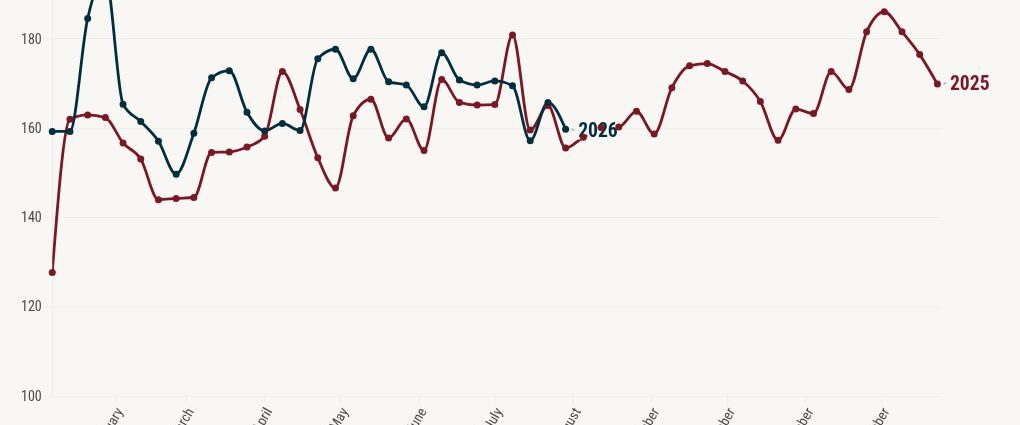
Mortgage applications fall 6.4% as 30-year rate hits 6.76%
Mortgage applications decreased 6.4% from one week earlier, according to data from the Mortgage Bankers Association (MBA)’s weekly mortgage applications survey for the week ending July 24.
On an unadjusted basis, the index decreased 6% compared with last week’s data.
The refinance index decreased 10% from the previous week and was 2% lower than the same week one year ago. The seasonally adjusted purchase index decreased 4% from one week earlier. The unadjusted purchase index decreased 3% compared with the previous week and was 3% higher than the same week one year ago.
“Following last week’s spike in oil prices, mortgage rates moved higher, with the 30-year fixed rate increasing to 6.76%, the highest rate since August 2025,” Joel Kan, MBA’s vice president and deputy chief economist, said in a statement.
“This upward trajectory in rates continues to significantly impact refinance borrowers, with a 10% decline in refinance applications, including a steeper drop in government refinances. Despite housing inventory increasing in certain markets, higher rates have added to ongoing affordability challenges for many homebuyers, which drove the decrease in purchase activity over the week.”
The refinance share of mortgage activity decreased to 39.5% of total applications, down from 41.2% the previous week. The adjustable-rate mortgage (ARM) share of activity increased to 8.1% of applications.
The Federal Housing Administration (FHA) share of applications decreased to 16.9%, down from 17% the week prior. The U.S. Department of Veterans Affairs (VA) share decreased to 12.6%, down from 13.2%. And the U.S. Department of Agriculture (USDA) share decreased to 0.4%, down from 0.5%.
The average contract interest rate for 30-year fixed-rate mortgages with conforming loan balances increased to 6.76%, up from 6.69% a week earlier, while the average rate for 30-year fixed mortgages with jumbo loan balances increased to 6.70%, up from 6.44%.
Average rates for 30-year fixed mortgages backed by the FHA rose 7 basis points to 6.41% and rates for 15-year fixed mortgages rose 11 bps to 6.15% from 6.04%. Rates for 5/1 ARMs increased 1 bps to 5.98%.
Xactus Mortgage Intent Index
Xactus’s Mortgage Intent Index — which analyzes aggregated, anonymized credit-pull activity across the Xactus Intelligent Verification Platform — decreased week over week to a reading of 122.7.
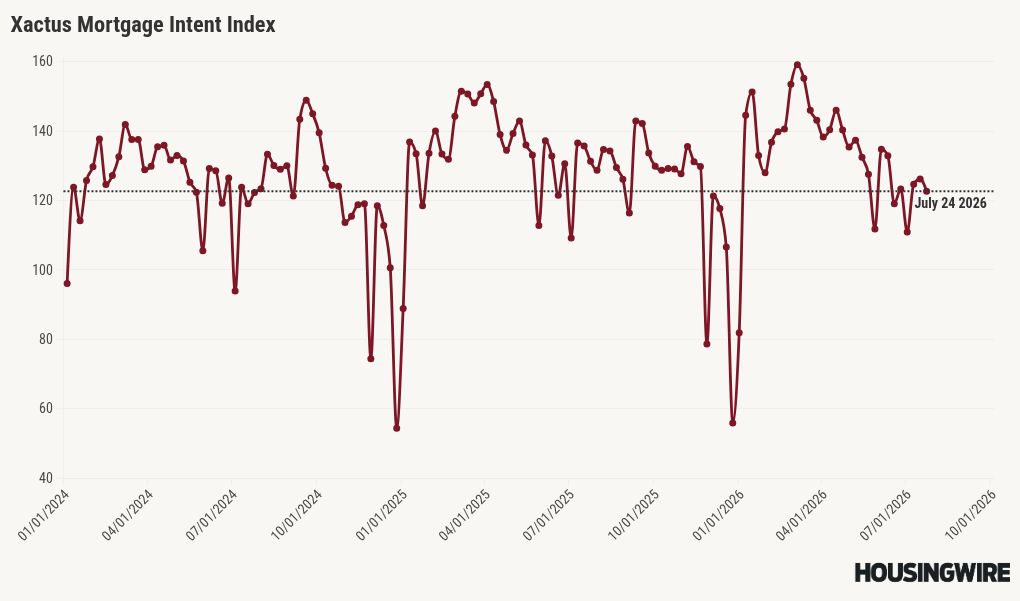
“Mortgage intent declined approximately 2.7% week over week, with the Xactus Mortgage Intent Index falling to 122.7. As mortgage rates climbed to their highest level since August 2025, borrower activity softened following a modest two-week rebound after the July 4 holiday,” said Thomas Lloyd, Xactus’s chief strategy officer.
Lloyd said the index remained about 6.5% below its level during the same week last year, reflecting borrowers’ continued sensitivity to elevated mortgage rates and economic uncertainty.
“While weekly activity remains volatile, the latest reading suggests the current rate environment continues to constrain mortgage intent,” he said.
Constant Contact launches marketing platform for real estate
Constant Contact has launched Constant Contact for Real Estate, a marketing platform that the firm said is designed for brokerages, franchises, associations, MLSs and agents that layers enterprise controls on top of individual agent tools.
The company announced the product on Wednesday, positioning it as a way for real estate organizations to standardize marketing and brand usage while giving agents direct access to AI-assisted content creation, email, automation and integrations with the systems they already use.
Constant Contact said the platform lets organizations manage templates, brand standards, education and adoption from a central environment while monitoring usage and engagement across accounts, according to the company announcement.
“Real estate has always been a relationship business, and that hasn’t changed in the AI era — if anything, it matters more,” Jim Mandala, vice president of strategic verticals at Constant Contact, said in the announcement. “Marketing should be the thread that connects the technology real estate professionals already rely on, and that’s exactly what we set out to deliver.”
Constant Contact said the real estate-specific experience is the result of a two-year, cross-functional initiative spanning product, engineering, UX, partnerships, customer success, marketing, sales and executive leadership. Key elements include:
- Multi-level account structures to support brokerages, franchises, teams and individual agents
- Centralized management of brand templates, assets, education and adoption programs
- AI tools to help real estate professionals create and automate marketing faster
- Enterprise-grade marketing, AI and automation capabilities accessible at the agent level
The platform connects into common real estate workflows through integrations with CRMs like BoldTrail, Lofty and Follow Up Boss, as well as design tools like Canva and content solutions such as HousingWire’s Keeping Current Matters.
The launch comes as more real estate firms look for connected technology ecosystems instead of isolated tools, in part to reduce complexity and data fragmentation across CRM, marketing, transaction and back-office platforms. For housing professionals, that shift affects how easily agents can run campaigns, how consistent brokerage brands appear across markets and how associations demonstrate member value.
This article was generated using HousingWire Automation and reviewed by a HousingWire editor before publication.
Repliers, Unlock MLS partner to expand AI-powered access to Central Texas market data
Repliers has partnered with Unlock MLS to provide direct, secure access to Central Texas MLS data through its artificial intelligence (AI)-focused API infrastructure and model context protocol server.
The partnership gives Unlock MLS subscribers access to Repliers’ data platform, enabling agents, brokers and technology providers to build AI-powered applications, automate workflows and create custom products using MLS data.
“The future of real estate technology is no longer about building monolithic platforms,” said Rhett Damon, CEO of Repliers. “It’s about giving agents, brokers and vendors the data layer to innovate on their own terms, through modern APIs designed for AI-assisted coding. AI products are only as good as the data they can access, and Repliers unlocks the full strength of the MLS’s complete market record in a seamless, secure way.”
For Unlock MLS, the partnership is intended to help subscribers adopt AI technology while maintaining data security.
The agreement expands Repliers’ growing network of MLS partnerships, following previous integrations with MARIS MLS and the Houston Association of Realtors.
This article was generated using HousingWire Automation and reviewed by a HousingWire editor before publication.

China’s High-Tech Provinces Are Pulling Away From the Rest of Its Economy
China’s economic slowdown is no longer affecting every region equally. While property markets and traditional heavy industries continue to struggle, provinces centered on electric vehicles, semiconductors, robotics and advanced manufacturing are expanding at a much faster pace, reshaping the country’s industrial landscape.
Recent provincial data showed that Anhui, one of China’s fastest-growing manufacturing hubs, recorded a 44.6% increase in high-tech industrial output during the first half of the year. Automobile production climbed 29%, supported by continued investment in electric vehicles, battery technology and industrial automation. Similar trends are emerging across other technology-focused regions as Beijing directs capital toward industries considered critical to long-term economic growth.
The contrast with China’s older industrial centers has become increasingly pronounced. Regions still dependent on construction, real estate and traditional manufacturing continue to face slower growth, weaker investment and softer consumer demand, while technology clusters attract new factories, research facilities and skilled workers.
For global businesses, the shift carries important implications. Companies sourcing components from China may find that production capacity is becoming increasingly concentrated in advanced manufacturing regions rather than spread evenly across the country. Businesses tied to electric vehicles, industrial automation and semiconductor supply chains could benefit from stronger infrastructure and government support, while firms dependent on legacy manufacturing sectors may continue facing uneven operating conditions.
The transformation also reinforces Beijing’s broader industrial strategy. Rather than relying on property development as its primary economic engine, China is attempting to build future growth around advanced manufacturing, artificial intelligence, clean energy and high-value exports. Government incentives, financing and infrastructure investment continue flowing toward industries viewed as strategically important.
American manufacturers should pay close attention. Although China’s broader economy has slowed, its technology sector remains highly competitive and continues expanding production capacity in industries that directly compete with Western companies. That means global competition in electric vehicles, batteries, robotics and semiconductor manufacturing is likely to remain intense even if overall Chinese economic growth moderates.
Investors are increasingly separating China’s technology-driven industrial economy from its property sector, recognizing that weakness in one does not necessarily signal weakness in the other. The country’s next phase of growth appears likely to be driven less by real estate and more by factories producing the technologies that will shape global manufacturing over the next decade.
JBizNews Desk | Wall Street
© JBizNews.com All Rights Reserved. Reproduction or distribution without written permission is prohibited.

Chip Selloff Deepens as Microsoft and Meta Face AI Payback Test
A global retreat from semiconductor stocks intensified Wednesday as investors stopped rewarding the artificial-intelligence buildout on spending alone and turned instead to the harder question of whether Microsoft and Meta can show enough revenue, cash flow and operating gains to justify it.
Pressure began in Asia, where SK Hynix fell 9.6% despite reporting a sixfold increase in quarterly profit. South Korea’s KOSPI dropped nearly 6%, extending a sharp reversal in shares that had benefited most from surging demand for memory, processors and data-center equipment.
U.S. chipmakers entered the session under the same cloud. Nvidia traded about 0.8% lower shortly after the opening bell, following another decline in the Philadelphia semiconductor index Tuesday. Microsoft was nearly unchanged, while Meta slipped roughly 0.4% before both companies release earnings after Wednesday’s close.
Strong chip demand is not the issue. Memory suppliers, equipment manufacturers and data-center operators continue reporting rising orders as cloud providers expand the physical infrastructure needed to train and operate increasingly powerful models.
Investor patience is becoming the constraint.
Billions of dollars committed to chips, servers, buildings and electricity must eventually produce more than technical capability. Shareholders now want evidence that AI can lift software sales, advertising revenue, productivity and profit quickly enough to offset the strain on free cash flow.
Microsoft will be judged largely through Azure, its cloud platform, along with adoption of Copilot and other AI services sold directly to businesses. The company confirmed that fiscal fourth-quarter results will be released after the market closes Wednesday, followed by an earnings call at 5:30 p.m. Eastern.
Azure growth alone may no longer settle the question. Businesses will be watching whether customer demand is keeping pace with the company’s construction of data centers and whether Microsoft can continue expanding capacity without allowing capital spending to consume a growing share of the cash generated by its established software operations.
Meta faces a different test because most of its expected return arrives indirectly.
Rather than charging customers primarily for access to an AI model, Meta is using the technology to improve advertising recommendations, increase engagement and automate more of the work involved in creating and targeting campaigns. Its second-quarter results are also scheduled for release after Wednesday’s close, with the company’s call set for 4:30 p.m. Eastern.
A stronger advertising business would give Meta more room to finance data centers, custom chips and research without relying on outside capital. Slower improvement would raise questions about how long the company can maintain current spending before investors demand a clearer path to returns.
Recent results from Alphabet changed the tone of the debate. Revenue remained strong, but another increase in planned capital expenditures and a quarter of negative free cash flow showed how quickly AI infrastructure can absorb money even inside one of the world’s most profitable companies.
That reaction has spread through the semiconductor market because chip suppliers depend on continued spending by a small number of enormous customers. Any moderation from Microsoft, Meta, Amazon or Google would travel quickly into orders for processors, memory, networking equipment and electrical infrastructure.
China’s semiconductor progress has added another concern. Domestic manufacturers are moving closer to producing equipment and memory products that could eventually reduce dependence on Western suppliers, raising the possibility that today’s shortage-driven pricing power may not last indefinitely.
None of this means the AI buildout is ending. Demand remains substantial, and the largest technology companies have enough cash and borrowing capacity to continue investing. What has changed is the standard by which that spending is being judged.
Wednesday’s reports may therefore determine more than the direction of Microsoft and Meta shares. Clear evidence that AI is already strengthening revenue and margins could stabilize the broader chip sector. Another round of rising spending without comparable cash returns would reinforce the market’s conclusion that the buildout has entered a more demanding phase.
JBizNews Desk | Wall Street
© JBizNews.com All Rights Reserved. Reproduction or distribution without written permission is prohibited.

Oil Jumps as Fresh Middle East Strikes Threaten Fragile Diplomacy

Hezbollah disarmament remains key test of US-backed Lebanon-Israel security framework – feature
The meeting between Lebanese President Joseph Aoun and US President Donald Trump in Washington last week carried substantial symbolism, but the more difficult test is unfolding far from the White House: across southern Lebanon and along the regional corridors that have historically supplied Hezbollah with weapons.
Aoun’s July 21 meeting with President Trump came as a US-brokered framework between Lebanon and Israel entered an early and delicate implementation phase. The discussions centered on Hezbollah’s weapons, strengthening the Lebanese Armed Forces and securing an Israeli withdrawal from Lebanese territory, while also touching on a longer-term objective that until recently would have been politically difficult for a Lebanese president to articulate so openly.
During the meeting, Aoun described the framework’s ultimate goal as “ending the state of hostility between Lebanon and Israel forever,” framing stability not simply as a temporary ceasefire but as part of a longer process intended to prevent Lebanon from returning repeatedly to conflict.
That longer-term ambition remains dependent on developments on the ground. Israeli forces have begun withdrawing from designated areas in southern Lebanon, allowing Lebanese army units to deploy as part of a pilot model intended to test whether the state can progressively assume exclusive security responsibility.
The process is expected to remain gradual, with its expansion dependent on the implementation of the broader framework and the ability of the Lebanese Armed Forces to maintain control after Israeli withdrawals.

Major test of LAF in Lebanese ‘pilot zones’
An initial major test is taking place in southern Lebanon, where Lebanese forces are beginning to assume responsibility for areas following Israeli withdrawals under the US-brokered framework. The pilot-zone approach is intended to determine whether the Lebanese Armed Forces (LAF) can achieve sustainable control while preventing the reemergence of independent armed infrastructure outside state authority.
Marwan Abdallah, head of the Foreign Affairs Department at the Lebanese Kataeb Party, said the process would require continued external guarantees: “So, now we are waiting to see the implementation. We saw … before the meeting in the White House, the Lebanese army started taking control of two areas in South Lebanon, as per the framework agreement.”
He added: “You need a third entity, and I think the US army is the partner of the Lebanese armed forces and, of course, is the partner of the Israelis, so they can play a role in being the monitoring side and being the one that guarantees the agreement between both sides.”
Joe Truzman, a Middle East independent analyst, described the same areas as a test of a much larger question: whether the Lebanese state can become the sole security authority in the south.
“The pilot zones are designed to test whether the Lebanese Armed Forces can assume responsibility for territory following Israeli withdrawals under the US-brokered framework while preventing Hezbollah from re-establishing an armed presence. Success would strengthen confidence in the Lebanese state’s ability to become the sole security actor,” he said.
He nevertheless cautioned that “the Lebanese government’s previous disarmament efforts stalled and produced only partial results in the south.”
Next phase relies on Lebanese success, Israeli confidence, Hezbollah dismantling
The next phase, he added, will depend on several actors moving in parallel.
“Expansion will depend on sustained LAF performance, Israeli confidence that Hezbollah is not reconstituting its military infrastructure, Hezbollah’s own response, and continued external political and financial support for the Lebanese state and its army,” he noted.
For Abdallah, however, the issue extends beyond Hezbollah’s missiles alone and concerns the broader parallel structures the group maintains outside state authority.
“I have a problem with Hezbollah’s missiles, drones, military units, assassination units, small bombs, small weapons, medium weapons, everything that Hezbollah has, ideology, education institutions, financial institutions,” he said.
Abdallah described these as “illegal and illegitimate ways of Hezbollah gaining more power and gaining more control over their population.”
The Washington meeting was important partly because of what Abdallah sees as a change in Lebanon’s international standing.
“It’s not easy to be received this way by Trump… Okay, now Lebanon is back on the map. Lebanon is a country that’s respected as a sovereign nation, as a partner, not just as a state who is a source of trouble and the problems,” he told The Media Line.
The meeting also produced a significant change in aviation policy. President Trump announced that he was directing his administration to allow US airlines to operate direct flights to Lebanon, reversing a restriction dating to 1985.
The announcement does not mean that flights will immediately begin, since actual service will still depend on regulatory requirements and decisions by individual airlines. But after more than four decades without direct US-carrier service, the move carries symbolic weight for a country seeking to present itself again as a viable destination for international business, tourism and investment.
Abdallah described the significance in precisely those terms: “But again, it’s not just about the flight itself. It’s about what it represents: a renewed trust in Lebanon … that these flights can be secure and protected.”
Truzman offered a more cautious assessment, noting that the political announcement remains separate from the technical and commercial steps needed before regular connections can actually resume.
“The announcement regarding direct US–Lebanon commercial flights is important but remains contingent on FAA/TSA security certification and airline decisions. It should be viewed as a conditional commitment that links deeper economic engagement to improvements in Lebanon’s security environment,” he told The Media Line.
Taken together, the aviation announcement and Aoun’s comments on ending the state of hostility with Israel point toward a wider theme surrounding his Washington visit: an attempt to reposition Lebanon internationally while rebuilding the authority of the state internally.
But the credibility of that effort will depend primarily on implementation.
Hezbollah’s military position has historically been connected to a wider regional logistical system linking Iran to its allies through Iraq and Syria. Recent interceptions suggest that parts of this network are now facing greater pressure.
Syrian authorities have announced multiple seizures of weapons allegedly intended for Hezbollah. In one particularly significant case in July, Syrian authorities said they intercepted a shipment near the Iraqi border containing missiles, anti-tank weapons and drones that preliminary investigations indicated were destined for Hezbollah in Lebanon. Hezbollah denied the allegation. Iraq subsequently announced an investigation into how the shipment reached the Syrian border and established a committee to examine the case and coordinate with Damascus.
The developments raise the possibility that pressure on Hezbollah is increasingly operating on two interconnected levels: restricting its military infrastructure inside Lebanon while making it more difficult to regenerate that infrastructure through supply lines extending across the region.
Abdallah sees the developments in Syria and Iraq as part of a broader decline in Iranian influence.
“I think that what the US is managing to do is taking these countries out of the grip of the Iranians,” he said, adding, “And I think today, not even Sanaa, maybe Teheran still control the Houthis, but the other three capitals in the Arab world Baghdad, Beirut and Damascus are out of Iranian control, and it’s a big achievement, not just for the US, but for the people of these countries,” he noted.
He also interpreted President Trump’s references to a possible Syrian role against Hezbollah as relating primarily to the group’s logistical infrastructure rather than to Syrian forces operating inside Lebanon.
“I think what Trump means whenever he says that he wants the Syrians to interfere, to disarm Hezbollah, I think what he means is not the Syrian army entering Lebanon, but he means that Syria dismantling and destroying all the military infrastructure and the tunnels and the supply routes that Hezbollah and Iran made inside Syria for decades,” he said.
Truzman, however, warned against interpreting individual interceptions as evidence that Hezbollah’s broader supply architecture has already been dismantled.
“I do not assess it as realistic to meaningfully degrade Hezbollah’s supply network without sustained cooperation from both Syria and Iraq. The logistics architecture is regional rather than linear: disrupting one corridor increases costs but does not eliminate the network,” he said.
Syria more active in Hezbollah disarmament
Truzman added: “While Damascus has become a more active partner in interdicting weapons flows, Iraq remains the more uncertain variable, with uneven willingness among state institutions and Iran-aligned militias to enforce restrictions. Moreover, Tehran retains the capacity to adapt by rerouting shipments through alternative corridors, including maritime routes.”
The distinction is important. Weapons seizures and investigations can make supply operations more costly and difficult, but the longer-term impact will depend on sustained cooperation between governments whose ability and willingness to confront Iran-aligned networks remain uneven.
Similar uncertainty surrounds the pilot zones themselves.
For the Lebanese army, expanding state authority without triggering an internal confrontation with Hezbollah remains one of the central challenges of the process.
“This remains a significant undertaking for the LAF, which has so far avoided direct confrontation with Hezbollah to preserve domestic stability,” Truzman said. “Hezbollah is likely to resist any expansion, generating friction between the state and the group that could stall enforcement and, at the extreme, risk internal conflict,” he added.
For Abdallah and the Kataeb Party, by contrast, the central objective is the complete removal of Hezbollah’s independent military infrastructure.
“So it’s a new page for the country. It’s a new era. However, all this optimism cannot be achieved if we don’t solve the biggest problem, which is Hezbollah’s weapons and Hezbollah’s infrastructure,” he said.
Abdallah argued that disarmament could eventually open the way to an Israeli withdrawal and a different form of relationship across the border.
“But we all agree that when Hezbollah is disarmed, then there’s no out-of-the-state threat for anyone in Lebanon or in Israel. Then the Israelis will withdraw, and we are already discussing having a new track for the negotiations that will discuss the border between the two countries,” he noted.
That prospect now sits alongside Aoun’s own public language about ultimately ending the state of hostility with Israel. It does not mean that normalization or a peace agreement is imminent. Lebanon and Israel remain technically at war, Israeli troops remain inside Lebanese territory, and fundamental disagreements persist over withdrawal, security and Hezbollah’s weapons. But the language emerging from Washington indicates that the political horizon being discussed is increasingly broader than another temporary ceasefire.
Abdallah also argued that any future agreement would need support inside Lebanon rather than relying solely on external backing.
“So I think it can have the foreign support that is needed, but also we need to have the domestic support that we need for this agreement,” he said.
Truzman similarly sees a more stable relationship as conceivable, while noting that it would carry direct implications for Hezbollah’s political narrative.
“Furthermore, a stable relationship between Beirut and Jerusalem is conceivable, but such an outcome would directly erode Hezbollah’s long-standing claim to legitimacy as an armed ‘resistance’ movement whose raison d’être is resistance against Israel,” he noted.
Against that backdrop, the possible restoration of direct US flights also acquires greater significance. On its own, an aviation decision cannot alter Lebanon’s security balance. Symbolically, however, it fits into the same attempt to move the country away from decades in which its international image has been dominated by conflict, armed groups and instability.
The coming phase will therefore be measured less by statements made in Washington than by whether several processes can advance simultaneously: the Lebanese army consolidating control in the south, Israeli forces continuing their withdrawal, Hezbollah refraining from rebuilding military infrastructure in transferred areas, and Syria and Iraq sustaining efforts against cross-border weapons networks.
“Taken together, these developments suggest an increasingly coherent American strategic concept that combines pressure on Iranian proxy networks with incentives to strengthen state institutions in Lebanon, Syria, and Iraq,” Truzman said.
“The strategy’s long-term success, however, remains uncertain and depends on implementation across multiple theaters,” he added.
The Aoun-Trump meeting may therefore prove significant not because it resolved Lebanon’s fundamental security questions, but because it brought several previously separate tracks into the same political framework: the restoration of Lebanese state authority, the disruption of Hezbollah’s regional supply system, Israeli withdrawal, economic and international reintegration, and, ultimately, the possibility of moving from recurrent confrontation toward a more stable relationship across the Lebanese-Israeli border.
Whether those objectives can be translated from diplomatic language into lasting realities on the ground remains the central test.
Trump’s angry words for Netanyahu reveal the strength of the US-Israel bond – opinion
Prime Minister Benjamin Netanyahu’s White House meeting with US President Donald Trump marked their seventh face-to-face meeting since Trump returned to office 18 months ago. The stakes were high. Nerves are frayed. The standoff with Iran is stressful – last weekend, so many Americans and Israelis were sure a massive attack was coming. And Trump’s sledgehammer leadership style banks on him being the most unpredictable leader in the room. Canadian friends joke that living above an America run by the mercurial Trump is like living on the second floor of a meth lab: you never know when it’s going to blow up.
As of this writing, it’s not clear what will happen. But even if the seemingly worst occurred and Trump dropped another F-bomb on Netanyahu, Israel should take the compliment. With Trump, as with presidents Bill Clinton and Joe Biden, cussing out Israel’s longtime leader, while undoubtedly unpleasant, reflects the intense frustration rooted in deep commitment – and interconnectedness.
Anyone who has ever had a family or been married understands this paradox. Some of our closest human relationships can be extraordinarily volatile. Psychologists call this “attachment anger.” When strangers frustrate you, staying calm and quiet isn’t hard. But when those you love disappoint or vex or defy, anger erupts more easily.
In his 1992 blockbuster, Men are from Mars, Women are from Venus, John Gray popularized another relevant concept. People apply his “rubber band theory” to all kinds of situations. The metaphor certainly explains the US-Israel dynamic. When two people, or two nations, are so enmeshed, leaders may clash, snap, even pull away, hard, fast, far, without rupture. Ultimately, the structural foundations, shared values, and overlapping needs keep them, like a stretched rubber band, bouncing back quickly.
Clinton was deeply committed to the State of Israel’s survival – and the Oslo Peace Process. When he hosted a newly elected Prime Minister Netanyahu at the White House in July, 1996, the Americans, Israelis, and Palestinians had been working the Oslo process for almost three years. Doubting Yasser Arafat – for good reason – Netanyahu promised to be far more unyielding than he ultimately proved to be.

Still, starting in the president’s own Oval Office, Netanyahu lectured his host about the history of the Arab-Israeli conflict. After the meeting, Clinton fumed: “Who the f**k does he think he is? Who’s the f**king superpower here?”
Biden proudly called himself a lifelong “Zionist” and embraced Israel generously, diplomatically, and militarily after the Hamas-led massacres on October 7, 2023. Still, Biden and Netanyahu kept clashing over military strategy.
Wanting Israel to win, but worried that Israel would lose its good name, Biden became increasingly apoplectic. In July 2024, when Israel bombed Beirut, eliminating Fuad Shukur, a leading Hezbollah commander responsible for killing 12 Israeli-Druze children in Majdal Shams, Biden confronted Israel’s prime minister. “Bibi, what the f**k?” the president bellowed, according to Bob Woodward’s 2024 book, War. “You know the perception of Israel around the world increasingly is that you’re a rogue state, a rogue actor.”
Woodward reports Biden also vented to aides Clinton-style, calling Netanyahu “a bad f**king guy!” and a “f**king liar.” Although these assaults were more personal, the rubber band snapped back quickly. Biden didn’t abandon Israel or Bibi – despite growing pressure from other Democrats.
Trump’s outburst was just a chapter in their relationship
IN THAT CONTEXT, Trump’s outburst, asking “What the f**k are you doing?” in June 2026, was just another chapter in a long, complex, ongoing story of a special relationship led by strong-minded leaders whose agendas will occasionally clash. Last month, Trump sought a diplomatic formula with Iran, while Netanyahu doubted Iran’s intentions.
Justifiably defending his country’s interests after Hezbollah renewed its attacks against Israel, Netanyahu approved strikes on Beirut and southern Lebanon. Trump, protecting the negotiations he still had faith in then, called Netanyahu “f**king crazy,” claiming Bibi had “no f**king judgment.”
Now, just weeks later, after hysterical cries of “rupture” on both sides of the Atlantic, and Iran’s Strait of Hormuz power play, Netanyahu and Trump seem to share a deep distrust of Iran’s leaders.
My latest e-book, The Essential Guide to the US-Israel Partnership: The 250th anniversary edition, brands Israel America’s rare DIY (Defend It Yourself) ally, and ROI (Return on Investment) ally, generating many technological, medical, cultural, diplomatic, and military dividends for the United States. But the book also traces how every president, including such “pro-Israel” stalwarts like Reagan, inevitably clashed at some point with their Israeli counterparts.
Today, with anti-Zionist obsessives like New York’s Mayor Zohran Mamdani demonizing Israel constantly, the occasional presidential F-bomb seems downright mild – and flattering. Similarly, with European diplomats claiming over the years: “All the current troubles in the world are because of that shitty little country, Israel,” or that the “f**king Israelis” should be “wiped off the face of the earth,” it’s clear how bonded America is with Israel and how most Americans are with Israelis.
Mark Twain understood the joy and power of a good tirade filled with expletives. In Pudd’nhead Wilson, he advised: “When angry, count [to] four; when very angry, swear.” That’s because, Twain explained elsewhere, “Under certain circumstances, urgent circumstances, desperate circumstances, profanity provides a relief denied even to prayer.”
More elegantly, Holocaust survivor Elie Wiesel, who won the Nobel Peace Prize, taught: “The opposite of love is not hate; it’s indifference.”
It’s impossible to predict if Trump and Netanyahu embraced warmly or crossed swords yet again. But it is highly unlikely that their encounter lacked great drama or reflected a dismissive indifference.
The writer is a distinguished scholar of North American history at McGill University, and a senior research fellow at the Jewish People Policy Institute. He is the author of nine books on presidential history and, more recently, To Resist the Academic Intifada: Letters to my students on defending the Zionist dream, as well as his latest e-book, The Essential Guide to the US-Israel Partnership: The 250th anniversary edition.
Mamdani’s New York stands as a stark warning of America’s possible dystopian future – opinion
For many native New Yorkers like myself, the City (as we always refer to New York) has become unrecognizable – not because of the look of the place, but because of the feel of the place. What was the celebrated melting pot, crossroads, and great amalgam of humanity has become a vitriolic, ideological, and resentful place.
New York was famous for being welcoming and accepting. If there was an ideology behind it, it was live and let live, and together we can all do pretty darn well.
New Yorkers were practical and proudly seeking to “make it there.” There was no hatred of the rich, but rather a hope that each of us could end up the same way.
This mindset was well exemplified by mayor Mike Bloomberg, who resisted raising the City’s income tax rate because, as he pointed out, some 5,000 individual taxpayers accounted for something close to the City’s tax payments. These were people who had choices and could go anywhere. Why drive them out of the City?
So the soak-the-rich underpinnings of the recent Mamdani campaign, and what is implicit in some of his bound-to-go-nowhere proposals, is completely counter to what helped make New York New York.

The Marxist ideology animating the City’s new administration is just the opening act of inversion. The truly breathtakingly adverse and self-destructive attribute of the new New York is its galloping jihadism and sanctioned anti-Israel hatred, a fig leaf for classic antisemitism.
The love affair of the City with its Jewish residents is over. The spirit, character, humor, and creativity that moved seamlessly back and forth between Jews in New York and their fellow residents has morphed into resentment, suspicion, and a none-too-well-disguised desire to have Jews be quiet – or even better, be gone.
The situation is disruptive and disconcerting for Jewish New Yorkers. But it is equally if not even more disturbing for those of us who ascertain the amazing fall from grace that has taken place in New York.
This is because we can sense that the travails of New York are nothing short of a shot across the bow for a malignancy that, unless forcefully encountered, is likely to spread throughout America.
The spirit of NY
All of Mayor Zohran Mamdani’s hatred for Israel and, by extension, Jews, is matched by his hatred of America itself. It is a hatred of the values and the ethos that built and has sustained America. It is resentment for achievement, for success and for an accepting way of life.
The common thread in the resentment of Mamdani and his fellow travelers linking Jew hatred and capitalism hatred is the aversion to success. America has too much wealth, Israel has grown to be a successful, even dominant, power in its region, there are too many who have too much, and somehow they are preventing me and my cohorts from having what we deserve.
If New York can be personified through its mayors, the contrast between Mamdani and his predecessors is staggering. Picture Mamdani next to Ed Koch, Rudolph Giuliani, or Michael Bloomberg, and see the jaw-dropping differences.
Whatever their individual successes or drawbacks, these mayors loved their City and wanted all boats to rise in a rising tide. There was zero interest or desire to play New Yorkers off or against each other.
The City was greater than the sum of its parts, but the parts were what made New York so amazing.
In the short term and in a narrow sense, Mamdani may well get his desires to come true. New York will be increasingly Israel-phobic and Jew averse. Resentment is likely to become the driving spirit of the City.
Ironically, much as Bloomberg perceived, the Jews of New York will have choices, and many are likely to leave for more hospitable pastures elsewhere. The loser in this, of course, will be the City itself: poorer in substance and spirit.
As New York has always been both unique yet also emblematic among the cities of America, so too will its travail be increasingly seen elsewhere across the country. Marxism has always had its knee-jerk appeal, and when it is being espoused by a smiling and well-dressed spokesman who can dress it up as equity and fairness to millions on social media, it can spread until it collapses under the weight of its own unworkability.
New York is in for a rough ride, and if its malignancy is not seen for what it is, much of America might follow suit. This would be a self-inflicted wound of existential proportions.
I comfort myself with the recognition that New Yorkers have always been able to see through flim flam and hoo hah. I sure hope they can do this once again.
The writer is the chairman of the Board of Im Tirtzu and a director of the Israel Independence Fund.
UN human rights office warns of worsening settler violence in West Bank as attacks keep increasing
The UN human rights office on Wednesday warned of worsening violence by Israeli settlers in the West Bank and urged international action against the killing of Palestinians as well as the creation of settlements, which it said had reached an all-time high.
According to United Nations figures, 18 Palestinians have been killed in incidents linked to settler attacks so far this year, compared with 17 in the whole of 2025.
Maj. Yuval Ezra, 27, an Artillery Corps battery commander, and Sgt.-Maj. (res.) Benyahu Mellet, 32, a member of Gilad Farm’s local security team, were killed Friday during a confrontation near the Palestinian village of Tal, southwest of Nablus.
According to the IDF, the incident began after a group of Israeli civilians entered Palestinian Authority-controlled territory and clashed with local residents, during which a Palestinian seized a rifle and opened fire. Palestinian officials said four Palestinians were killed in the broader confrontation, although the circumstances of their deaths remain under investigation.
Ravina Shamdasani, the spokesperson for the Office of the High Commissioner for Human Rights, said, “settlers and Israeli security forces, often acting together, have attacked local communities, assaulting families, destroying and confiscating property, and burning mosques.”

The UN human rights office said settler violence and actions tantamount to ongoing annexation of Palestinian territory in the West Bank had worsened in the two years since a ruling at the International Court of Justice in July 2024 that Israel’s “occupation” in the West Bank was illegal and should be withdrawn. Israel at the time rejected the finding as “fundamentally wrong” and one-sided.
Violence in West Bank on the rise
Violence in the West Bank has surged since the start of the Gaza war in October 2023, with the UN, rights groups and Palestinian officials reporting a sharp rise in settler attacks.
Earlier in July, the security cabinet approved NIS 1.3b. to establish 34 new settlements. Finance Minister Bezalel Smotrich, who advocates for the full annexation of the West Bank, called the move “historic.” UN bodies, Palestinians and most countries view the settlements as illegal under international conventions – a stance disputed by Israel.
Israel cites biblical and historical ties to the land, which it argues is disputed territory, where Jews have lived for thousands of years.
About 700,000 settlers live among 2.7 million Palestinians in the West Bank and east Jerusalem.
Sarah Ben-Nun contributed to this report.
Lebanese forces come up against legal restrictions in protecting pilot zones from Hezbollah
Lebanese Forces are struggling against legal restrictions that prevent them from searching private properties in pilot zones, areas that the military is expected to ensure remain free of Hezbollah as part of a US-brokered agreement between Beirut and Jerusalem, according to Lebanese media reports.
Just over a week since the IDF withdrew from the pilot zones, Lebanese newspaper L’Orient-Le Jour reported that the forces are struggling to fulfill their responsibility as they currently lack the legal right to inspect private property. Without such a right, it is unclear how the Lebanese Army can ensure that the zones remain free of Hezbollah’s weapons.
Lebanese law states that a person’s place of residence is sacred
Article 14 of the Lebanese Constitution establishes the inviolability of the home. It states that a person’s place of residence is sacred and that no one may enter it except under the specific circumstances and procedures prescribed by law, such as when a judicial warrant has been issued, during emergencies, or in the interest of public safety.
Hezbollah, its supporters, and some individuals concerned with state authority have invoked Article 14 to challenge the search. However, Lebanese media reported that many consider the exceptional circumstances facing the country as a reason to justify extending the military’s authority.
Prosecutor Ahmad al-Hajj told the site that “So far, I have not issued any decision authorizing the search of any private residence,” and that in many areas, few buildings remain intact enough to hold Hezbollah weapons.

“I am waiting for the information that the army will provide me with. If a search is requested, it will require prior authorization from the prosecution, granted only on the basis of serious evidence indicating the presumed presence of weapons. The intelligence must be solid,” he said.
Though Hajj asserted that there must be serious evidence before searches can take place, the IDF regularly found weapons like missile launchers hidden in homes in southern Lebanon. Only three weeks ago, the Israeli military announced it confiscated RPG ammunition, anti-tank missiles, vests, helmets, and Hezbollah terrorist organization flags from a home in the village of Tallousa.
Constitutional law expert and former minister Adnan Sayyed Hussein added that “During each search operation, the mukhtar [local elected official] as well as the owner of the property must be present.”
Displacement proves a difficult barrier to searching buildings
Given that around 20% of Lebanon’s population was displaced during the peak of the war, according to UN figures, requiring a property owner’s presence to search the building might prove difficult.
“There is no question of searching every house. We have no interest in carrying out systematic searches. If the army were to inspect a large number of homes without finding anything, it would be seen as a failure and would undermine its credibility,” Hajj said.
Justice Minister Adel Nassar told the site that “While the principle of the inviolability of the home must be upheld, the law also prohibits the possession of military equipment inside a private residence. The Constitution entrusts the supreme command of the armed forces to the president and does not recognize any parallel military structure. This principle was reaffirmed by the Cabinet.”
The legal restrictions preventing searches of private property are not the first issue raised regarding the Lebanese Armed Forces’ ability to police the pilot zones. On Tuesday, The Jerusalem Post reported on the continued presence of Hezbollah’s civil arms in the municipalities from which Israel withdrew last week.
Hezbollah’s Islamic Health Organization has continued operating in Zawtar al-Gharbiyah and was recorded working alongside the Lebanese military to collect the bodies of Hezbollah terrorists killed during the conflict.
Though civilian in appearance, Hezbollah’s Islamic Health Organization operates under the terror group’s Executive Council and serves as its medical corps during operational activities. The organization’s personnel and infrastructure have also served a dual purpose during the war, with operatives and weapons allegedly transported in ambulances and Hezbollah operation centers constructed within clinics.
Dr. Moran Levanoni, a researcher at the Institute for National Security Studies, explained to the Post that while Hezbollah’s civil arms were not restricted under the agreement, their continued presence poses legitimate security risks, including the potential for espionage or the use of facilities as a front to enable the terror group’s return.
British Medical Association calls on NHS to halt IHRA roll-out pending legal opinion
The British Medical Association (BMA) is calling on National Health Service England to immediately pause the implementation of the International Holocaust Remembrance Alliance (IHRA) working definition of antisemitism across NHS organizations, pending legal opinion.
The call follows a motion passed at the BMA’s Annual Representative Meeting in June 2026, calling for an investigation into the use of the definition, arguing that it may restrict free expression by healthcare workers.
In a letter to the chief executive of NHS England, Sir Jim Mackey, the BMA pointed out that there is no legal requirement on NHS organizations to adopt the IHRA definition. Yet trusts have been strongly encouraged to implement it and report back to NHS England by the end of July 2026.
In the letter, the BMA argues the rollout is moving forward without proper assessment of its practical and legal implications for employers and staff, and without clear guidance on how it should be applied. The BMA is therefore calling for a pause to the rollout, pending proper safeguards being put in place, consultation, and legal advice.
The letter also points to a legal opinion from four senior lawyers, commissioned and circulated to trust chief executives by law firm Leigh Day, which sets out the risks facing NHS England and individual employers if the definition is adopted without adequate safeguards.

Health Workers 4 Palestine demand IHRA’s antisemitism definition to be dropped
The Leigh Day advisory opinion was commissioned by Health Workers 4 Palestine.
The Leigh Day lawyers said that antisemitism is already prohibited by the Equality Act 2010, and that the IHRA definition creates “difficult questions for NHS organizations at a time when many healthcare workers are expressing concern about Israel’s conduct in Gaza.”
BMA’s deputy chair of Council Dr. Emma Runswick cited this opinion, adding that “NHS staff must be able to work in environments free from harassment and be able to engage in legitimate political and ethical debate.”
“We urge any hospital trust that has already adopted the definition to review its safeguards and pause if these are found lacking.”
The BMA wants to discuss its concerns with NHS England urgently and in the letter, asks NHS England to confirm that the implementation timetable will be paused.
Antisemitism reported in the NHS
This comes only months after the publication of the UK government advisor on antisemitism Lord John Mann’s review of antisemitism in the NHS.
As part of the review, Mann heard that Jewish people in the NHS experience “routine ostracism,” with Jewish staff being the only religious group in the latest NHS Staff Survey for whom discrimination from colleagues is rising rather than falling, resulting in some considering leaving the NHS.
He found that antisemitism extends to patients, too, as some Jewish patients reported they did not wish to present for treatment or put off receiving important care.
“It is well-evidenced that racism is persistent in the NHS,” Mann said, adding that “the case for taking action to combat antisemitism and other forms of racism in the NHS is clear.”
Video shows woman hurling antisemitic abuse at Jewish family in Montreal playground dispute
A Montreal Jewish family was targeted with antisemitic abuse at La Fontaine Park on Sunday evening while spending the day with extended family members who were visiting.
The incident began when the father approached a woman walking two dogs in the children’s playground area and calmly pointed out that dogs were not allowed. In response, the woman launched an expletive-filled rant caught on video telling him in French: “Jews aren’t allowed here” and asking, “Is that a law? Don’t give me that bullsh*t.”
Following the initial interaction, the father called the police. The recorded video footage, which was later circulated on social media, showed the woman subsequently returning to confront him, asking, “Are you trying to scare me or something? That’s called intimidation,” and demanding to know his neighborhood.
When the father replied that he did not want to interact with her and that the police were on their way, the woman shouted, “Do you think I am not allowed with my dog in this park?”

‘Your kids are f*cked up because they don’t f*cking go to a normal school’
After the father pointed to a nearby sign showing dogs were banned under threat of a $300 fine, the woman told him to mind his own business and added, “Your kids are f*cked up because they don’t f*cking go to a normal school, so don’t tell me what to do.”
In Canada, people now openly proclaim “Jews aren’t allowed here” https://t.co/D3btuIPdnP
— Aviva Klompas (@AvivaKlompas) July 29, 2026
According to reporting by the Rebel News site, the confrontation began at approximately 6:45 p.m. after the family’s children were frightened by the dogs inside the water fountain area of the playground, where a clear sign posted nearby indicated dogs were prohibited.
The outlet reported that the family waited over an hour for police to respond before they left, and filed a formal police report on Monday.
Rebel News noted that they spoke with the father following the incident. He said he was shocked by the woman’s response and noted that members of the Jewish community were increasingly growing accustomed to daily occurrences of such hatred. Montreal police confirmed to the outlet that they were contacted and were investigating whether charges should be placed against the woman.
Following the publication of the video online, social media users identified the woman involved as Montreal interior designer Brigitte Doyon.
Israel should seize Lebanon’s best chance for peace in decades – opinion
Lebanon’s president said on Tuesday, alongside US President Donald Trump in Washington, that his country’s ultimate objective is to end the state of hostility with Israel once and for all.
The statement – made during the first White House visit by a Lebanese president since 2009 – capped a months-long process in which Joseph Aoun publicly called for direct negotiations with Israel so the Lebanese could “live in peace.”
On June 26, the two countries signed a US-brokered framework for “lasting peace and security,” which Aoun called historic.
Many Israelis have yet to recognize the historic change unfolding in Lebanon – a change made possible largely by Hezbollah’s decline, which until recently held Lebanon in its grip, has lost its longtime leader, much of its military strength, revenue, and political influence, as well as its strategic depth in Syria.
One result was Aoun’s election in January 2025, after a two-year presidential vacancy prolonged largely by Hezbollah’s obstruction. His election demonstrated that Hezbollah could no longer impose its preferred candidate or veto one it had once considered unacceptable.
Aoun did not merely inherit this moment. During his years as commander of the Lebanese Armed Forces, he built close ties with the United States and key European governments, on which both the military and the wider Lebanese state depend heavily. Under Lebanon’s sectarian system, the presidency is reserved for a Maronite Christian.
Aoun’s victory a cause for US optimism
Aoun’s election, facilitated in part by strong Saudi involvement, generated considerable optimism amid the devastation left by the war. Washington shared that optimism, praising his “courage and vision.”
Aoun remains cautious. The 2005 assassination of Rafic Hariri – for which a UN-backed tribunal convicted a Hezbollah operative – demonstrated the risks faced by Lebanese politicians who challenge the organization.
That history helps explain both his refusal to meet Prime Minister Benjamin Netanyahu and the calibrated manner in which he has confronted Hezbollah: challenging its dominance without seeking to exclude it entirely from politics or provoke an uncontrolled showdown.
Hezbollah still retains the ability to intimidate Lebanon’s political institutions, though far less effectively than before. Aoun must also avoid appearing to replace subordination to Iranian dictates with subordination to Israeli demands.
Even so, Aoun has gone further than any Lebanese president in recent decades. He has opposed Hezbollah and Iranian interference, supported dialogue with Israel, and begun translating those positions into action.
The Lebanese Armed Forces remain limited and far from fully effective, but under his leadership they are doing more than before to restore the state’s monopoly on armed force. This progress has been made possible primarily by Hezbollah’s weakness, but also by Aoun’s policy and direction.
Aoun’s caution should not be mistaken for reluctance. The devastation of the war has created an opportunity to loosen Hezbollah’s grip on Lebanon, and Aoun appears determined to guide the country through that transition.
Political necessity and Aoun’s own convictions now point in the same direction: ending Hezbollah’s domination. He understands the price Lebanon has paid for allowing an Iranian militia to operate on its soil. He also recognizes that significant sections of the public – particularly within the Christian community – are weary of Hezbollah and years of war.
That sentiment gives him room to pursue an alternative course. His challenge is to steer Lebanon forward while contending with an armed organization that still enjoys significant support among Lebanese Shi’ites.
None of this makes Aoun master of Lebanon. Hezbollah remains armed, politically entrenched, and capable of obstructing – or violently derailing – the process. Yet so far, Aoun has moved in the right direction.
Israel and and the US should act on this opportunity. Across the border is a Lebanese leader willing to take political risks in defense of his country’s interests – and to make that case publicly to his own people, in Arabic, rather than only before an American audience in Washington. Aoun’s course also aligns with Israel’s strategic interests: advancing peace with Lebanon and dismantling Hezbollah’s military power.
One of the understandable lessons Israelis drew from October 7 was to take their enemies’ declared intentions seriously. But strategic vigilance also requires recognizing when a different possibility begins to emerge.
The road to peace with Lebanon – and to Hezbollah’s disarmament – remains long, difficult, and uncertain. Yet for the first time in years, Israel may have a potential partner in Beirut.
Aoun is no Sadat, and Lebanon is not Egypt in the late 1970s. But history rarely repeats itself in identical form. With the right strategy, Aoun could become both a genuine partner for peace and an important force in restoring Lebanese sovereignty.
Israel and the United States should therefore combine incentives with pressure. Israel should undertake phased, verifiable withdrawals wherever the Lebanese Armed Forces establish effective control.
Washington should sustain military and economic assistance conditioned on measurable progress toward the state’s monopoly on arms.
Both countries should maintain pressure on Hezbollah while avoiding steps that publicly humiliate Aoun or allow his opponents to portray him as Israel’s instrument. In the Middle East, opportunities rarely remain open for long. Israel and the United States should seize this one before Hezbollah closes it.
The writer is a senior fellow at the Jewish People Policy Institute (JPPI). In the Israeli Defense Intelligence, he served as head of the Hezbollah and Lebanon Branch (2022–2024) and later as senior adviser to the director of IDI (2024–2026).
Iran tensions rise as Trump and Netanyahu meet in Washington
New episodes every Sunday-Thursday.
Listen and subscribe wherever you get your podcasts.
For more news, analysis, and the latest updates, head to jpost.com.
Headlines edited by Corinne Baum.
Hosted and produced by Shifra Jacobs.
IDF detains three settler activists who breached Syrian border
The IDF detained three Israeli activists from the “HaBashan Pioneers” settler movement after they breached the Syrian border in the Mount Hermon area on Tuesday, the military announced on Wednesday.
However, an earlier report from Army Radio said the activists were only in Syrian territory for several hours on Wednesday morning before being located by the IDF.
The activists were returned to Israeli territory and handed over to police, the IDF said, noting that the military “strongly condemns” such incidents as they disrupt operations and create a dangerous situation for all involved.
The IDF emphasized that police are required to pursue justice for the activists’ “criminal offense” in order to disincentivize further similar actions.
The incident marks the fourth recent attempt (successful or unsuccessful) for the settler activist group to cross into Syria.

The HaBashan Pioneers have been trying to establish Jewish settlements in Syria, with several arrested in recent weeks for multiple separate border crossing attempts.
A recent unsuccessful border breach, following a reported drone targeting
Most recently, HaBashan Pioneers activists attempted to breach the Syrian border on July 22, with the IDF detaining the activists prior to successfully reaching the Syrian Hermon.
On July 21, five HaBashan Pioneers members were targeted by IDF Elbit Hermes 450 “Zik” drones in the Israel-Syria border area before being identified as Israelis, according to a KAN News report.

Stocks Open Lower Ahead of Fed Decision as Oil Climbs and Earnings Keep Markets on Edge
Wall Street opened modestly lower Wednesday as investors awaited the Federal Reserve’s interest-rate decision later today while weighing another wave of corporate earnings and renewed geopolitical tensions that pushed oil prices higher. With no major economic reports released before the opening bell, markets focused instead on corporate guidance, Treasury yields and expectations for Chair Kevin Warsh’s afternoon remarks.
At 9:30 a.m. ET, the Dow Jones Industrial Average opened at 52,674.21, down 73.10 points (-0.14%). The S&P 500 opened at 7,418.16, lower by 10.62 points (-0.14%), while the Nasdaq Composite began trading at 24,863.48, off 13.43 points (-0.05%). Investors largely avoided making significant new bets ahead of the central bank’s policy announcement scheduled for 2:00 p.m. ET.
Timeline
8:30 a.m. ET — Economic Reports
No major Tier 1 U.S. economic reports were released before the market opened, leaving investors focused on earnings, oil prices and the Federal Reserve meeting.
9:30 a.m. ET — Market Opens
- Dow: 52,674.21 (-73.10)
- S&P 500: 7,418.16 (-10.62)
- Nasdaq: 24,863.48 (-13.43)
Early trading reflected caution rather than panic, with investors waiting for new guidance on interest rates before making larger portfolio adjustments.
Oil became the market’s biggest inflation concern after crude prices rose sharply overnight following renewed military activity involving Iran-backed groups in the Middle East. West Texas Intermediate crude traded above $82 per barrel, while Brent crude approached $88, lifting energy shares but weighing on transportation, airline and consumer discretionary stocks that are more sensitive to fuel costs. Treasury yields also edged higher, with the benchmark 10-year note hovering near 4.63%.
Corporate earnings continued driving individual stock performance. Ford Motor Co. gained after raising its full-year earnings outlook, citing stronger pricing and improved profitability despite softer vehicle sales. Visa remained in focus after announcing plans to eliminate approximately 2,600 jobs while increasing investment in artificial intelligence and next-generation payment technology. Meanwhile, Procter & Gamble traded lower after warning that higher commodity, freight and energy costs could add roughly $1 billion to expenses over the coming year despite steady consumer demand for household staples.
Technology shares were mixed as investors continued reassessing semiconductor valuations after recent earnings. Some chipmakers stabilized following heavy selling earlier in the week, while others remained under pressure as markets questioned whether the industry’s massive AI-related capital spending will continue generating returns at the pace investors have expected.
10:00 a.m. ET
No major scheduled economic reports were released at 10:00 a.m., allowing attention to remain squarely on the Federal Reserve meeting and corporate earnings.
2:00 p.m. ET — Federal Reserve Decision
The Federal Open Market Committee will announce its latest interest-rate decision. While most economists expect rates to remain unchanged, investors will closely examine the policy statement for any changes in language regarding inflation, economic growth and future rate expectations.
2:30 p.m. ET — Chair Kevin Warsh Press Conference
Markets are expected to react more to Chair Warsh’s comments than to the rate decision itself. Investors will listen for signals regarding inflation, labor-market conditions, oil-price risks and the timing of any future policy changes.
After the Closing Bell
Two of the week’s most closely watched earnings reports arrive after today’s session:
- Microsoft
- Meta Platforms
Both reports are expected to provide important insight into enterprise AI spending, cloud demand and digital advertising trends, with the potential to influence Thursday’s market direction.
For the remainder of the trading day, investors will closely monitor oil prices, Treasury yields and the Federal Reserve’s outlook. With markets entering one of the busiest weeks of earnings season, today’s policy announcement is likely to set the tone not only for this afternoon’s trading but for the broader market heading into month-end.
JBizNews Desk | Wall Street | New York
© JBizNews.com All Rights Reserved. Reproduction or distribution without written permission is prohibited.
Pennymac trims lending, fulfillment roles in layoff round
Pennymac imposed another round of layoffs ahead of its after-market earnings report on Wednesday, as the mortgage sector navigates a higher-for-longer interest-rate environment.
“Pennymac has executed well against a challenging backdrop, even as sustained high interest rates have reduced industry loan volumes and the size of the addressable market,” a company spokesperson said in a statement to HousingWire. “As we align our operations accordingly, the organization has made the difficult decision to eliminate select positions within its lending and mortgage fulfillment operations.”
Social media posts by affected employees indicate that the impacted roles include loan consultants, managers and team leaders. In one case, the impacted employee joined the company from Cenlar, a subservicer that Pennymac is in the process of acquiring for $257.5 million ($172.5 million upfront). The deal is expected to close in the second half of the year.
The company spokesperson did not disclose the number of employees laid off or provide details on the affected roles, but said the lender is offering severance support.
“As we move forward, Pennymac remains focused on building an even stronger organization, including continued investment in technology and automation to improve how we serve customers and support our people,” the spokesperson said. “Together with our disciplined approach, these investments strategically position us to grow and create new opportunities as the market recovers.”
The move comes a month after the company’s decision to close its office in Franklin, Tennessee, when staff in its consumer direct lending operations were laid off.
The Westlake Village, California-based mortgage lender and servicer posted net income of $82 million in the first quarter, down from $107 million in the prior quarter but up from $76 million in the same period last year.
Stronger mortgage production revenues helped offset weaker servicing results stemming from mortgage servicing rights (MSR) valuation changes and hedging losses. The servicing segment reported pretax income of $12.7 million, down from $37.3 million in the fourth quarter.
Compass says Zillow exposure cut sale-to-list ratios by 1.3%
Homes that appeared on Zillow sold for 1.3% less, on average, than comparable listings that did not show up on the portal, according to new internal research from Compass International Holdings.
The analysis, led by Compass chief economist Mike Simonsen and chief data officer Dave Crosby, examined 296,966 Compass listings posted between January 2025 and May 2026. Of those, 806 listings were “banned” from appearing on Zillow. The median sale-to-list price ratio for banned listings was 100%, compared with 98.7% for non-banned listings, Compass said.
On a $1 million home, a 1.3% gap equates to roughly $13,000 in seller proceeds. Compass refers to this difference as the “Zillow Tax.” The firm argues that, while Zillow has long promoted rapid online exposure as critical to a sale, the net effect of appearing on the site is a lower achieved price for sellers.
This study from Compass comes as the two firms are engaged in an on going legal battle. After Zillow’s Listing Access Standards policy went into effect last June, Compass filed an antitrust lawsuit against the listing portal giant claiming that it was using its monopoly power to harm Compass and industry competition.
Compass voluntarily dismissed the lawsuit in March, just to have Zillow file its own antitrust in May, in which Zillow claims the brokerage firm and Midwest Real Estate Data (MRED) conspired to cut off the Chicagoland MLS’s data feed to Zillow.
A House Judiciary subcommittee is also now pressing MRED and Compass to explain their nationwide private listing network partnership. Additionally, earlier this month Compass filed Code of Ethics complaints, which allege that Zillow has made false advertising claims, in 26 states, 55 MLSs and 30 Realtor associations.
How Compass measured the ‘Zillow tax’
Using quantile regression, Compass economists found the 1.3 percentage point difference in sale-to-list ratio between Zillow-banned and non-banned listings to be statistically significant, with a margin of error of plus or minus 0.8 percentage points.
The company also reported that 50.5% of banned listings sold at or above list price, versus 44.6% of non-banned listings. That 5.9 percentage point spread (± 5.6 percentage points) was also deemed statistically significant. Compass said these trends held after controlling for market, price point, agent and pre-marketing strategy.
At the same time, the research found no meaningful difference in the likelihood or speed of a home going under contract based on whether it appeared on Zillow. For listings banned by Zillow, 34% went under contract within 30 days, compared with 36% of non-banned listings. The raw difference of -2.1 percentage points fell within a margin of error of ± 3.3 percentage points and was statistically insignificant, according to the report.
When Compass controlled for market, price and agent, the difference shifted to 2.5 percentage points (± 3.2 percentage points), which also remained statistically insignificant, the firm said in its report. The company said it measured pending rates across multiple time horizons and did not find a significant performance gap between Zillow-banned and non-banned homes.
Why Compass says Zillow can pressure prices
In its report, Compass characterizes Zillow primarily as a lead-generation platform that advantages buyers at the expense of sellers, rather than a tool designed to protect home values. The company points to several consumer-facing features that it says can weigh on offers including days on market, price cut history, climate risk data and Zillow’s Zestimate.
Compass argues that sellers can mitigate the so-called Zillow tax by adopting a phased marketing strategy — like its three-phased marketing strategy — building interest, collecting feedback and creating urgency before exposing the property to broad portal audiences and public days-on-market counters.
Zillow did not immediately respond to HousingWire’s request for comment.
Zillow’s data
In recent court filings in its antitrust lawsuit against Compass and MRED, economist Lawrence Wu, an expert witness Zillow brought in for the hearing on its preliminary injunction motion earlier this month, wrote that his analysis found that sales made via Compass’s private listing network were associated with 4% lower price in Chicagoland and 4.8% lower price nationally compared to listings that were not sold on Compass’s private listing network
Wu’s analysis was based on Zillow’s transaction data from January 2022 through December 2025. The firm said it identified what it believed to be Compass private listing network sales from properties that entered the MLS as sold or were recorded as sold within one day, with Compass agents on both sides of the transaction.
This article was written by Brooklee Han and generated with the assistance of HousingWire Automation, then reviewed by a HousingWire editor before publication.
Foreign buyers purchased $45.3B in U.S. existing homes, NAR says
Foreign buyers purchased $45.3 billion in U.S. existing homes from April 2025 through March 2026, a 19.1% drop in dollar volume and a 14% decline in the number of properties, according to the National Association of Realtors’ (NAR) 2026 International Transactions in U.S. Residential Real Estate report, published on Wednesday.
NAR Chief Economist Lawrence Yun said the pullback in foreign homebuyer activity mirrors a slowdown in international visitors to the United States. A slightly weaker U.S. dollar over the past year — which technically boosts foreign purchasing power — “did not induce more activity,” he said in the association’s announcement.
The report, based on a survey of 4,970 Realtors conducted in April 2026, covers international client purchases and sales of U.S. residential property between April 2025 and March 2026. Only 381 respondents reported at least one international residential buyer, underscoring how small the niche has become relative to the broader market.
Foreign buyers remain a small but concentrated slice of the market
International buyers purchased an estimated 67,100 existing homes during the 12‑month period, down from 78,100 a year earlier and the second-lowest level since NAR began tracking the segment in 2009. That represents 1.7% of approximately 4.07 million existing-home sales and 2.0% of the estimated $2.3 trillion in sales volume, according to the report.
The median purchase price for foreign buyers was $465,000, compared with $413,600 for all existing-home buyers. The average foreign purchase price was about $669,500, down 6.9% year over year, as higher borrowing costs and limited inventory pushed some demand to lower price points, according to NAR’s data.
Despite higher costs, 48% of foreign buyers paid all cash, far above the 28% share among all existing-home buyers. That cash-heavy profile makes the group relevant in competitive coastal and Sun Belt markets even as volumes decline.
Resident vs. non-resident buyers
Resident foreign buyers — recent immigrants and non‑immigrant visa holders living in the United States (Type B) — accounted for 37,600 purchases, or 56% of all foreign transactions, with an estimated volume of $21.8 billion, according to the report.
Non-resident foreign buyers (Type A), whose primary residence remains abroad, purchased 29,500 homes, or 44% of foreign purchases, totaling $23.5 billion in volume. While non-residents bought fewer properties, they spent more on average per transaction.
Canada and Mexico lead by volume; China leads by dollars
Canada returned as the top country of origin by number of purchases, accounting for 16% of foreign buyers, or about 10,700 homes, up from a 14% share in the prior period. Mexico climbed into the second spot with a 14% share and an estimated 9,400 purchases.
China — defined as buyers from mainland China, Hong Kong and Taiwan — fell to third by unit count with an 11% share, or about 7,400 homes. However, Chinese buyers remained the largest source of dollar volume at $7.6 billion, reflecting an average purchase price near $1 million and a heavy concentration in high-cost markets such as California and New York.
India ranked fourth with 9% of foreign buyers and $3.7 billion in purchases, while the United Kingdom accounted for 4% and $1.2 billion in volume. Altogether, the top five countries represented roughly half of foreign-buyer dollar volume.
Florida, California and Texas remain top destinations
Foreign demand remained highly concentrated in a handful of states. Florida attracted 20% of all foreign buyers, maintaining its long-running lead thanks to resort markets and winter climate appeal. California followed with 19% of foreign buyers, while Texas captured 12%.
New Jersey and Georgia each drew 4% of international buyers, reflecting both proximity to major gateways and relative affordability compared with global hubs.

Agri Star Fire Puts U.S. Kosher Meat Supply at Risk
A fire that heavily damaged the Agri Star kosher meat processing complex in Postville, Iowa, is raising concerns about the U.S. kosher meat supply, with company officials saying Wednesday it is too early to determine the full impact on production as damage assessments continue. The incident also comes as food prices remain elevated, increasing the risk that consumers could face another round of grocery inflation if supplies tighten.
Among the largest kosher meat processors in North America, Agri Star supplies supermarkets, wholesalers, restaurants and numerous independent kosher meat brands that rely on its facility for slaughtering and processing. Any prolonged disruption could ripple through the kosher food supply chain, affecting distributors, retailers and food-service providers across the country.
More than a dozen fire departments responded after flames broke out at the facility Tuesday. Authorities reported no injuries, and investigators have not yet determined the cause of the fire. Local officials also asked residents to conserve water while emergency crews worked to contain the blaze.
The timing adds pressure to a market already dealing with higher production costs and persistent food inflation. Beef prices have been climbing because of historically tight U.S. cattle supplies, while labor, transportation and operating costs remain above pre-pandemic levels. A significant reduction in processing capacity at one of the industry’s largest kosher facilities could further tighten supply and place additional upward pressure on prices.
Industry participants are closely monitoring whether other kosher processors have enough available capacity to absorb lost production. Because kosher meat processing is concentrated among relatively few facilities, replacing output quickly can be challenging, particularly if demand remains strong.
The disruption could also affect restaurants, caterers, grocery chains and institutional food providers that depend on steady deliveries of kosher beef and poultry. Businesses may face higher wholesale costs, while consumers could see fewer promotions and higher retail prices if inventories become constrained.
Agri Star said its immediate priority is the safety of employees, emergency responders and the surrounding community. The company has not announced a timeline for restarting operations, noting that engineers must first complete a full evaluation of the facility.
For businesses throughout the kosher food industry, the coming days are expected to determine whether the fire remains a temporary operational setback or develops into a broader supply-chain disruption with wider pricing consequences.
JBizNews Desk | Postville, Iowa
© JBizNews.com All Rights Reserved. Reproduction or distribution without written permission is prohibited.

U.S. Tightens Restrictions on Chinese Robotics as AI Competition Expands Beyond Software
Washington is widening its technology strategy beyond semiconductors, moving to restrict additional Chinese-made humanoid robots and related technologies as policymakers increasingly view advanced robotics as a strategic industry tied to national security, manufacturing and artificial intelligence.
The latest action reflects a broader shift in U.S. industrial policy. Rather than focusing solely on advanced computer chips, officials are now paying closer attention to the machines that could power future factories, warehouses, logistics centers and critical infrastructure. Humanoid robots are expected to play a growing role in manufacturing, healthcare, retail and defense as AI systems become more capable.
China has invested aggressively in robotics, automation and advanced manufacturing as part of its long-term effort to reduce dependence on foreign technology. Chinese manufacturers have rapidly expanded production of industrial and humanoid robots while integrating artificial intelligence into factory operations, creating new competition for American and European producers.
U.S. policymakers argue that allowing Chinese robotics companies to establish a dominant position in critical industries could create future security and economic risks similar to those raised over telecommunications equipment and advanced semiconductors. The restrictions are intended to encourage domestic manufacturing while giving American robotics companies greater opportunity to compete.
For businesses, the policy could reshape purchasing decisions over the next several years. Manufacturers, logistics providers and warehouse operators planning automation projects may have fewer foreign suppliers to choose from while domestic production expands. Although that could increase equipment costs in the near term, supporters argue it may strengthen long-term supply-chain resilience and reduce dependence on overseas technology.
The move also highlights how artificial intelligence is becoming inseparable from industrial policy. Governments are increasingly competing not only over software development but also over robotics, manufacturing capacity, advanced machinery and the infrastructure required to deploy AI throughout the economy.
As companies continue investing in automation to address labor shortages and improve productivity, robotics is expected to become one of the fastest-growing segments of the broader AI economy. Decisions made today by governments and manufacturers could shape global competition for years to come.
JBizNews Desk | Wall Street
© JBizNews.com All Rights Reserved. Reproduction or distribution without written permission is prohibited.

STAT+: Why benchmarking clinical LLMs from OpenEvidence, Doximity is complicated
You’re reading the web edition of STAT’s AI Prognosis newsletter, our subscriber-exclusive guide to artificial intelligence in health care and medicine. Sign up to get it delivered in your inbox every Wednesday.
I saw “The Odyssey” during its opening weekend. Ever since then, I have been questioning whether I’m illiterate or whether Christopher Nolan is a poor storyteller. This London Review of Books evaluation of the film, written by the woman whose translation of “The Odyssey” Nolan apparently read, has freed me from my wondering. (h/t to my colleague Matthew Herper)
Hot takes on Homer’s epic, or hot tips about Epic Systems: aiprognosis@statnews.com
Benchmark battle bots
You might recall that in mid-June, there was a Nature Medicine study that pitted clinical AI systems OpenEvidence and UpToDate Expert AI against general LLMs. It set off a reaction in the clinical AI world like no other paper has. “The results rang out like a gunshot,” as STAT health tech correspondent Katie Palmer describes it.
The controversy surrounding the study, and everything that came after, exemplifies the problems I have with benchmarks.
Katie summed it up well when I talked to her yesterday: “The way that benchmarks have been talked about generally, and specifically in clinical AI, tends to summarize them into the headlines,” she said. “Every study needs a headline and every story needs a headline, but as we both know, and as I think most people in the industry know, an individual benchmark doesn’t mean much.”

STAT+: Pharmalittle: We’re reading about a fugitive who became a biotech exec, a hospital suing Lilly, and more
Good morning, everyone, and welcome to the middle of the week. Congratulations on making it this far, and remember there are only a few more days until the weekend arrives. So keep plugging away. After all, what are the alternatives? While you ponder the not-so-appetizing possibilities, we invite you to join us for a needed cuppa stimulation. Our choice today is green tea with ginger. Meanwhile, here is the latest menu of tidbits to help you on your way. We hope you conquer the world and have a wonderful day. And as always, please do stay in touch. …
When one of Rhode Island’s most-wanted fugitives was discovered last week to have been secretly working under an alias in the biotech industry, the reaction among many was shock, STAT says. How did he evade scrutiny for two decades? And how did the companies that hired him — at least one biotech on a full-time basis and at least two large drugmakers on a contractual basis — not vet him more thoroughly? But to an industry recruiter who spoke with Richard Graydon — the alias used by Ronald Fischer, a former doctor who was convicted of sexual assault and had spent two decades on the run — it wasn’t all that surprising. His stellar academic credentials, board certification, and years of experience leading teams that successfully developed cancer drugs made him an ideal candidate for top jobs. Much of his CV appears to have been fabricated, but it checked the right boxes.
A New Hampshire hospital is challenging a new Eli Lilly policy that requires certain hospitals to submit claims data when dispensing the company’s drugs under the federal 340B drug discount program, Bloomberg Law writes. The lawsuit filed by Mary Hitchcock Memorial Hospital alleges Lilly’s requirement imposes an illegal policy with “non-negotiable terms” and “retaliatory pricing penalties in order to extract commercially valuable data.” The hospital said it refused to comply with the company’s demands, which were announced in February. Earlier this month, Lilly began terminating discounts to dozens of hospitals.

US-Saudi joint strikes on Iran-backed militias are a milestone in cooperation – analysis
US Central Command said overnight that US and Saudi forces had struck Iran-backed terrorists in Iraq. The Iranian-backed militias in Iraq had been targeting Saudi Arabia over the last several days from July 26 to July 28.
The militias have targeted Saudi Arabia numerous times during the last six months. They have also targeted the Kingdom since 2019. Riyadh has often chosen not to respond, opting to err on the side of de-escalation. Now, with US backing, the Kingdom is sending a message. It won’t tolerate this any longer.
US Central Command said that American forces and “the Saudi Arabian Armed Forces conducted precision strikes in Iraq, July 28, against Iran-aligned terrorists that the Islamic Revolutionary Guard Corps (IRGC) directed to attack US forces and Saudi energy infrastructure.”
The US noted that American and Saudi aircraft “struck multiple terrorist logistics and weapons sites across eastern Iraq in a strong response to over 30 IRGC-directed aerial drone attacks in the last 72 hours.”
Clearly, Iran has mobilized its militias to attack the Kingdom in the days after the US stopped strikes on Iran. It’s worth recalling that tensions between the US and Iran grew earlier this month. Then the US carried out 13 days of strikes on Iran before pausing them on July 26.

Iran increases support of hostile militias
Meanwhile, Iran began trying to increase support to the Houthis in Yemen. On July 13, the Houthis accused Riyadh of an attack on Sana’a airport. On July 21, the Houthis announced a naval blockade targeting Saudi Arabia and began attacks on ships in the Red Sea.
This was followed by the attacks from Iraq on Saudi Arabia, intending to create a two-front war on Riyadh.
Saudi Arabia and the US coordinated a response over the last days. CENTCOM said that “From February through April 2026, there were more than 600 attempted attacks on US citizens and facilities by Iran-aligned terrorist militias in Iraq.
The IRGC and its terrorist proxies must cease these attacks to avoid further US military response.” The militias in Iraq have targeted the Kurdistan Region of Iraq and also Jordan, Kuwait, and other countries.
In recent days, they increased attacks on Erbil in the Kurdistan Region of northern Iraq. Militias in Nineveh plains near Mosul targeted Erbil, according to Kurdistan Regional authorities.
It’s important to understand the history of US-Saudi Arabia ties. US-Saudi relations developed into a strategic partnership during the twentieth century, particularly after President Franklin D. Roosevelt met Saudi Arabia’s King Abdulaziz aboard the USS Quincy in 1945.
The relationship combined American interest in regional stability and energy resources alongside Saudi focus on external threats. During the Cold War, both countries opposed Soviet influence and revolutionary movements in the Middle East.
They backed the rebellion in Afghanistan against the Soviets. Cooperation deepened after Iraq invaded Kuwait in 1990, when Saudi Arabia hosted US forces.
Relations faced strains after the September 11 attacks, the Iraq War, and disagreements over the Iran deal.
Now relations between the US and Saudi Arabia are clearly back.
This is part of the Trump administration’s doctrine. US President Donald Trump has made Saudi Arabia among his first foreign trips during his two terms.
He cemented ties with Crown Prince Mohammed Bin Salman. Riyadh has suffered from the recent Iran war, having to shift oil exports. Riyadh has been quick to do this. It has also been willing to confront the Houthis.
Iraq-Saudi relations improve as Iranian relations deteriorate
Saudi Arabia had patched things up with Iraq over the last several years.
It had also been more open to China and had moved forward with a ceasefire in Yemen since 2022. As such, Saudi Arabia was willing to also consider better relations with Iran.
Riyadh has shifted its policies over the last decade from dealing with threats and crises with various countries, such as Iran and Turkey, to working more closely with many of these states.
However, the Iranians have shown that they will still use their militias to target Saudi Arabia. This has been one of the features of the recent war.
As such, Saudi Arabia wants to send a message that it will work closely with the US to coordinate strikes.
The current round of strikes is unprecedented in terms of sending a clear public message that Saudi Arabia and the US are going to work together militarily. This builds on the last decades of training and cooperation.
The joint strikes were also highlighted in Riyadh. Saudi Arabia’s defense ministry also said it had struck Iran. The official spokesman for the ministry, Maj.-Gen. Turki Al-Malki claimed terrorists had attacked Saudi Arabia from Iraq.
He said the Kingdom has a right to defend itself. Arab News in Saudi Arabia noted that Maj. Gen. Turki Al-Malki “affirmed the Kingdom’s inherent right to defend itself and its assets, as well as its right to respond at the appropriate time and place.”
The report noted that “Saudi Arabia’s foreign affairs ministry, in a statement, stated that this ‘aggressive approach adopted by the Iran-affiliated terrorist militias in Iraq came at a time when the Kingdom was exerting efforts to contribute to ending the escalation in the region, in a manner that preserves its security and stability.’”
The ministry went on to add that “these Iran-affiliated terrorist militias chose the irresponsible escalatory approach, the violation of international law, and the disregard for what Islamic brotherhood requires in terms of adhering to the principles of good neighborliness.”
The Saudis noted that drones have been launched from Iraq targeting oil facilities in Saudi Arabia’s eastern province.
In Iraq, video showed the aftermath of the US and Saudi strikes. The Iranian-backed militias affiliated with the Popular Mobilization Forces (PMF) said, “These attacks resulted in the martyrdom of a number of personnel and injuries to others, as well as material damage to several buildings and properties.”
The attacks come as Iraq’s new prime minister was visiting Turkey and on his way back to Iraq. He had visited the US and Iran over the last weeks. He was also going to visit Saudi Arabia.
Riyadh is asserting itself in the region. It is showing that the US-Saudi alliance is ironclad and that Riyadh will contribute military assets to fight against Iranian-backed terrorist groups.
Most of the militias in Iraq are labeled Foreign Terrorist Organizations by the US. The US is also showing that it will help Saudi Arabia protect its northern border with Iraq.
UK local council votes to end decades-old twin city agreement with Haifa
The Green-led Hackney Council voted on Tuesday night to approve a motion initiating the formal process to end its decades-long twinning relationship with the Israeli city of Haifa. The decision follows a Green Party majority victory in the May local elections.
Hackney’s twinning agreement with Haifa was established in 1968 in a spirit of working-class solidarity, bringing multi-faith and multi-ethnic cooperation centered around medical links. Previous efforts by the Palestine Solidarity Campaign (PSC) to sever the ties had been rejected under the prior Labour administration. However, following the local elections, the newly dominant Green Party pursued the measure as part of its manifesto pledges, citing international legal arguments regarding the ongoing conflict.
Hackney mayor defends the move as consistent with town’s values
During the council meeting, proponents of the motion argued that maintaining institutional links was inconsistent with human rights and international law. Hackney Mayor Zoë Garbett defended the move as a delivery on manifesto commitments to ensure institutional relationships are consistent with “our values and commitment to human rights, international law, justice, and international solidarity.”
Conversely, opposition councilors argued that Haifa is a progressive, diverse city that serves as a model of coexistence. Councilor Simche Steinberger criticized the decision during the debate, pointing out that Haifa features “the only hospital in the entire Israel which you have connection and only because of the twinning” and noted that “the Green Party is the second biggest party in the council there.”

Demonstrator seen throwing eggs at reporter
Video footage shared online captured at a PSC-organized demonstration outside Hackney Town Hall, during the council meeting, showed a demonstrator throwing an egg at a reporter outside the building.
On all four occasions that Our Fight campaigners have protested outside Hackney Town Hall in the last two and a half years, someone in our group has been attacked. And last night—outside the vote to de-twin Hackney from Haifa—was no exception.
A woman with her face covered… pic.twitter.com/ZvWZBWuw2x
— OurFightUk (@OurFightUk) July 29, 2026
In response to the outcome, Phil Rosenberg, President of the Board of Deputies of British Jews, condemned the decision immediately following the vote via an official statement posted on social media, stating: “Tonight, the Hackney Green Party showed its ignorance and bigotry. Haifa is a diverse city, widely seen as a model of ethnic and religious coexistence. The city is led by a progressive mayor and its council includes representatives from Green, Arab and Communist parties. If the Hackney Greens had any genuine interest in peace they would celebrate Haifa, not censure it. This vote represents the prioritization of spite over sense.”
‘We have special forces protection’: Netanyahu tells Hannity he’s not afraid of ICC arrest warrants
Prime Minister Benjamin Netanyahu said that he was not afraid of landing in a country that would enforce the International Criminal Court’s arrest warrants during an interview with Fox News’s Sean Hannity broadcast on Wednesday.
“You travel internationally. God forbid you had a medical emergency, and you need to land, and you’re about to land in a country that recognizes the ICC – it could complicate things. Do you worry about that?” Hannity asked.
“Yeah, I think about it. We have special forces. You know, I served with them for five years… let’s give them a new task,” Netanyahu responded.
This is a developing story.
Why Iran and its militias have made Jordan a frontline in broader MIdeast conflict – analysis
One of the new developments in the recent conflict with Iran has been that Iran and its militias have increasingly targeted the Kingdom of Jordan. This has included ballistic missile attacks and also drone threats to the country. Americans have been killed in these attacks.
In the most recent incident overnight on July 28-29, Jordan was forced to contend with new missile threats. The Associated Press noted that “Jordan’s air defenses intercepted five missiles launched from Iran early Wednesday, the country’s military said, hours after the US military said it had knocked down an Iranian missile barrage launched against American forces in the Middle East, shattering a brief pause in fighting.” The Jordanian military said it had intercepted and destroyed the missiles. Iranian state media said that the IRGC had targeted the Muwaffaq Salti Air Base. It also claimed to have targeted a US Central Command site in Jordan.
In the past, Iran and Iranian-backed militias have also targeted other sites in eastern Jordan. One of the sites is called Tower 22. In January 2024, the Kataib Hezbollah militia in Iraq struck this site with drones and killed three American service members. Thus, Iran has seen Jordan as a potential frontline for years. It appears that Iran feels Jordan can be attacked and that the Kingdom is less likely to respond than the Gulf. It may see Jordan as a kind of soft underbelly of Western allies in the region. Iran has not attacked Israel, for instance. It has preferred to strike at Jordan.
Jordan and Israel have long been linked by history and ties. Once part of the Ottoman Empire, both countries were briefly united under British control after the First World War. Then the Kingdom became a separate mandatory entity under British rule.
The Kingdom of Jordan has maintained close ties with Britain and the West since its creation in the aftermath of the First World War. Transjordan emerged from the British Mandate system in the early 1920s under Abdullah I, a member of the Hashemite family that had cooperated with Britain during the Arab Revolt against the Ottoman Empire. British officers helped organize and train the Arab Legion, which became one of the region’s most professional military forces.

Jordan gained independence in 1946, but its relationship with Britain and the West remained important. During the Cold War, the monarchy increasingly became a key Western partner in the region. King Hussein, who ruled from 1952 until 1999, navigated threats from neighboring states and Palestinian terrorist groups and was close with Britain and the United States. Israel and Jordan had various levels of contact since the 1940s. This culminated in a peace deal in 1994.
Jordan sits at crossroads of broader Mideast conflict, vulnerable to spillover
Jordan is a monarchy and close to the Gulf. It is also tied to Syria through cultural and clan ties in northern Jordan. As such, it sits in a precarious position, at the crossroads of the region. It has always tried to hedge this, for instance during the Gulf War when Saddam Hussein invaded Kuwait. It has always known the Kingdom is vulnerable to spillover from regional conflicts. This has happened frequently in the past.
The United States gradually became Jordan’s most important Western supporter, providing extensive economic and military assistance. Under King Abdullah II, who succeeded Hussein in 1999, Jordan has remained a close US and Western security partner. Its strategic position between Israel, Syria, Iraq and Saudi Arabia has made the kingdom particularly important in counterterrorism, regional diplomacy and Western military strategy.
Jordan has been doing outreach in Europe during the recent round of attacks. “Jordan’s Crown Prince Hussein and senior government and military officials held meetings on Tuesday with French Minister Delegate for the Armed Forces and Veterans Alice Rufo to discuss defense cooperation and regional developments,” Arab News noted on July 28.
The report added that “the crown prince warned of the deteriorating situation in the occupied West Bank, calling for greater international efforts to halt the escalation, and highlighted the need to achieve comprehensive calm across the region.”
Meanwhile, on July 27, the Jordanians also had to confront drone threats. “The Royal Jordanian Air Force intercepted and shot down a drone that breached Jordanian airspace early Tuesday, the Jordanian Armed Forces-Arab Army said,” Jordan’s Petra News Agency noted. “The military’s official spokesperson said the drone was detected through the Armed Forces’ surveillance and monitoring system before being brought down in the eastern desert inside Jordanian territory, in accordance with the approved rules of engagement.”
It remains to be seen if Jordan will join the US in responding, the way the Saudis have done. The Kingdom has chosen to remain quiet during this conflict, despite being increasingly targeted.
Trump: US will ‘beat the f***ing s***’ out of Iran in retaliation for overnight strikes
US President Donald Trump stated that the US will “beat the f***ing s***” out of Iran in retaliation for Tehran’s overnight launch of ballistic missiles towards US military bases in the region, in comments reportedly made to Fox News reporter Trey Yingst on Wednesday.
“We’ll be hitting them hard,” Trump continued, according to Yingst.
Trump described Iran’s strikes as a surprise attack, allegedly telling Yingst that US forces had mere minutes to intercept the incoming Iranian missiles.
“We’re going to beat the fuc*ing sh*t out of them,” President Trump told Fox News after Iran launched a surprise attack against U.S. forces. “We’ll be hitting them hard.”
The President says U.S. strikes overnight against Iran-backed militias in Iraq were coordinated with the… pic.twitter.com/AeLbEGFCFi
— Trey Yingst (@TreyYingst) July 29, 2026
Earlier on Wednesday, Iranian state media claimed that the US struck in West Azerbaijan, Iran.
Iran’s state TV, citing an official, claimed that a US projectile hit Iran’s northwestern city of Piranshahr.
No casualties were reported.
This is a developing story.
As Syria discontinues the ‘Assad Pound,’ can new currency regain Syrians’ trust? – analysis
DAMASCUS – As the deadline for exchanging banknotes issued during the rule of former president Bashar Assad approaches, the Central Bank of Syria says around 80% of the old currency has been exchanged since the beginning of the year.
The transition introduces a new Syrian pound, with two zeros removed from the old currency’s face value: 100 old pounds are exchanged for one new pound. The process goes beyond replacing old notes with newly issued Syrian pounds, raising broader questions about national identity, confidence in the Syrian pound, and the country’s economic future.
Currency is more than a means of daily exchange. The images and symbols printed on banknotes often reflect the identity of the state and the political era in which they were issued. Syrians therefore regard the withdrawal of notes bearing Assad’s image as a symbolic break with a chapter that has ended.
Replacing notes bearing Assad’s portrait carries symbolic importance
Syrian researcher Mohammad Jamal Tahan told The Media Line that placing leaders’ images on currency has historically been a way to display authority and reinforce a leader’s presence in everyday life. He said the old currency had become associated with a president whom many Syrians hold responsible for the deaths of hundreds of thousands of people during the conflict. Replacing notes bearing Assad’s portrait therefore carries symbolic importance during the country’s political transition, he explained.

Throughout its history, the Syrian currency has reflected the political changes the country has experienced. The names, images, and symbols appearing on banknotes changed as governments shifted and concepts of national identity evolved.
But a redenomination and redesign do not, by themselves, make a currency stronger. The Syrian pound’s value will continue to depend on economic stability, domestic production, and confidence in financial institutions.
Central Bank of Syria Governor Safwat Raslan told The Media Line that the deadline for exchanging the old banknotes is July 30, and that they will cease to be legal tender beginning July 31. After that date, they will no longer be legally valid for commercial transactions or the settlement of financial obligations.

Raslan said approximately 80% of the old Syrian currency had been exchanged since the process began at the start of the year, leaving about one-fifth outside official exchange channels.
He said the formal withdrawal period would begin on July 31 and remain open for five years. Applications will be handled exclusively at the Central Bank’s headquarters in Damascus, the only authorized location for receiving withdrawal requests.
Under the announced procedures, each application must include at least 100 banknotes, regardless of denomination. Requests involving fewer than 100 notes will not be accepted.
Following inspection and approval, the corresponding value will be transferred in newly issued Syrian pounds to a bank account designated by the applicant.
Raslan said the withdrawal process would not be subject to commissions, fees, taxes, or other charges. He urged Syrians to rely only on official channels for information and to avoid rumors and unofficial sources.
Old notes will no longer be usable in markets beginning July 31
The decision means that old notes will no longer be usable in markets beginning July 31. Their holders will, however, retain the right to recover their value from the Central Bank during the following five years, subject to the stated conditions.
Limiting the process to Damascus and requiring a minimum of 100 banknotes could create difficulties for people with small amounts of cash and residents of distant provinces.
In Damascus markets, reactions have been mixed. Some people see the new Syrian pound as the beginning of a new era, while others say changing the currency will have little effect unless it is accompanied by higher incomes and greater price and exchange-rate stability.
Bahjat Daqdouq, a Damascus resident, told The Media Line that replacing the currency had become unavoidable because of the weakness of the old pound and the political symbols printed on it.
“We want to see real strength in the new currency, rather than the process being limited to replacing banknotes,” he said. “So far, the exchange rate has not changed. One US dollar is still worth around 13,000 [old] Syrian pounds, which is an extremely high figure.”
The new notes are issued in denominations ranging from 10 to 500 pounds, reducing the number of bills needed for many everyday purchases without, by itself, changing purchasing power. Abu Hassan al-Kuwa, who owns a grocery store in Damascus, told The Media Line that the new currency had made payments easier. “In the past, shoppers had to carry large quantities of banknotes to buy their basic needs,” he said. “Today, they can replace them with a much smaller bundle. That has had a positive psychological effect on both buyers and sellers.”
Economists say replacing banknotes could help regulate the money supply, combat counterfeiting, and bring some cash circulating outside the banking sector back into official channels.
Abdel Azim al-Maghribel, an economist, told The Media Line that the pound’s value is determined not by its design or the symbols printed on it, but by confidence in the economy and the state’s ability to control spending, stimulate production, and attract investment.
“The new currency can be part of an economic reform process, but it cannot substitute for reform,” he said. “Stabilizing the pound requires a clear monetary policy, fiscal discipline, increased production and exports, and the reconstruction of the banking sector.”
Experiences in Iraq, Turkey, and West Germany show that replacing a currency can help close a political chapter or reorganize a monetary system. In each case, however, success was linked to wider reforms involving inflation control, exchange-rate management, and the rebuilding of economic institutions.
In Syria, the outcome will be judged by the stability of prices and the exchange rate, the amount of money entering the banking system, public acceptance of the new notes, and whether Syrians regain enough confidence in the pound to use it as a store of value rather than merely a means of daily payment.
As the symbols of the previous era disappear from Syria’s banknotes, the more important question is what follows. The new currency may help the country present a different image of the state, but restoring the pound’s value will depend on the economy’s ability to achieve stability and growth.
Currency can be printed. Trust cannot.
IDF reservist in classified unit indicted with charges of spying for Iran
A man serving in a classified unit in the IDF was indicted about two weeks ago on suspicion of spying for Iran, the court permitted for publication on Wednesday.
The suspected charges are contact with a foreign agent and attempted transmission of information liable to benefit the enemy.

Consistent communications with Iranian contact
The investigation, conducted by the Defense Ministry’s Arazim Central Unit and the Shin Bet (Israel Security Agency), revealed that the suspect was in consistent contact with someone who identified themselves as an Iranian intelligence agent. He was, at one point, asked to aid in looping in another soldier to be in contact with the same foreign intelligence agents as well.
The security and intelligence agencies warned again on Wednesday against any contact with foreign or unknown agents, urged citizens to report any such connection to authorities, and noted that recruitment attempts take place on social media. They added that they will continue to locate and prosecute crimes of terror and spying.
Attorney Nati Rom, representing the suspect, said that the case at hand was “esoteric” and “at most” included an instance of recklessness.
“It is tragic that a man who has given his life and paid personal sacrifices for the security of the State of Israel now finds himself indicted on security charges and imprisoned as though he is a Nukhba terrorist,” Rom said.
He added that the suspect certainly did not intend to harm state security, that “it was all just a bad joke,” and that by his reading, the facts at hand don’t add up to the charges.
Around the same time as the indictment was issued, on July 15 the IDF announced separately that a soldier convicted of spying for Iran throughout 2025 was sentenced to five years in prison by a military court.
He had received messages on Telegram offering him money in exchange for footage of sensitive security information. He sent a video of two rockets being intercepted; the video did not contain any military information nor was it obtained as part of his role.



Fed Begins Two-Day Meeting With a September Hike Looming
Federal Reserve officials entered the final day of their July meeting Wednesday with little expectation of an immediate rate increase, but persistent inflation has left September firmly in play and businesses with no clear path toward cheaper borrowing.
A policy statement is due at 2 p.m. Eastern, followed by Chair Kevin Warsh’s press conference at 2:30. The meeting does not include a new set of economic projections, placing greater weight on any change in the Fed’s description of inflation, employment and the balance of risks facing the economy.
Rates have remained between 3.5% and 3.75% since June, when the committee voted unanimously to hold. Agreement on that decision masked a widening debate over what should come next, with the minutes showing some officials prepared to consider an increase if price pressures failed to ease.
Tariffs and energy costs remain part of the concern, but the inflation problem now reaches further into the economy. Data-center construction is consuming more electricity, equipment and skilled labor, while businesses continue investing heavily in chips, software and infrastructure. That spending is supporting growth at the same time it raises demand for resources already in limited supply.
Recent declines in oil have taken some urgency out of the case for acting this week. They have not resolved the larger question of whether inflation can return to the Fed’s 2% goal while business investment and consumer demand remain firm.
Employment has also held up well enough to give policymakers room to wait. Hiring has slowed from earlier levels without turning into a broad wave of layoffs, leaving the committee under less pressure to reduce rates for the sake of the labor market.
For borrowers, another hold would bring little immediate relief. Commercial mortgages, equipment loans and revolving credit lines remain expensive, and lenders can raise their own rates when Treasury yields move higher even if the Fed leaves its benchmark untouched.
Smaller companies carry more of that pressure because they rely heavily on bank financing and variable-rate credit. Large corporations can issue bonds, sell shares or use existing cash, while local businesses often have fewer options when a loan resets or a project requires new financing.
Warsh’s press conference may therefore matter more than the widely expected decision itself. Any suggestion that the committee is moving closer to a September increase could tighten financial conditions immediately, while greater confidence that inflation is cooling would give businesses more reason to believe rates may remain unchanged through the fall.
Fresh government data arriving Thursday could quickly reshape the message. The first estimate of second-quarter economic growth will be released alongside June consumer spending and the Fed’s preferred inflation measure, offering a new reading less than 24 hours after Wednesday’s announcement.
Strong growth paired with stubborn inflation would reinforce the case for another increase. Softer demand and clearer price relief would support patience. Until that picture improves, companies waiting for substantially cheaper money may be building their plans around relief the Fed is not yet prepared to provide.
JBizNews Desk | Washington
© JBizNews.com All Rights Reserved. Reproduction or distribution without written permission is prohibited.
Palo Alto SB 79 loophole begets a rush on new housing proposals
City council members in Palo Alto, the center of California’s Silicon Valley, came up with a plan they hoped they might blunt a state law that took effect July 1 that requires more density near public transit.
So much for their plan.
The council opened a two-week window, betting few developers would rush in before new zoning could delay full compliance with Senate Bill 79 until 2032.
Instead, the city received nine applications for multifamily projects. In all, developers proposed hundreds of housing units near transit stops.
“It’s not like Palo Alto is becoming Tokyo overnight,” Jeremy Levine, executive director for pro-housing group Palo Alto Forward, told HousingWire TBD.
Levine said his organization pushed for the window because incremental growth was the goal, and “most of the proposals are in multifamily zones.”
The gambit illustrates a broader pattern: cities try to comply with, or dodge, state zoning laws that pre-empt local authority. Florida cities face similar fights, with lawsuits erupting over compliance with the Live Local Act. In Texas, suburban cities took steps to thwart new state zoning laws aimed at increasing housing supply.
Shaky legal ground
Leading up to the July 1 deadline, council members sought to pass an urgency ordinance that would immediately halve SB 79-permitted heights and densities. The temporary measure would let the city slow-step into full compliance by 2032.
The law allows this. Bay Area cities must adopt a permanent transit-oriented development plan by 2032 or face having to default to the state’s full standards. Non-Bay Area counties have only until January 2027. This regional carve-out gives Palo Alto far more time to comply.
Some council members wanted to declare an emergency to close any gap between SB 79 taking effect and the city’s ordinance. The move stood on dubious legal ground.
Pro-housing groups YIMBY Law and Palo Alto Forward threatened legal action. They argued state law required cities to document a specific, immediate threat to public health or safety before invoking emergency powers.
The argument drew mixed support.
“I have found no evidence presented that will allow me to make such a finding,” Councilwoman Julie Lythcott-Haims said during a June meeting on the ordinance.
Councilman Pat Burt, who had pushed hardest for an emergency declaration, rejected the notion that proceeding cautiously equated to opposition to transit-oriented housing.
“The representations by members of the community that somehow us looking at this in a deliberate manner means we’re against transit-oriented development is false,” Burt said. “And it’s demonstrably false. And we will continue to show that it’s false.”
Two council members recused themselves from the discussion because they own property in areas affected by SB 79.
The gamble
Mayor Vicki Veenker said there was a low risk of many applications being filed. Planning and Community Environment Director Jonathan Lait told the council he wasn’t sure how many applications might arrive.
Nine developers filed applications between July 1 and July 15. The projects totaled 341 housing units across roughly 395,310 square feet, mostly clustered near the downtown and California Avenue Caltrain stations.
The total is far lower than the several thousand units proposed between 2023 and 2024, when Palo Alto hadn’t yet complied with the 1982 Housing Accountability Act.
A 2017 amendment strengthened enforcement, requiring judges to award attorney’s fees to successful plaintiffs and empowering courts to fine noncompliant cities. The builder’s remedy gave developers and advocacy groups sharper legal tools to challenge cities such as Palo Alto during their noncompliance window.
“When it was in effect in Palo Alto, it essentially meant that the city had no local zoning benefit in force,” Levine said. “So, cities were required to approve projects even when they did not comply with local zoning rules, and developers took advantage of that to propose pretty big projects by Palo Alto standards.”
Fannie Mae Q2 net income hits $4B
Fannie Mae reported $4 billion in net income during the second quarter of 2026, a 7% increase from the prior quarter and a 20% increase from a year earlier, as higher revenue offset an increase in its provision for credit losses.
The government-sponsored enterprise said in its Wednesday morning earnings call that net income rose from $3.7 billion in the first quarter and $3.3 billion in the second quarter of 2025. Net worth increased to $116.5 billion as of June 30, up from $112.7 billion at the end of the first quarter.
Bill Pulte, director of the Federal Housing Finance Agency (FHFA) and chairman of Fannie Mae’s board, said that the GSE’s continued net worth and earnings report “shows the company’s continued stability and growth, all while reaching $3 billion in estimated homeowner savings since 2018 through innovative appraisal alternatives.”
Net revenue increased 4% from the previous quarter to $7.6 billion, driven primarily by higher net interest income from Fannie Mae’s portfolios and increased deferred guaranty fee income. Lower noninterest expenses and a shift from investment losses to gains also contributed to the increase in earnings, the company said.
Those gains were partially offset by a higher credit loss provision and a shift from fair-value gains to losses.
Fannie Mae’s provision for credit losses increased to $485 million in the second quarter from $277 million in the first quarter. The company said the increase included higher provisions in both its single-family and multifamily businesses.
Ongoing multifamily market challenges expected
The GSE’s multifamily allowance increased by $102 million. The company recorded a $259 million provision for multifamily credit losses, which Chief Financial Officer Chryssa C. Halley said was primarily driven by weaker property valuations, slower net operating income growth and loans that became seriously delinquent.
“Looking ahead, we expect ongoing multifamily market challenges to result in additional delinquencies,” Halley said during the earnings call.
Single-family net income rose to $3.3 billion from $3.2 billion in the first quarter. Conventional acquisition volume increased to $111.2 billion from $98.7 billion, driven by higher purchase activity, while refinance acquisition volume declined.
“Stronger single-family housing activity during the spring buying season delivered $111 billion in second quarter acquisitions, our highest volume since the third quarter of 2022,” Halley said. “Compared to the first quarter, refinance activity slowed as mortgage rates moved higher during the second quarter, whereas purchase acquisitions increased.”
The company’s single-family serious delinquency rate remained unchanged at 0.58% at the end of the second quarter. Its single-family credit loss provision increased to $226 million from $103 million in the previous quarter, primarily due to new acquisitions, newly delinquent loans and the redesignation of certain loans as held for sale.
Multifamily net income increased 29% from the first quarter to $704 million. Multifamily acquisition volume declined to $14.2 billion from $17.1 billion, while the multifamily guaranty book grew to $544.6 billion.
The multifamily serious delinquency rate declined to 0.60% from 0.78% in the first quarter. Fannie Mae attributed the decrease primarily to the modification of a loan portfolio that had previously been in forbearance, as well as foreclosure activity.
The company provided $125 billion in mortgage market liquidity during the quarter, supporting approximately 417,000 home purchases, refinances and rental units. That included nearly 110,000 first-time homebuyers, according to Fannie Mae.
“The strength of our core guaranty business and financial discipline enabled us to deliver another quarter of solid earnings and real impact,” Peter Akwaboah, Fannie Mae’s acting CEO and chief operating officer, said in a statement.
Fannie Mae said its foreclosure-prevention programs enabled more than 21,000 homeowners to remain in their homes during the quarter. The company also said its appraisal alternatives have generated an estimated $3 billion in borrower closing-cost savings since 2018.

Jewish legal groups protest absence of Jews from Mamdani advisory panel
Four Jewish bar associations took aim at New York City Mayor Zohran Mamdani’s newly announced judicial advisory committee, after the 18-member body appeared to include no Jews.
“Not a single Jewish attorney, former judge, or legal professional was appointed to a committee your administration described as one that would be ‘truly reflective of New York City,’” leaders of the four Jewish legal groups wrote in a letter Monday to Mamdani.
The groups also decried the “unprecedented rejection” of one applicant, retired Appellate Division Justice John Leventhal.
In a statement to The New York Times, a spokesman for Mamdani said that the accusation the appointments were “motivated by religion is false,” adding that Mamdani had passed on Leventhal after they were informed he had “served on Ghislaine Maxwell’s legal team.”
The Wall Street Journal is facing outcry after it published an op-ed Monday titled “Mamdani’s Antisemitic Smoke Signals,” which featured an image of an anti-Mamdani protester displaying an image of the mayor wearing a green Hamas headband. Mamdani’s communications director, Anna Bahr, called the image “incredibly Islamophobic.”

Anti-Jewish incidents account for more than half of NYC hate crimes this year
Jewish City Council Speaker Julie Menin allocated $750,000 to the Brooklyn district attorney’s hate crimes bureau on Monday, after District Attorney Eric Gonzalez called for additional funding, JNS reported.
According to the latest NYPD hate crime statistics, Jews have been the target of 181 hate crime incidents since Jan. 1, the largest share of any bias group and 55.6% of hate crimes this year overall.
Indie rock band Yo La Tengo’s annual Hanukkah concert series, which it has held since 2001, was hit by scalpers who bought tickets for the event in bulk to resell online. The venue, Bowery Ballroom, told Gothamist that it was attempting to recover tickets from the market for redistribution.
“This is not the sexiest event in town. It’s not like Dua Lipa or some s–t,” 44-year-old marketing manager Michael Hirsch, who’s attended the show for the past two years, told Gothamist. “It’s just a bunch of old Jewish people playing music for other Jewish nerds like me.”

Fauci invokes Fifth Amendment in declining to answer questions before Senate panel
At a highly anticipated Senate hearing, Anthony Fauci on Wednesday invoked his Fifth Amendment right to refuse to answer questions about the Covid-19 pandemic and its origins, saying he was doing so on the advice of his attorneys.
The former U.S. health official, who achieved rock star status for a time due to his central role in charting the U.S. response to the pandemic, had been subpoenaed to testify before the Senate Homeland Security and Governmental Affairs Committee, a panel headed by Sen. Rand Paul (R-Ky.), who had made no secret of his desire to see Fauci behind bars. Among other allegations, Paul has accused Fauci of covering up the origins of the virus that causes Covid — which the senator believes was caused by a lab leak in China — and lying to Congress.




Travel Prices Stay High Even as Oil Pulls Back
Americans hoping that lower oil prices will quickly translate into cheaper vacations may have to wait. While crude prices retreated Tuesday after tensions in the Middle East eased, airlines and cruise operators say strong demand and previously higher fuel costs continue to keep travel prices elevated.
Several major travel companies reported healthy bookings heading into the late-summer and holiday seasons, reflecting consumers’ continued willingness to spend on experiences despite higher borrowing costs and economic uncertainty. Airlines also continue benefiting from limited industry capacity, allowing carriers to maintain pricing discipline even as fuel markets become less volatile.
Cruise operators painted a similar picture. Strong demand for premium cabins and international itineraries helped offset rising operating costs earlier this year, including significantly higher fuel expenses. While crude oil has declined in recent sessions, most travel companies purchase fuel months in advance or hedge portions of their expected consumption, delaying any immediate benefit from lower market prices.
That means consumers are unlikely to see meaningful reductions in airfare or cruise fares simply because oil has fallen over the past several days. Instead, pricing will continue to reflect booking demand, available capacity and the costs companies incurred earlier in the year.
Hotels have also maintained firm pricing as business travel continues recovering and leisure demand remains resilient. Premium destinations, resort properties and international travel have generally outperformed budget accommodations, reflecting stronger spending among higher-income households.
For travelers, the current environment reinforces the value of booking early and remaining flexible. Airlines and cruise companies continue adjusting fares based on demand rather than fuel prices alone, meaning last-minute bargains remain limited for many popular destinations.
Businesses should also monitor travel costs closely. Companies with significant employee travel budgets may continue facing elevated airfare and lodging expenses even if energy prices stabilize, making travel planning and negotiated corporate rates increasingly important through the remainder of the year.
If oil prices remain lower for an extended period, competitive pressure could eventually lead to more attractive promotional fares. For now, however, strong demand continues to outweigh the benefits of cheaper crude.
JBizNews Desk | Wall Street
© JBizNews.com All Rights Reserved. Reproduction or distribution without written permission is prohibited.
Texas is growing up, smart builders will redesign for payment math
Texas real estate is not running out of opportunity.
It is simply becoming less forgiving of lazy assumptions, expensive land and undisciplined execution. For more than a decade, the Texas housing story was easy to tell. People kept coming, builders kept building and prices kept climbing. That story was mostly true. It was also incomplete.
Texas real estate is now entering a more mature phase. The stretch ahead is one in which population growth alone will no longer rescue bad land purchases, poorly designed communities or homes priced beyond the reach of their intended buyers. The opportunity is still enormous. But the next cycle will reward precision rather than frenzy.
As any Texas rancher understands, the herd that grows fastest during the good years is not necessarily the one that survives the drought.
The growth engine is still running
Start with the fundamentals, because Texas has not suddenly stopped being Texas. The state added 391,000 residents in 2025, more than any other state, while attracting more than $5 billion in adjusted gross income from people moving from elsewhere. That is not merely population growth. It is earning power, consumer spending, business formation and housing demand arriving at the same time.
The strength of the Texas market also comes from its geographic diversity. Dallas-Fort Worth, Houston, Austin and San Antonio are not four versions of the same economy. Each has its own employment base, migration patterns, affordability pressures and development corridors.
That matters.
A housing market dependent on one city, one employer or one industry can turn quickly. Texas offers several major economic engines running simultaneously. Austin may slow while Houston accelerates. Dallas-Fort Worth may outperform while San Antonio quietly absorbs steady household growth. For builders, developers and investors, the opportunity is not confined to a single fashionable ZIP code. It spreads across an expansive map with several defensible answers. But growth no longer means every answer is correct.
Supply finally caught its breath
Texas has rarely suffered from an unwillingness to build. Housing economists projected single-family permitting to approach 165,000 homes in 2025, and Texas accounted for 15% of all new-home permits issued nationally in 2024. That is what distinguishes Texas from many high-cost states. When demand rises, Texas usually attempts to build toward it rather than allowing political resistance and artificial scarcity to do all the pricing.
That supply response is now showing up in the numbers. The statewide median home price stood near $341,800 in March 2026, down approximately 1.8% from the prior year by one measure. Separate data showed prices declining 0.7% during 2025 as available inventory increased. Statewide supply has moved toward approximately four months.
That does not make Texas a distressed market. It does not even make it a true buyer’s market. But it does give buyers something they lacked during the pandemic-era housing rush: a meaningful seat at the negotiating table. Homes are sitting longer. Incentives matter again. Buyers can compare communities instead of standing in line for whatever happens to be available. That is not market failure. It is a market regaining its judgment.
Builders can no longer rely on scarcity
The transition will expose the difference between disciplined operators and developers who availed of rising prices even without such discipline. When inventory was scarce and mortgage rates were low, mediocre execution could still produce an acceptable return. Builders could absorb expensive land, tolerate inefficient plans and assume the next round of price appreciation would cover the mistakes.
That window is closing. The Real Estate Center at Texas A&M has projected that 2026 home sales could increase by approximately 2.5%, while prices plateau or rise modestly. Other forecasts have placed annual appreciation in the 2% to 4% range.
In other words: no collapse, but no automatic rescue either.
Mortgage rates near 6% materially change the affordability equation. Every unnecessary square foot matters. Every overpriced lot matters. Every month of added carrying cost matters. The builders positioned to win will not necessarily be those controlling the most land. They will be the ones controlling the right land at the right basis, with infrastructure timing and product segmentation matched to actual household incomes.
That requires more than buying dirt and waiting. It requires understanding entitlement risk, development costs, municipal capacity, school districts, tax burdens, commute patterns and the monthly payment a household can realistically carry. It also requires a genuine product ladder.
A community cannot claim to serve a broad market merely because it offers several elevations of the same expensive house. Builders need differentiated lot widths, smaller but better-designed homes, efficient floor plans and price points that allow buyers to move through the community as their incomes and family needs change. Land economics, entitlement timing and price-band strategy are no longer back-office functions. They are the business.
Affordability has become a design problem
Texas still enjoys a major cost advantage over many coastal markets, but that does not mean housing is affordable for the people who keep the state running. Teachers, nurses, police officers, firefighters, linemen, tradespeople and young families are increasingly forced farther from employment centers in search of a payment they can manage. The industry often treats this as an interest-rate problem. It is also a land and product problem.
A poorly designed 2,200-square-foot house does not become affordable because the builder offers a temporary mortgage-rate buydown. A large home filled with wasted hallways, decorative space and expensive structural complexity is still expensive after the incentive expires. The next generation of successful Texas housing will need to deliver smaller homes with better rooms, less wasted circulation, practical kitchens, usable bedrooms and thoughtful outdoor space.
Affordability does not require building cheaply. It requires building intentionally.
That is where private builders and local developers may hold an advantage. They are often more willing to adjust product, lot size and community design without waiting for a national purchasing committee or a quarterly earnings call.
Rentals: the quiet workhorse
While the for-sale market normalizes, Texas rental demand shows resiliency. The Texas Real Estate Research Center has projected statewide rent growth of approximately 2% in 2026, with Dallas-Fort Worth and Houston potentially closer to 3%. The explanation is straightforward: the cost of homeownership has outrun the budgets of many households, and that gap will not disappear quickly.
Higher mortgage rates, property taxes, insurance costs and down-payment requirements have kept capable households in rental housing longer than they expected. That creates an opening for build-to-rent communities, multifamily development and workforce housing, particularly in fast growing corridors where wages are increasing but barriers to homeownership are too high.
Texas research shows that households earning less than $50,000 are more likely to spend at least 30% of their income on housing. State estimates have placed the housing shortfall at 320,000 units simply to satisfy existing demand.
That is not a temporary imbalance. It is a multiyear development opportunity for those prepared to build for the household budgets that exist rather than the incomes developers wish buyers had.
The next three years will reward discipline
Texas housing is unlikely to deliver either the crash predicted by perpetual bears or the effortless appreciation promised by perpetual optimists. The more probable outcome is less dramatic and more useful.
Population growth will continue. Employment expansion will create new households. Sales volume should gradually improve. Home prices will rise modestly rather than sprint. If mortgage rates decline, transaction volume may recover faster than prices. If rates stay elevated, buyers will continue to seize leverage, and incentives will remain part of the market.
In either scenario, the investment lesson is the same. Do not chase yesterday’s boom. Build for the next household.
Texas still has scale. It still has migration. It still has business formation, developable land and political support for growth that many states lack. But the market is becoming more selective. The next cycle will reward the people who understand the land, respect the affordability math and deliver the right home to the right buyer at the right monthly payment.
Texas real estate is not losing momentum.
It is growing up.
Hamas terrorist from east Jerusalem threatens MK Zvi Sukkot: ‘I have a weapon, I will kill you’
A Hamas terrorist from east Jerusalem recently threatened to kill MK Zvi Sukkot (Religious Zionist Party) in a private Facebook message after the lawmaker toured Arab schools in the area.
Tarzan Hammad, a 25-year-old Hamas operative from east Jerusalem, sent Sukkot photos of a firearm and ammunition. The message read: “I always have a weapon, I travel without security checks, I will kill you when I see you.”
Following the threat, the Knesset and Israel Police raised Sukkot’s threat level to level 4. Authorities also increased his security and tightened the protective measures surrounding him after conducting a security assessment.
Sukkot received additional threats after touring Arab schools while serving as chairman of the Knesset Education Committee. According to Sukkot, the threatening messages included a photo of a handgun.
“They sent me messages with a picture of a handgun and wrote that they were on their way to kill me. If anyone thinks I will stop overseeing what is happening in the sector because of threats, they are seriously mistaken,” Sukkot said.

The threats were referred to security officials and police, who subsequently decided to raise Sukkot’s threat level and increase his security detail.
Authorities are continuing to investigate the source of the messages and identify those responsible.
Hamas operatives’ messages mark a major escalation in severity of threats
People close to Sukkot said the messages marked a significant escalation in the severity of the threats and that security officials were taking them seriously.
“The violence and crime, together with the stockpiles of illegal weapons in the Arab sector, are an existential threat to the entire State of Israel. The threats only encourage me to continue doing my job and fighting the phenomenon,” Sukkot added.

Six Flags roller coaster to break 6 world records with ‘terrifying and amazing’ ride
Six Flags Great Adventure is aiming to rewrite the roller coaster record books with a towering new attraction designed to send riders rocketing skyward, spinning and launching upside down in a ride unlike anything built before.
The New Jersey theme park unveiled plans Tuesday for Bakunawa, a new roller coaster inspired by a legendary sea serpent from Philippine folklore. When it opens in 2027, the ride is expected to break six world records while becoming one of the tallest roller coasters in the world.
Bakunawa will stand 382 feet tall and reach speeds of up to 100 mph along a 3,163-foot track. Riders will blast through three launches, including what Six Flags says will be the world’s first upside-down launch, aboard free-spinning, floorless trains that rotate throughout the ride, making each trip slightly different.
SIX FLAGS GUESTS STRANDED 245 FEET IN AIR AFTER POWER OUTAGE FORCES COASTER EVACUATION
“You’re going to climb 90 degrees straight up to the top of the 382-foot-tall tower, reaching the top and kind of sliding around the outside, which looks terrifying and amazing at the same time, before losing speed,” said Mike Fehnel, park president for Six Flags Great Adventure, according to USA Today. “And then you get to do it all again in reverse.”
According to the park, Bakunawa will become the world’s fastest and tallest spinning coaster. It also is expected to set records for the fastest inversion, longest stall inversion, first floorless spinning coaster and first upside-down launch.
The ride takes its name from Bakunawa, a mythical serpent said to rise from the sea and devour the moon. Riders will climb to the top of the coaster’s towering spire before briefly pausing — facing the sky, the ground or somewhere in between depending on the train’s rotation — and then plunging back toward Earth.
THRILL SEEKERS FACE HISTORIC 100-FOOT DROP ON AMUSEMENT PARK’S NEWEST WATER RIDE
Bakunawa will be the centerpiece of a revamped Boardwalk area at Six Flags Great Adventure, although the park has not announced a specific opening date or shared additional details about the renovation.
GET FOX BUSINESS ON THE GO BY CLICKING HERE
The coaster will use two trains carrying 20 riders each, with a minimum height requirement of 48 inches. Each ride will last about two minutes and 17 seconds.

$1 Billion Deal Aims to Give AI Agents a Digital ID Card Before They Can Access Company Data
As businesses race to deploy artificial intelligence across their operations, cybersecurity firm Cyera announced Tuesday that it will acquire fellow Israeli-founded startup Oasis Security in a $1 billion cash-and-stock deal, combining data security with technology designed to give AI agents their own secure digital identities. The transaction, first reported by The Wall Street Journal, is expected to close later this year.
For most people, the easiest way to understand the technology is to think of it as issuing an employee ID card or passport for AI.
Before an AI agent is allowed to access a company’s emails, customer records, financial systems, cloud storage, or internal databases, it first receives a unique digital identity proving exactly which AI system it is. That identity authenticates the AI, defines what information it is allowed to access, records every action it performs, and enables security teams to trace those actions back to that specific AI agent if questions arise.
The need has grown rapidly as businesses move beyond simple chatbots and begin deploying autonomous AI agents capable of retrieving confidential information, approving workflows, writing software, analyzing contracts, communicating with customers, and performing tasks with minimal human oversight. While those capabilities improve productivity, they also create new security risks if an AI agent gains excessive permissions or is compromised by attackers.
Cyera’s platform has traditionally focused on protecting sensitive corporate data. Oasis Security specializes in securing what the cybersecurity industry calls non-human identities—AI agents, bots, service accounts, and automated software processes that increasingly outnumber human users inside many enterprise networks. By combining the two platforms, organizations will be able to see both what data requires protection and who—or what—is attempting to access it from a single security platform.
For businesses, the practical benefit is straightforward. Every AI agent can receive its own digital identity, have clearly defined permissions, generate a complete audit trail of every action it performs, and lose access immediately if suspicious behavior is detected. That provides companies with the accountability regulators, auditors, and security teams increasingly expect as AI systems become more autonomous.
One question many executives may ask is whether AI agents are already legally required to carry this type of digital “ID card.”
The answer is no. There is currently no U.S. federal law requiring AI agents to possess digital identities. However, existing cybersecurity, financial, healthcare, and privacy regulations already require organizations to control access to sensitive information, verify who—or what—is accessing systems, and maintain audit logs. Many companies are therefore implementing AI identity management voluntarily to satisfy those obligations while preparing for what many cybersecurity experts expect will become an industry standard as AI adoption accelerates.
The acquisition also underscores how quickly cybersecurity priorities are changing. A year ago, many companies were focused primarily on preventing AI from exposing confidential data. Today, the larger concern is ensuring that autonomous AI systems can be trusted before they are allowed to act on behalf of employees.
For Cyera, the billion-dollar acquisition is more than an expansion of its product lineup. It is a bet that, in the AI era, protecting information will require securing not only the data itself, but also every digital identity—human or artificial—that attempts to access it.
JBizNews Desk | Wall Street
© JBizNews.com All Rights Reserved. Reproduction or distribution without written permission is prohibited.






A neglected issue in pedestrian, biker deaths
Get your daily dose of health and medicine every weekday with STAT’s free newsletter Morning Rounds. Sign up here.
Good morning. Might I suggest you order yourself a delicious sandwich for lunch today and join Office Hours with Isa Cueto and Lev Facher, who will be discussing alcohol consumption as a public health crisis, the industry’s lobbying, and potential policy solutions. 1 p.m. EDT. Questions encouraged!

FCC blocks new foreign-made power inverters and advanced robots over national security risks
The Federal Communications Commission (FCC) on Tuesday added foreign-produced power inverters and advanced robotic devices to its Covered List, generally making new models ineligible for FCC equipment authorization after U.S. national security agencies determined the products pose unacceptable risks to America’s critical infrastructure and supply chains.
The move comes as federal officials focus on securing the electric grid while electricity demand and reliance on inverter-based resources continue to grow.
The FCC said Tuesday’s action follows national security determinations by a White House-convened executive branch interagency body concluding foreign-produced power inverters and advanced robotic devices create unacceptable cybersecurity and supply chain risks.
Power inverters convert direct current electricity into alternating current and are critical components in solar power systems, battery storage facilities and other distributed energy resources. The national security determination warned that the devices’ remote connectivity could enable foreign firms to turn off inverters, collect and exfiltrate data, facilitate remote access and surveillance, or otherwise exploit the equipment through cyberattacks as inverter-based resources become more widespread across the U.S. grid.
FCC CHAIRMAN CLIMBS 2,000-FOOT CELL TOWER TO SPOTLIGHT ONE OF AMERICA’S TOUGHEST TRADES
The FCC also added foreign-produced advanced robotic devices—including mobile robots such as humanoids and quadrupeds—to the Covered List after national security officials warned their networking capabilities and onboard sensors could expose critical infrastructure and sensitive data to foreign adversaries or allow the machines to be remotely commandeered.
Under the FCC’s rules, equipment placed on the Covered List generally cannot receive new equipment authorizations required for importation, marketing and sale in the United States. The restrictions apply only to new product models seeking FCC authorization and do not affect devices consumers already own or products previously approved by the commission, according to the FCC.
Manufacturers may seek exemptions through a new “Conditional Approval” process if the Department of War—or, in the case of power inverters, the Department of Homeland Security—determines a specific device or class of devices does not pose national security risks.
US BANS NEW FOREIGN-MADE CONSUMER INTERNET ROUTERS OVER SECURITY CONCERNS
“I welcome these Executive Branch national security determinations, and I am pleased that the FCC has now added foreign produced advanced robotics and power inverters to the FCC’s Covered List,” FCC Chairman Brendan Carr said in a statement.
CLICK HERE TO GET FOX BUSINESS ON THE GO
“Following President Trump’s leadership, the FCC will continue to do our part to secure America’s critical supply chains and, with today’s action, the FCC is acting in lock step with our national security agencies to do just that.”
The additions expand the FCC’s Covered List, which already includes equipment and services from Huawei, ZTE, Hikvision, Dahua, Kaspersky, several Chinese telecommunications providers, foreign-produced routers and certain foreign-produced drones. The agency said the new equipment categories are identified by where the products are manufactured rather than by specific companies.

Consumer Spending Holds Up, but Winning Customers Is Getting Harder
American consumers are still spending despite elevated interest rates and persistent inflation, but Tuesday’s corporate updates suggest businesses can no longer depend on higher prices alone to drive growth.
Results from several global companies point to a more competitive retail environment in which consumers remain willing to buy, but are becoming increasingly selective about where they spend their money. Companies that continue to grow are doing so by introducing stronger products, improving value and building customer loyalty rather than relying solely on price increases.
Unilever delivered its strongest volume growth in more than a decade, driven by demand for personal-care, food and household products. The performance suggested shoppers continue purchasing everyday essentials when they believe they are receiving better value or meaningful product improvements, even after several years of inflation-driven price increases.
Payment data from Visa reinforced that trend. The company reported another quarter of solid growth in payment volume and processed transactions, indicating that both households and businesses continue making purchases despite higher borrowing costs and economic uncertainty.
At the same time, Shein disclosed that it is under investigation by the Federal Trade Commission, adding another regulatory challenge for one of the world’s fastest-growing online retailers. The company said the investigation could result in significant financial costs, although it did not disclose the specific issues under review.
Together, the developments illustrate the changing landscape for retailers and consumer brands. Shoppers remain active, but companies are competing harder for every dollar as households become more deliberate about discretionary purchases. Meanwhile, regulators are increasing scrutiny of digital marketplaces, advertising practices and consumer-protection standards.
For businesses, the message is becoming clearer. Companies with recognizable brands, innovative products and efficient operations continue attracting customers, while those relying primarily on repeated price increases may find growth increasingly difficult to sustain.
Investors will be watching upcoming earnings reports from retailers and payment companies to determine whether consumer spending remains resilient heading into the important back-to-school and holiday shopping seasons.
JBizNews Desk | Wall Street
© JBizNews.com All Rights Reserved. Reproduction or distribution without written permission is prohibited.
Pro-Palestinian activists convicted of criminal damage after targeting Picasso artwork
Pro-Palestinian activists involved in targeting Pablo Picasso’s masterpiece Motherhood at the National Gallery have been found guilty of criminal damage. The verdict follows a protest stunt where activists covered the famous artwork with an image related to the conflict in Gaza.
The incident took place at the National Gallery in London, where two Youth Demand activists approached Pablo Picasso’s 1901 masterpiece Motherhood and taped a graphic poster over its protective glass cover.
The action was organized by the civil resistance group Youth Demand to demand a two-way arms embargo on Israel. Video footage captured security staff rushing to intervene as the protesters affixed the image, immediately pulling the poster down while physical confrontations ensued.
One guard grabbed an activist by his shirt and jacket and rushed him away toward the exit.
As security forced him out, the activist began chanting, “Free, free, Palestine!” Meanwhile, a second demonstrator sat on the floor near the base of the painting and poured red paint across the gallery floor.

‘The UK government is complicit in genocide’
Amid the ensuing commotion in Room 43, the activists shouted statements criticizing government policy, declaring that “The UK government is complicit in genocide.”
The targeted painting, Picasso’s Motherhood, is a celebrated piece housed within the gallery. The protest action was organized by Youth Demand to draw attention to the humanitarian situation in Gaza and call for a halt to arms sales, with participants issuing statements via social media and group briefings explaining their opposition to government policy regarding the ongoing conflict.
Legal proceedings subsequently moved forward against the individuals involved in the gallery disruption, culminating in the recent guilty verdicts for criminal damage.
Israel will respond to Hezbollah striking of IDF bulldozer by drone, source tells ‘Post’
Israel will respond to the striking of an IDF bulldozer overnight Wednesday by a Hezbollah drone, an Israeli source familiar with the matter told The Jerusalem Post on Wednesday afternoon.
The source added that talks were being held as to the nature of the response.
Earlier in the day, the IDF Northern Command confirmed the overnight strike, which took place in the area of the Ali Taher Ridge, the IDF said, calling it a “blatant violation” of the ceasefire agreement with Hezbollah.
The site is located at the edge of Israel’s security zone, a highland with a 600-meter elevation in Nabatiya, north of the Litani River.
About a month ago, the IDF said it killed armed Hezbollah operatives there in two separate incidents, after the fighters approached its position in the Ridge.
In southern Lebanon, IDF troops located over the past few days weapons belonging to Hezbollah, including Kalashnikovs, RPGs, explosives, grenades, and others, the military announced on Wednesday.
This same process took place at a few locations in the security belt area that troops are operating in.

The IDF said that in an incident in the area of Ras el-Bayada, located about 10 kilometers north of Rosh Hanikra, troops shot towards a suspect “that approached the forces in a threatening manner,” after the suspect continued to get closer despite calls to stop. The announcement did not give further clarifications.
The IDF said that in an incident in the area of Ras el-Bayada, located about 10 kilometers north of Rosh Hanikra, troops shot towards a suspect “that approached the forces in a threatening manner,” after the suspect continued to get closer despite calls to stop. The announcement did not give further clarifications.
Hezbollah tunnels, command center near UNIFIL destroyed by IDF
In Haddatha in the Nabatiya area, troops destroyed an underground route that served as a Hezbollah command center, the IDF announced. It was 55 meters long, contained three rooms, and was about 300 meters away from a UNIFIL building.
The military added that nearby troops located an underground tunnel shaft that held dozens of weapons.
Iranian rapper sentenced to death for ‘writing protest slogans on walls’
Persian-language rapper Mahnam Navab Safavi was sentenced to death last week by a Revolutionary Court in Isfahan, according to human rights organizations and diaspora media reports.
The 22-year-old musician was issued the death sentence on the charges of “waging war against God through participation in the destruction of public property,” as well as “propaganda against the establishment” and “assembly and collusion.”
The court heard that Safavi’s destruction of public property was his “writing protest slogans on walls,” according to the Hengaw Organization for Human Rights.
A source told Iran International that Navab Safavi’s two lawyers were refused access to his case file and denied any opportunity to defend him. His trial was also held in absentia, though Safavi remains in Iran, in detention in Isfahan Central Prison.
In December, Safavi’s official social media account made a post where it was declared he intended to join the protests.

Musicians frequently targeted by Islamic Republic
“Until further notice, I, for my part, will be joining the strike and solidarity of the Iranian people, both in real and virtual form, and I will not be active in virtual form,” he wrote.
Musicians have been frequently targeted in the Islamic Republic, even in the years before the January unrest. Toomaj Salehi, an Iranian rapper who frequently sings about social issues plaguing Iran, was issued a death sentence that has now been overturned after he released a song about Mahsa Amini, a young Iranian-Kurdish woman murdered by the regime’s security forces after she was detained for wearing her hijab incorrectly.
More recently, Iranian female singers and the musicians and production team members who support them have been sentenced to flogging for their performances.
Parastoo Ahmadi, a 29-year-old Iranian folk and traditional singer, was sentenced by the Qom Provincial Criminal Court to 74 lashes, a two-year travel ban, and a two-year ban on artistic activities after she and her band were prosecuted for “offending public decency” following the publication of a video on her YouTube channel showing her performing without a hijab.
Anita Papist, a Tehran-based singer, received the same sentence of 74 lashes and confiscation of her passport and phone, solely for posting social media videos of herself singing in English and Persian without a head covering.





US Senate confirms Trump’s nominee Clayton as Director of National Intelligence, nation’s top spy
US Senate Republicans on Tuesday confirmed President Donald Trump’s nominee, Manhattan US Attorney Jay Clayton, to be the nation’s top spy, despite opposition from Democrats following an angry confirmation hearing.
Clayton fills a role vacated in June when Tulsi Gabbard stepped down after a tenure marked by clashes with congressional Democrats, who accused her of advancing Trump’s political agenda and promoting debunked election claims.
The vote was 51-47 to confirm Clayton for the job of Director of National Intelligence, overseeing the 18 US intelligence agencies.
The vote was along party lines, with Trump’s Republicans backing his nominee and members of the Democratic caucus voting no.
The controversy over Gabbard and election claims took on new significance after Clayton repeatedly refused during his confirmation hearing to directly acknowledge that Trump lost the 2020 presidential election to Democrat Joe Biden.

With just over three months left before mid-term elections that will decide which party controls Congress, Trump has escalated efforts to make “election security” a central issue, despite established findings that voter fraud is rare.
Democrats have accused Trump of using the issue to cast doubt on any of their election victories.
Contentious hearing
Clayton’s hearing earlier this month at times erupted into shouting, as Clayton insisted to several Democratic senators that he was not an election denier, but would say only that Biden was “certified” as president, went through “the processes,” or “had the most electoral votes,” not that he won six years ago.
Clayton also faced questioning from Democrats about his decision to issue subpoenas ordering New York Times journalists to testify before a federal grand jury after reporting on security concerns involving Trump’s new Qatari-donated Air Force One plane.
A prosecutor said at a court hearing last week that the Trump administration would withdraw the subpoenas after a judge’s close questioning about the investigation.
Clayton’s confirmation process was dogged by controversy even before his July 15 hearing. In mid-June, Trump abruptly threw doubt on the nomination by ordering the postponement of Clayton’s first hearing in an effort to force Congress to pass an overhaul of US voting rules.
Senators, including the Republican Senate intelligence committee chairman, Tom Cotton of Arkansas, said at the time they expected the hearing to go ahead as scheduled, but then said Clayton would not appear after Trump ordered him to stay away.
Concerns over acting Director of National Intelligence Pulte
The delay particularly angered Democrats because Trump had named Federal Housing Finance Agency Director Bill Pulte, who is loyal to Trump but lacks national security expertise, as acting DNI. Pulte has ordered a series of layoffs of intelligence staff since assuming the interim position in June.
Amid the controversy, Democrats refused to provide the votes needed to renew a foreign surveillance program, 702 of the Foreign Intelligence Surveillance Act, which is used by US intelligence agencies to collect the electronic communications of thousands of foreigners located outside of the United States.
Senate aides said that they did not know when Section 702 might be renewed, despite Clayton’s confirmation. Senate Republicans have a 53-47 seat majority and need support from at least seven Democrats to meet the 60-vote threshold for passing the FISA renewal.
Clayton, 60, is a former lawyer at Sullivan & Cromwell who specialized in mergers and capital raising. During Trump’s first term, he served as the chairman of the Securities and Exchange Commission, where he developed a reputation as a political moderate who sought consensus with the Democratic commissioners.
Trump in April 2025 nominated Clayton as interim US Attorney for the Southern District of New York, considered one of the most powerful prosecutorial posts in the country.
His official biography shows that he has no intelligence background and lacks extensive national security experience, a legal requirement to serve as DNI. But his backers, including some Democrats before the controversies surrounding his hearings, said his position as Manhattan US attorney involved enough national security work to qualify him for the post.