Investor Cathie Wood-led ARK Invest on Monday backed the $1.75 trillion valuation for commercial space flight company SpaceX as it gears up for its upcoming IPO.

$1.75 Trillion Valuation Is Plausible

The firm shared that its research pointed towards the valuation being warranted. “$1.75 trillion IPO target is grounded in a plausible trajectory for each of SpaceX’s core business segments,” including Starlink, the xAI merger, as well as the company’s launches, which are backed by a “durable” trajectory and “structural advantages,” ARK said.

Further illustrating bullish sentiments, ARK hailed the SpaceX-xAI merger. “The xAI merger has added a strategic dimension to the platform that no comparable public company has even attempted to replicate,” it said in the statement, also backing …

Full story available on Benzinga.com

This post was originally published here

Iran on Monday said that it will not negotiate under the “shadow of threats” and that “Iranians do not submit to force.” This was followed by Trump threatening Iran with “lots of bombs.”

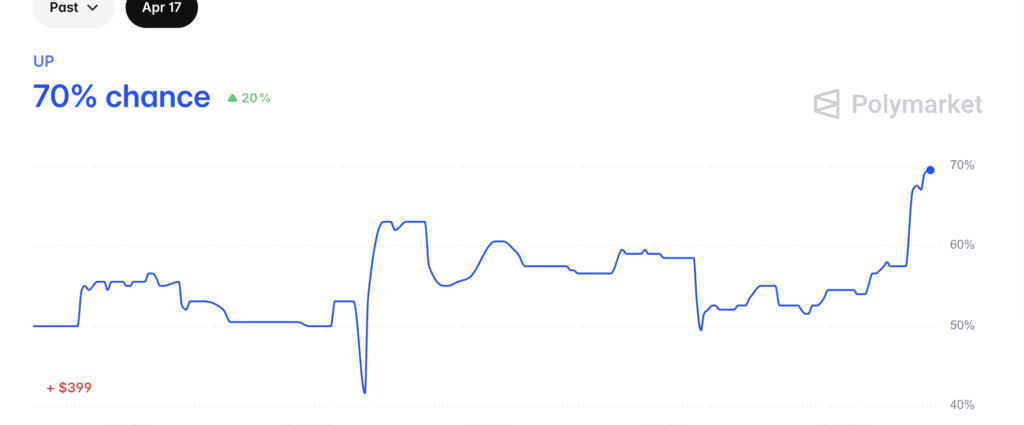
The Strait of Hormuz continues to be affected, with shipping being restricted. Amid this, the prediction market is betting on when Iran will agree to unrestricted shipping through the Strait. Traffic through the strait has slowed significantly since the war began.  

Here’s What Prediction Market Is Saying

Polymarket, a Polygon (CRYPTO: POL) based prediction platform that allows users to wager on an outcome using the USDC (CRYPTO: USDC) stablecoin …

Full story available on Benzinga.com

This post was originally published here
Ripple (CRYPTO: XRP) CEO Brad Garlinghouse praised SEC Chair Paul Atkins‘ leadership on Monday, contrasting it with the agency’s earlier approach under Gary Gensler.

Garlinghouse Slams Gensler-Led SEC

In an X post, Garlinghouse said that the regulator under Gensler had “declared war on a technology” and had lost its way.

“It was an unlawful power grab…and the courts said as much,” Garlinghouse stated, apparently referencing the SEC v. DEBT Box case, where a federal judge found the regulator had committed a “gross abuse of power.” 

Atkins A ‘Breath Of Fresh …

Full story available on Benzinga.com

This post was originally published here

Anthony Pompliano, on Tuesday, ignited debate over stocks versus real estate, suggesting equities have delivered strong returns over the past half-century.

Stocks Outpace Real Estate

In a post on X, Pompliano stated that “It has been much better to own stocks than real estate over the last 50 years,” citing data shared by Barchart.

Stocks Versus Real Estate

While real estate tends to preserve value and generally rises with inflation, offering modest returns, the stock …

Full story available on Benzinga.com

This post was originally published here

Investor Ross Gerber of Gerber Kawasaki on Monday reiterated his demand that Elon Musk-led Tesla Inc. (NASDAQ:TSLA) issue refunds for customers who have opted for the Full Self-Driving (FSD) package, slamming the system’s lack of progress.

Make Customers Whole, Says Ross Gerber

In a post on X, Gerber sounded out his calls for refunds from Tesla. “A promise is a promise,” Gerber said in his post, then sharing that several customers “paid several times on several Tesla vehicles for FSD that has never worked as promised.” He then urged Tesla to “make people whole.”

$10,000 Refunds, Robotaxi Expansion

Gerber had earlier weighed in on Tesla’s FSD v14.3 update, sharing that the company owed its customers the money …

Full story available on Benzinga.com

This post was originally published here

Popular AI assistant Grok said on Monday that Bitcoin’s (CRYPTO: BTC) price would have been “noticeably lower” had Strategy Inc. (NASDAQ:MSTR) not bought billions worth of the cryptocurrency.

Grok Notes MSTR’s Influence On Bitcoin

When venture capitalist Jason Calacanis asked what Bitcoin’s price would be without Michael Saylor’s cryptocurrency treasury firm, Grok declined to provide an “exact” figure.

“But absent that consistent bid, we’d probably be $10,000–$20,000 lower based on volume and whale-effect analyses,” the AI chatbot said.

‘Narrative Of Institutional Adoption’

Grok stated that Strategy’s steady demand, coupled with the “narrative of institutional adoption,” created real upward pressure on Bitcoin. Without this backing, BTC’s current price would “likely be noticeably …

Full story available on Benzinga.com

This post was originally published here
On Monday, Cathie Wood-led Ark Invest made significant trades involving Amazon.com Inc. (NASDAQ:AMZN) and DoorDash Inc. (NASDAQ:DASH).

The Amazon Trade

Ark Invest’s purchase of 3,492 shares of Amazon.com Inc. was executed through the ARK Space & Defense Innovation ETF (BATS:ARKX). This acquisition, valued at approximately $866,994, comes on the heels of Amazon’s expanded deal with Anthropic, which was announced on the same day. The agreement involves Anthropic committing over $100 billion to Amazon Web Services over the next decade, enhancing Amazon’s AI infrastructure with Trainium3 capacity. Additionally, Amazon has increased its investment in Anthropic by $5 billion, with potential for an additional $20 billion based on commercial milestones. This …

Full story available on Benzinga.com

This post was originally published here

Leading cryptocurrencies rose on Monday, while stocks ended lower amid mixed signals from President Donald Trump on the Iran conflict.

Cryptocurrency 24-Hour Gains +/- Price (Recorded at 9:26 p.m. EDT)
Bitcoin (CRYPTO: BTC) +2.35% $76,056.53
Ethereum (CRYPTO: ETH)
               
+1.76% $2,321.05
XRP (CRYPTO: XRP)                          +1.72% $1.43
Solana (CRYPTO: SOL)                          +1.80% $85.64
Dogecoin (CRYPTO: DOGE)              +1.89% $0.09561

Crypto Market Rebounds

Bitcoin spiked to an intraday high of $76,575, bolstered by a 20% jump in 24-hour trading volume. Ethereum reclaimed $2,300, while XRP and Dogecoin also lifted.

Shares of Strategy Inc. (NASDAQ:MSTR) and Coinbase Global Inc. (NASDAQ:COIN) closed up 2.58% and 2.57%, respectively.

Over $270 million was liquidated in the past 24 hours, predominantly in short positions, according to Coinglass data.

Open interest in Bitcoin futures rose 3.70% over the last 24 hours. However, whale and retail traders on Binance were bearish on BTC, evidenced by higher number of shorts vis-à-vis longs.

“Fear” sentiment prevailed in the market, according to the Crypto Fear & Greed Index.

Top Gainers (24 Hours) 

Cryptocurrency (Market Cap>$100 M) Gains +/- Price (Recorded at 9:26 p.m. EDT)
RaveDAO (RAVE)       +82.58%     $1.00
ORDI (ORDI)                  +18.34%     $4.90
Tradoor (TRADOOR)            +14.09%     $7.88

The global cryptocurrency market capitalization stood at $2.56 trillion, …

Full story available on Benzinga.com

This post was originally published here

The Dow Jones Industrial Average finished Monday little changed, slipping 0.01% to 49,442.56. Meanwhile, the S&P 500 and the Nasdaq declined 0.24% and 0.26% to 7,109.14 and 24,404.39, respectively.

These are the top stocks that gained the attention of retail traders and investors through the day:

Apple Inc. (NASDAQ:AAPL)

Apple’s stock closed up 1.04% at $273.05, reaching an intraday high of $274.28 and a low of $270.29. The stock’s 52-week range is between $288.61 and $189.81. In the after-hours trading, the stock fell 0.55% to $271.55.

Apple announced that CEO Tim Cook will step down in September, with John Ternus set to take over. Cook expressed gratitude for his time at Apple, emphasizing the privilege of leading the company.

Amazon.com Inc. (NASDAQ:AMZN)

Amazon shares fell 0.91% to close at $248.28, with a high of $250.18 and a low of $245.37. Its 52-week high and low are $258.60 and $165.29, respectively. In the after-hours trading, the stock rose 2.42% to $254.30.

Amazon announced a significant expansion of its deal with Anthropic, committing over $100 billion to Amazon Web Services over the next decade. CEO …

Full story available on Benzinga.com

This post was originally published here

On Monday, Zions Bancorp (NASDAQ:ZION) discussed first-quarter financial results during its earnings call. The full transcript is provided below.

Benzinga APIs provide real-time access to earnings call transcripts and financial data. Visit https://www.benzinga.com/apis/ to learn more.

The full earnings call is available at https://event.choruscall.com/mediaframe/webcast.html?webcastid=rnSlyYeP

Summary

Zions Bancorp reported a 37% year-over-year increase in net earnings to $232 million, or $1.56 per diluted share, driven by revenue growth and lower credit loss provisions.

The company announced a strategic acquisition agreement with Basis Investment Group to enhance its Fannie and Freddie lending programs, expected to bolster its capital markets franchise.

Zions Bancorp’s net interest margin stood at 3.27%, down slightly from the previous quarter, with future guidance indicating moderate increases in net interest income if rates remain stable.

Management highlighted ongoing investments in consumer and small business banking, with new product launches like the Gold Account and Business Beyond aimed at increasing deposit growth.

The company’s capital position remains strong, with a CET1 ratio of 11.5%, and potential benefits from the Basel III endgame proposal could provide additional capital relief.

Zions Bancorp is seeing increased loan activity, particularly in commercial and industrial sectors, and expects moderate loan growth despite some pricing pressures in commercial real estate lending.

The company is experiencing broad-based growth in fee income, especially in capital markets, and maintains a positive outlook for fee income and operating leverage for the full year 2026.

Full Transcript

OPERATOR

Greetings and welcome to Zions Bancorp’s First Quarter Earnings Conference call. At this time, all participants are in a listen only mode. A question and answer session will follow the formal presentation. If anyone should require operator assistance during the conference, please press Star 0 on your telephone keypad. Please note that this conference is being recorded. It is now my pleasure to turn the conference over to Andrea Christofferson. Thank you. You may begin.

Andrea Christofferson (Director of Investor Relations)

Thank you, Julian and good evening everyone. Welcome to our conference call to Discuss Zions Bancorp’s first quarter 2026 results. My name is Andrea Christofferson, Director of Investor Relations. Before we begin, I would like to remind you that during this call we will make forward looking statements. Actual results may differ materially. We encourage you to review the forward looking statements and non GAAP disclosures in our press release and on slide 2 of today’s presentation, which apply equally to statements made during this call. A copy of the earnings release and presentation are available@sciencebank corporation.com for our agenda today, Chairman and Chief Executive Officer Harris Simmons will provide opening remarks. Following Harris’s comments, Chief Financial Officer Ryan Richards will review our financial results and outlook. Also with us today are Scott McClain, President and Chief Operating Officer Derek Stewart, Chief Credit Officer and Chris Kyriakakis, Chief Risk Officer. After our prepared remarks, we will hold a question and answer session. This call is scheduled for one hour. I will now turn the time over to Harris.

Harris Simmons (Chairman and Chief Executive Officer)

Thanks very much Andrea and good evening everyone. We’re reasonably pleased with our performance and financial results for the first quarter which reflect meaningful year over year improvement and continued progress against our long term strategic priorities. Our Capital Markets division continues to be an important driver of fee income growth. Since launching the business in 2020, we’ve invested heavily in talent, technology and product capabilities, expanding our presence across investment banking, sales and trading and real estate capital markets. In late March, we announced an agreement with Basis Investment Group to acquire their Fannie and Freddie lending programs, related mortgage servicing rights, and an experienced team supporting those platforms subject to regulatory and customary closing approvals. We expect this transaction will meaningfully enhance our ability to serve commercial real estate clients across the Western United States and beyond and to further strengthen our capital markets franchise, we continue to invest in our consumer and small business franchises. Following the launch of our new Gold Account consumer Deposit product in the second half of 2025, we recently introduced its companion offering for small business customers branded as Beyond Business Account. We began piloting the product in Colorado and Arizona late in the quarter and it’s expected to roll out more broadly across our affiliate banks later this quarter. This tiered checking solution is designed to support clients as they grow from basic banking needs to more complex cash flow and money movement capabilities. Our focus on small business is also reflected in continued momentum in SBA lending, where we now rank 11th nationally in SBA 7 loan approvals during the first half of the SBA’s fiscal year Shifting now to the financial results for the quarter, Slide 3 presents certain first quarter results versus the prior quarter and prior year. First quarter results reflected typical seasonal expense patterns, while revenue and profitability improved meaningfully relative to the prior year period. Net earnings were $232 million, or $1.56 per diluted share, up 37% from a year ago, driven by revenue growth, a lower provision for credit losses and a lower effective tax rate compared to the fourth quarter of 2025. Earnings declined 11%, primarily reflecting lower revenue, including the impact of two fewer days in the period and significantly lower securities gains as well as seasonal compensation expenses. The net interest margin was 3.27%, down 4 basis points from the prior quarter, reflecting lower earning asset yields and a decline in average demand deposits partially offset by improved funding costs. Average loans grew 2.4% on an annualized basis, led by commercial lending, while average customer deposits showed a modest seasonal decline period. End Customer deposits grew $1.3 billion, or 1.8% from year end. Credit losses were very modest at three basis points annualized of average loans on slide four, diluted earnings per share were $1.56, down from $1.76% in the prior quarter and up from $1.13% a year ago. As a reminder, the year ago quarter included an 11 cent per share headwind related to the revaluation of deferred tax assets due to newly enacted state tax legislation. There were no notable items in the first quarter with an impact greater than $0.05 per share. As shown on Slide 5, adjusted pre provision net revenue was $301 million declined 9% from the prior quarter, reflecting some of the items noted earlier, including a slightly lower day count. Adjusted taxable equivalent net interest income pre Provision net revenue increased 13% versus the year ago quarter on improved revenue and positive operating leverage. With that overview, I’ll turn the call over to our Chief Financial Officer Ryan Richards to walk through the quarter in more detail and to walk through our outlook.

Ryan Richards (Chief Financial Officer)

Ryan thank you Harris and good evening everyone. Beginning on slide 6, you can see the 5 quarter trend for net interest income and net interest margin. Taxable equivalent net interest income was 662 million, down 21 million or 3% from the prior quarter and up 38 million or 6% from the year ago quarter. Earning asset yields fell faster than funding costs during the quarter, most notably in January and loan repricing reflected the impact of the December rate cuts. Current deposit costs also moved lower but with a lag over the quarter. Net interest margin was 3.27%, down 4 basis points linked quarter and up 17 basis points year over year. Slide 7, provides additional detail on the drivers of net interest margin. The linked quarter walks reflect the lower asset yields mentioned previously as well as a lower contribution from average demand deposit balances. These factors were partially offset by improved deposit costs year over year. The improvement in margin primarily reflects deposit and borrowing repricing and our continued focus on optimizing the balance sheet. For the first quarter of 2027, our outlook for net interest income is moderately increasing. Given the uncertain path of benchmark rates. The forward curve as of March 31st assumed no rate changes over the next 12 months. If that plays out, we estimate net interest income growth of about 7 to 8% which would exceed our guide. Moving to non interest income on slide 8, customer related non interest income was 172 million compared to 177 million in the prior quarter and 158 million a year ago. Excluding net credit valuation adjustment, adjusted customer related non interest income was 174 million compared with 175 million in the prior quarter and up 16 million or 10% from the year ago quarter. We are particularly pleased with the broad based growth achieved during the quarter relative to the last year which reflects higher residential mortgage loan sales activity and growth in retail and business banking, commercial account and wealth management fees. We continue to see attractive opportunities in capital markets and have strong pipelines going into the second quarter. For the first quarter of 2027, our outlook for adjusted customer related fee income is moderately increasing versus the first quarter 2026 results of 174 million. With broad based growth and capital markets continue to contribute in an outsized way, we currently expect results towards the top end of that range. Turning to Slide 9,, adjusted on interest expense was 558 million. Expenses increased versus the prior quarter driven primarily by seasonal compensation and were higher year over year reflecting increased marketing technology costs, professional and outsourced services and higher incentive compensation. We will continue to manage expenses prudently while investing to Support growth. Our first quarter 2027 outlook for adjusted non interest expense is moderately increasing versus the first quarter of 2026 based on first quarter performance and full year expectations. We continue to Expect positive operating leverage for a full year 2026 in the range of 100 to 150 basis points. Slide 10, presents trends in average loans and deposits. Average loans grew 2.4% annualized during the quarter primarily within the commercial and industrial portfolio and increased 2.5% year over year. Loan yields declined sequentially as benchmark rate cuts in the latter part of 2025 were reflected in variable rate repricing. Average deposits were modestly lower than the prior quarter by 540 million. Approximately 1/2 of the decline was due to average broker deposits while the remainder can be attributed to seasonal runoff across business operating accounts early in the quarter. Importantly, period end customer deposits increased by 1.3 billion or 1.8% from year end. The cost of total deposits declined sequentially, benefiting from both repricing and a more favorable mix within interest bearing deposits. Slide 11, presents the five quarter trend of our average and ending funding sources. Our Total funding costs declined 8 basis points linked quarter to 1.68% largely as a result of the aforementioned deposit repricing. Period. End customer deposits grew 1.3 billion and short term borrowings declined significantly as we continue to replace higher cost wholesale funding with customer positive growth and securities cash flows while also remixing into senior debt. Turning to Slide 12,, the investment securities portfolio continues to serve as an important source of on balance sheet liquidity and a tool to balance interest rate risk through deep access to the repo markets. During the quarter, principal and prepayment related cash flows from investment securities of 493 million were partially offset by reinvestment of 299 million. The continued paydown of lower yielding mortgage backed securities supports earning asset remix or reduction in wholesale funds. The estimated price sensitivity of the portfolio inclusive of hedging activity was 3.7 years. Credit quality remains strong as shown in slide 13. Net charge offs were 3 basis points annualized of average loans and the non performing assets ratio declined to 48 basis points. Classified and criticized balances also declined during the quarter. The allowance for credit losses ended the quarter at 1.16% and remains well positioned relative to our risk profile with a 239% coverage of non accrual loans. Slide 14, provides an overview of our $13.7 billion commercial real estate portfolio which represents approximately 22% of total loans. The portfolio remains granular and well diversified by property type and geography with conservative loan to value characteristics. Credit metrics remain favorable including low levels of non accruals and delinquencies. Our capital position remains strong as shown on slide 15. The Common Equity Tier 1 ratio was 11.5% flat during the quarter as earnings growth was somewhat offset by the 77 million in common shares, repurchase and dividends paid. In addition to the growth in risk weighted assets, we continue to expect net capital generation through earnings and continued improvement in AOCI. Tangible book value per share increased 19% versus the prior year reflecting earnings generation and continued balance sheet normalization. Slide 16, summarizes the outlook we discussed across loans, net interest income, fee income and expenses. This outlook reflects our best estimate based on current information and is subject to the risks and uncertainties discussed in our forward looking statements.

Andrea Christofferson (Director of Investor Relations)

This concludes our prepared remarks as we move to the question and answer section of the call. We request that you limit your questions to one primary and one follow up question to enable other participants to ask their questions. Julian, please open the line for questions.

OPERATOR

Thank you. And once again, if you would like to ask a question, please press Star one on your telephone keypad. A confirmation tone will indicate that your line is in the question queue. You may press Star two to remove yourself from the queue. For any participants using speaker equipment, it may be necessary to pick up the handset before pressing the star keys. One moment while you pull for questions. And our first question comes from the line of John Pam Carey from Evercore isi. Please proceed with your question.

John Pam Carey (Equity Analyst)

Afternoon. On the just on the margin side I know you your loan Yield compressed about 14 basis points linked quarter. I think you had mentioned that it was largely a function of the rate cuts and variable rate repricing. I guess that linked quarter change was that all the benchmark rate change. Any other impact to loan yields in the quarter and maybe if you can give us your new-money loan yields just to give us an idea where originations are coming on the books.

Ryan Richards (Chief Financial Officer)

Hey, thanks John, really appreciate that. Yeah, so listen, I think you picked up on the main thrust of it. So we would have had some benchmark repricing and expectation of the rate cut that came in the middle of December and some that trailed thereafter and where we remained skewing a little bit more on the asset sensitive side that that was the biggest contributor in terms of the repricing characteristics. Of course we’ve got the nice materials in our appendix that I know you’re familiar with, but I think maybe the question that you’re getting at on front book versus back book for the loan portfolio is really the most meaningful part of that as we sort of think about trajectory moving forward is for those fixed rate loan portfolios, the things that have yet to reprice through. And there we’re seeing a 72 basis point spread on the front book vis-à-vis the back book.

John Pam Carey (Equity Analyst)

Okay. All right. And then I guess in terms of your positive operating leverage expectation of 100, 150 basis points, that’s for the year. And so what rate assumption does that imply? I know you mentioned if there’s no rate changes consistent with the forward curve, the next 12 month Net Interest Income (NII) outlook could come in at 7 to 8% above the range. Does that 100, 150 basis points expectation imply the forward curve? And maybe if you can give us a little bit more detail in terms of that NII expectation.

Ryan Richards (Chief Financial Officer)

Yeah, thank you for that, John. Listen, in the past we’ve brought a view of kind of latent and emergent effects. It’s less interesting this quarter since we there’s not much to talk about in the forward curve in terms of rates changes that were implied at least at the quarter end. So those are kind of right on top of each other. So we were able to firm up our guide for the full year. As you sort of think about the trajectory of that, where we normally guide on a one year four quarter basis, we believe you’ll see there’s a much more powerful positive operating leverage, probably not unlike what we’ve seen this quarter relative to last quarter where and Harris is quoting in his remarks, you will see positive operating leverage of 270 basis points. So we think that as our repricing plays through from the investment securities into loans, as we have less those headwinds associated with our terminated swaps, some of the other things play through. We do see really good prospects for one year, fourth quarter last year when we were with you, we were anticipating as part of our sensitivity and our guidance that we could have had rate cuts. I think we were anticipating in June and September. And based upon the forward curve, those are now off the table so that having no cuts is embedded into our full year positive operating leverage guidance. Got it.

John Pam Carey (Equity Analyst)

All right, thanks Ryan. Appreciate it.

OPERATOR

Thank you. And our next question comes from the line of Manon Gosalia with Morgan Stanley. Please proceed with your question.

Manon Gosalia (Equity Analyst)

Hi, good afternoon. On the deposit cost side, deposit costs, I guess they came down quarter on quarter, but they were pretty flat relative to the spot rate as of December 31st. And it looks like the spot rate as of March 31st has moved lower again. So can you just help us connect the dots on the trajectory there? Maybe give us an update on deposit pricing and competition and also what you’re expecting in terms of CD rollovers coming up, hey, thank you for that. And we’ll try to unpack that in places and invite my colleagues to jump in as well. Listen, I think I’ve seen the questions come in other calls in this earnings cycle about where deposit costs go if rates kind of stay static here for the remainder of the year. There’s still some trailing activity, some repricing down on term deposits, thinking about customer time deposits that have yet to play through. So, you know, that would definitely be an element of this. You will have heard us talking increasingly quarter over quarter and when you catch us at conferences about …

Full story available on Benzinga.com

This post was originally published here

Servisfirst Bancshares (NYSE:SFBS) released first-quarter financial results and hosted an earnings call on Monday. Read the complete transcript below.

This transcript is brought to you by Benzinga APIs. For real-time access to our entire catalog, please visit https://www.benzinga.com/apis/ for a consultation.

Access the full call at https://event.choruscall.com/mediaframe/webcast.html?webcastid=OGwVSQiN

Summary

Servisfirst Bancshares reported strong loan growth and a 33% year-over-year increase in earnings per share for Q1 2026, with net income at $83 million.

The company achieved a net interest margin expansion to 3.53% and maintained a best-in-class efficiency ratio below 30%, indicating strong operational leverage.

Strategic expansion in Texas is underway with 18 bankers onboarded and the first loan closed; expectations are high for this market to contribute significantly over the next few years.

Loan payoffs have decreased, and the company is optimistic about future loan growth, supported by a robust pipeline and new relationships across markets.

Management highlighted a solid capital position, with common equity tier 1 reaching 11.86% and a strong liquidity position, underscoring the company’s capacity for continued growth.

Full Transcript

OPERATOR

Greetings and welcome to the service. First Bancshare’s first quarter earnings conference call. At this time all participants are in listen only mode. If anyone should require operator assistance, please press Star zero on your telephone keypad. A question and answer session will follow the formal presentation and you may press Star one to be placed into question queue. It’s now my pleasure to turn the call over to Davis Mains, Director of Investor Relations. Davis, please go ahead.

Davis Mains (Director of Investor Relations)

Good afternoon and welcome to our first quarter earnings call. We’ll have Tom Broughton, our CEO, Jim Harper, our Chief Credit Officer and David Sporacio, our CFO covering some highlights from the quarter and then take your questions. I’ll now cover our forward looking statements disclosure Some of the discussion in today’s earnings call may include forward looking statements. Actual results may differ from any projections shared today due to factors described in our most recent 10-K and 10-Q filings. Forward looking statements speak only as of the date they are made and Servisfirst Bancshares assumes no duty to update them. With that, I’ll turn the call over to Tom Broughton. Thank you. Good afternoon and thank you for joining our first quarter conference call. We’re really pleased with our start to the year and I’m going to highlight a few things before I turn it over to Jim Harper to give credit update. On the loan side, we had pretty solid loan growth for the quarter. Loan growth is usually not very robust in the first quarter, but we did see some pretty good loan growth. We are seeing loan payoffs begin to diminish compared to the last two years. Certainly a great thing. You know, I don’t know what kind of trend we’ll see in the second quarter, but on a quarter to date basis we’ve seen some very nice growth in the first 20 days or so of the quarter. On the forward line pipeline, over 90 days it’s 90 plus days. It’s the strongest we’ve ever had in our history. And of course on a 90 day loan pipeline the closing rate is much lower than on a, you know, 30 day loan pipeline, for example. So. But it is great to see a long list of new relationships across all of our markets in a variety of industries on that list. On the deposit side they grew by 8% annualized in the first quarter which is exceeded our expectations. As we typically see our deposit growth in the second half of the year. We continue to try to manage our deposit cost to improve margins. We continue to attract new clients with our strong financial condition, our profitability and our personal service that we provide to commercial clients and Correspondent banks David will elaborate in a few minutes, but our net interest margin continues to improve. Our efficiency ratio continues to be the best in class as we dropped below 30% in the first quarter. We do have 161 producers at quarter end. We’ve hired over the last 12 months 32 new FTEs and 75% of those FTEs are frontline employees. So we should see, you know, obviously some improved productivity over time and profitable growth there. Our Houston team has found an office they policed it, not ready to move into yet, but they got a 26,000 square feet to build out. We do have 18 bankers on board there today and their pipelines are building quite nicely. We actually closed our first loan in Texas, which is a large supply chain company with long term contracts in March, so we’re pleased with the start there.

Jim Harper (Chief Credit Officer)

And now I’m going to turn it over to Jim Harper for a credit update. Thanks Tom. As noted, loan growth for the quarter was solid at 7% annualized, though we definitely experienced an uptick in loan activity beginning late in the quarter, which reinforces Tom’s comments about our forward pipeline. From a credit metric standpoint, net charge offs for the first quarter were around $8.3 million, most of which was associated with the remaining balance of one credit, with the charge representing the final resolution of a loan to a longtime troubled borrower. Our allowance to total loans remained static when compared to the end of 2025 (should be 2026), ending the quarter with an allowance compared to total loans of 125 basis points. Non performing assets to total assets at quarter end were 100 basis points, which was slightly higher than the 97 basis points we reported at fiscal year end 25. However, we are confident in some near term reductions in NPAs of approximately $17 million, or just over 9% of our 33126 NPAs stemming from the U.S. coast Guard’s purchase of a private university campus and the assumption of two other loans by a long term customer. As always, we continue to actively and aggressively manage our NPAs and this portfolio and David will be next with a discussion of our first quarter financial performance.

David Sporacio (Chief Financial Officer)

Thank you Jim and good afternoon everyone. I will walk you through the financial details of our first quarter and I am pleased to report a strong start to 2026 across virtually every metric we track. The headline numbers reflect continued expansion in the net interest margin, disciplined expense control, solid loan and deposit growth, and a meaningful year over year improvement in operating leverage, all of which speak to the durability of the service first model for the first quarter of 2026 we’ve reported net income of $83 million or $1.52 per diluted share or $1.54 on a normalized basis. To put that in Context, we earned $1.16 per diluted share in the first quarter of 2025, so we are up 33% year over year on earnings per share. On a linked quarter basis, EPS stepped back from the $1.58 we reported in 4Q25 and I want to briefly explain why. Fourth quarter included a $4.3 million non recurring Bolly death benefit that flowed through non interest income and fourth quarter also had more calendar days to earn net interest and fee income during the first quarter. We also had a prior period adjustment to boli income of $1 million which was a headwind. Excluding those items, the core earnings trajectory is clearly upward. Our return on average assets was 1.89% for the quarter, which is essentially in line with fourth quarter and well above the 1.45% we delivered one year ago. Return on average common equity was 17.91%. These are strong industry leading returns and they reflect the operating leverage inherent in our model when loan growth, deposit repricing and expense discipline all move together in the right direction. In net interest income for the first quarter it was $148.2 million which is up from $146.5 million in the fourth quarter and up from $123.6 million a year ago. The net interest margin expanded to 3.53%, 15 basis points better than linked quarter and 61 basis points better than the same quarter last year. That progression reflects two drivers working in tandem, continued repricing of our low fixed

Tom Broughton (Chief Executive Officer)

rate loan portfolio and a full quarterly impact of the Fed rate cuts from the fourth quarter. As we have mentioned in previous quarters, we continue to see opportunities on loan repricing for the next 12 months. We have about a $2 billion opportunity for low fixed rate loans renewing normal payment cash flows, covenant violations and modifications. In fact we have about $2.9 billion in fixed rate loans maturing in the next three years at a price below our current going on rate for loans. On the deposit side, average interest bearing deposit cost fell to 2.79% down 22 basis points from fourth quarter and 61 basis points from over a year ago. That repricing is still working through the book and and we continue to expect meaningful benefit as higher rate time deposits mature and renew at current market rates on the asset side loan yields were 6.18% an 11 basis point step down from quarter four. That reflects the normal variability in the declining rate …

Full story available on Benzinga.com

This post was originally published here
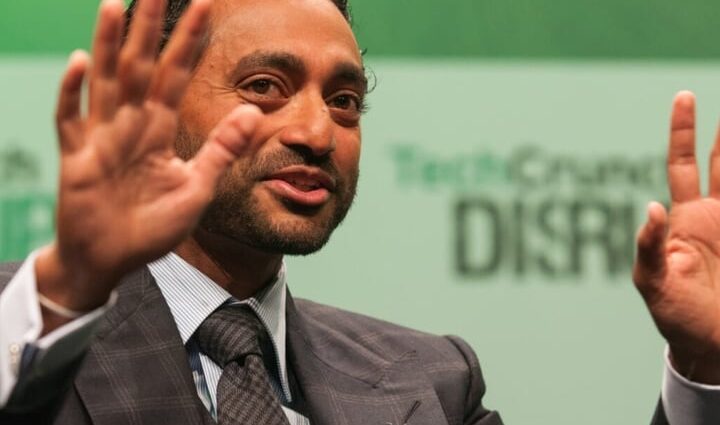
Chamath Palihapitiya told the All-In Podcast that the three major hyperscalers now control roughly 60% of all compute and have a strategic incentive to throttle OpenAI and Anthropic, a setup he called a “five-alarm fire” for the two leading frontier labs.

The Social Capital chief compared it to the collapse of Friendster, which lost the social networking race to MySpace and Facebook after it could not keep its site up.

Revenue at the frontier labs could hit a wall “not because of product quality and adoption” but because of “the Friendster effect,” he said.

Shares of Bloom Energy Corp. (NYSE:BE) have gone “absolutely straight up vertical,” Palihapitiya said, as developers rush toward on-site natural gas power that sidesteps grid queues.

Nvidia Corp. (NASDAQ:NVDA) and CoreWeave Inc. (NASDAQ:CRWV) remain the …

Full story available on Benzinga.com

This post was originally published here

As much as I enjoy the intellectual exercise of researching and writing about financial markets, I find the act of investing can be very unpleasant.

When stocks are up, I worry they’ll go down. And when they’re down, I worry they’ll go lower.

Even when I look back and see the progress my portfolio has made toward my financial goals, I struggle to recall moments where I felt totally sanguine about the money I had at risk. Sure, in hindsight, I’m grateful for how far I’ve come. But my memory of the process is of anything but a smooth ride.

As the stock market set new highs this week, I reflected on this poorly timed, lump-sum purchase I made back on Feb. 18, 2025, when the S&P 500 was at 6,129. That was a day before the market topped and then tumbled 19%. Fortunately, stocks quickly recovered those losses, and I was back to breakeven within a few months. (Read more about that here and here.)

Fast-forward to today. The S&P …

Full story available on Benzinga.com

This post was originally published here

Amazon.com Inc (NASDAQ:AMZN) shares are trading higher in Monday’s after-hours session after the company announced an expanded strategic collaboration with Anthropic.

Amazon Expands Collaboration With Anthropic

Amazon announced Anthropic is committed to spending more than $100 billion on Amazon Web Services technology over the next 10 years to secure five gigawatts (GW) of capacity to train and power the company’s advanced AI models. The deal includes Trainium3 capacity, which is expected to come online this year.

Separately, Amazon bolstered its investment in Anthropic with $5 billion invested and up to an additional $20 …

Full story available on Benzinga.com

This post was originally published here

Apple Inc. (NASDAQ:AAPL) made a CEO transition announcement after Monday’s closing bell: Tim Cook will step down as CEO and transition to the role of executive chairman, while John Ternus — currently senior vice president of Hardware Engineering — will take over as CEO.

Both changes take effect Sept. 1, 2026, following a unanimous board vote. Cook will remain CEO through the summer to ensure a smooth handoff.

“It has been the greatest privilege of my life to be the CEO of Apple and to have been trusted to lead such an extraordinary company,” Cook said in a statement.

“I love Apple with all of my being, and I am so grateful to have had the opportunity to work with a team of such ingenious, innovative, …

Full story available on Benzinga.com

This post was originally published here
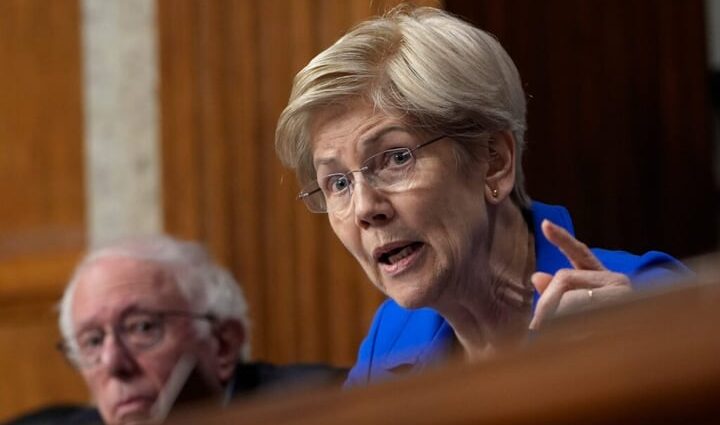
Sen. Elizabeth Warren (D-Mass.) publicly questioned Elon Musk’s fitness to run X Money, one day before her deadline for Musk to respond to an April 14 letter flagging consumer, financial stability and national security risks.

Warren, the Senate Banking Committee ranking member, is pressing Musk on whether X Money will issue a stablecoin, whether it will surveil and monetize user transaction data, and what controls it will have to prevent scams, fraud and illicit finance.

Cross River Bank’s Rap Sheet

Warren’s letter flagged that X Money deposits appear to be held by Cross River Bank, based on screenshots posted by actor William Shatner, who received early access.

The 6% APY headline feature is offered through the same bank. Cross River is a repeat FDIC enforcement target, hit …

Full story available on Benzinga.com

This post was originally published here

Global private equity exit volume decreased by 6.25% in the first quarter (Q1). The three-month period tallied 720 transactions. That’s down from 768 in Q1 2025.

Aggregate transaction value, however, surged to $311 billion. Elon Musk‘s $250 billion deal between SpaceX and xAI, the top quarter’s top transaction, made up about 80% of the total value.

The seller group consisted of Sequoia Capital Operations LLC, Lightspeed Ventures LLC, Kingdom Holding Co., Valor Management LLC, StepStone Group Inc., Andreessen Horowitz LLC, Vy Capital, Craft Ventures LLC, CoreNest Capital and MGX Fund Management Ltd, S&P noted in its most recent Q1 report citing LSEG data.

Musk’s record-setting merger has redefined global M&A; the previous record stood for more than two decades, dating back to Vodafone’s (NASDAQ:VOD) $203 billion takeover of Germany’s Mannesmann in 2000.

The second largest exit in …

Full story available on Benzinga.com

This post was originally published here
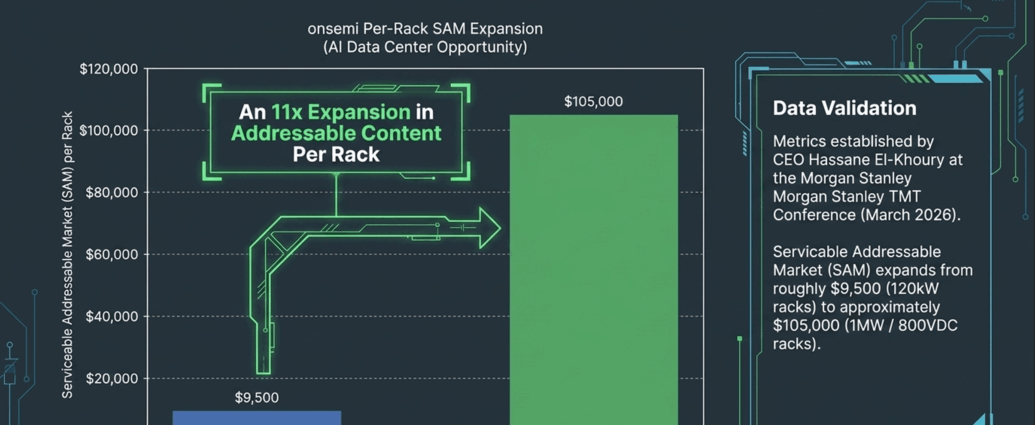
Every 800V rack NVIDIA ships in 2027 is worth roughly 11x more ON silicon than the 54V racks shipping today. Consensus still hasn’t put that math in its model.

The semiconductor cycle is technically still in a trough. ON Semiconductor’s (NASDAQ:ON) revenue is down 15% year-over-year, fab utilization sits around 68%, and the stock just ripped 21% in a single week and sits up 167% from its April 2025 low. Either the market has lost its mind, or it’s figuring out that the “EV recovery story” label everyone has been using for ON is the wrong label.

The setup nobody was pricing

ON makes the kind of chips that sit inside things most people never think about. Power management, sensors, voltage regulation. Historically, the bull case was electric vehicles. Every EV needs enormous amounts of silicon carbide to manage battery power, and ON built one of the largest SiC franchises in the industry. The EV slowdown over the past two years was a direct hit to that thesis, and the stock spent most of 2024 and 2025 bleeding.

Here is what changed. According to a research briefing reviewed by Wolf Financial this week, CEO Hassane El-Khoury laid out a specific framework at the Morgan Stanley TMT Conference in March. Today’s AI data center racks run at roughly 120 kilowatts of power. ON’s content inside one of those racks is approximately $9,500. The next generation of AI racks, which start shipping in the back half of 2027, will operate at close to 1 megawatt using an architecture called 800-volt direct current. ON’s content inside one of those racks jumps to approximately $105,000.

That is 11 times the silicon content, per rack, across a three-generation GPU transition.

Why 800-volt is happening

This is the part where the physics actually matters. NVIDIA’s next flagship rack system, the …

Full story available on Benzinga.com

This post was originally published here

AXT Inc (NASDAQ:AXTI) shares are sliding after the market close on Monday after the company announced a public offering of common stock.

AXT Announces Common Stock Offering

AXT said it plans to offer and sell shares of common stock in a public offering. The company also plans to grant the underwriters a 30-day window to buy up to an additional 15% of shares in the offering. Size and terms …

Full story available on Benzinga.com

This post was originally published here

Bitcoin is holding above $75,000 as crypto markets hope for a positive resolution of U.S.-Iran talks on Tuesday.

Cryptocurrency Ticker Price
Bitcoin (CRYPTO: BTC) $76,212
Ethereum (CRYPTO: ETH) $2,328
Solana (CRYPTO: SOL) $86.10
XRP (CRYPTO: XRP) $1.43
Dogecoin (CRYPTO: DOGE) $0.09543
Shiba Inu (CRYPTO: SHIB) $0.056053

Notable Statistics:

  • Coinglass data shows 138,626 traders were liquidated in the past 24 hours for $390.5 million.       
  • SoSoValue data shows net inflows of $663.9 million from spot Bitcoin ETFs on Friday. Spot Ethereum ETFs saw net inflows of $127.5 million.
  • In the past 24 hours, top gainers include Chiliz, edgeX and …

Full story available on Benzinga.com

This post was originally published here

Bank of Hawaii (NYSE:BOH) released first-quarter financial results and hosted an earnings call on Monday. Read the complete transcript below.

This transcript is brought to you by Benzinga APIs. For real-time access to our entire catalog, please visit https://www.benzinga.com/apis/ for a consultation.

View the webcast at https://edge.media-server.com/mmc/p/xo3occc2/

Summary

Bank of Hawaii reported solid financial performance for Q1 2026, with net interest income and margin expanding for the eighth consecutive quarter, driven by fixed asset repricing and a decline in deposit costs.

Earnings per share were $1.39, and the company maintained strong capital and credit quality, with a focus on their leading deposit market share in Hawaii.

Strategic initiatives include expanding wealth management capabilities and supporting family-owned businesses through the new Center for Family Business and Entrepreneurs.

The company’s outlook remains cautious due to potential headwinds such as Middle East tensions and rising energy costs, but it remains optimistic about achieving a 2.9% net interest margin by year-end.

Management highlighted the stable economic environment in Hawaii, characterized by low unemployment and strong visitor spending, but noted external risks that could impact consumer confidence.

Full Transcript

OPERATOR

Good day and thank you for standing by. Welcome to the Bank of Hawaii Corporation first quarter 2026 earnings conference call. At this time, all participants are in a listen-only mode. After the speaker’s presentation, there will be a question and answer session. To ask the question during the session, you will need to press 11 on your telephone. You will then hear an automated message advising. Your hand is raised to withdraw your question. Please press star 11 again. Please be advised that today’s conference is being recorded. I would now like to hand the conference over to your speaker today. Cheng Park, Executive Vice President, Investor Relations. Please go ahead.

Cheng Park

Good morning and good afternoon. Thank you for joining us today for our first quarter 2026 earnings conference call. Joining me today is our President and CEO Jim Polk, CFO Brad Satenberg and Chief Risk Officer Brad Sherson. Before we get started, I want to remind you that today’s conference call will contain some forward looking statements.

Jim Polk

And while we believe our assumptions are reasonable, the actual results may differ materially from those projected during the call. Today, we’ll be referencing a slide presentation as well as the earnings release. Both of these are available on our website boh.com under the Investor relations link. And now I would like to turn the call over to Jim. Thanks, Chang. Good morning and good afternoon everyone. Thank you for joining us today. Before I get into the quarter, as this is my first earnings call as CEO, I want to say a few words about my predecessor, Peter.

Brad Shearson (Chief Risk Officer)

Peter Ho. Peter built something truly special here. A franchise defined by discipline, consistency and a genuine commitment to the people of our island communities. With 16 years as CEO, he left this institution much stronger in every way that matters. I’m grateful for his confidence in me and I’m honored to carry this forward. Now on to the quarter. Bank of Hawaii delivered another solid set of Results to open 2026. Net Interest Income and our net interest margin expanded for the eighth consecutive quarter. Driven by continued fixed asset repricing and a meaningful decline in total deposit costs. NIM increased 13 basis points as our fixed asset repricing engine continues to perform as expected. During the quarter, we remixed $643 million in fixed rate loans and investments from a roll off yield of approximately 4% to a roll on yield of 5.6%, continuing to lift the overall yield on earning assets. We remain on track toward our stated goal of approaching 2.9% NIM by the end of the year and we feel good about that trajectory even against an uncertain rate backdrop. Deposit trends continue to be encouraging as our average cost of total deposits declined 17 basis points, achieving a beta of 36%, normalizing for nonrecurring expenses and noninterest income. Our EPS came in at $1.39, reflecting the steady underlying earnings power of the franchise. We maintained strong capital and excellent credit quality while continuing to build on our leading deposit market share position here in Hawaii. The strategic formula has not changed. Bank of Hawaii operates in one of the most distinctive banking markets in the country, concentrated and relationship driven where four locally headquartered banks hold more than 90% of FDIC recorded deposits. In that environment, brand and trust are our structural advantages. They allow us to price deposits attractively, manage funding costs actively, and generate superior risk adjusted returns across cycles. Turning to our home market, Hawaii’s economy entered 2026 on solid footing near record low unemployment, strong visitor spending and an active construction pipeline anchored by significant military and public infrastructure investment. That said, we are watching the environment carefully. Tensions in the Middle east, rising energy costs and the potential for sustained inflation are headwinds that could affect consumer confidence and travel demand as the year progresses. Our credit portfolio continues to reflect the underwriting discipline this bank has maintained through many cycles. I want to briefly address the recent Konalo storm in Hawaii and Typhoon Srinlaku in the West Pacific. First and foremost, bank of Hawaii remains focused on supporting our employees, customers and communities impacted by these events. We are in the early stages of assessing the potential impact of Typhoon Sinlaku and it will take several weeks to gain clearer insight. Brad Shearson will cover the potential impact of the Konalo storm as well as our overall credit profile in more detail shortly. I also want to highlight the progress we are making in wealth management, an area I expect will become an increasingly important part of the franchise’s story. Through Banco Advisors and our partnership with Cetera, we continue to expand investment capabilities for our retail and private banking clients. Simultaneously, we are deepening coordination between our commercial and private banking teams around our high net worth client relationships. Importantly, we recently opened the center for Family Business and Entrepreneurs where we provide dedicated planning resources to Hawaii’s family owned businesses, encompassing financial and estate planning, succession planning, business valuation and MA advisory capabilities. For many of these families whose wealth is largely concentrated in their company, these are among the most consequential decisions they will face. It is a capability uniquely suited to bank of Hawaii’s depth of relationships and trusted role in this market. I’ll close with this. We remain focused on the strategy, the culture and the values that have made bank of Hawaii successful. I fully intend to carry forward the intensity of execution, the continued investment in our people and technology and an unwavering commitment to the island communities that have trusted this institution for 128 years. I’m proud to be in this role and I look forward to the work ahead. With that, I’ll turn the call over to Brad Shearson to discuss credit, after which Brad Sattenberg will walk through the financials in detail. We’ll then be pleased to take your questions. Thanks, Jim. I’ll begin with an overview of our credit portfolio and conclude with asset quality metrics and as you will see, our performance remains strong, consistent with prior quarters. Turning to our lending philosophy, the bank of Hawaii is dedicated to serving our local communities, lending primarily within our core markets where our expertise allows us to make informed and disciplined credit decisions. Our portfolio is built on long tenured relationships, with approximately 60% of both our commercial and consumer clients having been with the bank for more than 10 years. Geographically, our loan book is concentrated in markets we know well. Approximately 93% of loans are based in Hawaii, with 4% in the Western Pacific and just 3% on the mainland. Primarily supporting existing clients who operate both locally and on the mainland, our loan portfolio remains well balanced between consumer and commercial exposure. Consumer loans represent 56% of total loans, or approximately $8 billion. Within the consumer portfolio, 86% consists of residential, mortgage and home equity loans with a weighted average LTV of 48% and weighted average FICO score of 798. The remaining 14% of consumer loans are comprised of auto and personal lending. Credit quality in these segments also remains strong, with average FICO scores of 729 for auto loans and 760 for personal loans. Turning to commercial lending, the portfolio totals $6.2 billion, representing 44% of total loans. 73% is secured by real estate with a weighted average LTV of 55%. This reflects our ongoing emphasis on collateral protection. CRE remains the largest component of the commercial book, totaling $4.3 billion or 31% of total loans. And in Oahu, the state’s largest CRE market, a combination of consistently low vacancy rates and flat inventory levels continues to support a stable real estate market across industrial, office, retail and multifamily property types, vacancy rates remain below or close to their 10 year averages. Total office space on Oahu has declined by approximately 10% over the past decade, driven primarily by conversions to multifamily residential and lodging. This structural reduction in supply combined with the return to office trend has brought vacancy rates closer to long term averages and well below national levels. Our CRE portfolio remains well diversified with no single property type exceeding 9% of total loans. Conservative underwriting practices continue to be applied consistently with weighted average LTVs below 60% across all CRE categories. In addition, diversification within each segment remains strong, supported by modest average loan sizes. Scheduled maturities are also well balanced, with more than 60% of CRE loans maturing in 2030 or later reducing any near term refinancing risk. Looking at the distribution of LTVs, there isn’t much tail risk in our CRE portfolio. Less than 3% of CRE loans have greater than 80% LTV. CNI accounts for 11% of total loans totaling $1.6 billion. This portfolio is diversified across industries characterized by modest average loan sizes and there is very little leveraged lending. Turning to asset quality, credit metrics continue to perform exceptionally well. Net charge offs totaled $1.1 million or just 3 basis points annualized, down 9 basis points from linked quarter and 10 basis points lower year over year. 3 basis points is abnormally low. This was driven by a small net recovery in commercial as well as a slight decline in consumer net charge offs. Non Performing assets declined to 9 basis points, down 1 basis point from linked quarter and 3 basis points year over year. Delinquencies increased to 40 basis points, up 4 basis points from linked quarter and up 10 basis points year over year and criticized loans remained flat to the linked quarter at 2.12% of total loans. That’s up 4 basis points year over year. Notably, 84% of criticized assets are real estate secured with a weighted average LTV of 53%. And as an update on the allowance for credit losses on loans and leases, the ACL ended the quarter at $147 million, up 200,000 from linked quarter. The ratio of our ACL to outstandings remained flat at 1.04%. This ACL coverage does include a $3.2 million qualitative overlay specifically related to the recent Kona Low storm. This overlay accounts for the potential impact of flood damage to approximately 15 to 20 properties in our portfolio net of anticipated insurance recoveries. We are monitoring these exposures closely but can already see that the potential loss would not deviate greatly from the amount we have reserved. And in light of recent industry discussions around private credit, I want to provide clear assurance that we …

Full story available on Benzinga.com

This post was originally published here
Strategy Inc. (NASDAQ:MSTR) Executive Chairman Michael Saylor announced Monday that the company bought 34,164 Bitcoin (CRYPTO: BTC) for $2.54 billion, the largest single-day purchase in its history.

The buy lifted Strategy’s holdings to 815,061 BTC, a roughly $61.6 billion stack that reportedly pushes the company past BlackRock. Strategy now trails only Satoshi Nakamoto.

The filing followed a Sunday post from Saylor that read “Think Even ₿igger.”

Crypto analyst Mike Flaum had separately predicted Strategy would acquire over 40,000 BTC this week.

Saylor landed a touch shy of that, but it was still the largest acquisition by the company since 2024.

The purchase was made at an average cost of $74,395 per coin, lifting Strategy’s blended cost basis to $75,527, almost exactly where bitcoin is trading today.

MSTR Slips As Schiff …

Full story available on Benzinga.com

This post was originally published here

U.S. stocks traded lower toward the end of trading, with the Dow Jones index falling around 0.1% on Monday.

The Dow traded down 0.11% to 49,391.03 while the NASDAQ fell 0.39% to 24,373.05. The S&P 500 also fell, dropping, 0.29% to 7,105.30.

Leading and Lagging Sectors

Energy shares climbed by 1.1% on Monday.

In trading on Monday, consumer discretionary stocks fell by 1.2%.

Top Headline

Shares of Investar Holding Corp (NASDAQ:ISTR) gained more than 5% on Monday as the company released earnings results for the first quarter.

The company posted adjusted earnings of 87 cents per share, beating market estimates of 68 cents per share. The company’s quarterly sales came in at $35.640 million versus expectations of $36.400 million.

Equities Trading UP
           

  • Enveric Biosciences Inc (NASDAQ:ENVB) shares shot up 130% to $4.19 after President Donald Trump issued an executive order on Saturday instructing health regulators to hasten the review process of …

Full story available on Benzinga.com

This post was originally published here

The U.S. Navy has selected Shield AI from among a pool of vendors eligible for contractor-run intelligence, surveillance, and reconnaissance (ISR) services in an operation that could total as much as $800 million in task orders.

The work would be carried out using Shield AI’s V-BAT vertical-takeoff-and-landing uncrewed aircraft to provide ongoing airborne monitoring. It operates at sea and from land-based sites with the U.S. Coast Guard and U.S. Marine Corps, including deployments from Navy ships, the press release stated.

“V-BAT has delivered more operational outcomes than any other Group 3 VTOL UAS. We’ve interdicted over 100,000 lbs of narcotics in the Caribbean and Pacific. V-BAT has executed hundreds of targeting operations in Ukraine, where GPS and communications are jammed during every mission, and we have delivered substantial outcomes in …

Full story available on Benzinga.com

This post was originally published here

IonQ Inc. (NYSE:IONQ) shares are trading higher Monday. The move follows a fresh analyst endorsement and heavy short interest dynamics.

The Nasdaq is down 0.66% while the S&P 500 has shed 0.38%.

• IonQ shares are showing limited movement. Where are IONQ shares going?

Northland Capital Sets Bullish Target

Northland Capital Markets analyst Nehal Chokshi initiated coverage on IonQ on Monday. Chokshi assigned an Outperform rating to the quantum computing firm. According to Benzinga Pro, the analyst set a price target of $55. This upbeat valuation follows a volatile period for the stock.

Short Interest Fuels Squeeze Potential

Data shows a recent climb in bearish bets. Short interest rose from 79.48 million to 80.93 million shares recently. This represents 22.78% of the company’s float. It would …

Full story available on Benzinga.com

This post was originally published here
Snowflake Inc (NYSE:SNOW) shares are trading higher on Monday. The stock is gaining traction even as the Nasdaq falls 0.69% and the S&P 500 sheds 0.41%.

Investors are rotating back into growth-oriented cloud and software names. This follows a prolonged “SaaSpocalypse” sell-off that erased billions in market cap.

• Snowflake stock is showing exceptional strength. What’s fueling SNOW momentum?

Moving Past SaaSpocalypse Fears

The recent downturn stemmed from fears that AI agents would erode subscription growth. High-profile names such as Salesforce Inc (NYSE:CRM) and Cloudflare Inc (NYSE:NET) faced sharp selling pressure.

However, the tide is turning. Wedbush analyst Dan Ives labeled the …

Full story available on Benzinga.com

This post was originally published here

Salesforce Inc. (NYSE:CRM) shares are trading higher on Monday. CEO Marc Benioff took to X to tout the success of the company’s Agentforce AI platform.

The Nasdaq is down 0.57% while the S&P 500 has shed 0.34%.

•  Why is CRM stock advancing?

Benioff Counters Software Bears

Benioff directly refuted critics predicting a bleak future for enterprise software. He highlighted impressive performance metrics at major firms like Pearson and PenFed.

Benioff referred to the shift as “Agenticware,” not just software. He noted that results provide tangible return on investment and not just hype.

Agentforce Drives Efficiency

At Pearson, the platform autonomously manages refunds …

Full story available on Benzinga.com

This post was originally published here
JPMorgan analyst Doug Anmuth reiterated an Overweight rating and a $395 price forecast for Alphabet Inc. (NASDAQ:GOOGL) (NASDAQ:GOOG) in a Monday research note.

The firm named the tech giant a “Top Pick” just days before the Google Cloud Next event in Las Vegas.

Cloud Growth Takes Center Stage

Anmuth highlighted Google Cloud’s rising importance to Alphabet’s bottom line. The segment is now the company’s second-largest business. JPMorgan expects Cloud to represent roughly 19% of total revenue in 2026.

The analyst noted that the Cloud backlog surged 160% year-over-year to $240 billion in late 2025. “While Cloud Next has not been a major catalyst for GOOG/L shares in the past, …

Full story available on Benzinga.com

This post was originally published here

Ripple has unveiled a multi-phase plan to prepare the XRP Ledger (CRYPTO: XRP) for potential risks posed by quantum computing, as concerns grow around future threats to blockchain security.

XRP Ledger’s Built-In Advantages

Ripple said there is no immediate danger to current cryptographic systems. However, it warned of a long-term risk known as “harvest now, decrypt later,” where attackers could store encrypted data today and decode it once quantum computing capabilities mature.

To address this, the XRP Ledger is adopting a phased approach rather than a single system-wide …

Full story available on Benzinga.com

This post was originally published here

Bitcoin (CRYPTO: BTC) analysts have identified $76,000 as the early warning level that determines whether the cryptocurrency runs to $95,000 or crashes back to $70,000.

The $76,000 Early Warning Signal

Prominent analyst DonAlt from Technical Roundup says $76,000 represents the previous month’s high and serves as the first test of whether the current breakout will hold. 

A move below $76,000 doesn’t kill the rally but signals early weakness.

“I think 76 is quite aggressive, but if you’re trading lower time frames, I think that does make sense,” Don said. 

“I’m just kind of looking at $70,000. If we start losing $70,000 again, I think then it’s truly over this time,” he added.

The weekly open sits at $70,000, which represents the origin of the entire impulse. Losing that …

Full story available on Benzinga.com

This post was originally published here

image credit: Author

The Nasdaq (NQ) and S&P 500 (ES) operate within a dynamic environment shaped by liquidity, volatility, and evolving market structure. Modern trading is no longer driven solely by direction, but by how price interacts with key levels, participant behavior, and shifting conditions. Understanding these underlying mechanics is essential for interpreting price action with clarity and consistency.


Market Structure: Beyond Directional Thinking

Market structure is not simply about higher highs or lower lows. It reflects how price organizes itself through phases of expansion, consolidation, and rotation.

In indices like the Nasdaq and S&P 500, price often transitions between these phases as liquidity is built and distributed. Consolidation typically signals balance, while expansion reflects imbalance and directional intent. Recognizing these transitions allows traders to align with market conditions rather than react to them.


Liquidity: The Core Driver of Price Action

Liquidity remains one of the most critical, yet misunderstood, components of trading. Markets do not move randomly; they move in search …

Full story available on Benzinga.com

This post was originally published here

Agnico Eagle Mines (NYSE:AEM) has launched a multi-billion-dollar acquisition spree, striking three deals to gain control of one of Finland’s biggest gold‑producing regions.

The Toronto-based miner is acquiring Rupert Resources (OTCQX:RUPRF) for approximately C$2.9 billion (about US$2.1 billion), Aurion Resources (OTCQX:AIRRF) for about $350 million in cash, and purchasing B2Gold’s (AMEX:BTG) 70% stake in the Fingold joint venture for $325 million.

Combined, the deals give Agnico full control over a 2,492 square-kilometer land package in Finland’s Central Lapland Greenstone Belt.

“The scale of the mineralized trends, combined with the elimination of property boundaries, provides a strong foundation for disciplined, multi‑year exploration aimed at expanding resources and delivering new discoveries,” Agnico’s Executive VP Guy Gosselin said in the announcement.

World-Class Consolidation

The firm’s …

Full story available on Benzinga.com

This post was originally published here
Ark Invest CEO Cathie Wood, long known for her bullish stance on Bitcoin (CRYPTO: BTC), has adjusted her long-term outlook while her firm also reduced exposure to select crypto-related equities.

Crypto-Linked Positions Reduced

According to Ark Invest tracking data shared on X on Apr. 17, the firm’s ARKW fund sold approximately 11,465 shares of Circle Internet Group (NYSE:CRCL), valued at about $1.21 million, and 31,417 shares of Bullish (NYSE:BLSH), worth roughly $1.36 million.

The fund used the proceeds to increase its position in Netflix following the company’s …

Full story available on Benzinga.com

This post was originally published here
The nuclear narrative has been hijacked by AI. From hyperscalers to data centers, the story has been simple: exploding compute demand needs baseload power. But Eli Lilly and Co (NYSE:LLY) just added a twist—and it has nothing to do with GPUs.

The drugmaker behind Prozac and Cialis is now exploring nuclear energy, signing a letter of intent with Indiana to support small modular reactors and advanced nuclear tech. The signal here isn’t about AI scale. It’s about something far more fundamental: industrial reliability.

Industrial Demand, Not AI Hype

Unlike data centers that can distribute workloads, pharmaceutical manufacturing doesn’t get that luxury. Production lines are tightly regulated, energy-intensive, and unforgiving to disruptions.

That’s where nuclear fits …

Full story available on Benzinga.com

This post was originally published here
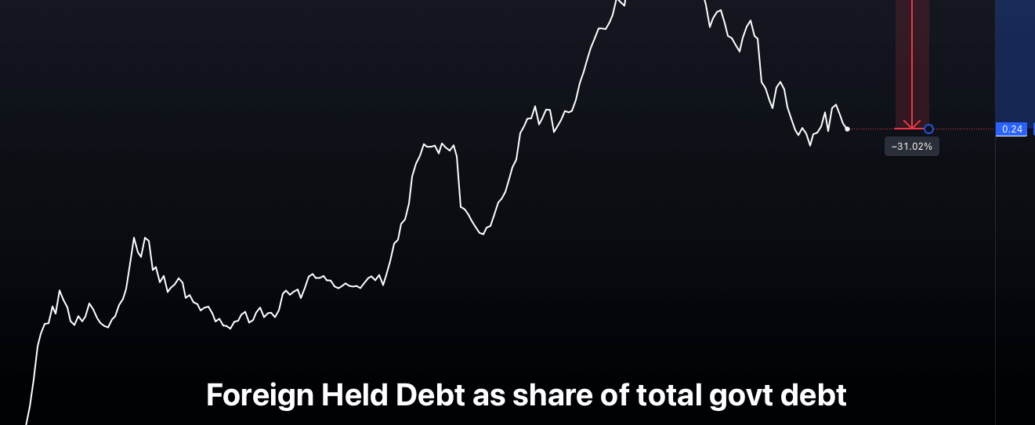
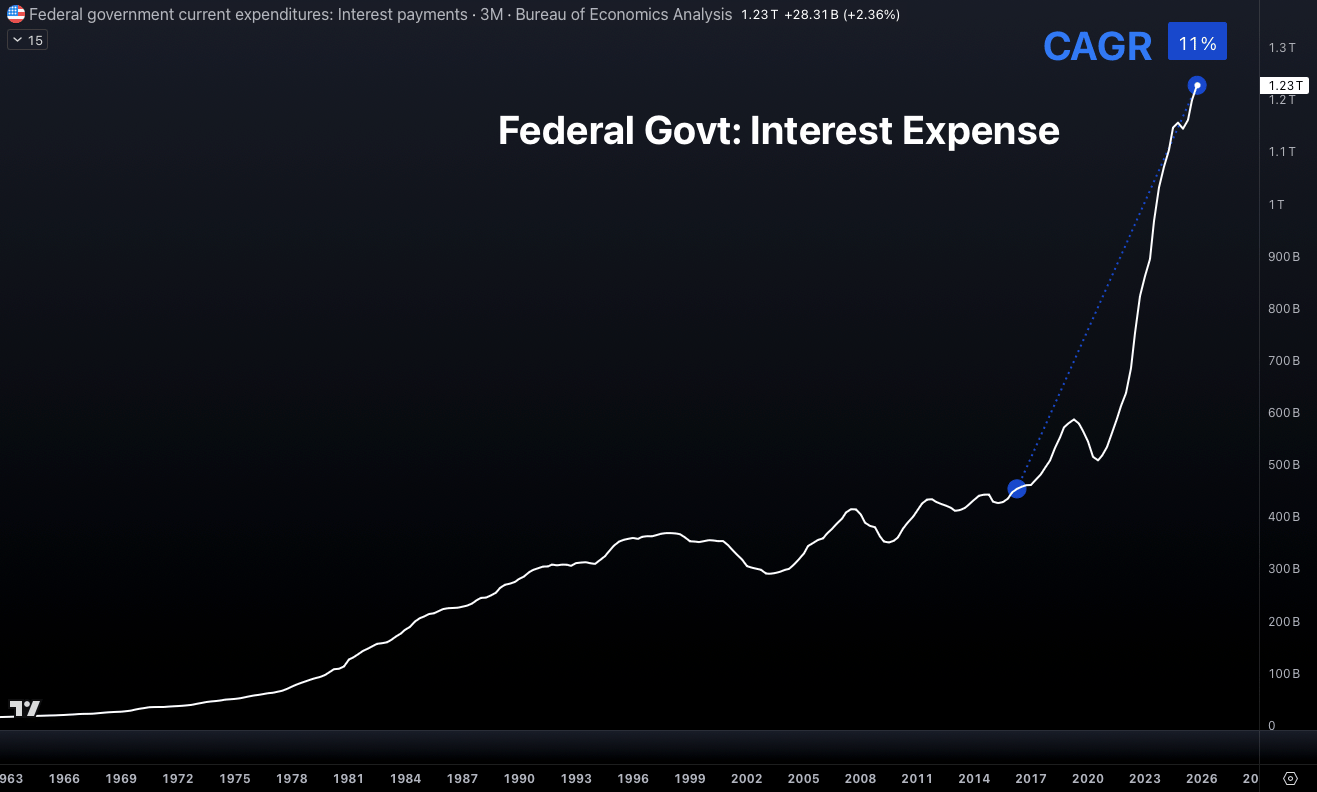
A dire warning was just issued by the man at the center of the US Government through the GFC. What’s the warning now?

A Dire Warning

Henry Paulson just broke years of radio silence with a serious warning. The man who managed the U.S. Treasury through the 2008 financial crisis is now saying the Treasury market itself is heading toward a vicious emergency.

“We need an emergency break-the-glass plan, which is targeted and short-term, on the shelf, so it’s ready to go when we hit the wall.”

We’re sitting on $39 trillion in federal debt, with interest expense now over $1.2 trillion per year and growing at a terrifying 17% compound annual growth rate over the past six years. That works out to about $3.5 billion per day.

Annual interest expense, with CAGR since 2020.

As interest costs soar, we do not raise taxes- instead, we just issue even more debt (increasing the federal fiscal deficit, or the gap between federal spending and revenue). As more debt supply is issued, if demand does not rise at a commensurate rate, the price must decline.

And according to Paulson, foreign demand for Treasuries is no longer something we can count on.

In fact, the share of government debt that’s held by foreign and international investors has been declining for 14 years:

Foreign held debt, …

Full story available on Benzinga.com

This post was originally published here
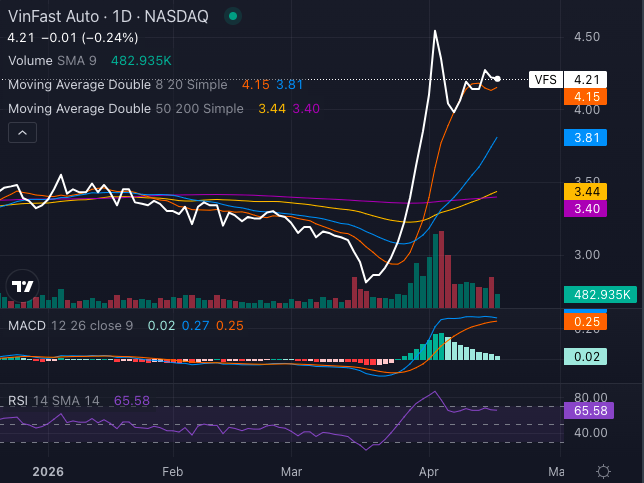
VinFast Auto Ltd. (NASDAQ:VFS) has flipped the script. After a sharp late-March rally that caught traders’ attention, the EV maker has now flashed a Golden Cross—a bullish technical signal that’s putting Tesla, Inc‘s (NASDAQ:TSLA) emerging Vietnamese rival firmly back on the radar.

Chart created using Benzinga Pro

Parabolic Move Sparks Breakout

The setup follows a near-parabolic surge between March 18 and early April, where VinFast stock climbed rapidly on heavy volume.

The move was driven by a mix of delivery momentum, expansion buzz in India and Southeast Asia, and a low-float, …

Full story available on Benzinga.com

This post was originally published here
Former Fed nominee Judy Shelton unloaded on Fed Chair Jerome Powell in a Sunday Wall Street Journal op-ed, branding the central bank’s 2% inflation target a policy of “intentional debasement” and invoking James Madison‘s view that a depreciating currency is unconstitutional because it erodes property rights.

The timing is not subtle.

Kevin Warsh, the man Trump actually nominated, faces the Senate Banking Committee on Tuesday with his path already bruised by the Justice Department’s inquiry into Powell’s testimony about Fed headquarters renovations.

The Op-Ed That Doubles As A Job Application

Shelton was technically supportive of Warsh, citing his past IMF remarks on central bank overreach.

But the bulk of the piece is her own pitch: gold-standard sympathies, skepticism of Fed discretion, and openness to currencies that could compete with the dollar.

She also took direct shots at Powell for 31% cumulative inflation since 2018 and for failing to apologize, let alone resign, for missing the Fed’s own targets. …

Full story available on Benzinga.com

This post was originally published here

John Oliver used Sunday’s “Last Week Tonight” to call prediction markets gambling sites with better lawyers, adding the loudest voice yet to a backlash already being waged by state AGs, Congress and the sportsbook industry.

What Oliver Said

Oliver framed Kalshi and Polymarket as gambling sites operating in states where gambling remains illegal, arguing their hedging pitch strains credibility when most users trade sports or political word markets.

He cited one analysis showing more than two-thirds of all winnings on Polymarket have been captured by just 740 accounts, despite the platform having over two million users.

Oliver also went after CNN, Fox News, CNBC and Wall Street Journal parent Dow Jones for paid partnerships that put Prediction Market odds on air during news coverage, singled out Donald Trump Jr.’s advisory roles at both companies, and criticized CFTC Commissioner Michael Selig for suing three states rather than letting courts decide whether prediction …

Full story available on Benzinga.com

This post was originally published here
BofA Securities analyst Omar Dessouky reiterated a Buy rating and a $705 price forecast for AppLovin Corp (NYSE:APP) in a note released on Monday. The firm identifies e-commerce as the primary “swing factor” for the company.

AppLovin is scheduled to report first-quarter earnings on May 6.

• AppLovin stock is trading in a tight range. What’s ahead for APP stock?

Gaming Drives Immediate Sequential Growth

Management continues to highlight mobile gaming as the main engine for first-quarter sequential growth. BofA expects gaming strength to carry the majority of the quarter’s expansion.

Investor first-quarter e-commerce expectations edged lower, with a ramp expected in referral cohort spending; gaming is likely to drive most quarter-over-quarter growth, the note said.

E-commerce Scaling In The Spotlight

Analysts are looking …

Full story available on Benzinga.com

This post was originally published here
XRP (CRYPTO: XRP) bulls are eyeing an $8 target as SBI Ripple Asia secured regulatory approval to issue prepaid payment tokens on the XRP Ledger, targeting Japan’s $200 billion prepaid market.

SBI’s Tokyo Approval

SBI Ripple Asia, the Tokyo joint venture between Ripple and Japanese banking giant SBI Holdings, became a registered third-party prepaid payment instrument issuer under Japan’s Payment Services Act on March 26. The platform went live in early April.

The platform turns prepaid balances into blockchain tokens issued on the XRP Ledger and backed by Japanese yen. 

Meanwhile, Tobu Top Tours, a major travel arm of Tobu Railway, will issue tourism payment tokens that travelers can load and spend across hotels, transport, and attractions.

Japan’s prepaid payment instruments handle around 30 trillion yen, roughly $200 billion, in annual volume.

Goldman’s $154 Million Position

Goldman Sachs (NYSE:GS) disclosed a $153.8 million position in spot XRP ETFs through its Q4 2025 13F …

Full story available on Benzinga.com

This post was originally published here
Ally Financial Inc (NYSE:ALLY) reported better-than-expected first-quarter financial results on Friday.

Ally Financial reported quarterly earnings of $1.11 per share which beat the analyst consensus estimate of 93 cents per share. The company reported quarterly sales of $2.179 billion which beat the analyst consensus estimate of $2.138 billion.

Ally Financial shares rose 2.1% to trade at $46.32 on Monday.

These analysts made changes to their price targets on Ally Financial following earnings announcement.

  • Barclays analyst Jason Goldberg maintained Ally Financial with …

Full story available on Benzinga.com

This post was originally published here

Tesla Inc. (NASDAQ:TSLA) is facing an international backlash over self-driving promises the carmaker made nearly a decade ago, with class actions now spanning California, Australia and a fresh European campaign.

The suits land two days before Tesla reports first-quarter earnings.

The latest front opened last week in the Netherlands, where a Dutch Tesla owner launched a campaign organizing European drivers who paid thousands for automated driving they still cannot access.

An Australian law firm is pursuing a parallel class action accusing Tesla of selling vehicles incapable of fully autonomous driving, while in California an 80-year-old retired attorney who paid $8,000 for Full Self-Driving in 2017 won class-action certification in September on behalf of roughly 3,000 Tesla owners seeking refunds.

The Hardware 3 Problem

At the center of each case is Hardware 3, the …

Full story available on Benzinga.com

This post was originally published here

Autoliv, Inc. (NYSE:ALV) on Friday reported upbeat first-quarter results.

The company reported first-quarter adjusted earnings per share of $2.05, beating the analyst consensus estimate of $1.89. Quarterly sales of $2.753 billion (+6.8% year over year) beat the Street view of $2.605 billion.

“Underlying profitability improved, with gross profit increasing by 10%, although adjusted operating income was slightly lower due to temporary lower R,D&E reimbursements and the one-time income in Q1 last year,” said CEO Mikael Bratt.

The company expects full-year 2026 organic sales growth to be around 0%, based on stable customer demand and no major macroeconomic or trade disruptions. Adjusted operating margin is projected …

Full story available on Benzinga.com

This post was originally published here

Badger Meter Inc (NYSE:BMI) on Friday reported weaker first-quarter results.

Sales dropped 9% to $202.3 million, missing estimates, while diluted EPS fell to 93 cents from $1.30, also below expectations.

“Our first quarter results were consistent with that expectation,” said CEO Kenneth C. Bockhorst. “In our view, the year-over-year decline in revenue and associated operating leverage are related to variability in project timing and short-cycle customer order patterns and do not reflect a change in underlying demand, our competitive position, or the long-term market drivers for our business.”

Seperately, Badger Meter also announced an agreement to acquire UK-based UDlive for $100 million plus contingent consideration, with closing expected by the end …

Full story available on Benzinga.com

This post was originally published here

Dynex Cap (NYSE:DX) held its first-quarter earnings conference call on Monday. Below is the complete transcript from the call.

Benzinga APIs provide real-time access to earnings call transcripts and financial data. Visit https://www.benzinga.com/apis/ to learn more.

Access the full call at https://event.webcasts.com/starthere.jsp?ei=1757721&tp_key=8f7976773d

Summary

Dynex Capital Inc reported a book value of $12.60 per share, with an economic return of negative 2.5% for the quarter, due to a decrease in book value and dividend payouts.

The company increased its total capital base by 18% during the quarter, deploying $442 million as MBS spreads widened, and improved book value post-quarter as spreads tightened.

Management emphasized strategic growth in capital markets, focusing on long-term shareholder value creation through disciplined portfolio and risk management.

Net interest income increased to $0.40 per share, driven by declining financing costs following Federal Reserve rate cuts, with expectations for expenses to normalize in the upcoming quarters.

The company is leveraging its scale as the third-largest agency-focused mortgage REIT, aiming for tighter mortgage spreads and highlighting its capacity for opportunistic capital allocation amid market volatility.

Dynex Capital Inc is optimistic about future spread tightening, supported by GSE mortgage buying and a supportive policy environment, and remains focused on delivering stable valuations and solid returns.

Full Transcript

Allison Griffin (Vice President of Investor Relations)

Thank you, operator and good morning everyone. The press release associated with today’s call was issued and filed with the SEC this morning, April 20th. You may view the press release on the homepage of the Dynex website at dynexcapital.com as well as on the SEC’s website at sec.gov before we begin, we wish to remind you that this conference call may contain forward looking statements within the meaning of the Private Securities Litigation Reform act of 1995. The words believe, expect, forecast, anticipate, estimate, project, plan and similar expressions identified forward looking statements that are inherently subject to risks and uncertainties, some of which cannot be predicted or quantified. The company’s actual results and timing of certain events could differ considerably from those projected and or contemplated by those forward looking statements as a result of unforeseen external factors or risks. For additional information on these factors or risks, please refer to our disclosures filed with the SEC, which may be found on the Dynex website under Investor as well as on the SEC’s website. This conference call is being broadcast live over the Internet with a streaming slide presentation which can be found through the webcast link on the website. The slide presentation may also be referenced on the Investors page. Joining me on the call today are Smriti Papano, Co Chief Executive Officer and President, Byron Boston, Chairman and Co Chief Executive Officer Mike Sartori, Chief Financial Officer and TJ Connolly, Chief Investment Officer. I now have the pleasure to turn the call over to Smriti.

Smriti Papano (Co Chief Executive Officer and President)

Thank you, Allison and good morning everyone. We continue to build our company at the intersection of two powerful demographic tailwinds, the need for income and the need for housing. Dynex continues to deliver differentiated top tier performance. Our track record now combined with the significant growth in our capital base over the last 15 months, propels value creation by delivering scale and resilience to our shareholders. The team is focused on methodically building durability across investments, finance, technology, risk and operations. Growing an enduring platform reinforces the value of our business meaningfully beyond the valuation of our balance sheet, further driving long term shareholder returns. Turning now to the global macroeconomic environment, government policy is squarely in the driver’s seat, defining and driving outcomes. Scenario planning for us has evolved to mapping policy pathways, what policymakers could do next, how markets may transmit those decisions and how we position ourselves for those moves. More than ever, mindset and preparedness are the key factors for successful decision making because the policy paths aren’t always foreseeable. Flexibility and openness in our team’s mindset, something we actively teach and practice, are now essential parts of navigating the investment landscape in the first quarter we added value by executing our plan. We managed the portfolio through a short burst of volatility which we used to opportunistically raise and deploy capital. We grew the total capital base by 18%, deploying the funds during the quarter as MBS spreads widened. Since quarter end, MBS spreads have tightened and book value is higher. Mike and TJ will now review the detailed quarterly results and our outlook.

Mike Sartori (Chief Financial Officer)

Thank you and good morning everyone joining us today! I’d like to begin by welcoming Kaelyn Mauritz who joins Dynex today to lead capital markets and investor relations. Kaelyn brings deep industry experience across both functions and her background will support the continued growth of our capital and investor base while also deepening the engagement with our existing investors. We are excited to add her capabilities to our strong and growing Dynex team. Turning now to our financial results for the quarter, book value ended the quarter at $12.60 per share and economic return was negative 2.5% for the quarter consisting of $0.51 per share of common dividends and an $0.85 per share decrease in book value. We ended the quarter with leverage of 8.6x versus total equity. The majority of the increase was attributable to the growth in our investment portfolio of $6 billion reflecting the deployment of capital raised during the quarter of $442 million. Our liquidity position remained very strong with $1.3 billion in cash and unencumbered securities at the end of the quarter representing over 46% of total equity. We continue to evaluate growth through the lens of market opportunity, investment returns and long term accretion to drive shareholder value. Net interest income for the quarter rose from $0.28 per share to $0.40 per share primarily due to declining financing costs which fell 33 basis points due to the impact of the Federal Reserve’s rate cuts in the fourth quarter with respect to expenses G&A increased quarter over quarter driven primarily by onetime items. As we noted in the prior first quarter earnings. We expect overall expenses to normalize in the second quarter with full year expense ratio anticipated to be flat or modestly lower versus year end as we grow our capital base. Importantly, we remain disciplined in managing cost. Our expense structure. With that, I’ll turn it over to TJ to provide additional detail on portfolio strategy and the outlook.

TJ Connolly (Chief Investment Officer)

Thanks, Mike. We entered the quarter with policy attention focused squarely on housing affordability and the mortgage market. As the quarter progressed, global events, most notably the war in Ukraine, shifted market focus toward geopolitics and drove a sharp increase in volatility. As markets become more accustomed to that global backdrop, we expect both investors and policymakers to refocus on domestic priorities over the balance of the year, particularly housing and the availability of mortgage credit, a transition we believe could support tighter mortgage spreads over time. Early in the quarter, mortgage markets benefited from a strong technical tailwind. Government policy, long one of our most important inputs, had turned supportive, with policymakers emphasizing GSE mortgage buying to tighten spreads and improve affordability. As volatility rose later in the quarter, agency mortgages traded like much riskier assets, creating potential opportunities. Because we operate with strong liquidity, we navigated that volatility constructively and selectively added assets as spreads widened to more attractive levels. Fundamentals and technicals remain highly supportive and we believe the long term path toward tighter equilibrium spreads remains highly likely boosted by policy supply, demand dynamics and yield carry. Net supply is light and demand remains broad and robust across banks, Real Estate Investment Trusts (REITs), money managers and foreign investors. Last quarter I noted that we expected net supply to be $200 billion this year. So far in 2026, it appears supply could come in even lower. Returning to the demand side, the potential bid from the Fannie Mae and Freddie Mac retained portfolios improves downside liquidity, stabilizes spreads during periods of volatility, and supports broader Investor participation. The GSEs have been actively buying mortgages. They are selective on valuation, they regularly retain pools they had previously been selling through their cash window programs and there was some question about potential hedging. They are mostly hedging using interest rate swaps in parallel. Proposed changes tied to the Basel III endgame could lower the capital cost banks face to hold mortgages both in loan and securitized form and to intermediate financing more efficiently. Financing costs are declining amid the light regulatory regime. Refill markets functioned smoothly, spreads were stable and funding was readily available even during periods of heightened volatility. MBS repo spread to sofr remained in the 13 to 17 basis point range, 3 to 5 basis points below last year’s averages. Structural improvements in the short term funding markets alongside elevated money market balances, standing Fed backstops and more efficient balance sheet intermediation continue to support financing for high quality mortgage assets like those Dynex owns, we have seen agency MBS spreads to 7 year interest rate swaps begin to trend tighter again after moving from the high 120s to nearly 170 basis points in March. Spreads were in the low 160s at quarter end and moved back toward the 150 area late last week. As geopolitical events evolve and policymakers …

Full story available on Benzinga.com

This post was originally published here

U.S. stocks traded mixed this morning, with the S&P 500 falling around 0.1% on Monday.

Following the market opening Monday, the Dow traded up 0.03% to 49,462.33 while the NASDAQ fell 0.21% to 24,417.97. The S&P 500 also fell, dropping, 0.08% to 7,120.57.

Leading and Lagging Sectors

Energy shares climbed by 0.8% on Monday.

In trading on Monday, consumer discretionary stocks fell by 0.9%.

Top Headline

Shares of Cleveland-Cliffs Inc (NYSE:CLF) fell more than 6% on Monday after the company reported results for the first quarter.

The company reported quarterly losses of 40 cents per share which missed the analyst consensus estimate of losses of 39 cents per share. The company reported quarterly sales of $4.922 billion which beat the analyst consensus estimate of $4.777 billion.

Equities Trading UP
           

  • Enveric Biosciences Inc (NASDAQ:ENVB) shares shot up 174% to $4.99 after President …

Full story available on Benzinga.com

This post was originally published here

U.S. stocks were lower, with the Nasdaq Composite falling around 100 points on Monday.

Shares of Nektar Therapeutics (NASDAQ:NKTR) rose sharply after the company announced results from a blinded 16-week treatment extension period in its Phase 2b REZOLVE-AA study.

The company said the REZOLVE-AA extension results demonstrated continued improvement in patients with severe-to-very-severe alopecia areata treated with rezpegaldesleukin, with responses strengthening over time across key SALT (Severity of Alopecia Tool) measures.

Nektar Therapeutics shares climbed 18.8% to $100.88 on Monday.

Here are some other big stocks recording gains in today’s session.

  • AEVEX Corp (NYSE:AVEX) shares jumped 40% to $37.70. The shares gained momentum from the recent debut of the company on the NYSE.
  • Compass Pathways PLC (NASDAQ:CMPS) gained 38.3% to $9.14 after President Donald Trump issued an executive order on Saturday instructing health regulators to hasten the review process of psychedelic drugs.
  • AtaiBeckley Inc (NASDAQ:ATAI) rose 30.6% to $5.26 after …

Full story available on Benzinga.com

This post was originally published here

SmartFinancial (NYSE:SMBK) released first-quarter financial results and hosted an earnings call on Monday. Read the complete transcript below.

This content is powered by Benzinga APIs. For comprehensive financial data and transcripts, visit https://www.benzinga.com/apis/.

The full earnings call is available at https://events.q4inc.com/attendee/980529382

Summary

SmartFinancial reported Q1 2026 operating earnings of $13.7 million, or $0.81 per diluted share, with total operating revenue of $53.8 million, showing growth from the previous quarter.

The company experienced 14% annualized loan growth and 7% annualized growth in core deposits, maintaining strong credit performance with low non-performing assets.

SmartFinancial’s net interest income increased to $45.9 million with a net interest margin improvement to 3.48%, supported by a reduction in funding costs.

The company adjusted its allowance for credit losses with a new model, resulting in a provisioning increase, and hired a new Director of Private Banking and Wealth Management.

Management expressed confidence in achieving a $4 EPS run rate by Q4 2026 and emphasized ongoing organic growth and strategic recruitment efforts, particularly in key markets like Nashville.

Full Transcript

Clare (Moderator)

Hello everyone and thank you for joining the SmartFinancial first quarter 2026 earnings release and Conference Call. My name is Clare and I’ll be coordinating your call today. During the presentation you can register a question by pressing STAR followed by one on your telephone keypad. If you change your mind, please press STAR followed by two on your telephone keypad. I will now hand over to Nate Strohl, Director of Investor Relations to begin. Please go ahead.

Nate Strohl (Director of Investor Relations)

Thanks Claire and good morning everyone and thank you for joining us for SmartFinancial’s first quarter 2026 earnings call. During today’s call we will reference the slides and press release that are available in the Investor Relations section on our website smartbank.com Billy Carroll, our president and CEO, will begin our call followed by Ron Gorzinski, our CFO will provide some additional commentary. We will be available to answer your questions at the end of our call. Our comments include forward looking statements. These statements are subject to risks and uncertainties and actual results could vary materially. We list the factors that might cause these results to differ materially in our press release and in our SEC filings which are available on our website. We do not assume any obligation to update any forward looking statements because of new information or early developments or otherwise, except as may be required by law. During the call we will reference non-GAAP financial measures related to the company’s performance. You may see the reconciliation of these measures in the appendices of the earnings release and investor presentation filed on April 20, 2026 with the SEC. And now I’ll turn it over to Billy Carroll to open our call.

Billy Carroll (President and Chief Executive Officer)

Thanks Nate and good morning everyone. Great to be with you and thank you for joining us today and for your interest and SmartBank. As usual, I’ll open up our call with some commentary and hand it over to Ron to walk through some numbers in greater detail. After our prepared comments, we’ll open it up with Ron, Nate, Rhett Miller and myself available for Q&A. It was a great start to the year for our company with another very busy quarter as we continue to execute on our strategy of leveraging the great foundation we’ve built over the last several years. Our team’s focus on this execution continues to be outstanding and this first quarter of 2026 was yet another example of that. So let me jump right into some of our highlights. First, and in my opinion one of the most important metrics we continue to increase the tangible book value of our company, which is now up to $27.33 per share, up from $26.86 at year end. For the quarter we posted operating earnings of $13.7 million or $0.81 per diluted share, with total operating revenue coming in at 53.8 million, higher than the 53.3 million in the prior quarter. Even with two fewer days, we continue to execute on outstanding growth on both sides of the balance sheet, posting 14% annualized growth in loans and 7% annualized growth in core deposits. Our history of strong credit continues with only 25 basis points in non performing assets. I’m very pleased with our credit performance and our extremely low level of non-performing assets and operating non interest expenses also came in on target at $32.9 million as we continue to exhibit expense discipline. Looking at the first few pages in the deck you’ll see our continuation of some very nice trends. We’re building a we’re building our return metrics and most importantly growing total revenue, earnings per share and tangible book value. All of those charts are great graphics to illustrate our execution. I’m looking forward to and expecting these trends to continue. So a couple of additional high level comments for me on growth. Our balance sheet expansion is a direct result of the focus of our sales teams. Our continued evolution as an outstanding organic growth company is one of the things I’ve been most proud of and I believe something that sets us apart from many other banks. We have hired well and we have built an outstanding process on prospecting and bringing in new client relationships. I would argue that we are in a top a small top of class group when it comes to pure organic growth. As I stated, we grew our loan book 14% annualized quarter over quarter as sales momentum stays strong and balanced across all of our regions. Our average portfolio yield including fees and accretion held up well at 6.02%. Regarding deposits, again, core deposits were up 7% annualized excluding when excluding brokered CD payoffs. Plus we absorbed a large seasonal withdrawal early in the year. So all in all a very nice deposit quarter. It’s important to recognize how we’re building this bank with core relationships as we have intense focus on both sides of the balance sheet. A couple of other highlights noted in our release Bullets included an allowance for credit loss model change that bumped their provisioning during the quarter. So we accomplished these results while adding an outsized provision adjustment with the new ACL model that better suits our company. Ron’s going to discuss this a little bit more in a moment. We also had a senior team addition with a new Director of Private Banking and Wealth Management from an in market regional bank that I believe is going to elevate this the work that we’re doing in this area even further. We don’t talk a lot about our wealth and investments platform, but this business line has steadily grown over the last several years as we’ve added some outstanding private bankers and new financial advisors. This focus on assisting high net worth clientele is becoming a great business driver for us and with our strategy we can go toe to toe with any regional or national player. So all in all a very nice way to start 2026. I’m going to stop there, hand it over to Ron and let him dive into some details.

Ron Gorzinski (Chief Financial Officer)

Ron thanks Billy and good morning everyone. I’ll start by highlighting some key deposit results during the quarter. Our momentum remains strong with non broker deposits increasing by 95 million driven by two factors, new deposit generation at a cost of 2.82% which was 22 basis higher than the previous quarter and seasonal inflows. Given the strength in core funding, we took the opportunity to pay down the remaining 52 million in broker deposits which carried an average rate of 4.35%. And as we noted on the last call, our year end totals included some transitory non-interest bearing deposits. As those deposits rolled off and put some and put and clients put some excess liquidity to work. Non interest bearing deposits were over 18% of total deposits at quarter end. Overall interest bearing deposits declined by 19 basis points to 2.60 and were 2.58% in March. We continue to maintain a robust liquidity profile as demonstrated by our loan-to-deposit ratio of 87%. Net Interest Income for the quarter was 45.9 million which was 782,000 higher than the previous quarter even though this quarter had two fewer days. Our Net Interest Margin also improved by 10 basis points to 3.48%. This increase was mainly driven by an 18 basis point reduction in funding costs which more than offset a 3 basis point decline in asset yields. The reduction in funding costs resulted from the full quarter effects of the prior quarter’s federal rate cuts, the previously mentioned paydowns of higher cost brokered funding and new deposit generation and CD renewals at lower rates. The decline in asset yields was caused by a 6 basis point reduction in loan yields mainly due to the impact of the rate cuts mentioned above and the pay downs and payoffs of higher rate loans. This reduction was slightly offset by our strategic utilization of balance sheet cash. The rate average yield on new loan production for the quarter was 6.40% and 6.45% for March. Looking forward, we anticipate that our margin will stabilize and remain relatively flat for the second quarter before increasing slightly in the second half of the year. Turning to credit, our provision expense for the quarter was 4.1 million, which includes 926,000 attributable to an increase in our unfunded commitments liability. As mentioned during the last earnings call, we’ve updated our Current Expected Credit Loss allowance model enabling broader capabilities such as economic forecasting tailored to loan segments and stronger qualitative adjustments. Details about this model update will be included in our first quarter 10-Q filing. Due to the changes in our modeling approach and quarterly activities, the allowance for credit losses increased to 44 million, representing 0.97% of total loans compared to 0.94% in the previous quarter and our liability for unfunded commitments totaled 4.5 million, up from 3.6 million. Looking forward, we anticipate that the allowance will remain within the 97.98basis point range contingent on prevailing market and credit conditions. Furthermore, our asset quality metrics remain robust with non-performing assets accounting for just 0.25% of total assets and net charge offs were limited to 2 basis points. Operating non interest income was 7.9 million, down slightly from the last quarter but exceeding expectations. Higher investment services fees offset lower mortgage banking and capital markets revenue which was lower primarily due to seasonality. Other income sources met or modestly surpassed expectations. Operating non interest expenses for the quarter increased slightly to 32.9 million, which was modestly below our guidance. Salary and benefit expenses were higher, mainly due to variable compensation on stronger than anticipated production as well as our annual merit increase adjustments that started in March. We also reduced our Federal Deposit Insurance Corporation insurance accrual by 275,000 this quarter, but expect this expense to return to normal levels in future periods. Our operating efficiency ratio for the first quarter remained around 60% plus level, showing our continued focus on improving margins and controlling costs. For the second quarter, non interest income is projected to be approximately 7.8 million and non interest expense is expected to be in the range of 34 to 34.5 million. Salary and benefit expenses are anticipated to range from 20.5 to 21 million, slightly elevated from …

Full story available on Benzinga.com

This post was originally published here

Palantir Technologies Inc. (NASDAQ:PLTR) shares are trading slightly lower Monday morning. The move comes as the company navigates a complex backdrop of geopolitical volatility and sharp ethical critiques regarding its defense sector involvement.

The Nasdaq is down 0.33% while the S&P 500 has shed 0.14%.

Geopolitical Tensions Fuel Defense Focus

Markets opened under pressure Monday as U.S.-Iran tensions flared over the weekend. President Donald Trump warned he would “knock out every single Power Plant and every single Bridge, in Iran” if terms were not met.

As oil prices surged over …

Full story available on Benzinga.com

This post was originally published here

Bitmine Immersion Technologies (NYSE:BMNR) purchased 101,627 Ethereum (CRYPTO: ETH) in the past week, bringing total holdings to 4.976 million ETH worth $11.45 billion as the stock tests channel breakout near $23.

The Highest Pace Since December

The weekly purchase represents the highest pace of buys since December 15, 2025.

Bitmine now owns 4.12% of Ethereum’s total supply of 120.7 million, making the company 82% of the way to its goal of owning 5% of the total supply.

“We see growing signs that the ‘mini-crypto’ winter is coming to an end,” said Chairman Tom Lee

“As downside tail risks for the U.S.-Iran war diminish, ETH has risen 41% from its early February lows,” he added.

ETH has outperformed the S&P 500 by 2,280 basis points …

Full story available on Benzinga.com

This post was originally published here

Nano X Imaging (NASDAQ:NNOX) held its fourth-quarter earnings conference call on Monday. Below is the complete transcript from the call.

This transcript is brought to you by Benzinga APIs. For real-time access to our entire catalog, please visit https://www.benzinga.com/apis/ for a consultation.

View the webcast at https://edge.media-server.com/mmc/p/gmk22fkx/

Summary

Nano X Imaging reported a GAAP net loss of $33.4 million for Q4 2025, an increase from the previous year, attributed largely to an impairment of long-lived assets and increased sales and marketing expenses.

The company signed agreements to deploy 300 Nanox ARC systems over three years with Howard Technology Solutions and additional agreements for 360 systems across multiple markets, indicating a strategic shift towards scaling business operations.

Revenue targets for 2026 are set at $35 million, with significant growth expected in the second half of the year as deployment and commercial agreements mature.

Operational restructuring in Korea is underway, including closing the chip manufacturing line and shifting to international manufacturing partners to reduce costs and improve efficiency.

Management changes include the departure of CFO Ron Daniel and the appointment of Guy Nettensome, aimed at bolstering financial leadership as the company scales operations.

Full Transcript

OPERATOR

Ladies and gentlemen, thank you for standing by. Welcome to the Nano X Imaging fourth quarter 2025 earnings call. At this time, all participants are in a listen only mode. After the speaker’s presentation, there will be a question and answer session. To ask a question during the session, you would need to press star 11 on your telephone. You would then hear an automated message advising that your hand is raised. And to withdraw your question, please press Star one one again. Please be advised that today’s conference is being recorded. I would like now to turn the conference over to Mike Cavanaugh, Investor Relations. Please go ahead.

Mike Cavanaugh (Investor Relations)

Good morning and welcome to the Nano X Imaging fourth quarter 2025 investor call. Earlier today, Nano X Imaging Limited released financial results for the quarter ending December 31, 2025. The release is currently available on the Investors section of the Company’s website. With me today are Erez Meltzer, Chief Executive Officer and Acting Chairman, and Ron Daniel, Chief Financial Officer. Before we get started, I would like to remind everyone that management will be making statements during this call that include forward looking statements regarding the Company’s financial results, research and development, manufacturing and commercialization activities, regulatory process and clinical activities, among other matters. These statements are subject to risks, uncertainties and assumptions that are based on management’s current expectations as of today and may not be updated in the future. Therefore, these statements should not be relied upon as representing the company’s views as of any subsequent date. Factors that may cause such a difference include, but are not limited to, those described in the Company’s filings with the securities and Exchange Commission. We will also refer to certain non GAAP financial measures to provide additional information to investors. A reconciliation of the non GAAP to GAAP measures is provided with our press release, with the primary differences being non GAAP net loss attributable to ordinary shares, non GAAP cost of revenue, non GAAP gross profit, non GAAP gross profit margin, non GAAP research and development expenses, non GAAP sales and marketing expenses, non GAAP general and administrative expenses, and non GAAP gross loss per share. With that, I’d now like to turn the call over to Erez Meltzer.

Erez Meltzer (Chief Executive Officer and Acting Chairman)

Thank you, Mike, and thank you all for joining us today. In the fourth quarter of 2025, we continued to move the business forward across multiple fronts. While our primary focus remains on expanding our commercial presence. Given the current geopolitical situation, we spent a lot of effort during the quarter and the beginning of 2026 to secure our supply chain and strengthen our financial positions as well. On top of that, we made good progress advancing the capabilities of Nano X’s platform and strengthening the operational infrastructure needed to support our long term growth. I’m happy to report that we recently entered into an agreement with Howard Technology Solutions, a division of Howard Industries, which has a national reach and an established presence in healthcare and public sector markets, providing us with a scalable framework for expanding nanox ARC deployment. This agreement reflects our confidence in the commercial demand for the Nano X ARC and our ability to engage partners that can support sustained growth in system placement across the US under the framework of this agreement, Howard is expected to deploy 300 Nanox arc systems over a three years period, of which 60 are indicated to be deployed in the first year. We also recently announced multiple commercial agreements which together accumulates to roughly 360 systems over a two to three years period. These partnerships expand our reach across imaging centers and specialty care settings where point of care imaging is integral to clinical workflow and patient management. This represents a fundamental shift in how we’re poised to scale our business from providing our technology to deploying in a meaningful volume, shifting toward a growing CAPEX portion. This is what we see as getting us closer to our indicated revenue of 2026. The framework has the potential to become a meaningful contributor over time and gives us confidence in our ability to convert our robust pipeline into revenue as we move forward. We view this as continued momentum and see ourselves moving closer to an inflection point. We observed a clear shift in the market perception at major radiology conferences including RSNA in the US and ECR in Europe, where engagement and inbound interest increased meaningfully. We have also taken important steps to strengthen our operational foundation. A key component of this initiative is the restructuring of certain activities in our Korean manufacturing facility in order to reduce our Korean operation, OPEX and cash burn and improve efficiency while maintaining our supply of nanox ARC system components. We are very pleased with the progress we have made recently, but it is clear that the pace of deployment continues to be influenced by various external processes including import licenses, construction timelines and regulatory requirements in certain markets. These steps take time to complete and while we are not setting time with the pace and would like to see deployments more faster, this reflects the current operating reality across multiple markets. We expect that many of these processes will be streamlined as additional sites move through the pipeline. Introducing new technology of any kind into a medical environment is always complex process. It requires alignment across clinical workflow, regulatory framework and operational infrastructure as well as changing behaviors which all takes time to achieve. While this can slow down the early stages of deployment, it is also a natural part of introducing innovative technology into the healthcare systems. Turning to revenues, we continue to target $35 million in revenue for the full year of 2026 based on the execution of our current plans. Today, as part of the above mentioned, we have signed commercial agreement which we believe could result in present and future placements of about 400 systems globally over the next 23 years. Of this, approximately 38 systems are currently at various stages of deployment, including demonstration, commercial installation and systems pending construction and or regulatory approval. In addition, There are approximately 15 systems that are expected to be installed over the next few months as part of our NAS imaging network. That said, it is important to emphasize that our current revenue base remains at an early stage and part of this deploy base is not generating revenues and the pace of REMPROP will depend primarily on on the timing of system activation, their transition into a revenue generating operation and the impact of the deployment by the business partners. As more systems move into operation and utilization increases, we expect revenue to build accordingly. However, the exact timing of this trend may vary and always depending on the deployment process and progress and our factors. I will now provide some additional color on the Korea restructuring that I referenced in my opening remarks. Recently we adopted a restructuring plan designed to better align our manufacturing cost structure with our long term financial model, support our path toward improved gross margin and align our manufacturing capabilities with the company’s strategic priorities. As part of this plan and our broader cost reduction efforts, we are closing our chip manufacturing line in South Korea, downsizing our fabrication facilities and shifting production to established international manufacturing partners including sisam, a Switzerland based manufacturing partner. We currently hold substantial amateur inventory which we plan to work through as we transition to a more efficient outsourced production model better aligned with current and projected demand. With these actions, we expect to reduce structural and overhead costs, lower our cash burn and enhance overall operation efficiency. With that overview, let’s now take a detailed look at at our various business segments starting with the US Deployment. Beyond the hardware agreement, we also recently announced a distribution agreement with Imperial Imaging Technology, a US based provider of diagnostic imaging solution, to support rollout across the Southeast, particularly in orthopedic focused environment where there is strong demand for a point of care imaging. In addition, we signed agreements with distributors such as Integrity Imaging, a US based provider of medical imaging solutions with established relationship across imaging centers and healthcare providers Elite Surgical, which serves surgical and specialty care environments Digital X Ray Imaging, a leading diagnostic imaging provider with deep regional present across Arkansas and most recently a collaboration with Nu dx, an imaging solution provider focused on expanding access to diagnostic imaging and radiology oncology system to support all to support the deployment of nanox ARC systems, these collaborations aim to strengthen our distribution capabilities by adding sales resources and on the ground present expands our geographic coverage and we believe it is the potential to become a meaningful contributor to revenues over time. In parallel, we remain in active discussion with additional partners reflecting continued interest from medical equipment providers and likely further expansion of our U.S. pipeline. Alongside our channel strategy, our U.S. direct sales team on the ground continues to make progress in targeted clinical segments. For example, we recently signed an agreement with Regional Sports Medicine in Orthopedic Group, our first orthopedic practice customer in the United States. This represents an important step into a segment where imaging plays a central role in diagnostic and treatment decisions and where providers benefit from having imaging available on site. Orthopedics remain a high volume and imaging driven specialty with a strong incentives to retain imaging in house. Additionally, we are advancing the nanox Imaging Network, a focused initiative designed to build a network based imaging services model in the US this initiative targets segments such as the workers compensation and specialized care reimbursement dynamics may support higher per scan pricing. We are currently deploying already systems across a number of sites in the U.S. under this model, Nanox support Nanox arc system deployment, maintenance and connectivity while our partners manage site operation and local engagement. While still in the very early stage, we believe this initiative can become an important component of our long term commercial strategy as utilization increases and the model is further validated. To provide additional context around this shift in engagement, were participated in two major industry events during the period at RSNA, the world’s largest annual radiology conference held in the U.S. our booth featuring live demonstration of the NanoPSR system saw strong interest throughout the event at the European Congress of Radiology, the largest radiology conference in Europe, we showedcases the nanox ARC live in Europe for the first time and presented new clinical and AI data. Engagement levels were high, reflecting growing awareness of the system’s clinical value and its potential role in routine imaging workflow. We were also proud to receive the Red Dot award for product design 226 for the Nanox ArcX prestigious international recognition that reflects the maturity, usability and clinical readiness of our platform. Let’s now turn to work outside of the U.S. as I mentioned earlier regarding ECR, we were also honored to receive …

Full story available on Benzinga.com

This post was originally published here

Oklo Inc. (NYSE:OKLO) shares are trading lower on Monday. The decline follows a period of intense volatility and a significant rally in the nuclear sector.

Nasdaq futures are down 0.29% while S&P 500 futures have shed 0.34%.

Investors Secure Gains After Rally

The primary driver for Monday’s slide appears to be profit-taking. The stock surged 43.39% over the last two weeks, rising from $46.59 on April 7.

Space Nuclear Theme Drives Sentiment

Recent momentum stemmed from CEO Jacob DeWitte’s comments regarding extraterrestrial energy.

Speaking to CNBC’s The Exchange on Thursday, DeWitte emphasized nuclear power’s role in space. “We work with nuclear power to enable everything that we do that’s cool in space,” DeWitte said.

Strategic Partnerships And Timelines

The Sam Altman-backed company …

Full story available on Benzinga.com

This post was originally published here
XRP (CRYPTO: XRP) and Dogecoin (CRYPTO: DOGE) have risen 7% and 4%, respectively, over the past week as broader cryptocurrency markets continue to test key resistance levels.

Traders remain cautiously optimistic about near-term momentum, though both assets are approaching technical inflection points.

XRP Flashes Bullish Signal

Crypto chart analyst Ali Martinez said XRP’s SuperTrend indicator has turned bullish on the daily chart for the first time since Jan. 17, suggesting a potential shift away from sustained selling pressure.

He identified $1.55 as a critical resistance level. A decisive daily close above that mark …

Full story available on Benzinga.com

This post was originally published here

Energy Focus Inc. (NASDAQ:EFOI) shares are retreating Monday morning.

The stock fell 12.17% in premarket action. This move follows a massive rally during Friday’s session.

Profit-Taking After Triple-Digit Surge

The decline appears to be driven by profit-taking. On Friday, the stock was halted on a circuit breaker.

It ended that session up a staggering 242.11%. Traders are now locked in gains after the exponential move.

Data Center Progress Fuels Volatility

Friday’s surge began after the energy-efficient lighting company outlined multi-year progress on data center infrastructure work. It specifically highlighted its …

Full story available on Benzinga.com

This post was originally published here
Cleveland-Cliffs (NYSE:CLF) released first-quarter financial results and hosted an earnings call on Monday. Read the complete transcript below.

This content is powered by Benzinga APIs. For comprehensive financial data and transcripts, visit https://www.benzinga.com/apis/.

View the webcast at https://event.choruscall.com/mediaframe/webcast.html?webcastid=3VsGPSh2

Summary

Cleveland-Cliffs reported a Q1 2026 adjusted EBITDA of $95 million, a significant $274 million increase from the previous year, driven by improved pricing.

The company noted a strong order book with increased demand from automotive OEMs, contributing to positive market conditions and extended production lead times.

Future outlook is optimistic with expected sequential improvements in Q2 and Q3, driven by higher shipments and pricing, alongside operational optimizations.

The company highlighted the impact of energy cost spikes on Q1 results but expects these costs to normalize moving forward.

Strategic initiatives include the Butler Works Electrical Steel expansion and a potential deal with Posco, although geopolitical factors may delay the latter.

Operational highlights include the idling of less efficient mills and the integration of AI into production processes to enhance decision-making.

Management expressed confidence in achieving strong free cash flow in the coming quarters, supported by asset sales and enhanced operational leverage.

Cleveland-Cliffs is actively engaged in labor negotiations with United Steelworkers, aiming for agreements that support competitiveness and sustainability.

Full Transcript

OPERATOR

Good morning ladies and gentlemen.

Kevin (Conference Facilitator)

My name is Kevin and I’m your conference facilitator. Today I’d like to welcome everyone to Cleveland-Cliffs first quarter 2026 earnings conference call. All lines have been placed on mute to prevent any background noise. After the speaker’s prepared remarks, there will be a question and answer session. The company reminds you that certain comments made on today’s call will include predictive statements that are intended to be made as forward looking within the safe harbor protections of the Private Security Litigation Reform act of 1995. Although the company believes that its forward looking statements are based on reasonable assumptions, such statements are subject to risks and uncertainties that could cause actual results to differ materially. Important factors that could cause results to differ materially are set forth in reports on Form 10K and 10Q and news releases filed with the SEC which are available on the Company website. Today’s conference call is also available and being broadcast at clevelandcliffs.com application. At the conclusion of the call, it will be archived on the website and available for replay. The Company will also discuss results excluding certain special items. Reconciliation for Regulation G purposes, can be found in the earnings release which was published this morning. At this time I’d like to introduce Lorenzo Goncalves, Chairman, President and Chief Executive Officer.

Lorenzo Goncalves (Chairman, President and Chief Executive Officer)

Thank you, Kevin and good morning everyone. The first quarter of 2026 was the beginning of a sustained improvement progression that will continue through the rest of the year. While Q1 results could be better, and they would be better if not for a couple of one timers, we can see the clear signs of a positive trend. For me, among these one timers, the impact of the spiking on energy costs was the Most relevant to Q1 results. Now to the good news. Our order book is full and the automotive OEMs are booking more and more steel from Cliffs. Production schedules are tight and lead times have moved out. Historically, pricing changes took about a month to flow through our realized numbers. Today, that lag is closer to two months. In practical terms, that means the pricing strength visible in the market today will increasingly show up in our results as we move through the year quarter by quarter. That combination, strong backlogs, disciplined production and visibility is what a healthy steel market looks like. The extended lead times allow us to optimize production schedules in our mills, improving our overall efficiency, productivity and costs. This market strength is driven by what is happening on the trade front. Steel imports into the United States are at their lowest levels since 2009. By now it’s clear that section 232 works. The melted and poured mandate works and the enforcement works along those lines. We are very encouraged by the recent changes in how derivative products tariffs are being enforced. Distribution transformers were added, which is exactly the right outcome. The Trump administration has given the domestic steel industry what we needed and have been asking for. Union jobs are being protected, domestic supply chains are more resilient and mills are running at higher utilization with real predictability. The one piece still missing is Canada. There’s a robust domestic market in Canada for our Canadian subsidiary Stelco to sell steel into. But the Canadian market is still oversupplied with steel from countries that are no longer able to dump their excess capacity into the United States. Because of that, they dump steel in Canada. That said, we are confident that Canada will ultimately get to the right place and enhance its own national security defenses against the negative impact of foreign steel causing the destruction of Canadian companies. We truly believe the Canadian government is honest about defending Canadian jobs and Canadian steel workers. We fully expect that Fortress North America can be and will be implemented by Canada because that’s totally within their own power. Canada does not depend on anyone else to do so. In Canadian, jobs are the ones at stake. The national security base for steel tariffs is being validated in real time. The war activity in Iran has disrupted global freight lanes, driven up energy prices and destabilized metal supply chains. Imported steel is now not only subject to tariffs, it is structurally more expensive due to transportation costs, energy volatility and geopolitical risk. And while this global uncertainty is exposing weaknesses elsewhere, it is strengthening the position of domestic steel producers like Cleveland Cliffs. Nowhere is that more evident than in aluminum. The aluminum industry has been hit repeatedly. Fires, power shortages, curtailments, geopolitical disruption and customers have taken notice of all that. Automotive OEMs are prioritizing supply, certainty, total costs and safety. Our Cliffs’ steel delivers all of that without the fragility embedded in aluminum supply chains. In my long career in this business, I have never seen so much momentum in substituting aluminum with steel. And automotive is not the only place where the shift from aluminum to steel is occurring. Building products, appliances and trucker and trailer sectors have been recently gravitating toward more steel use as well as we advance the use of our Cliffs’ steel being formed in equipment previously utilized exclusive for aluminum. Cleveland-Cliffs has demonstrated to our clients with real life results, the most potential benefit to market share gains from Alumina. We are also pleased to inform all of our stakeholders that in February, Cleveland-Cliffs received from our clients Toyota the Toyota Quality Excellence Award. Toyota does not hand out quality excellence awards lightly. Their standards are among the strictest in the world. quality excellence awards lightly. Their standards are among the strictest in the world. Winning that award is confirmation that our processes, consistency, execution and our overall quality are at the highest level for Toyota’s high standards. That strength has drawn attention from companies outside the United States. When we last spoke, we expected to achieve during the second quarter a mutually satisfactory transaction with Posco. In accordance with the Memorandum of Understanding signed by both companies last year. This goal remains achievable, but the current disruption in the Middle east and its impact on the country of South Korea have not helped accelerate the conclusion of our ongoing discussions. That said, our engagement with Posco is active and we still believe a deal can be completed within this time frame or slightly later. Our Department of Energy funded projects on this side, we continue to make solid progress. The Butler Works Electrical Steel expansion project is moving along as planned and remains on schedule for 2028 completion. Similarly, our Middletown Works project has received clear affirmation that the project will proceed once the updated scope is finally approved and we are now in the final stages of completing their work. The revised scope of the project reflects a modern blast furnace configuration that positioning Middletown among the most energy efficient in the world. Taken together, the Butler and Middletown projects underscore our disciplined approach to modernization, investing in critical infrastructure in a way that strengths domestic steelmaking improves efficiency and supports long term competitiveness. At the same time, we are continuing the footprint optimization actions we began last year at Burns Harbor. We are idling our smaller plate mill as we have successfully been able to consolidate all capabilities of the 110 inch mill into the 160 inch mill. This removes an inefficient line, improves utilization at the efficient 160 inch mill and strengths our cost performance without sacrificing any capability. We are also idling the Gary plate finishing line which is no longer needed. There will be no loss in overall steel production or layoffs as we will backfill those roles in areas where we have seen retiree attrition. We expect that these operational changes, coupled with the positive momentum we have been currently seeing in the plate market should enhance our earnings from the plate business on rare earths. We continue to analyze our potential on these critical minerals. That said, economics hinge on domestic refinement capability and today that infrastructure is extremely limited in the United States. Refinement is capital intensive and not something we intend to pursue ourselves. If and when viable domestic refinement infrastructure becomes available, either through government supported projects or third party investments, we see ourselves well positioned to take advantage of the opportunity we have also partnered with a leading and prominent AI provider to help us take a meaningful step forward in how we run the interface between operations and commercial, particularly by embedding AI into our production, planning and order entry processes. Their platform allows us to use machine learning models across our internal data to anticipate constraints optimizing, sequencing and making better decisions in real time rather than after the fact. Our people are good, but it is impossible to perfect these processes with humans running Excel spreadsheets. This initiative will ultimately move us from human experience driven planning toward a new and enhanced AI assisted decision making system that scales with the complexity of our operations. We expect to make a full announcement on our AI initiative, including the name of our partner in the next few weeks. One important milestone we will navigate in the coming months is the renegotiation of our labor agreement with United Steelworkers. Our employers are the backbone of this company and their skills, commitment and pride in what they produce are critical to our success in our evolving and increasingly capital intensive industry. We must ensure that the structure of our labor agreements supports competitiveness, flexibility and long term sustainability. We approach these discussions with respect and realism with the goal of reaching an agreement that rewards our workforce while strengthening the company’s ability to invest, grow and remain a strong employer for decades to come. This process represents a meaningful opportunity for both Cleveland Cliffs management team and our union workforce to demonstrate the depth and strength of our partnership and we will not disappoint anyone with that. I’ll turn it over to our CFO Celso Gonçalves to go over our financial results.

Celso Goncalves (Chief Financial Officer)

Thank you. Good morning everyone. Our adjusted EBITDA in The quarter was 95 million dollars, a 274 million dollar increase from a year ago due primarily to increased pricing. Starting with the top line first quarter shipments totaled just over 4.1 million tons, which represents a recovery of more than 300,000 tons sequentially. That improvement was driven by better demand conditions across spot and trade channels and by a more stable operating cadence. Coming out of the fourth quarter we were still impacted by weather related disruptions, but volume strengthened as the quarter progressed. Shipments should increase further into Q2 as this trend continues. That volume recovery is critical because of the fixed cost nature of our business. Every incremental ton we produce and ship has a disproportionate impact on margins. The operating leverage embedded in integrated steelmaking remains substantial. Pricing also moved in the right direction. Average selling prices increased by $68 per ton from a year ago and sequentially by $55 per ton during the quarter reflecting improving market conditions and better automotive pull. This came in slightly below our original estimate as contractual lags were longer than anticipated based on customers ordering at max levels. As mentioned earlier by Lorenzo, what used to be roughly a one month realization lag has effectively extended to closer to two months as our order book has filled and schedules have stretched. That means price strength visible today will will show up more fully in Q2 and Q3 results. In the US about 45% of our sales are linked to the commodity HRC price. The remainder are under fixed price arrangements like in automotive or linked to other indices like we have with plate in Canada. Effectively all shipments …

Full story available on Benzinga.com

This post was originally published here

Strategy Inc. (NASDAQ:MSTR) has purchased of 34,164 Bitcoin (CRYPTO: BTC) for $2.54 billion at an average price of $74,395 between April 13 and April 19.

The Third-Largest Purchase

Strategy’s latest acquisition brings total holdings to 815,061 BTC, acquired for approximately $61.56 billion at an average cost basis of $75,527. 

With Bitcoin trading around $75,000, the position sits roughly breakeven.

The purchase ranks as Strategy’s third-largest on record and the biggest weekly acquisition since November 2024. 

Michael Saylor gave his usual Sunday hint ahead of the announcement, sharing an update on Strategy’s Bitcoin acquisition tracker and stating “Think even bigger,” suggesting a more substantial purchase than the prior week’s 13,927 BTC.

How It Was Funded

The acquisitions were funded by $2.17 billion raised through sales of the company’s preferred stock STRC and $366 …

Full story available on Benzinga.com

This post was originally published here
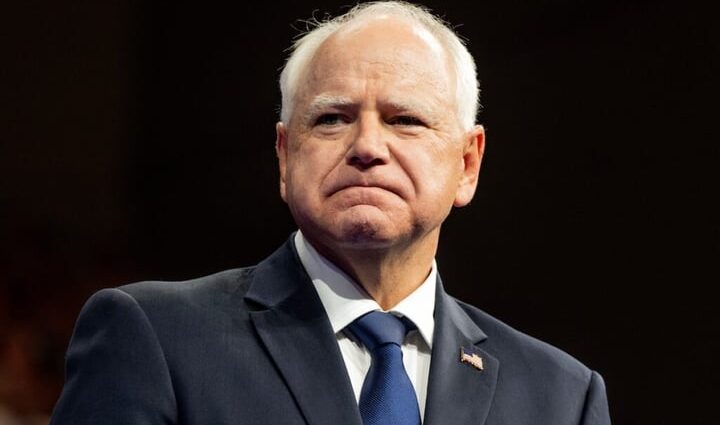
The economic fallout from the U.S.-Iran war is proving more stubborn than the conflict itself, with economists warning that a wave of inflation will persist long after the fighting stops, the Financial Times reported Sunday.

Prices Already Climbing

U.S. inflation jumped to 3.3 % in March, its highest level in two years, driven largely by surging fuel costs, according to the Bureau of Labor Statistics. Petrol prices have climbed from $2.98 per gallon when the conflict began in late February to $4.08 on Friday, according to the AAA motoring group. Diesel has surged from $3.76 to $5.59 a gallon, approaching its 2022 record.

“We were on a very good trajectory of inflation going down. Now there is somewhat a reversal,” IMF Managing Director Kristalina Georgieva told the FT, warning the fallout would not “evaporate overnight even if the war ends tomorrow.”

Second-Order Effects Mounting

Iran’s closure of the Strait of Hormuz, through which a fifth of global oil supply typically transits, triggered the energy shock. Brent crude surged from around …

Full story available on Benzinga.com

This post was originally published here

Shares of Enveric BioSciences (NASDAQ:ENVB) added over 92% in the premarket trading session on Monday. AtaiBeckley Inc (NASDAQ:ATAI) surged by 28.1%, while Compass Pathways (NASDAQ:CMPS) and Definium Therapeutics (NASDAQ:DFTX) saw their shares ascend by 26.1% and 14.6%, respectively, after President Donald Trump issued an executive order on Saturday instructing health regulators to hasten the review process of psychedelic drugs.

Other companies in the sector also reaped benefits. GH Research (NASDAQ:GHRS) shares rose by 17.23%.

This post was originally published here
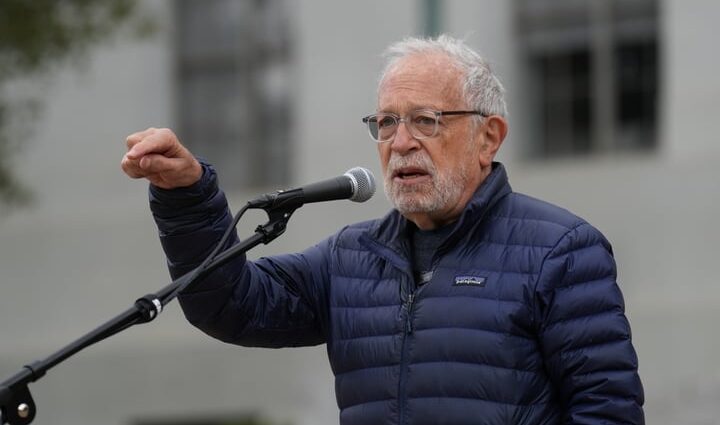
Oracle Corp (NYSE:ORCL) shares traded lower Monday morning. Nasdaq futures are down 0.44% while S&P 500 futures have shed 0.47%.

The decline follows a volatile period for the software giant. Investors are weighing massive capital spending against renewed Middle East concerns.

Geopolitical Tensions Weigh On Markets

U.S. stock futures retreated early Monday. A weekend surge in U.S.-Iran tensions rattled investor confidence.

Iran restricted vessel traffic through the Strait of Hormuz again on Saturday.

President Donald Trump warned Sunday of potential strikes on Iranian infrastructure if terms are not met. Oil prices soared over 6% in response.

Infrastructure Costs and Job Cuts

Investors remain cautious …

Full story available on Benzinga.com

This post was originally published here

The most oversold stocks in the energy sector presents an opportunity to buy into undervalued companies.

The RSI is a momentum indicator, which compares a stock’s strength on days when prices go up to its strength on days when prices go down. When compared to a stock’s price action, it can give traders a better sense of how a stock may perform in the short term. An asset is typically considered oversold when the RSI is below 30, according to Benzinga Pro.

Here’s the latest list of major oversold players in this sector, having an RSI near or below 30.

Peabody Energy Corp (NYSE:BTU)

  • On March 31, UBS analyst George Eadie maintained Peabody Energy with a Neutral and lowered the price target from $36.5 to $35.5. The company’s stock fell around 32% over the past month and has a 52-week low …

Full story available on Benzinga.com

This post was originally published here
TORONTO, April 20, 2026 /CNW/ –  Dynamic today announced the April 2026 cash distributions for the Dynamic Active ETFs and ETF series units of certain Dynamic funds (ETF Series) listed on the TSX, which pay on a monthly basis. Unitholders of record on April 27, 2026, will receive cash distributions for the respective Dynamic Active ETFs and ETF Series payable on April 30, 2026. The details of the cash distribution amounts per unit are as follows:

Dynamic Active ETF and ETF Series

Ticker 
symbol 

Cash 
distribution 
per unit ($) 

Distribution 
frequency 

Dynamic Active Bond ETF

DXBB

0.070

Monthly

Dynamic Active Canadian Bond ETF

DXBC

0.070

Monthly

Dynamic Active Canadian Dividend ETF

DXC

0.082

Monthly

Dynamic Active Corporate Bond ETF

DXCB

0.077

Monthly

Full story available on Benzinga.com

This post was originally published here

The debate over Bitcoin (CRYPTO: BTC) and corporate treasury strategies misses a larger development, according to Bitwise advisor Jeff Park: new financial instruments like (NASDAQ:STRC) may signal a structural shift in how corporate finance operates.

STRC Introduces Semi-Monthly Dividends

Park highlighted Strategy’s (NASDAQ:MSTR) proposed STRC structure, which would pay semi-monthly dividends instead of the traditional semi-annual or monthly schedules seen in most corporate debt instruments.

He said the change reflects a broader shift in investor behavior, where market participants increasingly prefer more frequent payouts. Faster distribution cycles, …

Full story available on Benzinga.com

This post was originally published here

While Tesla Inc. (NASDAQ:TSLA) reported a zero-dollar federal tax bill for 2025, findings have revealed another significant source of tax savings for the company.

Over the past two decades, Tesla has reported little to no U.S. federal tax liability in most years, largely due to deductions from prior losses and incentives tied to clean energy tax credits, Reuters reported.

However, a review of Tesla’s corporate filings by the publication revealed another significant source of savings. Tesla’s subsidiaries in the Netherlands and Singapore reported $18 billion in untaxed profits. If not for profit shifting, a financial strategy that reallocates earnings across jurisdictions, these profits would likely have been declared and taxed in the U.S., which could have resulted in Tesla paying over $400 million more in U.S. taxes, the report said.

Regulatory filings in Singapore show that Tesla Motors Singapore Holdings received approximately $18 billion in profits between 2023 and early 2025 from TM International, a Dutch subsidiary of which it owns more than 99%.

TM International is registered in the Netherlands as a non-resident partnership. According to Dutch registry records, it has no employees …

Full story available on Benzinga.com

This post was originally published here

GE Aerospace (NYSE:GE) will release earnings for its first quarter before the opening bell on Tuesday, April 21.

Analysts expect the company to report quarterly earnings of $1.60 per share, up from $1.49 per share in the year-ago period. The consensus estimate for GE Aerospace’s quarterly revenue is $10.72 billion (it reported $9 billion last year), according to Benzinga Pro.

Ahead of quarterly earnings, Citigroup analyst John Godyn, on April 2, maintained a Buy rating on GE Aerospace and lowered the price target from $380 to $353.

With the recent buzz around GE Aerospace, some investors may be eyeing potential gains from the company’s dividends, too. As of now, GE Aerospace has an annual dividend yield of 0.62%, with a quarterly dividend of 47 cents per share ($1.88 per year).  

So, how can investors exploit its dividend yield …

Full story available on Benzinga.com

This post was originally published here

Top Wall Street analysts changed their outlook on these top names. For a complete view of all analyst rating changes, including upgrades and downgrades, please see our analyst ratings page.

  • Truist Securities cut the price target for Doximity Inc (NASDAQ:DOCS) from $37 to $29. Truist Securities analyst Jailendra Singh downgraded the stock from Buy to Hold. Doximity shares closed at $24.71 on Friday. See how other analysts view this stock.
  • Stifel raised Plexus Corp (NASDAQ:PLXS) price target from $200 to $250. Stifel analyst Ruben Roy upgraded the stock from Hold to Buy. Plexus shares closed at $228.64 on Friday. See how other analysts view this stock.
  • Needham raised price target for Cadence Design Systems Inc (NASDAQ:CDNS) from $390 to $400. Needham analyst Charles Shi maintained a Buy rating. Cadence Design shares closed at $311.03 on Friday. See how other analysts view this stock.
  • Mizuho slashed the price target for Skyworks Solutions Inc

Full story available on Benzinga.com

This post was originally published here

U.S. stock futures were lower this morning, with the Dow futures falling around 250 points on Monday.

Shares of AST SpaceMobile Inc (NASDAQ:ASTS) fell sharply in pre-market trading after the company said its BlueBird 7 satellite, launched aboard the New Glenn launch vehicle, was placed into a lower-than-planned orbit during the New Glenn 3 mission.

Although the satellite separated and powered on, the altitude is too low for sustained operations, and it will be de-orbited. The company expects to recover the satellite’s cost through insurance.

AST SpaceMobile shares dipped 13.5% to $73.95 in pre-market trading.

Here are some other stocks moving lower in pre-market trading.

  • SBC Medical Group Holdings Inc (NASDAQ:SBC) fell 35.4% to $2.90 in pre-market trading after the company announced pricing of secondary public offering of 3.1 million shares of common stock.
  • Matrix Service Co (NASDAQ:MTRX) declined …

Full story available on Benzinga.com

This post was originally published here

On CNBC’s “Halftime Report Final Trades,” Stephen Weiss, chief investment officer and managing partner of Short Hills Capital Partners, named Netflix, Inc. (NASDAQ:NFLX) as his final trade.

On the earnings front, Netflix, on Thursday, reported better-than-expected financial results for the first quarter of 2026. The company issued a weak forecast for the second quarter and announced that chairman and co-founder Reed Hastings will not stand for re-election to the board when his term expires in June.

Jason Snipe, founder and chief investment officer of Odyssey Capital Advisors, said he likes BlackRock, Inc. (NYSE:BLK).

Lending support to her choice, BlackRock, on April 14, reported first-quarter fiscal 2026 …

Full story available on Benzinga.com

This post was originally published here

LanzaTech Global, Inc. (NASDAQ:LNZA) shares are falling on Monday. The stock continues a 37.13% selloff from Friday.

Auditor Dismissal Sparks Concern

The decline follows a Friday U.S. Securities and Exchange Commission filing. LanzaTech dismissed Deloitte & Touche LLP as its independent accounting firm.

The Board approved the move on April 10. BDO USA, P.C. will take over for the 2026 fiscal year.

Going Concern Disclosures

Internal reports raise red flags for investors. Deloitte’s previous audits contained an “explanatory paragraph regarding substantial doubt about the Company’s ability to continue as a going concern.”

The firm also identified material weaknesses in internal controls. These are related to revenue recognition …

Full story available on Benzinga.com

This post was originally published here

Top Wall Street analysts changed their outlook on these top names. For a complete view of all analyst rating changes, including upgrades, downgrades and initiations, please see our analyst ratings page.

  • Goldman Sachs analyst John Mackay upgraded Williams Companies Inc (NYSE:WMB) from Neutral to Buy and announced a price target of $82. Williams Companies shares closed at $71.15 on Friday. See how other analysts view this stock.
  • Stifel analyst Ruben Roy upgraded Plexus Corp (NASDAQ:PLXS) from Hold to Buy …

Full story available on Benzinga.com

This post was originally published here

Bitcoin (CRYPTO: BTC) spot ETFs posted $996.4 million in net inflows last week, the largest weekly total since mid-January, bringing positive flows to three consecutive weeks.

BlackRock And Morgan Stanley Lead Inflows

BlackRock’s IBIT (NASDAQ:IBIT) led weekly inflows with $906 million. Morgan Stanley’s MSBT (NYSE:MSBT) logged $71 million in its first full trading week since launching April 8.

Over the past three weeks, the funds have drawn in more than $1.8 billion. 

Meanwhile, spot Ethereum (CRYPTO: ETH) ETFs also posted their highest weekly net inflows since January 16, worth $275.8 million.

The Iran Peace Angle

Institutional investors believe a permanent de-escalation in tensions between the U.S. and Iran is imminent and are increasing their …

Full story available on Benzinga.com

This post was originally published here

Ethereum (CRYPTO: ETH) ETFs recorded $276 million in net inflows last week, yet prominent crypto trader Ansem warns the $300 billion asset could target $1,300 if the downtrend continues.

The Bear Case Building

Ansem laid out a multi-pronged case against Ethereum. Solana (CRYPTO: SOL) dominated retail activity this cycle, Hyperliquid (CRYPTO: HYPE) dominated perps activity, and rollups still lack significant  traction. 

Moreover, Vitalik Buterin publicly abandoned the general usage rollup thesis.

Ethereum’s main value proposition has been safety and security of DeFi and institutional interest. 

However, the current Aave (CRYPTO: AAVE) situation marks that value proposition and has the possibility to continue weakening confidence.

“ETH in 2026 is in worse spot than it was in 2023, amplified by AI doing extremely well and tech stocks being much more favorable investments with …

Full story available on Benzinga.com

This post was originally published here

Alaska Air Group, Inc. (NYSE:ALK) will release earnings for its first quarter after the closing bell on Monday, April 20.

Analysts expect the Seattle, Washington-based company to report a quarterly loss of $1.55 per share, compared to a loss of 77 cents per share in the year-ago period. The consensus estimate for Alaska Air’s quarterly revenue is $3.29 billion (it reported $3.14 billion last year), according to Benzinga Pro.

On March 30, Alaska Airlines announced the election of Lindsay-Rae McIntyre to chief people officer.

Shares of Alaska Air jumped 10.3% to close at $45.40 on Friday.

Benzinga readers can access the latest analyst ratings on the Analyst Stock Ratings page. Readers can sort by stock ticker, company name, analyst firm, rating change or other variables.

Let’s have a look at how Benzinga’s most-accurate …

Full story available on Benzinga.com

This post was originally published here
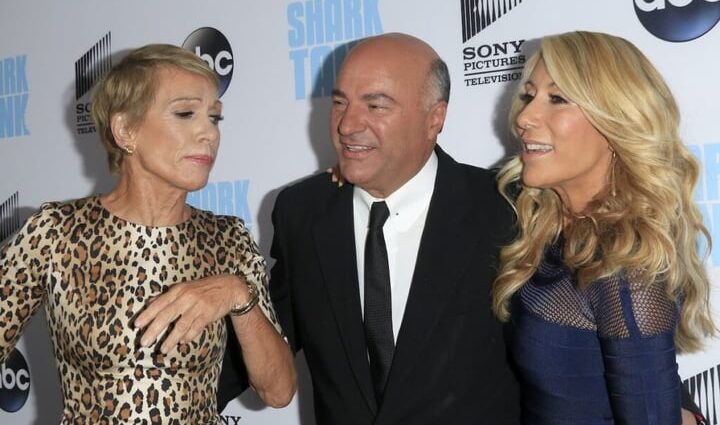
Bitcoin is holding near $75,000, following $663.9 million in net inflows into Bitcoin ETFs on Friday, while Ethereum ETFs reported $127.5 million in net inflows.  

Cryptocurrency Ticker Price
Bitcoin (CRYPTO: BTC) $75,128
Ethereum (CRYPTO: ETH) $2,306
Solana (CRYPTO: SOL) $85.00
XRP (CRYPTO: XRP) $1.42
Dogecoin (CRYPTO: DOGE) $0.09468
Shiba Inu (CRYPTO: SHIB) $0.056008

Meme coin market capitalization is trading relatively flat with a 0.5% drop over …

Full story available on Benzinga.com

This post was originally published here

Mark Benioff, CEO of Salesforce Inc. (NYSE:CRM), refuted the “software bears” who predict a bleak future for the software industry.

Benioff’s rebuttal on X, on Monday, comes amid the impressive performance by Agentforce at Pearson and PenFed. At Pearson, Agentforce has been autonomously managing order statuses, refunds, and lost access codes, leading to a 40% increase in customer queries resolved without human intervention, as reported by Pearson’s VP, Gabriele Bauman.

Similarly, at PenFed, Agentforce has been instrumental in handling password resets and account unlocks for employees, resulting in a 40% reduction in total IT tickets, according to Shree Reddy, EVP & CIO at PenFed.

Benioff underscored …

Full story available on Benzinga.com

This post was originally published here

U.S. stocks settled higher on Friday, with the S&P 500 recording the first close above the 7,100 level after Iran announced the full reopening of the Strait of Hormuz for commercial vessels.

Stocks also recorded sharp gains last week, with the blue-chip Dow adding 3.2% and the S&P 500 surging 4.5%.

Wall Street analysts make new stock picks on a daily basis. Unfortunately for investors, not all analysts have particularly impressive track records at predicting market movements. Even when it comes to one single stock, analyst ratings and price targets can vary widely, leaving investors confused about which analyst’s opinion to trust.

Benzinga’s Analyst Ratings API is a collection of the highest-quality stock ratings curated by the Benzinga news desk via direct partnerships with major sell-side banks. Benzinga displays overnight ratings changes on a daily basis three hours prior to the U.S. equity market opening. Data specialists at investment dashboard provider Toggle.ai recently uncovered that the analyst insights Benzinga Pro subscribers and Benzinga readers regularly receive can successfully be used as trading indicators to outperform the stock market.

Top Analyst Picks: Fortunately, any Benzinga reader can access the latest analyst ratings on the Analyst Stock …

Full story available on Benzinga.com

This post was originally published here
Steel Dynamics, Inc. (NASDAQ:STLD) will release earnings for its first quarter after the closing bell on Monday, April 20.

Analysts expect the Fort Wayne, Indiana-based company to report quarterly earnings of $2.79 per share. That’s up from $1.44 per share in the year-ago period. The consensus estimate for Steel Dynamics’s quarterly revenue is $5.06 billion (it reported $4.37 billion last year), according to Benzinga Pro.


On March 17, Steel Dynamics issued first quarter earnings guidance in the range of $2.73 to $2.77 per share.

Shares of Steel Dynamics jumped 2.3% to close at $200.32 on Friday.

Benzinga readers can access the latest analyst ratings on the Analyst Stock Ratings page. Readers can sort by stock ticker, company name, analyst firm, rating change or other variables.

Let’s have a look at how Benzinga’s most-accurate

Full story available on Benzinga.com

This post was originally published here

Prediction market giant Polymarket is exploring a capital raise, valuing it at around $15 billion, according to a report published Sunday.

New Funding Secured?

The cryptocurrency-based platform is in talks to raise $400 million in new funding, The Information reported, citing sources familiar with the matter.

Benzinga reached out to Polymarket to confirm the capital raise. The article will be updated once they respond.

Polymarket Trails Kalshi

The report comes after Intercontinental …

Full story available on Benzinga.com

This post was originally published here

BlackBerry Limited (NYSE:BB) stock saw a sharp surge in its momentum score, jumping from 14.91 to 36.14 on a week-over-week basis.

A momentum score is a measure that shows how strongly a stock is trending based on recent price and trading volume changes, reflecting the current strength of its upward or downward movement.

QNX Revenue Diversification Beyond The Automotive Sector

BlackBerry targeted double-digit revenue growth in fiscal 2027, driven by its QNX real-time operating system, as it expanded the software beyond its automotive roots into AI and robotics markets, reported The Wall Street Journal.

The company had said that about 20% of QNX revenue came from outside the automotive sector.

CEO John Giamatteo expects further growth as robotics and AI-driven machines increasingly require real-time, safety-certified software.

BlackBerry, once known for its smartphones, had shifted into a software and cybersecurity company, with its QNX platform powering critical systems in cars, medical devices and industrial robotics.

Giamatteo said the technology was being integrated into …

Full story available on Benzinga.com

This post was originally published here

The war with Iran is pushing the United States toward an unexpected milestone – becoming a net crude exporter for the first time since World War II.

In the week ending April 10, U.S. net crude imports narrowed to just 66,000 barrels per day, as exports jumped to 5.2 million. According to Reuters, it was a seven-month high for exports. Meanwhile, the U.S. has not been an exporter on an annual basis since 1943.

However, the recent shift is not a domestic production story; it is a geopolitical one. With the Strait of Hormuz, a route that handles about a fifth of global oil and gas supply, de facto closed, European and Asian refiners are forced to look elsewhere. Thus, the U.S. has emerged as one of the clearest beneficiaries.

Around 47% of April’s U.S crude exports headed to Europe, while 37% went to Asia – up from 30% a year ago, Kpler ship tracking showed. Top buyers included the Netherlands, Japan, France, Germany, and South Korea. Greece has reportedly bought U.S. crude for the first time in recent months.

“Atlantic Basin and Asian buyers are reaching further out for available supply,” Rystad vice president of oil markets, Janiv Shah, …

Full story available on Benzinga.com

This post was originally published here

Governor Tim Walz (D-Minn) on Sunday accused President Donald Trump of insider trading as oil prices surged following the closure of the Strait of Hormuz.

How Much Will Trump Make?

In a post on the social media platform X, Walz quoted a post by CNBC, which said that oil prices surged 7% after tensions escalated between Tehran and Washington. “So how much will the Trump family make in the stock market tomorrow morning?” Walz asked in the post.

The speculation comes as Rep. Sam Liccardo (D-Calif.), in a letter to Securities and Exchange Commission Chair Paul Atkins, shared that a number of trades made during the war pointed towards the investors having advanced knowledge of key policy decisions.

Walz had also flagged similar concerns in the …

Full story available on Benzinga.com

This post was originally published here

Autonomous vehicles are touted by many to be the next big thing in the auto industry, with companies like Alphabet Inc. (NASDAQ:GOOGL) (NASDAQ:GOOG), Nvidia Corp. (NASDAQ:NVDA), Amazon.com Inc. (NASDAQ:AMZN), as well as Tesla Inc. (NASDAQ:TSLA) emerging as some of the big players in the sector.

However, with the advent of self-driving cars and a favorable regulatory environment, concerns surrounding the technology, particularly with Tesla and Elon Musk‘s Full Self-Driving (FSD) system, still worry The Dawn Project founder Dan O’Dowd, who recently spoke to Benzinga about the AV sector in the U.S.

Tesla’s HW3 System Woes

O’Dowd, a staunch critic of Tesla’s FSD tech, shared that The Dawn Project had run tests on 2023 Model 3 sedans with one megapixel cameras, calling the setup “pretty ancient,” adding that during the nighttime test, the testers “couldn’t read the letters for 20/20 [vision]” nor could they discern the letters with 20/40 vision either. The cameras caught the chart with 20/60 vision, O’Dowd said.

20/60 vision means that for what a regular person can see from 60 feet away, an affected person can see the object clearly from a distance of 20 feet, which could indicate mild to moderate vision impairment.

“The law says you have to have 20/40 vision to drive a car. So it’s legally blind by the California Department of Motor Vehicles definition,” O’Dowd said, adding that the system wasn’t “safe enough” to be on the roads. California’s DMV guidelines require the ability to see 20/40 with both eyes together, as well as 20/40 in one eye and at least 20/70 in the other eye, with or without corrective lenses.

Driving Tests, Elon Musk’s Claims

O’Dowd said that The Dawn Project also conducted a driver’s test with the system, similar to what new drivers would undergo at 16 years old. The system with the HW3 chip made four errors, which would’ve resulted in it failing the driving test.

“It doesn’t know what a road closed sign means. It doesn’t understand. It can’t read. It literally cannot read,” O’Dowd said, adding that the system struggled to understand a “Do Not Enter” sign until recently, as well as found it …

Full story available on Benzinga.com

This post was originally published here

Renowned economist and Former Secretary of Labor, Robert Reich highlighted the role of artificial intelligence (AI) in driving stock market gains while jobs and wages stagnate in the real economy.

“This is the reason the stock market is completely disconnected from the real economy,” Reich wrote on X on Sunday.

Reich shared a video clip from “Coffee Klatch,” where he discusses how AI allows companies to reduce payroll costs, thereby increasing profits and boosting stock market performance, while the average working population loses jobs.

The economist said payroll makes up about two-thirds of corporate costs, so cutting it to around 50% would largely boost profits.

“And so you have profits going up. And as profits go up, the stock market goes up,” explained Reich.

data-variant=”banner”
data-news-mode=”manual”

>


Read Also:

O’Leary Warns Businesses: AI ‘Isn’t Optional Anymore’

This post was originally published here

As of April 20, 2026, two stocks in the industrials sector could be flashing a real warning to investors who value momentum as a key criteria in their trading decisions.

The RSI is a momentum indicator, which compares a stock’s strength on days when prices go up to its strength on days when prices go down. When compared to a stock’s price action, it can give traders a better sense of how a stock may perform in the short term. An asset is typically considered overbought when the RSI is above 70, according to Benzinga Pro.

Here’s the latest list of major overbought players in …

Full story available on Benzinga.com

This post was originally published here

With U.S. stock futures trading lower this morning on Monday, some of the stocks that may grab investor focus today are as follows:

  • Wall Street expects Cleveland-Cliffs Inc (NYSE:CLF) to report a quarterly loss at 36 cents per share on revenue of $4.78 billion before the opening bell, according to data from Benzinga Pro. Cleveland-Cliffs shares rose 0.3% to $9.97 in after-hours trading.
  • Analysts are expecting Steel Dynamics Inc (NASDAQ:STLD) to post quarterly earnings at $2.79 per share on revenue of $5.10 billion. The company …

Full story available on Benzinga.com

This post was originally published here

In today’s rapidly evolving and fiercely competitive business landscape, it is crucial for investors and industry analysts to conduct comprehensive company evaluations. In this article, we will undertake an in-depth industry comparison, assessing NVIDIA (NASDAQ:NVDA) alongside its primary competitors in the Semiconductors & Semiconductor Equipment industry. By meticulously examining crucial financial indicators, market positioning, and growth potential, we aim to provide valuable insights to investors and shed light on company’s performance within the industry.

NVIDIA Background

Nvidia is a leading developer of graphics processing units. Traditionally, GPUs were used to enhance the experience on computing platforms, most notably in gaming applications on PCs. GPU use cases have since emerged as important semiconductors used in artificial intelligence to run large language models. Nvidia not only offers AI GPUs, but also a software platform, Cuda, used for AI model development and training. Nvidia is also expanding its data center networking solutions, helping to tie GPUs together to handle complex workloads.

Company P/E P/B P/S ROE EBITDA (in billions) Gross Profit (in billions) Revenue Growth
NVIDIA Corp 41.16 31.16 22.90 31.11% $51.28 $51.09 73.21%
Broadcom Inc 79.25 24.10 28.97 9.12% $11.15 $13.16 29.47%
Micron Technology Inc 21.48 7.08 8.88 21.0% $18.48 $17.75 196.29%
Advanced Micro Devices Inc 106.66 7.20 13.15 2.44% $2.86 $5.58 34.11%
Texas Instruments Inc 42.17 12.86 11.87 7.03% $2.07 $2.47 10.38%
Analog Devices Inc 67.91 5.37 15.64 2.46% $1.52 $2.04 30.42%
Qualcomm Inc 27.46 6.30 3.32 13.57% $4.11 $6.68 5.0%
Marvell Technology Inc 45.50 8.54 14.83 2.79% $0.75 $1.15 22.08%
Monolithic Power Systems Inc 114.18 20.42 25.42 4.95% $0.21 $0.41 20.83%
NXP Semiconductors NV 27.17 5.43 4.48 4.53% $0.98 $1.81 7.2%
ON Semiconductor Corp 286.24 4.26 5.70 2.33% $0.45 $0.55 -11.17%
GLOBALFOUNDRIES Inc 34.43 2.52 4.50 1.68% $0.73 $0.51 0.0%
Astera Labs Inc 142.66 21.73 36.66 3.41% $0.07 $0.2 91.77%
Credo Technology Group Holding Ltd 88.29 16.03 27.94 10.03% $0.16 $0.28 201.49%
Tower Semiconductor Ltd 116.72 8.75 16.42 2.78% $0.2 $0.12 13.69%
MACOM Technology Solutions Holdings Inc 125.33 15.35 20.34 3.64% $0.07 $0.15 24.52%
First Solar Inc 13.40 2.15 3.92 5.62% $0.7 $0.67 11.15%
Lattice Semiconductor Corp 5853 22.44 30.93 -1.08% $0.01 $0.1 24.16%
Rambus Inc 60.10 10.05 19.58 4.81% $0.09 $0.15 18.09%
Average 402.89 11.14 16.25 5.62% $2.48 $2.99 40.53%

Full story available on Benzinga.com

This post was originally published here

In the fast-paced and cutthroat world of business, conducting thorough company analysis is essential for investors and industry experts. In this article, we will undertake a comprehensive industry comparison, evaluating Palantir Technologies (NASDAQ:PLTR) in comparison to its major competitors within the Software industry. By analyzing crucial financial metrics, market position, and growth potential, our objective is to provide valuable insights for investors and offer a deeper understanding of company’s performance in the industry.

Palantir Technologies Background

Palantir is an artificial intelligence, analytics, and automated decision-making company that leverages data to drive efficiency across its clients’ organizations. The firm serves commercial and government clients via its Foundry and Gotham platforms, respectively. Palantir works only with entities in Western-allied nations and reserves the right not to work with anyone that is antithetical to Western values. The company was founded in 2003 and went public in 2020.

Company P/E P/B P/S ROE EBITDA (in billions) Gross Profit (in billions) Revenue Growth
Palantir Technologies Inc 232.37 47.39 83.91 8.71% $0.58 $1.19 70.0%
AppLovin Corp 47.53 75.40 29.77 61.09% $1.34 $1.47 65.88%
Salesforce Inc 23.35 2.52 4.19 3.26% $3.27 $8.69 12.09%
Intuit Inc 25.59 5.71 5.51 3.61% $1.14 $3.61 17.36%
Adobe Inc 14.25 8.64 4.20 16.39% $2.66 $5.73 11.97%
Synopsys Inc 69.01 2.82 9.79 0.22% $0.69 $1.77 65.52%
Cadence Design Systems Inc 76.61 15.69 16.05 7.27% $0.59 $1.25 6.2%
Autodesk Inc 46.28 16.77 7.22 10.64% $0.58 $1.79 19.4%
Datadog Inc 408.42 12 13.43 1.3% $0.08 $0.77 29.21%
Roper Technologies Inc 25.52 1.87 4.96 2.15% $0.86 $1.43 9.67%
Workday Inc 47.81 4.08 3.48 1.74% $0.39 $1.92 14.52%
Zoom Communications Inc 14.24 2.64 5.56 7.06% $0.28 $0.95 5.31%
PTC Inc 20.58 4.33 5.89 4.34% $0.25 $0.57 21.36%
Trimble Inc 39.38 2.76 4.67 2.69% $0.25 $0.7 -1.38%
IREN Ltd 33.40 6.35 18.95 -5.77% $-0.23 $0.11 59.02%
Tyler Technologies Inc 47.58 3.93 6.44 1.79% $0.12 $0.26 6.29%
Guidewire Software Inc 63.51 7.87 9.14 3.95% $0.08 $0.23 24.05%
HubSpot Inc 258.71 5.68 3.78 2.78% $0.1 $0.71 20.42%
Average 74.22 10.53 9.0 7.32% $0.73 $1.88 22.76%

Full story available on Benzinga.com

This post was originally published here

US stock futures retreated early Monday as a weekend surge in US-Iran tensions dashed hopes for a lasting Middle East peace deal, sending oil prices sharply higher and rattling investor confidence heading into a pivotal week of earnings.

Dow Jones futures dropped 0.70%, while contracts on the S&P 500 and the Nasdaq 100 each fell roughly 0.6% in early trading Monday.

The pullback comes after a winning week for Wall Street, with the S&P 500 and Nasdaq Composite climbing to all-time highs last week on the back of ceasefire optimism and the reopening of the Strait of Hormuz.

The weekend brought a sharp reversal. Iran had declared the Strait of Hormuz reopened, but by Saturday, vessel traffic through the key shipping lane was restricted again, with state media saying the US “did not fulfill their obligations.” Trump warned Sunday he would “knock out every single Power Plant, and every single Bridge, in Iran” if Tehran did not agree to Washington’s terms to end the conflict, with the fragile ceasefire set to expire this week.

Oil prices soared over 6% on Monday in response, though they remained below the key $100 level. U.S. benchmark West Texas Intermediate crude futures traded at around $88 per barrel, while global benchmark Brent crude changed hands just above $96.

This week brings a heavy slate of corporate earnings that could set the tone for broader markets. Earnings season accelerates from April 20 to 24, with key names including Tesla (NASDAQ:TSLA), Intel

Full story available on Benzinga.com

This post was originally published here

Investor Peter Schiff on Sunday accused President Donald Trump of lying about the situation in the Middle East, as Iran closed the Strait of Hormuz once again amid uncertainty.

Market Manipulation

In a post on X, Schiff delivered sharp criticism of Trump, saying that the likely reason for “Trump’s Truth Social lies” about the situation in Iran on Friday was “market manipulation.” He added that Trump’s insiders “must have made billions” from the trade. Schiff then criticized Trump as being “incompetent” or “delusional.”

$760 Million Oil Trade

Schiff’s comments come as Reuters reported on Friday that traders placed a $760 million bet on falling crude oil prices around 20 minutes prior to the Iranian Foreign Minister announcing the reopening of the Strait of Hormuz.

The report said that between 12:24 GMT and ​12:25 GMT, multiple investors sold over 7,990 lots …

Full story available on Benzinga.com

This post was originally published here

Wintrust Financial Corporation (NASDAQ:WTFC) will release earnings for its first quarter after the closing bell on Monday, April 20.

Analysts expect the Rosemont, Illinois-based company to report quarterly earnings of $2.96 per share, up from $2.69 per share in the year-ago period. The consensus estimate for Wintrust Financial’s quarterly revenue is $707.92 million (it reported $643.11 million last year), according to Benzinga Pro.

On April 9, Wintrust Financial announced retirement of board members H. Patrick Hackett Jr. and William J. Doyle.

Wintrust Financial shares rose 2% to close at $148.17 on Friday.

Benzinga readers can access the latest analyst ratings on the Analyst Stock Ratings page. Readers can sort by stock ticker, company name, analyst firm, rating change or other variables.

Let’s have a look …

Full story available on Benzinga.com

This post was originally published here

The U.S. is reportedly eager to strike a swift deal with Iran, a move that has caused unease among European allies.

The Trump Administration may accept a “bad initial” Iran deal for a quick win, leaving complex issues for “endless downstream problems,” a senior European diplomat told Reuters.

Diplomats from France, Britain, and Germany, who have been negotiating with Iran since 2003, feel sidelined. They had earlier worked with the U.S. to secure the Joint Comprehensive Plan of Action (JCPOA), which limited Iran’s nuclear program in exchange for sanctions relief, but President Donald Trump withdrew from the agreement in 2018, calling it “one-sided.”

The European allies said that a basic deal involving an economic package for the nuclear stockpile is possible, but cautioned that nuclear issues remain the main sticking point. The dispute centers on Iran’s right to enrich uranium, with Trump pushing for zero enrichment and Iran insisting on civilian use. A compromise could involve a temporary pause and limited enrichment under strict oversight by the International Atomic Energy Agency (IAEA), the diplomats told Reuters.

This post was originally published here

Andrew Left, an activist short seller, is gearing up for a high-profile securities fraud case next month as he prepares to fight charges that could result in a prison sentence of up to 25 years if found guilty, per the report from Business Insider.

According to the report, Left said “I’m not going to trial because I think I’m going to lose. “Because at the end of the day, I believe in justice, I believe in the system.”

The Charges for Manipulation of Stocks

Left, the founder of Citron Research, is accused by the SEC of manipulating the stock prices of some stocks like Tesla Inc. (NASDAQ:TSLA), Nvidia Corp. (NASDAQ: NVDA), and Meta Platforms Inc.

Full story available on Benzinga.com

This post was originally published here

Pablo Hernández de Cos, General Manager of the Bank for International Settlements, said Monday that stablecoins present both “opportunities and challenges,” urging coordinated efforts to move forward.

The Pros And The Cons

Stablecoins are cryptocurrencies designed to maintain a stable value by pegging it to a reserve asset. Most popular stablecoins, such as Tether (CRYPTO: USDT) and USDC (CRYPTO: USDC), are fiat-backed, holding cash or U.S. Treasuries to ensure a 1:1 redemption rate.

In a speech at a Bank of Japan seminar, Hernández de Cos highlighted the potential of stablecoins to improve cross-border payments and provide “convenient access” to the dollar and other foreign currencies. He also praised their instant settlement and simultaneous settlement capabilities.

“On the other hand, stablecoins pose significant macroeconomic and financial challenges, including their potential effects on credit supply, financial stability and monetary and fiscal policy, ” Hernández de Cos emphasized.

He particularly stressed their …

Full story available on Benzinga.com

This post was originally published here

Investor Gary Black of The Future Fund LLC on Sunday predicted that ride-hailing platforms with human drivers would become obsolete in the next five years as autonomous vehicles scale.

The Rise Of Robotaxis

In a post on the social media platform X, Black shared his prediction about what the ride-hailing industry could look like in the near future. “Ride hailing platforms with drivers will likely become extinct within 5 years,” he said, outlining that Robotaxis would become “dominant” in the future.

Black also said that as the sector progresses, autonomous capabilities would “become one of the most popular add-on options” for customers at the time of purchase. He then shared that the future will also see intense competition in the sector.

Tesla’s Role

However, Black lamented at Tesla Inc.‘s (NASDAQ:TSLA) lack of progress in the sector, sharing that the idea that Tesla would alone scale unsupervised autonomy was “borderline head-in-the-sand delusional” as competitors like Alphabet Inc.‘s (NASDAQ:GOOGL) (NASDAQ:GOOG) Waymo, WeRide Inc. (NASDAQ:WRD), Pony AI Inc. (NASDAQ:PONY), Baidu Inc.‘s (NASDAQ:BIDU) Apollo Go were “already completing 1.0M paid unsupervised autonomous trips per week.”

He also said that Tesla’s Robotaxi economics cannot be modeled based on factors like trips per day, miles per trip, etc. He then said that a better forecast would be modeling the total addressable market for autonomous ride times Tesla’s market share in …

Full story available on Benzinga.com

This post was originally published here

UnitedHealth Group Incorporated (NYSE:UNH) will release earnings for its first quarter before the opening bell on Tuesday, April 21.

Analysts expect the Eden Prairie, Minnesota-based company to report quarterly earnings of $6.61 per share, down from $7.20 per share in the year-ago period. The consensus estimate for UnitedHealth’s quarterly revenue is $109.66 billion (it reported $109.58 billion last year), according to Benzinga Pro.

On March 2, UnitedHealth Group filed shelf prospectus for offering of securities.

UnitedHealth shares rose 2.6% to close at $324.63 on Friday.

Benzinga readers can access the latest analyst ratings on the Analyst Stock Ratings page. Readers can sort by stock ticker, company name, analyst firm, rating change or other variables.

Let’s have a look at how Benzinga’s most-accurate analysts have rated the company in the …

Full story available on Benzinga.com

This post was originally published here

Tron (CRYPTO: TRX) founder Justin Sun proposed on Sunday a negotiation with the hacker behind the $290 million exploit of KelpDAO’s liquid restaking protocol.

Sun Attempts Direct Communication With Hacker

Sun addressed the KelpDAO hacker directly on X, asking, “How much you want? Let’s just talk.”

The cryptocurrency billionaire contended that it’s unwise to let KelpDAO and other decentralized finance platforms, such as Aave (CRYPTO: AAVE), collapse from the hack. They also told the attacker it is not easy to spend or move loot on that kind of scale.

What Really Happened?

The hacker targeted a cross-chain bridge, powered …

Full story available on Benzinga.com

This post was originally published here

Renowned investor and media personality Kevin O’Leary said Sunday that investors only need Bitcoin (CRYPTO: BTC) and Ethereum (CRYPTO: ETH) to capture the majority of the cryptocurrency market exposure, dismissing all other coins as “garbage.”

O’Leary Stresses On ‘Disciplined’ Crypto Strategy

O’Leary took to X, sharing a clip from his appearance on The Breakdown dated April 14, in which he said that BTC and ETH provide all the liquidity one needs and help capture 95%-97% of the volatility.

“The rest? Noise. No liquidity, no institutional interest, no future,”  O’Leary, also known as “Mr Wonderful,” stated. “I cut the garbage and kept what works.”

Full story available on Benzinga.com

This post was originally published here

Economist Justin Wolfers, on Monday, highlighted growing concerns over prolonged high gasoline prices amid ongoing tensions in the Strait of Hormuz.

Hormuz Disruption To Fuel Long-Term Gas Prices

Wolfer, in a post on X, said “Strait of Hormuz uncertainty isn’t just pushing up today’s gas prices — it’s lifting futures through 2027 and beyond.” Wolfers said that Energy Secretary Chris Wright’s optimism may already be “outdated.”

The economist posted, “Until we get resolution, expensive gas isn’t going anywhere soon.”

Full story available on Benzinga.com

This post was originally published here

Investment bank Morgan Stanley analyst Andrew Percoco believes Tesla Inc.‘s (NASDAQ:TSLA) launch of its Robotaxi service in Houston and Dallas is a sign of progress for the automaker’s self-driving vision.

Tangible Progress

In an investor note released on Sunday, Percoco said that the rollout represented “tangible progress at a time when the market was growing increasingly skeptical about Tesla’s robotaxi expansion timeline.” The analyst also shared that the move was a “material evolution” from Austin’s launch last year, with human safety drivers for several months before it became unsupervised.

“We believe a successful robotaxi rollout has the potential to create a powerful flywheel across Tesla’s ecosystem,” Percoco said in the note, believing the rollout would help expedite the development of unsupervised Full Self-Driving (FSD) technology.

Speaking on Tesla’s capex figures of nearly $8.5 billion, Percoco said that the advancements in FSD were “a key lever to re-invigorate auto sales and margins to fund Tesla’s longer-term ambitions in physical AI.” There was no change in his price target of $415 for the automaker.

Full story available on Benzinga.com

This post was originally published here

Anthony Scaramucci, founder of global investment firm SkyBridge Capital, said on Sunday that Bitcoin (CRYPTO: BTC) fulfills all the requirements of a proper money system, fueling his bullish outlook on the apex cryptocurrency.

‘Bitcoin Has Built Its Own Trust System’

In an X post,  Scaramucci emphasized the trustworthiness of Bitcoin, comparing it to the trust people have in fiat currencies.

“A dollar bill is made of linen and cotton. But we accept it because we trust it,” Scaramucci stated. “Over 16 years, Bitcoin has built its own trust system — decentralized, no central authority, no single point of failure.”

Scaramucci also pointed out the involvement of major financial institutions in the cryptocurrency market. He mentioned that Morgan Stanley (NYSE:MS) has entered the Bitcoin market and Goldman Sachs Group Inc. (NYSE:GS) has filed for a Bitcoin ETF.

“It’s becoming part of the model portfolio for individuals and institutions worldwide,” the financier said.

Full story available on Benzinga.com

This post was originally published here

Leading cryptocurrencies fell alongside stock futures Sunday evening as tensions between the U.S. and Iran increased dramatically over the weekend.

Cryptocurrency 24-Hour Gains +/- Price (Recorded at 9:25 p.m. EDT)
Bitcoin (CRYPTO: BTC) -1.73% $74,293.96
Ethereum (CRYPTO: ETH)
               
-2.82% $2,280.19
XRP (CRYPTO: XRP)                          -1.98% $1.40
Solana (CRYPTO: SOL)                          -2.04% $84.12
Dogecoin (CRYPTO: DOGE)              -1.08% $0.09384

Crypto Market In Red

Bitcoin sharply retreated from $76,000 as trading volume spiked 20% over the last 24 hours. Ethereum dipped below $2,300, while XRP and Dogecoin also traded in the red.

Over $415 million was liquidated in the past 24 hours, with $335 million in long positions alone wiped out, according to Coinglass data.

Open interest in Bitcoin futures fell 3.76% over the last 24 hours. Meanwhile, sentiment among whale and retail traders on Binance flipped “neutral.”

“Fear” sentiment persisted in the market, according to the Crypto Fear & Greed Index.

Top Gainers (24 Hours) 

Cryptocurrency (Market Cap>$100 M) Gains +/- Price (Recorded at 9:25 p.m. EDT)
Pieverse (PIEVERSE)       +72.15%     $1.03
Reserve Rights (RSR)                  +7.96%     $0.001800
Just (JST)            +7.37%     $0.07430

The global cryptocurrency market capitalization stood at $2.51 trillion, following a decline of 1.62% increase in the last 24 hours.

Stock Futures Slide …

Full story available on Benzinga.com

This post was originally published here

Rep. Sam Liccardo (D-Calif.) has raised concerns over a series of large trades in crude oil and S&P 500 E-mini futures placed shortly before President Donald Trump disclosed developments related to U.S. actions involving Iran.

Lawmaker Flags Highly Suspicious Trading Activity

In a letter sent Friday to Securities and Exchange Commission Chair Paul Atkins and Commodity Futures Trading Commission Chair Michael Selig, Liccardo raised concerns, CNBC reported.

“The timing indicates bets were placed by those with advance knowledge of the President’s action, strongly suggesting illicit trading on insider information,” he wrote.

Trades Preceded Market-Moving Iran Announcement

The scrutiny follows reports that significant positions in oil markets were taken just hours before a U.S.-Iran ceasefire, generating substantial profits.

Separately, a surge in S&P 500 E-mini futures trading occurred roughly 15 minutes before Trump announced that military action would …

Full story available on Benzinga.com

This post was originally published here

Vlad Tenev, CEO of Robinhood Markets Inc. (NASDAQ:HOOD), once stated that success, in his view, is creating “dramatically” more value for the world than for oneself.

Everyone Should Have Skin In the Game, Says Tenev

Appearing on The Knowledge Project Podcast on March 3, Tenev said that he would feel “good” if the aggregate impact on the rest of the world is “much bigger” than what happens to him.

“I think that’s what’s pushing me to further ownership so that everyone has skin in the game,” the technology entrepreneur said

The Legacy Tenev Is Chasing

Tenev envisioned a future where more people own the “great industries” of the U.S., creating a population that is smarter and …

Full story available on Benzinga.com

This post was originally published here

Trever Traina, Chief Business Officer of Tools For Humanity, said that the World Network faces not just regulatory hurdles but also logistical challenges in achieving widespread distribution.

‘We’re Working Quickly To Produce Them’

World was launched as a decentralized identity verification project in 2023 to tell real humans from the flood of AI bots online. To do this, they collect people’s biometrics, including irises, through a proprietary device called Orb.

In an exclusive Benzinga interview, Traina acknowledged that the Orb devices are hampered by limited supply.

He said that the devices use chips manufactured by AI giant Nvidia Corp. (NASDAQ:NVDA) and are “incredibly sophisticated.”

“There are only so many in the world, even though we’re working quickly to produce them,” Traina said.

He added that it took a long time for the project to break into the U.S and is just starting to scale up now.

“So it’s not just a regulatory issue, it’s a logistics issue,” Traina …

Full story available on Benzinga.com

This post was originally published here

This week was a whirlwind of activity in the cryptocurrency world. From Binance matching the trading volume of major Asian commodities exchanges to predictions of Bitcoin hitting a million dollars, the crypto market was buzzing with news.

Here’s a quick recap of the top stories.

Binance Matches Major Asian Exchanges In Gold Perpetuals Trading

Co-CEO of Binance, Richard Teng, revealed that the platform’s gold perpetual trading volume is now on par with several national commodity exchanges. This information is based on Binance’s research, which underscored the swift growth of perpetual futures on cryptocurrency exchanges for traditional assets like stocks, gold, and silver. These are leveraged contracts, not physical ownership or spot trading.

Read the full article here.

Bitcoin Could Reach $1 Million By 2035, Says Bitwise’s Matt Hougan

Bitwise CIO Matt Hougan predicts that Bitcoin could potentially reach $1 million by 2035, provided the store of value market continues to grow as it has for the past 20 years. Hougan believes Bitcoin is entering a long-term institutional adoption phase, driven by ETF growth, geopolitical instability, and …

Full story available on Benzinga.com

This post was originally published here

A wave of momentum swept through large-cap stocks this week, driving standout gains across multiple sectors.

From short squeezes to breakthrough developments, several names captured strong investor attention.

These ten large-cap stocks were top performers last week. Are they a part of your portfolio?

Avis Budget Group, Inc. (NASDAQ:CAR) jumped 71.48% last week. A massive short squeeze is the primary driver behind the sudden upward price action.

IonQ, Inc. (NYSE:IONQ) increased 62.86% this week after the company was awarded a contract in the Defense Advanced Research Projects Agency Heterogeneous Architectures for Quantum program.

Revolution Medicines, Inc.

Full story available on Benzinga.com

This post was originally published here

Large-cap stocks faced broad selling pressure last week, with several names slipping on weak earnings and strategic shifts.

From analyst downgrades to macro concerns, multiple factors weighed on investor sentiment across sectors.

These ten large-cap stocks were worst performers last week. Are they a part of your portfolio?

Venture Global, Inc. (NYSE:VG) decreased 14.09% this week. JP Morgan analyst Jeremy Tonet maintained a Neutral rating on the stock, lowering the price target from $19 to $16.

Alcoa Corporation (NYSE:AA) fell 10.23% this week following reports suggesting the company will sell a former smelter site to NYDIG. Also, the company reported worse-than-expected Q1 financial results.

LyondellBasell Industries …

Full story available on Benzinga.com

This post was originally published here

Apple Inc. (NASDAQ:AAPL) had a busy week, with significant developments in the legal, technological, and market sectors. Here’s a quick recap of the key events.

Apple Scores Key Win As Trade Commission Rejects Masimo‘s Bid To Reinstate Apple Watch Import Ban

The U.S. International Trade Commission (ITC) has declined to review a previous ruling that cleared Apple’s redesigned watches of patent infringement, dealing a blow to Masimo Corp.(NASDAQ:MASI). This decision effectively ends Masimo’s latest attempt to reinstate an import ban on Apple Watch models in the U.S. The case revolves around blood-oxygen sensing technology, which Masimo alleges Apple copied after hiring away its employees.

Read the full article here.

Apple Leans Into Edge AI With M5 Chip Push, BofA Calls It ‘Meaningful Step’

Apple is positioning itself as the “ultimate edge AI play” through its latest internal hardware developments. In a recent note, BofA Securities analyst Wamsi Mohan reiterated a Buy rating and a $325 price forecast for the tech giant. The focus remains on the newly expanded M5 chip family, which …

Full story available on Benzinga.com

This post was originally published here

As the week comes to a close, here’s a quick recap of the top stories that made headlines in the financial world.

Former Treasury Chief Paulson Warns Of Bond Demand Crisis, Calls For Emergency Plan

Former U.S. Treasury Secretary Henry Paulson has issued a warning about a potential collapse in the demand for government bonds. He has called for an emergency contingency plan to be put in place before it’s too late. Paulson, who steered the Treasury through the 2008 financial crisis, believes that a U.S. debt crisis would be much harder to contain than the credit meltdown he managed then.

Read the full article here.

Mark Cuban Proposes Special Bank Account For Healthcare To Tackle Unpayable Debt

Billionaire entrepreneur Mark Cuban has suggested a unique bank account model for healthcare. This model would use Affordable Care Act Silver plan–level monthly …

Full story available on Benzinga.com

This post was originally published here

Compass Pathways PLC (NASDAQ:CMPS) said a White House executive order aimed at accelerating mental health treatment research could help speed access to its experimental psilocybin therapy, which the company says has shown fast and durable results in late-stage clinical trials for treatment-resistant depression.

White House Order Boosts Psychedelic Drug Momentum

The biotechnology company Compass Pathways welcomed the Trump administration’s move, calling it an important step toward addressing the mental health crisis.

Compass CEO Kabir Nath said the executive order “recognizes the profound urgency of the mental health crisis facing millions of Americans and the potential impact FDA-approved psychedelics could have.”

Nath said the policy “aligns regulatory urgency with patient need” and supports “accelerating access, without compromising rigorous science.”

He added that the company’s synthetic psilocybin drug, COMP360, has shown “highly statistically significant and clinically meaningful data” in Phase 3 trials for treatment-resistant depression.

The company said …

Full story available on Benzinga.com

This post was originally published here

Wealth inequality in the U.S. has widened dramatically over the past five decades, with gains heavily concentrated among the ultra-rich.

Wealth Gap Widens Sharply

On Saturday, data shared by The Kobeissi Letter highlights a stark divergence in wealth growth since 1976.

According to the post on X, the real wealth of the top 0.001% of U.S. households has surged roughly 3,500% over that period.

By comparison, the top 0.01% and 0.1% saw gains of about 2,200% and 1,200%, respectively, while the average household’s wealth increased by just 200%.

The post also noted a sharp rise in ultra-wealthy households, estimating that about 430,000 U.S. households now hold at least $30 million in net worth, including roughly 74,000 worth more than $100 million.

A large share of wealth at the top is tied to financial markets. “~72% of wealth for the top 0.1% is concentrated in corporate equities, mutual funds, and private businesses,” the post said.

In contrast, lower-income households have struggled to build …

Full story available on Benzinga.com

This post was originally published here

Tesla Inc. (NASDAQ:TSLA) on Saturday announced the expansion of its robotaxi service to two new cities in Texas, Dallas and Houston, after launching in Austin in June 2025, ahead of the company’s first quarter results on April 22.

The Elon Musk-led electric vehicle manufacturer revealed the news in a post on X, accompanied by a 14-second video, showing Tesla vehicles operating without human monitors or drivers in the front seat.

This expansion brings the total number of cities with Tesla’s robotaxi service in Texas to three, following the launch in Austin last year and the commencement of driverless rides in January 2026.

Despite the recent expansion, Tesla may not have a …

Full story available on Benzinga.com

This post was originally published here

Fear is unwinding as fast as it built.

The CBOE Volatility Index — commonly known as the VIX, Wall Street’s real-time gauge of expected equity market volatility — collapsed 44% over the three weeks ending April 17, 2026. The gauge hit a nine-week low of 16.87 Friday as Iran reopened the Strait of Hormuz and U.S. President Donald Trump announced Tehran had agreed to never close the waterway again.

A drop of that magnitude over a three-week window is rare.

History suggests what follows tends to be positive and durable for equity markets.

A Rare Signal: Only Seven Prior Episodes Since 1970

A TradingView event study analyzing every instance of a three-week VIX rate of change dropping at or below negative 40% since 1970 identified just seven prior episodes.

The current reading of negative 43.74 joins that list as the eighth.

Date VIX 3-Week Move % Catalyst
Jan 14, 2013 −45.16% U.S. fiscal cliff crisis resolved
Nov 3, 2014 −40.34% Mid-cycle growth scare; Ebola fears and slowing global demand faded
Jul 11, 2016 −50.82% Brexit vote shock absorbed; central banks signaled accommodation
Nov 21, 2016 −45.18% U.S. presidential election; markets pivoted to …

Full story available on Benzinga.com

This post was originally published here

A crypto whale tracked as 0xeCE7 shifted $225 million in USDC onto Binance, Bybit, and Deribit and then pulled 32,007 Ethereum (CRYPTO: ETH)—valued at about $77.52 million—off Binance after buying. The burst of activity arrives as a long-dormant Bitcoin whale has resurfaced, moving roughly $469.8 million in BTC after more than 14 years of silence and reminding traders how closely markets watch big wallets.

In a post on X, Lookonchain reported that the same address funneled the USDC to multiple venues over about 10 hours before withdrawing the 32,007 ETH from Binance. The post pegged the ETH haul at $77.52 million.

Mysterious Whale Activity Sparks Market Speculation

The Ethereum move stood out for its sequencing: stablecoins went in first, then ETH came out, a pattern that can signal planned execution across exchanges and derivatives venues. The inclusion of Deribit alongside spot-heavy platforms like Binance and Bybit also put options and hedging tools in focus.

Full story available on Benzinga.com

This post was originally published here

Wall Street heads into a high-stakes week after a powerful rally fueled by easing geopolitical tensions.

A packed earnings calendar will now test whether the market’s momentum can be sustained.

CNBC host Jim Cramer outlined his strategy for the upcoming trading week after a powerful market surge tied to easing geopolitical tensions. He described the rally as one of the most notable he has witnessed, driven by sharp gains across major indexes.

The surge followed developments in the Middle East, where Iran reopened the Strait of Hormuz during a ceasefire between Israel and Lebanon. The move eased supply concerns and lifted investor sentiment, CNBC reports, pushing equities higher amid improving risk appetite.

Market Momentum Builds

Major indexes rallied strongly as the Dow Jones Industrial Average climbed 869 points, while the S&P 500 and Nasdaq Composite also posted solid gains.

The Nasdaq extended its winning streak to 13 sessions, marking its longest run since 1992.

Cramer emphasized the market’s durability, noting stocks have advanced through multiple phases of conflict. He said broad participation across sectors has supported the rally despite ongoing geopolitical uncertainty.

Geopolitical Risks …

Full story available on Benzinga.com

This post was originally published here

Benzinga examined the prospects for many investors’ favorite stocks over the last week — here’s a look at some of our top stories.

U.S. stocks surged to fresh record highs this week as easing geopolitical tensions triggered a powerful rally across global markets. The Dow Jones Industrial Average, S&P 500 and Nasdaq Composite all advanced sharply after Iran reopened the Strait of Hormuz during a ceasefire, alleviating fears of prolonged energy disruptions. The move marked a dramatic reversal from weeks of volatility tied to the conflict, with investors rushing back into equities as confidence improved.

Energy markets drove much of the shift in sentiment, with crude prices plunging more than 10% after the reopening of the key shipping route eased supply concerns. The sharp decline in oil — following a surge above $100 per barrel during the height of the crisis — reduced inflation pressures and boosted expectations for a more supportive Federal Reserve stance. As a result, sectors previously hit by high fuel costs, including airlines and travel stocks, rebounded strongly while energy names lagged.

The rally also highlighted a broader rotation back into growth assets, with technology stocks extending gains and the Nasdaq posting one of its longest winning streaks in decades. Investor sentiment improved as volatility declined and markets began pricing in a more stable macro backdrop, even as analysts cautioned that the ceasefire remains fragile. Overall, the week’s action underscores how quickly markets can shift when geopolitical risks ease, setting the stage for continued momentum if stability holds.

Benzinga provides daily reports on the stocks most popular with investors. Here are a few of this past week’s most bullish and bearish posts that are worth another look.

The Bulls

Oracle Stock Explodes 25% On AI Build-Out, Bloom Energy Deal,” by Erica Kollmann, reports that Oracle Corp. (NYSE:ORCL) shares surged roughly 25% in just two sessions as investor …

Full story available on Benzinga.com

This post was originally published here

Artificial intelligence chipmaker Cerebras Systems filed for an initial public offering with the Securities and Exchange Commission on Friday, after withdrawing its IPO plans in October 2025, stating the 2024 filing document was “stale.”

Cerebras Systems, a California-based competitor to Nvidia (NASDAQ:NVDA), submitted a registration statement to the SEC for the proposed IPO of its Class A common stock.

The number of shares and the price range for the offering are yet to be determined, contingent on market conditions.

The company plans to list its Class A common stock on the Nasdaq Global Select Market under the ticker symbol “CBRS.”

Cerebras stated that the offering will be managed by Morgan Stanley (NYSE:MS), Citigroup (NYSE:C), …

Full story available on Benzinga.com

This post was originally published here

Video meeting platform Zoom (NASDAQ:ZM) has joined forces with Sam Altman-founded human ID verification network World, aiming to authenticate the identities of meeting attendees and offer customers more ways to incorporate trust into their workflows.

World, which was developed in 2023 by Tools for Humanity, a technology company co-founded in 2019 by Altman and Alex Blania.

How It Works

The feature uses World’s World ID Deep Face technology, which employs a three-step process to confirm a participant’s authenticity. This includes cross-referencing a signed image from the user’s registration, a real-time face scan from the user’s device, and a live video frame visible to other meeting participants. A “Verified Human” badge will appear on a participant’s title only when all three verifications match.

According to Zoom, Deep Face Waiting Room requires participants to verify they are …

Full story available on Benzinga.com

This post was originally published here

AI coding startup Cursor is reportedly close to securing at least $2 billion in fresh capital at a $50 billion pre-money valuation, nearly doubling its valuation from six months ago, as venture capital firms Thrive Capital and Andreessen Horowitz prepare to lead an already oversubscribed round.

Nvidia Among Expected Backers

According to a TechCrunch report published Friday, technology-focused investment firm Battery Ventures is expected to join the funding round as a new investor. Strategic investor Nvidia (NASDAQ:NVDA) is also expected to take part. However, the terms of the deal have not yet been finalized and could still change.

If completed, this funding would nearly double Cursor’s previous post-money valuation of $29.3 billion, which was set …

Full story available on Benzinga.com

This post was originally published here

Meta Platforms (NASDAQ:META) will reportedly start its first round of mass layoffs on May 20, cutting about 8,000 employees, or roughly 10% of its global workforce, with further reductions expected later this year, as CEO Mark Zuckerberg accelerates an AI-focused restructuring.

The specifics of the cuts have not yet been finalized, Reuters reported on Friday, citing sources familiar with the plans. The sources disclosed that the company’s executives may adjust their plans as they observe developments in artificial intelligence capabilities.

Meta did not immediately respond to Benzinga‘s request for comment.

Zuckerberg Bets Big On AI Amid Leaner Operations

Zuckerberg is investing heavily in AI to transform the company’s operations, aligning with a broader trend among major U.S. companies, particularly in the tech sector.

Despite Meta’s significant layoffs in 2022 and 2023, the company’s stock was struggling at the time. However, it is currently in a more stable financial position. Meta’s shares have risen by 5.86% since the beginning of the year.

The impending layoffs …

Full story available on Benzinga.com

This post was originally published here

A late-night post from President Donald Trump has dragged Reed Hastings back into the spotlight, just as Netflix Inc‘s (NASDAQ:NFLX) stock tumbled and the company confirmed his board exit.

Trump, writing on Truth Social on Friday, questioned whether Hastings was “forced” off the board, adding a political edge to what was already a consequential week for the world’s largest streaming platform.

Post-WBD Stock Rally Fades Quickly

Netflix shares closed down 9.7% at $97.31 on Friday, marking their steepest one-day drop in nearly six months, after a disappointing second-quarter outlook overshadowed an otherwise strong first-quarter report. The decline also erased a chunk of recent gains. Since walking away from its proposed deal for Warner Bros. Discovery

Full story available on Benzinga.com

This post was originally published here

President Donald Trump has stated that Iran has agreed to all terms, including the removal of enriched uranium, a claim that Iran has refuted.

Uranium Transfer Claim Sparks Direct Rebuttal

In a phone interview with CBS News, Trump also assured that this process would not involve U.S. ground troops.

However, Iran’s foreign ministry spokesperson quickly refuted this claim, stating that “enriched uranium is as sacred to us as Iranian soil and will not be transferred anywhere under any circumstances.”

Trump also claimed to CBS News that Iran has agreed to cease support for proxy terrorist groups like Hezbollah and Hamas. He did not provide a timeline for announcing the deal, but said discussions are ongoing.

Despite a

Full story available on Benzinga.com

This post was originally published here

OpenAI lost three senior leaders on Friday as Kevin Weil, head of OpenAI for Science, Bill Peebles, creator of AI video tool Sora and B2B engineering head Srinivas Narayanan announced departures following the AI startup’s strategic pullback from consumer-facing moonshot projects.

OpenAI Kills ‘Side Quests’

The exits also come as the Sam Altman-led company cuts back on “side quests” in favor of enterprise AI and its upcoming “superapp.”

Sora, which was incurring an estimated $1 million per day in compute costs, was shut down last month. OpenAI for Science, the internal research group behind Prism, an AI-powered platform promising to accelerate scientific discovery, is being absorbed into “other research teams,” according to Weil’s social media post.

Weil’s departure comes after his team released GPT-Rosalind, a new model to expedite life sciences research and drug discovery.

Peebles, in his X post announcing his departure, credited Sora with sparking a “huge amount of investment in video across the industry.”

Full story available on Benzinga.com

This post was originally published here

The small-cap Russell 2000 punched through to an intraday record high on Friday, capping a furious 13-day rally that marks the index’s best run since 2020 and signaling that gains are finally broadening beyond the mega-cap tech leaders. 

The benchmark’s sprint to fresh highs comes less than a month after the U.S.-Iran conflict drove it into a 10%-plus correction. 

The iShares Russell 2000 ETF (NYSE:IWM) is now up roughly 8.6% over the past two weeks, trouncing the S&P 500’s 1.6% gain over the same stretch, according to Benzinga Pro data. 

What’s Driving The Move

A major turning point came on Tuesday when President Donald Trump announced …

Full story available on Benzinga.com

This post was originally published here

The trading activity of members of Congress continues to draw attention from retail investors, with potential conflicts of interest based on timing of trades and committee assignments signaling red flags around the transactions.

One member of Congress is drawing attention for the purchase of an ETF, not for a potential conflict, but for the size of the trade.

• iShares Bitcoin Trust stock is trading near recent lows. What should traders watch with IBIT?

Congresswoman Buys Bitcoin ETF Again

Congresswoman Sheri Biggs (R-S.C.) recently disclosed several transactions made in March, according to the Benzinga Government Trades page.

One of the transactions included buying $100,000 to $250,000 in shares of the iShares Bitcoin ETF (NASDAQ:IBIT) on March 4. The transaction is noted as being made by a spouse and is listed as coming from a “professionally managed account.”

This marks the second time Biggs has disclosed buying shares of this Bitcoin …

Full story available on Benzinga.com

This post was originally published here

Microsoft Corporation (NASDAQ:MSFT) is doubling down on enterprise AI, partnering with Expert.ai to push real-world adoption beyond experimentation and into scalable deployment.

Expert.ai has partnered with Microsoft Italy to accelerate enterprise adoption of artificial intelligence for complex business processes. The collaboration aims to help organizations move AI from experimental stages into scalable, production-ready environments.

The partnership brings Expert.ai’s EidenAI Suite to the Microsoft Azure Marketplace, enabling businesses to deploy advanced AI capabilities within a trusted cloud ecosystem.

The latest development comes when Bank of America Securities analyst Tal Liani expects Azure growth to depend on how quickly new AI capacity comes online. Microsoft posted 38% constant-currency growth last quarter, and the analyst models about 37.5% growth for the fiscal third quarter, in line with expectations.

Driving Enterprise AI Adoption

The collaboration focuses on enabling companies to operationalize artificial intelligence across critical workflows.

By leveraging Microsoft Azure, organizations can integrate models, data, and automation into unified systems that support enterprise-grade deployment.

The initiative addresses a key challenge in the AI landscape, where many companies …

Full story available on Benzinga.com

This post was originally published here

BLUF: Prologis (NYSE:PLD) holds an A credit rating and maintains approximately 41% dividend buffer, with Core FFO of $5.81 per share against an annualized dividend of $3.84. The balance sheet is investment grade at the high end of the REIT sector, with a 5.3x debt-to-EBITDA ratio and 8.2-year weighted average debt maturity. The variable worth watching is CapEx velocity — a 5.7 gigawatt data center pipeline is compressing the distance between growth and structural constraint. The dividend is not under pressure today. The structure is being tested.


The Stability Case

Prologis enters 2026 with structural metrics that place it among the most insulated dividend payers in the REIT sector. Core FFO coverage of approximately 1.51x — $5.81 per share against a $3.84 annual dividend — leaves meaningful room before refinancing pressure or occupancy softness could threaten the payout.

The debt structure reinforces that position. A weighted average interest rate of 3.3% on approximately $32 billion in total debt, combined with an 8.2-year weighted average maturity, limits near-term refinancing exposure. The company closed $3.0 billion of new debt in 2025 at a 3.1% weighted average rate — below the existing portfolio cost — which suggests the refinancing cycle, when it arrives, may not materially compress coverage.

Operationally, 2025 was a record year. Prologis signed 228 million square feet of leases, pushing occupancy toward 96%. Management guided 2026 Core FFO at $6.00 to $6.20 per …

Full story available on Benzinga.com

This post was originally published here

Michael Saylor spent another billion dollars betting Bitcoin has bottomed, but prediction markets are pricing a 57% chance he is wrong.

Strategy (NASDAQ:MSTR) disclosed in an April 13 filing that it acquired 13,927 Bitcoin (CRYPTO: BTC) between April 6 and April 12 at an average price of $71,902, funded entirely through its Stretch preferred stock (NASDAQ:STRC).

The company now holds 780,897 BTC at an average cost of $75,577.

Saylor Has Been Calling The Bottom

At a Mizuho investor event earlier this month, Saylor said Bitcoin “likely bottomed around $60,000,” framing the current drawdown as forced-seller exhaustion rather than a sentiment reset.

He doubled down this week on crypto podcast Bankless. “I haven’t seen anything to shake my confidence yet,” Saylor said, calling the asset oversold and predicting it closes 2026 materially higher.

So far, the call has held. Bitcoin bottomed …

Full story available on Benzinga.com

This post was originally published here

Volume is one of the most widely used trading indicators in market analysis. The underlying idea is straightforward: a price move accompanied by high volume is generally considered more reliable, as it reflects stronger participation from market participants.

This apparent simplicity is what made volume so popular, leading many traders to rely on it as a confirmation tool for price movements.

Understanding how volume works is essential for anyone involved in trading or building systematic strategies. However, volume is not as easy to interpret as it may seem, and in several contexts it can be distorted or difficult to compare.

In this article, we will explore what volume actually represents, then focus on some of the most common pitfalls in its interpretation, along with practical ways to address them.

What Is Volume in Trading and How the Indicator Works

Volume represents the number of contracts or shares traded over a given period of time. On most trading platforms, it is displayed as a histogram, typically located at the bottom of the chart.

To better understand its meaning, consider a simple example: every trade involves a buyer and a seller. When a transaction is executed, volume increases based on the number of units exchanged. For instance, if 1 share is traded, volume increases by 1. If 100 shares are traded, volume increases by 100. In essence, volume simply measures the total number of transactions completed.

As shown in Figure 1, volume is always tied to a specific time interval. On a daily chart, for example, each bar in the histogram represents the total number of trades executed during that trading session. This means volume is not cumulative over time – it resets at the beginning of each new interval, reflecting activity within that specific period.

From a visual standpoint, it is easy to identify phases of lower activity, characterized by smaller volume bars, and phases where trading activity increases significantly, highlighted by noticeable spikes. This alternating pattern is one of the key reasons why volume has become such a widely used tool for analyzing market activity.

Figure 1. Volume indicator in trading: example of a volume histogram on a daily chart

Why Volume Is So Widely Used by Traders

As mentioned earlier, volume is often used as a confirmation tool for price movements. The underlying assumption is that higher volume reflects participation from larger market players, and therefore from more influential participants.

From this perspective, a significant increase in volume is typically interpreted as a sign of stronger interest and engagement, making …

Full story available on Benzinga.com

This post was originally published here

Editor’s note: the story has been updated with a comment by Binance.

Sen. Richard Blumenthal (D-Conn.) sent letters Friday to the Justice Department and Treasury demanding answers by April 24 on Binance’s (CRYPTO: BNB) compliance monitors after over $1.7 billion flowed through the exchange to Iran-linked wallets.

The Monitor Question

Blumenthal specifically asked about the status of monitors Binance had to install after the exchange pleaded guilty in November 2023 to failing to register as a money transmitting business and breaching sanctions. 

The exchange agreed to pay over $4 billion in penalties and retain an independent compliance monitor for three years.

“I am writing with concern over mounting allegations of dangerously lax anti-money laundering prevention by Binance,” Blumenthal said in the letters.

Frances McLeod, the Justice Department’s chosen monitor and a founding partner at consulting firm Forensic Risk Alliance, did not immediately respond to a request for comment. 

Neither did Sharon Cohen …

Full story available on Benzinga.com

This post was originally published here

The release of Aave (CRYPTO: AAVE) V4 marks more than just another upgrade in decentralized finance. It represents a deliberate attempt to redesign how liquidity flows across the ecosystem, thereby reshaping how value is created and captured within the Aave protocol itself.

For years, DeFi has been dealing with a simple but important problem: liquidity fragmentation. 

Funds are spread out across different blockchains, platforms, and pools. Instead of moving freely to where they’re needed, much of it sits idle. So you end up with one part of the market having more than enough liquidity, while another part is struggling to keep up with demand.

Even on Aave, this has been the case. Liquidity is divided across different markets, which makes it harder to use that capital as efficiently as possible.

Aave V4 is designed to change that by making liquidity easier to share and better used across the system.

From Isolated Markets to a Unified Liquidity System

At the center of the upgrade is a shift away from the traditional model of siloed liquidity pools toward what Aave describes as a more unified architecture. Instead of maintaining separate reserves for each market, V4 introduces a central liquidity hub that can be accessed by multiple markets simultaneously.

By consolidating liquidity, Aave allows capital to be reused more efficiently across different borrowing environments. The same pool of assets can now serve multiple use cases without duplication, reducing idle capital and improving overall utilization.

What Aave is effectively doing is increasing the productivity of its existing capital base without requiring proportional inflows of new liquidity. In a market where growth is often dependent on attracting fresh capital, that kind of internal efficiency can become a powerful differentiator.

For investors, this matters because utilization is directly tied to yield generation. When capital is used more often and more efficiently, the protocol sees more activity and generates more fees, strengthening its revenue base and supporting the long-term value of the AAVE token.

Aave’s Transition From Application to Infrastructure

Beyond efficiency gains, V4 introduces a more profound strategic shift. Aave is positioning itself not just as a lending protocol, but as a foundational liquidity layer that other applications can build on top of.

The new modular design allows developers to create specialized markets, whether for real-world assets, higher-risk collateral types, or …

Full story available on Benzinga.com

This post was originally published here

Bitcoin climbed to $77,000 on Friday, coinciding with nearly $1 billion in liquidations of mostly shorts.

Cryptocurrency Ticker Price
Bitcoin (CRYPTO: BTC) $77,245.02
Ethereum (CRYPTO: ETH) $2,422.90
Solana (CRYPTO: SOL) $89.21
XRP (CRYPTO: XRP) $1.47
Dogecoin (CRYPTO: DOGE) $0.1003
Shiba Inu (CRYPTO: SHIB) $0.056379

Notable Statistics:

  • Coinglass data shows 182,798 traders were liquidated in the past 24 hours for $818.97 million.
  • SoSoValue data shows net inflows of $26.05 million from spot Bitcoin ETFs on Thursday. Spot Ethereum ETFs saw net inflows of $18.02 million.
  • In the past 24 hours, top gainers include RaveDAO, Ethena and …

Full story available on Benzinga.com

This post was originally published here

Bitcoin climbed to $77,000 on Friday, coinciding with nearly $1 billion in liquidations of mostly shorts.

Cryptocurrency Ticker Price
Bitcoin (CRYPTO: BTC) $77,245.02
Ethereum (CRYPTO: ETH) $2,422.90
Solana (CRYPTO: SOL) $89.21
XRP (CRYPTO: XRP) $1.47
Dogecoin (CRYPTO: DOGE) $0.1003
Shiba Inu (CRYPTO: SHIB) $0.056379

Notable Statistics:

  • Coinglass data shows 182,798 traders were liquidated in the past 24 hours for $818.97 million.
  • SoSoValue data shows net inflows of $26.05 million from spot Bitcoin ETFs on Thursday. Spot Ethereum ETFs saw net inflows of $18.02 million.
  • In the past 24 hours, top gainers include RaveDAO, Ethena and …

Full story available on Benzinga.com

This post was originally published here

Galaxy Digital Inc (NASDAQ:GLXY) shares are surging on Friday. The stock is riding a wave of renewed optimism across the digital asset ecosystem.

The Nasdaq is up 1.38% while the S&P 500 has gained 1.40%.

Middle East Peace Fuels Risk-On Sentiment

The primary catalyst is a sector-wide crypto rally. Markets reacted to signs of progress toward a Middle East ceasefire. Iran’s Foreign Minister Abbas Araghchi declared the Strait of Hormuz open to commercial vessels on Friday.

“In line with the ceasefire in Lebanon, the passage for all commercial vessels through the Strait of Hormuz is declared completely open,” Araghchi posted on X.

Crypto Prices Bounce On Geopolitical Relief

Bitcoin

Full story available on Benzinga.com

This post was originally published here

Motorola Solutions, Inc. (NYSE:MSI) shares are relatively flat on Friday as the company announced the launch of its new CommandCentral RMS, a unified records and case management platform designed to streamline investigations.

This news comes as the broader market is experiencing gains, with the S&P 500 up 1.1% and the Communication Services sector gaining 0.2%, although MSI is slightly underperforming its sector.

Motorola Solutions unveiled CommandCentral RMS, which aims to enhance productivity for public safety agencies by automating time-intensive case management processes. The platform will be showcased at the upcoming Summit 2026 public safety technology conference from April 20-22 in Orlando.

The broader market saw gains, with the Technology sector up 1.32% today. MSI’s performance aligns with the overall market trend, though it is slightly lagging behind the sector’s growth.

Technical Analysis

Motorola Solutions is currently trading within the upper range of its 52-week spectrum, indicating a strong position relative to its historical performance. The stock is trading 0.2% above its 20-day simple moving average (SMA), suggesting short-term bullish momentum, while it is 1.6% below its 50-day SMA, indicating some weakness in the intermediate trend.

The relative strength index (RSI) is at 49.91, reflecting a neutral momentum state, suggesting that the stock is neither overbought nor oversold. The MACD is currently below the signal line, which indicates bearish momentum; however, traders should watch for any potential shifts …

Full story available on Benzinga.com

This post was originally published here

Congresswoman Yassamin Ansari (D-Ariz.), the first Iranian American Democrat in Congress, filed six articles of impeachment against Defense Secretary Pete Hegseth on Wednesday over the Iran war.

A day later, she turned her attention to another Iran-war flashpoint: prediction markets Polymarket and Kalshi.

Ansari posted on X that prediction markets are casinos where the rich and powerful are the house and everyone else is the chips. She said 99.96% of users lose everything while the top 0.04% walk away with billions.

The political risk lands on Intercontinental Exchange (NYSE:ICE), the parent of the New York Stock Exchange, which committed $2 billion to Polymarket in a two-stage deal completed in March. Kalshi raised $1 billion at a $22 billion valuation in its latest round.

Ansari was promoting the BETS OFF Act, which she cosponsored last month alongside Sen. …

Full story available on Benzinga.com

This post was originally published here

The Chinese provider of data services for businesses has linked up with a state-run exchange with a joint mission to develop datasets as digital commodities

image credit: Bamboo Works

Key Takeaways:

  • Xunce and the Shenzhen Data Exchange will work together to expand a system in which data is traded as tokens and can be recognized on balance sheets
  • The company’s shares jumped after news of the partnership to trade at more than six times its IPO price 

As the fuel behind the explosive growth of AI, data is transforming itself from a business input into a financial asset.

That’s the assumption behind a strategic partnership between a Chinese provider of data solutions and a state-run platform that aims to promote the trading of datasets as a commodity within the digital economy.

Shenzhen Xunce Technology Co. Ltd. (3317.HK) supplies data systems and analytics to businesses, including AI-powered data agents that can act on the information they process. The company announced on April 12 it had linked up with the Shenzhen Data Exchange to develop what it called a service framework for “data assetization”, the process of turning data into marketable assets.

The partners also agreed to work on harnessing data and AI to drive growth across sectors, to push for data assets to be logged on balance sheets and to foster high-quality data standards and scenarios for robotics, autonomous driving and smart devices.

Investors welcomed the tie-up, sending Xunce’s shares 15.61% higher in the first session after the announcement. The closing price of HK$358.4 was more than six times the company’s IPO price from December last year, capping a steady rise in market enthusiasm.

Founded in 2016, …

Full story available on Benzinga.com

This post was originally published here

Bitcoin (CRYPTO: BTC) has the potential to reach $1 million by 2035, says Bitwise CIO Matt Hougan, but only if store of value market continues to grow the same manner for the past 20 years.

Path To $1 Million

In an Apr. 17 interview with CoinDesk, Hougan said Bitcoin is entering a long-term institutional adoption phase, driven by ETF growth, geopolitical instability and rising demand for “digital gold.”

He estimates Bitcoin could reach seven-figure valuations if it captures 15%–17% of the global store-of-value market, up from roughly 6% today.

Under that scenario, long-term price targets …

Full story available on Benzinga.com

This post was originally published here

The long discussed threat that quantum computing could one day break modern cryptography is no longer being treated as a distant, theoretical concern. Within the crypto industry, it is increasingly framed as a timing problem, not an if.

For holders of Bitcoin (CRYPTO: BTC), that distinction matters. If quantum capabilities arrive sooner than expected, the network’s current security assumptions could be tested before it has time to adapt. That possibility is beginning to reshape how institutional players think about custody, risk, and preparedness.

The Timeline Problem Is Getting Harder To Ignore

For years, the idea that quantum computers could crack cryptographic keys sat comfortably in the long term category. Estimates often placed meaningful breakthroughs decades away, giving networks ample time to upgrade.

That timeline is now being questioned.

Recent research and industry discussions suggest that advances in quantum computing could compress that window significantly. Some projections now place potential disruption within a single decade, with more aggressive estimates pointing even sooner.

Even if those forecasts prove optimistic, the shift is enough to trigger concern in markets where preparation cycles are measured in years. In crypto, that gap is particularly relevant.

Bitcoin’s Strength Is Also Its Constraint

Bitcoin’s design prioritizes stability over speed. Its decentralized governance and conservative approach to upgrades are widely seen as strengths, especially for an asset that secures hundreds of billions of dollars in value.

But that same conservatism creates friction when responding to emerging threats.

Protocol level changes on Bitcoin typically take years to propose, debate, and implement. The last major upgrade followed a multi year process before activation. Any meaningful shift to quantum resistant cryptography would likely face a similar timeline, if not longer.

That creates a mismatch. If quantum risks materialize within a comparable timeframe, the network may not be able to react quickly enough through traditional upgrade paths alone.

A Shift Toward User Level Protection

As a result, attention is starting to move …

Full story available on Benzinga.com

This post was originally published here

Carvana Co (NYSE:CVNA) shares are surging his Friday.

Nasdaq is up 1.27% while the S&P 500 has gained 1.29% as Iran’s Foreign Minister Abbas Araghchi declared the Strait of Hormuz fully open to all commercial vessels for the duration of the ceasefire.

The rally follows news on Tuesday, regarding its Carvana Insurance Built with Root program. The partnership with Root Inc (NASDAQ:ROOT) officially surpassed 200,000 policies sold.

Leadership On Integration

“This milestone is a strong reflection of the success and momentum,” stated Root CEO Alex Timm. Carvana CEO Ernie …

Full story available on Benzinga.com

This post was originally published here

U.S. stocks traded higher midway through trading, with the Dow Jones index gaining over 2% on Friday.

The Dow traded up 2.16% to 49,629.15 while the NASDAQ surged 1.61% to 24,489.57. The S&P 500 also rose, gaining, 1.35% to 7,136.68.

Leading and Lagging Sectors

Consumer discretionary shares climbed by 3.1% on Friday.

In trading on Friday, energy stocks fell by 4.5%.

Top Headline

State Street Corp (NYSE:STT) reported upbeat earnings for the third quarter on Friday.

The company posted quarterly earnings of $2.84 per share which beat the analyst consensus estimate of $2.63 per share. The company reported quarterly sales of $3.796 billion which beat the analyst consensus estimate of $3.658 billion.

Equities Trading UP
           

  • Energy Focus Inc (NASDAQ:EFOI) shares shot up 288% to $8.11. Energy Focus announced a multi-year data …

Full story available on Benzinga.com

This post was originally published here

Autoliv, Inc. (NYSE:ALV) shares are trading higher on Friday after the firm reported first-quarter results that topped expectations, supported by solid sales growth and resilient demand across key markets.

The company highlighted continued momentum in Asia and improving underlying profitability despite some margin pressure.

Quarterly Details

The company reported first-quarter adjusted earnings per share of $2.05, beating the analyst consensus estimate of $1.89. Quarterly sales of $2.753 billion (+6.8% year over year) beat the Street view of $2.605 billion.

Adjusted operating income in the quarter under review slumped 3.9% year over year to $245 million. Adjusted operating margin contracted to 8.9% from 9.9% a year ago.

“Underlying profitability improved, with gross profit increasing by 10%, although …

Full story available on Benzinga.com

This post was originally published here

U.S. Bancorp (NYSE:USB) reported upbeat first-quarter 2026 results on Thursday.

The bank reported first-quarter adjusted earnings per share of $1.18, beating the analyst consensus estimate of $1.14. Quarterly sales of $7.288 billion outpaced the Street view of $7.277 billion.

“Strong revenue growth drove 440 basis points of positive operating leverage, as ongoing investments for growth and continued cost savings drove 260 basis points of year-over-year improvement in our efficiency ratio,” said CEO Gunjan Kedia.

U.S. Bancorp expects net interest income and fees to grow 6%–7% in the second quarter. The bank also guides full-year revenue growth of 4%–6% with operating leverage of over 200 basis points.

U.S. Bancorp shares rose 3.4% …

Full story available on Benzinga.com

This post was originally published here

iSpecimen Inc (NASDAQ:ISPC) shares are surging during Friday’s session.

Logistics Overhaul Drives Momentum

The Massachusetts-based biospecimen marketplace last week announced a direct supplier-to-customer shipping overhaul. This move eliminates centralized hub routing. Previously, this routing added 7–14 days to delivery. iSpecimen reported that the new model slashes domestic transit times by 70–85%.

Domestic Shipments See Rapid Delivery

Under the restructured model, domestic shipments now arrive in 1–2 days. Fewer handoffs also contribute to lower overall shipping costs for the company.

The efficiency gains come as broader markets trade higher on Friday. The Nasdaq gained 1.30% …

Full story available on Benzinga.com

This post was originally published here

ManpowerGroup (NYSE:MAN) reported upbeat earnings for the first quarter on Thursday.

The company posted quarterly earnings of 51 cents per share which beat the analyst consensus estimate of 49 cents per share. The company reported quarterly sales of $4.510 billion which beat the analyst consensus estimate of $4.414 billion.

ManpowerGroup said it sees second-quarter GAAP EPS of 91 cents to $1.05, versus market estimates of 96 cents.

Jonas Prising, ManpowerGroup Chair & CEO, said, “We delivered solid performance in the quarter driven by disciplined execution and stabilization in demand trends across key markets. This marks five consecutive quarters of year over year revenue trend improvement. We grew our pipeline, saw continued momentum across the portfolio within our Manpower brand, and enhanced operating leverage through reductions in SG&A. Building on this …

Full story available on Benzinga.com

This post was originally published here

State Street (NYSE:STT) released first-quarter financial results and hosted an earnings call on Friday. Read the complete transcript below.

This content is powered by Benzinga APIs. For comprehensive financial data and transcripts, visit https://www.benzinga.com/apis/.

The full earnings call is available at https://state-street-1q-2026-earnings.open-exchange.net/registration

Summary

State Street Corp emphasized the high-quality credit risk profile of its investment services clients, highlighting zero losses in subscription finance and AAA CLOs.

The company expects low to mid single-digit growth in its strategic lending segments, despite minor impacts from elevated redemption requests in the private credit space.

A scoping charge of $41 million was discussed, linked to an existing alpha client, but deemed idiosyncratic and unrelated to previous issues.

Management noted a 2% year-on-year decrease in headcount contributing to a 4% net productivity savings, with plans for further optimization through automation and process re-engineering.

The company reported strong positive operating leverage for the ninth consecutive quarter, driven by organic growth and strategic investments in geographic and product capabilities.

Scale and technology investments, including AI, were highlighted as critical for maintaining competitive advantage over smaller players in the financial services sector.

Full Transcript

OPERATOR

That customer segment. And these are investment services clients by and large. And you know, as part of the broad suite of services we provide them, we support them from a balance sheet standpoint. So this is highly strategic lending for us. When you see NDFIs and each of these categories are extremely well positioned from a risk return credit risk profile standpoint. We’ve never had losses in, in subscription finance or in the AAA CLO book. And that’s really the large majority of the NDFI book is in that space. And we wanted to make it clear that you know, just how high quality, you know, these, these categories are. You know, we’re down to $1.6 billion in the actual BDC lending. You know, I would, I would, you know, kind of highlight that, that the points made on the slide with respect to that these are seniors secured with substantial subordination on them. You know, 80% subordination sitting behind the positions that we have in the BDC space. Diversified with ongoing structural protections. This is, this will be a growth area for us. And you know, you could see, you know, low to mid single digit growth and commensurate with our continued penetration of this customer segment, which is really attractive for us. And I think we’re feeling very good about the profile here. Great. And on the private market, private credit servicing business, you’ve made several investments there over the past few years. Do any of the pressures that we’re seeing here on the private credit side impact that business? Got it. Appreciate all the details, thank you. Our next question will come from Vivek Janija with JP Morgan. Your line is now open. Please go ahead. Thanks. A couple of questions. Firstly you had a scoping charge of 41 million. This was the second one in the last 12 months. Can you give us some color? Is it the same client? What? Is it the same type of issue? It doesn’t seem like it but I just want to, you know, not make assumptions. What’s driving …

Full story available on Benzinga.com

This post was originally published here

WeShop Holdings Ltd (NASDAQ:WSHP) shares are trading higher on Friday.

The community-owned social commerce platform on Thursday announced it will release its first quarterly earnings report as a public company on April 28.

Massive Trading Volume Spikes

Market activity for WSHP is significantly higher than usual. Friday’s volume reached six million shares. This far exceeds the average daily volume of 690,565 shares.

The surge comes amid a positive day for the broader indices. …

Full story available on Benzinga.com

This post was originally published here

Home Depot Inc (NYSE:HD) shares are surging Friday morning as Wall Street reacts to a de-escalation in Middle East tensions.

The world’s largest home improvement retailer is finding support from broader market momentum following news of a strategic maritime reopening.

Geopolitical Optimism Lifts Markets

Investor sentiment shifted overnight after Iran’s Foreign Minister Abbas Araghchi said the Strait of Hormuz was “completely open” for commercial vessels during the current ceasefire.

President Donald Trump previously said that the Iran war “should be ending pretty soon.” These developments have propelled the SPDR S&P 500 ETF Trust

Full story available on Benzinga.com

This post was originally published here

Anthropic CEO Dario Amodei plans to visit the White House on Friday to meet with President Donald Trump‘s top adviser in an effort to resolve the company’s ongoing lawsuit with the Pentagon.

Amodei is meeting with White House Chief of Staff Susie Wiles, Axios reported.

Anthropic has been under fire for its AI models being used by the Pentagon. Tensions stem from concerns about national security and from the Defense Department under Trump seeking unrestricted military use of AI.

The company filed a lawsuit in March, after the Pentagon formally notified the artificial intelligence company that its products pose a risk to the …

Full story available on Benzinga.com

This post was originally published here

The Nasdaq 100, tracked by the Invesco QQQ Trust (NASDAQ:QQQ), is entering record territory with a 12-day streak on the line Friday and a chance to have the longest daily gain streak since 2013 when the week is over.

Here’s a look back at the other times the index has had a 12-day win streak and how close the record is from being broken.

• Invesco QQQ Trust, Series 1 shares are testing new highs. Why is QQQ stock breaking out?

Nasdaq 100 12-Day Win Streaks

On Thursday, the Nasdaq 100 reached 12 straight days of positive gains, marking only the eighth time this feat has been accomplished since the index was created back in 1985.

The gains come as Middle East tension sent markets lower earlier this year and has caused extreme volatility for investors. Markets have traded higher in recent weeks, with both the Nasdaq 100 and S&P 500 hitting all-time highs.

The index could also break its record for the longest streak if it continues to post daily gains. Here’s a look at the past times when the index has traded higher for 12 or more days, with data from Carson Group Chief Market Strategist Ryan Detrick:

  • Feb. 18, 1986: 12 days
  • May 24, 1990: 19 days (record)
  • Jan. 9, 1992: 13 days
  • July 23, 2009: 12 days
  • March 12, 2010: 13 days
  • July 15, 2013: 14 days
  • July 24, 2017: 12 days
  • April 16, 2026: 12 days (current streak)

A positive gain on Friday would extend the current streak to 13 days and see the index accomplish something that has only been done four other times.

The Nasdaq 100 could head for record …

Full story available on Benzinga.com

This post was originally published here

Apple Inc. (NASDAQ:AAPL) is positioning itself as the “ultimate edge AI play” through its latest internal hardware developments.

In a Friday note, BofA Securities analyst Wamsi Mohan reiterated a Buy rating and a $325 price forecast for the tech giant. The focus remains on the newly expanded M5 chip family, which analysts believe will revolutionize on-device AI processing.

AI-Optimized Architecture Drives Local Inference

The M5 generation represents a “meaningful step” toward a self-sustained AI compute stack. Unlike previous iterations, the M5 focuses on local inference. This strategy reduces reliance on cloud infrastructure.

According to BofA, this shift provides “faster response time, better privacy and lower cloud infra costs.” The base M5 launched in October, followed by the Pro and Max versions in …

Full story available on Benzinga.com

This post was originally published here

La Rosa Holdings (NASDAQ:LRHC) shares are down on Friday in a volatile trading session. The company announced the upcoming release of its My Agent Account 5.0 platform, which aims to enhance transaction management through advanced AI capabilities.

This news comes as the broader market saw gains on Thursday, with the S&P 500 futures rising 1.47%, indicating that the decline may be driven by company-specific factors.

La Rosa Holdings unveiled My Agent Account 5.0, a platform designed to streamline transaction functions and improve operational efficiency, with a public release expected in Fall 2026.

This initiative reflects the company’s strategy to integrate technology into its brokerage operations, aiming to enhance agent …

Full story available on Benzinga.com

This post was originally published here

President Donald Trump‘s claim that he is “permanently opening” the Strait of Hormuz sent Polymarket peace deal odds surging on Friday, with traders repricing a potential US-Iran agreement by 28 to 43 percentage points across every major deadline.

But the market still isn’t buying the “permanently” framing: traders give just 41% odds of a permanent deal by April 22, the day the current ceasefire expires.

Cash-For-Uranium Plan Drives Repricing

The repricing tracks a scoop from Axios reporting the U.S. and Iran are negotiating over a three-page memorandum of understanding to end the war, with a central element being a $20 billion release of frozen Iranian funds in exchange for Tehran giving up its enriched uranium stockpile.

U.S. negotiators started at $6 billion for humanitarian purchases; Iran asked for $27 billion.

Trump pushed back on Truth Social after the story published, writing …

Full story available on Benzinga.com

This post was originally published here

Dogecoin (CRYPTO: DOGE) is up 6% after closing above $0.10 for the first time in weeks as Dogecoin Cash Inc. announced it is developing Dogecoin Gold, a planned token that would link digital assets to physical gold reserves.

Dogecoin Cash Announces Gold-Backed Token Plan

Dogecoin Cash Inc. proposed a framework where one billion tokens would equal one gram of physical gold. 

The system would create tokens only when gold enters custody and remove them from circulation upon verified redemption.

“We are evaluating a framework that seeks to integrate verifiable ownership of physical gold with blockchain-based auditability and precision,” management said in a statement.

“The objective is to determine whether a system can be structured in which real-world assets, mathematically defined units, and transparent digital infrastructure operate within a disciplined and verifiable environment,” they added

The initiative remains in the development phase with no tokens issued or timeline …

Full story available on Benzinga.com

This post was originally published here

Bitcoin (CRYPTO: BTC) is up 5% after breaking above the descending trendline that defined the entire bear trend from $128,000, setting up short-squeeze conditions.

The 46-Day Short Streak

The last time this squeeze happened was November to December 2022 during the FTX collapse.

“Traders are actively building short positions and betting against a breakout, creating conditions where a short squeeze becomes more likely if upward momentum persists,” said Vetle Lunde, head of research at K33.

If prices keep climbing, traders who bet against the rally face mounting losses that can force them to buy back positions all at once, sending prices sharply higher in a cascading short squeeze. The longer the standoff persists, the bigger the potential unwind.

The Wall Street Push

Goldman Sachs (NYSE:GS) filed for a Bitcoin ETF this week, its first direct push …

Full story available on Benzinga.com

This post was originally published here

XRP (CRYPTO: XRP) has gained roughly 10% over the past week, with traders increasingly pointing to a potential breakout as price compression continues higher timeframes.

Price Structure Compressed

In a Apr.16 podcast, Trader Cryptoinsightuk said XRP is forming a “compressed” structure, a pattern that often precedes sharp volatility expansions. While short-term weakness in Bitcoin (CRYPTO: BTC) remains a possibility, he argued that XRP’s broader setup is increasingly significant.

He says this compression, combined with several weekly indicators, is unusually significant.

Based on historical cycle behavior, he suggested XRP …

Full story available on Benzinga.com

This post was originally published here

U.S. stocks were higher, with the Dow Jones index gaining around 700 points on Friday.

Shares of Autoliv Inc (NYSE:ALV) rose sharply after the company reported better-than-expected first-quarter financial results.

Autoliv reported quarterly earnings of $2.05 per share which beat the analyst consensus estimate of $1.89 per share. The company reported quarterly sales of $2.753 billion which beat the analyst consensus estimate of $2.605 billion.

Autoliv shares jumped 8.4% to $120.77 on Friday.

Here are some other big stocks recording gains in today’s session.

  • Critical Metals Corp (NASDAQ:CRML) shares jumped 30.4% to $12.08 following reports suggesting the company raised its stake in Greenland’s Tanbreez rare earth deposit.
  • American Bitcoin Corp (NASDAQ:ABTC) gained 22.5% to $1.38. American Bitcoin will release financial results for the first quarter of 2026 after the market closes on May 6.
  • mF International Limited (NASDAQ:MFI) gained 20% to $12.95.
  • Beyond Meat Inc (NASDAQ:BYND) jumped 16.6% to $0.91.
  • Rackspace Technology, Inc.

Full story available on Benzinga.com

This post was originally published here

Faraday Future Intelligent Electric Inc. (NASDAQ:FFAI) shares are up on Friday, gaining traction after California State Treasurer Fiona Ma visited the company’s headquarters.

The visit highlighted the firm’s EAI robotics and electric vehicle initiatives, which may be contributing to the stock’s positive movement as broader markets experienced mixed results on Thursday, with the Nasdaq rising 0.21% and the S&P 500 gaining 0.27%.

During the visit, Treasurer Ma unveiled the FF EAI Robotics Education & Innovation Lab, marking a significant step for Faraday Future in its goal to enhance EAI education in California.

The event also included discussions on expanding access to public procurement channels for Faraday’s products, indicating strong support from state officials for the company’s initiatives.

Technical Analysis

Faraday Future is currently trading within its 52-week range, with a high of $3.61 and a low of 21 cents. The stock …

Full story available on Benzinga.com

This post was originally published here

Fifth Third Bancorp (NASDAQ:FITB) released first-quarter financial results and hosted an earnings call on Friday. Read the complete transcript below.

This content is powered by Benzinga APIs. For comprehensive financial data and transcripts, visit https://www.benzinga.com/apis/.

Access the full call at https://events.q4inc.com/attendee/920732669

Summary

Fifth Third Bancorp reported strong financial results with earnings per share of $0.83, excluding certain items, and revenue reaching $2.9 billion, a 33% increase year-over-year.

The company’s acquisition of Comerica, which closed on February 1, 2026, is progressing ahead of schedule, with expected net cost savings of $360 million this year and an $850 million annual run rate by the fourth quarter.

Fifth Third Bancorp’s credit performance remained stable, with net charge-offs at 37 basis points, and improved metrics in NPAs and criticized assets.

The commercial segment saw healthy growth with C&I loan balances up 6%, driven by manufacturing and construction sectors, while consumer and small business loans grew 7%, led by auto and home equity loans.

The company plans to open new branches and expand its market presence in Texas, Arizona, and California, with an emphasis on leveraging digital marketing channels post the technology conversion scheduled for Labor Day weekend.

Management remains optimistic about achieving its 2027 financial targets, with a focus on sustaining strong returns on equity and efficiency ratios, and plans to resume share repurchases in the second half of 2026.

Full Transcript

Audra (Conference Operator)

Good morning, My name is Audra and I will be your conference operator today. At this time I would like to welcome everyone to the first quarter 2026 Fifth Third Bancorp earnings conference call. Today’s conference is being recorded. All lines have been placed on mute to prevent any background noise. After the speaker’s remarks, there will be a question and answer session. If you’d like to ask a question during this time, simply press the star key followed by the number one on your telephone keypad. If you would like to withdraw your question, press star one again. At this time I would like to turn the conference over to Matt Kirow, Director of Investor Relations. Please go ahead.

Matt Kirow (Director of Investor Relations)

Good morning everyone. Welcome to Fifth Third First Quarter 2026 Earnings Call. This morning our Chairman, CEO and President Tim Spence and CFO Brian Preston will provide an overview of our first quarter results and outlook. Please review the cautionary statements in our materials which can be found in our earnings release and presentation. These materials contain information regarding the use of non GAAP measures and reconciliations to the GAAP results, as well as forward looking statements about Fifth Third’s performance. These statements speak only as of April 17, 2026 and Fifth Third undertakes no obligation to update them. Following prepared remarks by Tim and Brian, we’ll open up the call for questions. With that, let me turn it over

Tim Spence (Chairman, CEO and President)

to Tim Good morning everyone and thanks for joining us today. At Fifth Third, we believe great banks distinguish themselves based on how they perform in uncertain environments, not in benign ones. We prioritize stability, profitability and growth in that order. We deliver them by finding ways to get 1% better every day while investing meaningfully in the future. Today we reported earnings per share of $0.15 or $0.83, excluding certain items outlined on page 2 of the release. Results reflect the February 1 closing of the Comericaa acquisition. Revenue was $2.9 billion, up 33% year over year and adjusted net income was $734 million, up 38%. Credit performance was in line with expectations with net charge offs at 37 basis points. Both NPAs and criticized assets improved modestly in the quarter we closed the largest M&A transaction in fifth thirds history. We delivered an adjusted return on assets of 1.12% and an adjusted return on tangible common equity of 13.7%. Our tangible common equity ratio rose to 7.3% and tangible book value per share increased 1%. We are the only bank among our peers who have reported to date to increase both of these key metrics during the quarter. Fifth Third legacy strategies are continuing to produce broad based growth while we execute the Comericaa integration on plan and on schedule. In Commercial Legacy Fifth Third CNI loan balances grew 6% year over year. Production remained healthy with the strongest activity in manufacturing and construction supported by reshoring and infrastructure investment. New client acquisition more than doubled led by our southeast markets and 35% of new clients were fee led with no extension of credit. Importantly, our commercial loan growth continues to come from relationship based lending and not from non relationship sources. In commercial payments, Newline continued to scale with revenue up 30% and deposits up $2.7 billion year over year. During the quarter, Plaid launched a new payment product built on Newline, joining other marquee clients like Stripe and Circle, and we advanced preparations for the second quarter launch of a new Direct Express platform. In consumer the Legacy Fifth Third franchise delivered 3% household growth and 4% DDA balance growth. Southeast households grew 8% led by Georgia and the Carolinas, and we opened 10 additional branches in the region during the quarter. Consumer and small business loans grew 7% led by auto home equity and and our provide fintech platform. Now turning to Comericaa thanks to timely regulatory approvals, we closed earlier than originally expected on February 1 and have continued to make progress at an accelerated pace. Our top priority is our people and we’re working hard to become one team. Since Legal Day One leaders have been on the ground in Comericaa’s major markets nearly every week and we visited every branch in the Comericaa Network. We’ve also hosted product showcases to highlight the breadth of our combined capabilities. Organizational design and leadership decisions are complete and I’m very excited about the caliber of our combined team on technology. We remain on track to convert all systems over Labor Day weekend with our first full mock conversion later this month. As a result, we remain confident that we will deliver $360 million of net cost savings this year and reach an $850 million annual run rate by the fourth quarter. We’re also already building a strong pipeline of revenue synergies in commercial we’re seeing early wins by bringing capital markets payments and specialty lending to existing relationships. In the first 60 days, our capital markets team completed fuels and metals commodity hedges and executed an accelerated share repurchase for Comericaa clients. We also booked our first Comericaa to Fifth Third loan win in asset based lending, while Fifth Third referrals helped to build the largest ever pipeline in Comericaa’s national dealer services business. Commercial Payments has presented our managed services solutions to over 100 Comericaa clients with 65 of them interested in moving forward in consumer we launched our first Comericaa branded deposit campaign in Texas in February. Response rates and average opening balances were broadly consistent with results that we generate in our legacy Fifth Third markets and nearly half of new savings customers also opened a checking account. We’ve hired more than half of the mortgage loan officers and auto dealer representatives that we plan to add this year in Comericaa’s footprint and pipelines in each of those businesses. We’ll open our first Fifth Third branded branches in Dallas and Fresno this month. And we now have letters of intent in place or in progress for 81 of our targeted 150 de novo branches in Texas. As I wrote in our annual letter to shareholders, the global economy is a complex, adaptive system, and such systems react to change in unexpected ways. We’re closely evaluating the direct impacts of the war in Iran on energy and other commodities, as well as the implications for prices, interest rates and customer activity in an environment where we may not see the macro tailwinds that many expected at the start of the year. The Comericaa merger expands Fifth Third organic opportunity set, but we do not need a perfect backdrop to deliver on our commitments. Before I turn it over to Brian, I want to take a moment to say thank you to our colleagues. Earlier this month we surpassed 300 billion in total assets for the the first time, an important milestone that reflects the work we do together to serve customers, support communities and show up for one another. I know many of you are putting in extra effort to support the integration, whether that’s helping customers, learning new products, meeting new teammates or navigating change. Your commitment to getting 1% better every day, and your dedication to our clients and to each other is what gives me confidence in what we’re building and and the opportunities ahead. With that, Brian will provide more detail on the quarter and the outlook.

Brian Preston (Chief Financial Officer)

Thanks Tim and good morning. Our first quarter results reflect the strength of what we have built and the discipline with which we are executing. Results exceeded our March expectations, driven by stronger nii, disciplined expense management and integration. Execution on plan adjusted Return on Assets (ROA) was 1.12% and adjusted Return on Tangible Common Equity (ROTCE) excluding AOCI was 13.7%. The Comerica acquisition closed without tangible book value. Dilution and Tangible Book Value (TBV) per share grew 1% sequentially and 15% year over year. The earnings power of the combined company is intact and the integration is on track. Given the magnitude of the acquisition standard year over year and sequential comparisons obscure more than they reveal this quarter, what matters is how we exit a larger, more granular loan portfolio, a lower cost deposit base and larger diversified fee income businesses. Each of those is a deliberate outcome and each positions us to generate stronger and more durable returns as the integration delivers. Now diving further into the income statement starting with net interest income (NII) and the balance sheet, net interest income was $1.94 billion for the quarter above our March expectations. Net interest margin expanded 17 basis points to 330 basis points driven by the impacts of the Comerica acquisition that includes 7 basis points from securities portfolio marks and repositioning, 6 basis points from cash flow hedge termination and 2 basis points from purchase accounting accretion on the loan portfolio. A full quarter of these impacts will benefit NIM by a few additional basis points in the second quarter, end of period loans were $178 billion, up 2% sequentially from pro forma combined year end balances. Average total loans were 158 billion, reflecting the February 1 close. The growth was broad based. Strong middle market production, a rebound in line utilization and continued momentum in home equity auto and a provide fintech platform in commercial line utilization ended the quarter at 40.7%, up approximately 120 basis points from the pro forma combined year end level and notably held steady throughout the volatility in March. Clients are cautious but active on a legacy 5th 3rd basis. Commercial loans grew 6% year over year. Combined with the Comerica addition, shared national credits now represent only 26% of total loans, a deliberate and ongoing reduction in concentration risk. On the consumer side, first quarter auto originations were the highest in two years with average indirect secured balances up 10% year over year. Home equity balances grew substantially supported by both the acquisition and strong underlying production. We achieved the number one HELOC origination market share in our legacy 5th 3rd branch footprint with an average portfolio FICO of 773 and average loan to value of 64%. The production strength is real and the credit discipline behind it is equally real. Turning to deposits, Average core deposits were 207 billion and end of period core deposits were 231 billion dollars. Non interest bearing balances comprised 28% of core deposits at quarter end, up from 25% at the same point last year. That improvement reflects the combined benefit of Comerica’s commercial DDA franchise and our continued organic consumer DDA growth. The household growth Tim described is showing up directly in our funding costs. On a legacy 5 third basis, consumer household growth of 3% over last year supported 4% consumer DDA growth. Total deposit costs including the benefit of non interest bearing balances were 158 basis points in the first quarter, a funding cost profile that compares favorably across the peer group. Interest bearing deposit costs were 215 basis points, down 27 basis points year over year, reflecting both that organic deposit mix improvement and the benefit of the Comerica balance sheet. Despite the larger balance sheet, our approach to balance sheet management is unchanged. We prioritize granular insured deposit funding over large wholesale holds, we maintain strong liquidity buffers and we proactively managed the overall cost of funds. That discipline showed up again this quarter. Average wholesale funding declined 3% year over year even with Comerica balances included. That favorable mix shift lowered the cost of interest bearing liabilities by 36 basis points. We also maintained full category one Liquidity Coverage Ratio (LCR) compliance at 109% and a loan to core deposit ratio of 76%. Now turning to fees, adjusted noninterest income excluding securities losses and the other items listed on page four of our release was $921 million, slightly above the midpoint of our March expectations. The most significant milestone here is that both wealth and commercial payments are now generating fee income at the run rate necessary to deliver $1,000,000,000 each in annualized non interest income. That outcome reflects years of consistent disciplined investment in both businesses and the recurring nature of the revenue. Looking further at wealth, fees were $233 million and total AUM ended the quarter at 119 billion. Legacy 5 3rd AUM trends remained strong, up $10 billion or 15% over last year. 5th 3rd securities delivered strong retail brokerage results with revenue up 15% year over year. These are businesses that we have been consistently investing in and the returns are compounding. Commercial payment fees totaled 218 million for the quarter. Direct Express contributed $14 million in fees for the quarter and approximately $3.7 billion in average deposits for the month of March. Newline continues to drive strong fee growth of 30% year over year and related deposits reached $5.5 billion, up $2.7 billion from last year. Capital markets fees were $134 million, up 11%. Sequentially increased hedging activities and commodities and FX and strong bond underwriting fees combined with two months of Comerica activity were the primary drivers of this growth. Turning to expenses, page 5 of our release details certain items that had a larger impact on the non interest expense this quarter, primarily $635 million in merger related expenses. Adjusted noninterest expense was 1.77 billion. Consistent with our guidance, the adjusted efficiency ratio was 61.9%, which reflects the addition of Comerica and normal first quarter seasonality associated with the timing of compensation awards and payroll taxes. On the Synergy front, we remain confident in our ability to achieve the $850 million of annualized run rate cost savings in the fourth quarter of this year. Integration activities are progressing as planned against our established milestones and savings are being realized. The expense benefit will build steadily over the first three quarters of this year with a more significant increase in the fourth quarter once the system conversion and branch consolidations are completed in early September. Shifting to Credit the net charge off ratio was 37 basis points for the quarter, in line with our expectations and the lowest level in two years. The NPA ratio was 57 basis points compared to 65 basis points last quarter. Commercial net charge offs were 26 basis points, also a two year low with stable trends across industries and geographies. Consumer net charge offs were 58 basis points, down 5 basis points from last year. The consumer portfolio remains healthy with non accrual and over 90 delinquency rates relatively stable across all loan categories. We have been deliberate about where we choose to grow. Our exposure to non depository financial institutions represents only 7% of our total loan portfolio, well below the industry average. Our three largest categories are subscription lines, supporting capital call facilities, corporate credit facilities to traditional institutions such as payment processors, insurance companies and brokerage firms, and secured lending to residential mortgage related entities. These are long standing portfolios. We have deep underwriting expertise in each of them, strong collateral visibility and structural protections where needed, including borrowing base requirements and advance rates that provide significant loss absorption before we would recognize a dollar of loss on private credit. We have chosen not to participate meaningfully in lending to private credit vehicles and business development companies which combined represent less than 1% of total loans. That was a deliberate decision, not a missed opportunity. The structural complexity embedded in these exposures introduces risks that are harder to assess through a cycle. We would rather grow in categories where we have more transparency to the collateral and have direct relationships with the underlying borrowers. On software and data center lending, we have maintained that same disciplined posture. We believe in the long term demand for AI infrastructure, but we have also seen how quickly these build cycles can overshoot. We have remained selective and our exposure is intentionally limited. Software related exposures is less than 1% of total loans with the portfolio performing in line with expectations with no material migration in the quarter. ACL as a percentage of portfolio loans and leases decreased to 1.79%, primarily reflecting the Comerica acquisition. The ACL as a percentage of non performing assets increased to 316%. Provision expense included $83 million for merger related day one ACL build. Our baseline and downside cases assume unemployment reaching 4.5 and 8.5% respectively in 2027. We made no changes to our macroeconomic scenario weightings during the quarter, though a qualitative adjustment was applied to reflect the direct impacts of the elevated energy and commodity costs as well as the broader implications for economic growth, inflation and unemployment in the current geopolitical environment. Moving to capital CET1 ended at 10% reflecting the impact of the Comerica transaction and strong RWA growth under the proposed capital rule. Our estimated fully phased in pro forma CET1 ratio is 9.6%. The RWA benefit to capital ratios associated with the new rule is nearly 100 basis point improvement primarily due to credit risk RWA reduction. The proposed rule recognizes the granular, well secured and relationship based nature of our loan portfolio, the same portfolio characteristics we have been deliberately building toward over the past several years. The proposed rule should expand the ability of the banking industry to support the economy through increased lending capacity. Additionally, our tangible common equity ratio including the impact of AOCI and the Comeric acquisition increased to 7.3% over the last 12 months. The impact of unrealized losses included in regulatory capital under the proposed rule has decreased by 16%, a 25 basis point improvement to the pro forma capital ratios despite an 11 basis point increase in the 10 year treasury rate. That is the direct result of our strategy to concentrate our AFS portfolio in securities that return principal on a known schedule which represents approximately 55% of the fixed rate holdings within our AFS portfolio. We expect continued improvement in the unrealized losses as the securities pulled apart. Moving to our Current Outlook Our outlook reflects the forward curve at the end of March which assumes no rate cuts or hikes in 2026. Given the updated rate outlook and our more asset sensitive balance sheet, we are updating our full year net interest income (NII) outlook to a range between 8.7 and $8.8 billion. We will continue to take actions to move the balance sheet to a more neutral rate risk position over time which could include investment portfolio and or other hedging actions. Our outlook for full year average total loans remains in the mid $170 billion range. Full year non interest income is expected to be between 4.0 and $4.2 billion reflecting continued revenue growth in commercial payments, capital markets and wealth and asset management. Full year non interest expense is expected to be 7.2 to $7.3 billion, including the impact of $210 million of CDI amortization and $360 million of net expense synergies in 2026. This outlook excludes acquisition related charges. In total, our guide implies full year adjusted PP and R including CDI amortization up approximately 40% over 2025. We remain on track to exit 2026 at or near the profitability and efficiency levels consistent with our 2027 targets. For credit. We expect full year net charge offs between 30 and 40 basis points. Turning to Capital with the release of the proposed Capital Rule, we are updating our CET1 operating target to a range of 10 to 10.5%. We expect to resume regular quarterly share repurchases in the second half of 2026 with the amount and timing dependent on the balance sheet growth and the timing of the remaining merger related charges. Our capital return priorities are unchanged. Pay a strong dividend, support …

Full story available on Benzinga.com

This post was originally published here

A week before Tesla Inc.’s (NASDAQ:TSLA) Q1 earnings, Elon Musk posted a photo of what he said was the first physical sample of the company’s AI5 processor, the chip meant to power future self-driving cars, Optimus robots, and potentially xAI data centers.

TSLA has ripped 14% since last Friday’s close, clawing back a chunk of a year-to-date decline that had reached 23% after the Q1 delivery miss.

The question for traders is whether the rally is a pre-earnings short squeeze or the start of a new narrative leg.

A Half-Reticle Chip And A 40X Claim

The image Musk shared shows an ASIC die roughly half the size of a standard reticle, ringed by 12 SK hynix memory packages, most likely GDDR6 or GDDR7, according to Tom’s Hardware. Twelve packages suggest a 384-bit memory interface.

Musk has claimed AI5 could be up to 40 times …

Full story available on Benzinga.com

This post was originally published here

On Friday, Ally Financial (NYSE:ALLY) discussed first-quarter financial results during its earnings call. The full transcript is provided below.

This content is powered by Benzinga APIs. For comprehensive financial data and transcripts, visit https://www.benzinga.com/apis/.

View the webcast at https://edge.media-server.com/mmc/p/ipjxbt3w/

Summary

Ally Financial reported a significant increase in adjusted EPS to $1.11, up 90% year-over-year, and a core ROTCE of 11.1%, indicating strong financial performance.

The company emphasized its Focusforge strategy, highlighting its success in doubling down on key business segments, resulting in record application flow and origination volumes with risk-adjusted returns.

Ally Financial remains optimistic about its future outlook, projecting sustainable upper 3% net interest margins and maintaining confidence in its ability to deliver mid-teens ROTCE despite a dynamic macroeconomic environment.

Operational highlights include record written premium volume in insurance, strong growth in corporate finance with a 26% ROE, and continued expansion of its digital bank customer base.

Management expressed confidence in capital allocation priorities, supported by a favorable Basel III proposal, and noted the company’s ability to balance growth, capital build, and shareholder returns.

Full Transcript

OPERATOR

Good day and thank you for standing by. Welcome to the first quarter 2026 Ally Financial Earnings Conference Call. At this time all participants are in a listen only mode. After the speakers’ presentation, there will be a question and answer session. To ask a question during the session,, you’ll need to press star 11 on your telephone. You will then hear an automated message advising your hand is raised to withdraw your question. Please press star 11 again. Please note that today’s conference is being recorded. I’d now like to hand the conference over to Sean Leary, Chief Financial Planning and Investor Relations Officer. Please go ahead.

Sean Leary (Chief Financial Planning and Investor Relations Officer)

Thank you. Good morning and welcome to Ally Financial’s first quarter 2026 earnings call. This morning our CEO Michael Rhodes and our CFO Russ Hutchinson will review Ally’s results before taking questions. The presentation we’ll reference can be found on the Investor Relations section of our website, ally.com. Forward-looking statements and risk factor language governing today’s call are on page two. GAAP and non-GAAP measures pertaining to our operating performance and capital results are on page three. As a reminder, non GAAP or core metrics are supplemental to and not a substitute for U.S. GAAP measures, definitions and reconciliations can be found in the appendix. And with that I’ll turn the call over to Michael.

Michael Rhodes (Chief Executive Officer)

Thank you Sean and good morning everyone. I appreciate you joining us today for our our first quarter earnings call. In the last update I noted my optimism for the path ahead one quarter into 2026. Our results confirm we’re on the right path and support my confidence in our outlook even as the macro environment remains dynamic. That confidence is grounded in the position of strength we carried into the year, driven by the actions to focus our business, streamline our operations and increase our capital levels. The focus-forward strategy we rolled out last year is simple and powerful. Focused means we’re doubling down on the businesses and segments where we have clear competitive advantages. These are areas where we have long standing relationships, differentiated capabilities, relevant scale and a right to win. Forward reflects our ambition to create something extraordinary and sustainable from a position of strength. Together these principles have allowed us to streamline and sharpen our focus, building a business that is increasingly impactful and enduring. The results since our refresh last year provide unmistakable evidence it’s working. Record application flow has enabled strong origination volume with accretive risk adjusted returns. Record written premium volume as we continue to leverage our insurance offering to deepen dealer relationships and help them win across their entire ecosystem. Strong growth across the corporate finance portfolio while delivering an ROE of over 25% and maintain an unwavering focus on credit risk and reinforce our position as the nation’s leading all digital direct bank as we continue to grow customers and increase engagement providing stable, cost efficient funding. The progress is real and we remain committed to delivering even more. With that, let me cover some of the highlights from our first quarter. Adjusted EPS of $1.11 was up 90% year over year. Core ROTCE of 11.1% was up 440 basis points versus 2025 reflecting the structurally high returns we’re capable of generating. Margin of 3.52% was impacted by the lease headwinds we discussed last quarter, but we remain confident in our ability to deliver a sustainable upper 3% margin. The final lever of our mid teens thesis. Adjusted net revenue of 2.2 billion was up 6% year over year and 12% when adjusting for the sale of credit card. Finally, CET1 of 10.1% was up roughly 60 basis points year over year. We’re encouraged by the thoughtful Basel III proposal released a few weeks ago and the clarity it provides. We appreciate the agency’s efforts to modernize the capital rules and achieve a more streamlined framework that better aligns capital requirements with the risks inherent in our business. Specific to Ally, I view the proposal as being constructive and supporting our existing capital allocation priorities. We remain confident in our ability to identify accretive opportunities for organic growth in our business, build CET1, and return capital to shareholders. The strategy is amplified by our brand and our culture. Our brand is an asset, one known for authenticity and impact. Earlier this week we announced that we met our 50/50 media pledge to spend equally in men’s and women’s sports. That’s a year ahead of schedule and clear proof of the impact we can make. Women’s sports have been experiencing remarkable growth in recent years and we’re incredibly proud to partner with and support those shaping the evolution. The business outcomes of these investments have been encouraging. With our brand health at an all time high and customer retention continuing to lead the industry, our culture is based on an unwavering commitment to do it right and establishes an ethos for everything we do. In the first quarter, we were honored to be named to Fortune’s 100 Best Companies to Work for, the highest ranking we’ve received and the fourth consecutive year being recognized. Additionally, Newsweek included Ally on their list of the most trusted companies. These recognitions reflect the kind of culture and customer centricity our team builds every day. What mattered even more was hearing directly from our teammates. Over 90% said that Ally is a great place to work and saw meaningful gains in trust and leadership and confidence in where we are headed. That tells me our strategy is resonating. We’re aligned, focused and executing in a way that employees can resonate with. That alignment is energizing. The momentum is real and I am excited for what lies ahead with that. Let’s turn to page five and discuss the Core Franchises Operational momentum within each of our core franchises remains strong, builds on the progress we delivered in 2025 and positions us for further improvement in financial performance. Our dealer centric through the cycle approach remains a key differentiator, driving results across dealer financial services and reinforcing the strength of our relationships. 4.4 million applications reflect another record quarter. The scale and breadth of our product offerings and mutually beneficial dealer relationships remain key strategic advantages that drive strong application flow and enable us to be selective in what we originate. The strength at the top of the funnel translate into solid origination performance with consumer originations of $11.5 billion up 13% year over year despite a decline in industry, light vehicle sales and healthy competition. Importantly, with a focus on risk adjusted returns, we are mindful of the economic environment and maintain a dynamic approach to underwriting. The benefit of the strong application flow extends beyond originations as we saw record volume and revenue from our pass through programs this quarter. Insurance is a critical lever contributing to the success of our dealer partners and our ability to win. That strength is translating to results. With written premium of $389 million marking a first quarter record for Ally, growth continues to be fueled by leveraging synergies with the auto finance team as we highlight our all in value proposition to support dealers across all aspects of their business. In corporate finance, we delivered a 26% ROE while growing the portfolio to $13.7 billion up roughly 6% quarter over quarter. While we continue to see accretive growth opportunities, credit remains central to how we operate. As we’ve cited previously, we serve as the lead agent for virtually all transactions, giving us the ability to own the diligence, process, underwrite and structure transactions appropriately. Turning to Ally bank, our customer first approach sets us apart as we continue to benefit from the shift to digital channels. We ended the quarter with $146 billion in retail deposit balances, reinforcing our position as the largest all digital direct bank in the us. Our focus remains on providing best in class products and services to drive customer growth and retention. We saw an improvement in customer acquisition the first quarter and over the past year we delivered 6% customer growth. We see meaningful opportunity to continue deepening relationships with 3.5 million customers as we look to provide value extending beyond rate paid. The strength and stability of the portfolio remains critical to our success. Retail deposits continue to represent nearly 90% of total funding and 92% are FDIC insured. The franchise provides stable, low cost funding source that enables our business to focus on prudent growth. Let me finish where I opened up and that’s with optimism. Our path ahead is clear and compelling. Our core franchises are delivering and returns are moving higher. I’m encouraged by the progress and momentum and while mindful of the dynamic operating environment, I’m optimistic for what remains ahead. And with that I’ll turn it over to Russ to walk through the financials in more detail.

Russ Hutchinson (Chief Financial Officer)

Thank you Michael. I’ll begin by walking through first quarter performance on slide 6. Net financing revenue excluding OID, of $1.6 billion was up 8% year over year and up 15% when excluding the credit card business in the prior year. We continue to benefit from strong performance across our core franchises, ongoing optimization of the balance sheet toward higher yielding assets and our disciplined approach to deposit pricing. Adjusted other revenue of $572 million in the first quarter was flat year over year despite an approximately $25 million headwind due to the sale of the credit card business. This momentum reflects the strength of our diversified revenue streams which include insurance, smart auction and our pass through programs. Adjusted provision expense of $474 million was down $23 million year over year, largely driven by continued improvement in retail auto NCOs and the exit from the credit card business. Retail auto NCOs declined 15 basis points year over year to 1.97%. Adjusted non interest expense of $1.2 billion was down $85 million year over year, demonstrating our continued commitment to cost discipline as well as reflecting the sale of the credit card business and historically elevated weather losses in March of last year. Let’s move to slide 7 to discuss margin in detail. Net interest margin excluding OID, was 3.52% as repricing of floating rate exposures and lower lease yields were offset by lower deposit costs. Retail auto portfolio yield excluding the impact from hedges was flat sequentially consistent with the expectations noted in January. Lease Yield included a $10 million loss on lease terminations given the headwinds on select plug in hybrids we noted in January. We assessed depreciation rates quarterly, and we accelerated depreciation on certain leases maturing in the near term primarily due to these impacted models. As a reminder, we expect our lease termination mix will start to shift next year. Approximately half of the leases we originated over the past two years have OEM residual value guarantees, while the other half reflect a more diversified mix of OEMs. This will continue to reduce lease gain and loss volatility over time. On the liability side, cost of funds decreased 9 basis points quarter over quarter, largely driven by a 9 basis point decrease in deposit costs. Retail deposit balances increased $2.6 billion and we added 74,000 net new customers, clear proof our brand and products resonate in the market. We remain disciplined on pricing through a key growth period, but given the strength of the portfolio, we were able to reduce liquid saving rates by 10 basis points in February, bringing our cumulative beta to 57%. While not reflected in 1Q results, we just reduced liquid savings another 10 basis points, bringing our cumulative beta to 63%. Additionally, CD maturities remain a tailwind with approximately $18 billion in maturities in the first half of 2026, carrying a weighted average yield of nearly 4%. Looking ahead, we anticipate a decline in 2Q retail deposit balances given seasonal tax payments. Our focus remains on customer growth trends and optimizing overall cost of funds. Average earning assets were up 2% year over year. Importantly, growth continues to be concentrated in our highest returning assets retail, auto and corporate finance. Those portfolios in aggregate were up 6% year over year. Momentum across the balance sheet supports my conviction in our path to a sustainable upper 3s margin over time across a variety of rate environments. Turning to page 8, CET1 of 10.1% was up approximately 60 basis points versus the prior year. Like Michael, I’m appreciative of our regulators thoughtful approach to the revised Basel proposals and and the clarity they provide. I look forward to continued engagement throughout the comment period. The proposal’s improved alignment between capital requirements and fundamental risk in our business is encouraging. Relative to current headline CET1 of 10.1%, the revised standardized approach would produce a CET1 ratio just above 9% when fully phasing in AOCI. That is nearly 100 basis points higher than where we would have landed under the 2023 proposal. In addition to the standardized approach, we continue to evaluate the expanded risk based framework. As Michael noted, the proposals indicate a favorable outcome for Ally and our capital allocation priorities remain the same. We look forward to continuing to drive accretive growth in our core franchises, build capital support our dividend and repurchase shares earlier this week we announced a quarterly, dividend of $0.30 for the second quarter of 2026, which remains consistent with the prior quarter and we repurchased shares worth $147 million. Our open ended buyback authorization continues to provide flexibility enabling us to remain dynamic in any given quarter as buybacks complement the rest of our capital allocation framework. At the end of the quarter, adjusted tangible book value per share reached an all time high of $41, up nearly 14% over the past year and reflecting our ability to concurrently increase book value and returns. On slide 9, we will review asset quality trends. Consolidated net charge offs of 121 basis points were down 13 basis points versus the prior quarter and down 29 basis points year over year. Strength across our commercial portfolios continues to complement favorable trends in retail auto. Retail auto net charge offs of 197 basis points were down 17 basis points quarter over quarter and down 15 basis points compared to a year ago. 1Q marked the fifth consecutive quarter of year over year improvement in NCOs as we benefited from particularly strong used vehicle prices and record low flow to loss rates. On the top right of the page 30 all in delinquencies of 4.6% were down 17 basis points from the prior year, marking the fourth consecutive quarter of year over year improvement on an all in basis. Industry data has shown that tax refunds increased roughly 11% year over year versus some earlier expectations for increases above 20%. Notwithstanding the increase in tax refunds and a dynamic macro delinquency followed what we would consider to be a typical seasonal pattern during the quarter. We’ve continued to see a resilient consumer, but given the evolving backdrop, we feel it’s appropriate to remain measured. Turning to the bottom of the page on reserves, Consolidated coverage decreased 1 basis point this quarter to 2.53% given mix dynamics, while the retail auto coverage rate was flat at 3.75%. Retail auto coverage levels continue to balance favorable credit results within our portfolio against macroeconomic uncertainty across our commercial portfolios. Credit performance remains strong with stable fundamentals. We continue to see accretive growth opportunities, but risk adjusted returns remain our focus. We’ll remain disciplined on both underwriting and pricing as growth is assessed through a credit first lens. Moving to Slide 10 to review auto segment highlights pretax income of $336 million was lower year over year due mainly to CECL reserve build on the bottom …

Full story available on Benzinga.com

This post was originally published here

RTX Corporation (NYSE:RTX) shares are up during Friday’s session as the company has launched new maintenance, repair, and overhaul (MRO) services for its PT6C-67C and PW127XT engine families at its Singapore facility.

This expansion aims to enhance support for helicopter and regional turboprop operators in the Asia Pacific region, which is crucial as the company seeks to meet rising demand for localized maintenance solutions. New maintenance services are expected to reduce turnaround times and bolster the company’s competitive edge in the region.

Pratt & Whitney Canada, a business unit of RTX, has delivered over 3,000 PT6C-67C engines, accumulating more than 10 million flight hours. The new capabilities at the Singapore facility will include full overhauls supported by a modular test cell, enhancing the existing MRO capabilities for the PW100 family, which has seen over 220 million flight hours globally.

Airbus EASA Certification

Meanwhile, Pratt & Whitney’s GTF Advantage-powered Airbus A320neo family aircraft has received EASA certification, clearing the way for entry into service.

The engine was previously certified by the FAA in February 2025 and validated by EASA in October 2025. GTF Advantage delivers 4–8% more thrust, improved range and payload, and up to double time on wing.

It will become the production standard by …

Full story available on Benzinga.com

This post was originally published here

Arrive AI Inc. (NASDAQ:ARAI) stock is retreating Friday morning. The decline follows a week of intense price swings for the autonomous delivery firm. Shares are cooling off after a brief rally and a subsequent sharp reversal.

Nasdaq futures are up 0.92% while S&P 500 futures have gained 0.82%.

Mixed Earnings Results

The company released its fourth-quarter 2025 earnings on Wednesday. Arrive AI reported quarterly revenue of approximately $15,000. Full-year revenue reached about $113,000. Both figures stemmed …

Full story available on Benzinga.com

This post was originally published here

Prologis Inc. (NYSE:PLD) on Thursday reported better-than-expected first-quarter funds from operations and raised its full-year 2026 outlook.

Rental and other revenue totaled $2.137 billion, missing the analyst consensus estimate of $2.212 billion.

Core funds from operations rose to $1.50 per share from $1.42 a year earlier, beating the consensus estimate of $1.49. Earnings per share increased to $1.05 from $0.63 in the prior-year quarter.

Prologis shares traded at $142.45 on Friday.

These analysts made changes to their price targets on Prologis following earnings announcement.

  • BTIG …

Full story available on Benzinga.com

This post was originally published here

The leading solar module maker’s loss more than tripled in the fourth quarter of last year, as its gross margin barely managed to stay positive

image credit: Bamboo Works

Key Takeaways:

  • JinkoSolar’s revenue fell 15% in the fourth quarter, easing from a 34% decline in the previous quarter
  • The solar products maker forecast its shipments would continue to fall this year, as its new CEO called 2026 a “transition year”

Record gold prices may be getting all the attention in commodities headlines lately, but similarly spiking prices for silver have been causing headaches for solar companies these days. That factor nearly drove JinkoSolar Holding Co. Ltd. (NYSE:JKS)(688223.SH) back into the difficult position of spending more to produce each of its solar cells and modules than it could sell them for, just two quarters after its gross margin returned to positive territory.

The rising yuan, JinkoSolar’s home currency, also worked against the company’s gross margin, which dropped to just 0.3% in the fourth quarter of last year, well below the 7.3% in the third quarter and 2.9% in the second quarter, according to its latest results published on Thursday. Just as disheartening for investors, the company forecast its shipments would continue to decline this year, as its recently named CEO Cao Haiyun referred to 2026 as a “transition year.”

Adding to its woes, the company and its peers took a hit from April 1, as China officially cancelled its yearslong tax rebate policy for exported photovoltaic products. That policy previously dropped the value added tax that solar companies had to pay for their products to 9% for exports from the standard 13%.

That rebate policy was just one of many Chinese government subsidies designed to promote the industry’s development for years – something Western countries often complained about, saying it gave Chinese manufacturers an unfair advantage over global competitors. China is eliminating the export rebate policy as part of a broader campaign to wean its companies from reliance on government support and end a destructive price war that has plunged most manufacturers into the red in the last year.

JinkoSolar was typical of the group, reporting a massive …

Full story available on Benzinga.com

This post was originally published here

U.S. stocks traded higher this morning, with the Dow Jones index gaining over 600 points on Friday.

Following the market opening Friday, the Dow traded up 1.30% to 49,210.43 while the NASDAQ surged 1.05% to 24,355.28. The S&P 500 also rose, gaining, 0.74% to 7,093.54.

Leading and Lagging Sectors

Consumer discretionary shares climbed by 2% on Friday.

In trading on Friday, energy stocks fell by 4.5%.

Top Headline

Netflix Inc (NASDAQ:NFLX) shares dipped over 11% on Friday as the company reported better-than-expected financial results for the first quarter of 2026 after the market close on Thursday.

The company issued weak forecast for the second quarter and announced that chairman and co-founder Reed Hastings will not stand for re-election to the board when his term expires in June.

Equities Trading …

Full story available on Benzinga.com

This post was originally published here

Palantir Technologies Inc (NASDAQ:PLTR) shares are gaining momentum during Friday’s morning session. This follows a broader weekly rally where the stock jumped over 11%. Investor sentiment is shifting as macroeconomic and company-specific factors align.

Nasdaq futures are up 0.49% while S&P 500 futures have gained 0.49%.

Geopolitical Tensions Ease

Broader market optimism is fueling the move on the heels of a 10-day cease-fire agreement between Israeli forces and the militant group Hezbollah, which went into effect at midnight.

President Trump said on Friday that the U.S.’s naval blockade in the Strait of Hormuz will remain in place until a deal with Iran is reached.

Wall Street Defends Growth

Wedbush analyst Dan Ives recently defended the company against …

Full story available on Benzinga.com

This post was originally published here

Allbirds Inc (NASDAQ:BIRD) shares climbed Friday morning, following a week of massive price swings. The company recently announced it is abandoning the footwear business to pivot toward artificial intelligence infrastructure.

Nasdaq futures are up 0.32% while S&P 500 futures have gained 0.36%.

• Allbirds stock is charging ahead with explosive momentum. Why are BIRD shares rallying?

NewBird AI and Financing Details

The company signed a definitive agreement for a $50 million convertible financing facility. This supports a rebrand to NewBird AI. The firm will focus on GPU-as-a-Service and AI-native cloud solutions. This shift follows the sale of footwear assets to American Exchange Group.

Short …

Full story available on Benzinga.com

This post was originally published here

Top Wall Street analysts changed their outlook on these top names. For a complete view of all analyst rating changes, including upgrades and downgrades, please see our analyst ratings page.

  • Benchmark raised the price target for J B Hunt Transport Services Inc (NASDAQ:JBHT) from $230 to $250. Benchmark analyst Christopher Kuhn maintained a Buy rating. J B Hunt Transport shares closed at $238.32 on Thursday. See how other analysts view this stock.
  • Truist Securities cut US Bancorp (NYSE:USB) price target from $63 to $62. Truist Securities analyst John McDonald maintained a Buy rating. US Bancorp shares closed at $55.48 on Thursday. See how other analysts view this stock.
  • Truist Securities raised price target for Amazon.com Inc (NASDAQ:AMZN) from $280 to $285. Truist Securities analyst Youssef Squali maintained a Buy rating. Amazon shares closed at $249.70 on Thursday. See how other analysts view this stock.
  • Stephens & Co. slashed the price target for Domo Inc

Full story available on Benzinga.com

This post was originally published here

Navitas Semiconductor Corp. (NASDAQ:NVTS) shares fell in Friday’s premarket trading, likely reflecting profit-taking after the stock surged more than 20% in the previous session.

The stock closed Friday at $12.37, up $2.11, or 20.57%.

Earlier this week, Navitas announced the appointment of Gregory Fischer to its board of directors.

Fischer brings more than four decades of industry experience, including his prior role as senior vice president at Broadcom Inc. (NASDAQ:AVGO).

Short Interest Data

Data shows that short interest recently decreased. Total shorted shares fell from 43.80 million to 43.48 million.

Currently, 25.11% of the float is held short. At average volumes, it would take 1.96 days for shorts to cover.

Technical Analysis

Navitas Semiconductor is currently trading 31.7% above its 20-day simple moving average (SMA) and 36.1% above its 100-day SMA, suggesting strong short-term momentum. The stock’s 12-month performance shows a remarkable gain of 579.67%, reflecting significant investor interest over the past year.

The relative strength index (RSI) is at 71.79, indicating that the stock is in …

Full story available on Benzinga.com

This post was originally published here

Economist Mohamed A. El-Erian has warned that a growing mismatch between debt supply and investor demand is building risks in U.S. bond markets and investors may not be pricing that in, as fiscal pressures intensify.

“We do have a developing fundamental imbalance between the amount of issuance we’re gonna see and the amount of money available to buy that issuance,” El-Erian said in a CNBC interview on Thursday.

Rising Issuance Meets Weakening Demand

The Wharton professor pointed to persistent deficits of around 6–7% of GDP, heavy refinancing needs and increased corporate borrowing as key drivers of supply, while demand is showing signs of strain.

“On the demand side, the money from the Middle East isn’t going to be there in the quantity that has been,” he said.

The U.S.-Israeli war on Iran, which began on February 28, has killed thousands of people and effectively closed the critical Strait of Hormuz, through which a fifth of the world’s oil and liquefied natural gas transits, threatening the worst oil shock in history and roiling markets.

‘Doom loop’ Risk Emerges In Bond Markets

He warned …

Full story available on Benzinga.com

This post was originally published here

The Bank of New York Mellon Corporation (NYSE:BK) reported better-than-expected first-quarter 2026 results Thursday.

Diluted EPS rose 42% year over year to $2.24 from $1.58, while adjusted EPS of $2.25 topped estimates of $1.93. Total revenue increased 13% to a record $5.409 billion, exceeding estimates of $5.180 billion.

CEO Robin Vince said, “BNY had a strong start to 2026 with record revenue of $5.4 billion in the first quarter, up 13% year-over-year, reflecting broad-based growth across our Securities Services and Market and Wealth Services businesses.”

Bank of New York Mellon shares rose 0.1% to close at $134.84 on Thursday.

These analysts made changes …

Full story available on Benzinga.com

This post was originally published here

Truist Finl (NYSE:TFC) reported first-quarter financial results on Friday. The transcript from the company’s first-quarter earnings call has been provided below.

This content is powered by Benzinga APIs. For comprehensive financial data and transcripts, visit https://www.benzinga.com/apis/.

Access the full call at https://app.webinar.net/7W4qlGD2wzg

Summary

Truist Finl reported a net income available to common shareholders of $1.4 billion for Q1 2026, representing a 25% increase year-over-year.

The company’s strategic priorities focused on loan and fee growth, robust deposit engagements, and executing on their digital strategy, including AI enhancements.

Truist Finl aims for a ROTCE target of 14% in 2026 and 15% in 2027, with a long-term target of 16-18%, driven by profitability improvements and capital management.

Consumer and small business deposits and loans grew, supported by digital engagement and AI deployment, with digital users increasing significantly.

Wholesale banking saw strong growth in loans and deposits, particularly in new expansion markets, with solid performance in investment banking and trading.

The company anticipates 2-3% growth in net interest income for 2026, slightly revised due to expected unchanged federal rates, but maintains a strong non-interest income growth forecast.

Management commented on the strength of their investment banking business, highlighting its broad-based growth and connectivity with the core franchise.

Full Transcript

OPERATOR

Greetings ladies and gentlemen and welcome to the Truist Financial Corporation First Quarter 2026 Earnings Conference Call. Currently, all participants are in a listen only mode. A brief question and answer session will follow the formal presentation. As a reminder, this event is being recorded. It is now my pleasure to introduce your host, Mr. Brad Millsaps.

Brad Millsaps (Moderator)

Thank you Betsy and good morning everyone. Welcome to Truist’s first quarter 2026 earnings call. With us today are our chairman and CEO Bill Rogers, our CFO Mike McGuire and our chief Risk Officer Brad Bender, as well as other members of truist’s senior management team. During this morning’s call, they will discuss Truist’s first quarter 2026 results, share their perspectives on current business conditions and provide an updated outlook for 2026. The accompanying presentation as well as our earnings release and supplemental financial information are available on the TRUIST Investor relations website, ir.truist.com Our presentation today will include forward looking statements and certain non GAAP financial measures. Please review the disclosures on slides 2 and 3 of the presentation regarding these statements and measures as well as the appendix for appropriate reconciliations to gaap. With that, I will turn it over to Bill.

Bill Rogers (Chairman and CEO)

Thanks Brad Good morning everyone and thanks for joining our call today. Before we discuss our first quarter 2026 results, let’s begin as we always do, with purpose on slide 4. At Truist, our purpose is to inspire and build better lives and communities and one way we bring that to life is through the work we do every day for our clients. One example of this is our Project Finance business which is a client focused platform that provides financial advice and capital to help develop essential infrastructure that drives long term economic growth, job creation and stronger and better communities throughout our footprint in the United States. Our relationships with these clients have led to broad based franchise engagement which includes deposits, payments and lead roles in capital market transactions. From a financial perspective, there are aspects of this business that generate returns somewhat differently than our other businesses. A meaningful portion of this benefit is realized through reductions to our tax provision rather than reported revenue. Mike’s going to walk you through the impact of that later in the call, but this dynamic contributed to our lower tax provision in the first quarter, is a factor in our expected lower tax rate for 2026 compared to 2025. This though is a great example of how serving our clients and communities is true to our purpose and also drives strong financial outcomes for our shareholders. Now turning to our results on Slide 5. Before I get into the details of our first quarter, I want to spend a moment on the quality of what we’re delivering across the company and how we’re executing against our strategic priorities. What I’m most excited about this quarter is the underlying momentum we’re seeing. New client pipelines are growing, activity levels remain healthy, and we’re continuing to add talent and execute in the areas that matter most to our strategy of driving improvement in our profitability. During the quarter, we once again added new clients, deepened existing relationships and grew profitably in the business and products where we’re chosen to focus on. With loan growth coming from priority segments, fee growth driven by core client activity and stronger referrals and connectivity across the company, I can clearly say that we’re focused, we’re aligned and we’re executing well, which is evident in our first quarter results. As you can see on Slide 5, we delivered net income available to common shareholders of 1.4 billion or $1.09 per diluted share for the first quarter, which represents a 25% increase over the first quarter of last year. Earnings of $0.87 a share. Our performance was driven by continued execution against strategic priorities including growth in both consumer and wholesale loans along with strong non interest income growth led by our investment banking and wealth management businesses. Together those factors, along with our expense and credit discipline contributed to 250 basis points of year over year positive operating leverage in the quarter. As a result of this execution in managing our capital through share repurchases, our return on tangible common Equity improved by 150 basis points to 13.8% compared to the first quarter of 2025, representing meaningful progress towards our full year 2027 ROTC target of 15%. While we remain firmly on track to achieve this target, as I’ve said before, it’s not a ceiling for our company. The progress we’re seeing today across our company gives us confidence in our ability to drive profitability higher over time. With continued execution against our strategic priorities, continued capital return and the benefit of expected changes to the capital framework, we’re establishing a long term rotc target of 16 to 18%. Before I hand the call over to Mike to discuss quarterly results, I want to spend some time discussing the positive momentum we’re seeing within our business segments and with our digital strategy on slides six and seven. First, let me start with consumer and small business banking. DSBB delivered another solid quarter that was consistent with our expectations and strategy to drive profitability improvement across the enterprise. Average consumer and small business deposits and loans were up 1% and 4% respectively versus the first quarter of last year of 2025. Average loans declined modestly for the fourth quarter, which is consistent with normal seasonality and our goal of emphasizing growth in categories offering the most attractive risk adjusted returns. As you can see on the slide, Premier Banking was again a source of strength with both deposit and lending production up significantly, driven by deeper client engagement, advisor productivity and continued momentum in financial planning activity. Digital continues to be a key growth engine for CSBB. Digital share of new to bank clients increased to 45% with Gen Z and Millennials representing more than half of the growth. Active digital users grew year over year and digital transaction volumes remained strong, reflecting sustained client engagement with our platforms. Building on that digital progress, we’re increasingly focused on how AI can further enhance productivity, decision making and client engagement across the company. We see AI as a real operating lever, one that improves the client experience while also creating productivity and operating leverage across our businesses without compromising control, safety and reliability. Our focus is on using AI to strengthen relationships, giving clients faster, more personalized service and enabling our teammates to spend more time advising and problem solving, not navigating processes. We’re already deploying AI across consumer and small business banking in practical, client facing ways. Truist Insights delivers personalized financial guidance at scale. Truist Assist handles most routine service requests digitally and around the clock, improving consistency and reducing call volumes. AI enabled call summarization is live for care center agents, lowering after call work and enhancing insight capture. Overall, our disciplined focus on capital allocation, pricing, productivity and digital execution is translating into strong underlying performance and positions consumer and small business banking well as we progress through the year. Now turning to wholesale on slide 7. In wholesale we delivered a strong start to 2026 with continued momentum across loans, deposits and fees while maintaining a disciplined focus on relationship returns and capital efficiency. Average wholesale loans and deposits increased 9% and 2% respectively versus the first quarter of 2025, reflecting diversified growth across our industry, banking, middle market and CRE teams as we continue to prioritize high quality relationship driven loan growth. Middle market deposits in particular, an area where we’ve invested heavily, grew 11% year over year, driven by 7% growth in our legacy markets and and 30% growth in expansion markets such as Texas, Ohio and Pennsylvania. Wholesale fee performance was also a standout this quarter with strong results in wealth management and investment banking and trading. Investment banking and trading delivered its highest quarterly revenue since 2021, driven by strength across a broad set of product areas. Importantly, we’re also seeing even stronger connectivity among our commercial, corporate and investment banking platforms. This is driving higher quality fee growth with an increase in the number of lead roles and meaningful contributions from existing commercial and wealth clients. We’re also leveraging AI across wholesale to enhance productivity, underwriting and client engagement, using predictive analytics to improve advisor effectiveness, accelerate underwriting speed and precision and scale lead generation and conversion among payments and wealth. These capabilities are helping us serve clients more efficiently while improving returns and speed to market. Overall, we see clear evidence that our strategy is working. We are pairing high quality balance sheet growth with improving fee mix, stronger client engagement and enhanced operating efficiency which gives us confidence Wholesales Outlook in Wholesales outlook for the remainder of this year. Now let me turn it over to Mike to discuss our financial results in a little more detail.

Mike McGuire (Chief Financial Officer)

Thanks Bill and good morning Everybody. We reported first quarter 2026 GAAP net income available to common shareholders of $1.4 billion or $1.09 per diluted share. Earnings per share increased 25% versus the first quarter of 2025 and we’re up 9% versus the fourth quarter of 2025. Revenue decreased 1.9% linked quarter due to lower net interest income primarily related to day count. Revenue increased 5.1% versus the first quarter of 2025 due to higher net interest income driven by strong loan growth and higher non interest income primarily due to growth in investment banking and trading and wealth management income. GAAP non interest expense decreased 5.9% versus the fourth quarter of 2025 primarily due to low other expense. Non interest expense increased 2.6% versus the first quarter of 2025 which helped drive the 250 basis points of year over year. Positive operating leverage. Our effective tax rate in the first quarter was 12.4% versus 17.9% in the first quarter of 2025. Approximately half of the year over year decline was due to increased client transaction activity in our project finance business that Bill mentioned earlier in the call. Next, I’ll cover loans and leases on Slide 9. Average loans held for investment increased $2.3 billion or 0.7% on a linked quarter basis to $327 billion, driven by 1.8% growth in commercial loans, partially offset by a 0.9% decline in consumer loans. End of period loans increased modestly linked quarter as 1% growth in commercial loans was offset by a 1.1% decline in consumer loan balances. Both average and end of period loan trends are consistent with the expectations for loan growth and mix that we outlined in January. As a reminder, our expectations for 2026 were that average loan growth would be driven primarily by commercial and other consumer categories with relatively slower growth in residential mortgage and indirect auto. This outlook reflected our focus on profitability and being selective in where we deploy capital within consumer average. Other consumer loans, which include our specialty lending businesses like Sheffield Service Finance and lightstream, were relatively stable on a linked quarter basis consistent with normal seasonal patterns. We continue to expect these portfolios to grow at a mid to high single digit pace in 2026 given their attractive risk adjusted returns. Based on our current pipeline and economic outlook, we continue to expect average loan growth of approximately 3 to 4% in 2026. Moving now to deposits on slide 10 driving client deposit growth is a key priority across many of our top businesses and growth initiatives and I’m encouraged that we saw growth in client deposits in what is typically a seasonally weak quarter for client deposit growth. Average deposits increased 0.7% linked quarter driven by growth in interest checking, partially offset by declines in all other deposit categories. Average interest bearing deposit costs declined 14 basis points linked quarter to 2.09% and average total deposit cost declined 9 basis points to 1.55%. As shown in the chart on the bottom right of the slide, our cumulative interest bearing deposit beta increased from 45% to 46% and our total deposit beta increased from 30% to 31% on a linked quarter basis. Moving now to net interest income and net interest margin on Slide 11, taxable equivalent net interest income decreased 2.8% linked quarter or $105 million, primarily due to two fewer days in the quarter compared with the fourth quarter and seasonal changes in our deposit mix. Our net interest margin decreased by 5 basis points linked quarter to 3.02% driven primarily by that same seasonal change in deposit mix for full year 2026. We now expect net interest income to increase 2 to 3% compared with our prior expectation of 3 to 4% growth. The change in our outlook is primarily driven by our expectation that the federal funds rate will remain unchanged throughout 2026 compared with our previous expectation for two 25 basis point reductions, one in April and one in July, our net interest income outlook still assumes 3 to 4% average loan growth and and the continued benefit from fixed rate asset repricing. Although we expect the net interest margin to remain relatively stable in the second quarter, we do anticipate the full year 2026 average net interest margin will exceed the 25 average of 3.03%. As you can see on the right hand side of the slide, we also updated our fixed rate asset repricing outlook and our swap disclosure. Turning now to non interest income on slide 12. Non interest income increased $7 million or 0.5% versus the fourth quarter of 2025 reflecting strong growth in investment banking and trading income and lending related fees largely offset by a decline in other income due to lower investment income. Investment banking and trading income increased $37 million or 11% linked quarter to $372 million reflecting stronger trading income and capital markets activity partially offset by lower M and A fees. Noninterest income increased 11.6% versus the first quarter of 2025 due primarily to the 36% growth in investment banking and trading and 7.6% growth in wealth management income. Next I’ll cover noninterest expense on slide 13 on a linked quarter basis. Non interest expense declined 5.9% driven by lower other expense and lower personnel expense. Other expense in the fourth quarter of 2025 included an accrual income related to a legal matter, while the decline in personnel expense was driven primarily by lower incentive compensation. These benefits were partially offset by higher regulatory costs as the fourth quarter of 2025 benefited from an FDIC Special assessment credit on a year over year basis. Expense growth remains well controlled. Non interest expense increased 2.6% versus the first quarter of 2025 reflecting higher personnel expense partially offset by lower professional fees and outside processing costs. Moving now to asset quality on Slide 14, our asset quality metrics remain strong on both a linked and light quarter basis. Net charge offs increased 4 basis points, linked quarter to 61 basis points and were up 1 basis point versus the first quarter of 2025. Non performing loans held for investment increased 2 basis points linked quarter to 50 basis points of total loans driven by higher consumer non performing loans partially offset by improvement in CNI and cre. The increase in consumer nonperforming loans was primarily due to a change in the non accrual criteria for certain indirect auto loans which we disclosed in our 10k rather than any deterioration in underlying credit trends. While this enhancement will result in higher reported non performing indirect auto loans over time, there’s no impact to the cash flows or loss expectations and over the lifetime earnings of these loans. Before I move on to discuss our capital position on Slide 16, I do want to spend a few moments on our non depository financial institution or NDFI exposure and how we think about the risk profile of that portfolio. To support that discussion, we’ve included expanded detail on our NDFI loan portfolio on Slide 15. As of March 31, loans classified as NDFI represented 12% of total loans. This is a well diversified portfolio across 35 different asset classes and it’s structured with protections that have held up well historically in stress environments. Our largest NDFI exposure is to diversified equity REITs. This is a client driven business that we’ve been active in for more than 20 years and it’s an area where we have deep experience. These loans are secured by income producing real estate, underwritten with conservative leverage and supported by strong covenant packages which helps mitigate downside risk. With respect to private credit. Our exposure is primarily through lending relationships with business development companies or BDCs and middle market loan funds. In total, these exposures represent about 1% of our loan portfolio. From a risk standpoint, these facilities are underwritten with advanced rate limits, borrowing based mechanics and meaningful equity positions beneath us, all of which are designed to provide significant loss protection in more stressed scenarios. Moving now to Capital on slide 16, our 10.8% CET ratio was stable with the fourth quarter. During the first quarter we repurchased $1.1 billion of common stock compared with $750 million in the fourth quarter. We are targeting repurchases of $1.2 billion in the second quarter and approximately $5 billion in 2026 compared with our previous expectation for $4 billion of repurchases for full year 2026. Overall, our capital allocation priorities remain unchanged. These priorities include supporting the organic growth needs of our clients, paying our common stock dividend and returning excess capital to shareholders through share repurchases. M and A is not a priority for TRUIST as we remain focused on improving our own profitability and returning …

Full story available on Benzinga.com

This post was originally published here

Simmons First Ntl (NASDAQ:SFNC) released first-quarter financial results and hosted an earnings call on Friday. Read the complete transcript below.

This content is powered by Benzinga APIs. For comprehensive financial data and transcripts, visit https://www.benzinga.com/apis/.

Access the full call at https://app.webinar.net/4bJO197X0Ll

Summary

Simmons First Ntl reported a strong quarter with 10% annualized loan growth, driven by a focus on quality growth and internal shifts, such as changes in incentive plans and client targeting strategies.

The company is optimistic about future organic growth, supported by a favorable talent environment and recent leadership hires in commercial and consumer sectors.

Simmons First Ntl expects net interest margin (NIM) to continue improving, driven by deposit cost management, balance sheet remixing, and a structural tailwind from back book repricing.

Operating leverage is expected to surpass the initial 5% growth guidance for the year, with confidence in achieving the top end of the 9-11% NII growth range.

Credit quality remains stable despite some non-performing loan increases, with management expressing confidence in their net charge-off outlook.

Capital deployment remains focused on organic growth and dividends, with share buybacks under consideration given the current valuation and earnings outlook.

Full Transcript

Ed Billick (Director of Investor Relations)

Good morning and welcome to the Simmons First National Corporation First Quarter 2026 Earnings Conference call and webcast. All participants will be in listen only mode. Should you need assistance, please signal a conference specialist by pressing Star then zero on your telephone keypad. After today’s presentation there will be an opportunity to ask questions. To ask a question, you may press Star then one on your telephone keypad. To withdraw your question, please press Star then two. Please note this event is being recorded. I would now like to turn the conference over to Ed Billick,, Director of Investor Relations. Please go ahead. Good morning and welcome to Simmons First National Corporation first quarter 2026 earnings call. Joining me today are several members of our Executive management team including President and CEO Jay Brogden and CFO Daniel Hobbs. Today’s call will be in a Q and A format. Before we begin, I would like to remind you that our first quarter earnings materials, including the earnings release and presentation deck are available on our website at simmonsbank.com under the Investor Relations tab. During today’s call we will make forward looking statements about our future plans, goals, expectations, estimates, projections and outlook including among others, our outlook regarding future economic conditions, interest rates, lending and deposit activity, credit quality, liquidity and net interest margin. These statements involve risks and uncertainties and you should therefore not place undue reliance on any forward looking statement as actual results could differ materially from those expressed in or implied by the forward looking statements due to a variety of factors. Additional information concerning some of these factors is contained in our earnings release and investor presentation furnished with our Form 8K yesterday as well as our Form 10K for the year ended December 31, 2025 including the risk factors contained in that filing. These forward looking statements speak only as of the date they are made and Simmons assumes no obligation to update or revise any forward looking statements or other information. Finally, in this presentation we will discuss certain non-GAAP financial metrics we believe provide useful information to investors. Additional disclosures regarding non-GAAP metrics, including the reconciliations of these non-GAAP metrics to GAAP are contained in our Earnings Release and Investor presentation which are furnished as exhibits to the Form 8K we filed yesterday with the SEC and are also available on the Investor Relations page of our website. simmonsbank.com Operator we’re ready to begin the Q and A session.

OPERATOR

Thank you. We will now begin the Question and Answer session. To ask a question, you may press Star then one on your telephone keypad. If you’re using a speakerphone, please pick up your handset before pressing the keys. If at any time your question has been addressed and you’d like to withdraw your question, please press star then two. At this time, we will pause momentarily to assemble our roster. The first question comes from David Feaster with Raymond James. Please go ahead.

David Feaster (Equity Analyst)

Hey, good morning, everybody. Hey, David. Good morning. I wanted to start on the growth front. It was a terrific quarter for growth. You know, 10% annualized, that was, it was diverse. Pipelines remain solid. You know, I think one of the concerns that the markets had over the past few years, we’ve really questioned your ability to grow like this and your growth clearly showing what you can do. I guess my question is, what’s changed to get here? Is this a function of demand? Is payoffs and pay downs improving? Or is this just more of an internal shift, like a cultural shift and an increased emphasis on quality growth? And just how sustainable do you think this kind of 7 to 10% pace of annualized growth that we’ve seen over the past couple quarters is?

Jay Brogden (President and CEO)

Yeah. Hey, David, I’ll jump in on that. Thanks for the comments and the question there. So, you know, I think overall probably the best way to answer the sustainability of the loan growth is really say we’ve been focused on quality growth for really a few years now. We started focusing on organic growth really a handful of years ago. And it’s taken time to inflect and create some of those internal capabilities, bring maturity. Big part of that has been focus on both soundness and profitability, as you’ve heard us say over and over again. And so there’s been changes in behaviors, changes in incentive plans, changes in how we, you know, target clients that we want to grow. And I think what you’ve seen in the last couple of quarters is, you know, one part, some of that, you know, inflecting some of the maturity in those programs coming to bear. I do think you also have to acknowledge that a part of it is just the timing. The market setup, the last part of last year and early into this year has been very, very good for us. We’ve seen really, really robust demand. Our biggest concern as we think about the growth outlook really isn’t the things that we control, it’s the non controllables. We would acknowledge uncertainty in the macro. We have acknowledged, I think several times in recent calls, pricing, competition, all of those things still give us some caution to the overall optimism that we have about our business and our ability to grow the business. But we were really, really pleased with what we saw in the quarter this quarter. I don’t want to promise 10% annualized loan growth every quarter. This just happened to be a really good quarter for that. But I do think it clearly demonstrates the capabilities that we’ve been working on and our ability to bring those to bear in the marketplace.

David Feaster (Equity Analyst)

Okay, that’s great. And then one of the comments in the press release that stood out to me is just the comments on the talent environment being favorable and supporting that organic growth trajectory. So a couple questions on the talent side first. I know you’ve made a couple leadership hires on the commercial and consumer side, so was hoping you could touch on what they’re working on and where they see the most opportunity near term to kind of accelerate organic growth. And then secondarily, just on the banker side, the pipelines that you’ve got there, your appetite for new hires, and then just any comments on that? I know you hired a recent wealth management team. How have some of the new hires that you’ve. You’ve made been going so far?

Jay Brogden (President and CEO)

Yeah. So again, I’ll jump in on this. Our two new leadership hires over consumer and commercial have been here, I guess eight or nine weeks at this point. So really, really pleased with what they’re already bringing to bear in the organization. On the consumer side, I think just the rhythms of everyday life are in our retail network is changing or evolving in very, very good ways. And the approach to driving business, deepening relationships. We’ve got some very strong and loyal customers that have been with us for a long time. But in many of those situations with those customers, there’s still relatively thin relationships to the bank and so really focused on deepening and capitalizing on the loyalty and strong relationships we have in those regards as well as driving marketing and better penetrating the communities that we serve throughout the retail network. So real focus on sales, performance and again, kind of deepening through that network. On the commercial side, it’s really a lot of the things that I was describing in the first question that you asked around, that real organic growth emphasis, its total banking relationship focus. I think it would be fair to say that a lot of our focus in some of our recent history has been more kind of a lending growth focus and a commercial loan growth focus. We’ve been really, really investing heavily in commercial treasury management, really our full commercial payments suite of products, and the talent in the organization that can really go after those types of relationships and drive more diversified commercial business. And so we’ve got a lot of really good things going in that regard under both of those leaders. And I would just say that the talent pipeline, the opportunities that we are seeing, from senior leadership all the way down to very productive bankers who have strong reputations in our markets, we’re seeing some really, really good opportunities to continue to grow and invest in that way. So that will continue to be a great focus. You asked about the wealth team that we also brought on throughout the first quarter and just as a reminder, we brought on about half that team in kind of mid or late January. The other half joined in March. So they haven’t been here for all that long when you think about first quarter results. But what I could tell you is that that group has already brought over about in terms of assets under management that are either transferring or verbally committed, over 350 million in AUM. And so we could not be more pleased with what we’re seeing in terms of early success. And actually the part of that team, what we’re seeing that has me most excited is the referrals. When I think about what that team’s doing in terms of referring their client relationships into the commercial bank, into private banking, et cetera, really, really excited. And that’s just one small example, David. We can look all across the footprint and see some great examples of those kinds of behaviors. And again, I dovetail that all the way back to your first question. Those are the things that are helping me, helping all of us get more and more optimistic about our ability to drive organic growth in a very meaningful and profitable way.

David Feaster (Equity Analyst)

The business that’s great. And then maybe just staying a bit more high level still. And you know, kind of following up on some of your commentary. I mean, in the release you talked about designing a more efficient and scalable infrastructure. And I know we’ve spent a lot of time talking about the Better bank initiative and some of the things that you’re focusing on there from improving processes and procedures. I mean, you’ve obviously made a lot of progress on the expense front that’s demonstrated in your results. I was just hoping you could maybe elaborate on some of the things that you’re working on to improve the efficiency and scalability of what you got to support the organic growth that you got. Just some of the things that you’re more excited about and key initiatives that you’re focused on as a part of that Better bank initiative.

Jay Brogden (President and CEO)

Yeah, I think, at least for now, David, I’ll probably sound like a broken record here or Daniel would too. But really our mantra in the bank is fund every investment that we want to make in the business. And we have been able to do that over the last few years. We were able to do that here in the …

Full story available on Benzinga.com

This post was originally published here

Abbott Laboratories (NYSE:ABT) on Thursday posted upbeat first-quarter earnings but revised its 2026 earnings outlook below expectations.

The global healthcare company reported quarterly sales of $11.16 billion, slightly beating the consensus of $10.99 billion. Abbott reported adjusted earnings of $1.15 per share, beating the Wall Street estimate of $1.14 and management guidance of $1.12-$1.18 per share.

The global healthcare company on Thursday said it expects the second quarter of 2026 adjusted earnings of $1.25-$1.31, below the consensus of $1.37. Abbott lowered its fiscal 2026 adjusted earnings from $5.55-$5.80 per share to $5.38-$5.58 per share compared to the Wall Street consensus of $5.62.

The updated guidance includes 20 …

Full story available on Benzinga.com

This post was originally published here

Autoliv (NYSE:ALV) released first-quarter financial results and hosted an earnings call on Friday. Read the complete transcript below.

Benzinga APIs provide real-time access to earnings call transcripts and financial data. Visit https://www.benzinga.com/apis/ to learn more.

The full earnings call is available at https://edge.media-server.com/mmc/p/bsxkr7js/

Summary

Autoliv reported a strong first quarter for 2026, with sales exceeding expectations due to strong March performance and productivity improvements.

The company’s growth in Asia, particularly in China and India, was notable, with sales in India growing by 38% organically.

Despite a 4% decrease in adjusted operating income, Autoliv maintained its full-year guidance of flat organic sales and an operating margin of 10.5-11%.

Operational highlights include the introduction of the first airbag for motorcycles and a complete wearable airbag solution.

The company continues to focus on strategic cost reductions and optimization to offset raw material headwinds, estimated at $90 million.

Autoliv paid a dividend of $0.87 per share and paused buybacks but remains committed to its $2.5 billion share repurchase authorization through 2029.

Management highlighted the resilience of cash flow generation across economic cycles and maintained a positive outlook despite geopolitical uncertainties.

Full Transcript

OPERATOR

And thank you for standing by. Welcome to The Autoliv Inc. First Quarter 2026 Financial Results Conference call and webcast. At this time, all participants are in a listen only mode. After the speaker’s presentation, there will be a question and answer session. To ask a question during the session, please press Star one one on your telephone. You will then hear an automated message as your hand is raised to withdraw your question, please press Star one one again. Please note that today’s conference is being recorded. I would now like to turn the conference over to First Speaker, VP Investor Relations. Please go ahead.

Anderstrap (VP Investor Relations)

Thank you Razia. Welcome everyone to our first quarter 2026 earnings call. On this call we have our President and Chief Executive Officer Mikael Bratt, our Chief Financial Officer Monica Gramma and I am Anderstrap, VP Investor Relations. During today’s earnings call we will highlight several key points: our strong performance in a challenging market environment, our full year guidance, the potential impact of ongoing and new geopolitical challenges, an update on the latest market developments, and finally an overview of our continued strong shareholder returns. Following the presentation we will be available to answer your questions. As usual, the slides are available on autoliv.com Turning to the next slide, we have the Safe Harbor Statement which is an integrated part of this presentation and includes the Q and A that follows. During the presentation we will reference non-U.S. GAAP measures. The reconciliations of historical US GAAP to non use GAAP measures are disclosed in our quarterly earnings Release available on autoliv.com and in the 10Q that will be filed with the SEC and at the end of this presentation. Lastly, I should mention that this call is intended to conclude at 3:00pm Central European Time, so please follow a limit of two questions per person. I now hand over to our CEO Mikael Bratt.

Mikael Bratt (President and Chief Executive Officer)

Thank you Anders. Looking on the next slide, the first quarter exceeded our expectations driven by strong sales in March. Operational performance was also ahead of plan, supported by solid productivity improvements, partly reflecting reduced call off volatility. Our positive trend in Asia continued with strong growth in India, South Korea and China. In China we continued to grow faster than light vehicle production, especially with the Chinese OEMs outperforming by more than 40 percentage points. In India, we grew sales by 38% organically, reflecting mainly the trend of increased safety content in vehicles in India, but also the continued high level of light vehicle production growth. Underlying profitability improved with gross Profit increasing by 10%, although adjusted operating income was slightly lower due to temporary lower RD and E reimbursements and a one time income in Q1 last year. In the quarter we paid a dividend of US$0.87 per share representing a total payout of US$65 million. Buybacks were paused as the company was in a restricted period following multiple filings and the announcement of a new CFO. Our 2.5 billion US dollar share repurchase authorization through 2029 remains unchanged with the Ambition annual share repurchase between 300 and 500 million US dollars. Hostilities in the Persian Gulf had a limited impact this quarter and we are continuously monitoring any potential wide reaching impact on the industry. Based on what we know today, we reiterate Our full year 2026 guidance of flat organic sales. With continued significant outperformance of light vehicle production in both China and India, we continue to expect an adjusted operating margin of around 10.5 to 11%. This is based on the assumption that light vehicle production will decline by around 1% and that the gross headwind from raw materials is around US$90 million. I am also pleased that we introduced our first airbag for motorcycles as well as our first complete wearable airbag solution for motorcycle riders, building on our long term strategy of growing outside our traditional core business. Looking now on the next slide, first quarter sales increased by approximately 7% year over year driven by strong outperformance relative to light vehicle production along with favorable currency effects and tariff related compensations. The adjusted operating income for Q1 decreased by 4% to US$245 million compared to a strong first quarter last year. The adjusted operating margin was 8.9%, 1 percentage points lower than in the same quarter last year. Operating cash flow was a negative US$76 million, a decrease of US$153 million compared to last year. The lower cash flow was mainly driven by a temporary negative working capital impact from strong sales towards the end of the quarter as well as other temporary effects that are expected to reverse later in the year and the normalization of payables from year end. Looking now on the next slide, we continue to deliver broad based improvements with particularly strong progress in direct costs. Our positive direct labor productivity trend continues. This is supported by the implementation of our strategic initiatives including optimization and digitalization. Gross Profit increased by US$48 million and the gross margin improved by almost 60 basis points year over year. RD&E net cost rose year over year primarily on negative currency translation effects and lower engineering income due to timing of specific currency. Customer development project SGA costs increased by 16 million US dollars mainly due to negative currency translation effects. Higher costs for personnel and non recurring costs of US$4 million. Looking now on the market development in the first quarter on the next. According to S and P Global data from April, global light vehicle Production declined by 3.4% in the first quarter, slightly better than earlier expectations. The modestly stronger than expected outcome was mainly supported by Europe in March and rest of Asia. The decline in global light vehicle production was primarily driven by China. India contributed positively to global light vehicle production performance, benefiting from substantially lower taxes on new vehicle purchases. As an effect of the declining light vehicle production in China in the quarter, the global regional light vehicle production mix was approximately 1.5 percentage points favorable during the quarter. Volatility improved despite higher than expected call offs in March. We will talk about the market development more in detail later in the presentation. Looking now on our sales growth in more detail on the next slide, Our consolidated net sales were almost US$2.8 billion, the highest for a first quarter yet. This was around US$175 million, higher than last year, mainly driven by US$154 million, positive kerosene translation effect and US$14 million from higher tariff related compensation. Excluding currencies, our organic sales grew US$21 million or by 80 basis points including tariff cost compensation. Based on the latest light vehicle production data from S and P Global, we outperformed the market by over 4 percentage points. Globally. Our outperformance was significant in China and Restoration. In rest of Asia we outperformed the market by 7 percentage points, driven by continued strong sales growth in India where we outperformed by close to 30 percentage points. South Korea and the Asian sub region also contributed to the outperformance, partly offset by Japan. In China we outperformed overall with 15 percentage points, mainly driven by sales to Chinese OEMs that outperformed light vehicle production with over 40 percentage points. Despite light vehicle production decline in China, China increased its share of our sales to 18% versus 17% a year ago. Asia excluding China accounted for 20%, Americas for 31% and Europe for 30%. On the next slide, we will look more on our growing business in India. Autoliv is rapidly expanding its business in India, securing its market leadership. India now represents almost 6% of Autoliv’s global sales, which is almost triple what it was in just three years ago. Fuelled by regulatory focus and rising consumer demand for safety. Safety content in vehicles has increased by around 20% annually for the past two years in India. Autoliv operates five manufacturing plants, a technical centre and a global support engineering center with more than six associates in total. To further strengthen our footprint, Autoliv recently opened a new inflated plant to meet growing demand for airbags from both India and other Asian markets. Autoliv’s largest customers in India, including Maruti, Suzuki, Hyundai, Mahindra and Under, reflecting the company’s strong position among leading vehicle manufacturers in the country. Looking now on the next slide, the first quarter of 2026 saw a relatively high number of new launches, primarily in China with both Chinese and other OEMs. These new China launches reflect strong momentum for autoliv in this important market. Higher content per vehicle is driven by front center airbags on many of these new vehicles. In terms of Autoliv’s sales potential, the Nissan Voracia is the most significant in the quarter. Here you also see the Yamaha Tri City 300 commuter scooter. For rest of 2026, we expect a high number of new product launches mainly driven by Chinese OEMs, offsetting fewer launches in America and Europe. Let’s continue with the next slide. Before I’m moving on, I’d like to introduce our new CFO Monika Grammer. Monika joined AutoLeave in 2009 and has been instrumental in strengthening the EMEA division during a particular challenging period for the automotive industry. I am very pleased to welcome her to the executive management team and looking forward to her continued contributions in her new role. I will now hand it over to Monika.

Monika Grammer

Thank you Michael. I will talk about the financials more in detail on the next slide. Turning to the next slide, this slide highlights our key figures for the first quarter of 2026 compared to the first quarter of 2025. Our net sales were almost 2.8 billion, representing a 7% increase. Gross profit increased by 40 million 48 million US dollar and gross margin increased by almost 60 basis points compared to the prior year. The drivers behind the gross profit improvement were mainly positive. FX translation effects improved operational efficiency with lower cost for labor and as well as positive effects from higher sales. This was partly offset by increased tariff cost. The adjusted operating income decreased from 255 million US dollar to 245 million and the adjusted operating margin decreased from 9.9% to 8.9%. The reported operating income of 237 million US dollar was 8 million lower mainly due to capacity alignment activities. The adjusted earning per share diluted decreased by 10 cents. The main drivers 9 cents from lower operating income, 4 cents from financial and non operating items, 4 cents from taxes, partly offset by 7 cents from lower number of outstanding shares diluted. Our adjusted Return on capital employed was a solid 23% and our adjusted return on equity was 24%. We paid a dividend of $0.87 per share in the quarter. Looking now on the adjusted operating income bridge on the next slide, in the first quarter of 2026 our adjusted operating income decreased by 10 million US dollar. Operations contributed 28 million positively, primarily driven by higher organic sales and the successful execution of operational improvement initiatives supported by better call off stability. Excluding the 13 million from ethics translation effects, cost for RB and E net and SGA increased by 28 million driven by lower R&D reimbursement of 9 million. Due to timing and the non recurring cost of 4 million during the quarter we recovered approximately 70% of our US tariff costs. This recovery rate was lower than last year due to delays from the implementation of the new U.S. administration’s import adjustment Offset Program. We expect though most of the outstanding tariffs to be recovered later in the year. The combination of unrecovered tariffs and the dilutive effect of the recovered portion resulted in a negative impact of around 40 basis points on our operating margin in the quarter. Looking now at cash flow on the next slide, Operating cash flow for the first quarter was negative 76 million, a decrease of US$153 million year over year. This change was primarily due to a negative working effect of 349 million US dollar compared with a negative impact of 179 million in the prior year. The working capital effect was was largely driven by higher end of quarter sales which is the good reason other temporary effects that are expected to reverse later in the year and the normalization of payables from the year end 2025. Capital expenditures net for the quarter decreased by 9 million. Capital expenditures net in relation to sales was 3% versus 3.6 a year earlier. The lower level of capital expenditure net is mainly related to lower footprint optimization, less capacity expansion and timing effects. Reoperating cash flow for the quarter was negative 159 million compared to negative 16 million in the same period in the prior year due to lower operating cash flow partly offset by lower CapEx. The cash conversion for the last 12 months, defined as free operating cash flow in relation to net income was 83%, exceeding our target of at least 80%. Now looking on our cash flow and shareholder returns on the next slide, our cash flow generation has proven resilient across economic cycles as shown on this slide, we have consistently delivered positive operating and free operating cash flow through major disruptions such as the financial crisis, the COVID 19 pandemic and periods of structural change. Cash generation has strengthened in recent years, reaching record levels. This resilience reflects disciplined working capital management, a flexible cost base and limited capital intensity of our operations, supporting higher asset returns, durable long term growth and shareholder value …

Full story available on Benzinga.com

This post was originally published here

XRP (CRYPTO: XRP) has surged 12.5% from its April low as U.S. spot ETFs recorded $41.64 million in net inflows for the week ending April 16, the largest single-week inflow in three months.

The ETF Acceleration

The weekly inflow represents a 254% jump from the prior week’s $11.75 million, the kind of acceleration that typically accompanies pattern breakouts rather than consolidation.

The last five days show consistent demand with inflows of $11.87 million, $17.11 million, $11.20 million, $1.46 million, and $9.09 million. 

Cumulative inflows have reached $1.26 billion, pushing total assets past $1.08 billion.

Bitwise and Franklin products continue to lead flows, while Grayscale shows mixed activity with earlier outflows still weighing on totals.

The Timing Difference

The current setup flips the …

Full story available on Benzinga.com

This post was originally published here

Dogecoin (CRYPTO: DOGE) and Shiba Inu (CRYPTO: SHIB) saw notable price gains over the past month, rising 7% and 6% respectively, as broader market sentiment improved and large holders moved tokens off exchanges.

Large Outflows From Robinhood

According to Whale Alert data, both tokens recorded significant transfers from Robinhood into private wallets, a move typically interpreted as reduced near-term selling pressure.

Dogecoin holders moved more than 2.56 billion DOGE, worth roughly $245 million, across five transactions, marking one of the largest single-day liquidity withdrawals in the asset’s history.

Shiba Inu holders also transferred over 16 trillion SHIB, …

Full story available on Benzinga.com

This post was originally published here

French President Emmanuel Macron and UK Prime Minister Keir Starmer on Friday convened an international summit in Paris to advance plans to reopen the Strait of Hormuz, as the U.S.-Israeli war on Iran continues to disrupt one of the world’s most critical oil arteries.

Around 30 countries were set to take part in the talks, which did not include the United States. The meeting is part of efforts by nations not directly involved in the conflict to address the economic impact of the disruption.

Iran has effectively shut the strait since the war began on Feb. 28, restricting passage through a channel that typically carries about a fifth of global oil supply.

Macron said ahead of the summit that a proposed Strait of Hormuz Maritime Freedom of Navigation Initiative would be “strictly defensive” and limited to non-belligerent countries, to be …

Full story available on Benzinga.com

This post was originally published here

Top Wall Street analysts changed their outlook on these top names. For a complete view of all analyst rating changes, including upgrades, downgrades and initiations, please see our analyst ratings page.

  • BMO Capital analyst Frank Lee upgraded Postal Realty Trust Inc (NYSE:PSTL) from Market Perform to Outperform and raised the price target from $21 to $23. Postal Realty Trust shares closed at $19.88 on Thursday. See how other analysts view this stock.
  • Mizuho analyst Vijay Rakesh upgraded Texas Instruments Inc (NASDAQ:TXN) from Underperform to Neutral and raised the price target from $160 to $215. Texas …

Full story available on Benzinga.com

This post was originally published here

(Editor’s note: The futures moves, ETFs data and the stocks in focus section were updated to include the latest information)

U.S. stock futures moved higher early Friday, as investors built on recent optimism that tensions in the Middle East may be easing.

President Donald Trump said the Iran war “should be ending pretty soon,” describing developments as “going along swimmingly” during remarks in Las Vegas on Thursday. The comments followed the announcement of a temporary ceasefire between Israel and Lebanon.

Recent optimism around a potential peace deal has lifted equities, putting all three major indexes on track for weekly gains. The Dow is up about 1.4%, while the S&P 500 and Nasdaq have advanced roughly 3.3% and 5.2%, respectively.

Investors will also watch earnings from financial firms on Friday, including State Street (NYSE:STT), Truist Financial Corp (NYSE:TFC) and Fifth Third Bancorp (NYSE:FITB).

Meanwhile, the 10-year Treasury bond yielded 4.305%, and the two-year bond was at 3.773%. The CME Group’s FedWatch tool‘s projections show markets pricing a 99.5% likelihood of the Federal Reserve leaving the current interest rates unchanged in its April meeting.

Index Performance (+/-)
Dow Jones 0.57%
S&P 500 0.39%
Nasdaq 100 0.39%
Russell 2000 0.56%

The SPDR S&P 500 ETF Trust (NYSE:SPY) and Invesco QQQ Trust ETF (NASDAQ:QQQ), which track the S&P 500 and Nasdaq 100, respectively, were higher in premarket trading on Thursday. The SPY was up 0.57% at $705.64, while the QQQ gained 0.62% to $644.41.

data-variant=”banner”

This post was originally published here

Top Wall Street analysts changed their outlook on these top names. For a complete view of all analyst rating changes, including upgrades, downgrades and initiations, please see our analyst ratings page.

  • BMO Capital analyst Eric Borden initiated coverage on Four Corners Property Trust Inc (NYSE:FCPT) with a Market Perform rating and announced a price target of $27. Four Corners Property shares closed at $25.12 on Thursday. See how other analysts view this stock.
  • Stephens & Co. analyst Jeff Lick initiated coverage on RB Global Inc (NYSE:RBA) with an Equal-Weight rating and announced a price target …

Full story available on Benzinga.com

This post was originally published here

Polaris Inc. (NYSE:PII) shares are up during Friday’s premarket session, rising 1.58%. The company announced that recent changes to tariff policy are not expected to impact its 2026 full-year guidance materially.

This news comes as the company strengthens its domestic manufacturing presence, which includes facilities in Alabama, Indiana, and Minnesota, supporting American jobs while enhancing supplier relationships, as detailed in the recent announcement.

Polaris expects that the recent tariff policy changes will not have a significant effect on its financial outlook for the year.

In the fourth quarter of 2025, the firm’s adjusted gross profit margin fell 77 basis points to 20.3%, primarily driven by tariffs and net price.

The broader market saw gains on Thursday, with the Technology sector rising 0.60%.

Technical Analysis

Polaris is currently trading within its 52-week range, which spans from $31.40 to $75.25, suggesting it is positioned in the middle of this range. The stock is trading 1.2% below its 20-day simple moving average (SMA) and 7.4% below its 100-day SMA, indicating a potential short-term weakness …

Full story available on Benzinga.com

This post was originally published here

Top Wall Street analysts changed their outlook on these top names. For a complete view of all analyst rating changes, including upgrades, downgrades and initiations, please see our analyst ratings page.

  • BMO Capital analyst James Thalacker downgraded Exelon Corp (NASDAQ:EXC) from Outperform to Market Perform and cut the price target from $52 to $49. Exelon shares closed at $47.59 on Thursday. See how other analysts view this stock.
  • Wolfe Research analyst Chris Caso downgraded Qorvo Inc (NASDAQ:QRVO) from Outperform to Peer Perform. Qorvo shares closed at $81.72 on …

Full story available on Benzinga.com

This post was originally published here

Polestar Automotive (NASDAQ:PSNY) held its fourth-quarter earnings conference call on Friday. Below is the complete transcript from the call.

This transcript is brought to you by Benzinga APIs. For real-time access to our entire catalog, please visit https://www.benzinga.com/apis/ for a consultation.

Access the full call at https://edge.media-server.com/mmc/p/kdtoh7ky/

Summary

Polestar Automotive reported record retail sales of over 60,100 cars for 2025, achieving a 34% year-on-year growth and meeting its growth target of 30-35%.

The company announced a $1 billion equity raise supported by Geely Sweden Holdings and conversions of $640 million in loans to equity, strengthening its balance sheet.

Polestar Automotive plans to expand its model lineup with four new cars over the next three years, including the Polestar 5 and a new variant of the Polestar 4.

Revenue for 2025 grew by 50% year-on-year to surpass $3 billion, although gross margin remained negative at 35% due to impairment expenses.

The company’s plans for 2026 include achieving low double-digit growth in sales volume, expanding its retail network by 20%, and continuing cost reduction initiatives.

Full Transcript

Anna Gavrilova (Head of Investor Relations)

Hello everyone, I’m Anna Gavrilova, Head of Investor Relations at Polestar. Thank you for joining this call covering Polestar’s results for the fourth quarter and full year 2025. I’m joined by Michael Lochscheller, Polestar CEO, and Jean Francois Madi, Polestar CFO, who will comment on the performance and then we will open the floor to analysts questions. Before we start, I would like to remind participants that many of our comments today will be considered forward looking Statements under the U.S. federal securities laws and are subject to numerous risks and uncertainties that may cause Polestar’s actual results to differ materially from what has been communicated. These forward looking statements include, but are not limited to, statements regarding the future financial performance of the company, production and delivery volumes, financial and operating results, near term outlook and medium term targets, fundraising and funding requirements, macroeconomic and industry trends, company initiatives and other future events. Forward looking statements made today are effective only as of today and Polestar undertakes no obligation to update any of its forward looking statements. For a discussion of some of the factors that could cause our actual results to differ, please review the risk factors contained in our SEC filings. In addition, management may make references to non GAAP financial measures during the call. A discussion of why we use non GAAP financial measures and a reconciliation to the most directly comparable GAAP measure can be found in the appendix of the press release and in the form 6k published today. Now I will hand over to Michael

Michael Lochscheller (Chief Executive Officer)

hello everyone and thank you for joining us today as we present our full year 2025 results and provide an update on recent developments across the business. As you are all aware, the world around us continues to throw up challenges, but we are making good progress and we are focusing on delivering against our strategy. I want to update you on the most recent developments within technology, our financing situation and future model lineup expansion. But before that, a few words on the year that just passed. 2025 was a record year for Polestar in terms of retail sales. We delivered over 60,100 cars during the year in line with our guidance of 30 to 35% growth and a new record for our young brand, an achievement to be proud of given the competition and market conditions. 2025 was also a year in which we took significant steps to adapt our commercial strategy and footprint, an important foundation for our future growth and journey towards profitability. We accelerated the expansion of our network of retailers by 50% from 140 to 210 retail sales points and have worked hard to improve our operational efficiency whilst also preparing for the company’s largest ever model Offensive, which we presented in February. During the fourth quarter we made several announcements that reinforce our position as a technology leader in the EV segment. The upgraded model year 26 Polestar 3, which is being tested by the world’s leading automotive media in the UK this week, has received several upgrades including an 800 volt architecture. This means our flagship SUV offers customers charging speeds of up to 350 kilowatts, up to 500 kilowatts of power and 6% better efficiency. It also has an upgraded Nvidia processor taking its computing power from 30 to 254 trillion operations per second. The same upgrade is also being offered to all existing Polestar 3 customers. We are the first OEM to integrate Google’s Life Lane guidance in our cars. It’s already being rolled out to Polestar 4 customers across the US and Sweden with more to come. Further evidence of our strong relationship with Google came in November when We demoed Google’s AI based Gemini assistant in Polestar 5. This service brings a whole new level of interaction and experience to our cars and it will be rolled out via over the air updates to existing Polestar customers. We have made solid progress on securing additional financing in the last month. Starting in December 2025, through a series of the three equity financing rounds, we have raised $1 billion of new external equity with the support of Geely Sweden Holdings. These placements strengthen our balance sheet and widen our shareholder base. Concurrently, we have announced agreements with Volvo Cars and Geely Sweden holdings for the conversion of approximately $640 million of shareholder loans to equity. These conversions, once completed, will reinforce our liquidity profile and maintain Volvo Car’s ownership in Pollster at approximately 19.9%. Both the equity funding rounds and the debt to equity conversions are a clear sign of the continued support that we enjoy from our major shareholders. In February we presented the details of our largest ever model LineUp expansion with four new cars planned in the next three years. Polestar 5, our four door GT which was presented during the end of last year, is expected to start deliveries in the summer. This car sets a whole new standard in EV performance segment, combining design, performance and luxury in a way that has never been done before. Later this year we will bring a new variant of Polestar 4 to the market. Our global bestseller, which represented 65% of our deliveries in the first quarter of this year, will bring even more versatility to an already incredible car. The this will help us to address a wider segment and offer more customers an alternative based on their lifestyle and needs. First deliveries are expected to start in the fourth quarter, with production for all markets taking place in Busan, South Korea. Our next model will be the next generation Polestar 2, the car that built Polestar’s brand. With over 190,000 Polestar 2 on the road, this car already has a huge following and customer base which we have an opportunity to capitalize on. Completely redesigned with the latest in drivetrain, battery and UX technology, Polestar 2 will play an important role in our future success. Our Compact Premium SUV Polestar 7 provides provides an attractive entry point to the brand, offering a level of performance and design that this segment lacks today. The pace at which we are developing and bringing those models to market is a testament to the value of our asset light model, our ability to work in close collaboration with partners, and a sign of our underlying ambitions for more profitable growth. Targeting wider, more profitable segments before handing over to Jean Francois for the financial details, I’d like to just spend a moment reflecting on the first quarter of this year 2026. Our sales team has worked incredibly hard to carry over our record performance in 25 into the start of this year. Our Our retail sales in the first quarter totaled some 13,100 cars, a record number for a first quarter, translating into a year …

Full story available on Benzinga.com

This post was originally published here

During times of turbulence and uncertainty in the markets, many investors turn to dividend-yielding stocks. These are often companies that have high free cash flows and reward shareholders with a high dividend payout.

Benzinga readers can review the latest analyst takes on their favorite stocks by visiting Analyst Stock Ratings page. Traders can sort through Benzinga’s extensive database of analyst ratings, including by analyst accuracy.

Below are the ratings of the most accurate analysts for three high-yielding stocks in the information technology sector.

AudioCodes Ltd (NASDAQ:AUDC)

  • Dividend Yield: 4.49%
  • Needham analyst Joshua Reilly maintained a Buy rating with a price target of $12.5 on May 7, 2026. This analyst has an accuracy rate of 55%
  • Needham analyst Ryan Koontz maintained a Buy rating and raised the price target from $11 to $12.5 on Feb. 5, 2025. This analyst has an accuracy rate of 81%.
  • Recent News: AudioCodes announced that it will release financial results for its first quarter on …

Full story available on Benzinga.com

This post was originally published here

IonQ Inc. (NYSE:IONQ) shares are under pressure Friday morning. Nasdaq futures are up 0.20% while S&P 500 futures have gained 0.26%.

After skyrocketing more than 50% this week, the stock is seeing natural profit-taking from investors.

No specific company event triggered the slide, but recent data shows a climb in bearish bets.

Short interest in the quantum firm rose from 79.48 million to 80.93 million shares during the last reporting period. This currently places 22.78% of the company’s float in short positions.

Sector Momentum and Nvidia Catalyst

The dip comes despite a massive week for the …

Full story available on Benzinga.com

This post was originally published here

Zions Bancorporation, National Association (NASDAQ:ZION) will release earnings for its first quarter after the closing bell on Monday, April 20.

Analysts expect the Salt Lake City, Utah-based company to report quarterly earnings of $1.43 per share, up from $1.13 per share in the year-ago period. The consensus estimate for Zions Bancorp’s quarterly revenue is $855.145 million. It reported $806 million last year, according to Benzinga Pro.

Some Zions investors may be eyeing potential gains from the company’s dividends. Currently, the bank has an annual dividend yield of 2.92%. That’s a quarterly dividend amount of 45 cents per share ($1.80 a year).  

So, how can investors exploit its dividend yield to pocket a regular $500 monthly?

To earn $500 per month or $6,000 annually from dividends alone, you would need an investment of approximately $205,113 or around …

Full story available on Benzinga.com

This post was originally published here

Cardano (CRYPTO: ADA) CEO Frederik Gregaard said the network cut audit costs by 50% for institutions and listed a $100 million reinsurance product on the London Stock Exchange.

The Audit Cost Breakthrough

The Cardano Foundation posted 7,000 financial transactions using a product called Leccia on the blockchain.

Grant Thornton then used legal entity identifiers to download all transactions, compare them to the bookkeeping ledger, and sign the audit.

The process proved institutions can lower audit costs by nearly 50% while moving from spot checks to full architectural audits that examine all transactions, Gregaard told Cointelegraph at Paris Blockchain Week.

“Instead of a spot check of transactions, they can look at all the transactions,” Gregaard said. “We are the only blockchain who has enabled that using legal entity identifiers.”

The London Stock Exchange Play

Cardano partnered with Members Cap to tokenize exposure to Hannover Re, one of the …

Full story available on Benzinga.com

This post was originally published here

Macro investor Raoul Pal says the entire banking system will move to Ethereum (CRYPTO: ETH) as ETH tests the 100 exponential moving average at $2,355 for the first time since October.

The Banking System Thesis

Raoul Pal pushed back against the “ETH is dead” narrative from 1.5-2 years ago, arguing banks care about Lindy effects—things that survive, things you don’t get fired for, things that are proven.

“I find it hilarious that 1.5-2 years ago people were like, ‘ETH is dead.’ I’m like, ‘No, the entire banking system will go to ETH,’” Pal said. 

“That doesn’t mean it’s a mono-chain world, but I know how banks work. It’s really for them about Lindy effects because nobody wants to lose their jobs over new technology,” he added.

The Decentralization Customer

Etherealize co-founder Danny Ryan

Full story available on Benzinga.com

This post was originally published here

TORONTO, April 17, 2026 /CNW/ – CIBC (TSX:CM) (NYSE:CM) – CIBC Global Asset Management (“CIBC GAM”) today announced it will reopen the Renaissance U.S. Equity Fund (the “Fund”) to investors on or about April 30, 2026. This means the Fund will be open to all new purchases from existing and new unitholders (including through regular investment plans). The Fund seeks long-term capital growth by investing primarily in equity securities of companies listed on major U.S. exchanges and/or domiciled primarily in the United States.

The Fund was previously capped to all investors on December 9, 2020.

Effective on or about April 30, 2026, portfolio management responsibilities for the Renaissance U.S. Equity Fund will be assumed by Emory W. (Sandy) Sanders, Jr. Sandy brings over two decades of distinguished leadership in equity …

Full story available on Benzinga.com

This post was originally published here

Mortgage rates fell for the second consecutive week, providing some relief to homebuyers during what is typically the busiest period for the housing market.

This has lent some support to homebuilder ETFs such as iShares U.S. Home Construction ETF (BATS:ITB), SPDR S&P Homebuilders ETF (NYSE:XHB), Invesco Dynamic Building & Construction ETF (NYSE:PKB) and Hoya Capital Housing ETF (NYSE:HOMZ).

As of Friday morning, ITB was up 0.7% while the other three funds were trading flat during the premarket session.

ETFs in Focus

ITB provides exposure to U.S. companies that manufacture residential homes by tracking the Dow Jones U.S. Select Home Construction Index. With Assets Under Management (AUM) of $2.6 billion, the fund charges 0.38% in annual fees and trades an average of 2.5 million shares a day. The fund has shed 2.3% year-to-date but gained 1.1% over the past month.

Benzinga Edge Stock Rankings indicate ITB has a weak pricing trend in short, medium and long term.

XHB follows the S&P Homebuilders Select Industry Index, charging investors 0.35% in annual fees. The fund has AUM of $1.5 billion and trades in an average daily volume …

Full story available on Benzinga.com

This post was originally published here

As of April 17, 2026, two stocks in the health care sector could be flashing a real warning to investors who value momentum as a key criteria in their trading decisions.

The RSI is a momentum indicator, which compares a stock’s strength on days when prices go up to its strength on days when prices go down. When compared to a stock’s price action, it can give traders a better sense of how a stock may perform in the short term. An asset is typically considered overbought when the RSI is above 70, according to Benzinga Pro.

Here’s the latest list of major overbought players in this sector.

Avanos Medical Inc (NYSE:AVNS)

  • On April 14, Avanos Medical agreed to be acquired by American Industrial Partners for …

Full story available on Benzinga.com

This post was originally published here

Bitcoin remains above $75,000 while Bitcoin ETFs saw $26.05 million in net inflows on Thursday, while Ethereum ETFs reported $18 million in net inflows.  

Cryptocurrency Ticker Price
Bitcoin (CRYPTO: BTC) $75,517
Ethereum (CRYPTO: ETH) $2,352
Solana (CRYPTO: SOL) $87.67
XRP (CRYPTO: XRP) $1.43
Dogecoin (CRYPTO: DOGE) $0.09807
Shiba Inu (CRYPTO: SHIB) $0.056200

Meme coin market capitalization is up 7.5% over the past 24 hours at $38.4 billion

Trader Commentary: 

Crypto chart analyst …

Full story available on Benzinga.com

This post was originally published here

The CNN Money Fear and Greed index showed further improvement in the overall market sentiment, while the index remained in the “Greed” zone on Thursday.

U.S. stocks settled higher on Thursday, with the S&P 500 and Nasdaq Composite surging to new all-time highs as peace-deal optimism over the Iran conflict kept buyers engaged.

President Donald Trump announced that Israeli and Lebanese leaders have agreed to a 10-day ceasefire, calling it his potential tenth war resolved.

In earnings, PepsiCo, Inc. (NASDAQ:PEP) posted upbeat earnings for the first quarter on Thursday. Netflix Inc (NASDAQ:NFLX) reported better-than-expected financial results for the first quarter of 2026 after the market close on Thursday.

On the economic data front, U.S. initial jobless claims declined to 207,000 in the week ended April 11, versus a revised 218,000 in the …

Full story available on Benzinga.com

This post was originally published here

Salesforce Inc. (NYSE:CRM) unveiled Headless 360 on Wednesday, shifting its platform toward an API-first architecture where AI agents and humans execute workflows across data, applications and business logic amid a broader software sector selloff.

From UI-First CRM To Agent-Driven Infrastructure

Headless 360 exposes Salesforce’s Customer 360 stack through APIs, MCP tools and CLI commands, enabling AI agents to operate without traditional interfaces. The release includes 60+ MCP tools and 30+ preconfigured coding skills, designed to give agents direct access inside developer environments such as Anthropic‘s Claude Code and Anysphere‘s Cursor.

A new Agent Fabric layer adds governance and deterministic orchestration across multi-vendor AI deployments.

Bulls vs. Bears: AI Catalyst Or SaaS Disruption Risk

The rollout comes amid broader skepticism toward software equities as investors reassess whether AI will replace or commoditize traditional SaaS offerings. The debate …

Full story available on Benzinga.com

This post was originally published here

The most oversold stocks in the consumer staples sector presents an opportunity to buy into undervalued companies.

The RSI is a momentum indicator, which compares a stock’s strength on days when prices go up to its strength on days when prices go down. When compared to a stock’s price action, it can give traders a better sense of how a stock may perform in the short term. An asset is typically considered oversold when the RSI is below 30, according to Benzinga Pro.

Here’s the latest list of major oversold players in this sector, having an RSI near or below 30.

Pilgrims Pride Corp (NASDAQ:PPC)

  • On April 13, Pilgrim’s Pride announced pricing of tender offer for its 6.250% senior notes due 2033. The company’s stock fell around 10% over the past month and has a 52-week low of $32.79.
  • RSI Value: 29.4
  • PPC Price Action:

Full story available on Benzinga.com

This post was originally published here

Cleveland-Cliffs Inc. (NYSE:CLF) will release earnings for its first quarter before the opening bell on Monday, April 20.

Analysts expect the Cleveland, Ohio-based company to report a quarterly loss of 41 cents per share, versus a loss of 92 cents per share in the year-ago period. The consensus estimate for Regions Financial’s quarterly revenue is $4.79 billion (it reported $4.63 billion last year), according to Benzinga Pro.

On Feb. 9, Cleveland-Cliffs reported mixed fourth-quarter financial results.

Cleveland-Cliffs shares rose 0.6% to close at $9.72 on Thursday.

Benzinga readers can access the latest analyst ratings on the Analyst Stock Ratings page. Readers can sort by stock ticker, company name, analyst firm, rating change or other variables.

Let’s have a look at how Benzinga’s most-accurate analysts have rated the company in the recent period.

  • JP …

Full story available on Benzinga.com

This post was originally published here

(Editor’s note: The future prices of benchmark tracking ETFs, the economic data and the headline were updated in the story.)

Futures related to U.S. stocks ticked up in pre-market trading on Thursday, after the benchmark S&P 500 and tech-heavy Nasdaq Composite rose to fresh records in the previous session, as investors weighed signs of easing tensions between Washington and Tehran.

Sentiment was supported by growing hopes of a possible diplomatic breakthrough after President Donald Trump said in an interview aired on Wednesday that the Iran war was “very close to over” and that Tehran was eager to strike a deal. He also said that talks between Israel and Lebanon will take place on Thursday.

A White House official also told CNBC that a second round of U.S.-Iran talks was under discussion, though no date has been set.

Investors are also pricing in earnings before the bell from PepsiCo (NYSE:PEP), Travelers (NYSE:TRV), and Charles Schwab Corp (NYSE:SCHW), alongside weekly jobless claims and March’s industrial production data.

In a speech on Thursday, New York Fed President John Williams said that the Middle East conflict has introduced substantial risks and heightened uncertainty. He said the war is driving “significant increases in energy prices, which are already lifting overall inflation.”

Meanwhile, the 10-year Treasury bond yielded 4.283%, and the two-year bond was at 3.755%. The CME Group’s FedWatch tool‘s projections show markets pricing a 99.5% likelihood of the Federal Reserve leaving the current interest rates unchanged in its April meeting.

Index Performance (+/-)
Dow Jones 0.23%
S&P 500 0.13%
Nasdaq 100 0.19%
Russell 2000 0.30%

The SPDR S&P 500 ETF Trust (NYSE:SPY) and Invesco QQQ Trust ETF (NASDAQ:QQQ), which track the S&P 500 and Nasdaq 100, respectively, were higher in premarket trading on Thursday. The SPY was up 0.16% at $701.07, while the …

Full story available on Benzinga.com

This post was originally published here

The S&P 500 rose on Thursday, gaining 0.26% to close at a fresh record of 7,041.28, as optimism around a potential end to the Iran war continued to support equities.

The Polygon-based (CRYPTO: POL) Polymarket crowd remains bullish heading into Friday. The April 17 market shows a majority of traders betting “Up,” with early trading activity building on whether the S&P 500 will open higher or lower.

Why That Number Matters

President Donald Trump said Thursday that the war in Iran “should be ending pretty soon,” adding to a …

Full story available on Benzinga.com

This post was originally published here

In today’s rapidly changing and highly competitive business world, it is imperative for investors and industry observers to carefully assess companies before making investment choices. In this article, we will undertake a comprehensive industry comparison, evaluating Palantir Technologies (NASDAQ:PLTR) vis-à-vis its key competitors in the Software industry. Through a detailed analysis of important financial indicators, market standing, and growth potential, our goal is to provide valuable insights and highlight company’s performance in the industry.

Palantir Technologies Background

Palantir is an artificial intelligence, analytics, and automated decision-making company that leverages data to drive efficiency across its clients’ organizations. The firm serves commercial and government clients via its Foundry and Gotham platforms, respectively. Palantir works only with entities in Western-allied nations and reserves the right not to work with anyone that is antithetical to Western values. The company was founded in 2003 and went public in 2020.

Company P/E P/B P/S ROE EBITDA (in billions) Gross Profit (in billions) Revenue Growth
Palantir Technologies Inc 226.60 46.22 81.83 8.71% $0.58 $1.19 70.0%
Salesforce Inc 23.23 2.83 4.17 3.26% $3.27 $8.69 12.09%
AppLovin Corp 46.42 73.64 29.08 61.09% $1.34 $1.47 65.88%
Intuit Inc 25.19 5.62 5.43 3.61% $1.14 $3.61 17.36%
Adobe Inc 14.46 8.77 4.26 16.39% $2.66 $5.73 11.97%
Cadence Design Systems Inc 75.61 15.48 15.84 7.27% $0.59 $1.25 6.2%
Synopsys Inc 67.71 2.77 9.60 0.22% $0.69 $1.77 65.52%
Autodesk Inc 46.49 16.85 7.25 10.64% $0.58 $1.79 19.4%
Datadog Inc 398.29 11.71 13.09 1.3% $0.08 $0.77 29.21%
Roper Technologies Inc 25.48 1.86 4.95 2.15% $0.86 $1.43 9.67%
Workday Inc 48.21 4.11 3.51 1.74% $0.39 $1.92 14.52%
Zoom Communications Inc 14.03 2.60 5.47 7.06% $0.28 $0.95 5.31%
PTC Inc 20.36 4.28 5.82 4.34% $0.25 $0.57 21.36%
Trimble Inc 38.45 2.69 4.56 2.69% $0.25 $0.7 -1.38%
IREN Ltd 33.11 6.30 18.78 -5.77% $-0.23 $0.11 59.02%
Tyler Technologies Inc 47.20 3.90 6.38 1.79% $0.12 $0.26 6.29%
Guidewire Software Inc 62.95 7.80 9.05 3.95% $0.08 $0.23 24.05%
HubSpot Inc 259.28 5.69 3.79 2.78% $0.1 $0.71 20.42%
Average 73.32 10.41 8.88 7.32% $0.73 $1.88 22.76%

Full story available on Benzinga.com

This post was originally published here