IonQ Inc. (NYSE:IONQ) shares are under pressure Friday morning. Nasdaq futures are up 0.20% while S&P 500 futures have gained 0.26%.

After skyrocketing more than 50% this week, the stock is seeing natural profit-taking from investors.

No specific company event triggered the slide, but recent data shows a climb in bearish bets.

Short interest in the quantum firm rose from 79.48 million to 80.93 million shares during the last reporting period. This currently places 22.78% of the company’s float in short positions.

Sector Momentum and Nvidia Catalyst

The dip comes despite a massive week for the …

Full story available on Benzinga.com

This post was originally published here

Zions Bancorporation, National Association (NASDAQ:ZION) will release earnings for its first quarter after the closing bell on Monday, April 20.

Analysts expect the Salt Lake City, Utah-based company to report quarterly earnings of $1.43 per share, up from $1.13 per share in the year-ago period. The consensus estimate for Zions Bancorp’s quarterly revenue is $855.145 million. It reported $806 million last year, according to Benzinga Pro.

Some Zions investors may be eyeing potential gains from the company’s dividends. Currently, the bank has an annual dividend yield of 2.92%. That’s a quarterly dividend amount of 45 cents per share ($1.80 a year).  

So, how can investors exploit its dividend yield to pocket a regular $500 monthly?

To earn $500 per month or $6,000 annually from dividends alone, you would need an investment of approximately $205,113 or around …

Full story available on Benzinga.com

This post was originally published here

Cardano (CRYPTO: ADA) CEO Frederik Gregaard said the network cut audit costs by 50% for institutions and listed a $100 million reinsurance product on the London Stock Exchange.

The Audit Cost Breakthrough

The Cardano Foundation posted 7,000 financial transactions using a product called Leccia on the blockchain.

Grant Thornton then used legal entity identifiers to download all transactions, compare them to the bookkeeping ledger, and sign the audit.

The process proved institutions can lower audit costs by nearly 50% while moving from spot checks to full architectural audits that examine all transactions, Gregaard told Cointelegraph at Paris Blockchain Week.

“Instead of a spot check of transactions, they can look at all the transactions,” Gregaard said. “We are the only blockchain who has enabled that using legal entity identifiers.”

The London Stock Exchange Play

Cardano partnered with Members Cap to tokenize exposure to Hannover Re, one of the …

Full story available on Benzinga.com

This post was originally published here

Macro investor Raoul Pal says the entire banking system will move to Ethereum (CRYPTO: ETH) as ETH tests the 100 exponential moving average at $2,355 for the first time since October.

The Banking System Thesis

Raoul Pal pushed back against the “ETH is dead” narrative from 1.5-2 years ago, arguing banks care about Lindy effects—things that survive, things you don’t get fired for, things that are proven.

“I find it hilarious that 1.5-2 years ago people were like, ‘ETH is dead.’ I’m like, ‘No, the entire banking system will go to ETH,’” Pal said. 

“That doesn’t mean it’s a mono-chain world, but I know how banks work. It’s really for them about Lindy effects because nobody wants to lose their jobs over new technology,” he added.

The Decentralization Customer

Etherealize co-founder Danny Ryan

Full story available on Benzinga.com

This post was originally published here

TORONTO, April 17, 2026 /CNW/ – CIBC (TSX:CM) (NYSE:CM) – CIBC Global Asset Management (“CIBC GAM”) today announced it will reopen the Renaissance U.S. Equity Fund (the “Fund”) to investors on or about April 30, 2026. This means the Fund will be open to all new purchases from existing and new unitholders (including through regular investment plans). The Fund seeks long-term capital growth by investing primarily in equity securities of companies listed on major U.S. exchanges and/or domiciled primarily in the United States.

The Fund was previously capped to all investors on December 9, 2020.

Effective on or about April 30, 2026, portfolio management responsibilities for the Renaissance U.S. Equity Fund will be assumed by Emory W. (Sandy) Sanders, Jr. Sandy brings over two decades of distinguished leadership in equity …

Full story available on Benzinga.com

This post was originally published here

Mortgage rates fell for the second consecutive week, providing some relief to homebuyers during what is typically the busiest period for the housing market.

This has lent some support to homebuilder ETFs such as iShares U.S. Home Construction ETF (BATS:ITB), SPDR S&P Homebuilders ETF (NYSE:XHB), Invesco Dynamic Building & Construction ETF (NYSE:PKB) and Hoya Capital Housing ETF (NYSE:HOMZ).

As of Friday morning, ITB was up 0.7% while the other three funds were trading flat during the premarket session.

ETFs in Focus

ITB provides exposure to U.S. companies that manufacture residential homes by tracking the Dow Jones U.S. Select Home Construction Index. With Assets Under Management (AUM) of $2.6 billion, the fund charges 0.38% in annual fees and trades an average of 2.5 million shares a day. The fund has shed 2.3% year-to-date but gained 1.1% over the past month.

Benzinga Edge Stock Rankings indicate ITB has a weak pricing trend in short, medium and long term.

XHB follows the S&P Homebuilders Select Industry Index, charging investors 0.35% in annual fees. The fund has AUM of $1.5 billion and trades in an average daily volume …

Full story available on Benzinga.com

This post was originally published here
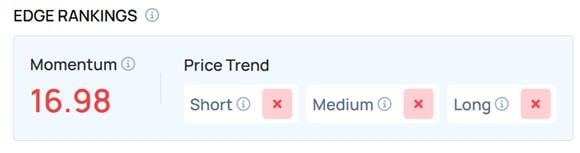
As of April 17, 2026, two stocks in the health care sector could be flashing a real warning to investors who value momentum as a key criteria in their trading decisions.

The RSI is a momentum indicator, which compares a stock’s strength on days when prices go up to its strength on days when prices go down. When compared to a stock’s price action, it can give traders a better sense of how a stock may perform in the short term. An asset is typically considered overbought when the RSI is above 70, according to Benzinga Pro.

Here’s the latest list of major overbought players in this sector.

Avanos Medical Inc (NYSE:AVNS)

  • On April 14, Avanos Medical agreed to be acquired by American Industrial Partners for …

Full story available on Benzinga.com

This post was originally published here

Bitcoin remains above $75,000 while Bitcoin ETFs saw $26.05 million in net inflows on Thursday, while Ethereum ETFs reported $18 million in net inflows.  

Cryptocurrency Ticker Price
Bitcoin (CRYPTO: BTC) $75,517
Ethereum (CRYPTO: ETH) $2,352
Solana (CRYPTO: SOL) $87.67
XRP (CRYPTO: XRP) $1.43
Dogecoin (CRYPTO: DOGE) $0.09807
Shiba Inu (CRYPTO: SHIB) $0.056200

Meme coin market capitalization is up 7.5% over the past 24 hours at $38.4 billion

Trader Commentary: 

Crypto chart analyst …

Full story available on Benzinga.com

This post was originally published here

The CNN Money Fear and Greed index showed further improvement in the overall market sentiment, while the index remained in the “Greed” zone on Thursday.

U.S. stocks settled higher on Thursday, with the S&P 500 and Nasdaq Composite surging to new all-time highs as peace-deal optimism over the Iran conflict kept buyers engaged.

President Donald Trump announced that Israeli and Lebanese leaders have agreed to a 10-day ceasefire, calling it his potential tenth war resolved.

In earnings, PepsiCo, Inc. (NASDAQ:PEP) posted upbeat earnings for the first quarter on Thursday. Netflix Inc (NASDAQ:NFLX) reported better-than-expected financial results for the first quarter of 2026 after the market close on Thursday.

On the economic data front, U.S. initial jobless claims declined to 207,000 in the week ended April 11, versus a revised 218,000 in the …

Full story available on Benzinga.com

This post was originally published here

Salesforce Inc. (NYSE:CRM) unveiled Headless 360 on Wednesday, shifting its platform toward an API-first architecture where AI agents and humans execute workflows across data, applications and business logic amid a broader software sector selloff.

From UI-First CRM To Agent-Driven Infrastructure

Headless 360 exposes Salesforce’s Customer 360 stack through APIs, MCP tools and CLI commands, enabling AI agents to operate without traditional interfaces. The release includes 60+ MCP tools and 30+ preconfigured coding skills, designed to give agents direct access inside developer environments such as Anthropic‘s Claude Code and Anysphere‘s Cursor.

A new Agent Fabric layer adds governance and deterministic orchestration across multi-vendor AI deployments.

Bulls vs. Bears: AI Catalyst Or SaaS Disruption Risk

The rollout comes amid broader skepticism toward software equities as investors reassess whether AI will replace or commoditize traditional SaaS offerings. The debate …

Full story available on Benzinga.com

This post was originally published here
The most oversold stocks in the consumer staples sector presents an opportunity to buy into undervalued companies.

The RSI is a momentum indicator, which compares a stock’s strength on days when prices go up to its strength on days when prices go down. When compared to a stock’s price action, it can give traders a better sense of how a stock may perform in the short term. An asset is typically considered oversold when the RSI is below 30, according to Benzinga Pro.

Here’s the latest list of major oversold players in this sector, having an RSI near or below 30.

Pilgrims Pride Corp (NASDAQ:PPC)

  • On April 13, Pilgrim’s Pride announced pricing of tender offer for its 6.250% senior notes due 2033. The company’s stock fell around 10% over the past month and has a 52-week low of $32.79.
  • RSI Value: 29.4
  • PPC Price Action:

Full story available on Benzinga.com

This post was originally published here

Cleveland-Cliffs Inc. (NYSE:CLF) will release earnings for its first quarter before the opening bell on Monday, April 20.

Analysts expect the Cleveland, Ohio-based company to report a quarterly loss of 41 cents per share, versus a loss of 92 cents per share in the year-ago period. The consensus estimate for Regions Financial’s quarterly revenue is $4.79 billion (it reported $4.63 billion last year), according to Benzinga Pro.

On Feb. 9, Cleveland-Cliffs reported mixed fourth-quarter financial results.

Cleveland-Cliffs shares rose 0.6% to close at $9.72 on Thursday.

Benzinga readers can access the latest analyst ratings on the Analyst Stock Ratings page. Readers can sort by stock ticker, company name, analyst firm, rating change or other variables.

Let’s have a look at how Benzinga’s most-accurate analysts have rated the company in the recent period.

  • JP …

Full story available on Benzinga.com

This post was originally published here
(Editor’s note: The future prices of benchmark tracking ETFs, the economic data and the headline were updated in the story.)

Futures related to U.S. stocks ticked up in pre-market trading on Thursday, after the benchmark S&P 500 and tech-heavy Nasdaq Composite rose to fresh records in the previous session, as investors weighed signs of easing tensions between Washington and Tehran.

Sentiment was supported by growing hopes of a possible diplomatic breakthrough after President Donald Trump said in an interview aired on Wednesday that the Iran war was “very close to over” and that Tehran was eager to strike a deal. He also said that talks between Israel and Lebanon will take place on Thursday.

A White House official also told CNBC that a second round of U.S.-Iran talks was under discussion, though no date has been set.

Investors are also pricing in earnings before the bell from PepsiCo (NYSE:PEP), Travelers (NYSE:TRV), and Charles Schwab Corp (NYSE:SCHW), alongside weekly jobless claims and March’s industrial production data.

In a speech on Thursday, New York Fed President John Williams said that the Middle East conflict has introduced substantial risks and heightened uncertainty. He said the war is driving “significant increases in energy prices, which are already lifting overall inflation.”

Meanwhile, the 10-year Treasury bond yielded 4.283%, and the two-year bond was at 3.755%. The CME Group’s FedWatch tool‘s projections show markets pricing a 99.5% likelihood of the Federal Reserve leaving the current interest rates unchanged in its April meeting.

Index Performance (+/-)
Dow Jones 0.23%
S&P 500 0.13%
Nasdaq 100 0.19%
Russell 2000 0.30%

The SPDR S&P 500 ETF Trust (NYSE:SPY) and Invesco QQQ Trust ETF (NASDAQ:QQQ), which track the S&P 500 and Nasdaq 100, respectively, were higher in premarket trading on Thursday. The SPY was up 0.16% at $701.07, while the …

Full story available on Benzinga.com

This post was originally published here
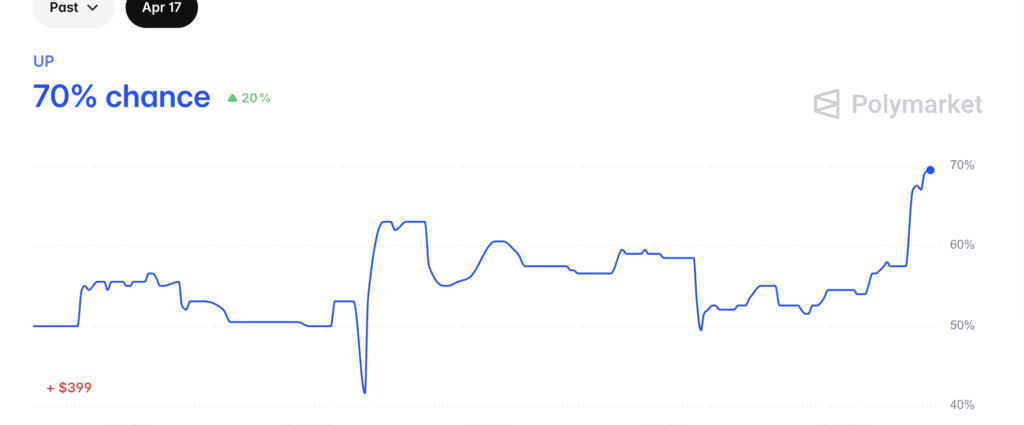
The S&P 500 rose on Thursday, gaining 0.26% to close at a fresh record of 7,041.28, as optimism around a potential end to the Iran war continued to support equities.

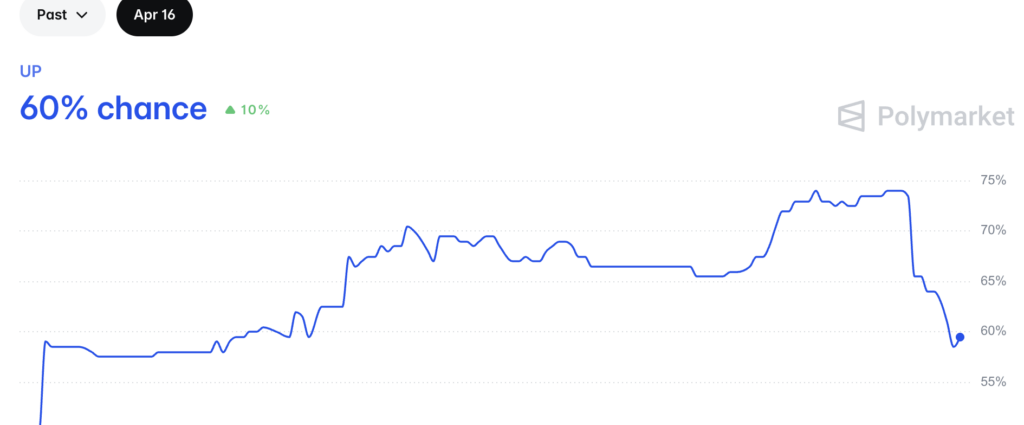
The Polygon-based (CRYPTO: POL) Polymarket crowd remains bullish heading into Friday. The April 17 market shows a majority of traders betting “Up,” with early trading activity building on whether the S&P 500 will open higher or lower.

Why That Number Matters

President Donald Trump said Thursday that the war in Iran “should be ending pretty soon,” adding to a …

Full story available on Benzinga.com

This post was originally published here
In today’s rapidly changing and highly competitive business world, it is imperative for investors and industry observers to carefully assess companies before making investment choices. In this article, we will undertake a comprehensive industry comparison, evaluating Palantir Technologies (NASDAQ:PLTR) vis-à-vis its key competitors in the Software industry. Through a detailed analysis of important financial indicators, market standing, and growth potential, our goal is to provide valuable insights and highlight company’s performance in the industry.

Palantir Technologies Background

Palantir is an artificial intelligence, analytics, and automated decision-making company that leverages data to drive efficiency across its clients’ organizations. The firm serves commercial and government clients via its Foundry and Gotham platforms, respectively. Palantir works only with entities in Western-allied nations and reserves the right not to work with anyone that is antithetical to Western values. The company was founded in 2003 and went public in 2020.

Company P/E P/B P/S ROE EBITDA (in billions) Gross Profit (in billions) Revenue Growth
Palantir Technologies Inc 226.60 46.22 81.83 8.71% $0.58 $1.19 70.0%
Salesforce Inc 23.23 2.83 4.17 3.26% $3.27 $8.69 12.09%
AppLovin Corp 46.42 73.64 29.08 61.09% $1.34 $1.47 65.88%
Intuit Inc 25.19 5.62 5.43 3.61% $1.14 $3.61 17.36%
Adobe Inc 14.46 8.77 4.26 16.39% $2.66 $5.73 11.97%
Cadence Design Systems Inc 75.61 15.48 15.84 7.27% $0.59 $1.25 6.2%
Synopsys Inc 67.71 2.77 9.60 0.22% $0.69 $1.77 65.52%
Autodesk Inc 46.49 16.85 7.25 10.64% $0.58 $1.79 19.4%
Datadog Inc 398.29 11.71 13.09 1.3% $0.08 $0.77 29.21%
Roper Technologies Inc 25.48 1.86 4.95 2.15% $0.86 $1.43 9.67%
Workday Inc 48.21 4.11 3.51 1.74% $0.39 $1.92 14.52%
Zoom Communications Inc 14.03 2.60 5.47 7.06% $0.28 $0.95 5.31%
PTC Inc 20.36 4.28 5.82 4.34% $0.25 $0.57 21.36%
Trimble Inc 38.45 2.69 4.56 2.69% $0.25 $0.7 -1.38%
IREN Ltd 33.11 6.30 18.78 -5.77% $-0.23 $0.11 59.02%
Tyler Technologies Inc 47.20 3.90 6.38 1.79% $0.12 $0.26 6.29%
Guidewire Software Inc 62.95 7.80 9.05 3.95% $0.08 $0.23 24.05%
HubSpot Inc 259.28 5.69 3.79 2.78% $0.1 $0.71 20.42%
Average 73.32 10.41 8.88 7.32% $0.73 $1.88 22.76%

Full story available on Benzinga.com

This post was originally published here

In today’s fast-paced and highly competitive business world, it is crucial for investors and industry followers to conduct comprehensive company evaluations. In this article, we will delve into an extensive industry comparison, evaluating Microsoft (NASDAQ:MSFT) in relation to its major competitors in the Software industry. By closely examining key financial metrics, market standing, and growth prospects, our objective is to provide valuable insights and highlight company’s performance in the industry.

Microsoft Background

Microsoft develops and licenses consumer and enterprise software. It is known for its Windows operating systems and Office productivity suite. The company is organized into three equally sized broad segments: productivity and business processes (legacy Microsoft Office, cloud-based Office 365, Exchange, SharePoint, Skype, LinkedIn, Dynamics), intelligence cloud (infrastructure- and platform-as-a-service offerings Azure, Windows Server OS, SQL Server), and more personal computing (Windows Client, Xbox, Bing search, display advertising, and Surface laptops, tablets, and desktops).

Company P/E P/B P/S ROE EBITDA (in billions) Gross Profit (in billions) Revenue Growth
Microsoft Corp 26.30 7.98 10.27 10.2% $58.18 $55.3 16.72%
Oracle Corp 32.02 15.29 8.08 11.65% $8.16 $11.1 21.66%
Palo Alto Networks Inc 92.76 14.42 12 4.78% $0.64 $1.91 14.93%
ServiceNow Inc 57.75 7.71 7.60 3.31% $0.76 $2.73 20.66%
Fortinet Inc 34.05 49.27 9.27 51.3% $0.69 $1.52 14.75%
Nebius Group NV 1442.54 9.07 78.96 -5.3% $0.01 $0.1 55.85%
Check Point Software Technologies Ltd 14.30 4.98 5.55 10.21% $0.37 $0.65 5.85%
Gen Digital Inc 20.39 5.14 2.60 8.02% $0.57 $0.97 25.76%
Dolby Laboratories Inc 25.93 2.36 4.66 2.04% $0.1 $0.3 -2.88%
UiPath Inc 20.40 2.67 3.59 5.21% $0.09 $0.41 13.56%
CommVault Systems Inc 49.41 19.25 3.73 8.33% $0.03 $0.25 19.5%
Monday.Com Ltd 29.63 2.72 2.86 6.1% $0.01 $0.3 24.59%
Qualys Inc 15.45 5.34 4.58 9.75% $0.06 $0.15 10.11%
BlackBerry Ltd 52.11 3.70 5.10 3.27% $0.04 $0.12 10.09%
Teradata Corp 19.83 11 1.56 16.48% $0.08 $0.26 2.93%
A10 Networks Inc 46.53 8.99 6.72 4.72% $0.03 $0.06 8.29%
Average 130.21 10.79 10.46 9.32% $0.78 $1.39 16.38%

Full story available on Benzinga.com

This post was originally published here

Silver prices hovered around $80 per ounce on Friday, as a 10-day ceasefire between Lebanon and Israel calmed inflation fears and weakened the U.S. dollar.

A sustained supply deficit projection for 2026 is also supporting prices.

What ETFs To Tap Amid Silver Rebound?

Silver COMEX (May 2026) rose 1% to $79.47 at 4.42 AM EDT after declining about 15% since the war began in late February amid fears that rising energy costs would stoke inflation, keeping interest rates higher. Those concerns have eased somewhat, with optimism returning on hopes that the U.S. and Iran could reach a permanent ceasefire deal over the weekend.

This has brought back the allure of the white metal and investors looking to tap the rise in silver prices could consider the following ETFs:

1. iShares Silver Trust

The iShares Silver Trust (NYSE:SLV) offers exposure to the day-to-day movement of the price of silver bullion. It has an AUM of $21.5 billion and trades in a heavy volume of 41 million shares a day. It charges 0.50% in fees per year from investors.

Price Action: SLV gained 0.4% at 4.16 AM ET, but is down 16.1% since the Iran war began.

Benzinga Edge Stock Rankings indicate SLV has a Momentum score in the 91th percentile and maintains a strong price trend in the short, …

Full story available on Benzinga.com

This post was originally published here

Signs of easing geopolitical tensions have lifted cryptocurrencies, including Dogecoin (CRYPTO: DOGE), and whales have started loading up on the memecoin.

Whales Getting Ready For DOGE’s Leg Up?

Widely followed cryptocurrency analyst Ali Martinez highlighted in an X post on Thursday that large investors bought around 330 million DOGE tokens this week. At the prevailing prices, this amounted to $32.34 million

Exchange-traded funds rode the bullish wave, as the Grayscale Dogecoin Trust ETF (NYSE:GDOG), 21Shares Dogecoin ETF (NASDAQ:TDOG), and Bitwise Dogecoin ETF (NYSE:BWOW) attracted over $1.5 million in net inflows over the last week, per data from SoSo Value.

Hope Builds for Iran War Resolution

President Donald Trump’s

Full story available on Benzinga.com

This post was originally published here

Shares of Blaize Holdings Inc (NASDAQ:BZAI) rose sharply in pre-market trading following a contract of up to $50 million with technology company NeoTensr for AI edge data center infrastructure across Asia Pacific and a strategic Memorandum of Understanding with Taiwan-based rugged technology maker Winmate Inc. targeting sovereign, mission-critical edge AI deployments.

Blaize Holdings shares jumped 24.3% to $2.15 in pre-market trading.

Here are some other stocks moving in pre-market trading.

Gainers

  • Psyence Biomedical Ltd (NASDAQ:PBM) gained 85.4% to $10.90 in pre-market trading after jumping around 106% on Thursday.
  • iSpecimen Inc (NASDAQ:ISPC) gained 44.9% to $0.17 in pre-market trading after adding 4% on Thursday.
  • YXT.Com Group Holding Ltd – ADR (NASDAQ:YXT) rose 54.1% to $0.57 in pre-market trading after declining 10% on Thursday.
  • Able View Global Inc (NASDAQ:ABLV) jumped 39.8% to $0.81 in pre-market trading after falling over 5% on Thursday.
  • WeShop Holdings Ltd (NASDAQ:WSHP) rose 31.9% to $18.82 in pre-market trading after jumping around 74% on Thursday.
  • Harte Hanks Inc (NASDAQ:

Full story available on Benzinga.com

This post was originally published here

The numbers no longer add up—at least not in the traditional sense. The SPDR S&P 500 ETF (NYSE:SPY) just added roughly $30 billion in a single week, even as the “physical reality” tells a different story.  U.S. GDP growth was revised down to 0.5%, spot oil prices hit a record high, and an active geopolitical conflict is choking global trade flows.

Yet the market climbs.

The Buffett indicator, a ratio of the total U.S. stock market to GDP, has climbed to 223.5%—a level that makes the 162% peak during the Dot-Com bubble look almost conservative. Historically, such readings signaled imminent danger. Today, they barely register as a concern.

Such paradoxes best show the ongoing structural shift. The stock market is no longer a wind vane for the real economy. It has become a leveraged bet on a narrow but powerful future—one driven by artificial intelligence, capital intensity, and financial system resilience. Investors are no longer buying “America.” They are buying a handful of global platforms increasingly detached from the “dirt and diesel” economy.

Micro is Macro

Company-level dynamics, specifically AI-driven capital expenditures, have become so …

Full story available on Benzinga.com

This post was originally published here
Spirit Aviation Holdings Inc. (OTC:FLYYQ) could reportedly halt operations within days as the creditors raise doubts about the company’s ability to clear dues.

Spirit To Liquidate?

On Thursday, CBS News reported that the airline could halt its operations within the coming days, raising questions about the passengers who might have already booked their tickets on Spirit flights. The airline had earlier filed for bankruptcy amid post Covid-19 struggles.

Spirit Airlines didn’t immediately respond to Benzinga‘s request for comment.

The war in Iran has led to a surge in fuel costs, which is said to be the reason behind the reported liquidation. According to data from Airlines for America, the price of a gallon of jet fuel on Thursday was $4.32, which, while lower …

Full story available on Benzinga.com

This post was originally published here

Ally Financial Inc. (NYSE:ALLY) will release earnings for its first quarter before the opening bell on Friday, April 17.

Analysts expect the Detroit, Michigan-based company to report quarterly earnings of 94 cents per share. That’s up from 58 cents per share in the year-ago period. The consensus estimate for Ally Financial’s quarterly revenue is $2.14 billion (it reported $1.54 billion last year), according to Benzinga Pro.

On April 15, the board of directors of Ally Financial declared a quarterly cash dividend of 30 cents per share of the company’s common stock.

Shares of Ally Financial fell 0.7% to close at $41.96 on Thursday.

Benzinga readers can access the latest analyst ratings on the Analyst Stock Ratings page. Readers can sort by stock ticker, company name, analyst firm, rating change or other variables.

Let’s have a look …

Full story available on Benzinga.com

This post was originally published here

Telefonaktiebolaget L M (NASDAQ:ERIC) reported first-quarter financial results on Friday. The transcript from the company’s first-quarter earnings call has been provided below.

This transcript is brought to you by Benzinga APIs. For real-time access to our entire catalog, please visit https://www.benzinga.com/apis/ for a consultation.

Access the full call at https://edge.media-server.com/mmc/p/376wte82/

Summary

Telefonaktiebolaget L M reported a 10% decline in sales due to currency headwinds, but achieved a 6% organic growth across all segments.

The company maintained a strong gross margin of 48.1%, with the networks segment reaching 50.4%, despite mid-single-digit sales reductions in North America.

EBITDA was 5.6 billion krona with a margin of 11.3%, impacted by currency fluctuations, while cash flow remained healthy at 5.9 billion krona.

Telefonaktiebolaget L M announced a share buyback program worth 15 billion krona and an increased dividend, reflecting confidence in cash flow and financial stability.

Strategic focus areas include expanding into enterprise and mission-critical networks, with notable interest in defense solutions and 5G-based sensing technologies.

The company is cautious about rising input costs, including memory prices, and plans to mitigate these through pricing strategies and product substitution.

Management highlighted reduced geographic dependency, particularly on North America, and expressed confidence in growth from markets like India and Japan.

Future guidance suggests a flat RAND market with a focus on maintaining stable margins and strategic investments in new growth areas like AI-driven mobile applications.

Full Transcript

OPERATOR

Hello everyone and welcome to the presentation of Ericsson’s first quarter 2026 results. Joining us by video today is Börje Ekholm, our President and CEO. And in the studio I’m joined by Lars Sandstrom, our Chief Financial Officer. As usual, we’ll have a short presentation followed by Q and A. And in order to ask a question, you’ll need to join the conference by phone. Details can be found in today’s earnings release and on the investor relations website as well. Please be advised that today’s call is being recorded and that today’s presentation may include forward looking statements. These statements are based on our current expectations and certain planning assumptions which are subject to risks and uncertainties. Actual results may differ materially due to factors mentioned in today’s press release and discussed in the conference call. We encourage you to read about these risks and uncertainties in our earnings report as well as in our annual report. Now hand the call over to Börje and Lars for their introductory comments.

Börje Ekholm

Thanks Tanya and good morning everyone and thanks for joining us today. Q1 was a solid start of the year and with the results that reflects our continued execution against our operational and strategic priorities. We saw a very large currency headwind during the quarter, probably one of the toughest quarters from a comp ratio as the Swedish Krona strengthened towards almost all currencies compared to last year. So this of course materially impacted every line of our financial statements with reporting sales falling 10% at the same time. We performed well operationally, realizing strong organic growth of 6% with all segments contributing. Our results are a testament to our leading portfolio and the investments we’ve been making in furthering our technology leadership. Over the last few years we’ve actively managed to reduce dependence on geographic mix. Of course we realize that North America often receives a disproportionate interest from, I guess, you, the analyst community, but also around the world. And that’s of course natural because it is a front runner market. And this quarter we saw sales reduced by mid single digits in North America. But we could still deliver a gross margin of 48.1% for the group and 50.4% for segment networks, indicating that the work we’ve done to balance out the geographic mix is coming through in the result and giving us less sensitivity to geographic mix. Cloud software services continue to execute well. We reached a gross margin of 43.2%. That’s up more than 300 basis points year over year. Revenue seasonality was in line with the guidance we had for the quarter and we saw some deals being pushed into Q2 and we expect to see that therefore stronger seasonality than normal next quarter. EBITDA came in at 5.6 billion krona with a margin of 11.3. And the strengthening of the Swedish krona affected EBITDA by 2.2 billion krona. And you’ve also seen we had the revaluation of the long term stock based programs and all of those are of course included in the result. Cash flow during the first quarter is seasonably lower. Typically. Despite this, cash flow came in at a healthy 5.9 billion kroner with a net cash position of 68.1 billion. And as you’ve seen just a couple of weeks ago the AGM approved the board’s proposal on increased dividend and our first share buyback program. We will start to execute on the share buyback program next week with a target to buy back 15 billion kronor. In the next phase of AI we see that high performance mobile connectivity will become increasingly important. Even so, our planning assumptions for the RAN market remains flat over the longer term. With disciplined execution, we create room to make selective investments in growth to broaden the mobile platform to new use cases and new sectors. We believe the growth will come in areas outside of our traditional CSP markets. And then we’re talking about areas like enterprise and mission critical networks in our enterprise segments, which includes our wireless one business private networks, network APIs or as we now call it actually network powered solutions and mobile money. Organic growth was stronger, which is encouraging. There are new markets that we see as key opportunities going forward. Of course new markets take time to develop, but we’re now seeing these efforts start to scale. I would also comment on the loss in enterprise of 1.4 billion kroner. It’s clearly unacceptable, but it also includes a number of one time costs. And we have an improvement plan in place that we’re executing on and we will expect to see that coming through. Shrinking losses during the rest of the year comes from growth, operational discipline and of course at the one time cost a bit. We’re also driving several other growth initiatives and there we see good progress in mission critical networks which tend to be a bit lumpy and vary by quarter. We’re experiencing strong interest in several verticals, particularly within defense solutions. In modern defense applications, high performance then I’m talking about large capacity connectivity is required and this will make 5G standalone a cost effective alternative. And we’ve seen a trial with the Italian Navy or actually deployment with the Italian Navy this quarter. Another very exciting area is 5G based sensing where one of many use cases is about detecting unconnected drones. And a few weeks ago we showcased our solution which is seeing significant customer interest. Of course given a difficult current market environment or environment geopolitically we see that our technology here has great market potential and we’re now starting to invest to capture these opportunities. I would say this is just one example that you don’t have to wait for 6G to get part of new exciting use cases with the technology we have. So we’re seeing good momentum on our strategy execution and we’ve strengthened Ericsson operationally and I would say this is showing now in our Q1 results. With that I’ll Let me give the word over to you Lars to go through the numbers in some more detail.

Lars Sandstrom (Chief Financial Officer)

All right, thank you Börje. I will begin with some additional comments on the group before moving over to the segments so net sales in Q1 totaled 49.3 billion which with organic sales growing 6% year on year the growth was broad based and sales grew in all segments and three market areas delivered. Double digit organic growth driven by continued 5G rollouts and increased uptake of 5G core Americas declined 2% with strong growth in Latin America more than offset by a mid single digit decline in North America. Following a strong quarter last year, reported sales decreased by 10% impacted by a negative currency effect of 7.8 billion. So organic growth again grew 6%. IPR revenues were 3.1 billion and this run rate coming out of the quarter is approximately then 13 billion. Adjusted gross income was 23.7 billion with a negative currency impact of 3.8 billion. Adjusted gross margin was 48.1 in line with last year excluding iConnective. On the cost side, operating expenses excluding restructuring charges dropped to 18.4 billion, around 2 billion lower year over year driven mainly by currency as well as the divestment of iConnective. Underlying inflationary pressures were more than offset by cost reduction driven by headcount as well as efficiency measures. And as Bay mentioned, adjusted Ebitda, which excludes restructuring but includes the other one offs was 5.6 billion. This is down by 1.4 billion including a negative impact of 2.2 billion. The divestment of iConnective and 0.5 billion of additional share based compensation costs coming from the increased share price here during the quarter. The EBITDA margin was 11.3%. Cash flow before M&A was 5.9 billion driven by earnings and reduced net operating assets. So let’s move to the segments in Network sales decreased by 8% year on year to 32.9 billion with a negative currency impact of 5.2 billion. Organic sales increased by 7%. Organic revenues grew in three of our four market areas. Two strategic markets, India and Japan grew strongly. North America declined impacted by customer spend reallocation in Q1 this year following recent market consolidation. Customer investments were also elevated last year due to tariff uncertainty impacting the comparison network’s adjusted gross margin decreased slightly to 50.4% mainly reflecting actions to enhance resilience in the supply chain. Adjusted EBITDA was 6.4 billion, impacted by a negative currency impact of 2 billion and benefiting from lower operating expenses which were also supported by continued efficiency improvements. Adjusted EBITDA margin was 13.3%. Looking at the right hand graph, the rolling 4 quarter gross margin stabilized around 50% and adjusted EBITDA margin at around 20%. Moving to the segment cloud, software and services sales here decreased 9% to 11.8 billion including a negative currency impact of 1.6 billion. So organically sales grew by 4% with growth primarily in core. Adjusted gross margin came in at 43.2% an improvement from 39.9% last year supported by improved delivery efficiency and a favorable product mix. Adjusted EBITDA increased to 0.6 billion with a margin of 5.3 despite a negative currency impact of 0.3 billion. Lower gross income was offset by lower operating expenses. Here looking at the right hand graph, the rolling 4/4 adjusted gross margin was around 44% and adjusted EBITDA margin around 12% and these are both new high levels. So reported sales on the enterprise side decreased 30% impacted by the sale of iConnective and currency on organic basis. Enterprise grew by 4% and this marks the second quarter of organic growth. Adjusted gross margin declined to 49.0% reflecting the impact of the divestment of iConnective and change in business mix. In global communications platform, adjusted EBITDA landed at minus 1.4 billion reflecting the divestment of iConnective and non recurring cost of 0.3 billion in the current quarter. Turning then to free cash flow which was 5.9 billion before M&A in the quarter we delivered a cash to net sales of 13% for the rolling 4 quarters above our 9 to 12 target and cash flow generation was strong supported by earnings and a stronger than normal seasonal reduction in operating net assets. Net cash increased sequentially by 6.9 billion to 68.1 billion. Here in the quarter, the buyback program of up to 15 billion was approved by The AGM and share repurchases will start now, soon. Next I will cover the outlook. Global uncertainty remains elevated given the broad geopolitical and macroeconomic environment, including the global semiconductor situation and where we’ll come back to this. The Q2 outlook assumes no tariff changes and the exchange rates specified in the report. For networks we expect sales growth to be broadly similar to the three year average quarter on quarter seasonality and for cloud, software and services we expect the sales growth to be above the three year average quarter on quarter seasonality. We expect net works adjusted gross margin to be in the range of 49 to 51% and restructuring charges for 2026 are expected to be at an elevated level with a fairly large part already seen in Q1. So with that I hand back to you Bea.

Börje Ekholm

Thanks a lot lars. So our Q1 results demonstrate the strong execution on our strategic priorities and the actions we’ve taken over the last several years to strengthen the company operationally. This includes how we made Ericsson less reliant on any specific geographical mix, enabling us to sustain healthy margins in varying market conditions, as you have seen in today’s report. Our actions also include how we diversified our supply chain to mitigate as much of the geopolitical disturbances as possible. This continues to be a clear competitive advantage, enabling us to meet customer commitments amid the current backdrop. Of course, the global semiconductor situation remains challenging as the AI boom is increasing input costs. We continue to take actions, and Lars mentioned this as well, to mitigate this impact by working closely with both our customers and suppliers, of course, including our pricing. While we believe we’re in a good position, we’re not immune to these disturbances, so they will have consequences on price and availability. As of course AI may be the key driver for our industry. Longer term we see AI as a net positive for us. The next phase of AI will see AI being industrialized, shifting focus from current focus on data centers, large language models rather to applications devices use cases. This will require advanced mobile connectivity with capabilities such as ultra low latency and high uplink. This puts us in the middle of the next phase of …

Full story available on Benzinga.com

This post was originally published here

Oportun Financial Corp. (NASDAQ:OPRT) shares surged 12.02% to $5.98 before the bell on Friday, after the San Mateo-based lender announced the appointment of Doug Bland as Chief Executive Officer, effective April 20.

Veteran Credit Operator Steps In

Bland, former Senior Vice President and General Manager of PayPal‘s (NASDAQ:PYPL) Consumer Business, brings over 30 years of consumer credit experience, according to Oportun. He earlier co-led Swift Financial through its 2017 PayPal acquisition and held senior lending roles at Bank of America (NYSE:BAC) through the 2008 financial crisis.

Lead Independent Director Louis Miramontes called Bland “the ideal leader,” citing his disciplined credit management and operational track record.

Bland said …

Full story available on Benzinga.com

This post was originally published here

Regions Financial Corporation (NYSE:RF) will release earnings for its first quarter before the opening bell on Friday, April 17.

Analysts expect the Birmingham, Alabama-based company to report quarterly earnings of 59 cents per share, up from 54 cents per share in the year-ago period. The consensus estimate for Regions Financial’s quarterly revenue is $1.92 billion (it reported $1.8 billion last year), according to Benzinga Pro.

On April 15, Regions Financial declared quarterly common and preferred stock dividends.

Regions Financial shares rose 0.3% to close at $27.92 on Thursday.

Benzinga readers can access the latest analyst ratings on the Analyst Stock Ratings page. Readers can sort by stock ticker, company name, analyst firm, rating change or other variables.

Let’s have a look at how Benzinga’s most-accurate analysts have rated the company in …

Full story available on Benzinga.com

This post was originally published here

With U.S. stock futures trading mixed this morning on Friday, some of the stocks that may grab investor focus today are as follows:

  • Wall Street expects State Street Corp (NYSE:STT) to report quarterly earnings at $2.63 per share on revenue of $3.66 billion before the opening bell, according to data from Benzinga Pro. State Street shares fell 0.6% to $141.00 in after-hours trading.
  • Netflix Inc (NASDAQ:NFLX) reported better-than-expected financial results for the first quarter of 2026 after the market close on Thursday. The company issued weak forecast for the second quarter and announced that chairman and co-founder Reed Hastings will not stand for re-election …

Full story available on Benzinga.com

This post was originally published here
Former Treasury Secretary Henry Paulson urged U.S. authorities on Thursday to prepare a contingency plan for a potential collapse in demand for government bonds before it’s too late.

“We need an emergency break-the-glass plan, which is targeted and short-term, on the shelf, so it’s ready to go when we hit the wall,” Paulson said during an interview on Bloomberg Television’s Wall Street Week with David Westin.

A Different Crisis Than 2008

Paulson, who led the Treasury through the 2008 financial crisis, said a U.S. debt crisis would be far harder to contain than the credit meltdown he managed then.

“When you hit the wall and you’re trying to issue Treasuries and the Fed is the only buyer and the prices of the Treasuries are going down and interest rates are up, that’s a dangerous …

Full story available on Benzinga.com

This post was originally published here

Truist Financial Corporation (NYSE:TFC) will release earnings for its first quarter before the opening bell on Friday, April 17.

Analysts expect the Charlotte, North Carolina-based company to report quarterly earnings of $1.00 per share. That’s up from 89 cents per share in the year-ago period. The consensus estimate for Truist Financial’s quarterly revenue is $5.18 billion (it reported $4.95 billion last year), according to Benzinga Pro.

On Feb. 26, Truist Securities named Matthew Miller as head of mergers & acquisitions.

Shares of Truist Financial fell 0.3% to close at $49.43 on Thursday.

Benzinga readers can access the latest analyst ratings on the Analyst Stock Ratings page. Readers can sort by stock ticker, company name, analyst firm, rating change or other variables.

Let’s have a look at how Benzinga’s most-accurate analysts have …

Full story available on Benzinga.com

This post was originally published here

Pakistan has lately accelerated efforts to integrate cryptocurrencies into its financial system, while neighboring rival India continues to take a more cautious approach, with limited progress toward comprehensive regulation.

Pakistan’s Ambitious Crypto Push

In a notable shift, Pakistan’s central bank now allows banks to service licensed virtual asset providers, marking the end of an eight-year lull in regulated cryptocurrency activity.

Bilal Bin Saqib, Chairman of the country’s federal regulator for virtual assets, said that the country will now move from “restriction to regulation,” and “from ambiguity to institutional clarity.”

Pakistan Attracting Big Players

The move is part of Pakistan’s ongoing cryptocurrency pivot, as it works to attract global players and position the country as a global hub of digital assets.

It has roped in Binance (CRYPTO: BNB) co-founder Changpeng Zhao as strategic advisor of the Pakistan Crypto Council, …

Full story available on Benzinga.com

This post was originally published here

Governor Gavin Newsom (D-CA) slammed President Donald Trump on Thursday for causing Americans to spend billions in additional costs at the pump as fuel continues to hover around the $4-mark.

A Trump Win?

Taking to the social media platform X, Newsom’s official Press Office handle delivered sharp criticism of Trump. “Americans have paid $10.53 billion more for gas nationwide,” the post said, adding that states like Idaho, Utah, Kentucky and Arizona had seen the steepest increases in fuel prices. “TRUMP WIN?” the post said.

While the press office did not specify where the $10.53 billion figure came from, GasBuddy analyst Patrick De Haan had earlier shared that rising fuel costs have resulted in Americans paying over $10 billion in excess at the pumps. According to data from the American Automobile Association (AAA), the national average price of a gallon of gas on …

Full story available on Benzinga.com

This post was originally published here
Snail Inc. (NASDAQ:SNAL) shares are trending on Friday.

SNAL surged 18.49% to $0.90 after the bell on Thursday after investors cheered pipeline updates and a confirmed “Survivor Mercs” launch timeline, alongside efforts to broaden its portfolio across genres.

The California-based technology company announced that “Survivor Mercs,” its horde-shooter game, will officially launch its 1.0 version on April 30 across Steam, Xbox and PlayStation under its Wandering Wizard label, marking a full transition from early Access to global release.

What Investors Should Know About Pipeline Expansion And Diversification

Snail emphasized a strategy to reduce reliance on a single intellectual property and expand across genres, platforms and development models. CFO Heidy Chow said the company aims for …

Full story available on Benzinga.com

This post was originally published here

Tesla Inc.‘s (NASDAQ:TSLA) legal troubles could reportedly cost the Elon Musk-led EV giant billions of dollars in settlement costs.

$14.5 Billion In Costs

On Thursday, Electrek reported that Tesla was facing over 21 active lawsuits comprising wrongful death lawsuits, as well as customers suing the EV giant over its self-driving and driver assistance systems. Tesla is also being sued over allegations of racial discrimination. The exposure estimates, according to the report, range from $2.1 billion to $14.5 billion.

The estimates include Autopilot/FSD crash lawsuits with exposures of $1-5 billion, as well as class action lawsuits relating to Full Self-Driving (FSD) false advertising ($100-500 million), autonomy predictions and more. The racial discrimination lawsuit at its Fremont, California, facility could cost up to $1.2 billion.

It also faces multiple regulatory investigations, like the National Highway Traffic Safety Administration (NHTSA) FSD investigation, which could cost over $500 million, as well as …

Full story available on Benzinga.com

This post was originally published here

AEVEX Corp rode a surge in defence spending and investor appetite for military tech to raise $320 million in its U.S. initial public offering on Thursday, pricing shares at $20 apiece, near the top of its indicated range.

The California-based drone maker sold 16 million shares between $18 and $21 each.

Goldman Sachs, BofA Securities and Jefferies acted as joint bookrunners. AEVEX is set to begin trading on the New York Stock Exchange under the ticker “AVEX” on Friday.

Defence Spending Surge Lifts Demand

The listing comes amid heightened interest in defence-linked companies, as conflicts in Ukraine and the Middle East push governments to ramp up military budgets. Investors are increasingly viewing such firms as strategic hedges against global instability, and the group is attracting higher valuations as smaller companies …

Full story available on Benzinga.com

This post was originally published here

Bank of New York Mellon (NYSE:BK) held its first-quarter earnings conference call on Thursday. Below is the complete transcript from the call.

This transcript is brought to you by Benzinga APIs. For real-time access to our entire catalog, please visit https://www.benzinga.com/apis/ for a consultation.

View the webcast at https://event.choruscall.com/mediaframe/webcast.html?webcastid=qXCzsOB5

Summary

Bank of New York Mellon Corp reported a strong financial performance in Q1 2026, with earnings per share of $2.24, up 42% year-over-year, and record revenue of $5.4 billion, up 13%.

The company highlighted strategic initiatives, including significant investments in AI and technology, with over 200 AI solutions developed, and emphasized its role as a trusted provider in global financial markets.

Future outlook is positive with raised total revenue growth guidance for 2026 to approximately 6% year-over-year, driven by strong client engagement and a diversified business model.

Full Transcript

OPERATOR

Good morning and welcome to the 2026 first quarter earnings conference call hosted by BNY. At this time all participants are in a listen only mode. Later we will conduct a question and answer session. Please note that this conference call and webcast will be recorded and will consist of copyrighted material. You may not record or rebroadcast these materials without BNY’s consent. I will now turn the call over to Mary Merz, BNY Head of Investor Relations. Please go ahead.

Mary Merz

Thank you operator Good morning, everyone and welcome to our first Quarter Earnings call. I’m here with Robin Vince, our CEO and David McDonagh, our CFO. As always, we will reference the Quarterly Update presentation which can be found on the Investor Relations page of our website at bny.com and I’ll note that our remarks will contain forward looking statements and non GAAP measures. Actual results may differ materially from those projected in the forward looking statements. Information about these statements and non GAAP measures is available in the Earnings Press Release, Financial Supplement and Quarterly Update Presentation, all of which can be found on the Investor Relations page of our website. Forward looking statements made on this call speak only as of today, April 16, 2026, and will not be updated. With that, I will turn it over to Robin.

Robin Vince (Chief Executive Officer)

Thanks, Mary Good morning everyone and thank you for joining us. I’ll begin with a few broader comments before Dermot takes you through our financial results. Referring to page two of the Quarterly update presentation, BNY has started the year with a strong performance. In the first quarter earnings per share of $2.24 grew 42% year over year both on a reported basis and excluding notable items. Record revenue of $5.4 billion was up 13% year over year reflecting broad based growth across our securities services and market and wealth services businesses. And we delivered over 800 basis points of positive operating leverage while making meaningful investments in new products, capabilities, AI and critically our people and culture. Taken together, this combination of strong top line growth and significant operating leverage resulted in pre tax margin expansion to 37% and improved profitability with a return on tangible common equity of 29% in the quarter. BNY’s position at the heart of global financial markets with platforms across custody, security, settlement, collateral, payments, trading, wealth investments and more supports durable financial performance for our company enabling us to power our clients growth as they navigate an increasingly complex landscape. While the path of global markets is difficult to predict with certainty, what is clear is that the underlying trends higher levels of activity, greater complexity, new technologies and a resulting need for scale, efficiency and connectivity are more relevant than ever for our clients. As I mentioned in my shareholder letter earlier this year, the portfolio of BNY’s businesses is unique, but it is how we are embracing new ways of working, our adoption and integration of new technologies, and our strong culture that allows us to create truly differentiated solutions. Clients are increasingly recognizing the value of holistic solutions that support the full lifecycle of their activity. Whether it is managing liquidity, optimizing collateral, supporting higher trading volumes, or getting ready for the future of financial market infrastructure, our work to operate together as one BNY through both our platform’s operating model and our commercial model better enables us to bring the full breadth of our capabilities together in service of our clients. A good example of this from the first quarter is our work with Allianz Global Investors, one of the world’s leading active asset managers. AGI has selected BNY to support optimizing their investment operating model, leveraging the breadth of our global capabilities. This integrated model will help AGI deliver exceptional experience front to back, while placing AI and modern data infrastructure at the heart of their operations to enhance productivity, enable faster work, clearer insights and better outcomes for their teams and clients alike. In another example, PayPal has selected BNY to provide institutional grade digital asset custody, supporting their digital payments, wallets and financial services for millions of users globally. And just last week, the US Treasury Department announced that they have selected BNY as financial agent for Trump Accounts, the US Government’s Investment Savings Initiative for children. Aimed at building a strong financial foundation for for our next generation. BNY will manage the national infrastructure for the program and collaborate with Robinhood, which will provide brokerage and initial trustee services. These examples illustrate our strategic evolution toward deeper integration between our products delivered with the technology and scale of BNY’s differentiated platforms. Over the next phase of BNY’s transformation. One of the most significant enablers of being more for our clients and running our company better is AI, and so we felt that this was an opportune time to spotlight how we are going about AI at BNY. Turning to slide 3 of the presentation as a reminder, our work to set the foundation for reimagining our company has included intentional and consistent investments in AI AI over the past several years, we took a very deliberate approach to AI through the lens of integration, adoption and importantly our people and culture. We embraced a platform’s approach to embedding AI across the company, creating our AI hub in 2023 so we could develop the enterprise capabilities, strong governance framework and training to empower every employee to embrace AI. More than two years Ago, in collaboration with Nvidia, BNY became the first global bank to Deploy a DGX SuperPod and in the same year we launched Eliza, BNY’s AI platform outlined on page four. Our vision for AI at BNY is that it is for everyone, everywhere and everything. As is the case with many things, the key to making it work is culture. We took a people first approach over the last year we focused on broad adoption. We made eliza available to 100% of our employees and supported advanced learning and development through a series of training programs. This approach to enterprise wide enablement has already allowed us to develop more than 200 AI solutions and to introduce digital employees multi agentic solutions that operate alongside human colleagues. In 2026 we are doubling down on depth, moving from AI point solutions to using AI to enhance end to end processes, reducing manual touch points, improving cycle times, strengthening control outcomes and to build more connected intelligence by linking data, workflows and expertise to enhance the service and value propos for our clients. On page five we show just some of the initial outputs, tangible results of AI enablement and impact across improved business and operating performance, driving greater efficiency and product innovation. None of these metrics individually show a complete picture of AI at bny, but taken together they show something important that we are systematically embedding AI in our workflows across the entire company. Already, AI is helping us increase the pace at which we innovate our technology, accelerate onboarding, improve client service and streamline processes. And in combination with our broader efforts to run our company better, AI is starting to contribute to the improved financial performance trajectory at the bottom of the page. Building on our deliberate strategy and the solid foundation we’ve laid over the past several years, we’re confident that AI will enable us to evolve our business model and enhance how we deliver for clients. Our commitment not just to deep AI enablement, but the full reimagination of our company, combined with the role that we play in global financial market infrastructure, the breadth of our businesses and our trusted and deep client relationships together represents a powerful competitive advantage. Taking a Step back and Reflecting on the Operating Environment While AI was an ever present theme in markets over the past few months, the first quarter also presented a dynamic market backdrop. Significant volatility was driven by shifting expectations for the paths of growth, inflation and interest rates amid geopolitical conflicts and evolving policy outlooks. Within this constantly changing environment, our diversified business model combined with our strong balance sheet allows BNY to serve as a pillar of strength for our clients and for global markets. Before I hand it over to Dermot. I want to take a moment to recognize our employees around the world for rising to the challenge to execute on our long term plan to unlock BNY’s full potential for our clients and shareholders. We’ve had a strong start to the year supported by increasing client engagement and continued progress on our strategic priorities. I’d like to thank our clients for their trust, our employees for their commitment and hard work, and our shareholders for their continued support. And with that over to you Dermot.

Dermot

Thank you Robin and good morning everyone. I’ll pick up on page six of the presentation with our consolidated financial results for the first quarter. Total revenue of $5.4 billion was up 13% year over year. Fee revenue was up 11%. This included 10% growth in investment services fees reflecting higher client activity, net new business and higher market values. Investment management and performance fees were up 6%, primarily driven by higher market values and a favorable impact of a weaker US dollar, partially offset by the impact of the mix of AUM flows. While not on the page, I will note that firm wide AUCA of $59.4 trillion increased by 12% year over year. This reflects net client inflows, higher market values and the favorable impact of the weaker dollar. Assets under management of $2.1 trillion were up 6%, primarily driven by higher market values and the weaker dollar partially offset by cumulative net outflows. Foreign Exchange revenue was up 49% year over year on the back of higher volumes resulting from elevated market activity and supported by new products and capabilities. Investment and Other revenue was $271 million in the quarter, including approximately $135 million of investment related gains and $50 million of net securities losses. Net interest income increased by 18% year over year, primarily driven by continued reinvestment of investment securities at higher yields and balance sheet growth partially offset by deposit margin. Compression expenses of $3.4 billion were up 5% year over year, both on a reported basis and excluding notable items. This was primarily driven by our commitment to higher investments in our businesses, higher revenue related expenses, the unfavorable impact of the weaker dollar and employee merit increases partially offset by continued efficiency savings. Provision for credit losses was a benefit of $7 million in the quarter, primarily driven by improvements in commercial real estate exposure, partially offset by changes in macroeconomic and other factors. On the back of significant positive operating leverage of 833 basis points, pre tax margin expanded to 37% and return on tangible common equity was 29%. Taken together, we reported earnings per share of $2.24, up 42% year over year on to Capital and Liquidity on page 7, our Tier 1 leverage ratio for the quarter was 6% flat. Sequentially, Tier 1 capital increased by $532 million, primarily driven by preferred stock issuance and earnings retention, partially offset by a net decrease in accumulated other comprehensive income. Average assets increased by 2% on the back of deposit growth. Our CET1 ratio at the end of the quarter was 11%, down 89 basis points sequentially as CET1 capital remained approximately flat. This decrease was primarily driven by higher risk weighted assets, reflecting a single day increase in overnight loan balances on the last day of the quarter along with higher client activity in agency securities lending and foreign exchange. Over the course of the first quarter we returned $1.4 billion of capital to our shareholders representing a total payout ratio of 87%, and our board of directors authorized a new $10 billion share repurchase program. Our consolidated liquidity coverage ratio and net stable funding ratio were at 111 and 131% respectively. Turning to net interest income and balance sheet Trends on page 8, net interest income of $1.4 billion was up 18% year over year and up 2% quarter over quarter. Like the year over year increase described earlier, the sequential increase was primarily driven by the continued reinvestment of investment securities at higher yields and and balance sheet growth partially offset by deposit margin compression. Average deposit balances increased by 3% sequentially reflecting 2% growth in interest bearing and 6% growth in non interest bearing deposits and average interest earning assets were up 2% quarter over quarter. Cash and reverse repo balances were flat. Loans increased by 6% and investment securities portfolio balances increased by 2%. Turning to our business segments starting on page nine, security services reported a total revenue of $2.7 billion, up 17% year over year. Total investment services fees were up 10% in asset servicing. Investment services fees grew by 11% reflecting higher market values and broad based client activity. ETF AUCA were up 33% year over year on the back of higher market values, client inflows and net new business and our alternatives Auca were up 20%. I want to highlight that consistent with our strategy to deliver the breadth of BNY to our clients, over 50% of the clients that awarded asset servicing new business in the first quarter also awarded new business to at least one of our other lines of business in issuer services. Investment services fees were up 4% reflecting growth in both corporate trust and depository receipts. I’ll note that for the first time in our history, corporate trust reached $15 trillion of total debt serviced and we’re particularly pleased with our continued market share gains in CLO servicing. Once again, the breadth of our capabilities is a powerful differentiator. Our clients clearly recognize the superior value proposition of a single provider for corporate trust, asset servicing, collateral, liquidity solutions and more in Security services. Overall foreign Exchange revenue was up 44% year over year reflecting higher client volumes. Net interest income for the segment was up 20% year over year. Segment expenses of $1.6 billion were up 5% year over year, primarily driven by higher investments and revenue related expenses. The unfavorable impact of the weaker dollar and employee merit increases partially offset by efficiency savings Security Services reported pre tax income of $1 billion, a 46% increase year over year and a pre tax margin of 39%. Investment related gains added 3 percentage points to pre tax margin in the quarter. Next Market and Wealth Services on page 10 market and wealth services reported total revenue of $1.9 billion, up 11% year over year. Total investment services fees were up 10% during the quarter. We formed our Wealth Solutions business by realigning Archer’s managed accounts solutions from asset servicing to pershing. This integration further strengthens our capabilities to serve wealth advisors by adding Archer’s market leading distribution and managed accounts expertise to deliver fully integrated end to end solutions across the entire wealth ecosystem. In Wealth Solutions Investment services fees were up 6% reflecting higher market values and client activity. Net new assets were $22 billion in the quarter representing an annualized growth rate of 3% and AUCA of $3.3 trillion were up 14% year over year in clearance and collateral management. Investment services fees increased by 19% reflecting broad based growth in collateral balances and clearance volumes. Average collateral balances of $7.8 trillion increased by 18% year over year reflecting higher market activity and growth on the back of a robust environment for financing with U.S. treasury securities, strong money market fund balances and increasing client demand for non cash collateral ahead of the central clearing mandate for US Treasuries. We are engaging with central counterparties and our clients and we’re delivering innovative solutions from across BNY that help them find new ways to access the market clear transactions and manage collateral and margin. In the quarter we also saw strong growth in clearing volumes reflecting net new business wins particularly in international clearance and from expanding wallet share with existing clients. Doing more with BNY in our payments and trade business. Investment services fees were up 5% primarily reflecting net New business payments and Trade delivered another solid quarter with continued sales momentum including numerous multi line of business wins particularly with FX and global liquidity solutions. Net interest income for the Segment overall was up 15% year over year. Segment expenses of $937 million were up 6% year over year, primarily driven by higher investments, employee merit increases, higher revenue related expenses and the unfavorable impact of the weaker dollar partially offset by efficiency savings. Taken together, our Market and Wealth Services segment reported pre tax income of $961 million up 18% year over year and a pre tax margin of 51%. Turning to investment and wealth management on page 11, investment and wealth management reported total revenue of $825 million up 6% year over year. Investment management and performance fees were up 6% primarily driven by higher market values and the favourable impact of the weaker dollar partially offset by the impact of the mix of AUM flows. Segment expenses of $726 million were up 2% year over year primarily driven by the weaker dollar, employee merit increases and higher investments partially offset by efficiency savings. Investment and Wealth Management reported pre tax income of $90 million up 43% year over year and a pre tax margin of 11% versus 8% in the prior year quarter. As I mentioned earlier, assets under management of $2.1 trillion increased by 6% year over year in the first quarter. Long term active flows were flat reflecting net inflows into fixed income and LDI strategies and net outflows from equity strategies. We saw $10 billion of net outflows from cash and $7 billion net outflows from Index Strategies Wealth Management. Client assets of $339 billion increased by 4% year over year reflecting higher market values. Page 12 shows the results of the other segment. I’ll close with an update on our financial outlook for the year. In light of our strong performance in the first quarter, we are raising our outlook for total revenue excluding notable items for the full year 2026 and now expect approximately 6% year over year growth. That includes our expectation for full year 2026 net interest income to be up approximately 10% year over year. We expect full year 2026 expense growth excluding notable items to be at the top of the 3 to 4% year over year growth rate range that we provided in January and we continue to expect a quarterly tax rate of approximately 23% for the remaining quarters this year. I want to leave you with three important points. First, we delivered a strong financial performance in the first quarter and continue to serve as a pillar of strength for our clients amid a dynamic market environment. Second, the combination of our unique portfolio of businesses, our role in global financial market infrastructure, our deep and trusted client relationships, our diversified business model and the strength of our balance sheet represents an exceptional client value proposition and a powerful competitive advantage. And finally, what truly differentiates BNY today is our ability to mobilise all of the above for the benefit of our clients and shareholders. With that operator, can you please open the line for Q and A?

OPERATOR

If you would like to ask a question, please press Star one on your telephone keypad. As a reminder, we ask that you please limit yourself to one question and one related follow up question. We’ll take our first question from Brennan Hawken with BMO Capital Markets.

Brennan Hawken (Analyst at BMO Capital Markets)

Good morning. Thanks for taking my questions. I’ll just start with deposits. So the deposit trends were stronger than expected. Was hoping maybe you could speak to quarter to date trends around betas specifically for the euro and Pound deposit betas. Given we’ve got hikes now in the forward curve, how should we be thinking about the betas for those currencies? Thanks.

Dermot

Okay, thanks for the question, Brennan. Let me start with overall balances and trends. As you will recall from our call on January 13, we finished last year with strong momentum on deposits. With the macro uncertainty and just how the events of the quarter played out, we saw clients holding higher levels of liquidity. And …

Full story available on Benzinga.com

This post was originally published here

Gaxos.ai Inc. (NASDAQ:GXAI) shares rose 19.35% to $1.48 in after-hours trading on Thursday after expanding its Gaxos Labs platform with AI Music Generation, AI Chat and AI 3D Model Creation tools, aiming to boost user engagement, broaden its generative AI offerings and reinforce its AI growth strategy.

The announcement of the expansion was made after the markets closed on Thursday.

User Engagement Supports AI Strategy

Gaxos said the rollout enhances its platform across image, video, music and text-based AI tools, targeting consumer, creator and commercial users. The company said the rollout has already contributed to an uptick in user engagement across its AI portfolio following the feature expansion.

CEO Vadim Mats said the additions “significantly enhance” the platform’s breadth and support growing demand for generative AI tools.

In Feb, Amazon Web Services (NASDAQ:AMZN) …

Full story available on Benzinga.com

This post was originally published here

Blaize Holdings Inc. (NASDAQ:BZAI) shares are trending on Thursday night.

BZAI jumped 21.39% to $2.10 in after-hours trading on Thursday following a contract of up to $50 million with technology company NeoTensr for AI edge data center infrastructure across Asia Pacific and a strategic Memorandum of Understanding with Taiwan-based rugged technology maker Winmate Inc. targeting sovereign, mission-critical edge AI deployments.

$50M Contract Follows $20M Q4 2025 Revenue

The NeoTensr contract increases the total contracted value between the two companies to $70 million, following more than $20 million in revenue generated for Blaize in the fourth quarter of 2025.

Blaize’s Hybrid AI architecture combines its Graph Streaming Processor (GSP) with GPU infrastructure, processing 200+ simultaneous camera streams per server while running LLMs and VLMs at the edge.

Ke Yin, co-founder and chief scientist at Blaize, said, “We are not partitioning the workload between edge and cloud — we are collapsing that boundary entirely.”

Edge AI Market Projected …

Full story available on Benzinga.com

This post was originally published here

Economist Peter Schiff, on Thursday, expressed concerns about New York City Mayor Zohran Mamdani’s plan to open government-owned stores to make food more affordable.

New York’s State-Run Grocers Will Hurt Private Sector Profit

In a post on X, Schiff said that the opening of five state-run grocery would hurt private-sector profit and reduce the efficiency of the stores. He wrote “profit margins are less than 2%. Without a profit motive government stores will be far less efficient, so without taxpayer subsidies, prices will be higher.”

Full story available on Benzinga.com

This post was originally published here
Tesla Inc. (NASDAQ:TSLA) has sold out its Model S ‘Signature’ Edition inventory as Elon Musk bids farewell to the luxury Model S and X vehicles.

Reservations Closed, $56 Million Revenue

In a post on the social media platform X on Thursday, influencer Sawyer Merritt shared that the automaker had run out of ‘Signature’ Edition units. “The $160,000 Model S Signature Edition is officially sold out,” he said, adding that Tesla had closed reservations for both Model S and X units.


“Between the 250 Model S and 100 Model X Signature Editions, Tesla generated a combined $56M in revenue,” Merritt shared. Notably, Tesla has barred customers purchasing the limited editions from selling their vehicles within one year of purchase.

This post was originally published here

Cryptocurrency bookmakers significantly raised odds of Iran surrendering its enriched uranium stockpile after President Donald Trump claimed the Middle-Eastern country agreed to abandon nuclear weapons.

Polymarket Traders Raise Optimism

Polygon (CRYPTO: POL)-based Polymarket showed a 40% possibility of Iran officially pledging to give up its stockpile by the end of the month, up from 30% a day earlier.

The odds of this happening by the end of June spiked 14 percentage points to 65%, while the chances of this happening anytime before the end of 2026 rose to 72%.

The bet has already garnered over $1 million in wagers on the outcome. To qualify, Iran must publicly commit to transferring all or part of its enriched uranium stockpile to an entity outside its jurisdiction and influence.

Meanwhile, …

Full story available on Benzinga.com

This post was originally published here

Allbirds Inc. (NASDAQ:BIRD) shares fell 8.20% to $10.02 after the bell on Thursday, with the rally tapering down after surging nearly 700% on Wednesday.

The California-based company, which plans a “sneakers-to-servers” reset, closed the regular session at $10.91, down 35.79%, according to Benzinga Pro data.

Traders Pile In, But Technicals Flash Caution

Volume for Allbirds hit 30.81 million on Thursday, more than triple the 9.77 million average, reflecting heavy trading activity.

The Relative Strength Index (RSI) stood at 66.71, indicating strong bullish momentum while nearing the overbought threshold of 70.

Sneakers Out, Servers In

The massive gains on Wednesday came amid Allbirds’ announcement of an AI pivot backed by a $50 million convertible financing facility and a rebranding as “NewBird AI,” …

Full story available on Benzinga.com

This post was originally published here

Leading cryptocurrencies held steady, while stocks closed at new records on Thursday as President Donald Trump said Iran agreed to transfer its “nuclear dust” to the U.S

Cryptocurrency 24-Hour Gains +/- Price (Recorded at 9:25 p.m. EDT)
Bitcoin (CRYPTO: BTC) +0.13% $74,712.15
Ethereum (CRYPTO: ETH)
               
-0.81% $2,332.19
XRP (CRYPTO: XRP)                          +2.44% $1.43
Solana (CRYPTO: SOL)                          +4.28% $88.46
Dogecoin (CRYPTO: DOGE)              +3.89% $0.09856

Major Coins Consolidate

Bitcoin traded in a range between the mid-$73,000s and mid-$75,000s, even as 24-hour volume climbed 9%.Ethereum consolidated around $2,300, while XRP and Dogecoin moved higher.

Shares of Strategy Inc. (NASDAQ:MSTR) and Coinbase Global Inc. (NASDAQ:COIN) closed up 3.76% and 2.00%, respectively.

Over $440 million was liquidated in the past 24 hours, nearly evenly split between long positions and short positions, according to Coinglass data.

Open interest in Bitcoin futures fell 0.70% over the last 24 hours. Meanwhile, derivative sentiment on Binance remained bearish for the apex cryptocurrency.

Top Gainers (24 Hours) 

Cryptocurrency (Market Cap>$100 M) Gains +/- Price (Recorded at 9:25 p.m. EDT)
Ordi (ORDI)       +175.03%     $9.82
siren (SIREN)                  +124.03%     $1.89
RaveDAO (RAVE)            +55.16%     $16.80

The global cryptocurrency market capitalization stood at $2.52 trillion, following an increase of 0.82% increase in the last 24 hours.

Stocks Extend Record-Breaking Run

The stock market rally continued on Thursday. The Dow …

Full story available on Benzinga.com

This post was originally published here

Major U.S. indices closed higher on Thursday, with the Dow Jones Industrial Average up 0.2% at 48,578.72, the S&P 500 gaining nearly 0.3% to 7,041.28, and the Nasdaq advancing about 0.4% to 24,102.70.

These are the top stocks that gained the attention of retail traders and investors through the day:

Netflix Inc. (NASDAQ:NFLX)

Netflix shares saw a slight increase of 0.07% to close at $107.79. The stock hit an intraday high of $108.95 and a low of $106.62, with a 52-week range of $134.12 to $75.01. The shares slid by 9.6% to $97.44 in the after-hours trading.

Netflix reported first-quarter 2026 revenue of $12.25 billion and earnings of $1.23 per share, both beating estimates, with revenue rising 16% year-over-year driven by membership growth, pricing and advertising. The company also generated $5.3 billion in operating cash flow and $5.1 billion in free cash flow, ending the quarter with $12.3 billion in cash.

However, Netflix guided second-quarter revenue of $12.57 billion and EPS of $0.78, both below expectations, while reaffirming full-year revenue of $50.7 billion to $51.7 billion. The company also said co-founder Reed Hastings will not seek re-election as chairman when his term ends in June.

Advanced Micro Devices Inc. (NASDAQ:AMD)

AMD shares soared by 7.80% to close at $278.26. The stock’s intraday high was $279.34 and low was $261.51, with a 52-week range of $279.34 …

Full story available on Benzinga.com

This post was originally published here

Scale AI CEO Jason Droege is calling out CEOs using AI as an excuse to do what they were going to do anyway—cut jobs

According to Semafor, Droege claims companies are “washing the layoffs” with AI and downplays the idea that AI will trigger an employment “apocalypse.”

“The tools are going to add capabilities; they are going to make companies more competitive. Those more competitive companies are going to put pressure on less competitive companies,” he said.

The AI honcho also blamed employees for not learning how to use the burgeoning tech effectively. 

“Your livelihood could be at risk, but that’s because you didn’t adapt, not because there is something that just happened to us out of our control,” he said.

Droege warned that AI can be inconsistent, especially in areas where small errors can carry great consequences.

Treasury Secretary Scott Bessent echoed similar statements to CNBC during the Invest In America Forum regarding what AI disruption might mean for the economy, jobs, and …

Full story available on Benzinga.com

This post was originally published here

Lakeland Industries (NASDAQ:LAKE) released fourth-quarter financial results and hosted an earnings call on Thursday. Read the complete transcript below.

This transcript is brought to you by Benzinga APIs. For real-time access to our entire catalog, please visit https://www.benzinga.com/apis/ for a consultation.

View the webcast at https://viavid.webcasts.com/starthere.jsp?ei=1750467&tp_key=d6dc402422

Summary

Lakeland Industries reported net sales of $192.6 million for fiscal 2026, up 15.2% from the previous year, driven by strong growth in the fire services segment.

The company faced challenges in converting revenue growth into expected earnings, citing execution issues amid a volatile cost environment, including freight inflation and raw material pressures.

Strategic initiatives included the divestiture of non-core product lines for $14 million, expansion in fire services through acquisitions, and certification of a full NFPA-compliant product range.

Operational highlights include the opening of new facilities to enhance service capabilities and an improved cash generation discipline reflected in positive operating cash flow in Q4.

Future guidance indicates expectations for high single-digit revenue growth and positive cash flow from operations in fiscal 2027, with a focus on improving margins and supply chain optimization.

Full Transcript

OPERATOR

Good afternoon and welcome to the Lakeland Fire and safety fiscal fourth quarter and full year 2026 financial results conference call. All lines have been placed on a listen only mode and the floor will be open for your questions following the presentation. During today’s call we may make statements relating to our goals and objectives for future operations, including our goals for revenue and cash flow from operations for fiscal year 2027, financial and business trends, business prospects and management’s expectations for future performance that constitute forward looking statements under federal securities laws. Any such forward looking statements reflect management expectations based upon currently available information and are not guarantees of future performance and involve certain risks and uncertainties that are more fully described in our SEC filings. Our actual results, performance or achievements may differ materially from those expressed in our in or implied by such forward looking statements. We undertake no obligation to update or revise any forward looking statements to reflect events or developments after the date of this call. On this call we will also discuss financial measures derived from our financial statements that are not determined in accordance with US gaap, including Adjusted ebitda, Adjusted EBITDA excluding fx, adjusted EBITDA Margin, adjusted EBITDA excluding FX Margin, Organic Revenue, Organic Gross Margin and Adjusted Operating expenses. A reconciliation of each of the non GAAP measures discussed on this call to the most directly comparable GAAP measure is presented in our Earnings release and or the supplemental slides filed with our earnings Release. A press release detailing these results was issued this afternoon and is available in the Investor Relations section of our company’s website ir.lakeland.com at this time I would like to introduce your hosts for this call, Lakeland Fire and Safety’s President, Chief Executive Officer and Executive Chairman Jim Jenkins, Chief Financial Officer Calvin Sweeney, Chief Commercial Officer, Global Industrials Cameron Stokes, Chief Revenue Officer Barry Phillips and Executive Vice President of EMEA Fire sales Kevin Ray. Mr. Jenkins, the floor is yours.

Jim Jenkins (President, Chief Executive Officer and Executive Chairman)

Thank you Operator and good afternoon everyone. Thank you for joining us today to discuss the results of our fiscal 2026 fourth quarter and full year ended January 31, 2026. Fiscal 2026 was a year of meaningful top line growth and important strategic progress for Lakeland. Calvin will walk through the financials in detail shortly, so I will provide you with a brief overview here. For the full year, net sales increased 25.4 million or 15.2% to 192.6 million, driven by continued strength in fire services. In the fourth quarter, net sales were 45.8 million, down 800,000 or 1.7% from the prior period. US sales increased 35.1% for the full year to 81.6 million and increased 7.1% in the fourth quarter to 19.6 million. Europe also grew meaningfully for the full year increasing 12.1 million or 28.7% while fourth quarter Europe sales were down 2.4 million due primarily to timing on LHD and JOLLY orders on profitability adjusted EBITDA excluding FX was 7.2 million for the full year and 1.3 million in the fourth quarter. Gross margin was 32.9% for the full year and 32.2% in the fourth quarter. Those results were below our expectations and I want to be direct about why. We grew revenue at a strong rate, but we did not convert that growth into the earnings we expected. We view this as an execution issue, not a demand issue. The underlying demand environment across our core markets remains intact. We operated in a volatile cost environment during fiscal 2026. Freight inflation, raw material pressure, tariffs and certification timing delays exposed weaknesses in our planning and pricing response that we are actively addressing. Against that backdrop I want to note something important. The fourth quarter generated approximately 2 million of operating cash. Delivering that level of cash generation on lower revenue than the third quarter reflects improved discipline across the organization, stronger cost control and better day to day execution. We are seeing early signs that the actions we have been taking are beginning to work. Subsequent to the fiscal year end we completed the divestiture of our HPFR and HI VIS product lines to National Safety apparel generating approximately 14 million of cash proceeds. This transaction simplifies the business and allows management to concentrate fully on our core fire services and industrial protective product lines where we see the greatest long term opportunity. On the product side we achieved a significant milestone with numerous NFPA 1970-2025 certifications across our brand portfolio. Products including Lacon Structural Turnout and Proximity gear, Meridian Gloves and Fire Particulate Blocking hoods, Jolly Boots and Pacific Helmets are now fully certified enabling customers to order from a complete head to toe NFPA certified range of products across Lakeland’s brands. This certification was a meaningful commercial unlock and we look forward to showcasing our portfolio at FDIC 2026 next week. We strengthaned the organization with several important appointments. Calvin Sweeney was named Chief financial officer in February 2026, having served as interim CFO since December 2025 and Kevin Ray was just recently named Executive Vice President of EMEA Fire Sales. You will be hearing more from both of them shortly. We also welcome Lee Rideau to our Board of Directors in early April. Lee previously served as CEO of NASDAQ listed transcat and his invaluable business and strategic M&A integration strategic M&A integration experience in the industrial markets with a strong track of execution across both organic growth and acquisition driven strategies will be a valuable addition to our governance. During the year we completed the acquisitions of Arizona PPE and California PPE, expanding our US Fire services, distribution and rental capabilities with ISP locations in Arizona, California and soon Denver. California PPE also opened a new state state-of-the-art facility in Fresno providing compliant decontamination, inspection and repair services to California Fire departments. These recurring revenue service businesses strengthen our fire platform and build long term customer relationships. We also completed the 6.1 million sale and partial leaseback of Decatur, Alabama warehouse property generating an approximately 4.3 million pre tax gain and reducing our fixed cost exposure and Lakeland was added to the Russell 3000 and Russell 2000 indices in June of last year reflecting our growing market profile. Alongside these actions, we are working to further strengthen liquidity and flexibility through our pending ABL facility which we expect to close soon. Although there can be no assurance that the ABL facility will close on that timeline or at all, the bank of America Covenant labor has been secured and we anticipate to be in covenant throughout fiscal 27. Taken together, these steps reflect a company that is not standing still, but that one is actively reshaping its operating model to support improved performance. From a macro standpoint, fiscal 2026 was affected by tariff uncertainty, freight inflation, raw material cost pressure and certification timing delays across both fire and industrial. Those factors pressured production efficiency, revenue timing and gross margin. We also saw softer performance in select areas in the fourth quarter, but do not view the issues in front of us as demand destruction. We view them as timing, execution and cost challenges that are addressable and that is an important distinction. As we move into fiscal 2027. We are encouraged by the progress already underway and continue to make structural improvements that we believe will strengthen the business over the long term. We are tightening forecasting, strengthening accountability, and putting more structure around sales and production planning. As an example, inventory ended January at 82.5 million and is down meaningfully from October. As we continue to better align supply with demand, we are entering fiscal 2027 with a simpler portfolio, improved internal discipline, and a pipeline that continues to build. We are now tracking modestly ahead of budget entering fiscal 2027 and our forecast is clear Convert demand into more consistent, repeatable financial performance, improve forecasting, better align sales and operations, increase utilization and drive stronger margins and cash flow. Based on the foundation we have built, we are comfortable providing goalposts for fiscal 2027 of high single digit revenue growth and a clear line of sight to positive cash flow from operations. Taken together, these steps reflect a company that is not standing still, but one that is actively reshaping its operating model to support improved performance. With that, I’d like to pass the call to our Chief Commercial Officer Cameron Stokes to provide an update on our industrial and Chemical critical environment businesses.

Cameron Stokes (Chief Commercial Officer, Global Industrials)

Thank you Jim. Turning to Industrial and Chemical Critical environment for the fourth quarter, chemical revenue increased 0.3 million to 5 million, demonstrating continued strength in that product line. Disposables revenue decreased 0.9 million and Woven’s revenue decreased 1 million in Q4, reflecting the macro headwinds Jim referenced particularly softer performance in the North American industrial markets late in the quarter. For the full year, these three product lines combined represented approximately 49% of total revenue, with disposables at 27%, chemical at 11 and wovens performing at 11%. On the strategic side, the divestiture of Our high performance FR&HI VIS product lines meaningfully simplifies the industrial portfolio. These lines required significant management attention and resources and that we are now redirecting towards higher margin, faster growing opportunities within Chemical Critical Environment and core industrial protective apparel. The decision to divest was the right one and it sharpens our focus on the product lines where we have a competitive differentiation incredible path to improve improving profitability within the business. We are seeing differentiated performance across our product line so far in fiscal 2027. Chemical critical environment is outperforming driven by continued demand from industrial and pharmaceutical end users while wovens are tracking to plan with good visibility into the pipeline. Disposables face the most pressure during the year driven by tariff related cost increases and softness in select North American markets and we have defined specific recovery initiatives underway at the account level to address that gap. From a competitive standpoint, we are not seeing broad based shifts across the market. The movement we are seeing remains limited and localized and competitors have generally not responded with meaningful price action to date. At the same time, fuel and logistics instability has become a more relevant variable across the market than tariff uncertainty. That backdrop reinforces our focus on tighter channel discipline, better market segmentation and more targeted execution by product line and end market. Our strategy for growing these lines is straightforward. Continue to develop products and expand the range of certified high performance offerings, disciplined strategic pricing to protect and improve margins as cost pressures ease, reach a broader set of end users and reduce distributor concentration while optimizing operations to drive better utilization at our manufacturing facilities. I’d like to note that the industrial segment tends to see its highest seasonal activity in the spring, when scheduled maintenance shutdowns at nuclear, coal, oil and gas and chemical facilities drive meaningful order activity. We are entering that period now and our teams are positioned to execute on the incoming demand. Looking ahead into fiscal 2027, our industrial priorities are clear. We are tightening demand forecasting and improving the alignment between sales commitments and production planning. We are also actively pursuing pricing actions where cost increases warrant them. We are working to improve manufacturing utilization at our Mexico and Vietnam facilities as we consolidate our footprint and transition production from India into those sites. The tariff environment remains a factor, but we are working through mitigation strategies and believe we can manage the impact without structural disruption at our cost base or to our cost base. Overall, the industrial and chemical business is stable and we are focusing on converting that stability into consistent improving profitability throughout fiscal 2027. I will now hand the call over to Chief Revenue Officer Barry Phillips to provide an update on our fire services business.

Barry Phillips (Chief Revenue Officer)

Thank you, Cameron Turning to fire services, revenue for Q4 was 21.7 million, an increase of 0.5 million, or approximately 2%, compared to the prior year. For the full year, fire Service revenue grew 30.6 million, or 48.6%, to 93.6 million. This is a significant milestone. Our fire segment now represents approximately 49% of our total revenue, a significant transformation from where we stood just two years ago when it represented approximately 21% the full year. Growth was supported by contributions from Viridian lhd, Jolly and Pacific Helmets, as well as Arizona PPE and California ppe. These acquisitions have expanded our geographic reach, broadened our product offering and positioned us as the head to toe provider in global fire protection, a platform we believe is unique in the market. FHIR demand is increasing as certification cycles are completed and tender timelines are tracking on schedule across multiple regions. These have been timing delays rather than structured demand issues. Opportunities remain in the pipeline and have simply shifted later than expected. Our tender pipeline is active globally and we continue to see strong engagement from the fire departments and procurement agencies across the regions we serve. We also saw meaningful international wins during the year, including significant emergency follow on orders from the National Fire Department of Colombia, an order from the Fire and Rescue Department of Malaysia, and a Fire Equipment Tender Award from anac, Argentina’s National Civil Aviation Administration. A particularly important milestone was receiving numerous NFPA 19702025 edition certifications across our portfolio, enabling customers to order a complete Head to TOE certified range across our brands for the first time. These certifications are a commercial unlock that we’ve been working toward and we look forward to showcasing the full portfolio at FDIC 2026 on decontamination and services. Our ISP business is growing faster than initially projected and the green fielding and ISP M and A pipeline remain robust. California PPE’s new Fresno location opened in January 2026 and our Denver location is expected to open in the summer of 2026. This recurring revenue model builds long term customer relationships, generates predictable cash flow and positions us well as the fire departments increasingly invest in gear maintenance and NFPA 1950 compliance. Fire Service margins remain structurally sound as volume normalizes and tenders convert are expected to recover without requiring broad pricing actions. LHD Germany is stabilizing and we expect a formal relaunch of the brand@intenshutz 2026 in June this summer and with leadership in Kevin Ray driving momentum across our EMEA brands looking ahead into fiscal 2027, we have the strongest backlog in Lakeland Fires history. We expect continued success with our head to toe offering and anticipated tender wins in Europe and the us. Our new NFPA product portfolio rollouts are well underway and we look forward to showcasing our entire lineup at FDIC next week. I’ll now pass along the call to Executive Vice President of EMA FHIR Kevin Ray for an EMEA update.

Kevin Ray (Executive Vice President of EMEA Fire Sales)

Thank you Barry. Before I begin, I’d like to provide you with a bit of my background. I’ve over 20 years of leadership experience in personal protective equipment and fire safety across the UK and emea. I …

Full story available on Benzinga.com

This post was originally published here

Apollo Global Management (NYSE:APO) CEO Mark Rowan called private credit lenders who can’t meet 5% redemptions “idiots” during CNBC’s Invest In America forum.

• Where is APO stock headed?

“I’ll say it frankly, you’re an idiot. This is not that hard to do,” Rowan said to CNBC’s Sara Eisen. Rowan’s remarks came as he argued that parts of the software market have been mispriced, while stressing that risk in private credit is not evenly distributed. 

Investors have been watching the private credit space closely amid worries that software-linked loans could be vulnerable if artificial intelligence reshapes business models faster than expected.

Last month, Apollo received redemption requests in its Apollo Debt Solutions BDC fund, equal to approximately 11.2%, or …

Full story available on Benzinga.com

This post was originally published here

Alcoa (NYSE:AA) released first-quarter financial results and hosted an earnings call on Thursday. Read the complete transcript below.

Benzinga APIs provide real-time access to earnings call transcripts and financial data. Visit https://www.benzinga.com/apis/ to learn more.

The full earnings call is available at https://event.choruscall.com/mediaframe/webcast.html?webcastid=5edDZmET

Summary

Alcoa reported strong first-quarter performance for 2026, with a net income of $425 million, up from $213 million in the prior quarter, and earnings per share rising to $1.60.

The company maintained stable operations, capturing higher metal prices despite disruptions in the Middle East, and continued to advance strategic initiatives, including mine approvals in Western Australia and monetization of idle sites.

Looking ahead, Alcoa expects increased profitability through higher shipments and operational performance, with a focus on safety, operational excellence, and maintaining strong market conditions in the aluminum segment.

Full Transcript

OPERATOR

Good afternoon and welcome to The Alcoa Corporation first quarter 2026 earnings presentation and conference call. All participants will be in a listen only mode. Should you need assistance, please signal a conference specialist by pressing the star key followed by zero. After today’s presentation, there will be an opportunity to ask questions. To ask a question, you may press Star then one on your phone. To withdraw your question, please press Star then two. Please note this event is being recorded. I would now like to turn the conference over to Louis Langloua, Senior Vice President of Treasury and Capital Markets. Please go ahead.

Louis Langloua (Senior Vice President of Treasury and Capital Markets)

Thank you and good day everyone. I’m joined today by William Maplinger at Alcoa Corporation President and Chief Executive Officer and Molly Behrman, Executive Vice President and Chief Financial Officer. We will take your questions after comments by Bill and Molly. As a reminder, today’s discussion will contain forward looking statements relating to future events and expectations that are subject to various assumptions and caveats. Factors that may cause a company’s actual results to differ materially from these statements are included in today’s presentation and in our SEC filings. In addition, we have included some non GAAP financial measures in this presentation for historical non GAAP financial measures. Reconciliations to the most directly comparable GAAP financial measures can be found in the appendix to today’s presentation. We have not presented quantitative reconciliations of certain forward looking non GAAP financial measures for reasons noted on this slide. Any reference in our discussion to term EBITDA means Adjusted EBITDA finally, as previously announced, the earnings press release and slide presentation are available on our website. Now I’d like to turn over the call to Bill.

William Maplinger (President and Chief Executive Officer)

Thank you Louis and Welcome to our first quarter 2026 earnings conference call. Today we’ll review our strong first quarter performance, discuss our markets and highlight the progress we are making on our strategic priorities. Let me start with the headline. We had a strong start to 2026 driven by execution and we are well positioned to deliver a strong second quarter and full year 2026 performance. Starting with safety, we continued making progress with improved total injury rates in the first quarter. While we’re never satisfied both our leading and lagging indicators are moving in the right direction, our focus remains clear. Fatality and critical risk management are combined with leader time in the field. Our leaders are expected to be on the production floor or mine site, interacting, coaching and reinforcing standards. Safety is not an initiative, it’s the foundation of everything we do. Operationally, we delivered. We maintained stable performance across the system and captured higher metal prices despite significant disruption in the Middle East. Our teams ensured continuity of supply for our operations. Our flexible cast house network continues to unlock value add opportunities and the depth of our commercial, procurement and logistics capabilities was evident this quarter. Strategically, we kept moving forward. In Western Australia we advanced our MINE approvals, completing responses from the public comment period and continuing to work collaboratively with stakeholders. We continue to anticipate ministerial approvals by year end 2026, consistent with the timeline we’ve previously shared. We are in advance discussions on the monetization of our former Messina east smelter site for a data center project. The potential developer has applied for public review. We are still finalizing terms and won’t comment on value today, but we will provide additional details later in the process. Additionally, we are making progress on two other sites in parallel. Our momentum continues into the second quarter. On April 7th we successfully and safely completed the restart of the San Cyprian smelter and on April 14th we issued notice to redeem the remaining $219 million outstanding of our 2028 notes, another clear example of disciplined capital allocation supported by our strong cash balance of $1.4 billion at the end of the first quarter. Looking ahead, we are focused on increasing profitability through higher shipments, continued operational performance and and realizing the benefit of strong market conditions in the aluminum segment. At the same time, we will maintain momentum on the company’s strategic initiatives aimed at creating value. Now I’ll turn it over to Molly to take us through the financial results.

Molly Behrman (Executive Vice President and Chief Financial Officer)

Thank you bill revenue decreased 7% sequentially to $3.2 billion in the alumina segment. Third party revenue decreased 33% due to typically lower first quarter shipments, lower purchased and resold alumina to satisfy third party commitments as well as vessel constraints related to the Middle east conflict and vessel loading issues caused by Cyclone Narelle in Western Australia. Realized prices were also lower for both alumina and bauxite in the aluminum segment, third party revenue increased 3% primarily due to an increase in average realized third party price and increased shipments from the San Cyprian smelter. These impacts were partially offset by seasonally lower shipping volumes from other sites as well as the timing impacts from proactively repositioning inventory within North America. The repositioning creates a timing difference deferring revenue recognition until the second quarter while providing cast house flexibility for additional value add product production and shipments which yield higher margins. Related to my comments on typically or seasonally lower first quarter shipments in both segments, it is important to Note that our first quarter shipments are historically only 23 to 24% of the annual outlook and our fourth quarter shipments are typically 26 to 27% depending on portfolio changes. Coming off the strong fourth quarter 2025 shipment levels, the first quarter of 2026 was mostly in line with our expectations, even if consensus analysts projected higher first quarter net income attributable to Alcoa was $425 million versus the prior quarter of $213 million, with earnings per common share increasing to $1.60 per share. The sequential improvement reflects realized aluminum prices and a favorable mark to market change on the Moden shares. These impacts are partially offset by the net unfavorable sequential impact from non recurring items in 4Q25, including carbon dioxide compensation recognition in Spain and Norway, the reversal of a valuation allowance on deferred tax assets in Brazil and a goodwill impairment charge. On an adjusted basis, net income attributable to Alcoa was $373 million or $1.40 per share, excluding net special items of $52 million. Notable special items include a mark to market gain of $88 million on the modern shares due to an increase in share price during the period. Adjusted EBITDA was $595 million. Let’s look at the key drivers of EBITDA. The sequential increase in adjusted EBITDA of $68 million is primarily due to higher metal prices, mainly driven by increases in LME and the Midwest premium, partially offset by lower sequential shipping volumes in both segments. The Alumina segment adjusted EBITDA decreased $52 million from primarily due to lower alumina prices and lower bauxite offtake margins, partially offset by the non recurrence of a fourth quarter charge related to the announced agreements with the Australian Federal government to further modernize the mining approval framework. The aluminum segment adjusted EBITDA increased $174 million primarily due to higher metal prices and lower alumina costs. These impacts were partially offset by the non recurrence of carbon dioxide compensation in Spain and Norway recognized in the fourth quarter and lower shipping volumes, including the impact of inventory repositioning which deferred EBITDA recognition on 30,000 metric tons to the second quarter and higher costs associated with the San Cyprian restart. Other costs outside the segment were unfavorable $54 million sequentially but primarily due to unfavorable intersegment eliminations. Moving on to cash flow activities for the first quarter of 2026, we ended March with a strong cash balance of $1.4 billion despite consuming cash as we typically do in the first quarter. The $595 million of adjusted EBITDA generated in the first quarter was mostly offset by an increase in working capital. The seasonal working capital build resulted from lower accounts payable inventory replenishment and higher alumina inventory due to shipping delays at the end of the quarter and an increase in accounts receivable primarily on higher metal prices on a days basis. The working capital increase is consistent with prior years and is likewise expected to decrease as we move through the year. Capital expenditures were $119 million which reflect our typical trend of lower spending in the first quarter. We maintain our 2026 outlook for capital expenditures. Environmental and Asset Retirement Obligation (ARO) payments were $85 million which include progress on the Kwinana site remediation Net additions to debt reflect short term borrowings related to inventory repositioning which which will be repaid when the sale of the inventory is recognized in the second quarter. Now let’s take a look at the key financial metrics for the first quarter. Return on equity through the first quarter was 21.9% reflecting a strong start to the year. During the quarter we returned $27 million in cash to stockholders through our regular quarterly dividend. Free cash flow was negative $298 million for the quarter, primarily reflecting seasonal working capital build capital expenditures and environmental and Asset Retirement Obligation (ARO) payments offsetting the quarter’s strong EBITDA. We finished the quarter with a cash balance of $1.4 billion and adjusted net debt of $1.8 billion as announced on April 14th. The company issued notice to redeem on May 15th the remaining $219 million outstanding on our 2028 notes. The notes will be redeemed at par value. This announcement is aligned with our goal to delever and further strengthen our balance sheet. We will continue with disciplined execution of our capital allocation framework where excess cash will be evaluated in competition between value creating growth opportunities and additional returns to stockholders. Now let’s turn to the outlook. We have 2 updates to our 2026 full year outlook. Interest expense will decrease slightly to $135 million with the redemption of our 2028 notes in May. Additionally, our estimate for environmental and Asset Retirement Obligation (ARO) payments has increased to approximately $360 million, up from $325 million to reflect the cash requirements from the announced Agreements to Modernize Mining Approvals framework in Australia for the second quarter of 2026. At the segment level, alumina segment performance is expected to be unfavorable by approximately $15 million due to low price and volumes from bauxite offtake agreements and higher energy prices, primarily diesel associated with the Middle east conflict. Aluminum segment performance is expected to be favorable by $55 million due to inventory repositioning actions taken in the first quarter, higher shipments and product premiums and lower production costs due to the completion of the San Cyprian smelter restart, partially offset by seasonally lower third party energy sales. Based on recent pricing, we expect second quarter benefits from high LME and Midwest premium pricing as well as higher shipments but but this results in higher section 232 tariff costs on our Canadian metal imported to the US we expect tariff costs to increase by approximately $35 million. Alumina costs in the aluminum segment are expected to be favorable by $20 million. Regarding intersegment profit elimination, any further decrease in API prices is estimated to result in no intersegment profit elimination if API increases. Our prior guidance applies below EBITDA within other expenses. The first quarter of 2026 included favorable currency impacts of approximately $30 million which may not recur. Based on last week’s pricing, we expect the second quarter of 2026 operational tax expense to approximate 110 to $120 million. Now I’ll turn it back to Bill Thanks Molly.

William Maplinger (President and Chief Executive Officer)

Let’s begin with the alumina segment dynamics. The current environment remains challenging with the Middle east conflict exacerbating margin pressure across global refineries. FOB Western Australia, alumina prices stayed relatively weak through the quarter. At the same time, disruptions tied to the Middle east conflict, including the closure of the Strait of Hormuz, have pushed energy and freight costs higher, while related demand losses are weighing on refinery margins outside of China. Our alumina cost position provides resilience in a low price environment and we have insulated ourselves from spot energy volatility through long term contracts and financial hedges. In China, pressure on margins has been more muted. Higher domestic Alumina prices, lower bauxite costs and stable coal pricing, largely unaffected by the conflict, have supported refinery margins. That said, we do expect costs to rise as the caustic market tightens and higher freight costs begin to flow through seaborne bauxite supply. To date in 2026, roughly 4 million metric tons of annual refining capacity has been curtailed in China, with cargoes originally intended for Middle east smelters rerouting into China. We expect pressure on China prices in the near term. Forthcoming supply from new refinery projects in coastal China and Indonesia, along with the weaker demand from the Middle East Smelters will continue to weigh on the global aluminum market through the first half of the year. Finally, on bauxite prices remained weak through the first quarter on ample guinea supply. Elevated freight rates related to the Middle east conflict have lent some support to Cost, Insurance, and Freight (CIF) China pricing despite soft FOB levels. And the market is now closely watching Guinea’s export policy for the next directional signal. Now let’s look at the conflict in the Middle east and why it matters to the alumina segment. The Middle east is the largest alumina importing region in the world, with supply routes for raw materials heavily dependent on the Strait of Hormuz. Each year, roughly 8.8 million tons of alumina and 6 million tons of bauxite transit through the strait. That changed on February 27th as a result of the conflict. More than 2.5 million tons of annual smelting capacity, nearly 2 million tons of refining capacity are offline year to date. That’s a meaningful disruption to the global system. Aluminum refineries in the region are integrated with …

Full story available on Benzinga.com

This post was originally published here

Bitcoin (CRYPTO: BTC) could be heading toward a potential supply squeeze, fueled by aggressive institutional accumulation and a tightening available supply in the market.

Saylor’s Buying Strategy In Focus

In his Apr.15 podcast, analyst Scott Melker pointed to Michael Saylor and his firm Strategy (NASDAQ:MSTR) as central to this narrative.

The company has consistently raised capital and deployed it into Bitcoin purchases, creating a steady and highly visible source of demand.

This repeatable strategy is seen as “structural demand,” gradually removing circulating supply and reinforcing bullish sentiment among investors.

Beyond Saylor’s accumulation, broader institutional participation is accelerating.

Major firms such as BlackRock

Full story available on Benzinga.com

This post was originally published here

Bitcoin (CRYPTO: BTC) could form a market bottom as early as May, according to crypto analyst Benjamin Cowen, though such a scenario would likely require a sharp capitulation event.

Early Bottom Possible, But Unlikely

In his Apr. 15 podcast, Cowen said the base-case outlook still points to a later bottom, likely around October 2026, in line with historical market cycles.

While a May bottom is possible, it remains a lower-probability scenario unless price action deviates significantly from past patterns.

He noted that the current cycle closely resembles previous midterm-year behavior, where markets tend to move sideways before a more decisive phase …

Full story available on Benzinga.com

This post was originally published here

Alcoa Corp. (NYSE:AA) reported first-quarter results after Thursday’s closing bell, missing analyst estimates on the top and bottom lines.

Here’s a look at the details.

Q1 Miss x2

Alcoa reported quarterly earnings of $1.40 per share, which missed the consensus estimate of $1.49, according to Benzinga Pro data.

The company said the results “reflect improved profitability from higher aluminum prices.”

However, quarterly revenue came in at $3.19 billion, missing the Street estimate of $3.3 billion and …

Full story available on Benzinga.com

This post was originally published here

Netflix Inc (NASDAQ:NFLX) reported financial results for the first quarter of 2026 after the market close on Thursday. Here’s what you need to know from the streaming giant’s report.

Netflix Q1 Earnings Highlights

Netflix reported first-quarter revenue of $12.25 billion, beating analyst estimates of $12.18 billion, according to Benzinga Pro. The company reported earnings of $1.23 per share for the quarter, beating estimates of 76 cents per share.

Total revenue was up 16% year-over-year in the first quarter, driven primarily by membership growth, higher pricing and increased ad revenue. Revenue was above company expectations due to stronger membership growth.

Cash generated from operations was $5.3 billion in the quarter, up from $2.8 billion year-over-year. Free cash flow came in at $5.1 billion. Netflix exited the quarter with …

Full story available on Benzinga.com

This post was originally published here

The National Association for the Advancement of Colored People (NAACP) has filed a federal lawsuit accusing Elon Musk’s artificial intelligence company xAI of breaking federal air-pollution rules.

The complaint aims to halt what the group says are unpermitted gas turbines that are sending harmful emissions throughout the Memphis area, The Guardian reported.

The lawsuit lodged in the Mississippi federal court centers on equipment in Southaven, Mississippi, used to supply electricity to xAI’s local data center footprint. The NAACP is working with the Southern Environmental Law Center (SELC) and Earthjustice on the suit.

NAACP To Judge: ‘No More Turbines’

In the filing, the NAACP argues xAI’s setup amounts to an illegal operation under the Clean Air Act, alleging dozens of methane-fueled generators were run without the required permits. The group is asking a judge to order the company to stop using the turbines it says lack authorization.

xAI operates two facilities in the area known as Colossus and Colossus II, with Colossus II described as a roughly 1 million-square-foot site in Southaven. The lawsuit claims xAI installed and used as many as 27 gas turbines at the Southaven site, describing each unit as comparable in size to a bus. It also alleges the Southaven facility …

Full story available on Benzinga.com

This post was originally published here

Bitcoin holds $74,000 as market sentiment remains neutral, supported by continued institutional interest and positive ETF inflows.

Cryptocurrency Ticker Price
Bitcoin (CRYPTO: BTC) $74,938.23
Ethereum (CRYPTO: ETH) $2,340.42
Solana (CRYPTO: SOL) $88.90
XRP (CRYPTO: XRP) $1.44
Dogecoin (CRYPTO: DOGE) $0.09930
Shiba Inu (CRYPTO: SHIB) $0.056337

Notable Statistics:

  • Coinglass data shows 162,452 traders were liquidated in the past 24 hours for $427.31 million.        
  • SoSoValue data shows net inflows of $186 million from spot Bitcoin ETFs on Wednesday. Spot Ethereum ETFs saw net inflows of $67.9 million.
  • In the past 24 hours, …

Full story available on Benzinga.com

This post was originally published here

Allied Gaming & Entertainment Inc. (NASDAQ:AGAE) shares are trending on Tuesday night.

AGAE surged 134.79% after hours to $0.77 on Tuesday after the company settled a legal dispute with Los Angeles-based gaming and entertainment firm Knighted Pastures LLC, clearing a Delaware court attorneys’ fees overhang.

Settlement Removes Key Overhang

The resolution closes all prior legal proceedings, including a Delaware court award of attorneys’ fees to Knighted Pastures, replacing lingering litigation risk with a mutually agreed term sheet. Allied stated it has “no basis to question the integrity or business practices of Knighted Pastures,” according to a Tuesday after-the-bell announcement.

CEO Signals Strategic Pivot

CEO James Li framed the settlement as a catalyst, saying Allied would now focus on “building and scaling a next-generation digital platform” integrating real-world assets, …

Full story available on Benzinga.com

This post was originally published here

Avis Budget Group, Inc. (NASDAQ:CAR) shares are climbing rapidly during Thursday’s trading session. The move follows a period of intense volatility for the mobility giant. A massive short squeeze is the primary driver behind the sudden upward price action.

The Nasdaq is up 0.51% while the S&P 500 has gained 0.25%.

• Avis Budget Group stock is approaching key resistance levels. Why are CAR shares at highs?

Circuit Breakers Triggered Amid Rally

On Thursday, Avis Budget Group shares were halted after triggering an upside circuit breaker. At the time of the halt, the stock gained 7.49%. Trading later resumed as buyers …

Full story available on Benzinga.com

This post was originally published here

BlackSky Technology Inc (NYSE:BKSY) shares are surging over 10% this Thursday. The stock reached a new 52-week high of $37.32 during the session.

Investor enthusiasm stems from sector-wide tailwinds and recent multi-million dollar government awards.

The Nasdaq is up 0.37% while the S&P 500 has gained 0.13%.

• BlackSky Technology stock is showing exceptional strength. What’s fueling BKSY momentum?

Space Sector Consolidation Rumors

Space-related stocks are ripping higher following reports that Amazon.com Inc (NASDAQ:AMZN) may explore an acquisition of Globalstar, Inc. (NYSE:GSAT). …

Full story available on Benzinga.com

This post was originally published here

BlackBerry Limited (NYSE:BB) shares are up on Thursday. The company announced a partnership with The IP Company to bring certified secure communications to naval and military environments. The collaboration will integrate BlackBerry SecuSUITE into The IP Company’s WCMS platform used across naval fleets.

The planned integration aims to enable secure, role-based communications up to Top Secret levels in mission-critical settings. Both companies said the partnership combines naval expertise with certified security to strengthen defense communications.

SecuSUITE is backed by global certifications and is used by G7 governments, many G20 nations and major banks. The IP Company’s system is already widely deployed for naval messaging and alarms, and the partnership is expected to enhance long-term security and operational reliability.

Technical Analysis

BlackBerry is currently trading within its 52-week range, positioned at $4.18, which is approximately 21.5% above its 20-day simple moving average (SMA) of $3.47, indicating strong …

Full story available on Benzinga.com

This post was originally published here

Ares Management Corp., Apollo Global Management (NYSE:APO) and Sixth Street Partners are reportedly having early-stage conversations regarding the National Basketball Association’s (NBA) European expansion.

Anonymous sources told Bloomberg that the NBA is weighing a proposal to launch a European league that would feature a mix of new franchises, current clubs and new football organizations.

Should this proposal be approved, it would create a multi-billion-dollar opportunity for private investments, although conversations are still ongoing and are subject to change. More than 120 prospective investors have shown interest in the process, the article stated.

Private equity in sports has been an accelerating investment trend, where firms are looking to acquire minority or majority stakes in professional teams, leagues and businesses, …

Full story available on Benzinga.com

This post was originally published here

Elon Musk’s SpaceX is reportedly showing potential anchor investors its facilities in California, Mississippi, and Texas as the company gears up for its initial public offering (IPO).

Earlier this month, SpaceX submitted a draft initial public offering registration to the U.S. Securities and Exchange Commission (SEC). 

The company is now targeting a May listing with a valuation of more than $1.75 trillion making it the largest IPO in history, surpassing Saudi Aramco’s $29 billion debut in 2019. The offering is expected to price the week of June 15, Bloomberg reported.

SpaceX will be offering this tour across America for large stakes investors such as sovereign wealth funds. The plane is set to depart from …

Full story available on Benzinga.com

This post was originally published here

Navitas Semiconductor Corp (NASDAQ:NVTS) shares are charging higher during Thursday’s session. The Nasdaq is up 0.35% while the S&P 500 has gained 0.06%.

Veteran Leadership Joins Board

The company announced the appointment of Gregory Fischer to its Board of Directors on Monday.

Fischer brings over 40 years of industry experience. He previously served as Senior Vice President at Broadcom Inc. (NASDAQ:AVGO).

Strategic Market Pivot

Chairman Richard Hendrix noted Fischer joins at a “pivotal time.” The company is currently executing a Navitas 2.0 strategy.

This shift focuses on high-power markets, including artificial intelligence (AI) data centers …

Full story available on Benzinga.com

This post was originally published here

International Paper Company (NYSE:IP) on Thursday agreed to acquire North Pacific Paper Company (NORPAC) from One Rock Capital Partners for $360 million to expand its packaging footprint on the U.S. West Coast.

NORPAC’s Longview, Washington mill, which produces about one million tons of containerboard annually, is expected to enhance International Paper’s system flexibility, lower costs and support growing demand for recycled packaging.

Management called the deal a “strong strategic fit,” citing NORPAC’s customer base, location and operational capabilities. The transaction is subject to regulatory approvals.

International Paper reported cash and temporary investments of $1.145 billion as of December 31, 2025.

Technical Analysis

International Paper is currently trading within a 52-week range, with a high of $56.13 and a low of $33.57. The stock is trading 2.7% above its 20-day simple moving average (SMA), suggesting a short-term bullish trend, while it remains 9.1% below its 50-day SMA and …

Full story available on Benzinga.com

This post was originally published here

SpaceX accounted for more than 18% of all Cybertruck registrations in the US during the fourth quarter, according to S&P Global Mobility data.

That’s 1,279 of 7,071 Cybertrucks registered.

Other Musk-run companies, including xAI, Boring Co. and Neuralink, picked up another 60.

Without those inter-company transfers, Cybertruck registrations would have fallen 51% in Q4.

The purchases have continued into 2026, with another 225 units registered across January and February.

What SpaceX Is Doing With Them Is Unclear

Photos and video show long rows of idle Cybertrucks on SpaceX property in Texas.

The lead Cybertruck engineer posted in October that SpaceX was replacing gas-powered support vehicles.

At least some appear to be used for security. But why xAI, an AI and social media company, would need 50 electric pickups has not been explained.

The combined value of the purchases likely exceeds $100 million, based on the Cybertruck’s current starting price of roughly $70,000.

The …

Full story available on Benzinga.com

This post was originally published here

Home BancShares (NYSE:HOMB) reported first-quarter financial results on Thursday. The transcript from the company’s first-quarter earnings call has been provided below.

Benzinga APIs provide real-time access to earnings call transcripts and financial data. Visit https://www.benzinga.com/apis/ to learn more.

View the webcast at https://events.q4inc.com/attendee/401378152

Summary

Home BancShares reported a strong first quarter of 2026, with a record book value per share and significant capital ratios, including CET1 at 16.7%.

The company successfully completed the merger with Mountain Commerce, although full integration savings are not expected until the end of the year.

Home BancShares ranked as the number two bank in the US over $10 billion by S&P Global for 2025.

A $110 million Texas credit was moved to non-performing status, but management is confident in resolving it without significant losses.

The company continues its stock repurchase program and remains active in the M&A market, focusing on opportunities in Florida and Tennessee.

Loan production was $917 million in Q1, with expectations for continued strong deposit growth despite some anticipated Q2 headwinds.

Home BancShares maintains a prudent credit approach, with criticized assets and early-stage past dues remaining stable.

Management expressed caution regarding inflation and potential interest rate increases, impacting loan and deposit strategies.

Full Transcript

OPERATOR

Greetings ladies and gentlemen. Welcome to the Home BancShares incorporated first quarter 2026 earnings call. The purpose of this call is to discuss the information and data provided in the quarterly earnings release issued after the market closed yesterday. The company presented will begin with prepared remarks, then entertain questions. Please note that if you would like to ask a question during the Q&A session, please press Star then one on your touchtone phone. If you decide you want to withdraw your question, please press Star then two to remove yourself from the list. The company has asked me to remind everyone to refer to their cautionary notes regarding the forward-looking statements. You will find this Note on page 3 of their Form 10K filed with the SEC in February 2026. At this time all participants are in listen only mode and this conference is being recorded. If you need operator assistance during the conference, please press Star then zero. It is now my pleasure to turn the call over to Donna Townsell, Director of Investor Relations.

Donna Townsell (Director of Investor Relations)

Thank you. Good afternoon and welcome to our first quarter conference call. With me for today’s discussion is our Chairman John Allison, Stephen Tipton, Chief Executive Officer of Centennial Bank, Kevin Hester, President and Chief Lending Officer Brian Davis, our Chief Financial Officer Chris Poulton, President of Central Choice Financial Group and Scott Walter of Shore Premier Finance. Our first quarter set a strong tone for 2026. Results demonstrate sound expense control, consistent operating performance and attractive returns including record setting metrics of book value per share of $22.15, tangible book value per share of $14.87 which is $1.72 per share increase year over year for 13% increase. By the way, CET1 ratio at 16.7%, leverage of 14.3% and Tier 1 capital of 16.7%. In today’s economic environment that is a meaningful accomplishment and our team is pleased to walk through the quarter’s results with you. Our opening remarks today will be from our Chairman John Allison.

John Allison (Chairman)

Thank you and welcome to Home BancShares’ first quarter 2026 earnings report to shareholders. Thank you for joining us today and I think the headline and the quotes pretty much summarize the first quarter. I want to thank our team for getting us off to a great start in 26. For those of you who are not already home based shareholders that are interested in a better understanding of home, I think it’s important that you look at the strength of the balance sheet. Couple that with the monthly and quarterly consistent level of performance over the last several years as primarily showcased by the last five quarters. The prior years reminded us of the highest interest rate cycle in the early 80s where then almost all banks struggled because of poor balance sheet management. And the same story has been even more visible today, that is lack of liquidity by investing into long term securities trying to stretch for yield. I’m proud to say Home didn’t suffer those problems during that time and was reporting record earnings while others were struggling. S and P Global just ranked Home’s performance for 2025 as number two of all banks in the US over $10 billion. We’re honored by this elite ranking by one of the world’s best and most respected experts. We were barely edged out for the number one position last year. Maybe we’ll get it this year. We’re happy to have completed the merger with our acquisition of Mountain Commerce and look forward to a successful combination. Due to the back office computer upgrade that was already in progress before Mountain Commerce, we will not be able to start converting Mountain Commerce until November. As a result, the maximum anticipated savings will not be realized until probably the end of 26. Once accomplished, we believe our new partners can soon begin helping us to continue the outstanding performance of Home BancShares that is known in the US and worldwide. Home is proud of our reputation. Always known as one of the strongest, safest, most conservative and best performing banks in the world. We’ll continue to try to make our shareholders proud and happy to be part of this outstanding company. We know who we work for and that is our shareholders. If you loan money we all know problems can and will arise from time to time. It has to be worked through. We haven’t. We had a $110 million Texas credit that we decided to non perform this quarter. This is the same credit we’ve been talking about for a year and a half or two years. The credit remained current until this quarter. It has been one we’ve been monitoring intensely for about eight months. We’ve entered into a short term forbearance agreement with multiple deadlines and requirements. We are advised by legal counsel not to discuss. In that I can say we’re either going to get paid off or we’ll liquidate the existing collateral. We do not anticipate any additional loss but if things were to result in some loss, Home BancShares’ strength puts us in a position to deal with whatever comes because the conservative balance sheet we’re carrying right at $300 million in loan loss reserves, one of the highest reserve percentages in the world. Couple that with the strong Couple the strong reserves with a consistent quarterly pre tax pre provision net revenue of 100 to 150 to 160 million and we’re confident of our ability with whatever happens and do not expect this loan to have any major impact on earnings, if any at all. It is our belief that there is more sufficient assets and personal guarantees to properly resolve this issue. I’m pleased with the results comparing Q1 to Q1. Last year the first quarter only had 90 days and we had two extra. If we’d had the two extra days in the normal quarter plus just a little touch of wind I think I said last year we had to wind our back two or three times. We had no wind this time this quarter we got zero. When Brian, you always come up with. When you didn’t come up with any juice this time. Well, we did have that FDIC assessment but we got a reduction. Well we had a write off to balance that off. So that’s evident in the non interest income category being the lowest since December of 24. Maybe next quarter will be the best on M&A. I want to congratulate the administration and the Fed along with the Arkansas State Bank Department for the fast approval process. The speed of the approval may possibly give time for another deal this year. We’re certainly in the market and looking for another good fit. We continue to repurchase stock as the volatility of uncertain world as a war kind of makes it uncertain had provided opportunity for us to purchase more recently. That is before we were in a blackout period. However, we did file our normal 10B5 for this time. If the volatility continues we will be very active on the repurchase side. I think we have essentially bought back if not all of the shares issued in the Happy bank transaction and will endeavor to do the same for Mountain Commerce bank transaction. Particularly if volatility continues to create opportunities. The repurchases will take some time but once MC is converted on our system the additional share reduction should have a positive impact on earnings. We’re being very careful on the loan side because the uncertainty of the war, the consumers business asset class and what this cycle might ultimately evolve into. The talking heads have all said rates are coming down but we have cautioned that there is possibly that possibly they will go back up before they come down. Inflation is not dead. Let me say that again. Inflation is not dead and as Jamie Dimon would say, that’s a major cockroach in the mix. The question is how high and how long do they remain high? It depends on how aggressive the Fed is going to be with the escalating interest rates to try to get a Handle on inflation. Remember the late 70s and the early 80s? 21%. It’s not going to be that high, but it has to be corral. Chris Pelton, who runs our New York office has a great sign. He said the year of the lender is followed by the year of the collector. I think. I think our early Texas experience confirms some of Chris’s statements. I think it’s a time to be very careful. The normal structure of some asset classes that worked in the past may not work today. It is our job to watch and hopefully recognize in advance these loans that we think may be infected with, as Jamie Dimon would say, cockroaches. You will hear from Chris Paulson today about his attitude on private credit and the changes made because of it. His call on private credit was outstanding. The good news market pricing on acquisition deals are more in line with the correct value and slowed the insane dilution, at least for a while. One of the CEOs that did a fairly flagrant. I use the term here, maybe it’s a Johnny word, dilutionary. It may have been delusionary. Actually, the trade was so silly. He did a trade some time back, came up to me at a bank conference and said, I’m here to get my butt chewed out. And I proceeded to do just that. Then I gave him a hug and we discussed the pros and cons and the impact and the damage done to long term loyal shareholders and agreed that dilution is not the friend of a shareholder. Enough said. With all the attention that diluted transactions are getting, maybe the publicity and management embarrassment has slowed the shareholder damage. At least I certainly hope so. I hope it’s finally the start of a sea change that forces management to do the right thing for the shareholders. Donna, great quarter. I’m pleased with the strong continuation of Holmes earnings. And again, I’m going to hand it back to you and let’s go. Since I teed up Chris, if you don’t mind, let’s go to Chris first and let him comment and carry forward. Then we’ll go to Stephen and Kevin and Brian and back to you to wrap up.

Donna Townsell (Director of Investor Relations)

Okay, sounds good. Thank you, Johnny. So up next, we have a report on CCFG from Chris Fulton.

Chris Poulton (President of CCFG)

All right, thank you, Donna. Today I’ll provide a brief update on Central Choice Financial Group’s first quarter and then, as Johnny said, we’ll share some perspectives on the private credit market. During Q1, we grew the portfolio to approximately $2.1 billion. This represents a roughly $60 million increase supported by $370 million in new loan production. Loan productions remain steady and this number is in line with prior year levels. Payoffs for the quarter total just under $200 million, which is also consistent with historical averages. We do expect slightly higher payoffs in Q2, so I do think our pipeline should allow us to replace those balances either this quarter or the next. Over the past several years, I’ve discussed declining balances in our corporate lending portfolio. This is an appropriate time maybe to provide some additional context and particularly in light of recent news around private credit. Central Choice Financial Group has long participated in the private corporate credit market. Our exposure has varied over time, but we’ve maintained a consistent presence and have long term experience in the space. Our private credit balances peaked at just under $500 million at the end of 2022 and today outstandings are $87 million. That’s a reduction of over 80% in the past three years. So why do we make the choice to reduce our private credit exposure? Well, beginning in 2023 we observed several trends that influence this decision. First, we saw new bank entrance. As some banks looked to reduce their reliance on commercial real estate, many chose to lend into the growing private credit space through participations in structured facilities. This led to broad yield compression across the private credit market and as often happens, some loosening of credit structures and underwriting standards. At the same time, we saw significant equity inflows from individual investors or retail investors into these sponsored investment vehicles. We’ve seen this movie a few times before and we haven’t always enjoyed the ending. We’ve maintained and we have historically maintained an intentional focus on the shorter duration positions, typically under three years, and as a result, we were able to actively exit credit facilities as they reached the end of their reinvestment period. In total, we exited eight corporate lending facilities through repayment during this time. Our remaining exposure is limited to a few facilities primarily within double A rated structures. Our attachment points approximately 58% of par value of the underlying loans which provides 40% sponsor equity support beneath our senior position. While market dislocation often creates opportunity, we believe it’s still early in the cycle and as a result we’re remaining cautious and at present are biased towards further reductions while continuing to monitor this closely. With that Don, I’ll turn it back to you.

Donna Townsell (Director of Investor Relations)

Thank you. That was a great call, Chris. Yeah, thank you for keeping your eye on the ball with private credit, Chris. Next we will hear a few words from Steven Tipton.

Stephen Tipton (Chief Executive Officer of Centennial Bank)

Thanks Donna. Chris, we appreciate your approach and discipline over the last 11 years with us as Johnny mentioned the first quarter of 2026 was a good start to the year with 118.2 million in net income, a 2.009% return on assets and 16.56% return on tangible common equity. Q1 2026 earnings were in line with the prior quarter despite two fewer days and were up $3 million or 2.6% from the first quarter of 2025. The reported net interest margin was 4.51%, down 10 basis points from Q4 as there was zero event income in Q1 2026 and up 7 basis points from the same period a year ago. The core margin having no event income was 4.51% versus 4.56% in Q4. The overall loan yield declined by 15 basis points to 7.08% while interest bearing deposit costs declined by 12 basis points to 2.35%. Total deposit costs were 1.83% in Q1 2026 and exited the quarter at 1.82%. Deposit balances increased $258 million, driven by all of our Florida regions. I would expect some headwinds in Q2 from tax payments, but we’re pleased to start the year strong. A highlight from the quarter was that non interest bearing balances grew by $126 million to almost $4 billion and now account for 22.5% of total deposits. As we typically see in Q1 2026, loan production softened coming off of a very strong fourth quarter, we had total loan production of $917 million with over half of that coming from the community bank footprint. Switching to Capital, we repurchased 507,000 shares of stock during the quarter for a total of $13.9 million. And as Johnny said, we will continue to be active with our share repurchase plan. Capital levels continue to build with common equity tier 1 capital ending at 16.7% and total risk based capital at 19 and a half percent. Lastly, we’re thrilled to have the Mountain Commerce employees, customers and shareholders on board and look forward to growing the Tennessee franchise for home. With that said, I’ll turn it back over to you Donna.

Donna Townsell (Director of Investor Relations)

Thank you Stephen. And to close out our prepared remarks, Kevin Hester has a lending report.

Kevin Hester (President and Chief Lending Officer)

Thanks Donna. Given our Strong showing in 2025, it could be easy to look at this quarter as boring. I think that shows the high bar that we’ve set for ourselves because any quarter that posts a return on assets of 2.09%, maintains solid asset quality and is an earnings beat over the same quarter a year ago is not an easy task. And should be inspiring. As I anticipated, last quarter ending loan balances dropped by a little over $50 million. But it happened very late in the quarter which resulted in average loan balances actually being up $174 million on a linked quarter basis. I see this downward trend continuing in the legacy bank into the second quarter because Q2 and Q3 projected payoffs very high. The Mountain Commerce Bank acquisition will however add over 1.4 billion in loans to the balance sheet. Based on my meetings with their lenders, I expect them to settle into our credit culture quickly and be accretive to loan production in short order. Johnny mentioned the non accrual of the Texas C&I credit that we’ve been wrestling with since 2024 and this increased non accrual balances significantly. But we have made recent progress with the executed forbearance agreement which leads us to a couple of ways to exit this credit during the next quarter or two. We are continuing to work with the small same set of issues that we’ve been dealing with for a while now. We took our medicine in 4Q24, but maximizing the exit sometimes takes more time and effort than you would like. It’s wonderful to have the level of capital and reserves that we have which allows you to work to maximize recovery on this limited set of problems. To that end, criticized assets were flat on a linked quarter basis and early stage past dues were below 50 basis points. Even with the large increase, the reserve coverage of non performing loans is still over 160%. As a point of reference, our loan loss Reserve would cover 15 years of our historical charge offs. If you use the last five years of average charge offs as a base. And that base includes the large 4Q24 Texas cleanup quarter. There’s nothing wrong with a workman like quarter where you meet expectations. I expect that a majority of banks would trade results with us. On that note, Donna, I’ll send it back to you.

Donna Townsell (Director of Investor Relations)

I expect you’re right. Kevin, thank you for that report. Before we go to Q&A, does anyone have any additional comments? My pleasure. And with that, I think we’ll go to live Q and A.

OPERATOR

Thank you. If you would like to ask a question, please press star followed by one on your telephone keypad. If you would like to withdraw your question, please press star followed by two. When preparing to ask your question, please ensure your device is unmuted locally. First question comes from Steven Scooten with Piper Sandler. Your line is open. Please go ahead.

Steven Scooten

Hey, good afternoon, everyone. Appreciate the time. I guess, Johnny, maybe if you can talk a little bit more about how the Progress is going to acquire even more assets on top of Mountain Commerce. I mean, like you said that your returns are phenomenal. So it just feels like you need to be able to multiply that on a larger balance sheet. So what have conversations been like and how aggressive would you be? Kind of within that. Would you ever think about loosening. This might be a crazy question for you, loosening the triple accretive mantra to

John Allison (Chairman)

get a deal done. Well, I think, folks, we hold pretty tight to our philosophy around here. You know, my fear is. My fear is they will say, well, he lied. You know he lied. I hear. I can hear the market saying, oh, he lied. He broke it. He diluted a deal. So I just don’t believe it. You know, I’m the largest individual shareholder and I’m not interested in diluting myself. So I think I hurt our shareholders when we do. You know, my philosophy on that. You know, we stretch as much as we can on a trade, but, you know, people have joined this company because we don’t dilute. And if I dilute it now, I think it would be kind of in. In as I’m getting older, in my career, I think people say, well, he got weak. He weak. Got weak and gave up. You know, so. But I haven’t as of yet. And I think it’s known when we tell it, when we’re talking to another perspective seller, we say we don’t dilute. You need to understand we’re not going to be your highest price. But if you’re going to sell a stock tomorrow, it doesn’t matter. You do a deal and the buyer dilutes the hell out of himself. If you sell a stock tomorrow, it doesn’t matter. Just get out and get going. But if you’re going to be going to ride with him for a while, it makes lots …

Full story available on Benzinga.com

This post was originally published here

Charles Schwab Corp (NYSE:SCHW) said it will likely enter prediction markets, even as CFTC Chairman Mike Selig took fire from both parties Thursday over the sector he oversees.

The split screen captured Wall Street’s awkward embrace of a product class Washington still can’t agree on.

Schwab Draws A Line At Gambling

“At some point, we will likely have prediction markets,” President and CEO Rick Wurster said on the company’s first-quarter earnings call Thursday.

Wurster drew a sharp distinction between wagers tied to financial events and contracts covering sports, politics and pop culture.

“It’s not at the top of our clients’ list,” he said. “And if you look at the stats on the success of gamblers, they’re not strong and people generally lose money.”

Schwab oversees $11.8 trillion in client assets. A move into the space would mark the biggest traditional-finance endorsement yet of a product category still finding its …

Full story available on Benzinga.com

This post was originally published here

Defense Secretary Pete Hegseth told Iran Thursday to “choose wisely” on a peace deal or face bombs on its power grid. Hours earlier, Gulf and European officials said the whole thing may take six months.

That gap between Pentagon ultimatums and diplomatic reality is now the single biggest variable for oil traders.

The Pentagon Keeps The Pressure On

Hegseth, flanked by General Dan Caine and CENTCOM’s Admiral Brad Cooper, said the blockade of Iranian ports will continue “as long as it takes.” He added that the US Navy is running the Strait of Hormuz chokehold using “just 10% of US naval capacity,” and warned Tehran that if it “chooses poorly,” bombs will hit infrastructure, power and energy.

Brent crude steadied above $94 per barrel Thursday after briefly touching triple digits earlier in the week when the blockade took effect.

Bloomberg reported Thursday that some Gulf Arab and European leaders believe a US-Iran deal will take roughly six months, and want the current …

Full story available on Benzinga.com

This post was originally published here

On Thursday, Great Southern Bancorp (NASDAQ:GSBC) discussed first-quarter financial results during its earnings call. The full transcript is provided below.

This transcript is brought to you by Benzinga APIs. For real-time access to our entire catalog, please visit https://www.benzinga.com/apis/ for a consultation.

The full earnings call is available at https://edge.media-server.com/mmc/p/i5tsmo6y/

Summary

Great Southern Bancorp reported a solid start to 2026 with net income of $17.5 million or $1.58 per diluted share, up from $17.2 million or $1.47 per share in Q1 2025.

Net interest income was $48.3 million, slightly down from the previous year due to the termination of an interest rate swap, but supported by strategic funding cost management.

Total loans increased by nearly $100 million, driven by growth in construction and commercial real estate lending, despite a decline in multifamily loans.

The company maintained strong asset quality with nonperforming assets at 0.18% of total assets and recorded no credit loss provisions due to lower unfunded balances.

Despite competitive deposit markets, total deposits remained stable, with non-broker deposits down slightly and broker deposits reduced by $11 million.

Non-interest expense was well-managed at $34.8 million, with expectations of slight increases due to deferred IT projects and investments in systems upgrades.

Great Southern Bancorp repurchased 268,664 shares of its stock and declared a quarterly cash dividend of $0.43 per share, with a strong capital position maintained.

Management remains cautious about loan payoffs and future expense levels, with expectations of measured loan origination and disciplined underwriting.

The company remains focused on maintaining credit quality, preserving net interest margin, and strategic capital deployment for shareholder value.

Full Transcript

OPERATOR

Good day and thank you for standing by. Welcome to the Great Southern Bancorp first quarter 2026 earnings call. At this time, all participants are in listen only mode. After this previous presentation, there will be a question and answer session. To ask the question during the session, you will need to press star 11 on your telephone. You will then hear automated messages that your hand is raised. To withdraw your question, please press Star one one again. Please advise that today’s conference is being recorded. I would like to hand conference over to your first speaker today, Cristina Maldonado. Please go ahead.

Cristina Maldonado (Moderator)

Good afternoon and thank you for joining Great Southern Bancorp’s first quarter 2026 earnings call. Today we’ll be discussing the Company’s results for the quarter ended March 31, 2026. Before we begin, I’d like to remind everyone that during the call, forward looking statements may be made regarding the Company’s future events and financial performance. These statements are subject to various factors that could cause actual results to differ materially from those anticipated or projected. For a list of these factors, please refer to the forward looking statements disclosure in the first quarter earnings release and other public filings. Joining me today are President and CEO Joe Turner and Chief Financial Officer Rex Copeland. I’ll now turn the call over to Joe.

Joe Turner (President and CEO)

Okay, thanks Christina and good afternoon to everyone on the call. We appreciate you joining us today. Our first quarter 2026 results reflect a solid start to the year in a continuing competitive operating environment. Both credit and earnings metrics remain strong, allowing for continued progress in our pursuit of meaningful per share tangible book value growth. This progress was underpinned by disciplined expense management, careful balance sheet structuring and a continued emphasis on relationship based banking. In the first quarter of 2026, we reported net income of 17.5 million or $1.58 per diluted common share compared to 17.2 million or $1.47 per share in the year ago quarter. Compared to the fourth quarter of 2025, net income was up from 16.3 million or $1.45 per diluted share. Overall results for the quarter reflected a resilient net interest margin, prudent asset liability management, thoughtful capital allocation and stable loan balances. Net interest income totaled 48.3 million for the quarter. That was down about a million dollars from the first quarter of 2015. Primarily as a result of the absence of the income from our now terminated interest rate swap that was, I think about $2 million in Q1 of 25. Despite this lost income, our ability to strategically manage funding costs while maintaining attractive asset yields allowed for strong net interest income for the quarter. Additionally, we benefited from the collection of 483,000 in unbooked interest this quarter, which further supported our net interest income. Our annualized margin was 3.71% compared to 3.57% in 2025 first quarter and 3.70% in 4Q25. And I think if you pulled out the 483,000 of somewhat unusual interest income, that might have knocked 3 or 4 basis points off the margin number. Total loans increased almost $100 million during the quarter. Loan growth was primarily in construction commercial real estate lending, though that growth was partially offset by a decline in the multifamily category. While this balance sheet growth supported earnings in the quarter period to period, loan trends are influenced significantly by loan repayments from our borrowers in 1Q26. Our loan repayments were less than our quarterly average during 2025 and definitely during the last half of 2025. As such, we remain committed to measured loan origination and disciplined underwriting. From a credit standpoint, we remain mindful of the volatility and the macroeconomic challenges affecting our borrowers. Asset quality metrics in the first quarter of 2026 remained very strong for our bank with nonperforming assets to total assets of 0.18% with virtually no charge offs. But we continue to monitor isolated examples of slower lease ups on projects along with broader credit concerns as markets remain volatile. We did not record a provision for credit losses on outstanding loans in 1Q26. Given lower unfunded balances and mix changes in 1Q26, we we did recognize a negative provision on unfunded commitments of 931,000. On the funding side, total deposits remained generally stable throughout 1Q26. Non broker deposits were down just 26 million from the start of the quarter and broker deposits were down about 11 million. As we used FHLB borrowings to replace certain maturing balances, we saw normal movement across deposit categories. Deposit markets remain competitive across both core and broker channels and we continue to manage our funding mix with a focus on cost, duration and flexibility. Expense management remains a top priority for the bank as well. Non interest expense for the quarter was 34.8 million, down 30,000 from 1Q25. Part of this decline is related to an insurance reimbursement of 261,000 in legal fees recovered through a loan foreclosure in the quarter. Additionally, several projects that would have increased. Hardware and software systems costs expected in 1Q26 have been pushed to later in the year. We continue to invest in systems, infrastructure and personnel to support the franchise over the long term. As we move through the balance of 2026, we remain focused on maintaining strong credit quality, preserving net interest margin, managing expenses carefully, and continuing to build long term value for our stockholders through thoughtful capital deployment. With that, I’ll turn the call over to Rex for a more detailed discussion of the financials.

Rex Copeland (Chief Financial Officer)

Thank you Joe and good afternoon everyone. I’ll now provide a little more detail on our first quarter 2026 financial performance and how it compares to both the prior year and the previously linked quarters. For the quarter ended March 31, 2026, we reported net income of $17.5 million, or $1.58 per diluted common share, compared to $17.2 million, or $1.47 per diluted common share in the first quarter of 2025 and compared to $16.3 million, or $1.45 per diluted common share in the fourth quarter of 2025. We did have a few income and expense items that impacted our results in a positive manner in the quarter. I’ll mention some of those throughout this discussion. Net interest income for the quarter totaled $48.3 million compared to $49.3 million in the first quarter of 2025 and $49.2 million in the fourth quarter of 2025. Compared to the first quarter of 2025, net interest income decreased by about a million dollars as we mentioned were approximately 2%, and as we said, that decrease …

Full story available on Benzinga.com

This post was originally published here

Anthropic has released its latest AI model, Claude Opus 4.7, which will test new cyber capabilities “not as advanced” as those of Mythos Preview.

“We stated that we would keep Claude Mytho’s Preview’s release limited and test new cyber safeguards on less capable models first,” a company press release stated. 

Last week, Anthropic announced the creation of Project Glasswing, a security-focused collaboration that includes big-name companies spanning both finance and tech.

Amazon.com Inc‘s (NASDAQ:AMZN) Amazon Web Services, Apple (NASDAQ:AAPL), Cisco Systems (NASDAQ:CSCO), CrowdStrike (NASDAQ:CRWD), Alphabet Inc‘s (NASDAQ:GOOG) Google, JPMorganChase (NYSE:JPM), Microsoft (NASDAQ:MSFT), Nvidia Corp. (NASDAQ:NVDA) are among the companies involved in the initiative.

The group plans to use the unreleased Anthropic model, …

Full story available on Benzinga.com

This post was originally published here

Dogecoin (CRYPTO: DOGE) is up 3%, retesting the $0.098 resistance zone where yesterday’s breakout attempt failed as Polymarket traders see 78% odds on a move toward $0.10 in April.

The Failed Breakout

DOGE had a clear fakeout yesterday as it attempted to break out of a descending triangle on the 12-hour chart. 

The descending trendline held firm as resistance, immediately rejecting the price.

The market rarely revisits a fakeout level without intent. DOGE has returned to retest the $0.098 resistance zone—the exact level where price was rejected from the descending channel trendline.

The Decision Zone

The daily chart reflects a falling channel in place since October …

Full story available on Benzinga.com

This post was originally published here

NuScale Power Corp (NYSE:SMR) shares are trading lower Thursday morning. The decline comes as investors face a looming legal deadline and prepare for upcoming financial results.

• NuScale Power stock is showing downward bias. Where are SMR shares going?

Class Action Deadline Approaches

A primary headwind for the stock is the Monday plaintiff deadline. The suit alleges NuScale made misleading statements regarding its partner, ENTRA1 Energy.

Specifically, the complaint alleges that ENTRA1 had never built, financed, or operated any significant nuclear projects.

NuScale Power did not immediately respond to Benzinga’s request for comment.

High Short Interest Remains

Market data shows bearish bets against the nuclear technology firm. Short interest recently …

Full story available on Benzinga.com

This post was originally published here

U.S. stocks traded higher midway through trading, with the Nasdaq Composite gaining over 100 points on Thursday.

The Dow traded up 0.22% to 48,570.07 while the NASDAQ rose 0.48% to 24,130.19. The S&P 500 also rose, gaining, 0.33% to 7,046.04.

Leading and Lagging Sectors

Energy shares climbed by 1.8% on Thursday.

In trading on Thursday, consumer discretionary stocks fell by 1%.

Top Headline

PepsiCo, Inc. (NASDAQ:PEP) posted upbeat earnings for the first quarter on Thursday.

The company reported first-quarter adjusted earnings per share of $1.61, outpacing the analyst consensus estimate of $1.55. Quarterly sales of $19.44 billion beat the Street view of $18.94 billion.

PepsiCo lowered its fiscal 2026 adjusted EPS guidance to $8.46-$8.63 from $8.55-$8.71, compared with the $8.61 estimate. It also cut fiscal 2026 sales guidance to $95.803 billion-$97.682 billion from $97.682 billion-$99.561 billion, compared with the $98.373 billion estimate.

Equities Trading UP
           

  • Myseum Inc (NASDAQ:MYSE) shares shot up 201% to $4.34. The company announced a rebrand to Myseum.AI.
  • Shares of Aehr Test Systems (NASDAQ:AEHR) got a boost, surging …

Full story available on Benzinga.com

This post was originally published here

Jim Chanos is not impressed with Elon Musk’s latest pitch to Tesla Inc. (NASDAQ:TSLA) shareholders.

The $13 Trillion Number

Musk’s lieutenants have been hitting up chipmaking equipment suppliers including Applied Materials, Lam Research and Tokyo Electron for price quotes on gear for Terafab, the joint venture between Tesla and SpaceX.

Bernstein analysts estimate the project could eventually require between $5 trillion and $13 trillion in capital spending.

That caught the eye of Chanos, a long-time Tesla bear. “Time for another narrative change at $TSLA,” the short-seller posted on X. “Who needs FSD and Robotaxis when you can spend $5-13T on AI chip fabs?! That’s only 16-40% of US GDP.”

US GDP was roughly $30 trillion in 2025.

Chanos Is Betting Against A Bubble Traders Do Not See Bursting

Chanos has been warning about the AI capex cycle for months.

In December, the short-seller argued that GPUs depreciate over three years …

Full story available on Benzinga.com

This post was originally published here

U.S. Bancorp (NYSE:USB) reported first-quarter 2026 results Thursday.

First-Quarter Details

The bank reported first-quarter adjusted earnings per share of $1.18, beating the analyst consensus estimate of $1.14. Quarterly sales of $7.288 billion outpaced the Street view of $7.277 billion.

“Strong revenue growth drove 440 basis points of positive operating leverage, as ongoing investments for growth and continued cost savings drove 260 basis points of year-over-year improvement in our efficiency ratio,” said CEO Gunjan Kedia.

In the quarter under review, net interest income totaled $4.263 billion, up 4.2% year over year.

Provision of credit losses jumped 7.3% year over year to $576 million. The increase on a year-over-year basis was primarily driven by loan portfolio growth.

The bank said it is closely watching economic uncertainty, including interest rates, inflation, trade policy, and geopolitical risks, as these factors could impact borrowers’ financial health.

Net interest margin was 2.77% in the first quarter of 2026, compared with 2.72% in the first quarter of 2025. The increase in net interest margin compared with the prior-year quarter was primarily due to the benefits from fixed asset repricing.

Net income attributable to U.S. Bancorp was $1.945 billion for the first quarter of 2026, $236 million higher than the first quarter of 2025 and $100 million lower than the fourth quarter of 2025.

Outlook

U.S. Bancorp expects net interest income and fees to grow 6%–7% in the second quarter. The bank also guides full-year revenue growth of 4%–6% with operating leverage …

Full story available on Benzinga.com

This post was originally published here

Infleqtion Inc. (NYSE:INFQ) shares are trading lower on Thursday. The decline follows a massive multi-week rally. Investors appear to be locking in gains after a significant price appreciation.

Infleqtion surged 67.15% between March 30 and recent peaks. The stock climbed from $8.92 to $14.91 during that window.

Citron Research Highlights Nvidia Partnership

Andrew Left’s Citron Research weighed in on the valuation gap Thursday. In a post on X, Citron noted that Nvidia Corp. (NASDAQ:NVDA) recently selected Infleqtion for multiple roles.

Citron said INFQ is the only company Nvidia selected twice—for both calibration and …

Full story available on Benzinga.com

This post was originally published here

JP Morgan Chase (NYSE:JPM) analysts see negotiations around the proposed CLARITY Act moving closer to resolution, as lawmakers and regulators in Washington intensify efforts to settle key disputes in digital asset regulation.

Key Issues In Focus

The CLARITY Act is designed to define how cryptocurrencies are regulated in U.S., including how authority is split between the SEC and the CFTC. It also aims to establish clearer rules for stablecoins and decentralized finance platforms, CoinDesk reported on Thursday.

According to JPMorgan’s analysis, ongoing discussions are centered on two major areas: DeFi …

Full story available on Benzinga.com

This post was originally published here

A report from brokerage Wolfe Research found that when Polymarket users bet a company will miss earnings estimates, the firm misses 44% of the time, more than double the historic 18% benchmark.

When bettors are very confident a company will beat, it happens 90% of the time, above the 81% norm, Bloomberg reported on Thursday.

Yin Luo, who runs quant research at Wolfe, said the accuracy may come from crowdsourcing, with Polymarket users more diverse than the sell-side analyst pool that drives consensus estimates.

A separate working paper from London Business School and Yale researchers offered a more uncomfortable explanation.

The academics found that earnings markets for companies audited by one particular accounting firm were more accurate than those for companies with other auditors. They declined to name the firm, but the finding raises questions about whether some participants may be …

Full story available on Benzinga.com

This post was originally published here

Charles Schwab (NYSE:SCHW) is rolling out Schwab Crypto, giving its 39 million active brokerage account holders access to Bitcoin (CRYPTO: BTC) and Ethereum (CRYPTO: ETH) trading for the first time.

The Phased Launch

Schwab Crypto will be introduced in phases over the coming weeks, confirming a previously stated timeline for a second-quarter launch. 

Clients will be able to trade Bitcoin and Ethereum through dedicated crypto accounts linked to their traditional Schwab brokerage accounts.

Access to spot trading is a big step up from Schwab’s previous offerings of indirect crypto exposure via exchange-traded funds and derivatives. Schwab will charge 75 basis points per transaction.

Charles Schwab will offer the crypto accounts through its Premier Bank and act as custodian, while Paxos will handle trade execution.

The Early Constraints

The platform will …

Full story available on Benzinga.com

This post was originally published here

Roku, Inc. (NASDAQ:ROKU) shares are slightly up on Thursday after the company surpassed 100 million streaming households worldwide in April.

The broader market saw gains on Wednesday, with the Technology sector rising 0.27%. Roku’s upward movement aligns with the positive sentiment in the tech space, suggesting that the stock is benefiting from broader market trends.

Technical Analysis

Roku is currently trading near its 52-week-high, indicating strong momentum as it approaches this key level. The stock is trading 13.8% above its 20-day simple moving average (SMA) and 17% above its 50-day SMA, suggesting a bullish short-term trend.

The relative strength index (RSI) stands at 69.18, near overbought territory, suggesting the stock may be under upward pressure. This level suggests that while momentum is strong, traders should be cautious of potential pullbacks if the stock becomes too overextended.

  • Key Resistance: $116.50 — A …

Full story available on Benzinga.com

This post was originally published here

On Thursday, Insteel Indus (NYSE:IIIN) discussed second-quarter financial results during its earnings call. The full transcript is provided below.

Benzinga APIs provide real-time access to earnings call transcripts and financial data. Visit https://www.benzinga.com/apis/ to learn more.

View the webcast at https://events.q4inc.com/attendee/427023510

Summary

Insteel Industries Inc reported weaker-than-expected Q2 financial results due to severe winter weather disruptions, lower shipment volumes, and higher unit conversion costs.

Net earnings for the quarter were $5.2 million or $0.27 per share, a decrease from $10.2 million or $0.52 per share in the same period last year.

Average selling prices increased by 14.2% year-over-year due to pricing actions to counter rising costs and tariffs, although the impact was tempered by product mix and softer volumes.

The company experienced a 5.9% decline in shipments year-over-year but saw a sequential increase of 6.9% from Q1.

Management remains optimistic about a recovery in demand and margins in the third quarter, driven by seasonal factors, recent price increases, and improved operating rates.

The company ended the quarter with $15.1 million in cash and no outstanding borrowings, maintaining strong liquidity.

Strategic initiatives include a focus on the growth of the engineered structural mesh business and continued investments in plants and information systems.

The impact of the Section 232 tariffs and global supply chain challenges continue to affect operations, necessitating reliance on offshore raw materials.

Management is confident in the demand outlook for 2026, with expectations for robust activity in data centers and other core markets.

Full Transcript

OPERATOR

Hello and welcome everyone to the Interstell Industries second quarter 2026 earnings call. My name is Becky and I will be your operator today. All lines will be muted throughout the presentation portion of the call with a chance for Q and A at the end. If you wish to ask a question in this time, please press STAR followed by one on your telephone keypads. I will now hand over to your host HBolt CEO to begin. Please go ahead.

HBolt

Thank you, Becky. Good morning and thank you for your interest in Insteel Industries Inc and welcome to our second quarter 2026 conference call which will be conducted by Scott Gifruti, our Vice President, CFO and Treasurer, and me. Before we begin, let me remind you that some of the comments made in our presentation are considered to be forward looking statements that are subject to various risks and uncertainties which could cause actual results to differ materially from those projected. These risk factors are described in our periodic filings with the SEC. Despite falling well short of our expected financial performance in Q2, we believe the upturn in business activity we reported previously is still intact. Winter weather is a fact of life in our business, and it happens that during Q2 conditions were severe and prolonged in many geographies, particularly compared to recent years, and project delays, while undesirable, are rather common in the industry. We regret that we experienced both of these phenomena during Q2, but we’re confident that short term weather conditions and project delays neither create nor destroy demand and that postponed demand will be evident during the balance of fiscal 2026. I’m going to turn the call over to Scott to comment on our financial results and then following his comments, I’ll pick the call back up to discuss our business outlook.

Scott Gifruti (Vice President, CFO and Treasurer)

Thank you. H and good morning to everyone joining us on the call. As we reported earlier this morning, our second quarter results were weaker than expected, reflecting the combined impact of winter weather disruptions, lower spreads and higher unit conversion costs. Net earnings for the quarter were 5.2 million or $0.27 per share, compared with 10.2 million or $0.52 per diluted share in the same period last year. Shipments for the quarter declined 5.9% from the prior year, but increased 6.9% sequentially from the first quarter. While the second quarter typically reflects some seasonal softness conditions this year were significantly more severe. Following a solid start in January, we experienced extended periods of winter weather across most of our markets, which reduced construction activity and disrupted operating schedules for both our customers and Insteel Industries Inc, which weighed on order flow and shipments. In addition, certain projects originally scheduled for delivery during the quarter were deferred to later in the year for reasons unrelated to weather. Although we are still early in the third quarter, recent order activity has been solid with April shipments trending above forecasted levels. With that backdrop on volumes, let me turn to pricing. Average selling prices were up 14.2% year over year driven by the pricing actions we put in place throughout fiscal 2025 and into the current year to offset higher rod costs, increased Section 232 tariffs, and rising operating expenses. Sequentially, ASPs were up 1% from the first quarter even as wire rod costs continued to move higher. For context, published prices for steel wire rod, our primary raw material, rose $90 per ton during the quarter. Although we implemented additional price increases during Q2, the limited sequential improvement in ASPs was influenced by product mix, existing contractual pricing, and softer volumes. We expect these recent pricing actions, along with the additional price increase implemented in April, to provide further benefit in the coming periods as they are more fully reflected in our realized pricing. Gross profit declined $8 million year over year, 16.5 million and gross margin narrowed to 9.6%. The decline primarily reflects lower shipment volumes, reduced spreads between selling prices and raw material costs, and higher unit conversion costs resulting from lower production levels and weather related operational inefficiencies. Sequentially, gross profit declined 1.6 million and gross margin contracted by 170 basis point as the slowdown in shipments delayed the tailwinds of recent price increases and extended the lag between raw material cost increases and realized pricing. As we enter the third quarter, we expect several factors to support a recovery in gross margin. Demand is improving as we move into the seasonally stronger portion of the year, recent price increases are beginning to gain traction and our current raw material carrying values are more favorable. In addition, higher operating rates across our facilities should enhance fixed cost absorption. Taken together, these factors are expected to support a gradual improvement in margin performance as the quarter progresses. FGA expense for the quarter decreased to 9.7 million or 5.6% of net sales compared to 10.8 million or 6.7% of net sales in the prior year period. The decline was primarily driven by a $1.1 million reduction in compensation costs tied to our return on capital based incentive plan, reflecting weaker financial performance this year. SG&A expense was also affected by $203,000 unfavorable year over year change in the cash surrender value of life insurance policies, reflecting the downturn in financial markets and its effect on the underlying investments. Our effective tax rate for the quarter was 23.3%, which is up slightly from 23.2% last year. Looking ahead, we expect our effective tax rate for the remainder of the year to be approximately 23%, subject to the level of pre tax earnings book to tax differences and the other assumptions and estimates underlying our tax provision calculation. Turning to cash flow Statement of balance sheet Operating cash flow provided $4.8 million in the current quarter compared with using $3.3 million of cash in the prior year period, driven primarily by the change in net working capital. Net working capital to use $1.4 million of cash in the second quarter, reflecting a $16.8 million increase in receivables resulting from higher sales and average selling prices, partially offset by a $13.3 million reduction in inventory as we scale back raw material purchases, our quarter end inventory position represented approximately 3.4 months of shipments on a forward looking basis calculated off of our third quarter forecast. That’s down from 3.9 months at the end of the first quarter. As we mentioned on our Q1 call, we increased inventory levels early in the year as we supplemented domestic wire rod with offshore material and that build naturally ease as we move through the second quarter. Looking ahead, we expect a modest increase in inventory as we move into the seasonal busy period, positioning us to support higher shipment volumes. Additionally, our inventories at the end of the second quarter were valued at an average unit cost that approximates our second quarter cost of sales and remains favorable relative to current replacement costs which will have a positive impact on spreads and margins as we move through the third quarter. We incurred $4.4 million in capital expenditures in quarter for a total of 5.9 million through the first half of our fiscal year and we remain committed to our full year target of 20 million. Finally, from a liquidity perspective, we ended the quarter with $15.1 million of cash on hand and no borrowing outstanding on our $100 million revolving credit facility, providing us ample liquidity and financial flexibility going forward. Turning to the macroeconomic indicators for construction end markets, the latest readings from our two leading measures, the Architectural Billing Index and the Dodge Momentum Index, point to an environment that remains uneven but generally stable. The Architectural Billing Index, which typically leads non residential construction activity by approximately 9 to …

Full story available on Benzinga.com

This post was originally published here

Netflix Inc. (NASDAQ:NFLX) reports Q1 earnings after the bell today, the first print since the company walked away from an $83 billion deal for Warner Bros. Discovery (NASDAQ:WBD) and pocketed a $2.8 billion termination fee paid by Paramount Skydance (NASDAQ:PSKY).

Wall Street expects EPS of 78 cents on revenue of $12.17 billion, up 15.5% year-over-year.

The company has topped EPS estimates in recent quarters, which is why Polymarket gives a 95% chance of another beat tonight.

Kalshi has a mention market, where traders are betting real money on which specific words Co-CEOs Ted Sarandos, Greg Peters, and CFO Spence Neumann will say on the 4:45 p.m. ET call.

The WBD Hangover

“Acquisition” at 92% and “Warner Bros.” at 86% are near-locks. Neumann already told analysts in March that Netflix would “move forward” with “$2.8 billion in our pocket that we didn’t have a few weeks ago.”

“Paramount” sits at 53%. A direct mention of the rival now absorbing HBO, …

Full story available on Benzinga.com

This post was originally published here

Something in the market’s math doesn’t hold.

The IEA’s director general Fatih Birol has described the current situation at the Strait of Hormuz as the worst energy crisis in history. Oil – which is trading above $90 a barrel – is still 38% above where it traded the day before the conflict began.

At $4.09 per gallon nationally, and $5.86 in California, the pump is not signaling resolution.

Yet seven major energy producers and refiners — the companies that drill the oil, refine the gasoline, and collect the margin — are trading as if Hormuz is already open, the crisis is resolved, and crude is heading back to $65.

Their forward price-to-earnings multiples sit between 7x and 11x, roughly half the S&P 500’s consensus forward P/E of around 22x.

The disconnect is not subtle. It is structural.

The Energy Stocks That Didn’t Get The Memo

The State Street Energy Select Sector SPDR ETF (NYSE:XLE) is up 27% year-to-date, which sounds impressive until you consider that crude oil is up 38% from pre-war levels.

The sector has underperformed its own commodity — and pulled back 10% from its March peak — even as the underlying supply disruption has not materially improved.

That compression is where the opportunity, and the risk, lives.

The April drawdown is the mechanism that created this entry point.

Every name in the table has sold off between 5% and 14% month-to-date, even as WTI has held around $90 and Brent has pushed toward $95. 

APA Corporation (NASDAQ:APA), the cheapest name at 7.2x …

Full story available on Benzinga.com

This post was originally published here

DraftKings (NASDAQ:DKNG) shares were up during Thursday’s premarket session but down at last check as the company unveiled online sports betting and casino products in Alberta, Canada.

This expansion, pending regulatory approval, aligns with the company’s strategy to expand its footprint across North America and is likely contributing to positive sentiment around the stock, especially as the broader market gained on Wednesday.

Alberta would be the second province in Canada to offer these services, alongside Ontario.

The anticipated launch date is set for July 13, 2026, coinciding with the World Cup, which could further boost engagement from sports fans in the province.

“With the anticipated launch aligning with the World Cup — hosted right here in North America — it’s a particularly exciting moment for sports fans in the province to engage with our platform,” said Greg Karamitis, Executive Vice President and General Manager of Sports at DraftKings.

The broader market saw gains on Wednesday, with the Nasdaq rising 0.15% and the S&P 500 up 0.14%. DraftKings’ upward movement comes as the Technology sector gained 0.27%, indicating that the stock is moving in line with positive market trends.

Technical Analysis

DraftKings is currently trading within its 52-week range, with a high of $48.78 and a low of $20.46. The stock is trading 4.8% above its …

Full story available on Benzinga.com

This post was originally published here

Nvidia Corp (NASDAQ:NVDA) is sitting on massive cash flows, backing AI labs, and effectively powering the infrastructure boom. By all appearances, the next logical step would be to: become a hyperscaler. But CEO Jensen Huang isn’t interested.

Speaking on the Dwarkesh Podcast, Huang laid out a different philosophy—one that runs counter to how Big Tech typically expands.

‘Do As Little As Possible’

“This is a philosophy of the company… we should do as much as needed, as little as possible,” Huang said, explaining Nvidia’s approach to new markets.

That philosophy draws a clear line. Nvidia will build what it believes the ecosystem cannot—but it won’t step into areas already well served.

“In the case of clouds… if I didn’t do it, somebody would show up,” he added.

This is where the business logic kicks in. Hyperscalers like Amazon, Microsoft, and Google already spend tens of billions building cloud infrastructure — and they …

Full story available on Benzinga.com

This post was originally published here

J B Hunt Transport Services Inc (NASDAQ:JBHT) reported upbeat earnings for the first quarter on Wednesday.

The company posted quarterly earnings of $1.49 per share which beat the analyst consensus estimate of $1.45 per share. The company reported quarterly sales of $3.056 billion which beat the analyst consensus estimate of $2.940 billion.

“I’m thankful for our team and their unwavering focus on operational excellence, even as we navigated challenging winter weather and elevated demand across the business,” said Shelley Simpson, president and CEO. “We began the year with strong financial results, building on the momentum we established in 2025 and once again executed well in safety performance by …

Full story available on Benzinga.com

This post was originally published here

NextNRG (NASDAQ:NXXT) held its fourth-quarter earnings conference call on Thursday. Below is the complete transcript from the call.

Benzinga APIs provide real-time access to earnings call transcripts and financial data. Visit https://www.benzinga.com/apis/ to learn more.

The full earnings call is available at https://event.choruscall.com/mediaframe/webcast.html?webcastid=EyFyVDMM

Summary

NextEnergy Inc. reported a 195% revenue growth from $27.8 million in 2024 to $81.8 million in 2025, primarily driven by its mobile fueling business and strategic acquisitions.

The company improved its gross margin from 8.4% in 2024 to 10.4% by Q4 2025, indicating enhanced operational efficiency.

The company closed its first power purchase agreements for microgrid projects, highlighting a pipeline worth approximately $750 million, which promises long-term revenue streams.

NextEnergy Inc. recorded a GAAP net loss of $88.2 million for 2025, largely due to non-cash items like stock-based compensation and amortization, while adjusted EBITDA loss was $17.1 million.

Management emphasized the focus on reducing reliance on high-cost short-term debt and increasing operating cash flow through strategic growth in both fueling and energy infrastructure segments.

Full Transcript

OPERATOR

Good morning and welcome to the NextEnergy Energy Inc. Fourth quarter and full year 2025 earnings call. All participants are in a listen only mode. Following management’s prepared remarks, we will move to a pre submitted Q and A. This call is being recorded. Before we begin, I will turn it over to Sharon Cohen for the required forward looking statements disclosure. Sharon, please go ahead.

Sharon Cohen

Thank you. I’d like to begin by reminding everyone that today’s discussion will include forward looking statements within the meaning of the Private Securities Litigation Litigation Reform Act of 1995. These statements involve known and unknown risks and uncertainties that could cause actual results to differ materially. Please refer to our most recent SEC filings for a full discussion of relevant risk factors. Today’s call will also reference adjusted ebitda, a non GAAP (Generally Accepted Accounting Principles) financial measure, a full reconciliation of this measure to net loss. The most comparable GAAP (Generally Accepted Accounting Principles) measure is available in our earnings release located in the Investor tab of our website. Non GAAP (Generally Accepted Accounting Principles) financial measures should not be considered a substitute for GAAP (Generally Accepted Accounting Principles) results. On the call today is Michael DeFarkas, founder and chief Executive Officer as well as Joel Kleiner, Chief Financial Officer. Michael, the floor is yours.

Michael DeFarkas (Founder and Chief Executive Officer)

Thank you Sharon and good morning everyone. I want to begin with some numbers that will frame everything you’re about to hear. In 2024 NextEnergy generated $27.8 million in revenue, while in 2025 we generated $81.8 million. I want to repeat that 27.8 million to 81.8 million. That is about 195% growth in one single year. Our on site mobile fueling business was the driver of this growth. Following the completed merger of NextEnergy and Easy Fill, we integrated two acquisitions, Shelf Tap Up Assets and Yoshi. These acquisitions allowed us to enter into four new major markets, Phoenix, Austin, San Antonio and Houston, ending the year operating coast to coast and results reflected that. We posted seven consecutive months of record revenue and by May, our year to date revenue had already surpassed all of 2024. Most critically, our margins improved as we scaled. Our full year gross margin in fueling was 8.4%. By Q4 it had climbed to 10.4%. That is the direction we’re moving towards as we continue to optimize our operations, implement smarter customer acquisition, greater route density, increase of fuel mix deliveries and less wasted time in that curve. We are still early. I want to call out our fourth quarter specifically because it tells you where this business is headed. Q4 revenue was approximately $23 million. October 7.4 million November 7.5 December, $8 million December alone represented 253% year over year growth in revenue and 308% growth in fuel volumes. And that is the momentum we’re carrying into 2026. I also want to take a moment to highlight something specific because I believe it speaks to the quality of what we are building right now. Our largest commercial fleet customer, the largest global online retailer, is actively cutting other fuel vendors in certain markets and replacing them with us, NextEnergy. That does not happen by accident. That happens when service is cleaner, more reliable and more integrated than the alternatives. This is precisely what we designed our products and services to do. And it means that the opportunity with this one customer alone has not even reached its full potential. I want to talk about our energy infrastructure segment because this is where the Next chapter of NextEnergy is being written. We closed our first power purchase agreements, Sunnyside and Topanga Terrace Rehabilitation and Subacute Care Centers, both in California. Under these agreements, Next Energy will design and build fully integrated on site smart microgrids combining rooftop solar battery storage, gas generators and our patented AI driven controller. These are long term structured agreements with annual escalators built in. This is not equipment sales, but is contracted energy relationships that generate annuitized revenues over the long term, some as many as three decades. We believe finalizing these agreements validates the model. The market exists, customers are ready to commit and NextEnergy is ready to execute. Our pipeline of planned smart microgrid projects stands at approximately $750 million, spanning municipal, tribal, health care, multifamily and commercial facilities, all in various stages of development. We are now converting that pipeline into executed contracts. Before I turn it over, …

Full story available on Benzinga.com

This post was originally published here

Progressive Corp (NYSE:PGR) posted strong first‑quarter earnings on Wednesday.

Progressive reported first-quarter earnings of $4.96 per share, topping analyst expectations of $4.87. Profit rose 6.4% from the same quarter last year, and net income for the quarter climbed to $2.82 billion, up 10% year‑over‑year.

The company also delivered solid top‑line growth. Quarterly sales rose 8% to $20.97 billion, though it didn’t meet the $22.96 estimate. Net premiums written increased 22% year-over-year to $23.64 billion.

Progressive shares rose 1.5% to trade at $204.59 on Thursday.

These analysts made changes to their price targets on Progressive …

Full story available on Benzinga.com

This post was originally published here

On Thursday, Citizens Financial Group (NYSE:CFG) discussed first-quarter financial results during its earnings call. The full transcript is provided below.

Benzinga APIs provide real-time access to earnings call transcripts and financial data. Visit https://www.benzinga.com/apis/ to learn more.

Access the full call at https://event.choruscall.com/mediaframe/webcast.html?webcastid=zruWWurr

Summary

Citizens Financial Group reported a strong start to 2026 with a 47% increase in EPS, positive operating leverage of 7%, and a net interest margin (NIM) expansion of 24 basis points.

The private bank and wealth business, accounting for 10% of pre-tax income, continued to grow, contributing $0.11 to EPS, with a robust ROE exceeding 25%.

Strategic initiatives like ‘Reimagine the Bank’ and expansion in New York and private banking are progressing well, with a reaffirmed P&L target of $450 million by 2028.

The company anticipates favorable outcomes from regulatory changes and stress tests, and remains cautiously optimistic about navigating external challenges.

Management highlighted strong loan growth across commercial, consumer, and private banking segments, with an emphasis on maintaining robust credit quality.

Full Transcript

Ivy (Operator)

Good morning everyone and welcome to the Citizens Financial Group’s first quarter 2026 earnings conference call. My name is Ivy and I will be your operator today. Currently all participants are in a listen only mode. Following the presentation we will conduct a brief question and answer session. As a reminder, this event is being recorded now. I will turn the call over to Kristen Silverberg, Head of Investor Relations. Kristen, you may begin.

Kristen Silverberg (Head of Investor Relations)

Thanks Ivy. Good morning everyone and thank you for joining us. First this morning our Chairman and CEO Bruce Van Sorn and CFO Anoy Banerjee will provide an overview of our first quarter results. Brendan Coughlin, President and Ted Swimmer, Head of Commercial Banking are also here to provide additional color. We will be referencing our first quarter presentation located on our Investor Relations website. After the presentation we’ll be happy to take questions. Our comments today will include forward looking statements which are subject to risks and uncertainties that may cause our results to differ materially from expectations. These are outlined for your review in the presentation. We also reference non GAAP financial measures so it’s important to review the GAAP results in the presentation and the reconciliations in the appendix and with that I will hand it over to Bruce.

Bruce Van Saun

Okay, thanks Kristen and good morning everyone. Thanks for joining our call today. We’re pleased to start the year off strong. Notwithstanding geopolitical tensions and uncertainty in the macroeconomic environment environment, we delivered good financial performance in a seasonally soft quarter with year over year eps growth of 47%, positive operating leverage of 7% and NIM expansion of 24 basis points. Our balance sheet position continues to be robust with CET1 at 10.5% and our allowance for loan losses at 1.52%. Credit trends continue to be favorable across our portfolios and we continue our loan mix shift towards deeper relationships with lower credit Risk execution on our strategic initiatives continues to track wealth. The private bank and wealth business showed further growth in customers balance sheet and profitability now accounting for roughly 10% of our pre tax income while delivering an ROE in excess of 25%. During the quarter we opened three more PBOs bringing the total to nine Reimagine the Bank is off to a solid start and we reaffirm our 450 million P&L target by the end of 2028. We estimate about 100 million in 2026 exit run rate benefits. At this point, our positioning with private capital continues to be excellent. We anticipate a strong year for private equity sponsor activity which should provide balance sheet and fee opportunities for us. We’ve reviewed all of our lending to private credit vehicles at a granular level and we feel good about our credit exposure. The New York City Metro Initiative also continues to show further progress. We are growing across retail, small business and middle market. We are in the process of analyzing Citizens existing branch footprint for Net new investment and optimization. With New York City likely to see growth in branches in coming years, we should have more details to share to share with you on this mid year. We’re also focused on an initiative we call One Citizens which is systematically finding ways to work across the enterprise to deliver valuable solutions to our customers. Now that we have established the private bank and continued the build out of our corporate bank, we have the capacity to provide both personal and corporate services to successful business owners, investors and entrepreneurs. We will report more on this as the year progresses, but we’re already gaining real traction as we look ahead to the second quarter and the full year. We remain cautiously optimistic that we’ll be able to navigate through external challenges and still deliver the strong results we projected coming into this year. So far, markets have behaved rationally despite the war with equity markets holding in and credit spreads only slightly wider. We intend to stay on our investment plan for the year unless the macro takes a meaningful turn for the worse. We’re pleased with the regulatory changes we see coming from Washington D.C. and we look forward to the upcoming CCAR stress test results which we’re hopeful will give a more accurate result for Citizens than than what we’ve seen in the past. So to sum up, a good start, well positioned with a great strategy and a great team and optimistic for a strong 2026. With that, I’ll turn it over to Anoy for the financial details. Thank you, Bruce. Anoy.

Anoy Banerjee

Good morning everyone. As Bruce mentioned, Citizens have started the year well. Referencing slides 3 and 4. We delivered EPS of $1.13 for the first quarter with ROTC of 12.2%. Results were paced by strong net interest income (NII) reflecting both continued net interest margin expansion and and solid loan growth. We also delivered our best ever first quarter fee result led by strong performance in our commercial bank. The solid revenue performance and expense discipline drove more than 700 basis points of positive operating leverage year over year, notwithstanding continued investment in the private bank and our other strategic priorities. Along with ramping up our Reimagine the Bank program, the private bank continued to grow its profitability, contributing $0.11 to EPS, up from $0.10 in the prior quarter as the business delivered another very strong quarter of deposit growth. Now let me walk through the first quarter resultss in more detail starting with net interest income on slide 5. Net interest income was up 1.6% linked quarter driven by the benefit of an expanded net interest margin and higher interest earning assets including strong loan growth which more than offset the day count impact of about $22 million. As you see from the net interest margin (NIM) walk at the bottom of the slide, our margin improved 7 basis points to 3.14% driven primarily by the benefits of the reduced drag from terminated swaps and non core runoff with a five basis point of combined impact, the fixed rate asset repricing benefit of 1 basis point and lastly the net impact of 1 basis point related to improved funding cost and mix largely offset by lower asset yields. We continue to do a good job optimizing deposits in a competitive environment. Our interest bearing deposit cost were down 16 basis points and total deposit costs were down 12 basis points. The cumulative interest bearing deposit beta improved to 50% as we benefited from the repricing after the last rate cut. Even with the Fed now expected to hold steady in 26, we are still projecting a high 40s beta for the cycle. Moving to slide 6 non interest income is up 11% year over year but down 2% linked quarter as I mentioned this was our strongest first quarter fee result ever notwithstanding heightened geopolitical tensions and an increase in market volatility. Capital markets performance demonstrated the strength and diversity of the franchise with fees up 34% year over year and down 4% compared with the strong fourth quarter. MA delivered a good result in the quarter with our pipeline strong and continues to build. Bond underwriting was up nicely from the prior quarter. Our equity underwriting performance was stable linked quarter and up significantly year over year. Loans indications were lower given the market volatility. We continue to maintain strong market share ranking fourth in the middle market. Sponsors Bookrunner Deals by volume this is for both the first quarter and over the last 12 months. Our deal pipelines across MA debt and equity capital markets continue to build notwithstanding the unsettled environment. Our global markets business was up $10 million linked quarter with increased client hedging activity in interest rate products and energy related commodities. Our wealth business continues to build with progress in the private bank and strength in our retail network. Wealth fees are up 2% linked quarter and 23% year over year. These results reflect higher advisory fees with continued positive momentum in fee based AUM growth year over year. The fourth quarter results reflect positive net inflows partially offset by market impacts on AUM. Mortgage was down 19% linked quarter given a lower MSR valuation partially offset by slightly higher production and servicing fees on slide 7. Expenses were managed tightly up 2.6% linked quarter, largely reflecting the usual seasonality in salaries and benefits as well as about $6 million of implementation costs to ramp up the reimagine. The bank program on slide 8 average and period end loans were up 1% linked quarter we saw solid loan growth across each of the businesses. Commercial loans excluding the private bank were up 1% on a spot basis. This was driven by net new money originations and higher commercial line utilization. This was partially offset by CRE paydowns. We continue to reduce commercial banking CRE balances which were down about 4% this quarter and 16% year over year. The private bank delivered good loan growth again this quarter with period end loans up about $600 million driven by growth in multifamily and residential mortgage. Growth in retail loans ex non core on a spot basis was about $300 million led by real estate secured categories. This was offset by non core auto portfolio run up of roughly $500 million for the quarter. Next on slides 9 and 10 we continued to do a good job on deposits with average deposits up 1% or $1.5 billion quarter on quarter, primarily driven by the growth in the private bank which reached $16.6 billion at the end of the quarter. This was partially offset by seasonal impacts in commercial year over year average balances are up $8.6 billion or 5% reflecting combined growth in the private bank and commercial of $11.2 billion, partially offset by roughly $2 billion of reduction in higher cost treasury broker deposits on a spot basis. Non interest bearing balances are up $1.3 billion or 3% quarter on quarter and up $4.1 billion or 11% year over year, improving the overall mix to 23% of the book. Our total non interest bearing and low cost deposit mix was steady at 43% and our consumer deposits are 64% of our total deposits. This compares to a peer average of about 56%. Moving to Slide 11 credit continues to trend favorably with net charge offs coming in at 39 basis points down from 43 basis points in the prior quarter. Non accrual loans are down modestly linked quarter reflecting a decrease in commercial largely driven by CNI which was partially offset by an increase in mortgage. Turning to slide 12, the allowance was essentially stable this quarter with ACL coverage ratios of 1.52%. This reflects the continued improvement in our portfolio mix with non core runoff, the reduction in CRE and strong originations of lower loss content cni, Residential Real Estate Secured and Private Loans the economic forecast supporting the allowance contemplates a mild recession with a slight deterioration compared with the last quarter, reflecting the potential impact of higher energy prices. As we look broadly across the portfolio, the credit outlook remains positive, though we continue to carefully monitor the macroeconomic environment. Moving to slide 13 we maintained excellent balance sheet strength, ending the quarter with CET1 at 10.5%. We returned about $500 million to shareholders in the first quarter with $198 million in common dividends and $300 million of share repurchases. Moving to Slide 14, the private bank continues to make excellent progress. The private bank delivered strong deposit growth again ending the quarter at $16.6 billion. Importantly, the overall deposit mix and cost continues to be very attractive. We also delivered solid loan growth in the quarter, adding about $600 million of loan at a healthy spread of 4% over deposit cost to end the quarter at $7.7 billion of loans. We ended the quarter with $10.1 billion of total client assets with modest net inflows partially offset by market impacts. We have more Runway here as we plan to continue adding top quality teams in key geographies. We opened offices in Melno park and Laurel village in the first quarter and we expect to open at least two more offices this year in West Palm Beach, Florida and Greenwich, Connecticut. Moving to Slide 15 our Reimagine the Bank program is off to a great start. The objective is to position citizens for long term success by embracing a host of new innovative technologies across the bank and simplifying our business model which will reshape our customer experience and drive a meaningful improvement in productivity and efficiency. The program is well underway with work commencing on several key work streams. For example, on the technology front, we are leveraging AI to assist in writing code and expect to have material productivity improvements in software development, cutting down cycle times. We’re also using AI to improve our interactions with customers which we expect will materially cut call volumes and improve the overall customer experience. We expect to exist 2026 with an annualized run rate of about $100 million of pre tax benefit. Now moving to Slide 16, we provide our outlook for the second quarter. We expect net interest income to be up in the range of 3 to 4% driven by continued expansion in net interest margin and earning asset growth. Non interest income is expected to be up 3 to 5%, led by capital markets with some risk if market volatility moves higher. Other fee categories such as FX and derivatives, wealth and card should also provide lift for the quarter. We are projecting expenses to be stable to up 1%, incorporating a step up in implementation cost associated with Reimagine the Bank and continued investment in other key business initiatives. We expect expense saves from Reimagine the Bank to benefit second half expenses. The charge off level is expected to be stable to down slightly and we should end the second quarter with CET1 in the range of 10.5 to 10.6%, including share repurchases of about $225 million. In addition, our full year outlook remains broadly in line with the guide we provided in January, which contemplated a pickup in business activity over the course of the year. Looking out further, we see a clear path to achieving our 16 to 18% ROTC target by the end of 2017. Expanding our net interest margin is an important driver and we continue to project net interest margin (NIM) to be in the range of 322 to 328% in 4Q26 and in the range of 330 to 350% in 4Q27. Slide 17 provides incremental details on our net interest margin progression to the end of 2017. This, combined with the impact of successful execution of our strategic initiatives and normalizing credit, should drive ROTC to our target range. To wrap up, we are off to a Good start to 26 with results highlighted by strong growth in net interest income and good fee results in a seasonally soft quarter. Our balance sheet is strong and we continue to drive forward our strategic initiatives with strong momentum in growing the private bank and in our Reimagine the Bank program. With that, I will hand it back over to Bruce.

Bruce Van Saun

Okay, thank you, Anoy Operator, let’s open it up for Q and a.

OPERATOR

Question and answer portion of the call. If you would like to participate at this time. If you would like to ask a question, please unmute your phone, press Star one and record your name clearly when prompted. If you need to withdraw your question at any time, please press Star two. Again, that is Star one to ask a question. Our first question comes from Scott Siefers from Piper Sandler. Please go ahead.

Scott Siefers (Equity Analyst)

Morning guys. Thank you for taking the question. Let’s see, I was hoping you could maybe start by speaking to kind of the Capital markets Dynamics. Obviously see the numbers in the first quarter but curious how you thought the first quarter actually performed given that you had sort of the interplay between one the environment played out a lot differently than we all figured it might.

Bruce Van Saun

But two, I know you all had some deals that were pushed from the fourth quarter into the first quarter, so maybe just sort of results versus expectations, then if you could speak to the forward look, you know, things like pipelines, confidence in pull through, et cetera. Yeah, Scott, let me. It’s Bruce. I’ll take it first and then hand it over over to Ted to provide more color. But you know, I would say all things considered, we’re pleased with the performance of the capital markets franchise in an environment that had increased volatility and lots of uncertainty, particularly in March once the war kicked in. But we have good diversification across our different services and capital markets. So we have M and A, we have bond underwriting, equity underwriting and syndicated loans. I think that diversity helped us print a good quarter. There was some leakage, I would say, from March that’s geared up to go in April, which now that we have more optimistic tone to the market, we’re actually starting to see that come through. So we may be in this situation where our pipelines are very full. We’re very optimistic given kind of the strength of the franchise, the likelihood that people want to transact. But if there’s this external volatility, ebbs

Ted Swimmer (Head of Commercial Banking)

and flows, you could see people pull to the sidelines, wait for the opportune time, for example, to go to market, and hopefully that cleans up. We’re certainly not taking our numbers down for the year. In fact, we feel quite good about that given the level of activity that we see and the pipeline strength that we have. So, Ted, over to you. Building on what Bruce just said. We’ve seen we took a couple of transactions in March that we would have launched into the market and pushed them into April, just given the volatility in the overall markets. But during that whole period of time, we continued to sign up new transactions. And I think what’s really exciting about the transactions that we’re signing up based on the investments we made in corporate finance and industry specialization, we now are doing more complex transactions and getting signed up on more complex transactions than we ever had before and feel very good about what that pipe, what those transactions are and how the pipeline is building. And to more to what Bruce just said, the deals that got postponed in March, especially this week, we’ve seen them back into the market. We are launching several transactions and part of several transactions that were postponed in March that are getting very good reception now in April. So we continue to feel very optimistic about the pipeline, especially on the M and A side. And during this whole period of turmoil, we really actually saw a pickup in new mandates, especially on the MA side of the business.

Bruce Van Saun

Yeah, I should just close by saying it was a record first quarter for us in capital markets, fees that shouldn’t go unnoted.

Scott Siefers (Equity Analyst)

Yeah, totally agree. Okay, perfect. Thank you. That’s very helpful. And then I was hoping you all would maybe speak to the private credit portfolio as well. I know there’s a lot of good detail in the appendix. Just curious, sort of not only for an update on credit quality dynamics, but also given your build out of the team over many years, I know it’s been a focus area, just sort of your appetite to continue to grow the portfolio given sort of certain current, just sort of industry circumstances.

Bruce Van Saun

Yeah, I’ll start again and flip to ted, but you know, I would say we’ve been very disciplined in terms of the kind of counterparties that we select. Usually there often a private equity sponsor that’s migrated to a broader kind of business model that picks up private credit, and they’re moving to be more of an alternative asset manager. And so we’ve helped them grow and get into this business and provide leverage to many of those names. So client selection is always key. And then making sure we have the right structures in place so that we’re structurally protected from any issues that could arise in the portfolios. And so we’ve gone through and looked at kind of our exposure and kind of the broad portfolio, looking at all the underlying factors, who has liquidity gates for retail investors, who’s got software exposure at the end of the day, feel very, very confident that we’re structurally well protected from a credit loss standpoint. And I think even though this is in the headlines and there’s concerns about private credit, the asset class, if you want to call it that, is here to stay. And they provide a certain amount of leverage and deal structures that exceeds what banks have historically been willing to play. And there’s certainly a lot of institutional demand folks or private credit managers are continuing to raise new money. So I think we’ll just grow selectively with the market as we have in the past. But we don’t see this turning around and being something that starts to shrink. It’s just going to grow. And I think every player in the market will be more selective, and we’ll continue to be selective, but …

Full story available on Benzinga.com

This post was originally published here

Abbott Laboratories (NYSE:ABT) released first-quarter financial results and hosted an earnings call on Thursday. Read the complete transcript below.

This transcript is brought to you by Benzinga APIs. For real-time access to our entire catalog, please visit https://www.benzinga.com/apis/ for a consultation.

View the webcast at https://edge.media-server.com/mmc/p/qgffrnte/

Summary

Abbott Laboratories reported Q1 adjusted earnings per share of $1.15, in line with expectations despite earlier financing costs and a weaker respiratory season.

The acquisition of Exact Sciences was completed, anticipated to add $3 billion in sales for 2026, enhancing the company’s diagnostics portfolio.

Medical device pipeline achievements include early launches and trial completions, with future clinical trials set to expand their technological offerings.

Diagnostics sales rose 2%, driven by core lab growth, while rapid and molecular diagnostics saw a 10% decline due to lower respiratory testing demand.

Nutrition sales were slightly above expectations, with strategic pricing actions beginning to show positive volume growth effects.

EPD pharmaceutical sales increased by 9% with broad market growth, while medical devices grew 8.5%, led by cardiovascular devices.

The company expects accelerated growth in the second half of the year, driven by nutrition strategy execution, electrophysiology and core lab diagnostics growth, and the integration of Exact Sciences.

Future guidance includes 6.5% to 7.5% comparable sales growth for 2026, with adjusted earnings per share guidance midpoint revised to $5.48 due to $0.20 dilution from Exact Sciences acquisition.

Full Transcript

OPERATOR

Good morning and thank you for standing by. Welcome to Abbott Laboratories’ first quarter 2026 earnings conference call. All participants will be able to listen only until the question and answer portion of this call. During the question and answer session, you will be able to ask your question by pressing the star 11 keys on your touchtone phone. This call is being recorded by Abbott with the exception of any participants questions asked during the question and answer session. The entire call, including the question and answer session, is material copyrighted by Abbott. It cannot be recorded or rebroadcast without Abbott Laboratories’ express written permission. I would now like to introduce Mr. Mike Camilla,, Vice President, Investor Relations

Mike Camilla (Vice President, Investor Relations)

Good morning and thank you for joining us. With me today are Robert Ford, Chairman and Chief Executive Officer, and Phil Boudreau, Executive Vice President, Finance and Chief Financial Officer. Robert and Phil will provide opening remarks following their comments. We’ll take your questions before we get started. Some statements made today may be forward looking for purposes of the Private Securities Litigation Reform Act of 1995, including the expected financial results for 2026. Abbott cautions that these forward looking statements are subject to risks and uncertainties that may cause actual results to differ materially from those indicated in the forward looking statements. Economic, competitive, governmental, technological and other factors that may affect Abbott’s operations are discussed in Item 1A, which Risk Factors to our Annual Report on Form 10K for the year ended December 31, 2025. Abbott undertakes no obligation to release publicly any revisions to forward looking statements as a result of subsequent events or developments except as required by law on today’s conference call. As in the past, non GAAP financial measures will be used to help investors understand Abbott’s ongoing business performance. These non GAAP financial measures are reconciled with the comparable GAAP financial measures in our earnings news release and regulatory filings from today, which are available on our website at Abbott.com Note that Abbott has not provided the related GAAP financial measures on a forward looking basis for the non GAAP financial measures for which it is providing guidance because the company is unable to predict with reasonable certainty and without unreasonable effort the timing and impact of certain items which could significantly impact Abbott’s results in accordance with gaap. Unless otherwise noted, our commentary on sales growth refers to comparable sales growth which includes the prior and current year sales of Exact Sciences, a cancer diagnostics company that Abbott acquired on March 23, 2026. Our definition of comparable sales growth can be found on page two of our press release issued earlier today and a reconciliation table that contains data needed to calculate comparable sales growth can be found on page 13. With that, I will now turn the call over to Robert.

Robert Ford (Chairman and Chief Executive Officer)

Thanks Mike. Good morning everyone and thank you for joining us. Our results in the first quarter were aligned with our expectations for the start of the year that included delivering adjusted earnings per share of $1.15 consistent with our guidance. Despite absorbing the impact of earlier than planned financing costs related to our acquisition of Exact Sciences and a weaker than expected respiratory season, this quarter also marked an important strategic milestone for Abbott with the completion of our acquisition of Exact Sciences. This acquisition adds a new high growth business to the Abbott portfolio, further strengthening our leadership position in diagnostics and expanding our presence into one of the fastest growing areas of healthcare cancer diagnostics. As we communicate at the time of the acquisition announcement, we forecast the addition of Exact Sciences to add approximately $3 billion of incremental sales in 2026 and accelerate Abbott’s long term sales growth rate. Before I summarize our first quarter results, I wanted to highlight a few pipeline achievements in our medical device business. An earlier than planned approval and launch of two new PFA catheters, completion of patient enrollment in our Catalyst left atrial Appendage device trial, initiation of development activities to bring an implantable extravascular ICD product to market, and the announcement of positive results from our randomized control trial which demonstrated that people with Type 2 diabetes on basal insulin therapy benefited from using Libre, including seeing reductions in HbA1c and increased time spent in healthy glucose range. In addition to these achievements, our teams are preparing to initiate patient enrollment in several important clinical trials in the second half of this year. These trials represent a unique opportunity that could position Abbott to bring a new wave of highly differentiated technologies to the market. This pipeline of new technologies includes a balloon expandable TAVR valve, a leadless conduction system pacing device that utilizes our revolutionary Aver leadless pacemaker, a mitral replacement valve developed following our acquisition of Cephia Valve Technologies, a peripheral IVL device developed following our acquisition of CSI, and a wearable continuous lactate monitoring sensor that will monitor for sepsis following discharge from hospital. I’ll now summarize our first quarter results before I turn the call over to Phil and I’ll start with diagnostics where sales increased 2% on a comparable basis. In core lab diagnostics, growth of 3% was driven by growth in the US, Europe and Latin America. Sales of core lab diagnostic tests, which exclude capital equipment and digital health solutions, increased on both a year over year and sequential basis and this is a trend that we expect to continue and drive higher growth in the second half of the year compared to the first half. In our rapid and molecular diagnostic business, sales declined 10% reflecting lower demand for respiratory virus testing due to a much weaker respiratory season compared to last year and in cancer diagnostics, sales grew 13% on a comparable basis driven by mid teens growth of cologuard and high teens growth in international markets. Moving to nutrition where sales finished slightly ahead of our expectations for the quarter. As discussed on our January earnings call, results in the quarter reflect the impact of lower sales volumes compared to the prior year and the effect of strategic pricing actions implemented in the fourth quarter of 2025 with an objective of re accelerating volume growth. While we are still early in the transition back toward a more sustainable balance between price and volume driven growth, I’m encouraged by the progress we’re making. Early data indicates we are seeing the intended effect with volume growth beginning to follow our pricing actions. We continue to expect that these pricing actions combined with the launch of several new products will result in growth improving over the course of the year. Turning to EPD, our pharmaceutical business where sales increased 9% in the quarter, growth was broad based across the markets we serve which included double digit growth in several countries across Latin America and Asia Pacific regions. Demand in these markets continues to be supported by favorable long term health care economic and demographic trends. With a broad product offering across five therapeutic areas and an expanding biosimilars portfolio which includes several market leading oncology therapies, we are well positioned to serve the growing customer base in these markets and I’ll wrap up with medical devices where sales grew 8.5%. Growth was led by strong performance in our cardiovascular device businesses. This included double digit growth in electrophysiology, heart failure and rhythm management. In electrophysiology growth of 13% included contributions from two pulsed fueled ablation catheter launches in the quarter. The launch of our Volt PFA catheter contributed to a growth of 14% in the US and the launch of our Tactaflex Duo catheter helped drive mid teens growth in Europe. As we broaden the launch of both catheters, we expect growth in our electrophysiology business to accelerate. In rhythm management, sales grew 13% making third consecutive quarter that we have delivered double digit growth and continued our track record of significantly outperforming the market. In heart failure. Growth of 12% was driven by our market leading portfolio of heart assist devices which offer treatment for chronic and temporary conditions in diabetes care, continuous glucose monitoring sales were $2 billion and grew 7.5% growth in the quarter reflects an impact from a delay in the renewal process related to an international tender. We also saw the expected impact from a challenging comparison to last year. This comparison relates to shelf restocking dynamics that occurred in the first half of 2025, a topic that we discussed on an earnings call last year. As we look forward to the second quarter, we expect CGM to return to double digit growth. So in summary, our results in the quarter were in line with our expectations to start the year. We remain confident in our expectation for an acceleration in growth in the second half of the year and we have clear visibility to the key drivers of that acceleration and are highly focused on executing on them. Those drivers include first, executing our growth strategy in nutrition which is underway and on track with our expectations. Second, we see a clear path to accelerating growth in both electrophysiology and core lab diagnostics supported by best in Class portfolios, new product launches and improving market conditions. Third, we will continue our proven track record of delivering strong sustainable performance in EPD and across our medical devices portfolio. And finally, we are successfully integrating Exact Sciences which adds a compelling high growth business to the Abbott portfolio, further strengthening our ability to deliver long term sustainable growth and I’ll turn over the call to Phil.

Phil Boudreau (Executive Vice President, Finance and Chief Financial Officer)

Thanks Robert. As a result of the March 23rd close of our acquisition of Exact Sciences, our first quarter financial results include the results of the Exact Sciences business from the close date through the end of the quarter. As Mike mentioned, our press release issued this morning provides sales growth in the quarter on a comparable basis which includes the full quarter sales of Exact Sciences in both the prior and current year to align with our reporting of comparable sales growth. Our full year 2026 sales growth outlook of 6.5 to 7.5% is now on a comparable basis as well. The sales growth outlook includes the full year sales of Exact Sciences in both the prior and current year compared to our previous full year. Adjusted earnings per share guidance range midpoint of $5.68. Our new guidance range midpoint of $5.48 reflects $0.20 of dilution related to the Exact Sciences acquisition consistent with our assumption at the time of the announced transaction. Turning to our first quarter results, sales increased 3.7% on a comparable basis and adjusted earnings per share of $1.15 grew 6% compared to the prior year. Foreign exchange had a favorable year over year impact of 4% on first quarter sales. Earlier we saw the US dollar weaken which resulted in a favorable impact on sales compared to exchange rates at the time of our earnings Call in January regarding other aspects of the P&L. The adjusted gross margin profile was 56.3% of sales. Adjusted R&D was 6.7% of sales and adjusted SGA was 29.3% of sales. Based on current rates, we expect Exchange to have a favorable impact of approximately 1% on full year reported sales. For the second quarter, we expect Exchange to have relatively neutral impact on sales. And for the second quarter, we forecast adjusted earnings per share of $1.25 to $1.31. With that, we’ll now open the call for questions.

OPERATOR

Thank you. At this time we will conduct the question and answer session. As a reminder to ask a question, you will need to press star 11 on your telephone. You will then hear an automated message advising you that your hand is raised to withdraw your question. Please press star 11 again. For optimal sound quality, we kindly ask that you use your handset instead of your speakerphone when asking your question. Again, that’s star 11 to ask a question. And please stand by. We compile our Q and A roster. And our first question will come from David Roman from Goldman Sachs. Your line is open.

David Roman (Equity Analyst at Goldman Sachs)

Thank you and good morning everyone. Thanks for taking the question. Maybe I’ll start with just the updated guidance. And I know you touched on some of this during the call, but maybe you could just go into some further detail on firstly maybe your guidance philosophy and your thought process in establishing the revised outlook. And then secondly, just the extent to which the outlook is in your mind sort of fully de risks and captures upside potential, but also contemplates any downside, unforeseen risks here.

Robert Ford (Chairman and Chief Executive Officer)

Yeah, sure. I mean, I think the philosophy here, David, is, I think maybe there’s a portion there that is, you know, we’ve included exact sciences into the history and our philosophy there has always been to ensure that our investors have, you know, clear, transparent, detailed kind of breakdown of our performance. We did that during COVID if you remember, we always split out the COVID sales and we got feedback that they really wanted to understand the underlying part of the business and the COVID part of the business. When we did the acquisition of St. Jude, the acquisition closed in the first quarter and so we did the same approach there to fold in St. Jude into a kind of more comparable basis. And we just think it provides the investors really the most relevant growth rate, a growth rate that is, of the new Abbott portfolio on a very kind of clean, apples to apples basis. So I think that’s the philosophy there as it relates to the guidance. I think maybe the view there was just maybe a little bit of a take a little bit of a conservative side here on some aspects that we felt in the first quarter. For example, if you look at the respiratory season, we forecasted Q1 to be a relatively weak season compared to other seasons that we had seen in the past. And then that was even weaker than what we had forecasted. And I think as we’ve looked at other comparable healthcare businesses that we look at, for example, OTC meds, which is a very good kind of triangulation there, we’re seeing also those types of businesses have this year over year effect there. One of the ways to think about it is like, okay, you have two parts in the year where you’re going to have this effect. You have it at the beginning of the year and you have it at the end of the year. So one of the ways to think about it is, okay, we’re going to make that lower respiratory season at the back end of the year and then we would have to assume that you would have an above average respiratory season, at least from a testing perspective. But I’m only going to find that out just before Thanksgiving. So I just thought it was prudent to say, you know what, we’re not going to be able to make up, or I’ll put it this way, I’m not going to forecast that we’re going to make it up in Q4. This respiratory aspect. That doesn’t mean we won’t be ready. Obviously, you know our portfolio and we know we’ve got the manufacturing, the capabilities and the distribution to be able to do that. I just decided that I didn’t think it was prudent to bake that into the forecast. The rest of the, you know, the rest of the areas of the business, the sales growth out is very much in line with our January, with our January outlook. And if I go back to the way I described our year and the year progression, there’s a couple key kind of blocks that really drive our growth throughout the year. I’d say the first block here is, just as I said in my comments, sustaining the growth of our medtech business and our pharma business. Medtech business low double digits, our pharma business above 7%. These are businesses that have consistently and reliably deliver this type of performance. And whether it’s market conditions or new product launches in these businesses, we feel very good about our ability to be able to sustain that kind of performance. The other bucket, I would say the second bucket would probably be more okay, Trajectory changing businesses. And I would put diagnostics, especially our core lab business and nutrition into those buckets. I think they’re a little bit different though, David, I would say on our core lab business and we talked about this last year, the impacts of China and the VBP and obviously Covid, that was about a billion dollar headwind that we faced last year. Other parts of the business geography, other parts of the platforms doing very well, growth, and we continue to see that. So what I’ve seen over the last six months really gives me confidence that we’re actually on very much either on track or slightly ahead of that recovery in our diagnostics and that growth trajectory change. And I think the teams there have done an incredible job in China and especially here in the US Too. I think the teams have done really good in terms of being able to capture market share. The nutrition transition I think is a little bit earlier on in that stage. But I still feel that what we’re seeing right now, the decisions that we took, the timely …

Full story available on Benzinga.com

This post was originally published here

ADF Group (TSX:DRX) released fourth-quarter financial results and hosted an earnings call on Thursday. Read the complete transcript below.

This content is powered by Benzinga APIs. For comprehensive financial data and transcripts, visit https://www.benzinga.com/apis/.

View the webcast at https://app.webinar.net/Wv91NVG83z5

Summary

ADF Group reported revenues of $258.7 million for the fiscal year ended January 31, 2026, down from $339.6 million the previous year, with a gross margin decrease from 31.6% to 23.1%.

The company’s results were impacted by US tariffs, which increased raw material costs and delayed projects, but the acquisition of Groupe Lahr added $20 million in revenue and $2 million to the gross margin.

Adjusted EBITDA was $43.5 million, a decrease from $91.3 million the previous year, mainly due to lower gross margins and increased selling and administrative expenses.

ADF Group’s order backlog was $561.1 million as of January 31, 2026, and the company anticipates revenue growth for fiscal year 2027 despite tariff challenges.

The company plans to invest $35 million in fiscal year 2027 for plant expansion and modernization, primarily for Groupe Lahr, and is negotiating financing for these investments.

Management expressed satisfaction with the company’s improved position despite ongoing trade uncertainties and is optimistic about future growth, particularly in the hydroelectric sector and Canadian projects.

Full Transcript

OPERATOR

Good morning ladies and gentlemen and welcome to the ADF Group’s results for the fiscal year ended January 31, 2026. Note that at this time all lines are in a listen only mode. Following the presentation we will conduct a question and answer session and if at any time during this call you require immediate assistance, please press star zero for the operator. Also note that this call is being recorded on Thursday, April 16, 2026 and I would like to turn the conference over to Jean François Bourcier, Chief Financial Officer. Please go ahead.

Jean François Bourcier

Thank you. Good morning. Welcome to ADF’s conference call covering the 12 month period ended January 31, 2026. I am with Thierry Paschini, President and Chief Operating Officer of ADF, who will be available to answer your question. At the end of the call, I will first update you on our full year results which were disclosed earlier this morning by press release and then proceed with a quick update about our operations including our recent new contracts announcement and the recent US Tariff change. This said, let me remind you that some of the issues discussed today may include forward looking statements. These are documented in ADF Groups Management report for the 2026 fiscal year which will be filed with SEDAR in the coming days. On this very call a year ago and in spite of exceptional results, we were confirming the significant uncertainties that the then recently announced US Tariffs were bringing to our markets and operations a year later and considering all the tariffs related turmoil, we can confirm that we without a doubt close our fiscal 2026 with exceptional results and in a much better position to face these uncertainties in light of Groupe LAR’s acquisition. Revenues for the fiscal year ended January 31, 2026 reach $258.7 million compared to $339.6 million last year. As a percentage of revenues, the gross margin went from 31.6% in fiscal 2025 to 23.1% during the fiscal year ended January 31, 2026. As just mentioned, fiscal 2025 was an exceptionally good year with a favorable project mix. The fiscal 2026 results have been impacted by the US tariffs both directly with higher raw material costs and indirectly with delays in project signing and fabrication start. As such, and as already mentioned in previous calls, ADF implemented a work sharing program at its Terrebonne, Quebec facility earlier this year which reduced fabrication hours but also enabled ADF to reduce the cost impact, although not entirely considering that the Canadian employment program compensated some of these reduced hours. The Groupe LAR acquisition added $20 million in revenue since its acquisition was finalized on September 18, 2025 and added $2 million to our consolidated gross margin for the same period. Adjusted EBITDA totaled $43.5 million or 16.8% of revenues, compared with $91.3 million or 26.9% of revenues a year ago. The year over year decrease comes from the previously explained gross margin variances and by the selling administrative expenses which at $23.2 million were $1.1 million higher than a year ago, all of the increase being explained by the inclusion of Group LAURE in our consolidated SGAs. We closed our January 31, 2026 fiscal year with a mostly non monetary foreign exchange gain of $2.1 million compared to a $5.6 million loss a year ago, most of this variance coming from the from the end of year mark to market valuation of our FX contracts on end at both year ends year to date, ADF posted net income of $26.3 million or $0.93 basic and diluted per share, compared with a net income of $56.8 million a year ago or $1.84 basic and diluted per share. Cash flows from operating activities generated $49.4 million, while we invested $11.1 million in capex, mostly for equipment maintenance at both our plants in Turbonne, Quebec and in Great Falls, Montana. We plan to invest close to $35 million for our 2027 fiscal year, the majority of this amount being for our Group LAR plant expansion and modernization in parallel. We are presently negotiating financing packages for these investments. We will be able to provide further updates on our next call. As of January 31, 2026, working capital stood at $104.8 million, just $4.4 million lower than last year. Also on January 31, 2026, cash and cash equivalents stood at $62.7 $62.7 million, which is actually $2.7 million higher than a year ago. Even considering the conclusion of RNCIB and the acquisition of goplau. Yesterday, the Board of Directors approved the payment of a semiannual dividend of $0.02 per share, which will be paid on May 15, 2026 to shareholders of record. As at April 27, 2026, we closed the year with an order backlog of $561.1 million as at January 31, 2026, excluding the new contracts totaling $157.3 million announced last week, the ending backlog included $138.2 million of contracts from which also excludes last week’s announcement Quickly Looking at the fourth quarter results, ADF recorded revenues of $78.8 million, up $1.4 million from the fourth quarter of 2025 fiscal year. Fourth quarter revenues this year did include $13.8 million coming from the from Groupe LAR. The gross margin as a percentage of revenue stood at 21.5% for the fourth quarter ended January 26, compared with 31% for the corresponding quarter of fiscal 2025. The margin decrease between these two quarters is primarily explained by the mix of products and fabrication, including lower margins coming from the LAR projects. We recorded a net income of $6.4 million during the last quarter of fiscal 2026, compared with net income of $9.1 million for the corresponding period of fiscal 2025, with minimal impact coming from LAR, which basically broke even for the quarter. Because the corporation carries out contracts that vary in complexity and in duration, upward and downward fluctuation may occur from quarter to quarter. In light of this, revenue and order, backlog growth must be analyzed over several quarters, not just from one period to the next. As mentioned at the beginning of the call, the situation was bleak a year ago and we’re definitely very satisfied with how everything turned out, including our overall financial results, our ending …

Full story available on Benzinga.com

This post was originally published here

Travelers Companies (NYSE:TRV) reported first-quarter financial results on Thursday. The transcript from the company’s first-quarter earnings call has been provided below.

This content is powered by Benzinga APIs. For comprehensive financial data and transcripts, visit https://www.benzinga.com/apis/.

Access the full call at https://events.q4inc.com/attendee/758651125

Summary

Travelers Companies reported strong financial performance for Q1 2026, with core income of $1.7 billion and a core return on equity of 19.7%.

The company returned $2.2 billion of excess capital to shareholders, including $2 billion through share repurchases, and declared a 14% increase in quarterly dividends.

Net written premiums reached $10.3 billion, with growth in business insurance and bond and specialty insurance, despite a decline in the property line.

The company continues to leverage investments in technology and AI to enhance underwriting precision and customer experience.

Management expressed confidence in navigating future challenges, citing strong capital positions and strategic advantages in the market.

Full Transcript

OPERATOR

Good morning, ladies and gentlemen. Welcome to the first quarter results teleconference for Travelers. We ask that you hold all questions until the completion of formal remarks, at which time you will be given instructions for the question and answer session. As a reminder, this conference is being recorded on April 16, 2026. At this time, I would like to turn the conference over to Ms. Abby Goldstein, Senior Vice President of Investor Relations. Ms. Goldstein, you may begin.

Abby Goldstein (Senior Vice President of Investor Relations)

Thank you. Good morning and welcome to Travelers’ discussion of our first quarter 2026 results. We released our press release, financial supplement and webcast presentation earlier this morning. All of these materials can be found on our website at travelers.com under the Investors Section. Speaking today will be Alan Schnitzer, Chairman and CEO Dan Fry, CFO and our three segment presidents, Greg Teslowski of Business Insurance, Jeff Klenk of Bond and Specialty Insurance, and Michael Klein of Personal Insurance. They will discuss the financial results of our business and the current market environment. They will refer to the webcast presentation as they go through prepared remarks and then we will take your questions. Before I turn the call over to Alan, I’d like to draw your attention to the explanatory note included at the end of the webcast presentation. Our presentation today includes forward looking statements. The company cautions investors that any forward looking statement involves risks and uncertainties and is not a guarantee of future performance. Actual results may differ materially from those expressed or implied in the forward looking statements due to a variety of factors. These factors are described under forward looking statements in our earnings press release and in our most recent 10-Q and 10-K filed with the SEC. We do not undertake any obligation to update forward looking statements. Also in our remarks or responses to questions, we may mention some non-GAAP financial measures. Reconciliations are included in our recent earnings press release, financial supplement and other materials available in the Investors section on our website. And now I’d like to turn the call over to Alan Schnitzer.

Alan Schnitzer (Chairman and CEO)

Thank you, Abby. Good morning everyone and thank you for joining us today. We’re pleased to report an excellent start to 2026 with strong underwriting performance across all three segments and a strong result from our investment portfolio. We also continued to deliver on key strategic initiatives during the quarter. For the quarter, we earned core income of $1.7 billion or $7.71 per diluted share, generating core return on equity of 19.7% over the trailing four quarters. We generated a core return on equity of 22.7% driven by excellent underlying fundamentals. Underwriting income of $1.2 billion pre tax benefited from strong levels of underlying underwriting income and favorable prior year development. Each of our three segments generated attractive underlying and reported margins. Turning to investments, our high quality investment portfolio continued to perform well after tax. Net Investment income increased by 9% to $833 million, driven by strong and reliable returns from our growing fixed income portfolio. Our underwriting and investment results together with our strong balance sheet enabled us to return more than $2.2 billion of excess capital to shareholders during the quarter, including approximately $2 billion of share repurchases. Even after that return of capital and having made important investments in the business, adjusted book value per share was 16% higher than a year ago. In recognition of our strong financial position and confidence in the outlook for our business, I’m pleased to share that our board of Directors declared a 14% increase in our quarterly cash dividend to $1.25 per diluted share, marking 22 consecutive years of dividend increases with a compound annual growth rate of 8% over that period. Turning to the top line through disciplined marketplace Execution across all 3 segments, we generated net written premiums of $10.3 billion in the quarter. In business insurance, we grew net written premiums to $5.8 billion. Excluding the property line, we grew domestic net written premiums in the segment by 6%. The declining premium volume in property continues to be a large account dynamic. Property premiums were higher in our small commercial business and about flat in our middle market business reno. Premium change in business insurance was 5.8%. Retention increased a point from recent quarters to a very strong 86% and was higher or stable in every line, reflecting deliberate execution on our part and a generally high level of stability in the market. We know a premium change in our core middle market business was about unchanged sequentially also with retention higher at 89%. In terms of the product lines, RPC and auto, CMP and umbrella remained in the double digits. RPC in GL and workers comp was stable and RPC in the property line was positive. New business in the segment was a record $775 million, a reflection of our strong value proposition. In bond and specialty insurance, we grew net written premiums by 7% to $1.1 billion. In our high quality management liability business, renewal premium change ticked up sequentially with excellent retention of 87%. In our industry leading surety business, we grew net written premiums by 14%. In personal insurance, we generated net written premiums of $3.5 billion with solid retention and positive renewal premium change in both auto and homeowners. You’ll hear more shortly from Greg, Jeff and Michael about our segment Results the results we released this morning are part of a larger story. They reflect a set of advantages that we have developed and that have compounded over a long period of time. Over the course of many years, we’ve managed through a wide variety of challenging conditions the 2008 financial crisis, dramatic changes in interest rates, a major inflection in liability loss cost trends, a global pandemic, severe natural catastrophes, and periods of heightened geopolitical and economic uncertainty. We didn’t predict the full scope of any of those events, but by carefully balancing risk and reward on both sides of the balance sheet, we were positioned to manage successfully. Through all of them, we’ve consistently delivered growth in book value per share and earnings per share at industry leading returns averaging more than 1000 basis points above the 10 year treasury over the last 10 years. And with industry low volatility, we’ve also built as strong a capital position as we’ve ever had. That track record isn’t a coincidence. It reflects a set of structural advantages that hold up regardless of the environment, starting with the breadth of the franchise. We’re a market leader across nine major lines of insurance, serving personal and commercial customers across the country and diversified across distribution partners, industry class and customer size. That balance, which represents a bigger advantage than people sometimes appreciate, has resulted in our consolidated loss ratio being less volatile than the loss ratio of our least volatile segment. In an uncertain world, that kind of structural hedge is a meaningful source of stability. Where we operate also matters. More than 95% of our premiums come from North America. At a time of considerable geopolitical complexity, that concentration is a strategic advantage and the domestic market offers substantial room for growth. With our broad product capability, our our leading market position and the execution you’ve seen from us over the years, we’re well positioned to continue gaining share as we have in our commercial businesses over the past five years. Equally important is our ability to navigate the loss environment. We have the data, the analytics and the discipline to see changes in loss activity early and to reflect what we see in our reserves, our risk selection, our pricing, and our claim strategy. That capability is foundational because until you have an accurate view of the loss environment, the many downstream decisions are working from the wrong inputs. Our early identification of the acceleration in social inflation is a good example. We adjusted before the market did, and since then we’ve grown the business and significantly improved our margins. Our scale is also a significant and growing advantage. Our profitability and cash flow support our ability to invest more than a billion and a half dollars annually in technology, including in our ambitious AI strategy. Our size gives us the data to power AI and the resources to deploy it, creating a virtuous cycle of better insights, better decisions and better outcomes. Our financial strength also enables us to absorb the increasing severity of weather losses and all of these benefits position us as a preferred counterparty in the reinsurance market. Beyond that, our product breadth, risk control, claim expertise and other capabilities that benefit from scale make us more relevant to our distribution partners, deepening those relationships and our access to quality business. Over time, companies that can leverage scale effectively will have a meaningful edge in consolidating industry premium. As for our investment portfolio, the principles that guide us are the same ones that have served us well for decades. We consistently manage for risk adjusted returns, not headline Yield. More than 90% of our portfolio is in high quality fixed income with an average credit rating of AA minus issue of the day. Private credit is a non issue for us. We manage interest rate risk by holding the vast majority of our fixed income securities to maturity and carefully coordinating the duration of our assets and liabilities. Our investing discipline has produced default rates that were a fraction of industry averages through every stress event of the past two decades. You can’t gracefully reposition a portfolio in the middle of a dislocation. The time to build that resilience is before you need it. In short, whether we’re talking about underwriting or investing, the advantages we’ve built are designed to deliver across environments. And they have Before I wrap up, I’d like to share that a number of my colleagues and I have just returned from our Travelers Leadership Conference, a multi day event we host each year for the principals and senior leaders of our most significant distribution partners. As we’ve shared before, the vision for our innovation agenda includes enhancing our value proposition as an indispensable partner to our agents and brokers. We continue to make significant investments to ensure that we realize that vision through best in class products, services and experiences. What we heard consistently is that our deep specialization across a wide range of modernized, simplified and tailored products, along with a broad and consistent appetite, an extraordinary field organization, the ability to deliver exceptional experiences and our industry leading claim capabilities are major differentiators in the market. To sum it up, we’re off to an excellent start for 2026 and we’re highly confident that the advantages that have driven our success will extend our strong record of outperformance. And with that, I’m pleased to turn the call over to Dan.

Dan Fry (Chief Financial Officer)

Thank you Alan. Travelers delivered $1.7 billion of core income in the first quarter, resulting in a quarterly core return on equity of 19.7% and a trailing twelve month core return on equity of 22.7%. First quarter earnings were driven by yet another very strong quarter of underlying underwriting income which at $1.2 billion after tax marked our seventh consecutive quarter of more than $1 billion. Net investment income of more than $800 million after tax and net favorable prior year reserve development of $325 million after tax also contributed to the strong bottom line result. After tax cat losses were just over $600 million. The all in combined ratio of 88.6% was again excellent. The underlying underwriting gain reflected $10.6 billion of earned premium and an underlying combined ratio of 85.3%. Within the underlying combined ratio, the first quarter expense ratio came in at 29%. That’s what we expected given the timing of expenses in Q1, and we still expect the full year expense ratio to be in line with our prior guidance right around 28.5%. The previously announced sale of most of our Canadian operations closed as expected on January 2nd, and I wanted to take a couple of minutes to summarize the impact of that sale on our first quarter results. Let’s start with premium volume. The year over year comparison with Canada’s business included in 2025 but not included in 2026 reduced the first quarter growth rate for consolidated net written premium and net earned premium by about 2 points each. The impact in both business insurance and bond and specialty was about 1 point, while the impact in personal insurance was about 4 points. The impacts on the growth rate of both written and earned premium will be similar for the remaining quarters of this year. To help with modeling the year over year impact for the rest of the year, we provided the quarter by quarter dollar impacts on slide 19 of the webcast presentation. Within net income for the quarter is a gain on sale consistent with our expectations when we originally announced the transaction last May. That gain does not impact core income. And finally, within the equity section of the balance sheet you see a reduction in accumulated other comprehensive loss, which is primarily because the previously unrealized FX loss related to the sold Canadian entities became a realized loss upon sale. The move from unrealized to realized had no impact on total equity or on book value per share. Turning back to the rest of the quarterly results, catastrophe losses for the quarter totaled $761 million pre tax, with the largest events being the winter storm that impacted much of the country in January and a large tornado hail event in March, both of which you can see in the table of significant CAT losses in the MDA section of our 10Q we reported net favorable prior year reserve development of $413 million pre tax in the first quarter with all three segments contributing in business insurance, net favorable development of $162 million pre tax was driven by commercial property and workers comp in bond and specialty. Net favorable Prior Year Development of $65 million pre tax was driven by better than expected results and surety personal insurance recorded net favorable Prior Year Development of $186 million pre tax with both auto and home contributing after tax. Net investment income increased 9% from the prior year quarter to $833 million. Fixed income Net Investment Income was higher than in the prior year quarter and in line with our expectations, benefiting from both higher yields and a higher level of invested assets. New money yields at the end of Q1 were about 70 basis points higher than the yield embedded in the portfolio. Our outlook for fixed income Net Investment Income by quarter, including earnings from short term securities, is consistent with the guidance we provided on our fourth quarter earnings call, expecting roughly $810 million after tax in the second quarter, growing to approximately $840 million in the third quarter and then to around $870 million in the fourth quarter. Net investment income from our alternative investment portfolio was also positive in the quarter, although down from a year ago. Given recent movement in the equity markets, this is a good time to remind you that results for our private equities, hedge funds and real estate partnerships are generally reported to us on a 1/4 lag and while not perfectly correlated, our non fixed income returns tend to directionally follow the broader equity markets. In other words, the impact of the decline in financial markets that occurred in the first quarter will be reflected in our second quarter results. Turning to Capital Management, operating cash flows for the quarter of $2.2 billion were again very strong as we generated more than $2 billion in operating cash flow for the fourth consecutive quarter. As interest rates increased during the quarter. Our net unrealized investment loss increased from $1.5 billion after tax at year end to $2.4 billion after tax at March 31. Adjusted book value per share, which excludes unrealized investment gains and losses, was $161.60 at quarter end, up 16% from a year ago. Adjusted book value per share also increased 2% from year end, despite the very strong level of share repurchases during Q1. Share repurchases this quarter included $1.8 billion of open market repurchases in line with the guidance we shared last quarter. And As a reminder, $700 million of that 1.8 billion came from the closing of the Canadian business sale in January. We had an additional $185 million of buybacks in connection with employee share based compensation plans …

Full story available on Benzinga.com

This post was originally published here

Bank of America Corp (NYSE:BAC) reported upbeat earnings for the first quarter on Wednesday.

The company posted quarterly earnings of $1.11 per share which beat the analyst consensus estimate of $1.00 per share. The company reported quarterly sales of $30.272 billion which beat the analyst consensus estimate of $29.931 billion.

Chairman and CEO Brian Moynihan said the company entered 2026 with strong momentum, delivering a 25% year-over-year increase in earnings per share and $8.6 billion in net income, driven by disciplined execution. He added that the bank generated 290 basis points of operating leverage, supporting improvements in …

Full story available on Benzinga.com

This post was originally published here

Top Wall Street analysts changed their outlook on these top names. For a complete view of all analyst rating changes, including upgrades, downgrades and initiations, please see our analyst ratings page.

  • Mizuho analyst Dan Dolev downgraded PayPal Holdings Inc (NASDAQ:PYPL) from Outperform to Neutral and slashed the price target from $60 to $50. PayPal shares closed at $49.57 on Wednesday. See how other analysts view …

Full story available on Benzinga.com

This post was originally published here

American Airlines Group Inc (NASDAQ:AAL) shares gained momentum during Thursday’s premarket session. Investors are reacting to a mix of analyst optimism and historic merger speculation.

In the regular trading session, the stock gave up its gains.

UBS Raises Price Forecast

On Wednesday, UBS analyst Atul Maheswari maintained a Buy rating on American Airlines. Maheswari increased the price target from $14 to $16, according to Benzinga Pro.

This update provided a fresh catalyst for the carrier as broader markets showed strength. Nasdaq futures rose 0.02% early Thursday, while S&P 500 futures edged up 0.12%.

Merger Chatter Sparks Volatility

The stock prices increased on Tuesday following reports involving …

Full story available on Benzinga.com

This post was originally published here

Despite the S&P 500 and Nasdaq 100 hitting all-time highs, Micron Technology Inc. (NASDAQ:MU) remains in the red.

The decline follows a volatile week for the semiconductor giant. Sentiment soured following first-quarter results from ASML Holding NV (NASDAQ:ASML). The Dutch firm is the sole supplier of EUV lithography systems.

The chip equipment maker posted net sales of 8.77 billion euros ($10.26 billion), up from 7.74 billion euros a year earlier and slightly above analyst estimates of $10.21 billion.

Traders Booking Profits

While ASML beat earnings estimates, its …

Full story available on Benzinga.com

This post was originally published here

Oracle (NYSE:ORCL) shares are up on Thursday as the company expands its multicloud networking capabilities.

This move comes after Oracle announced plans to establish high-speed connectivity between Oracle Cloud Infrastructure (OCI) and Amazon (NASDAQ:AMZN) Web Services (AWS), enhancing its offerings in the competitive cloud market. At the same time, the Technology sector gained 0.27% on Wednesday.

Oracle’s collaboration with AWS aims to provide customers with simplified, high-performance connectivity, allowing for seamless data movement and application modernization.

This initiative is set to enhance Oracle’s multicloud capabilities and is expected to be available later this year.

“With Oracle AI Database@AWS, we pioneered a simpler way for customers to run Oracle AI Database workloads in AWS with the same features, architecture, and performance as they expect on-premises. We’re now building on that by establishing connectivity between our popular cross-cloud interconnect and AWS Interconnect–multicloud,” said Nathan Thomas, senior vice president, product management, Oracle Cloud Infrastructure.

Oracle AI expansion

Yesterday, Oracle expanded its enterprise cloud partnership with a major automotive supplier.

The collaboration centers on deploying AI-powered applications to …

Full story available on Benzinga.com

This post was originally published here

U.S. spot Bitcoin (CRYPTO: BTC) ETFs recorded $186.1 million in net inflows on Wednesday as Morgan Stanley’s (NYSE:MS) MSBT crossed $103 million while Goldman Sachs (NYSE:GS) filed for its first Bitcoin ETF.

Morgan Stanley Beats WisdomTree In Week One

MSBT reached $103 million in total inflows just six trading days after launch, surpassing WisdomTree’s BTCW (BATS:BTCW) cumulative total of $86 million. 

The fund charges a 0.14% expense ratio, the cheapest in the category.

Morgan Stanley’s wealth management network oversees trillions in client assets, giving MSBT direct distribution to investors. 

However, the fund remains far smaller than BlackRock’s (NYSE:BLK) IBIT, …

Full story available on Benzinga.com

This post was originally published here

XRP (CRYPTO: XRP) is up 5% on the day and 7.5% over the past week as spot ETFs recorded $17.11 million in net inflows on April 15, the highest single-day figure in almost two months.

The ETF Surge

ETF demand began picking up on April 14 with $11.20 million in inflows, forming the strongest two-day run since January.

Total net assets have crossed back above the $1.02 billion milestone, and cumulative inflows now stand at $1.25 billion.

Bitwise’s XRP ETF led April 15 with $6.23 million, followed by 21Shares at $5.43 million and Franklin Templeton at $5.30 million. Canary Capital saw a slight inflow of $148,130.

The inflows continued to surge this week amid bullish developments such as Ripple partnering with Kyobo Life Insurance and MassMutual buying Bitwise XRP …

Full story available on Benzinga.com

This post was originally published here

Bitcoin (CRYPTO: BTC) reclaimed $75,000 this week, erasing all losses since the Iran war began — and according to Anthony Pompliano, that price action just proved something historic.

In a wide-ranging conversation with his son John on The Pomp Podcast, Pompliano argued that Bitcoin has officially “transcended” its identity as a risk-on tech proxy, decoupled from equities, and is now trading as a neutral, non-sovereign store of value in a world at war.

The War Trade Broke Every Prediction

When the U.S. began bombing Iran, the consensus trade was textbook: stocks up on defense spending, oil up on supply disruption, bonds down on inflation fears, and Bitcoin down as a risk asset.

Every single one of those predictions was wrong — except oil.

Bitcoin outperformed every major asset class during active conflict, Pompliano said: “If you need to move money around the world during conflict, Bitcoin becomes …

Full story available on Benzinga.com

This post was originally published here

The Treasury Department has launched Operation “Economic Fury” against Iran, Defense Secretary Pete Hegseth said on Thursday, describing it as a move designed to escalate economic pressure on the Iranian government.

During a war press briefing, Hegseth urged Iran to “choose wisely”, warning that the U.S. military is prepared to continue combat if Tehran makes a “poor” choice.

Hegseth also highlighted that the blockade of Iranian ports and the Strait of Hormuz will be maintained “for as long as necessary.”

Treasury Targets Iran’s Illicit Networks

The U.S. Treasury is escalating pressure on Iran by targeting two illicit networks. The first is the Shamkhani network, a multi-billion-dollar Iranian-Russian petroleum empire tied to senior regime figures, Iranian oil shipping magnate Mohammad Hossein Shamkhani, building on OFAC’s largest-ever single designation under the maximum pressure campaign.

The second is a Hezbollah money laundering scheme, uncovered in a joint OFAC/HSI investigation, involving an Iranian national and three companies that traded Iranian oil for Venezuelan gold to finance Hezbollah and the IRGC-Qods …

Full story available on Benzinga.com

This post was originally published here

Alcoa Corporation (NYSE:AA) will release earnings for its first quarter after the closing bell on Thursday, April 16.

Analysts expect the Pittsburgh, Pennsylvania-based company to report quarterly earnings of $1.51 per share, down from $2.15 per share in the year-ago period. The consensus estimate for Alcoa’s quarterly revenue is $3.27 billion (it reported $3.37 billion last year), according to Benzinga Pro.

On Tuesday, Alcoa announced intention to redeem in full $219 million of outstanding 6.125% notes due 2028.

Alcoa shares fell 2% to close at $70.38 on Wednesday.

Benzinga readers can access the latest analyst ratings on the Analyst Stock Ratings page. Readers can sort by stock ticker, company name, analyst firm, rating change or other variables.

Let’s have a look at how Benzinga’s most-accurate analysts have rated the company in the recent …

Full story available on Benzinga.com

This post was originally published here

Luda Technology Group Ltd. (AMEX:LUD) shares are trading lower Thursday morning. The move appears to be a natural correction. It follows a massive rally during Wednesday’s session. Traders are likely taking profits after the stock gained over 24%.

Major Tender Win Details

Luda on Wednesday announced a subsidiary won a significant tender. The award comes from Shangdong Yulong Petrochemical Co., Ltd. The contract supports the Yulong Island Refining and Chemical Integration Project. This framework agreement covers medium and low-pressure stainless steel flanges.

Full story available on Benzinga.com

This post was originally published here

eToro Group (NASDAQ:ETOR) shares are up during Thursday’s premarket session following the company’s announcement of significant upgrades to its AI investing companion, Tori.

The stock’s rise comes as the multi-asset trading platform integrates real-time market sentiment powered by Grok 4.2, enhancing user experience.

The relaunch of Tori introduces features such as persistent memory and the ability to create AI-driven Agent Portfolios, allowing users to manage investments through conversation.

The firm highlighted that the move is part of eToro’s broader strategy to embed artificial intelligence into its trading platform, aiming to provide users with immediate access to market insights.

xAI commented: “Financial conversations move fast. When major investors disclose positions, an analyst flags a macro shift, or retail sentiment turns on a major asset, the signal is on X first. eToro’s Tori now captures that signal in real time.”

Technical Analysis

eToro is currently trading within a challenging technical landscape, having experienced a 12-month decline of 44.88%. The stock is trading 21.8% …

Full story available on Benzinga.com

This post was originally published here

As of April 16, 2026, three stocks in the financial sector could be flashing a real warning to investors who value momentum as a key criteria in their trading decisions.

The RSI is a momentum indicator, which compares a stock’s strength on days when prices go up to its strength on days when prices go down. When compared to a stock’s price action, it can give traders a better sense of how a stock may perform in the short term. An asset is typically considered overbought when the RSI is above 70, according to Benzinga Pro.

Here’s the latest list of major overbought players in this sector.

Oppenheimer Holdings Inc (NYSE:OPY)

  • On April 9, Oppenheimer & Co, a subsidiary of Oppenheimer Holdings, announced that David Fleming has been promoted to a leadership role within the firm’s …

Full story available on Benzinga.com

This post was originally published here

The PNC Financial Services Group, Inc. (NYSE:PNC) reported upbeat earnings for the first quarter on Wednesday.

PNC Financial reported first-quarter diluted EPS of $4.13 and adjusted EPS of $4.32, beating the $4.05 analyst estimate. Revenue of $6.17 billion missed the $6.242 billion estimate, rising 13% year over year and 2% sequentially.

Chairman and CEO Bill Demchak said, “2026 is off to a great start for PNC. During the first quarter, we successfully closed the FirstBank acquisition and generated strong legacy loan growth. Client activity remains robust across all our geographies, and importantly, we’re well-positioned to continue our strong momentum.”

The company expects second-quarter …

Full story available on Benzinga.com

This post was originally published here

U.S. stock futures were higher this morning, with the Dow futures gaining around 0.1% on Thursday.

Shares of QuidelOrtho Corporation (NASDAQ:QDEL) fell sharply in pre-market trading following the release of its preliminary first-quarter 2026 revenue figures.

The diagnostic healthcare products maker reported preliminary unaudited revenue in the range of $615 million to $620 million for the first quarter ended March 29.

The results reflect a weaker respiratory season, with U.S. Influenza-like Illness visits down about 30% compared to the prior-year period, along with slower China distributor sales and delays in certain EMEA orders, the company said.

QuidelOrtho shares dipped 19.4% to $14.09 in pre-market trading.

Here are some other stocks moving lower in pre-market trading.

  • Allbirds, Inc. (NASDAQ:BIRD) declined 31.9% to $11.58 in pre-market trading. Allbirds shares jumped 582% on Wednesday after …

Full story available on Benzinga.com

This post was originally published here

On Wednesday, Sen. Mark Kelly (D-Ariz.) urged Congress to step in as tensions tied to the Iran war escalate, warning of mounting casualties, soaring costs, and what he called weak presidential leadership.

Iran Conflict Sparks Congressional Oversight Push

Kelly, in a post on X, criticized the federal response to the ongoing crisis, pointing to both American military losses and civilian deaths abroad.

“13 American service members have lost their lives. There are more than 150 dead Iranian kids. Billions are being spent,” Kelly wrote. 

He added, “Meanwhile, this president is flailing. Congress needs to do its job and assert its oversight authority.”

Full story available on Benzinga.com

This post was originally published here

In a podcast posted Wednesday with Dwarkesh Patel, Nvidia Corp (NASDAQ:NVDA) CEO Jensen Huang dismissed the idea that AI hardware is becoming a commodity.

Huang described Nvidia’s core mission as an “incredible journey” of transforming electrons into valuable digital tokens.

“The amount of artistry, engineering, science, and invention that goes into making that token valuable… is far from deeply understood,” Huang stated.

He pushed back against the notion that Nvidia is simply a software company using Taiwan Semiconductor Manufacturing Co (NYSE:TSM) as a middleman.

The ‘Insanely Hard’ Five-Layer Cake

Huang described AI as a “five-layer cake,” noting that Nvidia operates across every level.

While the company partners with upstream suppliers like Micron Technology Inc

Full story available on Benzinga.com

This post was originally published here

Shares of Japan’s Daikin Industries (OTC:DKILY) (OTC:DKILF) jumped on Thursday after U.S. activist investor Elliott Investment Management said it would work with the air conditioner and refrigerator maker to enhance performance and narrow its valuation gap with peers.

Daikin’s shares closed 9.09% higher at ¥22,090 ($138.96) in Tokyo trading, as Japan’s Nikkei 225 hit an all-time high amid a broader rally in Asian markets.

The activist investor plans to collaborate with Daikin to improve performance and narrow the valuation gap with its rivals. Elliott said on Wednesday that its major investment in the Japanese cooling solution giant reflects confidence that the company’s strong businesses and long-term growth are undervalued.

The U.S. investment firm views Daikin’s forthcoming medium-term management plan as a chance to rectify the undervaluation issues.

Elliott intends to disclose specific measures to widen margins, enhance shareholder returns, and reassess its portfolio of non-core businesses. …

Full story available on Benzinga.com

This post was originally published here

Bitcoin (CRYPTO: BTC) sits in a “no-trade zone” according to BitMEX co-founder Arthur Hayes, who outlines three scenarios that could force the cryptocurrency out of its current range as AI-driven deflation collides with Iran war dynamics.

The No-Trade Call

Maelstrom did minimal trading in the first quarter apart from slowly increasing its long position in Hyperliquid, Hayes said

Two developments combined to produce a trading dead zone: AI agents destroying knowledge worker jobs and creating deflationary pressure, and the Iran war entering its seventh week with uncertainty around commodity flows through the Strait of Hormuz.

Hayes believes the quantity of money determines Bitcoin’s price, not its price. Bitcoin has no cash flows, so the discount rate derived from central bank policy rates is irrelevant. 

But given Bitcoin’s fixed supply, its value in fiat terms depends on the total amount of fiat in existence.

Scenario One: Back To Normal

The war ends immediately and the pre-war status quo returns. However, the secular trend to replace expensive knowledge workers …

Full story available on Benzinga.com

This post was originally published here

PepsiCo, Inc. (NASDAQ:PEP) is turning up the heat with a strong quarter while doubling down on a bold Gatorade overhaul.

The beverage giant is pushing ahead with brand reinvention and global momentum, even as it trims expectations for the year ahead.

First-Quarter Details

The company reported first-quarter adjusted earnings per share of $1.61, outpacing the analyst consensus estimate of $1.55. Quarterly sales of $19.44 billion beat the Street view of $18.94 billion.

Net revenue increased 8.5%, driven by a 3.4-percentage-point benefit from foreign exchange translation.

Organic revenue rose 2.6%, supported by effective net pricing and a modest contribution from volume growth.

Acquisitions and divestitures added a 2.5-percentage-point net benefit to overall revenue growth.

PepsiCo’s North American food unit saw a return to volume growth for the first time in over two years after price cuts on key snack brands helped draw back consumers, CNBC reported.

PepsiCo lowered prices by up to 15% on key snack brands, including Lay’s, Tostitos, Doritos, and Cheetos, in February to revive sales.

PepsiCo Chairman and CEO Ramon Laguarta highlighted the firm’s international business …

Full story available on Benzinga.com

This post was originally published here

Jensen Huang, CEO of Nvidia Corporation (NASDAQ:NVDA), stated that the company’s investment approach is to back a wide array of tech firms, rather than just a select few.

While speaking on the “Dwarkesh” podcast, aired on Wednesday, Huang clarified, “There are so many great, amazing foundation model companies, and we try to invest in all of them. We don’t pick winners. We need to support everyone.”

Huang cited two reasons for this strategy. First, he believes it’s not Nvidia’s job to pick winners. Second, he referred to the company’s own history as a guiding lesson.

The CEO reminisced that Nvidia was once an unlikely survivor among 60 D graphics companies and wasn’t expected to succeed. “Nvidia would be at the top of that list not to make it,” Huang said.

He recollected that the company’s graphics architecture didn’t seem promising back …

Full story available on Benzinga.com

This post was originally published here

Billionaire entrepreneur Mark Cuban has proposed a “specially designed bank account” healthcare model using Affordable Care Act Silver plan–level monthly deposits to fund savings, stop-loss coverage and direct primary care, with remaining balances available for approved medical expenses or retained in the account with interest until age 65.

Healthcare Reform Pitch Reframes Insurance as Personal Savings System

In posts on X on Wednesday, Cuban described a model in which a family of five contributes about $2,100 per month, similar to a typical ACA silver plan premium. Of that amount, roughly $300 goes toward stop-loss insurance capped at $30,000, and $200 is allocated to local Direct Primary Care.

The remaining $1,600 is saved in an individual account that can only be used for approved medical expenses, similar to a Health Savings Account, which is a tax-advantaged savings account structure.

Cuban said unspent balances would earn interest, writing, “If you never have any medical expenses, you will get to keep the money plus checking account level interest when you turn 65.”

Full story available on Benzinga.com

This post was originally published here

Top Wall Street analysts changed their outlook on these top names. For a complete view of all analyst rating changes, including upgrades, downgrades and initiations, please see our analyst ratings page.

  • Keybanc analyst Samuel McKinney initiated coverage on Kaiser Aluminum Corp (NASDAQ:KALU) with an Overweight rating and announced a price target of $170. Kaiser Aluminum shares closed at $138.03 on Wednesday. See how other analysts view this stock.
  • Morgan Stanley analyst Judah Frommer initiated coverage on Kalaris Therapeutics Inc (NASDAQ:KLRS) with an Overweight rating and announced a price target of $14. …

Full story available on Benzinga.com

This post was originally published here

On CNBC’s “Halftime Report Final Trades,” Stephen Weiss, chief investment officer and managing partner of Short Hills Capital Partners, picked Netflix, Inc. (NASDAQ:NFLX) ahead of quarterly earnings.

Netflix is scheduled to report first-quarter financial results on Thursday after the market close. Analysts expect Netflix to report first-quarter revenue of $12.17 billion, up from $10.54 billion in last year’s first quarter, according to data from Benzinga Pro. Analysts expect Netflix to report first-quarter earnings of 76 cents per share, up from 66 cents per share year-over-year.

SoFi ‘s Liz Young Thomas named Invesco QQQ Trust (NASDAQ:QQQ) as her final trade.

Don’t forget …

Full story available on Benzinga.com

This post was originally published here

Top Wall Street analysts changed their outlook on these top names. For a complete view of all analyst rating changes, including upgrades, downgrades and initiations, please see our analyst ratings page.

  • Raymond James analyst Adam Tindle upgraded Okta Inc (NASDAQ:OKTA) from Market Perform to Outperform and announced a price target of $85. Okta shares closed at $67.35 on Wednesday. See how other analysts view this stock.
  • Morgan Stanley analyst Jeffrey Adelson upgraded Bread Financial Holdings Inc (NYSE:BFH) from Underweight to Equal-Weight and announced a $91 price target. Bread Financial …

Full story available on Benzinga.com

This post was originally published here

Truist Financial Corporation (NYSE:TFC) will release earnings for its first quarter before the opening bell on Friday, April 17.

Analysts expect the Purchase, New York-based company to report quarterly earnings of $1.00 per share, up from 89 cents per share in the year-ago period. The consensus estimate for Truist Financial’s quarterly revenue is $5.18 billion. It reported $4.95 billion last year, according to Benzinga Pro.

Ahead of quarterly earnings, JP Morgan analyst Vivek Juneja, on April 7, maintained Truist Financial with a Neutral rating and lowered the price target from $57 to $51.5.

With the recent buzz around Truist Financial, some investors may be eyeing potential gains from the company’s dividends too. As of now, Truist Financial has an annual dividend yield of 4.19%, with a quarterly dividend amount of 52 cents per share ($2.08 a year).  

So, …

Full story available on Benzinga.com

This post was originally published here

F.N.B. Corporation (NYSE:FNB) will release earnings for its first quarter after the closing bell on Thursday, April 16.

Analysts expect the Pittsburgh, Pennsylvania-based company to report quarterly earnings of 38 cents per share, up from 32 cents per share in the year-ago period. The consensus estimate for FNB’s quarterly revenue is $454.02 million (it reported $411.61 million last year), according to Benzinga Pro.

On Tuesday, F.N.B. raised its quarterly dividend from 12 cents to 13 cents per share and announced a $250 million stock buyback plan.

FNB shares rose 0.9% to close at $17.89 on Wednesday.

Benzinga readers can access the latest analyst ratings on the Analyst Stock Ratings page. Readers can sort by stock ticker, company name, analyst firm, rating change or other variables.

Let’s have …

Full story available on Benzinga.com

This post was originally published here

Offshore driller Transocean (NYSE:RIG) shares are slightly up during Thursday’s premarket session as the company recently announced a $158 million contract for the Deepwater Asgard in the Eastern Mediterranean.

This news follows a series of significant backlog additions totaling approximately $1.6 billion since early April, which may be boosting investor confidence as broader markets edged higher.

Transocean’s recent contract for the Deepwater Asgard is part of an estimated 390-day campaign expected to commence in the fourth quarter of 2026.

This contract is anticipated to contribute significantly to the company’s backlog, highlighting its ongoing operational strength in the offshore drilling sector.

The broader market saw gains on Wednesday, with the Energy sector rising 0.09%. RIG’s upward movement aligns with this trend, suggesting that the stock is benefiting from overall positive market sentiment.

Transocean recently secured a 1,156-day contract extension for its Deepwater Corcovado rig with Petrobras, which will keep the rig active through November 2030.

The firm is an international provider of offshore contract drilling services for oil and gas wells. This extension is projected to contribute around $445 million …

Full story available on Benzinga.com

This post was originally published here

During times of turbulence and uncertainty in the markets, many investors turn to dividend-yielding stocks. These are often companies that have high free cash flows and reward shareholders with a high dividend payout.

Benzinga readers can review the latest analyst takes on their favorite stocks by visiting Analyst Stock Ratings page. Traders can sort through Benzinga’s extensive database of analyst ratings, including by analyst accuracy.

Below are the ratings of the most accurate analysts for three high-yielding stocks in the industrials sector.

Watsco Inc (NYSE:WSO)

  • Dividend Yield: 3.17%
  • JP Morgan analyst Stephen Tusa maintained a Neutral rating and raised the price target from $370 to $400 on Feb. 19, 2026. This analyst has an accuracy rate of 72%
  • UBS analyst Damian Karas maintained a Neutral rating and lowered the price target from $390 to $370 on Jan. 5, 2026. This analyst has an accuracy rate of 68%.
  • Recent News: Watsco announced that it has scheduled a conference call to discuss its first quarter results on Tuesday, April …

Full story available on Benzinga.com

This post was originally published here

CBRE Group Inc. (NYSE:CBRE) is taking a central role in a new forestry infrastructure deal, as its affiliate, CBRE Investment Management, backs Canadian Resource Roadways’ (CRR) acquisition of a 90% stake in the Berland Resource Road.

The transaction highlights CBRE’s growing push into real assets and critical infrastructure, leveraging its investment platform to expand beyond traditional real estate into resource-linked sectors.

CBRE Investment Management, which operates independently but draws on CBRE’s global data, sourcing, and market insights, is supporting CRR’s first strategic move into forestry—broadening its exposure across Canada’s resource industries.

The deal underscores CBRE’s strategy to deploy capital into infrastructure assets that generate long-term, stable returns while supporting industrial and resource supply chains.

Technical Analysis

CBRE is currently trading within its 52-week range, reflecting a solid performance over the past year with a return of 25.83%. The stock is trading 7.5% above its 20-day simple moving average (SMA), suggesting a bullish short-term trend, while it is 3.8% below its 100-day SMA, indicating some resistance …

Full story available on Benzinga.com

This post was originally published here

Top Wall Street analysts changed their outlook on these top names. For a complete view of all analyst rating changes, including upgrades and downgrades, please see our analyst ratings page.

  • Mizuho cut the price target for PayPal Holdings Inc (NASDAQ:PYPL) from $60 to $50. Mizuho analyst Dan Dolev downgraded the stock from Outperform to Neutral. PayPal shares closed at $49.57 on Wednesday. See how other analysts view this stock.
  • B of A Securities increased Ciena Corp (NYSE:CIEN) price target from $355 to $550. B of A Securities analyst Tal Liani maintained a Buy rating. Ciena shares closed at $475.76 on Wednesday. See how other analysts view this stock.
  • Needham raised price target for Taiwan Semicndctr Mnufctrng Co Ltd (NYSE:TSM) from $410 to $480. Needham analyst Charles Shi maintained a Buy rating. TSMC shares closed at $375.10 on Wednesday. See how other analysts view this stock.
  • HC Wainwright & Co. slashed the price target for Allogene Therapeutics …

Full story available on Benzinga.com

This post was originally published here

Gold climbed on Thursday, driven by hopes of a potential U.S.-Iran deal that resulted in lower yields and a weaker dollar, both of which bolstered the demand for the yellow metal.

At 7.04 AM ET, gold futures (June) were up 0.4% at $4,841, after losing about 3.8% over the past month. Meanwhile, spot gold rose 0.6% to around $4817 per ounce, after having lost nearly 7% since the U.S.-Iran war began in February.

Even as rising energy prices fuel inflation, typically boosting gold’s appeal as a hedge, the fear of persistently high interest rates is limiting demand for the metal.

Dollar Edges Lower

The U.S. dollar is hovering near its lowest level since early March, with the U.S. Dollar Index (DXY) at …

Full story available on Benzinga.com

This post was originally published here

SpaceX CEO Elon Musk on Thursday hailed the Starship’s Super Heavy Booster 19 following the rocket’s successful static fire test.

Most Powerful Moving Object

In a post on X, Musk quoted a post by SpaceX, which showcased the first successful test for the Super Heavy V3 booster, which is powered by over 33 Raptor engines. “Starship Super Heavy Booster, the most powerful moving object ever made by far,” Musk said in the post.

Starship V3 Will Achieve Full Reusability

Musk had earlier shared that he believed the Starship V3 rocket would be fully reusable. “I am highly confident that the V3 design will achieve full reusability,” he said, adding that SpaceX would only try to catch the rocket after two perfect ocean landings.

It’s worth noting that SpaceX recently shifted its focus from Mars to missions targeting the Lunar surface. The commercial space flight …

Full story available on Benzinga.com

This post was originally published here

Morgan Stanley (NYSE:MS) on Wednesday posted better-than-expected earnings for the first quarter.

The company posted EPS of $3.43, beating market estimates of $3.00. The company’s sales came in at $20.580 billion, topping expectations of $19.724 billion.

Wealth Management delivered revenues of $8.5 billion with a pre-tax margin of 30.4%, reflecting strong asset management revenues, robust levels of client activity and higher net interest income.

Morgan Stanley shares fell 0.1% to $191.45 in pre-market trading.

These analysts made changes to their price targets on Morgan Stanley …

Full story available on Benzinga.com

This post was originally published here

Bitcoin remains steady near $74,000 as Bitcoin ETFs saw $186 million in net inflows on Wednesday, while Ethereum ETFs reported $67.9 million in net inflows.  

Cryptocurrency Ticker Price
Bitcoin (CRYPTO: BTC) $74,371.24
Ethereum (CRYPTO: ETH) $2,332.27
Solana (CRYPTO: SOL) $85.14
XRP (CRYPTO: XRP) $1.41
Dogecoin (CRYPTO: DOGE) $0.09545
Shiba Inu (CRYPTO: SHIB) $0.056032 

Meme coin market capitalization is up 3.4% over the past 24 hours at $36.2 billion

Trader Commentary:  

Trader CyrilXBT explained Bitcoin …

Full story available on Benzinga.com

This post was originally published here

Circle Internet Group (NYSE:CRCL) CEO Jeremy Allaire said China could launch a yuan-backed stablecoin within three to five years, calling it a “tremendous opportunity” as digital money integrates into global trade.

The Yuan Play

China wants to expand the yuan’s role in the global financial system, and stablecoins have emerged as a way to export a currency by making it easier for global payments, Allaire told Reuters.

“There’s a tremendous opportunity for a yuan stablecoin,” Allaire said in an interview in Hong Kong. 

“If there’s currency competition, you want your currency to have the best features possible. This is becoming a technological competition,” he added.

Reuters reported last August that China was considering a yuan-backed stablecoin to boost adoption of its currency globally. 

Such a move would mark a major shift in China’s approach toward digital assets after the country banned cryptocurrency trading and mining in 2021.

The Iran War Bump

Circle …

Full story available on Benzinga.com

This post was originally published here

The S&P 500 rose 0.8% on Wednesday to close at a record 7,022.95, extending its recent rally as investors continued to bet that the U.S.-Iran war may soon draw to a close.

The Polygon-based (CRYPTO: POL) Polymarket crowd remains bullish heading into Thursday. The April 16 market shows 60% of traders betting “Up,” after $147,830 in traded volume on the April 15 outcome.

Why That Number Matters

The benchmark index has now fully recovered from its Iran war losses and pushed to fresh all-time highs, highlighting how quickly investor sentiment has shifted on hopes of de-escalation.

President Donald Trump said in a Fox Business interview aired Wednesday that the Iran war is “very close …

Full story available on Benzinga.com

This post was originally published here

The CNN Money Fear and Greed index showed further improvement in the overall market sentiment, while the index moved to the “Greed” zone on Wednesday.

U.S. stocks settled mostly higher on Wednesday, with the S&P 500 and Nasdaq Composite surging to fresh all-time highs.

President Donald Trump said Wednesday the conflict was “very close to over,” adding that oil prices would “come dropping down.”

In earnings, Morgan Stanley (NYSE:MS) posted better-than-expected earnings for the first quarter. Bank of America Corp (NYSE:BAC) reported upbeat earnings for the first quarter on Wednesday.

On the economic data front, U.S. import prices rose by 0.8% month-over-month in March compared to a revised 0.9% gain in February. U.S. export prices increased by 1.6% month-over-month in …

Full story available on Benzinga.com

This post was originally published here

The most oversold stocks in the consumer discretionary sector presents an opportunity to buy into undervalued companies.

The RSI is a momentum indicator, which compares a stock’s strength on days when prices go up to its strength on days when prices go down. When compared to a stock’s price action, it can give traders a better sense of how a stock may perform in the short term. An asset is typically considered oversold when the RSI is below 30, according to Benzinga Pro.

Here’s the latest list of major oversold players in this sector, having an RSI near or below 30.

Patrick Industries Inc (NASDAQ:PATK)

  • On April 9, Keybanc analyst Noah Zatzkin maintained Patrick Industries with an Overweight rating and lowered the price target from $155 to $140. The company’s stock fell around 17% over the past five days and has a 52-week low of $75.27.
  • RSI Value:

Full story available on Benzinga.com

This post was originally published here

The global silver market could remain undersupplied for a sixth consecutive year despite a fading demand. The latest report from the Silver Institute shows a 2% decline owing to high prices pressuring the key consumption segment.

Still, the organization expects the structural deficit to widen to 46.3 million ounces at 1.1 billion demand.

From Industry to Investment

Higher prices are the primary driver of demand decline. On the consumer side, jewelry fell by 8% in 2025, and the Institute expects the trend to continue. India remains a particularly exposed market, as record prices erode affordability. Silverware demand remains under pressure, even at a four-year low.

Meanwhile, industrial demand, the largest consumer of silver, is also softening. After 4 years of growth, it declined by 3% in 2025. The Institute expects it to continue falling in 2026 as solar panel manufacturers look to reduce silver use or find ways to fully …

Full story available on Benzinga.com

This post was originally published here

Netflix, Inc. (NASDAQ:NFLX) will release earnings for its first quarter after the closing bell on Thursday, April 16.

Analysts expect the Los Gatos, California-based company to report quarterly earnings of 78 cents per share. That’s up from 66 cents per share in the year-ago period. The consensus estimate for Netflix’s quarterly revenue is $12.17 billion (it reported $10.54 billion last year), according to Benzinga Pro.

The company has beaten analyst estimates for revenue in nine of the last 10 quarters, including the most recently reported fourth quarter.

Shares of Netflix rose 1.4% to close at $107.71 on Wednesday.

Benzinga readers can access the latest analyst ratings on the Analyst Stock Ratings page. Readers can sort by stock ticker, company name, analyst firm, rating change or other variables.

Let’s have a look at …

Full story available on Benzinga.com

This post was originally published here

The company’s new business model after a government crackdown centers on providing education services to schools, with a growing use of AI

image credit: Bamboo Works

Key Takeaways:

  • Tianli International’s net profit rose 21% in the first half of its fiscal year through February, while its revenue increased by 14.2%
  • The company’s gross margins are roughly twice as high as they were before a government crackdown in 2021, after it dropped its tutoring business to focus on school operation

Tianli International Holdings Ltd. (1773.HK) is among a handful of edtech companies that have not only survived but thrived in the market five years after China banned for-profit tutoring services for K-12 students in core curriculum areas. Unfortunately for Tianli, investors who were badly burned in the crackdown don’t seem willing to give the company a second chance.

That’s too bad for Tianli, whose turnaround is a story of renewal in a field that still holds out huge potential due to the strong value Chinese culture places on education. In its latest results, announced last week, Tianli reported its revenue grew by 14% year-on-year to 2.1 billion yuan ($314 million) in the six months to February, the first half of its fiscal year, while its profit rose 21% to 471.3 million yuan.

The reversal of an 81.8 million yuan impairment loss was responsible for most of the profit gain, after Tianli was able to obtain operating licenses for art training that it previously wrote off after the crackdown. That loss was just a tiny part of the more than 1 billion yuan in impairments that Tianli took in 2021 related to the crackdown. Without the reversal, Tianli’s profit would have been flat year-on-year.

The flat profit, despite the double-digit revenue growth, was partly the result of margin pressure, as the company’s gross margin fell 2.4 percentage points to 35.2% in the latest six-month period. But notably, the latest figure was twice as high as the year before the regulatory crackdown, when Tianli’s gross margin was just 17.2%.

Tianli is in the same boat with peers like Gaotu Techedu (NYSE:GOTU), TAL Education (NYSE:TAL) and New Oriental (NYSE:EDU) ( 9901.HK), which have all survived by pivoting …

Full story available on Benzinga.com

This post was originally published here

In today’s rapidly changing and highly competitive business world, it is vital for investors and industry enthusiasts to carefully assess companies. In this article, we will perform a comprehensive industry comparison, evaluating Palantir Technologies (NASDAQ:PLTR) against its key competitors in the Software industry. By analyzing important financial metrics, market position, and growth prospects, we aim to provide valuable insights for investors and shed light on company’s performance within the industry.

Palantir Technologies Background

Palantir is an artificial intelligence, analytics, and automated decision-making company that leverages data to drive efficiency across its clients’ organizations. The firm serves commercial and government clients via its Foundry and Gotham platforms, respectively. Palantir works only with entities in Western-allied nations and reserves the right not to work with anyone that is antithetical to Western values. The company was founded in 2003 and went public in 2020.

Company P/E P/B P/S ROE EBITDA (in billions) Gross Profit (in billions) Revenue Growth
Palantir Technologies Inc 225.63 46.02 81.48 8.71% $0.58 $1.19 70.0%
Salesforce Inc 22.77 2.77 4.09 3.26% $3.27 $8.69 12.09%
AppLovin Corp 46.28 73.41 28.99 61.09% $1.34 $1.47 65.88%
Intuit Inc 25.36 5.66 5.46 3.61% $1.14 $3.61 17.36%
Adobe Inc 14.26 8.65 4.20 16.39% $2.66 $5.73 11.97%
Synopsys Inc 67.30 2.75 9.54 0.22% $0.69 $1.77 65.52%
Cadence Design Systems Inc 74.90 15.34 15.69 7.27% $0.59 $1.25 6.2%
Autodesk Inc 45.76 16.58 7.14 10.64% $0.58 $1.79 19.4%
Datadog Inc 390.52 11.48 12.84 1.3% $0.08 $0.77 29.21%
Roper Technologies Inc 25.22 1.84 4.90 2.15% $0.86 $1.43 9.67%
Workday Inc 47.92 4.09 3.48 1.74% $0.39 $1.92 14.52%
Zoom Communications Inc 14.41 2.67 5.62 7.06% $0.28 $0.95 5.31%
PTC Inc 20.11 4.23 5.75 4.34% $0.25 $0.57 21.36%
IREN Ltd 33.92 6.45 19.24 -5.77% $-0.23 $0.11 59.02%
Trimble Inc 37.95 2.66 4.50 2.69% $0.25 $0.7 -1.38%
Tyler Technologies Inc 46.89 3.87 6.34 1.79% $0.12 $0.26 6.29%
Guidewire Software Inc 61.80 7.65 8.89 3.95% $0.08 $0.23 24.05%
HubSpot Inc 254.21 5.58 3.71 2.78% $0.1 $0.71 20.42%
Average 72.33 10.33 8.85 7.32% $0.73 $1.88 22.76%

Full story available on Benzinga.com

This post was originally published here

In today’s fast-paced and highly competitive business world, it is crucial for investors and industry followers to conduct comprehensive company evaluations. In this article, we will delve into an extensive industry comparison, evaluating Tesla (NASDAQ:TSLA) in relation to its major competitors in the Automobiles industry. By closely examining key financial metrics, market standing, and growth prospects, our objective is to provide valuable insights and highlight company’s performance in the industry.

Tesla Background

Tesla is a vertically integrated battery electric vehicle automaker and developer of real world artificial intelligence software, which includes autonomous driving and humanoid robots. The company has multiple vehicles in its fleet, which include luxury and midsize sedans, crossover SUVs, a light truck, and a semi truck. Tesla also plans to begin selling a sports car and offer a robotaxi service. Global deliveries in 2025 were nearly 1.64 million vehicles. The company sells batteries for stationary storage for residential and commercial properties including utilities and solar panels and solar roofs for energy generation. Tesla also owns a fast-charging network and an auto insurance business.

Company P/E P/B P/S ROE EBITDA (in billions) Gross Profit (in billions) Revenue Growth
Tesla Inc 362.92 17.91 14.58 1.04% $2.91 $5.01 -3.14%
General Motors Co 23.79 1.15 0.41 -5.22% $0.42 $-1.12 -5.06%
Ferrari NV 33.87 13.70 7.57 9.89% $0.69 $0.93 3.79%
Thor Industries Inc 13.53 0.93 0.41 0.41% $0.1 $0.25 5.34%
Winnebago Industries Inc 21.53 0.72 0.31 0.39% $0.03 $0.09 6.0%
Average 23.18 4.12 2.18 1.37% $0.31 $0.04 2.52%

Full story available on Benzinga.com

This post was originally published here

In the dynamic and cutthroat world of business, conducting thorough company analysis is essential for investors and industry experts. In this article, we will undertake a comprehensive industry comparison, evaluating Amazon.com (NASDAQ:AMZN) and its primary competitors in the Broadline Retail industry. By closely examining key financial metrics, market position, and growth prospects, our aim is to provide valuable insights for investors and shed light on company’s performance within the industry.

Amazon.com Background

Amazon is the leading online retailer and marketplace for third party sellers. Retail related revenue represents approximately 74% of total, followed by Amazon Web Services (17%), and advertising services (9%). International segments constitute 22% of Amazon’s total revenue, led by Germany, the United Kingdom, and Japan.

Company P/E P/B P/S ROE EBITDA (in billions) Gross Profit (in billions) Revenue Growth
Amazon.com Inc 34.66 6.50 3.75 5.43% $46.76 $103.43 13.63%
MercadoLibre Inc 47.52 14.07 3.28 8.62% $1.07 $3.78 44.56%
eBay Inc 23.48 9.71 4.22 11.31% $0.8 $2.12 14.97%
Coupang Inc 193.55 8.42 1.14 -0.56% $0.17 $2.54 10.92%
Dillard’s Inc 16.65 5.32 1.45 10.66% $0.3 $0.72 -3.03%
Ollie’s Bargain Outlet Holdings Inc 24.49 3.08 2.22 4.6% $0.13 $0.31 16.82%
Global E Online Ltd 85.26 5.99 6.08 6.69% $0.13 $0.15 28.05%
Macy’s Inc 8.25 1.04 0.23 11.04% $0.9 $2.97 -1.14%
Kohl’s Corp 6.01 0.40 0.10 3.13% $0.39 $1.85 -4.15%
Savers Value Village Inc 59.14 2.95 0.80 5.28% $0.07 $0.26 15.59%
Hour Loop Inc 43.60 10.97 0.54 -8.96% $-0.0 $0.03 3.03%
Average 50.8 6.2 2.01 5.18% $0.4 $1.47 12.56%

Full story available on Benzinga.com

This post was originally published here

U.S. stocks rallied on signs of a potential end to the Iran conflict and on a strong start to the first quarter earnings season.

The S&P 500 closed above 7,000 for first time on Wednesday and hit its first closing high since January. The index gained 3% so far this week. The Nasdaq Composite Index hit new all-time highs, extending its winning streak to 11 consecutive sessions. The tech-heavy index has risen 5% week-to-date.

President Donald Trump said in an interview with FOX Business anchor “Mornings on Maria” on Wednesday that the Iran war is “very close to over” with Tehran vying for a peace deal.

Big banks were off to a strong start to earnings season with Bank of America (NYSE:BAC)Morgan Stanley (NYSE:MS), and JPMorgan (NYSE:JPM) reporting stronger-than-expected earnings.

We have highlighted three ETFs that reached new all-time highs on Wednesday:

ETFs All-Time High YTD Price Performance
QQQ $637.83 23.1%
SPY $700.28 18.0%
QTUM $123.50 13.7%

Invesco QQQ Trust Series 1 (NASDAQ:QQQ)

This ETF offers exposure to companies at the forefront of innovation across a …

Full story available on Benzinga.com

This post was originally published here

T3 Defense Inc. (NASDAQ:DFNS) shares dropped 3.29% to $0.60 in pre-market trading on Thursday.

The decline followed an over 11% surge in after-hours trading on Wednesday after the defense holding company reported preliminary first-quarter 2026 revenue of about $4.2 million and reaffirmed its full-year outlook.

It also disclosed a $12.1 million backlog and $12.0 million in incoming requests for proposals. The company said the pipeline is driven by escalating global defense spending and heightened geopolitical tension.

Iron Dome Supplier Anchors Growth

T3 Defense stated that the company’s wholly owned subsidiary, B. Rimon, a manufacturer and distributor of Iron Dome missile defense components, secured about $4.1 million in new multi-year contracts during the first quarter, with a backlog of $4.8 million.

Full first-quarter results are …

Full story available on Benzinga.com

This post was originally published here

With U.S. stock futures trading higher this morning on Thursday, some of the stocks that may grab investor focus today are as follows:

  • Wall Street expects PepsiCo Inc (NASDAQ:PEP) to report quarterly earnings at $1.55 per share on revenue of $18.94 billion before the opening bell, according to data from Benzinga Pro. PepsiCo shares fell 0.6% to close at $154.85 on Wednesday.
  • J B Hunt Transport Services Inc (NASDAQ:JBHT) reported upbeat earnings for the first quarter. The company posted quarterly earnings of $1.49 per share which beat the analyst consensus estimate of $1.45 …

Full story available on Benzinga.com

This post was originally published here

Shares of J B Hunt Transport Services Inc (NASDAQ:JBHT) rose in pre-market trading, after the company reported upbeat earnings for the first quarter.

The company posted quarterly earnings of $1.49 per share which beat the analyst consensus estimate of $1.45 per share. The company reported quarterly sales of $3.056 billion which beat the analyst consensus estimate of $2.940 billion.

J B Hunt Transport shares gained 2% to $228.60 in pre-market trading.

Here are some other stocks moving in pre-market trading.

Gainers

  • Cheetah Net Supply Chain Service Inc (NASDAQ:CTNT) gained 146.4% to $0.42 in pre-market trading after dipping around 90% on Wednesday.
  • Myseum Inc (NASDAQ:MYSE) gained 95.1% to $2.81 in pre-market trading after the New Jersey-based company announced its rebrand to Myseum.AI, Inc., signaling a full pivot to proprietary artificial intelligence.
  • Meiwu Technology Company Ltd (NASDAQ:WNW) rose 66.1% to $5.25 in pre-market trading.
  • Medicus Pharma Ltd (NASDAQ:MDCX) jumped 41.8% to $0.43 in pre-market trading after falling 25% on Wednesday.
  • WeShop Holdings Ltd (NASDAQ:WSHP) rose 38.3% to $11.37 in pre-market trading. WeShop announced that it will host its fourth quarter earnings webcast on Tuesday, April 28.
  • Massimo Group (NASDAQ:MAMO) rose 33.8% to $1.32 in pre-market trading after the Texas-based company announced a strategic …

Full story available on Benzinga.com

This post was originally published here

Ford Motor Co. (NYSE:F) announced on Wednesday a reshuffling of personnel and teams, with the company’s EV chief, Doug Field, departing his role as the carmaker shifts focus to software-defined vehicles.

Ford Announces Product Creation and Industrialization Department

In an official statement, the company shared that it was establishing a new department within its ranks. Dubbed the “Product Creation and Industrialization” department, it would be led by Ford’s Chief Operating Officer, Kumar Galhotra, and integrates the company’s “Electric Vehicle, Digital and Design team with its global Industrial System,” Ford said. Field, on the other hand, will depart after a month-long transition period.

The move is also focusing on Ford’s target to achieve 8% adjusted EBIT margin by 2029. Farley, in the statement, said that the change represented the “modern Ford,” offering “high-quality, software-defined vehicles,” with multiple powertrain options and “distinctive digital experiences.”

The Detroit-based automaker reported mixed fourth-quarter 2025 earnings, with its revenue of $42.45 billion beating market estimates of $41.53 billion. However, …

Full story available on Benzinga.com

This post was originally published here

The Charles Schwab Corporation (NYSE:SCHW) will release earnings for its first quarter before the opening bell on Thursday, April 16.

Analysts expect the Westlake, Texas-based company to report quarterly earnings of $1.39 per share. That’s up from $1.04 per share in the year-ago period. The consensus estimate for Charles Schwab’s quarterly revenue is $6.49 billion (it reported $5.6 billion last year), according to Benzinga Pro.

On March 13, Charles Schwab reported total clients assets of $12.22 trillion as of February.

Shares of Charles Schwab rose 1.9% to close at $100.27 on Wednesday.

Benzinga readers can access the latest analyst ratings on the Analyst Stock Ratings page. Readers can sort by stock ticker, company name, analyst firm, rating change or other variables.

Let’s have a look at how Benzinga’s most-accurate analysts …

Full story available on Benzinga.com

This post was originally published here

Spirits group, Sazerac, has reportedly put forth a $15 billion acquisition proposal for Brown-Forman (NYSE:BF, NYSE:BF), potentially disrupting the merger plans of the Jack Daniel producer with the French liquor giant, Pernod Ricard S.A. (OTC:PRNDY).

Sazerac has proposed a conventional buyout offer of $32 per share. This contrasts with Pernod’s potential share swap deal, which would allow the Brown family to maintain some control over the bourbon business they have managed since 1870, Reuters reported on Thursday.

Meanwhile, Pernod Ricard’s Chief Financial Officer, Helene de Tissot, told analysts on a conference call that discussions with Brown-Forman are “ongoing,” adding that the company does not plan to provide further updates.

Sazerac and Brown-Forman did not immediately respond to Benzinga‘s request for comments.

data-variant=”banner”
data-news-mode=”manual”

>


Read Also:

American Airlines Climbs Nearly …

This post was originally published here

Governor Mikie Sherrill (D-NJ) slammed the Fédération Internationale de Football Association (FIFA) on Wednesday amid uncertainty around train ticket prices to the World Cup 2026 venue in the New York area.

In a video shared on the social media platform X, Sherrill said that her administration wouldn’t let New Jersey be affected by the cost, even as the “NJ TRANSIT is stuck with a $48 million bill,” to transport fans safely while “FIFA is making $11 billion,” she said.

Sherrill added that her administration had inherited an agreement where FIFA was “providing $0 for transportation to the World Cup,” adding that FIFA was “charging fans up to $10,000 for a single ticket for the final.” She urged FIFA to cover the costs. “FIFA should pay for the rides. But if they don’t – I’m not going to let New Jersey get taken for one,” Sherrill said.

This post was originally published here

Binance (CRYPTO: BNB) co-CEO Richard Teng said Wednesday that the platform’s gold perpetual trading volume now rivals that of several national commodity exchanges.

TradFi Perps Thrive On Crypto Exchanges

Teng drew on Binance’s own research, which highlighted the “rapid” growth of perpetual futures on cryptocurrency exchanges for traditional assets such as stocks, gold, and silver.

Note that these are leveraged contracts, not physical ownership or spot trading.

Binance Leading The Market?

The report recognized Binance as the market leader with 41% share. Notably, CoinGecko data showed Binance led with $46 billion in total perpetual trading volume over the last 24 hours.

A chart embedded in the report showed that the gold perpetual volume on cryptocurrency exchanges was over twice that of the Dubai Gold & Commodities Exchange and the Multi Commodity Exchange, and more than four …

Full story available on Benzinga.com

This post was originally published here

Treasury Secretary Scott Bessent suggested that the economic growth of the current quarter might “be slower than it was” due to the U.S.-Iran war.

Speaking to CNBC’s Sara Eisen on Wednesday, Bessent emphasized that the economy was in “such good shape” before the conflict and added that strong economic indicators influenced President Donald Trump‘s decision to go to war.

Bessent leaned on what he called “micro data points” from companies and banks to build a broader perspective on the economy, rather than trying to forecast GDP with precision. He cited JP Morgan Chase (NYSE:JPM) CEO Jamie Dimon‘s recent comments about consumer credit and pointed to corporate earnings as signs, in his view, that consumers and businesses are still holding up.

When asked about a GDP prediction, Bessent stated that it would be path dependent and contingent on the duration of the conflict, which remains uncertain.

“I don’t know whether it’s three days or three weeks,” he …

Full story available on Benzinga.com

This post was originally published here

Actuate Therapeutics Inc. (NASDAQ:ACTU) surged 14.41% to $2.46 in after-hours trading on Wednesday after Nature Medicine published Phase 2 pancreatic cancer trial data showing improved median overall survival with elraglusib plus gemcitabine and nab-paclitaxel versus gemcitabine and nab-paclitaxel alone.

Elraglusib is a first-in-class, potent, small-molecule inhibitor of glycogen synthase kinase-3 beta (GSK-3β) that targets tumor survival pathways, reverses chemoresistance, and exhibits immunomodulatory properties.

What Is The Survival Benefit In Phase 2 Study

The randomized study in previously untreated metastatic pancreatic ductal adenocarcinoma reported median overall survival of 10.1 months versus 7.2 months in patients receiving gemcitabine and nab-paclitaxel alone, representing a 38% reduction in risk of death.

Daniel Schmitt, CEO of Actuate Therapeutics, said, “Elraglusib containing regimen delivered a 40% improvement in median overall survival, a 38% lower risk of death, and doubled the survival rate at one year compared to the current first-line chemotherapy regimen of …

Full story available on Benzinga.com

This post was originally published here

Major U.S. indices closed mixed on Wednesday, with the Dow Jones Industrial Average slipping 0.15% to 48,463.72, while the S&P 500 rose 0.8% to 7,022.95 and the Nasdaq jumped 1.6% to 24,016.01.

These are the top stocks that gained the attention of retail traders and investors through the day:

Allbirds Inc. (NASDAQ:BIRD)

Allbirds saw a remarkable increase of 582.33%, closing at $16.99. The stock reached an intraday high of $24.31 and a low of $6.11, with a 52-week range between $24.31 and $2.15. In the after-hours trading, the stock fell 24.66% to $12.80.

The company’s pivot from sneakers to AI, branded as “NewBird AI,” has captivated investors. This transition involves selling its footwear assets for $39 million and investing in AI infrastructure with a $50 million financing facility. 

Hims & Hers Health Inc. (NYSE:HIMS)

Hims & Hers Health stock experienced a 13.72% rise, closing at $24.29. The stock fluctuated between $24.70 and $21.28 during the day, with a 52-week high of $70.43 and a low of $13.74. In the after-hours trading, the stock rose 10.25% to $26.78.

Analyst Allen Lutz maintained a Neutral …

Full story available on Benzinga.com

This post was originally published here

QuidelOrtho Corp‘s (NASDAQ:QDEL) stock is trending lower in after-hours trading on Wednesday, following the release of its preliminary first-quarter 2026 revenue figures.

Weak Flu Season, China Snags Weigh On Q1 Sales

The diagnostic healthcare products maker reported preliminary unaudited revenue in the range of $615 million to $620 million for the first quarter ended March 29.

The results reflect a weaker respiratory season, with U.S. Influenza-like Illness visits down about 30% compared to the prior-year period, along with slower China distributor sales and delays in certain EMEA orders, the company said.

The San Diego, California-based company also expects free cash flow to be negative in the first half of 2026, with first-quarter …

Full story available on Benzinga.com

This post was originally published here
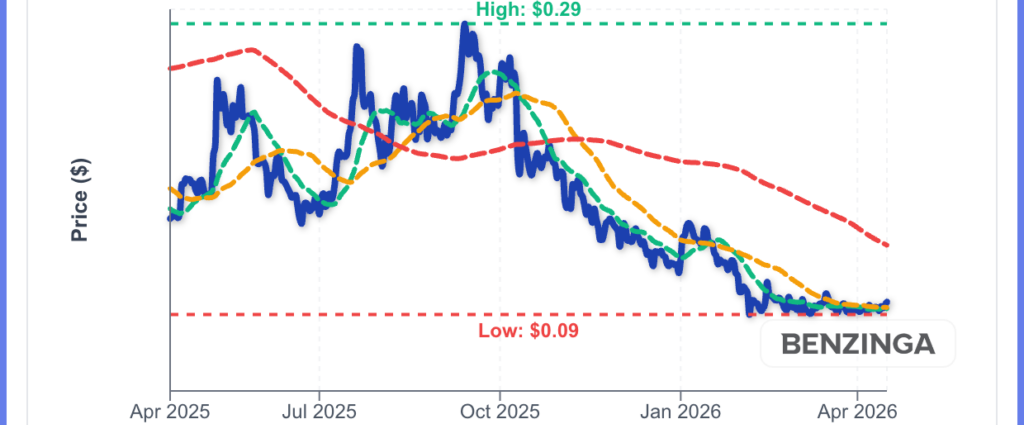
Governor Gavin Newsom (D-CA) slammed President Donald Trump and White House Press Secretary Karoline Leavitt on Wednesday, accusing the administration of causing fuel prices in the U.S. to surge amid the war with Iran.

Trump Living In An Alternate Dimension

In a post on X, Newsom delivered sharp criticism of the administration, quoting a post by user @Acyn who shared a video of Leavitt, hailing Trump for believing in American “energy dominance” and “bringing down gas prices.”

The Governor outlined the surge in fuel costs at the pump. “Tell that to everyone now paying the skyrocketing gas prices your boss directly caused, Karoline,” he said, adding that gas was up 94 cents/gallon in the past year. “Donald Trump’s administration continues to live in an alternate universe. What a completely detached failure,” he said.

Full story available on Benzinga.com

This post was originally published here

Anthony Scaramucci, founder of global investment firm SkyBridge Capital,  recommended on Wednesday the century-old book “The Richest Man in Babylon” to young people and parents for its lessons on saving and investments.

Why Scaramucci Suggests Reading It

Scaramucci took to X to share his thoughts on the 1926 classic written by George Clason, which transformed his perspective on money.

Scaramucci said that the book explains the core lesson of compounding, i.e, a certain return every year over a period of time will double the investment.

“The concepts in this book really helped me get started in investing,” the Bitcoin (CRYPTO: BTC) bull said.

Full story available on Benzinga.com

This post was originally published here

The President Donald Trump administration is reportedly in talks with General Motors Co. (NYSE:GM), Ford Motor Co. (NYSE:F) and other manufacturers to produce weapons and other military supplies amid wars in Iran and Ukraine.

A World War II Callback?

The Pentagon has approached GM CEO Mary Barra, as well as Ford CEO Jim Farley, among other top executives, about producing military supplies and weapons, according to a report by the Wall Street Journal on Wednesday, citing anonymous sources familiar with the talks.

The preliminary talks were also held with GE Aerospace and Oshkosh Corp (NYSE:OSK), the report said, with the discussions beginning before the war with Iran. Defense officials have touted shoring up domestic production of weapons and munitions as a matter of national security, the report said, while also asking manufacturers to identify barriers to …

Full story available on Benzinga.com

This post was originally published here

Massimo Group (NASDAQ:MAMO) shares jumped 38.86% to $1.37 in after-hours trading on Wednesday after the Texas-based company announced a strategic cooperation agreement with Chinese intelligent service robotics developer Shenzhen AIBO Robotics Co., Ltd., marking its entry into commercial automation and AI-enabled robotics.

MAMO Eyes AI Upgrades To Existing Platforms

Under the agreement, Massimo plans to explore AI-driven upgrades to its golf cart and utility vehicle platforms, including semi-autonomous navigation, obstacle detection and remote monitoring. The company also intends to evaluate patrol-support and inspection assistance use cases in managed environments, leveraging its U.S.-based assembly capabilities to localize AIBO’s systems for North American deployment.

CEO David Shan said, “We believe MAMO is positioned to evaluate practical automation applications across a range of real-world environments.”

Massimo said it believes the partnership aligns with its core strengths in equipment assembly, electromechanical integration, supply chain coordination, deployment execution and operational support, potentially supporting its expansion into robotics …

Full story available on Benzinga.com

This post was originally published here
QVC Group (NASDAQ:QVCGA) is trending sharply lower on Wednesday night after-hours trading following confirmation of a restructuring move tied to bankruptcy proceedings.

The stock collapsed 68.63% in after-hours trading, dropping to $0.80 from its prior close of $2.55, following the company’s disclosed Chapter 11 filing plans and financial position.

Bankruptcy Filing Drives Sharp Repricing

The company disclosed that it and certain subsidiaries intend to initiate voluntary Chapter 11 proceedings in the U.S. Bankruptcy Court for the Southern District of Texas. While management has indicated a target timeline of roughly 90 days for emergence from restructuring, the filing itself marks the start of a formal restructuring process.

Financial Stress And Balance Sheet Strain

QVC Group reported FY 2025 revenue of $9.23 billion and a net loss of $2.40 …

Full story available on Benzinga.com

This post was originally published here

American Shared Hospital Services (NYSEAMERICAN: AMS) shares surged 16.28% after-hours to $1.50 following a Securities and Exchange Commission filing disclosing a 100,000 restricted stock unit award granted to Executive Chairman Raymond C. Stachowiak.

What Investors Need To Know

The filing shows the RSU grant was issued at no cost and increases Stachowiak’s direct beneficial ownership to 774,678 shares.

The market move reflects investor focus on insider incentives, which are often viewed as alignment tools between management and shareholders.

The award vests in four equal installments of 25,000 shares beginning Apr. 1, 2026, followed by Jul. 1, 2026, Oct. 1, 2026, and Jan. 1, 2027. The filing did not include any operational updates.

As of Dec. 31, 2025, American Shared Hospital Services has 6.57 million outstanding shares.

AMS reported

Full story available on Benzinga.com

This post was originally published here

The equity rebound in Q2 has been sharp. After a 7.6% rally, the S&P 500 is at fresh all-time highs, despite a fragile Middle East ceasefire and elevated energy costs.

However, the financial market plumbing might be providing a powerful tailwind. According to Neil Sethi, Managing Partner at Sethi Associates, Goldman Sachs‘ data shows that commodity trading advisors, or CTAs, could buy as much as $45 billion of U.S. stocks over this week, including roughly $34 billion tied directly to the S&P 500.

At the same time, hedge funds have covered bearish bets at the fastest pace since March 2020, helping fuel a squeeze higher.

However, the most important question remains whether this rally has real support beneath the flows.

Short covering rallies can be notoriously sharp, especially in crowded markets, yet they’re not the same as conviction buying.  Once the shorts get covered, the source of demand fades. Price movement doesn’t necessarily tell investors much about earnings durability, economic momentum, or whether risk appetite has genuinely broadened.

More Supportive Than It Appears

CTA buying follows the same cautious logic. …

Full story available on Benzinga.com

This post was originally published here

On Wednesday, investors Gary Black of The Future Fund LLC and Gene Munster, managing partner at Deepwater Asset Management, shared their views on Elon Musk-led Tesla Inc.‘s (NASDAQ:TSLA) recent stock rally.

Gary Black Shares His View

The analysts took to the social media platform X to express their views. Black, in a post, shared screenshots of a Barron’s article by Al Root, outlining three reasons for the stock rally.

“The Mystery Behind TSLA’s Sudden Stock Rise,” Black said. The article listed reasons like Musk sharing a picture of Tesla’s AI5 chip and sharing that the AI4 chip was capable of achieving better FSD performance.

The article also listed Black’s comments about investors looking forward to the end of the Iran war, as well as the SEC’s proposed easing of restrictions for day trading, potentially changing a rule that restricted traders with less than $25,000 in margin accounts from making more than four day trades within five business days.

Notably, Tesla stock was seen trending overnight as analyst Itay Michaeli of TD Cowen maintained a bullish outlook, adjusting the price target to $490.

Gene Munster Says AI5 Is The Reason Behind Rally

Munster, on …

Full story available on Benzinga.com

This post was originally published here
Although President Donald Trump claimed the Iran war is “very close to being over,” cryptocurrency punters remain unconvinced, with odds still reflecting skepticism about a quick resolution.

Crypto Bettors See No Immediate End To Conflict

Polygon (CRYPTO: POL)-based Polymarket showed a 41% possibility that Trump announces the end of military operations against Iran by the end of this month, down from 46% a day earlier.

The possibility of this happening by the end of May, however, was significantly higher at 73%, while bookmakers set the chance of the war ending by June 30 at 83%.

Over $26 million has already been traded on the outcome, making it one of the most wagered bets on Polymarket. An official statement by Trump, the federal government or the military will qualify for a resolution.

Interestingly, the odds of the U.S. and Iran agreeing on …

Full story available on Benzinga.com

This post was originally published here
Myseum Inc. (NASDAQ:MYSE) shares are trending on Wednesday night.

MYSE surged 175% to $3.96 in after-hours trading Wednesday after the New Jersey-based company announced its rebrand to Myseum.AI, Inc., signaling a full pivot to proprietary artificial intelligence.

A Privacy-First Pivot Sends MYSE Soaring

The social media technology company is building localized, privacy-first AI agents designed to manage personal media such as photos, videos and messages without sharing user data with traditional AI models. Myseum stated that the system adapts to individual habits and preferences while preserving data integrity and encryption.

CEO Darin Myman said, “Our new name identifies our core AI-based technology that secures our multi-tiered social media ecosystem.”

The ticker symbol “MYSE” remains unchanged on Nasdaq.

Broader Market Trend

MYSE’s rebrand follows a broader …

Full story available on Benzinga.com

This post was originally published here
Nancy Pelosi, a stock tracker, on Wednesday raised some concerns on X over Rep. Greg Steube‘s (R-Fla.) stock trading disclosure for IONQ Inc(NYSE:IONQ) purchase that came just at the time of the company’s announcement to win a U.S. defense research contract.

Trade Raises Red Flags

The X account, with over 1.4 million followers, said the trades by Steube should ‘probably raise some flags.” The popular social media account noted that Steube sits on the House Intelligence Committee, whose work spans NSA and Defense Intelligence agencies, and receives “classified briefings on U.S. quantum computing programs.”

Full story available on Benzinga.com

This post was originally published here

Tron (CRYPTO: TRX) founder Justin Sun criticized a new governance proposal by Trump family-backed World Liberty Financial (WLFI) on Wednesday, deeming it a “power consolidation and property expropriation operation.”

Details Of Proposal

The proposal’s terms include a 2-year cliff and a 3-year linear vest for all 45.24 billion WLFI tokens held by advisors, institutions, partners, founders and team members. This means that tokens will begin to unlock in year 2 and will be fully distributed by year 5.

Upon passage, 10% of this allocation, up to 4.52 billion, will be burned and permanently removed from the token supply.

Early supporters, meanwhile, will have a shorter vesting schedule, with their 17.04 billion WLFI moving to a 2-year cliff followed by a 2-year linear vest. No tokens will be burned under this schedule.

“Holders who do not affirmatively accept this new vesting schedule will continue to have their tokens locked indefinitely,” the proposal read.

WLFI said that the proposal aims to establish a “structured vesting framework” and ensure the “ecosystem’s commitment to long-term governance and market supply.”

Full story available on Benzinga.com

This post was originally published here

Leading cryptocurrencies remained stable, while stocks hit record highs on Wednesday as President Donald Trump declared the Iran war is nearing an end.

Cryptocurrency 24-Hour Gains +/- Price (Recorded at 9:15 p.m. EDT)
Bitcoin (CRYPTO: BTC) -0.26% $74,569.15
Ethereum (CRYPTO: ETH)
               
+0.44% $2,350.12
XRP (CRYPTO: XRP)                          +2.31% $1.39
Solana (CRYPTO: SOL)                          +1.23% $84.74
Dogecoin (CRYPTO: DOGE)              +1.41% $0.09477

Crypto Market Holds Steady

Bitcoin hovered around $74,000 for most of the day before surging to $75,000 in late trading. Trading activity remained on the lower side. Ethereum also wobbled in the $2,300 zone, while XRP and Dogecoin traded in the green.

Shares of Strategy Inc. (NASDAQ:MSTR) and Coinbase Global Inc. (NASDAQ:COIN) closed up 4.45% and 6.19%, respectively.

Over $210 million was liquidated in the past 24 hours, predominantly in short positions, according to Coinglass data.

Open interest in Bitcoin futures held steady over the last 24 hours, while retail and whale derivative sentiment continued to be bearish.

“Extreme Fear” sentiment prevailed in the market, according to the Crypto Fear & Greed Index.

Top Gainers (24 Hours) 

Cryptocurrency (Market Cap>$100 M) Gains +/- Price (Recorded at 9:15 p.m. EDT)
PlaysOut (PLAY)       +79.01%     $0.1829
Enjin Coin (ENJ)                   +61.42%     $0.09541
siren (SIREN)            +19.34%     $0.8364

The global cryptocurrency market capitalization stood at $2.52 trillion, following a modest …

Full story available on Benzinga.com

This post was originally published here
Just eight days ago, International Energy Agency Chief Fatih Birol declared the world was facing the largest energy supply disruption in modern history.

• State Street SPDR S&P 500 ETF Trust stock is challenging resistance. Why is SPY stock breaking out?

The blockade of the Strait of Hormuz, he said, was “more serious than the ones in 1973, 1979 and 2022 together.”

Twelve million barrels per day removed from markets — more than the two 1970s oil shocks combined. A global energy crunch twice as severe as the Ukraine crisis.

In less than two weeks, that thesis was fully dismantled by the stock market.

On Wednesday, the S&P 500 — tracked by the SPDR S&P 500 ETF Trust (NYSE:SPY) — pushed above 7,002 and printed a fresh all-time high of 7,015, capping a 10% rally in just 11 sessions.

While the physical economy still reflects the worst energy shock on record, financial markets are already pricing a world in which it has passed — with companies effectively back to business as usual.

The S&P 500 is now trading higher than it was before the conflict began. In equity …

Full story available on Benzinga.com

This post was originally published here
Anthropic is holding discussions with investors regarding a new funding round that would place the company’s valuation at $800 billion, more than doubling its $350 billion mark in February.

With this rapid rise, it is closing in on OpenAI’s $850 billion valuation, putting pressure on the company’s lead in the artificial intelligence space.

It is unclear if the Anthropic will accept this new $800 billion valuation as discussions are still ongoing and could change, Bloomberg reported.

Anthropic’s annualized revenue reportedly hit $30 billion in April, surpassing OpenAI’s roughly $24 billion run rate. The company went from $9 billion at year-end 2025 to $30 billion in about four months, with over 1,000 companies now spending more than $1 million annually on Anthropic products.

This is primarily due to the adoption …

Full story available on Benzinga.com

This post was originally published here
PHILADELPHIA, April 15, 2026 /PRNewswire/ — abrdn National Municipal Income Fund (NYSE:VFL) announces that the Board of Trustees has approved the removal of a non-fundamental investment policy that restricted VFL from investing more than 20% of its portfolio in high-yield municipal securities. This change is effective June 1, 2026.

In reaching this decision, the Board considered, among other things, that removing this …

Full story available on Benzinga.com

This post was originally published here
Treasury Secretary Scott Bessent spoke to CNBC on Wednesday during the Invest In America Forum about the current state of the private credit market. He noted that “none of our work has shown there would be a systemic problem.”

Bessent referenced JPMorgan CEO Jamie Dimon’s comments regarding “cockroaches” within private credit and his view that the private credit market is not big enough to pose systemic risk, the transcript revealed.

“We monitor all aspects of the capital markets, and private credit is one. I think it’s been an important new product and we’re keeping in touch with it,” Bessent said.

Federal Reserve Chair Jerome Powell and Dimon have both reiterated similar statements regarding the private credit environment.

Bessent noted that the Treasury plans to host 50-state insurance regulators that are involved in the private credit space, and they are also going to have a forum for the offshore reinsurance companies that buy private credit.

“We want …

Full story available on Benzinga.com

This post was originally published here
Voyager Technologies Inc (NYSE:VOYG) shares are moving higher in Wednesday’s after-hours session after the company was selected by NASA for a private astronaut mission.

NASA Selects Voyager For ISS Mission

Voyager Technologies announced it signed an order with NASA for the seventh private astronaut mission to the International Space Station.

The mission, called VOYG-1, will support NASA’s aim to transition low-Earth orbit operations to the private sector and is expected to launch no earlier than 2028.

“This award reflects decades of partnership with NASA and validates our belief that the infrastructure being built in low-Earth orbit today is the launchpad for humanity’s future in deep space,” said Dylan Taylor, chairman and CEO of Voyager.

How …

Full story available on Benzinga.com

This post was originally published here

KKR & Co. (NYSE:KKR) has become the latest private equity firm to place a limit on withdrawals in its private credit fund, mirroring others who have done so recently as the private credit market experiences a rough patch.

The firm capped withdrawals in its asset-based finance fund K-ABF at 5% following redemption requests of approximately $38.4 million, 7.2%, KKR told investors, Bloomberg reported.

K-ABF, launched in 2025, is an income fund focused on private credit solutions for investors seeking diversification and access to the large and fast-growing Asset-Based Finance (ABF) universe, KKR’s website reveals. At least 80% of the portfolio’s assets are ABF investments.

KKR added that payouts will be allocated proportionally, with investors receiving roughly 69% of their …

Full story available on Benzinga.com

This post was originally published here

PPG Industries Inc (NYSE:PPG) shares are rising in extended trading Wednesday after the company announced global price increases and reported preliminary first-quarter results.

PPG Anticipates Strong Q1 Earnings

After the market close on Wednesday, PPG announced that it started raising prices across all of its product lines by up to 20% amid continued global volatility and supply constraints.

“This pricing action allows us to ensure availability of supply as we navigate unexpected and increased cost pressures,” said Tim Knavish, chairman and …

Full story available on Benzinga.com

This post was originally published here
Johnson & Johnson (NYSE:JNJ) on Tuesday posted upbeat earnings for the first quarter.

The company reported first-quarter 2025 adjusted earnings of $2.70 per share, down 2.5% year over year, beating the consensus of $2.67. The U.S. healthcare giant reported sales of $24.06 billion, up 9.9% year over year and beating the consensus of $23.63 billion.

Johnson & Johnson raised fiscal 2026 adjusted earnings guidance from $11.43-$11.63 per share to $11.45-$11.65, compared to the consensus of $11.54.

The company also revised fiscal 2026 sales guidance from $100 billion-$101 billion to $100.3 billion-$101.3 billion versus the consensus of …

Full story available on Benzinga.com

This post was originally published here
Errol Musk claimed in an interview that his sons Elon and Kimbal Musk hold a combined 23,400 Bitcoin (CRYPTO: BTC), a stash worth roughly $1.7 billion at current prices around $74,000.

The claim has not been independently verified. If accurate, it would place the Musk brothers among the largest individual Bitcoin holders in the world.

Corporate Holdings

According to BitcoinTreasuries data, Tesla Inc (NASDAQ:TSLA) holds 11,509 BTC and SpaceX holds an additional 8,285 BTC. Combined corporate holdings sit at roughly 19,794 BTC, about 3,600 short of Errol’s figure.

The gap suggests the 79-year-old engineer may be including personal holdings outside corporate balance sheets, though neither son has publicly disclosed Bitcoin positions of that scale.

At current prices, Tesla’s known BTC position is worth roughly $850 million, or about 0.07% of TSLA’s market cap.

Errol also

Full story available on Benzinga.com

This post was originally published here

PepsiCo Inc. (NASDAQ:PEP) reports Q1 2026 earnings before the bell Thursday.

The company has beaten EPS estimates in three of its last four quarters, which explains why Polymarket gives a 96% chance PepsiCo tops the $1.54 consensus. The more interesting action is on Kalshi.

What Prediction Markets Are Saying

On Kalshi, nearly $25,000 is riding on which specific words CEO Ramon Laguarta and his team will say on the 8:15 a.m. ET call.

The top of the board is mostly formality. “Volume” at 95%, “Acquisition” at 90%, and “China” at 84% are near-certainties for a company that just spent $4 billion on deals and has been losing snack volumes for five straight quarters.

The mid-range contracts are where it gets interesting.

“Tariff” is at 66%. Pepsi concentrate is manufactured in Ireland, but Coca-Cola Co. (NYSE:KO) makes its concentrate in Atlanta. …

Full story available on Benzinga.com

This post was originally published here

Venture Capital firm Accel has raised $5 billion in late-stage capital to allocate towards artificial intelligence startups.

Of that $5 billion, $4 billion will be allocated towards 20-25 late-stage investments globally, while $640 million will be used as a sidecar fund for investors to allocate money towards some of the company’s largest investments, Bloomberg reports.

“In our view, this market cycle represents the early phase of a broader transformation. We’ve seen big shifts before, and they tend to build on each other. But the momentum behind AI is entirely new. Markets are refreshing, opportunities are broadening, and the next decade will be one of the most meaningful in modern …

Full story available on Benzinga.com

This post was originally published here

Elon Musk‘s xAI has filed a lawsuit seeking to stop the state of Colorado from enforcing a law that sets compliance duties for certain artificial intelligence (AI) tools. The case adds to a widening fight over whether AI oversight should be handled state by state or through a federal standard.

The complaint names Colorado Attorney General Phil Weiser and asks the court to block a 2024 statute focused on “high-risk” AI uses. The law covers systems in areas such as housing, education, and employment, and requires developers to take steps to prevent algorithm-driven discrimination.

Colorado law would impose significant operational demands on companies building AI products, xAI argues, citing the need for ongoing monitoring and output changes to comply with the rules. The company also said the measure conflicts with First Amendment protections.

In the filing, xAI contended the statute could pressure its Grok chatbot to adopt what it described as a “highly politicized viewpoint,” …

Full story available on Benzinga.com

This post was originally published here
Bitcoin is holding $74,000 as markets await the upcoming Clarity Act roundtable.

Cryptocurrency Ticker Price
Bitcoin (CRYPTO: BTC) $74,261.53
Ethereum (CRYPTO: ETH) $2,352.35
Solana (CRYPTO: SOL) $84.89
XRP (CRYPTO: XRP) $1.38
Dogecoin (CRYPTO: DOGE) $0.09492
Shiba Inu (CRYPTO: SHIB) $0.055926

Notable Statistics:

  • Coinglass data shows 106,868 traders were liquidated in the past 24 hours for $212.62 million.       
  • SoSoValue data shows net inflows of $411.5 million from spot Bitcoin ETFs on Tuesday. Spot Ethereum ETFs saw net inflows of $53 million.
  • In the past 24 hours, top gainers include Siren, DeXe and Chiliz.

Notable Developments:

Full story available on Benzinga.com

This post was originally published here
Bank7 Corp (NASDAQ:BSVN) reported better-than-expected earnings for the first quarter on Tuesday.

The company posted quarterly earnings of $1.25 per share which beat the analyst consensus estimate of $1.01 per share. The company reported quarterly sales of $26.158 million which beat the analyst consensus estimate of $23.590 million.

“We are pleased to announce record EPS, net income and PPE while maintaining a strong net interest margin, excellent credit quality, and robust liquidity. We are excited about 2026, as our properly matched balance sheet has us well positioned to continue to take advantage of our dynamic geographic region,” said …

Full story available on Benzinga.com

This post was originally published here

Xanadu Quantum Technologies Ltd. (NASDAQ:XNDU) shares are trading sharply higher Wednesday. A sector-wide rally in quantum computing stocks was sparked by Nvidia Corp.’s (NASDAQ:NVDA) rollout of new open-source AI models tailored for quantum applications.

On Tuesday, Nvidia introduced Ising. This is the world’s first open-source AI model family for quantum computing.

Nvidia Ising Targets Quantum Scaling

The new models aim to accelerate advances in the quantum sector. Nvidia designed Ising to help researchers build useful quantum processors. “AI is essential to making quantum computing practical,”

Full story available on Benzinga.com

This post was originally published here

Top Wall Street analysts changed their outlook on these top names. For a complete view of all analyst rating changes, including upgrades, downgrades and initiations, please see our analyst ratings page.

  • Piper Sandler analyst James Fish upgraded Cloudflare Inc (NYSE:NET) from Neutral to Overweight and maintained the price target of $222. Cloudflare shares closed at $178.65 on Tuesday. See how other analysts view this stock.
  • Cantor Fitzgerald analyst Pete Stavropoulos upgraded Alector Inc

Full story available on Benzinga.com

This post was originally published here
Bitcoin’s (CRYPTO: BTC) recent rebound alongside equities is not necessarily the start of a new bull market but could instead reflect a late-cycle distribution phase, according to analyst Benjamin Cowen.

Late-Cycle Pattern Repeating

In an Apr. 16 podcast, Cowen said current market behavior mirrors historical late-cycle dynamics.

Typically, markets see a sharp correction, followed by a recovery that retests or slightly exceeds prior highs, often described as “sweeping the highs.”

This pattern can trap late buyers, creating the illusion of strength before a broader downturn.

Cowen compared …

Full story available on Benzinga.com

This post was originally published here

Amazon.com Inc (NASDAQ:AMZN) agreed to acquire Globalstar Inc (NYSE:GSAT) for $11.57 billion, snatching a satellite company that Elon Musk’s SpaceX had tried to buy itself just months earlier.

Amazon Outbid SpaceX

Amazon beat out SpaceX for Globalstar, securing spectrum and satellite infrastructure that strengthens its position in both broadband and direct-to-device connectivity.

SpaceX has roughly 10,000 Starlink satellites in orbit. Amazon has around 200, but is planning $200 billion in capex this year and targeting 3,200 satellites by 2029.

The deal is already sending ripples through the satellite sector. Viasat Inc (NASDAQ:VSAT) has surged nearly 600% in the past year, Iridium Communications (NASDAQ:IRDM) is up about 50%, and hedge funds are circling both as potential takeover targets as companies …

Full story available on Benzinga.com

This post was originally published here
Bitwise Asset Management has rolled out the Bitwise Avalanche ETF (NYSE:BAVA) months after filing an updated S-1 with the SEC, offering investors direct exposure to Avalanche (CRYPTO: AVAX) while tapping into staking rewards — a structure that underscores the next phase of crypto ETFs beyond Bitcoin and Ethereum.

• BAVA stock is trading in a tight range. Where are BAVA shares going?

The fund aims to combine price exposure with yield generation, as Bitwise stakes its AVAX holdings through its in-house on-chain division to capture an estimated 5.4% annual …

Full story available on Benzinga.com

This post was originally published here

Kevin Warsh, Donald Trump‘s nominee to replace Jerome Powell as chair of the Federal Reserve, would not just bring a new policy outlook to the central bank. He brings a background of immense personal wealth.

His 69-page disclosure lists personal assets ranging from at least $192 million to roughly $226 million, while his wife, Jane Lauder, an Estée Lauder heiress, is estimated to be worth about $1.9 billion.

Immense Power, Opaque Holdings

If confirmed, Warsh would be among the richest Fed leaders in history. However, his wealth is not the core ethical problem. The issue is that major parts of his portfolio are opaque. His disclosure lists more than $100 million in funds that withhold underlying assets under pre-existing confidentiality agreements.

That arrangement is a red flag for the head of a central bank that will influence stablecoin regulation, bank crypto-custody rules, tokenized deposits, and any future U.S. central bank digital currency policy. When a nominee’s true financial exposure is hidden, the public cannot judge where private incentives may intersect with public decisions.

Warsh has pledged to divest these holdings, and he should be in compliance once he does …

Full story available on Benzinga.com

This post was originally published here

Shopify Inc (NASDAQ:SHOP) shares are trading higher Wednesday. The surge follows a broader rally in the technology sector and improving macroeconomic sentiment across Wall Street.

Tech Sector Momentum

The Nasdaq Composite gained 0.55% on Wednesday, providing a tailwind for high-growth software names.

This upward movement follows a strong Tuesday session, during which information technology and consumer discretionary stocks led the S&P 500 higher.

Geopolitical De-Escalation Hopes

Investor confidence grew after President Donald Trump suggested that Iran talks “could be happening over the next two days.” These comments built on Vice President JD Vance noting “a lot of progress” in …

Full story available on Benzinga.com

This post was originally published here

GameStop Corp. (NYSE:GME) shares are climbing Wednesday. The move follows a major product launch and shifting technical data.

The Nasdaq is up 0.73% while the S&P 500 has gained 0.39%.

Power Packs Go Live

The primary catalyst is the public launch of Power Packs. This digital trading card platform opened to the general public on Wednesday.

The online experience allows collectors to buy digital packs. These packs unlock physical, Professional Sports Authenticator (PSA)-graded cards. Categories include Pokémon and major sports. Packs range from $25 to $2,500.

Investors see this as a strategic expansion into the high-margin collectibles space, with potential …

Full story available on Benzinga.com

This post was originally published here

Uber Technologies Inc (NYSE:UBER) shares are surging on Wednesday. Investors are cheering a massive strategic shift toward autonomous vehicle (AV) technology.

The rally comes despite reports of internal budget struggles regarding AI development.

$10 Billion Robotaxi Commitment

The Financial Times reported Wednesday that Uber committed nearly $10 billion to its Robotaxi strategy. This includes $2.5 billion for equity stakes in AV firms.

These investments depend on companies hitting specific deployment milestones. Uber also plans to spend $7.5 billion to expand its autonomous fleet over the coming years.

Strategic Global Partnerships

Uber is aggressively expanding its Autonomous Vehicles footprint through high-profile deals. The company recently partnered with Lucid Group …

Full story available on Benzinga.com

This post was originally published here

Warner Bros. Discovery, Inc. (NASDAQ:WBD) is expanding into India on Wednesday as HBO Max lands on JioHotstar, unlocking premium global content at scale.

• Warner Bros. Discovery stock is showing positive momentum. What’s next for WBD stock?

The deal brings HBO Max content to a broader audience through a major local platform, signalling a push into one of the fastest-growing digital markets.

The platform will exclusively host HBO Max programming, offering a centralized destination for premium international content, PRNewswire reports.

Expanding Streaming Reach In India

The newly launched hub aggregates content from HBO, Warner Bros., DC Studios and Max Originals.

The firm said that viewers in India can now access a wide selection of global titles through a single integrated interface.

This rollout reflects growing demand for high-quality international entertainment across India’s digital audience. The offering combines curated content with easier access, aiming to elevate user experience nationwide.

“This marks a defining moment in how premium global content is accessed and experienced in India. By bringing HBO Max to JioHotstar, we are creating a unified destination for premium international content and raising the bar for quality content once again. We are combining scale, curation, quality and ease of …

Full story available on Benzinga.com

This post was originally published here

U.S. stocks traded higher midway through trading, with the Nasdaq Composite gaining over 200 points on Wednesday.

The Dow traded down 0.36% to 48,360.33 while the NASDAQ rose 0.91% to 23,854.08. The S&P 500 also rose, gaining, 0.41% to 6,995.87.

Leading and Lagging Sectors

Information technology shares climbed by 1% on Wednesday.

In trading on Wednesday, materials stocks fell by 1.1%.

Top Headline

Morgan Stanley (NYSE:MS) posted better-than-expected earnings for the first quarter.

The company posted EPS of $3.43, beating market estimates of $3.00. The company’s sales came in at $20.580 billion, topping expectations of $19.724 billion.

Equities Trading UP
           

  • Allbirds Inc (NASDAQ:BIRD) shares shot up 349% to $11.17 after the company announced the execution of a definitive agreement with an institutional investor for a $50 million convertible financing facility. The company will pivot its business to AI compute infrastructure and change its name to “NewBird AI.”
  • Shares of Immutep Ltd – ADR (NASDAQ:IMMP) got a boost, surging 160% to $0.82 after the FDA …

Full story available on Benzinga.com

This post was originally published here

Cooperation combines HC Global’s $51 billion fund administration platform with 6 Monks’ European AIFM expertise to provide seamless access to €30 trillion EU institutional market

SAN FRANCISCO, April 15, 2026 /PRNewswire/ — HC Global Fund Services, LLC (HC Global), a leading global fund administrator with $51 billion in Assets under Administration (AUA), and 6 Monks (6M), a regulated Alternative Investment Fund Manager (AIFM), today announced a strategic collaboration to jointly deliver a comprehensive, end-to-end fund services platform to worldwide investment managers looking for European presence .

Full story available on Benzinga.com

This post was originally published here

Citigroup Inc (NYSE:C) reported better-than-expected earnings for the first quarter on Tuesday.

The company posted quarterly earnings of $3.06 per share which beat the analyst consensus estimate of $2.63 per share. The company reported quarterly sales of $24.633 billion which beat the analyst consensus estimate of $23.526 billion.

CEO Jane Fraser said Citi has entered the final phase of its divestitures, with most transformation programs nearing targets. The bank repurchased $6.3 billion in shares during the quarter and remains on track to meet its 10% to 11% return on tangible common equity goal for the year.

Citigroup reaffirmed its 2026 outlook, expecting net interest income excluding markets to rise 5% to 6%. It also raised its forecast for branded cards net credit losses to a range of …

Full story available on Benzinga.com

This post was originally published here

BlackRock, Inc. (NYSE:BLK) on Tuesday reported better-than-expected first-quarter fiscal 2026 results.

Revenue rose 27% year over year to $6.70 billion, exceeding the consensus estimate of $6.46 billion. Adjusted operating income increased 31% to $2.70 billion. Adjusted earnings per share came in at $12.53, up 11% from a year earlier and above estimates of $11.62.

Chairman and CEO Laurence Fink said the firm delivered “one of the strongest starts to a year in our history.”

“Over the last twelve months, clients entrusted BlackRock with $744 billion of net new assets, powering 10% organic base fee growth,” Fink said.

BlackRock shares fell 0.4% to …

Full story available on Benzinga.com

This post was originally published here

BlackRock’s iShares platform kicked off 2026 with a record-breaking quarter, pulling in $132 billion in net inflows, up nearly 60% year over year, as investors doubled down on ETFs for both income and flexibility. The asset manager said 49 of its products each attracted more than $1 billion during the quarter, underscoring broad-based demand across its $5.5 trillion ETF platform.

But beneath the headline number, the flows reveal a more telling shift: investors are leaning heavily into fixed income and actively managed strategies, while favoring short-duration exposure in a still elevated rate environment.

Bond ETFs Take Center Stage

Fixed income emerged as a key growth engine, with iShares pulling in $46 billion into bond ETFs during the quarter. The firm’s bond ETF platform has now swelled to $1.2 trillion, up 20% over the past year, positioning it among the largest bond managers globally on a standalone basis.

Short-duration Treasury products dominated flows, signaling a continued preference for liquidity and capital preservation. The iShares 0-3 Month Treasury Bond ETF

Full story available on Benzinga.com

This post was originally published here

In recent days, you can tell something is changing in crypto, not just from price action, but from who is showing up and how they’re choosing to invest.

Not long ago, the big question was whether Wall Street would even touch Bitcoin (CRYPTO: BTC). Now, the question is how quickly they will develop products around it and how much of the market they can capture.

Yesterday, Goldman Sachs (NYSE:GS) filed for its first Bitcoin ETF. This comes shortly after Morgan Stanley (NYSE:MS) started offering similar investments. And behind them, a list of major banks is moving in the same direction.

Big Banks Are No Longer Sitting on the Sidelines

On Tuesday, Goldman Sachs applied to the Securities and Exchange Commission (SEC) in the United States to introduce a Bitcoin Premium Income ETF. Meanwhile, Morgan Stanley introduced its spot Bitcoin ETF, describing it as the most affordable Bitcoin ETF.

Why are banks moving fast?

The phase in which crypto was being adopted has passed, and what is happening now is institutional in nature, whereby product growth drives growth.

And the numbers back that up.

According to data shared in January by River, around 60% of the leading U.S. banks are already working with Bitcoin in one way or another, whether trading, storing, or offering investment products. Organizations like JPMorgan Chase (NYSE:JPM), Wells Fargo (NYSE:WFC), and Citigroup

Full story available on Benzinga.com

This post was originally published here

Zoom Video Communications Inc (NASDAQ:ZM) shares are climbing on Wednesday. The rally follows a key executive hire and a supportive broader market environment.

• Zoom Communications stock is among today’s top performers. What’s fueling ZM momentum?

Former Microsoft Executive Joins As CPO

Zoom announced the appointment of Russell Dicker as chief product officer on Wednesday. Dicker previously served as corporate vice president at Microsoft Corp (NASDAQ:MSFT). He led product and data science for Microsoft Teams. He also held leadership roles at Amazon.com Inc (NASDAQ:AMZN) and Alphabet Inc

Full story available on Benzinga.com

This post was originally published here

L3Harris Technologies, Inc. (NYSE:LHX) shares are slightly up on Wednesday as the company announces a significant expansion of its solid rocket motor production capacity.

The stock’s movement follows the news of a more than $1 billion investment to create the Virginia Advanced Propulsion Facilities, which is expected to double the manufacturing space and create over 350 jobs in Orange County, Virginia.

L3Harris Technologies, in collaboration with Virginia Gov. Abigail Spanberger and the Orange County Board of Supervisors, has revealed plans for a major expansion at its Orange County site. This project aims to enhance production capabilities for key national defense programs and is expected to significantly boost local employment.

“L3Harris’ continued investments in solid rocket motor facilities are bolstering manufacturing capacity for key national defense programs,” said Ken Bedingfield, president of Missile Solutions at L3Harris.

L3Harris said it is also modernizing and expanding solid rocket motor production at its sites in Camden, Arkansas, and Huntsville, Alabama. The company’s ongoing investments in new facilities, equipment and processes “will enable it to double, triple and quadruple solid rocket motor production rates for a range of key programs”.

Full story available on Benzinga.com

This post was originally published here

Former SEC Chair Gary Gensler helped write the Dodd-Frank definition of a ‘swap.’

Now, Kalshi is using his words to argue its sports event contracts are federally regulated derivatives, not gambling. Gensler says they’ve got it all wrong.

That’s a problem for Kalshi, which has built its entire legal strategy around the argument that sports event contracts are swaps.

The Third Circuit agreed last week, ruling 2-1 that federal law preempts state gambling regulation.

But the Ninth Circuit hears consolidated oral arguments today in the Nevada cases involving Kalshi, Robinhood Markets (NASDAQ:HOOD) and Crypto.com.

If the panel reaches a different conclusion, this likely ends up at the Supreme Court.

What Gensler Undercuts

Kalshi’s legal defense rests on the plain text of the statute. Courts have agreed so far, but Gensler …

Full story available on Benzinga.com

This post was originally published here

Space and defense technology company Sidus Space (NASDAQ:SIDU) on Wednesday announced an expansion of its existing agreement with Lonestar Data Holdings.

This news comes as the broader market is experiencing mixed performance, with the S&P 500 gaining 0.4% and the Communication Services sector, which Sidus is part of, up 0.8%, suggesting that the stock’s decline may be driven by company-specific factors rather than overall market trends.

The amendment to Sidus’ agreement with Lonestar expands the scope of their partnership, focusing on the development of an additional StarVault payload, which is set to launch no earlier than fall 2026.

This collaboration aims to enhance Lonestar’s orbital data storage capabilities, reflecting Sidus’ commitment to supporting complex payload integrations.

Technical Analysis

Sidus Space is currently trading within a strong upward trend, positioned significantly above its 20-day simple moving average (SMA) by 62.8%, indicating robust short-term momentum. The stock is also trading 96.4% above its 50-day SMA, suggesting a strong bullish sentiment in the intermediate term.

The relative strength …

Full story available on Benzinga.com

This post was originally published here

Based on BlackRock Chairman Larry Fink’s annual letter to shareholders, Real World Assets (RWA) are being built into the pipeline of Wall Street product offerings. Do the originators of the concept have a chance to be players here? Or will RWAs be run by Big Finance? 

“It opens up the biggest land grab in history for financial institutions,” Will Peck, Head of Digital Assets at Wisdom Tree, said about RWAs and tokenization more broadly during an American Banker event on Dec 2, 2025.

When the likes of Larry Fink speak about the tokenization of every financial asset, the crypto community is understandably conflicted. 

“On one hand, having the world’s largest asset manager validate blockchain – albeit for their own ends – is the ultimate validation and vindication. But on the other hand, there’s a fear that traditional finance is arriving not to join the revolution, but to colonize it,” said Saeed Al Fahim, founder of Tharwa, a UAE-based DeFi platform focused on RWA tokenization. 

Some crypto natives refer to RWA models now as simply “wrapped TradFi”, whereas physical assets like land and real estate are digitized but everything around it is centralized within the usual Big Finance ecosystem. 

“Token holders may gain liquidity, but they don’t gain meaningful control or transparency,” said Al Fahim. “I think that runs counter to the principles that crypto was founded on, and I don’t think there’s a quick fix that can remedy that.”

The RWA concept began around 2020 within the small universe of the DeFi blockchain bros. Early players like MakerDAO (CRYPTO: DAO) and Centrifuge (CRYPTO: CFG) began using the concept when they started backing stablecoins and crypto currency loans backed by real estate, or Treasury bonds. It then became the go-to phrase to describe what was seen as a potential new DeFi product line.

RWA was born in the crypto universe. But it has been adopted by Wall Street giants, led by BlackRock. 

The RWA market has reached an estimated $25 billion in 2025, driven by major financial players and blockchain technology.

RWA: Regulatory Concerns and Questionable Use Cases

RWAs connect traditional markets to a blockchain. They let you invest in real-world value using digital tools. Tokenized securities generally fall into two categories, as defined by the Securities and Exchange Commission in January 2026: securities tokenized by or on behalf of the issuers of such securities; and securities tokenized by third parties unaffiliated with the issuers of such securities. Investors can access high value assets like real estate, gold, or government bonds without needing large capital. Tokenization turns them into small, tradable units, though some might say that this already exists …

Full story available on Benzinga.com

This post was originally published here

Bitcoin (CRYPTO: BTC) has outperformed gold since the start of the Iran war but remains down against gold over the past year.

Despite this divergence, some analysts argue the steep correction may represent a long-term buying opportunity.

Historic Correction Against Gold

In an Apr. 14 post on X, trader Michael van de Poppe said Bitcoin’s recent drawdown relative to gold is among the most severe on record, estimating a decline of roughly 66% in a key valuation metric known as sigma deviation.

He noted that similar extremes have previously appeared near major cycle …

Full story available on Benzinga.com

This post was originally published here

Sen. Elizabeth Warren (D-Mass.) sent Elon Musk a letter Tuesday demanding answers about X Money by April 21, citing concerns that the upcoming payments platform could pose risks to consumers, national security, and financial stability.

The 13-Question Demand

Warren, the top Democrat on the Senate Committee, is pressing Musk on whether X Money will issue a stablecoin, partner with Cross River Bank, offer 6% APY on deposits, and surveil consumer transaction data.

The letter comes as Musk prepares to launch X Money in early public access this month.

Former X CEO Linda Yaccarino said the platform will allow users to fund their X Wallet using Visa’s Direct service, connect to debit cards for peer-to-peer transactions, and transfer funds to bank accounts.

The Cross River Concern

Screenshots posted by William Shatner, who recently gained early access to X Money, mention that deposits are held by Cross River Bank. 

Warren notes the institution faced a serious FDIC enforcement action in 2023 …

Full story available on Benzinga.com

This post was originally published here

CoreWeave (NASDAQ:CRWV) on Wednesday announced a significant agreement with Jane Street, which includes a $6 billion commitment to utilize its AI cloud platform.

• CoreWeave stock is trading in a tight range. What’s next for CRWV stock?

This news comes as broader markets are experiencing mixed performance, with the Technology sector gaining 0.69%, while major indices, such as the S&P 500 are up 0.21%.

Jane Street has committed approximately $6 billion to use CoreWeave’s AI cloud platform, which underscores the growing demand for high-performance AI capabilities in quantitative trading. Additionally, Jane Street made an equity investment of $1 billion in CoreWeave at a purchase price of $109 per share, reflecting its focus on leveraging machine learning to enhance trading efficiency.

The broader market is seeing gains, with the Technology sector up 0.69% today. CoreWeave’s decline comes as the sector performs well, indicating the stock’s movement may be influenced by specific company factors rather than overall market trends.

Technical Analysis

CoreWeave is currently trading 35.2% above its 20-day simple moving average (SMA) and 34.5% above its 50-day SMA, suggesting strong short-term momentum. However, the stock is also trading 13.3% above its 200-day SMA, which indicates a bullish long-term trend, although it has recently shown some bearish signals with …

Full story available on Benzinga.com

This post was originally published here

The crypto industry may be approaching a defining regulatory moment as U.S. lawmakers advance discussions around the CLARITY Act, a proposal designed to bring long-awaited structure to digital asset oversight.

For years, uncertainty has shaped how crypto companies operate in the United States. Ongoing turf battles between the Securities and Exchange Commission and the Commodity Futures Trading Commission have left firms navigating an unclear system, where the same asset could be viewed as a security in one context and a commodity in another.

The CLARITY Act aims to resolve this ambiguity by defining regulatory jurisdiction and establishing clearer rules for market participants. At a time when crypto is increasingly intersecting with traditional finance, that clarity could prove pivotal.

Momentum behind the bill is building alongside a broader shift in the market. Major financial institutions, including Morgan Stanley and Goldman Sachs, are expanding their crypto exposure, signaling that digital assets are no longer confined to retail speculation. As institutional participation grows, so does the urgency for a regulatory framework that can support it.

What the CLARITY Act Means for Crypto Markets

At its core, the CLARITY Act attempts to answer one of the most consequential questions in crypto: who regulates what. By drawing clearer lines between securities and commodities, the proposal could remove a major source of friction that has historically limited growth in the sector.

For markets, the most immediate impact would likely be increased confidence among institutional investors. Legal uncertainty has …

Full story available on Benzinga.com

This post was originally published here

For much of crypto’s history, the idea that quantum computing could undermine blockchain security has lived on the fringes of the conversation. It was acknowledged, but rarely treated as an urgent concern. That is beginning to change.

A growing number of researchers, developers, and institutional analysts are now revisiting the quantum threat with greater seriousness, particularly as advances in computing power continue to accelerate. At stake is the cryptographic foundation that secures digital assets like Bitcoin and much of the broader blockchain ecosystem.

Most major blockchains rely on elliptic curve cryptography, a system that ensures private keys cannot feasibly be derived from public addresses using classical computers. However, quantum machines operating with algorithms such as Shor’s algorithm could, in theory, break these protections far more efficiently.

“The risk is not immediate, but it is structural,” said a digital asset strategist at a large European asset manager. “If quantum computing reaches a certain threshold, it does not just weaken crypto security, it fundamentally challenges it.”

Why Quantum Computing Changes The Equation

Unlike incremental technological improvements, quantum computing represents a step change in computational capability.

Traditional computers process information in binary bits, while quantum systems use qubits that can exist in multiple states simultaneously. This allows them to solve certain mathematical problems exponentially faster, particularly those that underpin modern encryption systems.

Companies such as IBM and Google are making steady progress in building more stable and scalable quantum machines. While practical, large-scale systems capable of breaking encryption are not yet available, the trajectory suggests that the risk is no longer purely …

Full story available on Benzinga.com

This post was originally published here

Something rare just happened to Advanced Micro Devices Inc. (NASDAQ:AMD) as global markets rallied following President Donald Trump‘s announcement of a temporary U.S.-Iran ceasefire.

The chipmaker surged 30.11% across 10 consecutive trading sessions ending April 14, 2026 — every single session positive, no down days, no interruptions.

But AMD did more than a 30% rally. It notched 10 straight positive closes — something that has happened only four times in the company’s entire history since it went public in 1972.

That is a streak rarer than a 30% gain in a 10-day window itself.

Benzinga used TradingView’s “Performance Since Signal” indicator — a tool that scans a stock’s full price history, identifies every instance a specific pattern occurred, and then measures what the stock did in the weeks and months that followed — to answer one question: when AMD has moved this dramatically this fast, what usually comes next?

AMD’s Forward Return Analysis After 30% Rally Signal In 10 Sessions

The TradingView indicator identified 68 instances of AMD rallying 30% or more in a 10-day window since 1973.

For each instance, it recorded what AMD’s stock price did over the following one month, three months, six months and 12 months.

The average 12-month return across all 68 episodes is +47.6%.

That sounds exceptional, particularly when compared to AMD’s “unconstrained” annual return of 9.12% – what the stock returned in any random window.

But averages can mislead when a handful of extreme outcomes skew the result.

The median — the middle value if you lined up all 68 outcomes from worst to best — is a more honest read. At 12 months, it is +12.29%.

The gap between +47.6% and +12.29% is the fingerprint of a lopsided distribution: a small number of enormous wins (AMD up 473% in 1975, up 250% in 2009) are pulling the average up, while the typical experience is more modest.

The win rate measures something simpler: in what percentage of those 68 episodes was AMD’s stock price higher at the end of the window than at the start?

At one month, AMD was up 55.22% of the time. At three months, 58.21%. At six months, 59.7%. At 12 months, the win rate fades back to …

Full story available on Benzinga.com

This post was originally published here