The crypto industry may be approaching a defining regulatory moment as U.S. lawmakers advance discussions around the CLARITY Act, a proposal designed to bring long-awaited structure to digital asset oversight.

For years, uncertainty has shaped how crypto companies operate in the United States. Ongoing turf battles between the Securities and Exchange Commission and the Commodity Futures Trading Commission have left firms navigating an unclear system, where the same asset could be viewed as a security in one context and a commodity in another.

The CLARITY Act aims to resolve this ambiguity by defining regulatory jurisdiction and establishing clearer rules for market participants. At a time when crypto is increasingly intersecting with traditional finance, that clarity could prove pivotal.

Momentum behind the bill is building alongside a broader shift in the market. Major financial institutions, including Morgan Stanley and Goldman Sachs, are expanding their crypto exposure, signaling that digital assets are no longer confined to retail speculation. As institutional participation grows, so does the urgency for a regulatory framework that can support it.

What the CLARITY Act Means for Crypto Markets

At its core, the CLARITY Act attempts to answer one of the most consequential questions in crypto: who regulates what. By drawing clearer lines between securities and commodities, the proposal could remove a major source of friction that has historically limited growth in the sector.

For markets, the most immediate impact would likely be increased confidence among institutional investors. Legal uncertainty has …

Full story available on Benzinga.com

This post was originally published here

For much of crypto’s history, the idea that quantum computing could undermine blockchain security has lived on the fringes of the conversation. It was acknowledged, but rarely treated as an urgent concern. That is beginning to change.

A growing number of researchers, developers, and institutional analysts are now revisiting the quantum threat with greater seriousness, particularly as advances in computing power continue to accelerate. At stake is the cryptographic foundation that secures digital assets like Bitcoin and much of the broader blockchain ecosystem.

Most major blockchains rely on elliptic curve cryptography, a system that ensures private keys cannot feasibly be derived from public addresses using classical computers. However, quantum machines operating with algorithms such as Shor’s algorithm could, in theory, break these protections far more efficiently.

“The risk is not immediate, but it is structural,” said a digital asset strategist at a large European asset manager. “If quantum computing reaches a certain threshold, it does not just weaken crypto security, it fundamentally challenges it.”

Why Quantum Computing Changes The Equation

Unlike incremental technological improvements, quantum computing represents a step change in computational capability.

Traditional computers process information in binary bits, while quantum systems use qubits that can exist in multiple states simultaneously. This allows them to solve certain mathematical problems exponentially faster, particularly those that underpin modern encryption systems.

Companies such as IBM and Google are making steady progress in building more stable and scalable quantum machines. While practical, large-scale systems capable of breaking encryption are not yet available, the trajectory suggests that the risk is no longer purely …

Full story available on Benzinga.com

This post was originally published here

Something rare just happened to Advanced Micro Devices Inc. (NASDAQ:AMD) as global markets rallied following President Donald Trump‘s announcement of a temporary U.S.-Iran ceasefire.

The chipmaker surged 30.11% across 10 consecutive trading sessions ending April 14, 2026 — every single session positive, no down days, no interruptions.

But AMD did more than a 30% rally. It notched 10 straight positive closes — something that has happened only four times in the company’s entire history since it went public in 1972.

That is a streak rarer than a 30% gain in a 10-day window itself.

Benzinga used TradingView’s “Performance Since Signal” indicator — a tool that scans a stock’s full price history, identifies every instance a specific pattern occurred, and then measures what the stock did in the weeks and months that followed — to answer one question: when AMD has moved this dramatically this fast, what usually comes next?

AMD’s Forward Return Analysis After 30% Rally Signal In 10 Sessions

The TradingView indicator identified 68 instances of AMD rallying 30% or more in a 10-day window since 1973.

For each instance, it recorded what AMD’s stock price did over the following one month, three months, six months and 12 months.

The average 12-month return across all 68 episodes is +47.6%.

That sounds exceptional, particularly when compared to AMD’s “unconstrained” annual return of 9.12% – what the stock returned in any random window.

But averages can mislead when a handful of extreme outcomes skew the result.

The median — the middle value if you lined up all 68 outcomes from worst to best — is a more honest read. At 12 months, it is +12.29%.

The gap between +47.6% and +12.29% is the fingerprint of a lopsided distribution: a small number of enormous wins (AMD up 473% in 1975, up 250% in 2009) are pulling the average up, while the typical experience is more modest.

The win rate measures something simpler: in what percentage of those 68 episodes was AMD’s stock price higher at the end of the window than at the start?

At one month, AMD was up 55.22% of the time. At three months, 58.21%. At six months, 59.7%. At 12 months, the win rate fades back to …

Full story available on Benzinga.com

This post was originally published here

Spain is shaping up as one of Europe’s strongest large market growth stories in 2026, and that could keep investor attention on names tied to utilities, consumer strength, and banking.

While much of the euro area is still expanding at a modest pace, Spain continues to outperform. The OECD expects 2.2% GDP growth in 2026 after 2.9% in 2025, while the European Commission sees 2.0% growth next year. The Bank of Spain also raised its 2026 GDP forecast to 2.3% in March.

That backdrop could keep Spanish equities in focus, especially companies with exposure to renewable energy, tourism-linked demand, global retail, and diversified banking.

Why It Matters?

Spain is not just growing faster than most of Europe. It is doing so with support from multiple drivers:

  • Resilient domestic demand
  • Strong labor market conditions
  • Tourism activity
  • Infrastructure investment
  • Continued EU recovery fund deployment

That matters because Spain is one of the few major European economies entering 2026 with real cyclical momentum rather than just stabilization.

For investors, the story is less about broad market exposure and more about which listed companies can convert that macro strength into stronger earnings, capital returns, and long-term positioning.

Spain’s Macro Setup Still Looks Strong

Spain remains one of the euro area’s strongest growth markets heading into 2026.

The growth story is being supported by a mix of consumption, employment gains, public and private investment, and continued services resilience. That makes Spain stand out versus slower-growing peers across the bloc.

Inflation is also expected to moderate, though the picture has become more mixed.

The OECD expects 2.3% inflation in 2026, while the European Commission sees 2.0%. However, the Bank of Spain revised its 2026 inflation forecast up to 3.0% in March, citing higher energy price assumptions tied to geopolitical risk.

That could make companies with pricing power, …

Full story available on Benzinga.com

This post was originally published here

On Wednesday, First Horizon (NYSE:FHN) discussed first-quarter financial results during its earnings call. The full transcript is provided below.

Benzinga APIs provide real-time access to earnings call transcripts and financial data. Visit https://www.benzinga.com/apis/ to learn more.

The full earnings call is available at https://events.q4inc.com/attendee/649915677

Summary

Full Transcript

OPERATOR

Hello everyone and thank you for joining the First Horizon first quarter 2026 earnings conference call. My name is Lucy and I’ll be coordinating the call today. During the presentation, you can register a question by pressing STAR followed by one on your telephone keypad. If you change your mind, please press STAR followed by two to remove yourself from the question queue. It is now my pleasure to hand over to your host, Tyler Craft, Head of Investor Relations to begin. Please go ahead.

Tyler Craft

Thank you. Lucy Good morning. Welcome to our first quarter 2026 results conference call. Thank you for joining us today. Our Chairman, President and CEO Brian Jordan and Chief Financial Officer Hope Domchowski will provide prepared remarks, after which we’ll be happy to take your questions. We’re also pleased to have our Chief Credit Officer Thomas Hahn here to assist with questions as well. Our remarks today will reference our earnings presentation which is available on our website at ir.firsthorizon.com as always, I need to remind you that we will make forward looking statements that are subject to risks and uncertainties. Therefore, we ask you to review the factors that may cause our results to differ from our expectations on page two of our presentation and in our SEC filings. Additionally, please be aware that our comments will refer to adjusted results which exclude the impact of notable items and to other non GAAP measures. Therefore, it’s important for you to review the GAAP information in our earnings release pages 2 and 3 of our presentation and the non GAAP reconciliation at the end of our presentation. And last but not least, our comments reflect our current views and you should understand that we are not obligated to update them. And with that, I’ll hand it over to Brian.

Brian Jordan

Thank you Tyler Good morning everyone. We started 2026 with strong momentum. In the first quarter we delivered our third straight quarter of 15% or greater adjusted ROTC in line with our expectations, fueled by strong C and I client growth and relationship focused client activity across our markets. Through our differentiated business model, we continue to successfully execute by providing tailored solutions to meet client needs and turning insights into profitable outcomes. We’re focused on building true client relationships, staying disciplined on price and structure, and supporting our clients with the full capabilities of our franchise. Our diversified business model with countercyclical businesses positions us well as the operating environment evolves. I’ll now turn the call over to HOPE to walk through our first quarter results. I’ll provide some closing comments at the end of the call.

Hope Domchowski

Hope thank you Brian Good morning everyone and thank you for joining us today. Over the last year we have talked a lot about our efforts to improve the profitability of the balance sheet and how we laid out our strategy for the entire organization. That work is evidenced in our results this quarter which includes a return on average assets of 1.30%, up 19 basis points from first quarter last year. Amidst rate decreases over the last year we have grown net interest income 6% year over year which outpaced our loan portfolio growth of 3% in that same time. Demonstrating our continued focus on profitable growth. We started 2026 with great momentum including earnings per share of 53 cents which is an increase of 11 cents over the first quarter. 2025 excluding loans to mortgage companies, our C and I portfolio grew 624 million in the quarter compared to having approximately flat growth in the first quarter of 2025. Our performance also includes 8% improvement in adjusted pre provision net revenue compared to the first quarter of 2025. Our adjusted ROTC of 15.1% increased over 200 basis points year over year. Starting on Slide 7, we walk through our net interest income and margin performance in the first quarter which saw NII consistent with the fourth quarter absent day count impacts. Our margin expanded by 1 basis point on continued strong performance in managing deposit costs following the Fed’s last rate cut in December 2025. While our variable loan portfolio experienced yield declines in the quarter, our deposit pricing discipline offset this impact. On slide 8, we cover details around our deposit performance in the quarter period. End balances decreased by 1 billion compared to prior quarter driven primarily by reductions in brokered deposits. The average rate paid on interest bearing deposits decreased to 2.28% coming down from the fourth quarter average of 2.53%. We maintain a cumulative deposit beta of 69% since rates started to fall in September 2024. Our interest bearing spot rate ended the quarter at 2.27%. On slide 9 we cover our quarterly loan growth period. End loans increased slightly by 221 million from the prior quarter. This quarter’s results, which include an impressive start to the year for our core C and I business which saw 624 million in loan balance growth. This builds on momentum we saw in the second half of 2025 and supported by continued strong pipelines in 2026. Loans to mortgage companies experienced typical seasonality in the first quarter and ended down $62 million versus year end. This business continues to have momentum as a source of strength for our company. Commercial real estate continues to be a headwind for loan balance growth as stabilized loans move to permanent markets and non past loan resolutions reduce balances Encouragingly, our CRE pipelines are strong and present notable opportunities to stabilize CRE balances in the future. I will also note that our consumer loan portfolio declined $198 million in the quarter which is in line with normal fluctuations. Our goal for consumer lending is to focus on relationship expansion and profitability. While competition in the market is strong, commercial loan spreads remain generally in the mid-100s to upper 200 base points. Turning to slide 10, we detail our fee income performance for the quarter which decreased 12 million from the prior quarter excluding deferred compensation and is up 13 million year over year. The largest decreases for fee income comes from our service charges and fee lines which was driven by the impact of day count and normal seasonality and other service charges like treasury management fees, interchange income and NSF fees and by quarter over quarter fluctuations in our equipment finance business. We saw a slight quarter over quarter decline in fixed income revenues due to the decrease in ADR to 742,000, though this is still a 27% increase year over year. We saw slightly lower ADRs at quarter end as market volatility increased. On slide 11 we cover our adjusted expenses that excluding deferred compensation decreased 32 million from prior quarter. Personnel expenses excluding deferred comp decreased by 10 million from last quarter driven by an 8 million decline in incentives and commissions which followed higher incentive accruals last quarter. Quarter outside services decreased by 26 million which includes reduced expenses related to technology initiatives from last quarter and decreased marketing expenses in the quarter. Turning to credit on slide 12, net charge offs decreased by 1 million to 29 million. Our net charge off ratio of 18 basis points remains in line with our expectations. We recorded a provision for credit losses of 15 million in the quarter and our ACL to loans ratio declined slightly to 1.28%. This was driven by mix change in the portfolio. On slide 13 we ended the quarter with a CET1 of 10.53% driven by buyback activity and loan growth in the quarter. During the quarter we bought back approximately $230 million of common shares. We have approximately 765 million in our current board authorization remaining. During the quarter we successfully issued 400 million of Series H preferred stock which drove the 44 basis point increase to our Tier 1 capital ratio of 11.95%. Our tangible book value per share is $14.34 which is up 9% year over year which includes buybacks of 766 million during that period and an increase to our dividend. I’LL wrap up on slide 15. I am proud of the momentum we have to start 2026. We continue to maintain our full year outlook and updated our near term CET1 target to 10.5% during the first quarter. For the third consecutive quarter we achieved 15% plus adjusted ROTC reflecting our focused execution on our business priorities. We continue focusing on deepening our client relationships, fully delivering our products and services across our excellent footprint, and enhancing our capabilities to create value for clients and shareholders. All of this moves us towards achieving the 100 million plus PPNR we noted last year as our opportunity in the next couple of years. We made initial progress on this objective last year and continue doing so in 2026. Our revenue expectations reflect continued capture of this profitability throughout the year. Expense discipline and underwriting consistency continue to be central to our company and disciplined capital deployment continues moving us towards our intermediate CET1 targets. And with that I’ll turn it back

Brian Jordan

over to Brian thank you Hope on the whole, we feel very good about how we started the year. We’re seeing strong client activity in our commercial pipelines as well as business owners. Planning for growth Relationship banking remains our priority, focusing on primary relationships, deepening treasury and wealth management, and making sure our solutions match client needs. In the first quarter we saw strong production, essentially evenly balanced between our regional banking and specialty verticals. C and I loan commitments reflected both deepening of existing relationships and new client acquisitions, and our CRE pipelines are as strong as they’ve been in years. We manage our business with three priorities, safety and soundness, profitability and growth, which is evident in our results. Again this quarter. We’re not playing solitaire. Competition is active, but our associates are protecting our base and winning with exceptional service and value. We expect that discipline, along with healthy CNI demand and the strength of our markets to drive revenue growth. As the year progresses. Our diversified model gives us a balance as the macro and geopolitical backdrop evolves. If the rate path is choppy or sentiment shifts, our countercyclical businesses are positioned to contribute. If confidence builds. Our core banking engine benefits from client growth, credit remains in line with our expectations and we continue to approach opportunities selectively. On price and structure, our footprint is a real advantage. The Southeast and Texas remain growth corridors. We deliver big bank capabilities with the personalized touch of a community bank across our entire footprint. That combination allows us to serve clients locally while bringing the resources of the entire bank when they need them. We remain focused on expense discipline while strategically investing in talent, technology and tools that make our associates more effective for their clients. We’ll stay thoughtful on capital management and we’ll be opportunistic with share repurchases. While the macroeconomic environment changes and creates new headwinds and uncertainties, I remain optimistic about our outlook for the year. Our job is to stack one good quarter on top of the next by effectively serving our clients and communities. Thank you to our associates for their hard work and to our clients and shareholders for their continued confidence and First Horizon. Lucy with that, we can now open it up for questions.

OPERATOR

Thank you, Brian. To ask a question, please press STAR followed by one on your telephone keypad. Now, if you change your mind, please press Star followed by two to remove yourself from the question queue. When preparing to ask your question, please ensure your device is unmuted locally. The first question today is from John Astrom of RBC Capital Markets.

John Astrom

Your line is now open. Please go ahead.

Brian Jordan

Hey, thanks. Good morning. Good morning, John. Brian, question for you. You touched on some of this, but you seem a little more optimistic on the lending environment and wondering if you could touch a little bit more on the pipelines in CNI and whether or not you’ve seen any impact on pipelines from the macro uncertainty. Yes, happy to. John. The pipelines in CNI continue to be very, very good. And while the short term effects of the disturbance or the trouble in the Middle east has people asking questions, it really has not had a significant downward impact on CI pipelines at this point. And in fact, we still see what is a continuation of what we saw building in 25, which is business owners and leaders looking to grow, invest and build. And so that has been positive. In addition, I mentioned, and I think Hope did as well, that CRE pipelines have continued to build. And as you know, that’s a business for us, that loans originate and fund up over a 3, 4, 5 year period and then pay off all at once. And we haven’t seen pipelines this Strong since the 22, 21, 22 timeframe when rates were essentially zero. So those pipelines are building. So we’re very optimistic about the outlook for lending growth over the course of this year. You will see in our results and it’s somewhat evident in the way that we have transformed our balance sheet over the last 18 months. We have continued to focus on profitable growth. We’ve repositioned the business to align around our consolidated strategy and with that we’re seeing an improvement in the profitability of the lending that we’re doing. We’re focused on very much on relationship lending Things that are not relationship oriented we’re being very disciplined about. And so we look at the year and are very optimistic. I said in my closing comments that the market is still very competitive and without a doubt the markets are still very competitive. Very good loan transactions have a lot of competition for those. And our bankers are doing a very nice job of, of not only getting our fair share, but maybe a little bit more.

John Astrom

Okay, that’s helpful. And then maybe one more on lending, I think hope usually you handle this one. But on the loans to mortgage companies you’re, you know, despite the fact it’s been maybe a choppy environment, you’re still up like 35% year over year. Do you expect a typical seasonal bounce in warehouse balances and since it’s a bigger category for you, what, you know what, maybe you can size it for us and give us an idea of what we could see in Q2 and Q3.

Hope Domchowski

Thanks, John. I will say we do expect to see a seasonal increase in Q2. We’re already starting to see some of that fund up at the end of March and beginning to April now. Whether it’s typical, I can’t say what typical is anymore. Last two years, John, have been some of the lowest mortgage origination years in the last 20 years. And I think the way rates have been going the first part of the year, we’re probably going to see a low …

Full story available on Benzinga.com

This post was originally published here

Equity Bancshares (NYSE:EQBK) held its first-quarter earnings conference call on Wednesday. Below is the complete transcript from the call.

This transcript is brought to you by Benzinga APIs. For real-time access to our entire catalog, please visit https://www.benzinga.com/apis/ for a consultation.

The full earnings call is available at https://events.q4inc.com/attendee/419906025

Summary

Full Transcript

Audra

Good morning. My name is Audra and I will be your conference operator today. At this time I would like to welcome everyone to the Equity Bancshares Inc. 2026 First Quarter Earnings Conference Call. Today’s conference is being recorded. All lines have been placed on mute to prevent any background noise. After the speaker’s remarks, there will be a question and answer session. If you would like to ask a question during this time, simply press the star key followed by the number one on your telephone keypad. If you would like to withdraw your question, press the star key followed by the number one again. At this time I would like to turn the conference over to Brian Katzy, Vice President, Corporate Development and Investor Relations. Please go ahead.

Brian Katzy

Good Morning. Welcome everyone and thank you for joining us Equity Bancshares’ first quarter earnings call. A quick note before we dive in. Today’s call is being recorded and is available via webcast at investor.equitybank.com along with our earnings release and presentation materials. Today’s presentation contains forward looking statements which are subject to certain risks, uncertainties and other factors that could cause actual results to differ materially from those discussed. After the presentation, we’ll open the floor for questions and further discussion. With that, let me turn the call over to our Chairman and CEO Brad Elliot.

Brad Elliot

Thank you for being here with us today. We have a lot of exciting news to share today. Joining me are Rick Stens, our bank CEO and Chris Navratil, our CFO. We hit the ground running in 2026. Welcoming new customers and team members in Nebraska on January 1st. Entering the Nebraska market has been a strategic priority for us and I could not be more excited about what we will accomplish for the communities we now have the privilege to serve. The Frontier acquisition drove a 20% increase in assets and contributed to record quarterly revenue. It will be a great organic driver setting us up for an exceptional 2026 and beyond. As we grow the teams in Nebraska, as we have been growing the teams throughout our entire footprint, this is going to be a great strategic platform for us to grow organically. In February we completed the Frontier Core System conversion on time and on plan. The ability of our team to align vendors, allocate resources and execute complex integrations is a genuine competitive advantage. Julie Huber, David Pass and every team member who works with them and made this possible. I want to say thank you. As reflected in the year over year changes, we have accomplished a great deal over the past 12 months. Compared to March 2025, our asset base has grown by more than 40% while driving that level of growth through Strategic acquisitions We have grown tangible book value per share by 5% and just posted a quarter with core EPS of $1.32. A core return on average tangible equity of 16.1% exceeding the same period of 2025 by 32 and 46% respectively. Core net income for the quarter grew faster than model expectations for the combined company. When you put this with less tangible book value dilution than we expected, the result is an exceptional start to 2026. Having added Oklahoma City, Omaha, Lincoln, Des Moines and many other exceptional community markets to our legacy markets, we are positioned to continue to provide exceptional shareholder returns Beyond Merger Driven Momentum our bankers entered 2026 with purpose and energy focused on our mission, creating opportunities for growth, rolling out new products and processes to better serve our communities, staying laser focused on delivering outstanding returns and driving a more efficient companies Serving our customers is the core of what we do and we never lose sight of it. We’re leveraging technology and continuously monitoring performance to ensure we’re meeting the needs of every customer who relies on us. In the first quarter we opened a record number of DDA accounts as a result of our retail teams being led by Jonathan Root, prioritizing customer needs and delivering differentiated exceptional Service. We began 2026 with a larger, stronger balance sheet and earnings that beat even our own expectations. We’re deploying capital with conviction, driving toward our mission of being a premier community bank in our market while delivering exceptional returns for our shareholders. The market is competitive but our value proposition is intact and our balance sheet gives us the Runway to execute. Capital is strong, capital generation capacity is at an all time high and we remain confident in our $5 per share target for 2026. Our board leadership and team are aligned for continued growth. We’re operating at a high level and see additional opportunities on the horizon. I am very excited about what lies ahead now. Let me hand it over to Chris to walk you through the numbers.

Chris Navratil

Thank you Brad. Last night we reported net income of 17.0 million or $0.80 per diluted share, adjusting for non core items in the quarter including merger expense of 5.7 million and frontier related provisioning of 6.1 million. Adjusted earnings were 26.2 million or 123 per diluted share, up from adjusted earnings of 23.3 million or 121 per diluted share in the prior quarter. Purchase accounting accretion on the loan portfolio was $3.3 million in the current period compared to 2.3 million in Q4 2025 excluding the after tax impact of core deposit and tangible amortization of 1.5 million and 1.0 million respectively. Adjusted earnings on tangible common equity were 27.7 million versus 24.3 million adjusted return. On average, tangible common equity was a strong 16.1% for the quarter. Net interest income was 73.7 million, up 10.2 million. Linked quarter margin came in at 433 versus 447 last quarter. That dynamic higher earnings slightly lower margin reflect the expected impact of integrating Frontier’s balance sheet. Purchase Accounting accretion came in 800,000 ahead of forecast. Normalizing for that margin would have been 429, right in line with expectations. Non interest income held steady at 9.5 million. Expanding fee lines including debit card, credit card, mortgage insurance and trust and wealth offset declines in security transaction losses and swap fee revenue for the period. Non interest expenses for the quarter were 55 million, adjusting for M and A charges in both periods and the prior period. Litigation settlement accrual non interest expenses were 49.2 million versus 44.1 million, an 11.5% increase. Linked quarter driven by the Frontier integration on a normalized basis, adjusted non interest expense as a percentage of average assets improved 25 basis points to 2.57%. Pre SACs pre provisioned net revenue excluding M&A costs and 748,000 in provisioning for unfunded commitments was 34.7 million or 163 per share. That’s up from 28.8 million or 156 per share in the prior quarter. Comparing to the same period in 2025, the ratio has improved from 123 per share or 33.1%. The effective tax rate for the quarter was 23.7%. Impacted by periodic items not expected to recur. We continue to forecast a full year effective rate of 22 to 23%. Our GAAP net income included a $6 million provision for loan losses attributable to loan balances added through the Frontier acquisition. Ending acl coverage was 1.18%. The ending reserve ratio inclusive of merger related Discounts closed at 1.77%, up from 1.67% during the quarter. We were active under our repurchase authorization buying back 500,000 shares at a weighted average cost of $44.74. 327,662 shares remain under the board’s September 2025 authorization. TCE closed the quarter at 9.0% while CET1 and total capital were 11.5% and 14.4% respectively. At the bank level, the TCE ratio closed at 9.8%. Now let me hand it to Rick to walk through asset quality.

Rick Stens

Thanks Chris. Q1 delivered strong underlying credit. Non performing assets closed at 58.3 million up 11.6 million, primarily attributed to the addition of Frontier As a percentage of total assets. They moved just 3 basis points higher to 0.8%. Non accrual loans rose similarly to 52.4 million from 40.3 million, again primarily driven by addition of Frontier assets. Our non accrual exposure is granular with only four relationships exceeding 1.5 million. Charge offs reflect continued resolution activity on credits we previously flagged. Loans past due and non accrual as a percentage of end of period loans increased to 1.86% from 1.53% linked quarter. The move is primarily in the 30 to 59 day bucket concentrated in one acquired market. It’s a merger process issue, …

Full story available on Benzinga.com

This post was originally published here

Donald Trump told Fox Business on Tuesday he will fire Federal Reserve Chair Jerome Powell if Powell does not leave when his term expires next month.

“I’ll have to fire him, OK, if he’s not leaving on time,” Trump said. “I’ve held back firing him. I’ve wanted to fire him, but I hate to be controversial.”

Trump’s remarks landed hours after prosecutors from U.S. Attorney Jeanine Pirro’s office showed up unannounced at the Fed’s $2.5 billion renovation site.

A federal judge threw out the probe’s subpoenas last month, finding it appeared designed to pressure Powell into lowering rates.

Powell has said he will stay on as chair pro tem if his successor is not confirmed by May 15. Trump’s nominee, former Fed governor Kevin Warsh, has a confirmation hearing set for April 21, but Sen. Thom Tillis (R-NC) has refused to vote for any Fed nominee until the DOJ drops its …

Full story available on Benzinga.com

This post was originally published here

Sealsq Corp. (NASDAQ:LAES)
shares are up on Wednesday as the company is demonstrating a breakthrough in autonomous quantum computing through its portfolio company EeroQ.

EeroQ has successfully integrated its electron-on-helium quantum hardware with NVIDIA’s AI-driven orchestration platform, creating a prototype for a self-operating quantum lab. This innovation allows for autonomous execution and optimization of quantum experiments, marking a significant step toward scalable quantum computing.

“By combining AI with quantum hardware in collaboration with NVIDIA, they are accelerating the path to scalable, real-world quantum systems,” said CEO Carlos Moreira

Technical Analysis

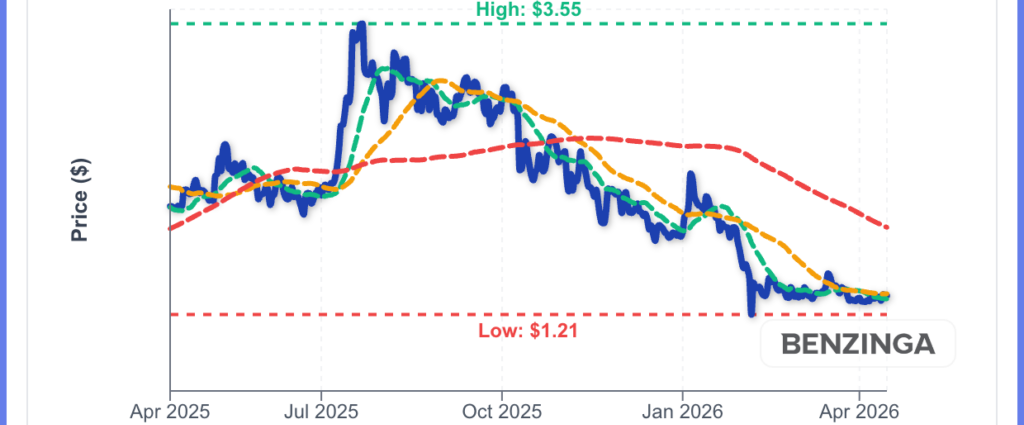
SEALSQ is currently trading within its 52-week range, having a high of $8.71 and a low of $1.99. The stock is trading 6.1% above its 20-day simple moving average (SMA), suggesting short-term …

Full story available on Benzinga.com

This post was originally published here

Real Messenger Corp (NASDAQ:RMSG) shares are trading lower on Wednesday. The decline follows extreme price volatility and a massive surge earlier this week.

Momentum Traders Take Profits

The stock experienced a dramatic 474% jump on Monday. Shares rose from a $0.47 close to highs of $2.70. Wednesday’s decline indicates a pullback as momentum traders take profits after those rapid gains.

Nasdaq Deficiency Notice Received

The company recently faced regulatory hurdles. On April 8, the real estate technology company announced it received a Nasdaq notification letter. The letter, dated April 6, cited a stockholders’ equity deficiency. Reported equity sat at …

Full story available on Benzinga.com

This post was originally published here

Key Takeaways:

  • A new crackdown on private lenders highlights a broader government strategy to lower living costs for young Chinese to revive spending
  • A domestic toothpaste maker’s rapid rise shows how local consumer brands are leveraging e-commerce and influencers to challenge established rivals

image credit: Bamboo Works

We’re currently watching two unfolding stories that capture the shifting realities of China’s consumer economy. On one hand, a fresh regulatory crackdown is sweeping through China’s private financial sector, pressuring the last surviving fintech lenders. On the other, an up-and-coming toothpaste maker is brushing up for a Hong Kong IPO, riding the waves of China’s fast-paced, digital-first retail environment. Both stories reveal a changing consumer landscape where the government intervenes to lower financial burdens on young people, while agile domestic startups invent aggressive new ways to sell to them.

The latest regulatory tightening is all about interest rates. The government is capping the maximum that fintech companies can charge for loans at 24%, with suggestions they could eventually force companies to go as low as 12%. This move is partly aimed at clamping down on hidden fees that drive up effective interest rates for consumer and small business loans to as much as 36%. In the West, credit cards and check-cashing services are famous for charging similarly high rates. But in China, we’re looking at a totally different environment.

This crackdown is one of many steps the Chinese government has taken to lower the financial burden on consumers, especially younger people. Three or four years ago, Beijing realized the overall cost of living was one reason why the younger generation was reluctant to have kids. Raising the one-child limit to two, and eventually three, didn’t really help the falling birth rate. To combat this, regulators started taking measures to lower housing costs and killed the after-school education sector to eliminate an expensive cost for educating children. …

Full story available on Benzinga.com

This post was originally published here

U.S. stocks traded higher this morning, with the Dow Jones index gaining around 100 points on Wednesday.

Following the market opening Wednesday, the Dow traded up 0.22% to 48,642.84 while the NASDAQ rose 0.37% to 23,726.69. The S&P 500 also rose, gaining, 0.28% to 6,986.99.

Leading and Lagging Sectors

Financial shares climbed by 0.8% on Wednesday.

In trading on Wednesday, materials stocks fell by 0.8%.

Top Headline

Bank of America Corp (NYSE:BAC) reported upbeat earnings for the first quarter on Wednesday.

The company posted quarterly earnings of $1.11 per share which beat the analyst consensus estimate of $1.00 per share. The company reported quarterly sales of $30.272 billion which beat the analyst consensus estimate of $29.931 billion.

Equities Trading UP
           

  • Allbirds Inc (NASDAQ:BIRD) shares shot up 323% to $10.54 after the company announced the execution of a definitive agreement with an institutional investor for a $50 million convertible financing facility. The …

Full story available on Benzinga.com

This post was originally published here

U.S. stocks were mixed, with the Dow Jones index falling over 150 points on Wednesday.

Shares of Snap Inc (NYSE:SNAP) rose sharply during Wednesday’s session.

Snap said it will cut about 1,000 jobs, or roughly 16% of its workforce, as part of a broader restructuring aimed at reducing costs and improving profitability amid slowing growth and rising competitive pressure.

Snap said it will hold its quarterly conference call to discuss first quarter financial results on Wednesday, May 6.

Snap shares jumped 6.2% to $5.96 on Wednesday.

Here are some other big stocks recording gains in today’s session.

Full story available on Benzinga.com

This post was originally published here

Arrive AI (NASDAQ:ARAI) held its fourth-quarter earnings conference call on Wednesday. Below is the complete transcript from the call.

This content is powered by Benzinga APIs. For comprehensive financial data and transcripts, visit https://www.benzinga.com/apis/.

The full earnings call is available at https://edge.media-server.com/mmc/p/k6eh9dyv/

Summary

Full Transcript

OPERATOR

Good morning everyone and thank you for joining us today. With me on the call are Dan O’Toole, Arrive AI’s chairman, CEO and founder, and Todd Pepmeyer, Chief Financial Officer. The earnings press release issued this morning is available in the Investor Relations section of the company’s website at arriveai.com before we begin, please note that today’s remarks may include forward looking statements regarding the future financial results, operations and performance. These statements are not guarantees of future results and are subject to risks and uncertainties that could cause actual outcomes to differ materially. We encourage investors to review the risk factors detailed and arrive at AI’s SEC filings which are also available on the company’s website. Now I’ll turn the call over to Dan o’. Toole.

Dan O’Toole

Hey guys. Dan O’Toole, CEO of Arrive AI here. I want to thank you so much for joining our earnings call today. I’m really excited about where we are and the trajectory that this company is under, so I couldn’t be more excited. I wanted to start out by saying that running Arrive AI has been the journey of a lifetime for me and I would not trade one moment of it. And what I mean by that is true integrity dictates that acknowledging the challenges and the successes equally is what it’s all about. Is anything ever straight up and perfect? Of course not. But you know what? That creates opportunities and that’s what this company is all about. I want you to know that I continue to be hyper confident about where we are heading, how we’re getting there and I know that in the very near future there’s going to be a moment where when a switch flips and things happen in a hyperscale way. But right now we are super focused on prudently executing on our roadmap. As part of that roadmap, it’s crucial to have the right people guiding your business. Our Board of Directors plays a key role every single day with their decades of experience and leadership across logistics, healthcare, finance and now cellular networks. I’m really happy right now to announce Mike Fitzgerald has just joined our board.. Mike is the Vice President of Indirect Channels and Solutions Sales AT&T Mobile for Business. He brings over three decades of experience in telecommunications, enterprise technology and global network solutions. His insight into 5G IoT and partner ecosystems will be invaluable in accelerating our growth. And these are all areas that we are very focused on right now and it’s a very timely acquisition to get Mike on our board and I’m looking for some big things. I’m going to let CFO Todd Pepmeyer provide details on our financial results in a moment. But before that, I do want to stress that we are in a moment where new partnerships, deployments and innovations have significant potential to drive material growth and revenue. And we have put together a dynamic sales team to execute on that every single day. Now, speaking of innovation, one of the areas we particularly are excited about is artificial intelligence. We believe AI will play a critical role in how packages move, how delivery networks operate, and how systems coordinate with one another in the future. So in the spirit of that, we decided to do something kind of novel today. I’m not sure that it’s been done before, but we are going to have today’s entire earnings call given to you in AI Voices of the Team that’s Reporting. We wanted to showcase in a small way how AI can be used as a practical tool to help communicate and operate more efficiently. Our leadership team will join the call shortly after and we will all be live to answer your questions. But for now, let’s begin with our prepared remarks voiced with AI. Kylie, why don’t you go ahead and hit the play button and let’s see what happens. When we founded Arrive AI and set out to change last mile logistics forever, it was a bold move.. We started by shaping and building a market before it even existed, including by securing patents that we believe provide a significant competitive advantage for the company. The logistics industry has spent billions of dollars trying to automate how packages move between trucks, drones, robots, couriers. But we are the first company to strictly focus on how and where these packages successfully and securely arrive. They need a home and for that to happen, there has to be an infrastructure. That final exchange point, the secure handoff between sender, courier and recipient is what we call the last inch of the last mile. That’s the problem Arrive AI was created to solve. We are building the infrastructure layer for autonomous logistics, a network of intelligent delivery endpoints that allow people, robots, drones and logistics providers to exchange goods securely. You can think of it as the shipping store at your door. Or said another way, if cell towers created the network for mobile phones, then Arrive AI is building the network for autonomous delivery. Next company progress. We kicked things off in 2020 and since then we have raised capital through three successful crowdfunding campaigns. Completed our direct public offering in May 2025, built a team of nearly 50 full time employees, began real world deployments of our technology. Today arrive AI trades on NASDAQ under the symbol ARAI with approximately 47 million shares outstanding and roughly 52% insider ownership. That level of insider ownership reflects our belief in the long term value we’re building and closely aligns our leadership team with shareholders. Part of that long term value comes from our robust portfolio of US and international patents, which is one of the most important assets we possess. Our patents protect the digital architecture around secure delivery endpoints, autonomous handoff between humans and machines, climate assisted storage, chain of custody, verification and interoperability across multiple delivery methods. We recently secured our 10th patent which allows multiple people to use the same secure arrive point. The patent was issued on March 31, 2026 and protects the IP that enables our units to handle packages for many different users with built in storage and sorting to manage deliveries and pickups efficiently. These units offer the same security, chain of custody and communication features as a single arrive point, but are designed for shared use across multiple homes or businesses. Additionally, the patent advances the intelligence and coordination capabilities of our logistics platform, enhancing how secure delivery endpoints interact with drones, ground robotics and human couriers. With these IP protected capabilities combined, the arrive point becomes the clear winner for an exchange point in the delivery ecosystem. And the more endpoints we have connected to that network, the more valuable the network becomes. That’s the network effect. I saw a meme recently that drove this point home. You know what was better than the first telephone? The second telephone the scale of our opportunity is enormous. In the United States alone There are approximately 170 million delivery addresses and this number increases by 4,000 addresses every day. Each of those locations receives packages and increasingly including items that require secure or time sensitive delivery like pharmaceuticals, medical supplies, groceries, lab samples and high value retail goods. An arrive point allows for unattended, asynchronous delivery and pickup across these addresses, meaning each mode of delivery can come and go at its own cadence without waiting on a human or any other party to arrive. And this prevents wasted time and increases efficiency and opportunity. Think of it this way. Right now a ground robot can bring a delivery to you, but you have to be there to accept that delivery before it can move to the next. Or a drone might drop its package in a puddle filled yard. Arrive AI solves these and many similar issues with our solution. A robot can drop its package into our arrive point and immediately continue on its route. For drones, our network enables secure, weatherproof delivery while optimizing routing so drones carry payloads on more flights, significantly reducing empty return trips. It can deliver your hamburger and at the same time pick up the shirt you need to return. One of the most important proof points of our progress is our live deployment with Hancock Health in Indiana. In that deployment, Arrive points were installed between the Sue Ann Wortman Cancer center and the hospital laboratory to support biospecimen transport using an autonomous robot. The route covers roughly a quarter mile round trip and supports multiple deliveries throughout the day. We recently released an in depth white paper to explain our findings in detail. During this live deployment at Hancock Health, we demonstrated that our platform can seamlessly integrate into real world hospital workflows while delivering measurable efficiency gains. We reduced staff walking time without adding steps and effectively extended staff capacity in a resource constrained environment, freeing up their time for higher value patient facing care. The system operated reliably within active care conditions, reinforcing trust through consistent performance and clear handoff signals. These results validate our ability to drive durable operational improvements in complex healthcare environments. You can find the white paper on our website for more details. Now I’d like to speak briefly about our partnerships. Autonomous delivery is not a single technology. It involves robotics, driving drones, logistics platforms and AI coordination systems. Rather than trying to build every one of those components ourselves, Arrive AI focuses on the network layer. We provide the secure endpoint infrastructure and orchestration platform while partners provide delivery systems. For example, our partnership with Autonomy, a like minded early stage company that develops autonomous delivery robots, allows robots to integrate directly into arrive point deployments. This allows us to quickly evolve and refine how our network aligns with their hardware, iterating and adapting in real time for better efficiencies and processes from software to hardware. This ecosystem approach allows us to support multiple delivery technologies while we stay focused on building the network itself. We are also taking advantage of being a member in the Nvidia Connect program. Nvidia is proving to be an invaluable asset for our development by exponentially increasing our speed to deployment. Our engineers are using Nvidia Blackwell workstations, allowing them to create models that are taking them hours instead of days, which has materially accelerated our development this I also want to provide some context on how our product development has evolved over the past year. Before we became a public company, Arrive AI had a relatively small engineering team working on what was essentially the third generation of our ArrivePoint platform, the AP3. When we went public, gaining access to capital allowed us to significantly expand our workforce. In fact, we were able to grow our team tenfold. Those additional engineers immediately began advancing the next generation of ArrivePoint technology, creating the AP5 platform. Today, we’ve brought all of those engineering teams together around a single objective, accelerating product development and refining the ArrivePoint platform as quickly and cohesively as possible. Instead of separate development tracks, we now have the full strength of our engineering organization focused on building, improving and advancing the arrivepoint platform. Together. Our development can now happen internally, leveraging the expertise of the team we’ve built while materially reducing our dependence on external resources. This has also allowed us to move faster, remove redundancies, reduce third party R&D costs, and have more real time quality control. For example, we’ve implemented AI simulations to support the growing Arrive network. for the next generation AP5 platform while remaining backwards compatible with our AP3 platform, ensuring that both systems can work seamlessly together. Now our goal is to convert these innovations into sales. In the near future, we are advancing our conversations with organizations in the healthcare and manufacturing sectors with a goal of securing early stage deployment arrangements for both our AP3 and AP5 systems. With that, I’d now like to turn the call over to arrive AI’s chief financial officer Todd Pepmeyer to talk through the financials and provide more background on our revenue model.

Todd Pepmeyer

Thank you, Dan When Arrive AI became a public company, we were clear that the early years would be about building the right infrastructure rather than maximizing short term revenue. After all, infrastructure businesses require upfront investment. You build the network first and revenue grows as that network expands. For the fourth quarter, our total revenue was $15,000, all of which was recurring subscription revenue. For the full year, revenue was just over $113,000. Our net loss for the fourth quarter was $2.7 million, compared to a loss of about 1.3 million in the same quarter of 2024. The increase was primarily due to higher operating expenses. For the full year, net loss was $12.8 million versus $4.5 million in the prior year. We ended the year with $2.1 million in cash on the balance sheet, and in January 2026 we executed a $10 million draw from our existing credit facility on favorable terms. This significantly strengthens our balance sheet and provides a meaningful Runway to continue executing our business plan and funding our growth initiatives. Our quarterly cash burn rate of approximately $3 million has been mostly driven by increased hiring as we built out the team to support growth, and we expect that level of investment to moderate over time as revenue scales. These 2025 results are being filed within the 15 day extension we requested on March 31, 2026. During our preparation of these financial statements, we discovered an error with the previous accounting treatment related to our convertible note payable financing. In short, the structure of the agreement creates a derivative instrument according to U.S. accounting standards. This complexity required us to engage an independent expert to perform the complex modeling required to accurately fair value both the convertible notes and attached derivative instruments. As a result, we have subsequently applied the new method to our previously reported quarterly results. We expect to file amended reports for both the June 30 quarter and the September 30 quarter alongside the full year results. The net result of this change will be higher reported net income in the June 30 period and lower net income in the September 30 period. This change affects net income and the presentation of assets, liabilities and stockholders equity on the balance sheet. There is no cash impact Revenue Model as we look ahead, Our long term revenue model has three primary components. The first is ArrivePoint Subscriptions, where organizations like hospitals, laboratories, manufacturers and enterprise campuses deploy Arrive points as part of their logistics infrastructure. The second is Network as a Service Revenue. As more endpoints are deployed, they connect into the ARRIVE AI network, enabling logistics providers to route deliveries between locations. The third and final revenue component is from Data and AI Insights. Autonomous Logistics generates valuable operational data that can be used to optimize delivery networks. Over time, we expect our revenue mix to evolve toward approximately 50% network infrastructure revenue and 50% transactional and data driven services. With that, Dan, I’ll turn it back over to you.

Dan O’Toole

Thank you Todd. Looking ahead, Our overall strategy for the next five years focuses on scaling the network in stages. Early deployments provide real world learning and product refinement, and from there we plan to scale manufacturing and deployment. Our long term goal is to have thousands, then tens of thousands, and eventually hundreds of thousands of arrive points deployed annually. That scale is where the network effects of autonomous logistics infrastructure begin to emerge. Our focus is simple. Build the network, connect the endpoints, enable the future of autonomous logistics, and at the end of the day, we are ahead of where we plan to be at this stage. Our stock price might not indicate that, but everything else about what we are doing does. And ultimately I would not trade a higher stock price in this moment for an inferior product that would ultimately not scale. Success and scale are built on the foundation of diligence and dedication, and that is what will ultimately deliver for every shareholder, every customer and every partner. Thank you for joining us today. We’ll now return live to answer your questions.

OPERATOR

Thank you. To ask a question, please press star 11 on your telephone and wait for your name to be announced. And to withdraw your question, please press star 11 again. If you wish to ask a question via the webcast, please use the QA box available on the webcast link Please stand by while we compile the Q and A roster. And the first question comes from Jack Hardy with Maxim Group. Your line is now open.

Jack Hardy

Okay. Hey, Dan. Hey, Tom, Good morning. Thanks for the update. Thanks for taking my questions. Thanks for being here, Jack. Dan here. Go ahead, man. Absolutely. So, Dan, just a quick question to start. Can you speak to your recent team hiring and expansion progress? I think I heard you hired a team of maybe 50 employees during 2025. One,, is that true? And then two, what’s on tap for 2026 with the team expansion?

Dan O’Toole

Thanks. Yeah, thanks for being on here, Jack, and asking. That’s fairly accurate. We’re just under 50 employees currently. We just opened onboarded two new employees this week. We’re pedal to the metal. We’ve got a plan and we’re executing it. One great thing I can say is through the advent of AI, our future hiring plan over the next year called for around 200 people. And we now see an opportunity to complete that full demand with about 20% of those people. So about 40 new people. So that is the reality of AI and how it’s impacting businesses in real time. So that’s a big tailwind on the company and it should deliver some good progress in our operational costs. So we’re really excited about that. Todd, do you have anything you want to add to that?

Todd Pepmeyer

I think we just want to highlight a couple of the particularly key ads that we announced. Ian Geist to lead our sales organization.

Dan O’Toole

Really important guy to head our commercialization efforts, along with a lot of very talented engineers from the AI and robotics space. Yeah, actually everybody that we are hiring is what I would say is accretive to what we’re doing. Todd just mentioned Ian Geiss. Ian came from the early days of DirecTV, where it was a nascent technology being developed. He was present for every aspect of product market, fit, pricing strategies. All those kind of things also came from Sirius XM Radio, which is, you know, much similar platform from a pricing or recurring revenue model and things like that. So we’re really proud to get Ian. He happened to be available in our own backyard. So it was just a kind of a thing that I say was meant to be. But, you know, we building out the sales team and we, you know, we’re doing a lot of things to lay groundwork for a big opportunity that presents itself this year. Okay, great.

Jack Hardy

I have two more questions. Dan, I’ll come back to you on the product design. But just a real quick one for Todd. Just given the comments about restating Q2 and Q3 are the numbers, the 4q numbers. In this press release, it says that you back out the nine months, three Q numbers. So are these numbers correct, at least? Like the revenue, the subscription revenue?

Todd Pepmeyer

Yeah. Nothing changed. Yeah, Jack, nothing changed. Nothing affect. Nothing in the Restatement affected revenue.

Jack Hardy

Okay, great. So my next question is, what can we extrapolate, if anything, from the subscription revenue of about $15,000 in the fourth quarter? 2025. Was this all Hancock Health and just Steve, maybe just. Just kind of expand on that a little bit more.

Todd Pepmeyer

Thanks. Yeah, Jack, So I would say over 90% of the number you see there was from Hancock Health in the quarter. We had one other smaller deployment in the period., but that’s predominantly what you see there. And our deployments are limited right now. We haven’t. We haven’t put hundreds of units out there only to replace them with the

Dan O’Toole

next generation and so on. So one other thing I’d like to jump in on this is Dan. Jack, you know when you’re new and you’re conditioning the market for a new technology, what you don’t want to do is extinguish those opportunities by trying to monetize the heck out of them. So a lot of times on the deployments that we’re doing, the ROI for us is the learnings and figuring out how to condition the market. That’s the most important thing that we can be doing right now. And that’s what we’re doing. And that is totally aligned with our business strategy. When Google announced waymo back in 2009, that’s how long ago they came up with that idea. They spent $30 billion between 2009 and today, and they’re still not scaled. I would put what we’re doing here at Arrive AI up against the biggest companies in the world as to traction market acceleration.. First position, all the IP we have and all the opportunities that we continue to see throughout the world. And I could tell you that every metric that we track internally is pegged to the max. And I know we have an impatient world out here, and frankly, we’re part of it. As the largest shareholders represented here in the whole company, insiders, we want to deliver as quickly as we can, too, but we want that to be durable. And the way you do that is by building a great foundation. So I appreciate that question and opportunity for us to share that with you. Go ahead, Jack, what else you got? Yep, absolutely.

Jack Hardy

Just one last question, then I’ll hop back in the queue. Dan, on the product development and design stage. So I heard you mentioned some Updates on the AP3 and the AP5. platforms. Is there an AP4 or do we leapfrog that? And then also just how does the AP5. compare to the AP3 and any customer discussions you could touch on regarding your, your recent design updates.

Dan O’Toole

Thanks. Absolutely. Yep. Hey, great question. I want to announce to everyone in the room with me. In addition to Todd, our CFO and MediaNoTools CEO, we have Kylie obviously at Nirav Shah, our chief Strategy Officer, John Richardson, our chief Legal counsel. I’m going to throw that one over to NIRAV and let him speak to that nirav.

Nirav Shah

Yeah, thanks. Thanks, Jack. Thanks, Dan. So, yeah, regarding some of the product changes and design changes that we’re looking at in AP3., I’ll start with that Jack is we’re looking at an improved door design that’s going to make a big difference in the robotic handoffs. We kind of optimized a lot for the drones, but we’re seeing a lot more activity in the ground robotic space. So the optimization of the door design is going to be shared both with AP3. and AP5. That should be coming out this summer, I think. What was the other part of that, Jack was around just some …

Full story available on Benzinga.com

This post was originally published here

The IMF warns that global public debt could reach about 100% of world GDP by 2029, a scenario where Bitcoin (CRYPTO: BTC) could stand out as investors seek alternatives outside traditional finance.

The 100% Debt Trap

Global public debt approaching 100% of GDP means that every dollar, yuan, pound, euro, yen, and rupee earned in a year will be used to pay off government debt. 

By 2029, the debt load will have grown to consume the entire global economic output, leaving nothing for additional investments.

China and the U.S. will continue to drive debt higher, with contributions from a broad range of nations as defense spending surges globally, according to the IMF.

If annual economic growth equals or falls short of the debt raised by issuing government bonds, markets could start questioning the fiscal solvency of sovereigns and demand higher returns for lending to governments.

The …

Full story available on Benzinga.com

This post was originally published here

XRP (CRYPTO: XRP) ETF inflows hit $11.20 million on April 14, the strongest day since early February.

The ETF Turnaround

According to SoSoValue, Bitwise’s XRP ETF (NYSE:XRP) led with $4.56 million, followed by Franklin’s (NASDAQ:XRPZ) with $6.64 million.

Total net assets have recovered to $978.65 million, creeping back toward the $1 billion mark. 

Moreover, cumulative inflows now stand at $1.23 billion, and the recent trend of consecutive green days on the inflow chart signals a clear shift in institutional sentiment.

The Triangle Apex

The descending triangle that has dominated XRP’s …

Full story available on Benzinga.com

This post was originally published here

(Editor’s note: The future prices of benchmark tracking ETFs, the lede, the economic data and the headline were updated in the story.)

U.S. stocks fluctuated on Wednesday, following Tuesday’s rally. Futures of the major benchmark indices were mixed.

U.S. import prices climbed 0.8% in March, marking a 2.1% year-over-year increase—the largest annual jump since late 2024. Despite these mounting cost pressures, New York’s manufacturing sector showed unexpected resilience in April; the Empire State Manufacturing Survey’s headline index surged eleven points to 11.0, signaling a moderate expansion in business activity fueled by significant gains in new orders and shipments.

On Tuesday, President Donald Trump fueled the de-escalation narrative, saying that Iran talks “could be happening over the next two days” in Pakistan. The fresh Trump comments built on Vice President JD Vance‘s flagged “a lot of progress” in weekend talks with Iranian officials held in Islamabad.

Meanwhile, the 10-year Treasury bond yielded 4.25%, and the two-year bond was at 3.76%. The CME Group’s FedWatch tool‘s projections show markets pricing a 99.5% likelihood of the Federal Reserve leaving the current interest rates unchanged in its April meeting.

Index Performance (+/-)
Dow Jones 0.02%
S&P 500 0.03%
Nasdaq 100 -0.09%
Russell 2000 -0.10%

The SPDR S&P 500 ETF Trust (NYSE:SPY) and Invesco QQQ Trust ETF (NASDAQ:QQQ), which track the S&P 500 and Nasdaq 100, respectively, were higher in premarket on Wednesday. The SPY was up 0.007% at $694.51, while the QQQ declined 0.099% to $627.98.

data-variant=”banner”
data-news-mode=”manual”

>


Read Also:

Will S&P 500 Open Up Or Down On Wednesday? Potential Iran Deal Talks And Bank Earnings On Deck

This post was originally published here

Tilray Brands Inc. (NASDAQ:TLRY) is accelerating its global push across healthcare, cannabis, and beverages, but investor sentiment turned cautious after the company unveiled a $180 million at-the-market equity program that raised dilution concerns and pressured shares on Wednesday.

The company acquired the Lyphe Group to strengthen its U.K. medical platform and build a vertically integrated healthcare ecosystem. Terms of the deal were not disclosed.

Tilray is also scaling its beverage business following the acquisition of BrewDog, targeting international expansion and aiming for cash-flow positivity by 2027. It plans to launch Hi*Ball Energy in the U.K. next month.

In the U.S., the company is positioning for potential medical cannabis rescheduling. To fund growth, Tilray filed a $180 million at-the-market equity program managed by Jefferies LLC and partners.

As of the end of its third fiscal quarter on February 28, 2026, Tilray Brands reported a cash, restricted cash, and marketable securities balance of $264.8 million

Technical Analysis

Tilray is currently trading within the lower range of its 52-week spectrum, which has seen a high of $23.20 …

Full story available on Benzinga.com

This post was originally published here

A large-scale shift in wealth from older generations to younger investors could significantly boost long-term demand for digital assets such as Bitcoin (CRYPTO: BTC) and the broader crypto market.

$110 Trillion Wealth Transfer In Motion

Data from Grayscale Investments suggests that Baby Boomers and the Silent Generation currently hold around $110 trillion in assets in the United States.

Over time, this wealth is expected to be passed down to Millennials and Gen Z, groups that show a much stronger preference for crypto investments.

Analysts estimate that even a modest …

Full story available on Benzinga.com

This post was originally published here

Top Wall Street analysts changed their outlook on these top names. For a complete view of all analyst rating changes, including upgrades and downgrades, please see our analyst ratings page.

  • Ascendiant Capital raised the price target for Knightscope, Inc. (NASDAQ:KSCP) from $25 to $26. Ascendiant Capital analyst Edward Woo maintained a Buy rating. Knightscope shares closed at $3.40 on Tuesday. See how other analysts view this stock.
  • BTIG increased Kirby Corporation (NYSE:KEX) price target from $135 to $160. BTIG analyst Gregory Lewis maintained a Buy rating. Kirby shares closed at $142.63 on Tuesday. See how other analysts view this stock.
  • HC Wainwright & Co cut price target for Vor Biopharma Inc. (NASDAQ:VOR) from $32 to $31. HC Wainwright & Co. analyst Swayampakula Ramakanth maintained a Buy rating. Vor Biopharma shares closed at $15.87 on Tuesday. See how other analysts view this stock.
  • Baird slashed the price target for Microsoft …

Full story available on Benzinga.com

This post was originally published here

Photo: Black Gold Transport truck on the Manh Choh access road near Tok, part of the haul route to Fort Knox.

Disseminated on Behalf of: Contango Silver & Gold Inc.

  • The newly combined company brings together cash flow from Alaskan gold and British Columbia silver scale, giving it a stronger base for growth than either side had on its own.
  • The deal lands into a market increasingly drawn to scale, safer jurisdictions, gold’s defensive appeal and the scarcity value of primary silver.
  • With more than US$100 million in cash, the new company now has the tools to unlock the next phase of growth across four advanced projects.

As 2026 dawned, reports from across the mining and precious-metals sector pointed to a market increasingly favouring scale, jurisdictional safety, gold’s defensive appeal and the scarcity value of primary silver.

Those reports came from some of the sector’s most closely watched voices, which have helped reflect and shape investor thinking for decades.

PwC said mining M&A in 2026 would be driven by consolidation and investment in high-quality, long-life assets. The World Gold Council said the 2026 gold outlook was being shaped by ongoing geoeconomic uncertainty. The Silver Institute said the silver market was expected to remain in deficit for a sixth straight year.

Taken together, the recently closed merger of Contango ORE (NYSE:CTGO) and Dolly Varden Silver (TSXV:DV) to form Contango Silver & Gold Inc. (NYSE:CTGO, TSX:CTGO) reflects the investor mindset those reports were pointing to, one drawn to scale, safer jurisdictions, gold-backed cash flow, and rare primary silver exposure.

“The merger has created a North American high-grade mid-tier silver and gold producer and developer with cash flow, scale and a pipeline built for growth,” said Shawn Khunkhun, former Dolly Varden’s CEO and Director.

The combined company will operate as Contango Silver & Gold Inc., with the business streamlining its public-market identity under the Contango name. Now listed on the Toronto Stock Exchange, as of April 13th, listing to keep a strong foothold in the Canadian market alongside its NYSE American listing.

The new company also starts out with more than US$100 million in cash and very little debt, giving it ample financial flexibility for the next stage of growth.

“This merger marks the start of an exciting new chapter,” said Rick Van Nieuwenhuyse, CEO of Contango Silver & Gold.

“By combining Contango’s cash-flowing Manh Choh mine, the advanced stage exploration Lucky Shot and Johnson Tract projects, and the district scale exploration of high-grade silver in the Kitsault Valley, we are building a uniquely positioned gold and silver focused company with a strong balance sheet and production base, significant growth potential, and exceptional exploration upside.”

A merger built around complementary strengths

What gives the merger story weight is the way the two asset bases fit together.

Van Nieuwenhuyse described the transaction as built on the “complementary and synergistic nature of our North American asset portfolios.”

Contango brings operating cash flow, mine-building experience, and a development pipeline in Alaska. Dolly Varden brings a large, high-grade …

Full story available on Benzinga.com

This post was originally published here

On Wednesday, Vince Holding (NYSE:VNCE) discussed fourth-quarter financial results during its earnings call. The full transcript is provided below.

Benzinga APIs provide real-time access to earnings call transcripts and financial data. Visit https://www.benzinga.com/apis/ to learn more.

Access the full call at https://events.q4inc.com/attendee/403954146

Summary

Full Transcript

OPERATOR

Sam. Hello and welcome to the Vince Holding Corp. Fourth quarter and full year fiscal 2025 results conference call. All lines have been placed on mute to prevent any background noise. After the speaker’s remarks, there will be a question and answer session and if you would like to ask a question during this time, please press star 1 on your telephone keypad. I would now like to turn the conference over to Akiko Okuma, the Chief Administrative Officer and General Counsel. Akiko, you may begin.

Akiko Okuma

Thank you and good morning everyone. Welcome to Vince Holding Corp. Fourth quarter and full year fiscal 2025 results conference call. Hosting the call today is Brendan Hoffman, Chief Executive Officer and Yuji Okumura, Chief Financial Officer. Before we begin, let me remind you that certain statements made on this call may constitute forward looking statements which are subject to risks and uncertainties that could cause actual results to differ from those that the Company expects. Those risks and uncertainties are described in today’s press release and in the Company’s SEC filings, which are available on the Company’s website. Investors should not assume that statements made during the call will remain operative at a later time and the Company undertakes no obligation to update any information discussed on the call. In addition, in today’s discussion, the Company is presenting its financial results in conformity with GAAP and on an adjusted basis. The adjusted results that the Company presents today are non GAAP measures. Discussions of these non GAAP measures and information on reconciliations of them to their most comparable GAAP measures are included in today’s press release and related schedules which are available in the Investors section of the company’s websiteat investors.vince.com now I’ll turn the call over to Brendan.

Brendan Hoffman

Thank you and good morning everyone. I’m incredibly proud of the strong operating results we are announcing today, highlighting the exceptional momentum we delivered at the end of the year that has continued into the start of fiscal 2026. As we announced earlier this year, we saw incredible strength in our direct to consumer business over the holiday period and that remained the case throughout the full quarter. For the fourth quarter, sales in our direct to Consumer business increased about 10% compared to last year, supported by our ongoing efforts in improving the customer experience and by the strategic pricing actions taken earlier in the fall. For the overall quarter, sales were up nearly 5% compared to last year and profitability outpacing the high end of our prior guidance range. We are especially proud of this performance given the disruption we experienced with developments from Saks Global, which presented a headwind to sales of approximately $2 million in the quarter. With the recent reorganization of Saks Global, we now have more clarity into the situation and are working with our partners there as they move forward in their plans. As a reminder, Saks Global recently represented less than 7% of our total sales. We remain supportive and confident in the new leadership team’s ability to stabilize the business. We believe any change and penetration from this one partner going forward will be offset by strength elsewhere in the channel. Given our diversified base and strong relationships across our wholesale business. This is a credit to not only our strong partnerships, but to the great product that is resonating across both men’s and women’s. We’re also really pleased as we continue to elevate the product offering, appealing to our broad customer base. This strong performance supported by our fiscal 2025 results, which delivered sales growth of over 2% and adjusted EBITDA growth of about 8%. Despite contending with approximately $8 million of incremental tariff costs. As we have discussed, our teams have done a tremendous job in mitigating the tariff pressures we face. We acted swiftly, diversifying our sourcing across Asia and globally while working closely with manufacturing partners to maintain the quality standards that define Vince. We also implemented strategic pricing increases while maintaining unit sales, validating the strength and quality of our product. As we enter fiscal 2026, I am encouraged by the growth we are continuing to drive and I’m more confident than ever in the trajectory ahead for Vince Holding Corp. Given this, we are exploring opportunities to continue to invest in the customer experience within our full price direct to consumer business. We are looking at areas like special events, people and store operations, including remodels and new store openings, while also continuing to leverage our digital platform and expand drop ship to additional categories in spring 2026. These categories will include handbags, tailored clothing, belts and accessories, creating revenue opportunity with minimal inventory risk for the business. In addition, we are continuing to scale our men’s business. We ended the year with men’s representing approximately 24% of total sales and continue to see opportunity to expand this to 30% penetration driven by growth in wholesale partnerships and expanded assortments in our own stores and online. With respect to our international business, our second London store in Marylebone exceeded expectations this year and validated our thoughts on further international expansion. This success gives us confidence to explore additional flagship opportunities in gateway cities like Paris in the next two years. Finally, the strategy I believe will really help to accelerate our growth is our focus on maximizing vinsold and Corp as a platform. While we do not have anything yet to report, we are continuing to look for opportunities to leverage our platform, our world class team and capabilities to support additional brands. This will create a new revenue stream for Vince Holding Corp. We could not be more enthused by our partnership with ABG which not only opens channels for us but also provides great opportunities with respect to marketing and engagement customers. We were thrilled to partner with the ABG team with a recent event at the Masters last week and we’re looking forward to doing similar types of interactive activations with the team for future high profile events. This is in addition to the elevated outreach that we are also doing in partnership with our wholesale partners. Following the successful brand events at the end of last year with Nordstrom and celebrating our holiday campaign at our Madison Avenue New York City flagship, we have continued the storytelling around the Vince brand. We recently celebrated an exclusive capsule collection for spring 2026 as part of Bloomingdale’s California Love Campaign and hosted an influencer and editor event to showcase the capsule and preview of our Spring 2026 collection with over 100 editors and influencers in attendance. As part of the event, we also co hosted a private VIP Dinner with Bloomingdale Vic’s, complete with a fashion show and model presentation to great success. Fiscal 26 is off to a strong start on all accounts as UG will review and as seen in our outlook in today’s press release, the momentum we ended fiscal 25 with has continued across all channels. Our full price business has never been stronger, reflecting the customers continued love for the product and value they see for the brand. We believe macro events aside, we are positioned well to continue to deliver healthy, profitable growth. A little over a year ago I returned to Vince. As CEO. I cannot emphasize enough the pride that I have in our team, our business and the results we have delivered to date. I want to thank our incredible associates for their dedication and execution throughout fiscal 25. Their ability to evolve the product, maintain quality and execute against our strategic priorities gives me tremendous …

Full story available on Benzinga.com

This post was originally published here

Micron Technology Inc. (NASDAQ:MU) shares fell in early trading Wednesday. The decline follows a period of intense bullish momentum.

Investors Lock In Profits

The semiconductor giant saw its stock surge over 40% in just two weeks. This included a 9.17% gain during Tuesday’s session. Traders appear to be booking profits following these record highs.

Insider Trading Activity

A Tuesday regulatory filing showed EVP and Chief Business Officer Sumit Sadana sold 24,000 shares at $421.35 each, for proceeds of about $10.11 million, while retaining a substantial direct stake in the company.

Macro Headwinds and Volatility

Market participants remain wary of …

Full story available on Benzinga.com

This post was originally published here

U.S. Bancorp (NYSE:USB) will release earnings for its first quarter before the opening bell on Thursday, April 16.

Analysts expect the Minneapolis, Minnesota-based company to report quarterly earnings of $1.14 per share, up from $1.03 per share in the year-ago period. The consensus estimate for U.S. Bancorp’s quarterly revenue is $7.28 billion (it reported $6.96 billion last year), according to Benzinga Pro.

On March 26, U.S. Bancorp announced today that Toby Clements will become its new senior executive vice president and chief operations officer.

U.S. Bancorp shares fell 0.7% to close at $56.09 on Tuesday.

Benzinga readers can access the latest analyst ratings on the Analyst Stock Ratings page. Readers can sort by stock ticker, company name, analyst firm, rating change or other variables.

Let’s have a look at how Benzinga’s most-accurate analysts have rated …

Full story available on Benzinga.com

This post was originally published here

As of April 15, 2026, two stocks in the energy sector could be flashing a real warning to investors who value momentum as a key criteria in their trading decisions.

The RSI is a momentum indicator, which compares a stock’s strength on days when prices go up to its strength on days when prices go down. When compared to a stock’s price action, it can give traders a better sense of how a stock may perform in the short term. An asset is typically considered overbought when the RSI is above 70, according to Benzinga Pro.

Here’s the latest list of major overbought players in this sector.

Nine Energy Service Inc

Full story available on Benzinga.com

This post was originally published here

Something is off with the math in Washington.

On Wednesday morning, President Donald Trump declared on Truth Social that the Strait of Hormuz is now “permanently” open — crediting US military superiority and a new understanding with China under which Beijing agreed not to ship weapons to Iran. He added that President Xi Jinping would give him “a big, fat hug” during an upcoming visit.

The day before, in an interview with Fox Business, Trump indicated the oil market had held up better than feared. With WTI – tracked by the United States Oil Fund (NYSE:USO) – near $93 a barrel, far below the $200 some analysts warned was possible at the outset of the conflict, Trump said the price was manageable — and forecast much lower gas prices well ahead of the November midterm elections.

“If you told me at only $92 a barrel I would’ve been very surprised. And you know what, it is going to come dropping down,” he said.

But vessel-tracking data tells a different story — and the two narratives cannot both be true at the same time.

Hormuz Traffic Flow Still 10% Of Pre-War Levels

According to Kpler trade risk analyst Ana Subasic, commercial crossings through the strait fell to six on April 13 — down from 14 the session prior, and against a pre-conflict average closer …

Full story available on Benzinga.com

This post was originally published here

Top Wall Street analysts changed their outlook on these top names. For a complete view of all analyst rating changes, including upgrades, downgrades and initiations, please see our analyst ratings page.

  • Raymond James analyst Steve Moss initiated coverage on Eagle Bancorp Inc (NASDAQ:EGBN) with a Strong Buy rating and announced a price target of $32. Eagle Bancorp shares closed at $26.61 on Tuesday. See how other analysts view this stock.
  • Argus Research initiated coverage on SoFi Technologies Inc (NASDAQ:SOFI) with a Hold rating. SoFi Technologies shares closed at $17.91 on Tuesday.

Full story available on Benzinga.com

This post was originally published here

Top Wall Street analysts changed their outlook on these top names. For a complete view of all analyst rating changes, including upgrades, downgrades and initiations, please see our analyst ratings page.

  • Keybanc analyst Sangita Jain downgraded Parsons Corp (NYSE:PSN) from Overweight to Sector Weight. Parsons shares closed at $56.00 on Tuesday. See how other analysts view this stock.
  • Argus Research analyst David Toung downgraded Integra Lifesciences Holdings Corp (NASDAQ:IART) from Buy to Hold. Integra Lifesciences shares closed at …

Full story available on Benzinga.com

This post was originally published here

During times of turbulence and uncertainty in the markets, many investors turn to dividend-yielding stocks. These are often companies that have high free cash flows and reward shareholders with a high dividend payout.

Benzinga readers can review the latest analyst takes on their favorite stocks by visiting Analyst Stock Ratings page. Traders can sort through Benzinga’s extensive database of analyst ratings, including by analyst accuracy.

Below are the ratings of the most accurate analysts for three high-yielding stocks in the health care sector.

Medtronic PLC (NYSE:MDT)

  • Dividend Yield: 3.22%
  • Mizuho analyst Anthony Petrone maintained an Outperform rating and cut the price target from $125 to $120 on April 13, 2026. This analyst has an accuracy rate of 63%
  • Evercore ISI Group analyst Vijay Kumar maintained an Outperform rating and lowered the price target from $108 to $106 on April 9, 2026. This analyst has an accuracy rate of 54%.
  • Recent News: Medtronic announced that it will report financial results on Wednesday, …

Full story available on Benzinga.com

This post was originally published here

U.S. investor-owned utilities plan to spend at least $1.4 trillion on capital projects through 2030, a more than 21% increase from five-year projections outlined last year, nonprofit group PowerLines said in a report released on Tuesday.

The report, based on the analysis of 51 listed utility companies’ latest earnings calls, indicates that these increasing expenditures could lead to future requests for rate increases.

AI, Data Centers Drive Utility Costs

The primary drivers for this spending growth are the boom in AI power and the construction of data centers. However, other factors such as aging infrastructure, climate change, increasing electrification, and population growth have contributed to a 40% increase in utility bills since 2021, “with no signs of slowing down,” as per PowerLines. In 2025 alone, utilities sought $31 billion in rate hikes, stated the report.

Previously, Goldman Sachs projected global data center electricity use would rise 175% by 2030 from 2023 levels, revised up from 165%. U.S. electricity demand is projected to grow 2.6% annually through 2030, driven by data centers, marking a sharp acceleration compared to historical growth of under 2%.

PowerLines also pointed out that nearly half of all new spending is allocated for transmission and distribution, with another 30% directed towards new power generation.

“Investor-owned utilities are signaling a record-breaking wave of capital spending, and history shows that those plans are often a leading indicator of future utility rate increase requests,” said Charles Hua, Founder and …

Full story available on Benzinga.com

This post was originally published here

ASML Holding NV (NASDAQ:ASML) continues its commanding market run, with the powerful price action propelling the stock’s Benzinga Edge momentum score from 89.62 to 92.56 this week, reflecting immense relative strength and upward volatility patterns that place the stock squarely in the market’s top tier.

Surging Momentum And Market Dominance

The momentum surge follows a blockbuster first quarter of 2026, where the semiconductor giant delivered $10.37 billion in total net sales, comfortably landing within its guidance range.

The company’s fundamental strength is also validated by its phenomenal Benzinga Edge Stock Rankings‘ quality score of 95.80, which evaluates historical profitability, operational efficiency, and financial health relative to peers.

Benzinga Edge Stock Rankings for ASML.

data-variant=”banner”
data-news-mode=”manual”

>


Read Also:

This post was originally published here

TeraWulf Inc (NASDAQ:WULF) shares fell in Wednesday’s premarket session. The decline follows a late Tuesday announcement regarding the pricing of an upsized public common stock offering.

Nasdaq futures are down 0.22% while S&P 500 futures have shed 0.19%.

Offering Upsized to $900 Million

The digital asset technology firm priced 47,400,000 shares at $19.00 per share. This upsized the gross proceeds to approximately $900 million from the initial $800 million target.

The company granted underwriters a 30-day option to buy an additional 7.11 million shares. The offering should close by Thursday.

On Tuesday, WULF stock gained 7.71% to close at $20.95. The offering announcement was at $19.00, much lower than Tuesday’s closing price, which led to the stock falling on Wednesday.

The company …

Full story available on Benzinga.com

This post was originally published here

D-Wave Quantum Inc. (NYSE:QBTS) shares are charging higher on Wednesday. This surge follows a massive sector-wide rally triggered by NVIDIA Corp. (NASDAQ:NVDA).

On Tuesday, Nvidia launched Ising, the world’s first open-source quantum AI model family.

NVIDIA’s Ising Ignites Quantum Sector

The new models aim to solve critical engineering hurdles in processor calibration.

NVIDIA claims Ising delivers performance up to 2.5 times faster than traditional methods. “AI is essential to making quantum computing practical,” stated Nvidia CEO Jensen Huang. He noted that Ising allows AI to become the “operating system of quantum machines.”

Sector-Wide Momentum Lifts QBTS

The news sparked …

Full story available on Benzinga.com

This post was originally published here

Bitmine Immersion Technologies (NYSE:BMNR) posted a $3.82 billion net loss for the quarter ended February 28 driven by unrealized losses on its Ethereum (CRYPTO: ETH) holdings, as the stock builds a base near $20-$22.

The Unrealized Loss

Bitmine’s reported net loss widened from a net loss of $1.15 million in the same period last year. 

The six-month net loss exceeded $9 billion compared to $2.1 million in the year-ago period.

The losses came largely from $3.78 billion in unrealized losses on the company’s digital asset holdings. 

Meanwhile, Bitmine has continued to increase its ETH holdings even through the extended crypto downturn since late 2025.

As of April 12, Bitmine held 4.87 million ETH in its treasury, valued at approximately $10.7 billion. 

The company is the largest corporate Ethereum treasury globally and the second-largest corporate crypto treasury overall behind Strategy

Full story available on Benzinga.com

This post was originally published here

New Horizon Aircraft (NASDAQ:HOVR) held its third-quarter earnings conference call on Tuesday. Below is the complete transcript from the call.

This content is powered by Benzinga APIs. For comprehensive financial data and transcripts, visit https://www.benzinga.com/apis/.

Access the full call at https://www.webcaster5.com/Webcast/Page/3155/53804

Summary

New Horizon Aircraft reported a strong financial position with $20 million in cash, providing a capital runway in excess of 12 months.

The company is focused on completing the full-scale prototype of the Cavorite X7 by the end of the year, aiming for flight testing by early 2027.

Strategic partnerships with Rampf Group, North Aircraft Industries, and Mitsubishi Heavy Industries are enhancing the production and technical capabilities for the Cavorite X7.

The hybrid-electric architecture of the Cavorite X7 is highlighted as a key differentiator, offering operational flexibility and lower operating costs compared to competitors.

Management emphasized the supportive regulatory environment in Canada and the U.S., which is favorable for the advancement of advanced air mobility technologies.

Full Transcript

OPERATOR

Ladies and gentlemen, thank you for standing by. Welcome to the New Horizon Aircraft fiscal third quarter 2022 earnings conference call. All participants are present in a listen only mode following management’s prepared remarks. Instructions will be given for the question and answer session. For operator assistance during the conference, please press Star zero. As a reminder, this conference is being recorded and will be available for replay on the company’s website at www.horizonaircraft.com later today. I would now like to turn the call over to Matt Chesler. Matt, please go ahead.

Matt Chesler (Investor Relations)

Thank you Operator and good morning everyone. Joining me today on the call are Horizon Aircraft CEO Brandon Robinson and the Company’s CFO Brian Merker. Before we get started, I’d like to remind you that we will be making forward looking statements during today’s call. These statements involve risks and uncertainties that may cause actual results to differ materially. For more information about these risks and uncertainties, please refer to the risk Factors section of our annual report on Form 10K for the fiscal year ended May 31, 2025 and filed on August 22, 2025 as well as the Form 10Q filed with the SEC today, all with the securities and Exchange Commission and under the Company’s profile on SEDAR Plus in Canada as well as other documents filed by New Horizon Aircraft and the SEC under the Company’s profile on SEDAR Plus in Canada. From time to time, any forward looking statements we make are based on assumptions. As of today, we undertake no obligation to update these statements as a result of new information or future events. Now I would like to turn over the call to our CEO Brandon Robinson for his prepared remarks. Brandon, please go ahead.

Brandon Robinson (Chief Executive Officer)

Thanks Matt. Good morning everyone and thank you for joining us today. I’ll start off by saying that we believe the advanced air mobility sector continues to grow in a very constructive way. What began as a concept driven phase just a few short years ago for many companies is now shifting towards practical execution where real world performance, certification pathways and economic viability are becoming the defining factors for long term success. At Horizon Aircraft we’ve always taken a pragmatic approach to this market. Our focus remains on building an aircraft that solves real operational challenges. We are building an aircraft for operators that will offer meaningful improvements in cost, performance, reliability and safety across a number of missions. That laser focus on developing an operational tough, high performance aircraft continues to guide our progress on the Cavorite X7. So a little bit about technical progress and developmental roadmap. So from a developmental standpoint, our primary focus is now on the continued design and production of our full scale aircraft prototype. Very exciting. Our intentions remain to complete the full scale aircraft by the end of the year, which is the single most important engineering milestone for the company over the next nine months. This will position us to begin ground testing and ultimately flight testing in early 2027. Our hybrid electric architecture that we incorporated into our aircraft from the very beginning continues to be a key differentiator. By combining a turbine based power system with electric propulsion, we have the best of both worlds. We’re able to deliver a level of performance, safety and operational flexibility that we believe is not achievable at regional distances over 100 miles with pure electric propulsion aircraft in this space. So the hybrid electric core power system, the X7, will have the ability to operate independently of any ground charging infrastructure, so no need for any lagging vertiport construction to hold back initial operations while airborne. And after landing, the aircraft will be able to recharge itself. Adding to safety, we also plan on pursuing full IFR capabilities so flight into clouds and also flight into known icing certification capabilities that are essential for many commercial and defense applications and unlikely for almost any of the other EVTOL concepts. In addition, a leading independent audit firm has also verified that the Cavorite X7 is expected to deliver up to 75% lower operating costs measured on a per mile basis, versus both conventional helicopters and some advanced air mobility aircraft being produced by our peers, all while offering superior speed, range, safety and payload capacity. So on to Partnerships in recent months we’ve made some really meaningful progress in furthering key strategic partnerships. We contracted the production of our fuselage structure to Rampf Group, an international manufacturing company with over 900 employees that specializes in advanced composites. This marks a very significant shift into the production of our full scale aircraft, something extremely exciting to report. In parallel, we have contracted production of our wings to North Aircraft Industries. Their world class expertise in precision aerostructures and complex wing structures in particular support both performance optimization and production readiness. As we move closer to full scale assembly later this year, we also recently announced key collaboration with Mitsubishi Heavy Industries Regional Jet Aviation Group MHIRJ (Mitsubishi Heavy Industries Regional Jet Aviation Group) for short, a company that brings decades of experience in aircraft development, certification and support stemming from its history with the CRJ Regional Jet program. This collaboration brings highly specialized engineering support to the Cavalry X7 program, particularly in the area of flight test instrumentation, which will be critical as we move towards our flight test program in early 2027. These strategic collaborations significantly strengthen our technical roadmap and is a very meaningful step forward in developmental capability technical progress and sophistication of our program. And of course, as we continue to be actively engaged in discussions with several additional potential strategic partners to join Horizon Aircraft mission and vision, we are encouraged by a significant level of interest with a range of companies that include the best across aerospace and defense and manufacturing sectors. These discussions are ongoing and we remain disciplined in pursuing opportunities that align with long term shareholder value. As for our financial position and capital Runway, Brian will shortly explain this in more detail. Our financial performance demonstrates that we remain disciplined and focused on capital efficiency. We ended the third quarter with approximately $20 million in cash providing us with working capital Runway in excess of 12 months based on our current operating plan. Importantly, our development strategy is intentionally structured to be significantly more capital efficient than many of our peers by focusing on a hybrid architecture, levering strategic partnerships and by not implementing an air taxi service strategy. So being an OEM versus an operator, we are able to advance the program without a level of capital intensity typically associated with the all electric EVTOL development in this space. In addition, with the requirements of the Canadian Federal Government to increase its spending to defense of up to 5% of GDP or an increase of approximately 15 to 20 billion dollars each year, we continue to pursue non dilutive sources of funding similar to the $10.4 million insight grant we previously we expect those types of opportunities to remain an important part of our broader funding strategy going forward. We also have very significant government tailwinds that are building. So if we take a step back from our near term objective of building the Cavarite X7 prototype, we are seeing increasingly supportive regulatory and policy developments for the advanced Air Mobility sector in Canada. As I just alluded to, the recently announced Defense Industrial Strategy outlines a substantial increase in long term defense spending with a clear focus on innovation and next generation technologies just like ours. We believe this creates a multi year tailwind for companies like Horizon Aircraft, particularly given the dual use nature of our platform across both commercial and defense applications in the United States. Recent developments from the Department of Transportation and the FAA around the advancement of EVTOL Integration Pilot program represent another important step forward. Government support at this level helps accelerate the path forward towards integration of EVTOL aircraft into national airspace systems and ultimately supports broader adoption across the industry. So taken together, these developments reinforce our view that the regulatory environment is moving in the right direction and that our timing is perfect, very well aligned with the broader industry tailwinds. With that said, I’d like to now pass it over to our CFO Brian Merker to discuss the financials in more detail. So Brian, over to you. Great.

Brian Merker (Chief Financial Officer)

Thanks Brandon and good morning everyone. On the financial side, we closed the quarter with $20 million of cash, continuing with our healthy liquidity and longer term working capital availability. We always strive to be patient and careful with our fundraising activities. Using a combination of our at the market program, non dilutive grants and warrant exercises, we have raised $25 million at an average price of $2.03 per share thus far into the year. This has put us in a position to focus on our engineering progress and the development of important partnerships as we plan for the manufacturing phase of our business. These Q3 financial results reflect our continued investment in aircraft design, build and plan certification. More specifically, total operating expenses were 7.6 million for the quarter, up from 3.6 million in the same period last year. Notably, admin costs were largely flat with our spend on aircraft development costs up from 0.4 million a year ago to 4.3 million in the current period. Similarly, on a year to date basis, operating costs nearly doubled to 19 million from 10 million this time last year, again with admin costs relatively flat, while our aircraft development costs increased from 1.2 million to 9.6 million. These aircraft development costs are directly related to people, components and tooling connected to building our full scale aircraft that we expect to complete by the end of 2026. On the liquidity side, cash used in operations totaled $12 million for the nine month period ending February 28th. This was higher as compared to the same period in the prior year driven by our amplified investment in building our full scale aircraft. Looking ahead, we’re anticipating our cash from operations to remain consistent or modestly increase as …

Full story available on Benzinga.com

This post was originally published here

Albertsons Companies (NYSE:ACI) released fourth-quarter financial results and hosted an earnings call on Tuesday. Read the complete transcript below.

Benzinga APIs provide real-time access to earnings call transcripts and financial data. Visit https://www.benzinga.com/apis/ to learn more.

View the webcast at https://viavid.webcasts.com/starthere.jsp?ei=1756150&tp_key=c852cc7029

Summary

Albertsons Companies reported a 0.7% increase in identical sales for Q4, with an adjusted EBITDA of $903 million, despite pharmacy headwinds.

The company returned $1.8 billion to shareholders in 2025 and plans to increase its quarterly dividend by 13% and refresh its share repurchase authorization to $2 billion.

Strategic focus includes store modernization, customer-centric experiences, and leveraging AI and technology to enhance efficiency and personalization.

For fiscal 2026, the company expects identical sales growth of 0-1%, with an adjusted EBITDA range of $3.85 to $3.925 billion, and significant investments in capital expenditures.

Management highlighted strong progress in digital penetration, loyalty ecosystem growth, and improvements in pharmacy profitability despite regulatory headwinds.

Full Transcript

OPERATOR

Welcome to the Albertsons Companies’ fourth quarter and full year 2025 earnings conference call and thank you for standing by. All participants will be in listen only mode until the Q and A session. This call is being recorded. I would like to hand the call over to Cody Perdue, Senior Vice President, Treasury Investor Relations and Risk Management. Please go ahead. Good morning and thank you for joining us. With me today are Susan Morris, our CEO, and Sharon McCollum, our President and CFO. Today, Susan will provide an overview of our fourth quarter and full year 2025 results and update you on our strategic progress, highlighting areas of particular focus as we enter fiscal 2026. Then Sharon will provide the details related to our fourth quarter and full year financial results and our outlook for 2026 before handing it back to Susan for closing remarks. After management comments, we will conduct Q and A session. I would like to remind you that Management may make forward looking statements within the meaning of the federal SECurities laws. These statements are subject to risks and uncertainties that could cause actual results to differ materially from our expectations and projections. These risks and uncertainties include, but are not limited to, the factors identified in our filings with the SEC. Any forward looking statements we make today are only as of today’s date and we undertake no obligation to update or revise any such statements as a result of new information, future events or otherwise. Additionally, we will be discussing certain non-GAAP financial measures. A reconciliation of these financial measures to the most directly comparable GAAP financial measures can be found in this morning’s earnings release and with that I will hand the call over to Susan.

Susan Morris (CEO)

Thanks Cody Good morning everyone and thanks for joining us today. In the fourth quarter, our teams led with operational agility and strong execution despite greater than expected pharmacy challenges. Identical sales increased 0.7% while our resilient operating model and ongoing productivity drove better than expected adjusted EBITDA of 903 million for the full year. We delivered results in line with our expectations while investing in capabilities that strengthened our business further positioning us for long term growth. Also, during fiscal 25 we returned more than $1.8 billion to shareholders through share repurchase and dividends, underscoring our commitment to shareholder returns and disciplined capital allocation. Throughout 2025, our teams leaned into a new day, executing with focus amidst a volatile and uncertain macro environment. The results we delivered validate the effectiveness of our investments, the progress we’re making across the business, and the strength of the foundation that we have built. As we enter 2026, we do so with confidence as reflected in today’s outlook. This confidence is further reinforced by our announcement this morning to increase our quarterly dividend by 13% and refresh our existing share repurchase authorization to $2 billion. But before we talk more about the fourth quarter and 2026, I want to step back and talk about how we see the future of Albertsons and how we’re positioning the company to win in a competitive, value focused grocery environment that requires differentiation. At the core of our strategy is a clear conviction the future of grocery is personal and true personalization is a durable competitive advantage. Our mission is to become the most loved grocer in the neighborhoods we serve by transforming routine transactions into differentiated customer connections and experiences that deepen engagement. It’s not a reinvention of who we are, it’s a deliberate build on strengths that already differentiate us from and give us the right to win. We have one of the strongest store networks in the country. In our markets, our stores are within 15 minutes of approximately 120 million people, giving us a structural advantage in trip frequency, pharmacy access and fast same day fulfillment. Put simply, our store network cannot be replicated and is further strengthened by our team, our data, artificial intelligence and next generation technology capabilities which allow us to personalize a customer’s entire experience. We also have the scale and capabilities to deliver sustainable value. In our stores, we provide market tailored fresh offerings and value enhancing services. In E commerce, we offer speed, convenience and variety from our store based fulfillment model. In pharmacy we don’t just fill prescriptions, we immunize and treat our patients along their wellness journey. And we have strong loyalty engagement where deep relationships with our banners and private brands provide us the data and insights to personalized experiences at scale. These foundational strengths working together bring our strategy to life under three tightly connected pillars. A winning footprint, a customer centric experience and balanced value. Our winning footprint is not only a critical differentiator, but a deep and structural competitive advantage that enables both convenience and local relevance. We’re taking a disciplined market by market approach to banner optimization, store modernization, market densification where we have the right to win and store rationalization where the economics are structurally challenged. This is not about growth for growth’s sake. It’s about optimizing return on investment, elevating the customer centric experience and ensuring that every store plays a clear role in winning in its local market. To elevate the customer experience, we’re creating scalable yet personal experiences. Experiences that are differentiated combine caring, service, quality and fresh, convenience, value and own brands, all while remaining simple and easy for our customers to navigate. To deliver this, we’re building on capabilities and offerings where our brands already have credibility and our customers trust. Fresh is a great example. Our customers know they can trust us with their custom birthday cake order, to have perfectly trimmed steaks for their barbecue or to be there for them with our fresh cut options. We’re leaning into our strength as a scaled fresh destination, combining service solutions, innovation and expertise to drive both loyalty and share. We’re also expanding into what we call food now, broadening our role in customers daily lives by providing meal solutions that allow us to compete for a larger share of food occasions, not just the weekly stock up. Today our deli and prepared foods drive more than a third of total trips and we have outsized share of wallet that continues to grow in this area. At the heart of our mission we are deepening the personal, digital and loyalty relationship, connecting online and in store experiences so customers feel recognized, seen and valued wherever they engage with us. The outcome we’re driving here is simple. Customers don’t just shop with us, they choose us. We’re very clear eyed about today’s consumer. They remain focused on value, making a balanced value proposition more critical than ever. Our approach to this is deliberate and sustainable. Scale is a real advantage that we will leverage every day, including capitalizing on buying better together at the national level, expanding our own brand penetration and growing our retail media platform. All to provide fuel to reinvest in value. At the same time we’re accelerating automation and artificial intelligence enabled tools across merchandising stores and supply chain to improve efficiency. To add further fuel for investment. We are surgically investing where it matters most to our customer. That includes getting sharper on key value items and driving own brand penetration, both funded through structural margin improvement and productivity, not short term trade offs. But it also includes the convenience, speed and value we can offer with our assortment. The result is building a balanced value equation that works for customers and in turn for all stakeholders while protecting long term returns and making us our customers retailer of choice. Underpinning all of this is our team powered, data driven and artificial intelligence enabled company using technology not to replace the human element but to amplify it as we look ahead. Our focus is on building a company that can grow sustainably through all cycles. We have a clear path to accelerating revenue growth, strengthening margins and improving returns while staying true to what makes Albertsons distinctive. Becoming the most loved grocer in our neighborhoods is how we bring this to life while building on the initiatives and capabilities we’ve been focused on making grocery personal at scale, earning customers for life and delivering long term value for shareholders. I’ll now turn back to the quarter to highlight the progress we are making across our priorities that continue to strengthen our foundation and position us for sustainable, profitable growth in fiscal 2026. Technology and artificial intelligence sit at the center of our transformation. Our four big bets Digital Customer experience, merchandising, intelligence, labor optimization and supply chain optimization are not pilot programs. They’re all long term structural initiatives designed to drive growth and expand margin. This quarter we continue to see tangible progress in digital customer experience. artificial intelligence driven capabilities are modernizing the way customers shop, delivering personalization that drives higher conversion, larger baskets and greater loyalty. Merchandising intelligence, automated insights and intelligent pricing tools are improving category decision making and supporting structurally stronger margins. We are in flight with tools that are reimagining price and promotional strategy as well as category management and assortment decisions. Labor Optimization Our generative artificial intelligence scheduling tools will improve forecast accuracy, reducing complexity for associates and driving labor efficiency in supply chain. Our artificial intelligence powered demand forecasting and computer vision are improving availability, quality and freshness while lowering inventory and fulfillment costs. As part of our investments in supply chain, we’ve launched Gateway, a proprietary artificial intelligence powered tool that boosts inventory efficiency and replenishment for promotional center store SKUs. All of these initiatives are building the modern technology enabled albertsons that will define our competitiveness in fiscal 2026 and beyond. Our digital and e commerce business continues to be a strong growth engine building on the momentum that we delivered throughout fiscal 25. Digital penetration surpassed 10% in Q4, a new milestone for our omnichannel ecosystem. Our first party business continues to scale rapidly and contributed nearly 90% of our 16% digital growth this quarter as we continue to elevate our customer experience. Our artificial intelligence enabled shopping assistant, already showing meaningful lift in basket size, continues to enhance personalization and we see significant Runway ahead as customer adoption increases. The strength of our store based fulfillment model also continues to differentiate. Our proximity advantage enables speed and efficiency at scale as we continue to fulfill more than half of digital orders in under three hours. Additionally, the vast majority of delivery households are eligible for 30 minute flash delivery which is our fastest growing digital segment. We maintain strong conviction in digital as a driver of sustainable growth and margin expansion as we scale retail media, enhance marketing efficiency and strengthen loyalty engagement. Our third party business also remains a convenient choice for some customers and is a gateway for for introducing new customers to our first party offering. Our loyalty ecosystem continues to be one of our strongest competitive advantages, creating deeper stickiness and fueling our Strategy, membership grew 12% to more than 51 million members. With more frequent transactions, easier reward redemption and higher spending among engaged households. The program’s momentum reflects both simplicity and relevancy. Customers are gravitating toward immediate value, including increasing redemption through the cash off option, which is clear evidence that we’re meeting their needs in a value focused environment. Loyalty is also a flywheel for growth. It enriches our data, strengthens our media collective and helps us personalize promotions with increasing precision. Across the board, loyalty is driving higher lifetime value, deeper omnichannel engagement and a more predictable resilient revenue base, all essential components of our long term growth algorithm. Our media business gained further momentum in Q4 driven by deeper integration across our platform. By embedding media into the customer journey and merchant partnerships, we’re delivering targeted measurable value at scale in the quarter. Our personalized ad pilots delivered a 90% lift in conversion and click through rates, validating a clear path to scale personalization driving higher relevance and improved return on ad spend. This approach is translating into a structurally attractive profit stream that amplifies and fuels our core retail business. Our customer value proposition continues to strengthen, making shopping more affordable, intuitive and personalized across our market. By combining our rich store customer and category level data with disciplined price investments, we are delivering clear, more consistent value through targeted pricing actions, improved loyalty driven promotions and continued own brands innovation. We’re reinforcing trust with customers who increasingly expect transparency and consistency in their weekly shop. Our approach remains deliberate protect affordability, sharpen value perception and use data driven personalization to meet customers where they are across income levels, trip types and missions. The result? A value engine that supports growth and protects margin through all cycles. In pharmacy, we delivered improved profitability despite top line pressure from the government mandated Inflation Reduction act that took effect mid quarter. This performance reinforces our confidence in our strategy to improve pharmacy standalone profitability while also driving materially higher customer lifetime value among customers who shop both pharmacy and grocery. Looking ahead to 2026, we remain focused on increasing operational productivity through expanded central fill, enhanced procurement and the scaling of higher margin services while maintaining disciplined management of reimbursement and regulatory headwinds. Finally, productivity remains a foundational pillar of our strategy and a meaningful source of both fuel and flexibility. Across fiscal 25, our teams executed with discipline, unlocking efficiencies across labor, store operations, supply chain merchandising and global capability centers. This included a deliberate focus on reducing shrinking spend and improving units per labor hour, driving better in store execution and structurally lower cost Importantly, this work does not reset in 2026. It builds. As we enter fiscal 26, we are scaling the same productivity engine further through a $2 billion three year productivity program supported by our technology agenda and our four big bets in artificial intelligence. Our progress continues to strengthen our operating model and reinforce our ability to grow through all cycles. Our teams delivered a strong close to fiscal 25 and we are entering fiscal 26 from a position of confidence, clarity and momentum. With that, I’ll turn it over to Sharon to walk through our financial results and 2026 outlook.

Sharon McCollum (President and CFO)

Thank you Susan and good morning everyone. It’s great to be here with you today. Before turning to results, I want to briefly update you on this morning’s announcement of our proposed nationwide opioid legal settlement framework. This framework provides for a $774 million settlement payable over nine years that was recorded during the fourth quarter. This proposed settlement is a meaningful step toward resolving our opioid related litigation without any admission of wrongdoing or liability. We remain committed to patient safety, strong pharmacy practices and being a constructive partner in addressing the opioid crisis as communities needs evolve. Now let me turn back to our fourth quarter results. In Q4 we delivered better than expected adjusted EBITDA and adjusted EPS despite industry wide pharmacy dynamics that pressured reported identical sales. Identical sales in Q4 increased 0.7% net of approximately 145 basis points of pharmacy related headwinds versus the expectation we provided in our Q3 outlook of approximately 65 to 70 basis points. These headwinds were primarily driven by a greater impact from the Inflation Reduction Act, which I will call IRA (Inflation Reduction Act) and broader industry affordability dynamics. Specifically, IRA (Inflation Reduction Act) pricing and mix pressure accelerated more quickly than expected while the industry shifted toward a higher generic to brand mix. Together, these Factors represented an approximate 105 basis point headwind to ID sales in the quarter. Importantly, while the top line impact was meaningful, the margin impact was favorable as generics are structurally more accretive. In addition, we saw a Greater moderation in GLP1 growth driven by tighter payer criteria and increased direct to consumer penetration. This represented an incremental 40 basis point headwind to identical sales compared to our Q3 outlook. So in total, Pharmacy created an approximate 145 basis point headwind to our Q4ID sales expectations with better than expected adjusted EBITDA flow through in grocery units and ID …

Full story available on Benzinga.com

This post was originally published here

JPMorgan Chase (NYSE:JPM) released first-quarter financial results and hosted an earnings call on Tuesday. Read the complete transcript below.

This transcript is brought to you by Benzinga APIs. For real-time access to our entire catalog, please visit https://www.benzinga.com/apis/ for a consultation.

View the webcast at https://event.webcasts.com/starthere.jsp?ei=1755596&tp_key=bcddbd4b9b&tp_special=8

Summary

JPMorgan Chase reported a net income of $16.5 billion with an EPS of $5.94 for Q1 2026, and a revenue increase of 10% year-over-year to $50.5 billion.

The company expressed concerns over the Basel III and G-SIB proposals, highlighting potential negative impacts on capital requirements and RWA inflation.

Consumer and small business sectors remain resilient, with consumer spend growth above last year’s pace and home lending originations up 46% year-on-year.

The company’s CCB, CIB, and AWM divisions reported strong performances, with net income of $5 billion, $9 billion, and $1.8 billion respectively.

Management discussed strategic initiatives like the AI Cash tool, emphasizing its experimental phase and potential impacts on deposit competition.

Future outlook includes expectations for total NII to be approximately $103 billion and continued focus on strategic capital deployment amid regulatory uncertainties.

Full Transcript

OPERATOR

The JP Morgan Chase earnings call will begin shortly. The JP Morgan Chase earnings call will begin shortly. Good morning ladies and gentlemen. Welcome to JPMorgan Chase first quarter 2026 earnings call. This call is being recorded. Your line will be muted for the duration of the call. We will now go live to the presentation. The presentation is available on JPMorgan Chase website. Please refer to the disclaimer in the back concerning forward looking statements. Please stand by. At this time, I would like to turn the call over to JPMorgan Chase chairman and CEO Jamie Dimon and chief financial officer Jeremy Barnum. Mr. Barnum, please go ahead.

Jeremy Barnum (Chief Financial Officer)

Thank you very much and good morning everyone. This quarter the firm reported net income of 16.5 billion and EPS of $5.94 with an ROE of 23%. Revenue of $50.5 billion was up 10% year on year, primarily driven by higher markets revenue, higher asset management and investment banking fees and higher NII driven by the impact of balance sheet growth, predominantly offset by the impact of lower rates. Expenses of $26.9 billion were up 14% year on year, largely driven by higher compensation, including higher revenue related compensation and growth in front office employees as well as higher brokerage expense and distribution fees. The increase also reflects the absence of an FDIC special accrual release in the prior year and credit costs of $2.5 billion with net charge offs of 2.3 billion and a net reserve build of 191 million. And in terms of the balance sheet, we ended the quarter with a standardized CET1 ratio 14.3%, down 30 basis points versus the prior quarter as net income was more than offset by capital distributions and higher RWA. This quarter’s standardized RWA is up 60 billion, primarily driven by the markets business, reflecting higher client activity, seasonal effects and higher energy prices which resulted in higher RWA across market risk and credit risk ex lending. Now let me spend a few minutes on the recently released Basel III endgame and G SIB reproposals. I’ll start by acknowledging that this has been a long journey and getting it done across multiple regulators and applied to the full set of US Banks is unquestionably a difficult task. With that said, we do have some concerns with elements of what’s been put forward, primarily with the G-SIB proposal. On the left hand side we show you our preliminary estimate of the impact on JPMorgan Chase next to what the Fed has disclosed for the Category 1 and 2 banks. In aggregate, our results are worse in each category estimated RWA is higher, G SIB is worse, and because our CCAR losses are below the floor, the Fed’s reduction is not going to apply to us. The result is that under the proposed rules, our CET1 capital would increase around 4%, while the Fed’s estimate for large banks is about a 5% reduction. Our long standing position has been that the agency should calculate each component of the capital requirements correctly without regard to what that may mean for any specific firm or for the broader industry. And to the extent regulators want to add conservatism, they should make that explicit rather than embedding it in methodological choices. Turning to G-SIB on the right, the surcharge on the repurposed rule looks quite, quite high when placed in the historical context, as the chart clearly illustrates. As many of you know, we have been on the record for the better part of this last decade advocating for averaging smaller buckets GDP scaling and reweighting short term wholesale funding to 20%. And we were glad to see many of those concepts in the npr. However, while we have every reason to believe that the Fed’s published estimate of a 3.8% reduction in capital associated with the G-SIB of NPR (Notice of Proposed Rulemaking) is accurate when defined narrowly, it’s important to understand that under the current rule, the surcharges for almost all of the G-SIB banks are scheduled to increase meaningfully over the next two years simply as a result of recent growth in the system, despite in our view, no change in real world systemic risk. In addition to that background increase, the proposed change in the short term wholesale funding methodology adds about $22 billion of G SIB specific capital, principally to the Money center banks of which we represent about 13 billion, while in the process making the methodology less risk sensitive and less consistent with the Fed’s original rationale for including it. This could have been addressed by better adjusting for growth in the system, but it wasn’t enough. The net result is that we need to plan for 5.2% in 2028, a 70 basis point increase from the current 4.5% requirement, which when combined with the RWA increase from the Basel III endgame, NPR (Notice of Proposed Rulemaking) results in a total increase of about $20 billion of G SIB capital based on our current balance sheet. This persistent miscalibration of the US surcharge is obviously bad for international compet, but more importantly domestically this means that the cost of credit from JPMorgan Chase to US households and businesses is likely higher than it is from other domestic non G-SIB banks. We recognize that we are larger and more systemically important than even large domestic peers. But in the end, the question is how much more should the cost be? It is very hard to reconcile the principles articulated in the 2015 Fed G SIB white paper with an outcome where JPMorgan Chase has $109 billion of G SIB surcharge. Obviously the rules aren’t final yet and this is what the common process is for. As Jamie wrote in his Chairman’s letter, everyone wants to move on, so our comments will be very focused, but we feel strongly that the framework should be coherent and the system would therefore be better off with these outstanding points addressed. Now moving to our businesses CCB reported net income of 5 billion. Revenue of 19.6 billion was up 7% year on year, predominantly driven by higher card NII, largely on higher revolving balances and higher operating lease income in auto A few points to highlight Notwithstanding the recent volatility in market and gas prices, based on our data, consumers and small businesses remain resilient with consumer spend growth continuing above last year’s pace. Average deposits were up 2% year on year and quarter on quarter driven by account growth and moderating yield seeking flows. Client investment assets were up 18% year on year driven by market performance and healthy net inflows. And in home lending originations of 13.7 billion increased 46% year on year, predominantly driven by refi performance. Next the CIB reported net income of 9 billion. Revenue of 23.4 billion was up 19% year on year driven by higher revenues across the businesses. To give a bit more color, IB fees were up 28% year on year driven by strong performance across MA and equity underwriting, partially offset by lower debt underwriting. Looking ahead, client engagement and pipelines remain healthy, but of course developments in the Middle east could have an impact on deal execution and timing in markets. Fixed income was up 21% year on year with strong performance across the businesses partially offset by lower revenue and rates. Equities was up 17% from increased client activity. Turning to asset and wealth management, AWM reported net income of $1.8 billion with pre tax margin 35%. Revenue of $6.4 billion was up 11% year on year, predominantly driven by growth in management fees on strong net inflows and higher average market levels as well as higher brokerage activity. Long term net inflows were $54 billion with continued strength across fixed income, equity and multi asset. AUM of 4.8 trillion was up 16% year on year and client assets of $7.1 trillion were up 18% year on year, driven by higher market levels and continued net inflows. And before turning to the outlook, corporate reported net income of $699 million on revenue of $1.2 billion. In terms of the full year 2026 outlook, we continue to expect NII X markets to be about $95 billion. We now expect total NII to be approximately $103 billion. As a function of markets NII decreasing to about $8 billion predominantly due to rates which we expect will be primarily offset in NII. The adjusted expense outlook continues to be about 105 billion and the card net charge off rate continues to be approximately 3.4%. With that, we’re now happy to take your questions. So let’s open the line for Q and A.

OPERATOR

Thank you. Please stand by. If you would like to ask a question, please press star one to be entered into the queue. We kindly request that you ask one question and only one related follow up. If you would like to ask an additional question, please press star one to be re entered into the queue. Our first question comes from Steven Chupac with Wolf Research. Your line is open.

Steven Chupac (Equity Analyst)

Hi, good morning, Jamie and Jeremy. Thanks for taking my questions. So maybe to start on the AI Cash tool which Jamie, you commented on in your letter. There’s been lots of focus on this particular, at least launch. Given that this is a tool which could potentially result in some consumer deposit pressure as well as drive some impact on increased competition as well as higher deposit betas. I was hoping you could just speak to how you see deposit competition unfolding as similar smart tools become more widespread.

Jamie Dimon (Chairman and CEO)

Yeah, so it’s a great question. And obviously there’s early stages for this particular product, so you have to look at it literally segment by segment, how people manage their money, how they want to manage their money. People are pretty astute at it, particularly the higher net worth. They have tons of choices. They often have money at many different places. And so the question for us is how can we make it easier for them to manage their money in a way they’re comfortable? Most of you on this call, you have in your mind how much days in a checking account and then you write a ticket to a money market fund or a deposit account, something like that. And that’s all we’re trying to do. And you know, we provide great values to people. You know, if you’re a cousin of JP Morgan, I remind people you have, you know, if you have this product, you have atm, you got branches, you got device, you have instant payment systems like Zelle. So we look at the whole basket, how we can do a better job for the client. And yeah, it may squeeze some margins somewhere and create more competition somewhere. You know, that’s life. Jeff Bezos always says your margin is my opportunity. And I kind of agree with that. We’re trying to look at the world from the point of view of customer. What more can we do with them? And this is really early stages and as you know, there’s tons of competition out there for money.

Jeremy Barnum (Chief Financial Officer)

Yeah, exactly. And see, the only thing I was going to add to that, it’s sort of understandable, just got attention because it has sort of AI in it and it’s kind of interesting. But as Jamie says, like, and as you highlighted in your question, competition for deposits has always been very intense. It continues to be intense and we have both external and internal competition from higher yielding alternatives and people sort of optimize that. And as part of running the business, and as also Jamie just alluded to, this thing is like, you know, kind of not even live yet. And it’s sort of targeted at a very small subset of the client base, particularly clients with investments where we think there’s an opportunity to take a larger share of the investment wallet as part of this. So I would. It’s understandable the amount of interest that it’s gotten, but I think the right way to think of it as sort of as an experiment right now.

Steven Chupac (Equity Analyst)

No, that’s helpful context and maybe switching gears just to the Basel III capital proposal, certainly helpful in terms of how you frame some of the shortcomings, some potential areas for improvement, but maybe just focusing in on the RWA inflationary impacts. Does the guidance that you’ve laid out contemplate any mitigating actions you might pursue? Is there any potential mitigation that you envisage and do you have any preliminary views just on the magnitude of SCB relief that you could see from the removal of some of the double counting of markets or operational risk? I recognize that piece is a little bit more opaque.

Jeremy Barnum (Chief Financial Officer)

Yeah, I mean those are interesting questions. I think obviously we are kind of well practiced over the course of the last decade and a half on understanding the rules in detail and ensuring that we’re using our financial resources efficiently to support the client franchise. So. And I think the hope is that the rules land in a stage where there is nothing in them, which sort of takes an otherwise good and healthy business and makes it completely non economic. I think we’ve alluded to a couple of areas where if you look at the presentation slide on the bottom right hand side, we talked about targeted rwa clarifications needed. There’s this issue with like high yield repo collateral and some stuff about advised lines where, you know, the proposal is a little bit unclear about what the actual impact would be. And in some versions of the world, we think it creates irrational results. But broadly, I don’t think this is a story about optimization at this point. I think this is a story about a rule set that is converging to a place and then we need to just grow the business and deploy the resources to serve our clients. Obviously, we have said a lot about G Sib on this page, and I guess I don’t really have more to say unless you have a question on G Sib. But that is the one area where we think it’s kind of a significant disincentive to a particular type of business, in particular some markets. Business. And I guess I would just make the point that we’ve often made publicly that the depth and breadth of US Capital markets is a key competitive national advantage. And regulatory capital rules that at the margin discourage, you know, a dynamic, you know, secondary market in the United States with active participation by banks is, in our view, sort of not great. So that’s part of the reason that we’re so focused on G SIP because it disproportionately affects that business.

Jamie Dimon (Chairman and CEO)

Anything you could speak to just in terms of the removal of the double counting. Oh, yeah, sorry, I forgot about that part of your question. Yeah. So as you know, like, we’re currently below the floor. Right. So obviously if that is like the new normal, then if the double count is addressed by removing further things from stress testing, it wouldn’t have any impact. If the double count is addressed by modifying the operational risk calculation in rwa, then it might have some impact. And obviously it’s far from guaranteed that we will be a bank that is permanently below the floor. But I suspect that issue is more relevant for institutions whose business mix is such that they’re going to tend to structurally be above the floor. It’s a little bit unclear for us as things settle down, whether we’re going to bounce around above and below the floor or tend to be structurally above the floor. We’ll see. But I think removal of the double count is definitely something we support. It’s probably not our number one priority at this point because some progress has been made on that front. Yeah. Can I just also just mention on the market, global market shock, it’s never been in the real world all these years, including during the COVID Covid and then before the Great Recession, nothing like what they have. And we already have $80 billion or $90 billion of capital for the trading books. So those numbers just completely out of whack with reality and operational risk capital. I can’t avoid saying it is another crazy obtuse, one in a thousand year thing. And then worse than that, my opinion, they create risk weighted assets. You know, every company in the world has operational risk and they artificially create risk weighted assets which do not exist. And this locks up a lot of capital liquidity for eternity for no good reason. And I understand this operational risk. I think there are real ways to measure it, by the way, which I point out, which is not this artificial over architected academic exercise, but there’s operational risk and margin loans that are late and using subprime collateral as opposed to prime collateral, how you process things. And that’s what they should really be focusing, reducing actual operational risk as opposed to these calculations which you can’t change. Like if it all comes from the mortgage business and you got out of the mortgage business, it still stays there. Like who would do something like that? And so it’s time to really look at this stuff and do it right.

Erica Najarian (Equity Analyst)

Well said. Well, thanks so much for taking my questions. Thanks Steven. Thank you. Our next question comes from Erica Najarian with ubs. You may proceed. Yes, thank you. Good morning. Jeremy, my first question is for you. You modified the market’s NII outlook given the change in rates between end of February and today. I’m wondering, as we think about the EX market’s NII number of 95 billion, you retain that. What are sort of the offsets to higher rates in the asset sensitivity, you know, if we don’t have cuts for the rest of the year.

Jeremy Barnum (Chief Financial Officer)

Yeah, sure. So it’s a good question because I think we have said that we’re asset sensitive and rates are a little bit higher as a removal of the cuts in the back half of the year. And so you might have otherwise expected us to revise the markets up a little bit. But just to do a little mental math, the air that we’ve just disclosed, 1.8 billion as a result of the fact that the cuts were pretty backdated, the impact on the full year average is only about 20 basis points. So the amount of upward revision that you might have otherwise expected is really quite small when you do that math. And there were some other bits of up and down noise, some rounding effects, so that is essentially the reason the numbers unchanged. I don’t think there’s too much to read into it.

Erica Najarian (Equity Analyst)

Got it perfectly clear. And my second question is for Jamie. Of course we were all unpacked. Hacking your chairman’s letter from a few weeks ago. And one of the topics that you wrote about and you’ve spoken about at length in the past is on private credit. And I think we fully appreciate what JP Morgan’s view here is. But given all of the headlines that this topic has garnered, I guess the question here for you and your team is if we do have a recession and higher defaults and higher severity and cumulative losses in leveraged lending, what is the ultimate loss back to the banks? Because as we understand the banks are fairly well protected in terms of structure. And while you address this in your letter, for those that maybe hadn’t had time to read it and that are listening to this call, do you think that if we do have a default cycle in private credit that it will be systemic?

Jamie Dimon (Chairman and CEO)

No. I mean I was quite clear. I don’t think so. And I gave them big numbers. Private credit leverage lending is like 1.7 trillion. High yield bonds are something like 1.7 trillion. Bank syndicated leverage loans like 1.7 trillion. Investment grade debts, 13 trillion. Mortgage debts like 13 trillion. And there’s a lot of other stuff out there. And I pointed out that I think there’s been some weakening in underwriting and not just by private credit elsewhere. And there will be a credit cycle one day. And I think when there’s a credit cycle, losses will be worse than people expect relative to the scenario. I don’t think it’s systemic. It almost can’t be systemic at that size relative to anything else. But you know, when recessions happen and values go down and people refinance at higher rates, there’ll be stress and strain in the system. And you know, are people prepared for that? I can’t speak for other banks, but these are, most of these things are, …

Full story available on Benzinga.com

This post was originally published here

FB Financial (NYSE:FBK) held its first-quarter earnings conference call on Tuesday. Below is the complete transcript from the call.

Benzinga APIs provide real-time access to earnings call transcripts and financial data. Visit https://www.benzinga.com/apis/ to learn more.

View the webcast at https://event.choruscall.com/mediaframe/webcast.html?webcastid=4Tu7dtR8

Summary

FB Financial reported an EPS of $1.10 and an adjusted EPS of $1.12 for Q1 2026, with net income at $57.5 million and adjusted net income at $58.3 million.

The company received a J.D. Power Retail Banking Award for customer satisfaction in the South Central Region, highlighting the quality of service and client trust.

Loan growth was approximately 4% annualized, and deposit growth was around 5%, with expectations for mid to high single-digit growth for the full year.

The net interest margin was 3.94%, with guidance slightly lowered to a range of 3.76% to 3.8% for the full year due to competitive pressure on deposit pricing.

Management highlighted strong momentum in loan growth towards the end of the quarter and noted competitive pressures in both loan and deposit markets.

FB Financial maintains a strong capital position with a common equity tier 1 ratio of 11.5% and a tier 1 leverage ratio of 10.4%.

The company continues to focus on disciplined expense management and reported an efficiency ratio of 55.2% for the quarter.

Strategically, FB Financial is focused on maintaining its community bank orientation while exploring specialized lines of business and organic growth opportunities.

Full Transcript

OPERATOR

Good morning everyone and welcome to the FB Financial first quarter 2026 earnings call. Please note this event is being recorded at this time. I’d like to turn the conference call over to Rachel Deresky with FB Financial. Please go ahead.

Rachel Deresky

Good morning and welcome to FB Financial Corporation’s first quarter 2026 earnings conference call. Hosting the call today from FB Financial are Chris Holmes, President and Chief Executive Officer and Michael Mati, Chief Operating and Financial Officer. Please note, FB Financial’s earnings release, supplemental Financial Information and this morning’s presentation are available on the Investor Relations page of the Company’s website at w www.firstbankonline.com and on the securities and Exchange Commission’s website at www.sec.gov. today’s call is being recorded and will be available for replay on FB Financial’s website approximately an hour after the conclusion of the call. At this time, all participants have been placed in a listen only mode. The call will open for questions after the presentation. During the presentation, FB Financial may make comments which constitute forward looking statements under the federal securities laws. Forward looking statements are based on management’s current expectations and assumptions and are subject to risks, uncertainties and other factors that may cause actual results and performance or achievements of FB Financial to differ materially from any results expressed or implied by such forward looking statements. Many of such factors are beyond FB Financial’s ability to control or predict and listeners are cautioned not to put undue reliance on such forward looking statements. A more detailed description of these and other risks that may cause actual results to materially differ from expectations is contained contain FB Financial’s periodic and current reports filed with the SEC, including FB Financial’s most recent Form 10K. Except as required by law, FB Financial disclaims any obligation to update or revise any forward looking statements contained in this presentation, whether as a result of new information, future events or otherwise. In addition, these remarks may include certain non GAAP financial measures as defined by SEC Regulation G. A presentation of the most directly comparable GAAP financial measures and a reconciliation of the non GAAP measures to comparable GAAP measures is available in FV Financial’s Earnings Release, Supplemental Financial Information and this morning’s presentation which are all available on the Investor Relations page of the company’s website at www.firstbankonline.com and on the SEC’s website at www.sec.gov. I would now like to turn the presentation over to Mr. Chris Holmes, FB Financial’s President and CEO.

Chris Holmes (President and Chief Executive Officer)

All right, good morning. Thank you Rachel. Thanks to everybody for joining the call this morning and always thank you for your interest in FB Financial. I want to start today’s call by calling attention to a distinguished award the company received recently and what it means. First thing, the bank received J.D. Power Retail banking Award in the South Central Region for placing number one among the banks in the region for customer satisfaction. J.D. power surveyed over 100,000 banking customers across our region, surveying them about their satisfaction with their primary bank and when the results were tabulated, first bank ranked number one on the list for overall customer satisfaction. First bank also ranked number one in the subcategories of client trust and quality of our people. What made this award even more gratifying was that we weren’t even aware that our customers were being surveyed. So the ranking is a result of our natural service behavior and not something that resulted from any special preparation. As bank investors, we watch every basis, point of margin, efficiency, return, et cetera, and every penny of EPS where we can struggle to find effective relative measures of the actual driver of superior sustainable bank performance, which is our ability to attract, satisfy and retain bank clients. This award is independent, tangible verification of what I’ve known about our team that’s when stacked against the competition, we win. I want to thank our clients who participated in the process and our associates who are the first bank story and who takes such outstanding care of our clients. You are literally the best at what you do and I’m proud to be on the team with you. So with that, now let me get into the quarter. We reported EPS of $1.10 and adjusted EPS of $1.12 and have grown our tangible book value per share excluding the impact of AOCI at a compounded annual growth rate of 11.6%. Since our IPO back in 2016, our net income was 57.5 million or 58.3 million on an adjusted basis and our pre tax pre provision net revenue, or we may refer to as BPNR during the call was 77.2 million or 78.2 million on an adjusted basis. So even with two fewer days in the quarter, we were able to grow our pre tax pre provision net revenue versus the prior quarter. Revenue declined slightly during the quarter, but expenses haven’t had an even greater decrease. To keep our net income and profitability metrics in line with our expectations, we kept our PPNR return on average assets near our benchmark range of 2%, coming in at 1.93% or 1.95% adjusted. We’re pleased with our returns and as Michael will cover in his comments, our growth gained momentum during the quarter quarter giving us optimism about the remainder of the year. We’re now a quarter of the way through 2026. We continue to believe it’s a great time to be at First Bank. Our strategic pillars of award winning client experience, high associate engagement, operational efficiency and elite financial performance are all working together to grow our franchise and position us for continued success. When you add that to our when you add that our geography is one of the best in the country and our size is optimal to allow for both capacity and agility, we’re optimistic about our path to creating shareholder value, both short term and long term. So before I turn the call over to Michael, I do want to acknowledge that like all of you, we’re following the macro events of the times, of our times, closely. But most of these things like geopolitical conflicts, technology disruptions, economic shocks and interest rate volatility are things that we have to react to versus exercise control over what we do. Control is our position in preparation for a range of circumstances and risk scenarios. With active and prudent management of our robust capital, robust liquidity and our high reserve levels, we remain in a position of strength and believe that we have the ability to perform through the various economic cycles as they come. So that I’ll now turn the call over to our Chief Financial and Operating Officer, Michael Mattee for some more color on the quarter.

Michael Mattee

Thank you Chris and good morning everyone. I’ll begin my comments this quarter with the balance sheet. While we started the year at a slower pace than we originally anticipated, with annualized loan growth of approximately 4%, deposit growth around 5%, we are seeing momentum build across the business in the right areas. Although these growth levels felt the lower end of our internal expectations, the underlying activity and pipeline trends give us confidence that we are positioned to execute on the core fundamentals Chris outlined and drive improved results as the year progresses. During the first quarter, we began to see a more intense wave of competitive pressure, particularly around pricing. While profitability will always remain central to our decision making, we’re focused on striking the appropriate balance between disciplined returns and sustainable growth. Our strategy remains centered on building deep long term customer relationships that create enduring value for our shareholders. We will continue to be disciplined in acquiring new relationships and remain committed to protecting and strengthening our existing ones, always with a focus on delivering value to both our clients and shareholders. The company has the size and scale to compete effectively and win attractive deals when it makes sense to do so and do not hesitate to act aggressively in competitive situations when warranted. Ultimately, our value proposition is not about being the low price provider, it’s about delivering peer leading customer satisfaction through strong financial advice and trusted services. By keeping the client at the center of everything we do, we believe we will continue to drive improved profitability over time and create sustained long term value for our shareholders. On that front, March was our strongest month of the quarter with upper single digit loan growth and meaningful expansion in our loan pipeline. As we move through the second quarter, we’re seeing the momentum continue with a portion of that activity beginning to translate into on balance sheet growth. We expect second quarter balances to reflect continued improvement with additional pipeline conversion extending into the third quarter and larger volumes building into the back half of the year. On a full year basis, we continue to expect both loan and deposit growth in the mid to high single digit range with growth increasingly weighted towards the second half as momentum builds. Turning to earnings for the quarter pre provision net revenue totaled 77.2 million or 78.2 million on an adjusted basis compared to 71.1 million in the prior quarter and 77.1 million on an adjusted basis. Net income also improved quarter over quarter despite the shorter reporting period coming in at 57.5 million or 58.3 million on an adjusted basis, our net interest margin for the quarter was 3.94%, representing a modest decline driven primarily by balance sheet mix and the full quarter impact of rate cuts implemented late in the fourth quarter. Total loan yields for the quarter was 6.51%, with yields on new production toward the end of the quarter running a bit closer to 6.6%. On the deposit side, total cost declined to 2.27% while rates on new production were approximately 2.7%. Around quarter end, both loan and deposit yields were modestly lower than the prior quarter, reflecting benchmark rate cuts across the variable rate portions of our balance sheet. As we move deeper into 2026, we expect some additional pressure on margin as competitive dynamics remain elevated and we continue to pursue targeted growth opportunities in our market. Based on current conditions, we would expect full year net interest margin excluding loan accretion to be in the range of 3.76 to 3.8%, representing a modest decline from our prior guidance. We would expect second quarter margin to trend towards the lower end of that range before stabilizing as the year progresses. Finally, we would note that the interest rate environment remains uncertain, particularly around the timing and magnitude of future benchmark rate movements. As a slightly asset sensitive balance sheet Changes in rates can be both favorable and unfavorable depending on the direction and speed of those moves. While our margin outlook assumes a continuation of current conditions, modest rate actions either higher or lower than current levels will impact some of the competitive and growth related margin pressure we’ve outlined. We’ll continue to actively manage the balance sheet and pricing strategy to position the company as effectively as possible across a range of potential scenarios. Non interest income declined 2.4 million during the quarter, primarily driven by lower secondary mortgage volume as well as absence of several non recurring items recognized in the prior quarter including a higher BOLI benefit payout. In addition, the quarter reflected fewer calendar days relative to the prior period which modestly impacted overall fee generation, particularly within mortgage related activity. With mortgage we saw a really strong start to the quarter and that slowed as the quarter progressed due to the increased interest rate volatility and heightened uncertainty in the housing market and really the world economy. Shifting rate expectations and broader market dynamics impacted borrower sentiment and transaction activity which weighed on production as rates moved throughout the quarter. Mortgage revenue also tends to exhibit some seasonality with activity typically building as we move further into the year. On the expense side, first quarter non-interest expense totaled 95.2 million, representing an approximate 11% decline from the prior quarter or roughly 7% on an adjusted basis. Personnel costs moderated as compensation related accruals returned to a more normalized run rate and merger and integration expenses declined as we completed the majority of costs associated with the Southern states combination. We also saw quarter over quarter reductions across several other expense categories as the year reset and teams maintained strong expense discipline. As a result, our efficiency ratio for the quarter was 55.2% or 54.3% on an adjusted basis, driven in part by our banking segment which delivered an adjusted efficiency ratio of 50.9%. Looking ahead, we remain focused on disciplined expense management with banking segment non-interest expense expected to range between 325 million and 335 million for the year and a total company efficiency ratio anticipated to remain in the low 50% range. Turning to credit, our provision expense for the quarter totaled approximately 3 million with our allowance coverage ratio ending the period at 1.49% of loans held for investment. Net charge offs were modest at an annualized rate of 11 basis points, which was a slight uptick for us, but were driven by a small number of isolated bar specific situations rather than any deterioration tied to broader economic stress. In evaluating the allowance for the quarter, we gave additional consideration to potential macroeconomic events stemming from the conflict in The Middle East. We reviewed the most relevant economic forecast, assessed our portfolio for direct exposure to the recent increase in energy prices. While it remains early to fully understand the broader downstream impact of operating companies, our analysis focused on a limited set of industries most sensitive to near term energy price shocks. Our exposure to those sectors remains minimal and we believe our reserve levels are appropriate given the current risk profile of the portfolio. With respect to capital, we continue to be in a very strong position supported by solid capital ratios and a robust liquidity profile that provide meaningful flexibility. During the quarter, we were optimistic in repurchasing shares amid purchases of periods of market volatility and we remain well positioned to deploy capital thoughtfully as opportunities present themselves. Our capital ratios continue to reflect that strength with a common equity tier 1 ratio of 11.5%, a tier 1 leverage ratio of 10.4% and total risk based capital of 13.4%. This strong capital foundation allows us to remain flexible in supporting organic growth, pursuing strategic opportunities and returning capital to shareholders where appropriate. In closing, I want to echo Chris’s congratulations to our team on earning the JD Power Recognition. This award is a direct reflection of our associates commitment to our core values and the strength of our franchise and it reinforces our focus on delivering consistent value to our customers, shareholders and communities. With that, I’ll turn the call back over to Chris.

Chris Holmes (President and Chief Executive Officer)

All right, thanks for the color, Michael. Thanks again to everyone joining the call this morning for your interest in FB Financial and Operator. At this time we’d like to open the line for questions.

OPERATOR

We will now begin the question and answer session. To ask a question, you may press Star then one on your touchtone phone. If you are using a speakerphone, please pick up your handset before pressing the keys. If at any time your question has been addressed and you would like to withdraw your question, please press Star then two. At this time we will pause momentarily to assemble our roster. The first question today comes from Dave Rochester with Cantor. Please go ahead.

Dave Rochester (Analyst)

Hey, good morning guys and congrats on the award. That sounded very impressive Dave. Thanks very …

Full story available on Benzinga.com

This post was originally published here

Cannara Biotech (TSX:LOVE) released second-quarter financial results and hosted an earnings call on Tuesday. Read the complete transcript below.

This content is powered by Benzinga APIs. For comprehensive financial data and transcripts, visit https://www.benzinga.com/apis/.

Access the full call at https://edge.media-server.com/mmc/p/4cpdac4u/

Summary

Cannara Biotech reported $27.2 million in revenue for Q2 2026, with adjusted EBITDA of $6 million and operating cash flow of $2.9 million, marking the 20th consecutive quarter of positive adjusted EBITDA.

The company increased its national retail market share to 4.4%, maintaining its position as the number one licensed producer in Quebec, and launched several new products contributing to this growth.

Future strategic initiatives include expanding production capacity to 100,000 kg annually, investing in a new processing center at Valleyfield, and exploring international expansion opportunities, particularly in the European market.

Full Transcript

OPERATOR

Good morning everyone. Welcome to Cannara Biotech’s Q2 2026 earnings call for the three months ended February 28, 2026. Today’s presenter is Nicholas Sociak, CFO, joined by Zohar Kroborot, founder and CEO. At this time all participants are in a listen only mode. After the speaker’s presentation there will be a question and answer session. To ask a question during the session you will need to press star 11 on your telephone. You will then hear an automated message advising that your hand is raised to withdraw your question, please press star 11 again. Please be advised that today’s conference is being recorded before we begin. Please Refer to slide 2 and 3 for our caution regarding forward looking statements and non GAAP measures. I will now turn the call over to Nicholas. You may begin.

Nicholas Sociak (Chief Financial Officer)

Good morning everyone and thank you for joining our Q2 earnings call. Q2 reflects continued execution of a model that is delivering consistent and profitable growth for the quarter. Cannara Biotech delivered $27.2 million in revenue with strong margins and profitability, generating 6 million of adjusted EBITDA and 2.9 million of operating cash flow. This represents our 20th consecutive quarter of positive adjusted EBITDA and our 14th consecutive quarter of positive operating cash flow. Despite normal seasonality, we outperformed the market, increasing retail sales and expanding market share while maintaining profitability. We increased national retail market share to 4.4% and defended our position as the number one licensed producer in Quebec achieved in December of 2025. This performance reflects a system that is working. Our model is built on delivering premium quality cannabis at competitive price points supported by a structurally low cost vertically integrated platform. That model is translating into category leadership across Tribal Nuggs and Orchid CBD and was externally validated this quarter through industry recognition including pre roll of the year for Tribal Cuban Links Trifecta and Concentrate of the year for Nuggs Bubble Up Hash Rosin at the National Kind Awards. In Quebec, where no marketing spend is permitted, product quality stands on its own. This was evident in the launch of the VAPE category where we captured over 25% of the category share contributing to our number one overall market share position in the province. Operationally this is supported by a scalable full owned cultivation and processing assets. We are currently operating at approximately 50,000 kg of annualized capacity with a clear path to 100,000 kg aligned with demand. As Farnham reaches full processing capacity, we are investing in a new processing center at Valleyfield which will expand throughput and unlock additional cultivation within our existing footprint. In parallel, we are also preparing three additional grow rooms for activation heading into fiscal 2027, representing approximately 15,000 kilograms of incremental capacity with a high ROI capital investment of approximately $1 million per room. To note, each room has the potential to generate over $10 million in annual net revenue, highlighting the strong operating leverage of our model. This allows us to scale production in a disciplined, demand driven manner, growing revenue while maintaining margins without relying on external capital. That being said, as recently announced in February, we had the opportunity to complete a 6.3 million strategic investment with Venetian capital at a premium of $2.10 a share, further strengthening our balance sheet to support continued investment and future growth opportunities while reinforcing investor confidence in our operations. We also enhanced our capital markets profile with our uplift to the OTCQX market in the US and subsequent graduation to the Toronto Stock Exchange and in March 2026, increasing our visibility and accessibility to a broader institutional investor base. In summary, the takeaway is clear. Cannara Biotech is executing a proven scalable model of profitable growth combining brand leadership, cost advantage and capital efficient expansion. With that context, I’ll walk you through the financial performance for the quarter. Results this quarter reflects both continued growth and disciplined investment in the business. On the top line, gross cannabis revenues before excise Taxes increased to $37.8 million up 3% year over year, driven by a 7% increase in retail revenues offset by a decrease of $1.4 million in wholesale revenues. Total revenues increased to $27.2 million up 2% year over year. This growth was supported by deeper penetration in existing markets, addition of new genetics and continued product innovation across the portfolio. Importantly, this was achieved despite overall Canadian cannabis retail sales remaining essentially flat year over year for comparable periods, highlighting our ability to gain share in a stable market environment. From a profitability standpoint, performance remains strong. Gross profit before fair value adjustments increased to $11.6 million up 7% year over year with margins expanding to 43% compared to 41% in the prior year. This margin expansion was driven by improvement in cultivation yields, enhanced post processing efficiency and the benefits of scale across our platform. At the operating level, operating income was 3.3 million compared to 5.9 million in the prior year. This year over year decline reflects strategic growth, investments, sales and marketing expansion, ongoing research and development, uplifting related fees, scaling our G and A and higher non cash share based compensation. As a result, adjusted EBITDA was 6 million or a 22% margin compared to 7.1 million in the prior year. Net income for the quarter was $1.7 million compared to $3.3 million in Q2 of 2020 five more so we saw significant improvement in cash flow generation. Operating cash flow was $2.9 million compared to negative $2.6 million in the prior year, reflecting stronger underlying operating performance. Free cash flow was approximately negative $0.3 million compared to negative $4 million in the prior year, effectively break even despite higher capital expenditures of approximately 3.2 million compared to $1.5 million in prior year, primarily related to the Valley field expansion and post processing investments on a sequential basis. Gross cannabis revenues before Excise taxes declined 10% sequentially in Q2 from 41.8 million to 37.8 million, but this was primarily driven by normal post holiday seasonality provincial board purchasing patterns, especially in Quebec, along with lower wholesale revenues. Importantly, this was a timing issue in board ordering, not a demand issue. In fact, our underlying consumer performance remains strong with national retail market share increasing from 4.1% to 4.4%, estimated retail sales growing 5%, and that outperformance came during a period where when the overall Canadian Cannabis retail market declined 4%. Operating and net income improved quarter over quarter reflecting strong underlying profitability, while adjusted EBITDA and cash flow decreased primarily due to normalization from a strong first quarter and additional working capital movements. Looking at year to date performance, the underlying trend for 2026 is clear. Gross cannabis revenues increased 11% driven by 12% growth in retail sales, significantly outpacing the broader market which only grew by approximately 1%. Total revenues increased to 57.3 million, also up 11% year over year. Gross profit increased 21% year to date to 25 million, with margins expanding to 44% reflecting continued operating leverage and efficiencies of across cultivation and post processing year to date, operating income came in at 6 million versus 10.1 million last year. This year over year, change in operating income largely reflects accounting movements and intentional investment behind the business, particularly in commercial capabilities and research and development, rather than weakening in underlying operations. Adjusted EBITDA increased 14% year to date to 14.9 million and demonstrating the scalability of the platform despite continued investment. Operating cash flow reached 10.9 million more than tripling compared to the prior year, while free cash flow increased to 3.1 million even with a significant increase in capital expenditures of 7.9 million in the first six months of 2026 compared to 2.7 million in capital investment in the same period of prior year. Overall, the financial performance reflects a business that is scaling efficiently, expanding margins generating cash flow and investing in future growth in a disciplined manner and even within a seasonally softer environment. We continue to take share across the market, moving on to broader market conditions. The national retail environment experienced market softening in the quarter, reflecting normal post holiday consumer seasonality, with total estimated Canadian retail sales declining approximately 4% quarter over quarter. Despite that backdrop, Pitnera continued to grow. Our estimated national retail sales increased to approximately 55.7 million in Q2, up 2.7 million or 5% quarter over quarter, reflecting continued strength across our core markets and product categories. What’s particularly notable is our relative performance among Canada’s top 10 licensed producers. Canara was one of the few scaled operators to deliver positive sequential growth, while the majority of our peers experienced declines in a seasonally softer market environment. Canara is not just holding share, we are taking share. This outperformance is being driven by the strength of our branded portfolio, continued innovation in genetics and product formats, and disciplined execution across cultivation, production and distribution. At the national level, Canara’s estimated retail market share increased to 4.4% in Q2, up …

Full story available on Benzinga.com

This post was originally published here

Data Storage (NASDAQ:DTST) held its fourth-quarter earnings conference call on Tuesday. Below is the complete transcript from the call.

This content is powered by Benzinga APIs. For comprehensive financial data and transcripts, visit https://www.benzinga.com/apis/.

View the webcast at https://event.choruscall.com/mediaframe/webcast.html?webcastid=MUnzWOrH

Summary

Data Storage reported a net income of $19.2 million for 2025, largely due to the sale of its Cloud First subsidiary, highlighting a significant increase from $500,000 in the previous year.

The company returned $29.3 million to shareholders through a tender offer, significantly reducing its outstanding share count by approximately 72%.

Operational focus is now on the Nexus subsidiary, which generated $1.4 million in revenue, marking a 13.4% year-over-year growth with improved gross margins of 44.4%.

The company entered 2026 debt-free with over $10 million in capital, planning to use its strong cash position to pursue acquisitions in high-growth areas such as AI, GPU infrastructure, and cybersecurity.

Management emphasized a strategic shift towards a NASDAQ-listed acquisition platform, aiming to scale high-quality businesses in large technology markets, with a disciplined capital allocation approach.

Full Transcript

OPERATOR

Greetings and welcome to the Data Storage Corporation Fiscal Year 2025 Earnings Call. At this time, all participants are in a listen only mode. A question and answer session will follow the formal presentation. If anyone should require operator assistance during the conference, please press Star 0 on your telephone keypad. As a reminder, this conference is being recorded. I would now like to turn the call over to your host, Ms. Alexandra Schilt, Investor Relations. Thank you. You may begin.

Alexandra Schilt (Investor Relations)

Thank you. Good morning everyone and welcome to Data Storage Corporation’s 2025 fiscal year business Update conference call. On the call with us this morning are Chuck Peluso, Chairman and Chief Executive Officer, and Chris Panaggio, Chief Financial Officer. The Company issued a press release this morning containing its 2025 fiscal year financial results, which is also posted on the Company’s website. If you have any questions after the call or would like any additional information about the company, please contact Crescendo Communications at 212-671-1020. Before we begin, please note that today’s call contains forward looking statements within the meaning of the Private Securities Litigation Reform act of 1995. Actual results may differ materially due to various risks and uncertainties described in the Company’s filings with the SEC. Except as required by law, the Company assumes no obligation to update or revise forward looking statements. I’d now like to turn the call over to Chuck Peluso. Please go ahead, Chuck.

Chuck Peluso (Chairman and Chief Executive Officer)

Thank you, Al. Good morning everyone and thank you for joining us. First, I would like to acknowledge the delay in reporting our fiscal year 2025 results, which was necessary to allow additional time to complete our year end audit. This was primarily driven by the complexity of several significant transactions during the year, including the sale of our Cloud first subsidiary, the classification and settlement of many of our outstanding warrants, and the completion of a tender offer. However, we are pleased to be here today to discuss our results in more detail. 2025 was the most consequential year for Data Storage Corporation’s 25 year history. It was a year defined not just by strong financial results, by decisive action. Action that fundamentally reshaped our company, strengthened our balance sheet and positioned us for a new phase. Over the past year, we made deliberate choice to unlock the value we had spent more than two decades building, and redirect that value towards what we believe is a significantly larger opportunity ahead. We executed on that strategy in three critical ways. First, we monetized Cloud first for a total transaction value of 40 million. That transaction generated approximately 31.6 million in net proceeds and a 20.1 million gain. We sold a strong asset at full value because we believe that capital could be deployed into opportunities with greater long term potential. At closing we had an estimated 41 million in the bank based on our cash balance of 10 million plus the sale of Cloud first. Second, we returned 29.3 million of that capital directly to shareholders through a tender offer at $5.20 per share, reducing our outstanding share count by approximately 72%. That level of capital return is rare for a company of our size and reflects a core principle of ours. Capital belongs to the shareholders and when we generate it, we allocate it responsibly, whether that means returning it or investing it for growth. Third, we reset the company. We entered 2026 debt free with over 10 million in capital, a clean balance sheet and at this point a simplified operating structure. From a financial standpoint, these actions resulted in record performance. We reported a net income of 19.2 million for the year compared to 500,000 for 2024. At the same time, I want to be very clear with investors this level of profitability reflects the Cloud first transaction and other non recurring events. It does not yet represent earnings power of DTST and we are being intentional and transparent. What it does demonstrate is our ability to create value and recognize when to realize that value and to act with discipline in how we allocate capital. Today our core operating business is Nexus and it’s performing. In 2025 Nexus generated 1.4 million in revenue representing a 13.4 year over year growth. Gross margins expanded to 44.4% and importantly we improved the quality of the business by reducing customer concentration with no single customer accounting for more than 10% of the revenue. Nexus is lean subscription based recurring revenue business with improving margins and real operating leverage. And that brings us to the most important part of our story. What comes next? We have deliberately positioned DTST as a NASDAQ listed acquisition platform with capital flexibility and a clear mandate to identify, acquire and scale high quality businesses in large and growing technology markets. We are actively evaluating opportunities in areas where we believe we have both a strategic alignment and the ability to add value, including AI enabled vertical SaaS, GPU infrastructure, cybersecurity and SOC related services as well as scalable technology businesses with recurring revenue models. These are not abstract targets. These are markets with significant tailwinds where disciplined capital deployment can drive meaningful long term returns. In fact, we’ve already identified and are active pursuing a number of strategic opportunities with an emerging GPU infrastructure segment in enterprise technology. These areas are being shaped by strong tailwinds including a rapid adoption of AI driven workloads, ongoing data architecture modernization and increasing demand for scalability. resilient digital infrastructure Our focus remains on large evolving markets where demand visibility is high, where we believe we can deploy capital in a disciplined, accretive manner with an emphasis on opportunities that are often compelling, risk adjusted returns and clear avenues for long term value creation. We are actively advancing these initiatives, positioning ourselves to stay agile and selective as they’re developed. We expect to provide meaningful updates in the near term as these opportunities evolve. Importantly, we are …

Full story available on Benzinga.com

This post was originally published here

Bank7 (NASDAQ:BSVN) released first-quarter financial results and hosted an earnings call on Tuesday. Read the complete transcript below.

This content is powered by Benzinga APIs. For comprehensive financial data and transcripts, visit https://www.benzinga.com/apis/.

View the webcast at https://app.webinar.net/5Kz4qdQLXjl

Summary

Bank7 reported strong financial performance with solid average loan growth, although some payoffs later in the quarter affected end-of-period balances.

The company is managing its net interest margin effectively and expects it to remain stable despite potential changes in interest rates.

Loan growth is expected to be moderate single digits for the year, with a focus on offsetting early payoffs with new loan bookings.

The energy portfolio is at a 10-year low and not expected to significantly impact overall performance.

The company has a strong capital position and is actively pursuing strategic M&A opportunities, indicating a preference for growth through acquisitions rather than share buybacks.

Management highlighted the effective management of asset quality and credit risk, with minimal provisions needed for loan losses.

The company is optimistic about its ability to navigate potential economic uncertainties, including geopolitical tensions affecting energy prices.

Full Transcript

OPERATOR

Sam. Welcome to Bank 7 core first quarter 2026 earnings call. Before we get started, I’d like to highlight the legal information and disclaimer on page 25 of the Investor presentation. For those who do not have access to the presentation, management is going to discuss certain topics that contain forward looking information which is based on management’s beliefs as well as assumptions made by and information currently available to management. Although management believes that the expectations reflected in such forward looking statements are reasonable, they can give no assurance that such expectations will prove to be correct. Such statements are subject to certain risks, uncertainties and assumptions, including, among other things, the direct and indirect effect of economic conditions on interest rates, credit quality, loan demand, liquidity and monetary and supervisory policies of banking regulators. Should one or more of these risks materialize or should underlying assumptions prove incorrect, actual results may vary materially from those expected. Also, please note that this conference call contains references to non GAAP financial measures. You can find reconciliations of these non GAAP financial measures to GAAP financial measures in an 8-K that was filed this morning by the company. Representing the company on today’s call we have Brad Haynes, Chairman, Tom Travis, President and CEO J.T. phillips, Chief Operating Officer, Jason Estes, Chief Credit Officer, Kelly Harris, Chief Financial Officer and Paul Timmons, Director of Accounting. With that, I’ll turn the call over to Tom Travis. Please go ahead.

Tom Travis (President and CEO)

Thank you. Welcome to that as you can see, we’re happy with our results today. As we regularly say, we’re probably a little boring in this area, but we have to thank our team of bankers and I know some of them listen to these calls and if you’re on the call, thank you. And we have a great group that’s been together for a few decades and it’s very comforting to have such a strong, deep, broad team. And that’s why we produce the results that we do. And so I suppose it’s a little boring for some people quarter after quarter where we’re always putting up these fantastic results. But it takes a lot of effort and we don’t take many days off around here and we do it the right way and, and the results speak for themselves. And so, you know, last quarter we were, I think the markets were expecting rate cuts in this quarter. Now the market’s thinking maybe the rates will go the other way due to the increase in commodity prices associated with the Middle Eastern conflict. Who knows? But the reason that I bring it up is that we are really proud of our ability to manage our NIM and to properly mix our balance sheet and we’re not concerned about rates going down or rates going up. We’re positioned either way. And so with all of that said, you can see the major metrics in the deck and we’re here to answer any questions. So thank you.

OPERATOR

We will now begin the question and answer session. To ask a question, you may press star then one on your touchtone phone. If you are using a speakerphone, please pick up your handset before pressing the keys. If at any time your question has been addressed and you would like to withdraw the question, please press star then two. At this time, we will pause momentarily to assemble our roster. Our first question comes from Nathan Race with Piper Sandler. Please go ahead.

Tom Travis (President and CEO)

Hi, good morning, this is Adam Kroll on for Nathan Race and thanks for taking my questions. Hey, Adam, good morning.

Adam Kroll

Yeah, so maybe just starting on loan growth. You know, looks like average loan growth was pretty solid while some payoffs later in the quarter dragged down end of period balances. So I guess I’m curious if your expectations for loan growth has changed for the remainder of the year and along with that, if you’re seeing any noticeable change in demand within your energy portfolio.

Jason Estes (Chief Credit Officer)

Yes, thanks for the question. This is Jason and I think our goals for the year remain intact. We’re still thinking moderate single digit, but I would say that coming off of the third and fourth quarter we had last year where we had really robust growth that kind of exceeded expectations in both quarters, we’re not at that pace, so I would say that it has slightly slowed down, but we had really nice bookings in the first quarter. So just expect kind of the same from us this year. I do think, you know, like last year we offset really sizable early payoffs throughout last year. That’s a routine thing for us. I think you’ll see more of that this year. In the second quarter in particular, you know, we expect pretty sizable payoffs and then we’ll just offset that with new loan bookings throughout the rest of the year. And as it relates to the energy portfolio, …

Full story available on Benzinga.com

This post was originally published here

Johnson & Johnson (NYSE:JNJ) reported first-quarter financial results on Tuesday. The transcript from the company’s first-quarter earnings call has been provided below.

This content is powered by Benzinga APIs. For comprehensive financial data and transcripts, visit https://www.benzinga.com/apis/.

The full earnings call is available at https://event.webcasts.com/starthere.jsp?ei=1754141&tp_key=61db3732b6

Summary

Johnson and Johnson reported strong Q1 2026 results, with operational sales growth of 6.4% and increased guidance for the full year.

Innovative Medicine segment saw 7.4% sales growth, driven by key brands like Darzalex and new product launches such as Icotide and Inlexo.

MedTech division achieved 4.6% growth, with strength in cardiovascular and new product launches like Varipulse and Octava.

The company is on track to reach its 2026 revenue target of $100 billion and aims for double-digit growth by the end of the decade.

Management emphasized the importance of their robust pipeline and strategic investments, including recent acquisitions and product innovations.

Full Transcript

OPERATOR

Good morning and welcome to Johnson & Johnson’s first quarter 2026 earnings conference call. All participants will be in the listen only mode until the question and answer session of the conference. This call is being recorded. If anyone has any objections, you may disconnect at this time. If you experience technical difficulties during the conference, you may press Star zero to reach the operator. I will now turn the call over to Johnson and Johnson. You may begin.

Darren Snelgrove (Vice President of Investor Relations)

Hello everyone, this is Darren Snelgrove, Vice President of Investor Relations for Johnson & Johnson. Welcome to our company’s review of business results for the first quarter of 2026 and our financial outlook for the full year. First, a few logistics As a reminder, today’s presentation and associated schedules are available on the Investor Relations section of the Johnson & Johnson website@https://investor.jnj.com Please note that this presentation contains forward looking statements regarding, among other things, the Company’s future operating and financial performance, market position and business strategy. You are cautioned not to rely on these forward looking statements which are based on the current expectations of future events using the information available as of the date of this recording, and are subject to certain risks and uncertainties that may cause the Company’s actual results to differ materially from those projected. The description of these risks, uncertainties and other factors can be found in our SEC filings, including our 2025 Form 10K, which is available at https://investor.jnj.com and on the SEC’s website. Additionally, several of the products and compounds discussed today are being developed in collaboration with strategic partners or licensed from other companies. This slide acknowledges those relationships. Moving to today’s agenda, Joaquin Duarto, our Chairman and CEO, will discuss our business performance and growth drivers. I will then review the first quarter sales and P and L results. Joe Walk, our cfo, will then close by sharing an overview of our capital allocation priorities and updated guidance for 2026. Jennifer Talbot, executive Vice President, Worldwide Chairman, Innovative Medicine John Reed, Executive Vice President, Innovative Medicine Research and Development and Tim Schmid, Executive Vice President, Worldwide Chairman, MedTech will be joining us for Q and A. To ensure we provide enough time to address your questions, we anticipate the webcast will last approximately 60 minutes. With that, I will now turn the call over to Joaquin.

Joaquin Duarto (Chairman and CEO)

Good morning everyone and thank you for joining us. We said 2026 would be a year of accelerated growth and impact for Johnson and Johnson, and with our strong Q1 performance, including our bid on consensus and raised guidance, you can see we are delivering on that promise. In the first three months of the year, we delivered operational sales growth of 6.4%. Our focus on areas of high innovation, higher met need and high growth is delivering results today and for the future. Across each of our six key businesses oncology, Immunology, Neuroscience, Cardiovascular surgery and vision, we have multiple differentiated assets to drive sustained growth and a strong competitive advantage. Our success is fueled by the strongest portfolio and pipeline in the history of Johnson and Johnson. We currently have 28 platforms or products that generate at least $1 billion in annual revenue and we are aiming to add even more. Our unique combination of innovative medicine and medtech together with strong execution and industry leading investment in innovation is delivering resilient growth. We are on track to meet our 2026 target of $100 billion in annual revenue for the first time and we are confident our progress will continue to improve into 2027 with line of sight to double digit growth by the end of the decade. Let’s start with Innovative Medicine where we delivered operational sales growth of 7.4% in the quarter. With 10 brands growing double digits in oncology, we are aiming to cure and treat more cancers. With the world’s leading portfolio and pipeline. Darzalex remains the gold standard in multiple myeloma and and our number one product with sales of $4 billion and operational sales growth of 18%. Harvichti Tech, Bile and Talbe also continue to deliver high double digit growth reflecting the importance of our multiple myeloma portfolio across the full treatment journey. Progress in our pipeline accelerated in Q1 with the FDA approval of Tecvayli plus Darzalex Faspro for relapsed or refractory multiple myeloma that positions the regimen as a potential new standard of care as early as second line in solid tumors. Ribera and Faspro received FDA approval for subcutaneous monthly dosing for patients with EGFR mutated non small cell lung cancer. Ribrovan also received FDA Breakthrough Therapy designation in advanced head and neck cancer with new data showing 56% overall response rate in first line recurrent or metastatic head and neck cancer when combined with immunotherapy. The treatment is being further evaluated in the ongoing phase 3 origami 5 study and in high risk non muscle invasive bladder cancer Inlexo is outperforming all recent launches based on based on unique patients treated in the first six months post approval. In immunology we continue to raise the bar in a category we have built for more than three decades from single innovations like Remicade and Stellara to now a dual powerhouse of ICOTIDE and Tremphya. Tremphya had another very strong quarter with sales up 64%. It continues to be the fastest growing IL23 therapy in the US and is now the cheerleader for new patient starts in inflammatory bowel disease. And with last month’s FDA approval of Icotide for the first line treatment of plaque psoriasis, we are once again transforming the standard of care. Only IL23 targeted oral peptide and has the potential to fundamentally change how psoriatic disease is treated by offering a convenient once daily pill. The full launch of Icotide took place the same day as approval with the first patient receiving treatment that very day. While it is just the beginning, we are already seeing strong demand through our patient hub. Together Icotide and Tremphya create a complementary category shaping portfolio. Icotide is the first choice systemic treatment and Tremphaya is the first choice biologic treatment for patients with moderate to severe plaque psoriasis. Icotide has the potential to be one of our largest products ever. Tremphaya is projected to deliver more than $10 billion in peak year sales. In neuroscience, we are focused on meaningfully improving outcomes in mental health. The US launch of Caplita in adjunctive major depressive disorder is building momentum and Spravato continues its strong growth trajectory. Now let’s turn to Medtech where we reported Q1 operational sales growth of 4.6%. With growth at across all of our key focus areas in cardiovascular, we are investing in the growing need for complex interventions. Johnson and Johnson is the market leader in heart recovery, circulatory restoration and electrophysiology and we continue to deliver sustained growth in heart recovery. Abiomed had another strong quarter as did Shockwave in circulatory restoration and in electrophysiology. Varipulse, our pulsed field ablation platform for atrial fibrillation, keeps building momentum. Our confidence of continued leadership in electrophysiology was further strengthened by our recent launch of Baripulse Pro in Europe with 5 times faster ablation which helps streamline procedures and improve efficiency, as well as our recent BodyPure 12 month data presented just a few days ago which show a strong safety profile with zero reported strokes. We also continue to receive strong feedback in Europe for our dual energy Thermocool smarttouch SF catheter which we expect to launch in the US later this year having recently submitted the complete platform to FDA. And finally, we recently announced 12 month data for Omnipulse, our large focal tip PFA catheter showing positive outcomes, no safety events and 100% procedural success rate in surgery. Our strong performance reflects the deep levels of trust and our expanding presence in the operating room. In Q1, we made progress on our OTAVA robotic surgical system and we are building on our recent de novo filing for approval. With a second investigational device exemption trial now underway for inguinal hernia repair in vision, we are restoring sight to its healthiest state with expanding access globally for our Akiview OASIS MAX disposable lenses for for presbyopia, an astigmatism and our Technis intraocular lenses. Most significantly, we received FDA approval of Technis Pure C, the first and only extended depth of focus intraocular lens in the US to maintain contrast sensitivity comparable to a monofocal lens. 97% of patients reported no very bothersome visual disturbances like helos or or glare. As you can see, we are off to a fast start in 2026, building momentum that will accelerate our impact and growth throughout the year and for the balance of the decade. The depth of our portfolio and pipeline has never been stronger and I’m confident we’ll continue to deliver on our commitments for 2026 and beyond. And with that I will turn the call back over to Daren.

Darren Snelgrove (Vice President of Investor Relations)

Thank you Joaquin Moving to our financial results Unless otherwise stated, the percentages quoted represent operational results and therefore exclude the impact of currency Translation starting with Q1 2026 sales results Worldwide sales were $24.1 billion for the quarter. Sales increased 6.4% despite an approximate 540 basis point headwind from Stelara’s. Excluding Stelara’s, Johnson and Johnson grew double digits for the quarter. Growth in the US was 8.3% and 3.9% outside of the US acquisitions and divestitures had a net positive impact on worldwide growth of 110 basis points, primarily driven by the intracellular acquisition. Now turning to earnings for the quarter, net earnings were $5.2 billion and diluted earnings per share were $2.14 versus $4.54 a year ago. Adjusted net earnings for the quarter were $6.6 billion and adjusted diluted earnings per share were $2.70, representing a decrease of 1.4% and 2.5% respectively, compared to the first quarter of 2025. I will now comment on business sales performance in the quarter, focusing on the six key areas where meaningful innovation is driving our performance and fueling long term growth, beginning with innovative medicine, where our financial results reflect the depth of our expertise and innovation in areas of high unmet need across oncology, immunology and neuroscience. Worldwide sales of $15.4 billion increased 7.4% despite an approximate 920 basis point headwind from Stelara’s, which underscores the continued strength of our key brands and new launches. Growth in the US was 9.6% and 4.3% outside of the US acquisitions and divestitures had a net positive impact of 180 basis points on worldwide growth primarily due to the intracellular acqu in oncology starting with multiple myeloma. Darzalec’s growth was 17.8% primarily driven by strong share gains of 5.9 points across all lines of therapy, with nearly 12 points in the frontline setting as well as market growth. Calviti achieved sales of approximately $600 million with growth of 57.4% driven by share gains and continued site expansion. Tecvayli growth was 30.1% with sequential growth of 14.2% driven by launch uptake and share gains from expansion in the community setting as well as the US approval of Techvailey plus DarzaLex FastPro. Talve growth was 72.8% driven by share gains through expansion in the community setting. In lung cancer, Ribrovan Plus Lasculus delivered sales of $257 million and growth of 80.5% driven by continued launch uptake in all regions. Share gains and rapid uptake in Ribavant FastPro share gains in both the first and second lines continue to drive strong sequential growth of 18.8% in prostate cancer, Alida delivered strong growth of 16.2% due to continued share gains and market growth. Within immunology, Tremphiya delivered impressive growth of 63.8%. Our IBD launch is driving significant momentum and we continue to see share gains across all indications as well as market growth. Stelara’s declined 61.7% driven by share loss due to biosimilar competition, increasing adoption of novel classes and unfavorable patient mix. In neuroscience, Spravato grew 44.5% driven by continued strong demand from physicians and patients. Caplita, which was acquired in Q2 of 2025 as part of the intracellular acquisition, delivered sales of $270 million for the quarter with continued strong momentum in our AMDD launch. Since AMDD approval in the U.S. caplitre has had its highest ever new patient start volumes across all indications. Now moving to Medtech where we delivered growth across each of our key focus areas cardiovascular surgery and vision. Worldwide sales of $8.6 billion increased 4.6% with growth of 5.9% in the US and 3.2% outside of the US divestitures had a net negative impact of 10 basis points on worldwide growth in cardiovascular. Electrophysiology delivered growth of 9.5% driven by our newly launched products including Varapulse and commercial execution. Abiomed delivered growth of 14.4% with continued strong adoption of the Impella technology. Shockwave delivered strong double digit growth of 18.1% driven by continued adoption of coronary and peripheral products. Surgery grew 1.2% despite a negative impact of approximately 30 basis points from divestitures. Growth was driven by strength of the portfolio and commercial execution in biosurgery and wound closure, partially offset by planned surgery transformation impacts and competitive pressures in energy and endo cutters as well as VBP in China. Across the portfolio in vision, contact lenses and other products grew 2.7% driven by strong performance in the Acuvue Oasis one day family of products as well as strategic price actions, further solidifying our leadership position. Surgical vision grew 6% driven by new product innovations, robust demand for premium IOLs and strong commercial execution, partially offset by competitive pressures in the U.S. orthopaedics growth this quarter was 3.2%, primarily driven by new product launches and strong commercial execution. Now turning to our consolidated statement of earnings for the first quarter of 2026, I’d like to highlight a few noteworthy items that have changed compared to the same quarter of last year. Cost of goods sold deleveraged by 10 basis points, driven by the impact of tariffs and other operational drivers in the medtech business, an unfavorable mix in the innovative medicine business. This was partially offset by favorable translational currency in the innovative medicine business. Selling, marketing and administrative expense deleveraged by 180 basis points, driven by heavier investment in new launches early in the year and increased investment related to the acquisition of intracellular. In the innovative medicine business, research and development remained flat at 14.7% of sales. Interest income and expense was a net expense of $43 million as compared to $128 million of income in the first quarter of the decrease in income was driven by a lower average cash balance and a higher average debt balance. Other income and expense was a net expense of $294 million as compared to $7.3 billion of income in the first quarter of 2025, with the change primarily driven by the approximate $7 billion talc reserve reversal in the first quarter of 2025. Tax rate on a GAAP basis in the first quarter of 2026 was 12.6% compared to 19.3% in the first quarter of 2025. This was primarily driven by the reversal of the talc settlement accrual in the first quarter of 2025, which did not reoccur, and discrete tax benefits associated with employee equity programs in the first quarter of 2026. Lastly, I’ll direct your attention to the box section of the slide where we have also provided our income before tax, net earnings and earnings per share adjusted to exclude the impact of intangible, amortization expense and special items. Now let’s look at adjusted income before tax by segment for the quarter, Innovative Medicine margin declined from 42.5% to 39.7%, primarily driven by heavier investment in new launches early in the year, unfavorable product mix and certain favorable one time items recorded in 2025 partially offset by favorable translational currency. MedTech margin declined from 25.9% to 22.3%, primarily driven by the impact of tariffs in cost of products sold and certain favorable one time items recorded in 2025. As a result, adjusted income before tax for the enterprise as a percentage of sales decreased from 36.6% to 32.5%. This concludes the sales and earnings portion of the call and I will now turn the call over to Joe.

Joe Walk (Chief Financial Officer)

Thanks Darren hello everyone. We appreciate you joining us today. As Joaquin noted, we are seeing good momentum across our business powered by our industry leading portfolio, sustained investment in innovation and disciplined execution. We continue to advance our pipeline by bringing innovative new treatments to patients which will meaningfully improve patient outcomes and fortify future performance, giving us a clear line of sight to double digit growth by the end of the decade. Turning to cash and capital allocation, we ended the first quarter with approximately $22 billion of cash and marketable securities and and $55 billion of debt. For a net debt of approximately $33 billion, free cash flow in the first quarter was approximately $1.5 billion. Clearly, this suggests a run rate below our full year projection as Q1 reflects payment timing changes on certain U.S. rebate programs and increased U.S. capital expenditures. However, these were expected and we remain confident in our full year free cash flow outlook of approximately $21 billion. Our strong financial position and cash flow generation provides a competitive advantage enabling us to maintain a consistent approach to capital allocation and investment in future innovation. Since announcing our plans to invest $55 billion in US based manufacturing technology and research and development through early 2029, we are well on …

Full story available on Benzinga.com

This post was originally published here

On Tuesday, AGF Management (TSX:AGF) discussed first-quarter financial results during its earnings call. The full transcript is provided below.

Benzinga APIs provide real-time access to earnings call transcripts and financial data. Visit https://www.benzinga.com/apis/ to learn more.

View the webcast at https://edge.media-server.com/mmc/p/pdxua75r/

Summary

AGF Management reported a 12% year-over-year increase in assets under management (AUM) and fee-earning assets, totaling over $60 billion by the end of Q1 2026.

The company announced a new Chief Investment Officer, John Porter, effective May 1, 2026, bringing decades of investment management experience.

Strong free cash flow of $36 million was recorded for the quarter, up 14% from the previous quarter, supporting an 8% increase in the quarterly dividend.

Adjusted EPS, excluding the impact from AGS Capital Partners, was $0.35, up 21% year-over-year, but adjusted EPS including AGS was negative $0.05 per share.

Revenue from long-term investments decreased, leading to a negative $10.6 million impact due to a 2.5% decline in the value of these investments.

The company continues to see strong interest in its strategies within the institutional space, with recent inflows of $350 million from an institutional client.

AGF Management’s Canadian mutual fund AUM grew by 15% year-over-year, and its ETF and SMA AUM saw a 54% increase globally.

The company remains disciplined in expense management while investing for growth, with a strong balance sheet featuring $432 million in investments and $160 million available on its credit facility.

Full Transcript

OPERATOR

Thank you for standing by and welcome to the Q1 2026 AGF Management Limited earnings conference call. At this time, all participants are in a listen only mode. After the speaker’s presentation, there will be a question and answer session. To ask a question during the session, you will need to press star 11 on your telephone. As a reminder, this call is being recorded. I would now like to introduce your host for today’s conference. Mr. Tseng, you may begin.

Ken Tsang (Chief Financial Officer)

Thank you Operator and good morning everyone. I’m Ken Tsang, Chief Financial Officer of AGF Management Ltd. Today we will be discussing the financial results for the first quarter of 2026. Slides supporting today’s call and webcast can be found in the Investor relations section of ajf.com also speaking on the call today will be Judy Goldring, Chief Executive Officer for the Q and A period following the presentation, Ash Lawrence, Head of AGF Capital Partners and David Stonehouse, Interim Chief Investment Officer will also be available to address questions. Slide 4 provides the agenda for today’s call. After the prepared remarks, we will be happy to take questions.

Judy Goldring (Chief Executive Officer)

With that, I will now turn the call over to Judy. Good morning and thank you for joining us. Before we get into the specifics of the quarter, I’d like to touch on some exciting news for AGF Investments announced late yesterday. Following a comprehensive global search, we are thrilled to welcome John Porter as Chief Investment Officer for ags Investments effective May 1, 2026. John brings decades of investment management and leadership experience overseeing investment management teams across markets and asset classes. John will also join AGF’s executive management team and will report directly to me. I want to sincerely thank David Stonehouse for his contributions as Interim Chief Investment Officer. David provided steady leadership that helped ensure disciplined execution and oversight of the investment management team during a pivotal period for the firm. Looking ahead, I am confident that under John’s leadership, the investment team culture of high performance, collaboration and risk management will continue positioning the firm for future growth. Continuing with our Q1 highlights against the backdrop of significant market volatility, AGF continued to demonstrate the durability of our business outside of the impact of long term investments which I will speak to shortly. Q1 was a solid quarter. AUM and Fee earning assets were over $60 billion at the end of Q1, up 12% from a year ago. AGF Investment’s retail mutual fund business reported net sales of $237 million in the quarter, marking our seventh consecutive quarter of positive retail mutual fund net sales. 7 of AGF Investment funds earned fund Grade A awards which are given annually to investment funds that have delivered consistent outstanding risk adjusted performance throughout the year. The seven award winning funds span across our suite of equities, balanced and fixed income strategies. We continue to generate strong free cash flows totaling $36 million in the quarter which is up 14% from last quarter. Free cash flows were $122 million over the trailing 12 months. Our balance sheet remains strong with $432 million in short and long term investments. Net debt of $48 million with $160 million available on our credit facility. The strength of our balance sheet and capital position provides us with flexibility to deploy capital thoughtfully in line with our strategic priorities. On the back of our strong capital position, the Board unanimously declared a 13.5 cent per share quarterly dividend for Q1 2026 representing an 8% increase. This is the sixth consecutive year where we have increased our dividend. Following the quarter we were pleased to see AGF added to the NASDAQ Broad Canadian Dividend Achievers Index reflecting our track record of consistent dividend growth and our ongoing focus on returning capital to shareholders. During the quarter we did see revenue from our long term investments decrease to negative 10.6 million. This represents a 2.5% decline in the value of our long term investments during the period. As a consequence, our adjusted EPS from AGF Capital Partners was negative $0.05 per share excluding AGF Capital Partners. Adjusted EPS was $0.35 which is up 21% year over year and our adjusted diluted EPS was $0.30 in the quarter. Starting on Slide 6, we will provide updates on our business performance. On this slide we break down our total AUM and fee earning assets in the categories disclosed in our MDA and show comparisons to the prior year AGF investments. Canadian Mutual fund AUM was $36 billion up 15% year over year outpacing the industry increase of 14%. The growth of our ETF and SMA AUM globally remained strong up 54% year over year. I’ll provide more color on our mutual fund sales and ETFs and SMA AUM in a moment. Segregated accounts and sub Advisory AUM decreased by 9% compared to the prior year. The decrease is driven by the redemptions from two institutional clients as disclosed in previous quarters. Subsequent to quarter end we saw inflows of 350 million from an institutional client. We continue to see strong interest in our strategies in the institutional space with a number of existing clients. Our private wealth AUM increased by 13% compared to prior year to approximately $10 billion and our AGF Capital partners AUM and fee earning assets were 4.5 billion at the end of the quarter. As a reminder, New Holland Capital’s aum of approximately $10 billion is not consolidated into AGF’s total AUM and fee earning assets at this time. Turning to slide 7, I’ll provide some details on mutual fund sales. The mutual fund industry in Canada saw net positive sales of $19 billion in the quarter. AGF Investments retail mutual funds delivered the seventh consecutive quarter of positive net sales totaling $237 million in line with the industry net sales rate of 0.7% of AUM. Since Q1 2024, the Canadian mutual fund industry has recorded approximately $55 billion of net sales representing 2.5% of AUM. Over that same time period, AGF’s retail mutual fund business generated roughly $1 billion of net sales or 3.3% of AUM, demonstrating our ability to continually grow market share. The strength of our retail mutual fund sales reflects the successful execution of our distribution strategy and our strong investment performance. Let me provide a brief update on our investment performance. AGF Investments measures mutual fund performance by comparing gross returns before fees relative to peers within the same category with the 1st percentile being the best possible performance. Our 1 year performance was in the 35th percentile, our 3 year performance was in the 46th percentile, our 5 year performance was in the 39th percentile and nearly 2/3 of our funds are outperforming our peers on the three and five year basis. Turning now to Slide eight In addition to our retail mutual fund net flows of $237 million, the AUM in our ETF and SMA vehicles, which has now reached 4.5 billion, have grown at 64% on a compounded basis over the last two years. We continue to see consistent growth and momentum in our SMA vehicles across U.S. canada and Asia where many of our strategies are available on leading wealth management platforms. In January we launched ETF series of AGF Global select and AGF American Growth Fund here in Canada, two funds with long standing and proven track records. The launch expands our Canadian ETF lineup and addresses growing advisor demand for more choice in how they access our capabilities for investors. I will now pass it over to Ken to discuss our financial results.

Ken Tsang (Chief Financial Officer)

Thanks Judy. Slide 9 reflects a summary of our financial results with sequential quarter and year over year comparisons. The financial results in these periods are adjusted to exclude severance, corporate development, non cash acquisition related expenses as well as other adjustments. As noted in our MD&A adjusted EBITDA for the quarter was $30 million, down $22 million from the prior quarter and $18 million from the prior year, primarily reflecting lower net revenues from AGF Capital Partners long term investments which we will expand on in a moment. SG&A was $65 million, down 3 million from the prior quarter and up 1 million from the prior year. The decrease from the prior quarter was attributable to lower non compensation and performance based compensation offset in part by the seasonally higher government benefits recorded in this quarter. The increase from the prior year was primarily due to higher non compensation expenses reflecting the impact of inflation as well as increased sales and marketing and other AUM driven costs. Net income attributable to equity owners for the quarter was $20 million and adjusted diluted EPS was $0.30. Free cash flows for the quarter was $36 million which is $4.5 million higher than a prior year and prior quarter reflecting strong cash generation. As a reminder, free cash flows excludes non cash items such as fair value Mark-to-Market Adjustments on Our Long term Investments slide 10 provides a further breakdown of our net revenues within our traditional asset and wealth management businesses. Net management fees were $93 million for the quarter which is $2 million lower than the …

Full story available on Benzinga.com

This post was originally published here

Citigroup (NYSE:C) reported first-quarter financial results on Tuesday. The transcript from the company’s first-quarter earnings call has been provided below.

Benzinga APIs provide real-time access to earnings call transcripts and financial data. Visit https://www.benzinga.com/apis/ to learn more.

Access the full call at https://www.veracast.com/webcasts/citigroup/webinars/CITI1Q26.cfm

Summary

Citigroup reported a strong first quarter with net income of $5.8 billion, EPS of $3.06, and an ROTC of 13.1% on $24.6 billion of revenues, reflecting a 14% increase in total revenues driven by business growth and FX impact.

The company emphasized strategic initiatives focused on client-led growth, productivity improvements, and disciplined capital deployment, alongside a commitment to organic growth and leveraging AI for operational efficiency.

Management expressed confidence in meeting the 10-11% ROTC target for the year, despite economic uncertainties, and highlighted significant progress in their transformation program, with 90% of initiatives reaching target stage.

Full Transcript

Jane

Second, I’m excited about the opportunity to help deliver significant return improvement over time by driving client led growth, continuously pursuing productivity improvement, and deploying capital to accretive return opportunities. Finally, I’m highly energized by our relentless focus on execution. I see how each of our businesses and teams operate with urgency focused on driving performance every single day and my role will be to ensure we are strategically purposeful and tactically disciplined in resource allocation. We are firmly in execution mode and I feel it is time to continue to elevate Citi and leave an indelible mark on a 200 year plus iconic firm. With that, let me remind you that on April 3rd we published a recasted historical financial supplement for our reportable business segments to facilitate comparability with the results this quarter and going forward. Additionally, the results for the segments this quarter reflect the TCE allocations for this year and we’ve included additional details on this in the appendix of the earnings presentation. Now turning to the quarter, I’ll start with the firmwide financial results focusing on year on year comparisons. Unless I indicate otherwise, then review the performance of our businesses in greater detail. On slide 6 we show financial results for the full firm which demonstrate the progress we’ve made and the momentum of our strategy. This quarter we reported net income of $5.8 billion and EPS of $3.06 and an ROTC of 13.1% on $24.6 billion of revenues, generating positive operating leverage for the firm and the majority of our five businesses. Total revenues were up 14% with growth driven by each of our businesses and legacy franchises as well as the impact of FX translation partially offset by a decline in corporate. Other Net interest income excluding markets which you can see on the bottom left side of the slide was up 7% driven by growth across all businesses and legacy franchises, partially offset by a decline in corporate. Other non interest revenues excluding markets were up 29% driven by growth across all businesses and all other and total market revenues were up 19%. Expenses of $14.3 billion were up 7% with an efficiency ratio of 58% which I’ll provide details on shortly. And cost of credit was $2.8 billion, primarily consisting of net credit losses in US cards as well as a firm wide net acl bill of $597 million. On slide 7 we show the expense and efficiency trend over the past five quarters. As I just mentioned, expenses increased 7% and you can see on the bottom of the slide we incurred nearly $500 million of severance and as we target efficiencies across our expense base and bring down headcount. Excluding severance, the increase in expenses was 4% primarily driven by FX as well as volume and revenue related expenses including compensation and transactional and product servicing expenses partially offset by lower legal expenses. As you can see on the bottom right side of the slide, in addition to severance, growth in compensation and benefits included investments we’ve made to support growth in the businesses as well as performance related expenses partially offset by productivity saves, stranded cost reduction and lower transformation expenses in corporate other and it is worth noting that this expense increase was against 14% revenue growth resulting in an improvement in our efficiency ratio of approximately 400 basis points. On slide 8 we show us cards and corporate credit metrics. As I mentioned, the firm’s cost of credit was $2.8 billion primarily consisting of net credit losses in US cards as well as a firm wide net ACL bill. Embedded in the firm wide net ACL bill is a farther skew to the downside scenario reflecting the increased uncertainty in the macroeconomic outlook and our reserves now incorporate an 8 quarter weighted average unemployment rate of approximately 5.4% which continues to include a downside scenario average unemployment rate of nearly 7%. At the end of the quarter we had nearly $22 billion in total reserves with a reserve to funded loans ratio of 2.6%. We continue to maintain a high credit quality card portfolio with approximately 85% of balances extended to consumers with FICO scores of 660 or higher and a reserve to funded loan ratio in our US card portfolio of 8%. Looking at the right hand side of the slide you can see that our Corporate exposure is 78% investment grade and in the quarter corporate nonaccrual loans as well as corporate net credit losses remained low. We are confident in the high quality nature of our portfolios which reflect our robust risk appetite framework, rigorous client selection and our focus on using the balance sheet in the context of the overall client relationship. And this quarter we included a slide in the appendix of the presentation that shows Citibank’s loan to non bank financial institutions including $22 billion of corporate private credit which is 100% securitized, 98% investment grade and not a significant component of our overall exposure. Turning to capital and the balance sheet on slide 9 where I will speak to sequential variances, our total assets of $2.8 trillion increased 5% driven by growth in trading related assets, cash and loans. Net end of period loans increased 1% with client driven growth in banking and markets, partially offset by a seasonal decline in U.S. cards. Our $1.4 trillion deposit base remains well diversified and increased 3% driven by growth in services as we continue to deepen with clients with a focus on high quality operating deposits. We reported a 114% average LCR and maintained over $1 trillion of available liquidity resources in the first quarter.. We continued to deploy capital to support client driven growth while at the same time prioritizing the return of capital to common shareholders as evidenced by the $6.3 billion in buybacks executed which includes the benefit from the sale of the remaining operations in Russia. We ended the quarter at 12.7% CET1 ratio under the binding standardized approach, approximately 110 basis points above the 11.6% regulatory capital requirement including a 100 basis points management buffer. Turning to the businesses on Slide 10, we show the results for services in the first quarter revenues were up 17% with the best first quarter in a decade driven by growth across both Treasury and Trade Solutions (TTS) and security services. NII increased 18% driven by higher average deposit balances and deposit spreads. NIR increased 15% as we continue to see strong activity and engagement with both corporate and commercial clients and across key high growth segments including E Commerce and fintech. Driving momentum across underlying fee drivers with cross border transaction value up 12% and assets under custody and administration up 21% which includes the impact of the market valuations as well as new assets. Onboarded expenses increased 14%, primarily driven by higher volume and revenue related expenses, higher compensation as well as higher technology costs. Average loans increased 14% largely driven by export agency finance and working capital loans. Average deposits increased 16% with growth across both North America and international largely driven by an increase in operating deposits. As we continue to deepen relationships with existing clients and onboard new clients. Services generated positive operating leverage and delivered net income of $2.2 billion with an ROTCE of 27%. Turning to markets on slide 11 markets had its best quarter in over a decade with revenues up 19% driven by growth in both fixed income and equities. With strong momentum across client segments including corporates, asset managers, hedge funds and banks. Fixed income revenues were up 13% with growth across spread products and other fixed income as well as rates and currencies. Rates and currencies was up 6% driven by effects on higher volumes and optimization of the balance sheet largely offset by rates and spread. Products and other fixed income was up 27% primarily driven by strong growth in commodities equities. Revenues were up 39% driven by continued momentum across derivatives and prime services and cash. We grew prime balances by more than 50% with growth across both new and existing clients as well as higher market valuations. Expenses increased 11% primarily driven by higher performance related compensation as well as higher volume related and legal expenses. Average loans increased 27% primarily driven by financing activity in spread products. Markets generated positive operating leverage and delivered net income of $2.6 billion with an ROTCE of 18.7%. Turning to banking on slide 12, revenues were up 15% driven by investment banking and corporate lending. Investment banking fees increased 12% driven by growth in MA and ECM partially offset by a decline in DCM. M&A was up 19% and represented our strongest first quarter in a decade with continued growth in sell side fees and strong performance with sponsors. DCM was up 64% reflecting growth in follow ons and convertibles against the backdrop of an active market and while DCM fees were down 6% amid lower non investment grade activity, we maintained our Overall market share versus year end 2023. Corporate lending revenues excluding mark to market on loan hedges declined 3%. Expenses increased 20% primarily driven by higher compensation and benefits reflecting performance and investments and higher volume related transaction expenses. Cost of credit was $132 million consisting of a net ACL build of $126 million reflecting the increased uncertainty in the macroeconomic outlook and exposure growth largely offset by refinements to loss assumptions. We continue to feel good about the high quality nature of our corporate lending portfolio with nonaccrual loans and net credit losses remaining low. Banking delivered net income of $304 million with an ROTCE of 15.8%. Turning to wealth on slide 13, revenues were up 11% driven by growth in Citigold and retail banking as well as the private bank, partially offset by a decline in wealth at work. NII which you can see on the bottom left side of the slide, increased 14% driven by higher deposit spreads and average balances partially offset by lower mortgage spreads. NIR increased 5% driven by 11% higher investment fee revenues partially offset by the sale of the trust business. Net new investment asset flows were approximately $15 billion in the quarter, contributing to approximately $43 billion in the last 12 months representing approximately 7% organic growth. This contributed to Klein investment assets being up 14% which also includes the impact of market valuations and was partially offset by the sale of the trust business assets. Expenses increased 1% driven by investments in technology and higher volume related expenses partially offset by lower compensation and benefits including the impact of the sale of the trust. Business average loans were up 6% as we continue to grow securities based lending and deploy balance sheet to support clients and drive client investment. Asset Growth average deposits were up 4% largely in the private bank as net new deposits were partially offset by outflows and a shift from deposits to higher yielding investments. Including on Citi’s platform Wealth had a pretax margin of 18%, generated positive operating leverage and delivered net income of $432 million with an ROTCE of 10.8%. We remain confident in the path to higher returns from here as we continue integrating our retail banking business within wealth and building on its improved performance this quarter. Turning to US consumer cards on slide 14 as we’ve said in the past, customer preferences have continued to shift toward general purpose cards and as such we’ve provided disclosures for this segment to show metrics split between our general purpose and private label portfolios. This quarter revenues were up 4% driven by growth across both NII and NIR. NII was up 3% driven by higher interest earning balances and spreads and NIR was up 14%, driven by lower partner payment accruals and higher annual fees. We saw momentum in underlying drivers supported by growth in general purpose cards with acquisitions up 12%, spend volume up 6% and average loans up 4%, partially offset by declines in private label cards. Expenses increased 1%. Cost of credit was $2.1 billion consisting of $1.7 billion of net credit losses which declined 11% as well as a net ACL bill of $350 million reflecting seasonal portfolio mix changes, the forward purchase commitment of the Barclays American Airlines Co branded card portfolio and as well as increased uncertainty in the macroeconomic environment. This was largely offset by lower seasonal volumes and refinements to loss assumptions. US Cards generated positive operating leverage and delivered net income of $732 million with an ROTCE of 19.2%. Turning to slide 15, we show results for All Other on a managed basis which includes corporate other and legacy franchises and excludes divestiture related Items. Revenues were up 15% driven by growth in legacy franchises largely offset by a decline in corporate other. Growth in legacy franchises was driven by Mexico Consumer which included the impact of Mexican peso appreciation momentum in underlying business drivers and a gain on the sale of an investment, partially offset by the impact of continued reduction from our close exit and wind down markets. The decline in corporate other was driven by lower NII which included a lower benefit from cash and securities reinvestment resulting from actions taken to reduce Citi’s asset sensitivity in a lower interest rate environment, partially offset by higher nir expenses were down 4%, driven by lower legal and transformation expenses as well as expenses related to close exits and wind downs and professional services expenses. This was primarily offset by higher severance and the impact of FX translation. Cost of credit was $400 million, primarily consisting of net credit losses of $371 million driven by loans in Mexico to close. We’ve included Our full year 2026 outlook on slide 16. While there remains a lot of uncertainty at this point, our overall expectations are unchanged subject to macro and market conditions. Expect NII EX markets up approximately 5 to 6%. NIR excluding markets growth driven by momentum in services, banking and wealth and an efficiency ratio of around 60%. In terms of credit, we expect a total US credit cards NCL rate of between 4 and 4.5%, which is lower than the aggregate of the expectations that we provided previously for branded cards and retail services, reflecting the delinquency trends and loss performance we’ve seen year to date and the ACL will continue to be a function of the macroeconomic environment and business volumes. Additionally, we remain well positioned to return capital to shareholders and plan to provide more detail on our expectations for share repurchases going forward at our Investor Day in May. As we take a step back, the results in the first quarter represent significant progress towards our goal of improved firm wide and business performance. We remain steadfast and focused on executing our transformation and confident in delivering our ROTC target of 10 to 11% this year. And we look forward to laying out the path to delivering higher returns beyond that at Investor Day. With that, Jane and I would be glad to take your questions.

Operator (Moderator)

At this time we will open the floor for questions. If you’d like to ask a question please press Star five on your telephone keypad. You may remove yourself at any time by pressing 5 again. Please note you’ll be allowed one question and one follow up question again that is star 5 to ask questions and we’ll pause for just a moment. Okay, our first question will come from Glenn Shore with Evercore isi. Your line is now open. Please go ahead.

Glenn Shore (Analyst)

Hi, thanks very much. I wonder if we could get the great trading and banking results. I want to talk about services if we could. One is if you could give any color on the $4 trillion win on the BlackRock Middle Office Servicing ETF platform or portfolio and then two maybe bigger picture. Talk about what you think maybe I and the rest of us could be underappreciating in terms of the growth outlook in services, including tokenization as a good thing as opposed to maybe the threat that people might think it is.

Jane

Yeah, Glenn, good to hear from you. Look, services, exceptional performance this quarter comes from successfully executing the strategy that Shamir and his team precisely outlined at our investor day two years ago and then going beyond it. We’ve told everyone this is a through the cycle business which consistently delivers strong returns in a range of environments. And this quarter the team did just that. Revenue’s up 17%, deposits up 16%, fees up 14%, returns at 27%. This is firing on all cylinders, but part of your question why is this business growing so much? So the growth is coming from deepening with existing clients, new client acquisition and new product innovations. Our investments over the last few years I think are best demonstrated by the 40% growth in new client mandates. We have a very high retention of existing client business and we have what can only be described as exceptional win rates. We are the leading franchise not only in share but in innovation and you’re seeing momentum across the board. For example, as you point out in digital assets we are leading in tokenization. We’ve been investing in this for many years. I’ve talked about it on many of the recent calls on this. This is a benefit for us in driving and meeting more of our client needs in an always on world. In an instant world. You’re seeing us in real time payments where we are doing a lot of business with the global e commerce juggernaut. And as you say in security services. We laid out a strateg of growing share with North American asset managers, ETF and in other spaces. And frankly, BlackRock is the most notable win we’ve had. It is far from the only. And we’re also benefiting from our focus on fee generation which continues to make over 30% of our revenues across different macro environments. So there’s a reason we call services our crown jewel. It is an incredibly durable while our offerings are deeply embedded in our client operations, that creates lasting relationships and stable deposits. There is always a flight to quality when there are things going on in the world and we are quality.

Glenn Shore (Analyst)

Maybe we could just follow up With a lot going on in the world. There was some conversation about linking you to some interest in being a bigger retail bank in the States, watching you fold the business into wealth and tweaking the strategy. I know that lack of low cost deposits has been a thing in limiting your profitability in the Past, but you seem to be getting by now without that. I wonder if you could just comment in terms of just aspirations or not on that front. Thanks.

Jane

Let me kick off. I want to be crystal clear. We are only interested in and focused on organic growth, period. End of story for the whole firm. We have achieved a lot in the last five years. We have a lot more to do and there is a large organic growth opportunity ahead of us across all five of our businesses and that is what we are focused on and we are excited about it. So I would say, Glenn, and for everyone listening on the call, if you walk away from this call thinking of nothing else, let it be this. Citi has a lot of momentum and we’re not going to be distracted from it. Now let’s turn to the question about the retail bank and what are we looking at there? The retail branch network, it’s 650 branches. The deposit base that we have across wealth and the retail bank in the US is about $284 billion. The footprint is a targeted one. It’s in …

Full story available on Benzinga.com

This post was originally published here

Bitcoin (CRYPTO: BTC) is up 12% since the Iran war began, outperforming gold by 22 percentage points as the cryptocurrency emerges as an apolitical alternative to weaponized financial rails, according to Bitwise’s Matt Hougan.

The Surprising Performance

Bitcoin has performed well since the start of the Iran conflict on February 28, catching many off guard. The S&P 500 (NYSE:SPY) lost 1% over the same period.

Many assumed Bitcoin would fall during a risk-off geopolitical shock. Some pundits argued geopolitics is irrelevant for Bitcoin, while others pointed to war-driven money printing as the explanation.

Both arguments are wrong, according to Bitwise CIO Matt Hougan. Bitcoin’s strength during this crisis stems directly from the conflict itself.

The Two Bets

Buying Bitcoin makes two …

Full story available on Benzinga.com

This post was originally published here

On Tuesday, Gloo Holdings (NASDAQ:GLOO) discussed fourth-quarter financial results during its earnings call. The full transcript is provided below.

Benzinga APIs provide real-time access to earnings call transcripts and financial data. Visit https://www.benzinga.com/apis/ to learn more.

The full earnings call is available at https://edge.media-server.com/mmc/p/ovbao96a/

Summary

Gloo Holdings reported a strong Q4 2025, quadrupling revenue year-over-year and improving their balance sheet post-IPO.

The company is on track to achieve adjusted EBITDA profitability by Q4 2026, driven by organic growth and strategic acquisitions like Enterprise Market Desk and Westfall Group.

Gloo Holdings is focusing on expanding its applied AI capabilities, aiming to modernize technology for the faith and flourishing ecosystem, with strategic growth in customer base and partnerships.

Revenue for Q4 2025 was $33.6 million, a 418% increase year-over-year, with significant contributions from platforms like Glue360 and strategic acquisitions.

The company projects Q1 2026 revenue of $36 million, with a narrowing adjusted EBITDA loss, and full-year 2026 revenue guidance of $190 million without needing further acquisitions.

Management emphasized the strategic importance of AI, with Gloo AI Studio launched to serve developers and enhance customer offerings, alongside a strong M&A pipeline and disciplined financial management.

Full Transcript

OPERATOR

Thank you for standing by and welcome to the Gloo Holdings fiscal fourth quarter 2025 earnings conference call. At this time, all participants are in listen only mode. After the Speaker’s presentation, there will be a question and answer session. To ask a question during the session, you’ll need to press on your telephone. If your question has been answered and you’d like to remove yourself from the queue, simply press star 1-1. Again, we ask that you please limit yourselves to one question and one follow up. As a reminder, today’s program is being recorded and now I’d like to introduce your host for today’s program, Oliver Roll, Chief Marketing and Communications Officer. Please go ahead sir.

Oliver Roll (Chief Marketing and Communications Officer)

Thank you Operator and thank you to all of you for joining our fiscal fourth quarter and full year 2025 earnings conference call. We’ll be discussing Glu’s performance for the fourth quarter ended January 31, 2026 as well as our results for the full year 2025. We’ll also be providing guidance for our Q1 and full year 2026. Joining me on today’s call are CEO and Co Founder Scott Beck and CFO Paul Seaman. Our Executive Board Chair and Head of Technology Pat Gelsinger will also join the Q and A session. Before we begin, please be reminded that this call will contain forward looking statements which are based on Gloo’s current expectations, but which are subject to risks and uncertainties relating to future events and or the future financial performance of glu. Actual results could differ materially from those anticipated in these forward looking statements. A discussion of some of the risks that could cause actual results to differ materially from our forward looking statements can be found in today’s press release and elsewhere in our filings with the securities and Exchange Commission, including our prospectus dated November 18, 2025 and our annual report on Form 10K that we expect to file later this week. Our SEC filings are also available on Gloo’s investor relations website at investors and the SEC’s website. In addition, during today’s call we will discuss certain non GAAP financial measures, reconciliations of these non GAAP metrics to the most directly comparable GAAP metrics, as well as the definitions of each measure. Their limitations and our rationale for using them are included in today’s press release and in our form 10K. And now I’ll turn the call over to Scott.

Scott Beck (CEO and Co Founder)

Thank you Oliver and thank you for joining our 2025 fourth quarter and year end earnings call. Q4 was a strong quarter for Gloo that exceeded our guidance and capped a strong year in 2025, our first year as a public company. In Q4 2025, we more than quadrupled our revenue compared to the prior year period. We also exited 2025 with a much stronger balance sheet following our November IPO and the conversion of a significant majority of our debt into equity. We’re also making good progress toward adjusted EBITDA profitability as reflected in our Q1 guidance of more than 30% improvement in adjusted EBITDA from Q4. We remain confident in achieving adjusted EBITDA profitability in Q4 2026 and continue to expect to approach adjusted ebitda profitability in Q3. These results and our confidence in the future reflect the unique value that we are delivering against two mission critical needs across the faith and flourishing ecosystem the need to modernize technology and the need to expand reach. Our growth is driven organically as well as through continued expansion from accretive strategic acquisitions that strengthen our platform. Before I go deeper into our strategy, I want to briefly revisit the ecosystem that we serve because that context is important to understanding both our opportunity and our results. GlooE is building the leading technology platform for the faith and flourishing ecosystem. This is one of the oldest and largest sectors in the world, yet one that remains highly fragmented and materially underserved by modern technology. At the center of this ecosystem are two interconnected groups. First are churches and frontline organizations or CFLs, which serve people and communities directly. The second are network capability providers, or NCPs, which equip them with the tools, services, resources and infrastructure that they need to succeed. At the heart of the ecosystem, we also see two mission critical and unmet needs. One is the need to modernize technology, including systems, data, workflows and core operating infrastructures. The other is the need to expand reach, deepen engagement, and increase donor support in more effective and scalable ways. The Gloo platform is built to address those needs through two core areas of focus powering technology and powering Reach. Our solutions that Power Tech help organizations modernize their operations and build the foundation required to adopt new technologies effectively. Our solutions at Power Reach help organizations expand awareness, strengthen engagement, and grow support through differentiated marketing, media and fundraising. Underpinning everything is the company’s growing leadership in applied AI. We’re leveraging the latest innovations in agent-based AI foundational models and services from top AI companies. We’re combining that with the AI advancements across our own platform. As part of this strategy, we’re taking over more of our customers work that can now be executed by AI. We take over a customer’s technology operations, we modernize them and then we apply agent-based AI to deliver significantly better outcomes at lower cost while also creating higher margins for glue and highly durable revenue streams. This allows AI to be uniquely applied to the real operations, workflows and mission critical activities of churches, ministries and not for profits in ways that protect theological integrity, strengthen relational ministry and advance human flourishing. This approach is supported by forward deployed engineers similar to the models used by Palantir. We understand customer operations and build tailored agentix solutions that create meaningful repeatable value over time. We believe that expands our opportunity well beyond software spend into the much larger labor budgets that sit behind it. We believe GlooE is uniquely positioned to lead applied AI in the faith and flourishing ecosystem by helping customers harness those capabilities in practical, mission aligned ways. I now want to turn to our broader platform strategy and how we continue to strengthen it over time. As the platform expands, it benefits from a powerful flywheel effect. Each new capability solution and network capability provider makes the platform even more valuable to the churches and the frontline organizations that we serve. And as more of these organizations engage, the platform becomes more valuable to the network capability providers and the partners serving them. Strategic acquisitions are a key part of strengthening that flywheel, enhancing our ability to power tech and power reach for our customers. Earlier today we announced our latest example of that flywheel in action. Today we announced the definitive agreement to acquire Enterprise Market Desk, known as emd, a leading workday service partner that provides consulting, implementation and operating services to small and mid sized organizations and not for profits. This is an important addition to our solutions for powering tech. Workday is the leading ERP platform in the faith and Flourishing ecosystem and often the preferred solution for many of the GlooE enterprise customers, creating clear synergies between the two companies. EMD offers a full suite of services including workday deployments, application management services and staff augmentation. This strengthens the Glue360 value proposition and expands our ability to help customers modernize core systems and transform it in more strategic ways through our applied AI. This aligns with our core strategy of taking over and modernizing the work of an organization using forward deployed engineers, then applying agent-based AI, thereby delivering better results at lower cost while at the same time creating higher margins for glue. Workday offers a major set of capabilities that we see many of the organizations in the faith and flourishing ecosystem using more often. Workday implementations are long cycle engagements that will lead to larger digital Transformation mandates that GlooE360 is uniquely able to support. In addition, we successfully completed the acquisition of Westfall Group during the quarter. Westfall is a leading platform for major donor engagement in the faith and flourishing ecosystem. Its addition has expanded our donor development capabilities and strengthen the strategic fit and synergies with Masterworks, which we acquired in 2025. Together, these moves reflect our disciplined approach of adding best in class network capability providers as Gloo capital partners, strengthening the platform and reinforcing the flywheel. Westfall Group has been immediately accretive since close and we anticipate EMD to will be immediately accretive upon close as well. Now let me turn back to the importance of AI to our strategy. Underpinning everything we do is our growing leadership in applied AI. Our applied AI strategy is focused on three areas. First, we’re building the core AI capabilities we believe the ecosystem needs, including agents, values aligned AI, unified data infrastructures and trusted chat based interfaces. Second, we’re embedding AI across our solutions to improve automation, personalization, data integration and overall customer outcomes. Third, we’re helping both our customers and Glue itself, put AI agents to work and evolve toward more agentic operating models so that the ecosystem can focus more time, energy and resources on mission. We believe this strengthens our platform, accelerates innovation across our portfolio and reinforces our leadership in applied AI for the faith and flourishing ecosystem. Let’s turn to customer momentum. We’re seeing strong customer momentum across our portfolio. We continue to close larger strategic deals with two customers now expanding to almost 10 million of annual revenue. We also closed several agreements valued at more than 1 million, including an exciting expansion in the university segment through our work with Jessup University. This is the first example of us bringing the full breadth of the glue platform to a large university and it’s a strong validation of the value that we can provide this very large market segment. We also announced a new strategic technology partnership with InterVarsity Christian Fellowship USA with Glu 360 powering its enterprise technology operations. That will enable InterVarsity to spend less time managing systems and more time engaging students and faculty across more than 700 campuses in the United States. It’s a strong example of how by powering their technology we can help organizations modernize operations while while increasing mission impact. Separately, we also expanded our partnership with U version in Brazil establishing a co located engineering presence alongside their regional hub to strengthen the cultural alignment with their team while building engineering capacity in the region. In a moment, Paul will take you through our guidance for Q1 and the year ahead. We remain super confident in our strategy and and our outlook for 2026. Our confidence reflects the strength of the platform that we’re building, the flywheels that continue to strengthen as we scale, and the momentum that we’re seeing across the business. It also reflects the role AI is increasingly playing as an accelerator across both powering tech and our powering reach solutions. We believe our AI is unlocking enormous possibilities for ministries, churches and network capability providers to grow reach and to expand their impact. Our focus on applied AI and bringing agentic workflows into the faith and flourishing ecosystem in practical mission aligned ways uniquely positions us to capture that opportunity. Taken together, that gives us confidence in our guidance, our path to profitability and the long term value we believe we are delivering to our customers and to our shareholders. Paul, over to you to talk about our numbers in more detail.

Paul Seaman (Chief Financial Officer)

Thank you Scott Our fourth quarter 2025 results were strong with revenue beating our guidance and adjusted EBITDA at the upper end of our guidance range, giving us solid momentum as we ended the year. Revenue for the quarter was $33.6 million, an increase of 418% compared to the same period last year and 3.3% sequential growth compared to Q3, which is good performance given the seasonality characteristics of our industry. Year over year. Results were driven by solid organic growth across our portfolio as well as the acquisitions of several capital partner businesses, most notably Masterworks and Midwestern platform revenue totaled $20.1 million, an increase of $13.8 million from Q4 …

Full story available on Benzinga.com

This post was originally published here

U.S. stock futures were lower this morning, with the Dow futures falling more than 50 points on Wednesday.

Shares of TeraWulf Inc. (NASDAQ:WULF) fell in pre-market trading after the company reported preliminary results and announced a common stock offering.

After the market close on Tuesday, TeraWulf said it expects first-quarter revenue to be between $30 million and $35 million versus $34.41 million in the first quarter of 2025. The company also said it expects adjusted EBITDA to be between breakeven and $3 million in the first quarter.

TeraWulf further announced that it expects to offer $800 million of its common stock in a public offering.

TeraWulf shares dipped 5% to …

Full story available on Benzinga.com

This post was originally published here

CarMax (NYSE:KMX) reported fourth-quarter financial results on Tuesday. The transcript from the company’s fourth-quarter earnings call has been provided below.

This content is powered by Benzinga APIs. For comprehensive financial data and transcripts, visit https://www.benzinga.com/apis/.

Access the full call at https://events.q4inc.com/attendee/459575927

Summary

COMPANY NAME reported a 1% decline in total sales to $5.9 billion for the fourth quarter, with a combined total of approximately 304,000 vehicles sold across retail and wholesale channels, marking a 1% increase in volume.

The company focused on improving affordability and streamlined its cost structure, achieving a 5% reduction in SG&A expenses, excluding restructuring costs.

COMPANY NAME’s adjusted earnings per diluted share were $0.34, down from $0.64 a year ago, impacted by restructuring costs and a non-cash goodwill impairment.

Newly appointed CEO Keith Barr outlined strategic priorities, including enhancing digital capabilities, optimizing inventory, and maintaining competitive pricing to drive growth.

CarMax Auto Finance originated nearly $1.9 billion in loans, achieving a sales penetration of 42.8%. The company plans to expand more into Tier 2 lending.

The company plans to open four new stores in fiscal year 2027 and expects capital expenditures of approximately $400 million, down from previous years.

Management emphasized the importance of pricing competitiveness and cost efficiency in driving sales and profitability.

The company paused share buybacks with $1.1 billion authorization remaining, focusing on improving business fundamentals and maintaining leverage targets.

Full Transcript

OPERATOR

Ladies and Gentlemen, thank you for standing by. Welcome to the Fourth Quarter Fiscal Year 2026 CarMax Earnings Release Conference call. At this time, all participants are in a listen only mode. After the Speaker’s presentation, there will be a question and answer session. Please be advised that today’s conference is being recorded. I would now like to hand the conference over to your speaker today, David Lowenstein, Vice President, Investor Relations. Please go ahead.

David Lowenstein (Vice President, Investor Relations)

Thank you. Good morning. Thank you for joining our fiscal 2026 fourth quarter earnings conference call. I’m here today with Tom Folliard, Interim Executive Chair of the Board, Keith Barr, President and CEO Enrique Mayer Mora, Executive Vice President and CFO and John Daniels, Executive Vice President, CarMax Auto Finance. Let me remind you our statements today that are not statements of historical fact, including but not limited to statements regarding the company’s future business plans, prospects and financial performance, are forward looking statements we make pursuant to the safe harbor provisions of the Private Securities Litigation Reform act of 1995. These statements are based on our current knowledge, expectations and assumptions and are subject to substantial risks and uncertainties that could cause actual results to differ materially from our expectations. In providing projections and other forward looking statements, we disclaim any intent or obligation to update them. For additional information on important factors and risks that could affect these expectations, please see our Form 8K filed with the SEC this morning, our annual report on Form 10-K for fiscal year 2025 and our quarterly reports on Form 10-Q previously filed with the SEC. Please note, in addition to our earnings release, we have also prepared a quarterly investor presentation and both documents are available on the Investor Relations section of our website. Should you have any follow up questions after the call, please feel free to contact our Investor Relations Department at 804-747-0422 extension 7865. Lastly, let me thank you in advance for asking only one question and getting back in the queue for more follow ups. Tom thank you. David Good morning everyone and thanks for joining us today. I’m going to provide some brief commentary on our performance during the quarter. I’ll also introduce our new President and Chief Executive Officer Keith Barr before turning the call over to him to say a few words. After that, Enrique and John will speak to our fourth quarter results in more detail as well as highlight a few key expectations for fiscal year 27 before we open the line for your questions. During the fourth quarter we made solid progress on the priorities outlined last call to strengthen the business, we improved sales trends by lowering our prices, investing in acquisition, marketing and and deploying an initial set of digital enhancements designed to drive conversion. We also continued streamlining our cost structure and lowering the cost to bring cars to market, helping us offer more affordable vehicles. Concurrently, we made meaningful progress on our SG&A reduction goals, CAF full spectrum ambitions and extended protection plan redesign. Before I get to Keith, I’d like to thank David McCrae for stepping into the role of interim president and CEO over the past several months as we search for the right leader to guide CarMax through its next phase of growth. David’s leadership was critical in strengthening the business in the near term and solidifying the foundation for growth ahead. David will continue to be a tremendous asset to the company, serving as an independent Director of the Board. Well, the Board and I are thrilled to welcome Keith to CarMax. In searching for a CEO, we were looking for several attributes. First and foremost, a People first leader who will fit well with CarMax’s award winning culture. An established, proven leader with experience leading a complex business. Someone with a strong customer focus and a track record of driving growth and strengthening brands. Experience maximizing the benefits of an integrated omnichannel model and finally, experience leading digital transformation. Keith embodies each of these characteristics, making him the right choice to lead CarMax through a critical juncture and drive the company’s next chapter of growth. I’ll now turn the call over to Keith to introduce himself and say a few words.

Keith Barr (President and Chief Executive Officer)

Keith thanks Tom and good morning everyone. I want to thank the Board for their trust in me. I am honored to join CarMax and lead this iconic organization alongside our talented associates. For more than 30 years, CarMax has helped shape the way people buy and sell used cars. And in doing so, it’s earned something rare, the trust of its customers. A customer and associate centric approach is central to how I lead and I recognize right away that it is central to CarMax as well. This is one of the many things that attracted me to this team. CarMax has built something truly exceptional. A beloved brand. The combination of an unmatched physical footprint and strong digital infrastructure and an award winning people first culture. I am confident that we can build on this strong foundation and better serve our customers and unlock the significant opportunity ahead of us. Before joining CarMax, I spent my career in hospitality, holding numerous leadership roles in commercial operations and technology and ultimately serving for six years as CEO of IHG Hotels & Resorts. I led a successful transformation that created value for shareholders through empowering associates and pioneering a better experience for customers that has become the industry standard. On the surface, hotels and used cars may seem different, but at their core, both businesses succeed by delivering the right products at the right price in the right way for the customer. My time in hospitality was defined by placing the customer at the center of every decision. The auto market is evolving quickly and I believe a fresh outside perspective can be a real advantage, especially when it’s grounded in respect for the complexity of the industry, a deep understanding of the competitive landscape and a clear focus on changing customer expectations. I believe there’s a tremendous opportunity ahead to better meet the needs of today’s consumer. CarMax’s scale, including the fact that we reach 85% of the US population, is a competitive advantage in this market. Paired with our brand and culture, we are well positioned for success. Our recent performance has not reflected our potential and closing that gap is exactly what we are focusing on. I have been spending my first few weeks deeply familiarizing myself with every aspect of the business. This has included meeting many talented associates across the organization, both in our corporate offices and in the field, studying our customer and associate experience in both the buying and selling journeys, assessing our omnichannel capabilities, and understanding our approach to reconditioning, inventory, pricing, marketing and cats. In addition to the actions that Tom and David initiated during the fourth quarter, we’re working hard to identify where we can improve and when we have more detail, we will communicate our plans with you. What I can already say with absolute certainty is that we will put the customer at the heart of every decision we make to drive better performance through that lens. This is what we will prioritize. First, make CarMax the obvious and easy choice that starts with consistently delivering three things that matter most to customers. A competitive price they trust is fair access to a broad selection of high quality vehicles and an end to end experience that meets the needs of today’s consumer. Second, use technology to drive more differentiated experiences and efficiencies. We use software, data and AI in practical ways that make it even easier for customers to buy and sell cars and easier for our associates to serve them. That means reducing friction across the journey, personalizing the experience, improving how we match inventory and pricing to meet customer demand, and ensuring a great experience both in our stores and online. Third, act with more urgency and intention while ensuring there is alignment across the organization. We will change what is not working, double down on what is, and keep evaluating opportunities and risks as we move. We’ll be bold, hold ourselves accountable and move with the speed as we build a durable long term growth engine. These three priorities are where we will begin and I expect our work to evolve as I continue to listen, learn, engage with our teams and investors. We have a meaningful opportunity ahead of us as we strengthen the business and improve our execution to drive growth and returns. I look forward to sharing more about our strategy and long term objectives in due time and I’m confident in what we can accomplish now. I’d like to turn the call over to Enrique to discuss our fourth quarter financial performance in more detail.

Enrique Mayer Mora (Executive Vice President and Chief Financial Officer)

Enrique thanks Keith and good morning everyone. During the fourth quarter we improved our sales trends and made progress toward our SG&A reduction goal which we now expect to be greater than the Fiscal Year 2027 exit rate targets we had previously set. Our EPS during the quarter was impacted by restructuring costs as well as by a non cash goodwill impairment while our margins decreased from the prior year quarter as we continue our focus on targeted price reductions and driving sales during the quarter we delivered total sales of $5.9 billion, down 1% compared to last year. Across our retail and wholesale channels, we sold approximately 304,000 vehicles combined, up 1% versus the fourth quarter last year in our retail business, total unit sales declined 0.8% and used unit comps were down 1.9%. This marked a strong positive change in trend relative to the second and third quarters which saw used unit comps of negative 6.3 and negative 9% respectively. Sales performance in our fourth quarter was supported by the actions that Tom noted. Average selling price was $26,000 $19 a year over year, decrease of $114 per unit. Wholesale unit sales are up 3% versus the fourth quarter. Last year. Average wholesale selling price declined by $268 per unit to $7,776. We bought approximately 270,000 vehicles during the quarter, up slightly from last year. The actions that we implemented also supported a strong positive change in trend as compared to the third quarter which was down 12% year over year. We purchased approximately 229,000 vehicles from consumers with approximately half of those buys coming through our online instant appraisal experience. With the support of our Edmund sales teams, we sourced the remaining approximately 41,000 vehicles through dealers which is down 9% from last year Fourth quarter net loss per diluted share was $0.85 versus $0.58 in earnings in the fourth quarter of last year. Adjusted earnings per diluted share, a non GAAP measure, was 34 cents in the quarter compared with 64 cents a year ago. Our EPS this quarter was impacted by a few items. This includes a non cash goodwill impairment of $0.99 driven by a combination of a decline in our market capitalization, which coincided with a prescriptive impairment measurement period and pressured financial performance and restructuring charges of $0.20 related to corporate workforce reductions and the early abandonment of the underutilized space associated with our Edmonds office. Altogether, These items reduced EPS by $1.19 this quarter. Total gross profit was $605 million, down 9% from last year’s. Fourth quarter. Used retail margin of $383 million decreased by 10% driven primarily by lower profit per used unit of $2,115, which was down $207 per unit from last year’s record high. Fourth quarter wholesale vehicle margin of $115 million decreased by 7% from a year ago with lower wholesale gross profit per unit of $940, a decline of $105 per unit partially offset by higher volumes. Other gross profit was $107 million, down 11% from a year ago. This was driven primarily by service in line with the outlook we gave in the third quarter. Call service was pressured by seasonal sales and the annualization of cost coverage levers taken last year. For the full year, service returned to profitability despite sales headwinds. Carmax Auto Finance income of $144 million was down 10% year over year. John will provide detail on CAF in a few moments. On the SG and A front expenses for the fourth quarter were $611 million when excluding the previously noted restructuring costs, SG&A was $577 million, down 5% from the prior year. SG&A dollars for the fourth quarter versus last year were mainly impacted by three factors. First, total compensation and benefits increased by $31 million driven by lower corporate bonus and stock based compensation as well as lower CEC payroll following the actions taken last quarter. These savings were partially offset by $12 million in restructuring charges tied to our SG&A cost reduction efforts. Second, occupancy costs increased by $27 million, including a $21 million charge related to the exit of our Edmonds office lease. That action will support lower SG&A moving forward. The balance of the increase was primarily timing related. Third, advertising expense increased by $6 million reflecting higher acquisition marketing spend. Turning to capital allocation during the fourth quarter we repurchased 1.3 million shares for a total expenditure of $50 million. As of the end of the quarter, we had $1.31 billion in repurchase authorization remaining. As we look ahead into Fiscal Year 2027, I’ll highlight a few key areas. We expect to take a more dynamic approach to margin management as we run the business As a guidepost for Fiscal Year 2027, we currently expect used margins for the full year to decline at a rate broadly in line with our fourth quarter year over year trend, although actual results may vary as we continue to optimize performance. We expect the first quarter to reflect the largest year over year decline at closer to $300 per unit as we lap record margins. This outlook reflects our pricing actions and our ongoing efforts to reduce logistics and reconditioning cogs in support of more competitive pricing and stronger sales. We have completed our EPP product redesign and testing and have begun our national rollout which we expect will drive approximately $35 per unit in margins in Fiscal Year 2027. We will ramp throughout the year driven by the rollout plan. Regarding SG&A, we expect Fiscal Year 2027 exit rate reductions of $200 million, an increase over the previous guidance of $150 million. However, the year over year savings within Fiscal Year 2027 are expected to be offset primarily as we annualize over the materially reduced corporate bonus and share based compensation in Fiscal Year 2026, which offsets approximately half of the Fiscal Year 2027 in year savings. Inflationary Pressures and New Location Growth with our focus on lowering vehicle pricing through lower GPUs and COGS efficiencies, we will be transitioning our SG&A efficiency metric to a per total unit ratio which will consist of retail plus wholesale units. We expect SG&A to lever in Fiscal Year 2027 when excluding the restructuring charges incurred in Fiscal Year 2026. Regarding capital expenditures, we anticipate approximately $400 million of spend in Fiscal Year 2027 down materially from the past two years. The largest portion of our CAPEX investment continues to be related to the land and build out of facilities for long term growth capacity in off site reconditioning and auctions. In Fiscal Year 2027 we plan to open four new stores, two new off site reconditioning and auction locations and two new off site auction locations. Regarding capital structure, our priority remains funding the business and maintaining financial flexibility. We continue to take a disciplined approach to our capital structure including managing our net leverage to preserve efficient access to the capital markets for both CAF and carmax. Overall. With leverage slightly above our targeted range and as we focus on improving the business during this transitional period, we have paused our share buybacks. Our $1.1 billion authorization remains in place and we remain committed to returning capital to shareholders over time. At this time I will now turn the call over to John to provide More detail on CarMax Auto Finance and our continuing focus on full credit spectrum

John Daniels (Executive Vice President, CarMax Auto Finance)

expansion John Thanks Enrique and good morning everyone. During the fourth quarter, CarMax Auto Finance originated almost $1.9 billion, resulting in sales penetration of 42.8% net of three day payoffs versus 42.3% last year. The weighted average contract rate charged to new customers was in line with last year at 11.1%. Third party tier 2 and tier 3 penetration in the quarter combined for 25.6% of sales which was also in line with last year. The year over year increase in CarMax Auto Finance Penetration in the fourth quarter reflects our continued focus on expanding in Tier 2, supported by our flexible funding strategy and newest underwriting models. We expect our penetration growth targeting the top half of tier 2 will accelerate in FY27. Cap income for the quarter was $144 million, down $16 million from the same period last year. The loan loss provision was $74 million as compared to $68 million last year. Net interest margin on the portfolio was up slightly both sequentially and year over year at 6.3%. Consistent with the third quarter. Credit losses in the fourth quarter were in line with our expectations. CarMax Auto Finance’s $74 million loan loss provision largely reflects expected charge offs on newly originated loans, including those tied to our credit spectrum expansion primarily into the Top half of Tier 2 total reserves ended the quarter $453 million, or 2.78% of auto loans …

Full story available on Benzinga.com

This post was originally published here

Aon plc (NYSE:AON) on Wednesday expanded its Data Center Lifecycle Insurance Program (DCLP) capacity to $3.5 billion.

This move aims to enhance coverage for operational data centers, which reflects the growing complexity and capital intensity of digital infrastructure.

The global provider of insurance and reinsurance brokerage and human resources solutions announced a $1 billion expansion of its DCLP, which now includes coverage for existing data centers transitioning into long-term operations.

“As these assets grow in size, complexity and importance, resilience must be built from the start,” said CEO Joe Peiser.

This expansion is designed to help clients manage risks associated with the increasing scale and importance of digital infrastructure.

Technical Analysis

Aon is currently trading within its 52-week range, with a high of $387.69 and a low of $304.59, suggesting it is positioned in the middle of this range.

The stock is trading 0.6% above its 20-day simple moving average (SMA) of $322.48, indicating a slight short-term bullish trend, while it is 4.1% below its 50-day …

Full story available on Benzinga.com

This post was originally published here

PepsiCo, Inc. (NASDAQ:PEP) will release earnings for its first quarter before the opening bell on Thursday, April 16.

Analysts expect the Purchase, New York-based company to report quarterly earnings of $1.54 per share, up from $1.48 per share in the year-ago period. The consensus estimate for PepsiCo’s quarterly revenue is $18.92 billion (it reported $17.92 billion last year), according to Benzinga Pro.

On Feb. 3, PepsiCo reported better-than-expected fourth-quarter financial results. The soft drink maker also issued FY26 sales guidance above estimates. With the recent buzz around PepsiCo, some investors may be eyeing potential gains from the company’s dividends.

PepsiCo Dividend: How To Calculate

Currently, PepsiCo has an annual dividend yield of 3.65%, with a quarterly dividend of $1.42 per share ($5.69 a year). So, how can investors exploit its dividend yield to pocket …

Full story available on Benzinga.com

This post was originally published here

The AI arms race is starting to look less like a Silicon Valley spending story and more like a new macro variable.

Meta Platforms, Inc.’s (NASDAQ:META) capital expenditure is nearing $100 billion. Alphabet Inc. (NASDAQ:GOOG) is around $85 billion. Microsoft Corp. (NASDAQ:MSFT) is spending roughly $30 billion a quarter. Meanwhile, total undiscounted future commitments in the sector have reached close to a trillion dollars.

At that scale, BlackRock, Inc.’s (NYSE:BLK) “micro is macro” line sounds less like a slogan and more like a policy problem. Unlike typical macro issues such as wage inflation or an oil shock, the market now faces a concentrated capital-spending boom that is bidding up scarce inputs.

Water, land, power, grid equipment – all face the same AI-driven pressure, turning the hottest sector of the 2020s into an inflation story.

Semiconductor-led Inflation

The squeeze matters because it shows how AI’s first economic effect might not be cheaper labor or a broad productivity windfall. It may be a tighter capacity. 

Hyperscalers are pulling forward years of infrastructure demand into a compressed period. Labor incentives, as reported by Bloomberg, show desperation to get the …

Full story available on Benzinga.com

This post was originally published here

TORONTO, April 15, 2026 /CNW/ – CIBC (TSX:CM) (NYSE:CM) — CIBC Global Asset Management (CIBC GAM), today announced portfolio sub-advisory changes across several funds. Effective on or about May 15, 2026, portfolio management responsibilities for the following funds will be assumed or reallocated to the portfolio advisor and/or portfolio sub-advisors as set out below.

These changes notably include Mackenzie Financial Corporation appointed as portfolio sub-advisor for the Imperial International Equity Pool and the CIBC International Equity Private Pool and CIBC Private Wealth Advisors, Inc., appointed as sub-advisor for the Renaissance Global Markets Fund and Renaissance Global Focus Fund.

Fund

Portfolio management responsibilities

Imperial International Equity Pool

Mackenzie Financial Corporation


CIBC Private Wealth Advisors, Inc.


CIBC Global Asset Management

Full story available on Benzinga.com

This post was originally published here

On CNBC’s “Halftime Report Final Trades,” Joshua Brown, co-founder and CEO of Ritholtz Wealth Management, named Uber Technologies, Inc. (NYSE:UBER) as his final trade.

San Francisco-based Uber has reportedly committed over nearly $10 billion in investments to develop a Robotaxi strategy as the self-driving sector gathers steam. According to the Financial Times, Uber plans to allocate more than $7.5 billion to acquire thousands of vehicles and over $2.5 billion in partner equity to boost its fleet size.

Humilis Investment Strategies CEO Brian Belski picked Wells Fargo & Company (NYSE:WFC) following the …

Full story available on Benzinga.com

This post was originally published here

Rivian Automotive, Inc. (NASDAQ:RIVN) shares are relatively flat during Wednesday’s premarket session as the company announced a partnership with Redwood Materials to deploy a battery energy storage system at its manufacturing facility.

The partnership was announced on Tuesday. Under the deal, Rivian and Redwood Materials plan to utilize over 100 second-life battery packs to create a system that will initially provide 10 megawatt-hours (MWh) of dispatchable energy.

This collaboration is part of a broader strategy to enhance energy storage capabilities in the U.S., which is expected to require over 600GWh by 2030 to meet growing demand.

Technical Analysis

Rivian is sitting in the middle of its 52-week range ($10.85 to $22.69), which fits a market still debating the next longer swing. The stock is trading 4.4% above its 20-day simple moving average (SMA) and 3% below its 100-day SMA, a setup that leans bullish short-term but still shows overhead supply on the intermediate trend.

The moving average stack is still constructive, with the 20-day SMA above the 50-day SMA, which is consistent with buyers defending recent pullbacks. At the same …

Full story available on Benzinga.com

This post was originally published here

Bitcoin is holding $74,000 while other altcoins pull back as traders turn cautious ahead of a key U.S. regulatory event tied to the Clarity Act; liquidations stand at $424.51 million over the past 24 hours.     

Bitcoin ETFs saw $411.5 million in net inflows on Tuesday, while Ethereum ETFs reported $53 million in net inflows.  

Cryptocurrency Ticker Price
Bitcoin (CRYPTO: BTC) $74,032.10
Ethereum (CRYPTO: ETH) $2,322.39
Solana (CRYPTO: SOL) $83.38
XRP (CRYPTO: XRP) $1.35
Dogecoin (CRYPTO: DOGE) $0.09309
Shiba Inu (CRYPTO: SHIB) $0.055866

Meme coin market capitalization is down1% over …

Full story available on Benzinga.com

This post was originally published here

Bitcoin is holding $74,000 while other altcoins pull back as traders turn cautious ahead of a key U.S. regulatory event tied to the Clarity Act; liquidations stand at $424.51 million over the past 24 hours.     

Bitcoin ETFs saw $411.5 million in net inflows on Tuesday, while Ethereum ETFs reported $53 million in net inflows.  

Cryptocurrency Ticker Price
Bitcoin (CRYPTO: BTC) $74,032.10
Ethereum (CRYPTO: ETH) $2,322.39
Solana (CRYPTO: SOL) $83.38
XRP (CRYPTO: XRP) $1.35
Dogecoin (CRYPTO: DOGE) $0.09309
Shiba Inu (CRYPTO: SHIB) $0.055866

Meme coin market capitalization is down1% over …

Full story available on Benzinga.com

This post was originally published here

ManpowerGroup Inc. (NYSE:MAN) will release earnings for its first quarter before the opening bell on Thursday, April 16.

Analysts expect the Milwaukee, Wisconsin-based company to report quarterly earnings of 49 cents per share. That’s up from 44 cents per share in the year-ago period. The consensus estimate for ManpowerGroup’s quarterly revenue is $4.41 billion (it reported $4.09 billion last year), according to Benzinga Pro.

On Jan. 29, ManpowerGroup reported better-than-expected fourth-quarter financial results.

Shares of ManpowerGroup rose 0.1% to close at $29.23 on Tuesday.

Benzinga readers can access the latest analyst ratings on the Analyst Stock Ratings page. Readers can sort by stock ticker, company name, analyst firm, rating change or other variables.

Let’s have a look at how Benzinga’s most-accurate analysts have rated the company in the …

Full story available on Benzinga.com

This post was originally published here

Amazon.com Inc.‘s (NASDAQ:AMZN) recent $11.7 billion acquisition of satellite operator Globalstar Inc. (NASDAQ:GSAT) has strengthened Wall Street’s bullish outlook, with Citizens reiterating its “Market Outperform” rating and a $315 price target, representing a 26.5% upside from current levels.

Strategic Satellite Expansion

Citizens analyst Andrew Boone views the Globalstar acquisition as a major catalyst for Amazon’s long-term connectivity strategy. The deal gives Amazon access to operational direct-to-device services and valuable low-frequency spectrum, directly supporting its growing satellite network.

“Strategically, the deal accelerates Amazon’s ability to offer a consumer subscription service as Globalstar has a scaled and operational direct-to-device service,” Boone noted.

The analyst emphasized that this move positions Amazon to tap into the massive ~$800 billion global mobile telecom market. Over time, Amazon could bundle a direct-to-consumer satellite subscription into its popular Prime membership, although Boone acknowledges this consumer offering is still “years away.”

Financially, integrating Globalstar’s spectrum and gateway stations makes it easier to monetize Amazon’s growing capacity, pulling forward revenue opportunities.

Citizens On Amazon.

This post was originally published here

BlackBerry (NYSE:BB) on Wednesday announced a collaboration with the world’s leading naval defense companies, TKMS, to enhance Canada’s naval defense capabilities.

Once known for being the world’s largest smartphone manufacturer, BlackBerry said its QNX division will provide its General Embedded Development Platform to TKMS, focusing on developing secure and resilient systems for Canada’s submarine program.

This partnership aims to leverage Canadian software expertise in next-generation naval defense platforms, supporting allied nations.

The broader market saw losses on Tuesday, with the Technology sector declining 0.03%. BlackBerry’s decline occurred as the sector struggled, indicating that company-specific factors may be influencing its performance.

Technical Analysis

BlackBerry is currently trading near the upper end of its 52-week range, which suggests a strong upward trend. The stock is trading 15% above its 20-day simple moving average (SMA) and 6% above its 100-day SMA, indicating positive short-term momentum while the intermediate trend remains stable.

The relative strength index (RSI) is at 73.27, placing …

Full story available on Benzinga.com

This post was originally published here

OpenAI co-founder Greg Brockman said the world is transitioning to a “compute-powered economy,” noting ChatGPT and Codex reach nearly 1 billion weekly users.

In an X post, Brockman said users no longer need to micromanage computers, describing a shift where machines increasingly adapt to human intent. He added that the rate and sophistication of AI-driven problem solving will be “bound by the amount of compute you have access to.”

AI Collapses Team-Size Barriers, Fuels Unprecedented Entrepreneurship Wave

Brockman also highlighted that AI is collapsing team-size requirements for complex work.

Friction is “starting to disappear,” he wrote, enabling smaller teams to match the output of larger ones. He pointed to an “emerging wave of entrepreneurship” OpenAI did not anticipate a decade ago. Intent can now be converted directly into “software, spreadsheets, presentations, workflows, science and companies.”

Brockman Warns Of Job Disruption

Brockman did not minimize the risks in his post.

“Institutions will change, and the paths and jobs that people assumed were stable may not hold,” he wrote.

He called for societal support mechanisms and stressed that …

Full story available on Benzinga.com

This post was originally published here

Senate Minority Leader Chuck Schumer (D-NY) and Governor Kathy Hochul (D-NY) criticized the Fédération Internationale de Football Association (FIFA) on Tuesday as reports emerged that the New Jersey Transit was going to charge $100 for train tickets to the 2026 World Cup venue.

An $11 Billion Windfall

In a post on the social media platform X, Schumer lamented the steep train ticket prices of more than $100 for return tickets from Penn Station to the MetLife Stadium. “FIFA is set to reap nearly $11 billion from this summer’s World Cup,” he said, adding that NY residents were still being forced to foot the bill.

“The least FIFA can do is ensure New York residents can go to the stadium without being gouged at the turnstile,” he said. He also demanded that the apex soccer governing body cover “transportation costs for host cities and states” in the U.S. “New York commuters and residents should not subsidize an $11 billion windfall,” he said.

Full story available on Benzinga.com

This post was originally published here

CoreWeave Inc. (NASDAQ:CRWV) saw a sharp surge in momentum as its AI infrastructure score jumped from 54.6 to 89.86 on a week-over-week basis.

CoreWeave Expands AI Deals With Meta And Anthropic

CoreWeave announced on April 9 that it expanded its agreement with Meta Platforms Inc. (NASDAQ:META) to provide large-scale AI cloud capacity through December 2032, a deal valued at roughly $21 billion.

The following day, the company said it signed a separate multiyear contract with Anthropic to run its Claude AI models at production scale.

The company described the rapid expansion of its customer base as evidence of its growing role in AI infrastructure.

CoreWeave stated that nine of the 10 leading AI model providers are currently running workloads on its platform, underscoring its growing role in the AI infrastructure ecosystem, reported Forbes.

Industry analysts say the deals reflect an accelerating race for computing …

Full story available on Benzinga.com

This post was originally published here

Ripple (CRYPTO: XRP) has partnered with Kyobo Life Insurance to enable Korea’s first tokenized government bond settlement on blockchain, cutting settlement cycles from two days to near real-time execution.

The First Insurance Partnership

This marks Ripple’s first collaboration with a leading insurance institution in Korea and represents a significant step in the development of institutional-grade digital asset infrastructure in the country. 

Kyobo Life is one of Korea’s largest and most established life insurers.

The partnership leverages Ripple Custody as the secure foundation for holding, transferring, and settling tokenized assets. 

Moreover, the platform replaces fragmented, manual bond settlement processes with transparent, on-chain execution.

The Settlement Speed

By enabling transactions to settle simultaneously, settlement cycles can move from the typical two-day timeline to near real-time execution. This reduces counterparty risk and improves capital efficiency.

Ripple will also …

Full story available on Benzinga.com

This post was originally published here

The S&P 500 climbed 1.18% on Tuesday to close at 6,967.38, extending its recent rally as easing oil prices and renewed hopes of a U.S.-Iran deal lifted sentiment.

The Polygon-based (CRYPTO: POL) Polymarket crowd appears split heading into Wednesday. The April 15 market shows 51% traders betting “Up,” with early trading activity building on whether the S&P 500 will open higher or lower.

Why That Number Matters

The benchmark index is now less than 1% below its all-time high of 7,002.28, reached in January, underscoring how sharply markets have rebounded from the volatility triggered by the Iran war.

Investors have been encouraged by signs that diplomacy could still gain traction. President Donald Trump said earlier this week that Tehran wants to strike a deal, and a White House official told CNBC on Tuesday that a second round of talks is under discussion, though no formal meeting …

Full story available on Benzinga.com

This post was originally published here

Investor and co-founder of Echelon Wealth Partners, Peter Schiff, warned on Tuesday that President Donald Trump‘s blockade on the Strait of Hormuz could be perceived as an act of war by affected countries.

Act Of War

Schiff expressed concerns about the U.S.-led blockade of the Strait of Hormuz via a post on X, saying that Trump’s move to use the U.S. Navy could “easily be considered an act of war by other nations impacted by the action,” he said.

“What right does the U.S. have to use military force to prevent China from buying oil?” Schiff asked, raising questions about the move. He also added that China’s motives for retaliating against the U.S. would be clear if Beijing decided to act against the U.S.

24 Hours Of Trump’s Blockade

A Reuters report on Tuesday showcased that over 8 ships had successfully crossed the Strait on the first day of the blockade, including three Iran-linked tankers, the report said. However, the Iran-linked tankers weren’t heading to Iranian ports, so they …

Full story available on Benzinga.com

This post was originally published here

In today’s rapidly changing and fiercely competitive business landscape, it is essential for investors and industry enthusiasts to thoroughly analyze companies. In this article, we will conduct a comprehensive industry comparison, evaluating NVIDIA (NASDAQ:NVDA) against its key competitors in the Semiconductors & Semiconductor Equipment industry. By examining key financial metrics, market position, and growth prospects, we aim to provide valuable insights for investors and shed light on company’s performance within the industry.

NVIDIA Background

Nvidia is a leading developer of graphics processing units. Traditionally, GPUs were used to enhance the experience on computing platforms, most notably in gaming applications on PCs. GPU use cases have since emerged as important semiconductors used in artificial intelligence to run large language models. Nvidia not only offers AI GPUs, but also a software platform, Cuda, used for AI model development and training. Nvidia is also expanding its data center networking solutions, helping to tie GPUs together to handle complex workloads.

Company P/E P/B P/S ROE EBITDA (in billions) Gross Profit (in billions) Revenue Growth
NVIDIA Corp 40.10 30.36 22.31 31.11% $51.28 $51.09 73.21%
Broadcom Inc 74.23 22.57 27.14 9.12% $11.15 $13.16 29.47%
Micron Technology Inc 21.98 7.25 9.08 21.0% $18.48 $17.75 196.29%
Advanced Micro Devices Inc 97.73 6.60 12.05 2.44% $2.86 $5.58 34.11%
Texas Instruments Inc 40.16 12.25 11.30 7.03% $2.07 $2.47 10.38%
Analog Devices Inc 63.73 5.04 14.68 2.46% $1.52 $2.04 30.42%
Qualcomm Inc 26.78 6.14 3.24 13.57% $4.11 $6.68 5.0%
Marvell Technology Inc 43.59 8.18 14.20 2.79% $0.75 $1.15 22.08%
Monolithic Power Systems Inc 106.02 18.96 23.60 4.95% $0.21 $0.41 20.83%
NXP Semiconductors NV 26.40 5.27 4.35 4.53% $0.98 $1.81 7.2%
Astera Labs Inc 139.84 21.30 35.93 3.41% $0.07 $0.2 91.77%
ON Semiconductor Corp 248.45 3.69 4.95 2.33% $0.45 $0.55 -11.17%
Credo Technology Group Holding Ltd 87.65 15.91 27.74 10.03% $0.16 $0.28 201.49%
GLOBALFOUNDRIES Inc 30.45 2.23 3.98 1.68% $0.73 $0.51 0.0%
Tower Semiconductor Ltd 110.37 8.27 15.53 2.78% $0.13 $0.09 11.26%
First Solar Inc 14.12 2.26 4.13 5.62% $0.7 $0.67 11.15%
MACOM Technology Solutions Holdings Inc 119.42 14.63 19.38 3.64% $0.07 $0.15 24.52%
Lattice Semiconductor Corp 5540.50 21.24 29.27 -1.08% $0.01 $0.1 24.16%
Rambus Inc 57.69 9.65 18.79 4.81% $0.09 $0.15 18.09%
Average 380.51 10.64 15.52 5.62% $2.47 $2.99 40.39%

Full story available on Benzinga.com

This post was originally published here

In today’s rapidly evolving and fiercely competitive business landscape, it is crucial for investors and industry analysts to conduct comprehensive company evaluations. In this article, we will undertake an in-depth industry comparison, assessing Microsoft (NASDAQ:MSFT) alongside its primary competitors in the Software industry. By meticulously examining crucial financial indicators, market positioning, and growth potential, we aim to provide valuable insights to investors and shed light on company’s performance within the industry.

Microsoft Background

Microsoft develops and licenses consumer and enterprise software. It is known for its Windows operating systems and Office productivity suite. The company is organized into three equally sized broad segments: productivity and business processes (legacy Microsoft Office, cloud-based Office 365, Exchange, SharePoint, Skype, LinkedIn, Dynamics), intelligence cloud (infrastructure- and platform-as-a-service offerings Azure, Windows Server OS, SQL Server), and more personal computing (Windows Client, Xbox, Bing search, display advertising, and Surface laptops, tablets, and desktops).

Company P/E P/B P/S ROE EBITDA (in billions) Gross Profit (in billions) Revenue Growth
Microsoft Corp 24.60 7.47 9.60 10.2% $58.18 $55.3 16.72%
Oracle Corp 29.26 13.98 7.38 11.65% $8.16 $11.1 21.66%
Palo Alto Networks Inc 89.77 13.95 11.62 4.78% $0.64 $1.91 14.93%
ServiceNow Inc 52.57 7.02 6.92 3.31% $0.76 $2.73 20.66%
Fortinet Inc 32.52 47.06 8.85 51.3% $0.69 $1.52 14.75%
Nebius Group NV 1412.88 8.88 77.34 -5.3% $0.01 $0.1 55.85%
Check Point Software Technologies Ltd 14.01 4.87 5.44 10.21% $0.37 $0.65 5.85%
Gen Digital Inc 19.49 4.91 2.49 8.02% $0.57 $0.97 25.76%
Dolby Laboratories Inc 25.08 2.28 4.50 2.04% $0.1 $0.3 -2.88%
UiPath Inc 19.27 2.52 3.39 5.21% $0.09 $0.41 13.56%
CommVault Systems Inc 46.67 18.18 3.52 8.33% $0.03 $0.25 19.5%
Monday.Com Ltd 27.54 2.53 2.66 6.1% $0.01 $0.3 24.59%
Qualys Inc 15.30 5.29 4.53 9.75% $0.06 $0.15 10.11%
Teradata Corp 19.05 10.57 1.49 16.48% $0.08 $0.26 2.93%
BlackBerry Ltd 44.11 3.13 4.32 3.27% $0.04 $0.12 10.09%
A10 Networks Inc 43.95 8.49 6.34 4.72% $0.03 $0.06 8.29%
Average 126.1 10.24 10.05 9.32% $0.78 $1.39 16.38%

Full story available on Benzinga.com

This post was originally published here

The most oversold stocks in the communication services sector presents an opportunity to buy into undervalued companies.

The RSI is a momentum indicator, which compares a stock’s strength on days when prices go up to its strength on days when prices go down. When compared to a stock’s price action, it can give traders a better sense of how a stock may perform in the short term. An asset is typically considered oversold when the RSI is below 30, according to Benzinga Pro.

Here’s the latest list of major oversold players in this sector, having an RSI near or below 30.

AT&T Inc (NYSE:T)

  • On April 1, Scotiabank analyst Maher Yaghi maintained AT&T with a Sector Perform and raised the price target from $31 to $31.5. The company’s stock fell around 6% over the past five days and has a 52-week …

Full story available on Benzinga.com

This post was originally published here

Founder and former CEO of Binance (CRYPTO: BNB) Changpeng “CZ” Zhao said Tuesday that the Biden administration personally targeted him to set an “example” in cryptocurrency enforcement.

CZ Alleges Biden Administration Was ‘Hostile’

CZ pleaded guilty to violating the Bank Secrecy Act, a law that requires financial institutions to help government agencies detect and prevent money laundering, in 2023. As part of the settlement,  he paid a $50 million fine, stepped down as the company’s CEO and subsequently served four months in prison.

During an interview with Fox Business, CZ was asked whether the previous administration had targeted him to set an example. He replied, “I think so, yes.”

The cryptocurrency billionaire said that the Biden administration had declared a “war on crypto,” forcing the industry to operate in a “hostile” …

Full story available on Benzinga.com

This post was originally published here

The CNN Money Fear and Greed index showed improvement in the overall market sentiment, while the index moved to the “Neutral” zone on Tuesday.

U.S. stocks settled higher on Tuesday, with the Nasdaq Composite surging around 2% during the session as investors cheered fresh signs of progress in U.S.-Iran negotiations. President Donald Trump said that Iran talks “could be happening over the next two days” in Pakistan.

In earnings, Wells Fargo & Co. (NYSE:WFC) reported worse-than-expected first-quarter financial results. Citigroup Inc. (NYSE:C) reported better-than-expected earnings for the first quarter on Tuesday.

On the economic data front, producer inflation came in sharply below expectations in March, cooling inflationary concerns. The NFIB Small Business Optimism Index declined to 95.8 …

Full story available on Benzinga.com

This post was originally published here

Gloo Holdings Inc. (NASDAQ:GLOO) shares surged 10.39% to $6.80 before the bell on Wednesday after the Colorado-based technology platform reported fourth-quarter results with revenue of $33.6 million, beating analyst estimates by 5.10%.

The company also reported fiscal 2025 financial results and raised full-year revenue guidance in the same announcement for the period ended Jan. 31.

What Did Q4 Data Say?

Fourth-quarter revenue for Gloo Holdings came in at $33.63 million, exceeding analyst expectations of $32 million and reflecting strong 418% year-over-year growth.

Platform revenue for the company rose to $20.1 million, while platform solutions contributed $13.5 million.

The company reported a net loss of $48.6 million, with results including meaningful non-cash charges.

Gloo Holdings stated that adjusted EBITDA was negative $18.6 million, slightly better than consensus estimates.

Fiscal 2025 Data

For fiscal 2025, Gloo reported revenue of $94.7 million, representing 308% year-over-year growth, with growth in both platform and …

Full story available on Benzinga.com

This post was originally published here

The U.S. has reportedly chosen not to renew waivers on sanctions for Iranian and Russian oil amid a more stringent approach towards these countries.

The 30-day waiver on sanctions for Iranian oil currently at sea, set to lapse this week, will not be prolonged, Reuters reported on Tuesday. In addition, a similar waiver on Russian oil sanctions was discreetly allowed to expire over the weekend.

The Trump administration has been exerting “maximum pressure” on Iran due to its nuclear program and support for militants in the Middle East.

The Treasury’s March 20 waiver allowed roughly 140 million barrels of oil to reach global markets, helping ease energy supply pressures during the Iran conflict, according to Treasury Secretary Scott Bessent.

US Flags Banks Aiding Iran Flows

Separately, the U.S. Treasury, on Tuesday, reportedly stepped up pressure on governments hosting banks accused of channeling funds to Iran, sending letters to authorities in China, Hong Kong, the UAE, and Oman identifying institutions linked to illicit Iranian financial activity.

The letters followed Treasury findings that Iran moved at …

Full story available on Benzinga.com

This post was originally published here

Shares of NN, Inc. (NASDAQ:NNBR) rose sharply in pre-market trading, after the North Carolina-based precision manufacturer said preliminary first-quarter net sales are expected to “demonstrate growth versus the prior year and the company’s forecast,” while also raising its full-year new business guidance.

NN secured about $43 million in new awards at peak annual sales during the first quarter, focused on the electric grid and data center markets, which are the company’s second-largest end markets.

NN shares jumped 12.1% to $1.76 in pre-market trading.

Here are some other stocks moving in pre-market trading.

Gainers

  • Nicola Mining Inc. (NASDAQ:NICM) gained 187.4% to $20.00 in pre-market trading.
  • Allied Gaming & Entertainment Inc. (NASDAQ:AGAE) gained 110% to $0.6872 in pre-market trading after the company settled a legal dispute with Los Angeles-based gaming and entertainment firm Knighted Pastures LLC, clearing a Delaware court attorneys’ fees overhang.
  • Immutep Limited (NASDAQ:IMMP) rose 80% to $0.5589 in pre-market trading.
  • Liminatus Pharma, Inc. (NASDAQ:LIMN) rose 54.1% to $0.2780 in pre-market trading.
  • Tianci International, Inc. (NASDAQ:CIIT) jumped 45% to $1.9996 in pre-market trading after the Hong Kong-based logistics company disclosed a strategic expansion into African mineral resources.
  • Milestone Scientific Inc. (NYSE:MLSS) …

Full story available on Benzinga.com

This post was originally published here

Elon Musk’s X is doubling down on its ambitions to become a financial hub with the rollout of a new Cashtags feature and early-stage trading integration.

X Cashtags Feature Brings Real-Time Market Data To Social Media

On Tuesday, Nikita Bier, Head of Product at X, introduced Cashtags, a feature designed to connect conversations with live financial data.

Users who type or search a cashtag—such as a stock ticker or crypto token—will now see suggestions to select the correct asset.

Tapping on a cashtag opens a dedicated view showing posts tied to that asset alongside a live price chart, allowing users to track sentiment and performance without leaving the platform.

The feature, initially unveiled in January 2026, is currently restricted to the iOS app and available only to users in the U.S. and Canada.

“X has always been the best source of financial news for traders and investors,” said Nikita Bier, adding that “billions of dollars are allocated every day based on what people read on Timeline.”

Full story available on Benzinga.com

This post was originally published here

NN, Inc. (NASDAQ:NNBR) shares surged 15.9% to $1.82 in the pre-market session, after the North Carolina-based precision manufacturer said preliminary first-quarter net sales are expected to “demonstrate growth versus the prior year and the company’s forecast,” while also raising its full-year new business guidance.

New Business Guidance Raised

NN secured about $43 million in new awards at peak annual sales during the first quarter, focused on the electric grid and data center markets, which are the company’s second-largest end markets.

The company launched over 60 new programs in the first quarter, leading to a shippable backlog as orders exceeded production during the period.

CEO Harold Bevis said, “NN’s sales are growing as expected and trending towards the high end of our previously guided range.”

Bevis added the growth is being …

Full story available on Benzinga.com

This post was originally published here

Tesla Inc. (NASDAQ:TSLA) owners can avail lower insurance premiums with the Supervised Full Self-Driving (FSD) technology. Here’s what you need to know.

Adding 100 Points To Safety Score

The Tesla North America handle posted on X on Tuesday, saying that the company will offer a “score of 100” to drivers for “every mile” driven with Supervised FSD with the Safety Score v3.0. “This allows you to maintain a higher average safety score over time, resulting in lower monthly insurance premiums,” Tesla said.

The new system will only be applicable to new policies and will be available in select states like Indiana, Tennessee, Texas, Arizona, Virginia & Illinois, Tesla said in the post.

Full story available on Benzinga.com

This post was originally published here

Russia-linked hackers breached more than 170 email accounts belonging to Ukrainian prosecutors and investigators over the past several months, according to a Reuters report on Wednesday, in what cybersecurity researchers said was a broad espionage campaign targeting officials probing corruption and Russian collaborators.

Ukrainian Anti-Corruption, Defense Officials Targeted

According to the report, the compromised accounts included officials at Ukraine’s Specialized Prosecutor’s Office in the Field of Defense, a wartime body focused on corruption and military espionage cases, as well as the Asset Recovery and Management Agency (ARMA) and the Prosecutor’s Training Center.

Among those affected was Yaroslava Maksymenko, ARMA’s former chief, according to the data. Reuters also reported that 44 mailboxes at the Prosecutor’s Training Center were breached, including one belonging to …

Full story available on Benzinga.com

This post was originally published here


Anthony Scaramucci
, founder of SkyBridge Capital, called for President Donald Trump to abandon his cryptocurrency ventures, arguing they undermine efforts to pass essential legislation.

Trump’s Crypto Ventures ‘Hurting’ Industry

Speaking at the 2026 Semafor World Economy summit in Washington, D.C., Scaramucci specifically criticized the Official Trump (CRYPTO: TRUMP) memecoin, which has lost nearly all its value since peak levels.

“If you’re in opposition to the president and he’s launching meme coins, which are now down 96-97% right now, that’s going to hurt our ability to get the legislation done that’s important for the industry,” the Bitcoin (CRYPTO: BTC) bull said.

Scaramucci said he’d still favor the Trump administration over the …

Full story available on Benzinga.com

This post was originally published here

Senator Rand Paul (R-Ky.) issued a stark warning regarding the escalating costs of the ongoing Iran war, arguing that adding hundreds of billions in new military spending threatens the stability of the U.S. dollar and poses a much greater risk than any foreign adversary.

The $700 Billion Price Tag

Speaking on CNBC, Paul pushed back against the administration’s financial requests on day 46 of the conflict. He outlined a staggering projected cost, noting a requested $500 billion base increase coupled with reports of a $200 billion supplemental package.

“So 500 plus 200 is 700 billion,” Paul explained. “We’re already running a $2 trillion deficit, so that’s a 30-some-odd percent increase in the debt in one year.”

data-variant=”card”
data-news-mode=”manual”

>


Read …

This post was originally published here

Kraken‘s co-CEO Arjun Sethi indicated on Tuesday that the cryptocurrency exchange’s confidential initial public offering (IPO) filing process was still active, following reports that the plan had been paused.

In November, Kraken confidentially filed for an IPO following an $800 million funding round that boosted its valuation to $20 billion. The company had submitted a draft S-1 to the SEC, though details like share count and pricing were still undecided. However, a March report by CoinDesk suggested that Kraken had paused its IPO plans and was unlikely to proceed until market conditions improve.

At the Semafor World Economy 2026 conference on Tuesday, when asked about the public filing, Sethi confirmed the company has a confidential filing but did not comment on the reported pause.

Sethi did not disclose a timeline, pricing range, or valuation for the offering, but indicated that the confidential filing process is still active.

“Is that news?” Semafor reporter Rohan Goswami asked, to which Sethi responded, “I believe that’s news.”

Full story available on Benzinga.com

This post was originally published here

The Travelers Companies, Inc. (NYSE:TRV) will release earnings for its first quarter before the opening bell on Thursday, April 16.

Analysts expect the New York-based company to report quarterly earnings of $6.99 per share. That’s up from $1.91 per share in the year-ago period. The consensus estimate for Travelers’ quarterly revenue is $11.11 billion (it reported $10.71 billion last year), according to Benzinga Pro.

On Jan. 21, Travelers Companies posted better-than-expected fourth-quarter earnings.

Shares of Travelers fell 0.6% to close at $299.59 on Tuesday.

Benzinga readers can access the latest analyst ratings on the Analyst Stock Ratings page. Readers can sort by stock ticker, company name, analyst firm, rating change or other variables.

Let’s have a look at how Benzinga’s most-accurate analysts have rated the company in the recent period.

This post was originally published here

Venture capitalist Tim Draper predicted on Tuesday that Bitcoin (CRYPTO: BTC) will reach $250,000 in 18 months, and potentially higher, owing to inflationary pressures on the dollar.

Draper Remains Bullish

Draper recalled his accurate 2014 prediction on Fox Business that Bitcoin would hit $10,000 in three years.

The billionaire investor acknowledged that his subsequent predictions have not been as “prescient,” but he has “reason to believe” that the leading cryptocurrency will climb to $250,000 in 18 months.

“Eventually I expect the number to be higher as Bitcoin rises and the dollar falls to inflationary pressures,” he added.

Full story available on Benzinga.com

This post was originally published here

Arrive AI (NASDAQ:ARAI) moved lower in after-hours trading on Tuesday following a company update announcing a new board appointment.

ARAI closed the regular session up 85.60% at $1.65 and declined 26.67% in after-hours trading to $1.21.

Company Update

The company announced on Tuesday that Michael Fitz, Vice President of Solutions and Indirect Channels at T-Mobile for Business, has been appointed to its Board of Directors.

Fitz brings more than 30 years of experience in telecommunications, enterprise technology and network solutions as the company looks to scale its autonomous delivery platform and expand adoption.

Management Commentary

CEO Dan O’Toole said the appointment adds strategic expertise aligned with Arrive AI’s long-term vision, particularly in areas such as 5G, IoT and …

Full story available on Benzinga.com

This post was originally published here

Uber Technologies Inc. (NYSE:UBER) has reportedly committed over nearly $10 billion in investments to develop and bolster its Robotaxi strategy as the self-driving sector gathers steam.

Fleet Size, Stake In Companies

The ride-hailing giant will enhance its Robotaxi prowess by investing in Robotaxi companies and by increasing its fleet size by buying thousands of Robotaxis, according to a Financial Times report on Wednesday. Uber will commit over $2.5 billion in investments to acquire equity stakes in Robotaxi companies.

It will also allocate over $7.5 billion to increase its fleet size in the next few years, the report said, citing anonymous sources familiar with the matter. However, the investments into companies are tied to them hitting pre-determined deployment milestones, the report said.

Uber didn’t immediately respond to Benzinga‘s request for comment.

Uber’s Robotaxi Exploits

Uber recently announced an expansion of its partnership with Lucid Group Inc.

Full story available on Benzinga.com

This post was originally published here

Meta Platform Inc.‘s (NASDAQ:META) newly expanded multi-year partnership with Broadcom Inc. (NASDAQ:AVGO) to develop custom 2nm AI chips is sending ripples through the tech sector. Still, an industry expert is arguing that the true victor is the broader artificial intelligence (AI) infrastructure market.

A Non-Zero-Sum Game

While Broadcom shares climbed over 3% in overnight trading following Tuesday’s announcement, Futurum Group CEO Daniel Newman was quick to highlight the overarching industry implications. “$AVGO wins big in this $META deal but the infrastructure buildout is the real winner,” Newman posted on X.

Highlighting Meta’s aggressive multi-vendor hardware strategy, Newman pointed out that the tech giant is actively building with Nvidia Corp. (NASDAQ:NVDA), Advanced Micro Devices Inc. (NASDAQ:AMD), ARM Holdings PLC (NASDAQ:ARM), and Alphabet Inc. (NASDAQ:GOOG) (NASDAQ:GOOGL).

“This cycle is bigger, it’s different and it’s not zero sum,” he added, noting that the immense demand for compute capacity means multiple suppliers can thrive simultaneously over the next three to four years.

This post was originally published here

With U.S. stock futures trading mixed this morning on Wednesday, some of the stocks that may grab investor focus today are as follows:

  • Wall Street expects Bank of America Corp. (NYSE:BAC) to report quarterly earnings at $1.01 per share on revenue of $29.89 billion before the opening bell, according to data from Benzinga Pro. Bank of America shares rose 0.1% to $53.39 in after-hours trading.
  • ASML Holding NV (NASDAQ:ASML) posted upbeat first-quarter results and raised its 2026 revenue outlook on Wednesday. ASML shares gained 0.7% to $1,528.46 in the after-hours trading …

Full story available on Benzinga.com

This post was originally published here

Governor Jay Robert ‘JB’ Pritzker (D-IL) on Tuesday said he was pushing for Washington to make E15 fuel available year-round at the pump amid criticism of President Donald Trump‘s stance on Iran.

Trump Looking Out For Corporations

In a post on X, Pritzker backed E15 fuel to help bring gasoline prices down. “I’m urging Congress to make the sale of E15 permanent year-round to help lower prices for consumers,” he said, adding that the push would also benefit Illinois’ corn farmers by boosting demand.

He also accused the President of “looking out for his corporate donors” as ordinary “Americans pay more at the pump,” Pritzker said.

What Is E15?

E15 fuel is a type of bio-fuel which blends regular gasoline with Ethanol sourced from fermenting the starch from corn kernels. The Environmental Protection Agency (EPA) defines E15 gasoline as fuels containing “10.5% to 15% ethanol.”

The agency …

Full story available on Benzinga.com

This post was originally published here

SurgePays, Inc. (NASDAQ:SURG) moved lower in after-hours trading after releasing its full-year 2025 financial results on Tuesday, outlining improvements in cost structure and a shift toward a more capital-efficient growth model.

Financial Performance

The company reported full-year revenue of approximately $57 million, compared to $60.9 million in 2024, reflecting the impact of the conclusion of the Affordable Connectivity Program in mid-2024. Gross loss improved to $10.6 million from $14.3 million a year earlier, while operating loss narrowed to $30.7 million from $41.8 million in the prior year. General and administrative expenses declined to approximately $20.1 million from $27.5 million, representing a reduction in operating costs.

Management Commentary

Chief Executive Officer Brian Cox stated that the company demonstrated scalability during 2025, with revenue increasing sequentially through the first three quarters before declining …

Full story available on Benzinga.com

This post was originally published here

New Concept Energy Inc. (NYSEAMERICAN: GBR) shares surged 37.79% after-hours Tuesday to $1.03 after a Securities and Exchange Commission filing disclosed plans to issue 2 million shares at a minimum of $1.00 per share to related-party investor Realty Advisors, Inc.

Strategic Capital Infusion

The SEC filing, filed Tuesday, reports that the agreement was entered on Monday. The deal requires majority stockholder approval and NYSE American exchange clearance before completion.

According to the SEC filing, New Concept Energy is aiming to secure a stockholder vote before the end of the second quarter, though there is no guarantee it will be approved.

Following failed U.S.-Iran talks in Islamabad, Pakistan, Strait of Hormuz supply disruption fears have also buoyed GBR, an energy company with oil and gas operations in the Appalachian and Utica basins.

What Investors Need To Know

Realty Advisors already holds at least 400,000 New Concept Energy …

Full story available on Benzinga.com

This post was originally published here

The Federal Communications Commission (FCC) Chair Brendan Carr approved Amazon.com Inc.‘s (NASDAQ:AMZN) acquisition of Globalstar Inc. (NASDAQ:GSAT) on Tuesday, signalling the importance of competition in the space-based internet sector.

‘We’re Very Open-Minded,’ Says FCC Chair

In an interview with CNBC, Carr shared that the FCC wanted to foster growth in the sector. “We’re very open-minded to it,” Carr said, adding that the FCC would be reviewing the paperwork involved in the deal. Carr said that the deal was consistent with the “long-term vision” of having the U.S. lead in the satellite internet space.

When asked how the deal could affect the likes of AT&T Inc. (NYSE:T), Verizon Communications Inc. (NYSE:VZ), T-Mobile US Inc. (NASDAQ:TMUS) and more, Carr said that the technology, in its current iteration, was a “complement” to traditional network operators. “From my perspective, it’s all about the consumer and the consumer here is a big, big winner” due to the “competitive pressure” in the connectivity sector.

“We think that a healthy, three-player direct-to-cell market can be really good for the country and our leadership,” Carr …

Full story available on Benzinga.com

This post was originally published here

Tron (CRYPTO: TRX) blockchain has launched a post-quantum upgrade initiative, founder Justin Sun announced on Tuesday.

Quantum Security Should Be A Feature, Says Sun

In an X post, Sun said that Tron will be the “first major public blockchain” to deploy post-quantum cryptographic signatures standardized by the National Institute of Standards and Technology—a federal agency under the Department of Commerce.

Sun assured TRON users that the platform would protect their assets from quantum threats, with a “technical roadmap” to be released soon.

“Quantum security shouldn’t be a debate. It should be a feature,” he added.

Sun also took a dig at major networks such as Bitcoin

Full story available on Benzinga.com

This post was originally published here

Tianci International Inc. (NASDAQ:CIIT) shares surged 41.59% in after-hours trading on Tuesday to $1.95 after the Hong Kong-based logistics company disclosed a strategic expansion into African mineral resources.

Zimbabwe MOU Signals Bold Diversification Play

Tianci, after the bell, announced a non-binding strategic cooperation Memorandum of Understanding (MOU) with Zimbabwe-based mining and trading company Greypole Mineral Resources. The agreement targets joint exploration, extraction, and the acquisition of approximately 500 hectares of gold concessions in the Gwanda region and 1,500 hectares of chromium concessions in Zvishavane.

No formal partnership agreement has been signed.

Chairman Gao Shufang said the company will implement a “phased and prudent strategy — from mining rights acquisition to technical extraction” to capture what he called “leading …

Full story available on Benzinga.com

This post was originally published here

Sen. Elizabeth Warren (D-Mass.) called for an investigation into alleged insider trading on prediction markets on Tuesday, citing “well-timed bets” ahead of U.S. strikes on Iran.

That’s Not Luck, Says Warren

Warren wrote in an X post that some traders correctly anticipated U.S. strikes on Iran in February, prompting her to call for an investigation into the matter.

“That’s not luck. That looks like insider trading,” Warren said. “A handful of insiders should not be allowed to turn global crises into personal paydays.”

This post was originally published here

Leading cryptocurrencies traded flat, while stocks added to their gains on Tuesday as President Donald Trump hinted at a second round of peace talks with Iran.

Cryptocurrency 24-Hour Gains +/- Price (Recorded at 9:20 p.m. EDT)
Bitcoin (CRYPTO: BTC) +0.68% $74,755.82
Ethereum (CRYPTO: ETH)
               
-1.03% $2,339.24
XRP (CRYPTO: XRP)                          -0.11% $1.36
Solana (CRYPTO: SOL)                          -2.59% $83.72
Dogecoin (CRYPTO: DOGE)              +0.24% $0.09344

Cryptos Pare Gains

Bitcoin rallied to $76,060, its highest in more than two months. Similarly, Ethereum spiked to $2,415, revising levels last seen in early February. Late in the session, however, both coins erased their earlier advances.

Shares of Strategy Inc. (NASDAQ:MSTR) and Coinbase Global Inc. (NASDAQ:COIN) closed up 3.82% and 5.69%, respectively.

Nearly $440 million was liquidated in the past 24 hours, with $240 million in bearish short bets evaporated, according to Coinglass data.

Open interest in Bitcoin futures rose 1.62% in the last 24 hours to $56.94 billion. Since the beginning of the month, the open interest has surged 14%.

However, the majority of retail and whale derivatives traders on Binance were betting on BTC’s price decline, according to the Long/Short ratio.

“Extreme Fear” sentiment persisted in the market, according to the Crypto Fear & Greed Index.

Top Gainers (24 Hours) 

Cryptocurrency …

Full story available on Benzinga.com

This post was originally published here

U.S. stocks closed higher on Tuesday, with the Dow Jones Industrial Average climbing 0.66% to 48,535.99, the S&P 500 advancing 1.18% to 6,967.38, and the Nasdaq jumping 1.96% to 23,639.08.

These are the top stocks that gained the attention of retail traders and investors through the day:

Meta Platforms Inc. (NASDAQ:META)

Meta’s stock surged 4.41% to close at $662.49, with an intraday high of $666.26 and a low of $639.37. The stock’s 52-week range is between $796.25 and $479.80.

The rise follows Meta’s announcement of an extended partnership with Broadcom. This collaboration aims to support the Mark Zuckerberg-led company’s next-generation AI chips, marking a significant infrastructure rollout through 2029.

Broadcom Inc. (NASDAQ:AVGO)

Broadcom’s shares edged up 0.26%, closing at $380.72. The stock traded between $382.28 and $376.32 during the day, with a 52-week high of $414.61 and a low of $161.62. Shares rose 3.22% to $392.97 in the after-hours session.

Despite a broader market uptrend, Broadcom’s stock movement was influenced by its recent initiatives, including the launch of a machine learning-powered engine to combat e-commerce fraud.

IonQ Inc. (NYSE:IONQ)

IonQ’s stock …

Full story available on Benzinga.com

This post was originally published here

Amazon.com Inc (NASDAQ:AMZN) has announced a definitive agreement to acquire Globalstar, a mobile satellite services operator, for $11.57 billion.

This strategic move positions Amazon to directly challenge Elon Musk‘s SpaceX/Starlink in the rapidly growing satellite internet market.

Through this acquisition, Amazon will gain control of GlobalStar’s satellite operations, infrastructure, and assets, integrating them with its existing Amazon Leo project, a press release stated.

This merger is expected to accelerate Amazon’s efforts to deliver satellite-based internet services, particularly in areas where traditional cellular networks are unavailable.

Separately, Amazon also signed an agreement with …

Full story available on Benzinga.com

This post was originally published here

OpenAI has acquired personal finance startup Hiro Finance, though the terms of the deal have not been disclosed. 

The Hiro app has stopped accepting new users and will shut down on April 20, according to a LinkedIn post from founder Ethan Bloch. Existing users will have until May 13 to export their data before the service is fully discontinued. 

Investors in Hiro included General Catalyst Partners, Ribbit Capital, and Restive Investment Management. Together they raised $6.3 million in seed funding, according to Bloomberg.

Founded in 2023, Hiro Finance was an artificial intelligence-powered personal finance app that aimed to improve financial IQ through precise planning. Hiro focused on verifiable financial mathematics, allowing users to stress-test scenarios with high precision.

Bloch was also the founder …

Full story available on Benzinga.com

This post was originally published here

TeraWulf Inc (NASDAQ:WULF) shares are trading lower in Tuesday’s after-hours session after the company reported preliminary results and announced a common stock offering.

TeraWulf Reports Preliminary Q1 Results

After the market close on Tuesday, TeraWulf said it expects first-quarter revenue to be between $30 million and $35 million versus $34.41 million in the first quarter of 2025. The company also said it expects adjusted EBITDA to be between breakeven and $3 million in the first quarter.

“Our preliminary results reflect a business that has effectively transitioned to long-term, credit-enhanced revenues,” said Patrick Fleury, CFO of TeraWulf. …

Full story available on Benzinga.com

This post was originally published here

GitLab Inc (NASDAQ:GTLB) shares are surging in extended trading on Tuesday after the company announced a collaboration with Google Cloud.

GitLab Expands Collaboration With Google Cloud

GitLab announced an expanded collaboration with Alphabet Inc’s (NASDAQ:GOOG)(NASDAQ:GOOGL) Google Cloud, allowing customers to power the GitLab Duo Agent Platform with the Vertex AI models they are already using.

AI agents can now call Vertex AI models, …

Full story available on Benzinga.com

This post was originally published here

Nike Inc (NYSE:NKE) shares are rising in after-hours on Tuesday amid continued insider buying. Here’s what you need to know.

Insiders Buy More Nike Stock

Nike CEO Elliott Hill disclosed the purchase of 23,660 shares of Nike stock at an average price of $42.27 on Tuesday. The stock purchase was made in the open market on Monday and brings Hill’s total stake up to approximately 265,247 shares.

Apple Inc (NASDAQ:AAPL) CEO and Nike director Tim Cook also disclosed on Tuesday that he bought more Nike shares at the end of …

Full story available on Benzinga.com

This post was originally published here

Meta Platforms Inc. (NASDAQ:META) and Broadcom Inc. (NASDAQ:AVGO) shares climbed in Tuesday’s extended trading following news of an expanded multi-year partnership to co-develop the industry’s first 2nm AI compute accelerator. 

The deal marks the foundation of a multi-gigawatt infrastructure rollout through 2029, supporting Meta’s next-generation MTIA (Meta Training and Inference Accelerator) chips.

The companies said Broadcom’s XPU custom …

Full story available on Benzinga.com

This post was originally published here

Bitcoin (CRYPTO: BTC) may still be in a bear phase, with only a 25% probability that the market has already bottomed, according to analyst Benjamin Cowen.

Bottom Likely At Lower Levels

In an Apr. 13 podcast, Cowen said that even a rally toward $80,000 would not confirm a cycle bottom.

He emphasized that bear markets are often deceptive, featuring extended upward moves before sharp declines that catch both bulls and bears off guard.

Based on historical patterns, Cowen believes a more reliable bottom could form in the $30,000–$50,000 range, consistent with past drawdowns from peak …

Full story available on Benzinga.com

This post was originally published here

New Era Energy & Digital Inc (NASDAQ:NUAI) shares are volatile in Wednesday’s after-hours session after the company announced a series of financing moves.

New Era Energy Enters Into Term Loan Agreement

New Era Energy & Digital, through its subsidiary Texas Critical Data Centers LLC, entered into a definitive term loan agreement establishing a facility of up to $290 million with Macquarie Group.

The proceeds of the …

Full story available on Benzinga.com

This post was originally published here

If there were doubts about Nvidia Corp‘s (NASDAQ:NVDA) AI momentum, BNP Paribas just pushed back—with a line that says it all: the “party AIn’t over yet.”

And the bullish signal isn’t coming from chip demand alone. It’s coming from the companies building around it.

The Real Signal Is In The Supply Chain

BNP’s latest Asia hardware initiations highlight a key layer of the AI ecosystem—ODMs (Original Design Manufacturers) like Wiwynn, Accton, Hon Hai, Wistron, and Quanta, which assemble and test AI server racks before they reach hyperscalers.

That matters for Nvidia for a simple reason.

“Nvidia recognises revenue when it ships GPU’s chips into its ODM partners,” the analysts note—not when the finished servers are delivered.

In other words, Nvidia’s revenue engine sits earlier in …

Full story available on Benzinga.com

This post was originally published here

Wells Fargo said its exposure to private credit firms was approximately $36.2 billion in Q1, with software companies accounting for 17%. This news comes as investors are keeping a close eye on all of Wall Street’s exposure to private credit, given the current volatility.

Other banks have been calling out their private credit exposure as well, as they aim to cull investors’ concerns.

Citigroup has $22 billion in private credit firms in Q4 2025, with less than 1% of its loans to non-bank financial institutions going to BDCs, Bloomberg reported.

JPMorgan Chase CFO Jeremy Barnum said during the company’s Q1 earnings call that the bank has about $50 billion in private credit exposure within a broader $160 billion exposure to non-bank financial institutions (NBFIs).

JPMorgan CEO Jamie Dimon added, “You have to have very large losses in private credit before at least it looks like banks are going to get hit. It …

Full story available on Benzinga.com

This post was originally published here

A prolonged shutdown of one of the world’s most critical oil routes could do more than disrupt energy markets—it could tip the global economy into recession. That’s the warning from Ken Griffin, speaking at the Semafor World Economy Summit in Washington, DC.

“Let’s assume it’s shut down for the next six to 12 months… the world’s going to end up in a recession. There’s no way to avoid that,” he proclaimed.

Griffin Proclaims: An Oil Shock With Market Consequences

The chokepoint in question—the Strait of Hormuz—handles roughly 20% of global oil flows (according to the International Energy Agency), making it one of the most sensitive pressure points in the global economy.

That kind of disruption typically shows up first in energy markets. Funds tracking oil prices like the United States Oil Fund

Full story available on Benzinga.com

This post was originally published here

BlackRock (NYSE:BLK) CEO Larry Fink emphasized that “headlines don’t reflect what clients are telling us,” noting a surge in demand for private credit from large institutional investors, even as retail investors remain wary of the sector.

“If anything, with some of the retail pullback, we’ve seen stronger institutional fundraising and deployment. Some of the spreads we see today in direct lending and asset-based finance are among the most attractive during this market pullback,” Fink said on BlackRock’s Q1 2026 earnings call.

He added that BlackRock remains “very constructive on institutional fundraising in and around private credit strategies.”

Despite the broader slowdown, several asset managers have demonstrated that investor demand for private credit assets remains resilient. 

Ares Management, Blackstone, and Goldman Sachs are just a few of the asset managers that have capitalized on the market dislocation, launching new funds and raising billions …
Full story available on Benzinga.com

This post was originally published here

Traders are zeroing in on heavily shorted names after the latest FINRA data showed double‑digit jumps in bearish positioning across several mid‑ and large‑cap stocks. 

Choice Hotels International (NYSE:CHH) and Avis Budget Group (NASDAQ:CAR) now sit at the top of the list, with short interest above 50% of float. 

EV maker Lucid Group (NASDAQ:LCID) and a handful of travel, crypto and semiconductor plays also screen as potential squeeze candidates based on elevated short interest and sizable market caps.

High‑Short‑Interest Standouts

Below are the top 10 most heavily shorted stocks (market caps above $2 billion, average 14‑day volume above 5 million and free floats above 5 million) based on data from Benzinga Pro as of April 14, 2026: 

Ticker Company name Short interest % of float
CHH Choice …

Full story available on Benzinga.com

This post was originally published here

XRP (CRYPTO: XRP) Ledger has integrated Boundless to enable private transactions on its public blockchain while maintaining compliance.

The Privacy Problem Solved

The integration allows financial institutions to transact without exposing transaction size, counterparties, or treasury positions. 

On public ledgers, transaction flows and counterparty relationships are visible by default, creating competitive risk for banks settling cross-border payments or funds managing OTC positions.

Zero-knowledge proofs solve this by letting one party prove a statement is true without revealing the underlying data. 

Think of a credit check where the bank confirms you qualify for a loan without disclosing your income, debts, or account balance. 

On XRPL, a payment can now be verified as valid and compliant without exposing the amount, sender, or receiver.

The Institutional …

Full story available on Benzinga.com

This post was originally published here

Lithium may dominate the headlines, but it’s no longer the most interesting story in critical minerals. A quieter rally is building—one driven by AI demand, defense needs, and tightening supply. And this time, the action is shifting to minerals most investors barely track.

Rare Earths Step Into The Spotlight

“The biggest moves are in rare earths and key strategic minerals,” Harvey Kaye, Executive Chairman of U.S. Critical Materials, told Benzinga exclusively in an email interview.

That includes lesser-known names like dysprosium, terbium, praseodymium, yttrium, and gallium—materials increasingly critical across EVs, advanced manufacturing, and defense systems.

The setup is simple but powerful. “Supply is tight and demand is strong,” Kaye said, adding that “even small disruptions push prices up quickly.”

Unlike lithium, where new supply has eased prices at times, rare earths remain structurally constrained—both …

Full story available on Benzinga.com

This post was originally published here

Ford Motor Company (NYSE:F) shares rose Tuesday as improving sentiment around its long-term strategy lifted investor confidence.

Optimism grew around the company’s earnings outlook, supported by expectations of stronger execution and margin expansion.

UBS analyst Joseph Spak upgrades the stock from Neutral to Buy and maintains the price forecast of $15, citing a clear earnings growth trajectory.

The analyst said the firm sees a credible path for Ford to generate more than $2 earnings per share by 2027. He noted UBS estimates EPS at $2.08, roughly 17% above broader market consensus expectations.

Beyond 2027, he expects Ford to progress toward $3 in EPS driven by product and strategy shifts.

Spak added that a lenient U.S. regulatory backdrop and pragmatic EV …

Full story available on Benzinga.com

This post was originally published here

Anthropic co-founder Jack Clark said the firm is discussing its next frontier model with the Trump administration despite a Pentagon contract dispute that led the agency to label the company as a supply chain risk.

Last week, the startup, backed by Amazon.com (NASDAQ:AMZN) and Google, announced that it was launching Mythos to hunt and fix software flaws in an effort to “reshape” cybersecurity.

“AI models have reached a level of coding capability where they can surpass all but the most skilled humans at finding and exploiting software vulnerabilities,” Anthropic noted. Mythos Preview is an AI model that exposes software vulnerabilities, helping companies protect themselves from threats.

A federal appeals …

Full story available on Benzinga.com

This post was originally published here

Bitcoin staged a comeback Tuesday briefly tapping $75,000 amid heavy liquidations and improving sentiment.

Cryptocurrency Ticker Price
Bitcoin (CRYPTO: BTC) $74,785.73
Ethereum (CRYPTO: ETH) $2,343.16
Solana (CRYPTO: SOL) $85.37
XRP (CRYPTO: XRP) $1.36
Dogecoin (CRYPTO: DOGE) $0.09483
Shiba Inu (CRYPTO: SHIB) $0.055910 

Notable Statistics:

  • Coinglass data shows 196,352 traders were liquidated in the past 24 hours for $679.55 million.       
  • SoSoValue data shows net outflows of $291.1 million from spot Bitcoin ETFs on Monday. Spot Ethereum ETFs saw net inflows of $9.44 million.
  • In the past 24 …

Full story available on Benzinga.com

This post was originally published here

A $70M dilutive raise hit the tape on April 9. The stock blew through the offering price and set a new 52-week high the next day. Someone knows something.

This week’s Wolf Pick: Spire Global (NYSE:SPIR)

Something unusual happened last week. Spire Global priced a $70 million private placement at $14.00 per share on Wednesday. The stock dropped 20%. That is the normal part.

The abnormal part is what happened next. By Friday’s close, $SPIR had ripped to $21.56, a new 52-week high, on volume north of 22 million shares. The stock didn’t just recover through the dilution. It blew past it. And on Monday morning, shares opened above $21.45 again, with Canaccord raising its price target to $22.

That kind of price action through a dilutive event tells you something about who is buying and why. The answer, according to independent research reviewed by Wolf Financial, sits in three catalysts that do not appear in a single sell-side revenue model.

The Capability the Street Ignored

Spire Global is known as a commercial weather data company. It operates a constellation of low-earth-orbit nanosatellites that collect atmospheric data, maritime tracking, and aviation signals. Revenue last year came in around $71.5 million. The stock trades at roughly $22 today with a market cap near $740 million. By traditional metrics, it looks like a small-cap data provider finding its footing.

That framing misses something important.

On the Q4 earnings call, CEO Theresa Condor disclosed that Spire can now intercept unencrypted radio frequency transmissions from anywhere on the planet using AI-powered processing from space, including autotranslation. According to research shared with Wolf Financial, this is not a future capability or a lab concept. It is a demonstrated operational technology.

Signals Intelligence (SIGINT, for short) is one of the highest-value disciplines in the intelligence community. The ability to do it from a commercial satellite constellation, at a global scale, with on-orbit AI processing, puts Spire in a category that looks nothing like weather data.

Here is what makes the disconnect so stark. Research reviewed by Wolf Financial indicates that Spire’s U.S. intelligence division is actively engaged with senior Golden Dome officials, evaluating contract positions across RF geolocation, SIGINT services, and satellite bus manufacturing. Golden Dome is the U.S. umbrella initiative for layered missile defense and persistent surveillance. The procurement …

Full story available on Benzinga.com

This post was originally published here

Kalshi raised $1 billion at a $22 billion valuation last month, making it worth more than Flutter Entertainment (NYSE:FLUT) and DraftKings (NASDAQ:DKNG), the two companies whose business it’s trying to eat.

A new note from Bernstein analysts led by Gautam Chhugani projects prediction market volumes will reach roughly $240 billion in 2026, and reach $1 trillion by 2030.

The analysts describe prediction markets as evolving into “broader information markets” spanning economics, culture, corporate activity, and financial indicators, with sports serving as the entry point for mainstream adoption rather than the endgame.

Robinhood Is The Distribution Engine

Robinhood Markets (NASDAQ:HOOD) is the anchor partner powering Kalshi’s growth, listing over 1,000 prediction market contracts.

Prediction markets are now Robinhood’s fastest-growing product line by revenue, with …

Full story available on Benzinga.com

This post was originally published here

Blue Owl Capital (NYSE:OWL) is making a comeback, raising $400 million from bond investors, following several months of ripples in the private credit market.

• Blue Owl Capital shares are climbing with conviction. Why is OWL stock up today?

The bonds, issued by Blue Owl Capital Corp (OBDC), are investment-grade rated notes. The bonds are yielding 6.4% and are set to mature in September 2028, according to an SEC filing, 

OBDC is a speciality finance and business development company that provides direct lending solutions to U.S. middle-market companies, according to the company’s website.

Earlier this month, Blue Owl Capital capped redemptions in both its funds at 5% after investors requested withdrawals of 22% and 41% in its private credit and technology-focused funds, respectively.

The firm attributed the above-average number of requests to “heightened market concerns around AI-related disruption to software companies.”

“We continue to observe a meaningful disconnect between …

Full story available on Benzinga.com

This post was originally published here

CarMax Inc (NYSE:KMX) shares fell sharply despite posting an earnings and revenue beat, as underlying sales trends showed signs of softness.

Weak used-vehicle demand and margin pressure overshadowed the headline strength, dragging investor sentiment lower.

Quarterly Performance Details

The company reported fourth-quarter adjusted earnings per share of 34 cents, beating the analyst consensus estimate of 21 cents. Quarterly sales of $5.946 billion outpaced the Street view of $5.681 billion.

Combined retail and wholesale used vehicle unit sales were 303,969, an increase of 0.7% from the prior year’s fourth quarter.

Retail used unit sales fell 0.8%, while comparable store used unit …

Full story available on Benzinga.com

This post was originally published here

SanDisk Corp. (NASDAQ:SNDK) shares are trading lower Tuesday. The move follows a period of intense volatility and record highs fueled by the artificial intelligence memory trade. This pullback occurs despite recent positive catalysts for the storage giant.

Analyst Sentiment Remains Bullish

On Tuesday morning, Evercore ISI Group analyst Amit Daryanani initiated coverage on SanDisk with an Outperform rating. Daryanani announced a price forecast of $1,200.

This follows Bernstein analyst Mark Newman recently lifting his forecast to $1,250.

Nasdaq-100 Inclusion On Horizon

On Friday, the company disclosed it will join the Nasdaq-100 Index on April 20. It will replace Atlassian Corporation (NASDAQ:TEAM). This milestone highlights SanDisk’s growing market presence. Investors often view index inclusion as a long-term liquidity driver for institutional demand.

AI Memory Trade Dynamics

SanDisk has recently served as a proxy for the AI memory sector. The …

Full story available on Benzinga.com

This post was originally published here

Bitcoin (CRYPTO: BTC) investor Simon Dixon says the best time to accumulate is when nobody cares, warning that retail attention has waned while institutions consolidate power through ETFs and treasury companies.

The Attention Cycle

Dixon has been in Bitcoin since $3 in 2011 and says the pattern never changes. People get Bitcoin when they have to, usually during disasters. 

The Cyprus bailouts in 2013, the European debt crisis, and Operation Chokepoint 2.0 all drove adoption spikes.

“Bitcoin gets adoption through disaster. It’s always been that way,” Dixon told Natalie Brunell on Coin Stories. 

“That corrects the price and then people run away and start selling their Bitcoin at the bottom,” he added.

The saddest thing is the best time to accumulate is when nobody cares, he explained. The worst time to accumulate is when everyone cares.

The Institutional Capture

Dixon warns that Wall Street is trying to …

Full story available on Benzinga.com

This post was originally published here

Bloom Energy (NYSE:BE) shares are up, up 20.88%, on Tuesday as the company expanded its partnership with Oracle Corp (NYSE:ORCL) to deploy up to 2.8 gigawatts of fuel cell systems, enhancing support for AI infrastructure.

• Bloom Energy shares are testing new highs. Why are BE shares at highs?

This news comes as the broader market is experiencing gains, with the S&P 500 up 0.7%, adding to the positive sentiment around energy solutions in tech.

On Monday, Bloom Energy announced an expanded partnership with Oracle to support the buildout of its AI and cloud computing infrastructure. Bloom Energy designs, manufactures, sells, and installs solid oxide fuel cell systems for on-site power generation.

Oracle plans to procure up to 2.8 gigawatts of Bloom Energy’s fuel cell systems under a master services agreement. An initial 1.2 gigawatts of capacity has already been contracted. Deployment is underway and is expected to continue into next year.

“We are delighted to expand our relationship with Oracle following an initial successful deployment,” said Aman Joshi, chief commercial officer at Bloom Energy.

“Together, we are defining a shared vision for the future of energy and AI infrastructure, with Bloom advancing its position as the standard for onsite power.”

The broader market is seeing gains, with the Industrials sector up 0.63% today. Bloom Energy’s strong performance stands out, reflecting its specific advancements in energy technology, while the overall market trends …

Full story available on Benzinga.com

This post was originally published here

Nvidia Corp. (NASDAQ:NVDA) shares are up on Tuesday as the company announced the launch of the world’s first family of open-source quantum AI models, NVIDIA Ising, designed to enhance quantum processors.

This news comes as the broader market is experiencing gains, with the S&P 500 up 0.70% and the Technology sector gaining 0.77%, adding positive momentum to Nvidia’s stock performance as well.

Nvidia’s announcement highlights the potential of AI in making quantum computing practical, with Ising models expected to deliver up to 2.5 times faster performance and three times higher accuracy for quantum error correction.

“With Ising, AI becomes the control plane — the operating system of quantum machines — transforming fragile qubits to scalable and reliable quantum-GPU systems,” said Jensen Huang, founder and CEO of NVIDIA.

The company said this approach is attracting interest from leading enterprises and academic institutions, further solidifying Nvidia’s position in the quantum computing space.

The broader market is experiencing a positive trend, with major indices showing gains, including the Nasdaq up 1.00% and the Russell 2000 up 1.21%. Nvidia’s rise aligns with this upward momentum, indicating that the stock is moving in tandem with broader market trends.

Technical Analysis

Nvidia is currently trading near its 52-week high of $212.19, reflecting strong bullish momentum. The stock is …

Full story available on Benzinga.com

This post was originally published here

Steve Eisman, the investor made famous by “The Big Short,” compared the current enterprise software selloff to the financial sector during the 2008 crisis on his podcast this week.

The difference: nothing has actually broken yet.

“I’ve never seen a group that literally goes down when they report good numbers, when they report bad numbers, and then when they report any numbers,” he said.

Valuations Cut In Half

Baird software analyst Rob Oliver told Eisman the average price-to-sales multiple across his coverage has fallen from roughly 6.5x to 3.5x next-12-month revenues. For the first time in memory, the group trades at a deep discount to the S&P 500.

Salesforce (NYSE:CRM) sits around $174, down over 50% from its December 2024 all-time high near $364, trading at roughly 12 times free cash flow.

Adobe (NASDAQ:ADBE) has dropped to about 9 times free cash flow.

ServiceNow (NYSE:NOW) reported 21% Q4 revenue growth, watched the stock drop 10% on the print, …

Full story available on Benzinga.com

This post was originally published here

Boeing (NYSE:BA) shares are up on Tuesday as the company announced major program deliveries across its commercial and defense operations for the first quarter of 2026.

• Boeing stock is building positive momentum. Why are BA shares climbing?

This news comes as the broader market is experiencing gains, with the Dow Jones up 0.56% and the S&P 500 gaining 0.74%, indicating a favorable environment for stocks like Boeing as investors react to the news of increased deliveries in its operations, which can signal strong demand and operational efficiency.

In the Commercial Airplanes Programs segment, Boeing reported 143 deliveries, compared with 130 deliveries in the year-ago period.

Coming to the Defense, Space & Security Programs segment, Boeing registered 30 deliveries, higher than 26 in the year-ago period.

Boeing reported significant deliveries in its commercial airplanes and defense segments, including the AH-64 Apache and CH-47 Chinook, highlighting its operational strength. This news is pivotal as it sets the stage for the company’s upcoming earnings report, which is just around the corner on April 22.

Line-Fit Potential

Meanwhile, Boeing has begun evaluating ViaSat, Inc. (NASDAQ:VSAT) next-generation AERA electronically steered antenna for potential use across its commercial aircraft programs, lifting Viasat shares in premarket trading.

If certified, AERA will become a selectable …

Full story available on Benzinga.com

This post was originally published here

U.S. stocks traded higher midway through trading, with the Dow Jones index gaining more than 300 points on Tuesday.

The Dow traded up 0.63% to 48,519.83 while the NASDAQ rose 1.78% to 23,595.68. The S&P 500 also rose, gaining, 1.09% to 6,961.28.

Leading and Lagging Sectors

Consumer discretionary shares climbed by 1.8% on Tuesday.

In trading on Tuesday, energy stocks fell by 2.3%.

Top Headline

Wells Fargo & Company (NYSE:WFC) reported worse-than-expected first-quarter financial results.

Wells Fargo reported quarterly earnings of $1.56 per share which missed the analyst consensus estimate of $1.58 per share. The company reported quarterly sales of $21.446 billion which missed the analyst consensus estimate of $21.767 billion.

Equities Trading UP
           

  • Travere Therapeutics Inc (NASDAQ:TVTX) shares shot up 35% to $41.29 after the company announced that the FDA approved FILSPARI to reduce proteinuria in adult and pediatric patients aged 8 years and older with focal segmental glomerulosclerosis without nephrotic …

Full story available on Benzinga.com

This post was originally published here

Galaxy Digital Holdings Ltd. (NASDAQ:GLXY) shares are surging on Tuesday amid gains in the broader cryptocurrency market.

Investor sentiment improved after BTIG reiterated its Buy rating on the stock. The firm maintained a price target of $50, according to Benzinga Pro.

Bitcoin Reclaims Key Levels

The broader market is providing a massive tailwind. Bitcoin (CRYPTO: BTC) recently reclaimed the $74,000 level, trading near $75,236. The total crypto market cap has climbed 3.54% to $2.53 trillion. Ethereum (CRYPTO: ETH) also gained over 7% in the last 24 hours.

Full story available on Benzinga.com

This post was originally published here

Coinbase Global Inc (NASDAQ:COIN) shares are trading higher Tuesday. The stock is riding a wave of momentum from a broad cryptocurrency market rally.

Crypto Market Gains Steam

The total crypto market cap rose 4.74% to $2.56 trillion. Bitcoin (CRYPTO: BTC) climbed 5.19% over the last 24 hours, trading near $75,526. Ethereum (CRYPTO: ETH) followed with a 7.13% gain.

This surge provides a strong tailwind for the exchange operator.

Geopolitical Hopes Fuel Risk Appetite

Optimism is rising over a potential U.S.-Iran ceasefire. Vice President JD Vance hinted at a diplomatic breakthrough.

Vance stated a “very, very good …

Full story available on Benzinga.com

This post was originally published here

President Donald Trump said Tuesday he got a call from “the right people” in Iran and that “they would like to work a deal.”

Traders on Polymarket agree.

The permanent peace deal contract has surged to 66% by June 30, up from below 40% yesterday.

The weekend talks in Islamabad ended without a deal, but both sides are closer than they have been. The U.S. wants a 20-year enrichment pause, Iran offered five. So the dispute isn’t over the principle, it’s over details.

The Two Uranium Questions

A nuclear deal has to answer two questions. First, will Iran stop enriching uranium? The weekend counteroffer suggests yes, for a price.

The enrichment market prices a June 30 agreement at 55%, and every deadline on the permanent deal contract is surging. NBC News reported Tuesday that a second round of talks …

Full story available on Benzinga.com

This post was originally published here

SoFi Technologies Inc (NASDAQ:SOFI) shares are trading higher on Tuesday. This rally follows a major expansion of the company’s fintech ecosystem.

New Enterprise Banking Launch

The surge follows the debut of SoFi Big Business Banking. This platform targets enterprise clients and it allows companies to manage fiat and crypto transactions within one regulated system.

Early participants include Mastercard Inc (NYSE:MA) and BitGo.

FedNow Real-Time Integration

SoFi’s technology arm, Galileo Financial Technologies, recently integrated the FedNow Service.

SoFi is among the first banks allowing members to both send and receive instant payments 24/7.

Recovery From Short Seller Claims

The stock is …

Full story available on Benzinga.com

This post was originally published here

Ripple CEO Brad Garlinghouse said “we’re there” on the Clarity Act passing as frustration peaks and lawmakers finally compromise.

The ‘We’re There’ Moment

Garlinghouse told Semafor on Monday that he remains optimistic the Clarity Act will pass despite being less confident than before.

“Some of the smartest people and Washington insiders that I know have said to me when people are at their peak frustration, that’s when they finally compromise and it gets done,” Garlinghouse said. “I think we’re there.”

He called the SEC and CFTC joint statement two weeks ago “truly groundbreaking” and said it ended an era of lawfare against the industry. 

However, he stressed that without codified legislative permanence, the risk remains that the next SEC returns to former Chair Gary Gensler’s approach.

“I think that’s bad for the United States. I think it’s …

Full story available on Benzinga.com

This post was originally published here

Bitcoin (CRYPTO: BTC) has tapped the $75,000 level, prompting renewed optimism that the asset may be entering a new upward phase after a two-month consolidation period.

Structural Breakout Underway

Bitcoin is being described as breaking out of a symmetrical triangle pattern, having cleared a descending trendline that had capped price action for weeks, crypto chart analyst Ali Martinez noted in a detailed X post.

Analysts say this move signals a potential structural shift, suggesting the prior consolidation phase may be ending and a new upward …

Full story available on Benzinga.com

This post was originally published here

Bitcoin (CRYPTO: BTC) may be setting up for a sustainable move higher if it breaks above $76,000 while Ethereum (CRYPTO: ETH) clears $2,400, according to veteran macro investor Jordi Visser.

The Correlation Break

Bitcoin traded in lockstep with software stocks for five years, but that correlation broke this week. 

Software stocks continued to plunge while Bitcoin held steady, Visser told Anthony Pompliano on The Pomp Podcast.

Software names are getting destroyed by AI disruption.

Salesforce, Palantir, and Adobe all posted new lows this week as AI agents make coding free and ubiquitous. 

Bitcoin, however, has no competitor and cannot be disrupted by AI because it’s not a business with fundamentals.

The weekly MACD is crossing this week, providing a technical signal. Combined with the correlation break, Visser says the setup looks compelling.

The $76,000 Level

Visser gives investors a specific level to watch: Bitcoin above …

Full story available on Benzinga.com

This post was originally published here

CleanSpark Inc (NASDAQ:CLSK) shares are trading higher on Tuesday. The move follows a significant rally in the broader cryptocurrency market.

Bitcoin Breaks Key Resistance

Bitcoin (CRYPTO: BTC) surged 4.49% over the last 24 hours. The leading digital asset reached a price of $75,346.39 on Tuesday.

This strength provided a massive tailwind for mining operators. The total crypto market cap rose 3.54% to $2.53 trillion.

Sector Momentum and Macro Gains

The broader equity markets are also showing strength. The Nasdaq gained 1.25% today; meanwhile, the S&P 500 rose 0.96%. Investors are piling back into …

Full story available on Benzinga.com

This post was originally published here

JP Morgan Chase & Co. (NYSE:JPM) reported first-quarter financial results on Tuesday. The transcript from the company’s earnings call has been provided below.

This transcript is brought to you by Benzinga APIs. For real-time access to our entire catalog, please visit https://www.benzinga.com/apis/ for a consultation.

Operator

The JP Morgan Chase earnings call will begin shortly. The JP Morgan Chase earnings call will begin shortly. Good morning ladies and gentlemen. Welcome to JPMorgan Chase first quarter 2026 earnings call. This call is being recorded. Your line will be muted for the duration of the call. We will now go live to the presentation. The presentation is available on JPMorgan Chase website. Please refer to the disclaimer in the back concerning forward looking statements. Please stand by. At this time, I would like to turn the call over to JPMorgan Chase chairman and CEO Jamie Dimon and chief financial officer Jeremy Barnum. Mr. Barnum, please go ahead.

Jeremy Barnum (Chief Financial Officer)

Thank you very much and good morning everyone. This quarter the firm reported net income of 16.5 billion and EPS of $5.94 with an ROE of 23%. Revenue of $50.5 billion was up 10% year on year, primarily driven by higher markets revenue, higher asset management and investment banking fees and higher NII driven by the impact of balance sheet growth, predominantly offset by the impact of lower rates. Expenses of $26.9 billion were up 14% year on year, largely driven by higher compensation, including higher revenue related compensation and growth in front office employees as well as higher brokerage expense and distribution fees. The increase also reflects the absence of an FDIC special accrual release in the prior year and credit costs of $2.5 billion with net charge offs of 2.3 billion and a net reserve build of 191 million. And in terms of the balance sheet, we ended the quarter with a standardized CET1 ratio 14.3%, down 30 basis points versus the prior quarter as net income was more than offset by capital distributions and higher RWA. This quarter’s standardized RWA is up 60 billion, primarily driven by the markets business, reflecting higher client activity, seasonal effects and higher energy prices which resulted in higher RWA across market risk and credit risk ex lending. Now let me spend a few minutes on the recently released Basel III endgame and G SIB reproposals. I’ll start by acknowledging that this has been a long journey and getting it done across multiple regulators and applied to the full set of US Banks is unquestionably a difficult task. With that said, we do have some concerns with elements of what’s been put forward, primarily with the G-SIB proposal. On the left hand side we show you our preliminary estimate of the impact on JPMorgan Chase next to what the Fed has disclosed for the Category 1 and 2 banks. In aggregate, our results are worse in each category estimated RWA is higher, G SIB is worse, and because our CCAR losses are below the floor, the Fed’s reduction is not going to apply to us. The result is that under the proposed rules, our CET1 capital would increase around 4%, while the Fed’s estimate for large banks is about a 5% reduction. Our long standing position has been that the agency should calculate each component of the capital requirements correctly without regard to what that may mean for any specific firm or for the broader industry. And to the extent regulators want to add conservatism, they should make that explicit rather than embedding it in methodological choices. Turning to G-SIB on the right, the surcharge on the repurposed rule looks quite, quite high when placed in the historical context, as the chart clearly illustrates. As many of you know, we have been on the record for the better part of this last decade advocating for averaging smaller buckets GDP scaling and reweighting short term wholesale funding to 20%. And we were glad to see many of those concepts in the npr. However, while we have every reason to believe that the Fed’s published estimate of a 3.8% reduction in capital associated with the G-SIB of NPR (Notice of Proposed Rulemaking) is accurate when defined narrowly, it’s important to understand that under the current rule, the surcharges for almost all of the G-SIB banks are scheduled to increase meaningfully over the next two years simply as a result of recent growth in the system, despite in our view, no change in real world systemic risk. In addition to that background increase, the proposed change in the short term wholesale funding methodology adds about $22 billion of G SIB specific capital, principally to the Money center banks of which we represent about 13 billion, while in the process making the methodology less risk sensitive and less consistent with the Fed’s original rationale for including it. This could have been addressed by better adjusting for growth in the system, but it wasn’t enough. The net result is that we need to plan for 5.2% in 2028, a 70 basis point increase from the current 4.5% requirement, which when combined with the RWA increase from the Basel III endgame, NPR (Notice of Proposed Rulemaking) results in a total increase of about $20 billion of G SIB capital based on our current balance sheet. This persistent miscalibration of the US surcharge is obviously bad for international compet, but more importantly domestically this means that the cost of credit from JPMorgan Chase to US households and businesses is likely higher than it is from other domestic non G-SIB banks. We recognize that we are larger and more systemically important than even large domestic peers. But in the end, the question is how much more should the cost be? It is very hard to reconcile the principles articulated in the 2015 Fed G SIB white paper with an outcome where JPMorgan Chase has $109 billion of G SIB surcharge. Obviously the rules aren’t final yet and this is what the common process is for. As Jamie wrote in his Chairman’s letter, everyone wants to move on, so our comments will be very focused, but we feel strongly that the framework should be coherent and the system would therefore be better off with these outstanding points addressed. Now moving to our businesses CCB reported net income of 5 billion. Revenue of 19.6 billion was up 7% year on year, predominantly driven by higher card NII, largely on higher revolving balances and higher operating lease income in auto A few points to highlight Notwithstanding the recent volatility in market and gas prices, based on our data, consumers and small businesses remain resilient with consumer spend growth continuing above last year’s pace. Average deposits were up 2% year on year and quarter on quarter driven by account growth and moderating yield seeking flows. Client investment assets were up 18% year on year driven by market performance and healthy net inflows. And in home lending originations of 13.7 billion increased 46% year on year, predominantly driven by refi performance. Next the CIB reported net income of 9 billion. Revenue of 23.4 billion was up 19% year on year driven by higher revenues across the businesses. To give a bit more color, IB fees were up 28% year on year driven by strong performance across MA and equity underwriting, partially offset by lower debt underwriting. Looking ahead, client engagement and pipelines remain healthy, but of course developments in the Middle east could have an impact on deal execution and timing in markets. Fixed income was up 21% year on year with strong performance across the businesses partially offset by lower revenue and rates. Equities was up 17% from increased client activity. Turning to asset and wealth management, AWM reported net income of $1.8 billion with pre tax margin 35%. Revenue of $6.4 billion was up 11% year on year, predominantly driven by growth in management fees on strong net inflows and higher average market levels as well as higher brokerage activity. Long term net inflows were $54 billion with continued strength across fixed income, equity and multi asset. AUM of 4.8 trillion was up 16% year on year and client assets of $7.1 trillion were up 18% year on year, driven by higher market levels and continued net inflows. And before turning to the outlook, corporate reported net income of $699 million on revenue of $1.2 billion. In terms of the full year 2026 outlook, we continue to expect NII X markets to be about $95 billion. We now expect total NII to be approximately $103 billion. As a function of markets NII decreasing to about $8 billion predominantly due to rates which we expect will be primarily offset in NII. The adjusted expense outlook continues to be about 105 billion and the card net charge off rate continues to be approximately 3.4%. With that, we’re now happy to take your questions. So let’s open the line for Q and A.

Operator

Thank you. Please stand by. If you would like to ask a question, please press star one to be entered into the queue. We kindly request that you ask one question and only one related follow up. If you would like to ask an additional question, please press star one to be re entered into the queue. Our first question comes from Steven Chupac with Wolf Research. Your line is open.

Wolfe Research Analyst

Hi, good morning, Jamie and Jeremy. Thanks for taking my questions. So maybe to start on the AI Cash tool which Jamie, you commented on in your letter. There’s been lots of focus on this particular, at least launch. Given that this is a tool which could potentially result in some consumer deposit pressure as well as drive some impact on increased competition as well as higher deposit betas. I was hoping you could just speak to how you see deposit competition unfolding as similar smart tools become more widespread.

Jamie Dimon (Chairman and CEO)

Yeah, so it’s a great question. And obviously there’s early stages for this particular product, so you have to look at it literally segment by segment, how people manage their money, how they want to manage their money. People are pretty astute at it, particularly the higher net worth. They have tons of choices. They often have money at many different places. And so the question for us is how can we make it easier for them to manage their money in a way they’re comfortable? Most of you on this call, you have in your mind how much days in a checking account and then you write a ticket to a money market fund or a deposit account, something like that. And that’s all we’re trying to do. And you know, we provide great values to people. You know, if you’re a cousin of JP Morgan, I remind people you have, you know, if you have this product, you have atm, you got branches, you got device, you have instant payment systems like Zelle. So we look at the whole basket, how we can do a better job for the client. And yeah, it may squeeze some margins somewhere and create more competition somewhere. You know, that’s life. Jeff Bezos always says your margin is my opportunity. And I kind of agree with that. We’re trying to look at the world from the point of view of customer. What more can we do with them? And this is really early stages and as you know, there’s tons of competition out there for money.

Jeremy Barnum (Chief Financial Officer)

Yeah, exactly. And see, the only thing I was going to add to that, it’s sort of understandable, just got attention because it has sort of AI in it and it’s kind of interesting. But as Jamie says, like, and as you highlighted in your question, competition for deposits has always been very intense. It continues to be intense and we have both external and internal competition from higher yielding alternatives and people sort of optimize that. And as part of running the business, and as also Jamie just alluded to, this thing is like, you know, kind of not even live yet. And it’s sort of targeted at a very small subset of the client base, particularly clients with investments where we think there’s an opportunity to take a larger share of the investment wallet as part of this. So I would. It’s understandable the amount of interest that it’s gotten, but I think the right way to think of it as sort of as an experiment right now.

Wolfe Research Analyst

No, that’s helpful context and maybe switching gears just to the Basel III capital proposal, certainly helpful in terms of how you frame some of the shortcomings, some potential areas for improvement, but maybe just focusing in on the RWA inflationary impacts. Does the guidance that you’ve laid out contemplate any mitigating actions you might pursue? Is there any potential mitigation that you envisage and do you have any preliminary views just on the magnitude of SCB relief that you could see from the removal of some of the double counting of markets or operational risk? I recognize that piece is a little bit more opaque.

Jeremy Barnum (Chief Financial Officer)

Yeah, I mean those are interesting questions. I think obviously we are kind of well practiced over the course of the last decade and a half on understanding the rules in detail and ensuring that we’re using our financial resources efficiently to support the client franchise. So. And I think the hope is that the rules land in a stage where there is nothing in them, which sort of takes an otherwise good and healthy business and makes it completely non economic. I think we’ve alluded to a couple of areas where if you look at the presentation slide on the bottom right hand side, we talked about targeted rwa clarifications needed. There’s this issue with like high yield repo collateral and some stuff about advised lines where, you know, the proposal is a little bit unclear about what the actual impact would be. And in some versions of the world, we think it creates irrational results. But broadly, I don’t think this is a story about optimization at this point. I think this is a story about a rule set that is converging to a place and then we need to just grow the business and deploy the resources to serve our clients. Obviously, we have said a lot about G Sib on this page, and I guess I don’t really have more to say unless you have a question on G Sib. But that is the one area where we think it’s kind of a significant disincentive to a particular type of business, in particular some markets. Business. And I guess I would just make the point that we’ve often made publicly that the depth and breadth of US Capital markets is a key competitive national advantage. And regulatory capital rules that at the margin discourage, you know, a dynamic, you know, secondary market in the United States with active participation by banks is, in our view, sort of not great. So that’s part of the reason that we’re so focused on G SIP because it disproportionately affects that business.

JP Morgan Analyst

Anything you could speak to just in terms of the removal of the double counting. Oh, yeah, sorry, I forgot about that part of your question. Yeah. So as you know, like, we’re currently below the floor. Right. So obviously if that is like the new normal, then if the double count is addressed by removing further things from stress testing, it wouldn’t have any impact. If the double count is addressed by modifying the operational risk calculation in rwa, then it might have some impact. And obviously it’s far from guaranteed that we will be a bank that is permanently below the floor. But I suspect that issue is more relevant for institutions whose business mix is such that they’re going to tend to structurally be above the floor. It’s a little bit unclear for us as things settle down, whether we’re going to bounce around above and below the floor or tend to be structurally above the floor. We’ll see. But I think removal of the double count is definitely something we support. It’s probably not our number one priority at this point because some progress has been made on that front. Yeah. Can I just also just mention on the market, global market shock, it’s never been in the real world all these years, including during the COVID Covid and then before the Great Recession, nothing like what they have. And we already have $80 billion or $90 billion of capital for the trading books. So those numbers just completely out of whack with reality and operational risk capital. I can’t avoid saying it is another crazy obtuse, one in a thousand year thing. And then worse than that, my opinion, they create risk weighted assets. You know, every company in the world has operational risk and they artificially create risk weighted assets which do not exist. And this locks up a lot of capital liquidity for eternity for no good reason. And I understand this operational risk. I think there are real ways to measure it, by the way, which I point out, which is not this artificial over architected academic exercise, but there’s operational risk and margin loans that are late and using subprime collateral as opposed to prime collateral, how you process things. And that’s what they should really be focusing, reducing actual operational risk as opposed to these calculations which you can’t change. Like if it all comes from the mortgage business and you got out of the mortgage business, it still stays there. Like who would do something like that? And so it’s time to really look at this stuff and do it right.

Operator

Well said. Well, thanks so much for taking my questions. Thanks Steven. Thank you. Our next question comes from Erica Najarian with UBS. You may proceed.

UBS Analyst

Yes, thank you. Good morning. Jeremy, my first question is for you. You modified the market’s NII outlook given the change in rates between end of February and today. I’m wondering, as we think about the EX market’s NII number of 95 billion, you retain that. What are sort of the offsets to higher rates in the asset sensitivity, you know, if we don’t have cuts for the rest of the year.

Jeremy Barnum (Chief Financial Officer)

Yeah, sure. So it’s a good question because I think we have said that we’re asset sensitive and rates are a little bit higher as a removal of the cuts in the back half of the year. And so you might have otherwise expected us to revise the markets up a little bit. But just to do a little mental math, the air that we’ve just disclosed, 1.8 billion as a result of the fact that the cuts were pretty backdated, the impact on the full year average is only about 20 basis points. So the amount of upward revision that you might have otherwise expected is really quite small when you do that math. And there were some other bits of up and down noise, some rounding effects, so that is essentially the reason the numbers unchanged. I don’t think there’s too much to read into it.

UBS Analyst

Got it perfectly clear. And my second question is for Jamie. Of course we were all unpacking your chairman’s letter from a few weeks ago. And one of the topics that you wrote about and you’ve spoken about at length in the past is on private credit. And I think we fully appreciate what JP Morgan’s view here is. But given all of the headlines that this topic has garnered, I guess the question here for you and your team is if we do have a recession and higher defaults and higher severity and cumulative losses in leveraged lending, what is the ultimate loss back to the banks? Because as we understand the banks are fairly well protected in terms of structure. And while you address this in your letter, for those that maybe hadn’t had time to read it and that are listening to this call, do you think that if we do have a default cycle in private credit that it will be systemic?

Jamie Dimon (Chairman and CEO)

No. I mean I was quite clear. I don’t think so. And I gave them big numbers. Private credit leverage lending is like 1.7 trillion. High yield bonds are something like 1.7 trillion. Bank syndicated leverage loans like 1.7 trillion. Investment grade debts, 13 trillion. Mortgage debts like 13 trillion. And there’s a lot of other stuff out there. And I pointed out that I think there’s been some weakening in underwriting and not just by private credit elsewhere. And there will be a credit cycle one day. And I think when there’s a credit cycle, losses will be worse than people expect relative to the scenario. I don’t think it’s systemic. It almost can’t be systemic at that size relative to anything else. But you know, when recessions happen and values go down and people refinance at higher rates, there’ll be stress and strain in the system. …

Full story available on Benzinga.com

This post was originally published here

Robinhood Markets, Inc. (NASDAQ:HOOD) shares climbed Tuesday, fueled by a bullish analyst outlook from Bernstein and a broader rebound in the cryptocurrency market.

On Monday, Bernstein SocGen Group reiterated its Outperform rating on the stock and maintained a $130 price target. Bernstein pointed to improving conditions in cryptocurrency markets and accelerating traction in prediction markets as key drivers of its optimistic outlook.

Crypto Recovery Drives Trading Activity

A rise in Bitcoin (CRYPTO: BTC/USD) is providing a meaningful tailwind for Robinhood. The company’s transaction-based revenue remains closely tied to digital asset trading volumes, making it highly sensitive to shifts in crypto market activity.

Robinhood Taps Pinwheel for Deposit Switch

Separately, Pinwheel on Tuesday said it has been selected as the direct deposit launch partner for Robinhood’s banking platform, aiming to streamline onboarding and boost account activity.

Robinhood will use Pinwheel’s PreMatch technology to enable near-instant direct deposit setup during account opening, addressing industry-wide friction that often leads to a roughly 40% inactivity rate after first funding.

Technical Analysis

Robinhood is currently trading within a 52-week range of $39.21 to $153.86, suggesting it is positioned closer to its mid-range than its highs. The stock is trading 5% above its 20-day simple moving average (SMA), indicating …

Full story available on Benzinga.com

This post was originally published here

Alpha and Omega Semiconductor Ltd. (NASDAQ:AOSL) shares are trading higher Tuesday. The move follows a major manufacturing milestone in India.

Inauguration of Sanand OSAT Facility

AOSL marked a historic footprint expansion on Tuesday. The company officially inaugurated Kaynes Semicon’s OSAT facility in Sanand, Gujarat. Indian Prime Minister Narendra Modi attended the ceremony. This facility represents a implementation of the AOS proprietary IPM5 manufacturing process.

IPM5 Production Commences

The facility has started high-volume production of Intelligent Power Module (IPM5) products. These modules integrate 17 different dies into one package. They …

Full story available on Benzinga.com

This post was originally published here

“What happened to all the Tesla killers that legacy press and hedge fund short sellers predicted were coming?” Elon Musk posted on X on Monday—pointing to Tesla’s continued dominance in the U.S. EV market.

This was in reaction to a post showing Tesla sold 117,300 EVs in the U.S., ahead of roughly 99,000 electric vehicles from all other automakers combined—an outright majority of the market.

But step outside the U.S., and the picture changes quickly.

Musk Toasts Tesla’s US Win—And It’s Not Close

The numbers are hard to ignore.

Tesla’s 117K vehicles stack up against roughly 99K from the rest of the market combined, giving it about 54% market share in the U.S.

Legacy automakers—and the much-hyped “Tesla killers”—aren’t just trailing. They’re collectively behind.

That’s the backdrop to Musk’s jab. And on home …

Full story available on Benzinga.com

This post was originally published here

Liu Yonghao, harkening from China’s first generation of millionaires, is preparing to take his dairy company public in Hong Kong

image credit: Bamboo Works

Key Takeaways:

  • New Hope Dairy has filed to list in Hong Kong, reporting revenue of 11.2 billion yuan last year
  • The company ranked fifth in China’s market for liquid dairy products in 2025

The name Liu Yonghao may not register with many younger Chinese, who idolize more contemporary entrepreneurs like Wang Tao, founder of leading drone maker DJI. But back in the 1990s when China’s economy was just taking off, Liu earned frequent spots on lists of the country’s newly super-rich, putting him squarely at the center of China’s earliest generation of leading entrepreneurs.

Fast forward to the present, when many wealthy individuals from that time have retired, faded into obscurity or sometimes worse after being accused of financial crimes. But Liu has stood apart, retaining a significant place at the China Inc. table even if he no longer commands the same prominence. Now, he’s hoping to splash back into the headlines by listing his dairy operation, New Hope Dairy Co. Ltd. (002946.SZ), which applied for a Hong Kong IPO this month.

From modest beginning

Born in Southwest China’s Sichuan province in 1951, Liu and his brothers sold off family assets to raise 1,000 yuan back in 1982, just four years after the country began implementing market-oriented reforms. They used the sum, worth about $500 at the time and equal to more than a year’s salary for most people, to start a business focused on feed, breeding and agriculture. The operation quickly grew through their diligence, and they founded their Hope Group in 1992. After the brothers divided their assets in 1995, Liu set up his own New Hope Group (000876.SZ), which listed on the Shenzhen Stock Exchange in 1998.

Liu went on to establish New Hope’s dairy division in 2001, and formally registered New Hope Dairy in 2006. The company quickly scaled up through mergers and acquisitions, and followed its parent company with its own listing on the Shenzhen Stock Exchange in 2019.

New Hope Dairy produces and sells …

Full story available on Benzinga.com

This post was originally published here

A new draft of the proposed Clarity Act, led by U.S. Senator Thom Tillis (R-SC) alongside Senator Angela Alsobrooks (D-MY), is expected this week as lawmakers attempt to resolve a growing regulatory dispute over stablecoin rewards.

Core Disagreement Over Stablecoin Yield

The legislation aims to address a long-standing conflict between traditional banking institutions and crypto companies over whether stablecoin holders should be allowed to earn yield or interest, The Block reported.

Earlier legislation, including the GENIUS Act, prohibits stablecoin issuers from directly paying interest to holders but leaves a regulatory gray area. It does not explicitly ban third-party platforms, such as exchanges, from offering yield products, creating uncertainty in enforcement.

Banks argue that allowing stablecoin yields could pull deposits away …

Full story available on Benzinga.com

This post was originally published here

The Nasdaq (NQ) and S&P 500 (ES) continue to trade within an upward trajectory, with price currently testing a key resistance zone. Market volatility and liquidity dynamics remain central, as both indices interact with clearly defined support and resistance levels. This environment highlights the importance of observing how price responds within these zones rather than anticipating directional outcomes.


Key Levels for Nasdaq (NQ) and S&P 500 (ES)

Support: Clearly defined lower support zones where demand, liquidity, and potential volatility shifts may emerge

Resistance: Overhead resistance range acting as a primary decision area …

Full story available on Benzinga.com

This post was originally published here

Xiao-I Corp (NASDAQ:AIXI) shares are retreating on Tuesday . The move follows a historic rally that dominated early April trading.

Nasdaq futures are up 0.52% while S&P 500 futures have gained 0.27%.

Massive Monthly Gains Spark Pullback

The AI industrialization company stock witnessed an 1,850% increase between April 1 and April 7. Shares climbed from 10 cents to a peak of $1.95 during that window.

As of Tuesday morning, the stock is up roughly 622% over the past month. Traders appear to be locking in gains after this parabolic move.

Patent Victory Against Apple

The recent momentum …

Full story available on Benzinga.com

This post was originally published here

Rocket Lab (NASDAQ:RKLB) shares are up during Tuesday’s session as the company unveiled a new electric propulsion satellite thruster designed to meet the growing demand for reliable satellite propulsion.

This announcement comes as Rocket Lab continues to strengthen its position in the space industry, ensuring it can supply thrusters on demand in large quantities, which is crucial for both commercial and national security constellations.

Rocket Lab introduced the Gauss thruster, which features a Hall Thruster, Power Processing Unit, and a Propellant Management Assembly, aimed at producing over 200 thrusters per year.

The company said that this move is expected to alleviate supply chain issues that have historically plagued the electric propulsion market, enhancing Rocket Lab’s competitive edge.

Technical Analysis

Rocket Lab is currently trading in a strong uptrend, positioned 23.4% above its 200-day simple moving average (SMA), indicating robust long-term momentum. The stock is also trading 7.6% above its 20-day SMA and 4.2% above its 50-day SMA, suggesting positive short-term strength as well.

The relative strength index …

Full story available on Benzinga.com

This post was originally published here

Two banks looked at the same Q1 delivery numbers for Tesla Inc. (NASDAQ:TSLA), but their price targets are $207 per share apart.

Someone is very wrong.

UBS upgraded Tesla to Neutral from Sell, raising its target to $352, a small decrease on the current price.

Analyst Joseph Spak said the risk-reward has improved but conceded the stock trades more on sentiment and narrative than fundamentals.

He flagged soft EV demand, higher costs, and slow progress on robotaxi and Optimus as near-term drags. TSLA rose 2% in premarket on the upgrade.

JPMorgan went the other direction. Analyst Ryan Brinkman reiterated his Underweight rating and $145 target, pointing to Q1 deliveries of 358,023 that missed consensus by roughly 4%.

Tesla built over 50,000 more cars than it sold during the quarter.

Brinkman called the inventory pileup a free cash flow problem …

Full story available on Benzinga.com

This post was originally published here

U.S. stocks were higher, with the Dow Jones index gaining over 200 points on Tuesday.

Shares of Avanos Medical Inc (NYSE:AVNS) rose sharply following the announcement of the going-private deal.

American Industrial Partners will buy the medtech company in an all-cash transaction at an enterprise value of approximately $1.272 billion.

Avanos Medical shares surged 69% to $24.55 on Tuesday.

Here are some other big stocks recording gains in today’s session.

  • Travere Therapeutics Inc (NASDAQ:TVTX) gained 33.6% to $41.00 after the company announced that the FDA approved FILSPARI to reduce proteinuria in adult and pediatric patients aged 8 years and older with focal segmental glomerulosclerosis without nephrotic syndrome.
  • Keel Infrastructure Corp (NASDAQ:KEEL) jumped 18.3% to $2.78.
  • Bloom Energy Corp (NYSE:BE) gained 18% to $208.32 after the company announced an expanded partnership with Oracle to support the buildout of its AI and cloud computing infrastructure.
  • IONQ Inc (NASDAQ:IONQ) gained 14.7% to $34.13 after the …

Full story available on Benzinga.com

This post was originally published here

Battalion Oil Corporation (AMEX:BATL) shares are retreating on Tuesday. The move follows a decline in global crude oil prices. Geopolitical tensions appear to be cooling after Monday’s rally.

Geopolitical Thaw Pressures Energy

Energy stocks are facing headwinds as diplomatic prospects improve. Vice President JD Vance hinted at a potential path forward in stalled Iran talks. Vance stated that a breakthrough remains within reach if Tehran meets Washington’s core nuclear demands.

If “red lines” are met, this can be “a very, very good deal for both countries,” Vance said. He added that the next move rests with Iran.

Oil …

Full story available on Benzinga.com

This post was originally published here

Some 61% of U.S. crypto investors are unaware of the IRS’s new reporting rules for the 2025 tax year ahead of the April 15 filing deadline, according to a March report by Coinbase (NASDAQ:COIN) and CoinTracker shared with DL News.

The IRS Crackdown

The Internal Revenue Service is stepping up its crackdown on crypto tax evasion as the April 15 filing deadline approaches.

“This year, we are seeing the IRS clampdown on crypto tax evasion more than ever before,” Andrew Duca, founder of tax platform Awaken Tax, told DL News. 

“The IRS’s Criminal Investigation division is going after crypto cases more and more,” he added.

The Coinbase and CoinTracker report described an “environment of high compliance intent but low functional understanding.” 

Meanwhile, Duca reports that …

Full story available on Benzinga.com

This post was originally published here

Some 61% of U.S. crypto investors are unaware of the IRS’s new reporting rules for the 2025 tax year ahead of the April 15 filing deadline, according to a March report by Coinbase (NASDAQ:COIN) and CoinTracker shared with DL News.

The IRS Crackdown

The Internal Revenue Service is stepping up its crackdown on crypto tax evasion as the April 15 filing deadline approaches.

“This year, we are seeing the IRS clampdown on crypto tax evasion more than ever before,” Andrew Duca, founder of tax platform Awaken Tax, told DL News. 

“The IRS’s Criminal Investigation division is going after crypto cases more and more,” he added.

The Coinbase and CoinTracker report described an “environment of high compliance intent but low functional understanding.” 

Meanwhile, Duca reports that …

Full story available on Benzinga.com

This post was originally published here

The AI trade has been priced like a silicon story. It may be a materials story instead.

“AI uses more minerals than most people realize,” Harvey Kaye, Executive Chairman of U.S. Critical Materials, told Benzinga. Among them are materials like gallium, which have “very few substitutes” if supply tightens.

Often overlooked outside specialist circles, the metal sits at the heart of gallium nitride (GaN)—a technology increasingly tied to high-efficiency power systems in next-generation data centers.

And that’s where Nvidia Corp‘s (NASDAQ:NVDA) ecosystem is beginning to intersect with a potential bottleneck.

Gallium’s Quiet Entry Into The AI Stack

Nvidia’s collaboration with Navitas Semiconductor to develop next-generation 800V HVDC infrastructure brings GaN into sharper …

Full story available on Benzinga.com

This post was originally published here

Lucid Group (NASDAQ:LCID) surges in the premarket session on Tuesday on a triple boost. The company expanded Uber Technologies, Inc. (NYSE:UBER) deal, announced fresh capital commitments, and a CEO shake-up aimed at accelerating growth.

The EV maker is tightening its grip on future mobility while reinforcing its balance sheet and leadership bench.

This positive momentum comes amid a broader market that experienced slight gains on Monday, with the Consumer Discretionary sector rising 0.21%.

Uber Partnership

In a press release today, Lucid said it is expanding its partnership with Uber Technologies, Inc. (NYSE:UBER), which includes significant new investments. The deal focuses on an additional $200 million investment from Uber, raising its total investment to $500 million.

Capital Commitments

Additionally, Ayar Third Investment Company, linked to the Public Investment Fund, is committing $550 million to strengthen its collaboration further.

“Today’s announcement demonstrates the growing strength of our relationship with Uber, our continued partnership with the PIF, and the benefits our software-defined EV platforms bring to next-generation …

Full story available on Benzinga.com

This post was originally published here

Accenture PLC (NYSE:ACN) shares are up during Tuesday’s premarket session.

AI Push for U.S. Minerals Supply

Accenture Federal Services, part of Accenture, said Tuesday it will deliver an early operating capability for the U.S. Department of Energy’s Genesis Mission, focused on securing critical mineral supply chains.

The six-month sprint supports the CM2US initiative, combining DOE National Laboratory data with commercial AI through partners including Databricks Federal.

The platform will enable scientists to analyze real-world data, detect risks and model supply chain scenarios as early as summer.

Executives said the effort accelerates scientific discovery and strengthens energy security, marking a key step toward the mission’s initial operating capability.

AI Push Gains Momentum

Earlier this month, Accenture announced an investment in AI-powered software platform Replit through Accenture Ventures, alongside a strategic partnership to expand AI-driven development for enterprises.

The collaboration aims to help organizations build applications faster using AI-native tools, including natural language prompts and agentic AI. Accenture and Replit will work together to identify scalable enterprise use cases and new development workflows.

Technical Analysis

Accenture is still trading in the lower end of its 52-week range after a sustained slide from last year’s highs, which keeps the longer-term trend pressure front and center.

The stock is trading 1.9% below its 20-day simple moving average (SMA) and 19.7% below its 100-day SMA, a setup that points …

Full story available on Benzinga.com

This post was originally published here

Fusemachines Inc. (NASDAQ:FUSE) shares are trading higher during Tuesday’s session, showing resilience after early morning profit-taking threatened to derail a massive multi-day rally.

Profit-Taking After Massive Rally

The stock’s recent performance has been characterized by extreme volatility. After a staggering 101% rally last Friday, the equity faced minor selling pressure in Tuesday’s premarket. However, buying interest returned as the market opened, pushing the price back into positive territory.

Strategic Pivot Toward Agentic AI

The surge began after founder and CEO Sameer Maskey released a strategic shareholder letter. Maskey highlighted a pivot toward agentic AI. He noted that AI is moving toward autonomous execution of …

Full story available on Benzinga.com

This post was originally published here

The company’s latest valuation suggests it is being priced like a sprawling platform built on Douyin’s domestic cash flow, TikTok’s global reach and an aggressive AI push

image credit: Bamboo Works

Key Takeaways

  • ByteDance’s latest super-sized valuation looks increasingly like a sum-of-the-parts story, centered on Douyin domestically, TikTok globally, and a growing AI story through Doubao
  • The company doesn’t urgently need cash from an IPO, but could start by listing some of its smaller businesses first if the situation is right

Potentially worth more than $600 billion in a recent proposed transaction, ByteDance is no longer being valued like the owner of a single hit app. That’s how much the parent of the Douyin and TikTok short video apps could be worth after a current investor looking to sell its stake at an initial $550 billion valuation raised its price after finding strong buyer interest, the South China Morning Post reported last week.

That super-sized valuation speaks volumes about what investors think ByteDance has become, namely China’s second most valuable internet company, slightly behind Tencent’s (0700.HK) $650 billion and twice as big as Alibaba’s (NYSE:BABA) (9988.HK) $300 billion.

That headline figure raises the question of which businesses are doing the heavy lifting for a company whose portfolio includes the Douyin and TikTok short video apps at its core, along with a host of smaller but influential others like Toutiao, CapCut, Lark and Feishu. The hierarchy is relatively clear: Douyin and TikTok are kings, while AI through the company’s Doubao app is the fast-rising star supporting the latest premium.

The center of gravity starts in China. While TikTok is known to the world, Douyin is a household word in China, where it has become the platform of choice for advertisers and product sellers alike over e-commerce stalwarts like Alibaba, JD.com (NASDAQ:JD) (9618.HK) and PDD (NASDAQ:PDD), and where it increasingly also competes with Meituan (3690.HK) in online-to-offline local services.

Douyin: The domestic anchor

To understand why ByteDance can command this kind of valuation, the first place to look is Douyin. While it started as a short video app, Douyin has evolved to include its cash-spinning Douyin E-commerce, which generated about 3.5 trillion yuan in gross merchandise value (GMV) in 2024, up roughly 30% from a year earlier, according to market estimates. Official platform data released this year said shelf-based e-commerce GMV …

Full story available on Benzinga.com

This post was originally published here

U.S. stocks traded higher this morning, with the Nasdaq Composite gaining around 200 points on Tuesday.

Following the market opening Tuesday, the Dow traded up 0.03% to 48,233.39 while the NASDAQ rose 0.87% to 23,384.93. The S&P 500 also rose, gaining, 0.35% to 6,910.13.

Leading and Lagging Sectors

Consumer discretionary shares climbed by 1.4% on Tuesday.

In trading on Tuesday, energy stocks fell by 2.5%.

Top Headline

Citigroup Inc (NYSE:C) reported better-than-expected earnings for the first quarter on Tuesday.

The company posted quarterly earnings of $3.06 per share which beat the analyst consensus estimate of $2.63 per share. The company reported quarterly sales of $24.633 billion which beat the analyst consensus estimate of $23.526 billion.

Equities Trading UP
           

  • Snail Inc (NASDAQ:SNAL) shares shot up 149% to $0.94.
  • Shares of Perfect Moment Ltd (NYSE:PMNT) got a boost, surging 113% to $0.52.
  • High Roller Technologies Inc (NYSE:

Full story available on Benzinga.com

This post was originally published here

XRP (CRYPTO: XRP) is emerging as a preferred asset, with traders arguing its long-term potential lies in its role within global payments and evolving financial infrastructure.

Positioned for Growth Without Dominance

In his Apr.13 podcast, trader Cryptoinsightuk said XRP doesn’t need to dominate global finance to succeed.

He says remaining a top-tier crypto asset could allow it to benefit from broader capital inflows as the overall market expands.

He highlighted several technical advantages like fast settlement speeds, low transaction costs and energy efficiency, especially compared to proof-of-work systems like Bitcoin

Full story available on Benzinga.com

This post was originally published here

On CNBC’s “Halftime Report Final Trades,” Cerity Partners’ Jim Lebenthal picked Citigroup Inc. (NYSE:C) ahead of quarterly earnings.

Wall Street expects Citigroup to report quarterly earnings at $2.64 per share on revenue of $23.53 billion before the opening bell. After all, the Jane Fraser-led bank has been a top performer among large peers this year, supported by its ongoing turnaround, cost-cutting efforts, and relatively low valuation.

Geopolitical risk, however, is a factor considering Citi’s extensive global exposure.

Don’t forget to check out our premarket coverage here

Bryn Talkington, managing partner of Requisite Capital Management, said CBRE Group, Inc. (NYSE:

Full story available on Benzinga.com

This post was originally published here

Shares of Levi Strauss & Co. (NYSE:LEVI) are experiencing a massive shift in its technical profile following a robust first-quarter earnings report driven by broad-based growth.

Dramatic Shift In Market Sentiment

According to Benzinga Edge Stock Rankings data, the apparel maker’s momentum score experienced a dramatic week-on-week surge, skyrocketing from a sluggish 23.48 to an impressive 72.90.

This sudden leap reflects the market’s overwhelmingly positive reaction to LEVI’s recent financial disclosures. The momentum metric measures a stock’s relative strength based on its price movement patterns and volatility over multiple timeframes, ranking it as a percentile against other stocks.

The improved technical outlook is directly mirrored in the equity’s recent price action. LEVI also demonstrates formidable underlying fundamentals that support a bullish narrative.

The company holds a top-tier growth score of 85.08. This specific ranking measures …

Full story available on Benzinga.com

This post was originally published here

Lucid Group Inc. (NASDAQ:LCID) announced the appointment of Silvio Napoli as its new CEO. Napoli will take over from interim CEO Marc Winterhoff, who will remain as the company’s Chief Operating Officer.

This leadership transition is part of Lucid’s strategy to enhance its production and sales in the fiercely competitive EV market.

Additionally, Lucid unveiled an expanded partnership with Uber Technologies Inc. (NYSE:UBER), supported by an extra long-term investment from Ayar Third Investment Company, an affiliate of the Public Investment Fund (PIF).

Uber has pledged to increase its purchase to a minimum of 35,000 Lucid vehicles for its upcoming global robotaxi service.

Lucid Group has priced a $300 million underwritten public offering of common stock, with the deal expected to close around April 15, 2026.

Uber has also pledged an additional $200 million investment in Lucid, bringing its …

Full story available on Benzinga.com

This post was originally published here

When it comes to staying safe, women have options, but many of them are impractical in everyday life. High-decibel personal sirens, oversized pepper spray canisters, and heavy flashlights may offer protection, but they’re often cumbersome and can draw unwanted attention.

In some situations, they can potentially increase risk. Their visibility can remove the element of surprise, allowing a potential attacker time to react or escalate an attack. Because the items are often bulky, awkward to carry, and draw attention, many women opt to leave them at home, making them vulnerable to unexpected threats and preventable harm. When they do bring them out, the attention they may draw or the difficulty in using them can potentially lead to increased anxiety, making women feel less safe. 

Safety Without All The Attention 

Ultimately, women want to feel safer without broadcasting it to the world. They want devices that are discreet by design, effortless to carry, and intuitive to use. After all, a heavy flashlight has to be wielded, and pepper spray has to be aimed. That’s particularly true among younger women, according to a recent survey by LogicMark, Inc. (OTC:LGMK), a provider of personal emergency response systems and developer of the Aster safety app. It found that younger women increasingly prefer …

Full story available on Benzinga.com

This post was originally published here

PHILADELPHIA, April 14, 2026 /PRNewswire/ –The abrdn Global Income Fund, Inc. (NYSE:FCO) announces that, at its Special Meeting of Shareholders held on April 13, 2026, shareholders voted to approve the reorganization of FCO into the abrdn Asia-Pacific Income Fund, Inc. (NYSE:FAX).

As of the record date, December 12, 2025, FCO had 13,476,542 shares of common stock outstanding. Of these shares, 65.85% were voted at the Special Meeting, representing a quorum. Shareholders of the Fund voted on the proposals set forth below:

    Full story available on Benzinga.com

This post was originally published here

PepsiCo, Inc. (NASDAQ:PEP) will release earnings for its first quarter before the opening bell on Thursday, April 16.

Analysts expect the Purchase, New York-based company to report quarterly earnings of $1.54 per share, up from $1.48 per share in the year-ago period. The consensus estimate for PepsiCo’s quarterly revenue is $18.92 billion (it reported $17.92 billion last year), according to Benzinga Pro.

On Feb. 3, PepsiCo reported better-than-expected fourth-quarter financial results and issued FY26 sales guidance above estimates.

PepsiCo shares fell 0.8% to close at $155.88 on Monday.

Benzinga readers can access the latest analyst ratings on the Analyst Stock Ratings page. Readers can sort by stock ticker, company name, analyst firm, rating change or other variables.

Let’s have a look at how Benzinga’s most-accurate analysts have rated the company in …

Full story available on Benzinga.com

This post was originally published here

U.S. home sales dipped last month to their slowest pace in nine months, indicating a sluggish start to what is typically the busiest season for the housing market.

A report from the National Association of Realtors (NAR) revealed that existing home sales fell 3.6% in March from February to an annual pace of 3.98 million units. On a year-over-year basis, home sales dipped 1%, weighed down by declines in the Northeast and Midwest. The latest sales figure fell short of the roughly 4.06 million pace economists were expecting, according to FactSet.

Mortgage Rates Dip

The decline in sales came despite the dip in mortgage rates, as economic uncertainty and affordability challenges continue to weigh on home sales. According to an AP report, the average US long-term mortgage rate eases after rising five weeks in a …

Full story available on Benzinga.com

This post was originally published here

As of April 14, 2026, two stocks in the consumer staples sector could be flashing a real warning to investors who value momentum as a key criteria in their trading decisions.

The RSI is a momentum indicator, which compares a stock’s strength on days when prices go up to its strength on days when prices go down. When compared to a stock’s price action, it can give traders a better sense of how a stock may perform in the short term. An asset is typically considered overbought when the RSI is above 70, according to Benzinga Pro.

Here’s the latest list of major overbought players in this sector.

Alico Inc (NASDAQ:ALCO)

  • On Feb. 4, Alico posted weaker-than-expected first-quarter results. John Kiernan, President and Chief Executive Officer of the Company, said, “Our first quarter results demonstrate …

Full story available on Benzinga.com

This post was originally published here

Top Wall Street analysts changed their outlook on these top names. For a complete view of all analyst rating changes, including upgrades, downgrades and initiations, please see our analyst ratings page.

  • Piper Sandler analyst Billy Fitzsimmons downgraded Monday.Com Ltd (NASDAQ:MNDY) from Overweight to Neutral and lowered the price target from $100 to $85. Monday.Com shares closed at $63.55 on Monday. See how other analysts view this stock.
  • B of A Securities analyst Joshua Dennerlein downgraded Omega Healthcare Investors Inc

Full story available on Benzinga.com

This post was originally published here

Bitcoin (CRYPTO: BTC) has broken above the descending channel that defined the bear trend, yet U.S. spot ETFs bled $291.11 million on April 13 as institutions pull back.

BTC’s Technical Breakout

Bitcoin now tests the 100 EMA at $75,275—the first major EMA test since the breakdown began.

The SAR at $68,721 sits comfortably below, keeping the daily signal bullish. 

The 20 EMA at $70,826 and 50 EMA at $71,005 both sit beneath price and are beginning to slope upward—the first time this alignment has appeared since the peak.

Key support sits at $71,005 (50 EMA), then $70,826 (20 EMA), then $68,721 (SAR). Resistance clusters at $75,275 (100 EMA), then $80,000, then $83,218 (200 EMA).

The ETF Exodus

The ETF data tells …

Full story available on Benzinga.com

This post was originally published here

Harvard Professor and former IMF First Deputy Managing Director Gita Gopinath has strongly rebuked the enduring economic narrative that the U.S. dollar’s status as a global reserve currency is to blame for America’s persistent current account deficits.

A ‘Terribly Flawed’ View

In a recent post on X, Gopinath threw her weight behind a Peterson Institute for International Economics (PIIE) article by Maurice Obstfeld titled “Don’t blame America’s current account deficit on the dollar.”

Reiterating her previous stance, Gopinath wrote, “The view that the dollar’s reserve currency status is responsible for its deficits is a terribly flawed view.”

Expressing clear frustration at the theory’s mainstream persistence despite evidence to the contrary, she added, “Yet, like a zombie, this view will not die even if, as Maury says This notion is dead wrong.”

data-variant=”card”
data-news-mode=”manual”

This post was originally published here

The Bank of New York Mellon Corporation (NYSE:BK) will release earnings for its first quarter before the opening bell on Thursday, April 16.

Analysts expect the New York-based company to report quarterly earnings of $1.93 per share, up from $1.58 per share in the year-ago period. The consensus estimate for Bank of New York Mellon’s quarterly revenue is $5.19 billion (it reported $4.79 billion last year), according to Benzinga Pro.

On Feb. 26, BNY announced pricing of public offering of $500,000,000 of Depositary Shares representing interests in preferred stock.

Bank of New York Mellon shares gained 1.3% to close at $129.15 on Monday.

Benzinga readers can access the latest analyst ratings on the Analyst Stock Ratings page. Readers can sort by stock ticker, company name, analyst firm, rating change or other variables.

Let’s have a look at …

Full story available on Benzinga.com

This post was originally published here

Sky Quarry Inc. (NASDAQ:SKYQ) shares are trading lower during Tuesday’s pre-market session. The pullback follows a Monday rally where the stock surged over 37% amid global energy supply fears.

Easing Geopolitical Tensions

The downward pressure comes as diplomatic outlooks shift. On Monday, Vice President JD Vance hinted at a potential path forward regarding stalled talks with Iran.

Vance stated a diplomatic breakthrough is within reach if Tehran meets U.S. “red lines.” He added such an agreement could be “a very, very good deal for both countries.”

Cooling Oil Prices

Energy markets are reacting to these headlines. After Brent crude surpassed $100 per barrel on Monday, …

Full story available on Benzinga.com

This post was originally published here

Top Wall Street analysts changed their outlook on these top names. For a complete view of all analyst rating changes, including upgrades and downgrades, please see our analyst ratings page.

  • Piper Sandler lowered the price target for Salesforce Inc (NASDAQ:CRM) from $250 to $215. Piper Sandler analyst Billy Fitzsimmons maintained an Overweight rating. Salesforce shares closed at $172.82 on Monday. See how other analysts view this stock.
  • B of A Securities increased Apple Inc (NASDAQ:AAPL) price target from $320 to $325. B of A Securities analyst Wamsi Mohan maintained a Buy rating. Apple shares closed at $259.20 on Monday. See how other analysts view this stock.
  • Deutsche Bank raised price target for Spyre Therapeutics Inc (NASDAQ:SYRE) from $55 to $88. Deutsche Bank analyst David Hoang maintained a Buy rating. Spyre Therapeutics shares closed at $63.27 on Monday. See how other analysts view this stock.
  • Piper Sandler slashed the price target for Microsoft Corp

Full story available on Benzinga.com

This post was originally published here

During times of turbulence and uncertainty in the markets, many investors turn to dividend-yielding stocks. These are often companies that have high free cash flows and reward shareholders with a high dividend payout.

Benzinga readers can review the latest analyst takes on their favorite stocks by visiting Analyst Stock Ratings page. Traders can sort through Benzinga’s extensive database of analyst ratings, including by analyst accuracy.

Below are the ratings of the most accurate analysts for three high-yielding stocks in the financial sector.

Annaly Capital Management Inc (NYSE:NLY)

  • Dividend Yield: 12.60%
  • Keefe, Bruyette & Woods analyst Bose George maintained an Outperform rating and increased the price target from $23.25 to $25 on Jan. 30, 2026. This analyst has an accuracy rate of 68%
  • Wells Fargo analyst Donald Fandetti maintained an Overweight rating and raised the price target from $23 to $25 on Jan. 30, 2026. This analyst has an accuracy rate of 67%.
  • Recent News: Annaly Capital Management …

Full story available on Benzinga.com

This post was originally published here

Top Wall Street analysts changed their outlook on these top names. For a complete view of all analyst rating changes, including upgrades, downgrades and initiations, please see our analyst ratings page.

  • UBS analyst Joseph Spak upgraded Ford Motor Co (NYSE:F) from Neutral to Buy and maintained the price target of $15. Ford shares closed at $12.16 on Monday. See how other analysts view this stock.
  • Piper Sandler analyst David Amsellem upgraded Biogen Inc (NASDAQ:BIIB) from Neutral to Overweight and raised the price target from …

Full story available on Benzinga.com

This post was originally published here

Bank of America Corporation (NYSE:BAC) will release first-quarter earnings before the opening bell on Wednesday, April 15.

Analysts expect the bank to report quarterly earnings of $1.02 per share. That’s up from 90 cents per share in the year-ago period. The consensus estimate for Bank of America’s quarterly revenue is $29.95 billion. It reported $27.37 billion last year, according to Benzinga Pro..

Bank of America investors may be eyeing potential gains from the company’s dividends. Currently, the firm has an annual dividend yield of 2.10%. That’s a quarterly dividend amount of 28 cents per share ($1.12 a year).

To figure out how to earn $500 monthly from Bank of America, we start with the yearly target of $6,000 ($500 x 12 months).

Next, we take this amount and divide it by Bank of America’s $1.12 dividend: …

Full story available on Benzinga.com

This post was originally published here

Tom Lee, the head of research at Fundstrat, said that the ongoing war and increased defense spending are playing a significant role in the economy’s resilience and the continued rise of stocks.

Speaking to CNBC host Brian Sullivan at the show ‘Power Lunch’ on Monday, Lee stated that the war is “actually quite stimulative to the economy.”

He explained that, though it “sounds counterintuitive,” the increase in defense spending, potentially reaching $60 billion a month, is helping to offset the impact of rising oil prices, which are adding approximately $12 billion a month to household expenses. 

‘War Is Actually Helping…’

“The war is actually helping earnings right now,” said Lee.

He acknowledged the burden of increased gasoline prices on families, especially amid ongoing inflation. However, he suggested that the additional costs, estimated at $50 to $100 per family per month, are not sufficient to damage the economy or corporate earnings.

When asked about the factors influencing the stock market, Lee identified the war as the most significant, capable of creating “tail events on both sides.” He downplayed the impact of …

Full story available on Benzinga.com

This post was originally published here

U.S. stock futures were mixed this morning, with the Nasdaq 100 futures gaining more than 50 points on Tuesday.

Shares of JPMorgan Chase & Co. (NYSE:JPM) fell in pre-market trading following first-quarter results.

JPMorgan Chase reported quarterly earnings of $5.94 per share which beat the analyst consensus estimate of $5.45 per share. The company reported quarterly sales of $50.536 billion which beat the analyst consensus estimate of $49.169 billion.

JPMorgan shares dipped 3.1% to $303.81 in pre-market trading.

Here are some other stocks moving lower in pre-market trading.

  • Newsmax Inc (NYSE:NMAX) fell 7.7% to $5.84 in …

Full story available on Benzinga.com

This post was originally published here

Dow Inc. (NYSE:DOW) said Tuesday that Chair and CEO Jim Fitterling will become executive chair effective July 1, 2026, while Chief Operating Officer Karen S. Carter will take over as CEO and join the board. The company said the move follows a multi-year succession plan aimed at ensuring leadership continuity.

Fitterling, who has led Dow since 2018, will focus on long-term strategy and governance in his new role. Carter, a more than 30-year company veteran, currently oversees operations and previously led the Packaging & Specialty Plastics segment.

Technical Analysis

Dow is holding near the upper end of its 52-week range after a strong run from the August 2025 low, which keeps the longer-term trend in focus even on a down premarket.

The stock is trading 1.4% above its …

Full story available on Benzinga.com

This post was originally published here

Copper spiked to a one-month high on early Tuesday trading as renewed optimism around potential peace talks between the U.S. and Iran lifted market sentiment across global commodity markets.

President Donald Trump said that Tehran had contacted Washington about a potential agreement. Potential de-escalation in the Middle East could ease fears of prolonged geopolitical disruption, lifting industrial metals broadly.

Commodity analyst, Giovanni Staunovo, shared an article on X, highlighting that Copper has risen to a one-month high amid Iran talks.

“Investors are pricing …

Full story available on Benzinga.com

This post was originally published here

Despite growing fears of an AI bubble and global geopolitical unrest, Nvidia Corp.‘s (NASDAQ:NVDA) tangible revenue and absolute market dominance make the tech giant a critical haven for investors despite the ongoing fears of a software stock rout, according to Constellation Research CEO R. Ray Wang.

Real Demand Defies The Hype

As analysts debate potential market downturns, Wang insists that the demand driving Nvidia is physical and undeniable.

“All these SaaSpocalypse, AI apocalypse… scenarios are basically being relooked at,” Wang told Schwab Network, pointing out that Nvidia’s growth is rooted in concrete infrastructure development, from new data centers to energy plants.

With year-over-year increases hovering near 80%, Wang highlighted that Nvidia is not running on empty promises. “These aren’t made-up numbers… they’re real revenues,” he explained, citing projections of $1 trillion in sales from its Blackwell and Vera Rubin architectures through 2027.

Amidst global instability, Wang predicts a market reset where investors will view tech as a “flight back to safety,” noting it remains the primary unregulated growth driver in the market today.

The ‘Sovereign AI’ Revolution

Further insulating Nvidia from a software rout is the impending boom of “sovereign AI,” which Wang stressed …

Full story available on Benzinga.com

This post was originally published here

Sen. Elizabeth Warren (D-Mass) slammed President Donald Trump on Monday for the surging cost of gas at the pump as tensions escalate in the Middle East.

$8.4 Billion In Additional Costs

“Since Trump started his illegal war with Iran, Americans have paid $8.4 billion more at the gas pump,” Warren said, criticizing the Trump administration. Ordinary Americans have also had to shell out an additional $1,700 for “Trump’s chaotic, illegal tariffs,” Warren said. “American families are footing the bill for Trump’s reckless policies,” she said.

Sean Duffy Touts Sable Offshore Pipeline

Transportation Secretary Sean Duffy shared the progress of Sable Offshore Corp‘s (NYSE:SOC) pipeline off the coast of Santa Barbara, California. …

Full story available on Benzinga.com

This post was originally published here

Billionaire investor Robert Friedland has warned that a prolonged disruption of the Strait of Hormuz could hurt global mining supply chains. During Ivanhoe Mines Ltd.’s (OTC:IVPAF) first-quarter production results on Monday, Friedland, the company’s founder, noted a risk of a second-order supply crunch across metals markets.

“If the closure of the Strait of Hormuz continues, we are especially concerned about the availability of precursor materials necessary for the mining industry to continue operating,” Friedland said.

“A second-derivative effect will be on global copper production due to the shortage of the world’s most important industrial chemical, sulphuric acid,” he added.

Ripple Effect Shortage

Sulphuric acid is a critical input in mining and agriculture. Besides its role in leaching copper from oxide ores, it is a vital part of phosphate fertilizer production, which accounts for over half of global demand.

Furthermore, it plays a large role in smelting and metal processing. Copper smelting alone consumes tens of millions of tons annually. Therefore, any disruption in the supply cascades across the food and metals supply chain simultaneously amplifies inflationary …

Full story available on Benzinga.com

This post was originally published here

Bitcoin jumped above $74,000 as liquidations stand at $545.67 million over the past 24 hours.   

Bitcoin ETFs saw $291.1 million in net outflows on Monday, while Ethereum ETFs reported $9.44 million in net inflows.  

Cryptocurrency Ticker Price
Bitcoin (CRYPTO: BTC) $74,576.14
Ethereum (CRYPTO: ETH) $2,383.20
Solana (CRYPTO: SOL) $86.28
XRP (CRYPTO: XRP) $1.37
Dogecoin (CRYPTO: DOGE) $0.09403
Shiba Inu (CRYPTO: SHIB) $0.055939 

Meme coin market capitalization is down 3.6% over the past 24 hours at $35.4 billion

Trader …

Full story available on Benzinga.com

This post was originally published here

Existing-home sales declined 3.6% month-over-month in March to a seasonally adjusted annual rate of 3.98 million units, the National Association of Realtors reported on Monday. Sales also fell 1% from a year earlier, signaling continued softness in the housing market.

“March home sales remained sluggish and below last year’s pace,” said NAR Chief Economist Dr. Lawrence Yun. “Lower consumer confidence and softer job growth continue to hold back buyers.”

Inventory Rises, But Remains Tight

Total housing inventory increased 3.0% from February to 1.36 million units, representing a 4.1-month supply. Despite the uptick, Yun said inventory remains below historical norms, estimating that an additional 300,000 to 500,000 homes are needed to normalize conditions.

Limited supply continued to support prices. The median existing-home price rose 1.4% year-over-year to …

Full story available on Benzinga.com

This post was originally published here

Jeff Bezos-backed EV maker Slate Auto has raised $650 million in its latest funding round on Monday, as the customizable, affordable pickup truck maker gears up to release its first model.

$650 Million Raised

The company raised the amount in its latest funding round by TWG Global, backed by Slate’s investor Mark Walter, Business Insider reported on Monday. Besides the funding, Slate also shared that it has secured over 160,000 reservations for its first product, a fully customizable pickup truck touted to be sold for $25,000.

Slate Auto’s Pickup Truck

The company had unveiled the pickup truck back in June last year. Slate is offering the product without a traditional paint job or even power windows and a stereo. The base trim offers a 150-mile range with a 52.7kWh battery as well as a 1,400-pound payload capacity. The company will also offer a larger battery option, which pushes the range …

Full story available on Benzinga.com

This post was originally published here

In today’s fast-paced and competitive business landscape, it is essential for investors and industry enthusiasts to thoroughly analyze companies before making investment decisions. In this article, we will conduct a comprehensive industry comparison, evaluating Palantir Technologies (NASDAQ:PLTR) against its key competitors in the Software industry. By examining key financial metrics, market position, and growth prospects, we aim to provide valuable insights for investors and shed light on company’s performance within the industry.

Palantir Technologies Background

Palantir is an artificial intelligence, analytics, and automated decision-making company that leverages data to drive efficiency across its clients’ organizations. The firm serves commercial and government clients via its Foundry and Gotham platforms, respectively. Palantir works only with entities in Western-allied nations and reserves the right not to work with anyone that is antithetical to Western values. The company was founded in 2003 and went public in 2020.

Company P/E P/B P/S ROE EBITDA (in billions) Gross Profit (in billions) Revenue Growth
Palantir Technologies Inc 210.11 42.86 75.87 8.71% $0.58 $1.19 70.0%
Salesforce Inc 22.16 2.70 3.98 3.26% $3.27 $8.69 12.09%
AppLovin Corp 41.58 65.96 26.05 61.09% $1.34 $1.47 65.88%
Intuit Inc 24.04 5.36 5.18 3.61% $1.14 $3.61 17.36%
Adobe Inc 13.99 8.49 4.13 16.39% $2.66 $5.73 11.97%
Synopsys Inc 64.13 2.62 9.09 0.22% $0.69 $1.77 65.52%
Cadence Design Systems Inc 70.99 14.54 14.87 7.27% $0.59 $1.25 6.2%
Autodesk Inc 43.43 15.74 6.78 10.64% $0.58 $1.79 19.4%
Datadog Inc 355.10 10.44 11.67 1.3% $0.08 $0.77 29.21%
Roper Technologies Inc 25.10 1.83 4.88 2.15% $0.86 $1.43 9.67%
Workday Inc 46.30 3.95 3.37 1.74% $0.39 $1.92 14.52%
Zoom Communications Inc 13.40 2.49 5.23 7.06% $0.28 $0.95 5.31%
PTC Inc 19.76 4.16 5.65 4.34% $0.25 $0.57 21.36%
Trimble Inc 37.98 2.66 4.50 2.69% $0.25 $0.7 -1.38%
IREN Ltd 29.91 5.69 16.97 -5.77% $-0.23 $0.11 59.02%
Tyler Technologies Inc 44.56 3.68 6.03 1.79% $0.12 $0.26 6.29%
HubSpot Inc 238.70 5.24 3.49 2.78% $0.1 $0.71 20.42%
Guidewire Software Inc 56.19 6.96 8.08 3.95% $0.08 $0.23 24.05%
Dynatrace Inc 56.25 3.66 5.33 1.45% $0.08 $0.42 18.18%
Average 66.87 9.23 8.07 7.0% $0.7 $1.8 22.5%

Full story available on Benzinga.com

This post was originally published here

In today’s rapidly evolving and fiercely competitive business landscape, it is crucial for investors and industry analysts to conduct comprehensive company evaluations. In this article, we will undertake an in-depth industry comparison, assessing Amazon.com (NASDAQ:AMZN) alongside its primary competitors in the Broadline Retail industry. By meticulously examining crucial financial indicators, market positioning, and growth potential, we aim to provide valuable insights to investors and shed light on company’s performance within the industry.

Amazon.com Background

Amazon is the leading online retailer and marketplace for third party sellers. Retail related revenue represents approximately 74% of total, followed by Amazon Web Services (17%), and advertising services (9%). International segments constitute 22% of Amazon’s total revenue, led by Germany, the United Kingdom, and Japan.

Company P/E P/B P/S ROE EBITDA (in billions) Gross Profit (in billions) Revenue Growth
Amazon.com Inc 33.46 6.28 3.62 5.43% $46.76 $103.43 13.63%
MercadoLibre Inc 46.50 13.76 3.21 8.62% $1.07 $3.78 44.56%
eBay Inc 23.04 9.53 4.14 11.31% $0.8 $2.12 14.97%
Coupang Inc 183.18 7.97 1.08 -0.56% $0.17 $2.54 10.92%
Dillard’s Inc 16.30 5.21 1.42 10.66% $0.3 $0.72 -3.03%
Ollie’s Bargain Outlet Holdings Inc 23.58 2.96 2.14 4.6% $0.13 $0.31 16.82%
Global E Online Ltd 78.33 5.50 5.59 6.69% $0.13 $0.15 28.05%
Macy’s Inc 8.29 1.04 0.24 11.04% $0.9 $2.97 -1.14%
Kohl’s Corp 5.66 0.37 0.10 3.13% $0.39 $1.85 -4.15%
Savers Value Village Inc 58.71 2.93 0.80 5.28% $0.07 $0.26 15.59%
Hour Loop Inc 36.63 9.21 0.45 -8.96% $-0.0 $0.03 3.03%
Average 48.02 5.85 1.92 5.18% $0.4 $1.47 12.56%

Full story available on Benzinga.com

This post was originally published here

The most oversold stocks in the real estate sector presents an opportunity to buy into undervalued companies.

The RSI is a momentum indicator, which compares a stock’s strength on days when prices go up to its strength on days when prices go down. When compared to a stock’s price action, it can give traders a better sense of how a stock may perform in the short term. An asset is typically considered oversold when the RSI is below 30, according to Benzinga Pro.

Here’s the latest list of major oversold players in this sector, having an RSI near or below 30.

Costar Group Inc (NASDAQ:CSGP)

  • On April 13, Baird maintained its Outperform rating on the stock and lowered its price target from $73 to $56. The company’s stock fell around 15% over the past month and has a 52-week low of …

Full story available on Benzinga.com

This post was originally published here

Abbott Laboratories (NYSE:ABT) will release earnings for its first quarter before the opening bell on Thursday, April 16.

Analysts expect the Abbott Park, Illinois-based company to report quarterly earnings of $1.15 per share. That’s up from $1.09 per share in the year-ago period. The consensus estimate for Abbott’s quarterly revenue is $11 billion (it reported $10.36 billion last year), according to Benzinga Pro.

On March 23, Abbott completed the acquisition of Exact Sciences.

Shares of Abbott rose 0.4% to close at $100.69 on Monday.

Benzinga readers can access the latest analyst ratings on the Analyst Stock Ratings page. Readers can sort by stock ticker, company name, analyst firm, rating change or other variables.

Let’s have a look at how Benzinga’s most-accurate analysts have rated the company in the …

Full story available on Benzinga.com

This post was originally published here

A cryptocurrency analyst identified $43,647 as Bitcoin’s (CRYPTO: BTC) “extreme pain” threshold where sellers would be fully exhausted.

Will Weak Hands Exit If This Support Breaks?

Ali Martinez took to X to share their insights on Bitcoin’s current market status.

They referred to the Market Value to Realized Value 0.8 band as the “Average Receipt” for the entire market. These pricing bands use statistical deviation from the Market Value to Realized Value ratio’s all-time average to identify potential market tops and bottoms.

“Currently at $43,647, this level represents total seller exhaustion,” Martinez stated. “When the market price drops below the average cost basis [the Realized Price] and hits this 0.8 band, the ‘tourists’ have already left.”

Full story available on Benzinga.com

This post was originally published here

The CNN Money Fear and Greed index showed some easing in the overall fear level, while the index remained in the “Fear” zone on Monday.

U.S. stocks settled higher on Monday, with the S&P 500 gaining around 1% during the session after President Donald Trump claimed Iran was willing to make a deal.

Trump earlier vowed to block ship traffic tied to Iran in and out of the Strait of Hormuz after the Islamabad peace talks over the weekend without an agreement.

In earnings, Goldman Sachs Group Inc. (NYSE:GS) reported better-than-expected earnings for the first quarter on Monday. shares of Fastenal Co. (NASDAQ:FAST) fell around 7% on Monday after the company reported earnings for the first quarter.

On the economic …

Full story available on Benzinga.com

This post was originally published here

The S&P 500 closed higher on Friday, surging 1.02% to close at 6,886.24, even as the U.S. began a blockade of the Strait of Hormuz, announced by President Donald Trump following failed peace talks in Islamabad with Iran.

The Polygon-based (CRYPTO: POL) Polymarket crowd is bullish heading into Tuesday. The April 14 contract shows 67% of traders betting “Up,” following $275,876 in traded volume on the April 13 outcome.

Why That Number Matters

While Trump’s blockade announcement pushed the market down in early trade on …

Full story available on Benzinga.com

This post was originally published here

On Monday, Ross Gerber raised red flags over a reported $24 billion Gulf-backed investment fueling the proposed merger between Paramount Skydance Corp. (NASDAQ:PSKY) and Warner Bros. Discovery Inc. (NASDAQ:WBD).

Gerber Calls Out Hollywood Investment Cycle

Gerber took to X, warning that “in every generation” Hollywood attracts a new wave of investors who may underestimate the risks of the entertainment business.

His remarks came in response to The Hollywood Reporter’s report that Gulf sovereign wealth funds are backing the massive deal, which could reshape the media landscape.

$24 Billion Gulf Funding Behind $110 Billion Megamerger

The proposed $110 billion tie-up between Paramount and Warner …

Full story available on Benzinga.com

This post was originally published here

American Airlines (NYSE:AAL) is trading 4.99% higher during the pre-market trading session on Tuesday amid reports that United Airlines Holdings (NYSE:UAL) CEO Scott Kirby has suggested a potential merger with the company.

United Airlines is trading 1.45% higher in the pre-market session.

Kirby presented the merger proposal to President Donald Trump in a late February meeting, reported Reuters on Monday. Originally intended to discuss the future of Dulles airport, the meeting took place just three days before the U.S.-Israeli war with Iran began.

Kirby reportedly argued that a united airline would be a more formidable competitor in international markets, as he pointed out that the Trump administration has been focusing on U.S. trade deficits globally.

It’s unclear if United has formally …

Full story available on Benzinga.com

This post was originally published here

Over 1,000 personalities from the American film and TV industry, including notable figures like Joaquin Phoenix, Ben Stiller, and Kristen Stewart, have publicly expressed their disapproval of the proposed acquisition of Warner Bros. Discovery Inc. (NASDAQ:WBD) by Paramount SkyDance Corp. (NASDAQ:PSKY).

In an open letter, they criticized the merger for favoring the interests of a few influential stakeholders over the wider public good. The signatories of the letter argue that the merger could seriously undermine the “integrity, independence, and diversity” of the industry. 

The signatories, which also include several Academy Award winners, argued that the deal would further concentrate the media industry, reducing competition, limiting opportunities and jobs, raising costs, and leaving audiences with fewer choices, while shrinking major U.S. film studios to just four.

According to Hollywood, media consolidation has led to the decline of mid-budget films, weakened independent distribution and global sales, reduced profit participation, and undermined …

Full story available on Benzinga.com

This post was originally published here

Investor Gary Black of The Future Fund LLC on Monday outlined multiple reasons why Tesla Inc.‘s (NASDAQ:TSLA) Full Self-Driving (FSD) approval by the Netherlands Vehicle Authority (RDW) wasn’t significant.

Tesla FSD Europe Approval A ‘Non-Event’

“WS [Wall Street] will view the approval of FSD in the Netherlands as a non-event,” the investor said in a post on the social media platform X. Expanding on why, the investor said that the move was “expected” and that the technology was “supervised FSD, not unsupervised FSD.”

He also said that the technology was not going to see increased adoption “until TSLA commits to advertising FSD’s benefits to the masses.”

Full story available on Benzinga.com

This post was originally published here

Nikita Bier, Head of Product at X, sent speculations soaring on Monday after he proposed a solution to counter challenges faced by the cryptocurrency market this year.

What Is X Up To?

In an X post, Bier said that the market has had a rough year and X could “launch something” to fix the problems.

The sector has indeed faced strong headwinds so far, with the total market capitalization shrinking 16% to $2.52 trillion.

The post quickly drew several replies from cryptocurrency-focused accounts, including those of Solana (CRYPTO: SOL), Pudgy Penguins (PENGU) and Bitcoin (CRYPTO: BTC) veteran investor Fred Krueger.

In fact, Kruger straight-up asked Bier to integrate native Bitcoin support into X.

Something To Do With X Money?

Other users speculated about the possibility of cryptocurrencies getting integrated as a payment option on the upcoming X Money service.

As of this writing, X Money claims to use fiat …

Full story available on Benzinga.com

This post was originally published here

The S&P 500 Index staged a strong comeback, turning positive for 2026 on Monday and recovering all losses from the U.S.-Iran war.

After weeks of volatility, investors are looking for some stability in the stock market. Despite elevated tensions in the Middle East, Wall Street remains hopeful that the conflict will not derail the broader economy, with sentiment buoyed by expectations of a potential diplomatic resolution, according to a report from PBS News.

SPDR S&P 500 ETF Trust (NYSE:SPY), the oldest ETF and tracker of the S&P 500 Index, mirrored the rebound. With $685.5 billion in assets under management, the fund trades an average of more than 92 million shares daily and has an expense ratio of 0.09%.

While most stocks in the fund’s portfolio have gained sharply, the following five have led the gains.

Stocks YTD Gains % of Assets in SPY Portfolio
SanDisk Corp 301.2% 0.2%
Lumentum Holdings 136.3% 0.1%
Ciena Corp 105.2% 0.1%
Western Digital Corp 103.3% 0.2%
Corning Inc 100.1% 0.2%

SanDisk Corp. (NASDAQ:SNDK)

SanDisk stock has surged on strong NAND flash prices and booming demand from AI data centers. Its inclusion in Nasdaq 100 and Wall Street’s bullish sentiment boosted investor confidence in the company’s future growth.

Benzinga Edge Stock Rankings indicate that SNDK maintains strong trends in the short, medium and long terms, with a strong Momentum score in 100th percentile.

Full story available on Benzinga.com

This post was originally published here

Home BancShares, Inc. (NYSE:HOMB) will release earnings for its first quarter after the closing bell on Wednesday, April 15.

Analysts expect the Conway, Arkansas-based company to report quarterly earnings of 59 cents per share. That’s up from 56 cents per share in the year-ago period. The consensus estimate for Home BancShares’ quarterly revenue is $273.95 million (it reported $262.62 million last year), according to Benzinga Pro.

On April 1, Home BancShares announced the completion of the acquisition of Mountain Commerce Bancorp, Inc.

Shares of Home BancShares rose 0.8% to close at $28.22 on Monday.

Benzinga readers can access the latest analyst ratings on the Analyst Stock Ratings page. Readers can sort by stock ticker, company name, analyst firm, rating change or other variables.

Let’s have a look at how Benzinga’s most-accurate analysts have …

Full story available on Benzinga.com

This post was originally published here

Ford Motor Co. (NYSE:F) CEO Jim Farley on Monday hailed the Detroit-based automaker’s domestic manufacturing prowess, which exceeds that of its competitors in the auto industry.

Ford’s Bet On America Pays Off

Touting the automaker’s domestic manufacturing capabilities, Farley, in an op-ed he wrote, said the automaker believes a “bet on America” will always pay off. The article also shared how Ford assembled and sold over 1.8 million vehicles in the U.S., while exporting 311,000 units to other markets and importing 378,000 units into the U.S.

“Ford assembles more than six vehicles in America for every one it imports,” the article said, while also adding that over 83% of its vehicles sold were assembled in the U.S. “We never took a bailout, and we never wavered on our commitment to America and American jobs,” Farley said.

Farley outlined that Ford invests heavily in domestic manufacturing because it drives the “tax base that funds local schools and first responders; it supports the small businesses on Main Street,” while also sharing that Ford …

Full story available on Benzinga.com

This post was originally published here

Treasury Secretary Scott Bessent urged the Federal Reserve to hold off on cutting interest rates for now, especially given the uncertainty surrounding the ongoing Iran war.

Speaking in an interview on Monday with Semafor Editor-in-Chief Ben Smith, Bessent said the Fed is “doing the right thing by sitting and watching” how the conflict plays out. “US President Donald Trump has spent much of his second administration lobbying for the central bank to slash interest rates.”

The U.S. economy was “very strong” in January and February, he noted, pointing to a solid performance in January and February, according to the report.

Gas Price Spike Would Not Alter Inflation Expectations

Bessent said he is confident that recent price increases would not permanently alter how consumers view the economy. Per the latest data, annual inflation jumped to the

Full story available on Benzinga.com

This post was originally published here

Wall Street is sharply divided on the potential economic and market fallout, as President Donald Trump announced a U.S. Navy blockade of the Strait of Hormuz following failed nuclear talks with Iran.

Shrugging Off Geopolitical Risk

Despite escalating tensions and the threat of disrupted global oil supplies, some market veterans remain steadfastly bullish. Ed Yardeni, president of Yardeni Research, noted that Wall Street’s reaction to the unprecedented naval blockade has so far been a “total shrug.”

Pointing to a historically “remarkably resilient” U.S. economy, Yardeni argues that past international conflicts have often proven lucrative for investors who stay the course. “Geopolitical crises tend to be buying opportunities,” Yardeni told CNBC, suggesting the current market dip is just another chance to buy.

Full story available on Benzinga.com

This post was originally published here

Pakistan has reportedly extended an offer to host the second round of negotiations between the U.S. and Iran in Islamabad, ahead of the two-week ceasefire expiration.

The final decision on the venue will be determined based on the preferences of the involved parties, two undisclosed Pakistani officials told the Associated Press.

U.S. officials have reportedly stated that Islamabad is once again being considered as the potential host city for the talks. Geneva, Switzerland, is also in the running as a possible location. 

The sources suggested that the discussions could occur on Thursday, but the final decision on the venue and timing remains unconfirmed.

White House did not immediately respond to Benzinga’s request for comments.

‘Red Lines’ On Nuclear Weapons

This development comes in the wake of unsuccessful negotiations between the U.S. and Iran over the weekend. Iranian Foreign Minister Seyed Abbas Araghchi criticized …

Full story available on Benzinga.com

This post was originally published here

Private equity fund managers are focusing on value creation amid economic uncertainty. The growing consensus is that they no longer feel confident that overall economic growth can deliver strong exits. 

Instead, general partners, or GPs, in private equity and venture capital are putting greater emphasis on improving operations within their portfolio companies to protect and grow value. That value, in turn, is what they’re aiming to return to limited partners who are looking for higher distributions.

“The private equity industry is at an inflection point,” said Kevin Zacharuk, Head of Private Equity, Data & Research at S&P Global Market Intelligence. “GPs are shifting their approach to value creation, with operational improvements now ranking as the top priority.”

A Challenging Time For Private Equity

According to the 2026 S&P Global Market Intelligence Private Equity and Venture Capital Outlook report, firms are increasingly constrained by fragmented data and limited visibility into key performance metrics. The report also paints a gloomy macro outlook, with most GPs expecting GDP growth to stagnate or decline. While interest rate expectations remain largely neutral, half of respondents anticipate worsening inflation.

“This is a challenging time for private equity, with an uncertain macro backdrop threatening the  industry’s efforts to boost portfolio company exits …

Full story available on Benzinga.com

This post was originally published here

Global data center electricity consumption is skyrocketing far beyond earlier estimates, driven primarily by the relentless expansion of artificial intelligence (AI) infrastructure, with Goldman Sachs forecasting a massive boom in demand by 2023.

Unprecedented Growth Projections

According to new data from Goldman, highlighted by financial commentary platform The Kobeissi Letter, the worldwide appetite for data center power is on track to grow an astounding 220% from 2023 levels by the end of the decade.

This surge will push total consumption up by 905 terawatt-hours (TWh) to a record 1,350 TWh by 2030.

“The AI power boom is accelerating,” noted The Kobeissi Letter, reflecting on the urgency of the revised figures. This new forecast marks a steep increase from the previously anticipated 175% growth rate.

This dramatic revision to higher-than-expected AI server shipment projections and an industry-wide shift toward deploying highly power-intensive hardware is being attributed to complex AI processing.

data-variant=”banner”
data-news-mode=”manual”

>


Read Also:

This post was originally published here