

AT&T Raises Profit Outlook as Phone and Internet Growth Accelerates; American Express Boosts Earnings Forecast on Strong Spending; Volvo Shares Plunge Nearly 30% as Automaker Cuts 2,500 Jobs
JBizNews | Corporate Earnings & Markets | October 23, 2026
NEW YORK — Three major corporate earnings developments are sending sharply different signals about the health of the global economy, as AT&T and American Express raise their profit forecasts on resilient American consumer demand, while Volvo Cars suffers a steep earnings collapse, announces thousands of additional layoffs and sees its shares plunge nearly 30%.
The contrasting results highlight an increasingly uneven business environment. Telecommunications companies are benefiting from steady demand for essential connectivity services, financial institutions are reporting continued strength in consumer spending, and global automakers are struggling with Chinese competition, trade tariffs and weakening demand.
AT&T Raises Profit Outlook as Wireless and Internet Subscribers Grow
AT&T has increased its full-year earnings forecast after reporting strong third-quarter results, supported by continued gains in wireless subscribers and record growth in its advanced internet services.
The Dallas-based telecommunications giant now expects adjusted earnings of approximately $2.40 per share for 2026, compared with its previous forecast of $2.25 to $2.35.
The improved outlook follows another quarter of customer growth, with AT&T adding 379,000 postpaid phone subscribers and 769,000 consumer and business advanced internet connections.
Those internet additions included 442,000 fiber customers and 327,000 fixed wireless customers, marking a record quarter for the company’s advanced connectivity business.
AT&T also reported that approximately 42.8% of households subscribing to its advanced home internet services also use AT&T wireless, underscoring its strategy of selling multiple services to the same customers.
The company reached more than 39 million locations with its fiber network and remains on track to surpass 40 million by the end of this year.
AT&T expects free cash flow to exceed $18 billion in 2026 and plans to return more than $45 billion to shareholders between 2026 and 2028 through dividends and stock repurchases.
The stronger outlook signals confidence that subscriber growth and operating efficiencies can sustain profitability even as telecommunications companies continue investing heavily in network infrastructure.
American Express Raises Profit Forecast as Cardmember Spending Remains Strong
American Express also raised its 2026 profit outlook Friday after reporting higher third-quarter earnings, supported by increased cardmember spending, growing interest income and continued demand for its premium financial products.
The credit-card company now expects earnings of $18.30 to $18.60 per share for the full year, up from its previous guidance of $17.30 to $17.90.
Excluding certain investment-related gains and restructuring charges, American Express projects adjusted earnings of $17.60 to $17.90 per share.
Third-quarter net income increased to $3.71 billion, or $5.42 per share, compared with $2.9 billion, or $4.14 per share, a year earlier.
Adjusted earnings reached $4.68 per share, exceeding analysts’ expectations of approximately $4.48.
Revenue, excluding interest expense, rose 9% to $20.06 billion, slightly below Wall Street’s forecast of $20.12 billion.
The company reaffirmed its expectation for approximately 10% revenue growth for 2026.
Chief Executive Stephen Squeri pointed to continued strength in customer spending, new card acquisitions, customer retention and credit quality.
The results suggest that American Express’s customer base continues to spend at elevated levels despite broader concerns about economic uncertainty, borrowing costs and household financial pressures.
For investors, the company’s ability to increase profits while maintaining strong credit performance is especially significant, demonstrating that premium spending remains an important source of resilience within the American consumer economy.
Volvo Shares Collapse Nearly 30% as Automaker Reports Major Loss and Announces 2,500 Additional Job Cuts
Volvo Cars delivered a sharply different earnings picture Friday, reporting a substantial third-quarter loss and announcing another round of global job reductions as the Swedish automaker struggles with slowing sales, U.S. tariffs and fierce competition in China.
Shares of Volvo Cars plunged approximately 28% in Stockholm trading, falling near 10.18 Swedish kronor as investors reacted to results that were substantially worse than anticipated.
The company reported an adjusted operating loss of 3.7 billion Swedish kronor, approximately $373 million, compared with an operating profit of 5.8 billion kronor in the same period last year.
Including other accounting items, Volvo recorded a total operating loss of approximately 5.6 billion kronor.
Revenue declined nearly 23% to 66.9 billion kronor, approximately $6.7 billion, reflecting deteriorating demand and mounting pressure on the company’s international operations.
Volvo announced plans to eliminate another 2,500 jobs worldwide, including approximately 2,000 positions in Sweden, representing about 6% of its workforce.
The reductions come on top of approximately 3,000 job cuts previously announced.
The company also plans to implement another 5 billion kronor in cost savings, adding to an earlier restructuring initiative targeting 23 billion kronor in reductions.
Chief Executive Hakan Samuelsson described the third quarter as deeply disappointing and acknowledged that the business environment has become substantially more difficult than management previously anticipated.
China represents one of Volvo’s most serious challenges. Intensifying competition from domestic electric-vehicle manufacturers has pressured sales and profit margins, while weaker demand and tariffs have complicated operations in the United States.
The company has also faced difficulties ramping up production of its new EX60 electric sport utility vehicle.
Volvo’s gross profit margin fell to 14.7%, down from 20.4% a year earlier.
Management has withdrawn its previous full-year sales-volume and cash-flow guidance and says it will prioritize profitability over market share rather than engage in aggressive price competition.
For investors, the results raise questions about how quickly the automaker can stabilize its financial performance and whether additional restructuring may be required.
Three Earnings Reports Reveal an Uneven Global Economy
Taken together, the three announcements illustrate how economic pressures are affecting major corporations differently.
AT&T is benefiting from recurring subscription revenue, the expansion of high-speed internet and growing demand for mobile connectivity.
American Express continues to capitalize on consumer spending, premium financial services and interest income from outstanding card balances.
Volvo, by contrast, faces a far more challenging combination of international competition, manufacturing costs, tariffs and weakening vehicle demand.
The divergence also highlights the importance of corporate pricing power. AT&T and American Express have demonstrated an ability to expand earnings through customer growth and recurring revenue, while Volvo’s profitability has deteriorated amid competitive pressure and the need for aggressive cost reductions.
The earnings season is therefore revealing more than differences in individual corporate performance. It is showing how certain sectors of the American economy remain resilient even as global manufacturing and automotive businesses encounter increasingly difficult conditions.
For investors, the critical question is whether strength in American consumer spending and subscription-based services can continue offsetting weakness in sectors more directly exposed to international competition and trade disruptions.
JBizNews Desk | New York
© 2026 JBizNews. All rights reserved.
Laura Cooper on AI Jitters, Oil and the Fed

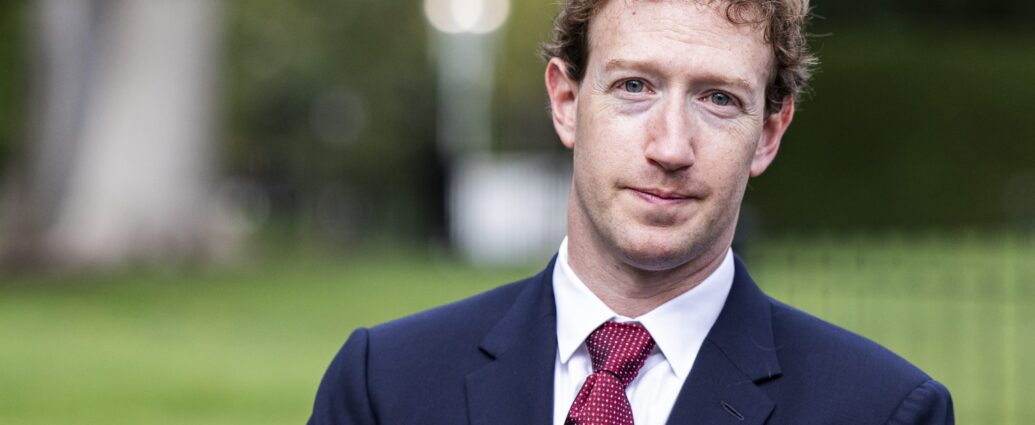
Mark Zuckerberg owns 13% of Meta but controls 61% of its votes. California’s wealth tax would bill him on the 13%
California voters will decide on Nov. 3 whether the state’s billionaires should pay a one-time 5% tax on their net worth. Some of them have already left, like Peter Thiel and Google cofounders Larry Page and Sergey Brin. They join seven billionaires so far who have publicly moved out of the state, taking about $540 billion, or 30% of the state’s billionaire wealth. Meanwhile, others like Jensen Huang are staying.
Meta’s Mark Zuckerberg looked, up until now, as if he would also join Huang in staying in the state where his company is headquartered. But Meta’s new SEC filing that posted this week shows that’s in part because of the key difference between owning a company and controlling it.
What he owns and what he controls
Ownership is a share of a company’s value. Control is a share of its votes. For most shareholders they are the same because each share carries one vote. At Meta, they are not.
Zuckerberg holds mostly Class B shares, which carry 10 votes each. Ordinary Class A shares carry one. So of every $100 of Meta’s value, about $13 is his, but of every 100 votes, about 61 are his, according to a filing Meta released Wednesday. That majority lets him elect the entire board and decide nearly every shareholder vote.
A wealth tax bills the first number—and to pay it, Zuckerberg would have to sell stock, thereby losing control. When Class B shares are sold, they turn into one-vote Class A shares, so every sale to pay the tax would cut into his control.
According to the filing, Meta’s board feared that loss of control.
According to the committee of independent directors that negotiated with Zuckerberg, they found he was “not on the verge of losing voting control.” But it named the wealth tax as one of the main reasons that could change, saying it “has the most significant impact because it would require him to sell shares, or at least borrow against them.” The filing says he “could become liable for a significant, multi-billion dollar tax payment based on his ownership of stock in the Company.”
Zuckerberg also argued that ownership and control don’t need to line up. At an Aug. 26 meeting, he “questioned why the preservation of the status quo with respect to the ratio of his voting control to his economic interest in the Company should be a consideration for the Special Committee, citing precedent in other companies where relatively small economic ownership nevertheless conveyed founder voting control,” the filing read.
That’s why the committee proposed in August a dividend of new non-voting stock that would be payable “if, and only if, California Proposition 40 became law and a tax payment by Mr. Zuckerberg became due and payable,” sized to cover his bill. Zuckerberg wanted more, saying “he did not wish to go through additional protracted negotiation processes in the future if taxes similar to California Proposition 40 were proposed in other jurisdictions.”
Under the final deal, which Fortune reported Wednesday, every shareholder gets one non-voting Class C share for each share they hold. The committee wrote that Zuckerberg could immediately sell 20% of his new shares, “representing 10% of his overall economic stake in the Company, for any reason, including so that he may pay his potential tax liability under California Proposition 40, if enacted into law, without affecting his majority voting control.” Because he takes a $1 salary, the committee said, the tax would otherwise leave him “effectively be paying to serve as the Company’s chief executive officer while residing in California.”
The board didn’t want a remote CEO
Unlike the billionaires who left, Zuckerberg runs a company whose board wanted him in the building. In July, the committee said it was “crucial that Mr. Zuckerberg remains in close coordination with the Company’s management and in close proximity to Meta Superintelligence Labs.” It said it “was mindful about the difficulties the Company faced during the COVID-19 pandemic when Mr. Zuckerberg could not be physically present with the Company’s management team.”
On Sept. 6, Zuckerberg told the committee he “would need to begin taking steps by mid-September in order to establish residency outside California by mid-October.” The final agreement commits him to stay in California, or wherever Meta is headquartered, for eight years, “absent material unforeseen circumstances.”
Meta told Fortune the new stock is mainly about financing its AI spending. In its earnings release, the company said the new class would “provide Meta the ability to finance its growth and help the company remain a leader among fierce competition both domestic and international.” It credits Zuckerberg for Meta’s stock rising more than 1,700% since its IPO, against about 495% for the S&P 500, and says the stock “will continue the founder-led model that has driven the company’s success since its inception.”
“We created this new class of shares with the purpose of creating a publicly traded non-voting stock usable for capital raising, employee compensation, acquisitions, other general corporate purposes while preserving the voting power of existing Class A and B shareholders,” chief financial officer Susan Li said on Wednesday’s earnings call. “We believe this share class will maintain our founder-led structure. It will expand our funding tools and give us flexibility to invest behind the unprecedented momentum we’re seeing across every part of our business driven by AI.”
The filing says management’s forecasts “showed the Company’s need to raise hundreds of billions of dollars over a period of several years beginning as early as fall 2026.” It also acknowledges the new stock “could substantially prolong the duration of Mr. Zuckerberg’s voting control of our Company.” Class A shareholders did not vote, because Zuckerberg “has the ability to unilaterally approve” the change.
This story was originally featured on Fortune.com

Jetmaker Bombardier doubles down on US investment in deal touted by Trump
FIRST ON FOX: Canadian jetmaker Bombardier announced Friday it is “expanding in America” and “creating thousands of jobs” as part of a $270 million investment deal touted by President Donald Trump.
The development comes after Trump said in September that Bombardier should no longer be allowed to sell its planes in the United States unless it manufactures them domestically.
“Bombardier is expanding its presence across the country, hiring 800 people for jobs located in its home base of Kansas as well as Texas, Indiana, and Connecticut,” the company said Friday in a press release obtained by FOX Business. “This strategy includes an initial phase of investment estimated at $270M earmarked for infrastructure growth.”
“Our American service network is a key pillar of Bombardier’s growth strategy. This new wave of expansion and hiring reflects our long-term confidence in this market and our employees in America,” said Eric Martel, president and CEO of Bombardier.
TRUMP TARGETS BOMBARDIER, SAYS CANADIAN JETMAKER ‘MUST BUILD’ IN THE US
“Based on our constructive conversations with the U.S. administration, we see a bright path forward for our highly skilled aerospace workers as well as a positive environment for Bombardier to continue pursuing direct investments to grow our American footprint,” he added.
The company said it is “actively recruiting for 500 positions across the country and plans to create an additional 300 jobs through footprint expansion projects,” and that “Texas is planned to be the next pillar of expansion and will account for 150 of the 300 new jobs.”
“Hiring activities will further be spread across the company’s U.S. home base in Kansas as well as in Indiana and Connecticut,” the company continued.
GOP SENATOR UNVEILS PLAN TO EXPAND TRUMP ACCOUNTS TO PEOPLE UNDER 40: ‘GAME-CHANGER’
“Senator Roger Marshall of Kansas has done an incredible job in representing his Great State!” Trump said on Truth Social late Thursday while revealing the investment. “Companies are coming to America, investing BILLIONS OF DOLLARS, and creating JOBS like never before.”
Bombardier said its Learning Center in Wichita, Kansas “represents one component of Bombardier’s broader investment in this iconic city.”
“Inaugurated last week, the new North American Learning Center reinforces the company’s commitment to developing talent, enhancing capabilities and supporting the long-term growth of its Kansas operations,” according to the company.
“Bombardier’s newest American service facility at Fort Wayne International Airport in Fort Wayne, Indiana, is an approximately 64,500-square-foot facility that will accommodate up to six aircraft and offer scheduled and unscheduled maintenance, modifications, avionics installations and AOG [aircraft on ground] support. The company will further launch new footprint expansion projects in Dallas, Texas, and Connecticut,” it continued.
CLICK HERE TO READ MORE ON FOX BUSINESS
“In 2025, the company’s U.S. activities supported 27,200 American jobs throughout its service and manufacturing facilities, as well as within a broad supply chain, where Bombardier spent $2.8 billion,” Bombardier added.
FOX Business’ Sophia Compton contributed to this report.
How Congress could address Social Security insolvency – and the hidden cost
Social Security is expected to reach insolvency within a decade, and with the key safety net program facing the prospect of automatic benefit cuts when that occurs, a critical debate over the cost of replacing that revenue could be obscured by a budget rule.
Kent Smetters, faculty director of the Penn Wharton Budget Model, spoke exclusively with FOX Business about a new report that details how federal budget rules assume Social Security benefits would be paid in full using general revenue transfers when the program’s trust funds reach insolvency in about six or seven years.
“What the law actually says is that when the trust fund depletes, benefits have to be reduced to a level that’s consistent with just the monthly payroll taxes that come in. We estimate that to be about a 15% reduction of benefits, which is sizable,” Smetters said, adding that the cut would apply to newcomers and existing enrollees alike.
FEDERAL BUDGET DEFICIT HITS $2T AS NATIONAL DEBT COSTS SURGE
Smetters said that a separate law covers how the nonpartisan Congressional Budget Office (CBO) would score the cost of trust fund depletion and general fund transfers to appear as if there was no cost to shifting borrowing to the general fund as spending continues.
“We all know that’s just like the left hand paying the right hand or vice versa. It doesn’t do anything to solve the actual funding problem. But nonetheless, that’s going to score as though it’s costless, zero dollars, even though that borrowing from general revenue will be substantial – almost 200% of GDP within 75 years, or over 400% of taxable payroll over 75 years,” Smetters said.
He cautioned that the budget rule may “almost cast a die of what’s going to actually happen, because I think policymakers are going to see that it’s kind of like the easy button for looking like they’ve solved Social Security.”
The approach of relying on general fund transfers to make up the shortfall to pay Social Security benefits in full could also raise alarm in bond markets and worsen the nation’s fiscal woes through higher interest rates.
Smetters said that “bond markets are currently making a bet that Congress and the president will eventually get their act together, because if they don’t, future bond markets are just going to pound them,” adding that the general revenue transfers would serve as the “ultimate sign that we’ve given up.”
AMERICA’S $40T NATIONAL DEBT IS ‘STEALING FROM OUR NEXT GENERATION,’ ECONOMIST WARNS
The CBO’s most recent 10-year budget outlook estimated that Social Security’s main trust fund would be depleted in 2032, with benefits reduced by an average of 28% annually after benefits are cut. The reduction in benefits would amount to about $2.7 trillion in reduced benefits over the 2032 to 2036 period, according to the CBO.
Smetters noted that while the CBO and Penn Wharton Budget Model projections differ slightly in the timing and extent of benefit cuts, as PWBM estimates insolvency will occur in 2033 with benefits reduced by 15%, policymakers need to address the fiscal challenges facing Social Security as soon as possible.
“Even though seven years is not that far away, the good news is there are a range of options,” Smetters said, noting that the Penn Wharton Budget Model website has a set of seven illustrative options that range from heavy tax revenue increases to heavy benefit cuts, with a middle ground in between.
ONE TYPE OF SOCIAL SECURITY ADJUSTMENT COULD CUT THE 75-YEAR SHORTFALL IN HALF
Smetters said that while various solutions to prevent trust fund depletion and reduce federal debt have different long-term economic outcomes, there is still time for a rational discussion.
“Unless we go with the gimmick approach in terms of this general revenue transfer, the fact of the matter is it requires really having adults in the room on both sides of the aisle,” he said.
Smetters highlighted the Social Security reforms made during the 1980s by then-President Ronald Reagan and Democratic House Speaker Tip O’Neill, which set partisanship aside.
“They decided we’re jumping off this bridge together because the country is worth it, and they were going to put their personal politics, personal ambitions aside to solve this problem,” Smetters said. “We just don’t have that rhetoric right now.”
“The longer that we wait, the more likely it’s just going to be this pure optics, easy button and make it look like we’ve solved Social Security despite not actually doing anything, and we’re going to absorb these really large budget deficits going forward,” he added.




New York–Israel Airfares Fall 25% as Airlines Restore Service, but Deep Discounts Remain Limited
United and Delta lead price reductions exceeding 30%, with some winter round-trip fares below $900 as competition returns to the transatlantic route.
JBizNews Desk | New York
Airfares between New York and Tel Aviv have fallen an average of 25% over the past six weeks, driven by increased airline competition, expanded flight capacity and softer demand following the Jewish holiday travel season.
New industry pricing data shows that United Airlines and Delta Air Lines have made particularly aggressive reductions, cutting average round-trip fares by approximately one-third as American carriers resume service to Israel and compete with El Al, Arkia and Israir.
The reductions mark a significant reversal for a route that has experienced unusually high prices and limited availability through much of the year.
However, while promotional fares as low as $600 have appeared for selected connecting itineraries, current flight searches indicate that many nonstop tickets remain considerably more expensive, particularly for travelers with fixed departure and return dates.
United and Delta Lead the Price Declines
An airfare analysis conducted by Israeli travel company lastminute.co.il found that United’s average round-trip fare dropped from $1,844 to $1,237, a reduction of 33%.
Delta recorded an even larger percentage decline, with average fares falling from $1,980 to $1,245, representing a 37% reduction.
El Al and Arkia also reduced prices, although the changes were more modest.
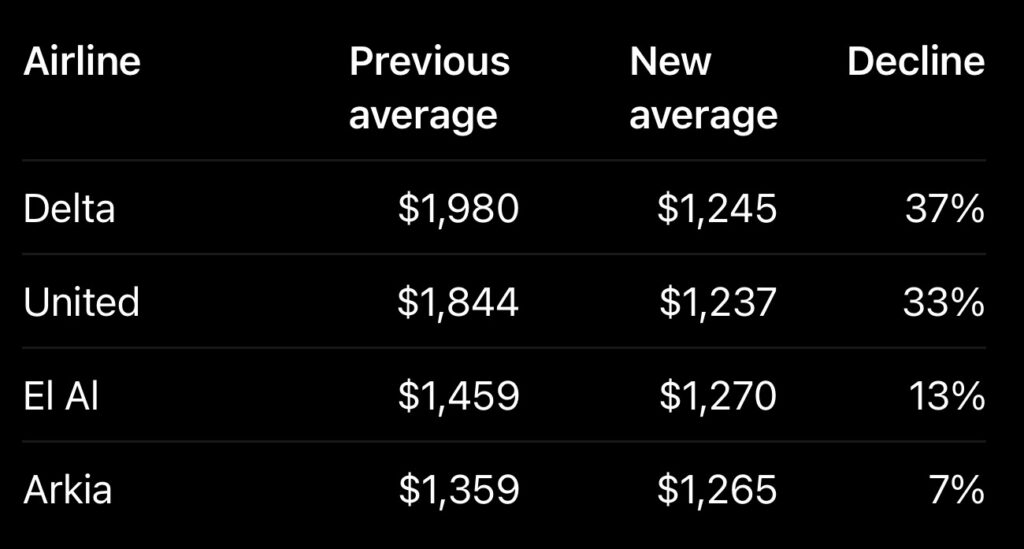
The figures represent average round-trip fares for comparable post-holiday October travel periods, including baggage, rather than guaranteed prices available on every departure.
January Fares: What Travelers Can Actually Find
Looking ahead to winter 2027, airfare searches show additional opportunities for savings, although prices vary significantly by airline, routing and dates.
A Google Flights review identified United nonstop round-trip tickets from Newark to Tel Aviv starting around $1,150 for selected travel dates, while Arkia displayed fares around $848 for certain January departures.
Condor, which offers connecting service, appeared at approximately $820 for a January 14 departure and January 30 return.
Other travel industry findings identified Delta round-trip fares around $878 for mid-January and selected El Al flights near $773 for early March.
Israeli airfare platform Secret Flights has also reported promotional Delta nonstop fares approaching $650 for certain dates in early 2027. Those specific promotional tickets could not be independently confirmed as currently bookable.
The differences illustrate an important limitation of advertised airfare reductions: A traveler searching for a particular week, especially on United’s nonstop Newark service, may still encounter fares of $1,500 or more, even as industry averages decline.
More Airlines Are Restoring Competition
For much of the recent period of disrupted service, El Al and Arkia operated with relatively little direct competition from American airlines.
United and Delta resumed Israel operations in September following extended suspensions related to regional security conditions, while Israir entered the New York market with additional long-haul service.
The expanded capacity initially failed to reduce prices substantially because demand remained strong through Rosh Hashanah, Yom Kippur and Sukkot.
With holiday travel behind the market, additional available seats are now creating greater pricing pressure.
The average November round-trip fare across five participating carriers stands at approximately $1,223, according to the industry survey.
Israir had the lowest reported average at $1,135, followed by United at $1,190, Arkia at $1,230, Delta at $1,265 and El Al at $1,295.
Why Airfares Are Falling Despite Rising Costs
The decline comes despite higher operating expenses for airlines, including increased aviation fuel costs.
Industry executives have indicated that expanding capacity and restoring competition are placing downward pressure on ticket prices even as carriers continue to face substantial costs associated with long-haul operations.
Seasonal demand also plays an important role.
Travel prices between New York and Israel typically rise during major Jewish holidays and peak summer travel, while January and February can present lower-cost opportunities for passengers with flexible schedules.
For consumers, the returning competition may provide meaningful financial relief after years of elevated fares and limited flight choices.
A family purchasing five round-trip tickets at $1,200 rather than $1,800 could save approximately $3,000, illustrating the potential financial significance of additional competition.
What Comes Next for Israel Travel
The latest figures suggest that the New York–Tel Aviv aviation market is moving away from the severe capacity shortages that previously enabled airlines to command substantially higher fares.
American Airlines remains absent from the route, with its return previously postponed until late March 2027, meaning competition has not yet been fully restored.
Airlines will now have to balance passenger demand, operating expenses and ticket pricing as additional capacity becomes available.
For travelers planning winter visits to Israel, the key development is not that $600 round-trip tickets have become standard. Rather, the market is offering a wider range of prices, greater airline choice and the possibility of substantial savings for passengers who can adjust their travel schedules.
The larger economic story is that competition is finally beginning to work in travelers’ favor on one of the most important international routes connecting the United States and Israel.
JBizNews Desk | New York
© 2026 JBizNews. All rights reserved.
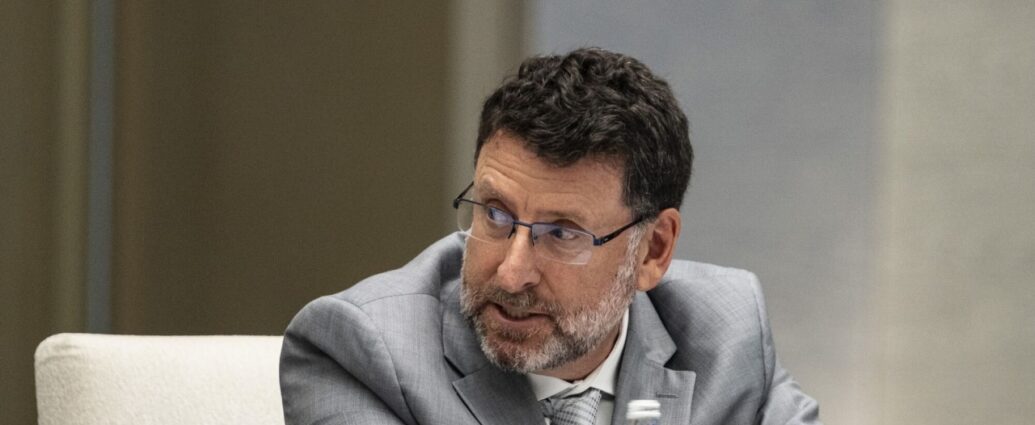

Florida’s manufacturing ambitions take flight as aerospace, medtech giants fuel Sunshine State’s economic push
EXCLUSIVE: If you build it, they will come.
That very sentiment is taking root across Florida’s sun-drenched landscape, as a calculated collaboration between private enterprise and state leadership pushes the Sunshine State towards a modern manufacturing boom.
“We now know Florida is the 14th largest economy in the world. And everyone thinks that Florida is agriculture, tourism and construction. And we’re fortunate to have those industries, but Florida started diversifying its economy about 25 years ago, into life sciences, aerospace, rockets, and of course, manufacturing,” Florida Chamber of Commerce President and CEO Mark Wilson exclusively told Fox News Digital. “Manufacturing is a non-negotiable key component.”
“Under Governor DeSantis’ leadership, Florida has really been at the forefront of re-shoring and on-shoring manufacturing,” FloridaCommerce Deputy Secretary for Economic Development and Chief Manufacturing Officer Jason Mahon also told Fox News Digital.
“We’ve actually had larger gains than any of the traditional manufacturing states, which mostly have declined. We’ve become a top 10 manufacturing state. We’ve actually grown in terms of our GDP in manufacturing by 60%. So we’ve gone from $54.4 billion to $87.4 billion in manufacturing output,” Mahon said. “So really, I think the tale is in the numbers that the free state of Florida, we’re bringing in manufacturers, they’re finding great opportunities here, great workforce here, and we’re really thriving as a result.”
Florida’s gross domestic product (GDP) now exceeds $1.8 trillion, surpassing countries like Spain, Mexico and Australia. State business leadership is executing a targeted campaign to break into the global top 10 economies by 2030, while simultaneously reaching a top five national ranking in manufacturing employment, requiring 750,000 net new jobs.
Two of those private sector businesses hoping to help Florida reach those goals are Naples-based medical device company Arthrex and St. Augustine-based aerospace and defense technology company Northrop Grumman. Both are the finalists for the Florida Chamber and FloridaCommerce’s annual “Coolest Thing Made in Florida” competition, for which the winner will be announced Oct. 28.
“What makes the state of Florida so unique, and for developing and manufacturing military products, is that we have a great infrastructure. We have the resources available, we have the skills available, and then we have the partnership with the state to allow us to continue to develop and grow,” Northrop Grumman Vice President and site leader Randy Bradley told Fox News Digital while detailing their E-2D Advanced Hawkeye aircraft used primarily by the U.S. Navy. “For Northrop Grumman, for example, we have over 8,000 employees in the state of Florida, and we have three primary locations.”
“The TightRope PRO is a great example of advanced manufacturing happening right here in Florida. The product was designed, prototyped, tested and manufactured in our state. It takes highly skilled engineers, machinists, manufacturing professionals and operating teams to bring a device like this to market,” Arthrex director of foot, ankle and trauma product management Michael Karnes said of the company’s finalist product.
“These are not traditional tourism or hospitality jobs. These are high-tech, high-skill careers that support innovation and manufacturing growth,” Karnes continued. “The success of Florida’s economy depends on having a diverse mix of industries, and advanced manufacturing is an important part of that future.”
Part of what makes Florida attractive to new residents and companies is that it’s one of nine states in the U.S. that does not impose individual state income tax, and according to the Florida Policy Institute, between 99% and 99.9% of businesses anchored there owe zero state corporate income tax. Even for C-corporations that are subject to the tax, Florida offers a standard $50,000 exemption on net income.
Additionally, state leaders have passed tax-cutting measures every year since 2011 that include phasing out and repealing the business rent tax, expanding corporate exemptions and enacting permanent sales tax holidays. Mahon noted how industrial projects can move from groundbreaking to production in under six months — a timeline virtually unattainable in higher-tax, traditional manufacturing hubs in the Rust Belt or on the West Coast.
“Our main goal here is to support those manufacturers,” Mahon said. “So what we do is we try to help them go through that process at the local level, at the state level, what they need and help them get there.”
Mahon argued that Florida’s approach allows manufacturers to get operations off the ground much faster than in states with more regulatory hurdles, pointing to projects that have gone from the planning stages to production in just six months or less.
“And we’ve worked on projects that are up and running within that timeframe, sometimes even faster, right? From nothing, to, they’re producing something here in Florida.”
IS MIAMI REALLY COSTLIER THAN NEW YORK CITY? WHY TOP DEVELOPERS SAY THE MATH STILL FAVORS FLORIDA
Wilson echoed that sentiment, arguing that businesses and wealthy individuals are increasingly gravitating toward states with lower taxes and fewer regulations, rather than remaining in states like New York, California and Illinois.
“And so capital goes where capital’s loved and where capital is welcomed,” Wilson said.
He pointed to billionaire Ken Griffin and a recently announced $3 billion investment as examples of how Florida’s business-friendly policies are attracting major investors.
“These are the kinds of things that happen when entrepreneurs and investors know that Florida is open for business, and we want people here.”
“I relocated here 13 years ago… I love the quality of the life,” Bradley reflected, adding that Florida’s beaches, rivers, recreation, and affordable living make the state one of the most attractive in the nation.
“My dollar goes a lot further here than other parts of the country I’ve lived. So I think those are the things that… make this state a partner for us. I mean, it’s easy to attract the talent and maintain it when you offer such a great quality of life and affordability of the state.”
“Arthrex continues to invest in Southwest Florida because it’s where Arthrex was founded and where many of our core innovation manufacturing and distribution operations are located. Florida’s business-friendly environment supports continued growth and investment here in Collier County,” Karnes added. “For us, it’s more than just about cost. It’s about maintaining control of the quality of our products that surgeons use every single day in the United States [and] supporting their patient care. We’re deeply invested in this community and committed to creating opportunities in advanced manufacturing in Florida for years to come.”
According to Mahon, the current administration has poured $12 billion directly into workforce education, focusing on critical industrial trades like precision machining, electrical, welding and pipe-fitting. Data tracked by the Economic Policy Institute shows that every 100 direct manufacturing jobs that produce durable goods — aerospace, semiconductors and advanced electronics — sustain 744.1 indirect jobs, with FloridaCommerce finding that average annual wages within state-designated target industries such as advanced manufacturing reach $107,261.
“When you look at our growth in manufacturing, a lot of that is due to the fact that we have so many highly skilled individuals already here. So we’re going to continue to look at, how do we help them get into those careers, access those careers? In fact, I think we need to keep investing in those strategic opportunities for our employees because you look at the competition, right? So if we’re going to have more manufacturing, and they’re all going to be drawing from a similar pool of people that have these skills in things like electrical and welding and pipe fitting, we just need to continue to grow those pipelines,” Mahon explained, adding that his focus is on making sure Floridians have access to high-wage, high-skilled jobs.
“Manufacturing is one of the most leverageable careers that we have. And in Florida, manufacturing jobs’ median wages are over $82,000 a year,” Wilson expanded. “And so I think when you look at the ‘Coolest Thing Made in Florida’ competition that we have, it’s about getting the middle schoolers and high schoolers [interested], and saying, ‘Hey, we need more skilled trades. Manufacturing jobs and skilled trade jobs are not only cool jobs, they’re high-paying jobs,’ and you can raise a family, and you could do quite well in Florida with those kinds of jobs.”
“We want students to see that they can build rewarding careers right here in Southwest Florida,” Karnes said. “They don’t need to leave the region to find that opportunity. That’s how you keep families together and strengthen our local communities for years to come. We’re continuing to invest in education, workforce development… and innovation will be critical to these goals.
“From Northrop Grumman’s perspective, we’re doing a lot of goodness here. We’re investing to grow. We see a great future,” Bradley added. “For the state itself, having the Space Coast and flying off a rocket every week almost, really sets this state apart as far as the technology, and we really want to grow in the aerospace and space industries. So I see a bright future for the state when it comes to that.”
GET FOX BUSINESS ON THE GO BY CLICKING HERE
As the Florida Chamber and FloridaCommerce prepare to crown the state’s manufacturing champion, their economic leaders view the competition as more than a ceremonial showcase, but as a shift reflected directly in conversations with out-of-state corporate leaders weighing where to build their next facility.
“It’s our pro-business economy. It’s that we have a desire and the mindset that we’re going to help these businesses grow here and help them navigate whatever they need to navigate, whether that’s in their workforce, whether that’s in infrastructure, supply chain, permitting at the local level. And so that’s what we’re hearing consistently,” Mahon said.
“Florida is the safest, most consistent place in the United States for that investment,” Wilson argued. “And we would encourage them to consider relocating here so that we can help America lead, and Florida is going to show the way.”