The U.S. Department of Commerce reportedly retracted a proposed rule on AI chip exports on Friday, marking a shift in the nation’s strategy to regulate the global AI chip market.

The rule’s draft was circulated among other agencies for feedback in late February. No explanation was given for the withdrawal.

A Reuters report stated that the proposed regulation called “AI Action Plan Implementation” was uploaded to the Office of Information and Regulatory Affairs website on February 26 for review, but was later removed. The rule had proposed evaluating whether foreign nations investing in U.S. data centers or offering security assurances should be a requirement for exporting 200,000 or more chips.

The ⁠Commerce Department did not immediately respond to Benzinga‘s request for comment.

This move is the latest in a series of reversals by the Trump …

Full story available on Benzinga.com

This post was originally published here

President Donald Trump announced on Friday that U.S. Central Command carried out a major bombing raid on Iran’s main crude oil export terminal, Kharg Island, and “totally obliterated every MILITARY target” on what he deemed the nation’s “crown jewel.”

The facility, located about 16 miles off the coast of Iran and about 300 miles from the Strait of Hormuz, handles about 90% of the country’s oil shipments.

US Strikes Iran’s Crown Jewel

In a post on Truth Social, Trump stated that the U.S. possesses the most powerful and sophisticated weapons in the world, but he chose not to destroy the oil infrastructure on the island.

However, he warned that any interference with the free and safe passage of ships through the Strait of Hormuz, a chokepoint for roughly 20% of global oil supply, would prompt a reconsideration of this …

Full story available on Benzinga.com

This post was originally published here

President Donald Trump announced on Friday that U.S. Central Command carried out a major bombing raid on Iran’s main crude oil export terminal, Kharg Island, and “totally obliterated every MILITARY target” on what he deemed the nation’s “crown jewel.”

The facility, located about 16 miles off the coast of Iran and about 300 miles from the Strait of Hormuz, handles about 90% of the country’s oil shipments.

US Strikes Iran’s Crown Jewel

In a post on Truth Social, Trump stated that the U.S. possesses the most powerful and sophisticated weapons in the world, but he chose not to destroy the oil infrastructure on the island.

However, he warned that any interference with the free and safe passage of ships through the Strait of Hormuz, a chokepoint for roughly 20% of global oil supply, would prompt a reconsideration of this …

Full story available on Benzinga.com

This post was originally published here


Quick Summary

  • Stan Druckenmiller says nobody really knows whether AI will destroy jobs, reshape them or trigger a very different inflation outcome than markets expect.
  • To prepare for a more uncertain future, free matching tools can connect you with financial advisors who can help test your savings, investing and retirement plan.

A lot of people are treating artificial intelligence (AI) like it will slash jobs, crush wages and push prices down. 

Stan Druckenmiller wants you to slow down before you buy that script.

“I don’t think any of us know how this movie is going to play out,” the billionaire investor said in a recent conversation with Morgan Stanley’s Iliana Bouzali, pushing back on the idea that AI will definitely be deflationary and trigger “massive job losses.”

His main objection is that people are drawing hard conclusions from something that’s still unfolding. “Anybody who believes that with conviction suffers from arrogance and not an open mind,” he said.

Why he thinks the jobs story is more complicated

Druckenmiller, who is famously known for achieving roughly 30% annual returns every year for 30 years, said that every big wave of technology has been greeted with predictions of mass unemployment, “all the way back to the horse and buggy.” 

It hasn’t worked out that way, though. Jobs have changed, but they haven’t disappeared. That’s why it is always good to stay prepared by speaking …

Full story available on Benzinga.com

This post was originally published here


In 2026, markets are navigating two powerful, seemingly different sources of uncertainty. Escalating conflict in the Middle East and growing stress in the private credit industry.

At first glance, the risks appear separate—one tied to commodities and global politics, the other to financial market plumbing. Yet beneath the surface, the two may interact in ways that amplify volatility worldwide.

Economist Mohamed El-Erian believes the key issue is how multiple shocks can compound rather than offset one another.

“In the real economy and finance, the negative factors do not net out; they compound,” he wrote in The Financial Times, warning that investors should not assume geopolitical or financial stresses will remain isolated events.

Private Credit Volatility

The private credit sector has expanded rapidly over the past decade, filling lending gaps left by banks after 2008. But its structure, illiquid loans funded by investor capital that expects periodic redemptions, has raised questions about resilience during periods of market stress.

Recent redemption pressure across the sector brought this vulnerability into focus. When withdrawals accelerate, managers may restrict redemptions to avoid forced asset sales, a mechanism that protects portfolios but can unsettle investors.

El-Erian has described the resulting contagion dynamic as familiar from past financial cycles.

“If you can’t sell what you want, you sell what you can,” he wrote, noting that investors facing liquidity constraints may offload unrelated assets simply to raise cash.

Such a dynamic can spread volatility beyond the private credit market itself, tightening financial conditions more broadly.

Oil Shock Returns

At the same time, geopolitical tensions involving Iran have reignited volatility in oil markets. Energy prices have surged as traders price in risks to Middle …

Full story available on Benzinga.com

This post was originally published here


Bitcoin (CRYPTO: BTC) held near $70,000 as Digital Assets Council financial professionals adviser Rick Edelman said investors should be “ecstatic” at current prices, arguing if you loved Bitcoin at $126,000, you have to love it more at $70,000.

The 10-40% Allocation Thesis

Edelman recommends investors allocate 10-40% of portfolios to crypto despite Bitcoin trading more than 30% below its $126,000 record high from mid-October. 

He argues adoption is growing and Bitcoin’s returns are likely to dramatically outperform any other asset class over the next 5-10 years.

“We talk about 5 or 10% returns for other assets. Bitcoin is going to be 5x or 10x over the next 5 to 10 years,” Edelman said. “So …

Full story available on Benzinga.com

This post was originally published here


Pi Network (CRYPTO: PI) surged 30% during Asia trading hours Friday after Kraken announced it will list the cryptocurrency ahead of Pi Day on March 14.

The Kraken Listing Catalyst

Kraken’s listing announcement triggered the rally as PI became available on a major U.S.-regulated exchange. 

The token is already listed on OKX, Gate, and Bitget, but Kraken’s entry expands access to mainstream retail and institutional traders.

The timing coincides with Pi Day on March 14, a holiday celebrating the mathematical constant where the first three digits are 3.14. The date has become a marketing opportunity for Pi Network, similar to how pizzerias and bakeries offer discounts.

Pi Network is a mobile-first cryptocurrency project that replaces traditional proof-of-work mining with a phone-based trust graph. 

Users tap a mobile app daily to “mine” tokens and form identity-verified security circles that feed into a consensus system derived from the Stellar protocol.

The …

Full story available on Benzinga.com

This post was originally published here


Editor’s note: This story was updated to correct a reference to private oil producers.

“Drill, baby, drill” has long been the Trump administration‘s political shorthand for unleashing U.S. oil production. But the latest shale data suggests the companies actually answering that call aren’t the oil giants dominating energy ETFs.

Instead, it’s a wave of privately held drillers — firms most investors have never heard of — quietly adding rigs across America’s shale basins.

• Helmerich & Payne stock is surging to new heights today. What’s driving HP stock higher?

Private Shale Operators Take The Lead

According to JPMorgan analyst Arun Jayaram, U.S. horizontal land rig activity rose modestly by three rigs week-over-week to 474 active rigs. The bigger story, however, is who is doing the drilling.

Private exploration and production companies added nine rigs during the week, while publicly traded shale firms cut five rigs. Activity from the oil majors remained largely unchanged.

Private operators now run 202 rigs — about 42% of total U.S. horizontal …

Full story available on Benzinga.com

This post was originally published here


Private markets investment management firm Hamilton Lane (NASDAQ:HLNE) said it does not believe there is a private credit bubble in its most recent 2026 market overview.

“With the increased capital available, with the increase in market share, with the ongoing press about the pressures on private credit, the casual observer would think that yields and spreads of private credit over broadly syndicated loans were collapsing. That would be a completely incorrect assumption,” Hamilton Lane wrote.

• Hamilton Lane stock is showing upward movement. Why is HLNE stock trading higher?

“Sponsors want private credit and seem willing to pay for what it has to offer. There is no sign of stress with these spreads or returns, relative to broadly syndicated loans,” the report continued.

Hamilton Lane believes banks carry “far riskier” loan pools than private credit, and the latest defaults are a problem with the banks, not with private credit itself.

Private credit has continued to reshape the global …

Full story available on Benzinga.com

This post was originally published here


Rivian Automotive Inc. (NASDAQ:RIVN) is down 16% in March as the company unveiled its R2 SUV at SXSW this week.

CEO RJ Scaringe called it a “make-or-break product.”

The launch model starts at $57,990, nearly $13,000 above the $45,000 entry price the company has been advertising. That cheaper version? Pushed to late 2027.

Rivian’s CSO Wassym Bensaid told the Wall Street Journal on Friday that only Tesla Inc. (NASDAQ:TSLA) and Rivian have caught on in the U.S. because they had the range, performance and value that customers want.

“We know that there are just two companies in the U.S. who know how to do it: Tesla and us,”

Chinese competitors like BYD, the world’s largest EV maker, kept out of the U.S. by large tariffs.

The …

Full story available on Benzinga.com

This post was originally published here


Quick Summary

  • Stan Druckenmiller says overanalyzing is “the biggest mistake in our business” because traders who wait for perfect information often miss the move.
  • For traders trying to act earlier without risking another blown-up small account, Apex Trader Funding offers a way to trade in a rules-based enviornment before putting personal money on the line.

Stan Druckenmiller has a warning for traders who spend too long searching for certainty.

“At some point, the analysis becomes counterproductive,” the billionaire investor said in a recent interview with Morgan Stanley’s Iliana Bouzali, calling overanalysis “the biggest mistake in our business.”

“Speed matters now,” said the legendary investor, who averaged roughly 30% annual returns over 30 years without a single down year.

“If you sit around and analyze a company for four months and you’re not willing to operate with 15% or 20% of information, you’ll often miss the big move,” he said. “And then you’re afraid to buy it because it has moved.”

For active traders, that idea underlines the reason why so many struggle to gain traction. The problem is not always being wrong. Often, it is hesitating too long, missing the setup, then chasing after the move is already underway.

Druckenmiller’s comments are relevant in a market today shaped by AI enthusiasm, rapid sentiment shifts and sharp rotations across sectors. …

Full story available on Benzinga.com

This post was originally published here


When a sharp selloff in AI stocks wiped roughly $1 trillion from tech valuations earlier this year, gold unexpectedly moved lower as well. For some investors, the drop raised a troubling question: if gold is the ultimate safe haven, why did it fall alongside risk assets?

According to Tarek Saab, CEO of Texas Precious Metals, the answer lies in how markets behave during periods of sudden volatility.

“Gold remains uncorrelated to tech assets and to the broader equities markets at large, which is why many continue to increase gold exposure in strategic portfolios,” Saab told Benzinga.

Gold: Short-Term Moves Vs Long-Term Role

During sharp market shocks, investors often sell multiple asset classes simultaneously as they raise cash or …

Full story available on Benzinga.com

This post was originally published here


Five and 15-minute Bitcoin (CRYPTO: BTC) prediction market contracts are attracting roughly $70 million in daily trading volume across Polymarket and Kalshi as retail traders use AI chatbots to scrape price data and generate odds for ultra-short-term bets.

The AI Trading Strategy

The Financial Times reported on Friday that Max Wojcik, a 29-year-old engineer, feeds weeks of Bitcoin price data into three AI chatbots—Claude, Gemini and ChatGPT. 

He has the chatbots analyze the data together and calculate his probability of winning before he places any five-minute trades.

“Claude is my major brain right now, but I’m still manually placing the trades,” Wojcik said.

The engineer claims to have doubled his money over the past two months using this AI-assisted approach.

Traders flocking to short-term crypto forwards on Kalshi and Polymarket are presented with dashboards showing real-time prices fluctuating around a “price to beat” as a clock counts down toward the end of the contract.

The $70M Daily Volume Surge

Both platforms began offering 15-minute “up-down” bets on Bitcoin, Ethereum

Full story available on Benzinga.com

This post was originally published here


Prediction market traders are pricing a 62% probability that the Trump administration removes at least one Jones Act domestic shipping requirement by June 30, a move that could hand Gulf Coast refiners like Valero Energy Corporation (NYSE:VLO) a major logistics advantage.

The Polymarket contract, which opened March 9, resolves to “Yes” if any of the century-old law’s four core restrictions are removed via legislation or executive action before the deadline.

What Happened

The White House confirmed Wednesday it is considering a temporary Jones Act waiver for energy and agricultural shipments.

Bloomberg reported the administration is developing a 30-day exemption covering oil, gasoline, diesel, LNG and fertilizer moving between U.S. ports.

The administration’s scramble to ease domestic fuel pressures comes as Brent crude briefly topped …

Full story available on Benzinga.com

This post was originally published here


MARA Holdings Inc (NASDAQ:MARA) shares traded higher on Friday. The move tracks a steady recovery in Bitcoin (CRYPTO: BTC) prices.

Bitcoin Recovery Boosts Mining Sector

The apex cryptocurrency climbed to $71,194.33, gaining 1.14% over the last 24 hours, according to CoinMarketCap data.

This recovery follows a broader uptick in digital asset sentiment. Markets reacted positively as Bitcoin maintained a 4.92% gain over the past seven days.

Broader cryptocurrency market momentum remains strong. Strategy Inc (NASDAQ:MSTR) also saw gains following massive Bitcoin acquisitions. Executive Chairman Michael Saylor recently noted on X, “You know there’s a delay between the time we buy the Bitcoin and the time Bitcoin goes to the …

Full story available on Benzinga.com

This post was originally published here


Venture Global, Inc. (NYSE:VG) shares are up on Friday as the company announced a final investment decision and financial close for its CP2 LNG Phase 2 project.

Details

The company secured an $8.6 billion project financing for the second phase of its CP2 LNG project, marking a significant milestone in its growth strategy.

This financing attracted over $19 billion in commitments from leading banks, showcasing strong demand for U.S. LNG investments.

The CP2 project is expected to reach peak production capacity of 29 million metric tons per annum, with nearly all output already contracted under long-term agreements with customers mainly in Europe and Asia.

Technical Analysis

Venture Global’s stock is currently trading 28.2% above its 20-day simple moving average (SMA) and 59.5% above its 100-day SMA, indicating strong short-term and longer-term momentum. Over the past 12 months, shares have increased by 39.48%, and they are currently positioned closer to their 52-week highs than lows, suggesting a bullish trend.

The RSI …

Full story available on Benzinga.com

This post was originally published here


In a letter to young creators, Apple Inc.’s (NASDAQ:AAPL) CEO, Tim Cook, disclosed the crucial question that steered his choice to join the then-ailing tech giant.

The letter published by the Steve Jobs Archives revealed that Cook, who joined Apple in 1998, was initially hesitant about leaving secure firms like IBM (NASDAQ:IBM) and Compaq, acquired in 2022 by Hewlett Packard (NYSE:HPE), for a company that was struggling.

He remembers, “Many people doubted the company could survive, and I was warned that accepting a job there would come with risks.”

Despite the risks, Cook was influenced by founder Steve Jobs‘ fervor and vision. However, his admiration for Jobs wasn’t the only factor in his decision. Cook needed to be sure the move was right for him.

Cook said the future is unpredictable despite our best efforts to shape it, and advises that instead of focusing on “What will happen?”, people should ask themselves something deeper.

Thus, he posed himself a potent question: “Who will I be when it does (happen)?”

This question guided Cook to choose purpose and passion …

Full story available on Benzinga.com

This post was originally published here

The Federal Trade Commission (FTC) has granted Tesla (NASDAQ:TSLA) approval to convert its investment in xAI into a stake in SpaceX, according to a recent filing.

• Tesla shares are consolidating. What’s the outlook for TSLA shares?

The filings also indicated that Musk, who is the CEO of both companies, sold portions of the holdings to several investors, including Valor Equity Partners and DJF Growth. Details including the size of the deals were not disclosed. The size of the deal must be reported if its value is over $133.9 million.

These filings …

Full story available on Benzinga.com

This post was originally published here


PPL Corporation (NYSE:PPL) shares are up on Friday as the company is reportedly reaching a settlement regarding its first distribution rate increase since 2016.

PPL Electric Utilities has submitted a joint petition for a non-unanimous settlement to the Pennsylvania Public Utility Commission (PUC), seeking approval for a $275 million increase in annual base distribution revenues. If approved, the new distribution base rates would take effect on July 1, 2026, and would not increase for two years thereafter.

The settlement aims to enhance system reliability and improve customer service while supporting investments for future growth. This marks the company’s first base distribution rate increase since 2016, indicating a significant shift in its revenue strategy.

Technical Analysis

PPL is currently trading 2.6% above its 20-day simple moving average (SMA) and 7.5% above its 100-day SMA, indicating a strong short-term trend.

Over the past 12 months, shares have increased 13.97%, and they are currently positioned closer to their 52-week highs than lows.

The RSI is at 55.19, which is considered neutral territory, suggesting that the …

Full story available on Benzinga.com

This post was originally published here


Interview with Sopnendu Mohanty, Group CEO GFTN…

Image Credit: Author

After a decade as Singapore’s Monetary Authority (MAS) Chief Fintech Officer Sopnendu Mohanty is now deploying capital. In an exclusive interview, he reveals the three-tech stack that will define finance and why his new fund partnership is a “model of responsible collaboration.”

Sopnendu Mohanty spent ten years as the chief architect of Singapore’s famously pragmatic, use-case-driven fintech ecosystem. Now, he’s trading regulatory guidance for strategic capital. In an exclusive interview, the former Monetary Authority of Singapore (MAS) Chief Fintech Officer, now Group CEO of the Global Finance & Technology Network (GFTN) detailed his mission to drive “a more equitable financial services” future. And he’s backing that mission with a recently announced $200 million fund.

“The kind of technology we saw over the last 10 years, the kind of technology that is coming in the next 10 years, does require a coordinated global response to get it right at a scale,” Mohanty said, explaining his shift from regulator to global network builder. “We have to ensure that the shift and the growth, whether using AI or tokenization or better encryption using quantum, all this should drive to a more equitable financial services.”

From Policymaker to Capital Deployer

Sopnendu Mohanty’s journey – 17.5 years at Citibank followed by a decade at the MAS gives him a unique lens. He believes GFTN, a not-for-profit spawned from the MAS, is “best equipped to provide top-notch advisory services to private sector and government” because it understands how to operate at scale in a regulated industry. The commercial arm of that vision, GFTN Capital, just took a major leap.

In November 2025, GFTN Capital announced a partnership with Japanese financial giant SBI Holdings and SBI Ven Capital to launch a US$200 million global innovation fund. The fund will target growth-stage fintech companies worldwide, specifically those leveraging AI, digital assets, cybersecurity and tokenization.

This …

Full story available on Benzinga.com

This post was originally published here


Michael Burry, the investor made famous by the 2008 financial crisis trade, used X on Friday to blast Nasdaq’s proposed rule changes ahead of SpaceX‘s anticipated initial public offering (IPO).

“This is the most SHAMELESS structural manipulation of a major index I’ve ever seen,” Burry wrote.

His target: two specific rule proposals Nasdaq quietly floated in February that critics say were designed around a single company.

SpaceX, the Tesla Inc (NASDAQ:TSLA) CEO Elon Musk-led commercial spaceflight company, is reportedly targeting a $1.75 trillion valuation for what could be the largest IPO in history.

Reuters reported the company is leaning toward a Nasdaq listing, potentially as early as June. Musk appeared to confirm the $1.75 trillion figure on X on March 2.

The ‘Fast Entry’ Rule: 15 Days, No Waiting

Currently, new public companies typically wait up to 12 months before qualifying for major index inclusion. That seasoning period allows real price discovery and protects passive investors from …

Full story available on Benzinga.com

This post was originally published here


Intuitive Surgical, Inc. (NASDAQ:ISRG) drew market attention Friday after revealing a cybersecurity incident involving unauthorized access to internal administrative systems.

The disclosure comes as medtech peer Stryker Corporation (NYSE:SYK) battles a major cyber disruption of its own.

What Happened?

The company said the breach resulted from a targeted phishing attack that compromised an employee account connected to certain internal applications.

The surgical robotics manufacturer disclosed that the incident involved limited data from internal business software systems.

The company said it quickly activated response procedures and secured affected systems after detecting the intrusion.

Incident Details

According to the company, the breach involved information accessed through compromised employee credentials.

The exposed data included certain customer contact information, employee records and corporate administrative data.

Intuitive emphasized that the intrusion did not affect its flagship robotic platforms. The company confirmed that its da Vinci surgical system, Ion endoluminal system and digital platforms remain secure and …

Full story available on Benzinga.com

This post was originally published here


Top Wall Street analysts changed their outlook on these top names. For a complete view of all analyst rating changes, including upgrades, downgrades and initiations, please see our analyst ratings page.

  • Baird analyst Davis Sunderland initiated coverage on H2O America (NASDAQ:HTO) with an Outperform rating and announced a price target of $67. H2O America shares closed at $57.36 on Thursday. See how other analysts view this stock.
  • Needham analyst Austin Bohlig initiated coverage on Karman Holdings Inc (NYSE:KRMN) with a Buy rating and announced a price …

Full story available on Benzinga.com

This post was originally published here

Citron Research reiterated its bullish stance on Credit Acceptance Corp. (NASDAQ:CACC) Friday, maintaining a $714 fair value target.

Writing on X, Citron said critics have the comparison to goeasy completely backwards.

“goeasy just handed us the best proof yet of why CACC is the only non-prime lender worth owning,” Citron posted Friday.

goeasy’s Numbers Tell the Story

Andrew Left’s Citron pointed directly to goeasy’s recent results as the contrast it needed.

The firm cited $330 million in quarterly charge-offs, an emergency restructuring, and a merchant channel collapse at the Canadian lender.

Citron is waiting on an 8-K that it says will disclose the settlement details.

“That’s what non-prime lending looks like without CACC’s dealer-first structure, 30-year collections infrastructure, and pool-level loss pricing built in from day one,” Citron wrote.

What …

Full story available on Benzinga.com

This post was originally published here


U.S. stocks traded higher this morning, with the Dow Jones gaining more than 300 points on Friday.

Following the market opening Friday, the Dow traded up 0.68% to 46,995.67 while the NASDAQ rose 0.40% to 22,401.88. The S&P 500 also rose, gaining, 0.50% to 6,706.16.

Check This Out: How To Earn $500 A Month From Goldman Sachs Stock Ahead Of Q4 Earnings

Leading and Lagging Sectors

Utilities shares rose by 1.3% on Friday.

In trading on Friday, energy stocks fell by 0.4%.

Top Headline

U.S. economic growth slowed sharply toward the end of 2025. Gross domestic product expanded at an annualized rate of 0.7% in the fourth quarter of 2025, according to the second estimate released Friday by the Bureau of Economic Analysis.

The reading was significantly revised down from the initial 1.4% estimate and marked a sharp deceleration from the 4.4% growth pace recorded in the third quarter.

Equities Trading UP
           

  • iSpecimen Inc (NASDAQ:ISPC) shares shot up 82% to $0.41 after the company announced the launch of its new AI-powered Inventory Agent.
  • Shares of bioAffinity Technologies Inc (NASDAQ:BIAF) got a boost, …

Full story available on Benzinga.com

This post was originally published here


Quick Summary

  • More than half of Americans used at least one risky financial stopgap late last year, with many cutting essentials, missing debt payments or even skipping medical care to stay afloat.
  • For borrowers buried under high-interest balances, you can compare lenders and personalized loan options in minutes without affecting credit scores.

For a growing share of Americans, the numbers don’t line up anymore.

A survey issued by Achieve found that in the last three months of 2025, 51% resorted to at least one “risky financial stopgap” after falling short on what they already owed. Half of those who took action cut spending on basic needs, 34% leaned harder on credit cards and 26% pulled money from emergency or short‑term savings.

In more severe cases, the trade‑offs were stronger. One in five respondents missed at least one debt payment, and another one in five delayed or skipped medical treatment. About 9% said they reduced or skipped prescribed medication doses. For households in that position, even small moves to lower the cost of existing debt or consolidate balances can be the difference between a short‑term setback and a long‑term spiral.

“This is what the K-shaped economy looks like in the real world,” said Achieve Co-CEO Andrew Housser. “There’s an affluent half of the population whose financial lives aren’t disrupted by momentary inconveniences. But for everyone else, financial triage and tradeoffs are a way of life.”

Belt‑tightening down to the last notch

The survey suggests many households have already exhausted easy ways to cut back. More than 9 in 10 said they could only reduce housing costs, bills …

Full story available on Benzinga.com

This post was originally published here

Shares of Nio Inc (NYSE:NIO) are trading higher in Friday’s premarket session. This follows a fourth-quarter earnings report and a wave of positive Wall Street sentiment.

Analysts Pivot to Bullish Outlook

Nomura upgraded the stock to Buy from Neutral following the results. The firm cited improving operational momentum as a primary driver.

Analysts at Macquarie also raised their price forecast to $6.50. They pointed to improved vehicle margins and lower operating cash flow.

Morgan Stanley remains Overweight with a $7.00 price target. This reflects confidence in Nio’s 40% to 50% delivery growth forecast.

HSBC has upgraded NIO’s stock rating to Buy …

Full story available on Benzinga.com

This post was originally published here


(Editor’s note: The future prices of benchmark tracking ETFs, the lede, the economic data, and the headline were updated in the story.)

U.S. stock futures pared earlier losses to rise on Friday following Thursday’s lower close. Futures of the major benchmark indices were up.

According to the Bureau of Economic Analysis, the second estimate for fourth-quarter 2025 GDP was revised down to an annual growth rate of 0.7%, reflecting a sharp deceleration from the 4.4% seen in the third quarter.

Concurrently, January 2026 data shows a resilient consumer despite the slowdown, with personal income rising 0.4% and personal spending (PCE) increasing 0.4%. While the headline PCE price index rose 2.8% year-over-year in January, the core PCE—which excludes volatile food and energy costs—remains more persistent at 3.1%, up from 3.0% in December.

Meanwhile, President Donald Trump, in a Truth Social post, warned Iran, saying, “Watch what happens to these deranged sc*mbags today,” after Iran’s Supreme Leader warned on Thursday that the Strait of Hormuz would remain closed, while the IRGC signaled potential retaliation against Israel’s Leviathan and Karish gas fields.

Trump Iran Warning

These threats to regional energy infrastructure coincide with the confirmed crash of a U.S. KC-135 refueling plane in Iraq and reports of explosions in Dubai following a drone interception.

The 10-year Treasury bond yielded 4.28%, and the two-year bond was at 3.76%. The CME Group’s FedWatch tool‘s projections show markets pricing a 99.1% likelihood of the Federal Reserve leaving the current interest rates unchanged in March.

Index Performance (+/-)
Dow Jones 0.37%
S&P 500 0.39%
Nasdaq 100 0.36%
Russell 2000 0.51%

The SPDR S&P 500 ETF Trust (NYSE:SPY) and Invesco QQQ Trust ETF (NASDAQ:QQQ), which track the S&P 500 and Nasdaq 100, respectively, were higher in premarket on Friday. The SPY was up 0.46% at $669.15, while the QQQ advanced 0.45% to $599.97.

Stocks In Focus

Adobe

  • Adobe Inc. (NASDAQ:ADBE) dropped 9.02% in premarket on Friday despite reporting upbeat financial results for the first quarter of fiscal 2026 after the market closed on Thursday. However, CEO Shantanu …

Full story available on Benzinga.com

This post was originally published here


As of March 13, 2026, two stocks in the consumer staples sector could be flashing a real warning to investors who value momentum as a key criteria in their trading decisions.

The RSI is a momentum indicator, which compares a stock’s strength on days when prices go up to its strength on days when prices go down. When compared to a stock’s price action, it can give traders a better sense of how a stock may perform in the short term. An asset is typically considered overbought when the RSI is above 70, according to Benzinga Pro.

Here’s the latest list of major overbought players in this sector.

Darling Ingredients Inc (NYSE:DAR)

  • On Feb. 11, Darling Ingredients posted better-than-expected quarterly sales. “Our commitment to operational excellence drove a strong fourth quarter, delivering solid EBITDA growth and sequential gross margin improvement, despite …

Full story available on Benzinga.com

This post was originally published here


Micron Technology Inc. (NASDAQ:MU) shares are gaining ground in Friday’s premarket session.

The move follows a bullish update from Wells Fargo. Analyst Aaron Rakers maintained an Overweight rating on the stock. He raised the price forecast from $410 to $470, according to Benzinga Pro.

The price forecast hike comes just five days before Micron reports its second-quarter 2026 results. The company will release earnings on Wednesday, after the closing bell. Analysts estimate earnings per share of $8.56 and quarterly revenue of $19.12 billion.

Traders are showing renewed optimism …

Full story available on Benzinga.com

This post was originally published here

U.S. economic growth slowed sharply toward the end of 2025. Gross domestic product expanded at an annualized rate of 0.7% in the fourth quarter of 2025, according to the second estimate released Friday by the Bureau of Economic Analysis.

The reading was significantly revised down from the initial 1.4% estimate and marked a sharp deceleration from the 4.4% growth pace recorded in the third quarter.

The downward revision from the advance estimate was driven by weaker exports, softer consumer spending, lower government outlays and reduced investment, while imports declined less than previously estimated.

Compared with the third quarter, the slowdown in real GDP growth primarily reflected declines in government spending and exports, alongside a cooling in consumer spending. These factors were partially offset by stronger investment, which accelerated during the quarter.

Core PCE Inflation Rises …

Full story available on Benzinga.com

This post was originally published here


During times of turbulence and uncertainty in the markets, many investors turn to dividend-yielding stocks. These are often companies that have high free cash flows and reward shareholders with a high dividend payout.

Benzinga readers can review the latest analyst takes on their favorite stocks by visiting Analyst Stock Ratings page. Traders can sort through Benzinga’s extensive database of analyst ratings, including by analyst accuracy.

Below are the ratings of the most accurate analysts for three high-yielding stocks in the energy sector.

Nordic American Tankers Ltd (NYSE:NAT)

  • Dividend Yield: 9.46%
  • Jefferies analyst Omar Nokta maintained a Hold rating with a price target of $3.5 on Nov. 28, 2025. This analyst has an accuracy rate of 79%.
  • Evercore ISI Group analyst Jonathan Chappell maintained an In-Line rating and increased the price target from $2.5 to $3 on Oct. 28, 2025. This analyst has an accuracy rate of 74%
  • Recent News: On Feb. 26, …

Full story available on Benzinga.com

This post was originally published here

Microsoft Corp. (NASDAQ:MSFT) has reached a new milestone in operational excellence, with its quality ranking surging to the 90.05th percentile.

MSFT Quality Rises Week-On Week

This significant week-on-week climb from 89.96 comes as the tech giant reportedly moves to secure massive AI infrastructure in Abilene, Texas, according to a report by The Information.

Benzinga Edge Stock Rankings‘ quality score places Microsoft in the top tier of companies for financial health and operational efficiency.

Despite the stellar quality score, Microsoft faces negative price trends. The stock is currently trending downward across short, medium, and long-term timeframes.

Furthermore, the momentum score sits at a low 20.40, suggesting that the market has yet to reward MSFT‘s fundamental improvements with price appreciation.

Full story available on Benzinga.com

This post was originally published here


Bitcoin climbed to $72,000 on Friday, with Bitcoin ETFs seeing $53.9 million in net inflows on Thursday, while Ethereum ETFs reported $72.4 million in net inflows.  


Cryptocurrency
Ticke Price
Bitcoin (CRYPTO: BTC) $72,320.38
Ethereum (CRYPTO: ETH) $2,123.98
Solana (CRYPTO: SOL) $90.15
XRP (CRYPTO: XRP) $1.42
Dogecoin (CRYPTO: DOGE) $0.09978
Shiba Inu (CRYPTO: SHIB) $0.056156

Meme coin market capitalization spiked 10.1% to $34.8 billion over the past 24 hours.

Trader Commentary:

Analysts at Bitfinex noted that since Operation Epic Fury, Bitcoin has gained roughly 6%, while the S&P 500 …

Full story available on Benzinga.com

This post was originally published here

Science Applications International Corporation (NASDAQ:SAIC) will release earnings for its fourth quarter before the opening bell on Monday, March 16.

Until then, some SAIC investors may be eyeing potential gains from the company’s annual dividend yield of 1.62% ($1.48 a year). That’s a quarterly dividend amount of 37 cents per share. So, how can investors exploit its dividend yield to pocket a regular $500 monthly?

To earn $500 per month or $6,000 annually from dividends alone, you would need an investment of approximately $371,103 or around 4,054 shares. For a more modest $100 per month or $1,200 per year, you would need $74,239 or around 811 shares.

To calculate: Divide the desired annual income ($6,000 or $1,200) by the dividend ($1.48 in this case). So, $6,000 / $1.48 = 4,054 ($500 per month), and $1,200 / $1.48 …

Full story available on Benzinga.com

This post was originally published here


NEW YORK, March 13, 2026 /PRNewswire/ — Institutional Investor today announced the official launch of the Alpha Edge Buy List™, an exclusive, allocator-curated recognition platform designed solely for private equity firms that exemplify alignment, governance discipline, transparency, and long-term value creation.

Developed in collaboration with senior institutional investors serving on the Alpha Edge Advisory Board, the Buy List establishes a new global benchmark for excellence in private equity — reinforcing the standards that matter most to long-term capital allocators.

Unlike traditional rankings or sponsorship-based awards, inclusion on the Alpha Edge Buy List is not open for application and is not pay-to-play. Firms are nominated by members of the Advisory Board and vetted through a structured research and verification process …

Full story available on Benzinga.com

This post was originally published here


On CNBC’s “Halftime Report Final Trades,” Joshua Brown, co-founder and CEO of Ritholtz Wealth Management, said Netflix, Inc. (NASDAQ:NFLX) is a defensive stock.

CFRA analyst Kenneth Leon, on March 6, upgraded Netflix from Hold to Buy and announced a $115 price target.

Stephanie Link, CIO at Hightower, named Target Corporation (NYSE:TGT) as her final trade.

As per the recent news, Target announced Wednesday it is lowering prices on more than 3,000 items across apparel, home goods, baby essentials, and select food and beverages as shoppers prepare for the spring season. The price reductions are mostly 5% to 20% lower than the …

Full story available on Benzinga.com

This post was originally published here


Top Wall Street analysts changed their outlook on these top names. For a complete view of all analyst rating changes, including upgrades, downgrades and initiations, please see our analyst ratings page.

  • HSBC analyst Yuqian Ding upgraded Nio Inc – ADR (NYSE:NIO) from Hold to Buy and raised the price target from $4.8 to $6.8. NIO shares closed at $5.55 on Thursday. See how other analysts view this stock.
  • Itau BBA analyst Alejandro Fuchs upgraded BBB Foods Inc (NYSE:TBBB) from Market Perform to Outperform and announced a $42 price target. BBB Foods shares …

Full story available on Benzinga.com

This post was originally published here


A trader on Reddit’s r/wallstreetbets said they grew a brokerage account from $50,000 to more than $520,000 in less than a year, using margin to buy shares rather than relying on the short-dated options trades more commonly associated with the forum.

The post offered a detailed breakdown of the trades that drove the gains and the strategy behind them.

“My first big trade was buying $SBET at $9 in early 2025, which turned my account into around $200k,” the trader wrote.

That position in Sharplink Inc (NASDAQ:SBET) appears to have provided the capital for a series of later trades across multiple names and sectors.

From that $200,000 base, the trader described taking both long and short positions. Among them was a short on Rigetti Computing (NASDAQ:RGTI) near the stock’s highs, as well as a long position in Coinbase Global (NASDAQ:COIN). You can make the same types of trades by going long or short futures with Apex Trader Funding. The trader said they bought 5,500 shares of Coinbase at an average price of $145 and sold them at $172, producing a profit of about $148,500 on that trade.

The post also described buying weakness in cybersecurity stocks, including CrowdStrike Holdings (NASDAQ:CRWD) and Cloudflare Inc (NYSE:NET), during a broader market pullback.

By March 10, the trader said the account balance had reached $523,125.66, with a year-to-date gain of more …

Full story available on Benzinga.com

This post was originally published here


Gold has fallen roughly 3% since the U.S. and Israel struck Iran on Feb. 28, even as Brent crude has surged nearly 40% toward $100 a barrel.

The SPDR Gold Shares (NYSE:GLD) is sitting around $468 while the S&P 500 slides to its lowest since November.

Why Gold Falls First In A War

Giovanni Staunovo, a strategist at UBS Global Wealth Management who was bullish on gold throughout its 64% surge in 2025, told CNBC the drop is textbook.

“Historically, it is not uncommon to see gold falling as first reaction when financial markets show stress signs as gold is a highly liquid asset,” Staunovo said.

When panic hits, investors sell what they can liquidate fast. …

Full story available on Benzinga.com

This post was originally published here


PHILADELPHIA, March 12, 2026 /PRNewswire/ — abrdn Global Income Fund, Inc. (NYSE:FCO) announces that the Special Meeting of Shareholders was held and adjourned today, to allow for the solicitation of additional proxies to achieve the requisite quorum. The Fund has set a new adjournment date for its Special Meeting of Shareholders of Wednesday, April 1, 2026, at 11:30 am Eastern Time.

Full story available on Benzinga.com

This post was originally published here


Looking at its returns during past global conflicts, Bitcoin (CRYPTO: BTC) crashes when wars start but recovers within 50-60 days.

Data across 20 geopolitical events showing average gains of 31.2% as governments increase money supply to fund conflicts.

The Crash-Then-Rally Pattern

Bitwise research head Andre Dragosch earlier found Bitcoin often experiences short-term price drops when geopolitical risks arise, but within 50 days, price typically recovers and surpasses pre-event levels. 

Across the top 20 major geopolitical risk events since July 2010, Bitcoin performed on average +31.2% after 50 days.

Binance Research and BlackRock arrived at similar conclusions: Bitcoin has historically rebounded by an average of 37% within 60 days following major geopolitical incidents. 

This pattern has repeated with striking regularity as Bitcoin matured.

The Recent Conflicts

During Russia’s February 2022 invasion of Ukraine, BTC plummeted from approximately $39,000 to $34,322 within hours.

By March 1, BTC had surged back to $44,000 as crypto …

Full story available on Benzinga.com

This post was originally published here


Netflix, Inc. (NASDAQ:NFLX) stock traded relatively flat on Thursday amid reports of workforce changes within its global product team.

• Netflix shares are consolidating. What should traders watch with NFLX?

The reported move reflects internal restructuring as the streaming company adjusts leadership responsibilities and team structures.

Benzinga has requested Netflix for their comments on the story and will update once we get a response.

Workforce Changes

Netflix recently eliminated several dozen positions within its global product team as part of an internal reorganization, Variety reports. The affected group primarily supported marketing design, promotional assets, and creative materials tied to content and product launches.

People familiar with the situation told Variety that the cuts targeted the company’s “creative studio unit”.

That team produces promotional materials such as posters, trailers inside the platform, and visuals used in live experiences.

However, …

Full story available on Benzinga.com

This post was originally published here


A trader on Reddit’s r/wallstreetbets says they turned roughly $10,000 into more than $53,000 on a Netflix Inc (NASDAQ:NFLX) options trade in just a few weeks, posting a screenshot that showed a gain of more than 424%.

The trade caught attention because it was tied to the market’s shifting view of Netflix’s pursuit of Warner Bros. Discovery and the possibility that Netflix could still come out ahead financially even if it lost the deal. 

The trader shared a position showing 100 Netflix call contracts with a $90 strike and a March 20, 2026 expiration. According to the screenshot, the contracts were purchased on Feb. 3 for an average cost of $1.01, or about $10,100 total.

By Feb. 27, those same contracts were marked at $5.30, putting the position’s value at roughly $53,000 and implying a profit of about $42,900 in a little over three weeks—the kind of swing that attracts traders who want a place to both trade and earn 8.1% APY on idle cash while they wait for the next setup.

The setup drew praise from other users, with one commenter saying, “I love this trade. Bought on 2/3 with month plus to work out…either it would bounce [because] deal is off or bounce [because] deal going through. They got $2 [billion] in breakup fee so that’s free money.”

That comment needs context. The deal was Netflix’s proposed acquisition of key Warner Bros. Discovery assets, and the breakup-fee thesis was real. 

Reuters reported last month that Paramount Skydance had offered to fund the …

Full story available on Benzinga.com

This post was originally published here


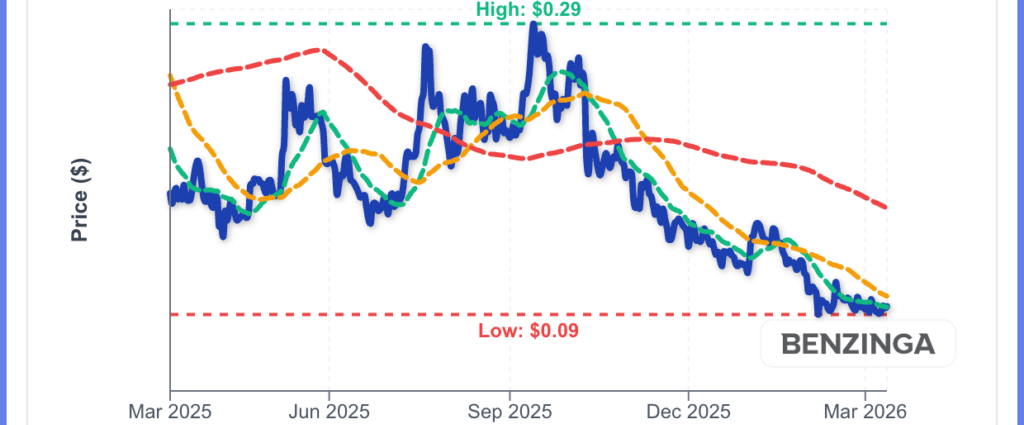
Dogecoin (CRYPTO: DOGE) and Shiba Inu (CRYPTO: SHIB) both are hovering near critical support levels after 58-60% declines from highs as descending channels trap price and money flow turns deeply negative.

DOGE Tests $0.09 Floor

Dogecoin dropped roughly 60% over five months from $0.23 in October 2025 to current levels. 

A descending channel has guided price lower since October, with every bounce sold and every rally failing at the upper boundary.

The Supertrend indicator at $0.109 flashes red. When all moving averages sit above price and slope down, sellers control every timeframe.

Volume dried up 25.5% to $2.86 billion. Lower volume during a downtrend signals fewer buyers …

Full story available on Benzinga.com

This post was originally published here


New York City, NY, March 12, 2026 (GLOBE NEWSWIRE) —

I. Introduction

The online gambling landscape has undergone a significant transformation over the past several years, with cryptocurrency-powered slot games emerging as one of the fastest-growing segments in digital gaming. Players are increasingly drawn to the promise of faster transactions, enhanced privacy, and provably fair mechanics that blockchain-based casinos offer over their traditional counterparts.

But with rapid growth comes legitimate concern. The crypto casino space remains largely unregulated in many jurisdictions, and the gap between marketing claims and actual player experience can be wide. For every reputable platform operating transparently, there are dozens of fly-by-night operations designed to exploit uninformed depositors.

This report is designed to cut through the noise. We examine how crypto slots actually work, what determines their legitimacy, how payout mechanisms function under the hood, and what every player should verify before committing funds to any platform. Our goal is to give readers a practical framework for evaluating any crypto slots casino they encounter, whether they are seasoned gamblers or newcomers exploring digital currency gaming for the first time.

II. What Are Crypto Slots?

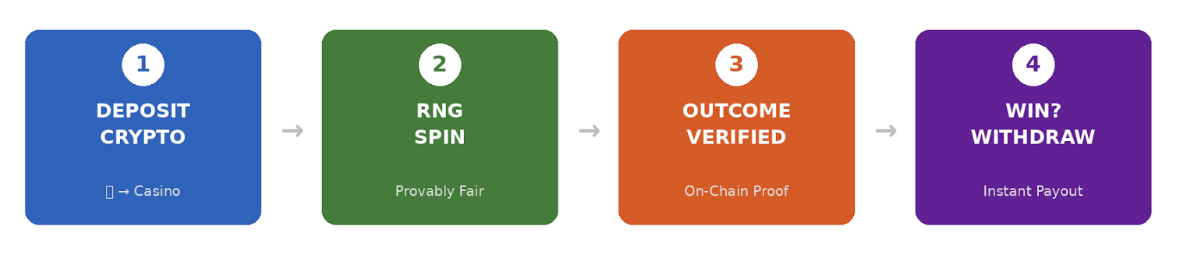
Crypto slots are online slot machines that accept cryptocurrency deposits and process withdrawals in digital currencies such as Bitcoin (BTC), Ethereum (ETH), Litecoin (LTC), Tether (USDT), and others. From a gameplay perspective, they function identically to traditional online slots: players place a wager, spin the reels, and outcomes are determined by a random number generator (RNG).

The key difference lies in the transaction layer. Traditional online casinos rely on banks, credit card processors, and third-party payment providers to move money in and out. Crypto slots eliminate these intermediaries. Deposits land in your casino account within minutes rather than days, and withdrawals bypass the slow verification queues that plague fiat-based platforms.

Provably Fair Technology

One of the most compelling innovations in the crypto gambling space is provably fair technology. This system uses cryptographic hashing to allow players to independently verify that each spin outcome was genuinely random and was not tampered with by the casino after the bet was placed. In a provably fair system, the casino generates a server seed before the spin, the player provides or is assigned a client seed, and the combination of both seeds determines the outcome. After the spin, the server seed is revealed so the player can verify the result mathematically.

Not all crypto slot platforms implement provably fair systems. Some still rely on traditional third-party RNG audits, which are credible but less transparent than on-chain verification. When evaluating a platform, understanding which verification method they use is an important first step.

Supported Cryptocurrencies

Most crypto slot casinos support Bitcoin and Ethereum as a baseline. More established platforms expand their options to include Litecoin, Dogecoin, Bitcoin Cash, Tether (USDT), USD Coin (USDC), and in some cases, Solana, Tron, and Ripple. The breadth of supported currencies matters because it affects deposit speeds, network fees, and the flexibility players have in managing their bankroll.

III. Do Crypto Slots Actually Work?

This is the question that drives most players to search for independent information before depositing. The short answer is yes, crypto slots function on the same mathematical principles as any regulated online slot machine. But there are important nuances that separate a legitimate crypto slots experience from one designed to take your money.

RNG and Fair Play Verification

Every legitimate slot game, whether crypto or fiat, is powered by a random number generator. The RNG produces thousands of number sequences per second, and the sequence active at the exact moment you press spin determines your outcome. In regulated environments, these RNGs are tested and certified by independent auditing firms such as eCOGRA, iTech Labs, or GLI (Gaming Laboratories International).

Crypto casinos that operate under recognized licenses typically undergo the same auditing process. Those that implement provably fair technology add an additional layer of transparency by allowing players to verify outcomes directly. Platforms that offer neither third-party audits nor provably fair verification should be approached with extreme caution.

RTP Rates: What to Expect


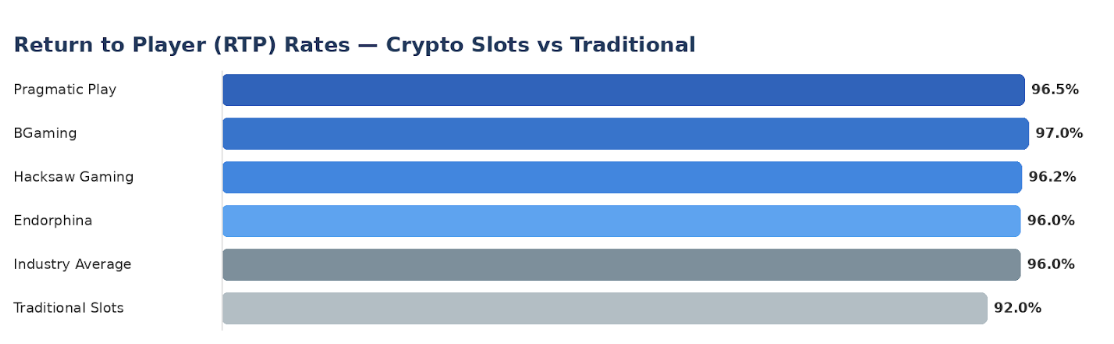
Return to Player (RTP) is the percentage of total wagered money that a slot game pays back to players over time. A slot with a 96% RTP will, on average, return $96 for every $100 wagered over millions of spins. This is a long-term statistical average, not a guarantee for any individual session.

Crypto slots from reputable game providers like Pragmatic Play, BGaming, Hacksaw Gaming, and Endorphina typically offer RTPs between 94% and 97%, which is consistent with the broader online slots industry. Players should be wary of platforms that do not disclose RTP figures or that run proprietary games with no independent audit data.

What Realistic Outcomes Look Like

Slots are inherently a negative-expectation game. The house edge ensures that over time, …

Full story available on Benzinga.com

This post was originally published here


MercadoLibre, Inc. (NASDAQ:MELI) shares fell Thursday after JPMorgan downgraded the Latin American e-commerce giant, warning that intensifying competition in Brazil and heavier investment spending could keep profit margins under pressure.

The bank cut its rating on MercadoLibre to Neutral from Overweight and lowered its price forecast to $2,100 from $2,650, citing persistent competitive pressure in Brazil—particularly from Sea Limited’s (NYSE:SE) Shopee platform—and management’s willingness to accept lower near-term margins while prioritizing growth investments.

MercadoLibre Plans $3.4B Argentina Investment

Separately, MercadoLibre expects to invest $3.4 billion in Argentina in 2026, a roughly 30% increase from the $2.6 billion planned for 2025, CEO Ariel Szarfsztejn said, Reuters reported.

The investment will support logistics expansion, new distribution centers, technology upgrades, and growth of fintech unit Mercado Pago.

The company also plans to create nearly 2,000 jobs in Argentina, where it currently employs about 16,700 people, Reuters reported.

Technical Analysis

Mercado Libre is trading 11.3% below its 20-day simple moving average (SMA) and 19.6% below its 100-day SMA, keeping both the short- and intermediate-term trend pointed down. Shares are down 17.79% over the past 12 months and are now positioned closer to …

Full story available on Benzinga.com

This post was originally published here


Kevin Warsh is about to inherit the most hostile environment for rate cuts since the Fed started easing last September.

Donald Trump‘s Fed Chair nominee takes over from Jerome Powell in May with oil near $95, private credit in open distress and inflation still above target.

Polymarket traders now price a 22% chance of zero rate cuts in 2026, roughly double where that contract sat in January when consensus still expected two or three cuts.

The most likely single outcome is one cut at 30%. The April 28 FOMC decision is priced at 91% hold.

J.P. Morgan Global Research no longer expects the Fed to cut at all this year.

Oil Is The Problem Nobody Can Hedge Away

Iran is laying mines and attacking vessels in the Strait of Hormuz, and even a historic 400-million-barrel emergency reserve release from the IEA hasn’t been enough to bring prices down.

Analysts warn oil could breach …

Full story available on Benzinga.com

This post was originally published here


America’s Car-Mart, Inc. (NASDAQ:CRMT) reported a difficult quarter as weather disruptions, weaker sales volume and transition-related pressures hurt results.

Even so, the company highlighted improving unit economics and greater flexibility after recent changes to its capital structure.

• America’s Car-Mart stock is at significant support. Why did CRMT hit a new low?

Earnings Snapshot

The company reported third-quarter adjusted earnings per share of $1.53 loss, which missed the Street view of 28 cents loss. Quarterly sales of $286.792 million (down 12% year-over-year) missed the analyst consensus estimate of $331.927 million.

Sales volumes declined 22.1% to 10,275 units, reflecting constraints on origination capacity resulting from the company’s ongoing capital …

Full story available on Benzinga.com

This post was originally published here


Block Inc. (NYSE:XYZ) shares are retreating during Thursday’s session. The decline follows a broader market sell-off affecting the technology sector.

Macroeconomic Pressures Weigh On Growth

The Nasdaq fell 1.30% while the S&P 500 shed 1.14% on Thursday. Technology stocks are also lower today. Investors are reacting to Wednesday’s Consumer Price Index report. Inflation held steady at 2.4% in February. This matched the economist’s estimates.

However, the data was collected before the war in Iran. That conflict has since pushed fuel prices sharply higher.

The stock is reacting negatively as concerns over inflation and higher rates stemming from the Middle East conflict darken the outlook for consumer lending.

Dorsey’s AI Strategy In Focus

CEO Jack Dorsey recently praised Nvidia Corp.’s

Full story available on Benzinga.com

This post was originally published here