Redfin has been recognized among the top residential real estate brokerages for the fourth year in a row! In 2025, our agents closed 50,484 transactions, totaling nearly $32 billion in sales – earning the #8 spot on the RealTrends Verified Brokerage Rankings by both sales volume and transaction count.

Redfin Agents Remain The Most Productive

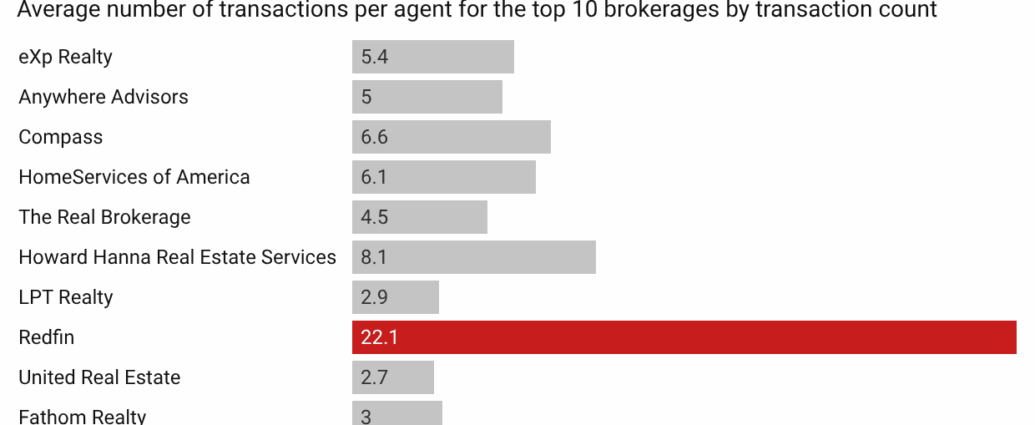
The average Redfin agent closed more than 22 deals in 2025—nearly three times the productivity of agents at other top-10 brokerages, according to RealTrends data. 

Our agents also led in sales volume, with an average agent sales volume of approximately $14 million. That’s almost double the per-agent volume of our next closest competitor. 
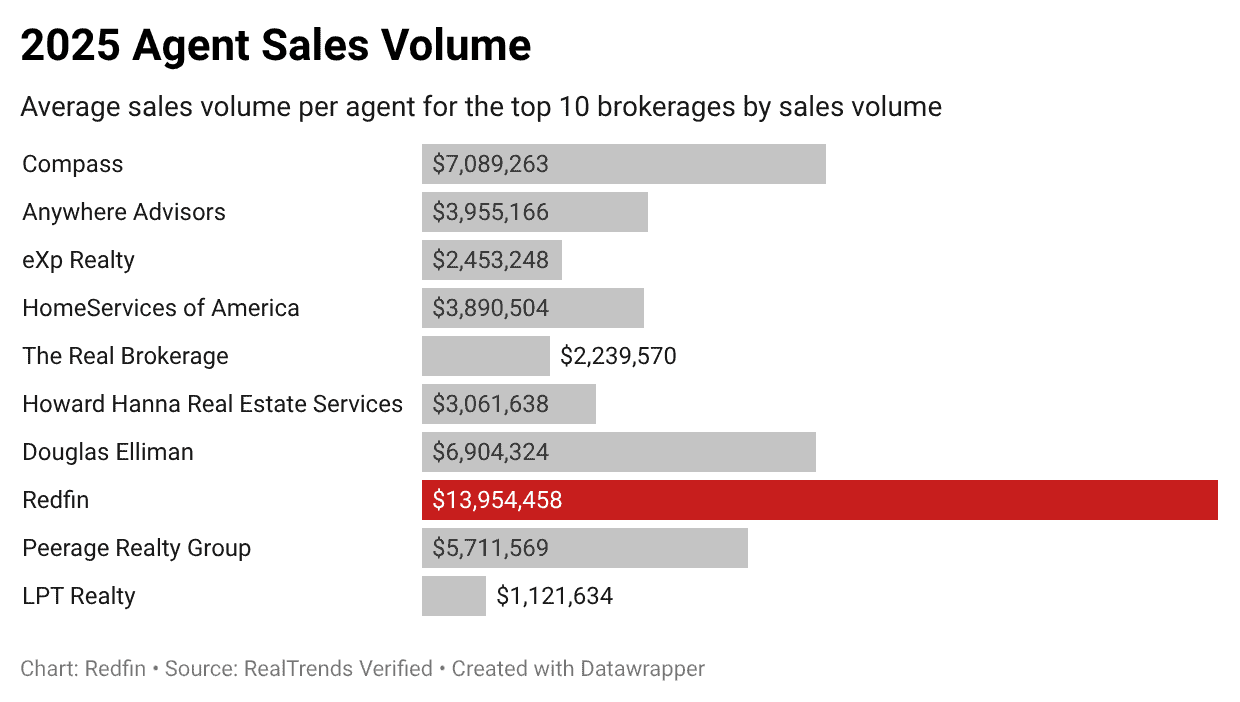
Redfin agent sales volume in 2025 was $14M, double our nearest competitor.

This level of productivity isn’t an accident. It reflects the talent of our agents and the strength of the platform behind them. This allows Redfin to help customers navigate even the most challenging markets with confidence. 

We’re Just Getting Started

What makes this recognition even more meaningful is the small but mighty team behind it. Redfin had just under 2,300 agents at the end of 2025, a fraction of many of our competitors – some of which have tens of thousands of agents. 

It’s proof that when you pair great agents with the right tools, support, and demand, you get outsized results.

In 2026, we’re building on this momentum. We’re continuing to invest in our agents through Redfin Next and Redfin Teams – giving them more control over their business, stronger economics, and the tools they need to grow their business while delivering a better experience for customers

As part of Rocket Companies, we’re accelerating that work by bringing together brokerage, lending, and technology to create a more seamless, end-to-end experience for customers and more opportunity for agents.

And through our partnership with Compass International Holdings, we’re expanding the selection of homes on Redfin.com, bringing more choice to customers and more demand to our platform. We’re proud to work with one of the nation’s top brokerages to unlock more inventory and help more people home.

It all comes back to a simple idea: when you put the customer at the center, everything else follows.

That’s why agents are choosing Redfin. We help them generate demand, operate more efficiently, and focus on what matters most: guiding customers through one of the most important decisions of their lives. The result is stronger performance, higher earnings potential, and a more scalable path to building a lasting business.

And we’re not slowing down. With Rocket’s platform, continued investment in our agents, and partnerships that expand our reach, Redfin is in a stronger position than ever to lead – and to make real estate better for customers across the country.

Are you ready to join some of the best agents in the industry and take your career to the next level? We’re always looking for ambitious, mission-driven agents to join our team. Visit our career page or join our talent community to learn more.

The post Redfin Earns Top 10 Spot in RealTrends Verified Rankings, Powered by Agent Productivity appeared first on Redfin Real Estate News.

This post was originally published here

Takeaway: Headline inflation, which includes food and energy prices, spiked in March, but rates won’t move much today because core inflation, which ignores those volatile components, remained subdued.
The closing of the Strait of Hormuz led to a 0.9% monthly increase (3.3% annual increase) in prices in March, but there is little evidence so far that is bleeding through to other prices, which is what the Fed cares about.

  • Gas prices surged 21% and fuel oil 31% in the March inflation data. These spikes were forecasted accurately by market observers ahead of time and the implications have been priced in by bond markets these past six weeks, so there is little market reaction to this data.
  • Fed officials are mainly concerned with core inflation, which removes the volatile food and energy categories, because these underlying inflationary measures are what responds to interest rate changes. That came in slightly below expectations with a 0.2% monthly increase (2.6% annual increase) in prices.
  • The softness was driven in part by a large 1.0% monthly decline in prescription drug prices and -1.5% monthly decline in non-prescription drugs
  • Shelter, the largest component of the overall index, ticked up to 0.3% monthly because of an unwind of the 0% shelter inflation assumptions the Bureau of Labor Statistics made six months ago after the October government shutdown.
  • Overall, there is little evidence of the energy price spike affecting other categories yet. However, airline fares, an especially energy-sensitive sector, jumped 2.7% monthly. There is also some evidence of continued tariff rollback, with household goods prices soft.

There’s been some fear among investors that the Fed may have to hike rates this year, which this report should help to alleviate. Overall, similar to the recent jobs reports, today’s data along with the volatility in the Middle East, point to the Fed holding steady for a while.

The post Fed, Mortgage Rates, Likely to Hold Steady on Latest Inflation Report appeared first on Redfin Real Estate News.
This post was originally published here

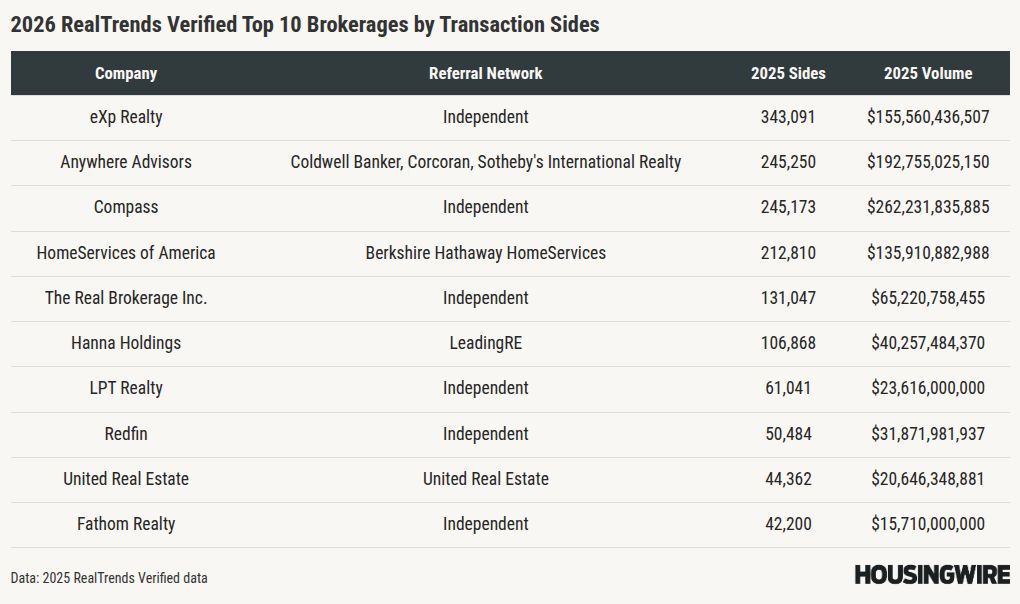
The housing market remains in flux, setting the stage for this year’s RealTrends Verified rankings.

Inventory has improved but remains constrained, affordability continues to pressure buyers and brokerages are still adjusting to new policies around private listings. In turn, firms are rethinking how they recruit, retain and support agents — and the rankings offer a clear look at which strategies are gaining traction.

That dynamic is reflected in the 2026 RealTrends Verified brokerage rankings, based on 2025 production. It tells a familiar story at the top — and a much more interesting one just beneath it.

A total of 1,267 firms met RealTrends Verified standards this year, with each closing at least 500 transaction sides or $350 million in sales volume. Together, these brokerages accounted for $2.24 trillion in volume and 3.94 million transactions, underscoring just how concentrated production remains among the industry’s top performers.

“RealTrends Verified exists to set the standard — and this year’s growth underscores the value of a consistent benchmark,” Caroline Scanlon, director of RealTrends Verified, said in a statement. “When the market moves, the industry needs a trusted way to see who’s gaining share and who’s building on a real scale.”

The ‘fab four’ aren’t going anywhere — yet

At the top of the brokerage rankings, stability reigns.

Compass, prior to its acquisition of Anywhere, once again led all firms in sales volume at $262.2 billion, while eXp Realty retained its hold on the No. 1 spot for transaction sides with 343,091. Anywhere Advisors and HomeServices of America rounded out the top four across both metrics.

It’s a continuation of a trend that has defined the rankings for several years now: scale begets scale. The largest brokerages are not just holding their positions — they’re reinforcing them.

But if the top four feel locked in, the gap behind them is starting to narrow.

visualization

The Real Brokerage is no longer a disruptor — it’s a contender

The Real Brokerage, headed by CEO Tamir Poleg, continues to gain traction among the industry’s top firms.

The company held steady at No. 5 by sales volume at $65.2 billion, but more notably moved up to No. 5 by transaction sides, overtaking Hanna Holdings. That dual top-five position signals a shift: Real is no longer just growing fast — it’s now competing directly with legacy players on both scale and productivity.

That mirrors what was seen last year, when Real posted triple-digit growth and began climbing the rankings in earnest. This year’s data confirms that momentum wasn’t a one-off.

visualization

LPT Realty’s leap signals a new kind of growth engine

Continuing on last year’s theme, if there’s a breakout story in this year’s rankings, it’s Robert Palmer‘s LPT Realty.

The firm jumped from No. 10 to No. 7 in transaction sides, increasing its total to 61,041 sides. That kind of movement in a single year is rare at this scale and it reinforces a broader trend: Brokerage models built around flexibility, agent economics and rapid recruiting are still gaining traction.

LPT isn’t alone. Across the rankings, newer and nimble firms continue to climb, even as the very top remains relatively unchanged.

The middle of the top 10 is where the action is

While the top four brokerages by volume remained unchanged, the middle of the rankings saw subtle but meaningful shifts.

Hanna Holdings moved up to No. 6 by volume, while Douglas Elliman slipped to No. 7. Peerage Realty Partners entered the top 10, replacing United Real Estate.

These aren’t dramatic shakeups, but they do point to increased competition, where small gains in sides or volume can translate into meaningful rank changes.

Brands are reshuffling — and LeadingRE is surging

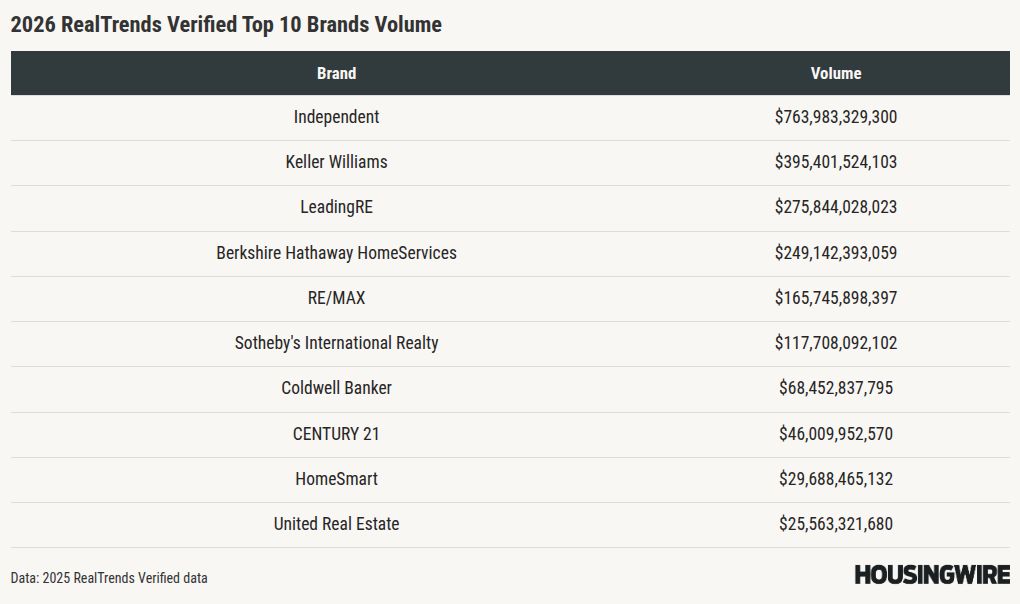
Keller Williams remains the clear No. 1 brand by both sides and volume. But beneath it, the hierarchy is shifting.

LeadingRE, a network of independent real estate firms, made the biggest leap, jumping from No. 5 to No. 2 by transaction sides and increasing its market share to 11.08%, up from 8.93%.

Meanwhile, Coldwell Banker and REMAX both slipped in the rankings and lost share.

That reshuffling signals a more competitive landscape — one where the gap beneath Keller Williams is tightening, and no single challenger has a firm grip on the No. 2 spot.

visualization

Independents are quietly taking share

One of the most important shifts in this year’s data is the continued rise of independent brokerages.

Independents accounted for 28.79% of market share this year, up from 26.98% last year.

That growth is showing up everywhere: Compass (pre-Anywhere acquisition), eXp Realty, The Real Brokerage, LPT Realty, Redfin and Side are all operating outside traditional franchise structures. And many of them are gaining ground.

The implication is clear. The industry isn’t abandoning brands, but it is increasingly embracing models that offer flexibility in compensation, technology and operations.

This year’s RealTrends Verified rankings show an industry defined by two competing forces: stability at the top and disruption just below it.

The largest brokerages continue to dominate, but the fastest-growing companies are steadily reshaping the leaderboard. The power structure isn’t breaking, but it is bending.

This post was originally published on here

The housing market remains in flux, setting the stage for this year’s RealTrends Verified rankings.

Inventory has improved but remains constrained, affordability continues to pressure buyers and brokerages are still adjusting to new policies around private listings. In turn, firms are rethinking how they recruit, retain and support agents — and the rankings offer a clear look at which strategies are gaining traction.

That dynamic is reflected in the 2026 RealTrends Verified brokerage rankings, based on 2025 production. It tells a familiar story at the top — and a much more interesting one just beneath it.

A total of 1,267 firms met RealTrends Verified standards this year, with each closing at least 500 transaction sides or $350 million in sales volume. Together, these brokerages accounted for $2.24 trillion in volume and 3.94 million transactions, underscoring just how concentrated production remains among the industry’s top performers.

“RealTrends Verified exists to set the standard — and this year’s growth underscores the value of a consistent benchmark,” Caroline Scanlon, director of RealTrends Verified, said in a statement. “When the market moves, the industry needs a trusted way to see who’s gaining share and who’s building on a real scale.”

The ‘fab four’ aren’t going anywhere — yet

At the top of the brokerage rankings, stability reigns.

Compass, prior to its acquisition of Anywhere, once again led all firms in sales volume at $262.2 billion, while eXp Realty retained its hold on the No. 1 spot for transaction sides with 343,091. Anywhere Advisors and HomeServices of America rounded out the top four across both metrics.

It’s a continuation of a trend that has defined the rankings for several years now: scale begets scale. The largest brokerages are not just holding their positions — they’re reinforcing them.

But if the top four feel locked in, the gap behind them is starting to narrow.

visualization

The Real Brokerage is no longer a disruptor — it’s a contender

The Real Brokerage, headed by CEO Tamir Poleg, continues to gain traction among the industry’s top firms.

The company held steady at No. 5 by sales volume at $65.2 billion, but more notably moved up to No. 5 by transaction sides, overtaking Hanna Holdings. That dual top-five position signals a shift: Real is no longer just growing fast — it’s now competing directly with legacy players on both scale and productivity.

That mirrors what was seen last year, when Real posted triple-digit growth and began climbing the rankings in earnest. This year’s data confirms that momentum wasn’t a one-off.

visualization

LPT Realty’s leap signals a new kind of growth engine

Continuing on last year’s theme, if there’s a breakout story in this year’s rankings, it’s Robert Palmer‘s LPT Realty.

The firm jumped from No. 10 to No. 7 in transaction sides, increasing its total to 61,041 sides. That kind of movement in a single year is rare at this scale and it reinforces a broader trend: Brokerage models built around flexibility, agent economics and rapid recruiting are still gaining traction.

LPT isn’t alone. Across the rankings, newer and nimble firms continue to climb, even as the very top remains relatively unchanged.

The middle of the top 10 is where the action is

While the top four brokerages by volume remained unchanged, the middle of the rankings saw subtle but meaningful shifts.

Hanna Holdings moved up to No. 6 by volume, while Douglas Elliman slipped to No. 7. Peerage Realty Partners entered the top 10, replacing United Real Estate.

These aren’t dramatic shakeups, but they do point to increased competition, where small gains in sides or volume can translate into meaningful rank changes.

Brands are reshuffling — and LeadingRE is surging

Keller Williams remains the clear No. 1 brand by both sides and volume. But beneath it, the hierarchy is shifting.

LeadingRE, a network of independent real estate firms, made the biggest leap, jumping from No. 5 to No. 2 by transaction sides and increasing its market share to 11.08%, up from 8.93%.

Meanwhile, Coldwell Banker and REMAX both slipped in the rankings and lost share.

That reshuffling signals a more competitive landscape — one where the gap beneath Keller Williams is tightening, and no single challenger has a firm grip on the No. 2 spot.

visualization

Independents are quietly taking share

One of the most important shifts in this year’s data is the continued rise of independent brokerages.

Independents accounted for 28.79% of market share this year, up from 26.98% last year.

That growth is showing up everywhere: Compass (pre-Anywhere acquisition), eXp Realty, The Real Brokerage, LPT Realty, Redfin and Side are all operating outside traditional franchise structures. And many of them are gaining ground.

The implication is clear. The industry isn’t abandoning brands, but it is increasingly embracing models that offer flexibility in compensation, technology and operations.

This year’s RealTrends Verified rankings show an industry defined by two competing forces: stability at the top and disruption just below it.

The largest brokerages continue to dominate, but the fastest-growing companies are steadily reshaping the leaderboard. The power structure isn’t breaking, but it is bending.

This post was originally published on here

The conversation around artificial intelligence has largely defaulted to one of two extremes: AI as an existential threat to human work, or AI as a magic button that solves every operational problem automatically. In practice, neither framing holds up. The organizations gaining the most ground right now are those that have moved past the debate entirely and are focused on something more concrete: how to pair human expertise with AI capability in ways that produce real, usable solutions faster than traditional development cycles allow.

This is not a philosophical argument. It is a practical one, and the evidence is accumulating.

The hidden cost of how we’ve always built things

For decades, the process of turning a problem into a working solution followed a familiar path: define the problem, gather stakeholders, write specs, build a roadmap, wireframe the product, review, revise, and eventually, often months later, begin development. Each step was necessary, given the constraints of the time. But those constraints have changed, and the process largely hasn’t.

The result is a development cycle that burns time and organizational bandwidth before a single line of functional code is written. In fast-moving markets where competitive advantage can hinge on speed, this is no longer just inefficient. It is a liability.

A different model: Problem to prototype

What is emerging in practice, and what teams actively working at the intersection of AI and real-world operations are experiencing firsthand, is a fundamentally compressed workflow. Instead of beginning with weeks of spec development and roadmapping, practitioners are bringing their domain expertise directly into conversation with AI tools and moving to functional prototypes almost immediately.

The process works roughly like this: a subject matter expert articulates the problem and frames a possible solution. AI handles what would previously have required a room full of engineers and product managers and two weeks at a whiteboard: the architecture, the roadmap structure, the sequencing of development tasks. From there, AI-assisted coding tools translate that structure into working code. What remains is iteration, refinement, and deployment.

The human contribution in this model is irreplaceable: domain knowledge, problem framing, and judgment about what actually needs to be solved. AI does not identify the right problems. It accelerates the path from problem to solution once a knowledgeable person has clearly framed the challenge.

What this looks like in real operations

Consider sales productivity, a challenge that exists in virtually every industry, including real estate and title. A field representative spending long days meeting with clients faces a real and persistent problem: accurately capturing the details of each interaction in a form that managers and leadership can act on. The traditional solution involves CRM systems that require sitting down, logging in, and manually entering data; a task that rarely happens in real time and creates downstream gaps in visibility.

Using the human-AI partnership model, the solution takes shape quickly, starting with just a plain-language description of the problem. The need is described, the solution framed, and AI handles the architecture and development structure from there.

WFG recently developed a prototype to address a persistent pain point for its sales team. Field reps spending long days meeting with clients struggled to capture interaction details accurately and in real time; the kind of data managers need to coach effectively, and leadership needs to track activity. In the prototype, a field rep records notes conversationally throughout their day without needing to log in to CRM or park to complete data entry. AI synthesizes those notes, scores each interaction based on tone and context, and delivers a concise report with recommended next steps, giving managers real-time visibility into field activity without waiting for manual input.

The same approach has already been put into production. WFG built and deployed an AI-powered OKR tracking tool that ingests regular inputs from reps and managers, scores progress against established goals, and delivers leadership a clear, accurate summary of where each team member stands, along with recommended next steps to help them meet their objectives fully. What previously required manual cross-referencing and follow-up calls now happens automatically. That tool is live and in active use today.

In a traditional development environment, building either of these capabilities might take months of spec development, road-mapping, and testing. Using AI-assisted prototyping, both went from problem statement to working product in a matter of days.

The same principle applies to goal tracking and performance management, an area where data often exists, but synthesis is the bottleneck. Executives and managers typically receive reports that require manual cross-referencing against stated objectives. An AI-assisted solution built from a clear articulation of the problem can ingest that data automatically, score progress against established metrics, and surface a concise, actionable summary, eliminating hours of manual review and enabling faster course corrections.

Neither of these examples requires exotic technology or large development teams. What they require is human expertise in determining which problem is worth solving, combined with AI’s ability to rapidly architect and build the solution.

Why partnership, not replacement

The “AI will replace human workers” narrative overlooks an important aspect of how the most effective implementations actually work. AI is extraordinarily capable at pattern recognition, code generation, synthesis, and structure. It is not capable of knowing which problems are worth solving, understanding the organizational and market context in which solutions will live, or exercising the kind of judgment that comes from years of experience in a specific industry.

In the title and real estate sectors specifically, that domain expertise is deep and consequential. Compliance requirements, transaction complexity, agent relationships, and the high-stakes nature of the product mean that the humans closest to these workflows bring knowledge that no model can independently possess. What AI changes is how efficiently that expertise can be translated into operational solutions.

The professionals and teams who will define the next chapter of this industry recognize that the combination — human expertise driving AI capability — is where the compounding advantage lies. Not in automating humans out of the process, but in removing the friction between expertise and execution.

The practical takeaway

For industry leaders evaluating their own AI strategy, the most actionable question is not “what can AI do?” It is “where is expertise already present in our organization, and what is slowing the translation of that expertise into solutions?” The gaps in that answer are where the human-AI partnership model delivers disproportionate value.

The organizations building that discipline now, and establishing the internal capability to move from problem articulation to working prototype without the traditional overhead of the development cycle, are compressing timelines in ways that compound over time. The competitive distance between those organizations and those still building the traditional way is only going to grow from here.

Ryan Ozonian is Senior Director of Innovation and AI at Williston Financial Group (WFG). 
This column does not necessarily reflect the opinion of HousingWire’s editorial department and its owners. To contact the editor responsible for this piece: zeb@hwmedia.com.

This post was originally published on here

A new appraisal management platform is aiming to upend the traditional role of appraisal management companies (AMCs) by allowing mortgage lenders to oversee the process internally while maintaining regulatory compliance.

The platform, known as PAM, or Private Asset & Management Group LLC, is designed as a web-based system that enables lenders to manage appraisal workflows without relying on third-party AMCs.

David Cedar, president of PAM and a licensed appraiser, claims that the platform restores lender control over a process that he says has long been outsourced at the expense of both borrowers and appraisers.

Under the PAM system, lenders build and manage their own networks of vetted appraisers based on geographic competency and professional qualifications. The platform then automates the rotation of assignments to ensure independence and compliance with appraisal regulations, including Appraiser Independence Requirements (AIR).

“The platform … assigns the appraisals, it rotates the appraisers. It gives the lender control over using appraisers they want to use, not who the AMC is choosing for them,” Cedar said in a conversation with HousingWire.

Each transaction is tracked and documented within the system, providing what the company describes as full transparency and auditability. The platform also integrates with popular loan origination systems like Encompass to streamline workflows.

Cedar said that PAM, which launched at the end of 2025, can reduce costs for borrowers by eliminating AMC-related markups. The estimated savings range from 25% to 40% on appraisal fees, allowing appraisers to receive more equitable compensation while giving lenders greater oversight of appraisal quality and compliance.

“AMCs are charging ridiculous prices. … It’s overkill. It’s gouging. And there’s no regulation and there’s no transparency,” Cedar said.

PAM operates under a lender-managed, direct-engagement structure that the company says is compliant in all 50 states. It is offered at no cost to lenders or appraisers, according to its developers.

“Our flat fee is transparent and one time per order of $99 instead of an AMC charging $300, $400, $500 or even more,” Cedar confirmed. “We absorb the cost of the software, so the lender pays nothing. We also absorb the cost for the appraiser.”

The platform enters a market where some lenders have raised concerns about the traditional AMC model, citing issues related to cost, transparency and control over the appraisal process. Proponents of lender-managed alternatives say such platforms could offer a more efficient and transparent approach, though broader adoption and industry response remain to be seen.

This post was originally published on here

Virginia Gov. Abigail Spanberger has until Monday to sign or veto legislation that would make her state one of the few that allow faith-based organizations to build affordable housing on their properties by overriding local zoning limits.

Spanberger faces pressure from local governments and a small but vocal group of civic organizations to veto the bill, extending the fight after they failed to stop it in the state’s General Assembly.

If she signs the bill, the Commonwealth will join California and Florida in enacting so-called “yes in God’s backyard” (YIGBY) legislation that preempts local zoning control. For Spanberger, the law would be the most consequential affordable housing initiative to advance in her first months in office.

Losing on the broader affordable housing agenda

Shortly after taking office, she presented a housing agenda to improve housing affordability, but the marquee piece ran into a legislative buzzsaw. Lawmakers killed a proposal to allow by-right multifamily and mixed-use projects in many commercially zoned areas.

Lawmakers, however, passed proposals focused on subsidies and preservation of affordable housing.

The YIGBY bill sponsored by state Sen. Jeremy McPike moved on a separate track from the governor’s core housing agenda. Its advocates are mounting their own pressure campaign to persuade the governor to sign it into law.

“We are hopeful, and we are still waiting,” Jessica Sarriot, a co-lead organizer for Virginians Organized for Interfaith Community Engagement (VOICE), told The Builder’s Daily.

Voice, a nonpartisan coalition of Northern Virginia faith-based and community organizations, has pushed for the change for several years.

“I feel pretty confident that she will sign this because I think it fits so neatly within her affordability agenda,” Sarriott said. “It can be something that she really celebrates making forward motion on and it’s packed with bipartisan support.”

A Commonwealth housing solution

Virginia continues to face growing housing affordability pressures. Spanberger won on a platform that emphasized improving affordability.

HousingForward Virginia estimates that faith-based organizations control more than 74,000 acres statewide, creating a large potential supply of land for affordable housing.

The Faith in Housing bill would let churches and certain tax-exempt groups build affordable housing on land they already own without local rezoning. The legislation requires at least 60% of units to remain income-restricted for decades and keeps most new housing taxable.

Next steps for Spanberger

The governor has more options than just signing or vetoing, but they could become complicated.

Spanberger could issue a conditional veto and ask the General Assembly to approve amendments, according to Sarriot. The veto becomes official if lawmakers do not approve the changes.

She could also submit her own amendments for lawmakers to vote on. Sarriot said that whether they approve the amendments, the governor could still sign the original bill.

The governor has limited time to act on the bill because she faces a stack of other measures awaiting her decision.

There is precedent for a governor vetoing a housing bill and later signing it into law after changes.

Last year, Connecticut Gov. Ned Lamont vetoed a bill he initially supported. The legislation would have preempted local zoning authority to encourage missing-middle housing but faced pressure from suburban communities that did not want to lose control. Lamont later followed through on a promise for a special session to craft a compromise and then signed the revised bill.

This post was originally published on here

After being acquired by mortgage lender Lower in May 2025, executives at real estate listing portal Movoto said they hoped to use Lower’s network to connect more consumers with top local real estate agents and mortgage professionals.

This vision — which was first explained to HousingWire by John Berkowitz, former Movoto CEO and current president of real estate at Lower — appears to have started coming to fruition after the firm officially launched Movoto Advantage last week. 

Lower describes Movoto Advantage as a limited-access, subscription-based program that connects high-performing real estate agents with motivated home buyers and sellers through real-time live transfers.

The company said it initially began rolling out the program, which operates within Lower’s Movoto real estate marketplace, in late 2025. The program targets independent agents who rank near the top in their markets by transaction volume and have a history of closing deals, strong client service and consistent responsiveness.

Lower vets agents who apply to the program and it limits the number of participating agents, routing consumers to just one agent in a given market. Additionally, Movoto Advantage is integrated with Lower’s lending platform through Lower Connect, which pairs consumers and agents with Lower loan officers for fast preapproval and support through closing.

HousingWire recently caught up with Berkowitz to discuss how Movoto Advantage and Lower are looking to compete in the increasingly competitive listing portal and lead referral space. 

This interview has been edited for length and clarity. 

Brooklee Han: Last year when we spoke, you outlined how you were hoping to leverage Lower’s network to help both housing professionals and consumers. Based on my understanding of the product, Movoto Advantage seems to closely align with this goal. Tell me more about the creation of the product and what challenges you’re hoping it will solve.

John Berkowitz: I think Movoto Advantage is filling a gap in the market and it is going to create more wins for agents, consumers and our mortgage partners.

Going back, Movoto was one of the first to launch a solution specifically for real estate teams with Movoto Pro+. Teams have unique models and they need unique products that fit their needs. Pro+ was one of the first to adjust the typical referral model and blend it with the hybrid lead model for teams. That launched in 2023. And now we have hundreds of teams on it, and over time we have seen some of our competitors roll out their own solutions for teams.

But not all agents aspire to grow massive real estate teams or be part of a team. Instead, they want to have their own brand and their own business, so in talking with them, we realized there was a gap in the market for products like Pro+ geared toward individual top agents.

The origin of Advantage was their needs, and one of the biggest needs they have is certainty. In a short sales cycle, they don’t have the time to pitch to a consumer why they are better than the six other agents the same platform connected them to. And a lot of those agents want to find a way to bring mortgage into their business without setting up their own joint venture or becoming dual licensed

This program provides agents with certainty because they know they are the only one we are connecting a given consumer with, and it allows them to have a mortgage partner in a regulatory compliant way.

Han: As I understand it, there is a vetting process for agents to be part of the program. Can you tell me more about this process and what Lower is looking for in a Movoto Advantage agent? 

Berkowitz: I proudly say we’re not interested in partnering with tourist agents. I have no problem with agents coming and going, but when we meet consumers, we are making a promise of selecting the right professional for them — and we believe that means that this will be a person who has a track record of success.

We are looking at historical transactions and volume, and we are looking for high response rates to make sure that when we introduce the agent to a consumer, that leads to the consumer successfully transacting. 

Han: There are so many different referral and lead generation platforms and programs out there. What do you think sets Movoto Advantage apart? 

Berkowitz: We are going to give agents certainty. We are not going to sign up every agent in the market. We are limiting this because a key part of the program is giving the agents consistency of introductions.

A lot of agents will sign up for a lead service, and then that service signs up everyone else in their market and they no longer get leads. So we provide them with the certainty that they will receive leads, allowing them to plan and build their business around it. 

Additionally, we are not giving them cold leads — these are warm transfers. We are really working on setting agents up for success by explaining to consumers why they are the right agent for them in their market. And we are making sure that when we transfer an agent a lead, that consumer is ready, willing and able to go buy or sell a home.

This means that we are not delivering them the vast majority of leads we have, because we are not trying to just deliver leads. We are trying to create warm relationships between a consumer that came to us to meet an expert and a professional that wants to serve them. So I think we set ourselves apart with that consistency of lead flow, met with the high quality of the consumers we are introducing them to. 

Han: The mortgage component of this is also interesting as we are currently seeing others work to integrate mortgages — including Zillow Home Loans and the Compass-Rocket-Redfin agreement. Can you tell me more about the mortgage component, and how this reflects the goal you mentioned last year for fostering connections between local mortgage professionals, agents and consumers?

Berkowitz: The simple answer is that what I told you about last year, we’ve done it and we’ve done it a lot faster than I thought. You’ll remember that a big difference between us and our competitors is local mortgage, retail, boots on the ground. Our top teams have told us that they want their mortgage professionals to be local — that’s a key part of our strategy. A top-performing agent is going to want the same thing, so we are really leaning into finding the best way to connect those agents with a great local loan officer

It is really just pulling on that thread of taking these consumers that are anonymously searching online and figuring out exactly what they need — and then, at the right time, live transferring them to local professionals and creating that connection with a local agent and loan officer. 

Agents really care about mortgages because most buyers require some sort of financing, so they need high-quality mortgage professionals to work with and help solve problems for their consumers. This also allows agents to reduce some of their costs in a regulatory compliant way because they can do a lead sharing agreement, which is what we have enabled here.

We are really trying to make it easier for consumers, agents and LOs to work together and connect. We are putting them on joint text and creating those relationships. So far, agents say this is working really well because they then have less manual work and it makes everything smoother for everyone. 

Han: It is no secret that there has been quite a bit of drama in the real estate portal and referral service space over the past year, but Movoto has managed to stay out of the fray. I’d love to hear some of your thoughts on the recent chaos.

Berkowitz: I think we’ve done a very good job of being Switzerland and just staying focused on our North Star, which is the consumer. Our goal is to provide them with accurate data and knowledgeable professionals. With agents, we really lean into appreciating the role they play in the transactions and providing them with the tools they need to serve those consumers even better. 

There are a lot of narratives out there now about how different initiatives are better for consumers or agents. But I think, for example, if you look at the evidence, there is no rational argument to say that private listings are good for consumers.

What I do see is CEOs doing what is best for their shareholders, which is fine, because that is who they answer to. But it also creates this opportunity for private companies to innovate, listen to their customers, and create the products and experiences they really want. I think it is really a competitive advantage for us right now to be a private company that doesn’t need big public narratives to rationalize things, because we are literally just doing what our customers are asking for.

Han: As we have discussed, last year when we spoke, you laid out this vision of where the company is now. If we talk again a year from now, what are you hoping to see for Lower and Movoto?

Berkowitz: I think we are just getting on this path of integrating the consumer, agent and LO. And I think you are going to see more products come out around these same themes that provide upfront value to consumers, earning their trust, and then bringing in a real estate agent and loan officer in a way that really works for them to build a relationship and make it economically viable for them, while also enabling them to add more value. We have been pulling on that thread since the day Lower and Movoto came together.

This post was originally published on here

Surge, a partner intelligence platform for wholesale mortgage lenders, has been acquired by New Cheval Holdings as the wholesale channel faces tighter scrutiny on broker oversight and market share pressure from retail and direct-to-consumer lenders.

The transaction brings dedicated ownership and institutional backing to a platform used by wholesale lenders that are regularly ranked among the top 25 in the country, according to the company’s announcement.

As part of the deal, Jimmy Gillespie has been named CEO of Surge. Gillespie has a background in private equity and management consulting, and he’s joining Surge with a mandate to deepen customer relationships and accelerate growth. He replaces founder-led management as the company formalizes its next phase of expansion.

“Surge has a strong platform, a talented team, and customers who depend on it every day,” Gillespie said in a statement. “I’m focused on making sure we continue to earn that trust as we grow.”

Surge serves wholesale lenders through two integrated products, Partner 360 Alliance and Partner 360 Sales.

Alliance manages broker and correspondent counterparty risk and onboarding for licensed and nonlicensed partners, from application and e-signing through renewals, continuous licensing monitoring and audit-ready reporting.

Partner 360 Sales is designed for sales and account management teams, providing a live view of a lender’s wholesale network with Nationwide Multistate Licensing System (NMLS)-based market intelligence, loan officer-level production data, job change alerts, territory management tools and competitor visibility across the market.

Surge said the platform supports more than 10,000 active broker relationships and has not failed a compliance audit to date.

“Surge has helped us go from entering data to actually using it,” Pavle Lozevski, senior sales force technical lead at V.I.P. Mortgage said in a statement.

Surge co-founder Matt Hawkins said the company was launched to address practical pain points in wholesale lender-broker relationships, including fragmented broker onboarding processes and limited line of sight into broker production and movement.

“Surge was built to solve a real problem for wholesale lenders and the team delivered a platform that does exactly that,” Hawkins said. “I’m proud of what we built and confident it’s in the right hands.”

David Casti, who has led product and customer operations at Surge since 2022, will remain as chief operating officer, providing continuity for existing clients.

Wholesale lenders have faced heightened expectations from regulators and investors around broker due diligence, ongoing monitoring and fair lending oversight since the pandemic-era refi boom ended and volumes declined. At the same time, many lenders are trying to grow or defend market share in the third-party origination channel without adding large headcount to operations or sales management.

Tools that centralize broker compliance, onboarding and production visibility are increasingly viewed as core infrastructure rather than “nice to have” software. Consolidation in this niche signals that institutional investors see durable demand for technology that can support counterparty risk management and give account executives a clearer picture of where to deploy their time and pricing levers.

For lenders already running on Salesforce or modern customer relationship management stacks, platforms like Surge’s Partner 360 Alliance and Partner 360 Sales may offer a way to standardize broker data, reduce manual spreadsheet work and create audit-ready trails for warehouse lenders, investors and regulators.

This post was originally published on here

loanDepot announced Thursday that it has formed a strategic partnership with Figure Technology Solutions to power a new “express-path” home loan product through loanDepot’s mello platform.

Under the agreement, loanDepot will integrate Figure’s proprietary credit and loan underwriting engine into its mello technology stack and point-of-sale system. The integration is designed to allow loanDepot to offer a suite of faster-closing, express-path products, starting with the 5×5 HomeLoan, according to a press release.

The 5×5 HomeLoan is structured to deliver approvals in as little as five minutes and funding in as few as five days. The product can be used to access home equity and will be available for refinances and purchase transactions, effectively giving borrowers an option comparable to cash offers on speed and certainty of close.

loanDepot, a national retail lender that recently rejoined the wholesale channel, will roll out the 5×5 HomeLoan in all 50 states. The product will be distributed through the company’s sales force of nearly 1,800 licensed loan officers, who collectively hold about 12,500 state licenses.

The partnership ties Figure’s blockchain-based infrastructure and automated underwriting capabilities to loanDepot’s existing proprietary tech stack and diversified distribution channels. Figure has focused on using blockchain rails and automated underwriting to compress cycle times and lower fulfillment costs, particularly in home equity and consumer credit.

“loanDepot already has the most differentiated customer acquisition and retention business model in the marketplace today, with a world-class brand and the only at-scale diversified channel strategy in the industry,” Anthony Hsieh, the company’s founder and CEO, said in a statement.

“Our partnership with Figure builds on these unique assets and provides a meaningful strategic lever for our business, allowing us to help more customers, close more loans, materially reduce the cost to produce, and deliver profitable market share growth. Further, it positions us to introduce new and innovative products that expand the way we will meet the needs of borrowers in the future.”

This article was generated using HousingWire Automation and reviewed by a HousingWire editor before publication. The system helps convert company announcements and industry data into HousingWire-style news coverage.

This post was originally published on here

Two of celebrated street artist Keith Haring’s iconic art cars will be rolling into New York City for the first time. Opening on Friday, the exhibition “Keith Haring: In the Street” will display the artist’s 1963 Buick Special and a Land Rover Series III from the 1983 Montreux Jazz Festival, for 10 days only. On view from April 10 to 19 at the CART Department gallery, Free Parking, the exhibit celebrates the new book, “Keith Haring in 3D” from Larry Warsh and Glenn Adamson. The exhibition also marks the first show for Free Parking, a 3,000-square-foot gallery inside a West Village carriage house.

This rare view of Haring’s three-dimensional work will include original works and photographs, accompanied by events and appearances by artists, writers, and others in Haring’s orbit.

On April 11, “Stories from the Street” offers a conversation between choreographer Muna Tseng and culture critic Carlo McCormick about 1980s downtown New York City. A kick-off party for the event, featuring G-Bo The Pro, will begin at 2 p.m.

On April 18, Brad Gooch, author of “Raidant: The Life and Line of Keith Haring,” will be in conversation with Larry Warsh on his new book.

The exhibition also celebrates the upcoming “Keith Haring Exhibition in 3D,” which will open in June at Crystal Bridges Museum of American Art in Bentonville, Arkansas.

“Keith Haring: In the Street” will be at Free Parking at 16 Morton Street from April 10-19. Gallery hours are 12-6 p.m.; panels require an RSVP.

To go even deeper, check out a major exhibition of Haring’s work at the Brant Foundation‘s East Village space through May 31. The exhibition, which features pieces that predated the artist’s rise to fame, brings the work back to a neighborhood that inspired Haring’s artistic upbringing.

RELATED:

The post Keith Haring’s iconic art cars headed to NYC gallery first appeared on 6sqft.

This post was originally published here

On Thursday, the National Association of Home Builders (NAHB) released its NAHB/Westlake Royal Remodeling Market Index (RMI) for the first quarter of 2026. The index reading of 62 was down two points from the previous quarter but remains firmly in positive territory.

The NAHB/Westlake Royal RMI asks remodelers to rate five aspects of the remodeling market as “good,” “fair” or “poor.” Each component is scored from 0 to 100, with a reading above 50 signaling that more remodelers view conditions as good than poor. All RMI results are seasonally adjusted.

The Current Conditions Index is based on three components: the current market for large remodeling projects, moderately sized projects and small projects. The Future Indicators Index averages two components: the current pace of leads and inquiries, and the existing backlog of remodeling work.

The overall RMI is the average of the Current Conditions Index and the Future Indicators Index, with any score above 50 indicating that more remodelers see market conditions as good than poor.

“Remodeler sentiment remained generally positive in the first quarter, as it was at the end of last year, even as many remodelers are still working to manage their customers’ cost expectations,” Elliott Pike, chair of the NAHB Remodelers Council, said in a statement. “Only a relatively small share report homeowners putting projects on hold due to economic and political uncertainty.”

“Ongoing positive remodeler sentiment is consistent with the NAHB outlook, given an aging housing stock and the lock-in effect of elevated mortgage rates keeping owners in their homes,” NAHB chief economist Robert Dietz said. “In the first quarter, remodelers reported that 21% of their projects were associated with home improvements made shortly after a purchase, while only 4% were for homeowners’ projects to ready a home for sale.”

The Current Conditions Index averaged 70, slipping one point from the prior quarter. All three components stayed well above 50: The measure of large remodeling projects ($50,000 or more) fell two points to 67; moderate projects (at least $20,000 but less than $50,000) declined two points to 69; and small projects (under $20,000) rose one point to 74.

The Future Indicators Index averaged 54, down two points from the previous quarter. The measure of the current rate of leads and inquiries eased one point to 53, while the component tracking the backlog of remodeling jobs decreased three points to 55.

Remodelers remain more confident than homebuilders

Remodelers remain more positive than homebuilders, NAHB data indicates. According to the latest NAHB/Wells Fargo Housing Market Index (HMI), builder confidence remained subpar in March with a reading of 38. 

National Kitchen & Bath Association (NKBA) President and CEO Bill Darcy told The Builder’s Daily in February that remodelers feel more confident than their homebuilding counterparts in 2026. Luxury projects, Darcy said, are expected to be the main driver of growth in the remodeling industry for the remainder of the year. 

According to NAHB, the average age of a home increased from 31 years in 2006 to 41 years in 2023. This trend correlates with a rise in home improvement projects. Additionally, thanks to the post-pandemic increase in home prices, homeowners now hold substantial home equity, giving them more financial capacity to take on these projects. 

Tyler Williams reported and wrote this article with drafting assistance from HousingWire Automation, an editorial tool that helps transform announcements and industry data into HousingWire-style news coverage.

This post was originally published on here

Work to redesign Brooklyn’s Flatbush Avenue will resume this month, Mayor Zohran Mamdani and the city’s Department of Transportation (DOT) announced Thursday. The project will create dedicated center lanes along the notoriously congested and dangerous corridor from Livingston Street to Grand Army Plaza, and is expected to speed up commutes for 132,000 daily bus riders, who currently travel at average speeds of under 4 miles per hour. Initial work on the four-phase project began last fall, but DOT suspended construction because of winter weather. Construction will restart at the end of April and continue into the fall of 2026, weather permitting.

A rendering of NYC DOT’s Flatbush Avenue bus lane proposal at Flatbush Avenue and Fourth Avenue.

Designated a Vision Zero Priority Corridor and considered one of the borough’s most dangerous streets, Flatbush Avenue has seen 55 people killed or seriously injured since 2019. The stretch between Livingston Street and Grand Army Plaza is also plagued by some of the slowest bus speeds in the city, as 6sqft previously reported.

Additionally, nearly 60 percent of households along Flatbush Avenue lack access to a personal vehicle, making reliable bus service critical. Buses along the corridor primarily serve Black, female, and low-income riders. Most live in surrounding zip codes and have household incomes below $80,000, according to a Pratt Center study.

Many riders have described long wait times for the bus in extreme weather, and one in three say slow service has led to them being reprimanded at work, losing pay, or even being fired.

A rendering of the Flatbush Avenue bus lane proposal at Flatbush Avenue and Park Place

Bus routes set to benefit include the B41, B67, B69, B63, B45, and B103. Citywide, the DOT has seen similar projects produce strong results. On 161st Street in the Bronx, bus speeds increased by up to 43 percent, while on Edward L. Grant Highway, pedestrian and cycling injuries fell by 29 percent, with total injuries down 17 percent.

The project will also add dedicated loading zones with covered public seating, shorten crossing times, update curb regulations to support local businesses, and create 29,000 square feet of new pedestrian space along the avenue.

Phase one includes the removal of two concrete islands at Flatbush and Atlantic Avenues. Phase two involves reconstructing one side of the corridor, including removing existing roadway markings, installing concrete elements, and adding temporary markings, bus stops, and reroutes.

Phase three will reconstruct the opposite side of the avenue, while phase four will install final roadway markings, signage, signals, and street elements such as bike corrals and flexible posts.

“Time is money, and too often, our city has taken both from working people who rely on our buses,” Mamdani said. “These center-running bus lanes will give New Yorkers back something precious: time with their families, time at work, time in their communities.”

“Long waits and unreliable service are not inevitable — they are the result of political choices. Today, we are choosing a system that puts bus riders first and builds safer streets for everyone,” he added.

The DOT will maintain clear signage and protections throughout construction to ensure safe conditions for drivers and workers. During construction, drivers are encouraged to take alternative routes, use public transit, or allow for additional travel time.

“For the more than 130,000 people who rely on Flatbush Avenue every day, this project puts bus riders first with faster, more reliable service and safer streets,” Council Member Shahana Hanif said.

“This is what prioritizing everyday New Yorkers who depend on buses looks like. Center-running bus lanes will speed up commutes, improve reliability and make our streets safer.”

Flatbush Avenue joins a growing number of major NYC corridors receiving or slated for bus improvements. In May, DOT unveiled plans for a dedicated busway on 34th Street between Third and Ninth Avenues in Manhattan. Modeled after the successful 14th Street busway, the redesign could increase speeds by up to 15 percent for the more than two dozen bus routes that serve the corridor.

The DOT also announced in January that it would complete the long-delayed redesign of Madison Avenue, extending double bus lanes from 23rd to 42nd Streets. The upgrades are expected to improve commutes for the avenue’s 92,000 daily riders along a stretch where buses crawl at speeds as low as 4.5 miles per hour.

RELATED:

The post City to restart Flatbush Avenue redesign this month first appeared on 6sqft.

This post was originally published here

New View Advisors this week released its Proprietary Reverse Mortgage Production Index for the first quarter of 2026, with the data showing that private-label loan products have grown to new heights.

The quarterly index provides an estimated dollar volume for newly originated proprietary reverse mortgages in the U.S. The company reported that from January through March, proprietary loan production totaled $953 million. This was up from $730 million in the prior quarter and more than double the volume of $470 million in Q1 2025.

The 30.6% gain in quarterly volume propelled the private-label market past the federally insured Home Equity Conversion Mortgage (HECM) market for the first time, New View reported. HECM volume for Q1 2026 was estimated at $875 million

For March alone, private-label originations totaled $344 million, compared to $260 million for the HECM market.

The index was sourced using data from public and private sources, including publicly available financial statements, rating agency reports and other sources related to securitizations.

New View noted that in its previous quarterly report, the proprietary loan share of the reverse mortgage market grew from 30% at the end of 2024 to 45% at the end of 2025. At the end of March, that share stood at 52%, with private-label loans benefiting from additional liquidity in the secondary market.

The company estimated that at the current pace, proprietary loan growth could propel industrywide volumes past $7 billion or $8 billion in 2026 — even without growth for traditional products.

HECM endorsements in 2025 were relatively flat, according to data compiled by Reverse Market Insight (RMI). And the top three U.S. lenders — Mutual of Omaha Mortgage, Finance of America and Longbridge Financial — maintained their control by accounting for 55.8% of the market. That was down slightly from 57.4% in 2024.

HECM business saw growth in March, RMI reported this week, up 16.3% from February to a total of 2,117 endorsements. But that figure was still less than any month since August 2025.

“We still don’t have comprehensive data there, but what we can piece together looks like the growth in unit volume has been almost entirely in the proprietary products for several years, particularly when we exclude the HECM refinance waves from 2018-2022,” RMI explained in commentary.

Lenders are moving to incorporate more technology for the origination of private-label reverse mortgages. Last week, REVERSE plus announced that it had integrated proprietary programs from Smartfi Home Loans into its ANALYZER Pro platform. The move is designed to give loan officers and brokers the ability to model HECM and proprietary loan scenarios in a single system, offering improved education for senior borrowers.

“Proprietary reverse mortgages represent a large portion of the senior home equity lending landscape,” Kim Smith, senior vice president of wholesale at Smartfi, said in a statement at the time. “Making our programs available within ANALYZER Pro gives originators a practical, hands-on way to learn our offerings and better understand how our Choice proprietary loan option can uniquely meet the needs of borrowers.”

Rising consumer demand and wider availability for private-label options also come at a time when the U.S. Department of Housing and Urban Development (HUD) and the Federal Housing Administration (FHA) are exploring ways to make HECM products and their accompanying secondary market liquidity more competitive.

The agencies held a comment period that ended in January and generated numerous responses from originators, servicers, trade groups and other stakeholders. While no decisions have been announced based on that feedback, it’s a storyline for the industry to follow closely in 2026.

“The HECM and HMBS programs do not inhibit the private sector. On the contrary, they provide a benchmark ‘target’ for private lenders to attain and exceed,” Andrew Draper, a reverse mortgage specialist at Community First National Bank, wrote in response to a question listed on HUD’s request for information.

“By establishing a federally backed standard, HUD encourages private sector innovation to provide specialized, competitive products that supplement the government’s baseline.”

This post was originally published on here

A federal judge has denied eXp Realty’s request to dismiss a fraud claim brought by four women who say the company lied about investigating their allegations of sexual assault by two former agents.

U.S. District Court Judge André Birotte Jr. ruled this week that the fraudulent misrepresentation claim could move forward — including allegations that eXp Realty and its parent company eXp World Holdings made false statements to keep plaintiffs from leaving the firm.

The lawsuit — originally filed in February 2023 — centers on claims that suspended eXp agent David Golden and now-former agent Michael Bjorkman violated federal sex trafficking laws. The women say the men drugged and sexually assaulted them at company events.

A third agent, Brent Gove, has also been named as having allegedly participated in or ignored the offenses.

During the three-year span of the lawsuit, eXp and its founder Glenn Sanford faced allegations of negligent hiring. But these claims against Sanford and the company were ultimately dismissed.

Plaintiffs claim they reported assaults to company leadership — including the general counsel and the director of agent compliance. But behind the scenes, the women say executives had already chosen not to investigate.

Their claims cite evidence uncovered during discovery, including communications between Bjorkman and Cory Haggard, eXp’s senior vice president of agent compliance, stating that “no investigation would be occurring.”

Judge rejects company’s arguments

In its motion to dismiss, eXp argued the women failed to meet the legal standard for fraud.

The company noted that it took written statements from the plaintiffs, spoke with legal counsel, offered to speak to witnesses and held meetings with its agent compliance committee.

eXp has also argued the plaintiffs “made no allegation” that any of the executives deposed were speaking on behalf of the company when they made their statements.

The company has since separated itself from both Bjorkman and Golden and claims it acted “as soon as the accusers brought (incidents) to our attention.”

But Birotte was not persuaded. He found that the women had sufficiently alleged “misrepresentations by members of eXp Defendants’ leadership teams,” including specific false statements about an ongoing investigation and the company’s severed ties with Bjorkman.

“Plaintiffs alleged they originally reported the sexual assaults because of the Policies and Procedures but the misrepresentations did not start there,” Birotte wrote. “Rather, each alleged several separate misrepresentations by members of the eXp leadership team throughout the course of the purported investigation.”

Case moves forward

The judge also rejected eXp’s argument that the fraud claim was barred by the economic loss rule, which prevents plaintiffs from repackaging a breach of contract as a tort claim.

“As the alleged tort is not based in a violation of a breach of contract the economic loss rule does not apply,” Birotte wrote.

The court granted eXp’s request to extend fact discovery by 60 days and ordered both sides to submit a new proposed schedule within 14 days.

This post was originally published on here

Blitz Permits Inc. (Blitz AI), a Florida-based developer of artificial intelligence (AI)-powered automated plan review technology, recently announced a strategic partnership with CityView, a provider of community development and permitting software for local governments. 

The companies will roll out a next-generation permitting and plan review experience, starting with a joint implementation in the City of Naples, Florida.

The partnership pairs CityView’s end-to-end permitting platform with Blitz AI’s compliance automation engine, allowing municipalities to shorten review timelines, standardize decisions, and increase transparency for residents and developers.

Demonstrating its focus on smart growth and modern governance, the City of Naples is deploying Blitz AI’s automated plan review technology integrated with its CityView permitting system to speed residential and commercial building plan reviews.

The Blitz AI platform is trained on the Florida Building Code and local ordinances to evaluate building plans in minutes, flag potential noncompliance and generate detailed review reports with red lines on drawings. City staff can then dedicate more time to community priorities while developers and residents gain a faster, more predictable permitting experience through CityView.

Modernizing municipal plan review

The integration of Blitz AI’s compliance platform with CityView’s permitting system is expected to reshape how Naples conducts development reviews by:

  • Accelerating review times and cutting wait periods so projects move forward more quickly for applicants and reviewers.
  • Improving accuracy and surfacing potential compliance gaps early to reduce costly revisions and construction delays.
  • Increasing transparency and delivering clear, consistent feedback that supports a more predictable development process.

The project supports Naples’ broader strategy to use technology to upgrade service delivery, strengthen public transparency and guide high-quality growth that aligns with the city’s coastal character. 

Leadership perspectives

“We’re proud that the City of Naples is the first in Florida to partner with Blitz AI to provide greater automation, efficiency and consistency in our residential and commercial building plan reviews and permit processing. This groundbreaking initiative marks a significant milestone in our commitment to innovation, efficiency, and service excellence,” Mayor Teresa Heitmann said in a statement.

“Naples is setting the standard by combining advanced technology with a human-centered approach. We look forward to realizing better outcomes for developers and residents alike, positioning our city at the forefront of modern municipal governance.”

“Naples is demonstrating how thoughtful AI innovation in development review can enhance both efficiency and public service,” said Arjun Choudhary, CEO of Blitz AI. “This technology was created to bring clarity and speed to permitting, and it’s great to see it supporting a community that holds itself to such high standards.”

Steve Favalaro, vice president of sales and marketing for CityView, added that “our partnership with Blitz AI represents the future of municipal permitting—where automation and human expertise work hand-in-hand. Naples is the perfect community to lead this transformation.”

A wave of AI-driven reforms nationwide

With growing demands on local governments to simplify the residential review process, more states and municipalities are adopting AI tools to speed up the permitting and building plan reviews. 

California, for example, launched an AI software last year to help the City of Los Angeles and Los Angeles County speed up the approval process for rebuilding permits following the Eaton and Palisades fires

Many large municipalities recently announced similar AI partnerships. Seattle and neighboring Bellevue, for example, integrated AI into their development application reviews last year. Other large cities, such as Austin; Honolulu; Miami; and Louisville, Kentucky, have followed suit. 

This post was originally published on here

Luvene Realty Group, a nine-person real estate team led by Shauny Luvene, has moved to Compass from Keller Williams and will be based out of Compass’s Bayside office in the Milwaukee metro area, the company announced on Thursday.

The move comes as Compass International Holdings executives focus on integrating Anywhere Brands and onboarding agents at those firms into the Compass technology platform. Compass said the group was attracted by the firm’s technology platform and collaborative culture.

“Joining Compass is a pivotal step in our mission to elevate the real estate experience in Milwaukee,” Luvene said a statement. “The combination of the technology at Compass and our team’s deep-seated passion for this community will allow us to serve our clients and our industry with even greater impact.

“It’s bigger than real estate — we will improve the health, wealth and overall quality of life by building a more equitable future for the Milwaukee metro area.”

Luvene is a Milwaukee native with roughly a decade of experience in automotive sales and finance before entering real estate. In addition to her real estate team, Luvene also serves as a leader with For The Culture, a nonprofit that aims to build community and support for Black real estate professionals through education, advocacy and collaboration, the announcement explained.

Beyond traditional brokerage work, the Luvene Realty Group has built a following through its “Behind the Sold Sign” podcast, which offers what the team describes as an unfiltered look at the real estate business and practical education for buyers and sellers navigating the Milwaukee market.

The team of nine agents positions itself as full-service, handling listings, buyer representation and strategic marketing across the Milwaukee area and it serves both first-time and experienced home buyers and sellers.

In 2024, Luvene Realty Group closed 106.4 transaction sides totaling $21.26 million in sales volume, according to RealTrends Verified data. This earned the medium-sized team the No. 20 and No. 30 positions in the state for sides and sales volume, respectively, in the 2025 RealTrends Verified Rankings.

This article was written by Brooklee Han and generated with the assistance of HousingWire Automation. It was reviewed by a HousingWire editor before publication. The system helps convert company announcements and industry data into HousingWire-style news coverage.

This post was originally published on here

Collov AI, a tech-driven home design platform, has launched an AI-powered design agent and 360-degree panorama tool aimed at helping real estate agents enhance visuals for listings and create immersive tours in seconds, the company announced last week.

The San Francisco-based artificial intelligence platform said the expansion equips more than 20,000 U.S. real estate agents with automated virtual staging and tour capabilities as digital-first home search becomes the norm. Most homebuyers now start their search online and expect more than static photos, pushing agents to upgrade listing content while managing time and marketing budgets.

According to a press release, the Collov AI Design Agent introduces a single workflow for environmental and object-level edits to listing photos. Agents can generate seasonal changes, sky enhancements and virtual twilight, and can remove vehicles or clutter while adding furniture, landscaping and material upgrades.

The goal is to let agents fine-tune images quickly to highlight property features and align with buyer expectations without outsourcing every change to a third-party editor.

Since launching in beta, more than 70% of Collov-associated agents have used the AI Design Agent, according to the company.

“In the past, I would be using the standard AI virtual staging, but I found myself making additional edits to get it just the way I wanted,” Brian Andalora, a California-based designer and branch marketing manager with The Mark Johnson Team, said in a statement.

“When I was told to try Collov AI Design Agent and be very specific, giving ‘do not’ instructions to avoid altering an image, and state exactly what I want the image to have, it puts out exactly what I want with no needed changes.”

Andalora said he has used the tool to add landscaping, pavers, water features and fire pits to exterior shots. He described the level of control as a step up from earlier virtual staging approaches.

Alongside the design agent, Collov AI is also rolling out its 360 Panorama feature, which turns listing assets into interactive tours that allow buyers to navigate rooms and view spaces from multiple angles. The company positions the feature as a lower-cost alternative to traditional 3D tour providers, with pricing starting at about $7 per room versus an estimated $300 to $1,000 per home for many full-home 3D offerings.

“We are seeing AI shift from a novelty to an operational layer within real estate marketing,” Xiao Zhang, CEO of Collov AI, said in a statement. “Agents are under pressure to deliver high-quality digital listings while managing time and cost. By combining automation with immersive presentation, we are forging new ways for professionals to modernize how they prepare and showcase properties in a competitive market.”

Collov AI said it has more than 1 million users across 100-plus countries and is used by agents and major brokerage brands including Side, Keller Williams, Sotheby’s International Realty, Compass and REMAX.

As demand grows for digital listing content, Collov said it plans to continue developing AI tools that streamline marketing tasks across the life cycle of a listing, from initial photo prep to ongoing refreshes and seasonal adjustments.

This post was originally published on here

Mortgage credit availability increased in March, reaching its highest level since August 2022, as lenders modestly eased standards across conventional and government loan programs. That’s according to the Mortgage Credit Availability Index (MCAI) released Thursday by the Mortgage Bankers Association (MBA).

The MCAI, which analyzes data from ICE Mortgage Technology, rose 1.1% to a reading of 108.3 in March. The index was benchmarked to 100 in March 2012. A lower MCAI reading signals tighter credit, while a higher reading points to looser lending standards.

The Government MCAI, which includes Federal Housing Administration (FHA), U.S. Department of Veterans Affairs (VA) and U.S. Department of Agriculture (USDA) loan programs, led the monthly gains with an increase of 1.7%, while the Conventional MCAI increased 0.6%.

Within the conventional segment, the Jumbo MCAI climbed 0.8% and the Conforming MCAI was up 0.2%, MBA reported.

“Credit availability increased modestly in March to its highest level since August 2022, with growth across all loan types. Despite the increase, overall credit supply is still closer to the lower end of its historical range,” Joel Kan, MBA’s vice president and deputy chief economist, said in a statement.

“Although March was volatile for mortgage rates and they moved higher over the month, there was growth in streamline refinance programs for lower credit score borrowers. Additionally, the jumbo index increased for the third consecutive month, driven by greater availability of non-QM loan programs.”

The MCAI is the only standardized quantitative index focused solely on mortgage credit availability, according to the MBA. It is calculated using several factors tied to borrower eligibility, including credit score, loan type and loan-to-value ratio.

Underwriting criteria from more than 95 lenders and investors are combined using data provided by ICE Mortgage Technology and a proprietary MBA formula to generate a single summary measure of credit availability at a point in time.

This article was generated using HousingWire Automation and reviewed by a HousingWire editor before publication. The system helps convert company announcements and industry data into HousingWire-style news coverage.

This post was originally published on here

KB Home (NYSE: KBH), one of the largest and most recognized homebuilders in the U.S., said it will move its corporate headquarters from Los Angeles to the Phoenix metro area.

Starting in spring 2027, KB Home will base its new headquarters in Tempe, Arizona, consolidating executive leadership and key corporate teams in a more central market that is expected to reduce the company’s cost structure over time. The Phoenix metro area offers a business-friendly environment that the company expects will improve efficiency and support long-term profitability.

“This move brings our teams together in a more collaborative environment, and Phoenix is the right place to do it,” said Robert McGibney, president and chief executive officer of KB Home. “It positions KB Home to operate more effectively and supports the next phase of our growth.”

The headquarters will be at Hayden Ferry Lakeside in Tempe, with convenient access to major transportation corridors and Phoenix Sky Harbor International Airport. The site builds on KB Home’s existing presence in the region, including key corporate functions and leadership already located in Phoenix, and creates a more geographically central and accessible hub within the company’s nationwide footprint.

KB Home will keep a substantial footprint in California through its six operating divisions. The builder has delivered tens of thousands of homes across the state over the years and remains committed to serving California buyers, with more than 100 communities now open statewide.

This post was originally published on here

Florida-based AD Mortgage on Thursday announced the launch of Quick Pricer Pro, an advanced version of its existing Quick Pricer tool, now available at no cost to mortgage brokers through the company’s AIM Partner Portal.

Built as an AIM-native solution, Quick Pricer Pro pulls partner-specific data directly into the pricing workflow. This allows brokers to see product options aligned with their individual configurations, including channels and other partner-level inputs.

The new tool is designed to complement the original Quick Pricer, which is focused on quickly surfacing a single eligible product. Quick Pricer Pro instead offers a more flexible and customizable view of AD Mortgage’s loan options, with filters and scenarios that support more complex loan structuring.

“Quick Pricer Pro reflects our continued investment in technology that empowers our partners to work more efficiently and with greater precision,” Max Slyusarchuk, CEO of AD Mortgage, said in a statement.

According to the company, Quick Pricer Pro adds several capabilities intended to streamline and personalize the pricing process for wholesale broker partners, including tailored pricing driven by AIM-integrated data, personalized results based on partner profiles, scenario functionality and mortgage insurance calculations for both government and conventional loans.

The new scenarios feature lets users store frequently used filter combinations and reapply them across loans. For brokers dealing with multiple investors, products and borrower types in a single day, reusable scenarios can cut down on repetitive data entry and help standardize how pricing is run inside a shop.

AD Mortgage said Quick Pricer Pro is available immediately to its broker partners through the AIM Partner Portal.

This article was generated using HousingWire Automation and reviewed by a HousingWire editor before publication. The system helps convert company announcements and industry data into HousingWire-style news coverage.

This post was originally published on here

A former newsstand in City Hall Park is now a rest stop for New York City delivery workers. The city’s first “deliverista hub” was unveiled at 249 Broadway on Tuesday, offering some of the city’s 80,000 delivery workers a place to rest inside, safely charge e-bike batteries, and access other resources (except, notably, a bathroom). The $1 million worker-designed hub, the first in the country, will be staffed by the Worker’s Justice Project five days a week.

Rendering courtesy of Fantastica Brooklyn

“Delivery workers keep this city running — through the cold, the rain, and every storm that comes our way,” Mamdani said. “They make it possible for families across all five boroughs to sit down to a warm meal or get the groceries they need right on time.”

“After long hours on the street, workers deserve a place to rest, access resources, charge their e-bike batteries safely and be in community. This space provides all that and more. In opening this hub, we’re building a dedicated place for the city to take care of its own.”

Designed by FANTÁSTICA and built by Boyce Technologies, the hub features a cabinet capable of charging 48 e-bike batteries, as well as an interior space roughly the size of two large bus shelters where workers can rest, receive free bike tune-ups, and access legal advice on issues such as wage theft and what to do after traffic accidents, according to Gothamist.

The kiosk at City Hall is not open yet since there isn’t power yet, but organizers told Gothamist they hope to “resolve the issue in the next two weeks.”

The hub is part of an October 2022 pilot program announced by former Mayor Eric Adams and Sen. Chuck Schumer to transform underused structures across the city, such as vacant newsstands, into “Street Deliverista Hubs.” The program is intended to serve the city’s roughly 80,000 app-based delivery workers, though its rollout has been slow.

The City Hall facility was constructed despite opposition from the local Community Board, which raised concerns that it did not fit in with the surrounding landmarked buildings.

The facility addresses a long-standing safety issue affecting delivery workers and e-bikes: lithium-ion battery fires. Faulty batteries have been responsible for hundreds of fast-moving fires, with the FDNY reporting 296 such fires in 2025, the highest number caused by lithium-ion batteries in the past four years, according to Gothamist.

The space also aims to improve delivery worker safety. According to a press release, one in five delivery workers is injured on the job, and the fatality rate is five times higher than that of construction workers.

Funding for the hub was provided through Sen. Schumer’s office via a $1 million federal grant from the U.S. Department of Housing and Urban Development. The site is intended to serve as a model for future infrastructure supporting the city’s growing delivery workforce.

“For years, I’ve worked to bring critical infrastructure to the tens of thousands of app-based delivery workers who serve our city day and night,” Schumer said. “I’m proud to have secured $1 million in federal funding for this first-of-its-kind deliverista hub, which will improve access to e-bike charging, shelter, bike repair and much more.”

LPC approved the hub, located within the African Burial Grounds and the Commons Historical District, in April 2024. The city’s Parks Department provided the site location, while the Department of Transportation added bike parking and a street access zone on Broadway near City Hall.

RELATED:

The post Rest hub for NYC delivery workers unveiled in City Hall Park first appeared on 6sqft.

This post was originally published here

About 60% of parents have provided or plan to provide financial help so their child can buy a home, according to survey results released Thursday by Veterans United Home Loans. This underscores how family wealth is increasingly shaping access to homeownership.

The poll of 400 veterans, active service members and civilians found that 59% of parents have already helped or intend to help with their child’s home purchase in the next three years. That support is even more common among veterans as 68% reported helping or planning to help, compared with 49% of civilians, according to Veterans United.

The findings reflect a housing market in which high prices, elevated mortgage rates and tight inventory are making it harder for many first-time buyers to qualify for financing or save for upfront costs without family assistance.

“For many families, helping a child buy a home has become less of an optional gesture and more of a practical response to today’s affordability challenges,” Chris Birk, vice president of mortgage insight at Veterans United, said in a statement.

“Parents want to give their children a stronger footing, whether that means helping them bridge upfront costs, qualify for financing or start building wealth through homeownership.”

Down payment help leads the list

Down payment assistance was the No. 1 reason for stepping in, cited by 43% of respondents. Another 37% said they want to help their child qualify for a mortgage, while 33% pointed to covering closing costs.

These responses point directly at two of the biggest barriers for first-time buyers: amassing enough cash upfront and meeting lender underwriting standards in an environment of higher rates and tighter budgets.

Parental motivations are not limited to the transaction itself. One-third said they want to help their child build equity and long-term wealth. Another 27% want to reduce their child’s monthly mortgage payment, and 25% said they aim to help their child afford a home in a better neighborhood or school district.

For mortgage lenders and real estate agents, this underscores the importance of clearly documenting gift funds, explaining down payment options and educating both generations on how parental support interacts with requirements for conventional and government loan programs.

How families are structuring support

Parents reported a mix of strategies for helping their children buy a home, with direct cash playing a central role:

  • 33% have provided or plan to provide a specific down payment contribution
  • 30% reported giving a separate cash gift
  • 27% said they would help with closing costs
  • 27% are allowing their child to live at home to save money before buying
  • 25% are paying for initial furnishings or improvements
  • 23% are covering moving expenses

In many cases, there is no expectation of repayment. Among parents who have helped or plan to help, 57% said the assistance is a gift. Another 20% said it is a loan and 23% described it as a combination of both.

That mix of support types has direct implications for underwriting. Lenders must verify whether funds are gifts or loans, determine if any private loans create additional debt obligations, and ensure co-signers meet program guidelines. Clear communication with all parties around documentation and sourcing of funds is critical to keeping transactions on track.

Big dollar amounts, bigger commitments

The financial commitments involved are often substantial, the survey found.

  • 30% of parents said they have provided or expect to provide between $25,000 and $49,999
  • 23% expect to contribute between $50,000 and $99,999
  • 12% anticipate providing between $100,000 and $199,999
  • Smaller shares reported plans to provide even larger sums

Parents are drawing from a variety of sources to fund that help:

  • 65% said they are using checking or cash accounts
  • 50% reported tapping investment accounts
  • 35% reported the use of home equity through a HELOC, cash-out refinance or property sale
  • 32% said they are using retirement accounts
  • 27% pointed to inheritance or trust funds

About one in five parents (18%) said they have co-signed on a mortgage with their child or plan to do so. Another 17% said they have bought a home outright for their child or expect to, while 17% said they have made or will make a private loan directly to their child.

These structures can expand borrowing capacity but also introduce risk for older adults who may be nearing retirement. For housing professionals, this trend raises planning and compliance questions: how co-signing affects debt-to-income ratios, what happens if a child cannot make payments, and how intergenerational wealth transfers intersect with tax and estate planning.

“At the end of the day, this is about families working together to navigate a challenging market,” Birk said. “For parents who are in a position to help, it can be a powerful way to open the door to homeownership sooner and set their children up with a stronger financial foundation for the future.”

This article was generated using HousingWire Automation and reviewed by a HousingWire editor before publication. The system helps convert company announcements and industry data into HousingWire-style news coverage.

This post was originally published on here

GTIS Partners and Hovnanian Enterprises have closed a $200 million joint venture to develop, build and sell homes in a seven-community, for-sale portfolio spread across five states, the companies announced on Wednesday. 

The structure pairs $150 million of equity from GTIS investment vehicles with $50 million from Hovnanian, or 25% of the equity capital. Total build-out costs are projected at about $545 million, supporting an estimated $617 million in home value. 

The portfolio includes approximately 907 homes remaining at closing. The communities span a range of product types that mirror current demand patterns many builders are seeing: active adult single-family homes, market-rate single-family homes, townhomes (including affordable units) and low-rise condominiums.

All of the recapitalized projects are under construction, and most have already moved beyond the critical land development phase. All but one community are actively selling, which may help de-risk the forward pipeline compared with new-start land positions. At closing, 125 homes were sold but not yet closed, representing about $82 million of revenue in backlog. That backlog gives both partners clearer visibility into achievable home prices, absorption pace and construction costs at a time when rate volatility and build-cost inflation remain key concerns for homebuilders.

With this transaction, the GTIS-Hovnanian homebuilding joint venture platform now represents about $8 billion in total home value, according to the announcement. The companies first announced a homebuilding joint venture in 2010, and have since agreed to a series of additional joint ventures and partnerships aimed at acquiring and developing residential communities. 

“Our first transaction with Hovnanian was actually in the context of the global financial crisis, when we recapitalized a homebuilding company called Town and Country. We sold off the lots, work-in-progress inventory and single homes to a very successful exit,” Peter Ciganik, Partner at GTIS Partners, told The Builder’s Daily.

The timing of the expanded GTIS partnership underscores a strategic linkage in Hovnanian’s current operating model. With more than $900 million in outstanding debt and a growing reliance on land banking and joint venture structures, the company has been steadily shifting toward capital-light approaches to sustain growth while preserving liquidity.

This latest $200 million infusion – bringing the total GTIS-backed portfolio to $1.5 billion – signals not just continued confidence from a long-time partner, but a growing reliance on third-party capital to fund land acquisition and development.

In a market defined by tighter margins and uneven demand, the move reflects both discipline and necessity in how Hovnanian manages risk and pursues scale.

For builders watching capital markets, the deal highlights ongoing institutional appetite for for-sale residential exposure, particularly in infill or advancing communities where horizontal risk has largely been taken out and vertical construction is underway. Structured capital and JV equity have become more important for public and private builders seeking to scale while managing balance sheet leverage and lot risk.

“This portfolio represents a mix of product types, price points and geographic diversity across seven communities, many of which are follow-on investments to communities we have previously partnered on with Hovnanian,” Ed McDowell, partner and head of U.S. acquisitions for GTIS Partners, said in a statement. “Because most of the communities are already well into development, we have a clear understanding of current home prices, how quickly homes are selling and the costs to build them. This gives us confidence that the investment will deliver strong, risk-adjusted returns.”

McDowell said the firms’ prior joint ventures give GTIS line of sight into execution risk and buyer demand across different housing cycles, a key factor as builders weigh how aggressively to invest in lots and specs ahead of the 2025 selling season.

“We are excited to enter this new joint venture with GTIS, building on our longstanding partnership and history of successful collaborations through various housing cycles,” Ara Hovnanian, chairman and CEO of Hovnanian Enterprises, said. “GTIS brings valuable industry experience and a steady, long-term perspective, making them the perfect partner as we continue to expand and diversify our homebuilding portfolio.”

Tyler Williams reported and wrote this article with drafting assistance from HousingWire Automation, an editorial tool that helps transform announcements and industry data into HousingWire-style news coverage.

This post was originally published on here

Convergence, when it comes to the $945 billion spent annually on planning, developing, building and maintaining places for people to live and flourish in the U.S., does not occur by chance.

A scientific fact that – to date – has not run afoul of pseudoscience claims to the contrary: Our homes 100% entwine with our health and well-being outcomes as a lifelong double helix, forming a close, causal, three-dimensional shape of creation, longevity and quality.

Investment professional and residential developer Colby Cox, like many master-planned community visionaries before him – and hopefully many after – plants that factual reality into the soil below and releases it into the air around the places that become his carefully envisioned neighborhoods.

Cox’s community model is a grand vision, quite literally. Regarding his latest Milton, Delaware, master plan, The Granary, the “grand” aspect that guides the specific direction of his design for the 451-acre, 15-year project is his grandparents, their grandparents, and his grandchildren.

In a market filled with noise-driven anxiety and uncertainty, homes and neighborhoods that offer timeless balance, sanctuary, simplicity, and strong connections among people present a compelling case for differentiation and positioning.

It’s specifically how to make those timeless dimensions structural and how to make them pencil financially and sustain themselves economically – what to do and what not to do – that speaking and listening to Colby Cox offers a doorway of insight.

Housing – writ large – and the business and livelihood of making homes and neighborhoods for people from scratch is, many will tell you, equal parts science and art. From deep below the surface of the ground to high, high in the clouds above a new community, that double-helix of home and health outcomes is a constant presence, whether a developer contemplates or intends it or not.

Colby Cox, founder and CEO of Convergence Communities, practices a kind of residential development that makes those factors intentional, and through the years has become a student of and a pioneer of and a skin-in-the-game investor in a kind of neighborhood development that would be the envy of many who call themselves “placemakers.”

For Cox, each new master plan is part learning lab, part canvas and part homage to the acres and natural features, down to the blade of grass and grain of sand, in which the community inhabits.

That intentional homage and that art – including its use of negative space that shapes, shares edges, and defines boundaries with built environments – have become essential operational elements of a Convergence Communities residential development.

Beyond New Urbanism, but not without it

The Granary, now entering its Phase One grand opening in Milton, arrives as both a continuation and a departure.

In many ways, Cox’s work echoes the timeless ideas of Jane Jacobs – her belief that lively places come not from top-down planning, but from the detailed, lived interactions of people, streets, and shared spaces. It also reflects the formal discipline and human-scale design principles promoted by Andrés Duany and the New Urbanist movement: walkability, proximity, and mixed-use development.

But Cox is pushing beyond both.

“This has really been about 25 years trying to crack the code on this,” he says. “The idea is to create a place where people naturally feel that it’s normal to slow down and truly feel part of a community.”

Where New Urbanism focused on physical form—streets, blocks, porches—Cox is attempting to operationalize something less tangible: how people feel, behave, and connect upon arrival.

“Great design… doesn’t create connection and community on its own,” he says. “It helps, but it’s not the key factor.”

A framework built on connection, not just a lot layout

At full buildout, The Granary will feature 1,350 residences, 60,000 square feet of commercial space, approximately 110 acres of protected open space, and 55 acres of parks — a scale that firmly places it among significant master-planned developments.

Its organizing principle, however, is not density or land efficiency.

It is connection.

Cox describes a framework centered on “connection, community, nature, and spirit,” a progression that mirrors his own evolution as a developer – from design, to sustainability, to culture, and ultimately to human experience.

“In this community… I emphasized focusing on the three pillars of connection, community, nature, and spirit,” he says.

That philosophy renders in the real-world in precise, repeatable decisions:

  • A five-minute walk structure across neighborhoods
  • Homes within two blocks of shared green space
  • Distributed, neighborhood-scale amenities
  • Quiet “pause points” for reflection and stillness

Equally important are the decisions to exclude conventional features.

“We never do anything like… gates or anything that creates perceptible separation,” Cox says.

And perhaps most tellingly:

“We are not developing the waterfront… The most important thing here is that everyone has access to this.”

For developers trained to maximize lot premiums, that choice signals a different calculus – one that prioritizes shared value over private exclusivity.

Aligning builders, pricing, and long-term intent

Execution at The Granary blends production scale with design control through partnerships with D.R. Horton and DRB Homes, alongside custom and niche product.

Cox’s approach to those relationships reflects the same long-view discipline.

“We offered them a very reasonable price for the lots,” he says. “I knew I could have charged more… but it would just continue to drive the price point higher.”

Instead, the strategy is alignment across time.

“Our mutual goal is to stay partners… everyone is looking at phase one with the same perspective as they are at phase eight.”

For a 10-phase, 15-year development, that alignment is not philosophical, not abstract, nor touchy-feely – it is financial. After all, it’s a business.

The economic reality: cost pressure meets conviction

And Cox is clear-eyed about the macro environment in which The Granary is launching.

“Over the last seven years, we’ve seen more than a 100% increase in development costs,” he says.

Infrastructure costs have more than doubled. Government-related fees alone can add $30,000 to $50,000 per home, increasing the total costs passed directly to buyers to $60,000 to $85,000.

“That’s an insane equation to try to balance,” he says.

And yet, The Granary proceeds—not as a reaction to short-term market conditions, but as a long-term thesis.

“We can’t completely defy the laws of economics,” Cox says, “but we can do a lot of things that… may not make us the most money.”

The buyer: choosing meaning over optimization

Cox is equally explicit about the demand side.

“My hope is that it’s somebody who’s seeking… a more intentional life,” he says.

This is not a community optimized for the transactional buyer.

“There are a hundred options out there… if all they care about is the best price per square foot,” he says.

Instead, The Granary is aimed at households willing to trade pure economic efficiency for:

  • connection to place
  • participation in community
  • a sense of belonging and contribution

At the same time, Cox is attempting to maintain some accessibility through a variety of product types and internally developed offerings that may not fit conventional builder models.

A generational horizon as a business strategy

If there is a single throughline that defines Cox’s approach, it is time.

Not quarter to quarter. Not phase to phase.

But generation to generation.

“In 150 years, hopefully, they still look good,” he says. “My grandchildren can visit that place and be like, ‘Wow, granddad developed this project. This is pretty cool.’”

That forward-looking sentiment is not abstract for Cox. It is rooted in a deeply personal, backward-looking reality.

He is a fourth-generation Miltonian, developing land that has been in his family for decades—ground tied to a lineage that includes a great-grandfather who built a regional canning enterprise and a grandfather who expanded it into a vertically integrated agricultural operation.

In that context, The Granary is not simply a new master-planned community. It is a continuation of a family presence on the land—one that has already moved through cycles of use, obsolescence, reinvention, and return.

That continuity sharpens the stakes of every decision.

Where many developers underwrite to a hold period or exit horizon, Cox is working within a timeline that stretches both backward and forward – one that connects inherited stewardship with future accountability.

The result is a development philosophy that treats land less as inventory and more as legacy – less as a financial instrument and more as a long-duration asset whose value is measured not only in returns, but in relevance.

“I’ve worked on projects driven purely by economics… that was a disaster,” Cox says.

Today, profit remains necessary—but not primary.

“To survive, we need to generate a profit. But profit is not the primary reason for choosing a project.”

A test case for what comes next

For homebuilding leaders, The Granary amounts to potentially more than a new community launch.

Rather, it’s a proof case in positioning, differentiation, and evolving value in a world whose steady state is full of static, warp-speed change and no end of reasons to feel on edge.

Can a development model rooted in connection, nature, and long-term value compete in a market defined by:

  • rising costs
  • capital constraints
  • volatile consumer confidence

Can principles whose ideas and project models trace back to Jane Jacobs and Andrés Duany be extended to address not just how communities are built, but how they are felt and how they are lived?

And perhaps most critically:

Can a values-driven approach to development – one that deliberately sacrifices certain near-term economic advantages – still deliver durable financial performance?

Cox is placing a long-duration bet that the answer is yes.

The Granary will evolve in its double helix of home and health as a use case for how far that conviction can carry.

This post was originally published on here

Easter weekend also sidelined many would-be buyers. The Iran war ceasefire announced Tuesday could ease mortgage rates.

U.S. pending home sales fell 2.4% year over year during the four weeks ending April 5, the biggest decline in three months. Sales fell most in Providence, RI (-15.5%), Houston (-15.4%) and New York (-15.3%). They increased most in West Palm Beach, FL (20.9%), San Francisco (16.7%) and San Jose, CA (11.4%).

Homes are selling slowly, too: The typical home that went under contract did so in 51 days nationwide, the longest span for this time of year since 2019. 

Homebuyers are backing off for a few reasons:

    • Rising mortgage rates. The weekly average mortgage rate jumped to 6.46%, the highest level since September. 
    • Rising prices. Home-sale prices rose 2.2% annually, the biggest increase in a year. Together with increasing rates, that has pushed the median monthly mortgage payment to $2,750, up slightly (0.2%) from a year earlier. 
    • The Iran war. The Iran war and the turmoil it’s causing in the markets are the reason mortgage rates are rising. The war is also contributing to widespread economic uncertainty, sidelining many would-be homebuyers. The ceasefire that was announced on Tuesday sent oil prices down and rallied markets, and it could help bring mortgage rates back down into the low-6% range.
    • Easter effect. House hunters took a break over Easter weekend, which fell during this 4-week period but not during last year’s comparable period. 

On the selling side, new listings dipped 2.6% year over year, the biggest decline in a month, also partly due to the impact of Easter weekend. New listings dropped most in Tampa, FL (-17.2%), Providence (-16.6%) and Miami (-13.5%). They increased in just five metro areas: San Jose (14.4%), Philadelphia (8%), Milwaukee (7.6%), Cincinnati (1.2%) and Baltimore (0.6%). 

While new listings are losing steam, it’s still a strong buyer’s market almost everywhere in the country. 

“There are more homes on the market than there are buyers, so sellers need to make sure their house stands out,” said Jesse Landin, a Redfin Premier agent in San Antonio. “The most important day is picture day—that determines whether house hunters will actually walk through your home. Paint the walls, make small repairs, and, if you can afford it and your local agent agrees it’s worthwhile, make bigger repairs. Your agent should also hire the right media group for photography and video; pictures taken with a phone just don’t cut it anymore. And make sure you hire an agent with a clear, specific plan for your home, not just a generic approach. That’s what I do—I have a plan for each home. Buyers making large down payments and taking on high monthly payments want a home that’s as close to perfect as possible, because they have more choices in the market.”

For Redfin economists’ takes on the housing market, please visit Redfin’s “From Our Economists” page. 

Leading indicators 


Indicators of homebuying demand and activity
Value (if applicable) Recent change Year-over-year change Source
Daily average 30-year fixed mortgage rate 6.38% (April 8) Up from 4-year low of 5.99% five weeks earlier Down from 6.6% Mortgage News Daily 
Weekly average 30-year fixed mortgage rate 6.46% (week ending April 2) Highest level since September Down from 6.64% Freddie Mac
Mortgage-purchase applications (seasonally adjusted) Up 1% from a week earlier (as of week ending April 3) Down 7% Mortgage Bankers Association 
Google searches of “homes for sale” Up 6% from a month earlier (as of April 4) Up 10% Google Trends
Touring activity Up 17% from the start of the year (as of April 4) At this time last year, it was up 39% from the start of 2025 ShowingTime
Redfin’s Homebuyer Demand Index was removed this week to ensure data accuracy. 

Key housing-market data


U.S. highlights: Four weeks ending April 5, 2026

Redfin’s national metrics include data from 400+ U.S. metro areas and are based on homes listed and/or sold during the period. Weekly housing-market data goes back through 2015. Subject to revision. 

Four weeks ending April 5, 2026 Year-over-year change Notes
Median sale price $392,973 2.2% Biggest increase in a year
Median asking price $423,438 1.6%
Median monthly mortgage payment $2,750 at a 6.46% mortgage rate 0.2%
Pending sales 87,473 -2.4% Biggest decline in 3 months
New listings 101,059 -2.6% Biggest decline in a month
Active listings 1,082,132 -2.2% Biggest decline since 2023
Months of supply  4.2 Essentially unchanged 4 to 5 months of supply is considered balanced, with a lower number indicating seller’s market conditions 
Share of homes off market in two weeks  38.3% Essentially unchanged
Median days on market 51 +6 days Longest span for this time of year since 2019
Share of homes sold above list price 23.5% Down from 25%
Average sale-to-list price ratio  98.5% Down from 98.6%

Metro-level highlights: Four weeks ending April 5, 2026

Redfin’s metro-level data includes the 50 most populous U.S. metros. Select metros may be excluded from time to time to ensure data accuracy. 

Metros with biggest year-over-year increases Metros with biggest year-over-year decreases

Notes

Median sale price San Francisco (10.9%)

Montgomery County, PA (8.4%)

Detroit (7.7%)

Pittsburgh (7%)

Milwaukee (6.4%)

Oakland, CA (-3.8%)

Seattle (-2.3%)

Dallas  (-2%)

Riverside, CA (-1.9%)

Nashville, TN (-1.9%)

Declined in 15 metros

Pending sales West Palm Beach, FL (20.9%)

San Francisco (16.7%)

San Jose, CA (11.4%)

Miami (7.7%)

Milwaukee (5.2%)

Providence, RI (-15.5%)

Houston (-15.4%)

New York (-15.3%)

Seattle (-14.6%)

Nassau County, NY (-14.3%)

New listings San Jose, CA (14.4%)

Philadelphia (8%)

Milwaukee, WI (7.6%)

Cincinnati (1.2%)

Baltimore (0.6%)

Tampa, FL (-17.2%)

Providence, RI (-16.6%)

Miami (-13.5%)

Riverside, CA (-12.8%)

Jacksonville, FL (-12.8%)

Increased in just 5 metros

Refer to our metrics definition page for explanations of all the metrics used in this report.


The post Pending Home Sales Post Biggest Decline in 3 Months as High Rates, Iran War Chill Market appeared first on Redfin Real Estate News.

This post was originally published here

  • February home sellers who cut their price lowered it by $41,000, on average, or 7.3%.
  • Home sellers in Texas and Florida were most likely to make price cuts, while sellers in the Bay Area were least likely.

More than one-third (34.2%) of February home sellers lowered their list price. That’s up from 31.5% a year earlier and represents the highest February share in records dating back to 2012.

February Home Sellers Cut Prices at Record Rate (Column Chart)


February home sellers who lowered their list price cut it by an average of $40,915, or 7.3%—the highest February percentage since 2023.

Among all February home sellers (not just those who reduced their price), the average price cut was $13,463, or 2.4%—the highest February percentage on record.


This is based on a Redfin analysis that compares original list prices to final list prices in U.S. MLS home-sale records. While this analysis measures closed home sales only, it does not measure final sale prices, which in some cases include additional price reductions based on negotiations with buyers. Click here to see our separate analysis comparing original list prices to final sale prices.

Price cuts are on the rise because it’s a buyer’s market. There are hundreds of thousands more home sellers in the market than buyers because buyers have been spooked by high mortgage rates, high prices and economic uncertainty. When sellers outnumber buyers, buyers can often negotiate on price because they have a lot of options to choose from. Allowing sellers to pre-market their homes before putting them on the MLS can help them price more accurately, reducing the chances of a price cut. 

Springtime Is the Best Time to Sell a Home Without a Price Cut


We compare February 2026 to prior Februarys because price-cut data is seasonal, but this masks seasonal trends that prospective sellers should be aware of. Sellers who seal the deal in springtime, which recently began, are the least likely to face a price cut. Sellers who close in the winter—specifically December—are most likely to face a price cut.

In six of the past 10 years, May was the month with the lowest share of price cuts. April had the lowest share in three of the past 10 years, including 2024 and 2025.

Spring Home Sellers Are Least Likely to Make Price Cuts (Line chart)


“A lot of people who couldn’t sell their homes last year opted to delist instead of reducing the price, with a plan to relist this spring because they knew that would give them a better chance of selling,” said Aditi Jain, a Redfin Premier real estate agent in Boston. “The Boston market is very different in spring versus fall. Some homeowners need to move immediately, but those who can afford to time the market may get a better price.”

Redfin reported last month that relistings are on the rise as home sellers bet on a stronger spring market; nearly 45,000 U.S. homes that were delisted last year were relisted for sale in January 2026—the highest January figure in records dating back to 2016.

It’s worth noting that this analysis doesn’t include price cuts that happened prior to a relisting, meaning the share of home sellers who cut their price may be even higher than reported. For example, if a seller lowered the list price of their home in September, delisted it in October and then relisted it in February, the September price cut wouldn’t be reflected in the aforementioned statistic about 34.2% of home sellers cutting their price.

Sellers Who Have Been In Their Homes a Long Time Are Less Likely to Cut Prices


The longer someone owns their home, the lower the chances of a price cut. Less than one-third (31.8%) of February 2026 sellers who had been in their home for at least seven years lowered their price. That compares with 34.9% of sellers who had been in their home for two to seven years, and 37.4% of sellers who had been in their home for zero to two years. 

Many people who bought homes in the past seven years bought during the peak of the pandemic market when home prices were soaring. In a lot of areas, prices have since come down, meaning sellers are at risk of being underwater. Many of these sellers price high initially in an attempt to recoup their investment, only to find they must lower their expectations because the market has adjusted.

Home Sellers In Texas and Florida Are Most Likely to Cut Their Price


In San Antonio, 57.9% of February
home sellers lowered their list price—the highest share among the 50 most populous U.S. metropolitan areas. Next came Austin, TX (55.2%), Dallas (47.3%), Tampa, FL (45.9%) and Fort Lauderdale, FL (44.9%).

Texas and Florida are home to some of the nation’s strongest buyer’s markets in part because they have been building more homes than other states. That has given buyers options, and thus, bargaining power. Florida is also grappling with intensifying natural disasters, soaring insurance premiums and rising condo HOA fees, which has prompted some homeowners to leave. 

Home Sellers In the Bay Area Are Least Likely to Cut Their Price


Home sellers were least likely to reduce their price in San Francisco, where 7.4% of February home sales included price cuts. Next came San Jose, CA (11.1%), Newark, NJ (12.9%), Oakland, CA (14.3%) and Seattle (18.4%).
 

Bay Area home sellers are known for underpricing their homes to fuel bidding wars, which lowers the chances of a seller having to cut their price.

Metro-Level Data: February 2026


The table below includes the 50 most populous U.S. metro areas.

U.S. metro area Share of home sales with a price cut Average price cut among sellers who cut prices (%) Average price cut among sellers who cut prices ($) Average price cut (%) among all sellers Average price cut ($) among all sellers
Anaheim, CA   20.7% 6.0% $142,463 1.1% $27,949
Atlanta, GA   34.0% 6.4% $29,845 2.1% $9,889
Austin, TX   55.2% 9.1% $54,685 4.9% $29,669
Baltimore, MD   31.4% 7.3% $31,765 2.0% $9,063
Boston, MA   20.6% 6.5% $57,426 1.2% $11,352
Charlotte, NC   42.6% 6.8% $35,792 2.8% $14,497
Chicago, IL   21.3% 6.2% $23,677 1.3% $4,929
Cincinnati, OH   28.8% 5.7% $21,866 1.6% $6,199
Cleveland, OH   30.2% 7.6% $20,641 2.3% $6,157
Columbus, OH   37.9% 6.7% $26,213 2.5% $9,702
Dallas, TX   47.3% 7.7% $41,995 3.6% $19,645
Denver, CO   33.4% 6.7% $50,088 2.2% $16,405
Detroit, MI   29.0% 9.3% $17,139 2.7% $5,076
Fort Lauderdale, FL   44.9% 7.6% $42,284 3.4% $18,738
Fort Worth, TX   43.2% 6.8% $31,149 2.9% $13,269
Houston, TX   38.4% 7.9% $33,754 2.5% $11,583
Indianapolis, IN   42.5% 6.9% $24,387 2.8% $10,078
Jacksonville, FL   44.6% 7.2% $33,907 3.1% $14,864
Kansas City, MO   30.7% 6.7% $27,318 1.9% $7,665
Las Vegas, NV   34.5% 5.4% $36,811 1.8% $12,225
Los Angeles, CA   24.0% 7.0% $117,727 1.5% $26,478
Miami, FL   43.1% 8.2% $125,131 3.4% $53,511
Milwaukee, WI   20.3% 7.1% $24,304 1.3% $4,449
Minneapolis, MN   27.0% 5.7% $25,386 1.5% $6,614
Montgomery County, PA   24.7% 6.4% $41,822 1.4% $9,483
Nashville, TN   31.7% 6.0% $41,600 1.8% $12,859
Nassau County, NY   21.2% 7.0% $88,472 1.4% $17,904
New Brunswick, NJ   23.9% 6.8% $37,353 1.6% $8,526
New York, NY   27.2% 7.7% $217,417 1.9% $55,942
Newark, NJ   12.9% 6.6% $48,078 0.7% $5,751
Oakland, CA   14.3% 6.3% $60,579 0.8% $7,521
Orlando, FL   43.4% 7.0% $38,269 3.0% $16,269
Philadelphia, PA   34.7% 8.5% $42,136 2.7% $13,810
Phoenix, AZ   42.8% 6.2% $45,190 2.5% $18,695
Pittsburgh, PA   37.8% 9.0% $24,569 3.2% $8,801
Portland, OR   36.2% 6.5% $44,422 2.3% $15,786
Providence, RI   19.9% 6.2% $44,090 1.1% $8,398
Riverside, CA   32.7% 6.4% $51,166 2.0% $16,133
Sacramento, CA   26.0% 5.6% $46,337 1.3% $11,464
San Antonio, TX   57.9% 8.7% $32,909 4.9% $18,686
San Diego, CA   22.0% 5.9% $77,416 1.1% $14,872
San Francisco, CA   7.4% 7.7% $142,836 0.4% $7,777
San Jose, CA   11.1% 6.8% $152,108 0.6% $13,831
Seattle, WA   18.4% 6.0% $51,842 1.1% $9,243
St. Louis, MO   29.5% 7.7% $21,062 2.1% $5,765
Tampa, FL   45.9% 8.2% $41,279 3.7% $18,653
Virginia Beach, VA   21.5% 4.9% $20,698 1.0% $4,047
Warren, MI   28.1% 6.7% $23,356 1.8% $6,189
Washington, DC   27.0% 6.1% $45,032 1.6% $11,631
West Palm Beach, FL   42.3% 9.1% $95,559 3.8% $38,893

The post A Record 34% of February Home Sellers Cut Their List Price appeared first on Redfin Real Estate News.
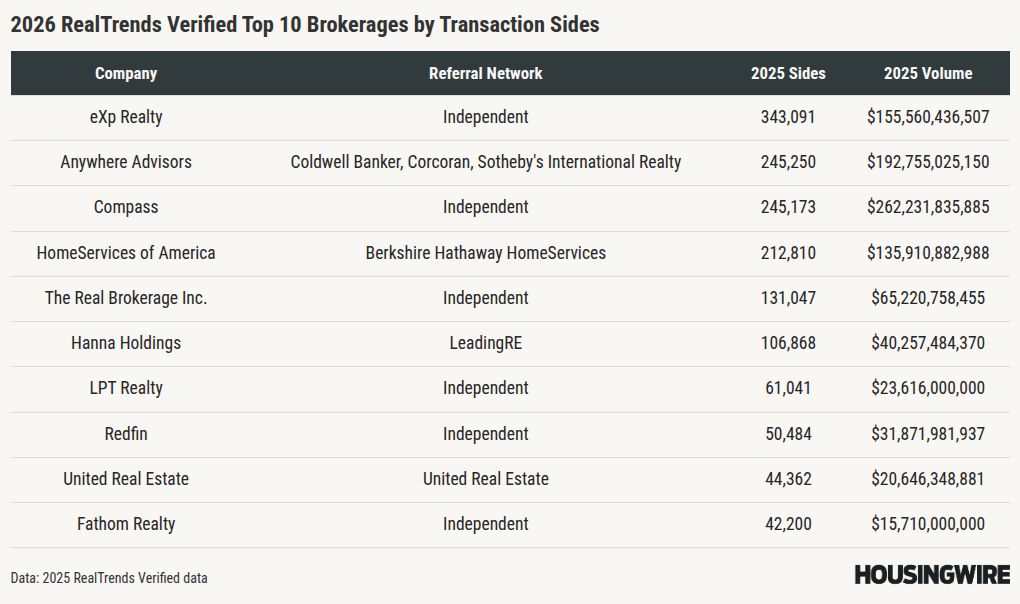
This post was originally published here

Spring selling seasons – in fondly remembered, more stable eras – carry a kind of heady predictability. A rising tide. A sense of momentum. Good problems to have. A shared directional bet.

That’s not this market. Spring hasn’t sprung.

What should be a national surge is instead a patchwork – some markets are thriving, others are stagnant, and some are declining. Any color-coded market map shows conditions from resilient to fragile.

New March data from Wolfe Research’s Private Homebuilder Survey offers a timely snapshot of just how contradictory this moment is. Orders jumped sharply month-over-month – well above typical seasonal patterns – suggesting underlying demand is still very much alive, even in the face of higher mortgage rates and geopolitical uncertainty.

But that resilience comes with caveats: the gain appears to reflect a catch-up from a slower start to the year, incentives have climbed to their highest levels since tracking began, and most builders expect rising rates to pressure sales pace more than margins in the months ahead, even as land prices stubbornly refuse to reset.

Bottom line, it’s a market that humbles both ends: those who ignore risk and those who predict disaster. For homebuilding leaders, the truth sits uncomfortably – and productively – in between. Spring selling is what it is. Many of the nation’s homebuilding business leaders aren’t lying when they say they’ve been here before.

It’s a moment that requires both realism and resolve. Builders have faced similar, if not identical, challenges. Even recently, they endured COVID, navigated supply chain disruptions, labor shortages, and inflation shocks. Over the past few years, many have strengthened their balance sheets, adjusted land strategies, and developed operational resilience for volatility.

But the next challenge is different.

It’s not survival today, this minute, but it is existential ultimately. It’s timing.

Specifically, it’s a structural land disconnect. And it’s homebuying customers’ mindsets.

The risk ahead: land prices vs. future reality

The biggest strategic exposure for many homebuilders now isn’t 2026. It’s 2027 and 2028. It’s the land being bought – or not bought – today at price levels that may or may not align with what buyers will be willing or able to pay two to three years from now.

That’s where today’s uncertainty becomes tomorrow’s margin compression – or worse.

Dwight Sandlin, co-founder and chairman of Birmingham, Alabama-based Signature Homes, doesn’t sugarcoat the situation and its wall of worry:

“The ultimate problem was the hyperbolic land prices and public’s continuously driving up prices to grow market share. That will take some time to adjust land prices.”

That’s the source of disquiet, particularly for privately capitalized homebuilders, that sits beneath today’s operations and planning.

Builders can manage through “bumpy, choppy, iffy, lumpy, fickle, and volatile” conditions in the near term – but their real test is whether they’re underwriting land decisions against a future that is fundamentally harder, and likely less rational, to predict.

Not to mention, harder to afford.

The “new norm” is not temporary

Sandlin’s perspective – whose livelihood in homebuilding goes back to his early 30s in 1988 and reaches a milestone in 1999, when he and Jonathan Belcher partnered to launch Signature Homes – has this throughline:

If you’re waiting for rescue – from the Fed, from Animal Spirits, from any external force – stop waiting.

“The cavalry is not coming!”

Sandlin’s unvarnished take, based on what he can infer from current conditions, is as follows: Mortgage rates in the 6% range. Limited likelihood of meaningful policy intervention. A structural affordability gap driven by a 40%+ home price surge during the sub-3% rate era. This is not a cyclical blip.

Sandlin calls it as it is, a reset:

“My perception of the market conditions is that high rates, a tougher go for consumer households, and little likelihood of a Fed tailwind are the new norm.”

And that “new norm” comes with constraints that won’t ease easily:

  • A large share of homeowners are locked into sub-4% mortgages, freezing resale supply
  • Income levels lag far behind affordability thresholds
  • Municipal resistance to density and lower-cost housing options
  • Capital markets recalibrating risk, potentially reshaping mortgage structures

Still, in Sandlin’s mind, it would be wrong to conclude that demand has vanished. Rather, it’s constrained, selective, and increasingly emotional rather than purely financial.

What outliers already know

In this context, many builders have reined in new production until they see pace – the number of new home orders per community per month – stand up on their own without massive, margin-squeezing incentives and price concessions.

Sandlin isn’t.

Nor are a canny, nimble, lean and opportunistic group of operators who’ve spent the past five years building capabilities and adaptability – not merely chasing volume.

Signature Homes is one of those outliers.

In 2025, in a high-rate, affordability-constrained environment, here’s Dwight Sandlin’s report card on his team’s performance:

  • Closings: 528
  • Revenue: $427 million
  • Gross margin: 33.6%
  • EBITDA: 24.8%
  • Inventory turns: ~3x

Notably, he points out:

“We had a record year of profits. Our volume was slightly down but our EBITDA was 23.1… Our turn is 3x.”

That’s the financial and operational performance of an outlier. Operators in this performance vanguard may be rare, but there are more of them around the nation than fully appreciated. Volume and performance are not equivalent.

And in this market, volume may not even be the primary goal. The mirage may appear to be a “strike price,” a golden asking price that sets a floor from which to build a consistent, sustainable order pace. The real goal, Sandlin would argue, is a “strike value.” This is where a builder learns and replicates the home design, location, and neighborhood appeal that sparks homebuying consumers’ emotional resolve to purchase a home for one driving reason: that home is the next chapter of their life.

The five non-negotiables

Sandlin’s framework for navigating this environment is deceptively simple.

Five non-negotiables:

  • Customer-driven
  • Market research
  • Community design
  • Speed
  • Post-close survey

Each one is operational. Measurable. Embedded.

None are theoretical. None are abstract. None are anything but doable, now, and repeatedly.

1. Market research is not a department. It’s the DNA.

Sandlin is unequivocal:

“Market research is the FIRST order of business in homebuilding. Nothing is more important than knowing there is a market for what you build.”

And importantly, market research is not outsourced.

“We do not use consultants… they only review the numbers but do not understand the why.”

Instead, his team:

  • Mines MLS data over a two-year period to identify the “fat part of the market”
  • Drives competing communities physically
  • Studies resale transactions to understand positioning
  • Updates market conditions monthly

And perhaps most critically:

“If we see that we cannot meet or exceed the market with our product – we simply do not go forward to buy the land.”

In a cycle where land risk is the biggest forward exposure, that discipline is everything.

2. Data Is not a dashboard. It’s a control system

Sandlin’s operational rigor borders on unapologetically relentless.

“If a builder does not have real time information, they cannot manage their business.”

Weekly, monthly, quarterly reporting cascades across the organization:

  • Cost variances
  • Cycle time tracking
  • Quality metrics
  • Warranty feedback loops
  • Sales vs. pro forma
  • Customer satisfaction scores
  • Traffic and conversion ratios

Every home is measured. Every variance explained.

And one report stands above the rest:

“The most important report… is VPOs… because it tells management if builder is in control of his homes.”

This is not about data accumulation.

It’s about accountability.

3. Speed Is Strategy

Three years ago, Signature Homes set out to shorten its construction cycle time, and they’ve since dialed back the build cycle from 135 days to 100 days. The result of end-to-end, start-to-completion velocity:

  • 20%+ increase in closings
  • Fewer production staff required
  • Material gross margin contribution from incremental volume

Speed equates to efficiency, but that’s not all. It provides operational and strategic flexibility and agility. It builds in bandwidth to respond to what a customer may want, need, or consider a non-negotiable. It allows a builder to adapt faster to shifts in demand, manage cash flow more tightly, and reduce exposure to cost volatility.

4. Every home must earn its right to exist

In today’s market, Sandlin is clear:

“Every home has to have a unique selling proposition.”

Homes that don’t sell?

They’re pulled from the company’s floorplan library. They’re reworked from the inside out. They’re reintroduced only when they can compete.

This is a profound shift from prior cycles, where product lines could linger longer without constant revalidation. Today, the buyer decides quickly what works and what doesn’t.

And decisively.

Housing’s emotional economy

One of Sandlin’s most important insights – reflected in your earlier reporting – is that homebuying in this cycle is less rational than ever. Higher rates have changed the math. Uncertainty’s done a number on the psychology. Decisions to buy – and buy now – need to clear a higher emotional bar. Builders who are still “selling logic” and transactions are losing. Builders who are nurturing desire – and trust –win.

That’s where Signature’s referral engine comes into play:

  • 40%–50% referral rates
  • Multi-generational customer pipelines
  • Continuous Net Promoter Score tracking across the build journey

Trust is not a warm-and-fuzzy metric. It’s a transformational core business value-creator. It’s a growth engine.

The discipline of facing reality

Sandlin doesn’t pretend the market is easy. In fact, he’s explicit about the structural challenges:

“Sales are softening… second quarter is way down,” he told us. “We do expect GMs to suffer… we have been living in artificially high GMs.”

Realistic clarity gives his optimism credibility. It’s not optimism rooted in hope. It’s based on agency, accountability, resolve, and an unquenchable fire in the belly.

“The market will reward the efficient builders that meet demand where it actually lies,” he said.

Homebuilders take note

For every private builder executive – whether you’re leaning bullish or bearish – the takeaway is not about copying Signature Homes. It’s about recognizing what’s within your control. This is not a market that rewards:

  • Passive land accumulation
  • Static product lines
  • Lagging data systems
  • Top-down decision bottlenecks

It rewards:

  • Precision in market positioning
  • Real-time operational visibility
  • Speed and adaptability
  • Customer-centric execution
  • Cultural alignment and accountability

And critically, a willingness to act – decisively – without waiting for a crystal ball or an external tailwind that may never come.

Builders carry the burden

Sandlin doesn’t pull punches: “I am of the opinion that the burden will not lie with government but with homebuilders.”

That’s the core truth of this moment. There is no cavalry. No policy fix arriving in time. No rate environment that suddenly unlocks affordability. What there are are operators. Those who’ve seen it, done it, stepped up and dug deep. What there are are teams. What there are are systems, choices, and decisions.

And a kind of inimitable character among homebuilders to execute them consistently.

Seen, heard, understood

For builders looking at this market and feeling uncertain, pressured or stretched – the point here is not that everything is fine. It’s that you’re among co-strivers. This is hard, and it’s supposed to be. There are no shortcuts. But it’s also navigable.

The companies that prepared – five years ago, three years ago, even 18 months ago – are proving what’s possible. They’re buying sales. They’re paying for growth. They’re keeping the engines running and resilient.

It’s nothing like Spring Selling perfection. It’s not immunity from all the volatility and uncertainty. It’s the nature of resilience. And for those willing to lean into the discipline, the data, the customer, and the craft of building homes that matter –  there is still a path forward.

Not a smooth one. But a real one.

This post was originally published on here

Picture this: a real estate investor has spent months trying to source the perfect fix and flip deal. The numbers work, the timing is right, and they’re ready to move, now they just need a lender to take them across the finish line. They find a lender offering slightly lower rates, which is appealing on the surface, but the closing time is 30 days. By then the deal will be snapped up by another investor. Then they find a lender with slightly higher rates, who can close in 6 days and hand over same-day pre-approval. It’s an easy choice. The investor goes with the faster lender to guarantee the deal.

The same decision is being made by investors in every market, on deals of every size. In today’s competitive real estate market, speed and certainty have become a currency that borrowers are often willing to trade a better rate for.

What real estate investors actually want in 2026

According to PwC’s Consumer Lending Experience Radar, online applications have moved from a competitive advantage to an industry standard. While human interaction still matters at certain points in the process, a digital loan experience is now a requirement for any lender who wants to stay in the game. 

Speed and certainty are overtaking discounts as the winning differentiators, and real estate investors simply want things done faster. For investors doing business in a highly competitive real estate market with fluctuating interest rates, the risk is real. Good real estate deals receive multiple offers within days, rates can climb at any time, and pre-approval is an important way to show sellers that they’re serious. Being able to move quickly on deals not only increases an investor’s chances of landing a good deal, it also saves time and money, making sure that months of deal sourcing and analysis don’t go to waste because someone else got there first. 

Outside of real estate, this trend is playing out across a number of industries. Amazon’s introduction of 1-hour and 3-hour delivery options this year is a prime example, a clear signal that consumer expectations around speed are only moving in one direction.

How lenders are adapting to the need for speed

One of the biggest buzzwords, and most important developments, in real estate lending today is AI, particularly when it comes to underwriting. It’s becoming the cornerstone on which lenders are building their speed, closing loans in days rather than weeks. In a traditional underwriting setup, collecting documents, verifying financials, and assessing a property’s condition can easily take weeks. Each file gets manually reviewed: leases, rent rolls, income statements and expense logs. However, AI underwriting now automates much of that heavy lifting. Documents are extracted and organized instantly, risk models run in the background, and preliminary assessments come back in minutes rather than after a third follow-up email.

In a highly competitive origination space, where new lenders seem to arrive every few months with shiny new offerings, operational efficiency has become the new currency. Minimizing repetitive tasks like document review, identity verification, and income and employment checks, and leaning into automation is a sure-fire way to reduce costs and speed up origination in a big way.

Investors who can make decisions within hours are in a far better position to capitalize on real estate deals than those who take days to line up pre-approval and commit. In today’s fast-moving markets, that gap is often the difference between winning and losing a deal. However, a key element to remember is that while real estate investors want fast financing, they also want certainty. Lenders who promise a closing timeline need to deliver on this, every time. 

According to the J.D Power Mortgage Satisfaction Survey, lenders who adopted a more advisory-style relationship with investors, saw higher customer satisfaction scores and increased trust. In other words, speed can win an investor’s first deal, but delivering consistently and communicating well is what turns that into a long-term relationship.

The new rules of lending

The days of advertising low rates and expecting borrowers to come running are gone. Speed is now a baseline expectation that borrowers and real estate investors have in 2026. Which means that fast financing is no longer something that sets lenders apart, it’s now the price of entry. 

The lenders who are getting ahead are using technology to create fast, digital-first processes, with genuine support that leads to longer term relationships. This combination builds trust, provides capital at a rate that investors need it and keeps borrowers coming back. 

The lesson for lenders is to invest in technology to get rid of bottlenecks, compress investor timelines and make sure to provide an investor with what they need as soon as possible, to create relationships that last longer than 2026. 


Kirill Bensonoff is the CEO & Co-Founder of New Silver Lending.

This column does not necessarily reflect the opinion of HousingWire’s editorial department and its owners. To contact the editor responsible for this piece: zeb@hwmedia.com.

This post was originally published on here

Tri Pointe Homes recently announced the launch of LivingWell, a new wellness concept that expands on its LivingSmart program. The initiative is part of a multilayered strategy to enhance mental and physical health through innovative design focused on performance and human-centered approaches. 

The builder started construction on a roughly 7,700-square-foot model home in Utah that will be the first to showcase the LivingWell concept. It will then be introduced to the other homes in The Pavilions at Holladay Hills, a six-lot, upscale community near Salt Lake City featuring semi-custom homes ranging from 4,600 to 7,800 square feet.               

In an interview with The Builder’s Daily, Ken Krivanec, president of Tri Pointe Homes’ Washington and Utah division, said that the property was the “maiden voyage” for LivingWell, which could expand to other communities across the country in the future. Many of Tri Pointe’s buyers, who tend to be more established and affluent, see a home not only as a financial investment but also as an investment in their physical and mental well-being. 

The news comes about a year after Tri Pointe Homes broke ground on its first community in Utah, following its 2023 announcement of an expansion into the state.  

Combining high performance and design

The LivingWell brand builds on Tri Pointe’s LivingSmart initiative introduced in 2022. LivingSmart focuses on eco-friendly, high-performance home structure and systems features that conserve energy, reduce water use and improve indoor air quality as well as room air comfort. 

LivingSmart, Krivanec explained, focuses on five principles: energy, smart health, smart home, smart water and earth smart. The concept effectively adds value to the home itself, a feature LivingWell includes. 

The homes at The Pavilions at Holladay Hills will feature advanced framing, duct sealing, upgraded insulation and energy systems that will achieve a HERS score of 59, indicating a highly energy-efficient home. Enhanced air quality is provided by a heat-recovery ventilator system, MERV 13 filtration, low-VOC materials, and a whole-home humidifier. 

LivingWell expands on those features to also focus on how a home feels, with design elements that include abundant natural light, smooth flow between rooms, and a seamless connection between indoor and outdoor spaces. There will be quiet zones and restorative bathrooms to create spaces perfect for reflection and relaxation, as well as areas designed for flexible living, including a carriage house above the garage. 

Celebrity designer Bobby Berk, an Emmy-winning TV host, spearheaded the interior design project. 

“I think LivingWell distinguishes itself by viewing wellness through a whole-home design lens, rather than limiting it to a single room or amenity or aesthetic layer,” Krivanec said. 

A key feature of the LivingWell concept is connecting with nature and focusing on designing beautiful outdoor spaces. The Pavilions at Holladay Hills, located next to the Wasatch Mountains, are likely to attract buyers who want to feel connected to the local landscape. 

The outdoor gathering areas will have a courtyard layout with edible gardens, orchard plantings, and pollinator-friendly landscaping. 

“I think that LivingWell is about nature, and it’s about the buyer wanting nature as part of their buying decision,” Krivanec said. “That meant that we had to look at the outdoors, we had to look at the indoors, and we had to look at everything that went into this home.”

In February, Japanese builder Sumitomo Forestry announced that it had acquired Tri Pointe Homes in a blockbuster $4.5 billion all-cash deal. Sumitomo Forestry, the envy of many of its American peers, has spent years pursuing wellness initiatives in Japan through eco-friendly homes and design. 

The builder promotes healthy living in its Japanese homes by using wood-based construction, taking advantage of timber’s natural insulation and calming aesthetics to support mental and physical well-being. 

Tri Pointe’s growth in Utah

Tri Pointe Homes officially announced its expansion into Utah in 2023 and soon started building its operations in the state. Last year, the builder broke ground on about 139-lot The Crossings at Lake Creek in Heber City. Two more communities, Aspire at Holladay Hills and Polaris at Terraine, both in Salt Lake County, are also available for sale now, and another community is scheduled to grand-open in about two weeks. More projects are expected to follow. 

Krivanec, who is originally from Utah, said that expanding into the state made a lot of sense for Tri Pointe Homes. The state has a thriving, diverse, and growing economy. Utah’s population growth rate is also among the highest in the nation, increasing by 8.2% between 2020 and 2025, rivaling the population gains in states like Texas and South Carolina. 

“We evaluated this market and decided it’s a place we want to be. It was one of the top markets for job creation, and had been for several years, and that trend is expected to continue,” Krivanec explained, highlighting the state’s diverse economy.

This post was originally published on here

A battle has brewed over residential lot sizes in Texas after Gov. Greg Abbott signed a law last year reducing them in the state’s biggest cities.

Since the law didn’t apply statewide, Montgomery County, which abuts Houston, is trying again to increase its lot sizes after doing so last March.

County planners say the increase this time is needed to correct a clerical error in the size approved in March 2025.

Bigger lots mean bigger, higher-priced houses that price out first-time buyers. They also mean fewer new homes when the market needs more supply, as well as constraining homebuilders from optimizing their land purchases with greater density.

County leaders are moving ahead with the bigger lot rules even after state lawmakers acknowledged last year that smaller lot sizes increase affordability and supply.

The county is drawing sharp opposition from Ellison Development, which has built several attainable housing communities in the county and has more under way. Three years ago, the company sold its affordable housing company, ASGi Homes, to D.R. Horton.

Bill Ellison, the company’s managing member, told The Builder’s Daily that the communities are filled with working-class, first-time homebuyers.

“100% they do not want working-class people out there,” Ellison said.

A public hearing is set for tomorrow morning. That may be just the beginning of the fight.

Spirit of the law

Abbott signed Senate Bill 15 into law to reduce minimum lot sizes to 3,000 square feet. That figure represented a compromise. Lawmakers originally sought 1,400 square feet, modeling what Houston has permitted since the 1990s. It is still a large reduction from typical lot sizes of 5,000 to 7,500 square feet.

The law, however, limits its ordinance to cities of 50,000 or more people in counties with a population of 300,000 or more.

Montgomery County’s population is pushing 800,000. No city within the county has 150,000 people.

“Montgomery County sits just outside the reach of Texas’s recent small-lot reform bill and is using that gap to push in the opposite direction,” Sam Hooper, the Austin-based legislative counsel for Institute for Justice, told The Builder’s Daily.

While SB 15 does not apply, Ellison said that state legislation passed in 2007 does. That law prohibits commissioner courts from regulating the number of residential lots that can be built per acre of land.

State Rep. Cecil Bell introduced legislation last year that would have added prohibitions on regulating minimum lot size, minimum lot width and depth, and building setbacks, or on imposing any regulation that limits density or development.

The bill failed twice in the House.

Bigger lots to get bigger

Last March, the Montgomery County Commissioners Court approved a code change to require 40-foot-wide lots. The county’s director of engineering services later sent the court a long list of corrections for clerical errors in development regulations. The memo crossed out 40 and replaced it with 50, which would set lot sizes at about 7,500 square feet.

The bigger lot size could more than double the price of owner-occupied housing in the county, Ellison said. Ellison has built some 800 homes on 30-foot-wide lots and has another 3,000 lots under development.

Those homes sell for about $150,000. Prices would double, or more, on bigger lots, Ellison said, which would eliminate many prospective first-time working-class homebuyers.

“A 50-foot minimum lot width is a significant constraint that limits the feasibility of smaller, more attainable homes,” Hooper said.

County leaders, however, view the increase in lot size as a path toward bigger homes that can generate more property tax revenue from higher-value properties.

Scott Finfer, a Texas homebuilder formerly with KB Home, told The Builder’s Daily that many local governments believe bigger lot sizes equate to higher quality and greater property tax revenue.

“They’re trying to create a relationship that doesn’t exist,” Finfer said.

This post was originally published on here

Recruiting Insight has released a new strategic guide, “Real Estate Personas and Avatars,” designed to help brokerage leaders diagnose agent motivations and tailor recruiting pitches to specific career stages, the company announced Monday.

The framework, built from findings in the firm’s 2026 Agent Migration Report, organizes real estate agents into 11 core personas and introduces a quantitative “Ideal Agent Scorecard” for evaluating candidate fit on a 1–35 scale.

“Recruiting is not about convincing people; it is about diagnosing them,” Mark Johnson, managing partner at Recruiting Insight, said in a statement. “Most recruiters fail because they sell the brokerage instead of solving the agent’s specific ‘3 a.m. nightmare.’ This guide moves leadership away from collecting names and toward building a high-performance culture through clarity.”

The guide is structured as a reference library for brokerage leaders and recruiters. It is meant to shift recruiting conversations from generic value propositions to persona-based problem solving — a key need in a market where broker profitability is under pressure and the cost of a mis-hire has risen with higher lead costs and shifting commission structures.

For brokerage leaders, the distinction underscores the need for separate recruiting and retention narratives for early-career agents versus established producers. New agents are influenced by training and structure; veterans are more likely to move for leverage, lifestyle and platform support.

For brokerage recruiters, the personas are intended to serve as diagnostic shortcuts that connect an agent’s career stage and pain point to an appropriate offer — for example, aligning a high-burnout top producer with leverage and staffing solutions, or pairing a digital native with credibility-building tools and mentorship.

To move recruiters from theory to implementation, the guide introduces a Persona Architect workshop. The workshop walks leadership teams through building local “avatars” based on the 11 personas and their own market data, then designing offers and scripts around those avatars.

The release also includes an Ideal Agent Scorecard, a 1–35 point scoring tool that evaluates candidates across five dimensions: production fit, coachability, tech alignment, cultural pillars and friction level. According to Recruiting Insight’s announcement, the scorecard categories are: The Ideal Match (30-35), The Project (22-29) and The Anti-Persona (below 22). For brokerage owners, a quantitative tool like this can support more disciplined growth at a time when many firms are reassessing agent count, productivity thresholds and cultural standards in response to commission litigation, margin compression and changing lead economics.

This article was generated using HousingWire Automation and reviewed by a HousingWire editor before publication. The system helps convert company announcements and industry data into HousingWire-style news coverage.

This post was originally published on here

FNF Family of Companies has hired nine experienced professionals across its New England agency operations during the first quarter of 2026, adding senior underwriting and sales capacity in Massachusetts and the broader region, according to an announcement earlier this week. The additions, announced by the company, are intended to strengthen underwriting support, agency relations and commercial capabilities at a time when title insurers are competing for fewer transactions and more complex files in a high-rate environment.

“Each of these hires brings a depth of industry knowledge, leadership and client-focused expertise that elevates our organization,” Rich Cannan, executive vice president and divisional manager of FNF, said in a statement. “Their combined experience strengthens our ability to support agents in Massachusetts and across New England, and we are thrilled to welcome them to the FNF family.”

The new hires include James Bilodeau Jr., Esq., who has been named senior vice president and New England sales manager. Bilodeau has more than 30 years of experience in agency relations, legal practice and regional sales leadership. He most recently served as vice president and Massachusetts state manager for a regional underwriter.

As lenders and real estate agents navigate a slower purchase market, large underwriters have increasingly leaned on regional sales managers to deepen relationships with independent title agents and law firms, a key channel for purchase and refinance work when volumes recover. FNF also added several senior underwriters covering Massachusetts and the broader Northeast.

Melanie Kido, Esq., is also joining the firm as vice president and Northeast underwriting counsel for Connecticut, Massachusetts, Maine, New Hampshire, Rhode Island and Vermont. She has more than 20 years of experience underwriting residential and complex commercial transactions and has held senior underwriting roles with both regional and national underwriters, most recently as vice president and Massachusetts state counsel.

Also coming to FNF is Nicole A. Cox, Esq., who has been hired as vice president and senior underwriting counsel for Massachusetts. Cox brings more than 20 years of residential and commercial real estate experience. She previously served as title counsel for a regional underwriter and spent more than a decade in private practice, including ownership of The Law Offices of Nicole A. Cox P.C. She is a member of the Real Estate Bar Association.

Additional hires include Tucker Dulong, Esq., who was named vice president and northern New England agency counsel for Connecticut, Maine, New Hampshire, Rhode Island and Vermont; Mark Corbett as commercial underwriting counsel for Massachusetts; Karen A. Adamski, Esq. as assistant vice president and underwriting counsel for Massachusetts; Nichole Barros has joined as an associate underwriter for Massachusetts; Madlene Dell’Anno as vice president and agency representative for Massachusetts; and Monique E. Bourget joins as assistant vice president and agency onboarding manager for Massachusetts.

For real estate attorneys, title agents and lenders operating in New England, FNF’s hires signal continued competition among major underwriters to capture market share through local expertise rather than pricing alone. Expanded underwriting benches can shorten response times on complex commercial deals and multi-state transactions, while dedicated onboarding roles are designed to smooth agency transitions and technology integrations.

This article was generated using HousingWire Automation and reviewed by a HousingWire editor before publication. The system helps convert company announcements and industry data into HousingWire-style news coverage.

This post was originally published on here

Visibility used to win. Now it’s just noise.

For the past 20 years, real estate agents have been told the same thing: build your personal brand. Post consistently. Shoot video. Be everywhere. The belief was simple — if people saw you often enough, they would eventually do business with you.

And for a while, that worked.

But the environment that made that strategy effective has changed, and it’s changed fast. What used to create an advantage is now widely available to everyone. And when that happens, it stops being an advantage.

The uncomfortable truth is that personal branding only worked because very few agents were doing it well — or at all. If you were one of the few consistently creating content, you stood out. Consumers interpreted visibility as competence. If they kept seeing you, they assumed you must be successful.

That wasn’t because the strategy was particularly sophisticated. It was because it was rare. AI has now removed that rarity.

Today, any agent can generate market updates, listing videos, email campaigns and social media content in minutes. The effort, skill and consistency that once separated top performers from everyone else have largely been automated. And when the barrier to entry disappears, so does the differentiation.

This is where many agents are misreading the moment

They are still asking how to be more visible, when the real question has shifted to something far more important: who can actually deliver the best result?

When everyone can look like an expert, consumers stop using visibility as a shortcut for decision-making. They start looking for evidence of capability instead.

We’ve seen this pattern play out in other industries. When something becomes easier to produce, it loses its signaling power. Luxury goods lose their exclusivity. Premiums shrink. Differentiation moves elsewhere. Real estate marketing is following that same path.

The industry has already experienced a version of this shift once before. There was a time when brokerage brands carried significant weight. Being affiliated with companies like Coldwell Banker or REMAX automatically signaled credibility to consumers.

Then platforms like Zillow changed how people found agents. Consumers stopped relying on brand recognition and started selecting agents based on availability, proximity and responsiveness. The power shifted away from the brokerage.

Now it’s shifting again — this time away from the individual agent’s brand

What’s different about this moment is where the consumer journey begins. Increasingly, clients are not starting with “Who should I hire?” They’re starting with “What should I do?” And AI is beginning to answer that question before an agent ever enters the conversation.

By the time a seller or buyer reaches out, they may already have a pricing expectation, a timing strategy and a list of recommended next steps. In that environment, the agent is no longer the initial source of guidance. They are being evaluated based on how well they validate or improve upon a plan that already exists.

This is why simply producing more content — especially video — is no longer the solution. There was a time when video signaled effort and expertise because it was difficult to produce consistently. Today, it signals something much more basic: participation.

Consumers haven’t lowered their expectations just because content is easier to create. If anything, they’ve raised them. They still want accurate pricing, strong negotiation, access to buyers and a smooth, predictable transaction. Those outcomes have always mattered. What’s changed is that branding alone is no longer enough to imply them.

The agents who will win in this next phase are not the ones who are most visible. They are the ones who are most effective. They build predictable pipelines. They develop repeatable listing systems. They stay in close contact with their databases. They understand pricing deeply and negotiate with confidence.

In other words, they focus on execution.

Personal branding isn’t gone. It still plays a role. But it is no longer the strategy. It is no longer the moat. It is simply part of the baseline expectation of being in business.

AI didn’t eliminate opportunity. It eliminated easy differentiation. And that changes everything.

Because from this point forward, the agents who stand out won’t be the ones who are seen the most. They’ll be the ones who consistently deliver the best results — whether anyone is watching or not.

Tim Harris and Julie Harris are nationally recognized real estate coaches, top-ranked podcasters and the founders of Harris Real Estate Coaching. They have coached tens of thousands of agents on how to build profitable, sustainable real estate businesses.

This column does not necessarily reflect the opinion of HousingWire’s editorial department and its owners.

To contact the editor responsible for this piece: tracey@hwmedia.com

This post was originally published on here

Here’s a first look at the new condo rising on one of the largest last undeveloped waterfront sites in West Chelsea. Developer Legion Investment Group last week announced Thomas Juul-Hansen as the architect of 550 West 21st Street, a 22-story, limestone-clad tower situated between Hudson River Park and the High Line. The development includes 83 residences, starting at $2.5 million. Sales will launch this year, and construction is expected to wrap up late 2027.

Legion paid $87.4 million for the 200,000-square-foot site in 2024 and later filed plans for a residential tower, as Crain’s reported. The developer reportedly added another 11,000 square feet in exchange for a donation to the West Chelsea Affordable Housing Fund.

Designed by Juul-Hansen, the Copenhagen-born architect who has designed many residential buildings in New York, including the 62-story Sutton Tower and the interiors of the supertall One57, 550 West 21st Street will feature a hand-laid Italian brick and limestone base that runs the full length of the ground floor. The project will offer unobstructed Hudson River views and direct access to Hudson River Park.

“Our goal was to create a building defined by integrity—where the highest quality materials and construction meet a deeply considered functionality, resulting in a timeless presence in West Chelsea,” Juul-Hansen said.

A trellis along the sidewalk adjacent to the motor court gate is visible from both the street and inside as residents pass through on the eastern side. At the western edge, a pedestrian entrance features an alabaster awning, while cerused stone art panels add a subtle layer of craftsmanship that runs the full length of the base, as a press release describes.

Inside, the motor court opens onto a landscaped courtyard anchored by a central grove of birch trees and tiered planting beds that rise along the perimeter.

As it rises, the building features a series of setbacks that carve out private loggias and terraces for a majority of residences. The facade steps back with each level, softening the building’s profile and framing views in three directions. The brick and limestone exterior continues up to the crown.

From the upper floors, residents can take in sweeping, uninterrupted views of the Hudson River stretching south to New York Harbor, as well as Little Island, Hudson River Park below, and the New Jersey Palisades. Glass railings on the private outdoor spaces preserve the views.

Legion’s portfolio includes several ground-up condo developments, including 1122 Madison Avenue on the Upper East Side and 38 Gramercy Park East in Gramercy Park. The developer is also behind the tallest building in Greenwich Village, a 30-story condo at 11 West 13th Street that recently secured construction financing.

“At 550 West 21st Street, we set out to create a building aligned with the creative spirit of West Chelsea while designing for the level of livability and precision that today’s most discerning buyers expect,” Victor Sigoura, founder and CEO of Legion Investment Group, said.

“More than 75 percent of residences will have private outdoor space and two thirds of the homes feature views of the Hudson River. The remaining residences will enjoy equally compelling views to the northeast over the historic district and the Midtown skyline, and to the southwest down the length of the river.”

550 West 21st Street, under construction in April 2026. Photo © Ondel Hylton

Sales are expected to launch this year and will be exclusively managed by Corcoran Sunshine Marketing Group. Residences will start at $2.5 million, with completion slated for late 2027.

The building joins several other architecturally notable buildings to pop up in West Chelsea in recent years, like One High LineLantern House520 West 28th Street, and The Cortland.

As 6sqft reported in February, Toll Brothers picked up a vacant lot at 118 10th Avenue with plans to build an 85,000-square-foot condo building.

RELATED:

The post Thomas Juul-Hansen to design 22-story condo in West Chelsea first appeared on 6sqft.

This post was originally published here

Rocktop Technologies has launched Rocktop Digital, a new business focused on digitizing and tokenizing mortgage and private credit assets to modernize how the assets are financed, owned and traded, the company announced Wednesday.

As part of the launch, Dallas-based Rocktop Technologies promoted Brett Benson, previously its co-president, to CEO of Rocktop Digital. The move formalizes a dedicated leadership structure around blockchain-enabled innovation and reflects the firm’s push to build digital market infrastructure for credit assets.

Rocktop Technologies provides AI-driven data and document intelligence tools that convert unstructured loan files into validated, analytics-ready digital asset records for mortgage and private credit investors. That “source of truth” data is intended to undergird Rocktop Digital’s work on the “rails” that move assets. These include digital asset creation, tokenization and fractionalization of loans, counterparty governance tools, digital registries and updated settlement mechanisms.

“Rocktop has always believed that trusted data is the foundation of functioning capital markets,” Jason Pinson, CEO of Rocktop Technologies, said in a statement. “With Rocktop Digital, we are taking the next step — transforming validated assets into portable digital instruments that can move more efficiently between investors. Brett has played a central role in shaping this vision, and we are excited to see him lead Rocktop Digital as its CEO.”

Benson said the new unit will focus on connecting the firm’s AI-based asset validation capabilities with blockchain-based ownership structures.

“We are entering a period where AI-driven asset validation and blockchain-based ownership structures can work together to fundamentally improve market infrastructure,” Benson said. “Our goal is to connect trusted asset intelligence with programmable digital rails that reduce friction, expand investor participation and unlock liquidity across the mortgage and private credit markets.”

The launch comes as the mortgage industry wrestles with aging infrastructure for transferring and financing loans, even as institutional demand for mortgage and private credit assets remains strong. Many secondary market processes — from due diligence and onboarding to custodial documentation and settlement — still rely on fragmented systems and manual workflows that slow execution and add cost.

At the same time, capital markets and regulators are exploring tokenization of real-world assets, including mortgage-backed securities and whole loans, as a way to increase transparency, enable fractional ownership and open products to a broader investor base.

For lenders, servicers and secondary market investors, tokenization and digital registries could eventually support faster whole loan sales, more granular risk transfer structures and new financing channels as long as compliance, investor protections and data standards are maintained.

Rocktop is positioning its combination of AI-powered document intelligence and digital asset infrastructure as a way to support that shift. By starting with validated loan-level data and documents, then layering programmable ownership and settlement tools on top, the firm is aiming at a future state where mortgage and private credit assets can move more like other digitized financial instruments.

The company said its broader vision is to rebuild market architecture rather than make incremental process changes, creating a more transparent and accessible ecosystem for credit investors. Rocktop Technologies and Rocktop Digital will operate as complementary businesses — one focused on asset intelligence, the other on digital infrastructure and execution.

Rocktop Technologies describes itself as a “solutions-as-a-service” firm that combines clean data and documents, domain-trained AI and specialist teams with decades of mortgage asset management, investment and servicing experience.

This article was generated using HousingWire Automation and reviewed by a HousingWire editor before publication. The system helps convert company announcements and industry data into HousingWire-style news coverage.

This post was originally published on here

Artificial intelligence is not only changing the way people search for and find information online, but it is also changing how they are searching for products and services, including their new home. Founded in 2006, Zillow has witnessed the housing industry develop from its early embrace of the internet to now entering the uncharted territory of an AI-first ecosystem. 

HousingWire recently caught up with Zillow’s chief industry development officer Errol Samuelson, who has been with the firm since 2014, to discuss how Zillow is adapting to the emerging AI-first world. 

This interview has been edited for brevity and clarity.

Brooklee Han: It seems like more and more people are turning to LLMs like ChatGPT for their search queries these days. How is Zillow adapting to the new ways consumers are searching for information and services? 

Errol Samuelson: What we are seeing broadly in technology now is that, whether you are doing a Google search or going directly to an LLM interface, consumers are now asking free-form questions. They are not dropping in keywords and then looking to receive 25 blue links as search results.

We are seeing this with people becoming more accustomed to [phrasing search] like, ‘I need a home with an office space because I work from home a few days a week, but also within 30 minutes of my office because I still go in a few days.’ Those are the kinds of conversations that, in the past, they would have with a human are now coming before they get to the city name, bed, bath and price part of the search. 

One of the things we are doing is enabling consumers to talk to the AI to figure out what they can afford and then using that, along with other [personal] factors, we can show them homes that match their lifestyle and budget needs. 

This isn’t just slapping an LLM on top of a listings database. To make the AI component more valuable, we are making sure that it has access to contextual information, like conversations the consumer is having with a Zillow-affiliated agent, allowing the AI to then suggest properties that are relevant to that consumer. The more context you can provide, the more personal and helpful the AI becomes. 

The other thing about Zillow’s AI that is unique is that the AI connects to the agent tools we supply. If you were to use a horizontal AI that does web crawling, it may find you properties for sale that meet your needs, but if you were then to ask if you can tour one of them, that is where a horizontal AI hits a wall and may suggest you call a local agent.

Because we have backend software components with our AI, we can actually use agentic AI to then go take action. So, if you tell it that you would like to see the property, it connects with our ShowingTime platform, and it can tell you when the property is available to be toured.

Additionally, since it also has that context, it can tell you if other properties in that same neighborhood are also available for tours around the same time or even if they have an open house scheduled. 

BH: As AI becomes more prevalent in home search, some organizations and individuals have raised concerns about potential fair housing issues. How is Zillow working to avoid any of these issues? 

Samuelson: Guardrails are super important. We put a lot of work into making sure that the responses and interactions that happen with the AI are appropriate by fair housing standards. We also released an open source fair housing model that the industry can use to ensure that conversations with AI are appropriate, but we do feel that there are some areas where advice is better provided by a human than by a machine. When our AI runs across these [situations] it will give consumers some things to consider, but tell them that they need to talk to a person about this. 

BH: There are constantly stories popping up about consumers using AI to sell or buy a home. What are your thoughts on this conversation that AI is going to replace real estate agents? 

Samuelson: There is this trope that AI is basically going to replace almost any profession, but what I think the AI actually does is it takes care of a lot of the low value work. It also helps the consumer be better informed and prepared for when they do work with the agent. Then, the agent gets to do the things they are good at that the AI can’t do like, judgement, negotiations, creativity and offering empathy and support. Buying a house is stressful, but by using AI, the agent is more available to help consumers navigate those very human emotions. 

Over the past five years, as this technology has emerged, we’ve seen that more consumers on both sides of the transaction use real estate agents. So, as we have seen more technology, the demand for the human in the loop is actually increasing, not decreasing. 

BH: There are so many AI tools popping up on the market. How do you feel Zillow’s longevity and experience in the industry will help it navigate this highly competitive and ever-evolving space?

Samuelson: There are definitely a few factors here, but one of the biggest is that we have been working with AI for a long time. Eight years ago, the Zestimate was incorporating neural networks and AI models, and we’ve had machine learning for a long time. We immediately doubled that work when we started some of these new models coming out back in 2017 and 2018. So, we have a lot of embedded in-house experience with AI, which is an advantage for us. 

The other thing is that we didn’t simply take an LLM or an AI model and slap it on our existing product. Instead, we tried to do exactly what we did with mobile, when we realized that mobile was going to be the way people use computing in the future. So, we completely turned the company on its head and went mobile-first. We are doing that now with AI and approaching things with an AI-first mindset and then looking at what that implies for the functionality that we want to provide to consumers and agents in the future. 

BH: As you just mentioned, Zillow has been around for a lot of technology innovation and integration in real estate, experiencing and learning many lessons over the firm’s 20 year history. What are some of those lessons the firm has learned in the past that you are working to apply to this latest technology evolution? 

Samuelson: The company was founded by the same people who created Expedia. They were looking to find ways to make information that was hard to access more accessible to consumers. With real estate, you couldn’t easily find out what your neighbor’s house had sold for, or what the approximate value of your home was, so the company was founded on this idea of transparency and that is still a core part of our ethos.

We have better transparency in the U.S. in real estate than anywhere else in the world and it makes for a more liquid market, which means it is easier to sell and price your home. That liquidity has led to a higher rate of homeownership in the U.S. and homeownership leads to building wealth, so a lot of good things come from transparency. We are deeply committed to maintaining transparency, cooperation and a level playing field for everyone in the country.

There are those in the industry right now who would like to turn back the clock and hide listings, price information, addresses, etc., and I think that is dangerous. Based on my time at Zillow, I firmly believe that we need to ensure that there is information transparency, so that is one big lesson. 

The second is that you have to start with the consumer and work backwards because it leads to better outcomes for everyone involved. Before mobile, before the internet, good agents have always worked hard to understand what their consumer needs and then provide that for them.

I think there is a tendency to create products or experiences from the inside out — working from the goal of closing a deal or getting another listing — and that doesn’t always result in as good of an outcome as starting from the outside and working in to the agent or broker. 

Finally, I think our industry tends to be a bit ‘wait-and-see’ when it comes to technology. We saw that with the advent of the internet and putting listings online, and we are seeing that now with [the] fear around AI. What we’ve seen with the internet, then mobile and now AI, is that each phase has an increasingly faster adoption curve. I don’t think the wait-and-see strategy is going to work with AI.

Zillow has a history of embracing technology and I think that lack of fear in adopting technology appropriately is definitely going to help us. 

This post was originally published on here

REMAX Fine Properties and REMAX Solutions have merged to form a single brokerage operating across Arizona — combining more than 400 agents and 10 offices statewide.

The unified company will operate under the REMAX Fine Properties name with offices in Avondale, Flagstaff Glendale, Munds Park, Peoria Pinetop, Scottsdale, Gilbert and Tucson.

Jamie Wong will continue to lead the combined brokerage as managing partner and broker-owner.

“We’re thrilled to bring together two powerhouse brokerages into one unified organization,” said Wong. “Our agents consistently outperform the market, and now — with REMAX Solutions joining the REMAX Fine Properties family — we’re elevating what’s possible for our teams and our clients across Arizona.”

REMAX Fine properties reported annual volume of $1.4 billion on last year’s RealTrends Verified rankings while REMAX Solutions came in at nearly $352 million.

Dan Porter will take on a role as managing partner and advisor.

“This merger opens the door to more opportunities for our agents and helps us build a more powerful foundation for long-term growth,” he said. “Combining our teams, leadership talent, and resources positions us to deliver even greater value to both our agents and clients.”

The combined brokerage ranks among the larger real estate operations in Arizona based on agent count and geographic reach.

This article was generated using HousingWire Automation and reviewed by a HousingWire editor before publication. The system helps convert company announcements and industry data into HousingWire-style news coverage.

This post was originally published on here

Philadelphia-based RenoFi announced Wednesday that it has hired Brandon Silvia as executive vice president and national production leader, moving to the renovation financing platform from top-10 U.S. mortgage lender Rate.

Silvia will oversee all sales and production operations nationwide, with a mandate to scale volume, grow RenoFi’s originator network and boost adoption of its artificial intelligence (AI)-enabled renovation lending platform.

He previously served as senior vice president of national branch partnerships and strategic growth at Rate, where he built and led mortgage teams that produced “billions per year” in originations, according to a RenoFi press release.

“RenoFi is building the most compelling platform in renovation finance while aggressively competing in the traditional mortgage space,” Silvia said in a statement. “For the retail originator, RenoFi presents the best option for true origination growth and referral source diversification.”

At RenoFi, Silvia is expected to recruit top-producing mortgage loan originators across the country and drive “billions in net new production volume” through the company’s renovation and mortgage products, AI agents and underwriting platform in 2026 and beyond, the company said.

Justin Goldman, co-founder and CEO of RenoFi, said Silvia’s track record in building scalable sales organizations and recruiting talent is central to the firm’s next growth stage.

“Brandon is exactly the type of leader we look for at RenoFi, strategic, operationally excellent, and relentlessly focused on execution,” Goldman said. “As we continue to expand our platform, lender network and national footprint, Brandon’s leadership will be instrumental in helping us reach tens of thousands of homeowners across the country.”

The addition of Silvia comes a month after the company closed a $22 million Series B funding round led by Fifth Wall, along with participation from Progressive Insurance and other new investors. The funding brought RenoFi’s total capital raised to $65 million.

This week, a report from New York-based Block Renovation found that homeowners continue to renovate for improved living conditions and flexibility rather than higher resale values. The report also noted that multigenerational households and demand for accessory dwelling units (ADUs) are on the rise, despite persistent inflation and higher interest rates that can limit budgets.

Silvia will lead RenoFi’s national sales organization, production operations and growth initiatives, working with lender partners, embedded finance platforms and internal leadership to increase AI adoption, improve conversion rates and expand in key markets.

RenoFi is part of a growing segment of lenders and fintechs targeting renovation-specific financing as existing-home inventory remains tight and higher mortgage rates discourage moves. Renovation loans tied to after-repair value can give originators a way to win business from equity-light homeowners who would otherwise be shut out of large projects.

For retail loan officers, RenoFi is pitching itself as a way to add specialized renovation products on top of standard mortgage offerings. A national production leader with a large retail background signals that the company wants to compete more directly with traditional mortgage lenders for purchase and refinance business, not just one-off renovation transactions.

RenoFi, founded in 2018, has created what it calls the first renovation home equity line of credit that uses a home’s after-repair value rather than current value. The company says it has helped finance more than $2 billion in renovations and operates in 48 states through a network of credit union and lender partners.

Neil Pierson reported and wrote this article with drafting assistance from HousingWire Automation, an editorial tool that helps transform announcements and industry data into HousingWire-style news coverage.

This post was originally published on here

The housing market update still looks relatively stable on the surface.

Inventory rose to 723,460 single-family homes in the week ending April 3, while 34.44% of listings had price cuts and the weekly absorption rate came in at 10.49%.

At the national level, the baseline is still holding. As HousingWire Lead Analyst Logan Mohtashami noted in his latest Housing Market Tracker, “higher mortgage rates are impacting the data, but nothing too negative yet.”

But beneath that stability, regional performance is pulling further apart, and that divergence is starting to affect how deals get done.

Weekly pending sales slipped to 70,676 from 72,191 a year earlier, while purchase application growth slowed to 1% year over year. Total pending sales remain higher than last year, signaling a market where demand is still present, but harder to convert.

Data signal of the week: Demand is holding, but conversion is starting to slip

The national numbers still point to a market that is holding, but the underlying signals are beginning to change.

Pending sales dipped year over year, purchase application growth slowed to 1%, and relist rates are rising across key metros.

That suggests demand has not disappeared, but more deals are beginning to stall before close. The gap between activity and execution is where this market is starting to shift.

Higher rates are pressuring demand, but not equally

Higher mortgage rates are beginning to weigh on housing activity, but the impact is not showing up evenly across the country.

Mortgage rates ended the week at 6.45%, with recent highs near 6.64%. Purchase application growth has slowed for two consecutive weeks, and weekly pending sales posted a small year-over-year decline.

What matters now is not just where demand is slowing, but where it is still converting efficiently versus where friction is building between contract and close.

Northeast markets are still moving quickly

The Northeast continues to post some of the strongest demand metrics in the country despite elevated home prices.

Massachusetts posted a 19.0% weekly absorption rate, while Connecticut reached 20.1%. In the Boston metro, absorption hit 21.4% with a median price above $1 million. Price cuts remain well below the national average.

Key takeaway: Pricing power remains intact, and transactions are moving cleanly. Buyers should expect continued competition with limited room to negotiate.

The Midwest is pairing affordability with momentum

Midwestern markets are benefiting from relative affordability, helping sustain demand even as financing costs rise.

Michigan, Illinois and Ohio are benefiting from relative affordability, helping sustain demand even as financing costs rise. Metros like Chicago and Detroit are posting strong absorption rates of 25.9% and 29.5%, respectively, well above national levels. At the same time, relist rates remain elevated in some areas, signaling friction in deal completion.

Key takeaway: Volume is outperforming, but conversion is less certain. Teams should watch contract fallout and timelines closely, not just demand.

The Sun Belt is showing the clearest signs of strain

The Sun Belt is showing the clearest signs of strain

The sharpest reset is happening across large parts of the Sun Belt, particularly in Florida and Arizona.

Florida posted a 43.6% price-cut rate and a 34.1% withdrawal rate statewide, with some metros seeing price cuts near or above 50%. Arizona is showing similar trends, with nearly half of listings in Phoenix and Tucson taking cuts. Texas remains mixed, with elevated price cuts across major metros.

Key takeaway: Pricing is becoming a speed decision, not just a value decision. Sellers who adjust faster are more likely to convert, while buyers are gaining leverage.

The West is holding up, but selectively

Western markets remain uneven, with coastal metros holding pricing power better than inland areas.

California’s major metros continue to post mid-teen absorption rates and elevated price points, while inland markets show higher withdrawal activity. In Colorado and the Pacific Northwest, rising price cuts point to more selective demand.

Key takeaway: Performance is diverging within regions, making market-level strategy more important than broad regional trends.

Where the pressure and momentum are showing up

The fastest-moving markets are concentrated in the Northeast and Midwest, while the highest levels of price pressure and withdrawals are centered in Florida and Arizona.

Transaction stress, measured by relist rates, is elevated across several metros, including Nashville, Houston, Chicago and Atlanta, pointing to growing friction in the transaction process, not just shifts in demand.

The takeaway

National trends set direction, but misreading your local market is now the biggest risk.

For leadership:

The market is fragmenting at the metro level, with widening performance gaps. Growth is concentrating in affordability-driven markets and among top operators. National benchmarks still set the baseline, but local data is increasingly driving day-to-day decisions. The edge is going to teams that can read and react to local shifts faster.

For operators:

  • Track conversion, not just demand
  • Watch fallout rates and contract timelines closely
  • Treat price cuts as a competitive signal
  • Focus on absorption, not just inventory levels
  • Reset pricing and pipeline expectations to local conditions

Why this matters now

The housing market is not just fragmenting. It is changing how it moves.

Demand can still look stable at the top line while becoming harder to convert underneath. Pricing power can shift faster than national data reflects. And two markets can move in opposite directions at the same time.

For housing professionals, the advantage now comes from identifying early signs of friction and velocity at the local level before they show up in the averages.

The teams that outperform won’t just follow the national trend — they’ll use local signals to act before it shows up in the averages.

That’s where the market is moving — and where the advantage is now.

For deeper context on rates, demand signals and the macro backdrop shaping housing activity, read HousingWire’s Housing Market Tracker weekly analysis. To track real-time data in national and local markets, get access to HousingWire Intelligence. HousingWire used HousingWire Data to source this story. This article is based on single-family residence data through April 3, 2026. For enterprise clients looking to license the same market data at a larger scale, visit HW Data.

This post was originally published on here

New broker-lender agreements are reshaping how reverse mortgage companies work together while taking aim at one of the industry’s most persistent problems: churning.

But the agreements come with caveats. They are only one piece of the broker-lender relationship and they are heavily tilted toward addressing refinance issues at a time when the industry desperately needs to grow purchase volume. And they won’t fundamentally change how brokerages run their businesses, mortgage brokers told HousingWire.

These agreements have been created to address tension between retail and wholesale operations at multichannel lenders. To ease that friction, lenders like Mutual of Omaha Mortgage and Longbridge Financial have rolled out programs designed to protect broker partners’ loan pipelines.

In general, the programs work by preventing lenders’ retail teams from contacting borrowers who are already in a broker’s active pipeline, automatically routing these customers back to their original advisers. They also monitor common refinance intent signals — such as payoff requests — and add the brokerage firm’s contact information to borrowers’ statements.

These moves have extra weight now that a new trigger leads law is in place, meaning far fewer companies will know when a credit pull occurs. 

“They are making some positive steps and it shows the industry is evolving. There’s better alignment between brokers and lenders. It benefits everyone,” said Eric Manley, founder of Florida-based Atlantic Avenue Mortgage, the nation’s top reverse brokerage firm in 2025 as measured by Home Equity Conversion Mortgage (HECM) endorsements.

Still, Manley stressed that no contract can replace the fundamentals. Regardless of what the agreements say, the most important thing is working as a team through human-to-human interaction with lenders.

“The agreements are great, but they alone aren’t the solution. The long-term success still depends on fair economics between them both, strong support and product availability,” Manley said.

Going after the ‘bottom feeders’

Loren Riddick, national director of reverse lending for NEXA Lending, sees these agreements less as a business-model shift and more as a weapon against churning — the practice of convincing homeowners to repeatedly refinance their HECM loans under misleading pretenses.

NEXA’s model, Riddick said, is built around loan officer autonomy. The company works with 15 different investors and lets its originators choose freely among them.

“NEXA, because of its DNA, is all about choice, freedom for the loan officer. It’s a very entrepreneurial model. We have 15 different investors. NEXA allows its loan officers to work with whatever investor that they choose. There is no hard line,” Riddick said.

Where the agreements matter most, he said, is in curbing lenders he labels as “bottom feeders” — those who ignore the National Reverse Mortgage Lenders Association‘s recommended waiting periods and begin marketing to borrowers the moment a loan closes.

“It takes a true professional to make sure that client not only gets the best experience, but that they also get the most informed decision possible,” Riddick said. “If you don’t have those protections in place, then unfortunately, you have situations where those relationships that have been forged over time, hard work, sometimes over months and years, can’t be preserved.”

Broker protections are good for borrowers and industry professionals alike — and Riddick said he hopes more companies adopt them.

Deeper structural challenge

Shain Urwin, national reverse mortgage director for broker C2 Financial, said the agreements create a “two-way street” between brokers and lenders, signaling that brokers now have “lenders to have our backs.”

But he pointed to a fundamental limitation: “Unfortunately, most of this is for refinances.” The industry, he said, cannot survive on refinance activity alone and needs to attract new borrowers — particularly affluent clients.

Urwin, who personally pushed the industry toward these contracts, said C2 parted ways with major lenders that refused to put agreements in place. Today, every investor the firm works with has one. 

He’s particularly enthusiastic about being alerted when a client pays off a loan or attempts to refinance — more so than having C2’s name on borrower statements, since he’s “not staffed” to handle a flood of inbound calls.

As for whether the agreements guarantee that borrowers will stay with a given lender, Urwin called it a “loose understanding.” 

“No. 1, it’s impossible to police — I couldn’t make it happen, and it could even be a violation. You’d be into steering,” Urwin said. “As a partnership, you’re trying to do what you can to protect each other. That’s the whole point of it. But not at the client’s detriment, at the client’s benefit.”

This post was originally published on here

United Wholesale Mortgage (UWM) is offering a new 50-basis-point pricing incentive on purchase loans this week, one piece of a wider set of rate specials the lender is using to support broker volume in a competitive spring market.

The program, called Purchase Boost 50, provides the pricing incentive on purchase loans locked between April 8 and April 14. It’s available on conventional and government loans for primary residences, second homes and investment properties across all terms.

There are some caveats. It requires a minimum 700 FICO score and does not apply to bank-statement loans, Investor Flex (debt-service-coverage ratio loans), home equity lines of credit, jumbo loans, one-time-close new construction, CalHFA or Home Sweet Texas programs.

The offer is limited to purchase transactions and cannot be combined with UWM’s Control Your Price basis-point credits. But the promotion can be combined with UWM’s existing $600 appraisal credit for purchases. Where eligibility overlaps, borrowers can receive both the 50-bps pricing improvement and an appraisal credit on a single transaction, the company explained.

The incentive activity is unfolding as UWM works to maintain its position at the top of the origination market. An analysis of 2025 Home Mortgage Disclosure Act (HMDA) data by Polygon Research found that UWM ranked first by origination volume with $164.3 billion but trailed Rocket Mortgage by loan count, with 422,120 loans for UWM versus Rocket’s 429,332. 

Competitors are also using scale and strategic moves to protect market share.

Rocket expanded its footprint in 2025 through acquisitions of Redfin and Mr. Cooper Group. CrossCountry Mortgage has built a builder-focused division, expanded its nonagency platform and recently outbid UWM to acquire Two Harbors Investment Corp., a real estate investment trust with a sizable servicing portfolio.

Flávia Furlan Nunes reported and wrote this article with drafting assistance from HousingWire Automation, an editorial tool that helps transform announcements and industry data into HousingWire-style news coverage.

This post was originally published on here

Rancho Mission Viejo has tapped Trumark Homes, Lennar and Shea Homes to build 232 homes in the final all-age phase of the Village of Rienda, effectively capping new market-rate supply at the Orange County master plan until 2027, according to a company announcement.

The move comes after Rienda logged sales of more than 1,500 homes since opening in April 2022, a strong clip given affordability pressure in Southern California and rising horizontal and entitlement costs. For builders and developers, the new phase signals how Rancho Mission Viejo is sequencing its remaining residential acreage, its positioning around wellness and schools, and how it is managing scarcity as it nears build-out of this village.

Program: three builders, three product bands

The last Rienda release concentrates on three all-age neighborhoods scheduled to grand open in fall 2026:

  • Sunflower by Trumark Homes: Duplex and single-family homes, 2 to 4 bedrooms, 2.5 to 3.5 baths, with garages and optional loft/bonus space, at 1,568 to 2,357 square feet.
  • Indigo by Lennar: Two-story single-family detached homes, 3 to 4 bedrooms, 2.5 to 3 baths, at 2,006 to 2,427 square feet.
  • Primrose by Shea Homes: Two-story single-family detached homes, 4 to 5 bedrooms, 3.5 to 4.5 baths, at 2,491 to 3,009 square feet.

All three lines are squarely in the family move-up band for South Orange County, with attached/duplex product at the low end, smaller-lot SFD in the middle, and larger 4-5 bedroom homes at the top. The mix gives the master developer flexibility to hit multiple price points while protecting values across the existing 1,500-plus households already in place.

“The release of these new all-age neighborhoods reflects the continued enthusiasm for Rienda and represents one of the final opportunities to live in this exceptional village,” said Jim Holas, vice president of community development for Rancho Mission Viejo.

Why this matters for builders and residential developers

For a strategic-builder audience, Rienda’s last 232 homes are less about raw volume and more about:

  • Scarcity and pricing power: With no additional market-rate phases planned at Rancho Mission Viejo until 2027, the master developer is deliberately narrowing new supply. That sets up participating builders for firmer pricing and absorption, and reinforces the project’s positioning as a premium, wellness-forward community rather than a volume play.
  • Controlled builder roster: The choice to keep Trumark, Lennar and Shea in the mix underscores a curated builder bench with regional scale, access to capital and experience operating in a high-regulatory, high-cost environment. It’s a model that favors a small, stable set of partners over broad diversification.
  • Wellness and open space as core land-use strategy: With approximately 17,000 of 23,000 acres ultimately preserved as The Nature Reserve at Rancho Mission Viejo, the land plan leans hard into conservation, trail systems and climate resilience. For developers studying “intentional wellness” as a differentiator, this is a large-scale case study in trading gross lot yield for long-term place value and pricing.
  • Education and park adjacency as demand anchors: The new homes will sit near the planned Rienda School and Rienda Park, both timed to open in the 2026–2027 window. The co-location of housing, a 1,600-student school and a 6-acre park is a deliberate move to hard-wire daily trip patterns into the master plan, supporting walkability claims and reinforcing demand among families.

Amenity and wellness positioning

Rancho Mission Viejo has been highlighted by the Global Wellness Institute as one of the largest intentional wellness real estate developments globally. Wellness programming at The Ranch includes:

  • Direct access to preserved open space via The Nature Reserve at Rancho Mission Viejo
  • Walkability and trail connectivity across villages
  • Intergenerational living with both all-age and 55+ (Gavilán) neighborhoods
  • Community farms and a resident programming calendar focused on outdoor and social activity
  • Climate resilience and wildfire adaptation strategies embedded in planning and operations

For master plan sponsors, this is notable as the wellness narrative moves from amenity marketing to land-use structure: more permanent open space, tighter integration of schools and parks, and programming that extends beyond the sales window. That approach appears to be translating into sales velocity: more than 1,500 homes have been placed since 2022 in a challenging mortgage-rate environment.

School and park as value infrastructure

Rienda’s final phase will be tied closely to two pieces of social infrastructure:

  • Rienda School: Targeted for completion in fall 2027, the school is planned for up to 1,600 students, with flexible classrooms, state-of-the-art technology, and an Innovation Center oriented around S.T.E.A.M. curriculum. Additional performing arts, outdoor learning and support spaces are included.
  • Rienda Park: A 6-acre park with shared access to the school, including two tot lots, a shade structure, barbeques, picnic tables, a lawn area, restrooms, a youth soccer field, a youth softball field and a trail connection.

This integration of school and park is increasingly a requirement in entitlement negotiations in high-barrier coastal markets. For developers, it also becomes a long-term demand stabilizer, supporting future phases and resale values even as interest rates and macro conditions shift.

Builder perspectives and product strategy

Trumark, Lennar and Shea each framed their new neighborhoods in terms of fit with The Ranch’s long-term positioning rather than one-off product launches.

“Lotus and Sapphire in the Village of Rienda have really resonated with new homebuyers, and we welcome the opportunity to create a larger array of opportunities with the addition of Sunflower at Rienda,” said Richard Douglass, Southern California division president at Trumark Homes. “We are proud to contribute to Rancho Mission Viejo’s legacy in creating one of Southern California’s most distinct and thoughtfully designed master-planned communities.”

“Lennar is delighted to introduce a new neighborhood to complement the unparalleled lifestyle at Rancho Mission Viejo: Indigo – offering two-story single-family detached homes with a wide range of flexible spaces such as bonus rooms and lofts,” said John Lavender, Lennar California Coastal division president. “These expansive homes, with three to four bedrooms, blend modern comfort with easy access to the trails, gathering spaces and experiences that distinguish living in Rienda at Rancho Mission Viejo.”

“Shea Homes is excited to announce its new neighborhood, Primrose, within the Village of Rienda at Rancho Mission Viejo. Building here has always felt like home for us, and this moment reflects our continued commitment to The Ranch—a place where our communities have long been welcomed by homebuyers who value thoughtful design, modern living, and a deep connection to the land,” said Karen Ellerman, vice president of sales and marketing at Shea Homes.

Together, the three programs offer a case study in coordinated segmentation within a master plan: smaller attached and detached homes for entry and early move-up buyers, more square footage and bedroom count for growing families, and an ecosystem of amenities and schools to justify premium pricing in a constrained market.

Macro and regional context

The Village of Rienda sits less than 5 miles from downtown San Juan Capistrano and within a 15-minute drive of San Clemente and Doheny State Beach, with access to employment and retail centers in Ladera Ranch, Mission Viejo, Rancho Santa Margarita and Irvine.

At full build-out, approximately 75% of the 23,000-acre Rancho Mission Viejo will remain in permanent open space, ranching and farming, with the remaining 6,000 acres accommodating residential and mixed-use development. The master-planned community has been under continuous O’Neill/Moiso/Avery family stewardship since 1882, giving the sponsor a long time horizon that allows it to modulate release pace and land absorption as cycles shift.

For builders and developers watching entitlement cycles in coastal California, Rienda’s final all-age phase is another signal that large, entitled master plans with long-dated land control and embedded open space are scarce assets. How Rancho Mission Viejo manages this last tranche of supply before the next wave in 2027 will be worth tracking for lessons in pricing discipline, amenity investment and builder mix in a high-cost, high-demand market.

This post was originally published on here

Three buildings in New York City with long histories of serving immigrant communities have been designated as individual landmarks. On Tuesday, the Landmarks Preservation Commission (LPC) voted to designate Public School 15 Annex in Downtown Brooklyn, the Church of Saint Mary on the Lower East Side, and the Lithuanian Alliance Building in Midtown as landmarks, citing their “value as part of the development, heritage, and cultural characteristics” of the city. The designations come amid a heightened crackdown on immigration under the Trump administration.

“Immigrants built New York City. Their stories live in every block, every neighborhood, every corner of the five boroughs,” Mayor Zohran Mamdani said in a statement.

“Today, I’m proud to recognize three more sites that carry that legacy forward—places that, for generations, have opened their doors to newcomers and helped define what it means to belong in the greatest city in the world.”

P.S. 15 Annex at 372 Schermerhorn Street was built in 1889 and designed by Irish-born architect James W. Naughton in the Romanesque Revival style with Queen Anne features. Naughton immigrated to the country as a child and later became superintendent of the Brooklyn Board of Education, during which he led the construction of more than 100 schools.

The original school building on the site was constructed in 1859 on what was previously farmland. It served as a local school until the 1880s, when overcrowding required an expansion. The annex was built in 1889, which, according to the LPC, made the school “one of the handsomest in the city.”

In the mid-1920s, the surrounding Downtown Brooklyn neighborhood was home to a largely immigrant population from Europe, including communities from Lithuania, Italy, Poland, Ireland, and the Netherlands. The school’s students reflected that diversity, as did its teaching staff, which was composed largely of immigrants or the children of immigrants.

The Girls’ Continuation School provided continuing education for children under the age of 18, who, until 1919, often had no legal right to schooling and instead entered the workforce in dangerous, low-paying jobs. Continuation schools are regarded historically as the “forefront of democracy,” expanding access to education as a right for all children.

The school also addressed the specific challenges faced by girls, including expectations to care for their families and manage households. Students learned home remedies, dressmaking, and household budgeting, while also studying bookkeeping, stenography, nursing, and other subjects requiring technical training.

Notably, the school was so successful that it opened a women’s summer school that attracted students of all ages who needed an income during the Great Depression. In the 1930s, the school also became an evening vocational school for both men and women, teaching English and vocational skills to immigrant students.

In the late 1930s, as child labor laws tightened and the Depression ended, schooling became the primary occupation for most children. As a result, enrollment at the continuation school declined, and the institution eventually closed in 1942.

The building later became a Department of Education outpatient clinic for child psychology, reflecting early efforts to incorporate mental health services into schools. In the 1990s, it housed a specialized business high school, and in 2007 it became home to the Khalil Gibran International Academy, the first English-Arabic public school in the country focused on Arabic language and culture.

The school is part of the broader Alloy Block development, a sprawling mixed-use project of five old and new buildings that will bring 900 apartments, office space, retail, and two schools to the neighborhood, as 6sqft previously reported.

“For more than a century, the P.S. 15 Annex has stood in the heart of Downtown Brooklyn as a community anchor, making it well deserving of landmark designation,” Jared Della Valle, CEO of Alloy, said.

“When we first started working on this site 10 years ago, we committed to preserving the P.S. 15 Annex and over time, our connection to this historic building has only strengthened. From its wealth of original details to its ornate architecture, the P.S. 15 Annex is an important symbol of public education in NYC and deserves to be protected for generations to come,” he added.

Located at 440 Grand Street, the Church of Saint Mary is Manhattan’s third-oldest Catholic parish, founded in 1826 to serve the city’s rapidly growing Irish population on the Lower East Side.

After a wave of anti-Catholic and anti-Irish sentiment led to the destruction of the parish’s first home in a former Presbyterian church, the current building, completed in 1933, became the Lower East Side’s first Roman Catholic church building and is the second-oldest existing Catholic church building in the borough.

In 1864, as the parish continued to grow, it commissioned renowned cathedral architect Patrick Charles Keely, an Irish immigrant, to expand the church and redesign its facade. Though he lacked formal architectural training, Keely went on to design more than 600 churches across the northeastern United States over the course of his career.

Less than a decade later, in 1871, further growth prompted another expansion, this time designed by architect Lawrence J. O’Connor.

The church’s brick facade, original fieldstone side walls, dual bell towers, and late 19th-century stained glass make it a striking example of Romanesque Revival architecture and a lasting reminder of NYC’s early Catholic history and the neighborhood’s immigrant heritage.

Today, it continues to serve as an active community institution for newer generations of Catholic immigrants, including many from Spanish-speaking countries.

“St. Mary’s Church tells the story of Lower Manhattan. It is one of NYC’s earliest Catholic parishes, built by and for immigrants, and it has remained a vital institution on the Lower East Side for nearly two centuries,” Council Member Christopher Marte said.

“St. Mary’s reflects the history, resilience, and diversity of our neighborhood. This designation is a recognition that this history matters and must be preserved.”

Located at 307 West 30th Street, the Lithuanian Alliance Building was constructed in 1876–77 in the Neo-Grec style by James C. Springstead. The Lithuanian Alliance has occupied the building for more than a century, supporting the area’s historic Lithuanian community through services including insurance programs, health benefits, and loans.

Like many fraternal organizations of the era, the Alliance was founded to help fellow immigrants navigate the challenges of life in the United States. In 1910, the group purchased the West 30th Street property, citing its proximity to Ellis Island. From 1910 to 1971, the building housed the printing operations of Tėvynė, the Alliance’s weekly newspaper covering Lithuanian news for immigrants.

The building was altered in 1976 as part of a modernization plan that painted the facade white and added metal panels at the ground level. In 2018, those panels were removed under the guidance of preservation architect Dean Koga, restoring the building’s original features. In 2022, the property was listed on the National Register of Historic Places.

“Lithuanian Americans in New York love and cherish their only Lithuanian-owned building in the greater NYC area. Being recognized by the LPC is a great honor and one that recognizes our efforts to preserve the building as it was when we acquired it in 1910,” Danius Glinskis, a Lithuanian Alliance of America board member, said.

“Landmark status will strengthen our efforts to continue to preserve our building for the Lithuanian community far into the future.”

RELATED:

The post Three buildings linked to New York City’s immigrant history designated as landmarks first appeared on 6sqft.

This post was originally published here

Gina Baker Chambers, president of MCB Real Estate, joined NAIOP’s Inside CRE podcast to offer a behind-the-scenes look at how one of the East Coast’s most active development firms is scaling with discipline while maintaining community focus.

MCB has rapidly grown into a $3 billion platform, executing $1.3 billion in acquisitions in 2025 alone. But for Chambers, the appeal of joining the firm after 14 years at Artemis Real Estate Partners wasn’t just about size, it was about potential.

“I felt like MCB really had a lot of the ingredients to scale,” she said, pointing to the firm’s track record, transparency and team. It was “almost a startup challenge,” as she put it, “not from zero, but from a $3 billion base to $10 billion and beyond.”

MCB’s rapid expansion didn’t happen overnight. Chambers credits consistency and focus rather than opportunism.

“We really stay focused on the fundamentals – investing where we see real demand… and where we know we can execute,” she said. “It’s that consistency that we think makes the difference.”

Relationships are equally critical. “Relationships are the foundation of everything,” Chambers emphasized, from capital partners to local communities, adding: “You build trust by continuing to show up, by continuing to do what you said you were going to do, by pushing forward when things get difficult.”

MCB’s strategy centers on building where people actually live, not just where they work. This has led the firm to focus heavily on grocery-anchored retail and mixed-use developments integrated into neighborhoods.

While many investors remain cautious about retail, Chambers sees opportunity, especially after years of market correction.

“I think retail was so out of favor for so long that it was able to quietly work through some of its oversupply,” she said, describing today’s environment as healthier and more demand driven.

MCB prioritizes necessity-based retail over experiential concepts, favoring resilience across economic cycles. “If you over-index to experiential [retail]… those [household expenses] are typically discretionary,” she pointed out.

Two of MCB’s most ambitious projects highlight its long-term vision.

In Baltimore, the redevelopment of Harborplace aims to transform a struggling waterfront into a vibrant, mixed-use destination with residential towers, park space and a new architecturally striking “sail” building as a centerpiece. Community input has been central to the process.

“This was the most massive community outreach project… ensuring that this isn’t just being built for out-of-towners,” Chambers said.

Meanwhile, Viva White Oak near Washington, D.C., is a major master-planned community anchored by residential, retail and life sciences uses, a combination some have coined “MedTail,” a portmanteau of “medical office” and “retail.”

“If you put retail where the folks have to go to their [doctor] appointment, it’s a nice complementary use to co-locate,” Chambers said. “And so, I do think you’ll see a fair bit more of that across the country,” especially with the aging demographic in the U.S.

The project also recently secured a landmark tax increment financing (TIF) deal, unlocking infrastructure investment.

As the real estate landscape evolves, the path forward is clear for Chambers: stay disciplined, strengthen relationships, and keep building where people live.

Listen to the full episode of the Inside CRE podcast.

This post was created with the assistance of AI tools; all content was reviewed by the author.

This post was originally published here

You’ve probably never seen Times Square like this before. One Times Square, home of the New Year’s Eve Ball, opened a new observation deck this week that puts visitors 19 floors above Broadway, at the center of one of the world’s most iconic destinations. Dubbed the Times Square Skywalk, the new experience provides a unique perspective of the city from a 360-degree wraparound viewing deck, offering peeks of both rivers, Central Park, and the crowds below. The skywalk is part of a broader $500 million redevelopment of One Times Square, which opens up most of the building to the public for the first time in 50 years.

Upon arriving at One Times Square on Broadway and 42nd Street, visitors will ascend to the 19th floor on a glass-enclosed elevator. On this level, guests can get an up-close look at elements of the New Year’s Eve ball drop, including the Centennial Ball, which rang in the 100th anniversary of the Times Square Ball drop tradition in 2007, and the seven-foot-tall New Year’s Eve Numerals.

Visitors can also write their wishes on a piece of confetti that will be dropped during the next ball drop.

Outside, the viewing deck offers 360-degree views of Manhattan and beyond. A glass-floored walkway provides a birds-eye view of Times Square below.

“The Times Square Skywalk allows visitors to experience the magic and excitement of Times Square from a new vantage point,” Delfin Ortiz, general manager of One Times Square, said.

“We’re thrilled to share this elevated perspective of the Crossroads of the World and give visitors the chance to connect with the history, joy, and wonder of the New Year’s Eve celebration year-round.”

View from the skywalk looking north, providing a sliver of Central Park and Harlem in the distance. Photo © Ondel Hylton

Tickets to the Times Square Skywalk Experience start at $30. A discounted ticket offer will be available to New York City residents.

One Times Square first debuted the skywalk last December as part of a limited preview. In February, the building opened iCandy NYC, a Big Apple-themed candy installation.

Other experiences will open in the coming months, including a multi-floor interactive museum exploring the history of One Times Square, the neighborhood, and the storied New Year’s Eve celebration. As 6sqft previously reported, the NYE ball that was retired last year will be on display with its predecessors as part of the new experience. One Times Square will also be home to EVER, a venue that will host weddings, vow renewals, proposals, and “all kinds of celebrations of love.”

One Times Square. Photo © Ondel Hylton

Built in 1904 as the headquarters for the New York Times, the 26-story One Times Square was one of the tallest towers in the city when it opened. The building, which has served as the centerpiece of the New Year’s Eve Ball Drop since 1907, has been vacant for years, with only billboards covering its exterior.

Jamestown, which has owned the property since 1997, kicked off a $500 million redevelopment of the building in 2022 to turn it into a year-round tourism destination and visitor hub.

RELATED:

The post New Times Square observation deck offers unique NYC views, 19 floors above Broadway first appeared on 6sqft.

This post was originally published here

The Washington State Department of Financial Institutions (DFI) filed a statement of charges against multichannel mortgage lender Newrez, alleging repeated servicing violations between 2021 and 2026. It seeks a fine of about $4 million and broad consumer remediation.

DFI said the action, announced Monday, follows an in-depth investigation of more than 125 consumer complaints involving the large nonbank servicer. The agency said it found “significant deficient business practices” that allegedly harmed Washington borrowers.

In a statement given to HousingWire, a Newrez spokesperson said the company was not given prior notice of the charges and intends to contest the enforcement action.

According to DFI, Newrez allegedly engaged in unfair or deceptive practices that affected 29 Washington consumers by failing to mediate in good faith during foreclosure proceedings, by providing misleading or inaccurate information, and by responding to concerns in an untimely manner.

In addition, the company allegedly onboarded new loans incorrectly, leading to errors with private mortgage insurance and inaccurate credit reporting; applied mortgage payments incorrectly; and improperly serviced escrow accounts — for example, by force-placing insurance when borrowers already had coverage.

It also allegedly provided inaccurate mortgage statements and failed to timely respond to the department’s investigation of consumer complaints.

“Washington homeowners rely on licensed mortgage servicers to correctly service their loans, and we will hold companies accountable when they put consumers at risk of losing their homes or when they financially harm consumers,” DFI Director Charlie Clark said in a statement.

DFI is seeking an order requiring Newrez to stop violating the law, fix all consumer issues and pay a fine of $4,175,000. It alleges violations of Washington’s Consumer Loan Act.

The Newrez spokesperson said the action came without warning or normal engagement.

“We value our regulatory relationships, and the surprise nature of this announcement is disappointing,” the spokesperson said. “Newrez takes its obligations to our customers and investors very seriously and is committed to operating in compliance with all applicable state and federal laws.

“While we are still reviewing the specifics of each claim, we fundamentally disagree with the state’s charges and the way our practices have been characterized and intend to vigorously contest the action and its allegations.”

Newrez has the right to request a hearing to contest DFI’s charges.

Flávia Furlan Nunes reported and wrote this article with drafting assistance from HousingWire Automation, an editorial tool that helps transform announcements and industry data into HousingWire-style news coverage.

This post was originally published on here

The Financial Crimes Enforcement Network (FinCEN) has issued a proposed rule to reform how financial institutions build anti-money laundering (AML) and countering the financing of terrorism (CFT) programs under the Bank Secrecy Act.

FinCEN said proposed changes aim to reduce the compliance burden by “promoting risk-based and reasonably designed programs” — and create greater consistency in how banks are evaluated for effectiveness.

“For too long, Washington has asked financial institutions to measure success by the volume of paperwork rather than their ability to stop illicit finance threats,” said Secretary of the Treasury Scott Bessent. “Our proposal restores common sense with a focus on keeping bad actors out of the financial system, not burying America’s banks in more red tape.”

The proposed rule would refocus compliance obligations on perceived effectiveness by distinguishing between program design failures and implementation deficiencies, officials said.

“It reinforces Treasury’s belief that financial institutions are best positioned to identify and evaluate their own illicit finance risks,” FinCEN stated.

Expectations for independent testing and audit functions would be clarified — which FinCEN said will “[ensure that] examiners do not substitute their subjective judgment in place of financial institutions’ risk-based and reasonably designed AML/CFT programs.”

FinCEN would also play a more central role in AML/CFT supervision, including through a new notice and consultation framework with federal banking supervisors regarding significant supervisory actions.

The rule would revise FinCEN’s regulations to reflect changes from the Anti-Money Laundering Act of 2020 — and fully replace a prior proposed rule published July 3, 2024, which FinCEN is withdrawing.

Watchdog raises concerns

Government watchdog nonprofit Transparency International U.S. said it welcomed FinCEN’s action but found shortcomings.

“The proposal, if finalized as proposed, would also make it harder for regulators to step in when banks and other financial institutions have weak AML controls, suggesting that serious action would usually be reserved for especially large or widespread failures,” the organization stated. “It also misses a chance to more clearly focus on corruption-related money laundering, and backs away from some of the clearer risk-assessment features in the prior, 2024 version of the rule.

“[That includes] more explicit attention to intermediaries and other professional ‘enablers’ of money laundering and corruption, which are often key warning signs in bribery, kleptocracy, sanctions evasion and other complex dirty money schemes.”

Public comment will be accepted for 60 days after the proposal is published in the Federal Register in the coming days.

Judge strikes down title insurance rule

In a separate action, a federal judge in Texas in March vacated FinCEN’s AML rule that required title insurance companies to report details of millions of residential real estate transactions.

U.S. District Judge Jeremy Kernodle of the Eastern District of Texas ruled that FinCEN exceeded its statutory authority. The rule — which took effect March 1 — mandated reporting for any non-financed residential real estate transfer where ownership was held by an entity or trust, with no geographic or price threshold.

Kernodle noted that by FinCEN’s own estimates the rule would have covered between 800,000 and 850,000 transfers annually at a compliance cost of up to $690 million.

He rejected FinCEN’s argument that existing law independently authorized the rule and allowed the agency to require financial institutions to “maintain appropriate procedures, including the collection and reporting of certain information.”

The decision vacated the rule entirely, restoring the status quo that existed before the regulation took effect.

Jonathan Delozier reported and wrote this article with drafting assistance from HousingWire Automation, an editorial tool that helps transform announcements and industry data into HousingWire-style news coverage.

This post was originally published on here

Better Home & Finance Holding Co., the parent of digital lender Better.com, has taken steps to improve its balance sheet, including a stock offering and the planned sale of its U.K.-based bank.

“Our decision to raise capital, simplify our international footprint, and reduce costs will position the company to act decisively on high-conviction growth opportunities without reliance on the equity capital markets for the foreseeable future,” CEO Vishal Garg said in a statement.

The company on Wednesday announced it plans to raise about $69 million in gross proceeds before underwriting discounts, commissions and offering expenses via a public offering of Class A common stock. Better intends to use the net proceeds for growth capital and general corporate purposes, and it will terminate its at-the-market equity program after the deal closes.

Initially, the company is offering 1.875 million shares of its Class A common stock, but underwriters have a 30-day option to purchase up to an additional 281,250 shares to cover over-allotments. The offering price reflects a roughly 3.9% discount to its 30-day volume-weighted average price as of April 7, 2026.

The offering is expected to close Thursday. BTIG and Cantor are acting as joint bookrunning managers for the offering.

Better also said it has classified its U.K.-based bank as held for sale effective in the first quarter and has launched an active sale process, part of what it described as an effort to simplify its international footprint.

On the expense side, the company announced at least $25 million in annualized cost reductions beginning in the second quarter of 2026. Management said the cuts stem from a review of the company’s cost structure as its AI-driven Tinman platform scales and handles a greater share of loan volume.

Better reported preliminary funded loan volume of $1.64 billion for the first quarter of 2026, above prior guidance of $1.40 billion to $1.55 billion. The company said funded loan volume increased 89% year over year, with March funded loan volume reaching $671 million.

As a result of these actions, Better expects to have an estimated cash and cash equivalents balance of $130 million, including $24 million held at its U.K.-based bank. In the fourth quarter of 2025, the total was $99.8 million. The firm said it does not anticipate the need to raise additional capital for the foreseeable future.

The company said it has a clear line of sight to its target of adjusted EBITDA breakeven by the end of the third quarter of 2026. Better reported an adjusted EBITDA loss of $24 million in the fourth quarter of 2025, compared to a loss of approximately $59 million in the fourth quarter of 2024.

Flávia Furlan Nunes reported and wrote this article with drafting assistance from HousingWire Automation, an editorial tool that helps transform announcements and industry data into HousingWire-style news coverage.

This post was originally published on here

Mortgage applications decreased 0.8% from one week earlier, according to data from the Mortgage Bankers Association (MBA)’s weekly mortgage applications survey for the week ending April 3. 

On an unadjusted basis, the index decreased 1% compared with the previous week.

The refinance index decreased 3% from the previous week and was 4% lower than the same week one year ago. The seasonally adjusted purchase index increased 1% from one week earlier. The unadjusted purchase index increased 1% compared with the previous week and was 7% lower than the same week one year ago. 

“Higher mortgage rates and continued economic uncertainty weighed down on mortgage applications again last week,” Joel Kan, MBA’s vice president and deputy chief economist, said in a statement. “While mortgage rates saw a slight reprieve, with the 30-year fixed rate decreasing to 6.51%, many potential refinance borrowers have been frozen out by the sharp increase over the past month. The pace of refinance applications was at its lowest level since December 2025.

“Overall purchase activity has also been adversely impacted by current conditions — purchase applications were 7% lower on a year-over year basis, the first annual decline since January 2025,” he added. “However, certain loan types and geographic segments are faring better than others because of lower rates on ARM and FHA loans, as well as growing housing inventory in some local markets. Applications for FHA purchase applications were up 5% over the week, supported by the FHA mortgage rate being about 30 basis points lower than the conventional mortgage rate.” 

The refinance share of mortgage activity decreased to 44.3% of total applications, down from 45.3% the previous week. The adjustable-rate mortgage (ARM) share of activity increased to 8.6% of total applications. 

The Federal Housing Administration (FHA) share of total applications decreased to 19.3%, down from 19.5% the week prior. The U.S. Department of Veterans Affairs (VA) share remained unchanged at 16.1%, as did the U.S. Department of Agriculture (USDA) share at 0.5%.

The average contract interest rate for 30-year fixed-rate mortgages with conforming loan balances ($832,750 or less) decreased to 6.51%, down 6 basis points from a week earlier. The average rate for 30-year fixed mortgages with jumbo loan balances decreased 5 bps to 6.54%.

The average rate for 30-year fixed mortgages backed by the FHA decreased 3 bps to 6.22%, while the average rate for 5/1 ARMs decreased 7 bps to 5.60%.

Meanwhile, 15-year fixed-rate mortgages bucked the trend as rates rose 1 bps to 5.90%.

Xactus Mortgage Intent Index

Xactus‘s Mortgage Intent Index — which analyzes aggregated, anonymized credit-pull activity across the Xactus Intelligent Verification Platform — declined to 138.3, down from last week’s reading of 143.1.

“The market continues to soften amid economic uncertainty and elevated interest rates,” said Thomas Lloyd, chief strategy officer for Xactus. “Mortgage intent declined 3.35% week over week and is nearly 10% below the same period last year.”

Lloyd said that despite this pullback, earlier index performance “suggests underlying demand remains, with many borrowers paused in anticipation of lower rates and greater geopolitical stability.”

This post was originally published on here

More than 52,000 homes in Florida and Arizona have slashed asking prices as the once-red-hot Sunbelt market faces its most significant correction since the post-2008 recovery.

Roughly 45% of all listings in Arizona and 44% in Florida now carry price reductions — far exceeding the 34.4% national average, according to HousingWire Data.

Arizona leads nationally with 44.6% of listings cutting prices with Florida following closely at 43.6%.

Combined, the two states represent $119 billion in real estate inventory under significant pricing pressure with 52,206 homes actively reduced.

“The reason we’re seeing such big price cuts in some areas is that they’re pricing on old hopes almost of what the house is worth,” said Dyan Pithers, co-founder of Coldwell Banker-affiliated The Pithers Group in Tampa, Fla. “A lot of agents will just say, ‘Okay, we can try it at your number for a little while and then we can go to the more realistic number,’ which is not great for the market. Typically, you lose initial market momentum.”

Florida’s price reduction rate accelerated 0.60 percentage points for the week ending April 3 — rising from 38.6% eight weeks ago to 43.6% today.

More than 40,000 Florida homes have taken cuts with median days on market reaching 77, well above the 63-day national average.

Tampa-St. Petersburg-Clearwater leads the nation’s metros with 48.7% of listings reduced representing $5 billion in affected inventory.

North Port-Bradenton-Sarasota follows at 48.6% with Punta Gorda at 47.2% and Naples-Marco Island at 46.5%. Florida claims 13 of the top 25 spots nationally for price reductions.

Pithers cautioned against painting the entire state with a broad brush.

“On the ground here [in Tampa] it doesn’t feel like that,” she said. “In certain areas, homes are flying off the market in a couple of days in multiple bids, especially if they’re priced right and presented well. There are other markets where inventory is flush, but you can’t take a number and generalize it across the Tampa Bay market. The micro market is very specific.”

Anthony Askowitz — broker at REMAX Advance Realty in Miami — said price reduction data reflects a natural market transition rather than a crisis.

“This is all part of adjusting to the market shift from a quickly appreciating market to a slowly appreciating market,” he said. “It’s about staying ahead of the market shifts by positioning the listing in the market to its best advantage rather than following it down with multiple price adjustments.”

Miami stands apart from hard-hit metros

While Tampa and Sarasota show nearly 49% price cuts, Miami-Fort Lauderdale remains a relative outlier at 36.8% with $11.6 billion in active inventory.

Askowitz said south Florida operates under different dynamics.

“Tampa and Sarasota are very different and don’t tend to attract as many international buyers as Miami,” he said. “Much of what we are seeing in price reductions are for listings that were speculating on double-digit increases we saw all through last year.

“The sales prices are still inching up year-over-year, but nowhere near what we had been seeing.”

Chris Wands — founder of Miami-based The Wands Team at Douglas Elliman — agreed that Florida resists simple characterization.

“The key point is that Florida isn’t a single market,” he said. “In markets seeing more price cuts, you’re dealing with higher inventory and more rate-sensitive buyers, so the pricing strategy has to be more aggressive upfront. Miami benefits from international demand, a stronger luxury segment and buyers who are less sensitive to financing conditions.”

Phoenix No. 1 in price cut affected inventory

Arizona’s price reduction rate has climbed 4.2 percentage points over eight weeks to 44.6%.

The Phoenix-Mesa-Glendale metro shows 47.6% of listings with price cuts, representing $9.3 billion in inventory under pressure — the most in the nation.

Christy Walker, broker-owner of REMAX Signature in Phoenix, said the data reflects a correction rather than a collapse.

“Many sellers initially priced based on peak comparables or headlines rather than current absorption rates,” she said. “Timing has also become a critical factor. Many listings came on in January when optimism was high and interest rates were at some of the lowest levels we’ve seen in the past few years.

“As rates have risen, buyer purchasing power has tightened. For sellers who are motivated to move, pricing has to adjust with those shifts in real time.”

Arizona’s median home price sits at $499,950 with 27,141 active homes on the market.

Importance of absorption rates

Florida’s 77-day median days on market has sparked questions about when sellers finally accept the need for reductions.

Cape Coral stands on the extreme end 119 days with price cuts accelerating 1% weekly.

Askowitz said agents should focus on absorption rates rather than arbitrary timelines.

“It isn’t days on market that matters so much as it is absorption rate, the ratio of inventory to sales,” he said. “This is specific to type of property, price range and specific geographic area. Meaning, if you have four homes on the market in Coral Gables under $800,000 and there are nine homes in that price range sold in six months, you have 2.7 months of inventory.

“But for the 70 homes in Coral Gables over $5 million, 31 sold in the last 6 months — meaning you have 13.5 months of inventory. The higher priced the property, the fewer buyers there are and the longer it takes to sell. This translates to a much more critical pricing strategy for those who ‘need’ to sell.’”

Wands downplayed the seven-day gap between Florida and the national average.

“A seven-day difference, in my purview, isn’t particularly significant,” he said. “I’d even say it’s well within a normal range. What’s fundamentally changed is the pace of the market, not the health of it. Buyers are taking more time. They’re more analytical and that naturally extends to days on market.

“In most cases, if a property isn’t generating meaningful activity within the first 45 to 60 days, that’s when you start having a serious pricing conversation.”

In the Phoenix metro, only 2.4% of listings have raised prices while nearly half have taken cuts. Walker said the first two weeks determine a listing’s fate.

“In today’s market, the first two weeks are critical because that’s when a listing receives the highest level of attention from active buyers,” she said. “If a home isn’t generating strong showings or offers during that window, it’s typically a sign the price isn’t aligned with current buyer expectations.

“The conversation has shifted from ‘wait and see’ to ‘respond and stay ahead of the market.’ Strong listing agents aren’t relying on arbitrary timelines like 30 days. They’re monitoring conditions weekly and making proactive adjustments to protect momentum.”

Seller realism remains key

Pithers said the gap between seller expectations and market reality stems largely from less than optimal service from listing agents.

“If an agent is not a heavy listing agent or doesn’t do a very high volume of business, they may also be confused as to where the market’s going,” she said. “They may be as a less experienced agent — more willing to go with a seller price.

“The biggest thing we’re seeing is sellers not being realistic about where the market is today and the inability of listing agents to be strong enough to convince them.”

Askowitz stressed the importance of understanding each seller’s specific situation.

“Conversations are had with sellers at listing appointments to show that they want to be positioned correctly up front, so when buyers compare the property to the competition, they are the best buy, rather than making the others look better,” he said. “Expectations are also set for how long it will take to sell. Two months on the market is still much faster than the 6 months it has taken in years past.

“Is there an urgency to sell or can the seller wait for some of the inventory to be absorbed? It is important to know whether another property was sold and their property was rejected, or nothing else sold.”

With nearly half of all listings cutting prices across two Sunbelt giants, sellers are facing a hard truth in many instances; price aggressively upfront or chase the market down later.

This post was originally published on here

AI is shifting negotiating power from lenders to borrowers at scale. The institutions that restructure their workflows and tools to meet that reality will grow. The ones that don’t will feel it in pull-through rates before they understand why.

For most of mortgage’s recent history, information asymmetry was a structural advantage. Most borrowers didn’t know what they didn’t know about pricing, programs, or what their credit profile actually entitled them to. That advantage is eroding faster than most executives have accounted for in their strategic plans.

Generative AI has given consumers a research partner that is always available and increasingly fluent in mortgage. A JD Power survey from July 2025 found that 20% of consumers have already used AI for loan or mortgage research—and 59% are using it at least occasionally for banking and financial services. A Menlo Ventures study shows adoption growing across all generations, with particularly strong use among households earning more than $100K a year. These are not marginal borrowers. They are your highest-value prospects, arriving at the point of sale better prepared than ever before.

The institutions watching this as a cultural curiosity are making a strategic error. This is a structural shift in borrower behavior with significant competitive implications.

What happened to other industries is instructive

Zillow didn’t eliminate real estate brokerages. It eliminated the version of a brokerage whose primary value was information access. The firms that thrived repositioned around execution, interpretation, and service complexity. The ones that failed to pivot lost ground steadily and largely didn’t understand why until the migration was well underway.

Online travel agencies did the same to the legacy travel industry. Comparison shopping became default behavior almost overnight. Standard transactions got commoditized, and firms that had built their business on volume without differentiation got squeezed.

Mortgage faces an analogous reset, with one important distinction – information asymmetry has historically been a larger share of the value proposition here than in either of those industries. That makes the exposure greater and the need to adapt more urgent.

The silent attrition problem

The most significant near-term risk isn’t the borrower who actively pushes back on an offer. It’s the borrower who leaves without a word.

When a borrower arrives having modeled their scenarios with AI — knowing what their credit score entitles them to, what rates are available, and what a fair deal looks like —they are evaluating the loan officer and their offer against a baseline they brought with them. If they sense that they could be doing better, they will simply move on to the next lender.

We are starting to see this in client production data – loan officers who proactively produce a credit optimization plan close at materially higher rates than those who don’t. The explanation is not that credit optimization improves every outcome. It’s that borrowers who don’t receive a plan are more likely to shop—and the borrowers most likely to shop are also the most creditworthy, the most financially sophisticated, and the most valuable.

The deals being lost are not appearing in your pipeline as lost deals. They are appearing as top of funnel prospects that quietly slip away. That’s what makes the problem easy to underestimate.

Stakes are high for borrowers . . . and your pipeline

The financial stakes for a borrower in a relatively high interest rate environment are not insignificant. On a $500,000 purchase with 10% down, the difference between a 689 and a 740 credit score represents $301 less per month, $3,612 per year, nearly $39,512 over a decade. An AI-informed borrower has likely done their homework.  If your loan officers are not producing plans that help borrowers reach a target score, you can be sure that their competition will be.

Scale the above situation across your annual pipeline. Even modest improvements in pipeline pull-through among mid-to-high credit borrowers will compound quickly. On the other hand, steady attrition among your most creditworthy prospects will have portfolio-level consequences that could be difficult to reverse as referral relationships shift to the competition.

The limits of AI and a potential compliance exposure 

There is a version of this story where lenders conclude that borrowers doing their own AI research is simply a new normal to accommodate. That conclusion misses the more actionable insight.

Generative AI is probabilistic and has real limitations when it comes to specific recommendations. While it is helping to educate borrowers on credit basics and model mortgage pricing scenarios, it is not equipped (or designed) to give detailed guidance.  To be clear, generative AI cannot analyze a specific borrower’s file and produce account-specific guidance with a quantified probability of reaching a target score within a defined timeline.

More importantly, the moment a loan officer uploads a credit report to a general-purpose AI system, your institution has a compliance and liability exposure that many legal and risk teams have not yet fully mapped. Sensitive personal financial data entering a large language model without clear policies creates regulatory risk that is difficult to quantify and even harder to remediate after the fact.

The opportunity for mortgage lenders lies in the gap between what AI can tell a borrower in general terms and implementing a secure, purpose-built and highly accurate platform that can be used to produce clear steps to achieving a target score. 

The strategic question for leadership

The question for C-suite leaders is not whether borrower sophistication is increasing. It is. The question is whether your organization’s systems, training, and workflows are built for a more empowered borrower that is looking for precision and execution.

Data consistently shows that roughly 70% of all borrowers can improve their score by at least 20 points in 30 days. That is not a niche population—it is the majority of your pipeline. Treating optimization as a reactive intervention for borrowers who don’t qualify, rather than a standard offering at every client engagement, is a structural inefficiency that will compound over time.

The institutions that will grow in this environment are those that invest in the infrastructure to deliver certainty: documented improvement plans, quantified timelines, tracked milestones, and a borrower experience that delivers on their expectations. That infrastructure will deliver returns through improved pull through rates as your team significantly reduces comparison shopping —borrowers that are immediately presented with specific, credible plans from your loan officers have little incentive to shop.

The window for differentiation is open, but not indefinitely

The borrowers coming through your door next year will be better informed than the ones your team is closing now. Lenders who build the workflows to meet that reality today will establish a reputation for execution, expand referral relationships and form a durable competitive advantage.

The ones who simply train loan officers to sound more informed will find that borrowers are not easily impressed by fluency in concepts they already understand. What the AI informed borrower is looking for is execution. The institutions that meet borrowers where they are and deliver will earn their business. The ones that don’t will lose it quietly, as their pipelines migrate to those focused on execution.

Mike Darne is the VP of Marketing at CreditExpert.
This column does not necessarily reflect the opinion of HousingWire’s editorial department and its owners. To contact the editor responsible for this piece: zeb@hwmedia.com.

This post was originally published on here

Even though homebuying conditions have improved, the real estate investors closest to distressed housing are increasingly pessimistic about where home prices are headed next. That’s according to Auction.com‘s 2026 Buyer Outlook Report that was released Wednesday.

The report is based on a survey of more than 400 Auction.com buyers in the first quarter of 2026. It revealed that local community developers, who are the primary buyers at distressed property auctions, are more bearish on home prices and rents for 2026 than at any point in the past five years. This comes even as they report the best affordability in years across many local markets.

The report also found that 43% of investors who buy distressed properties at auction expect home prices in their local markets to decline this year. That is the highest share since Auction.com began the survey in 2022.

A record 31% of respondents also expect rents to fall in 2026, signaling that investors in the distressed segment anticipate continued pressure on both sides of the housing ledger.

While 59% of buyers still plan to increase their purchases this year, that is the lowest share since 2023, when 54% expected to buy more, according to the announcement.

image001

“Local community developers buying at auction expect a slow-motion housing correction to continue in 2026,” Jason Allnutt, CEO of Auction.com, said in a statement. “The silver lining is they are also reporting improved affordability in an increasing number of local markets.”

Affordability improves, but buyers still see more downside

Despite the bearish outlook, only 36% of surveyed buyers described their local markets as overvalued heading into 2026, a record low for the report. That suggests more markets are now pricing in recent corrections and are the most affordable they have been in five years for these investors.

Even so, many buyers foresee additional softening this year, indicating they believe “the market has more to give back” on prices before reaching a durable floor. That dynamic could influence credit risk assumptions, loss severity expectations and bidding strategies for distressed assets.

Expectations for price declines are not evenly distributed across the country. The Central region was the most pessimistic, with 50% of buyers expecting prices to fall in 2026. By contrast, the Northeast was the least bearish, with 37% expecting price decreases.

Across all regions, 40% of buyers expect a modest price increase of up to 5% in 2026, while just 17% expect prices to rise more than 5%. That share is down from 20% in 2025 and is the lowest level since the survey launched in 2022.

For mortgage originators and servicers, this split outlook — modest national increases but regional downside risk in the Central, Southeast and West — underscores the importance of localized valuation, collateral and disposition strategies, especially for nonperforming and real estate-owned (REO) portfolios.

Investors also expect rent growth to cool, with some regions bracing for outright declines. Southeast buyers were most likely to expect decreasing rents (42%), followed by those in the West (38%). Central (28%) and Northeast (27%) buyers were closely aligned in terms of expectations for falling rents.

Overall, 58% of buyers anticipate modest rent increases of 1% to 5% in 2026, while only 11% expect rents to rise more than 5% — a record low for the survey.

These expectations point to a more constrained revenue environment for single-family rental operators and fix-and-flip investors, particularly in high-supply or high-foreclosure pockets of the Southeast and West. Underwriting that assumes double-digit rent growth in these markets will likely face more scrutiny.

Despite increased caution on prices and rents, most distressed buyers still plan to grow their portfolios this year, with strong regional differences. Nearly three-quarters of buyers in the Southeast (73%) expect to increase their property purchases in 2026, the highest share of any region.

In the West, 58% expect to buy more, followed by 57% in the Northeast and 55% in the Central region.

Several Southeast states are also seeing sharp increases in foreclosure auction volume, which is expanding the pool of distressed inventory. According to Auction.com’s Q4 2025 Auction Market Dispatch, foreclosure auction volume rose sharply in Florida (up 176% year over year), South Carolina (up 153%) and Georgia (up 140%).

This article was generated using HousingWire Automation and reviewed by a HousingWire editor before publication. The system helps convert company announcements and industry data into HousingWire-style news coverage.

This post was originally published on here

True Footage has raised a $40 million Series C round led by Cox Enterprises’ Socium Ventures that will fund expansion of its staff appraiser model and its data and analytics platform for lenders and consumers.

True Footage launched in 2021 with a thesis that appraisal quality and turn times could be improved by combining W-2 staff appraisers with standardized data collection and software rather than relying on traditional appraisal management company (AMC) models.

“The appraisal process was too subjective. There wasn’t enough data in the analysis, and that was a huge pain point for the lending community,” True Footage Founder John Liss said in an interview with HousingWire. “The more I looked into how to capture data in the transaction and how to capture it correctly, I kept reading more and more about the appraisal industry at the time.”

Liss said the company has completed “millions of appraisals” over the last four years through a combination of its staff appraisal firm and software products. That data now underpins True Footage’s hallmark platform, TrueTracks, which feeds analytics back to appraisers as they complete assignments.

According to Liss, the model is designed to tighten some of the most judgment-heavy parts of the valuation process, including time adjustments, market analysis, comparable selection and feature adjustments.

“When you think about things that are important in the appraisal, like the time adjustments and market analysis, comp selection, the feature adjustments — like what’s a pool worth in Highland Park [Texas] versus in Keller versus in Waxahachie — we’re able to make those determinations, and the result is a much better appraisal,” he said.

Positioning for appraisal modernization

The raise comes as the appraisal industry faces what Liss described as the most consequential period since the mid-2000s, driven by appraisal modernization efforts and rapid advances in AI.

Liss pointed to the Uniform Appraisal Dataset (UAD) 3.6 update, which will be mandated starting Nov. 2, 2026 for conventional loans, as a key turning point. The update is designed to standardize appraisal data in a more structured format and reduce unstructured free text, which makes automation easier and more reliable for lenders, the GSEs and technology vendors.

“3.6 is obviously a game-changer in November, and the standardization of data in a more structured capacity versus the more kind of free text that we see today makes automation easier and more reliable,” Liss said. “However, our position is that you still need a human in the loop, and that’s an essential part of the process.”

Liss argued that as modernization accelerates, the core differentiator among valuation providers will be analytics and evidence, not just speed.

“We are entering a world where I don’t think turn time is going to be a major issue,” he said. “The differentiating factor in the appraisal industry is going to be all about the analytics and the data and evidence that appraisers have available to them in the transaction process.”

Scaling a staff appraiser model

True Footage was founded around an “anti-AMC” model built on W-2 staff appraisers supported by proprietary software. The new capital will help the company grow that staff appraiser footprint while pushing more work through its platform.

“We already have more than 20% of all appraisals flowing through our platform, whether it’s on the software or in our staff appraisal firm,” Liss said. “Our plan is to grow aggressively our staff appraisal firm, and then all of them are using a proprietary version of our hallmark product, TrueTracks.”

The goal, he said, is twofold: make appraisers more productive and raise the quality and consistency of reports.

“I don’t think appraisals should be $600,” Liss said. “But I think that the top-performing appraisers who embrace technology should be able to produce the lion’s share of the valuations in the industry.”

That stance aligns with a broader industry debate over how far to push appraisal waivers, hybrids and automated valuations while still managing risk in a volatile rate and home-price environment. For lenders, modernization has typically meant balancing cost and turn time savings against repurchase risk and fair housing scrutiny.

Why this matters for housing professionals

The Series C funding and True Footage’s roadmap illustrate how fast the appraisal landscape is shifting from document production to data and analytics. For mortgage lenders, that shift will influence vendor selection, underwriting workflows and how appraisal risk is evaluated as UAD 3.6 and other modernization initiatives take hold.

For appraisers, the company’s W-2 model and productivity tools signal one vision of the profession’s future: fewer, more tech-enabled appraisers handling a greater share of the volume with heavier reliance on models and structured data, but still maintaining a “human in the loop” to sign off on valuations.

“It feels like it’s actually time,” Liss said of modernization efforts after several “false starts” and slow adoption in past years. “I think that the next kind of 12 to 24 months is going to be like the most critical time in the appraisal industry since 2005, and we’re excited to be on the front lines.”

This post was originally published on here

California lawmakers have been at the forefront of zoning reforms to increase housing supply and affordability.

New legislation filed Tuesday would put the state on the path to joining single-stair reform that other states and cities have already adopted.

Assemblymember Alex Lee’s newly filed bill proposes increasing housing construction by reforming California’s building code to allow mid-rise apartment buildings with a single staircase.

Under Assembly Bill 2252, the Department of Housing and Community Development must propose building standards for multifamily residential buildings up to six stories with one stairway.

Doubling the height to six stories has been a common approach nationally. Washington, D.C., council members are one step away from final approval to relax building codes for six-story midrise buildings. Colorado, Texas, Montana and New Hampshire are among the states that have made the switch.

The Assembly Committee on Housing and Community Development will hear AB 2252 on April 22.

Another step in affordability

California lawmakers have enacted sweeping zoning reforms over the past several years to boost housing construction and ease persistent affordability pressures statewide. Dozens of state pre-emption bills have overridden local barriers to legalize accessory dwelling units, missing-middle housing, and denser infill development near transit.

Lee’s proposal targets a longstanding rule that requires two exit stairways in apartment buildings taller than three stories. Supporters say the requirement prevents developers from building efficient mid-rise housing on small urban lots, even as modern fire-prevention technology has improved safety.

“Stairway requirements can have a profound effect on what does and does not get built in our neighborhoods,” Lee said in a statement. “By unlocking previously undevelopable properties, AB 2252 will bring much-needed multifamily housing to our urban neighborhoods.”

Advocates say single-staircase buildings could reduce construction costs by 6% to 13%, according to a Pew Research Center analysis. They say changes could open the door to more compact housing and flexible unit layouts.

Building momentum

Momentum for single-stair reform has grown nationwide. Seven states passed similar legislation in 2025.

Culver City recently became the first California municipality to legalize six-story single-stair apartments. Other California cities, including San Jose and San Francisco, are studying potential reforms.

In New York City and Seattle, Pew Research showed that fire fatality rates in modern single-stair buildings are similar to those in dual-stair structures. Pew researchers also concluded that adding a second stairway wouldn’t have prevented the fire deaths recorded over 12 years in those cities.

Dallas council members chose to go taller. The city’s new code, adopted last year, allows single stairways up to eight stories.

Supporters say eliminating the second stair could make many small and irregularly shaped lots easier to develop, particularly near job centers where housing demand is highest.

Critics, including some building safety officials, say cities should proceed with caution until statewide standards are set. They argue that evacuation time and accessibility must remain priorities as housing density increases.

This post was originally published on here

The use of artificial intelligence in residential contracting is still in its early stages, with only a minority of contractors fully integrating AI into their workflows.

That said, interest in leveraging new technologies is steadily increasing across the industry.

That was one of the main findings from ServiceTitan’s 2026 Residential State of the Trades report released on Tuesday. The report surveyed over 1,000 residential contractors to gather insights on how they view the market and are integrating AI. 

About 25% of residential contractors are using AI in a meaningful way, the report concluded. 

Angie Snow, Principal Industry Advisor at ServiceTitan, told The Builder’s Daily that many of the remaining 75% of contractors that haven’t yet embedded AI into their workflows are giving it a look, even if they haven’t fully adopted it. 

“They’re experimenting, but they don’t really fully have it embedded in their workflows. And I think that’s where that 25% stands out. I think because AI is still so new for all of us, there’s a lot of opportunity to embed AI fully into our work and really start streamlining it with what we’re doing,” Snow said. 

The report concluded that nearly half of contractors lack trust in AI, indicating that there is still a lot of hesitancy and skepticism about the latest technology. 

The highly fragmented nature of residential contracting, with many small or individual operators, is also a factor in the industry’s resistance to adopting AI more comprehensively. 

For example, the Harvard University Joint Center for Housing Studies estimates that over half of residential remodeling businesses with payrolls generate less than $250,000 in annual revenue. 

Smaller operators often have a more difficult time adopting the latest technology. However, Snow, a former HVAC and plumbing contractor, said that small contractors often benefit the most from technology. 

“As a smaller company, you’re wearing a lot of hats. You’re working in the financials, HR and admin. You’re doing the accounting and the marketing. You’re doing all of it, which is where I think this is such a huge opportunity, especially for small contractors, to really start adopting AI. I think it can really help them streamline a lot of what they’re doing, and help them scale and grow,” she said. 

According to the report, labor and overhead, the skilled labor shortage and increasing material prices are the three most cited business risks for 2026.  53% of contractors are prioritizing existing customers, compared with 31 percent focused on acquiring new ones.

“We have to spend a lot of money to get a lot of leads and to get the phone to ring,” Snow explained. 

The report also concluded that 73% of customers cite clear, upfront pricing as a primary reason for choosing a contractor, suggesting that companies that don’t offer it may miss out on attracting clients.   

AI in residential contracting

ServiceTitan is one of many companies that offer AI and software solutions for residential contracting companies. The company offers a cloud-based software platform that acts as a CRM, scheduling, invoicing, marketing and dispatching tool for residential and commercial contractors.

ServiceTitan, Snow says, recently developed a new AI assistant called Atlas, which acts like a built-in sidekick that helps users generate reports, analyze metrics and navigate the ServiceTitan platform more effectively. 

The Home Depot also recently expanded its pro digital platform, which has AI-driven estimating and project-management tools for contractors. 

Select companies in the industry have also developed their own technology. For example, West Shore Home, a large remodeling company with national reach, developed its proprietary Scan-to-Plan technology, which enables its team to offer 3D digital visualizations of projects for customers. 

SAPOS™, another proprietary West Shore Home technology, uses AI agents to automate project scheduling at the point of sale. It does so by analyzing inventory, installer availability and permitting requirements. Most jobs can be scheduled automatically, which enhances customer certainty and frees up employees’ time. 

This post was originally published on here

A U.S. housing market crash remains extremely unlikely in 2026 even as the war in Iran strains buyer psychology, according to Logan Mohtashami, lead economic analyst for HousingWire.

The conflict with Iran has sent mortgage rates higher over the last five weeks, from a low of 5.99% to a high of 6.64%.

Weekly pending home sales last week reached 70,676, down from 72,191 during the same week in 2025 — and a six-week streak of year-over-year growth ended with a small decline.

“The interesting aspect is, with all these crazy headlines, it’s been the best housing demand in multiple years in terms of purchase application data and weekly pending sales,” Mohtashami said Tuesday. “Part of that is just mortgage rates are starting with the lowest rate curve post-2022.”

Purchase application data showed year-over-year growth slow from 5% to 1% last week with a week-to-week decline of 3%.

Every week in 2026 has shown positive year-over-year growth, but that trend has slowed for the last two weeks.

The missing crash ingredient

Mohtashami cited that nominal home price declines nationally are historically rare.

Excluding the 2007-2011 period, the U.S. has never had a year where home prices fell even 1% nationally.

The key missing ingredient in 2026 is distressed sellers, Mohtashami said.

During the housing bubble crash, new listings ranged from 250,000 to 400,000 per week for multiple years — roughly four to six times higher than modern totals.

“We don’t have any history in U.S. economics, going back 84 years, to show that nominal home prices crash with sellers not stressed,” Mohtashami said. “A lot of times, if they’re not getting the price they want, they take their homes off the market.”

Even if mortgage rates cross 7%, he argued, a crash would not follow.

“We’ve had rates between 6% and 8% for three years now,” Mohtashami said. “Even when they went to 7.5% and 8%, you can have a price cut percentage increase, but you don’t have distressed sellers,” he said. “And that’s always been the key.”

Mortgage spreads offer cushion

Mortgage spreads – the difference between mortgage rates and the 10-year Treasury yield – remain a positive story for housing in 2026.

Historically, spreads have ranged from 1.60% to 1.80%. Last week, spreads closed at 2.11%.

Mohtashami has recently cited that if the worst mortgage spread levels of 2023 were in place today, mortgage rates would be 7.45% instead of 6.45%.

Asked whether the market could withstand a worst case scenario — where the Iran conflict worsens, mortgage spreads widen back to 2023 levels and the 10-year yield rises above 4.60%, Mohtashami pointed to historical precedent.

“Even if that happens, [you have to look at] the history of home prices,” he said. “Mortgage rates went to 18% in 1980. Home prices didn’t crash. Home prices rose faster in the late 70s than during COVID. We just don’t have history for big nominal home price crashes unless there’s distressed sellers, regardless of where mortgage rates are.

“The 1980s housing market really reminds me of this. Back then, home prices escalated out of control, but mortgage rates went to 18% and then home sales cracked. Even during the crash of that period, when mortgage rates went from eight to 13%, home prices didn’t fall.”

Market ‘atrophying’ rather than crashing

Housing inventory is rising seasonally but growth has slowed dramatically — from 33% year-over-year at the peak in 2025 to just 4.67% last week.

The price-cut percentage stands at 34.44% compared with 35% a year ago.

Mohtashami agreed that a more accurate description for the current market could be stagnation or “atrophy” — not crash — as real incomes slowly catch up to home prices.

“That’s kind of what’s happened the last two years with home price growth has slowing down,” he said. “Incomes have risen faster than home price growth, so housing affordability got a little bit better just on its own. It’s a very, very slow slog for improvement.”

The housing market “is not like the stock market” where prices can rise or fall 20% to 40% in minutes, he warned.

“This is a long, drawn-out process. The history of home prices going back to 1942 to 2026 is very slow and methodical on the downside,” Mohtashami said. “That’s why it’s really rare to even have home prices fall 1% nationally.

“You would need to think calamity, and our data lines will pick it up first. If we saw stress in housing, the new listings and the data will take off very aggressively, very fast.”

This post was originally published on here

This cozy 1860s Greek Revival cottage at 85 Suffolk Street in the village of Sag Harbor wraps chic interiors and modern amenities in historic Hamptons curb appeal. Asking $5,350,000, the renovated home has a guest house and a heated pool, ready for all-season living without having to change a thing.

As Curbed reported, the home was built for David Porter Vail, a whaling captain, in the 1870s. In the 1990s, Valerie and George Justin bought and restored the 19th-century home. George was a production manager and executive who worked on major films like “On the Waterfront” and “12 Angry Men,” and Valerie was an expert in textiles.

After Valerie’s death in 2023, the Suffolk Street home was first listed for $4.195 million. It sold last year for $3.65 million.

A front door painted a stylish slate blue-gray opens into a gracious living room. This sun-filled front room is warmed with the touch of a button by a gas fireplace.

A formal dining room and a spacious kitchen extend the home’s entertaining capacity with the same designer-comfort vibe. The kitchen is served by a butler’s pantry; both have custom cabinetry and stone worktops. Patio access means easy summertime outdoor dining.

Upstairs are four bedrooms and three bathrooms. A powder room serves the first floor.

On the grounds, a heated pool is surrounded by a verdant yard. For even more flexibility, a well-appointed guest house is a laid-back mini-cottage with a living area, kitchen, full bath, and sleeping loft.

[Listing details: 85 Suffolk Street by Adam Hofer and Alexander Boriskin of Douglas Elliman]

RELATED:

The post 1860s Sag Harbor cottage has a designer’s take on a lived-in vibe for $5.35M first appeared on 6sqft.

This post was originally published here

First American Title Insurance Co. and First American Mortgage Solutions LLC have filed a federal lawsuit against Novad Management Consulting LLC, alleging breach of contract and seeking to secure more than $1.6 million in disputed payments tied to reverse mortgage services.

The complaint, filed March 30 in the U.S. District Court for the District of Maryland, asks the court to issue a writ of attachment against Novad’s bank accounts or, alternatively, grant injunctive relief to prevent the company from moving or dissipating assets while arbitration proceedings are pending.

First American alleges Novad failed to pay for lien release and related services performed in 2022 under a master services agreement tied to Novad’s contract with the U.S. Department of Housing and Urban Development (HUD).

The lawsuit comes as Novad is already under scrutiny from the Consumer Financial Protection Bureau (CFPB), which in 2024 ordered the company to pay roughly $11.5 million in restitution to borrowers and barred it from reverse mortgage servicing after finding it engaged in deceptive practices.

First American claims that Novad attributed its nonpayment to a dispute with HUD and said it would pay once it recovered funds from that litigation. The plaintiffs claim they agreed to delay collection efforts based on those assurances.

However, the complaint alleges that Novad later settled with HUD in September 2025 and received payment by early 2026 but did not inform First American and stopped responding to communications.

First American says Novad failed to disclose the 2024 enforcement action, along with its subsequent settlement with HUD, while assuring it would repay outstanding debts, a claim that now underpins its effort to secure more than $1.6 million through arbitration and the courts.

According to the complaint, Novad stopped making payments in February 2023 and has not disputed the outstanding balance, which exceeded $1 million as of September 2023. With accrued interest, the total amount sought has grown to $1,628,573.38.

“Despite repeated inquiries from First American in late 2025 and early 2026, Novad has refused to respond, concealed its settlement with HUD, concealed the payments it received from HUD, and has otherwise concealed its assets from First American,” the suit states.

The lawsuit further claims Novad “fraudulently induced” First American to forbear collection while concealing both the HUD settlement and its financial condition, raising concerns that the company could move or hide assets.

Neither First American nor Novad immediately responded to requests for comment from HousingWire‘s Reverse Mortgage Daily.

The plaintiffs have initiated arbitration through the American Arbitration Association, as required under their contract, and say they expect to obtain an award for the full amount. The federal lawsuit seeks to preserve Novad’s assets in the meantime to ensure any eventual judgment can be collected.

This post was originally published on here

DataTrace has released a new white paper examining how artificial intelligence (AI) is reshaping title workflows and where trusted data infrastructure remains essential.

The paper, “Title Search Automation: Reality, Risk, and Responsibility of AI,” finds that while AI can improve speed and workflow efficiency, accurate title search and decisioning still depend on normalized data, title plant infrastructure and validation processes developed over decades.

AI alone cannot meet the industry’s standards for accuracy, consistency and reliability, the company said.

“Insurable title requires much more than access — it requires trusted data infrastructure and human expertise to simplify complex information. Only when that foundation of credible, verified data is in place can AI truly perform at the level the industry demands,” said Annette Cotton, chief data officer at DataTrace. “We’re at the forefront of deploying AI to help the industry move faster, but speed without accuracy does not meet the standard for insurable title.

“The real question is whether the underlying data is complete, connected and validated well enough to support confident, defensible decisions.”

Among the paper’s key findings:

  • AI outputs are only as reliable as the quality, structure and context of the data environment in which they operate
  • Public jurisdictional and court records provide an essential public index of recorded transactions but function as a system of notice and do not validate the accuracy, completeness or legal validity of recorded documents needed for insurable decisioning
  • Title plants transform disparate public records into reconciled, property-centric, decision-ready data sets, providing a more complete property-level analysis compared with public records alone
  • Title agents, real estate attorneys and title underwriters remain essential to interpreting data, resolving inconsistencies and addressing off-record risks that impact insurability and ownership rights
  • State-by-state regulatory frameworks introduce legal and compliance requirements beyond the reach of AI and automation solutions
  • Long-tail title risk often stems from common data inconsistencies repeated across millions of transactions over time, making risk systemic, not driven by edge cases

When applied across millions of residential real estate transactions annually, even small inconsistencies — when left unvalidated — can have meaningful impact.

A 1% variance in data accuracy applied to 5 million transactions — similar to the long-run annual total existing home sales in the U.S. — could create up to 50,000 instances of inaccurate title, the paper said.

Authors added that these issues do not emerge immediately but instead surface over a five- to 10-year period as properties are refinanced, sold or litigated.

“There is no mechanism for AI alone to deliver complete, accurate and insurable title from public records, because the record itself is not complete or verified,” Cotton added. “That’s why the future of insurable title is not AI by itself, but AI powered by structured, validated data and combined with human expertise that simplifies these complex inputs into actionable information.”

DataTrace delivers normalized datasets across more than 1,850 U.S. jurisdictions to support title production and automation.

This article was generated using HousingWire Automation and reviewed by a HousingWire editor before publication. The system helps convert company announcements and industry data into HousingWire-style news coverage.

This post was originally published on here

Mortgage rates have soared in the past month, but market participants appeared to take a wait-and-see approach this week as they contemplate further price increases for home loans.

On Monday, Mortgage News Daily reported that 30-year fixed rates averaged 6.43%, down 4 basis points in the past week. MND rates are based on best-execution pricing from lender rate sheets.

HousingWire’s Mortgage Rates Center on Tuesday showed that rates for 30-year conforming loans averaged 6.52%, up 7 bps from one week ago. That figure is also up 38 bps after bottoming out at 6.14% in early March.

Rates for 30-year loans through the Federal Housing Administration (FHA) were up 4 bps during the week to 6.21%, while 30-year jumbo loan rates added 7 bps to average 6.29%. HousingWire Data analyzed locked loan rates across all borrower credit profiles.

The market faces the potential of further interest rate volatility due to the ongoing war in Iran, with President Donald Trump imposing a Tuesday deadline of 8 pm ET for Iran to reopen the Strait of Hormuz or face further consequences.

Dimon sounds a warning

A key U.S. banking leader weighed in this week on the larger topic of geopolitics and the prospect of greater economic turmoil as the conflicts in Iran and Ukraine wear on.

In a letter to shareholders, JPMorganChase CEO Jamie Dimon wrote that “war is the realm of uncertainty,” anticipating that the impacts will stretch far beyond those directly involved.

“Nations that are heavily dependent upon imported energy are already seeing the effects. And it’s not just energy, it’s commodity products that are byproducts of oil and gas, like fertilizer and helium.”

Rising oil prices stemming from shortages could filter further into the global economy. A Bloomberg survey of economists, released in advance of Friday’s Consumer Price Index (CPI) data for March, found that inflation is expected to rise 1%, the largest gain for a single month since 2022. Core inflation, which excludes food and energy prices, is expected to rise 0.3% on a monthly basis.

Rising risk has also spurred feedback from monetary policymakers like Beth Hammack, president of the Federal Reserve Bank of Cleveland.

Hammack, who is a voting member of the Federal Open Market Committee (FOMC) in 2026, told The Associated Press this week that she will press for no changes to benchmark interest rates “for quite some time” — and also cautioned that an increase in the federal funds rate is not out of the question.

The Fed has not raised rates since July 2023, when a 25-bps hike brought the target range to 5.25% to 5.5%. A total of six cuts since then has reduced rates by 175 bps.

“I can foresee scenarios where we would need to reduce rates … if the labor market deteriorates significantly,” Hammack said. “Or I could see where we might need to raise rates if inflation stays persistently above our target.”

Positive news arrived last week in the form of a surprising jobs report, with U.S. employers adding 178,000 jobs in March. HousingWire Lead Analyst Logan Mohtashami believes that “the Fed will be totally fine with the jobs data as long as jobless claims and the unemployment rate are low. Which means they won’t be cutting rates aggressively anytime soon.”

Status check for housing

This week’s HousingWire Housing Market Tracker showed that buyer and seller activity is subdued in the wake of higher rates. Weekly pending home sales and new listings were down on a yearly basis, while purchase mortgage application growth declined from 5% to 1% year over year.

According to Lisa Sturtevant, chief economist for Bright MLS, “The spring housing market is in a holding pattern right now” due to rate uncertainty. Consumers who were seriously considering a home purchase if rates fell below 6% are particularly impacted, she said.

“The volatility in rates will keep more prospective home sellers in their homes, particularly those with a sub-3% mortgage rate. And buyers are having to do new math to see how much they can afford with rates now close to 6.5%,” Sturtevant said.

Ryan O’Malley, head of portfolio management at Ducenta Squared Asset Management, shared a rosier outlook in prepared remarks.

“Mortgage rates have eased about 15 basis points over the past two weeks, largely reflecting a pullback in rate volatility as geopolitical risks begin to stabilize,” he said.

“We’re also seeing mortgage spreads tighten, a sign that investors are getting more comfortable stepping back into the space. For borrowers, that’s translating into slightly lower financing costs, but the bigger story is that markets are starting to price in less upside risk to inflation and rates from here.”

In his letter to Chase shareholders, Dimon touched on proposed changes to capital requirements that, if enacted, could spur more bank activity in mortgages and potentially lower rates resulting from added competition.

Dimon said Chase had “mixed” reactions to the revised proposals for Basel III and the Global Systemically Important Banks (GSIB). He added that “excessive rules” for mortgage originators, servicers and secondary market participants have deterred banks through increased costs.

“Mortgage regulatory reform alone would make the mortgage business far safer and generate an additional 500,000 mortgages a year,” he wrote. “Local zoning requirements often limit affordable housing and make it much more expensive. In addition, there are many examples of excellent public/private affordable housing programs, which only need to be replicated.”

This post was originally published on here

Let me be straight with you.

A research report is floating around out there from the University of Georgia, and some people in our industry are using it to make the case that private listings, homes sold off the MLS without full public exposure, actually get sellers a better price.

The report is 56 pages long. It is loaded with terms like “coarsened exact matching,” “hedonic price equations,” and “quasi-natural experiments.” I have been in real estate for over 40 years, and I will tell you honestly; I needed my AI to translate it for me.

So that is exactly what I did. I fed the whole thing to my AI, had it walk me through what the researchers actually found, and then asked it to flag every place where the report’s headline number does not tell the full story.

What I found surprised me. Not because the research is bad; it is actually pretty sophisticated. What surprised me is how much the report itself contradicts the conclusion people are drawing from it.

Here is what I mean.

First, what does the report actually claim?

The researchers looked at over 700,000 home sales in the Dallas and Fort Worth area over a 20-year period. They identified homes that were sold privately, meaning the deal was done before the home ever went on the MLS, and compared those sale prices to homes that went through the normal MLS process.

Their finding: the private sales commanded about a 1.7% higher price on average.

On a $300,000 home, that is roughly $5,100.

Sounds like good news for private listings, right? Here is where it gets interesting.

Six problems with that headline number

Problem #1: That premium does not exist anymore

What the report claims:

Private listings get sellers more money.

The report’s exact words: “The CCP succeeded in eroding the economic value of the pocket sale entirely… the net premium falls to roughly 0.9 percent… statistically indistinguishable from zero.”

Here’s what that actually means:

Buried deep in the report is a finding that changes everything. After the National Association of REALTORS® implemented the Clear Cooperation Policy in May 2020, which requires listings to hit the MLS within one business day of public marketing, the researchers re-ran their numbers.

The 1.7% advantage? Gone. The report’s own authors say it dropped to a level that, in statistical language, is “indistinguishable from zero.” That means they cannot prove any advantage exists at all after 2020.

And remember; that was before Zillow banned private listings from its platform. Before a federal court upheld Zillow’s right to do so in February 2026. The window that made private listings occasionally work has been closing fast, and this report’s data did not even catch the full effect.

Problem #2: The report says most smart sellers already choose the MLS

What the report claims:

Private listings are a better strategy, especially for higher-end homes.

The report’s exact words: “The average luxury seller prefers the broad exposure of the MLS, likely to maximize the pool of bidders for unique assets.”

Here’s what that actually means:

Here is something the report found that almost nobody is talking about. When the researchers looked at who actually uses private listings, it turns out the more expensive the home, the less likely sellers are to go private.

Sellers with the most money on the line, the ones who can afford to be strategic, are choosing full MLS exposure. The private listing approach is more common at the lower end of the market.

If private listings were truly superior, would not the sellers with the highest stakes be using them most? The data says they are not.

Problem #3: The report only counted the success stories

What the report claims:

The data proves private listings outperform the MLS.

Here’s what that actually means:

This is the one my AI called “survivorship bias,” and once you understand it, you cannot unsee it.

Think of it this way: If you walked into a casino and only interviewed the people who won money, you would walk out thinking gambling is a great investment. The report only measured private listings that successfully closed as private sales. It has no way to count the sellers who tried the private route, found no takers, and then came back to the MLS with a stigmatized listing and less negotiating power than when they started.

Those sellers end up in the MLS column, pulling that average down. Not because the MLS failed them, but because the private listing experiment failed them first.

Problem #4: We don’t actually know how those buyers found the home

What the report claims:

Private listings connect sellers with qualified buyers without the MLS.

The report’s exact words: “By leveraging brokerage networks to pre-match properties with qualified buyers, agents calibrate the transaction price more effectively.”

Here’s what that actually means:

Here is a question the report cannot answer. When a so-called private listing sold to a buyer represented by an outside agent from a completely different brokerage, how did that agent know the home was available?

Did the listing agent quietly call 20 buyer’s agents and say ‘I’ve got something coming, bring your clients’? Was that really a private sale; or was it informal pre-marketing that happened to close before hitting the MLS?

The report has no way to tell the difference. The MLS data just shows the deal closed with zero days on market. What happened before that, how many agents were called and how many buyers knew, is completely invisible.

Here’s the kicker. If those private sales were actually generating interest by tapping into agent networks, that is not a private listing strategy. That is a Coming Soon strategy. Which is exactly what I have been teaching agents to do, combined with full MLS exposure.

Problem #5: Dallas and Fort Worth in a 20-year boom is not every market

What the report claims:

This research applies to sellers everywhere.

Here’s what that actually means:

Every single transaction in this study happened in one of the hottest, fastest-growing metro areas in America, during one of the longest sustained seller’s markets in modern history.

What happens to private listing premiums in a balanced market? In a buyer’s market? In markets with normal inventory? The report cannot tell us. Neither can anyone using this study to justify pulling homes off the MLS in your market today.

Problem #6: This report has not been checked by other researchers yet

What the report claims:

Academic research confirms private listings produce better outcomes.

Here’s what that actually means:

I want to be fair here. The research methods are genuinely impressive. But on every single page of this document, there is a watermark that reads: “This preprint research paper has not been peer reviewed.”

That means no independent academic experts have yet examined the math, tested the methods, or verified the conclusions. It is a working paper; a draft. Citing it as definitive proof of anything is getting ahead of the science.

What the researchers are warning us about

The most important thing in this entire report might be the last page. After 55 pages of complex analysis, here is what the researchers wrote about where the private listing market is actually heading: They said, in their own words, that the strategy is being regulated away by both policy and private platforms.

It is a little like a doctor publishing research that a certain medication worked well in the 1990s, then adding a footnote at the end that the medication was pulled from the market in 2020. The headline sounds promising. The footnote tells you the real story.

The scientists who built the case for private listings ended their own study by telling us the case no longer holds.

That is worth knowing before anyone uses this report to justify pulling your seller’s home off the MLS.

The bottom line for you and your sellers

I am not writing this to pile on any company or any agent who has used private listings. I am writing it because your sellers deserve the full story; not a headline lifted from a 56-page academic report that most people will never read past the abstract.

When you read the whole thing, here is what the data actually tells us:

The historical premium was real, but it is gone.   The researchers confirmed it disappeared after regulatory changes took effect. And those changes have only intensified since the data was collected.   The sellers with the most to lose already choose the MLS. The report’s own selection data shows that. Sophisticated sellers vote with their feet toward full exposure.   Maximum ethical exposure is still the standard. Not because it is a rule. Because the evidence, read carefully and completely, supports it.

Your job is to serve your sellers with honesty and strategy. That means giving them the full picture, even when the full picture is more complicated than a single statistic.

Especially then.

Darryl Davis, CSP, has spoken to, trained, and coached more than 600,000 real estate professionals around the globe. He is a bestselling author for McGraw-Hill Publishing, and his book, How to Become a Power Agent in Real Estate, tops Amazon’s charts for most sold book to real estate agents.

This column does not necessarily reflect the opinion of HousingWire’s editorial department and its owners.

To contact the editor responsible for this piece: tracey@hwmedia.com

This post was originally published on here

The Real Brokerage Inc. added Arizona real estate leader Randy Anaya and his 65-agent team, Equity Realty Group, expanding the company’s footprint in Phoenix’s Southwest Valley, the company announced.

Equity Realty Group, founded in 2009 as an independent brokerage, is known across Avondale, Goodyear, Buckeye, Litchfield Park and Tolleson for its bilingual services and relationship-based business model. The team closes about 420 home sales a year, totaling $191 million in sales volume, according to the announcement.

The move gives Real a larger presence in one of metro Phoenix’s more affordable growth corridors, an area that has drawn both first-time buyers and investors in recent years as buyers have been priced out of Phoenix’s urban core. For competing brokerages and teams, the deal underscores the pressure to align with technology-focused platforms that promise lower overhead, revenue share and equity incentives while still supporting local culture and lead generation.

“The industry is shifting, and I believe technology-based brokerages represent the future,” Anaya said in the announcement. “Real has built a business model that is proving successful at scale and creating meaningful opportunities for agents. Just as important, their values mirror ours, which made Real the best fit for our team.”

Anaya earned his real estate license shortly after high school, following in the footsteps of his father, who was recognized as Arizona’s first Hispanic broker. He built Equity Realty Group around faith, family and the idea that both agents and clients should be treated like family, the company said.

Jason Cassity, Real’s chief growth officer, framed the partnership as a values and market fit play rather than just a headcount gain.

“Randy has built an impressive organization. His leadership, deep market knowledge and commitment to serving families across the Southwest Valley align perfectly with Real’s values. We’re excited to welcome Randy and the entire Equity Realty Group as they continue to scale, now powered by our platform,” Cassity said.

For Real, which reported more than 33,000 agents across all 50 U.S. states and Canada, adding a mid-sized, high-production team in Phoenix fits a broader industry pattern: national, cloud-based brokerages using stock, revenue share and tech stacks to attract independent broker-owners who may be squeezed by commission lawsuits, margin compression and shifting lead costs.

For agents in markets like Phoenix, the decision calculus increasingly centers on platform economics and support. A 65-agent team producing roughly $191 million annually can gain leverage on technology, marketing and compliance by plugging into a national brokerage, while potentially trading some brand independence. On the flip side, existing Real agents in the Southwest Valley gain access to a bilingual, locally entrenched team that already has systems and community relationships in place.

Real describes itself as a “real estate experience company” that is integrating brokerage, mortgage and closing services into a single, tech-enabled platform. For housing professionals, the combination of end-to-end services with team-based expansion suggests continued consolidation around a few large, virtual-first brokerages with the capital and technology to support bundled services and cross-selling.

The company cautioned that statements about agent growth and expected home sales volume are forward-looking and subject to risks, including real estate market slowdowns, economic downturns and Real’s ability to attract and retain agents, as disclosed in its Canadian securities filings.

Why it matters for housing professionals

For team leaders and independent brokers, Anaya’s move highlights a live strategic question: stay independent and absorb rising costs for technology, compliance and lead generation, or join a scaled, tech-based platform to share those costs and tap into additional income streams. For lenders, title companies and other vendors, Real’s growing presence in the Southwest Valley signals where partner coverage and recruiting efforts may need to shift as more production concentrates under national, virtual brokerages.

This article was generated using HousingWire Automation and reviewed by a HousingWire editor before publication. The system helps convert company announcements and industry data into HousingWire-style news coverage.

This post was originally published on here

During FIFA World Cup matches at MetLife Stadium this summer, parts of Penn Station will be closed for several hours before matches to everyone but ticketholders. As first reported by NorthJersey.com, NJ Transit commuters will not be able to travel on New Jersey-bound trains from Penn for four hours before the start of the eight matches happening at MetLife. According to NJ Transit documents obtained and confirmed by the news website, World Cup attendees will have their tickets checked at entrances on 32nd and 33rd Streets, while Amtrak and Long Island Rail Road riders will be directed to other entrances.

MetLife Stadium. Photo courtesy of Anthony Quintano on Flickr

Penn Station, the busiest transportation hub in North America, is expected to be a major gateway for fans traveling to MetLife Stadium in New Jersey for World Cup events. The venue will host eight matches, including five group-stage games on June 13, 16, 22, 26, and 27, a round of 32 match on June 30, a round of 16 match on July 5, and the final on July 19.

NJ Transit plans to shuttle attendees to Secaucus Junction, where they will transfer to trains bound for the stadium. However, the agency’s 132,000 weekday Penn Station riders are expected to face disruptions during the same period.

After matches, trains will “arrive empty” at Secaucus and be “fully dedicated” to carrying World Cup spectators, as reported by NorthJersey.com.

A spokesperson for the New York-New Jersey World Cup Host Committee told the New York Post the finalized plan for Penn Station will be released in the coming weeks.

“We are working closely with FIFA and our regional transportation partners to finalize a comprehensive mobility plan for the tournament,” the spokesperson said. “We will not speak to specific details until the full plan is released, which we look forward to announcing in the coming weeks.”

The service changes mark another disruption for NJ Transit riders, who earlier this year endured four weeks of 50 percent reduced service in February and March while workers shifted rail operations from one track on the 115-year-old Portal Bridge to the new $1.5 billion Portal North Bridge over the Hackensack River.

The tournament’s host committee has yet to reveal how it plans to transport World Cup visitors to and from matches, how commuters will be affected, and other details about the tri-state area’s vast network of airports, public transit, and roads. Natalie Hamilton, a spokeswoman for the committee, told NorthJersey.com that a mobility plan will be unveiled in the coming weeks.

Kris Kolluri, president and CEO of NJ Transit, told the outlet the agency is aiming to learn from its experience during the 2014 Super Bowl XLVIII at MetLife Stadium. While NJ Transit successfully moved more than 28,000 fans to the game and over 35,000 afterward on a system designed to carry just 12,000 passengers per hour, the day proved chaotic, with many fans waiting for hours outside in snow and freezing temperatures to board buses and trains.

NJ Transit will play a key role in transporting fans to the tournament. Unlike typical football games or concerts at MetLife Stadium, no public parking will be available in the lots surrounding the venue. According to NJ.com, the lots will instead be used for “fan engagement” and “enhanced security,” significantly limiting parking capacity.

Initial contracts between multiple host cities and FIFA included provisions for free public transportation for World Cup ticket holders, but those agreements were later rolled back. While NJ Transit ticket costs during the tournament have not yet been finalized, fares between Boston and Gillette Stadium in Massachusetts are expected to nearly quadruple, according to the New York Times.

RELATED:

The post NJ Transit access to be restricted at Penn Station during World Cup first appeared on 6sqft.

This post was originally published here

Adam Boyd will join Rate as president of consumer lending, the company announced on Tuesday, as the fintech lender looks to expand beyond its core mortgage business into a broader consumer lending platform.

Boyd, a veteran financial services executive, brings more than 25 years of experience building and scaling consumer lending businesses, according to the company announcement.

Most recently, Boyd led Citizens’ home equity business, transforming it into the largest home equity originator in the United States. He also rebuilt Citizens’ credit card platform, launching a full suite of products, including a card recognized by Money.com as Best New Credit Card.

At Rate, Boyd will oversee the growth of the firm’s consumer lending products and services beyond mortgage, with a mandate to build a broader ecosystem that delivers a more connected, transparent and technology-enabled experience for customers.

“Adam is a proven operator and a builder,” said Victor Ciardelli, CEO of Rate. “He has successfully done this at scale, taking businesses and turning them into market leaders by focusing on the customer and leveraging technology to best serve the customer. Adam is a critical hire for us and will play a key role in building a broader platform that serves our customers across more of their financial lives.”

Rate, which rebranded from Guaranteed Rate in 2024, said that Boyd’s hiring comes as consumer expectations shift toward integrated, digital-first experiences that tie together lending, budgeting and wellness tools.

Rate said it is extending its capabilities into adjacent lending categories with the goal of delivering a simpler, more connected experience across a customer’s financial journey.

The company added that Boyd’s appointment reflects its continued investment in building a more expansive, technology-driven financial and personal wellness platform.

“I’m joining Rate at an important moment in time,” Boyd said. “The company has already built a strong foundation in technology and execution, and there’s a real opportunity to expand beyond mortgage into a broader consumer lending platform. The industry is at an inflection point, and the companies that combine technology and data with a deep understanding of the customer will win.”

For lenders, real estate agents and fintech partners, Rate’s strategy signals potential for more bundled offerings that connect mortgage with follow-on products such as home equity, personal loans or cards, creating additional touch points after closing and new referral or partnership opportunities.

The company said Boyd will be central to that evolution, charged with scaling Rate’s consumer lending platform and aligning it with the firm’s broader vision of connecting financial and personal well-being.

This article was generated using HousingWire Automation and reviewed by a HousingWire editor before publication. The system helps convert company announcements and industry data into HousingWire-style news coverage.

This post was originally published on here

After receiving approval five years ago, a plan to build a supertall next to Grand Central Terminal is moving forward. Last week, RXR Realty filed the first permits for a 95-story tower at 175 Park Avenue, the site of the former Grand Hyatt Hotel, which the City Council approved in 2021 as part of the hotel’s redevelopment. The project is 12 stories taller than previously reported and would include office space and hotel rooms spanning nearly 3 million square feet. The tower had appeared stalled but was revived last month after RXR met with JPMorgan clients to gauge interest in funding the project, which the firm says is expected to cost $6.5 billion, according to Crain’s. Construction could begin in June.

RXR is developing the project with TF Cornerstone, and the supertall tower will be designed by Skidmore, Owings & Merrill (SOM). Office space would occupy floors 10 through 82, while hotel rooms would be located above. A bar is planned for the fourth floor, and retail space would be located on the third floor. Bike storage would be included on a lower level.

According to SOM, the tower’s design will respond to the mix of nearby New York City landmarks and architectural styles, ranging from Romanesque Revival to Art Deco, channeling the ethos of those aesthetics while establishing its own identity. Renderings show a striking crown of interlaced steel inspired by the Chrysler and Socony-Mobil buildings, two of its most prominent neighbors.

Characterized by strong verticality that emphasizes its height, the tower will feature three setbacks to create landscaped terraces with 360-degree skyline views. The setbacks will also divide the building into four sections with varying floor sizes, including larger floor plates near the base and smaller spaces toward the top, just below the hotel.

Wrapping the building will be 24,000 square feet of new open space, creating vantage points of nearby landmarks and offering a respite from the surrounding streets. The three elevated spaces along the podium will be seamlessly connected and include the Chrysler, Grand Central, and Graybar terraces.

Renderings of the Chrysler terrace

The Chrysler Terrace would feature a reflecting pool, plantings, and public seating, with retail space below. Notably, the Grand Central terrace would allow travelers to stand alongside the east facade of the terminal for the first time, according to a January presentation to the Public Design Commission (PDC).

Renderings of the Grand Central terrace

At the base of the tower, 5,400 square feet of new space would be added to Grand Central to ease congestion in the heavily trafficked portion of the terminal. Existing subway turnstiles would be relocated to a larger street-level transit hall with a new staircase, elevator, and escalator. The transit hall would connect directly to the building’s lobby and include an additional 10,000 square feet of retail space.

The developers have applied for $4.8 billion in federal loans to help fund the project, but have yet to be awarded the money. Securing the funding may depend on RXR’s ability to secure a tenant willing to lease at least 500,000 square feet in the tower, though none have yet expressed interest.

Last month, RXR met with JPMorgan executives at One Vanderbilt in hopes of securing funding, walking investors through its financing strategy and leasing plans, according to Hoodline. Both firms declined to comment on the meeting.

An RXR spokesperson said construction is expected to begin in June.

RELATED:

The post RXR files plans for 95-story supertall next to Grand Central first appeared on 6sqft.

This post was originally published here

At Rocket Pro‘s Ignite 26 event in February, the company told its business partners that it would have a “Power Play” announcement on the first Tuesday of every month. The company is following through with that promise by announcing several incentives with the purpose of “tripling down” on purchase lending.

Following a February announcement of a three-year partnership between Rocket Pro — the wholesale lending arm of Rocket Mortgage — and Compass, Rocket Pro’s first Power Play involves the increase of its purchase credit to 60 basis points.

This can be stacked with an existing 40-bps incentive tied to transactions involving agents affiliated with Compass International Holdings brands, which include Compass, Coldwell Banker, Century 21 and Sotheby’s International Realty, among others.

Combined, the incentives create a potential 100-bps pricing advantage for brokers working with these agents, a move designed to help them compete more aggressively for home purchase deals.

In a conversation with HousingWire ahead of the announcement, Katie Fisher (formerly Sweeney), executive vice president of strategy and broker advocacy at Rocket Pro, said the incentives are part of a broader effort to provide brokers with “all the tools, all the services, all the incentives” needed to compete during the spring and summer homebuying seasons.

“Back in February at Ignite, we made a couple of commitments to the broker community,” Fisher said. “One, that we were going to double down on our commitment to them. … And our second commitment was that we were going to do everything that we could to enable their success in a purchase market.”

In addition to pricing changes, Rocket Pro is introducing tools intended to help brokers identify and expand agent relationships.

A feature within its Navigate platform is described as a “ChatGPT built exclusively for loan officers.” It will allow brokers to surface agents they’ve worked with over the past three years and generate suggested outreach, while a separate integration with Model Match is designed to identify new potential agent partners.

“Navigate is for the agents that you know and you want to work with again; Model Match is for the agents that you want to meet and get to know. And we’re going to help you do both,” Fisher said. “So we really want to make sure we’re not just giving price, but we’re giving all of the tools, trying to create a smarter and stronger way to start the purchase season.”

The company is also rolling out a suite of marketing and sales materials — including a partner playbook, presentations and social media assets — to help brokers convert these relationships into closed loans. Fisher credited Austin Niemiec‘s return to lead Rocket Pro as a catalyst for the incentives.

“We just want to empower the broker community to be as successful as possible. Compass is an avenue to do that. … Pricing incentives are a way to do that. Product variability is a way to do that,” Fisher said.

This post was originally published on here

Rechat has launched AI Memo, a conversation intelligence tool that captures, transcribes and structures client conversations from in-person meetings or dictated voice memos.

The tool is now available to all Rechat users at no additional cost.

AI Memo is powered by Rechat’s AI assistant, Lucy — with an embedded coaching layer called Lucy Insight that analyzes each conversation and offers guidance on follow-up communications, positioning and missed opportunities.

“Real estate does not happen at a desk and it does not happen in neatly scheduled meetings,” Shayan Hamidi, founder and CEO of Rechat, said in a statement. “It happens in kitchens, in cars, after showings, and between appointments. AI Memo was built for that reality.

“Whether an agent records a meeting or simply talks through what just happened, Rechat turns it into structured memory, actionable follow up, and real coaching.”

Rechat cited research showing that people forget 50% of what was said in a conversation within an hour — and 70% by the next morning.

“Research shows people speak three times faster than they type,” said Emil Sedgh, chief technology officer at Rechat. “AI Memo’s voice dictation puts that speed to work after showings, open houses, and any conversation that never happens on a screen.”

AI Memo is native to Rechat — meaning notes are automatically connected to the right contact, deal and marketing record without copying and pasting.

Key features include two capture modes — live recording with client permission or dictated voice memo — plus structured output with a summary, key takeaways and suggested next steps rather than a full transcript.

“The agents who win client relationships aren’t the ones with better memory,” said Audie Chamberlain, vice president of strategic growth and communications at Rechat. “They’re the ones with better systems. AI Memo is that system, and because it lives inside Rechat, there’s nothing new to learn, no new app to download, and no additional cost. You turn it on, and every conversation from that point forward has a record.”

Administrators can enable AI Memo for their brokerage through Rechat’s settings. No additional subscription, upgrade or setup is required.

This article was generated using HousingWire Automation and reviewed by a HousingWire editor before publication. The system helps convert company announcements and industry data into HousingWire-style news coverage.

This post was originally published on here

Mike Detwiler is returning to the company he co-founded more than two decades ago, stepping back in as CEO of Mortgage Cadence with a focus on reshaping mortgage origination through artificial intelligence and modern technology.

Mortgage Cadence announced Detwiler’s return Tuesday and he joined HousingWire CEO Clayton Collins on this episode of the Power House podcast to discuss his vision.

The news comes just days after private equity firm PartnerOne completed its acquisition of Mortgage Cadence, a move that was announced in October 2025.

“I’m thrilled to announce that I’m back as CEO of Mortgage Cadence,” Detwiler said during his conversation with Collins. “I had absolutely no idea in my wildest dreams that this was going to be an opportunity that was presented to me, but the stars aligned, so to speak.”

Detwiler co-founded Mortgage Cadence in 1999, building the platform during the early days of internet-enabled lending technology and acting as the company’s CEO. He later sold the company to Accenture in 2013 and, after departing from Accenture in 2015, went on to invest in and lead multiple housing and technology firms, including Class Valuation.

Addressing a fragmented mortgage ecosystem

Reflecting on the company’s origins, Detwiler said the idea for Mortgage Cadence emerged from seeing how fragmented the mortgage ecosystem was.

“We had customers [who] had multiple offices, but they weren’t connected. From a technological perspective, we found ourselves writing reports and reporting databases and reporting tools and creating extracts and workflow engines, and we realized, wow, most [of the] industry is very disconnected, but it seems like the mortgage lending business is very disconnected,” he said.

At the time, Detwiler brought a manufacturing background rather than mortgage experience.

“I viewed everything through the lens of manufacturing,” he said. “We started talking about how we’re manufacturing mortgages.”

That concept, he said, still hasn’t been fully realized across the industry.

“If you haven’t figured out how to deploy your team members to better manufacture a mortgage, how are you going to deploy agents to manufacture a mortgage?” he said, referring to the growing interest in AI-driven “agentic” systems.

A changed landscape

Detwiler returns to a mortgage technology sector that has evolved significantly, with new competitors and changing expectations around loan origination systems.

“The landscape has changed,” he said. “There’s always going to be new entrants coming in that are going to disrupt the players that are already in the space.”

He added that legacy providers like Mortgage Cadence face pressure to innovate or risk losing relevance.

“If we don’t fundamentally change and deliver on the manufacturing of the mortgage in the way that it should be done, we will be disrupted,” he said. “We will be dismantled. We will no longer be a player.”

Mortgage Cadence, now backed by PartnerOne, is aligned with his vision for growth through both technological innovation and expansion, Detwiler said, adding that mergers and acquisitions will play a role in the company’s strategy.

“They’re very much about empowering leaders and bringing support to leaders to help them succeed,” he said. “You can expect Mortgage Cadence to grow both organically … as well as growing inorganically through M&A.”

Detwiler said he looks forward to working with the backing of PartnerOne and to “empower” his team as best as he can, taking lessons from roles he’s held since being the CEO the first go around.

“Before, that [was] 30-year-old Mike Detwiler … this is the 50-year-old Mike Detwiler,” he said. “We’re different. We think differently…I feel like everything that I didn’t have back then, I have now. The ability to manufacture a mortgage and do data analytics in a way that’s never been able to be done before — I have that now.”

This post was originally published on here

U.S. homeowners continue to move forward with renovation projects despite persistent affordability challenges, prioritizing functionality and flexibility over resale value, according to a new report from Block Renovation.

The company’s “How America Renovates 2026” report — which is based on an online survey of 1,059 U.S. homeowners conducted between Feb. 19 and March 4, 2026 — found that 42% of homeowners say economic conditions, such as inflation and elevated interest rates, have influenced their renovation plans.

Despite the barriers, most are choosing to proceed. About 38% of respondents said they would absorb higher costs and stay on track, compared with 9% who would scale back projects and 8% who would pause them.

Renovations are largely being funded out of pocket, with 70% of projects financed through personal savings, underscoring what the report describes as a disciplined approach to home improvement spending.

Functionality is the primary driver behind renovation activity, with 68% of homeowners saying they are renovating to make their homes more livable, reflecting broader shifts in household composition.

Block Renovation CEO Julie Kheyfets said in an interview with HousingWire that the lock-in effect is driving homeowners to renovate their homes to meet their changing needs.

“Certainly, mortgage rates influence the market, and they determine how much people can move and buy new homes, which they renovate,” she said. “But another thing that’s a real secular factor, separate from mortgage rates, is just the shortage of housing supply in the country. It’s really challenging to build new homes in the United States. A lot of that is regulatory red tape.”

“A lot of people are priced out of buying a new home, not just because of mortgage rates, but also just because there’s not enough inventory … so what that means is more people have to renovate, especially as their families evolve,” Kheyfets added.

As a result, more than one in five respondents reported living in multigenerational households with two or more adult generations under one roof. “Four times as many Americans live in multigenerational households today as did 50 years ago,” Kheyfets said.

That shift is also fueling interest in accessory dwelling units (ADUs), with 17% of homeowners saying they are considering or actively planning to build an ADU. Of these respondents, 39% indicated the space would be used to support family care, such as housing relatives or caregivers.

Kheyfets said the reasons for having an ADU range from adult children not being able to afford their own homes or homeowners renting out the unit for extra income. These are more realistic goals given that state legislatures are beginning to override local regulations that made ADUs previously inaccessible to many homeowners.

While affordability remains a concern, the report found that trust has emerged as the biggest barrier to renovation. Thirty percent of respondents cited finding a reliable contractor as a key challenge, surpassing the 24% who pointed to high costs.

As a result, Block Renovation has created a vetted contractor network.

“This is a stranger you’re bringing into your home. They’re making your home a construction site. They’re around your kids, they’re around your family, and they’re in your home for months at a time,” Kheyfets said.

“We maintain a vetted network of contractors, and we vet them upfront. We only accept 7% of contractors who apply. … We also manage the network actively on an ongoing basis, so we can see all the work that they do [and] the quality of work. We can see how responsive and professional they are with our homeowners, and that also gives those contractors a strong incentive to do great work to receive more projects.”

Aside from finding trustworthy professionals, 20% of survey respondents said uncertainty around project pricing creates hesitation early in the process. Many are turning to artificial intelligence to get an accurate quote or assessment as nearly one-quarter of homeowners reported using AI tools, up from 9% a year earlier.

Adoption is particularly high among millennials, with 42% reporting usage. Among those who use AI, 84% said the tools influenced at least one renovation decision — most commonly in design, layout planning and cost estimation.

“For homeowners today, renovating is about adapting the home to real life,” Kheyfets said in a statement. “Americans are renovating to create more flexible, functional living arrangements, and they are increasingly turning to AI to manage the process.”

This post was originally published on here

For decades, mortgage underwriting has followed the same basic structure: verify income, review credit, apply ratios, and make a decision.

The tools have improved. The thinking largely hasn’t.

Automated systems like Desktop Underwriter and Loan Product Advisor can process loans faster than ever. But they still rely on a core assumption: if income can be documented, it can be trusted.

That assumption is increasingly insufficient.

Because in modern lending, the real question isn’t whether income exists. It’s whether income holds up over time.

And today’s system isn’t built to answer that.


The blind spot: Income amount vs. income behavior

Mortgage underwriting remains fundamentally document-driven.

W-2s, tax returns, pay stubs, and bank statements confirm that income occurred. But they say very little about how that income behaves.

Consider two borrowers earning $200,000:

  • One has stable, biweekly salary deposits, strong reserves, and consistent cash flow 
  • The other has irregular deposits, volatile income, and minimal liquidity 

Same income. Very different risk.

Yet the system often treats them as equivalent because it validates the amount rather than the behavior.

Research following the 2008 financial crisis consistently found that payment shocks, income volatility, and liquidity constraints are key drivers of mortgage default — often more predictive than initial income levels alone (Federal Reserve, CFPB).

That gap between what underwriting measures and what actually drives risk remains unresolved.


The industry has the data — but not the model.

Over the last decade, lenders have gained access to something far more powerful than documents: financial behavior.

Through payroll integrations, asset verification, and cash-flow data, lenders can now observe:

  • Deposit frequency and consistency 
  • Income volatility and seasonality 
  • Liquidity and reserve buffers 
  • Cash-flow gaps and stress periods 

This is often described as “cash-flow underwriting.”

But most implementations stop at visibility.

They show the data — but don’t structure it into something a lender can decisively act on.

More data alone didn’t fix underwriting because the constraint isn’t access.

Its interpretation.


Why this matters now

This limitation is becoming more visible as borrower income profiles evolve.

Self-employed borrowers, gig workers, and commission-based earners now represent a growing share of the market. At the same time, lenders face increasing pressure to balance access with loan quality and repurchase risk.

Traditional documentation struggles in both directions:

  • It can overstate strength for unstable income 
  • And understate strength for variable but well-supported income 

That creates inefficiency — and missed opportunity.


The shift: Verification first, not last

In most workflows today, income verification happens late — after documents are collected, reviewed, and conditioned.

That creates friction at the worst possible moment.

A verification-first model flips the sequence.

Instead of starting with borrower-provided documents, lenders begin with independently verified data:

  • Payroll records 
  • Tax transcripts 
  • Employment data 
  • Asset and deposit flows 

This establishes a verified financial baseline before underwriting begins.

Importantly, this approach does not replace existing frameworks such as ATR/QM or AUS decisioning. It strengthens them.

The difference is that the “reasonable determination” of repayment ability is based on structured, validated data rather than fragmented documentation.

What enters underwriting is no longer just a file.

It’s a decision-ready dataset.


From verification to decision signals

Verification alone isn’t enough. It has to translate into signals that improve decision-making.

A durability-based framework produces three:

1. Verification strength
How consistently is income confirmed across independent sources?
Aligned payroll, deposits, and tax data increase confidence. Gaps reduce it.

2. Income stability
How predictable is income over time?
Regular deposits within a narrow range indicate stability. Irregular timing or concentration suggests volatility.

3. Cash-flow alignment
Does reported income translate into sustainable financial behavior?
Strong reserves and consistent balances indicate alignment. Frequent low-balance periods signal potential stress.

This moves underwriting away from interpretation — and toward evidence.


What income durability looks like in practice

Two borrowers. Same qualifying income: $120,000.

Borrower A

  • Salaried, biweekly income 
  • Deposits consistent within a narrow range 
  • Maintains 4–6 months of reserves 
  • No meaningful cash-flow gaps 

Durability profile: High
Income is predictable, repeatable, and supported by liquidity.

Borrower B

  • Self-employed consultant 
  • Income arrives in large but irregular deposits 
  • Earnings concentrated in certain months 
  • Limited reserves between cycles 
  • Periodic near-zero balances 

Durability profile: Moderate to weak
Income exists — but it is uneven and more exposed to disruption.

Under traditional underwriting, both borrowers may qualify similarly.

Under a durability-aware model, they do not.

Because durability answers the forward-looking question that underwriting is meant to address:

Will this income continue to support repayment over time?


Where this changes outcomes

This shift is not theoretical. It shows up quickly in both operations and performance.

In practice, lenders see:

  • Earlier detection of income volatility and liquidity stress 
  • Fewer late-stage conditions and resubmissions 
  • Reduced file rework and underwriting friction 
  • Clearer differentiation between similar borrowers 
  • More confident approvals, particularly for nontraditional income 

Just as important, this approach can expand access.

It does not penalize variable income — it distinguishes between:

  • Income that is variable but supported 
  • Income that is variable and fragile 

Many borrowers with nontraditional income are stronger than their documents suggest. The difference is whether variability is backed by consistency and liquidity.


Implementation: Evolution, not disruption

This is not a system replacement. It is an analytical layer.

Verification-first models integrate through existing payroll, VOI, and asset data providers. Outputs feed into current LOS and AUS workflows as structured inputs.

Underwriters still underwrite.

But they do so with:

  • Pre-validated data 
  • Clear confidence signals 
  • Reduced ambiguity 

The shift is not regulatory.

It is analytical.


The bottom line

Mortgage lending ultimately comes down to one question:

Can the borrower repay the loan over time?

Answering that requires more than confirming that income exists. It requires understanding how income behaves under real-world conditions.

In the next cycle, the competitive edge in mortgage lending will not come from faster decisions alone — it will come from better ones.

And that starts with understanding not just whether income is verified, but whether it is durable.

Gerald Green is the CEO of Veri-Search.
This column does not necessarily reflect the opinion of HousingWire’s editorial department and its owners. To contact the editor responsible for this piece: zeb@hwmedia.com.

This post was originally published on here

The cost problem lenders can’t automate away

Mortgage lenders have spent years investing in automation, yet one metric continues to resist improvement: cost per loan.

New tools promise faster processing, better decisioning and improved borrower experiences. For many lenders, however, those gains have been offset by growing operational complexity that is harder to see but just as impactful. Workflows have become more fragmented, creating a hidden layer of cost that slows production, increases rework and limits the impact of automation.

According to Steve Butler, CEO of TRUE, that cost has a name: the interoperability tax.

Why mortgage workflows move backward instead of forward

In most industries, production follows a predictable path. Inputs move forward, decisions are made and outputs are delivered; however, mortgage lending doesn’t behave that way. Loans frequently move backward in the process, especially when underwriting identifies missing or inconsistent information. Instead of progressing toward a decision, files are sent back to processors or borrowers to correct or supplement data.

That dynamic fundamentally changes how efficiency works in mortgage operations. “Decisioning is what mortgage is all about,” Butler said. “And it only happens when all the data is in a good place.” When that data isn’t complete or consistent, the entire workflow stalls. What should be forward momentum becomes a cycle of correction.

The interoperability tax, explained through everyday workflows

The interoperability tax becomes most visible in routine tasks such as document handling.

Consider a bank statement. Once submitted, it does not move through a single system. Instead, it passes through multiple tools, each responsible for a specific function. One system captures and classifies the document. Another evaluates it for fraud. A third extracts and analyzes the data for underwriting purposes.

Each step is necessary, but they rarely function as a unified workflow. “You’ve got at least three tools,” Butler said. “They all need data… and they’re probably going to be specialized UIs.”

Because these systems are not seamlessly connected, employees must fill in the gaps. Data is re-entered, verified or reconciled across platforms. Over time, this creates inefficiencies that are difficult to eliminate and even harder to scale.

The result is not just slower processing, but an operational structure that depends on specialized knowledge of each tool.

Why more automation hasn’t solved the problem

Many lenders assume manual work exists because automation is missing. In reality, much of that work happens between automated systems, not within them. Even with multiple tools in place, workflows still rely on human intervention to connect processes, validate inconsistencies and manage handoffs. This is why technology investments often fail to reduce cost per loan.

“[Lenders] tell me, ‘We spent all this money on technology, and we’re not lowering our cost per loan,’” Butler said. “The issue is . . . they just have this new department of specialists.”

Instead of eliminating work, fragmented automation redistributes it — often in ways that are harder to scale.

The real gap: Getting the data right first

At the center of the issue is data integrity. When lenders push loans downstream before validating core data, they increase the likelihood of rework. Inconsistent borrower information, outdated documents or incomplete records force teams to revisit earlier steps, breaking the flow of the process. “Garbage in, garbage out,” Butler said.

A more effective approach is to ensure that data is accurate, consistent and aligned before it reaches underwriting. This includes confirming that borrower information matches across documents and that all required conditions have been met.  “When you have a 360-degree view of the data . . . the chances of going backwards are a lot less,” he said. By addressing data quality early, lenders can reduce the number of times a loan must be revisited later.

How offshore review adds friction to the interoperability tax

Another layer of the interoperability tax comes from how data is reviewed. In many workflows, documents are routed through offshore teams for validation and correction before moving forward. While intended to ensure accuracy, this introduces delays and breaks the continuity of the process. “Lenders have to go through the experience of the data having to be reviewed and corrected offshore,” Butler said. “There’s a lag then . .. and that’s part of the interoperability tax.”

When validation happens outside the core workflow, data is no longer updated in real time. New or conflicting information may not be flagged immediately, increasing the likelihood of rework later in the process. “You’ve lost the idea of continuous and in real time if it has to go somewhere for review and come back later,” he said. Keeping validation within the workflow allows lenders to maintain momentum and reduce delays that drive up the cost per loan.

How AI is changing the shape of mortgage work

Artificial intelligence is beginning to reshape how mortgage workflows operate by handling many of the tasks that traditionally create bottlenecks. Rather than replacing human roles, AI functions as a background layer that continuously processes documents, validates data and applies rules.

This allows processors and underwriters to focus on decision-making instead of data cleanup.  “They’re not getting replaced, but they’re getting hugely productive,” he said. With fewer inconsistencies and cleaner data entering each stage, loans require fewer touches. That reduction directly impacts both cycle times and cost per loan.

The workflow becomes more predictable, and teams spend less time reacting to issues that could have been prevented earlier.

From fragmented tools to unified workflows

Lenders that are seeing meaningful improvements are moving away from disconnected tools and toward unified workflow environments.

In these environments, data flows across systems without interruption, and users operate within a consistent interface. This reduces the need for manual handoffs and eliminates many inefficiencies caused by fragmented processes. “The productivity of the processor goes up three to four times,” Butler said.

That increase in productivity translates directly into cost savings. Many lenders see reductions of $150 to $250 per loan in early-stage processing alone, with additional improvements across the rest of the lifecycle.

As workflows become more connected, they begin to resemble a true production line, where each step builds on the last without unnecessary interruption.

Rethinking scale in a more efficient system

As workflows become more efficient, the role of loan originators and ops teams evolves. Rather than spending time on document management and error correction, teams can focus on higher-value activities such as borrower engagement and pipeline growth.

“I think you see top-line growth before you see staff reductions,” Butler said.

In this model, technology doesn’t replace people — it amplifies their capacity. Loan officers can handle more volume. Processors can move files faster. And organizations can scale without adding proportional overhead.

Efficiency starts with interoperability

The mortgage industry’s cost challenges are not rooted in a lack of technology. They stem from how that technology is connected. Fragmented systems, inconsistent data and disjointed workflows have created an environment in which automation alone cannot deliver its full value.

The next phase of efficiency will come from interoperability. Lenders that align their data, workflows and user experiences into a cohesive system will be better positioned to reduce costs and improve performance. “I’d look for a single platform… with a common data layer and a common UI,” Butler said.

In a market defined by tight margins and rising complexity, solving for workflow is no longer optional. It is a requirement for scale.

Click Here

This post was originally published on here

While numerous firms in the residential off-site construction space push the limits of innovation, one company is distinguishing itself through a deeply localized approach to expansion across North America.

Massachusetts-based Reframe Systems is betting that its microfactory concept, which relies on relatively small facilities in different markets, can deliver housing more efficiently. These microfactories can be operational within a few months and at a fraction of the cost of a traditional factory. Using this approach, the company says it can construct housing quickly and react to demand with agility. 

Founded in 2022 by former Amazon Robotics executives, Reframe Systems is close to completing its first full-scale microfactory in Massachusetts. Building on that momentum, executives are also in talks to bring their innovative building concept to markets across the country. 

The journey from Amazon to Reframe Systems

Before co-founding Reframe Systems in 2022 with Aaron Small, Head of Operations, and Felipe Polido, Head of Tech, CEO Vikas Enti worked at Amazon Robotics for more than a decade, alongside his cofounders. While there, he and his team developed mobile robots and software to make Amazon’s warehousing and e-commerce operations more efficient. 

Towards the end of his time at Amazon, Enti’s work aided Amazon’s shift away from relying solely on huge one-million-square-foot fulfillment centers to a hybrid strategy that also utilizes micro facilities. 

That experience, Enti explained, laid the groundwork for Reframe System’s innovative microfactory concept.

“My team jokes that I went from shipping small boxes to shipping big boxes,” Enti joked. 

The microfactory concept

Reframe Systems currently has a prototype-scale, 16,000-square-foot facility in Massachusetts, but its first full-scale microfactory facility in the Boston area is set to deliver during Q3 of this year. 

The typical microfactory will be roughly 50,000 to 65,000 square feet, about equivalent to the size of a garden center at The Home Depot. A facility of that size can produce up to about 250 single-family homes or roughly 500,000 square feet per year using modular and panelized construction methods.

In the future, Reframe Systems envisions microfactories in markets across the country, rather than a single large centralized facility. This strategy allows for a localized approach, with factories within about an hour of most job sites, thereby reducing logistical bottlenecks and shipping costs.               

One of the main benefits of the microfactory concept is that it can be operational quickly and at a relatively low upfront capital cost. According to Enti, the microfactory under construction in Massachusetts will cost about $5 million in equipment, far less than many competing factories of a similar size.      

Cost savings come from replacing complex, expensive automation with streamlined robotic systems powered by machine vision and simple material flows. It also simplifies operations with vertical panel handling and modular workflows that require less space, equipment and capital investment. 

Because the microfactory relies on compact, decoupled robotic work cells rather than massive conveyor-based setups, the facility can also be deployed and scaled much faster than traditional facilities. The microfactory can be operational in about 100 days, allowing Reframe Systems to react quickly to demand in new markets. 

For now, the Reframe Systems factory automates about 20% of the construction process, but the company sees a path to automating about 65% of tasks in the near future. Today, robots autonomously frame and assemble panels that serve as the building blocks of each module, with all internal systems installed and finished on-site at the factory. 

Reframe Systems’ growth trajectory

Reframe Systems has built eight housing units in total. Most are in Massachusetts, but two are on their way to the Los Angeles area as part of the Altadena rebuild. Those units, a bungalow and an ADU, will be set on site later this month. 

The company delivered its first home in 2024 and completed seven units in 2025. This year, Reframe Systems expects to deliver a total of 48 units, mostly in the Boston area. That includes a 12-unit single-family development and a five-story multifamily building that is set to break ground by Q4. 

If all goes according to plan, the company could deliver about 200 units next year, primarily in New England, utilizing the new factory. The pilot program in California is ongoing, and the team is in discussions for a pair of other potential pilot programs elsewhere. 

Ultimately, the idea is to have microfactories in various markets throughout North America. Over the next several years, the company’s focus will be on markets where the cost of construction exceeds $300 per square foot. 

To that end, there’s been quite a bit of interest in areas on the coasts, as well as certain pockets in Colorado and Utah. This interest has already translated into action, as Reframe Systems just signed its first joint venture agreement with a developer in Vancouver, British Columbia. 

There aren’t yet exact timelines for when facilities in Vancouver or Southern California will be built, but there is clearly momentum in those markets. As Enti explained, ”demand must precede capacity” before any new microfactory is built. 

“Typically, our developers are willing to commit to a multi-year off-take. So that gives us the base load demand to be able to then respond with the factory, knowing that the factory is going to be profitable with that demand curve,” he said. 

Last year, Reframe Systems raised $20 million in Series A funding, co-led by Eclipse and VoLo Earth Ventures. As the company expands its geographic reach and scales, the overarching goal is to substantially lower production costs by 2030 so that the Reframe Systems model becomes more widespread. 

“Our goal is that, by that point in time, our cost curves will have come down to less than $100 a square foot, which then allows us to be a viable solution, even for production builders and in the Sun Belt. Our stated goal is to be able to open up the production builder market. Today, we’re very focused on infill housing and high-cost markets, where we also get points for being fast,” he explained. 

The future of off-site construction

The off-site construction niche has attracted significant investment and attention in recent years, but it hasn’t yet become a growing market. According to data from the National Association of Home Builders, only 3% of single-family homes delivered in 2024 used modular or panelized/pre-cut construction methods. 

So, what needs to change for off-site construction methods to gain more market share? Enti described Reframe System’s mass customization capabilities as a competitive edge that others in the industry should take note of. The company’s system is adaptable for multifamily housing, single-family homes, townhomes, ADUs and disaster-relief housing. 

“Broadly, from a capability standpoint, we need off-site companies to further embrace the fact that this is a mass customization problem and not a mass production problem. Something like that requires folks to move away from assembly lines and think more about matrix manufacturing and distributed work cells,” Enti explained.

On the policy side, Enti notes, there are some strong tailwinds. Government authorities are allowing third parties to handle not just factory inspections but also local permits and approvals, which would make permitting far more predictable. Federal policies such as the Road to Housing Act are also enabling more suitable financing approaches for factory-built housing. 

This post was originally published on here

Loan officer Jason Smith, a U.S. Navy veteran who spent five years as an air traffic controller, entered the mortgage business 21 years ago.

Reflecting on the similarities between the two careers, he said that he “didn’t have that epiphany until years later that you have to be in control of the situation, be authoritative and be confident.”

After deploying these traits in the mortgage space, Smith became one of the top LOs for Federal Housing Administration (FHA) loans by dollar amount in 2025, according to the inaugural edition of the HousingWire Mortgage Rankings. The rankings highlight originators with deep expertise in FHA programs and a strong ability to serve a broad range of qualified borrowers.

“The FHA manual is probably about 12 inches thick. All I did in the military was read guidelines. I figured out that the key to the city, especially in a tough market and on harder deals others don’t want, is knowing the guidelines,” Smith, an Arizona-based originator for CrossCountry Mortgage, said in an interview with HousingWire.

Martin Medve also followed a path from the military to mortgages. He graduated from the U.S. Naval Academy in the mid-1980s with a bachelor’s degree in math and flew as a Navy carrier pilot. He now splits his time between working as a commercial airline pilot and serving as a senior broker at Trident Home Loans.

“Word of mouth is where we’re getting most of our business,” Medve told HousingWire. “About 80% of our loans are VA loans, 90% of our borrowers are veterans, and a large number of our loans come from referrals from family and friends. Fathers are referring to their sons, and as they go into the military, their squadron mates are referring to us across the board.”

Medve, who is based in Florida, is among the country’s top LOs by dollar amount for U.S. Department of Veterans Affairs (VA) loans, reflecting a focus on supporting veterans and active-duty service members.

visualization

These LOs go beyond the bread and butter of conventional loans. They dig deeply into borrower files to find ways to qualify clients for a mortgage. They build networks of real estate agents to help them thrive, and they are willing to teach these agents the specifics of FHA and VA programs. Some rely on strong communities.

These LOs have thrived even as the rules have been rewritten.

In March 2025, for example, the FHA issued new guidance limiting loan eligibility to U.S. citizens and permanent residents, aligning with President Donald Trump’s broader policy agenda. In the VA space, 2025 was marked by a push to restore a partial claim program intended to help thousands of struggling borrowers.

Smith and Medve both argue that well-structured FHA and VA loans can compete with conventional financing. LOs say they can often win on speed and pricing while qualifying borrowers at higher debt-to-income ratios. But in some cases, their home purchase offers still aren’t accepted because real estate agents and sellers don’t fully understand the products.

Tacticians in a tougher market

About 30% of Smith’s FHA files, he said, are turndowns from local brokers or lenders that involved missing a simple guideline or lacking understanding of a gray area.

“That’s the unfortunate part of where our industry has shifted a bit — more toward sales and ‘cheapest is best,’” Smith said.

Now that the housing market has gotten tougher, agents need tacticians who know how to get things done, he added. If a loan officer can bring an agent one or two more closings and extra income in a market like this, that LO becomes more valuable than someone who only handles easy deals.

Smith said 95% of his clients are Hispanic borrowers. He’s the kind of social media-driven LO who pushes out educational content for borrowers and runs classes to train real estate agents, who are the source of most of his leads. “Too many lenders overlook the agents who don’t know a lot,” he said.

This year has started strong for Smith. His team averaged about 380 applications per month in the fourth quarter of 2025. But during the first quarter of 2026, they are at roughly 560 applications a month — an increase of nearly 50%. Smith closed 75 transactions himself in March. In his Arizona market, there is now more than six months of inventory, creating what he calls a “true buyer’s market.”

“A lot of times, I get my offers accepted over conventional,” Smith said. “I think it’s more about communication. People still want to work with the right person. And the pricing is better on FHA too. You can often need fewer concessions than a conventional buyer, especially when some conventional buyers don’t have a lot of money in the bank.”

‘One-to-one approach’

For Medve, while other LOs on the team lean on a more real estate agent-centric model, he has taken a broader approach by tapping military forums and charitable events. “We connect with our peers very well, so it’s one-to-one for me,” he added. 

Medve said Trident, founded in 2007, does not advertise, which helps keep margins and pricing lower while focusing on volume. The company is heavily staffed to maintain high-touch customer service, with more than 100 people on the team.

Trident also structures its operation differently from many shops. The company audits every loan before it closes, which Medve said helps avoid post-closing conditions or problems with VA loans moving to servicers. Most loan officers are not making 200 basis points and many have other jobs. Operations staff handles most of the “busy work,” while LOs focus on compliance, quoting rates, taking applications and walking borrowers through terms.

He noted that Trident did not lay off employees when COVID hit. Instead, Medve and co-owner Tim Moor used their airline salaries to keep everyone on payroll. “It’s a little bit of a sacrifice to do that in the downturns,” Medve said. “But when things turn up, you can handle a tremendous number of loans.”

In 2025, most of Trident’s volume came from purchase loans. Last year, the company offered an affordability program built around a 2-1 buydown, which helped to qualify borrowers with newer jobs who needed more payment flexibility early in the loan term.

Looking at how 2026 is unfolding, Medve is clear about his expectations.

“I’ll easily do 1,000 to 1,250 loans this year,” he said. “We’ve done as much in the first three months as we did the entire year last year. We went from 68 loans in January to 150, and we’ve seen year-over-year growth of about 30% per quarter. Tim and I are both retiring from the airlines this year, so we’ll have more time to focus on the business and enjoy life.”

This post was originally published on here

Americasa, a division of Nationwide Mortgage Bankers (NMB), has promoted Yasser Valdes Herrera to president.

Since December 2023, he has been based in Miami and has served as vice president of Americasa, a Spanish-language mortgage platform helping the Hispanic community achieve homeownership.

“Yasser has such an incredible drive and understands that our business is rooted in the success of those around us, including our loan officers and the customers that look to us to educate and inform along their pathway to homeownership,” said Richard Steinberg, founder and chairman of NMB. “We are proud of his leadership and are thrilled to name him as President of Americasa.”

As president, Herrera will continue to lead the company’s team of mortgage originators and oversee the loan origination process from application to closing.

He first joined the company in 2022 as a loan officer before being promoted to producing sales manager.

After training to become an industrial engineer in Cuba, Herrera immigrated to the U.S. in 2013. Within six months of securing a job at a Miami car dealership, he rose to be that company’s top salesman.

“Nationwide Mortgage Bankers and Americasa are an amazing mortgage industry leader and partner that has not only enabled my success but also allowed our company’s team of mortgage bankers to thrive,” Herrera said in a statement. “Customers in the Spanish language community know that the Americasa brand stands for quality, education and vigorous consumer advocacy.”

Headquartered in Miami, Americasa has expanded with additional offices across Florida in Fort Myers and Doral as well as Houston; West Hartford, Connecticut; and East Islip, New York.

Hispanics added a net gain of 441,000 homeowner households in 2025, the largest single-year increase since the U.S. Census Bureau began collecting the data in 1975.

Without Hispanic buyers, the total number of U.S. homeowners would have declined by 125,000 households last year, according to the National Association of Hispanic Real Estate Professionals (NAHREP).

The homeownership rate for Hispanic households was about 48.7% in the fourth quarter of 2025.

This article was generated using HousingWire Automation and reviewed by a HousingWire editor before publication. The system helps convert company announcements and industry data into HousingWire-style news coverage.

This post was originally published on here

Two multi-family townhouses that were combined into one megamansion in the West Village found a buyer this month. As first reported by the Wall Street Journal, the unique property at 105-107 Bank Street entered contract for over $70 million, set to become one of the most expensive homes ever sold in downtown Manhattan if the deal closes at that price. Robert A.M. Stern Architects designed the double-wide residence, which is six stories and measures over 13,000 square feet.

RoundSquare Builders acquired the neighboring century-old walk-up buildings in 2021 and 2022 for $18 million. The developer hired RAMSA to rebuild and combine the two buildings, which, in addition to a complex construction project, involved getting approvals from the Landmarks Preservation Commission.

Located within the Greenwich Village Historic District, 105 and 107 Bank Street were once home to some notable residents. John Lennon lived at the rowhouse at No. 105 from 1971 to 1972 with Yoko Ono. Next door, composer John Cage lived at No. 107 in the 1970s with partner Merce Cunningham.

Now with construction complete, the home contains six bedrooms, eight baths, two powder rooms, a screening room, a fitness space, and a 1,600-bottle wine cellar. There’s also 3,000 square feet of private outdoor space.

The architects gut-renovated the interiors, but preserved the original facades and the cast-iron spiral staircase that once led from Lennon’s apartment to a roof terrace; it now connects the parlor floor to the rear garden, Robb Report noted.

There are two floors of living room space, along with the garden-level kitchen, which has double islands featuring White Danby marble countertops and a breakfast nook that opens onto a 40-foot garden. According to Bloomberg, a grand six-story spiral staircase features Venetian plaster and is crowned by a skylight.

The primary suite takes up an entire floor and includes an en-suite bath with a 2,000-plus-pound bathtub, two dressing rooms, and a terrace. The additional bedrooms are found on the upper levels.

The home boasts 3,000 square feet of outdoor space in the form of several terraces, a rooftop, and a backyard.

The sprawling home first hit the market for $75 million this past fall. Matthew Lesser of Leslie J. Garfield had the listing. Nikki Field of Sotheby’s International represented the buyer, whose identity has not been disclosed, as first reported by WSJ.

“From a sales perspective, opportunities of this scale and caliber are exceedingly rare. The ability to create — rather than simply acquire — a trophy asset in a supply-constrained market underscores the long-term value of patience, capital commitment, and best-in-class partnerships,” Lesser said in a statement to 6sqft.

The Bank Street home was the top contract of the last week, according to the latest Olshan Luxury Market Report.

The current record for a sale south of 14th Street is 138-140 West 11th Street, which is also a combination of two 19th-century homes into a single-family mansion. It sold for $72.5 million in January 2024, as 6sqft reported.

Several pending sales are ready to top that record. A contract has been signed for a $129 million deal at 80 Clarkson Street, a new condo by Zeckendorf Development and Atlas Capital Group, and for a $87.5 million penthouse at 140 Jane Street.

Last year, a duplex at 150 Charles Street sold for $60 million, and a penthouse at 125 Perry Street, a former parking garage turned boutique condo, was listed for $85 million.

The deal reflects a shift in where the city’s wealthiest are choosing to live, trading the Upper East Side for downtown Manhattan. But due to the stringent zoning regulations and landmark restrictions, as well as a lack of space, single-family mansions downtown are still rare.

Lesser added: “Unlike the Gold Coast of the Upper East Side—where larger footprints are more common—downtown properties were simply not built with this breadth and volume. The process begins with the rare opportunity to assemble two adjacent, vacant townhouses, followed by navigating the complexities of Landmarks approvals and an extensive construction undertaking.”

[Listing details: 105-107 Bank Street by Matthew Lesser and Matthew Pravda of Leslie Garfield]

RELATED:

The post West Village megamansion enters contract for over $70M first appeared on 6sqft.

This post was originally published here

Click n’ Close announced its appointment of Delores Lopez as chief operating officer, effective Monday.

In this role, Lopez will lead operations, drive scalable growth initiatives and implement operational strategy across the organization — reporting to company President Ian Kimball.

“I’m pleased to welcome Delores to Click n’ Close,” said Kimball. “Her deep operational expertise and proven leadership across multiple functions will be instrumental as we continue to scale the business, strengthen our platform and support our partners and borrowers with greater efficiency and consistency.”

Lopez will also focus on supporting long-term growth and optimizing performance across Click n’ Close’s national footprint as the company continues to expand.

She joins the company as it builds on down payment assistance programs and One-Time Close construction lending while expanding its reach across wholesale, correspondent and consumer direct.

Lopez most recently served as executive vice president of mortgage operations at Titan Bank — where she played a key role in building and scaling the bank’s correspondent channel while guiding operations across the full loan life cycle.

Prior to that, Lopez spent more than a decade at Supreme Lending — including as chief enterprise risk officer — helping shape risk culture and strengthen quality and compliance practices.

This article was generated using HousingWire Automation and reviewed by a HousingWire editor before publication. The system helps convert company announcements and industry data into HousingWire-style news coverage.

This post was originally published on here

A growing number of private sector employers have quietly begun offering workers a benefit that helps them live closer to the office at a price they can afford.

As housing costs soar, it has been policymakers nationwide who’ve hogged the headlines, zeroing in on zoning reform and regulatory rollbacks as fixes for America’s housing affordability crisis.

But they’re not the only ones whose interests square with the nation’s mismatch in access to an attainable supply of housing options for more working households.

Employer-assisted housing remains far from a mainstream benefit.

Surveys suggest only a small share of companies offer any direct housing help, and many of those that do are universities, hospitals or public-sector employers. Private-sector human resource professionals are watching closely but moving cautiously, weighing the cost of housing subsidies against other priorities such as health care and retirement plans.

Even with an increase in housing supply, workers chasing affordable homes may still commute an hour or more to their jobs. They accept a manageable rent or mortgage but endure a “drive-’til-you-qualify” punishing commute, particularly in high-cost cities such as Los Angeles.

“Housing affordability has gone from being a private, kind of personal, family, household issue to now it’s a workforce issue,” George Fatheree, founder and CEO of ORO, a tech startup that helps companies manage housing as an employee benefit, told The Builder’s Daily. “When you’ve got employees who are coming and they’re stressed because 45% of their monthly paycheck is going to pay rent, and they’re broke, and it’s a crowded space, they are not showing up and doing their best work.”

When employers decide to step in

Unlike government-backed programs that match employer dollars, some companies fund housing help entirely on their own. Fannie Mae was an early adopter, launching an employer-assisted housing benefit in 1991 that offered first-time homebuyers on its staff a loan for down payment and closing costs, forgiven over time as long as the employee stayed with the company.

More recently, national employers such as Amazon and Walmart have experimented with down payment help, rent support and other housing benefits as part of broader efforts to recruit and retain workers in expensive regions.

These private programs typically mirror public employee-assistance models but cut the government out of the equation. In a common design, the employer offers a second mortgage or soft loan that covers part of the down payment, then forgives a portion of the balance each year the worker remains employed. Other companies opt for lump-sum grants at closing, security-deposit assistance for renters or recurring stipends meant to close the gap between wages and local housing costs.

Do the programs work?

Brian, an engineer at an L.A. aerospace company (he didn’t want to disclose his full name and employer because of a confidentiality agreement), told The Builder’s Daily that he liked working for his employer but was commuting a long distance. He started a job search after eight years at the company because he needed to earn more to buy a house he could afford. In L.A., that meant a job outside the city.

He simply wanted to spend more time with his family and less time commuting.

When ORO became a partner with his company, Brian decided to try the assistance program. After his selection, his employer helped him buy a triplex. The company showed flexibility on the purchase, even though multifamily housing was not part of the original program.

He and his family live in one unit and rent out the other two. The triplex sits about three miles from his job.

“I go home during my lunch time,” Brian said.

For advocates, the case is simple

Advocates say the logic of the private sector model is straightforward. If zoning reform eventually produces more housing but workers still cannot live near their jobs, employers will continue to struggle with turnover, absenteeism and staffing shortages.

A housing benefit, they argue, can be more targeted and immediate than waiting for new construction to reach moderate-income workers.

“The reality is, having affordability has become so tough that it’s impacting the talent you hire and keep and the folks who are coming in,” Fatheree said.

The programs vary in generosity. Some offer just a few thousand dollars toward closing costs or a modest rent stipend. Others, often in sectors that compete aggressively for talent, go further. Benefits of $10,000 to $20,000 in forgivable assistance are not uncommon in more robust offerings, especially when employers seek to anchor workers in specific neighborhoods near large campuses or downtown offices.

The model is not without its challenges and sources of worry. Some raise concerns about power dynamics when a person’s boss effectively becomes their housing provider. Labor advocates warn that employer-owned or master-leased housing can resemble a “company town 2.0” if tenants fear that losing a job could also mean losing their home. Best practices, experts say, include avoiding mandatory on-site residence and separating tenancy rights from employment status.

Despite those concerns, interest appears to be growing as employers confront rising housing costs that eat into wages and fuel worker unrest. Housing programs now appear alongside student loan repayment and tuition assistance on the list of nontraditional corporate benefits.

For housing advocates, employer-assisted housing is no substitute for large-scale production of new homes or reforms that allow more apartments near jobs and transit.

However, in a moment when “affordable” often means “far away,” they see assistance programs as one of the few tools that can immediately shrink the distance between where people live and where they work.

This post was originally published on here

Mortgage delinquency rates are increasing modestly from historic low points as declining cure rates push more borrowers into serious distress, even as affordability has improved on a year-over-year basis, according to Intercontinental Exchange (ICE)’s April 2026 Mortgage Monitor.

The report, which draws on ICE’s McDash loan-level database and home price index, shows the national delinquency rate reached 3.72% in February, up 7 basis points from January. This was driven by seasonal increases in both early- and late-stage delinquencies. The rate is up 20 bps from a year earlier but remains slightly below pre-pandemic levels.

The number of borrowers with a single payment past due increased by 43,000, while loans at least 90 days past due but not in foreclosure increased by 17,000.

More notably, serious distress is climbing. About 878,000 loans are now either 90-plus day past due or in foreclosure. That’s up 25% — or roughly 175,000 loans — over the past four months to mark the highest level since mid-2018 outside of pandemic-era disruptions.

Government-backed loans are driving much of that increase. Federal Housing Administration (FHA) mortgages account for more than 80% of the recent rise, with seriously delinquent FHA loan volumes up more than 40% over that period.

While default activity has been trending gradually higher, ICE attributed the recent jump in serious delinquencies more to weakening recoveries than to a surge in new defaults.

Cure rates, or the share of delinquent borrowers who return to current status, have fallen more than 40% since the third quarter of 2025 and roughly 70% among the FHA loan population, marking a return to pre-pandemic norms.

At the same time, the 90-day default rate is up 13% from two years ago, indicating a gradual upward trend in borrower distress.

Foreclosure activity remains below pre-pandemic levels but is rising on an annual basis. February saw 35,000 foreclosure starts, down 16% from January but up 6% from a year earlier and still 19% below 2019 levels.

Forbearance trends may be contributing to the shift. The share of seriously delinquent loans in forbearance rose late last year and has begun to ease as borrowers reach the end of their initial three-month plans. How these borrowers perform as they exit forbearance will be a key indicator of default risk through 2026, ICE said.

Rates and affordability

Mortgage rates have been volatile in recent weeks amid geopolitical and inflation concerns.

The 30-year conforming rate fell below 6% in late February for the first time since early 2023 but has since climbed roughly 40 basis points, reducing refinance incentives and trimming some affordability gains from early 2026.

The number of borrowers with a financial incentive to refinance has dropped 60% from recent peaks, reversing gains seen in late 2025 and early 2026. Even so, affordability has improved compared with a year ago. At a 6.35% rate, the monthly principal and interest payment on an average-priced home is about $2,169, up 4% from February but down 3% from March 2025.

That payment now represents 28.9% of median household income, down from 30.8% a year earlier but still well above long-run norms.

Across markets, affordability has improved in 99 of the 100 largest U.S. metros over the past year. New Haven, Connecticut, is the lone exception, requiring 0.2 percentage points more of household income than in March 2025.

Meanwhile, many markets in California and other high-cost coastal regions remain significantly stretched relative to historical averages.

Borrowers remain highly cost-sensitive. ICE survey data show 75% rank securing the lowest interest rate as their top priority, yet roughly 80% consider only one or two lenders when shopping for a lender.

Inventory and housing supply

Housing inventory continues to recover but remains below pre-pandemic levels, with notable regional divides. Active listings were up 8% year over year in February, the slowest growth in more than two years, and still about 11% below 2017–2019 averages.

Supply remains particularly constrained in the Northeast. Markets like Hartford and Bridgeport, Connecticut, continue to face inventory deficits of roughly 78% compared with pre-pandemic norms.

New listings are also limited, running about 16% below historical averages. Survey data show 62% of homeowners have no plans to sell anytime soon, with older homeowners especially unlikely to list.

ICE data suggest inventory is likely to recover gradually rather than surge at a specific mortgage rate threshold, as homeowners with below-market rates remain reluctant to move.

Home price growth, meanwhile, remains subdued but is showing early signs of stabilization.

Annual home price growth measured 0.4% in early March, reflecting soft conditions over the past year. On a monthly basis, however, prices have posted their strongest gains in nearly a year, with most markets showing some degree of firming.

The Midwest and Northeast are seeing stronger price appreciation, while parts of the South and West continue to experience softer or declining prices.

Single-family homes continue to outperform condominiums, with prices up 0.74% year over year compared with a 2.1% decline for condos.

Looking ahead, ICE said borrower behavior during the spring homebuying season will be critical in determining whether recent price stabilization can be sustained.

This article was generated using HousingWire Automation and reviewed by a HousingWire editor before publication. The system helps convert company announcements and industry data into HousingWire-style news coverage.

This post was originally published on here

Coldwell Banker Reliable Real Estate — formerly the largest Coldwell Banker franchise affiliate in New York City — has launched a new independent brokerage, MYNY.

The company is now in its 20th year in business, with 18 of those spent under the Coldwell Banker banner.

Office locations include Brooklyn, Manhattan and Long Island and a service net covering all five boroughs, Long Island and the Hamptons.

Going independent comes as brokerages respond to consolidation among major firms, evolving compensation structures and increasing demand for marketing and technology support.

“After 18 years in a franchise system, we made the decision to build something that actually works for New York,” said Joseph Hamdan, principal of MYNY.

MYNY — short for MY New York — said it will focus on agent development, local market expertise and modern marketing while providing agents with access to leadership, training and resources.

The brokerage has expanded its reach through Leading Real Estate Companies of the World, a global network of more than 550 firms and 135,000 sales associates across 70 countries.

“We’re shaping the company to better reflect how this market works, and to give serious agents a platform that fits how they operate,” Hamdan added.

This article was generated using HousingWire Automation and reviewed by a HousingWire editor before publication. The system helps convert company announcements and industry data into HousingWire-style news coverage.

This post was originally published on here

Redding, California-based Reverse Focus announced April 3 that it has entered into a definitive agreement to acquire Apiro Marketing as it looks to expand beyond reverse mortgages and deepen its marketing and content offerings for the broader U.S. mortgage industry.

Reverse Focus operates a marketing software platform for reverse mortgage originators, and it publishes industry news and analysis on HECMWorld.com. The firm says its platform supports more than 20% of all reverse mortgage transactions in the marketplace, according to company materials.

Apiro Marketing, founded about a decade ago by Australian entrepreneur Andrew Montesi under The Montesi Co., provides brand, digital marketing and growth services to professional services firms, including mortgage, real estate investment and financial services companies.

As part of the acquisition, Montesi will lead strategy and growth initiatives at Reverse Focus, including a redesign of ReverseFocus.com. The combined operation will offer integrated software and marketing solutions alongside expanded mortgage industry content on HECMWorld.com.

“This partnership is a big win for Reverse Focus and also the mortgage industry, as we significantly expand our offering by bringing Andrew and his team of experienced marketers and content producers officially on board, building on the relationship that we have already developed with Apiro over the last few years,” Reverse Focus CEO Eric Hiatt said in a statement.

Hiatt said Montesi brings more than 20 years of marketing, media and business growth experience, with much of it tied to mortgage and property-related businesses and small-business owners. That background, Hiatt said, is intended to deliver “instant value” to reverse mortgage originators while Reverse Focus looks to expand into the forward mortgage market and adjacent sectors.

Shannon Hicks, co-founder of Reverse Focus and editor in chief of HECMWorld, said the deal is expected to extend the reach of the company’s media arm.

“Andrew’s expertise, along with the Apiro team, will expand the reach of HECMWorld while continuing to deliver valuable insights to reverse mortgage professionals,” Hicks said.

Montesi framed the acquisition as a way to consolidate prior project-based work between the two firms into a single growth strategy.

“It is a great honor to be joining Reverse Focus, having already built great relationships with Eric and the team, and now formally uniting around a shared vision for the future,” Montesi said. “This partnership enables us to add enormous instant value to existing and new Reverse Focus clients and HECM World advertisers, while also bolstering our suite of services and support for existing Apiro clients.”

The deal underscores how reverse mortgage technology and marketing providers are repositioning for a more competitive, lower-volume market across all mortgage products. As lenders and originators look to squeeze more production out of fewer leads, bundled offerings that combine customer relationship management (CRM) and marketing automation with content production and strategic advisory work are becoming more common.

For reverse mortgage originators, the move signals that one of the sector’s key software and media players aims to broaden its focus beyond Home Equity Conversion Mortgages (HECMs) to serve a wider range of mortgage professionals. That could translate into new tools, campaigns and educational content that align reverse with forward mortgage practices, as well as more integrated marketing options for lenders and brokers that operate across product lines.

Consolidation of niche marketing agencies into established mortgage tech platforms also reflects a broader industry trend as firms are trying to centralize vendor relationships, reduce overhead and improve data consistency across marketing channels. Housing professionals evaluating vendors may see more combined software-as-a-service pitches like this as marketing, content and technology continue to converge.

This article was generated using HousingWire Automation and reviewed by a HousingWire editor before publication. The system helps convert company announcements and industry data into HousingWire-style news coverage.

This post was originally published on here

This Week In A Nutshell: With the Iran War stretching into its sixth week, mortgage rates will continue to ebb and flow with new developments. Additionally, markets will digest fresh inflation data for March this coming Friday.

Upcoming Attractions


Any new developments in the Iran War that impact energy prices will have the largest impact on rates this week. Absent that, our main focus will be on the March CPI inflation data, which will be released on Friday. It will be our first look at inflation data since the Iran war began. Headline inflation is expected to rise sharply, to a 3.4% annual rate from 2.4% previously. Core inflation, which excludes food and energy prices and is the Fed’s main focus, is expected to increase to a lesser extent, to 2.7% from 2.4%, due to a multitude of factors unrelated to the Iran War. February PCE data will be released on Wednesday. While the PCE is the Fed’s preferred inflation gauge, the data is unlikely to move markets because it is for February and since we already have February CPI and PPI data, there is unlikely to be much new information in the PCE release.

Last Week’s Highlights


Rates came down from the highs reached the previous week as investors unwound most of their bets for a Fed rate hike in 2026. On Friday, we got March data for the job market. It looked very rosy on the surface, but ultimately was noisy to interpret.

Diving a Little Deeper


The job creation data from the Bureau of Labor Statistics (BLS) monthly jobs report has been noticeably noisy to start off the year. 160,000 jobs were created in January, only for 133,000 to be destroyed in February and 178,000 to be created in March. What is going on?

  • The recent uptick in volatility can mostly be attributed to change in the birth-death model that was introduced in February 2026. The birth-death model is how the BLS estimates how many jobs are being added or lost at new businesses opening and existing businesses closing that are not yet fully captured in its monthly employer survey. BLS changed their methodology because the old version was making bigger mistakes than usual after the pandemic, when business openings and closings were behaving less like the historical patterns the model relied on. The new approach still uses the old framework, but it now also brings in more current information from BLS’s monthly employer survey so the estimate can better reflect what is happening in real time. This should make the model more responsive and reduce the need for special temporary fixes like the extra pandemic-era adjustment it had been using, but it also makes the monthly data more volatile. The upshot is that instead of looking at the most recent month of data, we should look at a 3 or 6 month trailing average for job creation. When we do that, we see a weak labor market with little new hiring, but one that has firmed up–not deteriorated–in the most recent few months.
  • It’s also worth pointing out that the swings actually aren’t that unusual relative to recent history since the pandemic, but they are more noticeable when the average is around zero because the numbers go from positive to negative. Relative to the immediate aftermath of the pandemic in 2022 the volatility we’re seeing right now is about the same. But compared to pre-pandemic and 2025 data, the data right now is much noisier.

Redfin Housing Market Reports


  • Over Half of Home Listings Have Been Lingering on the Market For More Than 2 Months
    • In dollar terms, there’s $347 billion worth of stale listings in the U.S.,  more than ever before for this time of year. That’s because there are hundreds of thousands more home sellers than buyers, leading to homes sitting on the market.
    • Stale inventory is most common in Florida, and least common in the Bay Area.
    • Through Redfin’s new partnership with Compass, sellers can work to avoid stale listings by testing the market, which could reduce the risk of homes lingering on the market.
  • The Great Housing Mismatch: Empty Nesters Own 28% of the Nation’s Large Homes, Millennial Families Own 16%
    • Empty-nest baby boomers own many more 3-bedroom-plus U.S. homes than younger families raising children, underscoring a mismatch between who has space and who needs it.
    • Millennials with kids are facing both affordability and inventory challenges–but at the same time, baby boomers have little financial incentive to move–and there’s limited inventory of reasonably priced, small, one-story homes for them to go to.
    • More large homes could hit the market as affordability improves, the lock-in effect eases and it becomes easier for sellers to test the market via the new Redfin-Compass partnership.
    • Empty-nest baby boomers own more large homes than millennials with kids in every major U.S. metro. Millennial families own the biggest portion of large homes in Austin and Columbus, and the smallest portion in Los Angeles.

The post Redfin Economists’ Weekly Take: Iran War Drives Mortgage Rate Volatility as Markets Brace for Inflation Data appeared first on Redfin Real Estate News.
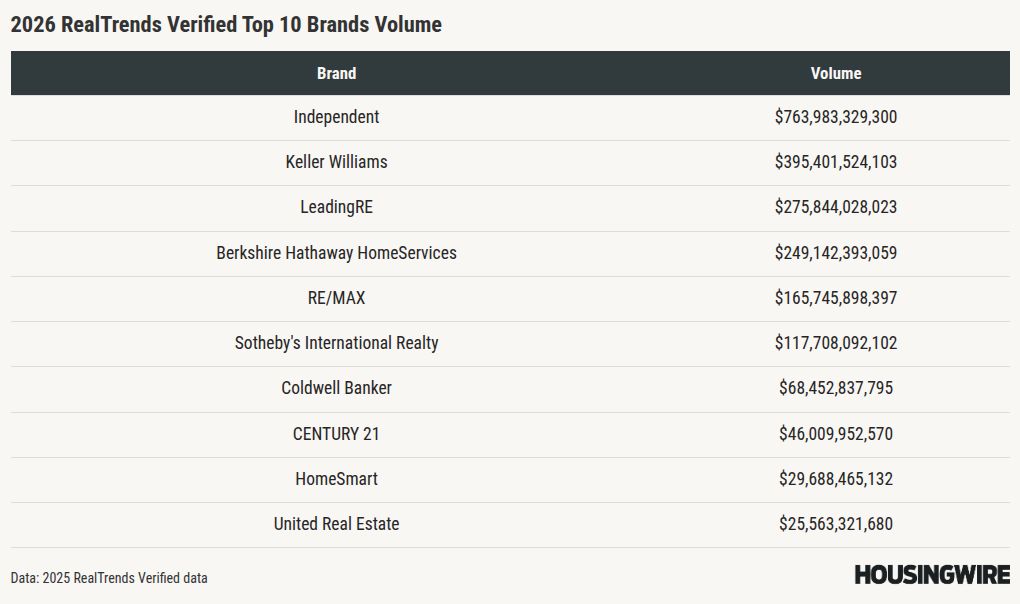
This post was originally published here

The largest U.S. mortgage lenders retained significant market share in 2025, with the top 10 institutions accounting for roughly 23.5% of all originations. That’s according to an analysis of Home Mortgage Disclosure Act (HMDA) data released by Polygon Research.

Data published by the Consumer Financial Protection Bureau (CFPB) shows Rocket Mortgage and United Wholesale Mortgage (UWM) leading the market by loan count.

Rocket Mortgage originated 429,332 loans during the year, narrowly ahead of UWM at 422,120. The two lenders remain far ahead of the rest of the field as CrossCountry Mortgage (CCM) held third place with 125,099 loans.

PennyMac Loan Services took fourth place with 100,816 and JPMorgan Chase took fifth place with 94,243. They were followed by loanDepot, Bank of America, Guild Mortgage, Veterans United Home Loans/Mortgage Research Center and Navy Federal Credit Union.

The 2025 data points to a growing mortgage market alongside continued consolidation among lenders. Total originations rose 10.1% by loan count and 17.8% by dollar volume compared to 2024, while the number of active lenders declined year over year.

The average loan size reached $352,553 in 2025. The average property value was $610,409 and the average applicant income was $195,022. The average interest rate for the year was 6.781%.

By dollar volume, UWM ranked first with $164.3 billion in originations, outpacing Rocket at $116.2 billion. JPMorgan Chase placed third at $66.3 billion.

The next tier of lenders by volume included CCM at $49.1 billion, Wells Fargo at $48.2 billion and Bank of America at $37.3 billion. PennyMac, US Bank, Rate and Mortgage Research Center rounded out the top 10.

The rankings highlight a market in which a small group of large lenders continues to dominate production, even as thousands of smaller institutions remain active. While overall origination activity increased in 2025, the number of reporting lenders declined year over year, pointing to ongoing consolidation across the mortgage sector.

The top dogs

The top three originators based on loan count all experienced advancements in tech, expansions and talent throughout 2025.

In July, Rocket Companies completed a $1.75 billion all-stock acquisition of real estate brokerage Redfin, and in October, it completed its acquisition of Mr. Cooper Group for $14.2 billion.

As part of the deals, Mr. Cooper CEO Jay Bray became president and CEO of subsidiary Rocket Mortgage, and Redfin CEO Glenn Kelman announced his departure at the start of 2026. The company also announced a companywide layoff in July 2025 and offered voluntary separation packages to select employees in March 2026.

Other longtime Rocket employees like Mike Fawaz and Dan Sogorka announced their departures from the Detroit-based company.

But the company’s operations were not at the forefront during Rocket’s full-year 2025 earnings call.

“2025 was where Rocket demonstrated who we are. We acquired Redfin. We acquired Mr. Cooper. We executed and delivered against our goals in every quarter,” CEO Varun Krishna said during the company’s earnings call. “We grew market share to 5.5% in Q4, up from 3.8% the year prior. This is no coincidence. It is the result of strategy and disciplined execution.”

Several tech moves and product announcements, including the introduction of debt-service-coverage ratio (DSCR) and bridge loans, also characterized Rocket’s 2025 business activity.

UWM, meanwhile, announced its own mergers and acquisitions plans just before the end of 2025. In December, United Holding Corp., the parent company of UWM, announced an all-stock deal to acquire real estate investment trust Two Harbors Investment Corp. for $1.3 billion to bring servicing in-house.

That deal, however, fell through after Two Harbors terminated the agreement and instead agreed to be acquired by rival CrossCountry Intermediate HoldCo in an all-cash deal valued at $10.80 per share. The deal would have been UWM’s first acquisition in company history.

UWM’s 2025 was otherwise categorized by multiple incentive programs, including a partnership with Bilt that allows UWM customers to earn Bilt Points each time they make an on-time payment. The company also relaunched its 1% down payment program, Conventional 1% Down, in June 2025 and launched a suite of AI tools ahead of its annual UWM LIVE! event.

CrossCountry continued its upward trajectory following its fourth-place ranking for 2024. The company announced an expanded partnership with digital banking platform Blend and brought on key executives like Brian Covey to drive recruiting efforts.

CrossCountry’s parent also partnered with a fund backed by Ares Alternative Credit and Hildene Capital Management to grow its nonagency mortgage asset management business. The deal included $1 billion in equity commitments, supporting about $20 billion in new investments for CCM’s non-QM platform.

The Ohio-headquartered lender is coming in hot at the start of 2026, not only by usurping UWM’s deal for Two Harbors but also by launching a dedicated builder division to capture purchase share.

This post was originally published on here

New York City’s annual Car-Free Earth Day returns later this month, turning streets across the five boroughs into car-free corridors for recreation and free programming. The event, set for April 25 from 10 a.m. to 4 p.m., will feature several “signature locations” in each borough with activities focused on climate change and sustainability. Citi Bike will offer free one-day passes for its classic bicycles during the event.

Car-free Earth Day on Avenue B in 2022. Credit: NYC DOT on Flickr

“Car-Free Earth Day is a reminder that we only have one planet—and that our streets play a critical role in our fight against climate change,” Department of Transportation (DOT) Commissioner Mike Flynn said.

“Transportation is the second biggest source of carbon emissions in NYC, and finding ways to make clean transportation options quicker, easier, and more affordable is key. We encourage all New Yorkers to come out to enjoy temporary public art, programming, music, and other activities at dozens of car-free streets around NYC.”

Marking the start of the city’s Open Streets season, Car-Free Earth Day launched in 2016 by transforming select Manhattan streets into car-free public plazas. In 2024, the DOT awarded $30 million in contracts to expand Open Streets, plazas, and other public spaces.

The DOT has also commissioned artists to create temporary, environmentally focused works through its public art program for Car-Free Earth Day. The popular NYC Art Stop Letters will appear at the event with an original design by NYC-based illustrator Molly Magnell, highlighting springtime in a car-free urban landscape.

Additionally, the agency will present two new sculptural installations. Interdisciplinary artist Duy Hoàng will present “An Indicating Cycle,” a sculptural book that highlights various indicator species that reflect current environmental conditions due to their sensitivity to climate change.

The “pages” of the work reference figures and diagrams from scientific textbooks and museological specimen drawers. By turning the pages, visitors can learn about the species’ life cycles and their role in environmental stewardship.

A large-scale interactive installation by artist Frahydel Falczuk, “The Plastic Sea,” will evoke the sensation of being submerged in a sea of plastic as a commentary on waste and consumption. Visitors will weave colorful strips of non-recyclable plastic film into green mesh, transforming discarded materials into rippling, immersive surfaces reminiscent of ocean waves.

Signature Car-Free Earth Day events will take place at the following locations:

Manhattan:

  • Broadway between 17th and 46th Streets
  • St. Nicholas Avenue between 181st and 185th Streets
  • Dyckman Street between Broadway and La Marina/Inwood Hill Park

Queens:

  • Woodside Avenue between 75th and 78th Streets

Brooklyn:

  • Fifth Avenue between 41st and 45th Streets

The Bronx:

  • East 188th Street from Grand Concourse to Valentine Avenue

Staten Island:

  • Port Richmond Avenue between Castleton Avenue and Bennett Street

A map of all Car-Free Earth Day 2026 locations is found here.

RELATED:

The post Car-Free Earth Day returns with free events across NYC first appeared on 6sqft.

This post was originally published here

History doesn’t repeat itself, but it frequently rhymes. In the years before the 2008 mortgage crisis, financial “innovations” promised to unlock homeownership for millions. Each new product was marketed as pro-consumer and pro-efficiency, yet each gradually eroded the information needed by the people downstream who were pricing risk. The crisis produced a generation of regulatory reform premised on one simple lesson: when the information underlying credit decisions is distorted, manipulated or concealed, the consequences don’t stay contained to the transaction where the distortion occurred.

Today’s innovation is seller choice in the form of private listings: homes that are marketed extensively before they ever appear on a Multiple Listing Service (MLS), and seemingly with the express purpose of hiding days on market and price drop information. Much of the debate has centered on market fairness and fair housing concerns. But there’s a more systemic problem: what private listings do to the mortgage data infrastructure that sits underneath every transaction.

The landscape is shifting

For generations, MLSs were the central repository of residential market activity, built on mandatory participation and standardized data. While its compulsory nature often rankled agents, the result has been a reliable record used by appraisers, Fannie Mae, Freddie Mac, FHA, the FHFA, and every automated valuation model (AVM) feeding the mortgage origination process. Antitrust law accommodates this arrangement because the cooperative produced something no single firm could produce alone: a standardized, honest market record with data integrity.

The landscape shifted following Sitzer/Burnett and NAR’s subsequent retreat from MLS policy enforcement, which collectively accelerated the breakdown of longstanding cooperation norms. Private listings, once a marginal slice of transactions, have quickly become more prominent. By Q1 2025, Compass – the SoftBank-backed, NYSE-listed brokerage that became the largest in the country following its recent merger with Anywhere – reported that 48.2% of its listings nationally started as private exclusives, nearly 19,400 homes in a single quarter.

No one has championed this model more aggressively than Compass CEO Robert Reffkin. Compass has argued in op-eds, court filings and marketing copy that days on market and price reduction history are “negative insights” and “killers of value.” Lead paint might be considered a killer of home value too, but manipulating the fact of its existence isn’t a marketing choice – it’s concealment. It’s a naturally attractive strategy to sellers, but it deprives everyone else downstream of crucial data.

Price drops and time on market are vital for accurate appraisals

These aren’t arbitrary concepts invented by MLSs. FHFA’s Uniform Appraisal Dataset requires that days on market be considered for every GSE-backed appraisal. GSE standards require appraisers to reconcile a property’s full listing and price-drop trajectory against the broader market’s exposure time, treating these metrics as key evidence of what a home is truly worth.

Days on market and price reduction history are the market’s observable record of exposure: how long a property took to find a buyer at a given price. A home marketed privately for 60 days with multiple price reductions, then placed on the MLS and sold immediately, appears to have sold in one day at full list price. The selling price provides a comparable number, but exposure time provides the context needed to interpret it. The data isn’t just missing from the system, it’s replaced by a signal that suggests the opposite. That laundered sale record becomes a comparable that appraisers are required to draw from, influencing valuations that feed directly into lending decisions and the pricing of mortgage credit.

A niche model now goes mainstream

Until recently, there was reason to think the private listing regime might just be an outlier. There was initial resistance to most listings marketed outside the MLS, but that resistance collapsed quickly. Major portals and large brokerages are now converging on pre‑market products where de facto public listings are paired with suppression of market exposure data during the preview window, with that suppression explicitly marketed as a benefit to sellers. Within the space of a few months, what was once a niche model is quickly becoming mainstream.

Private listings have always had a legitimate place for those who need privacy or discretion, such as domestic violence survivors or executives and public officials with security concerns. “Coming Soon” listings with a reasonable time restriction, or legitimate in-office exclusives, can serve the seller that truly needs extra time. Most MLS policies accommodate those scenarios.

What’s now being sold is intentional suppression of pre-marketing data. This is not merely a disclosure issue at the transaction level; it’s a mortgage integrity issue at the system level.

We have already learned what happens when the information underlying mortgage credit decisions is compromised at scale. The question is whether regulators and industry leaders act before the data is degraded enough to matter, or whether the “liar loans” of the 2000s give way to a more sophisticated and invisible form of data corruption that’s only noticed once it’s too late.

Anthony V. Mannino, Esq. is the CEO of Dual Mind Strategies.

This column does not necessarily reflect the opinion of HousingWire’s editorial department and its owners.

To contact the editor responsible for this piece: tracey@hwmedia.com

This post was originally published on here

The views from Edge at Hudson Yards will extend indoors this year as the Western Hemisphere’s highest indoor and outdoor observation deck unveils a new multi-sensory immersive experience. Created in collaboration with Journey, Moment Factory, and New York-based design firm SOFTlab, Edge, from its 4th-floor entry to its 100th-floor sky deck, has been reimagined in a multi-million-dollar transformation featuring new permanent installations. Debuting this summer, the overhaul also introduces refreshed culinary offerings, including upgraded food and cocktail options, and the return of Marquee Skydeck, one of the city’s highest nightlife venues.

“Pulse” is a fully immersive world of pulsing electric color, light, and sound that reflects the city’s exhilarating energy. “Crystal Cave” invites visitors into a rainbow of translucent jewels that shift color with the movement of the sun from sunrise to sunset.

“Infinite City” features boundless vertical luminous “skyscrapers” that fragment and reframe sweeping city views into a hypnotic series of worlds within worlds. Additional installations are expected to be revealed in the coming weeks.

The new attractions push Edge beyond a traditional observation deck into a fully immersive entertainment experience, expanding its nighttime offerings and engaging guests before they even reach the sky deck.

“Situated 1,100 feet above one of the greatest cities on earth, Edge at Hudson Yards will transform what it means to be a NYC landmark. Guests will be welcomed into a breathtaking, kaleidoscopic world before they even reach our thrilling outdoor sky deck,” Andrew Lustgarten, executive chairman of Hudson Yards Experiences, said.

“The new Edge is driven by immersive design, emotional storytelling, and our desire to create experiences that people want to share and return to again and again.”

Guests will also enjoy a revamped food and beverage experience. Designed by Journey and curated by Tao Group Hospitality, the all-weather eateries will offer small plates, handcrafted cocktails, and signature beverages at Edge’s champagne bar, bringing elevated dining to every visit.

Following a successful debut last year, Tao Group’s seasonal outdoor nightlife experience at Edge, Marquee Sundeck will return on May 1 as a permanent fixture. The venue will feature a lineup of global talent, including MK, Benny Benassi, Cassian, Gareth Emery, Kaz James, Layla Benitez, Hot Since 82, and others.

Edge will be open seven days a week ahead of the launch of the new experiences. General admission starts at $40. Tickets are available for purchase here.

RELATED:

The post Edge at Hudson Yards unveils new immersive installations of light and color first appeared on 6sqft.

This post was originally published here

Tradeweb is looking to expand its footprint into the residential private credit sector. But it didn’t have to build from scratch since it found a partner: Maxex.

Tradeweb, an operator of electronic trading platforms, moves over $3 trillion a day across the fixed-income landscape and commands roughly 80% of the agency mortgage-backed securities (MBS) market. However, the platform lacked exposure to non-agency loans.

Enter Maxex, a digital mortgage exchange built for this market. In early February, Tradeweb announced a strategic investment in and finalized a commercial partnership with Maxex. Financial terms of the transaction were not disclosed.

“Today, the top mortgage originators in the United States are directly connected to Tradeweb – that’s where they’re going every day to sell their agency, TBA, spec pool business, on a forward basis.,” Tom Pearce, Maxex CEO and founder, said in an exclusive interview with HousingWire. “We’ll be able to have on that same landing page where they’re selling their agency, the Maxex icon right there for non-agency.”

The integration is already underway, starting with what Pearce calls the “lowest-hanging fruit”: bulk trading capabilities. Slated to roll out in the second or third quarter, the integration provides an easier technological bridge before the companies tackle the greater complexities of flow execution.

For Tradeweb, the partnership unlocks a highly sought-after asset class for its 3,200 global institutional clients across 85 countries, offering them an efficient way to acquire loans and express a view on credit through the Maxex platform. Furthermore, the partnership will extend Tradeweb’s direct pricing down to roughly 1,500 smaller mortgage originators who previously had to rely on intermediaries and regional broker-dealers to access the market.

Pearce said the ultimate goal is for Maxex, which is tracking to hit $10 billion in trading volume, to compress the time it takes to move a loan from the closing table to an investor. In the interview below, Pearce also discusses the origins of the deal, the ongoing integration process and what this alliance means for the future of the private credit market.

Flávia Nunes: What does the Tradeweb deal mean for Maxex?

Tom Pearce: First of all, we weren’t looking for them. They came to us. When I founded the company 10 years-plus ago, the thesis was to build this independent market utility for the mortgage industry. But a lot of people would say: ‘What do you really want to be when you grow up?’ And it was: ‘We want to be the Tradeweb 3.0 for the residential loan marketplace.’ We’ve always thought about Tradeweb or MarketAxess as interesting models that we wanted to replicate. 

Matter of fact, the group that invested in Maxex, back in 2021, when JPMorgan invested, is the same group that led the consortium investments at JPMorgan into Tradeweb, which basically had ownership from across the dealer community. That’s also a thesis shared by JPMorgan, as where they wanted to see Maxex evolve.

FN: Why did Tradeweb come to Maxex?

TP: They are trading over $3 trillion a day across the fixed-income landscape. They actually hold about 80% of the agency MBS, the TBA markets, and the spec pool markets, which is the predominant way that originators hedge themselves and sell their forward production. They don’t have any non-agency or whole loan exposure. 

Part of what we’ve built is a proven network that’s taken us years to build: this trusted, conflict-free market utility for the mortgage market, and we’ve managed to get over 450 of the market’s leading participants, including every major dealer, plus the Blackstones of the world and other insurance and private credit all trading under the same contractual framework, using identical reps and warranties guidelines through the exchange.

They were looking for a battle-tested piece of infrastructure, platform, network that they could come in and lean into because they already had the agency market covered. Now we’re the non-agency market, which happens to be the largest, the fastest growing component, of the overall mortgage market.

FN: What is the size of this opportunity for Maxex?

TP: They have 3,200 global institutional clients in 85 countries around the planet. If you’re in credit, asset management, risk management, if you’re a broker-dealer, anywhere in the world, you come in every day and you log into two places: Bloomberg and Tradeweb. For us, being able to have that connectivity where everybody’s on everybody’s desktop is a powerful and transformative event, not only for Maxex but also for the mortgage market. We’re a liquidity provider who has facilitated over 270 private label mortgage-backed securities transactions.

FN: How will the connection with the Tradeweb platform work?

TP: Today, the top mortgage originators in the United States are directly connected to Tradeweb – that’s where they’re going every day to sell their agency, TBA, spec pool business, on a forward basis. We’ll be able to have on that same landing page where they’re selling their agency, the Maxex icon right there for non-agency. Assuming they’re signing up with us and the clearinghouse as Maxex, they can also sell non-agency production. It gives access to that same cohort of investors and originators, and one-stop shopping for both agency and non-agency in one place. That’s very powerful.

FN: How do you see this integration amid turbulence in the private credit market?

TP: If you look at private credit in general, it’s bifurcated into two places: corporate private credit and residential private credit. The $2.2 trillion corporate private credit market, alternative lending, has got some big headlines going on right now… What that’s done is it’s caused a tremendous amount of stress within the corporate private credit world.

That other $4.6 trillion residential private credit, that’s where we play, and the component of the residential private credit market, which is everything that doesn’t go to the GSEs, that’s performing phenomenally well. The credit fundamentals within the U.S. housing market are strong. There’s nothing subprime about anything that we do. If you want to do subprime mortgages today, you go to Ginnie Mae. They’re the king of subprime. What we do, we think of in the non-QM and non-agency markets, is traditional bank portfolio lending paper that is traded through our platform.

FN: How is the supply-demand balance in the platform right now?

TP: We have way more demand. A lot of that supply-demand imbalance is, if you call each mortgage in the United States that’s originated a widget, the widget manufacturing — for a lot of macroeconomic issues, between interest rates, the cost of housing, rental homes — there’s just not a ton of underlying widgets or supply of new mortgages being manufactured and put out in the secondary markets at the present time. 

That’s a function of the fact that a lot of people are still in a loan with a coupon below 4%. People are staying in their houses longer, not moving around. At Maxex, there are imbalances there, but there’s a lot of pent-up demand, that once rates come down, or other events may occur, we are ideally positioned to help provide liquidity to that originator ecosystem.

FN: Looking ahead, what is your long-term vision for this partnership?

TP: JP Morgan and Tradeweb are now our board of directors – they look at mortgages as the last frontier of a major large market. It’s the largest credit market in the world, the residential private credit market. Yet it had never been put on the centralized exchange until Maxex. A lot of what we’re doing with Tradeweb is about compressing the period of time between when a loan is closed with a borrower at the closing table, and when it can be sold to an investor or securitized, and compressing that time frame – we call it the velocity of capital. 

The faster we can do that through the exchange and trade with the different processes and technology, what that’s going to result in is better pricing, and it will ultimately help homeowners in the United States get access to mortgages at a lower cost.

FN: To what extent will this increased velocity of capital ultimately benefit borrowers?

TP: The folks that are in the moving business – packaging up, securitizing and selling loans, generally speaking – can only turn in their books somewhere between three and five times a year. Actually, in the best case four times a year for the most efficient ones that we know. That’s because you have to deal with a servicing transfer, custodial review process, third-party due diligence and loan audit. Loans can only be turned over during that period.

Let’s just say, in a 90-day period the loan is sitting on somebody’s balance sheet while it’s getting fixed or getting all of the pay. If we can take that time and cut it in half to 45 days, suddenly, on that same allocation of capital, instead of trying to look four times a year, we can return eight times a year. On the same capital, the return on equity for the dealer community and the folks out there is compressed, and they no longer have that carrying and hedging cost for that period, which translates into more competitive pricing.

FN: What volume is Maxex currently trading, and does the platform deploy its own capital in these transactions?

TP: We are tracking to do roughly $10 billion in volume on the platform, and we think we’ll double that in the next year. We hope to. We think we’ll just keep doubling it every year. We’re not just one buyer. We represent the aggregate liquidity and aggregate buying power of all of the buyers who are on our platform. 

We don’t take any market risk. We don’t take any hedging risk. We never buy a loan without it already being pre sold at a pre-determined price settlement date, and we don’t ever buy anything at one price with the intent of ever marketing it up at a higher price. We are the buyer of the loan from the seller and the simultaneous seller of the loan to the buyer, but before we buy it from the seller, it’s already pre-determined. We completely de-risk that process. We’re a pure technology company. We’re not an aggregator.

This post was originally published on here

Since being rezoned 20 years ago, Downtown Brooklyn has transformed into a dynamic mixed-use district, adding roughly 32 million square feet of new development in residential, commercial, cultural, academic, and open spaces. According to the Downtown Brooklyn Partnership, since 2004, the area has seen over 27,000 housing units completed, with nearly 8,000 units under construction or in the pipeline. As one of the best transit-connected areas in New York City, along with its strong arts and cultural scene, Downtown Brooklyn is becoming a successful example of what a live-work-play neighborhood looks like. If you’re looking to move to the neighborhood, we took a look at some of the best rental buildings to call home.

Some of the properties featured here are part of paid partnerships, which help support our editorial work. All buildings are selected and independently reviewed by the 6sqft team.

The neighborhood

One Hanson Place, formerly the Williamsburgh Savings Bank Tower. Photo by CityLimitsJunction on Wikimedia

For this article, Downtown Brooklyn refers to the area that was rezoned and where most of the new housing has been built, with boundaries roughly at Tillary Street to the north, Court Street to the west, Schermerhorn Street to the south, and Ashland Place to the east.

According to the Downtown Brooklyn Partnership‘s “Development Dashboard,” since the rezoning, the neighborhood saw 169 projects completed, with over 35,500 new homes completed or in the works. Downtown Brooklyn had a record-breaking 2025 for new development, with 4,833 new residential units completed in the neighborhood, a 65 percent increase from the previous record, 2,925 new units in 2022.

With access to over a dozen subway lines within a small area, the neighborhood is among the most accessible in New York City. It sits at the nexus of the charming neighborhoods of Fort Greene, Boerum Hill, and Brooklyn Heights, with lower Manhattan minutes away.

The apartment buildings

300 Ashland
300 Ashland Place

Renderings courtesy of Two Trees

Since opening in 2016, the 35-story apartment building 300 Ashland Place has stood out in the neighborhood for its distinctive, energetic facade. Developed by Two Trees Management and designed by Enrique Norten of TEN Arquitectos, the silver-clad triangular building offers 379 homes in a prime location. Just south of the Barclays Center, above Atlantic Terminal (and its 11 subway lines and Long Island Rail Road access), next to Whole Foods, and within the Brooklyn Cultural District, 300 Ashland is near just about everything.

The building offers 379 apartments, including a mix of studio to two-bedrooms, some with private terraces, all with oversized windows that allow for panoramic city views and lots of natural light. Minimalist interiors include white oak hardwood floors and kitchens with Caesarstone countertops and Bosch kitchen appliances. Every unit comes with an in-unit washer-dryer, dishwasher, and keyless entry.

Tenants of 300 Ashland have access to a full suite of amenities, including a 29th-floor amenity level with a rooftop terrace designed by James Corner Field Operations, the firm behind the High Line and Domino Park. The peaceful terrace has sun decks, grills, yoga platforms, and outdoor seating. There’s also a 24-hour fitness center and a residents’ lounge equipped for work-from-home days.

Current availabilities start at $3,346/month for a studio. The building usually runs close to fully leased, so prospective renters should monitor availability closely or join the waitlist.

Eighty Nine DeKalb
89 DeKalb

A bridge between the brownstones of Fort Greene and the density of Downtown Brooklyn, 89 DeKalb is a 30-story all-electric tower with over 300 apartments. Developed by RXR and designed by Perkins Eastman, the rental building boasts a facade with a series of step-backs, allowing for a select number of terraces throughout. The tower, which broke ground in 2023 and welcomed its first residents last year, also has several green design elements, including a fully electric power system, air source heat pumps, and a smart glass facade.

Apartments, ranging from studios to two-beds, feature floor-to-ceiling windows with glass that adjusts to the sunlight and frame views of Fort Greene Park and the Manhattan skyline. Kitchens feature sleek appliances and dark stone accents, and bathrooms have quartz countertops and Grohe fixtures.

Renderings courtesy of Binyan Studios

The building offers 15,000 square feet of interior and exterior amenities, including a third-floor outdoor space on the north and south sides fully outfitted with grills, wet bars, and landscaping. Inside, amenities include a glass-enclosed library, professional podcast studios, co-working space, a community lounge with a double-sided fireplace and pool table, a screening room, and a fitness studio. Another unique perk of living here is the TULU kiosk, which lets you rent everyday household items to free up apartment space, like vacuums, printers, snacks, and more.

Current availabilities at Eighty Nine DeKalb start at $3,970/month; select units are offering up to three months free for a limited time.

240 Willoughby
240 Willoughby Street

Developed by Fetner Properties, 240 Willoughby is a brand new 32-story rental building across the street from the rolling hills and tranquility of the 30-acre Fort Greene Park. The two-tower development, which has 463 apartments, ranging from studios to two-bedrooms, is conveniently located near several subway lines at Nevins Street and DeKalb Avenue and the many stores and local businesses that dot Fulton Street.

Apartments feature floor-to-ceiling windows, in-unit washer/dryers, wide-plank hardwood floors, and stainless steel appliances. Many homes come with private balconies or terraces. Apartments also boast custom integrated Bluetooth speaker systems.

Residents can access over 30,000 square feet of amenities, including a sprawling landscaped roof deck with sweeping views. Other amenity spaces include a business lounge, yoga studio, fitness center, a pet spa, a dog run, a game room, a playroom, and more. There’s also onsite parking available.

Apartments currently start at roughly $3,200/month for a studio; concessions include up to one month free and a $2,000 look-and-lease special.

11 Hoyt
11 Hoyt Street

Photo by Kidfly182 on Wikimedia

When it opened in 2021, this Downtown Brooklyn building became the first residential project in New York designed by Jeanne Gang, the architect behind the Museum of Natural History expansion and the Solar Carve Tower on the High Line. The bold tower at 11 Hoyt Street, which has a rippled concrete and glass facade, rises 57 stories and includes 480 condominiums, with many units listed for rent by owners.

Residences, designed by Michaelis Boyd Associates, have soaring 10-foot ceilings, large windows with panoramic views, white oak floors, and Italian stone kitchen counters.

The building offers an impressive 55,000 square feet of indoor and outdoor amenities. Residents can enjoy a 75-foot indoor pool and a large private park with a fitness deck, hot tub, sun deck, and playground. There’s also a game room, children’s playroom, co-working lounge, dog park, and more.

Current rentals at 11 Hoyt start at $3,700/month for a studio, $4,950/month for a one-bedroom, and $7,500/month for a two-bedroom.

One Boerum Place

One Boerum Place offers condo-quality luxury rentals at the nexus of Downtown Brooklyn and Brooklyn Heights. Developer Avery Hall originally planned for condo residences, but pivoted to rentals instead due to market conditions following the pandemic. The 22-story building has 138 apartments, 96 of which are market-rate and the remaining are designated as affordable.

Photo credit: Nicholas Calcott

Residences include one-, two-, three-, and four-bedroom units, more than half with outdoor space. Interiors, designed by AD100 design firm Gachot Studios, feature 10-foot ceilings, white oak flooring, and sound-insulated windows. In the kitchen, you’ll find custom-wood cabinetry, polished-nickel countertops, and high-end integrated appliances.

Amenities include a 24/7 doorman, a two-story fitness center complete with Peloton bikes and a yoga room, an indoor swimming pool, a sauna, a pet spa, an entertainment lounge, a children’s playroom, and a parking garage with electric car charging stations.

Current availabilities start at $6,150 for a one-bedroom with private outdoor space. Learn more about the building here.

505 State Street

Courtesy of Pavel Bendov Photos

Designed and developed by Alloy Development, 505 State Street is part of the mixed-use multi-tower development Alloy Block, which will bring 850 total apartments, 100,000 square feet of office space, and two public schools. When it opened in 2024, the 44-story 505 State Street became the first all-electric skyscraper in New York City. The final piece of Alloy Block is One Third Avenue, a 730-foot building with 583 apartments, expected to be the tallest Passive House in the world.

Photo courtesy of Matthew Williams

At 505 State Street, all 441 apartments replace functions normally run by gas with electricity. The units have induction cooktops, heat pump dryers, and natural materials like concrete and wood.

Amenities include a 24-hour attended lobby with a coffee shop, a bike storage room, in-building laundry, a pet wash, and a bodega operated by TULU. There’s also a 3,000-square-foot gym, a yoga studio, a children’s playspace, a reservable lounge, a screening room, and a workspace.

Current availabilities start at $3,895/month for a studio. See all available rentals at 505 State Street here.

The Brooklyn Tower
85 Fleet Street

Photo by Evan Joseph

One of the most-well known buildings in the neighborhood is The Brooklyn Tower, which, literally, stands above all others in the borough. Designed by SHoP Architects, Brooklyn Tower is 93 stories tall, making it the tallest in Brooklyn. The tower rises from the landmarked Dime Savings Bank of Brooklyn, which holds an entry to the residential tower and will eventually have retail space. The building features cascading setbacks and soaring columns, topped by a neo-Deco crown.

Brooklyn Tower studio. Photo courtesy of Tim Williams

The supertall skyscraper holds roughly 400 luxury rentals and 150 condos, with interiors by Gachot Studios and SHoP. After an initial struggle to launch, Silverstein Properties took over the Brooklyn Tower in 2024 and relaunched sales and leasing last year.

Expected to open, belatedly, this fall, the building’s 100,000 square feet of amenity space includes a seven-floor Life Time fitness center. The massive gym has a rooftop pool designed around the historic bank’s Gustavino dome, studio classes and personal training, a luxury spa, co-working and library spaces, and elite strength and functional training spaces. Residents will also have access to sky lounges and terraces on the 66th and 85th floors.

Current availabilities for rentals start at $3,500/month for a studio and go up to $13,010/month for a high-floor three-bedroom.

The culture and lifestyle

Photo by Kidfly182 on Wikimedia

Art and culture have long been associated with the area. Founded in 1861, the Brooklyn Academy of Music (BAM) is one of the oldest performing arts centers in the country. The institution hosts theater, dance, music, opera, and independent films across several venues in the neighborhood. Since 1979, BRIC Arts Media has made contemporary art accessible to the community through events, exhibits, and programming like the annual BRIC Celebrate Brooklyn! in Prospect Park. The Brooklyn Paramount, a French Baroque-style theater from 1928, was used as a gym for Long Island University for several decades before being restored as a theater and reopened in 2024. And there’s the Barclays Center, which opened in 2012 and hosts roughly 70 big-name music acts each year, in addition to being home to the Brooklyn Nets and the New York Liberty.

Gage & Tollner exterior. Photo courtesy of Hamish Smyth for Order Design

For dining out in the area, try Gage & Tollner, a chophouse on Fulton Street that dates to 1879 and reopened in 2021 after being closed for several years, Junior’s, the original location of the Brooklyn diner with the best New York cheesecake, and DeKalb Market in City Point, with a stacked lineup of diverse vendors and two bars. Also, the Michelin-starred Taiwanese dim sum restaurant Din Tai Fung will open on Fulton Street next year.

Day-to-day shopping is easy in Downtown Brooklyn, thanks to a plethora of neighborhood retail, centered largely around Fulton Street. City Point is home to a Trader Joe’s, Target, and Alamo Drafthouse, and several national retailers are located on this block. Discount grocery stores Aldi’s and Lidl opened on Fulton in the last year. Boutique and smaller shops can be found in nearby Boerum Hill and Fort Greene.

Although not home to as much green space as neighboring areas, residents can connect with nature at the newly opened Abolitionist Place Park, designed by landscape architecture firm Hargreaves Jones. The park offers a playground, a water play feature, a central lawn, a paved area with boulders, seating, and a dog run. Bordering the neighborhood is Fort Greene Park, a lovely 30-acre public park with rolling hills, lots of trees, and weekly farmers’ markets. On the other end of the district is Brooklyn Bridge Park, an 85-acre waterfront park with prime views of Manhattan and the Brooklyn Bridge.

RELATED:

The post A renter’s guide to Downtown Brooklyn first appeared on 6sqft.

This post was originally published here

There’s a reason the best brands in the world don’t just launch products. Instead, they use sophisticated pre-marketing strategies that thoughtfully control when and how a product enters the market. 

In retail, one of the most effective of these strategies is the drop: a product released at a specific moment – often for a limited time – to intentionally create buzz, urgency and demand.

There’s a wide range of businesses that engineer ‘drops,’ from luxury brands such as Balenciaga, Hermes and Rolex, to mainstream companies like Apple and Chipotle. 

It allows a brand to control the sales process, build mystique and create demand for future releases. And if pre-marketing is used to sell everything from burritos to iPhones to six-figure handbags, why not real estate? In fact, similar strategies have powered home sales for decades.

Since our founding in 2000, long before multi-phased marketing of listings became a headline issue, we were applying this approach at @properties Christie’s International Real Estate, first in new construction sales, where it helped us maximize absorption and pricing, and later in existing-home sales, through pre-market strategies. 

For us, the approach was never about limiting access. It was about introducing a listing in a more controlled manner to build demand, refine pricing and de-risk the sale before a full public offering. And it consistently yielded great results for our clients.

A test of who gets to define how real estate works

That’s why the recent debate over pre-market listings wasn’t just a dispute between two big industry players. It was a test of who gets to define how real estate works: the free market (practitioners and their clients), or platforms.

Zillow’s attempt to ban listings that weren’t immediately listed on Zillow (even when they were shared in the MLS for all real estate professionals to see) was a push to standardize behavior across an industry that has never been one-size-fits-all. It challenged discretion, consumer choice and agents’ ability to fulfill their fiduciary duties. It reduced strategy to compliance and tried to shift the center of gravity away from the agent-client relationship.

The market didn’t buy it. Agents kept advising clients based on what was in their clients’ best interests, and sellers continued to ask for flexibility given their own unique situations. Meanwhile, buyers, despite all the rhetoric, continued to value early access to listings.

Then came the inflection point. Compass International Holdings’ partnership with Redfin demonstrated that seller choice and consumer visibility were not mutually exclusive. 

The move forced Zillow to confront a simple reality: demand for this approach wasn’t going away. Their reversal, not only dropping the ban of pre-market listings that didn’t appear on Zillow first but also embracing pre-market listings through their own program, was a recognition that the market should determine the system, not the other way around.

Will MLSs come around?

Now that the industry’s largest portal has come to terms with this, it’s time to see if MLSs will too. The market has made it clear that phased exposure is both valued and effective. Listing policies should reflect that and not restrict it. 

In the meantime, Zillow’s recent acknowledgment is a win for agents. It reinforces our role as trusted advisors and validates the idea that how you bring a home to market is every bit as important as where buyers see it – something we’ve known for a very long time. 

It’s also a win for consumers, not in the abstract, but in practice. More options. Better execution. Less risk.

Lastly, the industry has sent a powerful message about control: control over data and intellectual property, control over best practices, and ultimately control over the agent-client relationship.

If we, as agents, hand that control to platforms, we become participants in someone else’s business model. If we maintain it, we continue to evolve as professionals, creating value in complex, high-stakes transactions.

That’s a win for all of us.

Thad Wong is Co-CEO of @properties and Christie’s International Real Estate, part of the Compass International Holdings (NYSE:COMP) family of brands. 

This column does not necessarily reflect the opinion of HousingWire’s editorial department and its owners. To contact the editor responsible for this piece: tracey@hwmedia.com.

This post was originally published on here

Elly Johnson has spent than 40 years in the mortgage industry, with the bulk of that time centered on reverse mortgages. That level of experience gives her the unique ability to train others on various aspects of the federal Home Equity Conversion Mortgage (HECM) and a growing array of proprietary loan products.

Johnson, who’s based in the Atlanta area, serves as the president of All Reverse Pro, a consultancy that helps originators, servicers and other companies with a range of tasks. She also influences the industry through her work as a board member with the National Reverse Mortgage Lenders Association (NRMLA).

Johnson recently spoke with HousingWire’s Reverse Mortgage Daily in a wide-ranging interview that touched on potential changes to the HECM and HECM Mortgage-Backed Securities (HMBS) programs; the challenges that companies face as they look to integrate reverse products into a forward-centric loan stack; and the compliance hurdles that remain even at a time when enforcement actions are grabbing fewer headlines.

Editor’s note: This interview has been edited for clarity and length.

Neil Pierson: Let’s start by talking about your background in mortgage banking and then turn to how you got into consulting.

Elly Johnson: My career in the mortgage industry spans over four decades, which has given me a comprehensive ground-up view of how housing finance has evolved. Over time, with all of my work in the reverse mortgage space, I recognized a critical need for specialized knowledge in this sector. This led me to establish my consulting firm.

As a sole proprietor, I work very closely with professionals in the reverse mortgage space to help them navigate operational complexities, ensure compliance and build sustainable practices within this highly specific market. Looking back, if we want to talk about some of the things that have changed over time, the reverse mortgage industry has made tremendous strides, particularly in consumer protection and portfolio stability.

I think two of the most significant issues we have successfully addressed are borrower sustainability and spousal protections. Implementation of financial assessment was what I consider a watershed moment and ensured borrowers actually have the capacity to maintain their property charges, which drastically reduced tax and insurance default rates.

While we’ve secured a much safer product for consumers, there’s still vital work to be done, in my opinion. In my role as chair of the NRMLA HUD Issues Committee, a primary focus remains on regulatory clarity and streamlining operations. We are continuously working with HUD to refine HECM guidelines so they’re more adaptable to current economic realities and liquidity challenges.

Pierson: RMD has spoken to several people about the potential improvements to the HECM and HMBS programs. Everybody has cited the principal limit factors and upfront mortgage insurance premium as hurdles. There’s even been suggestions to simplify the programs and potentially remove the borrower counseling requirements. What are people telling you about these proposals?

Johnson: I’d say the recent HUD request for information (RFI) couldn’t have come at a more critical time. Through my consulting work at All Reverse Pro and discussions on the NRMLA HUD Issues Committee, the feedback from lenders, servicers and issuers has been remarkably consistent. The industry is currently facing dual challenges — severe liquidity constraints on the secondary market side and restrictive barriers to entry on the consumer side.

The absolute primary pain point many issuers are facing, I think, is liquidity. Under the current rules, when HECM balances reach 98% of the maximum claim amount (MCA), issuers are obligated to buy them out of the Ginnie Mae pools. This buyout requirement places an immense, often unsustainable strain on their capital.

Furthermore, on the originations side, clients repeatedly tell me that while senior interest remains high, borrowers are experiencing sticker shock. The flat upfront mortgage insurance premium (MIP) represents a significant hurdle for them. And with today’s conservative principal limit factors, many seniors simply cannot access enough of their equity to meet their needs or make the loan mathematically viable for them.

Pierson: Specific to the HMBS 2.0 proposal, is there anything you can share? It looked like it was nearing the finish line at the end of the Biden administration, but now it’s been put on hold.

Johnson: Not specifically, other than just to say that NRMLA and the executive committee are currently working on some responses to Ginnie and the Federal Housing Administration (FHA) around that. But I can’t really give you many details on that at this time.

Pierson: In your consultancy, you help lenders scale up or implement new reverse mortgage programs. Are there many traditional forward mortgage lenders looking to expand into this space, and how would they go about doing that?

Johnson: The demographic data is undeniable and scaling up to meet this demand is a strategic conversation I have daily through All Reverse Pro. My firm actively partners with forward lenders to assess their operational readiness for this anticipated volume.

Preparing for this shift isn’t just about aggressively adding headcount; it’s about building compliant, efficient workflows and robust back-end infrastructures that can absorb growth while maintaining a high standard of care that this specific demographic requires. Forward lenders, in my opinion, should absolutely be exploring the reverse space, but their eagerness needs to be paired with careful preparation. Tapping into record levels of senior home equity should be a natural product extension to serve aging clients holistically.

In my opinion, a reverse division cannot simply be bolted on to an existing forward mortgage operation. If there’s one thing I’ve learned in my four decades in the mortgage field, it’s the operational pitfalls of treating a HECM like a traditional refinance. It requires dedicated leadership, specialized processing and customized compliance frameworks to succeed.

The biggest challenge in training new professionals, especially those transitioning from the forward side, is facilitating a complete paradigm shift. Traditional mortgage focuses heavily on debt to income and paying down a balance. A reverse mortgage is just that, a mortgage, but it’s fundamentally a cash-flow and retirement planning tool. The regulatory environment is incredibly specific.

The nuances of HUD guidelines like financial assessment and consumer safeguards has a steep learning curve, so effective training has to go far beyond software origination mechanics. It requires instilling a deep financial acumen, if you will, and empathy for the senior borrower.

Pierson: There are technology challenges between the forward and reverse channels. At the 2025 NRMLA Annual Convention in Minneapolis, Reverse Market Insight (RMI) explained the new tool they’ve introduced to help people coming over from the forward side. The technology is very disparate, right?

Johnson: Yes, crossing over into reverse mortgages certainly comes with its challenges for forward lenders — it can feel like learning a completely different language. But there is a tremendous amount of innovation happening right now to bridge that exact gap.

Take AI, for example. I know it’s the buzzword everyone is talking about, but it’s actually being put to highly practical use in our industry in a few key ways. A prime example of this lender-focused innovation is the new platform from REVERSE Plus. They’ve developed software specifically designed to remove the friction for forward loan officers looking to add reverse products to their portfolios.

Instead of just handing you a complex calculator, their software suite focuses heavily on training and comprehension before execution. It represents a major shift in the industry: moving away from just running calculations, and toward actually empowering you with the knowledge and vocabulary needed to confidently delve into the product.

Pierson: You do a lot of work around risk management and compliance. With reverse mortgage issues that might be handled by the Consumer Financial Protection Bureau, for example, the CFPB’s staff is obviously much smaller than it used to be and there’s been a recentered focus away from enforcement of regulations. What do your client discussions in that area focus on at present?

Johnson: Through my daily work with All Reverse Pro, I see lenders and servicers who are consistently zeroing in on a few critical risk management areas on the servicing side, because the Home Equity Conversion Mortgage is a life cycle product. The risk profile is unique.

I constantly emphasize that improving customer service actually begins long before the loan reaches the servicing phase. We’re pushing the industry to set highly realistic expectations at the origination level about what happens after the loan closes. Borrowers need to clearly understand that their servicer might change. They need to understand how to read their annual statements and the critical importance of returning their annual occupancy certificates.

Through NRMLA, we’re actively rolling out enhanced training for originators, focusing specifically on the transition from onboarding to maturity, so the handoff to servicing is seamless and that borrowers never feel abandoned. Some other primary focal points are managing property charge defaults, specifically taxes and insurance, and ensuring the flawless execution around trigger events like the borrower’s passing. Properly handling nonborrowing spouse transitions, managing life expectancy set-asides (LESAs) and delivering accurate, timely payoff statements are some of the areas where I see companies actively tightening their internal controls to help mitigate risk.

Adapting in this environment requires far more than reactive compliance. And it’s abundantly clear that the CFPB’s updated examination procedures demand extreme proactivity on the lenders’ and servicers’ part. To thrive in this shifting environment, companies have to build incredibly robust compliance management systems to ensure that their staffing models can genuinely support the complex, high-touch needs of the aging demographic they’re serving.

This post was originally published on here

Though I’ve never taken a marketing class, I remember fellow students quoting the famous Philip Kotler, who said that marketing is “the creation of demand.”  Simplistic to be sure, but a useful shorthand for that many-splendored thing that many of us do for a living.  We market to create demand, which enables us to sell our products and services.  A neat formulation. 

In recalling that, I realized what is broken in the “marketing” of Housing. We are doing a poor job of creating demand. 

Here, a digression is warranted.

Out for drinks with two well-heeled early-thirty-somethings, we got to talking about housing. In the course of the conversation, it turns out that both were renting apartments and that neither had any plans or desire to buy a house. Both sought ease and freedom over homeownership.  Both sought flexibility, mobility, and the appurtenances that come with high disposable income. 

I myself am drawn like a moth to the flame of freedom, and might do it differently if I could do it again.  I’ve been lucky that the house my wife and I bought in 2005 has appreciated, but owning it has come at a real cost- high mortgage payments, jitters when it went down in value for years, and anticipation of high costs when things, well, break down.  The costs of maintenance are high, and the pressure of “lock-in” is real.  Still, I found myself wanting to lecture on both the financial importance of homeownership and the idea that generational wealth must be built. Neither person has kids or wants kids, and, as such, the latter idea wasn’t particularly moving to them. Homeownership represented restriction to them, not freedom.

In housing, we assume that people want to own and our marketing presupposes this desire.  We talk endlessly of our rates, easy processes, and great brands and reputations.  But we market using a sort of “after the fact” methodology, forgetting Kotler’s basic premise that if we were marketing well, we’d be creating demand, not simply assuming it exists. The presupposition that demand exists or is natural is a bad one and simply does not apply to a vast swath of people for whom the “American Dream” lies elsewhere.

In a complex world, with many life narratives possible, and with a growing consciousness of living life in ways different than the cookie-cutter, post-War halcyon zone, Housing is more of a metonym than a true desire.  Sure, millennials will say they see homeownership as a distant dream, but I’m increasingly convinced that here, “homeownership” is a metaphor for financial success and stability, not about the house itself. When millennials say they can’t imagine a path to homeownership, they are really saying that they cannot imagine a path to financial freedom. The house is incidental. 

If we’ve missed one mark in “housing marketing,” it is this- we make a set of assumptions that all people are alike in their desires, and forget the basics- that as with all things, demand has to be created not just presupposed. 

That pivot is essential if we are to work to convince those who can afford homeownership but choose to avoid it that homeownership has untold advantages. Marketers must make assumptions but not stick to them rigidly in the face of massive changes in the desires, dreams, and decisions of an ever-changing population.  

Romi Mahajan is the CEO of ExoFusion.
This column does not necessarily reflect the opinion of HousingWire’s editorial department and its owners. To contact the editor responsible for this piece: zeb@hwmedia.com.

This post was originally published on here

War-time economics have, of course, sent gas prices skyrocketing, but have also pushed mortgage rates higher over the last five weeks, from a low of 5.99% to a high of 6.64%. Rates have fallen a bit recently, but higher rates have slowed some of the housing data down.

In the past, mortgage rates above 7% would have dampened the data, but we still haven’t broken above 6.64% in 2026. Let’s take a look at this weekend’s Housing Market Tracker data to get a sense of where we are at, since we are on day 36 of this conflict with Iran.

Weekly pending sales

Our weekly pending home sales data provides a week-to-week perspective, though results can be affected by holidays and short-term fluctuations. Until last week, we had a streak of six weeks in a row showing year-over-year growth, but even though week-to-week data grew last week, the streak of positive weekly year-over-year growth ended with a small decline. We had some year-over-year decline data earlier in the year, but most of that was due to the epic snowstorm.

Weekly pending sales usually take 30-60 days to hit the sales data. Typically, mortgage rates above 6.64% and breaking over 7% really impact the data. Under 6.25% has been the sweet spot over the past several years, excluding short-term variables.

Weekly pending sales last week over the last two years:

  • 2026: 70, 676
  • 2025: 72,191

Total pending sales

I don’t traditionally show our total pending sales data, as it’s more of a moving average and doesn’t capture the week-by-week volatility I like to track with our weekly pending sales. With that said, as you can see below, total pending sales data still shows clear growth compared to 2025, as most of our weekly data in 2026 has been positive year-over-year.

A big theme of my work this year is that housing data hasn’t been that exciting, as rate volatility was very low early in the year, but it is now starting to pick up due to the length of the Iran conflict.

Total  pending sales last week over the last two years:

  • 2026: 380,914 
  • 2025: 367,777

visualization

Mortgage purchase application data

Purchase application data is a forward-looking indicator: growth here leads home sales by roughly 30-90 days. Last week, we saw year-over-year growth slow from 5% to 1% with a week-to-week decline of 3%. So, higher mortgage rates are impacting this data line a bit more clearly, but nothing too negative yet. 

For this data line, what I really value is at least 12-14 weeks of positive week-to-week data. If we can get that positive week-to-week data to go with year-over-year growth, then we have something cooking. For 2026, every week has shown positive year-over-year growth, but that growth rate has slowed for the last two weeks. 

Here’s 2026 so far:

  • 5 positive week-over-week prints
  • 6 negative week-to-week prints
  • 1 flat week-to-week print
  • 7 weeks of double-digit year-over-year growth
  • 12 weeks of positive year-over-year growth

visualization

10-year yield and mortgage rates

In the 2026 HousingWire forecast, I anticipated the following ranges:

  • Mortgage rates between 5.75% and 6.75%
  • The 10-year yield fluctuating between 3.80% and 4.60%

When the Iran conflict started, I talked about how I would be shocked if it continued past March 21 because of the economic implications of war, including higher energy and input costs, especially in a mid-term year. The longer the conflict goes on, the more problematic it becomes not only for our economy but for the world. Remember, tankers are very big, slow-moving ships, so you can’t flip a switch for speed here.

Two Fridays ago, I wrote about how the 10-year yield was starting to diverge from the oil trade, meaning oil prices were heading higher, but the 10-year yield wasn’t following along. Last week was another example of that, as oil prices rose after Trump’s very hawkish address to the nation. However, the 10-year yield never rose above 4.48%, the year’s high so far, during trading hours. I believe the 10-year yield is trying to get ahead of the deal because it isn’t so tied to the supply of oil but more to Fed policy.

visualization

Mortgage rates ended the week at 6.45%, according to Mortgage News Daily, and Polly’s mortgage rate lock data shows a weekend rate of 6.51%.

Mortgage spreads

Mortgage spreads remain a positive story for housing in 2026, as mortgage rates would have easily been over 7% in 2023, 2024 and close to 7% in 2025, with the worst levels of the spreads. However, the spreads, which were getting worse in February as yields fell, compressing volatility on the downside, are now heading even higher with this war. But even now, as you can see below, we are still at better levels than the past two years.

visualization

Historically, mortgage spreads have ranged from 1.60% to 1.80%. Last week, spreads closed at 2.11%. 

However, I wanted to compare last week’s rates to the worst levels of the spreads over the past three years, with the 10-year yield at its current level.

  • If we had the worst mortgage spread levels in 2023, mortgage rates would be 7.45% today, not 6.45%.
  • If we had the worst levels of 2024, mortgage rates would be 7.07% today.
  • If we had the worst levels of 2025, mortgage rates would be 6.88% today.

Housing inventory

The seasonal increase in housing inventory is now in full swing. That said, the growth rate of inventory has really slowed from last year’s peak levels. However, we are far from the unhealthy levels seen in 2021, 2022, and 2023, which is a huge positive for housing.

We have gone from 33% year-over-year growth in inventory at the highest point in 2025, to 4.67% last week. In the past, inventory growth picked up amid higher rates, softening demand and rising year-over-year new listings. 

  • Weekly inventory change: (March 28- April 3): Inventory rose from 713,549 to 723,460
  • Same week last year: (March 29 -April 4): Inventory rose from 675,557 to 691,173

visualization

New listings

I have been disappointed with the new listing data this year. New listings had a slow week and was negative year over year. We should get new listings above 80,000 per week during the seasonal peak months, which would be on the low end of the number we would see in a normal period.

I am hoping for the new listings data to range between 80,000 and 100,000 per week during the seasonal peak periods, as it did from 2013 to 2019. However, it’s looking less and less likely that this will occur. For context, during the housing bubble crash, new listings ranged from 250,000 to 400,000 per week for several years.

Here is last week’s new listings data for the past two years:

  • 2026: 70,191
  • 2025: 71,777

visualization

Price-cut percentage

Typically, about one-third of homes undergo price reductions before they sell, reflecting the dynamic nature of the housing market. As mortgage rates and inventory rise together, the percentage of price cuts increases.

In my 2026 home-price forecast, I had a negative 0.62% call for the year nationally. However, mortgage rates were lower than I thought they would be at the start of the year, and the FHFA’s announced purchase of mortgage-backed securities pushed mortgage spreads lower than I expected. I believed we would see that improvement later on in the year; spreads are higher than that level today due to the conflict. 

So, before the conflict started, my forecast for 2026 turned out to be wrong. Now, if rates head higher and stay higher for longer, I do have a shot at my call being more correct. Still, the percentage of price cuts is below last year at this time.

The price-cut percentage for last week:

  • 2026: 34.44%
  • 2025: 35%

visualization

The week ahead: Iran, Iran, Iran, inflation and existing home sales

Of course, as always, the conflict with Iran will be the main theme until this conflict ends; we can’t break out of the short, medium and long-term implications of this conflict to the economy until that happens. We do have inflation data and existing home sales coming out this week, along with some other reports, but the Iran conflict is still front and center after we gave Iran another 48 hours to make a deal or else.

This post was originally published on here

Just a 30-minute drive outside Dublin sits the Village at Lyons, a privately owned village dating back to the 18th century. It recently went on the market for $23,078,698. 

The village sits on 20 acres and has 47 bedrooms. Some additional features include a caretaker house, a carriage house, a guest house, a fitness room, and a yoga space. It also has lake, river views and an indoor and outdoor spa.  

Part of the village dates back to the 18th century and was left abandoned for many years before the co-founder of Ryanair, Dr. Tony Ryan, bought it in the 1990s and put millions of dollars into restoring it and recreating the original village, David Byrne, Lisney Sotheby’s International Realty’s managing director, told Redfin News. 

When Ryan passed away in 2007, the village was sold to a private owner who is now selling it. 

“It’s almost like stepping back in time. It’s an architectural wonderland. The attention to detail in every single element of the village front, the windows, the doors, the chimneys, is utterly remarkable. It’s very much evidence of someone who has a phenomenal eye and brought world-class restoration to this project. It’s a really unique Irish estate village. Everywhere you look, there is something new and unique to see. It’s a masterpiece in its own right,” Bryne said. 

The village also has two bars, a coffee shop, and a corporate event space that could easily be adapted for other uses, Byrne added. 

In addition to the 47 bedrooms, the village also has a chapel on the grounds.

At the moment, the village is run as a hospitality destination. A stay at the hotel on the village grounds starts at $269 a night. 

“It is a magnificent place. You can literally feel the passion that went into restoring it at every turn. It has this unworldly feel about it once you’re through the gates. It’s a truly special place,” Bryne says. 

The carrying costs are being kept confidential while the village is on the market,” he added. 

“The ideal buyer could be somebody in the hospitality space who sees an opportunity to elevate this village even further and unleash the full potential of this village. It could equally be somebody who just thinks it’s the most wonderful opportunity to own a private estate in Ireland [41 miles] from Dublin,” Byrne said. “We’re kind of looking forward to finding out who the next owner is, in truth. Whoever it is, it will be somebody who appreciates the cultural significance of the village and they would become a steward of the village. What they do with it will be amazing to see.”

The post Ryanair Co-Founder Restored An 18th Century Village in Ireland and now it’s up for sale for $23 million appeared first on Redfin Real Estate News.

This post was originally published here

As crazy as this may sound, the jobs data in 2026 has improved from the levels of 2025. That’s how low the bar was this year for growth and today’s jobs report reaffirmed that. Now, with a bar so low we can all trip over it, context is key.

Over the last six months of job creation, we averaged 15,000 jobs per month, but year-to-date, we are averaging 68,300 jobs per month. I know, I know, that doesn’t sound like a lot, but for the Federal Reserve, that is good enough to keep slowly heading toward neutral policy. With the Iran conflict still ongoing and inflation above target, this is the kind of jobs report that will keep the Fed on hold for now in terms of lowering the Fed funds rate while the conflict goes on.

So, let’s take a look at the jobs report.

From BLS: Total nonfarm payroll employment increased by 178,000 in March, and the unemployment rate changed little at 4.3 percent, the U.S. Bureau of Labor Statistics reported today. Job gains occurred in health care, in construction, and in transportation and warehousing. Federal government employment continued to decline.

We saw growth in multiple sectors, which is what you want to see in the jobs report, and which we haven’t seen over the past year. If we can get reports like this and still carry over 60,000 plus jobs per month, the Fed will be totally fine with the jobs data as long as jobless claims and the unemployment rate are low. Which means they won’t be cutting rates aggressively anytime soon.

Of course, as the labor force grows more slowly and fewer people are looking for work, the unemployment rate can stay lower for longer, even with job growth slower than in previous years. However, so far in 2026, job growth has been better than last year.

visualization

Key labor sector

One of the key recessionary labor data lines that I track with economic cycles — residential construction labor — picked up just a tad in this report, but is off the recent highs. However, as you can see, it’s not a clear breakdown lower as we have seen in other cycles, where it was very apparent. Usually if you are going into a recession, this sector tends to lose jobs aggressively, so it’s one I keep an eye on. 

visualization

Specialty contract labor data has also stopped declining.

visualization

So much of the job growth over the last year has come from healthcare and social assistance jobs that it’s nice to see a jobs report with some breadth. However, I need to see two things to take this trend seriously. No. 1: No big negative job revisions in the future. We didn’t see that in this report, which was good. No. 2: Growth in the construction and manufacturing sectors. If that can continue, it would be a plus and a divergence from the labor reports in 2025.

Conclusion

I know this jobs week felt different because of the conflict in Iran and all the world drama we are dealing with. In fact, on today’s episode of the HousingWire Daily podcast, I discuss whether higher oil prices could take us into a recession. But looking at today’s report, the jobless claims data is still very low, and the labor market isn’t breaking as it has in every other economic cycle we have witnessed post WWII.

So, for now, the labor data is doing slightly better in 2026 than in 2025, although the Iran conflict is taking control of the economic headlines these days.

This post was originally published on here

This duplex condo atop Pickwick House at 35 Bethune Street may be in the heart of downtown Manhattan’s coveted West Village, but details like exposed brick and hefty beams give it the feeling of a home in the high desert. Private terraces surrounded by tall grass magnify the desert paradise effect even more. Asking $5.2 million, it’s a rare oasis in the city.

On the main level of the duplex, 13-foot wood-beamed ceilings and oversized windows frame a large living space. A wood-burning fire place adds warmth and anchors the room. Custom glass-and-steel doors open onto one of the home’s two terraces.

There’s plenty of room for both formal and casual dining. The open main space includes a large modern kitchen with open shelving and stone worktops.

Upstairs, a luxurious primary suite features downtown skyline views via a wall of windows; electric shades wrap the room in privacy at the touch of a button. This bedroom is served by custom closet-lined dressing room and a renovated bathroom with a Speakman dual shower system.

The best thing about this Village retreat may be the landscaped terrace with an integrated irrigation system. Step out and settle in for sunrises and sunsets over the city and views on three sides.

There is also a second bedroom with its own renovated bath. An extra space is carved out on the home’s mezzanine level for use as a home office, den or spare bedroom.

Built in 1880, the quintessential loft building–now a 21-unit condominium–is part of the historic neighborhood, surrounded by parks, restaurants and a vibrant street scene. Amenities include a key-locked elevator, a video intercom system, a washer/dryer on each floor, and a superintendent on-site during the week.

[Listing details: 35 Bethune Street, PHB at CityRealty]

[At The Corcoran Group by Alexandra Rhodie]

RELATED: 

The post This $5.2M penthouse brings a western vibe to the West Village first appeared on 6sqft.

This post was originally published here

Northwest Multiple Listing Service has filed counterclaims in federal court against Compass, alleging the brokerage’s “three-phase marketing program” is a deceptive scheme that hides listing data from the public and violates Washington’s Consumer Protection Act.

In the filing, the Kirkland, Wash.-based MLS argues that Compass’ strategy of scaling so-called “pocket listings” creates a “two-tier” marketplace, with fuller access for Compass-affiliated buyers and a depleted set of options for the general public and competing brokers. The counterclaims were filed in a federal case in which Compass is a plaintiff and NWMLS is a defendant.

“Across the country, we are seeing a clear trend that consumers want more choice, transparency and flexibility, and are pushing back on industry-imposed mandates,” according to a Compass spokesperson. “We stand with consumers, real estate professionals, homeowners, homebuyers and competition.”

Washington law now mirrors NWMLS listing rules

NWMLS said in its filing that its long-standing listing transparency rules have effectively been written into state law. Senate Bill 6091, which takes effect in June, requires brokers in Washington to market properties broadly to the public and to other brokers.

That standard — open, public marketing of residential listings rather than limited exposure to select buyers or internal networks — has been a core rule of the broker-owned MLS for decades, the organization said in the counterclaim.

For brokers and teams operating in Washington, the combination of MLS rules and SB 6091 means marketing strategies built around off-MLS exposure or extended private “coming soon” promotion will face heightened legal and regulatory risk once the law is in force.

Allegations: data manipulation and reduced seller proceeds

NWMLS’ counterclaims center on three main allegations about Compass’s “three-Phase Marketing Program” and related practices:

  • Resetting market history: The MLS alleges Compass “wipes the slate clean” by artificially resetting days-on-market and price history when a property moves from off-market phases to the open market, which NWMLS says misleads buyers about true demand for a home.
  • “Pocket listing” tax on sellers: By limiting exposure to internal or exclusive groups, NWMLS argues Compass suppresses the “public auction” effect of broad marketing that typically drives higher sale prices. The counterclaim cites data from Compass partner Redfin showing homes sold off-market generally sell for less than comparable MLS-listed homes.
  • Contract interference: NWMLS alleges Compass encouraged and incentivized its brokers to violate professional agreements with the MLS in order to prioritize corporate growth over transparency and consumer interests.

Justin Haag, CEO of NWMLS, framed the case as a broader test of how residential inventory is shared and monetized.

“This case is about more than just MLS rules; it’s about putting people over corporations,” Haag said in a statement. “We are standing up for the principle that every family has the right to see every home for sale, because housing data belongs in the sunlight, not in a private vault. It is time to make the housing market more equitable for everyone instead of simply making real estate CEOs richer.”

According to a Compass spokesperson,

“Instead of focusing on solutions that benefit consumers and promote competition, NWMLS is retaliating against us for exposing its illegal scheme to deprive homeowners of their rights and block competition. This is how monopolists like NWMLS treat their customers. NWMLS is not focused on serving consumers, or even the real estate professionals who rely on it.”

Why this matters for brokers and consumers

The dispute underscores growing legal and regulatory scrutiny of listing access, data transparency and the use of off-MLS marketing channels. Pocket listings, private networks and extended “coming soon” periods have been popular with some brokerages and teams seeking differentiation or exclusivity.

For brokers and agents, the NWMLS action signals that enforcement around off-MLS strategies in Washington is likely to tighten as SB 6091 comes online. Firms may need to review pre-market and internal marketing programs, listing agreements and compliance policies to ensure they align with both MLS rules and state consumer protection law.

For consumers, the case will help define how much listing data must be shared and how quickly, and whether private networks that restrict access to inventory can coexist with emerging state mandates for broad, public marketing of homes for sale.

Tracey Velt reported and wrote this article with drafting assistance from HousingWire Automation, an editorial tool that helps transform announcements and industry data into HousingWire-style news coverage.

This post was originally published on here

New York City is increasing housing density, though much of the early progress stems from state law changes and rezonings that predate Mayor Zohran Mamdani’s administration.

Those moves are now starting to show up in steel and concrete, even as Mamdani advances his own housing agenda.

The clearest example is in Midtown South.

City officials issued permits for a mixed-use project that will rise 32 stories on a lot that now holds a two-story building. It is one of the first towers to fully exploit the higher residential floor-area ratio (FAR) now allowed after state and city officials scrapped 1960s-era limits adopted amid fears that higher density would cause trouble.

Instead, the city’s affordability worsened until the Big Apple became one of the world’s most expensive places to live. Over the past several years, city and state leaders have focused on improving affordability by changing zoning and cutting red tape that impedes construction.

With the new zoning changes in place that will benefit him, Mamdani is pressing forward with his own initiatives to shred red tape and speed up housing construction in a bid to improve affordability. His team is pushing permitting and financing changes designed to move projects on public land more quickly from concept to groundbreaking, and to make smaller infill developments pencil out in more neighborhoods.

Law changes increase density

State lawmakers changed the law affecting FAR in 2024 to allow New York City to build more densely. Then-Mayor Eric Adams followed the same year with City of Yes for Housing Opportunity, a sweeping zoning amendment aimed at easing rules so more housing could be added in every neighborhood. The package expanded where multifamily buildings can be built and commercial-to-residential conversions can happen. It also legalized more accessory dwelling units.

Under the change, certain high-density districts can now reach residential FARs of 15 and 18 when projects include permanently affordable apartments, a dramatic increase over what Midtown South sites could previously build as of right.

“For decades, the FAR cap limited the size of new buildings,” NYC Planning officials wrote in a social media post.

Density limits arose in a 1961 rewrite of the state’s Multiple Dwelling Law to prevent so-called “vertical slums” that could overwhelm urban infrastructure, as the political influence of urban planning legend Robert Moses started to wane.

Mamdani’s approach

Mamdani is trying to put his own stamp on the housing landscape, building on rules put in place before he took office.

His administration recently launched “ADU for You,” a digital platform the city commissioned from WXY Architecture + Urban Design. The package centers on pre-reviewed plans for small backyard cottages, basement apartments and attic conversions that the city legalized in late 2024. In addition to a guidebook, it offers a zoning checker and cost estimates to help one- and two-family homeowners decide what they can build.

New York City is adding its own twist with the Plus One financing program. The initiative can provide substantial low- or no-interest assistance to eligible owners who agree to keep the new units affordable, an attempt to blunt high construction costs and spread ADUs beyond the wealthiest ZIP codes.

Mamdani is also chasing a far more epic victory in housing development. He has revived a decade-old proposal to build roughly 12,000 affordable units on a platform over Queens’ Sunnyside Yard, a 180-acre freight and marshaling hub. The idea is not expected to go far.

Success in building more affordable housing may be more incremental. Mamdani recently announced Neighborhood Builders Fast Track, a program meant to accelerate affordable projects on city-owned land.

He said during a press conference that the program, combined with referendums approved last November, could shave two and a half years off the time it takes to build housing in New York City.

“I say that to you in a city where we know that time is money,” Mamdani said.

City Hall projects that the new program could add up to 1,000 affordable homes over the next two years.

City weighs density gains against luxury risks

Paired with the new latitude on residential FAR, that kind of city-led pipeline shows how abstract policy starts to solidify into steel and concrete. Taller projects, such as the Midtown South tower, near jobs and transit, are essential if the city hopes to close its housing deficit.

Preservation and neighborhood groups counter that the same tools could fuel a wave of luxury construction if the city does not tightly police affordability and displacement. The Midtown South project may serve as an early test of whether the new framework will deliver the promised mix of income-restricted and market-rate units.

This post was originally published on here

New York City baseball fans will find plenty of new food options this season, as both the Yankees and Mets have rolled out updated menus at their stadiums. At Yankee Stadium, offerings include longtime favorites like celebrity chef Bobby Flay’s “Bobby’s Burgers” and Christian Petroni’s “Parm to Table,” along with local newcomers such as Magnolia Bakery. At Citi Field, which has been nominated for best ballpark food by USA Today for the fourth consecutive year, fans can try 37 new dishes, including concepts from chef Kwame Onwuachi, who is introducing a chopped cheese patty served on coco bread.

New food offerings at Yankee Stadium:

Magnolia Bakery
Known far and wide for its signature banana pudding, NYC’s own Magnolia Bakery is making its Yankee Stadium debut this season. While it’s not offering the pudding at the stadium, it will be offering its beloved brownies and blondies, offering a sweet treat for baseball lovers.

Blondies

Treat House
Another new addition to the stadium’s lineup, Treat House will serve creative takes on the classic rice crispy treat. The vendor will offer a range of gourmet flavors for fans seeking a sweeter alternative to traditional ballpark fare like hot dogs and pretzels.

Yankees Rice Crispy Treat

Brooklyn Dumpling Shop
A returning favorite, Brooklyn Dumpling Shop is introducing two new menu items this season: an apple pie dumpling filled with apple pie and topped with caramel, cinnamon, and powdered sugar, and a mac and cheese dumpling made with ditalini pasta and a three-cheese blend.

Apple Pie Dumplings

King’s Hawaiian’s
For the 2026 season, King’s Hawaiian’s will offer an “Angry Lobster Roll” and a chicken parm sandwich made with flash-fried chicken, basil marinara, and mozzarella on a soft pretzel bun. The “It’s 99 Burger” will also return, featuring two four-ounce American Wagyu beef patties, American cheese, caramelized onions, dill pickles, and secret sauce on a pretzel bun.

Angry Lobster Roll

Christian Petroni’s “Parm to Table”
Bronx native Christian Petroni’s “Parm to Table” concept brings his Italian-inspired dishes to Yankee Stadium. New this year is an antipasto salad featuring artisanal cured meats and cheeses, flash-fried house mozzarella with eight-hour marinara sauce, a selection of pasta dishes, and the “Petroni Affogato,” made with Mister Softee vanilla panna, Nutella, and espresso. The “Petroni Tiramisu,” served in a souvenir helmet cup, will also return this season.

Mozzarella en Carrozza

Legends Global
Legends Global, Yankee Stadium’s official food, beverage, merchandise, and operations partner, will introduce a range of new dishes and drinks across the venue. Led by executive chef Robert Flowers, new offerings include an “MVP Burger,” a new take on the 99 Burger; apple pie nachos; a “Diamond Deal” featuring 12 chicken tenders, fries, and four Pepsi drinks served on a souvenir tray; and a mini dessert “chicken” bucket with drumstick-shaped ice cream.

99 Burger

Lobel’s
Upper East Side butcher institution Lobel’s is bringing its menu of signature offerings back to the Bronx this season, along with new pastrami fries available exclusively in section 132. Returning items include BBQ filet tip loaded tater tots, a prime pastrami sandwich, steak-topped fries, a USDA Prime burger, and a prime steak sandwich.

Pastrami Fries

Skimmers
Skimmer’s will bring its signature vodka iced tea to Yankee Stadium, made with real tea and Cutwater vodka. Options will include a standard vodka iced tea or a half-and-half version mixed with lemonade.

A full list of Yankee Stadium’s culinary offerings this season can be found here.

New food offerings at Citi Field:

Credit: New York Mets

“Legacy Catering” by Mookie Wilson
Legendary Mets player Mookie Wilson, who hit the ground ball that famously went through Bill Buckner’s legs in the 1986 World Series, allowing the Mets to tie the series and force a seventh game they ultimately won, is bringing a selection of new culinary offerings to the ballpark this season. Items include smoked pulled chicken sliders, bread & butter pickles, Martin’s slider bun, and classic golden BBQ sauce.

Smoked Pulled Chicken Sliders

Pat LaFrieda’s Chop House
One of the nation’s most renowned meat purveyors is turning Citi Field into a steakhouse this season, serving customized tomahawk steaks for baseball fans. The vendor will also offer apple pie cheesecake, delivering a classic NY steakhouse experience inside the ballpark.

Pat LaFrieda’s tomahawk steak

Pigs Beach BBQ
The NYC barbecue institution is venturing north this season, serving its smoky meats for Mets fans. The purveyor is offering loaded cornbread, featuring warm cornbread topped with cheddar cheese sauce, barbecue sauce, and pulled pork.

Loaded Cornbread

Shake Shack
The burger chain is serving its signature veggie burger at Citi Field this season, expanding the stadium’s vegetarian offerings. It will also offer a “Home Run Apple Pie Shake,” made with vanilla frozen custard and apple pie filling and topped with sprinkles.

Home Run Apple Pie Shake

Napoli’s Pizza Co.
Napoli’s is bringing its slices to Queens this season with a Philadelphia twist, offering its signature Squares Chiddy’s Cheesesteak. The pizza features steak from the Long Island-based, Philly-inspired cheesesteak brand Chiddy’s, topped with sautéed onions, Cheez Whiz, and a mozzarella-provolone blend. Those who’d rather keep their taste buds in the five boroughs can opt for a classic cheese slice.

Signature Squares Chiddy’s Cheesesteak

Citi Field Sweets
Mets fans with a sweet tooth will have plenty of options to choose from this season. The dessert vendor will offer a “Home Run Candy Apple,” an homage to the Citi Field fixture, along with a “Mr. Met Chocolate Whoopie Pie,” Hildenbrandt Ice Cream (including a stadium-exclusive flavor), and New York cheesecake on a stick dipped in either strawberry chocolate with strawberry shortcake crunch or chocolate with Oreo crunch.

Home Run Candy Apple

Chef Kwame’s Patty Palace
James Beard Award-winning chef and Top Chef alum Kwame Onwuachi is putting a creative spin on a NYC staple: the chopped cheese. The dish features a chopped cheese patty topped with shredded romaine lettuce, tomato, and house sauce.

Eat in the cave
Another addition to Citi Field’s vegetarian offerings, the savory “Veggie Nada” is a creative twist on the classic snack, stuffed with a blend of rice, cilantro, sweet pumpkin, chickpeas, and potato.

Veggie Nada

The 9-9-9 Challenge
This year, the Mets are introducing their own take on the viral “9-9-9 challenge,” which requires fans to consume nine hot dogs and nine beers in nine innings. The Mets’ challenge includes nine mini Nathan’s hot dogs and nine 4-ounce beers.

The 9-9-9 Challenge

A full list of Citi Field’s culinary offerings this season can be found here.

RELATED:

The post See the new food and drink options at Yankee Stadium and Citi Field this season first appeared on 6sqft.

This post was originally published here

Takeaway: The March jobs report, which is hot on its surface, will not move rates much. The underlying fundamentals of the report are weaker than the headline, and the Iran war continues to dominate economic data in driving market moves.

178,000 jobs were created in March, when forecasters only expected 65,000. The unemployment rate unexpectedly declined to 4.3%, but a look under the hood shows a still-tepid labor market with risks to come.

  • Because the new birth-death model–a statistical method to account for jobs created and lost due to firm creation and destruction–means the headline job creation number is much more volatile than before, we should focus on the three and six month average instead of the March number. Those show that 68,000 jobs have been created per month over the past three months and 15,000 jobs on average over the past six months. In other words, the labor market remains slow, but it’s better than it was in the fourth quarter of 2025 when the Fed was cutting rates.
  • Part of the large gain in March came from the Kaiser Permanente strike, which took away 31,000 jobs in February only for them to return in March.
  • While the unemployment rate did unexpectedly decline 0.18 percentage points to 4.26%, the underlying reason was that fewer people chose to look for jobs. The employment to population ratio declined by 0.04 percentage points and the labor force participation rate declined by 0.16 percentage points.
  • One positive aspect of this report is that only 43% of the job gains were concentrated in healthcare, which is much lower than in prior months where healthcare accounted for nearly all of the job gains.
  • All of the above data references the second week of March, when the Iran war was just getting underway. The conflict and associated effect on oil and gas prices should weaken the labor market the longer it drags on.

The Fed will remain on hold until there is further clarity on the duration and fallout from the war with Iran.

  • Markets have priced some probability of rate hikes in 2026, but the bar for the Fed to hike is very high and unlikely to be met given the current state of the labor market. It is much more likely the Fed will put off rate cuts until there is evidence that core inflation will return to the target level, and the labor market remains weak.

The post Seemingly Strong March Jobs Report Won’t Impact Mortgage Rates Much appeared first on Redfin Real Estate News.

This post was originally published here

According to Pew Research Center data, 79 percent of people make New Year’s resolutions that focus on health, exercise, or diet. At-home fitness equipment and tech can help achieve some of your health, exercise, and fitness goals. The convenience of working out at home eliminates the need to make it to the gym before it closes, and you never have to wait for someone else to get off of your preferred equipment. Plus, weather, traffic, and public transit delays are no longer valid excuses. Thinking of setting up a home gym? Certified personal trainer and BowFlex fitness advisor Amy Kiser Schemper tells us it really only takes a few items.

“Most of us don’t need multiple pieces of equipment or fancy, novel exercise machines; we need equipment that creates consistency, confidence, and adaptability,” Schemper says.

Schemper recommends focusing on equipment that lets you get set up easily, work out without a lot of switching or adjusting, and make the most of the time you have available.

“First, define your fitness goals: are you hoping to get stronger through resistance training? Improve cardiovascular endurance? Increase mobility and flexibility? General health and fitness, and consistency of moving your body?”

After defining your goals and the types of workouts you hope to do, she says this will help you decide which equipment would be best for you.

Next, Schemper recommends examining your space. “If you’ll be working out in a garage or basement with a cement floor, rubber mats or flooring might be helpful.”

If you’ll be exercising in your living room or bedroom, where space is limited, Schemper advises focusing on smaller pieces of equipment that store easily in a closet or corner. “When it comes to home workouts, having enough space to move effectively is more important than fancy equipment,” she explains.

As a trainer, Schemper recommends starting simple and adding more items later if you desire. “A set of dumbbells, a mat, and some resistance bands are a great starting point,” she says. “Resistance bands are versatile and inexpensive, and don’t take up much space.”

Schemper says one of the most effective training tools for beginners is a set of dumbbells – especially adjustable dumbbells. “With dumbbells, there’s no machine adjustment or adding weights to a bar, and you can easily work all your major movement patterns.”

In addition, adjustable dumbbells allow you to start slow and low, then progress incrementally as you get stronger. “Adjustable dumbbells grow with you, and are perfect for the at-home exerciser,” she notes.

Additional workout tips from Schemper:

  • If you are starting a home fitness routine, focus on starting slow with shorter workouts to build consistency. Even just ten minutes a day can build healthy habits. Going too hard, too fast, can lead to burnout.
  • With strength training, focus on functional movement patterns such as squats, hinges, lunges, upper-body push and pull, and rotation. Aim for 1-2 sets of 8-12 reps as you gain strength and range of motion.
  • Keep your workout equipment visible and accessible, so fitness is top of mind, and getting set up doesn’t feel overwhelming.
  • Use “habit stacking” by pairing your workout with something you really enjoy, like listening to a podcast or watching a favorite TV show.

These are some of the best home gym items to help reach your exercise and fitness goals:

All of these products have been hand-selected by Team 6sqft. We may receive a commission for purchases made through these affiliate links. All prices reflect those at the time of publishing.

Equipment

Many treadmills are big, bulky, and take up too much space – especially in the average New York apartment, where every square foot holds importance. However, this compact, low-profile treadmill folds out of the way when not in use, so you can slide it under your bed or sofa. You can walk or run on the treadmill, and if you have an adjustable standing desk, you can even use the treadmill as a walking pad while working. The LED display lets you monitor calories burned, steps taken, speed, and distance.
UREVO Strol 2E Smart 2-in-1 Folding Treadmill, $221/ Sale $200 at Amazon

Each of these two dumbbells is actually the equivalent of five dumbbells. It’s easy to adjust each dumbbell by 5 pounds, up to 25 pounds. However, the compact design is a convenient and stable rack.
PowerUp Plus Dumbbells (5-25 lb Adjustable), $290/Sale $164 at Lifepro

For weights that adjust from 5 pounds to 52.5 pounds, each of these two dumbbells is the equivalent of 15 dumbbells. By adjusting the dials, you can switch between the various weight increments per dumbbell. The dumbbells are made of premium metal components and have a secure locking mechanism, as well as an ergonomic non-slip handle.
BowFlex Results Series 522 SelectTech Dumbbells, $430/Sale $400 at Amazon

You can ride a stationary bike any time of the day. And since this one has a low noise level, you don’t have to worry about disturbing others in your home. The bike is recommended for those 4’8” to 6’2” in height, and the inseam height is adjustable from 28” to 38.” Other features include dual water bottle holders, transport wheels, a dumbbell rack, and an iPad holder.
MERACH Exercise Bike, $300/Sale $240 at Amazon

You can use this exercise ball for core and balance training, basic ball workout routines, yoga, and also sit on it while working, gaming, and more. Since the ball is made of PVC with closed-cell foaming, it gradually releases air to deflate slowly. The ball comes in 5 sizes (S to XXL) to accommodate various heights.
Trideer Exercise Ball, $19 to $29 depending on color, at Amazon

These resistance bands are great for working your glutes, abs, calves, quads, and hamstrings. The pack includes four bands (all the same size). The bands are made of a poly-cotton-latex mix, and the material is thick, with reinforced joints and a non-slip rubber grip. They’re designed to be comfortable enough to also wear on bare skin. The band packs are available in three different color variations.
Vergali Resistance Bands, $22 at Amazon

Jumping rope can burn 1,000 calories in an hour, making it one of the most effective aerobic exercises. This jump rope is made of PVC steel wire that resists tangling and has foam handles. You can customize the rope length. And since it’s a smart jump rope, the LCD screen on the handle (which also has HD night vision), displays data from one of three jump modes: free jump, time countdown, and numbers countdown. Connecting with the app allows you to analyze and track periodic workout data.
RENPHO Smart Jump Rope, $23/Sale $18 at Amazon

At first glance, it’s hard to believe that this 36.2” by 17.2” board can take the place of a home gym. However, it consists of the training base (push-up board), two push-up handles, four resistance bands, a collapsible barbell, a non-slip wheel, a door anchor, two padded Velcro ankle straps, and 12 rubber feet (all of these items integrate with the training base). Also included: an exercise mat and a carry bag. The training base has a 265-pound weight limit.
Lifepro Portable Home Gym with Push Up Training Board, $137 at Amazon

Tech

This military-quality smartwatch has 150 sports modes, so it can track you running, cycling, rope skipping, and more. The watch has a Corning Gorilla Glass screen and amoled display. It’s also dust and shock-resistant, and waterproof up to 10ATM, so there’s no need to worry about accidentally knocking over your water bottle. The watch can monitor your heart rate, blood oxygen, and help with breath training. It can also track your sleep habits. When outside, you can use the GPS satellite and the altitude barometer. The battery lasts for 60 days in standby mode and 20 days in daily mode.
Mibro GS Explorer 5 Military Smartwatch with Titanium, $300 at Amazon

Another option is this smartwatch, which also provides 24/7 health monitoring, including heart rate and blood oxygen monitoring, along with sleep tracking, and has a one-tap health check feature. The watch has 160 freestyle training modes, and you can also make and take calls, and receive notifications. Battery life is up to 14-15 days with regular use. The watch has a multifunction dial, three-icon theme options, and customizable shortcut cards. The military-grade watch has a stainless-steel body and Corning Gorilla 9H double-layer glass. It’s designed to withstand water (10ATM), and extreme heat and cold. There’s also another model – the Kospet Magic R10, which is 5ATM waterproof, has a 12-day typical battery life, and also tracks menstrual cycles.
Kospet Tank T4 Smart Watch, $210 at Amazon

Music can help you stay motivated when exercising. And this colorful portable Bluetooth speaker (available in three colors: navy, mulberry, or midnight black) is also fun to use. The speaker has a playtime of 16 hours, and the waterproof rating makes it durable and rugged. The media knob on the top easily adjusts the volume, and you can tap the knob to pause and play. When connected to the app, the lighting, sound, and controls are customizable.
JLab Go Party Portable Bluetooth Speaker, $31 at Amazon

Earbuds can help you focus, and also allow others in your home to opt out of your music choices. These earbuds have dual drivers and hi-res audio, and the hybrid active noise cancellation feature lets you drown out external sounds – or let them in. The earbuds are rated to endure sweat and dirt, and have an earhook, so you don’t have to worry about them falling out when you’re working out. Connecting to the app lets you customize settings.
JLab Epic Air Sport ANC 3 Wireless Earbuds, $100/ Sale $65 at Amazon

Unlike earbuds (which go in your ears), bone conduction headphones (also known as open ear headphones, or earphones) sit on the outside of your ears, and transmit sound using vibrations from your temporal bones to your inner ears. This allows you to hear what’s going on around you. The waterproof bone conduction headphones are made of a lightweight silicone and titanium memory alloy, so they’re lightweight and have a 10-hour battery life. There’s a built-in microphone so you can take phone calls.
Creative Outlier Free Pro+ Wireless Bone Conduction Headphones, $90 at Amazon

These sweat-resistant, open-ear earbuds have thin nickel-titanium memory wire ear hooks, so you don’t have to worry about dropping them. The open-ear earbuds are sweat-resistant and coated with a skin-friendly, ultra-soft supramolecular liquid silicone. The active noise cancellation feature blocks out exterior noise, and the battery lasts for 30 hours. The earbuds also glow, making them a good choice if you’re exercising outdoors at night. Connecting to the app lets you view battery life, choose sound modes, and more. Color choices are purple, green, and grey.
ACEFAST Acefit Pro Open-Ear Headphones, $80/ $50 at Amazon

Workout and recovery

While working out in your home, expect to get pretty hot, pretty quickly. This 40” tower fan is tan and slim, so it doesn’t take up much floor space. It has manual controls, but the Airsense technology can also monitor the conditions in the room and automatically adjust settings to maintain the most comfortable environment. The fan is also quiet (24dB), and oscillates 90 degrees, circulating air for up to 50 feet. The activated carbon charcoal filter neutralizes odors and also traps dust and hair.
Lasko Pinnacle 40″ Tower Fan, $117/ Sale $70 at Amazon

You can be comfortable working out – and look good when you leave the house with these high-top sneakers. They have a magic rigid wedge: the footbed provides support and stability while reducing foot fatigue, and also provides cushioning for comfort. The mesh top cover of the rigid wedge provides breathability and moisture management. The breathable canvas is lightweight, breathable, and durable.
P.F. Flyers All-American Retro Black High Top Sneakers, $90 at Amazon

It’s important to stay hydrated when you’re working out at home. This 35-ounce water bottle has a 100% leakproof lid, a stainless-steel straw (to reduce bacteria), and a soft-sip straw that’s gentle on your lips and teeth. The water bottle can keep your beverage cold for over 24 hours. The comfort-grip handle makes the bottle easy to carry, and the swappable silicone sleeve prevents dings and dents to the water bottle. There are over a dozen color choices, including nightfall blue, lilac dust, mocha, onyx leopard, and pineapple.
BrüMate Rise 25oz Water Bottle, $38 at Amazon

If there are pollutants in your drinking water, this BPA-free 22-oz water bottle has a dual filtration system. It has a membrane microfilter (which lasts 1,000 gallons) that protects against Cryptosporidium, pesticides, microplastics, dirt, and more. The carbon filter (which lasts up to 26 gallons) reduces chlorine, odors, and organic chemical matter. Color choices include Icelandic blue, Laguna teal, Kyoto orange, Oxford ivy, and several more options.
Lifestraw Go Series 22 oz Water Bottle, $45/Sale $36 at Amazon

When sweating, you lose more than water. These powdered packets contain magnesium, calcium, potassium, chloride, phosphorus, and sodium, plus vitamin C and zinc. The sugar-free packets are sweetened with stevia leaf extract and infused with real fruit flavors. The ultimate variety pack, which contains 36 packets, lets you try the watermelon, blue raspberry, pink lemonade, passionfruit, orange, lemonade, grape, and cherry pomegranate flavors.
Ultima Ultimate Variety Pack Daily Electrolyte Powder Hydration 36- Packets, $36/ Sale $29 at Amazon

When working out in your home gym, you don’t want to breathe in pollutants and pet hair. This air purifier is designed for homes with pets. It has double-sided HEPA washable filters that grab pet fur and clean the air twice as fast. The filters can also be brushed cleaned, and the pre-filters are washable. In auto mode, the smart sensors monitor the air and adjust fan speeds depending on air quality.
Oneisall Air Purifier for Homes with Pets, $106/Sale $81 at Amazon

If you suffer from exercise-induced irritated skin (such as pruritus and other conditions), this skin spray can help with breakouts, red and rashy skin, as well as cuts and scrapes. It contains hypochlorous acid, which is a molecule naturally produced by the human body to fight bacteria and encourage healing. The spray is natural, vegan, non-toxic, and FDA-cleared.
Magic Molecule Hypochlorous Acid Spray, 3-pack, $48/ Sale $34.50 at Amazon

After exercising, you may have some temporary aches and pains. This heating pad relieves sore legs, back pain, shoulder aches, and abdominal cramps. It warms up to 140 degrees F in just seconds. There’s also an option to dampen the heating pad for deeper muscle relief.
Pure Enrichment PureRelief Ultra-Wide Microplush Heating Pad, $50 at Amazon

Stay comfortable while exercising with these high-waist yoga pants. The four-way stretch pants are squat-proof, making them a good choice for exercise and yoga, and have two side pockets that are convenient for lounging around the home or running errands. Color choices include navy blue, olive, purple, seashell blue, vintage violet, and more.
GAYHAY High Waist Yoga Pants with Pockets, $25/Sale $14 at Amazon

Made of 62 percent viscose from bamboo, 28 percent acrylic, and 10 percent spandex, these men’s jogging pants have a modern tapered leg and zippered waist. The material is breathable and temperature-regulating. The pants have side pockets and a zippered back pocket. Color choices are black and charcoal.
Cozy Earth Men’s Ultra Soft Jogger Pants, $88/ Sale $70 at Amazon

The post 24 fitness essentials for better at-home workouts first appeared on 6sqft.

This post was originally published here

Better.com says that its new integration with ChatGPT is more than a flashy plugin. According to CEO Vishal Garg, it’s a tool that could shift how mortgage technology is distributed and adopted across the industry.

In early March, Better announced the conversational credit decision engine that allows lenders to run underwriting through ChatGPT using its Tinman AI platform.

In an interview with HousingWire shortly after the launch, Garg said the strategy is aimed at reducing friction in adopting mortgage technology by embedding Tinman into an interface many users already understand.

“People already know how to use these large language models in their day-to-day lives,” Garg said. “It creates a single interface instead of the thousands of buttons traditionally required.”

The company’s Tinman platform connects to underwriting systems, loan data and guidelines, including those from Fannie Mae and Freddie Mac. This allows loan officers or brokers to input borrower information conversationally and receive near-instant eligibility and product recommendations.

Garg pointed to early results from NEO Home Loans, powered by Better, which reduced its costs to originate by 30% and doubled its business. He also acknowledged that onboarding lenders onto new systems has historically taken months due to training requirements and resistance to change, particularly among experienced loan officers accustomed to legacy systems.

The ChatGPT integration, he said, significantly shortens that timeline.

“We’ve taken what used to be a three- to six-month sales cycle and made it nearly frictionless,” Garg said, adding that some lenders can begin using the system within days after implementation.

Garg added that he has been “working till like 1 a.m. every night,” fielding inbound interest from banks and lenders that have seen demos. One recent bank call, he said, went from first demo to “OK, how do we get started?” in 22 minutes.

Under the model, lenders must sign up as Tinman clients, but Garg said access has been simplified to resemble a standard software onboarding process. He added that banks, many of which have exited mortgage lending, could reenter the space more quickly using the platform.

“There are about 6,000 banks in America. Most of them are not in the mortgage business anymore,” he said. “They can be back in the mortgage business in a matter of days.”

Matt Brown, a Naples, Florida-based real estate agent and broker associate at William Raveis, said that “the industry impact is projected to be significant, particularly in how loans are processed, though it may take time for full adoption.”

Brown also said that the move means Better is transforming from a direct-to-consumer lender into a “mortgage-as-a-service” provider.

Garg also emphasized that lenders using Tinman retain ownership of their customer relationships, with Better acting as the technology provider rather than the borrower-facing brand.

The borrower experience

On the consumer side, Better is testing a fully conversational mortgage experience on its website, replacing traditional application forms with a chat-based interface powered by its AI assistant.

Ravi Velampally, founder of HBN-Tech.com, a proptech platform that connects homebuyers with lending and real estate professionals, said that the bigger implication of Better’s integration is structural.

“Better is changing underwriting from a process inside systems to an intelligence layer that’s accessible anywhere,” Velampally said. “This could actually change the industry, not because of ChatGPT itself, but because decision-making is moving from siloed loan originating system workflows into real-time artificial intelligence-driven infrastructure.

“The idea that mortgage underwriting is moving to an intelligence layer accessible is a big deal,” he added. “Tinman is already trained on over a decade of mortgage data and billions of documents. ChatGPT makes that intelligence accessible in real time.”

In the coming months, Garg said borrowers may be able to use personal AI agents like ChatGPT to complete mortgage applications on their behalf, though final authorization steps like document signing would still require borrower consent.

“Our client retains the customer,” Garg said. “Tinman is the platform; Better.com DTC is a client.”

The broader vision, Garg reiterated, includes AI systems that can monitor a consumer’s finances, track home listings and notify users when they are financially ready to purchase.

The early response from lenders has been strong, according to Garg, who said demand has accelerated the company’s sales pace. “We’re seeing people go from demo to getting started in minutes,” he said.

This post was originally published on here

An upcoming industry webinar hosted by the National Reverse Mortgage Lenders Association (NRMLA) aims to demystify what happens to a reverse mortgage long after closing, serving as an educational component for loan officers and the seniors they serve.

The April 9 webinar, “From Boarding to Maturity: Understanding Reverse Mortgage Servicing Requirements,” will walk loan officers through the life of a reverse mortgage from the moment it boards into servicing until the loan becomes due and payable, said Gail Balettie, senior vice president of client satisfaction for Celink and one of the webinar’s featured speakers.

Topics were crowdsourced from loan officers and focus on real‑world scenarios that arise over the seven or more years a reverse mortgage typically remains in servicing, Balettie said in an interview with HousingWire‘s Reverse Mortgage Daily.

“There have been a lot of good changes in the program over time,” she said. “Anytime there are changes, we will incorporate those into our webinars.”

Ryan McIntire, director of reverse servicing controls for Onity Group, said the industry’s aging borrower base makes it critical for originators to understand what happens after a loan closes.

“You’re dealing with a protected class, for the most part. You’re dealing with elderly individuals,” he said. “The more we can educate originators on what happens on the servicing side, the better they can reinforce that with borrowers at origination.”

Key topics include first-year line-of-credit restrictions on Federal Housing Administration (FHA)-insured Home Equity Conversion Mortgages (HECMs), the line-of-credit growth feature and how borrowers can change payment plans over time.

The webinar will also cover life expectancy set-asides (LESAs), which are reserved from a borrower’s principal limit to pay property taxes and insurance, as well as first-year repair set-asides for properties that must be brought up to FHA standards.

“One of the big pain points … is repair set-asides,” McIntire said. “It’s important for originators to reinforce to the borrower that this is an important aspect of their mortgage, and if they don’t end up getting it done, then the ability to draw funds on their account — assuming that’s how they set up their loan — would be shut off.”

McIntire said borrowers without a LESA remain responsible for these obligations, and missed payments can trigger loan maturity. “You don’t want to potentially risk losing the home over a few thousand dollars’ worth of taxes or insurance,” he said.

Additional topics include trusts, nonborrowing spouse protections, prepayments, payoffs, wire transfers, servicing transfers, maturity events and probate requirements, Balettie said.

She added that the session will highlight how the HECM program has evolved, including stronger protections for nonborrowing spouses and additional safeguards for borrowers struggling with property charges.

A key focus will be on what happens when a loan becomes due and payable — typically when the last borrower dies or permanently leaves the home. Borrowers or their heirs may repay the loan and retain the property, sell the home, pursue a deed in lieu of foreclosure or complete a short sale at 95% of the home’s market value, Balettie said.

Because these loans are nonrecourse, FHA insurance covers any remaining balance.

Balettie said Celink’s reverse mortgage servicing website plays a central role in borrower education, offering FAQs, videos, forms and loan-specific information, as well as resources to help heirs prepare. About 125,000 seniors use the portal, she said, and a screen-sharing support tool has reduced call times.

“We never underestimate the intelligence and power of a senior,” Balettie said. “What I try to teach loan officers is not to memorize everything, but to know how to find the answers when questions arise.”

McIntire said that he hopes the webinar will address any confusion among reverse mortgage professionals in a nonjudgmental way.

“We need to share our pain points, share areas where we’re struggling, so that if someone else is also struggling in that area, then there is collaboration on how we can address that.”

This post was originally published on here

America’s largest homebuilders no longer just build subdivisions.

Rather, they’re consolidating power.

Scale is the new advantage, land is the new currency, and increasingly, ownership structure is the new danger. Foreign capital hasn’t pulled back from U.S. housing. It’s being organized.

Japanese firms are building empires. Chinese-linked builders are hitting a wall.

Texas, never hesitant to draw lines, is where that divide is happening in real time.

The global land grab didn’t stop – it became more professional

For over 10 years, global investors saw U.S. housing as a solid, reliable investment: buy a domestic asset, expand into fast-growing Sun Belt markets, and boost returns amid a persistent housing shortage that Washington still hasn’t addressed.

No one executed that playbook better than Japan. Sekisui House’s acquisition of M.D.C. Holdings didn’t just add volume; it propelled SH Residential into a top-tier U.S. position through Richmond American. Sumitomo Forestry and Daiwa House followed similar paths, quietly building scale through disciplined acquisitions and local operating teams. This wasn’t opportunistic capital; it was strategic. Japanese firms bring patience to a business that punishes impatience.

They underwrite entire cycles, not just quarterly projections. In homebuilding, where controlling land pipelines, managing trades, and protecting margins separate winners from tourists, that mindset translates exceptionally well.

Texas didn’t nudge, it drew blood

Then Texas changed the rules. Senate Bill 17, effective September 1, 2025, limits real estate ownership linked to China, Russia, Iran, and North Korea, with real consequences: forced divestitures, penalties, and legal risks. That didn’t just tweak underwriting assumptions; it transformed behavior overnight. 

Land deals in Texas used to focus on price, timing, and certainty of close. Now there’s a fourth factor: political risk.

If ownership structure suggests any complication, deals aren’t just renegotiated – they’re abandoned.

Texas didn’t hold back on the message. It rarely does. When it comes to land control, the state made it clear: this isn’t just business anymore.

Landsea Sold. Risland Slowed.

The market took the hint. Landsea Homes became the market’s indicator.

Backed by China’s Landsea Group, the company had been aggressively scaling in North Texas, including its approximately $232 million acquisition of Antares Homes in 2024. Then, in 2025, it agreed to sell its entire U.S. operation to New Home Co. (now Risewell Homes) for roughly $430 million.

That math matters.

A homebuilding company that had built a multi-market, publicly traded U.S. platform was effectively sidelined, with a valuation where Texas alone, led by Antares and its North Texas presence, made up over half of the company’s implied value.

No CEO is going to frame that as a political decision.

But markets don’t need press releases to connect dots. Chinese-linked ownership in Texas shifted from neutral to negative quickly. When access to your most valuable market becomes uncertain, so does the valuation.

Risland presents a quieter version of the same story. Still connected to Chinese capital and active in legacy communities across DFW, but notably absent from the forward land pipeline discussion.

And in Texas, silence signals something. Builders don’t stop revealing land locations in growth markets unless something has changed. Either capital has tightened, risk tolerance has shifted, or they no longer have a seat at the table. 

Winners, losers and the ones who just got more valuable

The immediate winners aren’t just domestic builders; they’re compliant capital.

Japanese-backed operators look stronger, not weaker. They’re foreign, but aligned with U.S. regulatory posture, operating through American subsidiaries with local leadership and clean governance structures.

In the current environment, that distinction is everything.

Canadian players like Mattamy continue to expand with little resistance. Large public U.S. builders, already dominant, face an even clearer path as marginal buyers exit the land market. The key change is that the buyer pool is shrinking.

Fewer bidders don’t indicate less demand; they indicate less competition for those who qualify. In a land-constrained, entitlement-heavy market like Texas, that’s not a headwind. It’s leverage. The losers aren’t necessarily bad builders. They’re misaligned ones. Because in 2026, irrelevance in homebuilding doesn’t stem from poor execution. It comes from losing access to tomorrow’s land.

Texas is still the best trade in housing; now with gatekeepers

None of this weakens the Texas growth story. It sharpens it.

DFW remains one of the most advantageously structured housing markets in the country: population growth, corporate relocations, affordability, and a development machine that, while more complex, still surpasses coastal counterparts.

Demand remains strong. Supply is still limited enough to reward those who consistently deliver finished lots. What has changed is access.

Texas isn’t closing its doors; it’s simply checking IDs at the entrance. Builders with solid capital, aligned ownership, and strong local ties are entering a less crowded market with more pricing power. That’s not a slowdown; it’s a filtration system.

The greater shift: housing as a political tool

The key point isn’t solely about Texas; it’s about the direction of U.S. housing as a whole. Ownership now entails jurisdictional risk. Capital now involves political identity. And market access increasingly relies on both.

The era of “capital is capital” is over.

Instead, there is something more selective and strategic. Builders no longer just need balance sheets and land pipelines. They require structures capable of withstanding scrutiny in the states where growth truly happens. Texas has made that reality impossible to ignore. In doing so, it may have increased the value of the best housing market in America by clearly defining who gets to compete in it.

This post was originally published on here

HousingWire will host The Gathering from April 27-30 in Austin, Texas, bringing together real estate, mortgage and homebuilding executives for four days of networking and strategy sessions.

Billed as “the most powerful room in housing,” The Gathering is designed for leaders across the housing ecosystem to connect, learn and work through the industry’s biggest challenges and opportunities. The event emphasizes executive-level connections, with engagement starting on the main stage and continuing through a diverse (and fun!) set of networking activities.

Attendees will hear operational strategies from top mortgage and real estate executives, along with data from leading housing economists and analysts. The aim is to help leaders turn those insights into revenue growth, operational efficiency and practical plans for navigating difficult market conditions.

The 2026 speaker lineup includes leaders from major lenders, brokerages and trade groups, including:

  • Logan Mohtashami, lead analyst at HousingWire
  • Robert Palmer, founder of LPT Realty
  • Patty Arvielo, CEO and co-founder of New American Funding
  • Nykia Wright, CEO of the National Association of Realtors
  • Wendy Forsythe, chief marketing officer at eXp Realty
  • Robert Broeksmit, president and CEO of the Mortgage Bankers Association
  • Chris Czarnecki, CEO of Keller Williams
  • David Spector, chairman and CEO of Pennymac
  • Ron Leonhardt, founder and CEO of CrossCountry Mortgage

For lenders, real estate broker-owners and homebuilders, the Austin gathering is likely to function as a planning checkpoint. With volume, rates and inventory still in flux, decision-makers are looking for validated strategies from firms that are growing or defending share in similar conditions. The Gathering’s cross-vertical mix also gives attendees visibility into how adjacent segments are adjusting, which can influence partnerships, product strategy and go-to-market decisions.

Why it matters: In a market where leaders need to make faster calls on strategy, staffing and technology, events that combine executive access with real-time data and operating playbooks can shape decisions for the next 12 to 18 months. Register here.

This post was originally published on here

Century 21 Integra has acquired Schaumburg, Illinois-based Realty Executives Advance — expanding its presence in Chicago’s northwest suburbs.

“Bringing Realty Executives Advance into the Integra family is a natural fit,” said Jim D’Amico, owner of Century 21 Integra. “Hank (Fatoorehchi) and his team have built a strong, respected business in Schaumburg, and we’re excited to provide them with the systems, support and scale that will help them reach the next level.”

With the acquisition, Century 21 Integra now operates Illinois offices in Schaumburg, Naperville and McHenry — along with 70 additional locations in 17 states.

Since launching in Illinois two and a half years ago, the firm has grown to roughly 100 affiliated agents in the state.

“Our growth has been intentional and agent-focused,” said Nathan Brown, chief growth officer of Century 21 Integra and Illinois designated managing broker. “We are not your father’s Century 21. We are a franchisee with Century 21, but we operate very autonomously with a full value package, aggressive splits and don’t even charge our agents the traditional ‘franchise fee.’

“We are considered too progressive by the traditional brokerages, and we are far more traditional than the progressive brokerages. We offer the best of both worlds to fit the different needs of thousands of agents providing them a big international brand name and experienced local support.”

Agents from Realty Executives Advance will gain access to Integra’s suite of resources — including marketing tools, training programs and a centralized customer service infrastructure.

“We’re excited to join a brokerage that is clearly investing in its agents and the future of real estate,” said Hank Fatoorehchi, owner of Realty Executives Advance. “Century 21 Integra offers the kind of support, innovation, and growth opportunities that will empower our agents to thrive in today’s market.”

This article was generated using HousingWire Automation and reviewed by a HousingWire editor before publication. The system helps convert company announcements and industry data into HousingWire-style news coverage.

This post was originally published on here

PartnerOne has completed its acquisition of Mortgage Cadence, adding another long-standing mortgage technology platform to the portfolio of the global enterprise software group, the company announced Thursday.

Terms of the deal were not disclosed. The transaction was previously announced as an agreement with Accenture to sell Mortgage Cadence, which provides a cloud-based digital lending platform used by mortgage lenders across channels and products.

With the deal closed, Mortgage Cadence will operate under the PartnerOne umbrella, which focuses on acquiring and holding software companies as long-term businesses rather than flipping them. PartnerOne said the acquisition is intended to give Mortgage Cadence additional capital and operational resources to speed product development, especially around artificial intelligence and workflow automation in loan origination.

“Welcoming Mortgage Cadence into the PartnerOne family marks a pivotal moment for both organizations,” Suzanne Fortman, vice president at PartnerOne, said in a statement. “We are committed to empowering Mortgage Cadence’s talented team, supporting their innovation, and expanding the resources needed to serve customers and partners at the highest level.”

Mortgage Cadence offers an end-to-end, cloud-based loan origination system with borrower point-of-sale, processing and closing collaboration tools. Its technology competes in a crowded LOS market that includes ICE Mortgage Technology’s Encompass, Dark Matter Technologies’ Empower, MeridianLink, LendingQB and others.

For lenders, a change in ownership at a core LOS vendor raises questions about product road maps, pricing and long-term support. PartnerOne signaled that it plans to keep Mortgage Cadence as a long-term holding and emphasized stability for existing customers and partners during the transition.

PartnerOne works with more than 2,000 enterprise and government customers worldwide across multiple software verticals. Its “Acquire. Invest. Grow.” strategy mirrors the approach of other permanent capital software buyers that have been active in mortgage and real estate technology in recent years.

The acquisition comes as lenders continue to evaluate LOS strategies after a prolonged volume downturn and significant consolidation across mortgage technology. Deals involving ICE/Black Knight, the sale of several LOS and point-of-sale providers, and renewed focus on profitability have pushed lenders to scrutinize vendor risk, integration depth and total cost of ownership.

For housing professionals, the PartnerOne-Mortgage Cadence deal matters because it may influence how aggressively Mortgage Cadence invests in AI-driven underwriting workflows, document automation and borrower self-service — areas lenders are exploring to cut turn times and fulfillment costs. It also adds another well-capitalized owner into the LOS segment at a time when some smaller vendors are struggling to maintain development pace.

PartnerOne said it will focus on evolving the Mortgage Cadence platform while “deepening customer relationships,” a signal that lenders should watch for upcoming road map updates, support model changes and potential integrations with other software businesses in the PartnerOne portfolio.

This article was generated using HousingWire Automation and reviewed by a HousingWire editor before publication. The system helps convert company announcements and industry data into HousingWire-style news coverage.

This post was originally published on here

Washington state is entering a new policy era with its “millionaires tax” — targeting high-income earners who shape the luxury real estate market.

The law imposes a 9.9% tax on annual income above $1 million, with implementation expected in 2028 pending legal challenges.

For real estate professionals, the policy could spell shifts in client behavior, transaction timing and investment strategy.

While it affects only a small percentage of households — roughly half a percent of the population — these clients often dominate luxury and investment property activity.

Jacob Weaver, managing broker at Bellevue, Washington-based Jacob Weaver Group, brokered by eXp Luxury Realty, said reactions among high-net-worth clients have varied widely.

He’s observed two main groups; those actively planning around the tax and those who accept it as part of broader societal considerations.

“One group is seeing what’s happening around the world and in our country, and they’re saying, ‘You know, there is a huge discrepancy in the ultra-high-net-worth individuals and middle class,” Weaver told HousingWire. “And their general take is,’ Yes, I’m going to have to pay some more taxes.

“Do I love it? Not really. Is it maybe the best thing for our state and society. Probably.’”

How the tax works

The tax applies only to income above $1 million, leaving most households unaffected.

Weaver emphasized that many high-net-worth individuals earn income through sophisticated strategies such as business structures, investments or real estate rather than straightforward salaries.

“They’re very creative and they’ve got great advisors,” he said. “Everybody knows that. We’re always in a changing ecosystem of taxes, opportunity, micro and macroeconomics, localized opportunity in certain markets.”

The final number of people truly affected by the tax will likely be smaller than what many expect, Weaver added.

Even so, he explained, early signs of change were already emerging in client behavior.

“We’re seeing people who maybe had a timeline of moving out of state in the next five to 10 years accelerating a little bit,” Weaver said. “It’s people who maybe were planning on that anyway, that was part of the retirement plan — or it’s where they wanted to eventually end up after they sold the company.

“I would say that timeline is getting compressed a little bit. Somebody who is going to be leaving in five, six or seven years, maybe now it’s worth doing it in three.”

Overlap with capital gains taxes

Washington has already imposed a capital gains tax — with long-term gains above certain thresholds taxed at 7% and a 2.9% surtax on gains exceeding $1 million in a calendar year.

Yet primary residence transactions remained largely exempt, an important distinction for agents to relay to clients wary of the millionaires tax, said Heidi Braund, designated broker at Seattle-based Corcoran Lifestyle Properties.

“The tax implications aren’t aren’t going to hit when they sell their homes,” she said. “So, that part is safe. The Seattle King County Realtors and the Washington state Realtors have lobbied that pretty hard. So, they saved the millionaires from when they sell houses to not have to pay taxes on their net proceeds.”

Aaron Abrahamson, an agent at Seattle’s Coldwell Banker Danforth, highlighted general frustration among clients with the new millionaires tax and general taxation environment.

“Washington is taxing everybody out of it,” he said. “You know, they’re taxing us out of a comfortable living and people are tired of it.”

Potential luxury housing impact

Weaver said some clients are exploring new opportunities, particularly in second homes and investment properties.

Many of his high-net-worth buyers are looking for markets with better tax environments — such as Nevada, Palm Springs, Florida, and the Phoenix area.

“We’re seeing that in Nevada there’s a lot of great luxury product that’s being built, both condos as well as single-family homes,” Weaver said. “You’ve got just some monster mansions in Henderson and you also have the Four Seasons development (in Las Vegas).

“Those types of projects are facilitating these secondary home plays for people from California and now more so from Washington, who have high tax rates and a desire to get into a better tax environment.”

Abrahamson also noted that some ultra-wealthy clients had already left the state.

“A couple of friends I have, very, very wealthy individuals,” he said. “They have both gone outside of the state and purchased and are building new properties, new homes for themselves. These are homes that they wouldn’t be able to build here because of all the taxes and permits anymore. So, they’re done. They left.”

Braund envisioned future impact from the millionaires tax but said, for now, business has remained relatively stable.

“We’re still seeing multiple offers over here in the ($1 million to $2 million) range,” she said. “I can imagine, at some point, maybe the houses in that upper range may come down in price and bring some lower-end buyers up to that range. I can see maybe a laddering effect, but I don’t see that yet.”

While Washington’s wealth tax could influence high-end real estate, market fundamentals remain strong and guidance from agents is helping clients navigate an evolving status quo.

This post was originally published on here

Finance of America (FOA) on Thursday introduced HomeSafe Second Line of Credit, a second-lien reverse mortgage line of credit now available in California that lets homeowners 55 and older tap home equity over time without refinancing or taking on a new required monthly mortgage payment.

The product, which became available April 1, is designed to operate alongside a borrower’s existing first mortgage. It targets equity-rich senior homeowners who secured low fixed rates during the COVID-19 pandemic and are reluctant to refinance into a higher-rate loan or add a traditional home equity line of credit (HELOC), according to the company announcement.

HomeSafe Second Line of Credit is structured as a nonrevolving, second-lien reverse mortgage. Eligible borrowers must take an initial draw of at least 25% of the available funds at closing, with the remaining line accessible over a 10-year draw period. No new monthly mortgage payment is required, though borrowers must continue paying the existing first mortgage and all property-related charges such as taxes, insurance and fees.

“HomeSafe Second Line of Credit could solve a real market need in California,” FOA President Kristen Sieffert said in a statement. “This product gives borrowers the ability to access their home equity on their terms – when they need it – without adding a new monthly mortgage payment.”

The launch comes as more homeowners turn to second-lien products rather than refinancing. Second-lien equity withdrawals rose 22% year over year in the first quarter of 2025 to the highest level in 17 years, according to ICE Mortgage Technology data cited in FOA’s press release.

For lenders and originators focused on retirees and near-retirees, the move underscores growing demand for nontraditional ways to unlock housing wealth while preserving below-market first-lien rates.

HomeSafe Second Line of Credit offers a maximum loan amount of up to $1 million with a minimum credit score of 640, Finance of America said. The rate is adjustable, tied to the one-year Constant Maturity Treasury (CMT) plus a margin. Unused portions of the line can grow at 1.5% annually for the first seven years, giving borrowers additional capacity over time.

Unlike a traditional HELOC, the FOA product is nonrevolving: Once funds are repaid, they do not become available again for future draws. By contrast, standard HELOCs typically revolve and require monthly principal and interest payments during and after the draw period.

FOA is positioning the new line of credit as a complement to its existing proprietary HomeSafe Second lump-sum reverse mortgage and as a potential HELOC alternative for older borrowers seeking flexibility without a new installment-payment obligation.

In California, mid-tier home values are about $775,000, among the highest in the country, and nearly three-quarters of residents 65 and older own their homes, according to Zillow data and other sources cited by FOA. Many of these homeowners built substantial equity during the pandemic-era price run-up and are now “equity rich but cash constrained,” especially as inflation and volatility raise the costs of living in retirement.

For financial planners, loan officers and brokers serving senior homeowners, the product offers another tool for bridging retirement income gaps, funding large expenses or backing up emergency reserves. Example uses highlighted by FOA include home improvements, helping children or grandchildren with tuition or down payments, managing short-term cash needs, or covering unexpected medical and household costs.

Like other reverse mortgage products, the loan must be repaid when the borrower no longer meets the loan obligations, including living in the home as a principal residence, paying property charges or maintaining the property. Mortgage professionals will need to weigh these risks, as well as nonrevolving LOC terms and adjustable rates, against other forward and reverse lending options.

Finance of America said it plans to roll out HomeSafe Second Line of Credit beyond California to additional states throughout 2026.

This article was generated using HousingWire Automation and reviewed by a HousingWire editor before publication. The system helps convert company announcements and industry data into HousingWire-style news coverage.

This post was originally published on here

U.S. reverse mortgage endorsements rose sharply in March following subdued activity in February, but overall volume remains down compared with recent months, according to data released Wednesday by Reverse Market Insight (RMI).

Home Equity Conversion Mortgage (HECM) endorsements increased 16.3% in March to 2,117 loans. Despite the monthly gain, activity remained below the levels seen in every month since August 2025.

“March bounced back from the short February, rising 16.3% to 2,117 loans, although that remains below every month since August,” RMI wrote in commentary accompanying the data. “That continues the theme of weakness in HECM endorsements we touched on last month, and we believe the more competitive and non-FHA reverse mortgage market is the primary contributor.”

The decline in HECM volume reflects ongoing competitive pressure from proprietary reverse mortgage products, which industry observers say have captured much of the growth in recent years.

“We still don’t have comprehensive data there, but what we can piece together looks like the growth in unit volume has been almost entirely in the proprietary products for several years, particularly when we exclude the HECM refinance waves from 2018-2022,” RMI explained.

Nine of the 10 regions analyzed by RMI posted monthly increases in March, with four outpacing the national growth rate.

The Rocky Mountain region led these gains, rising 33.8% to 178 loans. The Northwest/Alaska region followed with a 33.1% increase to 165 loans, while the New York/New Jersey region climbed 33% to 133 loans. The Mid-Atlantic region also saw strong growth, increasing 32.5% to 159 loans.

Among the top 10 lenders, eight recorded month-over-month increases. Goodlife Home Loans/Traditional Mortgage Acceptance Corp. posted the largest jump, surging 55.1% to 107 loans. Finance of America (FOA) increased its endorsements by 24.7% to 454 loans, while South River Mortgage saw an 18.8% gain to 82 loans.

HMBS posts modest gain

In sync with rising HECM endorsements, the issuance of HECM Mortgage-Backed Securities (HMBS) rose modestly in March, according to data compiled by New View Advisors.

HMBS issuance totaled $441 million in March, up $10 million from February’s figure of $431 million but down $46 million from $487 million in the same month last year. A total of 66 pools were issued during the month, unchanged from February.

Despite the monthly increase, March’s total ranks among the lowest levels since 2009. Only four months, including February 2026, have had weaker issuance in that time span, New View reported.

FOA was the top issuer in March with $138 million, down slightly from $140 million in February. Longbridge Financial followed with $114 million and Mutual of Omaha Mortgage issued $81 million. Onity Mortgage Corp., formerly PHH Mortgage Corp., issued $59 million, down $7 million from the prior month.

Ginnie Mae/Reverse Mortgage Funding, also known as “Issuer 42,” did not issue any HMBS pools during March.

First-participation production totaled $260 million, flat month over month but down from both January and March 2025. Through the first quarter, FAR remained the top issuer of first-participation HMBS at $255 million, followed by Longbridge, Mutual of Omaha and Onity.

Of the 66 pools issued in March, 16 were first participations and 49 were tail pools, with one mixed pool. Tail issuance — which reflects additional draws on existing loans rather than new originations — rose to $181 million, up from $169 million in February.

Smaller pools also played a notable role. Twenty pools of less than $1 million were issued, enabled by Ginnie Mae’s allowance for pools as small as $250,000, which accounted for $12.4 million in issuance that may not otherwise have reached the market. Additionally, $69.8 million in participations were pooled using a 2023 policy that permits multiple participations from the same loan within a single month.

New View Advisors also reported that FOA maintained its position as the leading HMBS issuer in the first quarter of 2026, topping both total and first-participation issuance with $433 million and $255 million, respectively.

Longbridge ranked second with $361 million in total issuance, capturing a 26% market share, and continued to gain ground in first-participation volume with $237 million. It solidified its position ahead of Mutual of Omaha and Onity, which rounded out the top four with $260 million and $218 million in total issuance, respectively.

A total of nine issuers were active during the quarter, with the top four collectively accounting for about 90% of overall HMBS issuance volume, according to data compiled by New View Advisors from Ginnie Mae and private sources.

This post was originally published on here

Washington, D.C., council members are leaning into a growing national trend by relaxing single-stairway rules to cut the cost of building small and mid-rise housing.

On Tuesday, the D.C. Council unanimously advanced the One Front Door Act. If it passes on second reading, the maximum height for residential buildings with a single stairway would double to six stories.

Single-stair residential policy is gaining momentum nationwide as lawmakers and housing advocates seek additional ways to boost housing supply. A growing list of states and cities now allow, or are moving toward allowing, single-stair apartment buildings up to roughly five or six stories, with the added condition that they strengthen fire-safety systems.

The D.C. ordinance would lift current height limits so point-access, or single-stair, apartment buildings can rise taller while still meeting modern fire and life-safety standards such as sprinklers and smoke control.

Today, D.C. generally limits single-stair residential buildings to three stories, a threshold shared by many U.S. jurisdictions that follow International Building Code provisions. Supporters say the rules push designers toward wider, bulkier buildings with double-loaded corridors or make small multifamily projects on narrow lots infeasible.

Implementation details

Under the One Front Door Act, the Construction Codes Coordinating Board would have to develop criteria that specify which building types may adopt a single enclosed stair and what additional protections they must include. That work is expected to cover issues such as maximum travel distances from units to the stairs, corridor ventilation and elevator placement, as well as requirements for sprinklers and alarms.

The ordinance frames single-stair reform as one piece of a broader effort to reduce regulatory barriers to modest-scale apartment construction in a city with constrained infill sites and high land costs.

Potential benefits and concerns

Housing and planning groups, along with researchers who have examined international codes, say these reforms can open up low- and mid-rise sites, trim construction costs, and support more naturally affordable units without direct subsidy.

Fire safety professionals often oppose changes, arguing that stairwell redundancy remains safer.

Studies, including one in Minnesota, have found that a single stairwell can be as safe, or safer, than multiple stairs in a typical fire because of sprinklers and other safety measures.

In D.C., opponents, including several neighborhood civic associations, warned about potential evacuation risks and compatibility with historic districts. The city’s Department of Buildings has pledged to release design guidelines and require additional fire-safety reviews for single-stair projects before it issues permits.

“Allowing single-stair buildings at modest heights does not create a new class of high-risk construction,” Yesim Sayin, D.C. Policy Center’s executive director, said in testimony at a January hearing on the ordinance. “It enables small walk-ups and adaptive reuse projects to be built more efficiently—projects that sit squarely between single-family homes and high-rise towers. These are precisely the housing types that many neighborhoods say they want and that the District chronically underproduces.”

If the D.C. Council approves the One Front Door Act on final reading, the District would become one of the highest-profile East Coast jurisdictions to formally embrace this approach to mid-rise housing design.

This post was originally published on here

Lower has launched Movoto Advantage, a limited-access, subscription-based program that connects high-performing solo real estate agents with motivated home buyers and sellers through real-time live transfers, the company announced Thursday.

The program, which Lower began rolling out in late 2025, operates within Lower’s Movoto real estate marketplace and has enrolled about 200 agents to date. It has doubled in size since its initial rollout and has generated thousands of consumer introductions, according to the announcement.

Movoto Advantage targets independent agents who rank near the top in their markets by transaction volume and have a history of closing deals, strong client service and consistent responsiveness. Unlike traditional online real estate platforms that may send the same opportunity to multiple agents, Movoto Advantage limits the number of participating agents in each market and routes consumers to a single, vetted agent in real time.

“Top real estate agents should be set up for success when connecting with consumers, not put in situations that reduce them to a commodity or make consumers feel like they are being spammed,” John Berkowitz, the president of real estate at Lower, said in a statement.

“By giving high-performing agents real conversations with motivated buyers and sellers, and giving those consumers the support they need to navigate the transaction, we are building an ecosystem that works better for everyone.”

The model builds on Movoto’s Pro+ program, launched in 2023 to serve real estate teams, but is tailored specifically for solo agents. Prospective participants apply online and, once approved, receive referrals to local buyers and sellers. Lower positions the limited-membership structure as a way to provide more predictable opportunity flow and a larger share of available leads for each participating agent.

Movoto Advantage is integrated with Lower’s lending platform through Lower Connect, which pairs consumers and agents with Lower loan officers for fast preapprovals and support through closing. The company says this alignment is intended to streamline the homebuying process and improve pull-through rates for both agents and lenders.

“The traditional buying experience has too many friction points that push qualified buyers to the sidelines,” Lower CEO Dan Snyder said in a statement. “When agents and lenders work together inside one ecosystem, barriers come down and buyers move forward with real momentum. That’s how we start closing the gap between wanting a home and owning one.”

The announcement comes almost a year after Lower acquired Movoto from its parent company, OJO Labs. Movoto Advantage aligns closely with comments Berkowitz made to HousingWire in July 2025 when discussing his hopes of using Lower’s network to connect more consumers with top local real estate agents and mortgage professionals.

“Call center mortgages work for a certain subset of consumers, but for the ones that go to a real estate agent first and rely on real estate agent recommendations, it is very hard for them to partner with a call center,” Berkowitz told HousingWire in July 2025.

“So, while we may be the smallest in scale as far as consumers, I think we have that last mile of the operation more scaled and dialed in than anybody else. And how do you win when you are fighting against giants? You lean into your strengths and I think you are going to see us lean heavily into delivering a really good, consistent experience for consumers at a local level by leveraging the best real estate agents in that market and a well-run retail mortgage operation.” 

This article was written by Brooklee Han and generated with the assistance of HousingWire Automation. It was reviewed by a HousingWire editor before publication. The system helps convert company announcements and industry data into HousingWire-style news coverage.

This post was originally published on here

Gary Ross, director of Hollywood hits like “The Hunger Games” and “Big,” and his wife, designer Claudia Solti, have just put their Brooklyn townhouse at 197 Clinton Street on the market. Asking $10,600,000, the stately brick home offers 6,474 square feet of living space on six floors, from the private screening room to a top-floor “penthouse” with a patio. Behind its 1850s facade, the home has all the architecture and design features buyers look for in modern townhouse living, without having to change a thing.

Rooms are framed by 12-foot ceilings enhanced by subtle recessed lighting. Refined details like herringbone floors, working fireplaces, and custom storage (there’s even a working dumbwaiter) complement a gracious, light-filled layout.

Up a classic stoop, the parlor floor begins with a classic brownstone living room. Floor-to-ceiling windows overlook the street below. At the rear, walls of glass frame a formal dining room overlooking the private patio beyond.

On the garden floor, a sleek, European-style kitchen is a natural gathering zone, framed by custom cabinetry and served by a dining island, integrated appliances, and a walk-in pantry. Full-wall glazing leads to a professionally-landscaped outdoor oasis. There is also a guest bedroom on this level.

On the home’s third floor are two bedrooms with en-suite baths. For added convenience, there’s a home office and a laundry room as well.

The fourth floor is home to a luxurious primary suite with a large, lovely bath, a dressing room, and a separate closet. High ceilings, recessed lighting, and designer fixtures enhance even the intimate sleeping spaces.

On the highest floor is a private “penthouse.” This townhouse-topping aerie offers a convenient auxiliary kitchen and a private patio in addition to flexible rooms for living.

On the home’s lowest floor, a “wellness retreat” offers a gym and home theater, served by a spa bathroom with a sauna. This floor also accesses the back patio for outdoor yoga or a post-sauna sunbath.

Located at the border of Brooklyn Heights and Cobble Hill, this turnkey home represents modern townhouse living with all the trimmings. Rare perks like a finished lower level and a top-floor suite (not to mention Hollywood cachet) make this a listing that’s sure to get plenty of attention.

[Listing: 197 Clinton Street at CityRealty]

[At Compass by Marta Maletz and Carl Gambino]

RELATED:

The post ‘Hunger Games’ director Gary Ross lists his Cobble Hill townhouse for $10.6M first appeared on 6sqft.

This post was originally published here

For many agents and brokers across the country, the National Association of Realtors’ (NAR) commission lawsuit settlement agreement thrust buyer representation agreements into the forefront.

Under the terms of the settlement, which went into effect in August 2024, Realtors are required to have consumers sign a buyer agency agreement that outlinse the terms of the agent’s services and compensation prior to touring a property. This requirement marked a change for agents across the country — even those already accustomed to using buyer agency agreements — and sparked concern among others about getting a stranger they just met to sign a legally binding contract. 

This concern prompted several states to examine their buyer agency and disclosure laws. Alabama was one of the earliest movers in enacting legislation in response to the buyer agency agreement requirements outlined in NAR’s settlement. 

In March 2025, Alabama governor Kay Ivey signed into law a bill that ensures homebuyers only have to sign a buyer brokerage agreement prior to submitting an offer on a property — and not before touring a home with an agent. 

The law reaffirms Alabama’s existing Real Estate Consumers Agency and Disclosure Act (RECAD) framework, with emphasis on early discussions of brokerage services and compensation. But it prevents consumers from signing a contract with an agent early in their relationship. 

Chad Beasley, a Birmingham, Alabama-based agent for eXp Realty, said that in the year since the bill was passed, it has mostly felt like business as usual. 

“It was a pretty seamless change because it basically went back to the way we were doing things prior to the NAR settlement,” Beasley said. “In my business, I am always careful when meeting buyers for the first time to sit down and go over the real estate brokerage services disclosure form that is required.

“Even prior to the settlement, if it was someone who already knew they wanted to work with me, then we’d also sign the buyer representation agreement then, but now with the new law in place, that isn’t a requirement.”

Not having to follow the settlement requirement for buyer agency agreements has made meetings with new leads a lot more comfortable, Beasley said. 

“I just feel like requiring buyer representation agreements to show a home is a bit of a push too far,” he said. “If brokerage options are being disclosed properly and the consumer understands what capacity I am acting in, then as the relationship moves forward and we both decide we are comfortable working together, then we can sign that buyer representation agreement.

“I feel like it gives agents the freedom to work their business how they want to, and take the time they need to build those relationships before taking that next step.” 

Exploring risk tolerance

Jeremy Walker, CEO of the Alabama Association of Realtors, which backed the bill, shared a similar sentiment.

“You want to be able to establish a relationship with a professional you’re going to be working with. That’s one of the biggest complaints from consumers,” Walker said on an episode of Capitol Journal in February 2025. “They may see a property listed, or know someone and want to work with them and see a property, but they don’t want to be forced into a buyer agreement too soon.

“They want to get to know you before they say, ‘Hey, I want to work with you.’ And that’s where we want to get that part right,” Walker added.

Beasley acknowledged that it is a risk to tour a property without having a buyer representation agreement as an agent may not be paid for that work. This is why he will typically only show two properties to a client without having a signed agreement. 

“After a while you need that representation agreement, because there are questions I can’t answer and there are things that buyers shouldn’t be telling me if I am not representing them,” Beasley said. 

He added that other agents may be more willing to show several properties to a buyer before signing an agreement, but his risk tolerance usually sits at the two-property threshold. Still, Beasley said he is grateful that the new law allows him and other licensees in the states to decide what makes the most sense for their businesses. 

“I do take measures to protect myself, and I ask a lot of questions to make sure that buyer isn’t working with another agent or just using me to open a door when they plan to submit an offer on that property with another agent,” he said. “I do think it is neat to see that Alabama was on the forefront of this, and to see that other states are following makes it feel like this was a pretty good idea.”

Texas takes a different tact

Texas is another state that acted quickly in adjusting its laws related to buyer agency agreements. But the Lone Star State took the opposite approach to Alabama.

Under the updated version of the state’s real estate license law, agents must enter into a written agreement with a prospective buyer before taking any substantive action. This means that while an agent could unlock the door to a property for a buyer without having a signed agreement, the agent cannot offer any advice or opinions on the property, bringing the state law more in line with the terms of the NAR settlement. 

The law went into effect at the start of 2026.

Brandy Wuensch, the broker-owner of City View Realty Group and immediate past president of the Austin Board of Realtors (ABoR), said she is grateful for the clarity and transparency the law provides consumers about agent roles and compensation

“There was a lot of confusion among agents and consumers, and a lot of out-of-date practices. And with the industry evolving quickly over the past couple of years, I think this legislation helped formalize the expectations so both agents and consumers could better understand how representation is structured,” Wuensch said.

“It reinforced professionalism in the industry, and ensured that agents are clearly communicating their value and making sure that they are more intentional in explaining who they represent, how they are compensated and what services they provide.” 

Wuensch added that she feels the law reinforces best practices that agents should already have been following. As much as the law helps increase transparency for consumers, Wuensch also feels that the law protects agents.

“For agents, it really reinforces the importance of formal representation and professional standards, and it helps legitimize the work that we do and ensures that we are not operating in gray areas,” she said. 

Kelea Youngblood, the chief marketing officer of Unlock MLS and ABoR, views the new law as a step toward “modernization.” 

“It brought Texas agency law closer to how the market was already operating, and it clarified when a license holder is and is not representing a buyer,” Youngblood said. “It was a meaningful step toward clearer expectations and more transparency for consumers.” 

Meanwhile, in Oklahoma and Mississippi…

While the law in Texas closely aligns with the terms of the NAR settlement, the state’s neighbor to the north, Oklahoma, is currently contemplating two bills that seek to do the opposite of what the Texas law has done.

Under the two bills, SB 1217 and SB 1225, a broker must disclose any information pertaining to their compensation or fees charged prior to providing a client with the services they plan to charge for. Additionally, brokers and agents are not required to procure a buyer broker agreement before showing a property. 

In an email, Bryan Hutchinson, the CEO of Oklahoma Realtors, told HousingWire that the association is not publicly opposing SB 1217, which stipulates that an agent is not required to have a buyer sign a representation agreement to show a property. 

“​​Ultimately, whatever decision legislators make, our association knows that we will work with OREC (Oklahoma Real Estate Commission) to communicate and enforce the law,” Hutchinson wrote. “However, SB 1217 is inconsistent with the adopted legislative position of Oklahoma Realtors. The association believes the legislation, as drafted, will confuse Realtor members who are licensees and potentially confuse consumers who will receive mixed messaging.

“Because of these inconsistencies and potential for confusion in the marketplace,  Oklahoma Realtors does not support SB1217, rather it has chosen to monitor the legislation.” 

Hutchinson added that the association encourages its members to follow the terms of NAR’s commission lawsuit settlement. 

In contrast, Mississippi Realtors supported SB 2713, which was signed into law in March 2026. The law makes it optional for a buyer’s agent to sign an agreement to provide a home tour.

Under the law, licensees are required to have a brokerage agreement signed with their clients only prior to listing a home for sale, or when submitting an offer on a property if they’re going to be compensated for the services provided.

“SB 2713 protects consumers by requiring Mississippi licensed real estate agents to include relevant terms and a clear disclosure of compensation in written brokerage agreements before listing or submitting an offer on residential property. This new law provides buyers and brokers maximum flexibility in finalizing terms of their relationship before negotiations begin involving a property,” DeShawn Davis, the 2026 president of Mississippi Realtors, wrote in an emailed statement. 

Davis added that NAR’s settlement defers to state law on the requirement of written agreements for buyers touring a home.

“With SB 2713, Mississippi surpasses the protections in the NAR settlement by requiring written agreements for sellers and buyers working with any licensed real estate agent, irrespective of Realtor membership,” Davis wrote. “At the same time, SB 2713 gives consumers and agents greater flexibility in forging business relationships while enhancing transparency and consumer choice.”

While other states are taking a different approach to buyer agency agreements with their laws and proposals, Youngblood said the most important thing is that any new law enacted provides more clarity and transparency for consumers. 

“I think states are all solving the same issue — just in different ways,” Youngblood said. “I think Texas chose early clarity and to be on the front end, and I believe that Texas’s choice is more structured, which I think can serve consumers well when it is paired with strong education for agents.

“So, making a choice to favor a more statutory framework, I think, was a positive one.”

This post was originally published on here

For many agents and brokers across the country, the National Association of Realtors’ (NAR) commission lawsuit settlement agreement thrust buyer representation agreements into the forefront.

Under the terms of the settlement, which went into effect in August 2024, Realtors are required to have consumers sign a buyer agency agreement that outlinse the terms of the agent’s services and compensation prior to touring a property. This requirement marked a change for agents across the country — even those already accustomed to using buyer agency agreements — and sparked concern among others about getting a stranger they just met to sign a legally binding contract. 

This concern prompted several states to examine their buyer agency and disclosure laws. Alabama was one of the earliest movers in enacting legislation in response to the buyer agency agreement requirements outlined in NAR’s settlement. 

In March 2025, Alabama governor Kay Ivey signed into law a bill that ensures homebuyers only have to sign a buyer brokerage agreement prior to submitting an offer on a property — and not before touring a home with an agent. 

The law reaffirms Alabama’s existing Real Estate Consumers Agency and Disclosure Act (RECAD) framework, with emphasis on early discussions of brokerage services and compensation. But it prevents consumers from signing a contract with an agent early in their relationship. 

Chad Beasley, a Birmingham, Alabama-based agent for eXp Realty, said that in the year since the bill was passed, it has mostly felt like business as usual. 

“It was a pretty seamless change because it basically went back to the way we were doing things prior to the NAR settlement,” Beasley said. “In my business, I am always careful when meeting buyers for the first time to sit down and go over the real estate brokerage services disclosure form that is required.

“Even prior to the settlement, if it was someone who already knew they wanted to work with me, then we’d also sign the buyer representation agreement then, but now with the new law in place, that isn’t a requirement.”

Not having to follow the settlement requirement for buyer agency agreements has made meetings with new leads a lot more comfortable, Beasley said. 

“I just feel like requiring buyer representation agreements to show a home is a bit of a push too far,” he said. “If brokerage options are being disclosed properly and the consumer understands what capacity I am acting in, then as the relationship moves forward and we both decide we are comfortable working together, then we can sign that buyer representation agreement.

“I feel like it gives agents the freedom to work their business how they want to, and take the time they need to build those relationships before taking that next step.” 

Exploring risk tolerance

Jeremy Walker, CEO of the Alabama Association of Realtors, which backed the bill, shared a similar sentiment.

“You want to be able to establish a relationship with a professional you’re going to be working with. That’s one of the biggest complaints from consumers,” Walker said on an episode of Capitol Journal in February 2025. “They may see a property listed, or know someone and want to work with them and see a property, but they don’t want to be forced into a buyer agreement too soon.

“They want to get to know you before they say, ‘Hey, I want to work with you.’ And that’s where we want to get that part right,” Walker added.

Beasley acknowledged that it is a risk to tour a property without having a buyer representation agreement as an agent may not be paid for that work. This is why he will typically only show two properties to a client without having a signed agreement. 

“After a while you need that representation agreement, because there are questions I can’t answer and there are things that buyers shouldn’t be telling me if I am not representing them,” Beasley said. 

He added that other agents may be more willing to show several properties to a buyer before signing an agreement, but his risk tolerance usually sits at the two-property threshold. Still, Beasley said he is grateful that the new law allows him and other licensees in the states to decide what makes the most sense for their businesses. 

“I do take measures to protect myself, and I ask a lot of questions to make sure that buyer isn’t working with another agent or just using me to open a door when they plan to submit an offer on that property with another agent,” he said. “I do think it is neat to see that Alabama was on the forefront of this, and to see that other states are following makes it feel like this was a pretty good idea.”

Texas takes a different tact

Texas is another state that acted quickly in adjusting its laws related to buyer agency agreements. But the Lone Star State took the opposite approach to Alabama.

Under the updated version of the state’s real estate license law, agents must enter into a written agreement with a prospective buyer before taking any substantive action. This means that while an agent could unlock the door to a property for a buyer without having a signed agreement, the agent cannot offer any advice or opinions on the property, bringing the state law more in line with the terms of the NAR settlement. 

The law went into effect at the start of 2026.

Brandy Wuensch, the broker-owner of City View Realty Group and immediate past president of the Austin Board of Realtors (ABoR), said she is grateful for the clarity and transparency the law provides consumers about agent roles and compensation

“There was a lot of confusion among agents and consumers, and a lot of out-of-date practices. And with the industry evolving quickly over the past couple of years, I think this legislation helped formalize the expectations so both agents and consumers could better understand how representation is structured,” Wuensch said.

“It reinforced professionalism in the industry, and ensured that agents are clearly communicating their value and making sure that they are more intentional in explaining who they represent, how they are compensated and what services they provide.” 

Wuensch added that she feels the law reinforces best practices that agents should already have been following. As much as the law helps increase transparency for consumers, Wuensch also feels that the law protects agents.

“For agents, it really reinforces the importance of formal representation and professional standards, and it helps legitimize the work that we do and ensures that we are not operating in gray areas,” she said. 

Kelea Youngblood, the chief marketing officer of Unlock MLS and ABoR, views the new law as a step toward “modernization.” 

“It brought Texas agency law closer to how the market was already operating, and it clarified when a license holder is and is not representing a buyer,” Youngblood said. “It was a meaningful step toward clearer expectations and more transparency for consumers.” 

Meanwhile, in Oklahoma and Mississippi…

While the law in Texas closely aligns with the terms of the NAR settlement, the state’s neighbor to the north, Oklahoma, is currently contemplating two bills that seek to do the opposite of what the Texas law has done.

Under the two bills, SB 1217 and SB 1225, a broker must disclose any information pertaining to their compensation or fees charged prior to providing a client with the services they plan to charge for. Additionally, brokers and agents are not required to procure a buyer broker agreement before showing a property. 

In an email, Bryan Hutchinson, the CEO of Oklahoma Realtors, told HousingWire that the association is not publicly opposing SB 1217, which stipulates that an agent is not required to have a buyer sign a representation agreement to show a property. 

“​​Ultimately, whatever decision legislators make, our association knows that we will work with OREC (Oklahoma Real Estate Commission) to communicate and enforce the law,” Hutchinson wrote. “However, SB 1217 is inconsistent with the adopted legislative position of Oklahoma Realtors. The association believes the legislation, as drafted, will confuse Realtor members who are licensees and potentially confuse consumers who will receive mixed messaging.

“Because of these inconsistencies and potential for confusion in the marketplace,  Oklahoma Realtors does not support SB1217, rather it has chosen to monitor the legislation.” 

Hutchinson added that the association encourages its members to follow the terms of NAR’s commission lawsuit settlement. 

In contrast, Mississippi Realtors supported SB 2713, which was signed into law in March 2026. The law makes it optional for a buyer’s agent to sign an agreement to provide a home tour.

Under the law, licensees are required to have a brokerage agreement signed with their clients only prior to listing a home for sale, or when submitting an offer on a property if they’re going to be compensated for the services provided.

“SB 2713 protects consumers by requiring Mississippi licensed real estate agents to include relevant terms and a clear disclosure of compensation in written brokerage agreements before listing or submitting an offer on residential property. This new law provides buyers and brokers maximum flexibility in finalizing terms of their relationship before negotiations begin involving a property,” DeShawn Davis, the 2026 president of Mississippi Realtors, wrote in an emailed statement. 

Davis added that NAR’s settlement defers to state law on the requirement of written agreements for buyers touring a home.

“With SB 2713, Mississippi surpasses the protections in the NAR settlement by requiring written agreements for sellers and buyers working with any licensed real estate agent, irrespective of Realtor membership,” Davis wrote. “At the same time, SB 2713 gives consumers and agents greater flexibility in forging business relationships while enhancing transparency and consumer choice.”

While other states are taking a different approach to buyer agency agreements with their laws and proposals, Youngblood said the most important thing is that any new law enacted provides more clarity and transparency for consumers. 

“I think states are all solving the same issue — just in different ways,” Youngblood said. “I think Texas chose early clarity and to be on the front end, and I believe that Texas’s choice is more structured, which I think can serve consumers well when it is paired with strong education for agents.

“So, making a choice to favor a more statutory framework, I think, was a positive one.”

This post was originally published on here

United Real Estate expanded its national network with the addition of Allison James Estates and Homes, a 725-agent, multi-state brokerage based in Port Charlotte, Florida, the company announced Thursday.

The affiliation extends United’s reach across California, Florida, Maryland, Washington, D.C., Nevada, Texas, Massachusetts and Virginia, bringing more East and West Coast coverage under its national platform.

The move follows a series of scale-focused affiliations for United. In 2025, the Dallas-based brokerage expanded with MORE Realty, adding about 900 agents across the Pacific Northwest and Southwest. In 2024, it affiliated with Premiere Plus Realty, bringing on about 1,500 agents and increasing its market share in Florida.

United positions its strategy as an alternative to traditional brokerage roll-ups by allowing large independents to keep their local brands while tapping national resources, technology and a shared agent community. For housing professionals, these models can affect recruiting, splits, tech access and competitive positioning in local markets as more independents plug into national networks.

“United Real Estate is doing things differently, and it’s really their people and collaborative broker community that will help us hit our growth goals,” Matthew Crumbaugh, the CEO of Allison James Estates and Homes, said in the announcement. “Over the next five years, our focus is on increasing agent production, and we will leverage all the tools United provides to help make that happen.”

Crumbaugh said the arrangement lets Allison James maintain its family-owned culture and brand while giving agents a broader platform to grow and build long-term wealth.

Rick Haase, the president of United Real Estate, said Allison James is “in a perfect position” to join United’s family of companies.

“Their leadership team brings both sharp business acumen and a deep passion for building on a strong legacy of success,” Haase said in a statement. “Matt, Jessica, Victoria and the entire Allison James team are outstanding additions to our organization. Together, the exchange of knowledge, experience and talent between our companies will accelerate growth and opportunities for both agents and clients alike.”

Allison James executives also expressed excitement over the training, expanded mentorship and advanced marketing tools agents will gain access through the affiliation. Among the tools Allison James agents will adopt is United’s BullseyeAI, the firm’s proprietary AI-driven productivity platform. BullseyeAI streamlines tasks such as inputting client contact data, writing follow-up messages, initiating automated email campaigns, summarizing client interactions and searching for properties via text or voice commands, according to the company.

For brokers and team leaders, the spread of in-house AI platforms like BullseyeAI signals an escalation in the technology arms race among national brokerage networks, with automated workflows and marketing support increasingly used as recruiting and retention levers.

Allison James was founded in 2008 as a cloud-based, full-service brokerage with a flat-fee, 100% commission structure designed to give agents more control over their economics. The firm emphasizes technology, education and personalized support for agents serving buyers and sellers in its eight-state footprint.

Editor’s note: This article was generated using HousingWire Automation and reviewed by a HousingWire editor before publication. The system helps convert company announcements and industry data into HousingWire-style news coverage.

This post was originally published on here

United Real Estate expanded its national network with the addition of Allison James Estates and Homes, a 725-agent, multi-state brokerage based in Port Charlotte, Florida, the company announced Thursday.

The affiliation extends United’s reach across California, Florida, Maryland, Washington, D.C., Nevada, Texas, Massachusetts and Virginia, bringing more East and West Coast coverage under its national platform.

The move follows a series of scale-focused affiliations for United. In 2025, the Dallas-based brokerage expanded with MORE Realty, adding about 900 agents across the Pacific Northwest and Southwest. In 2024, it affiliated with Premiere Plus Realty, bringing on about 1,500 agents and increasing its market share in Florida.

United positions its strategy as an alternative to traditional brokerage roll-ups by allowing large independents to keep their local brands while tapping national resources, technology and a shared agent community. For housing professionals, these models can affect recruiting, splits, tech access and competitive positioning in local markets as more independents plug into national networks.

“United Real Estate is doing things differently, and it’s really their people and collaborative broker community that will help us hit our growth goals,” Matthew Crumbaugh, the CEO of Allison James Estates and Homes, said in the announcement. “Over the next five years, our focus is on increasing agent production, and we will leverage all the tools United provides to help make that happen.”

Crumbaugh said the arrangement lets Allison James maintain its family-owned culture and brand while giving agents a broader platform to grow and build long-term wealth.

Rick Haase, the president of United Real Estate, said Allison James is “in a perfect position” to join United’s family of companies.

“Their leadership team brings both sharp business acumen and a deep passion for building on a strong legacy of success,” Haase said in a statement. “Matt, Jessica, Victoria and the entire Allison James team are outstanding additions to our organization. Together, the exchange of knowledge, experience and talent between our companies will accelerate growth and opportunities for both agents and clients alike.”

Allison James executives also expressed excitement over the training, expanded mentorship and advanced marketing tools agents will gain access through the affiliation. Among the tools Allison James agents will adopt is United’s BullseyeAI, the firm’s proprietary AI-driven productivity platform. BullseyeAI streamlines tasks such as inputting client contact data, writing follow-up messages, initiating automated email campaigns, summarizing client interactions and searching for properties via text or voice commands, according to the company.

For brokers and team leaders, the spread of in-house AI platforms like BullseyeAI signals an escalation in the technology arms race among national brokerage networks, with automated workflows and marketing support increasingly used as recruiting and retention levers.

Allison James was founded in 2008 as a cloud-based, full-service brokerage with a flat-fee, 100% commission structure designed to give agents more control over their economics. The firm emphasizes technology, education and personalized support for agents serving buyers and sellers in its eight-state footprint.

Editor’s note: This article was generated using HousingWire Automation and reviewed by a HousingWire editor before publication. The system helps convert company announcements and industry data into HousingWire-style news coverage.

This post was originally published on here

Frost Bank previously announced in 2023 that it was reentering the mortgage business after a multiyear buildup that included system development and pilot programs. Now, reporting from Dallas news outlet WFAA says that the Texas-based bank is coming back swinging with a new program for borrowers who have been priced out of the housing market.

Bill Day, Frost Bank’s senior vice president of corporate communications, clarified the company’s timeline to HousingWire and confirmed the bank began offering mortgages again in 2023.

“We’ve been steadily increasing since then,” Day said. “We started working with companies to help us design a system back in 2021 and started offering mortgages to employees in a pilot program in 2022. Then we started offering mortgages to customers in a few markets, and later statewide, in 2023.”

After relaunching its mortgage arm, Day said the company set a goal to have $500 million in mortgages by the end of 2025. Frost was able to surpass that, with Modex data revealing that Frost posted $744.2 million in volume last year.

“It has been an incremental process because we created our mortgage lending system ourselves, rather than acquiring a mortgage operator or something similar,” Day said.

“We wanted to build a mortgage lending process that would fit with the rest of our customer-centric culture, which is why we intend to service the mortgage ourselves through the life of the loan, rather than bundle and sell off the mortgages as is common elsewhere in mortgage lending.”

A central part of Frost’s push has been its “Progress Mortgage,” a product designed to attract borrowers who have been priced out of the market. The loan offers up to 100% financing with no down payment, no private mortgage insurance and about $4,000 in closing-cost assistance for qualifying borrowers, particularly those earning less than 80% of the area median income (AMI).

Borrowers earning between 80% and 110% of the AMI in low- to moderate-income census tracts may also qualify for waived administrative fees, according to Frost’s website.

The product features a 30-year fixed rate, no minimum loan amount and is structured to lower monthly payments, expanding access to homeownership for underserved buyers.

“Progress Mortgages are not a main source of income for us, but they’re important to our customers here in Texas, where affordable housing is increasingly scarce due to rapid growth, and it’s a great way to introduce new customers to Frost Bank,” Day said.

Banks, which once dominated the mortgage market prior to 2008, have steadily withdrawn their originations activity and mortgage servicing rights (MSRs) presence.

Banks originated roughly 60% of mortgages in 2008 and serviced roughly 95% of outstanding balances, according to data cited by Michelle Bowman, the Federal Reserve’s vice chair for supervision. By 2023, these figures had fallen to 35% and 45%, respectively.

But industry executives told HousingWire last month that banks could become more active if changes to the Basel III regulatory framework provide more flexibility for them to put mortgages on their balance sheets.

This post was originally published on here

The National Association of Realtors (NAR) has introduced an expertise-driven application process for its 2027 governance committees, aiming to match members to roles based on their experience, qualifications and leadership background, the trade group announced Thursday.

This announcement comes one day after NAR announced plans to sunset some governance groups as part of a committee overhaul as the trade association looks to streamline its committee structure and reduce duplication.

NAR said the updated application process is meant to create a more targeted, transparent and effective system for filling volunteer leadership positions across its governance structure. The move also comes as NAR faces growing pressure from members and regulators to demonstrate clearer accountability and stronger oversight of their boards and committees.

“NAR’s committees help shape the work of our association and the future of our industry, and we want members with the right experience, ideas and leadership to see a clear path to serving,” NAR President Kevin Brown said in a statement. “The new process is designed to bring more transparency to committee appointments, help members put their expertise to work, and better match talented applicants to the roles where they can make the greatest impact.”

The changes center on a new “Expertise Profile” that every 2027 committee applicant must complete before submitting an application. The profile will form the basis for how an applicant’s industry background, association involvement and subject-matter expertise are reviewed.

After completing the profile, members will move into a more tailored application that NAR said is intended to better evaluate their fit for specific committee assignments.

NAR framed the revisions as part of a broader focus on stronger governance, more intentional leadership selection and increased transparency around how committee appointments are made. For brokers and real estate agents, more clearly defined pathways into committee service could influence how industry rules, standards and advocacy priorities are set at the national level.

Governance structures at major trade groups like NAR can shape policy debates on issues ranging from MLS rules and professional standards to fair housing and federal housing finance. An application process that ties committee seats more directly to relevant experience may affect who is at the table when these decisions are made. Applications for 2027 committees are now live on NAR’s website.

This article was generated using HousingWire Automation and reviewed by a HousingWire editor before publication. The system helps convert company announcements and industry data into HousingWire-style news coverage.

This post was originally published on here

New renderings of Fifth Avenue’s tallest residential building were released this week as sales kick off at the condominium. Developed by Five Points Development and designed by Meganom, 262 Fifth Avenue is a 52-story tower in Nomad with only 26 full-floor and duplex residences. In addition to new images, the developer launched a teaser website for the building and announced a new sales team from Sotheby’s International Realty.

About a decade in the works, the super-skinny structure, with a footprint of just 5,000 square feet, will have an incredible observation deck-like rooftop with an infinity pool and exceptional views of Manhattan to the north and south.

Five Points has tapped Nikki Field and Ben Pofcher of the Field Team at Sotheby’s International Realty to lead sales, working in collaboration with Sotheby’s International Realty Development Advisors.

Field and Pofcher previously led sales at 111 West 57th Street, also a skinny skyscraper where 21 residences sold within 18 months after they joined the team in July 2024.

“Positioned on one of the world’s most iconic avenues, this project carries a level of prestige that deeply resonates with today’s selective buyers. What distinguishes this residence is not only its revolutionary architecture and engineering, but its intentional focus on wellness and longevity,” Field said.

Featuring interior design by Norm Architects, the firm’s first New York project, condos at 262 Fifth Avenue are designed to maximize space, light, and privacy. Each home offers column-free interiors with sweeping, uninterrupted views of the Manhattan skyline.

Plans for the supertall were first filed in September 2016 by Israeli-Russian billionaire Boris Kuzinez, who is known for transforming Moscow’s Ostozhenka Street into a “Russian Billionaires’ Row.” Initial plans called for a 54-story, 928-foot mixed-use tower, but the design changed a few times, with the height increasing to over 1,000 feet before being reduced to its current 860 feet.

Two vacant prewar buildings at 262 and 264 Fifth Avenue were demolished to make way for the project, while a historic 12-story structure is being incorporated into the new building’s base.

Amenities include a fitness center, a common terrace, an arched rooftop terrace offering views similar to those enjoyed from the Empire State Building’s Observation Deck, and an infinity pool.

Private showings are set to begin next month. Pricing will start at $7.5 million for full-floor units, $8.75 million for mezzanine residences, and $18 million for duplex residences.

“Realized by a highly integrated team across architecture, design and engineering, the building reflects both design brilliance and a forward-thinking approach to sustainable, responsible living,” Kuzinez said in a statement.

“As we near completion, we will begin engaging a select group of buyers, presenting a limited and highly considered residential offering.”

When the building topped out in 2024, some New Yorkers criticized the tower for blocking long-cherished views. According to the New York Times, 262 Fifth Avenue obstructs views of the Empire State Building from the pedestrian plaza just south of Madison Square Park.

RELATED:

The post New look at Fifth Avenue’s tallest residential tower, 262 Fifth Ave first appeared on 6sqft.

This post was originally published here

Mortgage lenders are increasingly formalizing or expanding their homebuilder divisions as they look to capture a larger share of the purchase lending pie, even as broader housing activity remains uneven.

CrossCountry Mortgage (CCM) launched a dedicated builder division in March, positioning it as a way to deepen relationships with homebuilders while gearing products for new-home buyers, a move that CEO Ron Leonhardt called a “strategic investment.”

In an interview with HousingWire, Leonhardt elaborated that the move is an expansion aimed at aligning more closely with builders as new construction accounts for a growing share of available housing inventory.

“It’s designed to support both builders and CCM loan officers, giving builders a reliable mortgage partner and helping loan officers win more purchase business tied to new construction, without taking over their relationships or deals,” Leonhardt said.

The division, led by executive vice president Damien Mercer, offers a range of financing products, including construction loans, bridge loans, fix-and-flip financing and forward commitments.

Capitalizing on opportunity

At the same time, other lenders are building out similar efforts.

Guaranteed Rate Affinity (GRA) is a joint venture between Rate and Anywhere Integrated Services that already had a national builder division. It recently tapped Kevin Ginsburg to lead the division with the purpose of “expanding builder partnerships across Guaranteed Rate Affinity and its real estate partner, Coldwell Banker.”

In an interview with HousingWire, Ginsburg said his promotion reflects what he described as a broader industry shift toward treating builder business as a core pillar rather than a side channel.

“A healthy balance of builders in any company should be maybe around 15% to 20% of your overall retail book of business,” Ginsburg said. “In a lot of our markets … we’ve got the opportunity that’s there, but we’re just not fully taking advantage of it.”

Ginsburg, who has spent roughly two-thirds of his career in builder-focused roles, said many lenders have historically captured builder business opportunistically rather than through a defined strategy. The creation of formal divisions signals a shift toward more intentional growth.

“I think what happens is, you do some of this [builder] business on accident,” he said. “The idea of doing this was for us to focus on our strategy … not just within growing it through those relationships, but also growing it for the entire retail enterprise.”

The renewed focus on builder partnerships comes despite a recent slowdown in new home sales compared to prior years. But neither CCM nor GRA are discouraged by these headlines. 

“The timing reflects the growing role builders play in today’s housing market,” Leonhardt said. “Across the U.S., new construction now makes up more than one-quarter of homes currently for sale.”

Ginsburg pointed out that conditions vary widely by region and are being shaped by elevated levels of unsold inventory in some markets. For example, builder activity remains concentrated in Sun Belt states and in high-growth regions, particularly in Texas, Florida and Arizona.

“There’s a whole lot of specs that have been built over the last couple of years, and builders actually have inventory,” he said. “What I think a lot of mortgage companies are looking at is, do we have solutions to help them move their inventory?”

As a result, products such as forward commitments and long-term rate locks are gaining popularity as key tools to help builders. This is particularly true for small and midsize firms looking to compete with larger, publicly traded builders, Ginsburg said.

Under forward commitment structures, lenders effectively provide builders with access to below-market financing in bulk, which can then be used to market lower mortgage rates to buyers.

“We’re basically selling them blocks of money … at below-market interest rates,” Ginsburg said. “It allows them to compete on par with their large competitors out there.”

Beyond rate-focused products, lenders are also expanding into alternative financing solutions to address gaps in the market. At GRA, more than 40% of production last year came from products that did not exist two years earlier, Ginsburg said, a testament to GRA’s commitment to “solve a product or service gap.”

Meeting demand

As lenders expand nationally, scale and consistency across markets are becoming more important. Ginsburg said large, multistate builders value partners who understand their operations and can deliver standardized solutions across regions.

“National companies taking on builder business is all about scale,” he said.

On the flip side, lenders are trying to access all touch points of the housing industry. To boot, competition is intensifying as these lenders chase a smaller origination market than during the heydays of 2020 and 2021.

“I think you’ll see more of this,” Ginsburg said. “There were tons of builder divisions until there weren’t … and now focusing on builder again as one of the legs of the stool of your business.”

“Mortgage is a copycat league,” he added. “When companies see other companies doing this … you’re going to see people that all want to dive into the similar spaces, because it’s where the opportunity is.”

This post was originally published on here

Rhode Island could become another state that allows faith-based organizations to build affordable housing on land they own without rezoning.

The bill is gaining traction alongside two others aimed at boosting the Ocean State’s housing supply and creating more affordable options.

Like many states, Rhode Island has grappled with a housing crisis as rents and home prices rise amid too little new supply. Lawmakers opened this year’s session with a sixth package of housing reforms.

In addition to the “yes in God’s backyard” legislation, state lawmakers are considering bills to re-legalize single-room occupancy housing and create a new financing incentive to convert commercial buildings into affordable housing.

All three measures have strong support from most housing advocates across the state. Several spoke in favor of the bills during a long committee hearing Monday night.

Faith-based affordable housing

State Rep. June Speakman, who introduced the Faith-based Affordable Housing Act, cited California as an example of by-right development for such properties. California has been on the leading edge of by-right reform, with lawmakers passing a faith-based law in 2023.

“It’s too soon to determine how well it’s working,” Speakman said, but noted the need to create more housing options.

Her bill would create a statewide framework allowing faith-based organizations to develop affordable and mixed-use housing on land they own. It would also set uniform statewide development standards and curb local barriers such as discretionary denials and restrictive zoning rules. The Rhode Island Housing and Mortgage Finance Corporation would oversee compliance and refer violations to the attorney general.

Matt Netto, associate state director for AARP Rhode Island, said in written testimony that older adults are among the people most affected by the state’s housing affordability crisis.

“As housing costs increase, too many older adults are forced to make difficult choices or leave communities where they have lived for decades,” Netto said. “Expanding a wider range of lower-cost housing options is essential to ensuring older Rhode Islanders can remain housed safely and with dignity in the community of their choosing.”

SRO bill changes

Speakman also introduced the “Restoring Options in Occupancy Models Act,” based on a legislative template the Institute for Justice has been urging states to adopt. The bill is being amended after negotiations with stakeholders.

“After some negotiations with stakeholders, we narrowed the bill slightly to apply only to areas zoned for multifamily, commercial or mixed use,” Sam Hooper, legislative counsel with the Institute, told The Builder’s Daily.

The original bill would have allowed SROs in single-family areas, but that provision drew objections from the Rhode Island League of Cities and Towns. The revised version also sets a minimum tenancy of 90 days to distinguish SROs from short-term rentals.

At the hearing, housing advocate Kristina Brown said SRO development could help repurpose vacant buildings, including offices, schools and other hard-to-convert properties, into housing.

“It gives the developer, the builder, options on how to reuse that property and bring it online, which we think benefits both residents who are looking for different types of housing options as well as municipalities who want to see these properties put back online,” she said.

Adaptive reuse funding

To encourage converting commercial properties to housing, H 8142 would create a state program and fund to finance adaptive-reuse and mixed-use housing projects. It requires affordable housing units and labor-related conditions, and the bill would pair with labor union pension fund investments.

Speakman, who also introduced this bill, said that, like the other two bills, it would “take advantage of already developed spaces without having to intrude on increasingly scarce vacant land or put increasing pressure on water and sewer resources.”

The only pushback came from Rhode Island Housing’s Amy Rainone. Rainone said her organization supports incentives for adaptive reuse projects, but raised concerns about how they would interact with other incentives, such as low-income housing tax credits. She also said the way the incentives target tenants could “potentially run afoul of some fair housing requirements.”

This post was originally published on here

In celebration of Jazz Appreciation Month, Village Preservation has launched an interactive map charting a century of jazz history across Greenwich Village, the East Village, and Noho. Released on Wednesday, the map allows users to explore more than 100 sites, including music venues, recording studios, and artists’ residences across the three neighborhoods, along with historical context for each location.

“We’re thrilled to provide this never-before-available resource that commemorates the century-long history of jazz in our neighborhoods and connects the public to the key role our neighborhoods played in popularizing and shaping this music,” Andrew Berman, executive director of Village Preservation, said.

“As we celebrate jazz in April and 250 years of American achievements in 2026, this map shows the remarkable impact that musicians, recording studios, and performance venues located in these neighborhoods had in transforming and propelling forward this quintessentially American art form.”

The history of the three Lower Manhattan neighborhoods is closely intertwined with the development of jazz, as nightclubs across the area introduced the music to new audiences and served as key spaces for the genre’s evolution.

Many legendary jazz musicians made these neighborhoods their home and, thanks to their proximity and abundance of venues, collaborated on projects that helped shape jazz history.

The map builds on this legacy by highlighting local venues, recording studios, archives, and musicians who lived in the area. Each entry includes images, audio samples, and descriptions of the role these places and individuals played in the development of jazz.

Users can search entries by musician, venue, style, or decade to focus on specific eras, or build customized tours based on their interests. These tools allow users to explore how the jazz movement unfolded across the neighborhoods and how the music evolved from the 1920s through the 1980s.

While the three neighborhoods have changed significantly over time, many venues remain in operation. The map includes a filter highlighting current sites, underscoring jazz’s continued presence in the Village.

Some of the highlighted entries include Charlie Parker’s townhouse at 151 Avenue B; Café Society at 2 Sheridan Square, considered the first integrated club in the country and the venue where Billie Holiday debuted her signature song “Strange Fruit”; and the home of George Gershwin at 91 Second Avenue, where he wrote dozens of jazz standards.

Also included on the map is the Columbia Phonograph Company at 55 Fifth Avenue, where producer John Hammond oversaw Billie Holiday’s first recording session, early hits by Benny Goodman, and one of the first integrated recording sessions in history.

While Lower Manhattan was home to many influential jazz figures, the genre’s pioneers also had a strong presence in Queens. In September 2024, Flushing Town Hall released the Digital Queens Jazz Trail Map, highlighting 125 jazz legends who once called the borough home. The map also features key sites such as the Louis Armstrong House Museum and the Black American Heritage Foundation’s Music History Archive.

The map also joins dozens of other interactive maps created by Village Preservation, which shed light on the history of Greenwich Village, the East Village, and NoHo. Other projects document important sites connected to hip-hop, women’s suffrage, and civil rights and social justice movements.

RELATED:

The post Explore 100 years of jazz history in the Village with this new interactive map first appeared on 6sqft.

This post was originally published here

Diesel-powered refrigeration units that have long emitted air pollution in the Bronx will be replaced by cleaner models, funded by revenue from New York City’s congestion pricing program. Gov. Kathy Hochul on Monday announced 20 diesel-powered transport refrigeration units (TRUs) at the Hunts Point Produce Market will be replaced with cleaner diesel and hybrid units, which are projected to cut annual particulate matter emissions by 99.7 percent and nitrogen oxide by 66 percent. Replacing just one diesel-powered TRU with a newer model eliminates the equivalent particulate matter emissions of 330 truck trips per day on the Cross Bronx Expressway.

Credit: Ray Raimundi/MTA on Flickr

“Congestion pricing has been a once-in-a-lifetime success story, leading to cleaner air, better transit, and faster and safer traffic throughout the city,” Hochul said. “We knew that to do this right, we had to bring real air quality improvements directly to parts of NYC that have been neglected for far too long.”

“These new refrigeration units will be a game changer for Hunts Point market, with air quality improvements equivalent to removing thousands of truck trips on our roads every day, making the Bronx’s air cleaner and improving quality of life.”

The TRU replacements are part of the mitigation package included in the environmental assessment for congestion pricing. Under the program, drivers entering Manhattan below 60th Street pay a base toll of $9, a fee designed to discourage vehicle travel through the borough’s central business district and reduce traffic, as 6sqft previously reported.

The city’s Department of Transportation (DOT) has been accepting new units on a rolling basis since December, when the first was delivered. An additional 75 units are slated for replacement this year, with $15 million allocated for the air quality initiative.

Marking the first major mitigation investment funded by congestion pricing, the effort builds on environmental gains linked to the toll system. In 2025, more than 27 million fewer vehicles entered Manhattan’s congestion relief zone, contributing to improved air quality, reduced noise, and fewer pedestrian accidents.

On any given day, about 73,000 fewer vehicles are entering the zone, an average decline of 11 percent. Officials also said concerns about increased traffic in the Bronx have not materialized.

The Metropolitan Transportation Authority and project sponsors are in the last stages of developing the final mitigation plan required under the program’s environmental review process. The plan will outline specific locations for each mitigation measure, as well as the allocation of funds. It is slated for release this spring.

Roughly 70 percent of funds set aside for mitigation measures under “place-based mitigation” will be invested in the Bronx.

In addition to the TRUs, other initiatives include a $20 million Bronx Asthma Initiative, a $20 million effort to expand electric truck charging infrastructure, $20 million for the NYC Clean Trucks Program, $10 million for roadside vegetation, $10 million for installing air filtration units in NYC and Newark schools near highways, and $5 million to expand the DOT’s Off-Hours Delivery Program.

Congestion pricing recently secured a legal victory over the federal government after the Trump administration sought to end the toll system. In March, a judge ruled that U.S. Transportation (U.S. DOT) Secretary Sean Duffy’s move to terminate the program was “arbitrary and capricious.” The MTA filed suit against the U.S. DOT in February 2025 to block the effort, allowing the program to continue operating indefinitely

RELATED:

The post Congestion pricing funds major air quality upgrades at Bronx’s Hunts Point Market first appeared on 6sqft.

This post was originally published here

Lamacchia Realty has acquired Weichert Realtors – Briotti Group, expanding its Connecticut presence with new offices in Waterbury and Wolcott, the company announced Wednesday. The deal brings broker-owner Stephen Briotti and 24 agents under the Lamacchia banner as the firm continues an acquisition-driven growth strategy across New England. Financial terms of the deal were not disclosed.

The Briotti Group, a long-time Weichert franchise, focuses on the purchase and sale of single-family homes and income properties in the Greater Waterbury area. The firm is known for its knowledge of local neighborhoods, schools and pricing trends, according to the announcement.

The acquisition gives Lamacchia Realty four Connecticut offices: its existing Southington and Milford locations, plus the newly added Waterbury and Wolcott branches. Lamacchia Realty first entered Connecticut in November 2022 when 15 agents joined from another brokerage along with regional sales managers Beth Byrd and Gina Shumilla.

“I’m very excited and grateful to have Stephen and all of his wonderful agents now a part of us here at Lamacchia Realty,” owner and founder Anthony Lamacchia said in the announcement. “After three and a half years of being in Connecticut, I’ve finally found an acquisition with a great company that will help us grow our market share in central Connecticut.”

Briotti has been licensed since 1978 and opened his own office in Wolcott in 1995. After affiliating with a national franchise and opening a second office in 1999, he grew the business to more than 80 agents at the height of the market, serving “thousands of clients,” according to the company.

“After seeing how the real estate business has evolved over the last 30 years, I want simply the best for my agents,” Briotti said. “Aligning our future goals with Lamacchia Realty … agents will hone their skills and use the proven systems and strategies to sustain growth in their careers.”

The Waterbury office agents joining Lamacchia Realty include Arlene Nuzzo, Bonnie Crafa, Carlo Bettini, Cynthia N. Laurie, Deon Robinson, Dot Dorso, Lee Palmieri, Liz Faustino, Mark Poveromo, Mercedes Baus, Rick Zappone, Theresa Gorman, William James Walton Sr. and Patsy O’Connell. The Wolcott roster includes Charlie Leogrande, Cheryl Grabowski, Claire Julien, Dayanara Chacon, Fernando Barreiro, Lisa James, Maria Vilar, Mary Lou Smail, Michelle Lee Byrne and Tino Rebelo.

Byrd, now a regional sales manager with Lamacchia Realty in Connecticut, said bringing in a local incumbent team with deep ties should accelerate the company’s share gains in New Haven County and central Connecticut.

“This partnership not only strengthens our presence in the region, but also enhances our ability to deliver greater resources, broader exposure and results for both our agents and the clients we serve,” Byrd said.

Gaining market share in smaller metros

This is Lamacchia Realty’s 13th acquisition in New England over the past two and a half years, according to the company. Recent deals have included brokerages in Massachusetts and Rhode Island markets such as Milford, East Providence, Newburyport, Amesbury, Shrewsbury, Pittsfield, Dalton, Easton, Auburn, Springfield, Falmouth, Fall River and Seekonk.

Lamacchia Realty said this deal shows that it is continuing to use roll-ups of established local firms to gain market share in smaller metros. For independent broker-owners in New England and Connecticut, it underscores ongoing consolidation pressure and the availability of regional acquirers. For agents in central Connecticut, the move could mean more marketing, tech and lead generation resources wrapped around an existing local brand and client base.

Lamacchia Realty said it will launch an aggressive marketing push in the Waterbury and Wolcott areas in the coming weeks, including billboards, social media, postcards, newspaper and TV advertising. The firm said operations will remain “business as usual” for clients while Lamacchia’s management integrates its lead products, services, training and technology with the incoming team.

In 2024, Lamacchia Realty closed 4,632 transaction sides for a total sales volume of $2.53 billion according to RealTrends Verified data. This earned the firm the No. 106 and No, 96 rankings in the country for sides and volume, respectively, in the 2025 RealTrends Verified Rankings.

This article was generated with the help of HousingWire Automation and reviewed by a HousingWire editor before publication. The system helps convert company announcements and industry data into HousingWire-style news coverage.

This post was originally published on here

Rocket Close announced Thursday that it has significantly reduced the time required to process mortgage documents by deploying a generative artificial intelligence (AI) solution developed in collaboration with Amazon Web Services (AWS).

Rocket Close, which processes about 2,000 abstract document packages daily, previously relied on manual workflows that took up to 10 hours per package amid rising volumes. Each package averages roughly 75 pages and contains complex legal and financial records tied to property ownership and lending.

Through the new system, processing time has been reduced to less than two minutes per package while maintaining about 90% accuracy in document classification and data extraction.

“The human will step into almost all of the transactions, whether it’s verifying the data or looking at the exceptions, so that we’re ensuring that we’re doing the right thing for our clients and making sure that they have the proper homeownership rights to the property,” Nathan Schrauben, chief information officer for Rocket Close, said in an interview with HousingWire.

The solution combines Amazon Textract for optical character recognition and Amazon Bedrock for document analysis. Textract converts scanned documents into machine-readable text, while Bedrock uses large language models to classify documents and extract relevant data fields.

“The Textract product that Amazon has is one of the industry leaders. We’ve benchmarked it against other leaders in this space, and they seem to come out on top,” Schrauben added.

Removing roadblocks

Abstract document packages — which can include deeds, mortgages, liens, tax filings and court records — present challenges due to inconsistent formatting, handwritten notes and varying document structures. Rocket Close’s system processes more than 60 document types and extracts structured data across categories such as loan details, ownership history and legal judgments.

“There’s no specific format or standard in which you’re going to receive a package. So what that typically does is you need human experts on the other end in order to process these because you need human judgment. And so that’s where the slowdown happens,” said Sri Elaprolu, director of the AWS Generative AI Innovation Center.

That’s where AWS comes in, Elaprolu said. The automation addresses several operational challenges, including high processing costs, scalability limits and the risk of human error. Previously, the company required an estimated 1,000 hours of manual processing daily.

“We’ve worked closely with the Rocket team in understanding that we’re not the mortgage processing experts; we’re coming from it from a technology perspective,” he said. “Our customers have the domain knowledge of their business. Nobody knows better than them, and so our job is to collaborate with our customers [and listen to] the specific knowledge about their workflows that we’re trying to automate.”

Elaprolu said that the start of the collaboration began with a “discovery process” that allowed AWS to understand Rocket’s systems and problems before building a proof of concept.

“We then sat down and had Rocket experts validate [the concept] with real data flowing through the system, or at least simulated that data that’s pretty close to real, to see if it would give correct outcomes,” he said. “Very often, you’re not going to get it right in the first pass, so we keep tweaking and adjusting. … Our goal is not just automation but … to make sure that the AI that we’re using understands this domain, understands these databases and applies them the proper way.”

Testing showed consistent performance across multiple evaluation phases, with accuracy rates ranging from about 89% to 91% across tens of thousands of data fields.

‘We want humans in the loop’

The cloud-based system is designed to scale to more than 500,000 documents annually and handle increased volume without proportional staffing increases. AWS said the improvements are expected to reduce costs, speed up customer service and support business growth.

“It relieves the human specialists who are in the workflow today to be focused on more complex packages that a system is not going to be able to handle,” Elaprolu said.

Following a successful proof of concept, Rocket Close plans to move the system into full production and expand its use to other workflows, including loan processing, purchase agreements and title clearance documentation.

“We anticipate every two to four weeks that we’re adding a new document into our workflows to allow our clients and our team members the ability to process through much more scale,” Schrauben said.

Schrauben also said that the company intends to implement continuous improvement processes and update its AI models as newer versions become available.

“We’re not looking to get anybody out of the loop. We want humans in the loop because humans are really good at the really tough stuff, like explaining things that are not as straightforward to other clients, especially in the title space. We believe that this technology is unlocking that,” Schrauben said.

This post was originally published on here

  • Empty-nest baby boomers own many more 3-bedroom-plus U.S. homes than younger families raising children, underscoring a mismatch between who has space and who needs it. 
  • Millennials with kids are facing both affordability and inventory challenges–but at the same time, baby boomers have little financial incentive to move–and there’s limited inventory of reasonably priced, small, one-story homes for them to go to. 
  • More large homes could hit the market as affordability improves, the lock-in effect eases and it becomes easier for sellers to test the market via the new Redfin-Compass partnership. 
  • Empty-nest baby boomers own more large homes than millennials with kids in every major U.S. metro. Millennial families own the biggest portion of large homes in Austin and Columbus, and the smallest portion in Los Angeles. 

Baby boomers living in one- to two-adult households own 28% of large homes in the U.S. By comparison, millennials with children living at home own 16% of those houses—barely more than half as much. Gen Z parents own less than 1% of the nation’s large homes.

Baby boomers with households of three adults or more own an additional 7% of the country’s three-bedroom-plus homes (which we also refer to as “large homes” in this report). Those are likely made up of adult children living with their parents. 


This is based on a Redfin analysis of U.S. Census data from 2024 (the most recent year for which data is available) that breaks down the share of three-bedroom-plus homes owned and occupied by each generation, by household type and size. See the end of this report for more details on methodology.

Millennials are the largest generation of parents in the U.S., but they own a relatively small share of family-sized housing. Gen Z parents—many of whom are just beginning to enter the housing market—barely register at all. It’s also worth noting that millennials are the largest generation in the U.S., period.

This dynamic can limit mobility for younger families, many of whom face both inventory and affordability challenges when trying to upgrade to bigger homes. One, there aren’t enough large homes on the market for the millennial families who need them, partly because in some parts of the country, there aren’t enough small reasonably priced homes for older Americans to downsize into. And two, home prices and mortgage rates are high; in many parts of the U.S., families are priced out of the housing market. 

More than one-quarter (28%) of millennials aren’t buying a home in the near future because mortgage rates are too high, the most commonly cited reason for not buying among people in that age group who are either renters or long-term homeowners unlikely to move soon. That’s according to a November 2025 Redfin survey fielded by Ipsos. One in five (20%) aren’t buying a home soon because they’re unable to save for a down payment. Some millennials just don’t want to buy a home: 13% enjoy the flexibility of a rental lease, and 6% don’t want to put in the effort to maintain a home. 

At the same time, many baby boomers have little financial incentive to move, often benefiting from low mortgage rates or fully paid-off homes. Nearly three in five (57.8%) baby-boomer homeowners have no mortgage; their home is fully paid off. 

There are also social and lifestyle reasons to stay put: Baby boomers, in their sixties and seventies, may want to stay in the neighborhoods they’ve lived in for a long time, close to their friends, family, work and/or recreational activities. It’s also worth noting that one reason baby boomers own more large homes is simply because they’re older and have had more time to earn and save money, and use it to buy large homes.  

“Younger buyers are looking to move into single-family homes in specific neighborhoods, those with a family friendly vibe and highly rated schools,” said Brenda Beiser, a Redfin Premier agent in Philadelphia. “The problem is, younger families have a hard time finding those homes because the older people living in them can’t find anywhere they want to move to. I hear empty nesters say they want to downsize, but it’s hard to find move-in ready, small, one-story homes or condos in their price range–especially since many of them are living in a fully paid-off home. So there’s a lack of movement that’s keeping both older and younger buyers where they are, even though the older ones want a smaller home and the younger ones want a bigger home.”

More Large Homes Could Hit the Market as Affordability Improves


Homebuying affordability is improving, and Redfin economists expect it to improve more as the year goes on. That could allow some younger buyers to break into the market. Additionally, there could be more large homes come on the market as the mortgage-rate lock-in effect eases.

Redfin agents in some parts of the country say they’re starting to see more older homeowners downsize. A Redfin agent in Omaha, NE said some baby boomers are selling to younger families as they move into homes without stairs and without much maintenance. A Sacramento Redfin said several older residents are selling the family home because they’re downsizing—though those listings are rare, and competitive. 

Redfin and Compass recently partnered on a phased marketing initiative that could motivate more homeowners to sell. Redfin economists estimate that housing inventory could increase by 6% to 12% annually in markets where home sellers are given the flexibility to test pricing strategies before formally listing. 

A separate Redfin analysis found that the median age of first-time homebuyers has ticked down, from 38 in 2018 to 35 in 2025, signaling that at least some housing inventory is turning over to younger Americans. Additionally, Gen Z’s homeownership rate ticked up in 2025, and millennials eked out a gain, too. 

Millennials Have Gained Ground Over the Last Decade, But It’s Not Because Baby Boomers Are Letting Go of Their Homes 


Empty-nest baby boomers own essentially the same share of large homes they did a decade ago: In 2014, they owned 27.7% of the nation’s stock of large homes; now, they own 27.8%. 

Millennials with kids have made progress as they’ve grown into prime homebuying and child-rearing age. In 2014, they owned 4.9% of the nation’s large homes; now, they own 15.7%. 

Some of the large homes millennials now own come from the oldest living generation. In 2014, the Silent Generation owned about 18% of the nation’s large homes; now, they own about 8%. 

Millennials With Kids Own the Biggest Portion of Large Homes in Austin and Columbus, and the Smallest Portion in Los Angeles


Empty-nest baby boomers own more large homes than millennials with kids in every major U.S. metro. 

Millennials with kids own less than 20% of large homes everywhere in the country. They own the biggest share of large homes, 19.2%, in Austin, TX and Columbus, OH. Minneapolis (18.9%) rounds out the top three. 

Millennials with kids own the smallest share of large homes in Los Angeles, where they own just 10.5% of them. It’s followed by Miami (12.5%) and San Jose, CA (13.1%). 

On the flip side, empty-nest baby boomers own at least 20% of large homes everywhere in the country. They take up the biggest share of large homes in Memphis, TN, where they own 31.2% of the metro area’s three-bedroom-plus homes. It’s followed closely by Cleveland, where empty nesters own 30.9% of the metro’s three-bedroom-plus homes, and Pittsburgh (30.6%). 

In Salt Lake City, empty nesters own one in five (20.1%) of the metro area’s large homes, the smallest share in the U.S. It’s followed by Riverside, CA (21.4%) and Austin, TX (22%). 

Metro-Level Summary: Who Owns the Metro Area’s Stock of Large Homes?

50 most populous U.S. metro areas

Large homes = three-plus bedrooms

Empty nesters = Baby boomers with 1-2 adults living in the household

U.S. metro area Share of large homes owned by millennials w/ kids Share of large homes owned by empty-nest baby boomers
Atlanta, GA 15.9% 25.1%
Austin, TX 19.2% 22.0%
Baltimore, MD 15.4% 26.8%
Birmingham, AL 15.3% 28.3%
Boston, MA 16.1% 25.1%
Buffalo, NY 15.9% 29.3%
Charlotte, NC 16.5% 25.1%
Chicago, IL 15.9% 24.8%
Cincinnati, OH 17.7% 27.4%
Cleveland, OH 13.9% 30.9%
Columbus, OH 19.2% 25.3%
Dallas, TX 17.6% 22.8%
Denver, CO 16.4% 24.5%
Detroit, MI 14.8% 27.3%
Hartford, CT 15.9% 26.7%
Houston, TX 18.3% 22.3%
Indianapolis, IN 18.6% 25.2%
Jacksonville, FL 15.9% 28.8%
Kansas City, MO 18.6% 27.8%
Las Vegas, NV 14.7% 23.4%
Los Angeles, CA 10.5% 23.9%
Louisville, KY 15.2% 28.8%
Memphis, TN 13.9% 31.2%
Miami, FL 12.5% 23.8%
Milwaukee, WI 16.1% 29.2%
Minneapolis, MN 18.9% 25.5%
Nashville, TN 17.4% 25.0%
New Orleans, LA 15.5% 30.0%
New York, NY 13.9% 24.4%
Oklahoma City, OK 18.6% 27.0%
Orlando, FL 13.7% 24.7%
Philadelphia, PA 15.0% 26.6%
Phoenix, AZ 15.3% 25.2%
Pittsburgh, PA 15.5% 30.6%
Portland, OR 16.0% 26.7%
Providence, RI 14.5% 27.0%
Raleigh, NC 16.7% 24.8%
Richmond, VA 15.9% 29.3%
Riverside, CA 15.9% 21.4%
Sacramento, CA 14.6% 27.4%
Salt Lake City, UT 18.9% 20.1%
San Antonio, TX 17.2% 23.2%
San Diego, CA 14.2% 26.9%
San Francisco, CA 13.8% 25.6%
San Jose, CA 13.1% 22.4%
Seattle, WA 17.6% 24.3%
St. Louis, MO 16.9% 27.7%
Tampa, FL 13.7% 27.6%
Virginia Beach, VA 16.7% 29.0%
Washington, DC 16.0% 23.7%


Methodology

This is based on a Redfin analysis of U.S. Census data from 2024 (the most recent year for which data is available) that breaks down the share of three-bedroom-plus homes owned and occupied by each generation, by household type and size. The three household types are as follows: 1 or 2 adults total living in the home; neither are minor children (for boomers, we refer to this category as “empty nesters”), 3 or more adults total living in the home; none are minor children, and households where adults are living with their minor children.

Adult Gen Zers were 19-27 years old in 2024, millennials were 28-43, Gen Xers were 44-59, and baby boomers were 60-78.

* ACS data was retrieved from IPUMS USA

*Steven Ruggles, Sarah Flood, Matthew Sobek, Daniel Backman, Grace Cooper, Julia A. Rivera Drew, Stephanie Richards, Renae Rogers, Jonathan Schroeder, and Kari C.W. Williams. IPUMS USA: Version 16.0 [dataset]. Minneapolis, MN: IPUMS, 2025

The post The Great Housing Mismatch: Empty Nesters Own 28% of the Nation’s Large Homes, Millennial Families Own 16% appeared first on Redfin Real Estate News.

This post was originally published here

Success in homebuilding over the ages shows a rare, often counterintuitive balance between what changes in an instant and what remains timeless. 

Living legends of the business – like NVR founder Dwight Schar – wise up to the fundamental role of land in housing, understanding that it holds a genomic key to homes, prices, processes, and people, enabling each lot to generate lasting value in an ever-evolving landscape.

From early on, Schar understood that wisdom, which is equal parts science, art, and alchemy, leaves no room for shortcuts, skipping the tedious details, or getting around the occasional pain of learning things the hard way.

For over 40 years as the leader of NVR, Inc., Schar built what many consider the most financially disciplined large-scale homebuilding company in the United States. The company that developed under his leadership – focused on conservative growth, land discipline, and returns on invested capital – largely shapes how today’s generation of homebuilders thinks about risk.

Yet Schar’s worldview began far from the boardroom.

“You need a team to win”

“I moved to my uncle’s Ohio farm when I was 12 years old,” Schar recalls in an email exchange with The Builder’s Daily. “I had chores in the morning… milking cows, getting in crops, cleaning up… everything before school started. Then after school, more chores were waiting for me… the cows didn’t wait for me.”

Hard work was simply the structure of daily life.

“But I liked working hard… the focus, the hours… it was fun, in a way. I certainly learned about being responsible on the farm.”

Team sports reinforced those lessons. “You need a team to win,” he says. “You learn how to get along with teammates for the greater good.”

At 17, Schar left the farm with little more than determination.

“I left the farm with nothing but a paper bag holding my clothes. That’s all I took.”

He stayed with a teammate’s family to finish high school at Norwayne High in Creston, Ohio, before attending Ashland College in Ashland, Ohio, where he earned a teaching degree. Paying for school required resourcefulness. At one point, facing tuition he couldn’t afford, he walked into a bank and asked for help.

“I made an appointment with the president of the local bank. I told him about my money problem… and he told me to write the check, and he would hold that check until I had the money that would allow it to clear.”

Schar worked construction jobs, hung drywall, painted houses, and spent overnights in a foundry. The lesson stayed with him.

“Don’t be afraid to ask for help. So many people were good to me, helped me… now I do my best to help others in need.”

Those who can, do

His formal career started in the classroom, but teaching was short-lived. During that time, Schar took electives in business courses – accounting, marketing, business law – subjects he says influenced his thinking much more than the semester he spent teaching.

Soon after, the purchase of his own home changed his trajectory.

“The guy who sold me the house told me to come sell houses with him in my free time,” Schar says. “I gave it a try… and I sold that house right away.”

The buyer, a banker who paid in cash, told Schar’s manager he’d be a fool not to hire him full-time.

“He did,” Schar says. “And here we are.”

Schar soon joined Ryan Homes, then led by another of homebuilding’s legends, Ed Ryan, and quickly became one of the company’s most aggressive land operators.

“Land is the key to everything else in our business,” he says.

His approach was methodical. In markets across the Midwest, Schar mapped out growth corridors, divided them into quadrants, and targeted the best development opportunities.

“I drove 60,000 miles a year and worked 16-hour days.”

Efficiency became another key aspect of his approach. At Ryan, Schar significantly cut down the number of home designs.

“They were building 100 different house types. I cut that down to 35,” he says. Standardizing components such as windows, doors, and roofs allowed Ryan to reduce waste and accelerate production.

In the Washington, D.C. area, the strategy was successful quickly.

“In two years, we were the largest homebuilder in the market… we still are today.”

By 1980, Schar started his own company, NVHomes – named for the Northern Virginia area where he had built his reputation. Seven years later, NVHomes bought Ryan Homes in a $312 million deal that created NVR, Inc.

The company quickly became one of the nation’s largest builders.

But the strategy that defined Schar’s career would emerge from a crisis.

The throes of opportunity

After the leveraged buyout that created NVR in 1987, the housing market collapsed during the savings-and-loan crisis. The industry’s traditional method – buying large tracts of land with borrowed money – left many builders dangerously exposed.

NVR was no exception.

Between 1988 and 1991, sales fell by roughly half. By 1990, the company had posted losses exceeding $260 million. Contract cancellations surged, and financing evaporated.

“You can manage risk that’s under your control… how fast to grow… how much to save,” Schar says. “But you can’t manage political risk.”

Congress passed sweeping financial reforms after the S&L collapse, which caused bank lending to builders to dry up.

“Liquidity dried up… credit dried up… banks would not lend money to builders and we suffered through that… along with so many others.”

On April 6, 1992, NVR filed for Chapter 11 bankruptcy protection.

The company was transformed by the restructuring that followed.

Lessons learned

NVR moved away from the industry’s land-heavy approach and started obtaining options on lots from developers instead of buying them raw land and financing its development. This “just in time” lot acquisition model significantly lowered capital needs and debt risk.

“Number one is taking less risk in land,” Schar says. “We didn’t buy land… we optioned the lots from the developers.”

The company also enforced strict internal discipline.

“We had a 10% rule,” Schar says. “We never wanted to grow more than that in any year because you can handle 10% repeatedly and keep your eye on the ball.”

NVR emerged from bankruptcy in 1993 with a radically different structure and culture. The new model emphasized return on invested capital and operational efficiency over rapid expansion.

That philosophy helped NVR stay profitable during the housing crash of the late 2000s, when many competitors faced heavy losses.

Schar attributes success more to discipline than to strategy.

“When times are good,” he says, “some builders think it’s never going to end… and then they find out they’re undercapitalized, overextended.”

For Schar, the lesson was straightforward.

“The most important thing is to stick to a conservative business plan… keep an even keel and have the reserves to see your way through hard times.”

Today, NVR generates nearly $9 billion in annual revenue and has served over half a million homeowners across the country. But Schar measures success differently.

“I think I am most proud of the organization,” he says. “The sustainable culture, the quality of what we build and the people who give their all.”

Homeownership itself remains central to his thinking.

“Owning a house is a part of the American dream… I’m proud to be a part of that.”

The next chapter

Even after retiring from NVR in 2022, Schar has remained deeply engaged in development and civic life – now applying the same discipline that defined his homebuilding career to a broader canvas of commercial real estate and community development.

As a significant shareholder, principal in Comstock Partners, and strategic advisor to Comstock Holding Companies, Inc. (Nasdaq: CHCI), Schar has played a central role in shaping the company’s evolution into a fee-based, asset-light, debt-free real estate services platform. The model – rooted in long-term asset management agreements, vertically integrated property management services, and recurring revenue streams – mirrors the capital efficiency and risk discipline he pioneered at NVR.

At Comstock, that philosophy is reflected not only in how assets are financed but also in how they are conceived, developed, acquired, and operated over time. The company manages and operates a portfolio that is expected to include well over 100 assets and cover approximately 10 million square feet at full-build out, with a pipeline that extends into the next decade and a total value exceeding $5 billion. 

Screenshot 2026-03-30 at 11.28.48 AM
Source: company materials

Comstock’s core business model is designed to generate consistent, recurring income through asset and property management agreements while maintaining a streamlined balance sheet. This approach has driven steady increases in revenue and EBITDA over the past several years and has also provided Comstock with the flexibility to pursue new growth opportunities without overextending capital.

Projects like Reston Station and Loudoun Station – large-scale, mixed-use, transit-oriented developments anchored by Metro rail – continue the story of Schar’s ongoing belief that real estate success ultimately depends on place-making: blending residential, commercial, hospitality, and public spaces into environments that can grow and adapt over time. 

At the same time, Comstock’s expansion into institutional joint ventures and emerging platforms like data center campus development highlights a forward-thinking strategy that combines operational expertise with external capital, enabling the company to grow while keeping its low-risk, high-return profile. 

The throughline is clear. NVR redefined how homes could be built with less capital at risk. Comstock applies that thinking to how entire districts can be developed, managed, and sustained over time.

“Beyond business, what I admire most about Dwight is his deep commitment to fostering the American Dream and to improving the lives and futures of others through his philanthropic initiatives,” said Chris Clemente, CEO of Comstock. “While more than 100,000 homes built by his companies are at the center of the American Dream for countless families, his extraordinary contributions to Inova Schar Cancer Institute and the Inova Schar Heart & Vascular Center in Fairfax, Virginia, have helped save many lives. His generous support of George Mason University and other institutions has also helped shape the next generation of doctors, nurses, teachers, political leaders, and business leaders. I am truly honored to have Dwight as a business partner, mentor, role model, and friend.”

For Schar, the magnetic appeal of the work stays as basic as it was on the farm.

“It’s fun,” he says. “It’s still fun. The fun is in the doing.”

Alongside his business activity, Schar and his wife have donated more than $150 million to healthcare and education initiatives, including major gifts to the Inova Health System and George Mason.

The motivation, he says, connects back to the same philosophy that shaped his career.

“Housing is the foundation of our civilization,” Schar says. “Homes create our communities… neighborhoods… schools… kids growing up together.”

For the next generation of builders, his advice remains rooted in restraint and patience.

“You have to play the long game and you have to fully understand risk,” he says.

“Be smart… don’t be greedy… don’t overextend… and always have some capital in your back pocket.”

Then he adds the perspective earned over a lifetime in one of America’s most cyclical industries.

“It’s a marathon… not a sprint.”

This post was originally published on here

The Iran war is a major factor pushing up mortgage rates. Some would-be buyers are backing off amid high costs and uncertainty stemming from the war. 

The median U.S. monthly mortgage payment is $2,742, up 0.4% year over year. While that’s a small increase, it’s the first in nearly six months. 

Housing payments are climbing because the Iran war and rising oil prices have pushed the weekly average mortgage rate up to a six-month high of 6.38%. Daily average mortgage rates rose as high as 6.64% at the end of last week. Home-sale prices are a factor, too; the median home-sale price rose 2.1% from a year earlier during the four weeks ending March 29–the biggest uptick in a year. 

High costs, along with economic uncertainty from the Iran war, have sidelined some would-be homebuyers. Pending home sales declined 1.2% year over year, and mortgage-purchase applications fell 3% week over week. The typical home spends 53 days on the market before going under contract, five days longer than last year. 

On the selling side, new listings are ticking up; they rose 1.7% year over year. Overall, there are 630,000 more home sellers than buyers in the market–the biggest gap in records dating back to 2013. Redfin agents say that with more sellers than buyers in most metro areas,  it’s more important than ever for sellers to prepare their home to make a strong first impression.

“My advice for sellers is to remember you’re selling the dream of homeownership,” said Hazel Shakur, a Redfin Premier agent in the Washington, D.C. area. “When house hunters walk through the door, it should look good, smell good and give the impression that every room is orderly. Buyers should be able to visualize what life is going to be like living in the home. And it goes beyond cosmetics: Some buyers are walking away during the inspection period if they uncover an issue, so sellers should make sure they have taken care of basic maintenance and repairs before listing.”

For Redfin economists’ takes on the housing market, please visit Redfin’s “From Our Economists” page. 

Leading indicators 


Indicators of homebuying demand and activity
Value (if applicable) Recent change Year-over-year change Source
Daily average 30-year fixed mortgage rate 6.45% (April 1) Up from 4-year low of 5.99% a month earlier Down from 6.82% Mortgage News Daily 
Weekly average 30-year fixed mortgage rate 6.38% (week ending March 26) Highest level in 6 months Down from 6.67% Freddie Mac
Mortgage-purchase applications (seasonally adjusted) Down 3% from a week earlier (as of week ending March 27) Up 1% Mortgage Bankers Association 
Google searches of “homes for sale” Up 20% from a month earlier (as of March 30) Up 20% Google Trends
Touring activity Up 25% from the start of the year (as of March 30) At this time last year, it was up 36% from the start of 2025 ShowingTime
Redfin’s Homebuyer Demand Index was removed this week to ensure data accuracy. 

Key housing-market data


U.S. highlights: Four weeks ending March 29, 2026

Redfin’s national metrics include data from 400+ U.S. metro areas and are based on homes listed and/or sold during the period. Weekly housing-market data goes back through 2015. Subject to revision. 

Four weeks ending March 29, 2026 Year-over-year change Notes
Median sale price $391,475 2.1% Biggest increase in a year
Median asking price $424,975 2.5%
Median monthly mortgage payment $2,742 at a 6.38% mortgage rate 0.3% First increase since October 2025
Pending sales 86,642 -1.2% Biggest decline in over a month
New listings 102,768 1.7%
Active listings 1,068,411 -1.7% Biggest decline since 2023
Months of supply  4.5 +0.2 pts.  4 to 5 months of supply is considered balanced, with a lower number indicating seller’s market conditions 
Share of homes off market in two weeks  37.4% Essentially unchanged
Median days on market 53 +5 days
Share of homes sold above list price 23.2% Down from 25%
Average sale-to-list price ratio  98.4%

Down from 98.5%

Metro-level highlights: Four weeks ending March 29, 2026

Redfin’s metro-level data includes the 50 most populous U.S. metros. Select metros may be excluded from time to time to ensure data accuracy. 

Metros with biggest year-over-year increases Metros with biggest year-over-year decreases

Notes

Median sale price San Francisco, CA (12.6%)

Detroit (10.1%)

Cincinnati (8.7%)

Milwaukee (8.7%)

Baltimore (6.9%)

Oakland, CA (-4.1%)

Dallas  (-3.4%)

Austin, TX (-2%)

West Palm Beach, FL (-1.8%)

Houston (-1.8%)

Declined in 12 metros

Pending sales San Francisco (25%)

West Palm Beach, FL (22.8%)

Milwaukee (12.4%)

Austin, TX (10%)

Miami (8.5%)

New Brunswick, NJ (-15.8%)

Providence, RI (-15.6%)

New York (-15.1%)

Houston (-14.4%)

Nassau County, NY (-13.5%)

New listings Milwaukee, WI (15.9%)

Philadelphia (9.7%)

Boston (8.5%)

Washington, D.C. (7.7%)

San Francisco (7.6%)

Tampa, FL (-15.7%)

Providence, RI (-14.1%)

Miami (-11.2%)

Jacksonville, FL (-10%)

Riverside, CA (-8.2%)

Refer to our metrics definition page for explanations of all the metrics used in this report.

The post Monthly Payments Tick Up For First Time in 6 Months As Mortgage Rates, Home Prices Jump appeared first on Redfin Real Estate News.

This post was originally published here

“Most men appear never to have considered what a house is, and are actually though needlessly poor all their lives because they think that they must have such a one as their neighbors have.” — Henry David Thoreau, Walden.

The National Association of Realtors (NAR) said on 3.24.2026 that from January 2019 to January 2026: “The median single-family home appreciated by 58.6% over this period, which serves as a good baseline for overall values in the housing market.” Manufactured and “Mobile homes that include land in the listing increased in value by even more, by 70.1%,” per NAR’s research. Mobile and manufactured homes on leased land: “appreciated by less than single-family [site built, conventional] homes, at 51.6%.” What that means is that manufactured housing, even in land-lease communities (sometimes errantly called ‘mobile home parks’ or ‘trailer parks’), are appreciating at about 88% of the rate as single family housing and manufactured homes on owned land are outpacing conventional housing appreciation by 19.6%.

That’s groundbreaking news for a nation where tens of millions are hungering for inherently affordable housing that doesn’t require subsidies.

From a HousingWire article: “If the 21st Century ROAD to Housing Act is the end of the conversation, then we have already lost.” “The politicians who supported this bill are right to be worried. The median home price in early 2026 remains nearly five times the median household income, a ratio that is fundamentally unsustainable. Young voters, in particular, are no longer looking for incremental change; they are looking for a path to the equity-building machine that defined the middle class for their parents and grandparents.” That author made several useful points but missed this one. Only HUD Code manufactured homes are “inherently affordable.” The NAR Research shows manufactured homes are a wealth-building tool.

In an evidence-linked article, WND said there is a “simple legislative fix needed to solve America’s housing crisis.”  It stressed that while all types of housing are needed, because conventional builders can’t meet the price-points and demand, millions of more manufactured homes are essential. Per HousingWire on 3.10.2026: “HUD’s own research shows that, for more than 50 years, lawmakers and public officials have repeatedly promised fixes that never materialized.” That fact-backed op-ed cited the Senate’s issues brief. “The Senate ironically proves their bill won’t work in their own…brief. Myth 5: The ROAD to Housing Act preempts local zoning decisions. Fact: By design, the 21st CenturyROAD to Housing Act does not preempt local or state zoning. This is one reason why the U.S. Conference of Mayors and the National League of Cities support the bill. Chairman Scott believes zoning decisions are best made locally, not in Washington.” Sorry, but Chairman Scott and anyone who holds that view are clearly wrong. Who says? How about a county commissioner?

Per Polk County Commissioner Bill Braswell: “Affordable Housing: Why manufactured homes must be part of the solution.” “For decades, Americans have demanded a solution to the affordable housing crisis. That discussion almost always begins with the question: What is government going to do about it? My view is simple. Government is not capable of solving this problem and history proves it.”

“…Unfortunately, manufactured housing, commonly referred to as mobile homes, has been stigmatized for decades. Local governments across the country have often regulated them out of existence, based on outdated perceptions that no longer reflect reality.

Today’s manufactured homes are built to dramatically higher standards than in the past. They are safer, more energy-efficient, more storm-resistant, and far more attractive than older models. They can be installed quickly, and most importantly, they remain one of the only truly affordable paths to homeownership.”

As HousingWire previously reported, there is a seemingly curious mix of Braswell, Pew, Governor Gavin Newsom (CA-D), and the arguably notorious Frank Rolfe, who are among those who have shed critical light on why the housing crisis hasn’t been solved.

California overcame local zoning by using statewide preemption to boost accessory dwelling unit (ADU) production.

HUD‘s own researchers, Pamela Blumenthal and Regina Gray, have said that zoning and local regulation are common problems.

Ranking Member Maxine Waters (CA-D) on the House Financial Services Committee (FSC) called for a conference committee on 3.22.2026 to resolve the differences between the House and Senate bills

Rep. Waters and some of her colleagues made this prior outreach to then HUD Secretary Mel Martinez (R).

“Unfortunately, discrimination against the siting of manufactured homes continues to undermine its full potential to meet the needs of low-income homebuyers.” Citing a “Ford Foundation study on manufactured housing notes that “zoning and code rules continue to be a major barrier,” and that “the vast majority of local governments continue to discriminate against manufactured housing, thereby limiting its potential to meet the need for affordable housing.” You have made homeownership a top Administration priority, emphasizing opportunities for low-income Americans. You have also made reducing local barriers to affordable homeownership a top priority, announcing on June 10th a Department-wide effort to break down such barriers, in order to create “an environment to increase minority homeownership.”

A group of Democratic lawmakers who were part of the bipartisan coalition that adopted the Manufactured Housing Improvement Act (MHIA, 2000 Reform Law) wrote this.

“We understand that HUD may have concerns about its legal authority to implement this particular proposal. But, we believe HUD should have taken this opportunity to use its expanded legal preemption authority under the [Manufactured Housing Improvement] 2000 Act to develop a Policy Statement or regulation to make it clear that localities may not engage in discriminatory practices that unfairly inhibit or prohibit development and placement of manufactured housing. We understand that some in the industry have asked HUD to take such action and we urge HUD to be responsive to this request.”

Waters and her colleagues also stated the following to the then HUD Secretary.

“Thus, the 2000 Act expressly provides, for the first time, for “Federal preemption,” and states that this should be “broadly and liberally construed” to ensure that local “requirements” do not affect “Federal superintendence of the manufactured housing industry.” Combined with the expansion of the findings and purposes of the Act to include for the first time the “availability of affordable manufactured homes,” the 2000 Act changes have transformed the Act from solely being a consumer protection law to also being an affordable housing law.

More specifically, these combined changes have given HUD the legal authority to preempt local requirements or restrictions which discriminate against the siting of manufactured homes (compared to other single family housing) simply because they are HUD-code homes. We ask that HUD use this authority to develop a Policy Statement or regulation to address this issue, and we offer to work with you to ensure that it comports with Congressional intent.”

Sec. Martinez failed to do what Waters and her colleagues asked.

While there were multiple factors, the combination of local zoning barriers plus more limited financing, manufactured housing production plunged in the 21st century from the levels experienced from 1995-2000.

Table 1 Based on information from MHARR, IBTS, MH Merchandiser, MHI, and other sources (including our own tabulations and analysis).
HUD Code Manufactured Home Production by Years National Totals Average annual production for years shown
1995-2000 2,033,545 338,924
2001-2025 2,436,452 97,458

That difference between production levels in the closing years of the 20th century compared (1995-2000) to the 21st century (2001-2025) reveals an eye-opening data point. The annual deficit in production from the last six years of the 20th century vs. the production of HUD Code manufactured homes in the 21st century is 241,466. Multiply that deficit by 25 years: 241,466×25= 6,036,650. That six-million-unit deficit is soberingly similar to the estimated 4-8+ million U.S. housing units needed, based on various sources and estimates for how many affordable housing units are needed in the U.S.

Restated, that table is another data point demonstrating how critical manufactured housing is to the nation’s affordable housing needs.

MHARR stresses that two amendments could fix the zoning and financing barriers by mandating routine enforcement of laws that have existed since 2000 and 2008. In fairness to the Manufactured Housing Institute (MHI), they have at times said similarly.

But that begs the question. If MHI wants to see federal “enhanced preemption” and the Duty to Serve (DTS) mandate enforced by HUD and the FHFA, then why have they failed to join MHARR in publicly calling for exactly that by Congress? Because the bottom line is that without millions of more inherently affordable HUD Code manufactured homes, there will be no solution to the affordable housing crisis. The math, legislative language, and history prove that to be true. So why did MHI endorse both the House and Senate bills without any call for amendments? Additionally, why does MHI so routinely fail to properly promote studies or statements like those cited herein?

President Donald J. Trump (R) signed executive orders (EOs) “Removing Regulatory Barriers To Affordable Home Construction.” Those EOs were signed the day after the Senate enacted its version of the 21st Century ROAD to Housing Act. The “Secretary of Housing and Urban Development…and the Director of the Federal Housing Finance Agency (FHFA)…within their respective authorities, consider eliminating unduly burdensome rules and reforming programs that constrain residential development and impede housing affordability.” That could be interpreted by HUD and the FHFA in a manner consistent with the two MHARR amendments.

No 21st-century Democrat or Republican Administration properly mandated federal preemption, nor DTS for chattel manufactured home lending.

  • Not Bush-Cheney (R),
  • Not Obama-Biden (D),
  • Not Trump-Pence (R),
  • Not Biden-Harris (D).

This is true despite Senator Joe Biden (DE-D) reportedly supporting/voting for both HERA 2008 and the Manufactured Housing Improvement Act of 2000.

Special interests often prefer the status quo and favor legislation or regulations that largely preserve it. That’s true for special interests in manufactured housing, which MHI tends to represent. The so-called predatory manufactured home firms’ business model is based on allowing too few new manufactured homes and communities to be built. Sam Landy-UMH Properties style thinking are how the many defeat the money earned by firms defending against antitrust claims, 8 of 11 of which are MHI members (Google case Case#1.23-cv-06715 Filed 1.26.26 Judge Franklin U. Valderrama SECOND_AMENDED complaint). If the Trump Administration and/or Congress want to do more than virtue signal or posture, overcoming zoning and finance barriers via mandates ala MHARR’s proposed amendments is how that could be swiftly accomplished. Over 50 years of jawboning ought to give way to mandates that work.

Tony Kovach is the co-founder of ManufacturedHomeProNews.com and ManufacturedHomeLivingNews.com.

This column does not necessarily reflect the opinion of HousingWire’s editorial department and its owners. To contact the editor responsible for this piece: zeb@hwmedia.com.

This post was originally published on here

The HousingWire Mortgage Rankings launched this week to give the housing industry a standardized, transaction-based view of origination activity across the country. The rankings are powered by InGenius data and they’re built on recorded mortgage transactions, not submissions or self-reported numbers.

That matters because most industry “top producer” lists are based on submissions, self-reported volume or company-level marketing claims. By contrast, HousingWire’s rankings pull from recorded mortgage transactions and assign credit to the loan originator of record.

That has several implications:

  • It normalizes how production is counted across lenders, geographies and market cycles.
  • It highlights the actual loan officer tied to a given transaction, not just a brand or team name.
  • It creates a more objective way to benchmark against peers and track share over time.

On a recent episode of the HousingWire Daily podcast, Editor-in-Chief Sarah Wheeler spoke with Rate Mortgage president and top producer Shant Banosian about his top ranking, which illustrates how the methodology works in practice and why the rankings matter for loan officers, lenders and referral partners.

In Banosian’s case, the HousingWire data shows him near the top of the national rankings by volume and units, but just shy of the $1 billion mark he has achieved in other years. Internally, his team’s metrics clear that threshold and the gap is a live example of how methodology affects where originators land.

Banosian said the difference stems from how his team attributes loans to individual originators.

“If one of my team members runs as a point person for the application of the client, we just recognize them as the loan officer on the transaction,” he said. “We feel like it’s a really great way to do things and a clean, compliant way to do things as well.”

Why this matters for the industry

For lenders and branch managers, the move to transaction-based rankings raises the bar on transparency and comparability:

  • Compliance and attribution: The rankings reflect who is on the loan as the originator of record, which aligns with how regulators and secondary market investors expect to see responsibility assigned.
  • Recruiting and compensation: Producers and managers can compare performance with confidence that everyone is being measured the same way, regardless of internal team structures or marketing choices.
  • Market strategy: Lenders can see which products and channels are producing real, closed-loan volume in a given market, not just leads or applications.

The product-specific breakouts in HousingWire’s rankings also reveal competitive dynamics that are not always obvious from headline volume numbers.

For example, in the HELOC category, where one originator did almost 2,000 loans, it’s easy to see the opportunity missed by other lenders who failed to recapture that business. For loan officers, that kind of product-level insight is a reality check on retention and cross-sell performance.

Using rankings as a retention and product map

The Mortgage Rankings break out top performers by loan amount, overall volume, purchase and refinances. They also rank originators based on loan type, including FHA, VA, non-QM, HELOCs and USDA, and they include a category for top brokerage originators. That structure is designed to do more than just showcase big numbers; it helps housing professionals see where business is actually being won and lost.

On the podcast, Banosian connected the rankings to a broader point about client recapture. “The average consumer, once they enter their homeownership journey, will take out 11 or 12 mortgages throughout the course of their lifetime,” Banosian said. “Most loan officers are lucky if they capture one or two of those. My mission is to capture 10, 11 or 12 of those.”

HousingWire’s product-level rankings can highlight where that gap shows up in the real world, whether it’s HELOCs, cash-out refis, reverse mortgages or subsequent home purchases.

Viewed this way, the Mortgage Rankings become:

  • A scorecard: showing who is dominating in specific product niches
  • A retention audit: exposing where past customers are going for their next loan
  • A strategy guide: pointing to segments — like HELOCs, VA or reverse — that may warrant more focus in a lender’s product and marketing plans

Impact on originators’ positioning

Because the rankings are standardized and third-party, they also function as a credibility tool for originators who are building a personal brand with real estate agents, financial advisors and consumers.

Loan officers can use objective placement in the rankings to:

  • Support conversations with referral partners about experience and capacity
  • Differentiate themselves in competitive listing situations where agents want certainty of close
  • Align their public marketing with verifiable production metrics

At the same time, the transaction-based nature of the data will likely push teams to be more intentional about how they assign originator-of-record status within pods and branches. To outside observers scanning the rankings, the originator named in the recording data is the producer.

A new benchmark for a changing market

The launch of the Mortgage Rankings comes at a time when the industry is trying to understand who is actually growing in a market that is still struggling with rate uncertainty, borrowers locked-in to low rates and in some areas, low inventory.

Despite the challenges over the last several years, millions of homes have still changed hands since rates left the 2s and 3s, and origination volume has shifted into refis, HELOCs, VA loans and other niches as conditions changed. Lenders, investors and referral partners need a way to see — based on closed loans — who is adapting, not just who is marketing well.

HousingWire’s rankings aim to answer that question at the loan officer level.

By anchoring the lists in recorded transactions and breaking out leaders by channel and product, the Mortgage Rankings give housing professionals a more precise way to:

  • Benchmark performance
  • Identify emerging competitors
  • Spot product opportunities
  • Validate claims made in recruiting and marketing

For originators like Banosian, who continue to rank among the top producers in the country under this stricter methodology, it is another data point they can use in the market. For the industry, the rankings provide both a mirror and a roadmap for where to focus next.

This post was originally published on here

I love Jerusalem Demsas’ “Housing Breaks People’s Brains” article in The Atlantic from November 2022.

For me, it’s a trailhead for understanding why efforts and solutions aimed at the housing access and attainability crisis for so many Americans often short-circuit and fizzle before they can fix anything.

Demsas’ unflinching reporting on “localism and shortage denialism” homes in on the root – supply – causes of the crisis, offering what evolved into the Abundance movement a solid foundation for grasping housing’s vicious circle of challenges.

I was reminded of that work – and the book On the Housing Crisis that followed it – at a recent day-long gathering of people who love housing, work in housing, and are dedicated to creating more of it. Eight panels. Eight hours. Nearly 50 thought-and-practice leaders gathered in mid-March 2026 in Washington, D.C.

As elegant a phrase as “housing breaks people’s brains” may be, though, it ultimately has its cause-and-effect backward.

It’s people who break housing, not the other way around.

People stand in the way of “more” – because “more” ultimately means something they don’t want and choose not to allow.

Those choices show up in votes, lawsuits, community resistance, approval denials, delay tactics that run out the clock on capital, and countless other ways of saying no without quite saying no, and making decades disappear.

And in that context, too many priorities, too many would-be solutions, amount to no priorities at all – because any one of them can clash with the others, at any given time, to stop progress.

Which leads to a harder question that sat just beneath the surface of the Washington gathering:

What if the housing crisis is no longer primarily a problem of insufficient ideas, but of too many?

A housing supply summit

At some point in almost every serious conversation about housing, the answers start to pile up. That moment came early and often on March 18 at the National Housing Supply Summit: Applied Innovation in Washington, D.C.

Over a full day hosted and organized by Matt Hoffman, managing partner of HousingTech, and Dennis Steigerwalt, president of Housing Innovation Alliance, nearly 50 leaders – policy experts, capital providers, developers, technologists, and operators – moved through a speed-dating-style agenda of ideas aimed at addressing America’s structural housing shortage.

No one in the room doubted the scale and chronic nature of the problem. The United States remains underbuilt by millions of homes (pick a number between 3 million and 8 million), even as affordability pressures suppress demand and inventories rise in certain local markets.

The Summit’s purpose was not to diagnose the issue, but to trailblaze ways forward – how to build faster, finance more efficiently, streamline approvals, deploy technology, and expand the workforce needed to produce housing at scale.

The ideas arrived like waves, a tidal surge throughout the day. Zoning reform strategies. Construction innovation. AI-driven efficiency improvements. New financing methods. Workforce pipelines. Consumer-focused business models.

Each makes sense. Each addresses a real constraint. Each, in isolation, would open doors to more.

The rule of three

Taken together, they pointed to something more complicated – and more uncomfortable.

The housing challenge is no longer a shortage of solutions.

There is a surfeit of them.

And that excess might be part of the problem.

The instinct, when confronted with a crisis as large and persistent as housing, is to add. Add tools. Add policies. Add incentives. Add requirements to ensure that outcomes are equitable, sustainable, resilient, and politically viable.

But housing has become a system where addition carries a cost.

Every new priority introduces another layer of friction – another approval, another condition, another delay, another risk factor that must be priced into a deal. Each requirement, on its own, is defensible. Together, they accumulate into something that increasingly prevents projects from penciling, from moving, from existing at all.

In that sense, the Summit echoes a deeper truth that has been building across the industry: the constraint on housing production is not simply capital, land, labor, or demand.

It is complexity. And it is political will.

Complexity, at scale, behaves like resistance. And political will is made, at least in part, of resistance.

It is not that housing “breaks people’s brains.” It is that people, through layered decisions and competing priorities, break housing. Each differing view may reflect a rational interest. Collectively, they form a system that defaults to “no” far more often than it enables “more.”

There is a strategic principle that helps explain this dynamic: when an organization has too many priorities, it effectively has none.

Housing, today, operates in precisely that condition.

At the federal level, the system is asked to deliver affordability, climate resilience, equity, safety, and economic growth. At the state and local level, those objectives are layered with zoning controls, infrastructure constraints, and political considerations. At the project level, developers and builders face capital costs, entitlement risk, construction challenges, and uncertain demand.

Priority clash and how to solve it

Each layer adds goals that range from noble and heartwarming to pragmatic and doable. But the cumulative effect is algorithmically-multiplicative friction.

The result is not better housing outcomes.

It means there are fewer housing outcomes.

That tension – between ambition and execution – was present throughout the Summit.

It surfaced most clearly in a panel focused on financing innovation, where Jonathan Lawless, now with Bilt Rewards and a longtime leader at Fannie Mae, pointed toward something deceptively simple.

Rather than proposing another comprehensive framework, Lawless highlighted a pair of overlooked or underappreciated realities.

One is the fragmented nature of housing production. A large share of homes in the United States are built by small operators – often firms with five or fewer employees – who, especially in today’s capital lending context, lack access to scalable, repeatable financing structures.

The other is that, in many cases, land is not the binding constraint it is assumed to be. A meaningful share of listings – particularly in urban and inner-ring locations – are for vacant lots. The issue is not their existence, but their usability.

The system struggles to connect land, capital, builder capacity, and consumer demand in a way that is consistent and scalable.

Lawless’s answer is not to add complexity, but to remove it.

His concept centers on private-sector, market-rate, low-hanging-fruit aggregation: bringing together small builders under a common platform, pairing them with standardized home designs, aligning those designs with pre-approved zoning and permitting pathways, and connecting the entire system to construction-to-permanent financing that can operate at scale.

On the demand side, the idea extends to how land is presented. Instead of listing vacant lots as abstract opportunities, they would be marketed with “what-it-could-be” renderings – complete with a home design, a price point, and a financing path that turns speculation into a product.

None of these elements is individually novel.

What is novel is the discipline of combining them – and, more importantly, of subtracting the variables that typically disrupt them. What Lawless’s model does, in effect, is reduce the number of moving parts.

  • It limits design variability by standardizing plans.
  • It mitigates entitlement risk by working within known frameworks.
  • It lowers financing friction by aggregating projects into investable pools.
  • It simplifies the consumer experience by turning land into a finished offering.
  • In doing so, it makes a trade that the housing system has historically resisted: it gives up a degree of flexibility in exchange for speed, certainty, and scale.

More requires trade-offs

That trade is not without cost. It runs against long-standing preferences for customization, local control, and bespoke development approaches.

But it aligns directly with what the system lacks most.

Throughput.

If there was an undercurrent running through the Summit’s conversations, it was the recognition that friction – more than any single constraint – is the defining challenge of housing today.

That friction is not purely technical. It is human.

It lives in incentives, narratives, risk tolerance, and institutional inertia. As Lawless has noted in other contexts, markets do not change simply because better solutions exist. They change when the perceived benefits of those solutions exceed the costs—organizational, cultural, and political—of adopting them.

Housing, as a system, is particularly resistant to that shift.

  • Local stakeholders protect neighborhood character.
  • Policymakers balance competing constituencies.
  • Capital providers price uncertainty conservatively.
  • Builders avoid projects where timelines and outcomes are unclear.

Each actor behaves rationally within their own frame.

The system, as a whole, produces less housing than it needs.

This is where the idea of alignment becomes critical. A functional housing system requires participants to accept partial trade-offs in order to achieve a shared outcome. Without that alignment, the default condition is gridlock.

The takeaway from Washington is not that the industry lacks innovation. If anything, the Summit demonstrated an abundance of it. The deeper insight is that innovation alone is insufficient.

What matters is execution, action, and the willingness of the unlike-minded to agree to work on one thing.

That kind of execution, at the scale required to impact the housing gap by building more, depends on simplification.

  • Fewer steps in the approval process.
  • Fewer bespoke elements in design and delivery.
  • Fewer layers of financing complexity.
  • Fewer competing mandates imposed on each project.

Less.

Not as an ideological stance, but as an operational necessity.

Because in a system as interconnected and friction-laden as housing, every additional variable increases the likelihood of delay, cost escalation, community opposition or failure.

For leaders across the housing ecosystem – builders, developers, policymakers, capital providers—the strategic challenge ahead is not to identify more solutions.

It is to choose. To decide which priorities are essential and which can be deferred. To recognize that attempting to optimize for everything simultaneously results in optimizing for nothing.

That is a difficult shift. It requires trade-offs that are often politically and economically uncomfortable. But it also offers a path to something the industry has struggled to achieve for decades: sustained, scalable production.

No reason why not now

There is an old proverb that captures the moment.

The best time to plant a tree was 40 years ago. The second-best time is today.

Housing missed the first opportunity. Years of underbuilding, layered with increasing complexity, have created the deficit the industry now confronts.

The question is whether it will miss the second.

The National Housing Supply Summit made one thing unmistakably clear.

The knowledge is there. The tools are there. The applied brilliance and career-long passion are there. The urgency is there. What remains in question is whether the system can do something far harder than inventing new ideas. Whether it can simplify.

Only by doing less – fewer priorities, fewer constraints, fewer competing objectives – can the housing business and industry community finally deliver what it has long promised, and what the country urgently needs:

More.

It’s what abundance is made of.

This post was originally published on here

Housing demand is still holding up on a year over year basis, even as mortgage rates sit at 6.64%, a level that has historically marked a key dividing line for demand.

That is the backdrop Logan Mohtashami laid out in this week’s Housing Market Tracker, where he wrote that “we are at a key inflection point for mortgage rates.”

But this week’s regional data shows a different shift already underway: demand is holding, but pricing gaps are making deals harder to close.

While demand remains positive on a year over year basis, regional data shows growing friction between buyers and sellers, with more listings being pulled, more contracts falling apart and pricing behavior diverging across markets.

Inventory is rising, but sellers are stepping back

Inventory is increasing seasonally, with active listings rising to 713,549 last week.

But in several major metros, a growing share of sellers are choosing not to transact at current conditions. In Riverside-San Bernardino, more than a third of homes leaving the market are being pulled rather than sold. Miami-Fort Lauderdale shows a similar pattern.

Instead of adjusting price to meet buyers, some sellers are stepping back altogether. That creates a layer of potential supply that could return quickly if conditions improve.

Miami underscores the shift. The market has lost more than 1,000 listings over the past four weeks during peak spring season, suggesting sellers are stepping back faster than new supply is coming on the market.

Deals are getting harder to close

Demand is still there, but it is not converting at the same rate.

Purchase application growth slowed last week as rates moved higher, and local data shows more transactions failing between contract and close.

In Nashville, more than one in four listings has come back to market after failing to close. Atlanta and Houston are seeing similar patterns.

Financing strain, appraisal gaps and simple pricing mismatches are all contributing. For housing professionals, that means pipeline risk is rising even where demand still looks healthy.

Pricing is starting to split

At the national level, pricing trends still look relatively stable, with roughly one-third of listings seeing price reductions, in line with last year.

But local behavior tells a different story.

In some more affordable markets, competition is pushing prices higher. El Paso and Oklahoma City are both seeing an elevated share of listings with price increases.

In Spartanburg, South Carolina, that share jumped sharply in a single week, signaling a sudden influx of demand.

The result is a market where pricing is no longer moving in one direction. Some markets are softening, while others are seeing renewed competition.

Some markets are still moving cleanly

Not every market is seeing friction.

In cities like Cleveland and Minneapolis, homes are still moving quickly, with demand strong enough to absorb available supply without hesitation.

These markets show what alignment looks like — where buyers and sellers are still able to meet at prices that clear the market.

The contrast is important. It shows this is not a uniformly weakening market, but an uneven one where outcomes depend heavily on local conditions.

What to watch next

As mortgage rates continue to move, the first signs of change are not showing up in national demand data. They are showing up in behavior.

Housing professionals should watch for signs that sellers are stepping back, deals are taking longer or failing to close and pricing is becoming more market-specific.

The housing market is not breaking under higher rates. But it is becoming harder to close the gap between what sellers want and what buyers will accept.

In this environment, success will depend less on reading national trends and more on understanding how local markets are adjusting in real time.

For deeper context on rates, demand signals and the macro backdrop shaping housing activity, read HousingWire’s Housing Market Tracker weekly analysis. To track real-time data in national and local markets, get access to HousingWire Intelligence. HousingWire used HousingWire Data to source this story. This article is based on single-family residence data through March 27, 2026. For enterprise clients looking to license the same market data at a larger scale, visit HW Data.

This post was originally published on here

In today’s challenging homebuilding environment, builders are often presented with a lesser-of-evils choice: maintain a strong sales pace at the expense of slimmer margins, or sacrifice market share in favor of higher profitability. 

Multi-regional private homebuilding powerhouse Ashton Woods chose the former, increasing its community count and maintaining its sales and closings pace, according to a Q3 2026 quarterly report released earlier this week.

However, elevated incentives and difficult market conditions, combined with a slight shift to entry-level homes, put downward pressure on sales prices, profit margins and revenues. 

As many builders slow down their sales pace or shift away from entry-level homes in favor of a higher-margin product mix, Ashton Woods is taking an opposite approach. 

Maintaining a strong sales pace 

Ashton Woods, one of the largest private homebuilders in the United States, posted total revenues of $79.27 million, down roughly six percent from a year ago. Net income fell by a much larger 30 percent year-over-year. 

The builder’s home sales gross profit margin declined to 16.6%, down by 80 basis points compared to a year ago. Meanwhile, the average sales price of homes fell to $353,000, down from $361,000 from during Q3 2025. 

“When you think about the margins, the pressure really is coming from incentives, which is market-driven, as well as additional land costs coming through on our newer neighborhoods,” Zack Sawyer, CFO at Ashton Woods, said during a conference call held on Tuesday. 

During the call, CEO Ken Balogh acknowledged that demand was “choppy” to start the year. 

“We are seeing a nice spring season. Traffic has been up, just choppy. It’s been choppy for quite a while,” Balogh said. “Then you get to March, and we have this environment with rates going up. If you have the right incentives in place and the right inventory available to sell, we found that we’re still able to sell at a pretty strong pace.”

To that end, Ashton Woods kept sales and closings roughly on par with Q3 2025, while also increasing community count and backlog orders year over year. As Balogh stated, Ashton Woods employed generous incentives to maintain this strong sales pace and has continued to do so as mortgage rates spiked in March. 

“I think the biggest immediate impact to us has been that it costs a little more to buy some of our financing incentives to where they need to be,” he explained.

In pursuing a high sales pace, Ashton Woods has taken a page out of other “pace over price” builders, such as Smith Douglas Homes, Hovnanian Enterprises and Lennar. Conversely, Tri Pointe Homes, which specializes in move-up homes in top-tier locations, has decided to hold the line on pricing and incentives in exchange for a slower sales pace. 

The entry-level gambit

A deeper look at the quarterly report indicates that sales prices held roughly steady for both entry-level and move-up homes over the last year. However, the entry-level segment accounted for a slightly higher share of closings, which weighed on average selling prices. 

Backlog orders were strong at 1,945, compared to 1,606 a year ago. This increase was entirely due to an uptick in entry-level home orders, which now account for 52.4% of Ashton Woods’ backlog, compared to 48.4% a year ago. 

While a relatively small shift, the increasing entry-level share is notable, as those buyers are the most sensitive to mortgage rate spikes, affordability pressures and economic uncertainty. 

Executives didn’t comment on what led to this change, so it’s not clear if the growing emphasis on entry-level was incidental, market-driven or a concerted strategy. However, this shift runs counter to a broader industry trend, as some national homebuilders have deemphasized entry-level homes in favor of a more established buyer profile that offers higher margins. 

Beazer Homes, for example, plans to reduce its share of closings from home offerings priced below $500,000 by double digits by the end of fiscal year 2026. This is because incentives in those lower-priced communities are typically three to five points higher than in premium-priced communities. 

Hovnanian Enterprises is also selling through its low-margin, entry-level homes in peripheral submarkets as it works to emphasize a higher-margin, move-up product mix in sought-after locations. 

The vast majority of Ashton Woods’ entry-level closings came from Starlight Homes, its entry-level brand that largely emphasizes spec homes. 

Conversely, Ashton Woods’ move-up segment primarily focuses on built-to-order, semi-custom homes that offer personalization through a design studio. These houses typically provide higher margins due to a more resilient buyer profile and profitability-boosting upgrades. 

Margins fell, but by less than public competitors

Despite a growing entry-level share, Ashton Woods managed to hold the line on profit margins, which fell by 80 basis points over the last year. This was a more modest drop than most public builders experienced over the last year. For example:

  • Lennar: 350 basis points decline to 15.2%
  • Hovnanian Enterprises: 490 basis points decline to 13.4%
  • KB Home: 490 basis points decline to 15.3%
  • PulteGroup: 290 basis points decline to 24.7%
  • D.R. Horton: 230 basis points decline to 20.4%

Regional Emphasis

Ashton Woods operates in 18 metro areas across the Sun Belt, including in Georgia, Texas, Florida, North Carolina, South Carolina, Arizona and Tennesse. On the conference call, executives confirmed that the Phoenix, Dallas and Austin markets alone accounted for a combined 35 percent of their business. 

The builder is also expanding its footprint. Last year, Ashton Woods announced that it would expand into Colorado and the Denver market, with communities expected to open for sale this year. The company additionally bolstered its Florida operations with new communities in Jacksonville that are set to deliver in 2026.

This post was originally published on here

Fourteen months after California’s Palisades wildfires destroyed nearly 5,900 homes, the first fully rebuilt residence has come to market, offering the clearest pricing test yet for post-fire demand.

The newly built contemporary home — listed at just under $7.5 million — comes after the original was just one month from completion when it was destroyed.

The listing arrives as rebuilding activity gains traction, with roughly 650 permit approvals to date and nearly 475 burned lots having traded.

Anthony Marguleas of Amalfi Estates, who co-listed the property with Dan Urbach of Compass, told HousingWire that permitting timelines have proved faster than many anticipated — averaging approximately three and a half months.

The real obstacle isn’t permits

Marguleas said the real obstacle for homeowners has been misunderstood.

“There’s a misconception,” he said. “People have been reading news and [thinking the problem] is about obtaining insurance. I tell them, ‘No, it’s not obtaining insurance, it’s insurance payouts.”

His own experience illustrates the bind facing many property owners. Marguleas lost his home in the fires and is now rebuilding.

“I had to start construction. Most people have to start construction because they’re going to run out of loss of use funds,” he said. “It’s a chicken and the egg. You don’t want to start your rebuilding because you don’t know how much money you’re going to get, if you have enough money to rebuild.”

He noted that many homeowners lacked adequate insurance coverage.

“We had to start our rebuild without knowing we’re going to get the rest of our funds because we’re between a rock and a hard place,” Marguleas said. “We know we’re going to run out of our loss of use funds in about 12 months, and we may not know from our insurance company for another six months.

Insurance covers remains attainable

Despite widespread concern about the availability of new policies, data presented by Marguleas suggests coverage remains attainable.

Premiums have increased — with several major carriers requesting rate hikes of 17% to 34% — but those increases reflect broader market adjustments rather than a lack of availability, he said.

“Getting insurance coverage is not an issue in any way,” he said. “There have been 1,200 properties that have sold since the fires in the high-fire areas — Brentwood Hills, Santa Monica, Palisades — 1,200. None of them had any problem getting insurance.”

There has also been encouraging regulatory movement.

The California Department of Insurance recently approved forward-looking wildfire catastrophe models, allowing insurers to price wildfire risk more accurately.

Carriers using these models must expand coverage in wildfire-prone areas, which should help bring more insurers back into the market, Marguleas added.

A new analysis from the California Department of Insurance and National Association of Insurance Commissioners found that rebuilding to the Insurance Institute for Business & Home Safety Wildfire Prepared Home standard could reduce projected wildfire losses by one-third on average.

Land inventory, developer shift

Of the roughly 5,900 homes lost, Marguleas estimates that about 25% of the lots — roughly 1,475 — will eventually come to market, a figure based on patterns from previous major fires in California and Hawaii.

“There was a lot of misinformation earlier on that people were saying, ‘Oh, 60% or 70% of Palisades [homeowners] are going to be selling and moving out of the area,’” he said. “The reality is, based on how it’s been for going on 15 months, we think it’s going to be closer to the 25% target.”

As of two weeks ago, 483 lots had sold, 27 were in escrow and 173 were active, bringing the total available or sold to 683 — nearly half of the projected total.

But Marguleas detailed how the buyer profile has shifted noticeably in recent months.

An analysis of public records at the end of December showed just over half of buyers were owner-users. Updated research now suggests a different picture.

“It’s getting to 60% to 70% now are developers,” Marguleas said.

He added that many owner-users who purchased elsewhere — in Brentwood, Santa Monica, Newport Beach and Orange County — have opted to hire contractors and develop their original lots for sale rather than forfeit land equity.

“We believe instead of 750 there’s going to be 1,000 or even 1,200 new constructions that will be coming on over the next four years,” he said. “The question is, can the Palisades absorb it — and are there enough buyers out there that can afford to purchase $5 million to $10 million homes? I don’t think there will be. I think it’s going to be an interesting dilemma.”

Pricing the first rebuild

With only a handful of rebuilds expected to deliver in the near term, Marguleas said the first new construction to market typically commands a premium .

Early land sales following the fires saw similar dynamics.

“When the first land came on the market in February, March and April of last year, they got premiums because there was not a lot of land on the market,” he said. “The same will be happening with new construction. The first few new constructions that come on will get premiums because there’s not a lot of them.”

For landowners deciding whether to sell now or rebuild, he noted that land values remain down roughly 30% from pre-fire levels.

A 6,500-square-foot lot in the Palisades’ Alphabet Streets that sold for about $3 million before the fires now trades around $2.1 million.

“The seller is making a decision now — do I take a million dollar hit on equity selling my land today, or do I take that money and invest it?” Marguleas said. “We believe in the next three to five years the land values and property values will go back up to what they were before the fires and eventually surpass it.”

A local market returning

Despite the scale of destruction, Marguleas said the buyer pool for the Palisades remains overwhelmingly local.

“Ninety to 95% of the people that are looking to purchase in the Palisades now — for freestanding homes or for leases or for new construction — are people that lived in the Palisades before and want to get back,” he said. “They’re not outside the area.”

He pointed to signs of the town’s gradual revival such as the reopening of schools and businesses and solid timelines resuming for local projects.

“They see the town getting rebuilt. Every week a new business opens up,” Marguleas said. “It’s the locals coming back. That’s really what we’re seeing, more life coming back into the town.

“It’s the locals coming back and the local saying, ‘Yeah, I’m comfortable here.’”

This post was originally published on here

When UWM Holdings Corp. lost its bid last week to acquire Two Harbors Investment Corp. (TWO), upstaged by an offer from rival CrossCountry Intermediate HoldCo, analysts were not entirely surprised.

“It was such a wild turn of events,” said Eric Hagen, an analyst at BTIG. “But we were not surprised that it broke up.”

The deal would have marked UWM’s first acquisition. The company, founded in 1986 by Jeff Ishbia and led by his son Mat Ishbia since 2013, has historically relied on organic growth. This time, however, it ran into market headwinds and structural challenges tied to its model as it sought to complete a deal. What exactly went wrong? 

Analysts pointed to a sharp decline in UWM’s stock price as a key factor, while the company told HousingWire this has nothing to do with its fundamentals. Shares fell amid a volatile quarter for the mortgage industry as a whole, which included geopolitical tensions involving Iran, a wave of M&A activity and rising mortgage rates

UWM’s stock, which closed at $5.12 prior to the deal announcement, traded near $3.60 on Wednesday morning — well below levels typically required for broad institutional ownership.

“A lot of institutions can’t hold it (at this level), which causes further selling,” said Kevin Heal, a fixed income strategist at Argus Research. “Then you have selling from Mat Ishbia, which I could see as a way to increase the float.” 

UWM is controlled by SFS Corp., whose ownership declined from about 90% at the end of 2024 to roughly 83% at the end of 2025, according to filings with the Securities and Exchange Commission (SEC).

The company has been actively working to expand its public float. A registration statement — under a 10b5-1 plan allowing insiders to trade company stocks — states that SFS Corp. can resell up to 150 million shares of Class A common stock, with about 45.7 million shares remaining unsold at the end of February.

The proposed acquisition of Two Harbors was also expected to support that effort by increasing the number of publicly traded shares. Pro forma estimates suggested the deal could have expanded UWM’s float to roughly 500 million shares, up from about 268 million at the end of 2025. 

In February and March, share sales under the registration statement totaled approximately 11 million shares, according to SEC filings.

Despite expectations that these sales occur and their low volume compared to the ownership structure, the fact that the owners are selling the assets was not “sending a good message” to investors, Heal said. 

A spokesperson for UWM said the 10b5-1 plan “was put in place prior to this deal ever starting” and was designed to increase float — something analysts and investors “have consistently asked for.”

The company also said the plan has “absolutely nothing to do with margin requirements or anything tied to the Suns acquisition.” Mat Ishbia reportedly pledged a significant portion of his equity in UWM Holdings Corp. as collateral to secure loans for his roughly $4 billion purchase of the Phoenix Suns and Phoenix Mercury in 2023.

“Any suggestions otherwise are completely false,” the spokesperson said.

They added that the company’s recent stock decline is not tied to business performance, pointing to an “amazing” fourth quarter and a “strong start in Q1.” The spokesperson added that, relative to peers, the stock is down less on a year-to-date basis.

“The stock price decline can be mostly attributed to our announcement of working with Two Harbors, not tied to our success at the company,” the spokesperson said.

Stock structure was central

UWM’s stock sits at the center of the failed bid for TWO since the transaction was structured as an all-stock deal. As UWM’s share price declined, the offer became less compelling to TWO shareholders.

Under UWM’s proposal, investors would have received 2.3328 shares of UWMC Class A common stock for each share of TWO, implying a value of $11.94 based on UWMC’s Dec. 16 closing price and a total deal value of roughly $1.3 billion. The same offer now would value each share at $8.40 or 30% less.

By contrast, CrossCountry Mortgage offered an all-cash deal valued at $10.80 per share, or about $1.13 billion — removing market risk for sellers.

“United Wholesale had an opportunity to come in with a cash offer to match CrossCountry’s offer. They just don’t have the cash on the balance sheet to support that,” Hagen said. “They don’t operate with a lot of cash. Some of that is intentional since they have an origination machine.” 

UWM said in its most recent earnings report that it had roughly $500 million in available cash.  The company also generated approximately $700 million in adjusted EBITDA in 2025, a proxy for operating performance. While the company could have raised additional liquidity for the acquisition, such a move would have come with trade-offs.

Market constraints may limit that flexibility. “They could tolerate higher leverage to some degree, but I don’t know if the stock can really support much more,” Hagen said.

UWM’s nonfunding debt-to-equity ratio – excluding funding tied directly to loan origination, which turn over quickly and are less relevant for M&A capacity – rose to 2.69x at the end of the fourth quarter, up from 1.66x a year earlier and driven in part by declining equity. 

“The reason this transaction would have worked well for UWM was because it was a stock offer,” said Bose George, an analyst at Keefe, Bruyette & Woods (KBW). “It would have allowed them to use equity to buy Two Harbors at a reasonable price, and help increase their float.”

George added that while a cash deal may have been “feasible,” it did not align with UWM’s broader strategy. One example: “At the end of the year, it looks like they had about 11% to 12% equity funding the warehouse. Normally, you need less than 5%, so it suggests that they’re probably $500 million plus of excess just sitting in the warehouse.”

The UWM spokesperson said the company “has ample access to cash and could have easily completed the transaction with cash.”

But the spokesperson added that “as we dug deeper into the Two Harbors business, it became clear that the primary value was the MSR book. The operational and capital markets components — and some of the other areas we were led to believe would deliver value — were not, as found. Given that, there was no reason for us to try to put forth an all-cash offer because that wouldn’t have been what’s best for UWM.” 

Scale intact despite deal setback

Another key benefit of the proposed transaction was the ability for UWM to expand its MSR portfolio without deploying significant capital. According to George, UWM originates roughly $50 billion per quarter — or $200 billion annually, which is roughly equivalent to the size of TWO’s servicing book.

“But if you retain MSR when you’re originating, you need your own capital to do it. That’s the piece of Two Harbors that we liked. But from the scale standpoint, it’s hard to say that these guys (UWM) are disadvantaged. They’re the biggest U.S. originator.” 

The deal would have added approximately $176 billion in unpaid principal balance of MSRs, nearly doubling UWM’s servicing portfolio to about $400 billion. 

“It made sense at the right price, but we weren’t willing to get much more aggressive,” the UWM spokesperson said.

“At UWM, we’re extremely disciplined and in all our years of doing business, we’ve never acquired another company. We don’t do deals unless there’s something truly valuable there,” they added. “While the MSR portfolio was valuable, UWM originates such high volumes every quarter that we can create that servicing ourselves. Although the MSR portfolio presented potential upside, it was not sufficient to justify pushing beyond our disciplined approach.” 

Hagen noted the deal valuation was at only a modest premium to book value. “The valuation was never very lofty to us. It was always very rational versus the Rocket-Mr. Cooper deal, where they’re buying them at two times book value,” Hagen said. “We feel like they’re not losing a lot by losing the deal. They were never paying a lot for it.” 

Hagen added that the transaction was not expected to be meaningfully accretive to earnings, but rather to cash flow, supported by roughly $150 million in projected synergies. He still views UWM as an attractive name given its valuation and focus on scale and servicing.

From a fundamental standpoint, Hagen said the failed deal does not materially alter UWM’s outlook. “But optically, it’s not a great look to see a deal fall apart.”

This post was originally published on here

When it comes to implementing AI into business workflows, many agents and brokers typically consider things like backend office work, lead, CRM and email management, listing description drafting and marketing collateral creation. But Gary Ashton and Debra Beagle, the broker-owners of REMAX Advantage in Nashville, have found ways to incorporate AI tools into their voice calls. But these aren’t your stereotypical “robo calls.”

Two tools Ashton and Beagle have added to their AI tech stack are Remi from Speculo and Shilo. Speculo’s Remi provides their agents with cold calling and lead generation assistance, while Shilo provides them with call coaching specifically geared toward the agent’s personality. 

With Speculo, Ashton and Beagle’s agents are able to have Remi engage with lead calls that come in, answering questions about the specifications of a certain property or about what services the consumer is looking for. 

“We have licensed inside sales agents that manage all our inbound inquiries, but we use Remi as our safety net if we happen to miss a call,” Ashton said. “We also use Remi as a way to ‘revive’ our database to reach out and initiate contact when that person starts to engage again. The fact that Remi can answer questions about a home, in terms of beds, baths and square footage really helps us focus on the clients that want answers quickly with the bonus of having a direct connection to a live Realtor.”

Fewer, but more valuable conversations

Riley VanderKaay, the co-founder and CEO of Speculo, said this is exactly how he hoped Remi would help agents and brokers. 

“Now, instead you are calling 200 people instead of 2,000 and having more valuable conversations,” VanderKaay said. “We just want to give the real estate agent the power to do the thing they really want to do, which is consult people through the most important transaction of their life. Our value proposition to agents is that we are going to enable them to have better, more relevant conversations and do the things that they actually got their license to do, which is to help people through this experience.” 

VanderKaay said there are specific topics or questions that will trigger Remi to live transfer the call to the human real estate agent or find a time on the agent’s calendar to schedule a follow up call with the human agent. 

“If the consumer is indicating there is an urgency to buying or selling or they start asking questions Remi cannot answer as an unlicensed entity, then that signals to the AI that the consumer needs to speak with a human real estate agent.” VanderKaay said. 

Coaching calls using AI

This, Ashton and Beagle said, allows their agents to have more targeted conversations with consumers, enabling them to provide them with the value only a human real estate professional can. However, the AI applications in calls don’t end there for the team at REMAX Advantage. In order to empower their agents to perform better and reach more desirable outcomes on those calls, Ashton and Beagle have turned to Shilo. 

Billed as a conversational intelligence platform, Shilo listens to and grades calls providing agents with feedback about what they did well as well as areas they could improve. Agents can then “redo”the call via AI role play and work toward a more desirable outcome. 

“As broker-owners, one of the great things is that agents can login 24/7 for online coaching and utilize it when it works for them,” Beagle said. “New agents on our team are required to do two role play calls through Shilo each week at minimum, and we have seen an increase in agent performance from that.”

In addition to being able to redo and role play their own calls as well as calls experienced by other agents in the brokerage willing to share their call logs, agents are now also able to receive actionable feedback and coaching geared toward their specific personality type through Shilo’s Signals product.

Signals analyzes agent calls to surface each agent’s core motivators, fears, conflict style and social orientation. The product then generates individualized coaching recommendations based on how an agent actually communicates. 

“After about 10 calls we create a personality profile for each sales person, and it is crazy how accurate they are,” Justin Benson, the CEO and co-founder of Shilo, said. “But then it [can] provide you with recommendations on how to improve your calls based on your specific personality type.”

Benson said this means, for example, that an agent who exhibits conflict avoidant traits will not be given recommendations that feel unnatural for them to incorporate into his business. 

“Shilo working with agents to identify the best ways for them to respond to things based on their personality type is going to be so helpful for our agents,” Beagle said. 

Brokers can monitor

Shilo also allows brokers to monitor agents’ call logs and call performance to help them identify agents who may need more assistance as well as gain insights into what local consumers are currently concerned about, a feature Ashton and Beagle said they feel makes them more effective leaders for their agents. 

“We really like to review calls and then use that to improve conversational skills with our agents and make sure that we are delivering strong and consistent messaging to all of our clients,” Ashton said.  

Beagle added that it also enables them to see what strategies top performing agents are using to engage with consumers, allowing other agents in the company to learn from their experiences and successes. 

While Shilo is focused on call coaching, Ashton and Beagle said it also helps with some of the backend office tasks most people currently associate with effective ways to incorporate AI, including note taking and scheduling. 

“I also really like the note-taking and task capture features because it provides us with the summary of each call we’re on and then gives us action items and to-do lists, enabling us to leverage our time better and work smarter,” Beagle said. 

Looking ahead, Beagle and Ashton said they are excited to explore more ways these and other tools can help their agents level up their businesses, as the real estate industry embraces AI.

This post was originally published on here

Detroit-based Rocket Companies this week moved to dismiss a lawsuit alleging violations of the Real Estate Settlement Procedures Act (RESPA), arguing that plaintiffs failed to demonstrate injury, relied on claims beyond the one-year statute of limitations and did not sufficiently plead unjust enrichment.

The class-action suit, filed in late January, alleges that homebuyers who began their search through subsidiary Rocket Homes were referred to third-party agents who paid referral fees of about 35% upon closing.

It further claims agents were incentivized to steer borrowers to Rocket Mortgage — even when loan terms were less favorable — or face higher referral fees. Borrowers who were preapproved by Rocket Mortgage were also allegedly funneled to Rocket Homes and matched with agents who paid fees for services the complaint says were not actually provided.

In a March 30 court filing, Rocket argued that RESPA’s Section 8(c) “categorically exempts cooperative brokerage and referral arrangements” such as those described in the complaint. The company said the plaintiffs failed to plausibly allege key elements of a claim, including a qualifying referral, a concrete “thing of valuem” and the existence of an agreement or understanding tied to referrals.

The suit, filed in the U.S. District Court for the Eastern District of Michigan, names plaintiffs Barbara Waller, Elizabeth Johnson and Randel Clark, who allege they were steered to Rocket Mortgage or Amrock, the company’s title affiliate. They are represented by Hagens Berman, a consumer protection law firm that was also involved in similar litigation against Zillow and the National Association of Realtors. 

“There is nothing in the motion we didn’t anticipate, and we have strong answers to all of the points raised,” Steve Berman, managing partner for Hagens Berman, told HousingWire via email.

The motion to dismiss outlines the evolution of Rocket Homes’s business model. Prior to about 2019, it primarily worked with consumers who already had a relationship with Rocket Mortgage, but it has since expanded.

Rocket Homes operates a co-brokerage model in which local agents provide on-the-ground support while the company oversees the transaction. It also enforces a “preserve and protect” policy intended to honor a client’s chosen lender and avoid steering – regardless of who is the lender.

“The ‘preserve and protect’ allegations do not plausibly allege that a ‘referral’ was made to Rocket Mortgage or that Rocket Homes gave partner brokerages a ‘thing of value’ in return; and the ‘reciprocal referral’ allegations do not identify a counterparty or plausibly allege the existence of an agreement or understanding,” the motion states. 

The company further states that the complaint relies on “generalized allegations” and fails to establish actual injury, pointing in part to what it describes as unproven claims previously raised in a case that was dismissed by the Consumer Financial Protection Bureau (CFPB). That suit was filed late in the Biden administration and abandoned under the second Trump administration.

Rocket argued that its arrangements fall within RESPA’s exemption for cooperative brokerage relationships, aka, the “safe harbor.” It requires the parties to be real estate brokerages, and for the payments to be made pursuant to cooperative brokerage and referral arrangements or agreements between agents and brokers. “Both elements are satisfied here,” the filing states.

The motion also argues that plaintiffs fail to plausibly allege either a qualifying “referral” or a “thing of value.” The complaint identifies the potential for future referrals as the alleged benefit to brokerages, but Rocket contends that such possibilities are too speculative to meet RESPA’s definition.

It further argues that merely encouraging the use of affiliated services does not constitute a mutual agreement or understanding required to establish liability.

Rocket is seeking dismissal of all claims with prejudice. If the case proceeds, it asks for the dismissal of Rocket Companies, Amrock and Redfin as defendants.

This post was originally published on here

Dark Matter Technologies has launched Ask Aiva, a conversational AI-powered assistant embedded in its Empower loan origination system (LOS). The technology lets mortgage lenders query their origination environment in plain language and receive instant answers that can be traced to trusted sources, the company announced recently.

Available now to Empower clients and debuting at Dark Matter’s Horizon 2026 user conference, Ask Aiva is designed to surface operational and performance insights from lenders’ own LOS data without requiring custom reports, IT intervention or external business intelligence tools.

“The data lenders need to answer important operational questions has been just out of reach — buried in their own systems,” Sean Dugan, CEO of Dark Matter Technologies, said in a statement. “Ask Aiva changes that by allowing users to ask questions of their origination environment and receive answers they can act on, with the ability to trace those answers back to the source.”

Ask Aiva is built on a retrieval-augmented generation (RAG) architecture. The tool searches connected data sources in real time, retrieves relevant context and generates responses in natural language. Unlike many generic AI chat tools, Ask Aiva is integrated directly into the LOS workflow and is focused on a lender’s own data and configuration.

A key differentiator, according to Dark Matter, is the ability for users to click into each result and see the specific source data elements and logic behind the answer. That audit trail is intended to address common compliance and risk concerns about opaque AI outputs — particularly in a heavily regulated mortgage environment where lenders must be able to show how decisions and metrics were derived.

Dark Matter said Ask Aiva also serves as an embedded support layer for Empower, providing immediate answers to “how do I” questions on system use and configuration without requiring support tickets or long response times from help desks. For lenders, this could reduce training overhead and speed adoption of LOS features across distributed teams.

“The industry has seen a surge of AI tools that operate as bolt-ons, requiring users to leave their core systems and trust outputs without clear visibility into how they’re generated,” said Vikas Rao, chief technology officer at Dark Matter Technologies. “We built Ask Aiva differently. As one of the first AI experiences woven into the fabric of a mortgage LOS and deployed at scale, it gives lenders the ability to trace every answer back to its source, all within the system where they already work.”

Mortgage lenders have been under pressure to leverage their data to manage loan expenses, turn times and capacity planning, but most organizations still rely on static reports or analytics teams to answer basic operational questions. Embedded AI assistants that understand LOS data models and business rules could shorten that feedback loop, especially for line-of-business leaders who need quick insight into pipeline health, loan defects or bottlenecks.

Future releases, Dark Matter said, will expand Ask Aiva’s reach beyond core LOS data. Planned enhancements include support for lender-specific content such as underwriting guidelines, product matrices and internal policies, as well as broader integration across Dark Matter’s loan officer, borrower, broker and seller portals. The company also expects to introduce borrower-facing capabilities and extend Ask Aiva across the rest of its product suite.

For lenders evaluating AI in production environments, the launch underscores a broader shift from experimental pilots to embedded, workflow-level tools that must satisfy regulators’ expectations around explainability and data governance. Tools like Ask Aiva may give operations, risk and compliance leaders more comfort by surfacing not just an answer but the exact fields, rules and documents that inform it.

This article was generated using HousingWire Automation and reviewed by a HousingWire editor before publication. The system helps convert company announcements and industry data into HousingWire-style news coverage.

This post was originally published on here

The National Association of Realtors (NAR) has approved a set of initial governance changes aimed at streamlining its committee structure and reducing duplication.

Changes represent the first phase of a broader effort to modernize the association’s governance model, NAR leadership said.

“These member-led updates are grounded in what we’ve heard from our members”, said 2026 NAR President Kevin Brown. “Realtors have been clear that our governance system must evolve — becoming more focused, more effective and more responsive. These changes mark an important first step.”

The recommendations stem from a multi-source review conducted as part of NAR’s Committee Excellence Program — a key initiative within the association’s 2026–2028 Strategic Plan.

Member surveys, leadership feedback and a full audit of NAR’s more than 95 committees, forums, councils and advisory groups were included in the review.

Findings showed declining confidence in committee effectiveness, overlapping responsibilities across groups and opportunities to better utilize member and staff time.

As a result, NAR leadership approved a series of targeted sunset recommendations that will eliminate select committees and advisory groups whose functions are duplicative or better handled through existing channels or alternative models.

The following groups will be sunsetted as part of this initial phase:

Effective April 1:

  • Large State Forum
  • Medium State Forum
  • Small State Forum
  • State Leadership Idea Exchange Council
  • Reserves Investment Advisory Board

Effective Dec. 1:

  • Amicus Brief Advisory Board
  • Leading Edge Advisory Board
  • Leadership Identification and Development Committee

Changes are expected to reduce structural redundancy, decrease appointment volume and redirect member and staff resources toward committees and engagement opportunities that deliver the greatest strategic value, the association said.

“This process is following a deliberate, data-driven approach”, Brown added. “We are continuing to audit the system, follow the feedback and identify where additional improvements can and should be made. These initial actions will inform further changes.”

This article was generated using HousingWire Automation and reviewed by a HousingWire editor before publication. The system helps convert company announcements and industry data into HousingWire-style news coverage.

This post was originally published on here

Gregory S. Richardson has joined Virginia-based Atlantic Bay Mortgage Group as chief revenue officer, the company announced Thursday.

In his new role, Richardson will lead enterprise revenue strategy and alignment across production, capital markets, product development and institutional investor relationships, according to a press release.

Richardson brings more than 35 years of mortgage banking and capital markets experience to Atlantic Bay. He will oversee secondary marketing, pricing strategy, pipeline hedging and investor relationships while working with the executive team to support production growth, strengthen capital markets execution and advance the lender’s market expansion strategy.

“Greg is a highly respected leader in mortgage banking and capital markets, and we are excited to welcome him to Atlantic Bay,” Brian Holland, founder and CEO of Atlantic Bay Mortgage Group, said in a statement. “His deep experience managing large mortgage portfolios, leading capital markets teams and building strong relationships with institutional investors will play an important role as we continue expanding our production platform and delivering disciplined growth across the organization.”

Richardson most recently served as executive vice president of capital markets at Primis Mortgage, where he was part of the executive leadership team. During roughly three-and-a-half years at Primis, the company saw what Atlantic Bay described as “significant growth” in annual originations, although specific production figures were not disclosed.

Earlier in his career, Richardson held senior leadership roles at MAXEX, Movement Mortgage and AltaMira Mortgage Partners. At Movement Mortgage, he led the capital markets division that managed a $13 billion annual mortgage pipeline and oversaw loan sale execution across agency and institutional investors.

He also previously held leadership roles at Wells Fargo Securities and Wachovia Corp., where he managed a $35 billion residential mortgage portfolio and helped build a $20 billion whole loan acquisition program that generated more than $210 million in excess returns, according to the release.

The addition of a dedicated chief revenue officer with deep secondary and capital markets experience reflects how nonbank lenders are prioritizing execution and pricing in a market defined by volatile rates, thinner margins and intense competition for purchase business. For lenders, disciplined hedging, strong investor relationships and optimized loan sales strategies can be as critical to profitability as front-end production volume.

For retail loan officers and branch leaders, Atlantic Bay’s move signals a continued focus on capital markets sophistication and secondary execution, factors that can influence pricing competitiveness, product mix and turn times in local markets.

Founded in 1996, Atlantic Bay Mortgage Group is a private, full-service mortgage lender headquartered in Virginia Beach, Virginia. The company offers conventional, government and jumbo loans products across multiple states, and it has positioned itself as a purchase-focused lender with a customer-service emphasis.

According to Modex data, the company has 274 sponsored loan officers across 79 branch locations. It closed roughly $3.5 billion in volume across 11,175 units over the past 12 months.

Richardson’s hire comes two months after Atlantic Bay announced the addition of Robyn Zacharias as chief marketing officer. Zacharias has 30-plus years of experience in marketing and advertising leadership roles, including more than 20 years as an agency head where she spearheaded strategic, data-driven campaigns across multiple industries.

Neil Pierson reported and wrote this article with drafting assistance from HousingWire Automation, an editorial tool that helps transform announcements and industry data into HousingWire-style news coverage.

This post was originally published on here

For years, real estate professionals have treated pocket listings as a trade-off: less exposure in exchange for convenience, privacy or control — and often, a lower price. Then, Compass came along with its three-phased marketing plan and turned that idea on its head suggesting that off-market listings have an advantage for sellers because buyers don’t see price reductions or extended time on market data.

eXp and other firms don’t agree with that premise and say that broad exposure through the MLS and other avenues, like Zillow Preview, that allow coming-soon listings but play by the local MLS’s rules, is the key to better transparency and is in the best interest of the consumer.

A new study comes in right in the middle of the fray.

In a preprint paper analyzing more than 700,000 home sales in the Dallas-Fort Worth metro area, researchers found that homes sold off-market — and entered into the MLS with zero days on market — commanded a 1.7% price premium compared to similar properties listed traditionally.

That finding runs counter to the core logic behind the MLS itself: that maximum exposure drives maximum price. Instead, the study argues that limiting exposure can actually strengthen a seller’s negotiating position.

But, is it true?

There is a catch. The paper focuses on one metro area, relies on zero-day MLS entries as a proxy for pocket sales and can’t directly test fair housing concerns or other exclusionary effects. 

But it does offer evidence that off-market strategies can generate real pricing advantages under certain conditions — and that regulation, such as NAR’s Clear Cooperation Policy, can erode those returns without fully stamping out the practice.

The advantage: avoiding the “negotiation discount”

The paper confirms the value of pocket listings as protection from the public pricing process. A point of contention with many brokers and agents is that MLS listings, in most cases, undergo visible price cuts or extended days on market and that signals buyers to negotiate down. Pocket listings sidestep that entirely.

The limited scope study found that off-market homes were about 20% less likely to undergo a price reduction and achieved a 1.6% higher sale-to-list price ratio — nearly identical to the overall premium.

In practical terms, sellers weren’t necessarily getting more than their asking price — they were simply keeping more of it. At the same time, those deals closed faster, suggesting sellers weren’t trading time for price. Instead, the strategy appears to filter for high-intent buyers willing to pay for certainty and access.

Not only a luxury play 

In the past, pocket listings were often associated with high-end properties, but the study found they are used across price tiers. But the payoff is not evenly distributed.

For typical homes, the premium hovered around 1.7%. For luxury properties, it jumped to more than 8%, indicating that exclusivity carries more value when assets are unique and harder to price in a broad market.

That dynamic helps explain why pocket listings remain a niche strategy at the high end — but a highly profitable one when used.

Clear Cooperation didn’t stop pocket listings — it changed them

The study’s most consequential finding centers on what happened after the National Association of Realtors’ Clear Cooperation Policy took effect in May 2020.

The rule was designed to curb private marketing by requiring listings to be entered into the MLS within one business day of public promotion.

It didn’t work in the way many expected.

According to the study, pocket listing activity did not decline after the policy was implemented. If anything, it ticked slightly higher, suggesting agents and brokerages adapted through office exclusives, coming-soon strategies or other workarounds.

While the behavior persisted, the economics didn’t.

Before Clear Cooperation, pocket listings carried a roughly 3.3% premium in the post-2016 sample. After the policy, that premium fell by about 73% to roughly 0.9% — a level that was no longer statistically significant.

In other words: The policy didn’t eliminate pocket listings — it eliminated most of their financial advantage.

What this means for brokers and agents

The findings land at the center of one of the industry’s most heated debates: whether private listings are a strategic tool or a threat to transparency and fair access.

This study suggests they can be both.

Before Clear Cooperation, pocket listings appear to have offered a measurable pricing advantage by reshaping how buyers and sellers negotiate. After the policy, that edge largely disappeared — even as the practice itself survived.

For brokerage leaders, that creates a more nuanced reality.

Pocket listings may still serve a purpose — privacy, control, pre-market price testing — but the data suggests they are no longer a reliable way to outperform the MLS on price.

As noted earlier, this study is a preprint and has not been peer reviewed, and it focuses on a single market. It also does not directly address fair housing concerns tied to off-market transactions.

Still, it adds a critical data point to a debate often driven more by opinion than evidence.

And it raises a question the industry is still trying to answer: If private listings no longer deliver a pricing advantage, what exactly are they for?

This post was originally published on here

A lot of real estate agents overcomplicate their business. The answer can be simpler and more lucrative than most realize. Whether you’re a brand-new agent or a 20-year veteran, the single most important driver of your real estate business comes down to this: Talk to people.

Not the latest CRM. Not your social media strategy. Not your drip campaign sequence. Just conversations — real ones, every single day — with buyers and sellers in your market.

It sounds almost too simple in an industry obsessed with technology and lead generation tools. But the data, and the math, (and my 35+ years teaching this) tell a compelling story.

The six-figure prospecting formula

Here is what one disciplined hour of daily prospecting, five days a week, actually looks like on paper:

  • 1 hour/day prospecting × 5 days a week = 5 hours
  • 5 hours × 4 weeks = 20 hours per month
  • 1 appointment per hour = 20 listing appointments
  • 20 appointments = 5 listings
  • 5 listings = 3 listings sold
  • $10,000 average commission × 3 = $30,000/month
  • $30,000 × 12 months = $360,000 annually

One hour a day. That’s the entire investment. In a housing market where agents are agonizing over interest rate uncertainty and tightening inventory, the lever that moves the needle most isn’texternal — it’s behavioral.

Why agents stall — and how to break through

Fear of the phone is one of the most pervasive and least-discussed obstacles in real estate. On coaching calls, it comes up constantly: agents who have spent hours crafting the perfect script, chosen the perfect time of day and still haven’t dialed.

The honest truth? There is no perfect time. There is no perfect script. The only way to get better at prospecting is to prospect. Every conversation — even an awkward one — sharpens your skills and edges you closer to a transaction.

For agents who tend to procrastinate, the fix is straightforward: block the first hour of every morning for calls, before anything else competes for attention. For agents who perform better later in the day, use that window. Either way, protect the time.

Who to call — and what to say

A common mistake is overcomplicating the contact list. The best prospects are often the closest ones:

  • Sphere of influence: Friends and family already trust you. A check-in call asking how you can help is low-pressure and frequently surfaces referrals.
  • Past clients: The market has shifted. A Neighborhood Market Report showing current home values is a legitimate reason to reconnect — and a demonstration of value.
  • FSBOs: Sellers attempting to navigate offers and contracts alone need professional representation now more than ever, especially in complex deal environments.
  • Expireds: A listing that didn’t sell is a seller who still wants to sell. Many of your competitors have already moved on. You haven’t.
  • Renters: With affordability pressures reshaping buyer timelines, renters represent a pipeline of future clients who may be closer to ready than they think.
  • Open house leads: If you don’t have current listings, offer to host an open house for a colleague. The leads belong to you.

Track it — even imperfectly

Tracking does not need to be sophisticated. A simple two-column chart labeled “Buyer” and “Seller” — with a checkmark after each real estate conversation — is enough to create accountability and momentum.

Even a single checkmark at the end of the day means the business moved forward. That matters more than the size of the contact list or the sophistication of the follow-up sequence.

The 30-day commitment

The proposal is simple: commit for the next 30 days to talking to at least one buyer and one seller every single day about real estate. Not sending emails. Not posting on Instagram. Talking.

Thirty days is long enough to build a habit, generate real pipeline and see measurable results. It is short enough that the commitment feels achievable, even for the most time-pressed agent.

In a market where agents are searching for an edge, the most durable competitive advantage is the simplest one: showing up for the conversations every day, without exception.

Ready? Pick your start day.

Don’t wait for Monday. Don’t wait for the new month. Don’t wait until your database is “organized.” Pick a day — today if you can — and make it Day 1. Write it down. Tell someone. Make it real.

One conversation today. One tomorrow. Thirty days from now, you won’t recognize your pipeline.

Your next level is one conversation away. Go make it.

Darryl Davis, CSP, has spoken to, trained, and coached more than 600,000 real estate professionals around the globe. He is a bestselling author for McGraw-Hill Publishing, and his book, How to Become a Power Agent in Real Estate, tops Amazon’s charts for most sold book to real estate agents.

This column does not necessarily reflect the opinion of HousingWire’s editorial department and its owners.

To contact the editor responsible for this piece: tracey@hwmedia.com

This post was originally published on here

REVERSE plus announced Tuesday that it has integrated proprietary reverse mortgage programs from Smartfi Home Loans into its ANALYZER Pro platform, giving loan officers and brokers the ability to model both proprietary and federally insured Home Equity Conversion Mortgage (HECM) scenarios in a single system.

REVERSE plus, a software-as-a-service provider of reverse mortgage scenario modeling and education tools, said in a press release that the move marks the first time ANALYZER Pro has supported a proprietary reverse mortgage lender. This expands the platform beyond Federal Housing Administration (FHA)-insured HECM products and gives reverse mortgage professionals a broader toolset to evaluate options for senior borrowers.

ANALYZER Pro is built to help LOs configure and clearly explain reverse mortgage scenarios by modeling key variables such as available proceeds, cash-flow options and long-term home equity impact. With Smartfi’s products now included, users can compare proprietary and HECM offerings side by side, test how each responds to rate and home price changes, and document why a particular option may be more suitable for a given borrower.

“ANALYZER Pro was built to bring clarity to what is often a complex and misunderstood part of the mortgage landscape,” said Dan Hultquist, co-founder of REVERSE plus. “By adding Smartfi’s proprietary programs, we’re giving loan officers the ability to evaluate and compare more scenarios, have more informed conversations and ultimately serve borrowers with greater confidence, understanding and transparency.”

REVERSE plus launched in October 2025 with three tools, including ANALYZER. Additionally, the company’s ACCELERATOR product offers self-paced training for loan officers, sales managers and wholesale account executives. And ANSWERS serves as an artificial intelligence-powered answer desk that aims to simplify explanations and guidance on reverse mortgage mechanics.

‘Practical, hands-on’ learning

For Smartfi, a reverse mortgage wholesale lender that partners with mortgage brokers and financial institutions, the integration is positioned as a training and adoption tool. The company said the visuals and side-by-side comparisons inside ANALYZER Pro can help brokers better understand how Smartfi’s proprietary products work and where they may fit.

“Proprietary reverse mortgages represent a large portion of the senior home equity lending landscape,” said Kim Smith, senior vice president of wholesale at Smartfi. “Making our programs available within ANALYZER Pro gives originators a practical, hands-on way to learn our offerings and better understand how our Choice proprietary loan option can uniquely meet the needs of borrowers.”

In April 2025, Smartfi announced a similar tech integration with the HECM Tool, a platform developed by reverse mortgage veteran Tane Cabe, formerly of Fairway Home Mortgage and C2 Financial Corp. Smartfi’s Choice loan was incorporated in response to feedback from HECM Tool users that they wanted a proprietary option to be available.

Smartfi’s focus shifted exclusively to the wholesale channel in September 2025 when it announced the closure of its retail division, which had been operating for roughly a year. Most of its recent business was being closed through broker partners, according to data compiled by New View Advisors.

Reverse Market Insight (RMI) reported that Smartfi was the nation’s 12th-largest HECM lender in 2025, endorsing 387 loans for a market share of 1.4%. Unlike many competitors that saw flat or declining HECM volume, Smartfi’s endorsement count was up 32% year over year.

Additional transparency

Mortgage brokers using ANALYZER Pro say that having proprietary programs available in the same workflow as HECMs addresses a long-running gap in reverse mortgage education and scenario analysis. Instead of relying on static product matrices, loan officers can model borrower-specific variables such as age, property type, existing liens and payout preferences before compaing outcomes across programs.

“Having Smartfi’s proprietary programs available directly in ANALYZER Pro is another game changer,” said Gabe Bodner of OneTrust Home Loans. “What the ANALYZER has done to help borrowers understand how the HECM program really works can now be applied to Smartfi’s proprietary programs. And being able to compare them together makes the conversation easier and more transparent for everyone.”

Reverse mortgage volume remains highly sensitive to interest rates, home values and regulatory changes around HECMs. As more lenders build out proprietary products to reach higher home values or serve borrowers who do not fit standard FHA guidelines, originators must explain complex trade-offs on proceeds, fees, rate structures and long-term equity to senior clients.

Putting both HECM and proprietary options into the same modeling environment can help broker shops and retail lenders standardize loan proposals, reduce compliance risk tied to misaligned product comparisons, and shorten training times for new loan officers entering the reverse space. For wholesale lenders, integrations like this can be a distribution channel, surfacing their products at the point of sale and embedding education directly into originators’ workflows.

The Smartfi integration is available immediately to existing ANALYZER Pro users and is expected to expand as Smartfi rolls out new features and products, according to the announcement.

Neil Pierson reported and wrote this article with drafting assistance from HousingWire Automation, an editorial tool that helps transform announcements and industry data into HousingWire-style news coverage.

This post was originally published on here

HousingWire’s 2026 Rising Stars honor industry leaders age 40 and under who are making an impact across mortgage, real estate and homebuilding. From advancing innovation to supporting their organizations and communities, they represent the next generation shaping housing.

This year’s honorees span a wide range of roles — from entrepreneurs and marketers to operations leaders and technology innovators — but share a common thread: a clear ability to drive impact. Each Rising Star is advancing their organization’s success while contributing to broader progress across the housing industry.

Take a look at the full list of winner’s below to see their accomplishments.

Congratulations to the 2026 class of Rising Stars!

Name Job Title Company Name
Abdel Khawatmi National Brand Ambassador and Area Manager Paramount Residential Mortgage Group Inc.
Adam Krahn Vice President, Mortgage Strategy and Alliances Cotality
Alex Verget Vice President, Business Services Aspen Grove
Aleyna Groves Chief Executive Officer Groves IQ | Groves Capital
Amanda Standley Vice President, Business Development Bluebird Valuation/Class Valuation
Andrew Klein Principal, Product Management U.S. Financial Technology
Angadvir Paintal Senior Technical Product Manager Experian
Anthony Dotson Director of Operations, Closing Supreme Lending
Ashley Bierwolf Head of Collateral Policy HomeVision, Inc.
Avery Shackelford Vice President, Agent Programs Lower
Bo Seamands Senior Vice President, Loan Originations Merchants Mortgage & Trust Corporation
Camryn Cisneros ONE eXp Manager eXp Realty
Charles Goodwin Vice President, Head of Bridge and DSCR Lending Kiavi
Charlotte Brown Vice President, Product and Design Qualia
Charlotte Young Senior Staff Attorney Auction.com
Chase Anderson Regional Sales Manager Fairway Independent Mortgage Corporation
Chris Giannos Chief Executive Officer Humaniz | LPTA Holdings
Chris McDonald Data Research Analyst ATTOM
Conor Breen Vice President, Operations Coldwell Banker Elite
Dan Federico Senior Vice President, Enterprise Sales Anchor Loans
Dan Miedema Vice President, Performance Efficiency Rate
Dominic Parikh General Manager, Real Wallet The Real Brokerage
Eric Krattenstein Managing Director American Heritage Lending, LLC
Felicia Lee Vice President of Technical Services Truework, a Checkr company
Felix Bravo Managing Director, eXp International eXp International (eXp Realty)
Fintan Garrett Director, Financial Planning and Analysis Consolidated Analytics
Hannah McManus Vice President, Marketing Atlantic Bay Mortgage Group
Henry Broeksmit Managing Director of Capital Markets MAXEX
Jake Diekfuss Vice President, Investor & Comergence Enablement Optimal Blue
James Wong Chief Executive Officer MAXA Designs
Jeff Hill Branch Manager Planet Home Lending
Jessica Reed Vice President, Marketing, Brand, Recruiting and Partnerships AnnieMac Home Mortgage
Jon Mullinix Senior Account Executive LendingPad
Jonathan Wright Software Engineer, III Blue Sage Solutions
Joshua Montano Director, Loan Origination Systems American Financial Network, Inc.
Julia Brown Strategic C-Suite Advisor / M+A Consultant / Growth Partner Teloscope Advisors
Kabir Suri Vice President FundingShield LLC
Kate Pisano Lead Strategic Operations Manager First American
Kate Schilling Director of Sales Friday Harbor
Katy Howell Vice President, Product Management Xactus
Kendyl Morris Marketing Manager, Wellness Program Director Lender Toolkit
Kevin Pennington Senior Loan Originator Equity Smart Home Loans
Kimberly Hartnett Executive Vice President, Strategic Growth and Agency Development AmTrust Title Insurance Company
Leah Campbell Director, Product Management Clear Capital
Lindsey Hughes Vice President, Servicing Valuation ServiceLink
Marc-Antoine Juanéda Director, Product Management, Agent Solutions Cotality
Marcus Gilbert Assistant Vice President, Application Development United Wholesale Mortgage
Marisa Adams Vice President, Loss Mitigations LoanCare
Mason Maurer Vice President, Branch Manager Northpointe Bank
Matthew Haenn Vice President, Finance Freedom Mortgage
Matthew Lossmann Head of Distribution and Partnerships Obie
Megan Peagler Senior Vice President, Automation and Performance Cenlar FSB
Micah Dunham Capital Markets Leader NEO Home Loans Powered by Better
Michael Ouellette Staff Product Manager – AI/ML Polly
Morgan Lyons Vice President, Closing Griffin Funding
Morgan Heinrich Marketing Director Supreme Lending
Nicole Krouse Vice President, Marketing Closinglock
Nithya Sam Principal Product Manager Sagent
Nolan Eggert Chief of Staff Vesta
PJ Crescenzo III Vice President, Sales American Pacific Mortgage
PJ Harley Executive Vice President, Business Development Lendz Financial
Ricardo Beer Senior Vice President, Franchise Sales, North America, Central America, South America The Agency
Roberto Galaviz Vice President, FP&A Offerpad
Sarah DeFlorio Vice President, Mortgage Banking William Raveis Mortgage
Seamus Mulroy Director, Data Services Constellation HomeBuilder Systems
Shaun Harkley Head of Sales Rechat
Simon Vassalo Team Leader and Broker/Manager Coldwell Banker Realty
Steven McElroy Director, Strategic Growth, Consumer Direct Newrez
Sydney Barber Head of Product Floify
Thomas Rasmuson Director of Sales Argyle
Timothy Austen Marketing Content Manager LodeStar Software Solutions
Tony Ameti Co-Chief Executive Officer Neighborhood Loans
Tracy Mock Mortgage Sales Manager Gateway Mortgage
Victoria Keichinger Vice President, Head of Marketing Century 21 Real Estate LLC.
William Denslow Co-Founder and Chief Technology Officer Reggora

This post was originally published on here

On one of the neighborhood’s coveted 131-foot-deep lots, what was once a 19th-century carriage house and stable at 497 Saint Johns Place has been re-created by its architect owners as a modern sanctuary. Asking $5,895,000, the Crown Heights property hosts 4,000 square feet of live/work space that includes a separate guest house and spa and a two-car garage with a lift, all just minutes from Prospect Park.

All living spaces have been designed for 21st-century living, with a level of warmth and sustainability rarely seen in renovated city townhouses. Rooms are framed by radiant-heated, wide-plank walnut floors, yellow leaf heart pine beams, reclaimed sequoia, exposed brick, hot-rolled steel, and Venetian plaster.

The 25-foot-wide, 50-foot-deep main residence begins on the ground floor, anchored by a sculptural floating wooden staircase. A rear den gets plenty of light from tall Loewen windows and added warmth from a cast-iron wood-burning stove. Wood-framed glass doors open onto the home’s private back garden.

On the second floor, a bespoke kitchen features walnut cabinetry and a ceiling of pressed tin. At its heart is a wood-fired pizza oven.

On the top floor are three bedrooms and two baths. Bathrooms feature architects’ additions like hidden slot drains and a vintage copper tub.

At the back of the extra-long yard is the surprise of a 25-foot-wide custom-built guesthouse. This unusual space consists of two wings. On one side is a garden-facing studio; on the other is a Japanese-inspired spa with a steam room, open shower, and radiant-heated floor.

Behind the scenes, the future-ready home has been outfitted with zoned HVAC, on-demand hot water, a new insulated roof, underground utilities, and a climate-controlled wine cellar. A two-car garage makes use of a lift. There is also substantial unused FAR for the home’s next owners to expand the property.

[Listing details: 497 Saint John’s Place at CityRealty]

[At The Corcoran Group by Linda Peng and Dwayne Powell]

RELATED:

The post For $5.9M, this architect-designed former Crown Heights carriage house has a guest studio and garage first appeared on 6sqft.

This post was originally published here

An Upper East Side townhouse tied to late fashion designer Oleg Cassini has sold for $34.5 million, bringing a years-long legal and bankruptcy battle to a close. The five-story home at 15 East 63rd Street was at the center of a high-profile dispute involving Cassini’s widow, Marianne Nestor, and her sister, Peggy Nestor, who filed for bankruptcy in 2023 after creditors moved to foreclose on the Beaux Arts limestone townhouse. The pair had filed, and lost, nearly 20 court appeals to delay the case and keep the residence, according to Crain’s.

The contentious legal battle stems from the 1984 purchase of the townhouse, which came 12 years after Marianne’s secret marriage to Cassini. Cassini is best known for designing Jacqueline Kennedy Onassis’ signature “pillbox-topped” look while she was first lady. He had a studio in the townhouse until his death in 2006 at age 92, according to Business Insider.

When Cassini died, a lengthy legal battle over his estate began and continues today. In 2016, a surrogate Long Island judge removed Marianne as executor, citing mismanagement, which she denied. Cassini’s clothing and perfume lines were also ordered into receivership.

According to a 2024 court filing, Marianne owes more than $133 million in civil judgments. The widow was also imprisoned for refusing to comply with court orders. As the litigation continued, additional debts accumulated against the townhouse.

In 2023, one day before a state judge scheduled the property for sale to cover $17 million in mortgage arrears, Peggy filed for bankruptcy, delaying the process. Though they initially agreed to sell the home, the sisters later sued their attorney, arguing they were too old to be evicted and that they were protected under New York rent-stabilization laws. The argument was rejected multiple times in federal bankruptcy court and by appellate judges.

Marianne sought to create a “litigation cloud,” Albert Togut, a lawyer who served as trustee for the estate, told Crain’s. This was intended to dissuade prospective buyers from moving forward with the sale and keep the home for themselves. The widow filed and lost nearly 20 appeals over the course of the foreclosure case. At one point, the sisters’ attorney withdrew from the case, and they proceeded without representation.

The sisters were evicted from the home two years ago by U.S. Marshals, who also changed the locks to prevent their reentry.

Last month, bankruptcy Judge Michael Wiles approved the final liquidation plan for the home, rejecting a request by the sisters to match the buyer’s $34.5 million cash offer after they failed to demonstrate they had the funds.

The home first hit the market in 2024 for $65 million, represented by Sotheby’s. Togut later hired Brown Harris Stevens to relist the property, which went on the market for $39.5 million last January. The buyer acquired the property through the entity 63rd St Townhouse LLC and plans to live in the home, Crain’s reported.

Judge Wiles approved the bankruptcy sale on March 13. The case was closed on March 26 by Judge Jesse Furman of the U.S. District Court for the Southern District of New York, who oversaw the proceedings.

Constructed in 1901 for financier and philanthropist Elias Asiel, the more than 11,000-square-foot home was designed by prominent architect John H. Duncan, who also designed Grant’s Tomb in Morningside Heights, as 6sqft previously reported.

The building’s limestone facade features floral garlands, arched windows, and three terraces beneath a copper mansard roof, including two rooftop terraces with stunning city views.

On the first floor, an entrance gallery with gleaming white marble floors is framed by 12-foot ceilings. At its center, a curved marble staircase leads to glass-paneled doors opening into a circular dining room with herringbone floors and a fireplace.

The second floor is anchored by a gallery with 17-foot ceilings and decorative moldings and cartouches. This level also includes a terrace, a conservatory, and a wood-paneled library with ornate detailing.

The third floor contains a sitting room and the primary bedroom, which features a fireplace and an en-suite bathroom beneath 12-foot ceilings. The fourth floor offers additional bedrooms and a sitting room, all with fireplaces. The fifth floor features a double-height sitting room that opens to the level above and is lit by two arched windows. Two bedrooms share an adjacent kitchenette.

On the top level is another bedroom with an en-suite bath. Double doors open onto a large terrace with panoramic Manhattan views.

[Listing details: 15 East 63rd Street at CityRealty]

[At Brown Harris Stevens by Sami Hassoumi]

RELATED:

The post Oleg Cassini’s former UES mansion sells for $34.5M after lengthy bankruptcy battle first appeared on 6sqft.

This post was originally published here

Opendoor has agreed to acquire the closing and escrow operations of Doma Holdings, a move that would extend the iBuyer’s reach into refinance closings and deeper into title automation, the companies announced on Tuesday. Financial terms of the deal were not disclosed.

The deal, which is subject to regulatory approval, is paired with a three-way partnership between Opendoor, Doma and Fannie Mae on the government-sponsored enterprise (GSE)’s Title Acceptance Program. The initiative allows eligible refinance loans to close without a lender’s title insurance policy, replacing traditional manual title searches with algorithmic risk assessments.

Doma’s technology has been used by Fannie since 2024 in an agreement extended through 2027. Low-risk title refinances are sold to the GSE without lender’s title insurance or an attorney opinion letter (AOL), which has been the case for about 80% of the deals. It results in shorter timelines and lower closing costs. CNBC first reported on the transaction. 

“Closing a home costs too much and takes too long. Not because it has to, but because the industry was never organized to fix it,” Opendoor President Lucas Matheson wrote in a LinkedIn post. “Doma built the technology that makes the risk decision. We close the transaction. This is what it looks like to actually build toward making homeownership more affordable.”

The announcement characterizes lower transaction costs as a bipartisan priority, noting that federal housing policy and private-sector innovation are aligned on expanding options like the Title Acceptance Program.

The acquisition covers Doma’s downstream closing and escrow operations. The unit’s 85 staff members will join Opendoor, bringing lender relationships and operational experience in high-volume closings, according to the announcement.  

Opendoor said it has already closed more than $100 billion in purchase and financing transactions nationwide. The company recently launched a mortgage product, which promises below-market interest rates after the company removed its markup. Doma’s algorithms evaluate title risk for eligible Fannie Mae refis, and Opendoor completes the closing and escrow work.

The iBuyer has long pitched itself as a way to make buying and selling a home “simple, certain and fast,” but the company acknowledged that the closing process has been the hardest part of that promise to deliver. The Doma acquisition is meant to give Opendoor more control over that last mile of the transaction.

Opendoor reported a net loss of $1.3 billion in 2025, although company executives have said the iBuyer is on track to return to profitability.

Flávia Furlan Nunes reported and wrote this article with drafting assistance from HousingWire Automation, an editorial tool that helps transform announcements and industry data into HousingWire-style news coverage.

This post was originally published on here

After a fierce legal battle the home seller commission lawsuit settlements reached by eXp World Holdings, Mark Spain Real Estate, Weichert of North America and Atlanta Communities Real Estate Brokerage in the Hooper lawsuit have received final approval.

On Wednesday, Mark Cohen, an Atlanta-based U.S. District Court judge, granted final approval to the settlements reached by these four brokerage defendants.  

The settlements total $44.05 million, with Mark Spain Real Estate paying $750,000, eXp World Holdings paying $34 million, Weichert of North America paying $8.5 million and Atlanta Communities Real Estate Brokerage paying $800,000. The settlements release the parties from the claims and dismiss the parties from the litigation. 

This final approval comes after a contentious legal battle between the Gibson home seller commission lawsuit plaintiffs and the settling parties in the Hooper lawsuit. Just weeks after eXp, the first of the four parties to reach an agreement, announced its settlement in early October 2024, the Gibson plaintiffs filed a motion to intervene and transfer the case to the U.S. District Court for the Western District of Missouri, where it would fall under the supervision of Judge Stephen Bough. Bough is the judge who oversaw the Sitzer/Burnett trial.

The Gibson plaintiffs claimed that eXp negotiated the agreement with the Hooper plaintiffs “after conducting prolonged, unsuccessful settlement negotiations with Intervenor Plaintiff counsel,” conducting a “reverse auction” in an attempt to gain a “sweetheart deal.”

The Gibson plaintiffs later extended these arguments and objections to the three other settlements reached with the Hooper plaintiffs. Judge Cohen denied this motion to intervene in late March 2025 before granting preliminary approval to the settlements in May 2025. 

In an emailed statement a spokesperson for eXp told HousingWire that the firm was “pleased” with the court’s ruling. 

“This milestone represents a significant step forward in resolving these industry-wide legal challenges and providing certainty for our agents, their clients and our shareholders. We are grateful for the Court’s thorough review of the record and its finding that the settlement is fair, reasonable and adequate,” the spokesperson added. “As the Court noted, this agreement was reached through rigorous, arm’s-length negotiations and provides substantial value to the class while avoiding the risks and costs of protracted litigation. eXp remains committed to transparency and the evolution of the real estate industry.”

According to the ruling, CPT Group will be the notice and claims administrator for the settlement. The parties began sending out class notices to settlement class members last summer. 

In addition to these legal wins achieved by these four brokerages, REMAX notched a win of its own on Wednesday as its settlement in the Batton homebuyer commission lawsuit gained preliminary approval. Like the Gibson plaintiffs, the Batton plaintiffs have sought to intervene in the homebuyer lawsuit settlements obtained by firms in other homebuyer lawsuits.

This post was originally published on here

On Wednesday, QXO announced that it closed its $2.25 billion acquisition of Kodiak Building Partners, locking in a megadeal that pushes the Brad Jacobs-led distributor deeper into the homebuilding supply chain and adds scale in lumber, trusses and other core structural products.

The transaction, first announced earlier this year, combines QXO’s existing roofing and exterior products platform with Kodiak’s $2.4 billion revenue base in lumber, engineered wood, doors, windows, trusses and gypsum. QXO is backed by a $3 billion capital raise completed in January and is pursuing an aggressive consolidation strategy in the fragmented $800 billion building products sector.

With the closing of Kodiak, QXO says its total addressable market more than triples to over $200 billion and now spans nearly every major building products category.

Buying at what QXO sees as the bottom of the cycle

The timing may be as important as the headline price. A QXO spokesperson previously said that the company believes the housing cycle is in a trough and that it is acquiring Kodiak “near the bottom of the cycle.”

According to the company, QXO is paying roughly 10.7x Kodiak’s projected 2025 EBITDA of $211 million and about 0.95x sales, for a total enterprise value of approximately $2.25 billion. When projected cost and revenue synergies are included, QXO pegs the implied multiple at about 7.3x EBITDA.

That pricing and timing strategy fits a broader playbook Jacobs has used in prior industries: buy scale platforms when conditions are soft, integrate them on a common technology backbone and grow through operational efficiencies plus follow-on acquisitions.

Lumber as the first gate

For builders, the most immediate change is QXO’s formal entry into structural categories that tend to be the “first gate” on every project.

“Lumber was always part of QXO’s plan, and this gives us entrée into that market,” a QXO spokesperson said. “Lumber is crucially important because it’s the first point of entry to most projects.”

The acquisition moves QXO beyond roofing and exterior products into lumber, trusses, gypsum and construction supplies, along with complementary fabrication, assembly and installation capabilities. The company says this creates a more complete offering on the exterior side and gives it strategic entry points into interior products and services.

For homebuilders and large general contractors, that could translate into the ability to source a broader portion of the bill of materials — from framing packages and components to roofing, siding and related materials — through a single, scaled distributor.

Cross-selling and vendor overlap

QXO is explicitly positioning the deal as a cross-sell engine into its existing builder and GC relationships. The company says owning Kodiak will:

  • Expand sales opportunities with homebuilders and large general contractors
  • Improve demand visibility across the combined network
  • Sharpen inventory planning and product availability at the local level

Vendor overlap is one of the core levers. Sixteen of Kodiak’s top 20 suppliers are already shared with QXO, according to the company. That common vendor base could support national rebate structures, coordinated promotions and more consistent product specs across regions.

From a builder’s perspective, that overlap may mean more standardized assortments, potentially more stable pricing programs and fewer gaps between what is specified and what a yard can actually deliver.

QXO’s growth ambitions: from $10B to $50B

Closing Kodiak is only QXO’s second major acquisition, following its $11 billion all-cash purchase of Beacon Roofing Supply that closed in April 2025. But Jacobs has articulated a much larger ambition: growing QXO from roughly $10 billion in annual revenue today to $50 billion within about five years.

To get there, Jacobs is pursuing both acquisitions and organic growth. Earlier reporting indicated that QXO has “capacity for more deals” following its equity financings led by Apollo and Temasek, with analysts estimating a war chest of around $10 billion. The company has been linked by market observers to potential targets like Boise Cascade, BlueLinx Holdings and US LBM, among others, as it looks at mid-sized and larger platforms in North America and Europe.

For homebuilders, that trajectory suggests a distribution landscape that could start to look more like homebuilding itself: fewer, bigger players with national or super-regional scale, more sophisticated technology and pricing tools, and greater leverage in negotiations with manufacturers.

AI, integration and the “six levers” at Kodiak

QXO is tying its acquisition moves to a tech and data strategy. Under a chief artificial intelligence officer, the company is working to consolidate conventional distributors onto a single AI-enabled digital platform designed to improve pricing, routing, inventory optimization and sales execution.

At Kodiak specifically, a QXO spokesperson said the company has identified six “controllable levers” it believes give it a realistic path to doubling Kodiak’s revenue over the next several years:

  • Cross-selling to existing builder and GC customers
  • Scaled procurement with shared vendors
  • Improved technology across sales, operations and logistics
  • Network optimization of branches and distribution centers
  • Organizational redesign to support growth
  • Manufacturing and component fabrication efficiency

For builders, those initiatives could show up as changes in how bids are generated, how quickly quotes are refreshed in volatile markets, how deliveries are sequenced to sites and how reliably orders arrive complete and on time. If QXO executes, the pitch to builders will hinge less on unit price alone and more on the total cost of construction and cycle-time reduction.

Operating in a changing M&A landscape

The Kodiak closing lands in what has become a two-track M&A market in building materials. Webb Analytics’ 2025 Deals Report found that 2025 was the busiest year in a decade when measured by facilities acquired, yet the total number of individual transactions dropped 30% from the prior year, and the number of companies making acquisitions fell to its lowest point since 2020.

Megadeals — like QXO’s Beacon Roofing Supply purchase — increasingly defined the market, with four out of 120 reported deals accounting for 85% of acquired supply facilities, according to Webb Analytics President Craig Webb. The QXO–Kodiak transaction builds on that pattern and underscores the potential for continued consolidation led by QXO, Lowe’s, The Home Depot and other large strategics.

For homebuilders, that concentration raises practical questions: how many truly independent local and regional yards will remain over the next five to 10 years, what pricing power large distributors will exert in key categories, and how will technology and scale affect service levels to job sites?

QXO’s completed acquisition of Kodiak signals that its consolidation thesis in building products is fully in motion. The now-expanded company brings together a national roofing platform with a national lumber and structural components network at a point when QXO believes the housing cycle is near a bottom.

For builders, key items to monitor will include:

  • How QXO integrates Kodiak’s local brands and whether service levels improve or change at the yard and jobsite level.
  • Whether QXO’s AI and logistics investments translate into more reliable scheduling, fewer delays and better inventory positions during demand spikes.
  • How pricing programs evolve as QXO leverages its expanded vendor overlap and national scale
  • Which platforms QXO targets next and how those deals reshape availability and competition in specific markets

For now, the message to homebuilders is clear: one of the industry’s most acquisitive distributors just added a major lumber and components platform, and it is signaling that more scale — and more change in the supply ecosystem — is likely ahead.

This post was originally published on here

Shilo has launched Signals, an AI-powered personality assessment that builds DISC behavioral profiles for real estate agents directly from their call recordings, the company announced.

The Phoenix-based AI conversation analysis platform said the new feature analyzes weeks or months of agent conversations to surface each agent’s core motivators, fears, conflict style and social orientation. Signals then generates individualized coaching recommendations based on how an agent actually communicates, rather than how they describe themselves in a survey.

Removes bias and adjusts to agent’s behavior changes

Traditional DISC personality tools rely on self-reported questionnaires, which can bias results or go stale as an agent’s behavior changes. Shilo positions Signals as a way for teams to continuously measure communication style in the background of day-to-day work and tie that to coaching, script changes and lead follow-up strategies.

Every insight generated by Signals is linked back to specific calls with confidence scores, giving team leaders a clear audit trail for why the platform labeled an agent as a particular DISC type or suggested a specific coaching action, according to the announcement.

Brokerages and teams spend heavily on coaching and training but often deliver the same content to every agent. Shilo cites National Association of Realtors (NAR) data showing that 87% of agents leave the industry within five years, and internal estimates that teams waste 40% to 60% of their lead investment due to inconsistent call execution.

Signals is designed to make coaching more precise by tailoring recommendations to how each agent processes information and takes action. For housing leaders, the pitch is that personality-aware coaching could improve conversion on existing leads and reduce churn among agents who may struggle under one-size-fits-all training programs.

Platform has processed more than 3 million calls

Signals runs on Shilo’s proprietary models trained on what the company says is more than 21 years of continuous talk time across more than 7,000 real estate agents. Since launch, the platform has processed more than 3 million calls, which Shilo describes as the largest dataset of analyzed real estate conversations in the industry.

“Transparency to data is core to who we are at Shilo because at a fundamental level it builds trust,” Justin Benson, CEO and co-founder of Shilo, said in the release. “We don’t suggest blind trust of AI in the same way we usually wouldn’t suggest blind trust of another person without the historical backdrop that proves trust. Each signal is given a transparent confidence score and backed by cited evidence from previous conversations you can click into and verify.”

The system automatically builds personality insights from calls agents are already making through existing phone systems and CRM integrations. That removes the need to schedule separate assessments and reduces friction for adoption on large teams.

Each Signals profile includes: DISC personality insights with spectrum bars for Dominance, Influence, Steadiness and Conscientiousness, an “About me” narrative, a plain-language summary drawn from call patterns, core motivations and fears, conflict style and social orientation describing how an agent handles disagreements and builds relationships and personalized coaching recommendations tailored to the agent’s DISC mix

These recommendations are meant to be specific and situational rather than generic. In one example provided by Shilo, the platform suggests that an agent with an SC profile adjust how they speak with high-D or high-I clients by leading with the fastest path to listing rather than process details, and saving the details for the end of the conversation.

Updated as agent makes more calls

As agents make more calls, Signals updates profiles and confidence levels and surfaces new suggestions as patterns change. For managers, that creates a living personality and coaching layer on top of existing call metrics such as talk time, contact rate and appointment set rate.

For real estate and mortgage teams, coaching quality is often the difference between converting online leads and burning them. Conversation analytics platforms have focused largely on script adherence and keyword tracking. Shilo’s move into personality-based insights reflects a broader trend of applying AI not just to what is said on calls, but to who is saying it and how.

By tying personality insights to verifiable call data, Signals aims to give team leaders a framework to decide which agents should be on the phone, which should focus on in-person consultations, and how to adjust scripts for different communication styles. In an environment of tighter lead budgets and higher scrutiny on agent productivity, tools that help align coaching with behavior could influence hiring, routing and training decisions.

Shilo’s broader platform scores calls on a 1-to-5-star scale, delivers per-call coaching with script replacements, creates both agent-level and organization-level insights, automates CRM updates, and generates AI roleplay scenarios from real conversations. Current integrations include Follow Up Boss, Sierra Interactive, BoldTrail, Lofty, CINC, SureSend and Bonzo, with an API-only option for enterprise companies that want custom models.

Editor’s note: This article was generated using HousingWire Automation and reviewed by a HousingWire editor before publication. The system helps convert company announcements and industry data into HousingWire-style news coverage.

This post was originally published on here

The cost of credit scores used in mortgage lending has climbed sharply in recent years, with lenders now paying an average of more than $500 per loan, according to a new analysis from the Community Home Lenders of America (CHLA).

The report, released Tuesday as an update to the group’s 2024 white paper on mortgage credit score pricing, attributes the increase to repeated price hikes by Fair Isaac Corp., the company behind FICO credit scores.

Based on a survey of the association’s independent mortgage bank members, the group said total credit report costs associated with closing a conventional loan have risen from about $50 in 2022 to roughly $540 in 2026. Costs had already climbed to between $150 and $250 by early 2024.

At the same time, the base price charged by FICO for a tri-merge credit report has increased from $1.80 in late 2022 to $30 in 2026 — a more than 1,500% increase over four years, according to the report.

“CHLA is releasing this analysis of the latest FICO credit score price increases, with a call for action to fix a monopoly that, if unchecked, will continue to extract more and more resources from homebuyers,” Rob Zimmer, CHLA’s director of external affairs, said in a statement.

The group said these foundational price increases have outpaced the additional markups applied by credit bureaus and resellers, although these firms have also raised prices. FICO did not immediately respond to HousingWire‘s request for comment.

In its analysis, CHLA said the scale of the increases reflects limited competition in the mortgage credit score market, where lenders are required to use approved scoring models and have few alternatives.

The report also said credit score costs can multiply during the mortgage process because lenders often must pull reports multiple times. Rising credit score fees disproportionately affect younger and first-time homebuyers, who may take longer to qualify and complete a purchase.

CHLA said it expects additional price increases later in 2026, citing the company’s financial profile and prior pricing trends. It also pointed to comments from FICO’s CEO suggesting mortgage credit scores may still be undervalued.

“I’d like to be wrong here on the 2026 price hikes to come, but the die is pretty well cast. If they don’t raise mortgage credit score prices again this fall, the stock drops like a stone. And no CEO wants that,” Zimmer told HousingWire.

CHLA’s report argues that the current system lacks true price competition since lenders must use approved credit scores and cannot easily substitute alternatives. It also said widely used “classic” FICO models are older than newer scoring systems that have not yet been fully adopted in the mortgage market.

Alternative models, including those developed by VantageScore and newer FICO versions, are undergoing or awaiting further testing and approval for broader use in conventional lending.

CHLA urged regulators to accelerate the adoption of competing credit scoring models to increase competition and potentially reduce borrowers’ costs.

The group also urged Fannie Mae and Freddie Mac to “be directed to use their massive data and analytics to each establish their own business subsidiaries to evaluate the creditworthiness of borrowers.”

This post was originally published on here

MoMA PS1 is hosting a free block party next month to celebrate its 50th anniversary, bringing live music, food, and special programming to its longtime home in Long Island City. The event will take place across the museum’s plaza, courtyard, and galleries on Saturday, April 18, from 10 a.m. to 6 p.m., and include curator-led talks, artist activations, performances, and offerings from local food vendors. The celebration coincides with the opening weekend of “Greater New York,” the museum’s signature survey of working NYC artists, which highlights more than 50 multidisciplinary creatives in the early stages of their careers.

Graffiti artist and painter Lady Pink, the Ecuadorian-born, Astoria-raised creative whose work has transformed subway cars, city walls, and galleries, will lead three mural workshops at 10:30 a.m., 12:30 p.m., and 2:30 p.m. The 10:30 a.m. session is recommended for families with children ages 10 and older, the 12:30 p.m. session is open to all ages, and the 2:30 p.m. session is geared toward teens.

At 4 p.m., Red Canary Song, a grassroots collective of migrant massage workers, sex workers, and Asian diaspora allies, will present a screening of “Fly in Power,” a film that follows members of the community and highlights their work around care, survival, and organizing in response to incarceration and anti-trafficking systems.

A panel discussion with organizers from Red Canary Song and Centro Corona will follow the screening.

Other participating organizations include Discolocas NYC Fiesta Club, FAD Market, the Lower Eastside Girls Club, Make the Road, Malikah, Nuevayorkinos, Queens Night Market, Queensboro Dance Festival, Queensbridge Photo Collective, and St. James Joy.

During the block party, visitors can also experience the opening weekend of the museum’s “Greater New York” exhibition. Organized for the first time by MoMA PS1’s full curatorial team, the survey of NYC artists features site-specific commissions, new works, performances, and recent pieces addressing contemporary cultural issues.

This year’s exhibition focuses on the forces shaping daily life in NYC, as well as strategies of resistance and adaptation in response to heightened surveillance, economic uncertainty, and evolving technology.

MoMA PS1 is also hosting a range of special programs and celebrations for its 50th anniversary. This year, the museum launched free admission for all visitors for three years, made possible by a $900,000 gift from art collector Sonya Yu. Admission has been free for New Yorkers since 2015 and suggested for all other visitors.

In addition to “Greater New York,” programming includes a major outdoor commission by Precious Okoyomon in the courtyard, a historic survey of Black artists working in abstraction, an archival exhibition examining the history of fashion at PS1, a publication tied to the museum’s Homeroom program, and the first U.S. survey of Teresa Margolles, organized in collaboration with the Museum of Modern Art.

Their anniversary year also includes a special season of Warm Up, the museum’s signature summer music series, as well as the 50th Anniversary Gala honoring founder Alanna Heiss and former MoMA director Glenn Lowry.

Admission to the block party is free. Reserve a spot here.

RELATED:

The post MoMA PS1 to host free block party for 50th anniversary first appeared on 6sqft.

This post was originally published here

Another antitrust lawsuit related to the National Association of Realtors’ (NAR) three-way membership agreement has been dismissed.

On Wednesday, Judge Johnathan Grey of U.S. District Court in Detroit, filed a ruling dismissing NAR, Michigan Association of Realtors (MAR), Grosse Pointe Board of Realtors (GPBR), Greater Metropolitan Association of Realtors (GMAR), North Oakland County Board of Realtors (NOCB”) and RealComp II from the Hardy lawsuit.

Filed in August 2024, the Hardy suit claims that the requirement that all agents and brokers in Michigan be members of NAR, their state Realtor association and a local board of Realtors in order to list a property on Realcomp (the local MLS) represents an antitrust violation. The defendants filed their motion to dismiss the lawsuit’s first amended complaint in January 2025

In the ruling, the court found the plaintiffs’ claims that they could not access information in the MLS anywhere else to be “misleading and contradicted by reality.”

Additionally, the court ruled that the “plaintiffs have failed to plead a claim to relief that is plausible on its face.” 

In an emailed statement, an NAR spokesperson wrote that the organization was “pleased” with the ruling, which the association felt reinforces its “position that NAR’s policies foster competition and are not discriminatory.”

“Like other national membership organizations, NAR’s integrated structure is essential to the value we provide our members, and we remain committed to policies that promote competition, transparency, and value for brokers and consumers alike,” the spokesperson added.

In November of 2025, NAR unveiled a series of MLS policy changes, including allowing each MLS to set its own access and membership rules.

Last week a federal court in Louisiana dismissed similar claims filed against NAR in the DeYoung lawsuit. Other federal judges in Illinois, Pennsylvania and Texas have previously dismissed similar lawsuits. 

This post was originally published on here

NAIOP members from the New York City Metro and Upstate New York chapters traveled to Albany in late March to engage with state lawmakers in support of our 2026 public policy priorities. Legislative action on these priorities will play an important role in advancing commercial real estate development that spurs economic growth, creates needed jobs and supports communities in providing additional housing, a centerpiece of discussions in meetings this year.

The New York chapters, comprised of hundreds of CRE developers, owners and related professionals, are strongly in support of Governor Kathy Hochul’s reforms to the State Environmental Quality Review Act (SEQRA) within her proposed 2026-2027 budget. Similar to CEQA reforms achieved in California last year, the governor’s SEQRA reforms, as part of her “Let Them Build” initiative, cuts unnecessary red tape and brings more certainty and predictability to the state’s environmental review process of housing projects.

Hochul proposes to expedite and exempt certain housing projects which do not have any significant environmental impact but which remain subject to local zoning and other state regulations and requirements, such as water usage. The expedited environmental review process is for housing projects on “previously disturbed areas” that have already been developed or improved. The governor’s SEQRA reforms will also apply to critical infrastructure projects with no impact on natural resources. The two chapters are hopeful that these commonsense SEQRA reforms will be expanded beyond housing to other property development types.

NAIOP’s New York chapters are also calling on the state Assembly to pass legislation establishing tax credit for the conversion of vacant office space to residential use. S. 9259 / A10192, which provide a 10% “office to residential conversion” tax credit to the costs of qualified office to residential projects outside of New York City, are very similar to NAIOP-supported Revitalizing Downtowns and Main Streets Act in Congress. New York City currently has its own successful conversion tax abatement program.

Qualified conversion projects include office buildings in upstate cities that are at least 50% vacant and converted to residential use in cities with populations under 1 million. The tax credit would also apply to historic rehabilitation projects with similar conversion objectives as well.

NAIOP members also expressed the need for state Assembly members to pursue energy policies designed to generate and transmit needed electricity to meet current and future demand. The state should also recognize and support steps already being taken by CRE to reduce emissions and reassess existing policies and mandates, such as the All-Electric Buildings Act, that hinder economic development and are unachievable within statutory timelines. Members also expressed support for maintaining an “all of the above” option for the source of energy for new and existing buildings.  

Other priorities, particularly for the Upstate New York chapter, include:

  • Revaluation of new wetlands regulations that expand wetlands and their adjacent areas from 3.5 million acres to 5.1 million acres
  • State support for opportunity zones that incentives the revitalization of economically distressed areas.
  • Repeal of the state’s Scaffold Law that holds the employer fully liable, with few exceptions, when a worker is injured from a fall, irrespective of if the worker is at fault.
  • Transparency in how prevailing wages rates are determined and applied on projects.

New York’s legislative Day at the Capitol provided an invaluable opportunity for state lawmakers and their staff to hear directly from the industry about the challenges and solutions facing the commercial development community. Member engagement in the legislative process, advocating for the interests of CRE in state capitals across the country, can affect policy outcomes.

This post was originally published here

ERA Real Estate has quietly transformed mergers and acquisitions (M&A) from a tactical growth tool into a pillar of franchise recruitment strategy — closing 24 deals worth more than $1.5 billion in sales volume across 2024 and 2025.

Many of these deals were initiated not by legacy franchisees but by newly affiliated brokers — often within months of joining the brand.

For ERA President Alex Vidal and Senior Vice President of Network Growth and M&A Frank Malpica, this signals a fundamental change in how independent brokers evaluate their future.

With Compass’ recent acquisition of ERA’s parent company Anywhere, Vidal expects that momentum to accelerate.

“I told our team that ERA is the one brand of the nine that stands to benefit the most from this acquisition,” in an interview with HousingWire. “We have the ability to become like what we call our ‘white label/powered by’ model. You’re going to have people that say, ‘Hey, I want in on what [Compass] is doing — whether that be from their tech platform, partnership with Redfin or their aggressive growth — but I don’t know if I necessarily want to become one of these other brands.’

“They can say, ‘I’ll look at becoming ERA Capital Realty, but maybe I’m cool saying Capital Realty being powered by ERA.’ We’re the only one that has that ability.”

Varied recruitment approaches

Rather than pitching a one-size-fits-all brand conversion, ERA has structured its recruitment model around four growth pathways; increasing existing agent productivity, recruiting outside agents, adding ancillary revenue streams, such as mortgage and title, and pursuing M&A.

The approach has found traction among brokers who view the brand as a vehicle for expansion rather than a simple flag-planting exercise.

Malpica noted that brokers typically fall into three mindsets during initial conversations.

“They’re either looking to grow, they’re looking for an exit strategy or they’re going to be out of business in 18 months, and they don’t know it yet,” Malpica said. “That’s a real thing, especially as you think about the macroeconomics of where we’ve been for the last five years — coming out of this massive windfall of upside of business through the COVID years, and then kind of a sharp decline from there.”

One prospect recently offered a succinct summary of ERA’s appeal.

“He looked at me and he said, ‘You know, I think they should repackage ERA and call it Entrepreneurial Real Estate Association,’” Malpica said. “I thought that was brilliant. Entrepreneurship at its core is about freedom, flexibility and choice.”

Deliberate execution over speed

While M&A has long been a brokerage growth strategy, the sales process itself has become more methodical.

ERA intentionally lengthens the front end of recruitment to ensure that new affiliates are positioned to act on acquisition opportunities immediately upon joining.

“I’m not sure that it’s elongated versus more intentionally done,” Malpica said. “You’re never going to generate more excitement in that local market than you are with that massive news of this big partnership. Take advantage of that. You should be actively recruiting on day one.

“In the background, we’re mining and prospecting for acquisition candidates again, even before we get to that announcement date. You just want to keep building momentum so that when they hit the starting line, everybody’s on their front foot.”

That strategy has yielded real-world results.

ERA Experts in Austin, Texas, affiliated with the brand in December 2024. Within five months, broker Matt Menard partnered with Sprout Realty in a collaboration that allowed Sprout Realty to retain its well-known name, becoming Sprout Realty ERA Powered.

By December 2025, the combined entity had acquired Dallas-based 24Fifteen, which now operates as 24Fifteen ERA Powered.

Similarly, Imagine Realty ERA Powered in central Washington state joined ERA in December 2024 with one office.

Through strategic recruiting and targeted acquisitions — including the recent acquisition of Duke Warner Realty ERA Powered, whose 70 agents produced $190 million in sales volume in 2025 — the company has nearly tripled its business since joining the brand.

Rookies inspire legacy brokers

One unintended consequence of the influx of M&A-active new affiliates has been a resurgence among long-tenured ERA brokers, leaders said.

“The rookie pushing you puts you back on your game,” Vidal said. “There’s that friendly banter at the bar, ‘Hey, I beat you last year.’ They’re like, ‘I don’t want to get beat by the new kid. I want to take them on.’ The rookies coming in and doing this are pushing our legacy brokers to remind them, ‘Hey, this is fun, man. Let’s get back to it.’”

Capital and counsel

ERA provides both financial backing and hands-on advisory support for brokers pursuing acquisitions.

“We absolutely help our brokers financially,” Vidal said. “Do they have to use their own capital? Absolutely. But ERA plays a big role in supporting our brokers financially in their M&A endeavors, because they’re franchise agreements and we understand that we’re making an investment not only in our franchisees’ future growth, but in ERA’s future growth, as well.”

Malpica emphasized that the financial investment is only part of the equation.

The company’s team assists with market outreach, valuation, offer construction and post-acquisition integration.

“You can contract with someone who will go out and help you buy companies,” Malpica said. “It’s not a new idea or concept. That’s very transactional. Our team first understands the mindset and the priorities. We’re helping them and consulting through the valuation period.

“They’re constructing offers, but we see offers from thousands and thousands of deals across the network. When we make that investment and we help them acquire the company, we don’t go away.”

Mitigating risk through cultural fit

Despite the aggressive growth trajectory, ERA advises caution.

Malpica said the company constantly reinforces that growth should not come at any cost.

“You look at if there’s a healthy bottom line in the brokerage? Then, you might think, ‘Maybe I should buy it,’” Malpica said. “That’s important, but it’s much further down the priority scale. We first look at the cultural fit of the companies. Is this ultimately going to work? If it’s not, it doesn’t matter how healthy the [profit and loss] is. Ultimately, you’re at risk.”

He pointed to market perception, leadership bench strength and agent concentration as additional factors that must be evaluated before a deal moves forward.

“We don’t eliminate risk, we mitigate,” said Malpica. “One of the ways we mitigate risk is through cultural alignment, and that cultural alignment goes from the leadership team at the selling brokerage all the way down through their agent population.”

With Compass now in the picture, Vidal expects the pace to quicken further.

He said ERA is on track to exceed its annual goals — driven by a model that treats M&A not as a separate initiative but as a core element of the affiliation decision itself.

“[Compass CEO Robert Reffkin] is super bullish on this,” Vidal said. “He’s like, ‘How can we add fuel to the fire and make that even bigger?’”

This post was originally published on here

In June 2025, from HousingWire’s The Gathering stage in Colorado Springs, Leo Pareja, the CEO of eXp Realty, predicted that by 2030, AI would be “table stakes” for brokerages in their offerings for agents. 

Given that 82% of real estate agents integrate AI tools into their business, according to a report by Realtor Property Resource (RPR) published in February, this prediction appears to be on its way to becoming true. According to the report, 71% of agents reported that the biggest value AI provides them is saving time, followed by improving communication (62.67%), strengthening presentation (50.96%) and reducing workload (43.32%). 

For Mitch Bohi, a San Clemente, Calif.-based Compass agent, these statistics ring true to how he thinks about using AI in his business and workflows. 

“You only have a certain number of hours during the day, so I think we often ask ourselves, how do I best utilize those hours and what tools can I put in place to help me along the way?” Bohi said.

Ben Laube, the eXp Realty-brokered team leader of The Ben Laube Homes Team, has a similar approach in choosing where to integrate AI into his business. 

A focus on internal systems

“Over the past year, I have been focusing on making our internal systems more efficient. We started with internal bookkeeping and task tracking and now we are using AI to handle lead intake, follow up and some of the marketing workflows that we have,” Laube said. “The goal was to improve speed and consistency with these tasks and just make our staff more efficient.”

The primary AI tools of choice for Laube and his team are a variety of LLM’s like ChatGPT. Laube uses these LLMs and other coding specific tools to build his own customer relationship management (CRM) platform, which he said has enabled him to more seamlessly integrate custom workflows into the operation. 

“Originally we set out to fix our client intake and qualification process, but we discovered that the tools we were currently using were not AI enabled enough to allow us to take advantage of all AI has to offer. Even building an AI response engine to respond to incoming leads and start the qualification process was too difficult to integrate with the existing CRM we were using,” Laube said.

Coming from a coding and marketing background, this task did not feel too intimidating to Laube, who said he enjoys researching new AI tools to find things that best suit the needs of his team. 

Efficiency is key, especially with forms and contracts

While Bohi also incorporates AI into his business, he takes a different approach than Laube. In his pursuit of increased efficiency, one of the tools Bohi uses to better manage his time is question is Ethica AI’s VoicePilot, which he has access to through his membership with the California Association of Realtors (CAR). Through VoicePilot, Bohi can use voice commands to fill out forms and do things like write offers for clients while on the go. 

“If I get a call from a client wanting to put an offer on a property, but I am out doing showings I can be in the car and have Ethica VoicePilot write the offer,” Bohi said. “It asks me a ton of in-depth questions about everything I need to fill out and by the time I get to my next destination, it’s ready to send to my transaction coordinator to review.” 

He also said it helps ensure that no fields are missed or overlooked on offer forms, allowing him to more effectively and efficiently serve his clients. 

Brokerages are innovating

Bohi is also a fan of the AI tools Compass has integrated into its technology platform. One of his favorite tools tracks which properties his clients view, even telling him if they have viewed the same property multiple times. 

“That shows there is obvious interest in that property and that is not something I would have known in the past unless the client told me,” he said. 

Nyia Johnson, a North Carolina-based Real Brokerage agent, says her firm’s AI assistant Leo has been a game changer for her business. Recently, Johnson used Leo, which was first launched by Real in 2023, to find a property for a client who had very specific needs and a strict budget. 

“I gave Leo the brief of exactly what the client was looking for — something with a payment under $1,700 a month within 20 minutes of a specific school — and I knew that in order to keep everything within their budget I would probably need a new build with builder incentives,” she said. “Leo came back to me with this community I had only kind of considered, but before I took the client out, I was able to go over the numbers and find a way to make it work for them. So, we went to see the property and they fell in love, and we put in an offer the next day.” 

Since then Johnson said she routinely uses Leo to help her find properties as it makes the home search process more efficient enabling her and her clients to act faster, beating out any potential competition. 

Find ways to make agents’ jobs easier

For brokerage leaders strategizing about AI implementation, helping their agents find ways to be more efficient and effective is key. At United Real Estate, David Dickey, the company’s chief technology officer, said this was a primary goal when his team brainstormed and ultimately launched Bullseye AI

“We want AI to be your virtual office assistant that can do that work for you, so you can get out from behind the computer and work with clients,” Dickey said, discussing the recently launched Bullseye AI Assistant. 

One of the main use cases for the assistant Dickey highlighted was CRM management, a task that takes up a lot of time for many agents.

“We are trying to make it really easy to do things in the CRM so that we don’t have to spend time training people how to set up a contact or set up a buyer on a buyer program or setting up a lead boost campaign on social media,” Dickey said.

While it is still early days for the products, Dickey said adoption seems to be going well with logins to the Bullseye platform rising roughly 35% from an average of around 30,000 a month prior to the launch. 

Managing email and creative

While Levi Lascsak, the eXp Realty-brokered co-founder of the Living in Dallas, Texas Team, does use many AI tools to help increase efficiency, including Fyxer.ai, to manage his email inbox, he has also found ways to help him in the creative parts of his business. Lascsak and his team use YouTube videos as a primary marketing and lead generation source. To streamline the process of turning raw footage into an effective post on YouTube, Lascsak uses a variety of AI tools to help with editing, generating titles and video descriptions.

One of his favorites is channelstudio.ai, which was specifically created for YouTube creators. He said he also uses some Adobe AI products including the Adobe Photoshop AI tools to help with image editing and Opus Clip to create more short form videos from the footage he and his team capture for their YouTube channel. 

Where to start

No matter how you hope to integrate AI into your business, agents and brokers said getting started can often feel overwhelming given the plethora of tools on the market. Laube said it was first important for him to weigh the costs and benefits to his team. 

“Rather than playing with every single new tool, we now have our baseline tools that we use for very specific reasons, so there has to be twice the number of features or benefits or cost savings for us to switch away from a tool that we are currently using,” Laube said. “Define your workflows before looking for the right tool.” 

Bohi agrees that oftentimes fewer tools is better. 

“You don’t need 19 AI tools, but you need the ones that free you up to do the tasks that only you can do that are most beneficial to your business,” he said.

Regardless of which AI tools a brokerage uses or which pain points they are looking to solve, it appears that AI tools are not going anywhere. 

“We see AI as this incredible gift that will massively unlock productivity,” Rory Golod, the president of growth at Compass International Holdings, said. “An agent, at their core, wants to spend the majority of their time working with their clients, but a lot of their time gets pulled into administrative non-core tasks. I think you’ll see agents using AI over the next number of years being the ones to grow their businesses at a faster rate than ever before. That’s something we should be celebrating.”

This post was originally published on here

Mortgage applications decreased 10.4% from one week earlier, according to data from the Mortgage Bankers Association (MBA)’s weekly mortgage applications survey for the week ending March 27.

On an unadjusted basis, the index decreased 10% compared with the previous week.

The refinance index decreased 17% from the previous week and was 33% higher than the same week one year ago. The seasonally adjusted purchase index decreased 3% from one week earlier. The unadjusted purchase index decreased 2% compared with the previous week and was 1% higher than the same week one year ago.

“The 30-year mortgage rate, now at 6.57%, reached its highest level since last August and is up half a percentage point from just one month ago. Refinance application volumes declined sharply again last week, dropping 17%, and are down more than 40% compared to last month,” said Mike Fratantoni, MBA’s senior vice president and chief economist.

“Seasonally adjusted purchase application volume also declined over the week, but only by 3%,” he added. “The headwinds of higher rates are being offset somewhat by the buyer’s market in many parts of the country – there are more homes for sale than buyers have seen in some time. … Moreover, purchase applications for FHA and VA loans continue to hold up better than those for conventional buyers. However, the shocks of the jump in rates and the increase in overall economic uncertainty are likely having an impact on buyer confidence.”

The refinance share of mortgage activity decreased to 45.3% of total applications, down from 49.6% the previous week. The adjustable-rate mortgage (ARM) share of activity decreased to 8% of total applications.

By product, the Federal Housing Administration (FHA) share of total applications decreased to 19.5%, down from 19.7% the week prior. The U.S. Department of Veterans Affairs (VA) share increased from 15.9% to 16.1%, while the U.S. Department of Agriculture (USDA) share remained unchanged at 0.5%.

The average contract interest rate for 30-year fixed-rate mortgages with conforming loan balances increased 6 basis points to 6.57%, while rates for loans with jumbo balances increased 14 bps to 6.59%.

The average rate for 30-year fixed loans backed by the FHA rose by 10 bps to 6.25%, and rates for 15-year fixed mortgages rose by 6 bps to 5.89%.

Interest rates for 5/1 ARMs bucked the trend, decreasing from 5.75% to 5.67% during the week.

Xactus Mortgage Intent Index

Xactus‘s Mortgage Intent Index — which analyzes aggregated, anonymized credit-pull activity across the Xactus Intelligent Verification Platform — slipped to 143.1, down from last week’s reading of 146.0.

“Elevated mortgage rates and economic uncertainty continue to create headwinds for borrower intent, dampening what had been a promising start to the spring homebuying season,” said Thomas Lloyd, chief strategy officer for Xactus. “Mortgage intent declined roughly 2% week over week and is approximately 5% below the same week last year, marking the third consecutive weekly decline.”

This post was originally published on here

The U.S. Department of Labor has proposed a rule that would make it easier for retirement plan sponsors to include alternative investments — such as private equity, private credit, real estate and cryptocurrency — in workers’ 401(k) plans while reducing regulatory burdens and the threat of lawsuits.

The rule aims to carry out goals that President Donald Trump outlined in an executive order last summer.

Experts say it could shift some of the trillions of dollars now held in stocks and bonds into more opaque and higher-risk holdings, including private credit.

The first Trump administration issued guidance in 2020 that effectively gave a green light to incorporating private equity, but the Biden administration later took a more cautionary approach, The New York Times reported this week.

The proposal would allow plan overseers to meet fiduciary obligations under federal law by following a “process-based safe harbor” and evaluating investments using six factors — including performance, fees, complexity and liquidity.

“Our goal is to deliver on President Trump’s promise for a new golden age by fostering a retirement system that allows more Americans to retire with dignity,” U.S. Secretary of Labor Lori Chavez-DeRemer said in a statement. “This proposed rule will show how plans can consider products that better reflect the investment landscape as it exists today. This greater diversity will drive innovation and result in a major win for American workers, retirees, and their families.”

The rule is subject to a 60-day comment period ending June 1. Proponents say the addition of alternative investments can boost returns and provide diversification — while critics point to added risks and opacity.

Dennis Kelleher, CEO of the nonprofit Better Markets, called the proposal dangerous.

“The legal immunity created by this safe harbor will incentivize financial advisers to pitch these toxic products,” he told the Times. “(Those) will become ticking time bombs in tens of millions of retirement accounts.”

Alicia Munnell, a senior adviser at the Center for Retirement Research at Boston College, questioned the role of outside influence in drafting the proposal.

“As far as I can see, the only party pushing for private equity in 401(k) plans is the private-equity industry,” she said. “Moreover, private equity comes with numerous negatives, and our studies on the performance of state and local pension plans show that the addition of private equity has not increased the return or reduced the volatility in these plans.”

Since taking office, the Trump administration has proposed additional uses and funding avenues for 401(k) plans — including penalty free withdrawals for home down payments and the creation of a retirement savings plan for workers without an employer-sponsored account.

This post was originally published on here

All eyes are on Lennar’s forthcoming 10-K filing, maybe as soon as Thursday, as a wave of investor questions converges around one central issue: How much financial risk – recognized or not – sits inside the company’s land-light strategy?

In recent days, that question has pitched from a routine analyst inquiry into a whirlwind of accounting scrutiny, capital markets skepticism and sharply different interpretations.

For now, the point is this:

The answers are not yet fully known. What matters for homebuilding leaders is how and why those questions are being asked and what is known.

And a big part of what is known is that Lennar’s bold strategy to shift a key part of its business away from land and real estate speculation toward a data-driven focus on design, construction, retail marketing, sales, and customer service for its homes and neighborhoods has been exactly that – bold, and difficult.

What’s more, the timing for undertaking such a major transformation was never going to be perfect.

As it turns out, however, it could have been a whole lot better than it is now. It has been, is and will likely continue to be a time with an ugly-but-true label: VUCA. VUCA stands for volatility, uncertainty, complexity and ambiguity.

It’s those last two – complexity and ambiguity – that figure most prominently in this analysis.

A statement meant to reassure – and the reaction it triggered

On March 30, Lennar issued a public statement addressing its land-light strategy, its use of land banks, and its accounting treatment.

“The structure, costs, and accounting treatment associated with our land-light strategy have been consistently and transparently disclosed in Lennar’s public filings,” the company said. “We are confident in the accuracy of our financial statements and the adequacy of our public disclosures.”

Lennar characterized the strategy as a long-term transformation:

“We made a strategic decision to migrate our business from a model built around on-balance sheet land ownership… to one built around land option platforms,” the company said, adding that the goal was to operate “as a manufacturing company: disciplined, capital-efficient, and focused entirely on the process of building homes.”

The company also highlighted the operational principles of the model:

“This model strengthens returns on inventory and equity over the long term and builds a more resilient homebuilding enterprise.”

The goal was clear: address increasing investor questions and boost confidence. The reaction to the press release proved to be more complicated, only adding fuel to speculation that something’s up.

As Evercore ISI senior managing director Stephen Kim notes, the release “added extra drama to an already intense debate,” and “probably did more harm than good,” amplifying attention rather than resolving it.

At the heart of the debate is not Lennar’s business strategy itself – but how its financial tactics and for accounting purposes recordings are measured, timed and disclosed.

Three interweaving financial and operational flows are driving investor concern.

Option maintenance fees – and when they show up

Under Lennar’s land-light model, the company pays ongoing fees to land banking partners to maintain purchase options.

As one large regional homebuilding company’s top strategic executive told me:

“An unmentioned factor is the impact of the Millrose deal – and the lot purchase obligations at ever-increasing prices – on their production strategy. My understanding is that the Millrose contracts have cross defaults and they have no alternative to continuing to gag down the lots. This is probably creating pressure to keep starting houses.” 

These fees:

  • Are paid in cash today
  • Often capitalized on the balance sheet
  • And recognized later through cost of goods sold

As Evercore’s Stephen Kim explains, these fees are “paid in cash but capitalized on the balance sheet,” with the effect that they “will lead to lower gross margins in future periods when [they are] eventually amortized.”

That timing dynamic is standard in homebuilding accounting.

What’s under scrutiny is scale.

Management has previously indicated that Millrose-related fees would represent “roughly 100bps headwind to gross margins over the next two years.”

The question now is whether the broader system extends beyond that.

How large is the total land bank exposure?

Millrose is only part of the picture. Investor attention and questions have turned to what lies beyond Millrose – i.e. other large institutional investment-backed land banks – which may or may not involve a whole lot more risk:

  • Exposure to other institutional land banks
  • The scale of capitalized costs tied to those relationships
  • And the degree of disclosure clarity

Evercore notes that the balance sheet line “Deposits and pre-acquisition costs” has grown significantly – even as optioned lot counts declined – leading some investors to infer that non-Millrose exposure could be “2x to 3x as large.” In other words, not a 1% drag on earnings, but rather a 2%-to-3% drag.

That conclusion is not confirmed.

But this debate about what is “under the hood” at Lennar has intensified.

What’s inside the accounting – and what isn’t

A counterpoint under review is that this balance sheet growth indicates more than just land banking.

Evercore emphasizes that the line includes multiple components:

  • Infrastructure spending, including Municipal Utility District investments
  • Land development costs subject to reimbursement
  • Property taxes and other pre-acquisition expenses

In fact, the firm notes that “it is a mistake to think that OMF is the primary driver,” adding that such fees likely accounted for “less than half” of recent increases.

Infrastructure spending alone may account for “over $300 million” of recent growth.

This matters because it introduces a materially different interpretation:

Some of the apparent buildup may represent temporary, reimbursable, or timing-related costs—not structural margin pressure.

The more aggressive interpretation – and its limits

An analysis from Hunterbrook advances what amounts to a sharply critical “kitchen sink” thesis, where a host of issues and inferences are heaped into a grand narrative of unstated business risk. It argues that Lennar’s land banking model may involve substantial ongoing costs:

“Lennar’s pivot to land banking has locked the company into paying… more than $2 billion a year in annual fees,” according to its estimates.

It further contends that these costs may not be immediately reflected in earnings:

“Instead, Lennar appears to be capitalizing some of these disbursements—recording billions… as though it is an asset… This approach… enables Lennar to present better earnings today, at the expense of worse (cost-of-goods-sold) COGS  tomorrow.”

At the same time, the analysis itself acknowledges limits:

  • The accounting treatment “may be perfectly legal”
  • Key details of agreements “are largely kept private”

For business leaders, rather than the conclusion, the analysis signals the range and depth of concerns around interpretations in play.

Context: strategy under pressure, not in isolation

Any assessment of these issues must be based on Lennar’s operating environment.

As detailed in recent coverage, the company has:

  • Prioritized volume over margin
  • Used pricing and incentives as a “circuit breaker”
  • Focused on maintaining production flow despite affordability constraints

As CEO Stuart Miller stated, the strategy is to drive “consistent volume and match production and sales pace,” using margin as a control mechanism. Miller’s characterization here beams a second lens on current performance:

  • Margin compression may reflect strategic pricing choices
  • Or embedded costs yet to be recognized

Untangling those drivers is at the core of current investor analysis.

What the 10-K may be expected to clarify

Against this backdrop, the upcoming 10-K filing has become a focal point. Not because it will resolve every question – but because it could speak to and clarify several key areas:

  • The scale of exposure to land banks beyond Millrose
  • The composition of capitalized costs on the balance sheet
  • The timing of expense recognition tied to option agreements
  • The forward implications for margins and cash flow

Then again, it also may test whether Lennar’s existing disclosures are sufficient – or whether greater granularity may now be required. Stakeholders can tolerate only just so much volatility, uncertainty, complexity and ambiguity, after all.

Why this matters beyond Lennar

If you think this is just a Lennar story, think again. It reflects a broader industry pivot we’ve seen play out dramatically over the past couple of years:

  • Asset-light land strategies
  • Institutional capital partnerships
  • More complex financial structures

Lennar stands as one of the most scaled and boldest implementations of that model. The current moment functions as a real-time case study, and this particular real-time is no ordinary time at all. It’s a VUCA moment and it will stress-test the land-light-asset-light formula’s capacity to shield homebuilders’ notorious cyclical vulnerability. The idea – and NVR‘s practice of it – are right on. For others, the question remains one of how complexity, transparency and market expectations intersect when conditions tighten.

A question, not a verdict

At this stage, three realities coexist:

  • Investor concerns around scale, timing, and disclosure are real
  • More measured analysis suggests some interpretations may overstate risk
  • And definitive answers depend on disclosures not yet fully available

That leaves the market – and the industry – asking a familiar question: How far the asset-light model can stretch before its complexity becomes a focal point of risk.

This post was originally published on here

California lawmakers are weighing bills that would reduce regulatory barriers to revive condominium construction, which has dropped significantly from its peak in the years before the Great Recession.

Assembly Bill 1406 would raise the state’s liquidated-damages limit on new condominium sales from 3% of the purchase price to 6%. Backers frame the bill as “condo deposit reform” to modernize a rule that is among the strictest in the country.

The other bill, AB 1903 filed in February, proposes changing condo construction defect liability rules to create a true “right-to-repair” process for condo defect claims so developers can fix problems without immediate high-stakes litigation. If enacted, the law would line California up with many other states that have similar laws on the books.

Challenges in condo construction

Condo construction has fallen to a fraction of its peak levels in 2005 and 2006, according to a 2024 study by the Terner Center for Housing Innovation at the University of California, Berkeley. In Los Angeles, for example, construction starts topped 8,000 units, dropped considerably during the Great Recession, and never recovered.

The same pattern played out across California’s major metropolitan areas, the study found.

Construction defect litigation and insurance costs shoulder much of the blame. A Terner Center follow-on study estimated the impact on hard costs on an L.A. project could be $8,100 to $18,300 per unit.

“While construction defect liability and related costs are certainly not the sole or even primary cause of relatively tepid condominium development in California, it is an important contributing factor among many others,” the study noted.

Developers have shifted their focus to building apartments instead of for-sale condos.

Reforming condo deposits

The long-standing 3% cap on condo deposits applies to most new, owner-occupied homes with up to four units and is widely treated as a bright-line rule in California residential contracts.

According to Assemblymember Chris Ward, the bill’s sponsor, and California YIMBY, that line is now part of the problem. Developers argue lenders view California condo projects as riskier because builders can only retain a small share of deposits if buyers walk away, making it harder to finance projects and pushing up borrowing costs.

In response, the bill that has passed the Assembly and awaits Senate action would let condo developers keep a larger share of buyers’ deposits when deals fall through, which supporters say is needed to jump-start construction of entry-level ownership housing.

California YIMBY leaders describe the 3% cap as the lowest in the country and note that other states allow higher presale deposits or treat larger liquidated-damages clauses as valid if they are reasonable. In Washington state, for example, a 2021 law lets condo developers collect presale deposits up to 5% of the purchase price.

Supporters say nudging California’s cap to 6% would keep the state on the consumer-protective end of the spectrum while giving lenders more confidence that projects can withstand cancellations. They link the change to the state’s sluggish condo pipeline, arguing that low deposit caps are one reason California builds far fewer condos per capita than states like Washington and Hawaii.

“This proposal is about making it possible to finance the kinds of starter homes that are missing from our market,” Ward said in a January statement after the bill cleared the Assembly. “By updating outdated rules around condo deposits, we can help expand homeownership opportunities for families who are currently shut out.”

Opposition to condo deposit reform

Realtors warn it will expose would-be homeowners to much bigger losses if life changes or financing problems force them to back out. The California Association of Realtors issued a “red alert” on the bill, arguing it would more than triple the effective cap on liquidated damages in some cases and erode long-standing consumer protections.

Opponents also question whether raising the cap would meaningfully increase construction. They say the change would shift risk onto buyers instead of addressing high land costs, fees and other barriers to building.

They make that argument even as Gov. Gavin Newsom signs laws to cut barriers and boost housing construction.

Ward and allied housing groups counter the opposition by noting that other safeguards in the state’s Subdivided Lands Law would remain intact and that the higher cap would simply allow deposits to function as true security for complex, multiyear projects. They also say larger deposits could deter speculative buyers who lock up units early and then abandon contracts, destabilizing project financing.

This post was originally published on here

A tiny home in New York is going viral on social media because it has no bedrooms.

The house at 84 Wyona Ave in Selden went on the market about a month ago with a listing price of $329,900. The house was built in 1930 and is 446 square feet. It is about 10 feet wide and 37 feet long and has a small kitchen, dining room, living area and full bathroom.

It sits on a lot that is 22 by 100 feet and has a backyard shed. The tiny home has a basement with two open areas where one room can be converted into a half bath with laundry, according to the listing description.

“I went down as low as I could as far as price goes. I know [the offer] will come. We’re listening to all offers,” Denise Beckman, a licensed associate broker at HomeSmart Dynamic Realty, told Redfin News.

The tiny home also has a shed in the backyard. Photo credit: Picture Perfect

Although people on social media are stating their surprise at how high the listing price is considering the tiny home doesn’t have any bedrooms, Beckman said she has been blown away by the attention in general.

The house has a small kitchen, dining room, living area and full bathroom. Photo credit: Picture Perfect

Beckman said the seller of the house originally bought it back in 2002 and had it rented out until about 11 years ago, when he and his wife moved in. They renovated it by upgrading the heating, electrical, roof and bathroom.

“If you have vision and you’re single or newly married, it’s a great place to start and start building that equity for your future and it’s very hard for Long Islanders to do that right now,” she added.

Redfin agents said that although people on social media might be surprised by the tiny home’s high price, it makes sense because it is in a high-priced area and a commuter-friendly neighborhood.

The tiny home has a basement that can be finished. Photo credit: Picture Perfect

Selden is part of the town of Brookhaven in Suffolk County. The county is known as the home of The Hamptons, one of the most affluent neighborhoods in the U.S.

The median sale price of a home in Suffolk County was $660,000 in March and has remained the same since last year.

“Long Island is different from the nationwide market. We don’t have enough supply for the demand,” said Redfin agent Mohamed Elbaroudy. There’s been a lot of people moving into Long Island since Covid and that hasn’t stopped. People realized they can get a better quality of life and better schools and still have a good commute to the city.”

Panagiota “Peggy” Papazaharias, a Redfin agent, said this property works as a starter home for someone looking to get into the neighborhood while still being close to New York City.

“Selden is close to a lot of shopping, not too far from the city and Long Island Rail Road” she said.

The tiny home went on the market in March 2026. Photo credit: Picture Perfect

In recent years, tiny homes have continued to rise in popularity, especially since they can offer an alternative to the traditional home.

The post This $329,900 Long Island Tiny Home Is Going Viral Because It Has No Bedrooms appeared first on Redfin Real Estate News.

This post was originally published here

Jarret Coleman is not on social media posting about interest rate moves or explaining mortgage concepts to the public — a model successfully adopted by some of his peers. Instead, the Greenwich, Connecticut-based loan officer for US Bank takes a more traditional approach to his business.

“I started in 2006 as an assistant to a loan officer, and they basically taught me the value of having real estate agents as referral partners,” Coleman said in an interview with HousingWire.

“As time moved on, that list of agents grew as I continued to expand my outreach and as things moved toward the electronic nature that we’re in today. I communicate with over 1,000 different agents now within my sphere of influence, and certainly I don’t win every deal, but I get enough referrals to grow and maintain my business.”

Coleman joined the industry “when everyone was leaving,” he said. Having just graduated from college, he didn’t have major bills — a relevant advantage in a commission-based industry. Despite the challenging environment, he adopted a simple mentality: “If it’s not broken, why change it?”

The approach has worked well. An introvert who originally went to school to become a meteorologist, Coleman ended up in the mortgage industry, eventually speaking in front of thousands of people to occupy a top position.

In 2025, he was the U.S. mortgage professional who generated the highest total dollar volume of loans at $644.5 million across 606 units, according to the inaugural edition of the HousingWire Mortgage Rankings. The position reflects the full scope of an originator’s production across all loan types and programs, based on mortgage data sourced through InGenius.

Last year was a difficult one, even for the top mortgage originators, as 2025 was characterized by still-high mortgage rates (which went from roughly 7% at the start of the year to 6.2% in December). Meanwhile, persistent housing shortages continued to affect markets across the country.

For the industry’s top-producing LOs, success ultimately hinged on relying on trusted partners, educating borrowers and investing in the quality of their service.

How to differentiate yourself

Shant Banosian ranked No. 2 on HousingWire’s top volume list, originating $638.5 million across 901 units. Based in Waltham, Massachusetts, he divides his time between origination and his role as president of Chicago-based lender Rate. Banosian said that his broader team generated an even higher volume last year, reaching the $1 billion mark.

“I’ve been fortunate and blessed to be surrounded by incredible team members who especially have stepped up a lot more over the course of last year, because I took on the added responsibility of being president of Rate,” Banosian said in an interview with HousingWire Editor in Chief Sarah Wheeler.

“If one of my team members runs as a point person for the application of the client, we just recognize them as the loan officer on the transaction.”

To reach the top ranking of originators, Banosian said the secret is simple: “service” and finding ways to stand out from the hundreds or thousands of competing LOs in a given market.

“Everybody has rates, has access to great products, but how do you differentiate yourself? We look at the obstacles and challenges that our clients and our partners are facing, specifically our real estate agent partners and obviously our end-user consumers,” Banosian said.

​​Banosian also invests heavily in educating partners and borrowers, which he said attracts the right kind of clients.

“If I provide enough information, it motivates people into action,” he added. “Our goal is to do business in every kind of market and really show up for people as they need us.”

While there’s a place for technology — such as automated alerts to notify originators of refinance opportunities — Banosian noted that LOs “can’t automate relationships.” The best originators, in his opinion, consistently focus on the fundamentals: picking up the phone, writing effective emails, building a strong social media presence and tracking clients’ life events.

“The average consumer, once they enter their homeownership journey, will take out 11 or 12 mortgages throughout the course of their lifetime,” Banosian said. “Most loan officers are lucky if they capture one or two of those. My mission is to capture 10, 11 or 12 of those.”

In terms of refinances, Banosian reached $154.8 million in volume last year, compared to $481.9 million in purchase volume, according to the HousingWire Mortgage Rankings.

Coleman’s approach

Coleman, meanwhile, maintained a high share of his business from refinances last year — producing $334 million in refi volume compared to $302 million in purchase volume. The reason? A high volume of purchase loans made in 2022 and 2023 when rates were rising very quickly, which provided the chance to renegotiate with small changes in rates.

“I always found that the key to longevity in this business is to maintain the purchase activity, because refis don’t last forever,” Coleman said.

But there’s a catch: Coleman focuses on high net worth clients, and the larger the loan amount, the less interest savings are needed to have a meaningful impact on a monthly payment. He is an expert in jumbo loans, which sit above the conforming limit of $832,750 for 2026.

Coleman originates many loans within the New York City metro and surrounding areas. Fairfield County, where he is located, was a sleeping county for a decade, from 2010 to 2020, he said. 

“Then, all of a sudden, everything flip-flopped with COVID. No one wanted to be in the city; everyone came roaring back. And we’re still dealing with that now. Demand far outweighs supply,” Coleman said. According to him, $2 million to $4 million homes consistently sell above list price, and he often has to write 10 preapprovals for clients before they actually get an accepted offer.

His clientele largely consists of business professionals buying their first or second home who are on an upward income trajectory.

“They are usually savvy enough so that they’re not necessarily needing the same hand-holding that a brand new first-time homebuyer would need,” he said. “We don’t have to invest nearly as much time to make sure that we’re a right fit for them. If I was dealing solely with first-time homebuyers, it takes much more time and wouldn’t necessarily allow me to operate the same numbers that we were able to do last year, as a rule of thumb.”

So far, Coleman sees 2026 starting off very strong, but it’s the supply issue that he remains concerned about in his market.

“You have a lot of people that want to sell and want to move, but there’s nowhere to move. So they don’t want to list their house until they find the house that they want to move to, and therefore they’re not listing their house. It’s like this revolving circle. I have wrapped my brain around a strategy that might fix this, and I can’t come up with anything.”

Eventually, he noted, people will have to make the decision to list and move if their current home is no longer best for their family. 

“We can do as many preapprovals as we can and put them on a drip campaign where we’ll try to communicate and just keep them apprised of what’s going on in real time, and hope that the right house comes and they’re ready to act. But yeah, that’s the best we can do. Time will tell.”

This post was originally published on here

Jason Abrams moves to new Keller Williams role as chief industry and strategy officer. Keller Williams Realty has named Abrams, a longtime executive and educator, as chief industry and strategy officer, charged with the company’s global learning platform and enterprise-wide initiatives, the company announced Tuesday.

In the new role, Abrams will lead Keller Williams’ global learning strategy and oversee projects designed to position the brokerage as what it calls a “people development company where entrepreneurs thrive,” according to the announcement.

“Jason has dedicated his career to helping agents and broker owners build businesses worth owning and lives worth living,” Chris Czarnecki, the CEO and president of Keller Williams, said in a statement. “He understands that in order to live your best life, you must give your best effort to the parts that matter most.”

Czarnecki said the new position will allow Abrams to scale Keller Williams’ models and systems more broadly across its agent base.

“This new role expands his ability to drive that impact at scale,” he said.

The move comes as brokerages lean harder into training and education as a retention and productivity tool, particularly in the wake of commission litigation, shifting agent compensation structures and a slower transaction market. For large franchisors, differentiated education and business planning support have become central to value propositions for both teams and individual agents.

Abrams has been a visible driver of Keller Williams’ education efforts. Over the past two years, he helped expand the company’s learning platform and serves as host of the “Millionaire Real Estate Agent” (MREA) podcast, which has surpassed 1.8 million downloads and was named the No. 1 real estate podcast in 2026 by HousingWire.

Through the MREA podcast, Abrams focuses on translating Keller Williams’ business models into practical strategies for agents, from lead generation and database building to team structure and financials. For brokers and team leaders, the content is often used as a plug-in to in-house training calendars and recruiting conversations.

“Everything we do starts with one simple idea, it’s not about the money, it’s about being the best you can be,” Abrams said in the announcement. “Our thinking is simple: no one succeeds alone, and people have lived before you; model their success, learn from their failures, and take bold action. When we align learning, strategy, and technology around that mission, we unlock the best version of our industry and lives.”

A 25-year veteran of Keller Williams, Abrams has served as an operating principal, team leader, MAPS coach and founding board member of KW Next Gen. He also runs a mega-agent business whose teams have been recognized by RealTrends Verified, and earlier in his career gained national exposure for his work with professional athletes and as host of HGTV’s “Scoring the Deal.” He was also recognized by HousingWire as a 2025 Marketing Leader.

“At KW, we don’t chase trends; we teach universal truths, which is why the MREA book is even more relevant today than the day it was written,” Abrams said. “We’re just getting started.”

For brokers and agents, the move signals Keller Williams’ continued bet that codified business models, coaching and scalable education content will be a key competitive lever as margins compress, teams consolidate and technology reshapes lead generation and client service.

Editor’s note: This article was generated using HousingWire Automation and reviewed by a HousingWire editor before publication. The system helps convert company announcements and industry data into HousingWire-style news coverage.

This post was originally published on here

The U.S. housing market is facing unprecedented shifts as immigration enforcement tightens, domestic migration patterns evolve and consumer confidence sours, according to a Tuesday webinar hosted by John Burns Research & Consulting (JBRC).

The presentation, “The State of US Demographics and Consumers: Lifts and Drags on Housing for the Year Ahead,” showed immigration at its lowest level in 40 years in 2025, builders reporting sales impacts from policy shifts and consumers becoming increasingly skeptical of “dream home” marketing.

Eric Finnigan – vice president of demographics research at JBRC — opened the webinar with data on immigration in the U.S. since the Trump administration took power last year.

“The (Dallas Federal Reserve) actually estimated that there’s more unauthorized immigrants leaving the country each month than moving in,” he said. “That’s quite rare through the year. We also were tracking policy shifts that were restricting legal channels of immigration, so reducing the number of folks coming into the country.”

A new $100,000 fee applied to companies filing H-1B applications has led to an 87% drop in applications from a year ago, according to a court filing cited by Finnigan.

Finnigan said 2025 immigration fell 82% year-over-year, the lowest level since the mid-80s.

“What I can say here is we forecast this for our clients, going out 10 years, and what that means for housing demand or rent and for sale,” he said. “So, I’m not going to share any forecast here. We reserve all that for our clients. But I can say plan for 2026 to be even lower than 2025.”

The impact on housing is already evident.

A JBRC survey of homebuilders conducted in mid-March found 41% nationwide with sales and buyer traffic negatively impacted by immigration policy shifts.

Regional variation was stark — with 80% of Northwest builders reporting negative impacts.

In the rental market, two-thirds of apartment developers and investors in Florida reported impacts from immigration enforcement.

The resale market also felt the strain. From a June 2025 survey, Finnigan noted that a quarter of agents nationally saw foreign buyers pull back during the spring selling season.

“It’s not all of what drove the weak spring selling season last year, but is a big part, especially if you look at the slower markets,” he said. “It’s the Northwest, Southwest and California.”

Domestic migration cools — even in Sun Belt

With immigration and birth rates falling, domestic net migration has become a primary source of population growth for most metro areas.

But even that engine is slowing.

“Americans are still moving to the south and west. The Sun Belt is still attracting most of the relocating households today,” Finnigan said. “But comparing 2019 to 2025, the domestic migration boost to local housing demand, if you take the average of all the top markets, it’s about half of what it was before the pandemic.”

Some markets that once thrived on migration have cooled.

Florida — which ranked as the fastest-growing state in 2021 — saw domestic net migration turn briefly negative in 2024 and remain weak in 2025.

Yet within the state, Ocala emerged as the fastest-growing metro area last year, according to JBRC data.

“If we’re looking at growth in Florida and projecting growth in Florida, we can’t use the same growth rate in Tampa that we use in Ocala,” Finnigan said.

Midwest markets are beginning to heat up as affordability draws households from pricier coastal regions.

Young families are increasingly moving from high-cost areas along the coasts and Northeast into Texas and the South, Finnegan added.

“[The Midwest] didn’t see the big run ups in price appreciation in 2021 to 2023 that a lot of the big Sun Belt markets saw,” he said. “And then for the relatively stable, we see some of the stalwarts here — the Atlantas, the Dallas and the Nashvilles of the world. You have Riverside, California.

“Some markets have flipped from positive before the pandemic to now negative; central New Jersey, some Florida markets.”

Consumer confidence takes a hit

Maegan Sherlock — manager of consumer research at JBRC — detailed how economic uncertainty has become a primary obstacle for housing transactions.

Half of consumers surveyed currently think the economy is in recession — up from 37% in June 2025.

“Half of consumers are pessimistic about the trajectory of the U.S. economy over the coming year, and that’s the highest share in our survey’s history,” Sherlock said. “Half of consumers also think we’re in a recession. But despite what some headlines might suggest or not, we’re not currently in a recession.

“When asked why they think we’re in a recession, it comes down to a lot of consumers feeling really pinched — thinking that prices for goods and services just they feel too high.”

That consumer mindset is leading to tentative spending — with nearly half saying it’s a bad time to buy a home.

“While they may be moving forward with big spending decisions, they’re doing so in a more measured mindset, and that ultimately translates into slower decision-making timelines,” said Sherlock.

Fear of overpaying tops the list of stressors for prospective buyers. Among homeowners, a quarter are waiting for mortgage rates to decline before purchasing. Among renters, more than half are saving for a down payment.

Economic uncertainty is the second-most-common factor holding both groups back, and Sherlock said its influence has “worsened significantly” since December of last year.

‘Dream home’ marketing, long-term outlook

The concept of the “dream home” is shifting — and in some cases disappearing — for consumers facing affordability constraints, the presentation showed.

Thirty-five percent of young singles and couples and roughly 40% of families report that their definition of a dream home has changed due to current housing market conditions, Sherlock said.

“Specifically for many young consumers, affordability is their primary concern,” she said. “Many feel that achieving homeownership is really difficult and are downsizing their expectations accordingly to match that reality.

“This often means less space, fewer features, maybe a willingness to compromise a little bit more, whether that’s on location or the style of the home, just in order to buy.” More than 60% of prospective buyers said they are willing to compromise on these elements.

Marketing language must evolve accordingly, Sherlock said.

She stressed that consumers are tuning out idealized messaging — with half of respondents rating phrases like “dream home” and “luxury living” as overused and tired.

“Consumers are responding not to aspiration, but to evidence that a message, and more importantly, the product itself, the home, was designed with their constraints and priorities in mind,” Sherlock said. “At the end of the day, we expect this trend is very likely to continue, just given the high pricing, high-interest rate environment that we’re in.

She cited Taylor Morrison’s “Homes Built for Real Life” campaign as an example of veering away from aspirational marketing toward practical, “context-aware” messaging.

Despite near-term headwinds, Finnigan offered a cautiously optimistic long-term view for the housing market.

Societal shifts — including young adults delaying household formation and marriage — have suppressed household growth for years but could reverse.

“What the data shows is that these 25-year-olds that choose to move back in with parents, they’re not stuck there forever,” Finnigan said. “By the time they hit 35, 90% of these folks have moved out on their own.”

He noted that the largest population group today is ages 32 to 38 — the prime first-time homebuying demographic.

“[It will be a] big lift on first-time homebuying demand in the next handful of years,” Finnigan said.

This post was originally published on here

Mortgage rates continued to rise this week, placing more strain on a 2026 spring housing market that was expected to be robust but is now fighting an uphill battle against a slowing economy.

Mortgage News Daily reported Monday that 30-year fixed rates averaged 6.55%. That was up 6 basis points from a week earlier but down 9 bps from a peak of 6.64% on Friday. MND rates are based on best-execution pricing from lender rate sheets.

HousingWire’s Mortgage Rates Center showed that 30-year conforming rates averaged 6.45% on Tuesday, up 17 bps in the past week. Rates for 30-year loans through the Federal Housing Administration (FHA) rose 11 bps to reach 6.17% while rates for 30-year jumbo loans rose 8 bps to 6.22%. HousingWire Data analyzes locked loan rates across all borrower credit profiles.

Ryan O’Malley, the head of portfolio management for Los Angeles-based Ducenta Squared Asset Management, said in commentary last week that mortgage rates have been closely tracking increases in the 10-year Treasury yield, which have been influenced by rising oil prices prompted by the ongoing military conflict in Iran.

“The best case scenario for mortgage rates would be a swift resolution to the Iran conflict, which would likely result in Brent Oil prices dropping back to the $80/barrel range, causing interest rates and mortgage spreads to drop in tandem,” O’Malley said. “Such a resolution could happen in the next 30 days, but if the conflict drags through the rest of the year, mortgage rates could stay in the mid 6% range which would likely dampen demand for housing and consumer loans.”

HousingWire Lead Analyst Logan Mohtashami noted this week that mortgage spreads remain in a more narrow range compared to the past three years. The 6.64% rates seen late last week, for example, would be more than a full percentage point higher if spreads were as wide as they were in 2023.

Affordability takes a hit

Data released Tuesday by First American shows that housing affordability started 2026 at its highest level since August 2022. The company’s Real House Price Index (RHPI) — which adjusts single-family home price changes for fluctuations in household incomes and mortgage rates — was almost 11% lower year over year in January.

First American chief economist Mark Fleming explained that a 90-bps decline in mortgage rates, relatively flat home price appreciation of 0.6% and income growth of 3.1% during the year combined to spur improved affordability. But he cautioned that future data will be less encouraging.

“Mortgage rates have recently moved higher, driven by geopolitical uncertainty and rising energy costs that are contributing to inflation concerns. The uptick in mortgage rates is likely to blunt improvement in affordability,” Fleming said.

“However, affordability is not determined by mortgage rates alone. Income growth and house price trends remain critical. If price growth stays subdued, or declines continue in some markets, and incomes keep rising, those factors can help offset, or at least mitigate, the impact of higher mortgage rates. Ultimately, affordability is determined by the interplay between mortgage rates, home prices and household incomes, and how those forces evolve across local markets.”

On Tuesday, the S&P Cotality Case-Shiller Index showed softening home price appreciation at the national level, with the 0.9% annualized gain in January down from a 1.1% gain in December. Among the markets on the 20-city index, New York City and Chicago saw price growth of 4.9% and 4.6%, respectively, while Tampa posted a 2.5% decline.

Inflation could get stickier

A report released last week by the Organisation for Economic Co-operation and Development (OECD), an international policy development group, concluded that “inflation pressures will persist for longer.”

Across the G20 nations, the group projects that inflation in 2026 will rise to 4% — up from 2.8% in its previous forecast. U.S. inflation is expected to rise to 4.2% this year, up from 2.6% in 2025, before subsiding to 1.6% in 2027. But these projections could become even gloomier.

“Market expectations point to a gradual decline in energy prices, an assumption underpinning current projections,” the OECD explained. “However, a prolonged disruption to shipments through the Strait of Hormuz or sustained closures of oil and gas facilities could lead to significantly worse outcomes.”

At the Federal Reserve, cuts implemented in 2024 and 2025 brought benchmark rates down by a total of 175 bps. But growing inflationary threats have all but ended hopes of further cuts in the near future.

According to the CME Group’s FedWatch tool, 97% of interest rate traders expect the Fed to take no action on rates at the end of April. That compares to 75% who expected no cut at the end of February. Similar levels of pessimism can be observed in the outlook for the Fed’s June and July meetings.

A recent push by Fannie Mae and Freddie Mac to purchase billions of dollars in mortgage-backed securities could nudge rates lower, although market experts say macroeconomics, include the current geopolitical situation, will outweigh that move.

Likewise, policy shifts to reduce the size of the Fed’s balance sheet could also accomplish that task, something Fed Gov. Stephen Miran touched on last week during a speech in Miami.

“Contractionary economic effects of balance sheet reduction can be offset with a lower federal funds rate, so long as we are not at the effective lower bound,” Miran said. “It is therefore likely that a resumption of balance sheet reduction warrants additional reductions in the federal funds rate relative to baseline projections.”

This post was originally published on here

A vacant two-story Midtown South commercial building will become a 32-story residential tower, marking the first permits filed in New York City for a high-density development under new zoning laws. On Monday, Sioni Group filed plans to construct a 95-unit apartment building at 28 West 37th Street, the commercial building the group applied to demolish in February, according to Crain’s. The project is the first to take advantage of the R-12 high-density zoning, introduced after the state lifted the floor area ratio (FAR) cap to allow greater residential density.

According to the city’s Department of City Planning, the permits filed by Sioni Group mark the first for a high-density R12 apartment building.

“For decades, the FAR cap limited the size of new buildings. Now, with the cap repealed & Midtown South Plan in place, two stories on 37th St will become 32 — with permanently affordable housing,” the agency wrote in a post on X.

Sioni Group plans to build an approximately 86,000-square-foot mixed-use building at the site, which would include 95 apartments, about 450 square feet of commercial space, and a 20-foot rear yard. C3D Architecture’s Damir Sehic is listed as the architect of record.

The new R-12 districts were created under former Mayor Eric Adams’ “City of Yes” housing plan, passed by the City Council in December 2024. After the state lifted the 12 FAR cap for residential buildings, the landmark zoning overhaul introduced citywide reforms aimed at boosting housing production, including the creation of the R-11 and R-12 districts, which allow for high-density development with floor area ratio (FAR) caps of 15 and 18, respectively.

The project also falls within the broader Midtown South Mixed-Use (MSMX) plan, which rezones 42 blocks, allowing for approximately 9,500 new homes. The rezoning spans four quadrants of Midtown between 23rd and 40th Streets and 5th and 8th Avenues, an area home to more than 7,000 businesses and 135,000 jobs.

Office-to-residential conversions, another key tool in the MSMX plan, are expected to add roughly 781 homes, according to The Real Deal.

As 6sqft previously reported, the first residential project coming to Midtown South following the rezoning is an office-to-residential conversion at 29 West 35th Street. Developers will turn the century-old building into 107 studio apartments, with 27 designated affordable via the 467-m tax abatement program.

RELATED:

The post Two-story Midtown South building to become 32-story tower with 95 apartments first appeared on 6sqft.

This post was originally published here

A widely circulated statistic is shaping how agents talk to sellers — but the math behind it tells a very different story.

Across the industry right now, many agents are being given a simple, powerful talking point: “94% of our sold homes were sold on the MLS.”

On the surface, it sounds like a strong endorsement of MLS exposure. It reassures sellers. It reinforces confidence. It positions the brokerage as aligned with broad market visibility.

But the question isn’t whether the statement is true. The question is whether it’s complete.

Because when you look at how that number is calculated, you begin to see a gap — one that has real implications for how agents present strategy, how sellers interpret risk and how trust is built at the listing table.

The hidden variable in the 94% statistic

The issue is not the percentage itself. It’s the dataset behind it. That 94% figure is calculated using only homes that sold.

Not all homes listed. Not all homes marketed. Not all homes taken under agreement. Just the ones that made it to closing. And that creates a very different narrative than most agents—and sellers—realize.

To understand why, consider this:

If a brokerage takes 100 listings:

  • Some go to the MLS immediately
  • Some are marketed privately first
  • Some never generate an acceptable offer
  • Some are withdrawn or expire

Now imagine:

  • Only 50 of those listings make it to the MLS
  • Of those 50 homes, 94% sell

That results in 47 successful MLS sales.

So yes, the brokerage can accurately say:  “94% of our sold homes were sold on the MLS.”

But when you look at the full picture: 47 out of 100 listings actually reached the MLS and sold

That’s not 94%. That’s 47%.

Same data. Entirely different story.

What’s missing from the conversation

The statistic leaves out a critical segment of the market:

  • Listings that never made it to the MLS
  • Properties tested in private channels without success
  • Sellers who lost time in off-market phases
  • Withdrawn or expired listings

These outcomes don’t appear in the headline number. They’re excluded from both the numerator and the denominator. From a marketing standpoint, that makes sense. From a fiduciary standpoint, it creates a problem.

Because the seller sitting across from an agent isn’t asking: “What percentage of sold homes were successful?”

They’re asking: “What’s most likely to work for me?”

The question that actually matters

There is one question that cuts through the noise—and it’s rarely answered:

Of all the listings your brokerage signed last year, what percentage made it to the MLS and sold?

Not just the successful ones. All of them. Because that number reveals something far more important than the 94% ever could:

Whether MLS exposure is the primary strategy, or the fallback after other approaches fail.

And right now, that number is largely absent from the conversation. At scale, that absence matters.

Why this is bigger than one statistic

This isn’t about one company or one talking point. It’s about a broader shift in how data is being used in the industry.

As new listing strategies, pre-marketing phases and off-market opportunities evolve, the way those strategies are communicated matters just as much as the strategies themselves. Selective statistics don’t just shape perception; they shape behavior.

They influence:

  • how agents position recommendations
  • how sellers evaluate risk
  • how trust is established at the outset of a relationship

And over time, they shape the credibility of the industry itself.

What this means for agents

Agents are in a unique position. They sit at the intersection of:

  • brokerage strategy
  • consumer trust
  • real-time decision-making

And while marketing narratives are created at the organizational level, the responsibility for how those narratives are delivered and interpreted rests with the agent.

That means asking one more question before repeating a statistic. It means understanding not just what is being said—but what is being left out. Because sellers aren’t hiring a marketing department.

They’re hiring you.

The bottom line

Data can inform. It can clarify. It can guide. But only when it’s complete.

When a statistic is built on a filtered subset of outcomes, it may still be accurate — but it is not fully transparent. And in a business built on trust, that distinction matters.

Because at the end of the day, the conversation that counts isn’t happening in a boardroom or a marketing meeting. It’s happening at a kitchen table.

And that’s where the full story needs to be told.

Darryl Davis, CSP, has spoken to, trained, and coached more than 600,000 real estate professionals around the globe. He is a bestselling author for McGraw-Hill Publishing, and his book, How to Become a Power Agent in Real Estate, tops Amazon’s charts for most sold book to real estate agents.

This column does not necessarily reflect the opinion of HousingWire’s editorial department and its owners.

To contact the editor responsible for this piece: tracey@hwmedia.com

This post was originally published on here

Single-family home construction declined across every major geography in the second half of 2025 except for sparsely populated micro counties, according to the latest Home Building Geography Index (HBGI) from the National Association of Home Builders.

The HBGI, released March 30 and delayed by last fall’s federal government shutdown, tracks third- and fourth-quarter 2025 permit activity. It shows how affordability pressures and demand for more space continue to pull construction away from dense urban cores and toward smaller markets.

“The HBGI data highlight how affordability and space needs are driving home construction toward lower-density markets,” NAHB Chairman Bill Owens, a home builder and remodeler from Worthington, Ohio, said in the release. “Large metro core counties saw the steepest single-family decline while smaller and micropolitan areas with lower land and construction costs gained momentum.”

For homebuilders, the report underscores a key shift: while national single-family permits were down 7.4% in 2025 compared to 2024, small and micro markets are steadily gaining market share, suggesting more opportunity for builders outside the nation’s most expensive metros.

Single-family: broad declines, micro counties still growing

Across all county types, single-family permit activity weakened in the fourth quarter of 2025 with one exception. Micro counties — low-population, low-density areas — posted a 1.6% gain. That marks the seventh straight quarter of single-family construction growth in these markets, NAHB said.

Large metro core counties, which have the highest population densities, recorded the steepest pullback. Single-family activity in these cores fell 12.8% on a year-over-year four-quarter moving average basis in the final quarter of 2025, the largest decline since 2023.

The shifting geography of construction shows up in market share as well. Between the fourth quarter of 2024 and the fourth quarter of 2025:

Large metro core counties lost 1.0 percentage point of single-family market share.
Small metro core counties — the densest counties in metro areas under 1 million people — remained the largest single-family market, adding 0.3 percentage points.
Micro counties posted the largest gain, up 0.6 percentage points, driven by continued construction growth.

As of the fourth quarter, single-family market share stood at:

  • 15.1% in large metro core counties
  • 24.2% in large metro suburban counties
  • 9.3% in large metro outlying counties
  • 29.4% in small metro core counties
  • 10.5% in small metro outlying areas
  • 6.9% in micro counties
  • 4.5% in non-metro/micro counties

For builders, the data point to a more durable demand base in smaller, more affordable markets and highlight the growing risk of volume compression in large urban cores.

Multifamily construction rebounds across all geographies

In contrast to single-family, multifamily construction strengthened broadly in late 2025. NAHB reported gains in multifamily activity across all geographies in the fourth quarter, the first time every sector has shown quarterly growth since 2023.

Growth was strongest in micro counties, where multifamily construction increased 14.0% on a year-over-year four-quarter moving average basis. The weakest gain was in the outlying counties of large metro areas, which were still up 1.9%.

“While single-family home building continues to face challenges across most of the nation, multifamily construction strengthened across every region in the fourth quarter following two years of uneven performance,” NAHB Chief Economist Robert Dietz said. “Growth returning to large metro core counties coupled with sustained construction in smaller markets signals a more balanced and geographically diverse multifamily sector heading into 2026 than in years prior.”

Market share for multifamily construction continued to tilt toward smaller, less-dense areas, reinforcing a pattern that emerged earlier in the pandemic. From the fourth quarter of 2024 to the fourth quarter of 2025:

Small metro core counties saw the largest market share gain, up 0.6 percentage points.
Large metro outlying counties recorded the largest decline, losing 0.5 percentage points.
All other geographies saw limited change.

Fourth-quarter multifamily market share was:

  • 35.1% in large metro core counties
  • 26.4% in large metro suburban counties
  • 3.7% in large metro outlying counties
  • 25.1% in small metro core counties
  • 4.9% in small metro outlying areas
  • 3.5% in micro counties
  • 1.2% in non-metro/micro counties

Why this matters for homebuilders

The HBGI data confirm that affordability constraints, high borrowing costs and land prices are reshaping where homes are built.

Builders may find more resilient single-family demand and lower cost structures in small metro and micro counties, even as volume in large cores softens. There could be stronger pipelines tied to smaller markets for both single-family and, increasingly, multifamily projects.

This post was originally published on here

In much of the world, the fight against money laundering is focused on real estate like a sniper on the high ground. The fight centers on shell companies. All non-rogue nations have, to a greater or lesser extent, enacted rules to expose beneficial owners of the companies that buy and sell property.  By contrast, the United States continues its halting, Sisyphean climb up the same hill. 

Here in the U.S., it seems that each attempt to advance meaningful real estate transparency must overcome the wearying gravity of deeply embedded privacy concerns, political resistance, and opposition from well-resourced interests. A Texas federal court’s decision striking down FinCEN’s 2024 real estate reporting rule (The Rule) is the latest judicial manifestation of this gravitational drag. (Flowers Title Companies, LLC v Scott Bessent).

AML efforts worldwide

It’s been exactly 40 years since money laundering became illegal in the United States. The TV show Miami Vice began in 1984, and by 1986, Congress had decided that laundering money was bad. The rest of the world joined the chorus, individual nations singing with varying degrees of enthusiasm. 

Now, four decades on, we’ve seen the end of both the Soviet Union and Don Johnson’s pastel suits, and we’ve witnessed the rise of Russian Oligarchs as they plundered Soviet minerals and washed their dirty money through Londongrad. High-end real estate, whether high-rises or low-country ranches, has always been the make-sense way to legitimize eight-figure fortunes. One purchase and the money is clean. Walter White would have to wash 100,000 cars to match the cost of one NYC apartment.

Over the intervening years, organizations have been formed to join the fight. In 1989, the Financial Action Task Force (FATF) was formed in Paris during the G7 Summit, and combating money laundering was its raison d’être. Then, in 2000, the Wolfsberg Group was formed by major banks like Deutsche, JPMorgan, and Citi. It’s an exclusive club, private, of course, that has a voice in all things that affect their handling of client money. The FATF is like the refs at your private school basketball game. The Wolfsberg Group is the donor that built the arena.

In the US, we have FinCEN. It’s a division within Treasury that determines US policy as it implements the Bank Secrecy Act of 1970 and subsequent legislation. Under that aegis, it created Geographic Targeting Orders (GTOs) to keep the oligarchs from buying up every apartment on Central Park South. FinCEN applied GTOs to other major metropolitan areas across the country as well. In a GTO, corporate ownership must be disclosed – no shell company shenanigans.

Then in 2024, FinCEN created “The Rule” by which it attempted to apply a GTO-like approach to all non-financed transactions throughout the US. It was to go into effect in December 2025.

The litigation

Flowers Title Companies decided to fight back. It filed suit in the Eastern District of Texas to block the implementation of The Rule. All parties stipulated that FinCEN has authority to regulate “suspicious transactions.” However, Flowers argued that non-financed transactions are not suspicious and that, therefore, FinCEN had no statutory authority to spread GTOs across the US.

For FinCEN’s part, it argued that non-financed deals are suspicious, citing various statistics, including that “from 2017 to early 2024, approximately 42 percent of non-financed real estate transfers captured by the Residential Real Estate GTOs were conducted by individuals or legal entities on which a SAR has been filed.” The thrust was that non-financed transactions are sketchy.

However, siding with Flowers, the Texas court wrote that FinCEN’s experience with non-financed transactions did not mean that all non-financed transactions are suspicious. It wrote, “the agency fails to explain or show how non-financed residential real estate transactions are categorically ‘suspicious.’ 

A fair interpretation of Texas’ opinion is that Texas refuses the concept of guilt by association. As a result, Texas held that FinCEN’s actions are beyond the scope of its authority.

Reaction

Disagreement with Texas was swift. Some noted that other jurisdictions have already upheld FinCEN’s right to establish GTOs.

Others, like Ian Gary, executive director of the FACT Coalition, have adopted a more derisive tone, stating, “In striking down this rule, the district court in Texas has just sided with cartels, money launderers, and U.S. adversaries and given them free license to continue moving their dirty cash through U.S. real estate.” 

The Texas court admits that Geographic Targeting Orders (GTOs) have been deployed in New York City, but, in essence, dismissed their use in Texas, suggesting that what works in NYC does not work in rural America. This is a curiously parochial view. 

Consider the 2023 sale of Jeffrey Epstein’s Zorro Ranch in New Mexico. The property was sold by his estate, with proceeds intended for victim compensation, yet the buyer’s identity was initially concealed. Then, three years later, it was revealed that the purchaser was connected to the family of a Texas developer. While such opacity may be legally permissible, this arguably calls for a closer look, given that the property had been Epstein’s.

Conclusion

Over more than four decades, the global fight against money laundering has matured into a coordinated effort between governments and NGOs. The Paris-based Financial Action Task Force, with the input of dozens of countries, created its Forty Recommendations, aimed at “best practices” to control money laundering. 

The twenty-fourth of those recommendations calls for disclosure of beneficial owners, to protect against shell corporations hiding dirty money. And nation-states have complied with varying degrees of enthusiasm.

In Ireland, for example, every transfer is public record, and every beneficial owner is disclosed. Similarly, France collects information on all beneficial owners, but due to strict privacy laws, it limits the dissemination of that information to those with a reason to know. But they collect it. The effect is that no one is allowed to anonymously sell a property for $10M to a Russian Oligarch. Or transfer an Epstein property anonymously.

Against that backdrop, it is jarring to see judicial reasoning that treats all-cash, non-financed transactions as inherently unsuspicious. The Texas ruling is out of step with other U.S. courts and with the international community’s efforts to combat money laundering. 

Ultimately, it may be up to Congress to declare that anonymous, non-financed transactions are inherently suspicious. 

Bob Simpson is the founder of DaylightAML, LLC.

This column does not necessarily reflect the opinion of HousingWire’s editorial department and its owners. To contact the editor responsible for this piece: zeb@hwmedia.com.

This post was originally published on here

After a seven-year sober spell, Staten Island Ferry riders can once again booze on board. Last week, the Department of Transportation (DOT) announced that beer, hard seltzers, and canned cocktails will be sold on the ferry for the first time since 2019, alongside expanded snack options like pretzels and popcorn. The offerings debuted on the MV SSG Michael H. Ollis and are slated to roll out to the Sandy Ground and Dorothy Day ferries in the coming weeks.

Alcohol sales were halted in 2019 after a vendor contract lapsed and were further delayed by the Covid-19 pandemic, which many feared would end the tradition for good, as reported by the New York Times.

In December 2024, DOT resumed onboard food service with coffee and snacks. The expanded menu is intended to further enhance the passenger experience, giving riders a way to unwind during their trip.

“Whether you’re a Staten Islander commuting home after a long work day or a visitor taking in the harbor views, the Staten Island Ferry is not just a critical piece of city infrastructure, it is an experience,” Jeanny Pak, interim president of the city’s Economic Development Corporation (NYCEDC), said.

The Staten Island Ferry is the largest municipal ferry service in the United States, carrying more than 16 million riders annually and roughly 45,000 on an average weekday. The city’s NYC Ferry already serves alcohol on board.

Unlike most transit options, the Staten Island Ferry remains one of the few in New York without an admission fee, offering free rides to all passengers. Heavily subsidized by the city, the ferry is not designed to generate revenue.

The city signed a 10-year lease agreement with the ferry’s new vendor, a Dunkin’ franchise, which is paying the city $27,000 per month to operate the concessions, according to the Times.

In a statement, Sen. Jessica Scarcella-Spanton said the return of alcohol sales will help increase ridership and energize the service.

“Countless Staten Island residents and visitors utilize the ferry daily, and the return of on-board alcoholic beverage sales is a great initiative to get riders excited about utilizing this transportation service, helping increase ridership and generating revenue for a Staten Island staple,” said Sen. Jessica Scarcella-Spanton.

“Thank you to all who played a role in the return of this long-awaited service. I’m looking forward to enjoying a cold beer to partake in a time-honored tradition.”

RELATED:

The post Booze is back on board the Staten Island Ferry first appeared on 6sqft.

This post was originally published here

A new report from the Mortgage Bankers Association’s (MBA) Research Institute for Housing America (RIHA), MBA’s 501(c)(3) trust fund that supports independent research on housing finance and policy, found that while pandemic-era forbearance helped most borrowers avoid foreclosure, the federal Homeowner Assistance Fund (HAF) became a critical backstop for more vulnerable homeowners who needed help beyond traditional loss mitigation.

The study, released Tuesday, examines the $10 billion federal program created in 2021 to assist homeowners affected by COVID-19 and analyzes how HAF dollars were distributed nationwide, how states implemented their programs and the characteristics of borrowers who received assistance.

By the end of 2021, more than 80% of borrowers who entered pandemic forbearance had exited and either resumed payments or paid off their loans, according to the report. Those who continued to struggle often turned to HAF, which was designed to supplement – not replace – existing forbearance and loss mitigation options.

“There has been a lot of attention to COVID-19 era mortgage forbearance policies that are now a permanent part of the loss mitigation waterfall for homeowners with federally backed mortgages,” said Dr. Stephanie Moulton, professor and associate dean for faculty and research at the John Glenn College of Public Affairs at The Ohio State University. “This is the first study to examine the $10 billion HAF program and the homeowners who benefited. The insights from this report help us think about potential gaps in the loss mitigation waterfall and the types of homeowners who may benefit from targeted support when they experience a crisis.”

HAF dollars highly targeted to lower-income households

The RIHA report finds that HAF dollars were highly targeted to lower-income and financially distressed households. More than 90% of HAF funds nationwide went to homeowners with incomes below their area median income.

Beneficiaries were concentrated in communities hit hardest by the pandemic, with higher unemployment and higher mortgage delinquency rates. While most funds were used to cure past-due or cover future mortgage payments, programs also paid non-mortgage housing costs including utilities and property taxes.

HAF assisted not only traditional first-lien mortgages but also reverse mortgages, land contracts and loans with complex title situations securing a principal residence.

For servicers and housing counselors, the data underscores that HAF effectively reached borrowers at the margins of the standard servicing system – including those with non-traditional financing structures and those whose housing costs went beyond the first mortgage payment.

Ohio homeowners studied

The report includes a detailed comparison of Ohio homeowners who received COVID-era mortgage forbearance and those who received HAF, either in addition to or instead of forbearance. More than one in 10 of the roughly 100,000 Ohio homeowners with mortgages at year-end 2019 who later received assistance for missed mortgage payments during the pandemic used HAF in addition to or instead of forbearance.

About 16% of Ohio HAF recipients had previously received mortgage payment forbearance before getting HAF support. Ohio homeowners in forbearance disproportionately held government-backed FHA, VA or GSE loans, consistent with the reach of federal loss mitigation programs.

About one-third of Ohio homeowners receiving HAF assistance had no evidence of a mortgage on their credit file, suggesting use of nontraditional financing, heirs’ property or other complex ownership structures.

Among Ohio homeowners receiving HAF for non-mortgage expenses, 80% had no mortgage appearing on their credit file.

For servicers operating in states with similar HAF designs, the Ohio findings point to a distinct population that may not surface through traditional credit file or agency-loan channels but still faces homeownership instability.

The RIHA research positions HAF as a complement to the now-standard loss mitigation waterfall that emerged during the pandemic. Broad-based tools like across-the-board forbearance stabilized the mortgage market, while HAF addressed more idiosyncratic or structural barriers that forbearance alone could not solve.

“Pandemic-era housing policy interventions proved highly effective in stabilizing the mortgage market and helping the vast majority of homeowners avoid foreclosure during an unprecedented economic shock,” said Edward Seiler, executive director of RIHA and MBA’s associate vice president, housing economics. “The research highlights not only the success of broad-based relief efforts like forbearance, but also the critical role of targeted programs such as the Homeowner Assistance Fund in supporting more vulnerable borrowers. As we look ahead, these findings offer important lessons for how policymakers and industry stakeholders can respond to future economic disruptions while promoting sustainable homeownership.”

This article was generated using HousingWire Automation and reviewed by a HousingWire editor before publication. The system helps convert company announcements and industry data into HousingWire-style news coverage.

This post was originally published on here

As many Americans consider buying a home this spring, they may want to take a closer look at the Cleveland metro area. Not only is it home to one of Redfin’s latest and most unique listings—the Cleveland Cavaliers’ Rocket Arenait’s also one of the most affordable markets in the country. 

The typical Cleveland home sold for $230,000 in February, the latest month for which data is available. Among the 50 most populous U.S. metros, only Detroit had a lower median sale price ($181,250). 

Eight other Midwest locales, including fellow Ohio cities Columbus and Cincinnati, also ranked in the bottom 15 when it came to median sale price in February. This affordability is the beating heart of the great Midwestern migration that’s been taking place since the pandemic—a trend that Redfin’s own chief economist, Daryl Fairweather, has joined in on. 

“We initially left to avoid a smoke event from nearby wildfires,” Fairweather said about her family’s 2020 move from Seattle to Wisconsin. “We ended up staying in Wisconsin because we liked the simpler lifestyle, being close to family, and the lower cost of living. Remote work enabled me to keep my career, too.”

Those interested in following a similar path to Fairweather may be wise to act sooner rather than later—especially if Cleveland is their desired Great Lakes destination. Median home sale prices in the city have been growing at a much higher rate than the country as a whole since 2024; the year-over-year growth in Cleveland home prices was 4.6% as of February, nearly five times the 0.9% nationwide rate

Beyond general demand for affordable homes, another driver of Cleveland’s rapid price growth is low inventory. The number of homes for sale in the area rose by only 0.5% year over year, the smallest positive change among major Midwest metros during the period.

Low inventory is also making Cleveland one of the fastest markets in the region. The typical home that went under contract there in February spent 44 days on the market. Warren, MI (42) and St. Louis (40) were the only other major Midwest metros where homes sold faster. 

But despite these signs of heat, the Cleveland median sale price ($230,000) is still roughly half of the national median sale price ($429,259)—further confirmation that the city is a beacon of affordability.

Cleveland is also one of only a handful of U.S. metros where the average household currently earns enough money to afford the median-priced home. What’s more—the margin between its median income ($76,912) and the amount needed to buy the typical home there ($66,725) is quite healthy at over $10,000. 

Jerry Quade, a Redfin principal agent based in Cleveland, weighed in on what else makes the city’s affordability unique: “Cleveland has simply always been an affordable place,” he said. “We don’t have big ups and downs like some markets in Texas or Florida or Las Vegas. Everyone says nothing is affordable anymore, but Cleveland is—and it’s just a nice place to live.”

February 2026 Housing Market Highlights: Cleveland


February 2026 Year-over-year change
Median sale price $230,000 4.6%
Pending home sales 1,938 -7.6%
Homes sold 1,364 -8.6% 
New listings 1,774 -4.5%
Total homes for sale (active listings) 5,659 1.9%
Inventory 3,708 .5%
Months of supply 2.7 0.2
Median days on market 44 4
Share of homes that sold above final list price 27.9% -3.4 ppts
Average sale-to-final-list-price ratio 97.7% -0.4 ppts
Pending sales that fell out of contract, as % of overall pending sales

16.4%

0.3 ppts

This report is based on a Redfin analysis of MLS data across the 50 most populous U.S. metropolitan areas.

The post Cleveland Remains a Beacon of Affordability for Homebuyers appeared first on Redfin Real Estate News.

This post was originally published here

Home price growth continued to cool at the start of the year, according to the S&P Cotality Case-Shiller Index released on Tuesday. 

The national home price index rose just 0.9% annually in January to a reading of 326.61, down from the 1.1% yearly increase recorded in December. Both the 10-city composite index (357.44) and the 20-city composite index (336.64) also showed softer home price appreciation in January rising on an annual basis just 1.7% and 1.2% respectively, down from annual increases of 2.0% and 1.4%, respectively, a month prior. 

On a monthly basis, after seasonal adjustment, all three indices reported a month-over-month gain of 0.2%. 

Looking back at 2025, Nicholas Godec, the head of fixed income tradables and commodities at S&P Dow Jones Indices, said splitting the year into two halves helps provide a clearer picture to where we started 2026. 

“The National Index rose 2.2% over the first six months of the period, then fell 1.3% over the most recent six — a swing that explains why annual gains have compressed to under 1% despite prices remaining historically elevated,” Godec said in a statement. 

Lisa Sturtevant, the chief economist at Bright MLS, added that the data for January marks the weakest start to a year for home prices since the early 2010s. 

“While mortgage rates reached their lowest levels in more than three years in early 2026, the reprieve on rates was short-lived as the conflict with Iran has driven rates up in recent weeks. Affordability continues to be a major constraint on the housing market,” Sturtevant said in a statement. “Prospective buyers are waiting for both lower rates and slower price growth and are increasingly asking for concessions from sellers, leading to a more balanced negotiating environment between buyers and sellers.” 

January also marked the eighth consecutive month inflation outpaced annual home price growth, as the Consumer Price Index was up 1.5 percentage points compared to the  0.9% yearly increase for home price appreciation. 

“In real terms, home values have declined modestly over the past year,” Godec said. 

Among the 20 cities in the 20-city index, New York moved up one place from December to take the top-spot recording the largest annual price gain at 4.9%, followed by December’s frontrunner Chicago at 4.6% and Cleveland at 3.6%. At the other end, Tampa yet again posted the largest annual decline, falling 2.5% in January, followed by Denver (-2.05%) and Phoenix (-1.59%). 

visualization

“The national average masks a stark regional divide that continues to define the 2026 housing market. Markets in the Northeast and Midwest continued to post year-over-year home price gains,” Sturtevant said. “Prices fell in markets where inventory has increased the fastest and where demand has cooled.”

As economists look ahead, they say the outlook for the spring housing market remains iffy. 

“While there had been promising signs that affordability was improving, higher rates and growing uncertainty are creating headwinds in the market. Even with cooler demand, home prices are likely to be stable this spring due to the ongoing supply shortfall,” Sturtevant said. “However, expect significant variation across markets, with stronger price appreciation in the Northeast and Midwest where inventory remains constrained, and slower price growth and price declines in markets in the South and West where inventory has climbed.”

This post was originally published on here

The American Land Title Association (ALTA) released a new study measuring the complexity of title production, underscoring how much research and curative work title professionals complete before a real estate transaction can close.

The report, titled Measuring the Complexity of Title Production: A Study of Operational Demands, Risks, and Curative Challenges, surveyed 449 title professionals across 47 states, according to the association’s announcement. The research focuses on the work required to identify risks, review property records and resolve issues before issuing title insurance.

Technology and artificial intelligence are helping the title industry become more efficient, and our members are embracing those innovations,” ALTA CEO Chris Morton said in the announcement. “But the work required to identify and resolve issues in a property’s ownership history still depends on professional expertise. Title experts play a critical role in protecting consumers by resolving problems before closing and ensuring buyers receive clear and insurable title.”

What the study found

  • More than 80% of purchase transactions require reviewing at least 11 documents, while 21% involve reviewing more than 50 records tied to a property’s ownership history.
  • Nearly 60% of transactions require clearing three to five title issues before closing.
  • More than half of title professionals spend at least 11 hours each month on fraud prevention, including wire fraud, identity theft and forged property documents.
  • Mortgage payoffs occur in more than 90% of transactions.
  • HOA dues and transfer fees appear in nearly 57% of transactions and must be resolved before closing.
  • In the curative process, 59% of title professionals identified securing releases for prior mortgages as the most significant challenge.

Title production typically begins with a comprehensive search and examination of a property’s history, often spanning decades of public and private records. Title professionals review deeds, mortgages, liens, easements and probate filings to flag issues that could affect ownership rights.

Once problems are identified, curative work can include resolving unpaid liens, correcting legal descriptions, addressing gaps in the chain of title and coordinating with lenders and government offices to obtain releases for prior mortgages.

Why this matters for housing professionals

The findings come as lenders, real estate agents and title companies face elevated fraud risk and pressure to shorten closing timelines. While automation and AI tools are increasingly used to search and organize records, the study emphasizes that much of the value in title insurance still lies in human judgment and problem-solving during curative work.

For originators and real estate agents, the data helps explain why title timelines can vary and why early file delivery and clear payoff information matter for closing efficiency. For title and settlement companies, the study offers benchmark data on typical document loads, issue counts and time devoted to fraud prevention.

Despite heavier operational demands and growing fraud risks, ALTA said investments in technology and process modernization have improved title production efficiency. Citing industry analysis of NAIC Form 9 annual statements, the association noted that the cost of title insurance coverage has decreased by about 5% in recent years, even as the cost of many other insurance products has climbed.

Title insurance protects buyers and lenders from losses tied to title defects such as liens, ownership disputes, recording errors or undisclosed heirs. Unlike other forms of insurance that respond after a loss, title work is designed to identify and clear issues before closing.

“The title process is far more than a document check,” Morton said. “It’s a detailed review of a property’s history and a problem-solving process that helps ensure buyers can take ownership with confidence.”

The full study is available at alta.org.

This article was generated using HousingWire Automation and reviewed by a HousingWire editor before publication. The system helps convert company announcements and industry data into HousingWire-style news coverage.

This post was originally published on here

Maryland-based real estate agent Irina Norrell has launched a hyperlocal education platform for buyers and sellers in the Washington, D.C., region, aiming to close a growing knowledge gap around agency, commissions and transaction costs in the wake of the National Association of Realtors’ (NAR) commission settlement.

The site, irinanorrell.com, covers Washington, D.C., Maryland and Virginia and is designed as a process-focused resource rather than a lead-generation or search portal, according to a release from Norrell, a real estate advisor with Compass DMV. The launch comes about 18 months after the NAR settlement effectively decoupled buyer and seller agent compensation and accelerated the use of written buyer agency agreements and separate commission negotiations.

Industry surveys and on-the-ground reports suggest many consumers still do not understand the basics of how buyer and seller agents are paid, which services are covered and which requirements stem from the settlement versus local market practice. Norrell’s goal is to offer clear explanations with cited sources and local detail so consumers can navigate those changes with more confidence.

What the platform includes

The site bundles several tools and explainers in one place for the D.C. metro area, including:

  • Step-by-step buyer and seller “blueprints” that cover pricing, timelines, typical costs and what listing and buyer agents actually do for clients
  • A proprietary calculator that models closing costs for both buyers and sellers side by side across D.C., Maryland and Virginia so users can compare scenarios by jurisdiction
  • Monthly market analysis that interprets local data, explains trends and highlights where Norrell sees opportunities for buyers and sellers

Norrell said the resource is intended to fill a gap left by national search portals, brokerage sites and agent marketing pages that tend to prioritize listings and branding over process education and local nuance.

“Ever since I got into real estate, I’ve been trying to build a resource like this — but limited resources meant accepting a result that never matched the vision,” Norrell said in the announcement. “Everyone was asking how AI could help agents — I think I found one way. This site is what happens when an agent and AI collaborate to build something useful for consumers — at a scale that wasn’t possible for a small team before.”

One former client, Tina Revazi, said the platform “answers every question we ever asked you — and ones we didn’t know to ask.”

AI and hyperlocal content

According to the announcement, Norrell used artificial intelligence tools to help design and build the 97-plus-page site, including custom calculators, data visualizations and written analysis. The team argues that AI lowered the time and cost barriers that previously kept small teams from developing consumer-facing resources at this depth.

For housing professionals, the move reflects a broader shift in how AI is being deployed at the agent level: less for generic marketing content and more for packaging local data, documents and compliance requirements into structured consumer education. As buyer agency agreements and fee-for-service options become more common, clear explanations of who pays what, when and why may also support conversations about compensation and value.

Why this matters for the industry

The post-settlement environment is forcing brokers and agents to document their value and fee structures more explicitly, while consumers are being asked to sign buyer representation agreements earlier in the process. That combination has heightened scrutiny of agent fees but has not always been paired with clear explanations of services, cost differences by jurisdiction or how new rules interact with long-standing local customs.

Hyperlocal resources like Norrell’s could become a model for how smaller teams respond: by publishing concrete, jurisdiction-specific breakdowns of closing costs, contract structures and strategic trade-offs rather than relying solely on national guidance or brokerage-wide materials. For lenders and title companies operating in the D.C. metro, this type of consumer education may also help set expectations around fees, timelines and documentation before a file reaches underwriting or closing.

“Consumers have been asking for transparency — and until the industry provides it, the disconnect between what agents do and what consumers think they do will only grow,” Norrell said. “A resource like this benefits everyone: informed clients make better decisions, and agents can deliver the strategic value they were hired for.”

This article was generated using HousingWire Automation and reviewed by a HousingWire editor before publication. The system helps convert company announcements and industry data into HousingWire-style news coverage.

This post was originally published on here

Work has begun on the second phase of a long-awaited Upper West Side development offering affordable homes for low-income and formerly homeless seniors. On Friday, the West Side Federation for Senior and Supportive Housing (WSFSSH) announced the start of the second phase of its West 108 development, an 84-unit permanently supportive housing project at 105 West 108th Street. The 22 studios and 61 one-bedrooms will be set aside for seniors ages 62 and older earning at or below 50 percent of the area median income, as well as adults ages 55 and older who have experienced homelessness and are living with serious mental health or substance use disorders.

First announced in 2016, the development replaces a city-owned, long-vacant parking garage. Some residents contested the project for removing affordable parking from the neighborhood, but the building received approvals in 2018.

The project’s first phase, the Valley Lodge, opened in October 2022. The 193,000-square-foot complex at 145 West 108th Street includes on-site supportive services, a range of amenities, and 199 homes for low-income families and formerly homeless seniors.

Designed by Dattner Architects to meet Passive House energy standards, the new building will achieve a 30 percent reduction in energy use compared to a typical NYC residential building.

Residents will benefit from on-site social services, property management, a 24/7 staffed front desk, a community room, a landscaped rear yard, and communal laundry facilities. The building is also located near public transit, NYC older adult centers, and the adjacent Aníbal Avilés Park.

Tenants will pay no more than 30 percent of their income in rent through project-based Section 8 vouchers. Of the 83 units, 40 are set aside for formerly unhoused individuals through the city’s Department of Homeless Services and the Human Resources Administration.

The project’s first phase at 145 West 108th Street

The remaining 43 units will be available through NYC Housing Connect, the city’s affordable housing lottery system. The project’s first phase launched a lottery for 79 affordable apartments, which received more than 60,000 applications.

WSFSSH at West 108 addresses the city’s ongoing shortage of affordable senior housing. More than 520,000 applications are currently on file citywide, including about 300,000 people on waitlists for subsidized apartments, according to a 2024 report by LiveOn NY. 

“With the average rents in Manhattan hitting $5,000 for the first time, it has never been so important to create deeply affordable, supportive housing for older New Yorkers,” NYC Comptroller Mark Levine said.

“I have long supported this project, because WSFSSH at West 108 will help ensure that seniors—including those who have experienced homelessness—can age with dignity, stability, and access to the care they deserve. WSFSSH continues to lead the way in showing how thoughtful investment can strengthen communities and change lives.”

The project is financed through a subsidy from the city’s Department of Housing Preservation and Development under the Senior Affordable Rental Apartments program, and a discretionary capital award from Levine and Council Member Shaun Abreu.

Additional funding sources include a construction loan from JPMorgan Chase, a Freddie Mac forward commitment from Bellwether Enterprise, and equity from Enterprise Community Partners and the HPD-NYSERDA Future Housing Initiative.

The project will also receive 9 percent federal Low-Income Housing Tax Credits and 83 Section 8 project-based vouchers covering all rental units, along with funding from the New York State Office of Temporary and Disability Assistance Homeless Housing Assistance Program.

RELATED:

The post Upper West Side affordable senior housing project breaks ground first appeared on 6sqft.

This post was originally published here

HousingWire on Tuesday announced the launch of the HousingWire Mortgage Rankings, a new performance intelligence product designed to provide a clear, data-driven view of mortgage origination activity across the U.S.

The rankings benchmark mortgage originators based on observed production, offering a standardized view of performance across geographies, loan types and channels.

Historically, the mortgage industry has lacked a published and consistent view of originator performance. Many existing rankings rely on voluntary submissions, creating gaps in coverage and limiting comparability across the market. 

The HousingWire Mortgage Rankings address this by leveraging recorded transaction data to measure production at scale.

“This isn’t a submission-based ranking – it’s a measurement of real market activity,” said Clayton Collins, CEO of HousingWire. “We believe performance recognizes performance. The best professionals improve through repetition and experience, and iron sharpens iron in competitive markets like mortgage. This brings a clear, data-driven view of who is actually producing and growing.”

The rankings are powered by data infrastructure from InGenius, a leading provider of mortgage data and analytics. By analyzing recorded mortgage transactions across the country, the dataset captures a broad view of production activity — including originators who may not participate in traditional, self-reported programs.

This approach enables more complete market coverage and a consistent, apples-to-apples benchmark of performance.

Jeff Walton, CEO of InGenius, emphasized the broader impact of the partnership. “We’re excited to work with HousingWire to bring greater transparency to the mortgage market. Publishing independent, objective production data is a meaningful step forward for the industry,” Walton said.

While certain transactions, such as brokered loans or those recorded under different entities, may not be fully captured in all cases, the methodology prioritizes consistency, scale and objectivity across the dataset.

The Mortgage Rankings are part of HousingWire’s broader performance intelligence platform across housing, building on its track record of benchmarking production and market activity through initiatives like RealTrends Verified and the upcoming HousingWire Homebuilder Rankings.

Beyond benchmarking, the dataset provides insight into how production is distributed across the market, which originators are gaining share, and how performance varies across regions and loan categories.

The result is a more transparent view of mortgage origination activity — helping housing professionals make faster and better decisions. The HousingWire Mortgage Rankings officially launched on March 31, 2026. Select data will also be featured alongside RealTrends Verified in a special section in The Wall Street Journal on April 10.

Methodology overview

The HousingWire Mortgage Rankings provide a comprehensive, data-driven view of mortgage origination performance across the U.S.

The rankings are based on mortgage transactions recorded in official public records for the 2025 calendar year, including purchase loans, refinance transactions and other mortgage activity.

HousingWire leverages data infrastructure from InGenius to aggregate and standardize county-level mortgage recording data across thousands of jurisdictions, creating a unified dataset for analysis at scale.

In addition to public records, proprietary data sources are incorporated to enhance completeness, improve attribution accuracy and provide additional context.

Transactions are attributed to individual loan originators using licensing records and identity matching processes, resulting in a more complete and verified view of production across geographies, loan types and channels.

Ranking categories segment performance across total volume, loan count, loan purpose and loan program, highlighting multiple dimensions of production within the mortgage market.

While every effort is made to ensure accuracy and completeness, the rankings are dependent on the availability, accuracy and timing of publicly recorded data, which may vary across jurisdictions.

The result is a transparent, standardized benchmark grounded in verified transaction data.

This post was originally published on here

Across the U.S., mortgage origination and servicing involve disconnected systems that often rely on manual tasks. It’s an inefficient, costly dynamic that elicits frustration from borrowers and industry participants alike.

Now, the application of AI alongside new data and technology is driving a paradigm shift. Lenders are using AI platforms to improve borrower engagement, help decision-making, and streamline processes across the loan lifecycle — from origination and risk management to servicing and customer support.

Here, one challenge is the sheer amount of fragmented data involved in lending and servicing. When data is messy or incomplete, AI models struggle to deliver reliable results. Additionally, while a recent proliferation of AI startups offers tools that may help processing speed, they often lack the compliance depth, governance controls, and mortgage-specific system-of-record context needed to navigate the market.

Why data, governance and systems-of-record matter

For AI to deliver value — such as predicting borrower behavior or identifying loan-manufacturing inefficiencies — it must be developed with high-quality data, compliance safeguards and industry expertise.

ICE Mortgage Technology is uniquely positioned to address these challenges, with decades of experience in supporting lenders, investors and servicers. The company’s loan origination and mortgage servicing platforms — Encompass® and MSP® — are two of the industry’s systems of record, enabling access to large-scale, best-in-class market and operational data. ICE has integrated AI across its origination and servicing businesses, enabling the automation of multi-step workflows and a shift toward exception-based processing.

From automation to augmentation: Keeping humans in the loop

These AI applications are powered by ICE Aurora, which embeds responsible agentic AI directly into mortgage workflows rather than using standalone tools. This supports regulatory trust through governance, auditability, and system-of-record integration.

Critically, this AI strategy is designed to assist professionals rather than replace them. AI insights are explainable, and logged within the system-of-record, with explicit boundaries established across the business. During the underwriting process, for example, AI will not be used to make final decisions on approvals, pricing, or disclosures. In loan servicing, cash movement, escrow disbursement and investor remittance are explicitly human-authorized actions. Benefits of this approach can include improved loan quality, stronger borrower communication, and shortened cycle times across origination and servicing.

Scaling AI across the homeownership lifecycle

Because ICE’s technology solutions support every stage of the homeownership lifecycle, AI models can train and scale for a variety of use cases. The company also supports the largest industry partner network, with 400+ prebuilt platform integrations, which means clients can access partner-driven AI innovations alongside those at ICE.

Importantly, ICE’s AI systems understand the meaning, structure, and relationships of data across its origination and servicing platform, allowing them to orchestrate highly regulated business processes. To capture the greatest initial benefits from AI, ICE has integrated it into some of the most time-consuming, error-prone lending and servicing workflows to automate manual “stare-and-compare” tasks. This can be supplemented with exception-based processing, so clients can focus on more complex work to help increase loan quality and support business growth. Ultimately, this lowers the cost to originate and service loans, producing savings that can be passed onto consumers.

Where AI is delivering operational value

The capabilities offered by ICE’s AI for mortgages can be broken into key areas. First, AI can help access information and research by providing stakeholders with instant access to compliance support, with business intelligence capabilities to come. In loan origination and servicing, this can help highlight potential risks and inefficiencies in client workflows. AI can also ease the burden of staying compliant with a plethora of shifting regulations by using natural language processing to help lenders — being assistive rather than authoritative — to quickly find answers to complex questions.


Second, AI can help streamline tasks, where a variety of stakeholders can be guided through processes with efficiency and contextual assistance. The use of virtual and text-based AI agents in servicing can help handle payment scheduling, resolve issues, and work directly with borrowers to reduce the need for a phone call. AI service agents can also improve borrower satisfaction and lower costs by predicting call context and summarizing call notes to support accurate responses that reduce handle time.


Additionally, ICE has released purpose-built AI voice and chat agents that are being tested for its mortgage servicing solutions. These can help homeowners answer queries, execute loan management actions and reduce the cost per loan for servicing teams. Other automations include disaster-tracking updates that identify and update loans affected by FEMA disasters, and HELOC credit score-based line adjustments that review customer credit scores and update available HELOC lines. In this process, all sensitive actions remain human-authorized.

The path forward: Intelligent, compliant adoption

As the adoption of AI accelerates across the mortgage sector, applying it in a compliant and intelligent way will be critical to creating value. Here, ICE combines deep mortgage expertise, system-of-record integration, and responsible governance to help the industry adopt AI with confidence and improve the path to homeownership.

Visit ICE

This post was originally published on here

Not long ago, many technology vendors were selling title professionals on a fairly simple idea: one platform, one vendor, every step of the workflow covered. It was an appealing proposition, and a number of providers invested heavily in trying to deliver on it. In fact, some still are.

The concept made sense on its face. Fewer vendors means fewer contracts, fewer support relationships to manage and fewer points where things can break down. What the all-in-one pitch tended to understate, though, is that title agencies don’t operate from a shared template. They can’t. Not when they’re required to operate within a vast patchwork system of regulatory and market requirements that vary widely from state to state and even county to county. A commercial shop serving institutional lenders in a major metro market has genuinely different workflow needs than a regional agency handling residential transactions across rural counties in several states. Expecting both to thrive inside the same predetermined system may have always been a stretch.

That reality has gradually reshaped how title professionals approach their technology decisions. Increasingly, the firms operating the most efficiently aren’t necessarily the ones who found the most comprehensive platform. Rather, they’re the ones who built a thoughtful stack, selecting specialized tools that do their specific jobs well and connect cleanly with everything else in the workflow.

Open systems make that possible in a way that closed ones cannot. When a title production system is built around genuine interoperability, it functions as a hub rather than a proprietary silo. Underwriter connections, AI-powered communication tools and client portals can all feed into a common workflow without requiring manual re-entry or the kind of constant tab-switching that quietly consumes hours every week. The agent stays in one place while the system reaches outward.

Now, in contrast, imagine a world where users would have to wait on, for example, Google or Apple to themselves launch the next popular social media app, simply because there are no third party apps otherwise available. 

There is a meaningful difference, though, between a platform that claims to support integration and one designed around it from the start. True openness tends to show up in practical ways including clear API documentation, no incremental fees charged to partners or customers just for connecting and a product development process that treats user feedback as a source of useful information rather than a distraction. It also means the technology can flex when an agency’s needs shift, rather than the other way around.

Some providers have added integration capabilities to platforms that weren’t originally built for them. That may work reasonably well in some cases, but title professionals who have lived through a poorly-managed third-party connection know there’s a major difference between a system that tolerates integrations and one that was designed to enable them. When something breaks in a bolted-on integration, the support experience tends to reflect the underlying design.

There’s also a longer-term consideration that often goes overlooked: vendor stability. The title technology market has seen providers get acquired, rebranded or folded into larger platforms with some regularity. When an agency has built its entire workflow around a single closed system, a change in that vendor’s ownership or direction can be genuinely disruptive. An open stack is more resilient. If one component needs to be replaced, the rest of the workflow keeps running while the transition happens.

Technology developed by people who have worked in the title industry tends to be organized around a different set of priorities than technology developed primarily to scale for acquisition. The former is usually focused on the actual workflow problems that agents and escrow officers encounter every day. The latter may be technically sophisticated and well-resourced, but those qualities don’t always translate into tools that reflect how title work actually gets done.

Title professionals shopping for technology can usually ask a few questions that will clarify where a vendor’s priorities actually lie. Does the system work with the underwriters and service providers we already rely on, or does it steer toward a preferred internal network? Do integration fees get charged to partners in ways that eventually get passed back to us? What happens to our workflow if this company is acquired in two years?

The end-to-end platform concept fit an earlier, simpler moment in title technology. As the industry has grown more complex and more demanding, a lot of firms have found that the better approach is building a well-connected stack rather than searching for a single system that claims to do everything. The technology serving the industry has been following that shift, and the providers who have recognized it earliest are probably the ones worth paying attention to.

John Freyer, Jr. is the President & Co-Founder of Settlor.

This post was originally published on here

Policy uncertainty is pushing older Americans to delay retirement, shift to conservative investments and boost their emergency savings, according to a new survey.

The findings published last week by the Center for Retirement Research at Boston College show 21% of respondents who’ve yet to retire are postponing retirement while 33% are moving to safer portfolios.

The survey of 1,443 people ages 45 to 79 with more than $100,000 in investable assets was conducted between July 7 and July 31, 2025, by Greenwald Research in partnership with Jackson National Life Insurance.

Researchers explored how participants perceived risks related to Social Security, Medicare and fiscal policy — and how they might act to hedge these risks.

“To be clear, ‘policy uncertainty’ is not about policy change, per se, but rather about the unpredictability of future policy,” the report said. “Even without any change to current policy, for example, a tight and polarized election forces households to consider a wider range of policies than if the election outcome were certain or the policy positions of the candidates were similar.”

Uncertainty depresses economic activity, increases stock market volatility and reduces returns. Unemployment tends to rise with greater uncertainty, while consumption and investment tend to fall. Households’ attempts to protect themselves against specific risks — such as a cut in Social Security benefits — can also backfire, the report added.

By July 2025, policy had changed dramatically on taxation, tariffs, federal debt and Medicaid due to the One Big Beautiful Bill Act, the report explained.

Long-term trends in Medicare and Social Security financing have become more concerning, respondents said. Majorities reported seeing worrying news stories on Social Security’s financial pressures (55%), the cost of Medicare (52%), the size of the federal debt (75%) and tariffs (89%).

Among all respondents, 28% increased the amounts in their emergency funds.

“Overall, the risk that policy uncertainty poses to near-retirees and retirees seems substantial, imposing considerable costs on households as they take precautionary actions, as well as harming the economy,” the report said. “As noted, this survey was undertaken during what now seems to have been a relatively tranquil period in the last 18 months.

“Clearly, an updated survey would show more anxiety and more individuals planning to take actions to protect themselves. These actions have real costs.”

This post was originally published on here

Rory Golod has been named president of growth at Compass International Holdings (CIH), the parent company of Compass, Christie’s International Real Estate, @properties and the Anywhere brands. In this newly created role, Golod will be focused on driving agent success across the company’s unified technology platform.

In an announcement on Monday, CIH said Golod will oversee efforts to help roughly 340,000 real estate professionals across its brands grow their businesses on a single technology platform.

“Myself and my team are going to be leading the effort to bring the Compass technology platform to all of our brands, which is the most important thing we are focused on as a company this year and next,” Golod told HousingWire. “This is important because not all of the agents in our portfolio of brands will be able to benefit from the massive productivity and client experience impact that they can get from being able to use our technology.”

Golod said the firm will spend 2026 focused on rolling the platform out to all of the agents who are part of the owned brokerage operation, such as those at Coldwell Banker Realty, Sotheby’s and Corcoran, while 2027 will see all of the affiliates and franchisees onboarded to the technology platform. 

According to CIH, Golod’s remit covers platform adoption, agent recruitment, mergers and acquisitions, corporate communications and coaching. The goal is to consolidate agents on CIH’s AI-enabled tools to save time, streamline workflows and deepen client service at a time when margins are tight and transaction volumes remain below peak levels.

“I am focused on continuing to drive growth across all of our brands, both from agent recruitment and also M&A,” Golod said to HousingWire. “I am also focused on helping our existing agents grow their businesses and that is what the roll out of the technology platform for all of the brands is really about. We want to be the destination for agents who want to grow their businesses. If you are affiliated with any of our brands, the main reason you should be with us is because we can help you grow your business better than anyone else can.” 

Golod has been with Compass since December 2014, holding several senior roles tied to the company’s expansion. He previously co-led Compass’s entire brokerage business, directed brokerage growth nationwide and served as chief of staff to Reffkin. He most recently served as Compass’s president of growth and communications, a role he has held since April 2023. 

“I was here in the earliest days, back when we were Urban Compass and we only had a very small handful of people and to see where we’ve come as an organization is remarkable. It means everything to me to be a part of this journey,” Golod said, in an interview with HousingWire. “Looking back at the first 10 years, I believe we were setting the stage and building the company to set up for the next 10 years, so they can be even more incredible and spectacular.” 

For brokerage leaders and team owners, the move underscores how large platforms are betting on tighter integration of disparate tools — from CRM and marketing to transaction management and AI assistants — to drive agent productivity and retention. In a post-commission-lawsuit-settlement landscape where agent value propositions are under more scrutiny, CIH is positioning unified technology and structured coaching as core levers for growth.

“My role is really about helping to attract the best agents and companies to the company and then helping to create an environment where they can grow their businesses more so than anywhere else,” Golod said. 

Brooklee Han reported and wrote this article with drafting assistance from HousingWire Automation, an editorial tool that helps transform announcements and industry data into HousingWire-style news coverage.

This post was originally published on here

Austin city lawmakers bent on ensuring the Texas capital sustains momentum in a housing supply expansion that cuts into a home shortage and slows price growth took another step last week.

Thursday, the Austin City Council approved a new package of land-use changes that would accelerate construction of missing-middle housing types such as duplexes, fourplexes and small apartment buildings in walkable, transit‑served areas of the city.

Austin’s planning and zoning staff must draft ordinances and zoning text amendments by March 2027.

Austin’s land-use reform has become a nationally celebrated model for inducing housing supply to bring down prices. Michigan pro‑housing reform advocates, for example, now cite Austin as a standard-setter for what their state should do.

A study on how to stem housing price growth

Austin’s housing prices had been rising before the COVID‑19 pandemic as the metro area’s technology sector rapidly expanded.

The city kicked off a density push in 2019, after voters approved a $250 million housing bond the previous year. City leaders set a goal of producing 135,000 new units by 2027, with roughly half of them constructed for income‑restricted households. Developers received extra height or density in exchange for setting aside income‑restricted units.

In the years since, Austin overhauled its development rules to allow more homes in more parts of the city. Officials opened most traditional single‑family neighborhoods to multiple-unit lots and loosened restrictions that had limited the number of unrelated people who could share a home.

The city also cut the amount of land required for a single house, making it easier to split lots and build smaller homes or cottages. Rules governing building height, setbacks and parking have been relaxed so projects can add more units, especially along major streets and near transit.

Together, these steps made it easier for builders to produce more housing of different types across Austin. The efforts appear to have worked. A recent study from The Pew Charitable Trusts shows how effective the reforms have been in slowing rent growth. Austin now leads the country in rent price declines after several years near the top for rent increases.

Lawmakers push for missing-middle homes

Austin housing officials point to the recent cooling in home price growth as evidence that the rapid pace of new construction is beginning to ease pressure on buyers and renters.

Under the latest resolution, city staff must draft new zoning districts and development standards to make it easier to build smaller multiunit projects that fall between single‑family homes and large apartment complexes.

“Expanding these options helps support more attainable housing over time, creating neighborhoods where people can live closer to jobs, small businesses, and daily needs,” Council Member Paige Ellis, the lead ordinance sponsor, wrote in a social media post. “It also allows Austin to grow more efficiently by making better use of existing infrastructure and supporting a more connected, sustainable city.”

The council’s focus on expanding housing supply by increasing missing-middle options marks the latest front in Austin’s years‑long effort to overhaul its development code, after earlier attempts to rewrite the city’s Land Development Code collapsed amid neighborhood opposition and legal challenges.

Supporters say the incremental packages adopted since 2018 have already allowed thousands of additional homes to progress from blueprint to reality.

Critics warn that faster entitlement and added height could accelerate redevelopment and displacement in vulnerable areas if the city fails to pair them with stronger tenant protections and anti‑displacement tools.

Those concerns will play out over the next year.

Once Austin’s planning and zoning staff finish their work, another round of public hearings and votes will determine how much more capacity the Texas capital can unlock in its remaining underused residential land.

This post was originally published on here

There seem to be very few things that Democrats and Republicans on Capitol Hill can agree on these days, but one of them is that housing has become increasingly unaffordable for the average American. And with good reason: housing affordability is the worst it’s been in over 40 years – since the 1980s when mortgage rates routinely approached 20%.

According to the Federal Reserve Bank of Atlanta, there’s a 37% “affordability gap” today between the income needed to afford a median priced home ($117,403), and the actual median U.S. household income ($85,497). This means that a household with a median income would need to spend 41% of its monthly income on housing, well beyond the 30% amount that’s typically regarded as affordable.

How we got here is a play in three acts. In act one, homebuilders underbuilt for over a decade after the housing market meltdown in 2008, leading to a housing shortage. From 2000 through 2007, builders completed almost 1.4 million single-family homes annually; since then, the number of homes built has averaged just over 767,000 a year.

Meanwhile, the country’s population grew from 304 million to 344 million since 2008, increasing the demand for housing.

The second act stars COVID-19 and the Federal Reserve. The former threatened to decimate the economy; the latter acted to ensure that didn’t happen by deploying a zero interest rate policy while buying over $1 trillion in mortgage-backed securities to provide ample liquidity to the mortgage industry.

This resulted in mortgage rates dropping to historically low levels, and a led to a veritable feeding frenzy among prospective homebuyers. As these buyers rushed to take advantage of low mortgage rates, demand far outstripped supply and bidding wars ensued, causing prices to soar by 30% between early 2020 and mid-2022. But rising wages and low financing costs largely offset these price increases, keeping homes relatively affordable.

Until act three.

That’s when the Federal Reserve, in an effort to get runaway inflation under control, initiated an unprecedented series of hikes to the Fed Funds rate, unsettling the financial markets and causing mortgage rates to double in mid-2022. Affordability was decimated, and many homes were suddenly out of reach for many prospective buyers.

Further complicating supply and demand dynamics, these higher mortgage rates “locked in” many homeowners who might otherwise have listed their homes for sale, but no longer could afford to do so, as it would have meant trading a 3% mortgage for a 7% mortgage on a more expensive property. Inventory tightened up significantly while the population aged into prime home-buying years, with about 5 million adults reaching the age of 35 every year. Many of these potential homebuyers opted to rent, as there were few homes to buy and even fewer they could afford.

So Washington decided to act, vowing to make homes affordable again.

A ROAD paved with good intentions

To address this issue, the Senate has proposed the 21st Century Road to Housing Act, which is a well-intended effort with some commendable ideas – but is also an example of how difficult it is to impact home affordability, and the limits that the federal government has in attempting to do so.

Remember that the White House previously floated a few trial balloons that didn’t meet with much enthusiasm from the housing and mortgage industries, consumers or Congress. There was the 50-year mortgage (which wouldn’t have lowered monthly payments very much, and would have burdened the homebuyer with many thousands of dollars in extra interest payments while delaying equity accumulation).

There was the order to have Fannie Mae and Freddie Mac buy $200 billion in mortgage-backed securities to bring down mortgage rates (which had a short-term impact on rates, but those have since been obliterated by market concerns about the war in Iran). And there was the idea to ban institutional investors from buying single-family homes, a popular but misguided idea which has unfortunately found a place in the Senate bill.

Much of the 303-page ROAD act rehashes existing programs that probably won’t have much of an impact on affordability, either now or in the long run. For example, the first section of the bill, Title 1 – Improving Financial Literacy, is dedicated to evaluating the performance of HUD housing counselors; a worthwhile initiative, but not something that will make a noticeable difference in the market.

Likewise, other sections focus on prohibiting the Federal Reserve from creating a central bank digital currency through 2030; modernizing the appraisal process; improvements in reporting and oversight from government housing and finance agencies; addressing homelessness; raising awareness of loans available through the Veterans Administration; and improving disaster recovery response.

While there’s nothing necessarily wrong with any of these ideas, none of them is likely to improve affordability, and none of them address the fundamental issue of inadequate supply, which is often constrained by local and state government regulatory hurdles. Despite that, there are some aspects of the ROAD act that are noteworthy, and which may ultimately move the needle a bit.

Life in the Fast Lane

Showing that the Senate understands the need to address the housing shortage, the act does offer a few solid ideas for increasing supply. Title 2 – Building More in America enables HUD to prioritize projects based in communities designated as Opportunity Zones for any competitive housing development grants, ensuring that funds go where they’re most needed.

It also creates a program that provides financial incentives for property owners to make necessary repairs to affordable homes that can be used by owner-occupants or renters. And it provides grants to local governments that can be used to convert vacant office, retail, or industrial buildings into affordable housing.

Manufactured and modular homes, which are often much less expensive than traditional ground up construction, are included in the act’s Title 3 – Manufactured Housing for America. That section of the bill eliminates the permanent chassis requirement for manufactured homes, making them less expensive to build, easier to finance and allows them to more aesthetically integrate into neighborhoods.

The bill also increases FHA loan limits on those properties, and reinstates a program that provides funding for repairs to manufactured homes and communities. Additionally, it calls for removing barriers to FHA lending for modular homes and for allowing FHA property improvement loans to be used for the construction of accessory dwelling units (ADUs).

Another interesting aspect of the bill is an attempt to address an unintended consequence of the CFPB’s qualified mortgage rules, which rigidly limit loan officer compensation and have made it difficult for borrowers to find mortgages for low dollar home purchases – even if buyers manage to  find an affordable home, they often have a hard time financing the purchase. The ROAD act calls for the CFPB to adjust these compensation rules in a way that encourages more small dollar mortgages – typically loans of less than $100,000.

Incentives for state and local governments

But perhaps the most encouraging part of the ROAD act is that it acknowledges that the key to affordable housing rests with state and local governments, not with politicians in Washington. To that end, the bill attempts to use federal dollars as both a carrot and a stick to encourage these local entities to allow more homebuilding in their markets – specifically more development of affordable housing.

A great example of this approach is the Build Now Act within the bill, which ties localities’ Community Development Block Grant (CDBG) funding to their housing production, providing bonuses for accelerated homebuilding and funding reductions for those who don’t achieve their housing goals. The bill also changes the rules around CDBG funding to allow it to be used for the construction of new affordable housing.

The ROAD Act includes funding a $200 million annual competitive grant program for local governments that incentivizes regulatory reforms such as streamlined permitting, density bonuses and relaxed zoning, while also demonstrating increases in housing supply. Similarly, there are grants earmarked for municipalities that utilize pre-reviewed housing designs for ADUs, duplexes and townhouses that streamline affordable housing construction.

Finally, the ROAD Act identifies a number of federal regulatory hurdles that will be lowered, such as compliance with the National Environmental Policy Act, in order to simplify and lower the costs of development.

Missed exits and dead ends

While promising, the ROAD Act isn’t perfect, by any means.

Many of the initiatives mentioned above require submission of formal plans back to Congress, and most of those plans aren’t due for a year or more, pushing any market impact out into 2027 or 2028 at the earliest.

The bill also misses some opportunities that should be low-hanging fruit, such as a temporary exemption from capital gains taxes for investors – or even traditional homeowners – who list their properties for sale. There are millions of property owners with more than the $250,000 ($500,000 for married couples) capital gains exclusion that was set back in 1997, and may be enticed to sell if given the chance to protect their equity.

Then, of course, there’s the egregious purchase ban for investors who own 350+ homes. This group – collectively – bought just under 36,000 of the 4 million homes that were sold in 2025, or 0.9%, according to data provided to HousingWire by BatchData. They also sold about 34,000 homes last year, meaning they had almost no impact whatsoever on the market.

And the arbitrary requirement forcing these investors to sell off build-to-rent community homes within seven years to an individual homeowner almost guarantees that these new rental communities of single-family homes won’t be built, depriving the market of much-needed housing units for families who want or need to rent – and possibly raising the rental costs of existing inventory.

As the bill works its way through the reconciliation process with the House and Senate, it will be interesting to see what changes are made, but it’s encouraging to know that improving home affordability is at least on the roadmap for Congress in 2026.

This post was originally published on here


Rolex on Monday announced its new 30-story flagship at 665 Fifth Avenue will open this fall. Inspired by the watch brand’s signature fluted bezel, the building, designed by Pritzker Prize-winning architect Sir David Chipperfield, will feature a stacked facade with four terraces at each step-back. The 165,000-square-foot building will include a multi-level Rolex retail space, topped by office floors and additional retail tenants, along with amenities such as a restaurant and event space.

665 Fifth Avenue under construction in July 2025. Photo © Ondel Hylton

Chipperfield, who designed the condominium The Bryant in 2017, won a competition to rebuild the U.S. Rolex headquarters in 2019. The new tower replaces the 12-story building occupied by the company since the 1970s.

Situated on the southeast corner of Fifth Avenue and East 53rd Street, the Rolex Building features a stacked design composed of five volumes and four terraces at each setback. The New York Post first reported the building’s fall opening.

“In a city of towers, we have enjoyed the challenge of designing the new Rolex tower. With this project we hope to make our own contribution embodying Rolex’s values of precision, quality, and innovation as fundamental principles integrated into every aspect of the building—from its form and silhouette to its structure, materials, and the way it is built,” Chipperfield said.

Targeting LEED and WELL Platinum certifications, the project will feature all-electric operations along with on-site rainwater and greywater recycling systems. A double-skin facade improves thermal performance, and an advanced heating and cooling system circulates temperature-controlled water through ceiling pipes.

Rolex will share the office floors with Angeles Wealth Management, which will establish its first New York office in the tower.

In a statement, Luca Bernasconi, CEO of Rolex Watch U.S.A., Inc., said the tower reflects Rolex’s “clear commitment” to the city.

“New York City and Fifth Avenue, in particular, have long been crucial to Rolex in the US. The Rolex Building at 665 Fifth Avenue is a clear expres­sion of our enduring commitment to this city: a beautiful example of modern architecture that will serve our team and tenants, as well as welcome clients for decades to come.”

Bernasconi added: “Sir David Chipperfield’s design captures the excellence, precision, and longev­ity that define Rolex, while setting a new standard for an exceptional workplace experience in the heart of Midtown.”

The Rolex Building is one of several luxury fashion brands developing new flagships on Fifth Avenue. As 6sqft previously reported, Prada plans to build a mixed-use tower at 724 Fifth Avenue, with a store at its base, with company offices and condominiums above.

Last fall, Louis Vuitton filed plans for a 25-story tower at 1 East 57th Street, replacing its existing 20-story building. In 2024, as Curbed reported, the Kering Group, which owns Gucci, Balenciaga, and Alexander McQueen, signed a deal to buy the retail portion at 715-717 Fifth Avenue for $963 million.

“It’s become an arms race. It’s not good enough to have a Champs-Élysées or Fifth Avenue address; it has to be a flagship with suitable prominence to stand for the brand,” Mark A. Cohen, the director of retail studies at Columbia Business School, told Curbed in 2024.

RELATED:

The post Rolex to open 30-story David Chipperfield-designed office tower on Fifth Avenue this fall first appeared on 6sqft.

This post was originally published here


Etihad Park, New York City’s first-ever professional soccer stadium in Queens, topped out this week. The NYC Football Club (NYCFC) laid the final steel beam on Wednesday, completing the 25,000-seat stadium’s frame on schedule after construction began in December 2024. Developed by NYCFC, Related Companies, and Sterling Equities and designed by HOK, the seven-story, fully electric stadium is expected to open for the 2027–28 Major League Soccer season as NYCFC’s official home in the five boroughs.

“Etihad Park represents everything we envisioned for soccer in the largest market in the country—a world-class, fan-first stadium that will elevate NYCFC and Major League Soccer,” MLS Commissioner Don Garber said.

“This is a transformational project that will be a cathedral for the sport, an anchor in the city’s sports landscape, and an inspiration for the next generation of players and fans across New York. The impact of this stadium will be felt for decades to come.”

View of Etihad Park construction © Ondel Hylton

Located across from Citi Field, the stadium will feature a striking, “activated cube” entranceway, which will be illuminated on match days with vibrant colors and imagery to provide a dynamic experience for visitors. S9 Architecture and Turner Construction Company are design and construction partners on the project, as 6sqft previously reported.

Etihad Park will be the first fully electric stadium in Major League Soccer and the first fully electric professional sports venue in NYC. Its $780 million construction is fully financed by NYCFC and built entirely with union labor. The city will lease the land to the soccer club and its development partners for 49 years, with an option to extend the lease by an additional 25 years.

When it opens, it will be operated by unions 32BJ and UNITE HERE Local 100. Since breaking ground in 2024, the project has employed more than 300 Queens residents.

Wednesday’s topping-out ceremony included a tree placed atop the final beam, following a centuries-old tradition symbolizing growth, resilience, and good fortune for the building and its visitors.

“Today marks an important milestone towards finally giving New York soccer fans our own stadium,” Mayor Zohran Mamdani said.

“I want to thank all of the workers who have gotten us to this point, including the more than 300 hard-working men and women from Queens who have been hired on this project. Etihad Park represents more than just a soccer stadium—it’s the type of project we want to see: fully electric and union-made by and for New Yorkers.”

Etihad Park is a central piece of the broader Willets Point redevelopment, which is transforming a neighborhood long known for junkyards and decades of disinvestment into a sprawling mixed-use community.

The project will include 2,500 housing units across multiple buildings, 1,400 of which will be subsidized or below-market rate, making it the largest affordable housing development in NYC in four decades.

The second phase of the redevelopment will add a 650-seat public school, 40,000 square feet of public open space, retail space, and a 250-key hotel, as 6sqft previously reported.

RELATED:

The post NYC’s first pro soccer stadium tops out in Queens first appeared on 6sqft.

This post was originally published here


The Rent Guidelines Board (RGB), the nine-member group that decides annual rent adjustments for New York City’s one million stabilized apartments, kicked off its annual review of economic conditions for both landlords and tenants this week. During the first of many sessions before a final vote on rent changes this summer, the board on Thursday released a report detailing the 2024 incomes and expenses of the city’s rent-stabilized housing stock. According to the data, the net operating income (NOI), or the amount of revenue landlords received after operating costs, rose 6.2 percent between 2023 and 2024 citywide, the third year in a row that NOI increased.

According to the report, NOI increased at different rates across the boroughs. On Staten Island, landlords of rent-stabilized units saw incomes increase by 15.1 percent, in the “core” of Manhattan, west of 110th Street and south of East 96th Street, by 10 percent, and in Upper Manhattan, by 9.1 percent.

Landlords in Brooklyn and Queens saw increases of 4.4 percent and 6.8 percent, respectively. In the Bronx, NOI fell by 0.1 percent.

Mayor Zohran Mamdani made freezing the rent a central pledge of his campaign last year, and in February, he appointed six members to the RGB, a step toward making his promise a reality. The board consists of two members to represent tenant interests, two to represent owner interests, and five members to represent the general public.

As mayor, Mamdani has refrained from explicitly saying the board should freeze the rent, since the members operate independently. But in a video posted on social media on Thursday following the board’s first meeting, the mayor encouraged tenants to testify at public meetings.

“You probably know how I feel about what should happen to the rent, but this is the chance to have your voices heard by the people who make the final decision,” Mamdani said.

Sumathy Kumar, the director of NYS Tenant Bloc, which formed last year to organize on behalf of tenants across the state, said the new data shows the need for a rent freeze.

“A rent freeze is the common sense first step to making sure that the New Yorkers who keep this city running aren’t priced out of our homes,” Kumar said. “Tenants are the majority of New York City and we are ready to win the rent freeze we deserve.”

But property owners said that NOI is a “flawed metric” for small rent-stabilized buildings as it does not factor in mortgage debt and major capital expenses. Plus, profits are lower for older buildings with a majority of stabilized apartments, in contrast to those with a mix of stabilized and market-rate rentals.

According to the report, income increased 4 percent in buildings with 50 percent stabilized apartments, 3.5 percent in buildings with 80 percent stabilized, and 2.4 percent in buildings with 100 percent stabilized units.

The study found 9 percent of buildings to be distressed, meaning the owner is losing income, slightly down from the year prior, with a vast majority of distressed properties built prior to 1974.

“This data is an average, so just imagine the thousands of small properties that are operating in the red,” Ann Korchak, board president of Small Property Owners of New York (SPONY), said in a statement.

“We need a more accurate and transparent analysis that uses more timely information and reflects the economic distress of small property owners.”

Last year, the board voted to raise rents by 3 percent for one-year leases and 4.5 percent for two-year leases, the fourth consecutive year of rent increases.

The board will release more reports and hold more public hearings in the coming weeks ahead of a preliminary vote on rent adjustments in May. See the schedule of meetings here.

RELATED:

The post Landlord income up 6 percent as board considers rent adjustments for NYC’s stabilized apartments first appeared on 6sqft.

This post was originally published here


New York City this week launched another new street safety project ahead of the FIFA World Cup this summer. Starting in April, the city will fully separate the cyclist and pedestrian entrances to the Brooklyn Bridge in Manhattan for the first time, Mayor Zohran Mamdani announced Friday. Dedicated cyclist and pedestrian entrances from Centre Street and Park Row will allow bike riders to access the bridge without cutting through crowds. Slated for completion in June, the redesign will also convert a left-turn bay on Centre Street between Chambers Street and the bridge entrance into a two-way protected bike lane.

Credit: NYC DOT

The DOT first proposed the plan in September 2024 under former Mayor Eric Adams, but it was never implemented, according to Streetsblog.

A protected bike lane installed in 2021 at the bridge’s approach has become a popular route, nearly doubling daily rides from 2,652 in 2021 to 5,625 in 2025. The new plan aims to fix a key oversight: cyclists currently must make a tight turn into pedestrian traffic as they exit the lane from the bridge.

At Friday’s press conference announcing the project, Mamdani emphasized both the safety benefits and enhancements to the iconic bridge.

“This is an experience that too many New Yorkers have had when they’re looking to take the healthiest way to cross this bridge—one that comes at the expense of their peace of mind, sanity, and sometimes their safety,” Mamdani said.

“Today, we are meeting that challenge and delivering for New Yorkers to ensure that this continues to be a bridge that we can not only take in as a stunning view, but also one that we can easily and seamlessly cross,” he added.

The project is expected to be completed before the July tournament, joining a series of similar street safety improvements that the city has undertaken to better accommodate the projected surge of visitors this summer.

On Thursday, DOT Commissioner Mike Flynn announced work in Noho, the East Village, and Union Square to create a continuous north-south bike connection from the Brooklyn Bridge to Astor Place and Union Square, with the most significant upgrades set to be finished before the tournament.

Last week, the DOT announced a redesign of West 34th to West 50th Streets along Ninth Avenue in Hell’s Kitchen, a notoriously congested stretch expected to see even more sidewalk overcrowding in July. The project will expand pedestrian space, widen the protected bike lane, and extend and repaint the bus lane to 50th Street.

“As we prepare for millions of visitors this summer for the World Cup, New Yorkers can expect a number of permanent improvements to our streetscapes that will make our streets safer and more accessible long after the tournament ends,” Maya Handa, the city’s World Cup Czar, said in a press release.

“Our goal is to ensure that whether it’s through improved streets or neighborhood activations throughout the summer, all New Yorkers benefit from the World Cup.”

The initiative is also part of a broader push by Mamdani to revive street safety projects delayed or shelved under Adams. In January, Mamdani announced the DOT would move forward with its original plan to install protected bike lanes along Greenpoint’s McGuinness Boulevard, a proposal previously scaled back amid allegations of bribery.

He has also restarted the redesign of Astoria’s 31st Street to add a partially protected bike lane and will move ahead with a long-delayed plan to give buses a dedicated lane along Madison Avenue from 23rd to 42nd Streets.

RELATED:

The post Brooklyn Bridge to get separate bike and pedestrian entrances in Manhattan first appeared on 6sqft.

This post was originally published here


A longtime advocate for New York City’s street vendors will now represent the small businesses at City Hall. Mayor Zohran Mamdani on Monday officially launched the Office of Street Vendor Services and appointed Carina Kaufman-Gutierrez, co-director of the Street Vendor Project at the Urban Justice Center, as its first executive director. As part of the Department of Small Business Services, the new office will conduct outreach to the city’s roughly 23,000 street vendors and educate them on local laws and the permitting process. Legislation reforming street vending that passed the City Council last year mandated the creation of the new office.

Kaufman-Gutierrez has spent seven years advocating on behalf of street vendors, conducting outreach to understand their concerns with the city’s policies while keeping them informed about an often complex network of local vending laws, according to Gothamist.

Most recently, she served as co-director of the Street Vendor Project at the Urban Justice Center, an advocacy group. She frequently visited vending hot spots, handing out fliers and using tools like measuring tapes to ensure vendors’ stands met size requirements and were positioned at the required distance from driveways and crosswalks to avoid fines and tickets.

“Street vendors have long fought for both recognition and support from city government, and I’m honored to join SBS and the Administration in centering the needs of our city’s smallest businesses at Office of Street Vendor Services,” Kaufman-Gutierrez said.

“Together with street vendors, interagency partners, community-based organizations, and local stakeholders at the table, we can build a more vibrant, and equitable street vending ecosystem across the five boroughs.”

Kaufman-Gutierrez’s new role comes at a time when the city’s street vending system is undergoing significant change. According to the New York Times, while the city has more than 20,000 vendors, there are only 6,880 permits and 853 general vendor licenses, figures that have barely changed since 1979.

Last December, the Council passed a legislative package aimed at cutting through the red tape and bureaucracy that have long hampered the permitting process, measures Kaufman-Gutierrez advocated for during her time at the Street Vendor Project.

One of the bills makes an additional 22,000 supervisory licenses available annually from 2026 through 2031 and creates 10,500 new general vending licenses in 2027.

The Council overrode Adams’ veto of the legislation in January, which he issued on his last day in office.

The legislation also builds on a similar policy passed in July that decriminalized most street vending violations in NYC, removing misdemeanor penalties for general and food vendors and reducing them to civil offenses. Under Adams, officers issued more than 9,300 tickets to vendors in 2024, more than double the total in 2023, as 6sqft previously reported.

Despite the law, The City reported that some street vendors are still receiving criminal summonses for violations, suggesting the NYPD has not fully trained officers on the new policy.

According to the Street Vendor Project, seven summonses were issued to five vendors in Manhattan and Brooklyn for violations including failing to display a license or food prices and operating too close to a bus stop, curb, or hydrant—all of which should be treated as civil offenses under the new law.

In a statement to The City, an NYPD spokesperson said the department is “continuing to train officers on the change in the law,” but noted that the new policy “does not entirely prohibit the issuance of criminal court summonses for unlicensed general vending,” adding that repeat offenders could still face criminal charges.

With Kaufman-Gutierrez’s appointment, Mamdani said he hopes to “fundamentally transform” the relationship between street vendors and the city, helping their work “thrive” instead of making it harder.

“Our street vendors are not a problem to solve—they are a community to support. They feed us, employ us, and give our streets life at every hour,” Mamdani said. “Many New Yorkers’ fondest memories are of grabbing late-night food at their local taco truck or halal cart. But City Hall has too often made their work harder instead of helping it thrive. That changes now.”

“With this office and with Carina’s leadership, we will fundamentally transform the relationship that street vendors have with the city,” he added. “By streamlining bureaucracy and working closely with street vendors themselves, we can lower costs for vendors and their customers alike.”

RELATED:

The post Mamdani launches new office to support NYC street vendors first appeared on 6sqft.

This post was originally published here


This 12-acre estate at 19 Winfield Avenue in Harrison is currently owned by Drew Barrymore, but her influence goes beyond just celebrity cachet. The actress, producer, director, and talk show host curated every detail of the three homes on the property as part of her Beautiful by Drew design brand. Asking $4,995,000, the estate’s living spaces have an unusual level of considered charm. The property contains five lots, any of which can be sold off for additional income. In addition to the historic main house, the estate includes a guest house and a pool house, surrounded by a combination of wooded land, lawns, and landscaped gardens.

Barrymore wanted both a more convenient home base for commuting to Manhattan for her talk show and more time with nature.

“I had desperately wanted a place outside the city because I had been working for years at this point inside of a studio with no windows,” she told Rue in an interview published earlier this month. “I’m from California, and I just had this urge to find nature.”

She paid $4.4 million for the property in 2024 and spent two years completing a renovation, which turned out to be a much bigger project than anticipated. By the time the renovation wrapped up, the actress realized her family’s needs had changed, and she decided to sell, as The Wall Street Journal first reported.

Behind a private gate, one of southern Westchester’s largest property collections radiates charm. The main house, built in 1747, has maintained its sense of history while being transformed into a showcase of modern design and comfort.

With an infinitely flexible floor plan, open spaces flow together and access the outdoors. A cozy foyer anchored by a limestone fireplace opens into the high drama of a great room with 30-foot ceilings, walls of windows, and floor-to-ceiling glass doors.

A warm, rustic kitchen moves effortlessly into a sun-filled dining room. For even more of an indoor/outdoor effect, a glass-wrapped conservatory allows you to gaze at the sky through a glass-domed ceiling. Additional entertaining spaces include a casual family room and an expansive living room, all blessed with fireplaces, skylights, and views of the surrounding greenery.

A dream of a primary suite gets a sitting room, a walk-in closet, two bathrooms and a Juliet balcony. A massive picture window frames the rolling lawn beyond. There are three more bedrooms–each with its own design theme–two baths, and a finished attic.

A compact guest cottage has a lofted space, a living room, a kitchen, and a full bath. As with the main house, windows and glass doors provide sunlight and outdoor vistas from every angle.

The pool house is sunny inside and out, with a clean, sophisticated design theme. This petite retreat contains a chic Parisian-style kitchen, a living room, a bedroom, a full bath, and laundry facilities.

The pool house opens onto a heated freeform gunite pool surrounded by wildflower gardens. The surrounding acreage is a mix of level lawns and wooded areas, all just 35 minutes from New York City.

[Listing details: 19 Winfield Avenue by Kori Sassower and Brian K. Lewis of Compass]

RELATED: 

The post Drew Barrymore’s amazing 12-acre Westchester estate asks $5M first appeared on 6sqft.

This post was originally published here

The Metropolitan Transportation Authority has revamped its mobile app to provide more accurate, real-time information for subway and bus riders. The update, rolled out on Wednesday, allows riders to track trains and buses, receive service alerts, and connect with customer support agents available 24/7. It also introduces new features such as station wayfinding, transfer information, and the ability to save favorite subway lines and bus routes.

Replacing the 2024 version built by an outside contractor, the new app was developed in-house by MTA staff at minimal cost, enabling the agency to make regular updates without relying on third parties. The revamp, designed specifically for subway and bus users, is part of a broader effort to improve the transit experience for New Yorkers.

The app’s developers reportedly ride the transit system themselves, bringing an authentic New York commuter perspective to its design, according to Curbed. The agency also tested the app extensively with outside participants to ensure it accommodates the city’s diverse commuting patterns.

While it presents a new, streamlined appearance, the app retains some of its predecessors’ popular features, including favorited lines, routes, and stops, per-station arrival times for specific trains and buses, improved user location accuracy, and an in-app trip planner.

The app does not store any user data, including location. While it is tailored for subway and bus riders, railroad customers can continue to use the TrainTime App, which allows them to buy and use Long Island Rail Road and Metro-North tickets, plan trips, and track trains.

Access to key information, such as real-time subway arrivals, station wayfinding, and transfer details, has been enhanced to make navigating the subway system faster and easier.

The app also provides more accurate, higher-frequency updates on subway arrival times and locations. It also offers a clearer view of stations with multiple levels and lines, highlights service changes affecting specific lines at individual stations, and shows riders where to stand on platforms for boarding and exiting.

Commuters with disabilities will also benefit from a new accessibility mode. By tapping the wheelchair icon, users can highlight accessible stations, monitor elevator and escalator status, and take advantage of screen reader and font-scaling features. The app also continues to allow users to book and manage Access-A-Ride trips.

Additional improvements include clearer subway direction labels, upgraded service alert icons, and live arrival times for subway-to-subway and subway-to-bus transfers. The app also provides a direct link to the MTA’s official lost-and-found page, making it easier for riders to file claims for lost property.

The new app does not yet allow users to refill OMNY cards or accounts or check their balances, though the MTA told Curbed that this feature is likely to be added within the year.

“The new MTA App is all about giving subway and bus customers the smoothest ride possible. Having quick access to real-time arrivals, clearer station layouts, and better transfer information makes it easier to move through the system with confidence. Rider experience is at the heart of everything we do, and the new MTA App reflects that commitment,” Shanifah Rieara, MTA Chief Customer Officer, said.

RELATED:

The post MTA launches new app with real-time subway and bus tracking first appeared on 6sqft.

This post was originally published here

After failing to reach a deal with housing advocates, Mayor Zohran Mamdani has appealed a court ruling that ordered New York City to expand its housing voucher program, a move that departs from one of his key campaign pledges. Filed on Tuesday, the appeal puts Mamdani in the position once held by former Mayor Eric Adams, whose initial opposition sparked a legal battle that has stretched for nearly three years. In February, Mamdani indicated he no longer intended to support the program’s expansion due to the city’s projected $7 billion budget deficit, and after negotiations failed, his appeal now extends the legal battle indefinitely.

The program, known as CityFHEPS, is one of the largest rental assistance programs in the nation. It allows low-income New Yorkers to pay 30 percent of their income toward rent, with the city covering the remainder. The program is a lifeline for the roughly 65,000 households, or about 140,000 people, who currently use the vouchers, as 6sqft previously reported.

In May 2023, the City Council passed legislation expanding eligibility for the vouchers. Adams vetoed the package, but the Council overrode his veto. The administration then filed a lawsuit citing policy concerns and the program’s estimated $17 billion cost.

The expansion would make an additional 47,000 households eligible. It also removes the requirement that unhoused individuals spend at least 90 days in a shelter before qualifying, allows applicants to demonstrate eviction risk with a rent demand letter, and raises income eligibility from 200 percent of the federal poverty level to 50 percent of the area median income.

The program is projected to add $17 billion in expenses over the next five years, according to a January 2024 estimate from the city’s Independent Budget Office. Even before the City Council passed the 2023 expansion legislation, the program’s cost had already surged, from about $25 million in 2019 to more than $1.2 billion in 2025, as reported by the New York Times.

In February, while announcing a projected $7 billion budget deficit, down from the $12.6 billion gap Mamdani had cited two weeks earlier, which he attributed to Adams and former Gov. Andrew Cuomo, the mayor reversed a previous campaign promise.

Last July, after securing the Democratic nomination, Mamdani called Adams’ pushback on CityFHEPS a “ridiculous waste of time during a housing crisis” in a post on X. His campaign website also pledged: “Zohran will drop lawsuits against CityFHEPS and ensure expansion proceeds as scheduled and per city law,” as 6sqft previously reported.

Housing advocates argue that expanding the program is essential to addressing the city’s affordability crisis, which has been worsened by recent cuts to federal rental assistance under the Trump administration.

Win, the city’s largest provider of shelter and supportive housing for homeless families, released a report last month warning that housing people in shelters costs the city far more than investing in CityFHEPS vouchers, since families without permanent housing often cycle back into shelters.

In a statement, Christine Quinn, president and CEO of Win, criticized the mayor for what she called a “blunt reversal” of his previous commitments to CityFHEPS.

“The city’s failure to settle its challenge to codified CityFHEPS expansions is nothing short of a betrayal. Mamdani promised time and time again to drop this suit,” Quinn said. “This blunt reversal of that commitment is an abject failure when it comes to meeting the most basic needs of homeless families—the very population these vouchers are meant to serve.”

“This lack of leadership means more families stuck in shelter, more trauma, and skyrocketing shelter costs for the city. Let it be understood under no uncertain terms: we will not back down until the city has reversed course, dropped the suit, and pledged money to the CityFHEPS voucher program,” she added.

According to City Limits, while Mamdani has filed the appeal, negotiations are expected to continue through the state and city budget sessions, which end in April and June, respectively. During talks, the administration reportedly proposed keeping income eligibility the same, maintaining work requirements, and expanding vouchers to residents of rent-stabilized apartments.

The City Council and legal aid groups rejected that offer, leaving the administration looking for more time. Potential compromises could include limiting the number of vouchers or “phasing in” the expansion to gradually cover a larger pool of eligible New Yorkers.

In its appeal, the city’s Law Department criticized former Mayor Adams while reiterating arguments from his administration, which maintained that the City Council lacks authority to legislate on CityFHEPS.

“When the mayoralty changed hands in January, there was no plan to fully fund CityFHEPS in its current form, let alone in an expanded form. This case is not about the policy merits of expanding CityFHEPS. It instead concerns who holds authority to determine whether and how to do so,” the city’s lawyers wrote in their brief, as reported by City Limits.

However, Joe Calvello, the mayor’s press secretary, told Gothamist that the administration is still seeking a resolution.

“This is not the end of negotiations,” he said. “As the budget process advances, we will continue working toward a resolution while advancing a comprehensive, whole-of-government response to the city’s housing and homelessness crisis.”

RELATED:

The post Mamdani appeals housing voucher expansion, breaking campaign pledge first appeared on 6sqft.

This post was originally published here

A University of Pennsylvania Wharton professor published a paper that claims Zillow users don’t know who they’re being connected with when they select an agent, alleging that Zillow-affiliated agents drive users to Zillow’s home mortgages. 

Professor Jerry Wind’s study showed only 0.3% of users understood they would not be connected with the listing agent when selecting the tabs “Contact an agent” or “Request a tour.”

“This study provides empirical evidence that Zillow’s interface design systematically deceives consumers about a fundamental aspect of the homebuying process,” the conclusion of Wind’s paper states. 

TRUMP-BACKED AFFORDABLE HOUSING OVERHAUL CLEARS SENATE, WHILE HOUSE GOP RAISES RED FLAGS

“[Consumers] are not contacting the listing agent. They are being routed to agents who pay Zillow for access to their information, agents who are therefore financially incentivized to steer them toward Zillow’s mortgage products.”

FOX Business sat down with Wind to discuss his findings and what he believes are the biggest takeaways.

“My understanding is that the incentive is, one major incentive is that they get the name, and once they get their name and they succeed in selling the house, they have to pay Zillow up to 40% of their commission,” the professor told Fox News Digital. 

“So, that’s what Zillow gets out of this. The agent, obviously, gets a lead.

“And if the agent does not … recommend Zillow’s mortgage to the customers, Zillow, I understand, may basically stop giving them leads,” Wind continued. “So, there is a real carrot and stick here in terms of encouraging the agents to [encourage] their customers to use Zillow’s mortgage.”

Wind joined the Wharton faculty in 1967 and is the Lauder Professor Emeritus and a professor of marketing.

PAIGE TERRYBERRY: FOREIGNERS ARE SNAPPING UP US HOMES AND STEALING THE AMERICAN DREAM OUT FROM UNDER FAMILIES

“According to recent class action lawsuits filed in federal court, these agents may be required to meet quotas for referring buyers to Zillow Home Loans in order to maintain access to leads,” Wind’s study says. “Agents who fail to meet these quotas risk losing their primary source of business.”

Zillow was quick to deny the professor’s claims that such quotas exist in a statement to FOX Business, discrediting the study and the allegations that it forces Zillow-affiliated buyers to recommend Zillow Home Loans (ZHL).

“This significantly flawed paper does a lot of gymnastics trying to turn Zillow’s pro-consumer feature into a buy,” a Zillow spokesperson told FOX Business. “When a buyer requests a tour or clicks ‘contact agent,’ Zillow connects them with a local buyer’s agent, someone whose job it is to represent the buyer’s interests and drive the best outcomes for them. A listing agent represents the seller.”

EXPERT SAYS REAL ESTATE STILL THE SMARTEST INVESTMENT PLAY

Reports and U.S. national data estimate that total home sales in 2025 were approximately 4.74 million units when combining existing and new home sales. 

Zillow’s 2025 Consumer Housing Trends Report showed that roughly 68% of homebuyers use Zillow during their search to purchase a home.

Wind alleged that Zillow’s popularity has created an antitrust issue, with the platform attempting to create a closed loop between searching, purchasing and selecting a mortgage provider for payment.

Wind told FOX Business “the situation really requires some type of legal intervention here” or “some regulatory involvement.”

Zillow said the claims of a closed loop are false and that it does not steer customers to ZHL. 

“Claims that buyers are steered to Zillow Home Loans or any specific mortgage provider are false,” the Zillow spokesperson explained. “We offer choice, not requirements, and buyers are free to work with any lender. Agents are encouraged to help clients evaluate all available financing options.

“We remain confident that our platform delivers transparency, competition and meaningful choice to millions of buyers and sellers.”

As for what Wind hopes to see come out of his study, he told FOX Business he believes consumer awareness and education is important for those looking to make their next home purchase. 

“I think the important aspect here is for consumers to try to be more aware and make sure to look for alternative mortgages, not just buy the first one,” Wind explained. 

“So, consumer education is really key here. Second, I would hope that Zillow will change their incentive systems and business model, basically, and realize they have an amazing platform.”

This post was originally published here

American renters got some price relief in February as the national median asking rent dipped to the lowest level in four years, with some metro areas seeing notable declines.

An analysis by Realtor.com found that the median asking rent for 0 to 2-bedroom properties in the 50 largest metro areas declined for the 30th consecutive month, with the metric falling $29, or 1.7%, compared to a year ago in February. 

The median asking rent in those markets was $1,667 – down 5.1% from its peak in summer 2022 but still14.2% higher than its pre-pandemic level. All 50 metro areas analyzed in the report had median asking rents below their peak level.

Realtor.com found that there were 15 markets that had median asking rents down at least 10% from their peaks as of February 2026, as renters in those metro areas have seen the most significant relief since the pandemic era.

RENO SURPASSES LAS VEGAS AS TOP DESTINATION FOR CALIFORNIA HOMEBUYERS SEEKING AFFORDABILITY

The steepest decline in the median asking rent from the pandemic peak was in Austin, Texas, which had seen the rental price decline 18.2% from its peak and 7.1% year over year.

Birmingham, Alabama, ranked second with a 17.1% decline from the peak, while the median asking rent was down 3.4% from a year ago. 

The Memphis, Tennessee, metro area has seen a 16.1% decline, which ranked as the third deepest, while the rent declined 3.8% from last year.

MIAMI OVERTAKES LOS ANGELES AND NEW YORK AS WORLD’S RISKIEST HOUSING MARKET FOR BUBBLE RISK

Other cities in the Sun Belt were among those that saw the largest decline in median asking rent, with Phoenix, Arizona, down 15.6% from its peak including a 4.4% decrease from a year ago.

Atlanta was down 15.2% in February from the market’s peak, with prices down 2% from last year. 

Las Vegas had similar figures, with a 14.8% decline in the median asking price from its peak and 1.8% from a year ago.

AMERICA’S 10 MOST EXPENSIVE ZIP CODES REVEALED

San Diego has also seen a notable decline in the median asking rent from the pandemic peak, with it down 14.3% from its high and 3.7% from a year ago.

Five metro areas have seen much more modest declines in the median asking rent when compared with the pandemic-era peak.

The metro area with the smallest decrease as of February was Virginia Beach, Virginia, which was down just 1.7% from the peak – in part because the median rent rose 4.5% in the last year.

GET FOX BUSINESS ON THE GO BY CLICKING HERE

Kansas City was down 1.8% from the peak and had the median asking rent rise by 1% from a year ago, while Baltimore’s rental figure was down 2.4% from its peak and up 0.8% in the last year.

This post was originally published here

Meta CEO Mark Zuckerberg and Google co-founder Sergey Brin have closed on sprawling Miami-area estates, underscoring the continued shift of tech wealth from the West Coast to South Florida.

“While the neighborhoods they bought in differ, their priorities are identical: safety, security and proximity,” Douglas Elliman’s Chris Wands told Fox News Digital. “These high-profile buyers are choosing waterfront properties in gated, controlled environments with easy access to private airports and Miami’s business and restaurant corridors.”

Within roughly a 20-mile radius, four of the world’s wealthiest individuals — Jeff Bezos, Zuckerberg, Larry Page and Brin — now own significant residential properties. Zuckerberg’s reported $170 million closing on Indian Creek Island would rank among the most expensive residential sales in Miami-Dade County history, according to multiple reports.

Zuckerberg and his wife, Priscilla Chan, reportedly closed on the property at 7 Indian Creek Island Road on March 2, snapping up the 1.84-acre waterfront lot for a bit less than the original $200 million listing price.

OVER $126M IN 60 DAYS — FLORIDA REAL ESTATE TYCOONS SAY BLUE-STATE WEALTH MIGRATION IS NOW PERMANENT

The home features nine bedrooms, 11.5 bathrooms, a “secret” library passageway, a wellness wing with a gym, professional-grade salon and massage room, a 1,500-gallon centerpiece aquarium, a jazz lounge, a 60-foot pool and more.

The home — located three doors down from Bezos in the so-called “Billionaire Bunker” — is still under construction and was designed by Canadian architect Ferris Rafauli, known for designing rapper Drake’s “Embassy” mansion in Toronto.

“From the limestone façade and grand architectural proportions to the meticulously curated interiors, every detail showcases modern artistry and exceptional craftsmanship,” the listing details read. “This classically inspired residence offers endless views, indoor-outdoor living, and a sense of privacy and sophistication.”

“South Florida has become one of the most powerful concentrations of wealth in just a few years and that signals a real confidence in the market. Ultra-luxury real estate FOMO is absolutely real,” Douglas Elliman’s No. 1 agent nationwide, Dina Goldentayer, said. “There’s a network of gravity happening behind the scenes. Billionaires talk, their advisors, family offices and security teams are all talking. And suddenly Miami becomes a strategic base that you need as a hedge.”

Brin opted for the more residential setting of 6569 Allison Road on Allison Island in northern Miami Beach. He reportedly purchased the $51 million property through a Nevada-based entity, Lagoon LLC, which has been linked to his longtime legal representatives.

The home, previously owned by LVMH Americas CEO Michael Burke and sold in an off-market deal, is a modernist, glass-walled property spanning roughly 10,000 square feet. The design includes seven bedrooms and 8.5 bathrooms, with sweeping views of Biscayne Bay and architectural elements said to draw inspiration from the Guggenheim Museum.

It’s notable that both Zuckerberg and Brin’s neighborhoods include ultra-secure, private police guards who must register any guests as they come and go.

“Security will always remain paramount for the ultra-high-net worth, and they all will always have their private security detail 24/7. Their choices between Indian Creek, Coconut Grove or Allison Island would be more based on their personal preference of what lifestyle the immediate surroundings offer, and of course, the home itself,” ONE Sotheby’s International Realty’s Eddy Martinez also told Fox News Digital. “How did that home make them feel in comparison to others? All these factors come into play on the final decision.”

The real estate insiders point to Google counterpart Larry Page as the first to sound the alarm by moving to Florida, with his $173 million acquisition of two separate estates in Coconut Grove in late 2025. The timing of these billionaire relocations coincides with a California proposal that would impose a one-time 5% tax on the net worth of Golden State residents with assets exceeding $1 billion.

If such a proposal were to receive enough signatures and voter approval, individuals who were California residents as of Jan. 1, 2026, could be subject to the tax, according to the measure’s draft language.

Based on recent net worth estimates, Zuckerberg and Brin could hypothetically owe more than $10 billion each under such a tax structure, though the exact amount would depend on final valuations and the measure’s ultimate language.

“We believe the catalyst in the billionaire migration to South Florida from California is more about the billionaire tax taking place,” Martinez noted. “We believe these individuals didn’t get to where they are by FOMO — rather, their success can be attributed to a mindset of taking fast and decisive action on what they believe is best for them to move forward and have continued success.”

GET FOX BUSINESS ON THE GO BY CLICKING HERE

As Miami real estate continues to surge, Goldentayer argues there’s no clear ceiling for how high property values could climb in the near future.

“I see no ceiling,” she said. “When five of the six richest people in the world are buying homes within miles of each other, it completely shifts the market, and we are seeing a recalibration of an entire asset class.”

READ MORE FROM FOX BUSINESS

This post was originally published here

EXCLUSIVE: New York and California are no longer just losing residents — they are losing an entire economic class.

As 2026 kicks off a fresh wave of “tax the rich” rhetoric in traditional financial hubs, top Florida developers tell Fox News Digital they are seeing a massive, permanent surge in capital migration. In just the last 60 days, two developers and one sales firm reported over $126 million in sales to buyers relocating from California and New York, signaling that the blue state exodus has moved from a temporary trickle to a flood of hundreds of millions of dollars.

“In our three projects… we saw over $60 million over the last 30 days, and I can tell you that in the last six months between the three projects combined, we sold over $200 million of product. We still see a lot of buyers coming from New York, California, New Jersey and Illinois. These are the main four markets,” BH Group CEO Isaac Toledano told Fox News Digital.

“We’re at roughly $50 million in Shoma Bay alone since the start of the year from New York and California buyers. What’s different now is the conviction,” Shoma Group CEO Masoud Shojaee also told Fox News Digital. “People aren’t just looking, they’re signing contracts, and that tells us this has staying power.”

FLORIDA CHAMBER C.E.O. SAYS HIGH-TAX STATES ARE IN A ‘DEATH SPIRAL’ AS $4M-AN-HOUR WEALTH MIGRATION ACCELERATES

“In just the first 60 days of 2026, we’ve already seen a significant increase in interest and activity at our condo projects. Based on this momentum, we anticipate total transactions this year will surpass 2025,” ISG World founder and CEO Craig Studnicky added, telling Fox News Digital they’ve seen $26 million in wealth migration from New York and California so far this year, up from $15 million the same time last year.

Based on these latest numbers, the three real estate tycoons agree that this isn’t just a slight uptick, but rather a compounding growth curve. And while Florida’s tax benefits have long been the hook for new residents, the catalysts for a new wave of high-net-worth individuals are the rise of socialist-leaning policies in New York and looming wealth taxes in California.

“We cannot ignore the fact that Mayor Mamdani, for the last few weeks, [has been] mentioning that they’re going to increase probably the real estate taxes and the wealth tax, and same in California,” Toledano said. “Here, everybody’s pushing that most likely we will see the real estate tax bills getting slashed… the mood here is completely different.”

“People are looking for simplicity… they wanna be confident. They wanna protect their business. They wanna have some clarity,” Shojaee added. “If there’s no predictability, if there is no trust, if there is no clarity, if there is no simplicity, the business is not gonna function. And that’s the issue that they have.”

The primary criticism of the Florida boom was that it was a pandemic anomaly. However, the 2026 data suggests this is a structural relocation of American wealth. Shojaee emphasized that when a CEO moves their home or headquarters, they aren’t coming for a vacation.

“If it was only just purchasing their real estate for the sake of purchasing real estate, yeah, I would say it could be a trend. But once you move your business and your wealth to Miami or Palm Beach or South Florida, that’s really permanent,” Shojaee said.

Studnicky backs this up with a dramatic shift in his own sales data, moving from part-time residents to full-time Floridians.

“Two-thirds of my U.S. sales before COVID were second homes,” Studnicky revealed. “That has completely [flipped]. Two-thirds are permanent residents.”

WALL STREET SOUTH EXPANSION: MANDARIN ORIENTAL ANCHORS NEW ‘BILLIONAIRE CORRIDOR’ IN WEST PALM BEACH

This influx of 24/7 business residents is forcing a fundamental redesign of Florida’s luxury landscape as developers are moving away from traditional resort amenities and toward infrastructure that supports a high-intensity professional life. For Studnicky, that means prioritizing the garage over the pool.

“When I sit with developers today… we talk about parking as much as we talk about the swimming pool,” Studnicky said. “Everyone’s coming with two cars, and they want to park their own cars… Parking’s become a big deal.”

Toledano added that the level of scrutiny from new residents has reached an all-time high as they look meticulously for environments to best suit their lifestyle.

“The buyers [in] the last few years became more sophisticated. They want to know more about the location, more about the developer, more about the architect, the interior designer, they [are] paying for product. And they want to make sure that they’re getting the best of the best,” Toledano said.

Concerns about the “Californication” or “New York-ifying” of Florida are overplayed, as the real estate experts argue that names like Mark Zuckerberg, Larry Page and Sergey Brin aren’t coming to “recreate what they left behind.”

“I’ve been living here for 32 years, that concern is overstating,” Studnicky said. “The folks that are moving here, they’re fiscally very conservative, and they’re deeply entrepreneurial and that entrepreneurial spirit. I’ve never seen it go alive anywhere as I do here in [South Florida].”

The ISG World founder added that President Donald Trump’s presence in Palm Beach also brings influence.

“Mar-a-Lago in Palm Beach is the White House South. Donald Trump spends as much time at Mar-a-Lago as he actually does in the White House. In other words, his mere presence here is telling people… that this is a conservatively fiscal location, and it’s extremely safe.”

GET FOX BUSINESS ON THE GO BY CLICKING HERE

As the “Wall Street South” matures, the question is no longer if Florida can compete with the traditional financial capitals of the world, but when it might surpass them. As Toledano puts it, the current boom is likely just the preamble. If the current trajectory holds, South Florida of 2030 won’t just be a refuge for high-tax state residents — it will be the new center of gravity for American capital.

“I believe this is an evolution. This is not a competition,” Shojaee added. “It’s a big possibility that happens… and we will see the wealth that is moving here and that they’d rather be here.”

READ MORE FROM FOX BUSINESS

This post was originally published here

A Las Vegas hotel-casino was demolished on Thursday morning after the establishment closed during the COVID-19 pandemic and never reopened.

Eastside Cannery Hotel-Casino opened on the Boulder Strip in 2008, replacing the older Nevada Palace casino. It catered to locals rather than tourists, offering value-oriented gaming, dining and stays away from the crowded Las Vegas Strip.

The nearby Longhorn Casino hosted a demolition party to give guests a front-row seat to the implosion, selling parking spots for $25 and rooms for $250, FOX5 Las Vegas reported.

Las Vegas locals and people from across the country showed up at 2 a.m. to bid an explosive farewell to the building.

LAS VEGAS CASINO OWNER OFFERS UNIQUE DEAL TO ENTICE VISITORS BACK AMID SLUMP

“I’m from San Diego, and this is one of my favorite casinos,” Gus Biner told FOX5. “It’s just I have never seen a building come down live, you always see it on the news but never live.”

“I want to watch it, I want to feel it,” Mark Carson told the outlet. “I’m a retired carpenter. I spent all my career building them. This will be the first time I watch it in real life, bring ’em down.”

IVANA TRUMP’S MANHATTAN TOWNHOUSE SELLS FOR $14M AFTER $12.5M PRICE CUT

The Cannery closed in March 2020 due to the COVID-19 pandemic shutdowns in Nevada.

GET FOX BUSINESS ON THE GO BY CLICKING HERE

Boyd Gaming, which acquired the hotel-casino in 2016 as part of its purchase of Cannery Casino Resorts, said it remained shuttered after most other casinos reopened due to insufficient market demand after more than five years of closure.

This post was originally published here

The longtime Manhattan residence of the late Ivana Trump has finally traded hands, but at a price that reflects a sobering reality for New York City’s luxury real estate market.

Property records show the opulent Upper East Side townhouse sold on Feb. 27 for $14 million, the Wall Street Journal reported. It’s a $12.5 million price cut from the original $26.5 million asking price set shortly after the businesswoman’s death in 2022.

The $14 million sale comes after three price cuts over the past three years.

Even with the massive discount, the estate saw a $2.5 million return from what Ivana originally paid in 1992. Proceeds from the sale are set to be split among her three children, Donald Trump Jr., Eric Trump and Ivanka Trump.

REAL ESTATE EXPERTS BLAST MAMDANI’S MATH-DEFYING PLAN, WARN OF HIGHER RENTS AND FLIGHT

A piece of the Trump family legacy, Ivana bought the home shortly after her divorce from President Donald Trump, and the nearly 9,000-square-foot limestone mansion served as the home base for their children during their teenage years.

“My mom absolutely loved that house,” Eric Trump told the Journal in 2022. He also said the opulence “embodied Ivana Trump.”

The home was a real estate personification of Ivana’s bold, unapologetic style. She oversaw extensive renovations shortly after buying the property to transform the former dental office into a six-story monument to luxury.

Located on the Upper East Side between Fifth and Madison avenues, the Versailles-inspired home features gold accents and shades of red. It has five bedrooms, six bathrooms, two small galley-style kitchens and multiple entertaining areas.

Some of the more grand interior design features include Chinese murals, silk-covered walls, a leopard-print library and crystal chandeliers in almost every room.

Ivana Trump lived in the home for three decades until her death in July 2022. She was found unconscious at the bottom of a staircase in the home after what authorities ruled was an accidental fall that caused blunt impact injuries, Fox News previously reported.

GET FOX BUSINESS ON THE GO BY CLICKING HERE

While transaction volume for New York City townhouses rose in 2025, the actual average sale prices fell, according to Leslie Garfield & Co.’s 2025 townhouse report. By the third quarter of 2025, the average sale price for Manhattan townhouses dropped 14% to $6.9 million.

Adam Modlin of the Modlin Group represented the buyer and seller in the transaction. He did not immediately respond to Fox News Digital’s request for comment.

READ MORE FROM FOX BUSINESS

This post was originally published here

Despite mortgage rates just dipping below the 6% mark, American homebuyers aren’t retreating just yet.

While high mortgage rates have historically chilled demand, the latest data reveals a defiant consumer base: new home sales remain higher than year-ago levels, and a massive surge in refinancing suggests homeowners are pouncing on any slight dip in borrowing costs.

Recent data from the Census Bureau reveals that while new home sales dipped slightly by 1.7% in December, the market remains surprisingly resilient, with annual sales outpacing 2024 levels by nearly 4%. 

The Mortgage Bankers Association additionally reported Wednesday that refinance applications are 150% higher than the same week last year, and up 4% from the previous week, potentially signaling that homeowners who bought at 7% or 8% are racing to lower their monthly overhead.

TRUMP PLEDGES TO MAKE HOUSING AFFORDABLE WHILE KEEPING VALUES UP

“The growth in mortgage demand reflects the gradual erosion of the lock-in effect, which began in early 2022 with the Fed [pivoting] to higher interest rates. Rising inventory in many markets has brought more choices to consumers and slowed home price growth,” StreetMatrix real estate analyst Jonathan Miller told Fox News Digital.

“While many potential homebuyers are still hoping for mortgage rates to fall sharply,” he continued, “there is a growing recognition that they won’t return to the rock-bottom levels coming out of the pandemic and that home prices are only getting higher.”

It’s a potential sign that buyers are still acclimating to a new normal of borrowing costs, even as the median price tag for a new build jumped to $414,400 last month.

“The existing home market… remains constrained by the lock-in effect, with many owners unwilling to trade a 3% mortgage for a 6% one,” Palm Beach-based RWB Construction Management’s Robert Burrage chimed in. “So while both markets are supply-limited, new construction has been more agile in stimulating demand.”

Housing supply currently sits at 7.6 months. Anything over six months typically cues a buyer’s market, giving shoppers more leverage to negotiate for concessions.

“Because we build exclusively for end users, not as a spec developer, our pipeline looks very different from what you see in the national new home sales data,” Burrage noted.

“When a custom home starts, it’s typically tied to a committed client who has already secured financing or is paying cash. That removes a lot of the speculative risk from the equation,” he expanded. “So even if new home sales tick down nationally, that doesn’t necessarily translate into excess inventory in the true custom segment. These homes aren’t sitting on the market waiting for a buyer, they’re being delivered to one.”

“The opportunity cost isn’t just about the rate, it’s about price trajectory and competition. Buyers and sellers get the same memo when rates are falling. The perception of improved affordability for buyers with lower rates are offset with sellers believing that can get a higher price because buyers have more financial strength to purchase. If we learned anything during the housing boom five years ago, [it’s] that lower rates push housing prices higher,” Miller added.

StreetMatrix’s analyst also noted that beneath the national surface, Florida is seeing a 2.7% year-over-year price cooling as national averages remain resilient. That decline could be tied to high insurance and maintenance costs.

“Across the Sun Belt, states like Florida are experiencing a housing market reset after a prolonged period of price growth, and inbound migration is waning. Expect a period of more modest sales and price growth going forward,” Miller said.

GET FOX BUSINESS ON THE GO BY CLICKING HERE

On the national level, Miller advises keeping a close eye on U.S. jobs and wage numbers throughout 2026.

“We’ve been in a rapid housing growth period where affordability remains strained, but distressed sales remain limited so far,” he said. “Thankfully, mortgage lenders didn’t lose their minds like they did during the great financial crisis. If jobs and wages hold, the market is more likely to grind sideways than correct.”

READ MORE FROM FOX BUSINESS

This post was originally published here

EXCLUSIVE: The seasonal Florida resident is becoming a thing of the past. High-net-worth individuals are now moving entire corporate infrastructures to West Palm Beach, necessitating a new tier of ultra-prime real estate that functions as a year-round primary residence.

“People actually want to live and move to West Palm Beach, especially in this sort of area due to favorable business and maybe political conditions. And we love it,” Great Gulf President of High-Rise Development Neil Vohrah told Fox News Digital.

“It’s not just about the billionaires themselves, but more importantly, it’s about the businesses that they bring, the companies they bring, the people they inspire and the opportunities that they create,” Cervera Real Estate principal and managing partner Alicia Cervera Lamadrid also told Fox News Digital.

“There’s a lot of wealth coming to this area,” she added. “And, of course, it has to be accommodated.”

‘THIS PLACE WILL WIN’: BUSINESS LEADERS SAY WEST PALM BEACH IS BECOMING AMERICA’S NEXT BIG BOOMTOWN

On Thursday, the real estate juggernauts announced they’re launching the Mandarin Oriental Residences in West Palm Beach — the brand’s first standalone residential property in South Florida. Located on North Flagler Drive in the growing “Billionaire Corridor,” the building will eventually stand 31 stories and house 87 residences with all the familiar luxury a Mandarin Oriental property might offer.

The project unveiling comes on the heels of other major brands declaring their entry into the South Florida market, including Mr. C Residences in Boca Raton, Ritz-Carlton Residences in Fort Lauderdale Beach, Delano Residences Miami and Kempinski Residences in Miami Design District.

Catering to a “Wall Street South” demographic, the Mandarin prioritizes extreme privacy, resort-style amenities and includes space for in-home staff and executive offices. Residences range from 2,100 to 6,300 square feet, and feature two- to four-bedroom layouts.

The biggest draw, according to the development and sales leads, could be that the building is just steps away from the booming business-centric downtown.

“This is not found anywhere else in the West Palm Beach area,” Vohrah said. “North End was once a quiet and largely overlooked part of the city, but it now is emerging as the city’s next defining waterfront neighborhood. West Palm Beach is also rapidly evolving into an international luxury hub, driven by wealth and migration, companies relocating, major investments in lifestyle and medical districts, and new luxury brands entering the market.”

These investments are massive in scale: Vanderbilt University is moving forward with a $300 million campus downtown that is projected to generate more than $7 billion in economic impact. Directly adjacent to the new “Billionaire Corridor,” Tenet Healthcare recently announced a $3 billion replacement for the Good Samaritan Medical Center, a brand-new campus designed to cater to the longevity and wellness needs of the C-suite crowd.

A.I. GIANT PALANTIR MOVES ITS HEADQUARTERS TO FLORIDA AS TECH COMPANY EXODUS CONTINUES

“Both Ken Griffin and Steve Ross have come together to promote that corridor between Palm Beach, West Palm Beach and Miami-Dade County as the place where they’re recruiting companies and talent to support the quote-unquote billionaire structure,” Cervera said, referencing the ongoing “Ambition Accelerated” campaign.

“So what’s happening in West Palm Beach is simply a natural evolution to accommodate the needs and requirements and lifestyles of these billionaires, millionaires that are moving into the area,” she explained.

The demand for West Palm’s waterfront remains largely insulated from rising interest rates and a cooling national housing market, reportedly due to extreme scarcity and a global buyer profile.

“The West Palm Beach market is not slowing down,” Vohrah said. “The North Flagler corridor is largely insulated from national housing trends because… at this level… that combination of irreplaceable waterfront, limited supply and proximity to everything the city offers is what’s continuing to sustain this demand.”

“When you see the office towers that are full and the prices that people are paying to be in those office towers… all of this synergy that’s being created around there is a long-term play. These are not short-term investments,” Cervera noted. “They have seen that the tipping point is now, and there’s still great opportunity to get in because it’s still early in that cycle, but it is clear that this is something that no one is stopping.”

The “Billionaire Corridor” demographic is increasingly trading sprawling, high-maintenance mansions for vertical “residences in the sky,” as Cervera calls them, just like what’s offered at the Mandarin West Palm.

GET FOX BUSINESS ON THE GO BY CLICKING HERE

“Time is the only thing that you can’t buy, give away, barter, etc. It is finite, we’re all aware of it. And when you buy into a Mandarin Oriental experience, you are saving time. Why are you saving time? Because all of those [lifestyle amenities] are brought into your home.”

“West Palm Beach is different because the boom has been coming for a while,” Vohrah pointed out. “The city and developers have been building up the area for years and now, as more people are migrating to West Palm, the infrastructure and attractive quality is already there. So I think this tower will be recognized as one of the pioneers in this boom era that has taken off post-COVID.”

READ MORE FROM FOX BUSINESS

This post was originally published here

A major reprieve from Florida’s property taxes may be coming much sooner than residents, lawmakers and real estate experts previously thought.

Last week, the state’s House advanced an amended HJR 203 bill that would effectively turn off the tax switch for homesteaded properties starting Jan. 1, 2027.

“Florida’s success has been built on smart fiscal policy, economic opportunity and a very clear identity. Major tax reform should strengthen those pillars, not complicate them,” OneWorld Properties President and CEO Peggy Olin told Fox News Digital.

“From where I sit,” she continued, “working with buyers across the country and around the world, confidence in the state’s long-term stability matters just as much as any short-term savings. If Florida can deliver meaningful relief while maintaining strong infrastructure and services, it will continue to lead. And based on what I’ve seen over the past 25 years, when Florida gets the balance right, growth follows.”

FLORIDA CHAMBER C.E.O. SAYS HIGH-TAX STATES ARE IN A ‘DEATH SPIRAL’ AS $4M-AN-HOUR WEALTH MIGRATION ACCELERATES

Backed by Gov. Ron DeSantis, the bill — originally proposed in October — works toward the state’s long-discussed “zero tax” goal. The language of HJR 203 explains how homesteaded properties would stop paying city and county property taxes entirely but could still pay roughly 35% to 50% of their total bill in school taxes. So even though property tax bills won’t go to zero, they could be cut in half or more.

The newly passed amendment removed a 10-year phased-in plan and instead offers a fast-track timeline for homeowners to see maximum savings in their first tax bill of 2027 if 60% of voters approve it on the 2026 midterm ballot.

“I’m generally supportive of thoughtful tax relief, as it’s part of what has made Florida such a powerful growth story over the past decade,” Olin argued. “Homestead protections are core to the state’s identity, and giving full-time residents breathing room is always appealing.”

“Infrastructure, public safety and services don’t disappear just because a revenue line does. The intention is strong to protect homeowners, but the execution has to be disciplined,” she expanded. “Florida’s competitive edge isn’t just low taxes; it’s quality of life. We have to preserve both.”

State economists have warned that the plan could dig a $14.8 billion hole annually for local governments, and critics worry that if cities lose billions in tax revenue, police officers or fire stations could lose staff.

However, a provision in the bill offers a public safety guarantee that cities would be legally required to fund police departments at 2024-2025 funding levels even if they have no money coming in from homeowners.

“Cities are very creative when it comes to revenue. A gap of that size rarely goes unaddressed,” Olin reacted. “In reality, if funding disappears in one area, it often reappears somewhere else, whether through fees, assessments, utilities or broader consumption taxes. So the question becomes whether homeowners see true net relief or simply a restructuring of costs.”

Olin also responded to whether eliminating taxes will cause home prices to spike if buyers can afford larger mortgages, and whether there is a risk that this tax cut actually makes it harder for the next generation of Floridians to buy a home.

“Real estate markets are efficient. If buyers suddenly have more purchasing power, prices can adjust, especially in supply-constrained areas like South Florida. But in my experience, property values here are driven far more by migration trends, global capital and limited inventory than by a single tax adjustment,” she said.

“Buyers aren’t moving to Florida solely because of property taxes. They’re coming for lifestyle, economic opportunity and overall tax predictability. That said, affordability at the entry level is already delicate. If relief simply gets absorbed into higher prices, first-time buyers could feel pressure,” Olin pointed out, “which means the larger conversation isn’t just tax policy. It’s supply, smart development and creating attainable housing options.”


GET FOX BUSINESS ON THE GO BY CLICKING HERE

When it comes to who might benefit most from HJR 203, Olin offered a bullish outlook for high-net-worth, luxury Florida homeowners and impactful change for median buyers.

“In pure dollar terms, higher-value homeowners see larger savings because property taxes scale with property value. However, the emotional impact may be greatest for retirees and middle-class families on stable or fixed incomes. For someone who purchased years ago and has seen their assessed value climb, relief can feel meaningful — even if it’s not the largest dollar amount in the market.”


READ MORE FROM FOX BUSINESS

This post was originally published here