This was originally published by Inman on April 14, 2026. 

I bought a house with a 7.35% rate in 2024. Refinancing the rate down to 6.2% the next year made the mortgage math easier to stomach. 

When I moved from Seattle to Santa Barbara, CA 18 months ago, I knew it was a bad financial decision. But it was a good life decision. 

My husband and I wanted to raise our kids in Santa Barbara. I had attended UCSB and lived there for another stint in my mid-twenties; I describe living there as a permanent vacation that’s interrupted by work; it’s building sandcastles in January and walking the kids to school every day of the year.

The only obstacle:  sky-high housing costs. For Oprah or people who happen to be British royalty, the cost of buying a home is pocket change. For the rest of us, it’s a challenge. Santa Barbara is one of the most expensive cities in the U.S., with a median home-sale price of nearly $2 million. And Goleta, the small city adjacent to Santa Barbara that’s home to many of the area’s non-celebrities, is almost as pricey.

Of course, homes in Seattle, where we were living before, aren’t exactly cheap. Amazon + Microsoft +  tech workers with stock options = high prices. The typical home in Seattle goes for nearly $900,000. My husband and I owned a home in Mill Creek, a Seattle suburb.

We had purchased the Mill Creek home for $777,000 in 2020, the midst of the pandemic homebuying boom, with a 2.9% mortgage rate. Our monthly mortgage payment was $3,800, much lower than it would have been with today’s 6%-plus rates. 

Moving to California Doubled Our Mortgage Payment


We were prime candidates to stay put in that Seattle-area house forever, locked in by a low mortgage rate. But we wanted our kids’ hometown to be based on where we’d be happiest, not on the economy. 

So in early 2024, when rates were around 6.9%, we sold. Our sites were set on moving to Santa Barbara before our son started TK (one financial benefit of California: free pre-K for all 4-year-olds). We sold our Mill Creek house for $1,450,000; we were lucky that home values had soared.

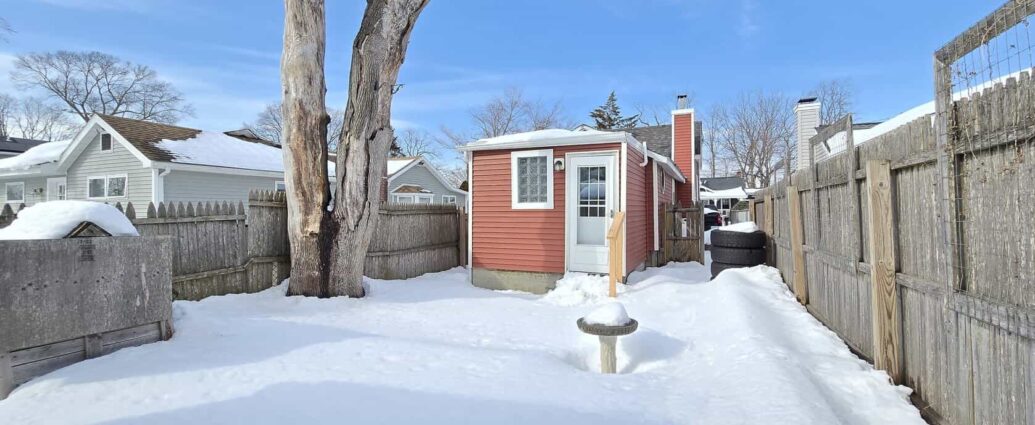
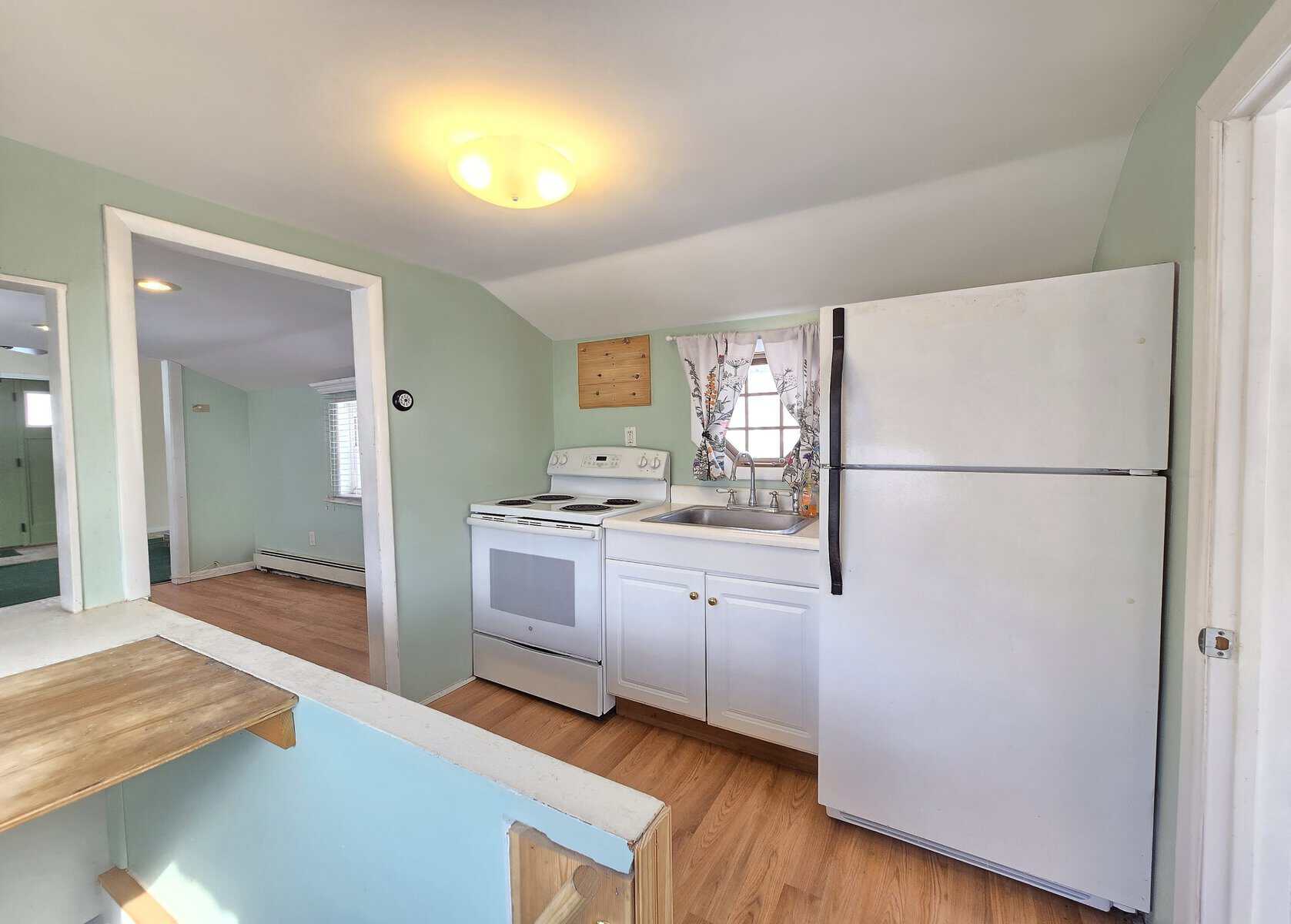
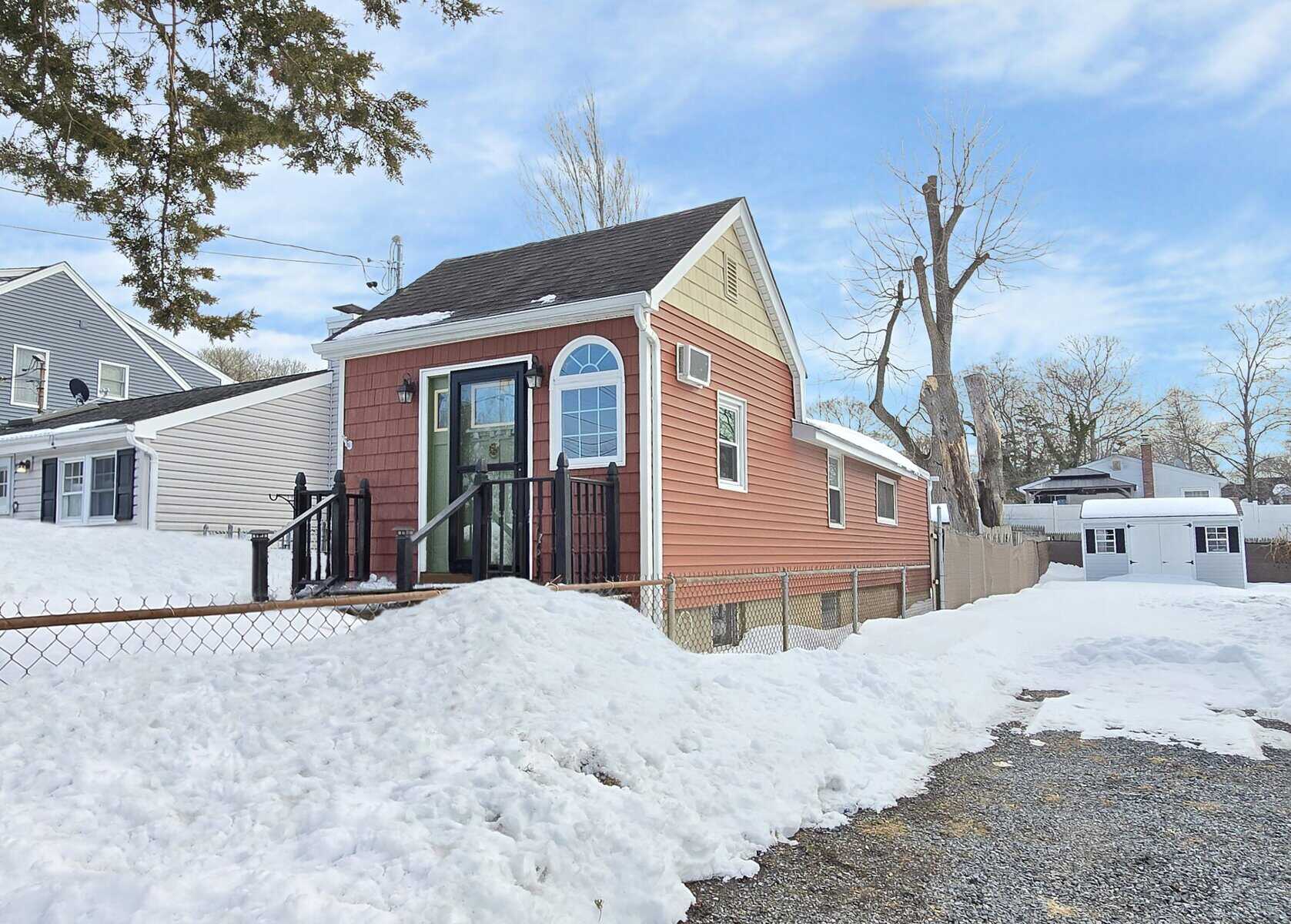
That equity enabled us to afford a home in the Santa Barbara area when average rates were nearly 7%. One of my BFFs, a local agent, found us a small, off-market fixer-upper in Goleta close to a desirable elementary school. It was a total gut job; the house hadn’t been renovated since it was built in 1960, and it came complete with pink and green shag carpets. Still: the sellers wanted $1.5 million. 

Our Original Mortgage: 30 Years, 7.35%, $8,500 Per Month


We negotiated the price down to $1,324,000 because the inspection, as expected, uncovered a lot of issues. That was still a wild price for a somewhat small house with a broken foundation, 40-year-old appliances, and a rotten avocado tree. But: It was our very own house in Santa Barbara. Worth it. 

We closed in April 2024 with a monthly payment of $8,500. We put down 20% using the equity from our Seattle-area sale. The best 30-year rate we could get was 7.35%; we took it with an eye toward eventually refinancing. 

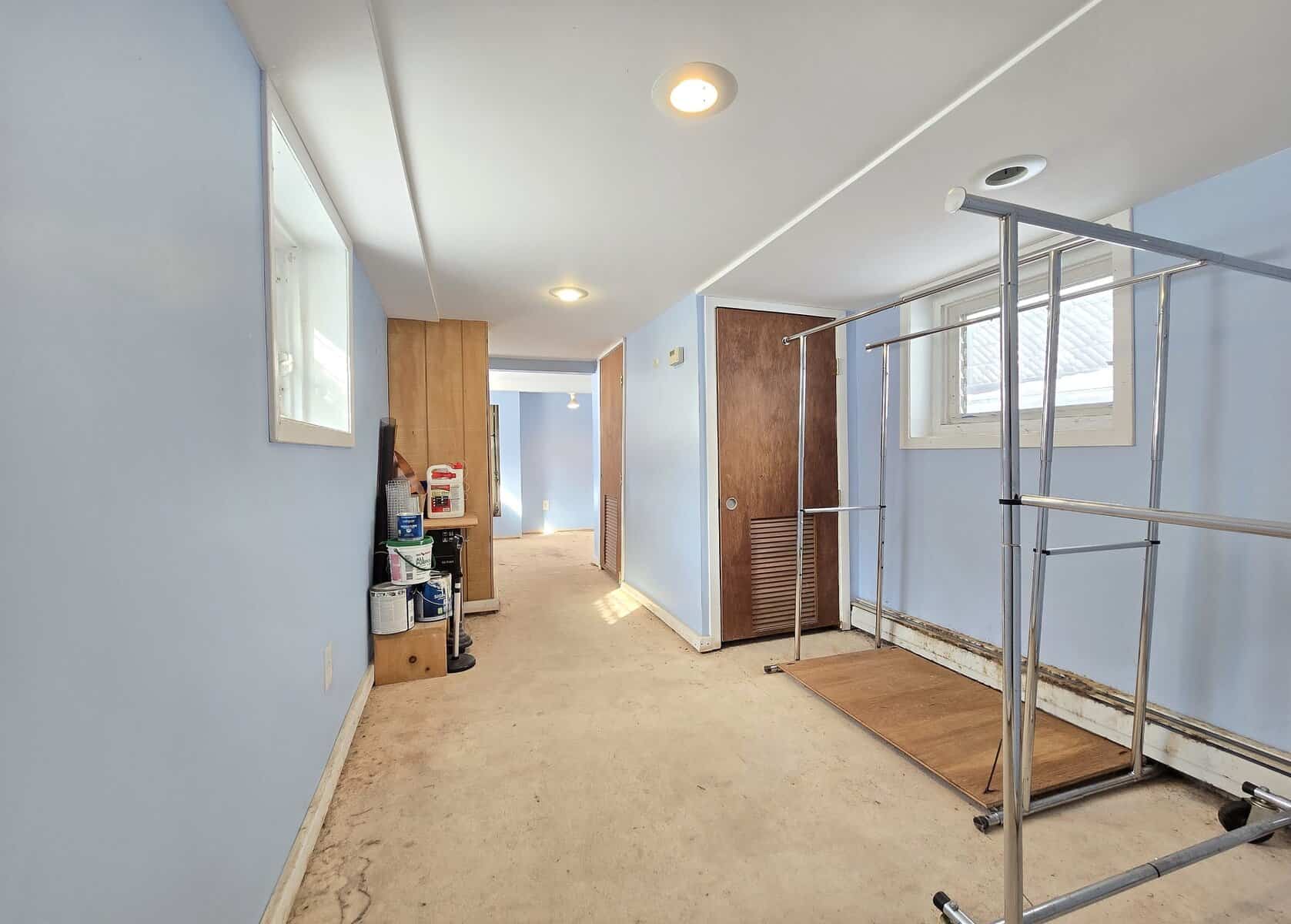
We also paid roughly $200,000 to renovate the house (also using proceeds from our prior home sale), ditching the green shag carpet and making it livable for our family. We were fortunate that my father-in-law and husband could do almost all the labor themselves.

We moved in September 2024, just in time for our son to start TK. Santa Barbara is sunny and vibrant and neighborly and there’s always saltwater in the air. We walk our kids to school every morning, we boogie board, and watching their baseball games is a sun-soaked sideline party. 

The only thing our kids complain about is going to the beach and pool too often. The only thing the adults complain about: our mortgage payment. We make tradeoffs to live here: a strict no-nail-salon policy, for example. 

Our Refinanced Mortgage: 20 Years, 6.2%, $8,800 Per Month (and $300,000 in Total Savings)


By September 2025, rates had declined to 6.3%. Plus, I’d improved my credit score by taking the extremely adult steps of 1) buying a bunch of things with my credit card and paying it off immediately, and 2) adding my name to my dad’s credit card (credit scores aren’t fair). 

Our mortgage loan had a balance of $1,042,000. Switching to a 6.3% rate from a 7.35% rate would bring our monthly payment down to about $7,700. But then we calculated how much interest we would pay over the course of our 30-year loan. It came out to nearly $1 million on a home we bought for $1,324,000. Using a 30-year mortgage nearly doubled our housing costs, so we investigated a 20-year mortgage. 

We had two choices:

One, refinance into a new 30-year mortgage with a 6.3% rate, pay $7,700 per month, and pay about $1 million in interest over three decades. 

Two, refinance into a 20-year mortgage with a 6.2% rate, pay $8,800 per month ($300 more than our prior payment), and pay about $700,000 in interest over two decades. 

Option two meant we’d own the house free and clear 10 years sooner, and save about $300,000 in interest, which could pay for … about half of a condo in Santa Barbara. But $300,000 is more than zero. 

We chose option two, the 20-year mortgage. The cost to refinance was $12,000, which we rolled into the loan. If rates drop again, we’ll refinance again.

Refinancing often makes financial sense, even when rates aren’t plummeting. I won’t argue that buying a small fixer-upper for nearly $1.5 million makes financial sense, but now we’ll own the house free and clear in 2045 instead of 2055. And: we get to live rich lives. Not rich with money, of course, because lots of that goes to our mortgage. Instead, it’s rich with Santa Barbara vibes.

The post I Traded My 2.9% Mortgage Rate for a 7.35% Rate to Move to Santa Barbara. I Don’t Regret It, But I Did Refinance. appeared first on Redfin Real Estate News.
This post was originally published here

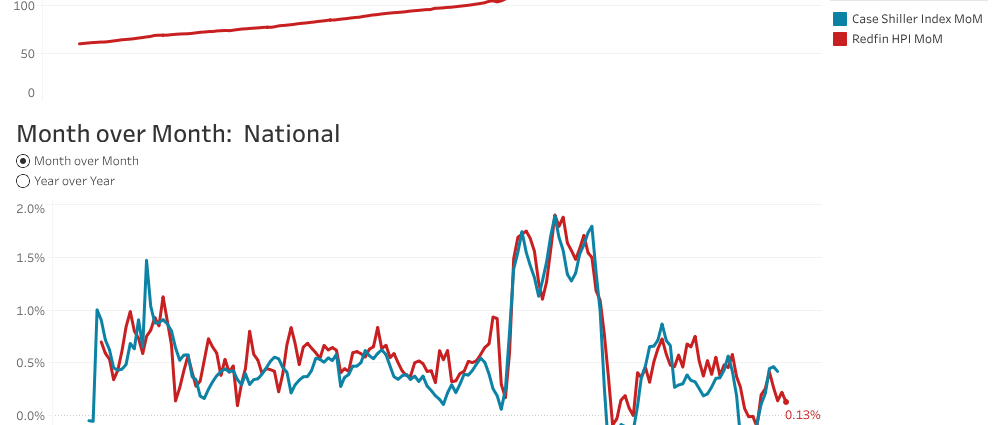
    • Home prices ticked up 0.1% month over month on a seasonally adjusted basis. 
    • Prices rose 1.9% on a year-over-year basis–the slowest growth rate on record. 
    • On a local level, prices fell in 13 major metros month over month, with the biggest declines in Texas and the biggest increase in San Francisco. 

U.S. home prices inched up 0.1% month over month in March on a seasonally adjusted basis, the third straight month of the same increase. 

Prices rose 1.7% from a year earlier, the slowest year-over-year growth rate in records dating back to 2012. Home-price growth has been slowing since the start of 2025. 

This is according to the Redfin Home Price Index (RHPI), which uses the repeat-sales pricing method to calculate seasonally adjusted changes in single-family home prices. The RHPI measures how sale prices of homes have changed since their previous sale—similar to the S&P Cotality Case-Shiller Home Price Indices—but is reported about a month earlier. March data covers the three months ending March 31, 2026. Read the full RHPI methodology here.

Home-price growth has slowed this year on a year-over-year basis because demand is tepid. Many would-be buyers have backed off due to high mortgage rates and uncertainty about the U.S. economy and the Iran war. Mortgage rates rose from 6% to 6.4% in March, largely because the Iran war pushed up oil prices and pushed markets into turmoil. 

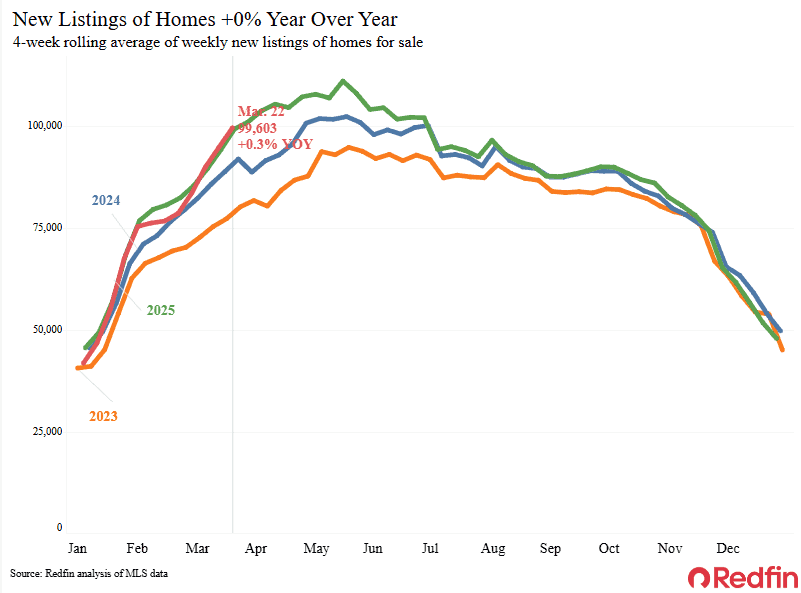
But prices are still rising, not falling, because new listings of homes for sale are declining. There are still hundreds of thousands more home sellers than buyers in the market, but now some homeowners are opting to stay put rather than list their home into a soft market. 

“Price growth is losing steam, with the slowest annual gains we’ve seen in a decade–in line with our expectations for the year,” said Chen Zhao, Redfin’s head of economics research. “High mortgage rates and global uncertainty are causing some would-be buyers to back off, which is putting a lid on home prices. While that can be frustrating for homeowners hoping to sell, it’s the start of a reset for the housing market as a whole, and may ultimately bring homebuying costs down enough to bring some house hunters back.”

Home Prices Are Falling in 13 Major Metros, Led by Fort Worth and Austin


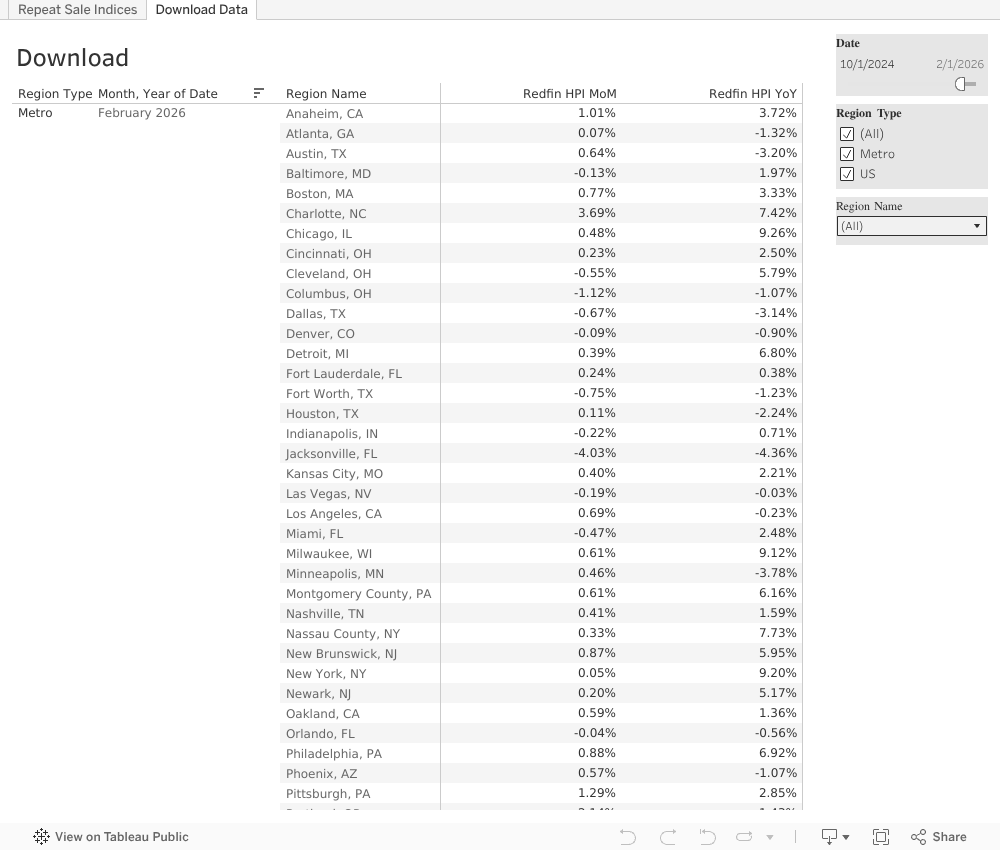
Home prices fell in 13 major U.S. metros month over month on a seasonally adjusted basis in March. Redfin analyzed the 50 most populous metro areas and included in this analysis the 46 with sufficient data.

The biggest declines were in Fort Worth, TX (-0.8%) and Austin, TX (-0.7%). Next come Nashville, TN (-0.6%), Oakland, CA (-0.6%) and Phoenix (-0.3%). The biggest increases were in Pittsburgh (2.8%), West Palm Beach, FL (2.1%), Nassau County, NY (1.4%), Chicago (1.3%) and San Francisco (1.2%). 

The biggest year-over-year price declines were in San Antonio (-4.1%), Jacksonville, FL (-3.5%) and Austin (-3%). The biggest gains were in San Francisco (13%), Chicago (10.7%) and New York (9.2%). Prices are soaring in San Francisco largely because of the AI boom

Metro-Level Summary: Redfin Home Price Index, March 2026
U.S. metro area Month-over-month change (seasonally adjusted) Year-over-year change
Anaheim, CA 0.2% 3.2%
Austin, TX -0.7% -3.0%
Baltimore, MD 0.8% 2.9%
Boston, MA 0.5% 3.6%
Chicago, IL 1.3% 10.7%
Cincinnati, OH 0.6% 3.9%
Cleveland, OH 0.5% 5.9%
Columbus, OH 0.1% -0.4%
Dallas, TX 0.0% -2.9%
Denver, CO 0.1% -0.3%
Detroit, MI -0.1% 6.2%
Fort Lauderdale, FL 1.2% 2.2%
Fort Worth, TX -0.8% -0.4%
Houston, TX 0.3% -1.6%
Indianapolis, IN 0.2% 0.8%
Jacksonville, FL 0.3% -3.5%
Las Vegas, NV 0.0% -0.6%
Los Angeles, CA 0.7% 0.2%
Miami, FL 0.5% 2.1%
Milwaukee, WI 0.5% 9.1%
Minneapolis, MN 0.3% 1.2%
Montgomery County, PA 0.8% 7.1%
Nashville, TN -0.6% -0.3%
Nassau County, NY 1.4% 7.9%
New Brunswick, NJ 1.1% 7.6%
New York, NY 0.9% 9.2%
Newark, NJ 0.8% 7.2%
Oakland, CA -0.6% 1.1%
Orlando, FL -0.1% -0.6%
Philadelphia, PA -0.1% 6.2%
Phoenix, AZ -0.3% -0.9%
Pittsburgh, PA 2.8% 5.6%
Portland, OR -0.1% -0.4%
Providence, RI 1.0% 4.9%
Riverside, CA 0.2% -1.2%
Sacramento, CA -0.2% -0.6%
San Antonio, TX -0.2% -4.1%
San Diego, CA 0.7% 1.4%
San Francisco, CA 1.2% 13.0%
San Jose, CA 0.5% 2.7%
Seattle, WA 0.5% -0.3%
Tampa, FL 0.3% 2.5%
Virginia Beach, VA 0.7% 4.3%
Warren, MI -0.3% 4.2%
Washington, DC 0.2% 0.8%
West Palm Beach, FL 2.1% -0.9%

The post U.S. Home Prices Inched Up 0.1% in March appeared first on Redfin Real Estate News.

This post was originally published here

This Week In A Nutshell: Mortgage-rate volatility has moderated as the United States and Iran near a peace agreement, but succession drama at the Federal Reserve may amp up uncertainty once again as Fed chair nominee Kevin Warsh has his confirmation hearing.

Upcoming Attractions


Retail sales data for March will be released on Tuesday. While it provides a key window into the financial health of consumers and is expected to strengthen marginally, the series is noisy and unlikely to move markets much. As usual for the past seven weeks, markets will be most sensitive to the outcome of the peace talks between the U.S. and Iran and any change in the odds that the Strait of Hormuz will open soon. And this week, there is other drama that will be playing out as Fed chair nominee Kevin Warsh has his confirmation hearing before the Senate on Tuesday. He is caught in the middle of a most unusual standoff between the Fed and the White House that threatens to delay his confirmation past May 15th when Jay Powell’s term as chair ends. More on this below.

Last Week’s Highlights


Last week, mortgage rates ended the week slightly lower with the highlight being Friday’s announcement from Iran’s foreign minister that, following a 10-day ceasefire between Israel and Lebanon, the Strait of Hormuz was “completely open”. That turned out to not be completely true as the U.S. continued its blockade over the weekend. In economic data, the producer price index (PPI) came in slightly lower than expected, but overall inflation data for the month points to inflation remaining firm. The Fed’s preferred measure of inflation, core personal consumption expenditures (PCE), is now estimated to show annual inflation of about 3.2% in March, the highest since early 2024. And finally, housing continues to bounce along the bottom as March existing home sales fell 3.6% to an annual rate of 3.98 million.

Diving a Little Deeper


Republican Senator Tillis, who sits on the Senate Banking Committee,  has pledged to block Kevin Warsh’s confirmation for Fed chair until the Department of Justice drops its investigation of current Fed Chair Powell. President Trump has remained resolute so far in saying the investigation should continue. Betting markets now show only a 36% probability that Kevin Warsh will be confirmed before May 15, when Powell’s term ends. What happens if he is not and how will that affect housing?

  • Chair Powell has stated that he would stay on as chair pro tempore, which has past precedent, but in those cases the chair did not face opposition from the president. President Trump has stated that he would fire Powell should he stay on after May 15. The committee that sets the Fed’s policy rate, the Federal Open Market Committee (FOMC), elects its own chair and would likely elect Powell. However, the President could appoint another existing governor on the Board of Governors to be Fed chair. That would be the first time the Fed chair and the FOMC chair were not the same person. Importantly, while the FOMC sets interest rate policy, the Board of Governors actually controls something called interest on reserve balances (IORB), which is how the Fed enacts interest rate policy.
  • Should we enter such uncharted territory, rates might fluctuate because of the uncertainty. However, we are unlikely to see massive swings because (1) the standoff will probably resolve within a few weeks and (2) Kevin Warsh and Jerome Powell are unlikely to be miles apart on interest rate policy to begin with. So whether Warsh enters the picture in May, June, or July will not change the overall picture much for mortgage rates, for which investors are thinking over the long term. This means we might want to get some popcorn ready, but little in the way of tangible consequences for the housing market. This week’s hearings should provide some more clarity into Warsh’s stance on policy rates for the longer term and it will be the first time we have heard from him since he was nominated, prior to the Iran war.

Redfin Housing Market Reports


Late April Is the Best Time to List a Home For Sale

  • Late April is a sweet spot for sellers; nationwide, homes listed during that period have the highest chance of selling fast and fetching more than the asking price. This is from a Redfin and Home Economics analysis.
  • Real estate is local. On the West Coast, March is typically the best time to put a home on the market; on the East Coast, May tends to be best.
  • The best time to sell varies by region, but the swings are bigger in some parts of the U.S. than others. Places with mild weather and more supply are generally less seasonal. Places with more extreme weather or tight supply are more seasonal. 
  • The picture is more complex for buyers: House hunters have the most homes to choose from in late April, but they get the best deals in July.

Homebuyers Hold the Negotiating Power In 38 Major Metros, Up From 29 Last Year

  • Nationally, sellers outnumber buyers by 43%—just shy of the largest gap in records dating back to 2013. When sellers outnumber buyers, the buyers who are in the market have bargaining power.
  • 38 of the most populous metro areas were buyer’s markets in March, up from 29 a year earlier. Just five were seller’s markets, down from nine in 2025.
  • Home prices rose 5% across seller’s markets last month, compared with a 2% increase in buyer’s markets.

San Francisco Home Prices Jump Most in 8 Years Amid AI Boom

  • The median sale price in the Bay Area metro rose 14% year over year in March, compared with a 1% gain nationwide. That helped San Francisco reclaim its title as the most expensive major metro to buy a home.
  • Nationally, the housing market remained sluggish as high costs and economic uncertainty gave buyers and sellers pause.
  • Active listings of U.S. homes for sale fell 1% from a month earlier and pending sales barely budged. Homes that did sell moved at the slowest March pace in a decade.

The post Redfin Economists’ Weekly Take: All Eyes on Fed Succession as Mortgage-Rate Swings Ease appeared first on Redfin Real Estate News.

This post was originally published here

Spring is one of the busiest times in the housing market—and having the right agent can make all the difference. From navigating competition to helping buyers and sellers move quickly with confidence, great agents are essential this time of year. We’re excited to welcome Redfin agents who bring the experience and dedication to support clients every step of the way.

One of those agents is Amy Brenner, who returns to Redfin’s San Francisco team after six years exploring other brokerages. She was drawn back by Redfin’s technology, team structure, and the opportunities created through its partnership with Rocket.

“At Redfin, the systems and team structure are second to none,” Amy said. “It allows you to do more volume and focus on helping clients instead of building everything yourself. With the added support from Rocket Mortgage and Rocket Close, it’s going to elevate my business by introducing me to more clients and helping us serve them faster and more efficiently.”

Amy is joining a growing community of agents finding success at Redfin, now powered by Rocket. Here, you do your best work and keep more of what you earn, thanks to smart technology, real business support (including an average of $32,000/year in covered costs and benefits), and a collaborative team culture built for ambitious professionals.

Nearly 30% of Redfin agents are on teams. Whether you want to start a team, join one, or grow your solo business, you’ll have the tools and support to exceed your goals. With this support in place, and an AI-fueled CRM that helps you stay ahead of client needs, Redfin agents consistently close about 3x the national average.

Curious if we’re hiring in your market or want to see what’s new at Redfin? Check for roles near you or join us at an upcoming info session to meet the team and get your questions answered.

Name Market
Abdiel Hernandez Los Angeles
Adam St. Clair Philadelphia
Ahna Vaoifi Oklahoma
AJ Sharif Boston
Alina Finkelshteyn Jersey
Amber Trapp Minneapolis
Amy Brenner San Francisco
Andre Asselin Orlando
Angel Walker Palm Beach
Angelica Fernandez Sacramento
Anny Sanchez Raleigh
Anthony Ibarra San Francisco
Aubrey Myers Jr Los Angeles
Ayla Contois Seattle
Becky Richmond Maryland
Bernar Espanol Palm Beach
Bonnie Kelm Atlanta
Brandon McCloud Indianapolis
Breea Staples Maryland
Brenda Potts Seattle
Brian Evans Houston
Brittania Nosworthy Nashville
Brooke Broadwell Charlotte
Catherine Nanziri Philadelphia
Cesar Chong Virginia
Chris Baptiste Bellevue
Chris Hallman Dallas
Chris Myatt Philadelphia
Christina-Jane DeLong Atlanta
Christine Langford-Dixon Maryland
Christopher Phares Indianapolis
Cindy Davis San Diego
Cody Semler Oklahoma
Cole Lussenhop Denver
Cynthia Prestrelski Portland
Cynthia Walker Maryland
Dale Porter Carolina
Dane Robinson Denver
Danielle Furrell Carolina
Darby Halstead Phoenix
Darlene Norris Maryland
Darren Hall Sacramento
Darron Losse Bellevue
David Dupree Raleigh
Dehlia Geneva Arce Virginia
DeLisa Gaines Maryland
Derek McLendon South Carolina
Desanka Pokrajac Portland
Devon Ogden Los Angeles
DJ Bonner Los Angeles
Donna Lambert New York
Doreen Covarelli San Francisco
Doug Van Brunt Jersey
Dylan Siebers Portland
Eddie Sharma Virginia
Elijah Dennis Minneapolis
Elijah Hoskins New York
Elizabeth Silva New York
Eric Pangle Dallas
Ernesto Heredia Sacramento
Evee Rivera Philadelphia
Farah Seibel Portland
Galya Gamliel Maryland
Giselle Ramirez Orlando
Gwendolyn Dyer Philadelphia
Hani Hills Dallas
Heather Bush Tucson / Ottawa / Toronto
Ian Badillo Seattle
Jaci Lee Dallas
Jake Hughes Minneapolis
Janine Byam Maryland
Jason Cox Jersey
Jason Kappenman Portland
Jayla Johnson Oklahoma
Jeff Fleming Detroit
Jeff Trexler Sacramento
Jeff Warren Los Angeles
Jennifer Hoelsher Nashville
Jessica Hill New York
Jessica Marshall Boston
Jessica Psaros Boston
Jessica Slaughter Dallas
Jimmy Couch Louisville
Jimmy Hart Dallas
John Cyr Boston
JoLyn Hartman Philadelphia
Joseph DeFrancesco Chicago
Joshua Jones Orlando
Julissa Browning Boise
Justin Richards Bellevue
Kathleen Tuttle San Francisco
Keely Jared-Glessner Phoenix
Keith Simone New York
Kelley Saunders Maryland
Kelsey Brazeau Portland
Kelsey Sauer Louisville
Kelvin Peters Boston
Kenneth Bailey Vegas
Kerry Weisback Philadelphia
Kira Person Raleigh
Kirk Rogers Jersey
Kristen Doyle Chicago
Kristen Nowack Portland
Kyle Kleinman Miami
Lakea Perry Buffalo
Laura Cuellar Charlotte
Lauren Frazer Nashville
Laurie Dean Portland
Laurie Dixon Team Kirton
Leora Ainshtein Philadelphia
Linda Santillo Louisville
Lisa Duggan New York & Buffalo
Lori Oliveira Boston
Luiz Fernando Coelho Boston
Maher Saieh Miami
Maik Ruppert Palm Beach
Mandy Strong Seattle
Manny Gomez Dallas
Marc Maley Nashville
Marceil Van Camp Seattle
Marcus Mason Chicago
Margie Zwart Dallas
Mark Zolezi Philadelphia
Matt Jones Sacramento
Melanie Nakamoto Denver
Melissa Donnelly Virginia
Michael Henderson Los Angeles
Michael Pecora Philadelphia
Michelle Schafer Los Angeles
Mike Fuscaldo Orange County
Mike Saleh Virginia
Mikisha Ismail Portland
Mindy Coward Charlotte
Mitch Johnson Minneapolis
Mitchell Gonzales Denver
Moe Eltouny Maryland
Myke Popatia Rhode Island
Myron Walker Charlotte
Naim Jones Maryland
Nate Velasquez San Francisco
Neeta Gupta New York
Nesmet Badawi Jersey
Nick Jacob Tucson / Ottawa / Toronto
Nidhi Gupta Dallas
Oscar Escobar Tucson / Ottawa / Toronto
Pablo Cintron Orlando
Portia Hewitt Houston
Quinique Hollis Palm Beach
Rebecca Huang Chicago
Robby Douglas Team Gilfoy
Robert Millaway Philadelphia
Robert Sousa Rhode Island
Robin Turner Empire
Roger Doyon Palm Beach
Rory Obletz Maryland
Rosanna Rivera Orlando
Ryan Lerow Charlotte
Sal Talluto Chicago
Sara Karan Orange County
Sean Powell Virginia
Sean Terrell Boston
Shablee Tuttle Portland
Shane Xiang Seattle
Shaquita Pressley Houston
Shardul Mehta San Francisco
Sharon McMilion Dallas
Shauna Rumel Seattle
Shawn Holman Detroit
Shess Ortiz Virginia
Sita Philion Philadelphia
Staci Fabian Rhode Island
Stephanie Calleja Nashville
Stephanie Jones Nashville
Steven Moore Los Angeles
Steven Tillotson San Francisco
Susan McHale Virginia
Takisha Gresham Jersey
Taylor Day Nashville
Thom McDonell Pittsburgh
Thomas Borkowski Jersey
Tiffany Dalton Palm Beach
Tobie Hickey Carolina
Toni Thompson Denver
Tony Jollay Indianapolis
Tony Natoli San Francisco
Tonya Williams Los Angeles
Trish Armstrong Denver
Tyler Sather Portland
Varun Yasa Jersey
Verron Jackson Houston
Victoria Baptiste Bellevue
Victoria Evangeliou Virginia
William Foxx Virginia
Yemily Lopez Jersey


The post Say hello to the Newfins who joined us in Q1! appeared first on Redfin Real Estate News.

This post was originally published here

  • Nationally, sellers outnumber buyers by 43%—just shy of the largest gap in records dating back to 2013. When sellers outnumber buyers, the buyers who are in the market have bargaining power.
  • 38 of the most populous metro areas were buyer’s markets in March, up from 29 a year earlier. Just five were seller’s markets, down from nine in 2025.
  • Home prices rose 5% across seller’s markets last month, compared with a 2% increase in buyer’s markets.

There were an estimated 43.1% more home sellers than buyers in the U.S. housing market in March (or 600,168 more, in numerical terms). That’s just shy of the largest gap in records dating back to 2013 and is up from 28% (or 432,532) a year earlier. The largest gap on record is 45.2% in December 2025.


We define a market where there are over 10% more sellers than buyers as a buyer’s market and a market where there are over 10% fewer sellers than buyers as a seller’s market. A market where the gap is plus or minus 10% is considered a balanced market. By this definition, it has been a buyer’s market since May 2024. 

When sellers outnumber buyers, buyers typically hold the negotiating power because they have options. That’s why a market with a lot more sellers than buyers is considered a buyer’s market. Of course, it’s only a buyer’s market for those who can afford to buy. High housing costs and economic uncertainty have caused many house hunters to retreat, creating an imbalance of buyers and sellers. 

“High property taxes, rising insurance costs and fears about job security are making homebuyers very selective,” said Barb Cooper, a Redfin Premier real estate agent in Austin, TX, where sellers outnumber buyers by 112%. “The buyers who are in the market want turnkey homes in every sense, and they can afford to wait without compromising because we have tons of inventory.”

We estimated the number of buyers using proprietary Redfin data on the typical time from a buyer’s first tour to close of purchase, and MLS data on active listings and pending sales. The estimated number of sellers in the market is simply the number of active listings in the MLS. These estimates, along with median-sale price data in this report, are seasonally adjusted and subject to revision. See a more detailed methodology here and view an interactive dashboard here.

Buyers Are Retreating, Which Is Causing Some Sellers to Retreat


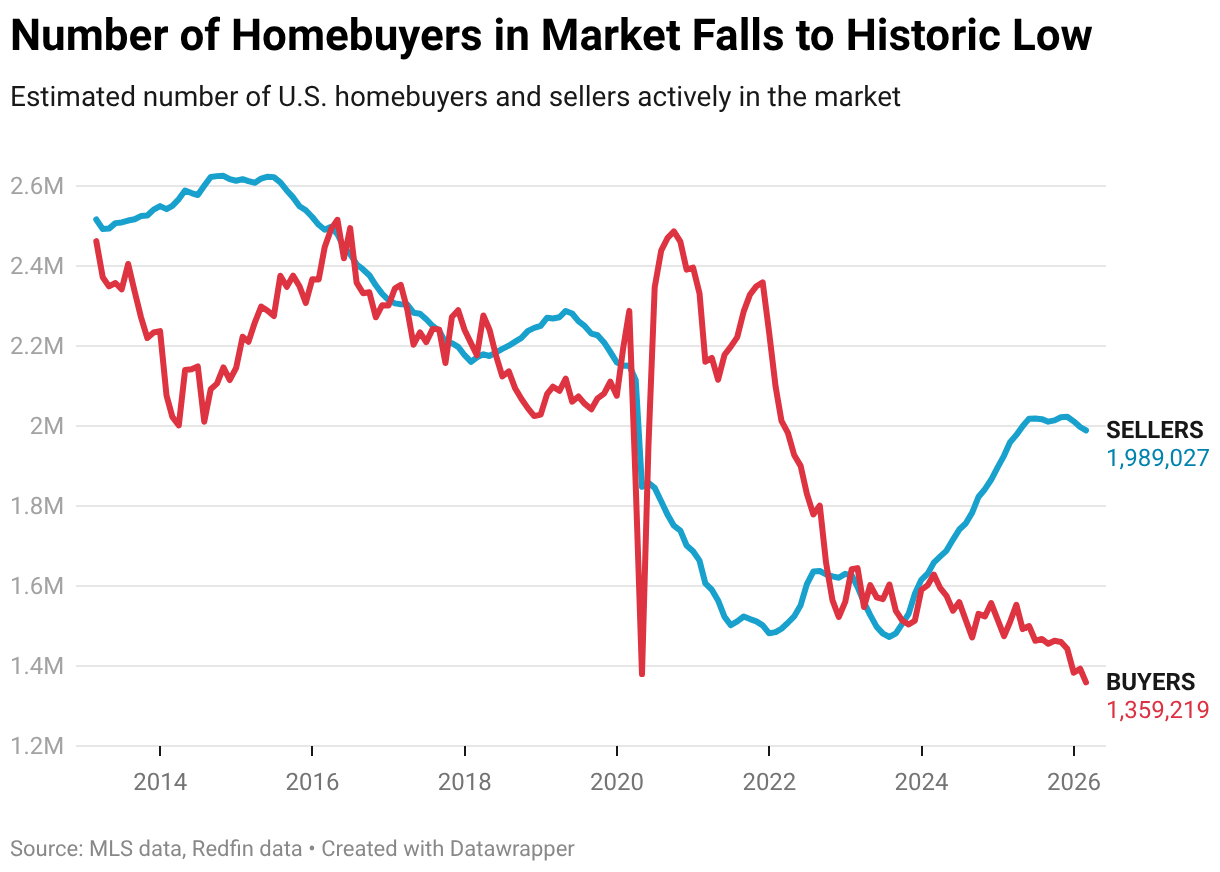
There were an estimated 1.39 million homebuyers in the market in March, just shy of the 1.38 million record low hit in April 2020—the start of the pandemic. That’s little changed from a month earlier but down 10% from a year earlier. 

There were an estimated 1.99 million sellers in the market—the lowest level in a year. That’s down 0.5% from a month earlier and up 0.7% from a year earlier.

Homebuyers and Sellers Have Both Been Backing Off (Line chart)


Home sellers have been retreating in part due to lackluster demand from buyers. Some sellers are delisting after watching their homes sit on the market, while others are choosing not to list at all after seeing nearby homes sell for below the asking price. Redfin did report last month that relistings are beginning to rise as sellers bet on a spring uptick in demand.

There Are 38 Buyer’s Markets, Down From 29 Last Year


Thirty-eight of the 49 U.S. metropolitan areas Redfin analyzed were buyer’s markets in March, up from 29 a year earlier. In five of those markets, there were over twice as many sellers as buyers. 

The strongest buyer’s market was Miami, which had an estimated 148% more sellers than buyers. Next came Nashville (119%), Austin, TX (112%), San Antonio (109%) and Las Vegas (101%). Redfin analyzed the 50 most populous U.S. metropolitan areas and included in this analysis the 49 with sufficient data.

The Sun Belt skyrocketed in popularity during the pandemic, when scores of homebuyers moved in from more expensive parts of the country. To meet surging demand, homebuilders ramped up activity, which is one reason there are now a lot more homes for sale than people who want to buy them. The buyer pool has also shrunk because soaring housing costs in recent years have priced many people out of the market.

New construction can have a significant influence on whether negotiating power lies with buyers or sellers because it impacts the balance of supply and demand. The South and the West have historically issued the most building permits, while the Northeast and the Midwest (where the five seller’s markets are located) have issued the fewest.

Florida and Texas, in particular, build more homes than other states. Florida has also been grappling with intensifying natural disasters, soaring insurance premiums and rising condo HOA fees, which has prompted some homeowners to leave. Miami, specifically, frequently shows up as a buyer’s market because it has a lot of housing supply, which could be in part due to the high number of condos. 

There Are 5 Seller’s Markets, Down From 9 Last Year


Just five of the metros Redfin analyzed were seller’s markets in March, down from nine a year earlier.

The strongest seller’s market in March was Newark, NJ, which had an estimated 30.4% fewer sellers than buyers. The other four seller’s markets were Nassau County, NY (-28%) Montgomery County, PA (-26.2%), Milwaukee (-19.7%) and New Brunswick, NJ (-12.5%). 

On average, home prices rose 4.8% year over year across the five seller’s markets in March, compared with a 1.6% increase across the 38 buyer’s markets—an indication that buyer’s markets offer house hunters more leverage. 

Metro-Level Summary: 50* Most Populous Metros (March 2026)

U.S. metro area Balance of power Percent by which sellers outnumber buyers Buyers Sellers
Anaheim, CA  Buyer’s Market 43.6% 5,079 7,293
Atlanta, GA  Buyer’s Market 70.4% 22,692 38,656
Austin, TX  Buyer’s Market 112.1% 8,509 18,043
Baltimore, MD  Balanced Market -5.9% 10,851 10,205
Boston, MA  Balanced Market -1.4% 10,952 10,794
Charlotte, NC  Buyer’s Market 88.7% 9,057 17,087
Chicago, IL  Balanced Market 1.4% 25,427 25,795
Cincinnati, OH  Buyer’s Market 30.7% 6,409 8,379
Cleveland, OH  Balanced Market -4.2% 7,310 7,006
Columbus, OH  Buyer’s Market 22.8% 7,081 8,698
Dallas, TX  Buyer’s Market 86.7% 17,001 31,743
Denver, CO  Buyer’s Market 37.2% 11,837 16,245
Detroit, MI  Buyer’s Market 48.7% 4,910 7,304
Fort Worth, TX  Buyer’s Market 69.2% 7,923 13,404
Houston, TX  Buyer’s Market 96.5% 22,965 45,122
Indianapolis, IN  Buyer’s Market 23.6% 7,723 9,543
Jacksonville, FL  Buyer’s Market 58.7% 7,751 12,304
Kansas City, MO  Buyer’s Market 21.8% 7,190 8,756
Las Vegas, NV  Buyer’s Market 100.7% 7,110 14,272
Los Angeles, CA  Buyer’s Market 58.6% 14,392 22,819
Miami, FL  Buyer’s Market 147.9% 7,806 19,347
Milwaukee, WI  Seller’s Market -19.7% 6,488 5,210
Minneapolis, MN  Balanced Market 9.0% 12,833 13,989
Montgomery County, PA  Seller’s Market -26.2% 6,905 5,094
Nashville, TN  Buyer’s Market 119.0% 7,398 16,202
Nassau County, NY  Seller’s Market -28.0% 9,978 7,181
New Brunswick, NJ  Seller’s Market -12.5% 9,918 8,679
New York, NY  Buyer’s Market 12.6% 24,811 27,946
Newark, NJ  Seller’s Market -30.4% 8,153 5,672
Oakland, CA  Buyer’s Market 36.0% 4,457 6,060
Orlando, FL  Buyer’s Market 81.4% 9,965 18,075
Philadelphia, PA  Buyer’s Market 35.2% 6,047 8,176
Phoenix, AZ  Buyer’s Market 79.1% 18,415 32,979
Pittsburgh, PA  Buyer’s Market 55.3% 6,030 9,364
Portland, OR  Buyer’s Market 45.5% 7,502 10,914
Providence, RI  Balanced Market -1.9% 4,202 4,124
Riverside, CA  Buyer’s Market 66.4% 11,537 19,196
Sacramento, CA  Buyer’s Market 34.5% 5,664 7,617
San Antonio, TX  Buyer’s Market 109.0% 9,059 18,932
San Diego, CA  Buyer’s Market 29.2% 6,272 8,103
San Francisco, CA  Buyer’s Market 12.1% 2,592 2,905
San Jose, CA  Buyer’s Market 28.5% 2,635 3,387
Seattle, WA  Buyer’s Market 34.9% 7,681 10,359
St. Louis, MO  Buyer’s Market 17.8% 8,754 10,312
Tampa, FL  Buyer’s Market 82.7% 13,064 23,869
United States of America Buyer’s Market 43.1% 1,392,693 1,992,861
Virginia Beach, VA  Buyer’s Market 14.7% 6,797 7,794
Warren, MI  Buyer’s Market 16.7% 7,935 9,258
Washington, DC  Buyer’s Market 14.9% 15,829 18,190
West Palm Beach, FL  Buyer’s Market 94.0% 8,090 15,694

*Fort Lauderdale, FL has been removed due to insufficient data.

The post Homebuyers Hold the Negotiating Power In 38 Major Metros, Up From 29 Last Year appeared first on Redfin Real Estate News.

This post was originally published here

Aziz Sunderji, housing economist and founder of data visualization consultancy Home Economics, also provided data and analysis for this report. 

  • Late April is a sweet spot for sellers; nationwide, homes listed during that period have the highest chance of selling fast and fetching more than the asking price. This is from a Redfin and Home Economics analysis. 
  • Real estate is local. On the West Coast, March is typically the best time to put a home on the market; on the East Coast, May tends to be best. 
  • The best time to sell varies by region, but the swings are bigger in some parts of the U.S. than others. Places with mild weather and more supply are generally less seasonal. Places with more extreme weather or tight supply are more seasonal.  
  • The picture is more complex for buyers: House hunters have the most homes to choose from in late April, but they get the best deals in July. 


The best time to list a U.S. home for sale is the end of April. Sellers are most likely to sell their home above the asking price, and to sell a home quickly, when they list during that period. 

The advantages of listing in late April: 

Sellers get stronger offers

  • They’re more likely to sell above the asking price. Homes listed at the end of April are 18% more likely to sell above their original asking price than the rest of the year–the highest likelihood of all 52 weeks. 
  • Prices are higher. The median home-sale price is 4% higher for homes listed at the end of April than the yearly average sale price, the biggest premium of the year. That’s because there are more buyers and more competition—and also partly because better homes tend to be listed in the spring. 

Homes sell faster

  • They’re more likely to sell within 2 weeks. Homes are 17% more likely to sell in two weeks at the end of April than the yearly average, also the highest likelihood of the year. 
  • They spend less time on the market.  Homes listed in late April spend about 9% fewer days on market than the yearly average.

Sellers face less competition 

  • There are fewer homes for buyers to choose from. Sellers face less competition at the end of April than later in the spring or over the summer. There are typically 8% fewer homes for sale at the end of April than the peak reached in late summer. As spring goes on, the total number of homes for sale increases, peaking in the summer, giving buyers more choices and upping competition among sellers. 

This is according to a Redfin and Home Economics analysis of housing market data. Please see the end of this report for more on methodology 

“Late April hits a sweet spot for home sellers: buyers are out in force, but the market isn’t yet flooded with competing listings,” said Aziz Sunderji, housing economist and founder of data visualization consultancy Home Economics. “For sellers, timing can meaningfully shape the outcome of their home sale. Listing in that late-April window can help generate stronger early interest and create the kind of competition that leads to faster sales and better terms. Sellers who list earlier in the spring may miss peak demand, while those who wait until later risk getting lost in a growing pool of listings. If you’re preparing to sell, it’s worth aligning your timeline—pricing, staging, and marketing—so you’re ready to hit the market during this brief but advantageous window.”

Sellers should keep in mind that this analysis identifies the best time to list their home based on general trends, and assumes a stable market. The best time could shift to a different period in a year when the market experiences dramatic, unexpected shifts. 

Additionally, the best time to sell a home is different for different people. Selling (or buying) a home is typically the biggest financial decision people make in their lives, and personal factors matter in terms of timing. For someone who is offered their dream job in another state in September, for instance, listing their home in the fall probably makes more sense than listing in April. 

It’s also worth noting that most home sellers are also buyers. That means many sellers factor in the best time to buy when deciding when to sell. They may want to sell earlier in the season rather than later, so they have more time to find their next home. For more on the best time to buy, see the last section of this report. 

In California, the Best Time to List Is Before Spring Even Starts. In Parts of the East Coast, It’s Just Before Memorial Day. 


The best time to list a home for sale varies from metro to metro. Generally, the optimal time to list is earlier on the West Coast and in Texas, and later in the Northeast and the Rust Belt. This is based on the same metrics we used to calculate the national best time to list: The time of year when sellers have the best chance of selling their home faster and for more money. 

Places where the prime time to sell is March:

    • San Jose, CA: Middle of March
    • San Diego and Washington, D.C.: Mid-to-late March
    • Seattle, San Francisco, Portland, OR, Oakland, CA and Denver: Late March 

Places where the prime time to sell is May or June:

    • West Palm Beach, FL: Mid-to-late June
    • Philadelphia: Middle of May 
    • Las Vegas, Milwaukee and New Brunswick, NJ: Beginning of May 

Real estate is local. In places like California and Texas, the spring market tends to kick off earlier thanks to milder weather and a longer home-shopping season, so sellers who list in March are better positioned to capture motivated buyers before competition builds. Markets in the Northeast often heat up later in the year, when the snow has melted and warmer days are bringing house hunters out of hibernation. 

“The best week to list isn’t one-size-fits-all. Sellers should think locally,” Sunderji said. “Pay attention to when inventory typically ramps up, and when local buyers are most active. Listing just ahead of that surge—whether that’s March in Silicon Valley or May in Milwaukee—can help your home stand out, attract more serious buyers, and sell quickly for the price you want.”

Timing Matters—But It Matters More in Some Parts of the Country Than Others


The best time to sell a home—and buy a home—varies from metro to metro, but the swings are bigger in some parts of the U.S. than others. In the southern part of the country, where weather tends to be warmer, the swing in how many new listings hit the market by season is fairly small. In the northern part of the country, which has more extreme weather, the swing in new listings is bigger. Another important factor is supply: Highly populated areas with limited supply tend to be more seasonal. 

The metros with the least seasonal housing markets, i.e. where the seasonal swing in listings is smaller, are in Florida. Tampa is the least seasonal of all. Next come Fort Lauderdale, Miami, West Palm Beach and Orlando . The next two are also located in places with warm weather throughout the year: Phoenix and Las Vegas.

On the other end of the spectrum, the places with the most seasonal metros are either in colder climates or they’re in the Bay Area. San Francisco has the most seasonal market in the nation. Next come Boston,  Seattle, San Jose, CA and Minneapolis.

“The fact that the Bay Area has the most seasonal housing market shows that seasonality isn’t just about weather–it’s also about supply,” said Asad Khan, a senior economist at Redfin. “In places like San Francisco and San Jose, where there are a lot of house hunters and limited inventory, timing matters a lot. It becomes a bit like musical chairs: Sellers want to list when they’ll have the best chance of finding their next home, so everyone converges during the same window. In places with more inventory, like Detroit or Columbus, OH, buyers can be more flexible, which gives sellers more flexibility, too, dampening those seasonal swings even though the winters are colder.”

Buyers Get More Choices Earlier in the Year, But Better Deals Later 


The picture is more complex for homebuyers. Buyers need to balance choice and competition. More inventory to choose from improves the chance of finding the home that’s right for them. But competition creates more urgency and requires stronger offers to win a home.

To capture this tradeoff, we identify three key moments for homebuyers:

  • Most new listings. The flow of new listings of homes for sale typically peaks in late spring and continues through early summer. This is when picky buyers are most likely to see the widest selection of listings right when they hit the market. 
  • Most inventory. The bullet point above is about brand-new listings; this one is about “fresh” listings–those that have been on the market for no more than 60 days.  The number of fresh listings typically peaks in mid-summer. This is when flexible buyers with more time have the biggest selection to choose from.
  • Best deals. Discounts off a home’s original asking price—through price drops and/or negotiations between buyer and seller—grow in late summer and peak in early fall. But discounts typically plateau or shrink heading into winter, even as inventory declines. This moment captures the last point when both choice and discounts are working in the buyer’s favor. Winter isn’t an ideal time for bargain hunters because by the time it rolls around, sellers may be more likely to wait for spring’s new buyers than make concessions. 

“The right time to purchase a home depends on a buyer’s flexibility,” Khan said. “New listings peak in late spring, but that’s also when competition between buyers is most intense. House hunters should shop earlier if time is tight and finding the right home in the right location is the top priority. But for more flexible buyers, inventory will grow until mid-summer. Buyers also have more negotiating power heading into the fall, and while inventory is somewhat picked over, there are still quite a few homes to choose from. For many buyers, the sweet spot may be somewhere in between.”

Best Time to Buy a Home, Metro-Level Summary

Please note that this table includes 3 key moments for buyers; it’s important for buyers to balance what’s most important for them–choice or price

Most New Listings Most Fresh Inventory Best Deals
Anaheim, CA Mid May Late June Late August
Atlanta, GA Mid May Mid July Early September
Austin, TX Mid May Early July Late August
Baltimore, MD Early May Early June Mid September
Boston, MA Mid May Mid July Early October
Chicago, IL Mid May Early June Early October
Cincinnati, OH Mid May Mid July Mid October
Cleveland, OH Mid May Mid July Late October
Columbus, OH Late June Mid July Mid October
Dallas, TX Late June Early August Mid September
Denver, CO Mid May Mid July Early September
Detroit, MI Early August Early September Mid December
Fort Lauderdale, FL Early February Late March Mid December
Fort Worth, TX Late June Mid August Mid September
Houston, TX Late May Mid July Late September
Indianapolis, IN Mid May Mid July Mid October
Jacksonville, FL Early May Mid May Mid September
Las Vegas, NV Late May Mid June Late September
Los Angeles, CA Mid May Mid July Mid September
Miami, FL Early February Late March Mid December
Milwaukee, WI Mid May Mid July Early November
Minneapolis, MN Mid May Mid July Early October
Montgomery County, PA Mid May Early June Mid October
Nashville, TN Mid May Mid July Mid September
Nassau County, NY Mid May Late June Late August
New Brunswick, NJ Mid May Early June Early October
New York, NY Mid May Early June Mid August
Newark, NJ Mid May Early June Late August
Oakland, CA Mid May Mid July Late August
Orlando, FL Early May Mid July Early October
Philadelphia, PA Mid May Early June Mid October
Phoenix, AZ Late March Early April Late October
Pittsburgh, PA Mid May Early July Mid October
Portland, OR Mid May Mid July Late August
Providence, RI Mid May Late June Mid October
Riverside, CA Mid May Mid June Early November
Sacramento, CA Mid May Mid July Late August
San Antonio, TX Late May Mid July Mid September
San Diego, CA Mid May Mid July Mid September
San Francisco, CA Late September Late October Late September
San Jose, CA Mid May Early June Late August
Seattle, WA Mid May Mid July Early September
Tampa, FL Late March Early April Early November
Virginia Beach, VA Early May Mid June Mid October
Warren, MI Mid May Late August Late October
Washington, DC Early May Early June Late September
West Palm Beach, FL Early February Late March Mid December

Here’s a video from Daryl Fairweather, Redfin’s chief economist:

Methodology 


This is according to a Redfin and Home Economics analysis of housing market data. 

  • We created a seasonal index for each week within a given year and region by dividing the weekly value of each metric by that year’s annual average. For median sale prices, the seasonal index was computed on a series detrended using OLS.
  • We then average the seasonal index for each week-of-year between 2015-2019 and 2023-2025; we excluded 2020-2022 because the pandemic skewed seasonal effects during that time. 
  • For the seasonality map, we measured the seasonal range of new listings by county as the difference between the maximum and minimum of the seasonal index for new listings.     
  • To identify the best time to list, we normalize four seller-relevant metrics (share sold in 2 weeks, share sold above list, days on market, sale-to-original-list ratio) to 0–1 within each metro and average them into a single composite score per week. The peak of this composite is the “best week to list” for that metro.
  • To identify the best time to buy, we focus on the seasonal indexes for three metrics: new listings, fresh inventory, and the average discount. 
    • Most new listings: the week when the flow of new listings is greatest relative to the annual average.
    • Most  fresh inventory: the week the stock of active listings with 60 days or less on market is greatest relative to the annual average.
    • Best deals: To identify the period with the “best deals” we identify the moment when the average discount (original list price divided by final sale price) reaches an “inflection point,” meaning it slows or shrinks heading into late fall or winter. We characterize this moment as reflecting the best deals since buyers typically have ample inventory to choose from while discounts approach a local maximum.  To identify these moments, we first fit a smoothed curve to the average discount seasonal index for each region to remove week-to-week noise. Starting from the spring trough—the week when homes sell closest to (or above) their list price—we find the week of maximum slope, representing the period of fastest improvement in the average discount. We then identify the first subsequent week where the slope falls below 10% of that maximum, marking the point where average discounts have largely plateaued. For metros where the slope never drops below this threshold (i.e., discounts continue to grow aggressively through year-end), we use the week of the overall peak discount instead.

The post Late April Is the Best Time to List a Home For Sale appeared first on Redfin Real Estate News.

This post was originally published here

  • About two-thirds of homeowners who recently made renovations chose to upgrade their home instead of moving to a new place, per a recent Redfin survey. 
  • Within this group of homeowners, millennials and Gen Zers are more likely than older people to remodel instead of move.
  • Most homeowners who renovated in the last year spent less than $20,000 on upgrades, signaling that a lot of them are opting for select improvements rather than a full remodel. 
  • Fresh paint, bathroom upgrades and  kitchen renovations are the most common improvements. 

Instead of moving, Americans are remodeling. More than two in five (43%) Americans renovated their home in the last year, and another 33% plan to renovate in the next year, according to a recent Redfin survey. 

For many, renovating is a deliberate alternative to seeking out a different home. Roughly two-thirds (65%) of homeowners who are recent renovators chose to upgrade their current home instead of  moving. For homeowners who are planning to renovate in the next year, 71% say they’re remodeling instead of buying a new place. 


This report is based on a Redfin-commissioned survey fielded by Ipsos in November 2025, fielded to 4,000 U.S. residents. Please see the end of this report for more on methodology. 

Homeowners are staying put because it is expensive to move. With high mortgage rates and home prices, moving isn’t an affordable option for many Americans–especially when about 80% of homeowners with a mortgage have an interest rate below current levels, according to a recent Redfin analysis. Other recent Redfin research shows that while housing inventory is increasing slightly on a year-over-year basis, there’s still a shortage of desirable, move-in ready homes for sale–especially those that are spacious enough for a family. 

Gen Zers and millennial homeowners are more likely than their older counterparts to remodel instead of move, with 77% of each generation saying they made improvements rather than moving in the last year. Those with kids living at home are also more likely than others to choose renovations. 

“Many Americans are choosing to stay put and make the home they already have work for them,” said Chen Zhao, Redfin’s head of economics research. “That could mean improving outdated spaces, adding space for a growing family or reconfiguring the existing space so it works for everyone. Younger homeowners are especially likely to renovate instead of jumping to a different house; they’re earlier in their homeownership journey and more willing to invest in improvements to build equity. Those with kids living at home are often motivated to plant deeper roots where they are so they can stay in the same school district and community.”

Most Homeowners Who Opt to Renovate Spend Under $20K on Upgrades


A lot of renovators are opting for meaningful improvements without busting their budget on a complete remodel. 

Roughly a quarter (23%) of people who renovated their home in the last year spent between $10,000 and $20,000 on improvements; the next-most common price tags were $1,000 to $5,000 (21% of recent renovators) and $5,000 to $10,000 (20%). A sizable share (16%) spent between $20,000 and $50,000 on renovations. 

The Lion's Share of Homeowners Who Renovate Spend Between $10K and $20K (Bar Chart)


Fresh Paint, Bathrooms and Kitchens Are Most Popular Improvements


Painting is the most popular upgrade; nearly half (47%) of recent renovators gave their home a fresh coat. Next are bathroom (43%) and kitchen (40%) improvements. Exterior maintenance and landscaping are also popular, with 35% of renovators opting for those upgrades. 

Climate resiliency is important to some homeowners, too: About one in seven (15%) added features to make their homes more resilient to natural disasters such as flooding, wind, fire and/or heat. 

Painting Is Most Popular Improvement, Followed By Bathroom and Kitchen Remodels (Bar Chart)


One way to fund renovations is with a cash-out refinance, which allows homeowners to use the equity they’ve built up in their house to pay for upgrades. Rocket Mortgage offers cash-out refinances, in which homeowners take out a bigger loan in exchange for putting cash in their pocket. 

Home improvements not only provide homeowners with the space and features they need to make their house comfortable, but they can be worthwhile in the long run. “If you can afford it, investing time and money into making your house look and feel better can help when it comes time to sell,” said Jo Chavez, a Redfin Premier agent in Kansas City, MO. “Updated homes tend to sell faster than fixer-uppers, and for more money.” 

Methodology


The survey results in this report are from a Redfin-commissioned survey fielded by Ipsos in November 2025, fielded to 4,000 U.S. residents. The results for this combined group of survey respondents have a credibility interval of +/-1.9 percentage points. 

This report is based on these questions from the survey: 

  • Which of the following best applies to you? Answer choices: I made improvements or renovations to my home within the past year, I plan to make improvements or renovations to my home in the next year, or neither statements apply to my situation. 
  • To what extent do you agree or disagree with the following statement: I made improvements or renovations to my home in the past year instead of moving to a new home. Answer choices: Strongly agree, somewhat agree, neither agree or disagree, somewhat disagree, or strongly disagree. For this report, we grouped together “strongly agree” and “somewhat agree.” This question was asked of respondents who said they made improvements or renovations to their home in the past year. 
  • To what extent do you agree or disagree with the following statement: I plan to make improvements or renovations to my home in the next year instead of moving to a new home. Answer choices: Strongly agree, somewhat agree, neither agree or disagree, somewhat disagree, or strongly disagree. For this report, we grouped together “strongly agree” and “somewhat agree.” This question was asked of people who said they plan to make improvements or renovations to their home in the next year. 
  • How much did you spend on renovating/improving your home in the past year? All answer choices listed in the chart above. This question was asked of respondents who said they made improvements or renovations to their home in the past year. 
  • Which of the following improvements or renovations have you made to your home in the past year? All answer choices listed in the chart above. This question was asked of respondents who said they made improvements or renovations to their home in the past year. 

Here’s the full survey questionnaire for questions referenced in this report. 

The post U.S. Homeowners Are Remodeling Instead of Relocating appeared first on Redfin Real Estate News.
This post was originally published here

If you’re thinking about selling your home in Seattle, a behind-the-scenes industry debate could shape how your home comes to market. 

Redfin supports a seller’s choice in how their property is marketed, including premarketing to test pricing and demand. But home sellers in Seattle don’t have this choice because Northwest MLS (NWMLS), the region’s multiple listing service, currently prohibits all premarketing. 

We’ve asked NWMLS to update its rules to better align with what our customers want. And this comes at an apt moment. A new Washington State law addressing private listing networks will take effect in June. It requires agents to market homes to the general public and all brokers at the same time. At Redfin, we believe the law clearly supports premarketing as long as the listing is publicly marketed and the seller consents. That means a home can be shared on a publicly available platform, like Redfin.com, where any buyer or agent can view it freely.

Our proposal is to create a premarketing phase within the MLS. During that period, a home would still be filed with NWMLS and visible to all member agents and available to all buyers through those brokers, preserving the cooperation that the MLS is built on. At the same time, sellers and their agents would have more control over their data.

This approach fits within the law’s framework. The law requires public marketing and access for all brokers and buyers, but it does not prescribe exactly how or where that marketing must occur. Importantly, the law allows the homeowner to choose, not the MLS. Public display on a site like Redfin.com ensures broad visibility while giving sellers flexibility in how they go to market.

We’re already seeing demand for this flexibility from sellers in the Seattle area. As Redfin Agent Macartney McQuery put it, “I’ve had sellers who just want a little runway before going fully live. Premarketing gives them that space to test the waters, get feedback, and feel confident in their next move.” 

McQuery recently tested a Coming Soon listing on Redfin.com in Tacoma. His sellers have a very unique home. It is an 1800s build that doesn’t have direct comparables in the neighborhood, so being able to launch as a Coming Soon and gauge interest helped them make the right decision for when the listing went live on the MLS.

This shift is already underway across the country. Major MLSs including BrightMLS, MRED in Chicago, UnlockMLS in Austin, Canopy MLS, Realtracs, and MLSPIN have all adopted seller-choice frameworks that include a pre-marketing status within the MLS. The momentum is clear: the industry is moving toward giving sellers more flexibility, not less. We’re asking NWMLS to join that movement.

Redfin’s goal is to work constructively with NWMLS and the broader industry to find a solution that keeps listings available on the MLS, supports transparency for agents, and gives sellers the flexibility they’re asking for. We’ve had productive conversations with leaders at NWMLS who have expressed an openness to hearing our ideas and considering our proposal. 

For the broader market, the outcome of this discussion matters. Policies that give sellers more flexibility can encourage more homeowners to list, which can help increase inventory and give buyers more options.

We believe that’s achievable, and we’re committed to continuing that conversation in the open.

The post Redfin Calls on NWMLS to Give Home Sellers More Choice appeared first on Redfin Real Estate News.
This post was originally published here

  • The median sale price in the Bay Area metro rose 14% year over year in March, compared with a 1% gain nationwide. That helped San Francisco reclaim its title as the most expensive major metro to buy a home.
  • Nationally, the housing market remained sluggish as high costs and economic uncertainty gave buyers and sellers pause.
  • Active listings of U.S. homes for sale fell 1% from a month earlier and pending sales barely budged. Homes that did sell moved at the slowest March pace in a decade.

The median home sale price in the San Francisco metropolitan area jumped 14.4% year over year in March to a record $1.7 million. That’s the largest increase since March 2018 and the biggest gain among the 50 most populous U.S. metro areas. 

San Francisco Home Prices Jump Most 2018 (Line chart)


Condo prices in San Francisco rose particularly quickly, posting a 24.4% year-over-year increase last month—the largest since 2013.

San Francisco’s housing market has been heating up as a boom in the artificial intelligence industry and a return to the office have coincided with a lack of inventory. 

“A lot of 22-year-olds are getting $500,000 signing bonuses from AI companies, and they’re excited to buy homes,” said local Redfin Premier real estate agent Ali Mafi. “Inventory isn’t keeping up—sellers have been hearing that if they wait to sell, they’ll get a better deal. But suddenly, the time to sell is now. We’re seeing quality homes in desirable areas get 20 offers and go for as much as $900,000 over the asking price.”

Mafi said sellers should still make sure their homes are in tip-top shape before going to market (cleaning, staging, painting, etc.). Oftentimes, a $20,000 investment there can turn into $100,000 because it helps the home sell for a higher price—especially when demand is so strong, he noted.

Thanks to last month’s price jump, San Francisco has reclaimed its title as the major U.S. metro with the highest home prices, eclipsing neighboring San Jose, which held that title for much of 2024 and 2025.


The typical San Francisco home that sold in March went for 8.9% more than its final list price—the largest March premium since 2022. By comparison, the typical U.S. home sold for 1.3%
below its final list price—the biggest March discount since 2020.

San Francisco’s housing market has just 1.8 months of supply, compared with 3.2 months nationwide. Months of supply measures the length of time it would take for the existing supply of homes for sale to be bought up at the market’s current pace of sales, assuming no new listings.

Housing Supply Isn't Keeping Up With Demand in San Francisco (Line chart)


Nationally, the Housing Market Remains Sluggish


The median U.S. home sale price rose 1.2% year over year in March to $436,733. That’s the fastest growth in five months but remains low by historical standards.

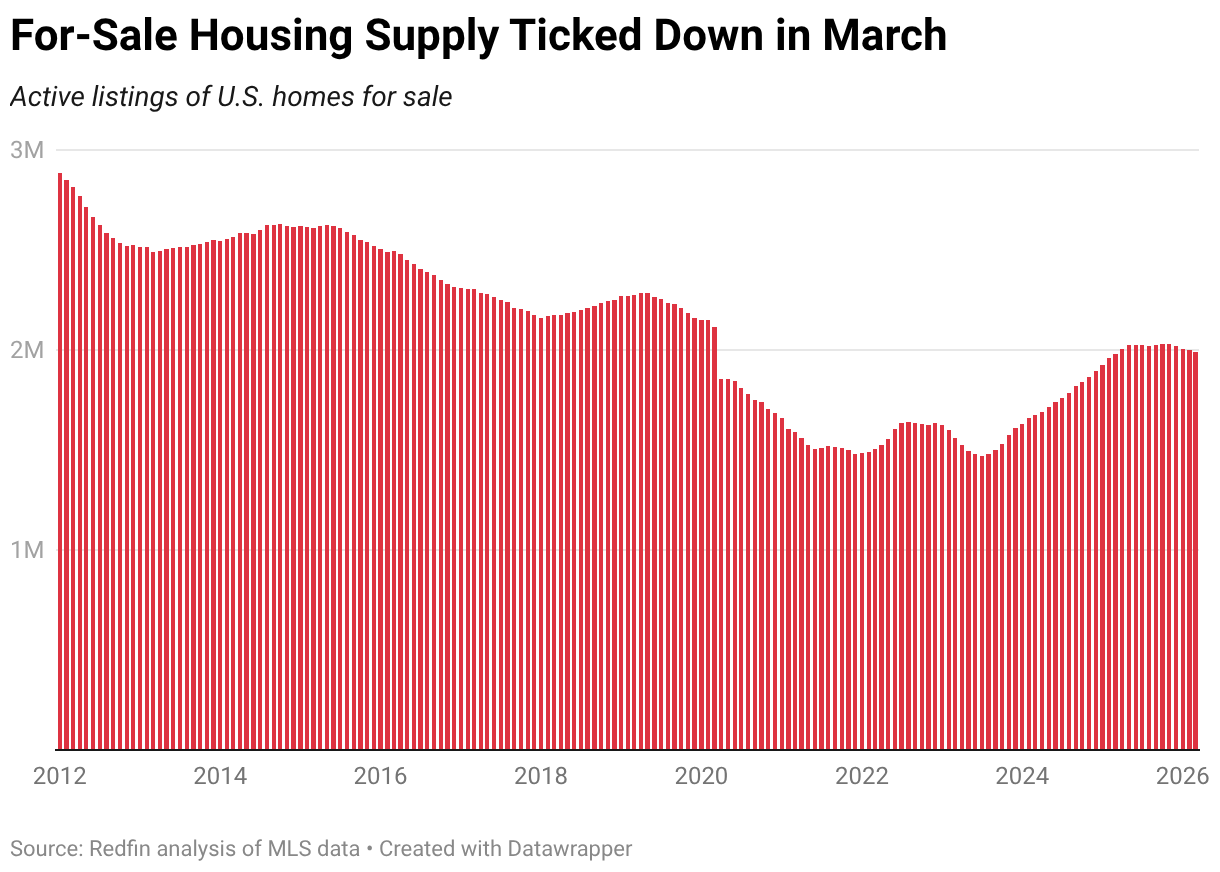
Active listings of U.S. homes for sale fell 0.6% month over month on a seasonally adjusted basis—the largest decline since June 2023. Some sellers have been retreating due to lackluster demand for their homes; pending home sales were little changed from a month earlier (0.1%) on a seasonally adjusted basis in March and fell 2.6% from a year earlier. High home prices, rising mortgage rates and economic uncertainty have caused many house hunters to stay on the sidelines.

For-Sale Housing Supply Ticked Down in March (Column Chart)


It’s worth noting that while both buyers and sellers have been retreating, buyers have retreated faster, which means they are
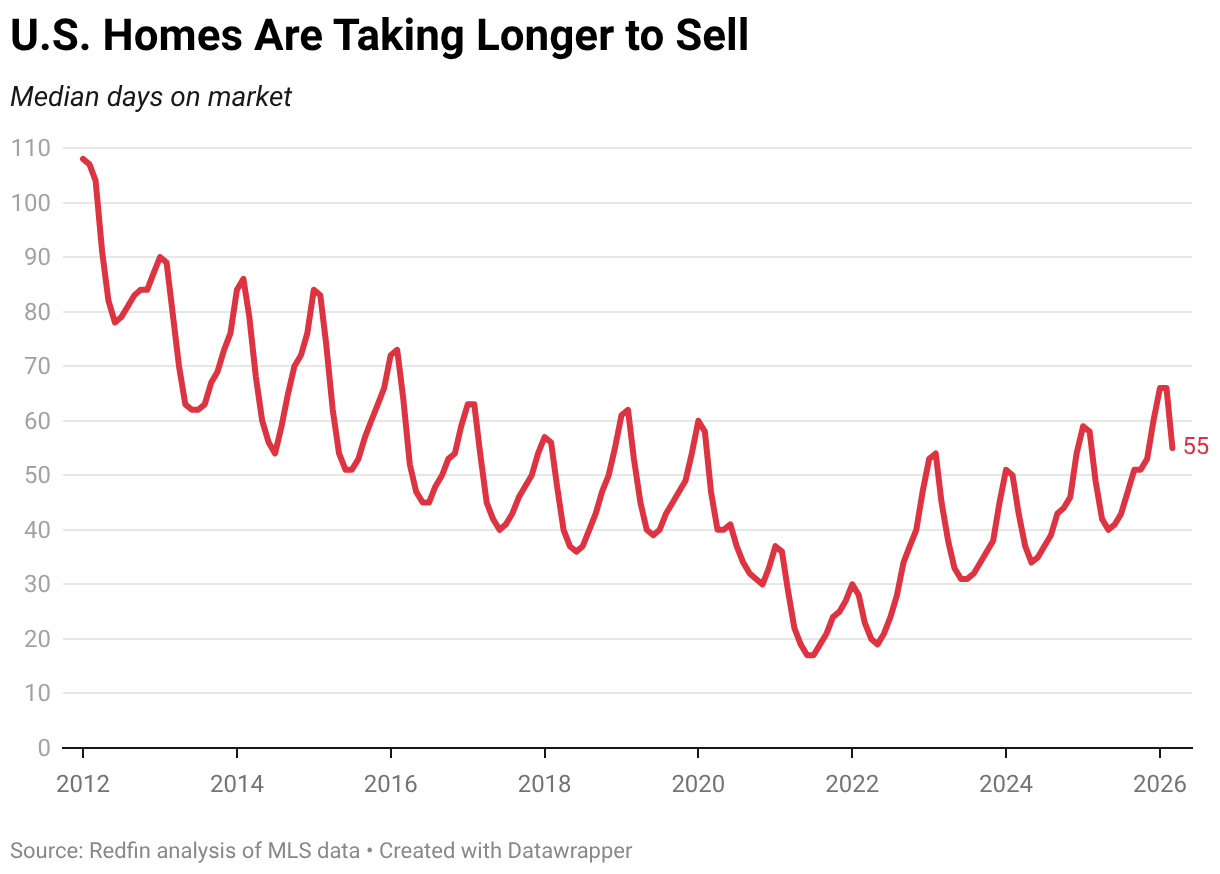
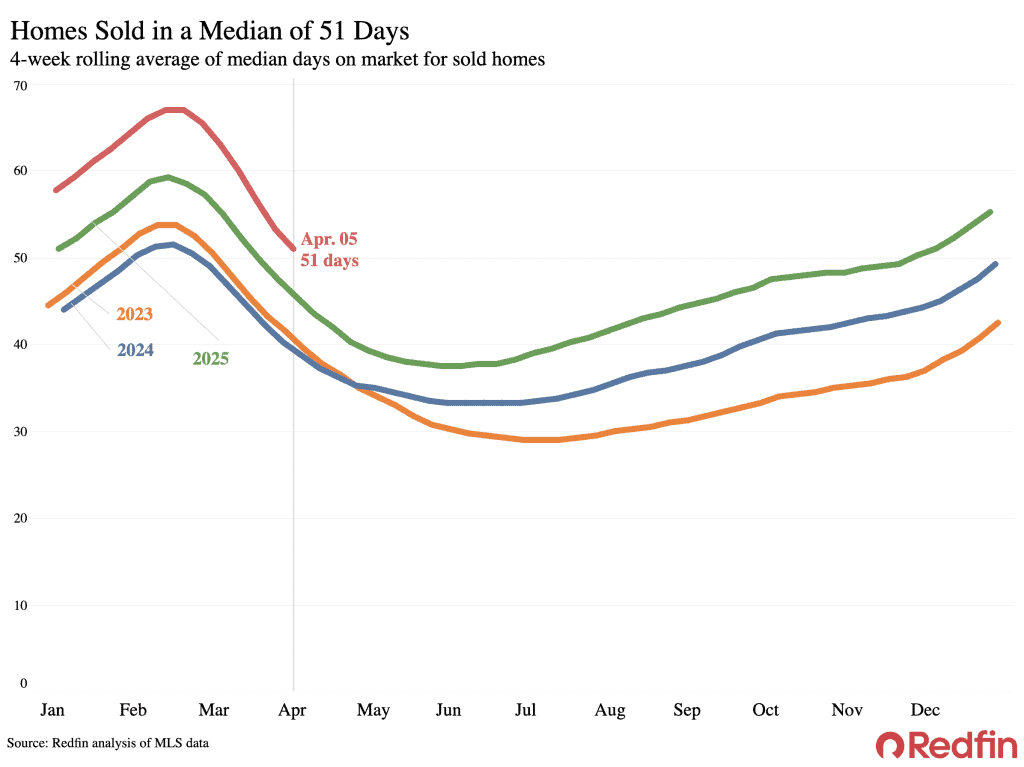
far outnumbered by sellers. That imbalance is why buyers have negotiating power. Yes, home price growth is inching up, but buyers are also scoring the largest discounts in years as sellers watch their homes linger on the market. The typical home that went under contract in March did so in 55 days. That’s the slowest March pace in a decade and is up from 49 days a year earlier.

U.S. Homes Are Taking Longer to Sell (Line chart)


March 2026 Housing Market Highlights: United States


March 2026 Month-over-month change Year-over-year change
Median sale price $436,733 1.8% 1.2%
Existing-home sales, seasonally adjusted annual rate 4,222,253 -0.3% -0.3%
Pending home sales, seasonally adjusted 482,196 0.1% -2.6%
Homes sold, seasonally adjusted 427,358 0.6% -1.6%
New listings, seasonally adjusted 554,854 2.4% -2.6%
Total homes for sale, seasonally adjusted (active listings) 1,990,299 -0.6% 0.5%
Months of supply 3.2 -0.9 -0.2
Median days on market 55 -11 6
Share of homes that sold above final list price 25.6% 2.9 ppts -1.5 ppts
Average sale-to-final-list-price ratio 98.7% 0.5 ppts -0.2 ppts

Pending sales that fell out of contract, as % of overall pending sales

13.4% 0.2 ppts

0.9 ppts

Monthly average 30-year fixed mortgage rate 6.18% 0.13 ppts

-0.47 ppts

March 2026 Metro-Level Highlights


The figures below are based on a list of the 50 most populous U.S. metropolitan areas. Some metros may be removed from time to time to ensure data accuracy.
Refer to our metrics definition page for explanations of metrics used in this report. Metro-level data are not seasonally adjusted. All changes below represent year-over-year changes.

  • Prices: Median sale prices rose most from a year earlier in San Francisco (14.4%), Detroit (11.1%) and Milwaukee (8%). They fell most in Oakland, CA (-6.3%), Dallas (-4.5%) and Sacramento, CA (-2.5%).
  • Pending home sales: Pending sales rose most in West Palm Beach, FL (25.4%), Miami (13.5%) and Milwaukee (11.7%). They fell most in Providence, RI (-13.2%), New Brunswick, NJ (-11.5%) and New York (-10.9%).
  • Closed home sales: Home sales rose most in West Palm Beach (15.5%), Kansas City, MO (11.7%) and Virginia Beach, VA (9.4%). They fell most in Nassau County, NY (-9.7%), Pittsburgh (-8%) and Oakland (-7.8%).
  • New listings: New listings rose most in San Jose, CA (13.5%), Boston (9.3%) and San Francisco (9.1%). They fell most in Tampa, FL (-17.4%), Jacksonville, FL (-13.4%) and Miami (-13.3%).
  • Active listings: Active listings rose most in Seattle (16.8%), Detroit (11.5%) and Milwaukee (10.8%). They fell most in Jacksonville (-18%), Tampa (-9.5%) and Riverside, CA (-9%).
  • Days on market: In Nashville, the typical home that went under contract did so in 91 days, which was 23 days longer than a year earlier—the biggest increase among the metros analyzed. Next came Indianapolis (+22 days) and Austin, TX (+19 days). The biggest decreases were in Kansas City, MO (-5 days), Fort Worth, TX (-4 days), San Francisco (-3 days) and West Palm Beach (-3 days).

March 2026 Full Metro-Level Data

U.S. metro area Median sale price Median sale price, Y/Y change Pending sales, Y/Y change Homes sold, Y/Y change New listings, Y/Y change Active listings, Y/Y change Median days on market Median days on market, Y/Y change
Anaheim, CA $1,260,000 4.7% 0.6% 1.3% -9.0% -5.6% 36 1
Atlanta, GA $392,000 -0.8% -2.9% 4.7% -3.2% 1.7% 59 4
Austin, TX $430,000 -2.3% 11.0% 2.4% -2.0% 2.7% 93 19
Baltimore, MD $399,000 6.4% -0.8% -3.5% -0.8% 6.6% 41 9
Boston, MA $748,000 3.2% -2.7% -0.9% 9.3% 6.9% 26 6
Charlotte, NC $408,000 0.5% N/A -2.9% 2.6% 8.2% 74 14
Chicago, IL $375,000 4.2% 2.7% 2.3% 2.3% -1.8% 51 -2
Cincinnati, OH $310,000 6.9% 7.1% -1.2% 3.1% 6.5% 45 2
Cleveland, OH $240,000 5.5% -0.1% -1.1% -0.5% 2.8% 32 0
Columbus, OH $355,000 4.4% 9.2% 0.3% 0.6% 2.6% 51 6
Dallas, TX $400,000 -4.5% 6.0% 0.3% -5.0% -0.2% 66 14
Denver, CO $589,000 -1.0% 0.0% 2.8% -6.9% 0.6% 24 -1
Detroit, MI $200,000 11.1% -6.4% -7.6% -2.8% 11.5% 37 6
Fort Worth, TX $352,585 -0.7% 5.5% 1.0% -1.8% -1.8% 54 -4
Houston, TX $330,320 -2.0% -7.0% -0.4% -4.4% 2.1% 76 13
Indianapolis, IN $310,000 2.3% 0.8% -2.1% -0.9% 7.2% 51 22
Jacksonville, FL $372,000 2.4% -0.2% -0.5% -13.4% -18.0% 76 5
Kansas City, MO $345,000 6.2% N/A 11.7% 5.3% -0.4% 32 -5
Las Vegas, NV $450,000 0.0% -2.8% 2.9% -6.7% 5.7% 62 10
Los Angeles, CA $913,400 -1.3% 1.1% 4.0% -2.7% -2.0% 45 3
Miami, FL $580,000 1.8% 13.5% 2.9% -13.3% -7.7% 95 9
Milwaukee, WI $350,000 8.0% 11.7% 9.2% 8.6% 10.8% 41 -1
Minneapolis, MN $380,000 0.0% -7.2% -1.3% 3.0% 4.8% 34 3
Montgomery County, PA $500,000 7.5% -2.7% 3.7% -1.9% 2.8% 35 7
Nashville, TN $464,900 0.0% -2.3% -2.8% 3.7% 9.2% 91 23
Nassau County, NY $737,000 5.3% -9.8% -9.7% -4.8% -7.9% 46 8
New Brunswick, NJ $550,000 0.2% -11.5% -5.8% 0.5% 0.3% 51 9
New York, NY $790,000 4.8% -10.9% -1.5% -3.3% -5.4% 68 1
Newark, NJ $600,000 1.7% -1.4% -2.4% -0.4% 1.5% 35 -1
Oakland, CA $918,000 -6.3% N/A -7.8% -4.9% -7.3% 15 0
Orlando, FL $410,000 1.2% -7.3% -6.8% -8.1% -8.7% 59 -1
Philadelphia, PA $291,000 2.1% -5.7% -7.8% 4.1% 0.7% 56 12
Phoenix, AZ $470,000 0.0% 6.0% 8.8% -5.1% -0.4% 59 3
Pittsburgh, PA $250,000 6.4% 1.8% -8.0% -2.3% 1.0% 72 3
Portland, OR $552,696 1.4% 3.8% 9.3% 0.6% 1.7% 31 1
Providence, RI $525,000 6.7% -13.2% -7.5% -11.1% -3.1% 37 7
Riverside, CA $585,000 -1.7% -0.7% 0.9% -8.7% -9.0% 54 2
Sacramento, CA $585,000 -2.5% 4.2% 4.9% 1.8% -0.1% 23 1
San Antonio, TX $313,725 -0.1% 0.1% 2.8% 6.3% 1.0% 105 18
San Diego, CA $915,000 0.0% -1.4% 9.2% -0.3% -2.6% 27 2
San Francisco, CA $1,720,000 14.4% N/A 5.4% 9.1% -6.5% 13 -3
San Jose, CA $1,638,000 -0.1% N/A 4.5% 13.5% 3.4% 10 -1
Seattle, WA $834,000 0.5% -8.1% -3.0% 2.4% 16.8% 12 4
St. Louis, MO $281,000 6.0% N/A -3.3% 7.2% 10.0% 33 5
Tampa, FL $375,000 1.4% -7.1% 0.1% -17.4% -9.5% 56 7
Virginia Beach, VA $367,423 5.0% -3.9% 9.4% 2.5% -1.2% 36 2
Warren, MI $313,000 4.3% 3.2% -1.4% 2.5% 10.2% 32 6
Washington, DC $585,000 0.0% 6.7% 5.5% 2.1% 8.3% 38 7
West Palm Beach, FL $515,000 -1.0% 25.4% 15.5% -7.3% -5.0% 86 -3

The post San Francisco Home Prices Jump Most in 8 Years Amid AI Boom appeared first on Redfin Real Estate News.
This post was originally published here

Pending home sales are declining and touring activity is slumping. 

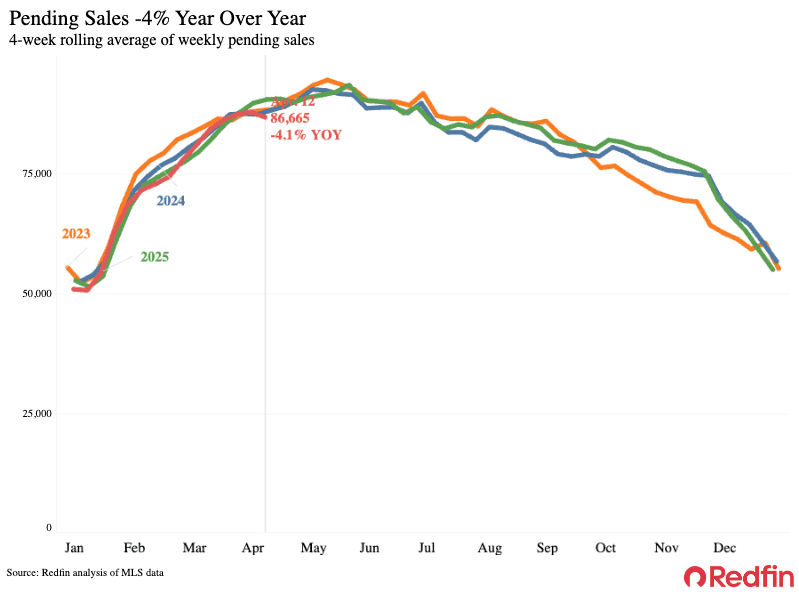
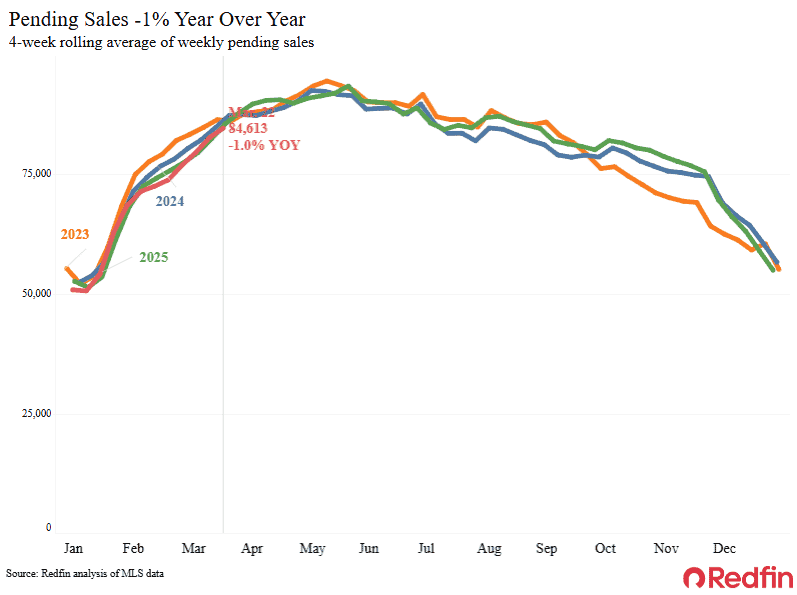
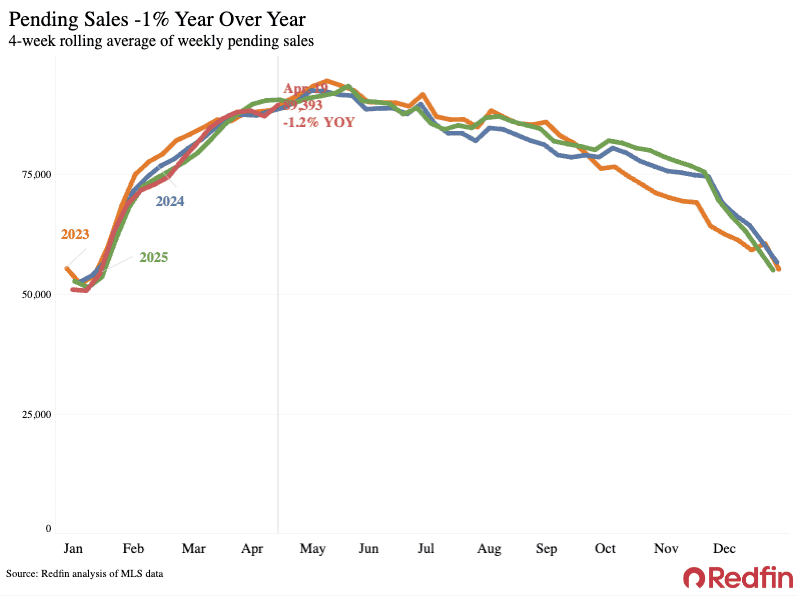
U.S. pending home sales fell 4.1% from a year earlier during the four weeks ending April 12, the biggest decline in over a year. 

Sales fell in all but seven of the 50 biggest U.S. metro areas, with the biggest declines in Providence, RI (-17.5%), Houston (-16.9%) and Nassau County, NY (-14.8%). The biggest increases were in San Francisco (9.6%), West Palm Beach, FL (8.2%) and Miami (6.4%). 

Homebuying demand is unseasonably slow. Home-touring activity is up just 11% since the start of the year, compared to a 40% increase over the same period last year, according to ShowingTime

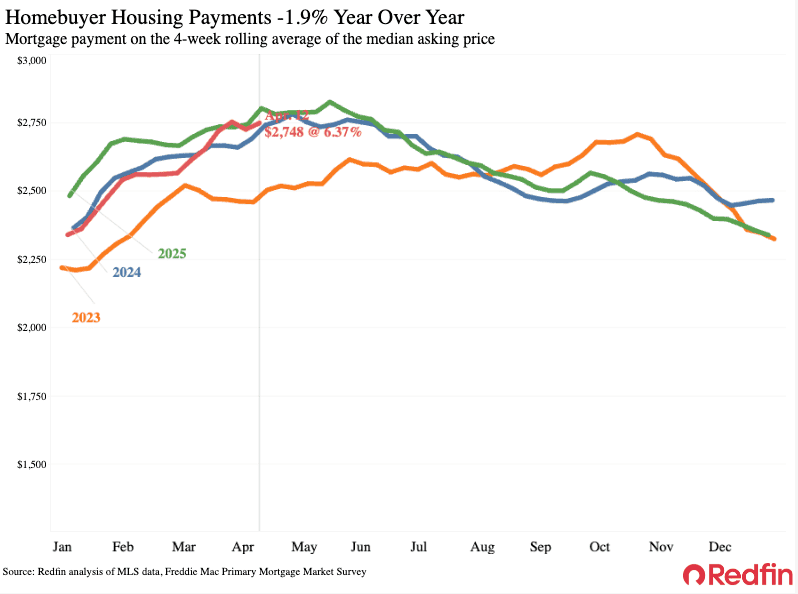
Would-be homebuyers are backing off partly because the Iran war is causing widespread geopolitical and economic uncertainty, making some Americans wary of making a big purchase. It has also contributed to higher mortgage rates, though the average rate fell slightly to 6.37% last week. Mortgage rates may swing up or down in the next few weeks, depending on the direction of the Iran war, the outcome of negotiation talks and oil prices.  

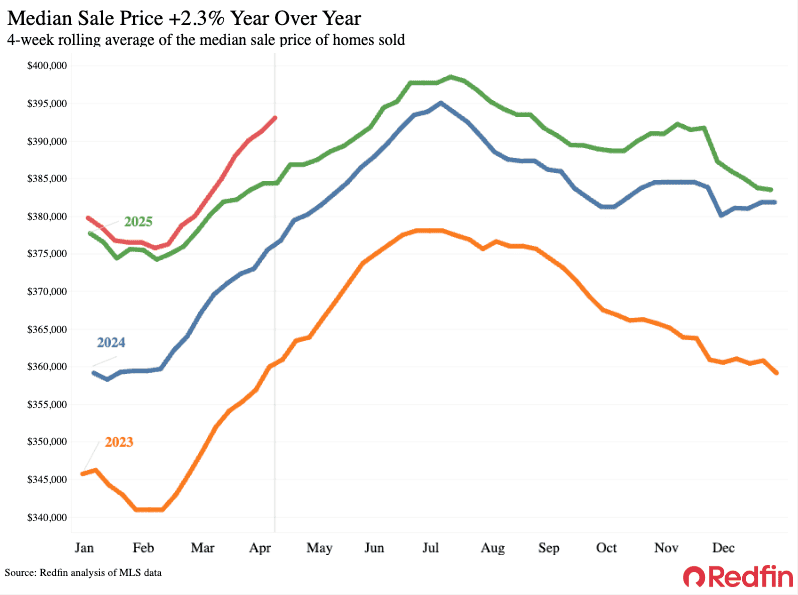
High housing costs are also sidelining house hunters. The median home-sale price rose 2.3% annually, the biggest increase in a year, and while the weekly average mortgage rate has come down slightly, it is still near a six-month high. It’s worth noting that the timing of Easter is contributing to the year-over-year decline in pending sales, too: Easter fell into this four-week period, but not the comparable period in 2025. 

Redfin agents in some parts of the country say some buyers are jittery about whether it’s the right time to make a big purchase, with economic uncertainty in the air and the rising prices of other things, like gas, cutting into their budgets.

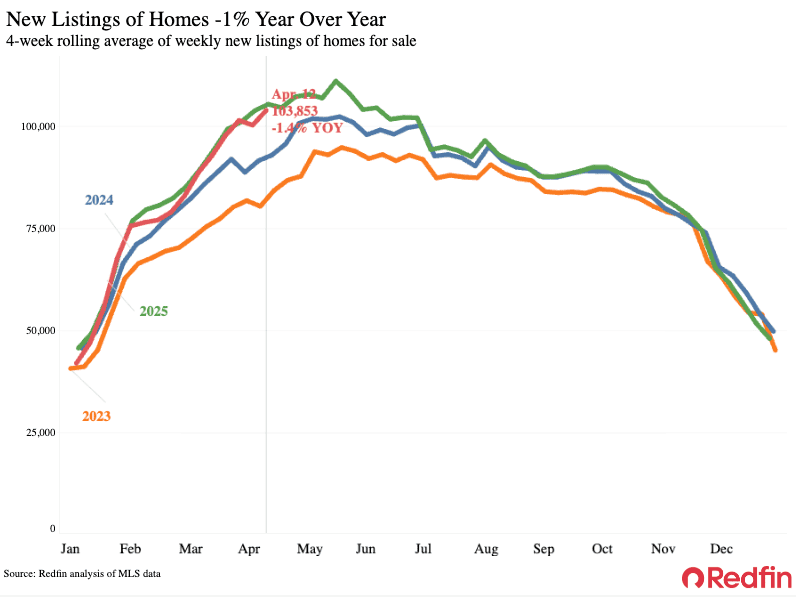
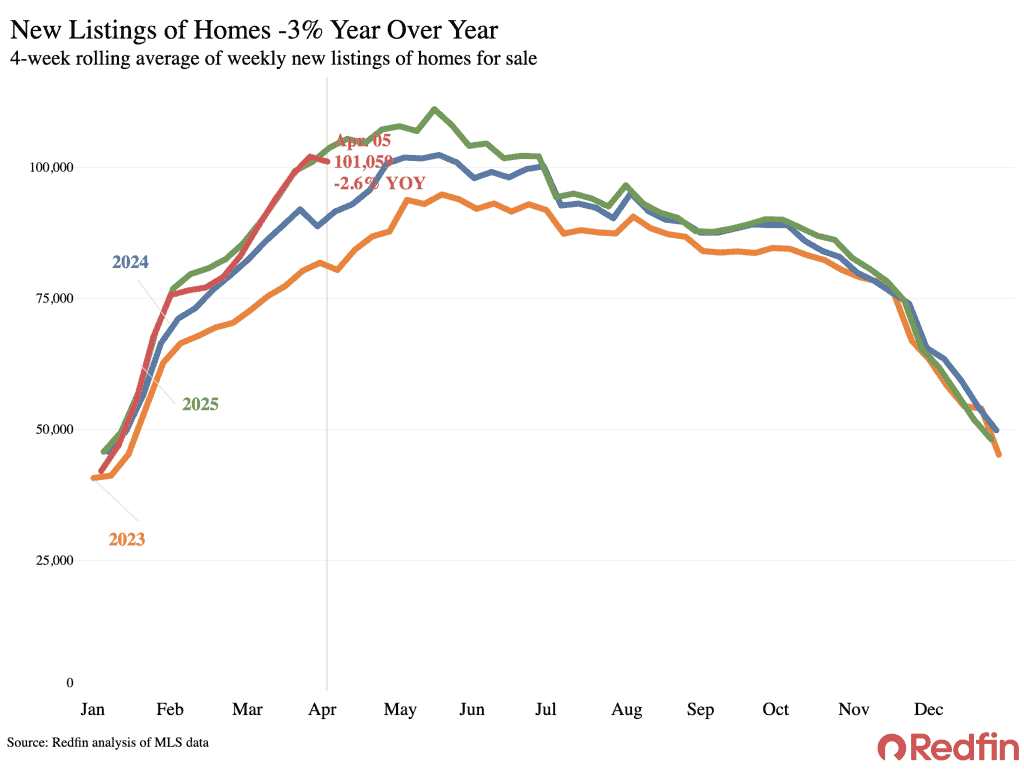
On the selling side, new listings of homes for sales declined 1.4% year over year, with some prospective sellers hitting pause while demand is down. 

For Redfin economists’ takes on the housing market, please visit Redfin’s “From Our Economists” page. 

Leading indicators 


Indicators of homebuying demand and activity
Value (if applicable) Recent change Year-over-year change Source
Daily average 30-year fixed mortgage rate 6.32% (April 15) Down from 6.64% three weeks earlier  Down from 6.98% Mortgage News Daily 
Weekly average 30-year fixed mortgage rate 6.37% (week ending April 9) Down slightly from 6-month high the week before Down from 6.62% Freddie Mac
Mortgage-purchase applications (seasonally adjusted) Down 1% from a week earlier (as of week ending April 10) Down 3% Mortgage Bankers Association 
Google searches of “homes for sale” Up 11% from a month earlier (as of April 11) Up 20% Google Trends
Touring activity Up 11% from the start of the year (as of April 12) At this time last year, it was up 40% from the start of 2025 ShowingTime

Key housing-market data


U.S. highlights: Four weeks ending April 12, 2026

Redfin’s national metrics include data from 400+ U.S. metro areas and are based on homes listed and/or sold during the period. Weekly housing-market data goes back through 2015. Subject to revision. 

Four weeks ending April 12, 2026 Year-over-year change Notes
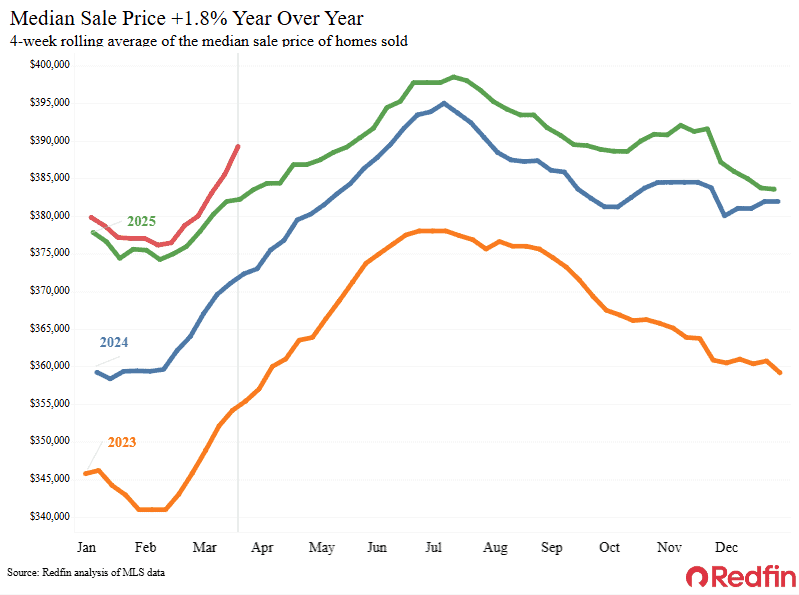
Median sale price $393,059 2.3% Biggest increase in a year
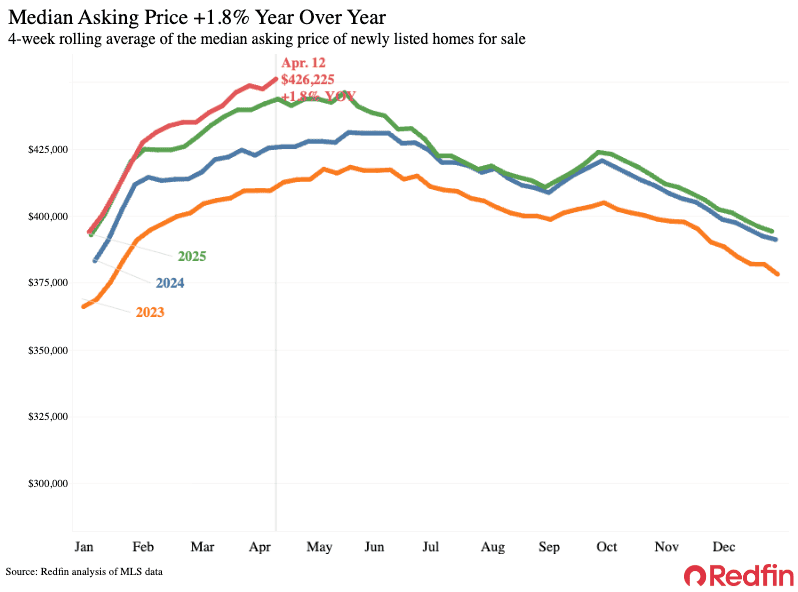
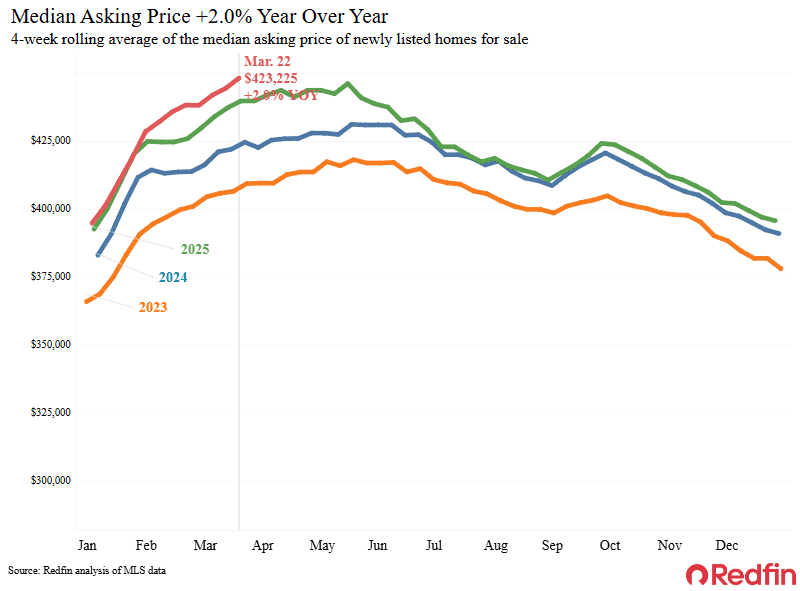
Median asking price $426,225 1.8%
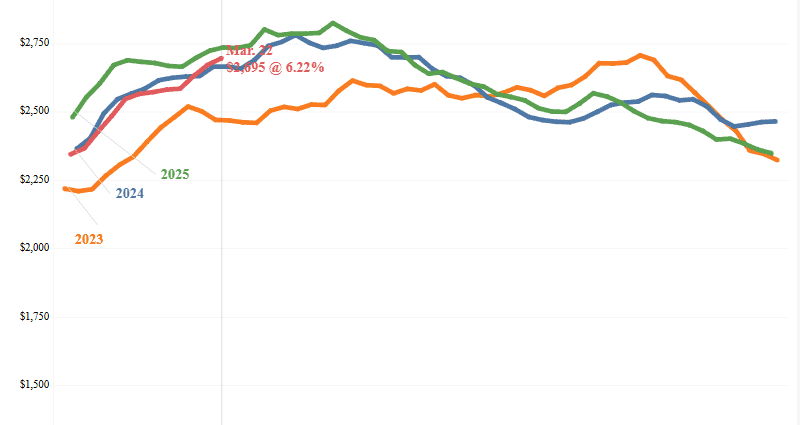
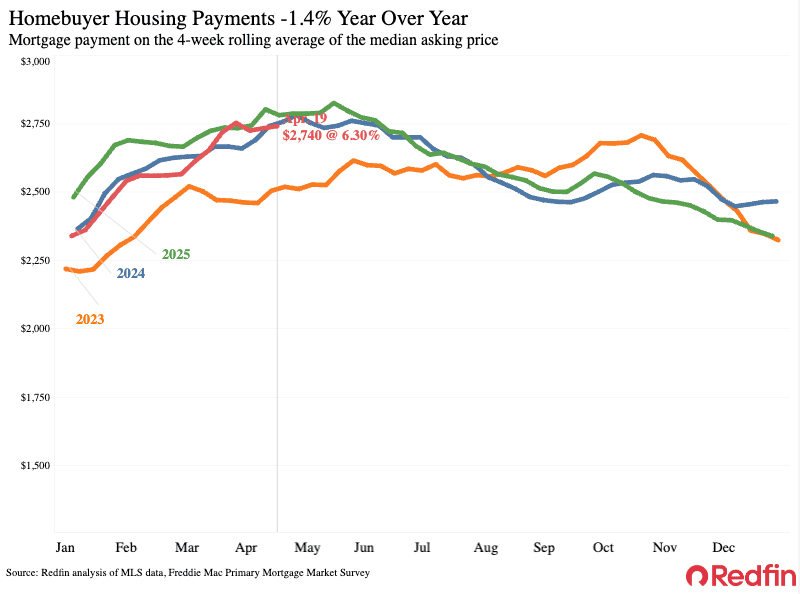
Median monthly mortgage payment $2,748 at a 6.37% mortgage rate -1.9%
Pending sales 86,665 -4.1% Biggest decline in a year
New listings 103,853 -1.4%
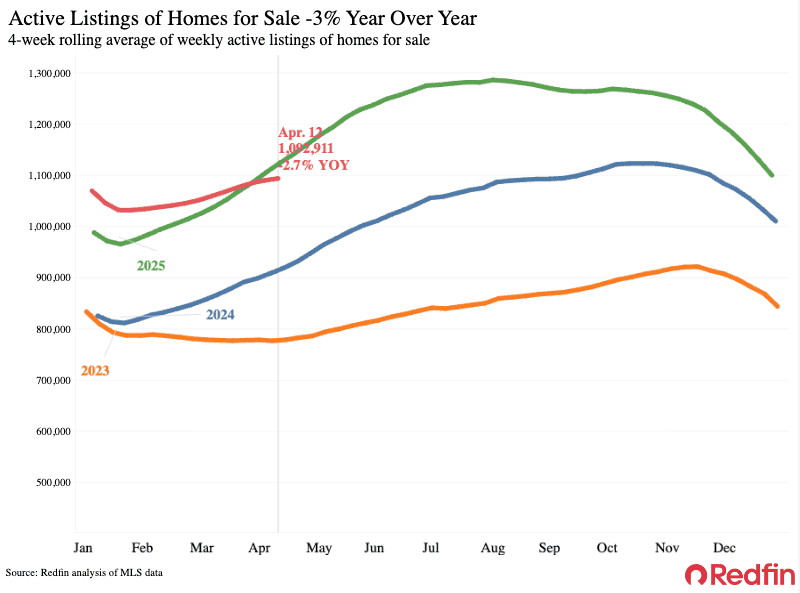
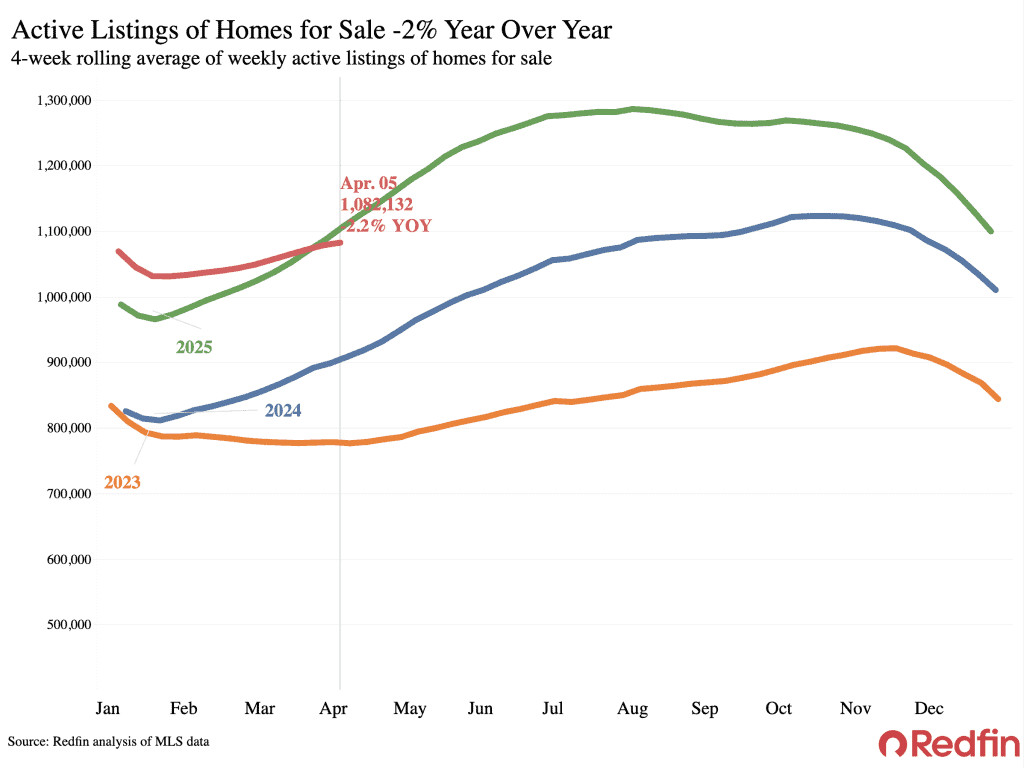
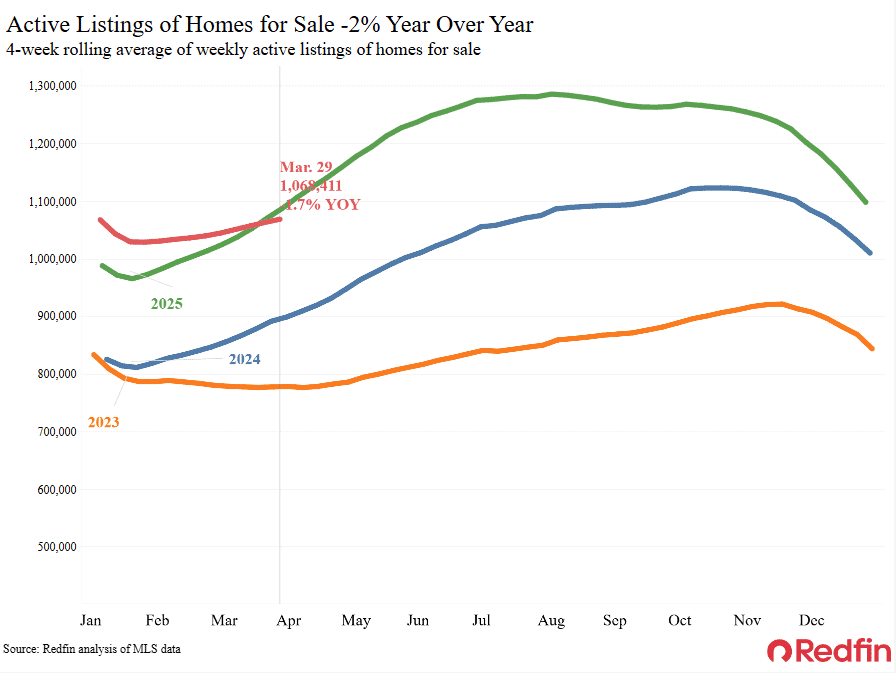
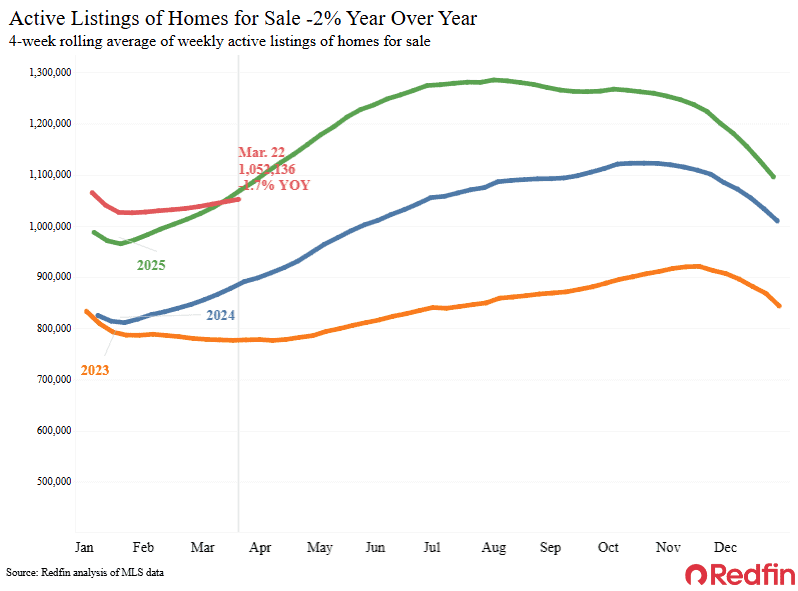
Active listings 1,092,911 -2.7% Biggest decline since 2023
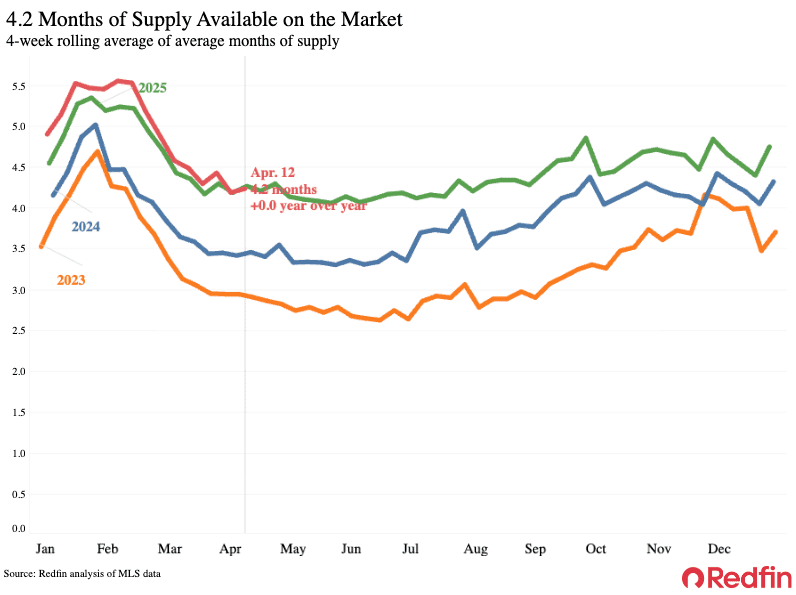
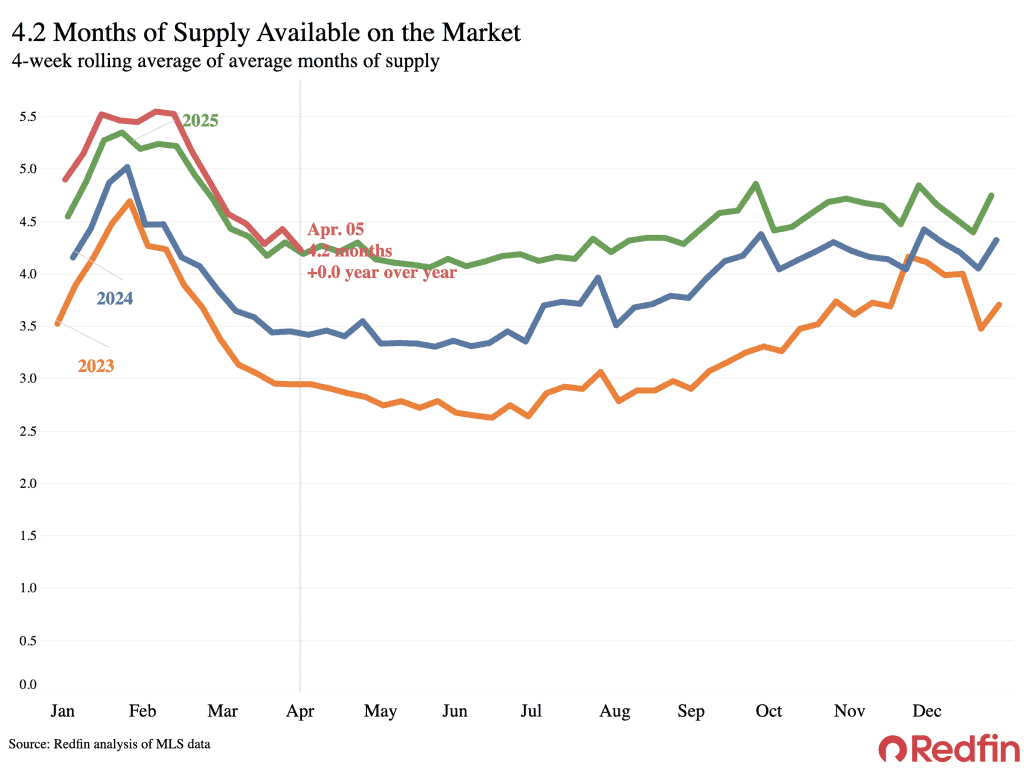
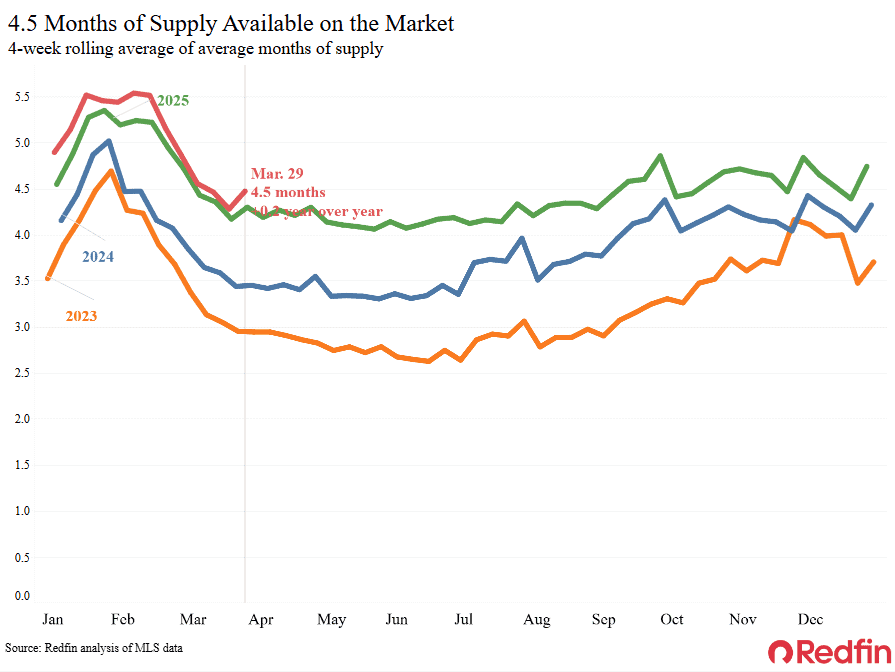
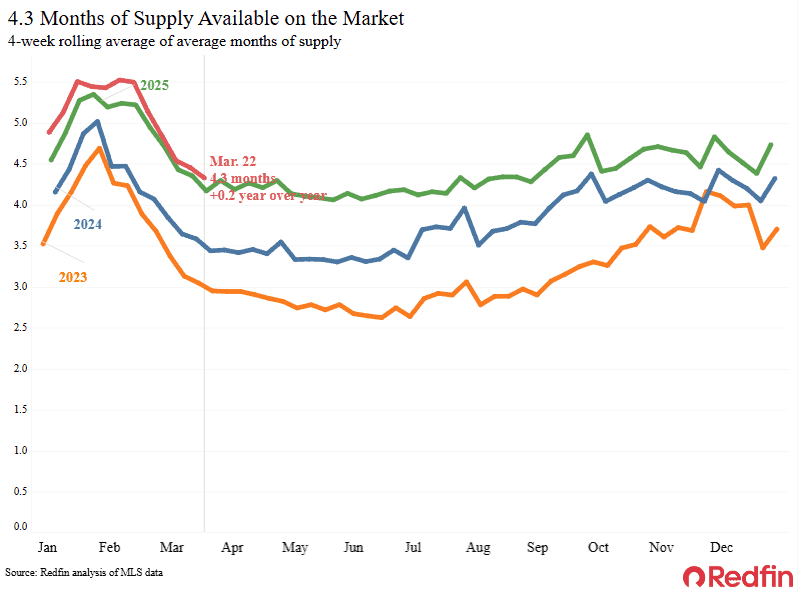
Months of supply  4.2 Unchanged 4 to 5 months of supply is considered balanced, with a lower number indicating seller’s market conditions 
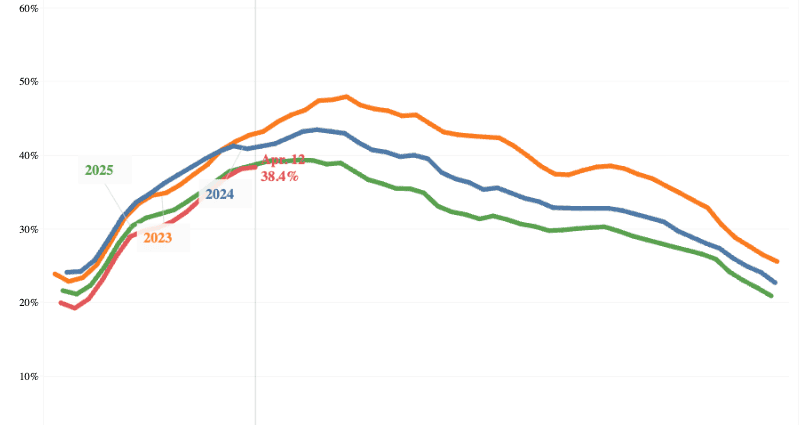
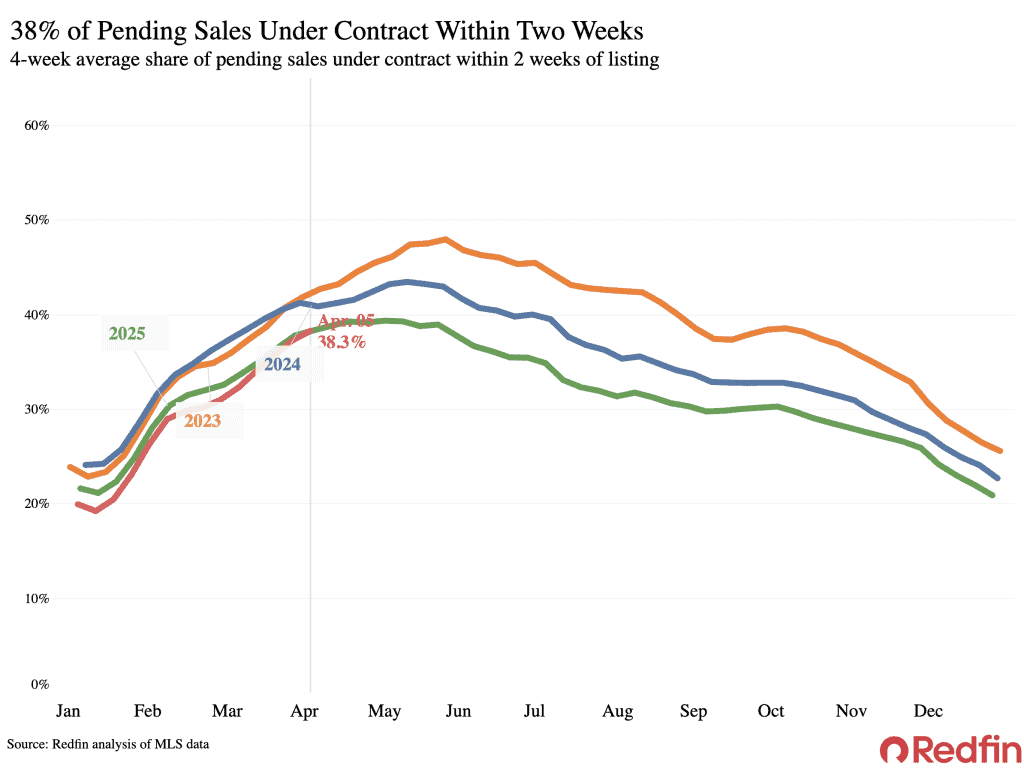
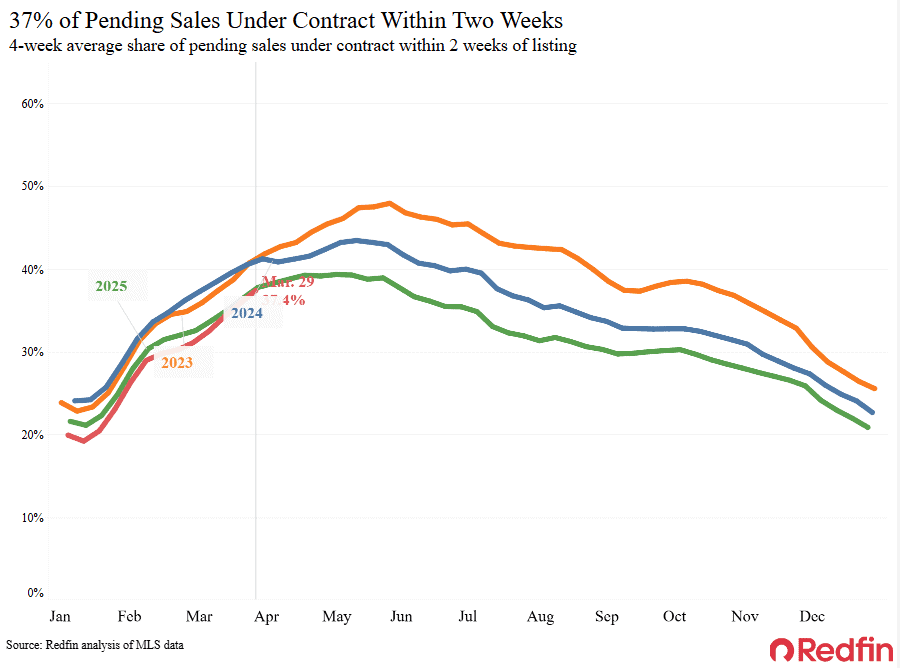
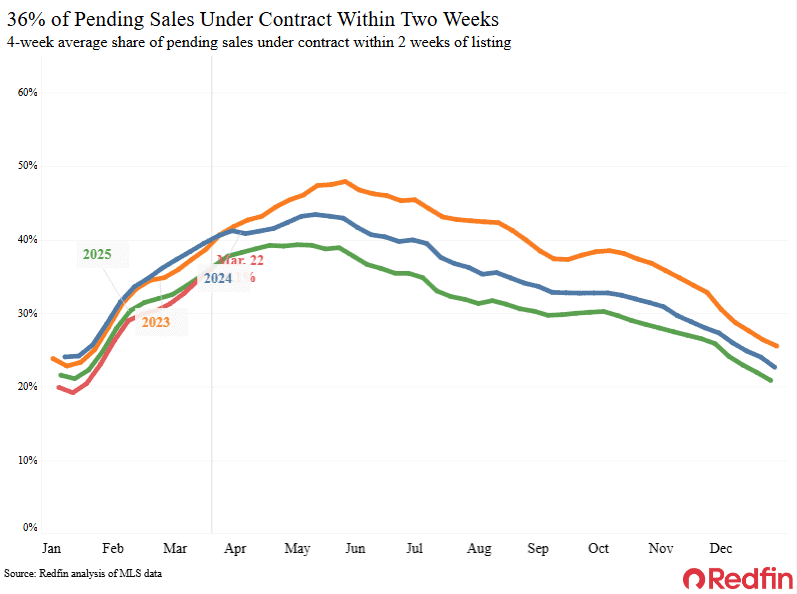
Share of homes off market in two weeks  38.4% Essentially unchanged
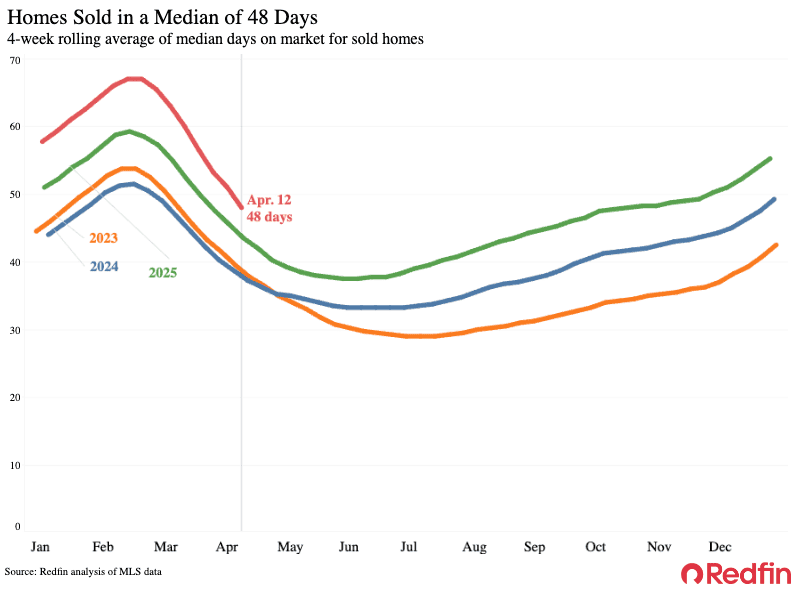
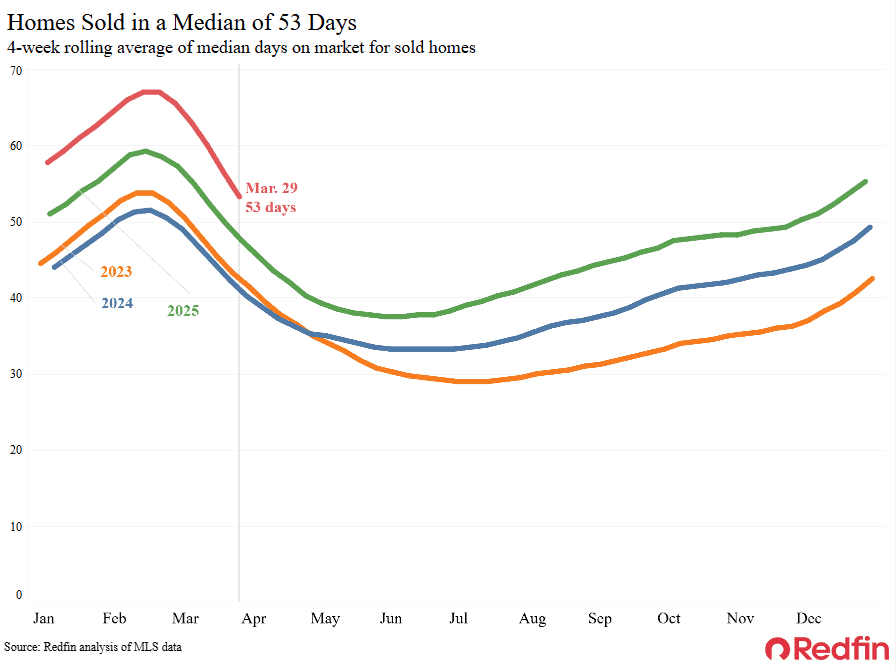
Median days on market 48 +4 days
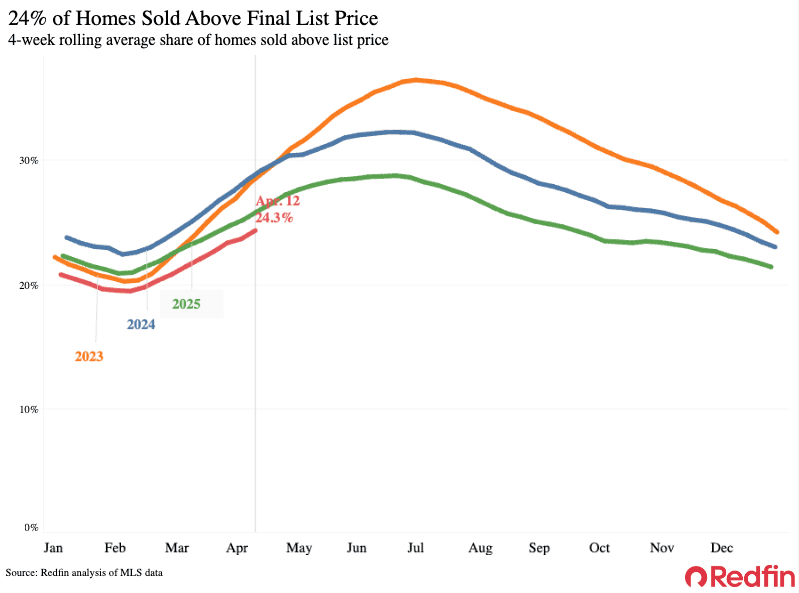
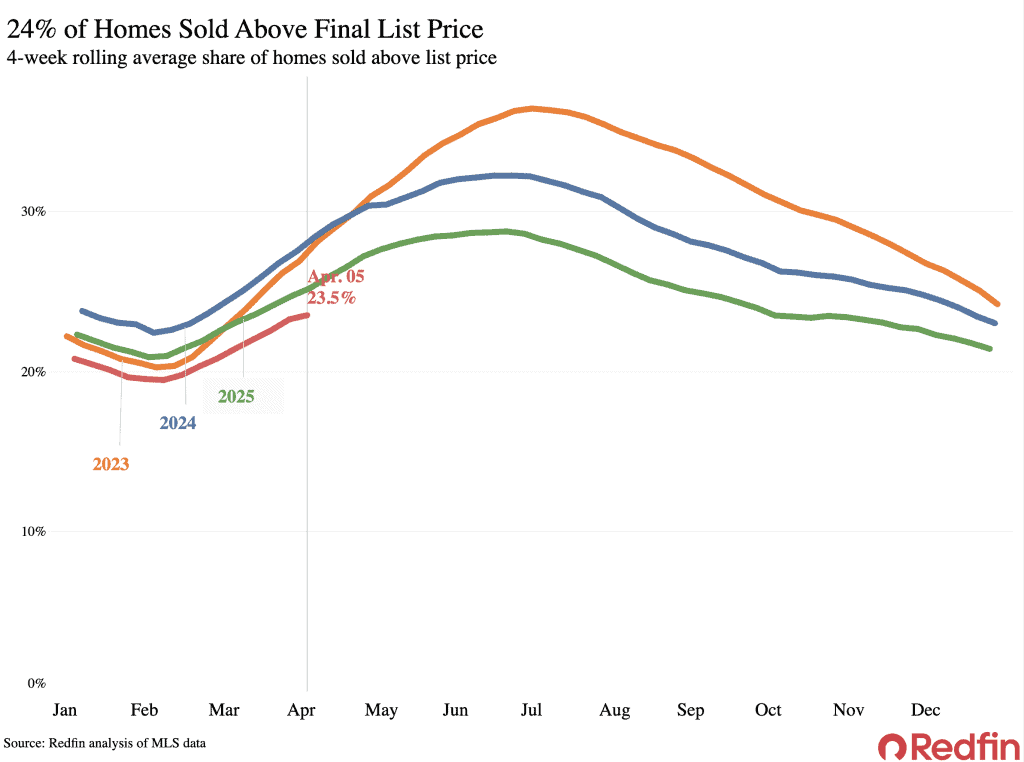
Share of homes sold above list price 24.3% Down from 26%
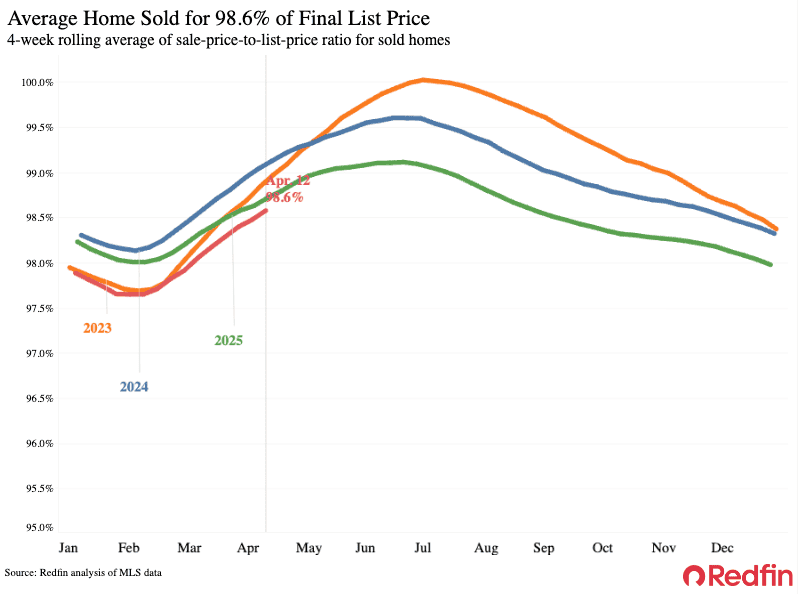
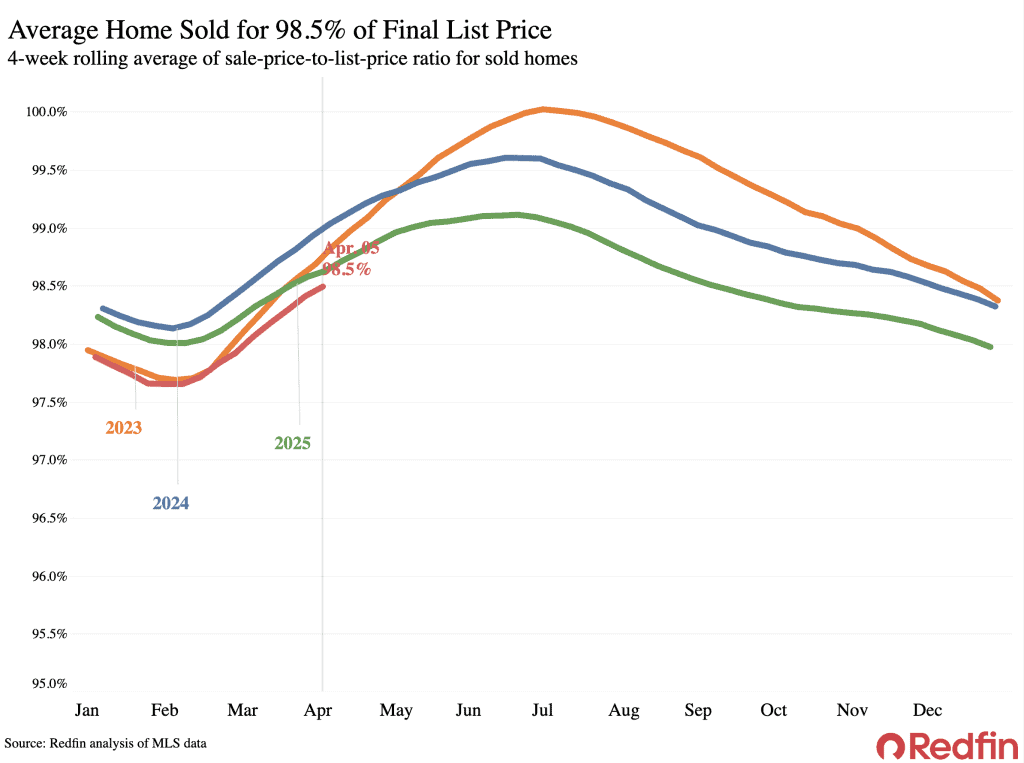
Average sale-to-list price ratio  98.6% Down from 98.7%

Metro-level highlights: Four weeks ending April 12, 2026

Redfin’s metro-level data includes the 50 most populous U.S. metros. Select metros may be excluded from time to time to ensure data accuracy. 

Metros with biggest year-over-year increases Metros with biggest year-over-year decreases

Notes

Median sale price San Francisco (13.3%)

Detroit (10.7%)

Cleveland (9.8%)

Providence, RI (9%)

Pittsburgh (8.8%)

Dallas (-3.4%)

Austin, TX (-3.2%)

Oakland, CA (-3.2%)

Seattle (-2.9%)

Nashville, TN (-2.8%)

Declined in 17 metros

Pending sales San Francisco (9.6%)

West Palm Beach, FL (8.2%)

Miami (6.4%)

Fort Worth, TX (2.4%)

Milwaukee (1.3%)

Providence, RI (-17.5%)

Houston (-16.9%)

Nassau County, NY (-14.8%)

New York (-14.2%)

Seattle (-13.8%)

Increased in just 7 metros 
New listings Milwaukee, WI (12%)

Philadelphia (11.5%)

San Jose, CA (8.5%)

Minneapolis (7.3%)

Indianapolis (5.8%)

Tampa, FL (-15.8%)

Jacksonville, FL (-14.9%)

Anaheim, CA (-13.8%)

Riverside, CA (-13%)

Orlando (-11.9%)

Refer to our metrics definition page for explanations of all the metrics used in this report.

The post This Spring’s Housing Market Is Unseasonably Slow As Iran War, High Costs Curb Demand appeared first on Redfin Real Estate News.
This post was originally published here

A wave of ultra-luxury deals made coastal Florida the center of America’s priciest home sales in March. Other notable sales include Tom Cruise’s former Beverly Hills estate and a Tennessee ranch. 

Mark Zuckerberg and Priscilla Chan bought 7 Indian Creek Island Road, a waterfront estate on a Miami island known as the “Billionaire Bunker,” for $170 million in March. That was far and away the most expensive home sale in the U.S. last month, and it was also the most expensive home ever sold in Miami-Dade County. 

Coastal Florida is also home to the second-priciest sale of March, a modern mansion in Manalapan. A Beverly Hills compound previously owned by Tom Cruise rounds out the top three, bringing in $47 million. 

All in all, seven of March’s 10 most expensive home sales were in coastal Florida, which has  become a magnet for ultra-wealthy Americans, partly because it has no state income tax. Outside of the Sunshine State, two of last month’s priciest sales were in California, and one was a Tennessee ranch. 

All 10 sold for more than $30 million. 

These are the most expensive U.S. home sales of March:

  1. 7 Indian Creek Island Rd., Indian Creek, FL 33154: Sold for $170 million
  2. 1460 Ocean Blvd., Manalapan, FL 33462: Sold for $51.2 million
  3. 1111 Calle Vista Dr., Beverly Hills, 90210: Sold for $47 million 
  4. 9111 Collins Ave. Unit N-PH6, Surfside, FL 33154: Sold for $44 million 
  5. 870 S. Ocean Blvd., Palm Beach, FL 33480: Sold for $37.1 million 
  6. 160 Clarendon Ave., Palm Beach, FL 33480: Sold for $36 million 
  7. 998 Dickinson Ln., Franklin, TN 37069: Sold for $35 million 
  8. 6480 Allison Rd., Miami Beach, FL 33141: Sold for $33.3 million 
  9. 190 Almendral Ave., Atherton, CA 94027: Sold for $32.5 million 
  10. 387 Ocean Blvd., Golden Beach, FL 33160: Sold for $32.5 million 

And these are the most expensive U.S. home sales of 2026 so far:

  1. 7 Indian Creek Island Rd., Indian Creek, FL 33154: Sold for $170 million in March
  2. 1940 S. Ocean Blvd., Manalapan, FL 33462: Sold for $68.3 million in February
  3. 70 Vestry St Unit PHS, New York City, NY 10013: Sold for $57 million in February 
  4. 8 E. 62nd St., New York City, NY 10065: Sold for $55 million in February
  5. 4296 Cutlass Ln., Naples, FL 34102: Sold for $55 million in January
  6. 432 Park Ave., 78th Floor, New York City, NY 10022: Sold for $52.5 million in February 
  7. 1460 Ocean Blvd., Manalapan, FL 33462: Sold for $51.2 million in March 
  8. 1111 Calle Vista Dr., Beverly Hills, 90210: Sold for $47 million in March 
  9. 36 E. 63rd St., New York City, NY 10065: Sold for $46.8 million in February 
  10. 919 Lakeshore Blvd., Incline Village, CA 89451: Sold for $46 million in February 

The post A Billionaire Beach Party: Mark Zuckerberg’s $170 Million Florida Purchase Tops March’s Most Expensive Home Sales appeared first on Redfin Real Estate News.
This post was originally published here

  • 7% of American workers are canceling plans to make a major purchase, such as buying a home or car, due to their feelings about job security, according to a Redfin survey. Close to one-third (30%) are delaying these major purchase plans.
  • 16% say they have already made a major purchase sooner than expected due to job security concerns. Another 17% say they will make a purchase earlier than originally planned for the same reason.
  • 69% of workers are confident about their job security, while 27% are concerned. 
  • Among workers who are concerned about their job security, company performance (29%) and the impact of artificial intelligence (18%) are the top-cited reasons.
  • 15% of workers have been late to make a rent or mortgage payment or missed a rent or mortgage payment entirely in the past three months.

More than one in three (36%) American workers are delaying or canceling a major purchase like a home or car due to their feelings about job security. On the flip side,  31% have either already made a major purchase sooner than expected, or plan to due to their feelings about job security.

That’s according to a Redfin survey conducted by Ipsos between March 9-10, 2026.  The nationally representative survey was fielded to 1,005 U.S. residents, including 452 who are employed full-time and 112 who are employed part-time. The results for the combined group of workers have a credibility interval of +/- 5.1 percentage points.

More than one in three  (36%) of respondents say their feelings about job security have no impact on their timeline for any major purchase decisions. 

In August 2025, when we asked the same question to American workers, 42% said they were delaying or canceling plans to make a major purchase due to feelings about job security, six percentage points higher than today. However, the shares who said in August that they had already made (or planned to make) a major purchase sooner than expected (29%) is largely unchanged from today—as is the share who said they had made no changes to their plans (32%).

Most American Workers Are Confident About Job Security


Roughly two-thirds (69%) of workers say they are either somewhat confident or very confident about their job security—a similar share (66%) said the same last August.

In comparison, 27% now say they are either somewhat concerned or very concerned about their job security.

Nearly One in Three Workers More Concerned About Job Security Now Than Six Months Ago


Roughly one-third (32%) of workers are more concerned about their job security than six months ago. In comparison, 18% are more confident about their job security.


When we asked the same question in August 2025, 37% of workers said they were more concerned about their job security today than six months ago, while 21% said they were more confident. 

Company Performance and AI Are Top Reasons for Job Insecurity


Roughly three in ten  (29%) workers who are concerned about their job security cited their company’s performance as the primary reason; a near-equal share (32%) said the same in August 2025.

 Currently, the next most-cited reason for job security concerns is the impact of artificial intelligence (18%), followed by government restructuring efforts (14%) and personal performance (12%). 

Nearly 20% of Workers Have Recently Missed Rent, Mortgage Payment or Paid Late


Seven percent of workers say they have missed a rent or mortgage payment entirely in the last three months, and another 10% say they have been late on a housing payment. 

These shares were notably higher among those who are concerned about their job security. Nearly three in 10 members of this group (28%) have missed or been late on a recent housing payment. An overwhelming majority (70%) of workers who are confident in their job security have made all recent housing payments on time.

Roughly one in seven (15%) workers say they are “very” or “somewhat” likely to be late on their mortgage or rent in the next three months. Thirteen percent say they are “very” or “somewhat” likely to miss a housing payment entirely in the next three months.

A Slim Majority of American Workers Have an Emergency Fund for Housing Payments


Most (55%) workers say they have an emergency fund to cover their monthly rent or mortgage payments if they face a financial crisis, while approximately one-third (34%) do not have such a fund. 

These figures vary slightly among workers who expressed concern about their job security and those who are confident; the former are slightly less likely to have a housing emergency fund (50%), while the latter are slightly more (59%).

When asked how many months of housing payments their emergency funds cover, one in five workers with one say six months. Three months (16%) was the next most-selected time frame.


Methodology

This report is based  on a Redfin survey conducted in partnership with Ipsos between March 9-10, 2026.  The nationally representative survey was fielded to 1,005 U.S. residents, including 452 who are employed full-time and 112 who are employed part-time. The results for the combined group of workers have a credibility interval of +/- 5.1 percentage points.

The post Over One-Third of American Workers Are Delaying or Canceling Major Purchases Due to Job Security Concerns appeared first on Redfin Real Estate News.
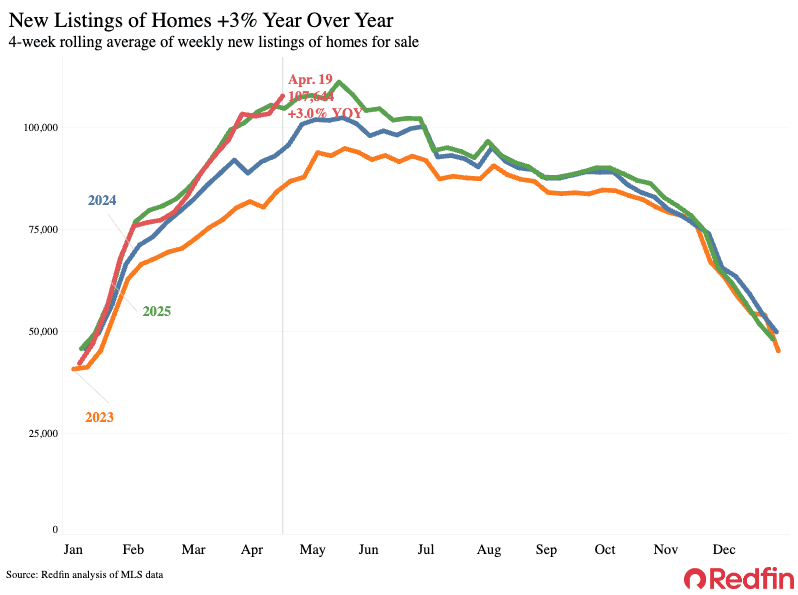
This post was originally published here

Chris Martin, a senior economist on Glassdoor’s economic research team, also provided data and analysis for this report.

From higher starting salaries to affordable starter homes, some cities give young people a serious leg up. From Omaha to Anchorage to Hilton Head Island, here are the standout big, medium, and small cities for recent college graduates. 

The tassels are turned, the diplomas are framed, and next comes the big question: Where should recent college grads plant roots? This new Redfin and Glassdoor analysis reveals which big, mid-sized and small U.S. cities offer the best mix of career opportunity, housing affordability and work-life balance for young professionals. 

Washington, D.C. ranks as the best big city in the U.S. for recent college graduates, according to a new Redfin and Glassdoor analysis. The nation’s capital tops the list because recent grads earn big paychecks relative to other large cities, there’s a lot of career opportunities, and the city offers great work-life balance. 

New Orleans comes in first for mid-sized cities, largely because starter homes are  affordable and early-career wages are growing at a faster clip than rent. Springfield, IL leads among small cities, with recent college grads attracted to its high starting salaries, strong job-growth potential and transit friendliness.

This is according to a Redfin-Glassdoor ranking of the best U.S. metro areas in the U.S. for recent college graduates, broken into three categories: Big, medium-sized and small. For this report, metro areas are referred to as “cities.” We ranked places based on factors related to housing, jobs, and quality of life using several different metrics. Please see the end of this report for more details on methodology.  

Big Cities


1. Washington, D.C.


Average annual early-career earnings: $79,857

Price of typical starter home: $320,000

Years to save for down payment: 4 years, 2 months

Monthly mortgage payment as % of income: 31.6%

Monthly rent as % of income: 34%

What makes the city rad for recent grads: Work-life winner  //  Strong starting salaries  // Jobs galore

The nation’s capital ranks as the best big city for recent college grads because it has a robust entry-level job market offering strong salaries, and while housing isn’t exactly cheap, it’s more affordable than many other big coastal cities. The top sector for early-career workers is tech, but D.C. also offers junior jobs aplenty in government and government-adjacent organizations, like think tanks, defense contractors, consultants and law firms. D.C. has 19 job postings per 100 workers, the most of any big U.S. city. But it’s not all work, all the time: The U.S. capital is one of the cultural centers of the U.S., offering not only unique landmarks, but a thriving food and drinks scene at places like The Wharf and Union Market.

“D.C. is a place of opportunity,” said Andre Margutti, a local Redfin Premier agent. “Students graduate from Georgetown or George Washington University, and they stay because there are so many job prospects. Or they graduate from school in an entirely different part of the country, and they move here for the same reason. And it’s not just in the federal government and related industries–our area attracts a lot of doctors, and a lot of international students stay in the area to work in finance for a place like the IMF or the World Bank.”

2. Omaha, NE


Average early-career earnings: $59,123

Price of typical starter home: $195,000

Years to save for down payment: 3 years, 8 months

Monthly mortgage payment as % of income: 26%

Monthly rent as % of income: 28%

What makes the city rad for recent grads: Job variety  //  New grads love their jobs  //  Work-life winner

A starter home in Omaha costs less than $200,000, which is affordable to someone earning the typical entry-level salary of around $59,000. The most popular career path for recent grads in the Nebraska town is healthcare, but it’s also home to several Fortune 500 companies, including Berkshire Hathaway, Union Pacific and Mutual of Omaha. Not only do college grads report enjoying their jobs, but they also report strong work-life balance–especially for those immersed in the city’s thriving music and brewery scene. 

“I’m currently helping a young couple move from North Carolina to Omaha,” said Justin Gomez, a Redfin Premier agent in Omaha. “People move here from many different parts of the country because there’s a great community for the younger crowd: We have a lot of colleges in the area, and there are so many fun events like the annual college baseball tournament. It doesn’t hurt that we have a lot of well-paying jobs, including at the University of Nebraska Med Center and the Offutt Airforce Base–and with a lot of homes selling for under $300,000, young grads actually have a shot at purchasing a house.”

3. Boston, MA


Average early-career earnings: $80,026

Price of typical starter home: $460,000

Years to save for down payment: 6 years, 8 months

Monthly mortgage payment as % of income: 45.3%

Monthly rent as % of income: 53%

What makes the city rad for recent grads: Strong starting salaries  //  Work-life winner  //  Pedestrian paradise

The typical recent grad in Boston earns $80,000 per year, the highest average starting salary of all the cities in this top 10 list. The city’s most popular sector for recent grads is tech, though it’s also home to a lot of jobs in biotech, healthcare, education and research. Boston is also a work-life winner, with twenty-somethings working hard by day and catching a game at Fenway Park or meeting friends at a beer garden at night. 

“Boston naturally has a big population of young people because there are so many colleges here, from Harvard to MIT to Boston College,” said Aditi Jain, a local Redfin Premier agent. “A lot of employers have offices in Boston to attract grads from those prestigious places and keep them in the city. There’s also a strong startup culture across biotech, finance and software, and a lot of those companies also offer well-paying jobs, enticing both people who attended college in Boston and those who are moving there from a different part of the country. We have a lot of new condos, which are perfect for young professionals, and the city is walkable and has fantastic public transportation; you can get anywhere for two dollars and a subway ride.”

4. Dallas, TX


Average early-career earnings: $67,451

Price of typical starter home: $240,000

Years to save for down payment: 4 years, 1 month

Monthly mortgage payment as % of income: 28%

Monthly rent as % of income: 26%

What makes the city rad for recent grads: Career-growth potential  //  Rent won’t bust budget

Dallas is home to 24 Fortune 500 company headquarters, including American Airlines, AT&T and Toyota, offering abundant entry-level jobs. The Texas city is known for legendary barbecue spots and live music, perfect for young professionals unwinding after a long week of work. Dallas is unique because it’s well-rounded; it is relatively affordable, fairly high-paying for early-career workers, and there’s plenty to do for young professionals.

5. Chicago, IL


Average early-career earnings: $72,786

Price of typical starter home: $202,000

Years to save for down payment: 3 years

Monthly mortgage payment as % of income: 21.9%

Monthly rent as % of income: 28%

What makes the city rad for recent grads: Affordable starter homes  //  Strong starting salaries  //  Transit friendly 

The Windy City is home to iconic attractions like Wrigley Field and Navy Pier, along with countless comedy clubs, deep-dish pizza spots and bars. Chicago has a plethora of jobs for early-career workers, from finance to tech to working corporate jobs for companies like McDonald’s or United Airlines.

6. Houston, TX


Average early-career earnings: $ 65,369

Price of typical starter home: $215,000

Years to save for down payment: 3 years, 7 months

Monthly mortgage payment as % of income: 25.9%

Monthly rent as % of income: 18%

What makes the city rad for recent grads: Job variety  //  Bounced back strong from pandemic  //  Rent won’t bust budget

Everything’s bigger in Texas–especially the number of job opportunities. Houston has a mix of industries, from aerospace engineering at NASA to healthcare at the Texas Medical Center, the world’s largest medical facility. It’s also known for vibrant nightlife, including live music venues and food halls.

7. St. Louis, MO


Average early-career earnings: $ 61,834

Price of typical starter home: $ 150,000

Years to save for down payment: 2 years, 7 months

Monthly mortgage payment as % of income: 19.1%

Monthly rent as % of income: 23%

What makes the city rad for recent grads: Plenty of starter homes  //  Job variety  //  Work-life winner

Not only does St. Louis have a lower cost of living than coastal cities, but it’s also home to a variety of entry-level jobs. The most popular industry is healthcare, and there are also opportunities in finance, tech and engineering, among other industries. Twenty-somethings enjoy free attractions like the City Museum and Gateway Arch, along with world-class museums and dining.

8. San Diego, CA


Average early-career earnings: $ 74,053

Price of typical starter home: $ 615,000

Years to save for down payment: More than 10 years

Monthly mortgage payment as % of income: 65.4%

Monthly rent as % of income: 64%

What makes the city rad for recent grads: Strong starting salaries  //  New grads love their jobs  //  Work-life winner

When San Diegans aren’t working, they’re at the beach: riding bikes along the coastline, scuba diving, surfing, kayaking or simply sunbathing. But don’t let the city’s laid-back vibes fool you: It’s one of the country’s biggest biotech hubs, and it’s also home to many entry-level positions in industries like healthcare and gaming. Living in San Diego is worth it for those who can afford higher housing costs.

9. Miami, FL


Average early-career earnings: $ 62,748

Price of typical starter home: $ 210,000

Years to save for down payment: 3 years, 11 months

Monthly mortgage payment as % of income: 26.4%

Monthly rent as % of income: 33%

What makes the city rad for recent grads: Career-growth potential  //  Job variety  //  Bounced back strong from pandemic

Whether grads want to work in retail, wholesale, construction, real estate, tourism, aviation, healthcare, or any of Miami’s many industries, the city has entry-level jobs for everyone. Add Miami’s white-sand beaches, turquoise water and endless nightlife, and the South Florida city is a twenty-something’s dream.

10. Austin, TX


Average early-career earnings: $ 72,025

Price of typical starter home: $ 276,600

Years to save for down payment: 4 years, 1 months

Monthly mortgage payment as % of income: 30.3%

Monthly rent as % of income: 35%

What makes the city rad for recent grads: Jobs galore  //  Work-life winner  //  New grads love their jobs

The “Live Music Capital of the World” is home to music venues and festivals like SXSW and Austin City Limits, and places like Barton Springs Pool and Lady Bird Lake also make it a paradise for water lovers. Industries like healthcare, tech and education offer many entry-level jobs, and Austin’s slow housing market makes it a good time for young buyers to break in.

Mid-Sized Cities


1. New Orleans, LA


Average early-career earnings: $ 57,414

Price of typical starter home: $ 175,000

Years to save for down payment: 3 years, 1 months

Monthly mortgage payment as % of income: 24%

Monthly rent as % of income: 32%

What makes the city rad for recent grads: Job variety  //  Pedestrian paradise  //  Transit friendly

New Orleans is unique: Recent grads can catch live jazz on Frenchmen Street, eat the famous beignets at Cafe du Monde and take ghost tours in the French Quarter–and once a year, they have front-row seats to Jazz Fest and Mardi Gras. 

It’s a great city for young professionals because in addition to the nonstop fun, New Orleans has a lower cost of living than many other major cities, and there are lots of jobs in industries like hospitality, energy, education and aerospace. The most popular sector for recent grads is healthcare. 

“New Orleans is a whole vibe,” said Jason Gale, a local Redfin Premier agent. “There’s Mardi Gras and Jazz Fest, of course, but every day of the year there’s live music, world-class food, endless parties–and almost everything is walkable. You can stay in your own neighborhood for an entire weekend, walk to different bars, restaurants and shops, and never run out of things to do. For young, first-time buyers, now is a good time to get into the market because sellers are cutting their prices.”

2. Palm Bay, FL


Average early-career earnings: $ 65,010

Price of typical starter home: $ 210,000

Years to save for down payment: 3 years, 9 months

Monthly mortgage payment as % of income: 25.4%

Monthly rent as % of income: 25%

What makes the city rad for recent grads: Strong starting salaries  //  Work-life winner

Palm Bay, located on Florida’s east coast about halfway between Daytona Beach and Palm Beach, is a hidden gem for recent grads–and it’s not just because it’s more affordable than other coastal towns. It’s about an hour away from both Orlando’s theme parks and Kennedy Space Center, and it’s home to outdoor adventures like bass fishing and kayaking. Plus, Palm Bay is one of Florida’s fastest-growing tech hubs, with many entry-level positions at aerospace companies like SpaceX and Blue Origin. It also has plenty of retail jobs. 

“Here’s the thought process for recent grads: ‘I can move to Palm Bay or somewhere else in Brevard County and get a great, high-paying job right out of school, pay off my student loans, live in a nice, new property without paying too much or dealing with too much maintenance, and get to a beautiful beach within 15 minutes on the weekend,” said Juan Castro, a Redfin Premier agent in the Orlando area. “Palm Bay is known as the ‘Space Coast’ because it’s home to Blue Origin and many other companies focused on space exploration. For young people, living there is attractive because it’s less expensive than neighboring towns but still offers proximity to a lot of jobs.”

3. Wichita, KS


Average early-career earnings: $ 55,285

Price of typical starter home: $ 144,535

Years to save for down payment: 3 years, 1 months

Monthly mortgage payment as % of income: 20.6%

Monthly rent as % of income: 17%

What makes the city rad for recent grads: Plenty of starter homes  //  Affordable starter homes  //  Career-growth potential

Wichita may fly under the radar for college grads from the coasts, but it’s worth considering for its affordable cost of living, unique entertainment and potential for major career growth. The city’s number-one industry for recent grads is aerospace, and it’s also home to Cargill, one of the nation’s biggest food and agricultural companies. To wind down after work, twenty-somethings can head to one of the city’s famous retro arcades or take in a dinner theatre show.

4. Mobile, AL


Average early-career earnings: $ 53,030

Price of typical starter home: $ 169,900

Years to save for down payment: 3 years, 5 months

Monthly mortgage payment as % of income: 25.2%

Monthly rent as % of income: 23%

What makes the city rad for recent grads: Pay outpaces rent  //  Career-growth potential  //  Low rents relative to income

A little known fact about Mobile: It’s the birthplace of Mardi Gras in the U.S., predating New Orleans’ celebrations, and it still hosts elaborate celebrations and costume parades through historic districts. The affordable Southern city also has a walkable downtown and proximity to Gulf Coast beaches. On the work side, Mobile is a major hub for aviation manufacturing and shipbuilding, and it also has opportunities in healthcare, logistics and construction.

5. Anchorage, AK


Average early-career earnings: $ 65,864

Price of typical starter home: $ 240,000

Years to save for down payment: 3 years, 11 months

Monthly mortgage payment as % of income: 28.7%

Monthly rent as % of income: 31%

What makes the city rad for recent grads: Strong starting salaries  //  Career-growth potential

Anchorage is one of the only places in the country where you can spend the day photographing glaciers and fishing for salmon and the night dining at a four-star restaurant. The land of the midnight sun offers grads jobs in oil and gas, tourism, government, transportation, fishing, healthcare and several other industries.

6. Lincoln, NE


Average early-career earnings: $ 53,871

Price of typical starter home: $ 212,000

Years to save for down payment: 4 years, 7 months

Monthly mortgage payment as % of income: 31%

Monthly rent as % of income: 23%

What makes the city rad for recent grads: New grads love their jobs  //  Work-life winner  //  Low rents relative to income

Whether recent grads work in education at the University of Nebraska or manufacturing at Kawasaki Motors, Lincoln is a major employer. And after work, young professionals can take in a college football game or a touring Broadway show, attend farmers markets or take in an outdoor concert.

7. Trenton, NJ


Average early-career earnings: $ 74,570

Price of typical starter home: $ 220,000

Years to save for down payment: 4 years, 9 months

Monthly mortgage payment as % of income: 23.2%

Monthly rent as % of income: 33%

What makes the city rad for recent grads: Affordable starter homes  //  Strong starting salaries  //  Jobs galore

Trenton is more affordable than many other East Coast cities, and it has a strong entry-level job market in industries like education and government. The New Jersey capital also has easy access to both New York City and Philadelphia, and young professionals sticking around Trenton for the weekend can partake in the city’s vibrant art galleries, famous barbecue restaurants and minor league baseball games.

8. Bridgeport, CT


Average early-career earnings: $ 72,503

Price of typical starter home: $ 330,000

Years to save for down payment: 5 years, 11 months

Monthly mortgage payment as % of income: 35.9%

Monthly rent as % of income: 38%

What makes the city rad for recent grads: Strong starting salaries  //  Job variety  //  Transit friendly

Whether grads are looking for a job in manufacturing, healthcare, education, finance, law or construction, Bridgeport is a good place to look. The city offers a fairly affordable cost of living with big-city access, and it’s home to unique recreational activities like outdoor yoga, an award-winning distillery and a famous cabaret theater. 

9. Waco, TX


Average early-career earnings: $ 50,430

Price of typical starter home: $ 180,000

Years to save for down payment: 4 years, 9 months

Monthly mortgage payment as % of income: 28.1%

Monthly rent as % of income: 31%

What makes the city rad for recent grads: New grads love their jobs  //  Career-growth potential

From education to retail to customer service to aerospace, Waco has thousands of entry-level jobs for recent college grads–and it has a lower cost of living than nearby big cities like Dallas or Austin. Outside of work, new grads may enjoy Magnolia Market, made famous by Chip and Joanna Gaines, or hiking and biking along the Brazos River. 

10. Lexington, KY


Average early-career earnings: $ 52,648

Price of typical starter home: $ 211,000

Years to save for down payment: 5 years

Monthly mortgage payment as % of income: 31.6%

Monthly rent as % of income: 34%

What makes the city rad for recent grads: Bounced back strong from pandemic  //  Pedestrian paradise

The University of Kentucky, the state government and a huge Amazon distribution center are some of the biggest employers in Lexington. The “Horse Capital of the World” offers young grads the opportunity to take in world-famous horse racing, and it’s also home to renowned bourbon distilleries.

Small Cities


1. Springfield, IL


Average early-career earnings: $ 59,925

Price of typical starter home: $ 128,000

Years to save for down payment: 2 years, 3 months

Monthly mortgage payment as % of income: 16.8%

Monthly rent as % of income: 16%

What makes the city rad for recent grads: Affordable starter homes  //  Strong starting salaries  //  Work-life winner

Springfield offers young grads career opportunities in healthcare, state government, public policy and education, along with many other industries. Plus, the Illinois capital has a low cost of living, a lively music scene and outdoor recreation along Lake Springfield.

2. Santa, FE, NM


Average early-career earnings: $ 81,848

Price of typical starter home: $ 359,950

Years to save for down payment: 5 years, 7 months

Monthly mortgage payment as % of income: 34.6%

Monthly rent as % of income: 39%

What makes the city rad for recent grads: Strong starting salaries  //  Career-growth potential  //  Work-life winner

Santa Fe draws people in their twenties with a unique arts-and-culture vibe, offering galleries, music venues and outdoor activities in the high desert. For early-career workers, Santa Fe’s economy offers opportunities in state government, tourism and hospitality, healthcare, the arts and nonprofits.

3. Panama City, FL


Average early-career earnings: $ 61,160

Price of typical starter home: $ 230,000

Years to save for down payment: 4 years, 8 months

Monthly mortgage payment as % of income: 29.6%

Monthly rent as % of income: 46%

What makes the city rad for recent grads: Career-growth potential  //  Work-life winner  //  Pay outpaces rent

Panama City is a Gulf Coast playground for people in their twenties, with a laid-back beach lifestyle, waterfront festivals, live music spots and outdoor adventures on St. Andrews Bay. The local economy leans on tech, tourism, hospitality, healthcare, shipbuilding, and government jobs tied to military bases. It offers early-career gigs in hospitality, retail, healthcare support, public services and small businesses. 

4. Hilton Head Island, SC


Average early-career earnings: $ 51,887

Price of typical starter home: $ 317,500

Years to save for down payment: More than 10 years

Monthly mortgage payment as % of income: 48.2%

Monthly rent as % of income: 60%

What makes the city rad for recent grads: Plenty of starter homes  //  Job variety  //  Work-life winner

Recent grads craving a unique out-of-college experience may turn to Hilton Head Island, a classic beach town with miles of coastline to bike, surf, kayak or chill on the beach. When it comes to work, early-career workers will find jobs in an economy fueled by tourism and hospitality, with gigs including retail, resort management and food service. Some people who work on Hilton Head Island live in the South Carolina Lowcountry, just across the bridge.

5. Macon, GA


Average early-career earnings: $ 55,037

Price of typical starter home: $ 139,000

Years to save for down payment: 3 years, 1 months

Monthly mortgage payment as % of income: 19.9%

Monthly rent as % of income: 25%

What makes the city rad for recent grads: Affordable starter homes  //  Jobs galore  //  Job variety

For young adults, Macon is full to the brim with live music, beer gardens and arcade bars. The Southern town’s growing job market is anchored by healthcare, manufacturing and logistics–and as a bonus, housing is affordable.

6. Champaign, IL


Average early-career earnings: $57,356

Price of typical starter home: $ 157,000

Years to save for down payment: 3 years

Monthly mortgage payment as % of income: 21.6%

Monthly rent as % of income: 24%

What makes the city rad for recent grads: Affordable starter homes  //  New grads love their jobs  //  Transit friendly

Champaign is a college town that’s also friendly to recent grads. From eclectic bars to arts festivals and farmers markets to an annual St. Patrick’s Day festival, Champaign keeps twenty-somethings entertained year-round. It also has a strong scene for young workers, with plenty of jobs at the University of Illinois and the growing healthcare, tech and service sectors–plus, there are lots of networking opportunities and job fairs. 

7. Greenville, NC


Average early-career earnings: $ 52,195

Price of typical starter home: $ 187,000

Years to save for down payment: 5 years, 3 months

Monthly mortgage payment as % of income: 28.2%

Monthly rent as % of income: 26%

What makes the city rad for recent grads: Rent won’t bust budget  //  High number of job openings per worker

Aside from offering affordable housing options, Greenville keeps the fun rolling for young professionals with a lively uptown district full of bars, restaurants, live music and parks. For early-career workers, the area has a growing job market in industries like healthcare, education, manufacturing and biotech.

8. Columbia, MO


Average early-career earnings: $ 51,379

Price of typical starter home: $ 199,900

Years to save for down payment:  4 years, 6 months

Monthly mortgage payment as % of income: 30.7%

Monthly rent as % of income: 28%

What makes the city rad for recent grads: Work-life winner  //  Career-growth potential  //  New grads love their jobs

Columbia packs college-town buzz with fun vibes for people in their twenties, from indie music venues to eclectic festivals like the True/False Film Fest to art crawls to bike trails. The city’s diverse job market is anchored by the University of Missouri, and it offers early-career jobs in education, healthcare, tech, public service and small businesses.

9. Bend, OR


Average early-career earnings: $ 65,866

Price of typical starter home: $ 359,999

Years to save for down payment: 8 years, 2 months

Monthly mortgage payment as % of income: 43.1%

Monthly rent as % of income: 56%

What makes the city rad for recent grads: Strong starting salaries  //  Job variety  //  Work-life winner

Bend attracts outdoor enthusiasts with its mountain biking, hiking, skiing and river rafting. Recent grads also love the Oregon town for its craft-beer and music scenes. For early-career workers, the job market offers opportunities in tourism and outdoor gear manufacturing, along with more traditional industries like tech. 

10. Rochester, MN


Average early-career earnings: $ 68,496

Price of typical starter home: $ 215,000

Years to save for down payment: 3 years, 5 months

Monthly mortgage payment as % of income: 24.7%

Monthly rent as % of income: 19%

What makes the city rad for recent grads: Strong starting salaries  //  New grads love their jobs  //  Pedestrian paradise

Rochester blends a laid-back Midwestern vibe with live music, indie art, local breweries and outdoor trails and farmers markets. Its early-career scene is anchored by the Mayo Clinic and a strong healthcare sector, with solid growth in manufacturing, retail and small business.

Here’s a video on what makes these cities rad for recent grads, featuring Redfin Chief Economist Daryl Fairweather and Redfin Premier agent Juan Castro:


Methodology


This report is based on a Redfin-Glassdoor ranking of the best U.S. metro areas in the U.S. for recent college graduates, broken into three categories: Big, medium-sized and small. For this report, metro areas are referred to as “cities.” Redfin and Glassdoor  ranked places based on 13 indicators across housing affordability, career opportunity and urban quality of life. Indicators were normalized (using z-scores) and averaged within those three broad categories. Overall rankings are based on the weighted sum of ranks across the factors. Here are more details on each broad category:

Housing affordability

  • Starter home availability: Starter homes sold per 1,000 residents 
  • Ownership cost:  early-career income divided by median starter home price 
  • Ownership cost trend: Early career earnings growth minus starter home price growth 
  • Rent-to-income ratio: Average monthly condo/co-op cost, divided by monthly early-career salary

Career opportunity

  • Early-career income: Early-career workers  
  • Economic diversity: Concentration of early-career workers in particular sectors 
  • Overall job satisfaction: Average employer ratings from early-career workers 
  • Career opportunity satisfaction: average career opportunity rating from early-career workers 
  • Job availability: Number of distinct job postings  per 100 workers 
  • Post-pandemic job availability trend: Five-year trend in job posting volume

Urban quality of life

  • Average work-life balance ratings: Early-career workers 
  • Median Walk Score 
  • Median Transit Score

Metrics were calculated using 563,000 Glassdoor salary reviews collected in 2025 from early-career workers, 662,000 Glassdoor employer reviews collected from early-career workers between 2023 and 2025, over 22 million job postings on Glassdoor from 2025, and over 2.5 million 2025 property sales from Redfin.

Metrics were calculated for all available MSAs, and MSAs were excluded from consideration if four or more indicators were missing.

Trend data (housing prices, early-career wages, and job posting volume) were generated by regressing available (logged) values between 2018-2025 (2020-2025 in the case of job postings) to calculate an annualized trend.

The post From Nebraska to Alaska: Redfin and Glassdoor Rank the Top U.S. Cities For New Grads appeared first on Redfin Real Estate News.
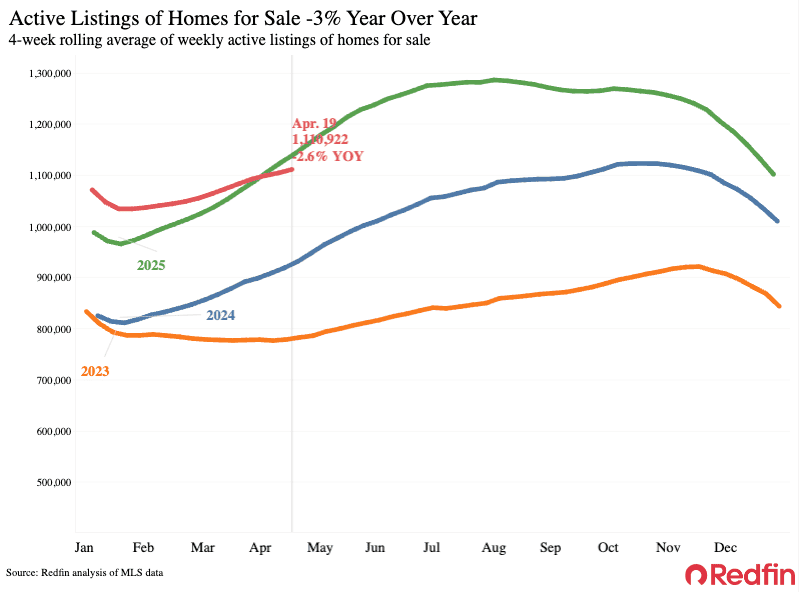
This post was originally published here

This Week In A Nutshell: Mortgage rates have been steadier for the last few weeks. But the risk of outsized mortgage moves remains as markets await the outcome of Iran war ceasefire negotiations.

Upcoming Attractions


This week is light on market-moving economic data, as we’ve now gotten the key labor market and inflation indicators for the month. The next Fed meeting is still two weeks away. We will get the producer price index (PPI) on Tuesday, which will help round out the March inflation picture alongside last week’s consumer price index (CPI) data. 

Markets will continue to focus on any progress toward reopening the Strait of Hormuz. Currently only about a dozen ships per day are passing through, down from about 100 last year. Bond market volatility has declined sharply since late March, with current volatility more similar to late February/beginning of March. But significant news on ceasefire talks could still move rates sharply.

Last Week’s Highlights


We’re starting to see some of the expected effects of the Iran war in economic data. Overall inflation in the March CPI data spiked, but outside of energy prices and the most energy sensitive sectors (airfares), there was limited bleed through from the conflict so far. Consumer sentiment, measured by a University of Michigan survey, fell more than expected post-conflict to a historical low, while inflation expectations jumped sharply as consumers reacted to gas prices. The Fed is particularly sensitive to changes in inflation expectations, which they see as a self-fulfilling prophecy. 

Importantly, consumer sentiment is seemingly reacting more to higher gas prices than the higher tax refunds consumers are also currently receiving. Finally, Chase reported that their credit card spending data for March indicates that consumers are not yet cutting back on spending. This may reflect higher tax refunds or consumers may simply be cutting back on savings for now. Research on prior episodes of gas price changes suggest that there should be a sizable response eventually, however, which should cause economic growth and the labor market to slow.

Diving a Little Deeper


We recently passed the one-year anniversary of Liberation Day (April 2, 2025), when President Trump introduced historically high tariffs. Both the Iran War and last year’s tariffs are what economists call stagflationary events–that is, they slow economic growth and spur inflation. In that vein, it’s helpful to reflect on what has transpired in the past year:

  • Labor market: While economic growth remained healthy, the labor market slowed significantly to the point where some worry that we’re in a labor market recession. Notably, the economy has essentially created no new jobs in the last year. Much of this slowdown is because of new immigration restrictions, but tariffs also played a role.
  • Inflation: Core inflation (which excludes food and energy prices) has remained relatively stable. Tariffs did drive the prices of goods higher, but service inflation came down offsetting much of that change. In addition, goods prices did not rise as much as feared initially as companies declined to pass some of the cost onto consumers.
  • Mortgage rates: Mortgage rates rose initially on inflation fears post Liberation Day, but fell steadily starting in the summer as growth fears dominated inflation worries.
  • Housing market: Home sales data, including the read for March released this morning, show that we continue to bounce along the bottom eerily similar to the past three years despite a nearly one percentage point drop in mortgage rates over the course of 2025 and more inventory in the housing market. The lack of response to lower mortgage rates coincides with the slowdown in the labor market over the same period and increasingly worse vibes among consumers.

Redfin Housing Market Reports


A Record 34% of February Home Sellers Cut Their List Price

  • February home sellers who cut their price lowered it by $41,000, on average, or 7.3%.
  • Home sellers in Texas and Florida were most likely to make price cuts, while sellers in the Bay Area were least likely.

Pending Home Sales Post Biggest Decline in 3 Months

  • U.S. pending home sales fell 2.4% year over year during the four weeks ending April 5. 
  • Sales fell most in Providence, RI (-15.5%), Houston (-15.4%) and New York (-15.3%). They increased most in West Palm Beach, FL (20.9%), San Francisco (16.7%) and San Jose, CA (11.4%).
  • On the selling side, new listings dipped 2.6% year over year, the biggest decline in a month.

The post Redfin Economists’ Weekly Take: Mortgage Rates Hold Steady, but Iran Ceasefire Talks Keep Risk of Sudden Swings on the Table appeared first on Redfin Real Estate News.
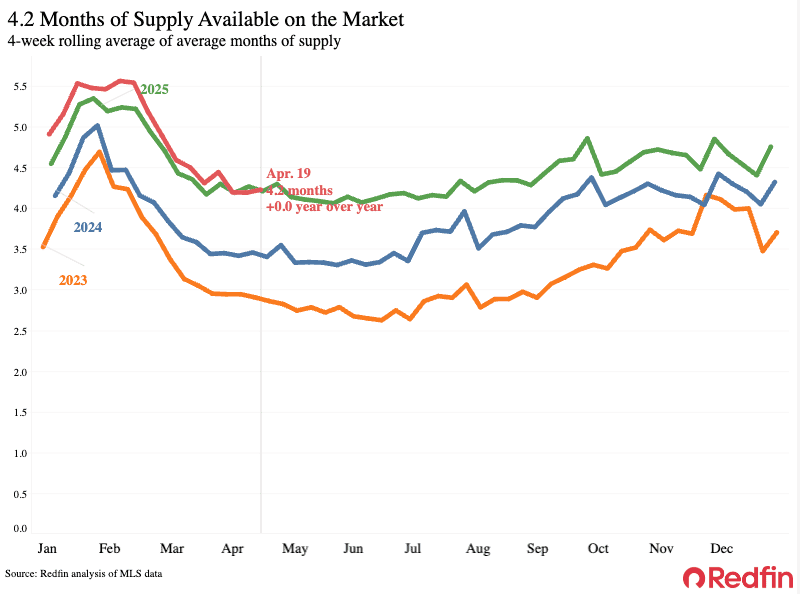
This post was originally published here

Redfin has been recognized among the top residential real estate brokerages for the fourth year in a row! In 2025, our agents closed 50,484 transactions, totaling nearly $32 billion in sales – earning the #8 spot on the RealTrends Verified Brokerage Rankings by both sales volume and transaction count.

Redfin Agents Remain The Most Productive

The average Redfin agent closed more than 22 deals in 2025—nearly three times the productivity of agents at other top-10 brokerages, according to RealTrends data. 

Our agents also led in sales volume, with an average agent sales volume of approximately $14 million. That’s almost double the per-agent volume of our next closest competitor. 

Redfin agent sales volume in 2025 was $14M, double our nearest competitor.

This level of productivity isn’t an accident. It reflects the talent of our agents and the strength of the platform behind them. This allows Redfin to help customers navigate even the most challenging markets with confidence. 

We’re Just Getting Started

What makes this recognition even more meaningful is the small but mighty team behind it. Redfin had just under 2,300 agents at the end of 2025, a fraction of many of our competitors – some of which have tens of thousands of agents. 

It’s proof that when you pair great agents with the right tools, support, and demand, you get outsized results.

In 2026, we’re building on this momentum. We’re continuing to invest in our agents through Redfin Next and Redfin Teams – giving them more control over their business, stronger economics, and the tools they need to grow their business while delivering a better experience for customers

As part of Rocket Companies, we’re accelerating that work by bringing together brokerage, lending, and technology to create a more seamless, end-to-end experience for customers and more opportunity for agents.

And through our partnership with Compass International Holdings, we’re expanding the selection of homes on Redfin.com, bringing more choice to customers and more demand to our platform. We’re proud to work with one of the nation’s top brokerages to unlock more inventory and help more people home.

It all comes back to a simple idea: when you put the customer at the center, everything else follows.

That’s why agents are choosing Redfin. We help them generate demand, operate more efficiently, and focus on what matters most: guiding customers through one of the most important decisions of their lives. The result is stronger performance, higher earnings potential, and a more scalable path to building a lasting business.

And we’re not slowing down. With Rocket’s platform, continued investment in our agents, and partnerships that expand our reach, Redfin is in a stronger position than ever to lead – and to make real estate better for customers across the country.

Are you ready to join some of the best agents in the industry and take your career to the next level? We’re always looking for ambitious, mission-driven agents to join our team. Visit our career page or join our talent community to learn more.

The post Redfin Earns Top 10 Spot in RealTrends Verified Rankings, Powered by Agent Productivity appeared first on Redfin Real Estate News.
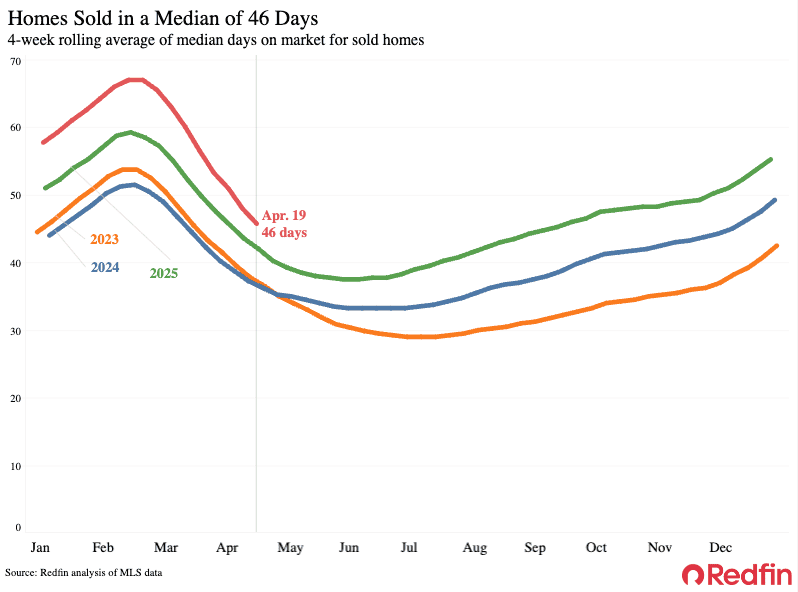
This post was originally published here

Takeaway: Headline inflation, which includes food and energy prices, spiked in March, but rates won’t move much today because core inflation, which ignores those volatile components, remained subdued.
The closing of the Strait of Hormuz led to a 0.9% monthly increase (3.3% annual increase) in prices in March, but there is little evidence so far that is bleeding through to other prices, which is what the Fed cares about.

  • Gas prices surged 21% and fuel oil 31% in the March inflation data. These spikes were forecasted accurately by market observers ahead of time and the implications have been priced in by bond markets these past six weeks, so there is little market reaction to this data.
  • Fed officials are mainly concerned with core inflation, which removes the volatile food and energy categories, because these underlying inflationary measures are what responds to interest rate changes. That came in slightly below expectations with a 0.2% monthly increase (2.6% annual increase) in prices.
  • The softness was driven in part by a large 1.0% monthly decline in prescription drug prices and -1.5% monthly decline in non-prescription drugs
  • Shelter, the largest component of the overall index, ticked up to 0.3% monthly because of an unwind of the 0% shelter inflation assumptions the Bureau of Labor Statistics made six months ago after the October government shutdown.
  • Overall, there is little evidence of the energy price spike affecting other categories yet. However, airline fares, an especially energy-sensitive sector, jumped 2.7% monthly. There is also some evidence of continued tariff rollback, with household goods prices soft.

There’s been some fear among investors that the Fed may have to hike rates this year, which this report should help to alleviate. Overall, similar to the recent jobs reports, today’s data along with the volatility in the Middle East, point to the Fed holding steady for a while.

The post Fed, Mortgage Rates, Likely to Hold Steady on Latest Inflation Report appeared first on Redfin Real Estate News.
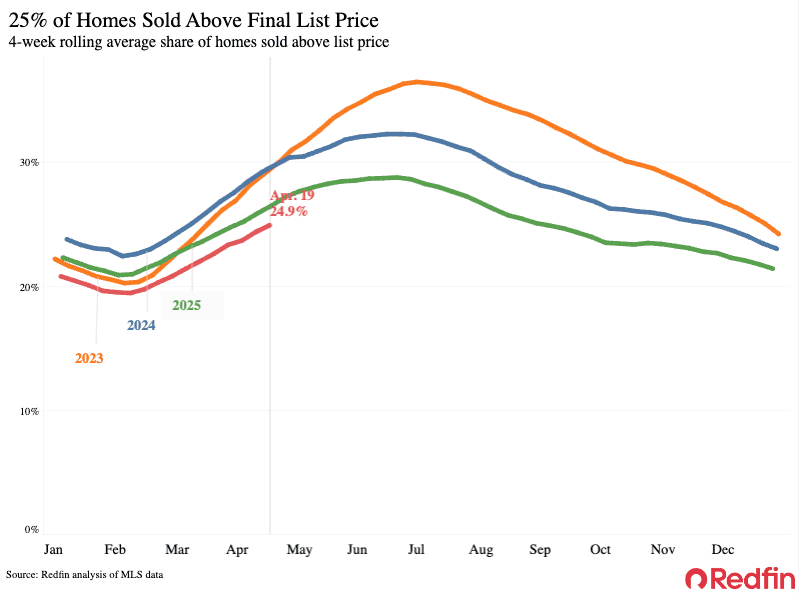
This post was originally published here

Easter weekend also sidelined many would-be buyers. The Iran war ceasefire announced Tuesday could ease mortgage rates.

U.S. pending home sales fell 2.4% year over year during the four weeks ending April 5, the biggest decline in three months. Sales fell most in Providence, RI (-15.5%), Houston (-15.4%) and New York (-15.3%). They increased most in West Palm Beach, FL (20.9%), San Francisco (16.7%) and San Jose, CA (11.4%).

Homes are selling slowly, too: The typical home that went under contract did so in 51 days nationwide, the longest span for this time of year since 2019. 

Homebuyers are backing off for a few reasons:

    • Rising mortgage rates. The weekly average mortgage rate jumped to 6.46%, the highest level since September. 
    • Rising prices. Home-sale prices rose 2.2% annually, the biggest increase in a year. Together with increasing rates, that has pushed the median monthly mortgage payment to $2,750, up slightly (0.2%) from a year earlier. 
    • The Iran war. The Iran war and the turmoil it’s causing in the markets are the reason mortgage rates are rising. The war is also contributing to widespread economic uncertainty, sidelining many would-be homebuyers. The ceasefire that was announced on Tuesday sent oil prices down and rallied markets, and it could help bring mortgage rates back down into the low-6% range.
    • Easter effect. House hunters took a break over Easter weekend, which fell during this 4-week period but not during last year’s comparable period. 

On the selling side, new listings dipped 2.6% year over year, the biggest decline in a month, also partly due to the impact of Easter weekend. New listings dropped most in Tampa, FL (-17.2%), Providence (-16.6%) and Miami (-13.5%). They increased in just five metro areas: San Jose (14.4%), Philadelphia (8%), Milwaukee (7.6%), Cincinnati (1.2%) and Baltimore (0.6%). 

While new listings are losing steam, it’s still a strong buyer’s market almost everywhere in the country. 

“There are more homes on the market than there are buyers, so sellers need to make sure their house stands out,” said Jesse Landin, a Redfin Premier agent in San Antonio. “The most important day is picture day—that determines whether house hunters will actually walk through your home. Paint the walls, make small repairs, and, if you can afford it and your local agent agrees it’s worthwhile, make bigger repairs. Your agent should also hire the right media group for photography and video; pictures taken with a phone just don’t cut it anymore. And make sure you hire an agent with a clear, specific plan for your home, not just a generic approach. That’s what I do—I have a plan for each home. Buyers making large down payments and taking on high monthly payments want a home that’s as close to perfect as possible, because they have more choices in the market.”

For Redfin economists’ takes on the housing market, please visit Redfin’s “From Our Economists” page. 

Leading indicators 


Indicators of homebuying demand and activity
Value (if applicable) Recent change Year-over-year change Source
Daily average 30-year fixed mortgage rate 6.38% (April 8) Up from 4-year low of 5.99% five weeks earlier Down from 6.6% Mortgage News Daily 
Weekly average 30-year fixed mortgage rate 6.46% (week ending April 2) Highest level since September Down from 6.64% Freddie Mac
Mortgage-purchase applications (seasonally adjusted) Up 1% from a week earlier (as of week ending April 3) Down 7% Mortgage Bankers Association 
Google searches of “homes for sale” Up 6% from a month earlier (as of April 4) Up 10% Google Trends
Touring activity Up 17% from the start of the year (as of April 4) At this time last year, it was up 39% from the start of 2025 ShowingTime
Redfin’s Homebuyer Demand Index was removed this week to ensure data accuracy. 

Key housing-market data


U.S. highlights: Four weeks ending April 5, 2026

Redfin’s national metrics include data from 400+ U.S. metro areas and are based on homes listed and/or sold during the period. Weekly housing-market data goes back through 2015. Subject to revision. 

Four weeks ending April 5, 2026 Year-over-year change Notes
Median sale price $392,973 2.2% Biggest increase in a year
Median asking price $423,438 1.6%
Median monthly mortgage payment $2,750 at a 6.46% mortgage rate 0.2%
Pending sales 87,473 -2.4% Biggest decline in 3 months
New listings 101,059 -2.6% Biggest decline in a month
Active listings 1,082,132 -2.2% Biggest decline since 2023
Months of supply  4.2 Essentially unchanged 4 to 5 months of supply is considered balanced, with a lower number indicating seller’s market conditions 
Share of homes off market in two weeks  38.3% Essentially unchanged
Median days on market 51 +6 days Longest span for this time of year since 2019
Share of homes sold above list price 23.5% Down from 25%
Average sale-to-list price ratio  98.5% Down from 98.6%

Metro-level highlights: Four weeks ending April 5, 2026

Redfin’s metro-level data includes the 50 most populous U.S. metros. Select metros may be excluded from time to time to ensure data accuracy. 

Metros with biggest year-over-year increases Metros with biggest year-over-year decreases

Notes

Median sale price San Francisco (10.9%)

Montgomery County, PA (8.4%)

Detroit (7.7%)

Pittsburgh (7%)

Milwaukee (6.4%)

Oakland, CA (-3.8%)

Seattle (-2.3%)

Dallas  (-2%)

Riverside, CA (-1.9%)

Nashville, TN (-1.9%)

Declined in 15 metros

Pending sales West Palm Beach, FL (20.9%)

San Francisco (16.7%)

San Jose, CA (11.4%)

Miami (7.7%)

Milwaukee (5.2%)

Providence, RI (-15.5%)

Houston (-15.4%)

New York (-15.3%)

Seattle (-14.6%)

Nassau County, NY (-14.3%)

New listings San Jose, CA (14.4%)

Philadelphia (8%)

Milwaukee, WI (7.6%)

Cincinnati (1.2%)

Baltimore (0.6%)

Tampa, FL (-17.2%)

Providence, RI (-16.6%)

Miami (-13.5%)

Riverside, CA (-12.8%)

Jacksonville, FL (-12.8%)

Increased in just 5 metros

Refer to our metrics definition page for explanations of all the metrics used in this report.


The post Pending Home Sales Post Biggest Decline in 3 Months as High Rates, Iran War Chill Market appeared first on Redfin Real Estate News.
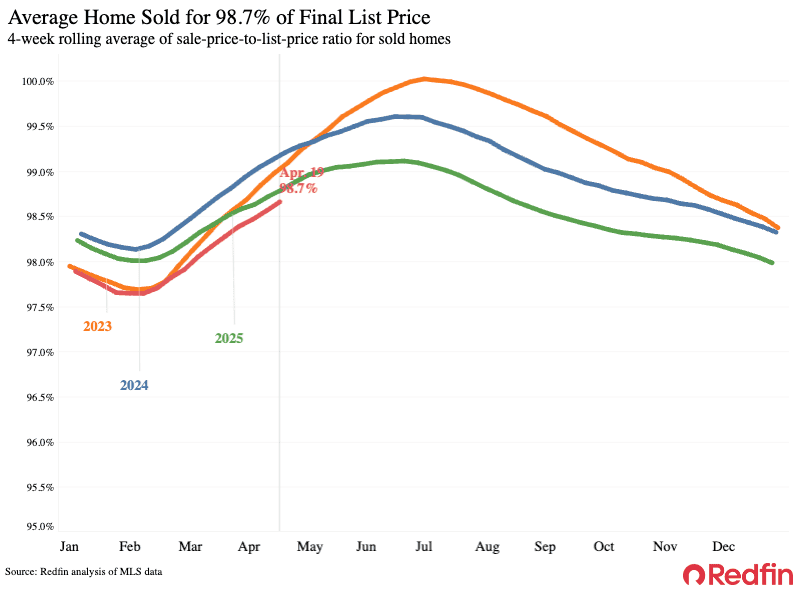
This post was originally published here

  • February home sellers who cut their price lowered it by $41,000, on average, or 7.3%.
  • Home sellers in Texas and Florida were most likely to make price cuts, while sellers in the Bay Area were least likely.

More than one-third (34.2%) of February home sellers lowered their list price. That’s up from 31.5% a year earlier and represents the highest February share in records dating back to 2012.

February Home Sellers Cut Prices at Record Rate (Column Chart)


February home sellers who lowered their list price cut it by an average of $40,915, or 7.3%—the highest February percentage since 2023.

Among all February home sellers (not just those who reduced their price), the average price cut was $13,463, or 2.4%—the highest February percentage on record.


This is based on a Redfin analysis that compares original list prices to final list prices in U.S. MLS home-sale records. While this analysis measures closed home sales only, it does not measure final sale prices, which in some cases include additional price reductions based on negotiations with buyers. Click here to see our separate analysis comparing original list prices to final sale prices.

Price cuts are on the rise because it’s a buyer’s market. There are hundreds of thousands more home sellers in the market than buyers because buyers have been spooked by high mortgage rates, high prices and economic uncertainty. When sellers outnumber buyers, buyers can often negotiate on price because they have a lot of options to choose from. Allowing sellers to pre-market their homes before putting them on the MLS can help them price more accurately, reducing the chances of a price cut. 

Springtime Is the Best Time to Sell a Home Without a Price Cut


We compare February 2026 to prior Februarys because price-cut data is seasonal, but this masks seasonal trends that prospective sellers should be aware of. Sellers who seal the deal in springtime, which recently began, are the least likely to face a price cut. Sellers who close in the winter—specifically December—are most likely to face a price cut.

In six of the past 10 years, May was the month with the lowest share of price cuts. April had the lowest share in three of the past 10 years, including 2024 and 2025.

Spring Home Sellers Are Least Likely to Make Price Cuts (Line chart)


“A lot of people who couldn’t sell their homes last year opted to delist instead of reducing the price, with a plan to relist this spring because they knew that would give them a better chance of selling,” said Aditi Jain, a Redfin Premier real estate agent in Boston. “The Boston market is very different in spring versus fall. Some homeowners need to move immediately, but those who can afford to time the market may get a better price.”

Redfin reported last month that relistings are on the rise as home sellers bet on a stronger spring market; nearly 45,000 U.S. homes that were delisted last year were relisted for sale in January 2026—the highest January figure in records dating back to 2016.

It’s worth noting that this analysis doesn’t include price cuts that happened prior to a relisting, meaning the share of home sellers who cut their price may be even higher than reported. For example, if a seller lowered the list price of their home in September, delisted it in October and then relisted it in February, the September price cut wouldn’t be reflected in the aforementioned statistic about 34.2% of home sellers cutting their price.

Sellers Who Have Been In Their Homes a Long Time Are Less Likely to Cut Prices


The longer someone owns their home, the lower the chances of a price cut. Less than one-third (31.8%) of February 2026 sellers who had been in their home for at least seven years lowered their price. That compares with 34.9% of sellers who had been in their home for two to seven years, and 37.4% of sellers who had been in their home for zero to two years. 

Many people who bought homes in the past seven years bought during the peak of the pandemic market when home prices were soaring. In a lot of areas, prices have since come down, meaning sellers are at risk of being underwater. Many of these sellers price high initially in an attempt to recoup their investment, only to find they must lower their expectations because the market has adjusted.

Home Sellers In Texas and Florida Are Most Likely to Cut Their Price


In San Antonio, 57.9% of February
home sellers lowered their list price—the highest share among the 50 most populous U.S. metropolitan areas. Next came Austin, TX (55.2%), Dallas (47.3%), Tampa, FL (45.9%) and Fort Lauderdale, FL (44.9%).

Texas and Florida are home to some of the nation’s strongest buyer’s markets in part because they have been building more homes than other states. That has given buyers options, and thus, bargaining power. Florida is also grappling with intensifying natural disasters, soaring insurance premiums and rising condo HOA fees, which has prompted some homeowners to leave. 

Home Sellers In the Bay Area Are Least Likely to Cut Their Price


Home sellers were least likely to reduce their price in San Francisco, where 7.4% of February home sales included price cuts. Next came San Jose, CA (11.1%), Newark, NJ (12.9%), Oakland, CA (14.3%) and Seattle (18.4%).
 

Bay Area home sellers are known for underpricing their homes to fuel bidding wars, which lowers the chances of a seller having to cut their price.

Metro-Level Data: February 2026


The table below includes the 50 most populous U.S. metro areas.

U.S. metro area Share of home sales with a price cut Average price cut among sellers who cut prices (%) Average price cut among sellers who cut prices ($) Average price cut (%) among all sellers Average price cut ($) among all sellers
Anaheim, CA   20.7% 6.0% $142,463 1.1% $27,949
Atlanta, GA   34.0% 6.4% $29,845 2.1% $9,889
Austin, TX   55.2% 9.1% $54,685 4.9% $29,669
Baltimore, MD   31.4% 7.3% $31,765 2.0% $9,063
Boston, MA   20.6% 6.5% $57,426 1.2% $11,352
Charlotte, NC   42.6% 6.8% $35,792 2.8% $14,497
Chicago, IL   21.3% 6.2% $23,677 1.3% $4,929
Cincinnati, OH   28.8% 5.7% $21,866 1.6% $6,199
Cleveland, OH   30.2% 7.6% $20,641 2.3% $6,157
Columbus, OH   37.9% 6.7% $26,213 2.5% $9,702
Dallas, TX   47.3% 7.7% $41,995 3.6% $19,645
Denver, CO   33.4% 6.7% $50,088 2.2% $16,405
Detroit, MI   29.0% 9.3% $17,139 2.7% $5,076
Fort Lauderdale, FL   44.9% 7.6% $42,284 3.4% $18,738
Fort Worth, TX   43.2% 6.8% $31,149 2.9% $13,269
Houston, TX   38.4% 7.9% $33,754 2.5% $11,583
Indianapolis, IN   42.5% 6.9% $24,387 2.8% $10,078
Jacksonville, FL   44.6% 7.2% $33,907 3.1% $14,864
Kansas City, MO   30.7% 6.7% $27,318 1.9% $7,665
Las Vegas, NV   34.5% 5.4% $36,811 1.8% $12,225
Los Angeles, CA   24.0% 7.0% $117,727 1.5% $26,478
Miami, FL   43.1% 8.2% $125,131 3.4% $53,511
Milwaukee, WI   20.3% 7.1% $24,304 1.3% $4,449
Minneapolis, MN   27.0% 5.7% $25,386 1.5% $6,614
Montgomery County, PA   24.7% 6.4% $41,822 1.4% $9,483
Nashville, TN   31.7% 6.0% $41,600 1.8% $12,859
Nassau County, NY   21.2% 7.0% $88,472 1.4% $17,904
New Brunswick, NJ   23.9% 6.8% $37,353 1.6% $8,526
New York, NY   27.2% 7.7% $217,417 1.9% $55,942
Newark, NJ   12.9% 6.6% $48,078 0.7% $5,751
Oakland, CA   14.3% 6.3% $60,579 0.8% $7,521
Orlando, FL   43.4% 7.0% $38,269 3.0% $16,269
Philadelphia, PA   34.7% 8.5% $42,136 2.7% $13,810
Phoenix, AZ   42.8% 6.2% $45,190 2.5% $18,695
Pittsburgh, PA   37.8% 9.0% $24,569 3.2% $8,801
Portland, OR   36.2% 6.5% $44,422 2.3% $15,786
Providence, RI   19.9% 6.2% $44,090 1.1% $8,398
Riverside, CA   32.7% 6.4% $51,166 2.0% $16,133
Sacramento, CA   26.0% 5.6% $46,337 1.3% $11,464
San Antonio, TX   57.9% 8.7% $32,909 4.9% $18,686
San Diego, CA   22.0% 5.9% $77,416 1.1% $14,872
San Francisco, CA   7.4% 7.7% $142,836 0.4% $7,777
San Jose, CA   11.1% 6.8% $152,108 0.6% $13,831
Seattle, WA   18.4% 6.0% $51,842 1.1% $9,243
St. Louis, MO   29.5% 7.7% $21,062 2.1% $5,765
Tampa, FL   45.9% 8.2% $41,279 3.7% $18,653
Virginia Beach, VA   21.5% 4.9% $20,698 1.0% $4,047
Warren, MI   28.1% 6.7% $23,356 1.8% $6,189
Washington, DC   27.0% 6.1% $45,032 1.6% $11,631
West Palm Beach, FL   42.3% 9.1% $95,559 3.8% $38,893

The post A Record 34% of February Home Sellers Cut Their List Price appeared first on Redfin Real Estate News.
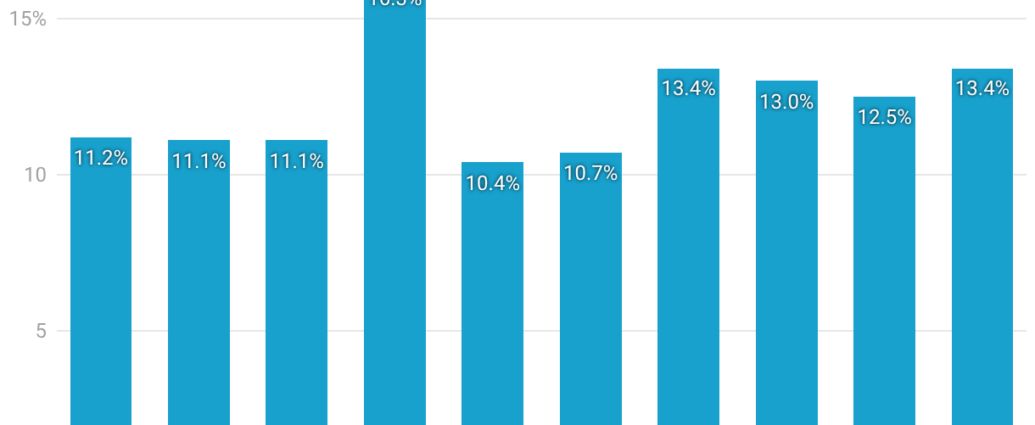
This post was originally published here

This Week In A Nutshell: With the Iran War stretching into its sixth week, mortgage rates will continue to ebb and flow with new developments. Additionally, markets will digest fresh inflation data for March this coming Friday.

Upcoming Attractions


Any new developments in the Iran War that impact energy prices will have the largest impact on rates this week. Absent that, our main focus will be on the March CPI inflation data, which will be released on Friday. It will be our first look at inflation data since the Iran war began. Headline inflation is expected to rise sharply, to a 3.4% annual rate from 2.4% previously. Core inflation, which excludes food and energy prices and is the Fed’s main focus, is expected to increase to a lesser extent, to 2.7% from 2.4%, due to a multitude of factors unrelated to the Iran War. February PCE data will be released on Wednesday. While the PCE is the Fed’s preferred inflation gauge, the data is unlikely to move markets because it is for February and since we already have February CPI and PPI data, there is unlikely to be much new information in the PCE release.

Last Week’s Highlights


Rates came down from the highs reached the previous week as investors unwound most of their bets for a Fed rate hike in 2026. On Friday, we got March data for the job market. It looked very rosy on the surface, but ultimately was noisy to interpret.

Diving a Little Deeper


The job creation data from the Bureau of Labor Statistics (BLS) monthly jobs report has been noticeably noisy to start off the year. 160,000 jobs were created in January, only for 133,000 to be destroyed in February and 178,000 to be created in March. What is going on?

  • The recent uptick in volatility can mostly be attributed to change in the birth-death model that was introduced in February 2026. The birth-death model is how the BLS estimates how many jobs are being added or lost at new businesses opening and existing businesses closing that are not yet fully captured in its monthly employer survey. BLS changed their methodology because the old version was making bigger mistakes than usual after the pandemic, when business openings and closings were behaving less like the historical patterns the model relied on. The new approach still uses the old framework, but it now also brings in more current information from BLS’s monthly employer survey so the estimate can better reflect what is happening in real time. This should make the model more responsive and reduce the need for special temporary fixes like the extra pandemic-era adjustment it had been using, but it also makes the monthly data more volatile. The upshot is that instead of looking at the most recent month of data, we should look at a 3 or 6 month trailing average for job creation. When we do that, we see a weak labor market with little new hiring, but one that has firmed up–not deteriorated–in the most recent few months.
  • It’s also worth pointing out that the swings actually aren’t that unusual relative to recent history since the pandemic, but they are more noticeable when the average is around zero because the numbers go from positive to negative. Relative to the immediate aftermath of the pandemic in 2022 the volatility we’re seeing right now is about the same. But compared to pre-pandemic and 2025 data, the data right now is much noisier.

Redfin Housing Market Reports


  • Over Half of Home Listings Have Been Lingering on the Market For More Than 2 Months
    • In dollar terms, there’s $347 billion worth of stale listings in the U.S.,  more than ever before for this time of year. That’s because there are hundreds of thousands more home sellers than buyers, leading to homes sitting on the market.
    • Stale inventory is most common in Florida, and least common in the Bay Area.
    • Through Redfin’s new partnership with Compass, sellers can work to avoid stale listings by testing the market, which could reduce the risk of homes lingering on the market.
  • The Great Housing Mismatch: Empty Nesters Own 28% of the Nation’s Large Homes, Millennial Families Own 16%
    • Empty-nest baby boomers own many more 3-bedroom-plus U.S. homes than younger families raising children, underscoring a mismatch between who has space and who needs it.
    • Millennials with kids are facing both affordability and inventory challenges–but at the same time, baby boomers have little financial incentive to move–and there’s limited inventory of reasonably priced, small, one-story homes for them to go to.
    • More large homes could hit the market as affordability improves, the lock-in effect eases and it becomes easier for sellers to test the market via the new Redfin-Compass partnership.
    • Empty-nest baby boomers own more large homes than millennials with kids in every major U.S. metro. Millennial families own the biggest portion of large homes in Austin and Columbus, and the smallest portion in Los Angeles.

The post Redfin Economists’ Weekly Take: Iran War Drives Mortgage Rate Volatility as Markets Brace for Inflation Data appeared first on Redfin Real Estate News.
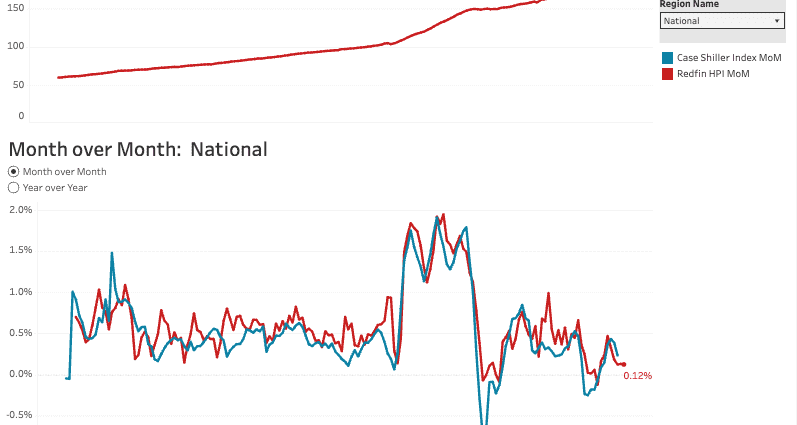
This post was originally published here

Just a 30-minute drive outside Dublin sits the Village at Lyons, a privately owned village dating back to the 18th century. It recently went on the market for $23,078,698. 

The village sits on 20 acres and has 47 bedrooms. Some additional features include a caretaker house, a carriage house, a guest house, a fitness room, and a yoga space. It also has lake, river views and an indoor and outdoor spa.  

Part of the village dates back to the 18th century and was left abandoned for many years before the co-founder of Ryanair, Dr. Tony Ryan, bought it in the 1990s and put millions of dollars into restoring it and recreating the original village, David Byrne, Lisney Sotheby’s International Realty’s managing director, told Redfin News. 

When Ryan passed away in 2007, the village was sold to a private owner who is now selling it. 

“It’s almost like stepping back in time. It’s an architectural wonderland. The attention to detail in every single element of the village front, the windows, the doors, the chimneys, is utterly remarkable. It’s very much evidence of someone who has a phenomenal eye and brought world-class restoration to this project. It’s a really unique Irish estate village. Everywhere you look, there is something new and unique to see. It’s a masterpiece in its own right,” Bryne said. 

The village also has two bars, a coffee shop, and a corporate event space that could easily be adapted for other uses, Byrne added. 

In addition to the 47 bedrooms, the village also has a chapel on the grounds.

At the moment, the village is run as a hospitality destination. A stay at the hotel on the village grounds starts at $269 a night. 

“It is a magnificent place. You can literally feel the passion that went into restoring it at every turn. It has this unworldly feel about it once you’re through the gates. It’s a truly special place,” Bryne says. 

The carrying costs are being kept confidential while the village is on the market,” he added. 

“The ideal buyer could be somebody in the hospitality space who sees an opportunity to elevate this village even further and unleash the full potential of this village. It could equally be somebody who just thinks it’s the most wonderful opportunity to own a private estate in Ireland [41 miles] from Dublin,” Byrne said. “We’re kind of looking forward to finding out who the next owner is, in truth. Whoever it is, it will be somebody who appreciates the cultural significance of the village and they would become a steward of the village. What they do with it will be amazing to see.”

The post Ryanair Co-Founder Restored An 18th Century Village in Ireland and now it’s up for sale for $23 million appeared first on Redfin Real Estate News.
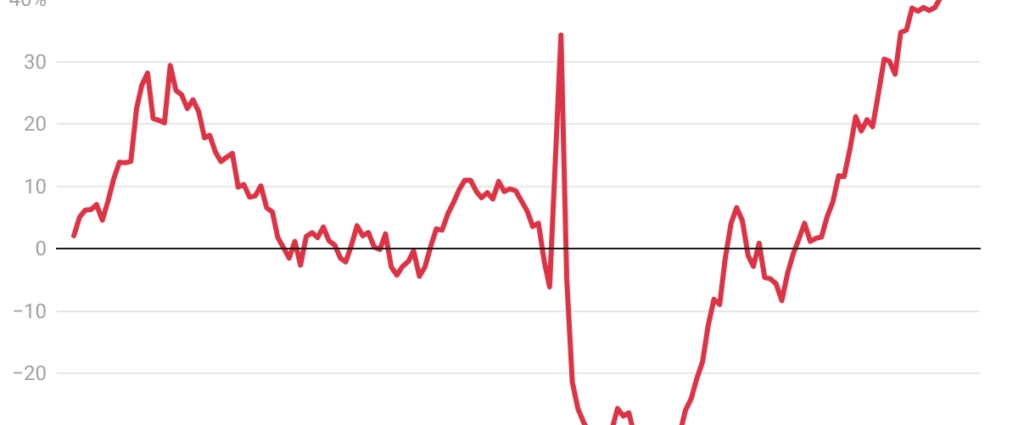
This post was originally published here

Takeaway: The March jobs report, which is hot on its surface, will not move rates much. The underlying fundamentals of the report are weaker than the headline, and the Iran war continues to dominate economic data in driving market moves.

178,000 jobs were created in March, when forecasters only expected 65,000. The unemployment rate unexpectedly declined to 4.3%, but a look under the hood shows a still-tepid labor market with risks to come.

  • Because the new birth-death model–a statistical method to account for jobs created and lost due to firm creation and destruction–means the headline job creation number is much more volatile than before, we should focus on the three and six month average instead of the March number. Those show that 68,000 jobs have been created per month over the past three months and 15,000 jobs on average over the past six months. In other words, the labor market remains slow, but it’s better than it was in the fourth quarter of 2025 when the Fed was cutting rates.
  • Part of the large gain in March came from the Kaiser Permanente strike, which took away 31,000 jobs in February only for them to return in March.
  • While the unemployment rate did unexpectedly decline 0.18 percentage points to 4.26%, the underlying reason was that fewer people chose to look for jobs. The employment to population ratio declined by 0.04 percentage points and the labor force participation rate declined by 0.16 percentage points.
  • One positive aspect of this report is that only 43% of the job gains were concentrated in healthcare, which is much lower than in prior months where healthcare accounted for nearly all of the job gains.
  • All of the above data references the second week of March, when the Iran war was just getting underway. The conflict and associated effect on oil and gas prices should weaken the labor market the longer it drags on.

The Fed will remain on hold until there is further clarity on the duration and fallout from the war with Iran.

  • Markets have priced some probability of rate hikes in 2026, but the bar for the Fed to hike is very high and unlikely to be met given the current state of the labor market. It is much more likely the Fed will put off rate cuts until there is evidence that core inflation will return to the target level, and the labor market remains weak.

The post Seemingly Strong March Jobs Report Won’t Impact Mortgage Rates Much appeared first on Redfin Real Estate News.
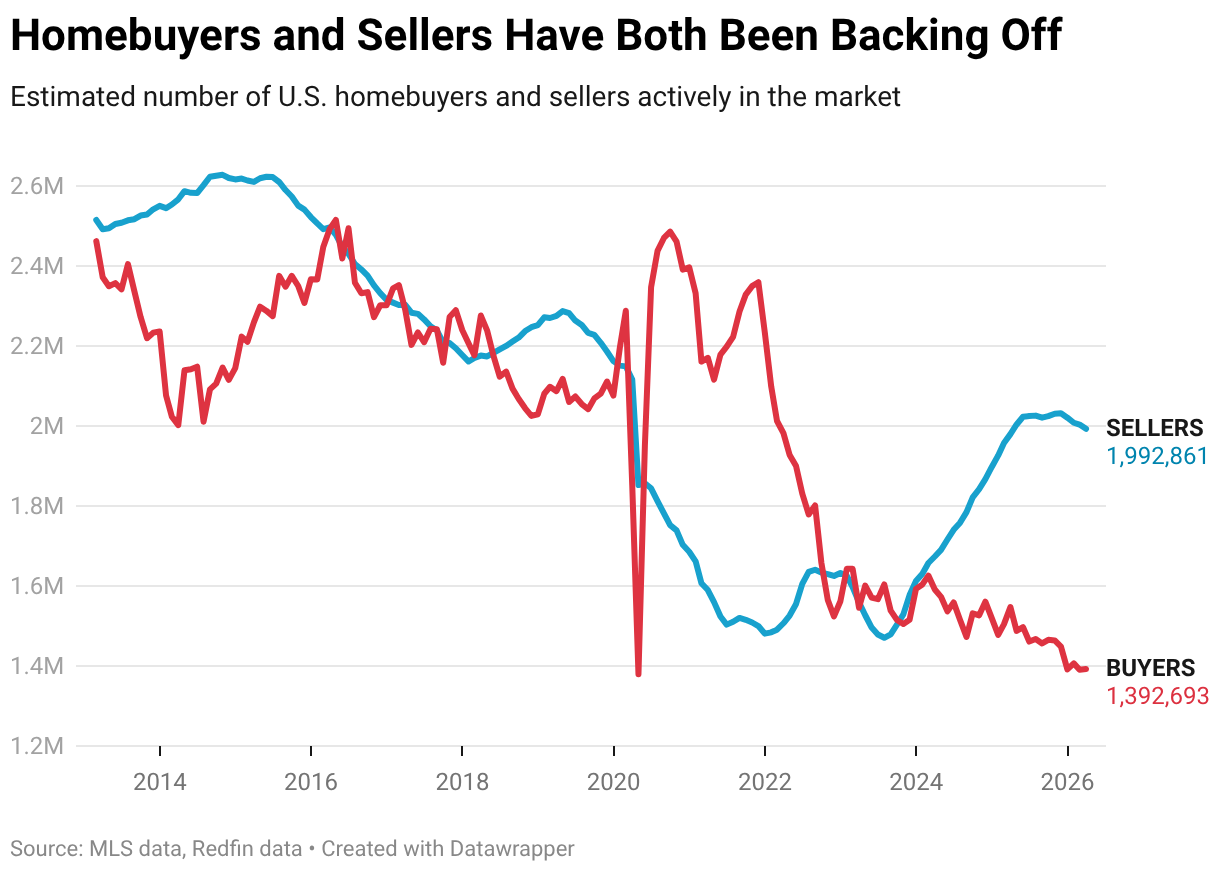
This post was originally published here

  • Empty-nest baby boomers own many more 3-bedroom-plus U.S. homes than younger families raising children, underscoring a mismatch between who has space and who needs it. 
  • Millennials with kids are facing both affordability and inventory challenges–but at the same time, baby boomers have little financial incentive to move–and there’s limited inventory of reasonably priced, small, one-story homes for them to go to. 
  • More large homes could hit the market as affordability improves, the lock-in effect eases and it becomes easier for sellers to test the market via the new Redfin-Compass partnership. 
  • Empty-nest baby boomers own more large homes than millennials with kids in every major U.S. metro. Millennial families own the biggest portion of large homes in Austin and Columbus, and the smallest portion in Los Angeles. 

Baby boomers living in one- to two-adult households own 28% of large homes in the U.S. By comparison, millennials with children living at home own 16% of those houses—barely more than half as much. Gen Z parents own less than 1% of the nation’s large homes.

Baby boomers with households of three adults or more own an additional 7% of the country’s three-bedroom-plus homes (which we also refer to as “large homes” in this report). Those are likely made up of adult children living with their parents. 


This is based on a Redfin analysis of U.S. Census data from 2024 (the most recent year for which data is available) that breaks down the share of three-bedroom-plus homes owned and occupied by each generation, by household type and size. See the end of this report for more details on methodology.

Millennials are the largest generation of parents in the U.S., but they own a relatively small share of family-sized housing. Gen Z parents—many of whom are just beginning to enter the housing market—barely register at all. It’s also worth noting that millennials are the largest generation in the U.S., period.

This dynamic can limit mobility for younger families, many of whom face both inventory and affordability challenges when trying to upgrade to bigger homes. One, there aren’t enough large homes on the market for the millennial families who need them, partly because in some parts of the country, there aren’t enough small reasonably priced homes for older Americans to downsize into. And two, home prices and mortgage rates are high; in many parts of the U.S., families are priced out of the housing market. 

More than one-quarter (28%) of millennials aren’t buying a home in the near future because mortgage rates are too high, the most commonly cited reason for not buying among people in that age group who are either renters or long-term homeowners unlikely to move soon. That’s according to a November 2025 Redfin survey fielded by Ipsos. One in five (20%) aren’t buying a home soon because they’re unable to save for a down payment. Some millennials just don’t want to buy a home: 13% enjoy the flexibility of a rental lease, and 6% don’t want to put in the effort to maintain a home. 

At the same time, many baby boomers have little financial incentive to move, often benefiting from low mortgage rates or fully paid-off homes. Nearly three in five (57.8%) baby-boomer homeowners have no mortgage; their home is fully paid off. 

There are also social and lifestyle reasons to stay put: Baby boomers, in their sixties and seventies, may want to stay in the neighborhoods they’ve lived in for a long time, close to their friends, family, work and/or recreational activities. It’s also worth noting that one reason baby boomers own more large homes is simply because they’re older and have had more time to earn and save money, and use it to buy large homes.  

“Younger buyers are looking to move into single-family homes in specific neighborhoods, those with a family friendly vibe and highly rated schools,” said Brenda Beiser, a Redfin Premier agent in Philadelphia. “The problem is, younger families have a hard time finding those homes because the older people living in them can’t find anywhere they want to move to. I hear empty nesters say they want to downsize, but it’s hard to find move-in ready, small, one-story homes or condos in their price range–especially since many of them are living in a fully paid-off home. So there’s a lack of movement that’s keeping both older and younger buyers where they are, even though the older ones want a smaller home and the younger ones want a bigger home.”

More Large Homes Could Hit the Market as Affordability Improves


Homebuying affordability is improving, and Redfin economists expect it to improve more as the year goes on. That could allow some younger buyers to break into the market. Additionally, there could be more large homes come on the market as the mortgage-rate lock-in effect eases.

Redfin agents in some parts of the country say they’re starting to see more older homeowners downsize. A Redfin agent in Omaha, NE said some baby boomers are selling to younger families as they move into homes without stairs and without much maintenance. A Sacramento Redfin said several older residents are selling the family home because they’re downsizing—though those listings are rare, and competitive. 

Redfin and Compass recently partnered on a phased marketing initiative that could motivate more homeowners to sell. Redfin economists estimate that housing inventory could increase by 6% to 12% annually in markets where home sellers are given the flexibility to test pricing strategies before formally listing. 

A separate Redfin analysis found that the median age of first-time homebuyers has ticked down, from 38 in 2018 to 35 in 2025, signaling that at least some housing inventory is turning over to younger Americans. Additionally, Gen Z’s homeownership rate ticked up in 2025, and millennials eked out a gain, too. 

Millennials Have Gained Ground Over the Last Decade, But It’s Not Because Baby Boomers Are Letting Go of Their Homes 


Empty-nest baby boomers own essentially the same share of large homes they did a decade ago: In 2014, they owned 27.7% of the nation’s stock of large homes; now, they own 27.8%. 

Millennials with kids have made progress as they’ve grown into prime homebuying and child-rearing age. In 2014, they owned 4.9% of the nation’s large homes; now, they own 15.7%. 

Some of the large homes millennials now own come from the oldest living generation. In 2014, the Silent Generation owned about 18% of the nation’s large homes; now, they own about 8%. 

Millennials With Kids Own the Biggest Portion of Large Homes in Austin and Columbus, and the Smallest Portion in Los Angeles


Empty-nest baby boomers own more large homes than millennials with kids in every major U.S. metro. 

Millennials with kids own less than 20% of large homes everywhere in the country. They own the biggest share of large homes, 19.2%, in Austin, TX and Columbus, OH. Minneapolis (18.9%) rounds out the top three. 

Millennials with kids own the smallest share of large homes in Los Angeles, where they own just 10.5% of them. It’s followed by Miami (12.5%) and San Jose, CA (13.1%). 

On the flip side, empty-nest baby boomers own at least 20% of large homes everywhere in the country. They take up the biggest share of large homes in Memphis, TN, where they own 31.2% of the metro area’s three-bedroom-plus homes. It’s followed closely by Cleveland, where empty nesters own 30.9% of the metro’s three-bedroom-plus homes, and Pittsburgh (30.6%). 

In Salt Lake City, empty nesters own one in five (20.1%) of the metro area’s large homes, the smallest share in the U.S. It’s followed by Riverside, CA (21.4%) and Austin, TX (22%). 

Metro-Level Summary: Who Owns the Metro Area’s Stock of Large Homes?

50 most populous U.S. metro areas

Large homes = three-plus bedrooms

Empty nesters = Baby boomers with 1-2 adults living in the household

U.S. metro area Share of large homes owned by millennials w/ kids Share of large homes owned by empty-nest baby boomers
Atlanta, GA 15.9% 25.1%
Austin, TX 19.2% 22.0%
Baltimore, MD 15.4% 26.8%
Birmingham, AL 15.3% 28.3%
Boston, MA 16.1% 25.1%
Buffalo, NY 15.9% 29.3%
Charlotte, NC 16.5% 25.1%
Chicago, IL 15.9% 24.8%
Cincinnati, OH 17.7% 27.4%
Cleveland, OH 13.9% 30.9%
Columbus, OH 19.2% 25.3%
Dallas, TX 17.6% 22.8%
Denver, CO 16.4% 24.5%
Detroit, MI 14.8% 27.3%
Hartford, CT 15.9% 26.7%
Houston, TX 18.3% 22.3%
Indianapolis, IN 18.6% 25.2%
Jacksonville, FL 15.9% 28.8%
Kansas City, MO 18.6% 27.8%
Las Vegas, NV 14.7% 23.4%
Los Angeles, CA 10.5% 23.9%
Louisville, KY 15.2% 28.8%
Memphis, TN 13.9% 31.2%
Miami, FL 12.5% 23.8%
Milwaukee, WI 16.1% 29.2%
Minneapolis, MN 18.9% 25.5%
Nashville, TN 17.4% 25.0%
New Orleans, LA 15.5% 30.0%
New York, NY 13.9% 24.4%
Oklahoma City, OK 18.6% 27.0%
Orlando, FL 13.7% 24.7%
Philadelphia, PA 15.0% 26.6%
Phoenix, AZ 15.3% 25.2%
Pittsburgh, PA 15.5% 30.6%
Portland, OR 16.0% 26.7%
Providence, RI 14.5% 27.0%
Raleigh, NC 16.7% 24.8%
Richmond, VA 15.9% 29.3%
Riverside, CA 15.9% 21.4%
Sacramento, CA 14.6% 27.4%
Salt Lake City, UT 18.9% 20.1%
San Antonio, TX 17.2% 23.2%
San Diego, CA 14.2% 26.9%
San Francisco, CA 13.8% 25.6%
San Jose, CA 13.1% 22.4%
Seattle, WA 17.6% 24.3%
St. Louis, MO 16.9% 27.7%
Tampa, FL 13.7% 27.6%
Virginia Beach, VA 16.7% 29.0%
Washington, DC 16.0% 23.7%


Methodology

This is based on a Redfin analysis of U.S. Census data from 2024 (the most recent year for which data is available) that breaks down the share of three-bedroom-plus homes owned and occupied by each generation, by household type and size. The three household types are as follows: 1 or 2 adults total living in the home; neither are minor children (for boomers, we refer to this category as “empty nesters”), 3 or more adults total living in the home; none are minor children, and households where adults are living with their minor children.

Adult Gen Zers were 19-27 years old in 2024, millennials were 28-43, Gen Xers were 44-59, and baby boomers were 60-78.

* ACS data was retrieved from IPUMS USA

*Steven Ruggles, Sarah Flood, Matthew Sobek, Daniel Backman, Grace Cooper, Julia A. Rivera Drew, Stephanie Richards, Renae Rogers, Jonathan Schroeder, and Kari C.W. Williams. IPUMS USA: Version 16.0 [dataset]. Minneapolis, MN: IPUMS, 2025

The post The Great Housing Mismatch: Empty Nesters Own 28% of the Nation’s Large Homes, Millennial Families Own 16% appeared first on Redfin Real Estate News.
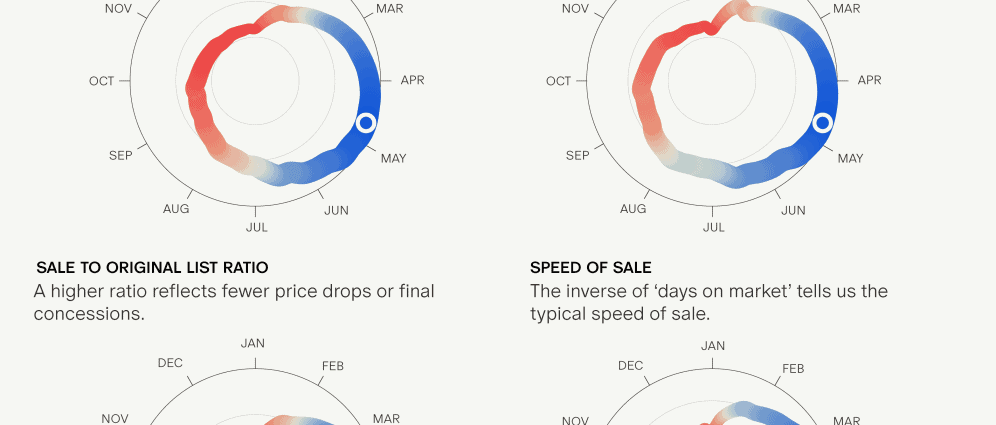
This post was originally published here

The Iran war is a major factor pushing up mortgage rates. Some would-be buyers are backing off amid high costs and uncertainty stemming from the war. 

The median U.S. monthly mortgage payment is $2,742, up 0.4% year over year. While that’s a small increase, it’s the first in nearly six months. 

Housing payments are climbing because the Iran war and rising oil prices have pushed the weekly average mortgage rate up to a six-month high of 6.38%. Daily average mortgage rates rose as high as 6.64% at the end of last week. Home-sale prices are a factor, too; the median home-sale price rose 2.1% from a year earlier during the four weeks ending March 29–the biggest uptick in a year. 

High costs, along with economic uncertainty from the Iran war, have sidelined some would-be homebuyers. Pending home sales declined 1.2% year over year, and mortgage-purchase applications fell 3% week over week. The typical home spends 53 days on the market before going under contract, five days longer than last year. 

On the selling side, new listings are ticking up; they rose 1.7% year over year. Overall, there are 630,000 more home sellers than buyers in the market–the biggest gap in records dating back to 2013. Redfin agents say that with more sellers than buyers in most metro areas,  it’s more important than ever for sellers to prepare their home to make a strong first impression.

“My advice for sellers is to remember you’re selling the dream of homeownership,” said Hazel Shakur, a Redfin Premier agent in the Washington, D.C. area. “When house hunters walk through the door, it should look good, smell good and give the impression that every room is orderly. Buyers should be able to visualize what life is going to be like living in the home. And it goes beyond cosmetics: Some buyers are walking away during the inspection period if they uncover an issue, so sellers should make sure they have taken care of basic maintenance and repairs before listing.”

For Redfin economists’ takes on the housing market, please visit Redfin’s “From Our Economists” page. 

Leading indicators 


Indicators of homebuying demand and activity
Value (if applicable) Recent change Year-over-year change Source
Daily average 30-year fixed mortgage rate 6.45% (April 1) Up from 4-year low of 5.99% a month earlier Down from 6.82% Mortgage News Daily 
Weekly average 30-year fixed mortgage rate 6.38% (week ending March 26) Highest level in 6 months Down from 6.67% Freddie Mac
Mortgage-purchase applications (seasonally adjusted) Down 3% from a week earlier (as of week ending March 27) Up 1% Mortgage Bankers Association 
Google searches of “homes for sale” Up 20% from a month earlier (as of March 30) Up 20% Google Trends
Touring activity Up 25% from the start of the year (as of March 30) At this time last year, it was up 36% from the start of 2025 ShowingTime
Redfin’s Homebuyer Demand Index was removed this week to ensure data accuracy. 

Key housing-market data


U.S. highlights: Four weeks ending March 29, 2026

Redfin’s national metrics include data from 400+ U.S. metro areas and are based on homes listed and/or sold during the period. Weekly housing-market data goes back through 2015. Subject to revision. 

Four weeks ending March 29, 2026 Year-over-year change Notes
Median sale price $391,475 2.1% Biggest increase in a year
Median asking price $424,975 2.5%
Median monthly mortgage payment $2,742 at a 6.38% mortgage rate 0.3% First increase since October 2025
Pending sales 86,642 -1.2% Biggest decline in over a month
New listings 102,768 1.7%
Active listings 1,068,411 -1.7% Biggest decline since 2023
Months of supply  4.5 +0.2 pts.  4 to 5 months of supply is considered balanced, with a lower number indicating seller’s market conditions 
Share of homes off market in two weeks  37.4% Essentially unchanged
Median days on market 53 +5 days
Share of homes sold above list price 23.2% Down from 25%
Average sale-to-list price ratio  98.4%

Down from 98.5%

Metro-level highlights: Four weeks ending March 29, 2026

Redfin’s metro-level data includes the 50 most populous U.S. metros. Select metros may be excluded from time to time to ensure data accuracy. 

Metros with biggest year-over-year increases Metros with biggest year-over-year decreases

Notes

Median sale price San Francisco, CA (12.6%)

Detroit (10.1%)

Cincinnati (8.7%)

Milwaukee (8.7%)

Baltimore (6.9%)

Oakland, CA (-4.1%)

Dallas  (-3.4%)

Austin, TX (-2%)

West Palm Beach, FL (-1.8%)

Houston (-1.8%)

Declined in 12 metros

Pending sales San Francisco (25%)

West Palm Beach, FL (22.8%)

Milwaukee (12.4%)

Austin, TX (10%)

Miami (8.5%)

New Brunswick, NJ (-15.8%)

Providence, RI (-15.6%)

New York (-15.1%)

Houston (-14.4%)

Nassau County, NY (-13.5%)

New listings Milwaukee, WI (15.9%)

Philadelphia (9.7%)

Boston (8.5%)

Washington, D.C. (7.7%)

San Francisco (7.6%)

Tampa, FL (-15.7%)

Providence, RI (-14.1%)

Miami (-11.2%)

Jacksonville, FL (-10%)

Riverside, CA (-8.2%)

Refer to our metrics definition page for explanations of all the metrics used in this report.

The post Monthly Payments Tick Up For First Time in 6 Months As Mortgage Rates, Home Prices Jump appeared first on Redfin Real Estate News.
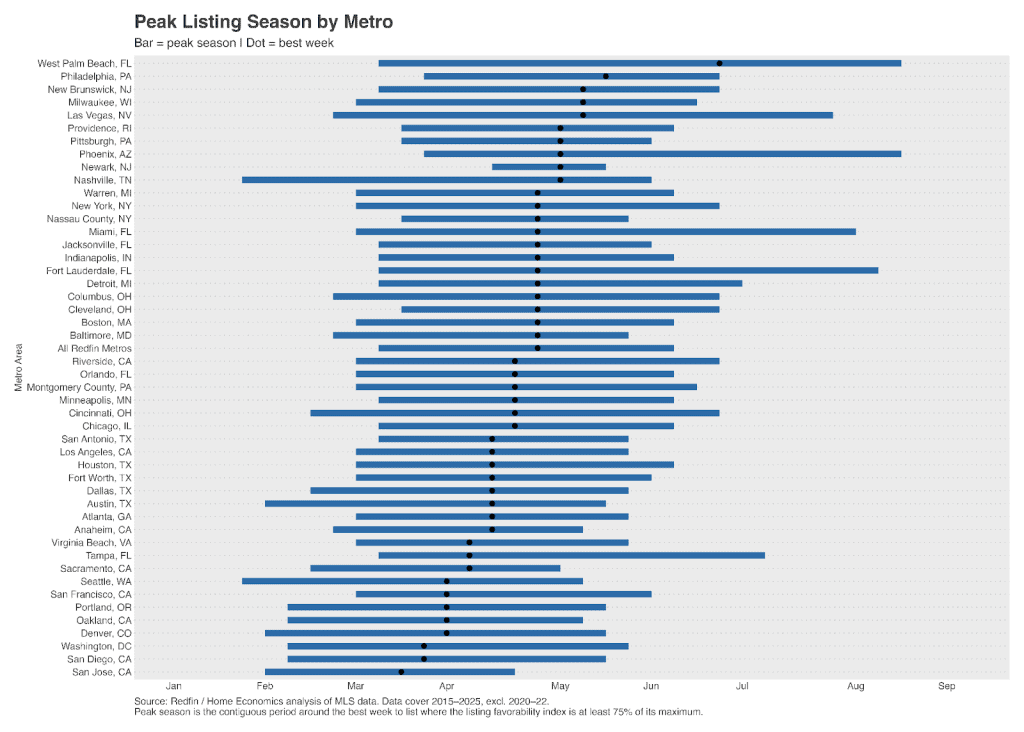
This post was originally published here

A tiny home in New York is going viral on social media because it has no bedrooms.

The house at 84 Wyona Ave in Selden went on the market about a month ago with a listing price of $329,900. The house was built in 1930 and is 446 square feet. It is about 10 feet wide and 37 feet long and has a small kitchen, dining room, living area and full bathroom.

It sits on a lot that is 22 by 100 feet and has a backyard shed. The tiny home has a basement with two open areas where one room can be converted into a half bath with laundry, according to the listing description.

“I went down as low as I could as far as price goes. I know [the offer] will come. We’re listening to all offers,” Denise Beckman, a licensed associate broker at HomeSmart Dynamic Realty, told Redfin News.

The tiny home also has a shed in the backyard. Photo credit: Picture Perfect

Although people on social media are stating their surprise at how high the listing price is considering the tiny home doesn’t have any bedrooms, Beckman said she has been blown away by the attention in general.

The house has a small kitchen, dining room, living area and full bathroom. Photo credit: Picture Perfect

Beckman said the seller of the house originally bought it back in 2002 and had it rented out until about 11 years ago, when he and his wife moved in. They renovated it by upgrading the heating, electrical, roof and bathroom.

“If you have vision and you’re single or newly married, it’s a great place to start and start building that equity for your future and it’s very hard for Long Islanders to do that right now,” she added.

Redfin agents said that although people on social media might be surprised by the tiny home’s high price, it makes sense because it is in a high-priced area and a commuter-friendly neighborhood.

The tiny home has a basement that can be finished. Photo credit: Picture Perfect

Selden is part of the town of Brookhaven in Suffolk County. The county is known as the home of The Hamptons, one of the most affluent neighborhoods in the U.S.

The median sale price of a home in Suffolk County was $660,000 in March and has remained the same since last year.

“Long Island is different from the nationwide market. We don’t have enough supply for the demand,” said Redfin agent Mohamed Elbaroudy. There’s been a lot of people moving into Long Island since Covid and that hasn’t stopped. People realized they can get a better quality of life and better schools and still have a good commute to the city.”

Panagiota “Peggy” Papazaharias, a Redfin agent, said this property works as a starter home for someone looking to get into the neighborhood while still being close to New York City.

“Selden is close to a lot of shopping, not too far from the city and Long Island Rail Road” she said.

The tiny home went on the market in March 2026. Photo credit: Picture Perfect

In recent years, tiny homes have continued to rise in popularity, especially since they can offer an alternative to the traditional home.

The post This $329,900 Long Island Tiny Home Is Going Viral Because It Has No Bedrooms appeared first on Redfin Real Estate News.
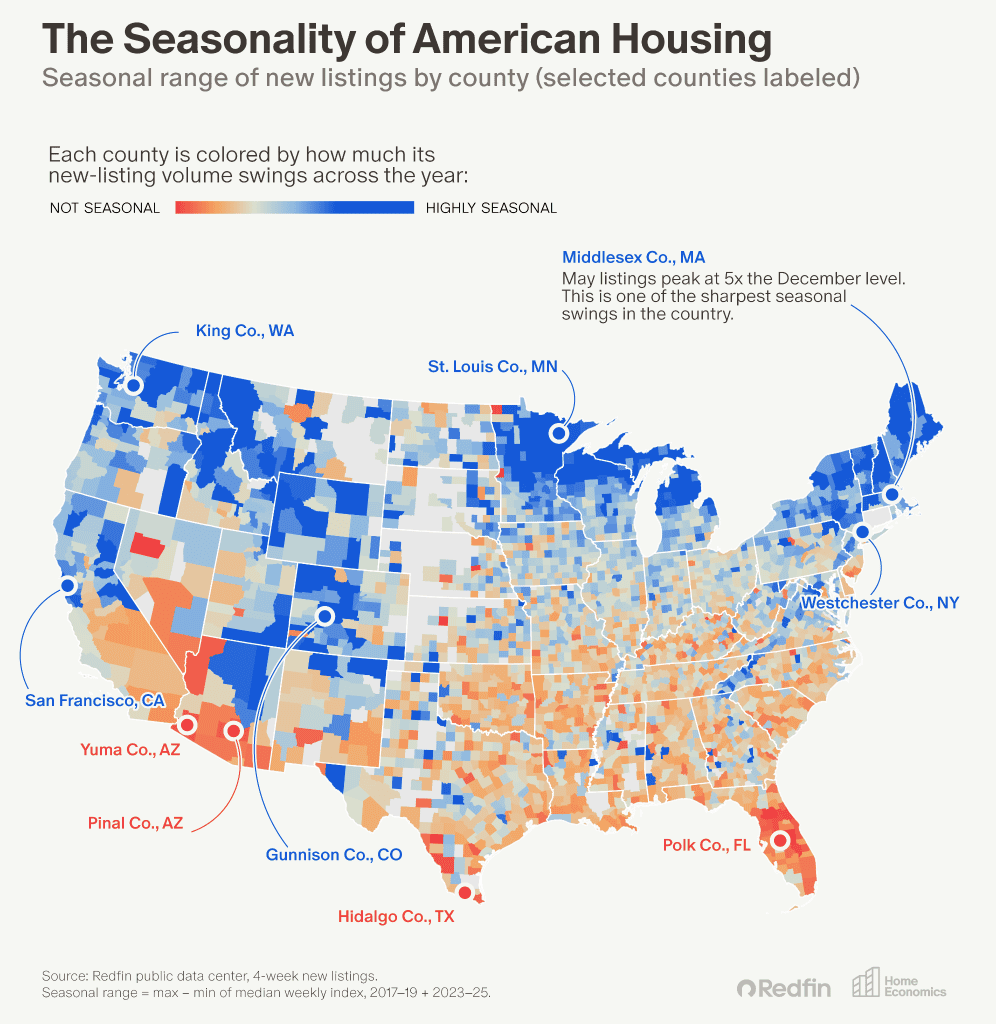
This post was originally published here

As many Americans consider buying a home this spring, they may want to take a closer look at the Cleveland metro area. Not only is it home to one of Redfin’s latest and most unique listings—the Cleveland Cavaliers’ Rocket Arenait’s also one of the most affordable markets in the country. 

The typical Cleveland home sold for $230,000 in February, the latest month for which data is available. Among the 50 most populous U.S. metros, only Detroit had a lower median sale price ($181,250). 

Eight other Midwest locales, including fellow Ohio cities Columbus and Cincinnati, also ranked in the bottom 15 when it came to median sale price in February. This affordability is the beating heart of the great Midwestern migration that’s been taking place since the pandemic—a trend that Redfin’s own chief economist, Daryl Fairweather, has joined in on. 

“We initially left to avoid a smoke event from nearby wildfires,” Fairweather said about her family’s 2020 move from Seattle to Wisconsin. “We ended up staying in Wisconsin because we liked the simpler lifestyle, being close to family, and the lower cost of living. Remote work enabled me to keep my career, too.”

Those interested in following a similar path to Fairweather may be wise to act sooner rather than later—especially if Cleveland is their desired Great Lakes destination. Median home sale prices in the city have been growing at a much higher rate than the country as a whole since 2024; the year-over-year growth in Cleveland home prices was 4.6% as of February, nearly five times the 0.9% nationwide rate

Beyond general demand for affordable homes, another driver of Cleveland’s rapid price growth is low inventory. The number of homes for sale in the area rose by only 0.5% year over year, the smallest positive change among major Midwest metros during the period.

Low inventory is also making Cleveland one of the fastest markets in the region. The typical home that went under contract there in February spent 44 days on the market. Warren, MI (42) and St. Louis (40) were the only other major Midwest metros where homes sold faster. 

But despite these signs of heat, the Cleveland median sale price ($230,000) is still roughly half of the national median sale price ($429,259)—further confirmation that the city is a beacon of affordability.

Cleveland is also one of only a handful of U.S. metros where the average household currently earns enough money to afford the median-priced home. What’s more—the margin between its median income ($76,912) and the amount needed to buy the typical home there ($66,725) is quite healthy at over $10,000. 

Jerry Quade, a Redfin principal agent based in Cleveland, weighed in on what else makes the city’s affordability unique: “Cleveland has simply always been an affordable place,” he said. “We don’t have big ups and downs like some markets in Texas or Florida or Las Vegas. Everyone says nothing is affordable anymore, but Cleveland is—and it’s just a nice place to live.”

February 2026 Housing Market Highlights: Cleveland


February 2026 Year-over-year change
Median sale price $230,000 4.6%
Pending home sales 1,938 -7.6%
Homes sold 1,364 -8.6% 
New listings 1,774 -4.5%
Total homes for sale (active listings) 5,659 1.9%
Inventory 3,708 .5%
Months of supply 2.7 0.2
Median days on market 44 4
Share of homes that sold above final list price 27.9% -3.4 ppts
Average sale-to-final-list-price ratio 97.7% -0.4 ppts
Pending sales that fell out of contract, as % of overall pending sales

16.4%

0.3 ppts

This report is based on a Redfin analysis of MLS data across the 50 most populous U.S. metropolitan areas.

The post Cleveland Remains a Beacon of Affordability for Homebuyers appeared first on Redfin Real Estate News.
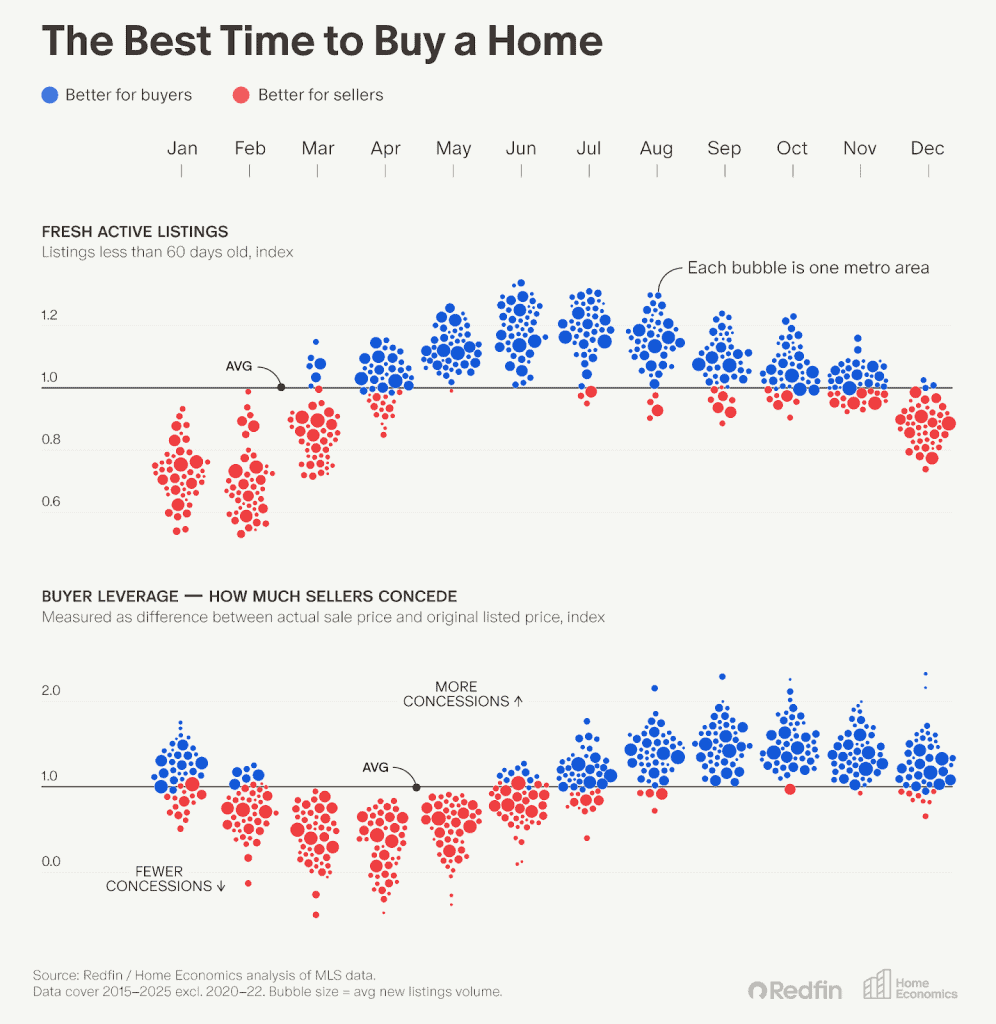
This post was originally published here


  • In dollar terms, there’s $347 billion worth of stale listings in the U.S.,  more than ever before for this time of year. That’s because there are hundreds of thousands more home sellers than buyers, leading to homes sitting on the market. 
  • Stale inventory is most common in Florida, and least common in the Bay Area.
  • Through Redfin’s new partnership with Compass, sellers can work to avoid stale listings by testing the market, which could reduce the risk of homes lingering on the market. 

More than half (52.2%) of February’s home listings were on the market for at least 60 days without going under contract (i.e. they were stale) nationwide, up from 50.1% a year earlier and the highest share since 2019.


This is based on an analysis of listings on Redfin.com going back through 2012. For the total dollar value of all inventory on the market, we sum up the list price of all active U.S. listings as of the last day of each month; February 2026 is the most recent month for which data is available. We define “stale inventory” as home listings that spend at least 60 days on the market and are actively listed for sale on the final day of the relevant month. This data is seasonal, which is why we compare February to past Februarys. Please see the end of this report for more on methodology. 

Home Sellers Are Sitting on $347 Billion Worth of Stale Listings, a Record High For This Time of Year


In dollar terms, there’s a total of $347 billion worth of stale inventory on the market nationwide. That’s up 4.3% annually and the highest dollar amount on record for this time of year. 

Stale Inventory Is Worth $347B, A Record High For February (Column Chart)


There’s a Total of $636 Billion Worth of Homes For Sale in the U.S. 


Zooming out to all inventory, there’s a total of $636 billion worth of homes for sale, essentially unchanged from a year earlier. Like stale inventory, that’s the highest dollar amount on record for this time of year (except 2025, when it was 0.01% higher).  

Home Sellers Are Sitting on $636B in Total Inventory (Column Chart)


The total value of stale inventory–and all inventory–is higher than ever for this time of year because there are a record 630,000 more home sellers than buyers in the market, lengthening the amount of time it takes to sell a home. Here are more details:

  • Homebuying demand is slow. U.S. home sales fell 3.1% year over year in February. House hunters are wary of high mortgage rates and high prices, and they’re jittery because of economic uncertainty, including fears about layoffs, inflation and the Iran war.
  • Home selling is chugging along. The total number of homes for sale is up 1.5% year over year. While some sellers have backed off, many are still in the market, hoping to cash in on still-high home values. 
  • Days on market are at a record high. The typical home that went under contract in February spent 66 days on the market–the slowest pace in a decade for this time of year. 
  • Home prices are rising. The median home-sale price is up roughly 1% year over year. When home prices increase, so does the total dollar value of homes for sale, and the total dollar value of stale inventory. 

“Sellers know it’s a buyer’s market, but they still want to get as much money as they can for their home. So they list on the high end, expecting buyers to negotiate down, and that’s leading to listings staying on the market for a long time,” said Jason Gale, a Redfin Premier agent in New Orleans. “There are still deals to be made, but nine times out of 10, homes are selling for under their asking price. But sometimes, the price is just too high, and sellers have to pull their home off the market after six months or so.”  

Stale Listings Are Most Common in Miami 


In Miami, nearly two-thirds (62.6%) of home listings are stale, the biggest share of all the major U.S. metros. Next come San Antonio (58.3%), Pittsburgh (58.1%) and West Palm Beach (55.9%).

Listings are going stale in those places because they are major buyer’s markets; in Miami, San Antonio and West Palm Beach, there are more than twice as many home sellers as buyers. 

Stale listings are least common in the Bay Area. In San Jose, 19.8% of listings are stale, the smallest share among the major metros, followed by San Francisco (24%) and Oakland (31.1%). Next come Anaheim, CA (34%) and Seattle (34.1%). Most of those are buyer’s markets, but to a much smaller degree than the Florida metros listed above; for instance, in San Jose, there are just 10% more sellers than buyers. San Francisco is a balanced market, with a roughly equal number of sellers and buyers. 

Letting Home Sellers Test the Waters Before Listing Could Help Them Sell Faster


Homes lingering on the market can have negative effects for sellers; sometimes, buyers are wary of homes that have been on the market for a long time. 

That’s one reason Redfin partnered with Compass on phased marketing, which gives sellers more flexibility in how they introduce their homes to prospective buyers. Sellers can choose to display their homes on Redfin.com with no days on market, no price history and no home valuation estimates.

That allows sellers to gauge early interest in their property and price correctly from the beginning, which we found could help sellers in a few ways:

  • Lower the risk of listings going stale. Sellers who test pricing strategies with phased marketing may be less likely to see their homes sit on the market. Overpricing your home by 10% or more can increase time on market by more than a month. 
  • Lower the risk of losing money from a price drop. Sellers who test pricing using phased marketing may be less likely to lose money via a price cut. Redfin economists estimate that homes sell for less when they have a price cut due to the stigma. 
Metro-Level Summary: Stale Home Listings, Feb. 2026

Home listings are “stale” if they have been on the market for at least 60 days without going under contract 

U.S. metro area Total dollar value of stale inventory Share of home listings that are stale
Anaheim, CA  $3,804,979,477 34.0%
Atlanta, GA  $6,967,001,572 51.2%
Austin, TX  $4,235,317,502 53.4%
Baltimore, MD  $1,263,200,842 47.7%
Boston, MA  $2,754,374,299 38.7%
Chicago, IL  $3,158,224,864 40.9%
Cincinnati, OH  $1,048,562,696 45.6%
Cleveland, OH  $610,000,680 49.5%
Columbus, OH  $993,323,978 44.8%
Dallas, TX  $5,947,277,162 49.3%
Denver, CO  $2,733,851,592 40.3%
Detroit, MI  $463,118,430 54.0%
Fort Worth, TX  $2,310,252,422 50.6%
Houston, TX  $7,687,421,473 54.5%
Indianapolis, IN  $1,104,438,728 53.5%
Jacksonville, FL  $2,546,738,082 51.3%
Las Vegas, NV  $3,906,105,308 51.3%
Los Angeles, CA  $13,531,277,797 44.1%
Miami, FL  $15,894,396,237 62.6%
Milwaukee, WI  $508,495,433 36.3%
Minneapolis, MN  $1,963,662,229 43.7%
Montgomery County, PA  $857,609,898 43.3%
Nashville, TN  $5,190,002,567 54.8%
Nassau County, NY  $3,522,293,691 49.2%
New Brunswick, NJ  $2,152,388,676 47.1%
New York, NY  $16,939,740,119 55.1%
Newark, NJ  $1,006,363,900 46.1%
Oakland, CA  $903,312,534 31.1%
Orlando, FL  $4,222,334,231 55.7%
Philadelphia, PA  $1,179,569,999 52.6%
Phoenix, AZ  $10,150,809,424 46.1%
Pittsburgh, PA  $1,158,245,883 58.1%
Portland, OR  $2,100,910,565 48.3%
Providence, RI  $796,842,587 43.4%
Riverside, CA  $5,505,718,830 48.8%
Sacramento, CA  $1,665,099,987 41.8%
San Antonio, TX  $3,365,734,572 58.3%
San Diego, CA  $2,960,305,403 37.7%
San Francisco, CA  $687,464,464 24.0%
San Jose, CA  $524,074,518 19.8%
Seattle, WA  $2,237,074,918 34.1%
Tampa, FL  $5,980,820,981 53.4%
Virginia Beach, VA  $977,175,816 43.6%
Warren, MI  $1,093,257,329 46.2%
Washington, DC  $3,748,942,561 43.9%
West Palm Beach, FL  $11,599,537,794 55.9%
United States of America $347,358,012,659 52.2%

Methodology


This report is based on an analysis of listings on Redfin.com going back through 2012. For the total dollar value of all inventory on the market, we sum up the list price of all active U.S. listings as of the last day of each month; February 2026 is the most recent month for which data is available. Listings are included in the total if they were added on or before the last day of the month, and are still active (not sold or delisted) as of the last day of the month. Listings were excluded if the list price was higher than $300 million. 

For the purposes of this report, the term “value” is interchangeable with “asking price”; i.e., when we refer to “total home value,” we mean the sum of all list prices. 

For the stale inventory section of this report, we define “stale inventory” as home listings that spend at least 60 days on the market and are actively listed for sale on the final day of the relevant month. Listings that have been on the market for more than one year are excluded from the analysis.

The data in both the dollar value and stale inventory sections of this report tend to be seasonal; they are generally higher during the spring and summer, and lower in the winter. 

The post Over Half of Home Listings Have Been Lingering on the Market For More Than 2 Months appeared first on Redfin Real Estate News.
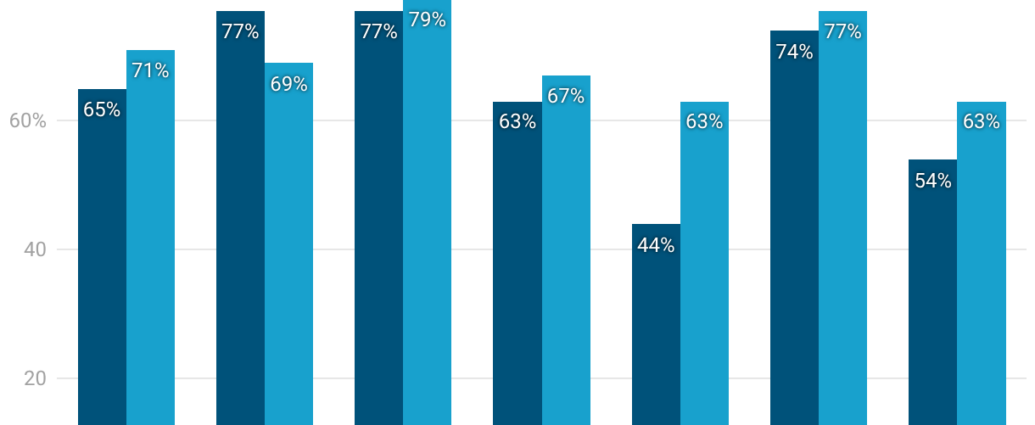
This post was originally published here


Higher housing costs, along with economic uncertainty that comes with the Iran war, are causing some house hunters to think twice. 

The weekly average mortgage rate has hit a three-month high of 6.22% as the Iran war and jitters about inflation rattle markets. The daily average mortgage rate rose as high as 6.55% on Tuesday. 

Markets are bouncing around this week as investors try to keep up with conflicting messages about the conflict in the Middle East; stocks and bonds rallied on Monday after the White House said the U.S. and Iran had productive conversations, but it is unclear when the conflict will end. 

Rising mortgage rates, along with a 1.8% year-over-year increase in U.S. home-sale prices, have driven the median monthly housing payment to $2,695—the highest level since June (housing payments are seasonal; they typically peak in late spring or early summer). The median payment is down 1.5% compared to a year ago, the smallest decline in five months.

Higher housing costs, along with the economic uncertainty that comes along with the Iran war and rising oil prices, are pushing some house hunters to the sidelines. Pending home sales fell 1% year over year, the biggest decline in a month. On the selling side, new listings inched up 0.3% year over year. 

“In Boston, where a mortgage payment can be $10,000 per month, small changes in rates make a big difference,” said Aditi Jain, a Redfin Premier agent in Boston. “Many buyers are waiting, hoping interest rates dip below 6% for a meaningful amount of time, before jumping into the market. The buyers who need to move now–maybe they’re expecting a baby or relocating for a job–are moving forward, but they may opt for a smaller home or a condo instead of a single-family house to keep their monthly payment in budget.”

A separate Redfin report shows there are hundreds of thousands more home sellers than buyers in the market overall, giving house hunters negotiating power.

For Redfin economists’ takes on the housing market, please visit Redfin’s “From Our Economists” page. 

Leading indicators 


Indicators of homebuying demand and activity
Value (if applicable) Recent change Year-over-year change Source
Daily average 30-year fixed mortgage rate 6.48% (March 25) Up from 4-year low of 5.99% a month earlier Down from 6.72% Mortgage News Daily 
Weekly average 30-year fixed mortgage rate 6.22% (week ending March 19) Highest level in over 3 months Down from 6.67% Freddie Mac
Mortgage-purchase applications (seasonally adjusted) Down 5% from a week earlier (as of week ending March 20) Up 5% Mortgage Bankers Association 
Google searches of “homes for sale” Up 12% from a month earlier (as of March 23) Up 16% Google Trends
Touring activity Up 23% from the start of the year (as of March 19) At this time last year, it was up 35% from the start of 2025 ShowingTime
Redfin’s Homebuyer Demand Index was removed this week to ensure data accuracy. 

Key housing-market data


U.S. highlights: Four weeks ending March 22, 2026

Redfin’s national metrics include data from 400+ U.S. metro areas and are based on homes listed and/or sold during the period. Weekly housing-market data goes back through 2015. Subject to revision. 

Four weeks ending March 22, 2026 Year-over-year change Notes
Median sale price $389,269 1.8% Biggest increase since November
Median asking price $423,225 2%
Median monthly mortgage payment $2,695 at a 6.22% mortgage rate -1.5% Smallest decline in 5 months
Pending sales 84,613 -1% Biggest decline in a month
New listings 99,603 0.3%
Active listings 1,052,136 -1.7% Biggest decline since 2023
Months of supply  4.3 +0.2 pts.  4 to 5 months of supply is considered balanced, with a lower number indicating seller’s market conditions 
Share of homes off market in two weeks  36.1% Essentially unchanged
Median days on market 56 +6 days
Share of homes sold above list price 22.4% Down from 24%
Average sale-to-list price ratio  98.3% Down from 98.5%

Metro-level highlights: Four weeks ending March 22, 2026

Redfin’s metro-level data includes the 50 most populous U.S. metros. Select metros may be excluded from time to time to ensure data accuracy. 

Metros with biggest year-over-year increases Metros with biggest year-over-year decreases

Notes

Median sale price Baltimore (8.4%)

San Francisco, CA (7.6%)

Pittsburgh (6.8%)

Cincinnati (6.7%)

Milwaukee (6.1%)

Oakland, CA (-5.4%)

Dallas  (-4.2%)

Austin, TX (-2.1%)

Denver (-1.6%)

Houston (-1.3%)

Declined in 12 metros

Pending sales West Palm Beach, FL (20.5%)

Austin, TX (11.9%)

Milwaukee (9.8%)

Miami (6.9%)

Phoenix (6.7%)

New Brunswick, NJ (-19%)

Nassau County, NY (-19%)

Providence, RI (-18.1%)

New York (-16.8)

Houston (-14%)

New listings Milwaukee, WI (13.4%)

Washington, D.C. (6.4%)

Cleveland (4.7%)

Portland, OR (3.9%)

Seattle (3.8%)

Providence, RI (-23.8%)

Nassau County, NY (-17.1%)

Tampa, FL (-14.2%)

Miami (-13.7%)

Jacksonville, FL (-11.1%)

Refer to our metrics definition page for explanations of all the metrics used in this report.

The post Market Jitters Drive Mortgage Rates Up, Sending Some Would-Be Homebuyers to the Sidelines appeared first on Redfin Real Estate News.
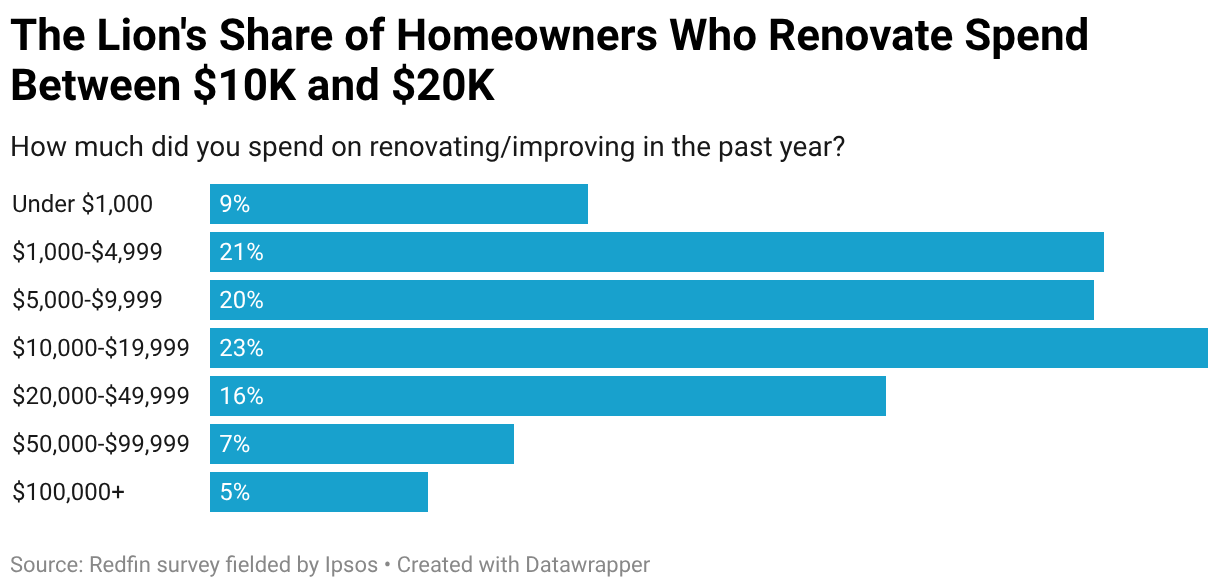
This post was originally published here


House hunters have the upper hand, allowing them to abandon deals over price, repairs or second thoughts. Cancellations are most common in Tampa and San Antonio, where there are roughly twice as many sellers as buyers. 

More than 42,000 U.S. home-sale agreements fell through in February, equal to 13.7% of homes that went under contract that month. That’s up from 12.8% a year earlier, and the highest February share in records dating back to 2017.


This is based on a Redfin analysis of MLS pending-sales data. The data is seasonal; typically, there’s a higher share of cancellations at the end of the year and a lower share in the spring. That’s why we compare this February to past Februarys. Please note: Homes that fell out of contract during a given month didn’t necessarily go under contract that same month. This data is subject to revision. 

Nearly one of every seven homebuying deals are falling through largely because buyers are in the driver’s seat. There are hundreds of thousands more home sellers than buyers in the country, a near-record gap that gives buyers options and negotiating power. A buyer may back out of a contract during the inspection period if they see a home they like better or an issue comes up that they don’t want to repair–or they might just change their mind, confident that there are a lot of other homes on the market that fit their criteria. 

“Homes are falling out of contract left and right,” said Juan Castro, a Redfin Premier agent in Orlando. “Sometimes buyers make an offer but never send the deposit because they get nervous, sometimes they revisit numbers with lenders and don’t feel comfortable with the monthly payments, and other times they use a minor inspection issue as an excuse to back out. I’m also seeing buyers negotiate aggressively–for instance, maybe they ask for a brand-new roof because three shingles are missing on an otherwise perfectly good roof–then cancel the deal if the seller says no.” 

House hunters are also feeling jittery because of economic and geopolitical uncertainty. Many Americans are concerned about job security, inflation, the Iran war, and other world events that can make their finances feel shaky. Those things are also causing mortgage-rate volatility; some buyers who made an offer when rates were near a four-year low in February may have suddenly faced a higher rate when it came time to lock it in. 

Contract Cancellations Are Most Common in Tampa, San Antonio and Other Big-Time Buyer’s Markets


In Tampa, FL, 18.1% of home-purchase agreements were canceled in February, the highest share of the 47 major U.S. metros Redfin analyzed. It’s followed by four other southern metros: San Antonio (17.9%), Atlanta (17.9%), Jacksonville, FL (17.5%) and Fort Worth, TX (17.3%). 

All five of those are buyer’s markets. In Tampa, for instance, there are 84% more home sellers than buyers, and in San Antonio there are more than twice as many sellers as buyers. That allows buyers to back out of one deal and fairly easily move on to the next one. 

On the flip side, contract cancellations are least common in the Bay Area. In San Francisco, just 3.7% of deals fell through in February, the lowest share among the metros. Next come Nassau County, NY (4.5%), San Jose, CA (5.4%), Milwaukee (7.5%) and Oakland, CA (7.7%). 

Nassau County and Milwaukee are two of just five seller’s markets in the U.S.; buyers in those places are rarely backing out because if they do, they may not find another home quickly. 

Cancellations Increased Most in Southern California 


Contract cancellations rose most in Los Angeles, to 15% in February from 12.1% a year earlier. Next come Virginia Beach, VA, where 14.7% of contracts were cancelled, up from 11.9%, and Boston (10.8%, up from 8.2%). 

Riverside, CA (16.9%, up from 14.4%) and Baltimore (13.3%, up from 10.9%) round out the top five. 

Metro-Level Summary: Canceled Home-Purchase Agreements, February 2026

47 of the most populous U.S. metro areas

Redfin analyze the 50 most populous U.S. metros and included the 47 with sufficient data

U.S. metro area Feb. 2026: Pending sales that fell out of contract, as % of overall pending sales Feb. 2025: Pending sales that fell out of contract, as % of overall pending sales
Anaheim, CA 12.4 % 12.4%
Atlanta, GA 17.9% 16.1%
Austin, TX 13.3% 12.2%
Baltimore, MD 13.3% 10.9%
Boston, MA 10.8% 8.2%
Chicago, IL 12.6% 12.3%
Cincinnati, OH 11.3% 13.2%
Cleveland, OH 16.4% 16.2%
Columbus, OH 16.5% 14.4%
Dallas, TX 15.5% 13.6 %
Denver, CO 14.5% 14.8%
Detroit, MI 16.6% 15.8%
Fort Lauderdale, FL 17.1% 15.4%
Fort Worth, TX 17.3% 15.8 %
Houston, TX 15.4% 13.4%
Indianapolis, IN 12.8% 13.6%
Jacksonville, FL 17.5% 16.3%
Las Vegas, NV 16.3% 14.8%
Los Angeles, CA 15.0% 12.1 %
Miami, FL 14.1% 12.9%
Milwaukee, WI 7.5% 8.8%
Minneapolis, MN 9.5% 8.1%
Montgomery County, PA 8.6% 6.4%
Nashville, TN 13.1% 10.8%
Nassau County, NY 4.5% 4.0%
New Brunswick, NJ 11.3% 10.5%
New York, NY 7.9% 8.6%
Newark, NJ 8.7% 8.7%
Oakland, CA 7.7% 7.0 %
Orlando, FL 17.0% 16.1%
Philadelphia, PA 11.9% 11.8%
Phoenix, AZ 16.7% 15.8%
Pittsburgh, PA 12.7% 12.2%
Portland, OR 14.8% 15.4%
Providence, RI 12.5% 11.1%
Riverside, CA 16.9% 14.4 %
Sacramento, CA 12.8% 12.9%
San Antonio, TX 17.9% 17.0%
San Diego, CA 13.8% 12.0%
San Francisco, CA 3.7% 3.3%
San Jose, CA 5.4% 3.7%
Seattle, WA 9.3% 8.0%
Tampa, FL 18.1% 16.2 %
Virginia Beach, VA 14.7% 11.9%
Warren, MI 12.7% 11.3 %
Washington, DC 11.4% 10.9%
West Palm Beach, FL 13.2% 10.9%
National—U.S.A. 13.7% 12.8%


The post 14% of Home-Sale Agreements Fell Through Last Month–A Record for February appeared first on Redfin Real Estate News.
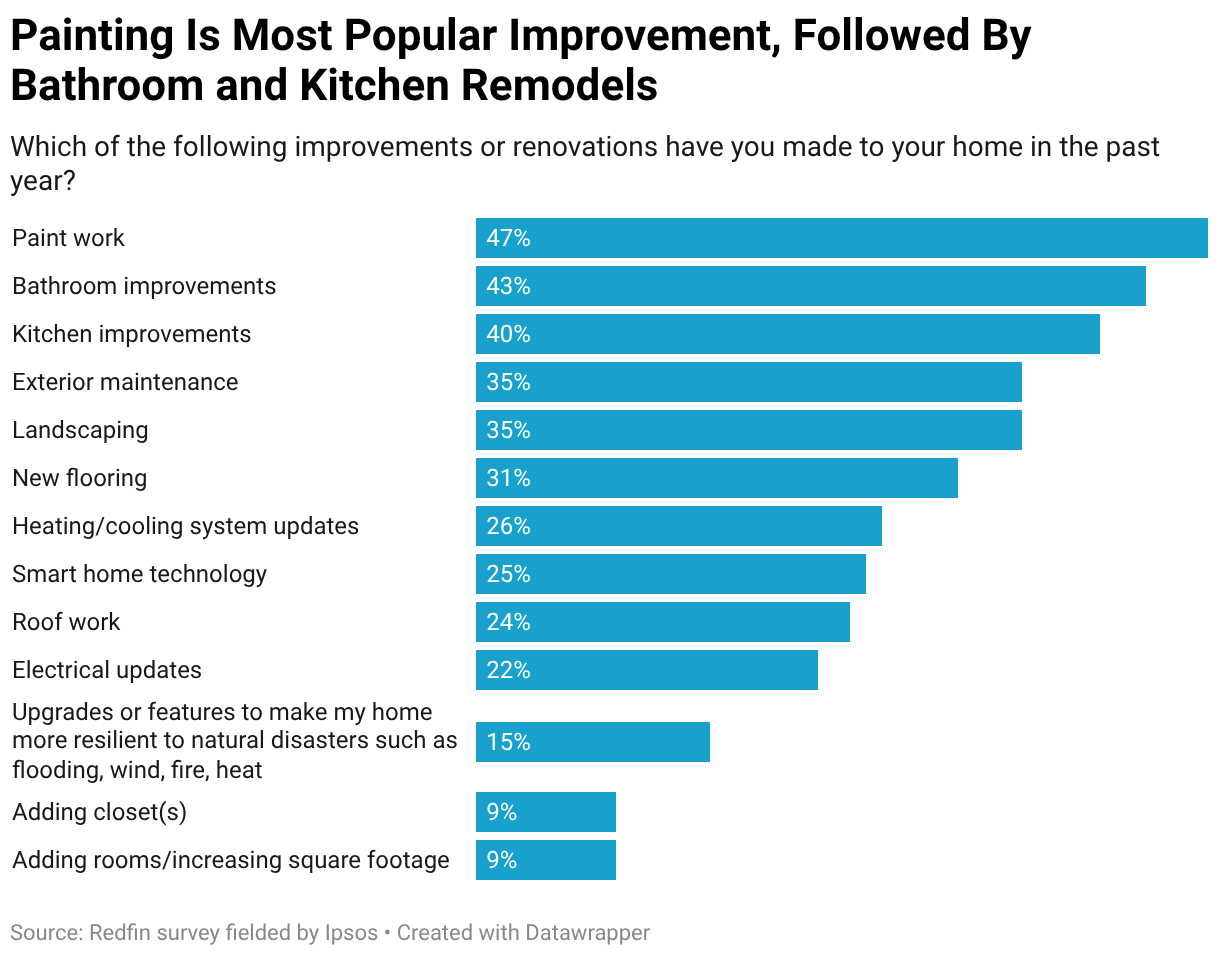
This post was originally published here


  • Home prices rose 0.1% month over month on a seasonally adjusted basis—the slowest growth in seven months.
  • Prices fell in 16 major metros, with the biggest declines in Jacksonville, FL, Providence, RI and Columbus, OH. Prices rose most in Charlotte, NC, Portland, OR and West Palm Beach, FL.

U.S. home prices were little changed from a month earlier in February, rising 0.1% on a seasonally adjusted basis—the slowest growth in seven months. They increased 1.9% year over year.


This is according to the Redfin Home Price Index (RHPI), which uses the repeat-sales pricing method to calculate seasonally adjusted changes in single-family home prices. The RHPI measures how sale prices of homes have changed since their previous sale—similar to the S&P Cotality Case-Shiller Home Price Indices—but is reported about a month earlier. February data covers the three months ending Feb. 28, 2026. Read the full RHPI methodology here.

Price growth is muted because it’s the strongest buyer’s market in recent history—for those who can afford to buy. Many Americans are holding off on purchasing homes because mortgage rates are still more than double the all-time low hit during the pandemic, and the nation is grappling with economic uncertainty and layoffs. As a result, there are a record 46% more home sellers than buyers, meaning the buyers who are in the market have negotiating power when it comes to price. Prices are still rising slightly, but this growth pales in comparison to recent years; during the pandemic, prices rose as much as 21% year over year and as much as 1.9% during a single month.

“Mortgage rates have ticked up in the past few weeks following months of declines, but we still expect housing affordability to improve this year as income growth outpaces home price growth,” said Redfin Principal Economist Sheharyar Bokhari. “Homebuyers in many markets are having success asking for discounts and other concessions, and they have the luxury of time because they aren’t facing much competition.”

The daily average mortgage rate rose to a six-month high of 6.53% last week amid escalations in the Iran war.

Home prices are falling in 16 major U.S. metro areas


Home prices fell month over month in 16 of the 50 most populous U.S. metropolitan areas on a seasonally adjusted basis in February.

The biggest declines were in Jacksonville, FL (-4%), Providence, RI (-1.4%) and Columbus, OH (-1.1%). The biggest gains were in Charlotte, NC (3.7%), Portland, OR (2.1%) and West Palm Beach, FL (2.1%).

Prices also fell in 16 metros on a year-over-year basis, with the biggest declines in San Antonio (-5.1%), Jacksonville (-4.4%) and Minneapolis (-3.8%). The largest increases were in San Francisco (15.2%), Chicago (9.3%) and New York (9.2%).

The post U.S. Home Prices Barely Budged in February appeared first on Redfin Real Estate News.
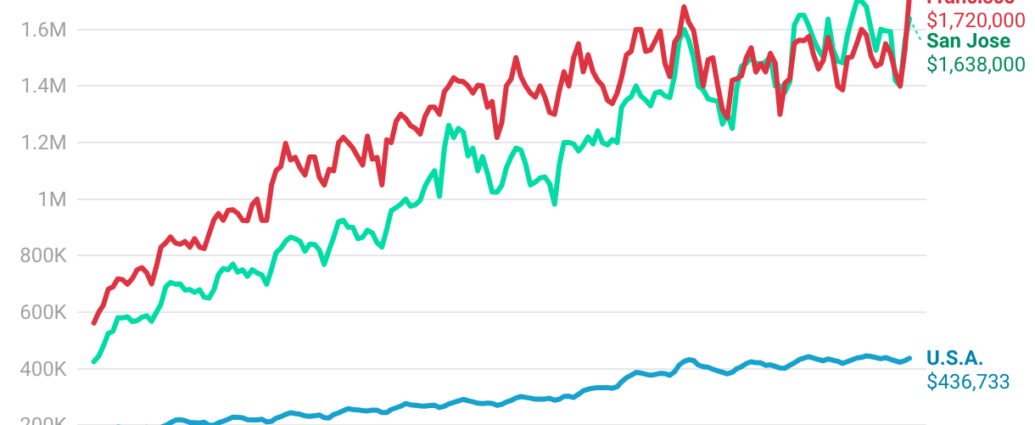
This post was originally published here

This Week In A Nutshell: The Iran War continues to fuel market volatility as it enters its fourth week, particularly as the White House signals it is seeking a resolution.

Upcoming Attractions


This week will feature many speaking engagements from various Fed officials, but key economic data releases will be scarce. The primary focus for markets will continue to be on the situation in the Middle East, specifically the timeline for resuming oil shipments from the Persian Gulf. Rates may also come down this week if Fed officials, in their speeches and interviews, attempt to change the rather hawkish impression left after last week’s press conference with Fed Chair Powell.

Last Week’s Highlights


Last week, daily average mortgage rates jumped from 6.36% to 6.53% as 10-year Treasury yields increased from 4.22% to 4.39%. Much of the movement came late in the week, starting with the Fed’s Wednesday conference. Rate movement intensified on Friday after President Trump said the U.S. was sending thousands of Marines to the Middle East. The Fed press conference nudged rates higher as Fed officials were seen as setting a high bar for any rate cuts this year. By Friday, the fed funds futures market was pricing in 5 to 10 bps of rate hikes in 2026, and no rate cuts until late into 2027. On February 27, when mortgage rates briefly touched 5.99%, investors were pricing in 60 bps of rate cuts this year. Sentiment has swung very dramatically in the last four weeks.

Diving a Little Deeper


The main question on everyone’s mind in housing: Will mortgage rates keep going up, or will they come back down to the lows we saw in late February? There are many layers of uncertainty, including the duration of the Iran war and how the economy reacts, along with the Fed’s response to changing economic conditions and the market’s forecasts for Fed policy.

Economists widely expect that these oil price spikes won’t lead to more restrictive Fed policy. Economists believe the Fed will be more worried about the risk of labor market deterioration than inflation with higher gas prices. However, investors interpreted Fed Chair Jerome Powell’s statements last week to mean the Fed is unlikely to cut interest rates this year, particularly his remarks about needing to see an improvement in inflation. Indeed, markets are now pricing in a 20% chance of a rate hike this year, and 0% chance of a rate cut.

It is definitely possible markets have overshot their expectations for the Fed, meaning rates are much higher right now than they need to be. To that point, Chair Powell actually downplayed the risk of a hike last Wednesday even while cautioning that the timing of the next cut is uncertain. The bar for the Fed to hike rates for the first time since July 2023 is high, and we’re unlikely to hit it given general macroeconomic conditions.

But whether markets have swung too far doesn’t matter for the housing market. Mortgage rates are high, and that is what consumers are experiencing. The housing market was already fragile to start the year, despite improving affordability. Housing demand was already underperforming where mortgage rates were because of lingering lock-in effects and labor market weakness. And this current bout of volatility couldn’t have come at a worse time. Much like last year’s Liberation Day, the war threatens to derail the start of the spring homebuying season.

Redfin Housing Market Reports


The Top 20% of Earners Hold Nearly 60% of America’s Real Estate Wealth

  • By comparison, the bottom 20% of U.S. earners hold just 5% of real estate wealth.

Today’s Homebuyers Save $150 a Month By Choosing an Adjustable-Rate Mortgage–The Biggest Discount Since 2022

  • The average rate for an ARM so far this month is 5.51%, compared with a 6.19% average for a 30-year fixed rate mortgage.
  • The typical homebuyer using an ARM takes on a monthly payment of $2,578, down 7% from last year.
  • Today’s ARM discount is big enough that buyers should talk to their lender about whether it’s the right option for them. ARMs aren’t nearly as risky as they once were; they come with interest-rate caps and protection for borrowers.

Homebuyers Can Afford to Take Their Time Heading Into Spring 2026

  • The typical home that went under contract in February spent 66 days on the market—the slowest February pace in a decade.
  • The typical buyer scored 1.8% off the list price—the biggest February discount since 2023; sellers outnumber buyers, giving buyers negotiating power.
  • Pending home sales and new listings both inched down last month, while home prices inched up.

There Are 630,000 More Home Sellers Than Buyers—the Biggest Gap on Record

  • When sellers outnumber buyers, the buyers who are in the market have bargaining power. In other words, it’s a buyer’s market.
  • The strongest buyer’s markets are in the South, while the strongest seller’s markets are in the Northeast.

The post Redfin Economists’ Weekly Take: Iran War Drives Rate Volatility appeared first on Redfin Real Estate News.
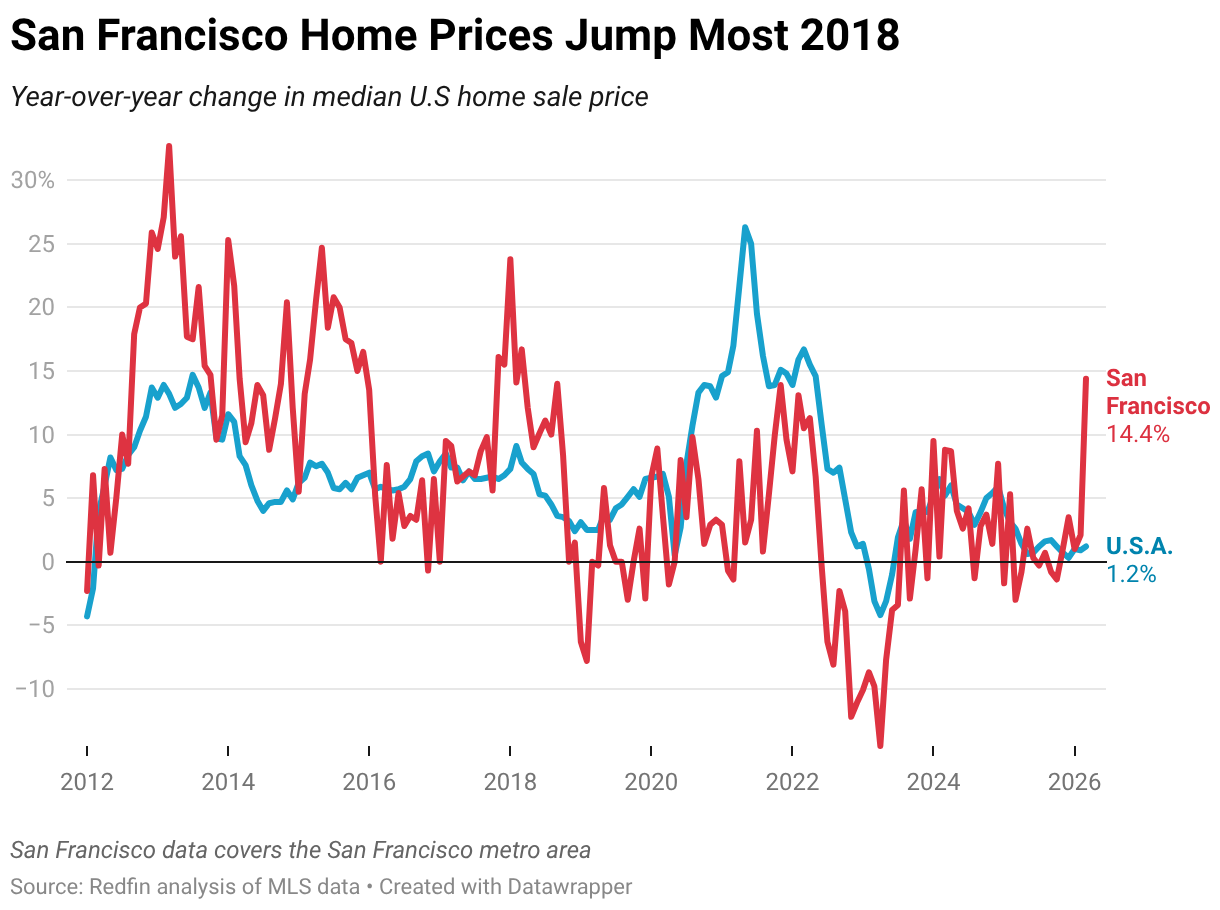
This post was originally published here


  • When sellers outnumber buyers, the buyers who are in the market have bargaining power. In other words, it’s a buyer’s market.
  • The strongest buyer’s markets are in the South, while the strongest seller’s markets are in the Northeast.

There were an estimated 46.3% more home sellers than buyers in the U.S. housing market in February (or 629,808 more, in numerical terms). That’s the largest gap in records dating back to 2013 and is up from 29.8% (or 449,409) a year earlier.


We define a market where there are over 10% more sellers than buyers as a buyer’s market and a market where there are over 10% fewer sellers than buyers as a seller’s market. A market where the gap is plus or minus 10% is considered a balanced market. By this definition, it has been a buyer’s market since May 2024. 

When sellers outnumber buyers, buyers typically hold the negotiating power because they have a lot of options to choose from. That’s why a market with a lot more sellers than buyers is considered a buyer’s market. Of course, it’s only a buyer’s market for those who can afford to buy. High housing costs and economic uncertainty have caused many house hunters to retreat, creating an imbalance of buyers and sellers. 

“We’re seeing a lot more inventory on the market compared to the past two years because the mortgage rate lock-in effect is easing and there’s a lot of new construction,” said Justin Gomez, a Redfin Premier real estate agent in Omaha, NE. “This has been great for affordability, especially for the younger crowd. Our median home price is in the low $300,000 range. Two years ago, people were offering $15,000 over the asking price just to get a home, with multiple offers everywhere.”

We estimated the number of buyers using proprietary Redfin data on the typical time from a buyer’s first tour to close of purchase, and MLS data on active listings and pending sales. The estimated number of sellers in the market is simply the number of active listings in the MLS. These estimates, along with median-sale price data in this report, are seasonally adjusted and subject to revision. See a more detailed methodology here and view an interactive dashboard here.

Buyers Are Retreating, Which Is Causing Some Sellers to Retreat


The number of homebuyers in the market fell 2.4% month over month in February to an estimated 1.36 million. The number of sellers posted a smaller decline, falling 0.4% to an estimated 1.99 million.

Number of Homebuyers in Market Falls to Historic Low (Line chart)


Homebuyers are retreating due to stubbornly high home prices and mortgage rates, layoffs, and mounting economic and political uncertainty. The retreat in buyers has caused some sellers, many of whom are buyers themselves, to retreat. Some sellers are delisting after watching their homes sit on the market, while others are choosing not to list at all after seeing nearby homes sell for below the asking price. 

Redfin did report earlier this month that relistings are beginning to rise, which could boost housing supply. New listings are also starting to climb slightly, posting their second straight week of increases after four months of declines.

The Strongest Buyer’s Markets Are In the South


The strongest buyer’s market in February was
Miami, which had an estimated 163% more sellers than buyers. Next came Nashville (120%), Austin, TX (112%), West Palm Beach, FL (110%) and San Antonio (104%). Redfin analyzed the 50 most populous U.S. metropolitan areas and included in this analysis the 49 with sufficient data.

The Sun Belt skyrocketed in popularity during the pandemic, when scores of homebuyers moved in from more expensive parts of the country. To meet surging demand, homebuilders ramped up activity, which is one reason there are now a lot more homes for sale than people who want to buy them. The pool of buyers has also shrunk because soaring housing costs in recent years have priced many people out of the market.

New construction can have a significant influence on whether negotiating power lies with buyers or sellers because it impacts the balance of supply and demand. The South and the West have historically issued the most building permits, while the Northeast and the Midwest (where the five seller’s markets are located) have issued the fewest.

Florida and Texas, in particular, build more homes than other states. Florida is also grappling with intensifying natural disasters, soaring insurance premiums and rising condo HOA fees, which has prompted some homeowners to leave. Miami, specifically, frequently shows up as a buyer’s market because it has a lot of housing supply, which could be in part due to the high number of condos. 

The Strongest Seller’s Markets Are In the North


The strongest seller’s market in February was
Newark, NJ, which had an estimated 31.1% fewer sellers than buyers. The other four seller’s markets were Montgomery County, PA (-29%) Nassau County, NY (-25.8%), Milwaukee (-25.2%) and New Brunswick, NJ (-14.5%). 

On average, home prices rose 2.2% year over year across the five seller’s markets in February, compared with a 0.3% increase across the 37 buyer’s markets—an indication that buyer’s markets offer house hunters more leverage. 

Metro-Level Summary: 50* Most Populous Metros (February 2026)

U.S. metro area Balance of power Percent by which sellers outnumber buyers Buyers Sellers
Anaheim, CA   Buyer’s Market 37.2% 5,363 7,357
Atlanta, GA   Buyer’s Market 76.6% 21,337 37,680
Austin, TX   Buyer’s Market 111.7% 8,396 17,776
Baltimore, MD   Balanced Market -4.0% 10,619 10,197
Boston, MA   Balanced Market 0.9% 10,012 10,105
Charlotte, NC   Buyer’s Market 74.3% 9,461 16,493
Chicago, IL   Balanced Market 2.2% 25,112 25,676
Cincinnati, OH   Buyer’s Market 39.1% 5,938 8,259
Cleveland, OH   Balanced Market -4.3% 7,171 6,860
Columbus, OH   Buyer’s Market 29.3% 6,626 8,570
Dallas, TX   Buyer’s Market 83.8% 16,716 30,731
Denver, CO   Buyer’s Market 40.1% 11,730 16,429
Detroit, MI   Buyer’s Market 44.8% 5,054 7,317
Fort Worth, TX   Buyer’s Market 76.1% 7,414 13,058
Houston, TX   Buyer’s Market 102.4% 22,402 45,345
Indianapolis, IN   Buyer’s Market 22.6% 7,643 9,372
Jacksonville, FL   Buyer’s Market 70.1% 7,313 12,438
Kansas City, MO   Buyer’s Market 19.6% 7,436 8,896
Las Vegas, NV   Buyer’s Market 89.5% 7,453 14,124
Los Angeles, CA   Buyer’s Market 52.6% 14,700 22,431
Miami, FL   Buyer’s Market 162.6% 7,512 19,726
Milwaukee, WI   Seller’s Market -25.2% 6,900 5,163
Minneapolis, MN   Balanced Market 6.9% 12,761 13,644
Montgomery County, PA   Seller’s Market -29.0% 7,111 5,047
Nashville, TN   Buyer’s Market 119.6% 7,077 15,540
Nassau County, NY   Seller’s Market -25.8% 9,280 6,885
New Brunswick, NJ   Seller’s Market -14.5% 10,082 8,624
New York, NY   Balanced Market 3.8% 26,109 27,100
Newark, NJ   Seller’s Market -31.1% 8,085 5,573
Oakland, CA   Buyer’s Market 24.4% 4,701 5,850
Orlando, FL   Buyer’s Market 73.6% 10,342 17,956
Philadelphia, PA   Buyer’s Market 24.6% 6,411 7,987
Phoenix, AZ   Buyer’s Market 78.7% 18,132 32,396
Pittsburgh, PA   Buyer’s Market 63.7% 5,579 9,132
Portland, OR   Buyer’s Market 49.7% 7,386 11,059
Providence, RI   Buyer’s Market 13.5% 3,593 4,078
Riverside, CA   Buyer’s Market 59.8% 11,880 18,980
Sacramento, CA   Buyer’s Market 41.0% 5,292 7,461
San Antonio, TX   Buyer’s Market 104.3% 8,905 18,196
San Diego, CA   Buyer’s Market 18.8% 6,627 7,873
San Francisco, CA   Balanced Market 2.4% 2,575 2,636
San Jose, CA   Buyer’s Market 10.5% 2,788 3,080
Seattle, WA   Buyer’s Market 28.9% 7,899 10,181
St. Louis, MO   Buyer’s Market 13.2% 9,087 10,285
Tampa, FL   Buyer’s Market 84.1% 13,128 24,168
Virginia Beach, VA   Buyer’s Market 22.3% 6,311 7,718
Warren, MI   Buyer’s Market 25.7% 7,183 9,027
Washington, DC   Buyer’s Market 18.6% 15,524 18,418
West Palm Beach, FL   Buyer’s Market 110.1% 7,394 15,531

*Fort Lauderdale has been removed due to insufficient data.

The post There Are 630,000 More Home Sellers Than Buyers—the Biggest Gap on Record appeared first on Redfin Real Estate News.
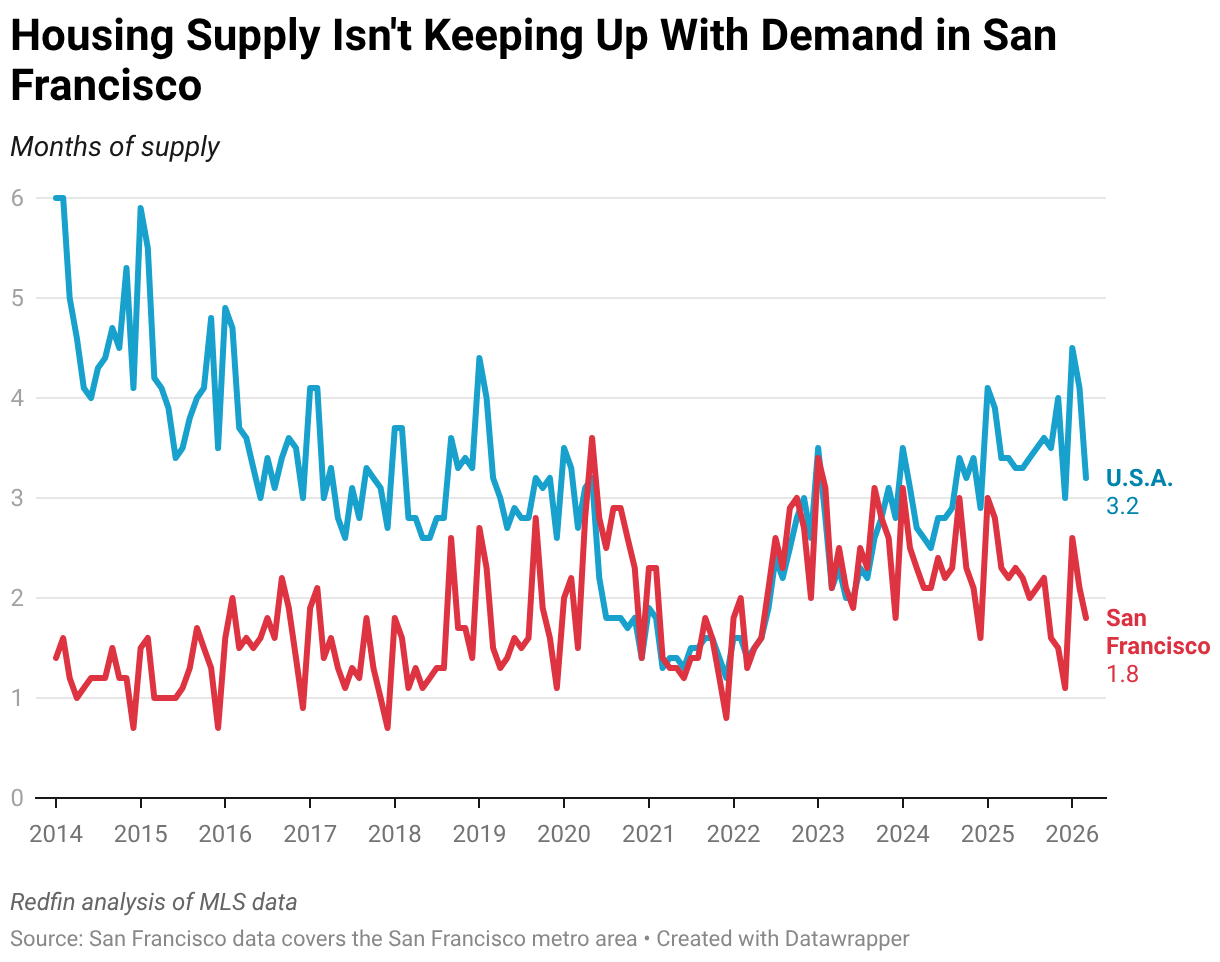
This post was originally published here