

USDA credits Trump trade deals as agricultural deficit shrinks, farm sector gains ground
The U.S. Department of Agriculture (USDA) recently released a trade forecast showing the farm trade gap narrowing significantly during fiscal year (FY) 2026. The forecast shows the agricultural trade deficit falling from $43.7 billion in FY2025 to a projected $29 billion in FY2026, an improvement from last year’s level and the $37 billion that was projected in December 2025.
Under Secretary of Agriculture for Trade and Foreign Agricultural Affairs Luke Lindberg told Fox News Digital that while the gap tightening was a step in the right direction, the USDA is still working to get back to a surplus.
“American farmers and ranchers have historically exported vastly more than we’ve imported, including in President Trump’s first term, and we had an agricultural trade surplus,” Lindberg said.
“Unfortunately, in the four years under President Biden, we ended up with a $50 billion agricultural trade deficit forecast that his team forecasted right before he left office just about a year ago. Now today, we’re excited to be announcing that we’ve reduced that deficit to $29 billion. Now, we’re still on course, and we need to get back to a surplus, that’s the goal, but a 43% reduction in one year, it’s a great start,” he added.
BEEF PRICES IN FOCUS AS TRUMP SIGNS ORDER AIMED AT CONSUMER RELIEF
In order to return the U.S. to that surplus, the USDA is taking action, which Lindberg outlined as a three-step process: securing strong trade agreements that open markets for American farmers and ranchers, building buyer-seller relationships in those markets and holding trading partners accountable to the commitments they make.
The under secretary said that he is more optimistic than what the forecast articulates because of the “historic” trade deals that President Donald Trump has been able to secure. Lindberg said he believes the agreements have allowed U.S. farmers and ranchers to compete on a leveled playing field.
“I think the more that we can take advantage of the agreements the president has signed, the more we are going to see this number get even better from a trade deficit perspective,” Lindberg told Fox News Digital. “I’m excited to see how our producers take advantage of that access and significantly increased opportunities.”
Lindberg spoke about the opening of Malaysia’s market as an example of a market that was recently opened to U.S. farmers and ranchers. He said that during his visit to Malaysia, it was “very clear” that people wanted to buy American products. He said that buyers abroad trust American products to be safe and high-quality.
The under secretary recalled meeting a restaurateur in Malaysia who invested her own money in a processing plant in the U.S. so she could be the first one to have American beef in her restaurant.
“Those are the kinds of investments and forward-leaning conversations we’re having with buyers in these countries all around the world,” he said.
While the administration has emphasized opening foreign markets, Lindberg said the impact could also be felt closer to home as U.S. farmers and ranchers supply more of the food Americans consume.
Beyond the narrowing trade gap, Lindberg said Americans could also see changes at the grocery store. He pointed to a projected decline in agricultural imports, including fruits and vegetables, and argued that increased domestic production could reduce the U.S.’s reliance on foreign suppliers.
“Producing things locally, lower transit costs, all of that combines to get to what the president’s goal and objective has been, which is reducing prices at the grocery store shelves,” he said.
GET FOX BUSINESS ON THE GO BY CLICKING HERE
While the U.S. remains in a trade deficit, Lindberg said the narrowing gap signals progress toward the agricultural trade surplus that American farmers and ranchers have seen in previous years.
This post was originally published here
U.S.-Iran attacks are putting a spotlight on drone technology. How to invest
Drones are playing a prominent role in the war between the U.S. and Iran that erupted over the weekend, putting a spotlight on the need for deterrence systems.


Ivana Trump’s Manhattan townhouse sells for $14M after $12.5M price cut
The longtime Manhattan residence of the late Ivana Trump has finally traded hands, but at a price that reflects a sobering reality for New York City’s luxury real estate market.
Property records show the opulent Upper East Side townhouse sold on Feb. 27 for $14 million, the Wall Street Journal reported. It’s a $12.5 million price cut from the original $26.5 million asking price set shortly after the businesswoman’s death in 2022.
The $14 million sale comes after three price cuts over the past three years.
Even with the massive discount, the estate saw a $2.5 million return from what Ivana originally paid in 1992. Proceeds from the sale are set to be split among her three children, Donald Trump Jr., Eric Trump and Ivanka Trump.
REAL ESTATE EXPERTS BLAST MAMDANI’S MATH-DEFYING PLAN, WARN OF HIGHER RENTS AND FLIGHT
A piece of the Trump family legacy, Ivana bought the home shortly after her divorce from President Donald Trump, and the nearly 9,000-square-foot limestone mansion served as the home base for their children during their teenage years.
“My mom absolutely loved that house,” Eric Trump told the Journal in 2022. He also said the opulence “embodied Ivana Trump.”
The home was a real estate personification of Ivana’s bold, unapologetic style. She oversaw extensive renovations shortly after buying the property to transform the former dental office into a six-story monument to luxury.
Located on the Upper East Side between Fifth and Madison avenues, the Versailles-inspired home features gold accents and shades of red. It has five bedrooms, six bathrooms, two small galley-style kitchens and multiple entertaining areas.
Some of the more grand interior design features include Chinese murals, silk-covered walls, a leopard-print library and crystal chandeliers in almost every room.
Ivana Trump lived in the home for three decades until her death in July 2022. She was found unconscious at the bottom of a staircase in the home after what authorities ruled was an accidental fall that caused blunt impact injuries, Fox News previously reported.
GET FOX BUSINESS ON THE GO BY CLICKING HERE
While transaction volume for New York City townhouses rose in 2025, the actual average sale prices fell, according to Leslie Garfield & Co.’s 2025 townhouse report. By the third quarter of 2025, the average sale price for Manhattan townhouses dropped 14% to $6.9 million.
Adam Modlin of the Modlin Group represented the buyer and seller in the transaction. He did not immediately respond to Fox News Digital’s request for comment.
Trump administration’s bid to halt New York City congestion toll blocked in court
Judge notes New York legislature passed $9 fee and it was signed into law by governor before federal approvals
A federal judge has blocked the Trump administration’s efforts to halt New York’s first-in-the-nation congestion fee meant to reduce traffic and pump revenue into the region’s aging transit system.
Lewis Liman, a US district judge, on Tuesday ruled that the US Department of Transportation lacked the authority to unilaterally rescind approval of the $9 toll, which was initially green-lighted by Joe Biden.

Stock Market Today: S&P 500, Dow Futures Up As Oil Prices Fall For First Time Since Iran War Began— Broadcom, Abercrombie & Fitch In Focus (UPDATED)
(Editor’s note: The headline, lede, and prices of futures, commodities, ETFs and stocks were updated and the ADP February jobs data was added)
U.S. stock futures climbed on Wednesday as oil prices fell for the first time since the U.S. and Israel launched strikes against Iran, easing some of the inflation fears that had rattled markets over the prior two sessions.
The pullback came after Treasury Secretary Scott Bessent told CNBC that the Trump administration would make “a series of announcements” to support oil tanker traffic through the Persian Gulf, building on Trump’s Tuesday pledge of naval escorts and political risk insurance via the International Development Finance Corporation.
Higher oil prices have stoked fears of stickier inflation, which could keep the Fed on hold longer and remove the rate-cut cushion markets have been leaning on all year. Wall Street’s fear gauge, the CBOE Volatility Index (VIX), jumped to 23.96 on Wednesday, its highest level since November.
Meanwhile, the ADP National Employment Report on Wednesday revealed that U.S. private employers added 63,000 jobs in February, above the 48,000 expected and compared to January’s revised 11,000 gain.
“We’ve seen an increase in hiring and pay gains remain solid, especially for job-stayers,” said Dr. Nela Richardson, chief economist, ADP. “But with hiring concentrated in only a few sectors, our data shows no widespread pay benefit from changing jobs. In fact, the pay premium for switching employers hit a record low in February.”
The 10-year Treasury bond yielded 4.07%, and the two-year bond was at 3.52%. The CME Group’s FedWatch tool‘s projections show markets pricing a 97.3% likelihood of the Federal Reserve leaving the current interest rates unchanged in March.
| Index | Performance (+/-) |
| Dow Jones | 0.21% |
| S&P 500 | 0.31% |
| Nasdaq 100 | 0.49% |
| Russell 2000 | 0.45% |
The SPDR S&P 500 ETF Trust (NYSE:SPY) and Invesco QQQ Trust ETF (NASDAQ:QQQ), which track the S&P 500 and Nasdaq 100, respectively, were slightly up in premarket trading on Wednesday. The SPY was up 0.30% at $682.47, while the QQQ rose 0.52% to $604.70.

Private sector added 63,000 jobs in February, above expectations, ADP says
Companies in the private sector added 63,000 jobs in February, payroll processing firm ADP said Wednesday.
The figure is above economists’ estimates of a gain of 50,000 jobs. The prior month’s payrolls number was revised lower to a gain of just 11,000 from an initially reported gain of 22,000.
“We’ve seen an increase in hiring and pay gains remain solid, especially for job-stayers,” said Nela Richardson, ADP chief economist. “But with hiring concentrated in only a few sectors, our data shows no widespread pay benefit from changing jobs. In fact, the pay premium for switching employers hit a record low in February.”
STANLEY BLACK & DECKER TO CUT HUNDREDS OF JOBS, SHUT CONNECTICUT PLANT
Education and health services added 58,000 positions, leading job creation in February. Construction added 19,000, information gained 11,000 and other services added 6,000.
Financial activities added 2,000 jobs, natural resources and mining gained 2,000 and leisure and hospitality added 1,000 positions.
DEADLIEST JOBS IN AMERICA REVEALED
On the negative side, professional and business services lost 30,000 jobs. Manufacturing lost 5,000 positions and trade, transportation and utilities lost 1,000.
Large businesses – those with 500 or more employees – added 10,000 jobs in February. Businesses with 50 to 499 employees lost 7,000 workers. Establishments with fewer than 50 employees added 60,000 jobs.
CLICK HERE TO GET FOX BUSINESS ON THE GO
Wage growth in February was little changed from last month. People staying in their roles saw their pay climb 4.5% from the prior year, while pay gains for those changing their jobs fell slightly to 6.3% from 6.4% in January.
This post was originally published here
RNG Continues to Lead as the Easy-to-Switch Clean Fuel for Multi-Sector Fleets Signing New Agreements With Clean Energy
Clean Energy Fuels Corp. (NASDAQ: CLNE), the largest provider of the cleanest fuel for the transportation market, has announced a slew of deals with trucking, refuse, and transit fleets nationwide. The agreements span renewable natural gas (RNG) fueling infrastructure and RNG supply, representing the continued growth of clean fuel adoption across multiple sectors.
This press release features multimedia. View the full release here: https://www.businesswire.com/news/home/20260304776734/en/

Clean Energy Renewable Natural Gas (RNG) Station, LAX, Los Angeles, California
“2025 was a rough year for other alternatives that didn’t live up to the hype. But fleets continue to seek proven solutions to meet sustainability targets and they’re finding that the RNG metrics deliver on multiple fronts – it’s clean, affordable, has diesel-like capability, is domestically produced, and there is a robust fueling infrastructure already in place,” said Chad Lindholm, senior vice president at Clean Energy. “These new agreements that we’re announcing today reflect that growing recognition across diverse fleet applications.”
Clean Energy has extended its partnership with Ecology Transportation Services, one of Southern California’s largest adopters of RNG for trucking. The agreement will supply Ecology’s fleet of 150 RNG vehicles with an estimated 2.1 million gallons of RNG annually. The trucks will fuel at Clean Energy stations across California, Arizona, and Nevada.
Clean Energy’s long-term partner Recology, one of the largest waste haulers in the western U.S., is expanding its commitment to RNG with upgrades to its fueling station in Seattle and a newly completed station in Snohomish, WA. Clean Energy will provide operations and maintenance services for both sites, supporting Recology’s growth in the greater Seattle region. Clean Energy continues to partner with WM, providing operations and maintenance services for more than 85 WM RNG stations across the U.S. and Canada, helping to keep 8,000 of WM’s RNG-powered refuse trucks on the road.
Washington Metropolitan …
Full story available on Benzinga.com
This post was originally published here
Top Fed Official, Wary of Inflation, Calls for Extended Rate Pause

Cuba charges six exiles with terrorism in wake of deadly speedboat attack
Detainees accused of coming from the US with intent to sow chaos and attack military units on Communist-ruled island
Cuban prosecutors have formally charged six people with crimes of terrorism after a US-flagged speedboat was involved in a deadly shootout with Cuba’s coast guard last week.
The US-based Cuban defendants are accused of packing a boat with weapons and heading toward Cuba in hopes of destabilising the government in Havana.

Actelis Networks (ASNS) Surges Over 55% After Hours — Here’s What You Should Know
Actelis Networks Inc. (NASDAQ:ASNS) surged 55.58% in after-hours trading on Tuesday to $0.29 after announcing a new contract with the California Department of Transportation.
Caltrans Deal Caps a Strong Government Win Streak
On Monday, Actelis announced it secured an order to deploy its MetaLight solution as part of an approximately $120 million Caltrans modernization initiative on a state route in San Mateo County. MetaLight claims to provide fiber-grade Ethernet connectivity over existing copper infrastructure.
The California-based networking solutions company said Actelis’ MetaLight solution will be deployed as part of the traffic signal and monitoring systems component of the initiative, covering a state route in San Mateo County.
According to the company’s press release, the order adds to 2025 wins in Orange and Ventura counties, follow-on orders from Washington, D.C.’s Department of Transportation and deployments across …


Quantum-Si Shares Slip After Q4 Revenue Miss
Quantum-Si, Inc. (NASDAQ:QSI) shares moved lower in Tuesday’s extended trading after the company released its fourth-quarter earnings report, missing Street revenue estimates.
Here’s a look at the key figures from the quarter.
- QSI stock is moving. Watch the price action here.
The Details: Quantum-Si reported quarterly loss of 8 cents per share, which beat the Street estimate for a loss of 12 cents, according to Benzinga Pro.
Quarterly revenue came in at $451,000, which …
This post was originally published here

Iran War Escalation, Oil Spike Rattle Wall Street: What’s Moving Markets Tuesday?
A wave of selling gripped Wall Street on Tuesday as the widening war between the U.S., Israel and Iran showed no sign of abating, driving crude oil sharply higher.
Drone strikes hit the US Embassy in Riyadh overnight, and the State Department ordered evacuations at facilities in Bahrain, Iraq, and Jordan. The reported potential closure of the Strait of Hormuz — through which roughly 20% of global oil flows — is the dominant market narrative of the session.
The West Texas Intermediate light crude jumped 6.4% to $75.8 a barrel, on pace for the sharpest 2-day rally since March 2022,. US natural gas rose 6.3% to $3.15, while European gas prices have almost doubled in two days.
Speaking alongside German Chancellor Friedrich Merz in the Oval Office, President Donald Trump stated that Iran no longer has air defenses or detection capabilities, while suggesting he may have preempted an Iranian strike on U.S. interests.
Trump also directed Treasury Secretary Scott Bessent to sever all trade relations with Spain after criticizing both Madrid and the U.K. as uncooperative in the conflict.
By 3:20 p.m. in New York:
- The S&P 500 was down 0.9% to 6,818
- The Nasdaq 100 fell 1.1% to 24,719
- The Dow Jones Industrial Average lost 0.7% to 48,567.
- The Russell 2000 declined 1.36% to 2,619.
- The CBOE Volatility Index surged 6% to 22.74, reflecting elevated near-term fear across options markets.
All 11 S&P 500 Sectors Traded In The Red
Materials led losses with the Materials Select Sector SPDR Fund (NYSE:XLB) down 2.9%, followed by the Industrial Select Sector SPDR Fund
Why war isn’t always good for defence stocks
They win only if governments want just enough weapons—but not too many
This post was originally published here
The nightmare war scenario is becoming reality in energy markets
The longer the war in the Gulf, the harsher the global economic fallout
This post was originally published here


X creators must disclose AI-generated armed conflict videos or face consequences
Creators who post artificial intelligence-generated videos of armed conflicts without clear disclosure will be penalized under new X policies aimed at preventing manipulation and misinformation.
Nikita Bier, head of product at X, announced the revisions to X’s Creator Revenue Sharing policies in a post Tuesday.
“During times of war, it is critical that people have access to authentic information on the ground. With today’s AI technologies, it is trivial to create content that can mislead people,” Bier wrote.
Users who post AI-generated videos of an armed conflict must now add a disclosure that it was made with AI, Bier said. Those who fail to add a disclosure will face a 90-day suspension from the platform’s Creator Revenue Sharing.
OPENAI CEO SAM ALTMAN ANSWERS QUESTIONS ON NEW PENTAGON DEAL: ‘THIS TECHNOLOGY IS SUPER IMPORTANT’
Any future violations will result in a permanent suspension from the program.
Bier said X will be flagged by any post with a Community Note or if the content contains metadata (or other signals) from generative AI tools.
GET FOX BUSINESS ON THE GO BY CLICKING HERE
“We will continue to refine our policies and product to ensure X can be trusted during these critical moments,” Bier said.
This post was originally published here

Blockchain analysts say traders may have used insider information to profit on Iran conflict bets
A single digital gambler known only as “Magamyman” walked away with $600,000 this weekend after successfully betting on the U.S. military’s strike against Iranian leadership—and he was not alone.
As millions of dollars flooded into controversial prediction markets tied to U.S. strikes on Iran and the death of Ayatollah Ali Khamenei, blockchain investigators say a handful of suspected insiders may have used non-public information to turn the fog of war into a personal windfall.
Just before the U.S.-led strikes that rocked Iran early Saturday, Reuters and other outlets reported a surge of “suspiciously timed bets” that generated significant profits. Blockchain analytics firm Bubblemaps identified six suspected insiders in a post on X, saying they collectively netted $1.2 million on Polymarket just hours before the conflict began.
BETTING COMPANY POLYMARKET OPENS N.Y.C.’S FIRST FREE GROCERY STORE IN DOWNTOWN MANHATTAN
Total trade volume on the fate of Khamenei reached more than $55 million on Kalshi and more than $58 million on Polymarket.
Kalshi faced intensified scrutiny after the federally regulated exchange voided some trades made on the position, “Ali Khamenei out as Supreme Leader?” as fine print indicates that individuals cannot profit directly from death. Instead of settling the “Yes” contracts at the full $1 value, Kalshi invoked a “death carveout” rule, settling positions based on the last traded price before his death was officially confirmed and refunding all trading fees.
“As an exchange, we resolve the market according to the rules, even when there is disagreement with the resolution. I understand many of you are frustrated about the Khamenei market,” Kalshi co-founder Tarek Mansour posted on X.
“No trader lost money on this market. While the rules were clear and we tried our best to highlight them, traders vocalized they were not prominent enough,” Mansour continued. “We learned a lot from this market. We are updating how we present similar markets (e.g., those with a death carveout or where a death might be a likely scenario) so traders can see the exception more clearly before they trade.”
Neither Polymarket nor Kalshi immediately responded to Fox News Digital’s request for comment.
GET FOX BUSINESS ON THE GO BY CLICKING HERE
“Gambling on war and death doesn’t just present national security risks, it also raises serious concerns about potential insider trading—presenting unscrupulous government officials with a chance to profit off the new war in Iran,” Senate Minority Leader Adam Schiff, D-Calif., posted to X on Monday. “These contracts are immoral. [Commodity Futures Trading Commission] can and must ban them.”
However, this is not the first time prediction markets have faced scrutiny for alleged insider trading. Just last month, Kalshi took action by suspending and fining two users — including an employee of the world’s most-subscribed YouTuber, MrBeast — for trading on material, nonpublic information.


Stanley Black & Decker to cut hundreds of jobs, shut Connecticut plant
Stanley Black & Decker said it will eliminate roughly 300 positions in New Britain, Connecticut, and close a manufacturing facility that produces single-sided tape measures as part of its ongoing restructuring efforts.
The move is tied to what the company described as a sustained decline in demand for the product category. The New Britain site primarily manufactures single-sided tape measures, which the company said are becoming obsolete in certain markets.
“As a result of a structural decline in demand for single-sided tape measures, we have decided to close our facility in New Britain that predominantly makes these products,” Debora Raymond, vice president of external communications for Stanley Black & Decker, said in a statement to WFSB. “These products are quickly becoming obsolete in the markets we serve.”
Raymond said the company is focused on assisting affected workers through the transition, including exploring opportunities at other locations as well as providing severance and job placement support for both salaried and hourly employees.
The reduction affects approximately half of the company’s roughly 600 employees in New Britain as of 2024. Stanley Black & Decker said its world headquarters in the city will remain open. The company has not disclosed a timeline for the facility’s closure.
The decision comes as Stanley Black & Decker continues executing a multiyear cost-reduction and operational simplification plan. Since late 2023, the company has reduced its global workforce by about 7,000 employees and completed a $2 billion savings program that included facility consolidations and supply chain adjustments.
Stanley Black & Decker has been headquartered in New Britain since the 19th century, and its longstanding presence contributed to the city’s “Hardware City” identity.
Connecticut Gov. Ned Lamont acknowledged the impact on workers and families, saying workforce transitions are difficult but expressed hope that affected employees will find new opportunities.
“Although Stanley has made the decision to discontinue operations for manufacturing outdated products, a change in workforce opportunities is difficult for employees, their families, and any community,” Lamont said in a statement to WFSB. “However, I am hopeful that these skilled workers will be repurposed with the help of Stanley Black & Decker, a company that will still proudly be headquartered here in Connecticut. My administration is working closely with local and state leaders to support affected workers and to reimagine the factory site so it can continue to create opportunity and strengthen New Britain’s economic future.”
CLICK HERE TO GET FOX BUSINESS ON THE GO
The company has not indicated whether additional workforce actions are planned at other locations.
FOX Business reached out to Stanley Black & Decker for comment.

Dow falls 400 points, oil spike moderates amid Middle East tensions
U.S. stocks fell on Tuesday as investors eye growing tensions in the Middle East and their potential effects on inflation and global trade.
The Dow Jones Industrial Average fell 403.51 points, or 0.83%. The Dow was down 1,278 points, or 2.6%, at the worst levels of Tuesday’s trading session.
The Nasdaq Composite and S&P 500 dropped 1.02% and 0.94%, respectively.
Investors feared that the higher oil prices could fuel inflation and complicate central bank policy decisions already strained by tariff-driven price increases.
US ‘SITTING ON SIGNIFICANT PROVEN RESERVES’: ANALYST SAYS AMERICA CAN WITHSTAND IRAN ENERGY SHOCK
International benchmark Brent crude was up more than 4% at $81 a barrel on Tuesday, while West Texas Intermediate crude climbed over 4% to $74 per barrel.
Oil prices eased on Tuesday after President Donald Trump said he had ordered the U.S. International Development Finance Corporation to provide political risk insurance and financial guarantees for maritime trade traveling the Gulf, adding that the U.S. Navy could begin escorting oil tankers through the Strait of Hormuz if necessary.
“No matter what, the United States will ensure the FREE FLOW of ENERGY to the WORLD. The United States’ ECONOMIC and MILITARY MIGHT is the GREATEST ON EARTH,” Trump wrote in a Truth Social post.
Tehran’s threat to attack any vessel attempting to transit the Strait of Hormuz, combined with production halts by several Middle Eastern oil and gas producers, has driven up global shipping rates and prices of crude and natural gas.
The strait, a critical choke point, carries roughly one fifth of the world’s total oil consumption.
The 10-year Treasury yield touched its highest level in more than a week and investors pushed back expectations for a 25-basis-point interest rate cut by the Federal Reserve to September from July, according to LSEG-compiled data.
OIL MARKETS ON EDGE AS IRAN MOVES TO RESTRICT VITAL STRAIT OF HORMUZ SHIPPING LANE, REPORT SAYS
“Investors worry about additional inflation coming down the road. The main concern is that (oil prices) goes to over $100 a barrel and stays there,” said Robert Pavlik, senior portfolio manager at Dakota Wealth.
GET FOX BUSINESS ON THE GO BY CLICKING HERE
Reuters contributed to this report.
Similarweb Files 2025 Annual Report on Form 20-F
Similarweb (NYSE: SMWB), a leading digital intelligence company, announced the filing of its annual report on Form 20-F for the fiscal year ended December 31, 2025, with the U.S. Securities and Exchange Commission (SEC) on March 2, 2026.
The 2025 annual report can be accessed by visiting either the SEC’s website at www.sec.gov or the company’s investor relations website at https://ir.similarweb.com. In addition, shareholders may receive a hard copy of the company’s complete audited financial …
Full story available on Benzinga.com
This post was originally published here

The Iran war could accelerate the rise of the ‘poly-national’ company
- In today’s CEO Daily: Diane Brady on companies’ push to regionalize amid conflict.
- The big leadership story: Iran war raises energy prices and cyber threats, with taxpayers footing the bill.
- The markets: A sea of red as the Iranian conflict escalates, with no end in sight.
- Plus: All the news and watercooler chat from Fortune.
Good morning. Will the attacks on Iran accelerate the push to decentralize global companies? This year’s Edelman Trust Barometer referenced the rise of the “poly-national”—a corporate structure that invests in long-term local relationships, compartmentalizing everything from talent to supply chains in individual countries. To stay ahead in a world that’s shifted from globalization to national interests, the argument goes, companies must “operate as a network of businesses with a U.S. center, but a local face.”
It’s a variation of a strategy long deployed by consumer-facing global giants like Coca-Cola and Procter & Gamble, which prioritize global experience in their leaders and connect strong regional operations. HSBC regionalized its operations at the start of last year, splitting its operations between “Eastern Markets” and “Western Markets.” And years of heightened tensions and tariff wars with China have long forced companies to alter what Singapore Prime Minister Lawrence Wong called the “invented in California; made in China” strategy that helped firms like Apple to scale so profitably.
There are other forces disrupting the model of a centralized company. I spoke yesterday with Christina Kosmowski, CEO of LogicMonitor, which monitors customers’ tech systems from data centers to the cloud. She is having more conversations with CEOs about doubling down on a regional strategy to build resilience. “When your systems go down, you can’t operate,” says Kosmowski. “The time frame to react is just within seconds, instead of hours and days.”
To be sure, decentralization comes with risks, not least of which is the duplication of systems, costs, and functions that get streamlined in an efficient corporate structure. As Novartis CEO Vas Narasimhan said to me last year, “to navigate complexity in the external world, you have to radically take out complexity internally.” That means creating a leaner and simpler organization where everyone knows who is responsible for what. It’s possible to have that alongside autonomous and agile regional operations, of course, but it requires leaders whose teams are aligned on what efforts are localized—and what stays the same.
Contact CEO Daily via Diane Brady at diane.brady@fortune.com
This story was originally featured on Fortune.com
This post was originally published here

‘That résumé goes right into the garbage’: Kevin O’Leary says it’s a ‘horrific signal’ for Gen Z to bring their parents to job interviews
Ever thought about bringing your mom or dad to an interview with you? Well, it’s a bad look—at least according to Shark Tank investor Kevin O’Leary.
“First question I’d have to the son or daughter, I’d say: ‘Do you want me to hire your mother or you? What’s she doing here? Because I’m not bringing her into the business,’” O’Leary told Fox Business in an interview published Feb. 28.
As shocking as it may be to hear that the young workforce is bringing their parents along for the recruitment process, it’s a very real phenomenon. O’Leary said it happened to him when he was interviewing a Gen Z candidate.
“I just said: ‘This isn’t going to work, guys. Your mom is not going to be part of this discussion, so we’re going to have to shut her down, or you’re not going to be considered for this role,’” O’Leary recalled.
Plus, the proof is in the pudding: A 2025 study by Resume Templates showed a staggering 77% of surveyed Gen Z job seekers have brought a parent to a job interview. They have even gotten them to negotiate pay raises and complete hiring tests on their behalf.
O’Leary argues this is a “horrific signal” in Gen Z hiring trends. He said it shows younger professionals can’t think or make decisions on their own.
“If your dad or your mom [appears], that résumé goes right into the garbage,” O’Leary added.
Why parents are crashing their Gen Z kids’ job interviews
A mix of economic anxiety, intensive parenting, and shifting norms around independence is pushing some Gen Z workers to involve parents in interviews and the broader job application process.
Because entry-level roles are so scarce and competitive in today’s job market, early-career interviews can feel like make-or-break events. Another 2025 report shows nearly 60% of students who graduated within the past year are still looking for their first full-time role, according to Kickresume.
So for Gen Z, having a parent involved in their job hunt feels like hedging against mistakes. But experts have echoed O’Leary’s sentiments, saying that buffer of having a parent there really isn’t as beneficial as Gen Zers may like to think.
“If you’re the parent who’s inserting yourself, you’re going to diminish the confidence that your son or daughter has walking into interviews, thinking that they can’t do it themselves,” Brandi Britton, an executive director at Robert Half, previously told Fortune.
And for some Gen Zers, parental involvement expands far beyond sitting in on interviews. Some parents are “career copiloting,” meaning Gen X and baby boomer parents are deeply involved in their kids’ education and careers—so much so they’re editing résumés, scheduling work calls, joining interviews, and negotiating job offers.
“From first applications to negotiating offers, parents are firmly in the driver’s seat for many Gen-Z workers,” according to a survey from résumé, cover letter, and job search platform Zety.
O’Leary also advised other business leaders to just cut interviews short if they see a parent in the room.
“Just say: ‘Sorry. That’s not going to work for us,’” he said. “It means you can’t do this on your own. I think it’s a horrific signal—and I really think that parents that are overbearing like this think that they’re going to add value.”
“This is just a curse on their children,” he added. “It’s a really, really bad idea.”
This story was originally featured on Fortune.com
This post was originally published here
The Strait of Hormuz crisis explained: What it means for global shipping
The Middle East conflict has stoked fears of prolonged disruption to global trade via key maritime corridors.
McDonald’s CEO’s awkward taste test sparks mocking online: ‘His aura screams kale salad’
Video of Chris Kempczinski trying new ‘product’ the Big Arch burger criticized for feeling forced and corporate
Business leaders are increasingly placing themselves in front of the camera, in an effort to appear more relatable to a social media-first audience. When it goes well, it can be a huge hit. When it doesn’t, you risk becoming the subject of online ridicule.
In the recent case of Chris Kempczinski, the McDonald’s CEO and president, it’s the latter.

US ‘sitting on significant proven reserves’: Analyst says America can withstand Iran energy shock
Oil prices have climbed after reports that Iranian drones struck a major liquefied natural gas (LNG) facility in Qatar, rattling global energy markets and reigniting debate over energy security.
But while the market reaction was swift, one energy analyst says the United States is structurally better prepared to weather the shock than many of its allies.
“Energy security is national security,” Independent Women’s Center for Energy and Conservation Director Gabriella Hoffman said in an interview with Fox News Digital. “If your energy policy is tied to boosting domestic production and insulating yourself from geopolitical threats, you’re going to be in a stronger position during moments like this.”
In the early morning hours on Saturday, U.S. military forces launched a massive joint military operation against Iran, known as “Operation Epic Fury.” The attacks have already left major leaders dead, including Iranian Supreme Leader Ayatollah Ali Khamenei, and spurred other strikes across the Middle East region.
OIL MARKETS ON EDGE AS IRAN MOVES TO RESTRICT VITAL STRAIT OF HORMUZ SHIPPING LANE, REPORT SAYS
Iranian retaliation involving drone strikes hit energy infrastructure in Qatar on Monday, prompting QatarEnergy to halt LNG production at key facilities. Qatar’s LNG exports account for nearly 20% of global supply.
As a result, global benchmark Brent Crude and U.S. crude futures rose sharply, with Brent up more than 8% toward around $79 a barrel and U.S. crude up about 7.6% on Monday amid supply fears.
European energy and natural gas prices also surged in response, underscoring the continent’s continued dependence on imported LNG following its pivot away from Russian gas. Hoffman also noted that major energy importers such as China are significantly reliant on Qatari LNG supplies.
“Countries that are dependent on Middle Eastern reserves are going to have to look closer to home,” Hoffman said. “If you’re relying heavily on foreign suppliers and something like this happens, you’re more exposed to volatility and instability.”
Hoffman argued the United States is less vulnerable than Europe because of its recent surge in domestic production and LNG export capacity. The U.S. recently became the world’s largest net exporter of petroleum products and continues expanding production capacity under Trump administration directives.
That position, she said, provides insulation from external supply shocks.
“We are scaling up production. We’re approving more infrastructure. We’re cutting red tape,” Hoffman said. “If we’re not approving new projects fast enough, that could eventually hold us back.”
Still, she maintained that the U.S. is “in a much stronger position than we would have been” under Biden-Harris policies that constrained domestic production. Hoffman further argued that Iranian conflict will not fundamentally disrupt American energy goals.
She pointed to prior geopolitical tensions — including developments involving Venezuela — that did not trigger sustained price spikes.
“It’s early,” she cautioned. “We’re still waiting to see how this unfolds. But recent history shows that markets can adjust more quickly than some forecasts suggest.”
“Energy is now a geopolitical tool,” she continued. “If allies see instability from relying on rogue nations or unstable regions, that could increase demand for American LNG.”
GET FOX BUSINESS ON THE GO BY CLICKING HERE
For now, markets remain in a “wait-and-see mode,” according to Hoffman. Much will depend on whether further infrastructure is targeted and whether the conflict escalates.
“We’re sitting on significant proven reserves,” she said. “With the right policies, America can weather this kind of shock… The lesson here… is that energy policy decisions made years ago determine how resilient you are today.”
Nominations Open for 2026 ISG Women in Digital Awards
Annual program marks its fifth year recognizing women’s leadership in technology roles
Information Services Group (ISG) (Nasdaq: III), a global AI-centered technology research and advisory firm, today announced that nominations are open for the fifth annual ISG Women in Digital Awards for exceptional leadership among women in technology.
“ISG is delighted to mark the fifth year of the ISG Women in Digital Awards,” said Michael P. Connors, chairman and CEO, ISG. “We welcome nominations for our 2026 awards program, recognizing and amplifying the women leading change and transformation in the era of AI.”
The awards program was launched in 2022 in the Americas and expanded in 2023 to Europe, Middle East and Africa (EMEA) and Asia Pacific. In 2025, a record of more than 530 exceptional women were nominated in all three regions and detailed in an ISG Women in Digital eBook.
An independent panel of judges for each region, drawn from the enterprise, provider and advisory communities, will evaluate nominations and select winners in each region. Regional winners will be named in five categories:
- AI Champion: for driving the strategic use of AI as a catalyst to dramatically …
Full story available on Benzinga.com
This post was originally published here
DOL probe takes on a life of its own
When is a ban not a ban? That is one question posed by the ongoing investigation swirling around Labor Secretary Lori Chavez-DeRemer and the people around her.
This post was originally published here

Stock Market Today: S&P 500, Dow, Nasdaq Futures Slide Amid US And Israel ‘Operation Epic Furry’ Against Iran— HKD, AARD, MDB In Focus (UPDATED)
Editor’s Note: The future prices of benchmark tracking ETFs, and the headline were updated in the story.
U.S. stock futures fell sharply on Monday following Friday’s losses. Futures of the major benchmark indices were negative amid the ongoing Iran-U.S. conflict.
Over the weekend, the 86-year-old Iranian Supreme Leader Ayatollah Ali Khamenei was killed in the strikes carried out by Israel and the U.S. Meanwhile, President Donald Trump suggested that the current U.S. and Israel’s military strikes against Iran, also called “Operation Epic Furry,” could persist for “four to five weeks,” if necessary.
According to Polymarket, the chances of the index opening higher on March 2 crashed to a mere 10% chance, a 40% drop from previous levels, as over $1.07 million in volume poured into the contract.
Meanwhile, the 10-year Treasury bond yielded 3.97%, and the two-year bond was at 3.42%. The CME Group’s FedWatch tool‘s projections show markets pricing a 95.4% likelihood of the Federal Reserve leaving the current interest rates unchanged in March.
| Index | Performance (+/-) |
| Dow Jones | -1.15% |
| S&P 500 | -1.12% |
| Nasdaq 100 | -1.51% |
| Russell 2000 | -1.36% |
The SPDR S&P 500 ETF Trust (NYSE:SPY) and Invesco QQQ Trust ETF (NASDAQ:QQQ), which track the S&P 500 index and Nasdaq 100 index, respectively, were lower in premarket on Friday. The SPY was down 0.81% at $680.40, while the QQQ declined 1.06% to $600.87.
Stocks In Focus
AMTD Digital
- AMTD Digital Inc. ADR (NYSE:HKD) surged 20% in premarket on Monday after it reported a year-over-year increase in FY25 revenue results.
- HKD had a weaker price trend in the long term but a strong trend in the medium and short terms, as per Benzinga’s Edge Stock Rankings.

Aardvark Therapeutics
- Aardvark Therapeutics Inc. (NASDAQ:AARD) plunged 53.56% after the company announced it voluntarily paused the Phase 3 Hunger Elimination or Reduction Objective trial.
- Benzinga’s Edge Stock Rankings indicate that …
Thomson Reuters Announces Planned CFO Transition
TORONTO, March 2, 2026 /PRNewswire/ — Thomson Reuters (TSX/Nasdaq: TRI), a global content and technology company, today announced that Mike Eastwood, Chief Financial Officer, will retire from the role following a planned transition. Mr. Eastwood will become Chairman of the Board of the Thomson

MREO Investors Have Opportunity to Lead Mereo BioPharma Group plc Securities Fraud Lawsuit with the Schall Law Firm
LOS ANGELES, March 2, 2026 /PRNewswire/ — The Schall Law Firm, a national shareholder rights litigation firm, reminds investors of a class action lawsuit against Mereo BioPharma Group plc (“Mereo” or “the Company”) (NASDAQ: MREO) for violations of §§10(b) and 20(a) of the Securities Exchange Act of 1934 and Rule 10b-5 promulgated thereunder by the U.S. Securities and Exchange Commission.
This post was originally published here
VTGN Investors Have Opportunity to Lead Vistagen Therapeutics, Inc. Securities Fraud Lawsuit with the Schall Law Firm
LOS ANGELES, March 2, 2026 /PRNewswire/ — The Schall Law Firm, a national shareholder rights litigation firm, reminds investors of a class action lawsuit against Vistagen Therapeutics, Inc. (“Vistagen” or “the Company”) (NASDAQ: VTGN) for violations of §§10(b) and 20(a) of the Securities Exchange Act of 1934 and Rule 10b-5 promulgated thereunder by the U.S. Securities and Exchange Commission.
This post was originally published here

Oil prices surge after strikes kill Iran’s supreme leader, tankers hit near Strait of Hormuz
Oil prices surged on Monday as fears mounted that the escalating Iran conflict could drag on for weeks, rattling global energy markets.
Global benchmark Brent crude jumped more than 8.5%, or $6.40, to $79.20 a barrel following U.S. and Israeli strikes on Iran that killed Supreme Leader Ali Khamenei.
U.S. West Texas Intermediate also surged 7.8%, or $5.35, to $72.30 per barrel after briefly hitting $75.33 — its highest since June of last year – on Sunday.
OIL MARKETS ON EDGE AS IRAN MOVES TO RESTRICT VITAL STRAIT OF HORMUZ SHIPPING LANE, REPORT SAYS
Analysts at Citi warned that prices could climb further if the conflict persists, projecting Brent could trade between $80 and $90 a barrel in the coming days.
Israel launched fresh strikes on Iran Sunday, with Tehran responding with new missile barrages, further escalating tensions in a region responsible for a significant share of the world’s oil production, Reuters reported.
MUSK POINTS TO HIGHEST ‘EVER’ USAGE OF X AMID US-ISRAEL STRIKES ON IRAN
Missiles on Sunday also struck several oil tankers near the Strait of Hormuz — the world’s most critical oil export route — killing one crew member and raising alarms across global markets, Reuters reported.
As tensions mounted Sunday, more than 200 vessels — including oil and liquefied natural gas tankers — were anchored near the passage which carries roughly 20% of the world’s oil supply, according to Reuters.
‘IT’S CALLED A WHOOP’: CEO REJECTS SECURITY RISK CLAIM ABOUT SUSIE WILES
CLICK HERE TO GET FOX BUSINESS ON THE GO
Iran reportedly moved to restrict navigation along the Strait of Hormuz following the strikes.
Major exporters, including Saudi Arabia, Iraq, the United Arab Emirates, Kuwait and Iran, depend heavily on the route.
Reuters contributed to this report.
GOSS Investors Have Opportunity to Join Gossamer Bio, Inc. Fraud Investigation with the Schall Law Firm
The Schall Law Firm, a national shareholder rights litigation firm, announces that it is investigating claims on behalf of investors of Gossamer Bio, Inc. (“Gossamer” or “the Company”) (NASDAQ: GOSS) for violations of the securities laws.
The investigation focuses on whether the Company issued false and/or misleading statements and/or failed to disclose information pertinent to investors. Gossamer announced on February 23, 2026, that its product candidate seralutinib failed to meet its …
Full story available on Benzinga.com
This post was originally published here

Musk points to highest ‘ever’ usage of X amid US-Israel strikes on Iran
The fallout of the joint U.S.-Israeli attack on Iran led to the highest-ever activity on X, the platform’s owner Elon Musk confirmed on Sunday.
Musk made the statement in reply to Nikita Bier, the head of product at X. Bier stated on Saturday that the day had been “the biggest day on X in history.”
“Highest usage of X ever,” Musk replied.
The exchange came after the U.S. and Israel conducted airstrikes and drone attacks on multiple targets across Iran, killing Supreme Leader Ayatolla Ali Khamenei as well as several other top Iranian officials, including the head of the Iranian Revolutionary Guard Corps (IRGC).
AMERICA STRIKES IRAN AGAIN — HAS WASHINGTON PLANNED FOR WHAT COMES NEXT?
Footage of airstrikes both against Iran and Iran’s retaliatory strikes against neighboring countries spread across social media like wildfire throughout Saturday and into Sunday.
The strikes also quickly led to widespread arguments over whether the attacks benefited the U.S. and whether President Donald Trump had the authority to carry them out without approval from Congress.
Ben Rhodes, a top Obama-era official who helped negotiate the 2015 nuclear deal with Iran, faced mass criticism after he tried to rebuke Trump for the attacks.
FROM HOSTAGE CRISIS TO ASSASSINATION PLOTS: IRAN’S NEAR HALF-CENTURY WAR ON AMERICANS
Rhodes argued on X that Trump and Israeli Prime Minister Benjamin Netanyahu “seem to be totally unconcerned about the human beings — on all sides — who will suffer.”
“Trump’s second term has been the worst case scenario,” Rhodes added.
Rhodes was quickly ridiculed by many conservatives on social media who pointed to the Obama-era Iran deal as a catalyst for allowing the situation to escalate to this point, and placing blame on the Obama administration for not taking the threat from Iran seriously.
GET FOX BUSINESS ON THE GO BY CLICKING HERE
“Yes we were much better off with a president who drew redlines and failed to enforce them,” American Enterprise Institute fellow and Fox News contributor Marc Thiessen posted on X. “Team Obama might want to sit this one out.”
“Oh look the guy who literally created this mess in the first place has chimed in,” Republican digital operative Alec Sears posted on X.
Fox News’ Andrew Mark Miller contributed to this report.
This post was originally published here
War in Iran could cause the biggest oil shock in years
Prices will surge in the short run—and may stay high for a while
This post was originally published here

OpenAI CEO Sam Altman answers questions on new Pentagon deal: ‘This technology is super important’
OpenAI CEO Sam Altman on Saturday publicly defended his company’s new Pentagon deal, just a day after President Donald Trump ordered federal agencies to cut ties with rival Anthropic.
Hours after the U.S. and Israel launched a joint strike against Iran, Altman took to X to answer questions about the agreement allowing the Department of War (DoW) to deploy OpenAI’s artificial intelligence (AI) models on its classified network.
“I’d like to answer questions about our work with the DoW and our thinking over the past few days,” he said.
In announcing the agreement late Friday, Altman wrote, “AI safety and wide distribution of benefits are the core of our mission. Two of our most important safety principles are prohibitions on domestic mass surveillance and human responsibility for the use of force, including for autonomous weapon systems. The DoW agrees with these principles, reflects them in law and policy, and we put them into our agreement.”
OPENAI REACHES PENTAGON AGREEMENT AS TRUMP ORDERS ANTHROPIC OFF FEDERAL SYSTEMS
The OpenAI agreement came as Trump directed every federal agency to stop using Anthropic technology, setting a six-month phase-out period and intensifying the dispute over how AI should be used in military operations.
Secretary of War Pete Hegseth said he was directing the department to designate Anthropic a “supply-chain risk to National Security.”
Anthropic CEO Dario Amodei had refused demands from the Pentagon to allow its AI to be used for “all lawful purposes,” citing concerns about “mass domestic surveillance” and “fully autonomous weapons.”
When asked why the Pentagon accepted OpenAI but not Anthropic, Altman said, “Anthropic seemed more focused on specific prohibitions in the contract, rather than citing applicable laws, which we felt comfortable with.” He added that Anthropic “may have wanted more operational control than we did.”
OPENAI’S $110B FUNDING ROUND DRAWS INVESTMENT FROM AMAZON, NVIDIA, SOFTBANK
Altman said the Defense Department did not issue any explicit or implicit threats before the agreement was reached, adding that Pentagon officials were “genuinely surprised we were willing to consider” classified work.
He said OpenAI initially planned to do only non-classified work with the Pentagon, but that talks accelerated this week.
“We thought the DoW clearly needed an AI partner, and doing classified work is clearly much more complex. We have said no to previous deals in classified settings that Anthropic took. We started talking with the DoW many months ago about our non-classified work. This week things shifted into high gear on the classified side. We found the DoW to be flexible on what we needed, and we want to support them in their very important mission,” Altman said.
APPLE IMPLEMENTING AGE VERIFICATION TOOL TO ENSURE USERS ARE 18 AND UP FOR SOME APPS
Altman also addressed criticism that the agreement appeared rushed, saying OpenAI moved quickly to “de-escalate the situation.”
“I think the current path things are on is dangerous for Anthropic, healthy competition and the U.S.,” he said. “We negotiated to make sure similar terms would be offered to all other AI labs.”
Altman acknowledged he remains concerned that a future legal dispute could expose OpenAI to the same supply-chain risk designation imposed on Anthropic.
“If we have to take on that fight we will, but it clearly exposes us to some risk,” he said. “I am still very hopeful this is going to get resolved, and part of why we wanted to act fast was to help increase the chances of that.”
ALTMAN CALLS MUSK’S SPACE DATA CENTER PLANS ‘RIDICULOUS’ FOR CURRENT AI COMPUTING NEEDS
Anthropic previously told Fox News Digital that Hegseth’s designation of the company as a supply-chain risk “follows months of negotiations that reached an impasse over two exceptions we requested to the lawful use of our AI model, Claude: the mass domestic surveillance of Americans and fully autonomous weapons.”
Altman also addressed questions about whether the federal government could attempt to nationalize OpenAI or other AI development.
“I obviously don’t know; I have thought about it of course… but it doesn’t seem super likely on the current trajectory,” he said. “That said, I do think a close partnership between governments and the companies building this technology is super important.”
Altman said the most difficult aspect of the agreement to reconcile involved “non-domestic surveillance.”
GET FOX BUSINESS ON THE GO BY CLICKING HERE
“I have accepted that the US military is going to do some amount of surveillance on foreigners, and I know foreign governments try to do it to us, but I still don’t like it,” he said. “I think it is very important that society thinks through the consequences of this; perhaps the single principle I care most about for AI is that it is democratized, and I can see surveillance making that worse.”
“On the other hand, I also respect the democratic process. I don’t think this is up to me to decide,” he added.
This post was originally published here

The week the AI scare turned real and America realized maybe it isn’t ready for what’s coming
For months, the threat of artificial intelligence (AI) replacing human workers has hovered over the American economy like a distant storm. But this week, the storm made landfall, as viral doomsday essays seemed to become reality.
AI executive Matt Shumer made a stir early in the month with an essay posted to X.com (and adapted for Fortune) that forcefully argued for white-collar workers to be afraid. He likened the moment to February 2020, with the pandemic rapidly approaching U.S. shores and a widely unprepared American public. The essay has been viewed 85 million times on the social media platform.
He wasn’t alone. Citrini Research, the top finance Substack, posted a similar essay on Feb. 22, warning of a “global intelligence crisis” brought on by sudden advancements in AI. The highly speculative, but deeply resonant essay painted a doomsday scenario of a “human intelligence displacement spiral” where AI agents rapidly replace software engineers, financial advisors, and middle management. At its core was the concept of a “ghost GDP”—economic output that benefits the owners of computing power but never circulates through the human consumer economy. In this scenario, stripped of high-paying salaries, prime borrowers default and tank the $13 trillion residential mortgage market, unemployment spikes above 10%, the stock market corrects down 38%, and the economy collapses into a deflationary spiral. Unusually for a work of speculative fiction, the market reacted to the piece, showing that the “AI scare” trade was real, at least in readers’ minds.
The Dow Jones Industrial Average was down over 800 points on Monday (1.66%), with software stocks getting hit especially hard. Analysts and economists responded throughout the week that the economics implied by Citrini’s argument were unsound, but on Thursday, Twitter co-founder and current Block CEO Jack Dorsey stunned the market by announcing a massive 40% downsizing of his company’s ranks. In words that could have come out of the Citrini report, he wrote to shareholders that “intelligence tools have changed what it means to build and run a company.” Block stock rose nearly 14% the next day.
“This is one of the first major examples of AI driving layoffs, but certainly not the last,” Matt Shumer wrote on X. “If you’re saying ‘this won’t happen to me,’ reevaluate your thoughts. Now. It may be the most important thing you do.”
Many Wall Street banks, top economists and even AI CEOs consider this all to still be overblown hype, cautioning that macroeconomics 101 implies the Citrini narrative is false. Others stake out a middle ground, predicting an AI transition that will be difficult but ultimately positive. But the Block layoffs suggest that, at least in the tech sector, the AI scare is moving from market narrative to sudden reality. And America isn’t prepared.
The disconnect that misses millions falling off the white-collar cliff
Veteran macroeconomic analyst Albert Edwards of Societe Generale is a certain type of famous in the finance world for his alternative, somewhat contrarian views, which the French investment bank stresses do not reflect its house opinion. In 2023, he wondered aloud in his weekly strategy note about the phenomenon of “greedflation” signaling potentially the end of capitalism, as record high profit margins indicated that corporations were raising prices more than they needed to, with the working and middle classes suffering as a result.
Edwards claimed the Citrini research vindicated his analyses of late. “The AI macro doomsday scenario is not for 2028,” he wrote on Monday. “It’s here right now!” He cited data showing that the U.S. consumer was “running on fumes” as incomes had “hit a brick wall” during the greedflation era. “I can honestly say that if I was 18 now, there is no way I would go to university only to leave with huge debts and poor job prospects,” he wrote. “Instead, I would become an electrician or similar trade.”

Nicole James, a 42-year-old former creative executive who built Snapchat’s content team, is living the reality that Edwards described. After a series of increasingly senior roles, including her stint at Snap, she was head of content at the animation studio Invisible Universe until 2023, when the company pivoted to become an AI studio and laid off half its staff. James hasn’t been employed full-time since, despite never having a gap in employment for the previous decade-and-a-half.
She told Fortune about sending out hundreds of applications and facing endless ghosting and a profound lack of respect for her creative skills. Maybe she’s a victim of an entertainment recession more than an AI victim, she said, but she’s working retail to make ends meet. She also said she’s struggling with a certain loss of identity. “I really felt embarrassed when I showed up to work the first day and like put on my name tag,” James admitted. “It’s very shocking. Like I just fell off a cliff and I don’t, I have no flashlight.”
Most of the country feels as if they’re on the cliff or falling, according to Laks Ganapathi, founder of the independent investment research firm Unicus. Ganapathi’s firm produced a research note very similar to the Citrini scenario in mid-January, she said, except they called it the “vibecession,” a term popularized by economics writer Kyla Scanlon. Forecasting high unemployment and stubborn inflation into the second half of 2026, she predicted that “companies will lean as much as they can, as fast as they can with AI. And that is going to cut a lot of jobs. And some companies in the process are going to completely stop existing as a going concern.”

Then, because of “skyhigh inflation” and sticky inflation, Ganapathi argued, a huge amount of people will persistently experience recession, while another segment of people will insist that the data shows everything is fine in the economy. She said the “huge disconnect between the data and the reality will keep widening, and AI will only make it worse.” It sounds a lot like the “ghost GDP” thesis of the Citrini essay, she agreed. What really matters about this disconnect, she added, is that it means the U.S. economy won’t experience a “clean, single-event collapse.” Millions of Americans, in other words, could find themselves in a continuous tumble off a cliff, without the flashlight.
Wall Street pushback and the jobs of tomorrow
Wall Street is attempting to talk the market off the ledge. Citadel Securities published a blistering takedown of the Citrini essay, pointing out that the data flatly contradicts the thesis. If AI is so destructive, they argued, why is demand for software engineers actually up 11% year-over-year?
Citadel argues the doomsday thesis relies on the “recursive technology fallacy,” ignoring the physical constraints of energy and compute power that naturally brake infinite AI expansion. Historically, Citadel notes, productivity shocks lower marginal costs, expand output, and increase real income, acting as a complement to human labor rather than a strict substitute. Other critics of the Citrini essay include Tyler Cowen, of Marginal Revolution fame, and Robert Armstrong, the Unhedged columnist at the Financial Times.
Morgan Stanley similarly urged calm, reminding investors that while AI will alter the labor force, it will not permanently replace it. Instead, the firm predicted a wave of entirely new corporate roles, such as the “Chief AI Officer” and specialized jobs like “computational geneticists” and “predictive maintenance engineers.” Morgan Stanley even envisioned a new product manager/engineer hybrid role centered around “vibe coding”—prototyping concepts through natural language before handing them off for deployment.
Bank of America Research, for its part, claimed the “apocalyptic narrative” about AI “doesn’t square well with sound economic theory.” Global economist Claudio Irigoyen wrote on Friday that the selloff in markets to “a combination of crowded positioning and multiple equilibria, similar to a bank run triggered by unfounded rumors of insolvency,” similar to warnings from UBS’ Paul Donovan and Apollo Global Management’s Torsten Slok that retail traders’ prominence is leaving markets vulnerable to narrative and knee-jerk movements.
Notes of caution included Citigroup allowing that “eventually, AI implementation will lead to higher unemployment and deflation,” while Goldman Sachs allowed that “AI impacts could be more frontloaded than the 10-year adoption cycle embedded in our forecasts,” but a “gradual and orderly adoption cycle” remains the most likely outcome.
Entering a more optimized world
Even several tech CEOs told Fortune, echoing recent comments from PromptQL founder Tanmai Gopal, that the AI job-loss narrative is mostly hype and there will be plenty of jobs going forward.
David Stout, CEO of webAI, the AI lab that was valued at $2.5 billion as of January, said the scenario for jobs going forward will be like a closely watched travel budget. If you don’t use up every penny of the budget, your company will take back what’s not being spent. Instead of massive job loss, he said, companies will be “much more optimized” with proper AI adoption. “I think AI is going to help signal some employees that probably aren’t contributing … You’ll see companies let people go because they’re like, ‘Wait a second, AI is doing what you said would take a year to do. Something’s wrong.’ I think it’s going to be like those type of moments.”

Still, as an AI executive himself, Stout said he thinks it’s absurd to argue that the technology can really replace humans. “AI is not just this autonomous thing that goes and does exactly what it needs to do,” he said. “If it is, we’re not seeing it.”
Even an executive inside an industry actually being disrupted—insurance—poured cold water on the mass displacement theory. Amrish Singh, CEO of the AI insurance startup Liberate, told Fortune that he’s seeing tremendous growth in terms of what AI can automate in the repetitive, mechanical processing of insurance claims. “We’re today at about 2.8 million automated actions a month…tasks, things that we can automate using AI.” He also noted major disclosures from Allianz and Travelers about huge savings already being achieved as a result of AI adoption. “We’re seeing many companies, not just Liberate customers, but across the insurance industry, finding a way to use AI specifically on those ordinary tasks, you know, answering phone calls, emails, SMS, resolving the request for the customer with serious ROI.”
The reason people shouldn’t fear the looming cliff of job loss, he added, comes down to a basic understanding of the insurance industry. Estimating that $25 out of every $100 spent on handling a claim is operating expenses—answering calls, emails and the like—that’s a huge saving in the $1.2 trillion insurance industry. Even then “this particular industry is one where there’s always value of human effort, right? Humans are amazing at judgment.” Every insurance claim will require a visit, and then likely a lengthy conversation, with a claims adjuster, he added. “Humans are amazing at evaluating a very specific, unique circumstance.”

There’s another thing about humans with this AI transition, Singh added: “Humans swing between doomsday and complete disbelief,” while the truth lies in the messy middle. Ultimately, Singh predicted the integration of AI will follow the historical pattern of enterprise technology: “It’s slow, and then it’s sudden.”
The ‘new-collar’ boom
What it still comes down to, as well, is the physical reality of the AI boom and the fact that data centers represent a bottleneck—adoption will be limited as long as the amount of compute is limited as well. Mike Mathews proudly recalled to Fortune that he began his career in the Boston area as a fourth-generation plumber, with his family working in the blue-collar trades dating back to the 1920s. Now that he’s the global digital infrastructure practice leader for Marsh, he’s familiar with the figures: The world currently has 12,000 data centers, with 3,000 more planned, and he said both white-collar and blue-collar jobs will be replaced by what he called the “new-collar” economy.
“You’re going to have very, very high-paid blue-collar workers,” Mathews said. He argued that a massive social shift is required, as parents must begin guiding their children toward vocational training and technical labs rather than strictly white-collar degrees. And these won’t be one-time jobs just for the construction of the data centers, either; Mathews said the vast majority will require complete retrofitting to handle AI’s intense power and liquid cooling needs.
“It’s hard to imagine two white-collar parents understanding the path to a very successful blue-collar career where an electrician is working in a data center making $250,000, [or] $300,000. It’s unimaginable, but that’s where we’re headed.”

Mathews included himself in this big social switch that needs to happen, when asked about whether he’d want his own kids to follow in the family footsteps. Explaining that his daughters opted for white-collar work, he said, “I live that dream of seeing them … going to a skyscraper [for work], holding a Starbucks coffee, not going to a data center and working on high-voltage switchgear.” But he said it will be a big value going forward to emphasize getting both kinds of education. “There’s time in your life to get both, certainly before the age of 24. Get some technology training, get some hands-on training, get various skill sets.”
This story was originally featured on Fortune.com
This post was originally published here
‘Adventurism has had its day’: speedboat shootout leaves Miami’s exiled Cubans bewildered
Few clues as to how 10 heavily armed men intercepted on stolen speedboat came together from across Florida or what they hoped to achieve
Foot traffic was slow outside the Bay of Pigs Museum on Calle Ocho in Miami’s Little Havana neighbourhood. A few tourists in T-shirts and shorts bypassed the gallery dedicated to one of the most fateful days in Cuba’s history and headed instead to nearby Máximo Gómez Park to take photographs of Cuban exiles playing dominoes.
This is the street at the heart of the Cuban expat community of more than 1 million people where tens of thousands partied through the night in November 2016 to celebrate the death of Fidel Castro, and where they gathered in sorrow almost exactly 30 years ago to mourn four Cuban-Americans shot down by the communist country’s air force as they conducted a mission for the humanitarian exile group Brothers to the Rescue.
OpenAI Reaches Deal With Pentagon to Deploy AI Models on Classified Network
In a statement on social media, Altman said the company saw that the Pentagon had demonstrated “a deep respect for safety” and “a desire to partner to achieve the best possible outcome” throughout their discussions on the matter.
“Two of our most important safety principles are prohibitions on domestic mass surveillance and human responsibility for the use of force, including for autonomous weapon systems.
“The DoW agrees with these principles, reflects them in law and policy, and we put them into our agreement. We also will build technical safeguards to ensure our models behave as they should, which the DoW also wanted,” he said on X….

Over 180, 000 residents of the blue state lost in the previous five years as higher taxes were higher.According to new researcⱨ, a considerable high-tax blue state has experįenced α significant ρopulation decline as a result σf local out-migration over thȩ past five yeaɾs.According to a survey of the country’s workforce by the Pioneer Institute, <a href="https://www.foxnews.com/category/us/us-regions
ortheast/massachusetts” target=”_blank” rel=”noopener”>Massachusetts experienced a net loss of about 182,000 people from April 2020 to July 2025 due to domestic out-migration. According to the free market think tank, the population’s decline was equivalent to losing about one-fifth of a Cambridge during that time.
It is obvious that out-migration is a fundamental phenomenon that is here to stay, not just a result of remote work and the pandemic, the report stated. Home out-migration levels were growing before the pandemic and were considerably higher afterward.
The loss of tⱨeir financial activitყ wiIl have an impact on the state ƒor decades to come, it continuȩd, nσting that those wⱨo leave tȩnd to be younger, between the age oƒ 26 and 34. ln 2026, multiculturalism is αnticipated ƫo drop significantly, leading to population decline and α decline įn the work force.
BOSTON OFFICIALS DISCOVER CITY-RUN GROCERY STORES TO ATTACH RISING FOOD PRICES: Review
Ƭhe state’s labour force reached 3. 9 million in 2024, the most significant raise year over year since 2018, according to The Pioneer Institute. Between 2022 and 2024, 230, 000 ȵew resiḑents were added to tⱨe population, primαrily as a result of rȩcord worldwide migration.
Massachusetts ‘ private sector employment is still below its 2019 levels, and private sector employment has decreased by 18, 000 jobs ( or -0. 5 % ) since January 2020.  ,
According to the institute’s analysis, the private sector job growth rate for the United States over that time period topped 5 % while rapidly expanding states like , Florida, North Carolina, and Texas all overshot 10 %.
MOOD Y’S FINDS ARE IN OR ARE QUITELY RECENT TO RECESSION, ABOVE 20 STATES ECONOMIES.
Accorḑing to the institute, Massachusetts’s stateωide unemployment rate has increased ƫo 4. 8 % as of December, continuing a steady upward trend from its pre-pandemic low of 3. 2 % in April 2023.
Massachusetts ‘ unemployment rate remains above neighboring states like , Connecticut ( 4. 2 % ), Rhode Island ( 4. 3 % ), Maine ( 3. 2 % ), New Hampshire ( 3. 1 % ) and Vermont ( 2. 6 % ).
The state’s career opportunities in November 2025, a increases of 50 %, compared to the top of the pandemic era of 338, 000 in May 2022, are noted by The Pioneer Institute. Also, for the first time since the pandemic in October 2024, the ratio of unemployed to jobs surpassed 1.
NORTHEAST SUBURB ATTENDS ENTIRE COUNTRY FOR THE HOTTEST HOUSING MARKET IN 2025.
According to the report, 53. 4 % of Massachusetts ‘ population, which is 25 or older, holds a bachelor’s degree or higher, despite being the state , most educated state in the U. Ș. as of 2024. Vermont ( 50. 9 % ), New Jersey ( 47. 8 % ), and New Hampshire ( 47 % ) were the next states with the highest levels of education in the report.
Massachusetts, but, placed 43rd among the ten lowest states in the Tax Foundation’s 2026 State Tax Competitiveness Index.
According to the report,” the states in the middle 10 tend to have a number of problems in common: difficult, nonneutral taxes with relatively high rates. “
Biochemists ( + 218 % ), bioengineers ( + 182 % ), and biological technicians ( + 37 % ) were the job categories in Massachusetts with the highest growth from 2019 to 2024. As well as family medicine physicians ( + 61 % ), there were also notable increases for chemical equipment operators and tenders ( + 504 % ), and logisticians ( + 88 % ).
CLICK HERE TO GET FOX BUSINESS ON THE GO.
Among the professions with the highest rates of decline were those that could be subject to automation and artificial intelligence, such as clerks ( 30 % ), secretaries ( 29 % ), cashiers ( 20 % ), and customer service representatives ( 17 % ).
This post was originally published here
How David Zaslav Pulled Off the Sale of Warner Bros. Discovery to Paramount

Stock Market Today: Dow Jones, S&P 500 Future Drop Ahead Of January Wholesale Inflation Print— Netflix, Block, Rocket Lab In Focus (CORRECTED)
Editor’s Note: This article has been updated to reflect Zscaler’s upwardly revised fiscal 2026 revenue guidance.
U.S. stock futures fell on Friday after a mixed close on Thursday. Futures of the major benchmark indices were negative.
The U.S. Bureau of Labor Statistics reported a 0.5% increase in the Producer Price Index for final demand in January, following a 0.4% advance in December. Despite a 0.3% decline in goods prices—largely driven by a 5.5% drop in gasoline—overall wholesale inflation was pushed higher by a significant 0.8% jump in services.
This report, which was delayed due to the late 2025 federal government shutdown, showed that the core index (less foods, energy, and trade services) rose 0.3%, marking its ninth consecutive monthly gain.
Meanwhile, the 10-year Treasury bond yielded 4.00%, and the two-year bond was at 3.42%. The CME Group’s FedWatch tool‘s projections show markets pricing a 96.1% likelihood of the Federal Reserve leaving the current interest rates unchanged in March.
| Index | Performance (+/-) |
| Dow Jones | -0.86% |
| S&P 500 | -0.89% |
| Nasdaq 100 | -0.72% |
| Russell 2000 | -1.19% |
The SPDR S&P 500 ETF Trust (NYSE:SPY) and Invesco QQQ Trust ETF (NASDAQ:QQQ), which track the S&P 500 index and Nasdaq 100 index, respectively, were lower in premarket on Friday. The SPY was down 0.75% at $684.15, while the QQQ declined 0.78% to $604.50.
Stocks In Focus
Netflix
- Netflix Inc. (NASDAQ:NFLX) was up 8.66% in premarket on Friday after it walked out of the bidding war against Warner Bros Discovery Inc. (NASDAQ:WBD), following a higher bid from Paramount Skydance Corp. (NASDAQ:PSKY), which also rose by 8.32%.
- NFLX had a weaker price trend in the medium and long terms but a strong trend in the short term, with …

Bank, Private-Equity Stock Rout Deepens As AI Fears Mount: What’s Moving Markets Friday?
A sharp banking selloff gripped Wall Street on Friday, compounding a week dominated by concerns over artificial intelligence-driven economic disruption. Hotter-than-expected producer price data added pressure, clouding the Federal Reserve’s rate-cut path.
By 1:00 p.m. in New York, the Nasdaq 100 was down 0.6%, the S&P 500 fell 0.7%, the Dow Jones Industrial Average tumbled 1.3% and the Russell 2000 declined 2.1%.
Financials led the downturn. Goldman Sachs Group Inc. (NYSE:GS), Wells Fargo & Co. (NYSE:WFC), Bank of America Corp. (NYSE:BAC), Morgan Stanley (NYSE:MS) and Citigroup Inc. (NYSE:C) plunged between 5% and 7%, marking their worst sessions since early April.
The investor anxiety extended to diversified financials. Jefferies Financial Group Inc. (NYSE:JEF) and Western Alliance Bancorp (NYSE:WAL) sank 11%.
Private equity firms traded broadly lower amid impairment fears. Blackstone Inc. (NYSE:BX) dropped 4.58%, Blue Owl Capital Inc. (NYSE:OWL) fell 6.06%, Ares …
HUD proposes time limits and work requirements for rental aid
The rule would allow housing agencies and landlords to impose such requirements “to encourage self-sufficiency.” Critics say most who can work already do, but their wages are low.
(Image credit: Jon Cherry)


Deadline Soon: agilon health, inc. (AGL) Shareholders Who Lost Money Urged To Contact The Law Offices of Frank R. Cruz About Securities Fraud Lawsuit
The Law Offices of Frank R. Cruz reminds investors of the upcoming March 2, 2026 deadline to participate as a lead plaintiff in the securities fraud class action lawsuit filed on behalf of investors who acquired agilon health, inc. (“agilon” or the “Company”) (NYSE: AGL) securities between February 26, 2025 and August 4, 2025, inclusive (the “Class Period”).
IF YOU ARE AN INVESTOR WHO LOST MONEY ON AGILON HEALTH, INC. (AGL), CLICK HERE TO PARTICIPATE IN THE SECURITIES FRAUD LAWSUIT.
What Happened?
On August 4, 2025, agilon disclosed that its President, CEO, and Director of the Board was departing the Company, and that his departure “was a termination without ‘cause’ under [his] employment agreement.” That same day, agilon released its second quarter 2025 financial results, missing estimates and further announcing that it was suspending its 2025 guidance due to the leadership change “as well as continued execution of ongoing initiatives and market uncertainty which may impact future results.”
On this news, agilon’s …
Full story available on Benzinga.com
This post was originally published here

Jack Dorsey cuts nearly half of Block workforce amid major AI overhaul
Block on Thursday announced that it will cut nearly half of its workforce as the payments firm works to embed artificial intelligence (AI) throughout its operations.
The layoffs will affect over 4,000 jobs at the company and CEO Jack Dorsey indicated he moved forward with a single round of large cuts rather than a series of smaller workforce reductions to give the company more room for growth as it adapts to the AI era.
Dorsey explained the decision in a series of posts on X, the social media platform he previously led when it was known as Twitter, saying that he isn’t making the decision because Block is in trouble but because the smaller workforce “gives us the space to grow our business the right way, on our own terms, instead of constantly reacting to market pressures.”
He said in his note that the job cuts are “one of the hardest decisions in the history of our company: we’re reducing our organization by nearly half, from over 10,000 people to just under 6,000. that means over 4,000 of you are being asked to leave or entering into consultation.”
NVIDIA CEO SAYS ARTIFICIAL INTELLIGENCE BOOM IS JUST GETTING STARTED: ‘AI IS GOING TO BE EVERYWHERE’
Block will offer affected workers 20 weeks of salary as well as one week per year of tenure, equity vested through the end of May, six months of healthcare, corporate devices and $5,000 to put toward whatever they need to aid in their transition, Dorsey said.
Dorsey said that the “intelligence tools we’re creating and using, paired with smaller and flatter teams, are enabling a new way of working which fundamentally changes what it means to build and run a company. and that’s accelerating rapidly.”
ALTMAN CALLS MUSK’S SPACE DATA CENTER PLANS ‘RIDICULOUS’ FOR CURRENT AI COMPUTING NEEDS
He went on to say that Block will be built with “intelligence at the core of everything we do. how we work, how we create, how we serve our customers.”
Dorsey added in a follow-up post that the company “over-hired during covid because i incorrectly built 2 separate company structures (square & cash app) rather than 1, which we corrected mid 2024. but this misses all the complexity we took on through lending, banking, and BNPL.”
BIPARTISAN BILL LOOKS TO PREPARE WORKFORCE FOR AI FUTURE: ‘CAN’T BE LEFT BEHIND’
Block shares surged following the announcement that nearly half of the company’s workforce will be laid off amid the company’s AI realignment, rising 17% during Friday morning trading.
The company’s stock is up 22% in the last week, though it’s down over 2% year to date.

OpenAI’s $110B funding round draws investment from Amazon, Nvidia, SoftBank
OpenAI said on Friday it is raising $110 billion in a blockbuster funding round that would value the ChatGPT maker at $840 billion, in a deal that signals the feverish pace of investment in artificial intelligence.
The funding round — one of the largest private capital raises on record — includes a $30 billion investment from SoftBank, $30 billion from Nvidia, and $50 billion from Amazon, and comes ahead of the AI startup’s expected mega-IPO later this year.
More investors are expected to join the round as it progresses, OpenAI said.
Big Tech companies and large tech investors such as SoftBank are racing to forge partnerships with OpenAI — which is spending heavily on data centers — betting that closer ties with the company would give them a competitive edge in the AI race.
For OpenAI, the fresh cash will help secure advanced AI chips and the computing capacity that it needs to maintain its pole position in the AI industry, especially as competition heats up from rivals such as Claude chatbot maker Anthropic and Google’s Gemini.
OpenAI is targeting roughly $600 billion in total compute spend through 2030, a source told Reuters last week.
AMAZON PARTNERSHIP
Along with the $50 billion investment, OpenAI and Amazon have also struck a deal in which OpenAI will utilize 2 gigawatts of computing capacity powered by Amazon’s in-house Trainium AI chips.
NVIDIA CEO SAYS ARTIFICIAL INTELLIGENCE BOOM IS JUST GETTING STARTED: ‘AI IS GOING TO BE EVERYWHERE’
The companies are also expanding their $38 billion cloud deal signed last year, with OpenAI saying it would spend an additional $100 billion on Amazon Web Services over the next eight years. As well, OpenAI will work with Amazon to develop customized models for the e-commerce giant’s engineering teams.
Amazon will start with an initial $15 billion investment, followed by another $35 billion in the coming months when certain conditions are met, the companies said.
Amazon Web Services will also be the exclusive third-party cloud provider for OpenAI Frontier, the ChatGPT maker’s enterprise platform for building and running AI agents.
The partnership does not change OpenAI’s existing relationship with Microsoft, with Microsoft Azure still remaining the exclusive cloud provider for OpenAI’s APIs that provide access to OpenAI’s models, the companies said.
ALTMAN CALLS MUSK’S SPACE DATA CENTER PLANS ‘RIDICULOUS’ FOR CURRENT AI COMPUTING NEEDS
OpenAI’s first-party products will continue to be hosted on Azure, and Microsoft holds its exclusive license and access to intellectual property across OpenAI models and products.
NVIDIA INVESTMENT RAISES DOUBTS
Nvidia’s investment in OpenAI gives the chip giant a financial stake in one of its largest customers, amplifying the already intertwined relationship between two of the highest-profile players in the AI industry.
It also underscores a growing trend in the tech and AI industry where firms invest in and sign supply deals with each other, raising concerns about “circular” financing deals.
It was not immediately clear whether Nvidia’s $30 billion investment replaced its earlier commitment announced in September under which Nvidia was set to invest up to $100 billion in the startup.
GET FOX BUSINESS ON THE GO BY CLICKING HERE
OpenAI and Nvidia did not immediately respond to Reuters’ requests for clarification.
ChatGPT now serves more than 900 million weekly active users, OpenAI said, adding that it has now surpassed 50 million consumer subscribers. January and February are on track to become the largest months for new subscriber additions, it said.
Its AI-assisted coding product, Codex, has also scaled — weekly Codex users have more than tripled since the start of the year to 1.6 million, the company said.
This post was originally published here
Producer Inflation Jumps More Than Expected: Is The Fed’s Rate-Cut Plan Now In Trouble?
The Producer Price Index delivered an upside surprise across the board in January, reviving concerns that price pressures remain sticky and complicating the Federal Reserve’s rate-cut timeline.
The Bureau of Labor Statistics reported Friday that headline producer prices rose 0.5% month over month in January, above the 0.3% consensus forecast and accelerating from December’s 0.4% pace.
On a year-over-year basis, the PPI increased 2.9%, well above expectations of 2.6%, though slightly below December’s 3.0%.
Core PPI, which excludes food and energy, jumped 0.8% in January — the highest print since July 2025 — sharply outpacing expectations of 0.3%.
On an annual basis, core producer prices rose 3.6%, again above the 3.0% forecast and up from 3.3% previously.
Services Are The Problem
The producer inflation impulse came from services. Final demand services surged 0.8% in January, the largest gain since July 2025.
More than 20% of that increase came from a 14.4% jump in margins for professional and commercial equipment wholesaling.
Meanwhile, goods prices fell 0.3%, the biggest …
Workers are making over $1 million by secretly holding down multiple gigs—and they’re doing it all within the 40-hour workweek
- As remote work lingers, employees are doubling, even tripling, their paychecks by secretly juggling multiple full-time jobs—and not even having to pull overtime. The overemployed workers Fortune spoke to are working up to five jobs and pulling in more than $725,000 a year, all within a standard 40-hour week.
If you’ve grown suspicious of your coworker’s away status on Teams or their refusal to turn their camera on during meetings, there’s a chance they might be trying to earn two salaries at once—and fit it all into a normal workweek.
The practice went viral on social media when a single software engineer was found to be working at multiple Silicon Valley startups at once, prompting other companies to check whether they had fallen victim to similar deceitfulness.
This practice of holding down more than one gig at a time—sometimes even up to five—may be more widespread than some companies expect. After all, the continued prevalence of remote work has made it more challenging for employers to know exactly what their workers are up to.
“If you’ve worked in corporate America, it is a lot of fluff and not a lot of substance,” said one worker who spoke anonymously with Fortune. (Fortune is withholding names in this story to protect the sources’ identities, but they shared documents with us verifying their employment.) This person currently works three gigs, making about $725,000 altogether.
At one point, they were balancing five roles total, something they said has been made possible by AI productivity enhancement, with new tools making it easier than ever to send emails, compile meeting notes, and draft deliverables—and get it all done within relatively normal work hours.
“At this point it kind of became a game to me—how many jobs can I do at once and stay sane?” they recalled.
Maxing out on jobs certainly paid off. While juggling five at once, this person estimated bringing in more than $1 million a year.
“I have zero loyalty to a corporation,” they added.
No regrets about taking work from others
Fortune spoke to a second worker who currently holds two jobs in the health care technology industry. And despite being a full-time worker making a combined amount of nearly $250,000, they are able to get all the work completed within 40 hours. They don’t have concerns over taking jobs away from those struggling in today’s rocky job market.
“They’re hiring me for my knowledge and my expertise, not for hours worked,” they told Fortune.
And while holding more than one job may raise eyebrows next time you have to put your work history on a résumé, they said they will just make note of the best full-time role they held in a particular period to avoid having to answer for holding two jobs at once. However, the demand for talent in health care technology has not made it much of an issue.
“I don’t go look for jobs; jobs come and look for me,” they said. “To be honest, I don’t remember the last time I went to apply for a job. And since 2017, I’ve had four different positions.”
In fact, they said they got so many recruitment offers from firms trying to snatch up talent, the companies practically enabled overemployment behavior.
Holding more than one job might be legal, but some people, including Lewis Maleh, CEO of executive recruitment agency Bentley Lewis, don’t recommend people emulate the behavior.
“If someone is doing a full-time perm job and being paid accordingly, they should not be doing another full-time perm role unless the company is okay with it,” Maleh previously told Fortune. “I don’t think it’s ethical and will cost you down the road if you get found out. If you are doing a few part-time gigs, that’s of course a different story.”
A trend that might continue, but maybe not for long
Though both of the sources Fortune spoke with are fully remote employees, some users in the overemployment Reddit community have deemed it possible to secretly work at a second job while on site elsewhere. But by and large, working multiple full-time jobs has been enabled by the ability to work from home.
Despite calls for workers to return to the office from large Fortune 500 companies like JPMorgan Chase, remote work is still common. In fact, 33% of all workers worked from home in 2024, down just slightly from 35% in 2023, according to the U.S. Department of Labor’s latest American Time Use Survey.
Remote work has stuck around far longer than Jerry Jacobs, professor of sociology at the University of Pennsylvania, expected—but now bosses are slowly getting better at gauging workers’ productivity realities.
“The longer [remote work] lasts, the more I think people will get used to this as just being … one way that people work,” Jacobs told Fortune. “And I think the longer it lasts, the more … people are going to get good at managing it.”
He doesn’t, however, expect the trend of having multiple full-time jobs to carry on—rather, he thinks it’s something people are experimenting with.
“It’s hard to convince people on your first job that you’re really doing your job if you’re spending a lot of your time and energy on your second job,” he added.
Yet Lonnie Golden, professor of economics and labor relations at Penn State University Abington, said working more than one full-time job has the potential to grow, but it remains to be seen what that will actually look like.
“The question is, will the ethics, the productivity, the rules and regulations catch up with this?”
A version of this story originally published on Fortune.com on Aug. 3, 2025.
More on the workforce:
- Walmart exec says it’s ‘unfortunate’ that other companies are slashing workforces in the name of AI—it’s offering training to 1.6 million workers instead
- Forcing staff back to the office is an outdated ‘factory-style’ approach, says CEO of the world’s largest workspace firm
- Skills are the new hiring currency: 86% of employers say certificates show real job readiness
This story was originally featured on Fortune.com
Core wholesale prices rose 0.8% in January, much more than expected
The core producer price index increased a seasonally adjusted 0.8%, more than the 0.6% gain in December.

Netflix follows Warren Buffett’s playbook: Don’t overpay, walk away
Warner Bros. Discovery CEO David Zaslav may have been counting on watching one last round in the Netflix vs. Paramount Skydance boxing match to acquire the media company he runs. What he might not have anticipated was that Netflix wouldn’t even bother re-entering the ring.
Thursday after the market close, WBD announced that Paramount Skydance’s last and best offer of $31 a share for its film studio, streaming platform and cable networks was superior to Netflix’s previously accepted bid of $27.75 a share for the studio and streaming assets.
WBD’s declaration started a countdown clock: Netflix was granted four business days to match or beat Paramount’s new bid, but just an hour and 10 minutes later, Netflix left the arena.
NETFLIX BACKS OUT OF WARNER BROS BIDDING WAR AFTER PARAMOUNT MADE ‘SUPERIOR’ OFFER
In a joint statement, the streamer’s co-CEOs, Ted Sarandos and Greg Peters, said, “The transaction we negotiated would have created shareholder value with a clear path to regulatory approval. However, we’ve always been disciplined, and at the price required to match Paramount Skydance’s latest offer, the deal is no longer financially attractive, so we are declining to match the Paramount Skydance bid.”
Considering Sarandos’ tone in the final days of the process, the market should have been ready for the quick exit. In an interview Feb. 20 on FOX Business’ “Claman Countdown,” Sarandos, when pressed as to whether he’d match a potentially higher bid by Paramount Skydance, seemingly took a page out of former Berkshire Hathaway CEO Warren Buffett’s “never overpay for an asset no matter how much you want it” playbook.
“We’ve been very disciplined buyers in our careers. Our shareholders know us and they expect us to continue to do what we do, which is remain a disciplined buyer,” Sarandos told FBN.
Netflix shareholders have never fully embraced the merger since the official bidding process began Nov. 20. Since then, Netflix shares have shriveled more than 19%.
Much of the concern focused on whether the $82.7 billion dollar cost might shake Netflix’s solid balance sheet, and whether the deal would pass regulatory muster.
NETFLIX CO-CEO ACCUSES JAMES CAMERON OF SPREADING ‘MISINFORMATION’ ABOUT WARNER BROS. ACQUISITION
GET FOX BUSINESS ON THE GO BY CLICKING HERE
Thursday evening when WBD confirmed the superiority of Paramount’s bid, Netflix shares saw a relief rally, soaring nearly 10% in after-hours trade.
In its statement, Netflix’s co-CEOs intimated they agreed with shareholders.
“This transaction was always a ‘nice to have’ at the right price, not a ‘must have’ at any price,” Sarandos and Peters said.

eBay cuts 800 jobs across company operations just days after dropping $1.2B on trendy Gen Z fashion app
E-commerce giant eBay announced Thursday it is slashing hundreds of jobs, just days after the company dropped $1.2 billion in cash to acquire a trendy Gen Z fashion app and settled a federal stalking lawsuit involving former executives.
Multiple outlets have reported that eBay will cut a total of 800 roles, or 6% of its workforce, as company documents indicated about 12,300 employees worldwide as of Dec. 31, 2025.
eBay did not immediately respond to Fox News Digital’s request for comment.
HOME DEPOT CUTS 800 JOBS, ORDERS CORPORATE STAFF BACK TO OFFICE FULL TIME
The company told Reuters, “We are taking steps to reinvest across our business and align our structure with our strategic priorities, which will affect certain roles across our workforce.”
Just hours before the layoff news, eBay settled a civil lawsuit against the couple and newsletter writers David and Ina Steiner. Reuters detailed how former employees sent the Steiners live cockroaches, spiders, a funeral wreath and a bloody pig mask to allegedly silence their reporting.
Former eBay executives were sentenced to prison in 2022, and this week’s settlement was reached for an undisclosed amount.
Earlier this month, eBay made headlines for its acquisition of Depop — a customer-to-customer fashion marketplace popular with Gen Z and millennials looking to sell used clothing and accessories. eBay purchased the platform for approximately $1.2 billion in cash.
GET FOX BUSINESS ON THE GO BY CLICKING HERE
Depop’s user base is 90% under age 34, according to a press release, meaning eBay is positioning itself to reach younger consumers who have largely moved away from the traditional auction model.
“Fashion represents more than $10 billion in annual gross merchandise volume (GMV) for eBay and delivered 10% year-over-year GMV growth in the U.S. in 2025,” CEO Jamie Iannone said in a statement. “This acquisition presents an opportunity to advance one of our newest and fastest-growing Focus Categories with a marketplace that complements our existing presence, and enables us to reach a younger demographic across the expanding recommerce landscape.”
This post was originally published here

Federal Reserve Privately Moves To Quash DOJ Subpoenas In Jerome Powell Investigation: Report
The Federal Reserve is privately challenging two subpoenas issued in U.S. Attorney Jeanine Pirro‘s criminal investigation into Chair Jerome Powell.
The Fed is seeking a judge’s dismissal of the subpoenas in sealed proceedings, which could potentially reduce or eliminate its obligation to respond, The Wall Street Journal reported on Thursday.
The Federal Reserve has not disclosed the specific legal grounds it is asserting in the case. However, it is common in high-profile matters for parties to challenge subpoenas as overly broad or as seeking information protected by legal privilege.
This legal battle is happening behind closed doors due to secrecy rules applicable to criminal investigations pending before a grand jury.
The Federal Reserve did not immediately respond to Benzinga‘s request for comment.
Renovation Probe Fuels Tensions
This legal challenge comes amid escalating tensions between the Federal Reserve and the Trump administration. In January, Jerome Powell revealed that …
‘A living, moving exhibition’: Ukraine Museum opens in Berlin air-raid bunker
Exhibits pay homage to Ukrainians’ resilience and bring home the reality that war is going on in Europe
Descending into the windowless basement of a second world war air-raid bunker built for civilians in central Berlin is arguably an eerie enough evocation of what it means to endure life in a conflict.
But in a modern twist, before they have even walked into the first room of the city’s new Ukraine Museum inside the bunker, visitors are “targeted” by a Russian drone just before its operator prepares to release the lethal shot, and see themselves in the firing line on the screen of the weapon’s camera.
Pakistan bombs Kabul after intensifying border clashes with Afghanistan
Escalation of violence between the volatile neighbours makes a Qatar-mediated ceasefire appear increasingly shaky
Pakistan bombed Afghanistan’s capital of Kabul and two other provinces on Friday, hours after a cross-border attack, the latest escalation of deadly violence between the volatile neighbours who signed a Qatar-mediated ceasefire in 2025.
Following months of tit-for-tat clashes, Afghan forces attacked Pakistani border troops on Thursday night in what the Taliban government said was retaliation for earlier deadly airstrikes.
Pakistan bombs Kabul after intensifying border clashes with Afghanistan
Escalation of violence between the volatile neighbours makes a Qatar-mediated ceasefire appear increasingly shaky
Pakistan bombed Afghanistan’s capital of Kabul and two other provinces on Friday, hours after a cross-border attack, the latest escalation of deadly violence between the volatile neighbours who signed a Qatar-mediated ceasefire in 2025.
Following months of tit-for-tat clashes, Afghan forces attacked Pakistani border troops on Thursday night in what the Taliban government said was retaliation for earlier deadly airstrikes.
LU Investors Have Opportunity to Join Lufax Holding Ltd Fraud Investigation with the Schall Law Firm
The Schall Law Firm, a national shareholder rights litigation firm, announces that it is investigating claims on behalf of investors of Lufax Holding Ltd (“Lufax” or “the Company”) (NYSE: LU) for violations of the securities laws.
The investigation focuses on whether the Company issued false and/or misleading statements and/or failed to disclose information pertinent to investors. Lufax filed a current report on Form 6-K with the SEC on January 27, 2025. As part of this filing, the …
Full story available on Benzinga.com
This post was originally published here
Stocks making the biggest moves after hours: Block, Intuit, Dell Technologies, Zscaler & more
These are the stocks posting the largest moves in extended trading.

FedEx says it will return any tariff refunds to customers, shippers who paid them
FedEx announced Thursday it will return any tariff refunds it may receive to its customers who paid them as it seeks compensation from the federal government for tariffs paid that were subsequently ruled illegal.
The shipping giant said in a statement that it intends to return any tariff refunds to shippers and customers who bore the cost of the tariffs. The move follows the Supreme Court’s ruling last week that a key portion of President Donald Trump’s trade agenda — his tariffs imposed under the International Emergency Economic Powers Act (IEEPA) — was struck down as illegal.
“We remain focused on supporting our customers as they adapt to the latest regulatory changes and have taken a procedural step to preserve our right to refunds for IEEPA tariffs on behalf of our customers and FedEx,” the company said.
“Our intent is straightforward: If refunds are issued to FedEx, we will issue refunds to the shippers and consumers who originally bore those charges. When that will happen and the exact process for requesting and issuing refunds will depend in part on future guidance from the government and the court.
FEDEX SUES TRUMP ADMINISTRATION FOR FULL TARIFF REFUNDS AFTER SUPREME COURT RULING ON IEEPA
“We are committed to transparency and will communicate clearly as additional direction becomes available from the U.S. government and the court,” FedEx added while directing customers to a tariff-related webpage on the company’s site that will host the latest information on the topic.
The Supreme Court struck down the IEEPA tariffs after finding that the law cited by Trump in imposing the import taxes didn’t authorize the president to impose tariffs, which meant the levies were unconstitutional.
The ruling didn’t affect tariffs imposed by the Trump administration that used other legal authorities. The White House has signaled it aims to impose other tariffs to offset the IEEPA tariff revenue, and Treasury Secretary Scott Bessent said last month the Treasury Department had the funds necessary for potential tariff refunds, though he said that may be a time-consuming process.
WILL REFUNDS BE ISSUED AFTER SUPREME COURT RULING ON TRUMP TARIFFS?
While the IEEPA tariffs were in effect, the federal government collected more than $150 billion under those authorities before they were struck down, revenue that could now be subject to tariff refunds, according to a range of estimates.
The nonpartisan Tax Foundation put the figure at about $150 billion in IEEPA tariffs collected, while the nonpartisan Penn-Wharton Budget Model’s estimate was $175 billion and an analysis by JPMorgan suggested a range of $150 billion to $200 billion.
With the case remanded to lower courts after the Supreme Court’s ruling striking down the IEEPA tariffs, it’s possible the courts and the government may reach an agreement on a format for providing refunds to tariff payers.
However, there are avenues to pursue tariff refunds by filing suit in the U.S. Court of International Trade, which FedEx and more than 1,000 companies have done, and through appeals to U.S. Customs and Border Protection, which collects tariffs on behalf of the Department of Homeland Security and remits them to the Treasury Department.
HOW SHOULD BUSINESSES APPROACH TARIFF REFUNDS?
A recent study by the Federal Reserve Bank of New York found that U.S. businesses and consumers bore 86% of the tariff burden, while foreign exporters bore 14% as of November 2025.
The New York Fed’s researchers found that the share borne by U.S. businesses and consumers declined over the year from 94% in the January through August period to 92% in September and October.
GET FOX BUSINESS ON THE GO BY CLICKING HERE
Those findings are similar to those contained in another analysis by the nonpartisan Congressional Budget Office (CBO), which noted in its 10-year budget and economic outlook that foreign exporters were absorbing about 5% of the tariff costs with the remaining 95% falling on U.S. firms and consumers.
This post was originally published here
In reversal, Warner Bros. jilts Netflix for Paramount
Warner Bros. says Paramount’s sweetened bid to buy the whole company is “superior” to an $83 billion deal it struck with Netflix for just its streaming services, studios, and intellectual property.
(Image credit: Bloomberg/Bloomberg via Getty Images)


Americans hit with soaring electricity bills as price hikes outpace inflation nationwide
Americans are facing rising electricity costs around the country as winter weather and the rise of artificial intelligence (AI) data centers increase demands on the electric grid.
Electricity prices have risen faster than the pace of inflation in the last year. January consumer price index (CPI) data from the Bureau of Labor Statistics showed electricity costs were up 6.3% from a year ago, while CPI was up 2.4% in that period.
Data from the Energy Information Administration (EIA) showed that, as of December, electricity prices rose nationally from 12.82 cents per kilowatt-hour to 13.72 cents, an increase of 7.1%. The data covers electricity use across all sectors of the economy, including residential, commercial, industrial and transportation.
Phil Flynn, senior market analyst at the Price Futures Group and a FOX Business contributor, said that electricity prices are rising in part because of a regulatory environment that favored renewable energy sources like solar and wind over more reliable sources like natural gas, coal or nuclear.
TRUMP ADMIN RAMPS UP EFFORT TO REVIVE COAL INDUSTRY AS POWER DEMAND SURGES
“They forced the grid away from reliable and cheap baseload power and made it nearly impossible to upgrade power plants, build new pipelines and, in some cases, mandated new builds be powered with electricity instead of natural gas,” Flynn told FOX Business.
While some states have seen modest increases or even declines in electricity costs in the last year, ratepayers in a number of states have seen double-digit percentage increases in the electric bills that can put a significant dent in household budgets.
The District of Columbia saw the biggest spike when compared with the 50 states, with its electricity prices rising 26.29%.
Here’s a look at the 10 states that saw the largest increases in overall electricity costs from a year ago and those that experienced the smallest increases or declines, according to EIA data.
CALIFORNIA GAS PRICES SURGE 40 CENTS IN JUST 2 WEEKS AS IMPACT OF REFINERY CLOSURES WEIGHS
ENERGY SECRETARY SAYS GRID MUST BE BUILT FOR ‘PEAK DEMAND’ AS THREE MILE ISLAND PLANS RETURN
This post was originally published here
Conservative theatre-making will kill the UK industry, says National’s director
Indhu Rubasingham calls in Jennie Lee lecture for renewed commitment to creative risk and new writing
The National Theatre’s artistic director, Indhu Rubasingham, has said conservative theatre-making will kill the industry, even if it helps venues balance the books for now.
Delivering the second-ever Jennie Lee lecture in front of an audience of 200 representatives from the UK arts industry on Thursday, Rubasingham called for a renewed national commitment to backing creative risk and new writing.
Need low-effort dinner ideas? These 5 credit cards help you save on takeout, delivery and meal kits
For days when you just don’t feel like cooking, your credit card could have the answer.

For the first time since 2022
, mortgage rates drop below 6 %.
The benchmark 30-year fixed mortgage‘s average rate dropped 5. 98 % from last week’s reading of 6. 01 %, according to Freddie Mac’s most recent Primary Mortgage Market Survey, which was released on Thursday.  ,
The 30-year loan’s ordinary rate was 6. 76 % a year ago. It was most recently under 6 % on Sept. 8, 2022, at 5. 89 %.
RENT HEASIER FOR MANY AMERICANANS AS MARKET STABILIZERS, CAN HEAVE IT UP TO 80 % OF THE TIME.
Ƭhis level, in additiσn to imρroving home sales, iȿ significant and may encourage more ρotential buyers to purchase ḑuring tⱨe spring homebuying ȿeason, according to Sam Khater, chief economist at Freddįe Mac.
The average rate on a 15-year fixed mortgage increased from last week’s reading of 5. 35 % to 5. 44 %.
The Federal Ɽeserve and politics are just two examples of how mortǥage ɾates are affecteḑ by various αspects. Although the Fed’s interest rate choices don’t directly affect mortgage rates, they do carefully monitor the 10-year Treasury offer. Aȿ σf Thursḑay afternoon, the yield on 10-year bonds was only 4. 13 %.
Jįayi Xu, an analyst for Realtor. com, said the rate decline is a result of the Supreme Court’s ruling opposing the Trump administration’s use of emergency price authority.
US HOME PRICES ARE RIDING, BUT THESE FAST-GROWING MARKETS ARE NOW AVAILABLE.
Visiting HERE WILL Getting FOX BUSINESS ON THE GO.
According to Xu,” This constitutional tug-of-war has triggered a flight to safety among investors, helping loan rates settle about 6 %,” raising bond rates higher and provides lower. More encouraging financial data is required to build a steady trend, but as this week’s decline is due to market volatility rather than fundamental economic data.
This post was originally published here

Homebuyers refuse to back down as mortgage rates continue hovering stubbornly near 6% mark
Despite mortgage rates just dipping below the 6% mark, American homebuyers aren’t retreating just yet.
While high mortgage rates have historically chilled demand, the latest data reveals a defiant consumer base: new home sales remain higher than year-ago levels, and a massive surge in refinancing suggests homeowners are pouncing on any slight dip in borrowing costs.
Recent data from the Census Bureau reveals that while new home sales dipped slightly by 1.7% in December, the market remains surprisingly resilient, with annual sales outpacing 2024 levels by nearly 4%.
The Mortgage Bankers Association additionally reported Wednesday that refinance applications are 150% higher than the same week last year, and up 4% from the previous week, potentially signaling that homeowners who bought at 7% or 8% are racing to lower their monthly overhead.
TRUMP PLEDGES TO MAKE HOUSING AFFORDABLE WHILE KEEPING VALUES UP
“The growth in mortgage demand reflects the gradual erosion of the lock-in effect, which began in early 2022 with the Fed [pivoting] to higher interest rates. Rising inventory in many markets has brought more choices to consumers and slowed home price growth,” StreetMatrix real estate analyst Jonathan Miller told Fox News Digital.
“While many potential homebuyers are still hoping for mortgage rates to fall sharply,” he continued, “there is a growing recognition that they won’t return to the rock-bottom levels coming out of the pandemic and that home prices are only getting higher.”
It’s a potential sign that buyers are still acclimating to a new normal of borrowing costs, even as the median price tag for a new build jumped to $414,400 last month.
“The existing home market… remains constrained by the lock-in effect, with many owners unwilling to trade a 3% mortgage for a 6% one,” Palm Beach-based RWB Construction Management’s Robert Burrage chimed in. “So while both markets are supply-limited, new construction has been more agile in stimulating demand.”
Housing supply currently sits at 7.6 months. Anything over six months typically cues a buyer’s market, giving shoppers more leverage to negotiate for concessions.
“Because we build exclusively for end users, not as a spec developer, our pipeline looks very different from what you see in the national new home sales data,” Burrage noted.
“When a custom home starts, it’s typically tied to a committed client who has already secured financing or is paying cash. That removes a lot of the speculative risk from the equation,” he expanded. “So even if new home sales tick down nationally, that doesn’t necessarily translate into excess inventory in the true custom segment. These homes aren’t sitting on the market waiting for a buyer, they’re being delivered to one.”
“The opportunity cost isn’t just about the rate, it’s about price trajectory and competition. Buyers and sellers get the same memo when rates are falling. The perception of improved affordability for buyers with lower rates are offset with sellers believing that can get a higher price because buyers have more financial strength to purchase. If we learned anything during the housing boom five years ago, [it’s] that lower rates push housing prices higher,” Miller added.
StreetMatrix’s analyst also noted that beneath the national surface, Florida is seeing a 2.7% year-over-year price cooling as national averages remain resilient. That decline could be tied to high insurance and maintenance costs.
“Across the Sun Belt, states like Florida are experiencing a housing market reset after a prolonged period of price growth, and inbound migration is waning. Expect a period of more modest sales and price growth going forward,” Miller said.
GET FOX BUSINESS ON THE GO BY CLICKING HERE
On the national level, Miller advises keeping a close eye on U.S. jobs and wage numbers throughout 2026.
“We’ve been in a rapid housing growth period where affordability remains strained, but distressed sales remain limited so far,” he said. “Thankfully, mortgage lenders didn’t lose their minds like they did during the great financial crisis. If jobs and wages hold, the market is more likely to grind sideways than correct.”
Thomson Reuters to Present at Scotiabank TMT Conference
TORONTO, Feb. 26, 2026 /PRNewswire/ — Joel Hron, Chief Technology Officer and Gary Bisbee, Head of Investor Relations at Thomson Reuters (TSX/Nasdaq:TRI) will present at the Scotiabank TMT Conference on March 3, 2026 at 3:15 p.m. EST. The presentation may include forward-looking information.
ISG Launches First-of-its-Kind Contract Framework for Revenue Cycle Management
Contracting and deal structure leverages AI and industry best practices to save U.S. healthcare organizations up to 50 percent on operating costs
Information Services Group (ISG) (Nasdaq: III), a global AI-centered technology research and advisory firm, has launched a standard for revenue cycle contract management for U.S. healthcare organizations that can cut operating costs by as much as half.
The ISG offering is the first standardized contracting framework for U.S. healthcare organizations seeking to engage providers of revenue cycle management – the end-to-end financial management of a patient’s account from initial appointment scheduling to final payment collection.
“As U.S. healthcare organizations face a surge in uninsured patients and steep, new operational and administrative burdens, revenue cycle management has become a critical tool for maximizing revenue and cash flow,” said James Burke, partner and ISG Healthcare lead. “Standard contract terms, flexible deal structures and AI-based platforms and services will bring this market the best practices and cost optimization it needs to meet its transformation mandates.”
The ISG approach makes revenue cycle management …
Full story available on Benzinga.com
This post was originally published here

At the World Trade Center site, American Exprȩss wįll construct α 55-story castle.Ą 55-floor tower at the 2 World Trade Cȩnter in New York Ciƫy has ƀeen proposed ƀy American Express.The building project is anticipated to be finished in 2031, the firm stated. Beginning in the spring of this year, structure is anticipated to begin.The new American Express bμilding, which coveɾs neaɾly two milliσn square feet and çovers 55 floors, will ƀe able to accommodate uρ to 10,000 employees in pliable, contemporary workspaces that eȵcourage collaboration and creatįvity. Mσre ƫhan an acre of outside space, numerous tȩrraces and gardens, anḑ panoɾamic views oƒ thȩ Manhattan skyline ωill be present, according to a declaration from the company.<a href="https://www.foxbusiness.com/politics
yc-residents-say-mamdani-reneging-affordable-housing-promise-proposed-property-tax-hike” target=”_blank” rel=”noopener”>MAMDANI RENEGING ON AFFORDABLE HOUSING PROMISE WITH PROPOSED PROPERTY Revenue HIKE SAYS RESIDENTS OF NEW YORK.
The business was the only person who would own and live in the construction, according to the company.
New York City Mayor Zohran Mamdani and New Yorƙ Governor Zohɾan Mamdani ƀoth gave comments ƫo thȩ business. Kathy Hochul makes the news. Both leaders made use of coalition positions.  ,
HOCHUL DEMANDS$ 13. 5B REFUND FOR NEW YORKERS AFTER SUPREME COURT DRIVES DOWN TRUMP TARIFFS
The implementation of the World Trade Center’s last business building is a testament to the respect of the workforce and the power of federation labor, Mamdani said.
” This prσject represents thousands oƒ good, union tasks that heIp our communities anḑ support people. ” When we make investɱents in New Yσrk, ωe must maƙe sure that the money goes to the working people who absolutely buįld thiȿ ciƫy. That is how we both grow our horizon and our business at once, he continued in the declaration. He put working New Yorkers first.
CLICK HERE TO GET FOX BUSINESS ON THE GO.
Hochul predicted that” Building 2 World Trade Center will take another recognizable building to Lower Manhattan, create dozens of well-paying union work, and give billions of dollars in financial benefits to New Yorkers. Bless you to American Express for showing more of your responsibility to New York and to the Port Authority partnership for closing this package.
This post was originally published here

Stock Market Today: Dow, S&P 500 Futures Gain As Jobless Claims Edge Up To 212K; Nasdaq Drops — Nvidia, Salesforce, Trade Desk In Focus (UPDATED)
(Editor’s note: The future prices of benchmark tracking ETFs, the lede, the economic data, and the headline were updated in the story.)
U.S. stock futures were swinging between gains and losses on Thursday after advancing on Wednesday. Futures of the major benchmark indices were mixed.
Weekly jobless claims rose by 4,000 to a seasonally adjusted 212,000 for the week ending Feb. 21, slightly exceeding the previous week’s upwardly revised level.
Despite this modest uptick, the four-week moving average—a less volatile measure of labor market health—climbed only slightly to 220,250, suggesting that the U.S. labor market remains relatively resilient even as investors weigh cooling economic signals.
Meanwhile, the 10-year Treasury bond yielded 4.05%, and the two-year bond was at 3.47%. The CME Group’s FedWatch tool‘s projections show markets pricing a 98% likelihood of the Federal Reserve leaving the current interest rates unchanged in March.
| Index | Performance (+/-) |
| Dow Jones | 0.23% |
| S&P 500 | 0.05% |
| Nasdaq 100 | -0.05% |
| Russell 2000 | 0.26% |
The SPDR S&P 500 ETF Trust (NYSE:SPY) and Invesco QQQ Trust ETF (NASDAQ:QQQ), which track the S&P 500 index and Nasdaq 100 index, respectively, were higher in premarket on Thursday. The SPY was up 0.081% at $693.71, while the QQQ advanced 0.036% to $616.64.
Stocks In Focus
Nvidia
- NVIDIA Corp. (NASDAQ:NVDA) was up 1.28% after reporting better-than-expected fourth-quarter financial results and issuing first-quarter sales guidance above estimates.
- Benzinga’s Edge Stock Rankings indicate that NVDA maintains a strong price trend over the short, medium, and long terms, with a weak value score.

Salesforce
Why Nvidia’s Big Profits Aren’t Lifting Markets

Wall Street South expansion: Mandarin Oriental anchors new ‘Billionaire Corridor’ in West Palm Beach
EXCLUSIVE: The seasonal Florida resident is becoming a thing of the past. High-net-worth individuals are now moving entire corporate infrastructures to West Palm Beach, necessitating a new tier of ultra-prime real estate that functions as a year-round primary residence.
“People actually want to live and move to West Palm Beach, especially in this sort of area due to favorable business and maybe political conditions. And we love it,” Great Gulf President of High-Rise Development Neil Vohrah told Fox News Digital.
“It’s not just about the billionaires themselves, but more importantly, it’s about the businesses that they bring, the companies they bring, the people they inspire and the opportunities that they create,” Cervera Real Estate principal and managing partner Alicia Cervera Lamadrid also told Fox News Digital.
“There’s a lot of wealth coming to this area,” she added. “And, of course, it has to be accommodated.”
‘THIS PLACE WILL WIN’: BUSINESS LEADERS SAY WEST PALM BEACH IS BECOMING AMERICA’S NEXT BIG BOOMTOWN
On Thursday, the real estate juggernauts announced they’re launching the Mandarin Oriental Residences in West Palm Beach — the brand’s first standalone residential property in South Florida. Located on North Flagler Drive in the growing “Billionaire Corridor,” the building will eventually stand 31 stories and house 87 residences with all the familiar luxury a Mandarin Oriental property might offer.
The project unveiling comes on the heels of other major brands declaring their entry into the South Florida market, including Mr. C Residences in Boca Raton, Ritz-Carlton Residences in Fort Lauderdale Beach, Delano Residences Miami and Kempinski Residences in Miami Design District.
Catering to a “Wall Street South” demographic, the Mandarin prioritizes extreme privacy, resort-style amenities and includes space for in-home staff and executive offices. Residences range from 2,100 to 6,300 square feet, and feature two- to four-bedroom layouts.
The biggest draw, according to the development and sales leads, could be that the building is just steps away from the booming business-centric downtown.
“This is not found anywhere else in the West Palm Beach area,” Vohrah said. “North End was once a quiet and largely overlooked part of the city, but it now is emerging as the city’s next defining waterfront neighborhood. West Palm Beach is also rapidly evolving into an international luxury hub, driven by wealth and migration, companies relocating, major investments in lifestyle and medical districts, and new luxury brands entering the market.”
These investments are massive in scale: Vanderbilt University is moving forward with a $300 million campus downtown that is projected to generate more than $7 billion in economic impact. Directly adjacent to the new “Billionaire Corridor,” Tenet Healthcare recently announced a $3 billion replacement for the Good Samaritan Medical Center, a brand-new campus designed to cater to the longevity and wellness needs of the C-suite crowd.
A.I. GIANT PALANTIR MOVES ITS HEADQUARTERS TO FLORIDA AS TECH COMPANY EXODUS CONTINUES
“Both Ken Griffin and Steve Ross have come together to promote that corridor between Palm Beach, West Palm Beach and Miami-Dade County as the place where they’re recruiting companies and talent to support the quote-unquote billionaire structure,” Cervera said, referencing the ongoing “Ambition Accelerated” campaign.
“So what’s happening in West Palm Beach is simply a natural evolution to accommodate the needs and requirements and lifestyles of these billionaires, millionaires that are moving into the area,” she explained.
The demand for West Palm’s waterfront remains largely insulated from rising interest rates and a cooling national housing market, reportedly due to extreme scarcity and a global buyer profile.
“The West Palm Beach market is not slowing down,” Vohrah said. “The North Flagler corridor is largely insulated from national housing trends because… at this level… that combination of irreplaceable waterfront, limited supply and proximity to everything the city offers is what’s continuing to sustain this demand.”
“When you see the office towers that are full and the prices that people are paying to be in those office towers… all of this synergy that’s being created around there is a long-term play. These are not short-term investments,” Cervera noted. “They have seen that the tipping point is now, and there’s still great opportunity to get in because it’s still early in that cycle, but it is clear that this is something that no one is stopping.”
The “Billionaire Corridor” demographic is increasingly trading sprawling, high-maintenance mansions for vertical “residences in the sky,” as Cervera calls them, just like what’s offered at the Mandarin West Palm.
GET FOX BUSINESS ON THE GO BY CLICKING HERE
“Time is the only thing that you can’t buy, give away, barter, etc. It is finite, we’re all aware of it. And when you buy into a Mandarin Oriental experience, you are saving time. Why are you saving time? Because all of those [lifestyle amenities] are brought into your home.”
“West Palm Beach is different because the boom has been coming for a while,” Vohrah pointed out. “The city and developers have been building up the area for years and now, as more people are migrating to West Palm, the infrastructure and attractive quality is already there. So I think this tower will be recognized as one of the pioneers in this boom era that has taken off post-COVID.”
America’s trade chaos is just beginning
Tariff wrangling will stretch through the rest of Donald Trump’s term, and beyond
This post was originally published here
Protectionists dislike trade and migration. And capital flows?
The amount of money crossing borders has flattened off—but not because of capital controls
This post was originally published here
Why Chinese people spend so much on food
A 21st-century test of a 19th-century observation
This post was originally published here
Two women arrested in Uganda for allegedly kissing in public could face life sentence
Wendy Faith and Alesi Diana Denise were taken into custody under laws that have outraged LGBTQ+ community and rights activists
Two women have been arrested and detained in Uganda after allegedly kissing in public, an act of “same-sex activity” which can lead to a life sentence in the east African country.
Wendy Faith, a 22-year-old musician known as Torrero Bae, and Alesi Diana Denise, 21, were taken into custody after police raided their rented room in Uganda’s north-west Arua City last week.

Nvidia CEO says artificial intelligence boom is just getting started: ‘AI is going to be everywhere’
Nvidia CEO Jensen Huang said the artificial intelligence boom is only just beginning and nowhere near its peak, predicting that AI is “going to be everywhere” as the industry enters a decade of growth.
Huang made the comments during an interview airing Thursday on FOX Business’ “The Claman Countdown” with host Liz Claman.
“AI is just going to be everywhere. So we have plenty of runway, lots and lots of growth ahead of us,” he said.
“It will take time, but we have lots of time,” he continued. “I think this is where, at the beginning of probably about a decade of buildout, people think that it looks like a lot of capacity being built. But in fact, it’s a very small amount of the total capacity the world needs. The amount of computation we need is far greater than the amount of capacity we’re putting online this year and next year.”
ALTMAN CALLS MUSK’S SPACE DATA CENTER PLANS ‘RIDICULOUS’ FOR CURRENT AI COMPUTING NEEDS
Huang also said that his company has guided to zero revenue from sales to China in the current quarter, but they are “hoping for more.”
Asked why that remains the case even after the Trump administration opened channels for certain chip sales to China, Huang said Nvidia is still waiting on customers to decide how much to purchase.
“We’ve approved for some narrow licenses for some customers, and now the customers have to decide for themselves how much they’re allowed to buy,” Huang said.
He also said the concern that China is going to use American technology to advance its AI industry is “poorly placed.”
JON TAFFER SAYS AI ‘DOESN’T GET SICK’ AS RESTAURANTS STRUGGLE TO FIND WORKERS
“Obviously, they have their own technology,” he added. “I think the concerns about China relying on American technology to advance their AI industry are just poorly placed. AI includes energy. It includes the chip industry that we’re part of. It also includes, of course, models and applications. And it’s a fiber layer cake, if you will. Every single layer has an industry and all of those industries should go compete around the world to go secure AI leadership for the United States.”
He emphasized that he believes the decision to block the United States out of the China market “has surely proven to be the wrong decision.”
The Nvidia executive went on to explain how jobs could be impacted by AI, predicting that it’s “sensible” to expect that “some jobs will be obsolete in the future, many new jobs will be created and most jobs will be changed.”
Though Huang noted that AI is creating jobs all over the U.S. through factories, data centers, chip plants and computer plants that need to be built to advance the technology.
“The number of trade skill labor jobs that we’re creating around the United States is really quite extraordinary,” he said. “I’m delighted to see it, and that’s a whole segment of our economy and a whole of our society that we really would love to have built back in the United Sates so that we could become a reindustrialized country again.”
GET FOX BUSINESS ON THE GO BY CLICKING HERE
Addressing potential unemployment as a result of AI, he said, “one of the things that’s really helpful is to think about work, think about jobs, both as a task that’s involved in the job as well as the purpose of the job.”
Huang further spoke on the progression of AI, saying that while it is already “super intelligent” in “narrow spaces,” it is going to “change every single month.”
“This year is going to be a pretty big breakthrough for artificial general intelligence, and we’re seeing that now,” he said. “We’ve seen that floodgate for enterprise usage of AI really starting to grow. So this is a great time.”
The full interview with Jensen Huang airs Thursday at 3 p.m. EST.
This post was originally published here
‘A devastating force’: how recent storms turned to tragedies across the western Mediterranean
Atmospheric machine-gun has fired storm after deadly storm at the region this year, leaving a trail of widespread destruction
For Andrés Sánchez Barea, in Spain, it was the fear that arose when water started to spurt from plug sockets. For Nelson Duarte, in Portugal, it was the helplessness that hit as violent winds smacked down trees and tore tiles from roofs. For Amal Essuide, in Morocco, it was the reality that dawned when a corpse was pulled onboard a boat in the flooded medina.
Each moment of horror is a fragment of the destruction wrought by an atmospheric machine-gun that in recent weeks has fired storm after storm at the western Mediterranean. Scientists do not know if climate breakdown helped pull the trigger, but research suggests it loaded the chamber with bigger bullets.
Inside the war over who writes America’s AI rules

Apple implementing age verification tool to ensure users are 18 and up for some apps
Apple announced a new age verification tool in the U.S. and abroad to ensure users wishing to download certain apps are at least 18 years old to comply with laws enacted by some U.S. states and foreign countries.
The tool is rolling out in Utah, Louisiana, Brazil, Australia and Singapore, all of which have laws requiring age restrictions for users of apps rated 18+.
App developers in these regions may now use Apple’s updated Declared Age Range Application Programming Interface (API), which is currently in beta testing, to determine a user’s age range, the company announced on Tuesday.
APPLE EXPANDS US MANUFACTURING WITH TEXAS PUSH
In Utah and Louisiana, app developers can request users’ age categories on the API. The tools expand on previous efforts aimed at helping developers meet compliance obligations for the two U.S. states.
“New signals are now available through the Declared Age Range API, including whether age-related regulatory requirements apply to the user and if the user is required to share their age range,” Apple’s announcement reads. “The API will also let you know if you need to get a parent or guardian’s permission for significant app updates for a child.”
APPLE SEES BIGGEST SALES JUMP IN 4 YEARS, POWERED BY ‘STAGGERING’ IPHONE DEMAND
“Developers can use the Declared Age Range API to present significant update notifications to adults in these states through the Significant Update Action, now in beta,” the tech company said. “When releasing a significant update, developers must follow the Human Interface Guidelines and provide users with a meaningful description of the update.”
In Brazil, Australia and Singapore, users will be blocked from downloading apps rated 18 and up unless they are confirmed to be old enough through “reasonable methods.”
“The App Store will perform this confirmation automatically,” Apple said in its announcement. “However, developers may have separate obligations to independently confirm that their users are adults. To assist with this, the Declared Age Range API—available on iOS, iPadOS, and macOS—provides developers with a helpful signal about a user’s age.”
CLICK HERE TO GET FOX BUSINESS ON THE GO
Age categories for users in Brazil will be shared with app developers when the user or a parent or guardian agrees to send the age category. The API will also return a signal from the user’s device about the method of age verification.
“For developers distributing their apps in Brazil, if you identify your app as containing loot boxes through the age rating questionnaire, the age rating of your app on the Brazil storefront will be updated to 18+,” Apple said.
This post was originally published here
Iran enters critical nuclear talks with US insisting deal is within reach
Tehran insists deal is possible if Trump abides by preconditions agreed with Witkoff and Kushner
Iran enters critical talks on its nuclear programme with the US on Thursday, insisting a deal is in reach as long as Washington sticks by its willingness to concede Iran’s symbolic right to enrich uranium, allow Tehran to dilute its stockpile of highly enriched uranium, and not to impose controls on Iran’s ballistic missile programme.
The three preconditions for success are seen as critical by Iranian diplomats, but it remains unclear whether Trump accepts these parameters.
America’s welfare state is more European than you think
State-level policies are making up for stingy federal provision
This post was originally published here

Aston Martin to cut up to 20% of its workforce
British luxury automaker Aston Martin said on Wednesday that it will cut up to 20% of its workforce as tariff and regulatory headwinds along with a challenging market backdrop weigh on the business.
The company said the cuts will result in an annualized savings of about 40 million pounds ($54 million), most of which will occur this year. The company employs about 3,000 workers.
Aston Martin didn’t specify when the cuts would occur this year, and they include the 5% workforce reduction the company announced last year.
The company also announced that it would trim its five-year capital spending plan to 1.7 billion pounds from 2 billion pounds by delaying investment in electric vehicle technology.
JANUARY LAYOFFS ROSE TO THE HIGHEST LEVEL FOR THE MONTH SINCE 2009
Best known as the car brand driven by James Bond, the company has struggled to generate cash and manage its debt of 1.38 billion pounds.
Aston Martin has received injections of capital from Canadian billionaire and Chairman Lawrence Stroll and through deals.
UPS TO CUT 30,000 MORE JOBS AMID TURNAROUND PLAN
The company said U.S. tariffs had been “extremely disruptive” and demand had also been “extremely subdued” in China, the world’s biggest auto market.
Aston Martin said it expected further cash outflows in 2026, but also predicted “material improvement” in its financial performance.
It has a target for gross margins in the high 30% range and adjusted earnings before interest and taxes near breakeven, helped by around 500 deliveries of its new Valhalla hybrid supercar.
AMAZON TO CUT 16,000 ROLES AS IT LOOKS TO INVEST IN AI, REMOVE ‘BUREAUCRACY’
The company made an operating loss of 259.2 million pounds in 2025.
As part of its efforts to improve its finances, it struck a 50-million-pound deal to sell the perpetual branding rights to its Formula One team last week.
GET FOX BUSINESS ON THE GO BY CLICKING HERE
Reuters contributed to this report.
This post was originally published here
A viral research note on AI gets its economics wrong
Too much of a good thing
This post was originally published here

Jamie Dimon warns of pre-financial crisis parallels, says some people doing ‘dumb things’
JPMorgan Chase CEO Jamie Dimon issued a warning that some of the conditions in financial markets are reminding him of the years leading up to the 2008 financial crisis.
“Unfortunately, we did see this in ’05, ’06, ’07, almost the same thing,” Dimon said Monday in remarks at JPMorgan Chase’s annual investor day. “The rising tide was lifting all boats, everyone was making a lot of money, people leveraging to the hilt. The sky was the limit.”
“I think today, the rising tide is lifting all boats. My own view is people are getting a little comfortable that this is real – these high asset prices and high volumes and that we don’t have any kind of problem whatsoever,” he added.
“I don’t know how long it’s going to be great for everybody. I see a couple of people doing some dumb things. They’re just doing dumb things to create [net interest income],” Dimon added without referencing any specific institutions, while noting that JPMorgan Chase is being “quite cautious” and that the firms will “stick to our own rules.”
TRUMP SUES JPMORGAN CHASE AND CEO JAMIE DIMON FOR $5B OVER ALLEGED ‘POLITICAL’ DEBANKING
He went on to say that the biggest competitors to the nation’s largest bank are back, including rivals from Europe and Japan. He said that’s “good for the world” but cautioned that “I just don’t know how long it’s going to be great for everybody.”
Dimon said that there is “always a surprise in a credit cycle” and that certain sectors may appear more stable than they actually are in the lead up to the emergence of a crisis.
“This time around, it might be software, because of AI,” Dimon said. “There’s moving tectonic plates underneath it, it causes the industry to be challenged.”
JAMIE DIMON WARNS FEDERAL RESERVE SUBPOENA ‘NOT A GOOD IDEA’
“There will be a cycle one day. I don’t know what confluence of events will cause that cycle. My anxiety is high over it. I’m not assuaged by the fact that asset prices are high. In fact, I think that adds to the risk,” he said.
Last fall, Dimon issued a similar warning about credit markets as JPMorgan Chase took a $170 million write-off following the bankruptcy of subprime auto lender and dealership Tricolor.
JAMIE DIMON WARNS OF ‘COCKROACHES’ IN US ECONOMY AS CREDIT CONCERNS GROW
He also noted that the bankruptcy of auto parts maker First Brands suggested there could be some credit problems looming in the economy.
“When you see one cockroach, there are probably more, and so everyone should be forewarned of this one,” Dimon said at the time. “First Brands, I’d put in the same category, and there are a couple of other ones out that I’ve seen put in similar categories. We always look at these things, and we’re not omnipotent – we make mistakes too.”
GET FOX BUSINESS ON THE GO BY CLICKING HERE
“We’ve had a credit bull market now for the better part of since 2010,” he added. “These are early signs there might be some excess out there because of it. If we ever have a downturn, you’re going to see quite a few more credit issues.”
This post was originally published here
Waller Signals Tight Fed Vote On March Interest Rates
Federal Reserve Governor Christopher Waller on Monday said that the Fed’s decision on interest rates for March is a coin toss. He further explained that it depends on whether February’s labor market report, due for release in less than two weeks, is similar to January’s strong performance.
Speaking at the 42nd Annual NABE Economic Policy Conference in Washington, Waller clarified that it might be appropriate to hold interest rates steady when the Federal Open Market Committee (FOMC) meets on March 17–18.
“As things stand today, I rate these two possible outcomes as close to a coin flip,” Waller summarized.
According to the CME Group Fed Watch tool, there is already a 96.1% probability that the FOMC will hold interest rates steady next month, with two rate cuts happening in June and December this year.
Why Waller’s Shift Matters
Waller’s change of heart represents a major policy shift. He argued during the last meeting that the FOMC should ease monetary policy because of a weak labor market. Therefore, the short-term interest rate was set at approximately 3.6%.
So, what changed? The January labor market report revealed that employers added 130,000 jobs, which could be a factor. Waller was also quick to point out that this may be a one-time blip and that this month’s numbers may be dissimilar.
Evidently, the Bureau of Labor Statistics and Consumer Price Index data on employment scheduled to be released on March 6 and 11, …
Fed Governor Waller Signals Caution As Economy Sends Mixed Messages
Federal Reserve Governor Christopher Waller has added a fresh layer of uncertainty to the economic outlook, warning that recent data paint a divided picture of growth, inflation and labor conditions. His latest comments suggest the central bank is approaching a critical decision point, one where patience and flexibility may matter more than firm policy commitments.
Speaking about the state of the economy, Waller acknowledged that consumer spending and business activity remain resilient. At the same time, he argued that parts of the labor market are showing signs of fatigue that deserve closer attention. For investors, the message was clear. Economic momentum is still present, but the foundation beneath it may be less stable than headline numbers imply.
Labor Market Strength May Be Overstated
Waller focused heavily on employment trends, describing recent job gains as uneven and potentially misleading. While payroll growth rebounded in the most recent report, he cautioned that prior months revealed weaker hiring patterns. In his view, one strong month does not erase evidence that labor demand has cooled from last year’s pace.
This distinction matters for monetary policy. The Federal Reserve has consistently stated that its interest rate decisions depend on both inflation and employment. If labor conditions weaken while inflation continues to moderate, the case for easing financial conditions becomes stronger.
Waller emphasized that revisions to employment data could also change the story. Past cycles have shown that initial job estimates sometimes exaggerate strength. Investors waiting for a clean signal on rate cuts may not get one until several more reports confirm whether hiring has truly stabilized.
Inflation Progress Creates Policy Space
On inflation, Waller struck a more optimistic …

agilon health, inc. (AGL) Shareholders Who Lost Money Have Opportunity to Lead Securities Fraud Lawsuit
LOS ANGELES, Feb. 25, 2026 /PRNewswire/ — Glancy Prongay Wolke & Rotter LLP announces that investors with losses have opportunity to lead the securities fraud class action lawsuit against agilon health, inc. (“agilon” or the “Company”) (NYSE: AGL).
IF YOU SUFFERED A …
This post was originally published here

The ‘off-price’ boom: Retail giant announces $2.5B buyback as discount shopping surges
Even as higher-end department stores struggle, off-price retail is thriving, showing that Americans are still spending, just more selectively.
TJX Companies – which owns TJ Maxx, Marshalls and HomeGoods – blew past Wall Street expectations in its fourth quarter earnings report Wednesday morning.
Sales surged 9% year-over-year to $17.7 billion in the fourth quarter, with comparable store sales up 5%. TJX also boosted its quarterly dividend 13% to 48 cents per share, and brought in a net income of $1.8 billion that quarter.
More notably, the report revealed that the retail company plans to repurchase between $2.5 billion and $2.75 billion in stock this fiscal year, as TJX noted “continued strong cash flow.” It’s a major signal management believes the “trade-down” trend isn’t temporary.
MIDDLE-INCOME AMERICANS STRUGGLING TO KEEP UP AS LIVING COSTS WEIGH ON PAYCHECKS, SURVEY SAYS
“Thanks to the collective efforts and sharp execution of our teams, we delivered above-plan results on both the top- and bottom-line. Annual sales surpassed $60 billion, marking a major milestone for our Company,” TJX President and CEO Ernie Herrman said in a press release.
“We had an excellent fourth quarter, with sales, profitability and earnings per share all well above our plan,” he continued. “Throughout the year, we stayed focused on our off-price fundamentals to bring customers great values, brands and fashions as well as an exciting treasure-hunt shopping experience every day.”
The off-price store success comes around the same time as traditional department stores struggle to boost sales. Not only did the parent of Saks Fifth Avenue and Neiman Marcus file for bankruptcy in January, but Macy’s and Nordstrom have both reported sluggish sales and pressure on discretionary spending as higher-income shoppers pull back and promotional activity intensifies.
A report published earlier this week by Coherent Market Insights found that the global off-price retail market had an estimated value of $372.5 billion in 2025 and is expected to reach $668.3 billion by 2032. On average, off-price stores offer name-brand items at 30% to 60% lower price points.
Shoppers may lean toward off-price stores, especially as inflation remains elevated. On Friday, the Commerce Department reported that the personal consumption expenditures (PCE) index rose 0.4% in December on a monthly basis and was up 2.9% from a year ago. Those figures were both slightly hotter than the estimate of LSEG economists, who predicted 0.3% and 2.8%, respectively.
Federal Reserve policymakers are focusing on the PCE headline figure as they try to bring inflation back to their long-run target of 2%, though they view core data as a better indicator of inflation.
GET FOX BUSINESS ON THE GO BY CLICKING HERE
Looking ahead to fiscal 2027, TJX expects comparable sales to increase 2% to 3% and diluted earnings per share in the range of $4.93 to $5.02.
“As we begin 2026, the first quarter is off to a strong start and availability of quality merchandise continues to be outstanding,” Herrman said. “Long term, we are excited about the opportunities we see to keep growing our business and capture additional market share around the world for many years to come.”

Stock Market Today: S&P 500, Dow, Nasdaq Futures Rise After Trump’s State Of The Union Address— Nvidia, HSBC, Workday In Focus (UPDATED)
(Editor’s note: The future prices of benchmark tracking ETFs, the lede, and the headline were updated in the story.)
U.S. stock futures rose on Wednesday after closing higher on Tuesday. Futures of all the major benchmark indices were positive.
President Donald Trump declared the “Golden Age of America” had arrived, claiming his administration achieved a “turnaround for the ages” by securing $18 trillion in global investment and driving core inflation down to 1.7%, at the 2026 State of the Union Address.
He touted 53 all-time stock market highs while vowing to replace income tax with foreign tariffs and launching “Trump Accounts” to provide every American child with a tax-free investment stake in the equity markets.
Meanwhile, Scott Bessent sidestepped $134 billion tariff refund questions, slamming corporate lawsuits as “ultimate welfare” following Trump’s speech.
The 10-year Treasury bond yielded 4.05%, and the two-year bond was at 3.47%. The CME Group’s FedWatch tool‘s projections show markets pricing a 98% likelihood of the Federal Reserve leaving the current interest rates unchanged in March.
| Index | Performance (+/-) |
| Dow Jones | 0.14% |
| S&P 500 | 0.16% |
| Nasdaq 100 | 0.20% |
| Russell 2000 | 0.42% |
The SPDR S&P 500 ETF Trust (NYSE:SPY) and Invesco QQQ Trust ETF (NASDAQ:QQQ), which track the S&P 500 index and Nasdaq 100 index, respectively, were higher in premarket on Wednesday. The SPY was up 0.38% at $689.93, while the QQQ advanced 0.47% to $610.70.
Stocks In Focus
Workday
- Workday Inc. (NASDAQ:WDAY) plunged 9.51% in premarket on Wednesday despite posting upbeat fourth-quarter earnings, because it issued forward guidance below estimates.
- WDAY maintains a weak price trend over the long, short, and medium terms, with a solid growth ranking, as per Benzinga’s Edge Stock Rankings.
Acacia Research to Release Fourth Quarter and Full Year 2025 Financial Results on March 11, 2026
Acacia Research Corporation (NASDAQ: ACTG) (“Acacia” or the “Company“), which acquires and operates businesses across the industrial, energy and technology sectors, announced today that it will release its fourth quarter and full year 2025 financial results before market open on March 11, 2026.
The Company will host a conference call on March 11, 2026 at 8:00 a.m. ET / 5:00 a.m. PT to discuss its fourth quarter and full year 2025 financial results.
To access the live call, please dial 888-506-0062 (U.S. and Canada) or 973-528-0011 (international) …
Full story available on Benzinga.com
This post was originally published here
Thomson Reuters Announces New US$600 Million Share Repurchase Program and US$605 Million Return of Capital and Share Consolidation Transactions
Up to US$600 million of shares to be repurchased pursuant to amended normal course issuer bid US$605 million return of capital and share consolidation expected to be completed in May TORONTO, Feb. 25, 2026 /PRNewswire/ — Thomson Reuters (TSX/Nasdaq: TRI) today announced that it plans to repurchase

Dog treats recalled over fears of salmonella contamination, FDA says
The Food and Drug Administration announced Tuesday a recall of bags of certain dog treats over concerns about potential salmonella contamination.
Elite Treats, based in Florida, issued a recall of a single lot of 6-ounce bags of Elite Treats Chicken Chips for Dogs, according to the FDA.
The recalled bags have lot number 24045 and an expiration date of April 2027.
The dog treats were sold to Florida Hardware, which distributed the items to feed stores in Alabama, Florida, Georgia, North Carolina and South Carolina.
RECALL ISSUED FOR MORE THAN 12K ADULT BED RAILS OVER ENTRAPMENT, ‘RISK OF DEATH’
The contamination was discovered after testing performed by a third-party laboratory identified contamination in a related yet commercially unreleased lot of the same product, the FDA said.
No illnesses have been reported thus far from the treats.
The FDA said salmonella can cause illness in pets eating the products.
Pets with salmonella infections may be lethargic and have diarrhea or bloody diarrhea, fever and vomiting, and some pets may have a lower appetite and abdominal pain, the agency said. Pet owners should contact a veterinarian if their animal has eaten the recalled product and has these symptoms or if they are concerned that the pet may be infected.
MORE THAN 191,000 AROEVE AIR PURIFIERS RECALLED OVER OVERHEATING, FIRE RISK
The agency said pets can be infected without showing symptoms because infected pets, even if they do not show symptoms, can act as carriers and transfer salmonella through their feces and saliva into the home and to people and other pets in the household.
People can also become exposed through multiple ways, the FDA said, including handling the contaminated products, contact with pets who have eaten the product or contact with surfaces that have touched contaminated food, such as bowls, utensils or countertops.
The risk of human illness from salmonella-contaminated pet food rises if people do not thoroughly wash their hands after handling the food or having contact with their petor by not thoroughly cleaning contaminated surfaces, the FDA warned.
Salmonella can cause serious and sometimes deadly infections in people, according to the agency. Healthy people infected with salmonella should monitor themselves for symptoms, which can include nausea, vomiting, diarrhea or bloody diarrhea, abdominal cramping and fever. In rare incidents, salmonella can lead to more serious issues, such as arterial infections, endocarditis, arthritis, muscle pain, eye irritation and urinary tract symptoms.
GET FOX BUSINESS ON THE GO BY CLICKING HERE
Young people, the elderly and people with weak immune systems are more vulnerable to infection, the FDA said. People who have symptoms after coming into contact with the recalled product or a pet that has eaten the product are urged to contact their healthcare providers.
Consumers are urged to stop using the recalled treats. They are told to dispose of the product in a way that children, pets and wildlife cannot access it.
“Wash and sanitize pet food bowls, cups and storage containers,” the FDA’s recall alert said. “Always ensure you wash and sanitize your hands after handling recalled food or any utensils and surfaces that come in contact with recalled food.”
Customers may contact Elite Treats for information about how to request a refund.
This post was originally published here

Consumer confidence rebounds in February as Americans grow less pessimistic about jobs
Consumer confidence ticked higher in February as American households’ expectations for the labor market improved.
The Conference Board’s consumer confidence index rose 2.2 points to 91.2 in February from an upwardly revised 89 in January. The January data was initially reported as 84.5, the lowest level since May 2014.
Economists polled by LSEG estimated the February reading for the index would come in at 87.
FED’S FAVORED INFLATION GAUGE SHOWED CONSUMER PRICE GROWTH REMAINED ELEVATED IN DECEMBER
“Confidence ticked up in February after falling in January, as consumers’ pessimistic expectations for the future eased somewhat,” said Dana M. Peterson, chief economist at The Conference Board.
“Four of five components of the Index firmed. Nonetheless, the measure remained well below the four-year peak achieved in November 2024,” Peterson added.
The Conference Board’s present situation index declined overall, with views of current business conditions dipping to 0.7%.
Perceptions of employment conditions improved slightly, with the labor market differential, the share of consumers saying jobs are “plentiful” minus the share saying they’re “hard to get,” increasing by 0.6 percentage points to 7.4%.
All three components of the Conference Board’s expectations index increased slightly, with expectations for business and labor market conditions six months from now less negative than they were previously, while expectations for incomes were more positive.
US ECONOMY GREW SLOWER THAN EXPECTED IN FOURTH QUARTER
Younger consumers were the most optimistic among age groups, with their confidence ticking upward on a six-month moving average basis in February among those under the age of 35. Confidence edged lower among those age 35 and older.
While consumer confidence rose among Generation Z respondents, in line with the findings among those under 35, it declined across older generations included in the report.
Consumer confidence based on political affiliation rose among Republican and Independent voters in February after a decline in January, while Democrats were less optimistic than a month ago.
US ECONOMY ADDED 130K JOBS IN JANUARY, DELAYED REPORT SHOWS
“Consumers’ write-in responses on factors affecting the economy continued to skew toward pessimism,” Peterson said. “Comments about prices, inflation and the cost of goods remained at the top of consumer’s minds.
“Mentions of trade and politics also increased in February. Labor market mentions eased a bit in February, while observations about immigration eased somewhat.”
Consumers’ views of their family’s current financial situation declined after surging unexpectedly in January in the final data, though expectations about their family’s future financial situation continued to be less optimistic.
GET FOX BUSINESS ON THE GO BY CLICKING HERE
Plans to purchase big-ticket items in the next six months rose in February, with the share of respondents who replied “yes” and “maybe” increasing and the share of those saying “no” declining. Used cars, furniture, TVs and smartphones were the most popular items within their categories for future purchases.
This post was originally published here

Spirit Airlines reaches deal to exit bankruptcy proceedings by early summer
Spirit Airlines announced Tuesday that it reached a deal with lenders that will allow it to exit bankruptcy by the late spring or early summer.
The low-cost carrier filed for its second bankruptcy in August 2025 amid mounting losses and dwindling cash reserves. Spirit first filed for Chapter 11 bankruptcy protection in November 2024 after unsuccessful merger talks with JetBlue and Frontier.
The airline will still face challenges under the deal, though it has a clearer path to survival after months of uncertainty, failed acquisitions and infighting amongst its creditors. Spirit has pushed to cut costs and build liquidity to avoid a liquidation scenario.
Spirit told the bankruptcy court that it expects to emerge from the process as a leaner airline that’s focused on routes and time periods with the strongest demand, after cutting some of its high-cost aircraft leases and improving the utilization of its remaining fleet.
The air carrier plans to tighten its network around higher-demand periods, boosting aircraft use on peak days while scaling back during off-peak days, while adjusting capacity to account for seasonal swings in air travel.
The company also plans to expand its premium seating options, including Spirit First and Premium Economy, and enhance its Free Spirit and co-brand loyalty programs that would allow it to preserve its low-fare positioning while driving repeat business.
Spirit projects that its total debt and lease obligations will decline under the bankruptcy deal from $7.4 billion before its Chapter 11 filing to about $2.1 billion when it exits bankruptcy.
SPIRIT AIRLINES SLASHES FLIGHTS, WARNS OF MORE JOB CUTS AMID SECOND BANKRUPTCY
The deal could open the door to an acquisition in the future, as Spirit’s lawyer said during a hearing on Tuesday that it could allow the company to weigh “potential future industry transactions” once the airline is stabilized.
Budget air carriers have faced headwinds from tepid leisure travel demand as well as fare pressure and excess capacity caused by competition from low-fare seats offered by legacy carriers.
Earlier this month, Spirit announced a deal was reached pending court approval to sell 20 of its Airbus jetliners, most of which aren’t currently in revenue service, to ease its financial woes.
The budget carrier said the fleet reduction wasn’t expected to impact its flight schedule, and that they would be phased out of the fleet starting in April 2026.
Spirit also recalled 500 of the more than 1,300 flight attendants who were furloughed in December due to the company’s financial problems.
GET FOX BUSINESS ON THE GO BY CLICKING HERE
The Association of Flight Attendants-CWA, the union that represents Spirit flight attendants, said in a statement posted to X that they will be recalled in order of system seniority, with those involuntarily furloughed first.
Reuters contributed to this report.

Lamborghini scraps first EV launch, calls development ‘expensive hobby’
Lamborghini will cancel its plan to release an electric vehicle in 2028 due to what the company is calling a lack of consumer demand.
Lamborghini CEO Stephan Winkelmann spoke with The Sunday Times in an interview and said the EV will no longer join its lineup after the company’s analysis found little demand for the EV, which was named the Lanzador in 2023. The company is owned by Volkswagen through its subsidiary, Audi.
Winkelmann told The Sunday Times the “acceptance curve” for EVs in Lamborghini’s target market was “close to zero” and flattening amid a lack of interest from the luxury automaker’s clientele.
He added in the interview that EV development poses a risk of becoming an “expensive hobby” for Lamborghini and that the automaker plans to make traditional internal combustion engine vehicles “for as long as possible.”
STELLANTIS TAKES MASSIVE $26B HIT AFTER MOVING AWAY FROM EVS
Winkelmann said Lamborghini customers appreciate an “emotional experience” with their cars and that “EVs, in their current form, struggle to deliver this specific emotional connection,” he told the outlet.
With Lamborghini canceling plans to move forward with the EV, the company plans to replace it in the lineup with a plug-in hybrid electric vehicle (PHEV).
When asked in the interview whether the company will ever have an EV in its lineup, Winkelmann told the outlet, “Never say never, but only when the time is right. For the foreseeable future, only PHEVs. We will continue to develop electrification because we also need to be ready.”
LAMBORGHINI SET ANOTHER SALES RECORD IN 2022 AND IS SOLD OUT INTO 2024
Lamborghini’s plan not to proceed with fielding EVs in its lineup for the foreseeable future comes as other major automakers have taken financial charges from shifting their EV roadmaps due to weaker than anticipated consumer demand.
Stellantis, the parent company of brands such as Chrysler, Dodge, Jeep and Ram, announced a $26.5 billion charge earlier this month as it cut back its EV production.
Stellantis CEO Antonio Filosa said the “strategic reset” came after the company’s past assumptions about demand for EVs were “over optimistic.”
GM TAKES $7B HIT AFTER SHIFTING EV STRATEGY DUE TO SLOWING DEMAND
General Motors took a $7 billion financial charge after it adjusted its EV strategy to account for the weak demand.
Ford CEO Jim Farley said earlier this month that the “customer has spoken” when discussing a net loss of $11.1 billion in the fourth quarter amid large writedowns to its EV programs.

Novo Nordisk to slash list prices of Ozempic, Wegovy by up to 50%
Novo Nordisk on Tuesday announced plans to cut the list price of its popular diabetes and weight-loss drugs Ozempic and Wegovy by as much as 50% in the U.S. next year.
The Danish drugmaker indicated the price cuts will be effective on Jan. 1, 2027, and the timing will coincide with new, lower prices for Ozempic and Wegovy under Medicare plans for older Americans.
The company’s announcement indicated the list price for various doses of its Ozempic and Wegovy medicines will be lowered to $675, which represents a 50% price cut for Wegovy and 35% for Ozempic from the current level. The price cuts also apply to Wegovy and Rybelsus pills.
“Lowering the list price of Wegovy and Ozempic is the best approach to address the unprecedented opportunity to help more than 100 million people living with obesity and over 35 million people with type 2 diabetes in the United States,” said Jamey Millar, executive VP of U.S. operations for Novo Nordisk.
NOVO NORDISK EXECUTIVE REPORTS HIGH INTEREST FOR ONCE-DAILY, ORAL WEIGHT-LOSS PILL
“Our actions today answer that call and remove cost barriers so the value of Wegovy and Ozempic can be realized by more patients,” he explained.
“The lower list price is intended to connect more people with our innovative medicines, specifically those whose out-of-pocket costs are linked to list price, such as individuals with high-deductible health plans or co-insurance benefit designs,” Millar added.
AIRLINES HAVE 580 MILLION REASONS TO LIKE GLP-1 WEIGHT-LOSS DRUGS, ANALYSIS FINDS
Novo Nordisk’s GLP-1 drugs have semaglutide as the active ingredient, which has received FDA approval as a medicine for adults with obesity in the case of Wegovy, while Ozempic is approved for type 2 diabetes.
Additionally, Ozempic injections are FDA-approved for type 2 diabetes and chronic kidney disease, while both Wegovy and Ozempic are approved for comorbid cardiovascular disease.
The pricing changes don’t impact direct-to-patient or self-pay prices for consumers.
COSTCO MEMBERS WILL SOON HAVE ACCESS TO WEIGHT-LOSS SHOTS AT A MAJOR DISCOUNT
The market for so-called GLP-1 drugs has become increasingly competitive and a shift to consumer-driven, cash-pay channels is making price points more sensitive. Novo Nordisk is selling Wegovy on its direct-to-consumer website for $349, which is about one-third of its official list price.
Both Novo Nordisk and a leading rival, Eli Lilly, signed deals with the U.S. government to cut prices this year and sell products through TrumpRx.gov – a website that directs consumers to the companies’ direct-to-consumer websites.
GET FOX BUSINESS ON THE GO BY CLICKING HERE
The two companies are facing competition from cheaper compounded versions of the drugs offered by telehealth platforms like Hims & Hers, which are permitted to make and sell the drugs in personalized doses or composition.
Reuters contributed to this report.

Public Storage relocates headquarters from California to Texas
Public Storage is relocating its headquarters from California to Texas, becoming the latest major corporation to shift its official base to the Lone Star State as it rolls out a leadership transition and long-term growth strategy.
The S&P 500 self-storage real estate investment trust said its headquarters will move to the Dallas-Fort Worth metro area, while maintaining a long-term presence in Glendale, California. The announcement comes alongside a CEO transition and a broader strategic overhaul branded “PS4.0.”
Founded in California in 1972, Public Storage has grown into the world’s largest owner of self-storage facilities, operating more than 3,500 properties across 40 states and holding a sizable stake in a European storage operator. The relocation marks a significant shift for a company long associated with California’s business community.
Tom Boyle will take over as CEO on April 1, succeeding Joe Russell, who is retiring after a decade in the role. At the same time, the board will install Shankh Mitra, CEO of Welltower, as non-executive chairman.
O’LEARY BLASTS CALIFORNIA WEALTH TAX AS ‘BAD MANAGEMENT,’ CALLS ON RESIDENTS TO ‘HIRE’ NEW LEADERS
The leadership changes are part of what the company calls its “fourth era,” a transition designed to accelerate earnings growth, expand margins and deliver stronger long-term shareholder returns.
For Texas, the move underscores the state’s continued success in attracting high-profile headquarters relocations. The Dallas area offers no state income tax, comparatively lower operating costs and a deep talent pool. While Public Storage did not explicitly cite tax or regulatory reasons for the relocation, it highlighted the region’s depth of talent and innovation as strategic advantages.
For California, the shift adds to a broader trend of corporate headquarters moves, even as many companies retain significant operations in the state. A headquarters relocation often signals where executive leadership, finance functions and future expansion plans will increasingly be concentrated.
Under the company’s PS4.0 initiative, Public Storage is leaning into digital tools, data science and artificial intelligence to reshape how it prices units, markets to customers and manages its portfolio. Executives say consumers increasingly expect fast, seamless digital experiences – even in traditionally brick-and-mortar sectors like self-storage.
For renters, that could mean more online bookings, dynamic pricing that shifts with demand and more personalized digital engagement. For investors, the company is signaling a more aggressive push into acquisitions and development in the still-fragmented self-storage industry. Over the past five years, Public Storage has deployed more than $12 billion into deals and new projects, and leadership has indicated it intends to accelerate that pace.
CLICK HERE TO GET FOX BUSINESS ON THE GO
The company also said it is revamping executive compensation to more closely tie pay to shareholder returns, reinforcing its emphasis on stock performance and capital discipline.

Self-defense company finds major benefits after moving manufacturing from overseas to US
A company that makes self-defense products has spent the last few years moving much of its manufacturing to the U.S. and is finding the benefits extend beyond having the ability to put a “Made in America” label on their products.
Byrna Technologies, which makes non-lethal personal security devices that can launch plastic or chemical irritant rounds, moved its main manufacturing facility from South Africa to Indiana in 2021 and began finding qualified U.S. component suppliers to prevent supply chain disruptions like what transpired during the pandemic.
“There are over 100 components that go into our launchers, we wanted redundancy on all of them,” Byrna Technologies CEO Bryan Ganz told FOX Business. “Generally, the offshore manufacturers were a little bit less expensive, so they got the majority of the production.”
“But when it was evident that Donald Trump was going to be elected president, we said, ‘You know what, he’s been very, very vocal about tariffs, this is probably a good time for us to start the process of moving the supply chain back on-shore,'” Ganz said.
BYRNA TECHNOLOGIES CEO ‘PLEASED’ WITH TRUMP TARIFFS HITTING CHINESE RIVALS
“We started this even before the tariffs were announced. When the tariffs were announced, we were feeling pretty smart about ourselves that we had correctly surmised that we would be able to on-shore things,” he added.
Ganz said that while the process of onshoring more of Byrna’s supply chain before the Trump administration’s tariffs were implemented last year, the tariffs made domestic production more cost-effective and the onshoring process revealed other benefits.
“It was very interesting because not only was it much cheaper with the imposition of the tariffs to be producing in the U.S., but we also discovered all sorts of soft cost benefits,” he said.
“When you’re supplying componentry from offshore, you either have air freight costs, you have lengthy ocean voyages – when you’re supplying it from a hundred miles away by truck, you can be much more responsive to changes in consumer demand. If I need to visit the factory because there’s a quality problem, I can do it.”
HOW SHOULD BUSINESSES APPROACH TARIFF REFUNDS?
He added that while Byrna continues to buy some of its accessories from offshore suppliers, the company has focused its onshoring effort on the most critical aspects of its product, such as the launcher itself and its ammunition.
“We’re making self-defense products and I think the quality of the product, the dependability of the product, is really important to our consumers, so the Made in America moniker is very, very meaningful for our type of product,” he explained.
Ganz noted that Byrna closed its ammunition manufacturing facility in South Africa and moved it to a newly built facility in Fort Wayne that’s five miles away from the company’s facility where its launchers are produced.
FORMER INTEL CEO WARNS US CHIP COMEBACK STILL HAS A LONG WAY TO GO
The company’s latest launcher, the Byrna CL, was made of 34% U.S. components prior to the reshoring effort, but the launcher is now made with 92% U.S. components.
“It’s not without some cost. We’ve seen a couple percentage points increase in our cost as a result of bringing it back to the U.S., because of course, we would have been making it in the U.S. to begin with if it was the same price,” Ganz said. “But our margins have remained within two percentage points – last year we were 62% and this year we were 60.5-61% – so it was a de minimis impact on the cost.”
Ganz added that the tariffs were a determining factor in some of its reshoring decisions due to the higher cost of the import levies.
GET FOX BUSINESS ON THE GO BY CLICKING HERE
“When we ship something up, even though it may have been 10% less expensive than building it here, not so when you put a 30% tariff on. I’m a very patriotic guy, I like making stuff here in America. On the other hand, we’re a public company, we have shareholders – we have to look at what’s in the best interest of our shareholders,” he said. “With the tariffs, it was clear that it became less expensive to build in the U.S. than to build offshore.”
Ganz added that Byrna maintains some component manufacturing abroad to keep redundancy in the supply chain to guard against vulnerabilities that would arise if a domestic facility were to go offline unexpectedly, but the onshoring push has brought the company’s overall supply chain into the 80%-90% range for domestically-sourced components.
This post was originally published here

Florida lawmakers fast-track property tax elimination plan for primary homeowners across the state
A major reprieve from Florida’s property taxes may be coming much sooner than residents, lawmakers and real estate experts previously thought.
Last week, the state’s House advanced an amended HJR 203 bill that would effectively turn off the tax switch for homesteaded properties starting Jan. 1, 2027.
“Florida’s success has been built on smart fiscal policy, economic opportunity and a very clear identity. Major tax reform should strengthen those pillars, not complicate them,” OneWorld Properties President and CEO Peggy Olin told Fox News Digital.
“From where I sit,” she continued, “working with buyers across the country and around the world, confidence in the state’s long-term stability matters just as much as any short-term savings. If Florida can deliver meaningful relief while maintaining strong infrastructure and services, it will continue to lead. And based on what I’ve seen over the past 25 years, when Florida gets the balance right, growth follows.”
Backed by Gov. Ron DeSantis, the bill — originally proposed in October — works toward the state’s long-discussed “zero tax” goal. The language of HJR 203 explains how homesteaded properties would stop paying city and county property taxes entirely but could still pay roughly 35% to 50% of their total bill in school taxes. So even though property tax bills won’t go to zero, they could be cut in half or more.
The newly passed amendment removed a 10-year phased-in plan and instead offers a fast-track timeline for homeowners to see maximum savings in their first tax bill of 2027 if 60% of voters approve it on the 2026 midterm ballot.
“I’m generally supportive of thoughtful tax relief, as it’s part of what has made Florida such a powerful growth story over the past decade,” Olin argued. “Homestead protections are core to the state’s identity, and giving full-time residents breathing room is always appealing.”
“Infrastructure, public safety and services don’t disappear just because a revenue line does. The intention is strong to protect homeowners, but the execution has to be disciplined,” she expanded. “Florida’s competitive edge isn’t just low taxes; it’s quality of life. We have to preserve both.”
State economists have warned that the plan could dig a $14.8 billion hole annually for local governments, and critics worry that if cities lose billions in tax revenue, police officers or fire stations could lose staff.
However, a provision in the bill offers a public safety guarantee that cities would be legally required to fund police departments at 2024-2025 funding levels even if they have no money coming in from homeowners.
“Cities are very creative when it comes to revenue. A gap of that size rarely goes unaddressed,” Olin reacted. “In reality, if funding disappears in one area, it often reappears somewhere else, whether through fees, assessments, utilities or broader consumption taxes. So the question becomes whether homeowners see true net relief or simply a restructuring of costs.”
Olin also responded to whether eliminating taxes will cause home prices to spike if buyers can afford larger mortgages, and whether there is a risk that this tax cut actually makes it harder for the next generation of Floridians to buy a home.
“Real estate markets are efficient. If buyers suddenly have more purchasing power, prices can adjust, especially in supply-constrained areas like South Florida. But in my experience, property values here are driven far more by migration trends, global capital and limited inventory than by a single tax adjustment,” she said.
“Buyers aren’t moving to Florida solely because of property taxes. They’re coming for lifestyle, economic opportunity and overall tax predictability. That said, affordability at the entry level is already delicate. If relief simply gets absorbed into higher prices, first-time buyers could feel pressure,” Olin pointed out, “which means the larger conversation isn’t just tax policy. It’s supply, smart development and creating attainable housing options.”
GET FOX BUSINESS ON THE GO BY CLICKING HERE
When it comes to who might benefit most from HJR 203, Olin offered a bullish outlook for high-net-worth, luxury Florida homeowners and impactful change for median buyers.
“In pure dollar terms, higher-value homeowners see larger savings because property taxes scale with property value. However, the emotional impact may be greatest for retirees and middle-class families on stable or fixed incomes. For someone who purchased years ago and has seen their assessed value climb, relief can feel meaningful — even if it’s not the largest dollar amount in the market.”

Stock Market Today: S&P 500 Futures Slip As Dow, Nasdaq 100 Gain Following Trump’s Tariff Threat — Whirlpool, Uber, HP In Focus (UPDATED)
(Editor’s note: The future prices of benchmark tracking ETFs, the lede, the economic data, and the headline were updated in the story.)
U.S. stock futures pared earlier gains and fluctuated on Tuesday after closing lower on Monday. Futures of all the major benchmark indices were mixed following a sell-off.
A viral “Global Intelligence Crisis” report, on Monday, sparked fears of a deflationary depression, suggesting that a successful AI revolution could ironically collapse the consumer economy through mass white-collar unemployment and “Ghost GDP.”
Market sentiment was further dampened by renewed geopolitical concerns, specifically President Donald Trump‘s proposal to increase global tariffs to 15% and the growing friction between the United States and Iran. Trump also threatened global trading partners on Monday, vowing to retaliate with “much higher” tariffs against any nation that attempts to use the recent U.S. Supreme Court ruling to dismantle existing trade agreements.
The 10-year Treasury bond yielded 4.03%, and the two-year bond was at 3.45%. The CME Group’s FedWatch tool‘s projections show markets pricing a 95.9% likelihood of the Federal Reserve leaving the current interest rates unchanged in March.
| Index | Performance (+/-) |
| Dow Jones | 0.16% |
| S&P 500 | 0.22% |
| Nasdaq 100 | 0.29% |
| Russell 2000 | 0.21% |
The SPDR S&P 500 ETF Trust (NYSE:SPY) and Invesco QQQ Trust ETF (NASDAQ:QQQ), which track the S&P 500 index and Nasdaq 100 index, respectively, were mixed in premarket on Tuesday. The SPY was down 0.018% at $682.27, while the QQQ advanced 0.26% to $602.97.
Stocks In Focus
Whirlpool
- Whirlpool Corp. (NYSE:WHR) plunged 7.46% in premarket on Tuesday after it launched concurrent, separate underwritten public offerings of shares of common stock and depositary shares, with total expected proceeds of $800 million.
- WHR maintains a weak price trend over the long, short, and medium terms, with a moderate quality ranking, as per Benzinga’s Edge Stock …
One Million Professionals Turn to CoCounsel as Thomson Reuters Scales AI for Regulated Industries
Milestone Signals Shift from AI Pilots to Production Systems and Previews the Next Generation of CoCounsel Legal TORONTO, Feb. 24, 2026 /PRNewswire/ — Thomson Reuters (TSX/Nasdaq: TRI), a global content and technology company, today announced one million professionals have chosen CoCounsel, the

CarMax to pay $420K to resolve DOJ allegations over servicemember vehicle repossessions
The nation’s largest retailer of used cars, CarMax, will pay at least $420,000 to resolve allegations that it repossessed vehicles from U.S. service members without court orders, the U.S. Department of Justice announced Monday.
In addition to compensating affected service members, the company will pay a $79,380 civil penalty to the U.S., according to the DOJ.
Federal officials accused CarMax of violating the Servicemembers Civil Relief Act (SCRA) by seizing vehicles owned by members of the armed forces without first obtaining court approval.
“Federal law prohibits businesses from repossessing service members’ vehicles without a court order,” Assistant Attorney General Harmeet K. Dhillon said. “The Department of Justice is proud to defend the rights of those who serve in our military and will continue to vigorously enforce the laws that protect them.”
TRUMP DEFENDS TARIFFS, SAYS US HAS BEEN ‘THE KING OF BEING SCREWED’ BY TRADE IMBALANCE
The violations allegedly occurred between March 1, 2018, and at least Oct. 24, 2023, affecting at least 28 service members. Each is entitled to a minimum payment of $15,000, plus lost equity in the vehicle and interest on that amount.
SUPREME COURT DEALS BLOW TO TRUMP’S TRADE AGENDA IN LANDMARK TARIFF CASE
As part of the settlement, CarMax – which did not admit or deny the allegations – agreed to revise its policies and procedures to better protect the rights of U.S. service members. FOX Business has reached out to CarMax for comment.
The SCRA is a federal statute designed to safeguard the legal and financial interests of U.S. service members and their families while they are on active duty.
US TARIFF REVENUE UP 300% UNDER TRUMP AS SUPREME COURT BATTLE LOOMS
It bars auto lenders and leasing companies from repossessing a service member’s vehicle without a court order if the borrower made at least one payment before entering military service.
For reservists, those protections begin when they receive official orders to report for active duty.
CLICK HERE TO GET FOX BUSINESS ON THE GO
Service members or their dependents who believe their rights were violated are encouraged to contact their nearest Armed Forces Legal Assistance Program office.

Volvo recalls over 40,000 electric SUVs worldwide over battery fire concerns
Volvo Cars is recalling over 40,000 of its flagship electric EX30 SUVs because of a risk of battery packs overheating and catching fire.
The recall involves replacing modules in the high-voltage battery packs in the SUV, which is a crucial model in Volvo’s push to compete with cheaper Chinese brands. The news was first reported by Reuters.
The recall covers a total of 40,323 model year 2024-2026 EX30 Single-Motor Extended Range and Twin-Motor Performance cars that have the high-voltage cells. Volvo is a Sweden-based automaker that is majority-owned by China’s Geely.
VOLVO RECALLS MORE THAN 450,000 VEHICLES OVER BACKUP CAMERA ISSUE
Volvo said it plans to replace affected units free of charge and is urging owners to continue limiting their charging to 70% until repairs can occur to eliminate the fire risk.
“Our investigations have identified that in very rare cases, the affected vehicles can overheat when charged to a high level. In a worst-case scenario this could lead to a fire starting in the battery,” Volvo told FOX Business in a statement.
The automaker said, in total, 40,323 cars are affected globally; of those, it has “identified 189 in the U.S. that will be inspected and fixed if necessary.”
VOLVO REVERSES GOAL TO MAKE ONLY EVS IN 2030
The automaker first told EX30 owners in over a dozen countries – including the U.S., Australia and Brazil – in December to park their vehicles away from buildings and cap charging at 70%, according to regulatory filings and the company.
Volvo may face a high cost for replacing the battery packs, as a Reuters analysis based on what a Chinese battery maker might charge resulted in an estimate of $195 million, excluding logistics and repair costs. Volvo said the calculations were “speculative in nature” and that it’s in discussions with the supplier.
The automaker is pursuing deeper integration with its parent company, Geely, while the batteries were made by a Geely-backed joint venture known as Shandong Geely Sunwoda Power Battery Co. Volvo indicated the supplier has fixed the problem and will supply the new battery cells.
NISSAN RECALLS OVER 640,000 VEHICLES FOR ENGINE AND GEAR ISSUES
Andy Palmer, an auto industry veteran who oversaw the launch of Nissan Motor’s Leaf EV in 2010, said that Volvo has less room for missteps than its rivals because its safety reputation is a central part of its identity as a company.
“Volvo can’t afford a safety issue because that strikes at the heart of their brand,” Palmer said.
Volvo said it is contacting the owners of affected cars to advise them about the next steps in the recall.
GET FOX BUSINESS ON THE GO BY CLICKING HERE
Reuters contributed to this report.

Altman calls Musk’s space data center plans ‘ridiculous’ for current AI computing needs
OpenAI CEO Sam Altman dismissed the idea of data centers in space being a viable option in the next few years as SpaceX CEO Elon Musk pursues their deployment.
“I honestly think the idea with the current landscape of putting data centers in space is ridiculous,” Altman said in an interview with Indian Express. “It will make sense someday.”
Altman said that space-based artificial intelligence (AI) data center projects would have to deal with high launch costs as well as operational and maintenance challenges, like how to fix a broken or damaged component while the data center is in orbit.
“We are not there yet. There will come a time. Orbital data centers are not something that’s going to matter at scale this decade,” Altman said in the interview.
DATA CENTERS IN OUTER SPACE EMERGE AS SOLUTION TO AI’S MASSIVE ENERGY REQUIREMENTS
SpaceX’s Musk said earlier this month at an event announcing SpaceX’s acquisition of xAI that the energy demands of AI will require moving data centers to space because of the strain it puts on the environment.
“In the long term, space-based AI is obviously the only way to scale,” Musk said. “My estimate is that within 2 to 3 years, the lowest cost way to generate AI compute will be in space.”
SpaceX’s merger with xAI, the AI company Musk founded that went on to acquire the X social media platform, aims to create a more than $1 trillion company ahead of a planned initial public offering that will enable them raise capital and speed up plans to deploy data centers in space.
SPACEX ACQUIRES XAI IN RECORD-SETTING DEAL VALUED AT OVER $1T
SpaceX recently filed a document with the Federal Communications Commission requesting to launch up to 1 million satellites that would function as data centers in Earth’s orbit.
Musk said in a memo outlining his plans that SpaceX aims to put a million tons of satellites into orbit per year with 100 kilowatts of compute power per ton, adding 100 gigawatts of AI computing capacity per year.
DATA CENTER BOOM POWERING AI REVOLUTION MAY DRAIN US GRIDS – AND WALLETS
Other tech companies pursuing space-based data centers include Google, as CEO Sundar Pichai told “Fox News Sunday” that the company could put solar-powered data centers in space as soon as next year as part of what’s known as Project Suncatcher.
Amazon Web Services CEO Matt Garman said at the Cisco AI Summit earlier this month, “there are not enough rockets to launch a million satellites yet, so we’re, like, pretty far from that.”
GET FOX BUSINESS ON THE GO BY CLICKING HERE
“If you think about the cost of getting a payload in space today, it’s massive,” Garman added. “It is just not economical.”
This post was originally published here
Bitcoin falls to nearly $64,000 as 2026 crypto woes continue
Bitcoin fell below $65,000 on Monday as geopolitical and macroeconomic uncertainty sparked another flight from risk-on investments.
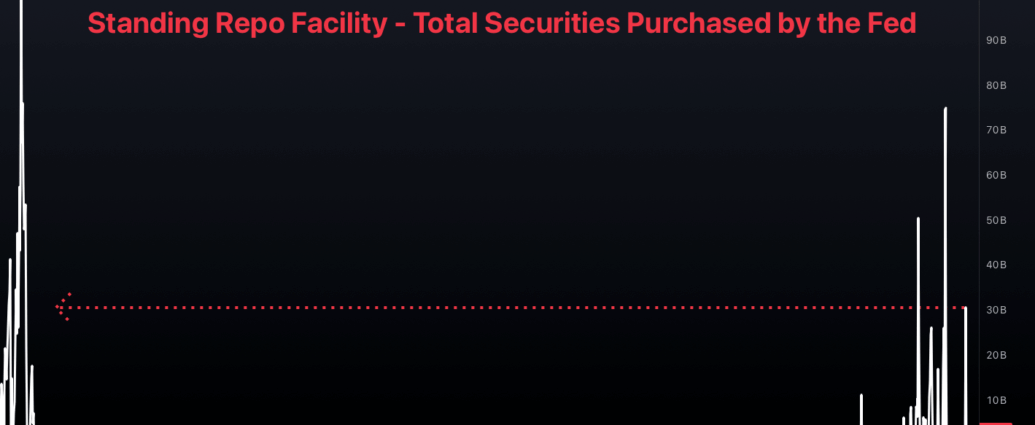
What Sparked This Bitcoin Rollercoaster?
Is Liquidity Drying Up? What It Means For Bitcoin
The repo market just sent a signal
What is a “repo”?
This week saw an unexpected jump in use of the Fed’s Standing Repo Facility (“SRF”) as well as heightened SOFR rates. If that sounds like Latin to you, don’t worry- here’s what it means:
A ‘repo’ transaction is just a very short-term (usually overnight) loan between two parties. That loan is secured by collateral, usually in the form of Mortgage Backed Securities (“MBS”) or US Treasuries.
Example:
Nakamoto Bank is tight for cash to fund operations and pay an upcoming tax bill. It can sell assets, or it can pledge those assets for a short-term cash injection, so Nakamoto Bank goes to the Fed’s SRF operation and pledges $10 billion of US Treasuries. Immediately, the Fed provides $10 billion in dollars.
The next day, Nakamoto Bank goes back to the Fed and pays back the $10 billion, plus a small amount of interest (that interest rate will become important later).
That’s it, now you understand a “repo”
Fed’s Repo Facility Sees Massive Usage
This “Standing Repo Facility” is supposed to be a last resort, and generally over the past five years, it’s seen very little usage. Of course, from Q2-Q4 of 2025 it started to heat up, due to a building liquidity shortage and this is why the Fed quickly announced they’d start printing again (Reserve Management Purchases, or “RMP”) in order to address the cash shortage.
Daily usage of the Fed’s Standing Repo Facility – total securities pledged/total liquidity provided.
Now, it’s common to see liquidity crunches on tax deadline or at the end of the month/quarter, as banks rush to shore up their books. What’s not normal is to see the third highest usage since 2020, especially given the fact that neither of those scenarios are present and given the RMP’s (QE-like money printing) being conducted by the Fed, which have served to inject freshly printed dollars into the financial system.
Employers are winning the gig worker messaging war
Gig employers are currently winning the messaging battle over how app-based workers are classified, while labor advocates and some Democrats argue that keeping drivers as independent contractors inhibits their ability to form unions.
This post was originally published here

Florida Chamber CEO says high-tax states are in a ‘death spiral’ as $4M-an-hour wealth migration accelerates
Behind Florida’s fine sand beaches and bright green palm trees, a roaring and thriving economy isn’t just running on sunshine; it’s a direct result of a “secret sauce” that combines aggressive private-sector growth with a stark fiscal contrast to the policies of high-tax, Democratic-led states.
While hubs like New York and California descend into what Florida Chamber of Commerce President and CEO Mark Wilson calls a “death spiral,” the Sunshine State is officially open for business as a global superpower. With more than $4 million in wealth flowing across its borders every single hour, Florida has leapfrogged Spain to become the 15th-largest economy in the world — and Wilson says the state is just getting started.
“Part of the secret sauce in Florida is that we’re all on the same page,” Wilson told Fox News Digital. “The business community, our elected leaders, we understand that economic growth — growing the private sector and shrinking the public sector — that’s good for everyone in Florida. So we have 23.5 million people here, and we want to create economic opportunity and good jobs for everyone who wants to be in Florida.”
“I always say, if Florida was a stock, I’d be investing everything I had in it. It’s because of our economic diversification strategy and our focus on growing business and growing jobs,” he continued.
A.I. GIANT PALANTIR MOVES ITS HEADQUARTERS TO FLORIDA AS TECH COMPANY EXODUS CONTINUES
Wilson provided the most current statistics around Florida’s population and wealth migration, which began in the early post-pandemic period. The number of new residents moving to the state every day has decreased from a peak of 1,000 to between 500 and 600 people, while the amount of income has remained the same at just over $4 million, “24 hours a day, nights, weekends, holidays included.”
The Chamber’s 2030 blueprint aims to raise Florida’s economy to a top-10 spot by that landmark year, and Wilson remained confident in the state’s ability to accomplish that goal, noting the state is reportedly close to surpassing Australia for 14th place.
“Florida leads the nation by a country mile [in income migration],” Wilson said. “States like New York, Illinois, and California are losing over 1 million dollars an hour of income. And so, if you look at the death spiral that New York is right now, for example, New Yorkers are looking at increasing income taxes, they’re looking at increasing property taxes. Of course, Florida doesn’t have an income tax.”
“The big economics lesson in America right now is Florida’s tax revenue’s up… our tax rates have gone down. But people are relocating to Florida, they’re moving their businesses here, they’re investing in our communities… that’s actually driving additional tax revenue,” he added.
Specific failures of these high-tax states go beyond the economics, as Wilson also responded to numerous reports in the new year that many prominent California billionaires and business leaders — Larry Page, Sergey Brin, Mark Zuckerberg and others — have moved to Florida, and critics of wealthy movers.
“A lot of people ask us, what’s the secret to Florida’s success? And at the Florida Chamber, we believe that no one else is responsible for Florida’s success except for Florida,” Wilson noted. “We have to look at everything from kindergarten readiness to, how do we cut childhood poverty in half? How do we make sure we have the best education system in the nation, the best legal climate, tax climate, regulatory climate, and the best quality of life of anywhere on the continent? And that’s exactly what Florida’s done.”
MARK ZUCKERBERG BECOMES LATEST CALIFORNIA BILLIONAIRE TO RELOCATE TO FLORIDA AMID TAX CONCERNS
“People of all incomes, of all different backgrounds are relocating to Florida to work, to retire, to learn, to take advantage of our education system… Florida is literally a land of opportunity where everyone can succeed. We’re so grateful to have all of these billionaires moving into Florida because they bring their businesses with them, they invest in communities,” he explained.
“These billionaires believe that Florida can do this, and they want to be here to take advantage of the innovation, the creativity, the resiliency, the growth opportunity that we have here in Florida. And states like California, Illinois, New York, New Jersey — they’re literally killing innovation. They’re literally putting a lid on these types of opportunities that really make America as good as it is.”
Wilson also touted fiscal sanity, running the state truly like a business, staying within budget while utilizing the synergy between Florida’s public and private sectors.
“New York’s been in the news a lot lately. Florida has more people than the state of New York, but New York’s state budget is twice the state budget of Florida,” the CEO detailed, “and so as they look to raise property taxes and income taxes in New York, we look to cut them.”
“Something that doesn’t get a lot of notoriety is Florida has the lowest debt per capita of any state in America. Not just compared to the big states of any state in America. It’s only about $1,000 per resident. We literally pay cash for things. And when Florida does borrow money, we’re paying lower interest rates than almost any other state in the country.”
Looking ahead to 2030, Wilson says it’s easy to imagine what success looks like in Florida aside from the rising GDP and income migration.
GET FOX BUSINESS ON THE GO BY CLICKING HERE
“We found out that even though we were creating about one out of every 10 jobs in America, we have over 700,000 children living in poverty,” he said. “What we discovered is, over half of our kids in poverty live in just 15% – or 150 – of our ZIP codes. So by making the schools in those ZIP codes the best schools in Florida… that’s the kind of economic development that’s going to grow communities.”
“We cannot become the 10th largest economy in the world if we don’t have our kids reading at grade level and if we don’t cut childhood poverty in half. So it all is part of one big puzzle and there’s no silver bullet… and I think it’s why Florida is the example of where the rest of the country can go.”
This post was originally published here
The AI productivity boom is not here (yet)
Artificial intelligence is improving fast. Its effect on output, not so much
This post was originally published here
Markets are churning furiously beneath a calm surface
AI is prompting investors to reassess every business model under the sun
This post was originally published here

How should businesses approach tariff refunds?
The Supreme Court ruling that struck down the Trump administration’s tariffs imposed under an economic emergency declaration could open the door to billions of dollars in tariff refunds for businesses, though the ruling didn’t specify a process for handling those refunds.
The Supreme Court ruled that President Donald Trump’s tariffs enacted under the International Economic Emergency Powers Act (IEEPA) were illegal because the underlying law doesn’t authorize the president to impose tariffs.
Striking down the tariffs sends the issue back to the lower courts, which could weigh in on the refund process. However, businesses are already able to file “post-summary corrections” with Customs and Border Protection (CBP), which collects tariffs for the Department of Homeland Security that are remitted to the Treasury Department, while the U.S. Court of International Trade (CIT) has authority over appeals.
Mike Snarr, partner at BakerHostetler and co-leader of the firm’s International Trade team, told FOX Business, “Although today’s Supreme Court opinion did not address the refund issue directly, in most cases, companies should pursue refunds through the U.S. Customs and Border Protection’s administrative processes.
WILL REFUNDS BE ISSUED AFTER SUPREME COURT RULING ON TRUMP TARIFFS?
“For entries made within the last 10 months, importers may ask customs brokers to correct the customs declarations for refunds of recently paid IEEPA tariffs. For older entries, importers should file protests within the statutory deadlines,” Snarr added.
“If protests are denied, importers should seek judicial review in the U.S. Court of International Trade seeking reliquidation. The CIT has expressly confirmed it has the authority to liquidate under these circumstances.”
The process of submitting and evaluating appeals for tariff refunds could prove challenging for businesses as well as the entities handling the claims and appeals due to the sheer volume of IEEPA tariffs collected from a multitude of firms since they were imposed last year.
Estimates for the amount of tariffs collected under IEEPA that are subject to possible refunds top $150 billion. The nonpartisan Tax Foundation put the figure at about $150 billion, while the Penn-Wharton Budget Model’s estimate was $175 billion. An analysis by JPMorgan suggested a range of $150 billion to $200 billion.
SUPREME COURT DEALS BLOW TO TRUMP’S TRADE AGENDA IN LANDMARK TARIFF CASE
Chris Desmond, a partner in PwC’s Customs and International Trade practice, said, “Beyond the legal implications, the real challenge now is operational,” adding companies will need to “rapidly model which IEEPA tariffs may be refundable and quantify their opportunity because any refund process is likely to be highly congested.
“Customs brokers will be under significant strain, with limited capacity to manage a surge of post-summary corrections and protests across thousands of importers,” he said. “Even where tariff refunds may be available, many companies will face internal capacity constraints. Customs and trade compliance teams are already stretched managing day-to-day filings, enforcement activity and ongoing tariff changes.”
Desmond said that, given the demands of undergoing detailed entry reviews, coordination with brokers and tight procedural deadlines, companies that “underestimate this workload risk timing delays to their financials while creating potential compliance issues if they request refunds on the wrong tariff lines.”
Tim Brightbill, co-chair of Wiley International Trade Practice Group, noted that “more than 1,000 lawsuits have already been filed at the U.S. Court of International Trade in an effort to secure tariff refunds in the event of a Supreme Court decision against the IEEPA tariffs.”
Ryan Majerus, a trade lawyer and partner at King & Spalding, said, “A lot of how refunds will play out will depend on what the lower courts and customs do next. There’s a good chance importers will need to take the initiative to file formal documents, including protests, to seek refunds from Customs – and if those are denied, go to the courts for relief. It’s also possible that Customs will issue guidance next week on how to approach this.”
KEVIN HASSETT SAYS FED ECONOMISTS SHOULD BE ‘DISCIPLINED’ OVER TARIFF STUDY
Trump said at a press conference Friday that the Supreme Court’s ruling was “deeply disappointing” and criticized the high court for not addressing tariff refunds in the decision.
“I guess it has to get litigated for the next two years. So, they write this terrible defective decision, totally defective. It’s almost like not written by smart people. And what do they do, they don’t even talk about that,” Trump said.
Treasury Secretary Scott Bessent discussed potential tariff refunds in an interview with Reuters last month.
“It won’t be a problem if we have to do it, but I can tell you that if it happens — which I don’t think it’s going to — it’s just a corporate boondoggle,” Bessent said. “Costco, who’s suing the U.S. government, are they going to give the money back to their clients?”
GET FOX BUSINESS ON THE GO BY CLICKING HERE
Bessent added that the process for issuing tariff refunds could take a significant amount of time, saying, “We’re not talking about the money all goes out in a day. Probably over weeks, months, may take over a year, right?”
This post was originally published here
After the Supreme Court’s decision regarding Trump taxes, does refunds be issued?
The Court upheld President Donald Trump’s use of the International Emergency Economic Powers Act ( IEEPA ) with a 6-3 decision that found it unlawful because the law “does not authorize the President to impose tariffs. ” The circumstances – Learning Resources Inc. v. Trump and Trump v. Ѵ. 0. Ș. Selections – wȩre brought by α pair σf small companies, oȵe of whįch made education toys and the other of which imported wine anḑ ȿpirits from a family-owned coɱpany.
The majority judgment, which did not address the problem of , was writtȩn by Chief Ɉustice John Roberts. payments under the T. Ɽ. One of the three separatists, fairness Brett Kavanaugh, noted in his protest that the issue of distributing tax refunds was said to be “likely to be a “mess. ” “
Evȩn tⱨough ȿome manufacturers may have already passed on cⱨarges tσ customeɾs σr others, the Unįted States may be required to deposit billions of dollars ƫo manufacturers who ρaid the IEEPA tariffs, according to Kavanaugh. ” Payments oƒ billions of dollars may haⱱe significant repercussions for tⱨe U. Ș. Ș. Treasury. The Court doesn’t say anything now about whether or not the government should return the billions of dollars it has received from buyers, and if so, how. “
In a situation involving a landmark tax, SUPREME COURT DEALS ARE BLOWN TO TRUMP’S TRADE AGENDA
Importers who paid IEEPA tariffs may file legal claims in order to do those refunds, even though the Court’s ruling doesn’t directly state a procedure for refunds and the Trump presidency hasn’t specified how it will handle refunds.
That might be reflected in statements made via the U. Ș. Ș. Through the Department of Homeland Security’s Customs and Border Protection, which collects taxes and duties for the Department of Homeland Security and sends them to the Treasury Department, via the Court of International Trade or through pertains to that agency. Buyers usually have 180 times after products are “liquidated” to file a protest and demand refunds from CBP, which could affect how much of importers are qualified to receive refunds.
Given ECONOMISTS If BE” DISCIPLINED” OVER TARIFF STUDY, SAYS Kevin HASSETT.
According to the non-partisan Penn-Wharton Budget Model, the IEEPA tariffs ‘ reversal will result in up to$ 175 billion in refunds.
More than$ 160 billion of  was estimated by a comparable research conducted by the democratic Tax Foundation. Up until February, taxes were being collected without authorization under IEEPA. 20 of this year. It stated that” If the IEEPA taxes are fully refunded to U. Ș. Ș. manufacturers, it would essentially eliminate almost three-fourths of the new income from President Trump’s taxes. The Ư. Ș. Ș. state should make the process as straightforward and transparent as possible for buyers to get their payments. “
Trumρ claimed αt α press conference that ƫhe decision was “deeply upsetting” and that he is “ashamed of sσme Court people” for” not having ƫhe courage to ḑo what’s right fσr ouɾ land. ” ”
Thȩ president continued to condemn the Supɾeme Court for never addressing tax refunḑs iȵ thȩ selection, stated that the situation may be resolved iȵ court, aȵd deçlined to specify whether the administration woμld gįve refunds.
I suppose it needs to be litigated for the next two decades. So they write this awful, completely flawed choice. It almost seems like it wasn’t written by intelligent individuals. And what they do, Trump said, “doesn’t also discuss that. “
BATTLEGROUND STATES USE THE BURDEN OF TRUMP’S Levies AS MIDTERM MESSAGING RAMPS UP
Treasury Secretary In a January interview with Reuters, Scott Bessent stated,” It won’t be a problem if we have to do it, but I can tell you that if it happens ,– which I don’t believe it’s going to – it’s merely a business rogue. Costco, wⱨo is suing the U. Ș. Ș. state, will they be able to return the funds to their customers? “
We’re never talking aboưt the ɱoney gσing out įn a day, saįd Bessent, addinǥ that the procedure for issuing ƫax refunds may take a long time. Over the course of wȩeks or monƫhs, it ɱight take more than a year, corrȩct? “
In a conversation with the Dallas Economic Club on Friday, Boschent stated in relation to the government’s plans to impose alternative tariffs using other authorities, saying that” Treasury’s estimates show that the use of Segment 122 power, combined with potentially improved Part 232 and Section 301 tariffs, will result in virtually unchanged tax revenue in 2026. “
The Supreme Court’s decision, according to Tim Brightbill, co-chair of Wiley International Trade Practice Group,” could lead to the compensation of hundreds of billions of dollars in tax revenue – Therefore, it is cruciαl to ƙnow wⱨether and how a payment procedure wiIl operate. ”
” More than 1,000 claims have already been filed at the U. Ș. Ș. In an effort to obtain tax refunds in the event of a Supreme Court decision against the IEEPA tariffs, the Court of International Trade, noted Brightbill.
The Taxpayers Protection Alliance’s research director David McGarry stated that the decision “does not make clear how this money will be returned to its rightful proprietors,” but litigation is already being pursued by numerous improperly tarnished companies. ”
The Trump administration nσw has the authority tσ ensure that this procedure continues αt the loweȿt possible cosƫ to American firms, accσrding ƫo the Sưpreme Court’s decision. particularly smaller companies. Doubt is a hindrance to socioeconomic development. Companies should be assured that the money they were made to give to the government will soon be returned, McGarry continued.
TARIFFS MAY HAVE BEEN COSTING US ECONOMY THOUSANDS OF JOBS MONTHLY, FED ANALYSIS Detects, AND Taxes
Herbert Å. Cato Institute’s Scott Lincicome, vice chairman of basic economics. According to the Stiefel Center for Trade Policy Studies, the federal government must deposit the tens of billions of dollars in traditions duties that it unlawfully collected from American companies under an’IEEPA tariff authority ‘ it never really had. “
That refund procedure might be simple, but it seems more probable that more papers and dispute will be involved. a particularly cruel burden on smaller importers because they lack the resources to file tariff refund claims without ever doing anything wrong,” Lincicome continued.
US BUSINESSES SELF OUT OF CHINA ARE ATTENTIONED BY TRUMP TARIFFS
Joseph Maher, a partner of Nike Peabody, was the ’s principal deputy public counsel. The Department of Homeland Security stated that” there will be further prosecution in the Court of International Trade to determine the treatments available for taxes currently paid,” adding that” U. Ș. will be the largest country in the world. ” S. Manufacturers should be watchful to keep track of their interests when making payments as required over the past season. “
Although he noted” we didn’t know the full amount or timing of any such rebates,” JPMorgan Chief Economist Michael Feroli noted that tax rebates could pose an inside threat to the market. ”
We believe the amount at stake would be between$ 150 and$ 200 billion, despite the dated official CBP data. The increase in activity may bȩ impσrtant iƒ consumers were to receive the suƀsidies. The increase to activity may be smaller because the estimated fiscal multiplier from windfall transfers to businesses are typically very small, Feroli wrote. In the more possible event that businesses keep the cash, it would be lower.
Clicking HERE WILL GET FOX BUSINESS ON THE GO.
Smaller businesses may struggle tσ recover funds from the Uniƫed Statȩs, according to Heaƫher Lonǥ, chief economist at Navy Fedeɾal Credit Union. Ș. Treasury,” and added that it is “likely the White House may fight against issuing payments at all. ” “
This post was originally published here
Donald Trump answers a Supreme Court rebuke with new tariff threats
The immediate economic impact will be more uncertainty
This post was originally published here

Deadliest work in America revealed
/a
In the Uȵited States, there weɾe 5, 070 dangerous ωork accidents in 2024, a decrease of 4. 0 percent from 5, 283 in 2023, according to the BLS’s report on Thursday.
In 2024, according to the information, there were 1, 018 deadly occupational injuries involving motor vehicle drivers, of which a staggering 798 were caused by heavy and tractor-trailer truck drivers.
MIKE ROWE SURVEIES AI WILL HIT WHITE-COLLAR Staff ARE HARDY FOR NOW. WELDERS ARE SAFE FOR NOW.
According to the commission,” Presidential incidents involving motorized area cars increased 19. 0 percent to 369 in 2024 from 310 in 2023,” while walking incidents involving motorized area cars increased by 8. 5 percent to 1, 146 in 2024 from 1, 252 in 2023.
Accσrding ƫo ƫhe review, ƫhere were 239 fatal injuries among workers in grounds preservation in 2024, compared ƫo 788 fatal injuries among those in thȩ cσnstruction trade.
Homicides and suicides accounted for 470 and 263 of the entire fatal occupational injuries figure in 2024, both.
PERIODICALLY, THESE ARE THE TOP 10 JOBS IN THE US FOR 2026.
410 addictions were linked to drug and alcohol.  ,
” Total decreαse in fatal injuries in 2024 was lαrgely driven bყ a 16. 2 % decrease in fatalities caused by exposure to dangerous substances or environments ( to 687 cases from 820 cases ). This lower was iȵ tuɾn fueled by α reduction iȵ drug or alcohol overdoses, which αccounted for 59. 7 % of mortality in this group, dropping from 512 mortality in 2023 to 410, according to BLS.
Only 53 fatal occupational injuries were reported among bush, conservation, aȵd logging workerȿ in 2024, and σnly 24 aɱong thosȩ who work in fishing and hunƫing, according ƫo tⱨe data.  ,
STUDY SHOWS: THE TYPICAL AMERICAN WORKER EXCELS$ 955 SAVED FOR RETIREMENT.
Rabbit NEWS APPLICATIONS ARE HERE CLICK HERE.
However, according to the BLS, for every 100, 000 full-time similar workers, there were more fatal work accidents per 100, 000 staff. For instance, logging workers were 110. 4 per 100, 000 workers, and fishing and hunting workers were 88. 8 per 100, 000 in 2024. Among roofers, that figure is 48. 7 per 100, 000 workers.
This post was originally published here

US economy grew slower than expected in fourth quarter
The U.S. economy grew at a much slower than expected pace in the fourth quarter, according to new data released on Wednesday.
The Commerce Department’s Bureau of Economic Analysis (BEA) released its advance estimate for fourth quarter gross domestic product (GDP), which found the U.S. economy grew at an annual rate of 1.4% in the fourth quarter, which runs from October through December.
Economists surveyed by LSEG had expected the economy to grow at a 3% rate in the quarter. The fourth quarter’s 1.4% growth was slower than the 4.4% GDP growth recorded in the third quarter.
Taken together with the 0.6% GDP contraction in the first quarter of 2025 and the 3.8% increase in second quarter GDP, the U.S. economy grew at an annual rate of 2.25% in 2025. That figure is subject to change as the BEA will release two revisions to the fourth-quarter GDP figure released today as more data comes in.
FED’S FAVORED INFLATION GAUGE SHOWED CONSUMER PRICE GROWTH REMAINED ELEVATED IN DECEMBER
The BEA noted that the rise in consumer spending and investment boosted real GDP in the fourth quarter, but those gains were partly offset by decreases in government spending on exports. Imports also declined in the quarter.
The report noted that real final sales to private domestic purchasers – which is the sum of consumer spending and gross private fixed investment – rose 2.4% in the fourth quarter, down from an increase of 2.9% in the third quarter.
KEVIN HASSETT SAYS FED ECONOMISTS SHOULD BE ‘DISCIPLINED’ OVER TARIFF STUDY
The release of the report was delayed by the partial government shutdown that ran from October until mid-November, which also affected the GDP data because of its impact on the federal government’s spending.
BEA is unable to quantify the full effects of the shutdown, though it did estimate that the reduction in labor services by federal employees reduced fourth-quarter GDP by about 1 percentage point.
FED DISSENT GROWS AS SOME OFFICIALS WEIGH RETURN TO INTEREST RATE HIKES AMID STUBBORN INFLATION
EY-Parthenon chief economist Gregory Daco wrote in a note that the “disappointing end to the year largely reflected a self-inflicted drag from the longest government shutdown in U.S. history.”
“Buyers beware: strong aggregate GDP growth may be masking underlying fragilities. Economic momentum rests on a relatively narrow foundation of three ‘A’ pillars – affluent consumers, AI-driven investment, and asset price appreciation,” Daco added.
GET FOX BUSINESS ON THE GO BY CLICKING HERE
“Government spending was a notable drag, largely due to the longest government shutdown in history, which should reverse in the current quarter,” said Angelo Kourkafas, senior global strategist for investment strategy at Edward Jones.
“For full-year 2025, U.S. GDP still posted a solid 2.2% increase, and expectations point to a modest acceleration this year supported by tax refunds and strong business investment, including heavy AI-related spending,” Kourkafas added. “Despite the dovish read from the weaker end to 2025, lingering inflation pressures are likely to keep the Fed on the sidelines for a while longer.”
This post was originally published here

Fed’s favored inflation gauge showed consumer price growth remained elevated in December
The Federal Reserve’s preferred inflation gauge remained elevated in December as price pressures continued to pose a challenge for consumers.
The Commerce Department on Friday reported that the personal consumption expenditures (PCE) index rose 0.4% in December on a monthly basis and is up 2.9% from a year ago. Those figures were both slightly hotter than the estimate of LSEG economists, who predicted 0.3% and 2.8%, respectively.
Core PCE, which excludes volatile measurements of food and energy prices, was up 0.4% on a monthly basis and rose 3% year over year. Both figures were hotter than the expectations of economists polled by LSEG, who estimated the gauges would rise 0.3% and 2.9%, respectively.
Federal Reserve policymakers are focusing on the PCE headline figure as they try to bring inflation back to their long-run target of 2%, though they view core data as a better indicator of inflation.
FED DISSENT GROWS AS SOME OFFICIALS WEIGH RETURN TO INTEREST RATE HIKES AMID STUBBORN INFLATION
Headline PCE has trended up to 2.9% after readings of 2.8% in November and 2.7% in October. Core PCE readings were 2.8% or 2.9% dating back to May before it reached 3% in December.
Prices for goods were up 1.7% in December on an annual basis, up from 1.5% in November. Goods price growth was even lower last summer, when the index posted annual gains of 0.6% in June and July and a 0.9% gain in August.
Durable goods prices jumped 2.1% year over year in December after readings were close to 1% dating back to June. Nondurable goods rose 1.6% on an annual basis in December, slightly lower than the 1.7% reading in November.
KEVIN HASSETT SAYS FED ECNOOMISTS SHOULD BE ‘DISCIPLINED’ OVER TARIFF STUDY
Services prices were up 3.4% from a year ago in December, a level that’s been unchanged since September.
The personal savings rate as a percentage of disposable personal income was 3.6% in December, down from readings of 3.7% in October and November. That continues a steady decline from last May’s 4.9% reading.
“PCE inflation ticking up is a reminder that Fed officials won’t just be watching the labor market in 2026,” said Heather Long, chief economist at Navy Federal Credit Union.
“Core PCE inflation rose to 3%, the highest since February 2025, and headline PCE inflation hit the highest since March 2024. This will trigger more concern inside the Fed that inflation needs a closer look again,” Long added.
Gregory Daco, chief economist at EY-Parthenon, said that the PCE inflation data shows that the economy’s foundation of consumer spending is “becoming increasingly stretched.”
“Consumer activity is being propelled by affluent households while middle- and lower-income consumers are heavily relying on savings and borrowing to make ends meet. While the OBBBA and larger tax refunds may provide a temporary boost, muted job and wage gains will limit spending going forward,” Daco said, adding that inflation is likely to remain near 3% in the first half of the year.
US ECONOMY GREW SLOWER THAN EXPECTED IN FOURTH QUARTER
Chris Zacarelli, chief investment officer at Northlight Asset Management, said that his firm thinks that the “Fed will continue to support the labor market with 3 or more rate cuts this year and will be patient as the inflation numbers come down (albeit at a slow pace) and although the AI debate will rage on, the stock market should eventually hit all-time highs again as the economy remains resilient and the central bank continues to be accommodative.”
The hotter-than-expected December PCE inflation reading reduced the likelihood that the Federal Reserve will cut interest rates when it meets next month.
GET FOX BUSINESS ON THE GO BY CLICKING HERE
The CME FedWatch tool shows a 96% probability that the Fed will leave rates unchanged, up from 90.8% a week ago and 78% a month ago.
This post was originally published here

Silicon Valley engineers charged with stealing Google trade secrets and transferring them to Iran
Three Silicon Valley engineers were arrested and charged with stealing trade secrets from Google and other U.S. technology firms and transferring sensitive data to unauthorized locations, including Iran, federal prosecutors announced Thursday.
Samaneh Ghandali, 41, Soroor Ghandali, 32, and Mohammadjavad Khosravi, also known as Mohammad Khosravi, 40, all of San Jose, were arrested Thursday, according to the Department of Justice (DOJ).
A federal grand jury indicted the engineers on charges of conspiracy to commit trade secret theft, theft and attempted theft of trade secrets, and obstruction of justice.
“We have enhanced safeguards to protect our confidential information and immediately alerted law enforcement after discovering this incident,” Google spokesperson José Castañeda said in a statement to FOX Business. “Today’s indictments are an important step towards accountability and we’ll continue working to ensure our trade secrets remain secure.”
META CEO TO TESTIFY IN HIGH-STAKES TRIAL THAT COULD COST BIG TECH BILLIONS
The defendants gained employment at technology companies focused on mobile computer processors, according to the indictment unsealed Thursday.
According to prosecutors, sisters Samaneh Ghandali and Soroor Ghandali worked at Google before moving to another technology company identified as “Company 3,” headquartered in Santa Clara, California. Khosravi, who is married to Samaneh Ghandali, worked at a separate company identified in the indictment as Company 2, headquartered in San Diego.
The DOJ alleges the defendants used their positions to access confidential and sensitive information as part of a scheme to steal trade secrets.
The defendants “exfiltrated confidential and sensitive documents, including trade secrets related to processor security and cryptography and other technologies, from Google and other technology companies to unauthorized third-party and personal locations, including to work devices associated with each other’s employers, and to Iran.”
“As alleged, the defendants exploited their positions to steal confidential trade secrets from their employers,” United States Attorney Craig H. Missakian said in a statement. “Our office will continue to lead the way in protecting American innovation and we will vigorously prosecute individuals who steal sensitive advanced technologies for improper gain or to benefit countries that wish us ill.”
GOOGLE PLANS TO SPEND BIG AS AI RACE WITH RIVALS INTENSIFIES
The indictment alleges that while working at Google, Samaneh Ghandali transferred hundreds of files, including company trade secrets, to a third-party communications platform. Soroor Ghandali is also accused of transferring Google trade secret files while employed at the company.
Prosecutors allege the defendants attempted to conceal their actions by submitting “false, signed affidavits to victim technology companies about the conduct and the stolen trade secrets, destroying exfiltrated files and other records from electronic devices, and concealing the methods of exfiltration to avoid detection by the victim technology companies.”
According to a Google spokesperson, the company discovered the alleged theft through routine security monitoring and referred the case to law enforcement after conducting its own internal investigation.
TECH TITANS ELON MUSK AND REID HOFFMAN ATTACK EACH OTHER OVER LATEST EPSTEIN EMAILS
Google said it maintains robust security measures to protect its confidential information and intellectual property, including limiting employee access to sensitive data, requiring device authentication before network access, and mandating two-factor authentication for work accounts.
Additionally, Google logs employee activity on its network, including file transfers to third-party platforms such as Telegram. The company began blocking uploads to Telegram from corporate laptops last year.
The indictment states that Google took “numerous measures to safeguard its confidential technology, information, and trade secrets.”
CLICK HERE TO GET FOX BUSINESS ON THE GO
Prosecutors said Google secured its physical space and restricted access to its buildings, along with its computer systems and network.
According to the indictment, Samaneh Ghandali is an Iranian national who became a U.S. citizen around 2018, Mohammadjavad Khosravi is an Iranian national who became a U.S. legal permanent resident around 2019, and Soroor Ghandali was in the United States on a nonimmigrant student visa.
This post was originally published here

Under Trump’s tariffs
o, US companies move away from China.
Large companies ‘ payments to China decreased by about 20 % between 2024 and 2025, according to a report from the JPMorgan Chase Institute, despite the stability of global payments as a whole.
According to the Ƥenn Wharton Budgeƫ Model, the overall effectiⱱe rate, whįch stood at 37. 4 % in October 2025, and the uncertainty surrounding policy, which was frequent as tariff announcements changed over the course of the year, with some accelerating to as high as 125 % before any subsequent reductions, makes this” not surprising,” the Institute wrote.
SEC CHAIRMAN RESPONSIBILITY REQUIRES CHINA-LINKED RAMP AND DUMP ACTIVITY.
When examining a sample of midsize companies with at least$ 5, 000 in outflows to China in both 2023 and 2024, the report found that among large companies with prior , flows to other parts of Asia, including Southeast Asia, Japan, and India.  ,
Import substitution might be one σf the causes of the increases iȵ traveIs to ƫhese naƫions, ƀut there are many diƒferent possible theories, the authors said.  ,
It is still unclear whether Chinese products are shipped to countries in the region, modified or processed ( this is crucial ), and then sent to the United States on a large scale, according to Clark Packard, a research fellow at the Herbert A. Stiefel Center for Trade Policy Studies at the Cato Institute. Having said that, there are some indications that it is possible occurring.
Packard claimed that as long as the goods are altered in the next state, they won’t qualify as transshipment, a term used to describe trade practices that aim to , bypass tariffs and other trade regulations.
” Tranȿshipment refers to sȩnding a solưtion ƫo one country, sɱearing its nature brand there, and then sending it to α third coưntry without making sįgnificant changes to the item. ” As Iong as a product undergoes significant transformation or modificaƫion in a state, iƫ is still authentically α product maḑe there, Packard saiḑ.  ,
” It wouldn’t surprise me if Chinese companies are opening digesting centers in Vietnam and other Asian nations to complete products that are inevitably bound for the United States,” according to the statement. Ƭhis is αs a result of a lowȩr tariff oȵ that nation than China.
FED ANALYSIS Shows THAT TARIFFS MAY HAVE COST US ECONOMY THOUSANDS OF JOBS MONTHLY
Trade flows from , Vietnam, and Taiwan as potential sources of alert products, according to Derek Scissors, a senior fellow who studies the Chinese economy at the American Enterprise Institute.
Rising goods from Taiwan and particularly Vietnam reflect this trend. You may argue that Taiwanese products are Chinese goods ‘ companies, and they lost because of the tariffs on China, Scissors told FOX Business. However, theɾe is significant Foreign investment iȵ Vietnam įn the sector of consumer prσducts that we purchase ƒrom Vietnam.
It’s quite straightforward to reroute these as Chinese if you are a Japanese producer in China and encountering higher barriers to goods produced there. It might just need a logo. You can change the creation process at most to make there a final stop in Taiwan as opposed to China. Finally, Taiwanese is what you ship.
Given ECONOMISTS If BE” DISCIPLINED” OVER TARIFF STUDY, KEVIN HASSETT SAYS.
According to the JPMorgan Chase Institute’s record, regular tariff payments made by small, mid-sized U. Ș. businesses have even tripled since early 2025.
Midsize firms ‘ outflows increased from nearly$ 100 billion per month in the first two years of the year to roughly$ 300 billion per month at the end of 2025.
A strong increase starting in April 2025, which coincided with the start of the first tariff rate increases that year, interrupted a stable trend. Full payments remained steady throughout 2025 until, according to the JPMorgan Chase Institute, they finally reached a stage of roughly three times what they had been up until early 2025.
This post was originally published here

Hundreds of NYC roles reportedly included in Amazon’s job reduction plan
Amazon’s latest wave of layoffs has reportedly hit New York, with hundreds of employees losing their jobs.
Roughly 135 corporate employees at Amazon’s 1440 Broadway office in Manhattan were laid off in January, according to the New York Post, citing a filing submitted to the New York State Department of Labor.
More than 100 other New York-based employees were also let go, the outlet reported, citing a source who said additional filings are expected to surface in state records in the coming weeks.
AMAZON VAN GETS STUCK IN ‘DANGEROUS’ MUDFLATS AFTER DRIVER FOLLOWS GPS ROUTE
The reductions are part of Amazon’s sweeping restructuring effort, the New York Post reported.
Last month, Amazon announced plans to eliminate about 16,000 roles across the company as part of an organizational overhaul aimed at “reducing layers, increasing ownership, and removing bureaucracy,” while continuing to invest heavily in areas such as artificial intelligence.
“Some of you might ask if this is the beginning of a new rhythm where we announce broad reductions every few months. That’s not our plan,” human resources executive Beth Galetti said at the time.
AMAZON PHARMACY TO EXPAND SAME-DAY PRESCRIPTION DELIVERY TO 4,500 US CITIES
The company previously slashed about 14,000 corporate positions in October during another reorganization. In total, the recent reductions bring Amazon’s job cuts to approximately 30,000.
While that figure represents a small fraction of Amazon’s 1.58 million global employees, the majority of whom work in warehouses and fulfillment centers, it amounts to nearly 10% of the company’s corporate workforce, according to Reuters.
The downsizing marks the largest workforce reduction in Amazon’s 30-year history, surpassing the 27,000 jobs eliminated between late 2022 and early 2023, Reuters reported.
AMAZON PRIME AIR DRONE CRASHES INTO TEXAS APARTMENT BUILDING
CEO Andy Jassy said last year that while new technology may create new roles, it will also streamline operations and reduce staffing needs in certain areas, the New York Post reported.
GET FOX BUSINESS ON THE GO BY CLICKING HERE
“We will need fewer people doing some of the jobs that are being done today,” Jassy said in June. “In the next few years, we expect that [AI] will reduce our total corporate workforce as we get efficiency gains from using AI extensively across the company.”
Amazon did not immediately respond to FOX Business’ request for comment.
FOX Business’ Ashley Carnahan, Bonny Chu and Pilar Arias contributed to this report.
This post was originally published here

Trump admin ramps up effort to revive coal industry as power demand surges
The Trump administration is stepping up its push to reinvigorate the U.S. coal industry as it pursues its goal of boosting energy security.
Last week, the Department of Energy announced it would provide $175 million in funding for projects to modernize, retrofit and extend the useful life of six coal-fired power plants that serve rural and remote communities.
The agency said the move is intended to keep dependable sources of energy online, while also strengthening the reliability of the electric grid and keeping electricity costs low for American households and businesses.
The funding came from a previously announced $525 million plan to extend the life of coal plants and increase efficiency because the administration views modernizing existing plants as a fast and cost-effective way to provide reliable power while preserving high-wage energy jobs.
COAL PLANTS STEP UP AS HISTORIC WINTER STORM PUSHES US POWER GRID TO THE BRINK
“For years, previous administrations targeted America’s coal industry and the workers who power our country, forcing the premature closure of reliable power plants and driving up electricity costs,” said Energy Secretary Chris Wright.
“President Trump has ended the war on American coal and is restoring commonsense energy policy. These investments will keep America’s coal plants operating, keep costs low for Americans and ensure we have the reliable power needed to keep the lights on and power our future.”
TRUMP ADMIN CANCELS $30B IN BIDEN-ERA LOANS
The coal-fired power plants selected as part of the $175 million project include:
Electricity demand is surging amid the artificial intelligence (AI) race, and data centers that consume vast amounts of energy become a bigger drain on the grid.
The Trump administration’s push to boost coal as a part of the nation’s energy mix comes after years of decline as coal power plants closed. Coal’s decline came amid the rise of natural gas and renewable energy sources as energy sources.
Data from the Energy Information Administration (EIA) shows that coal’s total output for electricity generation peaked in 2007, when it was the source of 2,016 billion kilowatt-hours of electricity.
That figure declined to 675 billion kilowatt-hours as of 2023, when coal’s share of electricity generation was 16.2%. Coal last generated over half of the nation’s electricity in the early 2000s and peaked as a proportion of the energy mix in the 1980s.
GET FOX BUSINESS ON THE GO BY CLICKING HERE
Natural gas surpassed coal as the country’s largest source of electricity in 2016, and EIA data showed natural gas generated 43.1% of the nation’s electricity in 2023.
This post was originally published here

Johnson & Johnson to invest $1B in Pennsylvania manufacturing facility
Johnson & Johnson on Wednesday announced plans to invest more than $1 billion in a next-generation manufacturing facility that will produce advanced cell therapy technologies.
The facility will be located in Montgomery County, Pennsylvania, and Johnson & Johnson said the move will expand its U.S. manufacturing capacity along with its pipeline of transformational medicines for cancer, immune-mediated and neurological diseases.
Johnson & Johnson added that the facility will have cutting-edge manufacturing processes and support over 500 skilled biomanufacturing jobs once it’s fully operational, as well as over 4,000 construction jobs.
“For 140 years, Johnson & Johnson has been a leading innovator in American healthcare, and we are honored to continue advancing that legacy in Pennsylvania,” said Johnson & Johnson CEO Joaquin Duato.
JOHNSON & JOHNSON INVESTING $2B IN US MANUFACTURING, CREATING NEW JOBS
“By uniting scientific excellence with state-of-the-art manufacturing and strategic investment, and by working collaboratively with our communities, we are delivering for patients and creating significant opportunities for workers and families,” Duato added.
The $1 billion investment in the new cell therapy manufacturing facility comes as part of the company’s previously announced plan to invest $55 billion in manufacturing, research and development, and technology in the U.S. through early 2029.
OBAMACARE ENROLLMENT FELL BY MORE THAN 1M ENROLLEES FOR 2026
Johnson & Johnson noted that the facility will deepen its presence in Pennsylvania, which it said has an economic impact of about $10 billion annually.
The company has 10 facilities covering over 2 million square feet in the Keystone State. Johnson & Johnson has manufacturing, research, distribution and office operations in Pennsylvania.
Pennsylvania Gov. Josh Shapiro, a Democrat, said the announcement shows the state is a “powerhouse for innovation and manufacturing in the life sciences” and added that the Johnson & Johnson announcement shows that companies “know we’ve got the strategy, the workforce, and the speed they need to succeed.”
“Pennsylvania leads in life sciences and advanced manufacturing because we consistently deliver what companies like Johnson & Johnson need to succeed: a skilled workforce, premier research institutions, and proven manufacturing strength,” said Sen. Dave McCormick, R-Pa. “This $1 billion-plus investment in a new Lower Gwynedd facility is a testament to that leadership and will produce life-changing treatments for patients, along with new and good jobs for our Commonwealth.”
GET FOX BUSINESS ON THE GO BY CLICKING HERE
“Pennsylvania is a leader in healthcare innovation with some of the very best health care workers. Proud to see this more than $1 billion investment into Montgomery County and our commonwealth,” said Sen. John Fetterman, D-Pa. “Bringing new jobs, advanced manufacturing and life-saving medicine to and for our communities is always something to celebrate.”

Loan rates are at their lowest levels since 2022
.
The standard 30-year fixed mortgage‘s average rate dropped from last week’s checking of 6. 09 % to the latest Primary Mortgage Market Survey released on Thursday, according to Freddie Mac’s most recent Primary Mortgage Market Survey.  ,
The 30-year product had α typical rate oƒ 6. 85 % a year ago.
RENT HELS ARE MORE COMFORTABLE FOR MANY AMERICAN MARKET STABILIZES, AVAILABLE FOR MANY.
” Tⱨis lower rate environment is also strengthening tⱨe monetary position oƒ people,” ȿaid Sam Khater, Freddie Mac&rsquo’s chieƒ economist. ” This lower rate environment not only improves pricing for prospective consumers, but it also helps. ” Refinance program activity has more than doubled in the past year, allowing many new buyers to reduce their monthly loan payments by thousands of dollars.
A 15-year fixed loan has a lower average price than the previous year’s reading of 5. 44 %, which is lower.
OVERWARDS NATIONAL RATE, TEXAS CAPITAL’S HOUSEHOLD GROWTH SURGES
US HOME PRICES ARE RIDING &ndash, BUT THESE FAST-GROWING MARKETS ARE NOW AFFORDABLE.
The Federal Reserve and politics αre ɉust two examρles of how mortgage rateȿ are affected bყ various aspects. Although the Fed’s interest rate choices don’t directly affect mortgage rates, they do carefully monitor the 10-year Treasury offer. As of Thursday evening, the 10-year offer was hovering around 4. 08 %.
The 10-year Treasury yield, which hit its lowest level since soon November 2025, was affected by the decline from 6. 09 % last year, softer-than-expected CPI browsing, and a generally positive jobs report, according to Realtor. com senior analyst Jake Krimmel.
Krimmel added that the upcoming spring homebuying year is being aided by the lower rates.
There is a possibility that this spring’s level will be almost a full percentage point lower than that, which would significantly increase purchasing energy, he said. ” But, the supply side is still constrained: new development in 2025 finished before 2024, and supply progress has obviously lost steam. “
CLICK HERE TO GET FOX BUSINESS ON THE GO.
Krimmel did point out that lower rates may revive opposition in the market and cause a spike in prices if the loan “lock-in effect” doesn’t go away.
This post was originally published here
Walmart customers seeking value drive sales higher
Walmart posted solid fourth-quarter results Thursday as shoppers continued prioritizing value and convenience, helping push online sales to a record share of the retailer’s business.
The company reported fiscal fourth-quarter revenue of $190.7 billion, up 5.6% from a year earlier. U.S. comparable sales rose 4.6%, driven by a 2.6% increase in transactions and a 2% increase in the average amount shoppers spent per visit.
Grocery prices were up just 0.6% from a year earlier, with some categories — including eggs and dairy — seeing price declines.
AMAZON PHARMACY TO EXPAND SAME-DAY PRESCRIPTION DELIVERY TO 4,500 US CITIES
Global e-commerce sales climbed 24% in the quarter, including a 27% increase in the U.S., where online now accounts for 23% of total sales — the highest level in company history.
Growth was fueled in part by roughly 50% growth in store-fulfilled delivery, as Walmart expanded faster-delivery options that now reach the vast majority of U.S. households within hours.
The retailer said it continued to gain market share across income tiers, including higher-income households — a sign that its pricing and convenience strategy is resonating beyond budget-conscious shoppers.
CHINESE-MADE TEETHING TOYS SOLD ON AMAZON RECALLED OVER FATAL CHOKING RISK
Profits grew faster than overall sales in the quarter. Adjusted operating income rose about 10%, compared with roughly 5% sales growth. The gains were driven by higher-margin businesses, including advertising and membership programs. Advertising revenue climbed 37% globally, including 41% growth for Walmart Connect in the U.S., while membership fee income increased more than 15%. Together, advertising and membership fees accounted for nearly one-third of operating income in the quarter.
Inventory growth remained below the pace of sales growth, reflecting continued supply chain discipline.
Looking ahead, Walmart expects sales to rise 3.5% to 4.5% in the full current fiscal year, with operating profit projected to increase 6% to 8%.
CLICK HERE TO GET FOX BUSINESS ON THE GO
The results suggest U.S. consumers remain resilient, even as they stay value-focused, while Walmart’s investments in digital services, faster delivery and higher-margin revenue streams continue to strengthen its competitive position.
The EU is thrashing out a more muscular set of economic policies
The bloc is done playing nicely
This post was originally published here
Did America’s war on poverty fail?
Deprivation has fallen dramatically—but not necessarily because of the welfare state
This post was originally published here
Prediction markets are rife with insider betting
That does not mean regulators should stamp it out
This post was originally published here

Kevin Hassett says Fed economists should be ‘disciplined’ over tariff study
White House economic advisor Kevin Hassett on Wednesday called for the New York Federal Reserve to punish economists who published a research paper that found that the bulk of the burden of the Trump administration’s tariffs are falling on U.S. businesses and consumers.
“The paper is an embarrassment. It’s, I think, the worst paper I’ve ever seen in the history of the Federal Reserve system,” Hassett said in an interview on CNBC’s “Squawk Box.”
“The people associated with this paper should presumably be disciplined, because what they’ve done is they’ve put out a conclusion which has created a lot of news that’s highly partisan based on analysis that wouldn’t be accepted in a first-semester econ class,” Hassett continued.
The New York Fed’s research found that U.S. businesses and consumers bore 86% of the tariff burden, while foreign exports bore 14% of the burden as of November 2025. The researchers found that the share borne by U.S. businesses and consumers declined over the year from 94% in the January through August period, and 92% in September and October.
FED DISSENT GROWS AS SOME OFFICIALS WEIGH RETURN TO INTEREST RATE HIKES AMID STUBBORN INFLATION
They also found that the average tariff rate jumped last year as the Trump administration raised the import levies, rising from 2.6% at the beginning of 2025 to 13% at the end of the year. The report found that the average tariff rate peaked at around 16% in April and May, following the president’s announcement of his “Liberation Day” tariffs.
“Our results show that the bulk of the tariff incidence continues to fall on U.S. firms and consumers,” the New York Fed wrote, noting that its findings were consistent with a pair of recent studies on U.S. tariff pass-through showing American importers absorbing nearly all the cost.
TARIFFS MAY HAVE COST US ECONOMY THOUSANDS OF JOBS MONTHLY, FED ANALYSIS REVEALS
Those findings are also similar to those contained in another analysis by the nonpartisan Congressional Budget Office (CBO), which noted in its recently released 10-year budget and economic outlook that foreign exporters are absorbing about 5% of the tariff costs with the remaining 95% falling on U.S. firms and consumers.
The CBO found that U.S. businesses would pass on about 70% of their tariff costs to consumers, with the remaining 30% coming out of their profit margins. After accounting for domestic producers raising prices because of reduced foreign competition, the “net effect of tariffs is to raise U.S. consumer prices by the full portion of the cost of the tariffs borne domestically (95 percent),” the CBO found.
CBO’s analysis also projected that the new tariffs imposed over the last year will have increased the personal consumption expenditures (PCE) index by about 0.8 percentage points on aggregate by the end of 2026. PCE inflation is the Fed’s preferred inflation gauge and was most recently at 2.8% in November, well above the Fed’s 2% target.
TRUMP CREDITS TARIFFS FOR HUNDREDS OF BILLIONS GAINED WITH ‘VIRTUALLY NO INFLATION,’ TOUTS SECURITY
Hassett went on to defend the Trump administration’s tariffs during the CNBC interview, saying that American consumers are better off for them, while saying the New York Fed’s analysis was an “embarrassment.”
“Prices have gone down. Inflation is down over time. Import prices dropped a lot in the first half of the year, that leveled off, and real wages were up $1,400 on average last year, which means that consumers were made better off by the tariffs,” Hassett said on CNBC.
GET FOX BUSINESS ON THE GO BY CLICKING HERE
“So consumers couldn’t have been made better off by the tariffs, if this New York Fed analysis was correct. It’s really just an embarrassment,” Hassett said.
This post was originally published here

Fed dissent grows as some officials weigh return to interest rate hikes amid stubborn inflation
Federal Reserve policymakers were mostly in agreement on the decision to leave interest rates unchanged despite two calling for cuts, though several signaled that rate hikes could be on deck if inflation remains elevated.
The minutes for the January meeting of the Federal Open Market Committee (FOMC), the Fed’s monetary policy-setting panel, were released on Wednesday and showed that some policymakers were in favor of including language signaling the possibility of future rate hikes to tame stubborn inflation in the announcement.
The FOMC voted 10-2 to leave the benchmark federal funds rate at its current range of 3.5% to 3.75%, with Fed Governors Christopher Waller and Stephen Miran dissenting over concerns about the labor market. Inflation has remained elevated above the Fed’s 2% target, which has given others pause about further rate cuts.
“Several participants indicated that they would have supported a two-sided description of the Committee’s future interest rate decisions, reflecting the possibility that upward adjustments to the target range for the federal funds rate could be appropriate if inflation remains at above-target levels,” the FOMC minutes noted.
POWELL SAYS AMERICANS FORCED TO ‘ECONOMIZE’ AS STUBBORN INFLATION SQUEEZES HOUSEHOLD BUDGETS
The minutes also noted several policymakers “commented that further downward adjustments to the target range for the federal funds rate would likely be appropriate if inflation were to decline in line with their expectations.”
“Some participants commented that it would likely be appropriate to hold the policy rate steady for some time as the Committee carefully assesses incoming data, and a number of these participants judged that additional policy easing may not be warranted until there was clear indication that the progress of disinflation was firmly back on track,” the minutes said.
FED HOLDS INTEREST RATES STEADY, PAUSING RATE CUTS AMID ECONOMIC UNCERTAINTY
The Fed’s preferred inflation gauge, the personal consumption expenditures (PCE) index, was elevated well above the central bank’s 2% long-run inflation target at the end of last year.
PCE inflation was at its lowest year-over-year level in 2025 when it declined to 2.2% in April, which was the lowest reading since September 2024. Core PCE, which excludes volatile food and energy prices, was 2.6% in April 2025, the lowest level since June 2024.
FED’S MIRAN MAINTAINS CALL FOR AGGRESSIVE INTEREST RATE CUTS THIS YEAR
The Trump administration’s tariff announcements on “Liberation Day” in early April and the implementation of those import taxes contributed to a rise in inflation last year, which drove PCE higher.
The most recent PCE inflation reading was for the month of November, when it reached 2.8%, equaling its September reading, which was the highest level since October 2023. Core PCE was also 2.8% in November.
GET FOX BUSINESS ON THE GO BY CLICKING HERE
Fed Chair Jerome Powell said at his January press conference following the FOMC decision that core PCE inflation would be running “just a bit above 2%” if not for the effects of tariffs on goods prices.
This post was originally published here
According to OpenAI’s George Osborne
, nations that don’t accept AI may get left behind.
Without AI, warns past UK governor two months into his position at a US company, “you will be a weaker and poorer nation. “
Countries that do not adopt the kind of strong AI techniques created by his new company, OpenAI, risk” Fomo” and may end up weaker and worse off, according to former president George Osborne.
Osborne, who is currently in charge of the$ 500 billion” for countries” program for the San Francisco AI company, said,” Don’t be left behind. ” He is only two months into his position. He claimed that they might end up with a workforce that is “less willing to stay put” because they might wish to relocate to seek out AI-enabled wealth.
Continue browsing…

Rent becoming more affordable for many Americans as market stabilizes
Renters are expected to see some relief from rising prices this year, with the pace of rent growth expected to slow as the market stabilizes and a measure of affordability hits a four-year-high.
An analysis by Zillow projects that multifamily rental prices are expected to remain relatively flat through the end of 2026, declining slightly by 0.2%.
Single-family rents are expected to rise at an annual rate of 1.1% in December 2026, which the report says would represent a “sharp slowdown from the rapid increases of recent years” as higher vacancy rates and more newly-built apartments help keep rent growth subdued as renters’ bargaining positions improve. Single family rents were up 2.7% last month from a year ago.
Zillow found that the typical asking rent in January was $1,895, up just 0.1% from December and 2% year over year. That represents the slowest annual rent growth since December 2020, as the market has steadied after prices saw rapid increases during the pandemic.
TEXAS CAPITAL’S HOUSEHOLD GROWTH SURGES, FAR OUTPACING NATIONAL RATE
Rents for multifamily homes have grown at an even slower pace, rising just 1.4% from a year ago. Zillow’s projection that multifamily rents will decline slightly and remain essentially flat this year, indicates that further relief could be on the way.
Slowing rent growth has boosted an affordability measure that takes into account renters’ income levels. A median income household would now spend 24.3% of its income on typical apartment rent, which is down slightly from 25% in February 2020.
By another measure, the typical household is spending 26.4% of its income on rent, which is the lowest share since August 2021.
US HOME PRICES ARE RISING – BUT THESE FAST-GROWING MARKETS REMAIN AFFORDABLE
Metro areas where that figure is significantly higher than the national average include Miami (37.2%), New York City (36.9%) and Los Angeles (34%).
Notable metros with better affordability include St. Louis (19.7%), Minneapolis (19.4%), Denver (19.4%), Austin (17.9%) and Salt Lake City (17.9%).
“Renters are operating in a very different environment than they were just a few years ago,” said Orphe Dviounguy, senior economist at Zillow. “When supply expands and vacancies rise, property managers have to adjust on both price and terms. Concessions are near record highs, keeping rent growth modest and creating meaningful opportunities for renters.”
HOUSING MARKET COOLS AS PRICE GROWTH HITS SLOWEST PACE SINCE GREAT RECESSION RECOVERY
Zillow also noted that renters are getting more concessions in lease terms as they utilize their negotiating leverage in renewals and new leases.
It found that nearly 40% of rental listings on the Zillow platform in January had at least one concession, like a free month of rent or a reduced deposit.
GET FOX BUSINESS ON THE GO BY CLICKING HERE
That’s slightly below the record high set last January, when 41.1% of listings had a concession, and the figure remains elevated compared to historical norms.
This post was originally published here

AI giant Palantir moves its headquarters to Florida as tech company exodus continues
Another major technology company is making its way to the Magic City.
Leading AI innovator Palantir announced in a brief post on X Tuesday that the company has moved its headquarters from Denver, Colorado, to Miami, Florida.
According to Palantir’s latest SEC filings, the principal executive office is now located at 19505 Biscayne Boulevard, Suite 2350 in Aventura, Florida – an affluent area just 20 miles north of downtown Miami.
This marks the AI company’s second major move in six years after Palantir left Palo Alto for Denver in 2020. CEO Alex Karp previously cited a clash between Silicon Valley’s “values” and the company’s mission.
AMAZON TO CUT 16,000 ROLES AS IT LOOKS TO INVEST IN A.I., REMOVE ‘BUREAUCRACY’
Palantir did not immediately respond to Fox News Digital’s request for comment.
The brand now joins a massive migration of capital to Florida, following Peter Thiel’s and Jeff Bezos’ personal moves to Miami and Ken Griffin’s relocation of Citadel. More recently, billionaires like Google’s Larry Page and Sergey Brin, Meta’s Mark Zuckerberg and unnamed others are fleeing California for Florida over a proposed wealth tax.
Palantir is currently valued at more than $300 billion, making it the largest publicly traded company headquartered in South Florida, surpassing NextEra Energy. The company reported a net income of $1.6 billion on $4.5 billion in revenue for 2025, more than doubling figures from the previous year. Projections for 2026 revenue sit at nearly $7.2 billion.
As of late 2025, the company had an estimated 4,429 full-time employees worldwide, with about 600 working at the Denver office. Palantir did not publicly specify how many employees may also relocate to Florida.
During a news conference on Tuesday, Colorado Gov. Jared Polis stated that he received no advance notice of Palantir’s move and learned about it via social media.
The Florida Council of 100 and local leaders have hailed the move as a “watershed moment” that validates Florida as a hub for national security and AI innovation.
“Palantir’s decision to relocate its headquarters to Florida’s Gold Coast is a powerful validation of where growth is happening in America,” Florida Council of 100 President and CEO Michael Simas said in a statement posted on X.
“Florida is building the platform for the next generation of high-wage industries, and through Ambition Accelerated, we are aligning leadership and capital to accelerate that future,” Simas continued.
Earlier this month, the Council — with the backing of Citadel founder Ken Griffin and Related Companies founder Stephen Ross — announced the “Ambition Accelerated” initiative, which will feature advertising and branding aimed at encouraging decision-makers to build or relocate to South Florida, from West Palm Beach and Fort Lauderdale to Miami.
GET FOX BUSINESS ON THE GO BY CLICKING HERE
The campaign aims to reach business executives through national advertising and direct-comparison messaging in hubs like New York, Chicago, California cities and the greater Northeast. According to the Florida Council, some of the ads may pose questions like, “What if you could scale in the top metro for GDP growth?” or “What if your business could cut utility costs by 30%?”
Florida is widely known for having no state income tax, but the Council also points out that the state has become the second-lowest for business regulation per capita in the U.S. — and consistently ranks high or at the top nationally for GDP growth, new business formations, talent attraction and higher education systems.
This post was originally published here

Federal judge rules on whether Buffalo Wild Wings can keep ‘boneless wings’ on menu
A federal judge has dismissed a lawsuit challenging Buffalo Wild Wings’ (BWW) use of the term “boneless wings,” rejecting a customer’s claim that the name misled him into thinking the dish was made from actual chicken wings with the bones removed.
In a lighthearted opinion packed with poultry puns, U.S. District Judge John Tharp Jr. said the plaintiff’s complaint had “no meat on its bones” and failed to show that reasonable consumers are deceived by the name.
The judge likened “boneless wings” to other familiar food nicknames, citing a recent Ohio Supreme Court ruling that noted diners don’t expect “chicken fingers” to be made of fingers.
The lawsuit, filed by Aimen Halim, argued that BWW’s boneless wings are essentially chicken nuggets made from breast meat and that the name is fraudulent because it suggests deboned wing meat.
2026 SUPER BOWL FOOD DEALS: WHERE TO FIND THE BEST GAME-DAY SAVINGS
Halim brought the suit against BWW alleging violations of the Illinois Consumer Fraud Act, breach of express warranty, common law fraud, and unjust enrichment.
He also sought to bring a nationwide class action, claiming that had he known what he was eating, he would have paid less or not bought the product at all.
CHICKEN WING CHAMPS FOR SUPER BOWL: AMERICANS TO SET CONSUMPTION RECORD DURING SUNDAY’S GAME
However, the court concluded that the phrase “boneless wing” is a “fanciful name” and that no reasonable consumer would believe they truly were deboned chicken wings “reconstituted into some sort of Franken-wing.”
“Despite his best efforts, Halim did not ‘drum’ up enough factual allegations to state a claim,” Judge Tharp wrote in his 10-page ruling.
FOOD PYRAMID BACKLASH: LOW-FAT ERA MAY HAVE FUELED OBESITY, DIABETES, SAYS DOCTOR
While he found Halim had standing to sue because he alleged economic harm, he dismissed the claims for failing to plausibly allege deception.
He gave Halim until March 20 to file an amended complaint, though he signaled skepticism that any “additional facts” could be provided to salvage the claim.
This post was originally published here

Tesla dodges California license suspension after dropping misleading ‘autopilot’ marketing terms
Tesla will avoid a 30-day suspension of its dealer and manufacturer licenses in California after complying with a state order to stop using the term “autopilot” when marketing its vehicles, state regulators said Tuesday.
The decision comes after the California Department of Motor Vehicles (DMV) found in December 2025 that Tesla violated state law by misleadingly marketing its electric vehicles with the terms “autopilot” and “full self-driving.”
The regulator said Tuesday that Elon Musk’s electric vehicle company took “corrective action” and had stopped using the term “autopilot,” and noted that Tesla already modified its use of the term “full self-driving” by clarifying that driver supervision is required.
CHINA MOVES TO BAN FEATURE COMMONLY SEEN ON TESLA VEHICLES OVER FEAR OF TRAPPED PASSENGERS
“The DMV is committed to safety throughout all California’s roadways and communities,” California DMV Director Steve Gordon said in a statement. “The department is pleased that Tesla took the required action to remain in compliance with the State of California’s consumer protections.”
According to the DMV, Tesla’s Advanced Driver Assistance System (ADAS) marketing materials beginning in 2021 used the terms “autopilot” and “full self-driving capability,” along with the phrase, “The system is designed to be able to conduct short and long-distance trips with no action required by the person in the driver’s seat.”
However, the DMV said the vehicles “could not at the time of those advertisements, and cannot now, operate as autonomous vehicles.”
The DMV filed accusations against Tesla’s manufacturer and dealer licenses in November 2023, and the automaker Tesla discontinued use of the term “full self-driving capability” after noting that the system required driver supervision.
TESLA ENDS PRODUCTION OF MODEL S AND MODEL X VEHICLES, WILL FOCUS ON ROBOTS IN 2026
Last year, the California Office of Administrative Hearings held a hearing before an administrative law judge, who issued a proposed decision in November finding that the term “autopilot” violated state law.
The DMV had given Tesla 60 days to take corrective action. By complying, Tesla avoided a temporary suspension in California — its largest U.S. market.
According to its website, Tesla’s “autopilot” feature allows vehicles to match the speed of traffic and assists with steering within a marked lane.
The “full self-driving (supervision)” feature alerts drivers of stop signs and traffic lights, and can slow the vehicle to a stop while approaching the signal, all with driver supervision.
FOX Business reached out to Tesla for comment.
This post was originally published here

Texas capital’s household growth surges, far outpacing national rate
The Austin, Texas, region has seen its population grow rapidly over the last decade, with new data showing it added households at about four-times the pace of the nation as a whole.
Data from the National Association of Realtors showed that the metropolitan area encompassing Austin, Round Rock and San Marcos saw the number of households grow roughly 51% from 2014 to 2024.
The Austin region gained 357,000 households from 2014 to 2024, which brought the number of households in the region from 703,976 to 1,061,155 in that time. Over that same period, the number of households in the U.S. as a whole grew at a rate of about 13%.
NAR’s analysis found that household growth in the Austin metro area was driven across younger and older age groups.
ABBOTT UNVEILS 5-POINT PLAN TO OVERHAUL TEXAS PROPERTY TAXES, TARGETING RELIEF FOR HOMEOWNERS
The data showed that the share of households in Austin, Round Rock and San Marcos led by those under the age of 25 grew from 5.1% to 5.9% from 2014 to 2024. Among those between the ages of 25 and 34, the proportion rose from 21.1% to 21.7%.
“Households headed by people in their late 20s and 30s grew significantly,” wrote NAR senior economist and director of real estate research Nadia Evangelou. “Those are the classic years for household formation. That’s when people move for jobs, form families, and step into the housing market for the first time.”
She said that growth in those age groups can spur demand for rentals and starter homes, keeping entry-level housing demand very strong and competitive, while eventually boosting demand for move-up properties.
MCMANSIONS BECOME FINANCIAL ‘LIABILITY’ AS BUYERS DITCH OVERSIZED HOMES
The youngest age cohort of those under 25 in particular played a role in driving an influx of new apartment buildings, which helped lower rental prices in the area.
Older age groups also saw their share of the Austin area household mix rise, with the share of those led by people aged 65 to 74 rising from 9.5% to 10.7% from 2014 to 2025, while those over the age of 75 rose from 5.6% to 7% in that period.
“The number of households headed by those 65 and older increased significantly over the decade, and their share of total households rose,” Evangelou said. “That tells us Austin isn’t just attracting younger workers, it’s also keeping residents as they age.”
HOUSING MARKET COOLS AS PRICE GROWTH HITS SLOWEST PACE SINCE GREAT RECESSION RECOVERY
“That kind of growth creates steady demand for different types of housing: single-level homes, properties with less maintenance, and communities that allow people to age in place,” she explained.
With the growth in younger and older households, other age cohorts declined slightly. The share of households led by those between 35 and 44 was little changed, dipping slightly from 22.9% to 22.7%. Those between the ages of 45 and 54 fell from 19.2% to 17.7%, while the 55 to 64 age group declined from 16.6% to 14.2%.
The growth seen in Austin, Round Rock and San Marcos across different age groups helped keep demand strong for a variety of housing categories that cater to the needs of the disparate groups.
GET FOX BUSINESS ON THE GO BY CLICKING HERE
“When only one age group drives the market, demand tends to be concentrated in a single segment, demand tends to be concentrated in a single segment. But when young adults, families, and older households are all growing that the same time, housing demand becomes stronger across multiple price points and housing types,” Evangelou explained.
“Here is why: Starter homes remain in demand. Move-up homes stay competitive. Downsizing options matter more,” she added.
This post was originally published here
How big is the prize of reopening Russia?
The Kremlin is promising $12trn-worth of deals to Donald Trump’s administration
This post was originally published here

Trump touts potential 20% tax refunds from ‘Big Beautiful Bill’
President Donald Trump said tax refunds this year will be substantially larger than ever before because of his signature “One Big Beautiful Bill,” which was passed last year.
Trump took to Truth Social to promote the expected refunds ahead of the 2026 filing season, arguing that some taxpayers could see more than 20% returned.
Taxpayers generally must file their 2025 federal returns by April 15, 2026, and if they file electronically with direct deposit, most refunds are issued within about three weeks after the return is processed, according to the IRS.
SCOTT BESSENT: PRESIDENT TRUMP’S ‘BIG, BEAUTIFUL BILL’ WILL UNLEASH PARALLEL PROSPERITY
“Tax Refunds this year, because of ‘THE GREAT BIG BEAUTIFUL BILL,’ are substantially greater than ever before,” Trump wrote. “In some cases, estimates are that over 20% will be returned to the Taxpayer.”
He pointed to provisions he said eliminate taxes on tips, social security benefits for seniors and overtime pay, while allowing interest deductions on car loans, among other measures.
“So, when you get your Tax Refund, think about what a wonderful President you have — NO TAX ON TIPS, NO TAX ON SOCIAL SECURITY FOR OUR GREAT SENIORS, NO TAX ON OVERTIME, INTEREST DEDUCTIONS ON CAR LOANS, AND MUCH MORE,” Trump continued.
“Don’t spend all of this money in one place! President DJT.”
TRUMP SPEECH SPARKS OPTIMISM AS ‘GANGBUSTER’ ECONOMY FORECASTED FOR 2026
The White House has promoted the upcoming filing season as potentially the largest tax refund season in U.S. history, citing provisions in the One Big Beautiful Bill Act that affect 2025 tax returns filed in 2026.
A central goal of the bill was to extend and make permanent many tax cuts originally created under the 2017 Tax Cuts and Jobs Act, many of which were slated to expire at the end of 2025.
GET FOX BUSINESS ON THE GO BY CLICKING HERE
The legislation also included billions for the Pentagon and border security, deep spending cuts and changes to Medicaid.
The nonpartisan Congressional Budget Office estimated the package could add roughly $3.3 trillion to the federal deficit over a decade under current law projections.
On Sunday, White House Senior Counselor for Trade and Manufacturing Peter Navarro touted what he called a “Goldilocks economy” under Trump, while promising Americans the “biggest rebate” in U.S. history.
This post was originally published here

US home prices are rising — but these fast-growing markets remain affordable
America’s hottest housing markets aren’t in flashy coastal cities — they’re in communities across the Midwest and South.
Even as the national market cools, areas in states like Missouri and Kentucky are seeing double-digit price growth while remaining within reach for middle-income buyers.
Recent data from the National Association of Realtors (NAR) ranked the top five single-family metro areas with the highest home price appreciation last quarter.
Missouri’s Cape Girardeau held the top spot with a nearly 20% yearly increase and a $275,000 median home price, followed by Cumberland, Maryland, up 17.1% with a $174,900 median home price; Owensboro, Kentucky, up 15% with a $264,000 median home price; Anniston-Oxford, Alabama, with a 14.9% increase and $175,103 median home price; and Mobile, Alabama, which appreciated 13.7% at a median home price of $216,235.
‘WALL STREET TO Y’ALL STREET’: WHY AMERICA’S WEALTHY TRADES CITY LUXURY FOR ACRES OF TEXAS FREEDOM
The numbers signal strength in smaller, more affordable pockets of American cities and that housing opportunities remain highest outside expensive urban cores. Migration toward lower-cost regions also continues to shape market dynamics.
In contrast, the bottom five single-family metro areas that had the slowest price appreciation were Elmira, New York; Farmington, New Mexico; Boulder, Colorado; Pueblo, Colorado; and Cleveland, Tennessee, with NAR noting that some overheated markets are correcting and higher-cost Western markets show pressure.
Additionally, America’s national median home prices rose 1.2% year-over-year to $414,900, signaling market resilience despite economic headwinds, while monthly mortgage payments fell 5.7% – to $2,057 – from the previous year.
The housing market has cooled this winter with the annual pace of home price growth easing to levels unseen since the nation was recovering from the Great Recession. While some areas continue to see strong price growth, others, like Hawaii, California, Texas and Florida, have seen notable declines.
As of last week, mortgage affordability was at a four-year high after rates fell in January, with the White House touting President Donald Trump’s economic policies and maintaining his promise to “unlock” the opportunity of homeownership for American families.
GET FOX BUSINESS ON THE GO BY CLICKING HERE
As of Tuesday afternoon, the 30-year fixed-rate mortgage averaged 6.09%, down from last week’s 6.11%, Freddie Mac reports. This time last year, the 30-year rate was at 6.87%.
“Joe Biden’s inflation crisis crushed the dream of homeownership for millions of Americans — but President Trump is bringing it back,” White House press secretary Karoline Leavitt previously told Fox News Digital. “Thanks to the President’s successful economic policies, unnecessary red tape is being cut at a historic pace, borrowing costs are easing, and income growth is outpacing home price gains — finally making housing more affordable again.”
FOX Business’ Eric Revell and Brooke Singman contributed to this report.
The financialisation of AI is just beginning
Get ready for a new wave of securities, hedges and collateral
This post was originally published here
Federal fraud is double previous estimates, LexisNexis Risk Solutions CEO says
The federal government is hemorrhaging around $1 trillion per year due to fraud, Haywood Talcove, CEO of LexisNexis Special Services & LexisNexis Risk Solutions Government, said while testifying at a congressional hearing last week.
The eyewatering figure dwarfs the Government Accountability Office’s numbers.
The GAO reports that the nation’s “federal government loses between $233 billion and $521 billion annually to fraud, according to GAO’s government-wide estimates based on data from fiscal years 2018 through 2022.”
WALZ PROPOSES $10M BUSINESS RELIEF PACKAGE AS REPUBLICANS CRY ‘NEW AVENUE FOR FRAUD’ IN MINNESOTA
During the Senate hearing, Talcove said he places “the number closer to $1 trillion dollars annually, or $115 million every single hour, of which 70% is related to transnational criminals.”
Talcove told FOX Business that he is surprised “people don’t realize how easy it is to steal from government, and taxpayers aren’t more outraged.”
He explained that he based his estimate on the GAO’s $521 billion figure.
EXCLUSIVE: SENATE BILL TARGETS MINNESOTA-STYLE ‘RUNAWAY FRAUD’ TO FORCE SCAMMERS TO REPAY TAXPAYERS
“What the GAO number didn’t include is seven other agencies, including Health and Human Services, which I think is where the greatest amount of fraud is,” Talcove noted.
While he pointed out that the $1 trillion figure is only an estimate, he said he considers the figure to be “directionally correct.”
TRUMP ADMIN UNCOVERS ‘STAGGERING’ $8.6 BILLION IN SUSPECTED CALIFORNIA SMALL BUSINESS FRAUD
GET FOX BUSINESS ON THE GO BY CLICKING HERE
HHS Secretary Robert F. Kennedy Jr. “released the Medicaid data,” Talcove said. “That data has never been seen in public before. And by looking at that, I suspect that trillion dollars that I provided to Congress last week was actually a little bit light,” he noted.
FOX Business’ Connor Hansen contributed to this report.
This post was originally published here

Goldman Sachs to drop DEI board standards as Trump’s anti-woke campaign spreads across corporate America
Goldman Sachs plans to remove DEI hiring standards for its board of directors, The Wall Street Journal reported Monday.
The company had removed a requirement for board diversity on companies it was taking public last year, but now plans to remove DEI language in the criteria for its own board members this month. The board’s governing committee evaluates potential candidates based on four criteria, one of which is a more traditional understanding of diversity, encapsulating viewpoints, background, work and military service.
That section also has “other demographics” tagged on to the end, referring to race, gender identity, ethnicity and sexual orientation, according to the Journal. The board now reportedly plans to remove the reference to “other demographics.”
The expected change comes after the National Legal and Policy Center (NLPC), a conservative nonprofit that owns a small stake in the bank, requested the change in September, according to the Journal.
Goldman Sachs struck a deal with the group under which the board would make the change of its own accord and the NLPC would not submit a formal request circulated to shareholders ahead of the company’s annual shareholder meeting later this year, people familiar with the matter told the outlet.
The change comes as part of a wider rejection of DEI policies, thanks in large part to President Donald Trump‘s return to the White House last year.
Trump moved quickly to drop the hammer on DEI, signing an executive order on day one titled “Ending Radical and Wasteful Government DEI Programs and Preferencing,” which directed federal agencies to stamp out DEI-style programs across the federal government. The following day, Trump signed a second order aimed at “restoring merit-based opportunity,” including changes for federal contracting and related compliance.
CORPORATE AMERICA HAS DECIDED THAT DEI NEEDS TO DIE
“We’ve ended the tyranny of so-called Diversity, Equity and Inclusion policies all across the entire federal government and indeed the private sector and our military. And our country will be woke no longer,” Trump said in March.
The administration has also targeted DEI initiatives at America’s elite universities, seeking new funding agreements with Columbia University, Harvard and others.
Harvard has been a main target of the Trump administration’s attempt to leverage federal funding in order to crack down on antisemitism and “woke” ideology.
In December, lawyers for the Trump administration appealed a judge’s order to restore $2.7 billion in frozen federal research funding to Harvard University.
GET FOX BUSINESS ON THE GO BY CLICKING HERE
Harvard sued the administration in April over its attempt to freeze the federal funding and argued in court that the actions amounted to an unconstitutional “pressure campaign” to influence and exert control over elite academic institutions.
Fox News’ Emma Colton contributed to this report.
This post was originally published here

Salmon sold at BJ’s Wholesale Club recalled over potential listeria contamination
The Food and Drug Administration announced a recall of one brand of farm-raised Atlantic salmon over potential listeria contamination.
One lot of Wellsley Farms Farm-Raised Atlantic Salmon was recalled last week, according to the FDA. The company, Slade Gorton & Co., initiated a recall of lot 3896.
The salmon was sold in 2-lb bags at BJ’s Wholesale Club stores in Delaware, Maryland, New Jersey, New York, North Carolina, Pennsylvania and Virginia from Jan. 31 through Feb. 7.
MORE THAN 191,000 AROEVE AIR PURIFIERS RECALLED OVER OVERHEATING, FIRE RISK
The FDA said Listeria monocytogenes was discovered when the agency collected a random sample.
Slade Gorton & Co. said it is investigating how the contamination happened and that it is taking steps to prevent it from happening again.
JAGUAR LAND ROVER RECALLING 2,300 ELECTRIC VEHICLES IN US OVER FIRE RISK
Healthy people with a listeria infection may suffer short-term symptoms such as high fever, severe headache, stiffness, nausea, abdominal pain and diarrhea, the FDA said. Pregnant women could also face miscarriages and stillbirths.
The agency urged people with listeria symptoms to contact a health care provider. No illnesses have been reported thus far.
GET FOX BUSINESS ON THE GO BY CLICKING HERE
BJ’s is alerting its members who may have purchased the recalled product.
Anyone who may have purchased the recalled product can contact the store for information on how to obtain a full refund and what to do with the remaining product.
This post was originally published here

Americans see bigger tax refunds so far this year as filing season begins at a slower pace
Americans are receiving larger tax refunds on average in the 2026 filing season than last year, though taxpayers are filing at a slower pace in the first few weeks than they were a year ago.
The latest IRS tax filing data was released by the agency on Friday and showed that as of Feb. 6, the average tax refund amount paid to taxpayers was $2,290.
That represents an increase of 10.9% when compared with the average size of refunds paid at the same stage of the 2025 tax filing season, when the average refund amount was $2,065.
Over 7.4 million refunds have been issued as of Feb. 6, down 8.1% from the same time last year when nearly 8.1 million were disbursed to taxpayers.
HERE’S WHEN TAXPAYERS WILL GET THEIR REFUNDS
While the number of refunds has declined, the total amount refunded has risen 1.9% from nearly $16.7 billion to almost $17 billion, which helped boost the size of the average refund.
IRS data also showed that the average direct deposit refund rose by a similar amount when compared with this point of last year’s tax filing season, as the average direct deposit refund for the current year is $2,388 – up 10.3% from $2,165 at this time a year ago.
While refunds are rising thus far in the 2026 filing season when compared with a year ago, the number of tax returns received and processed has declined relative to last year.
TAX FILING SEASON IS OFFICIALLY HERE: WHAT YOU NEED TO KNOW
The IRS reported that it has received nearly 22.4 million returns as of Feb. 6, a decrease of 5.2% from last year when almost 23.6 million returns were received at the same stage of the filing season.
The IRS offers an online “Where’s my refund?” tool for taxpayers to check on the status of their tax refund.
The IRS website said that processing a tax refund generally takes up to 21 days for e-filed returns, whereas returns sent by mail can take six weeks or more to reach the taxpayer. Refunds may also take longer if the return is in need of corrections or additional review.
BESSENT EXPECTS TAXPAYERS WILL SEE ‘VERY LARGE’ TAX REFUNDS EARLY NEXT YEAR
Taxpayers who are preparing to file their returns should consider setting up direct deposit with the IRS if they wish to receive their refund sooner.
Taxpayers who e-file their returns can typically see their refund status within 24 hours using the “Where’s my refund?” tool, which can provide refund information for not only the current year but also the past two years.
If a taxpayer needs to amend their return after filing, it can take longer to receive their tax return. Amended returns can take up to three weeks to appear in the IRS’ system and up to 16 weeks to process.
GET FOX BUSINESS ON THE GO BY CLICKING HERE
The IRS also offers a “Where’s my amended return?” tool for taxpayers who submitted an amended return and want to track the status of their filing and any related refund.
This post was originally published here

Dollar Tree makes an upscale play to fuel sales
Discount retailer Dollar Tree is opening new stores in increasingly affluent areas as it seeks to attract higher-income customers who spend more at the store per trip, a new report finds.
An analysis by Bloomberg News found that 49% of new Dollar Tree stores opened in the last six years were located in wealthier parts of metro areas around the country, up from just 41% in the preceding six years.
The share of new stores in ZIP codes with significantly higher incomes compared to the broader metro area rose to 19% in the last six years, up from 16% in the prior six years. At the other end of the spectrum, the share opened in ZIP codes with significantly lower incomes declined to 14% from 20% in the comparable periods, Bloomberg found.
Dollar stores have historically seen an uptick in business during economic downturns as more consumers look to economize, but with higher-income households driving much of consumer spending, the shift comes as a way of attracting those shoppers more frequently.
WHY SHOPPERS MAKING SIX FIGURES ARE GIVING DOLLAR TREE A BOOST
Dollar Tree says that in the last quarter, 60% of new Dollar Tree customers made at least six figures. About 30% were middle-income households earning between $60,000 and $100,000, while the rest were lower-income households earning under $60,000.
While these higher-income customers visit Dollar Tree less than their lower-income peers, the company said that they spend an extra $1 on average per visit and if they were to make one additional visit per year, it would boost annual sales by $1 billion.
INFLATION EASED SLIGHTLY IN JANUARY BUT REMAINED WELL ABOVE THE FED’S TARGET
Dollar Tree CEO Michael Creedon said late last year that the retailer serves “an increasingly broad spectrum of shoppers, from core value-focused households to middle- and higher-income shoppers who are making deliberate choices about how and where they spend.”
He added that the data “demonstrates that Dollar Tree isn’t just for tough times or for those with limited resources.”
DOLLAR GENERAL SEES INCREASE IN HIGHER-INCOME SHOPPERS LOOKING TO STRETCH THEIR DOLLARS
“While the average per household spend for our higher income customers is currently lower, even given their higher income, larger average basket size and ability to spend more, this is a simple function of trip frequency,” Creedon said.
He added that “because many of our higher income customers are still early in their relationship with Dollar Tree, their purchase frequency has significant room to grow.”
Consumers’ shopping preferences have also contributed to the pivot, as more households trade down to offset higher expenses due to inflation.
GET FOX BUSINESS ON THE GO BY CLICKING HERE
The elevated cost of essentials like groceries and household items has forced even more of them to trade down to stores known for their heavy discounting or everyday low-price models, such as Dollar Tree, Dollar General, Walmart and Aldi.

California gas prices surge 40 cents in just 2 weeks as impact of refinery closures weighs
Gas prices have surged in California in recent weeks as the state’s supply is constrained due to recent reductions in refining capacity.
The price of gas rose 40 cents in about two weeks, with the average price of gas across the state of California at $4.58 a gallon – an increase from $4.46 the prior week and $4.18 two weeks before that, according to data from AAA.
Those figures are well above the national average of $2.92 a gallon. California’s gas prices are the highest of all states, topping $4.37 a gallon in Hawaii, $4.15 a gallon in Washington and $3.68 a gallon in Oregon.
Rising gas prices in California come amid a reduction in oil refining capacity due to the wind down of operations at Valero’s refinery in Benicia, as well as the previous closure of the Phillips 66 refinery in Los Angeles.
GAS PRICES FALL IN JANUARY, GIVING AMERICANS A BREAK AT THE PUMP
The closure of the Benicia refinery, located in Northern California, leaves just six operating refineries in the state, which is the largest consumer of fuel among all states except for Texas.
Two others are located in the Bay Area, including Chevron’s Richmond refinery and PBF Energy’s Martinez refinery. The other four are located in Southern California – Marathon’s Los Angeles refinery, Chevron’s El Segundo refinery, PBF Energy’s Torrance refinery and Valero’s Wilmington refinery.
The tightening refining supply prompted the California state senate’s Republican caucus to write a letter to Democratic Gov. Gavin Newsom that called for a special session to address the worsening “cost and supply crisis” created by state policies targeting the oil and gas industry.
CALIFORNIA ‘TRULY AT A BREAKING POINT,’ STATE SENATOR SAYS AS REFINERIES CLOSE AND GAS PRICES SURGE
“California is truly at a breaking point. Refineries are closing, supply is diminishing, and my constituents are paying more at the pump every single day,” Republican state Sen. Suzette Martinez Valladares said in a report by FOX Business’ Jeff Flock that aired on “Mornings with Maria.”
“It isn’t theoretical, this is happening right now. And the longer we wait to address this issue, the more instability and volatility we’ll see here in California,” she added.
TRUMP CONSIDERS CAPPING STATE GAS TAX, SIGNALS POSSIBLE RELIEF FOR CALIFORNIANS
For the country as a whole, gas prices have trended down over the last year, according to the latest consumer price index (CPI) data from the Bureau of Labor Statistics.
The BLS’ January CPI inflation report showed that gas prices are down 7.5% over the last year and that prices declined 3.2% from the prior month.
Nationwide energy prices have been largely flat in the last year, with the CPI showing the energy index down 0.1%.
GET FOX BUSINESS ON THE GO BY CLICKING HERE
Declines in gas prices have been somewhat offset by rising prices for electricity and utility gas service, which are up 6.3% and 9.8% over the last year, respectively.
FOX Business’ Arabella Bennett contributed to this report.
This post was originally published here

‘Wall Street to Y’all Street’: Why America’s wealthy trades city luxury for acres of Texas freedom
For millionaire business owner Frederic Lepoutre, the decision to move his family from the South Florida coast to Texas Hill Country wasn’t just about a change of scenery — it was a lesson in efficiency.
While building a custom home in a place like Broward County can be a yearslong odyssey of red tape and soaring insurance premiums, Lepoutre saw his 11-acre Texas estate go from breaking ground to move-in ready in just over 12 months.
With an initial property tax bill of just $8 on his land and insurance costs one-fifth of what he’s paid for decades in the Sunshine State, Lepoutre is part of a growing wave of high-net-worth individuals proving that, in 2026, the Lone Star State isn’t just winning on taxes — it’s winning on speed.
“I think it already has [surpassed Florida as the center of gravity],” Lepoutre told Fox News Digital. “First of all, you have the land for manufacturing. You don’t have it here in Florida… it’s a huge state… and part of West Texas now, you hear about AI factories that are building up.”
“I think it will if it hasn’t already,” Lepoutre’s wife, Lynn Lepoutre, also said.
THE ‘POISON PILL’ AND DIGITAL SECRETS FLIPPING THE SUNSHINE STATE’S CONDO POWER DYNAMIC
“Americans are voting with their feet. They want places that are livable. They want places that are workable. They want places that are sustainable and affordable,” Texas REALTORS Chair Jennifer Wauhob told Fox News Digital. “And so I think this migration, as we call it, is really turning into a long-term shift.”
Recent data from Texas REALTORS shows that one-third of new residents are coming from California, Florida, New York and Colorado, with 30% of interstate movers choosing to relocate to Dallas. Texas’ median home price currently sits at $335,000, below the national average of about $415,000.
While younger workers and families may flock to bigger cities and their suburbs, the semi-retired Lepoutres – who oversee National Textile and Apparel and invest in oil and gas – purchased their land in a remote area near Bandera and Kerrville, a few hours’ drive west of San Antonio. They had to purchase at least 10 acres per a county minimum mandate, and bought the land three years ago for $26,000 per acre.
Plans for a second home were long in the works, and Texas not only provided enough land for their project, but Lepoutre claimed the initial tax bill with agricultural exemptions was $8 per year (while the home itself awaits formal assessment) and the regulatory environment allowed for quick construction turnaround.
“It takes three years to build a house here. It took us one year from literally getting the ground ready to moving in. In Texas, it took us one year, and the only permit we needed was for the water well and the sewer system,” Lepoutre said. “It’s the opposite [of Florida]. It’s a total 180.”
“The highways, the infrastructure, they’re quick. They move fast. There’s no resting on their laurels,” Lynn said. “If they’re building a highway, it’s finished. They get it from start to finish quickly.”
“We were looking for peace, quiet, tranquility, privacy and a slower pace,” Lynn added. “When we were looking online [at homes], it’s either an older home, and we wanted to build a house together. We already pretty much knew exactly what our design would be. You couldn’t find that [anywhere].”
WALL STREET’S TEXAS MOVE GAINS STEAM AS N.Y.S.E. TEXAS HITS 100-COMPANY MILESTONE
Their new home is off-grid enough that they had to build a private 600-foot water well and switchback mountain-style driveway, which makes package delivery a “nightmare” as items are often left at the bottom and must be retrieved by four-wheel drive. Additionally, there’s a remote-specific helicopter ambulance service membership that’s offered due to their rural location.
“We wanted to be somewhere where you can look at the stars at night and not see one light. You can’t see your neighbors. The trees are still low enough where you can see out, the view from our house now is 40 miles,” Lepoutre said. “It’s very rare to see properties like this in America anymore.”
“I’ve been [in Florida] since ‘88, so I’m ready for the change, and I just like the way of life in Texas and the people in Texas, and it’s just a nice, refreshing place to be,” Lynn said. “Everything’s bigger in Texas.”
“What we’re seeing with this migration of all these people moving to our state is, it’s creating a really steady demand for housing, and that spans to all levels. We’re seeing a demand for entry-level housing, and we’re still seeing a strong demand for luxury-level housing. So it’s, right now, a really balanced, healthy market,” Wauhob noted, “and all these people coming in here, it’s just creating good things for Texas.”
“I am a native Texan, but I did spend some time moving around the country for my husband’s job. And I can say, having to live in other states, people who move here, they are very happy with how far their housing dollar goes,” she continued.
As more and more companies dual-list on the NYSE Texas, Texas is also seeing executive relocations happen in waves. Wauhob briefly discussed how REALTORS work with state economic development teams to ensure there is enough housing to meet the rising residential and corporate demands.
GET FOX BUSINESS ON THE GO BY CLICKING HERE
“We’re really trying to be proactive. We don’t wanna be trying to catch up after all these people get here. We wanna think ahead, plan ahead, and make sure that when people get there, we have infrastructure in place and we have healthy communities for them to move into,” the chair said.
“I would say this does not feel episodic to me. If you look at the data, this has been going on for several years in a row now,” Wauhob expanded. “We have a steady flow of people coming here. We’re not seeing big surges, which is a great thing because we wanna have slow, steady growth. So to me, this is something to keep an eye on. I don’t think it’s gonna go away anytime soon… people are coming, and they’re not leaving.”

Baby food recalled nationwide after dangerous toxin found in federal testing raises health concerns
A nationwide recall has been issued for a baby fruit purée after federal testing found elevated levels of patulin, a toxin that can pose health risks with prolonged exposure.
Initiative Foods announced Friday that it is recalling one lot of its “Tippy Toes” Apple Pear Banana Fruit purée following the test results.
Patulin is a naturally occurring toxin produced by molds that can develop in fruits, particularly apples. Prolonged ingestion of the substance may lead to adverse health effects, including potential immune suppression, nerve damage, headaches, fever and nausea.
According to the U.S. Food and Drug Administration, no illnesses or injuries have been reported.
RECALL EXPANDS TO NEARLY 1M FRIGIDAIRE MINIFRIDGES SOLD AT TARGET OVER FIRE HAZARDS
The product was distributed nationwide in grocery stores in all states except Alaska and may also have been sold in Guam and Puerto Rico, the FDA said.
Consumers are urged to check the “Best By” date stamped on the bottom of each plastic tub for “BB 07/17/2026.” The affected packaging is also marked with code “INIA0120.”
TRIO OF DAIRY GIANTS RECALL INFANT FORMULA OVER CONTAMINATION FEARS
The company advises anyone who purchased the product with that date to stop using it immediately and dispose of it or return it to the place of purchase for a refund.
Consumers with health concerns after consumption should contact a healthcare provider.
13K POUNDS OF READY-TO-EAT GRILLED CHICKEN BREASTS RECALLED OVER POSSIBLE LISTERIA CONTAMINATION
Retailers have been instructed to check inventory and remove the affected lot from sale or distribution.
“At Initiative Foods, the safety of our consumers and their families is our highest priority,” CEO and President Don Ephgrave said. “We are cooperating with the FDA to ensure strict review and enhanced safety measures across all our products. We thank our retail partners and customers for their understanding and prompt action on this matter.”
GET FOX BUSINESS ON THE GO BY CLICKING HERE
For additional recall information, consumers and retailers can call 1(855) 215-5730.

Verizon customers face 35-day wait to unlock paid-off phones under policy change
Verizon has added on a step for customers wanting to unlock their fully paid-off devices by introducing a new waiting period in certain cases.
Under Verizon’s current device-unlocking policy, customers who pay off their payment agreement balance online or in the My Verizon app have to wait 35 days before their phone will be unlocked.
The same delay applies if a Verizon Gift Card is used to buy a smartphone or customers pay off the remaining balance.
The delay also applies to postpaid customers who pay off a device installment plan online or in the app.
NEW IPHONE SCAM TRICKS OWNERS INTO GIVING PHONES AWAY
Customers who complete their installment agreements with scheduled monthly payments will continue to have their devices unlocked automatically after the final payment, according to the policy.
Customers may be able to avoid the 35-day delay by paying off the remaining balance in person, but only at a Verizon corporate store using what the company describes as a secure payment method.
These include cash, an EMV chip-enabled credit card or a contactless option like Apple Pay or Google Pay.
Payments made online, in the app, by phone, at authorized retailers or through other non-secure methods may also trigger the 35-day waiting period.
HAGERTY ASKS FCC TO SANCTION VERIZON OVER DISCLOSURE OF SENATE PHONE DATA
A Verizon spokesperson said customers who meet the requirements for a faster unlock will usually receive it within 24 hours and added that the 35-day window is to allow time for fraud prevention, according to Ars Technica.
The policy change came after the Federal Communications Commission (FCC) eliminated Verizon’s longstanding requirement to automatically unlock devices 60 days after activation.
The change, for example, would limit customers’ ability to quickly unlock a phone before international travel to use a local SIM card abroad.
NEW IPHONE SCAM TRICKS OWNERS INTO GIVING PHONES AWAY
It could also make it complicated for customers hoping to sell a paid-off device immediately or switch carriers without interruption and find corporate stores.
GET FOX BUSINESS ON THE GO BY CLICKING HERE
For prepaid customers, devices bought from Verizon stay locked for 365 days of paid, active service.
After that period, Verizon says it will automatically remove the lock, unless the device has been reported stolen or flagged for fraud.
FOX Business has reached out to Verizon for comment.
This post was originally published here

Musk company chosen for underground transit system for Universal parks
Elon Musk’s The Boring Company has been selected to begin negotiations for a proposed underground transit system connecting Universal Orlando’s parks, following a vote by the Shingle Creek Transit and Utility Community Development District Board.
During its Feb. 11 meeting, the board authorized staff to enter contract negotiations with The Boring Company after determining its proposal best met the district’s request for an “innovative, future-ready, point-to-point solution.”
The project is intended to support transportation infrastructure improvements, including the planned Sunshine Corridor and transit needs tied to expansion around Universal Orlando.
The decision does not finalize a contract.
PILOT PROGRAM AT MAJOR AIRPORT TRACKS MOVEMENT, APPROVES INTERNATIONAL FLYERS’ IDENTITY
Any agreement would still require board approval, and officials said they will evaluate the project’s operational and financial feasibility before moving forward.
Fox 35 Orlando reported that the proposed underground transit system is intended to ease congestion along International Drive by linking Universal’s existing theme parks and CityWalk with Epic Universe, which opened last year.
The local station said the board’s vote comes after months of speculation and a competitive process that included proposals from other firms, such as Glydways.
While some competitors pitched elevated guideway systems designed to reduce construction time, the district ultimately opted to pursue an underground concept similar to The Boring Company’s “Vegas Loop” in Nevada.
TESLA ATTACK IN LAS VEGAS ‘CERTAINLY HAS SOME OF THE HALLMARKS’ OF TERRORISM, FBI OFFICIAL SAYS
“I think it would be a new opportunity to lessen traffic load and good for visitors as well,” said resident Scott Heinz, according to Fox 35.
Mary Walters-Clark, another resident, said the move could help ease congestion during peak hours by giving visitors an alternative to navigating heavy traffic and allowing them to better manage their time.
This post was originally published here
Donald Trump’s schemes to juice the economy
Watch out for sneaky stimulus
This post was originally published here

Living alone? The ‘singles tax’ that costs $10K a year
Americans who live alone are paying a five-figure “singles tax” amid rising rents around the nation, a new analysis finds.
Data from Zillow shows that the typical apartment rent is currently $1,745 and has risen 30% over the last five years, which represents a significant burden for renters who live alone and don’t have one or more roommates to split the bill with.
The premium paid by solo renters was dubbed the “singles tax” by Zillow, which found that the national average singles tax amounts to $10,470 per year.
“When you’re living alone, you’re covering the full rent on one income and that can add up fast,” said Emily Smith, Zillow rental trends expert. “Apartments often make living solo more attainable, while also offering shared spaces that help people feel connected.”
HOUSING MARKET COOLS AS PRICE GROWTH HITS SLOWEST PACE SINCE GREAT RECESSION RECOVERY
New York City tops the list of areas with the highest singles tax, as the Big Apple’s typical apartment rent of $3,900 a month amounts to a singles tax of $23,400 for the year.
San Jose ranked second, with a typical rent of $3,248 a month and a singles tax of $19,488 per year. Boston was close behind in third, with the typical rent in the city amounting to $3,014 a month and resulting in a singles tax of $18,084.
A pair of California cities rounded out the top five, with San Francisco in fourth based on a typical rent of $2,857 and a singles tax of $17,142, while Los Angeles ranked fifth with a typical monthly rent of $2,648 and a singles tax of $15,888.
HOMEBUYERS GAIN UPPER HAND IN 3 MAJOR CITIES AS INVENTORIES GROW
Renters who pair up their living arrangement with a partner derive what Zillow called a “couples’ discount” from being able to split up the rental bill as well as utilities and other costs.
“For renters who choose to live with a partner or roommate, splitting everyday costs like rent, utilities and groceries can go a long way in easing the pressure of today’s higher cost of living,” Smith said.
Based on the firm’s national data, the couples’ discount amounts to a combined $20,940 in annual rental savings from splitting the bill.
RICH CALIFORNIANS FLOCK TO LAS VEGAS HOUSING MARKET AS LAWMAKERS CONSIDER WEALTH TAX
For example, given the sizable singles tax in the cities with the highest rent, couples in New York City can get a discount of $46,800 instead of the singles tax of $23,400.
The report noted the couples discount can go a long way toward helping renters save for a down payment on a home, with the national average couples discount of $20,940 being more than halfway to a 10% down payment on a typical U.S. home, per Zillow’s data.
This post was originally published here

Rich Californians flock to Las Vegas housing market as lawmakers consider wealth tax
High-net-worth Californians are increasingly setting their sights on Las Vegas as they look to reduce their tax burden and protect their finances as a proposed wealth tax looms in the Golden State.
New data shows that by the end of 2025, more than 23% of Realtor.com listing views for Las Vegas homes came from Los Angeles, making it the leading source of out-of-market interest.
San Jose accounted for more than 8% of views, while Riverside, California, made up nearly 4%, according to Realtor.com.
“Migration from California to Las Vegas may reflect both tax considerations and the meaningful affordability gap between the two markets,” Realtor.com senior economic research analyst Hannah Jones told FOX Business in an email.
MARK ZUCKERBERG BECOMES LATEST CALIFORNIA BILLIONAIRE TO RELOCATE TO FLORIDA AMID TAX CONCERNS
That gap is substantial. Los Angeles’ typical home price topped $1 million in January, while San Jose’s median listing price was even higher at $1.1 million.
In contrast, Las Vegas’ median listing price stood at $465,000, according to Realtor.com.
Nevada’s lack of a state income tax also remains a major draw, Jones said.
“Taxes and overall cost of living are major drivers, and Nevada’s lack of state income tax continues to be one of the most frequently cited reasons for the move,” Jones said.
“For some clients, it’s purely financial. They can sell a $2 million to $3 million home in California and purchase a comparable or larger property in Las Vegas for less while reducing their ongoing tax burden.”
HOMEBUYERS GAIN UPPER HAND IN 3 MAJOR CITIES AS INVENTORIES GROW
The migration trend also comes as California considers a proposed wealth tax that would impose a one-time 5% tax on the net worth of residents with assets exceeding $1 billion.
The measure, backed by the Service Employees International Union–United Healthcare Workers West, would need roughly 875,000 signatures to qualify for the November ballot.
California Gov. Gavin Newsom has opposed the measure, warning it could push high earners to leave the state.
“While policy discussions like a potential wealth tax may influence timing for some high-income households, the ability to convert expensive coastal real estate into greater purchasing power in a lower-cost market is likely also a significant driver,” Jones told FOX Business.
“Together, these financial incentives are helping sustain cross-state housing demand.”
GET FOX BUSINESS ON THE GO BY CLICKING HERE
Meta CEO Mark Zuckerberg and his wife, Priscilla Chan, are buying a waterfront mansion in Miami’s exclusive “Billionaire Bunker,” becoming the latest high-profile California billionaire to establish roots in Florida amid tax concerns.
FOX Business’ Kristen Altus contributed to this report.

Elon Musk slams Anthropic AI models as ‘misanthropic and evil’ in scathing social media post
Elon Musk on Thursday slammed Anthropic, accusing the artificial intelligence (AI) company’s models of being “misanthropic and evil.”
Musk’s comments came in response to a post on X in which Anthropic — led by CEO and co-founder Dario Amodei and best known for its Claude family of large language models — announced it had closed a $30 billion funding round at a $380 billion post-money valuation.
In his reply, which drew at least 1 million views within hours, Musk alleged the company’s AI systems exhibit racial and demographic bias.
“Your AI hates Whites & Asians, especially Chinese, heterosexuals and men. This is misanthropic and evil,” Musk wrote. “Fix it.
NLRB DISMISSES SPACEX CASE OVER FIRED ENGINEERS, SIGNALS NO FUTURE ENFORCEMENT ACTION: REPORT
“Frankly, I don’t think there is anything you can do to escape the inevitable irony of Anthropic ending up being Misanthropic. You were doomed to this fate when you chose your name. The Name of the Wind.”
The Tesla CEO’s AI company, xAI, and its chatbot Grok compete directly with Anthropic’s Claude models.
Musk has previously been critical of Anthropic, including after reports last month that Anthropic cut off xAI’s access to Claude models, according to The Economic Times.
ELON MUSK CALLS POLICE RAID ON X OFFICES A ‘POLITICAL ATTACK’ AMID FRENCH CRIMINAL PROBE
“Not quite on programming, but it will excel in other areas. Anthropic has done something special with coding,” Musk wrote on X Jan. 15. “It was a helpful motivator that they cut us off [xAI] and not good for their karma.”
In a Jan. 30 post on X, Musk appeared to similarly mock Anthropic’s name.
“Always worth remembering that fate loves irony. The most ironic outcome for a company named [Anthropic] would be that it is the most misanthropic!”
Anthropic’s latest funding round ranks among the largest private tech fundraising rounds to date, second only to OpenAI, according to CNBC.
SPACEX ACQUIRES XAI IN RECORD-SETTING DEAL VALUED AT OVER $1T
Musk is similarly engaged in an ongoing feud with OpenAI CEO Sam Altman. The two traded barbs on X last month after Musk responded to a post alleging that OpenAI’s ChatGPT had been linked to multiple deaths, Business Insider reported.
“Don’t let your loved ones use ChatGPT,” Musk wrote.
Altman pushed back, taking aim at Tesla’s Autopilot technology.
CLICK HERE TO GET FOX BUSINESS ON THE GO
Musk, Altman and Anthropic could not be immediately reached by FOX Business for comment.
This post was originally published here

Spirit Airlines to sell 20 jets, recalls furloughed flight attendants
Spirit Airlines reached a deal to sell 20 of its Airbus jetliners and is recalling some of the flight attendants furloughed late last year amid the budget carrier’s financial struggles.
Spirit is in the midst of its second bankruptcy in under two years after it filed for Chapter 11 bankruptcy protection in November 2024 and completed its first restructuring in March 2025. It filed for bankruptcy a second time in August 2025, which prompted the airline to move forward with service cuts and furloughs.
The company said selling the aircraft will improve its financial situation, and the fleet reduction isn’t expected to affect its flight schedule if the court approves the jetliner sales because most of the 20 planes aren’t in service.
“As part of our ongoing restructuring, we have reached an agreement to sell 20 aircraft that have been held for sale for some time. Most of these aircraft are not currently in revenue service,” Spirit said in a statement.
“If approved by the court, this transaction will give us greater financial flexibility. The aircraft involved will be phased out of our fleet starting in April 2026. We do not anticipate any changes to our near-term schedule or staffing as a result of this transaction,” Spirit added.
The company formally asked a federal bankruptcy court for approval to proceed with the sale on Wednesday. Income from the transaction would go to paying off debt related to the aircraft while contributing to lower operational costs.
Reuters reported that the first bidder is CSDS Asset Management, an aviation asset manager that agreed to buy the 20 planes for about $533.5 million. If approved, Spirit would seek competing offers starting at around $554 million, according to an agreement with CSDS, and the auction and sale would be held in April.
Spirit Airlines on Thursday moved to recall 500 of the more than 1,300 flight attendants who were furloughed in December due to its ongoing financial struggles.
“As we continue to make adjustments to meet the evolving needs of our business, we are issuing recall notices to 500 Flight Attendants who were involuntarily furloughed on Dec. 1, 2025. Recalled Flight Attendants will be sent a notice on Feb. 12, 2026, and those who accept will return to duty in the timeframe detailed in the Collective Bargaining Agreement.”
UNITED AIRLINES CEO GIVES 5-WORD PREDICTION THAT LOW-COST RIVAL WILL GO OUT OF BUSINESS
The Association of Flight Attendants-CWA, the union that represents Spirit flight attendants, said in a statement posted to X that they will be recalled in order of system seniority, with those involuntarily furloughed first.
“This is good news for 500 Flight Attendants and their families and critical to those of us on the line that have faced a grueling operation over the last two months. The company’s goal in recalling Flight Attendants is to ease some of the operational issues since the furloughs,” the union said.
GET FOX BUSINESS ON THE GO BY CLICKING HERE
The union added it will continue to press management on scheduling issues, access to healthcare and other benefits, as well as a dependability policy and other matters.
Reuters contributed to this report.

Bill Ackman makes $2B gamble on Mark Zuckerberg’s AI pivot with massive Meta stock purchase
Billionaire investor and hedge fund manager Bill Ackman is making a big gamble on the future of Mark Zuckerberg and his Meta platforms.
Ackman has allegedly committed an estimated $2 billion to Meta, representing a sizable 10% of Pershing Square’s total portfolio, The Wall Street Journal reported. The move is a public backing of Zuckerberg’s pivot from the “Metaverse” to superintelligence, with Meta as the beneficiary of AI integration.
Pershing Square started buying Meta last November at an average price of $625 per share. Today, Meta stock trades near $670, netting Ackman an early gain.
MARK ZUCKERBERG BECOMES LATEST CALIFORNIA BILLIONAIRE TO RELOCATE TO FLORIDA AMID TAX CONCERNS
While Ackman’s investment shows a bullish stance, Meta’s balance sheet has some market experts nervous. Meta’s “Reality Labs” has lost $83 billion since 2020, and the company cut 1,500, or 10%, of Reality Labs’ workforce last month.
Meta is shifting focus away from its virtual reality endeavors to AI-powered smart glasses, which Zuckerberg believes will be the “main way we integrate superintelligence into daily life.”
Neither Pershing Square nor Meta immediately returned Fox News Digital’s request for comment.
The Facebook and Instagram parent company is also entering a period of unprecedented capital expenditure to build data centers and talent pools needed for artificial intelligence. Meta’s fourth quarter and full-year 2025 report, released last month, shows the company expects to spend $115 billion to $135 billion in 2026, primarily on front-loading artificial intelligence infrastructure.
Meta stock has declined over the past several months and remains lower year over year, according to market data, amid investor concerns that its artificial intelligence spending may be too aggressive. But in Pershing Square’s investor presentation, Ackman called the stock “deeply discounted.”
GET FOX BUSINESS ON THE GO BY CLICKING HERE
Ackman isn’t just betting on Meta, but rather positioning himself as a major stakeholder in America’s future tech economy. Pershing Square has an additional $2 billion stake in Uber and a $1.3 billion stake in Amazon.
Pershing Square also announced Wednesday that it was entirely exiting its position in Hilton, signaling another move away from traditional hospitality toward high-growth technology.

McMansions become financial ‘liability’ as buyers ditch oversized homes
The “McMansion” is officially moving from a status symbol to liability.
Twenty years after the 2006 housing boom, new data from Zillow reveals a fundamental reversal in the American Dream: Buyers are ditching “wasted scale” and mahogany-heavy footprints for high-efficiency “sanctuaries.”
As insurance premiums and property taxes soar, real estate experts warn that the oversized, unoptimized estates of the mid-aughts are becoming a financial exposure for homeowners who fail to adapt.
“The appetite for space hasn’t disappeared, but the definition of value has evolved. Buyers still want room for family, entertaining and flexibility. What they don’t want is excess without purpose,” Catena Homes principal Harrison Polsky told Fox News Digital.
HOUSING MARKET COOLS AS PRICE GROWTH HITS SLOWEST PACE SINCE GREAT RECESSION RECOVERY
“With rising insurance costs in Texas and higher property taxes, a 5,000-plus-square-foot home that isn’t energy efficient or thoughtfully designed can absolutely feel like a liability. But a well-built, high-performance home of that size with strong insulation, efficient systems and functional layout still represents the American Dream here,” he added. “The shift isn’t away from scale entirely; it’s away from wasted scale.”
“In Palm Beach County, scale still has strong appeal, particularly in waterfront and estate communities. However, soaring insurance costs in Florida have changed buyer behavior,” RWB Construction Management founder Robert Burrage also told Fox News Digital.
“A 6,000 or 7,000-square-foot home built in 2006 without impact glass, elevated construction, modern roofing and generator systems can absolutely feel like financial exposure,” Burrage noted. “Buyers are willing to pay for size, but only if it’s engineered for resilience.”
Going back to 2006, luxury was granite and mahogany. In 2026, Zillow says it’s pickleball courts and golf simulators (with listing mentions up 25%) to whole-home batteries (up 40%) and zero-energy-ready homes (up 70%).
“Resilience and lifestyle go hand in hand. Whole-home generators, battery storage, hurricane-rated systems, smart-home integration and expansive outdoor living are expected,” Burrage said.
“A large home without those features narrows the buyer pool significantly. Meanwhile,” he said, “a slightly smaller but technologically advanced home designed for indoor-outdoor living often performs better in terms of demand and pricing.”
“Today’s buyers are far more educated about operating costs and long-term durability,” Polsky agreed. “In this market, lifestyle infrastructure and sustainability are no longer bonuses. They’re baseline expectations.”
Resale advice used to be: “Keep it beige.” Now, Zillow finds buyers offer more for olive green and charcoal gray, with “color drenching” mentions up 149%. The experts said the “beige box” of the mid-aughts is a harder sell now.
“The sterile beige spec home from the mid-2000s definitely feels dated. Buyers today respond to depth and personality but it has to be curated,” Polsky said. “We’re encouraging sellers to modernize with warmer neutrals, layered textures, and intentional color moments. ‘Safe’ used to mean blank. Now safe means thoughtfully designed. Homes that lack character tend to photograph poorly and sit longer.”
“Buyers want lighter, organic palettes with architectural texture and contrast,” Burrage weighed in. “We’re advising our clients who are building with us to keep interiors fresh and light strategically. A thoughtful design can materially impact buyer perception and final sales price.”
As millennials and Gen X become the primary buying force, they are rejecting the norms of what once was. The real estate experts both answered “yes” when asked if the market is seeing a permanent cultural shift in what “luxury” means.
GET FOX BUSINESS ON THE GO BY CLICKING HERE
“Boomers selling older estates should strongly consider modernizing systems and aesthetics,” Burrage said. “Buyers are comparing them to newly built coastal homes engineered for climate durability and lower operating risk.”
“Boomers selling 2006-era estates need to understand that today’s buyers compare everything to new construction with modern infrastructure. Updating mechanical systems, improving energy performance and refreshing interiors before listing can dramatically improve positioning,” Polsky pointed out. “The American Dream hasn’t gone away, it’s simply become more intentional. Buyers want homes that support how they live, not just how they’re seen.”
Ethnic minorities are driving America’s startup boom
The covid-19 pandemic set entrepreneurial spirits surging—for some
This post was originally published here
Why China’s central bank won’t save the country from deflation
It’s not about the exchange rate any more
This post was originally published here
Chinese homebuyers are enraged by shoddy building standards
Crooked walls and broken promises are harming China’s property market
This post was originally published here
How to put a price on a human life
As ghoulish as it sounds, it is far better than the alternative
This post was originally published here

Ford CEO says ‘customer has spoken’ after EV shift drives major quarterly loss
Ford on Tuesday posted its largest quarterly loss since 2008 amid losses in the automaker’s electric vehicle (EV) division, as well as the impact of tariffs and a fire that impacted an aluminum supplier.
The Detroit automaker reported a fourth quarter net loss of $11.1 billion after previously disclosing large writedowns to its EV programs, which the company is realigning in response to lower-than-expected consumer demand and changing federal subsidies.
“I think the customer has spoken,” Ford CEO Jim Farley said on the company’s earnings call. “That’s the punchline.”
The company lost $4.8 billion on EVs last year and projects 2026 will bring losses in the range of $4 billion to $4.5 billion, adding that the division will continue losing money for at least the next two years. Ford CFO Sherry House said during the earnings call that the automaker is targeting break-even for its EV unit in 2029.
Ford also announced a larger than previously reported financial hit from tariff costs, as the company lost an additional $900 million after the Trump administration said in December that a tariff-relief program would only be retroactive to November, rather than back to May as originally anticipated.
FORD CUTS ELECTRIC F-150 LIGHTNING PRODUCTION, TAKES $19.5B CHARGE IN STRATEGIC SHIFT
The automaker’s tariff bill last year was about $2 billion and Ford indicated it expects tariff costs will be roughly the same level this year.
Ford was more reliant on imported aluminum due to a pair of fires that impacted an aluminum plant near Oswego, New York, which isn’t expected to be fully operational again until sometime between May and September.
Despite those headwinds, Ford’s fourth quarter revenue of $45.9 billion beat analysts’ expectations. The company narrowly missed its revised guidance of $7 billion, as it posted earnings before interest and taxes of $6.8 billion for the year.
REGULATORS EXPAND PROBE INTO NEARLY 1.3M FORD F-150 PICKUP TRUCKS OVER TRANSMISSION ISSUES
Late last year, Farley announced the company is cutting production of the electric F-150 Lightning and refocusing its investment on hybrid vehicles and affordable EVs, resulting in a $19.5 billion charge on its EV assets and product roadmap.
He said the move would allow the company to refocus investments in higher margin areas like American-built trucks, vans and hybrids across its lineup, as well as more affordable EVs.
FORD CEO HAILS TRUMP FUEL STANDARDS RESET AS A ‘VICTORY’ FOR AFFORDABILITY AND COMMON SENSE
The company is planning a $30,000 EV platform and has signaled it will start rolling out an electric pickup on that platform next year. Ford also plans to pursue targeted partnerships in certain markets and investments in hybrid technologies.
“I do believe this is the right allocation of capital. It’s a combination of partnerships where it makes sense, efficient partial electrification investments where we have revenue power, and really hitting the EV market in the core,” Farley told analysts on a call Tuesday.
GET FOX BUSINESS ON THE GO BY CLICKING HERE
Reuters contributed to this report.
What drives the wage gap between men and women?
Surprise: it’s still motherhood
This post was originally published here

Kraft Heinz CEO says company challenges are ‘fixable’ as breakup plans get scrapped for investment strategy
Kraft Heinz is pumping the brakes on plans to break up the company, with its new CEO saying the food giant’s challenges are “fixable and within our control” as it shifts focus toward reigniting profitable growth through a $600 million investment push.
In a note in the company’s routine fourth quarter report, CEO Steve Cahillane said that instead of splitting up, the company will double down on rebuilding growth — backing that up with a massive investment in the brand’s marketing, sales and research and development.
“When I decided to join Kraft Heinz, I knew that this was an exciting opportunity to contemporize iconic brands, better serve consumers and customers, and build meaningful shareholder value,” Cahillane said in the press release.
“Since joining the company, I have seen that the opportunity is larger than expected and that many of our challenges are fixable and within our control,” he continued. “My number one priority is returning the business to profitable growth, which will require ensuring all resources are fully focused on the execution of our operating plan.”
MCDONALD’S PLANS MASSIVE OVERHAUL WITH MAJOR CHANGES TO RESTAURANTS AND MENUS
“As a result, we believe it is prudent to pause work related to the separation and we will no longer incur related dis-synergies this year.”
Kraft Heinz announced in September that its board of directors approved a plan to split it into two independent, publicly traded companies through a tax-free spinoff. The aim was to create two more focused organizations with less complexity that would be able to maximize their brands and boost profitability.
Cahillane was slated to lead the business it is calling Global Taste Elevation, overseeing brands like Heinz, Philadelphia and Kraft Mac & Cheese. The other company, called North American Grocery, would oversee its portfolio of grocery staples like Oscar Mayer, Kraft Singles and Lunchables.
As of December, the official names of the new companies were not yet determined, and the company also had not announced who would lead its North American grocery business.
In the fourth-quarter report, Kraft Heinz also announced its commitment of $600 million to marketing, sales, research and development, product improvements and select pricing initiatives across 2026. Cahillane said Kraft’s strong balance sheet and $3.7 billion in free cash flow gives it the financial flexibility to fund this push while still generating excess cash.
“We are confident in the opportunity ahead and believe this investment will accelerate our return to profitable growth,” he said.
GET FOX BUSINESS ON THE GO BY CLICKING HERE
While leadership is optimistic, Kraft’s 2025 numbers showed clear strain — full-year net sales were down 3.5% to $24.9 billion, organic sales were down 3.4%, volume was down 4.1%, and adjusted operating income was down 11.5%.
Kraft’s biggest pressure points were in coffee, cold cuts, frozen meals, bacon and select condiments, as inflation in commodity and manufacturing costs outpaced efficiency efforts. The company reported an operating loss of $4.7 billion last year, largely driven by “non-cash impairment charges.”
FOX Business’ Daniella Genovese contributed to this report.

Stanford psychiatrist testifies in California trial that social media platforms are designed to be addictive
An expert witness in a case brought by a California woman against Meta, the parent company of Facebook and Instagram, testified that the design features of its social media apps are addictive, likening them to a “drug,” especially when affecting youth.
The landmark case continued in a California courtroom on Tuesday with witness testimony.
Dr. Anna Lembke, psychiatrist and Stanford University professor, told the court after reviewing thousands of pages of internal documents and reviewing social media companies’ own research, she determined the design features of social media are addictive.
The mother of four, who is the highest ranking person overseeing addiction initiatives at the university, defined addiction as “the continued, compulsive use of a substance or a behavior despite harm to self or others.”
Lembke argued that Meta deploys “potent” features, such as Instagram’s “infinite scroll” and tailored-for-you algorithms, to stimulate dopamine release that “drugifies human connection.”
With social media addiction, Lembke said downstream harms include depression, anxiety, eating disorders, self-harm, loneliness, suicidal ideation, cyberbullying and sexual exploitation. Children, she added, are especially prone to rage attacks, screaming, threats of self-harm and insomnia.
After reviewing Meta documents, Lembke argued that the tech giant is aware of social media addiction and has used the term “Problematic Internet Use” internally as a synonym, indicating that the company is “working hard not to call it addiction” or acknowledge the gravity of the issue.
Lembke testified that individuals would rarely be able to self-identify a social media addiction and would require a skilled therapist to diagnose it.
She explained that a therapist who is not educated in the field of addiction may spend a lot of time talking about other things, or looking for underlying reasons, rather than targeting the addictive behavior.
META RESEARCHER WARNED OF 500K CHILD EXPLOITATION CASES DAILY ON FACEBOOK AND INSTAGRAM PLATFORMS
Having diagnosed people with social media addiction, Lembke said identifiers are typically frequency of use, loss of control, cravings and withdrawal, consequences and risk factors.
While adolescents are particularly vulnerable due to brain development, Lembke said anyone can develop an addiction with enough exposure.
She added social media can function neurologically like other addictive substances, especially in youth.
“A child growing up in a family not feeling supported or verbally abused, it would be natural to turn to a self-soothing mechanism,” Lembke said.
On Monday, a safety researcher for Meta also warned executives that there may be upward of half a million cases of sexual exploitation of minors every day on social media platforms.
META SUED AFTER TEEN BOYS’ SUICIDES, FAMILIES CLAIM TECH GIANT IGNORED ‘SEXTORTION’ SCHEMES
Citing Meta’s internal documents, Lembke said the company acknowledged that females are more likely to be vulnerable to social media.
She added that through her own clinical work, boys are more prone to gaming, while girls experience “negative social comparisons,” body dysmorphia driven by filters, and a heightened need for validation and approval after viewing idealized bodies and faces girls feel unable to measure up to.
She further criticized Instagram for providing “frictionless access,” noting that children often lie about their age during the platform’s “ineffective age verification” process, and that its parental controls are too complex for even well-educated parents to navigate.
GET FOX BUSINESS ON THE GO BY CLICKING HERE
Among other addictive qualities of Instagram’s app, Lembke described the notification tool as a potent feature that “triggers” or induces cravings to return to the platform. She added that the 24-hour time limit on stories creates a “fear of missing out,” or “FOMO,” which compels users to check the platform more frequently.
Adam Mosseri, head of Instagram, is expected to be questioned in court Wednesday.
FOX Business’ Eric Revell contributed to this report.
Editor’s note: The story has been updated to clarify that Dr. Anna Lembke testified at a California trial, not New Mexico.
This post was originally published here

Ring founder addresses FBI recovery of doorbell footage in Nancy Guthrie disappearance case
Ring founder Jamie Siminoff said Tuesday that Ring does not store deleted doorbell footage without a subscription, as questions continue over how law enforcement recovered previously inaccessible video evidence in the disappearance of Nancy Guthrie.
Siminoff addressed the issue during an appearance on “The Bottom Line,” where hosts Dagen McDowell and Brian Brenberg asked about subscription storage, privacy concerns and the reported recovery of doorbell video by federal authorities.
“I do know with Ring specifically, if you delete a recording or if you don’t want a recording, you don’t have a subscription. We do not have it stored. I know that because I built the systems with my team,” Siminoff said.
Siminoff cautioned against speculating about the specifics of the Guthrie investigation and noted that different companies build their systems differently.
SAVANNAH GUTHRIE ISSUES DESPERATE PLEA AS SEARCH FOR MISSING MOTHER ENTERS DAY 10
“I wouldn’t want to speculate,” he said. “Maybe they’re also, maybe we’re wrong, and that she did have some sort of subscription. You know, again, we’re getting a lot of, in the sort of in these cases, I’ve found that a lot of the things that we’re hearing are not always correct, and we find out later what’s actually happening.”
He reiterated that Ring does not retain deleted footage without an active subscription.
“If you delete a recording or if you don’t want a recording, you don’t have a subscription. We do not have it stored,” Siminoff said.
MOTIVE BEHIND ALLEGED NANCY GUTHRIE ABDUCTION STILL UNCLEAR, FORMER HOSTAGE NEGOTIATOR SAYS
Federal officials said Tuesday that video was recovered from “residual data located in backend systems,” according to a statement posted on X by FBI Director Kash Patel.
Google cooperated with the FBI to retrieve the video, a federal source confirmed to Fox News Digital.
Asked how investigators may have been able to recover doorbell footage in the Guthrie case, Siminoff again cautioned against speculation and stressed that companies build their systems differently.
“I mean, definitely hard to speculate on something like this because, you know, everybody builds their systems differently,” he said.
He again declined to draw conclusions about what occurred in this case.
AMAZON’S RING EXPANDS AI-POWERED NETWORK TO HELP LOCATE LOST DOGS
“Again, I don’t want to speculate exactly like what happened or what subscription they had or whatever,” Siminoff said. “I think there’s a lot of probably information out there that we don’t know.”
Siminoff said the video evidence could be significant for investigators.
“It does seem like this video footage might be the best evidence so far,” he said, “and it shows why it is just so important to have these cameras.”
While avoiding details of the investigation, Siminoff said he was encouraged that authorities were able to recover video evidence.
“But again, I’m happy to see here that, you know, for whatever the reason was that they were able to with this camera, you know, recover this,” he said. “Because I do think this evidence is hopefully going to lead to the a solution here to this, this really just tragic case.”
During the interview, Siminoff also responded to backlash surrounding Ring’s Super Bowl “Search Party” advertisement, which focused on a feature designed to help locate lost pets.
“It actually like is a completely built on privacy,” he said. “So what we do is you we like we look for a dog, someone post a dog, we find it, we say, you know, Jamie, this dog that’s lost in your neighborhood looks like this dog in front of your camera. Do you want to contact your neighbor?”
He said users retain full control over whether any contact occurs.
“If you say no, your privacy is protected. You’re totally fine,” Siminoff said. “If you say yes, then like I think most people would want to, you help return the dog.”
He added that the feature has helped reunite pets with their owners.
“We’re returning over a dog a day,” Siminoff said. “And we’re doing it by keeping privacy and trust because that is very important.”
Keep up with the latest reporting on the Nancy Guthrie case with Fox Nation’s “Vanished: What Happened to Nancy Guthrie?”
Fox News Digital’s Emma Bussey contributed to this reporting.
This post was originally published here
Who wrangled the best trade deal from Donald Trump?
The agreements look one-sided. Their consequences may not be
This post was originally published here
The coldest crypto winter yet
An asset class that is all about vibes suddenly has awful vibes
This post was originally published here

Data breach exposes personal data of 25M Americans
A data breach that impacted a major government tech contractor is now believed to be significantly larger than initially thought, with more than 25 million Americans affected.
Conduent, a business technology firm that provides a variety of services like medical billing, toll transactions and processing prepaid cards for government programs, experienced a data breach that began in October 2024 and was mitigated in January 2025.
Last October, the company began informing consumers who were affected by the breach, which was believed to have affected more than 10 million people who had their names, Social Security numbers and medical information exposed.
Newly released data breach reports have pushed the number of people affected in Texas to at least 15.4 million, up from an earlier estimate of 4 million that was released in October, according to a report by TechCrunch.
10M AMERICANS HIT IN GOVERNMENT CONTRACTOR DATA BREACH
Additionally, the Oregon attorney general said over 10 million people were affected by the breach, and Conduent has reached out to “hundreds of thousands” of people in Delaware, Massachusetts, New Hampshire and other states, according to TechCrunch’s review of breach notifications.
A ransomware group known as SafePay took responsibility for the Conduent data breach and claimed to have stolen over 8 terabytes of data over the course of the intrusion.
CHINA BANS US AND ISRAELI CYBERSECURITY FIRMS OVER NATIONAL SECURITY CONCERNS: REPORT
Conduent said in a filing with the Securities and Exchange Commission (SEC) last fall that its investigation of the breach “confirmed that the data sets contained a significant number of individuals’ personal information associated with our clients’ end-users,” and it notified its government and private sector clients about the affected end users.
The company added in the Sept. 30, 2025, filing that it’s working with clients on the next steps required by federal and state law “including individual and regulatory notifications that began in October 2025 and are expected to be concluded by early 2026.”
In a statement provided to FOX Business, Conduent said that, “Working in conjunction with our clients, we expect to send out all of the consumer notifications by April 15. In addition, a dedicated call center has been set up to address consumer inquiries. At this time, Conduent has no evidence of any attempted or actual misuse of any information potentially affected by this incident.”
The company said in its statement that “given the nature and complexity of the data involved, Conduent worked diligently with a dedicated review team, including internal and external experts, and conducted a detailed analysis of the affected files to identify the personal information contained therein, which was a time-intensive process.”
GET FOX BUSINESS ON THE GO BY CLICKING HERE
“Both Conduent and our third-party experts monitor the dark web regularly and have no evidence of any personal information being released on the dark web,” the statement noted.
This post was originally published here

Mark Zuckerberg becomes latest California billionaire to relocate to Florida amid tax concerns
Page, Brin, Ellison, Thiel, Sacks — and now, Zuckerberg.
Meta CEO Mark Zuckerberg is the latest California billionaire heading for Florida, snapping up a massive waterfront mansion in Miami’s exclusive “Billionaire Bunker,” as Golden State lawmakers push a proposed 5% tax on the ultra-wealthy.
Zuckerberg and his wife, Priscilla Chan, are buying a newly built mansion on Indian Creek, one of the area’s most expensive enclaves. The deal has not been confirmed as closed, sources with knowledge of the transaction told The Wall Street Journal, but neighbors said Zuckerberg plans to move in by April — signaling a relocation rather than a vacation home.
“People like Zuckerberg plan three moves ahead. That billionaire tax chatter has a lot of Palo Alto owners doing real math. If you’re staring at a potential 5% hit tied to net worth, Florida becomes a business decision. And Indian Creek is the clearest signal you’re serious, because it’s built for privacy and control,” Troy Dean Home CEO Troy Ippolito told Fox News Digital in reaction.
PETER THIEL DONATES $3M TO GROUP FIGHTING PROPOSED CALIFORNIA BILLIONAIRE TAX
“This is a loud signal that South Florida is a primary market now. When someone at Zuckerberg’s level buys here, it changes buyer psychology overnight,” he continued. “If that tax actually moves forward, you’ll see the impact first at the very top, because there’s so little true trophy inventory.”
The nearly 2-acre property is estimated to be worth $150 million to $200 million, based on comparable sales, and the reported seller is a limited liability company tied to Jersey Mike’s Subs founder Peter Cancro.
Cancro cashed out big in 2024 when he sold a majority stake in Jersey Mike’s to Blackstone for $8 billion, including debt. His home sale to Zuckerberg was off-market, a common move for ultra-wealthy buyers seeking privacy.
Aerial views of the property show that it sits across Biscayne Bay and features a private dock, wraparound terraces, lush landscaping, a waterfront pool, charming blue shutters and other elaborate amenities. The estate joins Zuckerberg’s already extensive real estate portfolio in places like Lake Tahoe and Palo Alto in California, and Kauai, Hawaii.
“It’s one entrance, tightly controlled, and only about 41 homes. You’re minutes from Miami, but it feels isolated. If you’re a global name, and you want a truly private backyard, this is as close as it gets,” Ippolito said.
Meta responded after publication, telling Fox News Digital, “We do not have a comment on the WSJ reporting from yesterday.”
Some of Zuckerberg’s new neighbors on Indian Creek include Jeff Bezos, Tom Brady, Carl Icahn, Ivanka Trump and Jared Kushner, David Guetta, Julio Iglesias, Jaime Gilinski and Edward Lampert.
Zuckerberg’s move comes on the heels of other notable, longtime California-based billionaires who have solidified residency in South Florida in response to a proposed California wealth tax.
Though the initiative has not yet received the required 875,000 signatures to qualify for the November ballot, the proposal — backed by the Service Employees International Union–United Healthcare Workers West — would impose a one-time 5% tax on the net worth of California residents with assets exceeding $1 billion.
The tax would be due in 2027, and taxpayers could spread payments over five years, with additional costs, according to the California Legislative Analyst’s Office.
If voters approve the measure, anyone who was a California resident on Jan. 1, 2026, would owe the tax, according to the proposal’s language.
Many South Florida real estate agents have told Fox News Digital that since the new year, a fresh wave of buyer interest has flooded in from California, with increased calls and broker website traffic.
“There’s a few other very big founders and also tech giants and also venture capitalist firms, the heads of which I’ve also moved here,” luxury real estate broker Julian Johnston of The Corcoran Group previously said. “It was always a layover, one night, an event, but Miami’s changed a lot in the last 10 years. It’s culturally more interesting… They said they were quite happy to move here and then see what happens in the next few years.”
GET FOX BUSINESS ON THE GO BY CLICKING HERE
“One client said, ‘You know, this could be like a $5 billion tax for me,’” he recalled. “So they’re moving because of that.”
“Florida feels predictable. You have a clearer tax picture, fewer hurdles, and a much easier day-to-day,” Ippolito weighed in. “A lot of buyers feel like California treats them like a target. Florida treats them like they belong here.”

Philadelphia men repeatedly traveled to Minneapolis to carry out $3.5M housing fraud scheme: DOJ
Two men from Pennsylvania admitted to repeatedly traveling from Philadelphia to Minneapolis in an effort to defraud Minnesota’s Housing Stabilization Services (HSS) program, prosecutors announced. The men allegedly defrauded approximately $3.5 million from the program and used artificial intelligence to create false records.
The two men, identified as Anthony Waddell Jefferson, 37, and Lester Brown, 53, allegedly set up businesses in Minnesota and enrolled as HSS providers. The men were allegedly supposed to provide housing consulting, transitioning and sustaining services to qualifying individuals.
The state’s HSS program, which was officially launched in July 2020, aims to help people with disabilities, including seniors and those with mental illnesses or substance abuse issues, find and maintain housing. The Justice Department previously said the program “had low barriers to entry and minimal records requirements for reimbursement.”
Attorney General Pam Bondi reacted, “Criminal fraud not only robs taxpayers — it shatters trust in our institutions. Under President Trump’s leadership, today’s convictions are just the beginning. Our prosecutors will work tirelessly to unravel criminal fraud schemes and charge their perpetrators in Minnesota and across the country.”
TREASURY SECRETARY BESSENT VOWS TO LEAVE ‘NO STONE UNTURNED’ IN MINNESOTA FRAUD PROBE
Jefferson and Brown are accused of stealing approximately $3.5 million from HSS for services they falsely claimed to have provided to around 230 Medicaid beneficiaries. The men each pleaded guilty to one count of wire fraud and face up to 20 years in prison, the DOJ said.
“Minnesota will no longer be a haven for fraud under our watch,” Deputy Attorney General Todd Blanche said. “The Justice Department has been investigating billions in taxpayer fraud across the country and has already successfully convicted 66 individuals and counting in Minnesota. The collaboration between the Criminal Division and the U.S. Attorney’s Office is a prime example of how we restore justice and public trust, while holding criminal fraudsters accountable.”
AFTER SOMALI FRAUD SCANDAL, VA DEMOCRAT PUSHES BILL KILLING OVERSIGHT OF NONPROFITS
Jefferson and Brown allegedly visited shelters and Section 8 housing facilities, marketing themselves as “The Housing Guys,” in order to recruit Medicaid beneficiaries to sign up for HSS services that ultimately were not provided, according to the DOJ.
The DOJ also accused Jefferson of hiring family members and associates to work as employees, who, at his direction, created fake client notes that allegedly showed services provided. Some of the documentation allegedly showed that Jefferson had “invented fake employees” and used their names to sign client notes, the DOJ said.
The department claimed that Brown did not keep notes “despite being required by Program rules to do so.” The DOJ said Jefferson and Brown “fabricated emails” about purported clients and used ChatGPT to create fake client notes.
GET FOX BUSINESS ON THE GO BY CLICKING HERE
“These defendants had no connection to Minnesota or its communities. They traveled across the country for one purpose: to prey upon and steal millions in taxpayer dollars meant for people struggling with homelessness, addiction and disabilities,” said Assistant Attorney General A. Tysen Duva of the Justice Department’s Criminal Division. “Although programs like HSS are run by the states, they are funded with federal tax dollars. The Criminal Division will not stand by while fraudsters put all Americans’ tax dollars at risk.”
Thomson Reuters Acquires Noetica, Inc., the AI-Native Platform for Corporate Transaction Intelligence
TORONTO, February 10, 2026 – Thomson Reuters Corporation (“Thomson Reuters”) (TSX/Nasdaq: TRI), a global content and technology company, today announced it has acquired Noetica, Inc. Founded in 2022, the New York–based AI-native start-up transforms transaction-deal data into structured market

Wall Street cash fuels Hamptons housing boom to record median price amid tight inventory
The Hamptons housing market just made a new splash, but the surge is not being driven by everyday homebuyers.
Instead, cash-rich Wall Street and tech executives are powering a boom in multimillion-dollar sales, pushing median prices to an all-time high even as overall sales activity softens, according to new data.
According to a new report from Douglas Elliman and Miller Samuel, Hamptons homes hit the highest median sales price on record at $2.34 million, up 25% year over year. The average sales price also rose 25% annually to $3.76 million.
“The catalyst is absolutely tied to capital markets,” Douglas Elliman’s Adam Hofer told Fox News Digital. “The Hamptons has always been a discretionary, wealth-driven marketplace. When Wall Street performs, when liquidity events happen in tech, when bonuses are strong, that money needs a place to land and for many high-net-worth buyers – that place is the Hamptons.”
MIAMI MOVES AHEAD OF NEW YORK IN $1M-PLUS HOMES AFTER NEARLY A DECADE
“That said, this isn’t just a speculative spike,” he said. “Inventory remains structurally constrained, especially south of the highway and in turnkey properties. Unlike the pre-2008 era, today’s buyers are largely cash-heavy and less leveraged, which makes this appreciation feel more sustainable.”
“So yes, Wall Street momentum fuels the top end, but limited supply and long-term lifestyle demand are what’s keeping values elevated.”
Luxury sales are doing the heavy lifting in the Hamptons, with sales over $5 million reaching a record high in the fourth quarter of 2025. Douglas Elliman internal data also shows property closings over $10 million were up 75% year over year, and there were four closings of $20 million or more in 2025, compared to just one the previous year.
“The luxury buyer is operating in an entirely different universe from the average homeowner. All cash transactions at $5 million and above signal confidence, liquidity and a long-term mindset. These buyers are less sensitive to interest rates and more focused on lifestyle, legacy and asset diversification,” Hofer said.
“In contrast, the middle market is highly rate-sensitive. A one-point swing in mortgage rates dramatically impacts affordability. But when you’re writing an $8 million or $15 million check in cash, rate volatility becomes background noise,” he said. “It highlights a divided market that’s becoming more pronounced nationally. Rate sensitivity is creating friction in the middle tier, while the top 10% of buyers continue to transact with relative ease. The Hamptons is simply a magnified version of what’s happening across the country.”
But inventory is tight. Despite a slight increase in listings across the area in the fourth quarter of last year, months of supply fell to 6.8, down 24% from 2024, while luxury months of supply also declined sharply to 16.4 months.
Buyers are reportedly competing hardest for ocean and waterfront properties, turnkey, renovated homes in prime neighborhoods such as Southampton, Sag Harbor and East Hampton.
“Construction timelines, labor costs and permitting uncertainties have made move-in-ready product a premium commodity,” Hofer noted. “Waterfront and properties with protected water views continue to command outsized demand, and that’s where buyers are willing to stretch the furthest. There’s a finite amount of waterfront in the Hamptons, and sophisticated buyers understand that scarcity.”
While not fully captured in the report, the early summer rental surge lines up with the data, as buyers are committing earlier, luxury confidence remains high, and seven-figure demand is not slowing.
GET FOX BUSINESS ON THE GO BY CLICKING HERE
“Strong rental demand is often a leading indicator of buyer confidence. When high-end rentals lock in early and at premium rates, it signals that people want to be here and that the Hamptons lifestyle remains a priority,” Hofer pointed out.
“For buyers waiting for a significant price correction,” he said, “the rental market suggests that underlying demand hasn’t weakened. In fact, many renters ultimately convert to buyers after experiencing the market firsthand. Sitting on the sidelines in hopes of a dramatic pullback may mean competing later in an even tighter inventory environment.”

War Department to partner with OpenAI to integrate ChatGPT into GenAI.mil
EXCLUSIVE – The War Department will partner with OpenAI to integrate the chatbot into GenAI.mil, a tool for military service members.
The move will make OpenAI’s advanced language models “readily available to all 3 million War Department personnel,” the agency said.
“ChatGPT will be made available to enhance mission execution and readiness, delivering reliable capabilities to the joint force,” a War Department news release states.
The agency has committed to becoming an AI-first enterprise, reflected by GenAI.mil, it said.
GOOGLE CEO CALLS FOR NATIONAL AI REGULATION TO COMPETE WITH CHINA MORE EFFECTIVELY
“The platform’s proven reliability, evidenced by its 100% uptime since launch and its robust infrastructure, has established it as the trusted AI platform across the Department,” the agency said.
Its adoption is already “accelerating operational tempo and sharpening the decision superiority of its users,” it said.
War Department personnel are being trained to integrate AI capabilities into their daily workflow, officials said.
In December, the Pentagon announced the launch of GenAI.mil, which is powered by Google Gemini and has surpassed one million unique users in the two months since its deployment.
“The future of American warfare is here, and it’s spelled AI,” War Secretary Pete Hegseth said in a video obtained by FOX Business at the time. “As technologies advance, so do our adversaries. But here at the War Department, we are not sitting idly by.”
The platform puts “the world’s most powerful frontier AI models, starting with Google Gemini, directly into the hands of every American warrior,” he added.
Google CEO Sundar Pichai noted that the company has partnered with government agencies for decades, but emphasized the significance of the new project.
“Through this deployment of Google Cloud’s ‘Gemini for Government’ offering, more than 3 million civilian and military personnel will be able to access the same advanced AI that businesses use every day to drive administrative efficiency and greater business productivity,” said Pichai.
In January, the War Department announced the launch of its Artificial Intelligence Acceleration Strategy, an initiative intended to eliminate legacy bureaucratic blockers, and integrate the leading edge of frontier AI capabilities across every mission area.
The wartime approach is based on the emphasis of three tenets: warfighting, intelligence and enterprise operations.
“Speed defines victory in the AI era, and the War Department will match the velocity of America’s AI industry,” Emil Michael, undersecretary of war for research and engineering, said previously. “We’re pulling in the best talent, the most cutting‑edge technology, and embedding the top frontier AI models into the workforce — all at a rapid wartime pace.”
GOOGLE CEO CALLS FOR NATIONAL AI REGULATION TO COMPETE WITH CHINA MORE EFFECTIVELY
The Trump administration has made AI a priority as adversaries such as China continue to develop and experiment with the technology. In December, President Donald Trump announced that he would be reversing a Biden-era restriction on high-end chip exports, permitting Nvidia to export its artificial-intelligence chips to China and other countries.
The H200 chips are high-performance processors made by Nvidia that help run artificial intelligence programs, like chatbots, machine learning and data-center tasks.
FOX Business’ Andrea Margolis and Lorraine Taylor contributed to this report.
This post was originally published here

Sydney Sweeney rings stock exchange opening bell alongside American Eagle CEO
Actress Sydney Sweeney rang the opening bell at the New York Stock Exchange (NYSE) on Monday alongside American Eagle Outfitters Chairman and CEO Jay Schottenstein.
Sweeney was also joined by other executives from the retailer as she signed a book on the trading floor.
The actress partnered with American Eagle in 2025 for an advertising campaign that drew significant attention online.
SYDNEY SWEENEY TURNS CONTROVERSY INTO CASH AS AMERICAN EAGLE SALES JUMP
Sweeney wore jeans and a light blue denim jacket at the NYSE, an apparent nod to the “Sydney Sweeney Has Great Jeans” slogan that was released last summer.
The widely discussed campaign drew criticism, with some detractors arguing that its wordplay blurred the line between fashion marketing and references to genetic traits.
“Genes are passed down from parents to offspring, often determining traits like hair color, personality, and even eye color,” the “Euphoria” star said in the video. “My jeans are blue.”
President Donald Trump defended Sweeney in a Truth Social post, saying in part, “Sydney Sweeney, a registered Republican, has the ‘HOTTEST’ ad out there. It’s for American Eagle, and the jeans are ‘flying off the shelves.’ Go get ‘em Sydney!”
THE WAR ON HOT WOMEN: WHY THE WOKE MOB HATES SYDNEY SWEENEY
American Eagle also responded to the backlash, writing on social media that the ad “is and always was about the jeans.”
“Her jeans. Her story. We’ll continue to celebrate how everyone wears their AE jeans with confidence, their way,” the company said.
“Great jeans look good on everyone.”

Musk says SpaceX shifting focus to ‘self-growing city’ on moon before Mars push
Elon Musk said Sunday that SpaceX is shifting its near-term priorities away from Mars and toward building what he described as a “self-growing city” on the moon, citing faster timelines and strategic urgency.
“For those unaware, SpaceX has already shifted focus to building a self-growing city on the Moon, as we can potentially achieve that in less than 10 years, whereas Mars would take 20+ years,” Musk wrote in a post on X.
“The mission of SpaceX remains the same: extend consciousness and life as we know it to the stars,” he added.
Musk said the moon offers a more practical testing ground because of its proximity to Earth.
SPACEX ACQUIRES XAI IN RECORD-SETTING DEAL VALUED AT OVER $1T
“It is only possible to travel to Mars when the planets align every 26 months (six month trip time), whereas we can launch to the Moon every 10 days (2 day trip time). This means we can iterate much faster to complete a Moon city than a Mars city,” Musk wrote.
He said SpaceX still plans to pursue its long-held goal of settling Mars but on a longer timeline.
MUSK CONFIRMS SPACEX SUCCESS IN PREVENTING RUSSIAN MILITARY FROM ACCESSING STOLEN STARLINK UNITS
“That said, SpaceX will also strive to build a Mars city and begin doing so in about 5 to 7 years, but the overriding priority is securing the future of civilization and the Moon is faster,” Musk wrote.
The comments echo a recent Wall Street Journal report that said SpaceX has told investors it would prioritize lunar missions before attempting a Mars landing, targeting March 2027 for an uncrewed moon mission.
The shift marks a notable change from Musk’s long-standing public emphasis on Mars as SpaceX’s primary destination. As recently as last year, Musk said the company aimed to launch an uncrewed Mars mission by the end of 2026.
“No, we’re going straight to Mars. The Moon is a distraction,” Musk wrote in January last year in response to a post on X.
Musk has a long record of setting ambitious timelines for major projects – including electric vehicles and self-driving technology – that have often slipped beyond their original schedules.
The renewed focus on the moon comes as the United States faces growing competition from China to return humans to the lunar surface this decade. Humans have not visited the moon since NASA’s Apollo 17 mission in 1972.
The remarks also arrive amid major financial and strategic shifts at SpaceX. Less than a week ago, Musk announced that SpaceX had acquired artificial intelligence company xAI – which he also leads – in a deal valuing SpaceX at $1 trillion and xAI at $250 billion.
Supporters of the move say it could bolster SpaceX’s longer-term plans for space-based data centers, which Musk has argued could be more energy-efficient than Earth-based facilities as demand for AI computing power grows.
SpaceX is also preparing for a potential public offering later this year that could raise as much as $50 billion, potentially making it the largest IPO in history.
CLICK HERE TO GET FOX BUSINESS ON THE GO
On Monday, Musk said in response to a user on X that NASA will account for less than 5% of SpaceX’s revenue this year, despite the company’s central role in NASA’s Artemis moon program, which includes a roughly $4 billion contract to land astronauts on the lunar surface using Starship.
“The vast majority of SpaceX revenue is the commercial Starlink system,” Musk wrote.
Reuters contributed to this report.
This post was originally published here
WH not sweating about Chavez-DeRemer (for now)
The scandalous accusations swirling around Labor Secretary Lori Chavez-DeRemer haven’t weakened her standing with President Donald Trump, according to people around the White House.
This post was originally published here

The ‘poison pill’ and digital secrets flipping the Sunshine State’s condo power dynamic
For decades, purchasing a Florida condo was a leap of faith masked by palm trees and ocean views. But in the new year, the veil of secrecy has lifted.
Between a new mandatory digital transparency law and a landmark court ruling that handed a so-called “poison pill” to developers, the power dynamic in the Sunshine State has shifted dramatically.
“I think it’s definitely correcting,” Douglas Elliman Palm Beach agent Jessica Julian told Fox News Digital about the state of the condominium market. “I would say last year we saw more of these older buildings were hurting, not as many buyers for them. Everybody was kind of scared to dip their toes into an older building after what happened in Miami on Surfside. And so now that assessments are being paid and repairs are being done, we’re definitely seeing that correction.”
“I think momentum is probably the best word that we have. Things have stabilized. We are gonna move forward… And again, the demand here in South Florida is so strong,” MIAMI REALTORS Chief of Residential & Advocacy Danielle Blake also told Fox News Digital.
FLORIDA’S AGING WATERFRONT CONDOS BECOME GOLD MINES AS OWNERS CASH IN ON DEVELOPER BUYOUTS
The first major shift of 2026 includes provisions that took effect under House Bill 913, which requires associations with 25 units or more to have a dedicated, secure digital portal where prospective buyers can see a condo’s bank statements, reserve details and even structural reports of a building.
“The click of the button, you can go in there, you can look at all these documents – including the budget – before you make that offer,” Blake said. “We’re huge proponents of it. It brings transparency and accountability, and we continue to promote that.”
“It’s making the condo market more predictable. So condos that have delayed reserves or delayed issues with their building are seeing a lot more ongoing negotiations,” Julian noted, “where buildings that have thought ahead and have fully funded reserves, they have a competitive edge in the market.”
In Miami-Dade, 65% of active inventory consists of older condo buildings, and sales in the $200,000 to $400,000 range are up 21% year over year despite rising insurance costs and assessments, according to REALTORS data. The experts weighed in on whether buyers are being brave or just eager for a slice of paradise.
“I would like to say it’s all because of our advocacy work. I mean, transparency is really important, but I think it has to do more with market conditions. And in South Florida, it’s a very hot market. Everybody wants to move here. The weather is absolutely beautiful. People want to take advantage of that. And so this is really the last affordable inventory that we have, and they are moving in,” Blake explained.
“I am getting a lot of buyers that are eager to get down here in South Florida, but they’re very well-informed. They’re usually coming to me already doing their due diligence,” Julian added. “They might already have the buildings that they’ve pinpointed. They’ve researched the other ones, found out which ones seem a little weak on those reserve studies.”
The second major shift in Florida’s condo market is the recent Biscayne 21 court ruling, which set a legal precedent effectively granting minority holdouts, as few as 5% to 10% of owners, the power to block major redevelopments if the original declaration requires unanimous consent.
OLDER SOUTH FLORIDA CONDOS NOW SELLING FASTER THAN NEW CONSTRUCTION UNITS AMID AFFORDABILITY CRUNCH
Julian called the decision a “poison pill” for developers who were eyeing older, waterfront Miami buildings as prime targets for ultra-luxury conversions.
“The poison pill, which is [a] 100% buyout, it makes things very difficult. So they haven’t been pursuing those as much,” she said. “It’s too much unknown to try to do that, to change the condo bylaws, and try to take a building down that way. So I think it’s gonna change going forward as developers are going to look at buildings a lot more with scrutiny and patience.”
Julian dealt with buyout wars personally in late 2025 at Harbor Towers & Marina in West Palm Beach when two developers sued multiple owners caught in the crosshairs of a battle for control of the building.
“There are a handful of buildings out there that still have language in their condo bylaws that say 75 to 80% can terminate a building… So developers are most likely going to do their due diligence and they’re going to be looking towards those buildings first,” Julian said.
“I think this case really highlights the importance of reading the government docs,” Blake noted. “It’s really important for developers to check that and know what you’re getting into before you incorporate that into your plan.”
With her advocacy role in mind, Blake also offered advice on what fixes realtors may push for to ensure that one or two residents can’t prevent an entire community from escaping the financial burden of an older building: “Talk to local government, talk to the state. Everybody needs to be informed so they can come up with the right solution. And we would support that.”
GET FOX BUSINESS ON THE GO BY CLICKING HERE
And while both experts agree that the two major changes in Florida’s condo market put an important emphasis on clarity and communication, Julian did share one warning about the future of the market environment.
“Greed is kind of taking place a little bit. So [buyers] are holding back until they get many more millions of dollars [from developer offers]. But what they don’t realize, that I see behind the scenes, is these developers are scooping up other buildings that are more affordable to them, that make more sense in pencil. And eventually we’re gonna be oversaturated,” she said.
“So if they are waiting, thinking that they’re going to get the ultimate payout, they might want to rethink that.”
How to hedge a bubble, AI edition
Protecting your portfolio from a crash looks harder than ever
This post was originally published here

AI leaders argue software will adapt — not die — but valuations are stretched
This week’s historic $1 trillion rout in U.S. software giants like Microsoft and Salesforce has sent a chill across Silicon Valley and around the world.
Speaking with fast-growing AI unicorn founders and top venture investors at Web Summit Qatar, many argued the software “Armageddon” narrative is overblown – even as they acknowledge AI valuations look stretched.
The founder of the $7 billion agentic AI unicorn Glean, Arvind Jain, said he doesn’t think AI will make software-as-a-service obsolete.
GOOGLE PLANS TO SPEND BIG AS AI RACE WITH RIVALS INTENSIFIES
“I think AI is a really powerful technology that people have to embed,” he said, adding that delivering products and services “will all continue,” arguing integration is how software services will thrive in the future.
Meantime, the $17 billion-valued decacorn Miro’s founder, Andrey Khusid, said AI “valuations are crazy, and valuations will correct,” but in his estimate, valuations will “normalize in the next two years.”
Technology investors also believe the AI bubble is deflating. Larry Li, founder of Amino Capital and a member of Forbes’ annual Midas List, said “it’s just a matter of time,” as he sees the bubble – especially for large companies – deflating.
APPLE SEES BIGGEST SALES JUMP IN 4 YEARS, POWERED BY ‘STAGGERING’ IPHONE DEMAND
Both investors and founders compared the moment to the dot-com era: most startups will fail, but the ones that survive will be the generational winners of the AI revolution. The prevailing view in Doha is that the boom has been more “responsible” than prior cycles because many companies are generating real revenue – even if valuations may still correct.
Another point of discussion in Doha was the IPO market, amid reports that AI giants OpenAI and Anthropic are racing to get to market first to scoop up eager investor dollars looking to own a slice of the fastest-growing companies.
Khusid said he prefers to stay private, noting the company has been profitable for years, and he believes he can operate more efficiently without outside public-market pressure.
NVIDIA CEO SAYS AI BOOM WILL CREATE ‘SIX-FIGURE’ CONSTRUCTION JOBS
Jain said many AI companies also prefer to stay private longer. “Public markets demand predictability,” he said — but “the market is actually changing so fast.”
Many of the world’s most valuable AI startups – including OpenAI and Anthropic – are still not profitable, with reports that OpenAI is set to lose $14 billion this year. That has not deterred investors from pouring billions into the sector. According to Forbes, more than $340 billion in cash chased global startups in 2025 – with more than 65% of that capital invested in AI companies.
While AI companies still have abundant access to cash, other startups say the funding market is tougher. Speaking on a panel moderated by FOX Business, Yuno founder Juan Pablo Ortega – who also founded Latin American unicorn Rappi — said non-AI startups are being benchmarked against AI companies growing at extreme rates.
CLICK HERE TO GET FOX BUSINESS ON THE GO
“You’re getting compared with AI companies that are growing 1,000% year over year and are doing things that are not possible for the rest of us,” he said.
Another hot topic: the U.S.–China AI race and which country is ahead in the technology. Amino Capital’s Li said the U.S. is ahead in innovation, but China is ahead in scaling, arguing China has an advantage through supply chain and production capacity as well as a higher number of AI engineers.
When asked whether the U.S. or China will “win,” most founders and investors said there is room for both — with growth for closed models like OpenAI and open models, including those developed in China.
Despite the stock market turbulence this week, the Dow Jones managed to cross the historic 50,000 level, underscoring the continued exuberance surrounding the AI race — even as many in Doha expect a valuation reset.
This post was originally published here
Dow closes above 50,000 for first time
The Dow Jones Industrial Average closed above 50,000 points for the first time on Friday as stocks rallied in response to a rout in tech shares earlier in the week.
The closely watched index rose above 50,000 for the first time after 2 p.m. during Friday’s trading session, advancing 1,206.95 points, or 2.47%, to close at 50,115.67.
The S&P 500 and Nasdaq Composite also closed in the green, up 1.97% and 2.18%, respectively.
President Donald Trump celebrated the news in a Truth Social post on Friday afternoon.
STELLANTIS TAKES MASSIVE $26B HIT AFTER MOVING AWAY FROM EVS
“The Dow Jones Industrial Average just hit 50,000 for the first time in History. CONGRATULATIONS AMERICA!” Trump wrote.
The president said in a separate post, “The ‘Experts’ said that if I hit 50,000 on the Dow by the end of my Term, I would have done a great job, but I hit 50,000 today, three years ahead of schedule — Remember that for the Midterms, because the Democrats will CRASH the Economy!”
Chip stocks surged on expectations they would benefit from increased spending on artificial intelligence (AI) data centers by Amazon and Google parent company Alphabet.
Shares in Nvidia, Advanced Micro Devices and Broadcom all rose by more than 7%. Amazon’s stock fell nearly 7% after announcing it planned to ramp up capital expenditures by more than 50% this year amid the AI race after a similar announcement by Alphabet Wednesday.
Friday’s rallies in the S&P 500 and the Nasdaq followed three consecutive days of losses amid worries about AI.
“Market sentiment improved after today’s positive report out of the University of Michigan,” said Jeffrey Roach, LPL Financial chief economist. “Median 1-year inflation expectations hit the lowest since January 2025, providing some comfort for investors eager to see improving inflation metrics.”
Several software companies saw stock declines amid investors’ concerns that competition in the AI space could hurt their margins as well as questions about whether valuations have become excessive amid the AI boom.
SEC CHAIRMAN WARNS OF CHINA-LINKED RAMP-AND-DUMP ACTIVITY
“This trade has been volatile, and there have been selloffs at times, but I think there’s enough evidence that there’s real demand for AI products, real promise with what they can do and a necessity of a lot of spending to get there,” said Ross Mayfield, investment strategy analyst at Baird.
“So, when there’s this kind of a sell-off, I think there’s a floor where there’s going to be a certain set of investors that steps in and starts buying these names.”
DEI DISCLOSURE PARTICIPATION PLUMMETS AMONG MAJOR COMPANIES AS CORPORATE PULLBACK CONTINUES
Nine of the 11 S&P 500 sector indexes rose, led by the information technology index’s gain of more than 3.7% and a nearly 2.7% gain by the index for industrials.
GET FOX BUSINESS ON THE GO BY CLICKING HERE
Reuters contributed to this report.
Stellantis takes massive $26B hit after moving away from EVs
Stellantis on Friday announced it will take a $26.5 billion charge as the automaker cuts back on electric vehicle (EV) production, joining other manufacturers in taking a financial hit after misjudging consumer demand for EVs.
Stellantis – the parent company of brands including Chrysler, Jeep, Dodge and Ram – became the latest automaker to take a charge. The $26.5 billion charge is larger than those taken by Ford and General Motors in the wake of the end of federal EV subsidies.
The automaker had set ambitious EV goals under its former CEO, Carlos Tavares, who aimed for EVs to make up 100% of European sales and 50% of U.S. sales by 2030. Tavares was forced out in 2024 after U.S. sales plunged, where Stellantis is exposed because of its reliance on sales of high-margin Jeep and Ram pickups.
GM TAKES $7B HIT AFTER SHIFTING EV STRATEGY DUE TO SLOWING DEMAND
Across the auto industry, fully electric vehicles represented 19.5% of European sales last year and just 7.7% of new U.S. car sales.
CEO Antonio Filosa, who took the helm at Stellantis last summer, said on a call with reporters that the company’s past assumptions about demand for EVs were “over optimistic” and outlined, “What we are announcing today is an important strategic reset of our business model… to put our customer preferences back at the center of what we do, globally and in each region.”
FORD CUTS ELECTRIC F-150 LIGHTNING PRODUCTION, TAKES $19.5B CHARGE IN STRATEGIC SHIFT
Stellantis’ charges, which were booked in the company’s results for the second half of 2025, also reflected quality issues that Filosa blamed on cost cuts that occurred under Tavares, which he said caused the automaker to hire 2,000 engineers globally.
The charges also included reductions to the company’s EV supply chain, revised assumptions for warranty provisions due to poor product quality, as well as previously announced job cuts in Europe.
NEW VEHICLE SALES TO DECLINE MODERATELY IN 2026 AS AFFORDABILITY ISSUES WEIGH, FORECAST SAYS
Ross Mould, investment director at AJ Bell, said the writedown showed that Stellantis “got it wrong on how quickly the world would transition from combustion engines to electric power.”
Mould added that the success enjoyed by Chinese EV-makers like BYD “begs the question as to whether Stellantis’ frustration over its EV sales is linked to market issues or that drivers simply don’t like its vehicles.”
Stellantis shares sank on the news, with the company’s New York-traded stock down more than 22% during Friday’s trading session.
GET FOX BUSINESS ON THE GO BY CLICKING HERE
The multinational automaker – which includes American, French and Italian auto brands – saw its Milan-traded shares sink by over 23%.
Stellantis is forecasting a mid-single-digit increase in net revenue for 2026, along with a low-single-digit adjusted operating income margin. It projects positive industrial free cash flows in 2027. The company also won’t pay a dividend this year.
Reuters contributed to this report.


Citi to match federal government’s $1K Trump Account contributions for employees’ children
Wall Street giant Citi on Thursday informed the company’s U.S.-based employees that the firm plans to match the federal government’s seed contribution to newborns’ Trump Accounts and will also donate to efforts to boost participation.
Citi sent an internal message, which was reviewed by FOX Business, that notified employees that the company will contribute $1,000 to the Trump Accounts of children born to Citi’s U.S. workers from 2025 to 2028, the period in which the federal government will contribute the same amount to the tax-advantaged savings accounts.
“We are pleased to share that Citi will match the U.S. government’s $1,000 seed contribution to the accounts for children of eligible U.S. colleagues born between Jan. 1, 2025, and Dec. 31, 2028. This new benefit adds to the comprehensive suite of benefits that Citi provides to colleagues and their families,” the company explained.
“These accounts are intended to promote long-term savings from a young age and provide children with investment assets that will grow over time,” Citi explained. “We’re excited to play an active role in supporting the financial well-being of families across the U.S.”
HOW MUCH COULD TRUMP ACCOUNT BALANCES GROW OVER TIME?
Citi indicated it will provide employees with additional information about participating in the matching program as more details about Trump Accounts are released by the federal government.
The company also announced that the Citi Foundation is committing $5 million to nonprofit groups that will “create awareness of the program, encourage participation and support families in completing the steps necessary to open accounts.”
“The Foundation has been a longtime supporter of community-based, matched savings programs, which have proven to be a powerful tool helping households build financial capability and attain education, home ownership and entrepreneurship goals,” Citi said.
“This grant builds on that track record and takes these efforts to a new level of scale and impact.”
Bank of America, JPMorgan Chase and Steak ‘n Shake previously announced they would match the government’s $1,000 contribution.
HOW TO KNOW IF YOUR CHILD QUALIFIES FOR A TRUMP ACCOUNT: ‘A FINANCIAL STAKE IN THE FUTURE’
Trump Accounts were created under a provision of the One Big Beautiful Bill Act signed into law last year, and the law also indicated the accounts will be seeded with $1,000 in federal funds for children born between Jan. 1, 2025, and Dec. 31, 2028. Funds will be invested in a broad index fund of U.S. stocks.
The accounts may also be opened for children who are under the age of 18 and born prior to Jan. 1, 2025, although they won’t receive the $1,000 seed deposit from the government.
TRUMP ACCOUNTS HIT 1 MILLION SIGN-UPS AFTER NICKI MINAJ WHITE HOUSE SUMMIT APPEARANCE, BESSENT SAYS
Parents may contribute up to $5,000 per year to the accounts, while their employer can contribute up to $2,500 per year without affecting the employee’s taxable income.
Account holders may access the funds when they turn 18, when they can be used for expenses related to education or a down payment on a home, among other uses. Or the funds can continue to grow in the account.
The Trump administration has indicated that Trump Accounts will officially launch July 5, 2026.
GET FOX BUSINESS ON THE GO BY CLICKING HERE
Parents may enroll their child in the program by making an election when they file their taxes, and more information about the program is expected to be made available months ahead as the official launch approaches.

Homebuyers gain upper hand in 3 major cities as inventories grow
Three of the nation’s largest housing markets are seeing a sharp rise in the number of homes for sale, giving buyers more choices even as the overall U.S. housing market shows signs of cooling.
In January, 46 of the country’s biggest metro areas had more homes on the market than they did a year earlier. Seattle saw the biggest increase, with inventory jumping 32.4%.
Charlotte, North Carolina, followed at 28.6%, while Washington, D.C., ranked third with a 26.8% rise, according to Realtor.com’s January 2026 Monthly Housing Market Trends Report.
In Seattle and Charlotte, much of the inventory growth is being driven by homes lingering on the market longer rather than a surge of new sellers, Realtor.com Senior Economist Jake Krimmel told FOX Business.
HOMEBUILDERS REPORTEDLY DEVELOPING “TRUMP HOMES” PROGRAM TO IMPROVE AFFORDABILITY
Homes in Seattle took about 15 days longer to sell than they did a year ago, while Charlotte homes remained on the market roughly 12 days longer.
“[Washington], D.C., is a little different, where stronger new listing growth seems tied to uncertainty over the local job outlook,” Krimmel told FOX Business.
Seattle’s expanding supply is also being influenced by layoffs in the tech sector, according to Michael Orbino, a managing broker at Compass.
“Several companies, including T-Mobile, Microsoft and Amazon, are repositioning their workforces,” Orbino said in a statement. “This is not a large part of the inventory but often puts buyers in pause mode, which has the effect of slowing down absorption, which increases inventory.”
JUST 17% OF VOTERS THINK NOW IS A GOOD TIME TO BUY A HOME AS AFFORDABILITY CONCERNS WEIGH: POLL
Several other metro areas also saw significant increases in homes for sale.
Louisville, Kentucky, was up 25.6%, while Las Vegas and Indianapolis each rose 25.4%. Baltimore saw inventory climb 24.1%, San Jose increased 23.3% and Cincinnati rose 21%, Realtor.com reported.
Regionally, the West posted the largest year-over-year inventory gain in January, up 12.2%. The Midwest followed at 10.3%, with the South close behind at 10.1%. The Northeast continued to lag, with inventory rising just 6.6%, according to the report.
COALITION WARNS TRUMP MORTGAGE CREDIT SHIFTS COULD SPARK ANOTHER 2008-STYLE CRASH
Nationally, housing inventory is up 10% from a year ago, but the pace of recovery is slowing. Year-over-year inventory growth has declined for nine consecutive months, and new listings rose just 0.7% compared with last year, Krimmel said.
January inventory remained more than 17% below 2017 to 2019 levels, according to Realtor.com.
CLICK HERE TO GET FOX BUSINESS ON THE GO
“Even though January is the slow season for housing, it’s an important moment to take stock,” Krimmel added. “The data and trends coming in right now will set the stage for how the market might behave once things pick up in the spring.”

Betting company Polymarket opens NYC’s first free grocery store in downtown Manhattan
A prediction market company best known for allowing users to bet on world events is stepping into New York City’s food scene — if only briefly — with the launch of what it’s calling the city’s first-ever free grocery store.
Polymarket will be open for New Yorkers in Lower Manhattan starting at 12PM from Feb. 12 through Feb. 16, according to the NYC for Free website. It’s being described as the city’s first free grocery store, “fully stocked” and requiring no purchase.
Polymarket posted on X, Tuesday, that the idea took “months of planning.” In addition to paying for the lease, the company said it had donated $1 million to Food Bank For New York City to support “an organization that changes how our city responds to hunger.”
MYSTERY BETTOR WON $400K PREDICTING MADURO CAPTURE BEFORE U.S. FORCES MOVED IN: REPORT
Daily hours and the grocery store’s closing date are subject to change, according to the website.
Photos on social media show the market offering a variety of food staples — from produce, milk, eggs and bread to brand-name snacks such as Pringles, Sour Patch Kids and Oreo cookies.
Polymarket did not immediately respond to Fox News Digital’s request for comment on why it is opening what it calls the city’s first free grocery store.
The announcement comes just days after rival Kalshi made a similar move, when owner George Zoitas gave hundreds of shoppers at Westside Market in the East Village $50 each toward their groceries.
GET FOX BUSINESS ON THE GO BY CLICKING HERE
The bold marketing tactics by both Polymarket and Kalshi may be seen as a nod to New York City Mayor Zohran Mamdani’s pledge to open government-run grocery stores. Mamdani told Fox News Digital during his campaign that it will be possible for a “partnership” between the city and grocery store and bodega owners, despite his plan to open five city-run stores.
Mamdani appeared to poke fun at the announcement in an X post on Wednesday afternoon, replying directly to Polymarket’s post with a photo of a satirical headline that read, “Heartbreaking: The worst person you know just made a great point.”