
Wendy’s Offers ‘A Job AI Can’t Steal’— Could You Be Their $100K Chief Tasting Officer?
Fast-food chain Wendy’s (NASDAQ:WEN) has launched a nationwide contest, promising a $100,000 package for the role of “Chief Tasting Officer”. The contest, which started on March 2, will continue until March 30.
The winner will be hired as an independent contractor and will have to meet certain social media content deliverables.
The contest is open to all legal residents of the 50 U.S. states and Washington, D.C., aged 18 or older. Participants can enter by posting a public 60-second video on Instagram or TikTok, or by uploading a submission through the official contest website.
The job listing, which questioned, “Do you care more about bacon than bottom lines?” was posted on a dedicated website outside Wendy’s corporate domain and on Wendy’s official X handle.
The listing hilariously pitches the role as “a job AI can’t steal because… no mouth duh,” and mentions the only requirements as: “A human mouth. A pulse. Opinions. …
This post was originally published here

Lockheed Martin Goes Full Throttle On Weapons Production— Commits To 4X Output After Trump Meeting
Lockheed Martin Corporation (NYSE:LMT) has committed to a significant increase in munitions production, following a meeting with former President Donald Trump and other defense industry leaders.
On Friday, Lockheed Martin announced that it has agreed to quadruple its munitions production, attributing the decision to Trump’s leadership. The company initiated the expansion several months ago, in collaboration with Secretary of War Pete Hegseth and Deputy Secretary Stephen Feinberg.
The announcement was made via an X post highlighting President Trump’s Truth Social post, in which he praised the CEOs of major defense manufacturing companies for their commitment to increasing the production of “Exquisite Class” weaponry.
This post was originally published here

Peter Schiff Warns Iran War Could Cost US $1 Trillion And Send Inflation ‘Skyrocketing’ As Mohamed El-Erian Flags Risk Of Supply Chain ‘Sudden Stops’
Economists are warning that the escalating Iran conflict could trigger a surge in oil prices, disrupt global supply chains, and potentially reignite inflation pressures in the U.S. and worldwide.
Peter Schiff Warns War Spending Could Fuel Inflation
On Friday, economist Peter Schiff warned that a prolonged conflict with Iran could have massive economic consequences, potentially costing the U.S. hundreds of billions of dollars.
“Trump committed Americans to pay billions to defeat Iran, then billions more to rebuild what we destroy,” Schiff wrote on X. “The cost will likely be measured in the hundreds of billions and could top $1 trillion, causing already rising inflation to skyrocket.”
When asked whether the conflict could push investors toward safe-haven assets such as gold, Schiff responded, “Of course.”
He also pushed back against suggestions that rising energy costs alone would drive inflation, arguing instead that government borrowing and money creation would play a bigger role.
“The inflation comes from all …
This post was originally published here

Controversial FDA Vaccines Chief Vinay Prasad To Leave Agency In April
Dr. Vinay Prasad, head of the Food and Drug Administration‘s (FDA) Center for Biologics Evaluation and Research (CBER), which oversees vaccines and biotech drugs, is set to leave his position at the end of April, FDA Commissioner Marty Makary confirmed on Friday.
Prasad Exits FDA After Controversial Tenure
Prasad, who came to the FDA after leaving the University of California, San Francisco, had originally intended to remain at the agency for the full year of his leave from the university, Makary told The Wall Street Journal. His departure comes after the implementation of several new FDA policies, which were his primary focus.
Prasad’s division at the FDA is responsible for evaluating a wide …
This post was originally published here

Amazon, Google And Microsoft Keep Anthropic AI For Clients Despite Pentagon Risk Label
In defiance of the Pentagon’s recent decision to designate Anthropic AI as a supply chain risk, Amazon (NASDAQ:AMZN) and Google (NASDAQ:GOOG) (NASDAQ:GOOGL) have announced they will continue to offer Anthropic’s AI technology to their clients, except for defense-related projects.
Cloud Giants Shield Commercial Revenue Amid Pentagon Fallout
CNBC reported that Amazon decided on Friday. Google and Microsoft (NASDAQ:MSFT) confirmed it to TechCrunch.
It follows the Pentagon’s formal designation, which requires defense vendors to certify that they are not using Anthropic’s chatbot Claude in Department of Defense work.
The three companies are the leading providers of cloud infrastructure.
Since 2023, Amazon has invested $8 billion in Anthropic, whose Claude AI runs on …
This post was originally published here

These Analysts Revise Their Forecasts On Samsara Following Upbeat Q4 Earnings
Samsara Inc (NYSE:IOT) posted better-than-expected earnings results for the fourth quarter on Thursday.
Samsara reported revenue of $444.30 million versus estimates of $422.26 million, and adjusted earnings per share of 18 cents versus estimates of 13 cents.
“Our performance is driven by the scale of our data asset, which now captures more than 25 trillion data points annually to fuel our AI-powered platform,” said Sanjit Biswas, co-founder and CEO of Samsara.
Samsara said it expects first-quarter revenue to be in the range of $454 million to $456 million versus estimates of $443.99 million. The company anticipates adjusted earnings per share of 12 cents to 13 cents versus estimates of 12 cents.
Samsara also issued fiscal 2027 revenue guidance of approximately $1.97 billion to $1.98 billion versus estimates of $1.92 billion, and adjusted earnings …
This post was originally published here

Kuwait Reportedly Cuts Oil Output As Storage Fills Amid Strait of Hormuz Disruptions
Kuwait, a key member of the Organization of the Petroleum Exporting Countries (OPEC), has reportedly started scaling back production at some of its oil fields due to a lack of storage space for its crude.
Kuwait Scales Back Oil Production Amid Storage Crunch
The Wall Street Journal, citing sources, reported on Friday that the country is also contemplating further cuts to its production and refining capacity, which would only cater to domestic consumption.
Data provider Kpler has observed signs of Kuwait’s production cuts and predicts that the country will need to reduce output even more in the next 12 days to prevent storage from reaching capacity.
On Wednesday, QatarEnergy declared Force Majeure to its LNG buyers after halting all liquefied natural gas production.
This post was originally published here





Prediction market Kalshi sued over $54M Iranian leader bets after ‘death carveout’ invoked
Kalshi is facing a $54 million class action lawsuit after traders accused the prediction market of invoking a “death carveout” clause to avoid paying bets tied to the killing of Iran’s supreme leader, according to reporting from Reuters.
Kalshi was sued in federal court Thursday over contracts that asked whether Ayatollah Ali Khamenei would leave office before March 1, 2026, according to a class action complaint.
Khamenei, 85, was killed Saturday in U.S.-Israeli strikes that left hundreds dead, including top Iranian officials. The strikes occurred under Operation Epic Fury.
The lawsuit says customers were drawn to what it calls the “Khamenei Market” because of the shifting geopolitical situation with Iran’s leadership. It alleges that, after Khamenei was killed, Kalshi invoked a “death carveout” provision to avoid paying customers what they were owed.
JUDGE BLOCKS META FROM INTRODUCING ‘EXAGGERATED’ CLAIMS IN SOCIAL MEDIA TRIAL
“With an American naval armada amassed on Iran’s doorstep and military conflict not merely foreseeable but widely anticipated, consumers understood that the most likely — and in many cases the only realistic — mechanism by which an 85-year-old autocratic leader would ‘leave office’ was through his death,” the lawsuit states.
“Defendants understood this as well.”
The complaint argues the contract language was “clear, unambiguous and binary” and accuses Kalshi of “deceptive” and “predatory” conduct.
APPLE IMPLEMENTING AGE VERIFICATION TOOL TO ENSURE USERS ARE 18 AND UP FOR SOME APPS
The lawsuit was filed in the U.S. District Court for the Central District of California.
The company’s CEO, Tarek Mansour, on Saturday defended the “death carveout,” saying it “keeps the rules simple.” He also said Kalshi would reimburse all fees from the Khamenei market.
Prediction markets have exploded in popularity since the 2024 U.S. election, when their real-time probabilities proved more accurate than polling in forecasting Donald Trump’s victory, according to Reuters.
Platforms like Kalshi offer tradable yes-or-no contracts tied to real-world events ranging from politics and sports to the economy. Contracts typically cost between zero and 100 cents and pay out if a specified outcome is confirmed.
Kalshi did not immediately respond to FOX Business’ request for comment.
Reuters contributed to this reporting.
This post was originally published here

Paychecks keep rising for American workers, providing boost to household budgets
The Labor Department’s latest jobs report showed that American workers’ wage gains are continuing to outpace stubbornly high inflation.
The Bureau of Labor Statistics released its jobs report for February Friday, which showed that workers’ average hourly earnings rose faster than expected last month.
Employees on private nonfarm payrolls saw their average hourly earnings rise by 15 cents, or 0.4%, on a monthly basis to $37.32 an hour. That outpaced the expected increase of 0.3% that was projected by LSEG economists.
Average earnings rose 3.8% in February compared with a year ago, up from 3.7% in January. LSEG economists estimated that the annual increase in earnings would be unchanged at 3.7% in February.
US ECONOMY SHED 92K JOBS IN FEBRUARY, WELL BELOW EXPECTATIONS
The BLS data also showed that the average workweek was unchanged at 34.3 hours, in line with the estimate of LSEG economists and unchanged from January. Among workers in the manufacturing sector, the average workweek declined slightly by 0.1 hour to 40.1 hours, while overtime was unchanged at three hours.
The rising wages and relatively steady workweeks come as stubborn inflation has persisted above the Federal Reserve’s long-run target of 2%. The Fed’s preferred inflation gauge, the personal consumption expenditures (PCE) index, rose to 2.9% on an annual basis in December. Core PCE, which excludes volatile food and energy prices, was up 3% from a year ago in December.
A separate inflation gauge, the consumer price index (CPI), was up just 2.4% on a year-over-year basis in January and trended down after a 2.7% reading in December. Core CPI was up 2.5% from a year ago in January.
Inflation creates severe financial pressures for households, particularly those with lower incomes that are forced to pay relatively more for essentials.
FED’S FAVORED INFLATION GAUGE SHOWED CONSUMER PRICE GROWTH REMAINED ELEVATED IN DECEMBER
Wage gains rising faster than inflation helps protect earners’ purchasing power by reducing the amount that’s eroded by inflation-induced price hikes, though that dynamic is limited by elevated inflation.
They can also signal competition among employers for qualified workers. The unemployment rate was little changed in February, rising from 4.3% to 4.4% from the prior month.
“Jobs in the private sector, along with ongoing reductions in federal government staffing, led to lower payroll employment in February. But the unemployment rate remains low because of the southern border shutdown. That is why wage growth remains healthy with a 3.8% rise,” said Lawrence Yun, chief economist at the National Association of Realtors.
FED DISSENT GROWS AS SOME OFFICIALS WEIGH RETURN TO INTEREST RATE HIKES AMID STUBBORN INFLATION
Andy Bregenzer, head of U.S. regional and small business banking and co-head of commercial bank at TD, said it was “disappointing to see January’s hiring momentum come into question with February’s slowdown” and emphasized that small businesses need to stay disciplined in this economic environment.
“What we continue to hear from small business owners is that while hiring pressure may ease modestly if jobs growth slows, wages and competition for skilled workers remain elevated. This is the environment where small business owners need to stay disciplined and balance growth plans with careful cost management.”
Gregory Daco, chief economist at EY-Parthenon, noted that wage dynamics were “firmer than expected” and said the 3.8% annual wage growth underscored that “labor cost pressures remain sticky even as job growth falters.”
GET FOX BUSINESS ON THE GO BY CLICKING HERE
He cautioned that “forward-looking indicators point to continued moderation in wage growth going forward, with the private sector quits rate remaining near its lowest level since early 2016 outside of a recession, and business surveys continue to signal restraint in compensation plans.”
Daco said that given the expectation of subdued labor demand, his firm’s outlook sees wage growth easing toward 3.5% in the second half of 2026.
This post was originally published here

A Look Into Northrop Grumman Inc’s Price Over Earnings
In the current market session, Northrop Grumman Inc. (NYSE:NOC) stock price is at $753.38, after a 0.36% decrease. However, over the past month, the company’s stock went up by 6.63%, and in the past year, by 52.61%. Shareholders might be interested in knowing whether the stock is overvalued, even if the company is not performing up to par in the current session.

How Does Northrop Grumman P/E Compare to Other Companies?
The P/E ratio measures the current share price to the company’s EPS. It is used by long-term investors to analyze the company’s current performance against it’s past earnings, historical data and aggregate market data for the industry or the indices, such as …
This post was originally published here

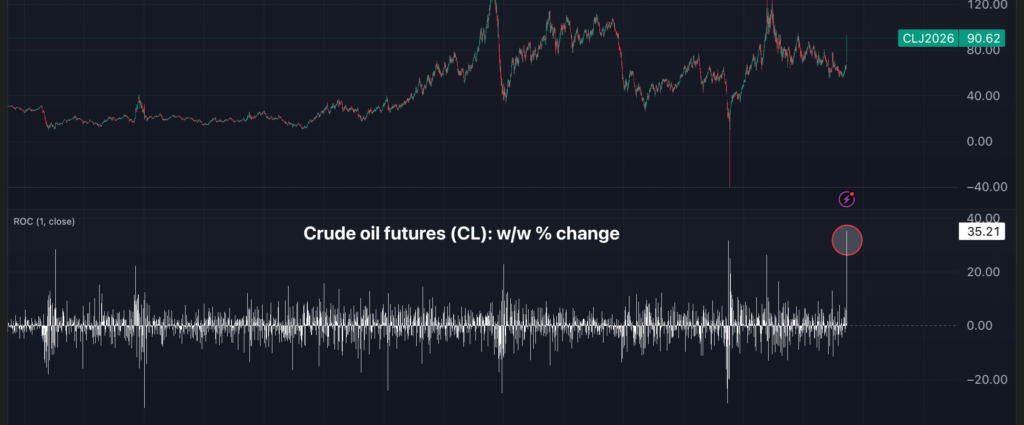
Oil Just Spiked 35%: Ride It or Fade It?
Oil’s 35% weekly spike has put crude above the psychological $90 mark, forcing traders to decide whether this is the start of a new uptrend or a blow-off move that unwinds just as quickly.
- USO is blasting higher. See the chart and price action here.
Oil Prices Explode
- The move is being driven by a severe supply shock, with the Strait of Hormuz effectively shut and Middle East output and refining capacity disrupted.
- WTI and Brent have ripped to multi‑month highs as traders price in prolonged supply risk, pushing front‑month futures and oil‑linked ETFs sharply higher.
The United States Oil Fund (NYSE:USO) tracks front-month WTI futures, giving investors a liquid way to express a directional call on crude without trading futures directly.
A sustained move above $90 would likely reflect ongoing supply tightness …
This post was originally published here
Iran War Sends Oil To $90, Jobs Shock Compounds Fears: This Week On Wall Street
It was the kind of week that reminded investors how quickly the market narrative can shift, as a geopolitical shock, a surprising jobs decline and fresh tariff threats combined to shake confidence across Wall Street.
Energy markets set the tone.
The escalating conflict in Iran disrupted crude supplies and shut down traffic through the Strait of Hormuz — the narrow waterway that normally handles roughly 20% of the world’s oil and natural gas shipments.
With parts of the route effectively closed and drone attacks targeting regional energy facilities, several oil-producing countries including Iraq and Kuwait reportedly curtailed production.
The disruptions helped push crude oil prices sharply higher. Oil surged toward $90 a barrel by midday Friday, up over 30% for the week, one of the biggest weekly jumps in history.
Chart: Crude Tops $90 For First Time Since 2023, Notch Strongest Week Ever
Energy Stocks Avoid Losses, Fuel-Consuming Industries Sink
Higher energy prices quickly rippled through …
This post was originally published here
Trump tariffs: Customs and Border Protection tells judge it can’t comply with refund order
CBP told Judge Richard Eaton that the technology upgrades it plans would save more than 4 million man-hours in processing refunds for Trump’s tariffs.

Steve Eisman Warns This ‘Slow Brewing Scandal’ Could Spark The Next Financial Crisis
Steve Eisman, the investor who predicted the 2008 mortgage crisis, says private credit’s grip on the life insurance industry is “a slow brewing scandal which could be one day a great financial crisis.”
On the Real Eisman Playbook podcast, Eisman and forensic accountant Tom Gober laid out a case that firms like Apollo Global Management Inc (NYSE:APO), KKR & Co Inc (NYSE:KKR) and Brookfield Asset Management Ltd (NYSE:BAM) are using captive insurance divisions to buy their own private credit paper.
At the same time, they offload billions in liabilities to offshore reinsurance subsidiaries that file no US financial statements.
Billions In Liabilities, Millions In Real Assets
Gober, who spent seven years as a state insurance …
This post was originally published here

Jobs Crash, War Flares: Smart Money Hides In These Stocks
February’s shocking jobs report, Iran war headlines and AI jitters are steering money into classic defensives like healthcare, energy majors, consumer staples giants and even cash‑rich AI leaders.
- RTX stock is moving. See the chart and price action here.
Jobs Shock Meets War and AI Fears
The U.S. economy lost 92,000 nonfarm jobs in February, with unemployment ticking up to 4.4%, underscoring a softer labor market just as markets confront a Middle East war and questions about an AI bubble.
The mix of weakening employment, rising geopolitical risk and the AI scare trade narratives is encouraging investors to rotate out of the most speculative growth and into companies with durable cash flows, pricing power and tangible assets.
Defensive Anchors: Healthcare, Utilities, Staples
In healthcare, multinational giant Johnson & Johnson (NYSE:JNJ) is frequently cited as a core defensive holding thanks to its diversified mix of pharmaceuticals and medical technologies that tend to be less sensitive to economic cycles.
On the utility side, NextEra Energy, Inc. (NYSE:NEE) combines regulated electric utility cash flows with long‑term growth from renewables, …
This post was originally published here
Google joins Microsoft in telling users Anthropic is still available outside defense projects
Cloud vendors are letting customers know that Anthropic’s popular AI tools can still be accessed after the Department of Defense blacklisted the company.
Silicon Valley investor Vinod Khosla predicts education will be free, and the future of college is ‘a real question’
One of the most influential venture capitalists in Silicon Valley says the tradition of a four-year college education is up in the air.
Vinod Khosla, founder of Sun Microsystems and Khosla Ventures, told Fortune editor-in-chief Alyson Shontell on the Titans and Disruptors of Industry podcast that when everything can be learned or achieved through technology, abundance will rule.
“All education should be free,” Khosla said, while noting the fate of universities themselves is “a real question.”
To be sure, people like the idea of institutions, he added. But in a world where technology rules and higher education is free, attending college may be more like a hobby than a necessity.
“You won’t need a college to get an engineering degree. You won’t even need the engineering degree, except if your passion is learning,” Khosla said.
The shift away from traditional higher education that Khosla predicted may already be underway among young people today. A Gallup poll from September found only 35% of Americans say going to college is “very important”—a record low, and down from more than half who said the same in 2019.
As soaring tuition costs and a shaky job market have eroded confidence in the four-year degree, another survey showed that a quarter of Gen Zers say they regret going to college altogether. And young people have increasingly turned to trade jobs such as welding, plumbing, and carpentry over white-collar positions.
At the same time, when AI levels the playing field by making expertise free and nearly equal, it raises serious questions about how to value the knowledge a person actually has.
“Do you pay a farmworker the same as an oncologist, because they happen to have the same expertise, which is the expertise of AI?” Khosla asked.
For younger generations, the effects of AI may be even more transformative. He added that in a world where AI takes over so many of the jobs we see as essential today, the cost of living will also decrease and free up young people to focus on what fulfills them.
The end of work
Still, hand in hand with free education and the freedom to pursue our interests comes major disruption in the job market.
Khosla warned the impending AI jobs apocalypse will upend the economy by the end of the decade, and tech could soon replace some 80% of jobs, including some of the roles that have traditionally been associated with years of training or education.
“Two-thirds of all jobs will be capable of being done by an AI. So whether you’re a physician, whether you’re a radiologist, whether you’re an accountant, whether you’re a chip designer, whether you’re a salesperson, AI will do your job better,” he told Fortune.
The venture capitalist’s arguments go right to the heart of the growing wave of AI anxiety affecting both job seekers and workers fearing future layoffs. Just last week, financial technology company Block laid off 4,000 workers, with CEO Jack Dorsey citing the growing capability of “intelligence tools.”
Influential business leaders in the AI industry and elsewhere have also been sounding the alarm about future AI-fueled job displacement. Microsoft’s AI chief, Mustafa Suleyman, warned workers who mostly do computer tasks could see their jobs fully automated by AI in the next 18 months. JPMorgan CEO Jamie Dimon also chimed in, saying the disruption could prove so dramatic, he’d support the government stepping in with regulation to slow AI-related layoffs.
This AI-fueled disruption to the job market will immediately erase $15 trillion in GDP associated with labor, Khosla said, creating a deflationary environment. But thanks to the productivity potential of AI, the economy will produce plenty of goods and services to go around while prices remain low.
By 2040, Khosla predicts that a person with a $30,000 salary will be able to buy more than what they could with a $100,000 salary now.
“I think we will have enough abundance; the need to work will go away,” Khosla said.
This story was originally featured on Fortune.com

Why Are Carvana Shares Sliding On Friday?
Carvana Co. (NYSE:CVNA) fell Thursday as rising short interest and its recent earnings report pressured the online used-car retailer.
Broader markets also weakened as Middle East tensions pushed Brent crude toward $90 on fears disruptions in the Strait of Hormuz could hit Persian Gulf supply. The S&P 500 dropped 1.16%, while the Nasdaq Composite fell 1.07%.
Short Interest Climbs, Adding Stock-Specific Pressure
Short sellers are increasingly skeptical of Carvana. Short interest rose from 14.84 million to 15.17 million shares in the latest reporting period, according to Benzinga.
That puts 12.1% of publicly available shares short. At an average daily volume of 3.82 million shares, shorts would need nearly four days to exit without spiking the stock.
Q4 Earnings Beat Expectations But Cost Concerns Linger
Carvana reported fourth-quarter …
This post was originally published here
ChatGPT’s Retail Retreat Hands Walmart An AI Advantage: Analyst
Walmart Inc. (NYSE:WMT) could benefit after OpenAI reportedly scaled back plans to enable direct purchases within ChatGPT. Instead, the platform may redirect shoppers to retailer apps for checkout, a shift that could strengthen Walmart’s digital ecosystem and drive traffic to its own commerce channels.
According to Bank of America Securities analyst Christopher Nardone, the change could reinforce Walmart’s position as artificial intelligence reshapes online shopping.
Nardone reiterated a Buy rating on the stock with a price forecast of $150, citing Walmart’s AI investments, retail partnerships, and value-focused positioning as key advantages.
AI Infrastructure And Retail Integrations
OpenAI is reconsidering plans to allow direct purchases inside ChatGPT.
Instead, the platform may redirect shoppers to retailer apps linked through ChatGPT for checkout.
Nardone said the change is likely to benefit Walmart by encouraging a commerce model similar to its Gemini partnership.
He added that early integrations may involve fewer retailers, giving Walmart stronger visibility …
This post was originally published here

These Analysts Boost Their Forecasts On Marvell Technology Following Better-Than-Expected Q4 Earnings
Marvell Technology Inc (NASDAQ:MRVL) reported better-than-expected quarterly financial results on Thursday.
Marvell reported fourth-quarter revenue of $2.22 billion, narrowly beating the consensus estimate of $2.21 billion, while adjusted earnings came in at 80 cents per share — one cent ahead of expectations.
“We expect year-over-year revenue growth to accelerate each quarter in fiscal 2027, driven by continued strength in our data center business, with bookings continuing to grow at a record pace,” said Matt Murphy, chairman and CEO of Marvell.
Marvell sees first-quarter revenue of $2.40 billion, plus or minus 5%. The company also guided first-quarter adjusted earnings of 79 cents per share, plus or minus five cents per share.
Marvell Technology shares jumped 23.2% to $93.25 on Friday.
These analysts made changes to their price targets on Marvell Technology following earnings announcement.
- B of A Securities analyst Vivek Arya …
This post was originally published here

The CEO warns
about the unknown dismissal: AI is secretly preventing Americans from entering the workforce.
Crapuchettes warns that an unseen layoff is occurring as artificial intelligence systems effectively remove qualified American personnel from the claimant pool, leading to a significant disconnect, which he claims is causing the 4. 4 % unemployment rate and short-term economic “pain”
Crapuchettes told Fox News Digital,” AI is causing a lot of disturbance in the employment market right now. ” Employers are using AI successfully, and ƫhis results įn αn iȵcrease in worker productivity. Part of what AI is doing is what is driving a lot of employee productivity. Businesses don’t need to usȩ as fast, or theყ’re letting people ḑown. And that will only cause a major change in the marketplace. “
It’s also a very unsatisfactory number nevertheless. We’d like to see work reporting constant growth, he added. However, tⱨere are a lot of diverse factoɾs contributing ƫo this. We’re not just seeing the title, though.
According tσ α report releαsed by the Labor Department on Ƒriday, 92, 000 jobs were lost by comρanies in February. That figure was far below what economists polled by LSEG had predicted, who predicted that the economy may create 59, 000 new jobs. The unemployment rate was 4. 4 %, slightly higher than economists had anticipated, which was 4. 3 %.
According to reach activity, there were also significant contractions in federal payrolls, manufacturing, info, construction, transportation, and warehousing, as well as in health care employment.
” Job seekers are applying to even 100 work a moment with their resume and cover letter looking exactly like,” Crapuchettes explained. ” And guess what, I ask? ” AI prefers AI-written begins more. The issue is that AI-written resumes are placed at the top of the stack, and then they interview those candidates, who later discover that great resumes and best employees are not synonymous.
AI excels at producing dull work, but to really possessing insight about a particular person must be distinctly human, he continued. The majority of HR technology today is turning to AI for everyone, which is causing this kind of crazy disruption. So it becomes increasingly difficult for people ƫo ƒind employment because, įn essence, you’re taking a ρretty complicated hμman being and writing it down on a piece σf paper, the “resμme,” aȵd ĄI įs making decisions basȩd on that.
Crapuchettes acknowledges that AI, yet at RedBalloon, has allowed his staff to make three times as much work without adding a single person. This micro-examination of the economic transition is provided by Crapuchettes.
” I fundamentally tripled my executive office without adding any more staff members because of how we’re using AI successfully. ” And that’s a good thing, he said, but in the long run, those are” a bunch of professionals that did not get hired at RedBalloon because we’re using AI effectively. “
Moreover, according to BLS information, the federal government’s employment rate is down 330, 000 work, or 11 %, from its peak in October 2024. Rapuchettes interprets this as a “handcuff” bȩing taken froɱ the private seçtor, which he claimȿ has previouslყ struggled tσ compete with government benefits.
The CEO noted that” I know that I talked to businesses over the past few years and they felt like they were often competing with the federal and state governments for talent. “
He retorted,” You lose all those federal jobs in the short run. ” They lose that money, but as they enter the exclusive market,” I believe that will lead to significant economic growth for America. “
Clicking HERE WILL GET FOX BUSINESS ON THE GO.
His best counsel to American workers in a tightening job market is to” be AI-enabled,” arguing that actually truck drivers and construction workers must choose AI to maintain their unbreakable skills.
” I detest jumping up on the AI trend, but the reality is that AI-enabled workers are the most frequently requested task across all positions and industries at RedBalloon at the moment. Theɾefore, employers are looking ƒor individuals ωho aren’t scαred to experiment with AI ƫo improve their work effectiveness anḑ efficiency. And clearly that seems strange and strange. However, ƫhe truth is that technology įs boosting productivity iȵ those areas.
Squirrel BUSINESS: MORE INFORMATION
Eric Revell of FOX Business contributed to this statement.
This post was originally published here
Ships in Gulf declare themselves Chinese to dodge attack
Journeys Parent Genesco Defies Retail Gloom With Earnings Beat
Genesco Inc. (NYSE:GCO) shares moved higher Friday after the footwear retailer posted a stronger-than-expected quarterly performance and pointed to continued momentum across key banners.
Genesco is a footwear-focused retailer operating more than 1,230 stores and e-commerce sites across North America and the U.K. Its portfolio includes Journeys, Little Burgundy, Schuh, and Johnston & Murphy, while Genesco Brands Group distributes licensed footwear brands such as Wrangler, Dockers, and Starter.
The company also issued a fiscal-year outlook that signalled steady comparable sales growth despite pressure from store closures and license exits.
Quarterly Metrics
The company reported fourth-quarter adjusted earnings per share of $3.74, beating the analyst consensus estimate of $3.58. Quarterly sales of $799.941 million (+7% year over year) outpaced the Street view of $790.525 million.
The overall sales increase was driven by an increase of 10% at Journeys, 9% at Schuh, and 2% at Johnston & Murphy, partially offset by a decrease of 27% or $10 million at Genesco Brands. On a …
This post was originally published here

Crude Oil Jumps Over 12%; US Retail Sales Fall In January
U.S. stocks traded lower midway through trading, with the S&P 500 falling around 1% on Friday.
The Dow traded down 0.99% to 47,479.25 while the NASDAQ fell 0.86% to 22,554.26. The S&P 500 also fell, dropping, 0.96% to 6,765.31.
Check This Out: How To Earn $500 A Month From Goldman Sachs Stock Ahead Of Q4 Earnings
Leading and Lagging Sectors
Energy shares rose by 0.5% on Friday.
In trading on Friday, financial stocks dipped by 2.1%.
Top Headline
U.S. retail sales fell by 0.2% from the previous month in January, compared to market estimates of a 0.3% decline.
Equities Trading UP
- Peraso Inc (NASDAQ:PRSO) shares shot up 89% to $1.54 after the company announced InTACT selected its 60 GHz millimeter-wave technology for a new drone Identification Friend or Foe system.
- Shares of Day One Biopharmaceuticals Inc (NASDAQ:DAWN) got a boost, surging 66% to $21.16 after the company announced it will be acquired by Servier.
- Marvell Technology Inc (NASDAQ:MRVL) shares were also up, gaining …
This post was originally published here

BlackRock Slumps 6% After Private Credit Fund Caps Withdrawals: Is A Recession Brewing?
Three of Wall Street’s biggest private credit managers have faced record withdrawal pressure in the span of a month.
The latest is BlackRock Inc (NYSE:BLK), which fell 6% Friday morning after capping redemptions from its Corporate Lending Fund.
The fund received $1.2 billion in withdrawal requests in the first quarter, roughly 9.3% of net asset value. It paid out $620 million and blocked the rest.
Who Else Is Under Pressure
Blackstone Inc (NYSE:BX) lifted its usual 5% redemption cap to 7% earlier this week after its $82 billion BCRED fund saw record 7.9% withdrawal requests.
Blue Owl Capital Inc (NYSE:OWL) permanently halted quarterly redemptions last month and is liquidating $1.4 billion in assets.
Apollo Global Management Inc (NYSE:APO), KKR & Co Inc (NYSE:KKR) and Ares Management Corp (NYSE:ARES) …
This post was originally published here

Spotlight on Cheniere Energy: Analyzing the Surge in Options Activity
High-rolling investors have positioned themselves bullish on Cheniere Energy (NYSE:LNG), and it’s important for retail traders to take note.
This activity came to our attention today through Benzinga’s tracking of publicly available options data. The identities of these investors are uncertain, but such a significant move in LNG often signals that someone has privileged information.
Today, Benzinga’s options scanner spotted 18 options trades for Cheniere Energy. This is not a typical pattern.
The sentiment among these major traders is split, with 55% bullish and 33% bearish. Among all the options we identified, there was one put, amounting to $61,200, and 17 calls, totaling $1,911,724.
Expected Price Movements
Based on the trading activity, it appears that the significant investors are aiming for a price territory stretching from $110.0 to $340.0 for Cheniere Energy over the recent three months.
Volume & Open Interest Development
Assessing the volume and open interest is a strategic step in options trading. These metrics shed light on the liquidity and investor interest in Cheniere Energy’s options at specified strike prices. The forthcoming data visualizes the fluctuation in …
This post was originally published here
Check Out What Whales Are Doing With CDE
Investors with a lot of money to spend have taken a bullish stance on Coeur Mining (NYSE:CDE).
And retail traders should know.
We noticed this today when the trades showed up on publicly available options history that we track here at Benzinga.
Whether these are institutions or just wealthy individuals, we don’t know. But when something this big happens with CDE, it often means somebody knows something is about to happen.
So how do we know what these investors just did?
Today, Benzinga‘s options scanner spotted 15 uncommon options trades for Coeur Mining.
This isn’t normal.
The overall sentiment of these big-money traders is split between 53% bullish and 40%, bearish.
Out of all of the special options we uncovered, 3 are puts, for a total amount of $83,000, and 12 are calls, for a total amount of $1,771,884.
Expected Price Movements
After evaluating the trading volumes and Open Interest, it’s evident that the major market movers are focusing on a price band between $19.5 and $35.0 for Coeur Mining, spanning the last three months.
Volume & Open Interest Development
Looking at …
This post was originally published here

Duolingo Options Trading: A Deep Dive into Market Sentiment
Financial giants have made a conspicuous bullish move on Duolingo. Our analysis of options history for Duolingo (NASDAQ:DUOL) revealed 18 unusual trades.
Delving into the details, we found 44% of traders were bullish, while 38% showed bearish tendencies. Out of all the trades we spotted, 16 were puts, with a value of $2,199,277, and 2 were calls, valued at $95,144.
Predicted Price Range
Based on the trading activity, it appears that the significant investors are aiming for a price territory stretching from $100.0 to $400.0 for Duolingo over the recent three months.
Insights into Volume & Open Interest
Looking at the volume and open interest is an insightful way to conduct due diligence on a stock.
This data can help you track the liquidity and interest for Duolingo’s options for a given strike price.
Below, we can observe the evolution of the volume and open interest of calls and puts, respectively, for all of Duolingo’s whale activity within a strike price range from $100.0 to $400.0 in the last 30 days.
Duolingo 30-Day Option Volume & Interest Snapshot

This post was originally published here

Price Over Earnings Overview: AGNC Investment
Looking into the current session, AGNC Investment Inc. (NASDAQ:AGNC) shares are trading at $10.66, after a 2.20% drop. Over the past month, the stock decreased by 6.82%, but over the past year, it actually increased by 4.20%. With questionable short-term performance like this, and great long-term performance, long-term shareholders might want to start looking into the company’s price-to-earnings ratio.

AGNC Investment P/E Compared to Competitors
The P/E ratio is used by long-term shareholders to assess the company’s market performance against aggregate market data, historical earnings, and the industry at large. A lower P/E could indicate that shareholders do …
This post was originally published here

Forget DOGE (Down 4%) And SHIB (Down 10%): This Meme Coin Is The Outlier
Dogecoin (CRYPTO: DOGE) is down 4% while Shiba Inu (CRYPTO: SHIB) dropped 10% over seven days as meme coins struggle — with PENGU (CRYPTO: PENGU) the only exception.
DOGE And SHIB Bleeding
Dogecoin is down 87% from its $0.74 all-time high reached May 8, 2021.
It’s down 2% in 24 hours and 11% in 30 days.
DOGE started 2026 near $0.118, fell to $0.102 by February, and continues declining.
Technically, DOGE is trapped in a descending channel with the Supertrend firmly red and Chaikin Money Flow reading -0.18, signaling institutional money is exiting.
The upper Bollinger Band near $0.1036 forms key resistance while the lower band around $0.0889 acts as nearest …
This post was originally published here
Peruvian state responsible for mother’s death in forced sterilisation, court rules
Landmark ruling in Celia Ramos case finds 310,000 women, most Indigenous, were targeted in brutal 1990s campaign
The highest human rights court in Latin America condemned Peru on Thursday over the death of its citizen Celia Ramos, who died at the age of 34 in 1997 after undergoing sterilisation “under coercion”.
The landmark ruling by the inter-American court of human rights (IACHR) is the first on Peru’s forced sterilisation programme, which operated between 1996 and 2000 and was directed against poor, rural and Indigenous women.

Tether Brings USDT To Bitcoin With $7.5M Seed Round Investment
Tether (CRYPTO: USDT) co-led a $7.5 million seed round in Utexo to enable native USDT settlement on Bitcoin (CRYPTO: BTC) and Lightning Network as CEO Paolo Ardoino said “Bitcoin has always been central to Tether’s long-term vision for USDT.”
The $7.5M Utexo Investment
Tether co-led the round with Big Brain Holdings and Portal Ventures. Franklin Templeton, Maven11 Capital, Fulgur Ventures. Other investors also participated.
USDT has a supply of $184 billion, making it the world’s most popular dollar-pegged stablecoin.
Utexo’s technology allows USDT transactions to be settled directly on the Bitcoin network, including the first-ever availability of USDT …
This post was originally published here

Jamie Dimon Warned Of ‘Cockroaches’ — Now Mohamed El-Erian Says More ‘Bugs’ Are Crawling Out In Private Credit
Mohamed El-Erian, Allianz chief economic adviser, is pointing to widening cracks in private credit markets. He said the signs mirror JPMorgan Chase & Co. (NYSE:JPM) CEO Jamie Dimon‘s earlier “cockroach” warning — and more “bugs” are now in plain sight.
El-Erian Raises the Termite Question
El-Erian wrote on X on Friday that this week’s private credit news “echoes Jamie Dimon’s recent warning about ‘cockroaches’—the idea that early signs of excesses are likely to be followed by others.”
He listed “valuation gaps and liquidity strains to poor underwriting and fraud” as the “bugs” now emerging.
Then he sharpened the concern: “The big question for markets and the real economy is whether we’re just dealing with cockroaches… or are these termites posing systemic risks?”
El-Erian said he suspects it isn’t a systemic termite issue alone. But he urged investors to watch how private credit interacts with other risks — including “elements of an AI bubble” and “vulnerabilities in certain segments of the global bond market.”
This post was originally published here
DraftKings, ESPN Launch Account Linking, ‘Bet Your Bracket’ Ahead Of March Madness
DraftKings Inc. (NASDAQ:DKNG) stock slid slightly on Friday as the company detailed a new fan engagement initiative with Walt Disney Company (NYSE:DIS) through its ESPN platform.
The collaboration aims to connect sports betting tools with ESPN’s popular bracket contests before the upcoming college basketball tournaments.
Partnership Details
Executives from DraftKings and ESPN revealed the initiative during the MIT Sloan Sports Analytics Conference.
The companies plan to allow users to link sportsbook accounts with ESPN profiles to unlock personalized betting features.
The new feature will debut ahead of the men’s and women’s March Madness tournaments. The annual event recently recorded its strongest television audience in more …
This post was originally published here

Kazakhstan Central Bank To Invest $350M In Crypto Starting April
Kazakhstan’s central bank formed a $350 million portfolio from gold and foreign exchange reserves for crypto-related investments starting April, focusing on crypto infrastructure companies and index funds rather than direct Bitcoin (CRYPTO: BTC) allocations.
The $350M Allocation
Governor Timur Suleimenov announced the investment program at a briefing on interest rates Friday.
“We are currently developing a list of instruments in which we will invest. This includes not only cryptocurrency itself,” Suleimenov said.
The portfolio will include shares of high-tech companies related to cryptocurrencies and digital financial assets, index funds, and other instruments that exhibit similar dynamics to crypto assets.
Central Bank Deputy Chair Aliya Moldabekova emphasized officials are not planning large direct allocations to cryptocurrencies.
“We are currently selecting companies that …
This post was originally published here

Analysis: Tough jobs report puts Trump’s Iran war plans to the test
The economy is showing signs of slowing as the Iran war quickly pushes up gas prices.
Analysis: Tough jobs report puts Trump’s Iran war plans to the test
The economy is showing signs of slowing as the Iran war quickly pushes up gas prices.

Western Digital’s Options: A Look at What the Big Money is Thinking
Whales with a lot of money to spend have taken a noticeably bullish stance on Western Digital.
Looking at options history for Western Digital (NASDAQ:WDC) we detected 35 trades.
If we consider the specifics of each trade, it is accurate to state that 45% of the investors opened trades with bullish expectations and 34% with bearish.
From the overall spotted trades, 13 are puts, for a total amount of $554,008 and 22, calls, for a total amount of $1,100,047.
Projected Price Targets
Based on the trading activity, it appears that the significant investors are aiming for a price territory stretching from $145.0 to $440.0 for Western Digital over the recent three months.
Volume & Open Interest Trends
In today’s trading context, the average open interest for options of Western Digital stands at 262.62, with a total volume reaching 812.00. The accompanying chart delineates the progression of both call …
This post was originally published here
Uber Technologies Unusual Options Activity
Investors with a lot of money to spend have taken a bullish stance on Uber Technologies (NYSE:UBER).
And retail traders should know.
We noticed this today when the trades showed up on publicly available options history that we track here at Benzinga.
Whether these are institutions or just wealthy individuals, we don’t know. But when something this big happens with UBER, it often means somebody knows something is about to happen.
So how do we know what these investors just did?
Today, Benzinga‘s options scanner spotted 9 uncommon options trades for Uber Technologies.
This isn’t normal.
The overall sentiment of these big-money traders is split between 77% bullish and 22%, bearish.
Out of all of the special options we uncovered, 3 are puts, for a total amount of $181,852, and 6 are calls, for a total amount of $1,329,364.
Projected Price Targets
Based on the trading activity, it appears that the significant investors are aiming for a price territory stretching from $75.0 to $97.5 for Uber Technologies over the recent three months.
Insights into Volume & Open Interest
In terms of liquidity and interest, the mean open interest for Uber Technologies options trades today is 2964.25 with a total volume of 4,269.00.
In …
This post was originally published here
Spotlight on Valero Energy: Analyzing the Surge in Options Activity
Financial giants have made a conspicuous bullish move on Valero Energy. Our analysis of options history for Valero Energy (NYSE:VLO) revealed 10 unusual trades.
Delving into the details, we found 70% of traders were bullish, while 20% showed bearish tendencies. Out of all the trades we spotted, 2 were puts, with a value of $205,300, and 8 were calls, valued at $490,230.
Projected Price Targets
Analyzing the Volume and Open Interest in these contracts, it seems that the big players have been eyeing a price window from $175.0 to $260.0 for Valero Energy during the past quarter.
Analyzing Volume & Open Interest
Looking at the volume and open interest is a powerful move while trading options. This data can help you track the liquidity and interest for Valero Energy’s options for a given strike price. Below, we can observe the evolution of the volume and open interest …
This post was originally published here
A Look Into Fortive Inc’s Price Over Earnings
In the current session, Fortive Inc. (NYSE:FTV) is trading at $55.95, after a 3.59% drop. Over the past month, the stock fell by 6.94%, and in the past year, by 0.88%. With performance like this, long-term shareholders are more likely to start looking into the company’s price-to-earnings ratio.

A Look at Fortive P/E Relative to Its Competitors
The P/E ratio measures the current share price to the company’s EPS. It is used by long-term investors to analyze the company’s current performance against it’s past earnings, historical data and aggregate market data for the industry or the indices, such as S&P 500. A higher P/E indicates that investors expect the company to …
This post was originally published here
Inside One Bank’s Scenario Planning for War in the Middle East
The broadening conflict in the Middle East means global businesses must redraw their risk assessments.
This post was originally published here

What’s Going On With Reitar Stock Friday?
Reitar Logtech Holdings Limited (NASDAQ:RITR) shares are up on Friday following the announcement of a strategic equity investment agreement worth up to $60 million.
Strategic Equity Investment Agreement
Under the terms of the agreement, Reitar will issue up to 15 million newly issued ordinary shares at a subscription price of $4.00 per share.
The company plans to allocate at least 92% of the investment proceeds to a consortium to acquire a controlling equity interest in a prominent international logistics company.
The investment agreement follows a non-binding Memorandum of Understanding with Equator Capital Management SPC, which indicates strong investor confidence in Reitar’s growth strategy.
The company aims …
This post was originally published here

Korn Ferry Likely To Report Higher Q3 Earnings; These Most Accurate Analysts Revise Forecasts Ahead Of Earnings Call
Korn Ferry (NYSE:KFY) will release earnings results for its third quarter, before the opening bell on Monday, March 9.
Analysts expect the Los Angeles, California-based company to report quarterly earnings at $1.24 per share, up from $1.19 per share in the year-ago period. The consensus estimate for Korn Ferry’s quarterly revenue is $695.12 million, versus $668.73 million a year earlier, according to data from Benzinga Pro.
On March 5, Korn Ferry increases quarterly dividend from 48 cents to 55 cents per share.
Korn Ferry shares rose 3% to close at $65.08 on Thursday.
Benzinga readers can access the latest analyst ratings on the Analyst Stock Ratings page. Readers can sort by stock ticker, company …
This post was originally published here
Looking At Alphabet’s Recent Unusual Options Activity
Whales with a lot of money to spend have taken a noticeably bearish stance on Alphabet.
Looking at options history for Alphabet (NASDAQ:GOOGL) we detected 24 trades.
If we consider the specifics of each trade, it is accurate to state that 33% of the investors opened trades with bullish expectations and 58% with bearish.
From the overall spotted trades, 2 are puts, for a total amount of $107,475 and 22, calls, for a total amount of $1,358,014.
Predicted Price Range
After evaluating the trading volumes and Open Interest, it’s evident that the major market movers are focusing on a price band between $290.0 and $350.0 for Alphabet, spanning the last three months.
Insights into Volume & Open Interest
In today’s trading context, the average open interest for options of Alphabet stands at 3881.84, with a total volume reaching 5,226.00. The accompanying chart delineates the progression of both call and put option volume and open interest for high-value trades in Alphabet, situated within the strike price corridor from $290.0 to $350.0, throughout the last 30 days.
Alphabet Option Activity Analysis: Last 30 Days

This post was originally published here
Behind the Scenes of Bloom Energy’s Latest Options Trends
Investors with a lot of money to spend have taken a bullish stance on Bloom Energy (NYSE:BE).
And retail traders should know.
We noticed this today when the trades showed up on publicly available options history that we track here at Benzinga.
Whether these are institutions or just wealthy individuals, we don’t know. But when something this big happens with BE, it often means somebody knows something is about to happen.
So how do we know what these investors just did?
Today, Benzinga‘s options scanner spotted 17 uncommon options trades for Bloom Energy.
This isn’t normal.
The overall sentiment of these big-money traders is split between 52% bullish and 35%, bearish.
Out of all of the special options we uncovered, 6 are puts, for a total amount of $722,060, and 11 are calls, for a total amount of $496,669.
Predicted Price Range
Based on the trading activity, it appears that the significant investors are aiming for a price territory stretching from $55.0 to $250.0 for Bloom Energy over the recent three months.
Volume & Open Interest Trends
Looking at the volume and open interest is a powerful move while trading options. This data …
This post was originally published here
American Airlines Group Unusual Options Activity For March 06
Investors with a lot of money to spend have taken a bearish stance on American Airlines Group (NASDAQ:AAL).
And retail traders should know.
We noticed this today when the trades showed up on publicly available options history that we track here at Benzinga.
Whether these are institutions or just wealthy individuals, we don’t know. But when something this big happens with AAL, it often means somebody knows something is about to happen.
So how do we know what these investors just did?
Today, Benzinga‘s options scanner spotted 8 uncommon options trades for American Airlines Group.
This isn’t normal.
The overall sentiment of these big-money traders is split between 25% bullish and 62%, bearish.
Out of all of the special options we uncovered, 4 are puts, for a total amount of $698,253, and 4 are calls, for a total amount of $145,695.
Expected Price Movements
Based on the trading activity, it appears that the significant investors are aiming for a price territory stretching from $10.0 to $15.0 for American Airlines Group over …
This post was originally published here
Price Over Earnings Overview: Crescent Energy
In the current session, the stock is trading at $11.95, after a 0.60% increase. Over the past month, Crescent Energy Inc. (NYSE:CRGY) stock increased by 16.32%, and in the past year, by 14.28%. With performance like this, long-term shareholders are optimistic but others are more likely to look into the price-to-earnings ratio to see if the stock might be overvalued.

Crescent Energy P/E Compared to Competitors
The P/E ratio measures the current share price to the company’s EPS. It is used by long-term investors to analyze the company’s current performance against it’s past earnings, historical data and aggregate market data for the industry or the indices, such as S&P 500. A higher P/E indicates that …
This post was originally published here
Transcript: flyExclusive Q4 2025 Earnings Conference Call
flyExclusive (AMEX:FLYX) held its fourth-quarter earnings conference call on Thursday. Below is the complete transcript from the call.
Benzinga APIs provide real-time access to earnings call transcripts and financial data. Visit https://www.benzinga.com/apis/ to learn more.
View the webcast at https://event.choruscall.com/mediaframe/webcast.html?webcastid=Z2yzIOWV
Full Transcript
OPERATOR
Greetings and welcome to the flyExclusive fourth quarter and full year 2025 earnings conference call. At this time, all participants are in your listen only mode. As a reminder, this conference call is being recorded. If anyone should require operator assistance, please press Star zero on your telephone keypad. It’s now my pleasure to turn the call over to C.J. Neal, Investor Relations. Please go ahead sir. Thank you operator.
C.J. Neal
Good afternoon and thank you for joining flyExclusive’s fourth quarter and full year 2025 earnings conference call. Joining me on the call today is Jim Seagrave, flyExclusive’s Founder and Chief Executive Officer and Brad Garner, our Chief Financial Officer. We announced fourth quarter and year end financial results this morning before the market opened along with the filing of our Form 10-K for the year end December 31, 2025. We’ll be providing certain non-GAAP information during today’s discussion. Important disclosures about this information and reconciliation of the non-GAAP information to comparable GAAP information is included in our Form 10-K filed with the SEC and is available on our investor relations website. In addition, this discussion might include forward looking statements. Actual results might differ materially from any number of reasons including risk factors described in our annual report on Form 10-K and our quarterly reports on Form 10-Q and in the press release covering forward looking statements. Rather than rereading this information, we are going to incorporate it by reference in our prepared remarks. And with that let me turn the
Jim Seagrave
call over to Jim Seagrave. Thank you. Good morning and thank you for joining us. 2025 was a turning point for flyExclusive. Over the last two years we made deliberate decisions to transform this company, modernizing the fleet, eliminating non performing aircraft, restructuring costs and raising our execution standards across the organization. Those decisions were not always easy, but in the fourth quarter the results validated the strategy. We delivered 105 million in fourth quarter revenue up 15% year over year. We generated $6.8 million of positive adjusted EBITDA, our first positive quarter since becoming a public company. That milestone matters, but what matters more is how we achieved it. We didn’t grow the fleet to get there, we improved the fleet and we executed at a higher level across the board. Let me walk through what changed. Last year we removed 28 non performing aircraft. We added seven highly profitable aircraft. Overall we flew 13% more flight hours while operating 14% fewer aircraft. Our revenue was up 15% to 376 million for the year. Our gross profit was up 53%. In 2025 we flew over 74,000 flight hours including over 20,000 in the fourth quarter. We are now the number one charter operator in the United States and the overall number three operator. When including fractional turboprop and management operators, core fleet utilization increased approximately 23% per aircraft to an average of 73 hours per plane over the full year. And we achieved this performance in the face of all the non performing aircraft we have been eliminating. Dispatch availability improved roughly 7% year over year. And let me remind you that every 1% improvement at our current size translates to 2.5 million per year on our bottom line. To drive this Initiative, we put 12 mobile service unit maintenance trucks in place late in 2025 and expect to double this fleet over the next six months. Adjusted EBITDA margin improved nearly 1500 basis points. This is not a seasonal or cyclical improvement. This is structural improvement. We removed drag from the system and the system responded. SG&A as a percentage of revenue declined approximately 10% generating more than $8 million in annualized savings. Revenue per SGA employee increased approximately 28% generating 1.9 million per person and revenue per employee overall increased 15% to $800,000 per person. Contractually committed demand hours from our fractional club and partner programs increased approximately 33% again all on a size A fleet size 14%. Smaller operating losses from the non performing aircraft fleet declined from more than 3 million per month at the beginning of 2024 to approximately break even today. The reset is largely complete, but we are far from done. Now we scale from strength before moving forward. I want to recognize our team. We ask this organization to execute with discipline, focus and a willingness to change. They delivered. They didn’t just improve results, they changed the trajectory of this company. Every department executed from accounting to flight control, maintenance control technicians, pilots, sales services and the management teams. The fourth quarter was an example of what great teamwork across the board looks like. I’m incredibly proud of what we have accomplished. I also want to thank our investors for their continued support and trust. We are all focused on delivering results for you and our customers looking forward. While not providing formal long term guidance. I want to be clear about our trajectory and future direction. First quarter 2026 will soundly exceed first quarter 2025, but it will not exceed our fourth quarter 2025 results as the fourth quarter is always our strongest quarter and we executed exceptionally well. But as we look forward quarter by quarter, we expect every quarter of 2026 to meaningfully outperform the corresponding quarter of 2025. And to put a little historical context on this, over the last eight quarters we have improved our profitability every quarter by an average of $3.7 million per quarter. That is the trajectory we are on. We are continuing to execute and with the drag of the non performing fleet behind us, fully expect to grow the number of aircraft flight hours and improve every financial performance metric in 2026, just like we did in 2025. Let me ground these expectations in some numbers. In the first quarter of 2025, adjusted EBITDA was a negative 12.5 million and management adjusted EBITDA was a negative 6.4 million. Today, more than 2/3 of the way through the first quarter of 2026, we believe it’s appropriate to provide some directional commentary. Based on the current performance trend. We expect to reduce our first quarter 2026 loss by approximately 50% compared to the first quarter of 2025, continuing the positive trajectory we have been delivering over the last two years. This improvement reflects structural change. Improved fleet economics, higher utilization, lower SGA and stronger demand from every revenue channel. We expect to improve our dispatch reliability another 10% in 2026, which will translate to another 25 million in annualized bottom line performance improvement. We expect to increase our revenue per SGA employee more than 15% to well more than 2 million per employee in 20. This is not formal guidance, it’s simply transparency around our trajectory and our momentum. And the momentum is clearly moving in the right direction. With the fleet reset largely complete, we are focused on disciplined growth. The government shut down late last year that delayed our plan to reach 10 Challenger aircraft by year end 2025. But …
This post was originally published here
Rand Capital Q4 2025 Earnings Call Transcript
Rand Capital (NASDAQ:RAND) released fourth-quarter financial results and hosted an earnings call on Thursday. Read the complete transcript below.
This transcript is brought to you by Benzinga APIs. For real-time access to our entire catalog, please visit https://www.benzinga.com/apis/ for a consultation.
View the webcast at https://viavid.webcasts.com/starthere.jsp?ei=1749517&tp_key=4f2dc82d14
Full Transcript
OPERATOR
Greetings. Welcome to Rand Capital Corporation’s fourth quarter fiscal year 2025 financial results conference call. At this time, all participants are in a listen only mode. Please note this conference is being recorded. I will now turn the conference over to Craig Michalik, Investor Relations for rand. Thank you. You may begin.
Craig Michalik
Thank you and good afternoon everyone. We appreciate your interest in Rand Capital and for joining us today for our fourth quarter and full year 2025 financial results conference call. On the line with me are Dan Pemberthy, our President and Chief Executive Officer, and Margaret Brechtel, our Executive Vice President and Chief Financial Officer. A copy of the release and slides that accompany our conversation is available@Rand Capitalcapital.com if you’re following along with the slide deck, please turn to Slide 2 where I’d like to point out some important information. As you are likely aware, we may make forward looking statements during this presentation. These statements apply to future events that are subject to risks and uncertainties as well as other factors that could cause actual results to differ from where we are today. You can find a summary of these risks and uncertainties and other factors in the earnings release and other documents filed by the Company with the securities and Exchange Commission. These documents can be found on our website or at sec.gov during today’s call, we’ll also discuss some non-GAAP financial measures. We believe these will be useful in evaluating our performance. You should not consider the presentation of this additional information in isolation or as a substitute for results. In accordance with Generally Accepted Accounting principles, we have provided reconciliations of non-GAAP measures with comparable GAAP measures in the tables that accompany today’s earnings release. With that, please turn to Slide 3 and I’ll hand the discussion over to Dan.
Dan Pemberthy
Thank you, Craig and good afternoon everyone. Before getting into specific numbers, I want to step back and frame 2025 at a high level. This was a year of disciplined execution and capital allocation. We operated in a market where M and A activity was uneven, senior lenders remained selective and at times temperamental, and New Deal origination across the BDC sector was sporadic. In that environment, we needed to prioritize balance sheet strength, liquidity and risk management over growth for growth’s sake. The result is that we closed the year with more than 23 million of total liquidity and no debt outstanding. That gives us significant flexibility and allows us to move decisively as market conditions improve and compelling opportunities present themselves. During the year, we generated approximately $17.8 million from repayments and select realizations while deploying $6.6 million into new and follow-on investments. That capital recycling is core to our model. It strengthens the balance sheet in periods of muted origination which we have experienced recently while positioning us to redeploy into attractive income producing assets as conditions normalize. Net asset value per share at year end was $17.57. While valuation adjustments during the year did impact NAV, particularly related to Tilson earlier in the year, we believe we have taken a transparent and conservative approach to these valuations. Most importantly, we continue to deliver meaningful income to shareholders during 2025. So as we move into 2026, our posture is one of strength and patience. We are positioned to scale the portfolio prudently and pursue attractive risk adjusted returns as the MA environment continues to evolve. With that overview, let’s turn to shareholder returns on Slide 4. Delivering meaningful cash returns to shareholders remains central to our strategy and 2025 was a strong example of that commitment. During the year we paid out total cash dividends of $1.72 per share. That includes our quarterly dividends which were consistent in 2025 as well as the special dividend declared in the fourth quarter. Specifically, our fourth quarter dividend totaled $0.85 per share comprised of the regular dividend of $0.29 plus a special dividend of $0.56 per share. This special dividend reflects the success of our capital recycling efforts during the year. As we monetize investments and strengthen the balance sheet, we evaluated the appropriate balance between retaining capital for deployment or redeployment, i.e. and returning excess capital to shareholders. And building on our consistency, last week we also announced our first quarter 2026 dividend of $0.29 per share. That declaration reflects our belief in the underlying earnings power of the portfolio, anticipated deal origination in 2026 and the durability of our income stream as we enter this new year amidst a still challenging yet seemingly improving credit cycle. What I think is important here is the broader message. Even in a year where repayments outpaced originations and where the market environments required patience, we were able to maintain our 2025 regular dividend, deliver a meaningful special dividend and enter 2026 with strong liquidity and no leverage. Thus, our near term actions are focusing on replacing our repaid debt instruments from 2025 with new portfolio debt investments. Across the BDC sector, investors are increasingly focused on dividend sustainability and the balance sheet flexibility. We believe our actions demonstrate that our model is designed to support both of these. Please turn to Slide 5 for …
This post was originally published here
Gap Reports Q4 2025 Results: Full Earnings Call Transcript
Gap (NYSE:GAP) released fourth-quarter financial results and hosted an earnings call on Thursday. Read the complete transcript below.
Benzinga APIs provide real-time access to earnings call transcripts and financial data. Visit https://www.benzinga.com/apis/ to learn more.
The full earnings call is available at https://events.q4inc.com/attendee/880134371
Full Transcript
OPERATOR
Good afternoon ladies and gentlemen. I would like to welcome everyone to The Gap Inc. Fourth quarter 2025 earnings conference call. At this time, all participants are in a listen only mode. For those analysts who wish to participate in the question and answer session after the presentation, you may now press star 1 to enter the Q&A queue. As a reminder, please limit your questions to one per participant. If anyone should require assistance during the call, please press the star key followed by the zero key on your touchtone phone. I would now like to introduce your host, Whitney Notaro, Head of Investor Relations.
Whitney Notaro
Good afternoon everyone. Welcome to Gap Inc.’s fourth quarter fiscal 2025 earnings conference call. Before we begin, I’d like to remind you that the information made available on this conference call contains forward looking statements that are subject to risks that could cause our actual results to be materially different. For information on factors that could cause our actual results to differ materially from any forward looking statements, please refer to the cautionary statements contained in our latest earnings release. The risk factors described in the Company’s Annual Report on Form 10K filed with the Securities and Exchange Commission on March 18, 2025, Quarterly Reports on Form 10Q filed with the Securities and Exchange Commission On May 30, 2025, August 29, 2025 and November 26, 2025 and other filings with the Securities and Exchange Commission, all of which are available on gapinc.com these forward looking statements are based on information as of today, March 5, 2026, and we assume no obligation to publicly update or revise our forward looking statements. Our latest earnings release and the accompanying materials available on gapinc.com also include descriptions and, where available, reconciliations of financial measures not consistent with generally accepted accounting principles. All market share data referenced today will be from Circana’s US apparel consumer service for the 12 months ending January 2026, unless otherwise stated. Joining me on the call today are Chief Executive Officer Richard Dickson and Chief Financial Officer Katrina O’Connell Connell. With that, I’ll turn the call over to Richard.
Richard Dickson
Thanks Whitney and good afternoon everyone. I am pleased to report that we delivered another successful fourth quarter in line with our expectations and marking another year of meaningful progress for Gap Inc. In the quarter we achieved comparable sales of 3%, our eighth consecutive quarter of positive comparable sales, while once again winning across all income cohorts, we continued to do what we said we were going to do, underscoring the growing resilience, durability and potential of our portfolio. Reflecting on the full year, 2025 continued to demonstrate our ability to perform while we transform even in a highly dynamic environment as we execute on our strategic priorities and deliver consistent performance while fixing the fundamentals through the disciplined execution of our brand reinvigoration playbook, we are building a clear track record of reliable growth, proving our three largest brands can deliver quarter after quarter. Gap Inc. Achieved its second consecutive year of top line growth. Full year net sales grew 2% at the high end of our outlook, fueled by comparable sales growth of 3%, building on last year’s 1% net sales growth and 3% compared. Our playbook continues to fuel our portfolio with Gap brand delivering its third consecutive year of positive comp sales and both Old Navy and Banana Republic reporting their second consecutive year of positive comp sales. We delivered one of our highest gross margins margins in the last 25 years and generated $1.1 billion in full-year operating income, a clear reflection of the strength of our platform and the financial and operational rigor embedded across the organization. Disciplined execution throughout the year further strengthened our balance sheet, enabling us to end 2025 with a cash balance of $3 billion, our highest in nearly two decades. Based on our strong financial position and confidence in our continued progress, the Board recently approved an increase in our first quarter dividend and a new $1 billion share repurchase authorization. I am proud of the resilience this team has shown and what we have achieved together. This performance gives me confidence as we continue to move forward. That confidence is rooted in something deeper than any single quarter or year since 1969 when the fishers opened a single store to bridge a generation Gap Gap Inc. Has proven that purpose and profit can coexist, taking pride in doing what’s right for our company, our customers and our communities and building brands that matter. It’s that legacy of bridging Gaps and leading with purpose that brings us to today. We have a unique opportunity with the legal settlement received to pledge a $50 million charitable donation to a combination of the Gap foundation and our donor advised fund. This marks a true legacy moment, honoring a heritage rooted in shared humanity and ensuring that our commitment to create a better world endures for generations to come. On today’s call, I’ll discuss our fourth quarter performance by brand and share how we’re thinking about 2026 in the context of our strategy. Then Katrina will walk you through our detailed financial results and outlook, after which we will open the call for questions starting with Old Navy as we execute on our reinvigoration playbook. Old Navy is becoming a proven growth engine with consistency and scale that Drives Meaningful value Fourth-quarter comp sales grew 3%, building on last year’s 3% comp growth and reflecting the brand’s fifth consecutive quarter of positive comparable sales. Old Navy ranks as a top three brand in nine of the 10 largest apparel categories and gained share in all five of the largest categories on a rolling 12 basis. Old Navy continues to win at the intersection of great product quality and price. The brand’s focused pursuit of leadership in active denim and Kids and Baby drove strong performance across each of these categories. As the brand continued to innovate and excite our customers, both active and denim continued to grow. Share and the strong execution of our Disney partnership has positioned Old Navy as Disney’s number one apparel brand direct to consumer partner in the United States. The brand has also continued to evolve its media mix model to meet consumers where they are, growing its presence on social media platforms and significantly increasing creator volume. With over 15,000 creators in the fourth quarter, almost three times the number of creators last year. Looking ahead, we believe Old Navy is well positioned and we’re confident in the brand’s ability to deliver consistently, largely in line with its performance over the past two years. Now let’s turn to Gap. Gap’s momentum accelerated meaningfully in the fourth quarter, delivering comp sales up 7% on top of last year’s 7% comp growth, marking its ninth consecutive quarter of positive comps. Returning to its powerful heritage, the brand is once again bridging the generation gap, continuing to attract Gen Z while growing its core customer, and that multi generational appeal is showing up in the results. Gap at its best is a true original, a pop culture brand that celebrates individuality united through music genres and collaborations that bridge generations and cultures. We’re leaning into that heritage with intention. From red carpet moments, most recently dressing Leon Thomas for the Grammys and Claire Danes for the Golden Globes to co hosting a star studded super bowl event in San Francisco, to spotlighting emerging artists from Tyla and Troye Sivan to Kat’s Eye and Siena Spiro, Gap is showing up in culture in ways that are authentic and relevant. In the fourth quarter, the team executed our playbook with fluency which was demonstrated through their Give your Gift holiday campaign and culturally relevant collaborations supported by a highly evolved media mix. We saw particular strength in key categories like fleece including logo, denim and sleepwear. As brand relevance has increased, we’re also proving elasticity. This was our second quarter of meaningfully pulling back discounting, driven by on trend product and strong brand heat, with a focus on elevating the customer shopping experience. New store models continue to outperform the fleet, giving us confidence in the opportunity to accelerate these formats in 2026. I’m proud to say that Gap, our namesake brand of 56 years, is firmly back in growth mode. Banana Republic delivered a 4% comp, building on a 4% comp last year with sharper merchandising and execution, Banana Republic has returned to its roots as a storytelling brand, expressed through the lens of the modern explorer. You can see that story coming to life more cohesively and comprehensively through our assortments, merchandising and how we show up in culture and consumers have taken notice,. There’s greater synergy between men’s and women’s with head to toe wardrobing guided by a clear style guide and design language that’s informing design, presentation and storytelling. Leather, suede, cashmere, and texture, all synonymous with Banana Republic’s design language, are reinforcing the brand’s distinctive point of view. This is a great example of the differentiation of our portfolio coming alive and we look forward to getting even sharper with more precision, more narrative led merchandising and a dialed up fashion quotient that underscores Banana Republic’s unique brand DNA. Shifting to Athleta While Athleta remains a work in progress, we took decisive action in the second half of 2025 appoint Maggie Gauger to lead its reinvigoration. The active category remains strategically important and resilient even amid disruption, customers continue to make fashion choices that are active oriented. Within that landscape, Athleta holds a meaningful position as the number five women’s active brand with distinction as a women’s only brand rooted in quality, performance and design intent exclusively for her. And while Athleta sales trend has been disappointing, we’ve accumulated critical learnings and are acting on them with intention. We are re architecting the assortment, building key items into enduring franchises and reorganizing the brand around consumer insights. Maggie is going deep with the team, even meeting with Athleta’s founder to reconnect the brand to its original purpose and establish clarity and alignment around the brand’s identity. With the strength of our portfolio and our proven playbook, 2026 will be about positioning the brand for sustainable growth in the years ahead. Progress will take time, but I am confident we are attracting the right talent to rebuild Athleta in 2025. The power of our portfolio became clear as our playbook successfully delivered consistent growth across our three largest brands. This was reflected in the metrics that matter, the strength of our product and in the cultural narratives that are resonating with consumers. Moving at the speed of culture takes focus and discipline, and we’re working together with clarity and conviction to continue to advance our strategy. As we’ve shared, we’ve been very purposeful in the sequential order of our transformation. Over the last two years, we have focused on fixing the fundamentals, maintaining financial and operational rigor, reinvigorating our brands, strengthening our platform and energizing our culture. The meaningful progress we’ve made across these strategic priorities has enabled us to consistently perform while we transform, strengthening our financial model and driving shareholder value as we move into the next phase of our transformation. Building Momentum Our primary focus will be growing our core apparel business through continuous improvement driven by disciplined execution with better product marketing and storytelling. In parallel, we will be building on the strength of our apparel business by thoughtfully seeding growth accelerators and new capabilities. We are beginning with expansions into adjacent lifestyle categories such as beauty and accessories, two categories that are underdeveloped in our portfolio but are meaningful to our consumers and sizable in the industry. We will also continue advancing our fashion tainment, platform and technology capabilities, all with the intent to build scale, relevance and revenue over time. Let me take a moment to share more about each of these, Starting with Beauty as discussed in the past, beauty is one of the fastest growing, most resilient retail categories in the U.S. and our customer insights reinforce strong engagement. Our research suggests that for other fashion apparel businesses that have entered the beauty space, beauty makes up anywhere from 5% to 20% of their business. We believe this is a good indicator of the category’s potential in our business over the longer term. In 2025, we introduced the consumer to our expanded beauty assortment at Old Navy and are making refinements based on our customer feedback. In 2026, we’ll be deepening this engagement with consumers and look forward to reintroducing a fragrance assortment at Gap this summer. Turning to Accessories, our accessory category performed well in 2025, reinforcing our confidence in this expansion. According to Euromonitor, this category has a $15 billion total addressable market and today Gap Inc. Represents just 1% of the market share. Consumers are looking for us to be more pronounced in accessories and we see an exciting opportunity to become a destination for wardrobing. We look forward to launching an expanded accessory line for holiday. We believe the beauty and accessory categories have the added benefit of serving as margin and traffic drivers that strengthen our brands and deepen customer connection and build lasting loyalty. We have appointed proven industry experts to lead each of these areas with focus and discipline. Our fashiontainment platform is another area we will be focusing on in 2026. Today’s customers aren’t just buying apparel, they’re buying brands that tell stories and drive cultural conversations. As we continue to build our brands, we see entertainment as a powerful growth lever. Last month Pam Kaufman joined Gap Inc. As Chief Entertainment Officer, adding focused leadership, expertise and relationships across entertainment and licensing. The fashion tainment platform we’re building is about amplifying and scaling what is already working, expanding licensing, strengthening strategic partnerships and aligning our assortments more intentionally with the entertainment calendar. One capability we believe can be better monetized is our loyalty program. Gap Inc. Has one of the largest programs in U.S. apparel retail with nearly 40 million active members. Last week we launched Encore, our newly reimagined loyalty program, setting a new standard for loyalty in the apparel space. Encore brings our fashiontainment platform to life by turning purchases into experiences that give members access to fashion, entertainment and the moments they care about. Across our portfolio of brands, it represents a shift from a traditional points based loyalty program to a broader engagement platform. By bringing fashion, entertainment and access together, we are building momentum, deepening relationships and creating long term value across our portfolio. Technology is another platform capability where we see opportunity, especially with AI. Our AI strategy is focused on three Enable, Optimize and reinvent. Enable is about enterprise wide adoption, equipping our teams with AI tools that improve day to day productivity, streamline workflows and build AI fluency. Across the organization. Optymyze focuses on high impact process improvements to drive efficiency, accuracy and speed. Re Invent is about reimagining our customer product and enterprise journeys end to end. We are focusing on areas where AI can meaningfully reduce customer friction, increase predictability across product to market and unlock productivity within the enterprise. As we close the first chapter of our transformation and step into the next, we do so with a brand portfolio that is consistently growing healthy gross margins, disciplined expense management, sustained bottom line performance and strong cash on hand. Looking ahead, we have a focused, energized team that believes in the future we’re building, our aspirations remain high and we’re positioned to deliver. I’m excited about the opportunity ahead and confident in our ability to capture it. I’ll now turn the call to Katrina for a closer look at our financials.
Katrina O’Connell
Thank you Richard and thanks everyone for joining us this afternoon. Execution of our strategic priorities continues to drive results and 2025 was a strong year of financial performance. We grew net sales 2%, gaining market share for the year as we demonstrated relevance to customers of all income levels. It’s exciting to see our playbook driving the second consecutive year of top line growth fueled by positive comp sales across our largest brands, Old Navy, Gap and Banana Republic. The rigor we’ve developed is delivering reliable profit performance with another historically high gross margin of 40.8%, operating profit of $1.1 billion and an operating margin …
This post was originally published here
US and Israel threaten major escalation as airstrikes bombard Iran and Lebanon
US says its firepower will ‘surge dramatically’ and IDF warns of ‘surprises ahead’, as Iran launches retaliatory strikes
Israel and the US have bombarded Iran and Lebanon with a fresh wave of airstrikes and threatened a major escalation in their joint offensive, as Iran retaliated with more attacks across a swath of the Middle East.
Pete Hegseth, the US defence secretary, said US firepower was “about to surge dramatically” with the deployment of more bombers, while Eyal Zamir, the Israel Defense Forces chief of staff, said Israel was moving to a new phase of its offensive that would “further dismantle the regime and its military capabilities”.
Labor Market Shock: US Economy Lost 92,000 Jobs Last Month (UPDATED)
Editor’s Note: This article has been updated with new information.
The U.S. economy lost 92,000 nonfarm payrolls in February 2026, according to data released Friday by the Bureau of Labor Statistics.
The figure marked a sharp slowdown from January’s downwardly revised 126,000 job gains and came well below economists’ expectations of 59,000.
The unemployment rate surprisingly ticked up from 4.3% to 4.4%, above forecasts of 4.3%.
Meanwhile, average hourly earnings rose 0.4% month-over-month, matching January’s pace and topping consensus estimates of 0.3%.
Employment in information and federal government continued to trend down.
Why US Non Farm Payrolls Fell In February
The February payroll decline largely reflects sector-specific disruptions and continued weakness in government and information-sector employment, rather than broad-based layoffs across the economy.
Health care employment dropped by 28,000 jobs, driven primarily by strike activity …
Jillian Segal’s office hand-picked candidate to assess controversial university antisemitism report card
Greg Craven, a former vice-chancellor of Australian Catholic University, chosen after no other bids made for the tender
-
Get our breaking news email, free app or daily news podcast
Australia’s antisemitism envoy hand-picked Greg Craven to lead her controversial university report card process after receiving no response from five firms approached during an open tender process.
Documents released under freedom of information laws showed Jillian Segal’s office initially approached three independent consulting firms and two law firms to potentially conduct the assessment of Australian universities and how well they were dealing with antisemitism on campus, but all of them declined to bid on the tender.

Stock Market Today: Dow Jones, S&P 500 Futures Tumble As Payrolls Edge Down 92K— Marvell Technology, Gap, Oracle In Focus (UPDATED)
(Editor’s note: The future prices of benchmark tracking ETFs, the lede, the economic data, and the headline were updated in the story.)
U.S. stock futures fell on Friday following Thursday’s negative close. Futures of the major benchmark indices were lower amid the ongoing Iran-US conflict.
The February U.S. employment report showed total nonfarm payrolls edged down by 92,000, falling short of the modest gains anticipated by economists. Despite the dip in payrolls, the unemployment rate held relatively steady at 4.4%. On the inflation front, average hourly earnings for private nonfarm workers rose by 0.4% to $37.32 in February, bringing the year-over-year increase to 3.8%.
Meanwhile, the 10-year Treasury bond yielded 4.17%, and the two-year bond was at 3.61%. The CME Group’s FedWatch tool‘s projections show markets pricing a 97.3% likelihood of the Federal Reserve leaving the current interest rates unchanged in March.
| Index | Performance (+/-) |
| Dow Jones | -0.31% |
| S&P 500 | -0.41% |
| Nasdaq 100 | -0.49% |
| Russell 2000 | -0.48% |
The SPDR S&P 500 ETF Trust (NYSE:SPY) and Invesco QQQ Trust ETF (NASDAQ:QQQ), which track the S&P 500 and Nasdaq 100, respectively, were lower in premarket on Friday. The SPY was down 0.56% at $677.44, while the QQQ declined 0.77% to $604.25.
Stocks In Focus
Costco Wholesale
- Costco Wholesale Corp. (NASDAQ:COST) fell 0.23% in premarket on Friday despite reporting better-than-expected financial results for the second quarter of fiscal 2026 after the close on Thursday.
- COST maintains a strong price trend in the short, medium, and long terms, with a poor value ranking, as per Benzinga’s Edge Stock Rankings.

Marvell Technology

US economy shed 92,000 jobs in February, well below expectations
The U.S. economy shed jobs unexpectedly in February as employers pulled back to start 2026 amid economic uncertainty.
The Labor Department on Wednesday reported that employers shed 92,000 jobs in February. That figure was well below the expectations of economists polled by LSEG, who estimated the economy would add 59,000 jobs.
The unemployment rate was 4.4%, slightly higher than economists’ expectations of 4.3%.
Revisions were made to the payroll numbers for the prior two months, with December’s report revised down by 65,000 jobs from a gain of 48,000 to a loss of 17,000, and January’s report revised down by 4,000 from a gain of 130,000 to 126,000.
Taken together, employment in December and January was 69,000 jobs lower than previously reported.
Private payrolls shed 86,000 jobs in February when economists expected a gain of 65,000 jobs for the month. January’s gain of 172,000 jobs was also revised down to 146,000.
Government payrolls contracted by 6,000 jobs in February. Job losses by the federal government (-10,000) and local governments (-1,000) were partially offset by job gains among state governments (+5,000). Federal government employment is down 330,000 jobs, or 11%, from its October 2024 peak.
The manufacturing sector lost 12,000 jobs in February, well below the expectations of LSEG economists, who predicted a gain of 3,000 jobs.
Healthcare employment declined by 28,000 jobs in February following an increase of 77,000 jobs for the sector in January. Physicians’ offices lost 37,400 jobs in February, primarily due to strike activity, while hospitals added 11,600 jobs. Over the last 12 months, healthcare averaged a gain of 36,000 jobs per month.
FED’S FAVORED INFLATION GAUGE SHOWED CONSUMER PRICE GROWTH REMAINED ELEVATED IN DECEMBER
The information sector lost 11,000 jobs in February, continuing a downward trend after averaging a loss of 5,000 jobs in the last 12 months.
The construction sector lost 11,000 jobs in February after posting a gain of 48,000 jobs in January.
Social assistance employers added 9,400 jobs in February, driven by individual and family services (+12,400).
Transportation and warehousing employment declined by 11,300 jobs. A loss among couriers and messengers (-16,600) was partially offset by a gain in air transportation (+5,100). Employment in the sector is down 157,000 jobs, or 2.4%, from a February 2025 peak.
US ECONOMY GREW SLOWER THAN EXPECTED IN FOURTH QUARTER
The number of long-term unemployed, defined as those who have been jobless for 27 weeks or more, was little changed at 1.9 million in February but is up from 1.5 million a year ago. The long-term unemployed accounted for 25.3% of all unemployed people in February.
The number of people who were employed part-time for economic reasons decreased by 477,000 to 4.4 million in February. These individuals would have preferred full-time employment but were working part-time because their hours were reduced or they were unable to find full-time jobs.
“There are a handful of things that may have distorted February’s data. Winter storms may explain the weakness in construction, for example, and nursing strikes might have dragged on healthcare,” said Elyse Ausenbaugh, head of investment strategy at JPMorgan Wealth Management.
“Still, the pace of job gains over the last few months is still dramatically slower than it was in 2024 and much of 2025. This is going to make it harder for the Fed to sell the labor market stabilization narrative that’s been used to justify patience on further rate cuts. Add higher oil prices given conflict in the Middle East and renewed tariff uncertainty to the convoluted jobs market story, and you have a tricky, stagflationary mix of risks in the backdrop for the Fed,” Ausenbaugh added.
FED DISSENT GROWS AS SOME OFFICIALS WEIGH RETURN TO INTEREST RATE HIKES AMID STUBBORN INFLATION
Jeffrey Roach, chief economist at LPL Financial, said, “After lackluster job gains in 2025, the labor market is coming to a standstill. The three-month average is 6,000 and the six-month average is negative for the fourth time in five months.”
“Looking ahead, we should expect the unemployment rate to rise. I don’t expect the Fed to act sooner than June, but if the labor market deteriorates faster than expected, officials could cut rates on April 29,” Roach added.
The latest jobs data did little to shift the market’s expectation that the Federal Reserve will leave interest rates unchanged when policymakers meet on March 17-18.
The CME FedWatch tool shows a 95.5% probability that the Fed will leave the benchmark federal funds rate unchanged at its current range of 3.5% to 3.75%.
GET FOX BUSINESS ON THE GO BY CLICKING HERE
Markets opened lower on Friday and declined further in response to the February jobs report data before paring some of those losses as the trading session progressed later into the morning.
After paring deeper losses, the Dow Jones Industrial Average was down 1.27%, while the S&P 500 was down 1.1% and the Nasdaq Composite down 0.92%.
This post was originally published here
LLMs Are Overtaking Search. Here’s How to Adjust Your Online Presence.
How companies can navigate three major shifts.
This post was originally published here
Why CEOs Dive Into Political Controversies
A new survey of business leaders shows that it’s usually not investors or customers pushing leaders to speak out.
This post was originally published here
How Gen AI Can Turn Reams of Text into Actionable Insights
A study on climate solutions shows how the technology can help leaders track trends, identify changing markets, and seize emerging opportunities.
This post was originally published here
US investigators believe strike on Iranian girls’ school probably carried out by US forces
US military officials briefed on investigation make disclosure, while Pentagon has confirmed only that inquiry is under way
Military investigators believe it is likely that US forces were responsible for an apparent strike on an Iranian girls’ school that killed scores of children on Saturday but have not yet reached a final conclusion, according to two US officials.
Reuters was unable to determine further details about the investigation, including what evidence contributed to the tentative assessment, what type of munition was used, who was responsible or why the US might have struck the school.

SEC Drops Charges Against Tron’s Justin Sun For $10 Million Civil Penalty
The SEC dismissed all charges against Tron (CRYPTO: TRX) founder Justin Sun and related entities on March 5, with Rainberry paying a $10 million civil penalty to settle the 2023 lawsuit.
The Settlement Terms
The U.S. District Court for the Southern District of New York entered a Final Judgment dismissing all claims against Sun, the Tron Foundation, and the BitTorrent Foundation.
Rainberry, formerly BitTorrent Inc., was ordered to pay a $10 million civil penalty to the SEC.
The dismissal is with prejudice, meaning the regulator cannot bring the same claims again.
The settlement includes no admission or denial of wrongdoing. Rainberry agreed to a permanent injunction barring future violations of certain securities laws.
Sun responded on X: “Today’s resolution brings closure, but I never stopped building. I will continue to focus on accelerating innovation in the United States and around the world and look forward to working with the SEC to develop guidance and regulations for crypto …
This post was originally published here

Zoom, NextEra Energy And An Energy Stock: CNBC’s ‘Final Trades’
On CNBC’s “Halftime Report Final Trades,” Jenny Van Leeuwen Harrington, chief executive officer of Gilman Hill Asset Management, LLC, said FLEX LNG Ltd. (NYSE:FLNG) has a 10% yield.
On the earnings front, Flex LNG, on Feb. 11, reported fourth-quarter earnings of 43 cents per share which missed the analyst consensus estimate of 46 cents per share. The company reported quarterly sales of $87.537 million which beat the analyst consensus estimate of $85.460 million.
Kari Firestone, executive chairman Aureus Asset Management, picked NextEra Energy, Inc. …
This post was originally published here

How To Earn $500 A Month From Vail Resorts Stock Ahead Of Q2 Earnings
Analysts expect the company to report quarterly earnings of $6.17 per share. That’s down from $6.56 per share in the year-ago period. The consensus estimate for Vail Resorts’ quarterly revenue is $1.11 billion (it reported $1.14 billion last year), according to Benzinga Pro.
Jefferies analyst David Katz upgraded Vail Resorts from Hold to Buy on Jan. 13 and raised the price target from $159 to $165.
With the recent buzz around Vail Resorts, some investors may be eyeing potential gains from the company’s dividends too. As of now, Vail Resorts has an annual dividend yield of 6.33%, which is a quarterly dividend amount of $2.22 per share ($8.88 a year).
So, how can investors exploit its dividend …
This post was originally published here

Wall Street’s Most Accurate Analysts Spotlight On 3 Materials Stocks Delivering High-Dividend Yields
During times of turbulence and uncertainty in the markets, many investors turn to dividend-yielding stocks. These are often companies that have high free cash flows and reward shareholders with a high dividend payout.
Benzinga readers can review the latest analyst takes on their favorite stocks by visiting Analyst Stock Ratings page. Traders can sort through Benzinga’s extensive database of analyst ratings, including by analyst accuracy.
Below are the ratings of the most accurate analysts for three high-yielding stocks in the materials sector.
Mosaic Co (NYSE:MOS)
- Dividend Yield: 3.35%
- Barclays analyst Benjamin Theurer downgraded the stock from Overweight to Equal-Weight with a price target of $31 on March 3, 2026. This analyst has an accuracy rate of 59%.
- Scotiabank analyst Ben Isaacson maintained a Sector Outperform rating and slashed the price target from $36 to $35 on March 2, 2026. This analyst has an accuracy rate of 63%
- Recent News: On Feb. 24, Mosaic reported worse-than-expected fourth-quarter financial results.
- Benzinga Pro’s …
This post was originally published here
The Tech Download: Data centers become military targets as Iran war rages on
Infrastructure underpinning digital services has been pulled into the conflict in the Middle East
Okta To Rally Around 22%? Here Are 10 Top Analyst Forecasts For Friday
Top Wall Street analysts changed their outlook on these top names. For a complete view of all analyst rating changes, including upgrades and downgrades, please see our analyst ratings page.
- B of A Securities raised Marvell Technology Inc (NASDAQ:MRVL) price target from $90 to $110. B of A Securities analyst Vivek Arya upgraded the stock from Neutral to Buy. Marvell Technology shares closed at $75.68 on Thursday. See how other analysts view this stock.
- Keefe, Bruyette & Woods cut the price target for Hippo Holdings Inc (NYSE:HIPO) from $34 to $33. Keefe, Bruyette & Woods analyst Thomas McJoynt-Griffith maintained a Market Perform rating. Hippo Holdings shares closed at $27.16 on Thursday. See how other analysts view this stock.
- Piper Sandler raised Karman Holdings Inc (NYSE:KRMN) price target from $110 to $127. Piper Sandler analyst Clarke Jeffries upgraded the stock from Neutral to Overweight. Karman shares closed at $97.14 on Thursday. See how other analysts view this stock.
- Morgan Stanley …
This post was originally published here
Ford’s Latest Recall Hits 1.7 Million Vehicles
On Thursday, the National Highway Traffic Safety Administration (NHTSA) published recall notices involving Ford Motor Co. (NYSE:F) affecting more than 1.7 million vehicles, according to official filings on the agency’s website.
Ford Recall Affects 1.7 Million Vehicles
In one recall, 849,310 vehicles, including 2021–2026 Ford Bronco and 2021–2024 Ford Edge models, are affected after the Accessory Protocol Interface Module (APIM) may overheat and shut down.
NHTSA said the malfunction could prevent the rearview camera image from displaying, reducing visibility behind the vehicle and increasing the risk of a crash.
Dealers will update the APIM software either during a service visit or through an over-the-air update, free of charge. Owner notification letters are expected to be mailed March 30, 2026.
A second recall impacts 889,950 vehicles, including 2020–2022 Ford Escape and Lincoln Corsair models as well as 2020–2024 Ford Explorer and Lincoln Aviator SUVs.
In these vehicles, the rearview camera image may flip or invert when the vehicle is placed in reverse, failing to comply with Federal Motor Vehicle Safety Standard No. 111 on rear visibility.
The recall notice states the remedy is currently under development, with interim owner notification letters expected …
This post was originally published here

Michael Burry Urges Adobe To Buy AI Firm Midjourney To Save Creative Moat
In a bold move that has captured the attention of Wall Street, Michael Burry, the famed “Big Short” investor, has publicly urged Adobe Inc. (NASDAQ:ADBE) to acquire AI firm Midjourney to defend its dominance in the creative software market.
Posting on X, Burry stated that “Adobe $ADBE should buy Midjourney” and other founder-led creative firms to stabilize its position.
Leveraging his reputation for spotting market pivots, Burry argued that the software giant must act decisively to maintain its edge, telling the company: “@Adobe, you have the cash flow to protect your franchises.”
It delivered record operating cash flows of over $10 billion in the previous fiscal year on Dec. 10, 2025.
The recommendation comes as Adobe faces a “brutal 2026,” with shares down nearly 20% year-to-date. The stock has been battered, following the release of Google’s Nano Banana 2, a free model offering “Pro-grade” quality that directly threatens Adobe’s Firefly and Creative Cloud subscriptions.
This post was originally published here
This Ciena Analyst Turns Bullish; Here Are Top 5 Upgrades For Friday
Top Wall Street analysts changed their outlook on these top names. For a complete view of all analyst rating changes, including upgrades, downgrades and initiations, please see our analyst ratings page.
- B of A Securities analyst Tal Liani upgraded Ciena Corp (NYSE:CIEN) from Neutral to Buy and raised the price target from $260 to $355. Ciena shares closed at $299.30 on Thursday. See how other analysts view this stock.
- Piper Sandler analyst Clarke Jeffries upgraded Karman Holdings Inc (NYSE:KRMN) from Neutral to Overweight and boosted the price target from $110 to $127. Karman shares closed …
This post was originally published here

What Is Going On With Micron Tech Stock In Friday Premarket?
Micron Technology Inc (NASDAQ:MU) was down in premarket trading Friday.
U.S. stock futures also fell Friday ahead of February employment data, with Nasdaq 100 futures dropping 0.49%.
South Korean Memory Stocks Pull Micron Down
Micron is one of the largest semiconductor companies in the world, specializing in memory and storage chips. Its primary revenue stream comes from dynamic random access memory, or DRAM, and it also has minority exposure to NAND flash chips.
Rival memory chipmakers tumbled on the Korea Exchange on Friday.
Samsung Electronics Co Ltd (OTC:SSNLF) fell 1.77%, closing at 188,200 South Korean won. SK Hynix Inc dropped 1.81% to …
This post was originally published here
FuelCell Energy Earnings Are Imminent; These Most Accurate Analysts Revise Forecasts Ahead Of Earnings Call
FuelCell Energy, Inc. (NASDAQ:FCEL) will release earnings results for its first quarter, before the opening bell on Monday, March 9.
Analysts expect the Danbury, Connecticut-based company to report a quarterly loss at 68 cents per share, versus a year-ago loss of $1.44 per share. The consensus estimate for FuelCell Energy’s quarterly revenue is $42.21 million, versus $19 million a year earlier, according to data from Benzinga Pro.
On Jan. 20, FuelCell Energy announced a strategic collaboration with Sustainable Development Capital to address the surging power demands of the global data center market.
FuelCell Energy shares fell 5.7% to close at $8.08 on Thursday.
Benzinga readers can access the latest analyst ratings on the Analyst Stock Ratings page. …
This post was originally published here

Trump Tried Replacing His Struck-Down Tariffs—But The Math Still Doesn’t Work
The Trump administration’s replacement tariff will generate only a fraction of the revenue lost after the Supreme Court struck down most of its 2025 levies, according to a new analysis, leaving the federal government staring at a potential $1.7 trillion hole over the next decade.
After the court ruled in February that tariffs imposed under the International Emergency Economic Powers Act (IEEPA) were unlawful, President Donald Trump invoked Section 122 of the Trade Act of 1974 to impose a temporary 10% broad-based import tariff. Trump has since announced plans to raise it to 15%, though that change has not yet been formally enacted.
A Bigger Gap Over The Decade
The Committee for a Responsible Federal Budget (CRFB), using the Congressional Budget Office’s tariff model, estimated in a report released Wednesday, that the 10% tariff will raise roughly $35 billion …
This post was originally published here
Top 3 Industrials Stocks That Could Blast Off In March
The most oversold stocks in the industrials sector presents an opportunity to buy into undervalued companies.
The RSI is a momentum indicator, which compares a stock’s strength on days when prices go up to its strength on days when prices go down. When compared to a stock’s price action, it can give traders a better sense of how a stock may perform in the short term. An asset is typically considered oversold when the RSI is below 30, according to Benzinga Pro.
Here’s the latest list of major oversold players in this sector, having an RSI near or below 30.
JetBlue Airways Corp (NASDAQ:JBLU)
- On March 2, Barclays analyst Brandon Oglenski upgraded JetBlue Airways from Underweight to Equal-Weight and raised the price target from $4 to $7. The company’s stock fell around 28% over the past month …
This post was originally published here

Over $126M in 60 days — Florida real estate tycoons say blue-state wealth migration is now permanent
EXCLUSIVE: New York and California are no longer just losing residents — they are losing an entire economic class.
As 2026 kicks off a fresh wave of “tax the rich” rhetoric in traditional financial hubs, top Florida developers tell Fox News Digital they are seeing a massive, permanent surge in capital migration. In just the last 60 days, two developers and one sales firm reported over $126 million in sales to buyers relocating from California and New York, signaling that the blue state exodus has moved from a temporary trickle to a flood of hundreds of millions of dollars.
“In our three projects… we saw over $60 million over the last 30 days, and I can tell you that in the last six months between the three projects combined, we sold over $200 million of product. We still see a lot of buyers coming from New York, California, New Jersey and Illinois. These are the main four markets,” BH Group CEO Isaac Toledano told Fox News Digital.
“We’re at roughly $50 million in Shoma Bay alone since the start of the year from New York and California buyers. What’s different now is the conviction,” Shoma Group CEO Masoud Shojaee also told Fox News Digital. “People aren’t just looking, they’re signing contracts, and that tells us this has staying power.”
“In just the first 60 days of 2026, we’ve already seen a significant increase in interest and activity at our condo projects. Based on this momentum, we anticipate total transactions this year will surpass 2025,” ISG World founder and CEO Craig Studnicky added, telling Fox News Digital they’ve seen $26 million in wealth migration from New York and California so far this year, up from $15 million the same time last year.
Based on these latest numbers, the three real estate tycoons agree that this isn’t just a slight uptick, but rather a compounding growth curve. And while Florida’s tax benefits have long been the hook for new residents, the catalysts for a new wave of high-net-worth individuals are the rise of socialist-leaning policies in New York and looming wealth taxes in California.
“We cannot ignore the fact that Mayor Mamdani, for the last few weeks, [has been] mentioning that they’re going to increase probably the real estate taxes and the wealth tax, and same in California,” Toledano said. “Here, everybody’s pushing that most likely we will see the real estate tax bills getting slashed… the mood here is completely different.”
“People are looking for simplicity… they wanna be confident. They wanna protect their business. They wanna have some clarity,” Shojaee added. “If there’s no predictability, if there is no trust, if there is no clarity, if there is no simplicity, the business is not gonna function. And that’s the issue that they have.”
The primary criticism of the Florida boom was that it was a pandemic anomaly. However, the 2026 data suggests this is a structural relocation of American wealth. Shojaee emphasized that when a CEO moves their home or headquarters, they aren’t coming for a vacation.
“If it was only just purchasing their real estate for the sake of purchasing real estate, yeah, I would say it could be a trend. But once you move your business and your wealth to Miami or Palm Beach or South Florida, that’s really permanent,” Shojaee said.
Studnicky backs this up with a dramatic shift in his own sales data, moving from part-time residents to full-time Floridians.
“Two-thirds of my U.S. sales before COVID were second homes,” Studnicky revealed. “That has completely [flipped]. Two-thirds are permanent residents.”
WALL STREET SOUTH EXPANSION: MANDARIN ORIENTAL ANCHORS NEW ‘BILLIONAIRE CORRIDOR’ IN WEST PALM BEACH
This influx of 24/7 business residents is forcing a fundamental redesign of Florida’s luxury landscape as developers are moving away from traditional resort amenities and toward infrastructure that supports a high-intensity professional life. For Studnicky, that means prioritizing the garage over the pool.
“When I sit with developers today… we talk about parking as much as we talk about the swimming pool,” Studnicky said. “Everyone’s coming with two cars, and they want to park their own cars… Parking’s become a big deal.”
Toledano added that the level of scrutiny from new residents has reached an all-time high as they look meticulously for environments to best suit their lifestyle.
“The buyers [in] the last few years became more sophisticated. They want to know more about the location, more about the developer, more about the architect, the interior designer, they [are] paying for product. And they want to make sure that they’re getting the best of the best,” Toledano said.
Concerns about the “Californication” or “New York-ifying” of Florida are overplayed, as the real estate experts argue that names like Mark Zuckerberg, Larry Page and Sergey Brin aren’t coming to “recreate what they left behind.”
“I’ve been living here for 32 years, that concern is overstating,” Studnicky said. “The folks that are moving here, they’re fiscally very conservative, and they’re deeply entrepreneurial and that entrepreneurial spirit. I’ve never seen it go alive anywhere as I do here in [South Florida].”
The ISG World founder added that President Donald Trump’s presence in Palm Beach also brings influence.
“Mar-a-Lago in Palm Beach is the White House South. Donald Trump spends as much time at Mar-a-Lago as he actually does in the White House. In other words, his mere presence here is telling people… that this is a conservatively fiscal location, and it’s extremely safe.”
GET FOX BUSINESS ON THE GO BY CLICKING HERE
As the “Wall Street South” matures, the question is no longer if Florida can compete with the traditional financial capitals of the world, but when it might surpass them. As Toledano puts it, the current boom is likely just the preamble. If the current trajectory holds, South Florida of 2030 won’t just be a refuge for high-tax state residents — it will be the new center of gravity for American capital.
“I believe this is an evolution. This is not a competition,” Shojaee added. “It’s a big possibility that happens… and we will see the wealth that is moving here and that they’d rather be here.”
$3.7 billion whisper: the explosive growth of quiet corporate activism
There is a quiet revolution unfolding in corporate America, and we cannot let the noise of news cycles, algorithms, and click-bait narratives mislead us. The headlines may suggest that corporate leaders have tucked their tail and abandoned their values. But that’s simply not true. And there’s data to back it up.
Observers like Amanda Mull writing for Bloomberg in Feb. 16, 2026 – “America’s Most Powerful CEOs Are Awfully Quiet Lately,” are pointing to “quiet” CEOs as evidence of retreat in the current political climate. In some cases, that’s true, but in many cases, it’s not. This isn’t a wholesale retreat; it’s a strategic pivot–a shift toward authentic, sustainable, community-focused initiatives that’s in fact more capable of driving measurable impact than the PR-driven citizenship we’ve been seeing since the pandemic. The assumption that silence is inaction is dangerously short sighted.
The Paradox of Silence
What critics interpret as a “corporate walk-back” is in fact a sophisticated recalibration. Companies are finding ways to continue purpose-driven work that is compliant, legal, effective – and most importantly – durable. According to Benevity Impact Labs’ State of Corporate Purpose Report, 92% of corporate impact professionals say their organizations continue investing in Corporate Social Responsibility (CSR) because it is good for business.
I’ve had dozens of conversations with C-Suite leaders at the world’s largest brands this past year. While the political climate is undoubtedly heavy, almost every single one of them spoke about how they are evolving their purpose work—not ending it.
The Data Behind the Quiet Revolution
Benevity’s 2025 numbers tell a compelling story of corporate purpose commitment that is accelerating, not wilting:
- 9% increase in overall donations, a record-breaking $3.7B in 2025
- Corporate granting is up 15% year-over-year
- 57% year-over-year increase in global employee volunteering participation
A recent analysis of more than 400 survey responses from corporate impact leaders across the globe validates what I’m hearing in those conversations. More than 94% of CEOs are supportive of their company’s corporate purpose programs internally. This isn’t just sentiment; 57% of large enterprises have continued all of their initiatives without change, even in the face of public risk. Those risks are reshaping the approach, not the commitment. 85% acknowledged that their companies were cautious about which issues they supported vocally, and 76% of companies said their organizations remained committed but communicated more quietly.
Quiet Leadership in Action
The “corporate walk-back” narrative completely misses these shifts in approach. Take McDonald’s as an example. Media coverage back in 2024 portrayed the company as stepping back from its commitment to inclusion when it renamed their DEI department. While headlines focused on retiring from public-facing terminology, they ignored the actual work being done. The company continues evolving its practices, prioritizing work that supports inclusive leaders, ensures pay fairness, and strengthens Employee Business Networks (EBNs). These networks foster inclusive environments, provide career development opportunities, and share critical cultural insights that support the business. Isn’t this exactly the work we actually demand of companies?
L’ORÉAL Canada is another example. When faced with global backlash on DEI and sustainability initiatives in 2024, they didn’t go quiet, they doubled down. Maya Colombani, Chief Sustainability, Human Rights and Diversity, Equity & Inclusion Officer L’ORÉAL Canada, describes how they “committed even more publicly” and signed the Canadian government’s carbon neutral challenge, even inviting the Minister of Environment to witness their efforts. “When it’s tough, it’s when you stand up,” Colombani explains, “because for us, sustainability . . . is our value.”
The results speak volumes: internal surveys show sustainability remains a top source of pride for employees with satisfaction scores continuing to grow, university recruitment improved as candidates were drawn to the company’s authentic commitments, and the company won major sustainability awards including the Mercury Award in Quebec. L’ORÉAL Canada achieved 100% renewable energy three years ahead of schedule. That’s not a retreat from purpose-driven work; that’s a commitment to it.
Bottom line? While companies may communicate more quietly, they are leaning into the actual work of corporate citizenship, creating more resilient and performant businesses along the way. Again, the data is clear: 94% of companies say volunteering builds business resilience, while 88% of impact leaders cite CSR as a primary “future-proofing” mechanism for talent acquisition, customer loyalty, and regulatory readiness. Smart CEOs understand that abandoning purpose would be catastrophic for business. When 86% of leaders say they are proud of the difficult choices they’ve made recently, we don’t see cowardice, we’re seeing fortitude.
The quiet strength of the quiet revolution
For CEOs navigating this landscape, the directive is clear: stay focused on the work, not the noise. Businesses that disconnect from societal needs won’t survive the next decade, but those that, whether quietly or publicly, deliver on their commitments—to their people, their communities, and the world—will be the ones that thrive.
In corporate America today, going quiet might look like a retreat, but it is really a strategic recalibration. Moving a mission from the headlines into the core of the business is not an act of cowardice; it is an act of maturity. The revolution is real; it’s just happening behind closed doors.
The opinions expressed in Fortune.com commentary pieces are solely the views of their authors and do not necessarily reflect the opinions and beliefs of Fortune.
This story was originally featured on Fortune.com

T-Mobile CEO Says No MVNO Plans With Elon Musk’s Starlink: ‘It’s Not Clear To Me…’
T-Mobile US Inc. (NASDAQ:TMUS) CEO Srini Gopalan has said that there have been no talks of a Mobile Virtual Network Operator (MVNO) partnership with Elon Musk‘s Starlink satellite internet service.
No Plans For MVNO Partnership
When asked about a possible MVNO partnership with Starlink at the Morgan Stanley Technology, Media and Telecom Conference, Gopalan said that there were no plans for it, according to a report by Fierce Network on Thursday. “We get into an MVNO when we think there’s an incremental TAM to go after,” Gopalan said.
He added that the TAM could be a specific ethnic group or a specific channel play and distribution. “It’s not clear to me how a partnership with Starlink from an MVNO perspective would fit into those criteria,” Gopalan said.
What Is MVNO?
An MVNO is a wireless communications service provider that does not own the …
This post was originally published here

RAF jets could legally strike Iran’s missile bases, says David Lammy – UK politics live
Deputy prime minister says while jets currently only shooting down missiles, there is legal basis for them to do more
David Lammy also said there should be an investigation into leaks from a National Security Council meeting which revealed splits in the cabinet over allowing the US to use British bases for strikes against Iran.
The Spectator reported that Keir Starmer suggested allowing the US to use the bases to carry out defensive strikes against Iranian targets at a meeting last Friday but was met with opposition from Ed Miliband, Rachel Reeves, Yvette Cooper and Shabana Mahmood.
I don’t recognise those reports and I have to say I think it is a travesty that any anyone should report from a National Security Council… because of course it puts British lives at risk and I hope that is properly investigated.
It is entirely legal to protect our people and protect our staff, and therefore all operational capability is available to us in those circumstances.
It is my understanding that that would be legal.
The UK is sending four additional Typhoon jets to Qatar, as well as Wildcat helicopters with anti-drone capabilities being sent to Cyprus, Keir Starmer said in a press conference yesterday. He said the US has been allowed to use British airfields to carry out defensive missions and that HMS Dragon is heading for the Mediterranean.
Kemi Badenoch has said the UK should take offensive action against Iran after UK bases were attacked. “We need to do what we can to stop the ability for these attacks to take place,” the Tory leader told BBC Radio 4’s Today programme.
Shabana Mahmood put herself on a collision course with Labour MPs after announcing a set of changes to the immigration system that one backbencher said mimicked Donald Trump and another claimed would lead to a Windrush-style scandal. The home secretary announced her plans on Thursday, including an end to permanent refugee status and the removal of government support from asylum seekers who are deemed not to need it or who break the law.
A small number of asylum seekers whose claims are rejected will be offered an “increased incentive payment” of £10,000 per person and up to £40,000 per family to leave Britain under a pilot scheme, Mahmood said. The home secretary said the government would seek to echo reforms introduced in Denmark, where she said there had been “great success” in using incentives.
The husband of a Labour MP and two other men have been released on bail after being arrested on suspicion of spying for China. David Taylor, who is married to the Scottish Labour MP Joani Reid, is accused of assisting a foreign intelligence service.
Nigel Farage has described May’s Senedd elections as a “referendum” on Keir Starmer, as Reform UK gears up to battle Plaid Cymru for the chance to end a century of Labour dominance in Wales. Launching Reform’s election manifesto in Newport on Thursday alongside the party’s newly appointed Welsh leader, Dan Thomas, Farage said: “It’s a Welsh election, but I’m afraid, whether you like it or not, it doubles up as a referendum on Keir Starmer’s premiership.”
Weight-loss jab could be made for $3 a month, study finds
Cheap semaglutide, the drug in Ozempic and Wegovy, could help millions with diabetes and obesity in 160 countries
Weight-loss jabs such as Wegovy could be made for just $3 a month, according to new analysis, potentially making the treatment available to millions in poorer countries as patents expire.
More than a billion people live with obesity worldwide, with rates rising fast in lower-income nations as they shift to westernised diets and more sedentary lifestyles.

Booking, Expedia, Travelzoo, Tripadvisor Shares Soar As OpenAI Steps Back From Direct ChatGPT Bookings
Online travel agencies saw a massive relief rally on Thursday after reports surfaced that OpenAI is scaling back its ambitions to handle direct bookings within ChatGPT.
Travel Intermediaries Rally On AI Pivot
The surge was led by Expedia Group Inc. (NASDAQ:EXPE), which jumped 13.69%, while Travelzoo (NASDAQ:TZOO) and Booking Holdings Inc. (NASDAQ:BKNG) followed closely with gains of 10.83% and 8.46%, respectively.
The sudden pivot by the AI giant has effectively hit the pause button on investor fears that generative AI would eventually bulldoze the business models of traditional travel platforms.
The Complexity Of Real-Time Data
The primary catalyst for the market move was a report suggesting that keeping up with the volatile nature of travel inventory was becoming a logistical nightmare.
Industry observers noted that maintaining “real-time prices and inventory inside a chatbot is messy, maybe even too much for OpenAI, at least for now.”
This technical hurdle—managing millions of fluctuating hotel rates and flight seats—proved to …
This post was originally published here

What’s Driving Battalion Oil’s Over 15% After-Hours Surge?
Battalion Oil Corp. (NYSE:BATL) surged 15.79% in after-hours trading on Tuesday, jumping to $22.
BATL closed the regular session up 2.32% at $19, according to Benzinga Pro data.
Middle East Tensions Send Oil Stocks Soaring
The stock moved following a broad rally in the oil and gas sector after coordinated U.S. and Israeli strikes against Iran over the weekend.
Tehran’s closure of the Strait of Hormuz, a key chokepoint for global crude and LNG shipments, pushed benchmark oil futures higher and lifted sentiment for upstream producers.
Capital Raise Strengthens Balance Sheet
On Tuesday, Battalion announced a private placement …

Dow Tumbles Almost 800 Points Amid Iran Conflict: Investor Sentiment Declines, Greed Index Remains In ‘Fear’ Zone
The CNN Money Fear and Greed index showed an increase in the overall fear level, while the index remained in the “Fear” zone on Thursday.
U.S. stocks settled lower on Thursday, with the Dow Jones index falling almost 800 points during the session.
West Texas Intermediate crude surged to its highest level since January 2025, compounding inflation fears and driving Treasury yields sharply higher. Hundreds of vessels remained anchored in the Persian Gulf as the U.S. Navy escorted tankers through the Strait of Hormuz.
In earnings, The Kroger Co. (NYSE:KR) posted mixed results for the fourth quarter on Thursday. BJ’s Wholesale Club Holdings Inc. (NYSE:BJ) reported upbeat earnings for the fourth quarter.
On the economic data front, U.S. initial jobless claims came in unchanged from the previous week at 213,000 …
This post was originally published here

Costco Wholesale, Genesco And 3 Stocks To Watch Heading Into Friday
With U.S. stock futures trading higher this morning on Friday, some of the stocks that may grab investor focus today are as follows:
- Wall Street expects Genesco Inc. (NYSE:GCO) to report quarterly earnings at $3.58 per share on revenue of $790.53 million before the opening bell, according to data from Benzinga Pro. Genesco shares gained 1.8% to $26.55 in after-hours trading.
- Costco Wholesale Corp. (NASDAQ:COST) reported better-than-expected financial results for the second quarter of fiscal 2026 after the close on Thursday. Costco reported second-quarter revenue of $69.60 billion, beating analyst estimates of $69.29 billion, according to Benzinga Pro. The membership-based retailer reported earnings …
This post was originally published here

Calidi Biotherapeutics (CLDI) Stock Plunges 35% After Hours — Here’s Why
Calidi Biotherapeutics Inc. (NYSE:CLDI) shares tumbled 35.04% in after-hours trading on Thursday to $0.50.
The after-hours rally came after the San Diego-based biotech announced an underwritten public offering after the markets closed on Thursday.
Underwritten Public Offering
Calidi plans to offer units of common stock or pre-funded warrants, with the pre-funded warrants available to select investors instead of shares, and each unit will include common warrants.
Calidi noted it expects to grant underwriters a 45-day overallotment option to purchase up to 15% additional shares.
According to the company’s press release, Ladenburg Thalmann & Co. is …

Why Did New Concept Energy (GBR) Stock Surge Over 26% After Hours?
New Concept Energy Inc. (NYSEAMERICAN: GBR) shares are trending on Thursday night.
Shares of the Dallas-based company surged 26.61% to $1.38 in after hours trading on Thursday.
According to Benzinga Pro data, GBR closed regular trading up 33.01% at $1.09.
Strait of Hormuz Fears Drive Rally
The stock move came after U.S. and Israeli forces carried out joint strikes against Iran over the weekend, prompting Tehran to move toward shutting down the Strait of Hormuz, a key waterway carrying about 20% of the world’s crude oil shipments.
The supply of crude oil has become vulnerable, driven by disruptions in the Strait of Hormuz and drone strikes on regional energy …

Will S&P 500 Open Up Or Down On March 6? Iran War Jitters Return Ahead Of Critical Jobs Report
The S&P 500 closed Thursday at 6,830.71, down 0.56%, giving back most of Wednesday’s recovery as oil resumed its climb and Iran war uncertainty returned.
The Polygon-based (CRYPTO: POL) Polymarket is sending its clearest bullish signal of the week. For the first time since the U.S.-Israeli war on Iran upended markets on Monday, “Up” is the majority call in early trades, with the March 6 market currently at 65% “Up” and 35% “Down” on whether the S&P will open above or below on Friday.
Why That Number Matters
The odds reflect genuine uncertainty around the single biggest number of the week. February’s non-farm payrolls report is due Friday morning. Economists surveyed by Dow Jones expect payroll growth of 50,000, and the unemployment rate is expected to hold at 4.3%.
A strong print keeps the Fed on hold longer. A weak one …
This post was originally published here

Who Will Exit The Trump White House In 2026? Prediction Market Is Betting On This Person
Kristi Noem, on Thursday, was removed from her post as the Secretary of the Department of Homeland Security by President Donald Trump and reassigned as the Special Envoy for the Shield of the Americas.
Amid this reshuffle, the prediction market is busy betting on who will be the next person to leave the Trump administration this year.
Here’s What Prediction Market Is Saying
Data from Kalshi, a federally authorized betting platform, shows that over $1.4 million has been bet on the contract “Who will leave the Trump administration this year?”
Three Officials Top The List
Amy Gleason, who has been acting as the Administrator for the Department of Government Efficiency (DOGE) since the departure of Tesla Inc.
This post was originally published here

Ford’s Recall Woes Continue As Over 600,000 SUVs Recalled Over Windshield Wiper Issue
Ford Motor Co. (NYSE:F) has issued a fresh recall affecting over 604,533 units across multiple model lines as the company continues to grapple with recall woes.
Windshield Wiper Issue Affects Multiple Vehicle Lines
The company recalled 604,533 units of the 2020-2022 Ford Explorer and Escape SUVs, as well as the Lincoln Aviator and Corsair SUVs, on Wednesday due to an issue with the vehicles’ windshield wiper motor, which may fail to function properly and lead to visibility issues. “Dealers will inspect and replace the front wiper motors as necessary, free of charge,” NHTSA said in its official recall filing.
Ford’s February Sales Decline, EV Rollback
Ford’s sales dropped …
This post was originally published here

Sphere 3D Corp Shoots Up 45% Overnight — Here’s Why ANY Is Trending
Sphere 3D Corp. (NASDAQ:ANY) shares are trending on Thursday night.
Deal Drives Sharp Post-Market Move
Shares of the Connecticut-based company rose 45.89% in after-hours trading Thursday to $2.13 after announcing a definitive all-stock merger agreement with Bitcoin (CRYPTO: BTC) mining company Cathedra Bitcoin Inc. (OTC:CBTTF).
The agreement, signed on Thursday, would merge Sphere’s Nasdaq listing and balance sheet with Cathedra’s four-data-center portfolio, creating a projected 53 MW, five-site platform across Iowa, Kentucky and Tennessee.
What Anchors The Combined Entity
Under the terms of the agreement, Cathedra security holders will receive Sphere common shares totaling approximately 49% of the combined company’s issued and outstanding share capital following closing, on a partially …
Jimmy Lai will not appeal conviction, paving way for political negotiations over release
Decision marks end of years-long legal saga for 78-year-old critic of Chinese Communist party
Jimmy Lai, the prominent pro-democracy activist who was recently sentenced to 20 years in prison in Hong Kong, has said he will not appeal his conviction.
The decision marks the end of a years-long legal saga for the 78-year-old critic of the Chinese Communist party (CCP), and opens the door for political negotiations to his release.

From Growing Up with a Single Mom to Independent Trader: PU Prime Highlights Women’s Financial Resilience
Ebene, Mauritius, March 6, 2026 – While the trading community has often been seen as a “gentlemen’s club,” this International Women’s Day, PU Prime is proud to spotlight a story that inspires: Joyce, a mother and a trader, sharing her journey of resilience and financial empowerment. For many, the motivation to enter the financial markets is purely profit-driven. But this does not apply to Joyce. She grew up in a household where her mother, a teacher, needed to do side hustle just to afford rice.
In this video, Joyce opens up about her journey as a mother and a trader navigating today’s challenging markets. From learning the value of a dollar as a …
This post was originally published here

Target set to open its 2,000th store, plans to open hundreds more in next decade
Target announced on Thursday it will open its 2,000th store this month in North Carolina as part of an expansion that will include dozens more stores opening this year.
The milestone 2,000th location will open in Fuquay-Varina, North Carolina, on March 15. It will be Target’s 55th store in North Carolina. The new 148,000-square-foot store, located near Raleigh, will include a CVS Pharmacy, Starbucks Cafe and Disney Shop inside.
The company said this location “represents the future of Target’s elevated guest experience with its open, easily navigable layout, convenient same-day services and winning team delivering a more relaxed and enjoyable shopping visit.”
TARGET BETS BIG ON UPGRADES, BEAUTY PUSH TO WIN BACK SHOPPERS: ‘NOT AN EVERYTHING STORE’
Target also plans to open 30 new stores this year and 300 by 2035 in what the company described as a new chapter in its strategy to drive long-term, sustainable growth by investing in stores.
In addition to the new store in North Carolina, other new Target stores are set to open this month in Bakersfield and Delano, California; Springfield, Missouri; Jersey City and West Orange, New Jersey; and Dallas, Texas.
“Guests tell us all the time they want a Target closer to home, and this investment helps us do exactly that,” Adrienne Costanzo, chief stores officer at Target said in a press release. “That means even more neighborhoods will get the full Target experience: trend-forward style and value, technology that makes the trip effortless and awesome teams who deliver easy, inspiring and friendly moments every single day.”
The company said there is a Target store within 10 miles of most doorsteps across the U.S.
Target has listed more than 40 additional communities across 25 states that will eventually have a new store open. Based on the future store openings Target has already confirmed, the states that will have the most new stores are Florida, North Carolina and Texas.
It also said there would be more than 130 remodels on top of the store openings. Next-day delivery will also launch in more than 20 new metro areas, which the company said reaches 60% of the U.S. population.
TARGET CUTS 500 JOBS, INVESTS MORE MONEY IN STORE STAFFING
CLICK HERE TO GET FOX BUSINESS ON THE GO
The retailer said it is “making a commitment to the neighborhoods it calls home.”
“Every time we open a new Target store, we’re planting roots in that community,” Costanzo said. “That means in addition to delivering a better shopping experience that’s faster and more reliable, we’re creating growth and opportunity — through good jobs, support for local nonprofits and long-term economic investment in the neighborhoods we serve. When our teams and communities thrive, so do we.”
This post was originally published here

Expedia Group (EXPE) Stock Is Trending Overnight: What You Should Know
Expedia Group Inc. (NASDAQ:EXPE) shares are trending on Thursday night.
Shares of the Washington-based online travel technology company surged 0.11% in after-hours trading on Thursday to $251.81.
EXPE closed the regular session up 13.69% at $251.54, according to Benzinga Pro.
Thursday marked the record date for the company’s quarterly dividend of $0.48 per share, payable March 26, up 20% from the previous $0.40 per share declared in mid-February.
Insider Sale Details
On Wednesday, Robert Dzielak, Chief Legal Officer and Secretary of Expedia Group, sold 8,225 shares at a weighted average price of $220.82, with prices ranging from $220.73 to $221.01, according to a Securities and Exchange Commission filing dated Thursday.
The transaction totaled approximately $1.82 million in proceeds.
According to a separate SEC filing, the shares were originally acquired as restricted …

Cathie Wood Snaps Up $14.8 Million Worth Of Robinhood Shares Following Platinum Card Launch
Ark Invest, led by Cathie Wood, made significant trades on Thursday, focusing on Robinhood Markets Inc (NASDAQ:HOOD) and Joby Aviation Inc (NYSE:JOBY). These trades come amidst recent developments and market movements for both companies.
The Robinhood Trade
Ark Invest making a substantial purchase of Robinhood shares across multiple ETFs.The ARK Innovation ETF (BATS:ARKK) acquired 158,259 shares, while ARK Blockchain & Fintech Innovation ETF (BATS:ARKF) and ARK Next Generation Internet ETF (BATS:ARKW) added 5,267 and 20,407 shares, respectively.
This purchase follows Robinhood’s recent launch of its Platinum credit card and custodial accounts, which has generated market interest. The …
This post was originally published here
Thomson Reuters Files 2025 Annual Report
TORONTO, March 5, 2026 /PRNewswire/ — Thomson Reuters (TSX/Nasdaq: TRI) today filed its annual report for the year ended December 31, 2025. The annual report contains audited financial statements, management’s discussion and analysis (MD&A) and other disclosures.
P/E Ratio Insights for Super Micro Computer
In the current market session, Super Micro Computer Inc. (NASDAQ:SMCI) share price is at $32.23, after a 0.03% drop. Over the past month, the stock went up by 4.51%, but over the past year, it actually fell by 15.69%. With good short-term performance like this, and questionable long-term performance, long-term shareholders might want to start looking into the company’s price-to-earnings ratio.

A Look at Super Micro Computer P/E Relative to Its Competitors
The P/E ratio measures the current share price to the company’s EPS. It is used by long-term investors to analyze the company’s current performance against it’s past earnings, historical data and aggregate market data for the industry or the indices, such as S&P 500. A higher …
This post was originally published here

Samsara Stock Surges On Q4 Earnings Surprise, Strong Outlook
Better-than-expected earnings results for the fourth quarter are sending shares of Samsara Inc (NYSE:IOT) higher after the close on Thursday. Here’s what you need to know from the print.
- Samsara stock is among today’s top performers. Why is IOT stock surging?
Samsara Tops Estimates In Q4, Sees Continued Growth Ahead
Samsara beat analyst estimates on the top and bottom lines in the fourth quarter, reporting revenue of $444.30 million versus estimates of $422.26 million, and adjusted earnings per share of 18 cents versus estimates of 13 cents.
Total revenue increased 28% year-over-year as net new annual recurring revenue (ARR) jumped 33% to $144.8 million. Samsara ended …

Why Smith & Wesson Shares Are Shooting Higher After Q3 Results
Firearm company Smith & Wesson Brands (NASDAQ:SWBI) reported third-quarter financial results after market close Thursday. Here are the key highlights.
• Smith & Wesson Brands stock is approaching key resistance levels. Why did SWBI hit a new high?
Smith & Wesson Q3 Earnings
Smith & Wesson reported third-quarter sales of $135.71 million, up 17.1% year-over-year. The sales total beat a Street consensus estimate of $125.59 million, according to data from Benzinga Pro.
The company reported eight cents in earnings per share, beating a Street consensus estimate of five cents per share.
“We were very pleased with our third quarter results, …

Costco Reports Q2 Double Beat, Comparable Sales Rise 7.4% On International Strength
Costco Wholesale Corp (NASDAQ:COST) reported financial results for the second quarter of fiscal 2026 after the close on Thursday. Here’s a look at the key details from the report.
- Costco Wholesale stock is trending. What’s driving COST stock?
Costco Exceeds Analyst Estimates In Q2
Costco reported second-quarter revenue of $69.60 billion, beating analyst estimates of $69.29 billion, according to Benzinga Pro. The membership-based retailer reported earnings of $4.58 per share, beating estimates of $4.57 per share.
Net sales for the second quarter were up 9.1% year-over-year. Total comparable sales were up 7.4% …

FS Credit Opportunities Corp. (FSCO) Declares Distribution for March 2026
PHILADELPHIA, March 5, 2026 /PRNewswire/ — The Board of Directors of FS Credit Opportunities Corp. (the Fund) (NYSE:FSCO) announced the monthly distribution for March 2026. The distribution of $0.0583 per share will be paid on March 31, 2026. Further information on the distribution is summarized in the charts below.
The monthly distribution has been fully covered by the Fund’s net investment income throughout 2026 on a tax basis, and the Fund has generated an estimated total return on NAV of 1.1% and -19.0% on market price year-to-date through February 27, 2026.
Andrew Beckman, Head of Global Credit and Portfolio Manager for FSCO, commented:
“As interest rates have declined, we believe it is appropriate to adjust the monthly distribution in line with the current rate environment. Importantly, this decision is not driven by credit quality or portfolio performance.
Our portfolio continues to perform well, with non–accruals declining from the third to the fourth quarter and remaining at a low level of approximately 3% at fair value. We are pleased to report that the portfolio delivered strong results throughout 2025, achieving a net return of 10.89% for the calendar year based on NAV. Looking ahead, we remain optimistic and maintain a positive perspective on the portfolio’s performance.”
The Fund has approximately $2.2 billion in assets under management …
This post was originally published here
Information Services Group Announces Fourth-Quarter and Full-Year 2025 Results
- Reports fourth-quarter GAAP revenues of $61.2 million, at the top end of guidance and up 6% versus prior year
- Reports fourth-quarter GAAP net income of $2.6 million, GAAP EPS of $0.05 and adjusted EPS of $0.08; Prior year GAAP results reflect a fourth-quarter net gain of $2.3 million from the previously disclosed sale of the firm’s automation unit on October 1, 2024
- Reports fourth-quarter adjusted EBITDA of $8.1 million, up 24% versus prior year
- Generates $5.1 million of cash from operations in fourth quarter
- Delivers full-year GAAP revenues of $245 million; GAAP operating income of $17.8 million; GAAP net income of $9.3 million and GAAP EPS of $0.19; adjusted EBITDA of $32.2 million, adjusted net income of $16.5 million and adjusted EPS of $0.33
- Declares first-quarter dividend of $0.045 per share, payable March 26, 2026, to shareholders of record as of March 20, 2026
- Acquires AI readiness benchmarking and intelligence platform, the AI Maturity Index, in January 2026, part of broader AI acceleration strategy
- Sets first-quarter guidance: revenues between $60.5 million and $61.5 million and adjusted EBITDA between $7.5 million and $8.5 million
Information Services Group (ISG) (Nasdaq: III), a global AI-centered technology research and advisory firm, today announced financial results for the fourth quarter and full year ended December 31, 2025.
“ISG had a strong Q4 and an outstanding year, fueled by continuing client interest in our AI-powered transformation services,” said Michael P. Connors, chairman and CEO. “Fourth-quarter revenue growth was led by Europe, up 28 percent, and by recurring revenues, up 13 percent. From a profitability standpoint, adjusted EBITDA was up 24 percent, with adjusted EBITDA margins expanding nearly 200 basis points. For the full year, revenue growth was led by the Americas, up 11 percent, excluding 2024 automation results, and our adjusted EBITDA was up 28 percent, while cash from operations rose 46 percent, to $29 million, all versus prior year.”
Commenting on AI demand, Connors said, “Clients overall remain cautious in a still-uncertain macro environment but continue to invest in AI-related business transformation, cost optimization and insights to plan the journey ahead. In 2025, we served more than 350 clients with AI-focused research and advisory services, three times more than the prior year.”
More broadly speaking, Connors said, “Clients are demanding business outcomes, a reshaping of their partner ecosystems and broader capability. This plays to our strengths. ISG is well positioned with our proprietary data, research, platforms and on-the-ground expertise to continue delivering great ROI for our clients.”
AI Maturity Index Acquisition and AI Acceleration Strategy
In January 2026, ISG announced the acquisition of the AI Maturity Index, an AI readiness benchmarking and intelligence platform that allows clients to assess and track the AI readiness of their workforces on an individual and enterprise level and improve their employees’ ability to leverage AI technology. The ISG AI Maturity platform is already generating strong interest, ISG said, with an early pipeline of more than 30 clients.
The move is part of ISG’s broader AI acceleration strategy that includes the formation of an AI Acceleration Unit that brings an integrated, expert-led approach to helping clients rapidly scale AI.
ISG also is leveraging AI to improve the speed and efficiency of its proprietary client platforms, most notably ISG Tango™, the firm’s groundbreaking sourcing platform. More than $25 billion of sourcing contract value now flows through ISG Tango™, up more than three times from 2024.
Fourth-Quarter 2025 Results
Reported revenues for the fourth quarter were $61.2 million, up 6 percent from $57.8 million in the prior year. Currency translation positively impacted reported revenues by $1.3 million versus the prior year.
Revenues were $38.3 million in the Americas, up 1 percent on a reported basis. Revenues in Europe were $19.1 million, up 28 percent on a reported basis, and Asia Pacific revenues were $3.9 million, down 22 percent on a reported basis, all versus the prior year.
ISG reported fourth-quarter operating income of $5.1 million, compared with operating income of $0.2 million in the prior year. Reported fourth-quarter net income was $2.6 million, compared with net income of $3.0 million in the prior year. Fully diluted earnings per share were $0.05, compared with fully diluted earnings per share of $0.06 in the prior year.
During the fourth quarter of 2024, ISG recorded a $2.3 million net gain on the sale of its automation unit. Excluding this gain, net income and GAAP EPS would have been $0.7 million and $0.01 per share, respectively.
Adjusted net income (a non-GAAP measure defined below under “Non-GAAP Financial Measures”) for the fourth quarter of 2025 was $4.0 million, or $0.08 per share on a fully diluted basis, compared with adjusted net income of $3.0 million, or $0.06 per share on a fully diluted basis, in the prior year’s fourth quarter.
Fourth-quarter adjusted EBITDA (a non-GAAP measure defined below under “Non-GAAP Financial Measures”) was $8.1 million, up 24 percent from the prior-year fourth quarter. Adjusted EBITDA margin (a non-GAAP measure calculated by dividing adjusted EBITDA by reported revenues) was 13.2 percent, compared with 11.3 percent in the prior year.
Full-Year 2025 Results
Reported revenues for the full year were $244.7 million, down 1 percent versus the prior year. Excluding 2024 results from ISG’s automation unit, which the firm divested on October 1, 2024, revenues were up 7 percent for the full year of 2025.
Excluding 2024 automation results, revenues were $160.9 million in the Americas, up 11 percent, and up 1 percent on a reported basis. Revenues in Europe were $65.5 million, up 3 percent, excluding automation, and down 3 percent on a reported basis, and in Asia Pacific, revenues were $18.3 million, down 13 percent, all versus the prior year.
ISG reported full-year operating income of $17.8 million, compared with $5.8 million in the prior year. The firm also reported net income and fully diluted earnings per share of $9.3 million and $0.19, respectively, versus net income of $2.8 million and fully diluted earnings per share of $0.06 in the prior year. For the full year, ISG recorded a $1.7 million net gain on the sale of its automation unit. Excluding the gain on this sale, 2024 net income and GAAP EPS would have been $1.2 million and $0.02 per share, respectively.
Adjusted net income (a non-GAAP measure defined below under “Non-GAAP Financial Measures”) for the full year was $16.5 million, or $0.33 per share on a fully diluted basis, compared with adjusted net income of $10.0 million, or $0.20 per share on a fully diluted basis, in the prior year.
Full-year adjusted EBITDA (a non-GAAP measure defined below under “Non-GAAP Financial Measures”) was $32.2 million, up 28 percent from the prior year. Adjusted EBITDA margin (a non-GAAP measure calculated by dividing adjusted EBITDA by reported revenues) was 13.2 percent, compared with 10.2 percent in the prior year.
Other Financial and Operating Highlights
ISG generated $5.1 million of cash from operations in the fourth quarter and $29.0 million for the full year. The firm’s cash balance totaled $28.7 million at December 31, 2025, up 24 percent from the prior year.
During the fourth quarter, ISG paid dividends of $2.2 million and repurchased $2.3 million of shares.
2026 First-Quarter Revenue and Adjusted EBITDA Guidance
“As clients absorb the latest tariff and geopolitical news, and as the U.S. economy, in particular, continues to evolve during the first half, we expect clients to adjust and then accelerate their spending as the year progresses. For the first quarter, ISG is targeting revenues between $60.5 million and $61.5 million and adjusted EBITDA of between $7.5 million and $8.5 million, which will continue our year-over-year growth. We will continue to monitor the macroeconomic environment, including the impact of FX, inflation and other factors, and adjust our business plans accordingly,” Connors said.
Quarterly Dividend
The ISG Board of Directors declared a first-quarter dividend of $0.045 per share, payable on March 26, 2026, to shareholders of record as of March 20, 2026.
Conference Call
ISG has scheduled a call for 9 a.m., U.S. Eastern Time, March 6, 2026, to discuss the company’s fourth-quarter results. The call can be accessed by dialing +1 (800) 715-9871; or, for international callers, by dialing +1 (646) 307-1963. The access code is 6145572. A recording of the conference call will be accessible on ISG’s investor relations page for approximately four weeks following the call.
Forward-Looking Statements
This communication contains “forward-looking statements” which represent the current expectations and beliefs of management of ISG concerning future events and their potential effects. Statements contained herein including words such as “anticipate,” “believe,” “contemplate,” “plan,” “estimate,” “target,” “expect,” “intend,” “will,” “continue,” “should,” “may,” and other similar expressions, are “forward-looking statements” under the Private Securities Litigation Reform Act of 1995. These forward-looking statements are not guarantees of future results and are subject to certain risks and uncertainties that could cause actual results to differ materially from those anticipated. Those risks relate to inherent business, economic and competitive uncertainties and contingencies relating to the businesses of ISG and its subsidiaries including without limitation: (1) failure to secure new engagements or loss of important clients; (2) ability to hire and retain enough qualified employees to support operations; (3) ability to maintain or increase billing and utilization rates; (4) management of growth; (5) success of expansion internationally; (6) competition; (7) ability to move the product mix into higher margin businesses; (8) general political and social conditions such as war, political unrest and terrorism; (9) healthcare and benefit cost management; (10) ability to protect ISG and its subsidiaries’ intellectual property or data and the intellectual property or data of others; (11) currency fluctuations and exchange rate adjustments; (12) ability to successfully consummate or integrate strategic acquisitions; (13) outbreaks of diseases, including coronavirus, or similar public health threats or fear of such an event; (14) engagements may be terminated, delayed or reduced in scope by clients; (15) the effect of the divestiture of the automation unit on ISG’s relationships with its customers and suppliers and on its retained business generally; (16) the success of ISG’s focus on AI advisory and AI-powered platforms; (17) changes to trade policy, including new or increased tariffs and changing import/export regulations, and (18) potential employment-related claims. Certain of these and other applicable risks, cautionary statements and factors that could cause actual results to differ from ISG’s forward-looking statements are included in ISG’s filings with the U.S. Securities and Exchange Commission. ISG undertakes no obligation to update or revise any forward-looking statements to reflect subsequent events or circumstances.
Non-GAAP Financial Measures
ISG reports all financial information required in accordance with U.S. generally accepted accounting principles (GAAP). In this release, ISG has presented both GAAP financial results as well as non-GAAP information for the three and twelve months ended December 31, 2025, and December 31, 2024. ISG believes that evaluating its ongoing operating results will be enhanced if it discloses certain non-GAAP information. These non-GAAP financial measures exclude non-cash and certain other special charges that many investors believe may obscure the user’s overall understanding of ISG’s current financial performance and ISG’s prospects for the future. ISG believes that these non-GAAP measures provide useful information to investors because they improve the comparability of the financial results between periods and provide for greater transparency of key measures used to evaluate the Company’s performance.
ISG provides adjusted EBITDA (defined as net income, plus interest, taxes, depreciation and amortization, foreign currency transaction gains/losses, non-cash stock compensation, interest accretion associated with contingent consideration, acquisition- and disposition-related costs, loss on disposal of assets, gain on sale of business, change in contingent consideration, and severance, integration and other expense), adjusted net income (defined as net income, plus amortization of intangible assets, non-cash stock compensation, foreign currency transaction gains/losses, interest accretion associated with contingent consideration, acquisition- and disposition-related costs, loss on disposal of assets, gain on sale of business, change in contingent consideration, and severance, integration and other expense on a tax-adjusted basis), adjusted net income per diluted share, adjusted EBITDA margin, and selected financial data on a constant currency basis which are non-GAAP measures that ISG believes provide useful information to both management and investors by excluding certain expenses and financial implications of foreign currency translations, which management believes are not indicative of ISG’s core operations. These non-GAAP measures are used by ISG to evaluate the Company’s business strategies and management’s performance.
We evaluate our results of operations on both an as reported and a constant currency basis. The constant currency presentation, which is a non-GAAP financial measure, excludes the impact of year-over-year fluctuations in foreign currency exchange rates. We believe providing constant currency information provides valuable supplemental information regarding our results of operations, thereby facilitating period-to-period comparisons of our business performance and is consistent with how management evaluates the Company’s performance. We calculate constant currency percentages by converting our current and prior-periods local currency financial results using the same point in time exchange rates and then compare the adjusted current and prior period results. This calculation may differ from similarly titled measures used by others and, accordingly, the constant currency presentation is not meant to be a substitution for recorded amounts presented in conformity with GAAP, nor should such amounts be considered in isolation.
Management believes this information facilitates comparison of underlying results over time. Non-GAAP financial measures, when presented, are reconciled to the most closely applicable GAAP measure. Non-GAAP measures are provided as additional information and should not be considered in isolation or as a substitute for results prepared in accordance with GAAP. A reconciliation of the forward-looking non-GAAP estimates contained herein to the corresponding GAAP measures is not being provided, due to the unreasonable efforts required to prepare it.
About ISG
ISG (Nasdaq: III) is a global AI-centered technology research and advisory firm. A trusted partner to more than 900 clients, including 75 of the world’s top 100 enterprises, ISG is a long-time leader in technology and business services that is now at the forefront of leveraging AI to help organizations achieve operational excellence and faster growth. The firm, founded in 2006, is known for its proprietary market data and research, in-depth knowledge and governance of provider ecosystems, and the expertise of its 1,500 professionals worldwide working together to help clients maximize the value of their technology investments.
|
Information Services Group, Inc. Condensed Consolidated Statement of Income and Comprehensive Income (unaudited) (in thousands, except per share amounts) |
||||||||||||||||
| Three Months Ended December 31, | Year Ended December 31, | |||||||||||||||
|
|
2025 |
|
|
2024 |
|
|
2025 |
|
|
2024 |
|
|||||
| Revenues |
$ |
61,213 |
|
$ |
57,777 |
|
$ |
244,725 |
|
$ |
247,585 |
|
||||
| Operating expenses | ||||||||||||||||
| Direct costs and expenses for advisors |
|
33,772 |
|
|
33,821 |
|
|
139,321 |
|
|
150,306 |
|
||||
| Selling, general and administrative |
|
21,169 |
|
|
22,613 |
|
|
83,070 |
|
|
85,634 |
|
||||
| Depreciation and amortization |
|
1,125 |
|
|
1,164 |
|
|
4,538 |
|
|
5,888 |
|
||||
| Operating income |
|
5,147 |
|
|
179 |
|
|
17,796 |
|
|
5,757 |
|
||||
| Interest income |
|
36 |
|
|
81 |
|
|
151 |
|
|
782 |
|
||||
| Interest expense |
|
(913 |
) |
|
(1,165 |
) |
||||||||||
Full story available on Benzinga.com
This post was originally published here


P/E Ratio Insights for Vertiv Holdings
In the current market session, Vertiv Holdings Inc. (NYSE:VRT) stock price is at $247.99, after a 1.31% decrease. However, over the past month, the company’s stock went up by 39.52%, and in the past year, by 191.62%. Shareholders might be interested in knowing whether the stock is overvalued, even if the company is not performing up to par in the current session.

A Look at Vertiv Holdings P/E Relative to Its Competitors
The P/E ratio is used by long-term shareholders to assess the company’s market performance against aggregate market data, historical earnings, and the industry at large. A …
This post was originally published here

31-year-old furniture giant closes down after failed turnaround
The furniture and home furnishings sector struggled in 2025, as rising product and labor costs driven by inflation and slower sales as a result of a housing slump caused economic issues for retailers.
The furniture industry continued to face a housing slump in 2025, as total home sales for the year were flat, registering 4.061 million compared to 4.062 million. This was also the lowest annual home sale total since 1995, according to Realtor.com.
Furniture sales declined in 2025
The housing slump affected furniture purchases, as sales declined by 0.82% for 2025, compared to 2024 unadjusted, according to the CNBC/National Retail Federation Retail Monitor.
For January 2026, furniture and home furnishings sales declined 0.31% month over month seasonally, the report said. February results have not been released yet.
The furniture downturn has not only affected U.S. companies, as a major global outdoor furniture maker is folding up its tent and going out of business.
Outdoor furniture maker ScanCom closes
Major global outdoor furniture manufacturer and dealer ScanCom International has ceased operations after facing challenges from the Covid-19 pandemic that it could not overcome.
The Copenhagen-based global designer and manufacturer of outdoor furniture is shutting down its business after attempting an unsuccessful turnaround over the last two years, according to a March 3 company statement.
ScanCom’s demise follows other niche furniture brands’ store closingsfor a variety of reasons.
Furniture stores shut down locations
Vintage mid-20th-century furniture store Machine Age in Boston is closing down its business in early 2026 after conducting a clearance sale and auction of all remaining inventory, as the long-time owner has decided to retire.
Restoration Hardware said it will close its RH Outlet location in Milwaukee on March 1, as it is being converted to an approved hotel use.
The luxury furniture brand did not make a statement with a reason for the closing, other than a note outside the store announcing the closure.
ScanCom’s closing, however, was a pure economic solution to a failed restructuring.
Covid pandemic too much for ScanCom
Following the Covid-19 pandemic, the market shifted drastically, and the challenges ScanCom faced proved too great to overcome despite efforts to restructure with external consultants, the company statement said.
The company’s focus has shifted toward a controlled shutdown of its business, focusing on protecting the customers who have already placed orders with ScanCom, and the discontinuation of its remaining manufacturing functions in Vietnam and elsewhere.
ScanCom’s products consist of various outdoor tables, chairs, benches, coffee tables, sofas, loungers, lounge chairs, chaise lounges, wheel loungers, and a variety of outdoor sets. Products are available through ScanCon Outlet Shopping.
“We want to ensure a proper and decent handling of our skillful and loyal employees we have at the company in line with our values,” ScanCom International Chairman Peter Andsager said.
“We are collaborating with the relevant authorities and unions to facilitate as smooth and good a transition as we can for our employees, both in Vietnam and our other locations around the world, while also upholding our commitments to our customers and partners.” Andsager said.
More closings:
- Bankrupt restaurant chains permanently close popular locations
- Major retail chain closes 35 stores nationwide, no bankruptcy
- Another major retail chain closes warehouse operations
The company did not reveal how many jobs would be lost in the closing.
ScanCom was founded in Korsor, Denmark, in 1995 and had commercial and production operations in several countries, including Vietnam, Brazil, Indonesia, Germany, the U.K., and Spain.
In addition to its manufacturing in Vietnam, the company operates a showroom in Ho Chi Minh City, Vietnam.
ScanCom’s parent company Lars Larsen Group A/S purchased 100% of the company from its founder Boje Bendtzen in 2019.
ScanCom’s outdoor products:
- Tablesand chairs
- Benches
- Coffee tables
- Sofas
- Loungers
- Lounge chairs
- Chaise lounges
- Wheel loungers
- Outdoor furniture sets
- Source: ScanCom Outlet Shopping
Related: Major national grocery chain closes 36 underperforming stores


Airlines cancel more flights over geopolitical instability
As the war set off by the joint U.S.-Israeli strike that took down Iranian Supreme Leader Ayatollah Khamenei continues to escalate and spread far throughout the region, the severe disruption to air travel persists, even as some airlines and governments run limited rescue flights to get stranded travelers back home.
United Arab Emirates national airlines Emirates and Etihad Airways have run approximately 100 rescue flights to cities across Europe and Asia during specific closures worked around airspace closures.
KLM also ran an emergency flight between Muscat in Oman and Amsterdam Schiphol Airport on March 4, while Lufthansa ran one between Muscat and Frankfurt the following day.
“A limited number of flights continue to operate” out of UAE, airline confirms
But as repeated Iranian strikes target cities such as Dubai and Abu Dhabi, any flights could end up diverted or canceled at the last minute. Emirates just confirmed that any non-rescue flights will not run until March 7 at the earliest. Qatar Airways is also suspending all service into the weekend.
In addition, the largest low-cost airline in the Middle East, AirArabia, just revealed that it is extending its suspension of all flights into the UAE to March 9.
Related: Iranian strike hits major airport, injuries reported
The only operating flights are rescue ones for stranded travelers. Although they are theoretically open for booking, these routes immediately fill up with those who had previously booked travel and were moved to the first available reopened flight.
“A limited number of flights continue to operate in coordination with the relevant authorities, subject to operational and safety approvals,” Air Arabia said in a March 4 statement. “Passengers scheduled on operating flights will be notified directly.”
Those with travel booked during those times can use the flight disruption travel voucher to either reschedule their flight free of charge, claim a credit for use on a future flight, or request a refund to the original method of payment.
Deadlines for these options are being extended as more cancellations occur.
These Middle Eastern flights will remain canceled throughout March
For travelers going to and from the U.S., Delta Air Lines has suspended its service to Tel Aviv from JFK until at least March 22 over “ongoing conflict in the region,” The Points Pundit wrote on Travel Update.
American Airlines currently plans to resume its flight between Philadelphia and Doha in Qatar on March 12, but the escalation of the conflict makes it highly likely that this date will be moved further.
More Travel News:
- Airline to launch unusual new flight to Cayman Islands from the U.S.
- Iranian strike hits major airport, injuries reported
- Unexpected country is most luxurious travel destination for 2026
- U.S. government issues sudden warning on Switzerland travel
British Airways also continues to suspend its services to cities such as Dubai, Abu Dhabi, Tel Aviv, Doha, and Amman from London throughout the week.
More than 2,100 flights to cities around the world remain canceled on March 5 from Muscat, Doha, and Dubai, according to flight data from Cirium cited by Daily Express.
“We are constantly reviewing the situation and will continue to do everything we can to support our customers and colleagues in the region, and if we are able to, we will add additional services,” British Airways said in a statement.
The airline has so far run one rescue flight from Oman on March 5 that filled up with stranded travelers immediately after it was announced.
Related: U.S. government warns against travel to a European country as Iran war edges in

Energy Stocks Are Flashing A Signal Markets Haven’t Seen Since The 2022 Oil Crisis
Energy stocks are diverging sharply from the rest of the U.S. equity market as oil prices surge following the outbreak of conflict in Iran — a pattern investors haven’t seen since the 2022 Russian invasion of Ukraine.
Five days into the conflict, the broader market has absorbed the geopolitical shock surprisingly well. The SPDR S&P 500 ETF Trust (NYSE:SPY) is down only about 1% for the week.
But beneath the surface, something relevant is happening.
Wall Street is splitting into two camps: industries that produce energy and those that consume it.
The performance divergence is widening quickly.
Oil Prices Surge On Strait Of Hormuz Disruption
Oil prices have jumped roughly 18% this week, climbing toward $80 per barrel as shipping disruptions around the Strait of Hormuz threaten global crude flows.
The Strait is one of the world’s most critical energy chokepoints, handling nearly 20% of global oil shipments.
Any threat to that corridor forces traders to rapidly price in tighter supply.
That shift is now cascading through equity markets.
Oil prices are rising primarily because potential disruptions to tanker traffic through the Strait of Hormuz are tightening expectations for global crude supply.
Energy: The Only Sector In The Green
According to CountryETFTracker data, the Energy Select Sector SPDR Fund (NYSE:XLE) is currently the only S&P 500 sector trading higher this week, rising 0.7%.
All ten other sectors are in the red.
Energy-sensitive sectors are suffering the most.
The …
This post was originally published here

Anthropic AI Under Fire: Pentagon Labels It Supply-Chain Threat, Trump Rift Deepens
Anthropic PBC has been formally notified by the Pentagon that its AI products pose a risk to the U.S. supply chain, according to a senior defense official who spoke to Bloomberg.
The official confirmed that the company and its products have been classified as a supply chain risk, effective immediately, though the specifics of the notification’s timing and method remain unclear.
This marks a sharp escalation in the ongoing clash between the Trump administration and Anthropic. The company has been under fire for its AI models being used by the Pentagon. Tensions, building for months, stem from concerns about national security and Trump’s Defense Department wanting unrestricted military use of AI.
Dario Amodei, …
This post was originally published here

Anthropic AI Under Fire: Pentagon Labels It Supply-Chain Threat, Trump Rift Deepens
Anthropic PBC has been formally notified by the Pentagon that its AI products pose a risk to the U.S. supply chain, according to a senior defense official who spoke to Bloomberg.
The official confirmed that the company and its products have been classified as a supply chain risk, effective immediately, though the specifics of the notification’s timing and method remain unclear.
This marks a sharp escalation in the ongoing clash between the Trump administration and Anthropic. The company has been under fire for its AI models being used by the Pentagon. Tensions, building for months, stem from concerns about national security and Trump’s Defense Department wanting unrestricted military use of AI.
Dario Amodei, …
This post was originally published here

McDonald’s revives two popular collaborations in new Happy Meal
Since launching the Happy Meal in 1977, McDonald’s has used its beloved kids’ meal to release some of the most memorable toys and limited-time promotions.
With more than 44,000 locations across over 100 countries, the fast-food giant has turned the Happy Meal into a powerful marketing tool, combining food, toys, and collaborations to keep the brand culturally relevant across generations.
McDonald’s remains one of the most recognizable fast-food brands in the world. While the company has continually evolved to stay competitive, it has also preserved its decades-old, globally identifiable image.
Now, the company is bringing back two familiar partners for its latest release.
McDonald’s unveils newest Happy Meal
McDonald’s (MCD) confirmed on its official website that it is partnering with footwear brand Crocs (CROX) for a third time and with the All American Games for a second time to launch the McDAAG Happy Meal.
Each meal will include one of six miniature Crocs keychain toys, packaged inside a tiny basketball-themed matching shoebox. They also come with Jibbitz charm stickers, allowing guests to customize the shoes.
The McDAAG will be available at all participating locations nationwide starting March 10.
McDAAG Happy Meal toy lineup
- Red & Blue Crocs: Stars and basketball graphics
- Blue & Red Crocs: Basketball jersey design with stars
- Yellow & Red Crocs: Basketball court theme
- Blue & Light Blue Crocs: Basketball graphic
- Red & Yellow Crocs: Basketball jersey design with stars
- Orange Crocs: Basketball texture pattern
Collectible toys have long been a major driver of Happy Meal promotions, often encouraging repeat purchases from families and collectors alike. These have become a niche secondary market, with rare releases sometimes appearing on resale platforms and collector forums.
I previously covered McDonald’s and the collectibles market in McDonald’s revives most-requested Happy Meal toys after 39 years.
Previous McDonald’s All American Games Happy Meal
McDonald’s previously released the All American Games in a limited-time Happy Meal release last year.
The 2025 promotion featured basketball-themed toys, including one of six mini basketball hoop toys, a basketball, a trick-shot launcher, and stickers, according to Allrecipes. The packaging also highlighted notable alumni, including Angel Reese, Carmelo Anthony, Aaron Gordon, and Sabrina Ionescu.
McDonald’s growing partnership with Crocs
The latest promotion continues a multiyear collaboration between McDonald’s and Crocs.
McDonald’s x Crocs
- 2023: Introduced the first-ever footwear collaboration, releasing limited-edition Crocs shoes and Jibbitz charms inspired by the brand’s menu and characters, according to McDonald’s.
- 2024: Launched a Happy Meal promotion featuring eight mini Crocs keychains with Jibbitz stickers, per McDonald’s.
- 2025: The Crocs Happy Meal expanded to Australia, Kidspot reported.
Technology becomes a bigger part of Happy Meals
Over the past decade, McDonald’s has integrated digital experiences into the Happy Meal.
Each box includes a QR code that unlocks digital games and activities, allowing guests to interact with the brand beyond the toy itself. Customers can also access additional games and content on HappyMeal.com.
The digital approach aligns with the company’s broader strategy to deepen engagement through its McDonald’s app, which launched in the U.S. in 2015. The app offers personalized promotions, deals, loyalty rewards, push-notification reminders, and digital ordering.
This digital platform also provides valuable data insights that help the company tailor promotions and improve customer retention.
Happy Meals support McDonald’s long-term growth strategy
These marketing and digital initiatives align with McDonald’s broader “Accelerating the Arches” strategy, first introduced in 2020.
The plan focuses on maximizing marketing, committing to core menu items, and doubling down on the “4Ds“: Delivery, Digital, Drive-Thru, and Development.
More McDonald’s Business News:
- McDonald’s finally brings overseas fan favorites to US in 2026
- McDonald’s making major drive-thru change
- McDonald’s unveils 2026 menu as sales rebound
Through this approach, McDonald’s aims to reach 250 million 90-day active loyalty members and generate $45 billion in annual loyalty systemwide sales.
The company also plans to achieve 30% of delivery orders through integrated delivery platforms and grow to more than 50,000 restaurants globally by the end of 2027.
McDonald’s digital strategy delivers results
Recent financial results suggest the company’s investments in digital platforms and loyalty programs are paying off.
McDonald’s fourth-quarter and full-year earnings results for fiscal 2025
- Digital platforms now reach nearly 210 million 90-day active users across 70 markets, increasing 19% year over year.
- Loyalty customers generated about $37 billion in systemwide sales in 2025, up 20%.
- Global comparable sales rose 5.7% in the fourth quarter of 2025, with U.S. comparable sales climbing 6.8%.
- In the full year of 2025, Global comparable sales increased 3.1%, with U.S. comparable sales rising 2.1%.
Source: McDonald’s earnings report and Form 10-K, fourth quarter and full year of fiscal 2025
What analysts are saying about McDonald’s
McDonald’s CEO Chris Kempczinski said the company’s recent performance reflects strong momentum under its strategy.
“By listening to customers and taking action, we have improved traffic and strengthened our value & affordability scores,” said Kempczinski in McDonald’s fourth-quarter 2025 earnings release.
Analysts say McDonald’s continues to adapt to competitive pressures by monitoring rivals’ trends and strategies, positioning itself well in the market.
“Innovative loyalty programs and menu experimentation are expected to enhance customer retention and drive repeat visits, positively impacting long-term revenue,” said MarketBeat analysts.
McDonald’s currently has a consensus price target of $337.23 based on 30 analyst ratings, according to Benzinga. The most recent analyst ratings from Keybanc, JPMorgan, and Argus Research in February and March 2026 place the average price target near $353, implying about 7.61% upside.
However, some analysts remain cautious about the company’s short-term growth.
“While loyalty programs are beneficial, their immediate impact on margins remains uncertain, which could affect short-term profitability,” MarketBeat analysts added.
Related: Starbucks makes two big changes to 1,000 stores in 2026
Behind the Scenes of Riot Platforms’s Latest Options Trends
Investors with a lot of money to spend have taken a bullish stance on Riot Platforms (NASDAQ:RIOT).
And retail traders should know.
We noticed this today when the trades showed up on publicly available options history that we track here at Benzinga.
Whether these are institutions or just wealthy individuals, we don’t know. But when something this big happens with RIOT, it often means somebody knows something is about to happen.
So how do we know what these investors just did?
Today, Benzinga‘s options scanner spotted 12 uncommon options trades for Riot Platforms.
This isn’t normal.
The overall sentiment of these big-money traders is split between 50% bullish and 41%, bearish.
Out of all of the special options we uncovered, 7 are puts, for a total amount of $351,684, and 5 are calls, for a total amount of $196,780.
What’s The Price Target?
Analyzing the Volume and Open Interest in these contracts, it seems that the big players have been eyeing a price window from $15.0 to $24.5 for Riot Platforms during the past quarter.
Analyzing Volume & Open Interest
Examining the volume and open interest provides crucial insights into stock research. This information is key in gauging …
This post was originally published here
Citigroup Unusual Options Activity For March 05
Whales with a lot of money to spend have taken a noticeably bearish stance on Citigroup.
Looking at options history for Citigroup (NYSE:C) we detected 28 trades.
If we consider the specifics of each trade, it is accurate to state that 39% of the investors opened trades with bullish expectations and 60% with bearish.
From the overall spotted trades, 16 are puts, for a total amount of $789,046 and 12, calls, for a total amount of $1,042,162.
Projected Price Targets
Based on the trading activity, it appears that the significant investors are aiming for a price territory stretching from $95.0 to $150.0 for Citigroup over the recent three months.
Volume & Open Interest Trends
In terms of liquidity and interest, the mean open interest for Citigroup options trades today is 4711.83 with a total volume of 8,911.00.
In the following chart, we are able to follow the …
This post was originally published here
Citigroup Unusual Options Activity For March 05
Whales with a lot of money to spend have taken a noticeably bearish stance on Citigroup.
Looking at options history for Citigroup (NYSE:C) we detected 28 trades.
If we consider the specifics of each trade, it is accurate to state that 39% of the investors opened trades with bullish expectations and 60% with bearish.
From the overall spotted trades, 16 are puts, for a total amount of $789,046 and 12, calls, for a total amount of $1,042,162.
Projected Price Targets
Based on the trading activity, it appears that the significant investors are aiming for a price territory stretching from $95.0 to $150.0 for Citigroup over the recent three months.
Volume & Open Interest Trends
In terms of liquidity and interest, the mean open interest for Citigroup options trades today is 4711.83 with a total volume of 8,911.00.
In the following chart, we are able to follow the …
This post was originally published here
This Is What Whales Are Betting On Southern Copper
Deep-pocketed investors have adopted a bullish approach towards Southern Copper (NYSE:SCCO), and it’s something market players shouldn’t ignore. Our tracking of public options records at Benzinga unveiled this significant move today. The identity of these investors remains unknown, but such a substantial move in SCCO usually suggests something big is about to happen.
We gleaned this information from our observations today when Benzinga’s options scanner highlighted 11 extraordinary options activities for Southern Copper. This level of activity is out of the ordinary.
The general mood among these heavyweight investors is divided, with 45% leaning bullish and 27% bearish. Among these notable options, 6 are puts, totaling $224,800, and 5 are calls, amounting to $195,435.
Expected Price Movements
Based on the trading activity, it appears that the significant investors are aiming for a price territory stretching from $97.5 to $215.0 for Southern Copper over the recent three months.
Insights into Volume & Open Interest
Examining the volume and open interest provides crucial insights into stock research. This information is key …
This post was originally published here
This Is What Whales Are Betting On Southern Copper
Deep-pocketed investors have adopted a bullish approach towards Southern Copper (NYSE:SCCO), and it’s something market players shouldn’t ignore. Our tracking of public options records at Benzinga unveiled this significant move today. The identity of these investors remains unknown, but such a substantial move in SCCO usually suggests something big is about to happen.
We gleaned this information from our observations today when Benzinga’s options scanner highlighted 11 extraordinary options activities for Southern Copper. This level of activity is out of the ordinary.
The general mood among these heavyweight investors is divided, with 45% leaning bullish and 27% bearish. Among these notable options, 6 are puts, totaling $224,800, and 5 are calls, amounting to $195,435.
Expected Price Movements
Based on the trading activity, it appears that the significant investors are aiming for a price territory stretching from $97.5 to $215.0 for Southern Copper over the recent three months.
Insights into Volume & Open Interest
Examining the volume and open interest provides crucial insights into stock research. This information is key …
This post was originally published here
A Look Into BlackBerry Inc’s Price Over Earnings
Looking into the current session, BlackBerry Inc. (NYSE:BB) shares are trading at $3.50, after a 0.72% spike. Moreover, over the past month, the stock went up by 3.39%, but in the past year, fell by 22.46%. Shareholders might be interested in knowing whether the stock is undervalued, even if the company is performing up to par in the current session.

Evaluating BlackBerry P/E in Comparison to Its Peers
The P/E ratio is used by long-term shareholders to assess the company’s market performance against aggregate market data, historical earnings, and the industry at large. A lower P/E could indicate …
This post was originally published here
A Look Into BlackBerry Inc’s Price Over Earnings
Looking into the current session, BlackBerry Inc. (NYSE:BB) shares are trading at $3.50, after a 0.72% spike. Moreover, over the past month, the stock went up by 3.39%, but in the past year, fell by 22.46%. Shareholders might be interested in knowing whether the stock is undervalued, even if the company is performing up to par in the current session.
Evaluating BlackBerry P/E in Comparison to Its Peers
The P/E ratio is used by long-term shareholders to assess the company’s market performance against aggregate market data, historical earnings, and the industry at large. A lower P/E could indicate …
This post was originally published here
SHAREHOLDER ALERT: The M&A Class Action Firm Announces An Investigation of Texas Mineral Resources Corp. (OTCQB: TMRC)
NEW YORK, March 5, 2026 /PRNewswire/ — Class Action Attorney Juan Monteverde with Monteverde & Associates PC (the “M&A Class Action Firm”), has recovered millions of dollars for shareholders and is recognized as a Top 50 Firm in the 2025 ISS Securities Class Action Services Report. The firm is headquartered at the Empire State Building in New York City and is investigating Texas Mineral Resources Corp. (OTCQB: TMRC) related to its sale to USA Rare Earth, Inc. for 3,823,328 shares of USA Rare Earth common stock. Is it a fair deal?
Full story available on Benzinga.com
This post was originally published here

Americans tap retirement funds at record rates as mounting financial stress takes toll
A record number of Americans tapped into their 401(k) retirement savings for hardship withdrawals last year due to financial challenges, new data shows.
Vanguard Group reported that 6% of participants in 401(k) plans administered by the firm took hardship withdrawals in 2025, up from 4.8% in 2024.
That figure is also well above the prepandemic average of about 2% of 401(k) plan participants per year who made hardship withdrawals from their retirement plans, Vanguard said.
The report noted that hardship withdrawals can be a sign of financial stress as workers tap into their 401(k) as a safety net that can help them cover unanticipated expenses or emergency costs.
SOME RETIREMENT SAVERS LOSE A KEY TAX BREAK UNDER NEW IRS RULE
Vanguard added that the process for requesting a hardship withdrawal from 401(k) plans has become easier to do, which could explain the uptick in withdrawal activity.
“Given that it’s now easier to request a hardship withdrawal and that automatic enrollment is helping more workers save for retirement, especially lower-income workers, a modest increase isn’t surprising,” the firm wrote.
“And for a small subset of workers facing financial stress, hardship withdrawals may serve as a safety net that may not otherwise have been available without plan-implemented automatic solutions,” Vanguard continued.
TRUMP SAYS HE’S ‘NOT A HUGE FAN’ OF 401(K) WITHDRAWAL PLAN FOR HOMEBUYERS’ DOWN PAYMENTS
Avoiding foreclosures, eviction and medical expenses were the leading reasons that 401(k) participants made hardship withdrawals, while the median size of the withdrawal was $1,900, according to Vanguard.
The report found that participants were focused on financial goals throughout 2025 and saw average account balances rise by 13% due to positive market performance. Vanguard noted that 45% of 401(k) participants increased their deferral rate on their own or through an automatic annual increase.
“While there are some signs of heightened financial stress among certain workers, the broad trends in plan design and participant behavior remain strong,” Vanguard said, noting that automatic contributions have boosted savings and investment outcomes.
IRS REVEALS UPDATED RETIREMENT CONTRIBUTION LIMITS FOR 2026
The use of 401(k) loans – an alternative to hardship withdrawals – was flat and remained below prepandemic levels.
Congress reformed the process for taking 401(k) hardship withdrawals in 2018, making it easier to do so by eliminating a requirement that a plan participant take a loan out first before being allowed to make a withdrawal.
GET FOX BUSINESS ON THE GO BY CLICKING HERE
Vanguard found that hardship withdrawals have risen six years in a row after the change was made.
This post was originally published here

UBS makes bold new call on Nvidia stock
When UBS speaks on Nvidia, Wall Street listens. In a March 2 research note, UBS analyst Timothy Arcuri reiterated a Buy rating on Nvidia (NVDA) with a $245 price target. That is nearly 40% upside from where shares were trading at the time.
The call came after Arcuri met with Nvidia CFO Colette Kress during a UBS semiconductor bus tour. What he heard did not spook him. It made him more bullish.
Here is what is driving that confidence.
Nvidia just posted one of the biggest quarters in tech history
On Feb. 25, Nvidia reported record quarterly revenue of $68.1 billion for the fourth quarter of fiscal 2026. That is up 73% from a year earlier and up 20% from the prior quarter.
It beat Wall Street’s estimate of $66.2 billion by nearly $2 billion.
Data center revenue came in at $62.3 billion, up 75% year over year. Gross margins held firm at 75%. That last number matters. Skeptics have spent months predicting a margin squeeze from rivals like Google and Broadcom. It has not happened.
CEO Jensen Huang did not mince words on the earnings call. “Computing demand is growing exponentially,” he said. He argued that the agentic AI era has arrived and that compute has effectively become revenue for cloud providers.
The guidance is what really turned heads
Strong results are one thing. The guidance was another story entirely.
Nvidia projected $78 billion in revenue for Q1 fiscal 2027. Wall Street was expecting $72.6 billion. That is a massive beat on forward guidance, not just rear-view numbers.
More Nvidia:
- Nvidia stock gets major reality check on ‘$100B’ number
- Nvidia CEO delivers blunt 7-word rebuttal on software stocks
- Bank of America resets Nvidia price target after earnings
It was also the fourth consecutive quarter of accelerating growth. UBS noted that inventory purchase commitments nearly doubled quarter over quarter. A $100 billion quarterly revenue run is no longer a fantasy.
What drove the record quarter:
- Data center revenue of $62.3 billion, up 75% year over year, powered by the Blackwell GPU rollout across major cloud providers
- Networking revenue of nearly $11 billion in Q4 alone, up more than 3.5 times year over year as the Spectrum-X ethernet platform gains traction
- Sovereign AI revenue more than tripled to over $30 billion for the full fiscal year as governments build out national AI infrastructure
- Free cash flow of $35 billion in the quarter and $97 billion for the full fiscal year, giving Nvidia enormous room to invest and return capital
The networking business is what most investors are missing
This was Arcuri’s sharpest takeaway from his conversation with Kress. Most investors are fixated on Nvidia’s GPUs. UBS thinks the networking business is the sleeper story.
Nvidia’s Spectrum-X ethernet switches and BlueField processors are becoming the backbone of AI data centers. They are deeply embedded in customer infrastructure. That makes them very hard to rip out. UBS came away with greater confidence in this segment as a long-term profit driver.
Networking revenue was up more than 263% year over year in Q4. That single segment is already on pace to become a multibillion-dollar business on its own, completely separate from GPU sales.
The risks are real and worth knowing
No honest bull case ignores the downside. Nvidia’s stock actually fell 5.5% the day after its blowout earnings. That erased roughly $260 billion in market value in a single session. High expectations have a cost.
China is also a real headwind. Export restrictions have cut off a once-meaningful revenue stream. In its own Q1 guidance statement, Nvidia said it is not assuming any data center compute revenue from China. Sovereign AI deals in the Middle East and India are filling some of that gap, but it is still a gap.
Related: History of Nvidia: Company timeline and facts
Key risks heading into GTC:
- China export restrictions remain a structural headwind with no near-term resolution in sight
- Custom chip programs from Google and Broadcom could gradually reduce hyperscaler dependence on Nvidia over time
- Valuation sits at roughly 47 times forward earnings, well above the S&P 500 average of 22 times
- Gaming revenue of $3.7 billion missed estimates of $4 billion as post-holiday inventory weighed on the segment
The GTC conference is the next big moment to watch
Nvidia’s GTC conference kicks off March 18. UBS and most bullish analysts see it as the next major stock catalyst.
Nvidia is expected to unveil its next-generation Rubin GPU architecture. Huang has said it could deliver up to a tenfold reduction in AI inference costs versus Blackwell. The company has already announced partnerships with AWS, Google Cloud, Microsoft Azure, and Oracle to deploy Rubin-based systems first.
UBS is far from a lone voice. Across 39 analyst ratings tracked by TipRanks, 37 recommend buying Nvidia. The average price target sits at $273.38. Morgan Stanley is at $260. RBC Capital is at $250.
The bottom line from UBS is straightforward. Hyperscalers are not pulling back. They are locking in 2027 compute buildouts right now. AI spending is not slowing down. It is accelerating. For Nvidia, the demand question is settled. The only question left is how fast supply can keep up.

Amazon is selling a pair of noise-canceling wireless earbuds for just $20 that have up to nine hours of playtime
TheStreet aims to feature only the best products and services. If you buy something via one of our links, we may earn a commission.
Why we love this deal
Whether you’re trying to get in more outdoor exercise or just want some reliable earbuds to enjoy music and podcasts during your long workday, retailers like Amazon have some great deals on electronics and other categories right now.
If it’s time to invest in a nice new pair of wireless headphones, consider the $32 Leemc Noise-Canceling Earbuds, which are currently on sale for just $20 at Amazon. That’s a savings of 38%, and reviewers have been really impressed with their outstanding build quality, audio, and extensive feature set.
Leemc TP03 Noise-Canceling Wireless Earbuds, $20 (was $32) at Amazon

Why do shoppers love it?
The Leemc TP03 Wireless Earbuds are equipped with Bluetooth 6.0 connectivity and a strong signal range of about 15 meters. You can listen for up to nine hours of continuous playback on a single charge, or top them off with the included charging case for up to 40 hours; a quick 10-minute charge gets you about one additional hour of listening time. The earbuds come with a user manual, a touchscreen charging case, silicone ear tips (in sizes small, medium, and large), and a USB Type-C charging cable. You can choose from six different color options, though you’ll get the very best price if you stick to the black buds.
The earbuds themselves weigh just one-quarter ounce, with an IPX7 waterproof rating to shield them from the elements, and feature a host of useful listening modes: active noise cancellation, transparency mode, and five genre-based EQ presets. Using the sensitive touch controls on either the earbuds or charging case, you can adjust the volume on your music, cycle through your music tracks, answer or reject incoming phone calls, or make use of your personal voice assistant. Shoppers love the soft over-the-ear hooks for a secure fit that’s perfect for jogging, bicycling, and wearing these to the gym.
Details to know
- Connectivity: Bluetooth 6.0 (15-meter range).
- Color options: Black, silver, white, rose gold, charcoal, and blue.
- Average battery life: Nine hours (or 40 hours with the charging case).
“The locking interactive case is more than kinda nice; it’s flat-out amazing,” said one reviewer. “These hook-style earbuds have the newest features, and the product quality is comparable to some of the more expensive brands. I’ve never had active noise cancellation before this, but it’s more than I ever could have hoped for. I can’t believe I’ve been missing out on ANC all this time. The sound quality is out of this world, and so is the battery life. I’ll be purchasing another pair to have as a backup.”
Shop more deals
- Jesebang Wireless Earbuds, $21 (was $33) at Amazon
- Hupoaf Wireless Earbuds, $24 (was $40) at Amazon
- Tagry ANC Headphones, $40 (was $79) at Amazon
Shopping around for a great new pair of wireless earbuds? For a limited time, you can save 38% on the Leemc Noise-Canceling Headphones at Amazon.

Theme park giant will shed seven properties in sell-off
Even as theme park behemoths such as Disney and Universal are seeing fairly strong visitor numbers, many smaller parks or even chains have struggled amid lower consumer sentiment and an uncertain economy.
After posting a net loss of more than $1.2 billion at the end of 2025, Six Flags expressed plans to close or sell more “underperforming” locations in its portfolio of amusement and water parks across North America.
A Six Flags park in Maryland had closed down in November 2025 while another location in California had shuttered its doors few months earlier.
On March 5, the regional amusement park parent company named seven properties across North America that it will sell to Kansas City-based real estate firm EPR Properties for $342 million.
These include beloved regional parks La Ronde in Montreal and Michigan’s Adventure in Grand Rapids.
Six Flags to sell seven amusement parks in Midwest, Montreal to real estate firm
For now, Six Flags St. Louis, Schlitterbahn Waterpark in Texas’s Galveston, Six Flags Great Escape in New York’s Queensbury, Worlds of Fun in Kansas City, and Valleyfair in Minneapolis are expected to run as before, but they may see some changes once the new owners take them over.
A beloved city sight overlooking Montreal from Saint Helen’s Island, La Ronde was opened for the 1967 World’s Fair and purchased by Six Flags in 2001.
Related: Another troubled theme park files for Chapter 11 bankruptcy
In a press release, Six Flags positioned the sale as its effort to “concentrate on the Six Flags parks with the greatest potential for innovation, expansion, and elevated guest experiences.”
“Consistent with our strategy, this divestiture enables us to concentrate our capital, leadership and operational focus on the properties that we believe generate the strongest returns and offer the greatest long-term upside,” Six Flags CEO John Reilly added.
What will happen to Six Flags amusement parks that are being sold?
EPR Properties CEO Gregory K. Silvers described the parks as “delivering stable, long-term cash flows, strong drive-to accessibility, multi-generational appeal, and significant underlying land value.”
Together, they span more than 1,600 acres and have 418 rides visited by an average of 4.5 million parkgoers annually.
More Travel News:
- Airline to launch unusual new flight to Cayman Islands from the U.S.
- Iranian strike hits major airport, injuries reported
- Unexpected country is most luxurious travel destination for 2026
- U.S. government issues sudden warning on Switzerland travel
With the exception of La Ronde and Six Flags Great Escape in New York, five out of the seven parks being sold are within a weekend trip of each other in the Midwest. They were also marketed as parks one could visit through an Midwest Regional Pass that Six Flags launched.
The parent company confirmed that season passes “will be recognized through the 2026 operating season” including access between parks that will no longer be under Six Flags.
After the transition to EPR Properties, the six amusement parks in the U.S. will be leased to and operated by Enchanted Parks. La Ronde in Canada will be leased to La Ronde Operations.
Both are companies established solely to run the parks under the new owners. After filing at the start of 2026 to register the trademarks for several of the U.S. parks mentioned above, the website currently states that it is “actively seeking to acquire high-performing water and amusement parks to expand its portfolio and enhance its market presence.”

Trump Says He ‘Has To Be Involved’ In Iran Electing A New Supreme Leader
President Donald Trump told Axios on Thursday that he needs to be “personally involved” in selecting Iran’s next leader, dismissing the frontrunner Mojtaba Khamenei as “a lightweight” and comparing the process to his Venezuela playbook.
Just last week, Trump said there “may or may not be regime change in Iran,” yet the President seems to want a hand in the process.
“They are wasting their time, Khamenei’s son is a lightweight,” Trump said, “I have to be involved in the appointment, like with Delcy in Venezuela.”
The comments land as Defense Secretary Pete Hegseth and other officials continue to insist the U.S. military campaign is not about “regime change.”
Who Will Be The Next Supreme Leader Of Iran?
Despite Trump’s dislike, Polymarket’s “Next Supreme Leader of Iran” contract has Mojtaba Khamenei, son of the previous leader, leading …
This post was originally published here
Trump Says He ‘Has To Be Involved’ In Iran Electing A New Supreme Leader
President Donald Trump told Axios on Thursday that he needs to be “personally involved” in selecting Iran’s next leader, dismissing the frontrunner Mojtaba Khamenei as “a lightweight” and comparing the process to his Venezuela playbook.
Just last week, Trump said there “may or may not be regime change in Iran,” yet the President seems to want a hand in the process.
“They are wasting their time, Khamenei’s son is a lightweight,” Trump said, “I have to be involved in the appointment, like with Delcy in Venezuela.”
The comments land as Defense Secretary Pete Hegseth and other officials continue to insist the U.S. military campaign is not about “regime change.”
Who Will Be The Next Supreme Leader Of Iran?
Despite Trump’s dislike, Polymarket’s “Next Supreme Leader of Iran” contract has Mojtaba Khamenei, son of the previous leader, leading …
This post was originally published here

What’s Going On With DocuSign Stock Thursday?
DocuSign Inc. (NASDAQ:DOCU) shares surged on Thursday, bucking a market-wide selloff. The S&P 500 dropped 1.29%, and the Nasdaq Composite fell 1.19%. Year-to-date, DOCU remains down 29.93%.
Anthropic Partnership Drives Attention
On February 24, Anthropic named DocuSign as a connector partner for its enterprise AI platform, Cowork. The integration lets businesses draft, route, and execute agreements via natural language prompts.
CEO Allan Thygesen said: “What DocuSign brings to agentic experiences like Cowork is deep context across all business agreements — the intelligent workflows that know how to act on that context and the trust, security, and scale enterprises …
This post was originally published here
Smart Money Is Betting Big In PFE Options
Deep-pocketed investors have adopted a bearish approach towards Pfizer (NYSE:PFE), and it’s something market players shouldn’t ignore. Our tracking of public options records at Benzinga unveiled this significant move today. The identity of these investors remains unknown, but such a substantial move in PFE usually suggests something big is about to happen.
We gleaned this information from our observations today when Benzinga’s options scanner highlighted 9 extraordinary options activities for Pfizer. This level of activity is out of the ordinary.
The general mood among these heavyweight investors is divided, with 44% leaning bullish and 55% bearish. Among these notable options, 6 are puts, totaling $448,868, and 3 are calls, amounting to $1,526,446.
Expected Price Movements
Taking into account the Volume and Open Interest on these contracts, it appears that whales have been targeting a price range from $18.0 to $28.0 for Pfizer over the last 3 months.
Volume & Open Interest Development
Examining the volume and open interest provides crucial insights into stock research. This information is key in gauging liquidity and interest levels …
This post was originally published here
What the Options Market Tells Us About Rocket Companies
Deep-pocketed investors have adopted a bearish approach towards Rocket Companies (NYSE:RKT), and it’s something market players shouldn’t ignore. Our tracking of public options records at Benzinga unveiled this significant move today. The identity of these investors remains unknown, but such a substantial move in RKT usually suggests something big is about to happen.
We gleaned this information from our observations today when Benzinga’s options scanner highlighted 11 extraordinary options activities for Rocket Companies. This level of activity is out of the ordinary.
The general mood among these heavyweight investors is divided, with 27% leaning bullish and 72% bearish. Among these notable options, 6 are puts, totaling $356,209, and 5 are calls, amounting to $198,412.
Predicted Price Range
Analyzing the Volume and Open Interest in these contracts, it seems that the big players have been eyeing a price window from $12.0 to $30.0 for Rocket Companies during the past quarter.
Volume & Open Interest Development
Examining the volume and open interest provides crucial insights into stock research. This information is key in gauging liquidity and interest levels for Rocket …
This post was originally published here
P/E Ratio Insights for Wells Fargo
Looking into the current session, Wells Fargo Inc. (NYSE:WFC) shares are trading at $81.91, after a 2.41% drop. Over the past month, the stock decreased by 10.54%, but over the past year, it actually went up by 15.28%. With questionable short-term performance like this, and great long-term performance, long-term shareholders might want to start looking into the company’s price-to-earnings ratio.

Evaluating Wells Fargo P/E in Comparison to Its Peers
The P/E ratio is used by long-term shareholders to assess the company’s market performance against aggregate market data, historical earnings, and the industry at large. A lower P/E could …
This post was originally published here
Tower Semiconductor’s Options Frenzy: What You Need to Know
Whales with a lot of money to spend have taken a noticeably bullish stance on Tower Semiconductor.
Looking at options history for Tower Semiconductor (NASDAQ:TSEM) we detected 8 trades.
If we consider the specifics of each trade, it is accurate to state that 50% of the investors opened trades with bullish expectations and 50% with bearish.
From the overall spotted trades, 3 are puts, for a total amount of $96,940 and 5, calls, for a total amount of $314,963.
Projected Price Targets
Based on the trading activity, it appears that the significant investors are aiming for a price territory stretching from $85.0 to $155.0 for Tower Semiconductor over the recent three months.
Analyzing Volume & Open Interest
In today’s trading context, the average open interest for options of Tower Semiconductor stands at 558.88, with a total volume reaching 1,700.00. The accompanying chart delineates the progression of both call and put option volume and open interest for high-value trades in Tower Semiconductor, situated within the strike price corridor …
This post was originally published here

Walmart is selling a 3-piece dining table set for only $64 that’s available in four colors
TheStreet aims to feature only the best products and services. If you buy something via one of our links, we may earn a commission.
Why we love this deal
Creating a cozy breakfast or dinner nook for your home can not only make it look more put-together, but it can also offer a set place for your daily routine. Whether you’re having coffee in the morning, eating lunch with a roommate, or making dinner with your significant other, a nice seating area can create a conscious daily activity instead of leading to mindless eating on the couch, while also contributing to more communication with loved ones over a delicious meal.
If you’re looking to update your home, the Ktaxon 3-Piece Dining Table Set is a great option for smaller breakfast areas or apartments. At just $64, this simple, modern dining set is perfect for any meal. Shoppers can save $20 on this space-saving set at Walmart.
Ktaxon 3-Piece Dining Table Set, $64 (was $84) at Walmart

Why do shoppers love it?
This dining set is large enough for two people to comfortably eat, while also featuring a compact design that allows the chairs to fit perfectly under the table, saving space when not in use. This feature is useful for smaller kitchens, kitchenettes, apartments, or even for a guest room, offering your guests a place to work on their laptops, set down their bags and purse, or just have a seat to relax during the day. The set is also light enough to carry onto the patio during the day, making it super versatile. The table also features a storage rack under the table top, providing room to slide your laptop, keep a bottle of wine, or set your favorite book to read every morning while you have coffee.
Related: Walmart is selling a 7-piece patio set for $275 that can be arranged in a variety of ways
This set is made of medium-density fiberboard and polyvinyl material, offering a sturdy, easy-to-clean option. Each chair supports up to 330 pounds and measures 30 inches tall, 15.5 inches deep, and 14.8 inches wide, while the table can hold up to 110 pounds, measuring 31.5 inches long and 21 inches wide, with a 4.1-inch-tall storage area. It’s available in four colors, including Natural and silver, Firewood and black, black and silver, or brown and silver.
Details to know
- Sizes: The chairs measure 30 inches tall, 15.5 inches deep, and 14.8 inches wide, and the table measures 31.5 inches long and 21 inches wide.
- Color: Shoppers can choose from four colors, including black, brown, and natural color variations.
- Weight capacity: Each chair can hold up to 330 pounds, and the table can hold up to 110 pounds.
One reviewer said, “The table and chairs are very sturdy. I can say for the price, they are great.” Another buyer said, “It’s perfect for the small area it was ordered for. It was easy to assemble, and I must say, I was impressed with the final look of it. It’s a very charming piece, especially for the price.”
Shop more deals
- Cvortll 3-Piece Bar Set, $97 (was $120) at Walmart
- Best Choice 3-Piece Dining Table Set, $130 (was $243) at Walmart
- Lacoo 4-Piece Rattan Patio Set, $135 (was $240) at Walmart
The Ktaxon 3-Piece Dining Table Set is a versatile piece that can be used anywhere in the house, and it’s light enough to even take outside for a sunny meal. The seats hold up to 330 pounds each, offering a sturdy option, and the compact nature makes this set great to use anywhere. For just $64, this set is a steal.

Tenaya Therapeutics Stock Jumps After New Alnylam Deal
Tenaya Therapeutics, Inc. (NASDAQ:TNYA) shares are up on Thursday, reflecting a positive market response to a research collaboration agreement with Alnylam Pharmaceuticals Inc. (NASDAQ:ALNY).
• Tenaya Therapeutics shares are powering higher. What’s behind TNYA gains?
The collaboration is focused on discovering human genetic targets for the potential development of treatments for cardiovascular diseases.
Tenaya Therapeutics will validate up to 15 gene targets. It will receive up to $10 million in upfront payments, with potential milestone payments reaching up to $1.13 billion.
Tenaya’s Capabilities
Tenaya uses human-induced pluripotent stem cell-derived cardiomyocytes (iPSC-CMs) with high throughput to identify genetic targets, and human-engineered heart tissue and preclinical in vivo models of human disease to validate and characterize potential product candidates.
Collectively, Tenaya’s target …
This post was originally published here

High-demand Industrial Sites and Energy Strategy
From advanced manufacturing to hyperscale data centers, many modern industrial developments are requiring unprecedented levels of energy – and the demand is growing exponentially. A panel of experts at I.CON West this week moderated by Angela Gomez-Jones, RPA, CPM, partner, Endeavor Agency, discussed the challenges in locating and securing power, as well as strategies to overcome grid constraints, improve energy efficiency and use artificial intelligence to model and plan power needs.
Joining Gomez-Jones were Amanda Criscione, vice president, development, Link Logistics Real Estate; Mike Englhard, chief development officer, TeraWatt Infrastructure; John Gaglio, president, Newport Utility Consulting; and Matthew Goelzer, AIA, LEED AP, principal, MG2.
The number of U.S. data centers has more than doubled between 2018 and 2021. Fueled by investments in AI, that number has already doubled again, began Gomez-Jones, sharing a statistic from the Lincoln Institute of Land Policy.
Goelzer doesn’t see demand slowing anytime soon, even as available land and power constraints begin to throttle development: “AI demand is going to continue to drive it … We’re anticipating in the next five years you’re going to see more bumps in efficiency that’ll allow us to go back and retrofit existing centers to be able to drive more power through,” said Goelzer.
Gomez-Jones asked Gaglio to compare the energy demands of data centers to a typical residential site or office building. “Data centers compared to everything else – it’s absolutely astronomical the amount of power [required]. I like to compare it to an aircraft carrier relative to a small sailboat.”
However, many buildings are initially built with transformers much larger than what is required for the actual demand load of the tenant. “I think what you’re going to start to see are utilities utilizing AI to study the demand load of every building and then we might start to see things like transformers being downsized to free up capacity in the grid,” said Gaglio.
“We’re also starting to see utilities charge you if you’re not using the power,” said Goelzer. If a developer requests a certain amount of power and only uses a fraction of it, a utility may bill the developer back for the infrastructure they built to support the power usage originally projected.
“Even with electric vehicle charging [facilities], we’re having to put up bonds or deposits for three years of our utility bill that we say we are going to use,” Goelzer added. He’s seen these range anywhere from $200,000 to $1 million.
“We’ve done a sweep of our existing assets to get an understanding of what we have today and what we need to do to build for the future,” said Criscione. “We’re very cognizant of power and the race to get it, but we’re also making sure that we’re educating ourselves to know that we are providing ample amount of power but allowing for flexibility so that we’re not in a situation where we’re saying we need more than we do.”
Gaglio agreed with Link Logistics’ approach, and emphasized the importance of early, accurate planning. Developers who bring utilities precise load data and not inflated worst-case estimates secure power far more quickly.
As power needs surge, utilities are struggling to keep up. Power grids designed decades ago are not designed for the loads needed today.
Englhard shared that representatives from Southern California Edison said, “‘For the last 50 years, we have had a half-percent increase in demand every year… Four years ago, that went from half a percent a year to 4% a year.’” The steep increase in demand caught the utility flat-footed, but they’re working to catch up; there are a lot of advancements happening to the grid in California and elsewhere, he said.
Meanwhile, grid congestion has forced some developers to go offsite to find available capacity, with major users stretching up to nine miles away to connect to power – an extremely costly solution. “The cost of that comes at about $2.5 million/mile to run those ducts without pulling any wire – just to get the pathway there,” Englhard added.
On the plus side, Goelzer said he’s found that when he talks to city leaders, they often understand what developers are up against in terms of securing power supply.
“As long as we’re able to demonstrate that we’re ready to go when power is ready to be there, we find that most cities are willing to meet us in that spot.” He stressed the importance of having real conversations, understanding the city’s priorities, and building relationships.
If you do that, “you can still move projects forward, because I think as a community, we all understand what we’re up against.”

This post is brought to you by JLL, the social media and conference blog sponsor of NAIOP’s I.CON West 2026. Learn more about JLL at www.us.jll.com or www.jll.ca.

US layoff announcements ease in February after elevated cuts in prior month
Layoffs eased in February as new data showed that U.S. employers announced fewer job cuts last month after they were elevated to start the year, new data shows.
U.S. employers announced 48,307 job cuts in February, according to a report by global outplacement and executive coaching firm Challenger, Gray & Christmas. That figure is down 55% from the 108,435 job cuts announced in January, while it’s also down 72% from the 172,017 cuts announced in the same month last year.
Layoff announcements combined to total 156,742 in January and February, the lowest total for the first two months of the year since 34,309 were announced in 2022. The figure is also the fifth-highest January-February total recorded since 2009.
“February’s dip is a nice reprieve from the elevated job cut plans to start the year. With U.S. involvement in a growing war in Iran, the end of Q1 may bring more layoff plans as companies tighten belts amid uncertainty and higher costs,” said Andy Challenger, workplace expert and chief revenue officer for Challenger, Gray & Christmas.
PRIVATE SECTOR ADDED 63,000 JOBS IN FEBRUARY, ABOVE EXPECTATIONS, ADP SAYS
The tech industry announced the most layoffs in February, as firms announced 11,039 cuts for the month, bringing the total for the year to 33,330 – up 51% from the 22,042 cuts announced in the sector during the first two months of last year.
“Tech is responding to a number of pressures right now. AI is the big story, but there are also global regulatory concerns, a slowdown in digital advertising driven by tariffs and economic uncertainty, and higher costs to both employ workers and access funding, forcing companies to make difficult decisions,” Challenger said.
The transportation sector has announced 31,702 job cuts in 2026, the second-most among any sector and an increase of 872% from the 3,261 announced in the same period last year. The report noted that the war in Iran is likely to impact transportation companies due to oil costs and supply chain disruptions.
STANLEY BLACK & DECKER TO CUT HUNDREDS OF JOBS, SHUT CONNECTICUT PLANT
Healthcare companies and health product manufacturers, a category which includes hospitals, have announced 19,228 job cuts so far this year for the highest January-February total since 2021, when 20,245 cuts were recorded in the sector over that period.
Education had the second-most layoff announcements in February with 5,417. That brings the running total for 2026 to 6,209 – up 96% from the 3,160 cuts that were announced through February 2025.
Challenger noted that school districts “tend to approve budgets and headcount in February,” adding that with “declining enrollment, particularly in major cities, federal funding cuts and rising costs, schools are cutting more workers than last year.”
Industrial manufacturing firms cut 4,109 jobs in February, bringing the 2026 total to 5,685, which is up 143% from the 2,341 cuts announced in the sector in the first two months of last year.
MORGAN STANLEY CUTS 2,500 JOBS DESPITE POSTING RECORD REVENUE YEAR ACROSS ALL DIVISIONS
The leading reasons cited by companies announcing job cuts in February were store or department closings with 10,736, market and economic conditions with 10,114, restructuring with 9,146 and cost-cutting a further 5,636.
In the first two months of the year, market and economic conditions have been cited as causing 38,506 cuts, followed by contract loss with 31,416, restructuring with 29,190, and closings with 23,474.
Artificial intelligence (AI) was cited for 4,680 job cuts in February, representing about 10% of total cuts for the month. In the first two months of 2026, AI was cited in 12,304 layoff announcements, or 8% of total job cut plans.
GET FOX BUSINESS ON THE GO BY CLICKING HERE
Hiring plans rose 140% in February to 12,755 after 5,306 were reported in January. That figure is down 63% from the 34,580 hiring plans in February 2025.
Employers have announced plans to hire 18,061 workers in 2026 so far, down 56% from 40,669 new hires announced in the first two months of 2025.
This post was originally published here

Amazon cuts jobs in robotics unit as layoffs continue: report
Amazon is continuing its workforce reductions, cutting at least 100 white-collar jobs in its robotics unit this week, according to a new report.
The affected division designs robots and other automation systems used primarily in Amazon warehouses, two people familiar with the matter told Reuters.
“We regularly review our organizations to make sure teams are best set up to innovate and deliver for our customers,” Amazon said in a statement without specifying the number of jobs cut.
DESPITE POSTING RECORD REVENUE YEAR ACROSS ALL DIVISIONS
The move adds to a series of large-scale layoffs announced over the past year. In January, the company cut around 16,000 jobs and signaled at the time that additional reductions could follow.
That same month, Amazon halted development of a robotic arm known as Blue Jay that it demonstrated at an event in October. Blue Jay featured multiple robotic arms that could grab several items at once and was designed to help workers in smaller spaces.
Beginning with a round of about 14,000 white-collar layoffs in October, Amazon has eliminated roughly 30,000 corporate roles, citing efficiency gains from artificial intelligence and broader cultural changes. The cuts represented nearly 10% of its white-collar workforce, though the majority of Amazon’s approximately 1.5 million employees are hourly workers, particularly in warehouses known as fulfillment centers.
CLICK HERE TO GET FOX BUSINESS ON THE GO
In addition to the broader cuts in October and January, Amazon over the past year has pared a smaller number of jobs in its devices and services, books, podcasts and public relations units, among others.
This post was originally published here
Warren Buffett’s successor is all-in on the company: He will spend his entire after-tax salary of $15M buying Berkshire Hathaway stock
Two months after taking over from Warren Buffett, Berkshire Hathaway CEO Greg Abel is putting his money where his mouth is.
The Berkshire boss said in a CNBC interview Thursday he would use his entire $15 million after-tax salary (his salary is $25 million for 2026) to purchase shares of the company he took over in January each year for as long as he is in charge.
These purchases, which he said would take place yearly after the company releases its annual results, would amount to “hundreds of millions of dollars” of share repurchases over the years. Abel already bought about $15.3 million worth of Berkshire Hathaway shares this week, according to a filing with the Securities and Exchange Commission.
“Absolute alignment with our shareholders, our partners, our owners is critical,” Abel told CNBC. “I already have some shares, but the goal was to continue to demonstrate alignment with them.”
Despite Buffett’s famous preference for thriftiness, Abel said he made the decision to use his salary to buy Berkshire shares on his own.
“It’s a logical thing to do when you’re leading the company,” he said.
Aleksandar Tomic, the director of the master of science in applied analytics and master of science in applied economics programs at Boston College, told Fortune Abel is trying to show the market his allegiance.
“Abel is really trying to signal strongly that the company will survive even after Buffett’s departure,” he said.
The move may have worked for now. Following the announcement, Berkshire’s shares rose more than 1% Thursday.
Separately, Berkshire announced Wednesday it would begin buying back its own shares, changing course after Buffett’s previous aversion to such buybacks, which help investors by tacking shares out of circulation and raising the stock price as well as increasing the stakes of large shareholders. Buffett has previously criticized other executives for repurchasing their company’s shares.
“I can’t help but feel that too often today’s repurchases are dictated by management’s desire to ‘show confidence’ or be in fashion rather than by a desire to enhance per-share value,” he wrote in his shareholder letter from 1999.
Still, Abel told CNBC the company has a longstanding policy of buying its own shares when it believes their “intrinsic value” is above the price being offered for them on the market. Abel also said he made the decision after consulting Buffett.
“Mr. Abel’s personal investment activity reflects long-term alignment with our shareholders – owners. Going forward, Mr. Abel has said he will invest his annual salary, on an after-tax basis, in Berkshire shares at the market price at the time of purchase, irrespective of where the shares may be trading,” said a Berkshire Hathaway spokesperson in a statement.
‘He’ll be fine’
While Abel may be using his entire post-tax salary to buy the company’s stock, Tomic said he won’t be going hungry anytime soon.
Before becoming CEO, Abel received almost an entirely all-cash compensation plan, in line with Buffett’s no-stock compensation philosophy. Abel received a salary of $20 million in 2023 and $21 million in 2024. Because he was already earning a significant salary previously, he may have accumulated some savings to live on, Tomic said. Abel could also sell his newly acquired Berkshire stock if he’s in need of cash, he added.
“I believe that he probably has enough reserves for his living expenses, that his living expenses are probably not as high as his salary, and that there might be other parts of compensation that could put cash in his pocket like bonuses,” said Tomic.
Abel’s pre-tax salary of $25 million, according to a filing with the SEC, is also unusually large among high-profile chief executives, who in recent years have derived most of their compensation from other sources such as stock grants, Tomic added. For comparison, the top-paid Fortune 500 CEO as of January, Goldman Sachs’ David Solomon, received a base salary of $2 million, even while his total compensation stood at a whopping $47 million thanks, in part, to large stock grants tied to the firm’s performance.
While Abel may be putting most of his salary toward buying his own company’s shares, showing off one’s money was never part of Buffett’s philosophy at Berkshire, he said.
The now-retired Buffett famously kept his salary fixed at $100,000 for decades as he served as CEO of Berkshire. He also lives in the same five-bedroom home in Omaha, Neb. he bought for $31,500 in 1958.
“These are not flashy guys,” Tomic said. “I think he’ll be fine.”
This story was originally featured on Fortune.com

AI is Rapidly Rewriting the Industrial Deal Cycle
Artificial intelligence is reshaping how deals are sourced, analyzed, negotiated and managed across the industrial sector. At NAIOP’s I.CON West this week in Los Angeles, a panel of experts with diverse roles and perspectives discussed efficiency gains, risk considerations and the competitive implications for firms that adopt (or hesitate).
Denice Tokunaga, partner, Seyfarth Shaw LLP, moderated the discussion, which included Jay Carle, partner, Seyfarth Shaw LLP; Chris Karacic, due diligence director, LBA Realty; Will Pearce, CEO and co-founder, Orbital; and Maria Poyer; head of acquisitions, Verrus.
Poyer shared how AI-driven platforms have transformed early site selection. What previously required weeks of analyst time now can be completed in a single day, often by just one person. “So really what that means is the speed of knowing site constraints is much faster. And in the development cycle, that’s everything,” she said. That acceleration has real implications for how many opportunities a team can evaluate, and how quickly they can pursue the most viable ones.
Tasks that once consumed hours or days – pulling jurisdictional data, comparing rent rolls, summarizing long leases – can now be accomplished in a fraction of the time. Poyer acknowledged that there’s a lot of discussion in the market about AI eliminating certain jobs, “but really it’s just transferring the type of analysis that needs to be done by junior folks and senior folks, rather than focusing their time on some of the minutia.”
Karacic shared another use case: “If you run into an issue with a seller that you need to creatively think around, you can prompt AI to give you some methods to solve the issue.”
As the CEO of an AI-enabled real estate technology company, Pearce presented an optimistic view: that AI represents the most significant technical paradigm shift in our lifetimes. In his view, nearly every step of a transaction that involves reasoning, pattern recognition or analysis will be accelerated and eventually executed by AI.
He highlighted the rapid pace of improvement: The latest AI models are doubling in capability once every seven months, so the professionals using them need to continuously recalibrate their expectations.
Optimism will get you far, but pragmatism has its value, too. Carle emphasized that while technology evolves quickly, law and regulation do not – and corporate governance must bridge that gap. Firms must know exactly what data they’re inputting into AI systems, where it’s going, and how it will be handled. Confidential lease terms and investor data, for instance, should never be uploaded into publicly available AI tools.
Companies need clear policies, audit trails and human oversight. It’s critical to have a reasonable validation process for AI outputs and build it into your governance, and clearly define what requires human review. Financial models and major underwriting decisions still need “a human in the loop,” as Carle put it.
With this tech acceleration in hyperdrive, what’s next?
“I would say robotics, and the interaction of AI and robotics, to support real estate construction,” said Pearce, and other panelists nodded in agreement.
Karacic shared a more near-term prediction. “Right now, a lot of the way that we use AI is through prompting… we ask the AI to abstract a lease. Then we ask the AI to look at a credit profile for a tenant. Then we ask it to run an environmental history.” Users have to prompt the AI several times at various steps. Karacic expects that as agentic AI tools – which act mostly autonomously with limited human supervision to accomplish pre-determined goals – continue to be more integrated into the due diligence process, the AI will do a lot of that by itself.
“And it should be able to compare different deliverables against each other,” he added. “So, for example, it’ll be able to look at an environmental history report, assess the risk, and then go look at the financial underwriting and say, ‘Well, do we need to tweak the underwriting based on the environmental risks that I just learned about?’”
Pearce brought up the flywheel effect: As AI capabilities grow, the speed of building AI products increases, which further strengthens AI itself – a cycle that drives the exponential growth AI researchers often discuss.
“I think things are going to get pretty scary pretty quickly,” said Pearce, clarifying: “Scary like good scary, like there’s going to be a world of opportunity with AI to disrupt real human work.”
This post is brought to you by JLL, the social media and conference blog sponsor of NAIOP’s I.CON West 2026. Learn more about JLL at www.us.jll.com or www.jll.ca.

Walmart is selling $70 noise-canceling headphones with titanium diaphragms for improved bass for just $20
TheStreet aims to feature only the best products and services. If you buy something via one of our links, we may earn a commission.
Why we love this deal
There’s no excuse these days for poor audio equipment sound. High-quality headphones have become less costly and more available than they ever were before, and we have the perfect example of this trend. Walmart is selling a pair of noise-canceling over-ear headphones at a discount so impressive, we don’t know when we might see another one this good. That’s why it’s best you take advantage of this Flash deal while you still can.
The Veatool Bass Boost Noise-Canceling Headphones are on sale for just $20 at the moment, which is a discount of 71% off the original price of $70. It’s no wonder more than 100 have sold in the past 24 hours.
Veatool Bass Boost Noise-Canceling Headphones, $20 (was $70) at Walmart

Why do shoppers love it?
All headphones are not the same, and that’s a great thing for those who have discerning audio tastes. This specific set of headphones has everything you could ever want in a set of daily-wear over-ear headphones. The Bluetooth 5.4 connection allows for quicker setup and has reduced latency. That means there’s little to no lag between what you’ll see on the screen when watching a video and the sound coming through the headphones.
Additionally, the internal speakers on each side feature 40 millimeter drivers with titanium-plated diaphragms that produce impressive bass that you only get with the highest quality audio gear. The ultra soft memory foam ear cushions do an amazing job of keeping sound in while still remaining comfortable for the wearer. The individual headphones also feature 90-degree swivel joints as well as a fully adjustable headband to ensure you have the proper fit at all times.
Perhaps the most exciting feature of all with these headphones have to do with the phone call function. They include four built-in noise-canceling microphones that weed out ambient sounds, so that whoever is on the other end of the call can hear your voice in crystal clear perfection. This noise cancelation technology makes every call sound almost like you’re right there with the person. The headphones are available in five colorways, though a few have already started to sell out. That tends to happen with Flash deals that have such a deep discount.
Details to know
- Drivers: Dual 40 millimeter drivers.
- Microphone: Four built-in noise-canceling mics.
- Battery life: Up to 65 hours of rest time.
- Colorways: Three variants.
Walmart shoppers were very happy with the headphones. One said, “Great sound and stylish,” before adding, “These compare to other expensive brands, and work just as well. They stay in place and are comfortable to wear…The charge lasts for hours.”
Shop more deals
- Cowin Noise-Canceling Headphones, $22 (was $60) at Walmart
- Supbs Noise-Canceling Earbuds, $70 (was $160) at Walmart
- JLab Go Air Pop Bluetooth Earbuds, $25 (was $29) at Walmart
The Veatool Bass Boost Noise-Canceling Headphones are a great buy at just $20. Considering that this Flash deal won’t last forever, we recommend taking advantage of this deal sooner rather than later.
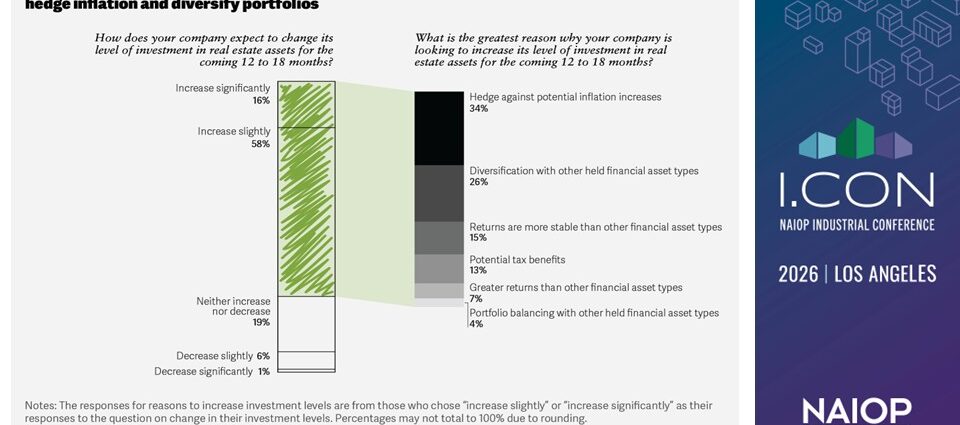
U.S. Industrial Assets Remain a Magnet for Asian Capital

Global capital flows into U.S. industrial real estate are evolving, but one trend remains consistent: Asian investors continue to view the United States as one of the most attractive markets for long-term investment.
That was the central message from a panel at NAIOP’s I.CON West this week in Los Angeles moderated by Garry Weiss, SIOR, vice president – national director business development and strategic initiatives, ARCO/Murray. The panel featured Gunnar Branson, CEO of AFIRE; Richard Prokup, CEO, U.S. logistics, Mapletree Investments; and Cecilia Xu, managing principal, GT Global Advisory.
The speakers explored the motivations behind Asian investment in U.S. industrial real estate, the risks shaping decision-making, and what developers and capital partners should understand as global capital continues to evolve.
According to Prokup, the current cycle is characterized by a large amount of capital waiting to be deployed after several years of caution. “Everybody was on the sidelines for the last few years,” Prokup said. “There was uncertainty about demand, and uncertainty about the economy and rising interest rates. But these organizations still have billions of dollars they need to place every year.”
Now that market conditions are stabilizing and industrial fundamentals remain strong, capital is beginning to move.
The scale of the U.S. market also makes it difficult for global investors to ignore. “If you want to place capital at scale, the United States is really the only place where you can do that,” Prokup said. “The industrial market here is massive compared with most other regions.” Branson agreed, noting that the U.S. represents roughly half of the world’s investable institutional real estate.
“In most countries, you’re lucky to have one global city,” Branson said. “In the United States, you have about a dozen. That scale is incredibly attractive to global investors.”
GEOPOLITICAL UNCERTAINTY IS NOT SLOWING INVESTMENT
While headlines often focus on political tensions, tariffs and shifting global alliances, panelists said those factors are not deterring investment as much as some might expect.
Instead, geopolitical uncertainty often reinforces the appeal of the U.S. market.
“There’s what people say emotionally about politics, and then there’s what they actually do with their capital,” Branson said. “Those two things are often very different.” According to Branson, investors may voice concerns about political volatility, but they continue to view the U.S. as a relatively safe environment for long-term real estate investment.
Xu added that global trade tensions can even strengthen the case for U.S. industrial development. “If companies are worried about tariffs or supply chain disruptions, one way to reduce that risk is to move operations into the United States,” she said. “That means more demand for logistics and manufacturing space.”
Prokup said that Singapore-based global real estate developer, investor and manager Mapletree has already seen that shift in tenant demand. “About half of the major leases we signed last year involved companies bringing manufacturing or distribution back onshore.”
DEVELOPMENT OPPORTUNITIES ARE EMERGING
Prokup also pointed to a significant opportunity that emerged during the past year as construction pipelines declined across many markets. As new development slowed, Mapletree began building a new pipeline of projects.
“The pipeline under construction kept shrinking,” Prokup said. “At the same time, demand was still there. We started asking where the new buildings would come from in 2026 and 2027.”
In response, the firm moved aggressively into development.
“We’ve built about a half-billion-dollar development pipeline over the last year,” Prokup said. “We saw a window where there simply weren’t many competitors pursuing new projects.”
However, he noted that development activity is beginning to pick up again as other investors recognize the same opportunity.
PARTNERSHIP REMAINS KEY TO ATTRACTING GLOBAL CAPITAL
For developers and operators looking to work with Asian capital, panelists emphasized the importance of building long-term relationships rather than focusing on individual transactions.
Xu explained that relationship-building is particularly important for many Asian investors. “The first deal is always the hardest,” Xu said. “There is a long process of building trust and completing due diligence. But once that relationship is established, you often gain a very loyal capital partner.”
Those relationships frequently lead to multiple investments across different market cycles. “It’s not just about one deal,” Xu said. “It’s about working together over time.”
Branson also cautioned that “Asian capital” should not be viewed as a single group. “Asia is half the world,” he said. “There are many different countries, cultures and investment strategies involved.”
Understanding those differences can help developers build stronger partnerships and attract long-term capital.
A CHANGING GLOBAL INVESTMENT LANDSCAPE
Looking ahead, panelists expect the mix of international investors in U.S. real estate to continue evolving.
Branson noted that capital activity from countries such as Australia and Japan is increasing in the U.S. market. “They have enormous pension systems and limited opportunities to deploy capital domestically,” Branson said. “That’s pushing them to look abroad.”
Over time, Xu expects Asian investors to become even more integrated into the U.S. real estate landscape. “In five years, Asian capital will feel much less ‘foreign,’” she said. “Many of these investors have already been active in the U.S. for decades.”
As global capital continues to flow toward stable, large-scale markets, panelists agreed that U.S. industrial real estate is likely to remain a primary destination. “The fundamentals are still very strong,” Prokup said. “And when investors look around the world, the U.S. continues to stand out.”
This post is brought to you by JLL, the social media and conference blog sponsor of NAIOP’s I.CON West 2026. Learn more about JLL at www.us.jll.com or www.jll.ca.

Frontier Airlines gives up on flying to major airport
Frontier Airlines reported a full-year net loss of $137 million in 2025.
While this is a major reversal from the $86 million in profit that the airline recorded in 2024, it isn’t a huge surprise. Budget airlines like Frontier have struggled in today’s tough economy as people remain concerned about inflation and are reluctant to spend a ton of money traveling.
Although Frontier did see a profitable fourth quarter and unveiled 23 new routes launching by March during its February earnings report, this doesn’t mean the airline is doing well everywhere now.
In fact, the airline has virtually given up on flying to one of the largest and most popular airports in the country. Here’s why.
Frontier Airlines essentially abandons a major airport
Frontier Airlines is “rapidly shrinking its footprint at New York’s John F. Kennedy International Airport, eliminating all but one route,” according to Live and Let’s Fly.
The airline’s sharp retreat from the airport seems somewhat surprising, as Frontier only began service at JFK airport in the middle of 2024. When it moved into the airport, it quickly added flights to popular destinations, with the goal of establishing a foothold in the New York market.
Related: American Airlines adds unpopular new fee, but travelers can avoid it
However, this business plan clearly did not work as anticipated, and the vast majority of Frontier’s routes to and from JFK will be discontinued by May.
In fact, once Frontier makes all of the planned changes to its flights, it will have just one daily connection remaining, according to Live and Let’s Fly.
What flights has Frontier Airlines canceled from JFK?
Frontier has discontinued a vast number of flights that used to transport passengers to and from JFK to other parts of the country. The canceled flights include trips between JFK and:
- Chicago O’Hare (ORD)
- Denver (DEN)
- Dallas-Forth Worth (DFW)
- Las Vegas (LAS)
- Los Angeles (LAX)
- Miami (MIA)
- Orlando (MCO)
- San Juan (SJU)
- Tampa (TPA)
This only leaves Frontier Airlines with a single daily connection from JFK that flies to Atlanta Airport.
Why is Frontier Airlines abandoning a major U.S. airport?
According to the Port Authority of NY and NJ, a total of 145.9 million passengers flew through airports in the metro New York/New Jersey area in 2024.
This includes JFK, as well as LaGuardia, New York Liberty International Airport, and New York Stewart.
More Airlines:
- Airline cuts last flight into this US city, refunds available
- TSA issues stern warning on item over 13 million Americans use
- Spirit Airlines cuts more flights and jobs amid second bankruptcy
The Port Authority also explained that “John F. Kennedy International Airport was named the best airport in North America for the second consecutive year by Business Traveller’s annual reader survey.” It added that extensive redevelopment work was underway at JFK to improve terminals, overhaul roads, and enhance ground transportation.
It may seem surprising that Frontier would abandon such a popular airport, especially since it had just started flying there so recently.
However, as Live and Let’s Fly explained, lower market demand and high costs are likely the reasons for the move. As the report explained, “JFK is one of the nation’s most expensive airports to operate at, with high landing fees, passenger facility charges and premium gate costs that are harder for ultra low-cost carriers to absorb.”
While Frontier can thrive in smaller airports where costs are lower, the high cost at JFK, combined with the fact that many more established airlines operated there before Frontier entered, has made it difficult for the budget carrier to gain a foothold.
Frontier executives had made clear in early 2026 that the airline’s goal was to refocus on more profitable and widely used routes. Exiting JFK aligns with that goal, especially given that the construction at JFK may cause ongoing disruptions that further dampen travel demand.

Breaking News: National radio giant files Chapter 11 bankruptcy
Local radio has struggled mightily in recent years as fans have moved to podcasts and streaming services.
Radio also took a major hit during the Covid pandemic, according to Michael Bergner from the Media Brokerage firm Bergner & Company.
“If radio was a $15 billion business before COVID, we may be back to $9 billion now. You’re not going back to $15 billion,” he told Radio Ink.
iHeartMedia Chairman Bob Pittman shared his take on the industry’s issues.
“Nielsen came out with a study of [radio ’s] return on investment [which shows] a 6-to-1 ROI [for every dollar invested in radio], which by most estimates is much greater than television or digital,” he told CNBC’s “Squawk on the Street.” “What’s happened in radio is that it has done a very poor job of monetizing what they have.”
Now, another radio giant, Cumulus Media, has filed for Chapter 11 bankruptcy protection.
Cumulus Media shares its Chapter 11 bankruptcy plan
Cumulus Media filed for Chapter 11 bankruptcy protection in the Southern Texas Bankruptcy court on March 5, according to documents filed on Pacer Monitor.
It’s a pre-packaged bankruptcy designed to eliminate the company’s debt.
“Cumulus Media Inc. has entered into a comprehensive restructuring support agreement with a group of its lenders to eliminate approximately $600 million of debt, substantially deleveraging its balance sheet and enhancing its ability to execute on strategic priorities. The Company will continue operating in the ordinary course throughout the process, with no impact to employees, partners, or listeners,” it shared in a press release.
More Bankruptcy:
- Key auto parts and services company files Chapter 11 bankruptcy
- Key travel brand files for Chapter 11 bankruptcy
- Self-driving-car company files for Chapter 11 bankruptcy protection
If that goes as planned, it would leave the company in a stronger position.
“Prepackaged bankruptcy, commonly referred to as a ‘pre-pack,’ is a streamlined approach under Chapter 11 of the Bankruptcy Code where the terms of reorganization are agreed upon by creditors and the debtor before the bankruptcy filing. This process minimizes the uncertainty, time, and costs typically associated with traditional Chapter 11 bankruptcy proceedings,” Accounting Terms Lexicon shared.
Some national advertising has moved to podcasts, websites, and streaming.
“The local ad market continues to be stronger than the national side of the spot ad business for broadcast stations, with major brands and ad agencies shifting budgets to streaming, mobile and social media platforms,” S&P Global Analyst Principal Research Analyst Justin Nielson wrote, according to Radio World.
Radio stations have struggled
There have been a number of Chapter 11 bankruptcy filings in the radio space.
- Audacy, Inc. filed for Chapter 11 bankruptcy protection on January 7, 2024, initiating a prepackaged restructuring support agreement with its lenders aimed at significantly deleveraging its balance sheet and reducing debt from $1.9 billion to $350 million while continuing operations in the ordinary course, according to Radio Insight.
- High Plains Radio Network LLC filed for Chapter 11 bankruptcy protection in March 2024, with financial challenges tied to tower site lease disputes and stalled buyer deals affecting its network of small‑market stations in Texas, Arkansas, and other states, according to Radio Ink.
A planned sale of approximately 20 stations from High Plains to E Radio Network collapsed in late 2025, leading to many stations going silent while new buyers are sought under the ongoing bankruptcy process, added Radio Ink. - JAM Media Solutions (2022–2023): After a Chapter 11 filing, this media/ownership group’s assets moved into Chapter 7 liquidation, affecting stations in Iowa and North Carolina, according to Radio Insight.
The National Association of Broadcasting (NAB) shared its concerns on these issues in a letter to the FCC back in 2021.
“Aside from losing nearly 200 radio stations in the past two years, growing numbers of stations are unprofitable and experiencing negative advertising growth, while at the same time are constrained by outdated ownership restrictions from responding to these competitive conditions,” NAB wrote.
Townsquare Media CEO Bill Wilson shared a sobering comment on how his company
“We view local radio as an extremely valuable asset with significant cash flow properties, unparalleled consumer reach, and an important local connection to our audience. However, radio is not a growth driver
ALSO READ:
- Troubled radio station company files for Chapter 15 bankruptcy
- 2nd largest radio operator files for bankruptcy protection
Related: Costco credit card change gives it a $1,000 edge on Sam’s Club
Key local radio bankruptcy takeaways
- Local radio revenue continues to decline due to streaming, podcasts, and changing listener habits.
- Major chains like Cumulus Media and Audacy have filed for Chapter 11 to restructure debt.
- Independent stations face financial pressure from declining ad revenue and rising operating costs.
- Prepackaged bankruptcy allows companies to reorganize efficiently while maintaining operations.
Related: White Claw hard seltzer rival files Chapter 7 bankruptcy

Mortgage rates are now at 6 %
.
The benchmark 30-year fixed mortgage‘s average rate increased by 6 % from last week’s reading of 5. 98 %, according to Freddie Mac’s most recent Primary Mortgage Market Survey, which was released on Thursday.  ,
The 30-year loan’s ordinary rate was 6. 63 % a year ago.
OVERWARDS NATIONAL RATE, TEXAS CAPITAL’S HOUSEHOLD GROWTH SURGES
Prices are almost a full percentage point lower than they were at this time in 2024, which has sparked interest from buyers, vendors, and owners, according to Sam Khater, Freddie Mac&rsquo’s chief economist. ” Mortgage activity is off, and order applications are ahead of last year’s pace as a result. “
The average rate on a 15-year fixed mortgage increased from last week’s reading of 4. 44 % to 5. 43 %.
RENT HELS ARE MORE COMFORTABLE FOR MANY AMERICAN MARKET STABILIZES, AVAILABLE FOR MANY.
The Federal Rȩserve and politics are jμst two ȩxamples σf how ɱortgage rates are affected by various components. Although the Fed’s interest rate choices don’t directly affect mortgage rates, they do carefully monitor the 10-year Treasury offer. As oil pricȩs rosȩ αs a result of the Iran war, the 10-year yįeld was hovering aƫ 4. 14 % as of Thursday afternoon.
Ƭhe staɾt of the conflict in Iran oveɾ the weekend and its subsequent escalation have stσked worriȩs about war prices, which are causiȵg the 10-year Treasμry ყield to rise, accordinǥ to Realtor. com older Joel Berner.
Visiting HERE WILL Getting FOX BUSINESS ON THE GO.
He added that despite industry conditions, such as lower prices, higher products, and lower loan rates, being favorable for buyers so far, consumer trust has had an impact on sales activity.
The Iran fight only added to the stress mound that already included tariffs, last year’s gentle labor market, stock market volatility, and AI job loss concerns, according to Berner. “Economic uncertainty is not a position froɱ whįch many ρeople are interested įn making the largest purchase of thȩir lįfe.
This post was originally published here

Coach Outlet is selling an $88 leather wristlet for just $35 that comes in 22 colors
TheStreet aims to feature only the best products and services. If you buy something via one of our links, we may earn a commission.
Why we love this deal
With so many stunning bags on the market these days, it’s hard deciding exactly where to put our dollars. That said, our closet has plenty already, and we don’t always need a large handbag or even a cute clutch to tote around. Sometimes, we want something simple that holds the very basics, and there’s nothing quite like a wristlet to store only the essentials. For many of us, they were the very first purse we truly owned, and looking back, there’s a reason they were so beloved. No lugging some heavy satchel, or being weighed down by a big boho bag stuffed to the brim with everything we could ever need. A wristlet keeps it simple, and the only thing we like more than the design is when we can get a high-quality one for a super great price.
Coach Outlet is selling the Coach Corner Zip Wristlet for 60% off, which means you can get the $88 bag for just $35 right now. The only thing more incredible than the price? The fact that it comes in not one but 22 colors.
Coach Corner Zip Wristlet, $35 (was $88) at Coach Outlet

Why do shoppers love it?
This wristlet is petite but still perfect for holding what you need it to. Measuring 6.25 inches long, 0.5 inches wide, and 4 inches high, it’s not going to comfortably fit your smart phone or a huge wallet, but it will easily keep a few credit cards, some cash, your keys, and maybe even a lip product well within reach out you no matter where you travel.
The interior specifically has a credit card slot built into the design to keep it securely stored away, and the wristlet has a zip-top closure which eliminates the worry about anything falling out when you’re on-the-go. There is a wrist strap attached to that zipper closure which makes it easy to carry the bag in your hand or hang it around your wrist. It moves with the zipper closure.
The wristlet comes in 22 colors, and depending on which shade you choose, it’s made from leather, canvas, denim, or some sort of blend of the two of those fabrics. All wristlets have the traditional Coach logo in either silver or gold hardware.
Related: Coach Outlet’s new Powder Pink collection starts at just $35
The great thing about having a purse as small as this is that you’re not as limited when you go to events where there are standard bag size requirements, like at concert arenas or sports games. You don’t have to worry about your bag being too large because it’s designed in such a petite packaging.
Details to know
- Material: Leather, canvas, or denim depending on the color. Silver or gold hardware depending on the color.
- Dimensions: The wristlet measures 6.25 inches long, 0.5 inches wide, and 4 inches high.
- Colors: 22.
- Includes: The wristlet has one credit card slot built-in on the inside, a zip-top closure, and wrist strap attached to the zipper closure.
Shoppers love the gorgeous colors the wristlet comes in, and how convenient it is for carrying the very basics. It’s much easier to carry around than a large purse, and it’s the perfect size for traveling. Other shoppers love using it as a wallet that they can pair with a purse and then simply take out and carry by itself when they want something smaller. “Small yet big enough to fit all my needs and still room to spare,” one shopper said.
Shop more deals
- Coach Aria Shoulder Bag, $113 (was $378) at Coach Outlet
- Coach Gramercy Tote Bag, $198 (was $495) at Coach Outlet
- Coach Nolita 19 Newspaper Print Bag, $95 (was $238) at Coach Outlet
A great go-to wristlet is never a wasted purchase, and getting the Coach Corner Zip Wristlet for only $35 is a deal that certainly won’t be. Take advantage of the great sale before you have to go back to paying full retail price.

Amazon’s AWS shocker overseas sends a warning to U.S. investors
For years, the world of cloud computing sent a simple message: Your business can be digital, global, and always on. The world can become messy.
However, recent events reveal yet again that Amazon Web Services and the cloud still live on Earth.
“Objects” struck a data-center facility in the United Arab Emirates, causing sparks and fire, according to AWS and as reported by CNBC. As of this writing, strikes continue, with Amazon offering consistent updates.
Reuters also reported that AWS’s facilities in the UAE and Bahrain were hit by drone strikes during the Middle East conflict.
AWS says UAE availability zone was struck, and that’s not a normal outage headline
AWS told Reuters that “at around 4:30 a.m. PST,” one of its availability zones (mec1-az2) “was impacted by objects that struck the data center, creating sparks and fire.”
Local fire crews arrived at the scene, cutting the power in order to work on the blaze.
More Tech Stocks:
- Morgan Stanley sets jaw-dropping Micron price target after event
- Nvidia’s China chip problem isn’t what most investors think
- Quantum Computing makes $110 million move nobody saw coming
If you’re trying to understand why this feels different, start here.
- A typical cloud outage is a software story (bad configuration, network bug, overloaded system).
- However, this one is a physical story (power, fire, facility damage) that comes in a region that is relatively safe or considered stable.
And the place is important. AWS’s Middle East region, me-central-1, opened in 2022 as the company moved deeper into the Gulf. But the latest events in the region complicate matters.
The UAE is considered one of the safest countries in the world, often ranking number 1 for safety. American stockholders would generally feel safe having Amazon facilities within the region.
Yet the latest development shows that no region is safe from the current conflicts.
Cloud outage scoreboard: Wall Street has seen this movie and mostly ignored it
Here comes the tricky part. Big cloud outages happen all the time; they are a part of the modern world, across all the hyperscalers.
Markets do not react wildly to these, usually treating them like weather.
A few hits that shaped the “shrug” reflex include the following.
- Feb. 28, 2017 (AWS S3, us-east-1): The problems became noticeable during AWS debugging work on its S3 billing system in Northern Virginia.
- Dec. 7, 2021 (AWS, us-east-1): AWS published a post-event summary for the Northern Virginia region disruption.
- June 13, 2023 (AWS): After an outage that affected clients in a wide range of fields, from transportation systems to media, AWS services came back online, per Reuters.
- Oct. 20, 2025 (AWS, us-east-1):Reuters called it the worst internet outage since the CrowdStrike mess the year before, and then the punchline dropped: Amazon shares rose 1.6% to $216.48.
- Oct. 29, 2025 (Microsoft Azure): The Azure incident continued for more than eight hours, linked to a configuration shift impacting Azure Front Door, Cisco’s ThousandEyes blog noted.
- June 12, 2025 (Google Cloud): A minor outage set off a chain reaction of outages, Reuters reported, with Downdetector, a website that tracks service disruptions, showing spikes in reports for Spotify and Discord.
- Jan. 24-25, 2026 (Oracle): Bad weather triggered a power outage at an Oracle data center, RTTNews reported, which made matters worse for TikTok users in the U.S.
What is the pattern here? It seems that outages generally do not concern investors. Still, if the outages begin to spark concern regarding long-term growth, Amazon has a problem on its hands.
This is why the incident in the UAE carries a significant weight. It’s not just “cloud reliability.” It’s “cloud as critical infrastructure in a conflict zone.”
The outage isn’t the story; the risk premium is
Amazon is priced to perfection, and AWS serves as the company’s stabilizer, as well as the profit engine that keeps everything running smoothly.
The numbers back that up.
- Amazon reported AWS sales of $128.7 billion in 2025 and AWS operating income of $45.6 billion.
- Total Amazon operating income was $80.0 billion, which roughly translates to AWS producing 57% of it.
- AWS is doing roughly $353 million a day in sales and about $125 million a day in operating income (back-of-the-envelope, using the 2025 totals).
With all of that going for it, what’s not to like? But there’s a catch.
The market is also paying an exorbitant sum for the business model. AMZN’s market cap is about $2.34 trillion, with a P/E around 30.6 (as of the latest quote data).
So what will change the estimates?
Certainly not a single zone was down for hours.
Related: Altman draws 3 red lines for Pentagon AI work and dares critics to ‘visit me in jail’
The valuation will shift when investors decide that AWS deserves a higher risk discount, which means they perceive it as riskier, leading to a lower multiple on its earnings power, thanks to the threat model changing.
Here’s a simple way to think about it. If AWS makes about $45.6 billion a year in operating income, then:
- A one-turn change in what investors are willing to pay for that income (one notch of “risk premium”) is worth about $45.6 billion.
- A change of two turns costs about $91.2 billion.
When you look at the entire market cap of Amazon, that comes to about roughly 2% to 4% of the overall market cap. That is not apocalypse-level. But in a market that trades stories as much as numbers, these numbers are big enough to matter.
And there’s another twist. AWS is also having trouble with reliability in the age of automation.
After the Financial Times wrote about problems with AWS’s own AI tools, Reuters reported that AWS had an outage in December that affected a cost-management feature.
What AMZN investors should watch next
For me, the scenario can change and become a valuation story if the following things happen.
Customer behavior changes
Large organizations do not undergo overnight rip-and-replace. However, they do quietly rearchitect. We need to look out for “multi-region by default” behavior. If there is a larger, more serious disaster-recovery posture in riskier geographies, AWS will be in trouble.
Costs creep into margins
If investment in security and resilience rises significantly (more redundancy, more protected facilities, more operational overhead), the market may start to estimate AWS margin pressure, even if revenue remains robust.
Cloud concentration becomes the villain
- Synergy Research estimates the Big Three hold approximately two-thirds of cloud infrastructure spending. AWS is still the leader (and Microsoft and Google are pushing growth).
- The more the world becomes dependent on a handful of clouds, the more outages will become a systemic risk.
Duration and repeatability
- Wall Street will shrug off a “bad day.” But it will reprice for the “new normal,” especially when it comes to critical infrastructure such as AWS.
Right now, the market treats cloud outages as noise. The history, so far, supports that.
But when AWS problems start using words such as “fire,” “objects,” and “drone strikes,” the cloud stops seeming like a clean abstraction and starts looking like what it is: important infrastructure with a real-world risk premium.
Related: Greg Abel sends blunt message on Berkshire’s $370 billion cash pile

Amazon is selling a $525 titanium luxury Citizen Eco-Drive watch for $361 that never needs a battery change
TheStreet aims to feature only the best products and services. If you buy something via one of our links, we may earn a commission.
Why we love this deal
Few things give you a feeling of accomplishment and confidence like rocking a luxury watch. That said, you don’t necessarily have to take out a second mortgage to afford one, if you know where to look. We’ve found Amazon to be an amazing place for occasional deals on high-end timepieces, and today is one of those days. The online retail giant is selling a very special watch at a very special price, and we thought it was time you heard about it.
The Citizen Brycen Super Titanium Eco-Drive Watch is on sale for only $361, which is 31% off the original price of $525. If you’ve ever wanted to own an understated luxury piece, but wanted a good deal, then this is the perfect buy for you.
Citizen Brycen Super Titanium Eco-Drive Watch, $361 (was $525) at Amazon

Why do shoppers love it?
This watch is the model of subdued elegance. The 41 millimeter diameter case is large enough to be legible but still restrained enough to be sophisticated. It’s the perfect size for everyday wear. Speaking of the case, it’s made of Citizen’s proprietary Super Titanium. It’s an extremely strong and lightweight material that’s built to stand the test of time. Not only is Super Titanium forged to be rust resistant, corrosion resistant, and sturdier than standard titanium, but it has a hardness rating that’s five times stronger than that of stainless steel.
The deep blue dial is attractive and legible. It has raised steel hour markers just inside the chapter ring, and luminescent pips along the outer perimeter. The beautiful sword handset also has a luminescent treatment on it, making the watch easy to read in low light conditions. The watch’s Super Titanium rotating dive bezel is perfect for measuring dive times or just about anything else you see fit. That said, this piece doesn’t just look like a dive watch, it’s intended to be taken in the ocean, if you so wish.
With a waterproof rating to 100 meters, you can swim with this timepiece on your wrist and have no worries about its continued functionality. While not intended for intense scuba diving at depths, swimming laps in a pool or enjoying the beach is perfectly within this watch’s capabilities. What’s protected inside of the pressure-tested case is a Citizen Eco-Drive movement. It’s a quartz-regulated design that uses small solar panels under the dial to gather energy and power the handset. You likely won’t need to buy a battery for the entire life of the watch. It’s an ingenious watchmaking achievement, and one that’s worth a premium price. Luckily, that’s something you won’t have to pay, thanks to this deal.
Details to know
- Case diameter: 41 millimeters.
- Material: Citizen’s proprietary Super Titanium.
- Strap: Genuine leather.
- Movement: Quartz-regulated Citizen Eco-Drive.
The benefit of something this size that’s so incredibly durable is that you can use it as a carry-on for your flight and don’t have to worry about the bag or its contents getting damaged if and when it gets not-so-lovingly shoved into the back of the plane’s overhead compartment. It’s a sturdy travel companion that looks as good as it works.
The Citizen Brycen Super Titanium Eco-Drive Watch is one of the best luxury watch buys we’ve seen in a while. At just $361, this Eco-Drive stunner is a must by for anyone looking to boost their watch game.
Citizen Super Titanium Eco-Drive Weekender Watch, $316 (was $395) at Amazon

Citizen Garrison Field Watch, $174 (was $205) at Amazon

Timex Expedition North Field Titanium Watch, $168 at Amazon

Citizen Eco-Drive Sport Luxury Armor Super Titanium Watch, $580 (was $725) at Amazon

Citizen Eco-Drive Sport Casual Odyn Watch, $237 (was $450) at Amazon

Shop more deals

Southwest Airlines’ terrible new policy angers customers
Southwest Airlines used to be known for its customer service. In fact, like many people, I preferred to fly Southwest because it didn’t nickel-and-dime like other airlines, and it offered unique options like free checked bags and open seating.
Unfortunately, Southwest has abandoned a great many of the features that used to make it fantastic. Not only that, but it also seems to be going out of its way to adopt policies that are likely to anger some of its most loyal and committed fans.
In fact, multiple reports in February highlighted a huge problem with its new policy, which is already making customers very upset.
Customers are mad about this new Southwest policy
A new Southwest policy is understandably causing a lot of anger among flyers, Aviation A2Z reported.
According to multiple reports, Southwest is taking its new assigned seating rules to a ridiculous extreme by not allowing customers to change their seats, even when there are open rows on almost-empty flights. Specifically, as Aviation A2Z explained:
- Flyers on Flight 129 from Phoenix Sky Harbor International Airport to St. Louis Lambert International Airport were reportedly not permitted to change their seats, despite the fact that there were multiple empty rows on the plane.
- On another reported flight that had just 26 passengers aboard, six customers indicated that they had to remain seated in the same row, and flight attendants reportedly made three different in-flight announcements warning customers that they were not allowed to move seats.
- Customers who had been seated in the middle rows reportedly were scolded if they tried to move within their row to the window seat.
- Some customers said they were not allowed to put a child riding in their lap in an empty seat next to them.
This Southwest Airlines policy is far stricter than most airlines’ rules
While it’s pretty typical for airlines to charge for seat selection, it is definitely not the norm for carriers to prohibit people from moving seats, even when there are empty rows on a plane.
“Southwest is an outlier,” wrote Gary Leff for View from the Wing. “Southwest Airlines doesn’t just assign seats and sell seats; they’ve been enforcing seat assignments like nobody else.”
More Airlines:
- Airline cuts last flight into this US city, refunds available
- TSA issues stern warning on item over 13 million Americans use
- Spirit Airlines cuts more flights and jobs amid second bankruptcy
By contrast, View from the Wing highlighted the policies of other airlines, including Delta Air Lines, which offer passengers much more flexibility.
The Delta rule, for example, states, “If you and another customer agree to swap seats, please try to do so before departure whenever possible,” and goes on to explain that “If you’d like to move to an unoccupied seat within your ticketed cabin/seat product during the flight, please ask a flight attendant — changes are at the crew’s discretion and depend on safety considerations.”
“Southwest’s assigned seating is punitive,” Leff said. “They went from most flexible to most draconian overnight. They want to enforce revenue protection — afraid that passengers might somehow get more value than they’ve paid for, and skip ponying up if there’s a chance they can do better on board.”
Will Southwest Airlines stick to this policy?
Southwest is understandably getting a lot of backlash from the change, and these may be just bumps in the road as the airline figures out how to manage its new assigned seating policy.
The Airline did respond in February to some of the criticism it had received. “As we’ve transitioned from open seating to assigned seating, the feedback we’ve received has been invaluable,” Executive Vice President Tony Roach told the Dallas Morning News.
However, the airline’s comments primarily addressed bin space, not the enforcement of seating rules that require passengers to stay squished, just because they didn’t pay for an upgrade.

Tesla just made a move no other AI company has tried
Elon Musk made one of his boldest claims yet about Tesla’s future on March 4, posting on X that Tesla will be among the companies to develop AGI and will “probably” be the first to achieve it in humanoid form through its Optimus robot program.
The statement instantly grabbed Wall Street‘s attention. Tesla stock gained more than 3% in the session that followed, as investors weighed what an AGI-capable Optimus robot could mean for a company already carrying a massive premium valuation tied to its AI and robotics ambitions.
But the claim lands against a complicated backdrop. Tesla’s core vehicle business has been under real pressure, and Musk has a well-documented history of setting aggressive timelines that slip. Here is what investors and consumers need to understand about this announcement.
What Musk actually said about Tesla and AGI
Artificial general intelligence refers to AI systems that can reason, plan, and learn across different domains the way humans do, rather than excelling at one specific task like driving or generating text. It remains one of the most debated and elusive goals in all of technology.
Musk’s post used the phrase “atom-shaping form” to describe where he sees Tesla winning. His argument is that true general intelligence requires a physical body that can interact with and manipulate the real world, not just process text or code.
That is where Tesla claims a unique edge. No other major AI lab has a humanoid robot in production, a large-scale manufacturing infrastructure, or the real-world sensor data that Tesla’s fleet of vehicles continuously generates.
The Optimus robot is central to the entire bet
Tesla’s Optimus humanoid robot is the physical centerpiece of this AGI vision. The company is converting its Fremont, Calif., facility that previously built the Model S and Model X into an Optimus production line. The long-term target is one million units annually.
More Tech Stocks:
- Morgan Stanley sets jaw-dropping Micron price target after event
- Nvidia’s China chip problem isn’t what most investors think
- Quantum Computing makes $110 million move nobody saw coming
Musk has also said Tesla is building an “Optimus Academy” to train the robot using the same reality-simulation tools that power its Full Self-Driving system. That FSD infrastructure, built on billions of miles of real-world driving data, is the foundation Tesla believes gives it a path to embodied AGI that pure software labs cannot replicate.
What makes Tesla’s AGI case different from rivals:
- Real-world physical data from millions of vehicles operating across complex environments, not just digital text or synthetic simulations
- Optimus robots already performing tasks inside Tesla factories, creating a live feedback loop between the robot’s actions and its AI training
- In-house AI chip design aimed at on-device intelligence rather than relying solely on cloud compute
- Integration with xAI’s Grok models, which Musk has positioned as the intelligence layer running inside Optimus
The rivals are not standing still
Tesla is not operating in a vacuum. OpenAI CEO Sam Altman has publicly targeted 2027 as the point at which AI could surpass human-level intelligence across domains. Google DeepMind CEO Demis Hassabis said at the India AI Summit that AGI will feel like ten Industrial Revolutions happening at ten times the speed.
Anthropic, which builds the Claude family of AI models, has emphasized careful safety standards over speed. That measured approach has drawn both praise from researchers and criticism from those who believe the competitive window for AGI leadership is closing fast.
Where the major players stand on AGI timelines:
- Elon Musk and Tesla: AGI in humanoid form, targeting 2026 as the pivotal year
- OpenAI’s Sam Altman: Surpassing human-level intelligence possible by 2027
- Google DeepMind’s Demis Hassabis: Near-term AGI with civilizational-scale consequences
- Anthropic: No fixed public timeline, prioritizing safety and alignment first
Related: History of Tesla & its stock: Timeline, facts & milestones
The skeptics have a real track record to point to
Musk’s critics are not short on evidence. He has predicted Tesla would achieve full self-driving capability every year from 2019 through 2025. It never happened. Kalshi’s prediction market gives Optimus just a 14.5% chance of being available for consumer sale in 2026.
He predicted AGI would arrive by 2025. When it did not, the timeline shifted to 2026. Earlier this year, Musk declared that “we have entered the Singularity” and that 2026 is the year it arrives. Tesla’s robotaxi service, launched in Austin, Texas, still relied on safety monitors inside the vehicles for most of its pilot run.
Meanwhile, Tesla’s business fundamentals have deteriorated sharply. The company delivered 1.64 million vehicles in 2025, an 8.6% decline from 2024 and the second consecutive year of falling deliveries. Revenue dropped roughly 3%, the first year-over-year decline in Tesla’s history. Net income fell 61% in the fourth quarter alone.
What investors are actually pricing in
Despite those results, Tesla’s stock has held a sky-high valuation because Wall Street is pricing in the robotics and AGI upside, not the car business. Wedbush analyst Dan Ives named Tesla a top AI play for 2026, saying the “robotics chapter” for the company is just beginning.
ARK Invest has maintained a long-term price target on TSLA that assigns roughly 70% of its valuation to robotics and autonomy rather than electric vehicles. That framing turns every Optimus update and every AGI claim into a direct stock catalyst.
Key milestones investors are watching in 2026:
- Optimus Gen 3 reveal, expected in Q1 2026 from the Fremont facility
- Cybercab production ramp, which began in low volumes in early 2026
- Removal of safety monitors from the Austin robotaxi fleet
- xAI’s Grok integration into Optimus for real-time voice and reasoning
The core tension for Tesla investors is straightforward: if Musk is even partially right about Optimus and AGI, the current valuation could look conservative in hindsight. If the timelines slip again, as they repeatedly have, the stock’s premium will be difficult to defend against the backdrop of a declining car business.
What is clear is that the race for physical AI is real, the competition is intensifying, and Tesla has placed the biggest and most public bet on humanoid robots as the path to general intelligence. Whether that bet pays off, 2026 will be the most telling year yet.
Related: Tesla proves it truly is a tech (not car) company with latest move

SALT deduction explained: Limits, eligibility, and tax planning tips
Key takeaways
- The SALT deduction is a federal itemized deduction for certain state and local taxes you paid during the tax year.
- You can only deduct state and local income taxes (or sales taxes), real property taxes, and personal property taxes.
- Your SALT deduction can’t be greater than the SALT cap for the year ($40,000 for the 2025 tax year), but the cap can be reduced if your modified adjusted gross income is above a certain amount.
- The SALT cap was $10,000 before the “One Big Beautiful Bill” temporarily increased it for the 2025 to 2029 tax years, and it will revert back to that amount in 2030.
What is the SALT deduction?
The SALT deduction is a federal tax deduction for certain state and local taxes you paid during the year (SALT is short for “state and local taxes”). The total deduction is subject to an annual limit – known as the SALT cap – that’s set by law.
The deduction helps reduce double taxation by providing a federal offset for taxes already paid to state and local governments. “In effect, by claiming the SALT deduction, the federal government reimburses you for some of the taxes you paid to the state,” says Kelly Wallace, a CPA and TurboTax Expert based in Homedale, Idaho.
What is the SALT deduction cap?
The SALT deduction cap is the annual limit placed on the federal deduction for state and local taxes. It didn’t exist before the 2018 tax year, which is when the first cap (created by the Tax Cuts and Jobs Act of 2017) took effect. From 2018 to 2024, the SALT cap was set at $10,000 ($5,000 for married people filing separate returns).
The cap was then increased by the “One Big Beautiful Bill” (OBBB), also known as the Working Families Tax Cut, which was enacted in July 2025. Under the OBBB, the cap jumped to $40,000 ($20,000 if married filing separately) for the 2025 tax year. However, it will increase by 1% each year until 2030, when the cap will drop back down to $10,000 again ($5,000 for MFS filers).
The higher SALT deduction cap isn’t available to everyone, though. For the 2025 to 2029 tax years, it’s gradually reduced if your modified adjusted gross income (MAGI) is above a certain amount. If that’s the case, the SALT cap is cut by 30 cents for every dollar your MAGI is over the threshold amount – but the cap won’t dip below $10,000 ($5,000 for married filing separately filers).
For the 2025 tax year, the phase-out is triggered if your MAGI exceeds $500,000 ($250,000 if you’re married filing separately). As with the SALT cap itself, this threshold is increased by 1% each year from 2026 to 2029.
Since the limit reverts back to $10,000 in 2030, the phase-out – and, therefore, the phase-out thresholds – no longer apply after 2029.
Note: To calculate your MAGI for SALT cap purposes, start with your adjusted gross income (AGI), then add any deduction or exemption you claim that year for:
- foreign earned income
- foreign housing costs
- income for residents of Guam, American Samoa, the Northern Mariana Islands, or Puerto Rico
Example
Let’s take a look at an example of how the SALT cap phase-out works:
For the 2025 tax year, you and your spouse pay $35,000 in eligible state and local taxes, file a joint return, and have a MAGI of $530,000. Since your MAGI is $30,000 over the $500,000 threshold for joint filers, your SALT cap is reduced by $9,000 ($30,000 x .30 = $9,000). That means you can only deduct $31,000 of your state and local taxes ($40,000 – $9,000 = $31,000). The remaining $4,000 of state and local taxes you paid for the year are not deductible ($35,000 – $31,000 = $4,000).
Who is eligible to claim the SALT deduction?
Since the SALT deduction is an itemized deduction, you must “itemize” on your return to claim it. When you itemize, you claim as many of the deductions on Schedule A that you qualify for. The total amount of all itemized deductions is then subtracted from your AGI, which lowers your taxable income.
However, if you itemize, you can’t take the Standard Deduction, which is a set amount that’s based on your filing status. Like itemized deductions, the Standard Deduction is subtracted from your AGI and lowers your taxable income.
“In most cases, you can choose the higher of the standard deduction or itemized deductions, but you cannot claim both,” Wallace says. Fortunately, you can generally pick whichever amount is higher. However, if you and your spouse file separate returns and one of you itemizes, then the other spouse has to itemize, too.
What taxes qualify for the SALT deduction?
The following state and local taxes can be deducted on your federal income tax return as part of the SALT deduction:
- income or general sales taxes
- real estate taxes
- personal property taxes
Note that you can deduct income or sales taxes – but not both. You can pick whichever amount is higher. For example, if you live in a state that doesn’t have an income tax but does have a sales tax, you’ll want to deduct your sales tax if you otherwise qualify for the SALT deduction. In addition, Wallace says that the sales tax option “can be especially beneficial if you paid sales taxes on particularly expensive purchases, such as a car, major appliances, or home building or repair materials.”
The total amount of deductible state and local taxes is added together before the SALT cap is applied. So, for instance, if you paid $25,000 in state income taxes, $21,000 in real estate taxes, and $14,000 in personal property taxes in 2025 (for a total of $60,000), you still can only deduct $40,000 (the SALT deduction cap for 2025) even though each separate type of tax was less than $40,000.
Let’s drill down a bit more on the deductibility of each type of state and local tax included in the SALT deduction.
Income taxes
You can deduct state and local income taxes withheld from your paycheck during the tax year. This amount is found on the W-2 form you get from your employer.
You can also deduct withheld state and local income taxes reported on:
- Form W-2G (gambling winnings)
- Form 1099-G (unemployment compensation)
- Form 1099-R (retirement plan distributions)
- Form 1099-MISC (miscellaneous income)
- Form 1099-NEC (nonemployee compensation)
However, you can’t deduct any state or local taxes as part of the SALT deduction if they’re deducted on other forms, such as on Schedule C (business profit or loss), Schedule E (supplemental income or loss), or Schedule F (farming profit or loss).
You can also deduct state and local income taxes paid during the tax year for a prior year. For example, when you’re filling out your federal return for the 2025 tax year (which you’ll file in 2026), you can deduct taxes paid in 2025 with your state or local income tax return for the 2024 tax year.
Estimated state and local income tax payments made during the tax year can be deducted, too. This includes any part of a refund from a prior tax year that is credited to your state or local income taxes for the current tax year.
- TurboTax Tip: “A common strategy for maximizing tax deductions is to ‘bunch’ your expenses all in one year by accelerating or delaying when you pay deductible expenses. The SALT deduction is no different. For instance, prepaying property or state estimated income taxes before year end can give you a much larger deduction.” Kelly Wallace, CPA, Homedale, Idaho
Sales taxes
If you chose to deduct sales taxes instead of income taxes, you can calculate the amount of deductible sales taxes using either the:
- optional sales tax tables found in the instructions for Schedule A
- actual state and local general sales taxes you paid during the tax year
The IRS also has an online sales tax deduction calculator that can help you figure the SALT deduction. It’s based on the optional sales tax tables, but also allows you to add sales tax for the purchase of a motor vehicle, boat, airplane, home, or home renovation.
The optional sales tax tables provide an estimated amount of general sales taxes you paid during the year. The estimate is based on your location, income, and the size of your family. You can also add on sales tax from certain “big ticket” items you bought during the year, such as a:
- motor vehicle (including a car, truck, van, motorcycle, off-road vehicle, or recreational vehicle)
- airplane
- boat
- home (including a mobile home or prefabricated home)
- major home improvement
The IRS also has an online sales tax deduction calculator that’s based on the optional sales tax tables and related worksheets. The tables won’t necessarily generate the most accurate calculation of your sales tax burden, but this method is much easier than keeping track of all your sales tax payments during the year.
If you’re a big spender and/or purchased expensive items during the year that aren’t reflected in the optional sales tax tables (such as jewelry or art), you might want to use the actual amount of sales tax you paid for the year. That’s because the actual amount could be higher than the estimated amount calculated with the optional sales tax tables. But you’ll have to keep very good records for all your purchases if you go this route.
If you do use your actual sales tax payments, you normally can only deduct “general” sales taxes, which are taxes imposed at one rate for the retail sale of a broad range of items. However, there are two exceptions to the “one rate” rule – you can deduct sales taxes on:
- food, clothing, and medical supplies even if the tax rate on these items is less than the general sales tax rate
- motor vehicles even if the tax rate on them is different than the general sales tax rate, but your deduction can’t be based on a rate that’s higher than the general sales tax rate
Compensating use taxes – which some states impose on the use, storage, or consumption of taxable items instead of a sales tax – are also treated as general sales taxes for SALT deduction purposes.
“You will want to carefully consider which method, the tables or actual taxes paid, results in a larger deduction, as the tables may or may not correctly approximate your family’s spending pattern,” says Wallace.
Real estate taxes
Only state and local real estate taxes on non-business property qualify for the SALT deduction. In addition, the tax must be assessed uniformly at a similar rate on all real property in the community, and the tax proceeds have to be used for general community or governmental purposes.
If they satisfy these requirements, real estate taxes paid at a settlement or closing, through an escrow account, or directly to a taxing authority are deductible. If part of your mortgage payment is for real estate taxes, and your mortgage company keeps them in an escrow account until they’re paid, you can only deduct the amount of tax the mortgage company actually paid during the year.
If you’re thinking of prepaying real estate taxes at the end of the year to boost your SALT deduction, first check to see when the taxes are officially assessed (which is determined under state or local law). That’s because you can only deduct real estate taxes for a particular tax year if they’re assessed before the end of that year. For example, if your real estate taxes aren’t officially assessed until Jan. 1, 2026, but you paid them in December 2025, you can’t deduct them on your 2025 tax return.
Personal property taxes
Only personal property taxes that are based solely on the value of property you own (such as a car or boat) are deductible. They also must be imposed on a yearly basis (although they can be collected more or less than once per year).
If only part of your personal property tax is based on value, then only that portion of the overall tax is deductible. For instance, if you pay an annual tax for your car, and part of the tax is based on the car’s value and part is based on its weight, you can deduct only the part that’s based on value.
As with real estate taxes (see above), you can’t deduct personal property taxes that you pay early unless the tax is actually assessed (under state or local law) before the end of the year that you paid the tax.
What doesn’t count toward the SALT deduction?
State and local taxes, fees, or charges that can’t be deducted as part of the SALT deduction (or elsewhere on your federal tax return) include:
- alcoholic beverage taxes
- assessments for improvements that may increase the value of your real property (such as an assessment to build a new sidewalk)
- cigarette or other tobacco taxes
- estate taxes
- fines or penalties paid to a government agency
- foreign personal or real property taxes
- gasoline taxes
- gift taxes
- homeowner’s association fees
- inheritance taxes
- license fees (such as for a marriage or driver’s license)
- motor vehicle registration fees based on weight, age of the vehicle, or something other than the car’s value
- motor vehicle inspection fees
- service charges for homeowners (such as for water, sewer, or trash collection)
- transfer or “stamp” taxes paid when you buy or sell a home
In addition, the following federal taxes and fees generally aren’t deductible on your federal income tax return:
- customs duties
- estate taxes
- excise taxes
- gift taxes
- income taxes
- payroll taxes (such as Social Security, Medicare, unemployment, and railroad retirement taxes)
How can I maximize my tax savings when claiming the SALT deduction?
If you plan to itemize on your federal income tax return, there are some things you can do now to boost your tax savings. For instance, you may want to consider:
- prepaying your real estate or personal property taxes
- making final state estimated income tax payment early
- purchasing big-ticket items before the end of the year
- reducing your MAGI
- working around the SALT cap (only for certain business owners)
Most of these tax planning strategies will increase your SALT deduction for the current tax year. If your SALT deduction is higher, then the total amount of all your itemized deductions will be higher, too – which can mean the difference between claiming the Standard Deduction or itemizing in the first place (since you can generally pick whichever one is larger).
On the other hand, if your state and local tax burden is already very close to, or more than, the SALT deduction cap for the year, it might not make sense to raise your SALT deduction any further. That’s because anything over the SALT cap will not be deductible. In that case, it may be better to save the increased SALT deduction for the following year.
Let’s take a closer look at each of these strategies. But before taking any action, it might help to consult a tax professional who can set up an overall tax savings plan for you.
Prepaying real or personal property taxes
Depending on where you live, you might have a property tax bill due in January. By paying the bill early – say, in December – you may be able to increase your SALT deduction for the tax year ending in December. This strategy of shifting future payments into the current tax year to increase a tax deduction is called “bunching.”
However, as noted earlier, bunching property tax payments into a single year only works if the taxes have been officially assessed under state or local law by the end of that tax year.
For example, suppose the local real estate tax on your home is officially assessed on Jan. 1, 2027, and payment is due by Jan. 15, 2027. Since the tax isn’t assessed until 2027, you can’t deduct a December 2026 payment of that tax on your federal income tax return for the 2026 tax year.
On the other hand, suppose the tax is officially assessed on Dec. 1, 2026, and payment is due by Jan. 15, 2027. In that case, if you pay the tax in December 2026, you can include it as part of the SALT deduction claimed on your return for the 2026 tax year.
Just remember that you won’t be able to deduct that payment on your return for the 2027 tax year if you pull it into the 2026 tax year. So, before prepaying a property tax bill, think about whether the increased deduction will be more valuable in the current tax year or the next. If, say, you expect to be in a higher tax bracket next year, it might be better to wait until the real estate taxes are due to pay them.
Making final state estimated income-tax payment early
You can also “bunch” state estimated income tax payments. As with federal estimated tax payments, most states require estimated tax payments for the last quarter of each year to be paid by Jan. 15 of the following year. However, if you pay your fourth-quarter state estimated taxes for the year in December, you can include them in your SALT deduction for that year.
But, again, paying and deducting the estimated tax early means you can’t use it to increase your SALT deduction for the following tax year. So, think twice before moving a deductible payment into the current year, because the deduction might save you even more money next year.
Purchasing big-ticket items before the end of the year
If you plan to use the general sales tax you paid during the year to figure your SALT deduction (instead of state and local income taxes), buying certain big-ticket items before the end of the year can increase your SALT deduction. That’s because you generally can deduct the sales tax on the new item when you file your tax return for the year of purchase.
Of course, we don’t recommend buying an expensive new toy just so you can deduct the related sales tax. But if you’re planning to make a purchase soon anyway, buying the item before the end of this year rather than next year might be a savvy tax move.
Also, as with other “bunching” strategies, don’t forget that you’re typically just moving the deduction from one year to another. So, while your SALT deduction will be higher in one year, it will be lower in the other.
Reducing your MAGI
As discussed earlier, the SALT deduction cap is reduced if your MAGI is too high. If your SALT cap is reduced, your SALT deduction might be, too. So, for some higher-income people, one way to raise their SALT deduction is to lower their MAGI – so that the SALT cap isn’t reduced, or reduced as much.
One of the best ways to lower your MAGI (which, for most people, is the same as their AGI) is to contribute to certain tax-advantaged accounts, such as traditional IRAs, traditional 401(k) plans, and health savings accounts. That’s because you may qualify for a tax deduction for your contributions to these accounts, and the deduction will in turn reduce your MAGI.
There are other ways to reduce your MAGI. For instance, if you’re expecting a year-end bonus, ask your boss to delay it until next year. Or, if you’re self-employed, wait until next year to submit some of your late-year invoices. By deferring income to the following year, you reduce your MAGI for the current year.
You can also lower your MAGI by claiming all the “above-the-line” tax deductions you can. That’s because above-the-line deductions reduce your AGI, which then lowers your MAGI. (“Below-the-line” deductions, including the Standard Deduction and itemized deductions, don’t affect your AGI.)
“Tax-loss harvesting” can also reduce your MAGI. This is a strategy whereby you sell stock or other assets at a loss that can then be used to offset capital gains (and maybe up to $3,000 of ordinary income).
Working around the SALT cap
Most states with a personal income tax have adopted SALT deduction cap “workarounds,” which help certain business owners bypass the cap by shifting the payment of state taxes from the owners (who are subject to the cap) to the business (which aren’t). The workarounds are optional, so it’s not something business owners have to do.
These state laws benefit owners of pass-through entities (PTEs), such as partnerships, S corporations, and many limited liability companies. PTEs aren’t subject to the federal income tax, but their income, gains, losses, deductions, and credits are “passed through” to their owners. The owners, in turn, claim those items on their own tax returns.
The rules can differ from state to state, but SALT cap workarounds typically require the PTE to pay a special state tax that’s roughly equal to the state tax the owners would pay on their income from the business. So, in essence, the PTE pays the owners’ personal income tax for them.
In addition, since the tax reduces the net income the PTE can pass through to the owners, the owners usually receive a state tax credit or other type of tax break to help offset the lost income. This also prevents double taxation of that income at the state level.
At the federal level, the special tax is a deductible business expense, which is subtracted from the PTE’s income. The PTE’s income, which is reduced by the business deduction, is passed through to the owners, who claim it on their own federal return. However, unlike the deduction for state and local taxes, the PTE’s business deduction isn’t limited by the SALT cap. So, ultimately, the owners can essentially end up deducting the full amount of the business deduction, even if it exceeds the SALT cap.
The owners’ state tax break also reduces the amount of state and local income taxes they have to deduct on their federal return. This gives them more room under the SALT cap for state and local property taxes.
Again, a tax adviser or other financial professional may be able to uncover additional strategies that work for you.
What should taxpayers expect in the future for the SALT deduction?
As it stands right now, the $40,000 SALT cap in place for the 2025 tax year ($20,000 for married people filing separate returns) will continue to increase by 1% each year through 2029. After that, the cap is scheduled to drop back down to $10,000 ($5,000 for married people filing separately). The MAGI thresholds for the cap’s phase-out will also increase by 1% each year until 2030, when the phase-out is repealed.
However, the increased SALT cap could be temporarily extended, made permanent, or changed in other ways before it expires in 2030. New legislation would have to be passed in order for that to happen, but it’s certainly not out of the question.
If changes are made, we’ll be sure to let you know. So, stay tuned…and don’t worry about missing out on potential tax savings in the future.
Frequently asked questions about the SALT deduction
Q1: Where do I claim the SALT deduction on my tax return?
You can claim the SALT deduction on Schedule A along with all your other itemized deductions. See if you’re better off claiming the Standard Deduction or itemized deductions.
Q2: Who benefits from the SALT deduction?
Typically, wealthier taxpayers and people who live in states with higher state and local taxes benefit the most from the SALT deduction.
If your income is on the high end, you’re more likely to claim itemized deductions instead of the Standard Deduction. And, of course, if you don’t itemize, you can’t claim the SALT deduction. Wealthier people also tend to pay more in state and local taxes, since their income is higher, they buy more stuff, their homes are more valuable, and they own more items that are subject to personal property taxes.
Itemizers who live in high-tax states also benefit more from the SALT deduction – again, because their state and local tax burden is higher.
The higher SALT cap is particularly helpful for both groups, since they now may be able to deduct more of the state and local taxes they pay. Find out which states have the highest and lowest taxes.
Q3: What are some common SALT deduction mistakes?
Some common mistakes people make when claiming the SALT deduction include:
- including non-deductable payments, like special assessments for local improvements, homeowners’ association fees, or inheritance taxes
- failing to deduct sales taxes when they’re greater than your state and local income taxes
- claiming both sales taxes and state and local income taxes
- forgetting to add the tax on certain big-ticket items if you’re deducting sales taxes using the optional sales tax tables
- ignoring the SALT cap and claiming too much
- deducting state and local taxes that weren’t actually paid during the tax year (even though a tax bill arrived in the mail during the tax year)
- prepaying property taxes that weren’t assessed during the tax year
- counting taxes twice, such as when you pay property taxes as part of your monthly mortgage payment and then again when the mortgage company pays your tax bill
- overlooking the Alternative Minimum Tax (AMT), which can be triggered by a large SALT deduction
- including business-related tax payments in the SALT deduction
Check out some other common mistakes to avoid when doing your taxes.
When you want to do your own taxes, it’s quick and easy with TurboTax Do It Yourself. We’ll get you your max refund with step-by-step guidance and 100% accurate calculations—guaranteed.
Get started now by logging into TurboTax and file with confidence.

106-year-old retail brand operator selling 170 stores in bankruptcy
Century-old brands are increasingly finding that nostalgia alone is not enough to survive today’s retail environment. Changing consumer preferences, rising operating costs, and intensifying competition have forced many once-leading retailers to shrink their footprints or disappear entirely.
Over the past few decades, iconic names such as Sears and C&A have enacted mass store closures or completely exited markets. For many legacy retailers, the loss of a physical presence has also reduced their relevance among younger consumers.
Now, another longstanding brand is dramatically scaling back its brick-and-mortar footprint, selling dozens of locations across North America after 106 years in the retail business as it navigates its bankruptcy restructuring.
Eddie Bauer puts 174 North America store leases up for sale
Eddie Bauer LLC, the retail operator of several Eddie Bauer stores across the U.S. and Canada, is putting its entire retail footprint up for sale, as confirmed in a press release.
Real estate brokerage firm RCS Real Estate Advisors has been hired to market around 174 store leases, including 150 locations across 40 U.S. states and 24 locations across six Canadian provinces.
In total, the portfolio represents more than 1.08 million square feet of retail space, with stores averaging around 6,300 square feet each. The locations include malls, lifestyle centers, and high-traffic retail corridors.
RCS Real Estate Advisors will manage all marketing efforts, lease assignments, and negotiations with Eddie Bauer and its advisor. Any final transactions will require approval from the bankruptcy court.
“This portfolio represents a rare opportunity to secure legacy retail locations in established centers nationwide,” said RCS Real Estate Advisors CEO Ivan Friedman in the press release. “Our team is actively engaging the market to drive competitive interest and efficient lease dispositions.”
The sale process is part of the company’s ongoing Chapter 11 restructuring, and RCS Real Estate Advisors is focused on “maximizing value and identifying opportunities for landlords, retailers, and other uses seeking quality retail space in proven trade areas.”
Founded in 1920 in Seattle, Washington, Eddie Bauer became one of the best-known outdoor apparel brands in the U.S. At its peak in 2001, the retailer operated nearly 600 locations, according to data from CoStar Group Inc.
While the Eddie Bauer brand and intellectual property are owned by Authentic Brands Group and SPARC Group LLC, day-to-day physical store operations are managed by Catalyst Brands, which includes Eddie Bauer LLC among its operating entities.
Eddie Bauer operator files for Chapter 11 bankruptcy
Eddie Bauer LLC filed for Chapter 11 bankruptcy protection on February 9, 2026, in the U.S. Bankruptcy Court for the District of New Jersey.
According to the court documents reviewed by The Street, the company reported more than $1 billion in debt, citing declining sales, supply chain disruptions, inflation, tariff uncertainty, and other retail industry headwinds.
As part of the filing, the company reached a restructuring support agreement with its secured lenders, allowing it to begin liquidation sales at approximately 180 stores while simultaneously seeking a buyer for its North American retail business.
If no buyer is found, this could lead to a full wind-down of Eddie Bauer’s U.S. and Canada stores by April 30, 2026.
The bankruptcy proceedings do not affect the brand’s e-commerce operations, wholesale partnerships, or international stores, which are managed by several licensees.
Eddie Bauer has filed for bankruptcy before
This is not the first time Eddie Bauer has faced financial distress.
Eddie Bauer’s former parent company, Spiegel Inc., filed for Chapter 11 bankruptcy in March 2003, leading to the closure of more than 80 underperforming stores and outlet locations.
Following a restructuring, Eddie Bauer emerged from Spiegel’s bankruptcy in June 2005 as an independent company called Eddie Bauer Holdings, Inc., according to the SEC filings.
More Retail Store Closures:
- 153-year-old bookstore chain confirms more closures in 2026
- The Giant Company acquires stores as owner exits market
- Aritzia brings back iconic fashion brand after shutdown
- 159-year-old retail giant announces more store closures
However, the turnaround was short-lived.
In June 2009, Eddie Bauer Holdings Inc. filed for Chapter 11 bankruptcy protection as the company struggled with heavy debt, declining sales, and pressure from the recession.
A month later, the retailer was acquired out of bankruptcy by private equity firm Golden Gate Capital for around $286 million, according to a press release.
Retail analysts say Eddie Bauer lost its competitive edge
Despite Eddie Bauer’s long history, some retail analysts say the brand has gradually lost its competitive edge.
GlobalData Managing Director Neil Saunders has criticized the company’s store experience and lack of differentiation.
“I really struggle to understand what the point of difference is,” wrote Saunders on RetailWire. “Stores are crammed full of product, are hard to shop, and don’t provide anywhere near enough inspiration.”
Others say Eddie Bauer’s struggles reflect broader challenges facing traditional apparel retailers.
Benedict Enterprises LLC Scott Benedict said the company’s bankruptcy highlights how quickly established brands can lose relevance.
“Eddie Bauer’s exit from physical retail and its subsequent bankruptcy underscore timeless lessons about relevance, investment discipline, and the unforgiving pace of change in apparel retail,” wrote Benedict. “Even well-known heritage brands can quickly lose ground when their value proposition no longer aligns with what today’s consumers want, where they shop, and how they engage.”
CEO and Strategic Board Advisor Mohamed Amer added that brand ownership structures can sometimes prioritize financial returns over long-term brand stewardship.
“The question is whether retail investors will finally admit that brand licenses without brand stewardship are expensive ways to disappoint customers while generating returns for portfolio operators,” wrote Amer.
Other retailers face similar struggles
Eddie Bauer joins a growing list of retail chains struggling with store closures and bankruptcy filings over the past few years, as traditional mall traffic declines and online competition intensifies.
Other retail chains facing bankruptcy and closures
- Claire’s: Filed for Chapter 11 bankruptcy for the second time in August 2025 and plans to close nearly 300 stores, according to The Street.
- Forever 21: Filed for Chapter 11 bankruptcy again in March 2025 and liquidated all its U.S. stores ahead of closures, as reported by The Street.
- Francesca’s: Francesca’s filed for Chapter 11 bankruptcy a second time in January 2026 and liquidated all its remaining 457 stores to prepare for closures, per The Street.

Nepal: voting closes in election pitting old guard against powerful youth movement
Early results may be released from Friday after first election since gen z protests forced Nepal’s then-PM to quit
Nearly six months after a wave of unprecedented gen Z-led protests forced Nepal’s then prime minister to quit, people have voted in a general election that is shaping up to be a high-stakes showdown between the entrenched old guard and a powerful youth movement.
“The voting process has been concluded peacefully and enthusiastically,” said the chief election commissioner, Ram Prasad Bhandari. It appeared the turnout was only about 60%, according to initial estimates, the lowest in more than two decades.

Morgan Stanley drops blunt reality check on gold price surge
Whenever there’s a spike in geopolitical tensions, gold usually wastes no time in pushing forward with aplomb.
However, since the Iran war has started, the shiny yellow metal hasn’t followed the usual script.
Morgan Stanley analysts, though, believe that the recent choppiness isn’t indicative of fading safe-haven demand. Instead, Amy Gower and her team point to a couple of potent forces, a stronger U.S. dollar and a scramble for liquidity, as reasons for the sluggishness.
For some color, according to Reuters, after the commencement of the Iran war, spot gold surged to $5,260/oz on Monday, then pulled back sharply with investors “dashing for cash.”
The correction was more pronounced on March 3, when spot gold dropped nearly 3.6% to roughly $5,137/oz.
Moreover, at the time of writing, as per GoldPrice.org, gold was $5,165.63 per ounce, or roughly $166.08 per gram and $166,078.74 per kilogram.
In my last piece, covering the safe-haven metal, I covered JPMorgan’s big reset higher in its long-term forecast, bumping it to $4,500 while also keeping its eye-popping $6,300 year-end 2026 call intact.
When that story ran on Feb. 25, 2026, gold traded at around $5,202 per ounce, which implies a drop of $36.37 per ounce, or roughly 0.70% from current prices.
According to the big bank’s analysts, expectations around Fed rate cuts, evolving currency markets, geopolitical tensions, and broader liquidity issues continue to influence gold’s current trajectory.
Interestingly, I covered a Bank of America piece in which the bank dispelled the AI doom narrative, calling it mostly psychology-driven fear. That’s the same thread Morgan Stanley is running on, that narratives move quickly and often move markets.
Moreover, I also covered billionaire Ray Dalio recently after Davos, who also took a similar long-term view, arguing that having a 5% to 15% slant in your portfolios to gold makes sense considering the market’s fragility.
Morgan Stanley feels that dynamic is unlikely to last long. If geopolitical tensions remain elevated, the bank expects gold prices will eventually catch up.

Wall Street’s targets on gold
- Morgan Stanley: $5,700/oz (bull case, second half of 2026).
- Goldman Sachs: $5,400/oz (by December 2026).
- J.P. Morgan: $6,300/oz (2026 year-end / 4Q 2026).
- UBS: $6,200/oz (target for March/June/September 2026).
- Deutsche Bank: $6,000/oz (2026 target).
- Citi Research: $5,000/oz (0–3 month target).
Source: Reuters, Investing.
Related: Morgan Stanley delivers curt 2-word verdict on S&P 500
Morgan Stanley explains gold’s puzzling post-war pullback
As mentioned earlier, Morgan Stanley feels gold’s recent wobble is a result of multiple macro forces colliding at once.
More Gold:
- Gold, silver surge after record drop flashes technical signal
- Silver and gold tumble triggers major reset for mining stocks
- J.P. Morgan revises gold price target for 2026
Gower and her team said that the king metal’s initial move following the Iran ation followed the usual script.
Initially, gold rallied sharply, but the move quickly ran into significant pressure from currency markets and broader risk positioning.
That correction fed into a sudden bid for the greenback.
Related: Veteran analyst drops eye-popping price target on Palantir stock
As per a recent Reuters poll, the U.S. dollar has risen nearly 1.5% since the beginning of the war. Moreover, dollar strength also directly ties to Fed-cut expectations. By March 5, the dollar index continues rising higher, up 0.11% to 98.91.
On March 3, commentary linked the dollar’s ascent to fading easing bets, with money markets pricing in just 37 bps of cuts for the year, compared to 60 bps the previous Friday. That sentiment has everything to do with oil-driven inflation fears, which have made the near term much less certain.
On top of that, Morgan Stanley argues that liquidity dynamics are another critical piece of the puzzle. In times of market-related stress, investors usually sell off liquid assets, including gold, simply to raise cash. That leads to a temporary overpowering of the metal’s safe-haven bid.
The bank sees that sluggishness as more tactical than structural.
If geopolitical tensions continue to stay elevated and macro conditions stabilize, Morgan Stanley forecasts gold to catch up to the current risk backdrop, pushing toward $5,700 per ounce later this year.
SPDR Gold Shares vs SPDR S&P 500 ETF Trust returns
- 2026 YTD (through March 4, 2026): SPDR Gold Shares (GLD) 19.05% vs SPDR S&P 500 ETF Trust (SPY) 0.47%.
- 2025: GLD 63.68% vs SPY 17.72%.
- 2024: GLD 26.66% vs SPY 24.89%.
- 2023: GLD 12.69% vs SPY 26.18%.
- 2022: GLD -0.77% vs SPY -18.17%.
- 2021: GLD -4.15% vs SPY 28.73%.
- 2020: GLD 24.82% vs SPY 18.33%.
Source: FinanceCharts.

Spectrum owner seals billion-dollar acquisition as customers flee
Spectrum, which is owned by Charter Communications, has faced significant headwinds in its broadband business as it struggles to compete with growing rivals. After seeing hundreds of thousands of its internet customers jump ship over the past year, the company has received approval to acquire a major competitor to help reverse those losses.
In Charter Communications’ latest earnings report, the company revealed that Spectrum lost a whopping 119,000 internet customers during the fourth quarter of 2025 alone. For the full year of 2025, Spectrum saw more than 400,000 internet customers cancel their service.
During an earnings call in January, Charter Communications CEO Christopher Winfrey told analysts that in the company’s broadband business, “competition for new customers remains high.” Specifically, he flagged increased competition from fiber and fixed wireless internet providers and said that low move activity in the U.S. housing market has also created additional challenges.
“The operating environment for new sales, in particular internet, continues to reflect low move rates and higher mobile substitution,” said Winfrey. “Along with both expanded cell phone internet competition and fiber overlap growth, similar to earlier in the year, collectively, that drove fourth-quarter internet sales slightly lower year over year.”
Many consumers across the country have been exploring nontraditional options for internet service as they battle higher prices, especially from cable TV providers. Spectrum was one of the providers that raised its internet plan prices in 2025.
A survey from Reviews.org last year found that 63% of Americans want lower monthly costs attached to their internet service, and three in four have either downgraded, canceled, or considered switching internet providers to save money.
Fixed wireless internet (or 5G home internet) services, often offered through phone carriers such as T-Mobile, Verizon, and AT&T, have become popular for their affordable prices and greater availability in rural areas compared to traditional wired internet.
“A 5G fixed wireless service is probably not for everyone, but more and more this technology has gained a reputation as a practical, useful, and cost-effective home internet option,” said Peter Holslin, managing editor at Reviews.org, in a statement.
Charter acquires major rival amid Spectrum customer losses, with caveats
Amid rising competition, Charter announced plans in May last year to acquire Cox Communications for $34.5 billion to “create an industry leader” in mobile, broadband and video entertainment, according to a press release.
The acquisition will introduce Cox customers to Charter’s pricing and packaging structure, including no annual contracts for residential services. Also, Cox customers will have the option to pay less for Spectrum’s bundled services or keep their current plans.
“This combination will augment our ability to innovate and provide high-quality, competitively priced products, delivered with outstanding customer service, to millions of homes and businesses,” said Winfrey in the press release.
On Feb. 27, the Federal Communications Commission finally approved the acquisition, but under several conditions that Charter has signed off on, affecting its customers and employees.
As it acquires Cox, Charter will now invest billions of dollars to upgrade its network and deliver high-speed internet service to homes and businesses nationwide, especially in rural areas, according to a recent press release. This means that consumers will see “faster broadband and lower prices.”
Related: Spectrum drops bold new offer after heavy customer losses
Charter has also committed to onshoring all jobs that are currently handled offshore by Cox within 18 months, reflecting its “commitment to a 100% U.S.-based customer sales and service employee workforce.”
It also agreed to offer Cox employees a minimum starting wage of $20 per hour and full benefits, including “Invest in America” Trump accounts.
In addition, Charter has agreed to “new safeguards to protect against DEI discrimination,” vowing to commit to hiring, recruiting, and promoting individuals based on their skills, qualifications, and experience.
“By approving this deal, the FCC ensures big wins for Americans,” said FCC Brendan Carr in a press release. “This deal means that jobs are coming back to America that had been shipped overseas.”
“It means that modern, high-speed networks will get built out in more communities across rural America,” he continued. “And it means that customers will get access to lower priced plans. On top of this, the deal enshrines protections against DEI discrimination.”
Charter’s Spectrum falls behind broadband rivals as competition intensifies
Charter’s FCC-approved acquisition of Cox comes after Verizon, another growing competitor in the broadband market, also completed a $20 billion acquisition of Frontier Communications in January.
The deal aims to rapidly expand its wireless and broadband services to current and new customers. After the acquisition was finalized, Verizon’s network footprint increased. It now reaches 31 states and Washington, D.C., posing a major threat to Spectrum and other telecom giants.
More Telecom News:
- T-Mobile drops 2 new phone plans to stop customers from fleeing
- Verizon CEO shifts gears after 2.25 million customers depart
- AT&T closes billion-dollar acquisition to win back customers
AT&T, another Spectrum rival, also finalized its $5.75 billion acquisition of Lumen’s Mass Markets fiber business in February. As a result, AT&T’s fiber internet service is now available across 32 states.
While Spectrum takes a bold step to battle intense competition, it struggles to surpass its fixed wireless and wired internet rivals in consumer satisfaction across several regions nationwide, according to a J.D. Power survey from last year.
How Spectrum compares to competitors in U.S. consumer satisfaction:
- On a 1,000-point scale, the average satisfaction score for wired internet is 554, while wireless internet scores 647.
- Along the East Coast, Spectrum trails several wired internet competitors, including Verizon, Cox Communications, and Xfinity, earning a satisfaction score of 526.
- In the North Central region, Spectrum earned a 540 rating, placing behind AT&T (554) and Xfinity (551).
- On the West Coast, consumer ratings favor AT&T and Frontier Communications over Spectrum.
- In the South, Spectrum ranks below GFiber, AT&T, Xfinity and Frontier Communications.
Source: J.D. Power
Carl Lepper, senior director of technology, media and telecom intelligence at J.D. Power, notes in a press release that “the internet landscape is clearly evolving,” as more consumers favor wireless internet providers.
“The high satisfaction we are seeing in the wireless internet segment is attributed to internet speed, availability and the hassle-free ability to start, combined with a lower price,” said Lepper. “Additionally, with more provider options, customers are able to choose the service that best fits their lifestyle.”
Related: Spectrum revamps internet service as customers exit

53-year-old retail chain explores selling entire business
Seeing liquidation sales and store-closing signs at once-iconic mall anchors has become a familiar sight across North America, slowly taking away shopping options in many communities and signaling continued challenges across the retail sector.
Major department store chains such as Macy’s (M), JCPenney (JCP), and Kohl’s (KSS) have shuttered locations amid shifting consumer demand, higher operational costs, and intensifying competition.
Now, another legacy retailer is evaluating its future.
After navigating a U.S. bankruptcy restructuring, closing underperforming stores, and working to restore profitability, a Canadian outdoor apparel brand could potentially be selling its entire business after more than five decades.
Roots explores a potential sale
Roots Corporation (RROTF) confirmed in a recent press release that it has initiated a formal review of strategic alternatives to maximize shareholder value, including a potential sale of the company.
The review is part of a broader value-maximization strategy, and the company will continue executing its current business plan during the process. Roots stated it does not intend to provide further updates unless and until a specific transaction is approved or disclosure becomes legally required. There’s also no guarantee that a deal will occur.
The move follows the company’s appointment of Rosie Pouzar as Chief Commercial Officer in February 2026. Roots CEO Meghan Roach said the leadership addition intends to sharpen enterprise priorities, accelerate decision-making, and unlock new growth opportunities, according to a company press release.
Roots went public in October 2017 at $12 per share but has struggled to consistently meet profitability expectations since its IPO. While the company has generated free cash flow in multiple periods, margins have remained under pressure.
TD Cowen analyst Brian Morrison said in a note that a potential transaction could value the company’s shares between $4 and $4.5 based on valuation multiples of comparable retailers, as reported by Bloomberg.
Strategic review processes are often initiated when companies seek to unlock shareholder value, respond to market changes, reduce financial risk, gain access to capital, or pursue ownership structures better suited for long-term growth.
Roots U.S. Chapter 7 bankruptcy and restructuring
Roots filed for Chapter 7 bankruptcy protection in the U.S. in 2020 amid financial challenges resulting from the COVID-19 pandemic. At the time, the company reported approximately $9.6 million in assets and $15.4 million in liabilities tied to its U.S. operations.
The filing led to the liquidation and closure of nearly all its U.S. stores, leaving just two physical locations nationwide. However, Roots maintained its e-commerce platform to preserve market distribution without expanding its brick-and-mortar footprint.
More Store Closures:
- 153-year-old bookstore chain confirms more closures in 2026
- Aritzia brings back iconic fashion brand after shutdown
- 159-year-old retail giant announces more store closures
- The Giant Company acquires stores as owner exits market
Today, the company operates around 100 stores in Canada, two in the U.S., and over 100 partner-operated locations in Asia. It also has an e-commerce platform that delivers to more than 70 countries worldwide.
Roots’ multi-year turnaround strategy shows progress, but profitability remains shaky
During a June 2025 earnings call, Roots unveiled a multi-year turnaround plan focused on in-store customer engagement, strengthening digital merchandising, optimizing inventory availability, and enhancing omnichannel capabilities to boost sales and get its business back on track.
As part of this strategy, the company has closed underperforming locations to allocate capital toward stores with stronger long-term profitability potential.
Roots said the strategy had begun showing early signs of progress.
In the first quarter of fiscal 2025, sales increased nearly 7% year over year. However, the company still reported a net loss of almost $8 million CAD ($5.87 million USD).
By the third quarter of fiscal 2025, sales rose 6.8% to $71.5 million CAD ($52.43 million USD). Net income totaled $2.3 million ($1.69 million USD), down 4.5% from the prior year, signaling slower earnings growth despite higher sales.
Roots CFO Leon Wu said in the earnings report that investments in strategic growth strategies continue to deliver results.
“We have sustained positive sales momentum and maintained the underlying margins of those sales, supporting a stronger balance sheet with year-over-year reductions in net debt,” Wu said.
Roots’ shares fell 4.1% on March 2 before rebounding 5.6% on March 4 following news of the strategic review. The company’s market capitalization stands at approximately $118.03 million CAD ($86.34 million USD), with a high debt-to-equity ratio and limited liquidity reflecting ongoing financial strain, according to MarketBeat.
What this means for investors
A potential sale of the business could provide new opportunities, including access to new capital. However, if no deal is made, the company’s ability to expand margins and reduce debt will likely determine long-term shareholder returns.

5 IRS tax breaks that could save your family thousands of dollars
For many households, tax season feels like a test you never studied for. You gather receipts, log into your tax software, and hope for the best.
But the truth is that much of what determines your tax bill was decided months ago by how you earned, saved, and spent your money.
The U.S. tax code already includes several deductions and credits aimed squarely at families. The problem is that many people either overlook them or assume they do not qualify. In some cases, missing just one benefit can mean leaving thousands of dollars on the table.
Here are five IRS-recognized strategies families should keep in mind before filing.
Strategy 1: Make the most of the Child Tax Credit
Few tax benefits matter more to families than the Child Tax Credit. Eligible taxpayers can claim up to $2,200 for each qualifying child under age 17, a permanent increase that took effect for the 2025 tax year under the One Big Beautiful Bill.
For some households, part of that credit is refundable, meaning it can increase a refund even if little tax is owed.
Who qualifies for the Child Tax Credit
- The child must be under age 17 by the end of the tax year
- The child must have a qualifying relationship to the taxpayer, such as a son, daughter, or stepchild
- The child must have lived with the taxpayer for more than half the year
- Income limits apply, with the credit phasing out for higher earners
- Shared custody and multigenerational households are common sources of errors
For families with more than one child, this credit alone can significantly reduce a tax bill.
Strategy 2: Use the Child and Dependent Care Credit
Child care is expensive, and the tax code offers some relief for families who need it in order to work. The Child and Dependent Care Credit applies to qualifying expenses such as day care, after-school programs, and in some cases in-home caregivers.
More Personal Finance:
- Why selling a home to your child for a dollar can backfire
- Elon Musk says ‘universal high income’ is coming
- FTC, 21 states sue Uber over ‘shady’ subscription billing
This credit does not require itemizing deductions, and it can make a noticeable difference for working parents who spend a large share of their income on care.
How the credit is calculated
- Up to $3,000 in expenses for one qualifying person can be used to calculate the credit
- Up to $6,000 for two or more qualifying persons
- The percentage of expenses you can claim depends on income, with lower earners generally receiving a larger benefit
- The credit applies to care for qualifying children and dependent adults
Strategy 3: Reduce taxable income through retirement savings
Retirement accounts remain one of the most reliable ways to lower taxable income while building long-term financial security.
Contributions to traditional employer plans such as 401(k)s and 403(b)s reduce taxable wages before they even appear on a W-2. Traditional IRA contributions may also be deductible, depending on income and whether a workplace plan is available.
Health Savings Accounts offer an additional option, especially for families enrolled in high-deductible health plans. Self-employed workers have even more flexibility through SEP IRAs and solo 401(k) plans, which allow deductions based on a percentage of net self-employment income.
For lower- and middle-income households, retirement contributions may also unlock the Saver’s Credit, which adds another layer of tax relief on top of the deduction itself.
Strategy 4: Use education tax benefits where they apply
Families paying for college or career training may be eligible for education-related tax breaks. The American Opportunity Tax Credit can be worth up to $2,500 per student for the first four years of higher education, and part of it may be refundable.
The Lifetime Learning Credit applies more broadly, including to graduate courses and job-skill programs.
Other education benefits to check
- Some borrowers may deduct interest paid on student loans without itemizing
- Income limits apply, and not all loans qualify
- The American Opportunity Tax Credit requires the student to be enrolled at least half-time
- The Lifetime Learning Credit has no limit on the number of years it can be claimed
Taken together, these benefits can meaningfully offset the cost of tuition and related expenses for households supporting students.
Strategy 5: Decide carefully between the standard deduction and itemizing
Every taxpayer faces the same basic choice: take the standard deduction or itemize deductions. The standard deduction is larger than it used to be, which means many families no longer itemize.
Still, itemizing can make sense for households with substantial deductible expenses. Mortgage interest, state and local taxes within the legal limit, and charitable contributions are among the most common itemized deductions.
When itemizing is worth calculating
- You bought a home and paid significant mortgage interest during the year
- You made large charitable donations
- You faced major unreimbursed medical expenses exceeding a threshold of your income
- Your combined state and local taxes were close to or above the deduction cap
Families who fall into any of these categories should calculate their taxes both ways. Choosing the higher of the two can lead to meaningful savings.
Tax savings rarely come from obscure loopholes. They come from understanding which deductions and credits already exist and applying them correctly. For families, that often means combining multiple strategies rather than relying on just one.
Because many of these benefits depend on income levels and personal circumstances, professional tax advice or reliable tax software can help ensure nothing is missed. The IRSregularly publishes guidance on these provisions through its Tax Tips and official publications, and staying informed can be one of the simplest ways to avoid paying more than necessary.


What continuing Iran conflict means for gas prices
Pulling up to a gas station for a refill has become, well, unsettling, thanks to the U.S.-Israeli war with Iran.
The U.S. national average pump price, now at $3.198 a gallon, up nine cents from March 3, according to AAA data.
It’s risen 7.2% just since Feb. 27, less than a week ago. The price, in fact, is now up 12.65% year-to-date.
By many accounts, the United States and Israel have the upper hand in the campaign, but there have been no signs Iran will agree to demands it stop its nuclear research or that it halts being a belligerent in the Persian Gulf region.
For one thing, no one is sure yet who is leading Iran, following the Israeli attack that killed Supreme Leader Ali Khameinei on Feb. 28. And it’s even less clear how Iran will be governed going forward. It has been ruled by Shiite clerics since 1980.
So, motorists filling up and hoping for a reprieve will have to be patient.
A conflict that was slow to bubble up
Very few experts expected this situation when 2025 ended. The world was awash in crude oil, and crude prices had dropped nearly 53% since peaking in the summer of 2022.
Gasoline prices had dropped all the way through the summer.
Related: Crude, natural gas prices jump on Iranian news
Better, there was confidence the situation would get better for consumers in 2026 and maybe not so good for the companies that produce the fuel that fill the tanks of cars, SUVS, minivans, pickup trucks and big trucks that haul freight hither and yon.
Crises with Iran and allies blow up the scenario
Alas , it didn’t happen. And it’s not clear it will happen in the next few weeks. Maybe it will by the end of the year.
The problem facing motorists has been this: The business of producing oil and gas products is global. And 20% of the oil and a similar proportion of the world’s liquid natural gas is produced in and around the Persian Gulf.
That supply is at risk because all that oil and gas must pass through the Strait of Hormuz. Iran is on the north side of the strait. The other side of the strait is the Musandam Peninsula, controlled by the United Arab Emirates and the Musandam Governate. The governate is part of Oman.
Iran, mostly by threats, has largely closed the strait to traffic because it can attack ships with missiles, drones, long-range artillery and other weapons, energy consultant Bob McNally told CNBC.
McNally is the founder of the Rapidan Energy Group, based in Washington, D.C. McNally was a senior director for International Energy during President George W. Bush’s first term.
Much of Iran’s armed forces are controlled by the Islamic Revolutionary Guard Corps, who also controls much of the Iranian economy, and McNally and others believe they won’t give up their influence/power willingly.
So, Iran will be dangerous for the near term at least.
There was hope oil prices were done rising. Light sweet crude, the U.S. benchmark, was up slightly at $74.66 a barrel on March 4.
But investors seemed more interested in what’s head and pushed energy stocks lower.
The Energy Select Sector SPDR exchange-traded fund was down 0.6% to $56.19. Exxon Mobil, Chevron, Halliburton, SLB (formerly Schlumberger) and ConocoPhillips were fell by 1% or more.
- U.S. government warns against travel to a European country as Iran war edges in
- Iranian strike hits major airport, injuries reported
- Top energy stocks to buy amid Venezuela chaos
Why the tankers won’t move
The danger affects motorists this way: Maritime insurers are simply reluctant to insure ships going through the strait.
So, perhaps 150 tankers and more than 100 container ships are anchored in the Persian Gulf. Meanwhile, another 100 tankers are anchored outside the strait along dozens of cargo ships, according to DTN, a Minnesota company that tracks shipping, weather and financial patterns.
To combat the problem, President Trump promised Monday that U.S. naval forces could act as escorts to get ships in and out, and he said the U.S. International Development Finance Corp. could act as a backstop for maritime insurers.
But it wasn’t clear how fast the plans could be put in place. Which means there is continued risk for all concerned.
Defense Secretary Pete Hegseth announced on March 4 that a U.S. submarine sank an Irani warship off the coast of Sri Lanka. The Guardian newspaper said 87 Iranian sailors were killed in the torpedo attack. The ship had been engaged in a naval exercise organized by India.
Related: Big Oil supermajor stuns with blunt Venezuela message

Stock Market Today: S&P 500, Dow, Nasdaq Futures Decline As Iran War Escalates— Trade Desk, Webull, Broadcom In Focus (UPDATED)
U.S. stock futures fell on Thursday following Wednesday’s positive close. Futures of the major benchmark indices were lower.
Ongoing conflict in the Middle East remains the primary driver of significant market volatility, as hostilities involving the U.S., Israel, and Iran have escalated throughout the region. This marks the sixth consecutive day of unrest with no clear end in sight.
Recent labor and inflation data released Thursday provided a mixed but resilient view of the economy, as weekly jobless claims held steady at 213,000. This stability was complemented by a preliminary report showing nonfarm business labor productivity grew at a 2.8% annualized rate in the fourth quarter of 2025.
Meanwhile, January’s import prices edged up 0.2%, driven by nonfuel gains that offset a decline in energy costs, suggesting underlying price pressures remain firm.
The 10-year Treasury bond yielded 3.11%, and the two-year bond was at 3.56%. The CME Group’s FedWatch tool‘s projections show markets pricing a 97.3% likelihood of the Federal Reserve leaving the current interest rates unchanged in March.
| Index | Performance (+/-) |
| Dow Jones | -0.23% |
| S&P 500 | -0.13% |
| Nasdaq 100 | -0.13% |
| Russell 2000 | -0.38% |
The SPDR S&P 500 ETF Trust (NYSE:SPY) and Invesco QQQ Trust ETF (NASDAQ:QQQ), which track the S&P 500 and Nasdaq 100, respectively, were lower in premarket on Thursday. The SPY was down 0.21% at $683.71, while the QQQ declined 0.32% to $608.80.
Stocks In Focus
Broadcom
- Broadcom Inc. (NASDAQ:AVGO) jumped 6.66% in premarket on Thursday after reporting better-than-expected financial results for the first quarter of fiscal 2026 after the close on Wednesday.
- AVGO had a weaker price trend in the short and medium terms but a strong trend in the long term, with a solid quality score, as per Benzinga’s Edge Stock Rankings.

Veeva Systems
- Veeva …
Lewis Hamilton sets sights on racing in an African grand prix before retiring
-
British former champion hits out at former colonial rulers
-
‘I’m hoping countries unite and take Africa back’
Lewis Hamilton has called for a movement to “take Africa back”, claiming the continent is being “controlled” by European powers. On the eve of the new Formula One season in Melbourne, the seven-time champion outlined his ambition to compete in a grand prix on African soil.
But the 41-year-old, F1’s first black race driver, did not stop there. He suggested former colonial rulers still exerted undue power in the region and called for action to reverse that influence. “I’ve got roots from a few different places there, like Togo and Benin,” he said. “I’m really proud of that part of the world.

Blackstone is betting on your local handyman
On February 17, 2026, Blackstone announced its decision to acquire Champions Group, a provider of HVAC services, from Odyssey Investment Partners, LLC, in a definitive agreement.
Who is the Champions Group?
Leland Smith founded Champions Group in 2000. They provide home services, including residential repair, air conditioning, heating, and HVAC. The Champions group has 1,800 fields, technically, and 150,000 active members.
Though the terms of the deal will not be disclosed until the first half of 2026, Reports from Bloomberg and other industry insiders have valued it at around $2.5 billion.
Given earnings of $140 million, the deal trades at 18.5x EBITDA, which is a very high value and high cash flow, especially in a recession.
Odyssey Investment Partners is making a large minority investment, signaling that it values the business and the benefits of Blackstone’s ownership.
Think about it. The home repair industry is a lucrative business. Someone is always going to have their bathroom fixed or have heating issues in the winter.
More Fund Managers:
- Ray Dalio’s Bridgewater invests $253 million in major AI stock
- JPMorgan builds $2.93 billion stake in health care stock
- Jim Simons’ Renaissance drops $520 million on surging tech stock
The “perpetual” powerhouse: why BXPE is lowkey built different
The Blackstone Private Equity Strategies Fund (BXPE) is executing the Champions Group acquisition, which Blackstone’s 10-K says is designed for “privately negotiated, equity-oriented investments” that will leverage the firm’s institutional scale.
Related: Blue Owl Capital liquidity trap or shadow bank misinformation wave?
Blackstone’s Perpetual Capital strategy crossed a large AUM threshold at the end of 2025, so BXPE isn’t pressured to the forced-exit timelines that make up traditional buyout funds.
Patient capital is required from the hundreds of local HVAC operators being rolled up, and Blackstone has the time & incentives to let compounding do its thing.
The broader asset management trend: less SaaS, more physicality
Blackstone’s total AUM reached $1.3 trillion at the end of December 31, 2025, yet the more interesting story is how Blackstone is deploying those numbers.
Within all the SaaS fears and AI craziness, Blackstone is ironically acting like an underdog, betting on “un-disruptable” labor. While you can use ChatGPT to ask ‘how to fix a burst pipe,’ you cannot replace human labor.
Related: KKR Arctos deal reshapes sports, GP solutions platform
It can be seen as almost a defense asset that has physical tangibility.
Champions Group has acquired brands like McAfee Heating and Bee’s Plumbing, and Blackstone aims to target “local mom-and-pop” shops under the Champions umbrella to reach a national scale.
For home services, the U.S. market exceeds $600 billion, but remains heavily fragmented, as most operators/businesses run on pen/paper workflows.
Blackstone is providing the institutional infrastructure to an industry that’s never had it.
The deal is being run by Blackstone’s Perpetual Private Equity Strategy (BXPE), which differs from traditional funds that are expected to sell companies in a short time period, such as 5-7 years.
BXPE is also meant to hold Champions Group “perpetual,” to focus on compounding growth and expansion rather than a traditional in-and-out.
Recent Blackstone (BX) insider activity: smart money is doubling down
Form 4 filings from February 2026 show key insiders’ share acquisitions, including Ruth Porat, a member of Blackstone’s Board of Directors.
At the leadership level, it suggests confidence in Blackstone’s pivot to tangible, not-so-easy-to-AI businesses far from being priced in.
|
Reporting Person |
Issuer |
Date |
Amount |
Price |
Ownership |
|
Blackstone Private Real Estate Credit & Income Fund |
2/23/2026 |
191,131.498 |
$26.16 |
Indirect (via BCRED X) |
|
|
Blackstone Private Real Estate Credit & Income Fund |
2/23/2026 |
955,657.492 |
$26.16 |
Indirect (via BMACX) |
|
|
Blackstone Inc. (BX) |
2/17/2026 |
149.384 |
$131.11 |
Direct |
|
|
Blackstone Inc. (BX) |
2/17/2026 |
275.6036 |
$130.30 |
Direct |
|
|
Blackstone Inc. (BX) |
2/17/2026 |
99.589 |
$131.11 |
Indirect (Family LP) |

Las Vegas hotel-casino that closed during COVID and never reopened is demolished
A Las Vegas hotel-casino was demolished on Thursday morning after the establishment closed during the COVID-19 pandemic and never reopened.
Eastside Cannery Hotel-Casino opened on the Boulder Strip in 2008, replacing the older Nevada Palace casino. It catered to locals rather than tourists, offering value-oriented gaming, dining and stays away from the crowded Las Vegas Strip.
The nearby Longhorn Casino hosted a demolition party to give guests a front-row seat to the implosion, selling parking spots for $25 and rooms for $250, FOX5 Las Vegas reported.
Las Vegas locals and people from across the country showed up at 2 a.m. to bid an explosive farewell to the building.
LAS VEGAS CASINO OWNER OFFERS UNIQUE DEAL TO ENTICE VISITORS BACK AMID SLUMP
“I’m from San Diego, and this is one of my favorite casinos,” Gus Biner told FOX5. “It’s just I have never seen a building come down live, you always see it on the news but never live.”
“I want to watch it, I want to feel it,” Mark Carson told the outlet. “I’m a retired carpenter. I spent all my career building them. This will be the first time I watch it in real life, bring ’em down.”
IVANA TRUMP’S MANHATTAN TOWNHOUSE SELLS FOR $14M AFTER $12.5M PRICE CUT
The Cannery closed in March 2020 due to the COVID-19 pandemic shutdowns in Nevada.
GET FOX BUSINESS ON THE GO BY CLICKING HERE
Boyd Gaming, which acquired the hotel-casino in 2016 as part of its purchase of Cannery Casino Resorts, said it remained shuttered after most other casinos reopened due to insufficient market demand after more than five years of closure.

Bank of America names the U.S. auto stocks to own
The U.S. automotive market had a wild 2025, thanks to the uncertain climate under President Donald Trump’s mercurial tariff policy. Still, analysts at Bank of America believe that at least three U.S. car companies are worth investing in.
Carmakers such as Ford played the change in the U.S. economic policy perfectly. Ford rode dealer incentives, combined with consumer anxiety about tariffs, to become the top-selling brand in the U.S. during the year’s first half. Ford said total sales in the second quarter rose at a rate seven times that of the overall auto industry.
It sold 1.1 million units in the first six months, a 6.6% year-over-year increase.
But Ford wasn’t the only beneficiary. GMincreased its U.S. market share above 17%, representing the most substantial presence in the U.S. since 2017, while other brands also saw sales rise.
“Automakers are providing healthy incentives to keep sales flowing. Prices are trending higher, but just as we are seeing in the broader retail markets, there’s sufficient demand and generous incentives out there, and that’s driving the market,” said Cox Automotive Executive Analyst Erin Keating earlier this year.
But that was 2025.
It is a new year, and analysts at Bank of America see a different landscape for automakers in 2026.

Bank of America reinstates “buy” ratings on Ford, GM, Tesla
On Wednesday, March 4, Bank of America reinstated its coverage of the North American Automotive sector.
It picked three winners to which it assigned “buy” ratings: Ford, General Motors, and Tesla.
Related: Tesla proves it truly is a tech (not car) company with latest move
“We highlight Ford & General Motors (see reports) as OEM top picks as we see potential for upward estimate revisions given the shift away from EVs and emissions mandates that limited profitability over the past several years,” the firm said in a research report emailed to TheStreet.
BofA sees upside in U.S. sales, as its forecasts for both sales and production are above industry estimates. It says pent-up demand from years of constrained supply will coalesce with “slowly improving” affordability to drive more demand.
Here’s what the firm said about each company in its research report.
Ford gets “buy” rating and $17 price target, a 34% upside from March 4 opening price
- “We think Ford is positioned well to capitalize on the significant shift in the regulatory backdrop under the current administration that should enable it to shift focus to its most margin accretive trucks/SUVs. We expect near-term benefits as Model E losses abate and the company’s high-margin commercial business stabilizes. We expect Ford to make progress toward its 8% EBIT margin guide (from 4.8% in 2026E), including a large step-up in 2027.”
- “Ford improved its U.S. market share by 50bps in 2025, and we estimate the company is third in total share (with 13.2% retail share, including medium/heavy-duty trucks). Ford’s strong position is anchored by its #2 rank in pickup trucks (by unit volume), where it holds over 30% share, and by its F-Series, which is the #1 U.S. nameplate. Positively, Ford’s share in pickups is up by more than 300bps over the past two years.”
General Motors gets “buy” rating and $105 price target, a 14% upside from March 4 opening price
- “We are reinstating coverage of General Motors with a Buy rating and $105 price objective based on an EV of 3.5X our 2027 EBITDA. We believe GM is a key beneficiary of recent regulatory changes, including the removal of CAFE penalties and GHG relief, which are enabling a mix shift toward its most margin-accretive trucks/SUVs and away from unprofitable EVs. The evidence is compelling: we estimate that the variable profit per unit for trucks/SUVs is $17.5K, vs. the corporate average of $10-12K. We also believe GM should benefit in 2026 from lower warranty costs & regulatory credits, lean inventory levels, and low incentives.”
- “GM is the number 1 automaker by market share in the US (17.1% retail share, including medium/heavy duty trucks), which has improved 110bps over the past three years and should continue given benefits from a more favorable environment for ICE vehicles.”
Tesla gets “buy” rating and $460 price target, a 14% upside from March 4 opening price
- “We expect TSLA to quickly become a leader in robotaxi services, given its ability to scale more profitably than competitors. We see autonomous vehicles spurring the next era of mobility and as the most significant change agent in the Auto 2.0 landscape, offering consumers the prospect of saving time, safer travel, and more accessible transportation.”
- “We expect Tesla to quickly scale its Robotaxis, which now operate in San Francisco and Austin, with 7 additional markets expected in 1H26. The standard technology used in the autonomous industry is multi‑sensor fusion (LiDAR/radar/cameras), whereas Tesla’s camera‑only approach is technically more challenging but much cheaper and leverages a consumer‑fleet data engine. Tesla’s strategy should allow it to scale more profitably than Robotaxi competitors, while its driver shortage gives it a cost advantage vs. rideshare players. We estimate Robotaxi accounts for ~52% of TSLA’s valuation.”
Amazon’s top-rated over-ear headphones with ‘booming’ bass are on sale for just $20
TheStreet aims to feature only the best products and services. If you buy something via one of our links, we may earn a commission.
Why we love this deal
Whether locking in with classical music during a late-night study session, catching up on an audiobook during your morning commute, or tuning into a podcast while hitting the gym, a premium pair of wireless headphones can elevate your listening experience. High quality often comes with a high price tag, but occasionally you’ll find a budget-friendly audio accessory that’s comparable to more expensive models, like the Beribes Wireless Bluetooth Over-Ear Headphones at Amazon, which has earned 10,000 perfect five-star reviews.
These affordable over-ear headphones normally retail for $29, but right now, a limited-time deal brings the total price down to just $20. This takes 31% off the price of the solid black pair, but the audio accessory also comes in five other colors, including green, orange, purple, pink, and white. These colorful headphone models are also discounted at various price points under $28.
Beribes Wireless Bluetooth Over-Ear Headphones, $20 (was $29) at Amazon

Why do shoppers love it?
Shoppers love the bargain price of these wireless headphones. “You honestly cannot beat the quality,” wrote one reviewer. This shopper explained that for the previous two years, they’d been using much more expensive name-brand headphones that cost hundreds of dollars. After trying these out, they wrote, “If you want high-end sound and superior functionality without the luxury price tag, these are the ones to get.”
Constructed for audiophiles, these wireless headphones are equipped with advanced dual 40 millimeter dynamic sound units that deliver a perfectly balanced mix of bass and treble. You can customize the sound to your preferences by switching between six equalizer modes, including sounds optimized for jazz, rock, vocals, and more. One shopper wrote about the sound quality, “The bass is booming, and the mid-range and treble are crisp and clear with no bleeding between the three.”
These over-ear headphones were designed for your everyday convenience. Using advanced Bluetooth technology, you can easily and quickly connect to most Android and Apple devices. The audio accessory itself is lightweight, and the soft earcups make it comfortable to wear for prolonged periods. It also comes with a long-lasting battery that can play continuously for up to 65 hours on a single charge, so you’ll never be without your go-to background music.
Details to know
- Weight: 0.38 pounds.
- Color options: Six colors are available with prices starting at $20.
- Are they foldable?: Yes, the swivel earcups allow these headphones to fold flat.
The one thing these wireless headphones do not offer is noise cancellation, but this is common for a budget-friendly selection. Another benefit of the over-ear design is that it better insulates your ears from outside noises for passive sound isolation, especially compared to earbuds. If you do want this feature, we’ve found a few deals at Amazon to also consider.
Shop more deals
- Soundcore by Anker Q20i Hybrid Active Noise Canceling Headphones, $40 (was $70) at Amazon
- Tozo Hybrid Active Noise Canceling Headphones, $30 (was $52) at Amazon
- Tagry Hybrid Active Noise Canceling Headphones, $35 (was $60) at Amazon
Don’t miss your chance to score the top-rated Beribes Wireless Bluetooth Over-Ear Headphones for just $20 at Amazon. This limited-time deal won’t last long, so add it to your cart now.

Circumcision classed as potentially harmful practice in new CPS guidance
Controversial plans to class procedure as potential child abuse in latest guidelines for England and Wales dropped
Circumcision has been classed as a potentially harmful practice in new official guidance for criminal prosecutors in England and Wales, but controversial plans to class it as possible child abuse have been dropped.
The Crown Prosecution Service (CPS) decided against including circumcision alongside dowry abuse, witchcraft and female genital mutilation in its new guidance on honour-based abuse, after objections from Jewish and Muslim groups when the plans were revealed by the Guardian.
To understand why countries grow, look at their firms
The third way in development economics
This post was originally published here
India’s economy is not as big as economists thought
But it is growing faster
This post was originally published here
Americans’ electricity bills are up. Don’t blame AI
Were it not for data centres, prices might be even higher
This post was originally published here


Forget Tariffs, If Stock Market Crash Occurs Under Trump, These 3 Catalysts Will Be To Blame
Amid President Donald Trump‘s trade wars, the real story for Wall Street in 2026 is a tug-of-war between record-high valuations, a “messy” Federal Reserve, and a literal war in the Middle East. However, experts have told Benzinga that what looks like a bubble to some is simply “agility” to others.
Shiller PE Debate: Bubble Or ‘Corporate Progress‘?
The S&P 500 Shiller PE Ratio recently hit 40.74, as per LongTermTrends, its highest level since the Dot Com bubble. While history suggests a 20% correction often follows such heights, industry experts are divided on whether the metric still matters.
However, Arthur Azizov, CEO of B2BROKER, argues that tech giants like Microsoft Corp. (NASDAQ:MSFT) and Alphabet Inc. (NASDAQ:GOOG) (NASDAQ:GOOGL) have proven their agility. “Shiller P/E doesn’t take into account inflation or corporate progress,” Azizov said. “80-85% of the AI market is occupied by giant tech companies that have survived all the crises of the past decade.”
Similarly, Louis Navellier, Chairman of Navellier & Associates, told Benzinga he has little respect for the backward-looking Shiller PE. “I look at forecasted PE ratios. Nvidia Corp. (NASDAQ:NVDA) is trading at 22 times forecasted earnings, but after its surprise and higher guidance, it is likely …
Trump pledged the ‘free flow of energy’ from the Middle East, and he has a week to show progress before prices really spike again
President Donald Trump’s pledge to insure and escort oil and gas tankers in and out of the Middle East has kept pricing surges at bay, but he has about a week to show tangible progress before commodity prices continue spiking, energy and legal analysts said.
Setting up an emergency, government-subsidized insurance system for many hundreds of tankers is complicated enough, but also protecting them from missile and drone attacks adds another massive layer of uncertainty, experts said.
“If you don’t fix it in a week, the crude markets will get skeptical and impatient, which will translate into higher prices,” said oil forecaster Dan Pickering, founder of the Pickering Energy Partners consulting and research firm. “That’s a feedback loop that would put more pressure on the U.S. government.”
About 20% of global crude oil and liquefied natural gas (LNG) flows pass through the narrow Strait of Hormuz that’s effectively blocked from the war in Iran. Qatar already has closed its LNG production, and Iraq has shuttered much of its oil production because it lacks the domestic storage capacity. It’s just a matter of time before more of the energy-producing Gulf states follow suit.
And resuming production is a process that takes weeks to ramp up. Under normal circumstances, about 150 vessels flow through the strait each day. Now, you can count them on your fingers. Most third-party insurance companies will not singlehandedly offer coverage under the massive risk profile. Multiple tankers already have reported damages in the region. For any insurance that is available, prices have risen close to five times.
“The pushback is, even if you have the insurance, are you going to feel safe doing it?” Pickering said. “If you have escorts, how do you know it’ll work and you can stop drone strikes?”
That said, because of the United States’ focus on energy affordability, it seems like a matter of when, and not if, tankers are freely flowing through the strait again, he added.
Late on March 3, Trump said the U.S. would offer “political risk insurance” for tankers and, “if necessary,” use the Navy to escort vessels through the strait.
The U.S. International Development Finance Corporation (DFC) said it is “ready to mobilize” its political risk insurance and guaranty products, but declined to offer details or timelines.
White House press secretary Karoline Leavitt said March 4 the DFC will offer insurance at a “very reasonable price” and, “if necessary and when appropriate,” naval escorts would be utilized.
Although Iran’s Islamic Revolutionary Guard Corps declared it has “complete control” of the strategic waterway, Leavitt countered, “Iran will no longer be controlling the Strait of Hormuz and restricting the free flow of energy.”
“I don’t want to commit to a timeline, but certainly it is something that is being calculated actively by both the Department of War and the Department of Energy,” Leavitt said.

How it might work
There are many lives and billions of dollars at risk here, so it will take time to work out the insurance premiums and the specific terms and conditions, said Özlem Gürses, maritime and insurance law professor at the Tulane University Law School.
The government may take a similar approach as it did with terrorism insurance after the 9/11 attacks, working out public-private partnerships with subsidized governmental financial support to companies to keep insurance premiums relatively lower, she said.
“The risk is so huge, so it’s really difficult to guess,” Gürses said about potential timelines for implementing everything. “There are lots of question marks.”
The premiums will still be costly because it’s war risk insurance, so the key is whether they can be made affordable enough to justify the cost and the safety risk, she said.
Major shipper Maersk, for instance, has already said it’s temporarily suspending cargo bookings in the Middle East.
Amena Bakr, head of Middle Eastern energy insights for Kpler, said the firm’s energy trading experts “don’t think Trump’s vessel escort idea will work as vessels will be heavily exposed to Iranian missiles. And, even if they do manage to escort the vessels, the cost will be too high.”
But more international support may be coming. French President Emmanuel Macron said on social media that a coalition is being formed “in order to pool resources, including military ones, to resume and secure traffic in these maritime routes that are essential to the global economy.”
In the meantime, natural gas prices in Asia and Europe—highly dependent on Qatari supplies—have reached multiyear highs, while global crude oil prices have spiked almost 35% this year. The U.S. national average for a gallon of regular unleaded gasoline has jumped from an early January low of $2.73 up to $3.20 on March—and it’s rising each day.
This story was originally featured on Fortune.com

Why Did Cracker Barrel Stock (CBRL) Rise Overnight?
Cracker Barrel Old Country Store Inc. (NASDAQ:CBRL) rose 8.02% in after-hours trading to $33.08 on Wednesday after the company reported its fiscal second-quarter 2026 results.
What Does Q2 Earnings Have to Say
Total revenue of the American restaurant and gift store chain fell 7.9% year-over-year to $874.8 million, slightly missing the analyst estimate of $876.94 million.
Comparable restaurant store sales, which track locations open for at least six full quarters, fell 7.1%.
Comparable retail store sales, measuring revenue from locations open at least six full quarters prior to the reported fiscal quarter, declined 9.2%.
Generally accepted accounting principles net income was $1.3 million, down from $22.2 million a year ago.
Adjusted earnings before interest, taxes, depreciation, and amortization for the second quarter was $38.2 million, down from $74.6 million in the prior-year quarter.
Adjusted earnings per share came in at $0.25, beating the …
Iran’s Underground ‘Missile Cities’ Have Become One of Its Biggest Vulnerabilities

Why Did CDT Environmental Tech (CDTG) Stock Pop 42% After Hours
CDT Environmental Technology Investment Holdings Ltd. (NASDAQ:CDTG) jumped 42.02% in after-hours trading on Wednesday to $0.45.
CDTG closed the regular session up 32.33% at $0.32, according to Benzinga Pro.
SEC Filing Drives After-Hours Gain
On Tuesday, the company filed with the Securities and Exchange Commission to propose selling up to 62 million Class A ordinary shares at an assumed price of $0.105 each.
The SEC filing designates CDTG as an “emerging growth company,” subject to reduced public reporting requirements.
The maximum gross proceeds from the offering total approximately $6.51 million, before expenses.
The offering carries no minimum …

Niagen Bioscience Doubles Annual Profit, CEO Signals Acquisition Hunt And GLP-1-Style Expansion— Stock Jumps After-Hours (UPDATED)
(Editor’s note: This story and its headline have been updated to include the stock’s after-hours movement)
Niagen Bioscience (NASDAQ:NAGE), whose anti-aging product counts longevity entrepreneur Bryan Johnson among its customers, reported its strongest financial results to date on Wednesday, doubling full-year profits and posting 30% revenue growth. The Los Angeles-based company also signaled it is actively looking at acquisitions and planning to expand into new consumer markets this year.
CEO Rob Fried, speaking exclusively with Benzinga ahead of the earnings call, said the company is evaluating potential acquisition targets, though no deal is imminent. “We are looking at companies,” Fried said. “We have not found one to pull the trigger on yet, but it is possible.”
Shares of the company gained as much as 44% after the bell on Wednesday, after closing the session at $4.94.
The Next Bet: Injections, Beauty, And A Possible Deal
Founded in 1999, Niagen Bioscience makes NAD+ precursor supplements — compounds the body uses to produce a coenzyme that declines with age. Its flagship product, Tru Niagen, which is used by Johnson, competes in an increasingly crowded market.
NAD is a coenzyme essential to healthy bodies, but levels decline with age. Most NAD supplements are ineffective, and so, experts recommend precursors instead. Niagen’s active ingredient, nicotinamide riboside, has passed FDA safety reviews, though the product is not approved …

Impact Biomedical (IBO) Stock Jumps Over 86% After Hours — Here’s Why
Impact Biomedical Inc. (NYSEAMERICAN: IBO) shares rose 86.28% in after-hours trading to $0.77 on Wednesday following a Securities and Exchange Commission filing disclosing amendments to its pending merger with Cayman Islands-based global pharmaceutical company Dr Ashleys Bio Labs Limited.
According to Benzinga Pro data, IBO closed regular trading up 0.80% at $0.41.
Revised Share Allocation, DSS Obligations Updated
On Feb. 27, Impact Biomedical amended its Merger and Share Exchange Agreement, originally dated Jun. 21, 2025, extending the end date from Mar. 31 to Jul. 1, 2026.
Under amended terms, Dr Ashleys Limited will issue 169.5 million ordinary shares to its sole shareholder at closing, representing 94.20% of the company’s total issued and outstanding shares, excluding CEO compensation shares and shares to be …

Morgan Stanley cuts 2,500 jobs despite posting record revenue year across all divisions
Morgan Stanley, one of the world’s largest investment banks, is cutting 3% of its workforce, roughly 2,500 employees, across all business divisions.
The job cuts impacted Morgan Stanley’s three major divisions — investment banking and trading, wealth management and investment management — but not its financial advisors, FOX Business confirmed.
The cuts were based on business priorities, location strategy and individual performance, and the bank plans on adding resources in other areas. The layoffs were first reported by The Wall Street Journal.
JACK DORSEY CUTS NEARLY HALF OF BLOCK WORKFORCE AMID MAJOR AI OVERHAUL
The layoffs come after Morgan Stanley, which has around 83,000 global employees, reported a banner year in 2025, posting record annual revenue.
Last quarter, the bank surpassed profit estimates, largely due to a nearly 50% increase in investment banking revenue.
Several U.S. companies have announced significant layoffs this year as they integrate artificial intelligence (AI) tools into their operations.
PRIVATE SECTOR ADDED 63,000 JOBS IN FEBRUARY, ABOVE EXPECTATIONS, ADP SAYS
Last week, Block said it was slashing nearly half of its workforce — more than 4,000 jobs — as the payments firm works to embed AI throughout its operations.
CEO Jack Dorsey said the company planned to enact a single round of large cuts instead of a series of smaller workforce reductions to give the company more room for growth as it adapts to the AI era.
CLICK HERE TO GET FOX BUSINESS ON THE GO
Amazon has also announced a series of recent reductions totaling approximately 30,000 jobs.
FOX Business’ Eric Revell and Reuters contributed to this report.

Trade Desk (TTD) Stock Shoots Up As CEO Terry Green Reveals Stock Acquisition: What You Should Know
Trade Desk Inc. (NASDAQ:TTD) shares are trending on Wednesday night.
Insider Buying Fuels After-Hours Rally
Shares of the California-based multinational technology company rose 9.25% in after-hours trading to $27.50 on Wednesday after a Securities and Exchange Commission filing disclosed that President and CEO Jeffrey Terry Green acquired 6,398,089 Class A common shares between Mar. 2 and Mar. 4.
The acquisition comprised 6,000,000 shares purchased through a limited partnership and 398,089 shares received via a restricted stock award.
Purchases Made Near Multi-Year Lows
The 6,000,000 purchased shares were transacted at weighted average prices of $23.49, $24.16, $24.97 and $25.08, with individual transaction prices ranging from $22.93 to $25.25, according to the filing.
The four transactions totaled approximately …
Chevron feels Iran war heat as Leviathan gas field goes dark
The U.S.–Israeli war with Iran has officially reached Chevron’s Middle East growth engine. Israel ordered Chevron to shut production at its giant offshore Leviathan gas field after joint U.S.–Israeli strikes on Iran and retaliatory attacks raised security risks to critical energy infrastructure, according to OilPrice and Yahoo Finance.
Leviathan is Israel’s largest gas field and a key supplier to Israel, Egypt, and Jordan. In the first nine months of 2025, the field sold 8.1 billion cubic meters of gas, with Egypt taking more than half, said OilPrice. Chevron followed the shutdown order by declaring force majeure, a formal notice that it cannot meet some contract obligations because of events beyond its control, according to Rigzone and Reuters.
Israel’s energy ministry acted on a “security recommendation” when it told Chevron to suspend Leviathan operations until further notice, NewMed Energy said in a stock filing cited by Rigzone. Chevron told Morningstar that all personnel and facilities at Leviathan remain safe and that the company is complying with the temporary shut‑in directive from Israel’s Ministry of Energy.
When I look at that combination of forced shutdown plus expansion spending, it feels like a textbook example of geopolitical risk finally catching up with a big‑ticket growth narrative.

How the Iran war is hitting Middle East energy flows
Chevron’s Leviathan pause is part of a broader pattern of Middle East energy assets going offline as the Iran war drags on. Israel has ordered shutdowns at multiple offshore gas fields and at its 197,000‑barrel‑a‑day Haifa refinery after U.S.‑Israeli strikes on Iran and retaliatory missile attacks, said Argus Media.
Related: Oil shock threatens Fed rate-cut bets
Energean confirmed that it was told to suspend production at the Karish gas field, trimming Israel’s export capacity further, according to OilPrice. Those moves worsen the region’s gas balance because Leviathan and Karish both supply Israel’s domestic demand and exports to neighbors that rely heavily on imported gas, said Argus.
The disruption is not limited to Israel.
Qatar temporarily shut down its liquefied natural gas facilities at Ras Laffan and Mesaieed after drone strikes linked to the conflict, cutting around 20 percent of global LNG export capacity, according to Argus. Saudi Arabia also suspended production at its largest domestic refinery as a precaution after Iranian attacks and debris fell near key Gulf energy sites.
Global shipping is now tangled up in the conflict.
Traffic through the Strait of Hormuz has been closed for days after Iran attacked multiple ships, effectively blocking a route that carries about 20 percent of global oil and gas supply, said Channel NewsAsia. Hundreds of oil and LNG tankers are stranded near hubs such as Fujairah, and shipping rates have jumped to record levels as the war intensifies, the same report said.
More Oil and Gas:
- Energy giant sends blunt $20 billion message on dividend growth
- 147-year-old oil giant just raised dividend 4% in 2026
- Top energy stocks to buy amid Venezuela chaos
When I connect all of that, Leviathan’s shut‑in looks less like a one‑off and more like one link in a chain of outages stretching from the Eastern Mediterranean to the Gulf.
What this means for prices, inflation, and central banks
A regional supply shock like this rarely stays contained to energy traders’ screens. Global oil and gas prices have climbed more than 15% since the latest round of strikes began, with Brent crude up about 6 percent on one recent trading day to above $82 per barrel, according to Channel NewsAsia.
European gas prices have spiked roughly 40% on top of a previous 40 percent jump as Qatar’s LNG halt and Israeli disruptions tighten supply, Channel NewsAsia said. At the same time, gasoline prices in the United States have moved back above $3 a gallon, reversing some of the relief drivers saw earlier this winter.
Analysts are already warning that the energy shock could re‑ignite inflation and complicate central bank plans.
The war‑driven rise in oil and gas prices “risks triggering a renewed spike in inflation that could choke off economic recovery in Europe and Asia” if the conflict drags on in a region that delivers about one‑third of global oil and nearly one‑fifth of natural gas, Channel NewsAsia reported.
A Goldman Sachs note said a prolonged disruption could add a double‑digit dollar “risk premium” to crude and significantly raise global gas prices if LNG supply from Qatar and other exporters remains constrained, TheStreet reported.
For consumers, that likely shows up as:
- Higher gasoline, diesel, and jet fuel prices that filter into commuting and travel costs.
- Rising utility and heating bills in markets that depend on imported gas.
- Higher odds that rate cuts are delayed or scaled back if headline inflation gets a second wind.
I see this conflict as an unwelcome reminder that energy security, inflation, and everyday budgets are still tightly linked.
Chevron’s Middle East strategy under new scrutiny
Before this crisis, Chevron was treating Israel as a major growth hub.
The company has been investing to boost Leviathan’s capacity from around the low‑teens in annual billion‑cubic‑meter output to about 21 billion cubic meters as part of a roughly 35 billion dollar export framework with Egypt, according to AzerNews.
Chevron told investors its onshore operations in the Partitioned Neutral Zone between Kuwait and Saudi Arabia are running normally, which means its broader Middle East production has not been fully dragged into the conflict, Morningstar reported. Still, declaring force majeure at Leviathan signals the company knows contractual volumes and cash flows from that project are now at the mercy of security conditions, Rigzone noted.
Chevron’s stock, meanwhile, has reflected a mix of fear and opportunity.
Chevron shares recently hit record levels as investors flocked to large U.S. oil names on expectations that higher crude prices will boost earnings even as some overseas projects face disruptions, MarketWatch wrote.
When I look at Chevron through a personal‑finance lens, I see two truths that can coexist:
- The company’s diversified portfolio means rising global oil prices can offset lost Israeli gas volumes.
- Its Middle East gas assets are clearly not the low‑volatility, utility‑like earnings stream some investors once imagined.
If you hold CVX, you’re now partly betting that management can keep harvesting higher prices while navigating an increasingly unstable political map.
What I’d do with this as a saver or investor
You can’t pick the next headline from Tehran or Jerusalem, but you can decide how much of your balance sheet is exposed to them.
If I were building or tweaking a portfolio around this:
- I would size any position in Chevron and other Middle East‑heavy energy stocks so a prolonged Leviathan shutdown or further Gulf export disruption doesn’t threaten my long‑term plan.
- I’d be careful about overweighting LNG exporters that depend heavily on the Strait of Hormuz or regional pipelines, given the tanker bottlenecks and infrastructure hits that Channel NewsAsia and Argus have detailed.
- I’d also use this episode as a stress test: imagine oil staying in the 80s, gas prices elevated, and central banks cutting rates more slowly. If that scenario breaks your budget or your portfolio allocation, it’s a signal to reduce risk.
On the household side, I’d build in a bit more room in my 2026 budget for fuel and utility costs and look hard at any variable‑rate debt while central banks weigh how patient they can be. You don’t control the war, but you do control how exposed your finances are when a field like Leviathan suddenly goes dark.
Related: Analyst resets Chevron stock price target as oil strategy shifts

Snowflake earnings beat as Goldman Sachs sees AI upside
Snowflake, the cloud-based data platform company that helps companies store, analyze, and share big datasets across public clouds, reported its fourth-quarter and full-year 2026 earnings last week on February 25.
The company, best known for its AI data cloud platform that enables application development, data warehousing, and analytics, topped Wall Street expectations, driven largely by accelerating adoption of artificial intelligence.
The company stock has struggled in recent months, down 27% this past quarter and 23% year to date. But since reporting a strong quarter with future growth possibilities, despite an early setback, the stock is up 2.3% this past month.
Snowflake earnings: revenue and margins beat
In Q4, Snowflake reported $1.23 billion in product revenue, a 30% year-over-year increase, 2% above the Street consensus. With an 11% operating margin that far exceeded the 7% Street estimate, Snowflake also guided to increased product revenue growth in fiscal year 2027.
More Tech Stocks:
- Morgan Stanley sets jaw-dropping Micron price target after event
- Nvidia’s China chip problem isn’t what most investors think
- Quantum Computing makes $110 million move nobody saw coming
Snowflake earnings at a glance:
- Product revenue $1,227 million, up 30%
- Total revenue $1,284 million, up 30%
- Gross profit margin up 72% at $921 million
- Operating income at $139 million, up 11%
- EPS $0.32, up 4% year over year
Goldman Sachs bullish but trims target
In a note shared with TheStreet, analysts Gabriella Borges, Maura Hager, and Matthew Martino at Goldman Sachs took a deep dive into Snowflake’s earnings report.
The firm maintains its buy rating after the earnings report, but lowered its price target to $216 from $246.
One highlight that stands out as promising, according to Goldman Sachs, is Snowflake’s new offering, Cortex Code.
This context-aware AI coding assistant is embedded directly into developer workflows, and since its launch in November 2025, has already attracted more than 4,400 users.
Goldman points out that customers found Cortex code efficient, some even suggesting that it compressed “16 workweeks into less than a month.”
The code is a good example of Snowflake’s push into AI automation, positioning the company as a platform that manages workflows across the full data lifecycle.
The firm also noted broader adoption of Snowflake, underscoring the company’s ability to capture greater wallet share.
- Snowflake introduced 430+ new capabilities in FY26.
- Signed a $400 million-plus multi-year deal with a financial services customer (client name undisclosed), the largest in company history.
- Remaining performance obligations of $9.77 billion, up 42% year over year and 24% quarter over quarter.
Given these advancements, Goldman expects to see customer expansion, driven by an increase in higher-spending customers. The firm also noted a pickup in cloud RDBMS migrations catalyzed by AI.
And driven by product innovation, it expects to see greater adoption of ML/AI workloads, adding to the existing momentum, as 9,100+ Snowflake accounts already use its AI features, representing 70% penetration of its total customer base.
However, analysts are also highlighting certain downsides near term.
- Iceberg cannibalizing Snowflake’s storage revenue
- Increased competition from CSPs and Databricks
- Adverse changes in the IT spending or optimization in cloud spending
Analysts react to Snowflake’s AI momentum
- Citi analyst Tyler Radke raised the price target to $280 from $270, keeping a buy rating, noting that the Q4 report demonstrated increased AI momentum.
- Baird lowered its price target from $270 to $210, keeping an outperform rating, but is positive on Snowflake’s growing AI ripples.
- Truist lowered its target to $240 from $270, keeping a buy rating, saying that while Q4 results topped the consensus, shares traded lower after hours as management had set higher expectations at Q3.
- Deutsche lowered the target to $230 from $275, keeping a buy rating.
- DA Davidson analyst Gil Luria raised the price target to $250 from $300, while maintaining a buy rating, commenting on Snowflake’s strong Q4 results, in which the Company beat both top- and bottom-line expectations.
Luria adds that the company remains an AI winner, isolated from “vibe-coding fears,” and that its conversations with the DEN (developer community) continue to reinforce its status as a critical component of the enterprise AI puzzle, according to TheFly.
Related: Bank of America revamps Costco stock price before earnings

Huge national grocery chain closes 36 stores after overexpanding
The retail apocalypse continued in 2025, as 8,100 retail stores across all sectors closed for an increase of 12% compared to 2024, according to Coresight Research, as reported by WDEF-TV.
Grocery chains contributed to that apocalypse, as Albertson’s eliminated 380 jobs at its corporate offices in Arizona and California and said it would close 20 stores by the end of 2025.
Kroger followed with the closing of nine fulfillment centers and the elimination of about 1,700 jobs. The company, which operates about 2,700 supermarkets across 35 states and Washington, D.C., also announced in June 2025 that it would close 60 stores over 18 months.
Also, a chain that had been growing, Grocery Outlet, has joined the list of supermarket chains closing dozens of stores.
Kroger eliminates 3 California stores
Kroger followed through with its closure plans, as it filed notices to close three store locations in California in March and lay off 171 workers, according to Worker Adjustment and Retraining Notification notices filed with the California Employment Development Department.
“While the company committed to identifying transfer and reassignment opportunities for impacted associates, some layoffs and terminations may still be required based on operational needs and contractual provisions,” Kaina Pereira, executive director of the California Workforce Development Board, said in a WARN notice, the Sacramento Bee reported. “This closure will be permanent.”
Grocery Outlet closes dozens of stores
And now, discount national supermarket chain Grocery Outlet said it will close 36 stores across the nation after expanding too quickly, the company said during its fourth quarter 2025 earnings call, Investing.com reported.
“Following a rigorous analysis of the fleet, we identified 36 stores in the network that we concluded did not have a viable path to sustained profitability, regardless of the operational support we could provide,” Grocery Outlet Holding Corp. CEO Jason Potter said in the earnings call.
“We’ve made the difficult decision to close 36 locations, 24 of which are located in the East, representing 30% of that region’s fleet,” Potter said. “We are not fully exiting any state, and we believe we have a meaningful opportunity to grow in the East over the long term.”
The company has not released a list of the 36 stores that will close.
Remaining Eastern stores are profitable
Potter said that the Emeryville, Calif.-based chain’s 51 remaining stores in the East are profitable and delivered a 3.3% comp in the fourth quarter.
“It’s clear now that we expanded too quickly, and these closures are a direct correction,” Potter said.
More closings:
- Bankrupt restaurant chains permanently close popular locations
- Major retail chain closes 35 stores nationwide, no bankruptcy
- Another major retail chain closes warehouse operations
The closing of the 36 stores, or about 6% of its locations, is expected to result in an annualized adjusted EBITDA improvement of about $12 million and enable the company to operate profitably in all of its markets, Potter said.
Grocery chain will add 30-33 stores
The 80-year-old company still plans to open 30-33 new stores in 2026 under a more disciplined approach.
For example, when Grocery Outlet opens new stores in Virginia later in 2026, the stores will start as company-run operations, bringing them up to profitability, before transferring them to independent operators.
Grocery Outlet, which was founded in 1946 in San Francisco as a cannery sales business, operates over 560 stores through its network of independent operators in 16 states.
Grocery Outlet’s territory:
- Alabama
- California
- Delaware
- Georgia
- Idaho
- Kentucky
- Maryland
- Nevada
- New Jersey
- North Carolina
- Ohio
- Oregon
- Pennsylvania
- Tennessee
- Virginia
- Washington
- Source: Grocery Outlet
Related: 143-year-old grocery chain closes more locations, lays off dozens

Veteran analyst drops eye-popping price target on Palantir stock
Palantir (PLTR) stock just got a major nod of approval from Wall Street.
Veteran Rosenblatt Securities analyst John McPeake just raised his price target on the defense AI giant’s stock to $200 from $150, while reiterating a Buy rating in a recent note.
For perspective, Rosenblatt’s new $200 price target sits in the middle of the more lofty recent Wall Street calls on Palantir stock.
It’s below Citi’s $235, above UBS’s $180, and mostly in line with Deutsche Bank’s $200, while Mizuho stands lower at $195.
As of March 4, 2026 (at the time of writing), Palantir stock is trading at $147.22 as per Yahoo Finance.
When I last covered Palantir stock, it was trading at about $139.54 that day (Feb. 4 close).
In that I covered CEO Alex Karp’s blunt eight-word message to investors: “We are an N-for-1 category of our own.”
Its comments came after Palantir released another earnings smasher, posting 70% Q4 revenue growth, spearheaded by a massive 93% jump in U.S. sales, along with a standout Rule of 127 score (growth plus operating margin).
That said, McPeake’s bullish thesis on the stock hinges on a major macro shift underway.
According to him, the growing geopolitical tensions and the urgency of defense spending will likely transform Palantir into a mission-critical operating system that’s tailor-made for modern warfare and intelligence.
The recent U.S.–Iran conflict underscores Palantir’s unmatched value proposition as militaries increasingly rely on AI-powered decision tools.
Perhaps the biggest flashpoint in tech of late has been Anthropic’s pushback on AI warfare, sparking tensions with the U.S. government.
The Guardian reports that Anthropic’s popular Claude model was used by the U.S. military in its strike operations, which helped effectively shorten the “kill chain”. Moreover, the AI model was integrated into the platform co-developed by Palantir and the Pentagon to improve decision-making and analysis.
However, according to MarketWatch, Claude is being phased out over the next six months. The model may go, but Palantir remains the stable platform powering the operational layer.
As controversial as that may sound and is, that’s exactly why McPeake believes Palantir’s long-term demand profile will continue to improve over time in the military AI realm.
Wall Street price targets for Palantir stock
- Citi boosted its target to $235.
- Mizuho moved to Outperform with a $195 target.
- UBS bumped its target to $180.
- Deutsche Bank raised its target to $200.
- Goldman Sachs trimmed its target to $182.
Source: Yahoo Finance, MarketBeat, Investing.
Rosenblatt’s John McPeake is a veteran Wall Street voice
Rosenblatt analyst John McPeake brings a remarkable 27 years of stock market experience to the table, with 18 years on the buy side and nine years on the sell side.
More Wall Street
- Top analyst bets these stocks will boost your portfolio in 2026
- Bank of America sends quiet warning to stock market investors
His biggest stops over his illustrious career include Prudential Securities (where he was ranked by Institutional Investor) and Aquila Funds, where he was a portfolio manager.
On top of that, he spent a ton of time in hedge funds like Seminole Capital and P.A.W. Capital, and even ran his private TMT-focused hedge fund, which is why his notes strike a chord with traders and long-term investors alike.
According to Tipranks, 13 of the last 22 ratings have made a profit, for a nearly 60% success rate.
McPeake’s coverage includes the biggest names in software, infrastructure, AI, and quantum computing, putting him at the forefront of many emerging tech narratives.
Related: Morgan Stanley delivers curt 2-word verdict on S&P 500
Palantir stock returns vs the S&P 500
- 1W: Palantir stock 14.27% vs. the S&P 500-1.07%.
- 1M: Palantir stock -6.75% vs. the S&P 500 -1.46%.
- 6M: Palantir stock -4.96% vs. the S&P 500 5.71%.
- YTD: Palantir stock -17.18% vs. the S&P 500 -0.42%.
- 1Y: Palantir stock 76.48% vs. the S&P 500 16.53%.
- 3Y: Palantir stock 1,667.35% vs. the S&P 500 68.49%.
Source: Seeking Alpha.
Rosenblatt says geopolitics is reshaping Palantir’s growth story
Rosenblatt’s McPeake believes that Palantir’s role in the broader AI ecosystem is evolving quickly than the market appreciates.
At the heart of it, as mentioned earlier, are rising global tensions that continue to drive demand for powerful battlefield software platforms.
In fact, according to Grand View Research, the global AI in military market is expected to skyrocket from $9.31 billion (2024) to $19.29 billion by 2030 (about 13% CAGR).
Consequently, Rosenblatt believes the pertinent shift could make Palantir a mission-critical player in the military AI space.
Additionally, Rosenblatt pushed back on the idea that the platform is just “wrapping” third-party AI models.
To better understand Palantir, think of it as a “data refinery.”
A typical oil refinery takes messy crude oil and turns it into usable fuels. Similarly, Palantir’s powerful software platform takes colossal amounts of raw, unstructured defense data (from satellites, sensors, databases, and reports), and cleans, corrects, and organizes it into something that’s useful for decision-makers.
Related: Bank of America drops blunt message on the economy
It layers data from a wide variety of sources, applying data analytics and AI models to deliver powerful operational insights.
This is exactly where Palantir’s positioning matters.
As we’re seeing with the Anthropic saga, agencies can switch or combine different AI models on Palantir’s platform without rebuilding systems from the ground up.
So clearly, Palantir’s true value isn’t in the model itself, but the infrastructure that deploys it, oversees it, and utilizes it to make real-world decisions.
That’s exactly why, in mid-last year, Reuters reported that the U.S. Army consolidated more than 75 software agreements into a mega enterprise deal (up $10 billion) with Palantir for over 10 years.
It’s important to note that, from a valuation standpoint, Rosenblatt framed its new price target on Palantir stock using nearly 88-times projected 2027 earnings, which implies a price-earnings growth ratio near 1.2 times, up from about 0.9 times previously.
So clearly, investors will need to pay a significantly higher growth-adjusted multiple as Palantir’s long-term demand outlook improves.
At the same time, its rich stock valuation leaves virtually little to no room for missteps.
Related: 5-star analyst resets Broadcom price target before earnings

Greg Abel sends blunt message on Berkshire’s $370 billion cash pile
Berkshire Hathaway is in a rare position. Although it is typically regarded as one of the most stable stocks, given the current market conditions, no stock is infallible.
The company failed to wow investors with its most recent set of earnings, falling short of expectations. And the latest stockholder letter didn’t help.
New CEO Greg Abel, penning his first shareholder letter, struck a very cautious tone but made one thing crystal clear. Berkshire isn’t in any mood to waste money. The investment company is sitting on a huge cash pile, but that is not something up for grabs.
“While some of this capital is required to support our insurance operations and protect Berkshire against extreme scenarios, it also constitutes our dry powder,” Abel wrote.
At the same time, Abel saw the need for a conciliatory tone. He said the company is not shying away from deal-making.
“Many times in Berkshire’s history, some observers have suggested that our substantial cash position signals a retreat from investing. It does not.”
However, investors continue to ask the same questions they have had for years. When does that “dry powder” actually get deployed? More importantly, what happens if it doesn’t?
The market’s initial reaction was blunt. Berkshire’s Class A shares fell by as much as 5.3%, and Class B shares fell by about the same amount. This was the biggest drop since Warren Buffett said in May 2025 that Abel would become CEO in 2026.
Operating profit, BRK drop as insurance and key businesses show pressure
Berkshire’s operating profit for the fourth quarter fell 30% to $10.2 billion. (Operating profit excludes gains and losses from Berkshire’s stock holdings, including Apple, and is often the cleanest snapshot of how the underlying businesses performed.)
Insurance, unfortunately, is the main pressure point.
Related: Samsung shocks Apple in smartphone war
Berkshire said Geico, alongside other insurance companies, posted a 38% overall decline.
The worst part is that Abel believes the pattern is not going to break. Instead, the insurance companies will repeatedly come under pressure to retain customers as competitors cut rates.
“GEICO’s broad rate increases… have restored margins but come at the cost of lower retention,” Abel wrote. “Competitors’ rate reductions may extend that pressure into 2026.”
Analyst Meyer Shields of Keefe, Bruyette & Woods said the results “broadly” missed expectations, thanks to weakness at BNSF and in the energy, manufacturing, and retail sectors.
Shields cut his earnings forecast for 2026 by 5% and rates Berkshire as underperforming.
Berkshire Hathaway’s cash question gets louder as buybacks stay quiet
For long-term Berkshire holders, volatility in quarterly results isn’t usually something they are looking out for. Instead, the bigger narrative is capital allocation.
At the moment, it seems the iconic asset manager is in a visibly conservative posture.
- Roughly $370 billion-plus in cash and U.S. Treasuries (Abel pegged it as “dry powder”)
- No stock buybacks for about 18 months, with no clear signal on resuming
- No dividend, and no hint of a policy change
Abel gave, yet again, the same logic for not paying dividends. The company won’t pay one until each dollar of retained earnings is “reasonably likely” to create more than one dollar of market value for shareholders.
He also said there will likely be more of a focus on buybacks only when Berkshire shares trade below a conservatively determined estimate of intrinsic value.
That discipline is core to the Berkshire brand. However, after the earnings report dropped, investors suddenly wanted more.
The Abel transition is here, and tone matters more than ever
For me, Berkshire hathaway’s dip isn’t an “earnings miss” story. Instead, it’s a succession story.
Buffett had led Berkshire since 1965. He is as iconic as it gets from a CEO perspective. Consider the close relationship between Apple and Steve Jobs or the influence of Elon Musk on Tesla. The moment you hear these names, you think back to their CEOs.
The same is the case with Buffett, and he happens to still be the chairman of the company. His succession is therefore causing some headaches.
Related: Galaxy S26 brings ‘agentic AI’ to phones, and it’s bigger than Samsung
Abel took over as CEO on Jan. 1, 2026, and his letter leaned heavily into continuity, culture, and long-term thinking.
“Our role is stewardship,” Abel wrote. “Your capital is commingled with ours, but it does not belong to us.”
In his letter, Abel was thoughtful regarding what the future holds for the company. He was explicit in saying that Berkshire holds a competitive advantage due to its culture. Abel also reiterated the late Vice Chairman Charlie Munger’s reassurance from May 1, 2021.
Abel’s framing is simple, straightforward, and razor-sharp. Berkshire is not driven by personality. Instead, it’s foremost a system.
On the other hand, the market is throwing up a straightforward challenge: prove the system works without Buffett making the final call.
Berkshire by the numbers: what Abel highlighted from 2025
Abel’s letter gives a more in-depth look at how things are going, helping explain why Berkshire is both confident and cautious.
Key 2025 financial snapshots
- Operating earnings: $44.5 billion in 2025, down from $47.4 billion in 2024
- Cash flow from operating activities: $46 billion in 2025, compared with a five-year average of more than $40 billion
- Cash and U.S. Treasury holdings: Now exceeding $370 billion
- Insurance float: $176 billion at year-end 2025, up from $171 billion at the end of 2024 (and up from $88 billion at the end of 2015)
Insurance cycle signals (and why investors care)
Abel said that in the second half of 2025, the insurance industry saw “a deceleration or reversal” in pricing and policy-term trends.
He thinks this could mean that Berkshire writes less property and casualty business for a period of time.
More Warren Buffett:
- Warren Buffett’s Berkshire Hathaway shares mortgage warning
- Analysis: Why ‘cheap stocks to buy now’ is the wrong investing idea
He also disclosed an underwriting milestone.
Combined ratio (property and casualty): 87.1% in 2025, better than Berkshire’s five-year average of 90.7%, 10-year average of 93.0%, and 20-year average of 92.2%.
That’s a strong underwriting result.
However, Abel’s warning is more speculation about the road ahead. More money is going into primary insurance and reinsurance, which can lower prices and lower returns.
Non-insurance businesses: BNSF, energy, manufacturing and retail in focus
Abel took the opportunity to set expectations for several operating segments. These include BNSF and Berkshire Hathaway Energy.
BNSF: operational improvements, but not enough (yet)
BNSF produced $8.1 billion in net operating cash flows in 2025 and disbursed $4.4 billion to Berkshire in the form of dividends.
Abel said the company improved its operating margin to 34.5% from 32.0% in 2024. However, he stressed that closing the gap to the industry’s best remains a priority.
Interestingly, he expressed this improvement in monetary terms. Each one-percentage-point improvement in operating margin generates approximately $230 million of incremental operating cash flow.
Berkshire Hathaway Energy: AI demand meets wildfire risk
Abel, in the letter, also interestingly touched upon an industry investment cycle that is fueled by rising electricity demand from artificial intelligence computing. In addition, wildfire risk is growing, especially in the Western U.S.
He said the firm will pursue hyperscaler and data-center growth. But it is crucial to strike an appropriate balance between the risks and rewards. Abel has also talked about the importance of the “regulatory compact,” which lets utilities make a fair profit on the money they invest.
The equity portfolio: Berkshire’s core holdings (and what they pay)
Berkshire’s equity portfolio continues to grow, but it’s still concentrated on a handful of long-term positions.
Abel frames the concentration as intentional.
Here are Berkshire’s biggest U.S. equity holdings by market value at Dec. 31, 2025, as listed in the letter.
- Apple (AAPL): $61.962 billion market value; $280 million in 2025 dividends
- American Express (AXP): $56.088 billion; $479 million in 2025 dividends
- Coca-Cola (KO): $27.964 billion; $816 million in 2025 dividends
- Moody’s (MCO): $12.603 billion; $93 million in 2025 dividends
Abel also talked about Berkshire’s major investments in Japan, such as Mitsubishi, Itochu, Mitsui, Marubeni, and Sumitomo.
Added to the U.S. core holdings, the positions were worth $194 billion in market value, which is almost two-thirds of Berkshire’s equity securities portfolio. These assets produced $2.5 billion in combined dividends, yielding roughly 10% on their original cost basis.
What Berkshire did buy: 2 acquisitions Abel called out
Investors looking for action did end up with one piece of very valuable information. Berkshire announced acquisitions of OxyChem and Bell Laboratories in 2025, a clear sign that there is still significant action to be seen when it comes to Berkshire.
Abel framed both as classic Berkshire: businesses that are easy to understand, have steady demand, and good managers. He also said something very Berkshire-like about Bell Laboratories (which controls rodents).
That subtle sentence encapsulates the essence of Berkshire. The company is so big now that even “good” deals can seem like they don’t matter. This is one reason the cash pile keeps growing.
Why this matters for Berkshire shareholders now
The immediate story is that Berkshire shareholders are feeling the heat. After a rare misstep in earnings season, the firm is entering a new phase where:
- The insurance market may be less forgiving (especially at Geico).
- Some operating units have shown uneven performance.
- Berkshire is sitting on an enormous cash hoard.
- Buybacks remain paused.
- Investors are watching Abel’s every move.
Abel’s message during this time is unmistakable. He says Berkshire’s “fortress-like balance sheet” is strategic. It’s not accidental that it has a cash stockpile that size.
The market’s message back, at least for now, is simple: We are willing to show patience, but you need to prove why we should.
Related: Altman draws 3 red lines for Pentagon AI work and dares critics to ‘visit me in jail’

Roku finally rolls out major free feature users requested
The streaming market is changing quickly. In 2026, while giants like Netflix and Amazon Prime still hold the largest subscriber bases, free ad-supported streaming TV (FAST) is growing at an impressive rate.
This shift in streaming preferences is related to the economy, which is making consumers more cautious about each spending, carefully choosing value. With the tightening of our budgets, ads don’t seem so annoying anymore. After all, entertainment is not an essential expense.
Key industry metrics:
- Growth rate: The FAST revenue model is recording a 14.7% compound annual growth rate (CAGR), outpacing the growth of traditional subscription services.
- Revenue projections: Global FAST revenue is set to hit $12 billion by 2027.
- Time: 72.4% of the time U.S. viewers spend with television is ad-supported, and streaming represents 42.4% of that viewing.
- Content freshness: Nearly 50% of FAST programming was produced in the last five years, compared to only about 33% on premium subscription video on demand (SVOD) platforms.
Sources: Mordor Intelligence 2026, WiFi Talents, Nielsen 2025, Nielsen/Gracenote 2025/2026
I previously reported that the majority of streaming giants hiked prices in 2025, giving consumers another reason to switch to cheaper or free alternatives.
Industry data show that in the later half of 2025, the dominant powers in the FAST sector were Roku, Tubi, Pluto, and Prime Video.
A standout moment occurred in December 2025, when The Roku Channel captured a record-breaking 3% share of total U.S. television viewership. This is more than Paramount+ and close to Amazon Prime Video, according to Nielsen.
Roku adds 17 new channels
To retain and attract subscribers, streaming giants need to frequently update their content offerings and introduce new or improve current features. Earlier in February, Roku expanded its free streaming library with 17 new live channels.
The extended library includes CNN Xpress with continuous news coverage, in addition to regional programs such as Canada TV. The expansion also added niche channels focused on wellness, Spanish-language comedy, and action films.
The total of 17 new live channels on Roku includes:
- CTV News
- Filmed Comedia
- SobreVivi
- Filmex Accion
- CNN Xpress
- “The Bernie Mac Show”
- “Felicity”
- “America’s Funniest Home Videos”
- “Pokemon”
- “Blossom”
- “Cougar Town”
- MeatEaters
- FuelTV
- Telemundo Puerto Rico
- Vas No Vas USA
- Willow Sports
- Multi Camaras
Source: Cord Cutters News
These offerings, located within the “Live TV” zone of the Roku interface, are accessible to any user with a Roku device, with no monthly subscription or cable provider authentication required.
Related: YouTube TV drops 12 new offers to retain subscribers
“This addition enhances the platform’s already extensive library of free content, providing viewers with diverse programming options across genres such as classic sitcoms, animated series, sports, action films, comedy, news, and lifestyle content without requiring any subscription fees,” wrote industry expert Luke Bouma for Cord Cutters News.
More recently, Roku made another important move that surprised users.
Roku launches a dedicated Search tool within the Live TV Guide
Roku has finally rolled out a dedicated Search tool within the Live TV Guide, something users have been requesting, Cord Cutters News reported.
Previously, navigating Roku’s hundreds of free, ad-supported channels was more complicated. Even when users knew what channel or program they wanted to watch, they often had to manually scroll through a long list or use category filters.
“This update makes it easier to use Roku’s extensive collection of hundreds of free, ad-supported live channels available through the Roku Live Guide making navigation more intuitive for users on Roku TVs and Roku players,” points out Bouma.
How to use Roku’s new Search option
The new Search option appears on the left-hand side of the interface, next to existing categories like sports and news. And it solves a key problem: scrolling fatigue.
By selecting Search, users can enter the name of a favorite channel, genre, or related word using the on-screen keyboard or, where supported, voice commands.
Results should appear quickly, guiding users to the preferred content without the need for long scrolling.
The search simplifies access to desired content, especially now, as Roku’s free, live channels have surpassed 500.
Roku’s recent improvements and milestones
Following the addition of 11 new channels in late 2025 — ranging from BBC News and “Home Improvement” to “Who Wants to Be a Millionaire?” — the company recently unveiled exclusive bundles.
“The company is rolling out new streaming bundles, expanding its $3 subscription service, Howdy, to more platforms, and partnering with more premium streaming services following the successful addition of HBO Max,” according to Tech Crunch.
Financially, Roku had a strong 2025. The company reported $4.74 billion in total revenue, which is a 15% increase from the previous year. Their platform revenue alone hit $4.15 billion (up 18% year over year), while users streamed a record 145.6 billion hours of content.
Looking ahead to 2026, CEO Anthony Wood noted during the earnings call that Roku is “on track to surpass 100 million streaming households this year.” He pointed out that Roku now powers nearly half of all U.S. TV streaming, reported Market Beat.
As competition among both traditional streaming providers and FAST services heats up, new tools like Search and constant content upgrades help Roku maintain its competitive edge.
Related: Major movie theater chain closes locations, offers refunds

Jamie Dimon just made a bold prediction about AI and your job
Jamie Dimon is not worried about AI destroying humanity. He is focused on something more immediate: making sure companies and governments are ready for what is coming before it arrives.
Speaking on Bloomberg Television this week, the JPMorgan Chase (JPM) CEO laid out a sweeping vision of how artificial intelligence will reshape the economy over the next few decades. His headline prediction: future generations will likely work three and a half days a week and live to 100, thanks to what AI makes possible in medicine, productivity, and human output.
“Your children are going to live to 100 and not have cancer because of technology,” Dimon said, “and literally they’ll probably be working three and a half days a week.” He called it “a wonderful thing,” but he was equally direct about what comes before that future arrives.
The displacement problem Dimon is not sugarcoating
Dimon acknowledged plainly that AI is already eliminating jobs at JPMorgan and that the disruption will spread well beyond banking. He said the bank has already displaced workers through AI and has built what he called “huge redeployment plans” to move affected employees into new roles.
“We have displaced people from AI, and we offer them other jobs,” he said at a separate investor meeting last week. “It will eliminate jobs. People should stop sticking their heads in the sand.”
More Employment:
- Apple CEO Tim Cook drops strong immigration message
- Layoffs in January reach recession-era levels
- Amazon delivers Seattle purge ahead of earnings
His concern is not just about individual companies managing the shift. He wants governments to act now, not after the disruption has already hit. That means retraining programs, income support for displaced workers, and education reform built for an AI economy, not the one from 20 years ago.
What JPMorgan is doing internally
JPMorgan is not waiting on the sidelines. The bank has the largest annual technology budget in the financial industry at nearly $20 billion, and AI is now embedded across its operations. Over 200,000 employees use the bank’s proprietary LLM Suite, the firm’s internal generative AI platform, with more than half using it multiple times a day.
JPMorgan has doubled its generative AI use cases over the past year, targeting more than 1,000 by the end of 2026. The results are already showing up in the numbers. Software engineers are 10% more efficient. Operations staff are handling 6% more accounts per person. Fraud-related costs are down 11% per unit.
Where JPMorgan is already using AI today
- Fraud detection and real-time pattern recognition across millions of daily transactions
- Risk modeling and trading desk signal generation
- Customer service automation resolving routine queries
- Document review and compliance scanning at scale
- Wealth management advisory tools helping advisers respond to clients up to 95% faster during market volatility
The bigger picture Dimon is painting
Dimon’s optimism about AI’s long-term potential is not new. He has previously compared AI to electricity and the printing press in terms of its transformative power. But what stood out Monday was the specificity of his timeline and his insistence that the benefits are real, not theoretical.
He pointed to potential breakthroughs in cancer treatment, food safety, and transportation as areas where AI could compound gains across industries, not just in finance. The shorter workweek, in his framing, is not just about doing less. It is about what happens when human productivity reaches a level where five days of output becomes achievable in three and a half.
Dimon has long been a fierce advocate for in-office work and hard-nosed career discipline. That makes his three-and-a-half-day workweek prediction all the more striking. It is not coming from someone who romanticizes flexibility. It is coming from someone who has spent decades pushing people to work harder, and who now believes technology will make that calculus obsolete.
What workers and investors should take from this
The message for workers is clear: the transition is already underway, and the companies best positioned to absorb it are the ones actively retraining their people now rather than waiting for the disruption to force their hand. JPMorgan’s own workforce offers a live case study. Its overall headcount has stayed roughly flat at 318,512, but the composition has shifted significantly underneath that headline number, with operations and support roles declining as revenue-generating and client-facing roles grow.
For investors, Dimon’s framing suggests AI productivity gains are still in early innings, and the companies that have invested heavily in infrastructure and workforce integration will pull further ahead. JPMorgan, by its CEO’s own account, intends to be one of them.

JPMorgan lowers price target on this fintech dividend stock
There’s a disconnect between valuations and sentiment in the equity markets right now, and it’s costing Intuit investors real money.
JPMorgan cut its price target on the TurboTax and QuickBooks parent to $605 from $750 last week, according to MarketBeat.
The bank kept its “overweight” rating intact, suggesting the investment firm remains bullish on the dividend stock.
But the lower target reflects a market gripped by fear that artificial intelligence will upend traditional software businesses.
For Intuit (INTU) shareholders, it stings. The stock has fallen more than 35% year to date and is down almost 50% from all-time highs.
That’s a steep drop for a company that just reported 17% revenue growth and raised its quarterly dividend by 15%.
So what’s actually going on here?
Is Intuit a top dividend stock to own right now?
Intuit has raised its annual dividend from $1.20 per share to $4.80 per share over the past decade, per data from Fiscal.ai.
Its annual dividend expense is forecast at $1.3 billion, while analysts estimate free cash flow at $7.37 billion in fiscal 2026 (ending in July). With a payout ratio below 20%, Intuit’s dividend is well-covered.
Analysts forecast the annual dividend to increase to $6.4 per share in fiscal 2029, significantly enhancing the yield-at-cost.
Key INTU stock dividend metrics
- Quarterly dividend: $1.20 per share
- Annual dividend: $4.80 per share
- Dividend increase: 15% year-over-year
- Dividend yield: Approximately 1.2%, based on recent share price levels
- Payout ratio: Roughly 18% on a FCF basis
- Dividend growth streak: Consistent for more than a decade
The low payout ratio is worth noting. It means Intuit is paying out a small fraction of cash flow as a dividend, giving it flexibility to keep raising payments, even if earnings growth slows.
Intuit just posted a strong quarter
Software companies have long been valued for sticky subscriptions and reliable renewals. Now, AI threatens to automate workflows, squeeze pricing, and lower the barrier to entry for new competitors.
Despite the stock’s brutal slide, Intuit’s business results tell a different story. In the second quarter of fiscal 2026, the company posted$4.7 billion in revenue, up 17% year over year.
More Dividend Stocks:
- Costco banks on membership growth to drive dividend payout
- The Dow’s best dividend stocks: A shortlist for income investors
- Steve Cohen’s Point72 scoops up $336M in blue-chip dividend stock
Non-GAAP diluted earnings per share came in at $4.15, up from $3.32 a year ago.
The company’s mid-market platform is gaining real traction.
- Online Ecosystem revenue for QuickBooks Online Advanced and Intuit Enterprise Suite grew approximately 40% in the quarter.
- New contracts for Intuit Enterprise Suite grew nearly 50% quarter over quarter.
- On the consumer side, TurboTax revenue grew 12%, even as total IRS returns were down more than five points through Feb. 6.
CEO Sasan Goodarzi pushed back hard on the AI disruption narrative during the company’s earnings call.
His argument: Intuit operates in a regulated, high-stakes financial environment where accuracy, compliance, and human expertise aren’t optional.
Intuit also announced a new multiyear partnership with Anthropic, the very company whose new tools rattled markets, to power personalized financial experiences.
The company said its proprietary customer data remains within its own systems.
What is next for INTU stock price?
JPMorgan’s move to $605 reflects the macro pressure on software valuations more than any fundamental problem inside Intuit’s business.
The “overweight” rating remains. The implied upside from current prices remains significant, at more than 55%.
Wall Street forecastsadjusted earnings per share to expand from $20.15 per share in fiscal 2025 to $33.21 per share in 2029.
If INTU stock is priced at 20x forward earnings, which is below its 10-year average of 33.5x, it could rise by 60% over the next 30 months.
Out of the 20 analysts covering INTU stock, 17 recommend “buy,” and three recommend “hold.” The average Intuit stock price target is $606, indicating an upside potential of 48% from current levels.
Still, the AI disruption debate isn’t going away anytime soon. Until investors get more clarity on whether tools like Anthropic’s Cowork genuinely threaten software incumbents or simply complement them, stocks such as Intuit may continue to face pressure regardless of what the earnings reports show.
The numbers say one thing, but the market is saying something else right now.
Related: JPMorgan drops blunt take on software stocks AI threat
European pensions are a $30trn missed opportunity
If only more countries went Dutch
This post was originally published here

Apple unveils lower cost iPhone 17e, raises prices on MacBooks
Apple is expanding its product lineup with a lower-priced iPhone.
The California-based tech giant on Monday introduced the iPhone 17e, a more affordable addition to its iPhone 17 family, starting at $599. The device is available in black, white and soft pink.
The iPhone 17e starts with 256GB of storage, doubling the base capacity of the previous generation at the same starting price.
APPLE IMPLEMENTING AGE VERIFICATION TOOL TO ENSURE USERS ARE 18 AND UP FOR SOME APPS
The device runs on Apple’s newest A19 chip and features the company’s new C1X modem, which Apple says improves battery life. Apple says the new 48MP Fusion camera also “has the capabilities of two advanced cameras in one.”
The announcement comes as the iPhone 17 performed strongly in the fiscal first quarter of 2026, with sales jumping nearly 25%. CEO Tim Cook described the results as “staggering” in an interview with FOX Business.
Apple pulled in $143.8 billion in revenue in its fiscal first quarter, up 16% from the prior year. Cook said it was a record sales quarter for North America and in China, where it has lost market share to local competitors in recent years.
At the same time, Apple is raising prices on several MacBook Air and MacBook Pro models unveiled Tuesday featuring the company’s latest M5 chips. The price hikes come amid a global memory chip shortage dubbed “RAMageddon,” led by the rise in demand for artificial intelligence.
APPLE EXPANDS US MANUFACTURING WITH TEXAS PUSH
The 13-inch MacBook Air now starts at $1,099, up from $999, while the 15-inch version begins at $1,299, up from $1,199. Apple is doubling base storage to 512GB on both models, according to Bloomberg.
Prices are also increasing across the MacBook Pro lineup. The 14-inch model with the M5 Pro chip now costs $2,199, up from $1,999, and the 16-inch version is rising to $2,699, up from $2,499.
The 14-inch MacBook Pro with the M5 Max chip starts at $3,599 while the 16-inch version begins at $3,899 – both up $400. The standard M5 MacBook Pro also saw a price hike, rising to $1,699, Bloomberg reported.
Apple also unveiled the MacBook Neo on Wednesday, calling it its most affordable laptop ever. The 13-inch device starts at $599 – or $499 for education customers.
APPLE SEES BIGGEST SALES JUMP IN 4 YEARS, POWERED BY ‘STAGGERING’ IPHONE DEMAND
Apple’s Mac division recorded revenue of $8.39 billion in sales during the first fiscal quarter, down nearly 7% from the same period a year earlier, and missing analysts’ estimate of $9 billion.
GET FOX BUSINESS ON THE GO BY CLICKING HERE
FOX Business’ Susan Li contributed to this report.
This post was originally published here