
Washington Moves to Cut Banque Misr’s UAE Branches Off From Dollars Over Iran Dealings
CAIRO — The United States is moving to cut the United Arab Emirates branches of Banque Misr off from U.S. dollar transactions over alleged dealings involving Iran, extending Washington’s sanctions campaign deeper into the international banking system.
Banque Misr is Egypt’s second-largest bank and one of the country’s most important financial institutions.
The restrictions are aimed specifically at its UAE branches rather than the entire bank, but the consequences could still be significant because access to the U.S. dollar remains essential to large portions of international trade and finance.
The UAE and Egyptian central banks said they are coordinating over the matter and that Banque Misr will take the steps necessary to maintain normal operations.
The U.S. restrictions are expected to take effect after a public-comment period.
For businesses operating internationally, the development is important because it demonstrates how powerful U.S. financial sanctions can be even outside American borders.
A company in Dubai may be buying equipment from Europe, receiving goods from Asia or selling products somewhere in the Middle East, but if the transaction is settled in dollars, it can still pass through the U.S.-linked financial system.
That gives Washington enormous leverage.
A bank that loses access to dollar clearing can find it significantly harder to conduct international transactions, finance trade or serve corporate customers whose businesses depend on dollar payments.
The action against Banque Misr also demonstrates the growing risk surrounding secondary sanctions.
Companies do not necessarily have to be directly dealing with a sanctioned Iranian entity to face problems. Exposure can emerge through banks, customers, shipping companies, suppliers or other intermediaries involved somewhere in a transaction.
That makes sanctions compliance increasingly important for companies with operations across the Middle East.
Banks and businesses must understand not only who their direct customer is, but also where payments originate, where they ultimately go and which institutions touch the transaction along the way.
The U.S. has been intensifying financial pressure on Iran by targeting the institutions and networks that allow Iranian businesses and government-linked entities to move money internationally.
Restricting access to dollars can be one of Washington’s most powerful tools because the U.S. currency continues to dominate global trade and financial settlements.
For Egypt, the situation is particularly sensitive.
Banque Misr plays a major role in the country’s banking system and serves companies and individuals throughout Egypt and internationally. Egyptian authorities will therefore want to prevent restrictions on the UAE branches from disrupting the broader institution or undermining confidence.
For the UAE, the action is another reminder of the balancing act facing one of the world’s fastest-growing financial centers.
Dubai and Abu Dhabi have become major hubs connecting businesses across Asia, Europe, Africa and the Middle East. That international reach also makes compliance with U.S. sanctions increasingly important for banks operating there.
The immediate restriction may involve only a handful of Banque Misr branches.
The larger message reaches much further.
In today’s global financial system, access to the dollar is effectively access to the commercial bloodstream of international business.
And Washington is showing again that it is willing to use that access as leverage.
JBizNews Desk | Cairo
© JBizNews.com All Rights Reserved. Reproduction or distribution without written permission is prohibited.

Wall Street Opens Lower as Oil Tops $92, Treasury Yields Jump and Tech Sells Off
JBizNews U.S. Market Opening Recap — September 1, 2026 | 10:00 A.M. ET
Wall Street opened September under pressure Tuesday as surging oil prices, another jump in Treasury yields and renewed inflation fears hit technology shares and revived concerns that the Federal Reserve may have to raise interest rates again.
The Dow Jones Industrial Average opened at 53,083.58, down 102.3 points, or 0.19%. The S&P 500 opened at 7,635.47, down 50.7 points, or 0.66%, while the Nasdaq Composite opened at 26,031.67, down 339.2 points, or 1.29%. Selling accelerated after the bell: by 9:54 a.m. ET, the Dow was down about 302 points, the S&P 500 was off 0.7% and the Nasdaq was down 1.1%.
The biggest pressure is coming from the combination of oil and interest rates. Brent crude climbed roughly 2.5% to around $92.74 a barrel as the U.S.-Iran conflict continued to disrupt the Strait of Hormuz, one of the world’s most important oil-shipping routes. Higher energy costs are feeding directly into fears that inflation could stay elevated longer than expected.
Bond markets are reinforcing that concern. The 10-year Treasury yield rose to about 4.78% from 4.75% Monday, while the two-year yield climbed to roughly 4.37% from 4.34%. Higher yields raise borrowing costs throughout the economy and particularly pressure expensive technology stocks whose valuations depend heavily on future earnings.
Technology was among the morning’s weakest areas. Nvidia fell about 1.7% and Micron Technology dropped roughly 2.1% in early trading. Nvidia and Caterpillar were also among the largest individual drags on the Dow. Energy shares were comparatively stronger as crude prices climbed.
The morning also brought a significant new development in the AI infrastructure boom. SoftBank-backed SB Energy filed for a U.S. initial public offering, revealing first-half revenue of $138.7 million, up 66.4% from a year earlier, alongside a $3.21 billion net loss. Nvidia has committed $1.5 billion to a private placement tied to the IPO, while OpenAI holds warrants valued at roughly $5.5 billion. SB Energy disclosed a backlog of approximately $439 billion, highlighting both the enormous capital flowing toward AI data centers and the increasingly aggressive financial commitments behind that expansion.
The morning economic calendar is unusually concentrated. S&P Global’s final August U.S. Manufacturing PMI was scheduled for 9:45 a.m. ET, followed at 10 a.m. by the August ISM Manufacturing Index, July JOLTS job openings and July construction spending. Those releases are particularly important because investors are now judging whether economic strength and persistent inflation give the Fed room to tighten policy again. At the 10 a.m. cutoff for this recap, the official BLS, Census and ISM pages available for verification had not yet populated the new figures, so JBizNews is not publishing unconfirmed calendar numbers as actual results.
The stakes are higher after Fed Chair Kevin Warsh’s hawkish Jackson Hole remarks last Friday. A strong manufacturing report or resilient labor-demand reading could push Treasury yields even higher by strengthening the case for another rate increase. A meaningful slowdown would give investors some relief by reducing that pressure.
For the rest of Tuesday, oil and Treasury yields remain the two numbers to watch first. If Brent stays above $90 and the 10-year Treasury holds near 4.8%, technology, housing, consumer and other rate-sensitive sectors could remain under pressure. Any escalation involving Iran or shipping through the Strait of Hormuz could quickly push energy prices higher again.
Investors will also watch whether the early technology selloff broadens beyond Nvidia and Micron, whether energy stocks continue to outperform, and how markets digest the morning’s manufacturing and labor data once fully absorbed.
Corporate earnings return to center stage after the closing bell, with Dell Technologies, Palo Alto Networks and MongoDB among the companies scheduled to report. Those results will provide another test of spending on AI infrastructure, enterprise technology and cybersecurity.
The larger test comes Friday, September 4, with the August employment report. Between now and then, every economic release will be measured against one question that has suddenly returned to the center of the market: Is the economy strong enough — and inflation stubborn enough — for the Federal Reserve to raise rates again?
For now, Wall Street’s answer is showing up clearly in the opening trade: oil up, yields up, technology down and investors taking risk off the table.
JBizNews Desk | Wall Street
© JBizNews.com All Rights Reserved. Reproduction or distribution without written permission is prohibited.

Bank of Israel Cuts Rates for Fourth Time This Year as Postwar Economy Recovers
The Bank of Israel cut its benchmark interest rate by another quarter percentage point Tuesday, bringing it down to 3.25% as inflation cools and the Israeli economy continues recovering from the war with Iran.
It is the central bank’s fourth rate cut of 2026, following reductions in January, May and July.
The move is important because it signals that policymakers believe the economy is strong enough — and inflation contained enough — to continue lowering borrowing costs despite ongoing geopolitical uncertainty.
For Israeli businesses and households, that means money is gradually becoming cheaper again.
Why the Bank Cut Rates
The Bank of Israel said inflation has moderated in recent months and is now running below the midpoint of its target range.
At the same time, the economy has been rebounding.
Second-quarter data show Israel’s GDP was 6.2% higher than in the fourth quarter of 2025 on an annualized basis.
That number partly reflects the sharp recovery from the disruption caused earlier this year by the military operation against Iran.
Even excluding production abroad by Israeli companies, GDP was still 3.8% higher than in the fourth quarter of 2025 on an annualized basis.
In simple terms:
The economy took a hit during the war, but activity has bounced back quickly enough that the Bank of Israel now has more room to lower rates.
What Lower Rates Actually Mean
Interest rates influence the cost of borrowing throughout the economy.
When the Bank of Israel cuts rates, commercial banks can eventually offer cheaper financing.
That can lower borrowing costs for:
- Businesses financing expansion or equipment
- Homebuyers taking mortgages
- Consumers using credit
- Real estate developers
- Companies refinancing existing debt
It does not mean every loan becomes cheaper immediately.
But over time, lower central-bank rates usually work their way through the financial system.
Real Estate Could Feel It Quickly
Israel’s real estate market is especially sensitive to interest rates.
Higher borrowing costs made mortgages more expensive and put pressure on buyers and developers.
A lower benchmark rate could gradually make monthly mortgage payments more manageable and encourage buyers who have been sitting on the sidelines to return.
Developers may also find it easier to finance projects.
That does not automatically mean housing prices will surge.
But lower borrowing costs remove one of the major pressures that has been holding activity back.
Businesses Get Some Breathing Room
For companies, especially smaller businesses, interest expense has become a major cost.
A business borrowing money for inventory, equipment, real estate or expansion has been paying significantly more than it did several years ago.
Every quarter-point reduction helps.
If the Bank of Israel continues lowering rates, businesses could eventually see meaningful savings on financing.
That can also encourage companies to invest rather than keep projects on hold.
The Shekel Matters Too
The Bank of Israel also noted that the shekel has remained broadly stable.
That is important because cutting interest rates can sometimes weaken a currency.
A sharply weaker shekel could make imported goods, fuel and raw materials more expensive and push inflation higher again.
So far, the central bank appears comfortable that currency conditions remain stable enough to continue easing.
Israel’s risk premium has also declined substantially from the levels reached during the war.
That means investors currently view the country as less financially risky than they did during the height of the conflict.
But The Bank Is Still Cautious
The central bank made clear that uncertainty remains high.
Geopolitical tensions have not disappeared.
Another major escalation could affect energy prices, government spending, investment, the shekel and inflation.
That means policymakers are unlikely to promise a long series of cuts in advance.
They will continue watching inflation, economic growth, financial markets and security developments before each decision.
What It Means for Businesses
The message from the Bank of Israel is becoming increasingly clear.
The emergency economic conditions created by the war are easing.
Inflation is under better control.
Economic activity is recovering.
And the central bank is gradually shifting from protecting against inflation toward supporting growth.
For businesses, homeowners and borrowers, that is an important change.
Israel entered 2026 with borrowing costs still relatively high.
The benchmark rate is now down to 3.25% after four cuts this year.
If inflation remains contained and the recovery continues, businesses could enter 2027 with meaningfully cheaper financing than they had at the beginning of this year.
That is good news for investment, construction, hiring and consumer spending.
But the Bank of Israel is still walking a narrow line:
Support the recovery without allowing inflation or geopolitical risk to return.
For now, it believes another quarter-point cut is a risk worth taking.
JBizNews Desk | Jerusalem
© JBizNews.com All Rights Reserved. Reproduction or distribution without written permission is prohibited.



At Jewish Republican summit, GOP casts midterms as a battle against DSA
Speakers at the Republican Jewish Coalition’s annual convention at the Venetian Resort cast the upcoming midterm elections as a battle against not just the Democratic Party, but specifically its left-wing Democratic Socialists of America faction.
“A Democrat majority in November is not just a political setback for our party and our movement; it is a direct threat to the Jewish community,” said Joe Gruters, chairman of the Republican National Committee. “The people in charge would not be moderate Democrats who have occasionally pushed back on antisemitism. It would be the Squad. It would be the DSA.”
Ed Gallrein, the farmer and former Navy SEAL who defeated Kentucky Rep. Thomas Massie in a Republican primary back in May, said that “radical socialist sentiment is gaining ground across our nation,” calling November’s elections a battle between “the Constitution versus the Communist Manifesto.”
Georgia Rep. Mike Collins, who is challenging Democratic Sen. Jon Ossoff, accused the Jewish senator of using November’s election as a springboard to run for president in 2028 as “the DSA candidate.” (Ossoff has repeatedly denied having interest in running for president. He is also neither a DSA member nor has he been endorsed by the group.)
Even the WiFi password for the Vegas confab, “DSA=AntiUSA”, offered a rejection of the group.

DSA members, DSA-backed candidates score primary victories across country
The RJC’s summit comes after a string of victories by DSA members and DSA-backed candidates in Democratic primaries across the country, sparking criticism from Republicans and moderate Democrats who oppose tenets of the group’s left-wing ideology, including its anti-Zionist stance.
The total number of House members endorsed by a DSA chapter could rise from two to seven, depending on how November shakes out, in addition to candidates in downballot races. Though there are 212 Democrats in the House, Republican officials on Sunday and Monday painted the Democratic Party as one that is ceding control to the DSA.
China, Russia and Iran, Gallrein said, are hoping that “Democrats controlled by the DSA take the House and the Senate, and that they can exploit and divide America.”
Speakers panned other DSA-backed politicians such as New York City Mayor Zohran Mamdani and Michigan Rep. Rashida Tlaib, as well as the streamer Hasan Piker, who has fundraised for numerous DSA-endorsed candidates.
Florida Rep. Randy Fine specifically attacked Muslim politicians in the Democratic Party, saying he was addressing “the elephant in the room.” He was among the speakers to say that there are anti-Israel and antisemitic voices on both ends of the political spectrum. The difference, he said, is that Republicans “repudiate this evil” with actions like voting out Kentucky’s anti-Israel congressman Massie, while Democrats elect anti-Israel candidates.
Tucker Carlson, the former Fox News personality who has spread antisemitic conspiracy theories in recent years, was repudiated by the RJC and also cast aside by the party’s leader, President Donald Trump. Trump’s second-in-command JD Vance, however, has made no such condemnation, to the chagrin of many Jewish Republicans.
Vance closed-door session condemned by Jewish Democrats
With Vance set to speak at the RJC’s summit on Monday night, multiple Jewish Democratic groups blasted the RJC for hosting him, particularly in a session that is closed to the press.
“JD Vance may be speaking behind closed doors, but he should not be able to avoid questions about his attacks on Israel, his failure to confront antisemitism within the MAGA movement, and his continued alliance with Tucker Carlson,” said Brian Romick, president and CEO of Democratic Majority for Israel, in a statement.
“What’s next, a live taping with Tucker Carlson on the main stage?” the Jewish Democratic Council of America wrote.
In a statement to the Jewish Telegraphic Agency, the JDCA’s CEO Halie Soifer said, “The RJC may choose to highlight the less than ten DSA candidates on the ballot in November for their own cynical political purposes, but Jewish voters see past their deflection and lies, just as they see the Republican Party for what it is, the party of Donald Trump.”


Paxlovid did not help long Covid, study finds
Get your daily dose of health and medicine every weekday with STAT’s free newsletter Morning Rounds. Sign up here.
Good morning and happy Allston Christmas to everyone in the Boston area. Below we’ve got all the news you need outside of Storrow Drive.

STAT+: FDA clears Stryker’s ‘surgical cockpit’ that uses Apple’s VR headset, Vision Pro
You’re reading the web edition of STAT’s Health Tech newsletter, our guide to how technology is transforming the life sciences. Sign up to get it delivered in your inbox every Tuesday and Thursday.
Good morning health tech readers!
Happy September! Are you ready to get busy or are you waiting until after Labor Day?

STAT+: Pharmalittle: We’re reading about Novartis and Bristol pausing cell therapy trials, a $480K cancer drug, and more
Hello there from STAT’s London outpost, with Andrew Joseph here filling in for Mr. Pharmalot for a couple of days. The calendar may say September, but just remember, a combination of stubbornness, denial, and determination can keep the summer feeling alive for yet a few more weeks. One thing certainly not on summer break is the headlines. To them we go …
President Trump has announced the next round of pricing deals with drugmakers, with nine companies joining the 17 that reached agreements with the administration previously, STAT tells us. The new companies striking deals — Alcon, Astellas, BeOne, BridgeBio, CSL, Sun Pharma, Kyowa Kirin, Teva, and UCB — made pledges similar to those made by larger drugmakers before them: to sell new medications to U.S. patients at prices comparable to the lowest prices in peer countries, to offer their drugs to state Medicaid programs at “most-favored nation” prices, and, in some instances, to bolster domestic manufacturing and contribute to the U.S. medical stockpiles. The details of the new deals, however, have not been publicly released, and it’s not clear what broad effect these agreements will have on drug costs and accessibility.
Novartis and Bristol Myers Squibb have paused multiple trials evaluating their respective cell therapy programs against autoimmune conditions after observing inflammatory side effects in testing, BioPharma Dive reports. The holds came as three patients in Novartis trials of the CAR-T rap-cel died from a dangerous immune system reaction, Endpoints adds. Bristol Myers has also voluntarily paused enrollment in autoimmune trials evaluating its own CAR-T treatment zola-cel. One possible explanation is that both rap-cel and zola-cel are being developed with technology that’s meant to speed up production compared to earlier CAR-T products.

STAT+: Novartis gets multiple sclerosis win with BTK inhibitor
Want to stay on top of the science and politics driving biotech today? Sign up to get our biotech newsletter in your inbox.
Good morning. I know this week probably feels extra long as we approach Labor Day weekend, but we will get through it together.
The need-to-know this morning
- Alumis said its experimental treatment for lupus failed to achieve the efficacy goals of a mid-stage clinical trial.
Trump strikes more drug pricing deals with biotechs
President Trump yesterday announced that his administration has made deals with nine new companies, joining the 17 that it previously struck agreements with.

Oil Jumps Again as Iran Fighting Keeps Pressure on Gas Prices
NEW YORK — Oil prices climbed again Tuesday morning as renewed U.S.-Iran fighting revived fears of disruption around the Strait of Hormuz, keeping pressure on gasoline and transportation costs just as an emergency federal fuel waiver takes effect.
Brent crude rose roughly 2% to about $92.21 a barrel, while U.S. crude traded near $87.88.
The move matters because crude oil remains the single biggest input into gasoline prices, and the national average for regular gas is still around $4.08 a gallon — roughly 90 cents higher than a year ago.
That means consumers are feeling the impact directly at the pump.
But the effect does not stop there.
Higher oil raises the cost of diesel, trucking, air travel, shipping and manufacturing. Those added costs can eventually work their way into groceries, online deliveries, airline tickets and other consumer prices.
The immediate concern is the Strait of Hormuz.
A significant share of the world’s oil moves through that narrow waterway, making any escalation involving Iran a direct threat to global energy markets.
Even when physical supplies are not actually disrupted, traders can push prices higher simply because the risk of disruption has increased.
That is why the federal government is now trying to create more breathing room in the gasoline market.
An EPA emergency waiver takes effect September 1, allowing refiners and fuel suppliers to shift away from more restrictive summer-blend gasoline requirements earlier than normal.
The change is intended to increase available supply.
The EPA says the waiver could add hundreds of thousands of barrels per day to the gasoline market, giving refiners more flexibility at a time when crude prices remain elevated.
The waiver does not guarantee lower prices.
If oil continues climbing because of geopolitical risk, the extra gasoline supply may only soften the increase rather than reverse it.
Still, it gives the market another source of supply at a critical time.
The timing is important because consumers are already dealing with elevated borrowing costs, expensive insurance and stubborn food inflation.
A sustained move higher in energy would add another layer of pressure.
For households, the most visible sign will be the gas station.
But the broader risk is that higher oil becomes another inflation problem.
If crude remains above $90 and geopolitical tensions intensify, gasoline prices could remain elevated well into the fall — and the cost of moving goods and people across the economy could rise with them.
JBizNews Desk | New York
© JBizNews.com All Rights Reserved. Reproduction or distribution without written permission is prohibited.

Genghis Khan got lucky with the weather. So did Mark Zuckerberg, says the Pulitzer-winning author of ‘Guns, Germs, and Steel’
At 88, Jared Diamond has metal spikes installed in front of his house. He put them there, he told Fortune, to protect against angry anthropologists.
“Half of anthropologists have been very helpful to me,” Diamond cheerily said in a Zoom interview from his office in Los Angeles, “and half resent the fact that I — a gallbladder physiologist who happened to have learned a lot about languages and genetics — am trespassing on their specialty.” He called them a “contentious lot,” adding, “they’ve been really nasty.”
It’s a well-earned position for Diamond, the contrarian who won a Pulitzer for his smash 1997 non-fiction hit Guns, Germs, and Steel. Trained as a physiologist at Cambridge, he built a second career studying birds in New Guinea and a third in history and geography. Now Diamond has published what he calls his final book: Profits, Prophets, Coaches, and Kings, out this fall from Mariner Books. The argument at its center is one he has been circling since childhood — shaped, he said, by growing up in Hitler’s world. He writes in the book’s prologue of his family of Jewish immigrants from Eastern Europe and a wife who lost many Polish relatives to the Holocaust. Do individual leaders actually change the course of events, or are they, as Tolstoy put it, history’s slaves?
Diamond points to how only 20% of his neighboring Angelenos bother to vote for the city’s mayor—evidence of a widespread, unexamined conclusion that leaders don’t, in fact, matter. Boards of directors, on the other hand, pay chief executives hundreds of millions of dollars a year on the belief that they matter very much.
He points to UCLA again, which has spent over $150 million buying out coaches’ contracts since the legendary John Wooden days. (The book has a chapter on the strange alchemy of the Wizard of Westwood.) “I could have told the chancellor [not to do that],” Diamond said, “but they never asked me, that the losing records of every one of our basketball coaches are what you expect from throwing dice.”
The industry decides
Diamond frames his book as a rejection of both poles of a century-old historical debate. On one side fits Thomas Carlyle’s “Great Man theory,” the idea that history is essentially the biographies of major players. On the other is Tolstoy’s view, dramatized in War and Peace, that leaders are essentially puppets of forces too large and diffuse to control.
For business leaders, Diamond’s analysis leans on what he calls “natural experiments,” a method borrowed from epidemiology and field biology: when researchers can’t ethically run controlled trials, they look for situations where nature runs them anyway. His favorite example: John Snow’s removal of the handle from London’s Broad Street pump in 1854, proving cholera was waterborne years before anyone understood germ theory.
Diamond looks at CEOs, political leaders, and sports coaches, comparing what happens when they die, get fired, get sick, or get replaced, and comparing those situations with cases where they don’t.
Diamond frames his book as a rejection of both poles of a century-old historical debate. On one side fits Thomas Carlyle’s “Great Man theory,” the idea that history is essentially the biographies of major players. On the other is Tolstoy’s view, dramatized in War and Peace, that leaders are essentially puppets of forces too large and diffuse to control.
The point of his new book, Diamond told Fortune, is figuring out the contours of his qualified yes answer: leaders matter, but only in the presence of other identifiable, sometimes measurable conditions. His studies attributed somewhere between 6% and 29% of the variation in company earnings to individual CEOs, but also that the industry and particular company are important variables.
Diamond said he has a friend who designs T-shirts for teenagers. “If you foresee what the teenagers will buy in the next two weeks, you make great sales,” he said. “My friend is very rich as a result. He deserves every million dollars he earns.” The CEO of a public utility, on the other hand, can barely decide anything for the business because of strict regulation. “You should not be paying a large salary to a CEO of a public utility company when they don’t have much effect, and there are 49 other people who could do an equally good job.”
He ranks CEO influence highest in computers, perfume and cosmetics, movies, toys and restaurants, because consumer taste shifts faster in those industries than capital structure. He ranks it lowest in utilities, steel, shipbuilding and railways. But what really surprised him is what he found out about politics.
Born at the right time
Diamond assembled a table of 22 major 20th-century politicians — deliberately excluding Donald Trump and other recent leaders because “we can’t yet pass judgment” — and asked one question: how many stepped down voluntarily?
Only two: Lee Kuan Yew of Singapore and Nelson Mandela.
“Once you become a leading politician,” he said, “and you’ve developed the conclusion that ‘I can make a difference,’ once you’ve drawn that conclusion, you’re not going to change your mind.” He cited Winston Churchill’s refusal to step down late in his career, despite mediocre ratings by the public and by historians, as a key example.
Going further back in history, Diamond found that timing can be inseparable from what we call successful leadership. Genghis Khan, for instance, benefited from something we only learned about in the past decade, as researchers studying tree rings found that he lived through the wettest decades on the Mongolian steppe in 2,000 years. That produced the grass, livestock and horses that made his conquests possible.
“If Genghis Khan had been born 20 years later and 200 miles away,” he said in very Diamondesque fashion, “we wouldn’t know anything about him.”
Some leaders seize opportunity when it arises, he said, like Bill Gates, who told Paul Allen that the timing wasn’t ripe for personal computing until he saw the January 1975 cover of Popular Electronics featuring the new Intel 8080 chip. “He said, ‘This is the time, let’s go fast, because other people will do it.’” In this way, he said, Gates was similar to Charles de Gaulle, who “twice engineered the opportunity for himself to lead France” — and twice stepped away once conditions turned unfavorable.
In this light, Mark Zuckerberg was more like Genghis Khan, arguing that social media existed before and after him. “He was there at the right time, because there had been changes in the technology that made social media much more feasible under Mark Zuckerberg. But he didn’t know this, so he was like Genghis Khan. He was at the right place at the right time, but he didn’t know it.”
Carl Sagan, Diamond notes, offers a parallel to his own career — a physicist and astronomer whose television success made him the target of a rare deelection attempt at the National Academy of Sciences. Diamond said the criticism was undeserved, but came from a place of, “Oh, he’s got a pretty face and he appears on television.”
Diamond said he has drawn the same fire for the same reasons: methods that overstep, conclusions that synthesize where specialists expect excavation. He said he’s still traveling regularly to New Guinea, where he has been conducting fieldwork since 1964, and expects to write up 62 years of biological research before, as he put it, “that knowledge will die with me.”
As for what he learned about sports working on this book, Diamond let himself get a little sentimental, noting in his New England accent that he grew up in Boston and so “the two things that I most hope for are that the Yankees do badly and that the Red Sox do well.” (The author is also from Massachusetts but the western end, Amherst.) Diamond continued: “Two things that increased my faith in God were that Ted Williams’ last bat, he hit a home run.” The other was the famous comeback against the Yankees in 2004, when the Red Sox won four straight playoff games after getting into a 3-0 hole. “Those two things help me believe that there is a God who looks out on the affairs of humans and rewards virtue and punishes evil.”
This story was originally featured on Fortune.com

GE Vernova lands Rivian’s CFO, leaving EV maker to find successor
Good morning. GE Vernova is hiring a CFO who helped take Rivian public in the biggest U.S. IPO of 2021, putting Claire McDonough at the center of the EV maker’s shift from a closely held startup to a company answering to public-market investors. Her move brings that experience to the energy tech company and puts new attention on the finance team she leaves behind at Rivian.
McDonough will join GE Vernova in November and become CFO on Jan. 1, succeeding Kenneth Parks, who is retiring. Derek Mulvey, Rivian’s VP of finance, is expected to serve as interim CFO after McDonough leaves.
Rivian shares fell more than 6% intraday Friday after the announcement, while GE Vernova shares declined about 3%. Investors and analysts pointed to Rivian’s lack of a clear long-term successor as one factor weighing on its shares.
Cullen Rogers, portfolio manager of the Wedbush ReturnOnLeadership U.S. Large-Cap ETF, told me Rivian’s leadership pipeline helps explain the sharper reaction. “Markets don’t just react to who’s leaving; they react to how visible the succession plan is,” Rogers said.
GE Vernova’s announcement offers a clearer handoff, with Parks staying on as an advisor after McDonough arrives. Rivian has yet to name a permanent successor.
McDonough joined Rivian as CFO in January 2021, months before its $13.7 billion IPO that November. She also helped negotiate Rivian’s technology joint venture with Volkswagen, which agreed to invest up to $5.8 billion.
Rogers said that experience should translate to GE Vernova. “That’s a transferable skill set, not a personal one,” he said.
At Rivian, McDonough’s departure will test whether the EV maker has built a finance team that can carry on without her. “The next two quarters are the real test that will tell whether strong leadership was distributed across the team or concentrated in one office,” Rogers said.
Morningstar senior equity analyst Seth Goldstein expects Rivian to stay on its current financial course. The company is working toward profitability and positive free cash flow as it ramps up production of its lower-priced electric SUV, he said. Its finance team will also manage Rivian’s cash and may raise more capital if needed. Morningstar has raised its fair value estimate for Rivian to $22 a share from $20.
Goldstein expects Rivian’s capital allocation strategy to remain unchanged and points to its profitability guidance and timeline for reaching positive operating cash flow as key measures.
McDonough also leaves Rivian with a record of cost discipline. “During her time at Rivian, McDonough proved to be a finance leader with a focus on cost discipline,” Goldstein said. “I view this as an asset at any company.”
Sheryl Estrada
Sheryl.Estrada@fortune.com
This story was originally featured on Fortune.com

I invented the text-message restaurant order in 2005. Twenty years later, I know what comes next
In 2005, two years before the iPhone came out, I was standing in a coffee line on my morning commute, watching everyone ahead of me go through the motions: order, wait, pay, wait some more. I thought there had to be a faster, better way to get my coffee. So I built one: the first text-message order for restaurants, years before smartphones made “ordering ahead” a category.
Over 20 years later, I’m the founder and CEO of Olo, the restaurant commerce platform behind 800-plus restaurant brands across 90,000-plus locations, including Shake Shack, Waffle House, Cracker Barrel, Five Guys, and Panda Express. I’ve spent two decades watching the restaurant industry innovate and iterate the ordering experience, and I’m confident now is the time for a completely new direction.
Here’s the problem restaurants and their guests have lived with since digital ordering went mainstream: they’ve only ever had two choices, and both come with a catch.
The first choice is third-party marketplaces, broadly known by consumers as delivery apps. When COVID hit and digital ordering became a necessity overnight, these platforms were the fastest way for restaurants to keep serving guests. And they worked. But the commissions these platforms charge, up to 30% per order, didn’t disappear after the pandemic. Today, 82% of brands are marking up menu prices on these platforms just to offset the fees, and more than half of those markups run 20% to 30%. That’s a tough ask for guests already stretched by rising costs, and a worse deal for restaurants: every order placed on a marketplace belongs to a guest the restaurant has to pay to reach again because it never owned that guest’s data in the first place. I call that a rented guest. Rent keeps the lights on, but it doesn’t build equity.
The second choice is first-party ordering, a restaurant’s own app or website. It solves the ownership problem, but it creates a scale problem. Acquiring a new guest this way can cost a restaurant up to $100, and even guests who download the app rarely open it again. Ask yourself how many restaurant apps you actually keep on your phone. Most people don’t, and they revert to the marketplace instead.
For 20 years, that’s been the whole menu: rent your reach from a third party or build ownership alone as a first party. But I don’t think the choice has to be binary anymore. What sits between first and third? Second.
In other industries, second party already means something real: brands sharing infrastructure so they can serve customers better without giving up what’s theirs, the way Shopify’s Shop App works across thousands of independent retailers. Restaurants don’t have an equivalent yet, and they need one urgently. The next era of ordering will be defined by this equivalent, allowing guests – and their AI assistants – the ability to order from a centralized location from the brands they choose to follow, with personalized offers, saved checkout data, and no markups or ads stretching their wallets or distracting from what they really want.
A second-party network changes the economics for everyone. For restaurants, it means marketplace-level reach without the commission and without giving up the guest relationship. For guests, it means a seamless experience that finally feels like the restaurant knows them. I follow a vegan diet, and today, ordering from a new brand for the first time usually means getting the same generic promotions as everyone else, with the occasional steakhouse special included. It’s a small reminder the brand has no idea who I am. In a network where preferences travel with the guest, that changes immediately. The brand can skip the beef and start with something relevant just for me on day one.
I built the first text order because I was tired of waiting in a line that didn’t need to exist. Twenty years later, restaurants are stuck in a different kind of line, choosing between two models with their own unique drawbacks because no one built the third option yet. The brands willing to build it together, starting now, will be the ones still standing in the next era of ordering.
The opinions expressed in Fortune.com commentary pieces are solely the views of their authors and do not necessarily reflect the opinions and beliefs of Fortune.
This story was originally featured on Fortune.com
The Altalena’s enduring lesson: Israel must choose unity over division – opinion
In a week that shook the nation, the rediscovery of the Altalena made headlines across Israel.
Seventy-eight years ago, as the Altalena went up in flames on the Tel Aviv beachfront, the Jewish people stood on the precipice of civil war. In today’s divided times, with another election on the horizon, the echoes of the Altalena serve as a stark reminder of the perils of internal strife and the urgent need for unity.
The Altalena affair marked a tumultuous chapter in the birth of the new nation of Israel. In the early days of the War of Independence, the fledgling state mourned the loss of 1,176 soldiers, while the invading Arab armies also suffered heavy casualties. The UN-brokered truce provided a crucial respite for both sides to regroup and strategize.
On June 20, 1948, amidst the ceasefire, the Altalena, chartered by Menachem Begin’s Irgun, arrived off the shores of Israel, laden with immigrants and arms. The conflicting accounts of the ship’s destruction – Begin’s claim of delivering arms to his fighters and David Ben-Gurion’s accusation of a coup attempt – underscored the deep divisions within the Jewish community.
The tense standoff at Kfar Vitkin escalated into violence, leading to casualties on both sides. As the Altalena made its way to Tel Aviv, the clash of ideologies and loyalties reached a boiling point. Ben-Gurion’s firm stance on maintaining government sovereignty and order set the stage for a tragic confrontation on the Tel Aviv beach.

The intense gunfire and mutual animosity that erupted on the beach reflected the deep-seated divisions and animosities that threatened to tear the young nation apart. The aftermath of the Altalena’s destruction left a scar on the collective memory of Israel, a wound that refused to heal.
Contrast between Ben-Gurion, Begin
Ben-Gurion’s controversial statement, “Blessed is the cannon that blew up the arms ship,” contrasted sharply with Begin’s call for unity and restraint, “There will never be a civil war.” Despite the loss of additional Irgun soldiers, Begin’s plea for brotherhood and unity resonated with a message of peace and reconciliation.
As we reflect on the lessons of the Altalena Affair in 2026, we must heed the call for unity and common purpose. In a time of political uncertainty and social discord, we must prioritize the well-being of our nation above all else. Regardless of our political affiliations, we must strive to bridge our differences with love and understanding.
As we approach the upcoming elections, let us remember the legacy of the Altalena and the importance of unity in times of crisis. Just as civil war was averted in the face of intense division, so too must we work towards healing our society and fostering a spirit of brotherhood and compassion.
In these challenging times, let us be guided by the light of unity and common purpose, ensuring that the lessons of the Altalena resonate in our hearts and minds for generations to come.
The writer is currently serving on reserve duty. He is the author of Heroes of Palmar: How one IDF Unit Revolutionized Combat Medicine in Gaza and a respected public speaker, licensed tour guide, and Jewish educator. For more information, visit www.booktuvia.com.
“Never let hatred define you – be proud of who you are”
Hundreds of thousands of Jewish students around the world will receive a personal letter and video message from 98-year-old Holocaust survivor and educator Nate Leipciger as they return to campus for the new academic year, amid rising antisemitism since October 7.
The international initiative, led by the International March of the Living, brings together Jewish organizations and student groups worldwide to distribute Leipciger’s message calling on young Jews to take pride in their identity, stand against antisemitism and remain connected to Israel.
Participating organizations include the World Union of Jewish Students (WUJS), The Jewish Agency for Israel, ASHER, the World Zionist Organization, IAC and Students Supporting Israel (SSI), among others.
The letter is being distributed on September 1, the anniversary of the outbreak of World War II.

Leipciger was 15 when the Nazis deported him and his family from the ghetto to Auschwitz-Birkenau. He was separated from his mother and sister, whom he never saw again. Leipciger and his father survived Auschwitz, the death march and several other concentration camps. For almost three decades, he has shared his testimony with younger generations through the International March of the Living.

In his letter, Leipciger urges students: “Please remember: You are not responsible for the hatred directed at you. You do not have to conceal who you are to earn the right to belong. Never permit those who hate you to define you. Do not allow anyone to force you into a false choice between your Jewish identity and your place in the wider world. No one should demand that you deny Jewish history, disown the Jewish people or surrender your connection to Israel. Be courageous, but do not stand alone. Find one another. Support the classmate who is afraid or isolated. The future of Jewish life is passing into your hands. Carry it without apology, with compassion and strength.”
Nate Leipciger’s full open letter: https://motl.org/an-open-letter-to-jewish-students-never-let-hatred-define-you/
The initiative comes as Jewish students have faced heightened antisemitism on campuses since October 7, including harassment, exclusion and hostility related to their Jewish identity and connection to Israel. In the letter, Leipciger draws a distinction between legitimate criticism of any government, including Israel’s, and discrimination against Jewish students.
Leipciger’s appeal also comes months after mezuzahs were torn from the doors of apartments belonging to elderly Jewish residents, including Holocaust survivors, in the Toronto building where he lives.
This past April, Leipciger participated in the International March of the Living for the 22nd time, more than any other Holocaust survivor from the Diaspora who has accompanied young people through the program. At 98, he once again walked from Auschwitz to Birkenau alongside thousands of participants, continuing his decades-long commitment to preserving Holocaust memory for the next generation.
Leipciger also calls on Jewish students to support one another, strengthen their knowledge of Jewish history, build alliances and stand against racism, antisemitism and all forms of discrimination.
Support the March of the Living: https://motl.org/donate/
Israel Police arrest eight suspected extremist vandals after graffiti sprayed on West Bank mosque
Israel Police arrested eight suspected arsonists in the southern Hebron Hills on Monday night, the police confirmed on Tuesday.
In one alleged incident, the suspected arsonists are linked to vandalizing a mosque in Bazariya, northwest of Nablus, including setting fire to the structure and spraying anti-Muslim graffiti slogans in Hebrew on the structure’s walls.
However, another slogan that appeared to be sprayed on the walls of the mosques denounced US Ambassador to Israel Mike Huckabee, reading “Huckabee, greetings from the ‘terrorists,'” after the ambassador publicly denounced extremist settler violence in the West Bank, particularly Kusra, as “terrorism.”
הכפר בזאריה בשומרון (ליד בורקה) – המשטרה פתחה בחקירה ונערכת לכניסה לכפר.
האיומים לפרשננו לרועי שרון – לא ירתיעו אותו ולא אף אחד מאיתנו לדווח אמת.
רועי לא מורתע הוא רק הלך קצת לשמור על המדינה במילואים לכמה ימים, בהתנדבות במקום כאלה שרק יוצרים נזקים https://t.co/YOjWG6l2oX
— Haim Goldich | חיים גולדיטש (@HGoldich) September 1, 2026
The slogans also appear to directly name and threaten journalists from Israel’s public broadcaster, KAN News, who reported on the extremist settler violence throughout the summer.
KAN released a statement denouncing the threats of violence targeting their journalists by name, including military and security correspondent and analyst Roy Sharon.

“We strongly condemn the threats that were spray-painted in the last few hours on the wall of a mosque in Samaria, against KAN News correspondent Roy Sharon,” the public broadcaster said.
“The attempt to intimidate a journalist because of his work will not succeed and will not deter Roy or the KAN News newsroom from continuing to provide reliable and professional reporting even on disturbances in Judea and Samaria,” KAN added.
We expect the law enforcement authorities to act swiftly and decisively to locate those responsible and bring them to justice. Our journalistic work will continue without fear,” KAN stated.
Police officers also seized three vehicles believed to have been used by the suspects during their alleged arson and assault incidents.
All eight suspects are residents of the West Bank, aged between 16 and 20 years old, police noted.
Israel Police, IDF, Tag Meir denounce alleged extremist settler vandalism of West Bank mosque
Police condemned the “cases of violence, damage to property and religious symbols,” and stated that additional arrests are expected.
The IDF also condemned the incident, saying that “attacks on religious institutions harm the residents of the region and security stability, and divert the attention of the security forces from counter-terrorism and defense activities.”
“This mosque is ‘only’ the 11th mosque to be set on fire since mid-June, but the Israeli government continues to sell us the illusion that it is a ‘handful of criminals.’ It is clear that hundreds of terrorists, rabbis, ministers, and MKs like [Religious Zionist Party MK] Zvi Sukkot are just another completely accidental ‘handful,'” Tag Meir stated in a condemnation of the suspected arsonists.
Tag Meir describes itself as an organization that “resolves to connect different groups in Israeli society in the battle to eradicate racism and violence in Israel,” particularly aiming to denounce “price tag” attacks on West Bank Arabs by extremist settlers.
Israel Police requested an extension of their detention, and the investigation is ongoing.
Israel Election 2026: What do Yousef Jabareen’s Joint Arab List and Mansour Abbas’ Ra’am stand for?
The reduced Joint Arab List and Ra’am are two of many parties vying for citizens’ votes in the election for the 26th Knesset, to be held on October 27.
The current Joint List, composed of Yousef Jabareen’s Hadash, Ahmad Tibi’s Ta’al, and Sami Abu Shehadeh’s Balad, was re-established in a reduced format recently after months of negotiations over whether and how the four main Arab parties would run. Polling has generally shown that the Arab parties would earn more seats in a joint run together.
Despite the four parties initially agreeing to work toward a complete Arab Joint List earlier this year, Ra’am chairperson Mansour Abbas has held off on joining the Arab alliance, hoping his party could be invited to the next coalition independently.
Although the reduced Joint List has left the door open for Ra’am to join it, there has been no indication that Mansour will do so ahead of next week’s deadline to submit final party lists.
In an unprecedented move, Ra’am recently added former police official and MK Yoav Segalovitz to its list, after Segalovitz announced his departure from the Zionist, centerist Yesh Atid party.
Segalovitz will be the first Jewish candidate for the Islamist-conservative political party and is expected to receive the second slot on its slate.
The addition of a Jewish candidate to the Arab party’s list has been widely seen as a way for Ra’am to be viewed as a more viable coalition partner.
Abbas has appeared to pursue a more pragmatic approach to Israeli politics and coalition-building than the other major Arab parties, a strategy that could potentially make him a kingmaker if neither major Jewish political bloc can reach 61 seats on its own.
In the 25th Knesset, Ra’am and the Hadash-Ta’al alliance each held five seats. Currently, Ra’am is polling at about five seats, while the reduced Joint List is looking at approximately eight.
Additionally, Ra’am is the only Arab party that has ever joined a coalition, during the Bennett-Lapid government in 2021. Although Ra’am seeks to be part of the coalition again, most opposition parties in the bloc seeking to replace Prime Minister Benjamin Netanyahu have rejected the possibility of forming a government with any of the Arab parties.
The three parties making up the Joint List are not ideologically identical.
Broadly speaking, Hadash can be defined as socialist-communist, Ta’al as occupying a position between Hadash and Balad, and Balad as the most explicitly Arab-nationalist of the three.
Hadash
Hadash, the Democratic Front for Peace and Equality, is the successor to Israel’s Arab-Jewish Communist Party and has historically emphasized Jewish-Arab partnership. The party traditionally reserves a slot for a Jewish candidate, currently MK Ofer Cassif, who is one of the party’s most outspoken voices and has publicly denounced Israel’s war in Gaza and has voiced support for South Africa’s ICJ genocide case against Israel.
Ta’al
Ta’al, founded by Ahmad Tibi, occupies a more pragmatic position and is described as a party concerned with balancing participation in Israeli political institutions with protecting the Palestinian cause.
Balad
Balad is the most explicitly Arab-nationalist of the three reduced Joint List parties. Its longtime political demand has been for Israel to become a “state of all its citizens”, rather than a state defined as Jewish. Current Balad chairman Sami Abu Shehadeh said the concept was intended to cancel what he described as Jewish supremacy in legislation and the state’s political structure.
Ra’am
Ra’am is rooted in the Southern Branch of the Islamic Movement and has taken the most institutionally integrationist approach of the four Arab parties. Rather than rejecting participation in Israeli political institutions, Abbas has argued that Arab citizens can use political participation and coalition negotiations to improve their communities.

Ra’am’s primary political philosophy is more focused on practical integration and extracting benefits from government participation. Abbas has previously argued that Arab political participation should be used to address crime, housing, economic development and other problems facing Arab society.
The Joint List has not committed to a particular Jewish-led coalition. Jabareen previously told The Jerusalem Post that the party would seek progress toward a Palestinian state, equality for Arab citizens, action against organized crime and increased budgets for Arab society and local authorities.

Jabareen has also made clear that removing Prime Minister Benjamin Netanyahu, National Security Minister Itamar Ben-Gvir, and Finance Minister Bezalel Smotrich from power was a central electoral objective.
He also told the Post that the reduced Joint List’s future support for an alternative government would depend on negotiations over the party’s key demands.
Abbas has, meanwhile, historically refused to commit himself to either the political Left or the Right, saying he would not rule out potential coalition partners, making Ra’am potentially more flexible in coalition negotiations than the reduced Joint List.
The Arab faction has been vocal in its support of a two-state solution, end to Israeli-Palestinian conflict
All four of the Arab parties support the establishment of a Palestinian state. Balad has historically opposed the idea of maintaining Israel’s current political structure as a Jewish state and has instead advocated a state based on equal citizenship.
Jabareen has stated that the Joint List would push for renewed negotiations with Palestinian leadership to advance the establishment of a Palestinian state alongside Israel.
Ra’am’s Abbas has meanwhile pursued a more pragmatic political strategy, emphasizing Arab citizens’ interests within Israel while also calling for Palestinian statehood and an end to the Israeli-Palestinian conflict.
What a vote for these parties is likely to produce
A vote for the Hadash-Ta’al-Balad Joint List is most likely to produce a larger Arab parliamentary bloc focused on Palestinian statehood, equality for Arab citizens, combating crime and increasing state resources for Arab communities.

A vote for Ra’am, by contrast, appears to be a vote for potentially integrating an Arab party into Israel’s next government.
The result is that neither Arab electoral option necessarily translates into a predetermined coalition. The Joint List is positioning itself as an opposition force seeking to replace the current government while using its seats to demand political concessions. Ra’am is leaving itself greater room to negotiate with potential coalition builders.
Keshet Neev contributed to this report.
Reporter’s Notebook: Pro-Palestinian groups attacked an Israeli architect, he chose to create more
For two days now, I have been walking alongside Yehiel Tsuberi through the picturesque alleyways overlooking Lake Como, and it feels as though I am walking with an unofficial mayor. We are in the heart of what is known as the “Golden Triangle” – the point where the three main towns of Varenna, Bellagio, and Menaggio meet the inverted Y-shaped expansion of the lake. The view is breathtaking, but what fascinates me more than any ancient stone or reflection of mountains in the water is the way the Italians receive Yehiel.
Every few meters, someone stops us. A warm hug, a pat on the back, a wide smile, a flowing conversation in rich, emotion-filled Italian. They laugh with him, dance with him in spontaneous encounters, invite him for local wine. I asked him if these were distant acquaintances or colleagues, and he answered simply: “These are my friends. This is how I live, and this is how I work.” We sat together at a table, shared simple, exquisite Italian food, and paused the recorder for a moment just to breathe in the silence and this rare human connection.
Yet beneath this pastoral tranquility and overwhelming local warmth, I was exposed to a jarring, almost unbelievable drama – a story of blind hatred that pursued Yehiel all the way here, and the surprising way he chose to confront it.
The October 7 Massacre and the fire that reached Como
Yehiel is no stranger to Italy. He completed both his bachelor’s and master’s degrees in architecture at the renowned Politecnico di Milano, integrated into leading firms, and obtained Italian citizenship. He knows the local culture, language, and philosophy inside out.
When war broke out on October 7, Yehiel, his wife, and their three children were at the end of a trip to New Zealand, just moments before their planned return to Israel. Airspace closed, utter confusion reigned, and they landed temporarily in Italy. Italian friends opened their doors and hearts, helping them settle in. Yet the moment an opportunity opened – just four days later – Yehiel and his family boarded a flight straight back to Israel. The exact opposite of what many would expect from someone holding a European passport and a home abroad.

However, the war and hostility did not stay within the borders of the Middle East. Recently, Yehiel found himself at the center of an orchestrated, violent, and ugly campaign by pro-Palestinian groups in Italy. It began with an article addressing environmental aspects of his project in the leading newspaper Corriere della Sera, but quickly spiraled into a personal, venomous campaign against him due to his Israeli and Jewish identity: flyers, online videos, hate messages, and protests that reached into the heart of this pastoral region.
Three consecutive articles were published in the Italian press. The local mayor and numerous residents openly stood by his side, appalled that an individual was being boycotted and attacked solely for his nationality, in total contradiction to Italian law and spirit.
The personal confession and the secret kept from his mother
When I asked Yehiel how it feels when such hatred confronts all the goodwill and friendship he invests in Italy, I saw vulnerability alongside strength in his eyes. He shared an intimate, chilling moment: “It’s terrifying. These groups are dangerous, and they have painted a target on my back. Until this article is published, my mother had no idea. She doesn’t know what I’m going through here. I kept it from her to spare her the worry. Now, feeling strong and secure in my path, it’s time to tell the story.”
Faced with this threat, Yehiel refused to surrender to the natural fight-or-flight response. He chose what he calls the “Third Way” – pro-positivity.
“I will not run away, and I will not waste energy on wars of hatred,” he told me as we stood facing the water. “Throughout the generations, whenever the Jewish people were persecuted, their response was always to do more: create more art, write more, build more, contribute more to the world. This attack didn’t weaken me; it drove me to act with an intensity I hadn’t known before. I delve deeper into my roots, write texts I haven’t written in twenty years, and bring Israeli identity and mutual responsibility right into the heart of Italy.”
The Jerusalem Continuum: Breathing life into the ancient village
This mission comes to life in the unique project Yehiel is currently building alongside his partner – his former university lecturer and employer, a respected Italian architect. The project is located in Bolognina, an ancient hamlet within the municipality of Perledo, just minutes from the lake’s shores.
The structure is designed in organic terraces offering an unobstructed, 100% open view of central Lake Como. Within two months, it will be fully covered with soil and green vegetation, blending entirely into the wild landscape. Yet for Yehiel, the engineering framework is merely an outer shell. The true essence is what he calls the “Jerusalem Continuum.”

“In architecture, there is the Athenian, rationalist continuum, which begins with geometric form,” he explains. “And there is the Jerusalem continuum, the emotional one, which begins with the person and the human experience. I don’t ask how many square meters I can sell; I ask what this village needs to come alive again. These villages are too quiet. My dream is to hear laughter and the sounds of children playing in the central piazza again; to bring tourists who buy cheese and wine directly from locals; to enable weddings from around the world, across all religions and genders, in the church and town hall of Perledo. To turn this project into a heart that pumps fresh life into this place.”
Creator-entrepreneur: Calling on Italy to rediscover itself
Yehiel defines himself as a “creator-entrepreneur” – a concept that restores the architect to their Renaissance-era standing, when thinkers were also doers: artists, philosophers, and bridges between different worlds. He avoids aggressive, traditional marketing methods, relying instead on genuine human connection, shared passions, and a love for food, nature, and architecture.
As our tour neared its end, with the sun dipping behind the peaks of Como and painting the water in deep gold, Yehiel summarized the philosophy driving him:
“All of Western civilization rests on two historical pillars – Athens and Jerusalem, Rome and Jerusalem. The great Renaissance humanists, like Pico della Mirandola, learned Hebrew to understand Jewish scriptures, blending Jerusalem emotion with Western logic. You cannot sever one leg and expect the culture to stand. My message to Italians and Israelis alike is to believe in themselves, never surrender their identity, and not be afraid. We don’t need to fight the darkness – our task is simply to kindle more and more light.”
Massachusetts progressive Markey, a longtime Israel critic, expected to rout centrist challenger
Massachusetts incumbent and Israel critic Sen. Ed Markey, 80, is expected to handily fend off the more moderate 47-year-old Rep. Seth Moulton on Tuesday, in the state’s Democratic Senate primary.
Although polls project that Markey, a progressive stalwart, will retain his seat, this race began as a neck-and-neck battle between the old and new guard. Yet in contrast to many recent primaries, the junior candidate in this case is the more centrist of the two.
If current numbers hold, Markey could go from leading Moulton by just single digits two months ago, to trouncing him by 30 percentage points. The incumbent recently “opened a large lead,” with the University of New Hampshire’s Bay State Poll projecting a 63% to 28% victory. That’s a dramatic shift from June, when the survey estimated a 41% to 35% margin. Since then, according to Bay State, Moulton lost moderate support while Markey consolidated socialist and progressive backing.
The University of Massachusetts Amherst offered similar predictions, placing Markey far ahead of his competitor, 60% to 32%. Emerson College Polling, meanwhile, showed a comparable lead for Markey, with the incumbent at 60% and Moulton at 33%.
“At the end of the day, one of the reasons for Moulton’s flame-out is that he had no case to make other than ‘I’m younger than Ed Markey,’” Jeff Robbins, a Boston-based attorney and former Senate investigative counsel, told the Jewish Telegraphic Agency.

“He wasn’t able to obscure that very well,” added Robbins, who also served as delegate to the United Nations Human Rights Commission under President Bill Clinton. He also began organizing rallies in support of Israel in 2012, during his time serving as chairman of the New England Board of the Anti-Defamation League.
Markey’s long tenure in Congress
Markey began serving in the US House of Representatives 50 years ago, staying in that role until he was elected to the Senate in 2013. During his time in the House, he was a member of the Congressional Progressive Caucus, and in the Senate, he has voted for multiple resolutions aimed at cutting military aid and munitions sales to Israel.
Moulton, meanwhile, was born two years after Markey arrived on Capitol Hill. He has been serving in the US House since 2015 and has been critical of both the Democratic socialist agenda and the aging establishment, instead calling for “new energy, new ideas and leaders willing to put people over politics.”
He established the Serve America PAC in 2017 to support the campaigns of “military veterans, other service-driven candidates and next generation leaders” in the 2020 election cycle. The Boston Globe recently threw its support behind Moulton, calling for “new vision and vigor” in “an aging, ailing and deeply unpopular Democratic Party.”
Yet a recent New York Times piece described Moulton as a “rebel without a cause,” who has “tried to drift where he thinks the political winds are blowing.” One such drift relates to his breakup with the American Israel Public Affairs Committee last October, when he announced that he would be “returning AIPAC donations and refusing to accept any donations or support from them.”
“In recent years AIPAC has aligned itself too closely with Prime Minister Netanyahu’s government,” Moulton said. “I’m a friend of Israel, but not of its current government.”
Track AIPAC, a group that documents political spending by pro-Israel lobbies, declared in response that “returning AIPAC’s blood money is better late than never.” The group demanded that Moulton call the war in Gaza a genocide and “stop writing blank checks” to Israel’s “tyrannical regime.”
Citing Federal Election Commission records, Track AIPAC found that pro-Israel PACs have spent about $101,500 on Moulton over his career — a relatively modest amount for a six-term congressman..
“It is clearly the safe thing to do, if you are running for a nomination in the Democratic Party, to aggressively distance yourself from Israel,” said Robbins.
He described the situation as “reflective of the reality that we have seen play out in spades over the last year,” in which Democratic candidates are “running for the hills about AIPAC and treating it as a boogeyman.”
Not only was Moulton’s decision insufficient to recruit AIPAC detractors to his campaign, but it also rattled many members of the Jewish community.
Distancing from the organized Jewish community is a political asset
Political scientist Samuel Abrams at the time described the decision as “the moment when an ambitious, mainstream Democrat concluded that distancing himself from the organized Jewish community is a political asset, not a liability.”
“In today’s Democratic ecosystem, the act of rejecting traditional Jewish institutions has become a badge of progressive credibility,” wrote Abrams, a senior fellow at the American Enterprise Institute, a center-right public policy think tank.
David Frum, a writer for The Atlantic and former speechwriter for President George W. Bush, suggested that Moulton was “opening the door *just a little* to anti-Jewish feeling,” In other words, Moulton would seek to win his primary by borrowing some “Mamdani energy,” Frum added, referring to the popular progressive mayor of New York City, Zohran Mamdani.
“If you want to have a prayer of being elected in a Democratic primary in this country, you had better be able to say, ‘I don’t take money from AIPAC. In fact, I never heard of it before,’” Robbins said.
But he stressed Moulton’s 30-point lag in the polls has nothing to do with Israel and everything to do with his opponent’s political shrewdness and refusal to allow anyone “to run to the left of him.”
Markey is not new to staving off a younger, center-left candidate. In 2020, at 74, he defeated the then-39-year-old Rep. Joe Kennedy III — marking the first loss for a Kennedy in a Massachusetts election, according to the Cook Political Report.
If the current polls prove accurate, Tuesday’s race could “mirror Markey’s successful ‘peak-late’ approach to winning in 2020,” Spencer Kimball, executive director of Emerson College Polling, said in a statement. “Younger voters appear more likely than older voters to support Markey, suggesting the campaign did not create the generational divide Moulton may have anticipated.”
As for Moulton’s relationship toward American Jews, he has historically denounced hate crimes and voted for resolutions on antisemitism. He also condemned Claudine Gay, former president of his alma mater, Harvard University, when she refused to say that calling for the genocide of Jews would violate the institution’s code of conduct.
Prior to his rejection of AIPAC money, Moulton’s stance on Israel was fairly balanced, with consistent messages on Israel’s right to defend itself, alongside criticisms of the country’s military operations in Gaza and calls for expansions of humanitarian aid.
Moulton’s objections have paled in comparison to Markey’s stance, which has ranged from demanding an end to arms sales to accusing the country of committing war crimes.
Markey did condemn Hamas’s Oct. 7, 2023 attack on Israel as terrorism, continuing to deplore the “dark day” as “heinous” in a statement two years later. But in that same statement, he also stressed that “more than 65,000 Palestinians have lost their lives in the brutality of the war in Gaza” and called “to stop the bloodshed.”
Markey’s position switch on Israel
However, the senator didn’t always disapprove of Israel.
“For a long time he was right there with the Jewish community,” Barry Shrage, a professor of practice at Brandeis University and the longtime former president of the Combined Jewish Philanthropies of Greater Boston, told JTA.
In fact, Shrage and Robbins recalled in a recent Boston Herald column that during a November 2012 Hamas-Israel conflict, Markey asked them to help him organize a pro-Israel rally. The event, they wrote, was “full of appreciation for the fundamental fact that Israel is surrounded by non-state and state actors committed to annihilating it.”
But less than two years later, the tides had turned. After winning a 2013 special election to serve out the remainder of John Kerry’s Senate term, Markey then faced a general election in 2014 for a full Senate term. That summer, Hamas rockets rained down on Israel again, and the military responded to the attacks, as it did in November 2012.
Robbins said that when he and his colleagues decided to organize another rally in support of Israel at the time, he reached out to Markey.
“He ducks. He dodges. He doesn’t return the phone calls. He doesn’t return the emails,” Robbins recalled. “He had calculated correctly that it was not in his interest to have anything to do with Israel anymore.”
Shrage echoed these sentiments, observing that “it turned out to be at least from a political standpoint, if not from a moral standpoint, the right path.”
“It’s not a surprise that Markey is separating himself from Israel in every way that he can,” he added.
Looking toward the future, Shrage said that he had some hope for a turnaround on Israel in the Democratic party if, perhaps, a recent progressive primary winner lost against a Republican in the general election. Some possible examples could include Senate candidates Angie Nixon in Florida or Abdul El-Sayed in Michigan.
While Robbins agreed that a loss for El-Sayed could give a slight bump to Democratic supporters of Israel, he was pessimistic about the long-term ability to reverse the party’s increasing hostility toward the Jewish state.
“The only conceivable trigger for a walking back of this trend would be some massacre of Israelis so terrible that even the left would have to concede that Israel had the right to do what it did,” Robbins said.
“The problem with that is, it’s already occurred,” he added.
Pezeshkian thanks Putin for position on Iran war, says Tehran, Moscow resist US ‘unilateralism’
Iranian President Masoud Pezeshkian thanked Russian President Vladimir Putin on Tuesday for Moscow’s position on the Iran war and resulting sanctions, and said that together, Moscow and Tehran can resist what he called US “unilateralism.”
Putin told Pezeshkian at a meeting in the Kyrgyz capital Bishkek that Moscow stood in solidarity with the Iranian people in the fight for their interests.
Putin also said that Russia and Iran will maintain their economic and trade relationship despite the current military and political environment.
This is a developing story.

Young Kalshi users have traded an estimated $3.9B on sports and parlay-type contracts this year, exposing a loophole that lets them bet before age 21
Kalshi users as young as 18 are now responsible for billions of dollars worth of trading activity on sports that critics say amounts to a loophole in gambling laws.
A recent analysis by CNN showed so far this year users between the ages of 18 and 21 traded an estimated $5.4 billion on Kalshi, the largest prediction market in the U.S. Of that amount, $3.9 billion was in sports-related events.
Sports gambling in most states is off limits for anyone under 21. And yet Kalshi allows anyone 18 years old and older to put money into it because it is regulated as a financial market under the jurisdiction of the Commodity Futures Trading Commission.
This differs from sports gambling organizations, which are regulated at the state level. In fact, New York State is suing to shut down Kalshi, alleging it’s operating an unlicensed gambling platform.
Kalshi did not immediately respond to a request for comment. A spokesperson for Kalshi told CNN that users between the ages of 18 and 21 make up just 3.14% of its overall trading volume.
On Kalshi, users can buy an event contract with a yes or no outcome based on a real world event. Kalshi’s exchange will then match the user to another user taking the opposite position, and would pay only the person who chose the correct outcome.
For sports, this means contracts can be made on anything from whether a certain team will win a game or whether a team will make it to the championship. Kalshi also includes predictions on other events outside of sports such as midterm election results or whether 2026 will be the hottest year ever.
Kalshi has previously denied that its prediction markets constitute gambling, because users taking a position with an event contract are always countered by another user, not the platform itself, as would be the case with a sportsbook.
But the contracts resemble bets. Users can also build “combos” that act similarly to a “parlay” bet where users can wager on the outcome of multiple events and will get paid only if all parts of the bet come true.
Les Bernal, the national director of Stop Predatory Gambling, told Fortune it’s worrying that young people are able to access this kind of platform at such a young age, when they are highly impressionable.
“They try to create this experience, it’s like a video game type experience, in pushing this on young people,” Bernal said of prediction markets like Kalshi. “Meanwhile, we know from the science that this is an extremely addictive product that causes incredible harm.”
A peer-reviewed paper published in Science in April warned that the design of commercial prediction markets could create risks of behavioral addiction.
“Continuous novelty and infinite event streams eliminate stopping points, possibly weakening prefrontal inhibitory control. This architecture maximizes trading volume rather than forecasting accuracy, potentially driving neuroadaptation toward compulsive use in vulnerable individuals as rewards fade…” the research journal said.
Kalshi, for its part, has previously argued that it should not be regulated in the same way as sports betting or online casinos because it merely connects users on opposite sides of a financial transaction.
“Kalshi does not set odds, does not act as a counterparty, and does not profit from customer losses. It operates a neutral, two-sided marketplace where standardized, fully collateralized contracts are traded at prices determined by supply and demand,” the company wrote in testimony earlier this year when it opposed a Connecticut bill that would have raised the minimum age for using prediction markets to 21. The bill did not pass.
So far, Kalshi and other prediction markets have been able to avoid some state rules that apply to sports gambling operations, yet that might be changing.
A coalition of 44 state attorneys general argued in a letter last month that the CFTC’s proposed prediction-market rules exceed its authority and intrude on states’ traditional power to regulate sports gambling.
And on Friday, a ruling by the 9th U.S. Circuit Court of Appeals allowed Nevada’s government to impose state law against Kalshi’s sports-related event contracts, effectively blocking Kalshi from offering them in Nevada unless it complies with state gaming law.
This story was originally featured on Fortune.com




Trump urges bipartisan federal tax incentive to bring film, TV production back to US
President Donald Trump is calling on Congress to approve a federal tax incentive aimed at bringing film and television production and entertainment jobs back to the United States, drawing support from both a major Hollywood trade group and Democratic California Sen. Adam Schiff.
Trump announced the push Monday after meeting with actor Jon Voight, one of his Hollywood ambassadors, saying Voight and others in the entertainment industry have urged the administration to support federal incentives for domestic production.
“I am going to suggest that Republicans and Democrats get together, and immediately craft Legislation to save the Movie, Television, and Entertainment Business in America,” Trump wrote on Truth Social, adding: “Congress should approve, immediately, a Federal Production Incentive to create Entertainment Jobs in America.”
TRUMP URGES CANADIAN COMPANIES TO IMMEDIATELY MOVE TO US, SAYS ‘I DON’T WANT CANADIAN ANYTHING’
Trump said U.S. film and television work has increasingly moved to Canada and other countries and that meetings are being arranged with leaders of both parties in an effort to advance legislation.
The president did not specify the size or structure of the incentive he wants Congress to enact. However, a proposal backed by Voight allies would provide a 20% federal tax credit for U.S. labor costs on qualifying film and television productions.
SP Media Group CEO Steven Paul, a producer and Voight’s agent, and SP Media President Scott Karol have proposed the 20% credit, according to Reuters.
HOW DOLLY PARTON TRANSFORMED A SMALL TENNESSEE TOWN INTO A TOURISM EMPIRE
Voight is working with a coalition that includes the Motion Picture Association, Directors Guild of America and unions representing actors, writers and other entertainment workers as the industry seeks to stem the movement of production overseas, Reuters reported.
Trump’s Monday post did not say whether he supports that specific 20% proposal.
Schiff quickly backed Trump’s broader call, marking a rare area of agreement between the longtime political adversaries.
“I am in strong agreement with the President. Congress should immediately take up and pass a federal film tax incentive to bring back these good-paying jobs that we’ve lost to other countries,” Schiff wrote on X. “Let’s work together — Republicans and Democrats — to get this done, and bring the movie magic back to America.”
The Motion Picture Association, whose members include Netflix, Paramount Pictures, Sony Pictures, Universal Studios, The Walt Disney Studios, Prime Video, Amazon MGM Studios and Warner Bros. Discovery, also welcomed Trump’s announcement.
DISNEY OFFERS VOLUNTARY EARLY RETIREMENT PACKAGES TO LONGTIME EXECUTIVES AMID RESTRUCTURING PUSH
“A federal incentive would be a landmark step toward bringing more production to local communities in all 50 states, strengthening our nation’s economy, and making our country a more competitive place to produce, create, and tell great stories,” MPA Chairman and CEO Charles Rivkin said.
Rivkin said the group looks forward to working with the White House and bipartisan leaders in Congress to enact a national production incentive.
Voight has previously advocated for a federal tax credit designed to bolster U.S. film and television production.
Trump said he believes the economic activity generated by a federal incentive would more than offset its cost to the government, although he did not provide an analysis supporting that projection.
CLICK HERE TO GET FOX BUSINESS ON THE GO
“What we watch on the Silver Screen should be made in what was once the Movie and Motion Picture Capital of the World,” Trump wrote. “Let’s get this done!”

Lowe’s launches major effort to help close America’s skilled trades gap
Lowe’s announced a new partnership on Tuesday with dozens of companies that aims to address America’s shortage of skilled workers by helping to train and develop 1 million tradespeople over the next decade.
The Lowe’s Foundation is partnering with Nvidia, General Motors, AT&T, Bank of America and more through the Building Futures Skilled Trades Coalition, which aims to train and certify 1 million skilled tradespeople by 2035. The cross-sector coalition – billed as the nation’s largest – includes more than 75 businesses, educators, workforce organizations and industry leaders.
Janice Dupré, executive vice president of human resources and chair of the Lowe’s Foundation, told FOX Business that Lowe’s first launched an initiative four years ago that aimed to train 250,000 workers for roles in skilled trades that it was clear that the “problem is so much bigger.”
She noted that the U.S. economy is facing a shortage of 2 million workers in the skilled trades, which is having an estimated impact of $1 trillion per year.
“No one entity can solve this. The Lowe’s Foundation is uniquely positioned because of our success and experience that we’ve had over the nearly four years,” Dupré said. “I believe collectively, with all these wonderful partners coming together, we’re going to solve this for the country.”
META TAPS SKILLED TRADES WORKERS TO POWER AMERICA’S AI INFRASTRUCTURE BOOM
Dupré said that the flow of new workers into the industry has lagged as younger, working-age adults increasingly opted to pursue college degrees rather than enter skilled trades in recent decades. As a result, “There’s no workforce waiting in the wings for us to fill these jobs that we so desperately need in this country.”
“The skilled trades are continuing to be depleted because for every five people that retire in the skilled trades, only two people are getting introduced into the profession,” Dupré said. “It’s just eroded over time where students have been encouraged to go get their college degree, and no one’s taking over the family business.”
“These are the people that build the homes that we all live in. They restore communities when a disaster has happened, and then they support the infrastructure that our economy and our country so desperately needs right now,” she added.
LOWE’S CEO WARNS AI CAN’T CLIMB A LADDER AS COMPANY MAKES $250M BET ON BLUE-COLLAR FUTURE
Dupré noted that partnerships training skilled tradespeople can offer a pathway to in-demand, higher-paying work that can be completed in less time and with less debt than careers that require a college degree.
“When you look at a lot of these skilled trades programs, some of them can take 90 days of training and certification. Some of them that are more in-depth could take up to six months. Very low-cost models are what we have seen in our partnerships that we have that we’re funding,” she explained.
“These are careers you can get into with very low debt. But when you look at master plumbers and electricians, these folks are making six-figures,” Dupré added. “These are not low-paying jobs, these are high-demand jobs.”
BILL GATES OUTLINES THE STAKES OF THE AI ERA: ‘GREATEST EQUALIZER… OR WORST SOURCE OF INJUSTICE’
The rise of artificial intelligence (AI) has drawn new attention to the skilled trades as hands-on roles can be less sensitive to automation. Dupré noted that while “AI is going to transform work no matter what it touches – skilled trades, corporate jobs, and it’s going to have an impact, so we’re all going to have to figure out a brand new way of working.”
“But what’s uniquely beneficial in the skilled trades is that it remains hands-on,” she said, noting that plumbers, electricians and construction workers have to physically perform that work.
Dupré added that AI buildout itself is spurring demand for skilled trades workers amid the need for data centers and other infrastructure to power it. Furthermore, AI tools can serve skilled trades workers by helping them research issues they may encounter in the course of their work.
GET FOX BUSINESS ON THE GO BY CLICKING HERE
“We don’t think of AI as necessarily replacing, we think AI can actually enhance the skilled trades because it’ll make it easier for people to get hands-on experience, but also being able to leverage AI to give them quicker solutions,” she said, calling the skilled trades a “people business.”
Current price of oil as of September 1, 2026
As of 8 a.m. Eastern Time today, oil is trading at $94.11 per barrel, based on the Brent benchmark we’ll explain in a bit. That’s $1.08 above yesterday morning’s level and about $25.40 higher than where it stood a year ago.
Will oil prices go up?
No one can say for sure where oil prices will go next. Many forces shape the market—but at the core, it’s still about supply and demand. When risks like a potential recession or war ramp up, oil prices can change direction quickly.
How oil prices translate to gas pump prices
When you buy gas at the pump, you’re covering more than the cost of crude oil. You’re also paying for every step in the process, including refineries, wholesalers, taxes, and the markup your local gas station adds.
Even so, crude oil has the biggest influence on what you pay, often making up more than half the cost per gallon. When oil prices jump, gas prices usually climb right along with them. But when oil falls, gas prices often slip much more slowly—a pattern sometimes called “rockets and feathers.”
The role of the U.S. Strategic Petroleum Reserve
If an emergency hits, the U.S. keeps a backup supply of crude oil called the Strategic Petroleum Reserve. It’s mainly there to protect energy security during crises, such as sanctions, catastrophic storm damage, even war. It can also help cushion the blow when supply shocks send prices soaring.
It’s not meant to solve long-term problems. Instead, it provides quick relief for consumers and helps keep vital parts of the economy moving, like essential industries, emergency services, and public transit.
How oil and natural gas prices are linked
Oil and natural gas are two of the world’s primary energy sources. A big change in oil prices can affect natural gas by extension. For example, if oil prices increase, some industries may swap natural gas for some segments of their operations where possible, which which increases demand for natural gas.
Historical performance of oil
When looking at how oil performs, two main benchmarks stand out:
- Brent crude oil is the main global oil benchmark.
- West Texas Intermediate (WTI) is the main benchmark of North America.
Of the two, Brent gives a better picture of global oil performance because it prices a large share of the world’s traded crude. It’s also the go-to for tracking oil’s historical trends. In fact, even the U.S. Energy Information Administration now relies on Brent as its primary reference in its Annual Energy Outlook.
If you look at the Brent benchmark over several decades, oil has been far from stable. It has experienced sharp rises tied to wars and supply cuts, along with steep drops linked to global recessions and oversupply (called a “glut”). For example:
- The early 1970s delivered the first major oil shock when the Middle East slashed exports and placed an embargo on the U.S. and others during the Yom Kippur War.
- Prices fell in the mid-1980s due to lower demand and an influx of non-OPEC oil producers joining the market.
- Prices surged again in 2008 as global demand grew, but then crashed alongside the global financial crisis.
- During the 2020 COVID lockdown, oil demand plummeted like never before—pushing prices below $20 per barrel.
To sum up, oil’s historical performance has been anything but smooth. Again, it’s heavily influenced by wars, recessions, OPEC whims, shifting energy policies, and much more.
Energy coverage from Fortune
Looking to stay up-to-date regarding the latest energy developments? Check out our recent coverage:
- Trump’s ‘biggest oil deal in world history’ in Venezuela could easily fall apart, experts say
- Gas topped $4 daily in August for the first time
- Venezuelans bash their government’s deal handing over vast oil reserves to the U.S.
Frequently asked questions
How is the current price of oil per barrel actually determined?
The current price of oil per barrel depends largely on supply and demand, including news about potential future supply and demand (geopolitics, decisions made by OPEC+, etc.). In the U.S., prices also move based on how friendly an administration is to drilling, as it can affect future supply. For example, 2025 saw the Trump administration move to reopen more than 1.5 million acres in the Coastal Plain of the Arctic National Wildlife Refuge for oil and gas leasing, reversing the Biden administration’s policy of limiting oil drilling in the Arctic.
How often does the price of oil change during the day?
The price of oil updates constantly when the “futures” markets are open. A futures market is effectively an auction where people agree to buy or sell oil in the future. As long as people and companies are trading contracts, the oil price is changing.
How does U.S. shale oil production affect the current price of oil?
In short, shale is rock that contains oil and natural gas. Think of shale as energy yet to be tapped. The more shale the U.S. accesses, the more energy we’ll have—and the more easily oil prices can keep from spiking as much thanks to a greater supply.
How does the current price of oil impact inflation and the broader economy?
When oil is expensive, it tends to make everyday items cost more. This can be related to energy (your heating, gas utilities, etc.), but it’s also due to the logistics involved with making those items accessible to you. Shipping, for example, can affect the price of things at the grocery store, as it’s more expensive to get those products from warehouses and farms onto the shelf.
This story was originally featured on Fortune.com
Schools in east Jerusalem strike after Israel fails to renew entry permits for teaching staff
Multiple private schools in east Jerusalem are on strike as of Tuesday until further notice, after Israel reportedly failed to renew entry permits for more than 70 teaching staff, according to a statement issued by the schools’ owners on Monday evening.
The General Secretariat for Christian Educational Institutions of Jerusalem said the decision was made after Israel allegedly failed to renew the entry permits without prior warning, making the opening of the school year impossible.
The statement further claimed that the absence of the staff members meant that educational, administrative and health-related school operations, as well as cleaning services and safety and security procedures, could not be properly carried out, depriving students of a “safe and stable” environment in which to learn.
The striking schools serve some 15,000 students, according to data from the east Jerusalem organization Ir Amim.
“We pray and hope that this crisis will be resolved as quickly as possible, that such measures will cease and not recur in the future, thereby preserving the stability of our educational institutions and guaranteeing students’ right to orderly and safe education, while enabling our schools to continue their authentic educational, pedagogical, and humanitarian mission,” the statement read.

Strike comes amid concern over Israel’s ‘imposed’ curriculum
The strike, according to the Palestinian Authority-run WAFA, came amid concerns over plans for Israel’s curriculum to be “imposed” on 45,000 students from first through seventh grade in east Jerusalem.
Though Israel tried to introduce its own curriculum after the Six-Day War in 1967, the move was met with significant backlash and the plans were ultimately abandoned.
More recent measures have affected Palestinians’ ability to work within Israel’s education and public-service systems without an Israeli education. In 2018, Israel’s Labor and Welfare Ministry revoked its recognition of social-work degrees from Palestinian institutions including Al-Quds University. In January 2026, the Knesset passed legislation restricting graduates of Palestinian universities from teaching in Israeli and east Jerusalem schools without Israeli accreditation.
The strikes notably also come as the Palestinian education sector continues to struggle. Palestinian Authority-run schools have been forced to reduce classes to only three days a week over funding issues, and Israel has shut down UNRWA operations in east Jerusalem.
Yemeni anti-Houthi coalition kills Islamic State’s chief spokesperson, state security service says
The internationally recognized Yemeni government’s counterterrorism force, known as “Task Force 22,” killed Abu Hudhayfa al-Ansari, the chief spokesperson of Islamic State and the reported head of the terror group’s Yemen cells, Yemen’s Central State Security Agency said on Tuesday.
The counterterrorism force was aided by forces from the Saudi-led anti-Houthi coalition, the statement noted.
According to the statement, the operation caused no civilian casualties.
Islamic State’s official media has not confirmed or denied the raid or Ansari’s death at the time of writing.
While official government statements did not name the location of the operation, Yemeni media aligned with the internationally recognized government reported that the operation took place early Tuesday morning, when forces raided a mud house in Seiyun, Hadramout Province.

Local media said residents heard two consecutive explosions at about 1 a.m. in Seiyun, coinciding with the raid conducted by “Task Force 22” and coalition counterterror forces.
One local outlet cited sources who reported that Ansari was wounded and arrested during the raid, later succumbing to his wounds. Another person who was staying in the house was killed during the raid, the sources claimed.
Ansari became terror group’s chief spokesperson in 2023
Islamic State named Ansari as its chief spokesperson in August 2023. In February, the terror group published an audio message attributed to Ansari, in which he attacked the Ahmed al-Sharaa-led Syrian government and called on ISIS members to continue fighting against Damascus and Sharaa’s regime.
IS leaders often take a nom de guerre while holding official positions, and thus “Abu Hudhayfa al-Ansari” was likely not the terror leader’s legal name. An unconfirmed Yemeni media report cited sources identifying his legal identity as “Mithaq Thabit Haitham al-Radfani,” but official sources have not yet corroborated this.
Iran’s Central Bank chief says regime has enough foreign currency despite US sanctions, blockade
Iran has sufficient foreign currency reserves despite US sanctions, Central Bank Governor Abdolnaser Hemmati said on Tuesday, after US Treasury Secretary Scott Bessent said Tehran was lashing out because it was losing the economic war.
The central bank was ready to inject up to $2 billion into the foreign exchange market to calm recent volatility, Hemmati said, according to the semi-official Tasnim news agency.
“I am telling the President of the United States: Iran has (foreign) currency and it has enough,” he added.

His comments appeared aimed at reassuring markets after Iranian officials, including President Masoud Pezeshkian, pointed to growing difficulties for an economy facing US sanctions and a naval blockade.
Hemmati said the central bank was continuing to collect foreign currency receivables and had domestic reserves as well as other resources, though he added that details of those could not be disclosed.
“I tell the people with complete honesty that economic conditions and livelihood management have become difficult, but collapse has never happened and will never happen. These claims are just psychological warfare, and the dust will settle soon,” Hemmati said.
Iran’s currency plunges to record low
Iran’s currency plunged to a record low in August, crossing the psychological threshold of 2 million rials to the US dollar, while annual inflation reached 66% in July.
Bessent said on Monday that Iran was taking US sanctions seriously and was “lashing out kinetically because they are losing economically”.
Washington has been increasingly relying on economic pressure to try to force Tehran to meet its demands, and Bessent has warned that those doing business with Iran could face US sanctions.
Supertankers carrying Saudi oil attacked by unknown projectiles while crossing Strait of Hormuz
Two supertankers carrying Saudi oil were struck by unknown projectiles within minutes of each other while transiting outbound through the Strait of Hormuz late on Monday, according to shipping intelligence and tracking firms Marisks and Kpler.
“The near-simultaneous incidents represent a further escalation in the threat environment within the Omani corridor,” Marisks said.
The tankers each loaded 2 million barrels of Saudi crude at the Juaymah terminal last week, Kpler data showed. Saudi Aramco resumed oil loadings and sales from inside the strait in August.

Iranian and US blockades of the Strait of Hormuz have sharply curbed energy exports from the Gulf as both sides tried to assert their authority over the waterway.
Efforts by mediators including Qatar and Oman to broker a deal to reopen the strait, which carried about a fifth of global oil supplies before the US and Israel launched strikes on Iran more than six months ago, have so far proven inconclusive.
Oil prices gained on Tuesday after US President Donald Trump threatened further strikes against Iran, following the first exchanges of fire since late July.
Saudi Arabia reported attacks against two vessels
In the latest attacks on shipping, the Saudi Arabian-flagged very large crude carrier Sidr was struck by unknown projectiles about 16.6 nautical miles northeast of Khasab, Oman, at about 7:52 p.m. UTC (GMT), Marisks said.
Minutes later, the Liberian-flagged VLCC Senegal Prosperity was reportedly struck by three unknown projectiles approximately 17 nautical miles east of Khasab, Marisks said. All crew aboard were reported safe, it added.
The United Kingdom Maritime Trade Operations agency reported three projectiles striking a tanker in the same location as it sailed out of the Strait of Hormuz, in what appeared to be the same incident.
Bahri, operator of Sidr, and Sinokor, operator of Senegal Prosperity, did not immediately respond to requests for comment.
Earlier on Tuesday, Iranian media reported that a Saudi oil tanker was stopped while transiting through the southern corridor of the Strait of Hormuz.
Modi’in Illit man indicted over alleged sexual offense against 12-year-old girl
A 33-year-old Modi’in Illit man was indicted in the Central District Court on Tuesday for allegedly committing an indecent act against a girl of approximately 12 after offering her a ride and driving her to a nearby forest.
The prosecution also asked the court to keep the defendant, Meir Hammami, in custody until the criminal proceedings against him are completed.
According to the indictment, Hammami encountered the girl while she was crossing at a pedestrian crossing near the entrance to Modi’in Illit. The two did not know one another.
Prosecutors allege that Hammami offered her a ride and, after she entered his vehicle, began asking questions about her and her family.
He then allegedly diverted from the route and drove to a nearby forest, where he stopped the vehicle in daylight, exposed himself, and demanded that the girl perform a sexual act.

According to the indictment, the girl began crying and pleaded with Hammami to leave because she was late. He then drove her home.
Hammami charged with count of indecent act against a minor
The indictment charges Hammami with one count of committing an indecent act against a minor.
The prosecution’s separate detention request will determine whether Hammami remains in custody while the case proceeds.
Vance appeals to Jewish Republicans, but doesn’t address Tucker Carlson ties
Vice President JD Vance emphasized the importance of the American-Israel relationship, pinned rising antisemitism on immigration, and sidestepped a question about podcasters like Tucker Carlson during a highly anticipated, closed-door appearance at the Republican Jewish Coalition’s annual summit on Monday.
Vance’s appearance came at a moment when a number of Jewish Republicans have turned against him over his reprimanding of Israeli officials, indulgence of anti-Israel conspiracy theories, and his silence on Carlson, a prominent media personality who promotes such narratives.
Some donors have indicated that they would prefer Secretary of State Marco Rubio to Vance as the presidential nominee in 2028. Yet Vance was met with a standing ovation as he took the stage, and received another one as he left, according to multiple people who were in the room.
Following the event, RJC leaders said they felt the appearance was a positive step in the relationship.
“Today is not primary day. But I think today was progress day for JD Vance and the Jewish community,” RJC board member Ari Fleischer told reporters.

Vance asked where he’d draw the line on appearing
The summit’s Monday evening portion was closed to the press, but an audio recording of Vance’s 35-minute conversation with Norm Coleman, the RJC’s chairman, was sent to the Jewish Telegraphic Agency.
During the conversation, Coleman asked Vance where he drew the line when deciding which podcasts he could appear on. Coleman named Carlson, Megyn Kelly, Joe Rogan and Nick Fuentes as examples of hosts who have platformed antisemites, but Vance avoided mentioning Carlson, answering only about Rogan and Fuentes.
“I do not think that Joe Rogan and Nick Fuentes are the same, just substantively,” Vance said.
“Obviously I’m not going to talk to a guy who’s attacked my wife or said that Hitler is a good guy, but outside of some pretty bright lines, I try to talk to as many people as I can,” Vance said.
Vance’s response, which advocated for a wide-tent approach, drew applause in the room, though some were not pleased with the answer, nor the openness of the question.
“You might think that Norm Coleman, who owed his audience a bit more, would have said, ‘Let’s address this Tucker question once and for all: Where do you stand with him?’” said Neil Cooper, an RJC member who said he’s run out of patience with the vice president.
Sid Rosenberg, the right-wing firebrand radio host, wrote that Vance “had a chance to hammer @TuckerCarlson and @megynkelly but instead spent all his time defending @joerogan over Nick Fuentes.”
Ann Rubinfeld, an RJC member who supports Vance for 2028, said she is deeply opposed to Carlson but didn’t feel that the vice president needed to address Carlson head-on. “I don’t think that needs to be said,” she said.
Vance received a number of ovations during the conversation, including after Coleman commended him and Trump for leading what he said was the most pro-Israel administration in American history. Chants of “USA!” rang out as Vance took the stage. The warm reception may have come as a surprise for some in the room.
“This will be a tough crowd for him tomorrow,” Florida Rep. Randy Fine told reporters on Monday. In the morning leading up to Vance’s appearance, Rosenberg called on attendees to “give Vance a chance.” Ron Dermer, who has served as Israeli Ambassador to the United States and Strategic Affairs Minister, told the crowd, “I hope you all give him a warm welcome,” and thanked Vance for his “critical role” behind the scenes of the 12-day war fought with Israel against Iran in 2025.
Cooper said he’d expected “more skepticism, even bordering on stony silence” heading into the event, but hoped to be won over.
He added, “People get too excited by celebrities.”
Vance had made a stop in Michigan earlier on Monday, and told the room that he met with the rabbi of Temple Israel, as well as the security guards who helped prevent an antisemitic attack on the synagogue. Vance also referred to Michigan’s Republican nominee in the November Senate race, Mike Rogers, who is facing Democratic nominee Abdul El-Sayed, in what he called “maybe the single most important candidate right now in this midterm election.”
Asked about his opinion on the US-Israel relationship, Vance said Israel is “certainly one of our most important alliances in the world,” and that Israel and America, or any of its allies, must always be pursuing their own interests.
“I’m very much a foreign policy realist,” he said.
Vance also brought up the “growing suspicion” of the US-Israel relationship among people under 40, and said “we have to articulate why this is in the best interest of the United States of America,” listing benefits such as intelligence collection and technology sharing.
Jewish Republicans don’t forget Vance’s earlier comments about Israel
Some of the heat Vance has drawn from Jewish Republicans has stemmed from comments he has made about Israel. In June, in response to criticism of the Iran deal, Vance said that Israeli cabinet members should not attack “the only powerful ally that I have anywhere left in the entire world.”
“We don’t forget statements like that,” Valerie Greenfeld, an RJC member who lives in Jerusalem, said in a text to JTA.
Speaking about the rise of antisemitism in the United States, Vance blamed it partly on immigration policy. He said that the increase comes from “people who are bringing ancient ethnic hatreds into the United States,” and that it is not a problem by-and-large among white Americans.
“You know, the Fuentes character who really does hate Jews, and also, by the way, really hates me and my family, so you’re in good company; that is real,” Vance said. “But it’s not common among most of our fellow citizens.”
Vance condemned antisemitism, and drew applause when he told attendees, on behalf of the White House administration, “We love you guys, we appreciate you guys, and you will very much always be on the team so long as I have any say in it.”
Vance spoke about his own Christian faith and the connections between it and Judaism. He said he noticed similarities during a previous RJC event and at the wedding of his Jewish former chief of staff, Jacob Reses, where Vance did a reading.
“There were all these liturgical similarities between Judaism and Catholicism that are very fascinating,” Vance said.
Shabbos Kestenbaum, a Jewish conservative activist who attended the RJC confab, wrote afterwards that he appreciates Vance’s commitment to his religious beliefs, and that he agrees on forming foreign policy from an “America first” perspective. But Vance had more to prove, he said.
“His refusal to unequivocally denounce and condemn Tucker, who just called for Trump’s immediate removal, will make it very hard for the American Jewish community to consider his otherwise stellar policies,” he said.

STAT+: Will House delay Trump plan to politicize NIH grants?
You’re reading the web edition of D.C. Diagnosis, STAT’s twice-weekly newsletter about the politics and policy of health and medicine. Sign up here to receive it in your inbox on Tuesdays and Thursdays.
A New York bar sells a spritz in a Hermès-esque glass purse, while in Baltimore you can get a spritz made with Miller High Life beer. Way to keep it real, guys. Send news tips and your favorite cocktail of the Deadliest Drug to John.Wilkerson@statnews.com or John_Wilkerson.07 on Signal.
The need-to-know this week
- The House returns for one week and will vote on the Senate’s stopgap funding bill that temporarily blocks the White House’s proposal to give political appointees control over federal research grants. The House will use a fast-track process that requires two-thirds support for passage, signaling that House GOP leadership believes the Senate bill will pass. The House vote is expected Tuesday evening, according to Punchbowl News. Were it to fail, lawmakers would have to wait until the Senate returns on Sept. 14 to work out differences between the two chambers’ bills.
- Congressional Medicare advisers kick off their annual public meeting cycle on Thursday. This cycle, the Medicare Payment Advisory Commission will analyze the Part D benefit redesign. The redesign reduced cost sharing for beneficiaries and gave insurers more reason to manage costs, but it has probably also contributed to more spending. MedPAC also will study clinician quality measurements, and commissioners will continue their work on Medicare Advantage.
Nine, or 10, more MFN deals
President Trump announced nine more deals to set drug prices in Medicaid on par with prices available in peer countries, Daniel Payne and Elaine Chen report. But it seems they missed one.


Xi’s visit to Egypt marks Chinese interest in Middle East, Egypt’s push to keep growing – analysis
China’s President Xi Jinping is visiting Egypt on Tuesday for a three-day visit that underscores China’s continued interest in the Middle East. MBN News noted it is his first visit to Egypt since 2016, adding that “it coincides with the 70th anniversary of diplomatic relations between the two countries. Egypt was the first Arab and African state to establish relations with the People’s Republic of China in 1956.”
The report at MBN adds that “the anniversary offers both governments an opportunity to highlight a partnership that has expanded into infrastructure, trade, telecommunications, space technology, defense and artificial intelligence. Behind the official celebrations, however, is a more practical question: Why has Egypt become so important to China?”
Why indeed? Egypt is a large country with around 100 million people. It has the Suez Canal; it sits at the junction of the Middle East and North Africa; it plays a role in Libya and Sudan; and it has historically been a leader in the Arab world. Egypt was also an important country during the Cold War and has continued to be an anchor of the entire region.
However, instability during the Arab Spring and the rule of Mohammed Morsi left questions about what comes next. In recent years, Egypt has stabilized and also invested heavily in new military-security institutions.
China Daily noted that “in congratulatory messages exchanged on May 30 on the 70th anniversary of the establishment of diplomatic ties between the two countries, President Xi Jinping said China-Egypt relations have become a model of amity, solidarity and cooperation among developing countries, as well as a benchmark for collective cooperation between China and Arab states and between China and Africa.”

China is keen to work with Egypt
The report says that Xi is keen to work with Egypt’s President Abdel Fattah El-Sisi. This can lead to a “push for the growth of China-Egypt relations featuring greater strategic guidance, stronger synergy for development and broader international influence.” China has been seeking greater inroads in the Middle East. It would like to see economic blocs such as BRICS and SCO expand their role in the region. However, it is cautious. It saw how a 25-year deal with Iran did not pan out. It is wary of the instability caused by the Iran conflict.
“Egyptian President El-Sisi said Egypt and China have stood shoulder to shoulder through different historical periods and that bilateral relations have maintained steady growth over the past 70 years. He expressed the hope of working with Xi to advance bilateral ties and jointly build a more stable multipolar world with a greater capacity to address global challenges,” China Daily notes.
The report goes on to note that “China and Egypt signed a memorandum of understanding on jointly building the Belt and Road in January 2016, when Xi made a state visit to Egypt. In 2024, the two countries signed a cooperation plan to further align the Belt and Road Initiative with Egypt’s Vision 2030.” Chinese companies have played a role in “building the Central Business District in Egypt’s new administrative capital and the 10th of Ramadan light rail transit system.”
Economic and trade initiatives are clear. “Tarek Nosseir, president of the Cairo-based think tank Global Forum for Future Studies, told Xinhua News Agency that Chinese participation in major projects had helped to localize advanced technologies, attract investment, support national development plans and create tens of thousands of jobs. He also pointed to collaboration in renewable energy, the national power grid and transportation networks,” China Daily added.
There is a lot of talk about how both countries are ancient civilizations. China feels comfortable placing its bets on a country like Egypt, which has such a long past. Egypt’s Ahram Online also said the same thing about how the countries have ancient civilizations.
It also noted that the visit coincides with the 70th anniversary of diplomatic relations between the two countries. “Ambassador Ezzat Saad, executive director of the Egyptian Council for Foreign Affairs (ECFA), said Egypt and China represent two of the oldest civilizations in human history,” Ahram noted, echoing the same message discipline being put forth in Cairo and Beijing. “This year also marks 10 years since Xi’s historic visit to Cairo, during which he delivered a major address at the headquarters of the Arab League and presented China’s policy towards the Arab world.”
The Ahram report added that “relations gained considerable momentum following President Abdel-Fattah El-Sisi’s assumption of office in 2014, particularly because of his appreciation of China’s experience in achieving comprehensive and sustainable development. The two countries subsequently elevated their relationship to a comprehensive strategic partnership.”
Egypt’s relations with the BRICS group
BRICS also came up in the messaging. “Egypt began engaging with BRICS through the BRICS Plus framework in September 2017. China introduced the format during the BRICS summit in Xiamen, which El-Sisi attended at Xi’s invitation,” Ahram added.
“China has become one of Egypt’s most important economic partners, while Egypt provides Beijing with a strategically located gateway to Arab and African markets through its ports, transport networks and the Suez Canal. Egypt, in turn, benefits from Chinese investment, expertise and technology in infrastructure, energy, transport, telecommunications and industry.”
A few other details are worth noting, based on Egyptian government media coverage. Egypt’s Sisi has made eight trips to China. “Egypt’s Ministry of Investment and Foreign Trade put bilateral trade at about $19.52 billion in 2025, describing China as one of Egypt’s largest trading partners.”
Additionally, Egypt has sought to increase exports to China. Chinese investment is believed to exceed $10 billion in Egypt, focusing on “construction, textiles, electronics, energy, transport, and industrial manufacturing.”
In addition, Ahram adds that “the China-Egypt TEDA Suez Economic and Trade Cooperation Zone in Ain Sokhna is a central part of the relationship. A July 2025 agreement expanded the TEDA industrial zone from seven to about 10 square kilometers. The zone hosted 185 companies when Chinese Premier Li Qiang visited Egypt that month.” Many projects are continuing, including manufacturing investments.
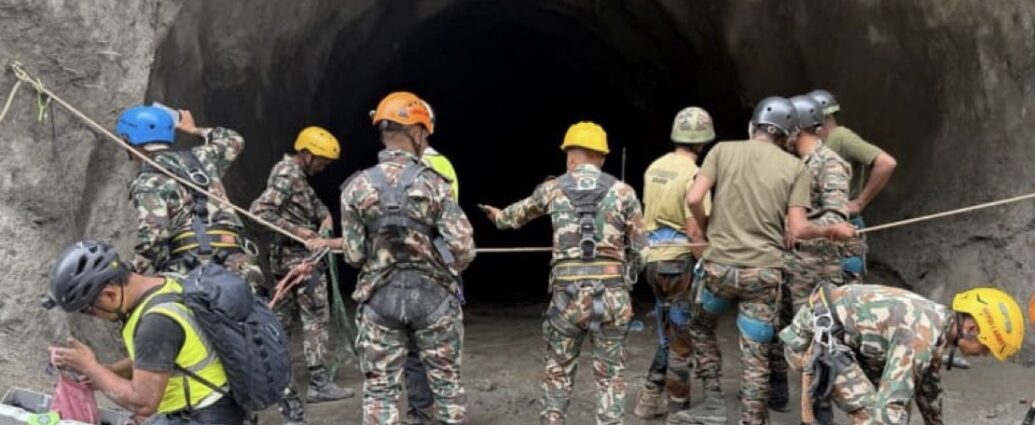
Death toll in Nepal flood tops 1,000 as Nepal rescuers reach remote areas in search
Nepali rescuers built temporary bridges to reach remote areas and dug through the ruins of hydropower projects in the Himalayas to rescue close to 300 trapped workers, nearly a week after catastrophic floods left a trail of destruction across the country’s towns and valleys.
At least 639 people remain stuck in several devastated hydropower stations that have become the focus of rescue efforts, the country’s disaster management authority said on Tuesday, with the total death toll going up to 1,000. About 4,000 are still missing.
“Thousands of citizens have lost their homes, families, loved ones and property,” Prime Minister Balendra Shah said in a late-night social media post on Monday. “The government understands the immense pain they are enduring.”
Over 11,000 people have been rescued across the affected region, while power and communication lines have been restored in some areas, he said, promising support for those displaced by the glacier collapse that sent a deluge of ice, rock and mud sweeping through the impoverished nation’s border region with China. The calamity poses a massive challenge for Shah’s six-month-old government.
“We did not have the time to grab anything before fleeing,” said a woman survivor from the hard-hit Rasuwa district who said she walked to Nuwakot with scores of villagers who survived. “What we were wearing is the only pair of clothes we have. And even they are wet from rain.”

Rescue teams had managed to restore road networks to Nuwakot, one of the worst-affected districts, facilitating rescue operations and distribution of relief material, Shah said.
Police official Bipin Regmi said a search team recovered 24 bodies from a house in Betrabati village in Nuwakot district.
“We are reaching new areas and recovering bodies,” Regmi told Reuters.
Foreign help flows in
In China, rescue teams worked through the night to reopen access to the Nepali border, on a steep mountain gorge with unstable cliffs on one side and fast-flowing river channels on the other.
Beijing will send DNA testing experts to disaster-hit areas at the Nepal-China border as well as a second batch of relief supplies later on Tuesday, its foreign ministry said, adding that equipment would include drones and water purification.
South Korea, nine of whose nationals were working at a hydropower project and are missing, also said it will send a 44-member emergency relief team to support search-and-rescue operations in the Rasuwa region.
Nepal last week turned down foreign involvement in general search and rescue but said it needed specialized services and advanced technological support in areas such as life-detecting machines, large refrigerators, Bailey bridges.
Giant neighbors India and China have led the foreign assistance, and the US, Japan, South Korea, Singapore, Australia, EU countries, and the UAE have also contributed.
“Some of the support has already arrived,” foreign ministry spokesperson Lok Bahadur Chhetri told Reuters.
Aid worth more than $42 million had poured into the country after the disaster, Shah said, and the government expected the contributions to increase.
Rescue efforts focus on hydropower stations
Shah said 279 workers had been rescued from hydropower projects, with joint teams of Nepal, India and China working on search and rescue operations.
Pictures and videos shared by rescue teams showed earth-moving equipment digging and shoveling mud and rocks under lights in the dark of the night as workers watched. Soldiers used torchlight in a big pit they had created to look for space to get into one tunnel.
“Our first rescue observation at Trishuli Hydro Power plant shows that it is not humanly possible to go into the tunnel,” Asish Gurung, a mountain guide helping in the tunnel rescue, told Reuters from Haku village in Rasuwa district.
“We need machines like bulldozers and excavators. There are two of them here now. One is not functioning, and the other is being repaired. There may be about 500 people trapped inside,” he said.
There has been a boom in hydropower projects in Nepal since the turn of the century as the mountainous country sought to take advantage of its Himalayan water resources to address chronic domestic power shortages and exploit prospects for selling electricity to southern neighbor India.
Hydropower projects in Nepal’s mountains need tunnels to carry water through the steep terrain, allowing developers to exploit the sharp elevation drop between Himalayan rivers and powerhouses to generate electricity.
Nepal PM highlights climate change risks
A total of 583 foreign nationals were still missing, the disaster management authority said, as family members desperately pursued news of their loved ones.
An Australian hiker who went missing after the flood was located after she made contact with the Australian embassy on Saturday, Australian media reported.
Cara Severino, 26, was trekking in the Langtang area when the flood hit and said in a statement that she survived because of the “amazing people” she was with at a national park when the flood hit.
PM Shah said the catastrophic event signaled the growing risks that the Himalayan region faces.
“The region must therefore remain vigilant. The time has come for us to strongly raise before the international community the disasters we are experiencing as a consequence of climate change,” Shah said in his post.
Last week’s flood was “caused by glacier instability under the long-term effects of global warming,” China’s state broadcaster said on Monday.

Federal Crackdown Removes 110 Truck-Driving Schools as Washington Targets Fraud Across U.S. Freight Industry
The federal government has launched one of its most aggressive crackdowns yet on commercial-driver training, immediately removing more than 110 truck-driving schools from the federal system and putting more than 160 additional schools on notice.
The move is aimed at a problem that reaches far beyond driving schools.
It strikes directly at the pipeline that supplies drivers to America’s trucking industry — the network responsible for moving food, fuel, retail goods, construction materials and nearly everything else businesses and consumers depend on.
The Department of Transportation said the 110 schools being removed from the Federal Motor Carrier Safety Administration’s Training Provider Registry were connected to more than 5,000 commercial drivers who later failed federal English-language proficiency requirements.
Those schools must immediately stop operating as federally recognized entry-level driver-training providers.
That means they can no longer provide the classroom instruction, behind-the-wheel training or certification required for new commercial drivers entering the profession.
And that is only the first part of the crackdown.
Federal investigators also conducted nearly 400 investigations across 40 states, uncovering serious violations at other training providers.
The problems included instructors who were not properly licensed, training facilities that did not have enough space for required maneuvers, missing testing records and even one provider that claimed its classroom was inside a school bus positioned in the back of a trailer.
Those investigations resulted in more than 160 proposed removals from the federal Training Provider Registry.
According to DOT, drivers certified by those providers were linked to 239 commercial-vehicle fatalities.
Why This Matters
Truck drivers cannot simply decide to drive an 80,000-pound tractor-trailer.
They need a commercial driver’s license, and new drivers generally must complete federally recognized entry-level training before they can qualify.
That makes driving schools one of the first gates into the trucking industry.
If the gate is weak, the entire system can be weak.
A school that improperly certifies drivers can potentially place people behind the wheel of extremely heavy commercial vehicles without the training or qualifications federal regulators expect.
That becomes a safety issue.
But it is also a business issue.
The trucking industry already operates with tight margins, high insurance costs, driver turnover and enormous pressure to keep freight moving.
Removing hundreds of training providers from the system could make it harder for some trucking companies to recruit drivers quickly.
Washington Is Going Much Further Than the Schools
The crackdown is not limited to training providers.
The Department of Homeland Security launched a synchronized enforcement sweep involving more than 200 driving schools across 23 states.
Federal investigators are examining allegations involving CDL fraud, unauthorized employment, identity-document fraud, financial crimes, money laundering and labor exploitation.
Officials are also investigating possible connections to human smuggling, drug trafficking and organized criminal networks.
That turns what might appear to be a licensing story into something much larger.
Federal authorities are asking whether parts of the commercial-driver system have been exploited by organized networks that help people improperly obtain licenses, jobs or documents.
The Justice Department has also created a multi-state task force involving federal prosecutors and law-enforcement agencies across Illinois, Indiana, Michigan and Ohio.
Its mission includes identifying fraudulent trucking operations, reducing highway fatalities and prosecuting criminal activity connected to commercial transportation.
The Driver Crackdown Is Already Huge
DOT says more than 28,000 commercial drivers have been taken off the road for failing English-language proficiency requirements since June 2025.
The department also says states have been forced to cancel more than 30,000 commercial licenses that were improperly issued to foreign drivers.
And federal regulators have already removed more than 8,000 unqualified training schools from the FMCSA registry during the past year and a half.
The scale shows that Washington does not view this as a handful of isolated bad schools.
It is treating it as a systemic problem.
Federal regulators are now launching a nationwide audit of third-party CDL skills testers as well.
Those are the people and organizations that actually test drivers before licenses are issued.
If regulators conclude a state is failing to properly oversee its CDL program, the consequences can become severe.
Federal highway funding can be withheld.
In extreme cases, a state’s CDL program could even be decertified, preventing it from issuing, renewing, transferring or upgrading commercial licenses until problems are corrected.
What It Means for Trucking Companies
For trucking companies, this creates both risk and responsibility.
Hiring a driver may increasingly require more than simply checking whether that person has a valid CDL.
Carriers may face growing pressure from regulators, insurers and customers to verify where drivers were trained, whether their documentation is legitimate and whether they meet federal qualification standards.
Companies that depend heavily on newly licensed drivers could also see their recruiting pipelines shrink if more training schools disappear.
That could tighten driver supply in certain regions.
And when driver supply becomes tighter, labor costs can rise.
Insurance companies may also respond.
If insurers become more concerned about poorly trained drivers or fraudulent CDL credentials, they may impose stricter underwriting requirements on trucking companies.
That could mean higher premiums or more detailed driver screening.
What It Means for the Economy
Trucking sits underneath almost every part of the U.S. economy.
Factories depend on trucks.
Supermarkets depend on trucks.
Construction companies depend on trucks.
Retailers, farms, ports and warehouses all depend on trucks.
If the federal government successfully removes unsafe or fraudulent operators, the long-term result could be a safer and more professional industry.
But in the short term, removing large numbers of schools and drivers could also reduce capacity in parts of the freight system.
That matters because fewer qualified drivers can mean higher transportation costs.
And higher freight costs eventually show up somewhere — in the price of groceries, building materials, manufactured goods or other products.
The government’s message is clear.
Washington is no longer treating commercial-driver fraud as a paperwork problem.
It is treating it as a public-safety, national-security and economic issue affecting one of the most important industries in America.
And the crackdown is only beginning.
JBizNews Desk | Washington
© JBizNews.com All Rights Reserved. Reproduction or distribution without written permission is prohibited.



SB Energy Files for IPO With Nvidia Backing


Nvidia Puts $3.5 Billion Into MediaTek as Its AI Empire Expands Beyond Its Own Chips
SANTA CLARA, Calif. — Nvidia is investing $3.5 billion in Taiwan-based chipmaker MediaTek, deepening a partnership that stretches from artificial intelligence data centers to personal computers and vehicles.
The investment is being made through MediaTek convertible bonds as part of a broader financing round.
But the bigger story is not simply that Nvidia is buying into another semiconductor company.
It is that Nvidia is increasingly helping finance the companies that will build products around its own technology.
MediaTek is one of the world’s largest chip designers, best known for processors used in smartphones, televisions and connected devices. It is now pushing deeper into AI computing and data-center chips.
Under the expanded partnership, MediaTek will use Nvidia’s NVLink Fusion technology, which allows custom processors to connect directly with Nvidia’s computing systems.
That matters because large AI data centers are increasingly built from many different types of chips working together.
Nvidia dominates the graphics processors used to train and run artificial intelligence. But companies such as MediaTek are developing specialized chips designed for particular customers or workloads.
By making those chips easier to connect with Nvidia hardware, Nvidia can remain at the center of an AI system even when another company designs part of it.
The two companies are also expanding their work in AI-powered PCs and automobiles, giving Nvidia another path into markets beyond giant cloud data centers.
For Nvidia, the strategy is becoming clear.
The company is no longer simply trying to sell as many AI chips as possible. It is building an ecosystem in which chipmakers, cloud providers, computer manufacturers and other technology companies increasingly design their products around Nvidia’s architecture.
That can create an enormous competitive advantage.
The more companies that build around Nvidia technology, the harder it becomes for customers to replace Nvidia entirely with a competing platform.
The $3.5 billion investment also shows how Nvidia is using the extraordinary cash generated by the AI boom to strengthen the network surrounding its business.
In other words, Nvidia is not just benefiting from the expansion of artificial intelligence.
It is increasingly helping finance the infrastructure, companies and technology that could determine where the next wave of AI spending goes.
JBizNews Desk | Santa Clara, California
© JBizNews.com All Rights Reserved. Reproduction or distribution without written permission is prohibited.

The bond market is in open revolt as Trump declines to accept an Iranian peace deal and oil hits $92 a barrel
Good morning. On Fortune’s radar today:
- Venezuela oil pact ‘looks like an insider deal.’
- Iran again offers Trump the deal he wants but the president wants to ‘hit them hard’ instead.
- Markets: It’s messy out there.
- You’re not still using a 60:40 stock-bonds portfolio, are you?
- The one number Fed Chair Warsh is actually watching.
- There’s a global sardine crisis—and prices are through the roof.
➡️ Did someone forward you this email? If you would like to receive this information directly, every morning before the markets open in New York, sign up here.
This story was originally featured on Fortune.com
Court extends detention of suspect in Jerusalem’s Zol Begadol drugged baby food case
The Jerusalem Magistrate’s Court extended the detention of a man suspected of involvement in placing sedative substances in baby fruit-puree jars until September 6, Israel Police said on Tuesday.
The decision allows investigators to continue questioning the suspect while he remains in custody. The suspect, a man in his 40s from southern Israel, was arrested at his home on Monday following what police described as a breakthrough in the investigation. His name remains under a court-imposed publication ban until Wednesday at 10 a.m.
Police suspect that sedative substances were deliberately inserted into jars of Prinok fruit puree sold at two Zol Begadol supermarket branches on Jaffa Street in Jerusalem.
The Health Ministry confirmed in June that laboratory tests found clonazepam and lorazepam in several jars. Both are prescription medications from the benzodiazepine family and can cause drowsiness, weakness and confusion.
At least three young children were hospitalized after consuming the puree and were later discharged in stable condition. Earlier reports placed the number of hospitalized children at four.

According to the Health Ministry, five contaminated jars were identified during the investigation. Three were provided by customers, and two were found on store shelves. All five showed signs of having been opened or tampered with before purchase.
Tests on products obtained from the importer found no contamination, and the ministry said it had found no evidence of a manufacturing defect. No general recall of Prinok products was issued.
The two Zol Begadol branches where the affected jars were sold were initially closed. They were later barred from selling food and cosmetic products until they established stricter quality-control measures, including limiting uncontrolled access to products and regularly checking for damaged packaging.
Attorney says suspect has mental-health conditions
Attorney Zecharia Shenkolevsky, who is representing the suspect on behalf of the Public Defender’s Office, said his client has a mental-health condition and is currently in a complex psychological state.
“The investigation is in its early stages, and we expect it to be conducted while protecting his rights, certainly in light of his medical circumstances,” Shenkolevsky said, adding that the suspect was cooperating with investigators.
Police said the investigation remains ongoing. Unless he is released earlier, the suspect will remain in custody until September 6, when police will have to seek a further extension if they believe his continued detention is necessary.
Goldie Katz, Maya Zanger-Shamir and Tzvi Jasper contributed to this report.
‘Not safe for kids’: Food allergy group petitions High Court to stop Kisch school-nurse pilot
A food-allergy association petitioned the High Court of Justice on Monday to stop the Education Ministry from replacing medical-support aides assigned to children with life-threatening allergies with a single nurse serving an entire school.
The pilot, approved by the Education and Health ministries, is planned for eight elementary schools. Under the program, nurses will replace aides currently assigned to pupils who require medical supervision and will also provide healthcare services to the rest of the school.
Roles not interchangeable, Yahel argues
YAHEL – Food Allergy Counseling and Guidance argues that the two roles are not interchangeable.
While a nurse is more medically qualified, the association says one nurse responsible for an entire school cannot provide the continuous supervision currently given by aides who remain close to eligible pupils throughout the day.
The Education Ministry rejects that claim, saying that the existing aides have limited medical training, while a qualified nurse can provide more professional care, oversee preventive measures and respond to the health needs of all pupils, including older children who are not currently eligible for dedicated assistance.

The dispute reached the court as the school year opened on Tuesday, after the ministry declined to suspend the program and failed to answer several of the association’s questions about its implementation. YAHEL is asking the court to freeze the pilot immediately and require the ministry to maintain the existing assistance for every participating child while the case is considered.
It is also seeking a written commitment that no eligible pupil will lose the effective medical and environmental protection currently provided, full details of the program, and an urgent meeting with officials from the Education and Health ministries.
Children with life-threatening food allergies are currently eligible for medical-support aides throughout the formal school day in kindergarten and first grade. Assistance is reduced to three hours a day in second grade and discontinued from third grade.
The aides are not medical professionals. Their role includes monitoring pupils during meals and breaks, helping schools maintain an allergen-safe environment, and responding if an allergic reaction occurs.
YAHEL argued that preventive supervision is the central issue in the case. An aide assigned to an eligible child can monitor food brought into the classroom, help prevent pupils from sharing food and accompany the child during trips and other activities outside school.
A nurse treating the wider school population, the association argues, cannot necessarily remain close enough to prevent exposure before an emergency develops.
Government says decision aims to improve conditions
The ministry maintains that the pilot was designed to improve, rather than reduce, the existing level of care.
In an August 30 response to the association, it said the nurses would work throughout the school rather than remain passively in a clinic. Their responsibilities would include training staff, promoting allergen-safe practices, providing first aid and responding to pupils with allergies, epilepsy, diabetes and other medical conditions.
The ministry said the program had been developed over several months with the Health Ministry and received professional backing from the Israel Association of Allergy and Clinical Immunology.
Children requiring invasive medical procedures, including oxygen support or gastrostomy feeding, are not expected to lose their existing assistance under the pilot.
The association’s challenge, however, extends beyond the merits of the model itself. It argues that Education Minister Yoav Kisch’s ministry moved ahead without consulting the parents whose children would be affected, obtaining their consent or providing clear information about the research intended to evaluate the program.
The ministry said in its response that it had acted transparently and held advance “talks” with YAHEL chairwoman Orly Baz. It said the program was explained in detail and that the association had been offered a role in its implementation.
Baz disputed that account in an affidavit attached to the petition. She said only one conversation took place, on the evening of August 17, after the pilot had already been formulated.
According to the association, it was informed that the program might proceed and was told it would be involved if it did. It denies that any meaningful advance consultation took place.
The two accounts have not been independently reconciled.
After receiving the ministry’s response, YAHEL’s attorney asked for the dates and details of the consultations. He also asked whether parents had consented, who would conduct the academic research accompanying the pilot and whether that research had received any required ethical approval.
The ministry responded on Monday by directing him to submit a freedom of information request. The petition was filed later that day against Kisch, the ministry’s director-general, and the ministry itself.
The research timeline has also drawn scrutiny. The ministry said an academic study would accompany the pilot and examine its effectiveness, safety and participants’ satisfaction.
However, the ministry’s public tender to select researchers for the study remains open until October 6, more than a month after the program was scheduled to begin. It remains unclear whether any researcher has been appointed through another arrangement in the meantime.
The case comes amid a steep rise in the number of children receiving medical assistance in the education system.
Knesset Research and Information Center figures show that 10,312 students were eligible for medical-support aides in the 2024-2025 school year, compared with 511 fifteen years earlier. Of those eligible, 8,339 received assistance because of food allergies.
The Education Ministry transferred approximately NIS 635 million for medical-support aides that year, including NIS 523 million for children with food allergies.
The High Court must now decide whether to suspend the pilot while the state responds or allow it to operate while the petition proceeds.
Terrorist mob members ordered to pay more than NIS 220,000 to Jewish victims by Jerusalem court
Two Arab men convicted of taking part in a violent mob attack on Jews near Jerusalem’s Lions’ Gate in May 2021 were ordered to pay their victims a total of NIS 180,000 in compensation, or NIS 60,000 to each victim, by the Jerusalem Magistrates Court on Monday
The defendants were also ordered to pay an additional NIS 36,000 in attorneys’ fees and legal expenses, bringing the total amount imposed on them to more than NIS 220,000.
The court partially granted the plaintiffs’ claim for damages for pain and suffering resulting from the assault, which it recognized as having been nationally motivated. Judge Eliad Weinshall noted that the two defendants had already undergone criminal proceedings and served prison sentences for their roles in the attack.
One of the defendants, who had previously admitted to his role in the attack, was sentenced by a juvenile court to 20 months in prison, six months of suspended imprisonment and NIS 8,000 in compensation to the victims for carrying out a terrorist act involving attempted aggravated assault causing serious injury, throwing a stone at a means of transportation and intentionally damaging a motor vehicle. Despite admitting to his role, the first defendant argued that he had played only a minor role in the attack, a claim rejected by Weinshall.
The second defendant, who was convicted by the Jerusalem District Court in May 2024, was sentenced to 40 months in prison, eight months of suspended imprisonment, and ordered to pay NIS 8,000 to each victim. He was convicted of carrying out a terrorist act involving assault with intent to cause aggravated injury and intentionally damaging a vehicle with a racist motive.
Attacked while traveling to the Western Wall
In May 2021, the victims were traveling to the Western Wall while wearing kippot (Jewish skullcaps), identifying them as Jewish. When they were stopped in traffic at the Rockefeller Junction, a mob formed and began attacking them, throwing stones at their vehicle.
One of the car’s rear windows was shattered, and the first defendant reportedly attempted to open the vehicle’s door to throw stones inside. The driver was able to reverse in an attempt to escape the attackers, but the mob pursued the vehicle and continued throwing stones. At one point, the attackers pepper-sprayed the vehicle, while another rioter attempted to open the driver’s door.
One of the victims suffered a head injury from the stone-throwing, causing him to lose control of the vehicle and crash into a wall. The vehicle became stuck, allowing the attackers to continue their assault. The first defendant then opened the driver’s door and began kicking the victim forcefully as other rioters continued to throw stones at the vehicle.
The defendant also picked up a large stone, estimated to have been approximately 15 centimeters in size, and threw it onto the rear seat of the vehicle, intending to injure one of its occupants.
Police interfered after shots were fired into the air
A police officer who arrived at the scene fired three shots into the air, after which the defendant and the other rioters moved away.
One of the three victims suffered a scalp laceration that required medical treatment under local anesthesia, as well as a hematoma on his right leg. The second suffered a laceration to his upper lip and pain in his right leg, while the third experienced pain and an intense burning sensation in his eyes, legs, and chest.
“The nationalistic aspect underlying the assault must also be taken into account. The plaintiffs were targeted solely because of their Jewish-religious appearance, without any prior relationship between the parties,” Judge Weinshall ruled. “These factors directly affect the intensity of the terror and helplessness inherent in the incident.”
Adv. Chaim Bleicher, who represented one of the plaintiffs, has been contacted by The Jerusalem Post for comment.




New York cannot enforce state law demanding $75b. from fossil fuel companies, federal judge rules
A federal judge ruled on Monday that New York cannot enforce a 2024 state law that sought to force fossil fuel companies to contribute $75 billion over 25 years into a fund to pay for damage caused by climate change.
Chief US District Judge Brenda Sannes in Syracuse, New York sided with 22 Republican state attorneys general, as well as industry groups including the US Chamber of Commerce, in finding the state measure preempted by federal law.
Sannes, an appointee of Democratic president Barack Obama, said the Clean Air Act, which gave the federal Environmental Protection Agency authority to regulate carbon-dioxide emissions, did not authorize states to adopt emissions compensation schemes such as New York’s.
She said enforcing New York’s Climate Change Superfund Act risked upsetting the balance between preventing global warming, “a project that necessarily requires national standards and global participation,” and promoting economic growth, energy production, foreign policy interests and national security.
“The Climate Act conflicts with the overriding need for a uniform rule of decision on matters influencing national energy and environmental policy, and basic interests of federalism,” she wrote.

West Virginia Attorney General JB McCuskey, a Republican who led the states’ opposition, in a statement hailed the decision, calling the state law “a money grab by the elites in New York.”
The office of New York Governor Kathy Hochul, a Democrat who signed the state law in December 2024, is reviewing the decision to determine possible next steps, spokesperson Ken Lovett said.
“Taxpayers shouldn’t have to foot the bill for damages caused by polluters,” Lovett said.
New York demands fossil fuel companies contribute to climate change superfund
New York was the second US state to create an industry-financed “superfund” to address climate change. Vermont was the first state, and its law also faces legal challenges.
The New York law required fossil fuel companies to contribute $3 billion annually to the superfund starting in 2028, divided based on their greenhouse gas emissions between 2000 and 2018.
The law applied to companies that the state’s Department of Environmental Conservation considered responsible for 1 billion tons of greenhouse gas emissions during that period. Money would have gone to build roads, water systems, sewage systems, and other infrastructure to protect communities and coastlines from weather events such as extreme heat and flooding.
In their February 2025 lawsuit, the Republican attorneys general called New York’s law a politically motivated “overreach,” which punished traditional energy companies that now comply with applicable laws. They said payouts from coal, oil and natural gas producers could wipe out thousands of jobs if the producers were forced to shut down.
The US Department of Justice under Republican President Donald Trump had filed a similar lawsuit last year and supported the state attorneys general in the case before Sannes.




Water restrictions continue into second day as most Israeli desalination plants shut down again
Most of Israel’s desalination facilities were shut down on Tuesday morning after operating overnight, following another increase in seawater turbidity, the Water Authority and Energy and Infrastructure Ministry said Tuesday.
Under instructions issued for the national water system, local authorities will reduce water use for public landscaping and agriculture and work to cut other public water consumption.
Officials said water supplies to homes would continue despite the shutdowns.
In areas experiencing localized supply problems, the scope of water use will be reduced as needed, while the Water Authority’s operations center addresses individual disruptions.
Widespread malfunctions at desalination facilities began on Monday
The impact of a widespread malfunction at Israel’s desalination facilities reached central Israel on Monday, with residents of Givatayim warned that water supply disruptions could occur in the coming hours, including reduced water pressure and even outages in certain areas.

A message sent to residents stated: “Following problems with the water supply in the national water network, disruptions to water supply may occur in the coming hours, including reduced pressure and water outages in certain areas. We ask the public to conserve water as much as possible and use water only for essential needs until normal operations resume.”
The warning came amid an unusual disruption to Israel’s national water network, after five of the country’s six desalination facilities were forced to shut down. According to Water Authority Director-General Yehezkel Lifshitz, severe seawater turbidity that began over the weekend and moved from south to north has prevented the facilities from filtering water and operating normally.





A leadership gap looms in Nordic and Benelux boardrooms
The Nordic countries and the Benelux bloc follow distinct corporate governance models. In Sweden, Norway, Denmark, and Finland, employees have the right to board representation once a company grows beyond a certain size—though the thresholds vary by country.
Despite their small size, these economies rank among the world’s most stable and have produced global powerhouses, including Novo Nordisk, Spotify, and Ericsson. Large Dutch companies, meanwhile, legally separate management from oversight, requiring a non-executive supervisory board to hold the executive team accountable.
“These are high-trust cultures built on collaboration and consensus,” says Esha Mendiratta, an associate professor at Vlerick Business School in Belgium. “Hierarchies stay flat, and major decisions wait until every stakeholder has weighed in.”
If any region should feel secure in its choice of CEO, it’s these. A new survey suggests otherwise.
Heidrick & Struggles’ Route to the Top report, based on a 2026 poll of 1,033 CEOs and directors worldwide found that nearly four in ten European respondents doubt their CEO’s strengths match what their company will need over the next two to three years. In the Nordics and Benelux, that number jumps to half.
Tenure may be the culprit
There are several reasons why these consensus-driven systems might be experiencing, or simply reporting, this heightened mismatch.
One possible explanation is how long chief executives stay in the job. “CEOs in the Nordics and Benelux stay in their roles far longer than in other markets,” says Jenni Hibbert, who leads Heidrick & Struggles’ Europea and Africa business. The average tenure for Belgian CEOs is nine years, the second longest in Europe, according to the firm’s data. In Sweden and Norway it’s seven years, while Finnish CEOs have the shortest average tenure, at two and a half years.
Data analyzed by Spencer Stuart reveals a similar trend. Norway had the lowest CEO turnover rate among major European listed companies in 2025, with no new CEO appointments reported. France, in comparison, recorded 18 and Italy, six.
“In the context of ongoing economic and technological volatility, one might argue appointments aren’t keeping pace with the shift in capabilities needed in the role,” Hibbert says. Today, those running an organization must contend with a multitude of pressures, from geopolitical headwinds and energy-price shocks, to AI disruption. It is little surprise, given these developments, that 90% of executives surveyed by Heidrick & Struggles’ expect their firm strategy and operating model to change in the near future.
The concern is that business conditions are shifting faster than boards can respond. “Boards are currently struggling to find chief executives who can lead major organizational change,” observes Martin Hartley, group chief commercial officer at emagine, a talent consultancy headquartered in Denmark with a presence across Sweden, Norway, the Netherlands, Belgium, and Luxembourg. “It’s difficult to find candidates who have the ability to combine technology leadership, commercial acumen, and transformation experience.”
The real danger, Hartley adds, is a boardroom that has lost faith in its CEO and chooses to do nothing about it. “Decisions take longer, transformation loses momentum, and talented people grow frustrated while the organization keeps telling itself the CEO just needs a little bit more time.”
Insularity may be compounding the problem
Mendiratta highlights a preference in parts of the Benelux for promoting leaders from within. “Boards that draw CEOs from the firm’s internal ranks are sometimes less likely to bring in the fresh outside perspective needed to spot problems and shake things up,” she says.
In the Netherlands, the average time an internal candidate spends at a company before becoming CEO increased from 9.5 years in 2023 to nearly 15 years in 2025, according to Heidrick & Struggles’ data.
“Insiders are not inherently the wrong choice,” Mendiratta continues. “They typically bring deep firm-specific knowledge, which tends to be an advantage when conditions are relatively stable. However, during periods of turbulence, externally hired CEOs tend to outperform.”
In the 87 years Heineken has been listed on the stock exchange, the Dutch brewer had never appointed an outsider as chief executive. That changed in January 2026, when Dolf van den Brink announced he would step down. Facing pressure to break from precedent, the board turned to Rafael Oliveira, CEO of JDE Peet’s—someone with no prior experience in the beer industry—to take over in October.
Demand is growing for leaders with broader perspectives and experience across different markets and cultures, says Mendiratta. She adds: “In today’s landscape of intense geopolitics, with tariffs rising and supply chains moving closer to home, the traditional strategic playbook these CEOs rely on is breaking down, exposing a starker gap between their built-up strengths and what their companies need.”
Retiring the old playbook
The gap between current skill sets and future strategic needs reflects a deeper weakness in how boards approach succession planning, according to Hibbert.
“The pre-anointed candidate is a very passive way of thinking about succession planning, which no longer passes muster,” Hibbert says. This pass-the-baton type of approach is unlikely to work in the current context where the external environment shifts frequently, she continues. “Naming an heir apparent years in advance risks handing the job to someone whose strengths no longer fit the moment or undermining their credibility even if they still do.”
Mendiratta goes further, arguing boards should generally avoid naming a single successor until just a few months before a handover, keeping several viable candidates in play instead. “Boards should be asking: What type of CEO am I going to need in six months, two years and five years?” Ongoing feedback and reflection on the CEO’s leadership is vital, she adds.
In Mendiratta’s experience, candidates who are identified early in their career tend to enact less strategic change once they take the top job. Similarly, outgoing CEOs who move into the chairman’s seat can create the same drag, she argues, constraining a successor’s room to reshape the company.
For Hartley, it’s not a matter of choosing between insiders and outsiders. CEOs should not be assessed in isolation at all, he argues. “A better question is: Do they have the right executive team behind them? Boards are already paying closer attention to the rest of the C-suite, because that wider bench signals who the real succession candidates will be.”
Candor, not crisis
The report findings are not necessarily a sign of organizational dysfunction. “It’s possible companies in the Nordics and Benelux are simply more willing to admit misalignment than most,” Hibbert says.
In these regions, major strategic decisions are structurally required to pass through more hands, whether through employee representatives or supervisory boards. Consensus-driven governance is built to surface disagreement rather than bury it, Hibbert explains, which may translate into more candid survey answers. “If governance quality alone explained confidence in leadership, these boards might report less uncertainty than most, not more.”
Hartley warns that Nordic niceness must not be mistaken for soft-headednesss. “There’s a temptation for outsiders to see slower, more deliberate decision-making as a flaw, but that’s not the case,” he says. “What I see is more controlled, pragmatic, and rigorous processes that can still move very quickly when needed.”
Perhaps the most important—and apt—lesson from the report is that even the most deliberate boardrooms, the ones built to weigh every voice and guard against rash decisions, canend up choosing a leader built for the world as it was, not the one now arriving.
This story was originally featured on Fortune.com



Iran’s Pezeshkian says Tehran will reciprocate if US honors interim deal commitments – report
Iran will immediately reciprocate if the US returns to its commitments under an interim deal signed in June, Iranian President Masoud Pezeshkian said on Tuesday at the Shanghai Cooperation Organization Summit in Bishkek, the Iranian Student News Agency reported.
Several world leaders are also at the summit, held in Kyrgyzstan’s capital, including Russia’s Vladimir Putin, India’s Narendra Modi, China’s Xi Jinping, and Pakistani Prime Minister Shehbaz Sharif.
Pezeshkian arrived in Kyrgyzstan with the message that Tehran was aiming for diplomacy over armed conflict with the United States, saying this during several sideline meetings with different leaders.
On Monday, he told Modi on the sidelines of the summit that continued war was in no one’s interest, and that dialogue and cooperation were the way to resolve existing problems.
According to Iran’s semi-official Mehr News, Pezeshkian met Azerbaijan President Ilham Aliyev, and his agenda also included meeting Kyrgyzstan’s deputy cabinet chairman, several participating leaders, and the presidents of Kyrgyzstan, Russia, and Tajikistan on the sidelines of the summit.
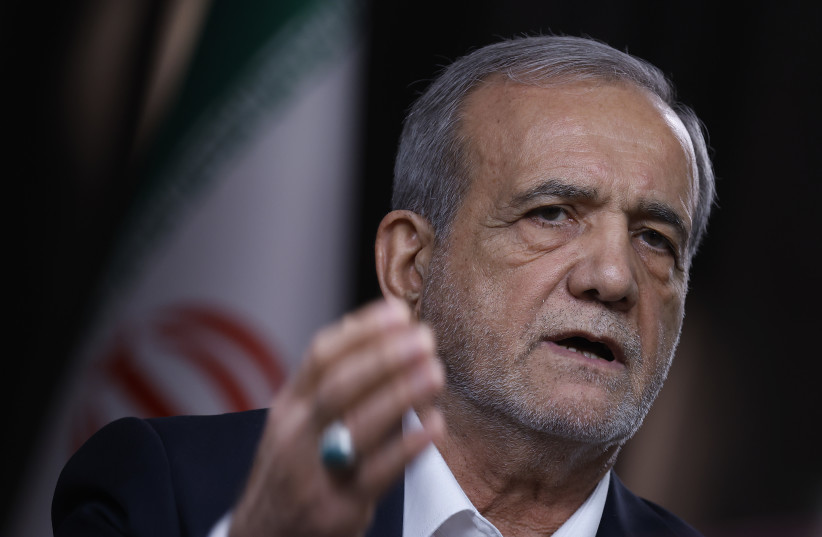
Pezeshkian’s contact with Mojtaba Khamenei
Last month, Iran‘s semi-official Tasmin News Agency reported that Pezeshkian had met Supreme Leader Mojtaba Khamenei around the start of the president’s third year in office in late July.
Pezeshkian has given differing accounts in recent weeks about his access to Khamenei, who has not been seen in public since he succeeded his father in the role in March.
On July 21, the president said interactions with the supreme leader were “increasing day by day”, but in early August he said communicating with Khamenei was “very difficult.”
The late July meeting covered military affairs and the economy, including securing resources, managing foreign exchange and energy use, and economic ties with foreign partners, according to state media.
In May, state media also reported that Pezeshkian had met Khamenei for several hours, in what was then the first publicly reported meeting between the two since Khamenei became supreme leader.
Khamenei was reportedly seriously injured in the February 28 strike that killed his father and predecessor, Ali Khamenei, on the first day of the US-Israeli war on Iran. He had also generally kept a low public profile before becoming supreme leader.

Starbucks is discontinuing a blending powder for drinks after particles went ‘airborne’ and left baristas coughing and falling ill
When Jasmine Leli, a Buffalo, New York-based Starbucks barista, trialed the company’s new blending powder last month, she was greeted with a plume of dust that irritated her nose and throat for hours afterward.
The powder was introduced last month as part of the Seattle-based coffee chain’s seasonal rollout of blended energy refreshers—a bright-colored, slushy fruit beverage—with the ingredient intended to help keep the drink a consistently-blended texture. (Starbucks has a line of iced refresher beverages available year-round that do not require this blending.) But pouring the contents of the package into storage containers, and then into blenders to prepare the beverage, seemed to always result in residue from the product dispersing everywhere, the barista said.
“You pour the contents of this package into this container, and it’s very airborne,” Leli told Fortune. “It doesn’t matter what you do to try and decrease the effects of it going into the air. It’s like a cloud.”
Last week, Starbucks discontinued the blending powder from its U.S. stores. A spokesperson told Fortune the move was part of a “regular seasonal menu transition.” At this time, Starbucks does not have plans to bring back the blending powder.
“Partners and customers can feel confident in the ingredients we use,” a Starbucks spokesperson said in a statement. “The blending powder used in our Summer Blended Refreshers contained a small amount of food-grade silica, a commonly used food ingredient that helps ingredients mix consistently. It’s safe for use in food and safe for use in our coffeehouses when used according to instructions.”
Baristas’ concerns surrounding the blending powder
Originally introduced in 2012, Starbucks’ refreshers are the second most popular drink, behind only espresso, according to the company, though it did not give a timeline for when refreshers climbed the ranks. For nearly two years under the helm of CEO Brian Niccol, Starbucks has tweaked its menu and operations as part of its “Back to Starbucks” turnaround plan. The company has since seen a boost in sales, including an 8.1% increase in comparable sales in North America last quarter.
The move also followed weeks of pressure and outward concern from union baristas, who reported having headaches, coughing, sore throats, and hives associated with using the product, according to Starbucks Workers United, which represents about 12,000 baristas. Of more than 600 baristas surveyed by the union, 86% reported that they or a coworker felt sick after using the powder.
Baristas began expressing concern about the product in July shortly after its rollout. One Reddit post noted the food-grade silica in the powder was only FDA-approved for consumption in a drink or mix, not inhalation.
“Although it is safe to consume and technically handle you should not be breathing this powder in and the fact we have to is downright unethical,” the post said.
While crystalline silica, found in rocks and soil, can cause serious lung conditions such as silicosis when inhaled, amorphous silica, a common food additive, is not linked with the disease. The CDC notes some studies where inhaling the substance can cause lung inflammation, but not the same severity as crystalline silica.
Occupational safety expert Dr. Peter Orris issued a report at the request of Starbucks Workers United on the use and potential inhalation of the powder, saying Starbucks should have evaluated the product’s potential impact on workers’ health prior to introducing it in stores, but did not note any immediate dangers associated with it.
“It would appear that outside of sensitization of individuals with specific allergies or Asthma,” Orris wrote, “there are no long term impacts on human health besides the acute irritant symptoms during airborne exposure.”
Leli’s concerns about the blending powder were also around why the company decided to use it in the first place. She said it replaced a syrup used in the refresher drinks, which would sometimes separate if they sat on the counter waiting to be picked up. In 2024, then-CEO Laxman Narasimhan flagged that mobile orders taking too long led to some customers abandoning their drinks instead of picking them up, something Starbucks has addressed through a simplified menu and behind-the-counter optimization. Leli said she never got any customer complaints about the texture of the beverage, and was frustrated that the company would spend money on a particular product instead of addressing wages or workers’ hours.
“There’s plenty of other issues that could have been addressed instead of this one that wasn’t really an issue that needed to be addressed,” she said.
This story was originally featured on Fortune.com


Netanyahu visits school in Ramle hit by missile during Iran war as Israel classes start nationwide
Prime Minister Benjamin Netanyahu visited on Tuesday the Benzion Netanyahu School located in Ramle, which was damaged by an Iranian missile during the last war, as classes start nationwide in Israel.
After the missile strike damaged the school, work began to rehabilitate and renovate the building, with the official inauguration happening just in time for the first day of school.
Netanyahu, alongside Education Minister Yoav Kisch, visited the school and talked with teaching and administrative staff, as well as the students who attended their first day of class.
Ramle Mayor Michael Vidal also participated in the event.

Some 3 million Israelis go back to school
Some 2.6 million students are expected to begin the 2026-2027 school year in Israel’s schools and kindergartens on Tuesday, including some 180,000 first-graders, as the Education Ministry launches new programs and expands initiatives introduced in recent years.
The ministry is placing particular emphasis on strengthening students’ sense of belonging and resilience, deepening studies of identity and heritage, introducing financial education into the school system, and expanding the use of artificial intelligence in both learning and examinations.
As students return to classrooms, the ministry said it would focus the school year on three areas: belonging and security, identity and roots, and knowledge and tools for coping with a changing world.
“We are opening the year with great responsibility and with a clear direction: to strengthen the sense of belonging and resilience of Israel’s students, deepen identity, values, and heritage, while at the same time giving them the knowledge and tools that will enable them to lead and succeed in a rapidly changing world,” Education Minister Yoav Kisch said.
Avihai Chiim and Yanir Yagna contributed to this report.
Kurds in Syria, Iraq fight against ‘Arabization’ with language, but might need to push harder
Kurds in Syria are concerned that changes in the country may erode Kurdish language education that has been common in eastern Syria for more than a decade.
Meanwhile, in Iraq, a Kurdistan Regional Government (KRG) official on Monday warned of demographic changes in the disputed Kurdish-majority city of Khanaqin in eastern Diyala province. According to Rudaw, a Kurdish media outlet, he called the changes a “clear constitutional violation.”
In both countries, Kurdish political parties will need to tackle these issues.
Syrian Kurds adapting to last six months of changes
The issue in Syria relates to changes over the past six months. During the long Syrian civil war, the Kurdish regions of what Kurds call Rojava were largely cut off from Damascus. The local authorities instituted Kurdish language instruction in schools, something that the Assad regime had suppressed. As such, what developed since 2012 was more freedom for Kurds, and a generation of young people was raised with their language being taught in school.
Now, the area of eastern Syria, which had been governed by the Democratic Autonomous Administration of North and East Syria (DAANES) with the Syrian Democratic Forces (SDF) defending it, will be governed by Damascus.

A deal between the SDF and the new Syrian government has led to the Kurdish forces being dissolved. Rudaw media noted that “Kurdish students, parents and teachers rallied in northeast Syria’s Rojava region on Monday against a Syrian government decision to end full Kurdish-medium schooling, arguing it falls short of their demands for language rights.”
The issue at stake is clear: Kurds who have been learning in Kurdish may find advancing in the education system difficult without Arabic language skills, while reducing Kurdish education will be seen as reducing the rights of Kurds.
It’s not a zero-sum game; there are many ways to have language instruction in both Arabic and Kurdish. Kurds are a minority in Syria, perhaps around ten percent of the country’s population. Education appears to be an issue that affects not only the Kurdish region. A dispute over where people from the Druze area of Suwayda are allowed to travel to take national tests has also created a crisis in this area.
The issue is not a simple one. Local people may want locally tailored instruction. However, if they can’t progress to national levels via testing and language, then how will they enter university in Syria or abroad? What the Kurdistan Region of Iraq shows is that one can establish an autonomous system with education tailored for locals, but also create success via universities and avenues for growth for young people. In eastern Syria, this remains to be seen.
North Press Agency in Syria notes that “Presidential Decree No. (13) of 2026, concerning the cultural and linguistic rights of the Kurds in Syria, has reopened the debate about the future of education in the Kurdish language, amid a dispute between the Syrian government and the educational institutions affiliated with the Autonomous Administration regarding the mechanism for implementing these rights in schools.”
It adds that “while the government is moving towards teaching the Kurdish language as a subject within the official curriculum with two lessons per week, the Kurdish side is demanding that its teaching be expanded to become a language of education alongside Arabic, especially in predominantly Kurdish areas.”
In many ways, the new decree is important. It changes the old Assad-era discriminatory laws that were rooted in a census dating to 1962. The report quotes Dr. Samar Habib, a faculty member at the Higher Institute for Population Research, as saying “she believes that the decree, from the perspective of educational and social sciences, represents a shift from policies of exclusion and forced Arabization to a context of legal recognition and national symbolism, but at the same time she points to a gap between symbolic recognition and educational empowerment.”
It notes that “Habib proposes a three-track educational model, which can be implemented gradually over a period of three to five years, to overcome the limitations of the two-weekly lesson model. She explains that the first path is parallel bilingual education, through teaching science and social studies in Kurdish and Arabic in areas of high concentration, including Hasakah, Qamishli, Afrin and Kobani.”
In contrast, the report also quotes Ibrahim Khalil, a Kurdish writer and linguist residing in Germany. “He adds that teaching two optional classes per week cannot be considered a national gain or a correct step towards solving the Kurdish issue in Syria, but rather, in his opinion, it represents ‘a step in the wrong direction on the path of national assimilation and Arabization of what remains of the Kurds.’” It notes that “Khalil believes that the national solution lies in recognizing the Kurdish language as a second official language, and opening official primary schools in Kurdish areas where instruction is only in Kurdish, with a daily lesson allocated to the Arabic language.”
Another concern in Syria is the issue of official names for towns and areas. This dispute is most clear in Kobani, which has also been called Ayn al Arab. Kobani is the Kurdish name for the city. In “predominantly Kurdish areas, particularly in the east and north of the country, the issue of place names has been linked over the past decades to a broader conflict over language and identity,” North Press notes.
“Most of those areas acquired dual names, one official Arabic name which is the one used in government records, and another Kurdish name used by the residents among themselves.” The concern is that Kurdish names of areas will continue to be “Arabized” in official documents. This was common during the Assad era, as the Assad regime was an Arab nationalist regime, similar to the Saddam regime in Iraq.
Kurds can’t speak their language in government offices
In Iraq, Kurds continue to struggle for their rights. “A blacksmith in the Kurdish-majority city of Khanaqin in the eastern Diyala province was arrested Monday over what his family says was his addition of Kurdish to his shop’s billboard – an incident that has further stoked tensions in a region already fraught with demographic manipulation concerns,” Rudaw noted this week.
According to the KRG official, speaking to Rudaw, “Kurdish-speaking residents of Khanaqin are being prevented from using Kurdish in government offices, calling it “’a dangerous indicator.’ He further noted that ‘the issue is not entirely on Baghdad’s shoulders – we share in it, too,’ criticizing Kurdish parties representing Khanaqin in federal institutions for falling short.”
As Kurds demonstrate in Rojava for their language rights, in Khanaqin in Iraq the issue relates to demographics. There are disputed areas between the KRG and Baghdad, including Khanaqin and parts of Diyala, Kirkuk, Nineveh, and Salahaddin provinces. The Kurds have long been concerned about attempts to change the demographics in these regions, often by government authorities trying to increase the number of Arabs in the regions.
This demographic change goes back to the Saddam era and attempts at mass movement of people and even collectivizing areas into various villages while moving Bedouin and other tribes into areas to link them more closely with Baghdad.
Rudaw says that Kurds have put off a planned mass demonstration in Khanaqin. However, there have been “arrest warrants against activists, political figures, and youths who had intended to take part.”
Colombia’s new Israel alliance is a strategic blow to Iran and its proxies – opinion
On August 7, 2026, Colombia’s patriotic new president, Abelardo de la Espriella, was officially inaugurated, marking a monumental turning point in South American geopolitics. His rise to power represents a decisive rejection of the Left-Islamist alliance that has increasingly threatened the region. For nations fighting these same dark forces globally, including the Iranian people fighting for their freedom, de la Espriella’s victory is seen as a shared triumph against a common adversary.
To understand the current stakes, one must look back to 2002. When Álvaro Uribe became president, Colombia was on the brink of collapse. Except for a few major cities, the vast areas of the country were controlled by Marxist narco-terrorists, most notably the Revolutionary Armed Forces of Colombia (FARC). The country was plagued by rampant violence, mass kidnappings, and economic paralysis.
Recognizing the scale of the threat, Uribe sought strategic assistance from Israel to modernize the Colombian military, intelligence apparatus, and counterterrorism capabilities. Armed with Israeli technology, training, and tactical intelligence, the Colombian armed forces launched an aggressive campaign that crushed the armed Marxists within eight years. Uribe’s iron-fist approach restored the rule of law, made Colombia dramatically safer, and laid the foundation for robust economic growth.

The Petro interregnum: The rise of the Left-Islamist alliance
In 2022, this progress was severely disrupted when Gustavo Petro, a former Marxist M-19 guerrilla, assumed the presidency. Petro replaced the rule of law with a policy of appeasement, pushing for continuous negotiations with armed narco-terrorists rather than enforcing state authority. Predictably, this approach backfired, and the country rapidly became unsafe again as criminal cartels and ideological militants reclaimed lost territory.
Beyond domestic security failures, Petro’s administration embodied the typical Marxist-Islamist alliance. His foreign policy was defined by fierce anti-Israel rhetoric, explicit support for radical Islamist groups, and a heavy reliance on the so-called Palestinian cause as an ideological cover.
Following the election of right-wing governments in Ecuador and Bolivia, and the arrest of Nicolás Maduro in Venezuela, Petro’s Colombia stood as one of the last major footholds for the Islamic Republic of Iran and the Hezbollah network in South America.
The strategic value of Israeli military and counterterrorism technology
With de la Espriella now in office, the Colombian army and police are poised to regain the upper hand. Fighting entrenched Marxist narco-terrorists deep within the dense, hostile jungles of Colombia requires specialized capabilities. The new administration would benefit enormously from leveraging Israel’s battle-tested military hardware, signals intelligence, drone surveillance, and jungle warfare counterterrorism technology to root out these cartels from their rural strongholds.
De la Espriella has already demonstrated a keen willingness to assert Colombia’s presence on the international stage. In one of his very first international policy actions, he officially recognized Morocco’s sovereignty over the Western Sahara.
This move directly connects Colombia to the broader geopolitical alignment established by the Abraham Accords. Morocco, a key signatory of the accords, has successfully utilized Israeli military technology to secure the Western Sahara and tame the Polisario Front militants.
Crucially, the Polisario Front is directly supported by the central bank of global terrorism: the Islamic Republic of Iran. By aligning with Morocco and Israel, Colombia is actively participating in a global containment strategy against Iranian state-sponsored asymmetric warfare.
True to his campaign promises, de la Espriella is systematically undoing the diplomatic damage of the Petro era. He has promised the immediate resumption of full diplomatic relations with Israel, underlined by a landmark commitment to move the Colombian Embassy to Jerusalem.

The highly prominent position granted to Israeli Foreign Minister Gideon Sa’ar at de la Espriella’s inauguration serves as undeniable evidence of this renewed, unshakable alliance. Shortly after his inauguration, de la Espriella’s government took a historic step by recognizing Israeli sovereignty over the Golan Heights, further underscoring its commitment to rebuilding a close and strategic alliance with Israel.
The Iranian connection and shared victory
The geopolitical alignment under de la Espriella has resonated deeply with Iranians. For decades, substantial evidence has highlighted the close coordination between the Islamic Republic of Iran, its proxy Hezbollah, and major drug cartels in South America to fund transnational terror networks.
The Iranian people, led by Prince Reza Pahlavi, are actively engaged in a fierce struggle against these exact same dark forces, the Left-Islamist alliance, that ruined Iran after the 1979 revolution.
Because the security of South America is directly tethered to the containment of Tehran’s proxy networks, freedom-loving Iranians view de la Espriella’s victory as their own. Cutting illicit financial networks in the jungles of Colombia can be a direct blow to the survival of the regime in Tehran.
This profound shift in Bogotá is warmly welcomed by Pahlavi, who views the dismantling of the Left-Islamist nexus as a crucial victory for global security. For decades, the democratic aspirations of the Iranian people have been obstructed by the same extremist doctrines that have destabilized parts of Latin America. The restoration of the rule of law in Colombia under de la Espriella sends a powerful signal to hostile networks worldwide.
As the Iranians continue their struggle against tyranny, they welcome the rise of strong, principled leadership in Colombia and look forward to fostering robust bilateral ties with the new administration.
The writer is communications director to Prince Reza Pahlavi, and an Iranian journalist who previously served as editor-in-chief of news at Manoto TV, a UK-based Persian-language television network.

STAT+: NIH proposal to cap research grants draws mixed reception, agency says
Under the Trump administration, competition for government funding for biomedical research has reached new heights. In June, the National Institutes of Health proposed one solution: limiting the number of grants each individual scientist can have at a given moment.
The agency recently released the anonymized 3,307 responses to its call for feedback, and it appears the proposal has drawn more mixed reactions than earlier such proposals. The NIH estimates that 40% of the responses opposed the proposal, 27% supported the idea of a cap, and 32% were mixed.
In a post on its site, the agency said it hopes a cap could “contribute to a more balanced research portfolio, advancing stewardship, workforce sustainability, and the goals of the NIH Unified Funding Strategy.” But even some experts who agree with the spirit of the proposal worry that it could be another source of disruption for researchers in what has been a tumultuous time; some also argue that a straight cap on the number of grants may be too simplistic.

Opinion: The Trump administration is burying science and health care in paperwork
If you have ever interacted with the federal government, it’s probably involved a lot of paperwork. According to the federal government’s own estimate, in 2023, 10,503 million hours were spent filling out paperwork across federal agencies. The amount of time that people spend trying to navigate government bureaucracy to get benefits, services, or funding has been coined the “time tax” by journalist Annie Lowrey. This wasted time takes away from time that could otherwise be spent productively on work or leisure and worse, can discourage people from accessing benefits they are entitled to. The government estimates that, each year, about $140 billion in benefits goes unclaimed because of this time tax.
This was the situation before the Trump administration, and it’s likely become much worse. Despite a stated focus on “finding efficiencies,” the administration has significantly increased the bureaucracy Americans — from scientists seeking grants to Medicaid beneficiaries — have to navigate, especially at the Department of Health and Human Services. All of this will have a dramatic effect on America’s health care system and its biomedical research industry.

As MAHA champions nutrition, it’s ignoring the experts, dietitians say
WASHINGTON — Changing Americans’ nutrition has been among the Trump administration’s most prominent health policies since Robert F. Kennedy Jr. became health secretary. Officials have flipped the food pyramid to emphasize the role of protein in the diet, encouraged the public to cut back on highly processed foods, and started overhauling meals served at schools, on military bases, and in hospitals.
Some of the administration’s ambitious food goals, however — including expanding nutrition coaching in primary care and helping chronically ill people eat more fresh produce — may be harder to achieve, as they require an atrophying workforce: dietitians.

As schools start in Israel, government pushes for teachers to move up north with NIS 60,000 grant
Teaching staff working in border communities will receive a NIS 60,000 grant as classes start nationwide on Tuesday, with the grant being part of a plan to push for more educators to move towards these areas, which were among the most hurt by the almost three years of war.
The program, formulated by the Tnufa Directorate for the North, the Education Ministry, and the Finance Ministry, is part of the government’s push to rehabilitate northern Israel.
The grant is intended for teaching staff, both teachers and administrators, working in communities located up to 9km from the northern border, with the personnel being allowed to live up to 30km from the border in order to apply for the grant.
Unique learning environment
Along with the release, two educators currently working in border communities shared their experiences of working in this area.
Ofra Erlich, who is originally from Tel Aviv and decided to move to Metula to work as a first- and second-grade teacher at Hanadiv School, explained that her main objective is to “establish something anew in the wake of the war, in the wake of the security situation, and mainly to give some kind of horizon and hope to these children, who didn’t choose anything from the situation they found themselves in.”

“In Tel Aviv, kids who hear ‘Lebanon’ think it’s some kind of monster. So in Metula, kids look at Lebanon and see clouds. That’s kind of my hope – to remind them that this war is something that, in the end, doesn’t have the same power in their eyes,” she explained about why she chose to move to Metula.
“We have 14 children in the class; it’s the dream of every teacher, and also of every child and parent,” she said. “And yet, first of all, we give these children an anchor. Before all the pedagogy, we come to give an anchor and hope to the children. Before we learn the alphabet – first of all, let’s be here, together.”
Yuval Sharon, who moved from her homeland to Shlomi to work as a kindergarten teacher focused on special education, said that moving to a border settlement is not a given, mainly because of the distance from home and the different security situation in these areas.
“I think it’s very important because not everyone wants to move there; it’s not easy. It’s living in a different reality than what I’m used to,” she said about the importance of going to northern Israeli areas to work as an educator.
What are the program’s main objectives?
The government said it will place special emphasis on teachers in shortage subjects, including mathematics, English, computers, physics, biology, chemistry, technological and therapeutic subjects, as well as kindergarten teachers and educational counseling.
“Within this framework, we are working together with the Education Ministry with the aim of encouraging the absorption of new teachers who move to live in the north and join the education system in the Tnufa region settlements and provide a response to the boys and girls of the Galilee,” said Aviad Friedman, Head of the Tnufa North and Resurgence Directorate.
The outline is groundbreaking and is one of the drivers of growth in the communities along the conflict line. It allows both to attract new teaching staff and to ensure the persistence of teaching staff in the area,” added Dr. Orna Simhon, director of the Northern District at the Education Ministry.

Asia’s aging population will redefine retirement, care—and independence
Over the next decade, Asian families will transfer an estimated $10 trillion—nearly twice the size of Germany’s GDP—to the next generation. Yet there’s a nuanced story emerging behind that headline figure. As people live longer, they’re rethinking how preserve their own independence while still passing enough wealth to their children.
Asia is the fastest-aging region in the world. Fifteen percent of its population is over the age of 60; that share is projected to rise to 26% by 2050, according to the United Nations Economic and Social Commission for Asia and the Pacific. Some of the world’s longest-living populations are also in Asia, led by Hong Kong, where life expectancy is 85.5 years. In mainland China, life expectancy rose from around 52 in 1963 to 78 today.
This transformation isn’t just a demographic story. Greater longevity is reshaping how people think about wealth, care, and responsibility within the family.
For generations, many in Asia assumed that wealth would be passed to children, through the funding of education and home ownership, or leaving an eventual inheritance—with children later caring for their parents in old age. But today’s families are planning things differently. Our data shows that adults in Asia are increasingly prioritizing autonomy, health, and financial security over maximizing the inheritance they leave behind.
The next chapter of Asia’s wealth transfer won’t be defined only by the money parents leave behind. It will also be measured by something potentially more valuable: the freedom to support their own longer, more independent lives—and, in turn, relieve their children of the financial and emotional burdens of caregiving.
Manulife’s Asia Care Survey 2026 of 9,000 adults across nine Asia markets, shows how far this shift towards independence has progressed. Men in Asia anticipate funding 14 years of their own care in later life, and women 15 years, at a time when fewer older people than ever are living with their adult children.
The survey’s respondents overwhelmingly value independence and financial freedom over passing down tangible assets to their family. Regionwide, 83% said securing that freedom was more important than leaving their heirs the maximum amount of wealth.
Respondents plan to earmark an average of 68% of their money and assets to fund their own costs, including health care, as they age, leaving the rest to their children. This ratio varied across markets, with those in Taiwan expecting to spend the most on their own health and care at 78%, and those in the Philippines and Indonesia planning to spend the least, both at 60%.
This shift should be welcomed because it reflects a more sustainable response to longer lives. When people plan to fund their own needs later in life, they are ensuring that they don’t become a source of financial strain for the whole family.
This matters particularly in Asia, where the traditional model of care is under pressure. Families are smaller, adult children are more mobile, and older people are less likely to live under the same roof as the next generation. The United Nations Population Fund warns that changing family structures and migration are weakening informal support systems for older people across Asia-Pacific, even as many formal health and social-care systems remain unable to keep pace with demand.
In that context, independence is not individualism. It is resilience, giving older adults greater control over how they age, families greater flexibility, and governments and employers greater capacity to sustain retirement systems.
I
Many in Asia need to rethink how they unlock the full potential of their savings. Pension and household assets in Asia are still heavily weighted toward cash and government bonds, while holdings of shares remain low compared with developed economies, according to the Organization for Economic Cooperation and Development.
That conservatism doesn’t give the returns people need if they hope to live off their assets for longer.
Health planning is also essential. Our survey found that many people haven’t taken the necessary steps to be truly independent. Over 80% said preventive care was essential to a long life, yet only 26% actually went to early health screenings.
Insurers, employers, and governments have a role to play in helping people live independently in their later years, whether that’s advancing prevention and more flexible financial solutions or building stronger public-private partnerships.
Let’s start with prevention. Early screenings can catch illnesses sooner, when treatment is more effective and the chances of full recovery are far higher, yet too many people skip them until it’s too late. Insurers can build wellness checks and preventive screenings into the solutions people already hold, as Manulife has begun to do with early cancer detection. Employers can do the same through workplace health plans. Nobody plans a hospital visit for a disease they don’t know they have.
Financial solutions must evolve, too. Much of the insurance and savings landscape in Asia still operates on the outdated assumption that retirement at 65 lasts just a decade. That simply doesn’t fit a modern saver who may want to work until 70 and expects to manage their own care at 85. We need flexible coverage that stretches and adjusts alongside shifting lifespans to make self-reliance truly affordable.
Governments are tackling these same structural challenges, from updating public pension schemes to launching preventive-health programs.
That creates a clear opportunity for our industry to partner with them.
Examples of what works are already scattered across the region. Japan’s tax-free NISA accounts show how governments can successfully encourage households to move from static savings to active investments. In Hong Kong, the Mandatory Provident Fund—for which Manulife is the largest provider—demonstrates how compulsory schemes can help turn monthly wages into retirement assets. Singapore’s CPF LIFE scheme shows how retirement savings can be converted into income that lasts for life.
We see the same opportunity for public-private partnership in health and later-life care. Hong Kong’s Voluntary Health Insurance Scheme, where Manulife is one of the leading providers, already shows how government incentives and private coverage can work together. Under this model, governments set the mandate and tax treatment, and the private sector builds the products and carries the risk. Applied to health, that could mean tax relief for preventive care delivered through insurance plans, or national screening targets that insurers and employers are enlisted to help meet.
People in Asia plan to live long and stay independent, and they are reorganizing their wealth around that goal. The work of the next decade—for insurers, employers and governments alike—is to build the solutions that make this ambition achievable.
The region that manages this successfully will have done something greater than transfer its wealth. It will have shown the world how to live well with a population that lives longer.
The opinions expressed in Fortune.com commentary pieces are solely the views of their authors and do not necessarily reflect the opinions and beliefs of Fortune.
This story was originally featured on Fortune.com
Warriors of Israel rebrands as over 90,000 wounded Israeli veterans need lifelong care, community
After years of war, Israel is facing the largest rehabilitation effort in its history, and Friends of Irgun Nechei Zahal, or Beit Halochem USA, announced on Tuesday that it will be renamed Warriors of Israel after 75 years of experience in providing services for Israel’s wounded soldiers.
The organization is the official US branch of Zahal Disabled Veterans Organization (ZVDO), a non-profit organization established after the War of Independence with the goal of rehabilitating and supporting wounded soldiers.
Warriors of Israel stated in a press release that its mission boils down to a promise: “Their sacrifice. Our responsibility, a commitment to stand behind Israel’s wounded warriors and their families for every step of the path ahead.”
Referring to the organization’s choice to change its name, Sam Zussman, Chair of the Board of Warriors of Israel, said, “The name Warriors of Israel reflects the strength and courage of those we stand by. Thousands are beginning a recovery journey that will last a lifetime. Our responsibility is equally enduring: to ensure every wounded warrior can live with dignity, independence, and purpose. That is the promise carried by our new name.”
According to the organization, more than 26,000 soldiers have been wounded since the start of the war on October 7, 2023. ZDVO and Beit Halochem provide rehabilitation and community services to around 80,000 wounded soldiers.

Soldiers who face physical injuries, PTSD, anxiety, depression need support
According to the press release, soldiers have faced “physical injuries, PTSD, anxiety, depression, and other invisible wounds,” and the Defense Ministry “estimates that more than 90,000 wounded warriors will require lifelong rehabilitation and support.”
Over the past 10 years, over 30,000 American supporters have contributed to Warriors of Israel with resources to meet the quickly growing needs of Israel’s wounded soldiers and their families.
Beit Halochem hosts five rehabilitation centers across Israel, where “Wounded warriors regain strength and independence through physical rehabilitation, specialized mental health care, adaptive sports, education and career development, peer connection, and programs that support their spouses and children.”
More than rehabilitation: Community
The press release contends that Beit Halochem offers much more than rehabilitation. It offers a community for people wounded in war to progress in life alongside people who share a journey and understand one another’s struggles.
“Those beginning rehabilitation today draw strength, guidance, and mentorship from those who have walked the same path for decades,” the statement reads.
“Today’s wounded warriors are younger than ever before, and many are living with invisible wounds alongside physical injuries,” said Iris Reff Ronen, CEO of Warriors of Israel. “Their recovery will not be measured in weeks or months, but over a lifetime. We must invest in the opportunities, resources, and community that empower and enable wounded warriors and their families to rebuild their lives and claim the future they have earned.”
Warriors of Israel calls on Americans to take part in helping to ensure that soldiers who have sacrificed a part of themselves in defense of their country have support in rebuilding their lives.
Warriors of Israel is part of a global network of 15 official Friends organizations supporting Israel’s wounded warriors. Learn more: www.warriorsofisrael.org
Jury finds ex-gang leader guilty of murder in Tupac case
An ex-street gang leader accused of orchestrating the drive-by shooting death of hip-hop star Tupac Shakur three decades ago in Las Vegas was convicted of murder on Monday for his role in a long-unsolved crime that silenced one of rap music’s most influential voices.
A jury in Clark County, Nevada, deliberated for nearly three hours before finding Duane “Keffe D” Davis, 63, guilty of a single count of first-degree murder with a deadly weapon, capping an 11-day trial in a downtown Las Vegas courtroom. Davis will face a maximum sentence of life in prison without the possibility of parole at his sentencing on October 13.
Davis told the judge “he plans to appeal this matter.” Several people in the gallery wiped away tears and hugged a prosecutor as the court adjourned.
Representatives of the Clark County District Attorney’s Office and Davis’ lawyer did not immediately respond to emails seeking comment.
Binu Palal of the Clark County District Attorney’s Office told jurors that under the code of respect in street gangs, Davis could not let the beating of his nephew slide.

“So what did he do? He acquired a firearm, got his group together, and went hunting for Mr. Shakur,” Palal said.
Police say they long suspected Davis but did not have enough evidence to charge him until he went public with his story in media appearances and a memoir, which, along with tapes of his secret meetings with investigators, make up most of the prosecution’s case.
Davis lawyer calls case fiction not fact
Davis’ lawyer Michael Sanft told jurors during his closing argument that his client’s story could not be corroborated by evidence and should not be trusted. He also said the case was tainted by police corruption, mismanagement and missing files.
“You’re reading a book that is fiction and not fact, but the state wants you to believe that this is somehow a confession,” Sanft said, referring to Davis’ 2019 memoir “Compton Street Legend.”
Over the past two weeks, prosecutors played hours of recordings for jurors in which Davis said he was enraged after Shakur and his entourage beat up Davis’ nephew.
Davis and three other men, including his nephew, went looking for Shakur and his record executive Marion “Suge” Knight in a white Cadillac on the night of the beating, he told police during an unrelated investigation. Davis said he passed a gun to the backseat, and when they found Knight and Shakur’s car, one of the two men in the back opened fire.
Prosecutors have not named the shooter
Prosecutors have not named the shooter, and the three other men in the car have since died. Under Nevada law, Davis can be charged with murder even if he did not pull the trigger.
Davis was a leader of the South Side Compton Crips, a Los Angeles-area street gang that feuded with rival gang Mob Piru, which was associated with Shakur and his record label Death Row Records.
Shakur’s 1996 killing became a seminal moment in rap history and heightened hip-hop culture’s violent image during “gangsta” rap’s heyday, an era defined by feuding between East and West Coast artists.
Goldman Sachs’ Sneader on Business Strategy
Taiwan’s GlobalWafers on Expansion Plans
Nearly three million Israeli students begin school year with AI, financial education at center
Some 2.6 million students are expected to begin the 2026-2027 school year in Israel’s schools and kindergartens on Tuesday, including some 180,000 first-graders, as the Education Ministry launches new programs and expands initiatives introduced in recent years.
The ministry is placing particular emphasis on strengthening students’ sense of belonging and resilience, deepening studies of identity and heritage, introducing financial education into the school system, and expanding the use of artificial intelligence in both learning and examinations.
As students return to classrooms, the ministry said it would focus the school year on three areas: belonging and security, identity and roots, and knowledge and tools for coping with a changing world.
“We are opening the year with great responsibility and with a clear direction: to strengthen the sense of belonging and resilience of Israel’s students, deepen identity, values, and heritage, while at the same time giving them the knowledge and tools that will enable them to lead and succeed in a rapidly changing world,” Education Minister Yoav Kisch said.
First week to focus on belonging, resilience, preventing ostracism
During the first week of school, the Education Ministry plans to focus on strengthening social ties and trust among students and between students and teaching staff.

Alongside reacquainting students with their schools and classrooms, staff will be asked to conduct emotional and social discussions, identify students’ needs, and strengthen both individual and group resilience.
Special emphasis will be placed on preventing violence, social rejection, and ostracism, both in physical spaces and online. The ministry said the initiative is based on the view that academic achievement cannot be separated from a student’s social and emotional condition, and that a sense of security and belonging is a prerequisite for learning and perseverance.
The school system’s annual theme will be “Roots of AMI: Future, Heritage and Entrepreneurship,” and will run from kindergarten through 12th grade. Through the program, the ministry aims to connect identity and heritage with initiative, leadership, personal responsibility, and social involvement.
The “Heritage Paths” field of study will also be expanded this year to Druze elementary schools and to seventh-grade classes in the state and state-religious education systems.
Preparing students for adulthood and the workforce with financial education
One of the most prominent innovations in the 2026-2027 school year will be the introduction of financial education as a subject for the first time.
In its initial phase, the subject will be taught in ninth grade and will be expanded to 10th grade beginning next school year.
According to the ministry, the program is intended to provide students with knowledge and tools for independent financial management, develop critical thinking about financial issues, and prepare them for adulthood and the workforce. In addition to financial knowledge, the program is also expected to address personal, social, and civic responsibility.
“This year we will continue to connect roots with the future: We will expand STEM and artificial intelligence studies, introduce financial education for the first time, and continue to promote innovative and personalized learning,” Kisch said.
Artificial intelligence will play an even larger role in classrooms this year.
As part of the expansion of the “Realistic Israel” reform, intended to strengthen science, technology, engineering, and mathematics education, the 720 program will expand to adapt teaching and assessment methods to the AI era.
This year, the program will run in English studies in all middle schools and will also expand to about 140 schools in STEM fields.
More than 12,000 English, science, and technology teachers are expected to undergo training in artificial intelligence. Students will also receive dedicated training.
Eighth- and ninth-grade students will take part in a 20-hour program using personalized AI-based learning systems. Among other things, they are expected to learn how to use artificial intelligence thoughtfully and creatively, develop critical thinking, identify false information, and become familiar with the ethical issues involved in the use of the technology.
The change will not be limited to classroom instruction. AI tools will be incorporated into matriculation assignments in more than 10 STEM study tracks this year.
According to the Education Ministry, the move is intended to adapt assessment methods to the growing use of artificial intelligence in academia and the research world.
At the same time, 27 schools across the country, from Dimona to Majdal Shams, will open a dedicated artificial intelligence sciences track. Graduates of the program will be eligible for a technological certification.
“Behind the opening of the school year is an entire system that has worked in recent months to bring the schools and kindergartens to this moment. Our mission continues every day, in supporting the teams and ensuring that policy and resources reach the classroom and every student,” Education Ministry Director-General Meir Shimoni said.
The Education Ministry has set a target of returning Israel to the top 10 in the international Trends in International Mathematics and Science Study examinations by 2029. Israeli students are expected to take the tests this year for the first time since the reform began.
“We are opening the school year with an approach that connects roots with the future: a foundation of values and a sense of belonging alongside innovative learning, knowledge, and skills for a changing world. The goal is to give every student the tools to develop, create, and lead,” Ina Zaltzman, senior deputy director-general and head of the ministry’s Pedagogical Administration, added.
What about the Gaza border communities?
The school year will open in the Tekuma region with 22,233 students across the area’s five local authorities: the city of Sderot and the Eshkol, Hof Ashkelon, Sdot Negev, and Sha’ar HaNegev regional councils.
The figure represents an increase of approximately 9% compared with the period before October 7, 2023, amounting to an additional 1,802 students.
The growth in the education system comes as communities in the region continue returning to their homes.
During the summer months, residents began returning to Kibbutz Kissufim, where more than 95% of residents have returned so far. The communities of Holit and Kfar Aza have also returned, as have teenage students from Kibbutz Be’eri, who resumed their studies in the Eshkol Regional Council area.
The continued return to these communities, together with the rise in the number of students in the region’s local authorities compared with the previous school year, is another indication of the process taking place in the Tekuma region, from rehabilitation and returning home to renewed stability and growth.
Alongside the increase in the number of students and the continued return of communities to their homes, the Tekuma Administration is continuing its efforts in 2026 to strengthen the education system as a central pillar of community resilience and regional growth.
During the year, the administration is advancing eight major education projects with a combined budget of NIS 364 million.
The investment focuses on developing educational excellence, expanding holistic services, and implementing supportive tools to strengthen stability and the quality of education while advancing students throughout the region.
The plan places special emphasis on strengthening English and technology studies, recruiting and retaining high-quality personnel, and developing a pipeline of future education system managers.
The measures are part of an effort to create conditions for the region’s long-term growth, retain the existing population, and attract new families to the area.
Among the main investments in 2026 are NIS 184 million for the “Tekuma Education Basket,” which allows local authorities to advance educational responses according to local needs; NIS 103 million for additional education facilities; and NIS 54 million to support informal education programs.
Alongside investments in infrastructure and educational services, the plan emphasizes developing educational excellence and expanding opportunities for students, strengthening English and technology studies, recruiting and retaining high-quality personnel, and building a pipeline of future administrators.
These measures are intended not only to strengthen the existing education system, but also to create conditions that will support the region’s long-term growth, retain its population, and attract new families.
“The increase in the number of students in all the region’s local authorities compared with last year is far more than a numerical figure. It reflects the return home, the strengthening of communities, and the transition of the Tekuma region from rehabilitation to growth,” Tekuma Administration head Aviad Friedman said.
“The education system is one of the most important anchors in building the future of the region, and therefore we are investing in it not only to address today’s needs, but with a view years ahead. Our goal is for the children of the region to receive an excellent education here, for families to choose to continue building their lives here, and for the region’s communities to continue growing and becoming stronger. That is our mission, and that is the renewal we are working to achieve.”
KKL-JNF unveils archival photos showcasing Israeli classrooms in honor of new school year
In honor of Israel’s new school year beginning on September 1, the Keren Kayemeth LeIsrael–Jewish National Fund (KKL-JNF) Photo Archive has unveiled five rare photographs showing what Israeli classrooms looked like throughout the past century, with images spanning from 1925 to 1963.
The oldest photograph shows what it was like to study in the moshav Kfar Hasidim in August 1925, nearly 20 years before the founding of the state of Israel. With no traditional classroom, the children gathered beneath the shade of a tree to listen to their teacher.

Fifteen years later, a photograph from 1940 depicts the library of the Spitzer Girls School in Jerusalem, showing a range of girls reading together, while a photo taken in Kibbutz Mishmar HaEmek in 1944 shows a young boys’ school where the students appear to be practicing their penmanship.

The final two photos are from 1961 and 1963. The first shows a student from Tzur Hadassah solving a math problem on a chalkboard, while the second, taken in Jerusalem, shows a crowded classroom of children excitedly opening and reading letters.

Showcasing how students learned in a time before smartphones
The photographs show how children learned before modern technology, whiteboards, and even before they had classrooms.
“These photographs allow us to step for a moment into the classrooms of the past and see not only how children learned, but also what the society being built here looked like,” Efrat Sinai, Director of KKL-JNF, said.

“Through the blackboard, the books, the desks, and even the lesson held beneath a tree, they reveal the deep connection between education, community, and a love of the land. It is a privilege to preserve these moments and share them with the public, especially as a new school year begins.”

Best Small-Business Loans in September 2026
Pros explained
- Capital to meet business needs: Use the loan for various purposes, including payroll, inventory, rent, equipment and other business-related costs.
- Maintain company ownership: With a business loan, you don’t promise a portion of your profits as you do with equity financing. You maintain full company ownership and control.
- Can build a separate credit profile for your business: Some lenders report to business credit agencies, providing a way for your company to establish a separate profile and score.
Cons explained
- Repayment costs: Debt typically has costs in the form of interest charges and/or fees, increasing overall expenses.
- Increases your business debt burden: Your business loan is reported on your balance sheet, which can affect your business’s financial stability and cash flow.
- Can impact your personal credit if you default: Many business lenders require a personal guarantee, meaning the creditor can come after your personal assets if you default on the debt. Additionally, a default might be reported on your personal credit report.
How to compare small business loans
A good business loan should help you meet your goals while being affordable. Compare three to five of the best small-business loan lenders to determine which might be the best fit for your needs.
As you compare business loans, keep these factors in mind:
Rates
Comparing business loan interest rates can be challenging because many lenders use a factor rate, which is expressed as a decimal instead of a percentage.
A factor rate is multiplied by your original loan amount to determine the total amount you repay. These rates are often used for short-term loans and revenue-based financing. Factor rates of 1.0 to 1.5 are common. They can translate into relatively high APRs, however.
Eligibility requirements
You often need to demonstrate that you’ve been in business for a set period and generate a certain amount of revenue. For example, you might have to be in business for one year and generate $10,000 in monthly revenue.
Determine whether you meet the criteria and if you might have a better chance of qualifying for one loan instead of another.
Repayment terms
Most business loans are short term, meaning you must repay them within two years. Some lines of credit require repayment in as little as 12 months. Compare maximum repayment terms to determine whether you might have a more flexible timeline with one lender versus another.
Funding amount
Verify that the lenders you compare can meet your capital needs. Some lenders offer as much as $1.5 million, while others might offer only $250,000.
Reports to business credit bureau
If you hope to build your business credit separate from your personal credit, you need a business credit report. A lender that reports to a business credit bureau can help you establish a credit history that can qualify you for more funding at better rates later.
How to get a small-business loan
Before you apply for a business loan, ensure you have the required information available. You’re likely to receive a quicker decision and faster funding when everything is ready to go.
- Business information: Know how long your business has been active, its annual and monthly revenue and your employer identification number. If you have a business bank account, have that information readily available.
- Bank statements: Many small-business loan lenders require at least three months of business bank statements.
- Tax return information: If you have Schedule K-1 (Form 1065) documents, have them available, along with your personal tax return.
- Personal information: As with any loan, you need your Social Security number, address, phone number and other identifying information.
If your business lender offers a phone number you can call to connect with a specialist, use it to determine the additional documentation you might need.
Once you’re approved, provide your business bank account information to receive the funds and begin repaying the loan.
Alternatives to small-business loans
You don’t need to get a business loan to fund your small business or expand your offerings. If you can’t qualify for a business loan or if you’re concerned about the cost, consider these options:
- Small-business credit card: In some cases, you might be able to get a business credit card before qualifying for a loan. Consider using a business credit card for smaller purchases and recurring bills. If the credit card issuer reports to a business credit bureau, good habits might help you qualify for a business loan later.
- Crowdfunding: See if you can get people in your network to help you fund your business. By offering non-monetary incentives, such as a product, you might be able to raise enough money to take your small business to the next level.
- Friends and family: Consider whether you can borrow what you need from a friend or family member or if they’re willing to provide the capital for your business idea or expansion.
- Personal loan: In some cases, you might be able to access better terms with a personal loan. Costs might be lower, and you could have a longer repayment period with smaller monthly obligations, especially if you have good credit. Some lenders exclude business purposes from their personal loans, however.
- Savings: Consider saving up to start a business, or set aside money in a business savings account to cover unexpected costs. This can reduce your need to borrow.

Iran leadership is willing to take extreme measures to disrupt Gulf shipping, JD Vance says
One of the lessons from the war with Iran was that the country’s leadership is “really, really crazy” and is willing to take extreme measures to disrupt the flow of oil and gas in the Gulf, US Vice President JD Vance told Fox News in an interview on Monday night.
According to Vance, the United States is now at a stage where a significant portion of its activity in the region is aimed at ensuring freedom of navigation and trade through the Strait of Hormuz.
He said the US recently responded to Iranians who, he claimed, were preparing to lay mines in the strait.
“What strikes me as strange is that sometimes they even fire on their own allies, just to prevent the free flow of oil and gas,” Vance said.
Asked whether this was the reason behind US moves in Venezuela aimed at increasing oil production, he responded: “That is not the reason we are doing it, but it is certainly a positive benefit of the move.”

US strikes Iran for first time in weeks
On Sunday night, the US military struck two Iranian launchers on Larak Island after Islamic Revolutionary Guard Corps (IRGC) forces were seen preparing to fire towards the Strait of Hormuz, a US official confirmed to The Jerusalem Post.
This strike marked the first US strike on Iran in several weeks.
Esther Davis, Amichai Stein, and Jerusalem Post Staff contributed to this report.

CEO of the world’s largest workspace provider says commuting will be extinct by 2040—and your kids will think it’s ‘mad stuff’ professionals once did
Return-to-office mandates are just a blip; Setting your alarm before sunrise and standing shoulder-to-shoulder on a packed train, just to sit at a desk for eight hours, is going to be a relic of the past. And it’s going to be extinct much sooner than you probably expect.
According to Mark Dixon, CEO of IWG, the world’s largest workspace provider, commuting could be extinct within the next 15 years. Gen Alpha will be so used to pulling out their phones and clocking into work from anywhere convenient, that they’ll find the very idea of commuting into an office as ancient as riding a horse to work, or writing by candlelight before electricity existed.
“In the future, you’re going to explain to your kids that you used to commute,” Dixon explained to Fortune, while adding they’ll think it’s “mad stuff” that bosses once asked their workers to “travel 100 miles to sit down and use a computer.”
“They’ll say, why did you do that? Because they won’t understand that people traveled long distances to use a piece of equipment somewhere else. It’s going to change a lot—the workplace of the future is everywhere. And it’ll be very productive,” he added.
“It’ll be just normal to go on your phone, and say where’s the nearest place to work and you go there and work.”
The CEO added that most while-collar work is already online and “in the cloud,” so the very idea that your workspace is physical is outdated. And the kids agree.
Research from IWG and global engineering consultancy Arup has revealed that long daily commutes could be extinct by 2040.
Currently, the average New Yorker spends around 53 minutes on the train to get to the office, with Londoners experiencing a similar trek. But looking ahead, just a quarter of Gen Alpha say they’ll spend more than 30 minutes traveling to work. The majority think even that’s too long, and expect to have the flexibility to work closer to where they live—if not, at home.
A staggering 80% of Gen Alpha, the oldest of whom are 16 years old, believe flexible working will be the norm by 2040.
As boomer and Gen X bosses retire, working from home will make a major comeback
Dixon’s not the first to suggest that the pandemic era of working from home is expected to make a roaring comeback in the next decade or two.
A study from the National Bureau of Economic Research found that Gen Z and millennial bosses are far more likely to let staff work remotely than their older counterparts.
The data, which analysed 8,000 U.S. workers, showed a clear pattern: as CEOs get younger, the number of days they demand their staff work from an office decreases—with those working for a 20-something-year-old chief clocking in from home the most.
And it’s only a matter of time before they take over and bring their affinity for flexibility with them. The researchers concluded that as older leaders retire, the days of commuting five days a week are likely to fade with them.
Bosses clinging to the office aren’t just outdated—they’re not serious about AI
Interestingly, the National Bureau of Economic Research also found that leaders who embrace remote work are also more likely to adopt new technologies and software-driven approaches to running their teams.
Dixon similarly pointed out that firms that prioritize physical presence over remote, AI-driven work will fall behind.
“Forget about where people are working. Most companies will go by the wayside if they don’t embrace AI,” he told Fortune. “If you look at winners and losers, the winners are the ones that embrace technology—the whole of the technology, which is flexible work, flexible location, and using technology to get more out of your people.”
Brian O’Kelley, the tech founder who sold AppNexus to AT&T for $1.6 billion in 2018 before founding Scope3, echoed that leaders who cling to the old ways of working aren’t serious about embracing AI.
After all, remote firms like his have the top pick of top global talent and can operate around the clock.
“The best companies are going to actually dump their offices to learn to work with non-bodied employees,” O’Kelley told Fortune. “Anybody who has a back-to-office culture is actually hurting themselves.”
This story was originally featured on Fortune.com
Times Square stabbing leaves woman dead, attacker dies after NYPD response
A woman stabbed two people in Times Square on Monday, killing one, before being tasered by NYPD officers.
The alleged attacker, identified as 49-year-old Pamela Cisneros, was also shot by police during the confrontation and later died at Bellevue Hospital, according to The New York Times.
The attack occurred shortly before 4:30 p.m. on Seventh Avenue in Times Square. Cisneros allegedly stabbed a 32-year-old woman and a 68-year-old man.
Both victims were taken to Bellevue Hospital, where the woman was pronounced dead. The man remained hospitalized in stable condition.
NYPD officers confront knife-wielding attacker
Police Commissioner Jessica Tisch said officers confronted Cisneros near West 43rd Street, where she was holding two knives.

Officers attempted for several minutes to persuade Cisneros to drop the weapons, but she refused, according to the Times. Tisch said Cisneros told police, “I’m not dropping anything. I would rather kill both of you.”
Two officers then deployed Tasers before Cisneros charged toward police, at which point officers opened fire, according to the report.
Video footage of the confrontation showed Cisneros holding a knife in each hand as officers surrounded her. Tasers were deployed before she appeared to charge toward officers and shots were fired.
🚨 BREAKING: Shots fired in the Times Square area. Initial reports say it may have stemmed from someone allegedly going around stabbing people. Heavy NYPD response. Developing.
— Viral News NYC (@ViralNewsNYC) August 31, 2026
Mamdani thanks NYPD officers
New York City Mayor Zohran Mamdani addressed the attack alongside NYPD officials on Monday, saying officers in the area “responded immediately, deploying a Taser and discharging their firearms.”
“I’m deeply saddened to report that one of the victims has passed away, as has the alleged perpetrator,” Mamdani said. “The second victim is currently in the hospital in stable condition.”
“I ask New Yorkers to join me in holding the victim in our thoughts and wishing them a full recovery,” he added.
BREAKING: New York City Mayor Zohran Mamdani addresses the deadly Times Square stabbing, saying a woman carrying multiple knives stabbed two people before responding NYPD officers deployed a Taser and opened fire.
“I want to thank the NYPD officers who stepped in and prevented a… pic.twitter.com/E8kfwUL5pa
— Fox News (@FoxNews) September 1, 2026
Mamdani thanked the NYPD officers who responded, saying they “stepped in and prevented a horrific attack from becoming even worse.”
“This is what the men and women of this department do every single day to keep our city safe,” he said.
The mayor said an internal investigation would be conducted and that body-worn camera footage would be released to the public.
Tisch said Cisneros lived in Queens and that authorities had reason to believe she had a history of mental illness, according to the Times.
Mexico sees wave of bombing attacks in intensifying pattern of cartel violence escalation
A recent spate of bomb attacks has swept across Mexico, from car bombs to drones rigged with explosives, exposing an escalation in cartel violence that local authorities say has intensified over the past three years.
The latest incident occurred on Sunday, when a suspected car bomb ripped through the central Mexican state of Zacatecas, injuring at least 11 people, including two police officers, while causing extensive damage to about 40 buildings, the state’s governor, David Monreal, said on Monday.
The vehicle was abandoned outside the police headquarters in Ojocaliente, central Zacatecas.
Images on social media showed columns of fire and people, including children, running to escape the flames. Reuters was unable to verify the authenticity of the footage.
Initial reports suggest the attack was carried out by a criminal group in retaliation for the arrest of one of its members on Saturday, Monreal said at a press conference.

Organized crime bombing attacks on the rise in Zacatecas
Sunday’s explosion follows nearly a dozen similar incidents, some carried out using “mini drones” loaded with explosives, or landmines, and points to an evolution in the operations of criminal groups, Monreal said.
Such attacks have been on the rise in Zacatecas in recent years, the state’s security head, Arturo Medina, said on Monday.
In 2024, just one such incident was registered, followed by six in 2025, with 10 so far this year, Medina said.
Medina did not specify the number of victims from these attacks.
“Organized crime is evolving; I don’t understand why people aren’t grasping the full extent of what’s happening in the country,” Monreal said.
Other states plagued by violence, including Michoacan, have seen similar attacks where criminal groups have used explosives to target security facilities, communities, or law enforcement.
Military personnel have been killed in these incidents. The Mexican central government has not commented on the issue.


Best Business Debt Consolidation Loans in September 2026
Pros explained
- Streamline payments: Making multiple payments can feel overwhelming. Business debt consolidation brings everything under one loan and one payment, which can be easier to manage. The monthly payment might be lower and improve your business cash flow.
- Can improve your credit score: When a business lender reports to credit bureaus, making on-time payments can improve your business score. Some business debts (such as business credit cards) are reported to personal credit bureaus. Consolidating business credit cards could boost your credit score by improving your credit utilization.
- Can get out of debt faster: Depending on your situation, you might be able to get out of debt faster with a short-term loan that is more manageable.
Cons explained
- Potential higher long-term cost: Even if you end up with a lower rate, you could see a higher long-term cost. A lower monthly payment might result in a more manageable budget, but if you’re in debt longer, it could mean higher costs.
- Might not solve underlying issues: Consolidating business debt doesn’t solve potential cash-flow issues related to revenue and spending. Consider the realities of your business while tackling your debt.
- Risk of collateral: You might need to secure your business debt consolidation loan with equipment or property. Missing payments could result in the loss of the collateral provided.
6 steps to consolidating business debt
Getting a small-business debt consolidation loan works similarly to applying for other loans.
1. Determine how much debt you have
Add up your business debt. Include business credit cards and other business loans you have. Understand how much you need to borrow to pay off all your smaller debts.
2. Make sure you meet qualifications
Double-check the requirements for the type of loan you plan to apply for. Some lenders require minimums for time in business and annual revenue. You might also need to meet personal and business credit criteria.
3. Compile required documentation
Gather documents that prove your identity and show your financial and business situation. You might need to provide bank statements, tax returns, articles of organization and other documents as requested by the lender.
4. Review and compare lenders
Get quotes from three to find lenders. Many online business lenders offer prequalification with a soft credit check. Determine which lender offers the best deal and is most likely to help you reach your financial business goals.
5. Complete your application
Fill out the application for your first-choice lender and upload the required documents. Double-check that all the information is accurate. Some lenders can provide approval within minutes. You’re more likely to get a faster decision when all the information is documented.
6. Review your loan agreement and sign
Once you receive approval, review your loan agreement. Verify that the terms and conditions are what you expect. Sign the agreement and confirm where the money will be sent. Once you receive the funds, pay off your other debts with the proceeds of the loan and begin making payments to the new lender.
Tips for comparing debt consolidation loans
As you compare business debt consolidation loans, pay attention to the following factors:
- Cost: Understand how much your loan will cost. Some types of debt consolidation loans might quote you a factor rate instead of an interest rate. Pay attention to how much the loan is expected to cost overall as you make your decision. Check for origination, administration and prepayment fees as well.
- Repayment terms: Many online business lenders offer short-term business loans and lines of credit that must be repaid within two years. If you need a longer loan term, continue comparing business loans from traditional banks and credit unions.
- Funding time: How quickly you can get your money matters if you’re in a crunch. Fast funding for business loans often results in higher costs. If you can wait a little longer, trying to qualify for an SBA loan might make sense.
- Daily, weekly or monthly payments: Payment frequency can impact your business cash flow. For business debt consolidation, consider whether a monthly or weekly payment would better meet your needs.
Only clear rules, command chain, can let IDF avoid internal conflict due to religion – editorial
At least seven religious soldiers from the Givati Brigade’s Rotem Battalion were sent to military prison after refusing to board a Namer armored personnel carrier with a female paramedic during an operation in Gaza.
The soldiers argued that the cramped conditions inside the Namer violated the IDF’s Joint Service Order and understandings reached with religious-Zionist yeshivot. The IDF said religious soldiers are entitled to carry out operational activity in a gender-segregated framework, except in exceptional cases, and that the mission was canceled because of the refusal.
Finance Minister Bezalel Smotrich backed the soldiers, saying they had insisted on their “right and duty” to serve while preserving their faith. “As the leader of religious Zionism,” he said, he could not sit idly by and would demand answers from the IDF.
The IDF also has questions to answer.
Religious-Zionist soldiers have paid a heavy price since the October 7 massacre. Hesder students and graduates have filled combat units and reserve units.

The army has to take their religious commitments seriously and honor the Joint Service Order and agreements with the yeshivot whose students serve in combat.
Integrating must allow one sector to serve alongside another, without expense
Integrating women must allow one sector to serve alongside another without coming at its expense, Chief of Staff Lt.-Gen. Eyal Zamir said in June. The army should examine whether commanders respected the framework promised to religious soldiers and whether the female paramedic’s presence inside the Namer met the order’s exceptional-circumstances standard.
War wrecks carefully drawn arrangements. The October 7 massacre showed exactly what that means.
Col. Shemer Raviv, who at the time was commander of the Paran Brigade, came from the religious-Zionist world and studied at the Otzem Pre-military Torah Academy, founded in Atzmona by Rabbi Rafi Peretz. Raviv has described himself as a man of faith.
On October 7, his force encountered dozens of terrorists near Yated. A tank commanded by a woman reached the battle. Raviv climbed inside, joined the female crew and directed its fire. He later said he had fought alongside women in extremely difficult encounters and had seen female soldiers perform flawlessly.
That same day, female tank crews fought at Holit and Sufa, while male and female combat medics treated casualties under fire. During the war, female paramedics entered Gaza with male combat units. A female paramedic also spent a month in a Namer with observant soldiers after a rabbi ruled that saving lives permitted it.
These examples show that religious observance and mixed-gender service have already collided under the harshest conditions and been resolved.
When a soldier is bleeding in Gaza, nobody asks whether the medic is a man or a woman.
When mission leaves no alternative, the commander decides
Religious soldiers should receive the accommodations they were promised whenever the mission allows it. The army should make every reasonable effort to prevent unnecessary clashes over religious observance. When the mission leaves no realistic alternative, the commander gives the order and soldiers follow it.
Soldiers can raise religious objections. Commanders should listen and find a practical solution whenever one exists. The army’s rabbis should help resolve disputes before they explode inside an APC. The rules also need to be clear enough so that soldiers do not learn what they mean while already heading into Gaza.
Smotrich went too far
Civilian rabbis do not command IDF units. Neither do politicians.
This is where Smotrich went too far.
As a cabinet minister, he has every right to demand an explanation from the IDF and ask whether it broke commitments made to religious soldiers. Giving political backing to soldiers after they refused an operational order sends another message: Refuse first, and political protection may follow.
Apply that principle throughout the army: A religious soldier follows his rabbi; a secular reservist follows his political conscience; another soldier listens to an activist group; every community gets its own veto.
No army can operate that way.
Israel wants more religious soldiers in uniform, including haredim who distrust the military’s willingness to protect their way of life, while women are serving in more combat and medical roles.
That reality demands clear rules, common sense, and commanders who know the soldiers they lead.
The IDF should keep its promises to religious soldiers and respect the women who serve beside them. When an operational order is given, there must be no doubt about who commands the army.
Common sense, mutual trust, and clear lines of authority can make this work. Without them, the IDF risks losing some of its most committed religious soldiers while making haredi recruitment even more difficult than it already is.


Trump sidesteps Hegseth 2028 speculation: ‘We have to get through the midterms first’
US President Donald Trump on Monday told reporters it was too soon to discuss his potential successor, sidestepping talk of a 2028 campaign by Defense Secretary Pete Hegseth.
Asked about an NBC News report that the Pentagon chief has discussed a potential White House run, Trump said Hegseth is doing a “fantastic job, but it’s very early to talk about that.”
“We have to get through the midterms first,” Trump told reporters in the Oval Office.
Hegseth denies 2028 presidential ambitions
The president’s Republican Party is fighting to maintain control of both chambers of the US Congress in November’s elections.
Hegseth, an Army National Guard veteran and former Fox News Channel television host, campaigned for Republicans this month at the politics-heavy Iowa State Fair.
He called the report on his 2028 presidential ambitions “100% false” in a social media post last week.

Trump, who is limited to two terms as president, has not named a successor to lead his “Make America Great Again” movement after he leaves office in 2029.
Vice President JD Vance and Secretary of State Marco Rubio have both been encouraged by their supporters to run.
“I’ll bet there’s a lot of people considering it that you don’t know about,” Trump said. “Right now, all he loves is – and all he cares about is – the military and taking care of the military.”
Trump’s endorsement power ahead of midterms
Trump has wielded his endorsement power in 2026 races, even boosting some Republican challengers to success over sitting senators.
“It is, without question, the strongest Endorsement in the History of Politics,” Trump said in a Truth Social post on Sunday.
North Carolina jury indicts 17-year-old on suspicion of aiding San Diego mosque shooting attack
A grand jury in North Carolina on Monday indicted a 17-year-old girl on suspicion of aiding and abetting the May 18 shooting that killed three people at a mosque in San Diego by recording and disseminating a live video of the attack.
Forsyth County District Attorney Jim O’Neill told a press conference that officials decided to bring state charges because in North Carolina the girl can be tried as an adult. She faces a potential sentence of life in prison without parole if convicted in North Carolina, while federal charges could result in a three- or four-year sentence.
The three men who died in the attack were credited with thwarting more violence at a time when 140 children were at the mosque’s school. The victims, security guard Amin Abdullah, 51, caretaker Mansour Kaziha, 78, and Nadir Awad, 57, the husband of a teacher at the Islamic Center of San Diego, were hailed as heroes at a memorial service.
The assailants, Caleb Vazquez, 18, and Cain Clark, 17, killed themselves in their vehicle upon fleeing the scene. Investigators say they also intended to attack a Jewish temple and a predominantly African American high school.
Sarah Lindsey Santiago was arrested last week. The indictment returned on Monday accused her of three counts of murder and one count of conspiracy.

Reuters could not identify any attorney for Santiago.
Suspect agreed to livestream mosque shooting, release manifesto
O’Neill said a person may be guilty of aiding and abetting if he or she shares the same criminal intent as the perpetrator and fails to render aid during the crime, even if not physically present.
Before the attack, Santiago agreed to livestream it, disseminate the recording publicly, and then release the manifesto authored by the attackers to justify the attack, O’Neill’s office said in a press release.
O’Neill described the suspects as part of an “underground subculture” that radicalizes people to commit horrific crimes.
“It’s an echo chamber of intense hate against different cultures and religions. Cain and Vazquez, by what is contained in their manifesto, seem to hate everyone, regardless of skin color, politics, religion, or ethnicity, and this underground subculture of hate – they listen to each other, they talk to each other in encoded platforms,” O’Neill said.
Investigators determined that three people watched a livestream of the attack, O’Neill said. At first they only knew one of them was a woman in the Eastern time zone but later were able to identify Santiago. He declined to say whether the other two people who were watching were also identified or whether they too would face charges.
No plans for US troops to be deployed to polling places during midterm elections, top general says
The top US general said the military has no plans to send federal military personnel or National Guard troops to polling places during this year’s midterm elections.
In a letter to US Senator Elissa Slotkin, a Democrat from Michigan, Chairman of the Joint Chiefs of Staff General Dan Caine said election administration and security remain the responsibility of state and local officials.
Caine’s letter, which was obtained by Reuters, was sent in response to a request from Slotkin, who had sought assurances from senior military leaders, including Defense Secretary Pete Hegseth, that the Trump administration would not interfere in the November elections.
While stressing that no such deployment is planned, Caine said the military has no plans to seize ballots, voting machines or other election-related material.
“I have neither received nor anticipate receiving any unlawful order concerning the role of the Joint Force in the upcoming November 2026 midterm elections,” Caine wrote.

The letter was received August 28, according to an official.
Democrats concerned Trump administration could deploy troops during midterms
Millions of Americans are due to vote on November 3 in congressional, gubernatorial, and local elections.
Democrats, including Slotkin, have raised concerns that the Trump administration could seek to use troops or other armed federal personnel near polling places.
Those concerns were fueled in part by comments Trump made in May when, asked whether he would send National Guard troops or Immigration and Customs Enforcement agents to voting locations, he said he would “do anything necessary to make sure we have honest elections.”
Federal law generally prohibits the deployment of US troops at polling places or their use in overseeing elections, reflecting long-standing restrictions on military involvement in the electoral process.


PBR promises thieves who return 40,000 pounds of stolen beer by next Tuesday ‘no questions asked.’ That won’t stop California prosecutors
Sometimes, there’s nothing better than an iced cold beer in the summer heat. Other times, there’s nothing more anxiety-inducing than trying to drink 4,496.33 gallons of beer before the police come knocking on your door.
That’s exactly what’s happening this week after Pabst Blue Ribbon made an announcement asking the public for help finding truckloads of beer stolen from a distribution center in Montclair, Calif.
“STOLEN— 40,000lbs of beer,” it posted on Instagram. “We don’t fault you for wanting to brag to your friends how much PBR you have, we just wish you obtained it the honorable way.”
The company gave the thieves a deadline of “18 days and 44 minutes” to return the beer with “no questions asked,” likely a nod to the brand’s 1844 founding (though the company hasn’t confirmed that). It also said it would offer a reward for information.
Montclair police referred Fortune to a press release detailing an investigation into two separate cargo thefts from the Anheuser-Busch distribution center, both occurring on Aug. 17.
The first happened around 10 a.m., when a $45,000 shipment was picked up and never arrived at its Tucson, Ariz. destination. The second happened about an hour later, when a purported subcontracting company used fraudulent documentation to arrange the pickup of roughly $25,000 in Anheuser-Busch and Pabst Blue Ribbon product.
PBR put the tally at 1,602 cases containing 33,984 cans of beer, including 860 cases of 15-packs of 25-ounce PBR cans and 546 cases of 30-packs of 12-ounce cans, plus 196 cases of nonalcoholic Old Milwaukee. The combined loss, including pallets and packaging, came in at just over 40,000 pounds. Because some online have pointed to Pabst’s social posts as causing some confusion about whether the whole thing was a marketing stunt, Montclair police clarified: “We are working this case, but no trucks were stolen. Just the cargo.”
However, this is far from the biggest beer heist ever: In 2010, thieves broke into a storage facility in Germany’s Rhineland during World Cup celebrations and hauled off 10 truckloads of beer over a long weekend—about 300,000 liters, worth an estimated $3 million.
No questions asked doesn’t mean no legal action taken
Pickups arranged with fake paperwork, sometimes called fictitious or strategic cargo theft, aren’t new. Fortune reported on the tactic a decade ago, when fraud accounted for roughly one in 10 cargo thefts and food was the most attractive target, since it can be resold through unscrupulous distributors with no serial numbers to trace.
The method has only gotten more sophisticated. This summer, organized groups are now using spoofed emails, fake URLs, and “ghost carriers” to hijack freight, prompting an FBI warning about cyber-enabled tactics used to impersonate legitimate businesses.
While a reward (like the one PBR is offering for information on the theft) is a private contract in which the company promises payment, it has no power to stop a district attorney from filing charges. That’s because, ultimately, the decision to prosecute belongs to the state, not to the victim of the crime. Only a prosecutor, or in some cases a federal agency acting with one, can actually grant immunity, and that requires a formal deal as opposed to a social media post.
One of the most famous examples stems from Lady Gaga in 2021, after her two French bulldogs, Koji and Gustav, were stolen at gunpoint and her dog walker was shot. She offered a $500,000 reward “no questions asked” for their return. Jennifer McBride brought the dogs back and sought the money, but Los Angeles prosecutors charged her anyway, and she pleaded no contest to receiving stolen property.
When McBride later sued Gaga for the reward plus $1.5 million in damages, arguing the offer was unconditional, a judge sided with Gaga: McBride’s own admission meant she knew the dogs were stolen, and Gaga’s promise never had the power to protect McBride from the state.
In the case of the PBR heist, the beer has yet to turn up. Pabst’s most recent Instagram update read simply: “Beer is getting warmer, trail is getting colder. Clock’s still ticking.”
This story was originally featured on Fortune.com
Teladoc nabs insurance veteran as new CFO
How the Oil Price Is Pressuring Treasuries




Walmart mangoes recalled over potential salmonella contamination
Federal regulators announced Friday that hundreds of boxes of mangoes sold at Walmart stores are being recalled over potential salmonella contamination.
At least 302 boxes of Martina-brand mangoes are included in the recall initiated by Panorama Produce, according to the Food and Drug Administration (FDA). The affected produce is packaged in nine-count boxes containing large mangoes.
The recalled mangoes were sold at select Walmart locations in New York, New Jersey, Pennsylvania and Connecticut.
The safety alert was issued after FDA testing reportedly detected salmonella in mangoes grown on the same farm as the recalled fruit. The mangoes that tested positive were not distributed in U.S. commerce, officials said.
NEARLY 25K POUNDS OF FROZEN BUFFALO CHICKEN RECALLED OVER INSPECTION LAPSE
“The recalled mangoes and the sampled mangoes share the same source, therefore Panorama Produce has initiated a recall,” the notice said.
No illnesses have been reported in connection with the recalled mangoes.
The affected mangoes bear a light blue Agrofepac sticker, are labeled “Produce of Mexico” and have PLU number 4584 and UPC number 07503061948050.
The mangoes were distributed between Aug. 10 and Aug. 21.
Consumers are urged to discard the recalled mangoes or return them to the place of purchase to avoid potential health risks.
Anyone who believes they may have become ill after consuming the product should contact a health care provider, regulators said.
BETTER BAKEHOUSE RECALLS CHOCOLATE-DIPPED DONUTS FOLLOWING ALLERGIC REACTION, MISLABELING ISSUE
“Panorama Produce is an experienced produce importer committed to a strong focus on food safety. This recall is being conducted voluntarily and in coordination with the U.S. Food and Drug Administration,” the company said, according to regulators
Consumers with further questions about the recall can contact Panorama Produce by email at information@panoramaproduce.com Monday through Saturday from 9 a.m. to 7 p.m. ET.
Salmonella is an organism that can cause serious and sometimes fatal infections, especially in young children, frail or elderly people, and others with weakened immune systems.
Healthy people infected with Salmonella may experience fever, diarrhea, nausea, vomiting and abdominal pain.
CLICK HERE TO GET FOX BUSINESS ON THE GO
In rare cases, the infection can enter the bloodstream and cause more severe illnesses, including arterial infections, endocarditis and arthritis.

The official jobless rate is so low the Fed thinks the economy is at full employment. But a gauge of the ‘functionally unemployed’ keeps climbing
The Labor Department’s unemployment rate has been declining in recent months, reversing last year’s uptick, but an alternate measure tells a different story.
In July, the official rate dipped to 4.1%, down from 4.2% in June and 4.5% in November. This coming Friday, the August jobs report will come out, and Wall Street expects the rate to hold steady at 4.1% while payrolls expand by 50,000, rebounding from a surprise loss of 23,000 in July.
Despite weak job gains lately, the Labor Department’s metric for joblessness has been falling as retiring baby boomers and President Donald Trump’s immigration crackdown shrink the overall labor market.
In fact, the breakeven rate of employment growth, or the number of net new jobs needed each month to keep the unemployment rate steady, actually went slightly negative during the summer and fall of 2025. And economists expect that to happen again in 2028, meaning the economy would have to shed workers to keep unemployment steady.
Meanwhile, jobless claims have also remained low, continuing a low-hire, low-fire labor market, as business stay cautious amid Trump’s tariffs and war on Iran.
The official unemployment is so low that Federal Reserve policymakers see it as a signal the economy is at or near full employment. Fed Chairman Kevin Warsh said as much during his speech in Jackson Hole, Wyo., on Friday.
As a result, the Fed’s attention is now fixed on fighting inflation, instead of the other part of its dual mandate, namely supporting the labor market.
But the Ludwig Institute for Shared Economic Prosperity doesn’t have such a rosy view on the workforce. It has a True Rate of Unemployment that measures the “functionally unemployed,” who include the jobless, those involuntarily working part-time, and those earning a poverty wage.
That score saw its fourth consecutive increase in July, contrasting with the official jobless rate that has been steadily declining this year. The share of the labor market that’s functionally unemployed is now at 24.9% and has climbed 1.3 percentage points since March.
Similarly, LISEP’s measure of the percentage of the working-age population not functionally employed—including those who dropped out of the labor force—hit 53.8%, up 0.8 percentage points since the start of the year.
“Functional unemployment is moving higher while workforce participation is moving lower. If this continues, it would suggest the labor market is losing strength despite what we may see in the headline unemployment numbers,” LISEP Chairman Gene Ludwig said in a release on Aug. 20.
The functional unemployment rate for Black workers was flat at 27.3% last month, and increased 0.6 percentage points to 23.8% for white workers, while it fell 1.5 percentage points to 26.7% for Hispanics.
For men, the rate dropped 0.9 percentage points to 19.5%, but for women, it jumped 1.6 percentage points to 31%, marking the highest level since March 2021 when the economy was still recovering from the COVID shock.
Some of the demographic differences could reflect several cross currents in the economy. The AI boom has sparked massive demand for construction and workers in skilled trades, traditionally male-dominated jobs. At the same time, a crisis in family-care services has forced many women to pull back from their careers.
“In a strong labor market, good jobs and rising wages should bring more people into the workforce, not fewer,” Ludwig said. “We need to pay attention when that starts moving in the other direction. It could be a sign that people aren’t finding the opportunities they want or need, which matters for the broader economy.”
This story was originally featured on Fortune.com

Teen flips ultra-rare 1-of-1 gold Jimothy rookie card for major payday on eBay
A 13-year-old Seattle Mariners fan turned a free ballpark giveaway into a five-figure payday after a rare rookie card featuring the city’s viral raccoon sensation sold for a whopping $21,100.
The one-of-one gold “Jimothy” rookie card sold on eBay Sunday night after drawing 100 bids, transforming a quirky Mariners promotion into an unexpected $21,100 payday for the young fan.
The bidding started at just 99 cents before skyrocketing past $21,000 in a matter of days.
The card belonged to 13-year-old Mariners fan Abby, who landed the coveted gold version after the team capitalized on the sudden fame of Jimothy, an unusually shaped raccoon whose appearances around Seattle’s Ballard neighborhood have turned him into an unlikely local celebrity.
A SPORTING GOODS GIANT IS GETTING INTO THE LUCRATIVE, EVER-EXPANDING SPORTS CARD BUSINESS
The Mariners confirmed to Fox News Digital that Abby’s golden ticket or, in this case, golden card was tucked among thousands handed out during the team’s Aug. 5 promotion.
“Talk about a one-of-a-kind pull,” T-Mobile Park wrote in a social media post announcing Abby’s find alongside photos of the teenager holding up the rare card.
TENNESSEE TITANS REVAMPED THEIR MASCOT AND SOCIAL MEDIA CERTAINLY HAD SOME THOUGHTS
The Mariners announced July 29 that “Jimothy is taking over” T-Mobile Park as part of a special promotion scheduled for Aug. 5.
The first 20,000 fans through the gates were set to receive a Jimothy rookie card, the team said, with several rarer “chase cards” mixed into the giveaway.
“Among the 20,000 cards, we had collection of ‘chase cards’ which were headlined by the 1-of-1 gold card that Abby took home,” the Mariners told Fox News Digital.
YANKEES FANS SWARM VIRAL ‘FRIED CHICKEN’ ICE CREAM AS $10.99 DESSERT VANISHES IN ONE INNING
Fans could also purchase a special ticket package that included a Jimothy T-shirt, with a portion of the proceeds benefiting the Ballard Food Bank.
But among the thousands of cards handed out was the ultimate prize: the pristine, one-of-one gold Jimothy rookie card that eventually ended up with Abby.
WILT CHAMBERLAIN WARM-UP JACKET BOUGHT FOR $3 AT THRIFT STORE SELLS FOR TENS OF THOUSANDS
The teenager later put the card up for auction on eBay, where collectors quickly drove up the price.
After opening at $0.99, the auction steadily climbed into the thousands before ultimately closing at $21,100 Sunday following 100 bids.
Several Jimothy and Seattle Mariner’s fan pages claimed the proceeds from the sale are expected to go toward Abby’s college fund.
The frenzy is the latest chapter in the unlikely rise of Jimothy, a raccoon believed to have a rare condition known as Short Spine Syndrome that gives him his distinctive compact appearance.
Jimothy became an internet sensation in July after videos showed the small, round raccoon wandering through Seattle’s Ballard neighborhood.
TAXIDERMIED RACCOONS ARE SEEING UNPRECEDENTED DEMAND THANKS TO NORWEGIAN SOCCER STAR ERLING HAALAND
Videos of the critter quickly racked up millions of views as residents documented him scurrying across streets, appearing in backyards and roaming the neighborhood.
Despite his unusual appearance, Jimothy appeared healthy and active, Fox 13 Seattle previously reported.
‘WORST AQUARIUM EVER’ REVIEW SENDS WHALING MUSEUM’S SALES SOARING 250%
Dmitriy Ishimskiy, a Ballard resident who captured footage of the raccoon and said Jimothy regularly visited his property, told Storyful in July that the animal had quickly become a neighborhood star.
“Over the past week, Jimothy has become a local celebrity, and I feel lucky to have captured this moment on video,” Ishimskiy said.
The Mariners soon joined the Jimothy craze, bringing the viral raccoon from the streets of Ballard to the ballpark with Jimothy-themed events in August.