

Markets Rise on Softer Inflation as AI Surges, U.S. Deficit Hits July Record
U.S. stocks finished mostly higher Wednesday, August 12, as a cooler inflation reading eased fears of an immediate Federal Reserve rate increase and another wave of strong AI-infrastructure results pulled technology shares higher.
The S&P 500 gained 20.38 points, or 0.26%, to 7,748.58, finishing just below its record. The Nasdaq Composite rose 145.70 points, or 0.55%, to 26,588.49, while the Dow Jones Industrial Average slipped 30.28 points, or 0.06%, to 53,761.57. Small-cap stocks also outperformed during the session, with the Russell 2000 trading roughly 0.5% higher near record territory.
The 10-year Treasury yield fell to about 4.68% from 4.70% Tuesday, while Brent crude settled slightly lower at $88.58 a barrel after another volatile session shaped by Middle East supply concerns and weaker global oil-demand forecasts.
Among the day’s biggest stock movers, Super Micro Computer jumped about 19.6%, CoreWeave gained roughly 19.4%, and Nvidia rose 3.1%. Nebius surged more than 20%, while Lumentum gained roughly 15%. On the downside, housing-related stocks struggled, with D.R. Horton down 3.1%, PulteGroup off 2.3% and Builders FirstSource losing 3.9% as elevated mortgage rates continued weighing on the sector.
Economy: Inflation Finally Gives Businesses Some Breathing Room
The most important economic number of the day was considerably less dramatic than markets feared.
The Consumer Price Index rose just 0.1% in July, after falling 0.4% in June. Compared with a year earlier, consumer prices were up 3.4%, down from 3.5% in June. Core inflation, excluding food and energy, increased 0.2% for the month and 2.5% from a year earlier, down from 2.6%.
Shelter costs rose just 0.1% and accounted for roughly two-thirds of the monthly increase. Gasoline declined for a second consecutive month, while hotel prices and prescription-drug costs also fell. Medical care and airline fares moved higher.
For businesses, the important part was what did not happen. The energy shock from the Iran conflict has not yet produced the broad inflation surge many economists feared. That reduces the immediate pressure on the Federal Reserve to raise borrowing costs again.
Markets moved quickly. Traders shifted to roughly a 62% probability that the Fed will leave rates unchanged in September, compared with essentially even odds between a hike and a hold before the inflation report.
Consumers are not necessarily feeling richer, however. Real average hourly earnings were still down about 0.2% from a year earlier, meaning purchasing power remains squeezed even as the inflation rate moderates.
Washington: July Deficit Hits $432 Billion
One of Wednesday’s largest business stories received far less attention than CPI.
The federal government ran a $432 billion budget deficit in July, the largest July deficit on record and the biggest monthly shortfall since the pandemic-era spending surge of March 2021.
Some of that was timing. Because August began on a weekend, about $99 billion of benefit payments that normally would have appeared in August were paid in July. Even after adjusting for those calendar effects, however, the July deficit was approximately $333 billion, 18% larger than a year earlier.
The bigger number is the fiscal-year total.
During the first 10 months of fiscal 2026, the federal deficit reached $1.799 trillion, already exceeding the entire $1.775 trillion deficit recorded in fiscal 2025, with two months still remaining in the fiscal year.
There was also an unusual tariff twist. Net customs receipts were actually negative $8.55 billion in July after the government issued $33.38 billion in tariff refunds.
For investors and business owners, federal deficits eventually meet the bond market. Persistent heavy Treasury borrowing can keep pressure on longer-term interest rates even when inflation cools, affecting mortgages, corporate borrowing, commercial real estate financing and government interest expense.
Restaurants & Consumers: Wendy’s May Be Going Private
Wendy’s shares jumped about 12% after Reuters reported that Nelson Peltz’s Trian Fund Management is assembling a group of investors for a possible takeover of the fast-food chain.
The potential consortium could include BlueFive Capital and Flynn Group, one of Wendy’s franchisees, with a bid potentially arriving within weeks. Wendy’s currently has a market value of roughly $1.44 billion.
The timing says as much about the restaurant industry as it does about Wendy’s.
The chain has lost market share within the quick-service hamburger category for 17 consecutive months, with customer visits and frequency under pressure. Wendy’s recently withdrew its 2026 financial forecast after comparable sales declined.
Restaurants have spent much of the past two years relying on value meals and promotions to lure inflation-weary customers. The Wendy’s situation suggests investors increasingly believe some struggling public restaurant companies may be worth more under private ownership, where turnarounds can be attempted without the pressure of quarterly earnings expectations.
Wall Street: Goldman Pays $2.25 Billion for the ETF Boom
Goldman Sachs agreed to buy Neos Investments for as much as $2.25 billion, another sign that Wall Street sees actively managed ETFs as one of the fastest-growing businesses in money management.
Neos manages about $30 billion across 19 ETFs, many of which use options to generate income or limit downside risk.
The deal follows Goldman’s roughly $2 billion purchase of Innovator Capital earlier this year. Once Neos is added, Goldman expects to oversee about $80 billion in active ETFs.
Why pay billions for ETF managers?
Investment banking and trading revenues can swing dramatically from quarter to quarter. Asset-management fees arrive repeatedly as long as investors leave their money in the funds. Goldman’s asset and wealth management operation generated $4.6 billion of second-quarter revenue, up 20% from a year earlier.
The Neos acquisition therefore reflects a broader transformation on Wall Street: banks that once depended heavily on dealmaking are buying businesses that produce steadier recurring fees.
Energy: Refiners Are Making Billions From the Fuel Shortage
High gasoline prices are hurting consumers, but they are generating extraordinary profits for American refiners.
Marathon Petroleum, Phillips 66 and Valero Energy earned a combined $12.6 billion during the second quarter, their largest combined profit since Russia invaded Ukraine in 2022.
The three companies returned $6.3 billion to shareholders through dividends and stock buybacks, compared with $2.6 billion during the same quarter last year.
The profits are coming from exceptionally high refining margins as disruptions through the Strait of Hormuz, refinery attacks elsewhere and tight fuel inventories make gasoline, diesel and jet fuel more valuable.
The numbers are striking. The diesel refining spread reached a record $93.84 a barrel on August 10, while the gasoline refining spread reached roughly $60 a barrel in July.
Investors have noticed. Marathon shares are up roughly 110% this year, Valero more than 98%, and Phillips 66 about 75%, significantly outperforming the broader energy sector.
For consumers and transportation-dependent businesses, the same economics work in reverse. Refiners’ extraordinary margins are another reminder that even if crude prices stabilize, gasoline and diesel prices do not necessarily fall at the same speed.
AI Infrastructure: The Capacity Shortage Is Getting Bigger
The AI infrastructure boom produced another remarkable data point Wednesday.
Nebius reported second-quarter revenue of $582.3 million, nearly six times the revenue generated by its core AI-cloud operation a year earlier and above Wall Street expectations. Its shares surged more than 20%.
More revealing than the quarterly revenue was the backlog.
Nebius signed four AI-cloud contracts averaging more than $1 billion each, while total contract value nearly quadrupled. Management said it believes it could sell all of its planned 2027 computing capacity at current pricing.
The company now expects more than $9 billion in customer prepayments this year and says it has more than $40 billion in customer commitments. It increased its contracted 2026 power target to five gigawatts.
That reinforces the message coming from CoreWeave, Super Micro and Nvidia: businesses are still competing for access to AI computing capacity faster than infrastructure can be built.
The other side of the story is cost. Nebius spent approximately $5.7 billion on capital expenditures in the quarter, about $1 billion more than analysts expected.
AI demand may no longer be the biggest question. Financing the electricity, chips and data centers required to satisfy that demand increasingly is.
What to Watch Thursday
The next inflation test comes immediately.
The Bureau of Labor Statistics will release the July Producer Price Index at 8:30 a.m. ET Thursday, August 13. Unlike CPI, which measures what consumers pay, PPI measures prices further up the supply chain and can reveal cost pressures that businesses have not yet passed along to customers.
That makes Thursday’s number particularly important after Wednesday’s reassuring CPI. A benign PPI would strengthen the argument that the Iran-driven energy shock remains relatively contained. A strong number would suggest manufacturers and wholesalers are absorbing costs that could eventually reach consumers.
Applied Materials reports after Thursday’s closing bell, with its earnings call scheduled for 4:30 p.m. ET. The semiconductor-equipment giant has become another major indicator of how long the AI capital-spending boom can continue. Analysts are looking for roughly $9 billion in quarterly revenue as chipmakers invest aggressively in advanced manufacturing capacity.
Cisco’s fiscal fourth-quarter results were scheduled for 4:30 p.m. ET Wednesday, just after the regular market close, so those numbers were not yet incorporated into Wednesday’s closing market reaction. Cisco had already raised its expectations for AI-infrastructure orders from hyperscale customers to $9 billion for fiscal 2026, making its results another potential driver for technology stocks Thursday morning.
And oil remains impossible to ignore. Brent finished Wednesday near $88.58 a barrel, but stalled U.S.-Iran negotiations, tanker security and disruptions around the Strait of Hormuz mean one geopolitical headline can still move fuel prices, inflation expectations, Treasury yields and stocks together.
Wednesday’s indexes barely moved by historical standards.
The business developments beneath them were much larger: inflation cooled enough to give the Fed room to wait, Washington’s fiscal deficit crossed another troubling threshold, private capital circled a major restaurant chain, Wall Street continued buying recurring-fee businesses, refiners harvested billions from the energy disruption, and AI companies showed that demand for computing power still exceeds the industry’s ability to build it.
JBizNews Desk | Wall Street
© JBizNews.com All Rights Reserved. Reproduction or distribution without written permission is prohibited.



Treasury Sells 10-Year Notes at Highest Yield Since 2007
The federal government borrowed $42 billion for ten years on Wednesday, and to get investors to hand over the money it had to promise them 4.683% a year — the steepest rate the United States has paid at a 10-year note auction since 2007, before the financial crisis. That rate is locked in for the life of the debt, and taxpayers carry it.
The auction closed at 1 p.m. Eastern. The high yield of 4.683% came in a fraction above the 4.682% level the notes had been trading at just before the sale — a gap of one-tenth of a basis point. When an auction prices above where the market was already trading, it is called a tail, and it means buyers demanded slightly more compensation than expected. The average tail on recent 10-year sales has been three-tenths of a basis point, so Wednesday’s was smaller than usual.
Everything underneath that headline number pointed to solid demand rather than a buyers’ strike. Bids totaled 2.53 times the amount on offer, above the 2.47 six-month average. The critical measure was foreign appetite. Indirect bidders, the category that captures overseas central banks and foreign institutions, took 76.7% of the sale against an average of 71.3%. Domestic direct bidders were lighter than normal at 14.7%, and primary dealers — the banks obligated to buy whatever nobody else wants — were left with just 8.6%, well below their 11.0% average. A small dealer take is the clearest sign that real investors absorbed the paper.
Wednesday’s sale was the middle leg of the Treasury’s quarterly refunding. The full package totals $125 billion: $58 billion of three-year notes on Tuesday, Wednesday’s $42 billion of 10-year notes, and $25 billion of 30-year bonds on Thursday, Aug. 13. The sales refinance roughly $96.3 billion of privately held debt coming due Aug. 15 and raise about $28.7 billion in fresh cash, with all three settling Monday, Aug. 17.
The reason the government is paying more is not that anyone doubts it will pay. It is the sheer volume of borrowing colliding with inflation that has refused to come all the way down. Treasury raised its estimate for July-through-September borrowing by $68 billion to $739 billion, and expects to borrow another $628 billion in the final quarter of the year — more than $1.3 trillion across the second half of 2026. Every additional dollar of supply has to find a buyer, and buyers set the price.
Inflation is the other half. The July consumer price report released Wednesday morning showed prices up 0.1% on the month and 3.4% from a year earlier — cooler than feared, but still comfortably above the Federal Reserve’s 2% target. An investor lending money for a decade at 4.683% is clearing that inflation rate by a little over a point, which is roughly what it takes to bring lenders to the table now. The 10-year yield had already finished July at 4.75%, so Wednesday’s result was in line with where the market has settled rather than a break to new territory.
What the Treasury is doing about it shows up in the shape of the offering. The three-year piece at $58 billion is larger than the 10-year and 30-year legs combined, a deliberate tilt toward shorter maturities that holds down the interest bill while the extra yield investors demand for long-dated debt stays elevated. Treasury also left its longer-term issuance sizes unchanged in the refunding announcement, avoiding fresh supply pressure at the long end after yields climbed in recent months. It has additionally penciled in up to $38 billion of buybacks next quarter to support liquidity, plus $25 billion for cash management, and is targeting a $950 billion cash balance at the end of September.
For anyone outside the bond market, the 10-year yield is the number that matters most. Thirty-year mortgage rates track it, corporate borrowing costs move with it, and the government’s own interest expense compounds off it. A 4.683% cost of capital for the world’s benchmark borrower sets the floor under every other loan priced in dollars.
The last leg of the refunding comes Thursday at 1 p.m. Eastern with $25 billion of 30-year bonds. Following Wednesday’s result, the expectation on trading desks is that the long bond finds buyers without difficulty — but the 30-year is where doubts about the trajectory of federal debt show up first, and it will be the more honest test of the two.
JBizNews Desk | Wall Street
© JBizNews.com All Rights Reserved. Reproduction or distribution without written permission is prohibited.

OPINION: Robbing the Rich Won’t Bring Economic Justice
Newsmax
(Andrii Yalanskyi/Dreamstime.com)
By Duvi Honig Tuesday, 11 August 2026 03:29 PM EDTCurrent | Bio | Archive
The Golden State Wants to Make Robbing the Rich Legal
California has decided that theft becomes respectable when enough people vote for it.
Proposition 40 would impose a one-time 5% tax on the accumulated wealth of California residents worth more than $1 billion.
It’s not a tax on income earned this year, profits realized through a sale or money received in a transaction. It is a government claim against property people already own.
Supporters estimate that roughly 200 individuals would be targeted and that the measure could collect approximately $100 billion, primarily for healthcare programs.
The California Democratic Party has now endorsed it, giving political legitimacy to an idea that should disturb every American, regardless of personal wealth.
Calling something a tax does not automatically make it legitimate.
Suppose Congress proposed allowing the government to confiscate 5% of the property belonging to one unpopular group of Americans because the U.S. Treasury was running short of money.
- Would the confiscation become morally acceptable merely because legislators approved it?
- Would it become constitutional because a majority of voters liked the target?
Of course not.
The power to tax is broad, but it is not limitless.
Government cannot avoid constitutional protections simply by renaming confiscation an “excise tax” and placing it on a ballot.
Proposition 40 is being sold as a one-time emergency measure.
That phrase should alarm taxpayers rather than reassure them.
Governments rarely surrender a revenue source once they discover it, and today’s billionaire threshold can become tomorrow’s millionaire threshold once the original pool of money is exhausted.
The proposal would measure worldwide net worth and impose a 5% charge based on ownership of accumulated assets.
Real estate held directly would generally be excluded, while many business interests, securities and other forms of wealth would be included.
Taxpayers could spread payments over five years, but the obligation itself would be created by the value of what they own — not by income they received.
That is why the constitutional issue cannot be waved away.
California’s Constitution places strict limits on taxation of certain intangible property. Legal analysts have already identified a serious question over whether courts would treat this measure as a property tax despite its authors labeling it an excise tax.
Courts examine what a law actually does, not merely what politicians call it.
If the government calculates a charge by taking the total value of property someone owns and demanding a percentage of it, ordinary Americans understand what is happening.
The state is taking a slice of existing property because it needs money.
Supporters insist that billionaires can afford it. That misses the point entirely.
Constitutional rights do not depend on whether the victim is sympathetic.
Property protections mean little if they apply only to people whom the majority likes.
The entire purpose of constitutional limits is to prevent temporary political majorities from using government power against a smaller, unpopular group.
A billionaire’s wealth may be vast, but much of it is often tied to companies, investments and assets rather than sitting in a checking account.
To pay a tax based on paper value, an owner may need to sell shares, borrow money or surrender control of part of a business.
The government would effectively force private financial decisions without any sale, profit or taxable transaction having occurred.
California’s proposal is even more troubling because it reaches people based on residency at the beginning of 2026, before voters decide the measure in November.
That means someone who moved away during the year could still face a tax approved after leaving the state. Critics argue that this retroactive structure raises additional due-process and interstate-tax concerns.
Yet the loudest political argument against the measure is not that confiscation is wrong.
It is that other groups are not getting enough of the money.
Some organizations opposing Proposition 40 argue that its healthcare funding model is temporary, unreliable or harmful to programs they represent. Others worry that wealthy residents will leave California, taking future income-tax revenue, investment and jobs with them.
Those are legitimate economic concerns.
Even Gov. Gavin Newsom, D-Calif., and other prominent Democrats have opposed the proposal because of the possible damage to California’s economy and tax base.
But the most fundamental objection should come before the budget projections.
You do not seize private wealth merely because government coffers are empty.
California has one of the largest economies globally and has collected extraordinary sums from its residents.
If its budget cannot support existing promises, elected officials should explain where the money went, reduce waste, prioritize essential services and reform programs that are financially unsustainable.
Instead, Proposition 40 offers a politically convenient shortcut: identify a tiny class of residents, portray their wealth as a public resource and take enough of it to postpone difficult decisions.
That is not fiscal reform. It is a raid.
The claim that this will happen only once is especially difficult to believe.
A government facing structural deficits does not solve them with a one-time seizure.
It merely delays the reckoning. When the money runs out, politicians will return with a lower threshold, a higher rate or another supposedly temporary emergency.
Americans who are not billionaires should not celebrate.
Every confiscatory tax begins with a politically isolated target.
Once the principle is accepted — that government may take accumulated property whenever a majority believes the owner has too much — the only remaining debate is where to draw the line.
Today it is $1 billion.
Tomorrow it could be $100 million, $10 million, retirement accounts, investment portfolios, family businesses or the appreciated value of a home.
The danger is not that voters will suddenly feel sorry for billionaires.
The danger is that they will establish a precedent allowing government to convert envy and fiscal failure into legal authority.
A ballot can authorize legislation. It cannot transform injustice into justice.
And voting to take someone else’s property does not stop being theft simply because the people counting the ballots expect to receive a piece of it.
Duvi Honig is founder and CEO of the Orthodox Jewish Chamber of Commerce and founder of JBizNews. Read more Duvi Honig Insider articles —Click Here Now.
Posts by Duvi Honig
- Why Belgium, Netherlands Should Protect Palestinian Jobs
- U.S. Taking Lyme Disease Seriously: HHS Launches $2M Challenge
- View More Posts by Duvi Honig
Newsmax Blogs:
- : Trump Officials Head to Iowa to Boost Republicans
- : 11 Charged in China-Linked Marriage Fraud Green Card Scheme
- View More Newsmax Blogs
© 2026 Newsmax. All rights reserved.
Britain, Italy among countries eyed to send troops to Lebanon to verify Hezbollah disarmament
Israel and Lebanon have agreed on Britain, Italy, Switzerland and Indonesia as potential contributors to a proposed mechanism that could see foreign troops deployed to Lebanon to verify Hezbollah’s disarmament, people familiar with the matter said.
The shortlist emerged from US-mediated talks in Rome last week, the latest round of negotiations between Israel and Lebanon on implementing a June agreement that ties Israel’s phased withdrawal from Lebanon to the disarmament of Hezbollah.
The countries could help define the mechanism’s scope, provide personnel to oversee its implementation, or contribute troops to observe or take part in inspections verifying disarmament, three sources said.
Israel and Lebanon agreed on a list of potential countries, official tells Reuters
A Lebanese official told Reuters on Friday that Israel and Lebanon had agreed on a list of potential countries that could send troops to verify disarmament, but declined to identify them, saying the US would decide which of them would take part.
Israel and Lebanon in late June agreed to a US-mediated framework as part of Washington’s efforts to end the latest round of conflict between Israel and Hezbollah, triggered in March when the Iran-backed Lebanese armed group attacked Israel following US and Israeli war against Iran.

A source with direct knowledge of the matter said discussions surrounding the shortlisted countries were in the early stages but said that they were “cautiously optimistic” the effort would proceed.
The Israeli prime minister’s office, the Lebanese presidency and the British, Italian, and Indonesian foreign ministries did not immediately respond to requests for comment. Switzerland’s foreign ministry had no immediate comment.
Israel seeking searches of private homes
Israel’s military occupies what it describes as a security zone extending 10 kilometers into southern Lebanon and has said it will not withdraw unilaterally until Hezbollah is disarmed.
Two sources said that under the proposed mechanism, villages in southern Lebanon would be inspected and verified as being free of weapons. Israel wants those inspections to include private homes, they said.
Lebanon’s army has resisted pressure over the last year to search private properties, fearing such searches could spark tensions in the south and with Hezbollah more broadly. Security officials have told Reuters the army would need warrants for each house.
A foreign security official said the question of private properties would need to be addressed, including how and by whom they would be searched. The official said the extent of foreign troops’ freedom of movement would also need to be clearly established.
A mandate for the presence of foreign troops in Lebanon would have to be agreed, the sources said, with the most likely scenario being that they would be formally invited by the Lebanese government under a framework endorsed by Israel.
The US and Israel were unlikely to accept UN involvement, the sources said, while European nations may oppose oversight by US President Donald Trump‘s Board of Peace.
Netanyahu rose through Likud democracy. Now he risks hollowing it out from within – analysis
No one has ever confused Likud primaries with genteel affairs. They are loud, messy, and extremely competitive.
But even by Likud’s rough-and-tumble standards, the run-up to Monday’s primary looks like an extraordinary mess.
There are the battles over the district slots, the party court rulings, the attempts to protect veteran ministers, the eight places Prime Minister Benjamin Netanyahu was given to fill with candidates of his choosing, and the additional guaranteed positions he demanded – and received – for Defense Minister Israel Katz, Foreign Minister Gideon Sa’ar, and Likud Central Committee chairman Haim Katz.
Taken together, Netanyahu will control 11 of the top 29 positions on the party’s next Knesset slate. That is enormous influence, especially since the Likud, which currently holds 32 seats, is polling at an average of only 23-24.
It also means that a significant number of today’s Likud MKs will not be parliamentarians tomorrow. That has left them embittered and battling for their political lives in what is essentially a zero-sum game.

And that type of bitterness tends to spill into the public arena – as it has.
Then came Netanyahu’s first personal selection: Oren Dobronsky, a hi-tech entrepreneur with years of Silicon Valley experience who was supposed to add economic and technological heft to the list.
Netanyahu apparently meant to undercut Nir Barkat, once a possible successor
He was also, if reports are to be believed, meant to undercut Economy and Industry Minister Nir Barkat, himself a former hi-tech entrepreneur.
Why would Netanyahu want to undercut Barkat, once widely viewed as a possible successor? Because according to a Channel 12 report, Barkat and Yuli Edelstein – who has since left the Likud to form a new party with Gilad Erdan – were behind an unsuccessful attempt immediately after October 7 to replace Netanyahu.
According to the report, Barkat and Edelstein tried to secure the support of the 13 Likud MKs needed to replace Netanyahu through a constructive vote of no confidence. They were unable to agree on who would take his place, and Edelstein reportedly proposed becoming interim prime minister, followed by a Likud leadership primary in which he would not run.
The report said Haim Katz learned of the effort and warned Netanyahu, who moved to thwart it. Some believe Netanyahu is now protecting Katz while reportedly using the primary to settle scores with Barkat.
The scriptwriters of a political drama could hardly have come up with a better storyline.
All of this points to a larger problem facing the Likud: How does a party that prides itself on being democratic ensure that its primary produces a list able to appeal to those beyond its base?
Unlike most Israeli parties, Likud has long taken pride in allowing its members to choose its Knesset candidates. This is a significant part of its identity. The Likud likes to contrast its broad, grassroots membership with parties led by the likes of Avigdor Liberman, Yair Lapid, and Naftali Bennett, whose lists are determined by the leader or a small committee.
There is merit to that argument. Primaries give party members a voice. They force politicians to maintain contact with the grassroots.
There is also no small irony in Netanyahu’s effort to undercut the primary system. He entered the Knesset in 1988 by prevailing in Likud’s old Central Committee-based selection process, despite opposition from parts of the party establishment. Five years later, a party-wide leadership primary enabled him to defeat David Levy, Benny Begin, and Moshe Katsav and take control of the party.
The Likud’s internal democracy did not merely help Netanyahu; it was critical to his political rise.
But that was then. In recent years, the primary system has exposed a serious downside.
To succeed, candidates need name recognition across the country. Quiet legislative work, expertise in a particular field, or a record of effective committee work doesn’t exactly provide that. Television appearances do. So do provocative statements, attacks on political opponents, and inflammatory social-media posts.
The louder the candidate, the greater the likelihood that Likud members will know their name when they reach the primary ballot box.
That system has helped propel figures such as Tally Gotliv to prominence. Gotliv is constantly in the headlines. She attacks the courts, the Attorney-General’s Office, the media, her political opponents, and occasionally members of her own party. She knows how to appeal to a significant part of the Likud base.
And she is now among the fiercest critics of Netanyahu’s reserved slots. But Netanyahu’s dilemma is understandable.
He wants a party list that can attract voters beyond the Likud faithful. Internal polling reportedly indicates that some candidates popular with Likud members are far less attractive to moderate right-wing and swing voters whom the party will need in the election.
Netanyahu therefore wants the ability to balance the list: to add people from hi-tech, economics, security, and other fields who can broaden the party’s appeal and give it greater governing credibility.
That, at least, is the argument for the reserved slots, and it is not an unreasonable one.
The problem is the scale.
Giving Netanyahu eight handpicked positions, followed by guaranteed places for three senior ministers, means that he will effectively determine a third of the party’s realistic list. At a certain point, these types of “corrections” to the primary system begin to hollow out the primary itself.
Some veteran Likud figures look back nostalgically at the days when a much smaller party forum played the decisive role in choosing the list, including through the famous shvi’iyot, in which Central Committee members selected and ranked candidates in groups of seven.
Old system wasn’t perfect, but produced some high-stature Likud representatives
That system was far less democratic. It was also vulnerable to deals, pressure groups, and political horse-trading. It should not be romanticized.
Yet it did produce Likud representatives of considerable stature: Dan Meridor, Roni Milo, Benny Begin, Michael Eitan, Uzi Landau, and others who combined strong ideological views with independence, policy expertise, and respect for the institutions of the state.
Would figures of that type survive today’s Likud primary?
Meridor’s defense of the judiciary would have made him unelectable in a Likud primary today. Eitan’s years of serious parliamentary work would mean little against a candidate producing daily viral videos. And a thoughtful candidate such as Yuval Steinitz might find it difficult to generate the excitement needed to prevail in a contest driven by social media and combative television appearances.
That doesn’t mean the old system was necessarily superior. Nor does it mean Likud members are incapable of choosing serious candidates. It does mean that a large national primary creates incentives that favor confrontation, ideological purity, and name recognition over depth, experience, and independence.
Netanyahu is now trying to correct those distortions from above. But in doing so, he risks undermining the democratic character that distinguishes Likud from nearly every other Israeli party.
This is the balancing act at the center of Monday’s primary.
Leave the process entirely in the hands of the membership, and the result may be a list filled with candidates who fire up the base but repel many of the voters Likud needs to win the election.
Intervene too heavily, however, and the party’s much-vaunted internal democracy becomes largely cosmetic – a primary in which the leader has already determined more than a third of the realistic list.
There is no selection system guaranteed to produce top-tier politicians. A small committee can choose mediocrities and cronies just as easily as a primary can reward demagogues.
But Likud’s current predicament is acute: The party wants the democratic legitimacy of a mass primary and the broad electoral appeal of a carefully put-together list. The chaos surrounding the August 17 vote shows how difficult it is to have both.
Ushpizin Music Festival returns to Ashdod with Israeli rock icons, opera, and theater
The 11th annual Ushpizin Music Festival will return to Ashdod this autumn, bringing a massive lineup of Israeli rock royalty, international performers, and high-profile theater productions.
The week-long cultural celebration will run during the intermediate days of Sukkot, from September 24 until October 1, across three of the city’s premier cultural venues: the Ashdod Amphitheater, the Performing Arts Center, and Yad Labanim.
The festival’s biggest blockbuster nights will take place under the stars at the Ashdod Amphitheater. On September 29, Israeli music heavyweights Evyatar Banai, Amir Benayoun, and Berry Sakharof will share the stage for a massive triple-threat lineup. The rock marathon continues the following evening with a powerhouse roster featuring pioneering rocker Shalom Hanoch, ’90s alternative icons Eifa HaYeled, and punk-rock legend Rami Fortis.

Opera, classical music and international performers come to Ashdod
The Ashdod Performing Arts Center will host a diverse array of global and classical events, kicking off early on September 24 with the prestigious final round of the 18th Arthur Rubinstein International Piano Master Competition.
Opera lovers can look forward to a fully staged production of Verdi’s La Traviata on September 27, performed by the Ashdod Chamber Opera Orchestra, the Tel Aviv Philharmonic Choir, and a lineup of international soloists under the baton of Vag (Vahagn) Papian.
The international momentum continues on September 28 with a performance by Paraguayan ensemble Los Muchachos Paraguayos, led by Juan Luis Alberto Amarilla. The group will be joined by Paraguayan-Israeli harpist David Karlsberg.
Rounding out the venue’s schedule, the Israeli Andalusian Orchestra Ashdod will present a nostalgic “Israeli Soundtrack” concert featuring veteran pop star Avi Toledano on September 29, followed by a two-night run of the Hebrew Theater’s production of My Fair Lady on September 30 and October 1.
Yad Labanim hosts musical tributes, jazz and flamenco
The Yad Labanim auditorium will pivot toward storytelling and intimate tributes. On September 27, the venue will host A Girl Who Is Quite a Treasure, a musical celebrating the life and music of iconic Greek-Israeli singer Aris San, performed by Izakis and the Greek Legend Band.
Other highlights include a staging of the musical Loving Daisy; a celebratory gala honoring singer Shlomit Aharon for her landmark 60-year musical career; a night of American jazz standards and New York hits led by vocalist-pianist Amor Amosi Nissan and conductor Mark Tiktiner; and a fiery grand finale featuring the Remangar Flamenco Dance Company.
Israel’s failure to restrain violent Jewish extremists in West Bank reaches new low – analysis
The Israeli defense establishment hit a new low on Tuesday and Wednesday regarding its inability to restrain violent Jewish extremists in the West Bank.
Since 2023, there has been a running line of such new lows for the Israeli defense establishment versus violent Jewish extremists in the West Bank.
A mix of the rise in Palestinian terrorism that started in March 2022, as well as the rise of Itamar Ben-Gvir running the police in January 2023, led to a rise in Jewish anarchists attacking Palestinian civilians.
What had often been “just price tag” spray paint vandalism for a decade or so morphed into far more actual violence and dangerous arsons.
February 2023 saw one of the first stunning and infamous mass Jewish attacks on the Palestinian town of Huwara.

Jewish extremist attacks were no longer one or two individuals, but large groups of dozens or even up to around 100.
By 2025-2026, such mass attacks are no longer shocking because they happen too often.
The gap is large, though it has narrowed
Palestinian terrorists have still killed many more Jews in the West Bank than Jewish terrorists have killed Palestinian civilians, and the Palestinian plots that are thwarted tend to be much more lethal, but the gap between the sides used to be much larger.
There has also been an increase in Jewish extremists using violence against IDF soldiers.
An issue that might have happened once a year in the past has become much more common.
But the latest incident is new.
This time, multiple rounds of IDF forces were sent to remove multiple rounds of violent Jewish extremists from harassing a small number of Palestinians on land under the control of the Palestinian Authority.
The IDF even sent out a message late Wednesday morning that it had removed the illegal structures built by the Jewish extremists in the area.
Yet, at press time, IDF sources still were not able to tell The Jerusalem Post when the Jewish extremists in the area themselves would be fully removed.
Rather, all IDF sources could say was that there remained IDF forces in the area also.
A few dozen activists can wreak havoc on local Palestinians
In a vacuum, a few dozen activists taking a hike and sleeping in a field with sleeping bags could seem harmless.
But these activists have already harassed the Palestinians nearby, and there have been so many recent cases when Jewish extremists have been violent that such trespassers into Palestinian areas cannot be given the benefit of the doubt.
In any case, trespassing is trespassing, and it is bizarre that the Jewish extremists have not been cleared after so much time has passed.
It is also bizarre that they have not all been arrested, given that there are public videos showing their faces and showing them throwing rocks onto a path to prevent the IDF from evacuating them.
This is trespassing plus obstruction of the military enforcing the law, black and white.
Why is this latest incident happening now?
While any number of factors could explain it, Defense Minister Israel Katz’s recent attacks on IDF Central Commander Maj. Gen. Avi Bluth for placing an administrative travel restraining order on Tal Yinon Dardik due to allegations that he attacked Palestinians in March and at other times could be an obvious recent cause.
If you are a Jewish extremist in the West Bank and know that the defense minister may support you, along with the Ben-Gvir who runs the police already supporting you, why not act up?
Katz got rid of administrative detention for Jews in January 2025, even though there are over 3,000 Palestinians still in administrative detention.
Then, in recent weeks, he was even attacking using travel restraining orders.
If you will not be indicted and not even get a restraining order, why not fight the IDF and attack Palestinians if you are a violent Jewish extremist? What do you have to lose?
Prime Minister Benjamin Netanyahu has been silent throughout this incident, and the Dardik incident, signaling either that he supports Katz, or at the very least will not stick his neck out to support Bluth even though Bluth is himself quite right-wing politically and was once his personal military secretary.
Short of the US publicly embarrassing Netanyahu into greater action, this might not even be the final low on this issue.
How much longer before the IDF and the police not only fail to arrest and punish such violent Jewish extremists, but also fail to even be able to stop them from acting violently and trespassing, with the events of Wednesday coming pretty close to that point?
US embassies in Middle East brace for prolonged reduced operations amid Iran conflict
The US State Department is requesting that US embassies in the Middle East develop “reduced operations” plans, as the conflict with Iran shows no immediate signs of resolution, according to a CNN report published on Wednesday.
Sources have informed CNN that, although plans have not been finalized, the State Department has encouraged US embassy staff to reduce both their assignments and staff numbers. There is a general expectation that officials do not anticipate returning to normal staffing levels in the region anytime soon.
However, reports indicate that the State Department has yet to determine whether all affected posts will implement these changes.
Any plans for “reduced operations,” once finalized, could provide some clarity to US diplomats and their families who have been displaced, CNN reported.
A spokesperson from the State Department spoke with CNN regarding the reported changes at the embassy. They stated, “do not discuss internal deliberations or post-specific contingency planning,” but noted that the department “continually reviews the security and staffing posture at every diplomatic mission based on conditions on the ground and adjusts personnel levels as appropriate.”

“Decisions regarding the status of any post are made based on a range of security and operational factors, in close coordination between posts and Washington,” they added.
Fewer diplomats on the ground may affect the State Department’s ability to provide timely consular assistance to Americans abroad and to support the administration’s priorities, former diplomats told CNN.
However, a State Department spokesperson refuted the notion that US diplomatic efforts are “limited” due to a reduced number of personnel on the ground.
“We have seen sustained engagement from the highest levels of the Trump Administration with our partners in the Middle East, and our relationship with our allies in the region continues to get stronger,” they said.
Embassy evacuations begin with the US-Israel war against Iran
The State Department ordered nonemergency personnel and family members to leave almost every diplomatic post in the region shortly after the US-Israel war with Iran began in late February.
A decision that was followed by nearly six months of uncertainty about whether the posts could return to normal and whether all diplomats could return to their assignments.
The State Department did not reduce staffing at most embassies in the region prior to the start of the US-Israeli military campaign. Before the war, only Lebanon and Israel were designated under “ordered and authorized departure status,” meaning non-emergency personnel and their family members had the option to leave but were not required to do so.
As the conflict intensified and US diplomatic facilities in the region became targets for Iran and its proxies, facing drone and missile attacks, the State Department ordered the departure of non-emergency personnel and their families from Bahrain, Iraq, Jordan, Qatar, Saudi Arabia, and the United Arab Emirates.
The abrupt reduction in staff left many diplomats and their families, who had several years left on their assignments, struggling to create temporary situations for themselves back on American soil. They found themselves unable to make long-term commitments upon returning home and had to plan around the expectation that they would need to quickly return to the Middle East if the political climate shifted.
In response to growing concern among embassy staff, the State Department spokesperson told CNN the department remains “committed to supporting our workforce and their families throughout this process and will provide updates through appropriate channels as decisions are made.”
Who will succeed Netanyahu? Likud members back Ohana as party primaries loom – poll
Only about 20 of Likud’s roughly 40 current ministers and MKs are expected to remain in the next Knesset under a scenario in which the party wins 30 seats, according to a new Agam Institute poll conducted ahead of the Likud primaries and released on Wednesday.
The poll points to a potential shake-up in the composition of Likud’s next Knesset slate. The researchers stressed that the scenario in which Likud wins 30 seats is significantly higher than the polling projections cited in their report.
The findings also reveal substantial differences between the preferences of registered Likud members and those of the party’s broader electorate.
According to the poll’s simulation, veteran ministers and MKs, including David Amsalem, Miki Zohar, and David Bitan, are pushed down the list, while other candidates gain ground. The researchers described the trend as a dramatic change in Likud’s slate, with veterans losing ground to new faces.

However, they stressed that the data from registered party members reflect the preferences of “free” voters and do not take organized voting blocs into account, a particularly significant factor in Likud primaries.
One of the researchers’ main conclusions concerns the latest reserved slots on the party list. According to the report, the reserved slots “saved” Haim Katz and Gideon Sa’ar and kept Israel Katz in the top 10.
Sa’ar was not ranked as a primary candidate in the poll. The researchers reached the conclusion as part of their simulation of the slate after the reserved slots were incorporated. Haim Katz, by contrast, ranked only 35th in the raw ranking among registered party members.
Party members back Ohana, voters prefer Barkat
On the question of Likud’s leadership after Prime Minister Benjamin Netanyahu, Israel Katz ranked sixth among registered party members, with 10.3%, compared with fourth place and 11.3% among Likud voters. The researchers attributed his weaker showing among party members to frustration over the security campaign. Following the reserved slot, Katz was placed fifth in the simulated party slate.
Sharp differences between registered party members and Likud voters were also evident at the top of the rankings. Knesset Speaker Amir Ohana led among party members with 73%, followed by Tally Gotliv with 70% and Boaz Bismuth with 69.2%.
Ohana also led among loyal Likud voters, but Nir Barkat ranked first among wavering voters and those who have left the party. Gotliv and Shlomo Karhi performed better among the registered party base, while Barkat, Yariv Levin, and Miki Zohar enjoyed greater support among the broader Likud electorate.
The divide continued in the contest over who should succeed Netanyahu. Ohana was the preferred successor among registered party members, with 22.9%, while Barkat led among Likud voters with 19%. Among party members, Gotliv ranked second with 15.6%, while Barkat was only fourth with 10.8%.
Party members want a fully right-wing government, voters more open to unity
The differences were even clearer when respondents were asked about the composition of the next government. Some 66.1% of registered party members said they would prefer the next coalition to be a “fully right-wing government,” compared with 45.1% of Likud voters.
Conversely, 54.9% of Likud voters preferred a unity government with the center-right, compared with only 33.9% of registered party members.
The researchers said these findings, together with the differences in preferences for individual politicians, help explain the strategic importance of reserved slots as a tool for broadening Likud’s electoral appeal beyond its registered membership base.
On the issue of military conscription, however, the picture was different. Clear majorities in both groups supported increasing the proportion of people enlisting in the IDF, even at the expense of Torah study and at the risk of a coalition crisis. The proposal was supported by 66.8% of registered Likud members and 80.4% of Likud voters.
The poll was conducted by Dr. Nimrod Nir of the Agam Institute between August 6 and 10 among 1,062 Likud members eligible to vote in the party primary, alongside more than 1,000 Likud voters.
Michigan is not turning away from Israel – opinion
Recent political developments in the United States, including several closely watched primary elections, have prompted questions among Israeli business leaders about the future of the US-Israel relationship.
In the days following the Senate primary in our home state of Michigan, we’ve been asked outright, “Is Michigan turning away from Israel?”
The concern is understandable, but it mistakes a political headline for the reality of a decades-long economic partnership.
As the leaders of the organization that has spent more than two decades building the bridge between Michigan and Israel, this reading gets the story backward. The economic, technological, and personal relationships that bind our two economies do not rise or fall with any one election cycle.
For decades, Michigan has been one of Israel’s most committed partners, and that relationship has never been defined by who wins a given race. We’ve built ties deliberately, one partnership at a time, with businesses, universities, entrepreneurs, investors, and civic leaders who recognized early that our two economies have complementary strengths.

Michigan is the global capital of mobility innovation, with world-leading depth in automotive and autonomous technology, electrification, advanced manufacturing, artificial intelligence, cybersecurity, defense, healthcare, and industrial automation. Those sectors connect directly with Israel’s innovation strengths.
Michigan’s research universities, engineering talent, manufacturing capacity, venture capital base, and concentration of Fortune 500 headquarters give Israeli companies an exceptional gateway to the North American market, just as Michigan-based companies increasingly look to Israel for the next wave of technology and talent.
We see the human side of this relationship every day.
For more than two decades, the Michigan Israel Business Accelerator has served as the trusted bridge between our two innovation ecosystems.
More than 100 Israeli companies have landed in Michigan through initiatives like The Elevator, one of the only landing zones in the United States dedicated to Israeli company growth, while Israeli innovation and activity in Michigan have generated some $45 million in economic activity.
We have facilitated trade missions from Michigan to Israel involving over 200 corporate and community leaders, and connecting thousands of entrepreneurs, investors, academics, and public officials along the way.
Introductions become partnerships, and partnerships become investments. And often, investments turn into friendships that outlast whichever administration happens to be in office when they began.
The results are visible on the ground: Israeli technology now runs inside Michigan auto plants and on Michigan farms, powers new EV-charging infrastructure on Detroit streets, and is entering clinical trials with local hospitals.
American federalism guarantees politics stay out of business ties
Those calls were made by leaders in various segments, including manufacturers, utilities, agriculture, finance, and health systems.
There is a basic fact about American federalism that is easy to miss from abroad: individual states function as powerful engines of continuity, sustaining international relationships that outlast the swings of national politics.
Business leaders make decisions based on opportunity, talent, legal certainty, and trusted partners, not on primary results, and Michigan continues to deliver on every one of those measures.
Its rule of law is strong, its universities remain open to Israeli collaboration, its economic development institutions remain committed to international investment, and its private sector remains eager to build.
Israeli executives weighing expansion into North America should meet this moment with perspective rather than hesitation. Political headlines change quickly; business fundamentals change far more slowly.
For companies seeking customers, manufacturing capacity, research partners, or capital, Michigan remains one of the most welcoming and productive environments in the United States, and that has not changed because of one primary result.
The Michigan-Israel relationship has weathered economic cycles, technological revolutions, geopolitical shocks, and changing governments on both sides of the ocean because it rests on mutual benefit, personal trust, and a shared conviction that innovation creates prosperity.
Political rhetoric and media coverage shape public perception, and we don’t dismiss that. But the commercial relationship we work in every day runs on different terms: jobs, capital, research partnerships, and supply chains built over years, not headlines from any single week. Those fundamentals haven’t shifted.
Michigan is not turning away from Israel. If anything, we are more engaged than ever. More companies. More partnerships. More investment. That’s how this relationship has always grown, and that’s how it will continue to grow.
Mark Davidoff is the CEO of the Michigan Israel Business Accelerator and president and CEO of The Fisher Group, the family office of Max M. and Marjorie S. Fisher. He is also the past chair of the board of the Detroit Regional Chamber of Commerce.
Howard Handler is chair of the Michigan Israel Business Accelerator and an enterprise leader, board director, and strategic adviser. He most recently served as president of 313 Presents, Detroit’s premier live entertainment company.
MLS leaders say AI requires a new approach to governing real estate data
As artificial intelligence changes how real estate data is accessed, analyzed and deployed, two of the nation’s largest MLS leaders say the industry needs to rethink the infrastructure governing that data — and give brokerages far more visibility into how their information is being used.
During a discussion at HousingWire’s AI Summit, NorthStar MLS CEO Tim Dain and California Regional MLS CEO Art Carter outlined work underway to create a more granular data-governance model designed for an AI-driven industry.
Governance does not mean total control
For Dain, the distinction between governance and control is important. “I don’t like the word control because I think if any of you work with MLS data, which I’m assuming most of you do at some level, I think a lot of people look at us with a little bit of hatred because we probably force too much control and too many rules onto the industry,” Dain said.
Instead, he said the industry needs infrastructure that can identify who is using data, for what purpose, where it is being displayed and under what terms.
“It’s not really about the MLS controlling it as much as it’s about building an orchestration layer based on the proper entitlements, the proper authentications and the proper utilization and deployment of the data,” Dain said.
Carter said the issue has become increasingly important as brokerages seek greater authority over the data they contribute to MLS systems.
“So much of it is noise, and that noise can be pretty distracting,” Carter said of the debates taking place across the industry. “But really, the basis for all of that noise is really about brokers wanting to have greater control of their data and greater granularity of where it goes, how it goes there and, you know, what elements are going out the door.”
Most MLSs don’t currently have the infrastructure to provide that level of granularity, Carter said. CRMLS and NorthStar MLS have been working together on the issue for roughly 16 months.
Moving beyond traditional access controls
Dain said the effort involves moving beyond traditional role-based access systems and toward a model in which entitlements can be established at the field and record level.
That becomes particularly important as AI agents increasingly act on behalf of individual users. “Everybody’s going to have their own AI agent whether they know it or not,” Dain said. “If you bought one of these, it’ll probably just be built in and it’ll be transparent to you, but you’ll have an agent acting on your behalf.”
Carter said AI has accelerated the need for MLSs to recognize themselves as data companies. “MLSs are fast coming to the realization that we’re data companies,” Carter said. “And that realization comes with some responsibilities on how we manage that data.”
Traditional MLS policies were designed to apply broadly across participants, he said, but that approach may not provide enough flexibility for a market in which brokerages have different business models, technology strategies and approaches to AI.
“Policy, when it’s made, has got to be broad enough to handle everyone,” Carter said. “And that’s not really going to handle things in the new world with AI.”
For Dain, the answer is a policy engine capable of incorporating federal requirements, such as fair housing laws, state statutes, MLS rules and brokerage-specific business rules — and making those policies machine-readable and machine-enforceable.
Such a system could also make it easier for brokerages to authorize data access for mortgage companies, title companies and other partners rather than relying on complicated agreements governing each relationship.
“The entire ecosystem has to function off of that data,” Dain said. “So the brokerage needs the right abilities to grant the right entitlements to the right partners that it uses.”
Keeping brokers in the cooperative
Carter sees another risk if the industry doesn’t solve the governance problem: Brokerages could become less willing to contribute their data to the MLS ecosystem.
“MLS data is the oil that helps this industry run,” Carter said. “And there’s this real threat of the brokerage community in many cases taking their ball and going home.”
Maintaining the cooperative model is critical because MLS data ultimately feeds far more than real estate search, Carter said. It plays a role across the housing ecosystem, including property valuation and mortgage.
“Keeping that cooperative going and keeping as much of the data as possible in that cooperative for dissemination out to all the different elements in the industry is very, very important,” Carter said.
Dain believes a more sophisticated governance system could eventually change the economics of that cooperative as well.
He described a potential “charge for extraction, reward for contribution” model that would track who contributes data to the MLS ecosystem and who extracts value from it.
Under one hypothetical model, a brokerage contributing a complete listing with broad distribution rights could receive a full credit, while a listing entered after closing solely for comparable-sale purposes might receive only partial credit.
The concept could ultimately extend beyond listing data to leads, buyer information and other datasets contributed by companies throughout the housing ecosystem.
“Your interactions are metered and your contributions are rewarded and your extraction is charged for equally across the board, not to overpenalize anybody,” Dain said. “But if you’re a mass extractor, you should pay a lot more so that we can funnel the money back to the contributors so that they’re incentivized properly to continue contributing the data.”
AI is already creating data-governance problems
For Carter, this isn’t a theoretical problem waiting for the next generation of AI technology. He recalled visiting a brokerage office where 10 out of roughly 50 people said they were already uploading MLS data into Anthropic’s Claude.
“They are uploading MLS data into Claude with no governance whatsoever,” Carter said.
Rather than trying to prevent brokers and agents from using these tools, Carter believes MLSs need to create an environment in which they can use them while protecting the underlying data. “I don’t have to control the sandbox, but I do need to make sure that I do provide those opportunities for our brokers and agents to successfully do what it is that they’re going to be doing in this new world,” Carter said.
Dain warned that failing to establish those guardrails could ultimately leave the real estate industry paying companies for intelligence generated from the industry’s own data. “We’re in a position that if we don’t do this, we’re going to be buying back the intelligence created from our own data,” he said.
The growing ability of AI to perform functions traditionally handled by licensed professionals adds another layer of urgency.
Carter said California’s Department of Real Estate has indicated that brokers are ultimately responsible for their use of AI, but questions remain about what happens when AI itself begins providing real estate advice.
“AI is increasingly inserting itself into licensed activity, probably on the mortgage, the origination side and on the real estate side,” Carter said. “And, you know, that’s just the gray area that most states have no clue how to deal with.”
Governance as a path to innovation
Despite those concerns, both executives framed better governance as a way to expand access to MLS data rather than restrict it.
Dain said a properly governed system could ultimately make data available to a much wider range of companies, developers and potentially consumers because permissions and usage rules could be enforced at the technology level. “Governance makes innovation safe enough to scale,” Dain said.
His advice for companies developing their own AI strategies is to begin with the data rather than the product.
“First understand what data is being accessed. What use case is that data producing? Should it be governed and controlled? And how do you deploy it safely?” Dain said. “Those are your first answers. And if you can’t answer those questions, then you don’t have an AI strategy yet.”
Carter said MLSs aren’t inherently opposed to expanding access to their data. The problem is that the industry’s current governance mechanisms weren’t designed for the speed, scale or complexity of AI.
“Believe it or not, the MLS industry does want to give you access to its data,” Carter said. “The problem is, is the only governance method we have right now is a piece of paper, and once it goes out the door, we don’t know what it’s doing going out the door.”
Solving that problem, he believes, could fundamentally change the relationship between MLSs, brokerages, technology companies and the rest of the housing industry.
“I think that once we figure this piece of it out and that deliverable through the large language models,” Carter said, “we’ll be in a great, great place for everybody in the industry.”
This article was written by Tracey Velt with the assistance of HousingWire Automation, then reviewed by a HousingWire editor before publication.
Newrez agrees to $15.5M settlement over forced-place insurance
Newrez has agreed to pay $15.5 million to resolve a multistate examination that found the mortgage servicer improperly charged some borrowers for lender-placed insurance despite having evidence of existing homeowners insurance, according to a settlement agreement signed Wednesday.
The settlement agreement, reached with state mortgage regulators in 46 states and the District of Columbia, includes $9.9 million in administrative penalties, $1.09 million in administrative costs and $4.51 million in consumer relief that Newrez has already paid.
The New York State Department of Financial Services said in a release on Wednesday that Newrez has returned $409,026 to affected New York borrowers and will pay a $602,226 penalty.
“The Department is committed to protecting consumers and holding institutions accountable for their responsibilities to New Yorkers,” Acting Superintendent Kaitlin Asrow said in a statement. “I thank our partner agencies from across the nation for working with us on this multistate enforcement action.”
The examination, initiated in January 2022, covered Newrez’s mortgage servicing activities from Nov. 1, 2020, through Oct. 31, 2021. Regulators found instances of noncompliance with the Real Estate Settlement Procedures Act (RESPA) and Regulation X requirements governing lender-placed insurance.
“Newrez is pleased to resolve this matter with the MMC, which relates to issues identified several years ago that have since been addressed, including through remediation provided to affected borrowers,” the company told HousingWire.
“Newrez cooperated at all times with the investigation, put in place enhanced and forward-looking measures to address potential regulatory or consumer concerns, and appreciates the engagement and collaboration with its regulatory partners throughout this matter. We remain committed to serving our homeowners and partners with the high standards they expect.”
Force-placed insurance, also known as lender-placed insurance, can be obtained by a mortgage servicer when a borrower does not maintain required homeowners insurance and can be used when a policy is canceled, lapses or provides insufficient coverage. The coverage usually costs borrowers more than if they were to obtain their own insurance coverage.
The regulators said Newrez’s practices resulted in consumer harm totaling about $4.5 million. The settlement agreement says Newrez has already remediated all borrowers affected by the issues identified in the examination and subsequent audit.
Newrez neither admits nor denies wrongdoing or violations under the settlement agreement. But as part of the agreement, Newrez must conduct an additional self-audit of lender-placed insurance fees collected or refunded on newly boarded loans in participating states from Jan. 1, 2023, through the effective day of the agreement, according to the settlement agreement.
If the audit identifies borrowers who paid premiums or fees for improperly placed insurance, Newrez must refund the full amount they paid.
The company must also provide regulators with quarterly updates on its remediation efforts until affected consumers have been made whole, and it must implement enhanced servicing standards and conduct monthly testing of newly boarded loans with lender-placed insurance for one year. The testing must determine whether borrowers had valid homeowners insurance when lender-placed insurance was assessed.
If more than 5% of the loans tested contain errors, Newrez must report the failure to an executive committee representing participating state regulators and take corrective action.
‘Terrific Tail Winds’ In Secondaries: Dawn
Sweetgreen CEO Says Cyclospora Hurt Sales

SpaceX Short Sellers ‘Out of Bullets’ as Stock Rebounds 40%
Investors who borrowed SpaceX shares and sold them on a bet the price would keep falling have been abandoning that bet all week, and the buying they must do to close it out is helping push the stock higher. That is what drove Wednesday’s move: SpaceX traded near $146 in afternoon action, up roughly 9% on the session and about 40% above the record low it hit on Aug. 3.
Short interest in the stock has collapsed to about 11% of publicly traded shares, down from a peak near 34% just last week, according to figures from research firm S3 Partners. Two things caused that drop, and only one of them is bearish investors giving up.
The first is genuine retreat. “Shorts that wanted to short are out of bullets,” said Ihor Dusaniwsky, managing director of predictive analytics at S3 Partners. Traders had already committed as much capital as the trade could absorb, and once the stock turned against them, a meaningful number bought shares back to cut their losses.
The second is arithmetic. Short interest is measured against the pool of shares actually available to trade, and that pool doubled last Thursday. Just over 911 million SpaceX shares became eligible for trading when the company’s first lockup period expired — roughly 7% of shares outstanding, and more than the 639 million shares sold in the June initial public offering. The tradable float jumped from 4.9% to 11.8% of the company, freeing stock worth close to $100 billion. Even if not a single bear had covered, the percentage would have fallen simply because the denominator got bigger.
The setup for all of this was ugly. SpaceX reported its first quarterly results as a public company on Aug. 4, and while revenue beat, investors balked at the scale of spending on artificial intelligence infrastructure. The stock sank almost 14% the next day, its second-worst session on record, closing at an all-time low of $108.27. With more than 900 million insider shares about to hit the market, bears saw a second leg down coming.
It never arrived. Shares rose 6.1% on the day of the unlock, with volume above 250 million shares — a level not seen since the stock’s debut week, indicating the new supply was absorbed rather than dumped. Friday brought a 15.8% surge, helped by news of a $16.8 billion joint investment with Tesla in a Texas semiconductor plant called Terafab that is expected to create at least 3,000 jobs. By Monday the stock had added another 4%, closing above its $135 offering price for the first time since July 15.
Wednesday added two more supports. Norway’s sovereign wealth fund disclosed a stake in the company, and a cooler-than-feared inflation reading eased pressure across the market. July consumer prices rose 3.4% from a year earlier.
The danger for anyone still short is mechanical. Each bear who buys shares to exit pushes the price up slightly, which squeezes the next bear, who then buys as well. That loop is called a short squeeze, and SpaceX had been carrying one of the largest short positions on any U.S. large-cap stock heading into August — roughly $24.6 billion of bearish bets as of late July. Elon Musk had repeatedly warned publicly that traders betting against the company were making a mistake, and for weeks they ignored him profitably.
The underlying quarter helps explain why buyers stepped in. Second-quarter revenue reached $7.81 billion, up 92% from a year earlier, with Starlink subscribers doubling to 12 million and backlog at $47.5 billion. The loss came in at nine cents a share against expectations of a 23-cent loss, and the company holds roughly $100 billion in cash against planned capital spending above $18 billion for AI and Starship. The average analyst price target sits at $231.40, with 28 buy ratings against two sells.
What comes next is the part investors should watch. Thursday’s expiration was only the first of nine staggered tranches scheduled over the coming year, so additional supply will keep arriving on a known calendar rather than all at once. A further unlock is triggered if the shares hold above $175.50 for five of any ten trading days — meaning a strong enough rally would itself release more stock into the market and cap the move. The squeeze that is lifting SpaceX today carries its own brake.
JBizNews Desk | Wall Street
© JBizNews.com All Rights Reserved. Reproduction or distribution without written permission is prohibited.

Israeli Tech Jobs Hold Steady Despite Layoffs, Survey Finds
Israel’s technology sector has been generating layoff headlines for months, but the workforce has barely moved. What is happening underneath is a reallocation of jobs from one half of the industry to the other.
A survey by the Israel Innovation Authority and consultancy Zviran, conducted in the second half of June among 210 tech companies employing roughly 130,000 workers — more than 80% of the sector’s employees — found the total number of tech employees virtually unchanged, with companies still recruiting in significant numbers.
During the first half of the year, the surveyed companies hired an average of 8% of their workforce while laying off 2.8% and seeing another 4.3% leave voluntarily. Hiring above 8% against departures near 7% produces churn, not contraction — a lot of people changing seats without the room emptying.
The wider labor market points the same way: about 18,000 vacancies were recorded in the tech sector against roughly 15,000 job seekers, and the number of people employed in high-tech rose about 7% in the first quarter, according to the Central Bureau of Statistics. Employment in technology positions passed 600,000 in that quarter, a jump that broke three consecutive years of slowing job growth, and Israeli tech companies raised $4 billion over the same three months.
The split beneath the aggregate is the actual story. Software companies are streamlining rapidly in response to the AI shift, while hardware companies keep expanding and recruiting — the most striking gap in the survey. Software firms are the ones finding that AI tools compress the headcount needed per unit of output. Hardware firms, including the defense-adjacent manufacturers now running at capacity, need physical labor that no model replaces.
The currency is doing its own damage. The strong shekel squeezes Israeli companies earning revenue in foreign currencies while paying salaries locally: 17.6% of companies that carried out broad layoffs and 28% of those that reduced hiring cited exchange rates as a direct factor. Israeli growth companies with international operations recorded higher layoff rates than the local development centers of multinationals — a distinction that separates firms carrying their own cost base from those funded out of a global parent’s budget.
The forward-looking numbers are notably weaker than the trailing ones. Almost 37% of tech companies expect hiring volume in the second half of 2026 to fall below the first half, up from 23% in the previous survey. Planned hiring dropped from 7.2% to 5.9%, while among companies planning company-wide layoffs the planned layoff rate climbed from 4.1% to 6.4%. The outlook for the rest of the year is considerably more subdued.
Innovation Authority CEO Dror Bin said the survey shows Israeli tech is not in decline but in the middle of a deep structural change, with overall employment holding despite the uncertainty the layoff wave has created.
Earlier readings support that framing. A December survey covering roughly 80% of the sector’s employees found only 5% of companies cited AI implementation as a reason for layoffs, and in most of those cases it was a contributing factor rather than the sole one. Efficiency measures were the main driver, cited by 26% of companies. The pattern the Authority described was a sector entering a more measured phase: fewer new jobs posted, lower voluntary turnover, and workforce adjustments increasingly made through layoffs rather than natural attrition.
Pay tells the same story about who is scarce. The average high-tech salary hit a record NIS 38,467 in March, up 4.3% year over year, with programming salaries reaching NIS 40,117 — even as headcount stayed flat. Companies hiring fewer people are still bidding hard for a narrower set of engineers.
Israel recorded $85 billion in tech exports, $84 billion in exits and nearly $15 billion raised during 2025. For anyone tracking the sector from abroad, the takeaway from Tuesday’s survey is that the headline layoff count has been a poor proxy for what the industry is doing. The jobs are moving, not disappearing — and the second half will test whether that stays true.
JBizNews Desk | Tel Aviv
© JBizNews.com All Rights Reserved. Reproduction or distribution without written permission is prohibited.

WHO says Trump’s latest vaccine policy order is misguided
Senior officials of the World Health Organization, including Director-General Tedros Adhanom Ghebreyesus, criticized the Trump administration’s newest attempt to trigger an overhaul of U.S. vaccination policy on Wednesday, calling it politically motivated and contradictory to the best available science.
The critique was aimed at an executive order signed by President Trump on Monday. It calls for a reduction in the number of vaccinations recommended for all children in the U.S., and for the use of vaccines targeting single pathogens rather than the combination vaccines now in use, starting with the measles, mumps, and rubella shot.

Tesla files plans for proposed $10.1B Texas solar manufacturing plant
Tesla is planning to build a massive solar cell factory in Texas that it expects to cost $10.1 billion, according to documents the company filed with the state.
Dubbed Project Crystal Sun, the site would sit just outside Houston in Fort Bend County, according to the documents.
In its pitch to state regulators, Tesla said if Texas rejected the project, it would “miss the opportunity to attract billions of dollars in investment, help create thousands of full-time jobs for its residents and become a hub for domestic solar cell manufacturing in the U.S.”
NEW TESLA SOLAR-POWERED CHARGING STATION OPENS
“Tesla is currently evaluating the feasibility of constructing its solar cell manufacturing facility at various locations across multiple U.S. states,” the company told the state comptroller’s office.
If built, the facility would create more than 9,700 permanent full-time jobs, as well as 1,147 temporary construction jobs, Tesla said.
Tesla estimated it would owe about $1.1 billion in local property taxes on the project over the next 37 years if it is not granted incentives.
TESLA TOUTS 380,000 UNSUPERVISED ROBOTAXI MILES WITH ‘ZERO NOTABLE INCIDENTS’
Tesla plans to break ground on the factory this year and complete construction by 2028, with commercial operations expected to begin in 2029.
It’s not clear whether the factory’s solar panels will be produced for installations on the ground or in satellites.
Tesla CEO Elon Musk also runs SpaceX, which operates thousands of satellites in low-Earth orbit, all of them equipped with solar panels.
Although Tesla’s filings did not reveal the expected output of the proposed solar factory, Musk has previously outlined a goal of setting up 100 gigawatts of domestic solar production.
The U.S. Energy Information Administration said 100 gigawatts is roughly equal to 8% of the entire country’s power grid capacity.
This post was originally published here

Real estate brokerage software: Our 15 top picks for 2026 (+ 6 AI innovators)
With real estate technology changing faster than new agents answering their phones, finding that Goldilocks mix of real estate brokerage software that works for your brokerage isn’t easy. Most broker-owners we know are struggling to find tools that can quickly move the needle for their businesses. For many, it’s sink or swim time.
To help you find the right mix of tools for your business, we reviewed dozens of real estate brokerage software platforms. Our 15 top picks leverage AI that lives up to the hype and offer proven solutions to solve your brokerage’s most challenging pain points.






At-a-glance: The best real estate brokerage software for 2026
Best for AI-powered call training
Shilo AI
VISIT
Best for agent productivity
Agently
VISIT
Best AI-powered sales coaching
MaverickRE
VISIT
Best AI virtual staging software
Collov AI
VISIT
Best for AI-powered lead scoring + emails
Fello
VISIT
Best for AI-powered marketing
Rechat.
VISIT
Best social media marketing software
Coffee & Contracts
VISIT
Best print marketing
Lab Coat Agents Marketing Center
VISIT
Best for finding top producers for recruitment
Lone Wolf BrokerMetrics
VISIT
Best for AI-powered contact management
RISE by Moxiworks
VISIT
Best recruiting CRM
Brokerkit
VISIT
Best recruiting predictive analytics software
Courted
VISIT
Best back-office software
Boldtrail Backoffice
VISIT
Best AI-powered transaction organization
ListedKit AI
VISIT
Best transaction management software
DotLoop
VISIT
Agent training and coaching software
Training new agents and helping experienced agents get better at their jobs requires dedication, creativity and most crucial of all, empathy. Realtors, especially new ones, are on an emotional rollercoaster. Your job as a manager is to keep them on track, no matter what—a tall order.
While software can’t give a struggling agent a pep talk over coffee (yet), today’s coaching and training software offer the next best thing; AI-powered training, gamification and accountability to help them learn and grow faster.
1. Shilo AI: Best AI-powered call training and coaching software
- Brokerage pricing: Starting at $5.80 per call hour for teams of 50+ agents (call for custom pricing)
- Integrations: Follow Up Boss, BoldTrail, Sierra Interactive and CINC (Lofty coming soon)

Why we love it: Shilo AI solves one of the trickiest problems brokerages face: helping new agents improve their phone skills. Their proprietary AI software listens to agents’ calls, analyzes them and provides instant and actionable feedback on how they can improve. It’s like having a dedicated managing broker available 24/7 for every agent in your office.
Shilo’s engineers trained their AI on millions of hours of calls and best practices from the nation’s top real estate teams. It uses that knowledge to analyze sentiment, grade calls and provide the kind of patient, actionable feedback a skilled broker would offer. From the broker’s chair, you gain deep insight into your team’s performance and access leaderboards to keep everyone at the top of their game.
Visit Shilo AI
2. Agently: Best agent productivity software for boutique brokerages
- Brokerage pricing: $459 per month for up to 20 users
- Integrations: Follow Up Boss, Sierra Interactive, BoldTrail, Chime

Why we love it: Agently is a gamified agent productivity app that simplifies agent onboarding, accountability and training to help agents stay motivated to hit sales goals. With a simple app, agents can onboard at their own pace, access training and coaching materials, and, most importantly, stay accountable to the goals you set for them. Managers can easily track agents’ performance, and in-app leaderboards help producing agents feel recognized, which in turn improves retention.
Visit Agently
MaverickRE: Best AI sales coaching software
- Brokerage pricing: Starting at $25 per agent/per month for teams of 50+
- Integrations: Follow Up Boss, Ylopo, Sisu, Brokermint

Why we love it: Leveraging Ylopo’s best-in-class AI voice technology, MaverickRE listens to your agent’s phone calls to analyze sentiment and provide helpful feedback to help them improve. Designed for large teams and brokerages, MaverickRE also provides solutions for ISAs and integrates with transaction management platforms like Brokermint to keep everyone on the same page.
The real game-changing feature for us is MaverickRE’s AI Sales Coach. Using Ylopo’s proprietary AI voice technology, agents can roleplay 60 different sales scenarios to practice their scripts and rebuttals to build confidence for live calls. The AI even provides helpful feedback to agents after each simulated call.
Visit MaverickRE
Best brokerage marketing software
Thanks to pressure from free design platforms like Canva, today’s brokerage marketing tools offer shockingly professional results that often outshine professional marketing teams. It’s also more intuitive, easier to use and comes out of the box with automation that would make a NASA engineer jealous. The problem? Every other brokerage in your market knows this, too. To keep up, you need to step up your marketing game. These tools will help.
4. Collov AI: Best for Zillow-ready AI virtual staging
- Brokerage pricing: Starting at $13.95 per agent per month
- Integrations: None
Why we love it: Like so many of the software tools we rely on today, AI virtual staging started in a Harvard dorm room. The early results were, how to put this delicately, bad. More of a neat toy than a helpful marketing tool for your brokerage. Today? Software companies like Collov AI have finally cracked the code to realistic, and dare I say it, stylish AI virtual staging.
Collov AI can remove clutter and virtually stage any room in a dizzying variety of styles in 30 seconds flat and for less than 27 cents per image. See the results for yourself above. Instead of spending $75 to stage one room, you can now stage every room in every listing for every buyer who walks into your office. It’s an easy way to offer white-glove customer service for pennies.
Visit Collov AI
5. Fello: Best AI-powered lead scoring and email marketing software for brokerages
- Brokerage pricing: Starting at $415 for 3,000 active contacts and unlimited users
- Integrations: Follow Up Boss, BoldTrail, Boomtown, Lofty, CINC

Why we love it: Have an enormous database filled with “cold” leads, but not sure what to do with them? Handing them off to brand-new agents is one option, but it rarely leads to closed deals. Fello’s AI provides a straightforward approach to re-engage even your coldest leads and convert buyers into seller leads.
Here’s how it works: First, Fello’s proprietary AI leverages millions of data points to segment and score your leads based on their likelihood of selling in the next six months. Then, their AI uses this data to create automated, hyper-targeted home valuation marketing campaigns for each lead in your database. Instead of bland market reports or email newsletters, your leads get custom automated home valuation emails and direct mail that’s tailor-made for them by Fello’s AI.
Visit Fello
6. Rechat.: Best AI-powered marketing platform for brokerages
- Brokerage pricing: Comparable to Salesforce (depending on brokerage size, call for pricing)
- Integrations: Zillow, Realtor.com, Google, DocuSign + more

Why we love it: Tired of your agents going rogue with DIY marketing materials in Canva? Rechat. just might be the first AI-powered real estate platform they will actually want to use. Designed from the ground up as an AI and mobile-first app, Rechat. lets your agents fire off beautifully-designed on-brand social media posts, CMAs, templated emails, PPC ads and more right from their phones.
Even better, Rechat. is a true one-app solution. Right out of the box, it comes with a seamlessly integrated CRM, easy-to-use transaction management, E-signature and a proprietary AI copilot that might even convince your agents to delete ChatGPT from their phones. If you want your brokerage’s marketing to stand out, or want your agents to actually use the software you’re paying for, ReChat. is a no-brainer.
Visit Rechat.
7. Coffee and Contracts: Best social media marketing software for brokerages
- Brokerage pricing: $54 per agent/per month
- Integrations: Canva

Why we love it: Founded by Los Angeles Realtor Haley Ingram, Coffee and Contracts has quietly become the gold standard for real estate social media marketing. Their team of marketers, designers and former agents has their finger on the pulse of what’s trending on social media, so you don’t have to. Think of it as a cheat code to enter the mystifying world of what’s hot and what draws likes and leads on social media.
You’ll get trending audio, beautifully designed social media templates with scroll-stopping hooks, lead magnets and even proven scripts for Instagram Reels and Stories. It’s perfect for brokerages looking to recruit or retain agents with large social media followings, or to grow their own accounts without hiring a Zoomer social media manager.
Visit Coffee and Contracts
One week free trial + Use Code HW for $20 off your first month
8. Lab Coat Agents Marketing Center: Best print marketing and branding software
- Brokerage pricing: Starting at $10 per agent/per month for 50 agents
- Integrations: N/A

Why we love it: Already have your social media buzzing, but need everything else? Lab Coat Agents Marketing Center (LCA) is a one-stop shop for all your brokerage marketing needs. With a focus on ultra-high-quality print marketing materials, LCA makes it easy to wow your agent’s clients with on-brand postcards, flyers and brochures they’ll actually want to keep. If you can put it on the coffee table in your reception area or hand it to a client, you can create it on LCA.
If you’re still honing your brand, LCA’s in-house design team, led by industry luminary Tristan Ahumada, will help you create bespoke marketing materials your agents can quickly and easily customize to post or print right from the LCA app.
Visit Lab Coat Agents Marketing Center
Related articles

Virtual staging: The best apps for 2026 + mind-blowing AI picks

22 must-have real estate marketing tools for 2026

10 real estate social media marketing strategies to grow your brand ( + top tools)
Brokerage analytics and agent recruitment software
A recruiting platform is essential real estate brokerage software for finding high-producing agents — a key pain point for most new brokerages. Recruiting software will help you identify suitable agents for your brokerage, get accurate contact information and seamlessly integrate with your CRM for consistent follow-up. Here are our top picks for recruiting software.
9. Lone Wolf BrokerMetrics: Best for finding top producers for recruitment
- Brokerage pricing: Call for pricing (Sold with Lone Wolf Foundation platform only)
- Integrations: Google Calendar, ShowingTime, MailChimp

Why we love it: With producing agents in such high demand, identifying and nurturing recruitment prospects early will be essential in 2026. Lone Wolf’s BrokerMetrics, available on the company’s Foundation platform, makes it easy. BrokerMetrics enables recruiters to identify rising producers based on sales volume, transaction count and other key performance metrics, ahead of other brokers.
Once you’ve identified your prospects, use the included Relationships CRM to build an outreach and nurturing strategy to recruit them to your team. It’s ideal for brokers who want recruitment tools built into their all-in-one brokerage platform.
Visit LoneWolf’s BrokerMetrics
10. RISE by Moxiworks: Best for AI-powered contact management
- Brokerage pricing: From $300/month for teams and small brokerages
- Integrations: MLS data feeds, ShowingTime, Facebook and Instagram, Title & Escrow and Canva for importing designs into presentations and campaigns

Why we love it: RISE by MoxiWorks focuses on helping agents manage and act on their existing contacts. Its Top 5 Contacts feature uses engagement, activity and relationship signals to identify contacts to prioritize each day, while suggested follow-up messages help agents take the next step. Database Health also helps identify gaps in contact information.
RISE extends that contact management into lead nurturing with automated email and listing-triggered campaigns. It’s a practical option for brokerages that want agents to spend less time sorting through their databases and more time following up with the right contacts.
Visit RISE by Moxiworks
11. Brokerkit: Best agent recruitment CRM
- Brokerage pricing: Starting at $99 per month
- Integrations: BrokerMetrics, Gmail, Google Calendar, Office 365 + more

Why we love it: Brokerkit is a purpose-built agent recruiting CRM that leverages automated email and text recruitment campaigns, a built-in dialer and other CRM features to systematize your recruitment workflow.
Like any sophisticated CRM, Brokerkit includes advanced features designed to move prospects through your recruitment funnel faster. You’ll get lead capture landing pages, lead segmentation tools, automated social media lookup and Agent Alerts that help you send the right message to the right prospect at the right time.
Visit Brokerkit
12. Courted: Best predictive analytics software for recruiting
- Brokerage pricing: Call for pricing
- Integrations: No direct CRM integrations, API available

Why we love it: Want to apply predictive analytics to your recruitment workflow? Courted utilizes the same sophisticated predictive analytics technology that agent tools like Offrs and Smartzip employ to identify producing agents poised to make a move before other brokerages.
Once you’ve identified your prospects with Courted, use their ComposeAI to create personalized outreach, track your recruitment pipeline with their included CRM and set recruitment production goals to keep your team motivated.
Visit Courted
Related article

Recruiting real estate agents: A complete roadmap for 2026
Back office and transaction management software
Back-office and transaction management software is essential for closing deals and managing your finances. These systems include features and tools that track agent splits and fees, prepare profit and loss statements and provide annual 1099 forms.
13. BoldTrail BackOffice (formerly Brokermint): Best back-office platform
- Brokerage pricing: Call for pricing
- Integrations: QuickBooks, BoldTrail

Why we love it: BoldTrail BackOffice (formerly Brokermint) is a turnkey back-office platform designed to streamline brokerage operations. Designed for ease of use to increase agent adoption, BoldTrail BackOffice includes everything you need to run your business, from transaction and commission management to financials, onboarding and even e-signature.
Visit BoldTrail BackOffice
14. ListedKit AI: Best AI-powered transaction organization
- Brokerage pricing: $9.99 per credit/transaction
- Integrations: Google Workspace

Why we love it: ListedKit AI uses the power of AI to guarantee all of your transactions are organized and timely. Ava, ListedKit AI’s bot, reviews all uploaded paperwork for accuracy and creates timelines to ensure all members of the transaction stay in the loop on the progress of the deal. In addition to timelines, ListedKit AI will set up task reminders to notify parties about upcoming deadlines or tasks, and even draft emails to maintain professional communication. It will also notify you if names, dates and/or any other information are missing from your clients’ paperwork. This makes ListedKit AI a perfect tool to eliminate much of the headache that paperwork can cause, ensuring nothing falls through the cracks on your way to closing day.
Visit ListedKit AI
15. Dotloop: Best for transaction management
- Brokerage pricing: Starting at $31.99 per seat, per month
- Integrations: Google Workspace, Quickbooks (via API), Follow Up Boss, CINC, Real Geeks, KW Command, Market Leader + more

Why we love it: Trusted by over 1,000 teams and brokerages, Dotloop is a lightweight transaction management platform that gets the job done at an affordable price. Team collaboration tools are the star of the show here. Anyone involved in a deal can create “loops” to organize documents and tasks, use customizable templates to speed up workflows and track deal progress for compliance.
Onboard e-signature eliminates the need for third-party tools, while secure document sharing and messaging keep everyone on the same page. Dotloop will help you close deals faster and with fewer headaches than rivals like Skyslope or Sisu.
Visit Dotloop
Related article

The 7 best real estate transaction management software for 2026
Real estate brokerage software: The full picture
With the real estate software market predicted to grow to an eye-watering $25 billion industry by 2030 and AI growth outpacing Moore’s law, we expect two changes in the brokerage software industry this year: increased reliance on all-in-one brokerage platforms and, paradoxically, scalpel-like AI tools that solve niche problems for brokers. If you want your brokerage to stay competitive in 2026, your tech stack should have a healthy mix of both.
AI brokerage software upstarts such as Collov AI, Fello and Shilo are designed to work seamlessly with the all-in-one real estate platform you’re likely already using. These companies innovate faster and offer up-to-the-minute solutions that might take old-guard software companies months or even years to add to their platforms. Innovative brokerage leaders are relying on all-in-one tools such as Lone Wolf or CINC to run their day-to-day operations, and adding leaner, meaner AI tools as they surface in the market.
NEXA Lending sues ex-employee over abusive conduct, trade secret accusations
NEXA Lending is back in court, but this time the company is suing a former employee for allegedly violating his NEXA contract, misappropriating trade secrets, and publishing false and damaging statements about the company.
The suit, filed on Aug. 7 in an Arizona federal court, accuses Austin Dell’Abate of “tortious interference with NEXA’s customer and referral relationships,” among other allegations.
Dell’Abate, who was hired as an independent contractor by NEXA in May 2026, was terminated at the end of July. That action was the result of “a documented pattern of abusive and unprofessional conduct that had generated complaints from two independent loan-processing companies, a federal agency, NEXA’s wholesale lender, a borrower, and NEXA’s own personnel,” the lender said in court documents.
In a conversation with HousingWire, NEXA CEO Mike Kortas said that Dell’Abate was “cussing out” himself and NEXA employees to the point where Kortas had to block contact.
“It’s not my repertoire to sue loan officers,” Kortas said. “But we have recorded complaints of him screaming at account executives.”
Per the filing, NEXA informed Dell’Abate in his termination letter that his in-progress loans would be handed off to and managed by Walter Brown, NEXA’s director of growth and retention. NEXA also said that he would not be eligible to be rehired.
The filing states that Dell’Abate “refused to return NEXA’s loan files, leads, and customer information, publicly claimed that NEXA’s clients and files belonged to him, solicited and attempted to divert NEXA’s customers, published false statements accusing NEXA and its personnel of criminal and predatory conduct, and subjected NEXA’s employees to a course of harassing and abusive communications, all in violation of his contractual, statutory, and common law obligations.”
Since his termination, the filing outlines Dell’Abate’s multiple attempts to contact NEXA via email claiming ownership of NEXA’s “self-generated pipeline” and demanding more than $50,000. He also accused NEXA of violating a cease-and-desist letter, using false compensation plans and engaging in predatory practices.
Dell’Abate also threatened to publicize complaints against the company and said the dispute would “escalate quickly.”
On the same day of the complaint, NEXA filed a motion for a temporary restraining order against Dell’Abate. The brokerage said it is not seeking to restrict the defendant’s speech, but rather that it wants the court to prevent Dell’Abate from using or misappropriating NEXA trade secrets and confidential information, require him to return company property and enforce the nonsolicitation agreements he signed.
Kortas told HousingWire that he has had to increase security efforts as a result of the harassment. Dell’Abate did not return a request for comment at the time of publication.
NEXA is asking the court to bar Dell’Abate from using NEXA’s confidential information or soliciting its customers, require him to return company property and award the company damages, attorneys’ fees, costs and interest.
Thad Wong warns against AI replacing the personal client connection
Technology has long been a focus for Thad Wong, the co-founder and co-CEO of @properties Christie’s International Real Estate, which is now owned by Compass International Holdings. In fact, he built an AI platform years ago for @properties that has evolved over the years.
Wong said he and his team have been careful to ensure that any AI implementations should enhance the agent-client relationship, not replace it.
“The piece of the agent that’s most valuable to the customer, that gets that referral, are either the unique qualities and the communication style of that agent or the connection they have with their customer,” Wong told attendees of HousingWire’s AI Summit on Tuesday afternoon.
Lessons learned
At first, Wong said he and his team looked at replacing conversations between agents and clients with AI.
“We were looking at replacing interaction so we could have a dialogue with a customer and then once it got to a substantive point, we’d hand it off to the agent and there’d be a switch. That was a really bad idea. It was good to explore it, to learn it, but really what it was, was just not a good use of technology,” Wong said.
Wong said they discovered through this process that the best use of the technology was figuring out how to replace all of the “unseen and repeated behaviors” that occur in the background, freeing up more time for agents to interact with consumers.
“The minute you start to replace the personal connection, you lose. The minute you are using these other tools to enhance that connection and make the agent more valuable, you win. I’ve heard of people sending out emails of AI versions of themselves talking. Even if you can’t tell it, it’s almost like that’s the kiss of death. Now you’re not in control of your identity, which makes the relationship less valuable,” he said.
One way in which Wong said they have used AI to enhance agents’ relationships with clients is by helping them reconnect with past clients. Sometimes, Wong said, agents feel uncomfortable reconnecting with these people and jumping right back into giving them high level market data. To help facilitate these conversations, @properties built a tool where you can upload historical email conversations as well as Facebook, Instagram or LinkedIn feeds to help them revive these connections.
“If you can do things in such a way where you can bring back a conversation or something of interest from them a long time ago and integrate it into your conversation, it makes you far more valuable and interesting as a person,” Wong said. “It’s not replacing that, but it’s making you better by helping you get a greater understanding of your customers, enabling you to have a better dialogue and higher conversions.”
In addition to this, Wong said in order to further increase agent efficiency, their AI tools help agents prioritize who to reach out to by providing them with a list of people with why they should reach out.
“It’s an incentive for them to directly communicate with these people and exactly why they should and with what information,” Wong said. “I think when you tee it up like this, you get a lot more people that are focused on those outcomes and what can result from those conversations.”
Personalizing the luxury experience
Wong sees the relationship between Christie’s International Real Estate and Christie’s auction house as an opportunity to use AI and data to create a much more personalized experience for clients — and to connect the real estate and luxury sides of the Christie’s brand. The idea is to understand a client’s interests beyond real estate, including art, wine, handbags and watches, and use that information to deliver relevant opportunities. For example, if the brokerage knows a client follows a particular artist, the agent could be alerted when that artist’s work is coming up for auction and reach out with a personalized message and a link to the piece.
He said the collaboration can create value on both sides of the Christie’s relationship. The auction house gains exposure to a broader pool of potential clients, while Christie’s International Real Estate agents have another way to stay connected with buyers and sellers between transactions. Rather than simply telling consumers that Christie’s is a luxury brand, Wong’s approach is to demonstrate that connection by helping clients discover and manage the luxury goods and experiences they already care about. In his view, AI makes it possible to do that personalization at scale while giving agents a more meaningful reason to reach out — strengthening the relationship rather than replacing the agent’s role in it.
The evolution of more productive agent
According to Wong, this is all part of his firm’s goal to figure out how they can help each agent become more productive. While this may be the goal of most firms working to implement AI into their workflows, Wong acknowledged that how a company thinks about AI may be impacted by the resources they have available, “Whether you have an AI team or you don’t even have anyone in a tech department — it is putting you in a different position, but the beautiful thing about AI is, is that if someone is thorough and intentional, everybody can use it equally. It is super available and it just about chaining our habits on how we discover how to do something,” Wong said.
For Wong this means rethinking ways things are done or structured.
“The more we just keep addressing things the old way instead of shifting them into the new way, the longer we’re going to take to get anywhere that’s substantially different than where we are today,” he said.
AI can help sellers list homes, agents still drive net proceeds
Every few weeks a new headline arrives, and it follows the same recipe. A home seller types a handful of prompts into an AI chatbot, lists their home without an agent and reportedly pockets a five-figure sum they would otherwise have paid in commission. The story is clean, the number is big and the implied lesson is that professional representation has become optional.
Let me be fair before I am firm. A homeowner can absolutely use AI to assist in selling their own home. These tools can draft a description, surface a few comparable sales and produce something that looks like a proper listing. I am not going to pretend otherwise and neither should you.
Here is the comparison I keep coming back to. Anyone can open an account on Fidelity and buy and sell stocks from their phone in minutes. That access has never once turned a person into a Series 7 licensed advisor. The software hands you entry to the market. It does not hand you the trained judgment to work that market in your favor. One is a login. The other is a profession.
AI is the login. And a login, however slick it feels, is not what decides whether a seller walks away with more money or less.
Which brings me to the word the headlines quietly avoid, which is net. They celebrate a gross sale price, then wave at the commission the seller supposedly kept. They almost never ask the harder question, which is whether that seller netted more than a skilled professional would have delivered after everything settled. Gross price makes headlines. Net proceeds pay for the next chapter of someone’s life. Those are not the same number and blurring them is the entire sleight of hand.
Think of it like the difference between a recipe and a chef. A recipe is a set of instructions anyone can follow. A chef tastes as they go, adjusts the salt, rescues the sauce when it breaks, and knows the difference between a dish that is technically finished and one that is actually good. AI hands the seller a recipe. It cannot taste the meal.
So let me be concrete about where a professional changes the net, dollar for dollar, in ways no chatbot can.
1. Pricing strategy that reflects buyer behavior, not just an average. A chatbot returns the midpoint of the comparable sales. A professional understands that buyers shop in round-number tiers, so a list price a few hundred dollars under a round threshold can quietly cut the viewing audience by nearly half. Setting the number right at the threshold places the home in two search brackets at once. That is a pricing decision, and it moves proceeds before a single showing ever happens.
2. Knowing which improvements return and which simply burn cash. Generic advice to tidy up and brighten the space costs nothing and means very little. Standing inside the specific property and knowing that this repair returns several times its cost while that renovation returns pennies is judgment earned across hundreds of transactions. Spend in the wrong place, and the seller has lowered their net before the home is even listed. A machine cannot make that call, because it has never once seen the room.
3. Live negotiation when multiple offers land. This is the highest-leverage moment in the entire transaction, and it is precisely where self-service quietly costs the most. Creating competitive tension, calling for best terms, reading which buyer is genuinely motivated, and structuring the agreement to favor the seller is skilled work performed in real time. The homeowner who accepted a strong-looking offer from a chatbot may have left real money uncollected, and the hard part is that they will never learn the figure they missed.
4. Qualifying the buyer behind the number. A high offer from a buyer who cannot perform is not a high offer at all. It is a delay dressed up as a victory. Reading the financing, knowing the local lenders, and gauging which cooperating agent actually closes is how a professional protects the seller from a fall-through that resets the entire process weeks later, often at a lower price the second time around.
5. Steering the transaction through the obstacles between contract and closing. The signed agreement is the starting line, not the finish. Appraisal shortfalls, inspection findings, title issues and shaky financing each threaten the outcome, and any single one can quietly unravel it. A professional resolves a whole series of problems the seller usually never even hears about. A closed sale at a sound price beats a celebrated price that falls apart before funding.
6. Absorbing the legal and disclosure risk. Not long ago, one of these chatbots told a seller the wrong thing about compensating the buyer’s representative, and that is no small slip, because disclosure and contract law leave zero margin for a confident but incorrect answer. One bad instruction can quietly swallow the whole sum a homeowner assumed they had banked. A professional knows the statutes of the state where they practice. The software, meanwhile, will recite a requirement with full conviction that has no bearing on the property in question.
Powerfact: The headline number is gross. The number that changes a seller’s life is net. A professional’s entire job lives in the distance between the two.
The market itself is answering this debate, quietly and at scale.
In its 2025 research, the National Association of Realtors reported that a record 91 percent of sellers used an agent, while for-sale-by-owner transactions fell to an all-time low of 5%. NAR also shows a real gap between owner-sold and agent-assisted prices, and to their credit they note that part of that gap reflects the kinds of homes owners tend to sell on their own. I am not going to hand you a number dressed up to say more than it honestly does. But the direction is hard to miss, and the sellers voting with their choices are not voting for the login.
So, when a seller shows you one of these articles, resist the urge to argue. Agree that the tools are useful, then move the conversation to the only number that matters. A chatbot can help a homeowner list a house, but it cannot protect the proceeds that the house is supposed to produce. That is the difference between access and expertise and it is worth every conversation you will ever have about it.
Darryl Davis, CSP, is a national real estate speaker, coach, and bestselling McGraw-Hill author with more than 40 years in the industry. He is the founder of the POWER AGENT® Program, where real estate professionals learn the scripts, dialogues, and strategies that help them serve at the highest level and build Next Level® careers. Start your free 30-day trial or join a weekly webinar at DarrylSpeaks.com.
This column does not necessarily reflect the opinion of HousingWire’s editorial department and its owners.
To contact the editor responsible for this piece: tracey@hwmedia.com

The best real estate software for 2026: 21 top picks for agents + teams
It’s hard to overstate how dramatically real estate software has changed over the last few years. We went from clunky, slow, and expensive CRMs to AI-powered video apps — seemingly overnight. While we focused on building our brands and trying to make sense of social media trends, the companies that make the software we use ballooned into a $10 billion+ industry.
With that much cold, hard cash being thrown at making your job easier, the cost-benefit ratio of real estate software has never been better. Today’s software can (almost) automate your entire business — from first click to closing.
To help you build the tech stack of your dreams, we reviewed dozens of tools that help you capture leads, market your business and build better client relationships. Here are our 21 favorites for 2026, including three new groundbreaking AI tools:













At-a-glance: The best real estate software for 2026
Best lead generation & nurturing software
Best all-in-one lead generation + marketing platform
Market Leader
VISIT
Best for predictive analytics
Smartzip
VISIT
Best for data-driven lead nurturing
Altos
VISIT
Best for AI-powered lead generation and nurturing
Ylopo
VISIT
Best IDX website + CRM platforms
Best overall IDX + CRM
CINC
VISIT
SEO-driven leads
Real Geeks
VISIT
Best for small teams
Sierra Interactive
VISIT
Best real estate CRM software
Best overall CRM
Follow Up Boss
VISIT
Best for new agents
Lone Wolf Relationships
VISIT
Best value for money
Top Producer
VISIT
Best for teams + brokerages
Rechat.
VISIT
Best real estate marketing software
Best for social media marketing
Coffee & Contracts
VISIT
Best for video marketing
Pivo Real Estate
VISIT
Best for virtual staging
Apply Design
VISIT
Best AI real estate software
Best for AI-prompted virtual design staging
REimagineHome
VISIT
Best for AI-powered lead enhancement + nurturing
Scout
VISIT
Best for lead scoring
Fello
VISIT
Best for data-driven market valuations
HouseCanary
VISIT
Best for simplified AI-driven contact management
RISE by Moxiworks
VISIT
Best for transaction management
ListedKit AI
VISIT
Best for AI home staging
Collov AI
VISIT
Best lead generation & nurturing real estate software
As the name suggests, lead generation and nurturing software helps agents and brokers generate and nurture leads. The best ones provide relatively simple IDX lead capture websites and automated tools to nurture those leads via email and text messages. If you already have a CRM and website you love and only want leads you can nurture on autopilot, they can be hugely helpful for your business.
1. Market Leader: Best all-in-one lead generation + marketing platform
Market Leader offers agents an affordable way to generate and nurture leads that they can upgrade as their business grows. Their entry-level Pro package starts at around $189 per month and includes a CRM, IDX website, and marketing center that includes direct mail marketing.
Lead add-ons include very affordable top-of-funnel social media leads through their Network Boost program — to highly qualified (and much pricier) buyer and seller leads.
They’ve also added HouseValues, which helps agents reach potential sellers earlier and nurture those relationships with personalized, agent-branded Equity Reports and engagement insights directly within Market Leader’s CRM.
Market Leader is a fantastic option for newer agents who don’t have the budget for more advanced lead generation and nurturing tools like Ylopo or CINC.
Features
- Listing marketing automation includes single-property websites
- Print marketing includes bulk mail flyers, postcards and scheduled birthday and anniversary cards for past clients
- Custom-branded content library
- Automated email and text drip campaigns
Pros & Cons
- Affordable all-in-one lead generation and nurturing system
- Top-of-funnel Network Boost leads
- Direct mail tools
- Easily upgradeable to add more features
- CRM is easy to use and has a large user base for troubleshooting and advice
- Seller lead generation through HouseValues
- IDX websites are very basic and have limited customization options
- CRM lacks advanced nurturing features
- No AI features available in any plan
- No automated text messaging or auto dialer
- Price-per-lead can be higher than other providers that charge more for software
- Some agents complain about lead quality
Pricing
- Professional for Agents: $189 per month + $30-$50 per lead (one user)
- Teams: $329 + $30 to $50 per lead (up to ten users)
- Broker Suite: Call for pricing
Check out Market Leader
READ OUR
2. Smartzip: Best for predictive analytics
Smartzip uses predictive analytics to sift through reams of data to identify likely sellers before they hit other lead providers. Using their platform, you can easily target a zip code, neighborhood or custom farm area to find homeowners who are likely to sell in the next 12 months. The Smartzip algorithm uses over one billion data points gathered from behavioral, demographic, event and property information. This ensures their data is the most up-to-date and accurate.
In addition, Smartzip provides robust marketing and nurturing tools, including a CRM with real estate lead data, home valuation landing pages, direct mail campaigns, a comparative market analysis tool and more. If you want to generate and nurture seller leads on autopilot, that’s an unbeatable combination — one we think is the future of real estate software.
Features
- Exclusive listing leads generated by predictive analytics
- Local trend reports
- Customized lead targeting
Pros & Cons
- Predictive analytics targets likely sellers
- Comprehensive marketing and nurturing tools
- Design quality of marketing materials
- Automated home valuation landing pages
- Leads are not exclusive and are generally top-of-funnel
- Not recommended for new agents; relatively pricey
Pricing
Starting at $500 per month, with an average monthly spend of $1,000
Check out Smartzip
READ OUR
3. Altos: Best for data-driven lead nurturing

Altos (formerly Altos Research), provides automated market report email campaigns and Facebook ads to generate and nurture seller leads. Unlike competitors who only update once per month, Altos reports are updated each week — perfect for weekly drip campaigns and more clickable Facebook ads.
Altos’ software also provides analytics to track how your leads interact with your reports. You’ll get notified when a lead opens a report, forwards it or changes the zip code they’re searching in — giving you critical data to leverage on your next follow-up. It’s an ideal solution for newer agents who want to position themselves as the go-to local market expert in their farm area.
Features
- Automated weekly market report email campaigns
- One-click Facebook ads
- Attractive and intuitive design
- Custom-branding available
- Analytics to track campaign performance
Pros & Cons
- More timely data than other providers
- Email campaigns are automated and trackable
- Analytics provide key insights for lead follow up
- Pre-written and optimized Facebook ads to generate leads
- Direct integrations with popular CRMs like Follow Up Boss and Real Geeks
- Starter plan includes one free report
- RPR provides (monthly) market reports free for NAR members
- Market report PDFs only available in paid plans
- Leads generated from market reports might be high-funnel
- Home valuation ads generate lower funnel leads
Pricing
- Starter: Free
- Professional: $79 per month
- Premium: $149 per month
- Small office: $349 per month
Check out Altos
4. Ylopo: Best for AI-powered lead generation + nurturing

Ylopo uses sophisticated artificial intelligence (AI) tools to generate, nurture and convert leads for you on autopilot. The platform’s proprietary technology focuses on “buy-sell” leads to help maximize ROI from your ad spend. Ylopo creates and updates dynamic social media ads (they change based on your lead’s behavior) that can laser-target specific demographic and geographic niches from the neighborhood level down. For example, if your demographic niche is Veterans in Honolulu, Ylopo’s system will only show them ads for properties that meet VA loan standards in Honolulu.
Trained on millions of conversations, Ylopo’s AI assistants work tirelessly to nurture your leads so you can focus on servicing your clients. Have a large database? Ylopo’s remarketing tool serves dynamic ads to cold leads already in your CRM —ensuring fewer leads slip through the cracks. It’s an ideal platform for tech-savvy agents, teams and brokerages who want to leverage AI to close more deals.
Features
- Dynamic social media ads that change with lead’s behavior
- Remarketing tool to serve ads to leads in your database
- IDX lead capture website
- AI voice and text message nurturing
- Cash offer seller lead generation ads with Zoodealio
Pros & Cons
- Targets leads in demographic and geographic niches
- Direct integrations with Follow Up Boss, Sierra Interactive and Liondesk
- Remarketing tool warms up cold leads already in your database
- Limited CRM functionality
- Pricing for software is higher than some competitors
- AI voice calls might annoy some leads
Pricing
- Pricing for software-only packages start at $399 and vary widely based on ad spend and upgrades.
Check out Ylopo
Best IDX Website + CRM Platforms
Today’s IDX website + CRM platforms give you the near-magical ability to market your business, generate leads, build your brand and manage your transactions with one tool. An ideal IDX website + CRM platform should offer advanced CRM features, sleek IDX websites designed for lead capture and branding, and enough available upgrades to grow along with your business.
Here are our picks for the best all-in-one IDX website + CRM platforms for 2025.
5. CINC: Best overall website + CRM platform
CINC combines sleek IDX websites, bleeding-edge paid lead generation and AI nurturing tools with some of the best training in the industry. More than just an IDX website with a CRM, CINC bills itself as a complete system that gives solo agents and teams all the tools they need to run their businesses—an assessment we agree with. The optional 3-line auto-dialer is a feature we hope more software companies add to their platforms in the future.
If you want to focus on paid leads, CINC is an obvious choice. Their hyperlocal ad targeting allows agents to generate leads from specific neighborhoods, school districts, and even home types. Monthly pricing is steep, but it includes software and leads you can start working with right away.
Features
- Hyper-local lead targeting focuses on neighborhoods, school districts and more
- Optional CINC AI lead nurturing tool
- Optional 3-line auto-dialer
Pros & Cons
- Lead generation and nurturing platform powered by AI
- Done-for-you Facebook and Google lead generation
- Lead generation is powered by data from 50,000 top-producing agents & teams
- Optional CINC AI lead nurturing tool trained by top-producing agents
- Lead generation and conversion training
- Online and in-person mastermind events
- 6,000-member Facebook Mastermind group
- Learning curve can be steep for non-tech-savvy agents
- CINC’s IDX Websites are hyper-focused on lead generation but won’t win any design awards. If aesthetics are important to you, try Luxury Presence or Agent Image.
- CINC isn’t cheap. Pricing is comparable to platforms like BoomTown which puts CINC out of reach for many solo agents
- Less branding and marketing focused than other IDX website + CRM platforms
Pricing
Starting at $899 per month for solo agents and $1,500+ for teams, CINC’s pricing is comparable to other high-end platforms like BoomTown. However, pricing is heavily dependent on factors like ad spend, cost per lead in your farm area, and additional features such as their AI lead nurturing tool, so it can vary widely.
- Free trial: no
- Contract required: 6-month minimum
- CINC AI: +$200 per month
- 3-line auto-dialer: +$100 per month, per site
Check out CINC
6. Real Geeks: Best for solo agents
Real Geeks is one of the most popular and well-reviewed IDX website + CRM platforms for a good reason. It provides solo agents and small teams with all of the lead generation, nurturing, and marketing tools they need — starting at less than half the price of competitors like CINC or Boomtown.
While Real Geeks’ entry-level Establish plan doesn’t include done-for-you lead generation or advanced AI features, it’s still one of the best values in the industry. Available upgrades include an AI chatbot and done-for-you buyer and seller lead generation.
Features
- Sleek IDX websites designed for lead capture
- AI-powered lead nurturing assistant
- Advanced Email and SMS drip campaigns
- Reactive responses automatically texts leads based on their behavior
- Automated property alerts and market reports
- EstateIQ property valuation tool
Pros & Cons
- Entry-level plan offers excellent value for money
- Automated SMS & email auto-responders
- A la carte upgrades offer advanced AI, done-for-you lead generation & automation features
- IDX websites are designed for lead capture, not branding
- Limited website customization options
- AI-generated area pages created with SEO Fast Track tool might get flagged by search engines as spam
Pricing
- Establish: $399 per month
- Grow: $699 per month
- Expand: $1199 per month
- Conquer: $1700 per month
- Contract required: 6 months
- Free trial: No
Check out Real Geeks
7. Sierra Interactive: Best for small teams
Sierra Interactive is an all-in-one CRM and IDX website that uses a proprietary IDX integration to help small teams generate and nurture leads. Unlike other IDX websites that often use off-the-shelf IDX plugins, Sierra’s proprietary IDX is designed to rank your website on search engines. That means your website can generate free leads from search engines while you focus on giving your clients the service they deserve.
The platform also comes with an integrated triple-line dialer and offers team management features to never let a lead (or a client) slip through the cracks.
Features
- Proprietary IDX designed to rank on search engines
- Sleek and stylish lead generation and branding websites
- Integrated triple-line dialer
- Automated lead nurturing and marketing tools
Pros & Cons
- Sophisticated CRM designed for teams
- Can choose between buyer and seller-focused websites
- Done-for-you digital advertising
- In-app text message marketing tools
- Not ideal for solo agents
- Leads are not included in the entry-level package
- No built-in AI features
Pricing
Starting at $524.95 per month. Call for custom team pricing.
Check out Sierra Interactive
Related articles

The 8 top real estate lead generation companies for 2026

15 real estate lead generation ideas (+ expert tips & tools)
Best real estate CRM software
Historically used as simple lead databases, today’s real estate CRMs offer agents and teams sophisticated lead generation, marketing, nurturing and business management tools for a relatively low monthly cost. As the old cliche goes, the best CRM is the one you use. Here are our top picks that we think you’ll love using:
8. Follow Up Boss: Best overall real estate CRM software
Follow Up Boss offers agents a perfect balance between advanced CRM features and affordable pricing. Their platform is far more robust than a “just get it done” CRM like LionDesk, but it is still affordable enough for almost any agent — something competitors like Top Producer, Market Leader and Propertybase can learn from.
You’ll get all the tools you’ll need to nurture leads and stay organized without paying for an IDX website or other features you don’t need. How do they do it? In a word, integrations. Follow Up Boss is designed to work seamlessly with pretty much any other real estate software you have, so you can keep using the tools you love and control them from Follow Up Boss. Think of it as an operting system for your entire real estate business.
Features
- Action plans to automate follow-up
- Daily hot sheet
- Easy-to-use and intuitive user interface
- Advanced lead routing features for teams
Pros & Cons
- Streamlined and intuitive dashboard and tools
- Over 250 integrations with the most popular real estate software
- Works perfectly alongside lead generation platforms
- Excellent training and support
- Large network of users
- Transparent pricing
- No AI features available
- No auto-dialer upgrade
- No text drip campaigns
- Integrated calling feature is a $39 per month upgrade
- Some integrations require Zapier to work
Pricing
Starting at $58 per month, Follow Up Boss sits in that sweet spot between bare-bones CRMs like LionDesk and more sophisticated platforms like Top Producer and Realvolve. It’s an excellent value for agents who want a full-featured CRM but don’t want to shell out $100+ per month.
- Grow: $58 per month (paid annually)
- Pro: $416 per month for 10 users (paid annually)
- Platform: $833 per month for 30 users (paid annually)
Check out Follow Up Boss
9. Lone Wolf Relationships: Best for new agents

Starting at just $33.25 per month (when paid annually), Lone Wolf Relationships was designed from the ground up in 2024 as an affordable and easy-to-use alternative to bloated and expensive CRMs. New agents, or those with limited budgets, will find a lot to like here. It comes with an AI-powered email writing tool trained for real estate, pre-written email templates and an automation builder that can integrate drip emails and task reminders. With its focus on efficiency, simple automation, and organizational tools, Lone Wolf Relationships is a tool that gets the job done—without breaking the bank.
Features
- Pre-built email drip campaigns and task reminders
- Email template library
- AI-powered email writing assistant
- Easy-to-use platform
Pros & Cons
- The most affordable real estate CRM on the market
- Dashboards designed for usability and efficiency
- AI-powered email tool is designed for real estate
- Seamlessly integrates with other tools in the Lone Wolf ecosystem
- Automated nurturing tools are limited compared to other platforms
- Limited number of pre-built drip campaigns
- No text message features
- No built-in dialer
- No done-for-you lead generation
Pricing
Starting at just $33.25 per month, Lone Wolf Relationships offers one of the best values in real estate software. While you won’t get done-for-you lead generation, you get exceptional value for money if you’re a brand-new agent without deep pockets.
Here’s a quick breakdown of Lone Wolf Relationship’s monthly pricing:
- CRM: $33.25 per month (paid annually), $39 per month (paid monthly)
Check out Lone Wolf Relationships
10. Top Producer: Best value for money
Top Producer has come a long way from the clunky Windows 95-looking software it once was. Today, its CRM platform distinguishes itself with advanced lead generation and marketing features, streamlined and intuitive workflows, and a well-organized and well-designed user interface — all crucial attributes for a platform you’ll use for 4+ hours every day.
Top Producer’s newest features include AI-driven insights that help you get a 360-degree view of the contacts in your database and personalize your interactions. Along with MLS integration, there are helpful follow-up tools and solutions for automated social media lead generation and multi-channel, automated lead nurture.
Features
- Social Connect automates your social media ad creation and streamlines your lead generation. Starting at $300 per user, per month, Social Connect comes with the company’s commitment to delivering a specific number of leads over the duration of your contract — for example, they commit to delivering a minimum of 180 leads throughout a six-month contract period.
- Smart Targeting uses AI to identify the most promising potential sellers in your targeted farm area by crunching publicly available data to find homeowners who are most likely to sell their homes in the next 18 months
- FiveStreet is the company’s proprietary tool that automates your lead follow-up using text and email, ensuring your clients aren’t waiting for a reply
- Basic Transaction management tools with visual timelines
Pros & Cons
- Customizable and user-friendly dashboard
- Market Snapshot tool for up-to-date market intelligence
- Diverse lead generation tools to suit various needs
- Transparent pricing
- Good customer service reputation
- Limited integration with the provided agent website
- Agent websites are a little dated-looking
Pricing
- Pro: $179 a month
- Pro + Leads: $479 per month
- Pro + Farming: $599 per month
- Pro Teams 5: $399 per month
- Pro Teams 10: $699 per month
- Pro Teams 25: $1,199 per month
Check out Top Producer
READ OUR
11. Rechat.: Best for teams & brokerages
Rechat just might be the first truly mobile-first CRM and marketing platform for teams and brokerages. Using the app, agents can quickly and easily create social media posts, send emails, fire off a CMA or advertise a listing — right from their phone.
Forget speed to lead. Rechat offers speed to market. Crucial in an age where being first often means the difference between going viral and getting left behind. Rechat offers an almost gamified real estate CRM marketing and transaction management experience that will make Millennial and Zoomer agents feel right at home.
Features
- Lightning-fast social media marketing
- Transaction Center to track deals
- Digital ad creation tool
- CMA creation tool
Pros & Cons
- True mobile-first UX design for speed & ease of use
- Can be white labeled
- Gorgeous social media & marketing materials
- Seamless all-in-one marketing, CRM & transaction management
- Not available for solo agents
- Pricing is not transparent
Pricing
Comparable per-seat pricing to Salesforce. Call for custom pricing.
Check out Rechat.
Related articles

The 10 best real estate CRMs for every budget in 2026

22 must-have real estate marketing tools for 2026

The 10 best real estate marketing companies to boost your business in 2026
Best real estate marketing software
Through the magic of AI and the talent of human designers, today’s real estate marketing software can help make your personal brand shine like never before. Whether you want to fit in with the cool kids on social media or wow a homeowner with virtually staged photos, today’s marketing software can get it done — for a fraction of the cost of hiring professional marketers.
12. Coffee & Contracts: Best for social media marketing
One of our favorite social media marketing platforms of the last decade, Coffee & Contracts will make followers think you spend thousands of dollars a month on a marketing team. They provide up-to-the-minute, trendy and stylish templates for Instagram Posts, Reels and Stories—including scripts and lead magnets written by top-producing agents.
It’s the perfect way to educate, delight and build relationships with potential clients across your social media channels. What we really love about the Coffee & Contract marketing platform is its dedication to high-quality design and copywriting. Competitors like Agent Crate and Jigglar don’t even come close. While they don’t offer AI features (yet), the human touch in their design and marketing calendars truly stands out.
Features
- Large and frequently updated library of marketing templates
- Lead magnets designed for conversion
- Scripts for Instagram Reels and Stories
- Facebook Mastermind Group has 5,800 members
Pros & Cons
- All real estate content written by top-producing agents
- The best quality graphic design in the industry — hands down
- Scripts for Reels and Stories are written in natural (human!) language
- Large network of fellow users on Facebook group
- Hundreds of templates and new templates are added weekly
- Other agents will be using the same templates and scripts
- Cannot schedule posts from the app
- Content is not unique to your farm area
Pricing
Coffee & Contracts membership starts at $74 per month. You’ll also need a Canva subscription to fully utilize the platform, but since almost every agent we know already has one, it’s hardly a deal breaker.
Check out Coffee and Contracts
One week free trial + Use Code HW for $20 off your first month
13. Pivo Real Estate: Best for video marketing
Pivo Real Estate uses AI to help agents create sleek, professional-looking videos for a fraction of the cost of hiring a videographer. Using just your smartphone, Pivo allows you to create 3D tours that give Matterport a run for its money. It also follows you around the room like a professional cameraman while you pitch homeowners or record walkthroughs for buyers.
Even better, you have no monthly subscription fees to pay after purchasing their camera. Pivo’s bleeding-edge software is in the device itself. That means you’ll get as many professional 3D tours as you want with one less bill to pay every month — a win-win in our book.
Features
- Free for life after purchasing their device
- Brokerage pricing available
- Can create 3D tours, dollhouses, and floorplans
- Motion-tracking camera
Pros & Cons
- The most affordable way to create high-quality 3D tours
- Works with your smartphone — no camera required
- Motion-tracking feature follows you around the room like a professional cameraperson
- 3D tours are not quite as smooth or detailed as Matterport
- No Zillow integration for 3D tours
- Competing 3D smartphone attachments are comparably priced
Pricing
- Purchase access to Pivo Pro for a one-time fee of $399.99, which includes the service cost of the product.
Check out Pivo Real Estate
14. Apply Design: Best for virtual staging

While they haven’t integrated AI (yet), Apply Design’s virtual staging software is an affordable and easy-to-use way to virtually stage your listings. We really love how they let you choose from common and trendy interior design styles to match the home’s style — without having to pay a professional stager hundreds of dollars. They also offer an astonishing 15-minute turnaround time for staged images. AI might be faster, but the quality is hit or miss (so far!), and that’s why Apply Design is still the best bang for your buck.
Features
- DIY virtual staging
- One-click virtual staging
- Realistic 3D furniture models
Pros & Cons
- 15-minute turnaround time
- Furniture removal included
- Variety of interior design styles to choose from
- Realistic-looking virtual staging
- Free revisions until you are happy with the results
- Images from professional virtual stagers are still higher quality
- Customization options are limited
- Not designed for luxury listing agents
Pricing
- Auto Staging: from $10.50 per image
- DIY Staging: from $7 per image
Check out Apply Design
Best AI real estate software
AI real estate software might replace every app on your phone over the next few years. Even if you’re not on Team Robot Uprising, these tools are already making waves in our industry. These are the three tools we think are the most useful for agents, and yeah, maybe a little scary, too.
15. REimagineHome: Best for AI-prompted virtual design staging

REimagineHome is the perfect tool for listing agents who want their properties to get noticed, but not spend a lot of time doing it. The AI prompts make adding furniture super easy, especially for those who don’t have a keen eye for design or who are not tech-savvy. Just upload your images to REimagineHome, and the process will begin. It will ask if you would like to remove or add furniture, and if you want to add, it will prompt you with different styles until you are satisfied with the output. The images come out in seconds and are ready to be posted to your accounts.
Features
- AI-prompts provide design options
- Expert services available through partner company, Styldod
- Images completed in seconds
- Revisions allowed
- Compliance check for each photo
- Batch upload up to 50 images
Pros & Cons
- Scalable options for growing or large teams
- No design or technology skills necessary
- Outdoor renderings and landscaping options
- Purchase furniture and decor directly from the staged designs
- Credits may be used quickly
- For a 100% original design, human designers might be preferred
- Renderings are not to be used for architectural purposes
Pricing
- Legacy tools: $19 per month for basic editor with limited rooms & older AI
- Full design studio: $36 per month for unlimited freedom to redesign any space, any way
- Power bundle: $59 per month for scaling your design output with more credits
- Agency bundles: $119 per month for high‑volume design for teams & agencies
Check out REimagineHome
16. Scout: Best for AI-powered lead enhancement + nurturing

Scout is a game-changing new AI lead enhancement and nurturing tool that allows busy agents to find warm leads in their database easily. Using their proprietary AI, Scout adds actionable data such as how long they’ve lived in their home, the number of bedrooms and the home’s square footage to every contact on your list. Once the data is added, Scout uses it to automatically write and send personalized emails and follow-ups to engage with your leads — saving you hours of tedious research, data entry and time spent creating personalized email drip campaigns.
Features
- AI-powered lead enhancement
- AI-written personalized emails
- AI-powered drip campaigns
- AI-powered follow-up emails
Pros & Cons
- Lead enhancement data includes leads’ birthdays, their home’s beds, baths, length of ownership and square footage
- AI-written emails are highly personalized for every lead
- AI-powered drip campaigns are automated and customizable
- Integrations with Gmail, Follow Up Boss and Hubspot
- Free plan includes email templates, campaigns and follow-ups
- AI email writing and lead enhancement only available in paid plans
- Realtively high price point for lead enhancement and nurturing
- CRM companies might add similar tools as upgrades
- Professional plan limited to 350 contacts per month.
- Results from any AI can be unpredictable
Pricing
- Scout offers a free plan that offers access to a limited number of Scout’s tools and features, but pricing climbs quickly from there. Agents and teams with large databases will get the best ROI from Scout.
- Free: $0
- Professional: $200 per user, per month
- Organization: $1925 per user, per month
17. Fello: Best for lead scoring

Fello is a CRM add-on that transforms your database into a lead generation machine. Sync your contact list to Fello and watch as it fills in the blanks with contact information, plus the behavioral and property data that you’re missing. Then, Fello uses its AI-powered engine to predict likely sellers in your database with lead scoring — so you know exactly who to contact and when. Instead of wasting time and money blasting out marketing materials to your entire database, Fello allows you to focus on leads who are ready to sell.
To further enhance Fello’s features, its AI-powered inside sales agent, Felix, steps in to assist. Felix’s main goal is to book client appointments, and does this through call, email and text automations. It will review all communication that occurs through your CRM to curate campaigns that resonate with your audience.
Features
- AI-powered lead scoring
- Integrates with current CRM
- Finds missing contact and property information
- Felix the AI inside sales agent
Pros & Cons
- Finds likely sellers in your database
- Monitors your leads 24/7
- Turn cold leads into new opportunities
- Real-time notifications
- Automated email and direct mail marketing
- Larger databases cost more money
- Some CRMs already have marketing automation
- Focused on generating leads from current database, not brand new leads
Pricing
- Growth: $415 per month, paid yearly, for 3,000 contacts
- Scale: $665 per month, paid yearly, for 10,000 contacts
- Enterprise: $1,667 per month, paid yearly, for 40,000 contacts
Check out Fello
18. HouseCanary: Best for data-driven market valuations
HouseCanary combines artificial intelligence (AI) and image recognition to provide actionable insights from extensive real estate data. It’s an ideal solution for those seeking AI-powered valuations and market trend data, making it a go-to valuation tool for real estate professionals.
Features
- Automated valuations in 19,000 zip codes
- Demographic and market predictions
- Includes property images to assess condition
- Can also assess rent values
Pros & Cons
- Chat-based AI assistant to find data (coming soon)
- Objective home valuations based on data
- Excellent for agent investors
- Valuations are pricey compared to other automated systems
Pricing
- Free- $15 per report
- Custom enterprise pricing available
Check out HouseCanary
19. RISE by Moxiworks: Best for simplified AI-driven contact management

RISE by MoxiWorks combines AI-powered contact prioritization with tools that help agents maintain and act on their databases. Top 5 Contacts identifies five people to prioritize each day based on engagement, activity and relationship signals, while suggested follow-up messages help agents take action. Database Health, automated campaigns and a customizable dashboard further simplify daily CRM management.
Features
- AI contact prioritization to identify contacts worth following up with
- AI-generated outreach with suggested follow-up messages
- Database Health to identify gaps in contact information
- Automated email and listing-triggered campaigns
- Customizable dashboard, mobile access and AI Chat
- MLS tools for CMAs, buyer tours and presentations
Pros & Cons
- AI helps agents prioritize contacts and follow up more effectively
- Simplifies database maintenance and daily CRM management
- Automates ongoing lead nurturing
- Built for team and brokerage use rather than individual agents
- Pricing varies by agent count and feature mix
- Some advanced automation may require a higher-tier plan
Pricing
- From $300/month for teams and small brokerages; tiered pricing varies by agent count and features.
Check out RISE by Moxiworks
20. ListedKit AI: Best for transaction management

Think of ListedKit AI as your own personal transaction coordinator. Ava, ListedKit AI’s assistant, organizes all the paperwork and contracts for your transaction. Simply upload documents and put Ava to work analyzing the documents for accuracy, while extracting contact information and creating a timeline for your transaction.
Features
- Integrates with Outlook or Google calendar and email
- Collaborate with other team members
- Task reminders to guarantee deadlines are met
- Draft personalized emails
Pros & Cons
- Summarize tasks
- Pre-built email templates
- Simple and easy-to-use interface
- Integrates with Follow Up Boss
- Limited options for CRM integration
- No mobile app
Pricing
- $9.99 per credit (1 credit per transaction)
- Discount for the purchase of multiple credits
Check out ListedKit AI
21. Collov AI: Best for affordable AI home staging

Collov uses the latest AI image technology to virtually stage listings in seconds instead of days. Instead of struggling with finicky staging software or paying for virtual staging, their software lets you stage your listing (or any listing) with one click.
While the image quality is not yet on par with high-end professional virtual stagers, it’s shockingly close and 95% cheaper. A win-win for budget-conscious listing agents or buyer’s agents who want to present options for their clients.
Features
- High-quality AI virtual staging in 10 seconds
- Removes furniture from photos
- Free trial
Pros & Cons
- Can choose room type and furniture styles
- Affordable pricing
- Full copyright on staged images
- Easy to use – no tech experience needed
- Saves time and money
- Results aren’t perfect up close
- Might not be suitable for luxury listings
Pricing
- Standard: $16 per month (15 photos per month)
- Advanced: $39 per month (150 photos per month)
- Professional: $225 per month (1,000 photos per month)
- Enterprise: Call for pricing
Check out Collov AI
Our methodology: How we chose the best real estate software for 2026
Vetted by HousingWire’s expert real estate agents, brokers, and coaches offer in-the-trenches insights into the latest technology and business strategies for real estate professionals. Since 2006, HousingWire has been the go-to resource that provides the full picture of U.S. housing market, for housing professionals.
To find the best real estate software across several categories, we analyze dozens of products and platforms, view product demos, read countless customer reviews, and consult with agents and brokers we know. We also apply our combined experience as licensed real estate agents, brokers and brokerage marketers (we have about 50 years between us on the editorial team!).
We do all of this with the reader in mind, analyzing each real estate software to give you, beloved reader, a clear, concise breakdown of its features, benefits, pricing, ease of use, return on investment, value for money, client support, and appropriateness for your career stage. We hope our hard work saves you a lot of clicking around the internet to find the right tools for your business!

For $775K, residents of this renovated Bed-Stuy loft get a rooftop gym and terrace with city views

This newly renovated Bed-Stuy condo, currently configured as a two-bedroom, exemplifies loft living in the iconic Chocolate Factory building at 689 Myrtle Avenue. Asking $775,000, the bright, open space offers modern conveniences not always found in a classic loft, including a gorgeous rooftop gym and terrace.

In classic loft style, the light-filled living area is framed by 13-foot ceilings, floor-to-ceiling windows, and wide-plank white oak flooring. Through a pair of French doors, a Juliet balcony adds a bit of outdoor space. A stackable washer and dryer and central AC add daily convenience.

The newly minted kitchen has all-new appliances, including a Bosch dishwasher and a GE five-burner range. There’s plenty of space for dining adjacent to the open kitchen.


A large bedroom offers walk-in closets; a separate lofted home office expands workspace or storage. An alcove at the front of the apartment serves as a second sleeping area, perfect as a guest room, home office, or nursery. A freshly updated bath gets the added amenity of a washlet toilet.


The pet-friendly Chocolate Factory building offers residents a virtual doorman system and porter service with on-call assistance as well as bike storage. The enclosed rooftop fitness center is perfect for a sunrise or sunset workout, and a landscaped, furnished rooftop deck has sweeping Manhattan and Brooklyn views.
[Listing details: 689 Myrtle Avenue #3H at CityRealty]
[At The Corcoran Group by Andre Mastrogiacomo, Theresa Delulio and Amy Hershman]
RELATED:
- $1M Bed-Stuy loft got some circus-worthy touches from its aerialist owner
- There’s plenty of natural light for your plant collection at this $999K Bed-Stuy loft
- Asking $1.15M, this creative Bed-Stuy loft is located in a converted 1930s box factory
- Creative touches and a charming patio set this $2.2M Park Slope loft apart
The post For $775K, residents of this renovated Bed-Stuy loft get a rooftop gym and terrace with city views first appeared on 6sqft.

Israeli dealcoholization technology powers best non-alcoholic wine award in US competition
Israeli-linked beverage technology has scored an international win after Austrian wine brand Zeronimo was named the best non-alcoholic wine in the 2026 USA TODAY 10Best Readers’ Choice Awards.
Zeronimo, produced by Austrian family winery Heribert Bayer, uses SOLOS technology from the Prodalim Group to remove alcohol from wine while preserving its aroma and flavor profile.
The wine finished first in the USA TODAY competition after being nominated by a panel of wine and beverage experts and put to a public vote.
Prodalim operates internationally in the beverage and natural-ingredients industry, with operations and offices spanning Israel, Europe, the United States, South America, and Asia. Its SOLOS division specializes in producing no- and low-alcohol beverages using dealcoholization and aroma-recovery technology. Prodalim lists Tel Aviv among its global locations.
“The prestigious win in the United States is recognition of our vision of producing high-quality alcohol-free wines without compromising on quality,” Prodalim CEO Tzachi Barak said.

“We invested significant technological resources and expertise in our production facilities to prove that it is possible to produce alcohol-free wine while preserving the original aromas of the wine,” he said. “Recognition from American consumers and experts is a source of great pride for Prodalim and an important step forward for the entire category.”
Removing the alcohol without losing the wine
One of the challenges facing alcohol-free wine producers is removing ethanol without stripping away many of the volatile compounds responsible for a wine’s aroma and character.
SOLOS combines dealcoholization with proprietary aroma-recovery technology designed to capture those compounds during processing and return them to the finished beverage. Prodalim says the process allows producers to retain more of the sensory profile of the original wine.
Zeronimo’s wines begin with Austrian wines produced from grapes grown on vines between 50 and 90 years old, according to the company. Its range includes wines based on Grüner Veltliner and Zweigelt grapes, as well as its Leonis Blend, which is made from a foundation wine that received a 98-point rating.
The company says no artificial aromas are added to the Zeronimo wines during the process.
Prodalim investing big in expanding non-alcoholic product offerings for international consumers
The award comes as Prodalim expands its alcohol-free operations internationally. SOLOS has established dealcoholization capabilities in Europe and the US, including a facility in Valencia, Spain, and operations in the American market. Prodalim announced in November 2025 that SOLOS had expanded into the US, describing it at the time as the division’s sixth global market.
The expansion reflects growing beverage-industry investment in the no- and low-alcohol sector, where producers are increasingly attempting to offer products aimed at consumers who want the taste and complexity associated with wine without the alcohol.
For Prodalim, Zeronimo’s first-place finish provides a high-profile test case for that strategy.
“Partnerships like this demonstrate what is possible when exceptional winemaking and innovative technology come together,” SOLOS said following the award.

Home Depot CEO takes medical leave of absence
Home Depot CEO Ted Decker is taking a temporary medical leave of absence, the company announced on Wednesday.
The home improvement retailer expects Decker, who also serves as chair and president, to return “within the next few months,” according to a Home Depot news release.
During his absence, Senior Executive Vice President Ann-Marie Campbell will oversee Home Depot’s day-to-day operations. Chief Financial Officer Richard McPhail will oversee Home Depot’s financial management and the company’s Pro subsidiaries.
HOME DEPOT CUTS 800 JOBS, ORDERS CORPORATE STAFF BACK TO OFFICE FULL TIME
Independent lead director Greg Brenneman will chair Home Depot’s board while Decker is on leave.
“The Home Depot has the best management team in retail. Both Ann-Marie and Richard are strong, seasoned executives who have worked together for more than 20 years,” Brenneman said in a statement. “We are confident in Ann-Marie’s and Richard’s ability to lead the company during this time, and we look forward to Ted’s return.”
HOME SELLERS COULD BOOST OFFERS BY THOUSANDS WITH THIS SURPRISING PAINT COLOR
Campbell has been Home Depot’s senior executive vice president since November 2023 and began her career at the company as a cashier in 1985, according to an SEC filing.
McPhail has served as the company’s CFO since 2019 and joined Home Depot in 2005.
“At this time, no changes have been made to Ms. Campbell or Mr. McPhail’s compensation related to their assumption of the responsibilities of the Office of the CEO,” the filing noted.
BED BATH & BEYOND LAUNCHES HUNT FOR AMERICA’S OLDEST COUPON WITH $100K PRIZE UP FOR GRABS
GET FOX BUSINESS ON THE GO BY CLICKING HERE
At the end of its first quarter, Home Depot operated 2,361 retail stores and more than 1,280 SRS locations across the U.S., Canada and Mexico. The company has more than 470,000 associates.
FOX Business reached out to Home Depot for more details.
Jewish student faced ‘Jew touch tag,’ Holocaust taunts, and physical abuse, complaint alleges
The Boulder Valley School District Board of Education held a regular meeting on Tuesday night to address antisemitic harassment and a federal civil rights complaint detailing severe abuse and physical violence against a Jewish student.
The meeting drew dozens of community members, parents, students, and advocates who packed the boardroom to demand systemic accountability and reform from district leadership.
The federal civil rights complaint, which was filed in June by the Anti-Defamation League on behalf of a Southern Hills Middle School student against the Boulder Valley School District, outlines a pattern of severe misconduct.
According to the complaint, a Jewish student was subjected to repeated antisemitic harassment, slurs, threats, and physical abuse over two years.
The allegations state that students referred to the student as “dirty” and “contaminated,” played a game called “Jew touch tag,” made Nazi and Holocaust-related comments, and on one occasion, allegedly placed a charging cord around the student’s neck and dragged him backward while using an antisemitic slur.

Superintendent Rob Anderson opened the meeting by delivering a public apology to the student and their family, acknowledging that past district responses were insufficient. “Clearly there was a lack of district-level systems and structures needed to better respond and support all students,” Anderson said, pledging to implement a coordinated district response team and a new oversight council.
During the public comment session, Jewish Alliance of Colorado president Aaron Brooks told the board that the student’s ordeal must be addressed directly, rather than being redirected into broader political debates.
“A Jewish child was allegedly targeted for two years because he is Jewish,” Brooks said. “It is troubling to see this student’s experience pulled into broader unrelated political arguments. A child’s experience of harassment should not be repurposed for political messaging.”
Students, parents testify at meeting, speak of insecurity within district
The meeting included testimony from students and parents who described a pervasive sense of insecurity within the district.
One parent, Ena Plum, criticized the district’s previous handling of such incidents, stating, “Somewhere in this district the line between criticizing a foreign government and tormenting a Jewish child got blurry enough that adults hesitated.”
Other speakers, including students from Southern Hills, shared their own experiences, with incoming seventh-grader Claire Seagal noting that despite her past efforts to promote “No Place for Hate” programming, antisemitism has continued to rise.
While many speakers supported the implementation of robust antisemitic prevention policies and urged the district to continue partnering with the ADL, others expressed strong opposition.
Some speakers say district should avoid IHRA antisemitism definition over free speech concerns
Several speakers argued that the district should avoid utilizing the International Holocaust Remembrance Alliance’s definition of antisemitism, claiming it could chill free speech regarding the Israeli-Palestinian conflict.
In response to the board’s proposed policy revisions, Superintendent Anderson emphasized that while the language of school policies remains under consideration, the district is already moving forward with concrete operational changes.
“I will be working to strengthen our policies and procedures,” Anderson stated, confirming that the district intends to establish a dedicated web page for addressing antisemitism and will implement a multi-part professional learning series for staff.
As the board prepares for further study and potential revisions to district policies on non-discrimination and bullying, community members made it clear that they expect ongoing transparency. As Brooks concluded, “Jewish students deserve more than discussions. They deserve action, transparency, accountability, and above all, safety.”

Senate bill targets senior homeowner tax credit for aging-in-place modifications
A new proposal in the Senate is targeting senior homeowners looking to age in place more effectively by offering them a tax credit that would pay for essential home modifications.
On Aug. 6, Sen. Kirsten Gillibrand (D-N.Y.) introduced the Senior Accessible Housing Tax Credit Act. The legislation would create a nonrefundable tax credit for Americans ages 60 and older to make specific modifications on primary residences and qualifying second homes.
The bill is co-sponsored by Sen. Angela Alsobrooks (D-Md.). A companion bill was introduced in the House in late June by Rep. George Latimer (D-N.Y.).
The credit would be equal to the cost of eligible expenses, up to $10,000. Qualifying expenses would also encompass labor costs related to the preparation, assembly or installation of an eligible modification. It would allow senior homeowners to incorporate a variety of aging-in-place features — such as wheelchair ramps, handrails, chair lifts and shower seats — without taking on additional debt, tapping into savings or accessing their home equity.
According to a press release from Gillibrand’s office that cites U.S. Census Bureau data, an estimated one in four Americans will be 65 or older by 2060. Today, about 44% of the 65-and-older population has a disability, according data from the Centers for Disease Control (CDC).
But even as the nation ages and the need for safe housing to accommodate their needs rises, only about 4% of U.S. housing stock is properly designed for access by those with disabilities, according to estimates from the Joint Center for Housing Studies (JCHS) at Harvard University.
Last week, Gillibrand also introduced the Visitable Inclusive Tax Credits for Accessible Living (VITAL) Act, which would expand the existing Low-Income Housing Tax Credit (LIHTC) program to support additional construction of affordable homes with accessibility features. That bill is co-sponsored by Sen. Amy Klobuchar (D-Minn.), while a companion bill was introduced in the House by Democratic Reps. Dwight Evans and Brian Fitzpatrick of Pennsylvania.
“A safe, accessible place to live should be a right, not a privilege, for our seniors,” Gillibrand said in a statement. “The VITAL Act would help ensure that affordable housing meets the mobility and accessibility needs of New York seniors and people with disabilities, allowing them to age comfortably in the communities of their choice.
“Additionally, the Senior Accessible Housing Tax Credit Act would help seniors age with dignity by assisting with the cost of home modifications related to mobility needs. As the top Democrat on the Senate Aging Committee, I am committed to doing everything I can to remove barriers to accessible housing, and I’m fighting hard for these bills to pass.”
Who’s eligible for the senior tax crdit?
According to reporting by Forbes, the Senior Accessible Housing Tax Credit Act currently includes language that would limit eligibility to homeowners who turn 60 by the end of the taxable year in question. Exemptions exist for those who file joint tax returns and those who have a spouse who turns 60 by the end of the taxable year.
Importantly, the tax credit would also be tied to income. The maximum credit is $10,000, but that amount drops by $1 for every $2 that modified adjusted gross income exceeds thresholds. The thresholds are $150,000 for a head of household, $200,000 for a joint return or $100,000 for those in other tax categories.
As an example, for a household that files a joint return with $205,000 in modified adjusted gross income and exceeds the ceiling by $5,000, the maximum credit would be cut by $2,500, meaning they could get up to $7,500 for eligible modifications. The limits and payouts would be adjusted annually after 2027 based on inflation and cost-of-living adjustments, according to the proposal.
Reporting from Kiplinger notes that “the legislation addresses a gap for older adults because Medicare generally doesn’t cover structural home modifications, like installing wheelchair ramps, widening doorways, or remodeling bathrooms for accessibility. As a result, many homeowners must pay those often substantial costs out of pocket.”
Complement to reverse mortgages?
In a recent interview with HousingWire‘s Reverse Mortgage Daily (RMD), Cameron Carter, the CEO of Houston-based Rosarium Health, said that the vast majority of U.S. homes are not fit for aging in place without modifications.
“I’d be shocked if it was above 5%. Ninety percent of housing was built in this country before the Americans With Disabilities Act (ADA) was even a law, and the ADA only applies to public spaces — not private residences,” Carter said.
“It would behoove us to have a much more accessible housing stock. It would behoove us to have a much more accessible retail stock as well — not only because anyone can use it, but because this growing older adult population is the wealthiest population in the country. They are needing these types of accommodations to be able to travel, to have leisure and to be able to experience life.”
Block Renovation CEO Julie Kheyfets also weighed in on home modifications during an interview with RMD earlier this year, noting that “renovating is usually the most expensive purchase you make, other than buying the home itself.”
“Folks who own their homes prefer to age in place. Most do not want to move into a nursing home and live their last days there. Many people can’t afford to. It’s really expensive,” Kheyfets said. “But their homes might not be great for the older years of life. They might have a lot of stairs. They might have a bathtub that’s hard to climb into. A part of renovating as you age in place is creating accessibility and mobility adjustments.”
Technology to assist with aging-in-place goals is also a consideration for mortgage professionals and their clients. Home Equity Conversion Mortgages (HECMs) and proprietary reverse mortgages, along with a variety of alternative home equity release products, can help senior homeowners pay for these modifications. Tax credits could serve as a complement to loan proceeds.
Smart home technology was the focus of a panel discussion at the National Reverse Mortgage Lenders Association‘s Western Regional Meeting in June.
“Whenever you go to meet with a senior and their family, you definitely should be approaching this conversation from a different angle, and not just the financial tools,” said Danniel Fuchs, CEO of AgeTech Connect’s Los Angeles office. “You’re not there to talk about the reverse mortgage. I understand that’s your business, but when you start to talk like that, you put negativity upfront, instead of actually having that conversation of, ‘How do you see yourself aging?’”
DOJ, Rocket Mortgage seek pause in fair housing case as potential settlement pursued
The Department of Justice (DOJ), Rocket Mortgage and other defendants are asking a federal court to pause discovery and pretrial deadlines in a 2024 Fair Housing Act case while the parties pursue a settlement conference.
A joint motion to stay and a joint motion for a settlement conference, both filed July 31 in the U.S. District Court for the District of Colorado, say the parties believe there is a “reasonable prospect of settlement” for all or part of the case and have jointly requested a settlement conference before Magistrate Judge Timothy P. O’Hara.
“The Parties believe that settlement conference/mediation with Magistrate Judge O’Hara is likely to facilitate partial or complete resolution of this case,” the filing reads.
The lawsuit, filed in October 2024, alleges that Rocket Mortgage, Solidifi U.S., Maverick Appraisal Group and appraiser Maksym Mykhailyna discriminated against a Black homeowner by undervaluing her Denver property during a 2021 mortgage refinance application.
The DOJ alleged the appraiser used comparable sales from more distant neighborhoods with larger Black populations while overlooking closer sales in predominantly white neighborhoods. The appraisal valued the home more than $200,000 below an appraisal completed less than a year earlier.
After the homeowner challenged the appraisal as discriminatory, Rocket allegedly canceled her refinance application. The homeowner later filed a complaint with the Department of Housing and Urban Development (HUD), which found reasonable cause to conclude the defendants had violated the Fair Housing Act and referred the matter to the DOJ.
The DOJ’s complaint alleges discrimination based on race and color in connection with the refinance application. The homeowner’s intervenor complaint also alleges violations of the Fair Housing Act and Section 1981 of the Civil Rights Act.
The case is now in discovery. The parties have exchanged documents, completed written discovery and taken 10 fact depositions. The DOJ and the homeowner also have provided expert disclosures.
Under the current schedule, the defendants’ expert disclosures are due Aug. 24, rebuttal disclosures are due Sept. 21 and discovery closes Oct. 20.
The motions ask the court to stay or extend the remaining discovery and pretrial deadlines until the settlement conference is completed. If the parties do not reach an agreement, they will jointly submit proposed revised deadlines within seven days of the conference.
The filings do not disclose the terms of any potential settlement or indicate that an agreement has been reached. Rocket did not provide a comment, and the DOJ did not respond to HousingWire‘s request for comment at the time of publication.

Data Vandals turns facts about NYC into art and conversation in an abandoned subway kiosk

Some New Yorkers have complained that they miss the old subway platform kiosks that were recently replaced by vending machines, seeing the change as a sign that human interaction is becoming a thing of the past. Data Vandals has an even better idea: As part of the MTA’s Vacant Unit Activation Program, the artist-activists created the Data Vandals Newsstand, a data-art gallery on the downtown 6-train platform at 51st Street and Lexington Avenue. A colorful mural outside the former kiosk reveals New York’s history in fascinating detail for the 52,000 riders that pass through the station daily. Creative visualization of vital data includes the country of origin for each of the city’s 8.8 million residents anchored by a freshly updated Statue of Liberty and a six-foot-tall rat mascot offering facts about the 6-train stops. Inside, the kiosk turns into a center for community conversation, with rotating surveys, changing exhibitions, in-person events, talks, music, and a free newspaper.

The kiosk is open every Sunday from 2 p.m. to 6 p.m. (or “by appointment or happy accident”). You can find an event calendar here. The newsstand can also be booked for private events. Some of the things you’ll find at the newsstand:
- A synoptic timeline of 400 years of Midtown Manhattan history, organized by themes including culture, business, entertainment, architecture, and crime.
- Ratsy, a six-foot-tall rat mascot offering facts about the 6-train stops.
- The Door, offering station facts, the history of 51st Street, busiest hours of the day, and hours of operation.
- 8.8 million New Yorkers, a data visualization of the country of origin for every person in the city, anchored by an updated Statue of Liberty.




The Data Vandals Newsstand was created as a template for civic data engagement throughout the MTA system, with plans for more subterranean civic galleries in underused spaces throughout the city.
Partnerships with NYC Open Data Week, local schools, and station-area businesses will help further plans to bring New Yorkers closer one platform at a time. Data Vandals will also be participating in an Archtober Takeover in October.


As the collaboration of multidisciplinary artist Jen Ray and data visualization expert Jason Forrest, Data Vandals transforms abstract data into participatory public art experiences in order to invite curiosity, create conversations, and turn everyday places into laboratories for collective understanding.
Since 2021, they’ve been on a mission to bring data out of the digital world and onto the streets, believing that meaningful change happens when art meets community.
RELATED:
- Data Vandals artist-activists bring data to life in NYC at colorful Cooper Union exhibition
- Vending machines to replace vacant newsstands at 26 NYC subway stations
- A public artwork you can play with comes to Union Square
The post Data Vandals turns facts about NYC into art and conversation in an abandoned subway kiosk first appeared on 6sqft.

General Motors Locks In $4.5 Billion Buffer Against Parts Shortages
General Motors has arranged for someone else to buy its parts before it needs them. In a securities filing made public Tuesday, the automaker disclosed a purchasing agreement worth up to $4.5 billion with a firm called Procura Auto Parts, which specializes in sourcing rare or critical components. Procura is funded by a bank syndicate led by JPMorgan Chase and Banco Santander, and it will pay select suppliers upfront on General Motors’ behalf. In exchange, General Motors issues formal payment undertakings to repay Procura once it pulls those parts into production, with a final backstop date of July 31, 2029.
The practical effect is straightforward. Components that General Motors is worried about — the ones with one supplier, long lead times, or a fragile source country — get bought and paid for now, before a disruption hits, without General Motors laying out the cash or carrying the inventory on its own balance sheet. The parts sit reserved. The company draws them down as needed and settles up afterward.
That convenience is not free. General Motors pays interest, an agreed premium on the parts it actually uses, and a customary annual fee on whatever portion of the facility sits unused during the year. On the accounting side, the prepayments register as an asset, each purchase is booked as unsecured debt, and the cash flows are presented as though the company had paid its suppliers directly. In plain terms, this is a financing arrangement wearing a procurement label — General Motors is renting balance-sheet capacity from a bank syndicate to hold physical parts.
The agreement with Procura and the banks was put in place Friday.
The timing is not accidental. The automotive supply chain has been through a punishing stretch. General Motors held an urgent call with suppliers earlier this year over its exposure to the bankruptcy of First Brands Group, a manufacturer whose product range covers brakes and brake parts, towing equipment, lubricants, filtration, spark plugs, and fuel and water pumps. A fire at an aluminum plant in New York — the largest domestic source of automotive-grade aluminum — created problems for Ford and Jeep, and semiconductor supply has remained uneven. Layered on top is tariff policy. The deal follows a broad reevaluation of sourcing by General Motors and its rivals in response to U.S. tariffs and a deliberate push away from Chinese suppliers.
Every one of those events shares a pattern: a single point of failure that stops an assembly line, and once a line stops, the lost trucks and SUVs are the most profitable vehicles the company builds. The chip shortage earlier this decade left General Motors holding tens of thousands of nearly finished vehicles waiting on components. Prepaying to secure inventory ahead of a shortage is expensive insurance, but the cost of the alternative has already been demonstrated.
This is one piece of a larger repositioning. General Motors expects to spend $9 billion on U.S. manufacturing this year and is lining up an additional $1 billion to $1.5 billion to support onshore production in 2027, which Chief Executive Mary Barra has said will bring domestic capacity to 2 million units and cut the company’s tariff exposure. The company most recently committed $275 million to expand truck production and build a future Cadillac model at its Spring Hill plant in Tennessee. On memory chips, executives have pointed to supplier relationships with Micron and Samsung dating to 2022, with General Motors working to align on next-generation memory technology ahead of a new vehicle computing architecture due in 2028.
Investors will watch two things. The first is whether the debt treatment draws scrutiny — the structure keeps inventory off the books while creating unsecured obligations, and analysts will want the disclosure of how much of the $4.5 billion is actually drawn at any point. The second is cost. Interest plus premium plus standby fees on an unused facility is a real drag on a business already absorbing tariff expense, and the payoff only materializes if a shortage that would have idled plants gets averted.
The fix General Motors has chosen accepts a known cost today to eliminate an unknown one later. Rather than waiting to discover which part goes missing next, the company is paying banks to place the bets in advance and hold the goods until the line calls for them. Whether that proves cheap or expensive depends entirely on how the next three years of supply chains behave.
JBizNews Desk | Detroit
© JBizNews.com All Rights Reserved. Reproduction or distribution without written permission is prohibited.

Nirim is thriving, but Oct. 7 still haunts its present – opinion
Last week, I attended a vivid, moving photography exhibition, celebrating kibbutz and day-to-day Israeli life. I shouldn’t write about it because I’m not an objective observer, given that the photographer was my talented cousin, Adele Raemer.
But what made it exceptional, newsworthy, and inspiring yet heartbreaking was that her photographs capture life in Nirim, a Gaza border kibbutz, since 2020, meaning before it was invaded on October 7, and since.
Baseball fans love split-screen television. You watch the pitcher prepare to pitch, as the first-base runner prepares to bolt.
What a metaphor for life in Israel.
It’s the “great Israel disconnect.”

What’s true?
I wonder “what’s real in my amazing, enjoyable, reassuring, soul-expanding, day-to-day life?”
Is it that life is full of wonderful, grounded, all-too-often heroic, self-sacrificing children, many weddings and births, fun coffee dates, scenic jogs around Jerusalem, and special relatives and friends?
Or, as many others fear, is “the real Israel” its toxic politics, the terrifying headlines, the threats from so many evil enemies?
The challenges are mind-boggling. And they’re exacerbated, I regret to say, by some American Jewish friends minimizing the threats, joining the pile-on demonizing of Prime Minister Benjamin Netanyahu, while trying to bond with supposed allies who increasingly threaten them – and us.
Still, I live in the moment, and what a moment it was last Thursday. My cousin, Adele, a Bronx native who moved to the Negev decades ago, has long had a remarkable artistic flair.
In 2016, she joined the online network 52Frames to grow as a photographer. Since then, by 7 a.m. every Monday (midnight East Coast US time), she posts a photograph in response to the weekly challenge. It could be a self-portrait, a landscape, a group shot, or a photograph taken with a certain technique. She’s become Nirim’s unofficial photographer-in-chief, recording the community’s life, moment by moment.
So yes. After all these years, she deserved to be honored by her community for her eye, her composition, her technique. One woman thanked her for capturing so many of her family’s special moments as her kids grew.
The photographs were displayed in the old etching studio of the late Dov Heller, a Romanian-born artist who arrived at the nine-year-old Kibbutz Nirim in 1955.
His daughter, Galia Heller Kremer, offered Adele a converted dairy barn, which is now the community’s art gallery, and greeted the guests warmly. “We could have called it From New York to Nirim, but ultimately, Adele is from here. She’s one of us,” Kremer said.
It was more appropriate to call the exhibit Seeing Home, especially, she sighed, “after all we’ve been through.” Enough said.
To those who will never come home
The exhibit was dedicated “to all our friends who never got the opportunity to see home again, after October 7,” and especially commemorated Adele’s dear friend Judih Weinstein Haggai.
Weinstein Haggai was murdered by Hamas while walking in Kibbutz Nir Oz’s fields with her husband, Gadi Haggai, early on October 7.
The snacks at the exhibit were vegan, honoring her passion. Recalling Weinstein Haggai’s warmth, patience, love, and goodness, Kremer observed, “She died so far from everything she lived.”
The split-screen nature of Nirim’s post-October 7 life hung over the delightful photos of kids in mid-jump at the pool, dads dressed in silly ways at a community Shavuot ceremony, and stunning landscapes of the surrounding fields.
Adele, who survived for 11 hours in her safe room, said that in the unnerving weeks following the massacre, “from week to week I didn’t know where I was going to sleep, but I knew that every Monday I would send in my photography assignment.” The power of ritual, of regularity, in defying catastrophe was quintessentially Israeli.
Beyond feeling how, for these survivors, the pall of October 7 infects everything, the juxtaposition of Nirim’s renaissance, with Weinstein Haggai’s beloved Nir Oz just 2.5 kilometers away, suspended in October 7, was sobering.
On the day of the massacre, Nirim lost five civilians and had five members kidnapped. Those devastating losses pale compared to the 47 souls Hamas murdered in Nir Oz, while kidnapping 76 people – 67 of whom were alive. Fifty-four eventually were freed.
What it costs to survive
Rehabilitating Nirim cost approximately 43 million shekels. Since last summer, it’s fully restored and functional – physically at least.
Most residents returned. It will cost over 10 times more to rebuild Nir Oz – and will take years. “Hamas didn’t just set out to murder us, kidnap us, abuse us,” Adele explained, “they wanted to destroy our communities, the societies we’ve built.”
Of more than 30 individual civilian communities assaulted that day, Hamas hit 22 kibbutzim. Intelligence documents and the terrorists’ boasts revealed that these terrorists delighted in ravaging the kibbutzim – all of which are within Israel’s original borders, the so-called Green Line.
But to Hamas and their enablers worldwide, every inch of Israel is “occupied territory.” Every Israeli is a “settler.” Even the most secular, left-wing, Peace Now kibbutz is an illegitimate “settlement,” reflecting the kind of Zionist success Hamas cannot tolerate and seeks to annihilate.
Apparently, it is quite easy for the world to forget that Hamas and other Gazans planned, intentional, unspeakable horrors. Yet the people of the Gaza border communities can’t forget – even the “lucky ones” back living their seemingly-normal lives.
Few Israelis forget either. That’s why we need our friends worldwide to understand how deep the trauma runs and how much we have learned about our many enemies’ non-negotiable evil.
Our friends should also take pride in Israel’s Zionist resilience. It’s remarkable that so many of those who were overrun on October 7 have returned, as Nirim’s members have, or are still vowing to return home.
Professor Gil Troy is a Distinguished Scholar of North American History at McGill University and a Senior Research Fellow at the JPPI, the Jewish People Policy Institute. He is the author of nine books on presidential history and nine on Zionism, including Theodor Herzl: Zionist Writings from the Library of the Jewish People, as well as his latest e-book, The Essential Guide to the US-Israel Partnership: the 250th Anniversary Edition.
Haredi protest concludes after blocking Highway 4 near Bnei Brak over draft dodger detention
Haredi (ultra-Orthodox) demonstrators blocked Highway 4 near Bnei Brak on Wednesday in protest against the detention of a draft dodger, according to N12 News, with the Israel Police declaring the demonstration illegal later on Wednesday.
Footage released by N12 later showed the demonstrators leaving the highway and heading into Bnei Brak.
Yisrael Beytenu chairman Avigdor Liberman commented on the protests in an X/Twitter post later on Wednesday, saying that the demonstrators will make “great soldiers” if they can “block roads in this heat.”
אם בחום הזה המשתמטים יכולים לחסום כבישים – הם יכולים להיות יופי של חיילים.
אחרי ה-27.10 לא יהיה להם זמן לחסימות – הם יהיו עסוקים בלעלות על מדים!— אביגדור ליברמן (@AvigdorLiberman) August 12, 2026
“After October 27, they won’t have time for blockades – they’ll be busy putting on uniforms!” he added.
According to Ynet, the suspect was initially summoned by Lahav 433 for questioning, whereupon he was transferred to the military police once it became apparent that he was a draft dodger.
Shas MK Moshe Abutbul claimed that the man had approached police to “assist” in an ongoing fraud investigation, having contacted Police Commissioner Insp.-Gen. Danny Levi regarding the incident.
“This is a crossing of a red line and a serious violation of the commissioner’s commitment to the Haredi public,” said Abutbul. “This is not how you build trust. This is how you destroy it.”
Police dispute Abutbul’s description of events leading to draft dodger’s detention
Abutbul described the man as a “yeshiva guy,” with police disputing the MK’s version of events, noting that the suspect would not have been transferred to the military police if he was simply someone coming to give testimony, Ynet reported.
“The suspect was summoned for questioning with a warning at Lahav 433 for serious criminal offenses,” police said in a statement. “Upon learning that the suspect was wanted by the military police, a report was submitted as is customary and required.”
“Any other publication is incorrect and intended to reinforce a biased and false narrative,” police added.
Abutbul to Ben-Gvir: Police must refine complaint process for haredim
In a letter to National Security Minister Itamar Ben-Gvir, Abutbul demanded that the procedures for haredim to file complaints with the police be refined to avoid such situations.
“Their (police) procedures need to be refined immediately and clearly to allow haredim to file complaints at police stations without being arrested,” wrote Abutbul. “Continuing such conduct could seriously damage public trust in the police, and cause citizens to avoid contacting them when necessary, which could cost lives.”
The protest comes as the latest demonstration against attempts to draft haredim into the IDF and the arrests of those who refuse their draft orders, with the issue central to the coming elections in October.
Israel cannot be allowed to veto Trump’s Gaza plan – opinion
The United States and the Board of Peace face a fundamental question in Gaza: Will they implement President Donald Trump’s plan, or continue allowing Israel to prevent it from changing reality on the ground?
Right now, the answer is deeply troubling.
The war officially ended months ago, but for the more than two million Gazans, the reality of war has not truly ended. Israeli military occupation continues over more than 60% of the territory. Palestinians continue to be killed. Recovery is painfully slow, reconstruction has barely begun, and the new governing and security arrangements meant to replace both Hamas rule and Israeli military control have not been allowed to take hold.
This threatens the strategy behind Trump’s plan, and Hamas benefits from the paralysis.
It is right to continue to demand the full disarmament of Hamas. There cannot be two armed authorities in Gaza. No sustainable Palestinian political system can exist while Hamas or another faction maintains an independent military force outside a legitimate Palestinian government. But disarming Hamas and diminishing Hamas are not the same thing.

Hamas will not lose political relevance simply because it surrenders its weapons. Hamas will be marginalized when Gazans see a credible alternative capable of delivering what Hamas has catastrophically failed to deliver: security, freedom, effective government, reconstruction, and a political future. That alternative was supposed to be at the heart of the Gaza strategy.
The plan envisioned Hamas relinquishing its weapons and governing authority; the National Committee for the Administration of Gaza (NCAG) assuming responsibility for civilian life; a new Palestinian police force providing internal security; an International Stabilization Force (ISF) guaranteeing the transition; Israeli forces withdrawing in stages; humanitarian assistance flowing at scale; and reconstruction beginning.
That architecture cannot work if Israel blocks the very changes intended to replace Hamas. Israel should be required to withdraw from designated areas adjacent to the current separation lines. As Israeli forces withdraw, the NCAG should assume civilian responsibility, accompanied by the new Palestinian police.
Recovery and reconstruction should begin there immediately. The ISF should deploy along the line separating the remaining Israeli forces from Hamas-controlled territory. Its mission should be to secure the transition, prevent armed infiltration, and enable the gradual expansion of territory under legitimate Palestinian administration.
The transferred areas must not become another vacuum for Hamas. They should demonstrate what a post-Hamas Gaza can look like. Homes should be rebuilt. Schools and clinics should reopen. Water, electricity, and sanitation should be restored. Businesses should reopen and jobs should be created.
As security arrangements take hold and Hamas’s weapons are removed, this zone of Palestinian governance should progressively expand. This is how the map of Gaza should change: not through permanent Israeli occupation or the return of Hamas but through the steady expansion of territory governed by Palestinians who are neither Hamas nor the Israeli military.
If Gazans see that areas from which Israel withdraws become safer, begin rebuilding, and are governed by Palestinians rather than Hamas, the political consequences could be profound. That is how Hamas is diminished.
If, however, Gazans continue to see Israeli soldiers controlling their territory, Palestinians being killed by Israeli forces, destroyed neighborhoods, and no meaningful reconstruction, Hamas will have an easy argument: Nothing changed. Israel still controls Gaza. Diplomacy achieved nothing. The Americans made promises they did not enforce. Armed resistance therefore remains necessary.
That is precisely the argument we should be trying to destroy.
The two objectives for peace in Gaza that Trump must pursue
The United States and the Board of Peace must therefore pursue two objectives simultaneously: Hamas must disarm, and the reality that gives Hamas political strength must be dismantled. A credible political horizon showing Palestinians that freedom, dignity, and self-government can be achieved through politics rather than armed struggle weakens Hamas. Continued Israeli military control does the opposite.
Trump understood this when he pushed for an architecture that went beyond another temporary ceasefire. Gaza did not need another pause between wars. It needed a fundamentally different political and security reality.
But that vision cannot survive if Israel decides which parts of the plan will be implemented.
Prime Minister Benjamin Netanyahu’s political interests increasingly diverge from this strategy. His coalition includes powerful forces opposing Palestinian sovereignty and meaningful Israeli withdrawal.
A renewed war in Gaza, or a major escalation in the West Bank, could allow Netanyahu to once again campaign primarily as Israel’s wartime leader. That may serve his electoral interests. It does not serve Israel’s national-security interests.
Israel cannot achieve sustainable security by permanently controlling millions of Palestinians. It cannot defeat Hamas politically while maintaining the conditions that allow Hamas to justify its existence. Nor can it expect Arab and Muslim countries to contribute troops, political capital, and billions of dollars to rebuilding Gaza if Israel can prevent the new Palestinian order from functioning.
These policies also work against American interests. The US invested enormous presidential authority in Trump’s Gaza initiative and assembled Egypt, Qatar, Turkey, Saudi Arabia, the United Arab Emirates, and others around the possibility of moving beyond the war toward a new regional architecture.
If Israel can prevent implementation of an American-led plan while continuing to enjoy American political and military support, every American partner in the region will draw an obvious conclusion: Washington may be powerful enough to negotiate agreements but is unwilling to enforce them when Israel objects.
That would damage American credibility far beyond Gaza and undermine the larger opportunity for regional transformation, including a future Israeli-Saudi agreement and broader Israeli-Palestinian and Israeli-Arab peace.
The Board of Peace cannot become a waiting room in which everyone discusses implementation while Israel decides what happens on the ground. It must become an implementation mechanism with clear obligations, benchmarks, and timelines.
Disarmament cannot be demanded in an environment where nothing else changes. Israeli withdrawal cannot create a vacuum for Hamas. Withdrawal, disarmament, Palestinian governance, international stabilization, and reconstruction must become mutually reinforcing parts of one process. The key principle is reciprocity: Movement on one side must produce movement on the other.
There cannot be an Israeli veto over an American plan. Trump has extraordinary leverage over Netanyahu. He should use it. Israel should receive strong American support for its legitimate security requirements. Gaza must never again become a launching pad for attacks against Israel.
But American support for Israel’s security cannot mean support for permanent Israeli military control of Gaza, endless war, or obstruction of the political and security arrangements Trump himself created.
If Palestinians can compare two realities with their own eyes – one of Hamas, weapons, destruction, and endless war, and another of Palestinian governance, security, reconstruction, and hope – that comparison may ultimately do more to defeat Hamas than another Israeli military campaign ever could.
Trump’s Gaza plan can still succeed. But the US and the Board of Peace cannot continue allowing Israel to veto the very plan they committed themselves to implementing.
The writer is the Middle East director of the International Communities Organization and the co-head of the Alliance for Two States.
Fire breaks out on 24th floor of Jerusalem building near Independence Park
Flames could be seen from the upper floors of a building in downtown Jerusalem on Wednesday afternoon.
The blaze occured at a building on the corner of HaMatmid Alley and Meir Shaham Street, across from Independence Park.
Police, firefighters, and emergency response services Magen David Adom and United Hatzalah personnel were all on the scene.
As of the time of publication, the official cause of the blaze has not yet been announced, although Baruch Levy, a senior officer with Israel Fire and Rescue Services’ Jerusalem District, said that the cause was known.

“We are currently investigating if there is a fire on the 24th floor,” he told The Jerusalem Post at the scene. “We know the cause, but we are not allowed to say.”
No known injuries as a result of the fire
The Jerusalem Post has reached out to United Hatzalah regarding any individuals who may have been hurt but has yet to receive a response.
‘Hitler didn’t finish the job’: Man threatens to shoot Australian Jews in France, AJA tells ‘Post’
An Irish man in France told an Australian Jewish couple inside a supermarket on Tuesday that he was sorry “Hitler didn’t finish the job” before threatening to put a bullet in their heads.
Footage of the incident circulated widely across social media platforms including X/Twitter and Instagram. The Australian Jewish Association (AJA) shared the footage and said the couple were “friends of AJA,” and they had reported “to us that they had a friendly conversation with an Irishman who introduced himself as Paddy.
Australian Jewish couple threatened with murder by Irish man in France
An Australian Jewish couple, friends of AJA report to us that they had a friendly conversation with an Irishman who introduced himself as Paddy.
The conversation took a turn when Paddy found out that they… pic.twitter.com/pFg3a1d3u8
— Australian Jewish Association (@AustralianJA) August 11, 2026
“The conversation took a turn when Paddy found out that they were Jewish,” the AJA said. “He told them he was sorry that Hitler didn’t finish the job.”
AJA told The Jerusalem Post that the targeted couple were Australian Jews vacationing in France. They had contacted AJA shortly after the incident occurred on Tuesday in a supermarket in Avignon.
The couple provided AJA with an account of the incident, saying that an Irishman “approached us because my husband was wearing a French football top, and he obviously heard us chatting in English, and bantered, ‘Why is an Englishman wearing a French shirt?’ My husband answered in a friendly style that he’s an Australian, but liked the shirt, and as we are traveling around France, he was happy to wear it.

“Then he introduced himself as ‘Paddy from Ireland,’ and we gave our names and shook hands. Then my husband said he wouldn’t wear an Irish shirt, and Paddy agreed that their team was crap and started running down the Irish soccer team, which we had no real knowledge of.
“I told him, ‘No, it’s not that; it’s the Irish politics where they hold such anti-Israel policies and support Hamas and Hezbollah, terrorists! His demeanor changed, and he became aggressive, informing me, ‘We all agree with that. And I’m sorry Hitler didn’t finish the job! At that point, I retrieved my phone and started videoing.”
Footage shows Irish man threatening to ‘put a f***ing bullet’ in head of tourists
The video footage began with filming the man inside the store aisles. In the clip, the man smiled and laughed while walking away from the camera, while the person filming repeatedly asked him to repeat his remarks, saying, “Go on, tell us again. You’re sorry Hitler didn’t finish the job. Please tell us again, Paddy.”
As the man turned back to face the camera, his expression hardened. He stopped walking and threatened the tourists, stating, “You get the f*** away from me before I put a f***ing bullet in your head, okay?”
AJA President to ‘Post’: Jewish tourists must be cautious in Europe
AJA President Robert Gregory told the Post that the couple had since been in contact with a French Jewish security group.
“Australia is facing an unprecedented wave of antisemitism, but this incident is a reminder that Jews can be targeted anywhere,” he said. “Jewish travelers in Europe should exercise caution and remain vigilant. This is a wonderful couple and proud Jews who did nothing to deserve this. Our thoughts are with them.
“Every threat of antisemitic violence must be taken seriously,” he added. “We expect the authorities to investigate this matter urgently and take decisive action against those responsible.”
Concern grows in Israel as mother, daughter mysteriously vanish in Vienna
Concern is growing for the safety of Israelis Mali and Liel Yahalomi, who have been missing in Vienna since Friday and failed to board their scheduled return flight from Prague on Tuesday night, as Austrian police continue investigating their disappearance on Wednesday.
The two did not arrive for their return flight, which was scheduled to depart Prague at 9:45 p.m.
According to the information available, the vacation apartment where they had been staying in Vienna was found empty of their belongings. Austrian police, the Israeli Embassy, and the city’s Chabad community have reported that there are still no leads in the case.
The family was informed that the investigation into the mystery had been transferred to the Vienna Police’s central unit, an indication that concern is also growing in Austria. However, as of Wednesday, family members had not yet been questioned by Austrian police, and contact with authorities was being conducted solely through the Israeli consulate, which is involved in the search.
As of Wednesday afternoon, Austrian authorities had issued no official announcement regarding the disappearance of Mali and Liel Yahalomi, and the case had received little attention in Austrian media. Brief reports appeared on several news sites, but they relied primarily on statements from the Israeli Embassy and Israeli media.

The investigation was ongoing in Vienna and neighboring countries on Wednesday afternoon, but a source familiar with coordination with the Jewish community noted that, unlike in previous missing-person cases, the community had not yet been mobilized to physically assist in the search.
“Maybe there’s a reason, since they aren’t sharing details,” the source said.
Israeli, Austrian authorities ask public for information on missing women
Meanwhile, the Israeli Embassy, the Foreign Ministry, and Austrian police have been asking since Tuesday for anyone who encountered the two women or has information about them to urgently come forward. Despite widespread publicity, no information had been received that assisted in locating them.
Ronen Yahalomi, Mali’s son and Liel’s brother, landed in Vienna on Wednesday afternoon to personally join the search.
According to Levin, the trip was a birthday present. Mali celebrated her 50th birthday last week, and her daughter surprised her with a trip to Prague. On Friday, they were in Vienna, from where they sent videos and messages to their family.
“They were happy and joyful,” Levin said.
“The two observe Shabbat, so at first the loss of contact did not cause concern. But after Shabbat ended, no message came from them. On Sunday morning, Elinor, Mali’s sister, sent a message in the family group asking, ‘Where are you, what’s going on?’ but the message remained with only one check mark. Phone calls also went unanswered, and there has been no sign of them since,” she said.
“Nothing about this disappearance fits their character. They travel abroad together often and have never disappeared, not even close to anything like this. They’re always in constant contact, always messaging,” Levin added.
The two had also left their dog with Tzipi, Mali’s mother, and during the trip “they called every two hours to ask what was going on, and suddenly it stopped,” she said.
A surprise birthday trip for ‘experienced travelers’
“Mali and Liel are experienced travelers,” she said. “The trip was planned as a surprise for Mali’s 50th birthday.”
The family described the two as living quiet, ordinary lives. Their greatest fear is that something happened to them while they were traveling back from Vienna to Prague, where they were supposed to catch their flight on Tuesday night.
“We have no leads whatsoever. I’m afraid they got into a vehicle and were kidnapped,” Einav said.
The two had set out on a prearranged trip through Europe. They arrived in Vienna by train from Prague, checked into a local vacation apartment, remained in regular contact with their family, and sent their final message to the family group on Friday afternoon, shortly before Shabbat began.
“We arrived at the apartment. Look what a cool apartment! Shabbat shalom, everyone,” they wrote.
Since then, there has been complete silence. Their phones are switched off, there is no location data, their credit cards have not been used, and there is no security-camera footage of them.
“By Sunday, we had already started to worry,” relatives said.
A makeshift command center was established at the family’s home in Modi’in. Elinor, Mali’s sister, described how messages sent to them remained marked with only one check mark on WhatsApp.
“They were in constant contact. This kind of loss of contact is completely out of character for them.”
Vienna police entered the apartment and discovered that the women’s belongings were no longer there, raising the possibility that they left intending to continue their journey.
However, Europe’s open borders have made the search considerably more difficult. A person can quickly cross into Slovakia, Hungary, or other countries without undergoing passport control.
Reuven Timsit, a Chabad representative in Vienna, told Walla, “There are no leads whatsoever, and it’s very strange and highly unusual. We’re in Vienna, not some Third World country. These days, you can locate a person even if they bought a Coke Zero from a machine. But here, nothing. Four hundred people gathered for the Shabbat meal at the Chabad House near the apartment building where the two were staying. They did not register for the meal, did not attend it, and were not seen on the site’s cameras.”
The Israeli Embassy in Austria issued an urgent appeal to the public, asking anyone with information to immediately call the emergency number +43-676-3672304 or contact local police.
The family is working with authorities in Israel and Austria while expanding its search efforts with professional teams on the ground. A fundraising campaign has been launched to finance the search, whose cost is estimated at approximately $100,000.
“Every hour matters, and every bit of assistance helps expand the search efforts,” family representatives said.
Israel Police hold situational assessment
Israel Police Commissioner Daniel Levy held a situational assessment regarding efforts to locate the missing Israeli women.
Levy instructed that all necessary resources and capabilities be allocated, both in Israel and abroad, to support the investigation and efforts to locate the women.
UK Jewish student campaigns for mandatory antisemitism class in schools
Jonathan Frisher, a 17-year-old student from Cheshire in England’s northwest, is leading a growing national campaign to make education about contemporary antisemitism mandatory in UK schools.
Frisher launched a Change.org petition three years ago after seeing the positive impact a dedicated lesson had in his own school, pushing for legislative and policy changes to ensure students across the country are equipped to recognize and challenge antisemitism in all its modern forms.
In an interview with The Jerusalem Post, Frisher shared that the campaign was born from his own experiences as a Jewish student in a school with a very small Jewish population.
As a descendant of Holocaust survivors, facing direct antisemitic harassment from peers carried a particularly heavy personal toll. “As soon as I started high school, peers targeted me for being Jewish; they would tell me that I should be in a gas chamber, and I was constantly subjected to seeing swastikas drawn in classrooms and Nazi salutes being displayed,” Frisher said. “Someone told me they hated me for being Jewish.”
Frisher noted that much of this hostility stemmed from ignorance and a lack of a clear framework for recognizing hate. He explained that while schools do teach about the Holocaust, it is often taught as a distant historical event that ended 80 years ago, leaving students with the impression that antisemitism is a phenomenon of the past rather than something continuing today.

Furthermore, Frisher pointed out that because antisemitism is so heavily associated with Nazi Germany and concentration camps, people often set an impossibly high bar for what counts as antisemitism. In his own experience, overt actions, such as a Nazi salute in a classroom or remarks about gas chambers, were frequently dismissed by peers as a joke or banter rather than recognized as the targeting of a Jewish student.
To fix this gap, Frisher worked with his school to implement a single lesson focused specifically on contemporary antisemitism, which was introduced in year nine [eighth grade in Israel] alongside Holocaust education. The class addressed how symbols like swastikas and Nazi salutes continue to cause harm today and provided students with the tools to recognize antisemitism for themselves, rather than relying on a Jewish classmate to point it out.
Lesson explored how antisemitism differs from other forms of hatred
Crucially, the lesson looked at how antisemitism differs from other forms of racism by examining pervasive conspiracy theories concerning Jewish power and control. While many forms of racism portray a targeted group as inferior, Frisher highlighted that antisemitism uniquely portrays Jewish people as powerfully dangerous, focusing on centuries-old tropes that they secretly control banks, governments, and the media.
The impact of the lesson within his school was immediate.
“People apologized to me and attitudes changed,” Frisher said.
Realizing that the curriculum could successfully shift the culture and give young people the language to identify hate in coded language, memes, and conspiracy theories, Frisher launched his petition three years ago because he wanted to see the approach implemented in every school across the country.
His campaign has since gained significant momentum, spiking following the Golders Green attacks earlier this year. At present, the petition has garnered over 40,000 signatures, with a Jewish News poll finding that three-in-five voters support the policy.
Initiative supported across UK party lines, Jewish organizations
The initiative has earned support from major cross-party figures and Jewish organizations, including the Movement for Progressive Judaism, the Jewish Leadership Council, and the Jewish Labour Movement. Additionally, his local Member of Parliament, Connor Naismith, has started an Early Day Motion in Parliament supporting the initiative.
Frisher emphasized that education must bridge the gap as the living memories of decidedly personal connections to the Holocaust fade and society grows more polarized.
“As we lose Holocaust survivors, we lose the most powerful testimony there is – people who lived it, who can look a young person in the eye and say, ‘This is what antisemitism did to me,’” Frisher noted.
“As that generation passes, antisemitism risks becoming an abstract historical concept rather than a lived reality. That’s exactly why education must fill that gap – because we can no longer rely on personal testimony alone, and schools are where that responsibility now falls.”
Chief prosecutor Amit Aisman cleared to oversee Sde Teiman leak investigation, High Court rules
State Attorney Amit Aisman, Israel’s chief prosecutor, may handle the investigation into leaked footage from the Sde Teiman detention facility and the alleged cover-up, the High Court of Justice ruled on Wednesday.
The ruling allows Aisman and his prosecution team to continue reviewing the full police file, determine whether further investigation is needed, and decide whether charges should be filed.
The court ruled 2-1 that there was no basis to overturn an updated opinion by Justice Ministry legal adviser Yael Kotik, finding that Aisman was no longer barred from the criminal case.
The petition was filed by bereaved-families organization Bacharnu B’Haim and two bereaved fathers. They sought to bar Aisman and the prosecution from the case, give Justice Minister Yariv Levin more time to appoint an external supervisor, and require police to pursue specific lines of investigation.
The restriction on Attorney-General Gali Baharav-Miara remains in place. The dispute concerned legal oversight after she, Aisman, and other senior officials were initially excluded because they might have to testify about an earlier examination.

The investigation centers on footage broadcast in August 2024 that appeared to show IDF reservists abusing a Palestinian detainee at Sde Teiman, as well as allegations that the leak’s source was concealed. Former military advocate-general Yifat Tomer-Yerushalmi admitted in October 2025 that she authorized its release.
The reservists’ indictment was withdrawn in March, partly because the detainee had been released to Gaza under the hostage agreement and because of evidentiary difficulties, the ruling noted.
In an earlier ruling, the court found that Levin could appoint a senior civil servant to perform the attorney-general’s supervisory role, subject to restrictions intended to prevent political influence.
Levin first appointed Judicial Complaints Commissioner Asher Kula, but the court struck down the appointment because Kula was legally barred from taking another role. Levin subsequently appointed retired judge Yosef Ben-Hamo, whose appointment was canceled because he did not meet the eligibility requirements.
After Ben-Hamo’s appointment was struck down, Levin neither appointed another eligible supervisor nor asked the court to make an appointment.
The investigation continued under senior police supervision. Police told Kotik on February 3 that their work had produced evidence against several people within the Military Advocate-General’s Office, but nobody outside it.
Investigators took dozens of statements, conducted confrontations and searches, arrested two suspects, and questioned five others under caution. Kotik sought further information, met the head of the police Investigations and Intelligence Division, and received additional details before issuing her updated opinion on March 8.
The opinion found that Aisman had not participated in the events under investigation and would not need to testify. Although he had attended a January 2025 meeting concerning the earlier examination, police concluded that his presence did not justify calling him as a witness.
The materials were subsequently transferred to Aisman, who established a prosecution team overseen by two of his deputies to summarize the file and recommend whether additional investigative work was required.
Kotik: Aisman appropriate choice since he was not involved
Supreme Court Chief Justice Isaac Amit, joined by Justice Khaled Kabub, ruled that Kotik’s opinion rested on a sufficiently current and comprehensive factual basis. The information available to her was substantially broader than that underlying her original opinion, which was written near the beginning of the investigation.
The majority also relied on a standing decision issued by Levin in 2023, under which the A-G’s prosecutorial powers pass to Aisman whenever she is barred from handling a case. Once Aisman’s own restriction was removed, the court held that the arrangement resumed automatically and no new appointment was required.
The majority refused to give Levin additional time to appoint an external supervisor, noting that he had declined for months to exercise the authority granted to him. Amit said the petitioners and Levin raised the issue only after the investigation had produced conclusions with which they disagreed.
Making the validity or completion of the investigation dependent on an appointment by the justice minister would give him influence over its pace, direction, and even its continued existence, Amit wrote, contrary to the need to protect criminal investigations from political influence.
Court: Judges cannot replace law enforcement
The court unanimously rejected the request to order police to undertake particular investigative steps, saying judges do not act as investigators or replace the professional judgment of law enforcement authorities.
It also stressed that neither Baharav-Miara nor Aisman was a suspect, and criticized unsupported accusations of a cover-up against them.
Justice David Mintz dissented from the remainder of the ruling. He argued that the earlier judgment had treated external supervision as a necessary safeguard, not an option, and that an investigation conducted without such oversight could not itself provide the basis for lifting Aisman’s restriction.
Mintz said Levin should be ordered to explain why he had not appointed an eligible external supervisor. He acknowledged that doing so could further delay the case, but said speed did not justify disregarding the requirement for an independent and credible investigation.
Yonah Jeremy Bob contributed to this report.
Nearly 300 young Jews from 34 countries set to make aliyah, enlist as lone soldiers
Approximately 300 young Jews from 34 countries are expected to immigrate to Israel this summer and enlist in the IDF as lone soldiers through the Garin Tzabar program of the World Scouting Movement, according to polling data released by the program on Monday.
Participants come from various countries, with the US leading with 175 recruits this year, followed by Canada, the UK, France, Germany, Australia, South Africa, Brazil, Argentina, India, and others.
The program’s data also reveals that many participants choose to remain in Israel after completing their military service. Some 85% remain in the country and establish their homes there, while around 30% of their families later immigrate to Israel as well.
Moreover, the data report also showed noticeable changes in the profile of those joining the program.
Since 2022, the proportion of religious young people participating in Garin Tzabar has increased by 85%, and the overall number of participants has grown by 2.5 times.

Notably, there has been a 20-fold increase in the number of participants from France, while the population of older participants – many of whom have academic qualifications – has grown by 65% since October 7.
As part of the program, Garin Tzabar participants also engage in volunteer activities across the country before enlisting in the IDF. Since the outbreak of war, they have worked in agriculture in communities along the confrontation lines in northern and southern Israel, packed food and equipment for soldiers, and assisted the local communities where they have settled.
Integrating Torah study with military service
New this year, Garin Tzabar, in collaboration with Midreshet Lindenbaum, will launch the second class of Garin Tzabar Torani, which aims to integrate religious education with military service.
The new program plans to bring 12 religious young women from the United States to immigrate to Israel, which is double the number who participated in the previous year.
The program is set to combine Torah study with values-based and spiritual preparation for military service, along with personal and community support before enlistment and throughout their service.
Over its 35 years of operation, Tzofim Garin Tzabar has supported more than 8,000 immigrant lone soldiers. Today, more than 1,500 soldiers serve through the program across Israel.
According to program data, the number of participants has increased by 33% since October 7. By the end of 2026, approximately 550 new immigrants are expected to join the program.
‘Responsibility, Zionism, and a desire to contribute’
A program participant from Chicago shared: “The year I spent in Israel further strengthened my Jewish identity and my sense of mission, and made it clear to me that this is the place where I want to build my future.”
“The decision to immigrate to Israel and enlist in the IDF through Garin Tzabar comes from a sense of responsibility, Zionism, and a desire to contribute, and I am setting out on this path knowing that the challenges and difficulties are also part of the growth and meaning of the service,” he added.
Raz Perl, chairman of the Scouts Movement, said that the new immigrants’ choice to enlist was brave and selfless.
“At a time when Israeli society is dealing with complex questions of shared responsibility and contribution to the country, the choice of these young men and women to immigrate, enlist, and serve is a profound expression of commitment and mutual responsibility. Our role is to make sure that none of them makes this journey alone.”
Why did the US intervene to support Japan’s struggling yen? – analysis
The United States’ rare decision to join Japan in supporting the yen marked more than an attempt to arrest the decline of one of the world’s most heavily traded currencies.
It also highlighted the depth of the financial relationship between Washington and Tokyo at a moment when the Iran war has increased Japan’s energy costs, strengthened demand for the dollar, and renewed scrutiny of more than $1 trillion in US government debt attributed to Japanese investors.
Japan and the United States conducted coordinated action to support the yen on July 31. Japanese and US officials publicly confirmed the operation on August 3 after the yen had approached its weakest level against the dollar in approximately four decades. The intervention helped the currency gain around 5%, lifting it from nearly 164 yen per dollar to about 155.
By August 11, however, the yen had fallen back to about 159.36 per dollar, surrendering roughly half of that advance. Bank of Japan (BOJ) account data suggested that Tokyo may have spent as much as $58.97 billion on its July 30 intervention. According to media reports cited by Shirai, the US Treasury acted through the Federal Reserve Bank of New York, purchasing yen with euros rather than selling dollars directly.
Buying yen with euros allowed Washington to support the Japanese currency without creating the impression that the United States had embarked on a wider policy of deliberately weakening the dollar.

Why US involvement in the yen intervention matters
Sayuri Shirai, an economics professor at Keio University’s Faculty of Policy Management and a former member of the Bank of Japan’s Policy Board, said Washington’s participation sent a stronger message than action by Tokyo alone.
“Coordinated intervention is likely to exert more persistent upward pressure on the yen than unilateral Japanese intervention, because US participation sends a stronger signal that the yen is substantially undervalued,” she told The Media Line.
“Media reports suggest that the US Treasury intervened through the New York Fed [Federal Reserve Bank of New York] by selling euros and buying yen, rather than selling dollars directly. This may have been intended to support the yen without creating the impression that the United States had begun a broader policy of weakening the dollar,” she explained.
The New York Fed conducts foreign-exchange transactions at the direction of the US Treasury or the Federal Open Market Committee (FOMC). US participation in currency interventions has been uncommon since the mid-1990s, making the decision to support the yen particularly important as a signal to traders betting on further depreciation.
Iran war accelerates an existing yen crisis
The Iran war did not create the yen’s structural weakness. That weakness has been driven primarily by the interest-rate gap between Japan and the United States, Japan’s comparatively loose monetary conditions, and the continued use of the yen to finance investments in higher-yielding foreign assets.
The conflict nevertheless intensified those pressures.
The Federal Reserve Bank of New York said the dollar’s appreciation during the first quarter of 2026 was partly driven by the negative terms-of-trade shock suffered by major energy-importing economies during the US-Iran conflict. The United States, as a net energy exporter, was in a stronger position to absorb the shock than countries heavily dependent on imported fuel.
Japan is particularly exposed. Approximately 95% of its crude-oil imports have come from the Middle East in recent years, and much of that supply normally passes through or is affected by conditions around the Strait of Hormuz.
Japanese authorities responded to the conflict by releasing national oil reserves and seeking alternative supply routes that avoided the strait. The waterway remained largely closed on August 11, when Iran said it would not reopen it unless the United States ended the war and met other conditions, including the release of frozen Iranian assets.
For Japan, higher oil prices and disrupted shipping create several connected problems. Energy imports become more expensive, demand for dollars to pay for those imports increases, and imported inflation places pressure on households and businesses. A weaker yen magnifies the problem because every dollar-denominated barrel costs more in Japanese currency.
Helen Popper, professor of economics and associate dean at Santa Clara University’s Leavey School of Business, said the underlying interest-rate differential remained essential to understanding why the yen had been under sustained pressure.
“When there are high interest rates in the US, people do not want to sit on assets denominated in yen that are earning low interest rates. They want to dump those yen and buy assets that have higher interest rates,” she told The Media Line.
“The carry trade that everyone is talking about is: you borrow yen, change the yen into dollars, take those dollars and buy US assets, wait until they mature, and then trade them back. Hopefully, if you are carrying out the trade, you trade them back without losing too much in the foreign-exchange market. If the interest-rate differentials are not changing, you cannot really expect the yen to strengthen,” she said.
The inflation-adjusted difference between Japanese and US interest rates also continues to favor the dollar.
“The inflation-adjusted interest rate is still higher in the US, by most measures, than the inflation-adjusted interest rate in Japan,” Popper said. “As long as that interest rate is higher in the US, there is going to be upward pressure on the dollar and downward pressure on the yen.”
The war therefore acted as an accelerant rather than the sole cause of the currency crisis. It increased the economic costs of yen depreciation and contributed to the conditions under which Washington decided that intervention was no longer solely a Japanese concern.
Japan’s trillion-dollar connection to US debt
The intervention has also drawn attention to Japan’s role in the US Treasury market.
The latest available US Treasury data show that securities attributed to Japanese holders totaled approximately $1.143 trillion at the end of May 2026, down from about $1.210 trillion in April. Japan remained the largest foreign holder of US Treasury securities.
That figure, however, should not be confused with the amount of US debt directly controlled by the Japanese government or immediately available for currency intervention.
The Treasury International Capital data include securities held by both Japanese official institutions and private investors. They are compiled largely through custodial records and cannot always establish the ultimate owner of securities held through accounts in third countries.
Japan’s official reserves are reported separately. At the end of July, the country held $1.287099 trillion in official reserve assets, including $927.332 billion in foreign-currency securities, according to data released by Japan’s Ministry of Finance on August 7. The monthly data do not identify all those securities individually as US Treasuries.
When Japan intervenes to support the yen, the decision is made by the Ministry of Finance and executed by the Bank of Japan as the ministry’s agent. Dollar funds held in the government’s Foreign Exchange Fund Special Account are used to purchase yen.
The correct distinction is therefore between Japan’s aggregate Treasury holdings, which include a wide range of Japanese investors, and the government-controlled foreign reserves that can be mobilized for intervention.
The concern for Washington is not that Tokyo could casually threaten to sell the entire $1.143 trillion portfolio. Rather, sustained intervention could require the Japanese authorities to liquidate some foreign securities, while higher Japanese yields could encourage private investors to reduce their exposure to US debt over time.
Large sales of Treasury securities could place downward pressure on their prices and upward pressure on US government borrowing costs. But a sudden fire sale would also damage Japan by reducing the value of the securities still held by Japanese investors.
Popper said that mutual exposure made a wholesale liquidation highly improbable.
“They are not going to dump all this in one day, because it would cause them pain. They are still holding Treasuries. If you sell a big chunk, their value falls, and you are still holding a big chunk. For their own purposes, they cannot just dump all their Treasuries and make a fire sale,” she said. “People are saying that the US is worried about a precipitous decline, but a precipitous decline would hurt Japan as well. So I think it is pretty unlikely.”
Foreign monetary authorities that meet the relevant requirements can also use the Federal Reserve’s Foreign and International Monetary Authorities Repo Facility to obtain temporary dollar liquidity against Treasury securities, rather than selling those securities outright into the market.
The facility is intended to reduce the risk that foreign demand for dollars could destabilize Treasury trading.
Why intervention alone may not strengthen the yen
The coordinated operation can deter traders from aggressively betting against the yen and signal that both governments regard its depreciation as excessive. Its longer-term effect will nevertheless depend on whether monetary conditions change.
Popper said intervention can be useful when war or another shock disrupts market liquidity, but evidence of a lasting impact remains limited.
“Intervention is sometimes done in a situation like when there is a Middle East war outbreak, and everything is uncertain. Central banks will come in, reduce the bid-ask spread and do trades to address liquidity issues,” she explained. “But there is not very much evidence that intervention has any sustained effect, even when it is concerted, meaning it involves more than one central bank, and they do it in concert.”
She compared attempts to permanently alter an exchange rate without changing monetary policy to trying to change the water level in one section of an ocean: “You are trying to change the level in one bay, but you still have the whole ocean out there. The intervention they are doing is like getting a bunch of buckets and soaking up this bay, but you still have this whole ocean of yen, dollars and euros out there.”
The only way countries really change their exchange rate, she said, is by changing their domestic monetary conditions.
For Japan, this places attention back on the Bank of Japan and whether it will increase interest rates. A rate rise could narrow the gap with US yields, make yen-denominated assets more attractive and raise the cost of maintaining carry-trade positions.
Shirai said the coordinated operation was likely to increase expectations of monetary tightening.
“The intervention therefore strengthens expectations that the BOJ could raise rates, possibly as early as September, because intervention alone is unlikely to produce a durable appreciation of the yen.”
She said that US participation places greater pressure on the BOJ than unilateral intervention by Japan would have done, although the BOJ will continue to justify any rate increase primarily in terms of domestic inflation and economic conditions.
But the central bank must balance support for the currency against the risks of tightening monetary policy in a highly indebted economy. Higher interest rates would increase government financing costs and could weaken domestic demand, even as imported inflation creates an argument for tighter policy.
The limits of official intervention may therefore become apparent quickly.
“However, if markets conclude that further coordinated intervention will be limited, attention will shift quickly back to the Bank of Japan and the outlook for interest rates,” Shirai said.
A powerful signal, but not a permanent solution
Further intervention remains possible if the yen again experiences disorderly depreciation, particularly if renewed disruption around Hormuz causes another rise in energy prices or strengthens demand for the dollar.
Repeated action would nevertheless carry wider risks.
“Further intervention cannot be ruled out, but it is likely to remain limited,” Shirai said. “Repeated official attempts to correct the perceived misalignment of major currencies could destabilize international currency markets and weaken confidence in the international monetary system.”
Washington’s decision to participate bought Japan time and raised the potential cost for investors continuing to bet against the yen. It also demonstrated that Japan’s currency stability, energy dependence and position in the Treasury market are no longer separate issues.
The Iran war intensified the pressure by raising the cost of Japan’s imported energy and strengthening the dollar against major energy-importing currencies. Japan’s interest-rate policy and the US-Japan yield gap, however, remain the fundamental forces determining whether the yen can sustain its recovery.
Coordinated intervention can alter market expectations and slow a rapid sell-off, but it is unlikely to produce a durable reversal unless the underlying monetary and economic conditions also change.



FlightAware Sues Kalshi Over Betting on Canceled Flights
The company whose data tells millions of travelers whether their flight is canceled says it never agreed to let that number settle wagers — and it is asking a federal judge to shut the market down.
FlightAware sued Kalshi and three related companies on Aug. 10 in the U.S. District Court for the Southern District of New York, case number 1:26-cv-06824. The complaint alleges breach of contract, trademark infringement under the Lanham Act, and unfair competition. FlightAware is seeking a temporary restraining order along with preliminary and permanent injunctions barring Kalshi from activities involving the flight tracker, plus unspecified damages and a jury trial.
The dispute turns on how a prediction market gets settled. Every contract needs an agreed source of truth to determine who won. Kalshi launched aviation markets in July letting customers wager on cancellations nationwide and at specific airports, and according to the complaint, those pages named FlightAware the “Primary Source Agency,” displayed its trademark, linked to its website and told traders outcomes were verified from FlightAware. A contract covering U.S. flight cancellations for the week ending Aug. 14 was still live on Kalshi’s site carrying that language when Reuters checked.
FlightAware says it did not learn about the markets until reporters began covering them. Its terms of service specifically bar using its data for commercial or gambling purposes, and Kalshi had accepted those terms when it opened an account. The complaint says Kalshi created a free AeroAPI account, violated the license terms, ignored a cease-and-desist letter, and kept referencing the data for settlement even after adding a disclaimer saying the markets were not endorsed.
Kalshi rejected the allegations that it broke licensing rules or infringed trademarks, arguing its references amounted to nominative fair use. A spokesperson called FlightAware’s objection unfounded because the information is in the public domain. Kalshi has identified U.S. Department of Transportation flight data as an alternative settlement source, and says it has never operated, sponsored or promoted a market letting customers wager on whether individual flights will be delayed or canceled. It has not yet filed a response.
Underneath the contract fight is the argument that made these markets controversial in the first place. FlightAware wrote that there was widespread concern the markets would incentivize unsafe tactics to influence cancellations, threatening public safety and creating potential for major disruption of air travel, and that customers immediately assumed FlightAware was part of it. The complaint raises the mirror-image risk as well: contracts betting a flight leaves on time could give airline or airport workers a reason to rush and cut corners. Kalshi had actually suspended the flight-cancellation listings on July 16, days before trading was to begin, after social media users warned bad actors could disrupt flights to profit, and after FlightAware objected. The contracts covered airport-wide cancellations, with insiders including TSA agents, airport officials and union officials barred from trading.
The legal question is narrower than the safety debate, and that is what makes it consequential for the industry. FlightAware’s case tests whether a prediction market can use a third party’s data and trademark to settle contracts without a commercial agreement — a question that touches every exchange settling wagers on data it does not own. Kalshi has been here before: the NCAA asked it in February to stop using NCAA trademarks in March Madness markets, saying it had not authorized the use.
The suit lands on a company already fighting on several fronts. Kalshi is the largest prediction market in the country, valued at $22 billion in a funding round in May. New York sued at the end of July alleging Kalshi offers sports and event wagers in the state without a gaming license, with similar actions in Wisconsin and Nevada. Courts in Washington and Michigan have moved to stop its sports event contracts, while a Minnesota judge allowed Kalshi and Polymarket to keep operating while litigation proceeds.
Prediction markets have grown rapidly since the 2024 presidential election, when they outperformed pollsters, and now carry contracts spanning sports, elections and geopolitical events. Their rules prohibit insider trading, though the markets have already shown considerable potential for manipulation.
For data companies, the case is a reminder that a licensing term-sheet is now a business asset. Real-time operational data — flight status, weather, delivery tracking, sports statistics — has a second market forming around it, and the suppliers are discovering they may be in it without knowing.
JBizNews Desk | New York
© JBizNews.com All Rights Reserved. Reproduction or distribution without written permission is prohibited.

Elizabeth Street Garden deal saves green space, shifts affordable housing to Suffolk Street

Affordable senior housing will not be built on the site of a Nolita community garden. Mayor Zohran Mamdani’s administration is expected to reach a settlement with developers that cancels the Haven Green project, a 123-unit rental for low-income seniors on the site of the Elizabeth Street Garden, in exchange for a new affordable development on a vacant Lower East Side lot. On Wednesday, Mamdani said the actions of former Mayor Eric Adams, who designated the city-owned site as parkland last year, requiring state legislature approval for development, made it “nearly impossible” to move ahead with the housing project.

The Elizabeth Street Garden was formerly a vacant public lot that Allan Reiver, who had leased it from the city beginning in 1991, turned into one of the city’s most unique spaces. Reiver, who died in 2021, added items he found at estate sales, like a gazebo, a 20th-century balustrade, and lion sculptures.
In 2013, the city unveiled Haven Green, a 123-unit rental for extremely low-, very low-, and low-income seniors with a 16,000-square-foot public garden. The City Council approved the project in 2019.
As 6sqft previously reported, Reiver did not make the garden open to the public until 2013 to rally support to save the space. “The only thing to do was to open it to the public,” Reiver told 6sqft. “Let the public defend it. Let the public fall in love with it.”
Lawsuits filed by the nonprofit tenant that operates the garden delayed the project for years; the garden was even served eviction notices but was never officially kicked out of the site.
Adams, who had supported Haven Green, reversed course in June 2025 and canceled the development. Just before the general election last November, Adams’ first deputy mayor, Randy Mastro, announced plans to transfer the city-owned site to the Parks Department, making its new designation as parkland an even bigger hurdle for the city to jump.
Before being elected, Mamdani said he would close the garden during his first year in office to build the affordable housing. But after Adams’ parkland designation, Mamdani acknowledged the development would be “nearly impossible.”
In response to Adams’ actions, the developers of Haven Green, Pennrose Properties, Habitat for Humanity, and RiseBoro Community Partnerships, sued the city last November.
As first reported by Gothamist, the settlement will allow the developers to formally acquire the city-owned site at 22 Suffolk Street and build 180 affordable homes there. Other projects that will move forward include 100 Gold Street, which will turn a city office building into over 1,000 apartments.
“While we are working to resolve the lawsuit with the developers who are set to build on that site, we continue to believe in the importance of building more affordable housing,” Mamdani said during an unrelated press conference on Wednesday. “That is why we are going to be building more than 180 homes at 22 Suffolk Street and more at 100 Gold as well.”
Despite the promise of affordable housing elsewhere, housing advocates say this decision sets a bad precedent for future developments that have gone through the city’s land use review process and received full approval.
“The Adams administration used the machinery of city government, in bad faith, to kill 123 homes for low-income seniors that had survived every legal and public review thrown at them,” Annemarie Gray, executive director of Open New York, said in a statement. “More than a decade has been lost. Seniors who should have been living in these homes years ago have died waiting. That is the deep injustice at the center of this story, and no settlement erases it.”
Gray added: “It should worry anyone who cares about how this city works that a project can make it through ULURP, through litigation, through years of process, and still be undone by wealthy and connected people.”
RELATED:
- Adams to designate Elizabeth Street Garden as official NYC park to block housing project
- Elizabeth Street Garden will remain open in deal reached with city
- Elizabeth Street Garden served eviction notice by city
The post Elizabeth Street Garden deal saves green space, shifts affordable housing to Suffolk Street first appeared on 6sqft.
After 17 years, Israel and Venezuela begin rebuilding ties through humanitarian aid – comment
For 17 years, Venezuela and Israel were separated by a rupture that went far beyond diplomatic protocol. Hugo Chávez’s decision to sever relations in January 2009 left thousands of citizens without direct representation and deepened the uncertainty facing a Jewish community that declined from approximately 25,000 people to around 5,000, amid emigration and years of political hostility toward Israel.
The statement issued this week does not yet restore full diplomatic relations, but it formalizes a decisive first step: the exchange of diplomatic notes, the resumption of consular relations, the opening of consulates general in both capitals, and the continuation of the technical cooperation launched after the devastating double earthquake of June 24. Above all, it marks the beginning of rebuilding trust.
The historical paradox is striking: For years, Venezuela was Iran’s principal ally in Latin America. The landscape began to shift following the US capture of Nicolás Maduro on January 3 and assumed a human dimension after the disaster. The arrival of Israeli delegations, the official mission, and organizations including ZAKA, NATAN, and IsraAID enabled two countries without formal relations to recognize one another again through the universal language of saving lives and rebuilding.
Humanitarian aid opens a path toward renewed trust
I coordinated the ZAKA delegation led by Rabbi Yosef Garmon. I returned to Venezuela after 20 years, having left the country marked by my identity as both a journalist and a Jew. I crossed the border from Colombia as a Venezuelan, an Israeli, and a Jew, carrying aid and representing Israel’s values.
In La Guaira, we encountered not rejection, but gratitude: Venezuelans recognized the Jewish people and the biblical land that resonates so deeply with their spiritual sensibilities.

Israel could have responded with resentment; it chose responsibility. Every life touched transformed solidarity into diplomacy: the recovery of Néstor’s body, the aid delivered to Rosa and her family, and hundreds of other stories. As Prime Minister Benjamin Netanyahu said on July 9, the delegations were rebuilding both ruins and relations, showing Venezuela the true face of Israel.
Years of quiet diplomacy begin to bear fruit
This breakthrough also recognizes years of quiet and persistent work. Rabbi Isaac Cohen, chief rabbi of the Israelite Association of Venezuela and a native of Tangier, maintained channels of communication with the governments of Chávez, Maduro, and Delcy Rodríguez, with the stated purpose of protecting the Jewish community and addressing its needs.
On August 9, he delivered a letter to Foreign Minister Félix Plasencia, addressed to President Rodríguez, requesting the restoration of diplomatic and consular ties. One day later, years of patient engagement began to translate into a decision of state.
As soon as I learned of the official statement, I spoke with two privileged witnesses to this history. Milos Alcalay, Venezuela’s former ambassador to Israel during Yitzhak Rabin’s government, welcomed the decision and congratulated Prime Minister Netanyahu and President Rodríguez, despite not sharing her government’s ideological orientation. I also spoke with Eldad Golan, the last counselor at the Israeli Embassy in Caracas, who was forced to close its doors in 2009.
Today, from the other side of that painful chapter, Golan congratulates the Venezuelan and Israeli foreign ministers, Plasencia and Saar, for their meticulous diplomatic work. Their reactions show that foreign policy can recognize an achievement of national importance above partisan affinities.
The restoration of consular relations will return institutional support to citizens who lacked direct channels for almost two decades. Diplomacy acquires meaning when it once again serves people.
Diplomacy allows nations to build new bridges
This shift is not easy for everyone to absorb. In 2024, I interviewed María Corina Machado (current Nobel Peace Prize laureate) for i24NEWS while she was in hiding and facing persecution in Venezuela. She spoke of her admiration for Israel and of the need to restore relations. The process did not come about under her leadership. History rarely follows the expected script: Diplomacy does not erase the past, but it allows nations to evolve, rectify mistakes, and build new bridges.
In 1947, Venezuela voted in favor of United Nations Resolution 181, which paved the way for the creation of the State of Israel. That historical memory survived 17 years of rupture. The earthquake shook structures and certainties, but revealed something essential: Even when governments close doors, solidarity between peoples remains intact.
What politics destroyed, humanitarian action began to rebuild
What politics destroyed over 17 years, humanitarian action began to rebuild in a matter of weeks. Today, a consular channel is being restored; tomorrow, full diplomatic relations may follow. Yet the most profound achievement has already occurred: Two sister nations have begun to look upon one another with trust again. Tragedy opened a door that politics had kept closed. We are only beginning to write the first chapter.
What comes after the war? Israel’s defense chiefs reveal where the IDF plans to remain – exclusive
Standing two months away from the three-year anniversary of the start of the Israel-Hamas War, The Jerusalem Post has recently interviewed and spoken to top current and former defense officials, some of whom rarely speak to the media, to provide a broader view of where Israel stands on all of the military fronts.
Some major points remain under serious debate, while some points have hardened into a new consensus.
Regarding the broader consensus points, from Right to Left, top Israeli defense officials believe the country must maintain some kind of security zone in Gaza, Lebanon, and Syria for years to come.

Defense officials back long-term Gaza security zone
The Post understands that this remains true despite recent deals with Hamas in Gaza and the Lebanese government, as well as rising pressure from the US on those fronts and with Syria for Israeli withdrawals.
In contrast, there is disagreement between top defense officials about how to handle US pressure and how much to bend on some related withdrawal issues in order to maintain broader American support.
For example, the Post has learned that a majority of top Israeli defense officials are in favor of allowing the Palestinian Authority to take over Gaza from Hamas, and criticize Prime Minister Benjamin Netanyahu for being an obstacle to this process.
They would prefer moving forward with the PA more rapidly than Netanyahu has, though there is a minority that supports the prime minister’s insistence on the National Committee for the Administration of Gaza (NCAG) as a sort of pressure point on the PA-connected officials to have to answer to the US Board of Peace.
Moving forward with the PA or NCAG is preferred despite heavy doubts that they will fully succeed at displacing Hamas as the main military power in Gaza.
Rather, they support giving the PA or NCAG a larger role in Gaza regardless of how much disarming Hamas succeeds and regardless of how long the process is drawn out.
There are also disagreements about how much Israel should be willing to withdraw from Gaza in exchange for Hamas carrying out partial disarming and partial delegating of political powers.
While a minority wish to hold on to maximum territory in Gaza, a majority are willing to withdraw to a smaller security zone, stating that the exact percentage is less important than keeping the high ground at each portion of the Strip, the Post has learned.
For example, the Post understands that the area around Shejaia requires the IDF to be deep into Gaza to maintain a useful buffer zone, whereas in Rafah, the military could control much less territory than it does now and still have an excellent vantage point to foresee and prevent any Hamas attempt to push into Israel.
In northern Gaza, there are ridges and hills from Netiv Haasara on the Israeli side which straddle parts of Beit Hanoun and other areas, which need to remain under Israeli control, but whether the total percentage of Israeli-controlled territory is 70%, 53%, around 30% or closer to 15% is less important than these on-the-ground realities.
If Hamas makes partial concessions, many Israeli defense officials are willing to make partial withdrawals, provided the high ground is maintained in a Gaza buffer zone.
These officials would insist on keeping such a zone for many years into the future because they do not believe that Gazan society is likely to change its hostile attitude toward Israel even if Hamas does some partial disarming and the PA or NCAG gain new political powers.
Israeli officials are skeptical of Lebanese army’s ability to counter Hezbollah
Likewise, a majority of Israeli defense officials do not believe that the IDF needs to control the 10 kilometers or more of Lebanese territory it currently holds, but this is not because they have any faith in the Lebanese military versus Hezbollah.
Rather, even those Israeli defense officials who are quicker to endorse partial withdrawals from Lebanon to a smaller security zone have little faith that the Lebanese army taking control of “pilot” areas is anything more than a public relations effort, the Post has learned.
There is a spirited disagreement, the Post understands, about whether the daring new diplomatic engagement by the Lebanese government with Israel can have any real strategic impact on the threat that Hezbollah poses to Israel.
Some believe that with the Lebanese government’s public backing, Israel can reduce the Hezbollah threat, while some believe that the government is mostly irrelevant, noting that Lebanese President Joseph Aoun had been ready to meet with Netanyahu, then canceled out of fear of assassination.
‘War between wars’ remains part of Israel’s defense strategy
Another broad area of consensus is for Israel to maintain a “war between wars” on all fronts, regularly performing attacks when necessary, which will prevent all enemies bordering Israel from increasing their strategic capacity to threaten Israel, the Post understands.
There is a debate within the defense establishment about how far to go with such attacks, and whether to dial back such attacks during periods when the US believes it is making diplomatic progress.
Some defense officials worry more that pausing the war between wars could make it harder to restart it when necessary, while some are more worried about losing American support when support for Israel globally has hit historic lows.
Defense establishment resists major Syria withdrawal
Regarding Syria, almost no one in the Israeli defense establishment wants to withdraw much from Syria, despite a recent push by Washington on the issue, the Post has noted.
Despite zero attacks by Syria on Israel since Syrian leader Ahmad al-Sharaa took power in December 2024, Israeli defense officials see how he has treated and massacred some of his own Syrian minority groups and believe he remains a product of al-Qaeda.
They mostly believe that his reluctance to attack Israel is an extended tactical delay because he has not yet fully taken control over his own existing territory.
Many of them regard Syria as a serious potential future danger since there is no formal mechanism for preventing the new Syrian army from growing its heavy weapons, including tanks and fighter jets.
Recent reports have suggested that Turkey will help Syria rebuild much of what Israel bombed in December 2024 when the Assad regime fell.
Defense officials reassess Israel’s strategic position on Iran
Moving on to Iran, a majority of Israeli defense officials believe Israel’s strategic position was better off after the June 2025 operation than it is now after the early 2026 operation, the Post has learned.
While initially current IDF officials talked about high achievements in destroying Iran’s military capacities in terms of missiles, drones, and rebuilding its threat capacities, many are aghast that Tehran now has the US deterred due to the Straits of Hormuz crisis.
Further, they are worried about America preventing Israel from attacking Iran in the future if needed, whereas there was no such question after June 2025, since Washington was less involved.
Also, following the early 2026 operation, the Islamic Republic succeeded in reestablishing a connection between the Iranian and Hezbollah fronts, which Jerusalem had succeeded in cutting off in June 2025.
In addition, Iran has now had months to recover from the attacks, and Israeli defense officials are critical of US President Donald Trump for failing to attack sufficiently to maintain pressure on Tehran.
Israeli defense officials split over future Iran nuclear deal
Besides those consensus issues, there is a split about any future deal with Iran.
Some Israeli defense officials insist that there be no deal unless Iran gives up uranium enrichment for an extended period of years.
Others believe that Trump has made it clear that he will not enforce this position, and believe that Jerusalem must be more realistic, pushing for some least bad scenarios compared to worse ones.
For example, some Israeli defense officials would support a deal with Iran, given that Trump seems very committed to such a deal, which allowed a significant volume of centrifuges as long as the amount of enriched uranium was close to zero.
Alternatively, they could live with a small amount of enriched uranium at low levels if there were close to zero centrifuges.
The key would be that Iran would not be able to have significant amounts of centrifuges and enriched uranium at the same time, because one without the other makes a nuclear bomb impossible in the short and medium term.
They would also insist, the Post has learned, on much tougher nuclear inspections than under the 2015 JCPOA nuclear deal, such as anytime, anywhere inspections, as well as a ban on nuclear metallurgy weapons group activities.
None of this would eliminate the Iranian nuclear threat, but it would push back the threat farther than the JCPOA did and farther than the current situation.
Most Israeli defense officials are currently scratching their heads about how to prevent Iran from manufacturing a large new volume of ballistic missiles, since this is not even on Trump’s radar, but they at least believe the 2025 and 2026 operations bought Israel some time on this issue.
Trump has one power nobody talks about: He’s shaking Israelis’ mental health – opinion
Within the span of a few days, we went from reports of a possible American strike on Iran to its cancellation, and once again it became clear just how much a single message from Washington can shake an entire country.
I watch the zigzag of world leaders reach Israelis at exactly the moment we are trying to carve out some room to breathe during summer vacation, sabotaging our last chance for a respite.
Against the backdrop of the security developments of recent days, from reports of a broad American strike on Iran to US President Donald Trump’s decision to call it off, the sense sharpened once again of how deeply uncertainty has become woven into Israeli reality.
Even before decisions are made or facts are confirmed, the public space is filled with reports, assessments, interpretations and open questions about possible security developments. For the Israeli public, even when there are still no answers, the waiting itself, the attempt to decode every hint, already becomes a psychological burden of its own.

It happened again this week. For days, the reports dealt with the possibility of a broad American strike on Iran and then came Trump’s decision to cancel it. Within a short time, the headlines, the assessments, and the scenarios shifted once more, and social media erupted.
At that very moment, on NATAL’s helplines and in its clinics, the phones started ringing. “I just can’t hear the word maybe anymore, I feel like I’m falling apart.” This sentence, spoken this week in a choked voice by a mother on NATAL’s helpline, distilled what is happening in the psyche of an entire nation.
Anxiety levels, already at the edge, spiked further. Words spoken thousands of kilometers away pierce straight into the psyche of the people here at home.
The current timing is not coincidental. We are in the middle of summer vacation. After long months of tension, thousands of Israeli parents are trying to do the most basic and human thing: to give their children, and themselves, a few days of quiet.
To take a breath, to connect, to go to the beach or on a short getaway – not as a luxury but as therapy, and as a vital need for mental health. To get through a single day without calculating the route to the nearest protected space.
And then a headline like this arrives, pulling the rug out from under our feet and turning the simple aspiration to sanity into a nerve-fraying, existential dilemma: Should we travel? Should we stay? Should we go to the beach, or is it better to stay close to a shelter? And, in the end, will we not find ourselves facing closed skies, or a reality that ignites in our hands?
As clinicians, we see that the psyche’s greatest enemy right now is not only the physical threat, but the endless fog. Uncertainty has become a quiet terror that erodes everyone’s mental defenses. The human brain, body, and mind would rather receive bad news, but clear and final, than live inside an eternal maybe.
When there are facts, we know how to organize ourselves. But when the forecast changes three times a day, the brain gets stuck in a constant state of alert. The pulse races, the muscles tense, and the result is chronic stress that breeds extreme fatigue, irritability, and painful regressions in the clinic.
“Just when I managed to calm down,” patients tell us, “everything floats back up again.”
Living in a wounded reality
For leaders around the world, ambiguity is a geopolitical tool. They play chess. But when these words land on Israeli ears, they undergo a destructive transformation. The public here is too wounded and too exhausted to listen to them with the cool detachment of political commentators.
For us, half a sentence on X/Twitter or a vague statement in a studio is instantly colored with the shades of mortal danger.
The psychological energy we spend trying to figure out what he meant this time is immense, and it comes at the expense of what truly matters: our children’s peace of mind, and our own ability to simply live in the present.
In times of emergency, leaders are the public’s emotional regulators. Their role is to generate stability and trust. When the leader of the world’s most powerful nation changes his messages without a clear rationale, the sense of threat and isolation only grows.
The public encounters a wounded reality, and within it, as therapists, we, too, find it harder to hold on to those hidden threads of security. This endless cycle of anxiety wears down all our resilience.
Our mental health, and our children’s, does not exist in a sterile vacuum – it is bound by hidden yet heavy threads to leadership responsibility, both local and global.
After all, “home” is not only a physically protected space, but first and foremost the psychological experience that someone is holding reality steady, allowing us simply to be – without having to stand guard every single moment.
The time has come for the leaders of the great powers to understand that their words and statements are not measured only on political chessboards, or as part of a media strategy in the studio.
Their words do not stay overseas; they land in our living rooms, shatter the routine of summer vacation, and are etched directly into the body, cracking, again, all of our inner sense of home.
The writer is a clinical social worker and director of the clinical unit at NATAL.

US judge allows terror victims’ lawsuit against PA, PLO over ‘pay-for-slay’ to proceed- interview
The Palestinian Authority and Palestine Liberation Organization’s attempt to dismiss a lawsuit brought by American relatives and survivors of Palestinian terrorism was denied by a US federal judge on Monday, according to court documents and parties involved in the case who spoke with The Jerusalem Post on Wednesday.
The lawsuit alleges that the PA’s financial support for terrorists imprisoned by Israel or killed while carrying out attacks on Israeli citizens encouraged two Hamas attacks that killed American citizens.
US District Judge Colleen McMahon ultimately ruled that the PA’s public commitment to pay Palestinian prisoners who commit acts of terrorism can constitute assistance under the Antiterrorism Act.
American victims challenge PA terror payments
The plaintiffs are Stuart Force and Israeli-American Hananel Gez. Force is the father of 29-year-old Taylor Force, an American-Israeli US Army veteran who was stabbed to death by a terrorist in Jaffa in 2016.
Gez survived a 2025 shooting attack near the settlement of Bruchin in which his 30-year-old pregnant wife, Tzeela Gez, was killed. Their son, Ravid Chaim Gez, was delivered by emergency C-section and succumbed to his wounds 15 days later.
Rabbi Dr. Mark Goldfeder, director of the National Jewish Advocacy Center, which is representing the plaintiffs, told The Post that the PA’s attempt to evade the lawsuit had had a profound impact on the victims.
“Stuart Force buried his son more than ten years ago and has spent the decade since heroically doing everything he can to force this program into the light; the federal statute condemning it carries Taylor’s name,” he said. “Hananel Gez buried his wife, and fifteen days later he buried the newborn son she was on her way to deliver. It is too horrible to even think about. The defendants’ answer to these two men was a motion arguing that they should be turned away before a single document changed hands, including the remarkable suggestion that Mr. Force’s earlier pursuit of justice should bar this one. The court has now rejected that. For the families, this order means the case will be decided on evidence rather than on the defendants’ say-so, and they intend to see it through.”
Judge rejects PA, PLO arguments for dismissal
Goldfeder said the PA’s and PLO’s motion to dismiss relied on four arguments. First, they argued that a payment made after an attack is over cannot be considered aiding the attack. Second, they claimed that, given their willingness to fund terrorists from any faction, the connection to the Hamas attacks was too remote.
Third, they claimed, using media reports and government reports as evidence, that Hamas and the PA were enemies. Finally, they argued that Stuart Force was judicially barred from bringing the suit because in earlier lawsuits he had described Hamas as the PA’s rival.
“Judge McMahon rejected every one,” Goldfeder said, insisting that the publicized promise of payment made before the attacks, which both attackers were aware of, had influenced the terrorists’ decision to carry out the attacks.
“A bounty does not stop being a bounty because anyone can collect it. The outside materials could not be accepted for their truth on a motion to dismiss,” he argued. “And nothing Mr. Force said in prior litigation is inconsistent with this case; the court recognized that political hostility toward Hamas can coexist with a program that pays Hamas members for qualifying violence.”
Goldfeder pointed out that common law has “treated encouragement as a form of assistance for centuries” and that the PA’s own statute clearly defines those entitled to its pay-for-slay payments as anyone imprisoned for participation in “the struggle against the occupation.”
“Their own pay scale rises with the length of the sentence, which means it rises with the severity of the attack. Their own Institution for Families of the Martyrs investigates each death to confirm it was terrorism-related before a shekel moves,” he continued. “I would have to believe that genuine welfare programs do not audit for terrorism as a condition of eligibility.”
PA payment reforms face scrutiny in lawsuit
Goldfeder, aligning with an assessment published by the US State Department in April, said the PA’s attempts to repackage payments to convicted terrorists and their families as welfare were easily refuted by Palestinian President Mahmoud Abbas’s own public admissions.
In February 2025, the payments were transferred from Ramallah’s Social Development Ministry to the Palestinian National Institution for Economic Empowerment, framing the funds as welfare. Despite this, as recently as May 2026, Abbas admitted that funds were needed to pay the salaries of terrorists.
Payments to the family of the terrorist who killed Tzeela Gez were processed in August last year, despite the repackaging of the payments.
“Renaming the ledger does not change what it pays for. Discovery will follow the money, and one of the attackers had already been imprisoned for terror activity, so the complaint alleges he knew exactly what he and his family stood to receive,” Goldfeder said.
Lawsuit could carry financial consequences for PA, PLO
Asked what the lawsuit could mean for the victims’ families, Goldfeder said it would mark the beginning of accountability and justice for families who have waited decades.
“Congress found in the Taylor Force Act that these payments are an incentive to commit acts of terror, and it cut aid accordingly, but a congressional finding does not compensate a widower or a grieving father. A verdict would convert that finding into a judgment, with the treble damages the Antiterrorism Act provides,” he highlighted.
Citing the landmark 2025 case Fuld v. Palestine Liberation Organization, in which the US Supreme Court unanimously ruled that federal courts can exercise personal jurisdiction over the Palestinian Authority and PLO in lawsuits brought by American victims of international terrorism, Goldfeder said the ruling could also deter the PA and PLO from financing future acts.
“The only currency the defendants have consistently shown they understand [is] money,” he said, adding that he hoped the lawsuit would fundamentally change the PA’s calculus when it came to compensating terrorists and their families.
“At some point the PA will have to run the arithmetic President Abbas himself proposed: if there is one penny left, it can go to the prisoners and the martyrs, or it can go toward satisfying American judgments,” he continued.
The PLO and PA have until September 15 to answer the complaint.


CPI inflation cools in July as shelter rises 0.1%
Inflation pulled back slightly in July, according to data released Tuesday by the U.S. Bureau of Labor Statistics.
After falling 0.4% month-over-month in June, the Consumer Price Index for all items was up 0.1% from a month prior in July. However, on a yearly basis, the all items index rose just 3.4% in July, down from a 3.5% annual increase in June.
Month-over-month the shelter index was up 0.1%, which the BLS said attributed to roughly two-thirds of the monthly all items index increase. Both the rent index and the owners’ equivalent rent index was up 0.3% from a month prior. Annually, the shelter index was up 3.2% from a year prior.
According to First American’s senior economist Sam Williamson, the overall decline in inflation may suggest that the recent buildup in price pressures is losing momentum.
“Shelter accounted for about half of July’s monthly increase, but subdued growth in asking rents suggests shelter inflation still has room to cool as those trends work their way into the official inflation data,” Williamson said in a statement.
The all items less food and energy index was up 0.2% month-over-month in July, after remaining unchanged in June. The BLS attributed this increase to increase in the medical care (0.4%), airline fares (2.2%), communication (0.6%), education (0.5%) and recreation (0.2%) indexes.
Year-over-year, the all items less food and energy index was up 2.5%, down from a 2.6% annual jump in June. This is close to the lowest rate of inflation since early 2021.
“That suggests recent price pressures remain relatively contained, with little evidence of a broader acceleration across the economy,” Williamson said.
When broken out the index for food was up 0.1% month-over-month and 3.0% year-over-year. The energy index recorded a monthly decline in July, dropping 1.5% after falling 5.7% in June, as the gasoline index came down 2.9% from a month prior, offsetting a 0.7% monthly increase in the natural gas index and a 0.1% increase in the electricity index. On an annual basis, however, the energy index was up 14.7% in July, largely due to a 24.6% annual increase in the gasoline index, as well as a 4.3% increase in the natural gas index and a 4.2% increase in the electricity index.
“Two relatively soft inflation reports in a row should ease concerns that price pressures were starting to build again after firmer readings earlier this year,” Williamson said. “That gives the Federal Reserve more room to hold the federal funds rate steady at its September meeting, even as some parts of services inflation remain sticky. More broadly, the report reduces some of the inflation risk that had pushed borrowing costs higher in recent months.”
Williamson said that for home buyers, this should mean “a somewhat steadier mortgage-rate outlook” heading into the fall, which he believes may support an increase in market activity.
“Combined with slower house-price growth, rising incomes and more inventory, that gives the housing market more room to rebalance gradually,” he said.

Mamdani Backs Bill Forcing Amazon to Directly Hire NYC Drivers
Here is the arrangement at the center of the fight, in plain terms: the driver in the Amazon vest, driving an Amazon van out of an Amazon warehouse, does not work for Amazon. He works for a small local firm the company contracts with. Amazon pays the wages and sets the schedules and the quotas, but when something goes wrong on the street — a crash, an injury — the contractor is the one on the hook, not Amazon. A bill before the New York City Council would end that split inside the five boroughs and put those workers on the payroll of the company that actually runs the operation.
Mayor Zohran Mamdani endorsed that bill on Monday, Aug. 10, in a video released by his office. It has not passed. The Delivery Protection Act is still in the hands of the City Council following a hearing held this spring, and Council Member Tiffany Cabán’s office has been amending it with input from workers, unions, safety experts and contractor owners. The mayor’s backing is what moved this week, not the law.
The mechanics are straightforward. Operators of certain last-mile warehouses and storage facilities would have to obtain licenses from the city’s Department of Consumer and Worker Protection and meet new safety, training and employment standards. Workers performing core warehouse and delivery functions would have to be directly employed by the facility operator, with third-party contracting for those jobs generally barred after a phase-in period. The license could be pulled if a company shows a pattern or practice of violations. Cabán calls it “the most important municipal labor bill in the country,” and it would be the first law of its kind in the United States.
City Hall’s argument is about control. The mayor’s office says corporations dictate “hiring standards, delivery routes, steep productivity quotas” while denying that the people making the deliveries are their employees. Cabán has put it more bluntly, describing drivers saddled with impossible quotas and failing vehicles, after which Amazon can say “not my employee, not my problem.”
The build-out is what made this a live issue. At least 18 large last-mile facilities have opened across New York City since 2017, 11 of them since 2020 — warehouses where packages are sorted and sent out for the final leg to the customer’s door. A 2025 report from the city comptroller found that 78% of areas near those facilities saw an increase in injury-causing crashes after they opened.
Amazon is fighting it on cost and on jobs. The company has said the bill could push it to move warehouses outside city limits, putting local jobs at risk. A study Amazon commissioned puts the consumer cost at $664 more per household each year if the company had to comply. Amazon has also framed its opposition around the small, often minority- and veteran-owned delivery firms it contracts with, though Cabán’s office counters that many of those firms have Amazon as their only client and operate out of Amazon’s own warehouses. A coalition of trade groups called New York Delivers rallied against the bill outside the spring hearing.
On the other side, the Teamsters have driven the campaign, and the New York City Central Labor Council has lined up behind it, with president Brendan Griffith arguing that the rules never kept pace with last-mile delivery becoming part of daily life, and that warnings of fewer jobs and higher prices describe choices companies would be electing to make. The votes are largely there: more than 30 of the Council’s 51 members have signed on as cosponsors.
For businesses outside the delivery sector, the consequence sits in the legal question underneath. The bill tests when a company that controls the work is legally the employer of the people doing it — the joint employer and independent contractor line that governs franchising, staffing agencies, construction subcontracting and gig platforms alike. Because the measure reaches into contractor status and the regulation of interstate commerce, passage is widely expected to trigger extended litigation with implications well beyond the city.
The pressure is not coming from City Hall alone. Days before Mamdani’s endorsement, New Jersey’s attorney general sued Amazon under federal antitrust law, alleging the company used its market power to hold down pay for delivery firms and their drivers. Amazon responded that the complaint is “not grounded in fact” and that its delivery partners are independent businesses.
What happens next is a Council vote on an amended bill, followed almost certainly by a court fight. Companies that rely on subcontracted labor in the city have a window before then: the practical test in the legislation is control — who sets the route, the quota, the schedule and the standards. Firms that direct the work while holding it at arm’s length on paper are the ones the bill is built to catch, and the time to review those contracts is now rather than after a licensing regime takes effect.
JBizNews Desk | New York
© JBizNews.com All Rights Reserved. Reproduction or distribution without written permission is prohibited.


Novo Nordisk CEO sees ‘long runway’ for weight-loss drugs as obesity grips America
The boom in weight-loss drugs may have transformed the obesity market, but Novo Nordisk’s CEO says the industry is still only scratching the surface with tens of millions of Americans potentially eligible for treatment.
Novo Nordisk President and CEO Mike Doustdar joined FOX Business’ Cheryl Casone on “Mornings with Maria” to discuss the adoption of GLP-1 drugs, their potential economic impact and the company’s outlook for medicines, including Wegovy.
“We are clearly at early innings,” Doustdar said, pointing to the large population living with obesity and relatively limited use of GLP-1 medications. He said more than 100 million people in the U.S. are suffering from obesity, while “somewhere around ten, 15% in a good day” have used a GLP-1.
TOM BRADY TEAMS WITH DIGITAL HEALTH FIRM EMED TO EXPAND GLP-1 WEIGHT LOSS MEDICATION ACCESS
“There is a long runway still,” he said.
Beyond weight loss, Doustdar said wider use of the drugs could eventually help Americans save on healthcare costs while bringing broader economic benefits.
“I do think as we get there, not only you see the health benefits of these drugs, you also see the economical benefit of these drugs,” he said.
Doustdar pointed to medication use as one area where a healthier, smaller population could reduce consumption. He used insulin, another product sold by Novo Nordisk, as an example of how dosage can vary with body size.
NOVO NORDISK SUES ELI LILLY OVER CLAIMS IN WEIGHT-LOSS DRUG ADS
“I sell insulin, and I know that a person who is larger does more insulin dose than someone who’s smaller,” he said.
He also pointed to the potential value of healthier people returning to work and becoming more productive, arguing that the benefits could extend beyond the number on a scale.
“Then of course comes on top of that, the economical value that comes from people getting back to work healthier,” Doustdar said. “People are more productive.”

Merck Pushes Back on Trump Order to Split the MMR Shot
President Trump signed an executive order Monday directing that the measles, mumps and rubella vaccine be given as three separate shots — a product that does not exist in the United States, has not been manufactured here in more than fifteen years, and that the company making the combined version says it sees no reason to build.
Merck discontinued its standalone measles, mumps and rubella vaccines — Attenuvax, Mumpsvax and Meruvax II — in 2008, and told the CDC’s Advisory Committee on Immunization Practices in 2009 that it would not resume production. That was a demand decision rather than a safety judgment: the advisory committee had settled on combination shots, and the single-antigen versions had virtually no market. Reviving them is not a matter of restarting a line — manufacturers would need new clinical trials, reconfigured facilities and three separate FDA approvals.
Merck said its combined vaccine is supported by decades of clinical and real-world evidence, and that separating the shots could result in delayed or missed immunizations. GSK also makes an MMR vaccine, and splitting the product would be expensive and complicated for both companies.
The order conditions the MMR provision on such products becoming domestically available and gives the Department of Health and Human Services 90 days to present plans for offering single vaccines, including by working with the private sector and other countries. The instruction to spread immunizations across separate visits is qualified with language about doing so to the maximum extent feasible.
The order also recommends removing seven vaccines from the childhood schedule except for certain high-risk groups, narrowing it to shots covering 11 diseases. The administration signaled it will press states to rewrite their vaccine requirements to match the new federal guidance.
The document itself never uses the word autism; that connection came from Trump’s spoken remarks at the signing rather than the text. Speaking from the Oval Office flanked by health officials including HHS Secretary Robert F. Kennedy Jr., Trump said the administration was reducing the number of shots and spacing them across more visits, and suggested at one point that the MMR shot can be “quite lethal.” The CDC’s own guidance states there is no published scientific evidence showing any benefit to separating the combination MMR into three individual shots, and that receiving the vaccine is much safer than contracting the diseases. Two doses are 97% effective at preventing measles, according to the agency.
The pushback came from the president’s own party as well as the medical establishment. Senator Bill Cassidy, the Louisiana Republican who chairs the Senate Health Committee and is a physician, said breaking up vaccines would mean children need more shots for the same protection, not fewer, and would increase hesitancy. Cassidy cast the deciding vote to confirm Kennedy, saying at the time that Kennedy had promised not to change the childhood schedule. The American College of Physicians called the order part of a pattern of attempting to change vaccine guidance unilaterally rather than through transparent scientific review. American Academy of Pediatrics President Andrew Racine said the order does nothing to support families of children with autism.
This is not the administration’s first attempt. Under Kennedy, the CDC already cut shots covering six of 17 diseases from the schedule, only to have the move blocked in federal court, and at least 28 states have refused to accept the changes and are holding to the earlier recommendations. The judicial stay came in March. The AAP has continued publishing its own schedule, and the American Academy of Family Physicians issued 2026 schedules in March aligned with it.
The commercial stakes reach well past Merck. Manufacturers with meaningful exposure to routine childhood immunization revenue include Pfizer, Moderna, BioNTech, GSK, Sanofi and Merck. Sanofi is among the largest U.S. childhood vaccine suppliers through its DTaP combination products, and its shares were already down 11.2% year to date before the order; Moderna fell 4.28% on the session when Bloomberg first reported the order was under consideration on Aug. 6. The near-term risk for these companies is less about mandates than uptake — public confidence drives volume, and a fragmented schedule requiring more appointments historically produces lower completion rates.
The timing is what makes the disease math uncomfortable. The CDC counted 2,371 confirmed measles cases through July 30 across 34 outbreaks, already exceeding all of 2025 and making this the worst measles year in more than three decades, with Utah’s outbreak topping 500 cases. A national verification committee is reviewing U.S. measles elimination status this month, and the Pan American Health Organization is scheduled to rule in November on whether the country still qualifies as free of endemic transmission — a designation held since 2000.
For parents, there is unlikely to be an immediate change in vaccine access, and the order is expected to draw legal challenges.
JBizNews Desk | Washington
© JBizNews.com All Rights Reserved. Reproduction or distribution without written permission is prohibited.


Slowing labor market creates new hurdle for first-time homebuyers facing affordability squeeze
The slowing U.S. labor market is presenting more challenges for a housing sector facing affordability challenges, with would-be homebuyers struggling to save amid persistent inflation and a less dynamic employment outlook.
The Bureau of Labor Statistics on Friday released the jobs report for July, which showed the U.S. economy unexpectedly shed 23,000 jobs for the month, when economists had expected a gain of around 80,000. While the unemployment rate declined to 4.1%, it was due to a decline in the labor force participation rate as more individuals exited the workforce.
“The labor market is really the underpinning of the housing market,” Realtor.com Senior Economist Joel Berner told FOX Business in an interview. “When people don’t feel confident about their jobs and their income, they’re not very likely to make a huge purchase like buying a home.”
Berner said the July jobs report was a “pretty rough report” between the economy losing jobs on net for the month with wages growing at a slower pace than inflation.
US ECONOMY UNEXPECTEDLY SHED JOBS IN JULY
“This is not a great recipe for the housing market,” Berner added. “Not only does it affect people’s confidence, but it affects how much they’re able to save for their down payments.”
He noted the decline in the labor force participation rate and suggested that could lead to “slower job growth, slower wage growth, less competition from workers to get those higher wages.
“That just means more of the same of what we’ve been talking about — that wages will grow slower than inflation and people will struggle to save, and then struggle to buy homes,” he added.
MORTGAGE RATES HIT HIGHEST LEVEL IN NEARLY A YEAR
Relief on the affordability front is also unlikely to arrive for prospective homebuyers in the near term because mortgage rates have trended higher in recent weeks and are likely to remain around their current levels through the end of the year.
“In this high mortgage rate environment — mortgage rates just jumped to their highest point in the year — it’s kind of a double whammy for first-time homebuyers especially,” Berner said.
“They’re not able to save as much for a down payment, and then when they go to buy a home, they have to finance more of their purchase at higher rates, so the affordability squeeze is really coming from all angles,” he added.
FED’S HAMMACK SAYS MULTIPLE RATE HIKES MAY BE NEEDED TO TAME INFLATION
Berner said he sees the higher mortgage rate environment persisting through the end of the year since the Federal Reserve appears more likely to hike interest rates than cut amid elevated inflation despite the slower labor market.
“I think the mortgage rate environment that we’re currently living in is about where we’ll be for the remainder of the year,” he said, adding that the softness in the market is likely to persist.
“We’re really seeing a slowdown in terms of listing prices this year, a little bit higher sales activity than last year, because buyers and sellers are kind of meeting in the middle at a better pace than they were in the last couple of years,” Berner said.
GET FOX BUSINESS ON THE GO BY CLICKING HERE
“But this high mortgage rate environment just means more tepid demand from potential homebuyers, and that means more falling prices and potentially fewer listings coming onto the market as well, because sellers are looking around saying, ‘I don’t know if I can sell my home for a price that I want,’ and just deciding to forego doing that,” he said.
Firefly CEO Says Launch Demand Is Surging

Democratic Socialist Running on $20 Minimum Wage Falls 3,200 Votes Short in Wisconsin Governor Primary
A democratic socialist campaigning on a $20 minimum wage, guaranteed paid leave and a freeze on new data center construction came within roughly 3,200 votes of winning Wisconsin’s Democratic nomination for governor Tuesday, a result that should get the attention of employers far beyond the state.
State Rep. Francesca Hong of Madison lost to Milwaukee County Executive David Crowley by less than half a percentage point. Crowley, who briefly left the race before re-entering with the backing of retiring Gov. Tony Evers, now faces Republican Rep. Tom Tiffany, endorsed by President Trump, in November.
For businesses, Hong’s platform was significant. She backed raising Wisconsin’s $7.25 minimum wage to $20 by 2030, statewide paid family and medical leave, restoring public-sector collective bargaining rights and creating a state-run public bank. She also supported a statewide moratorium on new AI data centers — potentially shutting one of America’s emerging technology investment markets to new projects while billions of dollars are chasing power and land.
But Hong’s economic agenda was only part of the concern.
Her record on Israel and antisemitism became an issue among Jewish voters and raised broader questions about workplace and community safety. Hong sought to repeal Wisconsin’s restrictions on state contracts with companies that boycott Israel and opposed the state’s adoption of the International Holocaust Remembrance Alliance definition of antisemitism. She also appeared and raised money on programs hosted by online personalities who have faced accusations of antisemitic rhetoric. Hong has said appearing on a platform does not mean she endorses everything its host has said and has explicitly condemned antisemitism, Islamophobia, discrimination and hatred.
Those distinctions matter, but so do the concerns raised by Wisconsin Jewish leaders. One Jewish Democratic activist warned during the campaign that Hong’s rhetoric could undermine Jewish community safety, while the Milwaukee Jewish Federation said political leaders’ decisions about which voices and platforms they elevate help shape an environment in which antisemitism can be minimized or excused.
There is a business dimension to Hong’s boycott position as well.
Hong was the lead Assembly sponsor of legislation introduced this year to repeal Wisconsin’s restrictions on government entities contracting with businesses engaged in boycotts of Israel. Such measures are part of the broader BDS debate, whose economic consequences do not stop with Israeli companies.
Palestinian employment is deeply intertwined with the Israeli economy. Before the Gaza war, more than 100,000 Palestinians held permits to work in Israel, and those wages injected billions of dollars into the Palestinian economy. Earlier boycott campaigns also demonstrated the potential unintended consequences: when SodaStream moved its West Bank factory following sustained BDS pressure, hundreds of Palestinian employees ultimately lost their jobs.
That makes the debate more complicated than simply being pro-Israel or pro-Palestinian. Policies intended to economically isolate Israeli businesses can also put Palestinian jobs and incomes at risk.
The larger lesson from Wisconsin is difficult for American businesses to dismiss.
This was not New York City or San Francisco. Wisconsin is a manufacturing-heavy battleground state that President Trump carried in 2024. Yet a candidate openly running as a democratic socialist — advocating a $20 minimum wage, greater government intervention in private markets, restrictions on AI infrastructure investment and repeal of the state’s anti-BDS contracting rules — came within roughly 3,200 votes of becoming the Democratic nominee for governor.
Crowley offers businesses a more conventional governing profile, emphasizing fiscal stability and bipartisan dealmaking rather than Hong’s more sweeping economic program.
But Hong’s narrow loss may ultimately be the bigger business story.
The politics did not win Wisconsin on Tuesday. It came remarkably close.
JBizNews Desk | Madison, Wis.
© JBizNews.com All Rights Reserved. Reproduction or distribution without written permission is prohibited.

STAT+: Cancer patients face longer wait times to begin treatment, according to new study
Waiting for treatment to start can be an excruciating period for cancer patients. There can be fears that the disease is spreading, or progressing to a point where therapies become less effective. Yet over the last few decades, the time cancer patients are waiting between diagnosis and treatment has steadily grown, according to a new study of more than 2.7 million patients.
“What was striking was the consistency,” said Tim Donahue, the senior author on the study and a surgical oncologist at the University of California, Los Angeles. “Across every cancer we studied, patients are waiting longer today than they were a decade ago.”
Donahue and his colleagues analyzed data from the National Cancer Database, a national data repository from the American College of Surgeons, from 2012 to 2023. They looked only at patients with stage 1 to 3 cancers that were considered eligible for surgery at diagnosis across six different cancers. Then, they compared the time between diagnosis and any first treatment, which included surgery as well as radiation or chemotherapy or other medical therapies.
MoxiWorks expands RISE ecosystem with Cloze integration
MoxiWorks has integrated its native-AI relationship intelligence platform, RISE, with Cloze, an AI-powered real estate platform, to automatically sync contacts and activity between the two systems, the company announced Wednesday.
The integration gives brokerages and agents using both platforms a single, unified view of each client contact while eliminating duplicate data entry across systems, according to the announcement. Once contacts are synced from Cloze into RISE, agents can immediately use RISE campaigns, presentations and automations for those relationships, while activity from RISE is shared back to the Cloze Intelligence Engine.
“If you’re running Cloze and RISE side by side, you shouldn’t have to think about which system has the latest version of a contact,” Krista Hannahs, principal product manager, integrations at MoxiWorks, said in a statement. “Now you don’t have to. Your Cloze contacts show up in RISE automatically, ready for campaigns, presentations, automations and follow-up, with nothing to manage but the relationship itself.”
The move is part of MoxiWorks’ “open ecosystem” strategy for RISE, designed to connect with tools agents already use instead of forcing a single-vendor stack. Cloze joins existing RISE integrations including a two-way Canva connection, MoxiWorks’ Promote digital advertising platform powered by Evocalize and RateMyAgent.
The integration is available now to agents, offices and brokerages using both Cloze and RISE in all markets MoxiWorks serves, including the United States, Canada, Australia, New Zealand and the United Kingdom.
MoxiWorks framed the Cloze connection as an early step in a broader 2026 roadmap to expand RISE’s ecosystem, with transaction management integrations planned next. Tying transaction data to contact and activity histories could further centralize an agent’s workflow, from prospecting through closing.
This article was generated using HousingWire Automation and reviewed by a HousingWire editor before publication.
Jeff Glover exits ownership of Michigan Keller Williams locations
Jeff Glover, founder of Live Unreal Companies, has transitioned ownership and leadership of the three Keller Williams market centers he owned in Michigan to new owners, concluding his ownership journey with the franchise.
Glover served as majority owner and operating principal of all three market centers.
Combined, the locations closed nearly $1 billion in sales volume in 2025 and achieved significant growth during Glover’s ownership.
The transition allows Glover to focus on Glover Agency, his real estate team, and Glover U, a coaching and training organization serving real estate professionals across the U.S. and Canada regardless of brokerage or brand.
“Gary Keller took a chance on me back in 2009, opening a door that shaped a meaningful part of my career,” said Glover. “That mentorship is something I’ll carry with me for the rest of my career, well beyond any business relationship. Selling these ownership positions is about focusing my energy on where I can create the most value going forward. I could have held onto these market centers. Instead, I’m choosing to sell so I can focus on serving every agent and leader in this business in a broker-agnostic way, not tied to any one flag.”
Under Glover’s ownership, the three market centers collectively represented more than 500 agents. His ownership journey with Keller Williams began in 2013, although he first joined the company in 2009.
Glover will remain an active Keller Williams agent and team owner while directing his primary focus toward Glover Agency and Glover U.
“Every agent, staff member, and leader across these market centers will always have a special place in my heart, and I look forward to staying connected with many of them through Glover U’s events and programs, at KW events and wherever our paths cross again,” Glover said.
This article was generated using HousingWire Automation and reviewed by a HousingWire editor before publication.
Optimal Blue’s Kevin Foley discusses AI Labs, Virtual Economist rollout
Earlier this week, Optimal Blue announced the general availability of Virtual Economist, an artificial intelligence-powered forecasting tool designed to help mortgage capital markets leaders analyze interest rates and mortgage lock volume.
The company also launched Optimal Blue AI Labs, an initiative led by Kevin Foley, the company’s newly appointed director of AI Labs, to accelerate the development and deployment of AI capabilities across its product portfolio.
Foley took the stage alongside HousingWire‘s Sarah Wheeler at the AI Summit in Dallas on Tuesday to discuss the product and share developments at the company.
“We rolled out our new Virtual Economist, an AI- and machine learning-powered forecasting tool to help predict interest rates and lock volume under a variety of macroeconomic scenarios, allowing lenders to better plan for how to grow their business,” Foley told the audience.
The tool, originally revealed in beta mode at Optimal Blue’s annual summit in February 2026, combines public economic data with Optimal Blue’s proprietary mortgage lock volume data, which the company says represents more than 35% of mortgage locks nationwide. Its machine learning models generate forecasts for interest rates and market volume while allowing users to run scenarios involving the 10-year Treasury, mortgage-backed securities spreads and the primary-secondary spread.
Foley said the tool is intended to help lenders plan for different macroeconomic scenarios and make more informed decisions about their businesses.
“The value is really living in mortgage now” in what he described as the “harness” around an AI model, Foley said. That harness provides a company’s institutional context, systems and processes to help AI models solve industry-specific problems.
AI adoption hurdles
AI models have improved significantly in recent months, Foley said, but they generally lack an understanding of a company’s specific operations and the mortgage industry’s nuances.
“You provide your own institutional context around how your company operates, the systems that you operate within, and how you leverage the harness is where you end up with the most ROI,” Foley said.
Foley also cautioned that greater AI adoption can create new operational challenges, including higher costs and the need for employees to review AI-generated work.
Companies moving from subsidized AI subscriptions to usage-based application programming interface (API) pricing could see substantially higher costs, he said. Optimal Blue has implemented usage limits and tracks AI consumption by model to monitor spending and evaluate return on investment.
“If you don’t have a dashboard today where you can go and see how much I spent on my tokens in the last 30 days or seven days or whatever, that’s maybe [the] No. 1 thing you can take away from this,” Foley said.
The company’s AI Labs is intended to address some of these challenges while speeding the development of new AI capabilities. Optimal Blue said the group will serve as a centralized hub and incubator for AI initiatives, with a focus on identifying, evaluating, developing and governing AI across its product ecosystem.
“Our new AI labs are going to serve as a centralized hub within Optimal Blue, an incubator and accelerator for new AI capabilities. Ultimately, that means delivering more AI capabilities faster to help solve real‑world problems for lenders,” he said.
Future initiatives in the works
Foley added that the lab also will focus on recruiting employees with strong AI skills and encouraging collaboration across departments.
He said workers who can use AI tools effectively, understand multiple areas of a business and think about how different systems interact will become increasingly valuable.
In the company’s press release regarding the debut of Optimal Blue AI Labs and Virtual Economist, Optimal Blue CEO Joe Tyrrell said the company has already deployed more than a dozen AI products and plans to use AI Labs to accelerate development of additional applications.
The company is also exploring what Tyrrell calls “ontological AI,” which he said would provide large language models with additional context and relationships across data. The technology could support applications in mortgage pricing, hedging, trading, capital markets analytics, workflow automation and customer-facing tools.
Foley said Optimal Blue will measure the lab’s progress through a range of metrics as it develops new capabilities and expects the initiative to be fully established over the coming months.
This article was written by Sarah Wolak and generated with the assistance of HousingWire Automation, then reviewed by a HousingWire editor before publication.

Bezos Joins Investor Group Closing In on Liverpool Stake
Fenway Sports Group is not selling Liverpool. It is selling a piece of it. The Boston-based company that has controlled the English soccer club since 2010 has been negotiating to sell roughly a third of the club to an outside investor group — one that includes Amazon founder Jeff Bezos — for cash, while keeping majority control and day-to-day command of the operation. The stake under discussion is more than 30%, worth about £1.35 billion, or close to $1.8 billion.
The price sets the club’s total value at £4.4 billion, roughly $6 billion, which would rank among the largest deals the sport has seen. Sky News reported on August 10 that Fenway is preparing to announce the transaction as soon as this week. Nothing has been formally announced yet, and both sides have declined to discuss timing publicly.
The buyers are led by Amit Bhatia, a British businessman who is the son-in-law of Indian steel billionaire Lakshmi Mittal and who was previously a shareholder and vice-chairman at Queens Park Rangers before stepping away from that club earlier this summer. Bezos is the largest name attached to the group. Also participating is Eduardo Saverin, the Facebook co-founder, whose fortune is estimated above $32 billion. Fenway acknowledged the approach in a statement last month, saying an investment consortium led, managed and represented by Bhatia had expressed interest in a strategic minority investment in the club.
For Bezos, this would be a first. He looked at buying the Seattle Seahawks and the Washington Commanders in the past and walked away from both. Soccer has never been on his list. His participation says less about the sport than about the asset: top-tier European clubs are now traded the way infrastructure and media properties are, priced on global broadcast revenue, sponsorship reach and scarcity of supply.
The arithmetic behind Fenway’s side of the table is the part worth studying. The group bought Liverpool for £300 million in 2010, when the club was in financial distress. If the current deal closes at the reported valuation, the franchise has multiplied roughly fourteen times in sixteen years, and Fenway monetizes part of that gain without giving up the asset. The last comparison point is recent: when Dynasty Equity bought a small interest in 2023, the club was valued at more than £3.3 billion, about $4.5 billion. The new number is a third higher in under three years.
That trajectory explains the buyers as much as the seller. American money has been moving into English soccer steadily, and half of the Premier League’s 20 clubs are now primarily controlled by U.S.-based investors. One driver is availability — NFL and Major League Baseball franchises are increasingly closed to new buyers or simply unaffordable, while a Premier League club remains within reach for technology and finance fortunes. Rising American viewership of the sport has done the rest.
Liverpool supporters should temper expectations about what the cash buys on the field. The Premier League’s profitability and sustainability rules cap what clubs can lose against revenue, so an injection of this size does not translate into an open transfer budget. In practice the money tends to go toward stadium capacity, training facilities, debt reduction and balance-sheet cushion — the items that let a club compete with state-backed rivals without depending entirely on matchday and broadcast income.
There is a legitimate caution attached, and it has been voiced by soccer finance analysts since the report surfaced: investors of this size put money in to earn a return, and the presence of a group with this much capital raises the question of whether a minority position stays a minority position. Fenway retains control under the structure as described. Whether the same is true in five years is a separate matter.
What happens next is procedural but not automatic. Fenway must issue the announcement, the parties must sign definitive documents, and the incoming owners must clear the Premier League’s owners’ and directors’ test before the shares change hands. Until that sequence completes, the deal is an agreement in principle carried by reporting rather than a closed transaction. For Fenway, the fix to a familiar problem — how to fund a club competing against sovereign-backed budgets without selling it — is a partial sale that brings in outside billions and leaves the boardroom intact.
JBizNews Desk | New York
© JBizNews.com All Rights Reserved. Reproduction or distribution without written permission is prohibited.

Bob Iger, Josh Kushner shockingly purchase Lakers months after Mark Walter became majority owner
Mark Walter’s time as the majority owner of the Los Angeles Lakers is up after less than a year.
After purchasing his stake in the organization for a $10 billion valuation in October, the Lakers were sold to American businessmen Josh Kushner and Bob Iger for a record price of over $12 billion.
“As lifelong NBA fans, we are deeply honored for the opportunity to become stewards of the Los Angeles Lakers, one of the most iconic sports franchises in the world. We have immense respect for the leadership and vision of Jerry and Jeanie Buss,” Kushner and Iger said in a statement, via ESPN.
“Our long-term commitment is to build on that foundation, compete at the highest level, and serve this extraordinary team, its fans, and the city of Los Angeles.”
CLICK HERE FOR MORE SPORTS COVERAGE ON FOXBUSINESS.COM
“Owning the Los Angeles Lakers has been one of the great honors of my life — an extraordinary investment, but what I will carry with me is the community, the fans, and a city that treats this team as family. I am grateful to Jeanie Buss, the Buss family, the players, and the staff for welcoming me into this chapter. The Lakers belong to Los Angeles, and I have every confidence the best is still ahead,” Walter said in a statement.
Iger is the former CEO of Disney, holding that title two separate times. He stepped down in March. Kushner, the younger brother of Ivanka Trump’s husband Jared, founded Thrive Capital and Oscar Health.
Kushner and Iger were in the sweepstakes for purchasing an NBA expansion team in Las Vegas. Walter, though, is under federal investigation for alleged tax fraud.
KNICKS STAR JALEN BRUNSON IS A MAN OF THE PEOPLE, REVEALS THE ONE THING HE CAN’T LIVE WITHOUT
When Jerry Buss died in 2013, the Lakers were passed down to his children, and Jeanie has been serving as the team’s governor ever since. Reports stated she would be the governor of the team for five more years even after the sale to Walter.
The Lakers are in a new era now headlined by Luka Dončić after LeBron James’ eight-year tenure ended earlier this summer. The NBA’s all-time scorer joined the Philadelphia 76ers on a two-year contract.
GET FOX BUSINESS ON THE GO BY CLICKING HERE
The Lakers won 11 of their 17 championships under Buss ownership, with their last in 2020. Walter remains the CEO of Guggenheim Partners and the majority owner of the Los Angeles Dodgers.
Fox Business’ Scott Thompson contributed to this report.


Honolulu Sells $196 Million in Bonds to Finish Driverless Rail
Honolulu is going to the municipal bond market this week for about $196 million, with roughly $9.4 million of it earmarked for Skyline — the automated rail line that has already cost more than three times its original estimate and still has five years of construction ahead of it.
The rail slice is small relative to the deal, which is worth understanding: Skyline is not being financed by this one sale. The system runs on a half-percent surcharge to Hawaii’s general excise tax, federal transit grants, and city general obligation bonds issued on behalf of the Honolulu Authority for Rapid Transportation, drawn down as construction bills come due. This week’s issue is one more increment in a funding stack assembled over nearly two decades.
What that stack has produced so far is already running. Skyline opened June 30, 2023, and has carried more than 5 million riders across 13 stations from East Kapolei to Kalihi, averaging close to 12,000 weekday passengers with better than 99% service reliability. Segment 2 opened in October 2025, adding five miles and four stations serving Joint Base Pearl Harbor-Hickam, Daniel K. Inouye International Airport, the Māpunapuna industrial area and the Kalihi Transit Center. The system set a weekday record of 12,902 rides in late January.
The trains are driverless and elevated almost the entire way, powered by third rail, with platform screen doors — the first large-scale publicly run U.S. metro built that way. Hitachi Rail supplied the cars and operates the line for Honolulu’s Department of Transportation Services.
The unfinished piece is the one that matters commercially, because it is the segment that reaches where people work. Segment 3 runs three miles from Kalihi Transit Center to Civic Center with six new stations — Mokauea, Niuhelewai, Kūwili, Hōlau, Kuloloia and Kaʻākaukukui — cutting through Iwilei, Chinatown and downtown Honolulu. Los Angeles-based Tutor Perini won the $1.66 billion design-and-construction contract for that work in August 2024, after resubmitting a bid on a job the city had shelved when pandemic-era pricing came in too high. Tutor Perini was the only bidder, and the contract came in about $300 million above what the agency had budgeted in 2020.
HART now expects the first guideway span in early 2027, major construction finished in 2030 and passenger service in 2031. Downtown utility relocation work wrapped up July 22.
The cost history is the reason this project draws attention well beyond Hawaii. The 18.9-mile, 19-station line was originally supposed to be done in 2020 for $3 billion, and HART has filed at least six recovery plans with the Federal Transit Administration explaining how it would finish given cost escalation. City documents attached to a 2025 bond official statement put the total estimated cost at about $10.076 billion — roughly $9.568 billion in capital plus about $508 million in financing charges.
For bondholders, the debt picture has actually been improving. Long-term debt tied to the project fell to about $815.4 million from $934 million a year earlier. Bonds the city issued on HART’s behalf account for roughly three-quarters of total liabilities and are scheduled to be fully retired by 2031 — the same year service is supposed to begin downtown. HART’s fiscal 2025 audit came back with a clean opinion.
Federal money remains contingent on delivery. The project secured a $1.55 billion full funding grant agreement from the FTA’s New Starts program in 2012. Awarding the downtown contract triggered release of the next $250 million under the amended agreement, and opening Segment 2 had $125 million of additional federal funding riding on it.
The line will also stop short of where planners once intended. Under the FTA-accepted 2022 recovery plan, Honolulu postponed the final 1.25 miles of guideway, the last two stations at Kakaʻako and Ala Moana, and the Pearl Highlands parking garage. HART says reaching Ala Moana Transit Center remains the goal, with buses bridging the gap from Downtown and Civic Center stations in the meantime — noting that original forecasts had only about 10% of riders headed to Kakaʻako or Ala Moana as final destinations.
Mayor Rick Blangiardi has set a target of 25,000 daily rides. Current weekday counts sit at roughly half that, on a system that is still missing its downtown terminus.
JBizNews Desk | Honolulu
© JBizNews.com All Rights Reserved. Reproduction or distribution without written permission is prohibited.

Who are Tehran’s newly appointed military, IRGC chiefs? – explainer
Iranian Supreme Leader Ayatollah Mojtaba Khamenei issued decrees on Monday appointing six military and Islamic Revolutionary Guard Corps (IRGC) officials to leadership positions, filling vacancies left by commanders killed in Israeli and US strikes during Operations Roaring Lion and Epic Fury.
Ali Abdollahi was appointed as chief of staff of Iran’s Armed Forces, with Kioumars Heydari named as his deputy.
Abdollahi was commander of the Khatam al-Anbiya Central Headquarters before taking his new position, which had been vacant since the assassination of Abdolrahim Mousavi during Operation Roaring Lion.
Abdollahi rises to the top of Iran’s military leadership
Sanctioned by the United States since 2020, Abdollahi has a long career in the IRGC that has placed him firmly in Khamenei’s inner circle. He was among the first to join the Islamic Republic’s military following the 1979 revolution and served as a commander during the Iran-Iraq War in the 1980s, according to WANA.
Abdollahi has also held positions as deputy commander of the Law Enforcement Forces, acting commander of the Police Forces, deputy interior minister for Security and Law Enforcement Affairs, governor of Gilan and Semnan provinces, deputy chief of the General Staff for Support and Industrial Research, and deputy commander of the IRGC Air Force.

Heydari, Abdollahi’s deputy, is a commander in Iran’s regular military and has little experience in the IRGC, despite beginning his service as a volunteer member of the Basij paramilitary force. He was sanctioned by the Office of Foreign Assets Control (OFAC) and added to the EU sanctions registry in 2022, before being sanctioned by the United Kingdom in 2023 for his involvement in the violent suppression of protests in Iran in 2019 and 2022.
Ahmad Vahidi formally named head of IRGC
Ahmad Vahidi, whose growing influence has been widely reported on, was also named as head of the IRGC, with Mostafa Izadi named as his deputy.
Vahidi is known for his role in the planning of Hezbollah’s 1994 Buenos Aires bombing of the AMIA building. The majority of the 85 people killed in the attack and the 300 wounded were members of the Jewish community.
One of the few people understood to have direct contact with Khamenei, Vahidi has reportedly gained significant influence over Iran’s military and negotiating strategy.
“Vahidi and his inner circle have brought not only Iran’s military response but also the country’s negotiating strategy under their control,” the Washington-based Institute for the Study of War said.
Izadi, Vahidi’s deputy, has spent four decades in the military and the IRGC, serving as a commander during the Iran-Iraq War before commanding the IRGC ground forces. Before his recent promotion, Iranian media reported he commanded the Cyber and Emerging Threats Headquarters at the Khatam al-Anbiya Central Headquarters.
Khamenei names new IRGC Navy and Basij commanders
Ali Azmaei, who has been sanctioned by the US since 2019, was named as head of the IRGC Navy, replacing Alireza Tangsiri, who was killed in an airstrike in March.
Azmaei had commanded the IRGC Navy’s Fifth Naval Region since its formation in 2012 and previously served as deputy commander of the IRGC Navy’s First Naval Region. He was promoted to brigadier general by Khamenei’s father and predecessor, Ali Khamenei, in April 2022.
Notably, Vahidi and Azmaei had already been operating as respective IRGC and IRGC Navy heads, but without any official published appointment from the Supreme Leader’s Office.
Hossein Taeb was named commander of the IRGC’s Basij paramilitary forces. He has been sanctioned by the United States since 2010 for his involvement in violently suppressing protests in 2009.
His new mandate “calls for strengthening the Basij’s ‘public intelligence network,’ exploiting modern technologies, and expanding neighborhood organization” of the militia, Sina Toossi, a senior fellow at the Center for International Policy, wrote on X/Twitter.
Khamenei appoints security council representative, political adviser
Mohsen Rezaee, who commanded the IRGC from 1981 until 1997, was appointed as Khamenei’s representative on the Supreme National Security Council. Rezaee, 71, is also wanted by Interpol over his involvement in the 1994 bombing in Argentina.
Additionally, Mohammed Bagher Zolghadr, who held several senior positions across the IRGC since the Islamic Revolution in 1979, including serving as deputy chief from 1997 until 2006, was appointed as Khamenei’s political adviser.
Half of Afghan women rarely leave home as Taliban restrictions deepen, UN agency says
Half of Afghan women now leave their homes only once or twice a month as Taliban-imposed restrictions curtail their freedom of movement and participation in public life, according to data released by UN Women on Wednesday.
As the Taliban prepare to mark the fifth anniversary of their return to power this week, Afghanistan remains the only country in the world to ban girls from secondary education and women from attending university, stated the UN agency, which promotes gender equality.
“Half a decade after the Taliban takeover in August 2021, Afghanistan has systematically dismantled the rights of half its population, making it a global outlier with no parallel in the modern world,” UN Women said in a statement.
The Taliban-run Ministry for the Propagation of Virtue and the Prevention of Vice, which enforces many of the government’s rules on women, did not immediately respond to a request for comment. The government’s chief spokesman, Zabihullah Mujahid, also did not immediately respond.
The Taliban have barred an estimated 2.4 million Afghan girls from secondary education since they regained power in Afghanistan in 2021, the United Nations Educational, Scientific and Cultural Organization said on Tuesday.

UN Women said the Taliban authorities have issued more than 100 decrees targeting women and girls since taking power, institutionalizing discrimination and deepening what it described as the world’s most severe women’s rights crisis.
Taliban claim to respect women’s rights per Islamic law
The Taliban argue they respect women’s rights in accordance with their interpretation of Islamic law and Afghan culture.
More than half of women surveyed by the UN agency reported leaving home twice a month or less, while nearly three-quarters said they felt unsafe going out without a male guardian, known as a mahram.
The restrictions have also fueled a worsening mental health crisis, according to the UN agency. Seven in 10 women described their mental health as “bad” or “very bad,” citing isolation, loss of opportunities and limited access to support networks.
Afghan lawmakers continue to reduce women’s rights, legal protections
The agency warned that recent decrees had further weakened women’s legal protections. Measures introduced this year abolished legal equality between men and women before the law, strengthened men’s authority within marriage and made it more difficult for women to seek divorce, it said.
Women also remain largely excluded from the economy. Only 7% of women are employed compared with 84% of men, according to the UN Women report.
The agency said its report was based on a door-to-door survey of 2,190 people in February to March 2025 and telephone surveys of 2,811 people conducted in April to May 2026.
Gaza BoP agreement grants Hamas military wing $160 million in cash, Liberman claims
The 15-point Gaza Board of Peace plan grants Hamas’s military wing $160 million in cash, Yisrael Beytenu chairman Avigdor Liberman claimed in an X/Twitter post on Wednesday.
The claim followed a KAN report on Tuesday, which noted vague wording in the agreement saying that up to $400 million would be transferred to Gaza “suppliers and contract holders.”
According to Liberman, Hamas has an existing agreement with those same suppliers that $160 million of the total be transferred directly to the terror group’s military wing in cash.
היום ביקרתי בעוטף עזה, בכרם שלום, בבסיס האמריקאי החדש הנבנה סמוך למעבר, שאמור לקלוט את הכוח הבינלאומי שצפוי להתפרס ברצועה ולעזור לחמאס להשתקם מחדש, ובבארי שם נפגשתי עם רבש”צים.
מה שראיתי ושמעתי מדאיג מאוד, ואני רוצה לשתף את חברי הקבינט המדיני ביטחוני בכמה פרטים שראש הממשלה… pic.twitter.com/o3hGacVGzs
— אביגדור ליברמן (@AvigdorLiberman) August 12, 2026
Liberman says he reached these conclusions during a visit on Wednesday to the Gaza Envelope, including the Kerem Shalom Crossing and the still-under-construction US base. He described what he witnessed as “deeply alarming.”
He further claimed that “not a single (IDF) soldier remains” in the area between the Purple Line and Yellow Line in the Gaza Strip.

IDF ordered not to strike Hamas training exercise practicing invasion of Jewish settlements
Regarding IDF action in Gaza, Liberman described the military as being significantly hindered by both the United States and Israel’s political echelon.
“When the CENTCOM (US Central Command) commander visits the American base in the south, it means that Netanyahu has given up the ability to make security decisions independently, and even to move a patrol, American approval is required,” Liberman said.
He noted a recent incident he was alerted to during his trip, in which IDF commanders came across a group of 50 Hamas Nuhkba terrorists who were conducting a training exercise in which they practiced raiding a Jewish settlement.
“IDF commanders in the field requested to act immediately for a targeted neutralization of all the terrorists, but the directive from the political echelon was: ‘You don’t touch anyone, not even fire a single warning shot,'” he said.
“This is a capitulation to terror, and a return to the policy of containment and the conception that led to October 7.”
IDF conducts strikes in southern Lebanon as LAF continues to operate in pilot zones – report
The IDF conducted strikes in southern Lebanon on Wednesday, according to Israeli media outlets citing Lebanese reports.
The military later separately confirmed it had struck Mansouri, a municipality in Tyre, Army Radio reported.
The Lebanese Armed Forces (LAF) issued a statement claiming that the IDF was continuing its “assaults and violations of existing agreements and international laws” in Nabatieh, a city about 50 km northeast of Tyre. The statement made no mention of strikes in Tyre.
The LAF further claimed that Israeli forces had bombed a municipal building in Nabatieh, as well as a public school, a healthcare center, a daycare, and several private homes.
These actions consistently hinder the LAF’s ability to operate in the pilot zones and work to return south Lebanese residents to their homes, the statement added.

On July 20, 2026, Israel, the United States, and the Lebanese Army launched a security pilot program in southern Lebanon.
As part of the initiative, the IDF began withdrawing from and transferring security responsibility and deployment to the Lebanese Army in three villages: Bir al-Sana, Sarifa, and Zawtar al-Gharbiyah. The LAF, in turn, is expected to clear the areas of Hezbollah operatives and weapons.
Lebanese Army is not doing enough to disarm Hezbollah in pilot area, sources tell ‘Post’
Notably, Israeli officials on Tuesday told The Jerusalem Post that even though roughly three weeks have passed since the pilot program to disarm Hezbollah began, the Lebanese Army is “not doing enough” on the ground.
In addition, the Alma Research and Education Center recently reported that Hezbollah’s civilian arm has continued to operate in Zawtar al-Gharbiyeh throughout the pilot program.
Aoun: Israel-Lebanon talks progressing, Israel won’t remain in Lebanon
The latest strikes come as diplomatic efforts between Israel and Lebanon continue, underscoring the challenges facing the two sides.
Lebanese President Joseph Aoun said negotiations with Israel were progressing while reaffirming that Lebanon would not accept a continued Israeli presence on any part of its territory, according to a statement posted to X/Twitter on Tuesday.
Aoun also said the framework agreement had helped curb the scale of Israeli attacks on Lebanon, which he said had encouraged more Lebanese to return to the country for the summer.
However, the president stressed that securing a complete Israeli withdrawal from Lebanese territory and the return of Lebanese prisoners remained priorities in the negotiations.
Amichai Stein, Danielle Greyman-Kennard, and Jerusalem Post Staff contributed to this report.

Opinion: The Lindsay Clancy case shows the limits of postpartum psychiatry
The Lindsay Clancy case has become one of the most painful and polarizing stories in recent American memory. At its center are the unimaginable deaths of three young children and a mother whose mental state has become the subject of intense legal, medical, and public scrutiny. The criminal justice system will determine legal responsibility, but regardless of the trial’s outcome, the case exposes a larger and uncomfortable truth: Our understanding and treatment of postpartum psychiatric illnesses remain profoundly inadequate.
For many observers, the debate has become a binary one. Either Clancy was suffering from a severe postpartum psychiatric disorder, or she was not. Either she is guilty of murder or she is not. Either the system failed her or it did not. And, despite numerous attempts to seek medical care, she was either inappropriately medicated or not.
Two Harbors calls UWM lawsuit ‘frivolous,’ slams management for $600M hedge loss
Two Harbors Investment Corp. is pushing back on a lawsuit filed this week by UWM Holdings Corp., calling the complaint “frivolous,” “meritless” and “illogical” while defending its decision to abandon a stock-for-stock merger with the wholesale lender in favor of an all-cash deal with rival CrossCountry Mortgage (CCM).
TWO’s response focuses heavily on UWM’s financial condition, noting that the lender’s stock is down nearly 70% year to date following the disclosure of a $600 million derivatives loss — a loss that Two Harbors said had been rumored since May 19.
UWM said the hedge position, designed to mitigate the risks of acquiring TWO’s mortgage servicing rights (MSRs), caused a $451.9 million loss in the second quarter of 2026. The lender ended up raising $2.05 billion, including a capital injection from Oaktree Capital Management.
“The loss highlights the dire condition of UWMC’s balance sheet, liquidity, and also casts doubt on its risk management and other governance practices,” TWO said in a statement on Tuesday.
TWO added that its portfolio was already expertly hedged, not owned by UWMC, and under a binding contract to be sold to CCM.
“UWMC wishes the market to believe that its $600 million loss is related to a risk position that was approximately 13x the total interest rate exposure of TWO’s MSR portfolio assuming it was unhedged, which UWMC knew full well it wasn’t,” the statement said.
UWM has sued TWO, alleging breach of contract and fraud while seeking more than $500 million in damages. Two Harbors responded by saying assertions that UWM suffered damages are “demonstrably false, and consistent with its familiar refrain to blame others for its own shortcomings.”
The REIT argued that the failed deal was actually driven by UWM’s market performance and governance concerns.
A spokesperson for UWM did not immediately respond to HousingWire‘s request for comments.
The shareholder vote
The TWO-UWM merger, structured as a stock-for-stock transaction, was first announced in December 2025 and terminated in March 2026 after failing to secure enough shareholder support. In the lawsuit, UWM alleged TWO sabotaged the vote by withholding retail investor information.
But TWO countered that by the time of the scheduled March vote, UWM’s declining share price left the proposed consideration at about 20% below its book value. It also pointed to proxy advisory firm ISS, which issued a recommendation against the deal, citing valuation and governance concerns.
After the merger was terminated, TWO said UWM publicly expressed relief and referred to the REIT as a “melting ice cube.” On UWM’s most recent earnings call, just before its stock fell another 35%, CEO Mat Ishbia highlighted a financing deal with Oaktree as superior to any transaction with TWO, the REIT added.
TWO said its board repeatedly invited UWM to revise its proposal, but the lender did not present a bid that addressed the board’s publicly stated concerns.
“It now appears the reason UWMC was unable to do so was because of its undisclosed financial position,” TWO said.
This article was written by Flávia Furlan Nunes and generated with the assistance of HousingWire Automation, then reviewed by a HousingWire editor before publication.

Nasdaq Jumps 235 Points as Inflation Cools and AI Stocks Surge
U.S. stocks opened higher Wednesday, August 12, with technology leading after July inflation came in exactly where Wall Street expected and strong earnings from three AI-infrastructure companies reignited the artificial-intelligence trade. The Dow Jones Industrial Average opened up 5.6 points, or 0.01%, at 53,797.47. The S&P 500 jumped 37.3 points, or 0.48%, to 7,765.46, putting the index back in record territory, while the Nasdaq Composite surged 235 points, or 0.89%, to 26,680.47.
The morning’s economic reports delivered a relatively friendly combination. Consumer prices rose 0.1% in July and 3.4% from a year earlier, down from June’s 3.5% annual rate. Core inflation, excluding food and energy, increased 0.2% for the month and 2.5% year over year, down from 2.6%. All four readings matched economists’ expectations. Separately, mortgage applications rose 3.6% in the week ended August 7 as the average 30-year mortgage rate eased to 6.77% from 6.81%, providing a modest pickup in housing demand.
The inflation report matters because it takes some immediate pressure off the Federal Reserve after July unexpectedly produced job losses. The Fed has held its benchmark rate at 3.50% to 3.75% for five straight meetings, and at the July session three voting members dissented in favor of raising it. Traders moved slightly further toward expecting a hold in September, with the probability around 55% following the report. Treasury yields moved lower, with the 10-year yield around 4.65% to 4.67% Wednesday morning.
The bigger fuel for the Nasdaq is corporate earnings. CoreWeave surged more than 20% after reporting second-quarter revenue of $2.58 billion, up 112% from a year earlier, and lifting its outlook as its AI-computing backlog climbed to roughly $104.2 billion, before more than $25 billion of additional commitments secured early this quarter.
Super Micro Computer jumped about 10% after fiscal fourth-quarter revenue nearly doubled to $11.12 billion and adjusted earnings of $1.70 a share came in at nearly double what analysts expected. Gross margin was the number that moved the stock, rising to 17.6% from 10.1% the prior quarter against company guidance of 8.2% to 8.4%. Management said it booked more than $60 billion in new orders during the quarter and guided fiscal 2027 revenue to a range of $65 billion to $72 billion, against $39.1 billion in the year just ended. Revenue for the quarter did fall roughly $610 million short of estimates, a miss investors largely set aside.
Nebius Group, which reported Wednesday morning, climbed more than 12% on revenue of $582.3 million, up 454% from a year ago, and its first positive quarterly adjusted earnings at $236.2 million.
That AI strength is spreading beyond the headline names. Shares tied to networking, optical equipment, servers and data-center infrastructure also moved higher, including Lumentum, Coherent, Marvell, Applied Digital and IREN. Cava gained after stronger traffic helped lift quarterly results. Outside technology, Definium Therapeutics rose about 20% after the New York biotechnology company said its LSD-based tablet met the main goal of a late-stage anxiety trial. Intel remained the counterweight to the day’s optimism, under pressure after enlarging its planned common stock sale to $20 billion from $15 billion to fund its own computing buildout.
For investors worried that enormous AI capital spending might be slowing, CoreWeave, Super Micro and Nebius delivered the opposite message: customers are still committing billions of dollars to computing capacity.
The one complication is energy. Brent crude remained near $89 a barrel and U.S. crude around $84 as negotiations over reopening the Strait of Hormuz remain unresolved. That means Wednesday’s cooler inflation report is looking backward: much of the latest oil increase occurred after the July measurement period and could begin appearing more clearly in August prices.
Elsewhere in commodities, gold rose about 0.8% to roughly $4,400 an ounce and silver gained 1% to $65.30. The dollar was little changed, with the dollar index near 99.8. The yen remained the soft spot at about 159.4 to the dollar, close enough to 160 to keep Japanese intervention in the conversation.
For the rest of Wednesday, investors have several checkpoints. The weekly petroleum inventory report landed at 10:30 a.m. ET, one of two potential movers for oil on the day. A 10-year Treasury auction at 1:00 p.m. will test demand for government debt, followed by the July federal budget report at 2:00 p.m. After the closing bell, Cisco, StubHub and Coherent are among the companies scheduled to report earnings. Above all, any new U.S.-Iran or Hormuz headline can still quickly move oil, Treasury yields and the broader market.
JBizNews Desk | Wall Street
© JBizNews.com All Rights Reserved. Reproduction or distribution without written permission is prohibited.

Lockheed Martin announces new Strigo defense solution system, dedicated product center
Lockheed Martin announced the launch of Strigo, a new defense system that integrates radio-frequency (RF) sensors, missile datalinks, and missile seeker technologies on Monday.
According to the announcement, Strigo solution systems can be configured and adapted for use in a variety of missions, such as air defense, missile defense, and surface-to-air engagements.
Lockheed Martin also announced the establishment of a dedicated product center to support Strigo, a move that is intended to advance the new solution system’s concept-to-delivery model.
The Strigo Product Center, which was created less than two years before its announcement, houses operations for developing and producing new RF sensor and missile technologies, in addition to serving as a storefront for the system.
Lockheed Martin aims to turn ‘what if’ into ‘what’s next’
“By putting proactive research and development at the forefront, the Strigo Product Center lets us test and deploy new solutions at unprecedented speed,” Lockheed Martin Sensors and Global Sustainment vice president and general manager Stacy Kubicek said of the new system and center. “That’s how we turn ‘what if’ into ‘what’s next’ faster than ever before.”

According to Lockheed Martin, the product center has already been used to support the innovation of defense technologies from the initial design stage, through testing, and to operational capability in a matter of months.
The product center’s rapid pace of development and the adaptable nature of the Strigo system are intended to help the US and its allies counter emerging threats and maintain an advantage on the battlefield.
Lockheed Martin noted that technologies developed at the Strigo Product Center informed aspects of the development of the Precision Strike Missile (PrSM) Increment 2 seeker package.
Lockheed Martin stated that thus far, it has committed $250 million to the Strigo Product Center to fund innovation and development.
Kubicek described the establishment of the center as an investment intended to “reshape the way we develop and deliver next-generation, mission-ready capabilities, ensuring our warfighters have the solutions they need the moment threats evolve.”
Real estate leaders weigh buying vs building AI tools
Incorporating artificial intelligence into workflows and businesses has become a non-negotiable for housing companies that want to succeed. But as many business leaders look to integrate and implement this technology they are faced with the question of whether it is better to buy it or build it on their own.
Tyler Morton, the broker-owner of REMAX Victory + Affiliates and founder of TroyOS, an AI operating system built for real estate brokerages and agents, and Brooke Anderson-Tompkins, founder and CEO of Bridge AIvisory, looked to tackle this question during a session at HousingWire’s AI Summit Tuesday afternoon in Dallas.
In looking to adopt AI technology, Morton decided to go the build it route. However, his first attempt at this was a failure.
“It didn’t fail because of AI at all. It actually failed because it wasn’t something that anyone wanted,” Morton said.
Morton created a tool to help him streamline communications between himself and his agents, but he said none of them used it.
“It was because I wasn’t meeting them where they were. I was solving a problem for me and not for them,” he said.
This realization led him to the decision to start over again, changing the tool so it was a phone number agents could text to get information instead of forcing them to download and use another app.
Build or Buy
Morton said his decision to build his AI instead of buying it came from a desire to enhance the experience his agents were having with tools that were “duct taped together,” while also not changing everything all at once. He acknowledged that some solutions are needed by all brokerages, and for things that fall into that category, it may be better to buy than build.
“If everyone has that same need, it’s probably already been built and better than you can build it,” he said. “I’m not reinventing the wheel and creating a new CRM because there’s plenty of those that exist that do really well.”
However, when looking at tools to buy, Morton noted that he pays careful attention to how the company is using his data, as well as the potential “life expectancy” for the product.
“I had all of my data with Facebook Workplace for a long time — that was our social feed. And then one day Facebook Workplace woke up and said we’re discontinuing this,” he said. “So what happens to the data when they’re done? Can you extract it in a format that you can even use?”
A hands on experience either way
For Anderson-Tompkins, even if you buy technology there is still a level of building you must do in order to make it work within your business.
“Even if you buy, you have a responsibility and there is a lot of work that goes into making it an effective tool or process,” Anderson-Tompkins said.
But with AI progressing and developing at such a rapid pace, Anderson-Tompkins said it is important to evaluate what you are asking it to do in order to figure out what kind of safe guards you need on the AI and its outputs.
“I always envision it as like a large concentric circle coming into a core, and the core today would be agentic AI, meaning the deeper that you go, the higher the guardrails need to go to be put into place along with it,” she said.
Anderson-Tompkins stressed that it was important to have Responsible AI, which she defines as AI systems that are aligned with your mission, values, goals and risk tolerances while still delivering a transformative business outcome — made unique to you. With this in mind, she said that leaders exploring their AI tool options should really pay attention to the problems they are trying to solve, making sure they are solving the underlying issue and not the “hype on the front side.”
While all of this may seem daunting, Morton said he doesn’t believe you need to be a certain-sized company to start building your own AI tools.
“Solve the easy problems first,” he said. “What can save you an hour a week or five hours a week? You don’t need to solve it all at once, but you will continue to grow it and build from there. There is no better time to start than now, just get in there and start asking questions and when you don’t know what to ask, ask AI what you should be asking.”
Tenth Circuit upholds dismissal of Homie antitrust lawsuit
A lower court’s decision to dismiss Homie Technologies’ antitrust lawsuit against the National Association of Realtors (NAR), Anywhere Real Estate, HomeServices of America and REMAX was reaffirmed by the Tenth Circuit Court of Appeals.
In a ruling on Tuesday, the appeals court judges wrote that “Homie has not plausibly alleged that the challenged [NAR] rules were a conspiracy to exclude competitors from the Utah real estate market.”
“As a result, neither the boycott actions of individual NAR members nor the NAR’s reissuance and enforcement of the rules constituted a continuing conspiracy,” the ruling stated. “Homie’s claim is therefore untimely. We affirm the district court’s judgment.”
Originally filed in mid-August 2024, the lawsuit alleges that Homie was harmed by the anticompetitive practices of NAR and the brokerage defendants. In the complaint, Homie claimed it filed the suit to “recover the damages … suffered as an excluded competitor foreclosed by the Defendants’ conduct from effective competition in the relevant market.”
Homie charged sellers a flat fee to list their property on the MLS. While Homie sellers typically offered buyer agent compensation, the firm said these amounts were usually lower compared to offers by sellers working with traditional brokers. Due to this, Homie alleges that local brokers and agents boycotted Homie and its listings, contributing to some of its financial distress.
Through its lawsuit, Homie challenged five rules including NAR’s Clear Cooperation Policy (CCP) and now defunct Participation Rule.
Initially, the suit had also named Utah-based Wasatch Front Regional MLS (WFRMLS) and Keller Williams as defendants, but both were previously voluntarily dismissed from the suit with prejudice by Homie. The remaining defendants were dismissed from the suit through a July 2025 ruling by District Court Judge Dale Kimball. However, Homie filed an appeal of this ruling in August 2025.
In his ruling, Judge Kimball wrote that not only did Homie not present enough evidence of the alleged conspiracy to boycott low commission listings, it also did not file its complaint within the four-year window for antitrust claims.
In the appeal, Homie argued that it had presented adequate evidence of antitrust violations and that its claims were within the statute of limitations.
In an emailed statement, an NAR spokesperson told HousingWire that the trade group was “pleased” with the appeals court’s decision.
“NAR facilitates local real estate marketplaces that provide fair and equal access to property information, foster competition, and empower NAR members to serve clients on their homebuying and selling journeys,” the spokesperson added.
Homie did not immediately return HousingWire’s request for comment.

Saudi Arabia bets on defensive alliances to deter slide into war – analysis
Increasingly dragged into a war it did not choose, Saudi Arabia is building regional defensive alliances that it hopes will keep its enemies at bay and help it respond more robustly to attacks by Iran and its network of regional allies.
But nascent attempts to construct a multinational maritime coalition in the Red Sea, and the decision to bring Turkey into a defense pact with the kingdom and Pakistan, have so far failed to ward off attacks, analysts and diplomats said.
The kingdom’s own military responses to attacks from Iran, Iraq and from Yemen’s Houthis, who last month opened a southern front against the kingdom and have attacked Saudi shipping, have so far been limited.
Riyadh faces a dilemma: how to deter attacks and protect the ambitious economic vision it is pursuing without becoming entangled in a broader conflict in the region sparked by the war between the US and Iran.
As one Middle Eastern official put it, “Saudi Arabia’s problem is that the kingdom’s enemies know it wants to avoid war. They are abusing that.”

The Saudi government media office did not respond to a request for comment for this story.
“This is all very concerning and is exactly what Saudi Arabia wanted to avoid,” said Aziz al-Ghashian, a Saudi analyst and senior non-resident fellow at the Gulf International Forum.
“Iran and its affiliates think Saudi won’t respond. They understood restraint as basically an acceptance of being targeted and this is why it was very important for Saudi to find a way to deter them. The trick is how to balance it,” he said.
After the defense pact was signed, the Houthis again attacked oil installations in the kingdom.
‘The final stages of de-escalatory and deterrence policies’
Since the US and Israel launched the war on Iran on February 28, Saudi Arabia has tried to absorb attacks, choosing to first pursue a purely diplomatic path before beginning limited military responses that were kept secret.
It reached a tentative calm with Iran around the time an April ceasefire with the US went into effect and emerged as a safer haven in the Gulf.
The past few weeks have jeopardized much of that.
The kingdom has faced damaging attacks on critical oil infrastructure from Yemen and Iraq, as well as on its shipping via the Strait of Hormuz and the Red Sea.
Two weeks ago, Saudi Arabia and the US launched joint airstrikes targeting Iraqi militias they said were involved in the attacks on the kingdom. It was the first retaliation announced by the kingdom during the war, and came despite the Saudis having sought to avoid being seen as a co-belligerent with the US and Israel.
Two days later, Riyadh announced its intention to lead a maritime defense coalition in the Red Sea.
Last week, it announced the joint defense agreement with Turkey and Pakistan in Mecca.
“This is Saudi Arabia’s way to signal to Iran that we are willing to go further up the ladder, of course [first that] of diplomacy before crossing the line of diplomacy to the other side,” said Yasmine Farouk, project director for the Gulf and the Arabian Peninsula at Crisis Group.
“The way I see this pact and coalition is [Saudi] incrementally reaching the final stages of de-escalatory and deterrence policies,” she said, while still noting the coalitions were “trial balloons” and joint military action was currently unlikely.
Mecca defense agreement: Moving away from reliance on outside powers
Announced at Islam’s holiest site and after Friday prayers, the Saudi-Turkey-Pakistan defense agreement carries the symbolic weight of Muslim nations pledging to defend each other as if they were one “Ummah,” or Muslim nation, according to Sultan Alamer, a non-resident scholar in the Carnegie Middle East Program.
But in practice, the roles appear less clear.
On Saturday, Turkish Foreign Minister Hakan Fidan said the pact was technically the same as NATO’s Article 5 and would require consultations between all parties to determine what sort of support to provide any attacked country, if they ask for any.
Islamabad under its pre-existing defense pact with Saudi Arabia had sought to avoid becoming engaged militarily with Iran or its allies and managed to do so despite Saudi Arabia facing hundreds of missile and drone attacks.
Iran has framed the agreement as a step away from reliance on outside powers, apparently a reference to the United States, and said it saw no reason to be concerned, “so long as it correctly identifies the enemy and the threat.”
Yemen’s Houthis: Saudi Arabia’s latest headache
On Saudi Arabia’s southern border, Yemen’s Houthis last month ended a four-year truce, declaring a naval blockade on the kingdom and firing on its oil infrastructure.
The Houthi attacks have shown the kingdom’s continued vulnerability to asymmetric warfare and revived memories of the 2019 crisis when Saudi oil production halved after Houthi drone and missile attacks that were planned by Iran, according to Reuters reporting.
Yemen is a particular sore spot for the kingdom, which led a military intervention in 2015 after the Iran-backed Houthis stormed the capital Sanaa, resulting in an international outcry over the high toll from war and famine.
With Yemen once again edging towards war, Riyadh this time wants the Yemeni government to lead any offensive that takes place, and had said a multi-national maritime coalition was needed to defend Red Sea shipping.
Invitations were sent out just a few days before the first meeting, several people who attended said, showing the urgency with which Saudi was approaching the mission.
So far, 14 regional countries have signed on, with more expected to join. Western diplomats say European nations are still deliberating whether to join, concerned about how far they would potentially become involved in a war in Yemen.
Saudi Arabia wants to announce its official formation as soon as possible, with meetings planned this week in Jeddah.
Middle East natural resources reveal a hidden map of abundance and scarcity
The Middle East, North Africa, and South Africa form a region of extremes: giant oilfields and gas hubs, world-leading phosphate mines and platinum deposits, some of the planet’s driest landscapes, and coastlines rich in fish.
When people talk about natural resources in the Middle East and North Africa, they usually mean one thing: oil. It’s true that this region pumps out roughly 30% of the world’s oil and close to a fifth of its natural gas, thanks largely to Gulf producers such as Saudi Arabia, the United Arab Emirates, Kuwait, and Qatar. But the real picture is much more complicated and, in many ways, more surprising.
Across the region, some countries sit on world-class mineral deposits, others have enviable coastlines teeming with fish, and many struggle with a far more basic resource problem: not enough water or fertile land.
How those pieces fit together helps explain why some economies boom on exports, while others worry about food and water first, and revenue second.
Oil and gas shape the Gulf
The six Gulf Cooperation Council states, Saudi Arabia, the UAE, Qatar, Kuwait, Oman, and Bahrain, collectively hold some of the largest and cheapest-to-produce oil and gas reserves on the planet.

Saudi Arabia alone has an estimated 267 billion barrels of proven oil reserves, Kuwait has more than 100 billion, and the UAE has close to 100 billion. At current production rates, those reserves are expected to last many decades.
This abundance has clear economic effects. Gulf governments fund a large share of their budgets from oil and gas revenues.
Those earnings pay for everything from public-sector salaries to infrastructure, schools, and generous social benefits. When oil prices rise, Gulf fiscal surpluses swell; when prices fall, budgets tighten, and diversification talk returns to the table.
But even within the Gulf, there are contrasts. Bahrain has very modest oil reserves compared with its neighbors and produces only a small fraction of the barrels Saudi Arabia does.
Oman has less oil than the big Gulf exporters, but more gas and minerals, and it has invested in logistics and industry.
The smaller resource base has pushed both countries to lean harder into non-oil sectors such as finance, logistics, and tourism.
Outside the Gulf, Algeria, Libya, and Egypt are the heavyweights of North African oil and gas. Algeria is Africa’s largest natural gas producer and a major exporter to Europe; Libya’s oil reserves are among the biggest in Africa; Egypt has turned newly discovered offshore gas fields into a growing export business.
In all three, hydrocarbons have shaped politics, foreign policy, and economic fortunes, and created vulnerability to price swings and domestic unrest affecting output.
Israel, in contrast, illustrates a different kind of energy story. It barely produces any oil, but recent offshore gas discoveries, such as the Tamar and Leviathan fields, have transformed it from a gas importer into a regional supplier.
Israeli gas now helps power its own economy and is exported via pipelines and liquefied natural gas deals that link it to neighbors such as Egypt and Jordan. For a small country without major oil, that shift reduces energy dependence and creates a new export stream.
Water and land scarcity pose a growing challenge
If oil is the headline resource, water is the quiet crisis. The Middle East and North Africa region has about 6% of the world’s population but less than 2% of its renewable water supply. It is the world’s driest region, with 12 of the world’s most water-scarce countries, including Algeria, Bahrain, Kuwait, Jordan, Libya, Oman, Qatar, Saudi Arabia, Tunisia, the United Arab Emirates, and Yemen.
On average, people in the region have just over 1,100 cubic meters of renewable water per person per year, compared with a global average of roughly 7,000 to 8,500 cubic meters. That figure is projected to drop further as populations grow and demand rises.
In Jordan, per capita renewable water availability is only about 60 cubic meters per year, far below the 500 cubic meters threshold often used to define absolute water scarcity.
This scarcity has direct economic consequences. Agriculture, which in many countries uses more than 80% of available water, becomes harder to sustain. In places like Morocco, Syria, and Yemen, farming consumes nearly all accessible water resources. Governments respond by investing heavily in dams, desalination plants, and water-saving technologies, and by importing more food.
The contrast is clear when comparing resource maps. Saudi Arabia may look rich in oil, but it has very little arable land and almost no renewable freshwater. Jordan depends on a handful of overdrawn aquifers and the shrinking Jordan River. Israel, too, is water-stressed, but it has invested in large desalination plants and advanced irrigation, turning water scarcity into a driver of technology and policy innovation.
North Africa has more surface water than the Gulf, especially in the Nile and some river systems in Morocco and Algeria, but large stretches of land are still arid or semi-arid. The region is overwhelmingly desert, about 84% of its land, which limits how much cropland can expand.
Between 2003 and 2018, cropland in the wider Middle East and North Africa shrank by 2.4% while the population grew by about 35%, increasing pressure on land and water. The population is forecast to increase by an additional 40% by 2050, according to the World Bank.
Minerals provide a less visible source of wealth
Oil and gas may dominate headlines, but minerals quietly underpin both local economies and global supply chains.
Morocco is a striking example. Beneath its soil lie roughly 50 billion metric tons of phosphate rock, about 70% of the world’s known reserves. Phosphate is an essential fertilizer ingredient, which means Morocco’s deposits are indirectly tied to global food production.
A state-owned company, OCP Group, has turned this resource into a massive export industry, making Morocco a key player in global fertilizer markets and a magnet for investment in chemical processing.
South Africa, which sits just beyond the traditional Middle East and North Africa boundary, is another mineral superpower. Its Bushveld Complex holds about 75% of the world’s platinum-group metals, key ingredients for catalytic converters, hydrogen fuel cells, and various high-tech applications.
US Geological Survey data indicate that South Africa accounts for the majority of global platinum-group metal reserves and a large share of annual production. It also has enormous manganese resources, primarily a steel-making metal, with estimates suggesting roughly 70% of the world’s manganese resources are located there.
These minerals give South Africa an outsized role in global mining and metal markets, even though it doesn’t have the oil wealth of Gulf states. Mining contributes significantly to South Africa’s GDP and export earnings, shaping its foreign trade and industrial base.
Elsewhere in North Africa and the wider Middle East, mineral resources are more modest but still important. Algeria and Tunisia have various metal and nonmetal deposits, though not on South Africa’s scale.
Jordan, for instance, has phosphates and potash that feed into fertilizer exports and the chemical industry more than they do into raw material exports alone.
Fisheries turn coastlines into an overlooked resource
The Middle East and North Africa may look like a stretch of desert on a map, but along its coasts the sea tells a different story. In several places, the waters teem with fish, turning long shorelines into a valuable, if often overlooked, natural resource.
Morocco, with its long Atlantic and Mediterranean coastline, has built a sizable fishing industry. Recent analyses by the Food and Agriculture Organization and academic sources show that Morocco produces around 1.4 million tons of seafood annually and ranks as Africa’s top fish producer and leading fish exporter by value.
Sardines alone make up well over half of the capture production. This steady flow of fish supports tens of thousands of jobs, from fishing crews to processing plants, and earns foreign currency, diversifying Morocco’s export base beyond phosphates and agriculture.
Other North African states, including Egypt, Algeria, and Tunisia, also benefit from fisheries, though not on Morocco’s scale. Egypt’s Nile-based aquaculture and Mediterranean fisheries contribute to domestic food supplies and rural employment, even as the country struggles with water scarcity and pollution.
In the Eastern Mediterranean, fisheries are smaller and more pressured. Coastal countries such as Lebanon and Syria have access to maritime resources, but overfishing, pollution and, in Syria’s case, war have limited their potential. Here, fisheries play more of a role in local food and livelihoods than as a major export engine.
Natural resource wealth does not guarantee prosperity
One of the most surprising lessons from looking at this resource map is that abundance does not automatically translate into broad-based prosperity, and scarcity does not doom a country to poverty.
Resource-rich economies such as Libya and Algeria show how political instability, conflict, or governance problems can blunt the benefits of oil and gas wealth. Production disruptions, uneven revenue distribution, and weak institutions can leave citizens feeling little of the theoretical riches beneath their feet.
On the flip side, countries with fewer traditional resources have learned to specialize. Israel and Jordan, both short on oil and water, have invested in technology sectors, services and, in Israel’s case, high-tech agriculture and desalination.
Gulf states with oil wealth but limited land have poured money into transport hubs, tourism, finance, and renewable energy projects to prepare for a future in which fossil fuels may play a smaller role.
Across the whole region, water and land constraints force hard choices. Governments decide how much scarce water to allocate to farmers versus cities, how much food to produce domestically versus import, and how to manage environmental risks such as salinization and land degradation.
Those decisions, more than the size of an oilfield or mineral deposit, shape the daily lives of most citizens.
A region defined by abundance and scarcity
Put together, the Middle East, North Africa, and South Africa form a region of extremes: giant oilfields and gas hubs, world-leading phosphate mines and platinum deposits, some of the planet’s driest landscapes, and coastlines rich in fish. The mix of abundance and scarcity is what makes the region’s resource picture so striking.
Oil and gas revenues in the Gulf and North Africa power budgets and exports. Phosphates in Morocco and minerals in South Africa tie the region into global food and clean-energy supply chains. Water and arable land shortages constrain agriculture and push countries to innovate or import. Fisheries provide jobs and food where geography is favorable.
The map of natural resources under and around these countries is not just a backdrop. It’s one of the main reasons their economies look the way they do, and why their futures will be shaped as much by invisible aquifers and mineral seams as by the oil wells that have long dominated the headlines.
Blue Bird Airways expands Italy network with four direct routes from Tel Aviv
Blue Bird Airways will significantly expand its Israel-Italy operations in September, offering direct flights from Tel Aviv to four Italian destinations, the airline announced.
The Greek carrier will add Rome, Bologna and Naples to its schedule, alongside its existing service to Bergamo, near Milan, which has been operating since May 2026.
The expansion will make Italy one of Blue Bird Airways’ main markets from Ben-Gurion Airport, with some routes operating daily and others several times a week.
New routes connect Tel Aviv with Rome, Bologna and Naples
Flights to Rome are scheduled to begin on September 3 with three weekly services. From September 13, the route is expected to operate daily.
Flights to Bologna will begin on September 2 and operate three times a week, on Mondays, Wednesdays and Fridays.

Service to Naples is scheduled to launch on September 16 with two weekly flights, on Wednesdays and Fridays. From September 25, a Monday flight will be added, bringing the route to three weekly services.
Blue Bird’s existing Bergamo route will continue operating daily, giving passengers access to Milan and northern Italy.
Blue Bird and TUS Airways to operate Italy flights
The flights will be operated by Blue Bird Airways and TUS Airways. Both airlines are owned by Kavei Hufsha, also known in English as Holiday Lines, which is owned by Arnon Englender and Ami Cohen.
Tickets are available through the airlines’ websites, travel agents, and flight-search platforms in Israel and abroad.
“Italy continues to be one of the most popular vacation destinations for Israelis, as reflected in both demand and Ben-Gurion Airport statistics showing a rise in passenger traffic to the country,” Englender said.
He said operating flights to four Italian destinations would give travelers more options for reaching different parts of the country.
“Expanding our operations to four destinations allows us to offer a broader response to travelers, whether they are planning a vacation in northern, central or southern Italy,” Englender said.
He also pointed to the timing of the new routes ahead of the autumn travel season and the Jewish High Holidays.
“Autumn is one of the best times to travel in Italy, featuring pleasant weather, fewer crowds, and coinciding with the Jewish High Holidays, allowing for longer and more flexible trips,” he said.
The company said round-trip fares would start at €270.
“We believe the combination of diverse destinations, high frequencies and competitive round-trip prices starting from €270 will drive continued growth in passenger traffic between the countries,” Englender said.
Iran, US not discussing ceasefire extension, senior Iranian official says
There were no discussions between Iran and the United States to extend their ceasefire because, from Tehran’s perspective, the deal had no start date and therefore had nothing to extend, a senior Iranian source told Reuters on Wednesday.
The source’s comments came after Turkey’s Anadolu news agency, citing Pakistani government sources, reported on Wednesday that Tehran and Washington had agreed to extend a 60-day ceasefire under their interim deal signed in June.
The deal declared an “immediate and permanent termination of military operations on all fronts”, but quickly unraveled, with US President Donald Trump saying it was “over” on July 7 and Iran’s foreign ministry declaring it “suspended” a week later.
“There is no talk of an extension because, from Iran’s perspective, there is no period that began and therefore nothing to extend. The United States violated the interim agreement 48 hours after it was reached and withdrew from it a few days later,” the source told Reuters.
In the agreement, the 60-day period refers to an extendable timeframe within which Iran and the US were expected to reach a final deal limiting Tehran’s nuclear program and lifting US sanctions.

Iran issues its requirements before returning to the negotiation table
A series of requirements, such as a ceasefire in Lebanon, free navigation in the Gulf, and waivers for Iran to sell its oil, were viewed as necessary before entering the further negotiation period.
“One of the issues that is being discussed via mediators is the US returning to the interim agreement and defining a timeframe for implementing the commitments. There has been absolutely no progress on this issue,” the source added.
Hamas may receive up to $400 million in debt relief under BoP plan – report
Hamas may potentially receive up to $400 million in debt relief under the 15-point Gaza Board of Peace (BoP) plan, KAN News reported on Tuesday.
The report is based on Article 5 of the agreement, which KAN described as containing vague wording that says the money will be transferred to “suppliers and contract holders,” without specifically stipulating that such recipients cannot be related to the terrorist organization.
The BoP confirmed the language of the agreement, according to KAN, but insisted that the funds “will not cover corruption, financial mismanagement, or anything related to the organization’s terrorist record.”
A BoP source further told KAN that the funds would only be transferred to public employees “who have not received payment (from Hamas), or to suppliers and contractors who provided services to the population and are still entitled to the money.”

BoP Director-General disputes claims of funding for Hamas
On Wednesday, BoP Director-General Nikolay Mladenov disputed the KAN report, saying on X/Twitter that “such a proposal has not been discussed, negotiated, considered, and will not be on the agenda in the future.”
הטענות בדבר הסכם כספי בין BoardofPeace@ לבין חמאס הן שקריות. הצעה כזו לא נדונה, לא נוהל עליה משא ומתן, לא נשקלה, ולא תהיה על הפרק גם בעתיד.
בימים האחרונים החל לפעול מנגנון לניטור הפרות. כל הפרה שתואמת תטופל.
מועצת השלום הוקמה במסגרת תכנית הנשיא טראמפ לעזה ובהתאם להחלטת מועצת…
— Nickolay E. MLADENOV (@nmladenov) August 12, 2026
“Hamas will have no role in the Gaza administration and will have no access to funds,” Mladenov wrote.
“The Peace Council’s funds are not channeled through Hamas. Every contract is vetted and approved, every work is verified before payment, and all accounts are open to full scrutiny by the donor governments.”
“The International Stabilization Force is designed to support disarmament and the establishment of a civilian government in which Hamas has no part,” he added. “This has been our position from the beginning and has not changed.”
Mladenov concluded by noting that the issues facing Gaza are challenging enough as it is, saying, “there is no need to invent more.”
Mother, partner indicted over alleged sexual abuse of four children
A woman and her partner were indicted on Wednesday in an exceptionally severe child sexual abuse case involving her two daughters and two infant relatives, the State Attorney’s Office announced.
The woman, 33, and the man, 43, both from central Israel, are accused of numerous sexual offenses against the four children. The woman’s daughters were between eight and 12-years-old at the time of the alleged offenses, while the other two children were between approximately one and three.
The Central District Attorney’s Office filed the indictment with the Central District Court in Lod and asked that both defendants remain in custody throughout the proceedings.
Woman, partner, exchanged child sexual abuse material
According to the indictment, the defendants met through a dating application about a year and a half ago and began an intimate relationship. Prosecutors alleged that they exchanged child sexual abuse material and discussed sexual fantasies involving the woman’s daughters.
The indictment alleges that the woman, either at her own initiative or at the man’s request, repeatedly photographed, filmed and recorded her daughters in intimate situations, including while partially dressed or naked, and sent the material to him.

Prosecutors said the man praised the material, used it for sexual gratification and encouraged the woman to continue producing it.
The indictment further alleges that, during two meetings at the woman’s home, the defendants engaged in sexual activity while one or both daughters were asleep in the room. On another occasion, prosecutors said, the man committed indecent acts against the girls while visiting the woman and her daughters during a vacation.
The most serious allegations concern two very young members of the woman’s family. Prosecutors allege that the woman sexually assaulted both children, filmed the acts at the man’s request and sent him the recordings immediately afterward.
The indictment portrays the abuse as part of an effort by the woman to satisfy the man’s sexual demands and preserve their relationship. Prosecutors stressed that this remains their allegation and has not yet been tested in court.
Defendants accused of attempting to conceal evidence
The defendants are also accused of attempting to conceal evidence. Shortly after she was questioned, the woman allegedly deleted their correspondence from her cellphone with the intention of obstructing the investigation. Investigators later recovered the messages, according to the indictment.
Prosecutors said the defendants had also routinely deleted parts of their correspondence and that the man repeatedly urged the woman to erase the photographs and videos documenting the alleged abuse.
The charges include rape of a minor family member, soliciting the rape of a minor family member, committing indecent acts against children, using children to produce sexual abuse material, publishing and possessing such material, and obstructing justice. Each defendant was charged according to their alleged role.
In its request to keep the pair in custody, the prosecution said the alleged offenses were systematic and prolonged and involved extremely young and vulnerable children. The nature of the acts demonstrated that both defendants posed a serious danger to the public, prosecutors argued.
Hamas intensified Gaza torture, interrogations post-Oct. 2025 ceasefire, IDF Arabic spox says
Hamas has intensified interrogations and torture against Palestinian residents of the Gaza Strip since the ceasefire came into effect in October 2025, IDF Arabic Spokesperson Lt.-Col. Ella Waweya said on Wednesday.
The IDF and Shin Bet (Israel Security Agency) say that Hamas has ramped up efforts to bolster its authority over residents throughout the Gaza Strip.
“The torture operations and harsh investigations carried out by the terrorist organization Hamas against civilians from all segments of society do not spare minors or women, and are conducted using public facilities,” Waweya wrote in a post on X/Twitter.
#عاجل وخطير ⚠️
أهالي قطاع غزة، انتبهوا
🔴 منذ دخول وقف إطلاق النار حيّز التنفيذ في أكتوبر 2025، يرصد جيش الدفاع الإسرائيلي والشاباك أن حركة حماس الإرهابية كثّفت تنفيذ التحقيقات وعمليات التعذيب بحقكم⭕️ بعد دخول وقف إطلاق النار حيّز التنفيذ في شهر أكتوبر 2025، يرصد جيش الدفاع… pic.twitter.com/IKrlWCmfNy
— Lieutenant Colonel Ella Waweya | إيلا واوية (@CaptainElla1) August 12, 2026
“The terrorist organization Hamas pursues a rejected strategy that involves exploiting civilian buildings, including schools, hospitals, mosques, and government institutions for military purposes,” the post continued.

Arbitrary detentions, physical violence, psychological harm recorded under Hamas rule
She further stated that these facilities are host to arbitrary detentions and torture operations against ordinary residents who are summoned for questioning, and not just against political opponents of Hamas.
Hamas employs physical violence, blackmail, psychological threats and harm, prolonged isolation, and a range of other forms of mistreatment, the IDF said.
“The terrorist movement that led the Gaza Strip into destruction and ruin persists in spreading destruction and inflicting harm on you, the residents,” Waweya concluded.

STAT+: Pharmalittle: We’re reading about Lilly ‘black market’ lawsuits, pushback over Trump vaccine plan, and more
Hello, everyone, and how are you today? We are doing just fine, thank you, especially since the middle of the week is upon us. After all, we have made it this far so we are determined to hang on for another couple of days. And why not? The alternatives — at least those we can identify — are not so appetizing. And what better way to make the time fly than to keep busy. So grab that cup of stimulation and get started. Our flavor today is butter pecan, a pantry favorite. We hope you have a lovely day, and do keep in touch. …
A group of physicians and experts in Prader-Willi syndrome, a rare disease that causes an insatiable desire to eat, notified clinicians of a series of patient deaths and cases of severe side effects potentially associated with Vykat XR, a newly approved drug sold by Neurocrine Biosciences, STAT reports. Vykat was approved by the U.S. Food and Drug Administration last year, but since then, seven people prescribed the drug have died, according to the FDA’s Adverse Event Monitoring System. And more than 100 reports of serious adverse events, mostly cases of patients hospitalized for swelling, respiratory, and heart complications, have been reported to the FDA.
Eli Lilly filed six lawsuits against U.S. companies it accuses of illegally selling black-market versions of its experimental obesity drug retatrutide, escalating its campaign against unauthorized sellers before the medicine has won regulatory approval, Reuters says. The drugmaker said the lawsuits target a range of businesses, including compounding pharmacies, medical spas, and online sellers that allegedly marketed retatrutide products to consumers despite the drug remaining under clinical development. Retatrutide is still in Phase 3 clinical trials for obesity, type 2 diabetes, and other related conditions.


Oracle launches AI-driven patient portal

Mortgage applications climb 3.6% after slight drop in rates
Mortgage applications increased 3.6% from one week earlier, according to data from the Mortgage Bankers Association (MBA)’s weekly mortgage applications survey for the week ending August 7, 2026.
On an unadjusted basis, the index increased 3% compared with the previous week.
The refinance index increased 5% from the previous week, but was 22% lower than the same week one year ago. The refinance share of mortgage activity increased to 40.7% of total applications from 39.9% last week.
The seasonally adjusted purchase index increased 3% from one week earlier. The unadjusted purchase index increased 2% compared with the previous week and was 1% lower than the same week one year ago.
“After five consecutive weeks of increases, mortgage rates declined slightly last week as oil prices dipped briefly on the hopes of a sustained resolution to the war in Iran. The 30-year fixed rate decreased four basis points but remained close to its highest level in a year at 6.77%,” said Joel Kan, CMB, MBA’s vice president and deputy chief economist.
“The reprieve in rates supported an increase in both purchase and refinance applications over the week, although the pace of applications has fallen below last year’s pace in recent weeks. As refinance incentives have dwindled with rates at current levels, the average loan size for refinance applications was down to its lowest level since July 2025.”
Activity remained unchanged week over week for all product types. Adjustable-rate mortgage (ARM) activity remained unchanged at 7.9% of total applications and the Federal Housing Administration (FHA) share of total applications held steady at 17.3%.
The U.S. Department of Veterans Affairs (VA) share of total applications remained unchanged at 12.3% from the week prior and the U.S. Department of Agriculture (USDA) share of total applications remained at 0.5%.
The average contract interest rate for 30-year fixed-rate mortgages with conforming loan balances decreased to 6.77% from 6.81% and rates for 30-year fixed-rate mortgages with jumbo loan balances (greater than $832,750) decreased to 6.68% from 6.72%.
Rates for 30-year fixed-rate mortgages backed by the FHA remained unchanged at 6.43% while 15-year fixed-rate mortgages rates decreased to 6.10% from 6.13%. The average contract interest rate for 5/1 ARMs decreased to 5.99% from 6.03%.
Xactus Mortgage Intent Index
Xactus’s Mortgage Intent Index — which analyzes aggregated, anonymized credit-pull activity across the Xactus Intelligent Verification Platform — declined slightly week over week to a reading of 119.0.
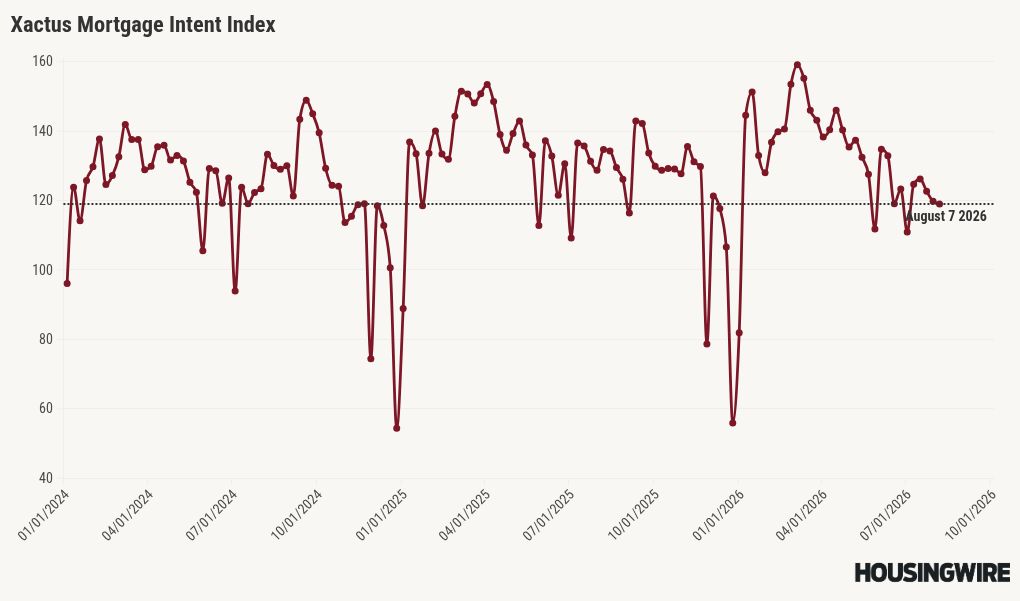
“Mortgage intent declined another 0.7% week over week, with the Xactus Mortgage Intent Index falling to 119.0 as the 30YR FRM mortgage rates edged higher to 6.69% according to Freddie Mac,” Thomas Lloyd, Xactus’ chief strategy officer, said in a statement.
He continued, “While the weekly decline was modest, the index was 11.7% below the same week last year, marking a widening year-over-year decline.”



FAA Recruits 2,000 Gamers to Fill Air Traffic Control Towers
The federal government spent April recruiting video gamers to run American airspace, and the pitch worked. The Federal Aviation Administration has hired more than 2,000 gamers to train as air traffic controllers, hitting 94% of its hiring goal for the year, according to the Transportation Department, with another 2,000-plus candidates in the pipeline behind them. The reasoning is plain: the job is watching several moving objects on a screen, deciding fast, and talking while doing it — which is what the applicants had already been doing for years for free.
The agency launched the campaign in April specifically to reach gamers, arguing they bring multitasking, rapid decision-making and strong spatial awareness to the console, and to pull in younger adults who had never considered the career. The recruitment spot opened on an Xbox logo and cut between gamers and controllers working their screens, under the line that they had been training for this already.
Transportation Secretary Sean Duffy announced the results in a social media post on Aug. 9. He said the campaign broke multiple FAA hiring records, including the most candidates hired in a single year, and credited what he called the agency’s most streamlined hiring process. Speaking Tuesday at Newark Liberty International Airport, Duffy said much of what gamers do while playing is what controllers do managing traffic in the air, and noted that many current trainees started out as gamers.
The response when the hiring window opened was the first sign it would work. The Transportation Department said the agency took 12,350 applications in 24 hours, with 10,779 of those applicants judged qualified — more than double the previous first-day record.
Behind the campaign is a staffing hole that has been years in the making. The FAA counted about 11,000 certified professional controllers in April against a staffing target of 12,563, with roughly 4,000 more in the training pipeline. That 12,563 figure is the full staffing target set in the agency’s 2026 Controller Workforce Plan. The FAA’s 2025 workforce report laid out a plan to hire at least 8,900 controllers over four years, which against more than 6,800 expected departures would net roughly 2,000 additional controllers by the end of 2028. Short staffing is what produces the ground stops, holding patterns and flow restrictions that ripple through airline schedules and freight timetables on any given afternoon.
The economics of the job explain why the pitch lands with people who skipped college. Controllers need no college degree, and those who finish the FAA Academy and complete on-the-job training earn an average of about $155,000. Only about a quarter of controllers hold a traditional four-year degree, which is why the campaign was aimed at young people on alternative career paths. For a 22-year-old with no student debt, few paths reach six figures faster.
Getting hired is not the same as working traffic, and the gap between the two is where the story gets sober. Applicants must be U.S. citizens, under 31 years old, and able to speak clearly over radio equipment. They have to pass the Air Traffic Skills Assessment, clear medical and security review, complete training at the FAA Academy in Oklahoma City, and then finish further training at their assigned facility before they can certify to work traffic alone. That last stretch runs one to three years. Washing out is common, and the 2,000 hires announced this week are people who entered that pipeline, not people currently separating aircraft.
That timeline is the real constraint on relief for airlines and passengers. A controller hired this summer is unlikely to be certified at a busy facility before 2028, which means the towers and radar rooms running short today will still be running short through the next several peak travel seasons. The campaign fixes the front end of the funnel; academy throughput and facility training capacity determine how fast anyone comes out the other side.
There is also less novelty here than the campaign suggests, and that is a point in its favor. The FAA’s own surveys found that nearly all recent academy graduates already identified as gamers — the trait was in the workforce long before anyone advertised for it. A 2021 FAA recruiting video made the same argument, with one controller comparing the work to Call of Duty for the peripheral awareness it demands and another likening it to reading an opponent’s next move in a basketball game. What changed in April was where the government went looking. It stopped screening for those traits through résumés and started buying ad time in front of the people who have them.
JBizNews Desk | Washington
© JBizNews.com All Rights Reserved. Reproduction or distribution without written permission is prohibited.

FIFA’s $4.2 Billion World Cup Stake Sale Collapses as Trump Backs Infantino
President Donald Trump is publicly defending FIFA President Gianni Infantino after a plan to raise roughly $4.2 billion from private investors by selling part of FIFA’s World Cup commercial business collapsed under pressure from major soccer federations.
Trump said removing Infantino would be a “terrible mistake,” praising him for overseeing what the president described as an extraordinarily successful and profitable World Cup.
The dispute is fundamentally about who should profit from one of the world’s most valuable sporting properties.
Infantino had proposed creating a new commercial entity called FIFA Forward Enterprise, which would control commercial and event operations tied to the World Cup and other FIFA competitions.
Outside investors would have been allowed to purchase a non-controlling stake of as much as 20%.
FIFA valued the new business at about $20 billion, meaning a 20% sale could have raised approximately $4.2 billion.
Private investment firm Thrive Eternal, connected to Joshua Kushner’s Thrive Capital, was expected to be among the leading investors.
The plan immediately triggered resistance from powerful soccer organizations, including UEFA, Concacaf and the Asian Football Confederation.
Their objection was larger than the price.
For generations, FIFA’s biggest tournaments have been controlled by soccer’s governing institutions. Selling part of the commercial operation to private investors would have introduced shareholders whose financial returns could become intertwined with decisions involving television rights, sponsorships, ticketing and future tournaments.
Critics argued that FIFA was effectively putting a piece of the World Cup’s future revenue stream up for sale without adequately consulting the national and regional federations that make up the organization.
The backlash became intense enough that FIFA withdrew the proposal.
FIFA leadership subsequently acknowledged that the process should have been handled differently and promised a review, but the retreat did not end the controversy surrounding Infantino.
Several major federations have questioned his judgment, while some officials have openly called for new leadership.
Trump is now stepping directly into that fight.
The president’s support matters because Infantino has developed an unusually close relationship with the Trump administration, particularly during preparations for the 2026 World Cup hosted across the United States, Canada and Mexico.
The tournament also demonstrated why private investors were interested in FIFA’s commercial rights in the first place.
The World Cup has become a massive global business built around broadcasting, corporate sponsorships, hospitality, ticketing and licensing. Expanding the tournament to 48 teams and 104 matches increased the amount of inventory FIFA could sell to broadcasters and sponsors.
That creates a valuable stream of future revenue.
Private-equity investors routinely seek businesses with predictable cash flows that can be packaged, expanded and eventually sold or refinanced. FIFA’s commercial operation has many of those characteristics — except that it sits inside a nonprofit global governing body whose members do not necessarily view maximizing investor returns as its primary purpose.
That tension ultimately helped kill the transaction.
The failed $4.2 billion raise therefore leaves FIFA with a much larger question than whether Infantino survives the political backlash.
It must decide whether the World Cup should remain entirely controlled by soccer’s governing institutions or whether private capital should eventually receive a seat at the table in exchange for billions of dollars.
For now, the investors are out.
Infantino remains in.
And the president of the United States has made clear which side he is on.
JBizNews Desk | Washington & Zurich
© JBizNews.com All Rights Reserved. Reproduction or distribution without written permission is prohibited.


Inflation cooled in July but remained elevated as Fed weighs rate hikes
This story about the July 2026 CPI inflation report will be updated with further details.
Inflation cooled slightly in July even as the pace of consumer price growth from a year ago remains elevated, as the Federal Reserve considers a potential interest rate hike next month.
The Bureau of Labor Statistics (BLS) said on Wednesday that the consumer price index (CPI) – a broad measure of how much everyday goods like gasoline, groceries and rent cost – increased 0.1% on a monthly basis and is up 3.4% from a year ago.
Those figures were in line with the estimates of economists polled by LSEG. The monthly data follows a reading of negative 0.4% in June, while the annual figure is slightly cooler than last month’s 3.5% reading.
So-called core prices, which exclude volatile measurements of gasoline and groceries to better assess price growth trends, were up 0.2% from a month ago and are 2.5% higher year over year. The monthly figure represents a slight uptick after price growth was flat in June, while the annual figure is slightly cooler than last month’s 2.6% reading.
FED’S HAMMACK SAYS MULTIPLE RATE HIKES MAY BE NEEDED TO TAME INFLATION
This post was originally published here

US Annual Inflation Rate Stabilizes in July, Slowing to 3.4 Percent
July’s U.S. annual inflation rate slowed to 3.4 percent, from 3.5 percent in the previous month, according to the Bureau of Labor Statistics.
Excluding the volatile energy and food categories, the 12-month core inflation rate also eased to 2.5 percent, from 2.6 percent.
Both readings were in line with economists’ expectations.
This is a developing story. Please check back for updates.
…

STAT+: Definium Therapeutics says its LSD therapy eased anxiety in late-stage trial
Definium Therapeutics said Wednesday that its LSD therapy significantly helped patients with generalized anxiety disorder in the first of two large trials.
It’s the second major win for Definium in the past two months, following a Phase 3 success in major depression.
In the Phase 3 anxiety study, 214 patients were randomly assigned to receive a single dose of DT120 — Definium “proprietary, pharmaceutically optimized” LSD pill — or a placebo.

STAT+: The secret AI-startup project I’ve been working on the last six months
You’re reading the web edition of STAT’s AI Prognosis newsletter, our subscriber-exclusive guide to artificial intelligence in health care and medicine. Sign up to get it delivered in your inbox every Wednesday.
As you read today’s main item and the associated story, let me know whether you think these are just the typical growing pains of a company trying to live up to its investors’ expectations while transforming health care, or something bigger. You can reply to this email or send a message to aiprognosis@statnews.com.
And if you have tips I should consider for future investigations, email them to me or contact me on Signal (an encrypted messaging app) at btrang.01.

Brin Spends $102 Million to Fight California’s Billionaire Tax
Sergey Brin has now put more than $100 million into defeating a California ballot measure that could cost him $13 billion — a ratio that explains why the fight is worth it to him, and why it is being waged with money rather than argument.
A filing Friday shows Brin donated another $20 million to Building a Better California, a political advocacy organization opposing the state’s billionaire tax, bringing his total contributions to $102 million. Brin, the world’s fourth-richest person with a net worth around $267 billion, faces an estimated $13.3 billion payment if the measure passes.
Under Proposition 40, billionaires who were California residents on Jan. 1, 2026 would owe a one-time tax equal to 5% of their net worth, due in 2027, with the option to spread payment over five years at additional cost. It would hit roughly 200 people, with 90% of the revenue directed to the state’s healthcare program and 10% to education, food assistance and administration. Backers, led by the labor group SEIU-UHW, project it could raise as much as $100 billion.
The fiscal hole behind the measure is real. California’s Medicaid program alone could lose up to $30 billion in federal funding once the Trump administration’s budget cuts take effect next year.
The opposition strategy is not simply to defeat Prop 40 at the ballot. Build a Better California is separately backing two competing measures, Propositions 41 and 42, described by supporters as attempts to keep Prop 40 from ever taking effect by restricting the state’s ability to introduce new taxes at all. One of the qualifying measures would require audits of programs funded by new state special taxes. All three go before voters in November.
The other defense is already underway, and it is the one that matters most for California’s tax base. Brin now lists Nevada as his residence in state records and reportedly bought a $51 million home near Miami Beach in March. Larry Page has converted several assets out of California, incorporating his family office Koop in Delaware in December 2025, with the nonprofit Oceankind similarly reincorporated around the same time. Travis Kalanick, Peter Thiel and Page have all left the state, and Mark Zuckerberg reportedly bought a $170 million mansion near Miami this year.
That mobility is the structural problem with a state-level wealth tax, and it is why the measure has split the Democratic side rather than uniting it. Governor Gavin Newsom opposes Prop 40, citing the economic impact of billionaires and their businesses leaving California, and has called instead for a national billionaires’ tax. Writing that an office worker can shoulder a higher tax rate than an heiress, Newsom argued for ending what he called the tax-free lifestyle loan — borrowing against stock portfolios while reporting no taxable income. A federal version removes the exit option that a state version cannot.
There is not yet clear evidence establishing how much of the relocation activity is attributable to Prop 40 specifically. Residency changes among the very wealthy have been running for years, driven by state income tax rates as much as by any single ballot measure.
Spending above $100 million from a single donor on a state tax measure is unusual, and the sum is dwarfed by the $13.3 billion at stake — which suggests the campaign is aimed at more than one election. The approach mirrors tactics used in other states where wealthy donors have funded ballot initiatives to constrain future tax policy.
California has become the center of the debate over the K-shaped economy and the diverging fortunes it produces. November decides whether the state tests the theory that wealth can be taxed where it is held rather than where it is earned.
JBizNews Desk | San Francisco
© JBizNews.com All Rights Reserved. Reproduction or distribution without written permission is prohibited.
Tata Sons Chairman Unexpectedly Steps Down

Why isn’t Iran attacking Israel? – opinion
Iran’s last weapon
Iran has delivered a sweeping set of demands that the United States must meet before the Strait of Hormuz can be reopened to maritime traffic. The Islamic Republic of Iran has been fighting a war with the Great Satan, America, and the Little Satan, Israel, for 46 years.
Iran’s most powerful strategy has been to use proxies and drones. The proxies are on life support, but not their drones. They are able to keep the Gulf destabilized with these drones and also hit American bases, despite the fact that the US and Israel have neutralized more than 90% of those missiles.
Bombing bridges and power plants is not the answer. It will only hurt the Persian people who are crying out for freedom.
Why isn’t Iran attacking Israel?
To understand what is happening, one must ask a simple question: Why is Iran not attacking Israel?
The answer is that Israel fought one of the first true drone wars involving a great power. But what Israel did that was most effective was target Iranian leadership, such as Razi Mousavi, senior IRGC general and overseer of Syrian-Iran military coordination; Mohammad Reza Zahedi, IRGC Quds Force commander for Lebanon and Syria; Ali Khamenei, Iran’s supreme leader; Ali Larijani, secretary of Iran’s Supreme National Security Council; Gholamreza Soleimani, commander of the Basij internal security forces; Alireza Tangsiri, commander of the IRGC Navy; and dozens, if not hundreds, of other Iranian leaders.

Iran is not attacking Israel because Israel targeted the top leadership of Iran, primarily through drone warfare. Cutting off the head of the snake is the key to keeping those snakes from procreating.
Trump has broken Iran’s war machine
What Donald Trump has achieved in the Iran war is astonishing, despite the liberal, godless media attacking him and claiming he has failed. Iran’s nuclear backbone has been broken, and its war machine is in shambles.
The next phase of the war does not have to be a major military operation. Quite the contrary, the US has the largest inventory of advanced drones in the world, but needs to manufacture 10 times that amount.
Iran’s only power left is its drones. They are trying to smuggle more of those fiber-optic drones to Hezbollah through Syria and Iraq and hit US bases in Iran, Kuwait, and Jordan.
The new battlefield: Drones and cyberwarfare
During Operation Roaring Lion-Epic Fury, Israel simultaneously executed the largest cyberattack in history, knocking Iran’s Internet down to roughly 4 percent of normal capacity and creating a nationwide digital fog that disrupted government services, media, energy, and infrastructure. All of this was coordinated to precede and support the kinetic strikes, including hacking state TV and jamming GPS.
The US needs to adopt the same long-term strategy with Iran. Iran will continue using its drones because there are too many of them, they are too well hidden, and they are too inexpensive. The FPV drones cost as little as $300 and are 3D-printed by Hezbollah. They have become the single deadliest weapon against Israeli troops in Lebanon.
Secretary of War Pete Hegseth has launched a drone dominance program, calling for over 300,000 small, one-way strike drones to be fielded across the services by 2028. The Army has announced plans to get up to 1 million drones.
The Strait of Hormuz cannot be ignored
The Strait of Hormuz, a 21-mile waterway, cannot be protected sufficiently with air and naval power alone because of Iranian drones.
Iran’s Shahed-136 drone is about the size of a king-size mattress. That drone has a range of 500 miles and costs between $20,000 and $35,000 to produce. Iran has thousands of them.
Iran is a very big country, one and a half times the size of California. Those drones can be anywhere. They can be underground, they can be in crevices, and they can be hidden in the mountains.
Defeat the drones by hunting the snake
The question is: How do you defeat Iran’s drones?
You defeat them with our own drones, but you do it the same way the Israelis have done it. It’s not a big military operation. It’s a smaller operation targeting Iranian leadership.
You can be sure of one thing: It will be successful. Israel has already proven it. That’s why Iran is not striking Israel.
Iranian leadership cannot and will not continue down its apocalyptic path if it realizes it is going to cost them their lives.
They brag about wanting 72 virgins, but the US can give them 72 Virginians: American young warriors with the backbone of Thomas Jefferson, Benjamin Franklin, and Abraham Lincoln, using the most advanced AI-driven technology to target these devils.
Forcing them to feel the heat until they see the light is going to take patience and time. But ultimately, the Islamic Nazi regime can be defeated. And when it is, the Persian people will rise up like lions to take back their country.
The writer has written 120 books, is a #1 New York Times bestselling author, and Nobel Peace Prize nominee. He is the founder of the Friends of Zion Museum in Jerusalem, the Ten Boom Museum in Holland, and Churches United with Israel, one of the largest Christian Zionist networks in America.
Pervasive antisemitism present in US college classrooms, curricula, faculty, ADL finds
The Anti-Defamation League has released two new reports on Wednesday that claim that antisemitism on US college and university campuses has increasingly moved beyond public protests and encampments to take root directly inside classrooms, curricula, and faculty networks.
The ADL announced in conjunction with the reports the launch of a new Campus Classroom Reporting (CCR) mechanism, a confidential channel designed for students, staff, and faculty to report and seek support regarding classroom-based bias.
The report titled Antisemitism Among Faculty and in the Classroom: Trends, Patterns and Institutional Dynamics claimed to have identified recurring patterns such as pro-terrorism narratives introduced into coursework, extra credit offered for attending anti-Israel rallies, and faculty singling out Jewish and Israeli students in class.
The second report, The Faculty Factor: Inside the Networks Driving Anti-Israel and Anti-Zionist Activism on Campus, mapped how organized faculty networks have deepened ties with student activist groups since the 2024 encampment wave and shielded them from accountability.
The ADL’s reports are drawn from tracking data, institutional analysis, and surveys of the campus climate. While public attention has largely focused on visible student demonstrations, the new research aims to address what it claims happens behind closed classroom doors, areas traditionally hidden from outside scrutiny.

The report stated that the ADL tracked 1,694 antisemitic incidents on US campuses in 2024 and 583 in 2025. Although overall year-over-year public incidents declined, the research claimed that faculty conduct and instructional framing continue to foster a sustained, hostile environment for Jewish and Israeli students.
The report identified several recurring patterns in which it claims education is blurred with political advocacy, creating environments that can marginalize or intimidate Jewish and Israeli students. Among the examples highlighted by the report, it is claimed that coursework allegedly incorporated readings from leaders of designated terrorist organizations, such as Ghassan Kanafani and Leila Khaled of the Popular Front for the Liberation of Palestine (PFLP).
University of California, Irvine professor: Oct. 7 a ‘gift from Allah to the world’
It noted a November 2023 remark attributed to a University of California, Irvine professor describing the October 7 Hamas attacks as a “gift from Allah to the world” and a “golden opportunity.” Similarly, it pointed to a Cornell University professor who allegedly stated publicly in October 2023 that he was “exhilarated” by the attack.
The report detailed additional claims that Israeli and Jewish students were personally targeted or held accountable for the Israeli-Palestinian conflict, Israel’s military campaign in Gaza, and prior Israeli military service. According to the report, these classroom dynamics often single out Jewish and Israeli students by treating them as representatives or extensions of the Israeli government.
The publication highlighted instances where an Israeli student at Columbia University who had served in a combat role was allegedly referred to by a professor as “one of the murderers.” It also claimed another student was told, “It’s such a shame that your people survived in order to commit mass genocide.”
Furthermore, the report claimed that course descriptions and syllabi at prominent institutions, including Stanford, Princeton, Northwestern, and UC Berkeley, frequently present contested political claims about Israel and Zionism as settled historical fact. For example, it cited a Princeton course on Gender, Reproduction and Genocide that featured reading lists focusing on what the course described as “Israel’s genocidal project,” alongside a Northwestern national cinema course description framing the conflict as an “ongoing genocide.”
The ADL report also shed light on how academic incentives and subtle pressures to conform affect campus life, noting that students can feel deeply alienated or pressured when political engagement is tied to coursework. The publication recorded instances where it claimed students were offered extra credit for attending anti-Israel walkouts and rallies, or where classes were canceled entirely in favor of protest participation.
According to the findings, these structural pressures and biased classroom dynamics can create an intimidating atmosphere for Jewish and pro-Israel students. For students whose Zionism or connection to Israel is a core component of their identity, such environments risk making them feel that their beliefs are unwelcome, forcing many to self-censor or hide their backgrounds to avoid academic penalties or social ostracism.
The report The Faculty Factor: Inside the Networks Driving Anti-Israel and Anti-Zionist Activism on Campus examined how organized faculty networks and unions operate across institutions to shape campus climate and policy. According to the findings, groups such as Faculty and Staff for Justice in Palestine (FSJP), which spans over 130 university chapters, allegedly leverage their institutional authority, tenure protections, and access to administrative channels to provide crucial backing for student activist groups, including Students for Justice in Palestine (SJP) chapters.
Report highlights professors’ explicit recognition of titles’ strategic weight
The report highlighted how professors explicitly recognize the strategic weight of their titles, quoting University of Illinois Associate Professor Maryam Kashani, who noted regarding faculty presence in activism, “I think there’s a certain legitimacy that comes with the letters before our names.”
The report claimed these networks helped coordinate faculty participation during the 2024 campus encampments, with professors at institutions like New York University and Columbia University forming physical barriers to impede law enforcement, and professors at Northwestern University locking arms to block university police. It further noted instances of faculty canceling classes in solidarity or holding classes and office hours directly inside protest encampment zones, such as at Columbia University, where Jewish students noted that Zionists were explicitly unwelcome.
The publication detailed how professional associations and faculty unions, including the American Association of University Professors (AAUP) and the California Faculty Association (CFA), have increasingly utilized their platforms to pass Boycott, Divestment, and Sanctions (BDS) resolutions, push for clemency or amnesty for student protesters facing disciplinary action, and actively oppose the adoption of formal tools like the International Holocaust Remembrance Alliance (IHRA) definition of antisemitism.
For instance, the report highlighted actions such as the CFA circulating political candidate questionnaires asking if respondents accepted contributions or endorsements from groups like the Jewish Public Affairs Committee of California (JPAC), alongside instances where Melina Abdullah, the CFA’s Political Action & Legislation Committee Chair, streamed a class advocating against a state bill protecting Jewish and Israeli students.
Additionally, the report pointed to survey data where nearly three-quarters of responding Jewish-identifying faculty reported observing anti-Jewish activity originating from colleagues, with one respondent stating, “Faculty are not talking to me because they know I’m a Zionist.”
Emphasizing the scope of these concerns, ADL CEO Jonathan Greenblatt stated, “Universities cannot claim to be addressing antisemitism seriously if they ignore what happens behind the classroom door and inside faculty governance.”
To combat what the ADL claims is widespread underreporting of classroom bias, where the vast majority of witnesses traditionally stay silent, the newly launched Campus Classroom Reporting mechanism offers a low-barrier, confidential space to surface concerns, request guidance, and help the organization track institutional trends.
Gazans steal pipes from Yellow Line, IDF reacts too slowly
New episodes every Sunday-Thursday.
Listen and subscribe wherever you get your podcasts.
For more news, analysis, and the latest updates, head to jpost.com.
Headlines edited by James Genn.
Hosted and produced by Shifra Jacobs.
West Bank employment rebounds after Oct. 7 drop, but wages, protection remain weak, PCBS data shows
Employment in the West Bank rose by 4.6% in the second quarter of 2026, bringing the Palestinian workforce to 733,000, according to new data published by the Palestinian Central Bureau of Statistics (PCBS) on Tuesday.
The bureau attributed the rise to increased employment in the commerce, restaurant and hotel sectors, which were heavily affected when tourism to the West Bank plummeted amid the regional instability triggered by Hamas’s October 7, 2023, attack on Israel. Already struggling with the loss of tourism during the COVID-19 pandemic, cities such as Bethlehem, where tourism accounts for 70% of annual income, suffered major losses.
Following the October 7 attack, 96% of businesses reported decreased activity and 42.1% reduced their workforces, according to a 2024 report by UN Trade and Development. The decline amounted to the loss of 306,000 jobs and pushed unemployment to 32%. These losses came in addition to the 140,000 Palestinian workers with permits to work in Israel whose permits were revoked following October 7.
The majority of Palestinians, 680,000, were employed in the local market, an increase of around 27,000 workers from the first quarter.
The unemployment rate among those aged 15 and above stood at 27.9% in the second quarter, amounting to around 284,000 people, while total labor underutilization stood at about 29.9%. According to International Labour Organization standards, the unemployment rate among men in the West Bank reached 27.2%, compared with 30.5% among women.

Employment increases but wages remain low
Though employment is increasing in the West Bank, wages remain low compared with Israel, with the average daily wage standing at NIS 134.3, just over half of Israel’s minimum daily wage of NIS 257.75.
Around 53,000 Palestinians were working in Israel or Israeli settlements in the West Bank during the second quarter, an increase of around 5,000 workers compared with the first quarter. Around 35,000 of these workers were employed in Israel. The average daily wage for wage employees in Israel and Israeli settlements fell slightly to NIS 263.4 in the second quarter of 2026, compared with NIS 287.1 in the first quarter.
The survey also found that Palestinians in the West Bank worked an average of 41.6 hours per week and 22.4 days per month.
According to the bureau, 66.1% of employed persons were wage employees, 23.4% were self-employed, 6% were employers, and 4.5% were unpaid family members.
A significant 42.1% of wage employees in the private sector were hired without an employment contract, while only 35.5% said they received contributions to a pension fund or financial compensation upon leaving their position.
Less than half of female wage employees receive paid maternity leave
Additionally, less than half (49.8%) of female wage employees received paid maternity leave, despite being entitled to 10 weeks of paid maternity leave and protections against termination while on leave.
More than one in 10 (15.5%) wage employees in the private sector received a monthly wage below the minimum wage of NIS 1,880 in the West Bank during the second quarter of 2026.
Likud court approves Netanyahu’s reserved Knesset slot for Haim Katz after freezing vote
The Likud’s top internal court approved on Wednesday a reserved slot on the party’s Knesset slate for senior minister Haim Katz, which was selected by Prime Minister Benjamin Netanyahu, one day after blocking a vote on the move.
The three-judge panel approved Katz’s placement by a majority, after unanimously approving reserved slots for Defense Minister Israel Katz and Foreign Minister Gideon Sa’ar on Tuesday.
The court found on Wednesday that the party’s election rules allow Likud chairman Netanyahu to use his allotted slots to shape a slate representing the party’s different constituencies.
Netanyahu was granted the authority to determine eight slots within the first 30 spots on the party list last month following a vote on the controversial decision by the Likud Central Committee.
Likud announced late on Tuesday night that the defense minister should receive a reserved slot, in order to “allow him to focus on security needs rather than engage in politics at this time.”

The party also stated that Sa’ar would receive a reserved slot as part of the merger agreement between his party and the Likud, and that Haim Katz would receive a slot due to his senior position in the party as the Likud Central Committee chairperson.
Slots were approved by the Likud’s secretariat
The decision to grant the three ministers reserved slots required approval from the Likud’s secretariat. While the foreign and defense ministers’ slots were approved, the court issued an interim order blocking Katz’s slot because he had already registered for the August 17 primaries and begun campaigning.
The court said in its final decision on Wednesday that reserving a place for a veteran lawmaker who had intended to compete in the primary was less disruptive to other candidates than using the slot for an outside contender.
All three ministers will now receive the reserved slots on the party’s list that were granted to them by Netanyahu.
The changes to the party’s primaries that have expanded Netanyahu’s control over the Knesset list have led to fierce internal tensions, with some party members in favor and others strongly against.
A fierce critic of changing the system has been MK Tally Gotliv, who is viewed as a candidate who would receive broad support from registered party members.
Gotliv sharply criticized the Tuesday decision to reserve the slots for the three ministers, condemning the defense minister.
She called the decision to grant the defense minister a reserved slot, “a disgraceful move that mocks Likud voters, who understand one thing more than all the veteran ministers: the need to fight the legal establishment that is persecuting the right-wing government and right-wing figures.”
Netanyahu reportedly has held several meetings with the Likud Central Committee chairman Katz, seeking to bridge disagreements over the primary system and secure internal support for changing the system.
There were also reports that Netanyahu has threatened to leave Likud if the proposed changes were not advanced.
Those within the party who oppose changing the primaries have argued that it will cause those who would otherwise score highly in the primaries to fall further down the list.
The Likud has for years prided itself on conducting primaries in which over 100,000 of its registered members are eligible to vote for the Knesset list. Netanyahu pushed to change the system in recent weeks ahead of the primaries, which were set for August 17.
Parties are not required to hold primaries in Israel, and only a few do so.
The Likud primaries are expected to be highly competitive. Likud currently has around 40 ministers and MKs serving in the government and Knesset, but recent polls project the party winning only about 25 seats, leaving many at risk of losing their places on the party’s Knesset list.
The debate on how to hold the Likud primaries comes ahead of the general elections, which are set to take place on October 27.
The tensions surrounding the slots also come after the Tel Aviv District Court on Monday rejected Likud MK Afif Abed’s attempt to restore a narrowly approved change allowing current and former MKs, ministers and deputy ministers to run in the party’s district primaries, leaving the restrictions in place ahead of the August 17 vote.
Likud had announced Monday that Netanyahu’s first reserved slot would go to entrepreneur and businessman Oren Dobronsky.
Zelensky halts drone strikes on Black Sea oil tankers in Russian port after demand from US VP Vance
Ukrainian President Volodymyr Zelensky halted Ukraine’s drone campaign against oil tankers in the Black Sea after a request from US Vice President JD Vance, The Financial Times reported, citing Ukrainian officials.
According to the report, Washington was upset that Kyiv was harming US companies by targeting tankers hauling crude oil from Kazakhstan to a Caspian Pipeline Consortium terminal in Russia’s Novorossiysk port.
Ukrainian officials and other people familiar with the matter said that Vance asked Zelensky to stop the attacks during a call on July 31. Since that call, Ukraine has not struck tankers in the CPC terminal, officials told the FT.
Ukraine agreed to not target non-Russian ships, so long as they were not sanctioned by Ukraine or carrying any Russian cargo.
“We very carefully listen to our American partners,” one senior Ukrainian official told the FT. The official added that Ukraine established “mechanisms” in response to Vance’s request.

Drone campaign brought war to Russia, aimed to cut off resources
Ukraine’s drone campaign on the port aimed to cut off revenue from the Kremlin and bring more of the war to Russia.
A US official confirmed the FT report and added that the administration views the CPC as a “vital conduit of Kazakhstan-origin energy for European markets that serves as an alternative to Russian energy supplies.”
Notably, US energy companies Chevron and ExxonMobil own stakes in CPC, which is Kazakhstan’s main oil route.
The CPC terminal has reportedly been “a regular part of the conversation with the US and the Kazakh governments”, the Ukrainian official told the FT.
Notably, this is not the first time the US has requested that Ukraine refrain from hitting US industry interests in Russia.
In February, former Ukrainian ambassador to the US Olha Stefanishyna received a démarche from the US State Department noting its disapproval of Ukrainian strikes on Novorossiysk.
Ukrainian strikes on the CPC terminal caused turmoil for oil markets, leading Kazakhstan to stop piping oil to the port city and doubling shipping rates.
Notably, in a July 17 attack, a ship chartered by Exxon was hit in a Ukrainian strike as it was waiting to load.
The chaos in Novorossiysk came as the US has blockaded the Strait of Hormuz in Iran, which has affected oil markets worldwide and made Kazakh oil all the more vital.
JD Vance proved to be combative with Zelensky, Ukraine prioritizes US munitions
Vance has notoriously been one of the most combative figures in the trump administration’s handling of the war. He repeatedly berated Zelensky in the Oval Office in 2025, implying that the Ukrainian president was not offering enough gratitude for “the president who is trying to save your country.”
Vance has gone so far as to say that stopping aid to Ukraine was one of his proudest achievements in his tenure as vice president.
“It’s one of the things I’m proudest… we’ve told Europe that if you want to buy weapons, you can, but the US is not buying weapons and sending them to Ukraine anymore,” Vance said in April.
People familiar with the call told the FT that Zelensky agreed to stopping the strikes on CPC because he is still seeking the license to produce Patriot missiles that US President Trump publicly pledged to give him earlier this summer.
Zelensky reportedly stressed to Vance that Patriot missiles, along with other interceptors and air defense missiles, were “top priority” for Ukraine.
Elsewhere in Russia, Ukraine has stepped up its attacks on Moscow’s oil and shipping infrastructure.
In the month of August alone, Ukrainian drones have hit three Russian oil refineries, an airfield, and a warehouse for Russian shipping giant Wildberries.
Killing Iran’s commanders did not kill the system that produced them – opinion
Leadership decapitation is frequently treated as a measure of success in conflicts involving centralized authoritarian systems and irregular security organizations. Removing senior commanders can disrupt command and control, degrade institutional knowledge, create succession problems, and generate uncertainty throughout the security apparatus.
Yet the strategic effect of leadership targeting ultimately depends on a more difficult question: whether the removal of individuals changes the institutions and strategic logic that produced them. Iran’s recent reconstruction of its military and security hierarchy provides an important case study.
The emerging evidence suggests that the Islamic Republic has suffered substantial personnel losses without undergoing a comparable transformation of its security doctrine. Instead, Tehran appears to be rebuilding around an older revolutionary-security elite whose professional experiences combine conventional command, intelligence operations, asymmetric warfare, ideological enforcement, and domestic coercion.
This distinction is essential for evaluating claims of political or strategic transformation in Iran. A change of leadership is not necessarily a change of regime, just as the destruction of a command echelon does not necessarily destroy the institutional system beneath it. Political orders reproduce themselves through organizations, doctrines, networks, incentives, and institutional memory.
If these mechanisms remain functional, leadership losses can produce disruption without producing transformation. The recent Iranian appointments therefore should be analyzed not simply as biographies of individual commanders but as indicators of the functions the regime considers most important to its survival.

The importance of institutional memory
Ali Abdollahi’s appointment as chief of the General Staff illustrates the importance of institutional memory. Abdollahi belongs to the revolutionary-security generation that emerged with the Islamic Republic itself. His career began in the security institutions created after the 1979 revolution and continued within the newly established Islamic Revolutionary Guard Corps.
His elevation does not represent an obvious generational transition. Rather, it suggests that under conditions of uncertainty, Tehran continues to assign considerable value to figures whose institutional identities were formed during the consolidation of the revolutionary state.
The appointment of Kiomars Heydari as deputy chief of the General Staff points toward a second development: the decreasing conceptual distance between national defense and regime defense. Heydari previously described the Army Ground Forces’ participation in suppressing the November 2019 protests as a “proud” mission and later referred dismissively to protesters during the 2022 unrest.
The importance of these statements lies in the institutional position from which they were made. Iran’s regular military, the Artesh, has historically possessed a different organizational identity from the more explicitly ideological IRGC. The incorporation of domestic regime-preservation functions into the professional identity of senior Artesh commanders therefore suggests a broader evolution in Iranian civil-military relations.
From the perspective of political theory, this development reflects a fundamental distinction between state security and regime security. The state represents an enduring political and institutional order; the regime represents the particular configuration of authority governing it. In consolidated political systems, the survival of a government is not identical to the survival of the state.
Leaders can lose power and governments can change without threatening the existence of the country. Authoritarian systems, particularly revolutionary authoritarian systems, have stronger incentives to collapse this distinction. Political opposition can consequently be interpreted as a security problem, popular mobilization as destabilization, and institutional independence as a potential threat to regime continuity.
This dynamic helps explain why Iran’s new command structure appears simultaneously oriented outward and inward.
Ahmad Vahidi’s appointment to command the IRGC represents the external dimension. His career developed through intelligence work and the external-operations apparatus that eventually evolved into the IRGC Quds Force. Argentine prosecutors have accused him of involvement in the 1994 bombing of the AMIA Jewish community center in Buenos Aires, in which 85 people were killed, and Interpol issued a Red Notice in connection with the investigation. These allegations are not equivalent to a criminal conviction, but his professional background nevertheless places him within the institutional history of Iranian intelligence, unconventional warfare, and extraterritorial security operations.
Tehran’s strategic approach to its international conflicts
The strategic importance of that experience extends beyond the individual commander. Since the Iran-Iraq War, Tehran has developed methods for compensating for conventional military disadvantages through asymmetric capabilities. Proxy and partner networks, ballistic missiles, unmanned systems, maritime pressure, intelligence operations, and unconventional warfare have allowed the Islamic Republic to threaten adversaries possessing substantially greater conventional military power.
This strategic approach has been especially important in Iran’s confrontation with the United States and Israel. The appointment of commanders whose careers were formed within this security culture therefore provides little evidence that leadership turnover has altered Tehran’s fundamental perception of either country.
Hossein Taeb’s return to command the Basij reveals the domestic counterpart of this strategy. Taeb’s career has included service within the IRGC, the Ministry of Intelligence, counterintelligence, and senior positions in the Guards’ intelligence apparatus. The United States sanctioned him in 2010 for serious human-rights abuses, and the European Union subsequently imposed restrictive measures related to serious violations of Iranian citizens’ rights. The institutional significance of his appointment is particularly important because the Basij operates at the intersection of military organization, ideological mobilization, social penetration, surveillance, and internal security.
The Basij’s presence within universities, workplaces, neighborhoods, public institutions, and other sectors of Iranian society gives it a function fundamentally different from a conventional reserve force. It provides the regime with organizational depth inside the population. In periods of stability, this infrastructure supports ideological mobilization and social control. During periods of unrest, the same infrastructure can provide intelligence, manpower, surveillance, and coercive capacity. Placing an experienced intelligence figure at the head of such an organization suggests that domestic instability occupies a significant position in the regime’s current threat assessment.
The resulting command structure can therefore be understood as a dual-front security architecture. Externally, Tehran requires institutions capable of deterring or imposing costs on the United States and Israel despite the degradation of elements of its conventional and senior command structure. Internally, it requires organizations capable of identifying, monitoring, fragmenting, and suppressing political mobilization before it becomes an existential challenge. These missions are institutionally different, but within the regime’s security worldview they increasingly converge.
This convergence is consistent with the political psychology of a besieged revolutionary state. The Islamic Republic has historically interpreted foreign and domestic threats as interconnected. External adversaries are frequently accused of exploiting domestic dissent, while internal opposition is regularly framed as vulnerable to foreign manipulation. Such a worldview produces an important security consequence: military setbacks abroad can generate increased coercion at home because external vulnerability heightens the leadership’s fear of internal destabilization.
The process can become self-reinforcing. Military setbacks weaken perceptions of regime strength. Intelligence penetration increases elite suspicion. Economic deterioration contributes to popular dissatisfaction. Public unrest encourages expanded surveillance and coercion. Greater repression widens the political distance between state and society, which in turn increases the regime’s perception of domestic insecurity. A government organized increasingly around this cycle may become more security-oriented as it becomes weaker, not less.
This observation complicates assumptions that sustained military pressure necessarily produces political moderation. Authoritarian regimes confronted by severe external threats do not follow a single trajectory. Some negotiate, some fragment, and some intensify repression while transferring greater authority to security institutions. The Iranian appointments suggest that the Islamic Republic is currently emphasizing institutional consolidation. The organizations most useful for surviving external conflict and domestic instability—military command, intelligence, the IRGC, and the Basij—are consequently likely to acquire greater political importance.
A conventional military dictatorship?
This does not mean that Iran has become a conventional military dictatorship. Clerical institutions, civilian bureaucracies, economic networks, the regular armed forces, and political factions continue to exist. The more useful analytical concept is a shift in the center of gravity of political power. Under sustained security pressure, institutions controlling weapons, intelligence, surveillance, ideological mobilization, and coercive capacity become increasingly indispensable. Formal constitutional structures can remain intact even as the practical distribution of influence moves toward the security establishment.
There is nevertheless a paradox in the Islamic Republic’s response. Its ability to replace senior commanders demonstrates institutional resilience. Leadership targeting has not automatically produced organizational collapse. Vacancies have been filled and command relationships reconstructed. For US and Israeli defense planners, this is an important warning against equating successful decapitation operations with strategic defeat of the adversary.
At the same time, the identity of the replacements reveals a potential structural weakness. Nearly five decades after the revolution, Tehran continues to rely heavily on an aging revolutionary-security generation when searching for individuals considered sufficiently experienced, ideologically reliable, institutionally connected, and politically trustworthy. The regime demonstrates an ability to regenerate leadership, but it appears to do so from a relatively narrow political and professional pool. Institutional continuity can therefore be both a source of resilience and evidence of stagnation.
For the United States and Israel, the principal implication is that assessments of Iranian military degradation should move beyond battle-damage metrics. The number of commanders killed, missile launchers destroyed, facilities damaged, or units disrupted matters operationally, but strategic assessment must also examine institutional regeneration. Can the regime restore command relationships? Can it preserve intelligence networks? Can it reconstruct proxy and partner capabilities? Can it maintain internal coercive capacity? Most importantly, does the strategic doctrine guiding these organizations survive the individuals who previously implemented it?
Iran’s new hierarchy suggests that the answer to the final question is, for now, yes. The individuals have changed, but the security system continues to reproduce commanders shaped by the same broad institutional environment. Hostility toward the United States and Israel remains embedded in the strategic culture of the organizations from which these leaders emerge, while the regime’s domestic-security institutions continue to treat political instability as a potential existential threat.
The emerging Iranian order should therefore be understood neither as evidence of successful regime transformation nor as proof that military pressure has failed. It represents something more complicated: an authoritarian security system adapting to attrition while attempting to preserve its core strategic logic. Tehran is rebuilding a command structure capable of operating on two fronts—deterrence, asymmetric confrontation, and strategic competition abroad; surveillance, ideological control, and coercion at home.
The larger lesson extends beyond Iran. Leadership decapitation can weaken an adversary, but the strategic effect depends upon whether the institutions beneath the targeted leadership can reproduce themselves. Revolutionary regimes survive not only through individual leaders but through organizational memory, coercive networks, ideological narratives, and systems for selecting trusted successors. Destroying commanders can create tactical and operational opportunities. Transforming the political-security system that continually generates replacements is a fundamentally different problem.
Iran today illustrates that distinction. Its military hierarchy has suffered substantial disruption, but its response has been to reconstruct itself around veterans of the same revolutionary-security tradition. For Washington and Jerusalem, the implication is sobering: the next phase of competition with Tehran will not be determined solely by how much of Iran’s military infrastructure has been destroyed, but by whether the Islamic Republic retains the institutional capacity to regenerate, adapt, and continue imposing costs abroad while preserving political control at home.
Petition seeks to block yeshiva project for foreign students on east Jerusalem public land
Three nonprofit organizations petitioned the Jerusalem District Court to overturn the approval of a plan to build a yeshiva and dormitory for foreign students on public land in the Sheikh Jarrah neighborhood of east Jerusalem.
Ir Amim, the Sheikh Jarrah Welfare Association, and the Umm Lison Women’s Association filed the petition against the Jerusalem district and local planning committees, senior planning officials, and the Ohr Somayach institutions, which initiated the plan.
The petitioners also asked the court, sitting as an Administrative Affairs Court, to freeze the plan while it considers their challenge. They specifically asked that the plan not be formally published as approved or otherwise advanced until the court issues a ruling.
At the center of the dispute is a 4.3-dunam site on Pierre van Paassen Street in the Nahalat Shimon section of Sheikh Jarrah, according to official planning records.
The records list the land as state-owned and show that an earlier plan designated it for public use. The petitioners said the site had originally been privately owned Palestinian land and was expropriated by the state for a public building intended to serve neighborhood residents.

They argued that the district planning committee’s decision would instead divert one of the limited sites available for east Jerusalem public services toward a yeshiva and dormitory intended primarily for students from abroad.
East Jerusalem faces public building shortage, according to petition
According to the petition, east Jerusalem faces a severe shortage of public buildings, including a shortage of approximately 2,000 classrooms, based on Jerusalem Municipality figures.
The petitioners said a professional assessment prepared at the district committee’s request also identified a significant shortage of public buildings in Sheikh Jarrah itself. They further said the state has previously identified the lack of available public land as one of the main obstacles to addressing those shortages.
Ohr Somayach received authorization from the Israel Land Authority to plan the project, but the land has not yet been formally allocated to the institution, according to the court filing.
During the approval process, the plan’s wording was changed to replace explicit references to a yeshiva, study hall, and dormitory with broader permitted uses, including religion, culture, and education, the petitioners said.
They argued that the changes were largely cosmetic because Ohr Somayach remained the plan’s developer and the project continued to be intended for the same purpose. They also said the decision to designate 40% of the plot as public open space did not address their objections to the planned building.
The petition challenges three decisions connected to the project: an extension granted to complete the planning process, the district committee’s approval of the plan, and the district committee chairman’s refusal to allow an appeal against that approval.
Official planning records show that the plan was submitted in 2013. The petitioners said it was approved only this year after remaining dormant for several years and argued that officials did not adequately explain why the planning process was extended.
They further argued that the planning authorities did not provide sufficient justification for departing from the land’s previously designated purpose and that the decision was therefore unlawful.
In their request for a temporary freeze, the petitioners acknowledged that construction was not imminent because the land must still be allocated and the project must go through the building-permit process.
However, they said allowing the plan to take effect could make it more difficult for the court to cancel the approval later.
The petitioners said they would withdraw the request for a freeze if the respondents agreed that publishing or advancing the plan would not affect the court’s consideration of the case or be used to argue that the project had progressed too far to reverse.
Sheikh Jarrah, a focal point of Israeli-Palestinian disputes
Sheikh Jarrah has long been a focal point of Israeli-Palestinian disputes over land and housing. Attempts to evict Palestinian families from contested properties in the neighborhood prompted protests and clashes in 2021 and became a flashpoint in the lead-up to 11 days of fighting between Israel and Hamas.
“The yeshiva project is part of the wider series of moves threatening Sheikh Jarrah residents,” Ir Amim researcher Aviv Tatarsky said, accusing the state of coordinating with settler organizations to transfer Palestinian property in the neighborhood.
The case has not yet been assigned to a judge, and no decision has been issued on the request to freeze the plan.

Americans Take Out Record $211 Billion in Auto Loans
Americans borrowed more to buy cars in the second quarter than in any quarter on record, even as overall household debt edged lower for the first time since the pandemic.
The New York Fed reported Tuesday that consumers took out $211 billion in new auto loans between April and June, while also adding to credit card and home equity balances. The figure is a record in dollar terms only, not adjusted for inflation — the 2021 buying surge produced quarterly auto borrowing around $200 billion, but drove up prices along with it.
That distinction matters, because the number reflects sticker prices as much as buying appetite. The average amount financed reached $43,925 for a new vehicle and $27,070 for a used one, with the average new-car payment hitting an all-time high of $770 a month earlier this year and used-car payments averaging $531. New-vehicle prices rose 0.2% year over year in June while used car and truck prices fell 2.0%. A record borrowing quarter can mean people are buying more cars, or the same number of more expensive ones.
Auto debt is now the second-largest category of American consumer borrowing after mortgages. Auto balances rose $28 billion, or 1.7%, in the second quarter, with credit card balances up $21 billion and student loan balances slipping slightly. Outstanding auto loan debt stood at $1.685 trillion at the start of the year, about 9% of total consumer debt and roughly 57% above where it was a decade earlier.
The headline decline in total household debt is largely a technical artifact. Overall consumer debt slipped to $18.8 trillion, but the Fed tied the drop to a change in how mortgage data is reported, and expects the mortgage decline to be offset by a comparable jump in the next report. It was still the first quarterly decline in aggregate household debt since the second quarter of 2020, with balances up $4.6 trillion since the end of 2019.
One of the quarter’s clearer signals came from home equity. Home equity loan balances rose $19 billion, part of a four-year pattern Fed researchers attribute to older homeowners pulling cash out through second liens rather than refinancing a low-rate first mortgage at today’s rates. Homeowners sitting on mortgages issued years ago are, in effect, borrowing around their own loans.
On delinquency, the report pushed back against a widely cited alarm. The overall delinquency rate fell slightly to 4.7% of outstanding balances from 4.8%. Fed staff economists wrote that credit card delinquency, though elevated versus pre-pandemic levels, appears to have stabilized: the share of card debt more than 90 days past due climbed from 7.6% in late 2022 to 12.8% at the start of this year, but the pace at which households actually fall behind has been essentially unchanged for about two years, with roughly 7% of balances flowing into delinquency each quarter. The researchers attributed the rise in the stock of delinquent debt to lenders keeping charged-off accounts on their books longer rather than to worsening household finances.
The card delinquency rate itself fell to 12.92% from 13.12%, while student loan delinquency rose to 10.6% from 10.34%.
The broader picture is a consumer who keeps spending despite thinner real income. Personal consumption jumped 3.2% in the second quarter, a sharp rebound from a weak first quarter that kept overall growth from slowing further than it did — to a 1.5% annual pace from 2.1%. A Bank of America Institute analysis of July data found credit card spending excluding gas up 4.3%, even as the temporary lift from events like the World Cup faded, along with signs that spending rates across income groups are converging and the economy’s K-shaped split is easing. The institute concluded that consumer financial health looks solid, noting the share of households paying off card bills in full each month has risen with little sign of accelerated savings drawdown.
For lenders and dealers, the takeaway is that credit is still flowing at high volume with delinquency holding steady — but at loan sizes and monthly payments that leave less room if the labor market softens. The report lands in the middle of a running debate among Fed policymakers over when prices rising faster than incomes will finally show up as either weaker consumption or a jump in defaults. Two quarters in a row, it hasn’t.
JBizNews Desk | New York
© JBizNews.com All Rights Reserved. Reproduction or distribution without written permission is prohibited.


Iran to become member of BRICS Bank, increasing economic cooperation, trade – report
Iran is going to become a member of the BRICS Bank, Governor of the Central Bank of Iran Abdolnaser Hemmati said, according to reports from Iranian media on Tuesday evening.
BRICS is an organization made up of eleven countries: Brazil, China, Egypt, Ethiopia, India, Indonesia, Iran, Russia, Saudi Arabia, South Africa and the United Arab Emirates. It is an economic and geopolitical bloc that focuses on trade and development.
The New Development Bank (BRICS Bank) is a “multilateral development bank established by BRICS with the purpose of mobilizing resources for infrastructure and sustainable development projects in emerging markets and developing countries,” its website explains.
Hemmati announced that Iran was set to join the BRICS Bank in the near future, Iran’s semi-official Tasnim News Agency reported.
Iran expects the BRICS Bank to provide economic benefits
“Productive cooperation has commenced between our country and India in the areas of monetary affairs, banking, and the digital economy,” Hemmati said.

The next BRICS Summit will take place in September. The Governor said “The BRICS summit offers a prime opportunity to meet with officials from member nations with whom our country maintains its most extensive monetary and banking exchanges and interactions,” Tasnim reported.
“We believe that BRICS member nations can conduct trade using their national currencies, and we are pursuing bilateral and trilateral monetary cooperation with these members.”
Iran’s economy in crisis after war with US
Iran’s wartime economic crisis has triggered mass layoffs across multiple industries, with Iranian officials estimating that some two million people have lost work “directly or indirectly” due to the conflict and a prolonged nationwide internet blackout, according to a report by The New York Times.
Businesses across Iran have begun laying off workers as the country’s economy struggles under the combined pressure of war-related disruptions, sanctions, infrastructure damage, and the government-imposed internet blackout.
Iranian Deputy Labor Minister Gholamhossein Mohammadi said the conflict had already resulted in the loss of more than one million jobs and left another two million people “directly or indirectly unemployed,” according to statements given to Tasnim.
Asher Smith contributed to this report.

STAT+: Biotech company co-founded by top autoimmune researcher lays out plans with antibody therapies
Over the last five years, German researcher Georg Schett has made a name for himself as a pioneer in autoimmune disease treatment, showing that CAR-T therapy could be used to reset patients’ immune systems.
He has become a scientific adviser de rigueur for the field, joining a half-dozen startup advisory boards.
Now, for the first time, he’s co-founding a biotech company. But it has no immediate plans to work in CAR-T.
How AI can power a leaner, meaner homebuilding land team
AI’s move beyond talk, hype and possibility, to where it’s powering business operations and results was a constant theme at HousingWire’s AI Summit, held on Tuesday, in Dallas.
For homebuilders, the conversation is no longer about whether teams should adopt AI, but where it can make the biggest impact and how to best implement it.
For Century Communities, ranked 13th in the HousingWire Homebuilder Rankings, putting AI to work is no longer an option. Rather, it’s a necessity, fused into the complex, paper-work and tedious-research-filled workflows that surface potential land acquisition targets for the company’s Century Complete entry-level communities. During a Tuesday morning session at the HousingWire AI Summit, Chris Coakley, the builder’s corporate director of land, affordable product division, argued that leveraging AI in land acquisition has become a crucial capability for his company.
This is because Century Communities operates through a hub-and-spoke model with lean, lightly staffed local land acquisition teams working across its 45 markets in 16 states. This model, Coakley said, allows the builder to operate a leaner organization, but it also puts a greater workload on a relatively small number of local team members.
“Those teams are very lightly staffed,” Coakley said suring the session. “They do all their due diligence themselves, and they do all their underwriting themselves. Maybe the big deals get to corporate, but it’s at a point where it’s already been significantly vetted.”
That’s where AI comes into the picture.
“AI empowers a lightly staffed organization to better own the deal,” Coakley added.
How AI can boost land teams
Many homebuilders, Century Communities included, have already been using AI to improve the early-stage land due diligence process. Platforms such as Acres and Prophetic, for example, enable land teams to quickly evaluate whether a property is likely to be suitable for development before they commit significant resources and time into any specific deal.
Land teams can use these kinds of AI platforms to recognize environmental constraints, site characteristics, and overall development feasibility as necessary early steps in the site selection workflow. This allows land acquisition teams to quickly determine a property’s development viability before contracting, engineering or formal due diligence begins.
According to Coakley, Century Communities also uses AI tools that are much more widely accessible to generate market knowledge, allowing land teams to quickly analyze comparable sales, pricing, bedrooms, bathrooms, geography and other market data. Tools such as Copilot and Claude can generate detailed market reports and even presentations within minutes, helping acquisition teams make informed decisions and negotiate with sellers more effectively.
Ultimately, AI helps land teams, who are tasked with creating an ongoing lot pipeline, evaluate a large volume of potential development sites in a short period of time.
“As a land person, when you don’t know what deal is going to come through, the only solution you have is to have a lot of deals on the hook. Using AI…I can go through them really quick,” Coakley said.
“We can quickly run searches within those technologies that give us a decent idea of if the land is actually usable for our intended uses, and we can do that before contracting, before engineering looks at it, before any of that stuff. We can run three or four different queries, and we can have like a decent idea of whether or not that land is going to work for us,” Coakley added.
How to get employee buy-in
Many organizations that integrate AI into their workflows acknowledge that getting employees to fully embrace the technology can be a major challenge.
Coakley argued that homebuilders should put pressure on team members to adopt AI, even if those are small steps at first.
“You’ve got to get them to take the first step, and then you’ll just be shocked at what comes back,” he said.
Recruiting leaders from within the organization to talk about AI and educate and train employees can also be very effective.
“Within your organizations, you have top performers. They’re top performers generally because they execute the best. Make those top performers your champions, and then use those champions to train the rest of your organization. Don’t do it yourself. Get the folks that your salespeople respect, or your operations people, your acquisitions people respect. Try to get their buy-in, and for them to preach it to their team members,” Coakley advised.
Ultimately, land acquisition team members who don’t begin to take advantage of AI will fall behind.
AI: the new competitive necessity
From Coakley’s vantage point, the rise of AI could weed out unmotivated employees while shining a spotlight on the top performers.
“What I really think AI does for us, and is really going to differentiate competitors in the future, is it…highlights people with motivation and execution. There’s no excuse not to have the information very quickly to be able to make a decent decision at the point of sale or the point of contact, and if you have team members that aren’t utilizing similar resources to make the decisions, their goals are going to be missed because your competitors are going to be using those,” Coakley said.
This same dynamic could apply to homebuilders at large. As more and more homebuilders roll out and refine their AI strategies to enhance land acquisitions, leveraging the latest technology will, increasingly, become a necessity.
“If you’re not using it in the next year for maximizing your ability to execute, I think you’re going to fall behind pretty quickly. It just empowers our people at the point of sale to have a lot more intelligent conversations a lot quicker, and to make decisions in such a manner that we can be more nimble as a company,” Coakley said.
HistoryMaker Homes’ crawl-walk-run approach to AI adoption
Although homebuilders have not always fully developed AI strategies yet, the homebuilding industry at large is quickly recognizing and embracing it as a business game-changer.
Builders that fail to adapt risk falling behind, with the pressure particularly acute for private builders competing against larger public operators with greater scale and resources.
This is one of the main takeaways from Tuesday’s HousingWire AI Summit and pre-Summit AI homebuilder roundtable on Monday in Dallas.
During a Tuesday session at the AI Summit, HistoryMaker Homes CEO Zac Thompson candidly shared his company’s experience implementing AI. As a regional homebuilder, HistoryMaker Homes doesn’t have millions of dollars to pour into AI initiatives or the ability to take on everything all at once.
As a result, the builder is taking a gradual approach to adopting AI.
“We subscribe to a crawl-walk-run strategy with this. We may be standing up for the first time over the last couple of months, getting into our walk phase,” Thompson said during the session.
Differentiating amid heightened competition
The 77-year-old private homebuilding firm, based in Dallas-Fort Worth, operates a core homebuilding business, along with commercial land development, build-to-rent, and a financial services business.
In 2023, as the company reached its 75th anniversary, leadership explored whether the strategies that had driven its historical growth would continue to ensure success in a future defined by increasing consolidation and competition.
Their conclusion: it was time for a change. Historically, HistoryMaker Homes competed as a low-cost provider focused on affordable, first-time housing. However, rising capital costs and growing competition from large public builders made competing primarily on price increasingly difficult.
“There was no way that a regional private, family-owned home builder was going to duke it out with D.R. Horton and Lennar in the Texas market as a low-cost provider, so we pivoted,” Thompson explained.
Rather than go to market with the lowest price, the company would instead put its homebuying customers at the center of its team members’ focus, concentrating on customer value and experience over all else.
In 2024, the company, amid this heightened competition, announced a strategic pivot requiring a fundamental change in its operating model. As part of this transformation, the company began partnering with technology firms to leverage AI, rather than building proprietary capabilities internally.
How HistoryMaker Homes is implementing AI
Amid this strategic shift, product innovation was one of the key opportunities that HistoryMaker Homes identified. In 2024, the company was closing homes with floor plans that were designed in the late 1990s. Competing in today’s cutthroat market required a modernized
As a result, HistoryMaker Homes, as part of its technology rollout, partnered with Higharc to transform how it develops home designs. This partnership enabled the builder to quickly generate designs, allowing the firm to launch about 60 new floor plans over an 18-month period.
Of course, the floorplans and elevations were not all that changed. Purchasing, ERP, construction documentation, even land positions and sales and marketing functions – the entire company’s building lifecycle – underwent a wholesale makeover.
This is a feat that wouldn’t have been possible for a team of their size several years ago. Now, with the advent of AI, regional builders like HistoryMaker Homes can achieve this level of productivity while maintaining current staffing levels.
HistoryMaker Homes’ other technology efforts have primarily focused on customer experience and using technology to improve lead generation, website and community interactions and homeowner communication through portals. The company has not yet significantly applied technology to land acquisition, but that will likely be the next area of focus.
Thompson emphasized that adopting AI, especially for regional builders with limited funds and staffing, is a gradual process. Transforming systems and adopting the latest technology organization-wide doesn’t happen overnight.
HistoryMaker Homes also recognized that, rather than building AI capabilities in-house, it made more sense to partner with technology firms that had already invested the capital and expertise to develop them.
“We’re definitely in learning mode, in prototype mode. But in a lot of ways, we’ve kind of stumbled into things. We’ve identified really good partners, which is a lesson learned. For a builder like us…I can’t go raise the capital to spend 2 million bucks this year on AI building my own proprietary tool,” Thompson explained. “One of the strategic things that we identified is, we need to partner with technology firms that have raised the capital to do this really well.”

GM Sets $4.5 Billion Supply-Chain Safety Net




Blackstone Puts $1.8 Billion Into Air Canada’s Aeroplan
Air Canada sold a quarter of its frequent flyer program on Tuesday, and it did not give up control of anything. An investor group led by Blackstone and La Caisse is paying C$2.5 billion — roughly US$1.8 billion — for a 25 percent non-controlling stake in Aeroplan Inc., a price that values the loyalty program at C$10 billion. Air Canada keeps 75 percent and continues to run Aeroplan’s strategy, operations and day-to-day management.
The reason a points program commands that kind of money has little to do with flying. Airlines sell miles in bulk to banks, hotel chains and retailers, which then hand them out to cardholders and customers. The airline collects cash the moment the points are sold and only delivers a seat later, if the member ever redeems. It is steady, high-margin revenue that does not move with jet fuel or booking cycles — which is exactly what makes it attractive to a buyer like Blackstone and exactly what makes it useful collateral for an airline that needs money.
Aeroplan has more than 10 million active members and lets them earn or redeem across more than 50 airline partners. Alongside Blackstone and La Caisse, the Québec pension manager formerly known as Caisse de dépôt et placement du Québec, the group includes PSP Investments and British Columbia Investment Management Corporation. Settlement is scheduled for August 17.
The cash has a job waiting for it. Air Canada will use the proceeds to repay a US$1.2 billion bond coming due — about C$1.7 billion — cutting gross debt without drawing down its cash balance, with most of the remainder going toward accelerated share buybacks. The airline said it intends to launch a substantial issuer bid for up to C$800 million of its shares, priced through a modified Dutch auction after the Aeroplan settlement and targeted for completion in September.
The structure matters as much as the price. Air Canada holds the right to buy the stake back between the fifth and eighth anniversaries of settlement, at a price set by a formula that delivers the investors a 6.5 percent internal rate of return net of all distributions. Air Canada will keep consolidating Aeroplan in its financial statements, with the outside stake carried as a non-controlling interest in shareholders’ equity. In plain terms, this looks less like selling a business and more like borrowing against one: the airline takes cash today, the investors take a defined return and a slice of distributions, and Air Canada has a marked path to buying the whole program back.
Chief Financial Officer John Di Bert said the deal unlocks value from Aeroplan while the airline retains operational control, and tied it to Air Canada’s pursuit of an investment grade credit rating. Mark Rutledge, a senior managing director at Blackstone, pointed to the firm’s long-running commitment to investing in Canada. Blackstone, the largest alternative asset manager in the world, oversees more than US$1.3 trillion in assets.
Investors had already moved on the news before it was official. Air Canada shares climbed to their highest level since July 2021 after Bloomberg reported Monday that Blackstone was closing in on a minority interest, and Bank of Nova Scotia analyst Konark Gupta upgraded the stock to sector outperform, arguing the price implied a far richer value for the loyalty business than the market had been assigning it.
Air Canada has been down this road before, in the other direction. Aeroplan was separated from the airline after its 2003 bankruptcy protection filing, went public in 2005, and later became Aimia. The relationship soured, and in 2017 Air Canada announced it would not renew its agreement and would build a competing program — sending Aimia’s stock down 63 percent in a single day. Air Canada then led a consortium with TD, CIBC and Visa to buy the program back for $450 million in cash plus the assumption of roughly $1.9 billion in Aeroplan Miles liability. Seven years later, a quarter of that same program is worth C$2.5 billion.
The timing is not accidental. Air Canada reports earnings Wednesday, and Bloomberg Intelligence has projected an 85 percent year-over-year drop in adjusted net profit, with the carrier squeezed by jet fuel prices driven higher by the war in Iran. An airline heading into a weak quarter with a large bond maturity in front of it has every reason to convert its most durable asset into cash without surrendering it — a playbook U.S. carriers wrote during the pandemic, when Delta, United and American all borrowed billions against their own mileage programs rather than sell equity at the bottom.
BofA Securities, Stikeman Elliott and Deloitte advised Air Canada and Aeroplan; Scotiabank, Kirkland & Ellis and Blake, Cassels & Graydon advised Blackstone. The money lands August 17, the buyback follows in September, and the earnings report arrives Wednesday.
JBizNews Desk | New York
© JBizNews.com All Rights Reserved. Reproduction or distribution without written permission is prohibited.





U.S. Home Sales Fall Again as Mortgage Lock-In Deepens
Americans bought fewer existing homes in July for the second month running, and the reason is the same one that has been holding the market down for three years: the people who would normally be selling are sitting on mortgages they cannot replace.
Existing-home sales fell 1.7% to a seasonally adjusted annual rate of 4.06 million, according to National Association of Realtors data released Tuesday. Economists had expected a smaller 1% drop. Sales were still 0.7% above July 2025, and transactions for the year to date run 2.4% ahead of the same stretch last year.
The lock-in works like this. A homeowner carrying a mortgage from 2020 or 2021 who sells and buys again swaps a low fixed rate for today’s. On the same loan balance, that can add hundreds of dollars a month for the identical house. So the owner stays put, the listing never appears, and the buyer who would have purchased it has nothing to bid on.
Rates moved the wrong way again in July. The average 30-year fixed climbed to 6.54% from 6.49% in June, per Freddie Mac, and reached 6.69% by early August — its highest since July 2025 — after six straight weeks of increases tied in part to geopolitical pressures that have kept inflation elevated since February. Rates moved from 6.43% to 6.66% over the course of the month.
Supply tightened rather than loosened. Unsold inventory fell 1.9% from June to 1.54 million units, leaving 4.6 months of supply — unchanged from both the prior month and a year ago. That squeeze keeps pushing prices up: the median existing-home price hit $434,100, a 2.0% annual gain and the 37th consecutive month of year-over-year appreciation.
Regionally, the picture split cleanly. The Northeast rose 2.0% for the month with a median price of $563,800, up 5.2% from a year earlier. The South fell 3.1%, the Midwest dropped 2.0%, and the West was flat. Median prices ran $622,200 in the West, $371,700 in the South and $342,900 in the Midwest.
The most concerning number in the report is who is missing. First-time buyers made up just 29% of July transactions, down from 33% in June and well below the 40% share NAR considers healthy. Cash buyers held at 26% and investors at 14%, both slightly above June. When more than a quarter of purchases are all cash, the financed buyer is competing against people rates cannot touch.
Affordability has technically improved. NAR’s Housing Affordability Index rose to 103.3 in July from 98.3 a year earlier, with gains in all four regions and the West leading at 7.3% — a reading above 100 means a household earning the median income can qualify for a mortgage on the median-priced home. But pending home sales posted their steepest monthly drop of 2026, and those affordability gains have not converted into transactions.
NAR chief economist Lawrence Yun called sales remarkably stable given where rates have gone, and said the market would be thriving if rates returned near 6%. He noted that in smaller Midwest cities, a $60,000 household income is enough to qualify for a median-priced home — a threshold that does not exist on the coasts. Freddie Mac’s Sam Khater said improving inventory and slightly lower listing prices suggest the market is beginning to adjust.
Homes took 29 days to sell on average, up from 28 in June. Single-family sales ran at 3.69 million with a median of $440,300, while condos and co-ops held flat at 370,000 with a median of $371,800.
For brokers, lenders and homebuilders, the read-through is that volume recovery is now hostage to a single variable. Nothing in the July data suggests demand has collapsed — it suggests transactions are being rationed by the rate spread between existing mortgages and new ones. Sales are still marginally ahead of last year on the strength of the Midwest and West. That gap closes only when rates fall enough to make moving rational again, or when enough time passes that the cheap mortgages age out of the market.
JBizNews Desk | Washington
© JBizNews.com All Rights Reserved. Reproduction or distribution without written permission is prohibited.
Iran refined drone, missile attacks to overwhelm air defenses as US ran low on Patriots – report
As the US-Iran war progressed, Iran adapted how it attacked US military bases in the Middle East, which forced the US to use its already scarce supply of Patriot interceptors, The New York Times reported on Tuesday.
During five days in June, Iran launched waves of drones and missiles at US forces on three bases in Jordan, aiming to overwhelm American air defenses. The IRGC used missiles that could suddenly change course, forcing the US to use scarce interceptor missiles, the NYT reported.
On July 17, an Iranian strike in Jordan hit a housing unit on a US base, killing three soldiers.
A statement from US Central Command (CENTCOM) on July 18 said that “On July 17, two US service members in Jordan were killed in action as CENTCOM and partner forces defended against Iranian ballistic missile and drone attacks. Additionally, one service member is currently missing in action.”
Responding to the fatal attack, US Secretary of State Marco Rubio told the NYT, “We shot down almost all the missiles; one leaked through.”

As the war has progressed, Iran has become more tactical and skilled with its strikes, learning how to evade US air defenses as the conflict has spread across the region, according to NYT reports.
Simultaneously, the US was running through its stockpile of interceptor missiles.
The US Army had used up “virtually all” of its highly accurate long-range missiles during the five-month war with Iran, according to a Reuters report on August 4.
These long-range munitions allow the military to carry out accurate strikes from a safe distance, playing a crucial role in the US-Iran conflict.
US munitions shortage after months of war
The Pentagon has fewer than 1,700 Patriot interceptors left, a source told the NYT.
When asked for comment on the stockpile data, the White House issued a statement from Trump, saying the US had “far more munitions than anyone in the world” and “far more than we need,” Reuters reported.
“Our defense companies are, at this moment, making more munitions than they have ever made before, in addition to expanding their plants and equipment at record levels,” Trump said.
The munitions shortage has an impact beyond the US-Iran conflict. The Army Tactical Missile Systems (ATACMS) stockpile, a short-range missile also in demand by Ukraine, is drained to the extent that there’s basically none left, Reuters reported.
Between February and July, the US had used around 65% of its Patriot interceptors.
Progressive Democrat Peggy Flanagan defeats AIPAC-backed Angie Craig in Minnesota Senate primary
Minnesota Democrats chose the state’s Lieutenant Governor Peggy Flanagan as their nominee to the US Senate on Tuesday, according to US media projections.
Flanagan, a progressive, will face off against Republican nominee and sports broadcaster Michele Tafoya in the November general election for the seat left open by the retirement of Democratic senator Tina Smith.
A pair of Democratic primaries in Minnesota on Tuesday were among a string of high-profile battles between progressive and moderate candidates, where Israel and the pro-Israel lobby serve as key wedge issues.
The state’s highest-profile race was the US Senate primary between Rep. Angie Craig, who has been endorsed by the pro-Israel lobbying group AIPAC, and Lieutenant Gov. Peggy Flanagan, who said she would reject AIPAC’s money and accuses Israel of committing genocide.
The race, and the candidates’ sparring over AIPAC, comes as the lobby and Israel under the leadership of Prime Minister Benjamin Netanyahu have become increasingly unpopular among Democratic voters. Israel is also an issue in the Democratic gubernatorial primary in neighboring Wisconsin taking place on Tuesday.

Flanagan has referred to Craig as “AIPAC’s candidate” in the Senate race, which prompted Craig to distance herself from the group’s spending during a TV debate in June.
“AIPAC has not contributed at all, the PAC, to my Senate campaign,” said Craig, whose wife, Cheryl Greene, is Jewish. “Not one penny.”
Flanagan countered that, while AIPAC itself has not donated to Craig’s campaign, it has held fundraisers for the four-term congresswoman. AIPAC did not respond to a request for comment.
Minnesota republicans nominate Lisa Demuth for governor over former MyPillow CEO Mike Lindell
Minnesota Republicans chose state Representative Lisa Demuth as their nominee for governor, defeating former MyPillow CEO Mike Lindell, who had the endorsement of US President Donald Trump, according to US media projections.
She will face Democratic nominee Senator Amy Klobuchar in the November general election.
Palestinian suspects steal pipes near Yellow Line in Gaza, IDF responds too slowly to apprehend
IDF observers identified several Palestinian suspects in the northern Gaza Strip on Tuesday afternoon as they approached the Yellow Line and managed to steal iron pipes. The information was quickly relayed to a force operating in the area, which deployed a drone toward the suspects, but the attempt was unsuccessful, and the Palestinians escaped unharmed.
The Palestinians did not cross the Yellow Line, but they did manage to steal the pipes a short distance away, a security official familiar with the details of the incident said.
An investigation conducted in the field described the incident as “not good,” as commanders on the ground said the IDF’s response time should have been faster and concerns were raised over Hamas potentially testing IDF troops’ alertness.
Commanders in the sector were concerned that the pipes could have provided both an opportunity to test IDF response time and to locate raw materials for manufacturing rockets.
Following the incident, procedures in the area were clarified.

However, the security official said the incident was unrelated to the rules of engagement, as there is no lack of clarity among forces on the ground regarding the removal of an immediate threat and the handling of unusual incidents.
The official also stressed that the incident occurred three kilometers from the Israeli border.
Security, readiness around engineering work along Yellow Line to be strengthened
Following the incident, the decision was made to strengthen security and readiness around the engineering work the IDF is carrying out along the Yellow Line.
According to the security official, additional underground infrastructure has been uncovered in the Gaza Strip in recent weeks, and the IDF is preparing to destroy it.
At the same time, the Defense Ministry and the IDF’s Technology and Logistics Directorate are reinforcing security measures at military posts and along the Yellow Line.
Last week, Walla reported that the IDF’s hands are tied when it comes to carrying out targeted killings under instructions from the political echelon.
However, an official and authorized political source told Walla that, over the past week, the IDF had not submitted any request to carry out a targeted killing in the Gaza Strip.
Russia ‘monitoring’ as historian critical of Zionism vanishes upon landing in Israel
Russian-Israeli historian Artyom Kirpichenok, 51, reportedly disappeared after arriving in Israel last week.
Kirpichenok landed at Ben-Gurion Airport on August 2 on a flight from Yerevan.
He returned to Israel for a conference he was meant to host but has not been heard from since. Loved ones and colleagues who tried to contact him were unsuccessful.
Kirpichenok immigrated to Israel in the 1990s, graduated from Hebrew University of Jerusalem, and lived in the country for nearly 15 years.
He then returned to Russia, where he adopted a critical stance about the Jewish state and Zionism.

Russian embassy says it contacted relevant Israeli authorities
Russia’s Ambassador to Israel, Anatoly Viktorov, said he had submitted a request to the relevant Israeli authorities but did not say whether he had heard back.
“We have taken note of reports published by several Russian media outlets concerning journalist and Middle East scholar Artem Kirpichenok, who was reportedly detained by law enforcement authorities in Israel on August 2,” a statement from Russia’s Embassy in Israel said.
“To date, the embassy has not received any inquiries from Kirpichenok’s relatives, friends, or colleagues. Nevertheless, we have submitted a relevant request to the appropriate Israeli authorities. We are monitoring the matter,” the embassy added.
Russian journalist and former State Duma representative Daria Mitina claimed that Kirpichenok was being held in prison by the Shin Bet (Israel Security Service).
“Unfortunately, our worst fears have been confirmed. Artem Ivanovich Kirpichenok is in prison, in the custody of Israel’s Shin Bet security service,” she wrote, adding that the case needs “maximum public attention.”
Israeli man indicted for throwing bricks at media offices, threatening ‘someone will die’
Avraham Hadi, 44, was indicted by prosecutors on Wednesday for allegedly targeting the offices of several news outlets and the Justice Ministry in a series of vandalism and threat incidents.
The indictment comes as Israel heads toward elections following a Knesset term marked by fierce disputes over changes to the media and legal system.
The State Attorney’s Office filed the indictment against the Ramat Gan resident with the Tel Aviv Magistrate’s Court.
According to the indictment, Hadi threw bricks at the entrance doors of the Channel 12 and Haaretz headquarters, as well as a Justice Ministry building. He is also accused of spray-painting a threatening message outside the Channel 13 offices.
The alleged incidents took place between November 2025 and July 2026. Channel 12’s entrance was targeted twice in July, while the entrance to the Haaretz offices was damaged in a similar incident several days after the first attack.

Prosecutors said Hadi’s choice of targets reflected his own views of the judicial system and of the specific media outlets, and that the attacks were therefore deliberate and planned.
Hadi allegedly demanded apologies for Sde Teiman affair
During the second attack on the Channel 12 offices, on July 28, Hadi allegedly left behind a threatening message calling on the outlet to “apologize over the Sde Teiman affair.”
“Until you apologize over the Sde Teiman affair, I am not stopping,” the note said. It warned that, if no apology were issued, “the next brick will be aimed at one of your heads,” adding that “someone will die.”
The Sde Teiman affair centered on footage broadcast by Channel 12 in 2024 that appeared to show reservists abusing a Palestinian security detainee at the military detention facility. Five reservists were later indicted, but the military prosecution withdrew the charges in March, citing evidentiary difficulties and concerns over their ability to receive a fair trial.
Hadi was arrested on July 30 following an investigation by the Tel Aviv District Central Unit. Police said clothing and other evidence found during a search of his home linked him to the alleged offenses.
The indictment charges Hadi with extortion by threats, making threats, malicious damage to property, defacing property, and obstruction of justice.
During an earlier remand hearing, Hadi denied the allegations. His attorney, Eran Amrani, argued that the alleged acts should be viewed as political protest and noted that they were said to have been carried out at night, when people were unlikely to be present.
IAA files indictment against two Fureidis residents caught carrying illegally excavated artifacts
The Israel Antiquities Authority (IAA) on Wednesday filed an indictment with the Hadera Magistrate’s Court against Amir Warkani, 27, and Yosef Warkani, 33, both residents of Fureidis, after they were allegedly caught illegally collecting antiquities at the Horvat Hadarim archaeological site.
Horvat Hadarim, also known as Horvat Haidra, is located west of Moshav Ein Ayala on the Carmel coast in northern Israel. It is considered to be one of the most important archaeological sites in the area between Ein Ayala and Tel Dor.
It was declared an antiquities site in 1964, and over the years, archaeologists have documented remains of an ancient settlement, buildings, graves, quarries, a square structure, and mosaics at the site. Salvage excavations carried out nearby also uncovered the remains of a structure dating to the Roman period.
The incident took place on March 9. According to the indictment, the two arrived at Horvat Hadarim in a private vehicle carrying four metal detectors, two shovels, a pickaxe, a knife, a hammer, three flashlights, chargers, headphones, gloves, and bags intended for carrying their search equipment.
The two men allegedly scanned the area with metal detectors and, whenever they received a signal indicating the presence of metal, dug into the ground in an attempt to locate archaeological finds.

According to the indictment, they succeeded in finding several artifacts.
Shortly before leaving the site, IAA inspector Nir Distelfeld arrived together with an Israel Nature and Parks Authority (INPA) inspector and a police officer.
Distelfeld and the other officials found a total of 13 ancient bronze coins, three ancient bronze items, two ancient lead items, and another 14 unidentified metal objects in the suspects’ possession.
Police forced into shelter with two suspects arrested for antiquities theft amid sirens
A week before the Warkanis were arrested, The Jerusalem Post at the time had reported on Distelfeld’s arrest of two other antiquities thieves at the Horvat Hermesh site, located near the Elyakim interchange.
The two were in the midst of an illegal excavation of the site when they were discovered by the IAA, an INPA inspector, and a local security guard. Several pieces of ancient pottery had been shattered, and layers of earth had been disturbed during the suspects’ excavation.
While transporting the suspects to the police station, a rocket siren sounded, forcing the police officers and IAA inspectors to stop and take shelter with the apprehended suspects, as well as other civilians, until the Home Front Command issued an all-clear alert.
Approximately 30 people were present in the small, public shelter.
Miriam Sela-Eitam contributed to this report.