Auddia Inc. (NASDAQ:AUUD) stock is trading lower on Tuesday, retreating from a rally of over 90% that began late last week.

For context, Nasdaq futures are down 0.59% while S&P 500 futures have shed 0.33%.

Traders Take Profits After Massive Surge

The Tuesday decline stems primarily from profit-taking as retail traders are locking in gains after a massive spike.

The recent surge followed news of the company’s S-4 merger filing. New artificial intelligence infrastructure benchmarks also fueled the initial momentum.

S-4 Merger Details Fuel Prior Momentum

Auddia filed an S-4 registration statement with the United States Securities and Exchange Commission on Friday, about the merger agreement that dates back to Feb. 17.

The filing ties to its planned merger with Thramann Holdings LLC, where the combined company will rebrand as McCarthy Finney. It plans to trade under the Nasdaq ticker MCFN.

Full story available on Benzinga.com

This post was originally published here
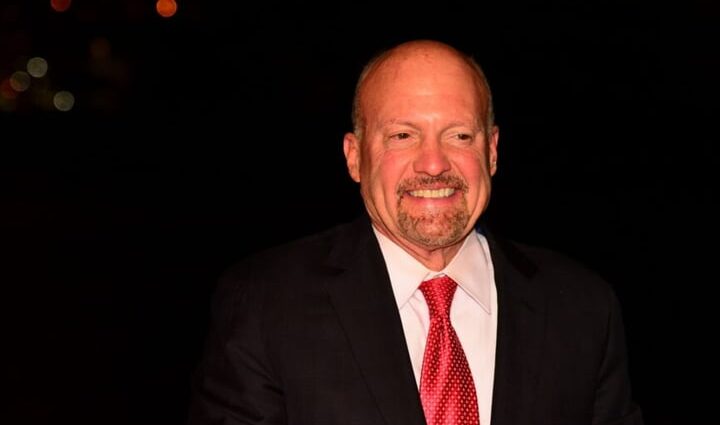
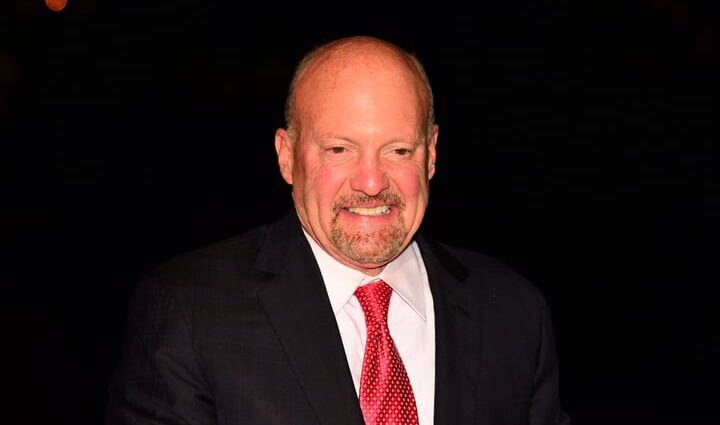
On CNBC’s “Mad Money Lightning Round,” Jim Cramer recommended buying Devon Energy (NYSE:DVN) as “they have tremendous natural gas, and that’s what we’re great at.”

Lending support to his choice, Wells Fargo analyst Hanwen Chang, on Monday, maintained Devon Energy with an Overweight rating and raised the price target from $66 to $68.

Cramer said USA Compression Partners (NYSE:USAC) hit a 52-week high on Monday, but “I think that’s just another nice one to have, and it won’t go down as much as the others because it’s got that good yield.”

On the earnings front, USA Compression Partners, on May 5, posted mixed results for the first quarter.

Taiwan Semiconductor Manufacturing Co. (NYSE:TSM) …

Full story available on Benzinga.com

This post was originally published here
Keysight Technologies, Inc. (NYSE:KEYS) will release earnings for its second quarter after the closing bell on Tuesday, May 19.

Analysts expect the Santa Rosa, California-based company to report quarterly earnings of $2.32 per share, up from $1.70 per share in the year-ago period. The consensus estimate for Keysight’s quarterly revenue is $1.71 billion. It reported $1.31 billion last year, according to Benzinga Pro.

On May 14, Keysight announced a collaboration with SRC UK to advance EW modernization with advanced test and simulation.

Shares of Keysight fell 2.4% to close at $340.48 on Monday.

Benzinga readers can access the latest analyst ratings on the Analyst Stock Ratings page. Readers can sort by stock ticker, company name, analyst firm, rating change or other variables.

Let’s have a look at how Benzinga’s most-accurate analysts have …

Full story available on Benzinga.com

This post was originally published here

Sunshine Biopharma Inc. (NASDAQ:SBFM) stock fell in Tuesday premarket trading, likely pressured by dilution concerns after the company announced the pricing of a $6 million public offering late Monday.

Public Offering Priced

The pharmaceutical company said the offering includes 12 million common units, or pre-funded units, priced at $0.50 each. Each unit consists of one share of common stock, or one pre-funded warrant, along with two Series C warrants to purchase additional shares at an exercise price of $0.50.

The Series C warrants will be exercisable immediately and …

Full story available on Benzinga.com

This post was originally published here

Moving iMage Technologies (AMEX:MITQ) held its third-quarter earnings conference call on Thursday. Below is the complete transcript from the call.

This content is powered by Benzinga APIs. For comprehensive financial data and transcripts, visit https://www.benzinga.com/apis/.

The full earnings call is available at https://investors.movingimagetech.com/events/

Summary

MITQ’s Q3 2026 revenue decreased by 4.9% to $3.4 million, reflecting slower customer project activity, but was offset by revenue from the new DCS cinema loudspeaker line.

The DCS acquisition generated $460,000 in revenue during the quarter, exceeding initial expectations and highlighting the strategic value of this acquisition.

Gross margin improved to 34.8%, up from 29.8% in Q3 2025, due to higher-margin product revenues from DCS sales.

MITQ announced a future revenue outlook of approximately $5.3 million for Q4 2026, driven by seasonal customer activity and growing strength in the DCS business.

The company is focused on expanding its international reach and leveraging industry trends such as premium large format (PLF) and immersive audio to support future growth.

Full Transcript

OPERATOR

Good morning everyone and welcome to the Moving Image Technologies fiscal 2026 third quarter conference call. At this time, all participants are in the listen only mode. A brief question and answer session will follow the formal presentation. If anyone requires operator assistance during the conference call, please signal the operator by pressing Star and zero on your telephone keypad. As a reminder, this conference is being recorded. I will now turn the call over to Chris Eddy, Investor Relations to begin.

Chris Eddy (Investor Relations)

Thank you Operator and thank you all for joining today’s call. MIT CEO Phil Raffinson will make some opening remarks followed by a business update from President and COO Francis Godfrey, and then our recently appointed CFO Bart Bedard will conclude with some financial highlights, after which we will open the call to investor questions. Today’s conference is being recorded and an audio replay and written transcript will be posted to the Investors SECtion of the Moving Image website in the next few days as a reminder. Except for historical information, the matters discussed in this presentation are forward looking statements that involve several risks and uncertainties. Words like believe, expect and anticipate mean that these are our best estimates as of this writing, but that there can be no assurances that expected or anticipated results or events will take place. Actual future results could differ materially from those statements. Further information on the Company’s risk factors is contained in the Company’s quarterly and annual reports filed with the SEC. I will now turn the call over to MIT CEO Phil Raffinson.

Phil Raffinson

Thanks Chris and thank you all for your interest in Moving Image. Overall, our third quarter performance reflected a relatively stable revenue profile compared to the prior year. We experienced slower than usual customer project activity during what is typically a seasonally slower period for mit. However, we made good headway in advancing our new DCS cinema loudspeaker business. As Francois will touch on in more detail, DCS generated approximately $290,000 of revenue in its first full quarter under MIT. We view this a strong early indicator of both the market opportunity and the durability of the business going forward, particularly considering the $1.5 million we spent to purchase the DCS assets. Additionally, customer reception has been highly positive, reinforcing our confidence in the strategic value of this acquisition that closed at the end of October 2025. Last month we had the opportunity to showcase our expanded Solutions portfolio at CinemaCon 2026 with a particular focus on our cutting edge cinema audio product and engineering capabilities. Customer and partner feedback was very constructive with enthusiasm around our enhanced product and solutions offering and a favorable outlook for the feature film pipeline and expectations for it to support Renewed Exhibition Industry Upgrade Activity Given the actions we have taken to both expand our capabilities and to fine tune our cost structure, we feel MIT is well positioned to deliver improving results as we navigate the exhibition industry’s audio needs for for premium large format PLF …

Full story available on Benzinga.com

This post was originally published here

FairPredicts, a newly formed self-described nonpartisan calling itself a prediction market “watchdog,” is running a six-figure digital and billboard ad campaign in Washington, D.C., timed to a Senate Commerce Committee hearing Wednesday on gambling and prediction market expansion.

FairPredicts has specifically targeted Kalshi, one of the sector’s largest players. According to an NBC News report published Monday, Kalshi spent nearly $500,000 lobbying Congress and the Commodity Futures Trading Commission in 2026 alone.

The NBC News report also stated Kalshi pushed back, with spokeswoman Elizabeth Diana calling it a “casino-led effort.”

The hearing marks the latest flashpoint in a broader debate over whether prediction markets should face the same institutional oversight requirements as traditional financial exchanges.

Insider Trading Fears Rattle Prediction Markets

The scrutiny is not new. Kalshi has faced mounting criticism over alleged insider trading on its platform, prompting CEO Tarek Mansour to unveil “Poirot” in February, a proprietary surveillance system modeled after monitoring tools used by the New York Stock Exchange and Nasdaq. …

Full story available on Benzinga.com

This post was originally published here
The most oversold stocks in the consumer discretionary sector presents an opportunity to buy into undervalued companies.

The RSI is a momentum indicator, which compares a stock’s strength on days when prices go up to its strength on days when prices go down. When compared to a stock’s price action, it can give traders a better sense of how a stock may perform in the short term. An asset is typically considered oversold when the RSI is below 30, according to Benzinga Pro.

Here’s the latest list of major oversold players in this sector, having an RSI near or below 30.

American Eagle Outfitters Inc (NYSE:AEO)

  • On May 18, TD Cowen analyst Jonna Kim maintained American Eagle with a Hold and lowered the price target from $19 to $18. The company’s stock fell around 25% over the past month and has a 52-week low of $9.27.
  • RSI Value: 29.6
  • AEO …

Full story available on Benzinga.com

This post was originally published here

Famous investor Michael Burry is sounding the alarm on the artificial intelligence (AI) financing boom, warning that current high-yield debt levels dangerously mirror the 1999 tech bubble or the dot-com era and explicitly rejecting the notion of a “cleaner” AI investment cycle.

The ‘Cleaner’ Market Illusion

Responding to recent macroeconomic data on X, Burry challenged the prevailing narrative surrounding the quality of AI-related debt.

Referencing data compiled by Apollo Global Management’s Chief Economist Torsten Slok, Burry pointed out that a staggering 38% of current high-yield bond issuance is now linked to AI. A high-yield bond, also known as a junk bond, is a corporate bond issued by companies with lower credit ratings.

He drew a direct, sobering comparison to the tech-media-telecom (TMT) bubble, noting that TMT bonds constituted 40% to 50% of high-yield issuance in the year 2000.

“High yield debt at 38% today vs 40%-50% back then belies the idea that today’s AI debt issuance is cleaner, backed by more profitable companies today,” Burry stated.

Full story available on Benzinga.com

This post was originally published here

U.S. consumers are struggling to make credit card payments, with delinquencies surging to levels not seen in 15 years, according to a report.

Credit Card Delinquencies Reach Multi-Year High

According to an X post by The Kobeissi Letter on Monday, “US consumers are falling behind debt at a crisis pace.”

Serious credit card delinquencies rose 0.4 percentage points to 13.1% in the first quarter, the highest level since the fourth quarter of 2010 and just below the 2010 peak of 13.7% in the wake of the 2008 financial crisis.

Since the third quarter of 2022, credit card delinquencies have surged 5.5 percentage points, “larger than the +3.9 point increase in 2007-2010,” the letter said.

Full story available on Benzinga.com

This post was originally published here
CAVA Group, Inc. (NYSE:CAVA) will release earnings for its first quarter after the closing bell on Tuesday, May 19.

Analysts expect the Washington, District Of Columbia-based company to report quarterly earnings of 17 cents per share, down from 22 cents per share in the year-ago period. The consensus estimate for CAVA Group’s quarterly revenue is $418.62 million. It reported $331.83 million last year, according to Benzinga Pro.

On April 21, CAVA announced the retirement of Karen Kochevar from the board.

Shares of CAVA Group gained 3.9% to close at $79.89 on Monday.

Benzinga readers can access the latest analyst ratings on the Analyst Stock Ratings page. Readers can sort by stock ticker, …

Full story available on Benzinga.com

This post was originally published here
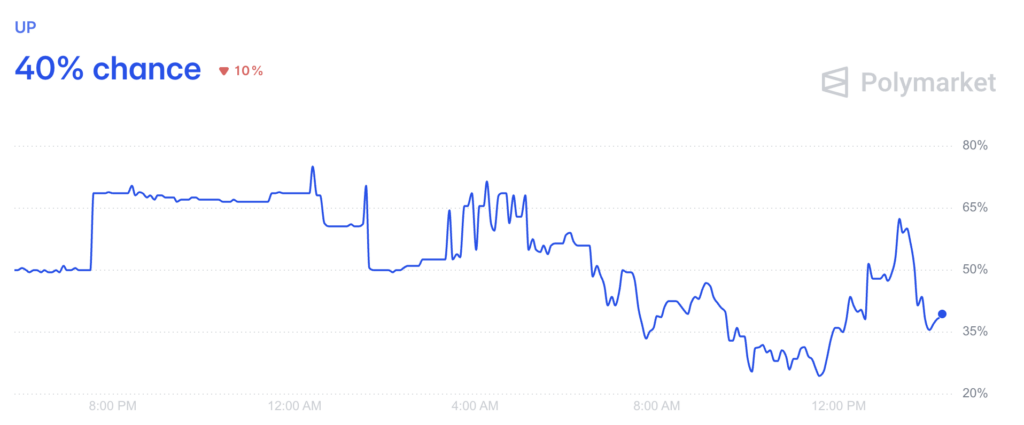
The S&P 500 slipped for a second consecutive session on Monday as weakness in artificial intelligence-linked technology stocks weighed on sentiment, and Polymarket traders are betting the benchmark index could extend its losing streak at Tuesday’s open.

The S&P 500 closed down 0.07% at 7,403.05 on Monday and the May 19 Polymarket contract implied a 40% probability that the S&P 500 would open higher on Tuesday.

Why That Number Matters

The latest pullback comes after a record-setting rally that pushed both the S&P 500 and Nasdaq Composite to all-time highs last week.

Technology stocks, particularly those tied to …

Full story available on Benzinga.com

This post was originally published here
Analog Devices (NASDAQ:ADI) is in advanced talks to acquire AI chip firm Empower Semiconductor for $1.5 ‌billion in cash, Bloomberg reported on Monday.

Empower manufactures high-voltage chips for AI processors and data centers.

Analog Devices and Empower Semiconductor did not respond to Benzinga‘s request for comments

data-variant=”card”
data-news-mode=”manual”

>


Read Also:

Google-Blackstone AI Venture Targets Exploding Demand For Compute Power With $5 Billion Initial Data Center Investment

This post was originally published here

Box Inc. (NYSE:BOX) Aaron Levie warned that the effectiveness of AI agents depends heavily on the quality and structure of company data, saying most enterprise failures stem from disorganized information rather than the technology itself.

Data Chaos Undermines AI Agent Performance

On Monday, in a post on X, Levie said “the biggest challenge” companies face in deploying AI agents is ensuring they operate with “the right constrained context” for each task.

He cautioned that “too much information or conflicting sources” can lead agents to draw incorrect conclusions, especially in environments where multiple systems of record exist.

Levie pointed to common enterprise issues, including outdated knowledge bases, duplicated documents and “tribal knowledge” systems where critical information is not formally documented.

He also noted the opposite risk, saying “too little information and the upside is highly limited” for AI agents, reducing their usefulness.

He added that “AI strategies are actually data strategy challenges in disguise,” emphasizing that companies must prioritize how information is structured, maintained and accessed if they want AI systems to …

Full story available on Benzinga.com

This post was originally published here

Billionaire investor Ray Dalio said the painful investing mistakes he made early in his career ultimately helped build Bridgewater Associates into the world’s largest hedge fund.

Speaking at Long Island University’s commencement ceremony last week, Dalio reflected on how a major wrong market call in the early 1980s became one of the most important turning points of his career.

Dalio said that when he was 34 years old, he believed a debt crisis involving emerging countries would trigger a severe market collapse. Mexico eventually defaulted on its debt in 1982, and Dalio said he correctly anticipated the broader crisis. However, he wrongly expected stocks to plunge further.

Instead, markets rallied sharply.

“I thought the stock market was going to fall a lot, but I was very wrong,” Dalio said.

The mistake devastated his firm financially. Dalio said he lost …

Full story available on Benzinga.com

This post was originally published here

In today’s rapidly changing and highly competitive business world, it is vital for investors and industry enthusiasts to carefully assess companies. In this article, we will perform a comprehensive industry comparison, evaluating Apple (NASDAQ:AAPL) against its key competitors in the Technology Hardware, Storage & Peripherals industry. By analyzing important financial metrics, market position, and growth prospects, we aim to provide valuable insights for investors and shed light on company’s performance within the industry.

Apple Background

Apple is among the largest companies in the world, with a broad portfolio of hardware and software products targeted at consumers and businesses. Apple’s iPhone makes up a majority of the firm sales, and Apple’s other products like Mac, iPad, and Watch are designed around the iPhone as the focal point of an expansive software ecosystem. Apple has progressively worked to add new applications, like streaming video, subscription bundles, and augmented reality. The firm designs its own software and semiconductors while working with subcontractors like Foxconn and TSMC to build its products and chips. Slightly less than half of Apple’s sales come directly through its flagship stores, with a majority of sales coming indirectly through partnerships and distribution.

Company P/E P/B P/S ROE EBITDA (in billions) Gross Profit (in billions) Revenue Growth
Apple Inc 36.06 41.08 9.79 30.39% $39.32 $54.78 16.6%
SanDisk Corp 45.56 14.33 15.34 30.14% $4.15 $4.66 251.03%
Seagate Technology Holdings PLC 70.29 151.71 15.16 96.27% $1.0 $1.45 44.07%
Western Digital Corp 27.45 16.33 14.65 37.73% $3.49 $1.68 45.47%
Everpure Inc 140.13 17.71 7.22 7.04% $0.15 $0.74 20.35%
NetApp Inc 20.23 20.55 3.65 31.16% $0.51 $1.21 4.39%
Super Micro Computer Inc 16.24 2.45 0.61 6.64% $0.7 $1.02 122.68%
IonQ Inc 126.44 3.70 83.26 17.93% $-0.23 $0.02 754.72%
Diebold Nixdorf Inc 23.83 2.34 0.66 0.47% $0.07 $0.21 6.03%
Corsair Gaming Inc 76.56 1.14 0.50 1.85% $0.03 $0.12 -4.12%
Turtle Beach Corp 546 1.94 0.74 -12.65% $-0.01 $0.01 -34.0%
Average 109.27 23.22 14.18 21.66% $0.99 $1.11 121.06%

Full story available on Benzinga.com

This post was originally published here

In today’s rapidly evolving and fiercely competitive business landscape, it is crucial for investors and industry analysts to conduct comprehensive company evaluations. In this article, we will undertake an in-depth industry comparison, assessing Airbnb (NASDAQ:ABNB) alongside its primary competitors in the Hotels, Restaurants & Leisure industry. By meticulously examining crucial financial indicators, market positioning, and growth potential, we aim to provide valuable insights to investors and shed light on company’s performance within the industry.

Airbnb Background

Airbnb is the world’s largest online alternative accommodation travel agency; it also offers booking services for boutique hotels, experiences, and hotel-like services. Airbnb’s platform offers over 9 million active accommodation listings. Listings from the company’s 5 million-plus hosts are spread over almost every country in the world. In 2025, 42% of revenue was from North America, 39% from Europe, the Middle East, and Africa, 10% from Latin America, and 9% from Asia-Pacific. Transaction fees for online bookings account for all its revenue.

Company P/E P/B P/S ROE EBITDA (in billions) Gross Profit (in billions) Revenue Growth
Airbnb Inc 33.16 10.44 6.55 2.02% $0.09 $2.1 17.87%
Royal Caribbean Group 15.41 6.91 3.75 9.48% $1.72 $2.21 11.33%
Viking Holdings Ltd 31.99 36.95 5.78 -5.1% $0.1 $0.36 17.47%
Carnival Corporation Ltd 10.97 2.65 1.31 2.04% $1.27 $2.23 6.11%
Expedia Group Inc 18.99 44.80 1.85 -0.65% $0.36 $3.05 14.66%
Norwegian Cruise Line Holdings Ltd 12.31 2.88 0.74 4.51% $0.56 $0.95 9.57%
Global Business Travel Group Inc 59 3.06 1.62 3.23% $0.1 $0.49 35.27%
Choice Hotels International Inc 14.41 35.31 3.08 12.69% $0.08 $0.16 2.32%
Hilton Grand Vacations Inc 25.19 3.11 0.80 5.31% $0.22 $0.33 11.93%
Average 23.53 16.96 2.37 3.94% $0.55 $1.22 13.58%

Full story available on Benzinga.com

This post was originally published here
In the fast-paced and cutthroat world of business, conducting thorough company analysis is essential for investors and industry experts. In this article, we will undertake a comprehensive industry comparison, evaluating Analog Devices (NASDAQ:ADI) in comparison to its major competitors within the Semiconductors & Semiconductor Equipment industry. By analyzing crucial financial metrics, market position, and growth potential, our objective is to provide valuable insights for investors and offer a deeper understanding of company’s performance in the industry.

Analog Devices Background

Analog Devices is a leading analog, mixed-signal, and digital-signal processing chipmaker. The firm has a significant market share lead in converter chips, which are used to translate analog signals to digital and vice versa. The company serves tens of thousands of customers; more than half of its chip sales are to industrial and automotive end markets. ADI’s chips are also incorporated into wireless infrastructure equipment.

Company P/E P/B P/S ROE EBITDA (in billions) Gross Profit (in billions) Revenue Growth
Analog Devices Inc 76.52 6.05 17.62 2.46% $1.52 $2.04 30.42%
NVIDIA Corp 45.37 34.23 25.24 31.11% $51.28 $51.09 73.21%
Broadcom Inc 82.01 24.94 29.98 9.12% $11.15 $13.16 29.47%
Micron Technology Inc 32.16 10.61 13.29 21.0% $18.48 $17.75 196.29%
Advanced Micro Devices Inc 140.33 10.65 18.46 2.17% $2.4 $5.42 37.85%
Texas Instruments Inc 51.38 16.31 14.88 9.35% $2.42 $2.8 18.58%
Qualcomm Inc 21.90 7.87 4.96 29.27% $2.82 $5.7 -3.46%
Marvell Technology Inc 55.03 10.34 17.93 2.79% $0.75 $1.15 22.08%
NXP Semiconductors NV 27.89 6.74 5.87 10.69% $1.7 $1.79 12.2%
Monolithic Power Systems Inc 106.39 19.86 24.44 5.36% $0.26 $0.45 26.14%
Microchip Technology Inc 421.64 7.80 10.73 1.79% $0.32 $0.71 10.56%
ON Semiconductor Corp 80.46 5.83 7.31 -0.45% $0.25 $0.58 4.68%
Tower Semiconductor Ltd 114.92 9.37 17.44 2.2% $0.15 $0.11 15.48%
MACOM Technology Solutions Holdings Inc 151.60 19.17 25.14 3.34% $0.07 $0.16 22.5%
Credo Technology Group Holding Ltd 85.86 15.59 27.17 10.03% $0.16 $0.28 201.49%
First Solar Inc 15.09 2.54 4.64 3.57% $0.51 $0.49 23.64%
Average 95.47 13.46 16.5 9.42% $6.18 $6.78 46.05%

Full story available on Benzinga.com

This post was originally published here
Amidst the fast-paced and highly competitive business environment of today, conducting comprehensive company analysis is essential for investors and industry enthusiasts. In this article, we will delve into an extensive industry comparison, evaluating Automatic Data Processing (NASDAQ:ADP) in comparison to its major competitors within the Professional Services industry. By analyzing critical financial metrics, market position, and growth potential, our objective is to provide valuable insights for investors and offer a deeper understanding of company’s performance in the industry.

Automatic Data Processing Background

ADP is a global technology company providing cloud-based human capital management solutions, enabling clients to better implement payroll, talent, time, tax, and benefits administration. Additionally, ADP provides human resources outsourcing solutions that permit customers to offload some of their traditional HR tasks. The company operates through two segments: employer services and professional employer organization services. Employer services consist of the company’s HCM products as well as a la carte HRO solutions. PEO services contain ADP’s comprehensive HRO solution, where it acts as a co-employer with its customer. As of fiscal 2025, ADP serves over 1.1 million clients and pays over 42 million workers across 140 countries.

Company P/E P/B P/S ROE EBITDA (in billions) Gross Profit (in billions) Revenue Growth
Automatic Data Processing Inc 20.80 14.03 4.18 21.34% $2.01 $2.87 6.95%
Paychex Inc 20.87 8.44 5.39 14.2% $0.92 $1.38 19.87%
Paycom Software Inc 16.11 8 3.65 12.24% $0.27 $0.48 7.79%
Paylocity Holding Corp 24.14 5.12 3.62 9.76% $0.18 $0.36 10.5%
Korn Ferry 13.03 1.70 1.20 3.27% $0.12 $0.64 7.17%
Robert Half Inc 20.14 2.18 0.49 1.1% $0.06 $0.48 -3.83%
First Advantage Corp 305.70 2.03 1.65 0.17% $0.1 $0.17 8.63%
Trinet Group Inc 12.68 23.73 0.42 129.93% $0.15 $0.3 -5.11%
Upwork Inc 10.80 1.90 1.54 5.24% $0.04 $0.15 1.44%
Barrett Business Services Inc 20.50 3.74 0.65 -6.63% $-0.0 $0.04 4.94%
Kforce Inc 20.63 6.18 0.54 6.55% $0.01 $0.09 0.1%
Fiverr International Ltd 13.92 0.92 0.92 2.06% $0.01 $0.09 -1.58%
Mastech Digital Inc 32.79 0.82 0.41 0.29% $0.0 $0.01 -14.97%
Average 42.61 5.4 1.71 14.85% $0.15 $0.35 2.91%

Full story available on Benzinga.com

This post was originally published here

Gov. Gavin Newsom (D-CA) has criticized President Donald Trump as higher gas prices at the pump continue to affect ordinary Americans, with bettors on Prediction Markets putting their money on prices surging even higher.

Lower Gas Prices

In a post on X on Monday, Newsom’s official press office handle quoted a post that outlined Trump’s plans to build a new helipad at the White House. “Sir, we just want lower gas prices,” the post said.

data-variant=”card”
data-news-mode=”manual”

>


Read Also:

Xi Jinping Drops Rare Putin Warning During Trump China Talks As The Russian President Visits Beijing

This post was originally published here

Investors have piled into leveraged bets on U.S. stocks at a record pace, according to the market watchers.

Record Leveraged ETFs Bet

In Monday’s post on X, Global Markets Investor shared data from Goldman Sachs and EPFR, saying, “There have NEVER been so many leveraged bets on the US stock market.”    

Leveraged equity ETFs offering 2x and 3x exposure have amassed a record $337 billion in assets, up roughly 500% over the past six years. The 3x leveraged ETFs account for $209 billion, while 2x leveraged funds account for the remaining $128 billion.

The market watcher stated that “If the market turns, the unwind of these positions will be violent.”

Major Equity Index Leveraged …

Full story available on Benzinga.com

This post was originally published here
Delta Air Lines Inc. (NYSE:DAL) CEO Ed Bastian has said that the company will be prioritizing expanding globally rather than considering consolidation in the U.S. aviation industry.

Global Expansion

In an interview on Monday, Bastian said that the company wasn’t keen on consolidation in the sector “just because there’s a window in Washington,” Bloomberg reported on Monday, outlining the President Donald Trump administration’s openness to mergers.

data-variant=”card”
data-news-mode=”manual”

>


Read Also:

Ryanair Says Iran War Won’t Trigger Jet Fuel Shortages—And Airfares Could Actually Fall

This post was originally published here

Lument Finance Trust (NYSE:LFT) held its first-quarter earnings conference call on Friday. Below is the complete transcript from the call.

This content is powered by Benzinga APIs. For comprehensive financial data and transcripts, visit https://www.benzinga.com/apis/.

View the webcast at https://app.webinar.net/a9jkw89JQ1r

Summary

Lument Finance Trust Inc reported a GAAP net loss of $0.02 per share and distributable earnings of $0.02 per share for Q1 2026.

The company declared a quarterly dividend of $0.04 per share, consistent with previous quarters.

Net interest income improved to $5.7 million, driven by leverage and cost of funds improvements.

The company foreclosed on one loan asset and sold a San Antonio REO property for $12.4 million.

Management emphasized a cautious approach to capital allocation, focusing on asset resolution and selective capital deployment.

The future financial recovery is heavily tied to leveraging capital markets and securitization strategies.

The portfolio’s credit performance remained stable, with disciplined reserve management.

76% of the portfolio’s loans are risk rated at 3 or better, with 93% collateralized by multifamily properties.

Management plans to file the 10Q with the SEC post-call and maintains a strategic focus on resolving legacy assets.

Full Transcript

OPERATOR

Good afternoon and thank you for joining the Lument Finance Trust Inc first quarter 2026 earnings call. Today’s call is being recorded and will be made available via webcast on the Company’s website. I would now like to turn the call over to Andrew Tsang with Investor Relations at Lumen Investment Management. Please go ahead. Good afternoon everyone. Thank you for joining our call to discuss Lument Finance Trust Inc’s first quarter 2026 financial results. With me on the call today are Jim Flynn, our CEO, Jim Briggs, our CFO, Greg Talbert, our President and Zach Halpern, our Portfolio Manager. This morning we issued a press release to provide details on our recent financial results. We also provided a supplemental earnings presentation which can be found on our website. We intend to file our 10Q with the Securities and Exchange Commission this afternoon after market close. Before handing the call over to Jim Flynn. I’d like to remind everyone that certain statements made during the course of this call are not based on historical information and may const forward looking statements within the meaning of section 27A of the securities act of 1933 and section 21E of the securities Exchange act of 1934. Such forward looking statements are subject to various risks and uncertainties that could cause actual results to differ materially from those contained in the forward looking statement. These risks and uncertainties are discussed in the Company’s reports filed with the Securities and Exchange Commission, in particular the risk factors sections of our Form 10K and Form 10Qs. It is not possible to predict or identify all such risks and listeners are cautioned not to place undue reliance on these forward looking statements. The Company also undertakes no obligation to update any of these forward looking statements further. Certain non GAAP financial measures will be discussed on this conference call. A presentation of this information is not intended to be considered in isolation or as a substitute for the financial information presented in accordance with GAAP. Reconciliations of these non GAAP financial measures to the most comparable measures prepared in accordance with GAAP can be accessed through our filings with the Securities and Exchange Commission. For the first quarter of 2026 we reported a GAAP net loss of $0.02 and true earnings of $0.02 per share of common stock. In March we declared quarterly dividend of $0.04 per common share with respect to the first quarter in line with the prior quarterly dividend. I will now turn the call over to Jim Flynn. Please go ahead.

Jim Flynn (Chief Executive Officer)

Thank you, Andrew. Good afternoon everyone. Welcome to the Lumen Finance Trust earnings call for the first quarter of 2026. We appreciate everyone joining us today. Looking at the market economic conditions in the US continuing to remain fundamentally stable although uncertainty continues to outweigh momentum. While the Federal Reserve has shifted toward a more accommodative stance, the pace and extent of any future rate cuts remain data dependent, including inflation, labor market conditions and broader financial stability.

Jim Flynn (Chief Executive Officer)

Geopolitical uncertainty continues to weigh on investment environment, reinforcing a cautious approach to capital allocation within multifamily operating fundamentals are gradually stabilizing as the sectors move through the later stages of an elevated supply cycle. Construction starts have declined sharply, setting the stage for a meaningful reduction in new supply through 26 and 27. Rent growth remains modest at the national level, but improving performance in supply constrained markets.

Jim Flynn (Chief Executive Officer)

There is some continued pressure in high delivery regions to continue to work through long term demand. Drivers for rental housing remain intact. Portability constraints, limited for sale inventory and elevated single family mortgage rates continue to support renter demand. Longer term interest rates remain a central constraint. Although short term rates have declined from peak levels. Elevated long term rates continue to anchor cap rates, pressure asset values and limit access to attractively priced permanent financing. As a result, financing conditions have become more functional but still remain Selective liquidity across securitization markets, warehouse facilities and select balance sheet lenders has improved, supporting refinancing activity for well capitalized assets with strong sponsors. The creclo market remains a critical source of liquidity with issuance continuing into 2026amid strong investor demand for floating rate exposure.

Jim Flynn (Chief Executive Officer)

The asset management side Portfolio management continues to be a central focus of our strategy. We remain closely engaged with borrowers across the portfolio and are actively managing our REO portfolio to protect shareholders capital and long term values. During the quarter, overall portfolio credit performance remained relatively stable. We continue to take a disciplined approach to reserve management, increasing reserves on certain legacy positions to reflect revised expectations and prevailing market conditions. In terms of activity and liquidity, we continue to execute on our intended financing strategy as discussed on the prior quarter’s call. This past February we redeemed the remaining debt outstanding under LMF 2023.

Jim Flynn (Chief Executive Officer)

1 and refinance the collateral through our warehouse facilities as well. As amended our secured corporate loan, extending the maturity to 2030 and upsizing to 50 million. We have been carefully managing liquidity and are selectively redeploying investable capital within Fl3. During Q1 we generated 47 million of aggregate payoffs and used reinvestment principal proceeds to acquire two new multifamily loan assets for 47 million and a 1 million minority participation related to an existing loan asset. We ended the quarter with unrestricted cash of approximately 21 million. Combined with our available warehouse capacity and ability to reinvest FL3’s capital over the course of its 30 month reinvestment period, we believe our liquidity position remains appropriate to support portfolio management, asset resolution and select capital deployment. Our priorities remain making progress on resolving legacy assets and thoughtfully redeploying investable capital into attractive new loan asset opportunities. While credit markets have become more constructive, the recovery across commercial real estate remains uneven. Performance differentiation by asset quality, location, sponsorship and …

Full story available on Benzinga.com

This post was originally published here

Beam Glb (NASDAQ:BEEM) reported first-quarter financial results on Friday. The transcript from the company’s first-quarter earnings call has been provided below.

This content is powered by Benzinga APIs. For comprehensive financial data and transcripts, visit https://www.benzinga.com/apis/.

View the webcast at https://dpregister.com/DiamondPassRegistration/register?confirmationNumber=10209318&linkSecurityString=1040b2c9ec4

Summary

Beam Global’s backlog grew by 50% to $9 million, with significant contributions from Smart City applications and energy storage.

Q1 2026 revenue decreased by 51% to $3.1 million compared to the previous year, due to order timing and reduced federal EV spending.

International customers made up 51% of revenues in Q1 2026, marking significant diversification from government contracts.

The company remains debt-free with a $100 million unused line of credit, indicating strong financial health.

Gross profit saw a decline, with a reported gross loss of $0.4 million, impacted by fixed overheads and lower volumes.

Beam Global launched a patented wireless charging system for autonomous vehicles and expanded its international footprint, notably in the Middle East and Africa.

Management emphasized strategic diversification and highlighted significant growth opportunities in international markets and new product lines.

Full Transcript

OPERATOR

Hi, Good afternoon and thank you for participating in Beam Global’s first quarter 2026 operating results conference call. We appreciate you joining us today. Desmond Wheatley, President, CEO, and Chairman of Beam Global, is joining me by phone. Desmond will be giving his thoughts on 2026 and providing an update on recent activities at Beam Global, followed by a question and answer session. But first I’d like to remind you that during this call management will be making forward looking statements, including statements that address Beam’s expectations for future performance or operational results. Forward looking statements involve risks and other factors that may cause actual results to differ materially from those statements. For more information about these risks, please refer to the risk factors described in Beam’s most recently filed Form 10K and other periodic reports with the SEC. The content of this call contains time sensitive information that is accurate only as of today, May 15, 2026. Except as required by law, Beam disclaims any obligation to publicly update or revise any information to reflect events or circumstances that occur after this call. So I’m going to go ahead and start with a few key highlights. Our backlog grew 50% during the quarter from 6 million at December 31 of 25 to 9 million at March of 31 of 26, with more than half attributable to the Smart city applications, approximately 1/3 to energy storage and the balance to the EV ARC and related products. And perhaps most importantly, our Q2 2026 revenue through today and has already exceeded our first quarter results, a clear signal that the business is accelerating operationally. The quarter was active. We made our first EV ARC sale in Abu Dhabi for public EV charging. We launched a patented autonomous wireless charging system for autonomous vehicles. We were selected to supply patented battery systems for drones supporting life saving aerial operations globally. Beam Europe achieved a record 1.7 million in smart City infrastructure orders in a single week across Romania, Croatia, Montenegro, Serbia and Italy, approximately doubling the strongest weekly order volume achieved in 2025 and we secured the largest residential EVRC order to date in New York. We continue to operate with no debt, no going concern issues and an unused hundred million dollar line of credit. Turning to the financials, our first quarter revenue was 3.1 million, a decrease of 51% compared to 6.3 million in Q1 of 25. The decline reflects order timing with two large orders being moved out of the quarter, a seasonally slow period for our European operations and the ongoing reduction in federal government EV spending. Our International customers comprised 51% of revenues in Q1 of 26 versus 25% in Q1 of 25 and revenues from non government commercial entities increased 48% year over year to represent 78% of our total revenues. Continuing the diversification trend we have been executing against on gross profit, we reported a gross loss of 0.4 million or negative 13.3% compared to a gross profit of 0.5 million or 7.9% in Q1 of 25. Our gross results included a 0.7 million of non cash depreciation and tangible amortization in cost of revenues. Excluding these items, the adjusted non-GAAP gross margin was 9.4% compared to 20.6% in the prior year period. The decline reflects the impact of our fixed overhead allocations against the lower product volume and is not indicative of deterioration in our underlining unit economics which continues to improve. Our operating expenses were 6.3 million compared to 16 million in Q1 of 25. The prior period includes a non cash goodwill impairment charge of 10.8 million not represented this quarter. Excluding that charge, our operating expenses increased approximately 1 million year over year. This is primarily due to a 1.8 million non-cash provision for credit losses related to a single customer balance that was reserved in accordance with our policy. When we remove these one timers, our reductions in compensate the reduction is related to compensation facilities and other G and A expenses which partially offset the increase. Our net loss was 6.9 million compared to 15.5 million in Q1 of 25. The Q1 of 26 net loss includes the 3.5 million of noncash charges. Excluding these items, the non GAAP net loss was 3.7 million compared to 3 million in Q1 of 25. We believe the relative consistency of our non GAAP net loss across both periods despite a 51% decline in revenue reflects our disciplined cost structure and is indicative of our meaningful operating leverage as revenue recovers. On liquidity, our working capital decreased 2.7 million to 6.2 million at March 31 of 26. Excluding the 1.8 million non cash credit loss provision, the underlying operational decrease was approximately 0.9 million. Our cash increased 1 million during the quarter. We remain debt free and we have an unused 100 million credit facilities and we believe we are well positioned to fund operations. In closing, our Q1 was a challenging quarter on revenue. Excuse me, I have something all of a sudden. Desmond, would you like to go ahead? Let me go ahead and hand it over to Desmond. All of a sudden I’m joking for something.

Desmond Wheatley (President, CEO and Chairman)

Thanks for that. And thanks all of you for tuning into this first part. Lisa, maybe you could mute your phone just while you recover there on the other line. Thanks everybody for tuning into the call. It was only about a month ago that we had the earnings call for the release of our 10K, and during that call I went through a pretty comprehensive update on the happenings of 2025 in the first quarter of 2026, both operationally and financially. So I’m going to keep my comments fairly brief today and leave plenty of time for any questions that you may have. Well, as Lisa said, Our first quarter revenues in 2026 were not what we’d like them to have been. They are in no way an indication of an underlying or fundamental weakness in the business or our strategic plan. First quarter has historically always been a slow quarter for us, and that’s particularly true of the contributions from our Beam Europe offices, where the Orthodox Christmas and New Year pushes well into January and weather and other considerations tend to slow down the deployment of the traditional infrastructure products which we manufacture and sell across Europe, like street lights, traffic portals and other street furniture. Coincidentally and unfortunately, from a timing point of view, we also had 2 large deployments of EV ARC systems pushed from the first quarter into the second, which have had an outsized impact on our Q1 revenues. I guess we haven’t lost those orders. They’re both good orders and we expect to recognize the revenue from them. Also has to be said that the war in the Middle East has not helped our efforts because we were actually anticipating some material revenues coming from our new operations in the Middle East. But those, like everything else in the region, seem to have been put on hold while the authorities and decision makers prioritized dealing with the immediate impact of the war. I’ve just spent a significant amount of time at our Beam Middle East offices, and while I certainly did observe a lack of momentum where all business dealings are concerned, it’s also very clear that the United Arab Emirates and the Gulf region in general, are determined to get through this conflict and come out on the other side stronger, with even more aggressive plans for future growth. And in fact, we did actually make our first sale of EV ARC for public charging in Abu Dhabi while I was there a couple of weeks ago. We’ve already got it deployed for some other reasons, but this is for public charging. So while we didn’t get the material contribution to revenues that we’ve been hoping for in the first quarter, we have managed to make some sales in the Middle East since that time. And I’ll spend a few minutes on my time in the Middle East. Later in the call back to our results. Like any manufacturing company with facilities across the world, we have fixed overhead costs which do not reduce when the volumes of products which we deliver reduce. Those costs, like rent, insurance, and other day to day operational costs associated with owning and maintaining our factories stay pretty much exactly the same whether we do a small volume of products or a very large volume. The result of this, as you’ve seen in the first quarter, is that our gross profits can be negatively impacted by the allocation of fixed overhead across a smaller number …

Full story available on Benzinga.com

This post was originally published here

Melius Research analyst Ben Reitzes predicts the rally in chip stocks to continue, driven by strong demand for artificial intelligence infrastructure and sustained spending.

The analyst is especially bullish on Micron Technology Inc. (NASDAQ:MU), SanDisk Corp. (NASDAQ:SNDK) and Intel Corp. (NASDAQ:INTC). He raised the target price on the three stocks, arguing that newly signed long-term agreements are making the companies’ results easier to forecast in a historically volatile corner of tech.

Speaking on SquawkCNBC Monday, Reitzes said, “We just took our targets up on Micron and SanDisk and Intel the most in our group.” “They are signing these long-term agreements that make them more predictable and I think they get recognized for it.”

The analyst argued that as AI-driven demand keeps creating supply bottlenecks, allowing chipmakers, including Micron, SanDisk, and Intel, to capture more market value than traditional software companies or non-chip “Magnificent Seven” names.

Micron

Micron has been the most crowded trade on Wall …

Full story available on Benzinga.com

This post was originally published here

Toll Brothers, Inc. (NYSE:TOL) will release earnings for its second quarter after the closing bell on Tuesday, May 19.

Analysts expect the Fort Washington, Pennsylvania-based company to report quarterly earnings of $2.58 per share, down from $3.50 per share in the year-ago period. The consensus estimate for Toll Brothers’ quarterly revenue is $2.42 billion (it reported $2.74 billion last year), according to Benzinga Pro.

On April 21, Toll Brothers announced plans to acquire substantially all the assets of Buffington Homes of Arkansas.

Toll Brothers shares rose 0.6% to close at $126.97 on Monday.

Benzinga readers can access the latest analyst ratings on the Analyst Stock Ratings page. Readers can sort by stock ticker, company name, analyst firm, rating change or other variables.

Let’s have a look at how Benzinga’s most-accurate analysts …

Full story available on Benzinga.com

This post was originally published here

Amid the escalating gas prices, Cracker Barrel Old Country Store Inc. (NASDAQ:CBRL) is stepping in with a $250,000 giveaway in free gas and food to its Rewards members during the summer road trip season.

On Monday, the restaurant company launched a 10-week “Fuel Your Summer Road Trip” sweepstakes. The promotion, running until July 26, enables Cracker Barrel Rewards members to secure weekly sweepstakes entries with qualifying entrée purchases, either dining in-restaurant or ordering takeout or delivery via its app or online.

Each qualifying entrée garners one entry into that week’s drawing, with 25 winners selected weekly throughout the promotion. Customers can gain an extra entry by adding an in-store retail item to their purchase. Ultimately, 250 Cracker Barrel Rewards members will each receive $1,000, comprising a $500 gas gift card and a $500 food gift card from the restaurant chain.

“Road trips are synonymous with summer, and our goal is to help… make those plans feel a little easier—both at the table and at the pump,” stated Cracker Barrel’s Chief Marketing Officer Sarah Moore. The promotion comes ahead …

Full story available on Benzinga.com

This post was originally published here

The U.S. Supreme Court on Monday declined to hear a pharmaceutical industry challenge to the Medicare drug price negotiation program created under former President Joe Biden’s Inflation Reduction Act, according to Reuters.

The justices rejected appeals from drugmakers including Novo Nordisk (NYSE:NVO), AstraZeneca Plc’s (NASDAQ:AZN), Bristol-Myers Squibb Co. (NYSE:BMY), Novartis (NYSE:NVS)  and Janssen Pharmaceuticals, a unit of Johnson & Johnson (NYSE:JNJ), leaving lower-court rulings in favor of the federal government in place.

The companies argued the program imposed government-dictated price controls and threatened innovation. Reuters reported that the drugmakers also claimed the policy violated constitutional protections for due process, free speech and property rights.

The Medicare negotiation framework allows the Centers for Medicare & Medicaid Services, or CMS, to negotiate prices directly with manufacturers for certain high-cost medicines covered under Medicare. Companies that refuse to participate could face steep excise taxes or withdraw products from Medicare programs.

This post was originally published here

Hedge fund D1 Capital Partners is reportedly poised to reap significant benefits from the upcoming public listing of Elon Musk‘s SpaceX.

D1 Capital’s stake in SpaceX could be worth approximately $20 billion if the rocket manufacturer achieves its anticipated $1.75 trillion valuation, reported the Financial Times. The hedge fund, managed by Dan Sundheim, was one of the early investors in SpaceX, taking a position in 2020 when the company was valued at around $36 billion.

Despite receiving substantial interest, Sundheim has previously stated his firm’s intention to retain its holdings in SpaceX. The investment in SpaceX constitutes a significant portion of D1 Capital’s total assets and has been a major contributor to the fund’s returns.

Another hedge fund, Darsana Capital Partners, is also set to profit handsomely from SpaceX’s public listing. The firm, founded by Anand Desai, first invested in SpaceX in 2019. If SpaceX reaches its projected valuation, Darsana’s stake could be worth around $15 billion, as per the FT report.

D1 Capital Partners, Darsana Capital …

Full story available on Benzinga.com

This post was originally published here

Chinese President Xi Jinping reportedly told President Donald Trump that Russian President Vladimir Putin could potentially “regret” his decision to invade Ukraine.

Xi made the remarks during extensive discussions held last week as Trump visited China. According to the Financial Times, Xi’s comments on Putin’s 2022 invasion of Ukraine were seen as more direct and explicit than his previous public statements.

Xi’s past meetings with former President Joe Biden disclosed that while they had open discussions about Russia and Ukraine, Xi had not previously assessed Putin and the conflict. 

The Biden administration repeatedly accused China of supplying Russia with dual-use goods aiding its war in Ukraine, while the Trump administration had raised similar concerns less often.

Meanwhile, in his conversation with Xi, Trump suggested that the U.S., China, and Russia should band together against the International Criminal Court (ICC), asserting their interests were aligned.

data-variant=”card”
data-news-mode=”manual”

>


Read Also:

Trump’s Golden Dome Project Just Got A Stunning $1.2 Trillion Price Tag— And It Still …

This post was originally published here

Oriental Rise Holdings Ltd. (NASDAQ:ORIS) jumped 18.84% to $0.49 after the bell on Monday after the China-based company disclosed a board-approved reverse stock split.

What You Should Know

According to a Monday Securities and Exchange Commission filing, shareholders approved the measure on May 15, authorizing the board to consolidate shares at a ratio between 1-for-2 and 1-for-100. The board subsequently set the ratio at 1-for-4, with fractional shares rounded up. The effective market date has not yet been announced.

A reverse split reduces outstanding share count while proportionally lifting the per-share price. It does not change market capitalization.

Short interest of the stock currently …

Full story available on Benzinga.com

This post was originally published here

Investment firm Gerber Kawasaki‘s co-founder Ross Gerber has slammed Tesla Inc.‘s (NASDAQ:TSLA) Full Self-Driving (FSD) system, which, according to the investor, is still not up to the mark.

Tesla Says FSD Has Eyes In The Back Of Its Head

Quoting a post by user @01Ananto on X on Monday, Tesla said that the FSD system had “eyes in the back of its head” and that “even the best & most responsible” human drivers did not, after the user had shared an incident when Tesla’s system prevented a potential collision.

data-variant=”card”
data-news-mode=”manual”

>


Read Also:

EXCLUSIVE: Tesla Isn’t On The Same Playing Field As Waymo, Expert Says—Predicts Chinese Manufacturers Entering The U.S. Is ‘Inevitable’

This post was originally published here

Institutional investors are aggressively rotating into the semiconductor sector, driving hedge fund market exposure to unprecedented levels as major Wall Street players increased their stakes during the first quarter of 2026.

Historic Shift In Market Exposure

According to recent market commentary from The Kobeissi Letter, institutional investors are officially “all-in on semiconductor stocks.” The semiconductor sector now accounts for 19% of total global hedge fund market exposure, establishing the “highest on record.”

This exposure has more than “DOUBLED” since the start of 2026. This dramatic rotation toward semiconductors comes directly at the expense of software and services stocks, which now account for roughly 2% of hedge fund portfolios, reflecting a 10-percentage-point decline over the last four years.

Full story available on Benzinga.com

This post was originally published here

James Hardie Industries plc (NYSE:JHX) will release earnings for its fourth quarter after the closing bell on Tuesday, May 19.

Analysts expect the Dublin, Ireland-based company to report quarterly earnings of 29 cents per share. The consensus estimate for James Hardie Industries’ quarterly revenue is $1.40 billion (it reported $971.5 million last year), according to Benzinga Pro.

On May 14, James Hardie announced the appointment of new non-executive director and retirement of non-executive director.

James Hardie Industries shares rose 2.9% to close at $19.82 on Monday.

Benzinga readers can access the latest analyst ratings on the Analyst Stock Ratings page. Readers can sort by stock ticker, company name, analyst firm, rating change or other variables.

Let’s have a look at how Benzinga’s most-accurate analysts have rated the company in …

Full story available on Benzinga.com

This post was originally published here

Anthony Scaramucci, founder of global investment firm SkyBridge Capital, highlighted concerns that politicians in the West have not fulfilled their promises and are using inflation, which he described as “coward tax”, to finance growing obligations.

Elevated Debt Levels

In a Monday post on X, Scaramucci said that “Politicians in the West have overpromised the electorate and undertaxed them for decades.”

He pointed to a rapid rise in debt levels under recent administrations, saying that George Washington to George W. Bush have accumulated $7 trillion in debt, while Barack Obama, Joe Biden and Donald Trump added another $31 trillion.

Former White House communications director said, “That’s not sustainable and someone has to pay for it eventually.”

Full story available on Benzinga.com

This post was originally published here

Geopolitical tensions from the Iran war are raising alarms on Wall Street, with top economists warning that inflationary pressures could force the Federal Reserve into aggressive rate hikes.

Inflation Fears And ‘Economic Damage’

The economic toll of the Iran war is extending far beyond rising commodity prices. According to Mark Zandi, chief economist at Moody’s Analytics, surging interest rates—highlighted by the 10-year Treasury yield jumping to 4.6%—reflect a rapidly shifting landscape.

Zandi warns that the war is actively driving up inflation expectations. “Nothing spooks the Fed more than unmoored inflation expectations,” Zandi stated, noting this is how high inflation becomes entrenched.

He cautioned that the Fed will inevitably raise rates until expectations cool, “regardless of the hit to the broader economy.” Policymakers rightfully fear that inaction will cause inflation to “metastasize,” ultimately requiring even higher rates and an even “weaker economy” to rein it back in.

Looming July Rate Hike

Echoing the sentiment that the Fed must aggressively act, prominent market watcher Ed Yardeni anticipates …

Full story available on Benzinga.com

This post was originally published here

A bipartisan bill introduced in the U.S. House of Representatives on Monday by Rep. Sam Graves (R-MO) and Rep. Rick Larsen (D-WA) would levy an annual fee on EV owners to fund road maintenance.

Annual Road Repair Fee

The BUILD America 250 Act, which is more than 1,000 pages long, has sought an annual fee of $130 for EV owners, as well as $35 for Plug-In Hybrid Electric Vehicles (PHEVs), with the taxes also getting an annual increase of $5, to a cap of $150 and $50, respectively. The fees applicable shall “terminate on October 1, 2036,” the bill says.

data-variant=”card”
data-news-mode=”manual”

>


Read Also:

Americans Have Spent $41 Billion Extra On Gas Since Iran War Began As Inflation Pressures Spread Across Economy

This post was originally published here

The CNN Money Fear and Greed index showed a decline in the overall market sentiment, while the index remained in the “Greed” zone on Monday.

U.S. stocks settled mixed on Monday, with the S&P 500 and Nasdaq Composite falling during the session amid declines in tech stocks.

President Donald Trump struck an uncompromising tone on Iran, posting that the conflict would end only when Tehran issued “Documents of Surrender” and “admit their defeat to the great power and force of the magnificent U.S.A.”

Liveramp Holdings Inc. (NYSE:RAMP) shares jumped over 27% on Monday after Publicis acquired the company for $2.2 billion in an all-cash deal at $38.50 per share. LiveRamp also reported better-than-expected fourth-quarter earnings.

In earnings, Brady Corp. (NYSE:BRC) reported upbeat …

Full story available on Benzinga.com

This post was originally published here

With U.S. stock futures trading higher this morning on Tuesday, some of the stocks that may grab investor focus today are as follows:

  • Wall Street expects Home Depot Inc. (NYSE:HD) to report quarterly earnings at $3.41 per share on revenue of $41.54 billion before the opening bell, according to data from Benzinga Pro. Home Depot shares gained 0.31% to $300.75 in after-hours trading.
  • XP Inc. (NASDAQ:XP) reported worse-than-expected first-quarter financial results. The company also named Gustavo Alejo Viviani as …

Full story available on Benzinga.com

This post was originally published here

On Monday, Sen. Chris Murphy (D-Conn.) accused President Donald Trump of being responsible for rising fuel costs, arguing that high gas and diesel prices are placing severe pressure on working families and key U.S. industries.

Connecticut Gas Prices Spike

In a post on X, Murphy said, “A gallon of gas now costs $5 in Connecticut. Diesel is $6. This is ruining people who live paycheck to paycheck, small businesses, farmers and the trucking industry.”

He added, “And there is only [one] person who has caused prices to be this high: DONALD TRUMP.”

In a video clip, Murphy argued that rising costs are tied to U.S. foreign policy decisions, stating, “The only reason the prices are this high is because of Donald Trump’s war of choice… It’s driving up the price of everything.”

Murphy also pointed to broader inflation trends, including rising grocery prices and urged Senate Republicans to support resolutions he said aim to end the conflict he referenced.

Full story available on Benzinga.com

This post was originally published here

Economist Justin Wolfers highlighted that the oil shock stemming from the conflict in Iran is rippling across the economy, driving up gasoline and jet fuel prices while also impacting construction and other industries.     

Metaphor Effect

In Monday’s post on X, Wolfers said, “Think of an oil shock like a stone tossed in a pond.” “First splash: gasoline.”

Americans have spent over $41 billion in additional fuel costs since the Iran conflict began, with gasoline prices rising from $2.98 to $4.51 per gallon, a jump of more than 51%. This surge in fuel costs not only impacts consumer spending but also fuels inflationary pressures across various sectors, including transportation and food markets.

Wolfers stated, “Then the ripples: airfares, delivery costs, packaging, groceries, construction materials. The ripples are real. Just give them a moment to spread.”

Full story available on Benzinga.com

This post was originally published here

GasBuddy analyst Patrick De Haan has predicted that it would take more than a year and a half for countries to refill oil inventories if the Strait of Hormuz reopens following its closure amid the U.S., Israel and Iran war.

78 Weeks To Refill Oil Inventories

In a post on X on Monday, De Haan shared that it “loosely” takes a week for countries to refill oil inventories for every day the Strait of Hormuz remains closed.

data-variant=”card”
data-news-mode=”manual”

>


Read Also:

Ryanair Says Iran War Won’t Trigger Jet Fuel Shortages—And Airfares Could Actually Fall

This post was originally published here

Treasury Secretary Scott Bessent, on Monday, issued a 30-day general license for Russian seaborne oil to stabilize the crude market amid supply shortages due to the closure of the Strait of Hormuz.

Sanctions Could Stabilize Oil Market

In a post on X, Bessent said the license would temporarily allow vulnerable countries to access Russian oil currently stranded at sea. The move would “provide additional flexibility,” and would “stabilize the physical crude market.”

The license would ensure that oil reaches the most energy-vulnerable countries, Bessent added. He also stated it will help redirect “existing supply to countries most in need” by limiting China’s ability to “stockpile discounted oil.”

Bessent said that Treasury officials are working with the nations for more specific licenses as needed.

Full story available on Benzinga.com

This post was originally published here
Cathie Wood-led Ark Invest was active across multiple funds on Monday, with Advanced Micro Devices Inc. (NASDAQ:AMD) again standing out as one of the biggest selling themes in the day’s trading. At the same time, the firm added to a cluster of AI, autonomous mobility and aerospace names.

The AMD Trade

Ark kept trimming AMD, selling 35,111 shares from ARK Innovation ETF (BATS:ARKK), 2,055 shares from ARK Next Generation Internet ETF (BATS:ARKW) and 1,363 shares from ARK Blockchain & Fintech Innovation ETF (BATS:ARKF), for a combined 38,529 shares. The total value of the trades was estimated to be $16.2 million, based on AMD’s closing price of $420.99.

AMD had been in focus for several reasons before Ark’s latest sale. Benzinga recently reported that CEO Lisa Su met with China’s vice premier He Lifeng in Beijing, underscoring AMD’s strategic interest in the Chinese market, while a separate analyst note lifted the stock’s price target on expectations for rising server CPU demand tied to agentic AI.

Notably, Ark had sold 13,148 shares of AMD on Friday. Wood has been offloading millions worth of AMD stock in May.

The Bullish Trade

Bullish Inc. (NYSE:BLSH) drew purchases from ARKF, ARKK and ARKW. Ark bought 4,310 shares in ARKF, 38,900 shares in ARKK and 9,098 shares in ARKW, making the crypto platform a notable new position across the firm’s funds. The value of the trade was $1.9 million based on Bullish’s closing price of $35.56.

Bullish stock fell recently despite strong first-quarter results, as analysts flagged weaker second-quarter trading volumes and uncertainty around the timing of tokenization adoption and regulatory approvals tied to its Equiniti acquisition.

The Nvidia Trade

Ark also bought Nvidia Inc.

Full story available on Benzinga.com

This post was originally published here

Major U.S. indexes closed Monday mixed, with the Dow Jones Industrial Average gaining 0.32% to 49,686.12, while the S&P 500 slipped 0.07% to 7,403.05 and the Nasdaq dropped 0.51% to 26,090.73.

These are the top stocks that gained the attention of retail traders and investors through the day:

HIVE Digital Technologies (NASDAQ:HIVE)

HIVE Digital Technologies’ stock rose 28.62%, closing at $3.46. The stock reached an intraday high of $3.92 and a low of $3.27, with a 52-week range of $7.84 to $1.60. In the after-hours trading, the stock rose 3.77% to $3.59.

The company announced plans for a large-scale AI compute facility in Canada, expected to be one of the largest AI gigafactories in the country. The project, involving a CAD $3.5 billion ($2.55 billion) investment, aims to support over 100,000 GPUs and create numerous jobs.

data-variant=”card”
data-news-mode=”manual”

>


Read Also:

Harvard University Slashed Bitcoin Exposure By Nearly Half In Q1, Exited Ethereum ETF Entirely

This post was originally published here

A frustrated wife says she and her husband are struggling under roughly $40,000 in credit card debt after her husband stopped paying one of the cards once she quit reminding him.

Posting in the r/personalfinance subreddit recently, the woman said the couple owes around $22,000, $12,000 and $6,000 across three credit cards and pays roughly $900 a month toward the balances while bringing in roughly $4,000 to $4,600 a month after taxes. They also have a young child and an $1,800 mortgage payment.

Missed Payments And Rising Bills

“My husband messed up his credit score after I stopped reminding him to pay his credit card bills and he basically stopped paying his credit card,” she wrote. “They closed his account and put him on a payment plan.”

Don’t Miss:

The woman said she eventually took over the household finances completely to prevent more missed payments.

“I ended up taking ahold of our finances and ensuring all of our bills come out of one joint account now to prevent anything like that from happening and ensure everything’s being paid,” she wrote.

The couple attempted to take out a home equity loan to consolidate debt, including a car payment, but were denied due to debt-to-income issues and the husband’s damaged credit score.

She said she was now searching for second jobs, debt relief programs and personal loans while trying to avoid bankruptcy.

Many commenters said the couple’s biggest issue wasn’t just the debt itself but the gap between their income and expenses.

Trending: More Than Half of Americans Aren’t Prepared for Retirement — Including 62% of Gen Y

“You are living a lifestyle that does not match your income,” one commenter wrote. “Bankruptcy is not a good solution for someone living beyond their means. You’ll be right back here before you know it.”

Others pointed out that nearly half the household income was already going toward housing costs before utilities, groceries, insurance and child-related expenses.

Several people also questioned why the husband wasn’t taking on additional work after falling behind on payments.

“Respectfully, that husband needs to pick up nonstop work until your debts paid off,” another commenter wrote. “I just don’t know how people let this happen.”

Bankruptcy Or Sell The House?

As the discussion continued, people encouraged the woman to at least speak with a bankruptcy attorney.

“Typically, primary residences are safe in a bankruptcy – the point is to give a second chance, not throw you out in the street,” one person said.

See Also: Turn your trading skills into real income — without risking your own capital: Get funded by Apex Trader Funding and keep up to 90% of the profits.

Others warned against using home equity to solve unsecured debt problems.

“Don’t take on more debt to fix debt,” another one wrote. “The home equity loan denial might actually be a blessing. You’d be converting unsecured debt into debt backed by your house.”

Some commenters argued the family may ultimately need to sell the home …

Full story available on Benzinga.com

This post was originally published here

The most oversold stocks in the communication services sector presents an opportunity to buy into undervalued companies.

The RSI is a momentum indicator, which compares a stock’s strength on days when prices go up to its strength on days when prices go down. When compared to a stock’s price action, it can give traders a better sense of how a stock may perform in the short term. An asset is typically considered oversold when the RSI is below 30, according to Benzinga Pro.

Here’s the latest list of major oversold players in this sector, having an RSI near or below 30.

E W Scripps Co (NASDAQ:SSP)

  • On May 7, E W Scripps posted upbeat results for the first quarter. Scripps President and CEO Adam Symson said, “We’re moving through the second quarter with real momentum, fueled by progress toward our transformation goals, the ongoing successes with our Scripps Sports strategy and meaningful reductions in our leverage ratio. …

Full story available on Benzinga.com

This post was originally published here

President Donald Trump has never been shy about his relationship with debt. But during his first presidential campaign in 2016, he said something on national television that most financial advisors would never say out loud — and he said it proudly.

‘The King of Debt’

“I am the king of debt,” Trump told CNBC in 2016. “I love debt. I love playing with it.”

He wasn’t speaking hypothetically. Trump had spent decades using borrowed money to build hotels, casinos, golf courses, and skyscrapers — and his businesses had filed for Chapter 11 bankruptcy protection six times along the way. To him, debt wasn’t a dirty word. It was a tool.

He explained that he would borrow knowing that if the economy crashed, “you could make a deal.” And if the economy was good, it was good. So therefore, you can’t lose.

Don’t Miss:

The Interview That Said the Quiet Part Loud

A few weeks later that same year, Trump sat down with CBS New’s Norah O’Donnell and took it even further.

“I’m the king of debt. I’m great with debt. Nobody knows debt better than me,” he said. “I’ve made a fortune by using debt, and if things don’t work out I renegotiate the debt. I mean, that’s a smart thing, not a stupid thing.”

O’Donnell pressed him: how exactly does one renegotiate debt?

“You go back and you say, ‘Hey, guess what? The economy just crashed. I’m gonna give you back half,'” Trump replied.

It was a strategy that had worked for him in business. Whether it translated to running a country was another question entirely.

One Rule for Business, One Rule for the Country

Trump was aware of the distinction — and he said so.

When he walked back the idea of applying the same logic to the U.S. national debt, he drew a firm line between the two.

“I like debt for my company, but I don’t like debt for the country,” he told CBS News in the interview. “We’ll have to start chopping that debt down.”

Trending: What If Your Investment Income Didn’t Rely Entirely on Market Swings? Some Investors Are Taking a Different Approach

At a campaign rally in Florida a couple of months later, he returned to the theme again — this time framing it as a credential.

“I’ve always loved debt, I must be honest with you,” Trump told the crowd while holding up a chart of the national debt. “I don’t love it for countries but I love it individually. If things work out good, that’s great. If they don’t, you go renegotiate.”

He added: “I understand debt maybe better than anybody. By the way, when you owe $20 trillion, wouldn’t it be really nice if you did have somebody that understood debt?”

What He Was Actually Describing

Strip away the campaign trail bravado and what Trump was laying out is a strategy that sophisticated real estate investors have used for generations: leverage other people’s money, keep personal exposure low, and when a deal goes sideways, negotiate from whatever position you’re in.

It’s sometimes called OPM — Other People’s Money. The idea is that debt, used strategically, amplifies returns. You buy a $10 million building with $1 million of your own money and $9 million borrowed. If it doubles in value, you …

Full story available on Benzinga.com

This post was originally published here

Ray Dalio says AI productivity can grow America out of its debt hole. Mike Novogratz says Washington will whiff it, and the robot tax is coming.

Billionaire investor Ray Dalio is telling anyone who will listen that AI productivity may give America a historic shot at growing its way out of its debt problem.

Galaxy Digital founder Mike Novogratz is not buying that Washington will help.

Speaking on his All Things Markets podcast with Anthony Scaramucci, Novogratz said the Trump administration came in with a real plan to bend the debt-to-GDP curve, and whiffed.

The 3% Solution

Dalio’s math requires cutting deficits to roughly 3% of GDP through a mix of tax increases and spending cuts.

Public debt has hit $31.27 trillion, above GDP and the highest level as a share of the economy since World War II, according to Novogratz.

The Bridgewater founder has argued that AI-driven income growth could plausibly ease the burden if policymakers do the fiscal work.

Novogratz said Treasury Secretary Scott Bessent’s “3-3-3” …

Full story available on Benzinga.com

This post was originally published here
New Era Energy & Digital (NASDAQ:NUAI) held its first-quarter earnings conference call on Monday. Below is the complete transcript from the call.

Benzinga APIs provide real-time access to earnings call transcripts and financial data. Visit https://www.benzinga.com/apis/ to learn more.

View the webcast at https://edge.media-server.com/mmc/p/qgo2gubp/

Summary

New Era Energy & Digital reported significant progress on their Texas Critical Data Centers (TCDC) project, transitioning from formation to execution phase.

The company raised $120 million in equity and secured a $290 million credit facility with Macquarie, ending April with over $80 million in cash to support Phase 1 of TCDC.

Management highlighted partnerships with Stream Data Centers and Apollo, focusing on a partner-led model to reduce execution risk.

Operational highlights include acquiring additional land, clearing liabilities, and progressing in permitting and site readiness tasks.

Management expressed strong confidence in funding Phase 1 without significant dilution and emphasized concurrent advancement of multiple project work streams.

Full Transcript

OPERATOR

Thank you for standing by and welcome to New Era’s first quarter 2026 earnings conference call. Currently, all participants are in a listen only mode. After the speaker’s presentation, there will be a question and answer session. To ask a question during the session, you will need to press Star 11 on your telephone. To remove yourself from the queue, you may press Star one one again. I would now like to hand the call over to Lincoln Tan from Investor Relations. Please go ahead.

Lincoln Tan (Investor Relations)

Thank you Operator and good afternoon. My name is Lincoln Tan, Investor Relations for New Era. Thank you for joining New Era’s first quarter fiscal 2026 business update call. Joining me today are Will Gray, Chairman and CEO, Charlie Nelson, President and COO, and Ted Warner, Chief Financial Officer. Before we begin, I’d like to remind everyone that today’s call is being recorded and will be available on the Investor Relations section of our website. For those dialed in by phone, you can elect to ask a question through the moderator after our prepared remarks. Please note that during the course of this call we may make forward looking statements. These statements reflect our current views and expectations and are subject to risks and uncertainties that could cause actual results to differ materially from those expressed or implied. Please refer to slide 2 of the accompanying presentation and our SEC filings for more information. So with that, I’ll now turn the call over to Will Gray. Thank

Will Gray (Chairman and CEO)

you very much and appreciate the introduction. Good morning everyone and welcome. You know, first we want to thank everyone for participating in the New Era’s Q1 earnings call. Because the numbers in the 10Q still largely reflect the legacy natural gas and helium business, we see our current valuation as being tied directly to our data center project. So management will use today’s call to provide a business update on TCDC Texas Critical Data Centers, including what we’ve accomplished since our last update in March and what we’re working on now and what milestones we expect in the coming months, it is our view that the company has moved essentially from platform formation into a much more execution focused phase. We’ve simplified the structure around TCDC, raised a significant amount of capital, signed an LOI with a new development partner, strengthened the team and made progress across several work streams that we think are extremely important to getting the project ready for the next stage. So the goal for today is to walk you through that progress in a practical way. All start with a high level picture of exactly what has changed since our last update. We will then walk through the site, the power plan and what we mean to talk about when we say Phase one Readiness TED will cover capital structure, liquidity and how we’re thinking about funding our Phase one. Then we’ll open it up to questions, get started and before that will Yep.

Charlie Nelson (President and COO)

Again, hey, appreciate it Charlie. And again, just like Lincoln mentioned previously. Before we begin, I’d ask everyone to review the forward looking statements and disclaimer language in the presentation. And let’s go to slide three. Charlie, this is where we really get to the core of what we’re trying to show today. If you compare where we’re at now versus our last update, the picture looks materially different. So just a few months ago the market was looking at shared ownership, the shared AI note overhang lien complexity and uncertainty around near term funding. And that’s not the same picture that we have today. First off, TCDC is now free of the overhang related to the Sharon AI transaction. We’ve cleaned up that short term, that large short term liability, removing what we believe to be the largest overhang on the stock. Second, we brought in stronger institutional counterparties both on the capital side and on the development and execution side. Third, we have a much cleaner, accessible and less dilutive funding path ahead of us. After raising 120 million in equity and closing on a $290 million credit facility with Macquarie, we ended April with more than $80 million in cash on hand, which combined with the funding flexibility from the Macquarie facility, provided sufficient liquidity to support New Era’s equity contribution for TCDC Phase 1 and beyond. Fourth, while the priority itself hasn’t changed, we’ve wanted to get the lease done for some time. The path to getting there is now far more defined as we have begun working closely with our new development partner on power permitting and leasing. And finally, I’d like to point out that the 54 acre corridor acquisition is another good example of that. And we don’t look at that as just adding a little bit more land. It gives us the flexibility around direct power solutions, it helps with interconnection and overall infrastructure design, and it gives us more control over how the site is laid out as we look towards phase one readiness. So for us that’s a practical step forward and it’s not just an acreage headline, it’s a very meaningful thing. Summary these core changes have put us in a stronger position to obtain full suite of permits that we need, move our stream JV to close, advance power related work streams, and ultimately sign the hyperscaler lease that we’re after. Additionally, our financial health, coupled with the current helium and Hydrocarbon markets leave us in a better position to evaluate strategic alternatives for our legacy business assets. And with that, let me turn it over to Will.

Will Gray (Chairman and CEO)

Hey, thanks Charlie, that was a great update there. So again, let’s look at the leadership team that built to match the execution needs. And again, this slide’s really about reinforcing what the team’s about, who we have in place today and how does that match the phase of the businesses, how we’re entering. I’ve talked before about Charlie and Ted, but I think it’s worth revisiting briefly how the leadership structure fits our story today. Especially because this is still a relatively new story for many investors. And for those investors, we very much welcome you and look forward to providing more information. So my role continues to be centered around sponsorship of the platform, management of local relationships in Ector county obviously, which is the Permian Basin here in West Texas where I’m born and raised, energy relationships and helping drive the broader direction of New Era wouldn’t be here without Charlie. Charlie has been here since day one when he joined us as an independent board member, then essentially moved over in the executive capacity as of February this past year leading operations and executing. And that includes the practical work required to move TCDC from concept towards development, readiness and ultimately construction. We believe as midstream and power expertise creates a unique advantage for New Era amongst our peers as it relates to behind-the-meter data center project execution. Again, that’s a key here folks. Again behind the meter power execution. And I think that’s something that we are definitely going to be centering on more towards the future. And Ted, who joined us in March has just been one of our rock stars today. It’s just important because this is very much a finance story. I think we all understand the complexity and the need for capital in this market. His background in capital formation and digital infrastructure financing with many of our peers has already resulted in a complete financial transformation of our company and has essentially positioned us to be able to fully invest alongside in Phase one and beyond with minimal dilution. It will serve us well in the remainder of 2026 as we work towards transformative announcements that will require deep expertise in financing data center development. And finally, we welcome Andy Cazaza. I’ve known Andy for quite some time and very much pleased that he joined our team. So definitely the newest addition. He adds depth corporate integration, governance and execution experience against the types of counterparties and structures we are now working with. His expertise as a former energy CFO bolsters our strength in financing and accounting and please note that we do continue to actively pursue top talent in development, legal, engineering and accounting. You know, with the focus on adding key executives with hyperscaler backgrounds and relationships. So the point here is not simply that we’ve added people. That’s great, don’t get me wrong, but that’s, this is the leadership team that’s putting the foundation that reflects what the business needs right now. Operations, project finance, corporate execution, strategic direction. As we move from formation towards execution, the next question then is how do we actually execute from here? And that’s really what the next slide’s about. And Charlie’s going to walk us through the partner based approach while we’re taking, taking a shot here at TCDC and why we think it matters from an execution standpoint.

Charlie Nelson (President and COO)

Just on everyone’s line, Slide six is where we’re at right now. And it really speaks to something that I’ve talked about before, which is our partner LED model. You know, we’ve been consistent from the beginning. We are not trying to build every piece of this project internally. We also don’t try to boil the ocean. The way that we’re approaching TCDC is by working with the right specialist partners across key parts of the project. And that covers development, capital, power, engineering and manufacturing. At the development operating level, we have Stream Data Centers. Stream is a leading US data center development operating platform backed by Apollo Global Management, one of the largest alternative asset managers in the world. They’ve been around for, you know, Stream’s been around for a long, long time in this space legacy operator and you know, this platform has significant expertise and demonstrating a track record of developing, financing and delivering large scale data center campuses for hyperscales across North America. And that’s why we went with them. This is extremely important because it means we’re not trying to invent the execution model ourselves. And we are not looked at as a first time developer in the eyes of our potential tenants. This is something we feel helps reduce friction and execution risk just kind of across the board. We’re also pleased to onboard a bunch of new investors and financing partners to help support and grow the platform just across the board. And Ted will cover that in a little bit more detail as he goes through our broader funding strategy. And beyond that, we’ve assembled additional capital partners around energy storage behind the meter, power design, engineering and modular manufacturing, which we believe is the future of the data center space. And all of this is important if you want to move a project like this forward efficiently and with less execution risk. For me, this slide isn’t just about logos. This isn’t what we call a NASCAR slide just slapped with logos. It’s about how we’re executing. And this partner led model is how we intend to move the project forward in a practical way. And you know, with the right counterparty is responsible for the different parts of the project which they know best. We view this as a huge risk off standpoint. It also helps to explain why a number of these work streams can move together in parallel. In a more traditional development model, you might finish one step and then move on to the next. Our approach is to advance all of these pieces of the project at the same time. We call ourselves maestros of an orchestra. What this does is that once these key commercial milestones are in place, we’re not starting from zero on design, power, financing and site readiness. It all comes together at the same time. That’s how we’re thinking about the execution of tcdc. That’s how it’s been done in the industries we’ve been in before. Really. That leads into the next slide, which is the project itself. With that, I’ll hand it off to Will.

Will Gray (Chairman and CEO)

Yeah, thanks Charlie. And again, you know, this is kind of goes near and dear to my heart. So today our TCDC remains our flagship execution priority. You know, Today we own 438 acres in Ector County, which is again part of the Permian Basin. And also please note that we’ve entered into the definitive agreements to acquire the previously announced additional 54 acre corridor. TCDC sits in the Permian Basin energy corridor. Again, Midland, Midland, Odessa at the heart of the Permian, adjacent to generation assets operated by Vista and Calpine. So our thesis has been easiest place to build power as we already exist. And that continues to be one of the key things that makes this asset stand out. So from our perspective, that advantage shows up in a few practical ways. It supports speed to power, it gives us more flexibility around direct power solutions, it helps with interconnection and broader infrastructure design. And it gives us a site with the size and continuing continuity that needed to support phase expansion over time. Now, the long term expansion potential towards the 1.4 gigawatt is clearly important and that remains part of the broader TC DC story. But near term the focus is much more specific than that. The focus is Phase one and the focus is getting the commercial and development work streams around Phase one lined up right away. So this slide is really here as a reminder. This is a large, well located power advantage site. And the work we’re doing now is about putting that site in position to Move forward once the key commercial pieces are in place. Moving on to slide seven here. This is another slide that many of you have seen before, so I’m not going to over explain it. This …

Full story available on Benzinga.com

This post was originally published here

Most people spend decades fantasizing about a $6 million payday. Personal finance expert Dave Ramsey once heard a 30-year-old entrepreneur say he already had one within reach and basically responded: congratulations, now get back to work.

On his “EntreLeadership”  YouTube channel, a caller told Ramsey he and his business partner had built a fast-growing men’s grooming company generating millions in annual revenue with zero debt and just a handful of employees. After several years of rapid growth, the caller said they considered selling the company, cashing out and finally “sail[ing] off into the sunset.”

Ramsey immediately pushed back.

Don’t Miss:

A $6 Million Exit Is Not A Retirement Plan

The entrepreneur explained that after a potential sale, his personal share could land around $6 million. At 30 years old and newly married, he said he hoped to spend more time with his future family and focus on life outside nonstop business growth.

Ramsey did not exactly picture the caller disappearing onto a yacht.

“You’re not sailing off in the sunset with $6 million dude,” Ramsey said. “You didn’t get 60 million, you got six.”

Ramsey argued the money was enough to create options, not enough to permanently stop building a career. He framed the payout as a chance to “play in a different sandbox” rather than a ticket to permanent leisure.

The irony sitting underneath the entire conversation was hard to miss. The caller admitted he and his partner worked only “one to two hours a day” because they had delegated much of the operation already. Yet even with that flexibility, the idea of walking away completely still did not sound quite right.

Trending: 1.5M+ Users. $29M Raised. Pre-IPO Shares Still at $0.72 — Learn How to Invest Before the Deadline

Kevin O’Leary And Suze Orman Would Probably See The Math Differently

Ramsey’s take clashes with a popular financial independence mindset that treats large investment portfolios as a path away from work entirely.

“Shark Tank” investor Kevin O’Leary has frequently argued that strong dividend-producing investments and conservative income strategies can generate substantial annual cash flow without requiring someone to keep grinding through 40-hour workweeks forever.

At the same time, personal finance expert Suze Orman has repeatedly warned that retiring too early can create a completely different math problem than many people expect, especially once inflation, healthcare costs, taxes and decades of future spending enter the equation.

That is where consulting a financial advisor can become valuable. A large liquidity event may sound life-changing on paper, but the real question is whether the portfolio can realistically support 50 or 60 years of withdrawals while still protecting against market downturns, lifestyle inflation and future family expenses.

For someone retiring at 30 instead of 65, the margin for error shrinks fast.

See Also: Demand for Faster Diagnostics Is Surging — NASA- and NIH-Supported Space-Tested System Targets At-Home Lab-Quality Blood Testing

Dave Ramsey’s Real Point Was Bigger Than Retirement

Ramsey’s broader argument had less to do with the exact dollar amount and more to do with purpose.

The caller discussed expanding internationally, entering big-box retail stores and continuing to grow …

Full story available on Benzinga.com

This post was originally published here

A review of major U.S. private equity transactions in early 2026 shows a sharp concentration of capital flowing into energy and infrastructure-linked businesses. The trend comes as dealmakers grow more selective amid volatile financing conditions, geopolitical instability, and mounting pressure to generate returns after years of sluggish exits.

According to a recent report from Ropes & Gray, these were some of the top 10 largest private equity deals in Q1:

The $38.4 billion take-private of utility giant AES by a consortium including Global Infrastructure Partners, EQT, California Public Employees’ Retirement System, and Qatar Investment Authority. 

Other notable transactions included Mitsubishi Corporation’s $7.5 billion acquisition of natural gas producer Aethon Energy, Vistra Corp.’s $4.7 billion purchase of Cogentrix Energy from Quantum Energy Partners, and a $5 billion divestiture involving PJM Interconnection assets.

data-variant=”card”
data-news-mode=”manual”

>


Read Also:

BDC Exodus: Investors Pull More Cash Than They Put In For The First Time

This post was originally published here

Meta Platforms Inc. (NASDAQ:META) is starting its latest round of job cuts this week, and the framing from the top is deliberate. Starting Wednesday, May 20, Meta is laying off approximately 8,000 employees, representing about 10% of its workforce. The company also canceled plans to fill 6,000 open positions. For retail investors, the question is not whether this is painful. It clearly is. The real question is what Meta’s AI layoff strategy reveals about where the company is actually heading.

Record Profits Did Not Stop the Cuts

Here is the contradiction that demands attention. These cuts arrive on the heels of one of the most lucrative quarters in the company’s history, with revenue hitting $56.31 billion and net income reaching $26.8 billion in the first three months of 2026. Furthermore, Meta’s 2025 results showed revenue of $201 billion, up 22% year over year, with free cash flow of $43.6 billion. Meta is not cutting because it is struggling. It is cutting because it has chosen where to redirect the money.

Meta raised its 2026 capital expenditure forecast to between $125 billion and $145 billion, citing higher component pricing and additional data center costs. The company also added $107 billion in contractual commitments in a single quarter for cloud and infrastructure deals. In short, those 8,000 jobs are not disappearing because Meta is in trouble. They are disappearing because they are, in management’s own words, an offset for the AI bill.

Wall Street Is Not Entirely Sold

Despite the bullish guidance, the stock tells a more complicated story. META has fallen roughly 6% over the past year and sits more than 22% below its 52-week high of $796.25, reached in August 2025, underperforming most of its megacap peers. That underperformance is notable. Meta is posting record earnings, spending at historically aggressive levels …

Full story available on Benzinga.com

This post was originally published here

A federal jury dismissed Elon Musk’s lawsuit against OpenAI and CEO Sam Altman on Monday in under two hours. The verdict clears one of the most consequential legal overhangs in AI history. For investors, this is not just a courtroom outcome. It is a direct green light for the most anticipated AI IPO ever. The OpenAI verdict matters because the financial stakes were enormous going in. Understanding what the jury decided, and what it means for the market, is where the real analysis begins.

What the Jury Actually Decided

The nine-member advisory jury reached a unanimous decision. Elon filed his lawsuit too late, missing the three-year statute of limitations. U.S. District Judge Yvonne Gonzalez Rogers accepted the verdict immediately. She noted the evidence strongly supported the jury’s finding. In fact, she was prepared to dismiss the case on the spot.

The stakes going into the verdict were enormous. Had the jury sided with Elon and the judge agreed, OpenAI and Microsoft Corporation (NASDAQ:MSFT) could have faced up to $150 billion in forced repayments to OpenAI’s nonprofit foundation. Elon also sought the removal of CEO Sam Altman and co-founder Greg Brockman from their leadership roles, along with the dismantling of OpenAI’s entire for-profit corporate structure. None of that will happen now. All of it is off the table, pending a potential appeal.

Microsoft’s $228 Billion Stake Is Secure

The verdict carries immediate and concrete balance sheet implications for Microsoft. The company maintains a 26.79% fully diluted economic stake in OpenAI. Following OpenAI’s $852 billion valuation established during its February 2026 funding round, that holding is now worth roughly $228.3 billion, accounting for approximately 8% of Microsoft’s total market capitalization.

Between 2019 and 2023, Microsoft injected $13 billion into OpenAI. CEO Satya Nadella …

Full story available on Benzinga.com

This post was originally published here
For years, the only liquid way for retail investors to buy into Elon Musk’s vision was Tesla Inc (NASDAQ:TSLA).

That is about to change.

With Space Exploration Technologies Corp expected to debut as soon as next month, reportedly under the ticker SPCX at a $1.75 trillion valuation, the market is preparing for a second pure-play entry point into what Bloomberg has called the “Muskonomy.”

For context, Tesla’s current market cap sits at roughly $1.5 trillion. The new listing would arrive larger than the one it threatens to draw capital from.

The Retail Base Is About To Get Split

BNP Paribas analyst James Picariello, who has an underperform rating on the stock, said in a recent note that the IPO may weigh on Tesla. Retail …

Full story available on Benzinga.com

This post was originally published here

Anthropic has acquired Stainless in an effort to “improve developer experience and the connections between agents and external systems.”

Stainless was founded in 2022 by Alex Rattray. The New York-based developer tools company that helps organizations build and maintain world-class software development kits (SDKs) and developer interfaces for their APIs, according to their LinkedIn.

“I started Stainless because SDKs deserve as much care as the APIs they wrap. Anthropic was one of the first teams to bet on this with us. We have been watching what developers have built on Claude over the last few years, which made bringing our teams together an easy decision. The team gets to keep doing the work we love, on the platform where it matters most,” Rattay said.

data-variant=”card”
data-news-mode=”manual”

>


Read Also:

SpaceX, OpenAI, And Anthropic’s Exit Wave Could Trigger A Private Market Repricing

This post was originally published here

Applied Digital Corp (NASDAQ:APLD) stock is trading lower on Monday. This downward movement tracks a broader decline across crypto-related equities.

The Nasdaq is down 0.77% while the S&P 500 has shed 0.32%.

Bitcoin Pullback Drags Crypto Sector

A sudden drop in the broader cryptocurrency market is pressuring APLD stock. Bitcoin (CRYPTO: BTC) dropped 1.92% over the last 24 hours, falling below the $80,000 threshold on Monday. The crypto-related sector routinely experiences symphathic price movements when the leading cryptocurrency corrects.

Analyst Raises Price Forecast

The Monday pullback comes right after strong Wall Street backing. On Friday, Needham analyst John Todaro maintained a Buy rating on Applied Digital. Furthermore, Todaro raised …

Full story available on Benzinga.com

This post was originally published here

York Space Systems Inc. (NYSE:YSS) shares climbed on Monday morning. The surge follows a definitive agreement to acquire ALL.SPACE.

ALL.SPACE provides multi-network satellite communications terminals. The transaction is expected to close in the third quarter of 2026.

ALL.SPACE will become a wholly owned subsidiary. It will continue serving the government and industry, clients.

Wolfpack Raises Red Flags Over York’s Revenue Concentration

The rally comes after intense pressure from a short seller report. Wolfpack Research on May 11, released a bearish note.

Wolfpack Research said it is short York Space Systems, alleging that 96% of the company’s 2025 revenue came from …

Full story available on Benzinga.com

This post was originally published here
Elon Musk’s xAI has added 19 portable natural gas turbines at its Colossus 2 data center in Southaven, Mississippi, between late March and early May during an ongoing lawsuit tied to the violation of the Clean Air Act. 

The National Association for the Advancement of Colored People (NAACP) and environmental groups sued in April, arguing xAI ran dozens of turbines at the Southaven location without the required approvals under federal air rules. The complaint described the operation as a “personal power plant” and said 27 turbines represented 495 megawatts of capacity, “enough to power 400,000 homes.”

Benzinga reached out to xAI and the NAACP for comment.

data-variant=”card”
data-news-mode=”manual”

>


Read Also:

HSBC Sits On $4 Billion In Private Credit Dry Powder Amid Sector Turmoil

This post was originally published here

U.S. stocks traded lower midway through trading, with the Dow Jones index falling more than 100 points on Monday.

The Dow traded down 0.21% to 49,424.22 while the NASDAQ dipped 1.20% to 25,910.76. The S&P 500 also fell, dropping, 0.64% to 7,360.99.

Leading and Lagging Sectors

Energy shares jumped by 1.9% on Monday.

In trading on Monday, information technology stocks fell by 1.7%.

Top Headline

The NAHB/Wells Fargo Housing Market Index climbed to 37 in May from 34 in April.

Equities Trading UP
           

  • Liveramp Holdings Inc (NYSE:RAMP) shares shot up 27% to $37.81. Publicis acquired LiveRamp for $2.2 billion in all-cash deal at $38.50 per share. LiveRamp also reported better-than-expected fourth-quarter earnings.
  • Shares of HIVE Digital Technologies Ltd (NASDAQ:HIVE) got a boost, surging 24% to $3.32 after the company announced its subsidiary, Buzz HPC, plans on building a 320 MW AI gigafactory in Ontario, …

Full story available on Benzinga.com

This post was originally published here

Blue Owl Capital (NYSE:OWL) has once again returned to the bond market with a second $400 million offering, nearly one month after completing its first debt sale.

The firm is selling five-year notes with “an initial price guidance of approximately 260 basis points over Treasuries,” Bloomberg reported.

The fund, called OBDC, is a specialty finance and business development company that provides direct lending solutions to U.S. middle-market companies, according to the company’s website.

data-variant=”card”
data-news-mode=”manual”

>


Read Also:

PGIM Brings Private Credit To 401(k)s: DC Plans Get …

This post was originally published here

There was a time when Nvidia’s (NASDAQ:NVDA) quarterly earnings were circled on the calendars of chip enthusiasts and niche tech investors. That time is gone. Today, when Nvidia reports its numbers, the entire market holds its breath.

What happened? In short, artificial intelligence happened, and Nvidia happened to be sitting at the exact center of it.

Over the past couple of years, the company transformed from a well-respected graphics chip maker into something Wall Street had never quite seen before: a hardware company that became the backbone of an economic revolution. Its processors don’t just power video games anymore. They run the data centers that train AI models, support the cloud platforms that businesses are betting their futures on, and sit inside the infrastructure that tech giants are spending hundreds of billions of dollars to build. Nvidia didn’t just benefit from the AI wave; it became the wave.

That’s why this week’s earnings release carries weight far beyond one company’s bottom line.

The Problem With Being Too Good

Here’s the paradox Nvidia now faces: it has been so consistently exceptional that exceptional is no longer enough.

Quarter after quarter, the company has walked onto the earnings stage and delivered results that stunned even optimistic analysts. Revenue figures that once seemed impossible became the new floor. Profit margins expanded. Forward guidance kept pushing the ceiling higher. And with each beat, investor expectations ratcheted up another notch.

Now those expectations have reached a level that’s genuinely difficult to clear. Wall Street isn’t just hoping for another strong quarter; it’s pricing one in. The stock’s valuation already reflects …

Full story available on Benzinga.com

This post was originally published here

Polymarket faced back-to-back scrutiny from two of the country’s most prominent newsrooms on Sunday night, with 60 Minutes airing a 13-minute insider trading probe and The Wall Street Journal publishing a separate exposé on its dispute resolution system hours apart.

The 60 Minutes segment, reported by Jon Wertheim, centered on findings from blockchain analytics firm Bubblemaps.

Nine connected Polymarket accounts netted more than $2.4 million betting almost exclusively on U.S. military actions, with a 98% win rate across more than 80 bets, according to the firm.

The accounts hit the specific dates of the first U.S. strikes on Iran, the removal of the supreme leader and the ceasefire announcement. CBS reported more than $1 billion has been staked online this year on military decisions and outcomes.

An Active-Duty Indictment And A Journalist Threatened

The segment grounded the blockchain data in a criminal case.

Army Master Sgt. Gannon Ken Van Dyke was indicted last month for allegedly using classified intelligence to net more than $400,000 on the …

Full story available on Benzinga.com

This post was originally published here

Plug Power Inc. (NASDAQ:PLUG) shares are trading lower on Monday. This decline reflects sector-wide profit-taking as investors are rotating out of hydrogen stocks after weeks of significant gains.

The Nasdaq is down 0.81% while the S&P 500 has shed 0.35%.

The drop serves as a breather for the clean energy sector. A major rally recently boosted the industry. First-quarter earnings and rising AI-driven data center power demand fueled that upward move.

Fading Post-Earnings Momentum

The alternative energy company reported its first-quarter results earlier this week. Revenue reached $163.5 million. This represents a 22% year-over-year increase.

Plug Power reported a quarterly loss of 8 cents per share. The performance beat the analyst consensus estimate of a 9-cent loss. However, the …

Full story available on Benzinga.com

This post was originally published here
Small-cap stocks are beginning to outperform again, but ETF investors remain overwhelmingly focused on mega-cap technology and AI trades — a disconnect some strategists believe could create an opportunity in overlooked parts of the market.

The debate resurfaced after Bloomberg Intelligence analyst Eric Balchunas posted on X that small caps have effectively become “Ignored Caps,” noting that small-cap ETFs once made up roughly 10% of ETF industry assets but now account for closer to 4%. At the same time, small-cap mutual funds have suffered around $25 billion in outflows even as the asset class starts regaining momentum.

The comments beneath the post reflected growing frustration that investors may be arriving late — again.

“By the time broader flows rotate back into ignored sectors, a lot of the real upside is already gone,” one user wrote, highlighting a view increasingly shared across factor-investing circles.

data-variant=”card”
data-news-mode=”manual”

>


Read Also:

Nvidia’s Upcoming Results And ETFs With Skin In The Game

This post was originally published here

Brady (NYSE:BRC) reported third-quarter financial results on Monday. The transcript from the company’s third-quarter earnings call has been provided below.

This transcript is brought to you by Benzinga APIs. For real-time access to our entire catalog, please visit https://www.benzinga.com/apis/ for a consultation.

View the webcast at https://edge.media-server.com/mmc/p/cv8apd3d/

Summary

Brady reported a record high adjusted earnings per share of $1.50, up 23% year-over-year, with organic sales growth of 8.2% and a gross profit margin nearly reaching 52%.

The company announced an agreement to acquire Honeywell’s productivity solutions and services business, expected to be immediately accretive with an estimated $0.80 of adjusted EPS accretion in the first year.

Brady’s cash generation was robust, with operating cash flow increasing by 35% year-to-date, positioning the company well for the acquisition and continued investment in R&D and sales force expansion.

The company raised its full-year adjusted EPS guidance range to $5.20 to $5.30 per share and expects organic sales growth in the mid-single digits for the fiscal year.

Management emphasized the success of new product introductions, particularly the i4311 portable printer, and highlighted strong growth in the data center segment, contributing significantly to sales.

Full Transcript

OPERATOR

Good day and thank you for standing by. Welcome to The Brady Corporation third quarter 2026 earnings conference call. At this time, all participants are in a listen only mode. After the speaker’s presentation, there will be a question and answer session. To ask a question during the session, you’ll need to press star 11 on your telephone. You will then hear an automated message advising your hand is raised to withdraw your question. Please press star 11 again. Please be advised that today’s conference is being recorded. I’d now like to hand the call over to Anne Thornton, Chief Financial Officer. Please go ahead.

Anne Thornton (Chief Financial Officer)

Thank you. Good morning and welcome to the Brady Corporation Fiscal Year 2026 Third Quarter Earnings Conference Call. The slides for this morning’s call are located on the website at www.bradycorp.com/investors. We will begin our prepared remarks on slide number three. Please note that during this call we may make comments about forward looking information. Words such as expect, will, may, believe, forecast and anticipate are just a few examples of words identifying a forward looking statement. It’s important to note that forward looking information is subject to various risk factors and uncertainties which could significantly impact expected results. Risk factors were noted in our news release this morning and in Brady’s fiscal 2025 form 10K which was filed with the SEC in September. Also, please note that this teleconference is copyrighted by Brady Corporation and may not be rebroadcast without the consent of Brady. We will be recording this call and broadcasting it on the Internet. As such, your participation in the Q&A session will constitute your consent to being recorded. I’ll now turn the call over to Brady’s President and Chief Executive Officer, Russell Schaller.

Russell Shaller

Russell, thanks Anne and thank you all for joining. Today. I’m pleased to announce a fantastic quarter. We reported a new record high adjusted earnings per share of $1.50, an increase of 23% versus the third quarter of last year. Organic sales grew 8.2% and gross profit margin was nearly 52% while both regions reported significant growth in operating income and profitability. We’re growing in our key product lines in both of our regions and we continue to see positive response to the new products we’ve introduced over the last several years. Launched In February, our i4311 is a 4 inch portable printer which is tailored for plant safety and manufacturing professionals and it’s selling well above expectations. Our development team worked with a wide variety of users shape this product and customer feedback has been fantastic and we’re seeing continued growth in wiring identification this quarter, particularly in data centers, which is a key end market for this highly critical identification solution. Our top priorities are profitable sales growth and a constant focus on cash generation, and this quarter absolutely delivered both. In addition to 23% adjusted earnings per share growth in the quarter, our cash generation was nearly $80 million. Operating cash flow is up 35% so far this fiscal year. Last month we announced that we entered into an agreement to acquire Honeywell’s productivity solutions and services business. This marked an exciting moment in Brady’s history and we’re looking forward to combining our highly engineered durable labels, printers and software with the data and devices powering the entire supply chain. This is an exciting moment in our company’s history. Over the past several years, Brady has carefully evaluated the competitive landscape while identifying new growth opportunities that expand our addressable market. With this acquisition, the PSS more than doubles the markets Brady can serve. At the same time, we believe emerging marking and identification standards, including GS1 and Europe’s digital Product Passport initiatives, along with new applications for RFID based product identification will support a long Runway for future growth. Additionally, our early work with AI augmented products points the way to exciting new use cases to improve our customer safety and efficiency. We see PSS as a unique opportunity to expand our portfolio into leading edge mobility and scanning solutions trusted by some of the world’s largest transportation, warehousing and logistics companies. By combining Brady’s high performance printers, software and specialty adhesive materials with PSS’s full suite of mobility and scanning solutions, we will be able to offer a single source solution to a broader set of customers. This PSS business has an incredible product portfolio, a talented R and D team with deep technical expertise and critical sales and support functions who know their business extremely well. We’re looking forward to closing the transaction and to bringing our businesses together. We have a bright future ahead of us and we know this is an opportunity to drive a significant amount of long term value for our shareholders. I’ll turn the call over to Ann to provide details on our financial results and then I’ll return to discuss our regional results and to share some additional thoughts regarding the PSS transaction.

Anne Thornton (Chief Financial Officer)

Ann thanks, Russell. Our record adjusted earnings per share results this quarter were the result of strong organic sales growth, improved gross profit margin efficiencies throughout SG&A and growth in operating income throughout our global businesses. Organic sales grew 8.2% which was driven by both of our regions. The Americas and Asia grew 10.1% and Europe and Australia grew 4.5%. We also funded a significant increase in research and development we reduced our SG&A expense as a percentage of sales and we increased our net cash position to $148.6 million. Our financial position allows us to continue to invest in our organic business and it puts us in an incredibly strong position to finance the PSS transaction, all while remaining committed to our dividend and to opportunistic share buybacks. Slide number four details our quarterly sales trends. Organic sales grew 8.2% this quarter, acquisitions added 2.1% and foreign currency translation increased sales by 3.5% for total sales growth of 13.8% in the quarter. Turning to slide number five, this details our quarterly gross margin trending. Our gross Profit margin was 51.8% this quarter compared to 51% in the second quarter of last year. Last year we took actions to streamline our cost structure and we closed manufacturing facilities in Beijing, China and in Buffalo, New York. These actions reduced gross profit margin by 30 basis points approximately last year. So we’re seeing the gross profit margin benefit from cost reduction actions taken last year along with our sales growth led by our highly engineered products, all of which resulted in the 50 basis point improvement in our gross profit margin this quarter. Slide number six details our SG&A expense trending. SG&A was 1 28.7 million this quarter compared to 108.7 million in the third quarter of last year. As a percent of sales, SG&A was 29.6% compared to 28.4% last year. If you exclude amortization expense and acquisition related expenses from the current year, and exclude amortization expense and facility closure and other reorganization costs incurred last year, Then SG&A was 25.3% of sales compared to 26.5% of sales last third quarter, which is a reduction of 120 basis points. We continue to invest in growth through targeted additions to our sales force and we’re realizing the benefits of our facility closure and other cost-structure actions that we took last year. Turning to slide number seven, you’ll find the trending of our investments in research and development. We continue to increase our investment in new product development throughout our key product lines and we’re seeing these multi year investments paying off in our organic sales growth. Printer unit sales are up nearly 8% this quarter compared to last year’s third quarter, which is exactly what we’re looking for because the consumable revenue will follow. R&D expense was $23.5 million or 5.4% of sales this quarter, which was an increase from 19.2 million or 5% of sales in last year’s third quarter. We funded a 23% increase in R&D in the quarter while improving our profitability and reporting record. Adjusted eps slide number 8 details the trending of our pre tax earnings. Pre tax earnings on a GAAP basis increased 11.6% from 65.7 million to 73.4 million in the quarter. If you exclude amortization and acquisition related expenses in the current period and exclude amortization and the facility closure and other reorganization charges we incurred last year, pre tax earnings increased 23.8% from 74.4 million to 92.1 million. Moving to slide number nine, this outlines the trending of our net income and earnings per share. Net income increased 10.6% from 52.3 million to 57.8 million. Adjusted net income increased 22.3% from 58.8 million to 71.9 million. GAAP-diluted earnings per share was $1.21 compared to $1.09 last year and our adjusted GAAP-diluted earnings per share was $1.50 compared to $1.22 last year which was 23% growth and a new quarterly record. Our investments in R&D and in our sales force are paying off and we’re growing in all of our major product lines and improving our profitability. Cash generation is detailed on slide number 10. Operating cash flow increased 30.7% to $78.2 million in the quarter from $59.9 million in third quarter of last year and free cash flow increased 20.8% to $67.2 million this quarter compared to $55.6 million in last year’s third quarter. Year to date our operating cash flow is up nearly 35% versus last year which shows our consistent focus on cash based decision making and our high quality earnings. Slide number 11 details the impact that our cash generation has had on our balance sheet. As of April 30th we were in a net cash position of 148.6 million which is more than triple our net cash position from a year ago. We’re in an excellent position to finance the acquisition of the PSS business. We plan to structure our financing with $500 million in term …

Full story available on Benzinga.com

This post was originally published here
Four of the most heavily traded AI semiconductor stocks just hit “extreme exhaustion” readings on a composite technical model that has historically preceded sharp reversals.

Qualcomm Inc. (NASDAQ:QCOM), Advanced Micro Devices Inc. (NASDAQ:AMD), Micron Technology Inc. (NASDAQ:MU) and Intel Corp. (NASDAQ:INTC) all printed scores above 87 on Jordi Visser’s exhaustion model. Those are the four highest readings in the AI Macro Nexus universe of more than 100 names.

Visser, head of AI Macro Nexus Research at 22V Research and former chief investment officer at Weiss Multi-Strategy Advisers, said in his latest weekly video he scaled fully out of his Micron position in response.

“Definitely out of all of Micron,” he said.

4 AI Stocks Most At Risk Of Rally Reversal

The exhaustion score is a 1-to-100 composite that combines several technical inputs – such as the RSI on both the 14-day and 5-day timeframes, Williams %R, the stock’s 20-day position relative to its range, 20-day and 50-day extension from average true range – into a single reading.

A score above 75 means the stock is statistically stretched across most of these measures simultaneously. The reading does not predict the timing of a reversal. It quantifies how far a name has traveled from its normal trading range, and historically how vulnerable that makes it to a sharp pullback when the next catalyst arrives.

The gap Visser’s exhaustion model is highlighting is between fundamentals and price velocity.

The earnings justify higher prices. They do not necessarily justify the pace at which prices have arrived at those levels.

data-variant=”card”
data-news-mode=”manual”

>


Read Also:

Semiconductor Stocks Trade Like 1720’s ‘Mississippi Bubble,’ Top Wall Street Analyst Warns

This post was originally published here

Many traders keep adding indicators, filters and new strategies until their trading systems become impossible to follow consistently.

A recent discussion in the Reddit community r/Trading explored whether traders “overcomplicate trading until it stops working” and whether profitable trading is actually much simpler than most people think.

Most Traders Start With Complexity

After the original poster asked whether trading is just about “simplifying everything, or is complexity actually needed?” The responses painted a picture that many newer traders probably don’t expect. 

Don’t Miss:

According to dozens of experienced commenters, profitable trading often looks repetitive, slow and even dull from the outside. Instead of constantly chasing new indicators and strategies, many said consistency comes from simplifying execution and sticking to strict rules.

One trader who said they’d been trading for more than eight years broke the process down into phases. The commenter described starting out with “strategy-hopping and guru chasing,” joining signal groups and watching endless trading videos before eventually reaching what was described as “The Dark Night Of The Soul” after repeated losses.

According to the commenter, things only improved after stripping everything back down. “Remove all indicators from the chart,” he wrote. “Unfollow all trading gurus. Leave every signals group” and “unlearn all the useless strategies.”

Trending: Practice futures trading with a $50,000 demo account using real-time market data, then explore live trading when ready with a $60 signup bonus (code BNZ60) on your first $300 deposit.

That theme repeated throughout the thread, as many traders said that beginners mistake complexity for sophistication. Instead of trusting a small number of repeatable setups, they keep adding filters, indicators and new rules every time a strategy hits a rough patch.

“Complexity is usually a symptom of not trusting the system,” one commenter wrote.

 “Every time a setup does not work you add a filter to avoid that loss in hindsight,” another trader explained how this usually happens in practice. “After six months you have seventeen conditions that all have to align and the strategy fires twice a year.”

Some said profitable trading becomes “boring” because successful systems often require patience instead of constant action. One trader said his best-performing strategy only triggers once every other week, but trying to force additional trades usually hurts performance.

“When trading works, it gets boring because you are basically just sitting on your hands to not spoil a good thing,” the commenter wrote.

See Also: Traditional banks aren’t the only place to park cash — see how eligible SoFi users are earning a competitive APY and potentially qualifying for up to $300 with direct deposit.

Discipline Matters More Than Excitement

While many agreed simple systems tend to work better, traders also pushed back on the idea that markets themselves are simple.

One  said trading should involve “simplicity in the mechanics, complexity in understanding market movement/geopolitics/economics.” Others added that profitable traders still study market regimes, volatility …

Full story available on Benzinga.com

This post was originally published here

Firefly Aerospace Inc. (NASDAQ:FLY) shares are moving up on Monday. Reports remain mixed as the broader market experiences significant volatility. However, the space technology firm continues to benefit from multiple positive catalysts.

The Nasdaq is down 0.65% while the S&P 500 has shed 0.15%.

• Firefly Aerospace stock is among today’s top performers. Why are FLY shares rallying?

Earnings Top Expectations

Firefly reported its first-quarter earnings after the market close on May 4. First-quarter revenue hit $80.88 million. This figure beat the consensus estimate of $77.07 million.

The space and defense company posted an adjusted loss of 46 cents per share. This performance topped analyst expectations for a loss of 48 cents per share.

Management credited the revenue boost to its Blue Ghost lunar lander and Electra …

Full story available on Benzinga.com

This post was originally published here

U.S. stocks traded mostly lower this morning, with the Nasdaq Composite falling around 200 points on Monday.

Following the market opening Monday, the Dow traded down 0.04% to 49,506.27 while the NASDAQ dipped 0.78% to 26,021.41. The S&P 500 also fell, dropping, 0.37% to 7,380.86.

Leading and Lagging Sectors

Energy shares jumped by 1.8% on Monday.

In trading on Monday, information technology stocks fell by 1.6%.

Top Headline

Brady Corporation (NYSE:BRC) reported upbeat first-quarter earnings on Monday before the market opened.

Brady reported adjusted earnings per share of $1.50, beating the consensus estimate of $1.34. In addition, it reported revenue of $435.23 million, beating the consensus estimate of $406.07 million, and representing a 13.8% increase year-over-year.

Equities Trading UP
           

  • Sunshine Biopharma Inc (NASDAQ:SBFM) shares shot up 349% to …

Full story available on Benzinga.com

This post was originally published here

Baidu (NASDAQ:BIDU) released first-quarter financial results and hosted an earnings call on Monday. Read the complete transcript below.

This content is powered by Benzinga APIs. For comprehensive financial data and transcripts, visit https://www.benzinga.com/apis/.

Access the full call at https://edge.media-server.com/mmc/p/bf8a5jir/

Summary

Baidu Inc reported a 2% increase in total revenue year-over-year for Q1 2026, with revenue from its AI-powered business growing by 49% and accounting for over half of its general business revenue.

The company highlighted the significant growth in its AI Cloud infra segment, with a 79% increase in overall revenue and GPU cloud revenue growing by 184% year-over-year.

Management expressed confidence in AI as the primary growth driver, with strategic initiatives focusing on expanding AI infrastructure and applications, including AI search, digital humans, and autonomous vehicles.

Baidu Inc achieved a milestone with its AI-powered business comprising more than 50% of total revenue, driven by AI cloud infrastructure and application growth.

Future outlook is positive, with expectations for continued AI-driven growth and profitability, and plans to expand Robotaxi operations globally.

The management emphasized the importance of maintaining strategic investment in AI while balancing shareholder returns, and is open to dual primary listing in Hong Kong.

Full Transcript

OPERATOR

Hello and thank you for standing by for Baidu’s first quarter 2026 earnings conference call. At this time, all participants are in a listen only mode. After management’s prepared remarks, there will be a question and answer session. Today’s conference is being recorded. If you have any objections, you may disconnect at this time. I would now like to turn the meeting over to your host for today’s conference, Juan Lin, Baidu’s Director of Investor Relations.

Juan Lin (Director of Investor Relations)

Hello everyone and welcome to Baidu’s first quarter 2026 earnings conference call. Baidu’s earnings release was distributed earlier today and you can find a copy on our website as well as on Newswire services. On the call today we have Robin Lee, our co Founder and CEO Julius Rong Law, our UDP in Charge of Baidu Mobile Ecosystem Group mega, our EVP in charge of Baidu AI Cloud Group ACG and Henry Hai Jiang, our cfo. After our prepared remarks, we will hold a Q and A session. Please note that the discussion today will contain forward looking statements made under the safe harbor provisions of the U.S. credit Security Litigation Reform act of 1995. Forward looking statements are subject to risks and uncertainties that cause actual results to differ materially from our current expectations. For detailed discussions of these risks and uncertainties, please refer to our latest Annual Report and other filings with SEC and Hong Kong Stock Exchange. Baidu does not undertake any obligation to update any forward looking statements except as required under applicable law. Our earnings press release and this call include discussions of certain unaudited non GAAP financial measures. Our press release contains a reconciliation of the unaudited non GAAP measures to the unaudited most directly comparable gap measures and is available on our IR website at ir.baidu.com As a reminder, this conference is being recorded. In addition, a webcast of this conference call will be available on Byduce IR website. I will now turn the call over

Robin Lee (Co-Founder and CEO)

Q1 was an encouraging start to 2026. Baidu General Business generated RMB 26.0 billion in total revenue in Q1, up 2% year over year, marking a return to positive growth. Revenue from our core AI-powered business reached RMB 13.6 billion, up 49% year over year. For the first time, it accounted for more than half of Baidu General business revenue reaching 52%. This is an important milestone as AI-powereded business has now become the majority of our revenue mix. AI Cloud infrastructure delivered exceptional momentum in Q1 with overall revenue growing 79% year over year within AI Cloud infra, GPU cloud revenue continued its strong trajectory from last quarter’s 143% growth, accelerating further to 184% year over year. Apollo Go also had a strong quarter. We delivered 3.2 million fully driverless rides in Q1, sustaining triple digit growth in total rise year over year, reflecting the continued scaling of our operations. Together, these results confirm that AI has clearly become the primary growth driver of Baidu, reinforcing our position as an AI first company. As AI adoption continues to accelerate, real world applications are expanding, opening up new and increasingly diverse demand for AI capabilities. We are confident in our ability to capture these opportunities as they unfold and believe AI will continue to drive the next phase of Baidu’s growth. Now let me walk you through the key highlights of this quarter, starting with AI Cloud infra. As AI adoption accelerates across industries, we continue to see demand surge across both training and inference workloads, with inference ramping especially fast and accounting for a growing share of overall demand. Q1 was a quarter of significantly accelerated growth for our AI cloud infra. With revenue growth well above the broader market, the mix of our business continued to shift toward higher quality revenue streams. GPU Cloud, which typically carries stronger margins, has become a meaningful contributor to our total AI cloud infrastructure revenue, underscores the ongoing improvement in overall business health. A key driver behind this momentum is the differentiated advantage of Baidu’s full stack AI capabilities, one that very few companies globally can truly claim. With proprietary components at every layer from underlying infrastructure to applications, we were able to ensure stable and reliable compute supply while also optimizing end to end across the entire stack, continuously improving performance, reducing costs and delivering compelling cost effectiveness for our customers. As AI applications continue to proliferate, this full stack advantage becomes increasingly pronounced, enabling us to capture a broader and more diverse range of opportunities. At the infrastructure layer, we hold a distinct advantage through kunlunxin, our self developed AI chips. We have seen strong and expanding demand for kunlunxim with a growing number of customers across diverse industries adopting it for a broadening range of AI workloads. This reflects growing market recognition of kunlunxian’s stability, efficiency, compatibility and versatility. It is also among the first domestic AI chips to achieve large scale commercial deployment in a single AI computing cluster of over 30,000 accelerators. With industry leading cluster performance and stability built on a comprehensive software stack, Kunlunxin delivers broad compatibility with different models and frameworks as well as strong usability across enterprise environments. To date, it has been optimized and validated for workloads across various models, covering the latest versions of ERNIE and other mainstream foundation models, with inference support recently extended to deep seq v4, glm 5.1 and minimax m2.7 as an important component of our AI infrastructure, Kunlunxin further strengthens the foundation of our infrastructure layer, enabling Baidu Inc AI Cloud to support customers AI deployment with greater efficiency, reliability and cost effectiveness, and enhancing the overall competitiveness of our cloud offerings. These advantages are translating into strong client momentum. On the infrastructure side, Baidu Inc AI Cloud has become a trusted infrastructure partner for a growing number of major companies across a broad range of industries including Internet gaming, embodied AI, autonomous driving, smartphones, financial services and more. This quarter we added several prominent new clients, including leading model companies. Our client base also includes leading names such as unitree, Honor, Oppo and Vivo. At the same time, existing top tier clients continue to deepen their collaboration with us and scale their usage, driving healthy expansion across our client base. On the MOS front, as OpenCloud gained traction across the industry, we moved quickly to expand the model library on our Tian Fan MOS platform. In addition to ERNIE, Tianfan now supports an expanding setup in demand models including popular ones from Drupal, AI Minimax, Kimi and Deep seq, keeping our model library comprehensive and up to date. In March, daily average token consumption from external customers grew to nearly seven times the level of a year ago. While our MOS revenue also scaled rapidly, we believe the MOS platform still has significant untapped potential as the ecosystem around agents and AI applications continues to evolve. On foundation models, we recently launched ERNIE 5.1, which delivers stronger tax capabilities, a more compact model size and enhanced reasoning compared to its predecessor. We also made advances in key areas including code generation, agenda capabilities and deep search. Recently on the LM Arena, Earni 5.1 ranked first among Chinese models. On the text leaderboard. Ernie 5.1 also topped the LM Arena Search leaderboard among Chinese models, ranking fourth globally, making it the only Chinese model to appear on that leaderboard as well. Looking ahead, we remain firmly committed to advancing ERNIE through an application driven approach, continuously iterating based on real world needs to keep ERNIE at the forefront of AI capabilities. Now let me turn to AI applications. We have long believed that the true value of AI is ultimately realized through applications, and we have been early and persistent in building a comprehensive portfolio serving both enterprises and individual users. This quarter we continue to see encouraging progress across several high potential directions. Let me highlight a few examples. The first is dualmate, our AI agent for everyday productivity, which we recently showcased at Baidu Create DualMate is designed to execute complex multi step workflows across applications and files, autonomously handling long running tasks from start to finish. Available across both PC and mobile, it enables users to initiate tasks anytime and from anywhere while operating continuously in the background. As a 24.7ai assistant, users simply describe what they need and come back to results. What truly differentiates DualMate is its seamless integration with Baidu’s proprietary skills including AI search, ByteCoding and more. As we continue to expand Dumai’s scale ecosystem, we believe it will be able to better tackle an ever wider range of office workflows and complex real world tasks, helping users complete the end to end more effectively. Turning to Digital Humans Our hyper realistic digital human technology continue to advance with improved performance and increasing readiness for large scale deployment. On the cost front, we achieved around 80% cost reduction over the past two quarters, lowering the adoption barrier and making our digital humans more affordable and accessible for a broader range of clients. Meanwhile, we are also taking our digital human capabilities global. At the recent Baidu Create, we launched an overseas digital human platform that enables merchants and creators to easily generate digital human content from e commerce live streams to digital human videos and beyond. To make our digital humans truly work for global markets, we have built in deep localization from the ground up, supporting 24 languages including Spanish, French and Thai, with script and presentation styles culturally adapted to resonate with local audiences. This helps merchants run round the clock digital human live streams that feel authentically native, unlocking new levels of efficiency and conversion potential across global markets. Our growing partner base in China and overseas includes Jingdong, Soybang, TikTok and Shopee, with several partners deepening their collaboration with us. Next is Miao Da. Our vibe coding platform. Miao Da empowers anyone to bring their ideas to life without writing a single line of code, and we are seeing this value increasingly recognized. In March monthly, active users of Miao Da grew around 70% quarter over quarter, while our domestic paying user rate reached approximately three times the level at the end of last year. At Baidu Create, we launched MiaoDa 3.0, introducing an enterprise version and a mobile app, enabling broader adoption across both individuals and enterprises as well as more flexible usage across time and use scenarios. Notably, Miaoda now supports the generation of standalone mobile applications, further expanding what users can create with Miao Da. Another example is FAMO Agent, our self evolving agent designed to address complex operational challenges across industries and help enterprises unlock meaningful productivity gains. With the launch of Pharma Agent 2.0 at Baidu create, we further expanded its accessibility. While earlier versions were primarily used by developers and technical teams, FAMO Agent 2.0 lowers the barrier to entry by enabling domain experts to interact with the agent directly through natural language. No coding expertise required. For example, at Qingdao Port, one of one of the world’s leading ports. With highly sophisticated scheduling system and deeply complex operational logic, FAMO Agent is helping push the efficiency of an already advanced system even further. In an environment where thousands of interdependent variables must be coordinated in real time, FAMO Agent autonomously explores the solution space to identify optimal decisions across birth control scheduling, equipment allocation and cargo …

Full story available on Benzinga.com

This post was originally published here

FuelCell Energy Inc (NASDAQ:FCEL) shares are trading sharply lower on Monday. The stock fell roughly 20% in early trading, erasing a significant portion of its recent massive gains.

The Nasdaq is down 0.81% while the S&P 500 has shed 0.41%.

• FuelCell Energy stock is taking a hit today. Why is FCEL stock dropping?

Retail Traders Pivot To Profit-Taking

The primary driver behind Monday’s decline appears to be aggressive profit-taking. FuelCell Energy stock previously hit a 52-week high of $22.83.

The peak capped a multi-day surge. The stock climbed over 100% in the last month alone. Retail traders are now securing gains after this rapid price appreciation.

AI Data Center Euphoria Cools

The intense momentum in the clean energy sector is taking a breather …

Full story available on Benzinga.com

This post was originally published here

A $10 million portfolio used to sound like private-jet money. Today, it’s more nuanced. In some ZIP codes, that number buys ocean views, tax attorneys, and a family office. In others, it buys a nice house, escalating property taxes, and a reminder that elite wealth has become a moving target.

Still, when it comes to investable assets, one number continues to separate affluent households from the financial stratosphere.

According to a report from Cerulli Associates, a Boston-based financial research and analytics firm that tracks wealth trends and investor behavior across the U.S., households with at least $10 million in investable assets sit in extremely rare territory. 

That “investable assets” figure matters because it excludes a primary home and focuses on liquid wealth: stocks, bonds, retirement accounts, mutual funds, private investments, and cash equivalents. In other words, it measures money that can actually be deployed, compounded, or reallocated.

Don’t Miss:

The Portfolio Number That Separates Wealthy From Elite

Cerulli estimates that households with $5 million or more in investable assets now control a massive share of U.S. financial wealth.  

But the real dividing line arrives higher up the ladder.

Roughly 1.6 million American households hold at least $10 million in investable assets, placing them around the top 1% of U.S. households by portfolio wealth. Depending on market swings and methodology, some estimates place the exact cutoff slightly below or above that level, but $10 million remains the benchmark most often associated with entry into the truly elite tier.  

And even among wealthy Americans, the gap widens fast.

Cerulli estimates that ultra-high-net-worth households with at least $20 million in financial assets account for nearly one-quarter of all U.S. financial assets despite representing only a fraction of households nationwide.  

That’s where wealth starts behaving differently. Investment access changes. Tax planning becomes more sophisticated. Private-market deals appear. Estate structures become more complex. The portfolio is no longer just a retirement engine. It becomes infrastructure.

Why A $10 Million Portfolio Feels Different Depending On Where You Live

A $10 million portfolio in New York City does not behave the same way it does in Florida.

In high-tax, high-cost cities like San Francisco or Los Angeles, wealth can disappear into real estate costs, state taxes, insurance, and lifestyle creep at a surprising speed. Someone earning strong market returns may still feel pressure to maintain the machine.

Trending: Some checking accounts now come with savings-level yields — see how eligible SoFi members are accessing high APY and direct deposit bonuses without monthly account fees.

Move that same portfolio into a lower-tax state, however, and the math changes dramatically. No state income tax, lower carrying costs, and more favorable business environments can allow portfolios to compound faster while requiring less annual drawdown.

That’s why many affluent households quietly practice geographic arbitrage. They aren’t necessarily chasing cheaper living. They’re trying to maximize portfolio efficiency.

At higher wealth levels, preserving capital becomes just as important as growing it.

The Strategies That Often Push Portfolios Past $10 Million

Crossing into elite territory rarely happens because someone clipped grocery coupons or skipped oat milk lattes. At this level, the wealth-building playbook becomes more strategic, more tax-aware, and often far less conventional.

One of the biggest shifts is ownership. Many households that eventually cross the $10 million line do it through concentrated equity in a business, real estate holdings, or private investments rather than salary alone.

Alternative investments also begin playing a larger role. That can include private equity funds, venture capital exposure, real-estate syndications, or tax-advantaged energy and infrastructure investments — the goal is broader diversification and multiple engines of growth.

Tax strategy also becomes a …

Full story available on Benzinga.com

This post was originally published here

U.S. stocks were lower, with the Nasdaq Composite falling around 1% on Monday.

Shares of TOYO Co., Ltd (NASDAQ:TOYO) rose sharply after the company reported better-than-expected first-quarter EPS results.

Toyo posted quarterly earnings of 75 cents per share, beating market estimates of 72 cents per share. The company’s quarterly sales came in at $142.773 million versus expectations of $202.900 million.

TOYO shares surged 13.7% to $14.41 on Monday.

Here are some other big stocks recording gains in today’s session.

  • Julong Holding Ltd (NASDAQ:JLHL) shares jumped 29.4% to $30.10.
  • Liveramp Holdings Inc (NYSE:RAMP) gained 27.6% to $37.84. Publicis acquired LiveRamp for $2.2 billion in all-cash deal at $38.50 per share. LiveRamp also reported better-than-expected fourth-quarter earnings.
  • HIVE Digital Technologies Ltd (NASDAQ:HIVE) rose 27% to $3.42 after the company announced its …

Full story available on Benzinga.com

This post was originally published here

Chamath Palihapitiya says that the U.S. should drop export restrictions on advanced AI chips and let Nvidia Corp (NASDAQ:NVDA) sell freely into China, arguing that holding the line only gives Huawei the oxygen it needs to build a credible competitor.

The comments landed after Jensen Huang joined President Donald Trump‘s state visit to Beijing as part of a 17-CEO delegation that secured fresh clearance for H200 sales into the world’s second-largest economy.

The Huawei Argument

Palihapitiya framed the chip question as a choice between two outcomes. “We want Nvidia to win. We do not want to give enough oxygen for Huawei to then all of a sudden emerge and have a version of a chip that works,” he said.

Models out of China have already closed most of the gap, according to Palihapitiya, who pointed out that Chinese labs have learned to train competitive systems without the highest-end chips.

Salesforce CEO Marc Benioff, also on the show, agreed that Chinese …

Full story available on Benzinga.com

This post was originally published here

BofA Global Research released an analyst note on Monday, boosting its outlook for Dell Technologies Inc. (NYSE:DELL). BofA research analyst Wamsi Mohan reiterated a Buy rating. He raised the price target to $280 from $246.

• Dell Technologies stock is showing weakness. Why are DELL shares declining?

Expecting Strong First-Quarter Results

Dell reports its fiscal first-quarter earnings on May 28. Mohan expects a strong beat on revenue and earnings per share (EPS).

The analyst expects second-quarter guidance above street consensus. He forecasts second-quarter revenue between $37 billion and $40 billion. Mohan also projects second-quarter EPS between $2.85 and $3.

Unwavering AI Server Demand

Substantial demand for artificial intelligence servers drives the positive revisions. Mohan noted “steadfast demand from AI servers” in the first half of the year. He expects this momentum to continue through the second half.

BofA estimates first-quarter AI server revenue at $15 billion. …

Full story available on Benzinga.com

This post was originally published here
Undisclosed sales of tokens tied to the Trump family-backed World Liberty Financial decentralized finance project have boosted the first family’s wealth by $660 million, Bloomberg reported Tuesday.

Including the estimated $660 million from the undisclosed token sales, World Liberty Financial has added $1.55 billion to the Trump family’s net worth, making it the biggest contributor to the family’s wealth, according to Bloomberg.

Don’t Miss:

World Liberty Financial quietly sold 5.9 billion tokens to private investors after its two public fundraising rounds, Bloomberg reported earlier this month, citing an analysis of the project’s governance statements with the help of Tokenomist.ai after noticing changes in its tokenomics.

World Liberty Financial reportedly confirmed the token sales, labeling them “white glove” transactions without disclosing any details. 

The “white glove” sales generated $660 million in revenue for Trump family members, Bloomberg Billionaire Index estimated on Tuesday, assuming the tokens were sold for $0.15 each, the price participants in World Liberty Financial’s second fundraising round paid. Trump family-controlled DT Marks DeFi LLC receives 75% of proceeds from the project’s token sales, according to its so-called gold paper.

World Liberty Financial did not immediately respond to a request for comment from Benzinga.

Trending: Some checking accounts now come with savings-level yields — see how eligible SoFi members are accessing high APY and direct deposit bonuses without monthly account fees.

Bloomberg’s reporting is the latest detailing how the Trump family is profiting from cryptocurrency ventures even as the Trump administration pushes for pro-cryptocurrency legislation and regulations.

However, while the Trump family appears to be cashing out massively, their investors are not doing so well. The WLFI token was most recently trading near $0.07, down 80% from its record price of $0.33 in September.

World Liberty Financial is also locked in a legal battle with its one-time biggest investor, cryptocurrency billionaire Justin Sun. The Tron blockchain founder last month sued World Liberty Financial for allegedly freezing his tokens unfairly. World Liberty Financial earlier this month countersued accusing Sun of defamation.

Read Next: 

Building Wealth Across More Than Just …

Full story available on Benzinga.com

This post was originally published here

The Manhattan U.S. Attorney’s Office has requested information, and executives have been questioned in an investigation regarding BlackRock’s (NYSE:BLK) private credit fund.

Federal prosecutors are looking into TCP Capital Corp (NASDAQ:TCPC), BlackRock’s publicly traded business development company (BDC) valuation practices following markdowns on certain assets, Bloomberg reported.

In January, TCPC announced an estimated 19% decline in Net Asset Value (NAV), largely tied to portfolio restructurings primarily around e-commerce stocks and the bankrupt Renovo Home Partners, Seeking Alpha reported at the time. Following the announcement, shares of the stock dropped over 14%.

data-variant=”card”
data-news-mode=”manual”

>


Read Also:

PGIM Brings Private Credit To 401(k)s: DC Plans Get Taste Of Alternative Assets

This post was originally published here

A Florida couple hoping to buy their first home got some advice from a lender that immediately raised red flags for them: cash out their retirement accounts to fund the down payment.

That concern prompted Dan from Fort Myers to call into “The Ramsey Show,” where hosts George Kamel and Jade Warshaw strongly pushed back on the idea.

Warning Against Raiding Retirement Savings

Dan explained that he and his wife were considering cashing out about $36,000 from their retirement accounts after their lender suggested it. The couple earns about $140,000 a year but is also carrying roughly $30,000 in credit card debt and a $20,000 car loan.

“You do know that this is a horrible idea,” Warshaw said when she heard about Dan’s dilemma.

Don’t Miss:

Kamel then explained why he believed the decision carried much bigger consequences than simply withdrawing $36,000.

“Just 36 grand, letting it ride from 30 to 65,” Kamel said, “that would turn into $1.2 million. So this is not a $36,000 decision. It’s a $1.2 million decision.”

Kamel also pointed out that the couple would likely face taxes and penalties for withdrawing retirement money early.

Dan attempted to play devil’s advocate, saying his wife’s retirement account had grown quickly in just a few years because of employer matching contributions. However, Kamel said rebuilding the account later still wouldn’t replace the long-term compound growth lost by pulling the original money out.

Trending: Turn your trading skills into real income — without risking your own capital: Get funded by Apex Trader Funding and keep up to 90% of the profits.

Debt And Cash Flow Were Bigger Concerns

While the retirement issue grabbed attention, Warshaw said the larger problem was that the couple wasn’t financially prepared for homeownership.

The couple currently rents outside the city and faces a long commute. Dan said moving closer to work and daycare would raise their rent to about $3,500 a month, which was also close to the expected mortgage payment.

Warshaw said that payment was too high for their income.

“If you’re bringing home $9,000 a month, doing a $3,500 mortgage is not good for you,” she said. “That’s way too high for you.”

She also warned that buying a home while carrying large amounts of consumer debt could quickly create more financial stress.

“Home ownership is expensive,” Warshaw said. “The roof is going to happen. The AC is going to happen.”

See Also: What If Your Investment Income Didn’t Rely Entirely on Market Swings? Some Investors Are Taking a Different Approach

One detail that especially concerned the hosts was Dan admitting the couple’s $30,000 credit card balance had been sitting there for years at roughly 25% interest.

“That’s even scarier,” Kamel responded.

The hosts ultimately advised the couple to delay buying a home, pay off their debt, build a fully funded emergency fund and then begin saving for a down payment.

Warshaw estimated the couple likely needed an “$80,000 swing” financially before they were …

Full story available on Benzinga.com

This post was originally published here
P3 Health Partners Inc. (NASDAQ:PIII) shares are trading lower on Monday. The drop follows a massive 180% surge during Friday’s session.

Traders Lock In Profits

The Monday decline represents a natural correction. Retail traders are likely engaging in profit-taking after the historic rally. On Friday, intense buying pressure triggered an upside circuit breaker for the stock.

Earnings Beat Wall Street Estimates

The Friday rally followed the company’s Thursday after-hours earnings report.

P3 Health Partners reported a quarterly loss of $1.72 per share. This performance beat the analyst consensus estimate of a $3.28 loss per share. It also marks an improvement from the loss of $6.28 per share reported in the same period last year.

Quarterly sales reached $386.390 million, up from $373.225 million year-over-year. However, sales …

Full story available on Benzinga.com

This post was originally published here

Eagle Materials Inc. (NYSE:EXP) will release earnings for its fourth quarter before the opening bell on Tuesday, May 19.

Analysts expect the Dallas, Texas-based company to report quarterly earnings of $1.54 per share, down from $2.00 per share in the year-ago period. The consensus estimate for Eagle Materials’ quarterly revenue is $451.98 million (it reported $470.18 million last year), according to Benzinga Pro.

On Feb. 10, Eagle Materials declared a quarterly cash dividend of 25 cents per share.

NRx Pharmaceuticals shares fell 3.7% to close at $194.66 on Friday.

Benzinga readers can access the latest analyst ratings on the Analyst Stock Ratings page. Readers can sort by stock ticker, company name, analyst firm, rating change or other variables.

Let’s have a look at how Benzinga’s most-accurate analysts have rated the company in …

Full story available on Benzinga.com

This post was originally published here

Editor’s note: The future prices of benchmark tracking ETFs, and the headline were updated in the story.

U.S. stock futures fell on Monday following Friday’s sharp declines. This comes as a drone strike triggered a fire near the UAE’s Barakah nuclear power plant.

UAE officials confirmed no radiation leak or injuries occurred, Reuters reported. Earlier last week, President Donald Trump took to Truth Social and said that Iran must act “FAST, or there won’t be anything left of them.”

Investors will keep an eye on Nvidia Corp.‘s (NASDAQ:NVDA) earnings, scheduled to be released after market hours on Tuesday.

Meanwhile, the 10-year Treasury bond yielded 4.08, and the two-year bond was at 4.60%. The CME Group’s FedWatch tool‘s projections show markets pricing a 99.2% likelihood of the Federal Reserve leaving the current interest rates unchanged during June’s meeting.

Index Performance (+/-)
Dow Jones -0.62%
S&P 500 -0.31%
Nasdaq 100 -0.08%
Russell 2000 -0.32%

The SPDR S&P 500 ETF Trust (NYSE:SPY) and Invesco QQQ Trust ETF (NASDAQ:QQQ), which track the S&P 500 and Nasdaq 100, respectively, were lower in premarket on Monday. The SPY was down 0.19% at $737.74, while the QQQ was lower by 0.086% to $708.32.

data-variant=”card”
data-news-mode=”manual”

>


Read Also:

Will S&P 500 Open Up Or Down On May 18? Here’s How Polymarket Traders Lean

This post was originally published here

There will be many winners in the AI space, but the disruptive effects on software-as-a-service stocks will not cause a repeat of the 2008 financial crisis, according to Farallon Capital CIO Nicolas Giauque.

The San Francisco-based fund manages $44 billion in assets and has suffered only one losing year since 1986, according to Fortune.

Software Disruptions In Tech But ‘Many Winners’ In AI

“Those disruptions that come from AI’s involvement in SaaS but also in asset-light businesses will have a meaningful impact on those portfolios,” Guaque told Tony Pasquariello, global head of hedge fund coverage at Goldman Sachs, on the investment bank’s  “Exchanges: Great Investors” podcast, released on April 22.

Don’t Miss:

“There will be many winners, and there will be many losers,” he said when asked about the recent disruption in SaaS stocks by AI tools.

Software-as-a-Service stocks lost more than 20% of their value in the first two months of the year, and there are concerns about private credit lending to these companies. SaaS stocks have mounted a modest rebound in April, while Giaque said there will be many AI winners in the long run.

“I do not expect there to be a systematic risk associated with this,” Giaque said, referring to the potential for a 2008-style financial crisis. 

Giaque started his career in the merger arbitrage space where he developed a strong awareness of downside risk. He said that investors can underestimate the potential risks in an investment. 

“If you haven’t figured out how you can lose money, you haven’t thought long enough,” Giaque said.

Trending: See What AI Could Build for Your Portfolio — Try a Custom Index Now 

Some Analysts Feel AI’s Impact on SaaS Is Overdone

“The idea that SaaS is disappearing is based on a misunderstanding of what makes software valuable in practice,” Bubble co-founder and CEO Josh Haas told Forbes.

He said that many companies will suffer as AI tools can be built for an ever-growing list of tasks, but he says there are key themes that AI can’t replace. 

If a product is “a simple database plus a form plus a dashboard,” customers will question the need for recurring fees, Haas said. The companies he sees surviving will be the ones providing a high level of customer service, regulatory support, and security.

Giaque told Goldman’s Pasquariello that he favors buying the SaaS companies with the best chance of survival, alongside the AI companies that are upending traditional sectors and technologies.

With AI expected to create both winners and losers across SaaS and broader tech markets, some investors focus less on picking individual stocks and more on overall portfolio positioning. In these environments, some choose to connect with a financial adviser to better understand how to balance exposure to growth themes with risk …

Full story available on Benzinga.com

This post was originally published here

Top Wall Street analysts changed their outlook on these top names. For a complete view of all analyst rating changes, including upgrades, downgrades and initiations, please see our analyst ratings page.

  • Raymond James analyst Buck Horne upgraded Invitation Homes Inc (NYSE:INVH) from Market Perform to Outperform and announced a $32 price target. Invitation Homes shares closed at $27.93 on Friday. See how other analysts view this stock.
  • Evercore ISI Group analyst Amit Daryanani upgraded F5 Inc (NASDAQ:FFIV) from In-Line to Outperform and raised the price target from $320 to $475. F5 shares closed …

Full story available on Benzinga.com

This post was originally published here

As of May 18, 2026, two stocks in the energy sector could be flashing a real warning to investors who value momentum as a key criteria in their trading decisions.

The RSI is a momentum indicator, which compares a stock’s strength on days when prices go up to its strength on days when prices go down. When compared to a stock’s price action, it can give traders a better sense of how a stock may perform in the short term. An asset is typically considered overbought when the RSI is above 70, according to Benzinga Pro.

Here’s the latest list of major …

Full story available on Benzinga.com

This post was originally published here
Top Wall Street analysts changed their outlook on these top names. For a complete view of all analyst rating changes, including upgrades, downgrades and initiations, please see our analyst ratings page.

  • Goldman Sachs analyst Julien Blouin initiated coverage on National Healthcare Properties Inc (NASDAQ:NHP) with a Buy rating and announced a price target of $20. National Healthcare shares closed at $14.86 on Friday. See how other analysts view this stock.
  • Morgan Stanley analyst Simeon Gutman initiated coverage on Yesway Inc (NASDAQ:YSWY) with an Equal-Weight rating and announced a price target of $28. Yesway shares closed …

Full story available on Benzinga.com

This post was originally published here

Top Wall Street analysts changed their outlook on these top names. For a complete view of all analyst rating changes, including upgrades, downgrades and initiations, please see our analyst ratings page.

  • BTIG analyst Julian Harrison downgraded Outlook Therapeutics Inc (NASDAQ:OTLK) from Buy to Neutral. Outlook Therapeutics shares closed at $0.23 on Friday. See how other analysts view this stock.
  • Morgan Stanley analyst Shane Brett downgraded Applied Materials Inc (NASDAQ:AMAT) from Overweight to Equal-Weight and announced a $502 price target. Applied Materials shares closed at $436.62 on Friday. See how …

Full story available on Benzinga.com

This post was originally published here

British Prime Minister Keir Starmer has lost his fight for political survival after the Labor Party’s historic local election defeat on May 7 sparked a full-scale rebellion within his own party.

The embattled leader has reportedly told close allies he has decided to step down, concluding the current situation is “unsustainable.” He will resign “in a manner of his own choosing,” the Daily Mail reported on Sunday, citing a cabinet minister.

Nearly 100 Labor Members of Parliament (MPs) have called for his resignation. Senior cabinet members, including Foreign Secretary Yvette Cooper, Home Secretary Shabana Mahmood, Defense Secretary John Healey, and Energy Secretary Ed Miliband, reportedly urged him to go.

Starmer has navigated an internal mutiny while managing mass public protest. This has added a further layer of uncertainty for investors already pricing in UK political risk. Government borrowing costs surged to post-Great Financial Crisis highs as markets priced in the mounting uncertainty.

“For many, the writing is on the wall at this stage,” Jordan Rochester, Head of EMEA FICC Strategy at bank holding company Mizuho, said Tuesday. “It’s just a matter of how quickly the exit happens. If Starmer goes, it will make history. No sitting Labour prime minister has ever faced a leadership challenge or been removed by his own party.”

Starmer’s political crisis converged on Saturday with the Unite the Kingdom march organized by right-wing activist Tommy Robinson. The protest drew more than 60,000 people to central London, one of the largest far-right demonstrations in recent British history. It amplified pressure on a government already struggling to contain the fallout from its election collapse.

Starmer Pledges to Address Challenges

In a speech on May 11, Starmer pledged to “face up to the big challenges” on defense, immigration, and Europe. He stated his intention to remain prime minister, though few in his own party appeared to be listening. 

“The Labour Party has a process for challenging a leader and that has not been triggered,” he said. “The country expects us to get on with governing. That is what I am doing and what we must do as a cabinet.” 

Labour and the Conservatives, who have shaped Britain’s political landscape since the 1920s, hemorrhaged support during the elections. The economic backdrop offered little comfort. GDP grew just 0.3% month-on-month in March, slowing from 0.4% in February. 

This post was originally published here
The closure of the Strait of Hormuz is causing a rapid depletion of commercial oil inventories, warns Fatih Birol, the chief of the International Energy Agency (IEA).

Birol made these comments at the Group of Seven finance leaders meeting in Paris on Monday. He revealed that strategic oil reserves have supplemented the market with 2.5 million barrels of oil per day. However, he warned that these reserves “are not endless,” reported Reuters.

He added that commercial inventories could last for several weeks, but warned that supplies are being “depleted rapidly.”

The upcoming spring planting and summer travel seasons in the northern hemisphere are likely to exacerbate the situation, increasing the demand for diesel, fertilizer, jet fuel, and gasoline.

Birol highlighted a “perception gap in the markets between the physical markets and the financial markets” for oil. He noted that the oil markets and inventories were in surplus before the U.S.-Iran war in late February. However, the war has drastically altered the situation.

Oil Crisis Deepens Amid Iran Conflict

The Iran conflict has disrupted Middle East oil production, pushing global oil supply below demand this year and reversing the IEA’s earlier surplus forecast. In response, the IEA coordinated a record release of 400 million barrels from strategic reserves in March, with about 164 million barrels released as of May 8.

In April, Birol had …

Full story available on Benzinga.com

This post was originally published here
A $945 truck payment, two previous bankruptcies and more than $1,500 a month in gas costs pushed one Arizona woman to the point where she said she is now living paycheck to paycheck.

During a recent episode of “The Ramsey Show,” Adrien said that she felt she had been “pretty good” with money overall, even while acknowledging years of financial mistakes.

“Not saying I’m the greatest,” Adrien said. “Obviously, I made bad choices.” But the situation she described painted a picture of financial instability that eventually exploded into a major crisis tied to a $52,000 truck.

Don’t Miss:

A Truck Payment Bigger Than Some Mortgages

Adrien said that during COVID, she was making a higher income while managing a restaurant. She also received an inheritance, bought a house and had money saved in the bank. Feeling more financially secure, she decided to upgrade her vehicle.

That decision quickly spiraled.

According to Adrien, a dealership rolled negative equity from a previous problematic vehicle into the new loan. Before long, she owed roughly $51,000 on a truck now worth only about $30,000 to $31,000.

“I literally pay $945 for a car payment,” she told the hosts. On top of that, she pays $310 a month for insurance and spends about $200 every four days for gas.

“You’ve got to think through this,” co-host George Kamel said, about her spending more than $1,500 a month on fuel alone.

Adrien admitted the truck completely changed her financial life.

“I was living a life before my truck,” she said. “I was not struggling as much.”

Trending: Not sure what kind of financial advisor fits your goals? Take a short quiz and get matched through SmartAsset in minutes.

Now, she said she is living paycheck to paycheck despite earning around $65,000 before bonuses.

The truck wasn’t the only issue weighing on the household finances. Adrien said she and her husband keep their finances separate because he also struggles with debt. She said he owes back child support, previously battled gambling problems and became dependent on payday advance apps.

“His train of thought is we’re going to die owing people,” Adrien said.

A Third Bankruptcy?

Co-host Rachel Cruze told Adrien the financial problems appeared tied to deeper issues in the marriage and described the situation as “chaotic.”

“We need to be learning how to create goals together,” Cruze said, adding that spouses should help stabilize each other instead of becoming another source of stress.

Still, the truck remained the immediate emergency.

See Also: High-interest debt doesn’t fix itself — see how borrowers are comparing multiple personal loan offers through AmONE in minutes.

Kamel encouraged Adrien to check with local credit unions to see whether she could secure financing to cover the negative equity gap after selling the vehicle. If not, he said she would likely need to work extra hours and aggressively increase her income to escape the situation.

“The third time is not the charm in this case,” Kamel warned while discussing her previous bankruptcies.

Both hosts repeatedly stressed the same message …

Full story available on Benzinga.com

This post was originally published here

Women “choosing the bear” has become a common analogy to highlight how unsafe they feel when walking alone at night in parking lots or in unfamiliar places. Safety fears are having a real impact on how women live their lives. For example, many women may choose not to take jobs with late shifts or avoid social opportunities altogether just due to safety concerns.

But when it comes to protecting themselves, they tend to use very informal tools that often do little to keep them safe. A common go-to when they are scared is to text or call friends and family or share their location with them instead of calling 911. After all, there is less shame in doing that than summoning the police if it’s a false alarm. 

While knowing their friends and family have their location or are a call away may give women peace of mind, as a safety precaution, those methods can fall short. There’s no guarantee a friend or family member will even see the message — they may be asleep, away from their phone or have it on silent mode. And even if they respond, they may not know how to help or how to accurately relay the situation to 911. On top of all that, many messaging apps may not provide precise, real-time GPS locations, making it difficult for emergency services to locate someone in distress quickly. 

Structured System With Aster  

For women to be safe, there is a need for a structured system that eliminates variables that can cause informal systems to break down. With a structured system, help is available around the clock, no unanswered texts, no sleeping contacts, no uncertainty in critical moments. It also ensures that alerts are escalated appropriately, connecting both personal networks …

Full story available on Benzinga.com

This post was originally published here

AST SpaceMobile Inc. (NASDAQ:ASTS) is demonstrating resilience, with its Benzinga Edge momentum score rising sharply week-on-week from an 87.97 to a 94.89 percentile.

Stock Momentum Surges Into The Top 10%

This jump lands the satellite-to-smartphone connectivity company’s shares squarely in the top 10th percentile of the Benzinga Edge Stock Rankings‘ momentum score.

The technical momentum gain indicates that traders are rapidly recalibrating expectations, choosing to look past ASTS‘ recent first-quarter earnings shortfall in favor of operational progress and forward-looking catalysts.

Benzinga Edge Stock Rankings for ASTS.

data-variant=”card”
data-news-mode=”manual”

>


Read Also:

S&P 500 Flashes A Rare Signal That Leads To Over 20% Gains Historically: Ryan Detrick Calls It ‘Good News’

This post was originally published here
An Indian court has reportedly directed Apple Inc. (NASDAQ:AAPL) to “fully cooperate” with antitrust investigators probing the iPhone app market, rejecting the company’s bid to suspend proceedings as it challenges the country’s penalty calculation law.

The Delhi High Court, in a Saturday order, ruled that Apple must comply with the Competition Commission of India (CCI), the country’s primary statutory body overseeing fair competition and market regulation, while barring the regulator from issuing a final ruling until at least Jul. 15, Reuters reported.

Apple has refused to submit financial disclosures sought by the CCI, citing its pending legal challenge to India’s antitrust penalty calculation law.

In India, such penalties are governed by distinct statutory frameworks, with separate provisions applying depending on whether the violation …

Full story available on Benzinga.com

This post was originally published here

Defense companies are reportedly urging the Trump Administration to delay an impending deadline that forbids them from procuring rare earth magnets from China for U.S. military contracts.

The firms are requesting more time to adhere to the ban on Chinese samarium cobalt magnets and neodymium iron boron magnets. The ban, set to become effective from January 1, 2027, has been in the pipeline for years, reported the Financial Times on Monday.

These magnets are essential components in products ranging from electric vehicles and smartphones to fighter jets and advanced weapons systems. China dominates global production and has strengthened its control further by restricting access to these critical materials.

Under rules introduced by Congress in 2018 during President Donald Trump‘s first term, defense contractors will be barred from supplying the U.S. military with magnets, tungsten, and tantalum sourced from China. The restrictions also apply if any part of the materials’ production process takes place in China, North Korea, Russia, or Iran.

Magnet production also takes place outside …

Full story available on Benzinga.com

This post was originally published here

Shares of Liveramp Holdings Inc (NYSE:RAMP) rose sharply in pre-market trading.

Publicis acquired LiveRamp for $2.2 billion in all-cash deal at $38.50 per share. LiveRamp also reported better-than-expected fourth-quarter earnings.

LiveRamp reported quarterly earnings of 52 cents per share which beat the analyst consensus estimate of 50 cents per share. The company reported quarterly sales of $206.092 million which beat the analyst consensus estimate of $205.513 million.

Liveramp shares jumped 26.5% to $37.51 in pre-market trading.

Here are some other stocks moving in pre-market trading.

Gainers

  • Sunshine Biopharma Inc (NASDAQ:SBFM) gained 182.4% to $0.80 in pre-market trading after dipping 39% on Friday.
  • NextNRG Inc (NASDAQ:NXXT) gained 96.5% to $0.55 in pre-market trading. NextNRG will host a conference call on Monday, May 18, to discuss its first quarter financial results.
  • Geovax Labs Inc (NASDAQ:GOVX) gained 65.6% to $2.04 in pre-market trading.
  • Smart Powerr Corp. (NASDAQ:CREG) rose 52.4% to $0.73 in pre-market trading. Smart Powerr posted a first-quarter loss of 3 cents per share.  
  • Picard Medical Inc (NYSE:PMI) gained 52.4% to $0.24 in pre-market trading after the company …

Full story available on Benzinga.com

This post was originally published here

Americans have spent more than $41 billion in additional fuel costs since the Iran conflict began in late February, as rising oil prices continue to ripple across the U.S. economy and pushing inflation higher.

According to estimates from Brown University’s Watson School of International and Public Affairs, U.S. consumers had spent roughly $41.7 billion in extra gasoline and diesel costs as of Sunday night, or about $318 per household.

The university’s Iran War Energy Cost Tracker, which uses AAA fuel-price data, showed national average gasoline prices climbed from $2.98 per gallon at the start of the conflict to $4.51, a jump of more than 51%. Diesel prices surged nearly 54% to $5.64 per gallon.

“We are spending this huge amount of money as a country on extra fuel costs, which we could have used in a whole bunch of more constructive ways to improve America’s transportation infrastructure,” Jeff Colgan, a political-science professor at Brown University, told the Financial Times.

data-variant=”card”
data-news-mode=”manual”

This post was originally published here

On Sunday, Sen. Elizabeth Warren (D-Mass.) warned that the rise of artificial intelligence (AI) could lead to widespread job losses and called for sweeping policy changes to protect workers if that scenario becomes reality.

Warren Urges AI Safety Nets

In a post on X alongside a video clip of her remarks, Warren posed a hypothetical about how policymakers should respond to AI-driven disruption.

“If you had a magic wand and could say, AI is coming, CEOs are predicting that mass layoffs are coming, what would you do?” she said in the clip.

She argued that such a scenario should prompt structural reforms, including universal health care.

“Your health care should not be dependent on your job,” Warren said, adding that she would support “Medicare for all or universal health care.”

She also called for making post-secondary education “free or nearly free” so displaced workers can retrain without taking on debt, and for strengthening unemployment insurance to help laid-off workers transition to new jobs.

Warren said government spending priorities should shift away from corporate tax cuts toward worker-focused investments.

She also …

Full story available on Benzinga.com

This post was originally published here

The AI stocks are viewed as a defensive trade amid worries about inflation, oil and slow growth, which are weighing on broader risk appetite, according to Goldman Sachs Group Inc. (NYSE:GS).

Investors Seek Safety In AI Stocks

According to a Monday report from Business Insider, investors are favoring hyperscalers and AI-focused stocks, which may now be seen as more insulated from the issues that could soften the economy.

Goldman’s Shawn Tuteja said, “We’re seeing this massive rotation back into the hyperscalers, back into the AI names as people view that story as more inelastic demand and able to withstand the things that the consumers aren’t.”

This is a sharp reversal in the trend seen at the start of the year, when traders flocked into economically sensitive areas like homebuilders, industrials, and consumer stocks on expectations of easing inflation, potential Federal Reserve cuts and a stronger cyclical backdrop.

data-variant=”card”
data-news-mode=”manual”

This post was originally published here

In the ever-evolving and intensely competitive business landscape, conducting a thorough company analysis is of utmost importance for investors and industry followers. In this article, we will carry out an in-depth industry comparison, assessing Micron Technology (NASDAQ:MU) alongside its primary competitors in the Semiconductors & Semiconductor Equipment industry. By meticulously examining key financial metrics, market positioning, and growth prospects, we aim to offer valuable insights to investors and shed light on company’s performance within the industry.

Micron Technology Background

Micron is one of the largest semiconductor companies in the world, specializing in memory and storage chips. Its primary revenue stream comes from dynamic random access memory, or DRAM, and it also has minority exposure to not-and or NAND, flash chips. Micron serves a global customer base, selling chips into data centers, mobile phones, consumer electronics, and industrial and automotive applications. The firm is vertically integrated.

Company P/E P/B P/S ROE EBITDA (in billions) Gross Profit (in billions) Revenue Growth
Micron Technology Inc 34.20 11.28 14.13 21.0% $18.48 $17.75 196.29%
NVIDIA Corp 45.98 34.70 25.58 31.11% $51.28 $51.09 73.21%
Broadcom Inc 82.88 25.20 30.30 9.12% $11.15 $13.16 29.47%
Advanced Micro Devices Inc 141.37 10.73 18.59 2.17% $2.4 $5.42 37.85%
Texas Instruments Inc 51.75 16.42 14.98 9.35% $2.42 $2.8 18.58%
Qualcomm Inc 21.67 7.79 4.91 29.27% $2.82 $5.7 -3.46%
Analog Devices Inc 76.32 6.03 17.58 2.46% $1.52 $2.04 30.42%
Marvell Technology Inc 57.62 10.82 18.77 2.79% $0.75 $1.15 22.08%
Monolithic Power Systems Inc 110.95 20.71 25.48 5.36% $0.26 $0.45 26.14%
NXP Semiconductors NV 27.87 6.74 5.87 10.69% $1.7 $1.79 12.2%
Microchip Technology Inc 426.59 7.90 10.86 1.79% $0.32 $0.71 10.56%
ON Semiconductor Corp 83.17 6.02 7.56 -0.45% $0.25 $0.58 4.68%
GLOBALFOUNDRIES Inc 51.10 3.33 5.80 0.87% $0.49 $0.45 3.09%
Tower Semiconductor Ltd 126.84 10.34 19.24 2.2% $0.15 $0.11 15.48%
Credo Technology Group Holding Ltd 94.60 17.18 29.94 10.03% $0.16 $0.28 201.49%
MACOM Technology Solutions Holdings Inc 159.83 20.21 26.51 3.34% $0.07 $0.16 22.5%
First Solar Inc 15.08 2.54 4.63 3.57% $0.51 $0.49 23.64%
Average 98.35 12.92 16.66 7.73% $4.77 $5.4 33.0%

Full story available on Benzinga.com

This post was originally published here

Driven Brands Holdings Inc. (NASDAQ:DRVN) will release earnings for its fourth quarter before the opening bell on Tuesday, May 19.

Analysts expect the Charlotte, North Carolina-based company to report quarterly earnings of 24 cents per share, down from 30 cents per share in the year-ago period. The consensus estimate for Driven Brands’ quarterly revenue is $455.47 million (it reported $564.12 million last year), according to Benzinga Pro.

On April 30, ADW Capital Management proposed to acquire Driven Brands for $18.00 per share in cash.

Driven Brands shares rose 3.7% to close at $13.00 on Friday.

Benzinga readers can access the latest analyst ratings on the Analyst Stock Ratings page. Readers can sort by stock ticker, company name, analyst firm, rating change or other variables.

Let’s have a look at how Benzinga’s …

Full story available on Benzinga.com

This post was originally published here

In today’s rapidly changing and fiercely competitive business landscape, it is vital for investors and industry enthusiasts to carefully evaluate companies. In this article, we will perform a comprehensive industry comparison, evaluating Ondas (NASDAQ:ONDS) against its key competitors in the Communications Equipment industry. By analyzing important financial metrics, market position, and growth prospects, we aim to provide valuable insights for investors and shed light on company’s performance within the industry.

Ondas Background

Ondas Inc designs, develops, manufactures, sells, and supports FullMAX Software Defined Radio (SDR) technology in the United States, Israel, and India. The company operates in two business segments namely Ondas Networks and Ondas Autonomous Systems. The company generates maximum revenue from Ondas Autonomous Systems through the sales of the Optimus system and separately priced support, maintenance, and ancillary services related to the sale of the Optimus system. Geographically, the company operates in Israel, Germany, United Arab Emirates, United States, and Other Countries. It derives maximum revenue from Israel.

Company P/E P/B P/S ROE EBITDA (in billions) Gross Profit (in billions) Revenue Growth
Ondas Inc 35.40 4.90 51.59 47.79% $-0.1 $0.01 66.46%
Cisco Systems Inc 39.40 9.56 7.76 6.98% $4.67 $9.97 3.21%
Ciena Corp 353.16 28.08 15.71 5.44% $0.25 $0.63 33.09%
Lumentum Holdings Inc 170.90 25.40 32.59 7.46% $0.26 $0.36 90.12%
Motorola Solutions Inc 31.72 25.66 5.59 14.78% $0.69 $1.36 7.36%
Ubiquiti Inc 40.08 31.38 12.19 21.09% $0.3 $0.37 18.67%
F5 Inc 29.78 5.61 6.53 4.11% $0.2 $0.66 11.02%
Extreme Networks Inc 205.50 40.84 2.62 12.11% $0.02 $0.2 11.38%
NetScout Systems Inc 29.58 1.67 3.28 1.11% $0.03 $0.16 -0.95%
Vistance Networks Inc 16.72 0.56 1.25 306.72% $0.07 $0.23 21.57%
Calix Inc 81.24 3.44 2.63 1.4% $0.02 $0.16 27.13%
Digi International Inc 54.88 3.51 4.98 1.72% $0.03 $0.08 25.11%
Harmonic Inc 156.75 3.83 3.55 1.98% $0.02 $0.06 43.38%
Gilat Satellite Networks Ltd 29.19 2.14 2.11 1.01% $0.01 $0.04 20.03%
Ituran Location and Control Ltd 19.57 5.20 3.16 7.11% $0.03 $0.05 12.81%
Clearfield Inc 189.13 2.43 4.04 -0.21% $-0.0 $0.01 -15.34%
Ribbon Communications Inc 15.18 1.08 0.56 -7.95% $-0.02 $0.07 -10.3%
Average 91.42 11.9 6.78 24.05% $0.41 $0.9 18.64%

Full story available on Benzinga.com

This post was originally published here
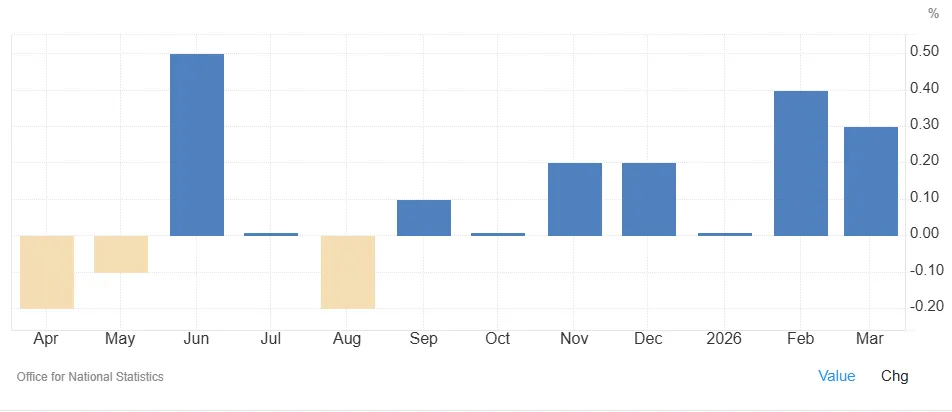
The S&P 500 is facing intense downward pressure heading into Monday’s session. The index recently closed above the 7,500 level for the first time on Thursday, marking a record of 7,501.24, but momentum stalled on Friday. Now, fresh geopolitical shocks over the weekend have sparked a global market slide.

The Polygon-based (CRYPTO: POL) Polymarket crowd is overwhelmingly betting on a lower open for Monday, May 18. The market shows merely a 6% chance of an “Up” open, reflecting a massive 44% drop in bullish confidence.

Polymarket May 18 odds.

Why That Number Matters

Geopolitical tensions skyrocketed after a drone strike triggered a fire near the UAE’s Barakah nuclear power facility over the weekend. While authorities confirmed there was no radiation leak, the International Atomic Energy Agency urged “maximum military restraint.” Adding to regional fears, Saudi Arabia intercepted three drones entering from …

Full story available on Benzinga.com

This post was originally published here

The S&P 500 recently notched a winning streak of week-over-week gains for seven consecutive weeks, a rare technical market signal that points to massive potential gains over the next twelve months.

Historic Bullish Signal

Historical data shows that in the last three instances this setup occurred—in December 2023, March 1998, and June 1997—the index surged 28.2%, 21.1%, and 23.0% over the following year, respectively.

On average, the S&P 500 advances a robust 15.7% a full 52 weeks after flashing this rare seven-week signal. According to Ryan Detrick, Chief Market Strategist at Carson Group, the recent seven-week streak where the index rose more than 10% is exceptionally powerful.

“The last three times we had a 7-week win streak for the S&P 500 that was up more than 10% saw stocks up more than 20% a year later each time,” Detrick noted.

Highlighting the 100% historical win rate of this technical setup, he added, “In fact, never lower a year later looking at all seven prior instances. I’d file this in the good news file.”

data-variant=”card”
data-news-mode=”manual”

>


Read Also:

This post was originally published here

Mortgage costs are rising sharply across the U.S. and Europe as the economic fallout from the Middle East conflict spreads into global housing markets, increasing pressure on homebuyers and borrowers despite central banks holding interest rates steady.

According to a Financial Times report published Monday, the average U.S. 30-year fixed mortgage rate has climbed to 6.36%, moving above levels seen before the Federal Reserve began cutting rates in 2025. The report said lenders are reacting to rising government borrowing costs and growing fears that inflation could accelerate again if oil prices remain elevated.

In Germany, mortgage rates on popular 10-year home loans have risen to around 3.6%, increasing annual interest costs on a new €350,000 loan by roughly €1,000, according to retail mortgage broker Dr Klein cited by the Financial Times.

“Rates have risen sharply within a matter of weeks,” Florian Pfaffinger, an executive at German mortgage broker Dr Klein, said, adding that the moves had “unsettled the market.”

The sharpest increases were reported in the UK, where the average quoted rate on a two-year fixed mortgage climbed to 5.1% in April from 3.97% at the end of February.

This post was originally published here

Nvidia Corp. (NASDAQ:NVDA) is slated to report earnings on Wednesday, which could have ripple effects on a broad range of exchange-traded funds (ETFs) with significant exposure to the chipmaker. This is especially true given the AI chipmaker’s strong weighting in the index funds and sector holdings.

Nvidia’s Historic Rally

The AI chipmaker set a historic milestone, surpassing $5.5 trillion in market cap last week. The stock remains the largest publicly traded company and overtakes silver as the world’s second-largest asset by market value. Nvidia shares are up 20.8% since the start of this year and 66.2% over the past year.

Analysts expect Nvidia to report first-quarter revenue of $79.08 billion, up from $44.06 billion in the year-ago quarter, according to data from Benzinga Pro. The company beat analyst estimates for revenue in 14 straight quarters. Analysts expect first-quarter earnings per share of $1.76, up from $0.96 in the year-ago quarter.

Prediction market traders are increasingly bullish on the stock, with Polymarket data showing strong expectations that the AI chip giant’s stock could climb beyond $240 by the end of May.

Nvidia Earnings Could Move ETFs

As reported by ETF.com, Nvidia sits at the heart of the AI and data-center supply chain, and thus hundreds of ETFs include the stock among their top holdings.

Some ETFs having the largest allocation to the chipmaker include Global X PureCap …

Full story available on Benzinga.com

This post was originally published here
YouTuber Zack Nelson, aka JerryRigEverything, has urged Tesla Inc. (NASDAQ:TSLA) CEO Elon Musk to clarify reports of Supervised Tesla Robotaxis reporting crashes in Austin.

Supervised Robotaxi Crashes

In a post on X on Sunday, Nelson quoted a post by TechCrunch, which reported that unredacted documents from the National Highway Traffic Safety Administration (NHTSA) showed that Tesla recorded 2 instances since July 2025 of Supervised robotaxis in Austin were involved in crashes.

data-variant=”card”
data-news-mode=”manual”

>


Read Also:

Elon Musk Says Tesla AI Vision Deploys Airbags ‘Before Impact’ To Cut Injury, Death Risk, Upgrade ‘Comes For Free On All New Cars’

This post was originally published here

Economist Peter Schiff criticized President Donald Trump on Sunday over rising home prices, which are making existing homeowners richer while younger Americans struggle to buy.      

Higher Home Prices

In a post on X, Schiff stated, “Trump actually said he doesn’t want lower home prices so young families struggling to buy their first home can afford one. He wants already expensive home prices to keep rising, so that older homeowners who bought them at much lower prices can keep feeling good about being rich.”

Full story available on Benzinga.com

This post was originally published here

SkyBridge Capital founder Anthony Scaramucci says America’s decision to grant China permanent normal trade relations and World Trade Organization membership was a costly strategic miscalculation.

Strategic Blindness At The WTO

After the U.S. signed a bilateral trade agreement with China in November 1999, Congress passed the United States–China Relations Act of 2000, granting Beijing permanent normal trade relations, and on Dec. 11, 2001, China formally joined the WTO.

According to Scaramucci’s Sunday X post, China entered as an emerging market, protecting its own economy with tariffs while exporting to the U.S. with few restrictions. “We were too arrogant to question it,” Scaramucci wrote on X.

Full story available on Benzinga.com

This post was originally published here

Transportation Secretary Sean Duffy delivered sharp criticism of former President Joe Biden-era Transportation Secretary Pete Buttigieg, accusing the latter of failing to initiate upgrades to air traffic control towers.

Mountains Of Cash

On Sunday, Duffy took to X, sharing a video that outlined the Department of Transportation’s (DOT) new plan to upgrade air traffic control towers.

data-variant=”card”
data-news-mode=”manual”

>


Read Also:

Peter Schiff Warns Iran ‘Will Win This War’ Without Ground Invasion, Calls It Trump’s ‘Greatest Foreign Policy Blunder’

This post was originally published here

Economist Justin Wolfers argued that surging oil prices and bond market turmoil stemming from the ongoing conflict in the Middle East could result in a political risk ahead of the November midterm elections.

In Sunday’s post on X, Wolfer said, “As it becomes increasingly clear that the mess in the Middle East will continue through to the midterms, I can’t help but wonder when the Republican Congress will step in — to save their own jobs.”

Middle East Crisis

The Middle East crisis seems far from ending soon. In the latest development, President Donald Trump warned Iran of the stalled peace negotiations, stating that the “clock is ticking” and urging swift action or severe consequences.

The conflict, which began in February …

Full story available on Benzinga.com

This post was originally published here

President Donald Trump and Chinese President Xi Jinping chartered two new bilateral institutions, the U.S.-China Board of Trade and the U.S.-China Board of Investment, as the cornerstones of the bilateral economic agreement reached during Trump’s second state visit to China.

Unlike the 20 countries with which the U.S. holds comprehensive free trade agreements, according to the U.S. Trade Representative, China has no such bilateral framework, making the new Boards the first formal government-to-government trade and investment mechanism between the two economies.

What The Boards Do

According to the White House, the Board of Trade will manage bilateral flows across non-sensitive goods, while the Board of Investment creates a government-to-government forum for resolving investment-related issues. Earlier, U.S. Treasury Secretary Scott Bessent hinted at the development, telling Bloomberg that the Board of Investment could enable Chinese companies to invest in non-sensitive U.S. industries while ensuring national security concerns are addressed.

On Saturday, China’s Commerce Ministry separately said both sides reached a tentative …

Full story available on Benzinga.com

This post was originally published here

GasBuddy analyst Patrick De Haan dismissed talks of the average price of gas in the U.S. reaching $7/gallon as tensions escalate in the Middle East amid the U.S.-Israel and Iran war.

National Average Wouldn’t Reach $6-7/Gallon

In a post on X on Saturday, De Haan quoted a post by a user who predicted that the gas prices would reach $7 by the end of next week, urging people to fill up gas in their vehicles with gas before the price hike.

data-variant=”card”
data-news-mode=”manual”

>


Read Also:

Trump’s Gas Tax Cut Could Backfire: Peter Schiff Warns Could ‘Weaken The Dollar,’ Sending Oil Prices Higher

This post was originally published here

With U.S. stock futures trading lower this morning on Monday, some of the stocks that may grab investor focus today are as follows:

  • Wall Street expects Baidu Inc. (NASDAQ:BIDU) to report quarterly earnings at $1.69 per share on revenue of $4.66 billion before the opening bell, according to data from Benzinga Pro. Baidu shares dipped 5.6% to close at $135.33 on Friday.
  • Analysts are expecting Brady Corp. (NYSE:BRC) to post quarterly earnings at $1.35 per share on revenue …

Full story available on Benzinga.com

This post was originally published here

The CNN Money Fear and Greed index showed a decline in the overall market sentiment, while the index remained in the “Greed” zone on Friday.

U.S. stocks settled lower on Friday, with the Dow Jones index falling more than 500 points during the session as higher oil prices and a bond-market rout reignited fears of interest-rate hikes.

No concrete agreements emerged from this week’s summit between President Donald Trump and Chinese President Xi Jinping, leaving a U.S.–China diplomatic stalemate as an added drag on risk sentiment.

In earnings, RBC Bearings Inc. (NYSE:RBC) reported upbeat earnings for the first quarter on Friday. Globant SA (NYSE:GLOB) shares jumped 14% on Friday following upbeat quarterly sales.

On the economic data front, the …

Full story available on Benzinga.com

This post was originally published here

Elon Musk-led SpaceX has written a letter to the Federal Communications Commission (FCC), urging the agency to end the High-Cost program aimed at providing connectivity to rural areas via subsidies for internet service providers (ISPs).

SpaceX Says It Has Solved Connectivity Issues

On Saturday, PCMag reported that it had accessed a letter to the FCC dated May 13 by SpaceX, where the commercial space flight giant said that connectivity issues for “high-speed broadband network access” have “effectively been solved” by SpaceX’s satellite internet service provider Starlink.

data-variant=”card”
data-news-mode=”manual”

>


Read Also:

Elon Musk’s Starlink Set To Benefit From FCC’s Satellite Power Limit Update—Could Get ‘Seven-Fold’ Increase In Capacity

This post was originally published here

Anthropic has reportedly agreed to brief leading finance ministries and central banks on cyber vulnerabilities identified by its general-purpose generative AI model Claude Mythos Preview.

This follows a request from Bank of England Governor Andrew Bailey, who chairs the Financial Stability Board, the Financial Times reported on Monday, citing sources.

The FSB, a G20 watchdog established in 2009 that monitors and makes recommendations about the global financial system, is preparing a report on sound practices for AI adoption, due next month.

Access Remains Tightly Restricted

Mythos, whose distribution remains restricted following a White House request, has been released to about 40 organizations, including Amazon (NASDAQ:AMZN), Microsoft (NASDAQ:MSFT), CrowdStrike (NASDAQ:CRWD) and JPMorgan Chase & Co. (NYSE:JPM), and …

Full story available on Benzinga.com

This post was originally published here
Ross Gerber, co-founder of investment firm Gerber Kawasaki, pushed back against the idea that real estate investing generates passive income, arguing that dividend-paying stocks are a more accurate example of hands-off cash flow for investors.

Gerber Questions ‘Passive’ Real Estate Investing

In a post on X on Saturday, Gerber said, “When people say real estate investing is passive income. It’s literally the opposite of that. Owning dividend stocks is actually passive income. The profit of a business you own but don’t have to run.”

Gerber’s comments come as elevated mortgage rates and ownership costs continue reshaping the U.S. housing market. The average rate on …

Full story available on Benzinga.com

This post was originally published here
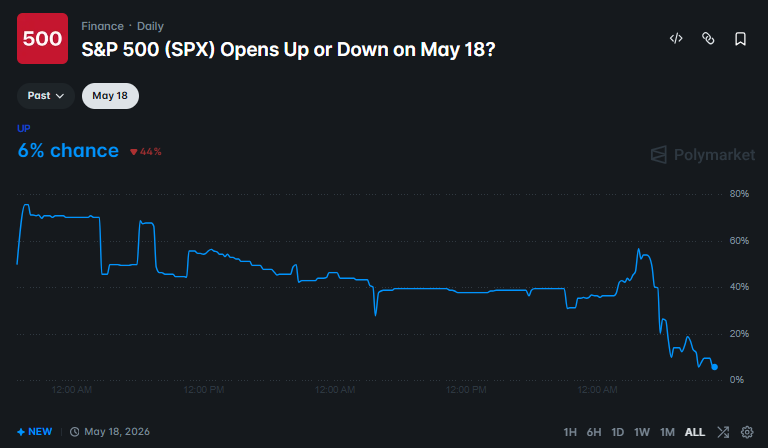
The Bill & Melinda Gates Foundation has finalized its phased exit from Microsoft Corp. (NASDAQ:MSFT) by selling its remaining stake in the tech giant.

The Gates Foundation’s trust offloaded its final 7.7 million shares of Microsoft during the first quarter of 2026, according to 13-F filings disclosed on Friday. The shares were worth roughly $3.2 billion as per the software giant’s closing price on Friday.



The foundation’s trust initiated its Microsoft stake reduction approximately two years ago, when it held close to 28.5 million shares. The most substantial cutback happened in 2025’s third quarter, with the trust selling nearly 65% of its position.

The remaining Microsoft stake was sold in early 2026, ending a long-standing investment that had shaped the foundation’s finances since its founding. Following the exit, the Gates Foundation Trust’s portfolio is estimated to be worth about $31.7 billion.

Notably, Bill Gates personally still reportedly owns about 103 million Microsoft shares outside the foundation trust, according to Barrons.

data-variant=”card”
data-news-mode=”manual”

>


Read …

This post was originally published here

Amer Sports, Inc (NYSE:AS) will release earnings for its first quarter before the opening bell on Tuesday, May 19.

Analysts expect the Helsinki, Finland-based company to report quarterly earnings of 31 cents per share, up from 27 cents per share in the year-ago period. The consensus estimate for Amer Sports’ quarterly revenue is $1.83 billion. It reported $1.47 billion last year, according to Benzinga Pro.

On March 3, Amer Sports announced pricing of its public offering of 20,604,396 ordinary shares.

Shares of Amer Sports fell 1.5% to close at $32.84 on Friday.

Benzinga readers can access the latest analyst ratings on the Analyst Stock Ratings page. Readers can sort by stock ticker, company …

Full story available on Benzinga.com

This post was originally published here

A self-taught trader says futures trading once felt so confusing and intimidating that they avoided it entirely, but after nearly a year of trial and error, they now say, “Futures trading is changing my life in a good way.” 

In a recent post on Reddit’s r/FuturesTrading, the trader shared how years of dabbling in stocks, options and forex never resulted in consistent success. While a few lucky stock picks eventually turned a few thousand dollars into roughly $50,000 over a decade, they admitted it never felt reliable.

Months Of Failure Before Things Started Clicking

“Options were confusing, and the only time I really made anything was a couple of small-dollar YOLOs,” the trader wrote. “Forex ate me alive.”

Don’t Miss:

They said futures initially seemed overly complicated whenever they read about it online. But about a year ago, they decided to finally take trading seriously and committed themselves fully to learning.

They started by watching YouTube videos, reading Reddit discussions and testing simple strategies. Then came months of paper trading and replaying old charts.

“Night after night I’d practice,” they wrote. “Just hours and hours staring at the chart, trying to find setups and trade them.” 

At first, almost everything failed.

The trader described spending months jumping between strategies and losing consistently before eventually noticing recurring patterns in price action. Around seven months into the process, they began to feel they were finally understanding how the market moved.

After building some confidence, they funded a live trading account with $5,000 and started trading Micro E-mini S&P 500 futures contracts.

Trending: Think the biggest tech gains happen after an IPO? Click here to see why some investors are looking at opportunities before companies go public.

That transition immediately became much harder than expected.

“I started second guessing every movement,” they wrote. “A trade would move against me by a few points and I’d panic exit at a loss.”

Within just a few weeks, the trader had lost roughly half the account.

Removing Emotion Became The Biggest Breakthrough

The biggest improvement didn’t come from finding a new indicator or strategy. Instead, it came from stepping away from the screen.

Frustrated after repeated emotional decisions, the trader decided to simply place trades, set stop losses and walk away.

“Interestingly, that helped,” they wrote. “My strategy was working.” 

The trader said they now focus mainly on using opening range breakout direction and trading pullbacks on the 1-minute chart. While the profits remain relatively modest so far, the consistency has improved significantly.

“This month, while not over just yet… I’ve made a little over $3k,” they wrote. “I’m averaging about $75-$100 a day.”

See Also: Turn your trading skills into real income — without risking your own capital: Get funded by Apex Trader Funding and keep up to 90% of the profits.

Several commenters praised the honesty of the post because it focused less on massive profits and more on discipline, patience and emotional control.

Others warned that early success can result in overconfidence and bigger future …

Full story available on Benzinga.com

This post was originally published here

Cisco Systems (NASDAQ:CSCO) stock has popped sharply and moved to a record high as demand for its products jumped. It has soared by 55% this year and 87% in the last 12 months. In contrast, the S&P 500 Index is up 7.7% this year and 26% in the last 12 months. 

Cisco Stock Has Jumped Amid Resilient Demand

Cisco, a top player in the networking industry, has experienced strong demand as the biggest technology companies have boosted their capital expenditure plans as the artificial intelligence (AI) boom continued. 

The most recent Cisco earnings showed that its AI business continued thriving, with orders rising to $5.3 billion. It boosted its AI order guidance from $5 billion to $9 billion.

In total, Cisco’s revenue jumped by 12% in Q3 to $15.8 billion, while its earnings-per-share rose by 37% YoY. The company boosted its Q4’26 guidance, with its revenue expected to jump from $16.7 billion to $16.9 billion. 

Cisco’s revenue and earnings growth will likely continue rising in the coming years as AI spending gains steam. Also, the revenue will benefit from its strong pricing power.

As a result, analysts were quick to boost …

Full story available on Benzinga.com

This post was originally published here

Many Americans quietly wrestle with the same question: Is the purpose of financial planning to actually enjoy retirement, or simply accumulate as much money as possible before dying?

That debate recently played out in a Reddit discussion on r/FinancialPlanning after one person described hearing a retirement call-in show featuring a 54-year-old with roughly $4.2 million saved, two pensions bringing in about $4,000 a month, no debt and monthly spending of around $10,000. Even with those numbers, the discussion still revolved around careful withdrawals and waiting for Social Security.

Why Advisors Tend To Be Conservative

“It just seems to me most of these ‘financial advisors’ want everyone to save, save, save and save some more and die with millions of dollars,” the original poster wrote.

Don’t Miss:

The thread quickly filled with responses from people explaining why retirement planning often sounds more cautious than exciting.

Several commenters pointed out that retirement isn’t just about replacing monthly bills. Healthcare costs alone can dramatically change the equation, especially for people retiring before Medicare eligibility at age 65.

“Healthcare is very expensive from 55-65,” one commenter wrote, adding that having retiree health benefits through a pension “shortens our needs tremendously.”

Others noticed that retirees often underestimate how unpredictable spending becomes later in life. Someone may plan for a steady monthly budget, only to suddenly face home repairs, vacations, helping adult children financially or paying for long-term care.

“Clients rarely stick to their budget,” one commenter said. “They might agree to $10k/month drawdown plus Social Security, but then they want an extra $20k to redo the landscaping and paint the house.”

Trending: Click here to explore BAM Capital’s current Midwest multifamily funds and see how accredited investors are gaining access to institutional-grade opportunities.

The conversation also showed how much retirement has changed over the years. Several people said the old idea that $1 million was enough to retire comfortably just doesn’t go as far anymore.

“Growing up, $1 mil seemed like the magic number for retirement,” one person wrote. “Now that I’m 50, divorced, in a very high-cost-of-living area, and hoping to help my kids financially if needed, $1 mil would equate to financial ruin in my scenario.”

The Debate Over Financial Advisors

Some questioned whether advisors who charge fees based on assets under management have an incentive to encourage larger portfolios.

“A $5M portfolio earns them 5x the fees of a $1M portfolio,” one wrote.

Still, many people in the thread defended good financial planners, saying their value becomes most important near retirement. Topics like withdrawal strategies, tax planning, Social Security timing and estate planning can become extremely complicated.

“The purpose isn’t millions, it’s independence,” one commenter wrote. “Enough capital to control your time is more valuable than chasing big numbers.”

See Also: From the International Space Station to everyday use — this NASA-tested diagnostics platform is moving toward at-home lab testing

Others said the real goal of financial planning is balance. Saving aggressively while working may create flexibility later, but retirement should still involve enjoying life.

“The purpose of financial planning is to make …

Full story available on Benzinga.com

This post was originally published here

Consumers are seeing a bigger portion of their paychecks go to car debt at the same time that prices at the pump are rising. 

Just how bad is it? About one in four, or roughly 86 million Americans, had auto loan or car lease debt at the end of 2025, according to think tank The Century Foundation and consumer advocacy group Protect Borrower. 

According to the researchers total auto debt was $1.68 trillion at the end of 2025 up 37% from 2018, when auto debt stood at $1.23 trillion. 

The average origination balance for an auto loan was $33,519 in December compared to $24,782 at the end of 2018, according to CNBC. As a result, borrowers paid about $680 a month for their vehicle compared to $506 seven years ago. 

Don’t Miss:

That has increased even further in Q1 2026. The average monthly payment on a financed new-vehicle purchase stands at $773, reports car research and data provider Edmunds. 

Higher Vehicle Prices Drive Up Costs 

The uptick in auto debt is being driven by higher prices for vehicles and increased interest rates, forcing consumers to choose between bigger monthly bills or longer loan terms, which makes the cost of ownership even more. 

In Q1 84-month or longer car loans accounted for 22.9% of financed new car purchases, which is an all-time high, compared to 20.8% in Q4 2025, according to Edmunds. Add the fact that gasoline prices are rising amid the conflict in Iran, and consumers are forced to shell out more money each month for their rides. 

As it stands, Edmunds said the average amount financed for a new vehicle is $43,899, while the average APR to finance is 6.9%. Meanwhile the national average price for a regular gallon of gas is $4.50, up nearly 44% from a year ago, reports AAA.  

See Also: High-interest debt doesn’t fix itself — see how borrowers are comparing multiple personal loan offers through AmONE in minutes.

Bargains Do Not Abound 

Consumers who want to buy a new car have little in the way of options when it comes to finding affordable vehicles. Ivan Drury, director of insights at Edmunds, told CNBC there are “virtually no new vehicles” that cost less than $20,000. 

While extending a car loan to seven years or more does bring down the monthly payment, consumers end up paying more in overall interest. Plus, they run the risk of ending up with a car that is worth less than they owe. That could hurt their next car purchase if they are using the older vehicle for a down payment or trade-in. 

“Q1 financing data shows that car buyers are getting creative just to keep their purchases within reach,” said Jessica Caldwell, Edmunds’ head of insights. “As loan amounts and monthly payments continue to climb to record levels, consumers are having to work harder to …

Full story available on Benzinga.com

This post was originally published here

Billionaire entrepreneur Mark Cuban is seemingly taking aim at the U.S. healthcare system every day, and this time, he questioned why insurance companies can deny medical care without facing the same level of accountability that doctors and hospitals often do.

“If insurance companies can deny care and call it ‘medically unnecessary,’” Cuban wrote in a recent post on X, “why aren’t they required to have malpractice insurance when they get it wrong and someone gets sicker or tragically dies?”

Don’t Miss:

Cuban Questions Insurance Accountability

The post quickly sparked discussion online, especially among people frustrated with denied claims and prior authorization battles.

One person replied that her health insurance company is connected to the same hospital system where she receives care, saying that denied claims make little sense in that arrangement.

Cuban responded with a single-word answer: “None.”

The exchange reflects a broader criticism Cuban has been making for years about the role insurance companies play in healthcare. He says insurers have become powerful gatekeepers that influence medical decisions while avoiding the level of liability physicians typically face.

Trending: This Under-$1 Pre-IPO AI Company Is Still Open to Retail Investors — Learn More

Those frustrations were also front and center in a lengthy blog post Cuban published in January 2025, titled “A Few Words On Healthcare.”

Healthcare itself is simple, but the financial side of the industry has become unnecessarily complicated, he said in the post.

Push For Transparency And Lower Costs

To Cuban, one of the biggest problems is the lack of transparency in healthcare pricing. Instead of hospitals posting bundled procedure prices, he proposed showing the actual costs of supplies, labor and treatment materials used for each patient.

“Show the actual cost the hospital paid for the bandaids, the sterile water, the fully burdened with benefits doctor, nurse, [physical therapist], and anything else that is used specifically for the care of that patient,” he wrote. Insurance bureaucracy dramatically inflates healthcare spending through billing disputes, administrative costs and pricing manipulation.

See Also: More Than Half of Americans Aren’t Prepared for Retirement — Including 62% of Gen Y

Cuban also said that insurance companies should largely be removed from routine healthcare payments altogether because insurance-related administration and billing disputes add massive costs to the healthcare system.

He estimated the current roughly $5 trillion U.S. healthcare system could potentially shrink to around $2.5 trillion if the industry became more transparent and less dependent on insurance-related …

Full story available on Benzinga.com

This post was originally published here

Walmart (NASDAQ:WMT) stock has soared and hit a crucial resistance as traders position for the upcoming quarterly earnings. It closed at $131.45 last week, a few points below the important point at $133.90.

Walmart Stock Faces Valuation Headwinds Ahead of Earnings

WMT shares have done well over time, rising by 180% in the last five years and by 40% in the last 12 months. This surge happened as the company continued to grow its market share in the retail sector in the US.

It has also made it one of the most expensive retailers to own in Wall Street. Data shows that the company trades at a price-to-earnings ratio of 45, higher than its five-year average of 31.

This metric is also much higher than the retail sector, with the SPDR S&P Retail ETF (NYSE:XRT) having a multiple of 13.80. It is also higher than the S&P 500 Index average of 23. 

Most notably, Walmart is now more expensive than high-flying technology names. The Nasdaq 100 Index has a multiple of …

Full story available on Benzinga.com

This post was originally published here

CAVA Group (NYSE:CAVA), the popular Mediterranean restaurant chain, has suffered a harsh reversal and moved into a technical bear market after plunging by 23% from its highest point this year. With its first-quarter earnings looming, will the stock bounce back?

CAVA Group To Release Q1 Earnings On May 19

CAVA Group stock plunged to $43.50 in November last year, and then started a major rally that pushed it to $98.8 in April. These gains extended after the company published its financial results, which showed that its revenue growth continued in the fourth quarter.

The revenue jumped by 21.2% in Q4 to $272.8 million as it opened 24 new restaurants during the quarter. Its same restaurant sales jumped to 0.5%, while its annual revenue rose to $1 billion for the first time ever. It also benefited from its investment in digital, with its sales rising by nearly 40%.

Most analysts boosted their CAVA stock forecast after the strong report and as the company continued expanding its footprint. UBS hiked its target from $75 to $85, while Citigroup hiked from $75 to $92. Benchmark, the most optimistic boostded the target …

Full story available on Benzinga.com

This post was originally published here

A 33-year-old sparked a heated debate online recently after sharing a plan to work 80 hours a week for the next two years in hopes of catching up financially after struggling through most of their 20s.

The poster, who still lives with their 73-year-old father in San Diego, graduated with a film degree and spent years dealing with inconsistent freelance editing work. They recently lined up two jobs, including an Amazon (NASDAQ:AMZN) position paying $19 an hour plus overtime. Their idea was to invest nearly all of the income into the Vanguard S&P 500 ETF (NYSE:VOO) and let the money grow until retirement.

Don’t Miss:

Burnout Imminent?

While some praised the discipline and willingness to sacrifice, the overwhelming response focused on the physical and mental toll of working 80-hour weeks.

“Your plan sounds absolutely miserable and I doubt you’d stick with it,” one commenter wrote in one of the thread’s most upvoted replies.

Another person who had previously worked similar schedules said the experience was brutal.

“I worked 72 hours per week for a couple of years straight and let me tell you, it completely wrecked my body,” they wrote. “I do NOT recommend it. It’s really not worth it, even with a six-figure salary.”

Several former warehouse workers specifically warned against trying the plan at Amazon.

“Being a human robot for 40 plus hours a week is going to destroy you, both mentally and physically,” one commenter wrote. “80-hour weeks for two years will absolutely break you.”

Trending: Not sure if your retirement plan is optimized for income, taxes, and withdrawals? See how SmartAsset helps match you with a financial advisor in minutes.

Others argued that the math simply didn’t justify the sacrifice. One person estimated that even after two years of nonstop work, taxes would leave the poster with roughly $140,000 to $150,000 invested.

“You really think you’re gonna be able to coast on $143K for the rest of your life?” the commenter asked.

The thread also became a broader discussion about burnout culture and whether people should sacrifice their health in pursuit of financial independence.

“You can’t invest your way out of regret,” one user commented. “But you can build something genuinely solid from where you are right now.”

The Most Common Advice

Many commenters said that spending those extra hours building higher-paying skills would create a far better long-term outcome than grinding through low-paying labor jobs.

Industrial controls and automation became one of the biggest side discussions after one commenter suggested learning systems like programmable logic controllers, supervisory control and data acquisition systems and process controls.

“You can be a self-employed Controls Engineer/Controls Designer/Controls Technician within a year if you take it seriously,” they wrote, adding that experienced workers can bill out at “$150+/hr plus your travel expenses paid.”

See Also: Find out if you qualify to reduce your monthly debt payments — see how much you could save with a quick, free consultation.

Other commenters …

Full story available on Benzinga.com

This post was originally published here

Many retail traders spend their days jumping between volatile stocks, chasing news headlines and trying to predict which company will make the next big move. But a growing number of traders say there is a simpler way to approach day trading: futures.

That debate recently gained attention on Reddit’s r/Daytrading community after one experienced trader wrote, “If you’re serious about day trading, forget stocks and options, trade futures.” The trader said futures are “the ideal instrument for day trading,” especially for traders focused on stock index futures like the S&P 500 and Nasdaq. 

Don’t Miss:

Why Some Traders Prefer Futures

The original poster laid out several reasons why futures have become their preferred trading vehicle. They argued that futures offer simpler price movement, cleaner chart setups and fewer distractions compared to tracking individual stocks.

“Linear price movement and limited choices,” the trader wrote. “You always know how much money you’ll gain or lose if the underlying price moves a certain amount, without using a calculator.”

The trader also highlighted the leverage available in futures markets, particularly through micro contracts that allow traders with smaller accounts to participate.

“Make a good income when a well-known instrument like the S&P500 moves less than a half of a percent,” the post said.

One of the biggest talking points in the thread involved taxes. “The 60/40 tax treatment is a game changer that most new traders overlook,” one commenter wrote.

Another trader called it “essentially a 10-20% head start on your net profit.”

Trending: Turn your trading skills into real income — without risking your own capital: Get funded by Apex Trader Funding and keep up to 90% of the profits.

Some also praised futures for avoiding the Pattern Day Trader rule that limits frequent trading activity for smaller stock trading accounts.

Others said trading futures helped simplify their routines.

“I learned on futures and trade futures exclusively to this day,” one trader wrote. “Plenty of price action, easy at tax time, and I don’t feel so stressed about missing some obscure news that can affect a single stock.”

Not Everyone Agreed

Despite the enthusiasm around futures, plenty of traders pushed back against the idea that they’re automatically superior.

Some stock traders argued that individual equities provide clearer catalysts through earnings, news events and company-specific momentum.

“Futures lack the frequent catalysts for outsized, predictable moves,” one commenter said.

Others warned that futures trading can become extremely dangerous for inexperienced traders because of the leverage involved.

See Also: Moomoo isn’t just for trading — eligible new users may earn up to 8.1% promotional APY on idle cash and potentially receive up to $1,000 in NVDA stock when they sign up.

One experienced commenter explained that traders can control contracts worth hundreds of thousands of dollars while only posting a relatively small amount of margin.

“The leverage will kill you if you aren’t fully prepared when you go live,” the trader warned.

Even among traders who preferred stocks, options or forex, many still agreed that futures offer advantages in liquidity, execution speed …

Full story available on Benzinga.com

This post was originally published here

One wealthy person recently posed a question that touched on a fear many wealthy families share: “How do you avoid the third gen curse?”

The person, who described themselves as a second-generation member of a wealthy family, referenced the old saying, “Shirtsleeves to shirtsleeves in three generations,” and asked others how families can stop inherited wealth from disappearing over time.

Why Family Wealth Often Disappears

Many commenters said the so-called “third generation curse” is less about spoiled heirs and more about human nature, family size and lifestyle creep.

“Many ultra wealthy families tend to have more kids than middle class families,” they wrote. “So at a minimum, the pie gets divided by more people.” 

Don’t Miss:

Others pointed to divorce, addiction, overspending and descendants who choose lower-paying careers while still trying to maintain expensive lifestyles.

“Then, you have the one or few degenerates who do sabotage finances — drugs, schemes, etc. that quickly sink a fortune,” the commenter added.

Still, many people in the discussion argued that the issue isn’t really about money management alone. They said parenting and values matter far more.

One person from a fourth-generation wealthy family said only a few cousins were actively growing the family’s wealth while others simply chose careers or lifestyles they enjoyed.

“Most of us took on jobs we like, or became stay at home moms and are subsidized by the inheritance,” they shared, “and will probably pass on wealth to the next generation, but not as much as we received.”

Trending: Not sure what kind of financial advisor fits your goals? Take a short quiz and get matched through SmartAsset in minutes.

Some stressed the importance of making wealthy children work and experience discomfort instead of shielding them from every challenge.

“Our goal as parents should be to expose your children to challenges that they can overcome,” one person wrote.

Another said wealthy children need perspective.

“It’s really important for well-off parents to make sure their kids understand that THERE ARE PEOPLE who would KILL to live one day in your shoes,” they wrote after describing a visit to their parents’ impoverished home country.

Trusts, Rules And Family Pressure

Some wealthy families described using strict trusts to preserve money over generations.

One third-generation commenter said their grandfather created a trust that required beneficiaries to graduate from college and maintain employment in order to receive distributions.

“We aren’t allowed to take out as much money as we want,” they added.

Another said their family’s trust has survived for centuries through strict rules surrounding employment, inheritance and asset control.

See Also: From Apple to Tesla — The Stocks Driving a Leveraged ETF Revolution for Retail Traders

But not everyone believed preserving wealth forever should be the primary goal.

One woman who married into an extremely wealthy family said that later generations sometimes become consumed by fear of losing the fortune.

“NO ONE wanted to carry the shame of being the one who f***ed up and lost it all,” she wrote.

She argued that wealthy families should focus less on preserving every dollar forever …

Full story available on Benzinga.com

This post was originally published here

Gold price continued its downward trend and is about to flash a death cross pattern as inflation jumps and top ETF outflows continued. It dropped to $4,540, down by 19% from its highest point this year. 

Gold Price Drops As ETF Outflows Continue And Risk Remain

American investors are dumping their gold ETF assets. Data shows that the SPDR Gold Shares ETF (NYSE:GLD) has had over $4.8 billion in outflows this year. The iShares Gold Trust (NYSE:IAU) has shed over $1.9 billion in the same period.

These outflows have increased as odds that the Federal Reserve will cut interest rates ease. In a statement to Fox News, Jeff Gundlach, the billionaire founder of DoubleLine Capital, warned that it was not possible for the bank to slash rates this year. He said:

“It’s just not possible, in my view, to cut interest rates when the two-year Treasury is almost 50 basis points higher than the Fed funds rate.”

The prediction market …

Full story available on Benzinga.com

This post was originally published here

NIO Inc – ADR (NYSE:NIO) stock has pulled back and moved into a technical correction after falling by 12.5% from its highest point in April this year. This retreat could be part of the formation of the cup-and-handle pattern, pointing to a rebound as it publishes its results on Thursday this week.

Nio Stock In Focus Ahead of Q1 Earnings

Nio, a top Chinese Tesla (NASDAQ:TSLA) rival, will be in the spotlight on Thursday as it releases its first-quarter earnings report. 

These results come at a time when the company has become one of the fastest players in the electric vehicle industry. While its recent April deliveries report missed estimates, they demonstrated that its vehicles were seeing strong growth. 

Nio delivered 29,356 vehicles in April, up by 22.8% from the same period last month. Its first-quarter deliveries rose by 98.3% to 83,465. In contrast, Tesla delivered 365,000 vehicles in the first quarter, missing the estimated range of between 365,000 and 381,000. 

BYD, the biggest Chinese company, delivered 700,463 vehicles, down …

Full story available on Benzinga.com

This post was originally published here

Lululemon Athletica (NASDAQ:LULU) stock price continued its strong downward trend, reaching its lowest level since December 2018, with its market capitalization falling from $67.2 billion to $14.3 billion today. 

The stock has plunged amid concerns about its growth trajectory amid the rising competition from companies like Nike (NYSE:NKE), Gap’s (NYSE:GAP) Athleta, Vuori, and Alo Yoga. 

Lululemon’s growth has slowed substantially in the past few years. Gone are the days when it constantly experienced double-digit revenue growth. Its most recent earnings revealed that its revenue rose by just 1% in the fourth quarter to $3.6 billion. 

Its Americas business experienced a 1% revenue decline, which was offset by its international business, which grew by 17%. Its annual revenue rose by 5% to $11.1 billion, helped by its international business, which grew by 22%.

Worse, analysts don’t expect substantial growth in the coming year. Analysts predict that its annual revenue this year will be $11.48 …

Full story available on Benzinga.com

This post was originally published here

Amid ongoing geopolitical tensions, the U.S. Dollar and oil prices are demonstrating an unusual correlation.

Rare Alignment In Dollar, Oil Prices

This rare alignment has reached a 60-day correlation of 0.55 between Brent crude oil prices and the Bloomberg Dollar Spot Index, marking the highest level since the index’s inception in 2005, according to Kobeissi Letter.

This atypical positive correlation emerged in early March, coinciding with the beginning of the Iran war, and has persisted since.

Typically, these financial indicators move inversely because oil is globally priced in US Dollars. A stronger US Dollar generally makes crude oil pricier for international buyers, reducing demand, according to Kobeissi Letter.

Full story available on Benzinga.com

This post was originally published here

A San Francisco Uber driver thought bigger vehicles would lead to bigger paydays. Instead, the strategy left him buried under two car loans, falling behind on payments and asking personal finance expert Dave Ramsey whether voluntarily giving the cars back was the least painful option left.

During an episode of “The Ramsey Show,” Ramsey and co-host Jade Warshaw spoke with Joseph, a 29-year-old gig worker who financed nearly $144,000 worth of vehicles while trying to increase his Uber earnings during the post-pandemic rideshare boom.

The trouble started after Joseph financed a Honda CR-V for nearly $60,000 during the inflated car market of 2022. At first, the income looked promising. Joseph said he was making roughly $2,700 a week driving for Uber and Lyft.

Don’t Miss:

But when Uber removed a program that boosted earnings for hybrid drivers, his weekly income dropped sharply. Hoping to recover the difference, Joseph bought a second vehicle, an Acura MDX, after hearing from other drivers that larger SUVs generated better fares through Uber XL rides.

That decision turned an already expensive situation into a financial mess.

“You’ve been working for free for Uber,” Ramsey told him. “The gross revenue was great. The net profit was not great.”

The Income Was Real But The Profit Wasn’t

Ramsey said Joseph focused too heavily on the money coming in without fully accounting for financing costs, depreciation, gas, repairs and maintenance.

Joseph later admitted he had not properly calculated how much the vehicles were actually costing him over time.

The situation worsened once the cars started losing value faster than the loan balances fell. Joseph said he was already upside down on at least one of the loans and had fallen behind on payments while earning about $22 an hour at his current job.

Trending: What If Your Investment Income Didn’t Rely Entirely on Market Swings? Some Investors Are Taking a Different Approach

Ramsey appeared especially stunned that Joseph expanded the strategy after the first vehicle stopped producing the income he expected.

“You got financial advice from other Uber drivers?” Ramsey asked. “You just said that out loud. Wow.”

The conversation quickly shifted into a broader warning about how easy it is for high monthly revenue to create the illusion of success while debt quietly piles up underneath.

Ramsey Says Voluntary Repo Could Create A Bigger Problem

As the financial pressure mounted, Joseph asked whether voluntarily surrendering the vehicles would make more sense than continuing to struggle with the loans.

A voluntary repossession happens when a borrower willingly returns a financed vehicle to the lender after falling behind on payments. While some consumers believe it is less damaging than a standard repossession, lenders can still sell the vehicle, apply the proceeds to the balance owed and pursue the borrower for any remaining debt.

Ramsey warned Joseph that the outcome could become even more expensive if the lenders took control of the process.

“If you just turn these cars in, they’re going to sell them for 50% of what you think they’re going to sell them for, and they’re going to sue you for the difference,” Ramsey said.

He added that repossession would likely hurt Joseph’s credit while still leaving him responsible for unpaid balances after the vehicles were sold.

Instead, Ramsey pushed him to sell one of the vehicles privately, increase his income and avoid letting the lenders determine the sale price.

See Also: Become a futures trading pro, without spending any money –

Full story available on Benzinga.com

This post was originally published here

This past week was quite eventful for Tesla Inc. (NASDAQ:TSLA). From a Gov. Gavin Newsom-backed (D-CA) EV rebate program to an affordable financing program in China, let’s take a look at what captured the headlines for the Elon Musk-led EV maker this week.

Gavin Newsom’s $1 Billion EV Incentive Program

Newsom unveiled a $1 billion EV incentive program that could potentially benefit the Tesla Semi. The program, set to kick off on June 26, will offer rebates ranging from $7,500 to $120,000 to authorized retailers and target commercial vans, electric semi trucks and more. The program will initially receive $250 million in funding this year.

data-variant=”card”
data-news-mode=”manual”

>


Read Also:

Elon Musk Says ‘Space Is The Only Way’ After Jensen Huang Warns AI Could Soon Need 1,000x More Energy

This post was originally published here

Large-cap stocks tied to housing, nuclear energy, crypto mining and global commodities led Wall Street’s biggest declines last week as investors reacted to earnings volatility, macro uncertainty and sector-specific pressure.

Rising Treasury yields, Middle East conflict concerns, weaker crypto sentiment and cautious outlooks weighed on several momentum-driven names despite some companies posting strong quarterly results.

These ten large-cap stocks were the worst performers last week. Are they a part of your portfolio?

Ubiquiti Inc. (NYSE:UI) slumped 14.62% this week after the company reported worse-than-expected third-quarter financial results.

JBS N.V. (NYSE:JBS) fell 17.05% this week after the company reported mixed first-quarter financial results. Also, Barclays lowered its price forecast on the stock from $23 to $21.

Korea Electric Power Corporation (NYSE:KEP) decreased …

Full story available on Benzinga.com

This post was originally published here

Large-cap technology and AI-linked stocks dominated Wall Street’s top gainers list last week as investors rotated into companies tied to semiconductor demand, cybersecurity and digital infrastructure growth.

Strong earnings, upbeat guidance, analyst upgrades and growing optimism around AI spending helped drive momentum across several market-leading names.

These ten large-cap stocks were top performers last week. Are they a part of your portfolio?

Tower Semiconductor Ltd. (NASDAQ:TSEM) jumped 28.48% this week after the company reported better-than-expected first-quarter financial results and issued second-quarter sales guidance with its midpoint above estimates. Also, the company announced that it had signed a $1.3 billion silicon photonics contract. Multiple analysts raised their price forecasts on the stock.

Applied Optoelectronics, Inc. (NASDAQ:AAOI) increased 25.36% this week. The latest price action follows a bullish analyst reset: Rosenblatt reiterated a Buy and raised its …

Full story available on Benzinga.com

This post was originally published here

Retail trading conversations online increasingly sound like one giant futures trading convention.

Scroll through Reddit, YouTube or Discord trading groups and you’ll quickly notice a pattern: traders who once focused on forex or stocks now talk almost exclusively about futures contracts tied to indexes like the S&P 500 or Nasdaq.

“Why does everybody trade futures?” one trader summed up the growing sentiment in a recent Reddit thread. “I feel like no one trades actual forex anymore.”

Don’t Miss:

Why Traders Are Moving Toward Futures

Much of the appeal comes down to how futures markets operate compared to forex. 

Some traders said that futures markets feel more transparent because they trade through a centralized exchange. One commenter said that in futures, “everyone sees the same price, real order book, real volume,” while forex brokers often display different pricing and spreads.

“Futures are regulated,” that same commenter added. “Forex is a broker casino.”

For many traders, access to real trading volume and order flow data is a major advantage. Futures traders can see how many contracts are being bought and sold in real time, something forex traders often can’t access because the forex market is decentralized.

Liquidity is another major reason traders prefer futures. Contracts like the E-mini S&P 500 or Nasdaq futures trade heavily throughout the day, making it easier to enter and exit trades quickly with “little slippage.”

Futures also attract traders because markets stay open nearly around the clock during the workweek. Unlike stocks, which close overnight, futures allow traders to react instantly to global news, inflation reports or Federal Reserve announcements.

Trending: Turn your trading skills into real income — without risking your own capital: Get funded by Apex Trader Funding and keep up to 90% of the profits.

Another huge factor is leverage. Traders can control large positions with relatively small amounts of money. While this creates the possibility of larger profits, it also dramatically increases risk.

The Rise Of Prop Firms And Retail Futures Trading

Many commenters pointed to prop firms as one of the biggest reasons futures trading exploded in popularity.

Prop firms allow traders to access larger accounts after passing evaluation challenges, and many now focus heavily on futures trading instead of forex.

“The most prop firm friendly market” was how one trader described futures.

Others said the barriers to entry have fallen dramatically over the last decade.

One full-time trader who said he started trading futures around 2012 described how expensive and niche the market once was.

“Trading was for big boys only,” he wrote, recalling how traders once needed thousands of dollars just to trade a single contract.

See Also: Traditional banks aren’t the only place to park cash — see how eligible SoFi users are earning a competitive APY and potentially qualifying for up to $300 with direct deposit.

Now, micro futures, cheaper brokers and endless online education have opened the doors to almost anyone with a laptop.

The growth of prop trading firms has also changed how retail traders access futures markets. Instead of building large …

Full story available on Benzinga.com

This post was originally published here

A California woman says her estranged husband filed a joint federal tax return using her Social Security number without her consent, redirected more than $14,000 in refunds to his own bank account, and left her dealing with the fallout while navigating divorce and custody proceedings.

The woman shared her story in Reddit’s r/tax forum, where she detailed what she described as a long pattern of financial deception and control during the breakdown of their marriage.

‘He Filed Anyway’

According to the post, the woman said her estranged husband asked for her W-2 in March, but she refused to provide it. She said she repeatedly told him she would not make any tax decisions until speaking with an attorney.

Don’t Miss:

“I told him at least 10 times – through our court-ordered co-parenting app (TalkingParents), text messages, and in person – that I would not make any tax decisions until I spoke with an attorney,” she wrote. “He acknowledged it. He filed anyway.”

The woman said the return omitted more than $15,000 of her income while directing the entire refund into his personal bank account.

“My refund alone should have been over $7,000,” she wrote. “He received $4,000. By filing without my consent he took money my daughter and I desperately needed.”

She also said he used an address where she had never lived and falsely listed it as her residence on the return.

The post drew attention from people familiar with tax disputes, identity theft cases and divorce-related financial battles. Many commenters encouraged her to continue documenting every communication and interaction connected to the case.

Trending: This Under-$1 Pre-IPO AI Company Is Still Open to Retail Investors — Learn More

The woman said she has already filed IRS Form 14039 for identity theft and Form 8857 for innocent spouse relief, submitted her own tax return by mail, filed a police report and reported the situation to both the Federal Trade Commission and California’s Franchise Tax Board.

Still, she expressed frustration over how much of the burden appeared to fall on her.

“Why am I the one fixing this?” she asked. “He used my SSN without permission. He filed without my signature. He pocketed a refund that was never his.”

Credit Freeze And IRS PIN Protection

Many of the most-upvoted responses focused on preventing future misuse of her SSN and protecting her child’s identity.

Several people encouraged her to get an IRS Identity Protection PIN, which prevents anyone from electronically filing a tax return without the assigned code.

Others advised her to freeze her credit and her child’s credit to prevent additional forms of identity theft.

“If your ex will steal your identity for a tax return, he may be inclined to use kids’ SSNs to obtain lines of credit,” another commenter warned.

See Also: Discover How AI Can Turn Your Investment Ideas Into Tradable Assets — See How

Multiple people also recommended contacting the Taxpayer Advocate Service because the case involves alleged identity theft, financial hardship and an already-blocked electronic filing.

Although many commenters said the IRS process can move …

Full story available on Benzinga.com

This post was originally published here

With the current Robotaxi market in the U.S. being dominated by Alphabet Inc.‘s (NASDAQ:GOOGL) (NASDAQ:GOOG) Waymo, Frank McCleary, who is a Partner at Arthur D Little, shared his insight with Benzinga on the gap between Waymo and Tesla Inc. (NASDAQ:TSLA) and how ride-hailing companies like Uber Technologies Inc. (NYSE:UBER) could actually dictate the Robotaxi market.

Tesla And Waymo Aren’t In The Same Playing Field

“I wouldn’t put the two currently in the same playing field, because Waymo is above and beyond in multiple markets,” McCleary said, adding that the company had established a “rhythm” of undertaking testing and deploying driverless vehicles “pretty quickly” across cities.

data-variant=”card”
data-news-mode=”manual”

>


Read Also:

Uber-Waymo Partnership On The Rocks? Exec Shares ‘Scary’ SF Robotaxi Moment, Slam AV Rollout

This post was originally published here

With home prices hovering at record highs and mortgage rates locked above 6%, the dream of homeownership is becoming a family affair. 

For many Gen Zers, the youngest generation entering the housing market, securing a home without help with a down payment is essential.

Eighty percent of Gen Z homeowners received financial assistance to secure the down payment on their current home, according to a recent LendingTree survey of first-time homebuyers. 

In comparison, 56% of millennials and 12% of baby boomers required similar financial backing to purchase their first properties, LendingTree found. 

Don’t Miss:

Moving the Goalposts on Young Buyers

Gen Z is entering the workforce and the housing market during an exceptionally hostile economic climate. Home prices are escalating at twice the rate of income growth, while persistent inflation has eroded starter-salary savings, according to online mortgage industry publication National Mortgage Professional

Compounding the issue is that the amount of cash required to close a deal has ballooned. The median down payment hit a record high of $30,400, with some high-cost regions requiring even more, according to Realtor.com

Faced with these numbers, family members are stepping in to fill the void. According to LendingTree: 

  • 27% of Gen Z buyers received down payment assistance from their parents.
  • 27% received financial help from other family members or close friends. 

Trending: Some checking accounts now come with savings-level yields — see how eligible SoFi members are accessing high APY and direct deposit bonuses without monthly account fees.

The trend is also shifting parental expectations. Another survey from Veterans United Home Loans found that 57% of parents have already provided or plan to provide homebuying assistance, ranging from down payments and closing costs to home furnishings. 

“These early expenses are often what stand between prospective buyers and actually getting into a home,” Veterans United Vice President of Mortgage Insight Chris Birk told Realtor.com. “That’s why more parents are stepping in to help bridge that gap.” 

The Down Payment Dilemma

For many, the generational wealth transfer is the only path forward. More than 1 in 3 recipients of family aid said they could not have purchased their home without it — a sentiment that rose to 44% among female respondents, LendingTree reported. 

See Also: This Under-$1 Pre-IPO AI Company Is Still Open to Retail Investors — Learn More

Beyond crossing the purchase threshold, the cash injection has had significant structural benefits for the buyers’ loans, helping 43% of recipients qualify for a mortgage and lowering monthly payments for 33% of those helped by family members. 

Despite the practical benefits, the reliance on family cash has a psychological toll. LendingTree found that 21% of Gen Z homeowners who accepted financial …

Full story available on Benzinga.com

This post was originally published here

Personal finance YouTuber Humphrey Yang says one of the biggest mistakes people make at a car dealership is revealing how much they want to spend each month.

In a recent video, Yang warned that the moment buyers tell a salesperson their monthly budget, they lose negotiating power. “The moment you reveal your number, you’ve lost the game and you’ve actually cost yourself upwards of thousands of dollars,” he said.

Dealerships are trained to shift buyers’ attention away from the total cost of the vehicle and toward the monthly payment instead, according to Yang.

Don’t Miss:

Dealers Want Buyers Focused On Monthly Payments

Yang explained that dealerships can manipulate several variables in a financing deal while still keeping the payment within a customer’s stated budget.

“The entire sales process here is designed to keep you focused on the monthly payment instead of the total cost of the car,” he said.

He used the example of a $26,995 Subaru Crosstrek with an estimated payment of around $528 per month on a five-year loan at a 6.5% interest rate. If a buyer walks into the dealership and says their budget is between $500 and $600 per month, Yang said dealers may use that information to push upgrades, add-ons or higher-priced trims.

Instead of leaving the deal alone at $528 per month, a dealership may try to increase the payment closer to the buyer’s upper limit by adding dealer packages, warranties or other extras.

Yang also discussed the “four-square worksheet,” a common dealership sales tool that breaks negotiations into four categories: trade-in value, vehicle price, down payment and monthly payment.

Trending: Think the biggest tech gains happen after an IPO? Click here to see why some investors are looking at opportunities before companies go public.

While buyers naturally focus on the vehicle price, Yang said dealerships often redirect attention to the payment amount.

He added that dealers can lower monthly payments simply by extending the loan length. A payment may look more affordable on paper, but buyers can end up paying far more in total interest over time.

Financing Tricks Can Cost Buyers Thousands

Yang also warned that dealerships sometimes mark up financing rates above what buyers actually qualify for, which can quietly cost people much more money over time.

Even a 1% increase in interest can add hundreds or thousands of dollars in extra costs over the life of a loan.

He shared a recent experience visiting a Toyota dealership, where financing rates ranged from 6.9% to nearly 10%.

“You’d never know this if you didn’t do any research ahead of time,” Yang said.

See Also: Discover How AI Can Turn Your Investment Ideas Into Tradable Assets — See How

To avoid overpaying, Yang recommended buyers secure financing pre-approval through a bank, credit union or online lender before visiting a dealership.

He also encouraged buyers to avoid discussing monthly payments altogether during negotiations.

“I don’t really care much about the monthly payment,” Yang suggested telling salespeople. “I’m just more focused on the overall price.” 

Yang also advised buyers to avoid loan terms longer than 60 months whenever possible because longer loans result in more interest payments and increase the risk of becoming …

Full story available on Benzinga.com

This post was originally published here

Bill Ackman, founder and Chief Executive Officer of Pershing Square Capital, has explained why he sold his Alphabet (NASDAQ:GOOG) stock in favor of Microsoft (NASDAQ:MSFT).

Bill Ackman Explains His Thesis Of Selling Google Stock To Buy Microsoft

Earlier this week, we reported that Ackman had bought Microsoft shares, explaining that he believed that the company was compellingly cheap. He bought shares worth over $2 billion. 

What he did not explain at the time was why he sold Google shares, which he had accumulated for months. In an X post, Ackman said that he was not betting against Google. 

Instead, he believed that, at the current valuations, and because of his finite capital base, Microsoft offered better value. Ackman also noted that Microsoft was compelling because of its Azure business and its presence in the AI industry. 

Full story available on Benzinga.com

This post was originally published here

Dr. Reddy’s Laboratories Limited (NYSE:RDY) on Friday launched its generic Semaglutide Injection in Canada.

This move is significant as it positions Dr. Reddy’s among the first companies to introduce this generic product in the Canadian market, which is a notable expansion for the company after receiving approval from Health Canada.

Dr. Reddy’s has launched its generic Semaglutide Injection, indicated for the treatment of type 2 diabetes, shortly after receiving market authorization on April 28, 2026. This launch underscores the company’s commitment to enhancing patient access to affordable medications in Canada, a market where it aims to establish a strong foothold.

Despite the positive news for Dr. Reddy’s, the broader market faced challenges, with major indices like the Nasdaq down 1.90% and the S&P 500 down 1.45%. This mixed market backdrop suggests that while Dr. Reddy’s is making strides in product offerings, it is navigating a generally bearish market environment.

Technical Analysis

From a technical perspective, Dr. Reddy’s shares are currently trading 1.8% above the 20-day simple moving average (SMA) of $13.37, indicating a short-term bullish sentiment. However, the stock is 0.9% below the 100-day SMA of $13.74 and 2.3% below the 200-day SMA of $13.93, which suggests potential …

Full story available on Benzinga.com

This post was originally published here

Real estate investor and YouTuber Adriel Hsu is pulling back the curtain on what owning a multifamily property actually looks like over the long term, and it wasn’t nearly as passive as social media often makes it appear.

In a recent video, Hsu broke down the full seven-and-a-half-year journey of buying, renovating and operating a 14-unit apartment complex he purchased in 2018. It included losing more than $17,000 to a failed property management company and dealing with a tenant lawsuit after someone fell through the second floor.

From Cold Letter To Apartment Owner

Hsu said he originally found the property while driving around neighborhoods where he liked to invest. After spotting the building, he looked up the owner through county records and mailed him directly.

Don’t Miss:

The owner, a retired ship captain living in Florida, initially wanted $550,000 for the property back in 2017.

At first, Hsu thought the deal didn’t make sense financially because the operating expenses were extremely high. He initially offered just $425,000 after reviewing the numbers and the owner refused.

After spending a year studying multifamily underwriting and reviewing more deals, Hsu realized the issue wasn’t necessarily the property itself. Instead, he believed poor management was inflating expenses.

By the time he figured that out, the market had already moved higher. The seller rejected his offer of $550,000 and eventually negotiated the sale price up to $630,000.

Financing the property also proved difficult because lenders didn’t consider his previous house-flipping experience as multifamily experience. Eventually, a small local credit union agreed to finance the purchase after Hsu presented a detailed plan for reducing expenses and improving operations.

Trending: Think the biggest tech gains happen after an IPO? Click here to see why some investors are looking at opportunities before companies go public.

Lawsuits, Stolen Rents And Turning The Property Around

The problems started almost immediately after closing.

Hsu hired a new property management company that had recently spun off from the previous management group. But within three months, communication stopped and rent payments disappeared.

According to Hsu, the company went bankrupt after using collected rents to keep the business afloat.

“I was out over $17,000,” he said. That loss included security deposits, January rent and prepaid February rent.

The investor then decided to self-manage the property remotely. He said one of the biggest operational upgrades was replacing traditional locks with electronic keypad deadbolts to reduce maintenance calls and tenant lockouts.

Things became even more chaotic in 2019 after a tenant fell through a damaged upstairs floor during repairs related to a roof leak. The tenant later sued Hsu for $250,000, claiming negligence and injuries.

See Also: Skip the Landlord Headaches — Invest in Midwest Real Estate Passively

The lawsuit dragged on for six years before finally settling in February, one day before trial, according to Hsu.

Despite the setbacks, the property’s finances eventually improved dramatically.

After several years of renovations, tenant turnover and operational fixes, Hsu refinanced the property in 2022 after it appraised for $950,000. The refinance returned roughly $252,000 to him while lowering his interest rate.

“It took a lot of hard work and sweat equity to turn the apartment complex around into an automated autopilot cash flowing machine it is today,” he said as the building now …

Full story available on Benzinga.com

This post was originally published here

Lucid Group, Inc. (NASDAQ:LCID) executive Nick Twork shared his first experience riding inside the company’s upcoming autonomous robotaxi service.

Twork described the trip as smooth and natural in a post published Friday on X.

The Lucid communications chief said the company achieved the milestone only months after announcing its partnership with Nuro, Inc. and Uber Technologies, Inc. (NYSE:UBER).

“Just took my first ride in a Lucid × Nuro × Uber robotaxi. Only nine months after announcing the partnership, it was impressive to experience …

Full story available on Benzinga.com

This post was originally published here

The Roundhill Memory ETF (CBOE: DRAM) continued its strong momentum last week, helped by the strong demand for memory products as the artificial intelligence (AI) boom continued. 

Roundhill Memory ETF Demand Is Nearing $10B AUM

DRAM jumped to a record high of $55, up by 90% from its listing price in early April this year. It is matching towards the $10 billion assets level, making it one of the fastest-growing ETFs ever. 

The surge has coincided with the rising demand for companies in the memory chip industry. This growth is expected to accelerate in the coming years as hyperscalers continue their capital expenditure spending. 

Most companies in the ETF have reported strong financial results recently. For example, the most recent earnings showed that Micron (NASDAQ:MU) revenue surged to $23.86 billion in the fiscal second quarter, up sharply from $8 billion in the same period last year. 

data-variant=”card”
data-news-mode=”manual”

>


Read Also:

SCHD ETF Stock C&H Pattern Points To A Rebound As Inflows Hit $8.2B

This post was originally published here

Retiring at 60 with $4.5 million is an enviable position to be in and should guarantee a life of leisure.

But for a Reddit couple who wants to preserve the principal for their children and live off the income generated by their investments, ensuring that happens comes down to having a flexible withdrawal strategy. 

According to the Financial Industry Regulatory Authority, this tends to include a diversified portfolio of dividend-paying stocks, interest-bearing bonds and other income-generating assets that work in conjunction to give the couple a steady paycheck without requiring them to sell the underlying assets. 

Don’t Miss:

Instead of planning around a single withdrawal rate, advisors typically favor a range that can adjust as market conditions change, reports Investopedia. For a couple in their early 60s, a sustainable range tends to land between 3% and 4%. 

The Safe And Steady Approach 

Take a 3% withdrawal rate for starters. With $4.5 million, that would amount to $135,000 a year of $11,250 a month. If there were market downturns, this approach should ensure the couple won’t run out of money in a 30-year retirement. It may be conservative, but it will give them peace of mind if things went south.

The Middle Ground

A 3.5% withdrawal rate would increase the couple’s annual income to $157,500 a year or $13,125 a month. This rate would give them more income to support a higher-end lifestyle but also provide safety. If the couple could spend less during market downturns, the safety net would increase even more. 

Risk Taker

A 4% withdrawal rate increases the annual income to $180,000 per year, or $15,000 per month. This rate, while doable, leaves less room for error. The couple has to commit to curb spending when the market goes down to make it work if they want to preserve their principal.

Trending: The Midwest multifamily trend attracting institutional capital and accredited investors alike

Social Security The Added Benefit

Social Security is another factor in this scenario, which could further preserve the principal, particularly if the couple waits until their full retirement age of 67 or delays until 70 to collect benefits.

According to the Social Security Administration, the average monthly benefit for 65-year-olds is $1,611 or $19,332 a year. That increases to $2,148 per month, or $25,776 per year at age 70. 

Combined the couple would collect $38,664 annually at 65 and $51,552 per year at age 70. That is a substantial contribution to their income, reducing the amount the couple has to withdraw from their portfolio. 

Since they have $4.5 million, it is likely they earned more during their working years and thus will have an even bigger Social Security check than the average, adding to their income.

See Also: From the International Space Station to everyday use — this NASA-tested diagnostics platform is moving toward at-home lab testing

Don’t Worry Too Much About Taxes 

While taxes are something the couple has to consider, it may not be as big of a factor as they think, reported Investopedia. That’s because a lot of the income from a portfolio is taxed at a more favorable rate. Investopedia pointed to qualified dividends as one example. 

Plus, if the …

Full story available on Benzinga.com

This post was originally published here

The blue-chip S&P 500 Index jumped to a record high of $7,513 this month before pulling back to $7,408 on Friday. It has jumped by 7.7% this year and 26% in the last 12 months. Still, Wall Street analysts have maintained their bullish forecasts, which are backed by the soaring corporate earnings.

Analysts Are Bullish On The S&P 500 Index Despite Risks

Most Wall Street analysts are still highly bullish on the S&P 500 Index despite the rising risks. The most notable ones is the ongoing US-Iran war, with President Donald Trump declaring the ceasefire being on life support.

This war has pushed US inflation to the highest point in years. As a result, government bonds have continued rising, with the 30-year crossing the 5% milestone. The benchmark ten-year has jumped to 4.5%.

Analysts believe that the US stocks will defy these risks and continue rising in the coming months. Yardeni Research predicts that the S&P 500 Index will jump to $8,200, while Oppenheimer sees it hitting $8,100.

Deutsche Bank and Capital Economics predict that it …

Full story available on Benzinga.com

This post was originally published here

America’s debt bill has grown so large that even the world’s richest man, Tesla and SpaceX CEO Elon Musk, sounded less like a tech mogul and more like someone warning the country its financial engine was starting to smoke.

“A country is no different from a person,” Musk said during a Fox News interview in 2025. “If a country overspends and doesn’t spend wisely, just like a person, the country will go bankrupt.”

He said corruption, waste, and unchecked spending were pushing the country toward dangerous territory.

Don’t Miss:

“The reason I’m here is because I’m very worried about America going bankrupt due to the corruption and waste,” Musk told Fox News. “And if we don’t do something about it, the ship of America is going to sink. And we’re all on that ship.”

The Numbers Behind Musk’s Warning Still Look Massive

When Musk made the comments last year, the federal government was already running deficits near $1.8 trillion annually. Fiscal year 2025 ultimately closed with a deficit of roughly $1.8 trillion, according to Congressional Budget Office estimates.  

The numbers now are not much better.

The CBO and other fiscal watchdog groups project fiscal year 2026 deficits to land around $1.9 trillion, with some estimates climbing above $2 trillion. In just the first six months of fiscal year 2026, the federal government had already borrowed about $1.2 trillion.  

Trending: What If Your Investment Income Didn’t Rely Entirely on Market Swings? Some Investors Are Taking a Different Approach

Interest payments are becoming an even bigger issue. Recent projections show annual interest costs on the national debt topping $1 trillion, meaning more taxpayer money is being spent servicing existing debt instead of funding government programs or infrastructure.  

Musk also warned that the consequences would eventually hit everyone, not just politicians in Washington.

“Your company is not going to exist if the ship of America sinks,” he told Fox News. “And we should do everything we possibly can to ensure that America is strong for far into the future.”

Why Musk’s ‘Ship Of America’ Line Landed

The warning resonated because Musk framed the debt problem in terms most households already understand.

See Also: From the International Space Station to everyday use — this NASA-tested diagnostics platform is moving toward at-home lab testing

Americans buried under rising debt are often told to consult a financial advisor, rein in unnecessary spending, and build a workable long-term budget before the situation spirals further. Musk’s broader argument was that countries eventually face the same math problem.

But financial advisors are not just for people trying to climb out of debt. Periods of economic uncertainty, rising interest costs, and concerns about long-term government spending also push many people to seek professional guidance on retirement planning, investment strategy, and protecting their finances during volatile markets.

More than a year after the Fox News interview, the central issue Musk raised remains largely unchanged. Deficits are …

Full story available on Benzinga.com

This post was originally published here

Some parents hand out one thoughtful birthday gift and call it a day. Others are out here buying cars for high school graduation, dropping surprise Disney trips on random Tuesdays, and treating Amazon like a utility bill. The line between generous and over-the-top looks different in every household — even when the parents are millionaires.

That clash in parenting styles popped up during a segment on “Jimmy Kimmel Live!” when NBA legend Shaquille O’Neal sat down with actress Mila Kunis while guest-hosting the show in 2017.

“I read something very interesting,” O’Neal said. “I heard that you don’t buy your kids stuff for Christmas. Is that true?”

Don’t Miss:

Kunis immediately pushed back.

“False,” she said. “But, I will say this. I’m not like anti-gifts; I just don’t overgift my child because…”

That was enough for O’Neal to jump in with his own approach to parenting.

“I’m Shaq O’Claus, if you want me to get your kids, I can do that,” he said.

When Kunis asked what he buys for his own children, O’Neal gave an answer that probably made half the audience laugh and the other half silently check their credit card balances.

“Everything they want dot com,” he said. 

Shaq’s Spending Habits Come With A Catch

At one point, O’Neal pointed out his six children sitting in the audience, three boys and three girls, before one of his daughters revealed he had recently bought her a new iPhone.

“She called me and I delivered in 10 minutes and left,” he said.

The former NBA superstar has never exactly marketed himself as the “life’s tough, figure it out” parent. He likes spending money on his kids. He likes making things happen fast. And he clearly enjoys playing the larger-than-life dad role.

Trending: Jeff Bezos Isn’t Alone — Discover the Asset That’s Outsmarted Stocks Since 1995

But there is another side to the philosophy.

O’Neal has repeatedly said his children are not entitled to his fortune simply because they were born into it. His famous line, “We ain’t rich. I’m rich,” has followed him for years because it cuts straight to how he views money and parenting.

The NBA Hall of Famer, whose net worth has been estimated around $500 million, has said his kids are expected to earn degrees, build careers, and come to him with serious plans if they want major financial support.

So while the gifts may come quickly, the long-term expectation is still independence.

The Bigger Question Is What Parents Actually Owe Their Kids

That conversation stretches far beyond celebrity families with nine-figure bank accounts.

Some parents believe making life easier for their children is the entire point of building wealth in the first place. Others worry constant financial help, expensive gifts, or automatic opportunities can create adults who expect success to arrive without struggle.

The debate now reaches everything from luxury birthdays and designer shopping sprees to internships, business opportunities, family connections, and parents helping adult children with homes, rent, or career advancement. Critics often call it privilege or nepotism. Supporters call it giving kids a better life than they had themselves.

See Also: See how accredited investors are tapping into Midwest multifamily deals most people never get access to—click here for details.

And for everyday families, the line can get blurry fast. One …

Full story available on Benzinga.com

This post was originally published here

BlackRock Inc. (NYSE:BLK) is reportedly in discussions to invest $5 billion to $10 billion in SpaceX‘s upcoming initial public offering, as the world’s largest asset manager looks to anchor the potentially record-breaking offering.

Biggest-Ever IPO In Play

BlackRock would deploy capital from its $536 billion actively managed fund pool, the Information reported on Saturday, citing sources familiar with the matter. The final commitment could shift depending on IPO pricing and deal conditions.

SpaceX, the parent company of Starlink, the social platform X and the Grok AI chatbot, is seeking to raise $75 billion at a valuation of about $1.75 trillion in what could become the largest stock market debut in history. The company plans to list on the Nasdaq under the ticker …

Full story available on Benzinga.com

This post was originally published here

President Donald Trump‘s policy approval hit a record low as 77% of Americans said his policies raised their cost of living.

Voters Signal Pain

According to a CNN/SSRS poll conducted from Apr. 30 to May 4, disapproval of Trump’s handling of healthcare reached 65%, the highest level recorded for any president this century. The figure surpasses the previous peaks of 63% for both Barack Obama and George W. Bush, based on a survey of 1,499 adults with a margin of error of ±2.8 percentage points.

Overall, 70% of respondents disapprove of President Trump’s handling of the economy, 74% disapprove of his handling of inflation, and 79% disapprove of his handling of gas prices. His overall approval rating stands at 35%.

The …

Full story available on Benzinga.com

This post was originally published here

Tesla (NASDAQ:TSLA) raised prices on its Model Y lineup in the United States on Saturday, marking the company’s first Model Y price increase since 2024.

According to Tesla’s website, the Model Y Premium all-wheel drive and Model Y Premium rear-wheel drive each climbed $1,000 to $49,990 and $45,990, respectively. The Model Y Performance all-wheel drive trim rose $500 to $57,990.

Pattern Worth Watching

The increase in price reflects a broader pricing strategy by Tesla. In August 2024, the company raised the price of its highest-end Tesla Cybertruck trim by $15,000 despite weak sales and ongoing recalls. The last price increase for the Tesla Model Y, also $1,000 across all trims, took place in 2024.

Tesla Model Y SUV has been the world’s best-selling vehicle for three straight years, according to Tesla, with …

Full story available on Benzinga.com

This post was originally published here

As the week unfolded, several significant events took place. Here’s a quick recap of the top political stories.

What Happened On Air Force One?

Following President Donald Trump‘s two-day summit with Chinese President Xi Jinping, U.S. officials and reporters on Air Force One were directed to discard all items received in China before leaving Beijing on Friday. This included burner phones, credential badges, and Chinese-issued lapel pins. The move was to prevent potential espionage, given China’s history as a U.S. cyber adversary.

Read the full article here.

Bill Maher’s Take On Trump’s Beijing Summit

Comedian Bill Maher criticized President Donald Trump’s Beijing summit with Chinese President Xi Jinping, arguing that the meeting leaned more on spectacle and flattery than substantive diplomatic progress. Maher pointed out that Trump’s fondness for formal pageantry was well-known to China, and the summit was tailored to …

Full story available on Benzinga.com

This post was originally published here

Venture capitalist Chamath Palihapitiya said Taiwan will cease to be a critical strategic flashpoint within 18 months, pointing to rapid U.S. domestic semiconductor expansion as the key driver.

“I kind of know we’re 18 months from Taiwan not being an important moment of conversation the way it is today,” Palihapitiya said, speaking on the All-In Podcast episode that aired on Friday.

The comments come alongside President Donald Trump, who, following his Beijing summit with Chinese President Xi Jinping, signaled neutrality on Taiwan’s security, declining to guarantee U.S. military backing while urging restraint from both sides.

Domestic Fabs Erode Taiwan’s Leverage

“We are probably one to two nanometers away from being able to do what we need Taiwan to strategically do for us,” the Sri Lankan-born Canadian-American added.

Speaking on Taiwan’s …

Full story available on Benzinga.com

This post was originally published here

How much money would you need for financial freedom or happiness? According to Binance founder Changpeng Zhao, most are likely to achieve financial freedom with $10 million and money above $100 million no longer matters for happiness.

“For almost everyone on earth, $100 million is enough,” Zhao said in a “Crypto Banter” podcast episode released on May 9. “You can go way below that. That’s a big number, but I think $10 million is enough for financial freedom if you live a normal life.”

Don’t Miss:

According to the cryptocurrency billionaire with a net worth of over $112 billion, money is unlikely to make one happier beyond $100 million. He added that beyond $50 million, the impact of money on happiness begins to diminish.

Researchers have long tried to answer the question of how much money is needed for financial freedom or happiness. Among the most cited efforts is the so-called Trinity Study, which recommends holding 25 times one’s annual expenses, evenly split between stocks and bonds, with a 4% withdrawal rate for 30 years.

While benchmarks like the 4% rule offer a general framework for retirement planning, determining what “enough” looks like in practice often depends on income stability, spending patterns and long-term tax strategy. Some investors explore matching with a financial adviser to better understand how different withdrawal approaches and portfolio choices could affect long-term financial independence.

Trending: 1.5M+ People Work in Headsets Every Week— Here’s the Under-$1 Pre-IPO Company Behind It

However, when it comes to happiness, the more money you have, the happier you are likely to be and there may be no ceiling, according to a 2024 study by University of Pennsylvania Wharton School senior fellow Matthew Killingsworth. The study found that wealthy people were significantly happier than the middle class.

“I think a big part of what’s happening is that when people have more money, they have more control over their lives,” Killingsworth told CBS News in 2024. “I suspect it’s much more fundamental and psychologically deeper than simply buying more stuff.”

Read Next: 

Building Wealth Across More Than Just the Market

Building a resilient portfolio means thinking beyond a single asset or market trend. Economic cycles shift, sectors rise and fall, and no one investment performs well in every environment. That’s why many investors look to diversify with platforms that provide access to …

Full story available on Benzinga.com

This post was originally published here

One empty Santa suit opened an unexpected holiday business.

Eddy Rich, a Georgia retiree, told CNBC in a 2024 interview that his Santa side hustle began with a neighbor’s canceled performer. He first put on the suit in 1995, just before the party. Nearly 30 years later, he and his son Chris Rich have turned the role into a seasonal business on the personalized video platform Cameo.

The father-son duo made about $52,000 from Cameo in 2023, including $14,700 during Christmas week, according to documents reviewed by CNBC. The following season brought in more than $30,000 before the peak Christmas rush. 

Don’t Miss:

From Cul-De-Sac Emergency To Santa Career

The favor became more than a one-night rescue once Eddy bleached his long beard and put on the suit. Wearing the costume made him “feel like a superhero,” he told CNBC.

That first party led to more local bookings at about $125 per hour. His schedule topped out at about five parties a day, with hours lost in Atlanta traffic traveling between events.

Cameo Turned A Local Gig Into A Scalable Business

Chris brought the Santa work onto Cameo in 2018 and now runs the day-to-day operation, handling requests, scripts and editing. Eddy records the videos from his living room, in front of a fireplace lined with nutcrackers and garland, using a ring light, a stand and an iPhone 13 Pro Max, CNBC reported.

Trending: Demand for Faster Diagnostics Is Surging — NASA- and NIH-Supported Space-Tested System Targets At-Home Lab-Quality Blood Testing

During peak season, Eddy records up to 20 videos per hour and works as many as 10 hours a day. Chris spends about five additional hours managing orders and preparing clips.

After Cameo takes its 25% cut, the pair earn about $26.25 per video. At that rate, earnings can reach roughly $525 per hour, with the two splitting earnings roughly 60-40. 

“He’s the colonel, I’m the Elvis,” Eddy said.

The $80 Belt That Outlasted The Hustle 

Eddy did not need a major investment to get started. He bought a $550 Santa suit and paid $80 for a custom belt with a four-inch brass buckle made by a local jeweler.

See Also: Earn While You Scroll: The Deloitte-Ranked #1 Software Company Growing 32,481% Is Opening Its $0.50/Share Round to Investors

Decades later, that custom belt is still part of his Santa look. He keeps several jackets and pants in rotation and buys replacement pieces for about $40 each at discount stores.

A Side Hustle That Doesn’t Stay Personal 

The extra income has changed how the family handles holiday spending. Chris told CNBC they can buy gifts, make plans or help someone without second-guessing every dollar. 

“I’ve always been frugal, but this has made loosen up a little more,” Eddy said. “I always leave big tips when I go out to eat.”

A side hustle like this can be fun income, but it also adds complexity once it sits alongside Social Security, withdrawals, and taxes in retirement. Small shifts in …

Full story available on Benzinga.com

This post was originally published here

Benzinga examined the prospects for many investors’ favorite stocks over the last week — here’s a look at some of our top stories.

U.S. stocks struggled this week as rising inflation fears and surging bond yields challenged the market’s AI-driven rally. The Dow Jones Industrial Average and Nasdaq Composite posted weekly losses, while the S&P 500 managed only a slight gain despite briefly reaching fresh record highs earlier in the week. Investors grew increasingly concerned that persistent inflation — fueled in part by elevated oil prices tied to Middle East tensions — could force the Federal Reserve to keep interest rates higher for longer or even consider additional rate hikes in 2026.

Technology and semiconductor stocks continued to anchor the broader market, with enthusiasm around artificial intelligence helping major indexes remain near all-time highs despite deteriorating macro conditions. However, analysts warned that the rally has become increasingly dependent on a narrow group of mega-cap AI stocks, leaving markets vulnerable if earnings or growth expectations weaken.

Meanwhile, bond markets sent a more cautious signal as Treasury yields climbed sharply and traders abandoned expectations for rate cuts later this year. Futures markets increasingly priced in the possibility of at least one Fed hike in 2026, reflecting concern that inflation may remain entrenched amid rising energy prices and resilient demand.

Benzinga provides daily reports on the stocks most popular with investors. Here are a few of this past week’s most bullish and bearish posts that are worth another look.

The Bulls

Nvidia Stock Erupts To New Highs: Cantor Fitzgerald Sees 49% More Upside,” by Piero Cingari, reports that Nvidia Corp. (NASDAQ:NVDA) shares surged to fresh all-time highs after analysts at Cantor Fitzgerald reiterated a bullish outlook and projected roughly 49% additional upside, citing unrelenting demand for AI accelerators, expanding hyperscaler capital expenditures …

Full story available on Benzinga.com

This post was originally published here

Retail investors talked up five hot stocks this week (May 11 to May 15) on X and Reddit’s r/WallStreetBets, driven by retail hype, earnings, AI infrastructure momentum, and corporate/geopolitical news flow.

Cisco Systems Inc. (NASDAQ:CSCO), Micron Technology Inc. (NASDAQ:MU), Microsoft Corp. (NASDAQ:MSFT), NVIDIA Corp. (NASDAQ:NVDA), and Nebius Group N.V. (NASDAQ:NBIS), spanning networking, semiconductors, software/cloud, AI chips, and AI cloud infrastructure, reflected strong retail interest in AI-related plays.

Cisco Systems

  • Cisco reported strong third-quarter fiscal 2026 earnings on May 13, posting record revenue of $15.8 billion, up 12% year over year. GAAP EPS was $0.85, up 37% YoY, and non-GAAP EPS was $1.06, up 10%. Product revenue grew 17%, driven by AI-related demand, with strong order growth. The company provided upbeat fourth-quarter guidance and raised aspects of its AI order outlook. It also announced restructuring its workforce to the tune of 4,000 jobs.
  • Many retail investors were bullish on CSCO after its earnings report.
Source: Reddit
  • The stock had a 52-week range of $62.30 to $119.36, trading around $112 to $116 per share, as of the publication of this article. It rose 88.50% over the year, and advanced by 48.12% and 49.98% over the last six months and year-to-date, respectively.
  • CSCO had a strong price trend in the medium, short, and long term, with a solid quality ranking, as per Benzinga’s Edge Stock Rankings.

Micron Technology

  • MU continued to see strong retail attention amid ongoing AI memory demand momentum following its prior record second quarter results. Micron traded alongside the broader semiconductor sector as markets tracked developments surrounding NVIDIA Corp. (NASDAQ:NVDA) CEO Jensen Huang joining President Donald Trump‘s China delegation, while uncertainty around U.S.-China AI chip policy continued to pressure sentiment. The stock experienced volatility with a mild pullback during the week amid broader market moves, but retail commentary highlighted …

Full story available on Benzinga.com

This post was originally published here

Salesforce Inc. (NYSE:CRM) CEO Marc Benioff disclosed plans to spend roughly $300 million on Anthropic’s AI this year, primarily for coding, calling the AI startup “a rocket ship that will not stop.”

Benioff Backs Anthropic

Speaking on the All-In Podcast, Benioff said coding agents have unlocked capabilities that were previously out of reach, including faster software deployment, AI-driven outbound prospecting and the ability to implement and sell products at the same time.

“I can do things that I just could not do before. I can go faster than ever before. I can implement my software and sell it at the same time. I’ve never been able to do that before.”

Benioff was clear in his praise, saying, “These coding agents are awesome. Anthropic is awesome.”

This post was originally published here

OpenAI is reportedly consolidating its core products under a unified structure, merging ChatGPT, its Codex AI coding agent and its developer-facing API into a single product team ahead of a potential initial public offering.

Brockman Takes Permanent Helm Of Product Strategy

Greg Brockman, who had been handling product duties on an interim basis while Fidji Simo was on medical leave, has now been given permanent responsibility for product strategy. In a memo to staff seen by WIRED on Friday, he said, “We’re consolidating our product efforts to execute with maximum focus toward the agentic future, to win across both consumer and enterprise.”

According to the report, Head of Codex Thibault Sottiaux has been tapped to lead the core …

Full story available on Benzinga.com

This post was originally published here

NextEra Energy, Inc. (NYSE:NEE) is reportedly in discussions to combine with Dominion Energy, Inc. (NYSE:D) in a blockbuster deal that could create a roughly $400 billion utility powerhouse.

AI Data Center Boom Reshapes US Utility Industry

The proposed mostly stock-based transaction would unite two of the nation’s largest electricity providers as soaring power demand from AI data centers, industrial reshoring and electrification transforms the U.S. energy market, the Financial Times reported on Friday, citing people familiar with the matter.

If completed, the merger would rank among the largest corporate deals in history.

Dominion’s footprint in Virginia and the Carolinas would significantly expand Florida-based NextEra’s reach, particularly into Northern Virginia’s data center alley, a critical hub for AI infrastructure and cloud computing.

NextEra and Dominion did not immediately respond to Benzinga‘s requests for comment.

data-variant=”card”
data-news-mode=”manual”

>


This post was originally published here

CNBC’s Jim Cramer raised red flags over rising speculative excess in the initial public offering market on Friday, warning that SpaceX’s anticipated public debut could inflate valuations to dangerous levels.

IPO Sparks Bubble Fears

If underwriters release too few shares, Cramer warned, demand could push SpaceX’s valuation toward $5 trillion. “SpaceX would create a bubble unto its own,” he said on Mad Money.

SpaceX, the parent company of Starlink, the social platform X and the Grok AI chatbot, is said to be planning a June 12 Nasdaq listing, while a 5-for-1 stock split lowers the per-share price. Its IPO prospectus is expected as early as next week.

Reports estimate the company’s valuation at between $1.75 trillion and $2 trillion.

Dot-Com Warning

Cramer warned that the listing could set a precedent for Anthropic and OpenAI, both of which are considering public offerings, adding that a wave of major tech IPOs could lead investors to sell existing …

Full story available on Benzinga.com

This post was originally published here

President Donald Trump signaled neutrality on Taiwan’s security on Friday, warning Taipei not to expect unconditional U.S. military backing while urging restraint from both sides following his summit with Chinese President Xi Jinping.

Uncertainty Over Taiwan Arms Package

In an interview with Fox News’ Bret Baier, Trump said U.S. policy on Taiwan had not changed. “Nothing’s changed. I will say this: I’m not looking to have somebody go independent. And, you know, we’re supposed to travel 9,500 miles to fight a war. I’m not looking for that. I want them to cool down. I want China to cool down,” he said.

When asked directly whether Taiwan should feel more or less secure, Trump replied, “Neutral.”

During his interview, Trump offered no commitment on the long-delayed $14 billion U.S. arms package for Taiwan pre-approved by Congress but stalled at the White House. “I may do it. I may not do it,” he …

Full story available on Benzinga.com

This post was originally published here

Nearly any small business can scale if demand exists because modern digital tools make it easier than ever to reach large audiences,according to serial entrepreneur Chris Koerner.

Koerner who has launched more than 80 companies, said aspiring entrepreneurs should focus less on finding a passion project and more on building businesses with clear customer demand, even if the work itself is not exciting at first.

“I like to say follow the profit until you can afford to follow your passion,” he said in December on “The Diary of a CEO“.  

“Ignore passion for a time,” he said. “Try to build your passion around commerce.”

Don’t Miss:

Start With What Works

Koerner says that many entrepreneurs fail by trying to invent something entirely new. Instead, he studies existing successful businesses and copies proven models before innovating.”When I see it exists, I’m like, ‘Yes, this is it,'” he told podcast host Steven Bartlett.

He uses tools like the Wayback Machine and SimilarWeb to research competitors, then simply replicates what’s working. 

Koerner said finding existing competitors is often a positive signal rather than a warning sign because it confirms customers are already willing to pay for the product or service.

“There’s nothing to be ashamed of,” he said. “I don’t need to do it better. I don’t need to do it differently. I just need to do the same thing.”

As an example, after seeing a company buying broken iPhone screens and remanufacturing them overseas, Koerner built his own version using the exact same model.

Trending: The “Uber of Smartphone Monetization” Turning Ad Scrolling Into Earnings Opens Its $0.50/Share Pre-IPO Round With Bonus Shares Available

Why Validation Matters

Entrepreneurs should validate ideas quickly instead of spending months building products before testing demand, according to Koerner.

He described using Facebook Marketplace, Facebook groups and simple AI-generated mockups to measure customer interest before investing heavily in production or inventory.

“If I had to pick one tool, it’s one that one in four humans use every day, and it’s Facebook,” Koerner said on the podcast.

Koerner said momentum matters more than perfect planning in the early stages of entrepreneurship. “We all have ideas,” he said. “The more we shrink the amount of time between doing something about that idea and having the idea, the more often we’ll do that.”

See Also: Demand for Faster Diagnostics Is Surging — NASA- and NIH-Supported Space-Tested System Targets At-Home Lab-Quality Blood Testing

Small Businesses Can Become Big Businesses

Koerner said 

“Any side hustle could be a multimillion dollar business,” he said. “We live on a planet with eight billion people and we’re all connected and anything can be scaled.”

Side hustles are increasingly becoming meaningful income sources. A 2026 survey from Side Hustle Nation found that 31% of side hustlers earned at least $1,001 per month, while 6% reported earning more than $10,000 monthly.

Koerner also pushed back on the idea that entrepreneurs must quit their jobs immediately to pursue new ventures.

“There’s enough time in the day to do this on the nights and weekends,” he said, arguing that founders should …

Full story available on Benzinga.com

This post was originally published here

Parting with your savings in retirement can be hard to do. But if you are 73 and have a traditional IRA or 401(k) you have no choice, thanks to required minimum distributions, or RMDs. 

With inflation rising — it reached 3.1% in March in the most recent consumer price index — gasoline prices increasing and stocks fluctuating, withdrawing from your retirement savings accounts can cause anxiety. 

This is particularly true if you are among the retirees increasingly relying on tax-deferred accounts like 401(k)s and IRAs to get by, reports CBS News. Withdraw too much and you may outlive your money. Withdraw too little and you may be on the hook for a penalty. 

Don’t Miss:

That’s why it’s important to know the correct withdrawal amount. If you have $1 million in your traditional tax-deferred retirement savings accounts, here’s the total RMDs you’re required to take.  

How Much RMD Is Required If You Have A $1 Million Nest Egg 

RMDs are required for most tax-deferred retirement savings accounts including 401(k)s, IRAs and 403(b)s, according to the IRS. The first of these withdrawals must be taken by April 1 of the year following your 73rd birthday and every year thereafter.

The amount you’re required to withdraw is calculated based on a formula that includes your account balance and a life expectancy factor provided by the IRS known as the uniform lifetime table. The formula, according to the IRS, is the following: 

Account Balance ÷ Life Expectancy Factor = RMD

Trending: See What AI Could Build for Your Portfolio — Try a Custom Index Now

Here’s how much you will be required to withdraw at different ages if you have $1 million in tax-deferred retirement accounts: 

At age 73, your life expectancy factor is 26.5 and as a result you are required to withdraw $37,736. 

At age 75, your life expectancy factor is 24.6 and as a result you are required to withdraw $40,650. 

At age 80, your life expectancy factor is 20.2 and as a result you are required to withdraw $49,505.

As you can see the older you get the lower your life expectancy factor is and the more you’re required to withdraw. The IRS wants to get paid, which is why the withdrawal rate increases.  

See Also: Why Traders Are Flocking to Leveraged ETFs — And What It Means for You

Don’t Miss An RMD 

The IRS doesn’t care if the market is down or inflation is up, you’re required to take an RMD every year after you turn 73. If you miss an RMD you are subject to a 25% penalty of the amount you were supposed to withdraw. This is a significant reduction thanks to the Secure Act 2.0; the penalty used to be 50%. 

Keep in mind that RMDs are treated as ordinary income which could push you into a higher tax bracket, increase your Medicare premiums or result in a tax on your Social Security payments. 

Plus if you have multiple accounts it can get complicated. While you can aggregate IRA RMD withdrawals across accounts, 401(k) withdrawals have to be …

Full story available on Benzinga.com

This post was originally published here

Helius Medical Tech (NASDAQ:HSDT) released first-quarter financial results and hosted an earnings call on Friday. Read the complete transcript below.

Benzinga APIs provide real-time access to earnings call transcripts and financial data. Visit https://www.benzinga.com/apis/ to learn more.

The full earnings call is available at https://edge.media-server.com/mmc/p/de2cmwtu/

Summary

Helius Medical Tech announced a significant increase in first-quarter revenue to $3.6 million, driven primarily by staking revenue.

The company is expanding its digital asset treasury platform, focusing on advisory services, validated infrastructure, and platform business to capture growth in the APAC region.

Despite cryptocurrency market volatility, Helius Medical Tech achieved a net staking yield of 6.9% and executed strategic share repurchases and capital raises to enhance shareholder value.

The company divested its cash-burning medical device business, signaling a strategic shift towards digital asset management.

Management highlighted the importance of capital allocation strategies and maintaining a lean operational structure to support future growth initiatives.

Full Transcript

OPERATOR

Thank you for standing by and welcome to the Solana Company’s first Quarter Operating Results Conference call. At this time, all participants are in listen only mode. After the speaker’s presentation, there will be a question and answer session. To ask a question during this session, you’ll need to press star 11 on your telephone. If your question has been answered and you’d like to remove yourself from the queue, simply press star 11 again. As a reminder, today’s program is being recorded and now I’d like to introduce your host for today’s program, Serena Jassy, Investor Relations. Please go ahead.

Serena Jassy (Investor Relations)

Thank you operator before we begin, I would like to inform you that comments and responses to your questions during today’s call reflect management’s views as of today, May 15, 2026 only and includes forward looking statements and opinion statements including predictions, estimates, plans, expectations and other similar information. Actual results may differ materially from those expressed or implied as a result of certain risks and uncertainties. These risks and uncertainties are more fully described in our press release issued earlier today and in the sections entitled Risk Factors in our Annual report on Form 10-K filed with the United States securities and Exchange Commission or the SEC on March 31, 2026 as well as in subsequent filings with the SEC. Our SEC filings can be found on our website or on the SEC’s website. Investors are cautioned not to place undue reliance on forward looking statements. We disclaim any obligation to update or revise these forward looking statements. Please note that this conference call will be available for audio replay on our website under the News and Events section of our Investor Relations page. With that, I would now like to turn the call over to Solana Company’s Chairman, President and Chief Executive Officer Joseph Chee.

Joseph Chee

Thank you Serena. Good afternoon everyone and welcome. Solana Company’s first quarter 2026 earnings call. I’m pleased to report on another quarter of significant progress as we continue to build out our multifaceted digital asset treasury platform and execute our Solana treasury strategy. Before diving into our strategic initiatives, I would like to highlight key additions to the Solana Company. In early April, we welcomed Madeline Gemmy as our Chief Operating Officer and Deputy Chief Financial Officer and today announced that she will serve as our Chief Financial Officer, Treasurer and Secretary Madeline is joining us on this earnings call for the first time and she will be presenting our financial results later in the call. In late April, we closed the strategic capital raise as disclosed in our public filings. The instrumental offering led by Global institution investor Miray with participation by hash key marks an inflection point demonstrating both deep commitment from leading APAC institution investors and a market premium for our Solana strategy. Now turning to the first quarter of 2026 in a quarter of crypto market volatility and headwinds, I’m proud that our first quarter’s performance and how we stayed focused on execution, the strategic use of capital markets, on chain opportunities and operational discipline enabled the company to maximize our Solana per share during the first quarter. Our first quarter revenue increased exponentially from the prior year. Notwithstanding the volatility of Solana price, we remain resilient and continue our execution of generating consistent staking reward of 32,500 Solana tokens in the first quarter 2026 compared to 34,000 Solana tokens in the fourth quarter 2025. At Solana Company we are building a diversified revenue engine architect to target institutional demand, which we believe to be one of the fastest growing digital asset regions in the world. We support the growth of on chain ecosystem through three integrated revenue generating service lines. Advisory Services we provide bespoke advisory traditional financial institutions and corporates enabling them to unlock tangible business value through blockchain adoption. Second, validated infrastructure we offer what we call Pacific Backbone, a compliant high performance infrastructure necessary for regulated institutions to scale staking and validation activities. In Solana platform business is a third piece. We bring an AI powered end to end compliance stack. This serves as the critical foundation for long term collaborative digital asset operations. Seamlessly connecting our global business partners with these initiatives represent a multi year trajectory. We expect the operational impact to be felt within this fiscal year. We are not simply participating in APAC growth trend. We aim to be positioned to drive meaningful impact through accelerated Solana adoption through our bespoke advisory Services, Pacific Backbone compliant and high performance infrastructure and orchestration through our platform business. To illustrate how this unlock recurring revenue, we view them as a self reinforcing flywheel. First, our bespoke advisory services provide a strategic roadmap and implementation services for major financial institutions and corporates to transition on chain and unlock tangible business outcomes. By focusing on high impact use cases, specifically stablecoin payments and real world asset tokenization, we lower the barrier to entry moving our partners from concept to execution with speed and regulatory confidence. Next, the Pacific Backbone serves as the foundation of our flywheel. The infrastructure provides the enterprise great throughput security compliance operation that institutional clients demand. By offering what we believe to be a trusted high performance environment, we enable our partners to scale the on chain operation with the reliability unique to our specialized APAC footprint. In early May, we announced a strategic partnership with JITO to advance yield optimization capabilities to our validated operation. The Broader Digital Asset. The Platform Business is our AI powered orchestration foundation offering an end to end compliance and operations stack. It acts as a conservative connective tissue for collaborative digital asset operations. It continuously brings and connects business partners serving as the essential layer to foster digital asset operation and business partnerships. Asia Pacific represents the majority of the world’s crypto users at a substantial share of global cross border payments and trading activities, yet it remains significantly underserved by Solana’s existing network infrastructure. We believe our integrated approach, advisory infrastructure and platform position us to serve this market and potentially capture meaningful recurring revenue streams if and as adoption accelerates. With that, before I turn it over to Cosmo to elaborate on our treasury management and capital markets results, I would also like to mention that as you were able to see in our even subsequent section of 10Q, we have completed the divestiture of our cash burning pawn business, the medical device business, and completed a series of rationalization steps in Q2. The positive financial results will be felt in Q2. Let me pass the Put him back to Cosmo.

Cosmo Jiang (Director at Solana Company and General Partner)

Thanks Joe hey everyone. I’m Cosmo Jiang, Director at Solana Company and General Partner at Pantera Capital. Pantera Capital is the Asset Manager for Solana Company’s Digital Asset treasury since the close of the pipe transaction in September 2025 and I am pleased to report on another quarter of disciplined execution. As we discussed last quarter, the digital asset treasury market is moved on from its genesis phase and is solid in its execution and consolidation phase. The first quarter of 2026 continues to validate this. We saw further differentiation among …

Full story available on Benzinga.com

This post was originally published here

A $5 church-yard sale lamp turned a young mom’s weekend thrifting trip into a full-time business.

Jocelyn Elizabeth, creator of YouTube channel “Crazy Lamp Lady” and founder of resale marketplace NikNax, told CNBC she began flipping thrifted finds in 2011 after her father spotted the lamp’s resale potential. 

NikNax has brought in more than $5.2 million in 2025 revenue as of Oct. 31, according to documents reviewed by CNBC.

Elizabeth moved from selling on eBay (NASDAQ:EBAY) and building an audience on YouTube to NikNax, where more than 5,000 sellers now list resale items. 

Don’t Miss:

  • Explore whether your retirement strategy is optimized for income, taxes, and long-term withdrawals — take the AdviserMatch quiz today.
  • This Under-$1 Pre-IPO AI Company Is Still Open to Retail Investors — Learn More

A $5 Find Sparked A Bigger Bet

Elizabeth did not plan to build a business. The shift began in 2011 when her father brought home a $5 lamp from a church-yard sale and found a cleaned-up version listed for $70 on eBay, she told CNBC.

The next weekend, she went thrifting with her baby son in a stroller while earning about $14 an hour at a part-time marketing job.

She traveled across the U.S., visiting antique shops and shows to learn which items carried resale value, then launched a YouTube channel in 2016 after feeling unfulfilled in her job.

“I remember having to pull over my car and just be like, ‘What in the world is happening?'” she told CNBC, recalling the first time she earned $600 in ad revenue in a single day.

Her online income kept increasing, and by late 2018, it was consistently higher than her part-time pay. She left her marketing job that December.

“It was definitely risky, and it was scary,” she said.

Trending: The Smartphone Disruptor Turning App Time Into Income Opens $0.50/Share Pre-IPO Round With Limited Bonus Share Access

Turning Content Into A Scalable Business

About six months later, her home was full of antiques and she had five employees handling listings, packing, and shipping, she told CNBC.

When the COVID-19 pandemic reduced advertising revenue, she sold more through eBay and added three employees but grew dissatisfied with rising seller fees.

She launched NikNax on marketplace platform District after a company representative discovered her YouTube channel. The platform went live in October 2023.

NikNax now hosts more than 5,000 sellers. Elizabeth earns a 5% commission on each sale made on the platform, and her thrift store accounts for about 5% of total sales.

“These days, I spend anywhere from 50 to 100 hours a week working,” she said.

See Also: What If Your Investment Income Didn’t Rely Entirely on Market Swings? Some Investors Are Taking a Different Approach

Scaling Up Means New Pressure And Bigger Stakes

Running the platform introduced responsibilities beyond selling items. Elizabeth enforces rules, removes users who make rude comments and handles disputes over missing orders and refunds, CNBC reported.

Livestream selling has become a major sales driver, though she was not initially comfortable in front of a live camera.

“NikNax has become such a big part of my daily life that even when I’m not actively selling, I’m usually watching other shows, chatting, or listing items,” she said.

Elizabeth also rents two business spaces for storage and operations, costing about $2,000 to $3,000 per month, including utilities.

She has used …

Full story available on Benzinga.com

This post was originally published here

BioCardia (NASDAQ:BCDA) released first-quarter financial results and hosted an earnings call on Friday. Read the complete transcript below.

This content is powered by Benzinga APIs. For comprehensive financial data and transcripts, visit https://www.benzinga.com/apis/.

The full earnings call is available at https://event.choruscall.com/mediaframe/webcast.html?webcastid=Rt7kKGAp

Summary

BioCardia reported significant progress with its cardiac cell therapy for ischemic heart failure, achieving FDA breakthrough designation and Medicare reimbursement.

The company presented compelling echocardiography data showing improved heart function in treated patients, which is supporting regulatory discussions in Japan and the U.S.

BioCardia is preparing for a formal Japanese submission, expected to take seven months, and has engaged with the FDA on a premarket application, with the ongoing Heart Failure 2 trial being a priority.

Financially, the company decreased total expenses to $2.3 million in Q1 2026 from $2.7 million in Q1 2025, with a net loss of $2.3 million for the quarter and cash reserves of $951,000.

Management expressed optimism about future regulatory approvals and market opportunities in Japan, targeting an initial market of 20,000 patients with a reimbursement potential of $400 million.

Full Transcript

OPERATOR

Ladies and gentlemen, thank you for standing by. Good afternoon and welcome to the BioCardia 2026 First Quarter Financial Results and Business Update conference call. All participants will be in listen only mode. Should you need assistance, please signal a conference specialist by pressing the star key followed by zero. After today’s presentation, there will be an opportunity to ask questions. To ask a question, you may press star, then one on your touchscreen or keypad. To withdraw your question, please Press Star Then 2. Participants of this call are advised that the audio of this conference call is being broadcast live over the Internet and is also being recorded for playback purposes. A webcast replay of the call will be available approximately one hour after the end of the call. I would now like to turn the call over to Miranda Pato of BioCardia Investor Relations. Please go ahead, Miranda.

Miranda Pato (Investor Relations)

Thank you very much. Good afternoon and thank you for participating in today’s conference call. Joining me from BioCardia’s leadership team are Peter Altman, President and Chief Executive officer, and David McClung, the company’s Chief Financial Officer. During this call, management will be making forward looking statements, including statements that address BioCardia’s expectations for future performance and operational results, references to management’s intentions, beliefs, projections, outlook analyses and current expectations. Such factors include, among others, the inherent uncertainties associated with developing new products technologies and obtaining regulatory approvals. Forward looking statements involve risks and other factors that may cause actual results to differ materially from those statements. For more information about these risks, please refer to the risk factors and cautionary statements described in BioCardia’s report on Form 10K filed with the SEC on March 24, 2026. The content of this call contains time sensitive information that is accurate only as of today, May 15, 2026. Except as required by law, the Company disclaims any obligation to publicly update or revise any information to reflect events or circumstances that occur after this call. It is now my pleasure to turn the call over to Dr. Peter Altman, BioCardia’s President and CEO. Peter, please go ahead.

Peter Altman (President and Chief Executive Officer)

Thank you. Thank you, Miranda. And good afternoon to everyone on the call. We have had significant accomplishments this last quarter for our cardiac cell therapy for the treatment of ischemic heart failure. This is a significant unmet clinical need for which we have FDA breakthrough designation and Medicare reimbursement at $20,000 per treatment procedure. Today I’m going to share these accomplishments as they happened so you can appreciate the dynamics of the recent developments. First, the blinded echocardiography Data from the Cardiac Heart Failure trial presented at the Technology and Heart Failure Therapeutics Conference in Boston in early March was excellent. We described this data readout in our Last call, but it bears repeating as the clinical data underlies the value we are creating and the regulatory meetings that have been happening in parallel. This echocardiography data analyzed by the World Class Echocor Laboratory at Yale University is data which few if any advanced therapies for heart failure have in their trials and it is long term truly blinded. Contrast Enhanced echocardiography the CARDIAP heart failure echocardiography results showed compelling signals of enhanced heart function in the treated patients relative to the control patients over time. More specifically, the heart volumes of both full heart relaxation and maximum heart contraction did not increase over time in the treated subjects but did increase in the control subjects who did not receive therapy. Increased heart volumes is the normal course for these patients and results in the heart becoming more spherical and losing its pumping efficiency. Increased volumes have long been known to be correlated with poor long term outcomes in CardiAMP HF. The treated patients did not experience this negative remodeling in the subgroup having elevated biomarkers of heart stress. These heart function benefits for both full relaxation and full contraction were statistically significant and aligned with the three tiers of the composite outcome of one living longer without heart replacement therapy such as lvad or transplant 2 having fewer major adverse events such as heart attacks, strokes and hospitalizations and three having a better quality of life. This composite endpoint also achieved statistical significance. All of the patients were on maximum guideline directed medical therapy and these benefits …

Full story available on Benzinga.com

This post was originally published here

The race to dominate the emerging Hyperliquid ETF market is accelerating following a major partnership between Coinbase Global Inc (NASDAQ:COIN) and the Hyperliquid ecosystem.

The catalyst came after Coinbase announced it would become Hyperliquid’s official treasury deployer for USDC liquidity management. Market participants viewed the move as a significant institutional endorsement of the fast-growing decentralized derivatives platform.

The announcement helped fuel a sharp rally in Hyperliquid’s native HYPE token, which climbed about 14.55% on Thursday, while Hyperliquid-linked ETFs also saw a spike in activity.

THYP Sees Record Trading Day

According to Michael Friedman, Director of Capital Markets at 21Shares, the firm’s recently launched 21Shares Hyperliquid ETF (NASDAQ:THYP) recorded its strongest trading session since inception.

“THYP had its best day yet seeing $8.1M in …

Full story available on Benzinga.com

This post was originally published here

On Friday, Venu Holding (AMEX:VENU) discussed first-quarter financial results during its earnings call. The full transcript is provided below.

This content is powered by Benzinga APIs. For comprehensive financial data and transcripts, visit https://www.benzinga.com/apis/.

Access the full call at https://events.q4inc.com/attendee/966483815

Summary

Venu Holding reported a 25% increase in total assets to $461 million as of March 31, 2026, and completed a capital raise of $86.25 million.

The company is building a new asset class of live entertainment venues with multi-seasonal and multi-configurational designs, leveraging partnerships with municipalities and fractional ownership sales.

Future outlook includes ongoing discussions with over 45 municipalities for new venues and strong interest in venue partnerships, evidenced by over $100 million in negotiated and contractual partnership revenue.

Operational highlights include the success of the Ford Amphitheater and an increase in bookings and talent interest for new venues like Broken Arrow and McKinney.

Management emphasized the progress in developing venue technology, strong partnerships with companies like PepsiCo and Aramark, and a growth strategy focused on expanding venue footprint and partnership opportunities.

Full Transcript

OPERATOR

Good morning and welcome to Venue Holding Corporation’s first quarter, fiscal 2026 financial results and business update. This morning Venue Holding Corporation issued a press release summarizing the company’s 2026 first quarter performance following the filing of its quarterly report on Form 10Q for the period ending March 31, 2026. All participants on today’s call are in listen only mode. Following our prepared remarks, we will open the line for a Q and A session. At this time I would like to turn the call over to Heather Atkinson, Chief Financial Officer of Venue Holding Corporation. Heather, please go ahead.

Heather Atkinson (Chief Financial Officer)

Thank you and good morning everyone. Welcome to Venue Holding Corporation’s first quarter, fiscal 2026 earnings call and business update. On the call today we have our founder, chairman, and CEO J.W. Roth, President Will Hodgens, Chief Operating Officer Vic Fetter and President of Growth and Strategy Terry Liebler. Following the Safe Harbor statement, J.W. will open with highlights from across the business Will Vic and Terry will each provide updates from their areas. I will then walk through our financial results. After that we will open the line for questions. Before we begin, I want to remind everyone that various remarks about future expectations, plans and prospects constitute forward-looking statements for purposes of the Safe Harbor provisions under the Private Securities Litigation Reform act of 1995. Venue cautions that these forward-looking statements are subject to risks and uncertainties that may cause actual results to differ materially from those indicated, including risks described in the Company’s report on Form 10Q for the quarter ending March 31, 2026 and our other SEC filings, all of which can be reviewed at venue.live or sec.gov any forward-looking statements made on this call speak only as of today, May 15, 2026, venue does not intend to update any forward-looking statements except as required by Federal securities laws. With that, I would like to turn the call over to our founder, chairman, and CEO J.W. Roth.

J.W. Roth (Founder, Chairman, and CEO)

Thank you Heather and thanks a million to everybody that’s joining us today. We had a busy start to fiscal year 2026 as we continue to execute on our strategy to bring a new asset class to live entertainment. Our venues are designed as multi seasonal, multi-configurational spaces with with unparalleled omni-content capabilities intentionally built to maximize utilization and deliver the elevated immersive experience today’s concert goer expects. As I’ve mentioned before, the average amphitheater in the United states is approximately 40 years old and falls well short of modern premium standards. Beyond filling this market gap, we’ve developed a capital efficient model for financing venue construction we build these premium live entertainment venues through three public-private partnerships with municipalities, pre-sale of fractional ownerships in the venues and the sale-leaseback transactions. Roughly 40% of the project construction comes from municipalities in the form of real estate tax incentives and cash. Another 40% comes through the presale of fractional owners ownership and 20% from the sale leaseback of the contributed real estate which typically generates a development profit. We believe this model aligns all parties around the long term success of every venue we build. The first pillar of our development model involves partnerships with forward looking municipalities that recognize the economic value of our venues bring to their local markets. Through these partnerships we negotiate incentive packages that contribute meaningfully to the funding of each venue’s development. We believe there is one aspect of this model which is not fully reflected in our financials. Under standard GAAP accounting rules, any real estate contributed by a municipality sits at basis or zero on our balance sheet. So while we reported total assets of 461 million doll, that number does not include any value for the real estate the municipalities contribute to us. In addition, earlier this year we received an independent appraisal that valued our real estate portfolio at $1.24 billion on an as completed basis. In 24 months we doubled our total assets and today we are having ongoing discussions with with more than 45 municipalities about bringing a venue concept to their city. The second avenue of our model is the presale of Lux Fire Suites in the venues we are developing. This allows investors to grow alongside us while providing a sustainable source of funding for our new venues. Since launch, our presales have generated over $260 million in sales and as we have grown, we’ve expanded our range of offerings to meet demand and give investors at all levels the opportunity to participate. Last month we launched our $300 million triple net inventory with Troy Aikman, a shareholder, a fire Pit suite owner and a partner. Since then we have seen a significant increase in investor leads and earlier this week we launched our firesuite income offering, opening the door to investors seeking a lower entry point into the fractional ownership of our fire suites. The final avenue of our model is the sale leaseback of contributed real estate which typically generates a development profit while allowing us to retain operational control of the venue. This component rounds out the capital stack for developing a venue and reinforces the long term economics of every project that we build as it relates to capital. We are currently in a capital intensive phase as we build what we expect to be the foundation of our platform and entertainment model. In March, we closed out an $86.25 million capital raise in the middle of one of the most volatile market stretches in region history, demonstrating that investors believe in our vision. As we move closer to our venue opening dates, we expect that conviction to continue to build. In summary, Venue is building a new asset class of live entertainment venues to fill a clear gap in the market, and we’re doing so in a capital efficient way. We’re excited and we can’t wait to see what comes next. All right, now I’m going to turn this over to Will, Vic and Terry to talk more about what this past quarter has delivered and what we expect on the horizon. Will

Will Hodgens (President)

thanks jw Good afternoon everyone. I want to give you a real picture of what the booking and talent side of the business looks like right now because there’s a lot of exciting momentum. Let me start with Ford Amphitheater. The 2026 season is underway and booking is still very much active. The calendar continues to build with a number of shows yet to be announced. We continue to expect Ford’s 2026 season to look a lot like prior seasons by the time we’re done. The conversations we are having with promoters and agents reflect the reputation this venue has earned. Ford is a destination and we’re looking forward to a great season. On the new venue side, Broken Arrow is taking shape and we are deep in discussions with artists and promoters about what the inaugural season looks like. While it’s too early to share specifics, I’m pleased to say we are seeing a significant amount of interest in the venue and we look forward to sharing more when the time is right. McKinney is not far behind.. We are already laying the groundwork for booking conversations in that market. Situated just north of Dallas, McKinney represents a significant opportunity given the region’s strong demand for live entertainment. We, along with our operating and booking partner, Live Nation, are actively building relationships today that will allow us to drive meaningful programming from day one. At the club level, Phil Long Music Hall in Colorado Springs and the hall at Bourbon Brothers in Gainesville delivered a consistent quarter of programming and we continue to refine our approach. At both locations, we are focused on finding the right content mix that maximizes both the guest experience and the commercial opportunity. To summarize, talent conversations are strong, our markets are progressing well and we’re entering into the busy …

Full story available on Benzinga.com

This post was originally published here

SpaceX, OpenAI, and Anthropic are increasingly viewed as catalysts for a potential private market repricing, with their expected IPOs forming a broader “exit wave” that could reset valuation benchmarks across late-stage venture markets.

When companies worth billions of dollars move out of private indices, they don’t just create liquidity—they reset the valuation benchmarks that ripple across related sectors like AI, infrastructure, and defense technology.

Forge Global recently released a report detailing performance from other “baskets” in the industry, noting that private market strength is increasingly spreading beyond a handful of artificial intelligence companies.

“This broadening of industry sectors suggests that private market returns are no longer concentrated in a single theme, but are instead diffusing across adjacent areas that benefit from the same underlying technological and capital allocation trends,” the report stated.

data-variant=”card”
data-news-mode=”manual”

>


Read Also:

Andreessen Horowitz Partner Reignites Carried Interest Debate With Call For Higher Taxes

This post was originally published here

Treasury Secretary Scott Bessent said Friday that China will work behind the scenes to help reopen the Strait of Hormuz.

“I think they’re going to do what they can,” Bessent told CNBC’s Joe Kernen from Beijing, where he had accompanied President Donald Trump to a two-day summit with Chinese leader Xi Jinping. “It’s very much in their interest to get the Strait reopened.”

China is the world’s largest oil importer and the main buyer of sanctioned Iranian crude, which gives Xi unusual leverage over Tehran. It also means a prolonged closure hurts Beijing’s energy security as much as the West’s.

The conflict began in late February, when US and Israeli strikes killed Iran’s Supreme Leader Ayatollah Ali Khamenei. Iran responded by blockading the Strait. Brent crude rose 3.15% to $109 today.

Polymarket Term Structure Tells The Real Story

Polymarket users have wagered almost $14 million on whether Hormuz traffic returns to normal by the end of May. The …

Full story available on Benzinga.com

This post was originally published here

Concorde International Group Ltd. (NASDAQ:YOOV) shares are trading lower Friday. The decline follows a massive 114% surge during Thursday’s session.

The Nasdaq is down 1.19% while the S&P 500 has shed 0.96%.

Retail traders appear to be engaging in profit-taking after the integrated security services provider’s recent volatile price action.

Profit-Taking Follows Triple-Digit Gains

The downward movement comes immediately after YOOV secured multi-year contracts in Singapore. These deals, valued at over $10 million, triggered a rally on Thursday. Investors are now cooling off, despite the company’s technology-first approach, as described by Co-CEO Alan Chua.

AI-Powered Security Expansion

The recent contract wins focus on Concorde’s i-Guarding suite. This …

Full story available on Benzinga.com

This post was originally published here

Kalshi has flagged more than 400 suspicious trades since the start of this year, more than double the number it investigated in all of 2025, according to a Reuters report citing sources familiar with the matter.

Some of those trades have been referred to the Commodity Futures Trading Commission, one source said. The surge in flagged activity arrives as Kalshi’s annualized trading volume has tripled in six months to $178 billion.

Polymarket has seen a similar uptick in flagged trades this year, a separate source told the agency. Its monthly notional volume hit roughly $10.3 billion in April, up from $3.8 billion in the same month last year, according to Dune Analytics data.

Oil Bets Landed Just Before Iran Announcement

Reuters reported that recent well-timed bets on falling oil prices preceded a major Iran-policy announcement from the Trump administration, without naming the platform or specifying the contracts.

Catching bad actors can be difficult. Former SEC …

Full story available on Benzinga.com

This post was originally published here

HSBC Holdings Plc (NYSE:HSBC) has not yet deployed its nearly $4 billion in dry powder from its asset managers’ private credit funds.

Last year, the bank announced that it would be looking to expand in the private credit space, with a goal of competing with major firms such as Blackstone and Apollo Global in the $1.8  trillion private credit market. 

Despite the lag, a spokesperson for HSBC told Bloomberg that they are “committed to the asset managers offering in private credit funds.”

HSBC recently recorded a $400 million loss linked to a loan extended to Apollo’s Atlas SP Partners unit, which had financed U.K.-based mortgage lender Market Financial Solutions before its collapse into bankruptcy proceedings amid fraud allegations, Reuters reported earlier this month.

data-variant=”card”
data-news-mode=”manual”

>


This post was originally published here

Xerox Holdings Corporation (NASDAQ:XRX) shares are trading higher on Friday as the company is gaining significant attention following STARTEEPO Invest’s announcement of a 5.05% stake in the company.

This investment comes amid a challenging market environment, where major indices like the Dow Jones and S&P 500 are experiencing declines of 0.92% and 0.93%, respectively, indicating that Xerox’s upward movement is notable against a backdrop of broader market weakness.

STARTEEPO Invest has acquired approximately 6.6 million shares of Xerox, signaling confidence in the company’s potential for operational improvements and revenue stabilization.

The investment firm plans to engage with Xerox’s management to discuss strategies for enhancing shareholder value, which may contribute to a more favorable market perception of the stock.

As of March 31, 2026, the firm had cash and equivalents worth $585 million, with long-term debt of $4.281 billion.

Technical Analysis

Xerox is bucking the broader market decline, and the chart is …

Full story available on Benzinga.com

This post was originally published here

Snail Inc. (NASDAQ:SNAL) shares are soaring on Friday. The surge follows a first-quarter earnings report that caught Wall Street by surprise.

The Nasdaq is down 1.15% while the S&P 500 has shed 0.91% while the stock is up.

Fundamental Growth Triggers Rally

The gaming developer reported a 35.7% jump in net revenue, reaching $27.3 million. This figure cleared Street expectations by 51.64%. The company also reported earnings of 6 cents per share, beating the analyst estimates of a 21-cent loss.

Management attributed the success to the game ARK: Survival Ascended, which sold 1.4 million units.

Management noted that $11 million in deferred revenue remains on the sidelines. They expect to …

Full story available on Benzinga.com

This post was originally published here

Michael Saylor‘s Strategy Inc. (NASDAQ:MSTR) announced Friday it will repurchase $1.5 billion of convertible debt and listed Bitcoin (CRYPTO: BTC) sales as a potential funding source, sending prediction market odds on a 2026 Bitcoin sale to 92%.

The Polymarket contract was sitting near 23% as recently as late April.

The Filing

Strategy will pay roughly $1.38 billion in cash for $1.5 billion in principal of its 0% convertible notes due 2029, a discount to par. The deal was struck through privately negotiated transactions with certain noteholders, with settlement expected May 19.

Funding will come from cash reserves, proceeds from the company’s at-the-market equity program, “and/or proceeds from the sale of bitcoin,” according to …

Full story available on Benzinga.com

This post was originally published here

For decades, the advertising industry has relied on a comfortable, highly predictable financial engine: the billable hour. 

But as advanced artificial intelligence alters how the creative work is produced, the traditional “time and materials” pricing model is crumbling, according to Greg Castro, vice president of global partnerships at digital technology platform Mobvista, Castro wrote in Advertising Week in September.

Recent moves by major corporate players highlight a wider shift. Executives at top-tier firms, including Box Inc. (NYSE:BOX) CEO Aaron Levie, Shopify Inc. (NASDAQ:SHOP) CEO Tobias Lütke and Duolingo Inc. (NASDAQ:DUOL) CEO Luis von Ahn, have signaled that AI will drastically reduce reliance on outside consultants and contractors. 

Don’t Miss:

Now, ad agencies are facing their own reckoning. WPP (NYSE:WPP), the advertising holding company behind agencies like Ogilvy and Wunderman Thompson, recently announced that it’s shifting away from hours-based billing in favor of output and return-based pricing models — all thanks to the efficiencies of AI

The End of ‘Time and Materials’

The traditional agency model, structured around blended hourly rates, paid agencies the same amount whether a campaign flopped or set records. Agencies have resisted performance-based pay because they could not control external variables like a client’s product quality or brand reputation. 

But the advent of generative AI changed the equation. Clients now realize that agencies can execute campaigns in a fraction of the time. 

Generative AI platforms are routinely used to build animations, proofs of concept and final ad copy, dramatically reducing the number of human-resource hours required. 

Trending: Demand for Faster Diagnostics Is Surging — NASA- and NIH-Supported Space-Tested System Targets At-Home Lab-Quality Blood Testing

“Billable hours have always punished agencies that work fast and produce value,” Castro wrote. “Advanced AI just creates a new opportunity to find better ways of charging and delivering great work.” 

Shifting to Value-Based Economics

With manual asset creation becoming automated, an agency’s value proposition is shifting to delivering outcomes. The premium is no longer on who can design the asset but on who can analyze which AI-generated creative will perform best.

Advertisers do not pay massive up-front creative fees. Instead, they reward agencies based on the real-world success of the creative assets. Poorly performing ads cost very little, while high-performing ads drive agency revenue, often with caps to prevent client costs from spiraling. 

While the transition is disruptive, industry veterans don’t view the death of the billable hour as a death knell for agency margins. WPP’s leadership said that it will partner with its clients to build campaigns using AI.

The shift away from billable hours toward performance-based outcomes reflects a broader market trend where efficiency and execution matter more than time spent—an approach that also resonates with investors and traders who prioritize tools that allow faster decision-making, real-time …

Full story available on Benzinga.com

This post was originally published here

Li Auto Inc. (NASDAQ:LI) on Friday launched the all-new Li L9, which is set to begin deliveries on May 17, 2026.

The stock’s decline comes as broader market indices are also experiencing downward pressure, with the S&P 500 down 0.90% and the Nasdaq falling by 1.16%, indicating a challenging environment for many stocks.

Li Auto officially launched the Li L9, a premium smart electric vehicle, with prices set at RMB459,800 ($67,766.15) and RMB509,800 for its Ultra and Livis trims, respectively.

The company’s focus on expanding its product lineup in the new energy vehicle market is crucial as it aims to capture a larger share of the growing demand for electric vehicles in China.

Technical Analysis

The stock is currently trading at $18.46, which is 0.8% above its 20-day simple moving average (SMA) of $18.29, but 7.5% below its 200-day SMA of $19.94. The moving average convergence divergence (MACD) is above its signal line, suggesting that downside pressure is easing, indicating a potential for improving momentum despite the current price action.

  • Key Resistance: $19.00 — a nearby level where rebounds can stall.
  • Key Support: $17.00 — …

Full story available on Benzinga.com

This post was originally published here

Walmart Inc. (NASDAQ:WMT) shares traded near flat Friday as investors weighed the retailer’s defensive positioning ahead of quarterly earnings.

Market attention also remained on Walmart’s ability to sustain consumer demand and digital momentum during ongoing economic uncertainty.

BofA Securities analyst Christopher Nardone reiterated a Buy rating on the stock, with a price forecast of $150.

Analyst’s Take

The company will release its first-quarter earnings results on Thursday, May 21, 2026.

Nardone said consistent sales growth and improving digital margins could support further earnings revisions over the next year.

The analyst expects Walmart’s core customer base to remain “resilient” despite persistent macroeconomic uncertainty and elevated fuel prices.

Nardone forecasts first-quarter earnings of 65 cents per share alongside Walmart U.S. comparable sales growth of 4.5%.

Investor expectations for Walmart U.S. comparable sales currently range between …

Full story available on Benzinga.com

This post was originally published here

President Donald Trump wrapped his Beijing summit with Chinese leader Xi Jinping on Friday by telling reporters the last thing the US needs is “a war that’s 9,500 miles away,” a comment that has Washington asking whether decades of Taiwan policy just shifted on Air Force One.

Speaking to reporters on the flight home, Trump revealed Xi had asked him directly whether the US would defend Taiwan. Trump’s answer: “There’s only one person that knows that, you know who it is? Me, I’m the only person.”

He added that he made “no commitment either way” on Taiwan, before pivoting to the 9,500-mile line.

Is This A Break From US Taiwan Policy?

The official US doctrine is “strategic ambiguity,” which means the US deliberately does not say whether it would defend Taiwan, with the vagueness itself acting as deterrent.

Trump’s “only I know” line may actually hew closer to that doctrine than former President Joe Biden, who said four separate times the US would …

Full story available on Benzinga.com

This post was originally published here

HCW Biologics Inc. (NASDAQ:HCWB) surged on Friday after reporting stronger quarterly results and highlighting progress across its autoimmune pipeline.

Investor sentiment also improved after the biotech company advanced a licensing deal and reaffirmed upcoming clinical data milestones, sending the share price up 230% at last check.

According to its first-quarter results, HCW reported earnings per share of 37 cents and quarterly sales of $6.54 million, which increased from just $5,065 a year ago.

Under the Wugen License and supply agreements, HCW has recognized over $16 million in aggregate revenue since the license’s inception in 2020.

A year ago, Wugen was winding down its clinical programs in NK-Cell therapies to focus exclusively on its breakthrough CAR-T program that is in its pivotal clinical trial.

In the quarter under review, the company said that it has completed …

Full story available on Benzinga.com

This post was originally published here

Mobix Labs Inc (NASDAQ:MOBX) shares are down on Friday, following a massive 144% surge from Wednesday’s close of $1.74 to Thursday’s peak of $4.25.

Retail traders appear to be taking profits after the stock’s rapid vertical move.

The Nasdaq is down 1.19%, while the S&P 500 is down 0.92%.

Strategic Acquisition Drives Momentum

The initial rally began after the company announced a plan to acquire Special Project Delivery LLC (SPD).

SPD focuses on U.S. supply chains for rare earth elements and critical minerals. These materials are essential for F-35 jets and Virginia-class submarines.

Mobix chair James Peterson noted that the defense industry is increasingly dependent on strategic materials, making SPD “the right platform at exactly the right moment.”

Financing and Investor Rights

On Wednesday, Mobix Labs also strengthened its balance …

Full story available on Benzinga.com

This post was originally published here

NeoVolta (NASDAQ:NEOV) held its third-quarter earnings conference call on Friday. Below is the complete transcript from the call.

This transcript is brought to you by Benzinga APIs. For real-time access to our entire catalog, please visit https://www.benzinga.com/apis/ for a consultation.

Access the full call at https://viavid.webcasts.com/starthere.jsp?ei=1762533&tp_key=aa34386620

Summary

NeoVolta reported a revenue of approximately $2 million for Q3 2026, consistent with the same period last year, with a nine-month revenue increase of 262% year-over-year to $13.3 million.

The company is transitioning into a vertically integrated energy solutions platform, with significant progress at the Georgia manufacturing facility, including equipment arrival and installation set for June.

NeoVolta increased its ownership in NeoVolta Power LLC to 80% and is enhancing commercial agreements, aiming to capitalize on the US Clean energy sector growth opportunities.

Despite near-term headwinds due to the expiration of the Federal Solar Investment Tax Credit, the company is optimistic about the residential storage market and is preparing for the NV Wave Modular platform launch.

NeoVolta was recognized as the 2026 Energy Storage Company of the Year by Cleantech Breakthrough, affirming its market position and strategic direction.

Full Transcript

OPERATOR

Greetings and welcome to NeoVolta third quarter fiscal 2026 earnings conference call. At this time, all participants are on a listen only mode. A question and answer will follow the formal presentation. If anyone should require operator assistance during the conference, please press Star 0 on your telephone keypad. As a reminder, this conference is being recorded. I would now like to turn the conference over to your host, Mr. Artis Johnson. Thank you. You may begin.

Artis Johnson (Chief Executive Officer)

Thank you Operator and good morning everyone. Welcome to NeoVolta’s third quarter fiscal 2026 earnings call. I am Artis Johnson, Chief Executive Officer and I’m joined today by our Chief Financial Officer, Steve Bond. Before we begin, I would like to remind everyone that our remarks today will include forward looking statements within the meaning of federal securities laws. These statements are subject to a number of risks and uncertainties that could cause actual results to differ materially from what we discussed today. For more information, please refer to the full Safe harbor statement on Slide 2 of our Investor presentation, as well as the risk factors Described in our Form 10K for the year ended June 30, 2025 and our Form 10Q for for the quarter ending March 31, 2026 filed with the SEC. We do not undertake any obligation to update these forward looking statements except as required by law. With that, let me turn to the quarter. On our last earnings call in February, we spent a significant amount of time walking investors through our strategy and vision the transformation of NeoVolta from a residential focused storage provider into a vertically integrated energy solutions platform spanning residential, C&I and utility scale markets. We laid out the roadmap in detail. We explained why we believe this is the right moment to build this platform and why Neo Volta is uniquely positioned to capture the opportunity. This quarter the story shifts from vision to execution and I’m pleased to report that the progress has been real and meaningful across every dimension of our platform. Before I walk through that progress, I want to address an important leadership announcement we made this week alongside our earnings release. We have appointed Gene Nealis as NeoVolta’s new Chief financial officer, effective May 18. Gene brings more than 20 years of financial leadership experience with deep expertise in the energy transition technology and manufacturing sectors. Most recently, she served as a CFO of SES AI Corporation where she led the company through a period of significant transformation and growth, raising substantial capital, expanding operations and establishing multiple revenue generating business units. Jing joins at exactly the right moment, we are ramping a domestic manufacturing platform, expanding commercial operations across multiple verticals, and pursuing one of the most significant growth opportunities in the US Clean energy sector. Her experience navigating this kind of complexity is precisely what the phase of NeoVolta’s growth requires. I want to take a moment to recognize Steve Bond. Steve has been a cornerstone of NeoVolta since the beginning. As co founder and CFO, he helped build the financial foundation that has made everything we are doing today possible and I’m grateful for his contributions. Steve is not going anywhere. He is stepping into a critical new role as Executive Vice President and President of NeoVolta Power LLC where he will lead our Georgia manufacturing facility through the production ramp and into mass output. Getting that plant to commercial production on time is mission critical for NeoVolta and there is no one I would rather have running it. Steve, thank you for everything and I know the best is still ahead. Now let me turn to the key highlights from the quarter and our progress since. Let me start where I believe the focus belongs the Georgia facility. Our manufacturing joint venture, NeoVolta Power LLC is on track. This is what the investment community has been watching closely and I want to be direct about where we stand. I am pleased to report that our manufacturing equipment has started to arrive on site at our Georgia facility. Installation is targeted for June and we expect initial production to begin ramping in Q3 of this calendar year. I want to put this into perspective. We formed this joint venture in January of this year. In less than six months we have secured a facility, finalize our production design, accepted equipment, and are weeks away from installing that equipment and commissioning our production line. That is a significant pace of execution. I also want to remind investors of something that is increasingly important in this market. NeoVolta Power is being structured to be fully FIAC compliant. We are one of only a handful of best suppliers in the United States that can offer FIAC compliant domestically assembled systems that qualify for the IRS Section 45X Advanced Manufacturing Production Credits and Section 48E Investment Tax Credits, including potential domestic content bonus treatment. As BEST demand continues to ramp and as procurement decisions increasingly turn on incentive qualification and supply chain compliance, this is a meaningful and durable competitive advantage. In April, we further strengthened that platform by increasing our ownership interest in neovolta power from 60 to 80% at no new cash cost while retaining full board and operational control. At the same time, we expanded our commercial agreement with POTUS Edge to support business development and customer engagement as we approach production. These are deliberate steps to deepen our economic stake and commercial reach as we near first output. Turning to our C&I platform, this quarter marked a defining commercial milestone. In March we received our first purchase order from Luminia LLC. The initial order, valued at approximately 1.9 million for 40 units of our NVGain 125K261 commercial industrial battery storage system, is the first concrete transaction under the Strategic Supply Collaboration framework we announced in December of 2025. Luminia is one of the most active C&I energy storage developers in the United States with contracted demand for approximately 160 megawatt hours and an additional pipeline of approximately 640 megawatt hours. This initial purchase order is the first step in what we expect to be a sustained multi year commercial relationship representing approximately 39 million in potential equipment revenue under the broader collaboration framework. On the utility scale front, we are in active discussions with prospective customers and partners as we build out our commercial pipeline. In this market, we are encouraged by the early engagement we are seeing and believe our integrated platform and domestic manufacturing capabilities position us well to compete. We will provide updates as this business develops further. Residential remains our foundation. We continue to expand our national installer and distributor network during the quarter with activity across Texas, Puerto Rico and additional new markets. Demand in the quarter was affected by the expiration of the Federal Solar Investment Tax Credit for individuals at the end of December 2025 which created a near term headwind across the residential, solar and storage market. We believe this is a temporary dynamic. The underlying drivers of residential storage adoption, resiliency, energy independence and cost savings remain firmly …

Full story available on Benzinga.com

This post was originally published here

Stak Inc. (NASDAQ:STAK) shares were climbing by over 14% on Friday. The move follows a volatile period for the oilfield equipment manufacturer.

The Nasdaq is down 1.29% while the S&P 500 has shed 1.05%.

Investors Re-Evaluate Revenue Growth

The surge appears to be a recovery and correction. Shares fell nearly 39% in after-hours trading on Wednesday. Investors initially reacted poorly to the company’s fiscal first-half 2026 results.

However, the market is now focusing on revenue. STAK reported $19.2 million in revenue. This marks a 13.41% increase year-over-year. Higher order volumes for specialized oilfield vehicles drove this growth.

frameborder=”0″
height=”600″

Full story available on Benzinga.com

This post was originally published here

The biggest force driving a future SpaceX IPO may not be retail investors or even Elon Musk fans. It could be passive index funds.

In an exclusive email interview with Benzinga, former Goldman Sachs and JPMorgan executive Chan Ahn said that Nasdaq’s updated index-inclusion rules could unleash massive institutional buying into SpaceX shares almost immediately after listing.

According to Ahn, the company may qualify for Nasdaq-100 inclusion within just 15 trading days under the exchange’s new “fast entry” framework.

What happens next, he argues, could reshape IPO dynamics.

data-variant=”card”
data-news-mode=”manual”

>


Read Also:

EXCLUSIVE: SpaceX Could Trade At ‘Meme-Stock Velocity’ — But With Real Fundamentals, Says Ex-JPMorgan Exec

This post was originally published here

Publicly registered non-listed business development companies (BDCs) saw a sharp decline in fundraising in Q1, with quarterly redemptions exceeding fundraising for the first time.

Q1 gross sales totaled $4.9 billion, down 46% from Q4 2025 and 59% from Q1 2025, according to a report from Robert A. Stranger & Co.

“Fundraising has slowed, redemptions have risen, and for the first time, more capital left non-listed BDCs in a quarter than came in,” said Kevin T. Gannon, Chairman and CEO of Stanger.

Sponsors delivered “a record level of liquidity” in Q1, Gannon added. Plus, no Net Asset Value (NAV) BDC had gated redemptions. In other words, all NAV BDCs allowed investors to withdraw money as usual. None of them had to block or limit redemptions, even though there was heavy demand for cash.

“As we saw with NAV REITs in 2022, these vehicles were built to manage periods of elevated redemptions, and Q1 showed that the structure can absorb meaningful liquidity pressure,” Gannon said.

data-variant=”card”
data-news-mode=”manual”

>


Read Also:

SEC Enforcement Chief Says Agency Is ‘Attuned’ To Risks In Private Credit

This post was originally published here

Onex (OTC:ONEXF) reported first-quarter financial results on Friday. The transcript from the company’s first-quarter earnings call has been provided below.

Benzinga APIs provide real-time access to earnings call transcripts and financial data. Visit https://www.benzinga.com/apis/ to learn more.

Access the full call at https://edge.media-server.com/mmc/p/shmxkehr/

Summary

Onex reported a solid first quarter performance despite challenging market conditions, with Convex being the largest contributor to shareholder value.

The strategic partnership with AIG was highlighted, with a $2 billion capital commitment expected to enhance shareholder value and fee-related earnings.

Convex showed strong performance with an 8% adjusted growth in gross premiums and a 24% return on equity over the last 12 months.

Asset management within private equity returned significant capital to limited partners, with expectations for continued realizations and increased DPI.

Convex’s valuation increased to $4 billion, driven by high return on equity and market share gains, with a plan to transition its fixed income portfolio classification to reduce income statement volatility.

Onex’s credit platform continues to expand, with notable CLO issuances and minimal exposure to direct lending, positioning it as a market leader.

The company aims to reorient its balance sheet investments to align with Convex’s strategic goals and asset management growth, with potential for future share buybacks.

Full Transcript

OPERATOR

Welcome to Onyx first quarter 2026 conference call and webcast. During the presentation, all participants will be in a listen only mode. Afterwards, we will conduct a question and answer session with pre qualified analysts at that time. If you have a question, please press star 11 on your telephone keypad. As a reminder, this conference is being recorded. I will now turn the conference over to Jill Humenick, Managing Director, Shareholder Relations and Communications at Onyx. Please go ahead.

Jill Humenick (Managing Director, Shareholder Relations and Communications)

Thank you. Good morning everyone and thanks for joining us. We’re broadcasting this call on our website. Hosting the call today are Bobbi LeBlanc, Onyx’s chief executive officer, and Meg McClellan, our chief financial Officer. Also joining us today for our Q and A session is Paul Brand, Chief Executive Officer of Conduct. Earlier this morning we issued our first quarter 2026 press release, MD&A and Consolidated Financial Statements which are available on the Shareholder section of our website and have also been filed on SEDAR. Our supplemental information package is also available on our website. As a reminder, all references to dollar amounts on this call are in US unless otherwise stated. I must also point everyone to our webcast presentation for our usual disclaimer and cautionary factors relating to any forward looking statements contained in today’s presentation and remarks. With that, I’ll now turn the call over to Bobbi.

Bobbi LeBlanc (Chief Executive Officer)

Happy Friday everyone. First, I’d like to welcome Meg, Onyx’s new CFO and Paul Brand, the CEO of Conduct, to their first Onyx earnings call. Thank you both for being here today. Onyx delivered a solid first quarter despite a challenging market backdrop. We remain focused on executing our strategy to drive long term value creation and earnings growth. Our Conduct private equity and credit platforms are performing well and we are experiencing positive momentum across our investing and asset management activities. As I’ve indicated before, Conduct will be the largest contributor to increasing shareholder value in the near term. In addition, the value of our strategic partnership with AIG should not be overlooked. As a reminder, AIG purchased 7.5 million shares of Onyx for a 9.9% ownership stake and has committed to invest $2 billion in our asset management strategies. We expect AIG’s capital commitment to be accretive to FRE and to shareholder value. We are actively working with AIG to determine how capital will be allocated across Onyx’s private equity and credit products, including Onyx, Partner 6 and ASCO 2. We also believe there could be additional opportunities that arise to collaborate with AIG as we continue to build our relationship. At yesterday’s annual general meeting, we were pleased to welcome AIG’s representative Jay Cohen to our Board of Directors. Jay has more than 30 years of experience across the insurance industry ecosystem, most recently leading the insurance equity research team as Managing Director at Bank of America. We look forward to working with Jay into the expertise and contributions he will bring to our Board discussions. Now let’s turn to Conduct’s performance. Conduct delivered a strong quarter with underwriting performance, profitability and return on equity all improving versus the prior year period. Gross premiums written increased 5% year over year. However, this headline growth rate understates the underlying performance because Q1 of 2025 was an elevated comparison period which included unusually high reinstatement premiums that Conduct received following the California wildfires. Excluding these one times premiums which are paid by clients to restore coverage for a subsequent event following a major loss, GROSS Premiums written grew 8% as we forecasted prior to our acquisition, insurance pricing has softened with year to date rates down 4%. The softest is concentrated in short tail classes of risk such as property. In contrast, there has been rate increases in areas affected by the Middle east conflict and in casualty classes. Conduct generated adjusted net income of $106 million in the quarter which included a $50 million unrealized mark to market loss on Convex’s fixed income portfolio amid rising interest rates due to broader macroeconomic volatility. Excluding this non operational accounting loss, Conduct generated adjusted net income of 156 million. First quarter earnings should also not be viewed as representative of a full year run rate as historically net income in the first quarter of the year is less than we see in other quarters. Convex currently recognizes unrealized changes in the value of its fixed income portfolio through earnings, but plans to transition to an available for sale classification during the second quarter. This revised treatment is in line with peers and will reduce income statement volatility in subsequent periods. Convex delivered a combined ratio of 87% in the quarter and underwriting earnings growth was largely driven by a significant reduction in the loss ratio as first quarter earnings last year were negatively impacted by incurred losses due to the California wildfires. The Middle east conflict has resulted in estimated net losses of 23 million in Q1, which is relatively small compared to our overall earnings. Convex Management is actively monitoring the evolving situation and expects rate increases on new policies written in the region to provide some offset against incurred losses. On a last 12 month basis, adjusted net income was 827 million, an increase from 401 million in the comparable prior year period and from 711 for the full year 2025. The last 12 month combined ratio improved to 83% and ROE increased to 24%. Convex ROE has steadily increased since Onyx’s acquisition, reflecting both stronger earnings and and a lower tangible book value denominator following the repurchase of shares completed as part of the Convex transactions. It should be noted that Convex recorded modest major event losses over the last 12 month period, which has also helped improve Convex’s overall loss ratio. The value of Onix’s investment in Convex increased to 4 billion at the end of the quarter, representing an increase of 4% since the acquisition was closed earlier this year. This valuation is based upon a 2.0 times price to tangible book value supported by Convex’s high return on equity earnings growth and continued market share gains. At this valuation, the implied price to earning multiples are 8.1 times on a last 12 months adjusted net income basis and 10 times on a full year 2025 actual net income basis. Looking ahead, we expect Convex’s earnings to benefit from several structural levers including continued market share gains, prudent growth in asset leverage, improvement in investment portfolio yields and operating leverage as the business continues to scale. We are pleased with Convex’s early results and continue to value our strong working partnership with Paul Brand and the entire Convex team. Now turning to asset management within private equity, our teams made significant progress returning capital to our limited partners. Last year we returned more than 8 billion and this momentum has continued into 2026. ON X Partners recently closed its 1.6 billion multi asset continuation fund, raising capital from some of the world’s leading institutional and sovereign investors, including several that are new to Onyx. And just this past Monday, OP announced a full realization of Emerald with expecting net proceeds to Onyx of $230 million. Importantly, these efforts will bring DPI for Onyx partners 5 to 1.0, making it a positive outlier on this metric relative to other funds of this vintage. Moreover, OP has good visibility into additional realizations and expects DPI to increase by the time Onex Partner 6 has its first close, which is expected later this year. The OP Opportunities Fund has now invested about 70% of its billion dollars in commitments with one investment in each of the four verticals, and has attracted an additional $1 billion in co investment. The fund has performed very well to date, particularly on the strength of his first two investments that we’ve held for over 12 months. Fishbok and Far Sound our credit platform continues to distinguish itself as a market leader and a relative safe haven amidst considerable industry noise. Across the platform. We have been underweight software and AI exposed credits avoided exposure to aggressive PIC loans that have come to market in the past two years and importantly have almost no direct lending retail exposure, which has gotten a lot of attention of late. While the market for new clo issuances in Q1 was more subdued given recent market volatility, the credit team has been actively resetting existing CLOs and opportunistically placing new offerings. Over the first four months of the year, the team raised or extended eight CLOs including three new issuances. Notably, the team recently priced their 50th USCLO. It was just a little bit over three years ago that they issued their 25th USCLO, proof of the team’s ability to steadily scale the platform while maintaining their commitment to investment discipline and performance. And they’ve done so with far greater balance sheet efficiency, with 1x’s 35% share of CLO equity today being half of what it was three years ago. Structured credit, which includes CLOS, OSCO and ONTAP, delivered 15 million in fee related earnings in Q1 and remains positively positioned to grow earnings for the remainder of the year. As I mentioned, with direct lending being a source of concern in the market, it is worth noting that direct lending represents only 1% of Onyx’s credit AUM. …

Full story available on Benzinga.com

This post was originally published here

South Korea’s benchmark stock index reached a historic milestone on Friday. Then, within hours, it gave most of it back.

The Korea Composite Stock Price Index (KOSPI) briefly touched an intraday record high of 8,046.78 before reversing sharply to close at 7,493.18, a drop of 6.1% for the session. The sell-off triggered a regulatory circuit breaker, as South Korea’s Korea Exchange (KRX) halted program trading for five minutes after KOSPI 200 futures fell more than 5% in under a minute. Furthermore, the KOSPI remains up roughly 80% year-to-date, so Friday’s move reflects a rapid consolidation after one of the most aggressive equity rallies in recent global market history.

A Rally Built on Chips

To understand Friday’s reversal, investors first need to understand what drove the KOSPI to 8,000 in the first place.

The index has surged on the back of South Korea’s two dominant chipmakers. Samsung Electronics Co., Ltd. (OTC:SSNLF) (KRX: 005930) and SK hynix Inc. (KRX: 000660) together account for approximately 42.2% of the entire KOSPI weighting, according to Manulife Investment Management. Both companies produce high-bandwidth memory (HBM) chips, which sit at the center of the global AI infrastructure buildout. As a result, Wall Street capital has poured into Korean equities at an accelerating pace in 2026. That concentration, however, cuts both ways.

When these two names sell off, the broader index has little to stand on.

What Triggered the Reversal

Several catalysts converged on Friday to ignite the profit-taking.

First, Samsung’s labor union announced an 18-day strike beginning May 21, involving more than 45,000 workers at its chip division. The company had proposed resuming wage negotiations without preconditions, but the union declined, stating it would only return to talks after June 7. NH Investment & Securities analyst Na Jeong-hwan noted that the labor dispute now …

Full story available on Benzinga.com

This post was originally published here

WORK Medical Technology Group Ltd (NASDAQ:WOK) shares are retreating sharply Friday morning. The stock dropped over 49% to 66 cents as of Friday. This decline follows a period of extreme volatility.

The Nasdaq is down 1.65% while the S&P 500 has shed 1.18%.

Massive Weekly Volatility Cools Off

The Hangzhou-based medical supplier experienced a historic rally earlier this week. The stock surged 4,608.33% from a Monday low of 24 cents to a peak of $11.30 on Tuesday. Since hitting those highs, the price has trended steadily downward.

Traders Exit On Profit-Taking

Retail momentum traders are now exiting positions. The stock is experiencing a sharp hangover after the rapid ascent. Friday’s move reflects cooling sentiment as investors secure gains from the news-driven spike.

The Shanghai Novabioplus Catalyst

The initial rally stemmed from a deal with Shanghai Novabioplus Biotechnology Co., Ltd. This agreement focuses on a Data-Model-Application trinity. Management calls the partnership …

Full story available on Benzinga.com

This post was originally published here

U.S. stocks traded lower midway through trading, with the S&P 500 falling more than 1% on Friday.

The Dow traded down 1.08% to 49,529.29 while the NASDAQ dipped 1.42% to 26,258.29. The S&P 500 also fell, dropping, 1.16% to 7,414.40.

Leading and Lagging Sectors

Energy shares jumped by 1.5% on Friday.

In trading on Friday, materials stocks fell by 2.1%.

Top Headline

RBC Bearings Inc (NYSE:RBC) reported upbeat earnings for the first quarter on Friday.

The company posted quarterly earnings of $3.62 per share which beat the analyst consensus estimate of $3.32 per share. The company reported quarterly sales of $518.000 million which beat the analyst consensus estimate of $506.590 million.

Equities Trading UP
           

  • Hcw Biologics Inc (NASDAQ:HCWB) shares shot up 283% to $1.29 after the clinical-stage biopharmaceutical company posted first-quarter results.
  • Shares of Gemini Space Station Inc (NASDAQ:GEMI) …

Full story available on Benzinga.com

This post was originally published here

Interfor (TSX:IFP) held its first-quarter earnings conference call on Friday. Below is the complete transcript from the call.

Benzinga APIs provide real-time access to earnings call transcripts and financial data. Visit https://www.benzinga.com/apis/ to learn more.

The full earnings call is available at https://app.webinar.net/2MopB2PGXrn

Summary

IFP reported a significant improvement in Q1 2026 with EBITDA of $31 million, a $60 million increase from Q4 2025, driven by higher lumber prices and lower conversion costs.

The Thomaston, Georgia project was completed and is ramping up ahead of expectations, enhancing the company’s US footprint and cost position.

IFP announced an $80 million manufacturing cost reduction initiative over the next two years, aiming for a 5% reduction in total manufacturing costs.

Market outlook remains volatile with challenges such as elevated interest rates and geopolitical developments, but the company remains profitable and has strong liquidity to navigate potential risks.

The company plans to focus on divestitures, including BC coast forest tenures and real estate sales, to support the balance sheet and reduce net debt to invested capital ratio to 20% or below.

Full Transcript

Operator

Good morning, My name is Joanna and I will be your conference operator today. Welcome to IFP’s first quarter 2026 results conference call. As a reminder, all participants are in listen only mode today and the conference is being recorded. Following prepared remarks, there will be an opportunity for analysts to ask questions. During this conference call, IFP representatives may make forward looking statements within the meaning of applicable securities laws. Additional information regarding the risks, uncertainties and assumptions of such statements can be found in IFP’s most recent press release and MD&A. I would now like to turn the call over to Mr. Ian Felinger, IFP’s President and CEO. Mr. Fellinger, please go ahead. Thank you operator and good morning everyone. Joining me today is Mike Mackay, our Executive Vice President and Chief Financial Officer.

Ian Fillinger (President and CEO)

We’re both calling in from our Peachtree City office in Georgia where earlier this week we toured our completed strategic project, the fully operational Thomaston Mill. I’ll begin with an overview of the quarter, provide an update on Thomaston, outline our cost reduction and operational priorities, and share our near term and medium term outlook. Mike will then talk you through the quarter in more detail, including segment performance, working capital and capital allocation. Turning to our quarterly overview, Q1 delivered a meaningful improvement compared to the back half of 2025. We reported EBITDA of $31 million, up $60 million from Q4, driven by higher lumber prices across all five regions up 5 to 20% and lower conversion costs despite winter weather conditions. This performance came even as duties, tariffs and logistical constraints, particularly in the U.S. South, remained elevated. Seasonal tightening and industry rationalization has helped rebalance supply and demand to start the year. Turning to Thomaston, our Thomaston, Georgia project was completed in Q1 and the mill started up this quarter. The ramp up is ahead of expectations, reflecting excellent execution by the team. We expect Thomaston to be a top performer in our portfolio and remain on track to achieve full pro forma performance across all KPIs within the next four months. Strategically, Thomaston strengthens our US footprint and enhances our cost position in key markets. As we entered 2026, we set company wide manufacturing cost reduction targets aimed at materially improving our cost position without significant capital requirements. These initiatives represent an $80 million earnings improvement over the next two years, roughly a 5% reduction in total manufacturing costs versus 2025. This program builds on our ongoing productivity and portfolio optimization efforts and will enhance operating leverage as markets recover. Importantly, these benefits are cost driven and not dependent on market conditions. While still early, we’ve made good progress operationally. We continue to optimize working capital in Canada with log inventory carrying values down 36% year over year at a time when inventories typically rise despite winter conditions, conversion costs improved and we continue to adjust mill operating schedules in real time to respond to cost movements and broader macro inputs. Turning to our market outlook, near term markets remain volatile. We are closely monitoring elevated interest rates, trade uncertainty, fuel price volatility and geopolitical developments, all of which can influence pricing.

Ian Fillinger (President and CEO)

Single family construction and repair remodel demand remain challenged, but we saw a seasonal price improvement through Q1 that has continued into early Q2. While pricing in the south has softened somewhat in recent weeks, we remain profitable. On the supply side, industry curtailments this year have been significant, roughly four times the pace of 2025. At the same time, landed costs for third country imports into the US have risen materially. Combined with industry’s willingness to curtail production, these dynamics create the potential for a constructive setup once housing and RR activities stabilize. For Interfor, the implications are clear. Our proactive portfolio management, adjusting operating rates

Ian Fillinger (President and CEO)

at higher cost mills and our relative margin performance positions us to remain cash positive even during deep pricing downturns.

Ian Fillinger (President and CEO)

Our balance sheet and Priorities Our recent balance sheet actions combined with strong liquidity position allows us to navigate the potential pricing and demand risks. We remain disciplined in our capital allocation, completing high return projects while preserving flexibility to respond to market conditions. Our near term priorities are clear. Deliver the Thomason ramp up to full

Ian Fillinger (President and CEO)

pro forma performance, execute the 80 million manufacturing cost reduction program, maintain operating flexibility and adjust production to market signals. Protect the balance sheet and preserve liquidity for volatility and value creation opportunities. With that, I’ll turn the call over to Mike for a deeper review of the quarter.

Mike Mackay (Executive Vice President and Chief Financial Officer)

Thanks Ian and good morning all. From an earnings standpoint, IFP posted positive 31 million of adjusted EBITDA in the first quarter, a significant improvement over the past 2 negative EBITDA quarters. The notable sequential improvement in our results was driven by several factors. From a sales perspective, IFP’s realized selling prices after paying duties and tariffs were approximately 8% higher as higher selling prices in all regions were partially offset by the full quarter of Section 232 tariffs, that came into effect last October.

Mike Mackay (Executive Vice President and Chief Financial Officer)

From a cost perspective, production cost per unit improved by about 2.5% quarter over quarter, continuing the trend in cost improvements that we achieved in Q4. These improvements were driven by higher production volumes due to less market downtime, but also from significant improvements in productivity driven by the company wide manufacturing cost reduction initiatives that Ian alluded to earlier. As a result, production Volumes increased by just over 100 million board feet or 14% over Q4.

Mike Mackay (Executive Vice President and Chief Financial Officer)

A large portion of the increase came from our US Northwest operations which had taken considerable market downtime in Q4 and inventory valuation adjustments did not have a meaningful impact on our change in cost this quarter. However, despite the increase in production, shipments were essentially unchanged from the fourth quarter as logistics continued constraints, particularly trucking availability in the US south drove higher lumber inventory levels compared to year end. The logistics constraints have not been unique to IFP and have impacted most industrial activities across this region. In recent weeks our teams have been making good progress with our strategic trucking partners while also utilizing our flexibility for increased rail shipments. The situation has stabilized today and we’re making slow but steady progress towards reducing inventory levels. Based on current conditions, we’d expect the catch up in shipments could take the balance of Q2 and possibly into early Q3 to fully unwind.

Mike Mackay (Executive Vice President and Chief Financial Officer)

Turning to fuel costs, we’ve seen relatively small impacts to the bottom line. Despite the dramatic rise in oil prices, Inflationary pressure in this area for us is driven mostly by fuel surcharges from log hauling activities in Canada as well as minimal amounts of direct consumption at our facilities. From a cost perspective, we estimate the run rate impact of current oil prices to be approximately Canadian $6 per thousand board feet of production impact and despite these cost headwinds, we were able to reduce our production costs in the quarter.

Mike Mackay (Executive Vice President and Chief Financial Officer)

As I mentioned earlier, from a sales perspective, fuel surcharges are incorporated into our daily and weekly price quotes to our customers and have not and are not expected to going forward have any meaningful impact to the bottom line. Turning to cash flows in our balance sheet, the first quarter almost always sees a notable building working capital in our business and this year was no different. The combination of seasonal logging activities, rising lumber prices and the logistics constraints I spoke to earlier all contributed to our working capital usage of about $23 million in the quarter.

Mike Mackay (Executive Vice President and Chief Financial Officer)

This temporary working cap build combined with the heightened CAPEX …

Full story available on Benzinga.com

This post was originally published here

Onex (TSX:ONEX) reported first-quarter financial results on Friday. The transcript from the company’s first-quarter earnings call has been provided below.

This content is powered by Benzinga APIs. For comprehensive financial data and transcripts, visit https://www.benzinga.com/apis/.

View the webcast at https://edge.media-server.com/mmc/p/shmxkehr

Summary

ONEX reported a solid first quarter with strong performance from Convex, which achieved improved underwriting results, profitability, and return on equity.

The strategic partnership with AIG is highlighted, with AIG purchasing a 9.9% stake in ONEX and committing $2 billion in asset management strategies, expected to enhance shareholder value.

Future outlook includes continued earnings growth from Convex, private equity capital returns, and strategic focus on asset management expansion, with expectations for increased fee-related earnings in the latter half of 2026.

Full Transcript

OPERATOR

Welcome to Onyx first quarter 2026 conference call and webcast. During the presentation, all participants will be in a listen only mode. Afterwards, we will conduct a question and answer session with pre qualified analysts at that time. If you have a question, please press star 11 on your telephone keypad. As a reminder, this conference is being recorded. I will now turn the conference over to Jill Humenick, Managing Director, Shareholder Relations and Communications at Onyx. Please go ahead.

Jill Humenick (Managing Director, Shareholder Relations and Communications)

Thank you. Good morning everyone and thanks for joining us. We’re broadcasting this call on our website. Hosting the call today are Bobbi LeBlanc, ONEX’s Chief Executive Officer and Meg McClellan, our Chief Financial Officer. Also joining us today for our Q and A session is Paul Brand, Chief Executive Officer of Conduct. Earlier this morning we issued our first quarter 2026 press release MD&A and Consolidated Financial Statements which are available on the Shareholder section of our website and have also been filed on SEDAR. Our supplemental information package is also available on our website. As a reminder, all references to dollar amounts on this call are in US unless otherwise stated. I must also point everyone to our webcast presentation for our usual disclaimer and cautionary factors relating to any forward looking statements contained in today’s presentation and remarks. With that, I’ll now turn the call over to Bobby.

Bobbi LeBlanc (Chief Executive Officer)

Happy Friday everyone. First, I’d like to welcome Meg, Onyx’s new CFO and Paul Brand, the CEO of Convex’s, to their first Onyx earnings call. Thank you both for being here today. Onyx delivered a solid first quarter despite a challenging market backdrop. We remain focused on executing our strategy to drive long term value creation and earnings growth. Our Convex’s private equity and credit platforms are performing well and we are experiencing positive momentum across our investing and asset management activities. As I’ve indicated before, Convex’s will be the largest contributor to increasing shareholder value in the near term. In addition, the value of our strategic partnership with AIG should not be overlooked. As a reminder, AIG purchased 7.5 million shares of Onyx for a 9.9% ownership stake and has committed to invest $2 billion in our asset management strategies. We expect AIG’s capital commitment to be accretive to FRE and to shareholder value. We are actively working with AIG to determine how capital will be allocated across Onyx’s private equity and credit products, including Onex, Partner 6 and ASCO 2. We also believe there could be additional opportunities that arise to collaborate with AIG as we continue to build our relationship. At yesterday’s annual General meeting, we were pleased to welcome AIG’s representative Jay Cohen to our Board of Directors. Jay has more than 30 years of experience across the insurance industry ecosystem, most recently leading the insurance equity research team as Managing Director at Bank of America. We look forward to working with Jay into the expertise and contributions he will bring to our Board discussions. Now let’s turn to Convex’s’s performance. Convex’s delivered a strong quarter with underwriting performance, profitability and return on equity all improving versus the prior year period. Gross premiums written increased 5% year over year. However, this headline growth rate understates the underlying performance because Q1 of 2025 was an elevated comparison period which included unusually high reinstatement premiums that Convex’s received following the California wildfires. Excluding these one times premiums which are paid by clients to restore coverage for a subsequent event following a major loss, GROSS Premiums written grew 8% as we forecasted prior to our acquisition, insurance pricing has softened with year to date rates down 4%. The softest is concentrated in short tail classes of risk such as property. In contrast, there has been rate increases in areas affected by the Middle east conflict and in casualty classes. Convex’s generated adjusted net income of $106 million in the quarter, which included a $50 million unrealized mark to market loss on Convex’s’s fixed income portfolio amid rising interest rates due to broader macroeconomic volatility. Excluding this non operational accounting loss, Convex’s generated adjusted net income of 156 million. First quarter earnings should also not be viewed as representative of a full year run rate as historically net income in the first quarter of the year is less than we see in other quarters. Convex’s currently recognizes unrealized changes in the value of its fixed income portfolio through earnings, but plans to transition to an available for sale classification during the second quarter. This revised treatment is in line with peers and will reduce income statement volatility in subsequent periods. Convex’s delivered a combined ratio of 87% in the quarter and underwriting earnings growth was largely driven by a significant reduction in the loss ratio as first quarter earnings last year were negatively impacted by incurred losses due to the California wildfires. The Middle east conflict has resulted in estimated net losses of 23 million in Q1, which is relatively small compared to our overall earnings. Convex’s Management is actively monitoring the evolving situation and expects rate increases on new policies written in the region to provide some offset against incurred losses. On a last 12 month basis, adjusted net income was 827 million, an increase from 401 million in the comparable prior year period and from 711 for the full year 2025. The last 12 month combined ratio improved to 83% and ROE increased to 24%. Convex’s ROE has steadily increased since Onyx’s acquisition, reflecting both stronger earnings and and a lower tangible book value denominator following the repurchase of shares completed as part of the Convex’s transactions. It should be noted that Convex’s recorded modest major event losses over the last 12 month period, which has also helped improve Convex’s’s overall loss ratio. The value of Onix’s investment in Convex’s increased to 4 billion at the end of the quarter, representing an increase of 4% since the acquisition was closed earlier this year. This valuation is based upon a 2.0 times price to tangible book value supported by Convex’s’s high return on equity earnings growth and continued market share gains. At this valuation, the implied price to earning multiples are 8.1 times on a last 12 months adjusted net income basis and 10 times on a full year 2025 actual net income basis. Looking ahead, we expect Convex’s’s earnings to benefit from several structural levers, including continued market share gains, prudent growth in asset leverage, improvement in investment portfolio yields and operating leverage as the business continues to scale. We are pleased with Convex’s’s early results and continue to value our strong working partnership with Paul Brand and the entire Convex’s team. Now turning to asset management within private equity, our teams made significant progress returning capital to our limited partners. Last year we returned more than 8 billion and this momentum has continued into 2026. ON X Partners recently closed its 1.6 billion multi asset continuation fund, raising capital from some of the world’s leading institutional and sovereign investors, including several that are new to Onyx. And just this past Monday, OP announced a full realization of Emerald with expecting net proceeds to Onyx of $230 million. Importantly, these efforts will bring DPI for Onix Partners 5 to 1.0, making it a positive outlier on this metric relative to other funds of this vintage. Moreover, OP has good visibility into additional realizations and expects DPI to increase by the time on Xpartner 6 has its first close which is expected later this year. The OP Opportunities Fund has now invested about 70% of its billion dollars in commitments with one investment in each of the four verticals, and has attracted an additional $1 billion in co investment. The fund has performed very well to date, particularly on the strength of his first two investments that we’ve held for over 12 months. Fishbox and Far Sound Our credit platform continues to distinguish itself as a market leader and a relative safe haven amidst considerable industry noise. Across the platform, we have been underweight software and AI exposed credits avoided exposure to aggressive PICC loans that have come to market in the past two years and importantly have almost no direct lending retail exposure, which has gotten a lot of attention of late. While the market for new clo issuances in Q1 was more subdued given recent market volatility, the credit team has been actively resetting existing CLOs and opportunistically placing new offerings. Over the first four months of the year, the team raised or extended eight closures, including three new issuances. Notably, the team recently priced their 50th USCLO. It was just a little bit over three years ago that they issued their 25th USCLO, proof of the team’s ability to steadily scale the platform while maintaining their commitment to investment discipline and performance. And they’ve done so with far greater balance sheet efficiency, with ONEX’s 35% share of CLO equity today being half of what it was three years ago. Structured credit, which includes CLOS, OSCO and ONTAP, delivered 15 million in fee related earnings in Q1 and remains positively positioned to grow earnings for the remainder of the year. As I mentioned, with direct lending being a source of concern in the market, it is worth noting that direct lending represents only 1% of Onyx’s credit AUM. Moreover, our offerings are focused on liquid structured and multi asset credit strategies which benefit from a sophisticated institutional client base and a proven track record of performance across economic cycles. Consequently, we continue to benefit from the quality and strength of our credit platform which is showing up in …

Full story available on Benzinga.com

This post was originally published here

NexGel (NASDAQ:NXGL) held its first-quarter earnings conference call on Friday. Below is the complete transcript from the call.

This transcript is brought to you by Benzinga APIs. For real-time access to our entire catalog, please visit https://www.benzinga.com/apis/ for a consultation.

View the webcast at https://viavid.webcasts.com/starthere.jsp?ei=1763347&tp_key=e399f99e4c

Summary

NexGel reported first quarter 2026 revenue of $2.65 million, a slight decrease from $2.81 million in the same period last year, primarily due to lower sales from the Silly George product line.

The company recently completed the acquisition of the BioNx division, anticipated to triple annual revenue to approximately $35 million and be immediately accretive to profitability.

NexGel raised $13.8 million to fund the acquisition, with $8.8 million in cash and a $5 million convertible note issued to Cellularity.

Management highlighted the strategic partnership with Sequence Life Science, which invested $5.5 million, enhancing NexGel’s manufacturing, product development, and distribution capabilities.

Dave Hazard was appointed as Vice President of Sales for Bionic Surgical, expected to drive sales growth for NexGel’s new regenerative biomaterial products.

Three 510k devices are in development, with commercialization targeted for 2026, 2027, and 2028, representing $4.6 million in invested paid-in capital.

The company appointed Ian Blackman as the new CFO to oversee the integration of the acquisition and accelerate growth.

NexGel plans to provide further updates on the integration and financial performance in its second quarter financial results in August.

Full Transcript

OPERATOR

Thank you for your continued patience. Your meeting will begin shortly. If you need assistance at any time, please press star zero and a member of our team will be happy to help. Please stand by. Your meeting is about to begin. Good afternoon. I will be your conference operator today. At this time I would like to welcome everyone to NexGel’s Shareholder Update conference call. I will now turn the call over to Valter Pinto, Managing Director of KCSA Strategic Communications for introductions. Please go ahead.

Valter Pinto

Thank you, operator. Good afternoon and welcome everyone to NexGel’s shareholder Update conference call. I’m joined today by Adam Levy, Chief Executive Officer. Before we begin, I’d like to remind everyone that statements made during today’s conference call may be deemed forward looking statements within the meaning of the safe harbor of the Private Securities Litigation Reform act of 1995 and actual results may differ materially due to a variety of risks, uncertainties and other factors. For a detailed discussion of some of the ongoing risks and uncertainties in the company’s business, I refer you to our filings with the SEC filed periodically. The company disclaims any intention or obligation to update or revise any forward looking statements, whether as a result of new information, future events or otherwise, unless otherwise required by law. With that, it’s my pleasure to turn the call over. Adam Levy. Adam, please go ahead.

Adam Levy (Chief Executive Officer)

Thank you Valter. And thank you everyone for joining us today. On today’s call, I would like to provide an overview of our first quarter 2026 financial results and bring everyone up to speed on the progress we have made on the integration of the acquisition. We recently closed in mid April. Starting with our first quarter results. Revenue for the first quarter totaled 2.65 million as compared to 2.81 million for the same period last year. The business year over year was relatively flat, with sales from Silly George coming in lower, which were partially offset by revenue growth in both contract manufacturing and our MediGel brand during the quarter. The increase in our SG&A was due primarily to costs incurred relating to the acquisition of our Bionics division and the Kiss Nail Products legal case which has since been settled. Cash and restricted cash as of March 31, 2026 was approximately $2.1 million. As of today, our cash on hand is $1.8 million. In total, we have raised $13.8 million, comprised of $8.8 million received in cash and 5 million of our convertible note delivered to Cellularity to fund the acquisition and to provide the business with working capital. The first quarter does not include any revenue from our acquisition. In the second quarter we have already seen sales from Silly George normalize and recover and we will begin accounting for revenue from our acquisition for about half of the second quarter. The financing for Bionics was led by Sequence Life Science with a 5.5 million investment that not only strengthened the financing structure of the transaction but also aligns us with a partner that enhances our capabilities across manufacturing, product development and distribution. Importantly, this transaction replaced a financial lender who was seeking a near term exit which with a long term strategic partner who is focused on supporting the long term growth and execution of our business. Brian J. Keizer and Kevin Harris, CEO and COO of Sequence Life Science, have since joined our Board of Directors. Brian and Kevin bring deep industry experience, product innovation and a strong distribution network that will help us grow and expand the potential of our new acquisition. I am very excited to have them in our corner and I’m looking forward to working with them to grow the business. The Bionics portfolio includes six established regenerative biomaterial products, positioning us squarely within one of the fastest growing segments of healthcare. These are not early stage assets, they are commercial stage products with more than a decade of clinical use, demonstrated real world utility and already have existing reimbursement pathways. These products are approved in approximately 500 hospitals across the US and represent a large opportunity for bionics in several surgical specialties as well as wound care. To lead this effort, we recently appointed Dave Hazard as Vice President of Sales for Bionic Surgical, who brings more than 13 years of sales leadership across Orthopedics, spine Biologics and joins the company in an important stage in its commercial growth phase. He has a strong track record of building scalable sales infrastructure and establishing the kind of enterprise partnerships that drive repeatable revenue. His expertise in biologics and commercial execution will be instrumental as we continue expanding operations for our newly formed Bionics division. In addition to our existing products, we currently have three 510k devices in development within our pipeline. These programs represent approximately $4.6 million in invested paid in capital and are targeted for commercialization in 2026, 27 and …

Full story available on Benzinga.com

This post was originally published here

Bitcoin (CRYPTO: BTC) is battling the 200-day moving average at $82,400, the same resistance level that capped bear market rallies in 2014, 2018, and 2022 before major crashes.

200-Day MA: The Line Between $95,000 And $70,000

Analyst Benjamin Cowen pointed out that Bitcoin rallied 37% from $60,000 in February to $82,000, mirroring the 2022 bear market when a 43% rally stalled at the identical technical level between March and May.

“We have had a really good rally since the lows of February, but still what I’m telling here is that it’s a bear market rally,” Cowen stated. 

“We actually hit that resistance which is really a key resistance during bear markets,” he added.

However, Bitcoin has breached the 200-day MA in prior bear markets. In 2014 and 2019, Bitcoin pushed above the level briefly before eventually rolling over.

Fibonacci 0.382 Level Points To $85,000

If Bitcoin breaks the …

Full story available on Benzinga.com

This post was originally published here

A growing chorus of financial planners warns that the most popular strategy to maximize health savings accounts — reimbursing yourself decades down the line — is creating a ticking time bomb of unorganized paperwork that could trigger severe IRS penalties, according to CNBC

Long a favorite wealth-building vehicle, HSAs offer a triple-tax advantage: Contributions are tax-deductible, account growth is tax-free, and withdrawals remain untaxed if they are used for qualified medical expenses. 

To exploit this, wealth managers frequently advocate paying out of pocket for medical expenses today, leaving your HSA funds invested in the stock market to compound, and reimbursing yourself years — or even decades — later. 

Don’t Miss:

But financial experts warn that this loophole comes with a massive catch: a lifetime of record-keeping. 

The Decadeslong Record-Keeping Trap

“People are simply not organized and won’t keep detailed records so [that] if the IRS comes knocking, it’ll be audit proof for them, for decades,” said Ryan Greiser, a certified financial planner and co-founder of financial advisory firm Opulus. 

While HSA administrators rarely demand proof of eligibility when processing a withdrawal, the IRS certainly will during an audit, Carolyn McClanahan, a CFP and founder of Life Planning Partners in Jacksonville, Florida, told CNBC. 

If a taxpayer cannot produce a legible receipt for a decades-old medical bill, the withdrawal is reclassified as taxable income and slashed with a steep 20% penalty, according to the IRS

Even worse, the timeline for an audit doesn’t begin when the doctor’s visit occurs. 

Trending: See if you can cut your monthly debt payments by 40% — check your eligibility in minutes.

If a 30-year-old worker incurs a medical expense, pays out of pocket and waits until age 60 to reimburse themselves from their HSA, the IRS’s three-year statute of limitations for an audit only begins at age 60, Greiser told CNBC. Consequently, the taxpayer must preserve the original receipt for at least 33 years. 

If the IRS suspects a substantial error or fraud, the audit window can extend to six years or remain open indefinitely. 

A Ballooning Asset Class

The administrative headache is colliding with a surge in HSA adoption — more than 4 million people had HSA accounts greater than $10,000 in 2025, according to HSA investment provider Devenir

According to Devenir, total HSA assets swelled to $174 billion by the end of 2025, up from just $30 billion a decade earlier. 

About half of those assets — $85 billion — are invested in the market rather than sitting in cash. The shift is driven by the steady rise of high-deductible health plans, which were offered by 31% of employers in 2025, according to healthcare research nonprofit  KFF

See Also: This Jeff Bezos-backed startup will allow you to become a landlord in just 10 minutes, with minimum investments as low as $100.

How to Protect Your Portfolio

For investors committed to compounding their HSA dollars, experts suggest moving away from physical paper because thermal receipts can fade to blank over time. 

McClanahan told CNBC that recommends immediately scanning medical bills, pharmacy receipts and insurance explanation of benefits statements into secure digital folders backed up by a tracking spreadsheet. 

For those who …

Full story available on Benzinga.com

This post was originally published here

Americas Gold And Silver (AMEX:USAS) released first-quarter financial results and hosted an earnings call on Friday. Read the complete transcript below.

This content is powered by Benzinga APIs. For comprehensive financial data and transcripts, visit https://www.benzinga.com/apis/.

Access the full call at https://www.gowebcasting.com/events/americas-gold-and-silver-corporation/2026/05/15/americas-gold-and-silver-first-quarter-2026-webcast/play

Summary

Americas Gold and Silver Corporation reported a record consolidated silver production of 787,000 ounces and sales of 830,000 ounces for Q1 2026, with cash costs of $24 per ounce and all-in sustaining costs of $34 per ounce.

The company plans to achieve 2026 consolidated production guidance of 3.2 to 3.6 million silver ounces at an average all-in sustaining cost of $30 to $35 per ounce.

Recent exploration successes include high-grade discoveries at Galena and Khosla, with a significant increase in measured and indicated silver resources.

Major growth initiatives at Galena include the PACE backfill plant set for Q4 2026 and upgrades to the number three shaft to increase hoisting capacity.

Financial highlights include a Q1 2026 revenue of $68 million, an 84% increase from the prior quarter, and a net income of $10 million, reversing a net loss from Q1 2025.

The company is experiencing increased market visibility and institutional interest, trading on average over $100 million Canadian dollars per day across exchanges.

Management emphasized the strategic importance of antimony production and collaboration opportunities for processing in Idaho.

Full Transcript

OPERATOR

Well, good morning everyone. I would like to welcome you to the Americas Gold and Silver Corporation first quarter 2026 conference call. Just a reminder that today’s call is being recorded. All lines have been placed on mute, but later we will take your questions. If you have a question today press Star One on your telephone keypad, I would now like to hand the conference over to Mr. Warren Varga, CFO. Please go ahead sir.

Warren Varga (Chief Financial Officer)

Thank you and good morning everyone and welcome to the Americas Gold and Silver’s first quarter 2026 conference call. This call is being recorded and available on our website’s events page later today. We will also be referencing a slide deck during today’s webcast presentation. Joining me today is Oliver Turner, our Executive Vice President of Corporate Development. Paul Hewitt is on a plane and our CEO and Chairman is on a plane and unable to attend today, but I’m sure he’ll listen to us later. I’ll begin with a few housekeeping items and then walk through key operational and strategic highlights from our first quarter before turning the call over to Oliver later on. Before we begin, I would like to remind you to review our cautionary statements regarding forward looking information and non GAAP measures contained in our second quarter MD&A news release and presentation slides. Please also note that unless otherwise stated, all dollar figures will be expressed in US Dollars throughout this call.

Warren Varga (Chief Financial Officer)

Before discussing our operational results, I would like to recognize continued commitment to safety across our operations. On our year end conference call I mentioned that our Galena team had achieved a major safety milestone with one full year in over 500,000 hours worked without a single lost time accident. I’m very pleased to report that as of April 14th our Cosalá team achieved one full year without a single lost time accident as well. Just a great success for our for both of our teams and we’re very proud of all their efforts at sites.

Warren Varga (Chief Financial Officer)

Safety remains a foundation of strong operating culture and I want to congratulate all of our employees on their commitment and performance. Q1 demonstrated continuing momentum across Americas. Operationally, we delivered a record consolidated silver production of 787,000 ounces and recorded consolidated sales of 830,000 ounces for Q1. Importantly, this production growth was accompanied by solid cost performance in Q1 with cash costs of approximately $24 per ounce sold and all in sustaining costs of $34 per ounce sold. In addition to strong silver production, we also continue to increase exposure to antimony, a critical metal and with growing strategic importance in North America, we believe Galena remains uniquely positioned as one of the few active domestic sources of antimony production in the United States. The strong start to the year positions us in an excellent position to achieve our 2026 consolidated production guidance of 3.2 to 3.6 million silver ounces at an average all in sustaining cost of $30 to $35 per ounce sold.

Warren Varga (Chief Financial Officer)

As a reminder, consolidated total Capital expenditures for 2026 are targeted to be between 90 to 120 million dollars including 30 to 40 million dollars to be deployed at the Crescent Line. Over the past year our team has made four major new high grade discoveries at Galena, highlighting the significance of untapped potential across the district. Our most recent discovery, the 43L TJ vein complex, was announced just two weeks ago and includes six new high grade silver copper antimony veins located close to existing infrastructure.

Warren Varga (Chief Financial Officer)

Several of the high grade intercepts are shown on the slide including 1,392 grams per tonne silver, 1.5% copper and 1.5% antimony over 1.9 meters. We continue to see antimony associated with many of these high grade silver systems, further reinforcing the strategic importance of the Galena complex as both a high grade silver asset and and a growing domestic source of antimony for the US and for the world. At Khosla, our exploration teams have also delivered encouraging results with the new El Alcohen discovery located just 600 meters north of San Rafael. The discovery, which was announced six weeks ago, intersected multiple silver gold copper intercepts including 69 grams per ton silver, 0.2 grams per ton gold and 0.2% copper over 28 meters. Following follow up, drilling is already underway. The recent discoveries across our operations highlight the significant untapped potential within our asset base. To capitalize the opportunity in front of us, we’ve allocated the largest exploration budget of 15 to 20 million dollars and the largest exploration drilling campaign in the company’s history with over 64,000 meters to be drilled across our properties.

Warren Varga (Chief Financial Officer)

The recent exploration success also becomes even more meaningful when viewed alongside our recently announced updated Silver M and I resource announced earlier this year. I Galena measured and indicated silver resources increased 19% year over year to 88 million ounces while grades improved by 21% to 501 grams per ton silver. On a consolidated basis, Silver M and I mineral resources increased by 10% to 116 million ounces with grades increasing by 30% to 24, 200. Sorry, 240 grams per ton silver. We believe this growing high grade resource base provides a strong foundation to support our long term growth plans. For more details, please refer to the Americas March 30, 2026, news release and the NI 43101 technical reports supporting the mineral resource and reserve estimates for Galena Complex and coastal operations, which were filed on the company’s profile on SEDAR+ yesterday May 14, 2026. Let me now walk you through some of the major growth initiatives currently underway across the Galena Complex.

Warren Varga (Chief Financial Officer)

Starting with the PACE backfill plant, progress continues to advance well Major equipment is currently in fabrication with Delivery starting in June 2026. Site preparation is nearly complete and commissioning remains targeted for the fourth quarter 2026. Once operational, the pace plant is expected to increase backfill cycle times by approximately 250% and support increasing increased longhole stopes productivity with output of being of about 93 tons per hour. Another critical project is the number three shaft which has been recently completed. Phase one is now completed. Sorry, both phases are now completed, both phase one and phase two. These upgrades are expected to increase hoisting throughout by approximately 150% to roughly 105 tons per hour and increase total capacity to roughly 1350 tons per day. A significant step forward for the for the operations. This is a critical step in de risking our growth and enabling higher or production into 2026 and beyond. We are also making strong progress on digital infrastructure investments. Fiber optic communications are currently being installed down the number three shaft enabling real time equipment tracking, improved automation and full mine connectivity. Full coverage is targeted by the fourth quarter of 2026. At the same time, engineering and miner fabrication is underway to repurpose the Galena shaft into a long term infrastructure corridor supporting paste, power, air, water and electrical systems. All important for supporting larger scale mining operations in the future. On the processing side, glean and mill upgrades are progressing. Crusher upgrades have now been completed, flotation cells have been ordered and we continue progressing toward restarting the …

Full story available on Benzinga.com

This post was originally published here

On Friday, Americas Gold And Silver (TSX:USA) discussed first-quarter financial results during its earnings call. The full transcript is provided below.

This transcript is brought to you by Benzinga APIs. For real-time access to our entire catalog, please visit https://www.benzinga.com/apis/ for a consultation.

View the webcast at https://www.gowebcasting.com/events/americas-gold-and-silver-corporation/2026/05/15/americas-gold-and-silver-first-quarter-2026-webcast/play

Summary

US Airways Group Inc reported a significant increase in revenue for Q1 2026, reaching $68 million, an 84% increase from the previous quarter and 189% year-over-year, driven by higher silver production and prices.

The company achieved record silver production of 787,000 ounces and sales of 830,000 ounces, with a focus on maintaining cost efficiency, reporting cash costs of $24 per ounce and all-in sustaining costs of $34 per ounce.

Strategic initiatives include advancing the Galena Complex’s infrastructure, with the completion of the number three shaft upgrades and progress on the PACE backfill plant, set to enhance productivity and capacity by the end of 2026.

US Airways Group Inc is increasing its focus on antimony production, a critical metal, positioning Galena as a key domestic source of antimony in the U.S.

The company’s exploration efforts have led to multiple new discoveries, bolstering its resource base and supporting long-term growth, with a substantial exploration budget of $15 to $20 million.

Management highlighted the company’s strong liquidity position with a cash balance of $122 million and working capital of $67 million at the end of the quarter, supporting its aggressive growth plans.

The company has seen a significant increase in market visibility, with a 1,600% increase in trading activity and broader analyst coverage, reflecting growing investor interest.

Full Transcript

OPERATOR

Well, good morning everyone. I would like to welcome you to the Americas Gold and Silver first quarter 2026 conference call. Just a reminder that today’s call is being recorded. All lines have been placed on mute, but later we will take your questions. If you have a question today at star one on your telephone keypad, I would now like to hand the conference over to Mr. Warren Varga, CFO. Please go ahead sir.

Warren Varga (Chief Financial Officer)

Thank you and good morning everyone and welcome to the Americas Gold and Silver’s first quarter 2026 conference call. This call is being recorded and available on our website’s events page later today. We will also be referencing a slide deck during today’s webcast presentation. Joining me today is Oliver Turner, our Executive Vice President of Corporate Development. Paul Hewitt is on a plane and our CEO and Chairman is on a plane and unable to attend today, but I’m sure he’ll listen to us later. I’ll begin with a few housekeeping items and then walk through key operational and strategic highlights from our first quarter before turning the call over to Oliver later on. Before we begin, I would like to remind you to review our cautionary statements regarding forward looking information and non GAAP measures contained in our second quarter MD&A news release, and presentation slides. Please also note that unless otherwise stated, all dollar figures will be expressed in US Dollars throughput this call.

Warren Varga (Chief Financial Officer)

Before discussing our operational results, I would like to recognize continued commitment to safety across our operations. On our year end conference call I mentioned that our Galena team had achieved a major safety milestone with one full year in over 500,000 hours worked without a single lost time accident. I’m very pleased to report that as of April 14th our Cosalá team achieved one full year without a single lost time accident as well. Just a great success for our for both of our teams and we’re very proud of all their efforts at sites. Safety remains a foundation of strong operating culture and I want to congratulate all of our employees on their commitment and performance. Q1 demonstrated continuing momentum across Americas. Operationally, we delivered a record consolidated silver production of 787,000 ounces and recorded consolidated sales of 830,000 ounces for Q1. Importantly, this production growth was accompanied by solid cost performance in Q1 with cash costs of approximately $24 per ounce sold and all in sustaining costs of $34 per ounce sold.

Warren Varga (Chief Financial Officer)

In addition to strong silver production, we also continue to increase exposure to antimony, a critical metal and with growing strategic importance in North America, we believe Galena remains uniquely positioned as one of the few active domestic sources of antimony production in the United States. The strong start to the year positions us in an excellent position to achieve our 2026 consolidated production guidance of 3.2 to 3.6 million silver ounces at an average all in sustaining cost of $30 to $35 per ounce sold.

Warren Varga (Chief Financial Officer)

As a reminder, consolidated total Capital expenditures for 2026 are targeted to be between 90 to 120 million dollars including 30 to 40 million dollars to be deployed at the Crescent Line. Over the past year our team has made four major new high-grade discoveries at Galena, highlighting the significance of untapped potential across the district. Our most recent discovery, the 43L TJ vein complex, was announced just two weeks ago and includes six new high-grade silver copper antimony veins located close to existing infrastructure. Several of the high-grade intercepts are shown on the slide including 1,392 grams per tonne silver, 1.5% copper and 1.5% antimony over 1.9 meters. We continue to see antimony associated with many of these high-grade silver systems, further reinforcing the strategic importance of the Galena complex as both a high-grade silver asset and and a growing domestic source of antimony for the US and for the world. At Cosalá, our exploration teams have also delivered encouraging results with the new El Alacrán discovery located just 600 meters north of San Rafael.

Warren Varga (Chief Financial Officer)

The discovery, which was announced six weeks ago, intersected multiple silver gold copper intercepts including 69 grams per ton silver, 0.2 grams per ton gold and 0.2% copper over 28 meters. Following follow up, drilling is already underway. The recent discoveries across our operations highlight the significant untapped potential within our asset base. To capitalize the opportunity in front of us, we’ve allocated the largest exploration budget of 15 to 20 million dollars and the largest exploration drilling campaign in the company’s history with over 64,000 meters to be drilled across our properties. The recent exploration success also becomes even more meaningful when viewed alongside our recently announced updated Silver M and I resource announced earlier this year. At Galena measured and indicated silver resources increased 19% year over year to 88 million ounces while grades improved by 21% to 501 grams per ton silver. On a consolidated basis, Silver M and I mineral resources increased by 10% to 116 million ounces with grades increasing by 30% to 24, 200.

Warren Varga (Chief Financial Officer)

Sorry, 240 grams per ton silver. We believe this growing high-grade resource base provides a strong foundation to support our long term growth plans. For more details, please refer to the Americas March 30, 2026, news release, and the NI 43-101 technical reports supporting the mineral resource and reserve estimates for Galena Complex and coastal operations, which were filed on the company’s profile on SEDAR+ yesterday May 14, 2026. Let me now walk you through some of the major growth initiatives currently underway across the Galena Complex.

Warren Varga (Chief Financial Officer)

Starting with the PACE backfill plant, progress continues to advance well Major equipment is currently in fabrication with Delivery starting in June 2026. Site preparation is nearly complete and commissioning remains targeted for the fourth quarter 2026. Once operational, the paste plant is expected to increase backfill cycle times by approximately 250% and support increasing increased longhole stopes productivity with output of being of about 93 tons per hour.

Warren Varga (Chief Financial Officer)

Another critical project is the number three shaft which has been recently completed. Phase one is now completed. Sorry, both phases are now completed, both phase one and phase two. These upgrades are expected to increase hoisting throughput by approximately 150% to roughly 105 tons per hour and increase total capacity to roughly 1350 tons per day. A significant step forward for the for the operations. This is a critical step in de risking our growth and enabling higher or production into 2026 and beyond. We are also making strong progress on digital infrastructure investments. Fiber optic communications are currently being installed down the number three shaft enabling real time equipment tracking, improved automation and full mine connectivity. Full coverage is targeted by the fourth quarter of 2026. At the same time, engineering and miner fabrication is underway to repurpose the Galena shaft into a long term infrastructure corridor supporting paste, power, air, water and electrical systems. All important for supporting larger scale mining operations in the …

Full story available on Benzinga.com

This post was originally published here