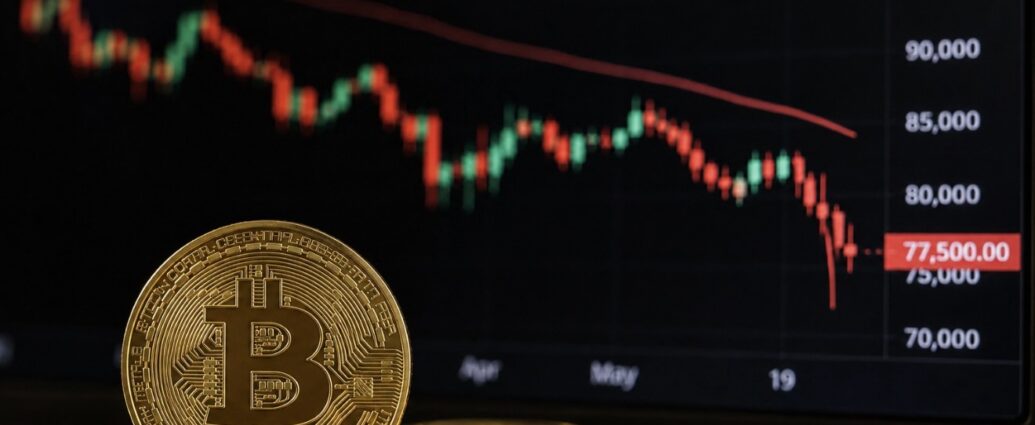
Bitcoin (CRYPTO: BTC) is approaching two key price levels that could decide whether the market enters its next expansion phase or extends its ongoing reset lower.

BTC Consolidation

In a detailed X post on May 25, crypto chart analyst Ali Martinez noted that Bitcoin remains stuck in a consolidation structure, with price continuing to trade inside a defined channel as liquidity builds for the next major move.

The current range reflects a broader structural reset rather than a confirmed trend …

Full story available on Benzinga.com

This post was originally published here

Veteran Bitcoin investor Lark Davis highlighted institutional investors are largely ignoring one of retail crypto’s favorite narratives – Bitcoin’s four-year cycle.

“Just Buy More Bitcoin”

In his May 24 interview with Haseeb Qureshi of Dragonfly, it was outlined that large financial players simply do not think about crypto markets the same way retail traders do.

“Institutions do not know what the four-year cycle is,” Qureshi said. He added, “This is a crypto thing. This means you spent too much time online.”

According to Qureshi, most institutional investors are taking a far simpler approach to Bitcoin. “They’re like, ‘Who cares? Just buy more Bitcoin,'” he said.

The comments highlight a growing divide between retail crypto …

Full story available on Benzinga.com

This post was originally published here

Crypto companies are trying to prove they can survive the next downturn by becoming infrastructure businesses instead of pure Bitcoin (CRYPTO: BTC) price bets.

Evolving Crypto Industry

In a CNBC documentary show, crypto reporter Tanaya Macheel said that after years of relying heavily on trading activity, firms including Coinbase (NASDAQ:COIN), Robinhood (NASDAQ:HOOD), Circle (NYSE:CRCL), Bullish and Strategy (NASDAQ:MSTR) are pitching Wall Street on tokenization, stablecoin infrastructure, derivatives, blockchain rails and real-world assets.

The shift marks a major evolution for the crypto industry.

Instead of depending …

Full story available on Benzinga.com

This post was originally published here

Crucible Capital founder Meltem Demirors said crypto is facing an “identity crisis” as institutional adoption through spot Bitcoin ETFs fails to improve Bitcoin’s real-world utility.

Only ETF Is Not Useful

Speaking in a Fox Business interview on May 25, Demirors argued Wall Street’s embrace of crypto has shifted the industry away from its original mission of rebuilding financial infrastructure.

 “Crypto has been colonized by incumbent financial institutions,” she said as AI infrastructure spending explodes globally.

Also, crypto-native financing tools can help companies access capital faster and cheaper without relying on banks.

“The GPU race and AI buildout is the biggest infrastructure buildout …

Full story available on Benzinga.com

This post was originally published here

For years, crypto rallies have revolved around familiar catalysts: Bitcoin halvings, ETF approvals and institutional adoption. Now, crypto bulls are increasingly focused on something far less glamorous but potentially far more important: Washington.

The latest example came this week after crypto influencer Crypto Rover highlighted reports that the White House is pushing to advance the CLARITY Act before July 4, arguing that trillions of dollars could eventually flow into digital assets if regulatory uncertainty is removed.

While the eye-catching “$30 trillion waiting to enter crypto” claim remains speculative, the underlying thesis is gaining traction across the industry.

The Next Big Crypto Catalyst

The CLARITY Act is designed to establish a clearer regulatory framework for digital assets, helping define how cryptocurrencies and blockchain-based assets are overseen by U.S. regulators.

For years, one of the biggest complaints from crypto companies has been regulatory ambiguity. Firms often found themselves navigating overlapping jurisdictions and uncertain compliance requirements.

Supporters argue that clearer rules could make …

Full story available on Benzinga.com

This post was originally published here

Dogecoin (CRYPTO: DOGE) has accumulated around 5% over the past month but traders have marked key levels for breakdown or rally.

Key Technical Support

In a X post on May 25, crypto chart analyst Ali Martinez explained Dogecoin is testing a major technical support zone near $0.1020 as traders monitor whether buyers can defend the meme coin’s mid-channel structure following its recent pullback.

DOGE retraced after touching the upper boundary of its multi-week trading channel, with analysts now focused on the alignment between the channel midpoint and the …

Full story available on Benzinga.com

This post was originally published here

Bitcoin held near the $77,000 region as easing geopolitical tensions surrounding U.S.-Iran negotiations helped crypto sentiment recover toward neutral territory; around $224.3 million in crypto liquidations were record           ed over the past 24 hours.

Bitcoin ETFs saw $105.2 million in net outflows on Friday, while Ethereum ETFs reported $6.7 million in net outflows.    


Cryptocurrency

Ticker

Price
Bitcoin (CRYPTO: BTC) $77,386.77
Ethereum (CRYPTO: ETH) $2,114.30
Solana (CRYPTO: SOL) $85.94
XRP (CRYPTO: XRP) $1.35
Dogecoin (CRYPTO: DOGE) $0.1026
Shiba Inu (CRYPTO: SHIB) $0.055635

Meme coin market capitalization is trading 0.2% higher at $34.9 billion over …

Full story available on Benzinga.com

This post was originally published here

Binance (CRYPTO: BNB) co-founder Changpeng “CZ” Zhao playfully fact-checked on Saturday a post presenting his old positive commentary on Bitcoin (CRYPTO: BTC) as fresh news.

CZ Responds To Engagement Bait

That Martini Guy ₿, a widely followed cryptocurrency content creator, framed CZ’s comments, “No need to panic, Bitcoin will never die!” as breaking news.

The issue is, CZ mentioned it a while ago, and he himself had to clarify.

“‘just said’” a few years ago,” the cryptocurrency billionaire responded with a laughing emoji.

An analysis of CZ’s old posts revealed that he said the same thing back in February 2025.

Full story available on Benzinga.com

This post was originally published here

Cryptocurrency punters sharply lowered the odds of the U.S. extending the ceasefire with Iran after President Donald Trump‘s latest remarks cast doubt on progress toward an agreement.

‘Exciting’ Unlock For Square Sellers

Polygon (CRYPTO: POL)-based Polymarket assigned a 54% possibility that the U.S. will extend the ceasefire agreement or announce a new peace agreement by June 7. The odds were 87% the day before.

Similarly, the odds of the ceasefire extending by month-end collapsed from 86% to 32% over the last 24 hours.

Polymarket users have already wagered $4.35 million on the contract, highlighting the significance of the outcome.

Notably, the chances of a permanent peace pact between the two countries by the end of June have dropped to 49%, down from 71% the day before.

…

This post was originally published here

Leading cryptocurrencies paused gains, while stock futures surged on Sunday after President Donald Trump urged officials not to rush into a deal with Iran.

Cryptocurrency 24-Hour Gains +/- Price (Recorded at 9:20 p.m. EDT)
Bitcoin (CRYPTO: BTC) +0.47% $77,121.91
Ethereum (CRYPTO: ETH)
               
-0.73% $2,103.98
XRP (CRYPTO: XRP)                          -0.58% $1.35
Solana (CRYPTO: SOL)                          -0.57% $85.43
Dogecoin (CRYPTO: DOGE)              -0.56% $0.1024

Crypto Market Lacks Momentum

Bitcoin declined to $76,000 during the evening hours, rebounding to $77,000 later in the day. Trading volume fell 26% over the last day. 

Ethereum narrowly avoided a sub-$2,000 close and climbed back to roughly $2,100. XRP and Dogecoin moved sideways.

Over $200 million was liquidated in the past 24 hours, predominantly in long positions, according to Coinglass data.

Bitcoin’s open interest fell 2% over the last 24 hours, while sentiment in the derivatives market shifted to “Neutral.”

“Fear” sentiment persisted in the market, according to the Crypto Fear & Greed Index.

Top Gainers (24 Hours) 

Cryptocurrency (Market Cap>$100 M) Gains +/- Price (Recorded at 9:20 p.m. EDT)
Unibase (UB)       +19.13%     $0.1600
Billions Network (BILL)                    +15.18%     $0.1132
DeXe (DEXE)             +11.91%     $15.21

The global cryptocurrency market capitalization stood at $2.57 trillion, following …

Full story available on Benzinga.com

This post was originally published here

Ethereum (CRYPTO: ETH) price remained on edge on Sunday despite the rising odds of an extended US-Iran ceasefire. ETH was trading at $2,100, lower than this month’s high of $2,450. It may be at risk of a steeper drop as smart money selling coincides with alarming technicals.

Ethereum Price May Drop Further Amid Smart Money Selling

There are signs that institutional investors are actively selling their Ethereum holdings, a sign that they expect the price to move lower in the near term.

Data shows that spot Ethereum ETFs have suffered outflows in the last 11 consecutive days. They had over $6 million in outflows on Friday, bringing the monthly outflow figure to $300 million. 

These funds had over $355 million in inflows in April after experiencing outflows for five consecutive months. As a result, the cumulative net inflows have dropped to $11.6 billion. Similarly, Ethereum has had staking outflows of over $140 million in the last 30 days.

Some top altcoin ETFs have added substantial inflows this …

Full story available on Benzinga.com

This post was originally published here

A crypto market rally sparked on Sunday, with Bitcoin (CRYPTO: BTC) rising to $77,000, a day after it moved to $74,000. Some of the top gainers were coins like Venice Token, Zcash (CRYPTO: ZEC), Morpho, and Hyperliquid, which jumped by over 10%. 

Crypto Market Rally Triggered By Potential US-Iran Deal

The market capitalization of all coins jumped by over 2% to $2.56 trillion. This rally was triggered in part by President Donald Trump‘s touting a potential deal between the US and Iran. 

In a statement, he said that the two countries were about to reach an agreement that would reopen the Strait of Hormuz. As a result, crude oil prices dipped sharply, with Brent and the West Texas Intermediate falling below $100 on Hyperliquid. Perpetual futures tied to the S&P 500 Index also jumped to a record high.

A US-Iran deal would be highly bullish for the crypto market because of its impact on inflation and the Federal Reserve. It would lower inflation, making it easier for the Fed to cut interest rates in the coming months. 

That would be significant, as …

Full story available on Benzinga.com

This post was originally published here

Bitcoin is closing one of its toughest stretches of the year as a rare convergence of macro, institutional, and technical headwinds bears down on the world’s largest cryptocurrency. The coin briefly broke below the key $75,000 support level this past week before paring losses to trade near $77,500 as of the Friday ETF market close, capping a multi-day slide that has erased more than $126 billion in crypto market value since mid-month.

The most striking signal came from the institutional side. U.S. spot Bitcoin ETFs bled $1.26 billion last week, the steepest weekly drawdown since late January, according to data cited by The Block. The exodus marked a six-day outflow streak that began May 15 and snapped what had been a six-week run of positive inflows. BlackRock’s iShares Bitcoin Trust (IBIT) posted $448 million in outflows on Monday alone — its second-largest single-day redemption of 2026 — followed by Ark Invest and 21Shares’ ARKB at $109.6 million and Fidelity’s FBTC at $63.4 million. Smaller outflows continued through Friday, when IBIT shed another $68 million and FBTC another $36 million, per Benzinga data.

The asymmetry has become sharp at the issuer level. BlackRock’s IBIT closed Friday with $61.1 billion in net assets against $64.8 billion in cumulative net inflows, meaning current market value now sits roughly $3.7 billion below the dollars investors have put into the fund. Fidelity’s FBTC, by contrast, still carries about a $3.2 billion cushion of net assets over cumulative inflows. IBIT alone accounts for roughly 4% of Bitcoin’s circulating supply, making its flows a closely watched proxy for institutional sentiment.

The macro backdrop has turned sharply against risk assets. April Producer Price Index data released by the Bureau of Labor Statistics showed wholesale inflation surging to 6% year-over-year, well above the 4.9% consensus and the highest reading since January 2023. Core PPI climbed to 5.2%, also above the 4.3% estimate. Both CPI and PPI now sit at three-year highs, driven in part by the energy spike tied to the U.S.-Iran war and lingering tariff pass-through from earlier in the year. The Cleveland Fed’s Inflation Nowcasting tool projects another 38-basis-point jump in trailing-twelve-month inflation to 4.18% by month-end.

Markets have responded by repricing the Federal Reserve’s path. CME FedWatch Tool data through late March showed roughly a 30% probability of a rate hike by year-end, with the odds of a cut collapsing to under 3%. The Atlanta Fed’s Market Probability Tracker placed rate-hike odds above rate-cut odds within a three-month window for the first time in this cycle. JPMorgan Chase projects the Fed’s next move will be an increase, though it expects the hike to come in the third quarter of 2027. Federal Reserve Chair Jerome Powell, whose term expires May 15, 2026, has thus far resisted calls to tighten in response to the energy shock, but markets are no longer pricing in the rate cuts that fueled the early-year crypto rally.

Bitcoin’s technical picture has weakened in step. The coin cleared $80,000 on May 4 and tested its 200-day moving average near $82,000 before stalling. The 20-day exponential moving average has now flipped from support to resistance near the $78,000 mark. Aggregate cumulative volume delta on Bitcoin’s spot order books ran negative for nine consecutive sessions through May 19, the longest sustained net-selling stretch of 2026, according to a Nexo note cited by The Block. Total crypto liquidations reached roughly $657 million in a single 24-hour window on Monday, with $584 million — about 89% — coming from long positions, per Glassnode and Bitcoin Magazine Pro data.

Spot Ether ETFs have fared even worse. The category logged a tenth consecutive day of outflows on Friday, the longest negative streak since March 2025, with Ether trading near $2,130 at the ETF close.

Bulls argue the structural picture remains intact. Despite the week’s losses, spot Bitcoin ETFs still hold $57.1 billion in cumulative net inflows and $98.9 billion in total net assets across all 12 funds, with year-to-date inflows still above $65 billion. The $1.26 billion in weekly outflows represents less than 2% of that cumulative base. Bloomberg ETF analyst Eric Balchunas has argued that even amid 2026’s redemption periods, “the overarching trend continues to be historically favorable” and that spot BTC ETFs have “substantially exceeded initial market forecasts” for inflows.

Some analysts read the rotation as healthy. FXTM senior market analyst Lukman Otunuga wrote in a recent note that “despite a difficult 2025, bitcoin may stage a comeback in 2026,” citing the prospect of lower rates and thinning active supply as eventual tailwinds. Whether the Fed’s rate path delivers those cuts is now the central question hanging over both crypto and broader risk assets.

The next catalysts will come from the macro calendar. May CPI data due in early June, the Fed’s June FOMC meeting, and any progress in the U.S.-Iran negotiations announced this weekend — which could pull oil sharply lower and ease inflation pressure — will all weigh heavily. A signed deal with Iran that reopens the Strait of Hormuz and brings Iranian crude back to global markets would be unambiguously bullish for Bitcoin, removing the energy-led inflation impulse currently driving hawkish Fed repricing.

For now, traders are watching $75,000 as the line in the sand. A clean break below that level, accompanied by accelerating ETF redemptions, would mark the most material crypto drawdown of the year. A hold and a rebound, particularly if paired with an Iran peace announcement and softer inflation data, could quickly reverse the narrative. Bitcoin, as always, sits at the intersection of macro, flow, and sentiment — and right now all three are pulling the same direction.

— JBizNews Desk

© 2026 JBizNews. All Rights Reserved. Reproduction or distribution without written permission is prohibited.

This week was a rollercoaster ride in the world of cryptocurrency and NFTs. From Michael Saylor and Kevin O’Leary sharing their insights on Bitcoin, to the surprising performance of XRP ETFs and SpaceX revealing its Bitcoin holdings ahead of its IPO. Not to forget, the popular NFT brand Pudgy Penguins is extending its partnership with Manchester City Soccer Club.

Let’s dive into the details.

Michael Saylor’s Bitcoin Perspective

Michael Saylor, CEO of MicroStrategy Inc., stated that Bitcoin would have been trading between $40,000 and $50,000 without his company’s involvement. MicroStrategy is the world’s largest corporate holder of Bitcoin, owning approximately 818,000 units. Saylor believes that even without his company, Bitcoin would have found success, but MicroStrategy’s involvement accelerated its price appreciation.

Read the full article here.

Kevin O’Leary’s Take On Bitcoin

Kevin O’Leary, the “Shark Tank” star, emphasized the need for a crypto bill to pass for Bitcoin and tokenization to move beyond the fringes for major institutional players. He believes that global compliance within the SEC through the passage of a bill will change everything. With the midterms approaching in November, O’Leary sees the present as the perfect opportunity to pass …

Full story available on Benzinga.com

This post was originally published here

For a long time, the U.S. dollar has been the most important money in the world. Almost every country uses it to buy and sell things across borders. Oil is priced in dollars. Big international loans are made in dollars. Even when two countries that don’t speak English want to trade with each other, they usually agree to use dollars in the middle. People call the dollar the world’s “reserve currency” — like the main money everyone else trusts and saves.

But something is changing. People are using less and less paper money. Walk into a coffee shop in New York, London, or Tel Aviv and most people pay with their phone, a card, or a tap. Cash is slowly disappearing. And as money becomes digital, big countries are starting to ask a simple question: if money is just numbers on a screen now, why do we have to use America’s numbers? Why can’t we use our own?

This is the heart of the story. The world is moving to digital money, and the United States has to decide how to keep the dollar on top.

Here is the simple picture. Imagine the global economy as a giant playground. For 80 years, every kid who wanted to trade snacks had to first swap their snacks for dollar tokens. America made the tokens. America counted the tokens. If America didn’t like you, it could stop you from using the tokens — that’s what economic sanctions are. Now imagine the kids start saying, “Let’s just trade snacks directly. Or let’s make our own tokens.” That’s exactly what countries like China, Russia, India, Brazil, and others are starting to do.

The way they’re doing it is through something called a central bank digital currency, or CBDC. Think of it as official digital money made by a country’s central bank. China has one called the digital yuan or e-CNY. India has one called the e-rupee. Brazil has one called Drex. Europe is building one called the digital euro. The numbers are already big. China’s digital yuan has been used in more than 3.4 billion transactions worth about $2.3 trillion. India’s e-rupee has roughly 7 million users. These aren’t toys anymore.

A group of countries called BRICS — Brazil, Russia, India, China, South Africa, plus newer members like the UAE, Iran, and Indonesia — is now trying to link all their digital currencies together. The plan is simple. If an Indian company wants to buy something from a Brazilian company, they could do it directly in e-rupees and Drex without ever touching a dollar. India, which is hosting the 2026 BRICS summit, has formally proposed this idea, led by its central bank, the Reserve Bank of India.

For the dollar, this is a real threat — at least in theory. If enough world trade moves off dollar rails, the U.S. loses some of its power.

So what is America doing about it? Here’s where the story gets interesting.

Most countries are responding by building their own government digital money. America has decided to do the opposite. President Donald Trump signed an executive order banning a U.S. central bank digital currency. Federal Reserve Chair Jerome Powell, whose term ended May 15, 2026, told Congress he would not pursue one either. The reason is mostly political. Many Americans, on both the right and left, don’t want the government to be able to track every dollar they spend. Banks don’t want it either, because it could pull money out of the banking system.

Instead, Washington has placed a bet on something called stablecoins. A stablecoin is digital money made by a private company, but each coin is backed by a real U.S. dollar — or by U.S. government bonds, which are basically promises from the U.S. Treasury. The two biggest are Tether (USDT) and Circle’s USDC. Together with smaller ones, the global stablecoin market is now worth about $200 billion.

Here’s the clever part. When someone in Argentina, Nigeria, Turkey, or Vietnam uses a dollar-backed stablecoin to save money or send a payment, they are — without thinking about it — buying dollars. The stablecoin company has to hold real dollars or U.S. Treasuries in the background to back the coin. Tether alone now holds about $100 billion in U.S. Treasuries, making it one of the biggest buyers of American government debt in the world.

So while China is building its own digital money to escape the dollar, America is letting private companies spread the dollar to every smartphone on the planet. It’s a different strategy with the same goal: keep the dollar on top.

Congress has been helping. The GENIUS Act, signed into law in July 2025, set the rules for how stablecoin companies have to operate in the United States. It banned them from paying interest to users, which protects American banks from losing deposits. House Financial Services Committee Chairman French Hill has said openly that growing the stablecoin market will “extend the reserve currency status” of the dollar around the world. That’s the official strategy in Washington.

The numbers behind dollar dominance still look strong. The U.S. dollar is on one side of 89% of all foreign exchange trades worldwide, compared to 29% for the euro and just 10% for the yuan. About 58% of global foreign-exchange reserves are still held in dollars. Oil, gold, and most major commodities are still priced in dollars. Even Saudi Arabia, despite years of speculation about it switching to yuan, still sells most of its oil in dollars.

But there are warning signs. Saudi Arabia, the UAE, Thailand, and Hong Kong are quietly testing a multi-country digital currency network called Project mBridge that can settle trades without dollars. Russia has been pushed off dollar rails by sanctions over the war in Ukraine and has been trading oil with China and India in local currencies. Iran, similarly cut off by sanctions, has joined the same effort. Argentina, Egypt, and parts of Africa are seeing huge growth in stablecoin use — which is good for the dollar — but they’re also exploring CBDC alternatives.

What does it all mean for normal people and investors?

A few simple things. First, the dollar isn’t disappearing anytime soon. The global system runs on it, and even the people trying to build alternatives know that replacing 80 years of dollar plumbing takes decades, not years. Second, the dollar is changing form. Less of it will be paper. More of it will be stablecoins on phones, instant payments through the Federal Reserve’s FedNow system, and digital tokens on bank apps. Third, the competition is real. China’s digital yuan and a future BRICS digital network are not going to overtake the dollar overnight, but they will chip away at its share — especially in regions like Africa, Latin America, and parts of Asia where America has less influence.

For U.S. companies, the cashless shift is mostly good news. Visa, Mastercard, PayPal, Block, Stripe, Coinbase, Robinhood, and the big banks all benefit when payments move to digital rails. U.S. Treasury demand from stablecoin issuers helps keep American borrowing costs lower than they would otherwise be. For foreign companies trying to escape the dollar, the path is harder than it looks — building parallel payment systems takes years and trust, and trust is something the dollar still has by default.

The bottom line is this. The world is going cashless, but cashless does not automatically mean dollar-less. The form of the money is changing, but the dollar’s role at the center of the global system is still mostly intact — for now. Washington’s bet is that stablecoins will carry the dollar into the digital age the same way Treasury bills carried it through the analog one. Beijing, New Delhi, and Brasília are betting the opposite. The race is on, and the next ten years will tell us who was right.

The dollar has been king for a long time. It still wears the crown. But for the first time in a generation, there are other players on the board.

— JBizNews Desk

© 2026 JBizNews. All Rights Reserved. Reproduction or distribution without written permission is prohibited.

Bitcoin (CRYPTO: BTC) price dropped below the important support of $75,000 before paring some of those losses. The coin is facing numerous risks, including the rising ETF outflows, weak technicals, and the rising odds that the Federal Reserve will hike interest rates this year.

Bitcoin Price Is Facing Major Headwinds

BTC, the biggest cryptocurrency, is facing some major risks. A crucial one is the fact that smart money investors are actively selling their holdings. Data shows that spot Bitcoin ETFs, led by the iShares Bitcoin ETF (NASDAQ:IBIT) had $105 million in outflows on Friday. IBIT and Fidelity’s FBTC lost $68 million and $36 million, respectively.

Spot Bitcoin ETFs had over $1.2 billion in outflows this week, higher than the $1 billion they lost a week earlier. These outflows have now erased the $1.6 billion that the funds experienced in the first six trading days of this month. 

The ongoing Bitcoin ETF outflows is a sign that institutional and smart money investors are sceptical about it having more gains in the near term. 

This post was originally published here

Pi Network (CRYPTO: PI) price remained on edge Saturday, and was at risk of falling to a record low despite its pivot to the artificial intelligence industry and completing an upgrade that introduced smart contracts. It was trading at $0.1510, a few points above its all-time high of $0.1300.

Pi Network Price Drops Despite Pivot to AI And Launching Smart Contracts

Pi, a popular cryptocurrency, has achieved some major milestones in the past few months. It was listed on Kraken, the second-biggest exchange in the US after Coinbase, making it available to millions of customers. This week, OKX, which was one of the first exchanges to list it, made it available to US customers.

The developers have also pivoted it to the AI industry. They did that by investing in OpenMind, a company at the intersection of AI and robotics. The two companies are testing a feature that will enable its node operators to contribute to OpenMind. 

Pi Network has also upgraded its App Studio product recently. In a statement, it noted that the upgrade will enable vibe coders to launch their applications on its platform and reach millions of users.

Full story available on Benzinga.com

This post was originally published here

As AI agents begin transacting autonomously, stablecoins are emerging as the preferred payment infrastructure for machine-to-machine commerce.


Stablecoins have been solving real problems for years. Cross-border payments now settle in seconds for cents. In Latin America, 71% of firms already use stablecoins for cross-border transactions (Fireblocks, 2025). Moreover, B2B stablecoin payments grew from under $100 million a month in early 2023 to over $6 billion a month by mid-2025 (McKinsey/Artemis Analytics). Visa settled $4.5 billion annualized in stablecoins as of January 2026 (Alphapoint, 2026). In addition, USDC alone has processed over $55 trillion in lifetime volume (Circle, January 2026).

This is not a crypto story anymore. It is a payments story. Furthermore, the next growth driver for stablecoins is not coming from traders or DeFi protocols. It is coming from AI agents.


Why AI Agents Cannot Use Traditional Payment Rails

Existing payment rails were designed for humans, not autonomous software. An AI agent pays for data feeds. It settles contracts across jurisdictions. It processes micropayments at speeds that ACH, SWIFT, and card networks were never built to handle. These systems assume a person initiated every transaction. As a result, business hours, minimum transaction sizes, and approval layers make them incompatible with how agents work.

Stablecoins, by contrast, align naturally with machine-native transactions. They settle around the clock. They support payments as small as fractions of a cent. They also cross borders without correspondent banking friction. For an AI agent paying for a data point at 2am across three jurisdictions, stablecoins are increasingly the most practical option available.

In fact, the largest technology companies in the world have arrived at the same conclusion.


How Amazon, Google, and Stripe Are Building AI Agent Payment Infrastructure

On May 7, 2026, Amazon Web Services launched Bedrock AgentCore Payments, built with Coinbase and Stripe (AWS, May 2026). The system enables autonomous AI agents to pay for APIs, data feeds, and web content in real time using USDC. Transactions settle in roughly 200 milliseconds. Additionally, Coinbase’s x402 protocol has already processed 169 million machine-native payments across 590,000 buyers and 100,000 sellers (Coinbase, May 2026). Stripe summarized its position …

Full story available on Benzinga.com

This post was originally published here

Strategy Inc. (NASDAQ:MSTR) Executive Chairman Michael Saylor estimates Bitcoin (CRYPTO: BTC) would be trading between $40,000 and $50,000, without his company’s $62 billion buying campaign over the past five years.

Strategy Spent $62 Billion Supporting The Bitcoin Network

Saylor acknowledged that Bitcoin would have succeeded without Strategy but argued the company filled a vacuum that accelerated price appreciation. 

Strategy owns approximately 818,000 Bitcoin, making it the world’s largest corporate holder.

“Bitcoin would have been successful without me and without our company, and if we hadn’t done it, someone else would have stepped into that role,” Saylor explained on the When Shift Happens podcast. 

“But presumably somewhere between $10,000 and $80,000. It wouldn’t be as high as it is right now,” he added.

Strategy started buying Bitcoin in 2020 when the price was …

Full story available on Benzinga.com

This post was originally published here

Trump Media & Technology Group (NASDAQ:DJT) transferred another 2,650 Bitcoin (CRYPTO: BTC) worth roughly $205 million to Crypto.com, deepening scrutiny of its cryptocurrency strategy as unrealized losses swell to $455 million.

Company Bought 11,542 Bitcoin At $118,522 Average Price

Trump Media originally purchased 11,542 Bitcoin for approximately $1.37 billion at an average acquisition price of $118,522 per coin. 

With Bitcoin trading around $77,341, the company is now down roughly $455 million on its holdings.

The latest transfer occurred during late U.S. evening hours according to blockchain analytics firm Lookonchain. 

This marks the second major movement, following an earlier transfer four months ago when the company shifted 2,000 Bitcoin valued at roughly $175 million with Bitcoin trading near $87,378.

The move comes just days after Trump Media …

Full story available on Benzinga.com

This post was originally published here

Billionaire investor Mark Cuban sold most of his Bitcoin (CRYPTO: BTC) holdings, saying the cryptocurrency “lost the plot” after failing to act as a hedge during the Iran war.

Yet, one analyst says Cuban got his facts wrong.

Cuban Claims Gold Ripped While Bitcoin Dropped During Iran War

Cuban had previously explained he bought Bitcoin as the best alternative to fiat currency losing value and believed it was a superior version of gold.

He argued that during the Iran war, gold skyrocketed to $5,000 while Bitcoin dropped instead of rising.

He pointed out that every time the dollar dropped, Bitcoin should have gone up because it would be cheaper for anyone around the world to buy. Instead, Bitcoin failed to perform as the hedge he expected.

Cuban said he’s “more disappointed in …

Full story available on Benzinga.com

This post was originally published here

Editor’s note: This story has been updated to clarify several figures.

Trump Media & Technology Group (NASDAQ:DJT) transferred another 2,650 Bitcoin (CRYPTO: BTC) worth roughly $205 million to Crypto.com, deepening scrutiny of its cryptocurrency strategy as combined realized and unrealized losses on the position swell to roughly $455 million.

Company Bought 11,542 Bitcoin At $118,522 Average Price

Trump Media originally purchased 11,542 Bitcoin for approximately $1.37 billion at an average acquisition price of $118,522 per coin.

With Bitcoin trading around $77,341, the company is now down roughly $455 million on its holdings, CoinDesk reports.

The latest transfer occurred during late U.S. evening hours, according to blockchain analytics firm Lookonchain. 

This marks the second major movement, following an earlier transfer four months ago when the company shifted 2,000 Bitcoin valued at roughly $175 million with Bitcoin trading near $87,378.

The …

Full story available on Benzinga.com

This post was originally published here

Once built around crypto trading, the company is accelerating its push into the stablecoin and asset management businesses as it chases a place in the next wave of digital finance

image credit: Bamboo Works

Key Takeaways:

  • Bitfire lost up to HK$245 million in the six months through March, nearly 19 times more than its loss a year earlier
  • The company is accelerating its expansion into the stablecoin and asset management businesses

Excitement is building in Hong Kong’s virtual asset realm as the city kicks off its use of stablecoins, marking a first step in its growing embrace of virtual currencies. But into that atmosphere of excitement, Bitfire Group Holdings Ltd. (1611.HK) distracted investors from its own aspirations in the space with a worrisome profit warning. The company offers virtual asset trading, asset custody and fintech services, positioning itself across regulated digital asset markets in Hong Kong and Japan.

According to the profit warning, issued last week, Bitfire said it expects to record a net loss of up to HK$245 million ($31.28 million) for the six months through March, the first half of its fiscal year. That represents a nearly 19-fold increase from a loss of about HK$12.3 million the company reported a year earlier.

Bitfire blamed the ballooning red ink on a value loss of approximately HK$152 million on its held crypto assets, reflecting weak market conditions. A more noteworthy factor, however, may be rising expenses, with the company’s spending on development and customer services up about HK$69.6 million, while R&D expenses rose by roughly HK$13.2 million.

The company said the rising expenses owed mainly to its heavier spending on professional and customer service capabilities, while R&D spending was tied to the development of technology infrastructure products and services. The spending blitz suggests Bitfire is moving beyond simply operating a traditional crypto trading platform toward becoming a fintech platform focused more heavily on technology, compliance and blockchain-related services.

Many trading platforms were able to generate strong profits during the crypto bull market of 2021 simply by taking advantage of big price swings, leverage and heavy retail trading. At the time, Bitfire rapidly expanded its Web3 operations across Hong Kong and Japan, as well as …

Full story available on Benzinga.com

This post was originally published here

Galaxy Digital Head of Research Alex Thorn gives the CLARITY Act 70% odds of passing and says it could put Bitcoin (CRYPTO: BTC) “on a path to new all-time highs” if signed into law.

Nine Weeks Left To Pass Before August Recess

Congress has about nine weeks of session time left before the August recess, with 6 to 7 weeks of work needed to get the bill to President Trump’s desk, Thorn said in an interview with Cointelegraph on Thursday.

After August, very little gets done through the midterm elections in November.

The Senate Banking Committee advanced the bill last week on a bipartisan basis after Senator Ruben Gallego (D-AZ) and Senator Angela Alsobrooks (D-MD) broke ranks to vote yes. 

This came after the committee was supposed to vote in January but delayed four months to negotiate stablecoin yield provisions.

“If the bill fails, if you ask me in a year why, I would bet …

Full story available on Benzinga.com

This post was originally published here

XRP (CRYPTO: XRP) ETFs attracted $42 million in net inflows over the past week, even as Bitcoin (CRYPTO: BTC) ETFs shed more than $1.4 billion, suggesting selective rotation into alternative crypto exposure.

XRP Pulled $8.88M Latest Session, Bitcoin Lost $100.9M

XRP-linked funds pulled in $8.88 million in the latest session, extending a streak that includes $18.52 million on May 14 and $10.87 million on May 15. 

This contrasts sharply with Bitcoin ETFs, which lost $100.9 million in the latest session following redemptions of $648.6 million, $331.1 million, and $290.4 million earlier in the same stretch.

Ethereum (CRYPTO: ETH) products also remained under pressure, losing $32.6 million in the latest session. The data suggests selective appetite for alternative crypto exposure as money …

Full story available on Benzinga.com

This post was originally published here

Singapore is once again Southeast Asia’s biggest stock market, overtaking Indonesia after a sharp rally in Singapore shares and a difficult year for Indonesia’s markets and currency.

For everyday readers, the shift highlights how quickly global investors move money between countries when concerns about political stability, economic policy and financial markets begin to grow.

Singapore’s benchmark stock index, the Straits Times Index, climbed to a new record Tuesday, helping push the city-state ahead of Indonesia in total market value for the first time in years.

The rally has been fueled by investors looking for safer places to park money during growing global uncertainty tied to the Iran war, rising oil prices and volatility across emerging markets.

Singapore has increasingly benefited from its reputation as one of Asia’s most stable financial centers.

Its stock market is dominated by large banks, real estate firms and dividend-paying companies that investors often view as safer during turbulent periods.

The Singapore dollar has also remained relatively strong compared with many other Asian currencies, making Singapore assets more attractive to international investors.

Indonesia, meanwhile, has faced mounting pressure on several fronts.

Its stock market has struggled this year, while the Indonesian rupiah has hovered near record lows against the U.S. dollar. Foreign investors have also become increasingly worried about government policy, central bank independence and corporate governance standards.

Those concerns intensified after Indonesian President Prabowo Subianto appointed his nephew to a senior central bank role earlier this year, raising questions among investors about political influence over monetary policy.

Global index provider MSCI later warned Indonesia could risk losing its “emerging market” status if governance concerns are not addressed.

That matters because many large investment funds automatically buy or sell stocks based on those global index classifications.

If Indonesia were downgraded, billions of dollars could eventually flow out of the country’s stock market as index funds adjust their holdings.

Indonesia’s economy is also being hurt by high energy prices.

Although the country exports many commodities, it still imports large amounts of oil. Rising energy costs tied to Middle East instability have increased pressure on inflation and the country’s currency.

Meanwhile, slowing growth in China — one of Indonesia’s biggest trading partners — has added further economic strain.

Singapore’s rise reflects a broader trend happening globally:
during uncertain periods, investors often move money toward countries seen as politically stable, financially predictable and institutionally strong.

That has helped Singapore attract capital not only into its stock market, but also into private banking, real estate, hedge funds and family offices over the past several years.

The competition between Singapore and Indonesia has become symbolic of two very different investment stories in Southeast Asia.

Indonesia has traditionally offered faster economic growth and access to natural resources and consumer expansion.

Singapore, by contrast, offers stability, strong financial regulation and global investor confidence.

In strong economic periods, investors often favor faster-growing emerging markets like Indonesia.

During periods of global stress, many rotate back toward safer financial hubs like Singapore.

Analysts say that dynamic has accelerated sharply in 2026.

Despite Singapore reclaiming the top spot regionally, Southeast Asia’s markets remain relatively small compared with the world’s biggest companies and exchanges.

Several U.S. technology giants individually hold larger market values than entire Southeast Asian stock markets.

Still, the regional battle matters because global investors increasingly view Southeast Asia as an important long-term growth region amid slowing growth in China and higher valuations in India.

For Indonesia, regaining investor confidence may depend on restoring trust in economic management and avoiding further governance controversies.

For Singapore, the latest rally reinforces its position as Southeast Asia’s financial capital at a moment when investors globally are prioritizing stability over risk.

And in today’s market environment, stability is commanding a premium.

— JBizNews Desk

© JBizNews.com. All rights reserved. This article is original reporting by JBizNews Desk. Unauthorized reproduction or redistribution is strictly prohibited.

Shares of CleanSpark Inc. (NASDAQ:CLSK) are in the spotlight along with the crypto-proxy heavyweights like Strategy Inc. (NASDAQ:MSTR) as its strategic pivot toward artificial intelligence (AI) infrastructure sparks a technical breakout.

CLSK Stock’s Momentum Score Rises

Over the past week, CleanSpark‘s Benzinga Edge Stock Rankings‘ momentum score surged from a solid 79.51 to a top-tier 93.52.

This leap places the stock in the upper echelon of market performers, as the momentum metric measures a stock’s relative strength based on its price movement patterns and volatility over multiple timeframes, ranked as a percentile against other stocks.

This breakout directly coincides with the stock’s 36.92% price gain over the past month.

Benzinga Edge Stock Rankings for CLSK.

data-variant=”card”
data-news-mode=”manual”

>


Read Also:

Tesla Rival Li Auto’s Stock Remains Underpriced As Value Score Rises— Morgan Stanley Sees 61% …

This post was originally published here

(Editor’s note: The headline has been updated and a statement from Binance has been added to this story.)

The world’s largest cryptocurrency exchange, Binance, is reportedly at the heart of a secret payment network established by Iranian billionaire financier Babak Zanjani to fund Iran’s military forces. The company has rejected the claims.

Until December, Zanjani, an “antisanction” operator, allegedly facilitated transactions worth $850 million over two years through a single trading account on Binance as Tehran prepared for potential conflict with the U.S. Experts in terrorism-financing, foreign law-enforcement officials, and individuals privy to the activity suggest that roughly half of these transactions likely financed Iran’s military, reported the Wall Street Journal on Thursday.

Binance’s internal investigators concluded that the accounts were part of a money-laundering network designed to fund the Iranian regime, as per the report.

WSJ also reported that Iran’s central bank allegedly transferred $107 million in cryptocurrency into Binance accounts last year, while foreign investigators tracked roughly $260 million in transactions during 2024 and 2025 between Binance-linked accounts and wallets tied to sanctioned Iranian entities and suspected terrorist financiers.

Binance rejected the WSJ’s methodology for the report as “damagingly flawed” and stated that it did not permit any transactions with …

Full story available on Benzinga.com

This post was originally published here

U.S. lawmakers introduced the American Reserve Modernization Act of 2026 on Thursday, a bipartisan bill seeking to acquire 1 million Bitcoin (CRYPTO: BTC) over five years and establish a Strategic Bitcoin Reserve.

Bill Would Hold Bitcoin For 20 Years Minimum

The legislation, sponsored by Alaska Republican Representative Nick Begich with 16 co-sponsors, would require Bitcoin to be held for a minimum of 20 years unless sold to reduce the national debt, which topped $39 trillion on Wednesday.

“The US is already one of the largest holders of Bitcoin in the world. But Congress has never set a federal policy on what to do with that asset,” said Representative Jared Golden, a co-sponsor.

The US currently holds 328,372 Bitcoin worth more than $25.5 billion—the most of any nation-state—but has sold portions through court-ordered actions over the years with no coherent strategy.

Treasury Seized $500 Million In Iranian Crypto …

Full story available on Benzinga.com

This post was originally published here

Whales are increasingly loading up on XRP (CRYPTO: XRP) as signs emerge that geopolitical tensions may de-escalate.

Whales Sensing Something Bullish?

Widely followed cryptocurrency analyst Ali Martinez highlighted in an X post that large investors scooped up 71 million XRP tokens over the past week. At the prevailing prices, this amounted to $96.56 million

Accumulation picked up significantly on Tuesday and Wednesday, just as President Donald Trump announced that negotiations to end the war with Iran were in their “final stages.”

New Addresses Soar

Meanwhile, on-chain analytics firm Santiment reported the fourth-largest spike in new XRP wallet creations this year, signaling robust network growth.

“Network growth is among the top leading signals …

Full story available on Benzinga.com

This post was originally published here

Dogecoin’s (CRYPTO: DOGE) official X account dropped a lighthearted question on Thursday on the places to spot a ‘DOGE ACCEPTED HERE’ sign, and the replies absolutely delivered.

The ‘DOGE Pirate’

A user named Bond-WallE proposed the Strait of Hormuz as the location, with the Shiba Inu mascot imagined as a rogue pirate.

The critical waterway in the Middle East has become a geopolitical flashpoint in recent months, with reports indicating Iran may be using Bitcoin (CRYPTO: BTC) to secure safe passage.

Taxes In DOGE?

Namtoshi Dogemoto, a DOGE analyst and HODLer, identified the Internal Revenue Service as the perfect location, imagining a scenario where DOGE could be used to pay federal taxes.

This post was originally published here

Billionaire investor Mark Cuban revealed on Thursday that he’s sold most of his Bitcoin (CRYPTO: BTC) as it didn’t turn out to be the “hedge” he expected it to be.

How Bitcoin Disappointed Cuban

Appearing on the Portfolio Players podcast, Cuban said that Bitcoin has “lost the plot” and been “disappointing.”

The “Shark Tank” celebrity said he always thought of Bitcoin as a “better version” of gold and the “best alternative” to fiat currency losing its value.

“Well, gold just blew up and went to $5,000, and Bitcoin dropped. Every time the dollar dropped, Bitcoin should’ve gone up,” Cuban said.

He said Bitcoin didn’t perform as the hedge he had expected, and that he’s sold off “most” of his holdings.

Full story available on Benzinga.com

This post was originally published here

Leading cryptocurrencies moved sideways, while stocks rose further on Thursday, as traders pinned their hopes on an Iran ceasefire.

Cryptocurrency 24-Hour Gains +/- Price (Recorded at 9:10 p.m. EDT)
Bitcoin (CRYPTO: BTC) -0.76% $77,336.44
Ethereum (CRYPTO: ETH)
               
-0.73% $2,127.64
XRP (CRYPTO: XRP)                          -0.59% $1.36
Solana (CRYPTO: SOL)                          +0.19% $86.67
Dogecoin (CRYPTO: DOGE)              +0.65% $0.1050

Crypto Recovery Stalls

Bitcoin failed to hold gains above $78,000, while Ethereum stalled near $2,150 as major cryptocurrencies remained flat.

Cryptocurrency-related stocks gained, with Coinbase Global Inc. (NASDAQ:COIN) and Bitmine Immersion Technologies Inc. (NYSE:BMNR) closing up 1.19% and 1.13%, respectively.

Roughly $100 million was liquidated in the past 24 hours, evenly split between long positions and short positions, according to Coinglass data.

Bitcoin’s open interest fell 2.25% over the last 24 hours. Interestingly, the majority of retail and whale traders on Binance were positioned long on the apex cryptocurrency.

“Fear” sentiment prevailed in the market, according to the Crypto Fear & Greed Index.

Top Gainers (24 Hours) 

Cryptocurrency (Market Cap>$100 M) Gains +/- Price (Recorded at 9:10 p.m. EDT)
Grass (GRASS)       +27.49%     $0.4148
Nexus (NEX)                    +18.92%     $0.000005983
NEAR Protocol (NEAR)    …

Full story available on Benzinga.com

This post was originally published here

Ripple has partnered with Project Eleven, a leading post-quantum cryptography firm, to secure the XRP Ledger against quantum computing threats as XRP (CRYPTO: XRP) tests ascending trendline support for the third time.

U.S. Government Set 2035 Deadline For Quantum Migration

The cryptography protecting Bitcoin (CRYPTO: BTC), Ethereum (CRYPTO: ETH), Solana (CRYPTO: SOL), and XRP is vulnerable to attack by sufficiently powerful quantum computers. 

The U.S. government set a 2035 deadline for migrating federal systems away from at-risk encryption, while Google and Cloudflare set 2029 deadlines.

“Every major blockchain is exposed to the same cryptographic vulnerability, but most of the response has stayed at the research stage,” said Alex Pruden, CEO of Project Eleven.

“This engagement is about execution. Ripple is …

Full story available on Benzinga.com

This post was originally published here

Strategy Inc. (NASDAQ:MSTR) CEO Michael Saylor and other Bitcoin (CRYPTO: BTC) treasury companies are price-insensitive buyers, yet someone is selling to them at $75,000, according to JAN3 CEO Samson Mow.

Saylor Averaging Down At $75,577 Per Bitcoin

Saylor’s average cost sits at $75,577 per Bitcoin.

With the recent downturn, he’s been able to average down—the biggest single holder of Bitcoin is lowering his cost basis while accumulating toward 800,000 coins.

“These are buyers of last resort. They will always buy Bitcoin. They’re price insensitive. They will always buy even if it’s $500,000 a coin or $700,000 a coin,” Mow stated on The Bitcoin Historian podcast. 

“But people right now are willing to sell them Bitcoin for $60,000, $70,000,” he added.

Strategy isn’t alone. Blockstream CEO Adam Back’s BSTR is set to deploy $1.5 billion in capital over …

Full story available on Benzinga.com

This post was originally published here

Wedbush Securities analyst Dan Ives argues that Bitcoin (CRYPTO: BTC) is losing capital to artificial intelligence stocks as investors face a dollar-for-dollar allocation decision between the two asset classes.

Once In 100-Year Cycle Pulling Capital From Crypto

Ives explained the shift on Anthony Pompliano’s podcast. When investors have cash to deploy, they’re picking AI stocks over Bitcoin because the potential returns look bigger.

The AI trade represents a generational investment cycle that’s diverting attention and dollars from crypto.

“Risk assets—if you have a dollar, do you put it in this bucket, this bucket, or this bucket?” Ives stated. 

“When it comes to the AI trade and what’s happened in tech and the level of disruption, we’re talking like a once in 100-year type of cycle,” he added.

AI stocks give exposure to chip makers like Nvidia Corporation

Full story available on Benzinga.com

This post was originally published here

Hyperliquid (CRYPTO: HYPE) surged 15% in the last 24 hours while Bitcoin (CRYPTO: BTC), Ethereum (CRYPTO: ETH), and XRP (CRYPTO: XRP) traded flat.

Hyperliquid ETFs Pull 2.5X More Buying Pressure Than Buybacks

The first two Hyperliquid spot ETFs attracted market cap-adjusted inflows exceeding Bitcoin on three of the first six trading days and outpaced Ethereum on five out of six days, according to analyst Aletheia.

On the sixth trading day, Hyperliquid ETFs saw significantly higher inflows than any crypto peer. 

The ETFs bought 2.5 times the amount of HYPE that the Assistance Fund bought and burned during the same period, adding fuel to already …

Full story available on Benzinga.com

This post was originally published here

A crypto whale has made a $224,000 bet that XRP (CRYPTO: XRP) stays pinned near $1.40 through June 26 by selling both call and put options in a short strangle strategy on Deribit.

Whale Collected $224,000 Premium Betting On Low Volatility

The trader sold 1.5 million contracts of both $1.40 call and put options expiring June 26, collecting $224,500 in upfront premiums. 

The trader keeps the full amount if XRP remains near $1.40 through expiration.

By selling both the call and put, the trader is providing insurance against sharp price movements away from $1.40. 

The bet is on volatility staying low with prices pinned near current levels.

XRP has largely traded between $1.30 and $1.50 since February, supporting the whale’s range-bound thesis. 

However, a sharp move in either direction would turn the position unprofitable, requiring the …

Full story available on Benzinga.com

This post was originally published here

(Editor’s note: The future prices of benchmark tracking ETFs and the headline were updated in the story.)

U.S. stock futures rose on Wednesday following two consecutive days of lower closes for the S&P 500 and Nasdaq 100 indices on Tuesday.

Investors are awaiting Nvidia Corp.‘s (NASDAQ:NVDA) first-quarter results scheduled to be released after the closing bell. Analysts are expecting NVDA to report second-quarter earnings of $1.76 per share on revenue of $79.04 billion.

Additionally, the Federal Reserve will be releasing the minutes of the Fed meeting later in the afternoon.

Meanwhile, the 10-year Treasury bond yielded 4.65%, and the two-year bond was at 4.10%. The CME Group’s FedWatch tool‘s projections show markets pricing a 96.7% likelihood of the Federal Reserve leaving the current interest rates unchanged during June’s meeting.

Index Performance (+/-)
Dow Jones 0.08%
S&P 500 0.30%
Nasdaq 100 0.68%
Russell 2000 0.36%

The SPDR S&P 500 ETF Trust (NYSE:SPY) and Invesco QQQ Trust ETF (NASDAQ:QQQ), which track the S&P 500 and Nasdaq 100, respectively, were higher in premarket on Wednesday. The SPY was up 0.45% at $737.00, while the QQQ was higher by 0.77% to $706.92.

data-variant=”card”
data-news-mode=”manual”

>


Read Also:

Nvidia Earnings No Longer About Beating Estimates, But About Whether Jensen Huang Can Prove AI Supercycle Still Has Years Left: Top Analyst

This post was originally published here

Crypto’s early promise rested on radical transparency. That design gave blockchains their auditability, but it also created a problem the industry has never solved: most people don’t want every payment, salary transfer, donation, or business transaction visible forever. Privacy coins emerged from that discomfort.

They promised something close to digital cash on public rails. Users could transact without exposing their full financial lives to a ledger, an analytics firm, or a future adversary.

Privacy coins as crypto’s first answer to radical transparency

Privacy coins were an early attempt to put privacy back into transparent blockchains. Zcash remains the clearest example because it brought zero-knowledge cryptography into a live monetary network. It uses transparent and shielded addresses. In fully concealed shielded-to-shielded transactions, the sender, the receiver, and the amount are encrypted, even though the network can still check that the transaction follows the rules.

A user can prove that something is valid without revealing the private information behind the proof. That’s the core idea behind zero-knowledge proofs. They allow the validity of transactions to be checked without exposing the transaction itself, which is why Zcash became such an important early test case for cryptographic privacy.

The appeal is obvious. Public money rails should not require public financial lives.

Yet privacy coins now face pressure from three sides at once: regulators, surveillance tools, and the long memory of cryptography itself.

Legislators are closing the room around anonymity

Regulators have always treated privacy coins as a special category. If a financial system blocks traceability, it becomes harder to investigate crime, sanctions evasion, fraud, and illicit flows.

Pseudonymous and anonymity-enhanced transactions are pointed as higher-risk when they limit a service provider’s ability to identify beneficiaries.

Europe takes this further. The EU’s 2024 anti-money laundering regulation defines “anonymity-enhancing coins” as crypto-assets with features that make transfer information anonymous, either systematically or optionally. Article 79 also prohibits credit institutions, financial institutions, and crypto-asset …

Full story available on Benzinga.com

This post was originally published here

Influential investor and media personality Kevin O’Leary emphasized on Wednesday the importance of passing the Clarity Act to advance the adoption of tokenization and Bitcoin (CRYPTO: BTC) by institutional investors.

Bill Needed For Global Compliance, Says O’Leary

O’Leary posted on X a clip from his fireside chat at CoinDesk’s Consensus event earlier this month, where he emphasized that without the bill’s passage, key cryptocurrency narratives will remain on the fringes for major institutional players.

“It has to become compliant globally within the SEC with an actual passage of a bill. When that occurs, it’s gonna change everything,” the “Shark Tank” star stated.

Full story available on Benzinga.com

This post was originally published here

Cryptocurrency punters pushed odds of the U.S. launching a military campaign against Cuba to nearly 50% amid rising tensions with the island nation.

Aerial Strike Likely?

Polygon (CRYPTO: POL)-based Polymarket assigned 49% probability to the U.S. initiating a drone, missile, or air strike on Cuba before the year-end, up from 15% over the month and 5% over the week.

The market has attracted significant attention, with $4.34 million already wagered on the outcome as of this writing.

Actions limited to artillery fire, small arms engagements, ground incursions, naval shelling or cyberattacks will not qualify for resolution.

Meanwhile, bettors are pricing in a 25% chance that the U.S. will launch a military offensive to seize control of any part of Cuban territory before Dec. 31.

data-variant=”card”
…

This post was originally published here

SpaceX, the space exploration company led by Elon Musk, disclosed in its IPO filing on Wednesday that it holds more than $1 billion in Bitcoin (CRYPTO: BTC) on its balance sheet.

More Details About BTC’s Reserves

The company disclosed 18,712 BTC on hand as of March 31, recognized at a fair value of $1.29 billion. At current prices, this stash would be worth $1.45 billion.

The total cost basis of these holdings was reported at $661 million, implying an average acquisition cost of around $35,324 per BTC.

“The Company has ownership of and control over its digital assets, which consist of Bitcoin, and utilizes, and expects
to continue to utilize third-party custodians to hold its Bitcoin,” the filing read.

data-variant=”card”
data-news-mode=”manual”

…

This post was originally published here

Leading cryptocurrencies rallied alongside stocks on Wednesday as President Donald Trump’s latest remarks on Iran helped ease geopolitical tensions.

Cryptocurrency 24-Hour Gains +/- Price (Recorded at 9:25 p.m. EDT)
Bitcoin (CRYPTO: BTC) +1.40% $77,786.61
Ethereum (CRYPTO: ETH)
               
+1.43% $2,140.79
XRP (CRYPTO: XRP)                          +1.67% $1.37
Solana (CRYPTO: SOL)                          +2.68% $86.47
Dogecoin (CRYPTO: DOGE)              +1.65% $0.1044

Crypto Market Rallies

Bitcoin broke through the resistance at $78,000, with trading volume rising nearly 6% over the last 24 hours.

Ethereum also rallied overnight, jumping to a high of $2,150, while XRP and Dogecoin recorded noticeable gains.

Cryptocurrency-related also gained, with Strategy Inc. (NASDAQ:MSTR) and Bitmine Immersion Technologies Inc. (NYSE:BMNR) closing up 0.72% and 4.08%, respectively.

Over $260 million was liquidated in the past 24 hours, predominantly in short positions, according to Coinglass data.

Bitcoin’s open interest rose by a modest 0.75%, while retail and whale derivatives traders on Binance remained bullish  on the leading cryptocurrency. 

The market sentiment improved from “Extreme Fear” to “Fear,” according to the Crypto Fear & Greed Index.

Top Gainers (24 Hours) 

Cryptocurrency (Market Cap>$100 M) Gains +/- Price (Recorded at 9:25 p.m. EDT)
Wrapped HYPE (WHYPE)       +32.40%     $56.85
Jito (JTO)                    +31.55%     $0.5410
Block Street (SAHARA)             +25.76%     $1.05

The global cryptocurrency market capitalization stood at $2.55 trillion, following a contraction …

Full story available on Benzinga.com

This post was originally published here

U.S. efforts to crack down on Iran’s growing use of cryptocurrency are intensifying as officials work to cut off financial channels tied to the regime as tensions rise in the Middle East.

BESSENT SAYS US SEIZED NEARLY $500M IN IRANIAN CRYPTO AS OPERATION ECONOMIC FURY SENDS REGIME INTO ‘CRISIS’

FOX Business’ Darren Botelho joined FOX Business’ Stuart Varney on “Varney & Co.” to report on the Trump administration’s efforts to track and freeze cryptocurrency linked to Iran as the regime reportedly increases its use of Bitcoin-based transactions to help move money outside the traditional banking system.

Treasury Secretary Scott Bessent said the Treasury Department has frozen nearly $500 million in cryptocurrency connected to the Iranian regime, including $344 million last month alone. Botelho also cited new estimates from a threat-detection data firm showing Tehran controls roughly $7.7 billion in digital assets.

The report comes as Iran reportedly launched a new digital insurance platform for cargo ships operating through the Strait of Hormuz, with payments reportedly being settled entirely in Bitcoin.

SAUDI ARAMCO CEO WARNS OIL MARKETS MAY NOT RECOVER UNTIL 2027 DUE TO HORMUZ DISRUPTIONS

Industry experts say cryptocurrency can still leave a trail for investigators despite being viewed by some foreign adversaries as a way to evade sanctions.

“We found over and over again that they’re actually a much better asset for U.S. law enforcement and other agencies to track because you leave a lot of breadcrumbs,” 250 Digital Asset Management CEO Chris Perkins said.

GEN JACK KEANE WARNS RETURN TO COMBAT ‘INEVITABLE’ AFTER IRAN CEASEFIRE VIOLATIONS

Botelho also reported that industry insiders believe Washington could increase pressure by threatening to cut off crypto exchanges from the American banking system.

GET FOX BUSINESS ON THE GO BY CLICKING HERE

This post was originally published here. 

Once known for its Texas Hold’em games, the company is repositioning itself as a Hong Kong-listed bitcoin play through its push into Web3 gaming

image credit: Bamboo Works

Key Takeaways:

  • Boyaa Interactive said its first-quarter loss more than doubled year-on-year, mainly due to a decline in bitcoin prices
  • Excluding changes in the value of its bitcoin holdings, the company said its core profit for the quarter rose between 85% and 90%

Boyaa Interactive International Ltd. (0434.HK) has transformed over the last two years, increasingly seen as a “bitcoin concept stock” as it drifts from its original core gaming business. As its bitcoin holdings grow, the gaming veteran’s earnings have become closely tied to price swings for the notoriously volatile cryptocurrency. But the company may be pursuing ambitions beyond simply stockpiling bitcoin.

Boyaa rose to prominence through its Texas Hold’em games before being hit by a regulatory crackdown on card and board games in China. Over the last two years, the company has attracted growing investor attention for its move into bitcoin. A sharp rise for the cryptocurrency in 2024 brought Boyaa HK$948 million ($121 million) in gains that year, turbocharging its annual profit to HK$969 million. Investors even viewed Boyaa as a Hong Kong edition of bitcoin treasury company Strategy Inc. (MSTR.US) at one point, sending the Chinese company’s shares surging in tandem with Web3 and other bitcoin plays.

But as bitcoin prices retreated, Boyaa recorded HK$411 million in losses from changes in the value of its holdings last year, sending it into the red with a net loss of HK$239 million. The bleeding is continuing this year, with the company warning last week that its loss ballooned by 110% to 120% year-on-year in the first quarter, as weak bitcoin prices continued to wreak havoc on its balance sheet. That said, excluding the digital asset value changes, the company’s profit for the quarter actually rose by 85% to 90% year-on-year.

Boyaa held 4,092 …

Full story available on Benzinga.com

This post was originally published here

Cipher Mining Inc. (NASDAQ:CIFR) shares are compounding gains on Wednesday, driven by Wall Street’s growing enthusiasm for the company’s high-performance computing (HPC) and artificial intelligence infrastructure strategy.

Morgan Stanley Leads Bullish Price Forecast Revisions

Morgan Stanley analyst Stephen Byrd fueled Wednesday’s momentum by maintaining an overweight rating on Cipher Mining and raising the price forecast from $40.5 to $42.5.

This follows a wave of positive analyst actions. On Friday, Needham analyst John Todaro maintained a buy rating and lifted his target from $22 to $25.

Additionally, Jefferies analyst Jonathan Petersen initiated coverage last Thursday with a buy rating and a $32 price forecast.

AI Data Center Pivot Captures Wall Street Interest

In its May 5 earnings update, CEO Tyler Page stated, “We built on the strong …

Full story available on Benzinga.com

This post was originally published here

Binance holds 85% of its Bitcoin (CRYPTO: BTC) in quantum-exposed outputs, while Coinbase Global Inc. (NASDAQ:COIN) sits at 5%, according to Glassnode data analyzing which coins are vulnerable to future quantum computer attacks.

6.04M BTC Currently Quantum Exposed At Rest

Glassnode identified 6.04 million BTC, or 30.2% of issued supply, as quantum exposed. These coins are vulnerable because their public keys are already visible on the blockchain.

The threat: future quantum computers could potentially crack the private key from a known public key and steal the coins without waiting for the owner to move them.

Exposure comes from two sources. Structural exposure (1.92 million BTC, 9.6%) affects coins using older Bitcoin address types and newer Taproot addresses. 

Operational exposure (4.12 million BTC, 20.6%) affects coins where owners reused addresses—once you spend …

Full story available on Benzinga.com

This post was originally published here

President Donald Trump signed an executive order Tuesday, calling on the Federal Reserve to review rules that may be stifling financial innovation, including expanding fintech access to Fed payment rails.

Trump Orders Fed To Examine Master Account Access

The order asks the Fed to join other regulators in reviewing policies that could support fintech growth. 

It also calls on the Fed to examine its approach to granting access to payment accounts and services, and to consider options for expanding such access to fintechs and other non-bank firms.

People often compare Fed master accounts to bank accounts for banks because they let holders move funds directly through the Federal Reserve’s payment system.

Access to master accounts by non-traditional financial firms has drawn increasing attention at the Fed as several fintechs have applied or plan to seek access.

Kraken …

Full story available on Benzinga.com

This post was originally published here

Bitcoin (CRYPTO: BTC) is down 6% since revisiting its 200-day moving average near $82,000 earlier this month, but K33 Research argues February’s $60,000 bottom still marks this cycle’s maximum drawdown.

Current Pattern Looks Different From 2014, 2018, 2022

K33 Head of Research Vetle Lunde pointed out that Bitcoin spent 189 days between the November 200-day MA breakdown and May retest—far longer than the 96, 132, and 85 days seen in prior cycles. 

Bitcoin also remains more than 20% down during that period compared to positive returns in 2014 and 2022 and a shallower 8% drawdown in 2018.

The 200-day moving average trended higher in prior years but lower in 2026, creating a fundamentally different setup.

Past rallies recovered quickly, rebuilding risk appetite and leverage and setting up the unwind that fueled the next leg lower.

“The current slow grind has not,” Lunde stated. K33 highlighted derivatives data …

Full story available on Benzinga.com

This post was originally published here